WITH
CONTRIBUTIONS ON HARE HUNTING
BY COLONEL ROBERTSON-AIKMAN,
MAJOR FISHER, MR. G. H. LONGMAN,
MR. HOWARD-VYSE AND OTHERS
ETON COLLEGE
SPOTTISWOODE, BALLANTYNE & CO. LTD.
First Published March 1922.
Second Impression February 1923.
PREFACE.
There seems to be no real reason for writing a Preface to this
book except for the purpose of thanking the many Old Etonians
who have given me their assistance in its production. At the
same time I should like to take this opportunity of explaining
that, when I began compiling this record of the Eton College
Hunt, it was mainly for the purpose of amusing myself during
the intervals of school work, football and beagling in the
Michaelmas Half of 1921, and it was not until the book was
nearly finished that I became bold enough to imagine that it
might be of interest to others who, like myself, have hunted the
hare on the ploughs of Dorney and Datchet.
I am only too conscious of the inadequacy of my own work,
but, in spite of its defects, I hope that this short history of a
pack of Beagles which has been in existence for 64 years,
and which has given their first experience of hound lore to so
many eminent amateur huntsmen, may be of some interest to
Etonians past, present and future.
I then decided to enlarge the original scope of the book by
obtaining contributions from recognized authorities on the
various aspects of Hare Hunting. I have added these in the
shape in which I received them as Part II., and I must thank
Col. Robertson-Aikman, Maj. Fisher, Mr. G. H. Longman
and Mr. Howard-Vyse for their great kindness in giving me
their help.
I would also like to thank Messrs. Longman for their kind
permission to include Ch. III. of Part II. which has already
appeared in the ‘Hare’ volume of the Fur and Feather series
published by them: Messrs. Arnold for their kindness in
allowing me to give a story of Rowland Hunt; Mrs. Grazebrook
for lending me the diaries and photographs of her father,
Edward Charrington; and Col. Meysey-Thompson for the
loan of his diary and for his many letters which have helped
to throw light on an otherwise dark period.
THE ETON COLLEGE HUNT. — PART I. — CHAPTER I. THE OPPIDAN BEAGLES.
It was a manly country-loving boy who first undertook the task
of introducing Beagles to Eton; a boy, versed in the etiquette
of hunting and devoted to a healthy open air life, who loved a
horse and who loved a hound, fond of music and fond of dancing,
who spent every moment of daylight in cultivating the instincts
of a clean country-bred Englishman.
Edward Charrington is unfortunately dead. He died in 1894,
but he left behind him a diary of his last two years at Eton,
and in this he gives a lucid account of how he initiated the
Beagles. He acted on a sudden inspiration. Within a week
he had actually got together subscriptions and purchased two
couples of beagles. But it is better to give the story in his own
words, in extracts from his diary:
“Monday, Jan. 18th, 1858. Thought of getting up some
Beagles.
“Tuesday, Jan. 19th. Got up £7 10s. for the Beagles.
“Thursday, Jan. 21st. Ran with Lawless and Hussey.
Beagles. Bad run.
“Saturday, Jan. 23rd. Went with Vyner after 12 and
bought two couples of Beagles. There were eight to choose
from. We tried them all in a field. Gave £3 a couple for
them. Ran a drag after 4, of four miles. I am huntsman,
Johnstone mi. whip.”
All this is clear enough except the mention of Lawless and
Hussey. Charrington’s pack was undoubtedly the nucleus of
the Oppidan Hunt which existed till its amalgamation with the
College Pack in 1866. But Lawless and Hussey kept
a few Beagles at the same time. The present Lord Cloncurry,
Valentine Lawless at Eton, has given me the following account
of his Beagles and how they originated.
“I shall be glad if I can help in facts for your book about
Eton and the Beagles, but after a lapse of more than sixty years
it is not easy to write from memory without notes. Keeping
dogs was an offence under strict school rules, though the rule
had been often broken, and in Oct. 1857 or Feb. 1858
Dr. Goodford, who was then Head Master, invited me to
breakfast at his house and to talk over the question of ‘Lower
Boys frequenting Tap.’ As you know, ‘Tap’ was a private
room in a public-house beyond Barnes Bridge where beer and
mutton chops were served, and where drinking the ‘Long
Glass’ and other time-honoured customs were maintained.
“Dr. Goodford proposed that, if I (as Captain of the Boats)
would put up a notice in Tap, ‘that no Lower Boys be admitted
to this room,’ he would withdraw the rules against dogs so far
as to authorise the College Beagles and he would give recognition
and assistance. My notice remained on the wall in ‘Tap’ for
thirty years, it may be there now for all I know. As Captain
of the Boats, I became nominal Head of the Hunt, but I was a
bad runner, and a long-legged boy named Hussey, stroke oar of
the ‘Victory,’ became the real Master and Huntsman of the first
official Beagles. Before that time, Beach in 1854, and
Charrington later, had kept a few couples.”
Col. Meysey-Thompson of Westwood Mount, Scarborough,
has given me most of my knowledge regarding Charrington and
the rival pack of Lawless and Hussey. He says in one letter:
“I have a hazy idea that Hussey had three or four Beagles,
but he did not do much with them. Nor did in fact Charrington
or the Edwards’ (a third rival pack about which I know nothing).
They pottered about with them, though Charrington’s pack
was a little more pretentious. But they were not recognised by
the Masters of Eton; only about seven or eight of Charrington’s
personal friends knew that they existed.[1] It was some time
before the Beagles were allowed, and I can remember conversations
that took place with Balston before they became a
permanent institution.”
Again in a letter to the late Vice-Provost (F. H. Rawlins) in
1899 Col. Meysey-Thompson says:
“Although Charrington kept a few rather nondescript
hounds in 1859 (and 1858), they were not really looked upon
as a school pack, and had not much more title to this description
than those kept at the same time by another boy ‘Edwards,’
both packs hunting anything and being taken out just when the
whim of their owners seized them. Charrington’s, however,
were undoubtedly the nucleus of the present hunt. I remember
one hound he had that towered over the others, and was so very
much faster that he always had a short belt buckled round his
neck somewhat to assimilate his pace to that of his comrades,
but even then he was usually about a quarter of a mile ahead.”
In another letter he writes: “The fact is that in the early
years—certainly up to 1861—it was a rather scratch affair.
‘Joby’ acted very often as huntsman or whip, and those who
were so called ‘whips’ scarcely received a formal appointment
at first, but had the whips handed over to them at the meet.”
W. T. Trench, the Master in 1862, wrote to the late Vice-Provost
a letter in which he questions Charrington’s position as
the first Oppidan Master. I quote from his letter, but I think
his evidence is overborne, and that there is little real doubt that
the Eton Beagles owe their existence to the zeal and enthusiasm
of Charrington and his College contemporary, R. H. Carter
(about whom more anon). He says:
“The Eton College Chronicle which you sent me woke up
many memories of the good old Eton days. I think the
Chronicle is wrong as to Charrington having been the first
Oppidan Master. The present Lord Cloncurry (then Valentine
Lawless) and Hussey got up Beagles in 1858. I don’t think
there were more than two or three couples. Charrington’s was
a rival pack. He and his supporters hunted sub rosa. No one
except a few privileged ones knew where they met. Lawless and
Hussey were high up in the School then, Charrington and his lot
much lower down.”
On more than one occasion Charrington combined forces with
Lawless, sometimes with considerable success. The combined
meets attracted a big Field, which proved that the interest in
the Beagles was rapidly growing. Here is an entry from
Charrington’s diary:
“Tuesday, 9th of Feb. 1858. Wh. Hol. I bought a hare.
Got her from Ipswich and joined packs with Hussey. Met at
Sanatorium and turned her out; over a hundred fellows out.
Hussey hunted the hounds. Ran her to Chalvey and lost her
there.”
But, whatever the footing of Lawless and Hussey, it is to
Charrington that we owe the Oppidan Beagles. His was a
subscription pack of 8½ couples of hounds. His subscriptions in
1858 we do not know, but his 1859 funds amounted to no less
than £52 10s. Thus the hunt was placed on a sound business
footing.
Considering the inconveniences, the sport was apparently
good. There were terrible difficulties. There used to be Chapel
at 3 o’clock for all, and after 12 was too short altogether for a
pack of Beagles to wear down a hare.
Col. Meysey-Thompson writes:
“It should not be forgotten what a very limited time we had
in which to reach the kennels, get the pack out, find a hare,
return with the hounds to the kennels (the Master and Whips),
and be ‘changed’ and either in school or Chapel by 3 p.m.—missing
our dinners sometimes. When there was ‘Absence’
it was worse, for we had to be there, and I remember on one
occasion Balston finding fault because so many boys were late
for Absence, and I pointed out to him that we the Whips were
there, although we had had to go to the kennels, a long distance
out of the homeward path, so that the others should have been
there too if they had hurried up. He accepted this plea. We
never got out of school till 11.45, and were supposed to be at
dinner by 2 p.m. In the afternoon when there was ‘short’
Chapel we did not get out of Chapel till 3.20, had to change
and have one run and be in by lock-up, which of course was
early. I sometimes wonder how we did it, when perhaps we
had run very nearly to Maidenhead. It was the getting back
which was the crux.”
The pack was kennelled near the Dorney Road beyond the
Sanatorium, the kennel huntsman being Alf Joel, Joby Minor
as he was called. There is always a Joby at Eton, and this one
undertook the duties of kennel huntsman. Charrington used to
give him various sums of money (he had no fixed salary), for
which he fed and housed the hounds.
Charringon’s Beagles hunted anything; a bagged fox,
which resided at the kennels “within earshot of the musical
harmony of his relentless pursuers,” an occasional bagged hare;
innumerable bagged rabbits, which invariably met with untimely
ends; a drag, usually a hare-skin, and anything else which
presented itself.
Here are some extracts from his diary which illustrate the
character of the sport:
“Thursday, 28th Jan. 1858. Went out hunting with the
Beagles. Very good run. Found a rabbit and killed. Finished
at Salt Hill. Went in there and refreshed ourselves.
“Saturday, 6th Feb. Went out before breakfast with the
Beagles and found a hare but did not kill it. Met at Philippi.
One dozen rabbits came for sport. We turned them out and
killed them. One ran into the river by Upper Hope.
“Thursday, 18th Feb. Stayed out. The Beagles met at
the Iron Bridge over Chalvey. Mitchell mi. gave us a live hare
to turn out before them. We turned it out in view and she
took us a long round by the gasworks, where a man caught and
turned it out again, and we ran it for 30 minutes and lost it by
Chalvey Village across the road there. Altogether we ran this
hare 55 minutes.”
The most interesting development comes a little later. The
Masters did not all by any means approve of the institution of
Beagles, although they must by now have known of the College
pack, which had already existed a whole season. On the 13th
of March the following entry appears:
“Goodford sent for me and stopped the Beagles. Didn’t
care for that. Joined with Hussey after 4, turned out a brace
of hares and killed them. One ran into the Cemetery Churchyard
and jumped the wall about five feet high. Coming home we
saw a weasel up a tree. Soon stoned him down, and after
rushing up and down a hedge for some time Modesty killed it.
I have sent it to be stuffed.”
But the Half was nearly at an end, and it closed without
further incident. Dr. Goodford made no further attempt to
check the progress of Beagling during the fortnight that
remained, either because he imagined that his order had been
obeyed or because he was disposed to wink at their existence.
This is what the late Mr. Charles Tayleur of Buntingsdale
Hall, Market Drayton, said of Charrington and his Beagles in a
letter to the late Vice-Provost in 1899:
“Charrington was at my Tutor’s, a friend of mine though
a trifle senior, and we used to go hunting with terriers or anything
we could find; till it was, I believe, at my suggestion that a few
Beagles should be got together, that Charrington adopted the
idea. I helped him from the start in conjunction with Johnstone,
and afterwards had as coadjutor Chambers and I believe
Schneider, but in the early days whipping-in was done by any one
appointed that was out. This was certainly the first pack of
Beagles, as those started by Lawless were an afterthought on
the part of some seniors in the School. We ran a drag to start,
and hares when we could find them; but we got into trouble
sometimes hunting the latter at first. The first bag-fox we
hunted was sent to me from Leadenhall Market by my uncle,
the late W. Tayleur of Buntingsdale, and he showed us many
a good run—as we kept him pretty fat to prevent him outrunning
our small pack. However we eventually lost him in
Stoke Park after a good run. I myself saw him crossing the
Park, but we had to stop the hounds. The first day we ran
him he was taken in the farmyard of a man called Aldridge.
I believe that he showed us many a hare afterwards.”
There is rather a good story about old Mr. Tayleur of
Buntingsdale, who has long since departed this life. He had
an old shepherd on his estate, and one day, shortly after he had
changed his name from Taylor to Tayleur, he met him in his park.
“What do you call your dog?” he asked. “Wal,” replied
the shepherd, “ah used to call ’im ‘Growler,’ but I suppose
I shall ’ave to call ’im ‘Growl-E-U-R’ now.”
The 1859 season was a highly successful one. There were,
as I have already said, no less than 58 subscribers. The staff
was the same, and the names of the hounds are given in the
appendix at the end. Ricardo and Lord Parker used to
whip in when the regular whips were absent. No more attempts
were made on the part of the Head Master to put down the
Beagles. Here are some of the best runs:
“Monday, Feb. 28th. Met at Athens. In coming to the
meet the fox got out of the bag and we could not find him for
1½ hours. Had a most splendid run to Stoke of about five miles,
and he went to ground in a hollow tree. We could not find
him, but since learned where he was and sent for him.
“Friday, 11th March. Met at Easy Bridge. Turned down
a fresh untried fox which came from London this morning. I
got him from Rebbets, Leadenhall Market. He was very wild
and gave us a very quick 2½ miles run to Aldridge’s, where the
hounds ran him into a pond, and we could not get him out, for
he got among some rushes in the middle. At last I offered 10s.
to any one who would get him out, and Alf Joel took his coat
and waistcoat off and swam in and caught him by the brush and
pulled him out.”
The sequel to this incident is not so amusing. The fox was
so perished by his adventure in the pond that he died the same
night in spite of attempts to revive him with brandy before the
kitchen fire of a farmhouse.
“Wednesday, 16th March. Met at Cuckoo Weir. Had a
capital run with the big fox to Slough, where he ran to ground
on the railway line about ¼ mile from the station. We could
not get him out of the pipe he had run up, and two bull terriers
and several navvies were at work more than four hours digging
him out. We found a leveret and ran and killed it there. The
hounds did not get home till 6 o’clock.”
Edward Charrington.
(Founder of the Oppidan Beagles.)
But the run of the season comes as late as Thursday, 28th
of March. The entry is as follows:
“Half holiday. Met at Sanatorium. Had a brace of
bagged hares. The first did not give us much of a run, but
the second gave us a clipper; the run of the season in fact. Ran
a ring to Chalvey, to the Sanatorium, away to Slough and Upton
Park, where we killed. Vide Bell’s Life for Sat. 26th.”
In this run they joined forces with the College pack for the
first time. Two more days they repeated the experiment, and
then not again until the amalgamation in 1866. After such an
extraordinary run it is surprising that the arrangement was not
made permanent, but the fact remains that the packs continued
separate for another six years.
Charrington’s last run with the Beagles was the climax of
his Eton career. Here is the entry in his diary. It will describe
better than any words of mine what must have been his feeling of
satisfaction at having accomplished a work that was destined to
prosper long after he himself had died.
“Monday, April 11th. The last day of the season. Met at
Philippi. Had a capital run for the wind up and killed our
hare in the Field all amongst the fellows playing at cricket.”
I wish I knew something about Johnstone, but no information
whatever has come into my hands concerning him, except that
he was Charrington’s principal coadjutor.
In 1860 R. E. Moore was Master, and of him I know very
little indeed, except what Col. R. F. Meysey-Thompson says in a
letter.
“In 1860 R. E. Moore in Sixth Form was Master, and the
pack began to be looked upon as a recognised institution, though
it was not until the next year 1861 that a regular subscription
was made when J. G. Chambers was Master (afterwards so well
known as a ’Varsity oar and champion walker and for many
years the umpire at the ’Varsity Boat Race).”
Moore actually secured the Head Master’s leave to keep
Beagles, and henceforward it became an official sport at Eton.
Moore had for his only whip Baker mi., who performed the
(?) unparalleled feat of winning the School Steeplechase while
still in jackets.
All through this period the Beagles were growing in
importance in the School. They did not force themselves
forward, but almost imperceptibly they began to assume the
position they have held ever since. And they continued to
prosper during the next three years under the Mastership of
J. G. Chambers, W. T. Trench and F. G. Pelham.
Schneider and Senhouse were Chambers’ whips, and at the
end of the season a presentation was made to him as a testimonial.
During the next year W. T. Trench held office with F. G. Pelham
and H. M. Meysey-Thompson (now Lord Knaresborough) as his
whips. W. T. Trench in a letter said: “We wound up the
season with a drag to Maidenhead, when the subscribers very
kindly presented me with a silver cup, which I am proud to have
on my dining table now.”
F. G. Pelham was Master during the following season. He
won the Mile and was second in the Steeplechase in 1863. As
his second whip he had W. R. Griffiths, the Captain of the
Boats. Pelham also had a testimonial presented to him.
I have passed over these three years lightly because little
information has come to hand and no anecdotes at all. It is
too long ago to expect much, and what I have are merely
isolated statements. But in 1864 I am on firmer ground. Col.
R. F. Meysey-Thompson has supplied me with a diary which contains
a complete record of the season’s sport. H. M. Meysey-Thompson
was Master, and his whips, A. Turnor and S. H.
Sandbach, are still alive. There is so much to be said about
H. M. Meysey-Thompson that a letter from A. Turnor will not
be inappropriate here as giving an excellent and vivid summary
of the sport.
“North Stoke, Grantham.
“The recollection of the Eton Beagles in 1864 is perhaps
more vivid than my recollection of Aeschylus and of Homer.
The kennels were on Dorney Common, a miserable and ramshackle
construction, and a bagged fox resided within earshot
of the musical harmony of his relentless pursuers. Joby Minor,
the most artful poacher in Eton, was kennel huntsman, ran with
the drag and administered to the comforts of the fox. The
hounds, a somewhat unlevel pack, were contributed by the ardent
sons of Nimrod who valued more the hunting lore of Beckford,
Silk and Scarlet, and such like sporting authors, than anything
Greece or Rome could produce in the way of Classics. W. T.
Trench and his brother Benjamin, Lord Worcester, Dick
Thompson and the writer were notable amongst others who
brought hounds, and the Hon. Evelyn Pelham and the present
Lord Knaresborough were amongst those who carried the horn.
The sport was of the finest, and the climax was reached when
hounds found a wild hare, and after a choral service of two hours
hunted her to the death.
“On one of those rare but memorable occasions when the
writer was handling the hounds, a yokel possessed of no sporting
or manly instincts struck the exhausted hare with a spade and
hid it in a cart. The huntsman with the aid of his Beckford
perceived what had happened, and boldly and determinedly
wrested the hare from the yokel and gave it to the hounds, thus
fulfilling the loftiest instinct of venery.
“All concerned enjoyed the sport. The hounds obviously,
the fox because he knew that he could baffle his pursuers, and
the boys because it called for the exercise of skill, sight, intellect
and endurance. Above all Joby Minor because he drew a salary.
“It is recorded that on one occasion a beagle entered the
schoolroom in Schoolyard of Mr. William Johnson, a kind,
eccentric, but very short-sighted Master. Forty voices,
gratuitously and somewhat officiously, informed him of the patent
fact, causing a requisite but temporary cessation of work. His
reply was: ‘Stop. I will deal with the intruder.’ He seized
a large key, gazed steadily and threw it in exactly the opposite
direction to the spot on which the unconcerned hound was
sniffing the untainted air. Due notice was taken by the class
and the Master adequately informed.”
During the Mastership of H. M. Meysey-Thompson the
kennels were improved considerably, and he presented the pack
with the first “copper” that they ever had for cooking the hound
food. They had a fairly good season, and some interesting runs
are recorded in the diary which has been lent me by Col. R. F.
Meysey-Thompson. Here is one of the most remarkable:
“Tuesday, Jan. 19th. Had a bag-fox. A bright day but
a good many clouds about and a splendid scent. Turned him
down by Crosse’s Farm. Away he went, past the river jump
into the road leading to Aldridge’s, down which he went to the
left till he came to the grass field there, up which he turned to
the left through Aldridge’s rushy field straight for Dorney,
where he was coursed by some greyhounds, but he went away
through Burnham Abbey, when he turned to the left to
Maidenhead. Here he was headed and turned to the right to
the gardens at Burnham (which are about two miles distant
from the Abbey), where we lost him. Distance about seven
miles. Time, 40 minutes. Crosse was riding, and said it was
all he could do to keep up. He said Ferryman and Boscoe led
the whole way. We who were running got in about twenty
minutes after. Only about twelve out of a field of about forty
showed up at the end. We were obliged to get into a cab, as
many of us as could, and just got back for absence.”
The whole principle of the Beagles before the amalgamation
was entirely different from what it is to-day. The pack was
privately owned by various boys, who brought hounds from
their homes and lent them for the season. It may be of interest
to give the names of the hounds together with those of the boys
who owned them:
Col. Meysey-Thompson says: “Any one lending hounds was
entitled to run with the pack without paying any subscription,
though some did not avail themselves of this exemption. Only
Fifth Form were allowed to run with the pack, but a Lower Boy
bringing a hound had the special privilege of accompanying
the pack.”
H. M. Meysey-Thompson (the brother of the Colonel) was a
good runner. In 1863 he won the Hurdles and was third in
the Mile, and in 1864 he won the Steeplechase (the ambition of
all beaglers) and was second in the Mile. Turnor and Sandbach
were also good runners. The best run the Beagles had during
his Mastership was in the region of Dorney, where they ran a
hare for an hour and five minutes, covering more than six miles.
In the end she burst her heart just in front of hounds.
There was a curious and not altogether pleasant incident at
the end of the season. A presentation to H. M. Meysey-Thompson
was arranged chiefly under the fostering care of a boy
named Kennion (now Bishop of Bath and Wells), and he was
offered his choice of an oil painting of the pack or of a silver
hunting horn. He chose the latter. At the breakfast which
was held in honour of the event, W. W. Wood got up, and
proposed that it should be made a horn of office instead.
A very warm discussion ensued, and the question was put to
the vote and carried, to the chagrin of those who had been
chiefly instrumental in raising the subscription. The horn is
still in existence. A beautiful piece of work it is, with the names
of every Master since 1864 inscribed on it. It is now kept on
the dining-room table of the house at which the Master of the
Beagles boards.
Kennion was a regular follower in those days. It is surprising
how many churchmen, and eminent churchmen at that, have
enjoyed the sport with the Eton Beagles. Three Bishops to-day,
the Bishop of St. Albans, the Bishop of Bath and Wells, and
the Bishop of Cape Town, were all keen followers at Eton.
M. B. Furse, Bishop of St. Albans, was actually first whip in
1889, while the late Canon E. K. Douglas was one of the most
successful of the early Masters. There is scarcely anything so
pleasing as to see a parson taking his own line over a hunting
country. They are few in number these sporting parsons, but
very often they are the best sportsmen of all.
In 1865 C. S. Newton was Master with R. F. Meysey-Thompson
as his first whip and E. Royds as the second whip.
Royds was a very good long-distance runner, and won both the
Mile and the Steeplechase in 1865, while R. F. Meysey-Thompson
was a good all round athlete.
I have no records of this season at all, and so must pass it
over without comment. The only thing we do know is that near
the end of the Half the Oppidans ran a drag to Salt Hill and
invited the Master and whips of the College Beagles. It was at
this drag that the followers were regaled with champagne and
sandwiches, a custom which had become a regular one. And
here the amalgamation of the two School packs was proposed.
But I will leave the account of this for another chapter.
THE SORT OF DAY WE ALL KNOW.
CHAPTER II. THE COLLEGE HUNT.
The College Hunt was founded in 1857 by R. H. Carter with
J. A. Willis as his whip. It is a great misfortune that from this
year until 1863, when the Journal Book was started, we know
very little about it. Carter hunted them for no less than three
years, which proves at least that he was an enthusiast. His pack
consisted of all kinds of nondescript “dogs”; there was no
standard of size, and report has it that it included a retriever.
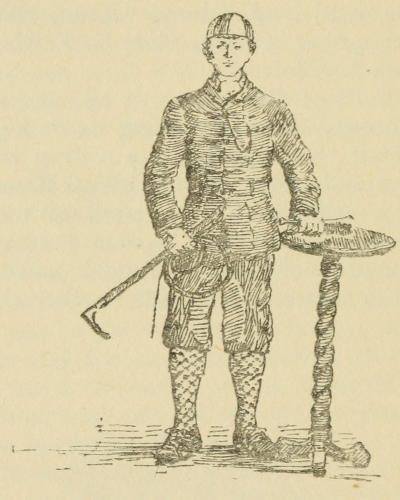
AN OLD-TIME BEAGLER.
The pack was kennelled by one Ward in the Playing Fields,
and hunted drags chiefly, but also wild hares when they were
found. Sometimes they turned out bagged rabbits. One thing
however we do know. They made an agreement with the
Oppidan pack somewhere about 1859 by which the Oppidans took
the country west and the Collegers the country east of the Slough
Road.
The Hunt soon adopted a button with E.C.H. on it.
There is a story of Provost Hawtrey arresting one of the whips
in the Cloisters and demanding what the lettering on the button
was intended to mean. The boy, aghast (for beagling was not
allowed in those days), mentioned the letters E.C.H., whereupon
the old man, who was not averse to personal flattery, took it to
be a compliment to himself as they were his own initials.
One of the runs of 1859 was actually recorded in Bell’s Life.
As I have already noted in the previous chapter the Oppidans
joined forces with the Collegers on three occasions, this being
one of them.
Carter was succeeded by T. J. Huddleston, and Huddleston
by E. E. Witt, who held the hounds for two seasons. Of neither
of these do we know anything. But Thackeray, who succeeded
Witt, first instituted the Journal Book, which was kept right up
to the time of the amalgamation in 1867. I have also been
greatly helped by the only two College whips of this period who
are still alive, R. V. Somers-Smith and A. A. Wace. Here is
a letter from the former which covers this whole period from
the season of 1863 to the amalgamation:
“I went to Eton as a Colleger in the autumn of 1862, and
first ran with the Beagles in the following spring. Thackeray
was then the Master, for which position his chief qualification
was a copious vocabulary. We then chiefly hunted drags; only
occasionally trying for a hare, never with any success.
“The pack had then been in existence only a few years;
they were kept at the lodge at the Slough end of the Playing
Fields by Ward, the groundsman, and were a mongrel lot. One
or two real beagles, some cast-off harriers, some nondescripts,
‘just dogs.’
“As late as 1862 they kept a badger; the brute knew his
job and trotted along until overtaken, when he sat down until
the field came up. One of the whips carried a sack and a pair
of tongs, and the badger was by help of the latter dropped into
the former and carried home.
“There was a story against Lewis, one of the whips, that
on one occasion the badger took refuge in a useful outhouse
adjacent to a cottage, and Lewis was discovered sitting on the
sack to prevent the badger escaping this way, making dives at
him with the tongs when the badger threatened his legs.
“Lewis was Master in 1864; he was a little Welshman,
rather prematurely aged; he was quite a sportsman but a poor
runner. I used often to take a whip in his day, but do not think
I was in ‘office.’ A. A. Wace was first whip.
“Lewis went to Merton; rather distinguished himself there
as a rider—Merton being then a hunting College—and died
suddenly in his room there in 1869.
“In 1865 A. J. Pound became Master. Pound was a
remarkable character—intellectually rather below the average,
but endowed with some originality and an exceedingly strong
will. I have sometimes doubted whether he was quite ‘right’;
he looked at the world and mankind from a point of view entirely
his own, and made no effort to adapt himself to convention of
any kind. But he was thoroughly honest and straightforward;
the kindest and most faithful of friends.
“He subsequently went to the Bar, the last profession for
which he was fitted, was for a time a magistrate in British
Guiana, married an American, and latterly fell into pecuniary
difficulties and took his own life.
“His eldest son is a distinguished sailor.
“Pound took up the Beagles seriously. He got together
quite a decent little pack, and began to hunt hares
regularly.
“Our great difficulty was the shortness of the time at our
disposal. ‘After 12,’ the interval between 11 o’clock school
and dinner at 2, after allowing for time spent in changing, we
seldom saw even an hour’s actual hunting. Too short a time
for beagles to run down a hare. ‘After 4,’ from Chapel to
lock-up, was little better, especially as hares always made it a
rule to run away from home, compelling us often to whip off in
order to get back in time. One of my most abiding recollections
is that of long trots back from the parts beyond Langley and
Slough to get back to Absence.
“Pound adopted a scheme of his own of hunting in the
morning. With one or two choice spirits he would arrange that
we should be early at the ‘Saying Lesson,’ then the invariable
early school, thus getting away soon after 7.30, run across to the
‘Dolphin’ at Slough (which stood on the site of Aldin House
where old John Hawtrey subsequently flourished), breakfast on
beer and biscuits and hunt until it was time to get back to
11 o’clock school. That gave us a good two hours’ actual
hunting, and we began killing hares pretty often.
“I was Pound’s first whip and principal coadjutor for two
years, and it nearly killed me! In fact I was sent home in the
middle of the Summer Half of 1866 supposed to be threatened
with consumption. Tindal and Gosset were whips, and
subsequently Armitstead, who was a very fine cross-country
runner, and at Oxford an oar of some repute.
“Of the 1867 season I have no recollection. I was not allowed
to run for reasons of health, and I cannot even remember the
name of the Master; possibly this was the year of amalgamation.”
Here is the first run recorded in the Journal Book:
“The E.C.H. met for the first time this season at the
kennels. There was a large muster. The hounds were laid on
in a wheat field of Gough’s adjoining the S.W.R. and ran at a
tremendous pace down the grass meadows, crossing the S.W.R.
and into Datchet plantation, in the plough beyond which a check
ensued, which allowed time for the remainder of the field to get
up with hounds. Some cold hunting now ensued, but hitting
the scent off in one of Cantrell’s fields near Ditton Park they
carried it at a great pace as if for Langley Church. The pace
however was too good, and they ran into him in a field adjoining
the London Road.
“After an interval of about ten minutes the hounds were
laid on in a field adjoining Ditton Park, and, the scent having
considerably improved, it was but few could live with them.
The fencing here was very severe, numerous being the purls, and
some stiff water-jumps intervened to cool the ardour of gentlemen
who were too ambitious of shewing in the front. It was evident
from the terrific pace they were now holding that nothing could
live before them. And it was not long before they ran into
their prey just as he was crossing the Upton Road.”
There is a complaint at the end of the field pressing on the
pack, “and that there was far more noise than is consistent with
the decorum of the hunting field.”
Here is a merry account:
“The running of the hounds could be seen all the way from
Riding Court up to the Langley Road, and it was pronounced
by all to be faultless. While a drag was being sent back two
fields were drawn blank. The hounds, having been laid on,
ran from Langley Broom down to Datchet Wood. The way in
which they swung their own casts was the admiration of all
beholders. ‘Hark! forrard!’ was again the cry as they bowled
like marbles over the crest of the hill, making the welkin ring
with their melody. When in the bottom they bent to the left;
each hound scoring to the cry, as with the pack at her heels puss
sought the friendly coverts of Ditton Park, having crossed the
line which the drag had taken in full sight of the hounds. The
huntsman and first whip, kindly assisted by Mr. Lewis, soon got
the hounds out again. Home was now the word, and home we
went after genuine sport, the field declaring that the only doubt
was which was the better run of the two.”
The Beagling Book of this period abounds in quotations from
the inimitable Mr. Jorrocks.
“Better to rove in fields for health unbought
Than fee the doctor for a nauseous draught,”
is a very true maxim, and Lewis has very aptly applied it to
Beagling. Even as early as Thackeray’s season, however, they
killed one wild hare after a good run. But a drag was the usual
order, and it was poor sport really for boys especially because
hounds ran as if glued to the scent. Occasionally this was varied
with a rabbit, but just as the hare almost invariably escaped, so
did the rabbit almost invariably succumb before two fields had
been crossed.
Of course the great handicap was time. But the letter which
I have already given has shown the immense difficulties in this
respect. What enthusiasm was required to surmount them all
and to carry on as they did!
All the accounts of the College Races are also included in the
Journal Book. There was an unpleasant incident at the end of
the season which may as well be recorded just to show how to
deal with people who are not gentlemen.
“It was much to be regretted that several ‘gentlemen,’
who in no way contributed to keep up sport, thought it necessary
to make remarks which only showed their ignorance of the art
of venery, and complained of there being no sport for their
adequate remuneration for subscriptions. Their subscriptions
were returned, and, extraordinary to relate, the E.C.H. still
existed. These gentlemen (?), like the ‘London Brigade’
with the Queen’s Hounds, were generally if not always choked
off at the first check, and, if there was no check, were indeed
‘lost to sight’ but not ‘to memory dear.’”
And here is the obituary notice of a really kind and pleasant
farmer, Mr. Gough of Datchet. A sporting farmer is a
treasured article in any country, and when one dies the Hunt
sustains a serious loss. This Mr. Gough had been particularly
good to the E.C.H.
“The E.C.H. has much reason to regret the loss of Mr.
Gough, a tenant farmer, who by his sportsmanlike conduct
conduced in no small measure to the prosperity of the Hunt.
On his land a sure find might be anticipated, and bagmen were
unknown commodities. By his example several of the surrounding
farmers were induced to open their lands to the E.C.H., and,
though a lawn meet was not often the fashion, Mr. Gough’s
hospitable house was never drawn blank for beer and luncheon.
The ‘Gough breakfasts’ in the Lent term afforded many a
pleasant recollection for dreary after fours, and his tales, though
generally ‘twice told,’ were rarely tedious.”
H. J. L. B. Lewis was Master in 1864 with J. B. Wood,
A. A. Wace, who is still alive, and R. V. Somers-Smith as his
whips. Here is a letter from Mr. Wace which describes the
sport with admirable vivacity:
“The Master of the College Beagles in 1864 was Lewis. He
rejoiced in five Christian names; three, really surnames, indicated
Celtic origin, of which he was very proud. Though of a short
sturdy frame his lungs were not so good as his heart, as an
early death at Oxford showed; and being slow over plough he
left much of the field work to his long-legged whips. Lewis
had learned how to handle hounds in kennel and field in Wales,
and he gave us a very happy season with his knowledge,
generosity and good temper. We had, if I remember right, five
or six couples; dwarf harriers, rather than the beagles of Sussex;
though there was one true to the latter type which generally
did as well at a bad check as Lewis did. They were kennelled
at Ward’s Lodge on the Datchet Road. We hunted, I think,
three days a week, and our country extended from Salt Hill and
Cippenham to as far beyond Datchet as the calls of hall or
lock-up allowed us to get. After we had got our little pack
and our lungs into some training by following drags we took to
hares, but without much success except for exercise. Agar’s
Plough and Cippenham were always good draws; but we rarely
killed, for Ditton Park, lying in the centre of our country, was
too convenient a sanctuary. It had its advantages, however, for
us as well as for the hares, as we learnt to bless it as an excuse
for being late for hall or lock-up. We could so often honestly
say that we had lost time in getting hounds out of the Park
coverts; and that seemed to please the Master in College; for,
as he often told us, its ducal owner was his wife’s cousin.
Hounds, then often disappointed, required blooding with a
bagged hare or rabbit, neither ever giving a decent run; and I
disliked the job all the more because Sussex had shown me a
better way of using beagles for rabbits; and I thought of the
hours spent with my gun in a ride while real beagles hustled
rabbits round and round a big wood. Tiring perhaps of these
‘bags’ we yield to a suggestion, made I think by Joby Minor,
that a badger would give us more fun, certainly more scent, and
would always live to fight beagles another day.
“It was bought and did give us some fun at first; but this
palled because the badger soon realised that it could save its
skin without so much exertion as a long run over heavy ground.
It used to make for a long coppice beyond the Datchet Road,
and when the pack ran into him there he would run up and
down immune, and finally run quite kindly into the bag in
which he had left his pleasant quarters at Ward’s Lodge. He
also developed a natural love of drains; and thereby hangs a
tale, memories of which seem to discredit Joby Minor. Our
badger had found a drain under the S.W.R. a nicer refuge than
even that wood, and so Joby was ordered to stop it before
unbagging the badger out that way. One ‘after twelve’ we
had a merry run up to that drain but found it stopped. Hounds
swore badger was inside; Joby swore he had stopped it; and
suggested that finding this the badger had got out to the
metalled line one way or the other, leaving on that no scent.
It was dangerous to test this, and, casts on the fields either side
failing, we drew off homewards. On the run back suspicions
seized us, and two of us undertook to shirk hall or cut it short
and run out again to that stopped drain before Chapel. Joby
was right, but very wrong too! He or his understudy had
stopped the drain, but not till the badger had been allowed to
run in! He unstopped it when we were safely gone, and the
badger had walked into its familiar bag. Had we two not met
him just leaving the line he would probably have tried to sell us
that badger the following week! I still cannot think unkindly
of Joby when I recall the humour of this incident; or think of
the Beagles of 1864 and of many friends who followed them, of
whom two later on—Frere and Somers-Smith—ran for Oxford
over shorter distances than we covered.”
Lewis was famous for his Rape of the Block, which was
restored to the Head Master in 1891. The Block, as all Old
Etonians will know, is used by offending boys to kneel on during
the process of being swiped.
About this time the kennels underwent some improvement.
“A new room was added, a new palisade raised and the brick
pavement laid down. The appearance of the whole was workmanlike
and neat, but not gaudy, reflecting credit on Mr. Martin,
the carpenter.”
“Con—found all ’ares wot takes to parkses” (vide Mr.
Jorrocks) was very appropriate to their country with Stoke Park
and Ditton Park in the middle of it as tempting places of refuge
for a sinking hare.
On one occasion in Lewis’s season he was favoured with a
visit.
“Wednesday, St. Matthias’ Day, dies creta notandus, the
great Pomponius Hego and Scrutator, known as having long
held a proud position in the first flight of the E.C.H., leaving
the ‘Shires’ favoured the provinces with their presence.
Thackeray and Moore brought down a hare from Oxford, which
Pound turned out at Queen Anne’s Spring.”
The sport, however, on this occasion was not good, “every
inch of scent being trodden out by gentlemen who seemed to
have discovered the secret of perpetual motion.” This season
ended after rather unsatisfactory sport. In Lewis’s case ‘the
spirit was willing but the flesh was weak,’ and he frankly owned
that his running powers did not enable him to prove a capable
huntsman. Ichabod, Ichabod.
But Pound got together a much better pack. His season
has already been so well described by Mr. R. V. Somers-Smith
that it is unnecessary for me to add anything. Pound seemed
in all his accounts to have been completely dissatisfied with the
world in general, for he scarcely ever praises anything in big
records, and he speaks of almost everything in embittered
terms.
On one occasion a hare was put up at 10.45, i.e. a quarter
of an hour before school. The huntsman and whips returned to
school while the hounds went on by themselves and killed their
hare, which was stolen by and afterwards recovered from a
sweep. This was only the third occasion on which a wild hare
had ever been killed by these hounds.
One day the hounds joined with the Prince’s Harriers, and
the Prince and his retinue passed close by and inspected the little
pack, “no doubt with an admiring eye!” The unlevelness of
the pack may be shown by the measurements taken on March
25th, 1865:
Abigail
19″
Rouser
18
Valiant
17½″
Pliant
17″
Smuggler
16½″
Jargon
16½″
Affable
16″
Wellington
16″
Rattler
15¾″
Dainty
14½″
This was by far the most successful season the E.C.H. had
ever seen.
So much for the College Beagles. It is to be wondered at
that at this time there should have been two packs of beagles in
the school, but it was about then that the differences between
the Collegers and the Oppidans were one by one abolished. The
amalgamation of the Beagles was almost the last of these
reforms, and some account of it will be given in the next chapter.
It was quite natural that the attempts to introduce beagles
should have begun in an unofficial and semi-organised manner.
But the pack in the time of Pound was very different from that
of Carter. Just as the Oppidan pack had been brought to a
respectable standard, so had the College pack; and it only
remained for the amalgamation (hideous word!) to establish
hunting at Eton on a very firm basis.
GOOD-NIGHT.
CHAPTER III. THE AMALGAMATION.
The idea of amalgamating the College and the Oppidan packs
of Beagles was first mooted in 1864, but little came of it,
probably owing to the reluctance of College to renounce the
undoubted advantages which it possessed. A. J. Pound, the
Master of the College Beagles in 1865 and 1866, was opposed
to the scheme for reasons which he has shown in the Journal
Book of the College Beagles (pp. 223, 224). Towards the end
of the season of 1864, on March 16th to be exact, the Oppidan
Beagles invited the Master and Whips of their neighbours to
their annual drag at Salt Hill, where they partook of refreshments,
liquid and solid. During these Mr. E. Royds arose and
proposed “That the two packs be amalgamated.” These are
the words which A. J. Pound has written in the Journal
Book, and which adequately express his view of the proposal:
“Mr. Pound seconded the motion, though much against the
grain. It may be well to make a few remarks here showing the
advantages and disadvantages. It may as well first be mentioned
that it is almost a settled thing that the two packs be
amalgamated next year. The advantage of this arrangement
will be entirely on the side of the Oppidans, the increase of
country enabling them to hunt every day of the week, and good
kennels in lieu of their present ones. The disadvantages on the
side of College, inasmuch as the subscription being so much
heavier than the present one, none will care to join who do not
try to ‘run to hounds,’ and in all probability none, Colleger or
Oppidan, who cannot ‘run to hounds’ will be allowed to join.
The great amusement of the Easter Half will be snatched away
from College, and we fear loafing will increase in a double
proportion. Still it is to be hoped that Collegers will try and
hold their own against the Oppidans in the amalgamated field,
and we think all must see that this step is a necessary one and
cannot be prevented now that the amalgamation has proceeded
so far and Collegers are admitted to all the races. College must
go with the age, for the age will not go with College.”
The College Beagles had only two more days hunting and
then Pound closed the Journal for the season in the following
way:
“May the E.C.H. never amalgamate, may the E.C.H. never
enjoy worse seasons than the two last, are the fervent prayers of
Mr. Pound, who with deep regret resigns his post of Master to
Mr. Armitstead.”
The obvious reluctance of Pound to amalgamate and his
bitter phrases regarding the whole proposal certainly seem
strange to us who live in days when there is little if any difference
between Collegers and Oppidans (except brains). Perhaps he
was angry at being, so to speak, “cornered” at the Salt Hill
refreshment table. Probably he was in a false position. In
1864 the Collegers had been admitted to all School races, and
so were scarcely in a position to refuse flatly what was simply
a request of the Oppidans. In his entry many of his remarks
seem somewhat lacking in common sense. If there was an
increase of country for the Oppidans surely the same applied to
the Collegers. Again it appears selfish to grudge the Oppidans
the use of the kennels, especially when the combined pack would
obviously be much improved by hounds from the Oppidan
pack.
Indeed his only real grievance seems to be that many
Collegers would not be allowed to run with the beagles and
that others would not be willing to do so owing to the increased
subscription. There seems to have been at the time a desire to
keep the field very select, a membership of only seventy boys
being allowed. Perhaps the Head Master objected to many boys
being allowed to run. Or again perhaps the Masters considered
themselves unable to control a larger field. But it is at least
peculiar that as large a field as possible was not encouraged to
run with the beagles. It would have meant a larger subscription,
and consequently a better pack and better sport. As it was,
however, the subscription was one pound, and only twenty boys
from College were admitted by the terms of the treaty drawn up
later in the year. This treaty we shall append shortly.
Even allowing this to be a grievance, it seems surprising
that Pound should oppose what seemed a most desirable object.
Obviously the amalgamated pack would be better run and would
in all probability show better sport. Moreover, Collegers and
Oppidans were growing more and more friendly every year.
Already nearly all the differences between the two sections had
been abolished. It almost looks as if Pound wished that they
still existed. “College must go with the age, for the age will
not go with College.” It is a sentence which might mean
almost anything. The Oppidans had received the Collegers into
all their sports, and yet the latter do not seem to have welcomed
the change.
The next development of the proposal appeared in the
Chronicle of Nov. 22nd of the same year (1866). Here the
leading article was devoted to this purpose, and this is too
important not to be quoted in full. Without it, the proposal
might, and probably would, have been allowed to “drop
unnoticed” perhaps for a considerable number of years. After
a few preliminary remarks, it goes on as follows:
“Now we may as well begin by stating that our suggestions
refer principally to an idea which has been started before this,
but has been allowed to drop again unnoticed, although we must
say we think the idea a most felicitous one to all parties whom
it concerns. We refer to the idea once brought forward, of
Oppidans joining their beagles with those of the Collegers—a
plan which we think would tend greatly to further and increase
the harmony and goodwill that we are happy to say at present
exists between these two essential parts of one school. We all
know that combination is strength, and we have been delighted
to watch the gradual admission of Collegers into all the privileges
and sports of the Oppidans, beginning with the amalgamation
of Lower Club and Lower College at Cricket, the admission of
Collegers into the VIII., which occurred the same year, and
lastly the admission of Collegers into ‘the Field’ (one of them
having been no insignificant member of a wonderfully good XI.)
and into all the sports and races which have hitherto been open
exclusively to the Oppidans. We have therefore one other
arrangement to propose, which, if duly carried out, will complete
the bond of unity and harmony between us, and will also, we
have no doubt, give universal satisfaction, viz. the amalgamation
of the Oppidans’ and the Collegers’ packs. Its advantages, we
think, must be apparent to all; and we defy its most strenuous
and determined opponents, if indeed any such exist, to find any
good grounds for defence. We should have all the advantages
of a far larger extent of country to hunt over; and that, if some
of the farmers are going to be as reluctant, and we might almost
say as disagreeable, as last year, would be no inconsiderable gain
to our hunt.[3] In a word, more country, more friends and more
good-fellowship are the three leading features of the new scheme
of amalgamation that we are proposing.
“Again we would venture to suggest that, as in due
proportion to the school Oppidans would compose at least three-fifths
of the subscribers, the huntsman should be an Oppidan
and the first whip a Colleger; while the other whip should, we
think, be either a Colleger or an Oppidan according to merit,
just as there happened to be one or other really fitting for the
office.
“We think then that we have thus shown the great
advantages derived from amalgamation; and we hope that we
have sufficiently convinced, not only those who have a hand in
the management of all these things, but all our readers, that
what we have here recommended is the right thing to do. We
would conclude by venturing to hint that the ‘Master,’ whoever
he may be, should be decided on as soon as possible, as there is
much to be done this Half, especially if amalgamation is really
brought about. Arrangements will doubtless have to be made
for kennels that will suit both parties (though we suppose that
the old kennels will be just as convenient for Collegers as
ourselves); needful repairs have to be executed, farmers consulted;
various other necessary requirements attended to.”
Of course this leader was written by an Oppidan. But
nevertheless, it seems to place before the School the true facts
of the case, and to show that the proposal was much to be
desired and would eventually prove a benefit to both parties.
Besides, the leader had yet another merit. It provided a
basis for the treaty which had of necessity to be drawn up if
the amalgamation were decided on. It suggested that the
membership of the pack should be in some accordance with the
respective numbers of Collegers and Oppidans. “At least
three-fifths” are the words, but they certainly seem to imply
that the author considered that a yet larger proportion of
Oppidans would be desirable. He also says that, owing to the
necessary disparity of numbers, an Oppidan should take the
mastership and a Colleger the first whip; while the second whip
should be awarded purely for merit.
Such an article as this could not be lightly passed over by
those who had a hand in the management of the beagles. There
was only a bare month between Nov. 22nd and the end of the
school-time. In January 1867 the following entry is to be
found in the Journal Book (p. 236):
“January 1867. The Beagles have been amalgamated with
the Oppidan pack, and the following are the Articles of
Agreement:
I. In consequence of the wishes of both parties, it has been
resolved to amalgamate both packs of Beagles.
II. No one will be allowed to run who has not paid his
subscription.
III. That a board be put up at the beginning of the Easter
Half for fellows to enter their names.
IV. That no one below Remove will be allowed to enter,
and that the number be limited to 70, Fifth Form receiving the
preference.
V. Of which there may be 20 Collegers.
VI. That one pound subscription be paid throughout.
VII. That the appointment (of Master) is in the hands of
the Captain of the Boats, who may be guided in his choice by
the result of the Steeplechase.
VIII. That when a Colleger is huntsman an Oppidan shall be
first whip, and when an Oppidan is huntsman a Colleger is first
whip.”
Thus did the amalgamation become an accomplished fact.
It had been brought about not without some manœuvring and
considerable difficulties. Certainly, however, from the rules
which we have just quoted from the Journal Book, it seems as
if College, as well as the remainder of the School, welcomed the
change. “By the wishes of both parties” seems fairly to put
the point beyond dispute, even though it was written by an
Oppidan, W. C. Calvert.
The terms of the treaty seem eminently just. The
suggestions of the Chronicle were obviously considered and were
to a large extent adopted. The disparity of numbers
(50 Oppidans, 20 Collegers) seems perfectly fair on reflection.
The clause (VIII.) allowing either a Colleger or an Oppidan to
be huntsman, but ensuring that if the huntsman be an Oppidan
the first whip must be a Colleger, seems fairer than the
Chronicle’s proposal that the huntsman should always be an
Oppidan and the first whip a Colleger. The only peculiarity of
the treaty is contained in Clause VII.; that the appointment of
the Master should rest in the hands of the Captain of the Boats
seems a mistake. Obviously the fittest person to choose the
Master was the previous Master. The Captain of the
Boats could not have known whether a boy possessed the
necessary qualifications or not. But it does not greatly
matter. So far as we know this privilege was never used.
Indeed the whole treaty fell into abeyance before very long.
The distinction between Collegers and Oppidans grew less and
less, and only Clause IV. remained for any length of time. This
limit of seventy was finally abolished in 1876. Unfortunately
we have no record of the actual members of the E.C.H. after the
amalgamation. But we do know that it proved an unqualified
success and that beagling became more and more popular from
this time onwards.
The amalgamated pack had a good set off in the season of
1867. F. E. Armitstead, who had been first whip of the College
Beagles in the previous season, did not, surprisingly enough,
become the first Master of the combined packs. Instead he took
the first whip, and the more important office was occupied by
W. C. Calvert, an Oppidan, who had not held any official position
the previous year. During this season the E.C.H. gave up
hunting drags, and from this time onwards the hare became the
sole quarry. The pack consisted of 1½ couples of College
hounds, one hound (Boscoe) from the Oppidan pack, and
2½ couples of hounds which had belonged to neither pack. In
addition to these, there were 1½ couples of first season hounds,
out of Jargon, by Smuggler, the property of the College Hunt;
2 couples presented by Mr. Calvert, and a couple lent by Lord
Mandeville. In all nine couples of working hounds. Jargon
and Joyful had both hunted with the pack since 1863, when the
Journal Book was first kept. The former was evidently a most
remarkable hound. She was a big “black, tan and white”
bitch standing 16½ inches. There is a painted photograph of
her in the Journal Book (1865), together with A. J. Pound,
R. V. Somers-Smith, and another hound Valiant, and, judging
from the number of times she is mentioned, she must have been
a most reliable bitch with a good nose and plenty of dash.
As has already been remarked, bagged foxes and hares had
been turned down occasionally in the previous seasons. Only
once after this date was a bagged hare turned down, and this
in the mastership of F. Johnstone. The first whip has made an
entry in the Journal Book in which he expresses his loathing of
this “sport,” and his hope that the Master would not provide
any more bagged hares. After this date, no bagged hares were
hunted, and with the exception of the annual drag at the end
of the season the wild hare became the sole quarry.
The E.C.H. in the period after the amalgamation produced
some well-known sportsmen, among them such names as the
Duke of Beaufort (then Lord Worcester), Mr. E. P. Rawnsley
and Mr. G. H. Longman. Mr. E. P. Rawnsley has written the
following long and interesting letter about beagling at Eton in
his day, containing a story which shows that even Head Masters
are not incorruptible at times:
“When I went to Eton in 1864 there were two packs of
beagles, Collegers’ which hunted east of Slough Road, and
Oppidans’ which hunted west of Slough Road. Hares in the
Oppidans’ country were very scarce indeed, and hunting
depended on an occasional bag-fox, which ought to have been
tabooed, and a drag, the latter a poor game for us youngsters
who toiled along and never saw a hound after first field. The
packs were amalgamated in 1866. The Oppidans’ pack
had been kept up town, very poor kennels and badly done.
After the amalgamation the kennels were at the end of the
Playing Fields, and more trouble was taken that the hounds
were better done. There was no hunting before Christmas,
only after, till the end of March. At best the hounds were only
a scratch lot, different boys getting their people to keep one
or a couple most of the year. I whipped in to F. Johnstone
in the spring of 1869; his father, I think, was then Master of
what we now call the Derwent, and he knew all about it and
was quite good at the game. One whip was an Oppidan, the
other a Colleger. I don’t think my Colleger had ever been out
hunting before, and, as Johnstone expected his hounds turned
when he wanted them, I had nearly all the work to do; cracked
up in consequence. It was very hard work in those days; we
could not start till after Absence, had then to run to the meet,
get a hunt and run home again in time for lock-up, never having
more than three hours to do it all in, no allowance being made
to the whips.
“I remember one day in particular, Johnstone was not
out and I was hunting hounds the far side of Langley; we
had quite a good run and killed—a great event in those days.
Just as we had taken off pads and mask, up jumped a fresh hare,
away the pack went with a burning scent, and it was a long
time before we could get at them to stop them. It was getting
dark, and quite five miles from home, no chance of getting in
for lock-up, but we had the hare! So it was duly carried, such
an object it looked, without feet or ears and stiff as a stake, and
left with our compliments at the Head’s house, the clock struck
nine as we stood there. I suppose we were all reported for
coming in so late, but we never heard anything more. I suppose
the hare was a peace-offering.
“In autumn of 1869, I remember, Jack Thompson
(Mr. Anstruther Thompson’s eldest son), George Wickham
and I, all very keen, went to several of the farmers
and did our best to get them to keep hares, and we certainly
were better off the next year. There were hardly any hares on
the Dorney side; beyond Salt Hill and Langley were best, but
nowhere good. In those days we never got a day off for a hunt;
I only remember one, to Oakley Court, where we were most
hospitably entertained but had a blank day. When at Eton
last June I had a look at hounds and kennels. Very different
from old days, kennels roomy, airy and clean, and hounds with
a nice bloom on them ready to go into work when wanted.”
Another well-known name is that of Lord Derwent, who as
Francis Johnstone was master in the same year that E. P.
Rawnsley was second whip. In a letter he gives a short record of
his beagling career at Eton from the time that he became a whip.
“In 1868 I was second whip to Walter Calvert, Armitstead,
K.S. being first whip. The amalgamation of the two packs had
taken place, and an arrangement made, I imagine, that a Colleger
should always be on the hunt staff. In the following year, 1869,
I was master, Browne, K.S. was first whip, and E. P. Rawnsley,
who has only just retired from the mastership of the Southwold
after a long and very successful career as huntsman of that pack,
was second whip. During the year I ran with the Eton beagles,
we had only “after 12” and half holidays to hunt on. So our
efforts were limited from the point of view of time, and I do not
recollect killing many hares, but latterly no bag-foxes were kept
to hunt.
“I paid a visit in the Lent Half of this year to the new
kennels, and only wished I was young enough to follow the
charming pack on foot as of yore.”
The name of E. P. Rawnsley is too well known and honoured
to be passed over thus lightly. For forty years he was Master
of the Southwold, and he is well known not only in Lincolnshire
but in every part of England as one of the most devoted
supporters of hunting.
Johnstone’s season was better than either of those of W. C.
Calvert. But although the latter killed only three and two
hares in his two seasons respectively, yet he showed some
good runs, and the amalgamation was universally acclaimed as
a success.
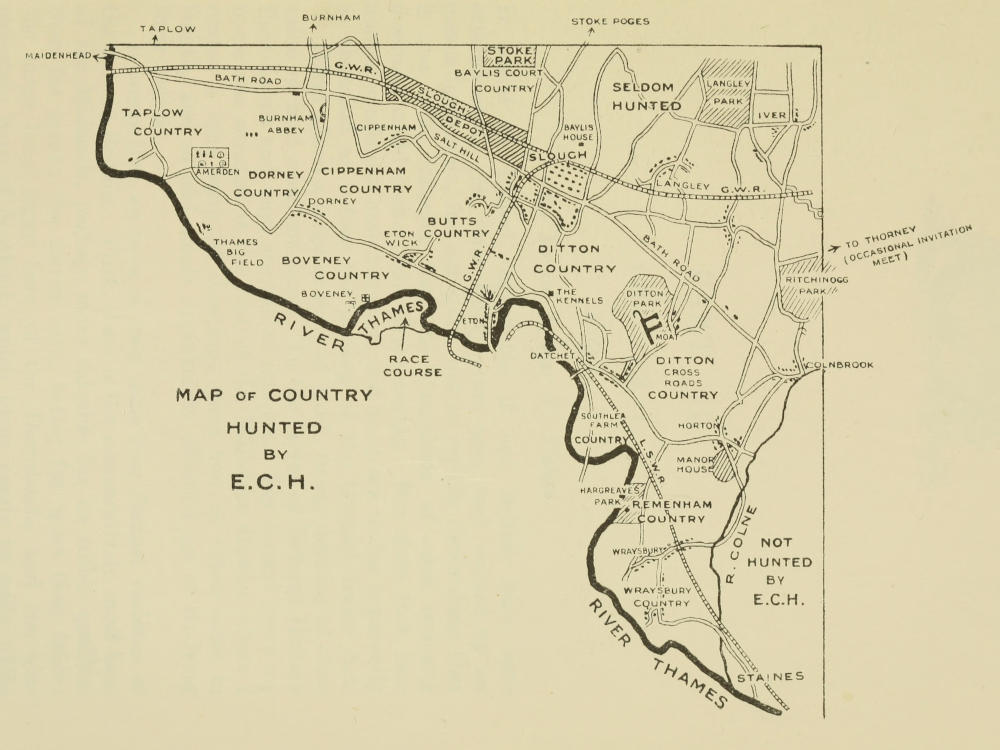
Before proceeding further it will perhaps be as well to give
some account of the country hunted by the E.C.H. at that time.
It was bounded on the south by the River Thames and on the
north by the chain of woods from Taplow to Stoke, and by the
Great Western Railway from Slough to Langley. It was and
is still split into two parts by the Slough Road, across which
hares scarcely ever run. On the west side of the country lay the
villages of Eton Wick, Dorney and Burnham. This was the
country previously hunted over by the Oppidan Hunt, and below
the railway at Salt Hill hares used to be very scarce. In the
Salt Hill country, however, and up towards Stoke and Burnham,
they were much more plentiful. On the east of the Slough Road
lay the villages of Datchet, Wyrardisbury (Wraysbury), Horton
and Remenham. Most of the country is plough, and what grass
there is, lies chiefly on the Dorney side of the country. Near the
village of Datchet Ditton Park is situated with its house surrounded
by a moat across which more than one E.C.H. hare
has swum.
During the ten years after the amalgamation the kennels
were at the Black Pots end of the Playing Fields, and Ward,
the groundsman who tenanted the cottage and whose backyard
took the place of kennels, acted as kennel huntsman. There is
no information about this man Ward save that the hounds were
kennelled at his cottage until 1876, when Rowland Hunt
transferred them to better kennels up town. Here is a letter
from Rev. W. Vickers, the brother of one of the early
whips:
“It was my elder brother V. W. Vickers (who died in 1899)
who was second whip in 1873, with W. A. (Billy) Harford as
first whip and Hon. C. Harbord as master.
“The pack were kennelled at Ward’s Lodge, at the extreme
east end of the Playing Fields, Ward acting as K.H.
“In 1874 Harford was master, with L. Heywood Jones and
Hon. E. W. Parker as whips. My brother was responsible in
1873 for the account of sport reported in the Chronicle, and was
occasionally very riled by the editor, who, like Miss Lucy
Grimes, of the ‘Swillingford Patriot’ in Sponge’s Sporting
Tour, used to correct his effusions by substituting ‘puss’ for
‘hare,’ and so on! He hunted the Trinity Beagles at Cambridge
for two seasons, succeeding that fine sportsman G. H. Longman.
“Of the School tutors of my day, C. Wolley-Dod, the
tallest and thinnest of Masters, was a keen beagler, also my tutor
G. R. Dupuis—both of them in long frock coats and top hats.
A. Cockshott too was a good friend to, though not a follower
of, the hunt; on more than one occasion securing us a bill-day.
One of these, I remember, was to Mr. Hall-Say’s place, Oakley
Court. I don’t remember much of the day’s sport, but have a
lively recollection of the lunch—a spread which made more than
one of us feel, when we found our afternoon hare, that there
were occasions when the saying ‘Fox hunting on foot is but
labour in vain,’ applied also to hare hunting!
“The pack in my day was like the old-fashioned ‘trencher-fed’
hunts—the members bringing up in beagle term a hound
if they had one, the contribution of a hound taking the place
of the one pound subscription. It was wonderful (or so we keen
ones thought) the sport such a scratch pack showed.
“One day is impressed on my memory (in Fenwick’s mastership,
I think), when we ‘burst up’ three hares! The meet, I
think, was Dorney Gate. I forget how two were killed, but the
third swam the river near Athens, waited for us on the further
bank, and was killed on Windsor racecourse.
“Another little incident. Meeting at the kennels we ran a
hare into Datchet Vicarage garden and were gratified to see the
Vicar come out of his house, hatless, to join (as we thought) in
the chase. But no! his ill-directed energy was against the chase,
which he forcibly reminded us was a trespass!
“The ‘hunt servants’ wore no sort of uniforms—merely
change coat, knickers and stockings, with House-colour cap and
‘muffler.’ A little latitude was allowed them as regards lock-up.
Just as well! For I remember one day a hare took us nearly to
West Drayton!
“Of the first flight in my day no one could come up to
C. E. Munro Edwards. I do not think he ever held office,
though he afterwards became, with F. Selater, the founder of,
and whips to, the Christ Church Beagles, with which I, an
outsider (of Magdalen), had the special privilege of running.
His wind was simply inexhaustible!
“Speaking of this reminds me of an incident which has
nothing to do with E.C.H. beyond the fact that the actors in it
were the two whips. My brother and Billy Harford by some
means got out of 11 o’clock school in time to meet the Queen’s
staghounds on their opening meet at Salt Hill. The stag ‘took
soil’ in that pool close to the line, near the present Burnham
Beeches station. The two lads manned a boat which they found
near the cottage and succeeded in ousting the stag. The Press
next day, alluding to the incident, remarked that ‘the two young
Etonians appeared quite in their element.’ Rather amusing, as
they were both inveterate dry-bobs and probably never entered
another boat during their time at Eton!
“The largest number of hares killed in one season was by
F. Johnstone in 1869. The pack was still rather a scratch one,
and did not belong to the hunt, but to individuals. Undoubtedly
they had some wonderful runs, but there were still terrible
disadvantages, especially as regards time. Moreover, the
conditions under which the pack was kept were very unsatisfactory,
and Ward made much too much money out of them.
There was a subscription of one pound for every one, but there
were no facilities such as a hound van.”
Perhaps it would be interesting to some to give the accounts
of a few of the best runs from the Beagle Books.
“Saturday, Jan. 23rd, 1868. Upton Church. A hare was
viewed away at the further corner of Mr. Nixey’s Plough, which
as usual made straight for Ditton, but failing to find an open
smeuse went away to Riding Court, where she turned homewards.
The hounds hunting well followed her with a burning scent,
though many doubled some way past Datchet plantation; here
a fresh hare being started in her line enabled her to escape dead
beat, while the second hare carried the hounds across the
L. & S.W.R. to Black Pots and was next seen swimming under
Victoria Bridge, whereupon Mr. Calvert amidst great applause
swam in and picked her up, and she was given up to the pack.
Time, 40 minutes, second hare 20 minutes.”
“Wednesday, March 25th, 1868. Saw a run which was,
alas! the last to many members of the E.C.H., but which was
in every way worthy of that renowned hunt. The meet was at
the Three Tuns, and a hare was found almost immediately on the
left side of the Farnham Road. She gave us a merry spin
without a check up to Farnham, where the hounds were brought
to their noses, and it was with the greatest difficulty that they
regained the line owing to the very dry state of the ground. At
last, however, they worked it slowly down to Baylis House across
the Farnham Road, where the scent began to improve. The
hare then crossed the G.W.R. and ran a ring in front of Mr.
Aldridge’s farm, and, just as the pack were going to return
home, she jumped up a few yards before them; the hounds dashed
off full cry past Baylis House across some grass fields up to
Stoke palings. Here they turned sharp to the right and at
rather a slower pace crossed the Farnham Road and made as if for
Britwell. Again they turned for Farnham, near which they
were whipped off, as not only time but daylight had failed.
Time, 2 hours 26 minutes.”
A very good hunting run, as every one who knows the
country will agree.
In Johnstone’s season the best run was that already described
by Mr. Rawnsley; and the incident of presenting the hare to the
Head Master is duly recorded in the Beagling Book. The
account of the run ends with the remark: “May the E.C.H.
enjoy many such days and many such a finish.”
Mr. G. H. Longman writes:
“My mastership of the Eton Beagles extended over the two
seasons 1870 and 1871, for in those days there was no hunting
done at Eton before Christmas. The kennels were at the end
of the Playing Fields, close to Black Pots. The rule was either
to subscribe a sovereign or bring back a couple of beagles, and
the pack consisted entirely of hounds so procured. Naturally
the result was a rather unlevel lot, but they did their work
quite well, and I recollect that some hounds brought by one of
the Anstruther-Thompsons were about the best we had.
“Two hounds particularly remain in my memory, namely
‘Rustic’ and ‘Rival.’ I have in my possession now a coloured
photograph of the pack, taken by Messrs. Hills & Saunders,
which was presented to me on the completion of my second
season of mastership. The occasion was celebrated by a
breakfast at the White Hart Hotel in Windsor, and, though the
authorities must, I think, have been aware of the fact, they
neither took the slightest step to prevent nor resent it.
“F. A. Curry and L. G. Wickham whipped in to me in
1870: G. H. Armitstead and Hon. H. C. Legge in 1871.
“Nobody was allowed off Absence at that time, nor were
we allowed to attend that function ‘changed.’ I used to go,
therefore, with a great coat and pair of trousers over my
beagling kit. Three Lower Boys were in readiness at my
tutor’s door, which was just opposite Schoolyard, one to take off
the coat, and the other two to haul away each at a leg of the
trousers, so that I was able to start off in a twink immediately
after I had answered my name.
“Our time being extremely limited we used to advertise a
meet at say Langley station for ten minutes after two o’clock,
Absence being at two. The kennelman brought the hounds to
the meet coupled, and took them home in the same manner.
We used always to draw at the double, and if possible coupled
up the hounds in time to get back before lock-up, the run home
testing our endurance to the uttermost.
“This description of our methods will show how strenuous
the work was, but, though we did our best to get back
in time for lock-up, I remember very well one occasion
when a hare rose in view just as we were about to couple up the
hounds. It was out West Drayton way. Off went the hounds
in full cry, and we were unable to stop them for something under
an hour, after—among other things—having swum across the
Colne. We were an hour and a half late for lock-up, and my
tutor, instead of taking a reasonable view of such an unavoidable
episode, sent me up to the Head Master. Dr. Hornby was full
of threats to stop the whole thing, but finally contented himself
with setting me the fifth Iliad to write out, thinking that this
would prevent my hunting the next half holiday. I did hunt
though, for my method of writing out this Iliad was as follows:
taking three pens sloped one over the other I sat up all night and
wrote out one-third of it. This I showed up at one o’clock the
next day at the Head Master’s house, and never heard anything
more of the matter.
“The farmers were extremely friendly, and indeed I only
recollect one who denied us permission to hunt over his land.
The original refusal was probably due to some misunderstanding;
but the quarrel had been emphasized by the fact that the beagles
had, once or twice, run over his land after permission had been
withdrawn. In my two seasons, however, chiefly on F. A.
Curry’s advice, we strictly respected his decision: with the
pleasing result that, I believe, before the commencement of the
next season, permission was again gladly given.
“Half a century is a considerable time, and I am sure readers
will readily forgive my inability to recall any more episodes of
the season 1870-71.”
Under the mastership of F. Fenwick a wonderful day’s sport
was enjoyed on Feb. 22nd, 1872, when no less than three hares
were killed within two hours. The meet was at Athens, and a
short time before the meet two hares had been seen to swim
the river from the Eton side, a striking proof that hares will
take to the water even when not pressed. Hounds were taken
over the weir bridge and both these hares were killed after short
runs, but the hunt of the day was yet to come. A hare was
found near Surley, and after a fast ringing hunt of 1 hour
10 minutes was rolled over in the open near Aldridge’s. The
account of the run ends with the words:
“Thus it was
‘From a find to a run,
From a run to a view,
From a view to a kill
In the open.’”
But the good runs are too numerous for selection to be easy,
and at any rate there is no great interest in the mere recounting
of a run. But this chapter cannot close without mention of the
annual drag to Franklin’s, a farmhouse near Bray, where the
members of the hunt were entertained with unlimited champagne
and sandwiches. Unfortunately this custom was not repeated
after the year 1869 for reasons which are not known, but which
may easily be imagined.
“AN UNPARDONABLE INTRUSION.”
CHAPTER IV. ROWLAND HUNT AND HIS SUCCESSORS.
The year 1876 was as full of surprises as any that the E.C.H.
has ever seen. It was a year of changes, one might almost say
of revolution. For ten years the hunt had struggled on since
the amalgamation with no very marked improvement in the sport.
The pack belonged to various boys. It consisted of hounds of
all sizes and shapes. Many things were crying out for reform.
The year did not open with any great promise. None of
the whips of the previous season remained to hunt the hounds,
and so the office of Master devolved on Rowland Hunt, whose chief
qualification was that he was an amazingly good runner. He had
never once whipped-in the year before, and is not even mentioned
in the Journal Book previous to 1876. But directly the season
began, he astonished everyone by the talent and knowledge he
displayed. Not only did he prove the most successful huntsman
the E.C.H. had ever possessed, but he showed himself to be an
organiser of the highest degree. No sooner had he taken over
the Mastership than he realised that the hounds were disgracefully
kennelled, and that Ward, the kennelman, was making a great
deal too much money out of them. He obtained leave from the
Head Master to have the hounds removed to kennels at the back
of a Turkish Bath in the town. Here he made an arrangement
with William Lock, who kept the Turkish Bath. But it is
better given in his own words:
“It has been arranged that Lock is to receive £53, for which
he is to keep 15 couples of Beagles and do everything for them,
in the way of feeding, straw, coal, etc., and that if the Master
wishes they should be taken a week before the beginning of
the Half to get them in condition. For this £53 Lock’s boy
takes the Beagles to the meet and takes them back, etc.”
At the end he says:
“I have found Lock to be a thoroughly steady, honest man,
and I think he can be trusted in anything.”
I have mentioned Hunt’s dealings with Lock, first partly
because Lock entwines himself in the history of the pack from
this time onwards, and partly because the kennels of a pack of
hounds are next in importance to the pack itself, and the change
of kennels was one of the most important of Hunt’s many
reforms.
Hunt in his first season killed 15 hares; that is, he more than
doubled the record for any previous season (seven hares by
F. Johnstone). In his second season he beat his own record by
two. These wonderful results were the effect partly of his talents
as a huntsman and partly of the way in which he reformed the
E.C.H. He was the first to see the need of three whips at Eton.
Moreover they (the whips) soon learnt (for Hunt’s tongue was
particularly caustic and his expressions well chosen and to the
point) that they were not out hunting for pleasure. Hunt’s
tactics were to have one whip wide and forward on each flank,
and one with him to stop hounds running heel.
Rowland Hunt has sent me his own recollections of the
E.C.H., which I append here:
“When I took the Eton College Beagles, they were kennelled
at a house at the end of the Playing Fields towards Datchet.
My recollection is that the conditions there were very unsatisfactory,
and that the man in charge made far too much money
out of them and did not feed them well. I got the then Head
Master to have the kennels moved to somewhere over Barnes
Bridge, and they were kept by a man named Lock, and, as far
as I remember, he did them very well, and I think he took them
to the meets. I think we improved the pack considerably by
getting fresh hounds, some of which were, I think, obtained
from the late Mr. Fellowes of Shotesham Park—about 16 inches—really
dwarf harriers, but there was no foxhound blood in
them, and they had very good noses and could get along.
“I think the whips knew about as much about hunting as I
did, but, as far as I remember, it was roughly the usual way to
have one whip somewhat wide and forward on each flank and one
with me to stop hounds running heel or a fresh hare. On
account of the short time for hunting, we took every possible
advantage of a hare and never allowed hounds to potter. We
lifted hounds and cut off corners when the chance occurred, but
I don’t think it was done enough to stop hounds hunting well.
We had to run risks, as it was very difficult to catch a hare in
the time allowed between Absence and lock-up. I don’t remember
for certain which was the best country; it is too long ago;
but think it was towards Maidenhead. I don’t remember
any trouble with the farmers, but we got into a deuce of a row
with an old gentleman once for killing one of his hares in the
middle of March. It was a long day with Mr. Vidal, and I had
to go over on Sunday and apologise to the old boy and he
became friendly, but I missed Chapel and had to square the
Praepostor—wasn’t that the name of the cove who marked you
in or out? I think we used to reckon that we went to the meet
at about seven miles an hour. May I venture to express the
opinion that hunting the hare on foot with 15-inch beagles is
real hunting, and real sport, and that the hare has a very good
chance of escaping, especially after Christmas? As I dare say
you know, a hare is a much more tricky animal to hunt than a
fox.”
Hunt’s personality was amazing. He had a way which
carried all before it. He was versatile, and, as well as being
a wonderful runner, he was an excellent shot, a fearless rider
and a good fisherman. He was, moreover, a keen politician,
even while at Eton, and has only just given up taking an active
share in the politics of the country.
Hunt was a good rider and used to hunt the Wheatland
hounds on Arab horses. Some one remarked that “to see him
charging great hairy fences was a sight for the gods!”
At Cambridge one day he saw a mounted farmer. “Hi, you
elderly, yellow-bellied oyster,” shouted he, “have you seen our
hare?” Naturally the farmer was offended, but Hunt smoothed
over the difficulty and explained it away by saying that it was
one of his most endearing epithets.
And now after not having hunted for some twenty years, he
has again taken on the Mastership of the Wheatland hounds. He
hunts them himself with two amateur whippers-in.
Hunt was a wonderful runner at Eton. In 1876 he won the
Steeplechase with consummate ease, after having lost a shoe early
in the race. There was a rule in those days that no one who
had previously won a race was allowed to enter for that race next
year. Hunt in 1877 started for the Steeplechase in full school
dress and finished an easy first, clearing the School Jump at the
finish so as not to wet his clothes.
He was slovenly as to his dress, and several stories are told
of his appearance. Once he appeared on parade in beagling
shoes which he bought from Gane’s in the High Street and wore
on every possible occasion. He always ran with his shirt hanging
out behind, at least his shirt always came out when he ran. He
did not care a button what he wore; his clothes were bought
merely with a view to respectability and not to smartness. His
language was his own; he had a knack of coming out with peculiar
expressions, and yet his personality was delightful. In some
mysterious way he smoothed over every trouble. There was only
one farmer who gave him any difficulty, and he made friends
with two enemies of the E.C.H. On one occasion he disturbed
the pheasant coverts of a certain gentleman, who was furious, as
was his keeper; but Hunt on going to apologise so touched the
heart of the old gentleman that from that time forth he was one
of the firmest friends of the hunt. Hunt gives a list of farmers
in his time, and his remarks on how to treat them are well worth
recording:
“Mr. G. Lillywhite
Eton Wick.
*Mr. Lovell
Eton Wick.
*G. White
Boveney.
*T. White
Dorney.
J. Trumper
Dorney.
*— Twynch
Cippenham.
*J. D. Chater
Cippenham.
*A. H. Atkins, Sen.
Farnham Court.
*A. H. Atkins, Jun.
Chalvey.
*H. Cantrell
Upton Lea.
*H. F. Nash
Langley.
J. Nash
Langley.
*J. Five
Langley.
R. Talbot
Ditton.
*S. Pullen
Horton.
*C. Cantrell
Riding Court.
Vet. Surgeon
Datchet.
H. Wells
Dutchman’s Farm.
Slocock
Upton Court.
*Major
Langley.
*T. C. Moore
Upton.
“Great care should be taken about Mr. ——, as he is a very
awkward customer and an awful snob, and so he must be dealt
with very gingerly.
“Those marked * must be called on personally. Game, two
pheasants and a hare, must be sent to all these farmers annually
as early as possible in the football Half. Be careful to address
all with an Esq. to their names.”
It is such little attentions as these that make the difference
between a friend and supporter and an enemy. Hunt instituted
this custom of sending game to the farmers, and very successful
it proved. It has become a permanent custom, and is regularly
observed to this day.
Hunt brought the pack to a much higher standard than it had
ever attained before, and left the foundations of an excellent
kennel of hounds. Some of them, as will be seen from the photograph,
were somewhat weak below the knees. But it must be
remembered that careful breeding had not yet brought the
beagle to the standard of to-day. The sport showed was in
every way wonderful. The accounts of his runs in the Beagle
Book are very entertaining, and his language was as varied as it
was appropriate. Some of his best runs are worth quoting.
There were so many good ones that selection is difficult. Here
are a few:
“Thursday, March 30th. The meet was Dorney Gate. We
soon found to the left and ran slowly for about a hundred yards,
when they settled fairly to her, and positively raced as hard as
they could lay legs to the ground to the river. Then, turning
to the right, they ran through Taplow Spinney (they had run so
fast that only Hunt and Bigge, who had got a good start, were
anywhere near them). Then they ran on without dwelling for
an instant, and bearing to the left and then to the right they
skirted Dorney Village, leaving it on the left, and on nearly to
Dorney Gate, where they caught sight of her, and so, instead
of returning to her form, she made for some haystacks of Mr.
White’s, but being routed out of there she made her last effort
in the open. But Harmony was too much for her and she was
pulled down in the open, after having been run in view for a
good half mile. Mr. Fellowes was very quick in getting the hare
from the hounds, for which the Master is much obliged. Time,
49 minutes; distance, 7 miles.”
The run that follows is typical of Hunt’s language:
“We found again after a short time and ran like old
gooseberry up to Dorney Village, where she tried to enter a
garden, but there being no entrance she turned round and made
for the G.W.R., which she skirted almost down to that
interesting public called Botham’s, where she turned sharp round
and made back again to her form. But we had to whip off as
it was getting very late. Time, 55 minutes. Having to whip
off so many times plays Old Nick with us, but it can’t be helped.”
Here is an unfortunate incident recorded:
“Just after the beginning of the run, we are sorry to say
that Mr. Douglas came a real imperial cropper in charging in his
usual determined way a very high stiff piece of timber with a
huge ditch on the other side. He was so badly hurt that he had
to be taken home in a fly. Hunt only managed to get over the
fence by landing on his head on the other side, so it was
‘rather a stinker.’”
Referring to a run when C. P. Selby-Bigge had come down
for a day’s beagling, Hunt says:
“Mr. Bigge showed us that he had lost none of his ancient
speed or powers of endurance, and we were delighted to see his
gigantic form once more among us.”
And after they had killed a hare in the River Thames, he
said:
“It was a very pretty sight to see the hounds dash into the
river without the slightest hesitation, four or five abreast,
headed by the old white bitch Bonnybell.”
Here is just one more good hunt:
“Colnbrook Cross Roads. We drew the Island blank but
found directly we got outside it and ran well along the side of
Richings Park, which she threaded and broke again for the
Colne, which she crossed and then recrossed, causing very difficult
hunting. Then having got some way before us she began a
series of tricks enough to puzzle Old Nick himself, but old
Limber seemed to understand her dodges, and it was wonderful
to see the way he picked out her doubles and then brought the
whole pack round him in a second with one of his well-known
notes so welcome to hounds as well as huntsman. We went on
thus very slowly for some way when luckily our hare got up again
and we got on better terms; but we soon got on to some black
fallow and they had to hunt every yard and at last to be lifted
on to some grass, where they hit it off again and ran nearly back
to the plantation, where she turned round and lay down by the
Colne. She got up in view, and they ran well for some little
time. But getting on to some black fallow again, they could not
even own the line, so Hunt lifted them over and they soon took it
up on the other side and ran pretty well over a road and round
a pretty big field, where we again viewed her, and this time she
went decidedly groggy. She ran some way down a road (bless
the roads!) and we had a little difficulty, but we soon got on her
in a wheat field, where we viewed her, and she had been joined
by another hare. This was a bad job, and Hunt felt rather up
a tree. However he halloed to inform the fresh hare of our
arrival. Accordingly, when they got to the ditch at the bottom,
they separated, and Hunt by a great effort just managed to whip
them off the fresh hare, and as our old hare had stopped behind
a tree, not being able to get over the ditch, when Hunt got over
it he found Mr. Portal at the bottom of the ditch (it was about
four feet deep), having got hold of the hare, with the pack
worrying and tearing at the hare on top of him. The pack also
were most of them in the ditch, and we had quite a job to get
him out. Why on earth the hounds did not bite him nobody
knew, for he wouldn’t loose the hare and neither would the
hounds, so we had to pull the whole boiling up together. He
luckily escaped with a scratch or two, and looked very lovely
when he appeared looking rather as if his clothes were made of
damp mud. The time was 2 hours 25 minutes. An excellent
performance for hounds, huntsman and whips, for not only was
the scent execrably bad on the fallows, but the hare was one of
the strongest and biggest ‘whatever was seen,’ as Mr. Jorrocks
would say. It was quite the finest hare Hunt ever killed.”
ROWLAND HUNT (CENTRE) WITH HIS WHIPS AND HOUNDS.
E. K. Douglas (the late Canon E. K. Douglas, of Cheveley,
Newmarket) closed the Journal Book of this good season with
the following remarks:
“This ended the season of 1877, one of which the E.C.H.
may be justly proud and which we can hardly ever expect to be
equalled. No less than seventeen hares were killed and almost
every day we enjoyed a thoroughly good run. We cannot praise
too highly the exertions of Mr. Hunt, the Master, to whose
wonderful skill and pluck the excellent sport enjoyed throughout
the two seasons in which he carried the horn is entirely due. His
loss cannot be too deeply deplored, while the E.C.H. owe their
thanks to Mr. Portal for his untiring energy in the field.
“Owing to the exertions of Rowland Hunt the pack of 1877
was brought into a most efficient condition, and by judicious
selection and drafts the foundation of an excellent pack has been
made, which it will be the duty of future Masters to maintain.”
One other great reform is due to Rowland Hunt. He
realised the necessity of increasing the subscribers, and consequently
he obtained leave for 120 instead of 70 boys to run with
the beagles. When this limit of 120 became obsolete I cannot
ascertain, but no such limit exists to-day.
And now for Lock. Probably he was about the most
unconventional kennel huntsman that ever existed. He was
short and fat and kept a Turkish Bath in the High Street. How
Hunt discovered his capacities for keeping a pack of hounds is
a mystery, for he was always to be found in his premises attired
in a very brief pair of scarlet bathing drawers.
Lock was quite a character. He grew to have a wonderful
knowledge of the country. He seldom went out of a walk and
yet always seemed to find his way to the kill. When he was out
beagling was the only time when he doffed his bathing drawers
and substituted a pair of brown knickerbockers. The hounds
were very fond of him. According to up-to-date ideas he did
not do them well, but he did his best and kept hounds fairly fit
throughout the season. The kennels themselves were rather a
ramshackle construction, and not really fit for housing a pack of
hounds. But they were an improvement on the old ones,
especially as the hounds only spent three months in the year
there; and they were considered sufficient by many capable
masters right up to the time when the twin Grenfells, those two
great Etonians who as every one knows fell in the service of their
country, took upon themselves the task of erecting new and
up-to-date kennels.
AN AWKWARD MEETING.
Rowland Hunt left Eton and went to Cambridge, to do for
the Trinity beagles what he had already done for the Eton
beagles. There is no greater testimonial to his work at Eton
than the fact that crowds of Old Etonians flocked to subscribe to
the Trinity beagles directly they heard that he had undertaken
the mastership. E. K. Douglas, his second whip, reigned in his
stead. From 1876 onwards for the next ten years the sport was
consistently good. Hunt had brought the Eton beagles to a
higher standard of efficiency than they had ever enjoyed before.
It merely remained for the succeeding masters to keep up this
standard, which, it can be asserted with truth, they have not
failed to do.
Douglas was remarkable for his versatility. Few Etonians
can boast the honour of having had such a career at Eton as he.
Senior keeper of the Field, Master of the Beagles, and a
prominent member of the Cricket XI., is a wonderful record for
anyone. Here is a letter from R. D. Anderson, a whip in 1878,
which includes one or two interesting anecdotes:
“It is difficult to think of special incidents with regard to
the beagles in 1878 when I was first whip, but I enjoyed every
moment of it.
“Douglas had a delightful personality, and there was no
friction of any sort with farmers or school authorities.
“After a strenuous football season, during which Douglas
had been senior keeper of the Field, he was obliged, by doctor’s
orders, to be rather careful of himself, so that occasionally he
had to take a rest from the active duties of huntsman. He was
also in the Cricket XI. and got 53 at Lord’s against Harrow. I
remember on one occasion, when the hounds were about to cross
a road, hearing a lady’s voice call out ‘Stop.’ This was not a
request to the hounds or the Field, but an order from Her late
Majesty Queen Victoria to stop her wagonette, a carriage she
invariably used in her drives round Windsor, to allow the hounds
to go by without interfering with the sport.
“On another occasion a stag which was being hunted by
the royal staghounds crossed a field which we were drawing, and,
although we did our best to whip them off, two-thirds of the pack
went after the stag, and we did not get them all back for nearly
a fortnight. Only a few months ago I was interested to discover
that quite accidentally I had originated the jacket now adopted
by the hunt. I never could run unless thoroughly warm, and
upon asking Denman & Goddard what was the thickest material
they could suggest I ordered a velveteen Norfolk jacket, which I
still possess.”
Douglas went into the Church and, I am sorry to say, died
about a year ago; he rose to be a Canon and lived at Cheveley,
near Newmarket, respected and revered wherever he went.
Invitation meets were always a joy in those days. Once or
twice every season the E.C.H. used to meet outside their own
country at the invitation of various hospitable people. One of
the most favourite of these meets was at Wooburn Green, where a
certain Mr. Gilbey lavished hospitality on the master and whips
and a few kindred spirits. This particular meet was famed for
its luncheons and its hills, two delights which it will at once be
seen are scarcely compatible with each other.
Douglas was terribly handicapped by the weather, which was
execrable, at least so far as hunting was concerned. Dry winds
and a clear sky prevailed throughout the month of March, with
the result that very poor sport was shown during the latter part
of the season. However he killed eleven hares, a number by no
means to be despised when there is only the Easter Half to do it
in. He entered in the Beagle Book what must have been
some excellent advice to new masters. Some of the previous
masters were flooded with useless hounds as a result of advertising
for them in the E.C.C.,[4] for in those days few of the hounds
actually belonged to the hunt, and even those few were not
kennelled at Eton in the non-hunting months, but were walked
by different boys at the request of the Master.
Douglas says: “As regards hounds, it is best to insert a
notice in the Chronicle at the end of the Football Half to the
effect ‘that the Master will be glad to have back any hounds
(not belonging to the E.C.H. itself) which were regularly hunted
to the end of last season,’ and if he thinks he will want more, it
will be found better for him to ask fellows who, he thinks, know
a good hound when they see one, to bring any they can, rather
than to issue a general invitation to the school. If he does the
latter he will probably find himself overwhelmed with every
description of cur under the sun.”
There was some discussion as to who should succeed Douglas
as master. The present Lord Hawke was approached, but
declined in favour of his friend A. H. Beach, who had a pack of
beagles at Basingstoke. This is what he says:
“Archie Beach and I were great pals, and on being offered
the mastership I said he must take it on as he had a pack of his
own at Basingstoke, and would make a much better huntsman.
He was an artist at his job, and we had a very good season.”
This season, 1879, was remarkable because the officials of the
E.C.H. adopted a distinctive dress for the first time. R. D.
Anderson, in the letter inserted above, claims that he introduced
the brown velvet Norfolk jacket which became the hunt uniform
until 1904. A. H. Beach (now Maj. A. Hicks Beach) says that
he asked permission of the Head Master for the master and whips
of the beagles to wear a brown velvet Norfolk jacket; the
remainder of the uniform was not introduced till later, and the
pictures of this time give a peculiar impression of an ordinary
school cap and muffler, with dark knickerbockers and stockings
of very varied designs, with the rather picturesque brown velvet
Norfolk jacket as a quite distinctive feature.
Mr. Gerard Streatfeild writes:
“Your letter recalls an excellent season and many happy
recollections. The year I was whip (Beach master) the master
and whips assumed the velveteen coat as uniform for the first
time. Rupert Anderson the previous season (master, E. K.
Douglas), one of the whips, wore a velveteen coat throughout the
season and was duly admired; so much so that Archie Beach
copied it for the hunt the next season, and it has stuck. At the
end of the season we secured two bag-foxes from (I think)
Leadenhall Market. The result was not brilliant, the first
getting away from hounds and getting into Stoke Park, which
at that time was strictly preserved for game, and we heard a good
deal on the matter; the second fox refused to run at all and
finally took refuge behind a stable gate in Dorney Village, and I
have a lively recollection of being told off to collect him from
thence, no pleasant job as he was very nasty; he was returned to
his bag, and what his ultimate fate was I fail to remember.
“Dan Lascelles (Hon. D. H. Lascelles) carried a whip most of
the season, as Hawke (Lord Hawke) did not come out much as
he was anxious to win the School Steeplechase, and thought
beagling might make him stale. Hawke was offered the mastership
before Beach, but declined the honour and selected being
first whip.”
On the very first day that Beach took out the beagles a hare
began to swim the river with half the pack behind her. She was
brought to land by a man in a boat and was killed shortly
afterwards.
Beach was one of the few masters who entered in the Beagle
Book the names of those who ran well. On one occasion the
name of Aikman occurs, now Col. Robertson-Aikman, who has
been Master of Foxhounds for five and Harriers for twenty-two
years. He won more of the prizes for harriers at Peterborough
Hound Show than any one else, and his sideboard is covered with
cups.
Of the Eton Masters at this time, Mr. Vidal, Mr. Cockshott,
Mr. Marindin and Mr. Bourchier were very kind, the two former
on more than one occasion obtaining leave for bill-days, i.e. a
bill off boys’ dinner and Absence. Mr. Vidal left Eton in 1881,
much to the regret of everyone concerned with the E.C.H. A
more loyal supporter of beagling at Eton than he could not have
been discovered, and at the end of almost every season’s beagling
at Eton till 1881 the masters have entered in the Journal Book
a special note of gratitude for his support. While he was at
Eton he used to go up and judge at horse shows. Once he
travelled as far as Chicago, U.S.A., in order to judge the Arabs
at a great American show. After he left Eton he retired to
Suffolk, where he bred horses till his death in 1909. He had a
large family, and one of his daughters is the Dame at Mr. Stone’s
house to-day.
Once in A. E. Parker’s season (1882) a hare went to ground
in a rabbit hole and took a considerable time to unearth. This
incident happened at an invitation meet near Reading. Two
hares had been killed. The account of the day ends as follows:
“Thus ended a most enjoyable day which afforded the best
sport we have had this season. Our best thanks are due to
Mr. Hargreaves, whose kindness and hospitality was only equalled
by that of his son. The weather had been perfection and we
returned to Eton charmed with our day, our sport, and our
host.”
Both Daniel Lascelles and A. E. Parker had remarkable Eton
careers in the way of sport. Both were in the XI., the Field
and the Oppidan Wall, and both were masters of the beagles for
two years. Lascelles unfortunately perished of typhoid in the
nineties, but Parker is still living. He was for some time
master of the North Warwickshire, and his son was master of
the beagles at Eton as late as 1916. No less than four different
Parkers held office at different times. This is a good record,
but it has been equalled by that of the Ward family, three of
whom have actually been masters.
These are Mr. Parker’s own recollections of the sport:
“When I was whip and master, and for some time previous,
the beagles were looked after by Lock at the Turkish Baths on
the opposite side of the street, only a little higher up, to
Tap.
“Lock was a great character, and my first acquaintance with
him was when a bagged fox was hunted at the end of my first
beagle Half; Lower Boys were allowed to go out, and I went.
The hounds ran the fox into a hedge on Dorney Common, but
would not tackle it. Lock pulled him out by his brush, and he
turned round and bit his thumb, so Lock hit him over the head
with his whip and killed him.
“When I was whip to Dan Lascelles we met at Dorney
Common and ran a hare up to Orkney Cottage near Maidenhead,
and back down the side of the river, and eventually picked her up
stone dead in a cottage garden on Dorney Common; she was as
stiff as a post. I believe the time was 1 hour 20 minutes, but
am not sure; it was a hot day and the pace very fast.
“The same year, when hunting a hare at Salt Hill, the
hounds brought her back close to the Field, and a cad killed her
dead with a stone at about 20 yards. I broke my whip across
his shins.
“Frequently when we went into the kennel Lock would come
out of the Turkish Bath with nothing whatever on, and with a
mop in his hand which he occasionally spun like a torpedo at a
hound that happened to be fighting or even scratching.
“One of his favourite expressions out hunting was ‘Pop
your whip, Sir; pop your whip.’
“On one occasion, when we had found at Turner’s Nurseries
we ran the hare back, and found Lock very busy stopping up the
holes in the fence, so that if she ran in she would find it difficult
to get out.
“On another occasion we ran a hare dead beat into these
same nurseries, and Lock stood quite still in the rows of young
green trees, about 18 inches high and very thick, and as the
hare came jumping along the rows, which she had to do as they
were so thick, he hit at her, but mistimed it and missed her,
much to his disgust.
“I was hunting the beagles one day when we ran a hare to
the river about 50 yards above the Victoria Bridge. She plunged
in, with every hound after her, and it was a very pretty sight to
see hare and hounds all in the river together. She swam under
the bridge, and they were gaining on her fast and were just
about to catch her about 6 feet from the bank. Seeing this, I
got hold of a bush with one hand and tried to save the hare with
the other. I got hold of something by the ear, but when I
pulled it out it was one of the hounds, and we never saw the hare
again. I was disgusted, especially as I lost my hold and fell into
the river, going clean under.”
Parker had hard luck in his second season owing to the floods,
which are always liable to be bad in the low-lying Thames Valley.
Indeed, during the great flood of 1894, Sayer, who now holds
the post of verger in Chapel, swam across the road outside
Baldwin’s Bec (then Mr. H. E. Luxmoore’s, now Mr. Stone’s)
and back before breakfast on one pleasant November morning.
There is an amusing incident recorded by Lord Newtown-Butler.
After meeting by invitation at Horton Manor they
found a hare which successively swam both the Colne and the
Brent. Of the latter river he says: “The cold water of the
Brent proved no obstacle to the whips and several of the Field,
who courageously plunging in swam across. One lucky individual
got two young ladies to row him across.” This hare crossed two
more streams, and was eventually abandoned owing to the owner
of a nursery garden, into which hounds had run their beaten
hare, turning the hounds off his land. The run lasted three
hours.
On April 15th, 1886, there is recorded an interesting agreement
with Lock, which throws some light on the financial
management of the pack. Barnett agreed to the hunt paying
Lock £84 for the keep and food of a pack between eighteen and
twenty-two couples of hounds. This did not include extra
expenses and only referred to the Easter Half. It also mentions
that the expenses generally amount to nearly £40, which seems
to show that Lock did very well considering he was only burdened
with them for about twelve weeks.
Mr. Claud Luttrell, a prominent beagler in those times,
writes:
“Barnard made me a whip after a long exercise with the
beagles, with Harry Boden and myself whipping in; my hound
language, which I had learnt from my father’s old huntsman
Tom Sebright, decided Barnard in my favour, and the other two
whips were Willoughby and Barnett.
“I am writing this letter with photographs of that year’s
beagle group on the wall in front of me; Barnard has a hound
called Landlord in his lap—a light-coloured hound who helped
us to kill more hares than any other hound—wonderful nose and
to drive like a foxhound. I have Gamble in my lap, and I can’t
remember the names of the others who appear in the group; the
prominent members of the hunt who are in the photograph are
Guy Nickalls, R. C. Gosling and his brother Willie, Tattersall,
Holland, Christian, Pechell, Green, Lord Montagu, Crum-Ewing,
Dickinson, Vernon and Stratton.
“The beagles were kept at Lock’s Turkish Baths, and old
Lock used to welcome us back at the end of the day in his
bathing drawers—he had a huge stomach and wore very small
drawers, so was rather an unconventional kennel huntsman in
appearance, but the hounds were very fond of him, and his
kennel management was excellent. His son, who was a famous
runner, used to help him. The kennels were half way down the
High Street, and the whips used to stand in the street ‘after
12’ practising cracking their whips, much to their own
edification if not to that of the other frequenters of the
street.
“The pack was very uneven. One hound ‘Forester’ was
over twenty inches. He killed a lot of hares for us, but was
always a long way ahead of the pack and prevented their being
covered with the proverbial sheet, so we weren’t really sorry
when a G.W.R. express put an end to his career on the main
line near Slough. Our best sport was in the country between
Taplow and Slough, but the railway was always a source of great
anxiety to the whips, and there were miraculous escapes of the
whole pack being cut to pieces. Lock and his son used to take
hounds on to the meet—there was no hound van in those days.
We used to exercise on non-hunting days in the Playing Fields,
and I can remember some wonderful fast bursts after a cur dog
which we often coursed from Upper Club across Sixpenny to the
Fives Courts, when he used to get to ground in old Joby’s shop.
Rather derogatory to the dignity of the hunt officials, but it
helped to keep hounds fit.
“The whips used to get lots of perquisites in the shape of
wounded partridges and unsuspecting rabbits, which helped to
supplement our evening meal, though hounds were severely rated
for running riot; it was some compensation, after running one’s
guts out over a heavy plough, to return with a rabbit in the
capacious pocket of one’s beagle coat! As far as I remember
Barnett’s mastership was very successful also. He was a
wonderful runner, and no day was too long for him, but I don’t
think he had quite as much ‘science’ as Barnard. His whips
were Charlie Bentinck,[5] Claud Pennant and myself. I hunted
hounds a few times when he was laid up, and I can well
remember the difficulty of blowing a horn when one had run
oneself to a standstill over Dorney Common or some 50-acre
plough.
“The Eton beagles taught me a lot about hunting, but the
most important lesson I learnt was never to hustle a horse over
heavy plough, and I am sure my horses ought to be grateful to
the E.C.H. for teaching me this lesson.”
Barnett, as a matter of fact, had a much more successful
season than his predecessor, equalling Hunt’s record of seventeen
hares. His last hunt produced an incident worth recording.
“Our beaten hare,” says the Journal Book, “was killed by a
lurcher and stolen, but Barnett and Lock went for a policeman
while Douglas-Pennant took the hounds home. The policeman,
who was a ‘nailer,’ soon got us our hare back.”
After this season it must be owned that the E.C.H. ceased
for a time to show such good sport. During the next thirteen
years the pack in no way improved, and with the exceptions of
the years 1892 and 1898 the sport was inferior on the whole to
that of the ten years just recorded.
“THERE SHE LAYS.”
CHAPTER V. 1886-1899.
This will of necessity be a short chapter, as I have received few
letters referring to the period. A terribly large number of those
who were officials of the pack served both in the South African
and in the late War, with the result that comparatively few are still
living. It was not a particularly successful period as regards sport.
Many fewer hares were killed than in the previous ten years,
owing chiefly to a deterioration in the pack. Probably this was
the fault of Lock. He was getting older and fatter, and began
to think more of saving himself trouble than of keeping up a
good pack of hounds. One of the Masters, A. M. Grenfell,
horrified him by making him feed the hounds on oatmeal. Moreover,
there was a tendency to make the pack a dog pack and
exclude all bitches. In 1891 only four old bitches remained. As
A. M. Grenfell remarked: “Of course this is the best plan for Lock,
as it saves him no end of trouble, but that does not mean that it
is the best plan for the hunt. There ought, in my opinion, to be
at least three couples of bitches to breed from.” But there was
no uniformity of opinion, and, while one Master bred puppies
freely, another would say that he did not believe in breeding at
Eton. And so the pack really deteriorated and provided on the
whole less sport than during the ten years previous to this time.
We do not wish to run Lock down. In a way he was an
excellent kennelman. But, like many excellent men, he was old-fashioned
and a trifle pig-headed, and several Masters had
considerable difficulty in making him understand that he was
there to do what they told him. However, he was wonderful out
hunting, and, like old Mr. Mumford to-day, always seemed to be
viewing the hunted hare. This is what an old follower says
about him:
“He used to run a Turkish Bath up town somewhere
opposite Devereux’s shop, and was enormously fat. He always
carried a sort of policeman’s whistle out with the beagles, and
generally seemed to be in the right place for viewing the hare.
Both hounds and field had supreme confidence in him and always
went straight for his whistle regardless of the horn.”
During the Mastership of T. W. Brand (now Lord Hampden)
an amusing incident happened. He says: “We had a great run
from near Langley Station to beyond West Drayton. We swam
the Colne and came back by train without paying for our tickets.
A bill was sent in to me for forty tickets. I asked how they had
got at the numbers, and was informed that they found forty wet
imprints of our seats in the carriages.
“There was a marvellous hound called Landlord, and I
should say his was the greatest personality in connection with
the Eton beagles while I was at Eton. He lasted for years and
was a marvel. Of course the kennels were poor things, but the
hounds were fit and hunted well, and I am sure it was a great
advantage to be able to drop in there any time of day. I usually
went there after 10.”
Here is a letter from Mr. G. Fenwick:
“In the year 1888 a hound van was first used, chiefly, I
believe, because Lock, who then was kennel huntsman, had got
too old and fat to stand the, sometimes, longish journeys home
at night. I know that the masters and whips much appreciated
the lift home after hunting. There also was a picture painted
of the hounds that year, and I think a certain number of prints
were sold, but what happened to it I don’t know. My
recollection of the print is that the whole thing was so bad that I
wouldn’t buy one, and I never have seen a copy since. It is so
many years since I have seen the Eton country that I expect there
have been very many changes. My chief recollection is of the
soil and plough beyond Dorney, and the water which at times
was over the fields below Aldin House, Slough, after heavy
rains. I expect the same conditions still obtain. The most
successful Master in my recollection, if one may take the number
of hares killed in the season (in those days we only hunted in the
Easter Half), was F. P. Barnett, who I think accounted for 17.
He was Master in 1886, and in my opinion the finest runner over
a really heavy country I ever saw.”
There were two important changes in uniform about this time.
A. M. Grenfell introduced the white knickerbockers and white
stocks, and W. R. O. Kynaston, now Hon. Secretary to Sir
Watkin Wynn’s foxhounds, introduced the hunting caps of
brown velvet. Another innovation was a trap for two guineas
a week, which took the hounds to the meet and back, accompanied
by the Master and whips. This, though much abused by
the Chronicle, was a good thing on the whole, especially as it
enabled Lock to come beagling regularly, which he might not
otherwise have been able to do.
A. M. Grenfell, now the most successful Master of this
period, has sent me this letter:
“Campbell (E. G. Campbell, Master 1891) died of fever
during the South African War. Ward’s régime was chiefly
remarkable for the purchase of the hound van. It was during
a hunt when Ward was Master that I swam the lake at Ditton.
The hare had crossed to the island and the hounds wouldn’t
cross. So I very stupidly gave them a lead, and got a bad go of
‘flu,’ in spite of being dried in the kitchen by the Duchess of
Buccleuch—aged about 90. Reggie Ward, my whip, died, but
Bobbie and his brother (Sir John) are still alive. They succeeded
each other as Masters.”
Grenfell’s successor, W. R. O. Kynaston, has also written
to me. He says:
“There was one day I remember well, you will probably find
all about it in the Field, hounds changed once or twice, ran
straight and right away from us. I sent ‘the field’ back in
time for lock-up and went on with the whips after them. We
got to hounds eventually when it was pretty dark; there was no
sight of the van, and being near Richings Park, Mr. Meeking’s,
went in there; Hume Meeking was whipping in that day. Had
our dinner there, and took hounds back to Windsor in the
guard’s van from Langley station, getting to Windsor station
about 9 p.m. Attended the Head Master next morning,
explained the hounds changed hares and went too fast to be
stopped, was told I was responsible, and if we couldn’t stop the
hounds must have smaller ones! Offered to be swished, but had
all ‘bills’ stopped for the rest of the Half, instead, much to my
disgust. Hope you will have a good season; best of luck to the
Hunt.”
Here is a letter from Sir Edward Davson, third whip in 1894,
which contains two anecdotes of beagling in the nineties:
“I do not know if you are dealing with the question of
costume worn, but, when I first ran with the hounds, I think that
the only distinction between the Master and whips and the field
was that the former wore the existing beagle coat, otherwise
wearing ordinary knickerbockers and colour caps. I think that
white knickerbockers and white stocks were introduced about
1892, and that the hunting caps were introduced by Kynaston in
1893.
“The kennels in my year were in a miserable part of the
town, kept by old Lock, who also ran a Turkish Bath there, and
my recollection of Lock was that he was to be found either up
at the kill, wherever this might be, dressed in a brown knicker-bocker
suit, or else wandering round his own place dressed only
in a very brief pair of scarlet bathing drawers.
“I remember that there was an old lady who lived out Horton
way who had a strong objection to hounds hunting round her
place, as she declared that they disturbed her fowls and ruined
the flower-beds in her garden. We were accordingly requested
by the Head not to go near the place, and did our best to carry
out instructions, but on one occasion, when we met at Datchet,
the hare made a bee-line for the place, the hounds in close
pursuit. As we drew near we discovered the lady in command of
a force consisting of two gardeners armed with pitchforks, who
endeavoured to ward off the attack. The hare, however, meant
reaching what it evidently considered a sanctuary, and in the
end there was a beautiful kill in the middle of the lawn, with the
old lady rushing up and down screaming, and the two men
brandishing the pitchforks but not knowing what to do with
them, as they were evidently as reluctant to provoke bloodshed
(except on the hare) as we were. A strategic retreat was then
carried out, but our unpopularity became if possible even greater,
and I expect that if we had had occasion to visit the lady again
we should have found a battery of guns masked behind the laurel
bushes.
“On another occasion I remember a great run we had from
Dorney to Taplow, where the beaten hare endeavoured to elude
us by getting through a palisade surrounding a private park.
One of the whips promptly scaled the paling, another sat astride
on the top and the third lifted up the hounds, with the result
that in a short time we deposited the whole pack in the grounds.
We did not at the time realise that the grounds were really the
private pheasant preserve of an eminent J.P., but, as he happened
at the moment to be taking a walk round to inspect his birds, he
very soon made his presence known by addressing to us a volley
of the most abusive language that I think up to then it had ever
been our privilege to hear. Meanwhile the hounds were busy
coursing the pheasants, and it was only on our pointing out that
he was himself causing a prolongation of his troubles that we all
were summarily ejected by the gate. A letter of complaint to
the Head Master caused our appearance in Chambers a few days
later, where we were suitably, if mildly, reprimanded by the Head
and were also requested to write an ample letter of apology.
This was duly done, and apparently so ably that it touched the
heart of our host-by-compulsion, who promptly wrote that he
would be glad to see us again, and invited the Master and whips
to go and lunch with him. All therefore in this case ended
well.”
The most successful Masters of this period were A. M.
Grenfell, in whose season fourteen hares were killed in twenty-six
hunting days, and G. Robarts, who in thirty hunting days killed
fifteen hares.
Perhaps it would be interesting to some to give the opinions
of the various Masters on Lock and his kennel management.
“I think Lock looks after the hounds pretty well, but a
Master must show to Lock that he (the Master) intends to look
after his pack, or Lock may be inclined to impose.”—A. M.
Grenfell, 1892.
“Care ought to be taken with Lock, who does not look after
the hounds satisfactorily, unless he is made to understand that he
is not boss of the show.”—H. B. Creswell, 1894.
“As regards Lock and the hounds, I think there is not much
fault to find. The hounds were always in good condition, and I
think he took a great deal of trouble with them. The way to
manage him is to make him clearly understand that you are
boss.”—G. Sanford Hodgson, 1895.
“Lock is very pig-headed!”—G. E. F. Ward, 1896.
“I entirely disagree with many former Masters, who say that
Lock looks after the hounds badly, and I am sure that no beagles
could have been fitter the whole season than these were.
The only thing about him is that he is a bit pig-headed and
always wants to feed the hounds on ‘greaves.’”—R. Milvain,
1898.
However, it must be remembered that having no paddock
adjoining the kennels was a terrible drawback, and made the task
of keeping hounds fit and the kennels clean infinitely harder than
it would otherwise have been.
Lock must have been an extraordinary character. He used
to say to the whips as they walked along the road: “Pop your
whip, Sir; pop your whip,” every other minute without any
reason whatever. Another habit he had was that of accusing
any rustic he met at the end of any sort of a hunt of “picking
up the hare.” He used to threaten the unfortunate individual
with a whip, and the more boys he had round him at the time the
more insistent he was.
Here is an incident of R. A. Ward’s Mastership:
“Hounds bustled her through Mr. Taylor’s covert and were
close behind her, and would without doubt have repeated our
feat of the previous week of killing three hares in one day, when
bang! was heard followed by a volley of oaths from Lock, and we
found a sportsman (?), Mr. Haynes by name, had shot our hare
in front of the hounds. Lock immediately called upon the field
to place our shooter in a duck pond which was near; but the
latter thought discretion the better part of valour, making off as
hard as he could go.”
Before we close this period there are two letters to
be recorded, the first from Mr. C. M. Black, first whip in
1896.
“I have been looking over old Chronicles and old photographs—in
fact, to quote from J. K. S., I have been raking the
glacier of years gone by, but really I am afraid my rake has not
produced anything very exciting. I ran with the beagles for four
seasons and was in the photograph for three years. I don’t know
whether you still have a photograph, but in my time one was
always taken of the Master, whips and a selection of the ‘first
flighters,’ and when fairly junior one was very pleased at being
asked to come up for the photograph.
“1894 was a fairly good season. H. B. Creswell was Master,
the whips being T. D. Pilkington, who was killed in the South
African War, Maurice Atkinson-Clark at my Dame’s (Hale’s),
who died during the same war, and E. R. Davson. We had
some very good runners that year, amongst them being G. A.
Hodgson, D. O. Dunlop, G. D. Baird and Harold Chapman.
The last-mentioned was also at my Dame’s. We always ran
together and were generally near the front. He was fourth and I
fifth in the School Steeplechase that year. In 1895 I turned the
tables on him, for I was third to his sixth. He had left by 1896
when I won it. There were two ‘bills’ that year, the first to
Wooburn, the Gilbeys’ place; I did not go there, but I went
to the other—about the end of February—Maiden Erleigh, the
Hargreaves’ place near Reading. We had an excellent day,
killed one hare and should have killed another, but it
‘disappeared’ near the station after a fast run. I fancy some
loafer picked it up! Bear Hargreaves, as he was called when at
Mitchell’s, rode that day (he had left Eton), and I remember
holding on to one of his leathers when I was getting beat. We
were nobly entertained at the house afterwards, and it was a first
rate day altogether, one of the best I can remember.
“In 1895 there was a meet near the beginning of the Half,
and then not another till well on in February. It was the year
of the long frost after ‘the floods.’ I rowed in Trial Eights
that year, so I missed the hunting in the latter part of the Half.
G. S. Hodgson was Master, and A. W. F. Baird, D. O. Dunlop
and Jerry Ward the whips that year. Hodgson and Dunlop were
magnificent runners, and were famous for running a dead heat
in the Mile.
“In 1896 Jerry Ward was Master. Poor fellow, he was
killed in the late War. I was first whip, the others being
Charlie Cavendish, killed at Diamond Hill in South Africa, and
Timmy Robarts, of whom I have lost sight. I think we were
very unlucky that season. So far as I can remember, we had a
considerable number of days when there was little or no scent—owing
to cold winds and rain. Jerry Ward made an excellent
Master and he knew the country well. He and I had run for
several seasons. He left hounds to themselves and let them work
out their line, and did not continually lift them, as is so often
done. We were all very keen, and I feel sure that with a little
more luck we should have had a good season. As it was, I
believe it was one of the worst on record. We were also very
unlucky with fresh hares. I can remember fresh hares getting
up in front of hounds on several occasions when we had our
hunted hare done.
A DISAPPOINTING FINISH.
“The holes in the Stoke Park palings were a terrible
stumbling block in those days; hares continually used to baffle us
by reaching them and ‘safety.’ I don’t know whether they
bother you still.
“I remember a good hunt being spoilt by a retriever dog at
Langley Village. It chased our hare into some nursery gardens,
in which we later found it again. A. D. Legard, Robin Lubbock,
who died a few years later from a boating accident, Henry
Burroughes and the two Pawsons were amongst the first flighters
that year. I had to row again in Trial Eights, which cut my
season short, and in the photograph of a meet I see A. D. Legard
is carrying a whip—the famous Grenfell brothers are in that
photograph too. Old Lock was going strong all the time, his
knowledge of the country was marvellous, and he always turned
up at the right place. He ran a Turkish Bath too. I used to
visit it, as I was bothered with rheumatism, and the old fellow
used to pommel you to bits after the bath.”
The other letter is from H. R. Milvain, Master of the Hunt
of his own name near Alnwick in Northumberland. He hunted
the E.C.H. in 1898, the last year of the High Street kennels.
“1898 was the year I hunted them, my whippers-in being
Chapman, A. D. Pilkington and W. Hodgson. Hodgson was
laid up for some time in March, and one of the Grenfells usually
whipped in instead of him. I am sorry I have no note of the
number of hounds I had, but remember had to buy a few at the
beginning of the season from Wilton, the dealer at Hanwell—one
of them in particular, ‘Windsor,’ was a very good hound.
Up till and including my Mastership practically no hounds were
bred, and at the end of the season they were taken away to walk
by any fellows who could manage them, generally returning to
kennel some time during the Christmas Half. I brought about
six or seven couples up here during the Christmas holidays,
December 1897, and hunted them here. Lock was still kennel
huntsman, and hounds were kennelled in the town behind his
shop, which wasn’t at all a good arrangement; old Lock did most
of the walking out, etc. I think Grenfell, who followed me, got
the new kennels built and got Champion as kennel huntsman.
Lock by that time was getting old, and couldn’t get about very
well. You will probably have the old official diary with accounts
of all the hunts, but if not I’ve got it all down in my hunting
diary and can give you any more information you want if you let
me know. We had a good season and a fair number of hares in
most parts of the country.
“The best days I think were Saturday, February 12th,
Shepherd’s Hut. Found at once and ran fast for 55 minutes,
killing in the open. Found again near river, and running up to
Dorney Village turned back over Dorney Common and killed on
river bank opposite Water Oakley in 20 minutes.
“Tuesday, March 12th, Shepherd’s Hut. Found Dorney
Common, ran fast for 15 minutes, losing her on river bank near
Water Oakley. Found again near Dorney and ran hard for
1 hour 10 minutes, having to stop hounds in the dark close to
Bray Lock. Had some good days in Hargreaves Park country,
too.”
Right up to this time the E.C.H. was rather a scratch concern.
Rowland Hunt has established it on a proper basis, and many
Masters had shown extraordinarily good sport. But proper
kennels and a proper kennelman were needed, as was a definite
standard of height, and in the next chapter we shall see how
all these difficulties were solved by Francis and Riversdale
Grenfell of glorious and honoured memory.
“HOLD HARD!”
CHAPTER VI. THE GOLDEN AGE, 1899-1914.
It was in 1899 that the Golden Age of the E.C.H. began.
Every hunt has had its periods of prosperity, and for fifteen
years after this date the sport shown by the E.C.H. was all
that could be desired. It was a sudden and unexpected revival,
and it may be said to have been entirely due to the energy and
keenness of Francis and Riversdale Grenfell, the twin sons of
P. du P. Grenfell of Wilton Park, Beaconsfield. The extraordinary
career of these two boys has already been portrayed by
John Buchan. Two more gallant Englishmen never lived. As
a life-long friend of theirs wrote, “I would gladly do anything
to keep their memory alive.”
They accomplished three things for the E.C.H. They built
the new kennels, they bought a new pack of hounds, and
last, but by no means least, they secured the services of George
Champion as kennel huntsman. And in their time also the
services of the late Mr. R. S. de Havilland were enlisted as
treasurer for the Hunt; services which were invaluable, in spite
of his repeated protests that he had next to nothing to do. A
great deal of work devolved on him; the control of the finance,
and the auditing of the accounts; occasional visits to angry
farmers; the task of general representative of beagling for the
Head Master, and the duty of warding off the attacks of the now
defunct “Humanitarian League,” a duty in which he suffered a
great deal of unjust abuse; all these and many other tasks were
patiently and successfully undertaken by him.
The building of the new kennels was the first accomplishment
of the Grenfells. The scheme had been suggested by their
brother, R. S. Grenfell, in 1894; and proceedings had even gone
so far as for circulars to be printed, but difficulties arose as to
the Army Examination, and he had to leave too soon. This
brother had been killed at Omdurman in 1898, but his idea did
not die with him, and directly Francis Grenfell was appointed
Master he began the task of raising sufficient money for the
building of real kennels.
FRANCIS AND RIVERSDALE GRENFELL.
These kennels were an ambitious task for two boys to undertake,
for Rivvy, Francis’s brother, had a big share in the work.
Circulars were sent out to Masters of Hounds asking for money
and advice, an appeal was put in the Chronicle, and in a very
short time £689 0s. 10d. had been collected and the building
began.
A site was secured from the College authorities for a nominal
rent; and experts were sent to give their advice. Lord Coventry
sent the kennel huntsman of the Queen’s Staghounds. The
Head Master (Dr. Warre), the Bursar, Mr. R. S. de Havilland,
the Huntsman and the Twins all proceeded to the proposed site,
and Mr. de Havilland told me he remembered how Francis,
wishing to tip the visitor and having no money on him, boldly
approached Dr. Warre and asked him to lend him a sovereign,
which the Head Master gave with his most amused smile.
The kennels were built on clay on the advice of several
Masters of Hounds. Lord Lonsdale wrote a letter showing how
clay and lime should be put down and how the foundations should
be set. Others that gave advice were Lord Willoughby de Broke,
the late Duke of Beaufort, the late Lord Chesham, Sir Ian
Heathcoat Amory, Mr. J. Arkwright and Mr. Godfrey Heseltine.
They were modelled on the kennels of Mr. W. H. Grenfell (now
Lord Desborough), of Taplow Court, where he kept a pack of
harriers for ten years, and where the Old Berkeley Foxhounds
were kennelled for some time. Everything that was defective in
the original was corrected in the copy.
The buildings were finished on February 26th, 1899, and
were occupied a week later. In the meantime a difficulty had
arisen about the hounds remaining at Lock’s in the High Street.
So they were removed to a barn on Agar’s Plough for the time
being. It was a great day for the E.C.H. when on March 3rd
they were established for the first time in their own kennels with
their own whole-time kennel huntsman. The building of the new
kennels cost £574 3s. 2d., leaving a balance of £114 17s. 8d.
In the meanwhile an excellent letter appeared in the Chronicle
of November 17th, 1898.
“Dear Sir,—As no small amount of controversy is at the
present time taking place on the standard of height best suited
to show sport to a field one and all mounted on shanks’ mare, I
understand that there will shortly be new kennels at Eton maintained
by the School in a satisfactory and orthodox manner, and
I hope in some years they will give shelter to one of the best
packs of beagles in England. I feel that this might be a suitable
time to suggest:
(i) That the Master of beagles should summon a meeting
of present Etonians and any Old Etonians interested in the
subject to decide now and for ever on the standard of height
of the Eton beagles.
(ii) That this standard should be fixed with a view to
showing as much sport to their followers as is possible in the
limited number of hours at their disposal.
(iii) That the matter should be thoroughly thrashed out,
and that it should not be in the power of succeeding Masters
to change either the standard of height or type fixed for
their benefit by their predecessors on due consideration.
(iv) That some ‘standard of type’ of hound should be
decided upon; whether it be the true beagle type, the
harrier type with a dash of southern blood, or the small
harrier type (Lilliputian foxhound).
“I think this should induce succeeding Masters to adhere
to some particular type, without which no pack can hope to
become uniform, much less when a different Master is at their
head almost every three years.
“Let us then draw up a standard of both height and type
and depict on paper an Eton beagle. The rest lies with the
Master and his kennelman. Let him
‘For ev’ry longing dame select
Some happy paramour.... Consider well
His lineage; what his fathers did of old,
Chiefs of the pack, and first to climb the rock,
Or plunge into the deep, or thread the brake
With thorns sharp-pointed, plash’d and briars inwoven.
Observe with care his shape, sort, colour, size.’
Somervile.
“From personal experience I know exactly what it should
cost to keep a pack of beagles, and I also know that, the more
carefully your hounds are bred, the more sought after your
breed and Q.E.D. the less your annual expenses.
“I hate radical changes in the dear old place, but I am all
for improvements, and I fail to see how any pack of hounds can
be properly kennelled in the centre of a town. I dare not
trespass further, Mr. Editor, on your space, but at some future
time perhaps I may be allowed to make some few suggestions
for the ‘walks’ of the future Peterborough winners bred at Eton.
I apologise for the length of my letter, written with the hope
that it may inspire the young Nimrod to breed and keep a good
class of hound, with which even a not overspeedy Etonian may
possibly see some sport, for
‘Tell me, ye gods, if any sounds
Be half as sweet as t’ hear the hounds.’
Nov. 12th.
W. H. B.”
The reply to this came on Nov. 30th, when F. Grenfell wrote
a long letter to the Chronicle, in which he informs us that
“Having disposed of all last year’s pack, I have bought an
entirely new pack of hounds, 15½ inches and very level. Though
some hounds are rather lacking in good looks, the pack itself are
a level lot and very good workers.”
This pack was obtained from Mr. P. F. Hancock, of
Wivelscombe, Somerset, a well-known follower of the Devon
and Somerset Staghounds. There were 13½ couple in all, and
the sum paid was £55. The whole of F. Grenfell’s letter is
printed in an appendix at the end of the book.
But what shall I say of Grenfell’s other innovation, the
introduction of George Champion? He is such a well-known
figure to all who have beagled during the last twenty years that
it seems superfluous to give a description of him. And yet, for
the sake of those who have never had the pleasure of knowing
him, I cannot resist making the attempt.
He stands about middle height and his hair is white, but
this is almost the only sign of increasing age. His expression is
indescribable; he has a kind of mild good-humoured sarcastic
look which seldom leaves him, and a pair of eyes that seem to
notice everything. Although he wears no distinctive costume
his hounds will sight him three or four hundred yards away, even
though he is standing against a tree or a railway arch, and when
they catch sight of him nothing will stop them from galloping to
meet him, unless they are actually hunting.
At the kennels he is always glad to see you, though he may
hide his pleasure under a somewhat gruff voice. He will never
open a conversation on anything except racing or the weather,
but he will answer any question you put to him, and is always
willing to help the seeker after knowledge in anything concerning
hounds; and, like all old men who have knocked about among
hounds all their lives, he can spin a yarn with the best.
For who that hears the name of Champion does not
immediately think of the great huntsman of the Zetland?
George Champion is his son, and hails from Yorkshire. He was
himself for some years a whipper-in to the Zetland and to Lord
Tredegar’s Foxhounds until he met with an accident rendering
fox hunting for him an impossibility. He can well remember his
father hunting hounds in Cambridgeshire, as well as in the
Zetland country, and he has inherited his knowledge and love of
hounds and hunting. All his brothers possess the same family
instinct. A brother was for some time before his death a few
years ago huntsman of the Cheshire. Another brother, Fred, is
now kennelman to a pack of draghounds in Holland. A third,
Bob, is first whipper in to the North Shropshire. It was a great
piece of luck that Francis Grenfell should have been able to secure
such a man as George Champion.
1.40 P.M.
G. K. Dunning, Master in 1912, gives him high praise, but
every bit of it is deserved.
“You asked me in your letter about G. Champion. His
position as kennel huntsman to the E.C.H. was, I think, rather a
unique one, as in most cases the Master’s knowledge of kennel
management was negligible,[6] and a great deal of responsibility
thus fell on Champion’s shoulders.
“Champion knew his work thoroughly; the Master generally
did not (but thought he did—I speak from my own experience),
and small wonder if Champion was apt to lay down the law to
the new Master. He always did well with the bitches and their
whelps in the summer, and had hounds fit by October, taking
them for road exercise on a bicycle with his boy ‘Gidge’ to
whip in. After Christmas, when we hunted three or four days
a week, it was no easy job for him to bring out a pack of ten-twelve
couple from a kennel of well under twenty couple. Yet
we never seemed to have a ‘short pack’ out. Champion knew
the country and the run of the hares, and was on good terms
with the farmers. He was not a great runner, but always seemed
to be there when really wanted. Especially was this the case
when hounds crossed the railway line. He was not a man of
polished manners; his style being more blunt; and any one who
did not know him would think him sulky. And I remember his
invariable way of taking an order was with the words,
‘Ooh, ah!’
“I think you would go a long way before finding a better
man for the job than George Champion.”
Certainly George Champion is not sulky. Blunt he is, but
it is his Yorkshire way, and he is always pleasant. Only the
other day a little incident occurred at the kennels which illustrates
this bluntness.
Champion was sitting by his fireside, enjoying a well-earned
rest and planning his daily “doubles.” Hearing what he
imagined to be a young Etonian after eggs (which he always has
for sale), he called out, “Hullo, what do you want?”
“I’ve come to see the hounds,” said a voice.
“Well, go on through then; they ain’t worth looking at.”
“I walked two of them as puppies,” said the voice, this time
obviously that of a lady. Of course Champion was up
immediately, only too keen to display his hounds to the best
advantage and full of apologies for his apparent rudeness.
Champion always has a circle of boys clustered round
him on Sunday after twelves, and it is one of the greatest
pleasures I know at Eton to go to the kennels and talk
hunting with him. Once after a good run early in the present
season I had to go and tell a farmer about some cattle which had
broken through a fence in the Ditton country, and I reached
the kennels just in time to see hounds fed after hunting. Afterwards
I had tea with the Champions, and a very good tea too,
and when I got up to go home I found a beautiful ripe apple
ready for me to take. We yarned all the time, and he told me
of his Yorkshire days and then of the time he was with a pack
of bassets, “that ’ud run an old woman down a path; I’ve see’d
’em do it, Sir,” and then also he mentioned the accident
that put an end to his fox-hunting career and which did
not occur when actually hunting. It must have been a great
blow to him, especially as he was the eldest son of so great a
huntsman; but he is devoted to beagling now, and takes an
immense pride in his hounds.
Champion, when he was young, was an excellent runner and
won a great many long distance races. To-day he scarcely ever
goes out of a walk, but he is always viewing the hunted hare and
is almost always in at the kill. He knows the run of the hares
so well that he is continually getting very useful views.
A TYPICAL INCIDENT.
The other day I went to the kennels to try and get him to
yarn about the Grenfells. He was not to be drawn, however,
and was much too full of the defeat of Tishy in the Cesarewitch
for me to secure many stories. At last I asked him how they
behaved to each other.
“Ah, there you have me puzzled,” said Champion. “I
never knew what to make of ’em. They used to curse each other
somethin’ awful before every one. But they were good friends
at heart, I believe.”
It was singularly hard luck that Francis Grenfell should have
been prevented from beagling after the first three weeks of the
Half by a bad attack of bronchitis. It was typical of his
generous manly nature to say that “being twins it was only right
that we should be first and second and that I should hunt my
share and then fall ill and give him his. Throughout he has
been my right hand, and to him as much as to me is due the
honour of having built new kennels to start the hunt on such
a firm footing.”
Grenfell’s other two whips were E. B. Denison and H. K.
Longman, son of the Master of the E.C.H. in 1870 and 1871.
To him belongs the distinction of being the only Master of the
E.C.H. who has been the son of a former Master, with the
exception of S. A. Parker, Master in 1917, son of A. E. Parker,
Master in 1882 and 1883. Grenfell’s actual season calls for no
particular comment. No more does that of H. K. Longman, who
succeeded him in office. In fact this season was the worst so far
as regards kills since the new pack was obtained, with the
exception of the 1920 season when the kennels contained only
six couples of old hounds. However, at the end of the Easter
Half, 1900, there was a balance of about £300.
It was extremely fortunate that Longman should have been
succeeded by R. G. Howard-Vyse (now Col.), the son of the
Master and owner of the Stoke Place Beagles. Mr. Howard-Vyse
(the father) took the champion cup at Peterborough many
times with his beagles, and before Christmas had the right of
hunting over the same country as the E.C.H. His son hunted
the E.C.H. for two seasons and did much to improve the pack.
During his Mastership he obtained leave from the Head Master
to hunt first from St. Andrew’s Day (Nov. 30th) and then from
Nov. 15th.[7] He also made arrangements with his father, who
was always exceedingly kind to the E.C.H. and never made any
objections to their hunting previous to Christmas, arranging his
meets so as to avoid clashing with them.
Howard-Vyse used all the balance left over from the expenses
of the two previous years in building a cottage for Champion
and in raising oak palings round the kennel paddock. Both of
these innovations were necessary; it was a good thing that he
decided to build a cottage, as Champion would not otherwise
have remained with the E.C.H.
These are Howard-Vyse’s personal recollections:
“It has been great fun to read my accounts over again, but
I fear I have little or nothing to add to them. In fact I can
think of two comments only:
(a) I fancy I was the first Master to get permission for
the field to come out beagling during the Winter Half;
in the year after me it was dropped, because the Master was
also first keeper of the Field; but it was continued afterwards,
I see, though I don’t know whether it still goes on.
It seems rather ridiculous to keep a pack of hounds all the
year round for nine weeks’ hunting.
(b) The running capacities of the staff of my second
year (1901-1902) were rather a record:
Self
Winner of
Steeplechase
1901.
Wilson
2nd in
”
1901.
Lambert
Winner of
”
1902.
Drake
2nd in
”
1902.
“My first year was undoubtedly a very moderate one; we
had some baddish hounds and it was a shocking scenting season.
The second season was much better, and at the time I thought
it very good indeed. But as a matter of fact I should think,
looking back with my present experience, that the E.C.H. have
probably had many even better seasons since.
“This I should put down to an improvement in the hounds,
which began from the time of the Grenfells, two years before me,
but did not bear full fruit till after my time. In this connection
it was probably a big advantage, apart from any personal ability,
that in six years there were only four Masters—myself and
Wroughton each twice, and Romer Williams was a good hound
man.
“Before the Grenfell twins the whole thing was a very
scratch concern, and it would be difficult to exaggerate the debt
which the E.C.H. owe to their memory. It requires tremendous
push and energy to start the whole thing on a fresh basis, and to
raise £1000 for the purpose, which is what they did.
“They were the keenest fellows I ever met; devoted to one
another really, but out beagling they constantly cursed one
another into heaps. The first hare I killed in my first season,
February 5th, 1901, is the hunt I remember best. Chiefly
because there wasn’t an atom of scent, and I really ran her to
death myself (she must have been very weak!). Hounds were
behind, instead of in front of me, most of the way; and we
tracked and viewed her practically all the way from the Bath
Road near Cippenham to the river at Boveney. There was snow
on the ground, and we kept on seeing her about half a mile ahead
on the big fields between Cippenham and Dorney Common. I
nearly ran my inside out; and eventually, when she was in the
river, had to go in up to my middle to get her out.”
If I had to mention any Master whom Champion talks about
more than the others, it would be C. Romer Williams, who
hunted the E.C.H. in 1904. Champion avows that the reason
why he was so successful was that he was not really a first flighter,
and by the time he had come up hounds had had plenty of time
to fling for themselves, and then, says Champion, “he always did
the right thing.” It might be claimed that last year’s Master,
T. C. Barnett-Barker, showed excellent sport for the same reason.
Certainly he was never in the first flight, but his patience
and perseverance were inexhaustible, and they seldom went
unrewarded.
Mr. Romer Williams writes:
“I had a very nice lot of hounds when I was Master, about
twenty couple as far as I can remember, and only had one real
bit of bad luck, having three hounds killed on the railway near
Burnham Beeches station one day.
“I was the first Master to hunt during the Winter Half, but
no ‘field’ was allowed, only self and whips. During the
Christmas holidays I took the hounds home to Northamptonshire,
and we had great sport, though they went terribly fast in that
grass country. One night, coming home, Champion got cramp
in the stomach and fell off the ‘hound van,’ and I nearly drove
over him and put an end to his career.
“The best hunt I had was from near Butts to Beaconsfield
Common—a point of about eight miles, I suppose. The best day
was an ‘invitation’ meet at Colonel Van de Weyer’s—the other
side of the river. We caught the first hare in the river after a
good hunt of about an hour, then a second one in the open after
a very fast and straight twenty minutes or so, and finally yet a
third also in the open after a wonderful hunt of about two hours.
But all this is in the diary, and I may now be exaggerating.
“The invitation meets at Wooburn, Col. Gilbey’s place,
always used to kill me. Those hills were the devil! Col.
Gilbey’s son Ronald was my first whip, and I generally used to
throw the horn at him, as he was a far better runner than I.
“Not many Masters came out as a rule, but Mr. Robeson
and Mr. Slater were fairly regular attendants, if I remember
rightly; also ‘Havvy’ on horseback. I never missed a single
day all the time I was at Eton. Seasons 1900-1904.
“I believe my year was the last of the old Norfolk jacket
livery, and I was sorry they changed it—especially the buttons
to brass ones. Next time I come to Eton I will seek you out and
will tell you anything else you want to know. Anyway I’d rather
be Master of the E.C.H. than anything else. Wouldn’t you?”
C. R. H. Wiggin, now joint Master of the Brocklesby
Hounds in Lincolnshire, also sent me his recollections of beagling
at Eton.
“I have always been extremely keen about the E.C.H., and
can never forget how much I enjoyed my hunting at Eton.
Season 1902-03 A. F. Lambert was Master, I myself was first
whip, K. I. Nicholl second whip, and St. J. M. Lambert third
whip. Archie Lambert was a fine runner, and won the School
Steeplechase, and was a good Master. He was a great athlete,
kept the Field in which XI. I played myself in 1902, and was
also in the Cricket XI. He died in E. Africa; no better fellow
ever lived. As far as I remember, we only had two days’
hunting in the Christmas Half, one of them a good day; we found
a hare in the field behind the kennels, and after a good hunt
killed her in the Moat which runs round Ditton Park. We had a
good season during the Easter Half of 1903, and beagling was
then very popular at Eton. I regret I have no diary, but I
remember one day from Salt Hill railway bridge. We found on
Salt Hill, and killed a good hare after about an hour. We then
found again on Salt Hill, and after a turn round the hill crossed
the G.W.R. and leaving Chalvey on our left and Butts on our
right killed her on the G.W. Railway Slough to Windsor.
Time, 1 hour 15 min.
HIS LUCKY DAY.
“I remember another topping hunt from Salt Hill with
Dorney Village on our right, and killing a good hare in the
Thames above Athens, but I cannot remember if this was 1903
or the year before; I think 1903. Nicholl and St. J. M. Lambert
have not hunted, I think, much since. I am at present joint
Master and huntsman of the Brocklesby Hounds with Lord
Yarborough, who you will know owns them. Of hounds at my
time I fear I do not remember very much. ‘Comrade,’ walked
by myself, was an excellent hare hunter, and so was ‘Ranter,’
both large hounds. ‘Witchcraft’ was a rare bitch to catch a
hare, and ‘Witchery,’ her sister, a good line hunter. We had a
very good invitation meet or two, notably with Gilbey at Marlow,
and, I believe, with Howard-Vyse at Stoke. I remember running
hard one day in 1908 from Remenham to the London Road
beyond Colnbrook, where we lost our hare.”
In 1905, Dr. Warre resigned his position as Head Master of
Eton to the great regret of everyone concerned with the beagles.
However he became Provost and continued his connection with
the School. Champion always swears by him. He used
occasionally to go to see the kennels, and always took a kindly
interest in the hunt. It was a severe blow to the hunt when he
gave up, and it could truly say in the words of a contemporary
magazine:
“Your road joined ours long years ago,
You found our inmost heart;
The roads diverge again, and so
We part.
We said your work was past, ah no!
’Tis you alone are gone:
The work you did, the debt we owe,
Live on.”
Indeed his work lives on. He had warded off the most
severe attacks of the Humanitarian League, and he had set the
examples for Head Masters to come. The late Head Master
continued the good work, and the Humanitarians have long since
ceased to trouble the E.C.H.
G. W. Barclay, son of E. E. Barclay, who is Master of the
Puckeridge Foxhounds, was a wonderful heavy-weight runner.
He was Master in 1909-10, and had a good season. Champion
tells a story of how, at a meet near Bray on the other side of the
river, Barclay found himself confronted by an enormous dyke.
He plunged boldly in, but, being heavy, stuck near the far side.
Champion crossed with difficulty, and by dint of a great deal
of pulling and tugging Barclay emerged on the right side, minus
his beagling shoes. These were finally rescued by Champion, and
the hunt proceeded. Afterwards, when they were sumptuously
entertained by, I think, Col. Van de Weyer, Barclay borrowed a
pair of flannel trousers which fitted him passably well as he stood
up. When, however, he sat down to tea there was a loud crack
closely resembling the tearing of flannel, and Barclay backed
hastily from the room amid much confusion on his part and
laughter from the rest of the party.
Previous to Barclay, S. G. Menzies had hunted hounds for
two seasons with signal success, killing twenty-four and twenty-five
hares. Not only was he successful in the hunting field itself,
but also he was extraordinarily popular with the farmers. He
used to write and thank the farmer on whose land was found any
hare that gave them a real good hunt.
But Menzies really made his name as a killer of foxes. He
hunted five foxes in all, killing three and running two to ground,
one of which was evicted and killed. The first fox to be killed
was on Nov. 17th. Here is the account in the Beagle Book.
“Went to Dorney after the foxes. We failed to find,
however, either in Dorney Court or in the Water Oakley plantations,
but, on drawing a turnip field at the back of the village, a
fox was viewed away, and getting hounds on close behind raced
away over Cippenham Big Field towards Chalvey Marsh. However,
he swung right-handed for Mr. Tarrant’s land and passed
Butts to the Line. Here he headed left for Chalvey and crossed
the Line close by and went to Willowbrook, where he lay down
in a thick fence. Putting him up, he made for the Slough Road,
but being headed doubled back through the pack, over
Mesopotamia and into the Lower Master’s[8] garden, where he got
under some logs. However, hounds pushed him out into Jordan
and over the Field, eventually killing a full-grown cub in the
Fives Courts, after a very fast hunt of 30 minutes. Truly a
triumph for beagles. Point of 2½ miles.”
The other great run after a fox found close to Dorney
resulted in a kill in the open close to where he was found after
a hunt of 55 minutes, very fast, in which a great deal of country
was crossed.
K. S. M. Gladstone, who still keeps a pack of beagles in the
New Forest, has sent me a letter in which he describes his hunting
experiences at Eton.
“I was third whip to Geoffrey (‘Tim’) Barclay (C.M.W.)
during the season 1909-1910. He (Barclay) was one of the very
best sportsmen and Etonians I have ever had the fortune to meet.
He was the son of Mr. Barclay, the present Master of the
Puckeridge Foxhounds, and I had the good fortune also to whip
in to him with the T.F.B.[9] at Cambridge before war broke out.
He was always very quiet, but entirely thorough when hunting
hounds, and was a real good judge of a hound himself. During
the War I met him in Flanders, just before he was killed serving
with the Rifle Brigade. He was the same as ever, and from every
account as good a soldier as he was a sportsman and Etonian. I
still have a vivid recollection of a hunt during Barclay’s Mastership.
We met at Dorney Village on March 8th, 1910. We
found in Thames Big Field and ran nearly to Taplow, and then
sharp back parallel with the river past Boveney Church and across
Dorney Common to the Sanatorium and over the Golf Links to
Cuckoo Weir Bridge. Here the hare swam the river, which was
in high flood, and ‘made’ the other bank nearly 100 yards lower
down stream. Luckily a punt was handy, and, though we lost
more ground (or rather water) than our hare had, Barclay took
two and a half couple of his best hounds with him, ‘Warwick,’
‘Leicester,’ ‘Driver,’ ‘Fairplay’ and ‘Dauntless,’ and killed
his hare in the paddock on Windsor Racecourse after a very fine
hunting run of an hour and 33 minutes. We had several other
good hunts that season, but the one described above remains
more vivid than some of the others.
“As regards my own Mastership in 1910-1911. It was
through no fault of my own that we had (up till then) a record
season and killed 13½ brace of hares in 36 hunting days. The
three whips, L. C. Gibbs, W. P. Browne, now Master of Lord
Portman’s Foxhounds, and W. Holland-Hibbert, were all experts
and just as capable, and probably more so, of killing a hare as
I was. The previous Masters, Menzies and Barclay, had between
them bred from the best hunting strains and moulded a good
working pack, all of which were workers, and this is a great
asset in a pack of beagles. No word of praise can be too high
for Champion for what he has done for the E.C.H. His position
is probably unique, as all past and present Etonian members of
the E.C.H. must know, and yet, though he always had his hounds
fit and well, and despite the fact that he practically lived with
them, he was always able to ‘put hounds on’ to the Master and
to render valuable assistance in whipping in and getting some
very useful ‘views.’ This is a hard accomplishment to achieve
when a kennel huntsman has to feed and exercise hounds, and
when the Master and huntsman has very little time to get his
hounds to know him well and properly, or to supervise kennel
management himself. It was a rare occurrence to have a sick
hound in kennel during the hunting season, and the kennels
themselves were always spick and span and clean. He was good
company always, and I have spent many Sunday and other afternoons
in listening to his yarns of hounds and hunts gone by. I
recall well one afternoon during an Ascot week when I went up
to the kennels. Champion had talked more than usual, and the
subject was so absorbing that I quite forgot about Absence, and
had to chase Mr. Booker down Keate’s Lane to try and explain
my absence. The explanation was accepted. Perhaps Mr.
Booker had forgotten that we made rather a mess in his garden
where I killed my first hare with the E.C.H.! The kennels at
Datchet still must be the best beagle kennels in England.
“There is one point I would like to bring up, though it is
no concern of mine. That is the breeding of hounds at Eton.
Far too little breeding seems to have taken place always. It is
much more interesting and better to breed your own hounds from
approved working strains than to be compelled to buy hounds
whose hunting qualifications and those of their sires and dams
are usually unknown. There is naturally no great incentive for
a Master, who can only look forward to hunting hounds one
season, to breed a lot of puppies when he may never see them
hunt a hare.
“All the same, now the War is over, it is suggested, say for
two or three seasons, that every good hunting bitch be bred
from, and good stud dogs in other packs used, providing of
course there are not good stud dogs within the kennel. Fresh
blood is always good, and I know the temptation of using your
own best stallion hound too much. There must be many keen
subscribers to the E.C.H. who would be only too pleased to walk
puppies, and it will add to their keenness immensely to see their
own ‘walks’ hunting, and to follow their career as long as they
are at Eton. It is far better, I think, to breed hounds to hunt
and not to win cups, and a bad motive to sacrifice hunting powers
for looks, but it is possible to combine both, and it would be very
pleasing for all Old Etonians interested in beagling, and a great
credit to the Master of the E.C.H., if he were to produce beagles
capable of winning at the annual Harrier and Beagle Show at
Peterborough.
“I had one red-letter day during my Mastership. It was
from Remenham on February 11th, 1911. A hare was
found on the plough near the Park, and after a circle opposite
the ‘Bells of Ouseley’ hounds pushed her away towards Wraysbury
station, where the railway was crossed. Without a
semblance of a check Horton village was passed on the right and
the hare swam the River Colne. A fine stretch of grass country
lay in front and hounds were now screaming. Past Wraysbury
Butts the line lay over the Colnbrook Line to Staines Moor,
where our hare squatted near Staines station. Hounds worked
up to her, but she kept a straight mask, and leaving Staines town
on her right entered one of the big reservoirs there and was
drowned three minutes in front of hounds after a wonderful hunt
of an hour and fifteen minutes. It was about eight miles as
hounds ran and a five mile point. All the hounds were up at
the end, as were only the keenest of the field; the hound van had
managed to get up to us, and we took as many back to Eton as
we could in it and on top of it, while the late Mr. P. J. de
Paravicini loaded his pony cart with as many boys as possible.
The rest got back to Eton ‘somehow,’ a little late for lock-up
perhaps, but it was worth it. I warned m’tutor, Mr. R. S. de
Havilland, who was then Hon. Treasurer and Secretary of the
E.C.H., that he might have some complaints the next day, and
that I was to blame, as I forgot in the excitement of the hunt to
send the field home. But nothing happened, and it goes to prove
that the E.C.H. field is an orderly and sensible one, which does
not take advantage of its freedom but appreciates it and its
responsibilities.
“When I was Master I had several letters from the
Humanitarian Society, and anonymous ones, no doubt emanating
from the same source. The former were replied to after good
advice given by the Head Master, Dr. Lyttelton, and m’tutor,
Mr. de Havilland. The anonymous ones were destroyed! If
hare hunting or hunting of any form is to be stopped, I am sure
Eton will be the last to give in. Its advantages are so many and
so well known that it would be a waste of time to quote them,
but I feel that the ‘kill-sports’ think they have an easy prey in
attacking College and School packs, while they practically ignore
the many other hundreds of packs of hounds in the United
Kingdom.
“The size of the hounds at Eton has always been a great
source of discussion. You have only, say, two and a half hours
on a short winter afternoon to find, hunt and kill your hare, and
while 16 and 17-inch hounds do not allow many people to see
them hunting, a 14-inch hound is a little too small to give the
Master a fair chance to handle his hare in a short time with a
large eager field behind him and maybe a moderate scent.
“I would advocate a 15-inch hound as a standard size for the
E.C.H. My father gave me leave to start a small pack at home
in 1908. It consisted of two and a half couples kindly given me
by Mr. George Miller, originally Master of the Spring Hill
Beagles. It grew to seven or eight couples, and during the
holidays of 1908, 1909, 1910 we had great fun in Essex, with
two sporting farmers to whip in, and killed 27 hares in 65
hunting days. The E.C.H. came home one Christmas holidays,
and we had the hound van, which was drawn by two grey carriage
horses and looked most imposing. Old Mumford, who had a
pub. near Windsor Bridge, and who was the keenest follower of
all of the E.C.H., stayed with us these holidays, and was greatly
liked by all. The above took place at Braxted in Essex.
“We have still got a pack and hunt the New Forest in
Hampshire. The pack belonged to the late Sir Frederick
FitzWygram, himself an Old Etonian, and was known as the
Leigh Park Beagles. They are a splendid lot. Last year we
killed 17½ brace of hares in 44 days. The Forest hares are
strong, and we hardly ever killed one under the hour, and it often
took two hours.”
One day from Dorney Gate the E.C.H. burst up four hares,
none of which were actually chopped. This is a record, and is
likely to remain one, at Eton.
Some Masters used to take the hounds home with them in the
holidays. Romer Williams, Gladstone and Gibbs did this, and
hounds fairly raced in the Pytchley country where Romer
Williams lived. Champion does not like taking the hounds away
from Eton nowadays, but prefers to find someone in the district
to hunt them. For the last two years they have been hunted by
Mr. Judd, who lives close to Stoke Poges, and handles hounds
with considerable ability.
G. K. Dunning (who only gave up the Mastership of the
Trinity Foot Beagles last season) created what was up till then
a record for hares killed. He accounted for 33 hares and one
fox in 45 hunting days. He has sent me some details of his
beagling days at Eton.
“One day we went to Fifield Cross Roads on the other side
of the river, Col. Van de Weyer having as usual kindly given
permission.
“Late in the afternoon, after a fair day’s sport, hounds
picked up a line which at first we all thought to be a hare’s.
But as they went on and got closer to their quarry the old
hounds began to get their ‘hackles’ up, and a few minutes later
they ran into a fox in the middle of the village—a fortunate
release for him, as he had had a trap on his leg, poor thing. The
sporting Rector of the place was passing at the time (it is
Garth F.H. territory) and was horrified at seeing a fox pulled
down like this, but was satisfied when we showed him the
trap.
“This meet at Fifield was a very good one, and we generally
went there on whole holidays with about a dozen specially
invited beaglers in a second horse-brake. Col. Van de Weyer
was always very good about giving leave, and generally sent a
mounted groom to stop hounds from the fox coverts on
the hill.
“The best bit of country was on the river side of the road,
nearly all grass. I had a very good day there in my season.
The first hare hounds caught in the river after 25 minutes, but
she sank and was not recovered, though St. George dived for
her several times. The next hare was killed on the golf course
after 1 hour 15 minutes. Very pretty hunting, and a third was
also accounted for after a short hunt.
“The other two bits of the country I liked best were Dorney
(Village and Gate) and Remenham. There was generally a fox
at Dorney beyond the village, and we killed one there in 1913,
but without much of a run.
“I think trying to catch a fox with beagles (unless it is a
very bad fox or a cripple, both of which should be killed) is an
unsatisfactory game, as hounds always take some time to settle
down again to a hare. I remember hearing complaints just after
the War that the Motor Dépôt at Salt Hill would cut a very
large and important slice out of the E.C.H. country. Personally
I should have been quite glad never to have hunted there at all,
owing to innumerable hares and the risk of the G.W.R. main
line. At the same time Mr. Christie-Miller of Britwell was
always glad to see the E.C.H., but certainly before the War
the number of hares was heart-breaking. Talking of the railway
reminds me of the only occasion where I saw a hound of the
E.C.H. killed on the line. It was in Gibbs’ season, and hounds
had checked by the railway bridge at Remenham. We heard a
train coming, and as it approached were sure that hounds were
‘all on.’ But May and I had made a mistake, and one puppy
had gone across into the little spinney beyond the line, and now
came back right under the train.
“But after hunting near the G.W.R., with its express every
two minutes, it was maddening to lose a hound on the Datchet
Line. Yet this is just what happened with the Trinity Beagles
at Cambridge before the War. The accident happened on the
rotten little line to Mildenhall!
“As regards the Masters at Eton who came out, I can
remember seeing Messrs. Dobbs, Churchill, Slater and Young,
but the most regular beagler was Mr. Dobbs.
“Reference will have been made by my predecessors to the
late Mr. R. S. de Havilland for all he did for the E.C.H., not
only in keeping the finances straight, but in taking ‘bills off
absence’ to distant meets on whole holidays, and often I
fear putting himself to considerable inconvenience by doing
so.
“I remember in my year we had run a hare from Dorney at
a great pace and killed in his garden, hounds had broken up their
hare, and only a very mauled pad was saved, which I did not
think worth having set up for him. However, he was anxious
to have something to mark the event, so Jefferies in the High
Street did his best, and I hope the moth has not yet got
into it.
“The E.C.H. had one thick-and-thin supporter before the
War in ‘Old Mum.’ Mr. Mumford kept a public near the
Bridge. As far as I remember, he never missed a day,
nor did anyone ever see him run, yet he was always viewing
the hunted hare and was invaluable. We used to take him on
the hound van for long distance meets, and I hope he goes
beagling still. He was one of the best.
“In conclusion I may say that it is a great relief to know
that the E.C.H. is on its legs again and showed such good sport
last season. The packs at Oxford and Cambridge will now be
able to staff themselves from ‘old hands,’ and that means a lot.
If one can offer any advice to future Masters of the E.C.H.
(and it certainly seems presumptuous), I would say, try and spend
more time with hounds in the kennels and at exercise, and get to
know your kennel management thoroughly. And, if it ever is
possible, get the pack into the stud book.”
There was one disastrous incident in L. C. Gibbs’ year,
1911-12, which Dunning has described for me.
“The Stoke Park Tragedy. We had met at Salt Hill, I
think, and after one circle hounds hunted their hare into Stoke
Park, where they checked. (Here let me say that there are
fallow deer in the Park, that the ground was very soft,
particularly the putting greens, and that a ‘medal round’ was
being played on the course.)
“Well, a herd of deer was close by and suddenly took fright
and galloped off. Up went hounds’ heads, and then the fun
began. Some one was out with us on horseback, I think
S. G. Menzies, a late Master of the E.C.H., and he did everything
in his power to stop them, as they drove the deer round
and round the golf course and across the greens, to the horror of
the players. Finally they divided, and, while the Master got to
one half as they were swimming their quarry in the lake and
stopped them, I found three or four couple had pulled down, a
deer in the wood behind the club house.
G. K. DUNNING’S YEAR. 1913.
“Getting hounds together the Master left the Park as soon
as possible, but that did not by any means close the incident as
far as the golf club authorities were concerned, and I think the
hunt paid substantial damages.”
The season 1913-14 is the record one up to date. C. C.
Hilton Green was Master till Christmas, and afterwards R. D.
Crossman, son of Mr. D. Crossman, the present joint Master of
the Cambridgeshire Foxhounds. Thirty-eight hares were killed
in 49 hunting days.
How can I end this chapter better than by quoting the
description of the best run the Eton Beagles ever had, with a
point of seven miles? It took place in 1904, when Romer
Williams was Master.
“Tuesday, March 8th, was a day to be remembered, from
the Prince of Wales. We found a hare directly, but lost her
near the Sanatorium after 20 minutes. Found again in a plough
near Eton Wick, and they fairly raced away straight as a die up
to Headington’s Farm. Here we met our hunted hare coming
back, with ‘Crafty’ in close attendance, who shortly killed her.
Meanwhile the pack had gone on with another hare as hard as
they could go, and quite straight past Headington’s to the
G.W.R., and over that past Atkins’ to the top of Lynch Hill,
where they checked for the first time. We then seized the
opportunity of breaking up ‘Crafty’s’ hare, and then going
forward we put up a hare in the next field and ran like the devil
himself straight over to Burnham Beeches, leaving Farnham
Royal on our right. Through the Beeches they went and on to
Beaconsfield Common, where we whipped off as soon as we could,
as some hounds were still in the Beeches. Eton Wick to
Beaconsfield is seven miles as straight as the crow flies, with
absolutely never a turn. Time, 75 minutes.”
Champion has told me that this was quite the best hunt he
has ever seen with beagles, and I doubt whether many better runs
could be found in any of the records of hare hunting in the
British Isles.
HIS MASTER’S VOICE.
CHAPTER VII. THE WAR AND THE FINAL TRIUMPH.
When the war cloud broke over Europe in the summer of 1914
the E.C.H. was in a very flourishing condition. During the
season 1913-14 38 hares had been killed, which remains a record
for the pack. There was every prospect of a good year to follow,
especially as R. D. Crossman was to have stayed till the end of
the Easter Half, and he had already hunted the hounds with
considerable success.
But all this was changed. Crossman and R. W. G. Dill, his
first whip, both got commissions. They left at Christmas.
Crossman closed the Journal Book in the following way:
“I think it is rather hard luck on Dill and myself having to
leave, but country comes even before hunting, and I only hope
this infernal war will end soon.”
He went out to fight and was killed. His whip Dill went
right through the War but emerged unhurt. Few more
promising hound men ever existed than R. D. Crossman, but,
like many another, he gave up everything to serve his country.
G. G. Cox-Cox, Crossman’s second whip, stayed until Christmas
1915, and was succeeded by W. A. D. Eley in the Easter Half.
Both the seasons 1914-15 and 1915-16 were fairly successful,
though in the latter only nine hares were killed. The war-time
conditions were of course very difficult. Little breeding took
place, and consequently the pack decreased in size. The food
also was inferior; but Champion always had the hounds fit and
ready for work. Owing to the E.C.O.T.C. parading every
Thursday the beagles were only able to hunt two days a week in
the Easter Half.
During a hunt about this time a very promising young bitch
was killed on the railway line close to Remenham. I mention
this because it has been my misfortune on the very day I am
writing this to see for the first (and I hope the last) time a hound
run over by a train. The accident was unavoidable. All the
whips were 300 yards behind and the train came out of a mist.
Poor Ranter was cut in two, and it was a miracle that the whole
pack was not destroyed. From time to time these accidents
have occurred, especially often at this place (on the bridge at
Remenham), and future Masters will do well when hunting this
part of the country to have several fellows always on the line,
because hares invariably cross it.
Mr. A. Knowles, first whip in Easter Half 1915, has supplied
me with the following information:
“As far as I can remember the Prince of Wales came out
with us twice during the Michaelmas Half of 1914. Once a meet
at the Sanatorium and once at the Queen’s Head, Bray. If there
is no note of it in the Beagle Book Champion will remember the
details. In the Easter Half of either 1914 or 1915, from a meet
at Datchet, we got mixed up with the Windsor Drag. The hare
crossed the line of the drag. Some of the drag hounds continued
with the beagles, and I think that an odd couple or so of the
beagles joined the drag hunt. Anyhow I remember shutting up
about three couple of the drag hounds in Datchet on the way
back to kennels in the evening, and sending a message for them
to be fetched.
“In 1912 there was a very good hunt, which ended with the
hare swimming out and drowning in a reservoir at Staines.
Another time I remember having a good hunt somewhere in the
neighbourhood of Ditton. We lost the hare in a garden, and
found her eventually in a basement cellar. I think that was in
1914 Easter Half, but I am not certain. I hunted hounds one
day Easter 1915, meeting at the ‘Prince of Wales’ on the
Slough Road. We found immediately, circled round by Butts
back to the ‘Prince of Wales’ field, then the hare ran the
Slough Road to the ‘Burning Bush,’ down Common Lane to the
Drill Hall, and was picked up ‘stone cold’ by some Coldstream
Guardsmen who were having a lesson in map reading by the
bridge over Jordan. Of course the hare was lost, as far as we were
concerned, because I was not informed of her fate until too late.
“In 1913 Michaelmas Half, from a meet at the Sanatorium,
the hare ran up the Racket Court field (next to Walpole House)
from South Meadow and was killed in the garden of Booker’s
House opposite the old Fives Courts.”
To all who admire and follow the career of the Prince of
Wales it will be of interest to know what is written of him in
the Journal Book by R. D. Crossman. There had been a
splendid hunt of 1 hour 5 minutes when the hare had squatted.
It was, however, 20 minutes before she was put up and killed.
“The Prince of Wales was again with us, and he runs really
well. He thoroughly enjoys every bit of sport, and is always
willing to turn hounds, etc. It was he who spotted our last hare
squatting, after at least five of us had walked over her.”
In the Michaelmas Half of 1916 R. F. Goad hunted hounds,
and was succeeded at Christmas by H. K. M. Kindersley, whom
I vaguely remember nearly tripping me up in the High Street
when he was in “Pop” and intended to fag me in the street.
One day during his Mastership two hares, which were running
together in front of hounds, were both killed by an express train
near Burnham station. After the season, which was not a
particularly good one, only 12 hares being killed in 21 hunting
days, the hounds were all walked by various people. Champion
went to work on the land at a neighbouring farm.
They were collected again at the kennels at the beginning of
the Michaelmas Half, 1917, after a great deal of correspondence.
Many of them were terribly fat, and it was greatly to Champion’s
credit that he got them fit for hunting at all. Not only this,
but up to Christmas they had quite a successful season under the
Mastership of S. A. Parker. Parker’s third whip, the Marquess
of Worcester, was also Keeper of the Fives Courts. He now
hunts his own pack of foxhounds in the Badminton country on
the Wilts and Gloucester border. His father, the Duke of
Beaufort, was a keen follower in the sixties.
At Christmas the hounds were definitely dispersed. It was,
in the opinion of many, a great mistake, as probably they could
have been kept up cheaper at Eton than by various people who
kindly consented to walk couples. The Rev. C. A. Alington,
who had succeeded Canon Lyttelton as Head Master in January
1916, wrote to the Food Controller for his advice and
instructions, and in consequence the pack was disbanded.
There was even some talk of Champion leaving and of getting
up a subscription for him. As Parker has said in the Journal
Book, there would have been no lack of subscribers. Fortunately,
however, for the hunt, Champion did not leave, but remained
until the hounds were restarted in December 1919.
Immediately after the War was over there were many
letters to the Eton College Chronicle, demanding that the beagles
should be restored. O.E.’s from every part of the country
wanted to know the real state of things. It shows how much
the E.C.H. was held in esteem that so many, who had ceased
from taking any active part in the administration of the College,
should have realised that the restitution of hunting at Eton was
a thing highly desirable in itself and in its result.
The first of these letters appeared in the Chronicle of
Dec. 5th, 1918. It ran as follows:
“Dear Sir,—Now that hostilities have ceased ought not the
Eton Beagles to be got together and start hunting once more?
If steps were taken at once to collect the hounds (which are now
out at walk) the School would have occupation and exercise next
Half.
“Very few boys have had much chance to learn anything
about the sport of kings during the War, and the Eton Beagles
have always been the nursery of a large number of Masters of
hounds in this country.
“Yours truly,
“THREE EX-MASTERS AND TWO EX-WHIPS OF THE E.C.H.”
This was answered by the Master, E. V. Rhys, in a letter in
which he stated that after a long discussion it had been decided
not to hunt owing
(i) To the expense of food, etc.;
(ii) To the Cippenham works and their possible effect on
the E.C.H.
During the Michaelmas Half 1919 J. F. de Sales La Terrière
took the matter in hand, and he may now have the satisfaction
of knowing that it was entirely due to him that the E.C.H. has
again been set on its legs. He confronted the Head Master on
several occasions and eventually secured his permission to collect
the hounds. Circulars had been sent to all the farmers, and
practically no unfavourable replies had been received. The
Head Master made three stipulations: that the Hunt must not
be subsidized from outside, that no Lower Boys should run, and
that hunting should close on March 20th.
Experience has subsequently proved that the Slough Motor
Dépôt has not by any means spoiled the hunting country of the
E.C.H. True it has had the effect of putting an end to hunting
in the Salt Hill country, but many old Masters have expressed
their opinion that they would never willingly have hunted there
at all owing to the danger of the railway to hounds.
La Terrière had to surmount many difficulties in his work of
getting the hounds back. He has told the story in his own words
in the Journal Book:
“As we were in a muzzled area, I went down to the Police
Station to find out if there were any restrictions about hunting.
They were decidedly vague about the whole affair, but advised
me to write to the Board of Agriculture and Fisheries to find
out if a permit was necessary or not. This I did, and on
receiving no answer from them I got leave to go up to Town
and stir them up a bit. When I got there I was told that I
could collect the hounds from unmuzzled areas, but as we were in
a special area we were on no account to hunt them.
“This at first seemed to be the final stroke of bad luck against
the hunt, and at that time there was apparently no chance of
restarting them in the Easter Half, owing to the fact that there
would be no person left who knew anything about the country.
But nothing daunted I decided to collect the pack here, because,
if the muzzling order came off in January, as was expected, they
would be ready for hunting.
“When I started to collect them, I discovered that I could
only get very few here owing to the accursed muzzling order, and
also to certain unaccountable circumstances. ‘Bellman,’
‘Cautious’ and ‘Comrade’ were in muzzled areas and could not
be shifted. ‘Bruiser’ had died a natural death. Mrs. Barnard
had knocked ‘Spinster’ on the head, as she had grown too old
and fat. The hound ‘Rambler,’ which had been adopted by
Champion in 1916, walked away as curiously as he had come.
But the final blow came when I heard that a boy, Gage, had
sent out to Germany both ‘Caroline’ and ‘Grappler,’ as he
thought the E.C.H. had finally stopped. This naturally
reduced the pack considerably, and, had it not been for the
kindness of Mr. St. George, we could never have hoped to carry
on. Mr. St. George, whose son was killed in France, and had
been a whip in 1912, presented the hunt with two young couple
by ‘Whitby’ out of ‘Melody,’ both of which had formerly
belonged to the E.C.H. and had been given to him. If these
shape as well in the field as they do in the kennels, we ought to
be able to carry on till better times come.
“‘Havvy’ (the late Mr. R. S. de Havilland) managed to
persuade Glyn to stay on for one more Half so as to be Master.
He is the last of the old stagers. I mean by that that he is the
last person who was noticeable before the hounds were stopped
in 1917. I wish him the best of luck, though I fear he will have
a tough job. Floreant canes Etonenses.”
And so, in the following January, some two hundred
Etonians were once more treated to the delights of beagling after
a lapse of three years since Parker hunted the E.C.H. It was
not a good season so far as regards kills. How could it have
been with only seven couples of old hounds in the kennels? But
some wonderfully good runs were provided, and I remember after
one good day returning an hour and three-quarters late for lock-up.
F. M. G. Glyn, the Master, was a good runner, and beagling
became very popular. Only three hares were killed in all, two
of them on one day. The first of these was killed in the boys’
part of Mr. Marten’s house, to the immense delight of the owner.
Another hare was killed in a garden close to Chalvey Grove, and
I remember an old woman trying to sweep hounds away with a
broomstick.
Here I will give the personal reminiscences of T. C. Barnett-Barker,
Master in the season 1919-20, which will bring us right
up to date, and will describe better than any words of mine the
final triumph of hunting at Eton and the situation of beagling
to-day.
“During my first two years at Eton (1915 and 1916) I was
a Lower Boy. To a Lower Boy beagling is generally forbidden,
and consequently only rumours reached me about the beagles.
Once or twice I was fagged to kennels, but I only took a furtive
glance at the hounds.
“My third year, when the customary notice came round
asking for the names of prospective beaglers, I decided to make
the experiment. This decision was not made without a feeling
of misgiving, as I thought it more a sport for my elders and
betters, because in those days all the ‘celebrities’ beagled, or so
it seemed to me at the time. Some of my friends took me to
the first meet, and I remember being haunted by the childish yet
awful idea that I might do something wrong. However, one
soon learnt there was not much time for doing wrong, the only
necessity being to try to keep up with hounds.
“Vaguely I remember struggling and inwardly praying for a
check. When at last I did catch up, it was generally time to go
home, unless one wished to violate the laws of lock-up. As yet
I was not one of those ‘bravos’ who cared little for their tutors
and lock-up, yet inwardly admiring them and longing to be one
of them. And so it was that with persistent regularity I used
to reach my house just as the lock-up bells broke out.
“The after-sensations of a day’s beagling are hard to
describe, but all who beagle with a true heart know the infinite
joy of sitting in a comfortable armchair by a warm fire just
‘thinking it over.’
“Before the end of my first season I had made friends with
the kennel huntsman, of whom more hereafter, and even began
to criticise inwardly the Master and whips, so conceited was I.
“Mentioning whips, I remember one day, when nearly all the
field had gone home after a poor day, we found a hare which
took us a two mile point before we checked. When I arrived
on the scene I remember the Master saying, ‘Congratulations,
you may have your whips.’ From that day the height of my
ambition at Eton was fixed.
“The War was now in full swing, and the authorities bowed
to the demands for economy by demanding that the pack should
be disbanded, or, more accurately, sent out to walk. It was not
for me to criticise, but it was never quite clear to me how
economy was effected, all that happened being that the hounds
were overfed individually instead of being economically fed as a
pack.
“During this awful period I often used to walk to the
forsaken kennels on Sunday and ‘talk hunting’ with Champion,
the huntsman. At last the War was over, and before long the
survivors of the old field began to talk about reassembling the
pack.
“At first every one seemed against it, though probably this
was more fancy than fact. Old Etonians were not silent on our
behalf: they signed petitions, wrote letters, and in fact did all
they could do. Probably it all helped, and the Head Master met
them half-way, and said his decision would rest on the goodwill
of the farmers, which he proposed to ascertain by sending a letter
to each of those over whose ground we normally hunted.
“The result of those letters was that 97% of the farmers
were not only willing but anxious to have the beagles back. It
was not until it fell to my lot to visit these farmers, as
representative of the E.C.H., that I quite realised the reason for
so much generosity on their part.
“The next difficulty was to find a suitable Master. Several
enterprising individuals offered their services, and finally a Master
was chosen from amongst the few left who had been at all
conspicuous in the old field.
“Just as things looked brighter, and five couples of old
hounds had been collected, we were put in the Rabies area, and
only by the individual efforts of my predecessors did we finally
get a permit to hunt. The first official hunt was a surprise to
every one; the surprise being the field, it seemed as if all Eton
had turned out, in reality about 400. Of these 400 nearly all
were what, for want of a better term, I got to know as the
‘Middle Class.’ By this term ‘Middle Class’ I mean neither
the very small nor the very big, and all celebrities were conspicuous
by their absence. This gave me extreme satisfaction,
for I felt that all who were out were out to see the sport, and
not to disport before their humbler brethren.
T. C. BARNETT-BARKER’S YEAR. 1920-21.
“Cutting the story short, we had runs which would do credit
to any five couple of old hounds, but somewhat naturally we could
not kill, and the result was that the field dwindled, until only the
keenest were left.
“Near the close of the season I was made third whip. My
summer was spent in selfishly hoping the other whips would leave
before next season, which they most kindly did do, and I entered
the winter (1920) as Master.
“Thanks to the kindness of certain benefactors and by dint
of judicious buying, we now had 13 couples of hounds, and my
hopes rose accordingly.
“I soon found in Mr. R. S. de Havilland, the Treasurer,
the kindest and most sympathetic supporter. He gave me the
impression that, whatever might go wrong and whatever every
one else thought, he would always be on my side and ready to
back the beagles against any one. From him I soon mastered
what I might call the ‘etiquette’ of the hunt, and all the small
delicacies which surrounded it.
“The practical side came from another quarter, and in the
shape of none other than the renowned kennelman, Champion.
He is probably one of the most delightful and certainly the
most entertaining character I came across. Many a day I used
to go up to kennels to listen to him tell stories. The seriousness
which accompanied the most obvious remarks was a continual
source of delight. A riddle of his about the Mayor of Cork I
shall never forget, but unfortunately it was quite unrepeatable.
“No one could pass old Champion without an allusion to his
family. At present they number four, and include himself, his
wife, a son and a small daughter. No one could be more obliging
and kind-hearted than Mrs. Champion, always ready to offer you
a seat by a warm fire, and in fact to do those hundred and one
things that ‘always count.’ As to George, I remember him
before the War stopped us, when, though far younger than any
of us, he used to keep going all day and never give in; after the
War he seemed almost grown up and became like an auxiliary
whip to me, his help at times being quite indispensable. He
could run and keep up better than our best, and none of us
were keener sportsmen. Lastly, though only a T.Y.O. filly, the
youngest member already knows all the hounds by name, and
they certainly all know her, willingly offering their backs for a
ride.
“Well, to leave this wonderful family I go back to where we
found them. I soon learnt from Champion my first duty was
to visit all the farmers over whose land we hunted, some thirty
in all.
“Starting with those near home, I at once discovered a most
agreeable fact, for they were all so kind and generous that I
soon realised why it was that only 3% had any objection to us
restarting after the War. One day I am going to farm myself,
so we had a good ground for conversation that helped to break
the ice after an informal introduction. It was then that I got to
know them, and knowing them meant liking them.
“I cannot pay these farmers a greater tribute than to say
that no one of them ever showed me anything but the greatest
civility and kindness. Of course, some pointed out perfectly
legitimate annoyances, but they never showed any bitterness in
expressing them. It is with a certain feeling of bitterness that
one realises that all we give in return to these farmers, who offer
their crops to trample and hedges to break, is a brace of
pheasants and a hare if they are lucky.
“Of course I could fill a book with accounts of our sport that
winter, but I must confine myself to a few remarks. Any
success we had when I was Master was not due in any degree to
me, but to the hounds. I believe all the joy of beagling, and its
value as a sport, is to watch the hounds work, and with a good
pack the less the Master interferes the better, and then only
when the hounds seem to look to him for help. Of course I am
prejudiced, but our pack seemed to me close on perfection by the
time we reached the Easter Half: steady, obedient and fast; to
watch them spread like a fan at a check and then a whimper (no
babblers, mind!), and all the pack were away again raising their
enchanting song.
“I never wanted a show pack; what I wanted were good
noses, good bone, good feet. Noses they certainly had, and the way
the eight season bitches stayed was enough indication of bone and
feet. We try to keep the pack between 14½ inches and 15½
inches, as this will give a pace which allows all to see a good
share of the run, and it also allows one to kill hares, and, since
all packs seemed to be judged (in my opinion quite wrongly) by
the number of hares they kill, it follows you must have speed in
your pack. This is especially the case when hares are too
numerous, and unless you press your hare continually a change
is inevitable.
“Before finishing I should like to add a word about the
rumour which at one time was rampant, that half the beaglers
spent their time in smoking and other divers amusements. All
I can say is that, whatever foundations there were for starting
the rumour (it started long before my time), there is certainly
very little reason for going on with it.
“The popularity of beagling amongst Masters, boys, farmers,
and even outsiders, is very fast on the increase, and may beagling
at Eton one day fulfil my most extravagant dreams, for I assure
you there is no better training for mind and body to be got
anywhere for the modest sum of two pounds.”[10]
To T. C. Barnett-Barker it is impossible to render sufficient
praise. His interest in the E.C.H. was whole-hearted. He was
not a great runner. He had not a particularly good hound voice.
But nevertheless, his perseverance and keenness overcame everything,
and he provided the only thing necessary to render
beagling at Eton as popular as it has ever been, a really good
season. To kill 36 hares in 49 hunting days with a pack
consisting largely of eight season hounds is a great achievement.[11]
But this is what he did, and now it will be comparatively easy
for future Masters to continue showing good sport.
During Barnett-Barker’s Mastership Mr. R. S. de Havilland,
who had filled the post of Treasurer since 1899, expressed his
intention of resigning. He was presented with an illuminated
address by the hunt. I have already mentioned how much he
had done for the beagles. His death has caused a vacancy at
Eton which it is impossible to refill, and the E.C.H. has lost its
best friend. No stauncher supporter ever existed. Requiescat
in pace.
Mr. E. V. Slater has taken on the duties of Treasurer, and
has already proved himself to be a worthy successor to his great
predecessor.
And what of Champion? Or should I say of the Champions,
for the family now consists of four? Champion married in 1903,
and the family besides himself are his wife, than who no kinder
or more courteous woman ever existed, his son George, who with
the blood of so many huntsmen in his veins is certain to prove his
worth, and who is already showing that he is inheriting his
father’s knowledge and love of hounds, and his five-year-old
daughter Marjory, to whom the hounds are always ready to lend
their backs for a ride. Those readers who have ever had the
pleasure of knowing Champion will be pleased to hear that he
ran third in the veterans’ race at the police sports at Aylesbury,
and could have been first, only he went for the third prize, a
spacious and very comfortable walnut chair.
During this Michaelmas Half, season 1921-2, the hounds
have shown very fair sport, in spite of an execrable scent on dry
hard land, and have killed eleven hares. Thanks to the very
kind loan of six couples of hounds by Capt. E. C. Portman,
the pack is well up to the standard of last year’s, and every one
can look forward with optimism to the future.
How can I end this history more appropriately than by the
words which have closed every season’s beagling in the Journal
Book for the last twenty years, and portray the hopes of any one
who has ever hunted with the E.C.H.?
FLOREANT CANES ETONENSES.
THE KILL.
MAP of COUNTRY HUNTED by E.C.H.
PART II. — CHAPTER I. HARES.
By Major Arthur T. Fisher.
It would be indeed regrettable if our British hare were
exterminated; yet, some thirty years ago, such seemed by no
means impossible, for our stock was so rapidly diminishing that
it was with difficulty that the Committee of some coursing
meetings could make their arrangements. But since that time
normal conditions have returned, and hares are to-day apparently
as abundant as before the passing of the Ground Game Act.
Hares afford a large amount of sport, to say nothing of their
value as most excellent food. To the lovers of Natural History
their habits and ways are full of interest. For several years my
home was situated at the foot of the Wiltshire Downs, where I
rented a long strip of shooting, some two or three miles in
length, and so had ample opportunity afforded me of studying
their habits.
It seems that we have at least some four distinct varieties of
the hare in Britain. First, there is the comparatively small hare
of the Midlands, perhaps more valuable for its edible qualities
than for sport; the marsh hare, better for sport than table;
the large long leggy hare of the Downlands, and the blue
mountain hare of Scotland, which turns nearly to quite white
in winter.
Many years ago I wrote and published a work entitled
Outdoor Life in England. At the present time it is out of
print, though I have some idea of republishing it in an abridged
and less expensive form. In it I dealt somewhat at length on
the subject of hares, and it seems that I can hardly do better
than quote some portions at the present time.
Hares love to squat on the hillsides out of the wind, and
with their heads to it; east and west winds are those to which
they least object, but, when a cold northerly or a rain-laden
southerly wind prevails, they betake themselves off to the hedgerows
and coverts. The barest looking ground is often selected
by them; and a hole, scratched out on the leeward side of a molehill
or a broken bank, affords comfortable shelter; and there,
unless disturbed, they will sit throughout the day, asleep with
wide-open eyes, or survey the world around them until it is time
to caper off to supper in the turnips.
The ears of a hare are singularly adapted for hearing—more
especially, sounds from behind them. The size and position
of their eyes enable them to see around and behind them.
Strange to say, however, it is easier to approach a hare from the
front than from any other direction. This fact is, perhaps, due
to the position of the eyes, which are situated somewhat on the
side of the head, and backward rather than forward. In that
delightful old book, Jesse’s Gleanings in Natural History—published
nearly a hundred years ago—the author makes the following
statement: “I have observed in coursing that, if a hare, when
she is startled from her form, has her ears down, she is a weak
runner; but, if one of her ears is carried erect, the hare generally
beats the dogs.” I have never proved the truth of this assertion.
Unlike rabbits, hares are born with their eyes open, and are
covered with hair. They seem to breed during the greater part
of the year. As a rule, they produce two at a birth, though
three are by no means uncommon. One naturalist mentions a
case in which a hare gave birth to no fewer than seven young
ones.
Years ago a labourer, whom I occasionally employed as a
hedger, brought a live leveret to me, stating that it was one of
three which had been born outside his garden, and informed me
that whenever three were produced at a birth they invariably
had a white star mark on their foreheads. I was somewhat
sceptical as to the truth of this, but I have since ascertained
that some naturalists assert this to be a fact. I kept the
leveret until it had developed into a full grown hare, when I
gave it away. It had grown very tame, and would sit out under
the large wire run in front of its coop and play with the spaniels.
These latter used to lie about in the sun close to the wire
“creep,” the hare drumming at them with its fore feet. I have
often seen a happy family composed of several spaniels round the
cage, two cats sitting on the top, several white fantail pigeons,
and, not infrequently, some pied wagtails fearlessly running
about on the grass within a few yards.
We are accustomed to regard a hare as one of the most
timid of all animals, and in a state of nature this is the case.
When, however, they are kept in confinement, and have been
tamed, they not only lose their shyness to a very great extent,
but are at times capable of exhibiting an amount of ferocity
hardly credible; and instances have been recorded of their having
completely beaten off a dog. A relation of mine was well
acquainted with a lady in one of our northern towns who kept
two hares, which she had succeeded in taming, and which were
very much attached to her. On her return home, after a
prolonged absence of some three or four months, and visiting
her pets, they had, apparently, not only lost their affection for
her, but attacked her in so savage and determined a manner that
she was forced to beat a retreat. I have every reason to believe
in the absolute truth of this statement. Unlike rabbits hares
prefer solitude. It is an almost unknown thing to put up two
hares which have “seated” together. Even the young ones, as
soon as they are weaned, appear to separate themselves, and will
lie couched some fifty or sixty yards away from the doe. In
hilly countries hares prefer to lie as near to the top of a hill as
the weather permits of their doing. The reason for this is
probably because the length of their hind legs enables them to
tread uphill better than down. When, however, they are forced
to take downhill, feeling their inability to descend in a straight
line, they invariably travel in an oblique direction. If pressed
hard down a very steep incline, they are apt, at times, to turn
head over heels.
It is unusual to find hares “seated” under a hedgerow,
except in stormy weather, when no other protection is available.
As a rule, they prefer to make their “forms” in the centre of a
field, probably for greater security. In mild, drizzly weather
they generally move up to the higher grounds, or seek the shelter
of a gorse bush.
As everyone is aware, a hare is capable of giving a pack of
hounds infinitely more trouble to kill than a fox. It is the
exception for a hare to run straight away from hounds for any
great distance, though occasionally it will take a line as straight
as that of a fox. The account of a run with some harriers in
one of our Eastern Counties, in which, after affording a rattling
gallop, the hare took out to sea in the Wash, was recorded in
the Field. The pack referred to was kept by a relation of mine.
For those who are able to appreciate the hunting and working
of hounds, hare-hunting affords greater opportunities for
witnessing the intricate difficulties of hunting by scent than any
similar description of sport. The man who is able to hunt
harriers well and successfully should be able to account for a fox,
although the tactics of the two animals pursued are different;
for, whereas a forward cast will generally succeed in hitting off
the line of a fox when hounds are at fault, nine times out of ten
it is on one of the backward casts that the true line of a hare will
be found. It may well be said that the direction a lost hare
has taken will most surely be the one which appears to be the
least likely. It is the constant “doubling” which renders hare-hunting
so difficult. The best pack of harriers I ever saw at
work was one belonging to a Mr. Jeffreys. In colour they were
black and tan, owing to a strong infusion of the blood-hound
cross. These hounds, which were notorious, were exceedingly
well handled by their owner, who contrived to account for an
incredible number of hares in the course of the season. They
were somewhat light-limbed, very speedy, and possessed the most
wondrous noses. No matter what the weather or the country
might be, they could pick up a scent where other hounds could
not own a yard, and even in the driest road or fallow in March.
Hare-shooting is but poor sport, and to my view, even under
the best circumstances, vastly inferior to good rabbit shooting.
To miss a hare within easy distance in the open is inexcusable,
and to shoot at one at a doubtful range still more so.
I am very much inclined to the opinion that, unless coursed
or hunted, a hare is by no means deserving of the high repute
in which it is held for table purposes, and there is, moreover,
comparatively little of its flesh worth eating. The following
method of preparing a hare for table may possibly be found
useful. After skinning the animal, immerse it in vinegar and
water with a few juniper berries for twelve or even twenty-four
hours previous to roasting. By this means it will be found little,
if at all, inferior to a coursed or hunted hare.
I refer my readers to the Satires of Horace (II. 4):
“Si vespertinus subito te oppresserit hospes,
Ne gallina malum responset dura palato,
Doctus eris vivam mixto mersare Falerno;
Hoc teneram faciet.”
Hare skins are useful for a variety of purposes. The
country people make them into waistcoats—chest preservers; the
fur from the face and ears forms an admirable body, either
natural or dyed, for certain trout flies such as the “Rough Olive
Dun,” “Blue Dun,” “Sedge Flies,” etc.
The hind feet are most useful for oiling guns and such like
articles. They were—in former days—much used by those
ladies who preferred to supply the complexion which they lacked
by a use of the rouge pot; and the bones of the hind legs,
when scraped and polished, are capable of being converted into
very handsome cigarette holders. So, all things considered, a
hare may be said to be a most useful animal.
Besides hunting, coursing, or shooting, various illegitimate
methods are employed in capturing hares, most commonly that
known as “wiring,” to my mind detestable in every sense of
the word. A person well skilled in setting a hare wire can make
pretty certain of success. It is, however, a practice usually
confined to the poaching fraternity, who are far more skilful in
the use of a wire than keepers. An experienced eye can very
readily detect the difference between a poacher’s and a keeper’s
wire, whether it is set for hares or rabbits. An old hand can
utilise a bramble with nearly as certain success as a wire, and
with far less fear of detection, always provided that there
happens to be a bramble growing near enough to the run of a
hare for the purpose. It is somewhat difficult to explain,
without the aid of an illustration, the difference between a wire
set by a keeper and that set by a poacher; but, if the two are
compared, the difference is very perceptible. Keepers twist their
wires far too much as a general rule, and, although they present
a very much neater appearance, they are not nearly so
destructive; their wires, too, are generally hand-twisted. A
skilful poacher never twists his wire by hand, and is careful not
to touch the wire more than he can help during its manufacture,
using for the purpose of twisting the strands a weight which
is attached to each separate one, and by moving which the
necessary degree of twist is imparted, ever taking care to make
the twist as slight as possible. A poacher is well aware of the
value of an old wire, always provided it is sound and good,
preferring it to a new one. The general effect of such a wire
when set appears clumsy to an inexperienced eye, but a closer
inspection will show the care and skill with which it has been
laid. Keepers, as a rule, set wires to catch rabbits or hares for
their employers, whereas poachers do so for themselves. On one
occasion, when shooting with a friend, we took up some thirty or
forty rabbit wires which had been set by a poacher; and the next
day my friend found a basket containing upwards of forty more,
all of which he gave to an old man in his employ. Curiously
enough, we afterwards discovered that these wires had been set
by the grandson of the man to whom they were given, who, of
course, was not a little pleased to have his property restored to
him.
Another method of taking hares, adopted by poachers and
the lower class of gipsies, is to place a net across a gateway
through which hares are known to pass, and then to send a trained
lurcher into the adjoining fields to beat up the hare. Calling
hares by means of a hare-call, and then suddenly shooting them
or suddenly slipping a lurcher on to them, is a plan occasionally
pursued. An ordinary tobacco pipe, provided it has a mouthpiece,
makes an excellent call-pipe. The call is produced by
pressing the mouthpiece against the lips, which must be nearly
closed, sucking in the air, placing the ball of the thumb on the
bowl of the pipe, and again quickly removing it. It is easy to
produce the required sound with a very little practice.
The following may interest the reader. On the afternoon of
Easter Day 1895, I was walking in the water-meadows in front
of my house in company with my wife and a friend who had
two well-broken retrievers with him. My wife left us, returning
to the house by a bridge which used to span the river intervening
between my house and the meadows, and which is at that point
some forty or fifty yards in width, the current being at the time
strong and deep. For some days previously I had noticed a
hare in the meadow, and on this occasion she jumped up some
two hundred yards from where we were standing in the centre
of the field, raced round the meadow, and eventually made
straight for the river. The dogs had remained perfectly steady
at heel, though fully aware of what was happening. Without
the slightest hesitation she plunged boldly out into the stream,
swam rapidly across, and scampered up the bank, where, seeing
my wife, who had been watching the performance, she turned
aside and bolted away through the garden. It was strange that
she should have elected to swim so broad a river in preference
to making her escape by either of the two sides of the field
which lay open to her, more especially since she had not been
chased or unduly disturbed in any way. The meadow is a very
large one, bounded on one side by the river in question, and on
another by a small tributary stream. The animal did not
appear particularly frightened either before or after her voyage.
Perhaps she was suffering from the insanity to which March
hares are proverbially supposed to be addicted. It was, certainly,
a somewhat eccentric and unaccountable performance.
In the summer of 1915—when fishing—a hare started up
from the opposite side of the river, and swam across not very
many yards from where I was, and, in that instance also, it had
not been scared or startled in any way, and there was nothing
else in the field she started from but an old piebald pony placidly
feeding at some distance away. What made it a still more
curious performance was that I had a small terrier with me which
was nosing about the bank on my side of the river, and the hare
passed only a few yards above him.
CHAPTER II. KENNEL MANAGEMENT.
By H. H. Howard-Vyse.
Kennel management falls under three headings, the arrangement
of the kennels themselves, feeding, and exercise. It may
be said at once that the management of beagles should be on
precisely the same lines as that of any other hounds; and the
best way of learning to build up and maintain a good pack of
beagles is without doubt to study closely the methods which
obtain in any of the first class foxhound kennels. The only
differences to bear in mind, apart from the obvious one of size,
are that beagles are more delicate and are more apt to be nervous.
The latter point needs especially to be remembered in dealing
with brood bitches and young entry.
The kennels themselves should be like foxhound kennels in
miniature, well ventilated and adequately drained, but warm.
The benches should be raised about one foot off the ground, and
there should be a raised edge, eight inches higher, to prevent the
bedding from slipping off on to the floor. The benches should be
hinged and fitted with a short chain which can be hooked on to
a staple in the wall. The object of this is to enable the bench to
be raised while the kennelman swills or sweeps out underneath
it. It need hardly be said that cleanliness is all-important. In
order to ensure fresh water the kennel should be fitted with a
tap running into a trough about ten inches from the ground.
On hunting days an extra liberal amount of clean straw should
be provided, to enable hounds to dry themselves quickly. As
for foxhounds, an open air yard must be attached to the kennel.
Separate small enclosed kennels are of course necessary for
brood bitches and sick hounds. For the former, quiet is
important. For sick hounds, which require to be kept
particularly warm, these should be provided with wooden floors;
and, if it can conveniently be done, a hot water pipe, brought
possibly from the boiler house, will add greatly to the comfort.
In sick kennels a liberal use of sawdust and of disinfectants is
essential.
FEEDING TIME.
GEORGE CHAMPION.
DABBLER.
GIPSY AND RASPER.
During the summer hounds must be kept exercised, and it is
a good thing to let them stand about in grass fields, when it
will be found that they will eat a quantity of grass and of earth,
both of which are admirable for their digestion. As the hunting
season approaches, exercise must be increased up to twenty miles
a day. Ponies or bicycles are useful for this, but the pace
should not exceed seven miles an hour, except for sharp bursts of
a few hundred yards to open the hounds’ pipes. It is more
important that they should spend a long time out of kennel
than that they should cover great distances.
A hunt servant should ride behind to keep hounds up and
on one side of the road; they should be taught to come over
quickly on to whichever side of the road the huntsman wants
them. In these days of motors this is absolutely essential.
For feeding, the best oatmeal must be used, boiled the day
before it is required to such an extent that when cold it almost
forms the consistency of jelly. In cool weather it will keep for
four or five days. Meat should be given in the form of broth
with the meat left in it and chopped small, more being required
in the hunting season than in summer. Raw meat every now and
again is a good thing, especially for those hounds which have a
tendency to eczema. To keep the blood cool the broth should
contain, especially in summer, vegetables, or the young tops of
nettles; mangolds too are beneficial, if well boiled. Hounds
should be fed once a day only, and must be walked out for at
least half an hour immediately afterwards.
Brood bitches require to be fed twice a day, and their rations
should include milk and raw meat. They must not be allowed
to get too fat, and must be given plenty of exercise. A dose of
salts just before whelping is a good thing.
Whelps should be left on the dam as long as possible, but,
to help her, they should be persuaded to begin to lap at about
a month old; at about the same age they should be given a
mild dose for worms—ruby syrup is recommended. Their food
should be gradually thickened up with soaked bread crust or
biscuit. At first they should be fed twice a day, then thrice,
and finally, when they are weaned at about ten weeks, four
times a day. Raw meat, very finely chopped, should be given as
soon as they will eat it, about as much as will fill a tea spoon,
once a day at first, and later double the quantity. At about three
months old the feeds can be gradually reduced till, soon after four
months, the young hounds can be fed like the rest of the pack.
For the benefit of their coats and skins all hounds should
be dressed twice during the summer with oil and sulphur, which
should be left on for at least forty-eight hours. If it is
considered advisable to wash hounds for vermin, a weak solution
of MacDougall’s sheep dip should be used. For the treatment
of vermin Keating’s powder, and for cuts carbolic oil must
always be on hand. For eczema, a dose of salts, a dressing of
oil and sulphur, and a diet of raw meat are advised. For
distemper, the most important things are to keep the hound
warm and to treat him as an invalid for three weeks after he is
apparently well. Every effort must be made to make him feed,
the best diet being soup, milk and fish.
But the essence of kennel management is that the kennelman
should be observant, so that he at once detects any symptoms of
illness or lameness.
CHAPTER III. BEAGLING.
By G. H. Longman.
Though perhaps it may be too much to say that hunting the
hare on foot with a pack of 15-in. beagles is the most interesting
method of pursuing the animal, still, if the evenness of the
chances is to be the criterion of interest, certainly the contest
between a good pack of beagles and a strong hare—the odds
being slightly in favour of the latter—presents sport in its truest
elements.
A good pack of these little hounds will no doubt on a good
scenting day account for any hare, barring accidents; but these
accidents are extremely numerous, the first and foremost
being the rising up in the middle of the pack of a fresh
hare just as the hunted animal is evidently sinking. This mishap
occurs more frequently than any other, and is generally
irremediable. Imagine a large ploughed field of stiff clay, the
hunted hare down, and hounds just feathering on the line, scent
having become a little weak. The huntsman is nearest (and all
praise to him, as hounds have run hard for forty minutes!); he
has pulled up to a walk, for the clay land clings to each boot
with a tenacity which renders even walking a wearisome struggle.
He knows well that the moment is critical, as there are probably
fresh hares lying in the field; that scent may so far fail as to
compel him to make a cast; and that this will certainly increase
the already imminent danger of a change. He is just stopping,
in order to keep well away from his hounds, when he almost
treads on a fresh hare which gets up under his feet. She heads
straight for the pack, but our huntsman stands still as death;
puss, seeing hounds, swerves away without their catching a view,
and the danger of a change is for the moment past. But our
huntsman’s eyes are at work, and he presently observes a dark
form stealing away about a hundred yards in front of the pack.
He looks again, makes sure that it is his hare, and then, blowing
his horn, has his hounds to him in a trice, while he gamely
struggles through the clay at the best pace he can muster towards
the spot where the hunted hare has disappeared over a brow,
her arched back betraying her distressed condition, so that if
only hounds can get a view they must kill her.
The game is well-nigh won; but unfortunately the hounds’
heads are up, and, a fresh hare rising in their very midst, away
goes the whole pack, running the stranger in view. Really well
under control as they are, no amount of rating or horn-blowing
will stop them unless someone can get round them. Get round
them! Alas, anyone who has run with beagles knows the
impossibility of this until hounds check! It is, moreover, quite
likely that they will run without checking for at least twenty
minutes, and then what prospect will there be of recovering the
line of the hunted hare? Some slight chance indeed there is, for
a tired hare always stops, so that, if any vestige of a line can be
shown, hounds may work up to and re-find her. Far oftener,
however, all trace has vanished, when they are brought back to
the spot where she was last seen.
But let us describe a day’s sport with beagles, starting with
the supposition that the master is sufficiently energetic to be up
and at it by six o’clock on a beautiful October morning; for not
only are hares scarce in the district over which he proposes to
hunt, the consequence being that he will have a better chance of
a find by getting on the trail, but he also desires to give his
young entry the lesson for which running a hare’s trail up to
her form is so admirably adapted.
There has been rain, but it passed away on the previous
afternoon, and after a brilliant night the ground is covered with
a heavy dew. Our huntsman is wise to begin operations thus
early, for now scent is probably good; whereas when the sun
has reached any height the atmospheric conditions will, as a rule,
become less favourable.
Let us linger for a moment by the gate, where hounds are
clustered round their huntsman, some jumping up at him, and
others making an unprofessional use of their tuneful voices, a
transgression which, however, elicits but a faint-hearted rate,
for our huntsman loves his hounds intensely, and feels almost
inclined to encourage a breach of etiquette which only enhances
his already keen sense of enjoyment.
It is a charming scene. A country roadside which forms the
boundary between some rough grass meadows leading down to a
stream on the one side, and a heather common on the other,
gently undulating towards a piece of water, to which the wild
duck are just coming in from the stream where they have spent
the night. Even now a few duck are to be seen overhead, the
whistle of their wings first making us aware of their presence.
They are circling high above us, not daring to pitch, and will
probably take a fresh flight to another and larger sheet of water
about three miles further on.
We must, however, return to the pack. The Master is
moving off, and as he waves the pack over a bank into the heather
any hound throwing his tongue will be severely dealt with if the
whipper-in can only get near enough to administer one cut,
accompanied by “Ware riot, Melody!” for business has
begun.
Ten couple of hounds there are in all, and two couple of them
are unentered. Melody is one of these, and while there must be
no question of sparing the rod, we have a fellow-feeling for her
exuberance of spirits. The delinquent already has her stern up
once more (it was momentarily lowered on receipt of the
whipper-in’s practical rebuke), and is as busy as any of them,
flinging here and there, and pushing her way into a cluster of
hounds which look remarkably busy, for, yes! they have already
struck a line, no doubt of a hare returning from feeding in the
grass meadows adjoining the common.
The huntsman maintains a masterly inactivity, merely rating
any hound which shows an inclination to dwell on the line. Now
they are running quite merrily across the heather, but come to
a stop where the hare has taken to one of the paths which abound
hereabouts. She has run the path for quite eighty yards, and
only the older hounds can carry the line along it, the body of the
pack casting about, and showing a slight inclination to run heel.
The huntsman, however, holds them forward, walking quietly
along the path, well in rear of those hounds who are carrying the
line.
These tactics result in a pretty hit, for, although the hare
has run the road for eighty yards, she has run her foil for at
least twenty-five before flinging off, so that the body hit the line
out of the path while the old hounds are still picking out the
scent further along; but these at once go to cry, and the whole
pack flings briskly forward. The huntsman allows them very
ample room, knowing that puss has very likely made her form
not far away. See! they have overrun the scent, and, as they
spread back fan-like to recover the line, up jumps the hare and
off they go, running in view for a short distance, and then taking
up the line with a chorus which at once proclaims a scent.
The whipper-in is lying wide, and succeeds in turning the hare
out of a broad sandy path which would otherwise undoubtedly have
caused a check; and away they go over the open heather at a
pace which tries our wind terribly. The pack head straight for
a sort of island farm which lies on a hill side in the middle of the
heather, cross it, and, emerging once more at the top of the
hill, run beautifully over the heathery flat until they come to a
main road, where they check long enough to enable the huntsman
to get up to them.
A pretty picture is displayed! A fine stretch of heather
extending for some miles, through which the old main road from
London to Portsmouth runs, with now and again considerable
stretches of fir woods forming a dark fringe to the view, whilst
over the fir tops the sun, just emerging, adds a sparkling
brightness to the landscape, which would be alone sufficient to
repay the early start. The busy pack makes a beautiful foreground,
flinging here and there in search of the momentarily
vanished clue. Mark that veteran of the pack, well known for
his wide and independent casts; the huntsman’s eye is on him,
and he moves quietly in his direction, without, however, so much
as whistling to his hounds.
He has judged wisely, for Challenger unmistakably has the
line and speaks to it confidently, just as the huntsman gets near
enough to put in with good effect, “Hark to Challenger!” and
hounds, flying to cry, take up the running with a chorus which
it does one’s heart good to hear. They have, however, only
run about a hundred yards when they check quite suddenly, once
more spreading out like a fan. But they are only momentarily
at fault. Poor puss is down, her heart having failed her after
coming about two miles straight, and she is up and off in view
as soon as the hounds, who have slightly overrun the scent,
spread back to where she has clapped. She heads for home, and
hounds run fast for another fifteen minutes before checking on
the island farm which they crossed in the first burst.
The sun is getting strong by this time, and scent does not
serve so well on the arable land. Hounds slowly carry the line
into the middle of a newly ploughed hillside field, and gradually
come to a stop. Evidently the hare is forward, so, after leaving
his hounds alone sufficiently long to enable them to recover the
line, unassisted if they can, the huntsman resolves on a cast
“forrard.” He whistles his hounds to him, and at a gentle
double casts them round the fence from about opposite to where
they checked, keeping his hounds in front of him, and giving
them time to try as they go. Almost immediately one of the
puppies speaks, and out pops a rabbit right under his nose. The
huntsman rates “Ware rabbit!” and, very much to their credit,
none of the old hounds break away. It is, however, altogether
too much for the puppies, who every one of them courses the
rabbit for about a hundred yards in full cry.
Luckily the interloper runs up hill along the fence, so the
delinquents are easily stopped by the whipper-in, who is lying
back, and turned to the master’s horn. It may here be remarked
that it is comparatively easy to stop beagles from rabbits in the
open. The pack the writer has in mind would always stop if
rated when a rabbit got up in an open field; but in covert, where
one could not easily get at them, the case was very different,
and you might holloa yourself hoarse without producing much
effect. Master Bunny, however, only caused a momentary
diversion, and hounds, having struck the line in the bottom
corner of the fence, are once more chiming away merrily over
the heather in the direction of puss’s original form.
Will they catch her? Well, if she is a leveret her bolt must
be nearly shot, but if she is an old hare—and she is big enough!—she
will lead the pack a merry dance for another good half-hour
before giving in. So is the fight fought between poor puss
and her enemies the beagles. Sometimes a circle; sometimes a
straight bolt and then as a rule clapping till hounds are over
her, and getting up behind them, making her way home again;
sometimes, though not often, making a long point and dying
some five miles from home. I once recollect a hare being found
close to the brook near which hounds were thrown off, as above
described, making a point of five miles over the heather, and
being eventually killed in the grounds of a well-known public
school situated in that district. This is, however, an exceptional
occurrence.
Many and varied are the incidents which occur during the
chase of a hare. Often have we been hopelessly at fault on that
common, when, to our joy, we have beheld a hat held aloft on
some neighbouring hill. We know that hat well. It belongs to
the most arrant poacher in the neighbourhood; he is the best
hand at seeing a hare sitting in the whole countryside, and he
knows a hunted hare when he sees her. We tried at one time
to reclaim him by paying him more for every hare he found for
us than he could get for one dead in the public-house. No use!
the instinct was far too strong, and only a week or two after the
beginning of the compact “the Long ’un,” as he was called—for
he was a tall fellow—was caught setting a snare one Sunday
morning.
When we were drawing for a hare he would walk with his
hands behind him, and, turning his head slowly from side to side,
would cover all ground within fifty yards as well as any setter.
Probably before very long he would suddenly stop, and,
indicating a certain spot perhaps twenty yards away, would quite
quietly remark, “There she sets!” Surely enough there she
did sit; though as often as not his eye alone could discern
Madam Puss crouched in her heathery form. A wonderfully
observant man he must have been, and great fun we used to have
about him; but as to reclaiming him, you might as well have
asked him not to eat—or drink, for it must be regretfully
admitted he was at least as fond of liquid as of solid nourishment.
He was often in gaol—always for poaching—and, as the
keeper used to say, “The Long ’un always came out fatter than
he went in!” so his home fare was probably neither plentiful in
quantity nor of an Epicurean quality. He never bore malice, as
the following incident shows. He had been in gaol for poaching
on the common above described. His sentence expired on a
Saturday, and as a party of us were walking on the following
Sunday afternoon along one of the footpaths which thread the
common, who should appear round a corner but our friend, just
fresh from gaol?
What did he do? Why, he lifted his hat, and wished us
good-day in the cheeriest manner possible, just as if he had met
us by appointment to help find a hare for the beagles.
Probably he was there for no very legitimate purpose, but
at the moment he was, of course, on the footpath, where he had
as much right to be as anyone else; and one could hardly help
sympathising with the love of sporting adventure which was
doubtless the main cause of his poaching proclivities. At any
rate, he found us many a hare, and was an important factor in
bringing not a few to hand.
No attempt has been made to describe in detail the different
methods of hunting beagles, or the different stamp of beagle
which is suitable for different countries, as all these points have
been dealt with in the Hunting volume of the “Badminton
Library.” The writer has merely attempted to place before the
reader a picture (very imperfect, doubtless) of such leading
episodes in this sport as he has himself witnessed many and many
a time; and if the picture should by any lucky chance induce any
reader of these pages to be “up and at it” by six o’clock in the
morning, and test for himself the enjoyment of watching a good
pack of beagles at work, he will, if he has any hunting instinct
at all in him, assuredly be well repaid, and the writer will not
have written in vain.
CHAPTER IV. THE HUMANITARIAN ASPECT.
By Col. Robertson-Aikman.
I have been asked to contribute some remarks on the
humanitarian aspect of hare hunting, much having been written
to the Press on its cruelty, especially in reference to the E.C.H.—a
hunt that has been singled out for opprobrium by people to
whom must no doubt be attributed well-meaning and humanitarian
feelings, but who it seems to me fail to recognise natural laws or
to take a broad-minded or unbiased view of sport in general
or to realise that they have not the monopoly of humane feelings.
To commence with, what is cruelty? The infliction of pain
need not necessarily constitute cruelty, else many things besides
sport must be condemned. The infliction of unnecessary pain is
where cruelty begins, and this is reprehensible and inexcusable.
I think the subject must be approached with a sense of
proportion, and must be treated comparatively. All animals
have to meet their death, and those that are used for human
food an untimely death at the hand of man, and the chief object
to be kept in view is the avoidance of inflicting unnecessary pain.
This should be every true sportsman’s aim.
Nature herself is cruel, beasts and birds of prey being the
worst offenders. Who that has seen a cat with a mouse but is
not moved with pity and made to wonder why things have been
so ordained?
Venery has been in vogue since the days of primitive man,
when he hunted for the means of subsistence; and nowadays,
when it is practised as a manly pastime for exercise, health, and
pleasure, every true sportsman who indulges in it makes it his
endeavour to minimise the sufferings of his quarry, and will
always give it a fair chance for its life. Contrast this with the
everyday occurrence of a calf or a pig being taken to have its
throat cut and bled to death with no possible chance of escape.
My sympathy is stronger for these than for any hunted animal.
Have those who decry the sport never eaten veal and ham pie?
I said before that the question is comparative, and I should
like to follow that up by saying that the sport of hunting
compares very favourably with other sports from a humanitarian
view. Take shooting; how many animals and birds in a day’s
shooting get away wounded, many to die a lingering death?
Quite a considerable percentage. In hunting it is certain death
or escape, and, though cases are known of hunted animals being
picked up afterwards having died of exhaustion, these cases are
exceptional. They never get away wounded, and their end when
killed by hounds is as quick as it is certain. I imagine there are
more things mortally wounded in a big day’s covert shoot than
any one pack of hounds kills in a season, and I venture to think
that taking the country as a whole there are more wounded in
one day’s shooting than all the packs in the kingdom kill in a
whole season.
I recall an incident when hunting in Lanarkshire which
illustrates the often mistaken ideas of humanitarians. I had a
beaten hare in front of me that took to the roads. I came to a
cross road where hounds checked, and met a lady whom I asked
if she had viewed my hare. She said yes, but she would rather
not tell me where she had gone, as she looked on hunting as cruel.
I told her I respected her feelings of humanity, and if I were of
her opinion I would give up hunting. I asked her her views on
shooting and whether she did not think it was cruel that so many
things died from wounds. She replied, “No good sportsmen
ever wound things, they always kill them dead.” How many of
us, I wonder, could under this definition claim to be good
sportsmen?
An officer of that excellent Society the S.P.C.A. once met
me returning home with hounds from hunting, and, noticing a
lame hound, was going to run me in for cruelty. I told him if
he could insure prevention of such cruelty I hoped he would come
and stay with me for the winter.
Some people would have us believe that a hunted animal
suffers agonies of mind (vide Modern Society, 18th February,
1899), and Somervile’s Chace conveys that impression. This no
one who has had much experience of hunting believes. Many of
these animals spend their lives in a state of being hunted by
others, dogs, cats, vermin, etc., and they are chiefly occupied in
avoiding their natural enemies. Fright they may feel, as a hare
will if put up by a person walking across a field, but their
attempts at escape are their only thought, and they do not realise
the penalty of being caught. I don’t think they are at all
distressed until they are dead beat, when the end generally comes
quickly and surely.
Objection has been taken to certain terms used in hunting,
such as “pulled her down,” “ran into her,” “rolled her over,”
“dead beat,” “breaking her up,” “blooding the hounds.”
The first three, critics may not know, simply imply catching the
hare. “Dead beat”—this feeling is also experienced by any
Eton boy in the School Steeplechase when he reaches the School
Jump. The last two taking place after the death of the hare
can scarcely be urged as cruel.
Do these humanitarians inveigh against poisoning rats,
destroying wasps’ nests, burning these insects alive, using fly-papers,
or mouse-traps? Do they eat game, fish, meat, or have
they ever tasted foie gras or lobster?
The Humanitarian Society claim to have accomplished the
abolition of the Royal Buckhounds by appealing to Queen
Victoria’s tender feelings. I think there were other and more
cogent reasons.
The late Provost, the late Head Master, the late Vice-Provost,
the late Mr. R. S. de Havilland and others have been
accused of brutality and callousness. All who knew them and
who understand the subject resent such baseless attacks on men
of kindly disposition and balanced judgment.
The Spectator says, “These Eton brutalities are condemned
by the modern spirit of humaneness,” and quotes the rules of the
Founder as follows, “No scholar, fellow, chaplain, or other
minister, or servant of the College, shall keep or have hunting
dogs, nets for hunting, ferrets, falcons or hawks,” urging that
the Founder’s intention was humanitarian. There is no doubt,
however, that this was simply the reservation of sporting rights.
A similar clause is common in leases to this day.
The arguments I have read or heard show a deplorable
ignorance of the subject.
I have been asked to give my views on the date on which
hare hunting should stop, and on the killing of heavy does, a
subject made much of by an ephemeral called the Beagler Boy.
In 1906, in consequence of correspondence between Mr. Fitzroy
Stewart and the Head Master of Eton on the subject of the
School Beagles, and which mainly referred to the date on which
hare hunting should cease, the County Gentleman asked for the
opinion of some of the leading masters of harriers and beagles on
this point, three questions being asked, viz.:
1. Do you think it advisable to fix the date for the end
of the hare-hunting season, and if so what date would you
fix?
2. Do you subscribe to the opinion that a heavy hare
has no scent?
3. Have you known in your experience heavy hares to
be either run or chopped by hounds?
Among the replies sent was the following from Mr. George
Race (of Road Farm, Biggleswade), than whom no one was more
qualified to give an opinion, he having been M.H. for seventy
years:
“Dear Sir,—In answer to your questions I can only tell you
I do not consider it advisable to fix any date for discontinuing
hare hunting; and for this reason. In the south of England
hares get heavy two or three weeks earlier than they do in the
north, and also in an extensive country well stocked with hares
you can of course go on longer than in a small country not well
stocked.
As to the second question I am quite sure that a heavy hare
emits little or no scent.
As to your last question, I certainly have known heavy hares
chopped by hounds and also run by hounds.”
My own letter written from the High Peak country at that
time was as follows, viz.:
“Dear Sir,—In reply to your letter and the special
questions:
1. I am not certain that a fixed date for closing the hare-hunting
season is advisable. There is no doubt that in some
countries such as this hunting can be carried on a week or two
later than in many others. If a date were fixed I agree that the
middle (16th) of March would be the best date, all things
considered, though it would not be early enough to obviate the
occasional killing of heavy does.
2. No; but I am certain that a heavy hare has comparatively
little scent.
3. Yes, of course, but owing to her carrying less scent and
to her short running, a doe hare is seldom killed when heavy. I
have been particular to observe when hunting in March for years
past whether a heavy hare is often killed, and have found it not
to be the case. I doubt if my hounds kill on an average more
than one each season. This year a brace have been killed—one
in February.”
On the first point Beckford says, “It is a question which I
know not how to answer, as it depends as well on the quantity
of game that you have as on the country you hunt.”
In conclusion, I think that without doubt, when looking
back on the Great War, the country owes a deep debt of
gratitude to all sports which tend to make a man manly (I am
afraid I do not include such sports as coursing or pigeon shooting
among them, as I am of opinion that woodcraft is a sine qua non
to a manly sport). Of all sports hunting most engenders
initiative, close observation, quick decision, and courage, qualities
essential to all leaders in the several branches of the Forces of
the Crown, and which were conspicuous during the late War in
the cases of men who had been entered to hunting. The horses
too were a great national asset in that crisis. There could be no
better initial training for the hunting field than running with
beagles. I can look back on five years as M.F.H. and twenty-two
seasons with harriers, but my initiation was with the Eton
beagles, and I did not follow them without learning many useful
lessons in the noble art. I hope many future generations of
Etonians will profit by them. I still have a hare’s pad set up
killed by them on 18th February, 1879. I have a warm feeling
for the hare, and never quite like shooting one: she has afforded
me much sport, much pleasure, and much benefit, and if I could
forget the fox—and, of course, the hound and the horse—I
could agree with Martial that
APPENDIX III. LETTER FROM F. GRENFELL TO Eton College Chronicle , DEC. 1899.
The existing arrangements for the keeping of the Eton beagles
having proved extravagant and not altogether satisfactory,
I now propose to try and form a plan which will in the future
put the Hunt on a sound basis. The first step is to build our
own kennels, and it is with much satisfaction I am able to
state that the Governing Body see no objection to the plan, and
have appointed the Building Committee to consider it. Should
kennels be built, the E.C.H. will benefit in four ways:
(i) The kennels would belong exclusively to the College.
(ii) The kennel huntsman would be a College Servant.
(iii) A valuable pack might be got together.
(iv) All at a less expense than it has cost in the past.
In regard to No. (iii) there is much to be said, discussed,
agreed to and disagreed from.
We will suppose that the E.C.H. be a beagle pack—as in
years past it has been a beagle-harrier pack of all sizes. If it be
a beagle pack, it must have no hounds over 16 inches, as 16
inches is the limit of a beagle. The pack should not be smaller
than 15½ inches to 16 inches, as there are several reasons to
object to in having smaller hounds.
1. The enormous field which turns out, numbering
often 200 people, and a small, and therefore slow, pack is
almost impossible, as some of the 200 would be overrunning
the hounds all the time.
2. We only hunt for two or three hours in the
afternoon.
3. The country that is hunted consists almost entirely of
plough, which, of course, stops hounds to a great extent.
Perhaps the plan that W. B. H. proposes in E.C.C. of
Nov. 17th could be brought into consideration: (1) “That the
Master of the Beagles should summon a meeting of present and
old Etonians interested in the subject (I think old Masters might
be added to the list) to decide, now and for ever, upon a standard
height of the Eton Beagles.” (2) “That the standard should
be fixed with a view to showing as much sport to their followers
as possible in the limited number of hours at their disposal.”
(3) “That the matter should be thoroughly thrashed out, and
that it should not be in the power of succeeding Masters to
change either the standard of height or type fixed for their
benefit by their predecessors on due consideration.”
Having disposed of all last year’s pack I have bought an
entirely new pack of hounds, 15½ inches and very level. Though
some hounds are rather lacking in good looks, the pack in itself
are a level lot, and very good workers. As we hope to have the
new kennels, a very great improvement will be made, namely
“walk” will be done away with. It is impossible to have a good
pack, i.e. a pack that works well together, and several new
hounds, drafts from other packs, bought, and for the remaining
ten months are at walk, which in several cases means that a boy
at the College takes them home, and gets his moneyworth out
of them by hunting drags, rabbits and sometimes hares; and in
other cases they are taken home, forgotten, neglected, and sent
back in January, so as to hunt at once, in a most disgraceful
condition. Can this pack, then, be expected to hunt when they
are all collected as well as a pack kept and hunted from year to
year, doing daily exercise in the summer, and good fifteen miles’
road exercise three days a week in October, November and
December, with, if possible, an occasional hunt in between?
And therefore a pack, 16 inches, having been hunted year by
year together, and got fit and properly kept, will go far faster
than a pack straying for 50 yards or so, with a hound 20 yards
or so ahead of the rest, etc., of 18, 17, 16, 15 and 14 inch
hounds. These heights are no exaggeration, one year there
being two hounds 19½ and two 12 inches. And if “walk”
continues, these heights must be varied like this, as it is
impossible to get a level pack in January.
Now we will suppose that the hounds are kept in their kennels
always throughout the summer; then the new Master can be
with his hounds all the summer and good blood can be got in the
pack by sending bitches to well-known beagle packs, and in time
a very good strain could be got. All the puppies would be sent
out to walk till they are twelve months old and fit to join the
pack. I don’t think there would be any difficulty in finding
either boys or farmers to walk the puppies, and a small challenge
cup could be given, as in other packs, for the hound best walked.
Thus a good entry could be made, and the old hounds drafted.
Of course, to get a good and well-bred pack would take about
twelve years; but we all hope at some future time or other to see
the E.C.H. entered in the stud book, and to see the first prize
at Peterborough won by a hound belonging to the E.C.H.
There is no reason why all this should not take place, provided a
good kennelman is kept, and the Master devotes heart and soul
to his hounds, and is careful to get good fresh blood in the pack.
If all this be taken into consideration, I am sure you will find
that as good sport is shown by the smaller and level pack, and as
many hares killed.
Beckford says: “You will find nothing so essential to your
sport as that your hounds should run well together; nor can this
end be better attained than by confining yourself, as near as you
can, to those of the same sort, viz. size and shape. A great
excellence in a pack of hounds is the head they carry; and that
pack be said to go the fastest that can run 10 miles with the
fewest checks. As a good level pack at a check should spread
like a rocket, what can be finer than a pack like the horses of the
sun, ‘all abreast’?”
I hope you will excuse me, Mr. Editor, for trespassing on
your valuable space at such a length, but these are only
suggestions on my part, and I hope the matter will be thoroughly
sifted and discussed; and let us hope that some authority on the
subject will put forth his views. Let your hounds be
“Facies non omnibus una,
Nec diversa tamen, qualem decet esse sonorum.”
APPENDIX IV. LETTER FROM A MASTER OF HOUNDS OF FORTY YEARS’ EXPERIENCE.
Behaviour and Control of Field.
When a Master is hunting his own hounds it is very advisable
to have either a joint Master, or a field Master, whose business
it is to keep the field well away from huntsman and hounds when
they come to a check. The field should remember that to press
hounds at a check is most disastrous to sport, and they should
keep well away and wait till hounds hit off the line, and certainly
not follow the huntsman about when he is making a cast. In
hare hunting this is most essential, as a hare will often run back
on its own line or squat; if the field is walking about on the line
it is impossible for hounds to pick it up. The huntsman should
know to a few yards where the hounds last had the line, and the
moment that he says “Hold hard” everyone should stop and
stand perfectly still and not talk: the least thing will get hounds’
heads up, and once up it takes time to get them down again.
Another thing, never halloo a hare; if any one sees a hare, hold
up his cap at the place where he has seen the hare; if the
huntsman does not see him, go to the huntsman and tell him,
1st where the hare was seen, 2nd how long it had been gone,
3rd which direction it was going in; a minute lost in giving
correct information will often save many minutes in getting
hounds properly on the line.
APPENDIX V. THE USE OF THE HORN.
By H. H. Howard-Vyse.
With beagles the horn should be used sparingly, and, except
at a kill, for one purpose only, to call hounds to one. There is
little more to be said except that the sound of the horn carries a
very short distance, and that it should therefore be blown with
all the strength that the huntsman’s lungs permit. To call
hounds to one when drawing or casting, a short blast is usually
employed; to bring them on to the line of a viewed hare, the
note should be a longer one causing more excitement; the
same applies to the occasion of a kill; and, in calling hounds
together at the end of the day, it is well to use a long-drawn-out
note with a die-away tinge in it.
FOOTNOTES
[1] As a matter of fact this is incorrect. The actual number of subscribers
in 1859 was 58.
[2] Purchased at end of season by W. Milner (the late Sir W. Milner).
[3] How interesting to hear of troubles with farmers nearly sixty years
ago! The author can definitely state that to-day (season 1921-22) only
one field is forbidden to the E.C.H.
[5] Mistake for Hon. G. Heathcote-Drummond-Willoughby. Lord C.
Cavendish-Bentinck was first whip next year (1887).
[6] Notable exceptions were G. W. Barclay (killed in the War), son of
Mr. E. E. Barclay, M.F.H. the Puckeridge, and K. S. M. Gladstone, who
had had a pack of his own in Essex before he went to Eton. These two
Masters of the E.C.H. undoubtedly did a very great deal to bring the pack
to a high standard.
[7] To-day the season begins, subject to the Head Master’s permission,
on Oct. 15th.