By the embryologists from the moment the spermatozoön
joins the nucleus of the ovum until the end of the second
week of gestation the product of conception is called the Ovum;
from the end of the second week to the end of the fourth week
it is the Embryo; from the end of the fourth week to birth it
is the Fetus. At what moment during these three stages does
the human soul, the substantial form of a man in the full
comprehension of the term, enter the product of conception?
When does the thing become a human being?
The question is evidently one of the greatest importance.
If the rational soul does not enter until the ovum has developed
into an embryo, or only after the embryo has passed on into
the fetal condition, the destruction of this ovum, by artificial
abortion or otherwise, would be a very different act morally
from such destruction after the soul had turned the new
growth into a living man. If the product of conception has
first only a vegetative vital principle, and this is later replaced
by a vital principle that is merely sensitive, and this again is
finally superseded by a rational vital principle, the destruction
by abortion or otherwise of the vegetative or sensitive life
would not be a destruction of a rational life. In this hypothesis
the killing of the embryo would be a great crime, because
the embryo would be in potency for the reception of human
life, but the act would not be murder.
The discussion concerning the moment the human soul
enters the body is older than Christianity, and it was taken up
by many of the early Greek and Latin Fathers of the Church,
and revived again and again down to the present day. Plato
thought the soul enters at birth; Asclepias, Heraclites, and the
Stoics held it is not infused until the time of puberty; Aristotle[15]
said the soul is infused in the male fetus about the fortieth
day after conception, and into the female fetus about the
eightieth day.
Tertullian,[16] Apollinaris, and a few others advocated
Traducianism,[17] or a transmission of the spiritual soul by the
parents. He said souls are carried over by conception and by
the parents, so that the soul of the father is the soul of the
son, and from one man comes the whole overflow of souls.
St. Augustine used the metaphor, one soul lit from another as
flame from flame, without decay in either. Augustine was in
doubt as to the origin of the soul, and inclined to traducianism,
because it seemed to him better to explain the doctrine of the
transmission of original sin. "Tell me," he wrote to St.
Jerome in 415,[18] "if souls are created singly for each person
born to-day, when do infants sin so that they need remission
in the sacrament of Christ, sin in Adam from whom the flesh
of sin is propagated?... Since we cannot say that God
makes of souls sinners, or punishes the innocent, nor may we
hold that souls even of infants which without baptism leave
the body are saved, I ask you how that opinion can be defended
which thinks that all souls are not made from the
single soul of the first man, yet as that soul was one to one
man, these are particular to particular individuals."
Again, St. Augustine said:[19] "I do not know how the soul
came into my body; he knows who gave it, whether he drew
it [traxerit] from my father, or created it new as in the first
man." In the Book of Retractions,[20] speaking of the articles
he had written against the Academicians before he was a
bishop, he says: "As to the origin of the soul, how it is set in
the body—whether it is from that one man who first was
created ... or, as in his case, is made particularly for each
particular individual, I did not then know, and I do not know
now." St. Gregory the Great also said he could not tell
whether the human soul descends from Adam or is given particularly
to each man.
St. Gregory of Nyssa, however, who died about 385, thirty
years before St. Augustine wrote the letter to St. Jerome, held
that the soul is infused into the body at the moment of conception,
and he argues with absolute precision for his opinion.[21]
St. Maximus the Theologian, who was martyred in 662, inveighs[22]
against the notion that the soul is vegetative at first,
then sensitive, and finally intellectual, and he thinks the assertion
of Aristotle that the fetus is not animated before the fortieth
day is altogether untrue.
St. Anselm, who died in 1109, very dogmatically denied
that the fetus is animated at conception,[23] and after his time
the doctrine of Aristotle, which is commonly called the Thomistic
opinion, became almost general. Vincent of Beauvais,
however, a contemporary of St. Thomas, opposed the Thomistic
doctrine. Albertus Magnus[24] had the same opinion as
St. Thomas, and probably taught it to St. Thomas. In the
middle ages all held that each soul is directly created by God,
and is infused into the embryo, not at the instant of conception,
but when the embryo is sufficiently formed to receive it,
which, as Aristotle said, happens at about the fortieth day in
males and the eightieth day in females. The Thomists maintained
the succession of the three souls; many others opposed
this particular opinion.
Thomas Fienus, a physician and a professor in the University
of Louvain, in 1620 published a book[25] in which he held
that the soul is infused about the third day after conception,
and his argument for the early advent of the soul is very sound.
As a result of Fienus's revolutionary argument, Florentinus in
1658 brought out a book at Lyons, called De Hominibus Dubiis
Baptizandis, in which he held that no matter what the age
of the aborted fetus, if it could be differentiated from a mole
it should be baptized. This book was brought before the Congregation
of the Index. The congregation did not condemn
the book, but the author was forbidden to teach that his doctrine
holds sub gravi. The book went through many editions
and was approved by the faculties of the principal universities
and the theologians of the leading religious orders.
Zacchias, chief physician to Innocent X., in 1661 published
his Questiones Medico-Legales, and in this he maintained that
"the human fetus has not at any time any kind of soul other
than a rational, and this is created by God at the first moment
of conception, and is then infused."[26] By 1745 the opinion
of Zacchias as to the moment life begins was virtually general
among physicians, and has since remained the doctrine of
physicists. Modern discoveries by biologists have confirmed
the fact that human life exists in the impregnated ovum exactly
as it does in all stages of life, and no scientist holds any
other opinion. There are, however, a few moralists at the
present day who incline to the old Thomistic doctrine or to
modifications of it.
St. Alphonsus Liguori[27] was a follower of the Thomistic
opinion. He affirmed: "They are wrong that say the fetus is
animated at the instant of conception, because the fetus certainly
is not animated before it is formed, as is proved from
Exod. xxi: 22, where in the Septuagint version we find: 'He
that strikes a gravid woman and causes abortion, will give life
for life if the child was formed; if it was not formed, he will
be fined.'" This argument by St. Alphonsus is invalid apart
from any facts that may bear upon either the Thomistic or
the modern opinion concerning the quickening of the fetus.
The text from the Septuagint Exodus is (1) too doubtful in
itself to be the basis of any argument; but (2) even if it were
authentic just as it stands, the conclusion St. Alphonsus draws
from it is not warranted by the premises. The Septuagint text
differs from the Vulgate and the Hebrew texts. The Vulgate
has it thus: "Si rixati fuerint viri et percusserit quis mulierem
praegnantem, et abortum quidem fercerit, sed ipsa vixerit,
subjacebit damno quantum maritus mulieris expetierit et
arbitri judicaverint; sin autem mors fuerit subsecuta, reddit
animam pro anima, oculum pro oculo, dentem pro dente,
manum pro manu, pedem pro pede, adustionem pro adustione,
vulnus pro vulnere, livorem pro livore."[28] This version has
nothing whatever to say about the foetus formatus or non formatus;
it is merely an application of the Semitic Lex Talionis,
and the form of the law is clearly corrupt and inaccurate.
The passage quoted by St. Alphonsus as that of the Septuagint
is not exact even as the Septuagint has it. The full
text is: "If two men fight, and one strike a woman that hath
[a child] in the womb, and her babe come forth not yet fully
formed,[29] in a fine he shall be mulcted; whatsoever the husband
layeth upon him he shall give according to decision [i.e.,
of the judges]. But if it [the babe] be fully formed he will
give life for life, eye for eye, tooth for tooth, hand for hand,
foot for foot, burning for burning, wound for wound, stripe
for stripe."
This is (1) evidently nothing but an application of the
Lex Talionis, with no thought whatever of the biological animation,
as such, of the fetus. It means that if a fully formed
fetus be aborted, either no real damage is done, as such a child
is viable; or the formed child may be maimed, and then the
Lex Talionis is to be applied. If the fetus is not fully formed
it is not a fit subject of the Lex Talionis since it cannot lose
an eye, a tooth, and so on, because it lacks these organs and
therefore the law of retaliation is not to be enforced.
(2) Suppose, however, the writer of the text as the Septuagint
has it did think with St. Alphonsus that the formed
fetus is animated, and the unformed is not animated, even
then the conclusion drawn by St. Alphonsus is not warranted
by the text. The laws of Exodus do not teach embryology,
physiology, or any other part of physical science; and no
authority worth a hearing holds that the Scriptures were intended
to be infallible treatises on obstetrics or astronomy.
Like the other parts of the Bible, the laws of Exodus presuppose
the unscientific biological, astronomical, and other
physical notions of the time in which they were written—the
moral truth is the matter the Scripture is dealing with; there
no inaccuracy is to be found. St. John (1:13) speaks of those
who believe in Christ's name, "Qui non ex sanguinibus, neque
ex voluntate carnis, neque ex voluntate viri, sed ex Deo nati
sunt." Here he expresses the contemporary notion, which is
also the Thomistic opinion, that men are generated from the
specialized blood of their parents. He was interested solely in
conveying the truth that those who received Christ were regenerated
by him, not through heredity; and he does so, although
the biology is inexact. If St. Alphonsus's conclusion
is valid as from the text of Exodus, then men are generated
ex sanguinibus, and so on indefinitely.
The Massoretic text of this passage seems to be the best
preserved: "If men fight, and one hurt a woman who is
with child, and her child come forth, yet there is no mischief,
he [who struck her] shall be mulcted in a fine; whatsoever
the husband of the woman layeth upon him he shall pay according
to the judges. But if there be mischief, then he shall
give life for life, eye for eye, tooth for tooth, hand for hand,
foot for foot, burning for burning, wound for wound, stripe
for stripe." Here the Hebrew text follows the Lex Talionis
exactly. If, in a brawl, a man's pregnant wife is struck and
abortion results, the offender pays the penalty. If the abortion
does not kill or maim the child, the culprit is fined by
the Sanhedrim; if the child is killed or maimed, then the
penalty is according to the Lex Talionis. In the Hebrew text
also there is no mention of a distinction between a foetus formatus
and non formatus.
Whether the fetus is animated at conception or some time
later, there is no foundation whatever for the notion that
the female is quickened later than the male. As was said
before, Aristotle held that the human male fetus is animated
at the fortieth day, the female at the ninetieth day, and the
old moralists accepted his statement. At the fortieth day,
however, no one can differentiate sex unless the microscope
is used, and this particular use of the microscope is altogether
modern—the knowledge requisite for such use was not
in existence sixty years ago. At the twentieth day, with
the microscope and a stained specimen, a biologist can recognize
whether the primordial ova are present or absent
and thus determine sex. Only at the eighty-fourth day can
sex now be differentiated without the aid of the microscope,
but then the embryo must be dissected: nothing can be told
from its external appearance. Sex can first be distinguished
by the external appearance only at about the one hundred
and twelfth day, the end of the fourth month of gestation.
Therefore when Aristotle said the male fetus is animated
at the fortieth day, and the female at the eightieth or ninetieth
day, he was romancing.
The question, then, narrows to this: Is any human fetus
animated immediately at conception, or from forty to eighty
days after conception? The reason given by the followers
of Aristotle for deferring animation is that the vital principle
requires organs in the receptive material, but the embryo
in the early stages, they say, lacks these organs. This
notion, however, as to the lack of organs is altogether erroneous,
and the rational soul enters the embryo in the oval
stage, immediately after the pronuclei unite: there is organization
in that stage of human life sufficient to receive the
substantial form or soul. We do not know how long after
insemination the pronuclei unite, but the proposition here is
that as soon as they unite the human soul enters. Fecundation
usually occurs after a menstruation, but not necessarily
so; the spermatozoön may live in the tube for seventeen days
awaiting the ovum.
The human body is made up of billions of microscopic living
cells, all of which are derived by fission and differentiation
from the two original single germ-cells, the ovum and the
spermatozoön. Some nerve-cells have long processes running
along the white fibres through the entire length of the body,
but they cannot be differentiated except by the microscope.
In the body are also various liquids which are not cellular,
as water, saliva, tears, urine, blood and lymph plasma, and
the gastric, intestinal, and glandular juices, and these are
secreted or excreted by the somatic cells. The cells assimilate
nutritive material carried to them by the blood, excrete
refuse substances, secrete glandular products, and are the
media for all human operations below certain acts of the intellect.
A typical animal cell is commonly spherical in shape,
but it may take a great variety of forms through compression.
It has a cell-body or protoplasm, which is called also cytoplasm,
especially when contrasted with the nuclear karyoplasm,
and a nucleus. A few cells, like fat-cells and the human ovum,
have an external covering membrane, or cell-wall. There is
a part called the Centrosome observable in many cells,
and this is made up of one or two minute dots surrounded by
a radiating aster called the Attraction-Sphere. The centrosome
is concerned in the process of cell-division and in the
fertilization of the ovum; it is an important organ in the
production of cell from cell, though its full nature and function
are not yet known. The Plastid, or Protoplast, is another
less important part found in certain cells; and in this
by enlargement and differentiation are formed starch, pigment,
and in some cases chlorophyl. Vacuoles are seen in
cells; and there is an opinion that these may be a special kind
of plastid: some vacuoles pulsate.
The Nucleus is the most important part of a cell, the centre
of its activity. The specific qualities of organism in origin
and development are based upon nuclei, so far as the material
element of the living cells is concerned. Vital stimuli pass
through the nucleus into the surrounding protoplasm, and
these stimuli control metabolism. The nutritive cytoplasm
assimilates, but the vital principle energizes this assimilation
through the nucleus, for a part of a cell deprived of the nucleus
may live for a time, but it cannot repair itself. Constructive
metabolism ceases when the nucleus is lost. A toxic disease
like diphtheria kills by disintegrating cellular nuclei.
In the nucleus are several elements, the chief among which
is Chromatin. Chromatin takes various forms, but commonly
it is an irregular network. From the chromatin are derived
the Chromosomes in the prophases of indirect cell-division
which is the process of cell-division in the human body, except
in lymph-cells and white blood-corpuscles, which split
directly, or by Amitosis. Indirect cell-division is called
Mitosis or Karyokinesis. In the male and female chromosomes,
according to a common opinion of biologists, all the
elements of parental and phyletic physical heredity are transmitted
to the embryo.
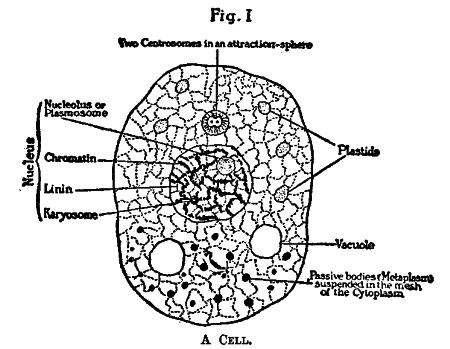
Fig. I
A Cell.
Throughout the Cytoplasm is a mesh containing numerous minute granules
called Microsomes.
The production of cell from cell is accomplished either
by direct splitting of the nucleus and cytoplasm into two
new cells, or by indirect division through a series of stages.
In a typical direct, or amitotic, division the nucleus is constricted
in the middle and divides into two daughter-nuclei.
These by amoeboid movements withdraw to the poles of the
cell; the cell finally divides between them, and thus two cells
are formed. These, again, split into four, the four into
eight, and so on. An amoeba by direct division can separate
into two distinct new animals in ten minutes.
Heredity here is simple. In unicellular organisms, such
as Rhizopoda and Infusoria, each individual grows to a certain
stage, and then divides into two parts, which are exactly
alike in size and structure, so that it is not possible to decide
whether one is older or younger than the other. These organisms
reduce the size of their overgrown bodies by division.
Each individual of any such unicellular species is a part split
off serially from an organism which started into life ages ago.
Some of them have come down in uninterrupted life from geological
epochs that passed away eons before the first man was
created. Many of these unicellular plants and animals have
immeasurably the most ancient form of life on earth. Heredity
with them depends upon the fact that each offspring is
merely half of its parent. In some cases the division has a
sexual quality: two cells in Paramecium, and, like Infusoria
fuse and then divide if they come into contact; they
can, however, split without this sexual process.
Multicellular plants and animals do not reproduce by simple
division, and the half of the parental body does not pass
over into the progeny. Sexual reproduction is the chief means
of multiplication in multicellular organisms, and in no case
is it completely wanting; in most it is the only method of reproduction.
In multicellular animals the power of reproduction
is in the germ-cells, which differ from the somatic cells.
Germ-cells do not maintain individual life as the body-cells
do, but the germ-cells alone preserve the species. From two
of these germ-cells under certain conditions is developed a
complete bodily organism of the same species as the parents.
These two cells are in a sense the undying cells; the somatic
cells die.
Multicellular animals—Man, for example—grow embryologically
by Mitosis or Indirect Division. As in Direct Division,
typically, the nucleus in mitosis splits first and the cytoplasm
secondly; but before the nucleus divides its content undergoes
a series of changes. The chromatin loses its reticular
arrangement and gives rise to a definite number of separate
bodies, usually rod-shaped, known as Chromosomes. In this
process the chromatin becomes a convoluted thread, called the
Skein or Spireme. The thread thickens and opens out somewhat,
and finally breaks transversely to form the chromosomes,
which may be rods, straight, curved, ovoid, and sometimes
annular. Commonly the nuclear material fades away
and leaves the chromosomes in the cell-plasm. (Fig. II, 2
and 3.)
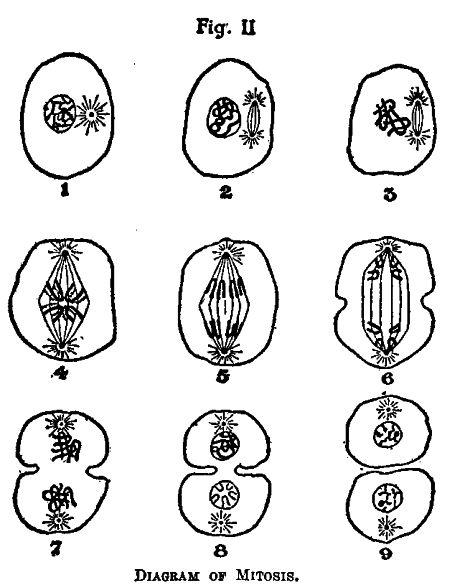
Fig. II
Diagram of Mitosis.
1. Cell with resting Nucleus. 2. Prophase: Chromatin in thickened convoluted
threads, beginning of Spindle. 3. Prophase: Chromosomes. 4. Prophase:
Spindle in long axis of the Nucleus, Chromosomes dividing. 5. Anaphase:
Chromosomes moving toward the Centrosomes. 6. Chromosomes at
the poles forming the Diaster, beginning splitting of the Cell-body. 7. Telophase,
Daughter-Nuclei returning to resting state. 8. Daughter-Nuclei showing
Monaster below. 9. The two new Cells.
It is almost an established fact that each species of animal
and plant has a fixed and characteristic number of chromosomes,
which regularly recurs in the division of all its cells.
In forms arising by sexual production the number is even.
The number of chromosomes in the human cell is said to be
forty-eight. There are, according to some observers, forty-seven
chromosomes in man and forty-eight in woman. There
seem to be twice as many chromosomes in white men as
in negroes. Wilson gives the number[30] of specific chromosomes
for seventy-four animals and plants. Germ-cells as
differentiated from the somatic cells have in the perfected cell
always half the number of chromosomes found in a somatic
cell.
While these changes are going on in the chromatin the
Amphiaster forms. This consists of a fibrous spindle-shaped
body, the Spindle, at either pole of which is an Aster made
up of rays. In the centre of each aster is a Centrosome, and
this may have a Centrosphere about it. As the amphiaster
grows the centrosomes are grouped in a plane at the equator
of the spindle, forming the Equatorial Plate. (Fig. II, No.
4.) The process so far makes up the Prophases of the Mitosis.
In the Metaphases of the Karyokinesis begins the actual
division of the cell. Each chromosome splits lengthwise into
exactly similar halves, and these, in the Anaphases of the
mitosis, drift out to the opposite poles of the spindle to form
the daughter-nuclei of the new cells. The daughter-nuclei
receive precisely equivalent portions of chromatin from the
mother-nucleus, and this is an important fact in mitosis. As
the chromosomes go toward the poles the cell-body begins to
constrict at the equator.
In the final phases, the Telophases, the cell divides in a
plane passing through the equator of the spindle, and each
daughter-cell receives half the chromosomes, half the spindle,
and one of the asters with its centrosome. A daughter-nucleus
is reconstructed in each cell from the chromosomes. The aster
commonly disappears and the centrosome persists, usually
outside the new nucleus, but sometimes within it. Every
phase of mitosis is subject to variation in different kinds of
cells, but the outline of the division given here is the fundamental
method.
The germ-cells differ from the body-cells in general by
containing half the number of chromosomes characteristic of
a given animal or plant. If the body-cell has, say, twenty-four
chromosomes, the spermatozoön of the animal or plant
from which the cells are taken will have twelve chromosomes
and the ovum will have twelve. When the nuclei of these two
cells unite in fertilization the resulting primordial cell will
have the twenty-four chromosomes restored, the specific number
for this plant or animal. In oögenesis and spermatogenesis
the phases of "Reduction," wherein the ovum and spermatozoön
get rid of half the chromosomes during the stages
of maturation of these germ-cells, are somewhat similar for
both sexes. The process is very complicated, but it is of importance
in the theories of inheritance. All the physical
characteristics in a human being that come to him from his
parents and remoter ancestors are supposed, by the biologists,
to reach him through the chromosomes in the nuclei of the
single parental germ-cells. The maternal physical heredity
is handed on through the chromosomes in the ovum. The fetus
in the womb is a parasite, autocentric, feeding at the start
from the deutoplasm, or yolk, in the ovum, and later from
the supplies brought to it by the maternal blood. The physical
material it gets directly from the mother is very probably
all in the chromosomes of the fecundated ovum. Some weeks
elapse, and the embryo is quite advanced before it begins to
draw food from the mother at all. So far as the father is
concerned, there is no doubt whatever that every physical and
pathological characteristic that can be handed down—and
there are many such qualities—must come through the chromosomes
of the paternal spermatozoön. Certain physical
characteristics are passed on for centuries in a family—the
Norseman's body in northeastern Ireland, the skin-pigment in
the American negro, and so on indefinitely—and these qualities
cannot come down except through the chromosomes.
The germ-plasm has come to us from the first man, and it
will be passed on to the last person of the race—we are all
literally uterine brothers.
In the reduction of the germ-cells, if the primordial cell
that finally produces the ovum has, say, four chromosomes,
these four chromosomes first split longitudinally and reduce
into two tetrads, or two groups of four chromosomes. Outside
the nucleus is a spindle toward which the two tetrads
move; they pass out of the nucleus and become the equatorial
plane of the spindle; each tetrad divides into dyads (pairs of
chromosomes), and one pair of these dyads remains in the
ovum, while the other pair leaves the ovum entirely and becomes
the nucleus of an abortive cell, called the First Polar
Body. Later a second polar body forms and carries another
dyad (two chromosomes) out of the ovum, leaving only one
dyad, or two chromosomes, in the germ-cells; that is, half the
number of chromosomes that were in the primordial cell.
The reduction-division in spermatozoa is similar, but the
end process leaves four active spermatozoa, whereas in the
ovum the final result is one ovum and three practically inert
and cast-off polar bodies. The reduction-division in both
ovum and spermatozoön is in reality far more complicated
than the broad summary given here. In parthenogenetic insects
and animals a polar body takes the place of the
spermatozoön, and fuses with the egg-nucleus to start
mitosis.
In general, the new nuclei in the cells formed by division
are not made de novo, but arise from the splitting of the
nucleus in the mother-cell. The new nucleus assimilates material,
grows to maturity, and divides again into two daughter-nuclei.
Whatever be the number of chromosomes that enter
a new nucleus as it forms, the same number issues from it in
mitosis. Boveri said,[31] "We may identify every chromatic
element arising from a resting nucleus with a definite element
that enters into the formation of that nucleus, from which the
remarkable conclusion follows that in all cells derived in the
regular course of division from the fertilized egg, one half
of the chromosomes are of strictly paternal origin, the other
half of maternal." It is not strictly true to say that the
germ-nuclei fuse: they send in two sets of chromosomes that
lie side by side, as has been frequently demonstrated since
1892[32] in many of the lower forms of life, and this law almost
certainly extends also to man.
The primordial germ-cells appear in the human fetus
about the twentieth day and finally mature at puberty. Then
an ovum at menstruation breaks out through the surface of
the ovary, and is taken by the fimbriae of the Fallopian tube
into the lumen of this tube. Fecundation happens near the
outer or ovarian end of the Fallopian tube, and the fecundated
ovum finally is passed on to fasten on the wall of the uterus.
The spermatozoön is a ciliated cell with the power of locomotion,
through the movement of the tail of the cell. It can
move 0.05 to 0.06 mm., or its own length, in a second. It
thus passes up through the uterus and out through the Fallopian
tube, against the cilary motion of the tubal cells, until
it meets the ovum.
A human ovum is a typical cell, but it has a covering membrane,
and a minute quantity of deutoplasm or yolk, which is
not alive, and is food for the growing embryo before the
embryo begins to draw sustenance through the placenta. The
eggs of birds have a large quantity of food stored in the
yolk, since their embryos live in the ovum and draw food
therefrom during the entire period which corresponds to the
time of gestation in mammals. The "white" and the calcareous
shell of a hen's egg are adventitious parts, added in
the oviduct after the egg leaves the ovary.
The spermatozoön is a complicated organism. The head
is partly covered with a thin protoplasmic cap, and it contains
the nucleus with the chromatin. In the neck are two
centrosomes. The tail is in three parts with an axial filament
throughout, which is a bundle of extremely minute fibrils. In
the middle part the axial filament is surrounded by an inner
sheath; outside this sheath is a spiral filament lying in a clear
substance; and outside the spiral filament is a finely granular
layer of protoplasm, called the Mitochondria. This organism
is a living animal cell, and it can live in an incubator, or
in the Fallopian tube for two or three weeks, altogether removed
from the living male body that produced it. Sir
John Lubbock[33] says he kept a queen ant alive for thirteen
years. This ant, which died in 1888, had been fertilized in
1874, and never afterward. She laid fertile eggs for thirteen
years; that is, the spermatozoa in her oviduct retained their
vitality for thirteen years.
The human spermatozoön is a living cell: it has (1) the
requisite structure; (2) the chemical composition of an organic
being; (3) a figure in keeping with its species; (4) an
origin from a living progenitor; (5) the explicatio naturae;
(6) the power of assimilation; (7) the duratio viventium;
(8) the power of reproduction; (9) motion and locomotion.
As soon as the ovum breaks through the surface of the ovary
it has all the qualities of the spermatozoön except locomotion.
These two cells are animal cells, not vegetable; just as single-celled
protozoa, like Actinophrys, Actinosphaerium, Closterium,
Stentor, and the Amoebas are animals, not plants. It
is not possible in our present knowledge sharply to differentiate
ultimate forms of plants from animals. To say that animals
have the qualities of plants plus a sentient vital principle
is not enough. It is very doubtful that even the so-called
sensitive plants feel, and it is practically certain that many
low forms of animal life do not feel—they have no sentient
mechanism. Plants have the qualities enumerated above plus
the power of drawing nutriment directly from inorganic material,
while animals can draw nutriment directly only from
organic material; yet some fungi, bacteria for example, will
grow and thrive only on organic material, and animals will
take up mineral drugs. It is questionable, however, that minerals
which thus find a way into animal cells are really assimilated.
They excite or irritate these cells into intenser action,
and thus cause growth, rather than affect development
by direction. The so-called mineral tonics used in medicine
act by irritation.
This irritation or stimulation by drugs can in certain very
low forms of animal life start mitosis in the unfertilized ovum,
and thus build up part, at the least, of a specific embryo parthenogenetically:
here probably a polar body takes the place
of the spermatozoön. Loeb, by treating the unfertilized egg
of Arbacia (a sea-urchin) with magnesium chloride, started
mitosis that resulted, it is said, in a perfect Pluteus larva.[34]
The human ovum is about half the size of a period in the
type of this page, and two hundred and fifty spermatozoa will
fit side by side along the horizontal diameter of the lowercase
letter o here. The nuclei of these cells are extremely
minute: they must be stained and be observed with a high-power
objective on the microscope before they become visible.
This small nucleus of the spermatozoön penetrates the covering
membrane of the ovum, enlarges, and becomes the male
pronucleus. The pronucleus unites permanently with the
pronucleus of the ovum, and together they form the Cleavage
or Segmentation Nucleus of the fertilized ovum. This new
nucleus gives rise by division to the innumerable myriads of
nuclei in the growing body. Hence every nucleus of the child
apparently contains nuclear material derived from both parents,
as has been said.
The two perfected germ-cells before fecundation are in a
state of nuclear rest after the numerous mitotic changes that
have taken place in the maturation of these cells. When
these nuclei unite in the ovum an intense activity at once is
set up. Biologists offer very many theories to explain this
awakening force. Herbert Spencer, Herting, and others held
that protoplasm when perfected tends to pass into a state of
stable equilibrium and consequent lessened activity, but fertilization
restores it to a labile state. This and similar
theories are verbose amplifications of the obvious fact that the
cells start to divide and the biologists do not know the cause.
The soul, of course, cannot have anything to do with the
matter, because you cannot smell a soul. "Senescence and rejuvenescence"
is another sonorous explanation that does not
explain, used by Minot, Engelmann, and Hansen. Weismann
rejects these theories for his own "Fertilization as a Source
of Variation." Anyhow, the fertilized cell starts to divide
regardless of the biologists. Adult cells may be stimulated
to divide by chemical irritation, by mechanical pressure as in
the formation of calluses, traumatism, by any agency that
brings about an abnormal condition of the body, but this fact
does not explain the normal fission of the fecundated ovum.
In about fifteen days from the date of fertilization the
ovum passes through the following stages:
1. The ovum, with a full series of mitotic changes of the
ordinary somatic type described above, divides, subdivides,
and grows within the cell-wall until a rounded mass of cells
is formed, which is called the Morula or Blastula—the original
cell-wall, of course, stretches to hold these new cells. They
are of unequal size, and they divide at unequal rates.
2. An albuminous fluid collects within the morula, and
thus the Vesicle or Blastocyst is formed. The blastocyst is
called more commonly the Cleavage Cavity or the Segmentation
Cavity. As this cavity widens the cells are seen to be
arranged in two groups—(a) an enveloping layer, the epiblast,
from the outermost plate of which develops later the
Trophoblast, or the nourishing and protecting covering of the
embryo; (b) an Inner Cell Mass, made up of granular cells,
attached to the epiblastic layer at the Embryonic Pole of the
Vesicle. These two stages probably take place in the Fallopian
tube, and thereafter the embryo is in the cavity of the
uterus.
3. In the third stage the Inner Cell-Mass separates into
two layers derived from the inner cell-plate of the blastula.
The mass flattens and spreads peripherally, until finally it is
divided into two layers. The outer is the Ectoderm and the
inner is the Endoderm or Hypoblast. The three steps just
described have not yet been seen in the human species by any
one, but they are inferred very confidently from what is well
known of the development in mammals most closely resembling
man in physical formation.
4. By the conversion of the one-layered blastula into two
layers of cells, the Gastrula stage of the embryo is attained.
The Gastrula consists of two layers of cells surrounding a
central cavity, which is the Archenteron, or the body-cavity
that will hold the intestines. During the past twelve years
many specimens of human gastrulas have been observed. The
earliest form was that seen in 1908 by Teacher and Boyce.[35]
This embryo was 1.95 mm. in length by 0.95 mm. in width,
about twice the size of a pin-head. It showed on section the
endoderm, the ectoderm, and the beginning mesoderm, enclosed
in a spherical mass of trophoblastic cells. The mesoderm
is a plate of cells lying between the endodermic and
ectodermic plates. When the mesoderm develops into two
plates, a cavity, called the Primitive Coelom, appears between
the plates. The Coelom becomes the space between the viscera
and the body-walls in later development.
From the primary embryonic layers of cells, the ectoderm,
the endoderm, and mesoderm, all the parts of the body
are built up. From the ectoderm are produced the skin,
nails, hair, the epithelium of the sebaceous, sweat, and mammary
glands, the epithelium of the mouth and salivary glands,
the teeth-enamel, the epithelium of the nasal tract, of the ear,
of the front of the eye, and the whole spinal cord and the
brain, with their outgrowths.
From the endoderm come the epithelium of the respiratory
tract, of most of the digestive tract with the liver and pancreas,
the epithelium of the thyroid body, the bladder, and
other minor parts.
From the mesoderm are developed bone, dentine, cartilage,
lymph, blood, fibrous and alveolar tissues, muscles, all endothelial
cells, as of joint-cavities, blood-vessels, the pleura and
peritoneum, the spleen, kidneys and ureters, and the reproductive
bodies.
The epiblast now with its mesoblastic lining begins to form
the Chorion, an embryonic intrauterine appendage; and the
endoderm encloses the Archenteron or primitive gut. Before
the end of the second week of gestation the heart is indicated
as two tubes in the mesoderm, and the blood-vessels begin to
be produced in the yolk-sac. About the twelfth day the
mouth-pit shows, and the gut-tract is partly separated from
the yolk-sac. The medullary plate of the nervous system is
laid down about the fourteenth day, and the nasal area is
observable. The maternal blood escapes into spaces about the
embryo enclosed by masses of embryonic cells, which have
not separated from one another, but which are known collectively
as Syncytium.
5. With the third week the stage of the embryo, technically
so called, begins. During this week the body of the
embryo is indicated. There are three layers of cells, already
mentioned, the ectoderm, mesoderm, and endoderm, and these
lie on the floor of the enveloping Amnion. The amnion is
a loose fluid-filled sac (the caul) enveloping the fetus to protect
it from jarring. The fluid in it is the "waters" that escape
in parturition when the infant breaks through the caul.
The archenteron in the third week shows the beginning of a
division into two parts: the part that will go to the body
proper of the embryo, and the part outside the body of the
embryo which will form the yolk-sac, or umbilical vesicle,
from which the embryo will draw sustenance until the placental
vessels have been formed. The part of the archenteron
that remains within the embryo proper begins in this third
week to be moulded into the head-cavity. The forepart of
the archenteron will later make the alimentary tract from the
mouth to the middle of the duodenum, or small intestine beyond
the stomach. The other part of the archenteron wall
make the Allantois, the hind gut and the bladder. The allantois
becomes a part of the fetal umbilical cord after the formation
of the placenta.
During this third week the dorsal outline of the embryo is
concave; the heart has a single cavity, which will begin to
divide during the fourth week; the vitelline blood circulation
begins, and the blood-vessels of the visceral arch are laid
down. The digestive system is advanced to a gut-tract, which
is a straight tube connected with the yolk-sac. The liver
evagination is present and the oral pit is a five-sided fossa.
The respiratory system is represented by the anlage of the
lungs, a longitudinal protrusion of the ventral wall of the esophagus.
The genito-urinary system begins as the Wolffian
bodies. The mesoderm starts to segment to form the skin,
and the neural canal (from which develop the spinal cord
and brain) for the nervous system forms. The fourth ventricle
of the brain is indicated, and the vesicles of the fore
brain, mid brain, and hind brain are recognizable. The ears,
nose, and eyes, muscular system, skeleton, and limbs are also
beginning to be recognizable. At about the sixteenth or eighteenth
day of gestation the various parts of the embryo rapidly
differentiate.
In the fourth week all these parts advance. The atrium
cavity of the heart begins to divide; the alimentary tract shows
the pharynx and esophagus, stomach, and gut; the pancreas
starts, the liver diverticulum divides, and the bile-ducts appear.
The lung anlage bifurcates and the primitive trachea
is seen. The ventral roots of the spinal nerves appear, the
interior ear is indicated, and the eye is deeper. The buds of
the legs and arms appear about the twenty-first day—by the
thirty-second day even the fingers are present. The four
heart-cavities are formed, the intestinal canal is nearly closed,
the first indications of the liver and kidneys appear. The
child now has reached the fetal stage, and its living body is
made up of myriads of cells all derived from the original
fertilized ovum. The fetus is then one centimetre, or two-fifths
of an inch, in length—about the length of the word
"fetus" here.
At the end of the second month the fetus is two and a
half centimetres long. The ears appear, and the tail-like process
at the lower end of the spine disappears. The arms show
the three parts, arm, forearm, and hand; and a little later
the thigh, leg, and foot are differentiated. The navel begins
to close, the liver develops, the abdomen is yet partly open.
At the end of the third lunar month the fetus is seven to
nine centimetres long. The intestinal canal is formed and
contains bile. The body resembles that of a human being, but
the head is proportionately very large. Bony tissue begins to
appear.
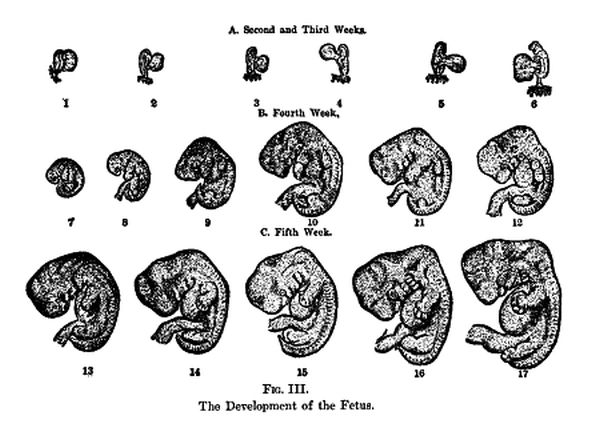
Fig. III.
The Development of the Fetus.
At the end of the fourth lunar month the fetus is ten to
seventeen centimetres long. Some muscles are movable.
The heart-beat is strong. Sex is distinguishable externally.
The skin is bright red, and so transparent that the blood-vessels
are visible through it.
Toward the close of the fifth lunar month the head is about
the size of a hen's egg. The skin is somewhat less transparent.
There are indications of hair and nails. The eyelids are
closed. Parts of the brain and spinal cord are formed. Such
a fetus may live for five or ten minutes if removed from the
womb, and it may make attempts at respiration.
At the end of the sixth lunar month the fetus, if born, may
live for several hours under favorable circumstances. Its respiratory,
digestive, and related organs are not developed, and
no artificial feeding will keep such a child alive. The brain
cortex, the organ of consciousness, begins to laminate into
three strata of nerve-cells at the beginning of the sixth month.
Here the time of fetal viability outside the womb may be
considered. Langstein, of the Augusta Victoria Hospital in
Berlin, reported[36] a study of the growth and nutrition of 250
prematurely born infants, and he found that a weight of 1000
grammes (21⁄5 pounds) and a full body length of 34 centimetres
(133⁄5 inches) are the lowest limits for viability under
proper circumstances. A fetus 1000 grammes in weight and
34 centimetres in length has completed the sixth solar month,
or the sixth and a half lunar month; that is, it is viable at the
beginning of its seventh month, servatis servandis.
The child at term, as a rough average, is from 48 to 52
centimetres (19 to 201⁄2 inches) in length, and it weighs from
about 63⁄5 to 71⁄2 pounds. It is impossible, however, to obtain
the sizes and weights of infants in utero with scientific
accuracy, because the date of conception cannot be determined
with absolute certainty, and individual fetuses vary as do infants
after birth. A full-term infant sometimes may weigh
only 31⁄2 pounds when the mother is diseased, and again an
eight-month fetus will weigh as much as 8 pounds. Large
muscular and fat women have large babies; women of the
well-to-do classes have larger babies than do the poor; women
who work during gestation bear smaller babies than do those
women that rest. Mothers who work in tobacco, lead, or phosphorus
have puny babies; white children are larger at birth
than negro children; boys at term are 3 to 5 ounces heavier
than girls.
Langstein says that prematurely born infants weighing
from 900 grammes (311⁄2 ounces) to 1500 grammes (31⁄2 pounds)—that
is, all born before the seventh solar month—must be kept
in hot-water incubators in a room with ordinary ventilation.
Babies weighing 2000 grammes (41⁄2 pounds) or more get along
in an ordinary crib if they are kept surrounded with hot-water
bags. Such children are to be fed with human milk
through a catheter passed into the mouth or they die of inanition.
Only a few of them are strong enough to suck from a
bottle, and these give up the effort after a few days and die.
They cannot utilize fat, even from milk; and all artificial
food is dangerous.
Most of the prematurely born become rachitic, and even human
milk is not preventive of this condition. Rachitis is a constitutional
disease, characterized by impaired nutrition of the
bones and changes in their shape. In the third or fourth
month craniotabes is frequent—that is, an atrophy of the
skull bones with the formation of small conical pits. These
infants show also a morbid tendency to convulsions—spasmophilia.
Such diseases are caused by a lack of mineral salts,
which normally are carried to the fetus by the placental blood
during the last two months of gestation. Because of this lack
premature infants require the administration of lime salts
in their food; they also need iron because they are anemic.
A fetus, then, of six calendar, or solar, months (not lunar)
is viable if treated in a hospital by competent physicians.
Otherwise it is not viable, except in a strictly technical sense;
it will not live more than a few days or weeks. Reports of infants
younger than six months as having been successfully
reared are not credible—it is easy to make an error in the
reckoning.
A full seven-months infant may be reared with proper
feeding and skilled care; a six-months infant may be reared
(with difficulty) in a hospital with skilled care. If it is certain
that the removal of a six-months fetus will here and now
save the life of a mother (a very difficult matter to judge by
the best diagnosticians), this removal may be done, provided
the infant is delivered in circumstances where skilled care,
incubator, and proper food are obtainable; otherwise the removal
is not justifiable. That the ordinary physician says
it is necessary to empty the uterus is not a sufficient reason,
as he is likely to act from ill-digested information set forth
by professorial pagans, who place no value whatever on human
life in an infant.
A most important and essential circumstance in the matter
of inducing abortion at the end of the sixth month of gestation
to save a mother's life is that in practically every case
requiring such interference the diseased condition of the
mother has checked the growth of the fetus, and the fetus
therefore is really not a six-months child in development.
Such an undeveloped fetus is not viable. Eclamptic women,
and those who have nephritis, are most likely to have undeveloped
fetuses. In cases of this kind the seventh month should
be completed before interference.
How is this human body in all its complexity developed
from the microscopic germ-cells? There has been a vast deal
of ink spilled in striving to solve this mystery, but we come
out empty by the same door wherein we went. The early
Preformationists guessed that the ovum contains an embryo
fully formed in miniature, and development is a mere unfolding
of what had already existed. The biologists of to-day
mention the Preformationists with superior scorn, and then
present Preformationism under other names. Weismann's
theory is the most fashionable at present.
In a paper read at the Darwinian Memorial Congress in
1909, Weismann said: "With others I regard the minimal
amount of substance which is contained within the nucleus of
the germ-cells in the form of rods, bands, or granules, as the
germ-substance, or germ-plasm, and I call the individual granules[37]
ids. There is always a multiplicity of such ids present
in the nucleus, either occurring individually or united in
the forms of rods and bands (chromosomes). Each id contains
the primary constituents of the whole individual, so that
several ids are concerned in the development of a new individual."
Actually there are such things as chromosomes, and
when these are stained and are under the highest power of the
microscope they appear to be granular. These granules
Weismann calls ids. Beyond the fact that there are such
granules, all else is sheer guessing.
He says further: "In every complex structure thousands
of primary constituents must go to make up a single id; these
I call determinants, and I mean by this name very small individual
particles, far beyond the limit of microscopic visibility,
vital units, which feed, grow, and multiply by division.
These determinants control the parts of the developing embryo,—in
what manner need not here concern us."
There is some truth here. The id is made up of molecules
and atoms, ions and electrons, and in some manner, of course,
these have to do with the development of the embryo; but
as to the manner we have not the slightest knowledge, and
just this knowledge is what we need to make the theory anything
more dignified than a child's game at guessing. There
is a structural differentiation in the unsegmented ovum, with
all the embryonal axes foreshadowed in it, but this tells us
nothing more than that the egg contains the man in germ.
He goes on: "The determinants differ among themselves;
those of a muscle are differently constituted from those of a
nerve-cell or a glandular cell, etc., and each determinant is in its
turn made up of minute vital units, which I call biophors, or
the bearers of life."
That these so-called determinants differ among themselves
may be true, if they exist at all, which is just the point to be
proved. Giving Greek names to inventions does not turn
invention into fact. These supposed determinants, he says,
"may vary quantitatively if the elements of which they are
composed vary; they ... and their variations may give
rise to corresponding variations of the organ, cell, or cell-group
which they determine." Professor Dwight said:[38]
"This is what is palmed off on us for science!" Weismann
assures us we must admit this farrago of clumsy fiction, otherwise
we should be forced "to assume the help of a principle
of design."[39] In the name of common sense, then, admit a
principle of design, and be done with it!
Darwin's Gemmule Theory is the same guessing; and
Weismann rejects it because he did not think of it first. As
a theory the gemmule plot is just as good and just as bad
scientifically as Weismann's. The chief objection to such
imagining is that after its authors have put it into print a
few times they lose all sense of humor, and mistake phantasms
for facts.
Up to the present time we have discovered no living organism
lower in grade than the cell. If life ever originated
from inorganic matter, it appeared in an organized cell. The
Weismann ids, biophors, and the rest, supposing they existed
outside his own imagination, are not more capable of independent
life than is a chromatin granule. In any event,
these biophors could not have originated spontaneously in the
first living being; and if they could not so have come into
existence, life could never have begun. However primitive
any organism is, it must be able to nourish itself and to develop
into a higher specific form; but such a variety of functions
supposes differentiated structure, composed of unstable
chemical substances, a correlation of parts, a purposeful anticipation
of ends. Inorganic substances, crystals, and the
like are characteristically stable, not unstable; and these
could not have been brought into the organic state on an earth
burnt to a cinder and devoid of chlorophyl, which itself presupposes
organic cells. Whence came also the absolutely essential
form of energy, directive of vegetative life? The only
possible explanation is that life was created, not evolved by a
stranger miracle from a lump of lava.
We know the successive steps in the growth of the embryo
from the time of fertilization to the end of gestation, but how
this vital process is effected is not so evident. What we are
certain of is that there is a vital principle of some kind from
the beginning, and this is the matter of real importance in
the present discussion. The old moralists held that this principle
in the human being is at first vegetative; after a while
that vegetative vital principle is expelled by a sensitive principle;
and finally this sensitive soul is expelled by the rational
vital principle, or human soul. St. Thomas[40] says: "Some
tell us the vital acts that appear in the embyro are not from
its soul, but from the soul of the mother, or from the primitive
force in the semen. Both these statements are false.
Vital operations, as sensation, nutrition, growth, cannot come
from an extrinsic principle; therefore it must be admitted
that a soul preëxisted in the embryo, nutritive at first, then
sensitive, and finally intellectual." After showing that an
intellectual soul cannot be evolved from lower forms, he concludes:
"Therefore we say that since the generation of one
thing is always the corruption of another, in man as in other
animals, when a more perfect form comes in this supposes the
corruption of any precedent form; so, however, that the sequent
form has all perfection that was in the destroyed forms,
and something in addition: and thus through many generations
and corruptions the final substantial form is attained in man
and other animals. This is apparent to the senses in animals
generated from putrefaction. Therefore the intellectual soul
is created by God at the end of human generation, and this
soul is both sensitive and nutritive, all precedent forms having
been destroyed."
There is no such thing as the generation of any animal
or other living being from putrefaction; but that is irrelevant.
St. Thomas's argument proves conclusively that if man has
first a merely vegetative soul, and secondly a merely sensitive
soul, which includes the power of the vegetative soul, and
thirdly an intellectual soul, which does the work of all three,
that this final intellectual soul is not an evolution of the first
two, but a new form that replaces these after they have served
their purpose and have been annihilated. It does not even
attempt to prove that man really has first a merely vegetative
soul, and secondly a sensitive, and lastly an intellectual soul;
it supposes all this. It starts out with the erroneous Aristotelian
theory and takes it for granted. The reason for this
statement is that the rational substantial form requires disposed
matter to work upon, and the Thomists suppose (again
erroneously) that in the human embryo during the period immediately
after conception there is not enough matter to be a
receptacle for the rational soul.
The soul according to the Thomists, who use the Aristotelian
definition, is the first entelechy of a natural organic body
that has life in potency.[41] It is the determination that gives
the body its specific and substantial being; the primal actuation
of a body or matter, since only in matter is there a distinction
between potency for substantial being and substantial
actuality. An entelechy is a realization, actuality, full perfection;
sight, for example, is the entelechy of the eye. This
body is natural, not merely instrumental; it is energized by
an immanent principle, not moved by an external force like a
tool. The body is also organic; it must have organs, faculties,
parts destined to perform definite functions. To say the entelechy
has life in potency means that since life, or the operation
of the soul, is an immanent act, there must be a receptacle
within which it can be immanent, and the soul is the
primal actualization of that organic body, which is in potency
to produce those immanent actions in which life consists. A
body might be in potency while it still has no principle of
operation, or, secondly, while it has such a principle but is not
using it. In the second condition the human body is in potency
for life at the moment of actualization.
A form fixes a thing in its prχοντοσoper species, and the rational
soul is such a form for the human body. This substantial
form is the completion, perfection, in operability and
existence, of the matter that receives it. It is the formal
cause of man, not the efficient cause, although it is the efficient
cause of subsequent vital operations. An efficient cause makes
something numerically different from itself by its own real
and physical action; a formal cause and a material cause do
not make anything different from themselves numerically, but
they intrinsically constitute the effect—they are intrinsic
causes.
The human soul as the substantial form virtually contains
vegetative and sensory faculties, and through these lower organic
capacities it informs and animates the body. That form,
together with the matter, the body, does the vital acts of the
composite human nature. The rational soul enters the body
at the beginning, and first uses its vegetative faculty until the
fetus is far enough advanced to be a subject for the action
of the sensory faculty of the soul. Later, some time after the
birth of the child, when the body is sufficiently formed, the
intellectual faculty comes into use.
The nature of a vital principle is that in which it normally
issues. If it issues as a rational substantial form, as in man,
it was rational from the beginning. If it was not rational
from the beginning, a rational principle replaced a sensory
vital principle, and that sensory vital principle replaced a
vegetative vital principle. The only reason for these replacements
would be that the early human embryo, as has been said,
lacks organization sufficient to sustain a form higher than a
vegetative principle. If this were sufficient reason for deferring
the advent of the rational soul, then a baby six months
after birth would have no rational soul because it certainly
lacks the supposedly requisite organs. However, as the rational
soul is whole in each part of the adult body in the totality
of its essence and perfection, but not in the totality of
its virtue, because certain organs are lacking in particular
parts of the body, it is in the embryo whole in the totality of
its essence and perfection, but not in its virtue because certain
organs are not yet formed, and it is thus from the moment of
conception.
As to the soul itself, Kant held that the soul is not a real,
but only a logical substance. The Pantheists, Transcendentalists,
and Neo-Hegelians try to identify the soul with the
divine consciousness. The Associationists (Hume, Davis,
Höffding, Sully) say that the soul is a mere group of sensations.
The Agnostics and Positivists (Locke, Herbert Spencer,
James, Comte) write volume after volume on the soul
to prove that they know nothing about it. Then the Materialists
assert that there is no soul of any kind; that we secrete
thought as a mule secretes sweat. Yet the vital operations of
man are inexplicable as resultants of the physical and chemical
properties of matter. There is an intrinsic energy that
unifies the actions of man, directs processes, controls the tendency
of organic matter to pass into the fixity of the inorganic,
and effects metabolism. This intrinsic energy is the entelechy,
substantial form, or what is popularly called the soul.
In any organic body there is a formal principle. We
know that there are activities that proceed from organic bodies,
and a formal principle of such activity is a substantial entity
whence the organism derives basically its own kind of action,
which determines and orders the activity. There are acts of
perception in animals such that an external object becomes
so internal to the organism of these animals that it is known
by one expressed and immanent image, not only as something
objectively existing but as good or hurtful to the perceiving
animal. The innate and elicited appetites by which the animal
tends toward or away from the object are recognized, as are
the spontaneous motions which are directed by that knowledge.
There must be a principle whence these actions proceed, and
this is either an accident of matter or something substantial.
It is not an accident of matter, because action can never arise
from an accident; it must proceed from a substance. If you
say this principle whence these actions arise is not an accident
of matter, but matter itself, you would have an extended, composite,
inert mass acting; but even if such thing could act, it
could never effect a simple immanent image of an object or
group of objects external to itself.
No mere machine can build up itself, can make any remote
approach to metabolism as an organized body can; and
the principle of this immanent action is not matter itself, because
it uses, makes, subordinates matter to itself. That
principle is positively one, not one by continuity as matter
is. Matter as in a crystal grows by mere aggregation, an organism
grows by assimilation; a crystal loses force in formation
and growth, an organism accumulates force.
The theory that denies the existence of this formal principle
does not explain the phenomena of life in organic beings.
Uniformity of tendency toward an end is not a characteristic
of mere matter; neither is a harmonious interaction of parts,
nor the dependence of parts on the unit, nor motion, nor the
reproduction of the species.
Moreover, most of the greatest physical scientists strongly
maintain that there must be a formal substantial principle in
all living things. Among these are Wallace, Nägeli, Askenasy,
Preyer, Fechner, Agassiz, von Baer, E. de Beaumont,
Blanchard, A. Braun, Brongniart, Bronn, Burmeister, Delff,
Milne-Edwardes, Flourens, Goeppert, Griesbach, Heer, Koelliker,
Mivart, Quatrefages, Quenstedt, Spiers, Volger, R. Wagner,
Liebig, and Joseph Hyrtl.
The formal principle which coexists with matter in the organic
body is really though not perfectly distinguished from
matter. A formal principle which is necessary for sensation
should be either perfectly simple, or at the least so one that its
parts together make up one essence: matter, however, cannot
have such unity, and as a consequence the formal principle
must be distinct from matter. Anything is like its operation,
and the parts of any sensitive activity always result in an activity
that is essentially one. If we touch a table, by that single
touch we at once know that the object is one, wooden, hard,
angular, smooth, extended, and so on, and we also know that
one subject perceives all these varied qualities. One eye can
convey knowledge at once of a thousand objects miles apart,
and these objects can be brought into one perception only by
a simple subject. An extended complex subject like matter
would get one impression (if it could perceive any impression)
on one side, one on another, and so on, but it could not unite
these.
The formal principle which is in organic bodies is a true
substantial form, actuating the body both as to its nature and
substance. Together with the body, this principle makes a
being one in itself, such that the matter and the form separably
are incomplete as regards operation and being.
Now, a form is that principle through which anything is established
in its own species; light, for example, is the form
of a luminous body, heat of a hot substance. A body, however,
is established in the human species by receiving a rational
soul, and this soul, then, is its form. It is also a substantial
form because the soul itself is a substance, not an accident
dependent upon another subject. Moreover, from its
union with the body another substance—man—arises, and not
a thing added to a substance. Man's body is alive, therefore
it is a living substance; but life in its secondary actuality is
an operation; in its primary actuality it is an essence. The
body is made a living substance, not from itself, but from the
soul which is added to it. When the soul departs the body
is no longer alive. Now, a principle which by a communication
of itself determines the body in its essence and differentiates
it as a living substance from everything else, is a substantial
form. A substantial form, then, or a soul, exists.
The soul, however, must have disposed matter for most
of its operations; it cannot exist as a substantial form bombinans
in vacuo; but it does not need a human organism complete
in all its parts as a necessary condition for its indwelling.
There is organized matter enough in the first cell that
comes into existence after the fusion of the germ-nuclei to
hold this rational form, or soul, as perfectly as it needs to be
held in this first stage of human life.
To inform the embryo any principle, whether it is the rational
soul or a force derived from the parental organism,
must have organs; and if organs are present, then the embryo
is fit to receive the human soul, as the only objection to its
presence is a supposed lack of organs. To use other principles
when the human soul itself could be present would be a
multiplicatio entium sine necessitate, which is a condition repugnant
to the universal method of the Creator.
It has been said that the vital activity in the fertilized
ovum does not proceed from the rational soul because, "in the
first place, it results from the fusion of two vital activities,
neither of which is rational; secondly, it results in the formation,
by fission, and differentiation, of two distinct and separate
living cells, each containing within itself a principle of
vital activity. Now this principle of vital activity cannot
be a rational soul, for each cell has its own principle of activity,
and in man there is but one soul."
In the first place, that vital activity does not result from
the fusion of two vital activities neither of which is rational.
It results after the nuclei come together, by particular creation,
and replaces their activity—the generation of the last
vital force is the corruption of the first that existed in the separate
nuclei, not a derivative of that first force. Again, when
the embryo is in the two, four, eight cell stage, and so on,
there are not two, four, eight vital principles present, but
one. Substantial unity is essential to life of any kind, no
matter how low its grade; and if each cell had an independent
vital principle, any form of resultant life in the mass
would be impossible. An aggregation has no unity of substance;
there would be as many substances or natures as there
are individual beings in the aggregate, no matter whether ordered
or in a mob, consequently no life at all as a life.
The embryo in the two-cell stage is not made up of two
independent organisms, any more than the right and left
halves of an adult man are two independent organisms. The
cells in the two-cell stage of the embryo are the right and left
halves of the body, not two individuals, as has been proved
repeatedly by biologists. Roux[42] punctured with a hot
needle one of the cells in the two-cell stage of a frog embryo
without killing the embryo, and it grew into a half-frog larva.
Analogous results were obtained by operating in the four-cell
stage. Later, Pflüger, Schultze, Enders, and Morgan corroborated
the work of Roux. Newport[43] discovered this fact sixty
years ago.
In analyzing the structure and functions of the individual
cell we regard it as an independent elementary organic
unit, but this view is solely a matter of convenience, almost
a convention. All the billions of cell's in an adult man are
inseparable parts of the single living person. No cell exists
as an independent organism in multicellular animals, except the
germ-cells, and these only after separation from the gland of origin.
Indeed, the biological theory of heredity, already mentioned
here, wherein the germ-cell is supposed to carry forward
the entire heredity, is now changing toward the view which
makes all the somatic cells influence the germ-cells; that is, the
body-mass of cells sends on heredity through the germ-cell as
the instrument. Adult organisms do not make cells de novo.
New cells are formed by division from preëxisting cells, but
some biologists think the body-cells so affect the new germ-cells
as to influence heredity.
The cells are organs, nodal points, of a single formative
power which pervades the mass of cells as a whole. The
protoplasm of each cell is not only in direct apposition with its
neighbors, but nearly all biologists are now inclining to the
opinion, which Heitzmann proposed in 1873, that division
of cell from cell is incomplete in nearly all forms of tissue;
and that even where cell-walls are present (an exceptional
condition in mammals) they are traversed by strands of protoplasm,
by means of which the cells are in organic continuity.
The whole body, he contended, is thus a syncytium (a mass of
continuous protoplasm stippled with nuclei), with the cells
as mere nodal points in an almost homogeneous protoplasmic
mass. There are cell-bridges between the sieve-tubes of
plants. In 1879 Tangl discovered such connection between
the endosperm cells of plants, and later Gardiner, Kienitz-Gerloff,
A. Meyer, and many others demonstrated that in
nearly all plant tissues the cell-walls are connected by intracellular
bridges. Ranvier, Bizzozero, Retzius, Fleming, Pfitzner,
and many other observers have found these protoplasmic
bridges in animal epithelium. In the skin of a larval salamander
they are quite conspicuous. They are known to occur
also in smooth muscle-fibre, in cartilage cells, in connective-tissue
cells, and in some nerve-cells. Harrison found, in
1908, that in frogs the nerve-fibres develop out of these intracellular
bridges. Dendy in 1888, Retzius in 1889, and Palladino
in 1890 have shown that the follicle cells of the ovary
are connected by protoplasmic bridges, not only with one another,
but also with the ovum; and similar connection between
somatic cells and germ-cells has been found in a number of
plants. Thus even the germ-cell is not independent until it
has actually broken away from the gland. A. Meyer holds
that both the plant and animal individual are continuous
masses of protoplasm, in which the cytoplasmic substance forms
a morphological unit, no matter what the cell is. That opinion
is not finally settled as regards the animal after the fetal stage,
but it is much stronger as regards embryos. In the early stages
of many arthropods it is certain that the whole embryo is at
first an unmistakable syncytium. This is almost established
also for Amphioxus, the Echinoderm Volvox, and other animals.
Adam Sedgwick holds that it is true for vertebrates up
to a late embryonic stage. Mitosis, then, is a form of growth
of a mass, not a generation of new individuals.
Whether chromatin or any other element in the germ-cell
be the idioplasm in which heredity inheres, differentiation is
a progressive transformation, through physical and chemical
changes, of the substance of the ovum, and this transformation
occurs in a definite order and a definite distribution in the
ovum. The changes result in a cleavage of the egg into cells,
the boundaries of which sharply mark the areas of differentiation.
These cells take on specific characters. In the four-celled
stage of an annelid egg these four cells contribute
equally to the formation of the alimentary canal and the cephalic
nervous system, but only one of them, the left-hand
posterior cell, gives rise to the nervous system of the trunk
and to the muscles, connective tissues, and germ-cells. The
relation between the four original cells, or blastomeres, and
the adult parts arising from them, is not fixed, because in
some eggs these relations may be artificially changed. A portion
of the egg which normally would develop into a fragment
of the body will, if split off from the others, give rise to an
entire body of a diminished size.
Conklin says[44] that in the ascidian Styela "there are four
or five substances in the egg which differ in color, so that their
distribution to different regions of the egg and to different
cleavage cells may be easily followed, and even photographed,
while in the living condition. The peripheral layer of protoplasm
is yellow and it gathers at the lower pole of the egg,
where the sperm enters, forming a yellow cap. This yellow
substance then moves, following the sperm nucleus, up to the
equator of the egg on the posterior side, and there forms a yellow
crescent extending around the posterior side of the egg.
On the anterior side of the egg a gray crescent is formed in
a somewhat similar manner, and at the lower pole between
these two crescents is a slate-blue substance, while at the upper
pole is an area of colorless protoplasm. The yellow crescent
goes into cleavage cells which become muscle and mesoderm,
the gray crescent into cells which become nervous system
and notochord, the slate-blue substance into endoderm
cells, and the colorless substance into ectoderm cells. Thus
within a few minutes after the fertilization of the egg, and before
or immediately after the first cleavage, the anterior and
posterior, dorsal and ventral, right and left poles are clearly
distinguishable, and the substances which will give rise to ectoderm,
endoderm, mesoderm, muscles, notochord, and nervous
system are plainly visible in their characteristic positions."
Conklin followed these cells in every division until the embryo
was developed, making a complete genealogy up to the
ovum proper.
De Vries[45] assumed that the character of each cell is determined
by "Pangens" that migrate from the nucleus into
the protoplasm. Driesch and Oscar Hertwig held that the
peculiar development of a given blastomere is a result of its
relation to the remainder of the cell-mass, an outcome of the
action upon it by the whole system of cells of which it is a
part. Hertwig said:[46] "Each of the first two blastomeres contains
the formative and differentiating forces not simply for
the production of a half-body, but for the entire organism;
the left blastomere develops into the left half of the body
only because it is placed in relation to a right blastomere."
Wilson[47] and Driesch[48] came to the same conclusion about
the time Hertwig wrote. Driesch said:[49] "The relative position
of a blastomere in the whole determines in general what
develops from it; if its position be changed it gives rise to
something different; in other words, its prospective value is
a function of its position."
A discussion of this matter will be found in Wilson,[50] but
the many experiments made in the study of this subject show
conclusively that the cells, singly, grouped, and in mass, are
a morphological unit, not an aggregation of distinct individuals.
They are not, of course, absolutely homogeneous, because
such a body could not have organs. The substantial
form, therefore, is not confined to the first cell.
The cell-mass, then, has a unity sufficient to be the receptacle
of a human vital principle; again, the basic vital operation
of the human body at any age is metabolism, and this is actually
carried on in the first somatic cell of the embryo as in
the cells of the adult man. In the development of the human
body in the embryonal stage the energy of cell-division is
most intense in the early cleavage stage, and this diminishes as
the limit of growth approaches because further division is not
needed. When that limit is attained a more or less definite
equilibrium is established. Some of the cells in the fully
formed body cease to divide, the nerve-cells, for example;
others divide under special conditions, as the blood-cells, the
connective-tissue cells, gland-cells, epithelial and muscle cells;
others continue to divide throughout life and thus replace
worn-out cells of the same tissue, as the Malpighian layer of
the skin. Cells grow, divide, function, reproduce themselves,
and so on, all through their vital activity, sustained by the
material brought to them by the blood. Weismann[51] and
other biologists think that the vital processes of the higher
animals are accompanied by a renewal of the morphological
elements in most tissues. The material is carried to the fetus
in the womb by various agents, but mostly by the maternal
blood after the embryo uses up the yolk; and when the fetal
circulation has been established the nutritive material is taken
from the maternal blood into the fetal circulation through the
placenta, and then carried to the cells by the fetal circulation
itself. After the child has been born the stomach and intestines
take in the food. The stomach does very little with it
except in a preparatory manner; the intestines further prepare
it, pass it into the body, where it is again modified by
other organs, and finally it is carried by the blood to the cells.
The cells really use it; the other organs are the farmers, grocers,
railways, and the like; the cells are the consumers. So
far as the essential processes are concerned, the embryological
cells act as do the adult cells.
The first cell has contractility, protoplasmic motion; it
can absorb perfectly all food-stuffs necessary for it from the
deutoplasm of the ovum, and the water that passes in from
without to the ovum. In a few days the embryonic cells have
used up the deutoplasm and are taking up food from the maternal
blood as perfectly as any adult cell does, and are exercising
their function of building up and sustaining whatever
part of the body they are destined for; and this with all the
complicated metabolism of the adult cell. Cell metabolism
is the fundamental, chief, organic act of any human body at
any age. That the embryo does this impelled by the virtus
formativa transmitted from the parents is a mere gratuitous
assumption to fit the theory that the embryonic cell lacks organic
power. The fundamental organ that conserves the body
in its very existence under the government of the soul is the
apparatus which effects metabolism. Incessant chemico-vital
change is a characteristic of all living substances, from the
single cell up to the adult man; and in all cases this activity
has to do with a transformation of the complex molecules
which build up the protoplasm or are associated with its operations.
The totality of the chemical changes, or exchanges,
in living cells, the transformation of unorganized food materials
so that these may be assimilated, and the chemical processes
in the tissues themselves, all are metabolism. Growth
and repair (anabolism) occur side by side with the destruction
of elementary tissue substance (katabolism), and the duration
of life rests on these processes; and all are mere cell activities.
Food-stuffs (water, inorganic salts, proteids, albuminoids,
carbohydrates, and fats) undergo more or less combustion
or oxidation. Oxygen unites with carbon to form carbon
dioxide, and with hydrogen to form water; the nitrogen of
the highly complex proteid substances reappears in combination
with carbon, hydrogen, and oxygen as urea, uric acid, and
other compounds; and other ingesta are thus transformed
through oxidation. All maintain the temperature of the body,
replace outworn parts, and accomplish the body's work. Oxidation
occurs to a slight extent in the blood, but the specific
reactions are intracellular. Even when nothing exists but the
cells and the blood, as in the beginning embryo, the cells really
do the work, and they do the work as they do in the adult.
The cells also from the very beginning are the organs
that make the animal heat necessary for life. Rubner[52] proved
that the source of at least 90 per cent. of the animal heat in
the body is a result of the chemical changes—oxidation—in
the food ingested: the other 10 per cent. is caused by muscular
contractions, the flow of blood, the friction of joints, and like
motions. This oxidation is more active in young animals
than in adults, and in each it is, of course, a cellular process.
Living matter contains hydrogen, oxygen, sulphur, chlorine,
iodine, fluorine, nitrogen, phosphorus, carbon, silicon, potassium,
sodium, calcium, magnesium, and iron. The removal
of one of these elements causes the death of the body. They
must be arranged in a definite, prescribed order to constitute
cellular protoplasm, and any disarrangement of this order
causes intoxication, disease, or death. Hydrogen is a constant
product in the putrefaction of animal matter, of animal food,
and is present in the intestinal tract. Oxygen is found dissolved
in water and loosely combined in blood as oxyhemoglobin.
All the elements, except fluorine, combine with oxygen, forming
oxides, and the process is called oxidation. The production
of heat and all vital motion depend on oxidation, decomposition
of matter. In the nuclei of cells there is a so-called
"oxygen-carrier," a nucleo-proteid, which contains iron, and
this appears to be the chief oxidizing agent in the body.
Chlorine, which in hydrochloric acid is essential to digestion,
is ingested as chloride, and leaves the body chiefly through
the urine and sweat. Iodine is a necessary part of the thyroid
gland, an indispensable vital organ. Fluorine is found in all
cells. Nitrogen goes into the body combined in proteids; and
phosphorus, combined in the alkalies and alkaline earths of
the foods. Carbon occurs in all cells and leaves them through
the lungs as carbon dioxide.
The amount of energy set in action in the body in the decomposition
of any food is equal to the energy that had been
expended in the synthesis of that food from its organic elements,
and the liberated energy set free in the body appears
as heat, work, and nervous impulse. In a plant the chlorophyl
and the sun's rays combine water and the carbon dioxide
of the air into sugar and free oxygen. This sugar is changed
in a plant into starch, cellulose, and fat, and also, when combined
with some nitrogen, into proteid. An animal eats this
plant, which contains starch, cellulose, fat, and proteid, and it
either adds these ingredients to its own substance or oxidizes
them so as to prevent the destruction of its own substance.
These are the ends of all food. Broadly speaking, plants
synthesize elements; animals analyze them, reduce them into
simpler bodies.
Such processes, and those of the other elements of the body,
which have to do with the changing constituents of the human
organism, are all cellular processes—metabolism. Hence the
chief organic act of the body is metabolic; the basic organ of
man is the cell. Arms, legs, heart, brain, stomach, and similar
organs are secondary, though some of the latter are essential
for certain operations. Now, one cell is an organ amply
sufficient for metabolism, for the chief organic act of the body;
hence it is a fitting receptacle for a substantial form, a soul.
Therefore there is no reason why the soul may not be present
in the one-cell stage of the embryo; and since there is no reason
why it should not be present, but many why it should, it is
present.
Conklin says:[53] "The fertilized egg of a star-fish, or frog,
or man is not a different individual from the adult form into
which it develops, rather it is a star-fish, a frog, or a human
being in the one-celled stage. This fertilized egg fuses with
no other cells, it takes into itself no living substance, but manufactures
its own protoplasm from food substances; it receives
food and oxygen from without and it gives out carbonic acid
and other waste products; it is sensitive to certain alterations
in the environment, such as thermal, chemical, and electrical
changes—it is, in short, a distinct living thing, an individuality.
Under proper environmental conditions this fertilized
egg-cell develops, step by step, without the addition of anything
from the outside except food, water, oxygen, and such
other raw materials as are necessary to the life of any adult
animal, into the immensely complex body of a star-fish, a frog,
or a man. At the same time, from the relatively simple reactions
and activities of the fertilized egg there develop, step
by step, without the addition of anything from without except
raw materials and environmental stimuli, the multifarious activities,
reactions, instincts, habits, and intelligence of the
mature animal."
An objection to the opinion that the soul is in the embryo
from the beginning is made from a consideration of the facts
that there appears to be an aptitude for life in certain animal
cells and tissues after removal from the original host, or after
the death of the host; and, secondly, that in other separated
tissues life is undoubtedly made evident under proper conditions.
Some parts of the human body can be grafted upon
another human body, and human sarcomatous cells have been
made to grow in vitro. Hair often lengthens after the death
of a person, if no embalming fluid has been injected. Dr.
Alexis Carrel[54] substituted a piece of a popliteal artery, taken
from an amputated human leg and kept in cold storage for
twenty-four days, for a part of the aorta of a small bitch, and
the dog lived for four years afterward and died in parturition.
Magitot of Paris, in 1911, took a piece of the cornea from an
extirpated human eye, and with it replaced a part of an opaque
cornea on another man, and this second man could see through
the new cornea. Surgeons now remove skin, bone, and other
tissues from still-born infants and accident cases, preserve
these, for weeks if necessary, in petrolate and Ringer's solution
in cold storage, and then graft them on patients to repair
lesions in skin, bone, cartilage, or other parts of the body.
If these separated tissues are alive, what is the origin and
nature of the life? Again, if there is a low form of life in
these separated tissues, remaining after the departure of the
human soul, why could not such a low form of life precede
in the embryo the advent of the human soul?
What is the nature of the "life" in the parasitic sarcomatous
tissue which has been seen to proliferate for a short time
in vitro? We do not know, nor is it relevant to the question.
That there is life of any kind in the cold-storage graft of bone
and skin is certainly not evident; rather every evidence points
to the absence of all life. When taken out of cold storage,
and the ordinary forces which corrupt a dead body are permitted
to work, these grafts corrupt exactly as any part of
a corpse does. That there is life of any kind in these grafts
is a gratuitous assumption. In cold storage they are kept
ready for assimilation into the body as food may be kept.
Bone and skin grafting is merely a peculiar form of assimilation.
Food taken into the body through the stomach and
entrails is prepared in the body and assimilated into the substance
of the bones or skin or other tissues; the graft is ready
for assimilation without this preparation because it is already
bone or skin.
The vital principle in a man, or in anything else, is at the
end, when it normally issues, of the same nature as it was in
the beginning. If it is at perfection a substantial primary
form, it always was such—a substantial form cannot issue
from an accidental form. If the substantial form is the form
of the cells in the completed organism, it was such before that
organism was perfected, unless it replaced a lower substantial
form; but there is, we repeat, absolutely no need for such a
secondary form at the beginning. If the cells of the embryo
(not the infused germ-cells, which are not the embryo) had
a forma corporeitatis, or cellularis, or whatever you wish to
call it, the human soul when it did come would not confer primal
existence, would not be a forma substantialis, but an
accidental form. "In proof of which," says St. Thomas,[55]
"we must consider that a substantial form differs from an accidental
form in this, that an accidental form does not give
being simply, but such or such being; as heat does not give
being simply, but heated being. So when an accidental form
comes in, a thing is not said to come into existence or to be
generated, simply, but to become such or such an object, or
to find itself in such or such a condition. So, also, when an accidental
form disappears, a thing is not said to be destroyed
simply, but only to a certain degree. A substantial form,
however, gives being simply; and therefore by its advent a
thing is said to be generated simply, and by its recession to be
destroyed simply. If, therefore, it happened that any substantial
form other than the intellectual soul preëxisted in
matter, by which the subject of that soul would come into actual
being, it would follow that the soul would not confer being
simply, and therefore would not be a substantial form;
also that the coming of the soul would not be a generation
simply, but only secundum quid—all of which is evidently
false." Again, St. Thomas says:[56] "Some tell us the vital
acts that appear in the embryo are not from the soul, but from
the soul of the mother, or from the primitive force in the
semen. Both these statements are false."
An application of the opinion offered here—that is, that
the human soul is infused at the instant of conception—to multiple
and monstrous embryos offers no real difficulty. There
are two kinds of human twins—those from two distinct ova
and those from one ovum. Two ova may come from one or
different ovaries, or even from one Graafian follicle, be fertilized
at the same time and develop synchronously. If the
ova are placed at some distance apart in the uterus, two placentas
appear; if the ova are near each other the placentas may
fuse, but their circulations do not. Each child will have its
own fetal envelope.
In twins from two distinct ova there is no difficulty in seeing
that the souls are placed in these in the same manner as
the soul is put in the normal single embryo. When the twins
come from one ovum the condition is not so simple. The oval
nucleus is the essential part that goes from the maternal side,
and human ova at times contain two nuclei, as occasionally hens'
eggs do; a double-yoked hen's egg has two nuclei, and two nuclei
have been found in a single yolk. Kölliker, Stöckel, and von
Franque have observed double germinal vesicles in single
human ova. In such a condition two spermatozoa could fecundate
the two nuclei and the development go on as in the
case of twins from distinct ova.
There is a theory which holds that homologous twins (uni-oval)
can develop from a single germinal vesicle which splits
into two primitive streaks and two gastrulas. According to
this opinion, if the germinal vesicle divide entirely, two fetuses
develop which are always of the same sex, and which resemble
each other so closely in appearance that it is very difficult
to differentiate them. This theory holds also that should
the germinal vesicle not split fully, the lack of fission causes
the various kinds of double monsters. The germinal vesicle
that supposedly splits into two is not fecundated by two spermatozoa,
they say, because where there is only one nucleus in
the beginning, the entrance of a second spermatozoön commonly
kills the ovum. This last assertion has been disproved
of late.
Some followers of the splitting theory hold that double
monsters arise from the union of two originally separate primitive
traces (Verwachsungstheorie). Others say that a single
primitive trace of blastoderm cleaves more or less thoroughly
and makes the double monster (Spaltungstheorie). The earliest
human double monster (Ahlfeld's case) was in the fourth
week of gestation; therefore whatever is held in these theories
as regards human monsters is only through analogy with lower
animals.
Gerlach[57] saw bifurcation at the cephalic end of a chicken
embryo sixteen hours old. In this case the first change was a
broadening of the anterior end of the primitive streak; next a
forked divergence appeared, and by the twenty-sixth hour the
bifurcation was half as long as the undivided posterior part.
Whether this was a case of two nuclei or not is not known.
What seems to make for the fission theory is that in
non-parasitic double terata, no matter how unequally nourished
or how variable in extent, the union between the halves of
double monsters is symmetric, and the same part of each twin
is joined. This fact is used as a reason to exclude a fortuitous
growing together of dissimilar areas of cell-masses, at
least in non-parasitic cases. Born,[58a] in a study of fish ova,
found that eggs which produce double monsters begin with a
segmentation like that of the simple normal ovum. Composite
spermatozoa have been observed with two and three heads and
one body and tail-piece, but the significance of these abnormal
cells is not known.
Embryos of sea-urchins in the two-cell and four-cell stages
can be separated by shaking into isolated blastomeres, and the
segments will grow into full though dwarfed larvae. The same
division with the growth of dwarfed larvae has been made
in Amphioxus, in the teleost Fundulus, in Triton, in a number
of Hydromedusae and several other low forms of life. When
the division is not made completely double monsters result.
Up to a certain stage of development the blastomeres of
the Medusa embryo are totipotent, or capable of developing
into any part of the body. The limitation of development
in a particular case lies in the cytoplasm rather than in the
nuclei of the cells. If frogs' eggs are fastened in abnormal
positions, inverted or on the side, a rearrangement of the egg
material results, wherein the nucleus and cytoplasm rise and
the deutoplasm sinks. This change of axis shifts the embryo.
If an egg is turned upside down in the two-cell stage, a whole
embryo, or half a double embryo, may arise from each of the
two blastomeres, instead of a normal half-embryo. A half-embryo
or a whole dwarf may arise according to the artificial
position of the blastomere. Each of the two blastomeres contains
all the materials potentially for the formation of the
whole body, and these materials build up a whole body or a
half body according to the grouping they take on. Primarily
the egg cytoplasm, in low forms of animal life, is totipotent;
it has no fixed relation with the parts to which it gives rise,
and may be artificially modified or differentiated. These effects,
from position and traumatic dislocation, suggest explanations
for teratic forms in higher animals.
Human terata are now commonly classified in four groups:
(1) Hemiteratic; (2) Heterotaxic; (3) Hermaphroditic; and
(4) Monstrous. Hemiterata are giants, dwarfs, persons
showing anomalies in shape, color, closure of embryonal clefts,
in absence or excess of digits, or like defects. The Heterotaxic
group are persons whose left or right organs are reversed
in position. A true Hermaphrodite would have the complete
reproductive organs of both sexes, but such an individual has
not been observed. There is never any question of double personality
in hermaphrodites.
Terata more properly so called may be single, double, or
triple; and single monsters may be autositic or independent
of another fetus, or they may be omphalositic, dependent upon
another which is commonly well developed and which supplies
blood for both through the umbilical vessels. There are four
genera of autositic single monsters, with eight species and
thirty-four varieties. Of the monstra per defectum the commonest
are caused by a failure of closure in the embryonal
medullary canal, which leaves part of the brain and spinal
cord or their bony covering lacking. Some terata, as the Acephalia,
have no brain or spinal cord, but they die in the fetal
stage. The Anencephalia may have a spinal cord, a medulla
oblongata, and parts of the basal ganglia, but the cerebral hemispheres
are wanting. Such monsters are sometimes born at
term and live for several days: they cry, suckle, show some reflexes
and a sense of pain, and move the arms and legs.
I described the various kinds of terata in Essays in Pastoral
medicine,[58b] and of these the most important in the matter
under discussion here are the double and triple monsters.
Many of the double monsters evidently were two persons.
There is only one well authenticated case of a triple human
monster, and this happened in Italy in 1831. It had a single
broad body with three distinct heads and two necks, and was
killed in delivery. There is no proof as to whether it was
one or more persons. The standard of judgment in such cases
as regards the presence of one or two souls in the monster is
the evidence of one or more distinct consciousnesses. A monster
double from the navel or breast downward (terata anadidyma)
is, I think, one person. There was an example of a monster
in this group which was divided from the foreheads downward;
or better, the distinct twins were united by their foreheads only;
but such a form is very exceptional. In my article
on "Human Terata and the Sacraments," in Essays in Pastoral
Medicine, in 1906, I expressed the opinion that a monster
which is single to the navel and double below is composed
of two persons, but I now am of the opinion that such a monster
is only one person, because there is apparently only one consciousness.
There are about eight cases of two-headed monsters
known which were evidently two persons in each case,
and several terata kata-anadidyma, divided above and below
but joined at the sternum, abdomen or sacrum. Several ischiopagic twins,
joined at the pelvis with the heads at the opposite
ends of the double body, are grouped with either the
katadidyma or kata-anadidyma. It is commonly not difficult
to recognize individuality or duality of personality in monsters,
but it is not easy to explain the origin of life, to point
out the moment the second soul enters these fused or undivided
twins.
We can artificially obtain double embryos of frogs by inverting
the blastomeres in the two-cell stage.[58c] We thus get
united twins with heads turned in opposite directions, twins
united back to back like the Blazek Sisters, twins united by
their ventral sides, and double-headed tadpoles, but we have
no knowledge of how similar doubling in human monsters
takes place; we must guess vaguely from analogy. There was
one soul, at least, present from the one-cell stage of the human
monster; when the second soul is created and infused we do
not know, but the moment of the creation of this second soul
has no practical significance in this discussion.
The presence of certain kinds of monsters in the uterus
can be diagnosed before labor, but double monsters are mistaken
for ordinary twins. A woman who has given birth to
a monster is likely to have subsequent monstrous fetuses.
Where the intrauterine existence of a single monster is suspected
the X-ray will at times clear up the diagnosis. Women
gravid with monsters commonly abort early in pregnancy, but
even united twins may go on to term. Those monsters that
offer an obstacle to delivery by the abnormal bulk of one or the
other end are mostly twins joined above or below the navel;
those joined at the middle are easier of delivery. Monsters
that are joined at the pelves are commonly in a straight line,
and may not be difficult to deliver. Most double monsters
cannot be delivered alive except by cesarean section, and the
fact that the content of the uterus is monstrous is, as a rule,
not diagnosed until it is impossible to attempt cesarean section
without killing the mother through infection. In such
a condition the double monster would, in the ordinary medical
practice, be delivered by craniotomy, exenteration, cleidotomy,
or the like operation.
The Rituale Romanum Pauli V[59] gives the following directions
for the baptizing of human terata:
"18. In monstris vero baptizandis, si casus eveniat, magna
cautio, adhibenda est, de quo si opus fuerit, ordinarius loci,
vel alii periti consulantur, nisi mortis periculum immineat.
"19. Monstrum, quod humanam speciem non praeseferat
baptizari non debet; de quo si dubium fuerit, baptizatur sub
hac conditione; Si tu es homo ego te baptizo, etc.
"20. Illud vero, de quo dubium est, una ne, aut plures sint
personae non baptizetur, donee id discernatur: discerni autem
potest si habeat unum vel plura capita, unum vel plura pectora;
tune enim totidem erunt corda et animae, hominesque distincti,
et eo casu singuli seorsim sunt baptizandi, unicuique dicendo:
Ego te baptizo, etc. Si vero periculum mortis immineat, tempusque
non suppetat, ut singuli separatim baptizentur, poterit
minister singulorum capitibus aquam infundens omnes simul
baptizari, dicendo: Ego vos baptizo in nomine Patris, et Filii,
et Spiritus Sancti. Quam tamen formam in iis solum, et in
aliis similibus mortis periculis, ad plures simul baptizandos,
et ubi tempus non patitur, ut singuli separatim baptizentur,
aliis nunquam, licet adhibere.
"21. Quando vero non est certum in monstro duas esse
personas, ut quia duo capita et duo pectora non habet distincta;
tune debet primus unus absolute baptizari, et postea alter
sub conditione, hoc modo: Si non es baptizatus, ego te baptizo
in nomine Patris, et Filii, et Spiritus Sancti."
Any kind of monster coming from the human womb, if
it is only a head and lacks a body (Acardiacus Acormus), or
is a body and lacks a head and heart (Acardiacus Acephalus),
or is a Foetus Anideus, which is a shapeless mass of flesh covered
with skin, should be baptized, provided it shows signs of
life. Number 19 in the Ritual would be liable to an interpretation
which is too narrow if it were not that very monstrous
fetuses, which appear to a lay observer to be not human, are
as a rule delivered dead. Here it may be worth while to mention
that a hybrid between a human being and a lower animal
is impossible. As to number 20, the rule for differentiating
unity or duality of personality is not the number of heads,
but the number of evident consciousnesses, and this differentiation
commonly cannot be made at birth. There have been examples
of two-headed monsters delivered alive, which were
single as to soul because the consciousness evidently was one.