We have arrived at this: that a uniform
ether stream all through space causes no
aberration, no error in fixing direction. It blows
the waves along, but it does not disturb the line
of vision.
Stellar aberration exists, but it depends on
motion of observer, and on motion of observer
only. Etherial motion has no effect upon it;
and when the observer is stationary with respect
to object, as he is when using a terrestrial telescope,
there is no aberration at all.
Surveying operations are not rendered the least
inaccurate by the existence of a universal etherial
drift; and they therefore afford no means of
detecting it.
But observe that everything depends on the
ether's motion being uniform everywhere, inside
as well as outside the telescope, and along the
whole path of the ray. If stationary anywhere
it must be stationary altogether: there must be
no boundary between stationary and moving
ether, no plane of slip, no quicker motion even
in some regions than in others. For (referring
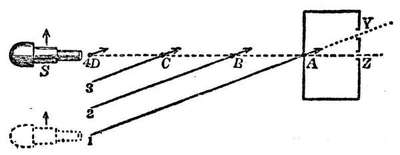
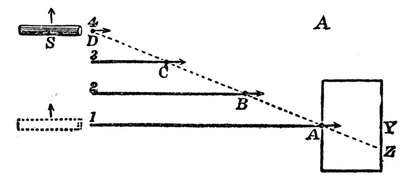
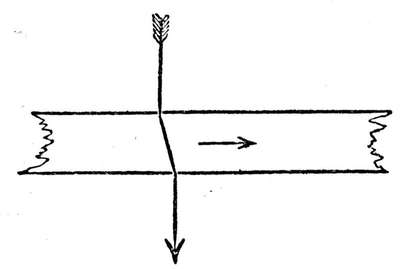
back to the remarks preceding Fig. 4) if the ether
in receiver is stagnant while outside it is moving,
a wave which has advanced and drifted as far as
the telescope will cease to drift as soon as it gets
inside, but will advance simply along the wave-normal.
And in general, at the boundary of any
such change of motion a ray will be bent, and an
observer looking along the ray will see the source
not in its true position, not even in the apparent
position appropriate to his own motion, but lagging
behind that position.
Such an aberration as this, a lag or negative
aberration, has never yet been observed; but if
there is any slip between layers of ether, if the
earth carries any ether with it, or if the ether, being
in motion at all, is not equally in motion everywhere
throughout every transparent substance,
then such a lag or negative aberration must occur,
in precise proportion to the amount of the carriage
of ether by moving bodies (cf. p. 61).
On the other hand, if the ether behaves as a
perfectly frictionless inviscid fluid, or if for any
other reason there is no rub between it and moving
matter, so that the earth carries no ether with it
at all, then all rays will be straight, aberration will
have its simple and well-known value, and we shall
be living in a virtual ether stream of nineteen
miles a second, by reason of the orbital motion
of the earth.
It may be difficult to imagine that a great mass
like the earth can rush at this tremendous pace
through a medium without disturbing it. It is
not possible for an ordinary sphere in an ordinary
fluid. At the surface of such a sphere there is a
viscous drag, and a spinning motion diffuses out
thence through the fluid, so that the energy of
the moving body is gradually dissipated. The
persistence of terrestrial and planetary motions
shows that etherial viscosity, if existent, is small;
or at least that the amount of energy thus got
rid of is a very small fraction of the whole. But
there is nothing to show that an appreciable layer
of ether may not adhere to the earth and travel
with it, even though the force acting on it be but
small.
This, then, is the question before us:—
Does the earth drag some ether with it? or does it
slip through the ether with perfect freedom? (Never
mind the earth's atmosphere; the part it plays is
known and not important.)
In other words, is the ether wholly or partially
stagnant near the earth, or is it streaming past
us with the opposite of the full terrestrial velocity
of nineteen miles a second? Surely if we are living
in an ether stream of this rapidity we ought to be
able to detect some evidence of its existence.[4]
It is not so easy a thing to detect as you would
imagine. We have seen that it produces no
deviation or error in direction. Neither does it
cause any change of colour or Doppler effect;
that is, no shift of lines in spectrum. No steady
wind can affect pitch, simply because it cannot
blow waves to your ear more quickly than they are
emitted. It hurries them along, but it lengthens
them in the same proportion, and the result is
that they arrive at the proper frequency. The
precise effects of motion on pitch are summarised
in the following table:—
Changes of Frequency due to Motion.
Source approaching shortens waves.
Receiver approaching alters relative velocity.
Medium flowing alters both wave-length and
velocity in exactly compensatory manner.
What other phenomena may possibly result
from motion? Here is a list:—
Phenomena resulting from Motion.
(1) Change or apparent change in direction;
observed by telescope, and called aberration.
(2) Change or apparent change in frequency; observed
by spectroscope, and called Doppler effect.
(3) Change or apparent change in time of
journey; observed by lag of phase or shift of
interference fringes.
(4) Change or apparent change in intensity;
observed by energy received by thermopile.
What we have arrived at so far is the following:—
Motion of either source or receiver can alter
frequency; motion of receiver can alter apparent
direction; motion of the medium can do neither.
But the question must be asked, can it not hurry
a wave so as to make it arrive out of phase with
another wave arriving by a different path, and
thus produce or modify interference effects?
Or again, may it not carry the waves down
stream more plentifully than up stream, and
thus act on a pair of thermopiles, arranged fore
and aft at equal distances from a source, with
unequal intensity?
And once more, perhaps the laws of reflection
and refraction in a moving medium are not the
same as they are if it be at rest. Then, moreover,
there is double refraction, colours of thin
plates and thick plates, polarisation angle, rotation
of the plane of polarisation; all sorts of
optical phenomena that need consideration.
It may have to be admitted, perhaps, that in
empty space the effect of an ether drift is difficult
to detect, but will not the presence of dense
matter—especially the passage through dense
transparent matter—make the detection easier?
So a great number of questions arise, all of which
have been, from time to time, seriously discussed.
Interference.
As an instance of such discussion, consider
No. 3 of the phenomena tabulated above. I
expect that every reader understands interference,
but I may just briefly say that two
similar sets of waves "interfere" whenever and
wherever the crests of one set coincide with and
obliterate the troughs of the other set. Light
advances in any given direction when crests in
that direction are able to remain crests, and
troughs to remain troughs. But if we contrive
to split a beam of light into two halves, to send
them round by different paths, and make them
meet again, there is no guarantee that crest will
meet crest and trough trough; it may be just
the other way in some places, and wherever that
opposition of phase occurs there, there will be local
obliteration or "interference." Two reunited
half-beams of light may thus produce local stripes
of darkness, and these stripes are called interference
bands.
It is not to be supposed that there is any
destruction of light, or any dissipation of energy:
it is merely a case of redistribution.
The bright parts are brighter just in proportion
as the dark parts are darker. The screen is
illuminated in stripes and no longer uniformly,
but its total illumination is the same as if there
were no interference.
Projection of Interference Bands.
It is not easy to project these interference
bands on a screen so as to make them visible
to an audience,—partly because the bands or
stripes of darkness are exceedingly narrow;
indeed I had not previously seen the experiment
attempted. But by means of what I call an
interference kaleidoscope, consisting of two
mirrors set at an angle with a third semi-transparent
mirror between them, it is possible to
get the bands remarkably clear and bright, so
that they can readily be projected: and I showed
these at a lecture to the Royal Institution of
Great Britain in 1892.
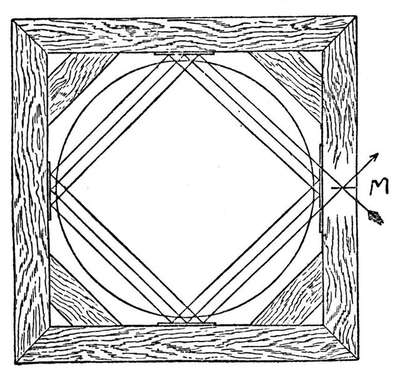
Each mirror is mounted on a tripod with
adjustable screw feet, which stand on a thick
iron slab, which again rests on hollow india-rubber
balls. Looking down on the mirrors the
plan is as in the diagram Fig. 7, which indicates
sufficiently the geometry of the arrangement,
and shows that the two half-beams, into which
the semi-transparent plate divides the light, will
each travel round the same contour A B C in
opposite directions, and will then reunite and
travel together towards the point of the arrow.
A parallel beam from an electric lantern, when
thus treated, depicts bright and broad interference
bands on a screen. And the arrangement
is very little sensitive to disturbance, because
the paths of the two halves of the beam are
identical, and because of the mounting. A
piece of good glass can be interposed without
disturbance, and the table can be struck a heavy
blow without confusing the bands.
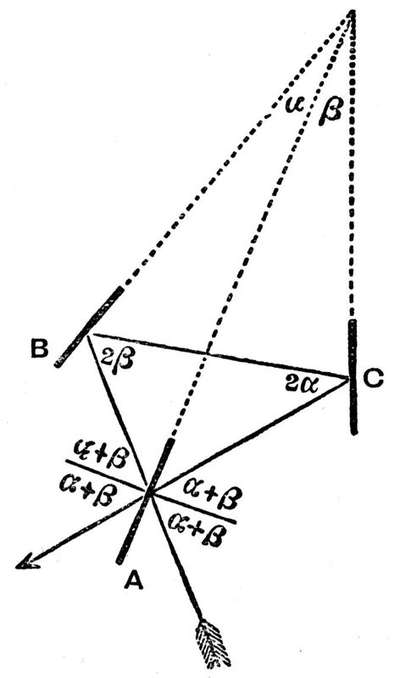 Fig. 7. Plan of Interference Kaleidoscope with three mirrors.
The arrow-feather ray is bifurcated at A by a semi-transparent
mirror of thinly-silvered glass; and the two halves reunite along the
arrow-head after traversing a triangular contour A B C in opposite
directions. The simple geometrical relations which permit this are
sufficiently indicated in the figure. The arrangement would suit
Fizeau's experiment.
The only regular and orderly way of causing a
shift of the bands is to accelerate one half of the
beam and to retard the other half, by moving a
transparent substance along the contour. For
instance, let the sides of the triangle A B C, or
one of them, consist of a tube of water in which
a rapid stream is maintained; then the stream
has a chance of accelerating one half the beam,
and retarding the other half, thereby shifting
the fringes from their normal position by a measurable
amount. This is the experiment made in
1859 by Fizeau. (Appendix 3.)
Now that most interesting and important, and
I think now well-known, experiment of Fizeau
proves quite simply and definitely that if light be
sent along a stream of water, travelling inside the
water as a transparent medium, it will go quicker
with the current than against it.
You may say that is only natural; a wind assists
sound one way and retards it the opposite way.
Yes, but then sound travels in air; and wind is a
bodily transfer of air; hence, of course, it gives the
sound a ride. Whereas light does not really travel
in water, but always in ether; and it is by no
means obvious whether a stream of water can help
or hinder it. Experiment decides, however, and
answers in the affirmative. It helps it along with
just about half the speed of the water; not with
the whole speed, which is curious and important,
and really means that the moving water has no
effect whatever on the ether of space, though we
must defer explaining how this comes about.
Suffice for present purposes the fact that the
velocity of light inside moving water, and therefore
presumably inside all transparent matter, is
altered to some extent by motion of that matter.
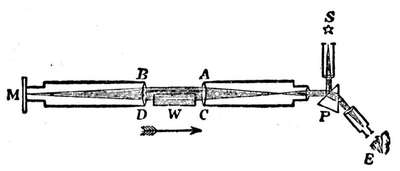 Fig. 8. Hoek's arrangement.
The light from source S is reflected so as to travel half through
stagnant water and half through air on its direct journey, the path
being inverted on the return journey, after which it enters the eye.
Does not this fact afford an easy way of
detecting a motion of the earth through the
ether? Every vessel of stagnant water is really
travelling along through the ether at the rate of
nineteen miles a second. Send a beam of light
through it one way, and it will be hurried; its
velocity, instead of being 140,000 miles a second,
will be 140,009 miles. Send a beam of light the
other way, and its velocity will be 139,991; just as
much less. Bring these two beams together; surely
some of their wave-lengths will interfere. M.
Hoek, Astronomer at Utrecht, tried the experiment
in this very form; here is a diagram of his
apparatus (Fig. 8). Babinet had tried another
form of the experiment previously. Hoek expected
to see interference bands, from the two
half-beams which had traversed the water, one
in the direction of the earth's motion and the
other against it. But no interference bands were
seen. The experiment gave a negative result.
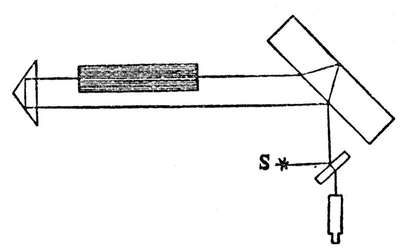 Fig. 9. Arrangement of Mascart and Jamin.
A modification of Fig. 8, with the beam split definitely into two halves
by reflexion from a thick glass plate and reunited before observation.
The two half-beams go through stagnant water in opposite directions.
An experiment, however, in which nothing is
seen is never a very satisfactory form of a negative
experiment; it is, as Mascart calls it, "doubly
negative," and we require some guarantee that
the conditions were right for seeing what might
really have been in some sort there. Hence
Mascart and Jamin's modification of the experiment
is preferable (Fig. 9). The thing now looked
for is a shift of already existing interference bands,
when the above apparatus is turned so as to have
different aspects with respect to the earth's
motion; but no shift was seen.
Interference methods all fail to display any
trace of relative motion between earth and ether.
Try other phenomena then. Try refraction.
The index of refraction of glass is known to depend
on the ratio of the speed of light outside, to the
speed inside, the glass. If then the ether be
streaming through glass, the velocity of light
will be different inside according as it travels
with the stream or against it, and so the index of
refraction may be different. Arago was the first
to try this experiment by placing an achromatic
prism in front of a telescope on a mural circle,
and observing the deviation it produced on
stars.
Observe that it was an achromatic prism,
treating all wave-lengths alike; he looked at the
deviated image of a star, not at its dispersed image
or spectrum,—else he might have detected the
change-of-frequency-effect due to motion of source
or receiver first actually seen by Sir W. Huggins.
I do not think Arago would have seen it, because I
do not suppose his arrangements were delicate
enough for that very small effect; but there is no
error in the conception of his experiment, as Prof.
Mascart has inadvertently suggested there was.
Then Maxwell repeated the attempt in a much
more powerful manner, a method which could
have detected a very minute effect indeed, and
Mascart has also repeated it in a simple form.
All are absolutely negative.
Well, then, what about aberration? If one looks
through a moving stratum, say a spinning glass
disk, there ought to be a shift caused by the motion
(see Fig. 4). That particular experiment has not
been tried, but I entertain no doubt about its
result, though a high speed and considerable
thickness of glass or other medium would be necessary
to produce even a microscopic apparent
displacement of objects seen through it.
But the speed of the earth is available, and the
whole length of a telescope tube may be filled
with water; surely that is enough to displace
rays of light appreciably.
Sir George Airy tried it at Greenwich on a star,
with an appropriate zenith-sector full of water.
Stars were seen through the water-telescope
precisely as through an air telescope. A negative
result again! (The theory is fully dealt with in
Chapter X and Appendix 3.)
Stellar observations, however, are unnecessarily
difficult. Fresnel had pointed out that a terrestrial
source of light would do just as well. He had
also (being a man of exceeding genius) predicted
that nothing would happen. Hoek has now tried
it in a perfect manner and nothing did happen.
But these facts are not at all disconcerting;
they are just what ought to be anticipated, in the
light of true theory. The absence of all effect
caused by stagnant dense matter inserted in the
path of a beam of light, that is of dense transparent
matter not artificially moved with reference
to the earth—or rather with reference to source
and receiver—is explicable on Fresnel's theory
concerning the behaviour of ether inside matter.
If the index of refraction of the matter is called
μ, that means that the speed of light inside it is
1/μth of the speed outside or in vacuo. And that
is only another way of saying that the virtual
etherial density inside it is represented by μ²,
since the velocity of waves is inversely as the
square root of the density of the medium which
conveys them;—the elasticity being reckoned as
constant, and the same inside as out.
But then if the ether is incompressible its
density must really be constant,—so how can it
be denser inside matter than it is outside? The
answer is that presumably the ether is not really
extra dense, but is, as it were, loaded by the matter.
The atoms of matter, or the constituent electrons,
must be presumed to be shaken by the passage of
the waves of light, as they obviously are in fluorescent
substances; and accordingly the speed of
propagation will be lessened by the extra loading
which the waves encounter. It is not a real increase
of density, but a virtual increase, which
is really due to the addition of a certain fraction
of material inertia to the inertia of the ether itself.
The density of ether outside being 1, and that of
the loaded ether inside being μ², the effect of the
load is expressible as μ²−1, while the free ether is
the same inside as out.
Suppose now that the matter is moved along. The
extra loading, being part of the matter, of course
travels with it, and thereby affects the speed of light
to the extent of the load,—that is to say, by an
amount proportional to μ²−1 as contrasted with μ².
This is Fresnel's predicted ratio (μ²−1): μ², or
1 − 1/μ²; and in Fizeau's experiment with running
water—especially as repeated later, with modern
accuracy, by Michelson—this represents exactly
the amount of observed effect upon the light.
But if, instead of running water, stagnant
water is used—that is stationary with respect
to the earth, though still moving violently through
the ether—then the (μ²−1) effect of the load will
be fixed to the matter, and can produce no extra
or motile effect. The only part that could produce
an effect of that kind would be the free ether,
of density 1. But then this—on the above view—is
absolutely stationary, not being carried along
by the earth at all; hence this can give no effect
either. Consequently the whole effect of an
ether-drift past the earth is zero, on optical experiments,
according to the theory of Fresnel;
and that is exactly what all the experiments just
described have confirmed.
Since then Prof. Mascart, with great pertinacity,
has attacked the phenomena of thick plates,
Newton's rings, double refraction, and the rotatory
phenomenon of quartz; but he has found
absolutely nothing attributable to a stream of
ether past the earth.
The only positive result ever supposed to be
attained was in a very difficult polarisation
observation by Fizeau in 1859. Unless this has
been repeated, it is safest to ignore it; but I
believe that Lord Rayleigh has repeated it, and
obtained a negative result.
Fizeau also suggested, but did not attempt,
what seems an easier experiment, with fore and
aft thermopiles and a source between them, to
observe the drift of a medium by its convection of
energy; but arguments based on the law of exchanges[5]
tend to show, and do show as I think,
that a probable alteration of radiating power due
to motion through a medium would just compensate
the effect otherwise to be expected.
We may summarise most of these statements
as follows:—
| Summary. |
| Source alone moving produces ... |
|
A real and apparent change of wave-length. |
| |
A real but not apparent error in direction. |
| |
No lag of phase or change of intensity, except that appropriate to altered wave-length. |
| |
|
Medium alone moving, or source and receiver moving together, produces... |
|
No change of frequency. |
| |
No error in direction. |
| |
A real lag of phase, but undetectable without control over the medium. |
| |
A change of intensity corresponding to different distance, but compensated by change of radiating power. |
| |
|
Receiver alone moving produces ... |
|
An apparent change of wave-length. |
| |
An apparent error in direction. |
| |
No change of phase or of intensity, except that appropriate to different virtual velocity of light. |
I may say, then, that not a single optical phenomenon
is able to show the existence of an ether
stream near the earth. All optics go on precisely
as if the ether were stagnant with respect to the
earth.
Well, then, perhaps it is stagnant. The experiments
I have quoted do not prove that it is so.
They are equally consistent with its perfect freedom
and with its absolute stagnation; though
they are not consistent with any intermediate
position. Certainly, if the ether were stagnant
nothing could be simpler than their explanation.
The only phenomena then difficult to explain
would be those depending on light coming from
distant regions through all the layers of more or
less dragged ether. The theory of astronomical
aberration would be seriously complicated; in its
present form it would be upset (p. 45). But it is
never wise to control facts by a theory; it is better
to invent some experiment that will give a different
result in stagnant and in free ether. None of
those experiments so far described are really
discriminative. They are, as I say, consistent
with either hypothesis, though not very obviously
so.
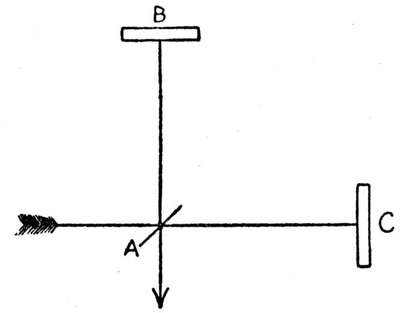 Fig. 10. The course of the light and of the two half-beams
in Michelson's most famous experiment.
Fig. 10. The course of the light and of the two half-beams
in Michelson's most famous experiment.
The light is split at A, one half sent towards B and back, the other
half to C and back. Compare with Fig. 7.
Michelson Experiment.
Mr. Michelson, however, of the United States,
invented a plan that looked as if it really would
discriminate; and, after overcoming many difficulties,
he carried it out. It is described in the
Philosophical Magazine for 1887.
Michelson's famous experiment consists in
looking for interference between two half-beams
of light, of which one has been sent to and fro
across the line of ether drift, and the other has
been sent to and fro along the line of ether drift.
A semi-transparent mirror set at 45° is employed
to split the beam, and a pair of normal
and ordinary mirrors, set perpendicular to the two
half-beams, are employed to return them back
whence they came, so that they can enter the eye
through an observing telescope.
It differs essentially from the interference
kaleidoscope, Fig. 7, inasmuch as there is now no
luminous path B C, and no contour enclosed by
the light. Each half-beam goes to and fro on
its own path, and these paths, instead of being
coincident, are widely separate,—one North and
South, for instance, and the other East and West.
Under these conditions the bands are much
more tremulous than they were in the arrangement
of Fig. 7, and are subject to every kind of
disturbance. The apparatus has to be excessively
steady, and no fluctuation even of temperature
must be permitted in the path of either beam.
To secure this, the source, the mirrors, and the
observing telescope, were all mounted upon a
massive stone slab; and this was floated in a bath
of mercury.
The slab could then be slowly turned round, so
that sometimes the path A B and sometimes the
path A C lay approximately along or athwart the
direction of the earth's motion in space.
And inasmuch as the motion along would take
a little longer than the motion across, though
everything else was accurately the same, some
shift of the interference bands might be expected
as the slab rotated.
But whereas in all the experiments previously
described the effect looked for was a first-order
effect, of magnitude one in ten or twenty thousand,—depending,
that is to say, on the first power of
the ratio of speed of earth to speed of light,—the
effect now to be expected depends on the square
of that same ratio, and therefore cannot be
greater, even in the most favourable circumstances,
than 1 part in a hundred million.
It is easy to realise therefore that it is an exceptionally
difficult experiment, and that it
required both skill and pertinacity to perform it
successfully.
That it is an exceptionally difficult experiment
will be realised when I say that it would fail in
conclusiveness unless one part in 400 millions
could be clearly detected.
Mr. Michelson reckons that by his latest arrangement
he could see 1 in 4000 millions if it existed
(which is equivalent to detecting an error of 1/1000
of an inch in a length of 60 miles); but he saw
nothing. Everything behaved precisely as if the
ether was stagnant; as if the earth carried with
it all the ether in its immediate neighbourhood.
And that was his conclusion.
Theory of Michelson Experiment.
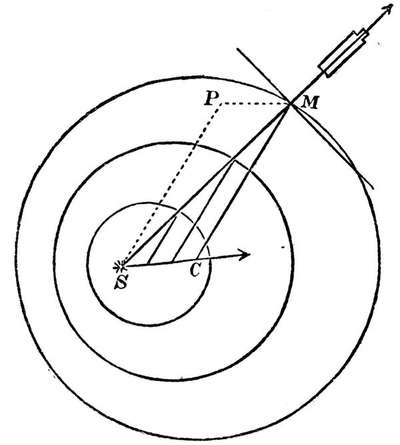
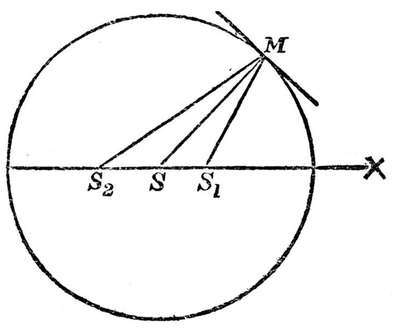
The theory of the Michelson experiment can
be expressed thus: its optical diagram being the
same as is expressed geometrically in Fig. 6.
If a relatively fixed source and receiver move
through the ether with velocity u, such that u/v=α
the aberration constant; then the time of any to
and fro journey S M, inclined at angle θ to the
direction of the drift, is increased, above what it
would be if there were no drift, in the ratio
√(1 − α² sin² θ) / 1 − α²
This follows from merely geometrical considerations.
Hence if a ray is split, and half sent so that θ=0
while the other half is sent so that θ=90 (as in
Fig. 10), the one will lag behind the other by a
distance ½α² times the distance travelled; which,
though very small, may be a perceptible fraction
of a wave-length, and therefore may cause a
perceptible shift of the bands.
But when the experiment is properly performed,
no such shift is observed.
The experiment thus seems to prove that there
is no motion through the ether at all, that there
is no etherial drift past the earth, that the ether
immediately in contact with the earth is stagnant—or
that the earth to that extent carries all neighbouring
ether with it.
If we wish to evade this conclusion, there is no
easy way of doing so. For it depends on no
doubtful properties of transparent substances,
but on the straightforward fundamental principle
underlying all such simple facts as that—It takes
longer to row a certain distance and back, up
and down stream, than it does to row the same
distance in still water; or that it takes longer to
run up and down a hill, than to run the same distance
laid out flat; or that it costs more to buy
a certain number of oranges at three a penny and
an equal number at two a penny than it does to
buy the whole lot at five for twopence.
Hence, although there may be some way of
getting round Mr. Michelson's experiment, there
is no obvious way; and if the true conclusion be
not that the ether near the earth is stagnant, it
must lead to some other important and unknown
fact.
That fact has now come clearly to light. It was
first suggested by the late Professor G.F. FitzGerald,
of Trinity College Dublin, while sitting
in my study at Liverpool and discussing the
matter with me. The suggestion bore the impress
of truth from the first. It independently occurred
also to Professor H.A. Lorentz, of Leiden, into
whose theory it completely fits, and who has
brilliantly worked it into his system. It may be
explained briefly thus:—
Electric charges in motion constitute an electric
current. Similar charges repel each other, but currents
in the same direction attract. Consequently
two similar charges moving in parallel lines will
repel each other less than if stationary,—less also
than if moving one after the other in the same line.
Likewise two opposite charges, a fixed distance apart,
attract each other less when moving side by side,
than when chasing each other. The modification of
the static force, thus caused, depends on the squared
ratio of their joint speed to the velocity of light.
Atoms of matter are charged; and cohesion is a
residual electric attraction (see end of Appendix 1).
So when a block of matter is moving through the
ether of space its cohesive forces across the line of
motion are diminished, and consequently in that
direction it expands, by an amount proportioned to
the square of aberration magnitude.
A light journey, to and fro, across the path of a
relatively moving medium is slightly quicker than
the same journey, to and fro, along (see p. 64).
But if the journeys are planned or set out on a block
of matter, they do not remain quite the same when
it is conveyed through space: the journey across the
direction of motion becomes longer than the other
journey, as we have just seen. And the extra distance
compensates or neutralises the extra speed;
so that light takes the same time for both.

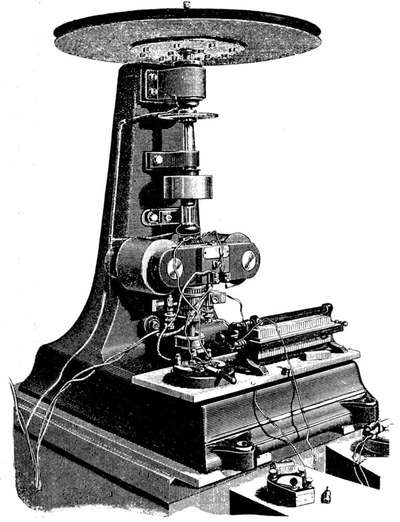
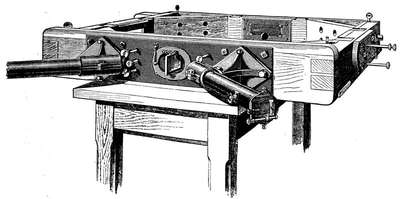
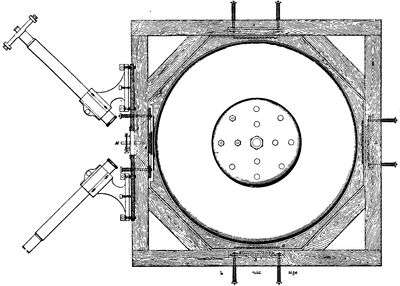
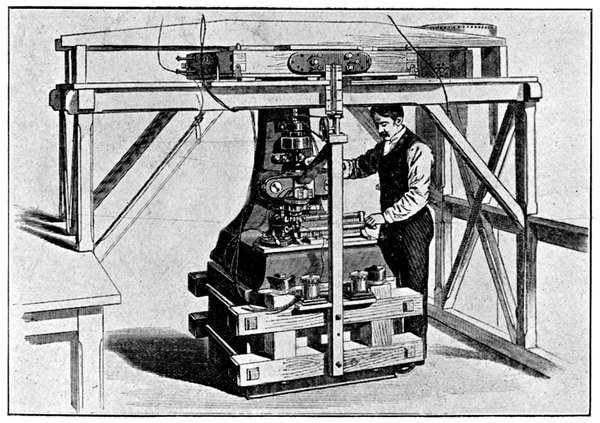 Fig. 15. View of Ether machine complete and in action.