In most men worth considering there appears to be, from three
to ninety, an ineradicable boyhood. Give the lad, of six or sixty,
a horse or a boat or a holiday, and he forgets the world and begins
playing.
A list of such men whom one knows would be, happily, an encyclopædia.
This book is dedicated to all such, between the lines
of the names below. You whom I remember in Kentucky, and
You in the West, and You across the room, smoking, and You
in the crowded city, and You where velvet mountains rim the
sky-line—will know that You are in this inscription. So the inscription
goes, with many names unnamed, to a splendid phalanx
of young Americans, lately boys in years, graduates of Yale,
friends of mine:
E. Farrar Bateson, Lucius Horatio Biglow, Paul Howard
McGregor Converse, Douglas Fitch Guilford Eliot, William
Brown Glover, Allen Trafford Klots, Francis Ely Norris, George
Richardson, Harold Phelps Stokes, Horace Winston Stokes,
Francis Berger Trudeau, James Thornton, Francis Melzar Watrous,
and Paul Shipman Andrews.
The boy stopped sharply in the portage, and
swung about and glanced inquiringly at Josef.
Light as the sound was, quickly as the boy had
heard it, Josef had heard first. He stood rooted in
the path, a line of lean strength, in vague-colored
clothes, his black locks tumbling from under his battered
felt hat, a scarlet bandanna in the belt at his
slim waist pricking the dim light with an explosion
of color. His extraordinary eyes, very light blue,
very large, with pupils dilated over the irises, as
animals’ eyes dilate, snapped electrically; his glance
searched the woods to this side and that.
The boy had been trained under Josef and knew
his ways; he stood stock-still as the guide listened,
as he sent that concentrated glance ahead into the
confused masses of shadow and brightness and foliage
and water of the Canadian forest. It flashed, that
blue search-light, straight through tangled branches
and across bulks of emerald velvet, which were moss-covered
bowlders; it went on deep into the inscrutable
forest—Josef’s glance. And the boy knew that
he was seeing things in those mysterious depths,
and reading them as wild creatures see and read the
woodland, as the boy himself, trained woodsman
though he was, might never hope to do. With that,
the tense pose relaxed, the wonderful eyes came
back from their exploring and—gentle, friendly, shy—met
the boy’s eyes. Josef smiled.
“M’sieur Jack hears the m’sieur talking?” he
asked in French.
Used as he was to his guide, the boy was surprised.
“What m’sieur? What do you mean, Josef?”
Josef waved a careless hand. “There is a m’sieur
and a guide. The landing-net dropped, just now.
It was that which one heard. They fish in the little
river, around the next turn, at the Rémous des
Jurons—Profanity Pool—one will see in a moment.
The m’sieur, par exemple, is large—a heavy man.”
This in quick, disjointed sentences, as Josef talked—much
the same way as he sprang from one rock
to another in a river crossing, feeling his way, assuring
himself of a footing before he tried the next.
Josef was shy even with his own young m’sieur,
whom he had guided for seven years, since M’sieur
Jack was a lad in knickerbockers. It was of his
nature to talk in a hurrying low voice, in short
phrases, meeting one’s glance with the gentleness
of the brilliant, great, light eyes, guardedly, ready
to spring back into the cave of his reserve as an
alarmed wild creature might hide in its den. Yet
he loved to show M’sieur Jack this gift of his, this
almost second sight in the woods. It gratified him
now when the boy spoke.
“How in thunder do you know all that?” he demanded.
“I’m not so blamed slow, and yet I can’t
hear any one talking.”
Josef held up his hand dramatically, very Frenchly.
“Listen—écoutez!”
Jack listened, Josef smiling at him broadly, alert,
vivid. The little river ran at their left, brown-pooled,
foam-splashed, tumbling over rocks, blurring
all sounds. Overhead, in the tall white birches,
in the lower spruce-trees, the wind rustled, and
brushed with a feathery music the edges of the
tinkling water noises. It seemed, as one walked
along the portage—the old, old Indian trail—all
beautiful peace and stillness; but when one stopped
to listen there was a whole orchestra of soft instruments
playing, and any one sound was hard to disentangle.
Jack threw his whole soul into the effort
before he made out, through the talking water and
the wind sounds, an intermittent note which he
could place as a man’s speech some distance away.
“I hear it,” he cried out.
Josef smiled indulgently; he liked to teach woodcraft
to his young m’sieur; also M’sieur Jack was a
good scholar; there was no other m’sieur of the club,
young or old, to whom he would give the bow of his
canoe in going through a difficult rapids; he had done
that with M’sieur Jack. Yes, and also M’sieur
Jack could tell if a male or female beaver had gnawed
the chips around a birch-trunk by the tooth-marks
in the wood; Josef had taught him that. And
M’sieur Jack was also capable to portage a canoe
like a guide, tossing the heavy boat to his shoulders
unaided and swinging off down a trail as silently, as
swiftly as an Indian; and he could tie up a pacqueton—and
make camp in a rain—and skin a moose;
these things and others M’sieur Jack could do, and
Josef was proud of him. But M’sieur Jack could
not see into the woods like Josef and he was not as
quick at hearing sounds—of that also Josef was
proud. So he smiled and waited for the question
sure to come. “What the dickens makes you think
he’s a big man—un homme pesant?” asked Jack.
They were moving forward along the trail, Jack
leading, and throwing his sentences in an undertone,
as instinct teaches one to speak in the woods,
over his shoulder to Josef. And for answer Josef
flung out his muscular arm, in its faded blue calico
sleeve, and pointed ahead. Jack stumbled on a
root as he followed the pointing hand, and, recovering,
caught sight of a tan-colored sweater far in
front, even now barely in range of sight, hung on a
tree by the path.
“It is not warm to-day, par exemple; a m’sieur
who is not somewhat fat would not feel the walking
in this portage—so as to take off that,” Josef
reasoned softly, in jerks.
“Did you see that—away back there? Well,
I’ll be—” staccatoed the lad, and Josef grinned with
pleased vanity. “Josef, you’re a wizard,” the boy
went on. “But never mind, my son, you’ll get fooled
some time. I’ll bet he didn’t drop the landing-net.
I’ll bet it was his leader-box or his cigarette-case.
No landing-net. À bas, landing-nets! You’ll see!”
And Jack kicked at a rotten stump and sent it
crashing in slow ruin, as if the vitality in him were
overflowing through his long legs. So the two, the
boy born into a broad life which faced from babyhood
the open door of opportunity, and the boy
scarcely five years older, born to a narrow existence,
walled about with a high, undoored wall of unending
labor—these two swung on brotherly, through the
peace and morning freshness of the forest, and in
the levelling reality of nature were equals.
The river sang. One saw it—out of the corner of
the eye as one walked—brown in the pools, white
where it tumbled over the rocks; the rocks speckled
it with their thousand gray hummocks; grasses grew
on them; a kingfisher fled scolding across the water
and on down-stream; in the trail—the portage—it
was all shimmering misty greens, with white sharp
ranks of birch-trees; the wind murmured and blew
against one’s face. Through such things the two
stalwart lads walked on and were happy. The unconcerned
gray stones of the rapids, which had
looked exactly the same on the morning when
Pharaoh’s daughter had found little Moses in the
bulrushes, would look exactly the same, likely, two
thousand years from now—for world-making is a
long business and the Laurentian hills are the grandfathers
of the planet, and stones reel off twenty centuries
with small aging—these immemorial nobodies
of an obscure little Canadian river had seen nothing
pass by in their long, still lives blither or more alive
than the two lads, gentleman and peasant, with
their “morning faces” and their loping pace of
athletes.
Around a turn they halted as by one brain
order. Something moving. In Broadway a man in
rapid motion is lost in a sea of men in rapid motion;
in the woods a man lifts a slow finger and is so
conspicuous that the mountains seem to shout a
startled “Look!” The man at the edge of Profanity
Pool leaned forward and lunged at his flies hanging
tangled around his rod; he said “Damn!” The two
boys, whom his movement had brought to a standstill,
unseen, motionless in the shade of the narrow
portage, shook with silent laughter.
With that Jack stepped forward, breaking a twig
purposely, and came out on the rocks. The man
looked up and saw him, a bright-faced, tall lad,
claret and brown as to complexion, clean-limbed and
strong as to build. Something in him drew a smile
to the man’s face—it was not unlikely to be so.
“Bon jour,” Jack said with a haul at his cap, and
stuffing it into his pocket further; and then “Good-morning,
sir. Any luck?”
The man stared at him. “Didn’t you hear what I
said?” he inquired.
And Jack, pausing one second, went off into a
shout of deep laughter which set the mountain
echoes ringing, and Josef, discreet in the background,
stepped back a pace so that the strange m’sieur
might not see him laughing also. When M’sieur
Jack laughed it was impossible to keep as serious
as one should.
Squatting in the shadows beyond the m’sieur was
something shading off into rocks and foliage; a face
stared over the bushes of the “thé sauvage”—the
Indian tea shrub with its dim pink flowers. So hidden,
so motionless was the man that Jack did not
see him for the first instant—but Josef had seen
him; there had been a brief half-nod of recognition
on both sides before the messieurs had spoken. Jack
caught sight of him.
“It is you, Adelard Martel?” he demanded; Jack
was likely to know most of the guides in the club.
“Why haven’t you got a big fish for your m’sieur?
They are here,” he threw at him cheerfully.
But the man did not answer with a smile, as most
people answered Jack Vance. The dark, furtive
eyes shot a resentful glance at the large man who
still struggled with his fishing-tackle. “M’sieur—is
not lucky,” he brought out with the broad, soft
accent of a habitant, and looked down sulkily, displeased,
and then flashed up an angry glance.
“There was a big one—b’en gros—three minutes ago.
He rose to the fly. One would have had him grabbed—poigné—in
a second. But v’là, M’sieur slipped and
fell backward and knocked me the landing-net out
of my hand, and the big one saved himself—se
sauvait. Comme ça”—with a swift gesture of disgust.
“The landing-net?” The boy turned and looked
at Josef and laughed, and Josef’s big light eyes flashed
satisfaction.
The strange m’sieur broke in with a nod toward
his guide. “Something wrong with that fellow,” he
commented. “He seems angry that I can’t catch
fish.”
Jack leaned over and swept in one of the curly,
bobbing snells of the m’sieur’s leader as he answered.
“May I help you?” he asked with friendliness of a
brother craftsman. “It’s the dickens of a job to do
this alone. Adelard ought”—and he stopped and
shook his head fatherly at the sullen-faced guide.
“He’s sore as a crab because you haven’t had luck,”
he explained. “They’re all that way. It’s a personal
question—if their messieurs are lucky, you see.
He’ll be another question when you take a five-pounder.”
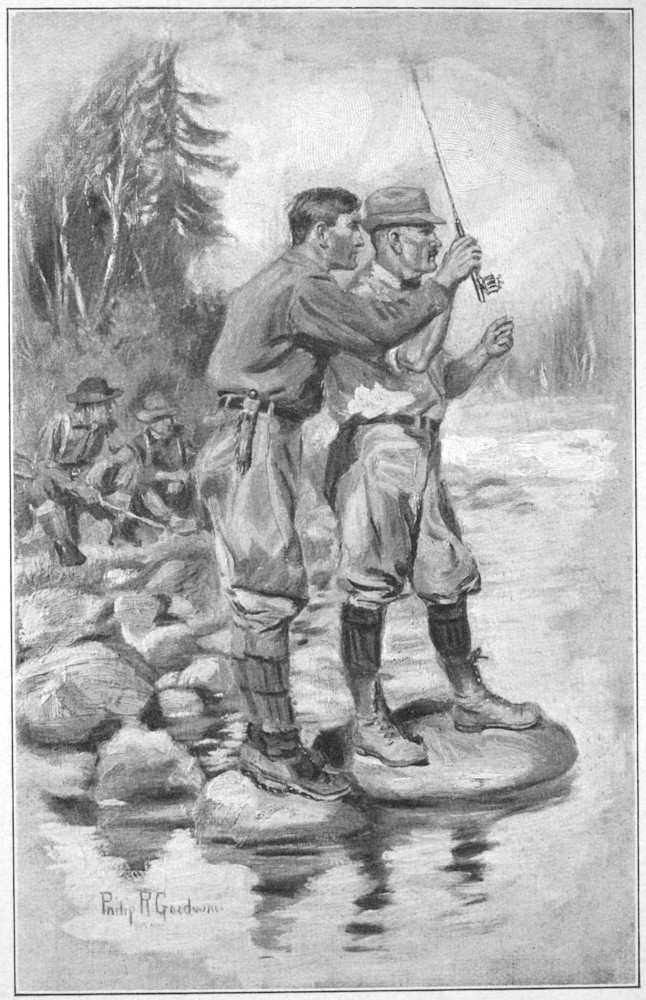
The big man lowered the butt of his rod suddenly,
thereby mixing up all the whirls of catgut which
Jack had skilfully untangled; he looked at the boy
with a heart-broken expression; he looked as if he
were going to cry.
“But I can’t,” he said sorrowfully. “I don’t know
how to fish. And I want to so much. It’s my first
vacation in six years, and I haven’t got but a week.
I thought it was easy to fish, that anybody could do
it. And I don’t know how to tie the leader on, and
the reel falls out of the—the reel-plate or something.
And if I touch the automatic spring it all snaps up
before I can wink, and the leader runs down the rod
through the rings and it’s the very devil. I hit a rock
and broke a tip the first thing and had to put in
another. It took me half an hour to put the stuff
together and then that happened. And the flies
tangle—all the time. And my guide despises me! I
thought fishing was fun!”
The man’s voice was a wail in the last sentences.
Something in the boy’s friendly youthfulness had
made it possible to pour out this tale of woe where
with another wayfarer the unlucky fisherman would
have kept his bitter counsel. His instinct was not
wrong. The thought shot into Jack’s mind that here
was a poor man, probably not able to afford vacations,
who had put his hard-earned money into one
and was failing to get the good of it. Like a young
knight to a maiden in distress the boy rushed to
the rescue.
“Now that’s just too darned bad,” he brought
out heartily. “But you know, sir, it’s easy enough
to set it all straight. Fishing is fun—almost the best
fun going. I don’t want to butt in, but—you see
I’ve been at this sort of thing all my days”—one
thought involuntarily of Methuselah—“and I can’t
help knowing the trick. I’m not a crack exactly, but—well,
it’s second nature to me, and I’d simply love
to show you if you wouldn’t think me fresh to offer.”
“Fresh!” the older man repeated. “If you would
give me a few points I’d bless you. But you’re off
on a trip yourself—I can’t take your time”—and the
boy cut in there with joyful assurances, which there
was no mistaking, as to his pleasure in helping.
“We’re just on a casual two days’ tramp, Josef
and I,” he explained. “Nothing to do so’s you’d
notice it. We left the canoe and the pack down at
the lake and dashed up here for a fish or so.” By
this he had the stranger’s rod in hand, a Leonard
rod, the boy knew at a glance, about four ounces in
weight, the last word in expense and perfection of
rods. “Gosh, he blew himself!” was the inward comment
Jack made. Josef was somehow present at the
psychological distance from the butt as the boy
held it in his hand, and while he set the reel more
firmly into the plate and pushed the nickel ring down
strongly Josef’s delicate, coarse finger-tips were untwisting
the three bright flies from an extraordinarily
thorough tangle. Adelard Martel watched sulkily
out of the Indian tea-bushes; the large m’sieur
watched, wondering. With that the lines were free,
and Jack swung the butt about into Josef’s ready
hand, and suddenly had the junction of leader and
fish-line in his mouth and was chewing at it with
energy.
“Tied wrong,” he commented thickly, and then
had it out and drew the softened strings from their
knot. “If you don’t mind, sir, I’ll show you how
to put a leader into a snell.” He held the loop of
transparent cord in his left hand and poised the
green line above it. “Like this—down you go inside—up
you go outside—across you go—then down
outside, up—and pull her tight. There you are!”
He slid the cross-loop down, and with a jerk it was
all undone. “Just as easy to take out as to put in,
you see. Want to do it yourself, sir?” And the man,
as enchanted as a small boy, fumbled a bit and
learned the knot. “Now we’re off,” Jack announced,
glancing backward to assure his recover, and sent
a skilful line into Profanity Pool.
Perhaps no harder place to fish was in the club.
The pool, a black hole in the river, was thirty odd
feet long and varied in width from twenty to five
feet, irregularly. At the right a large log stretched
over the water lengthwise, and under its shadow
lurked the big trout. Also under it were snags where,
once hooked, the fish ran to hide, and catch the line
about the wood, and tear loose. One must keep a
fish away from this log at all hazards. Yet across
from it were sharp rocks apt to cut fish-line.
“The hole is chock-full of Scyllas and Charybdises,
all right,” Jack remarked, pointing out the geography
to his pupil. “I reckon Profanity Pool isn’t a
misnomer. Lots of cuss-words spilled into this water,
they do say.”
He cast, varying his line, varying his direction,
with easy skill, over the dark, wild water, all the
time telling how and why.
“With the forearm, you know, sir. Don’t put your
shoulder into it. And stop a second on your recover,
when the line’s back of you. Don’t monkey with it
too fast—give it time to straighten out; and don’t
slap the water with the flies. That scares ’em. Let
the tail-fly touch first, and just as it’s touching lift
the tip of the rod a scrap—see!” He illustrated with
finished delicacy. “Then it goes down softly.
Hi!”
A liquid swash, a break of white foam, an upward
snap of the wrist—a trout was on.
“That’s too blamed bad—I didn’t mean to take
anything,” he murmured regretfully, but he played
it all the same, and in three or four minutes Josef
had landed it and held it up wordlessly—a Salmo
fontinalis of a pound and a half, with scarlet fins
and gold-and-silver-spotted stomach. The stranger
was tingling with excitement.
“That’s something like!” he brought out, and
then meekly, anxiously, “May I fish now?”
And Jack, smiling his old-young smile, put the
rod into the man’s hand and held the hand carefully
for a few trial casts. Then “Let her go,” he commanded,
and the large m’sieur, trembling with eagerness,
was fishing. Jack, standing by with his hands
in his trousers pockets, his whole soul on the performance,
criticised with frankness. “Now, that’s
rotten, sir. Don’t recover that nervous way; that’s
what tangles ’em. Just—sort of—rhythmic; back
slow—pause—cast; lift the tip a scrap as you touch;
just a shiver of the wrist does it. Now—tip up—don’t
sag the line; draw the flies along, and wiggle
’em alluringly as they come; don’t let ’em go under—bad,
bad! You can’t fool fish if you drown your
flies. Oh, well—the tail-fly may sink a bit if you’re
after big ones”—and so the illustrated lecture went
on, Jack thoroughly enjoying himself in the rôle of
instructor. “Ginger!” he brought out suddenly in an
interval, “my brother would throw a fit if he saw
me teaching fishing. He’s a shark at it, you know.
He’s forgotten more than I ever knew. Josef”—turning
on the guide—“M’sieur va s’amuser de moi
en professeur de la pêche, n’est-ce pas?” And Josef,
showing his teeth in a short grin, answered promptly,
“Oui, M’sieur,” and attended to business.
The large m’sieur was learning fast. One saw that
he had not missed a word of the boy’s lesson or the
reason for any point of piscatorial finesse. He made
mistakes certainly, and was awkward, as is any beginner
at the wonderful world-old game, which has
to get into the nerves and the blood before one plays
it well ever. Yet he took hold as a trained mind
takes hold of whatever problem, with a certain ability
and sureness.
“I rather think you must do some things very
well, sir,” Jack remarked encouragingly, after a
bout of unflinching reprimand as to vicious tendencies
of the scholar. “You caught that idea about
not getting the line too close, at once. You must
be used to doing things well.”
The stranger lifted his keen, clear blue eyes a
second and shot a glance at the boy. “Possibly one
thing,” he answered briefly, and cast again.
Half a dozen small trout lay on the rocks, strung
on a forked willow branch, the vivid, pointed leaves
crisp on one side of it, cut by the resentful Adelard,
now charmed by the turn of events and eager to be
included in them. But the big fish did not rise.
“Bad time of day,” Jack explained. “Hole’s
fussed up, too. Have to let it get quiet before the
sockdologers will take notice.” He turned to the
older man with a certain brotherly manner of his, a
manner which lacked in no point of respect, but was
yet simply unconscious of any difference of age—a
manner which made older men like the lad and like
themselves better, too. “If I were you,” advised
Jack, “I’d stop now and come back early to-morrow
morning, by gray light, and have a try at them.
Maybe you’d get an old he-one then.”
A short lecture followed on the taking down of
rods, and the etiquette of winding a leader about
one’s hat, so that the pull is always from the last fly.
“Where are you going now?” asked the large
m’sieur as he and Adelard stood, their butin packed,
ready to move on.
Jack laughed and looked at Josef, who laughed
also and shrugged his shoulders. “We don’t know
exactly,” the boy said. “We’re just ‘loungin’ ’round
and sufferin’,’ like Brer Fox. I rather think we’ll
ramble up-stream and take the new trail the guardian
cut last winter to Lac Creux. I’ve never been
there. And then come back and put up our tent on
your lake for the night, if you don’t mind, sir. It’s
down there now, with the canoe, at the mouth of
this little river,” and he stamped a boot caressingly
into the brown water, as one pats an animal in
speaking of it.
“Put up with me over-night,” suggested the
m’sieur. “I’ve plenty of room; it would be a great
pleasure. Then you needn’t bother with your tent
or your kit.”
The clear eyes met the man’s with frank, pleased
surprise; Jack never got used to the astonishing
goodness of people in wanting him about. “Why,
we’ll do that with bells on, if you’d really like us,
sir,” he agreed heartily.
Ten minutes later the two lads were swinging
again through the shifting mystery of the portage,
following the narrowing river farther and farther
up-stream, while the large m’sieur and Adelard, now
in a pleasanter humor, progressed down-stream to
the lake and the camp.
About six o’clock that evening the large m’sieur,
whose name, incidentally, was Bradlee, spread a
gray camp blanket on the pine-needles in front of
his immense walled tent, and stretched it with care
to the foot of a peculiarly luxurious stump—a
stump of the right shape and angle and consistency
to make a good back for a man to loll against. There
is a large difference in the comfort of stumps. Mr.
Bradlee sighed an unbroken sigh of satisfaction as
he felt his weight settle rightly into curves of stump
and of pine-needles and knew that his confidence in
both had not betrayed him. It was the only manner
of Morris-chair he had about, and it seemed of importance.
He had been tramping all the afternoon,
and he was tired and wanted luxury; he found it on
the gray blanket, with his back against the spruce
stump. Luxury, it is said, is a matter of contrast;
this man’s scale of such things possibly began at a
different point in New York; here in Canada, after
a day’s heavy labor in portage and canoe, after
coming back grimy and sweating and black-fly-bitten
and footsore—after those things, a plunge in
the lake and dry flannel clothes and a gray blanket
and a stump realized luxury. So he sighed contentedly
and shifted his leg to feel how comfortably the
muscles ached in repose, as he drew his crowning
happiness out of his pocket, that long brown happiness
called a cigar. Yet he was conscious as he lit it,
and pulled the first delicious puff, that he was still
unsatisfied.
“I wish that cub would come,” Bradlee murmured
half-aloud.
Behold, around the corner of the spruce point
which guarded the bay, dark on the silvery water,
a canoe shot forward, swift, silent. Bradlee with one
long pull took his cigar from his mouth and held it
as he watched. It was a picture to remember—the
blue sky with pink and copper cotton-batting clouds;
below that the band of dark woods, sunlight gone
from them, crowding to the lake; below that the
gray shimmer of water and the dark bulk of the
canoe, and the double paddle flash of the stroke of
the two powerful lads under which the canoe leaped
toward him out of the hills. The indescribable intoxication
of the Canadian mountain air was about
him, immense, pervading; he heard the beat of the
paddles and the long swish of the water after each
bound of the canoe; now Jack missed a stroke
and shot his paddle high in the air in salute,
but did not break the infinite quiet with a spoken
word.
“Most boys would have howled their heads off at
sight; this one respects the sanctuaries,” thought
the man.
With that the springing boat was close and he
got up and stood at the water’s edge and the bow
crushed, with a soothing sound which canoe people
know, up the wet sand. Jack arose, stretched his
legs, and stepped out, tall and dirty and happy;
bare-headed, bare-armed, the gray flannel shirt décolleté
around his strong neck, his face streaked with
mother earth, and with blood of murdered black
flies, but bright with that peace which shines from
faces which nature has smoothed for a while.
“Glad to see you, young man; hope you have an
appetite,” spoke Bradlee cordially, and felt the place
all at once illumined by a buoyant presence.
“Have I?” responded Jack. “Just you watch me,
sir.”
Shortly, on the sand by the lake-edge, under a
wide-branched pine-tree, the table was spread, with
trout still sizzling in the frying-pan and flapjacks
and maple sugar and thin fried potatoes and other
delicacies of camp, which Adelard and his confrère,
Louis, brought in relays, laughing joyfully at
the enormous hunger of the young m’sieur. Then,
while the guides ate their dinner, while the night
settled down like some mammoth bird into its nest
over the lonely miles of mountains and the quiet
stretch of lake, the man and the boy sat by the bubbling
birch fire and “smelled wood smoke at twilight,”
and talked fishing. Jack was very great at
expounding, and it was seldom he had such a chance;
he made the most of it. The older man listened as to
the Law and Gospel; it was a memorable evening.
The Bradlee fishing-tackle was had out and looked
over.
“You’ve got some splendid things,” Jack announced
in his uncompromising young voice, and
regretted to himself the unnecessary extravagance
of a poor man. “But the trouble is, there’s a lot that’s—excuse
me for saying it—trash. I reckon you just
went to a shop and bought what they told you,
didn’t you?”
“Exactly.”
“Too bad.” Jack’s wise head shook sorrowfully.
“Wish I could have been along. I could have saved
you hunks of money. An automatic reel’s a crime,
too, you know. Not sportsmanlike. However—you’ll
know, yourself, next time.”
“Thanks to you,” said Bradlee humbly.
“Oh, gee, no,” protested Jack. “You’ll just learn,
doing it. Let’s see about that cast for to-morrow
morning. Now, I’d admire to have a Parmachene
Belle—that’s good in these waters.”
The fine, big, new fly-book was opened, and the
man flapped a thick leaf or two and nervously drew
out a brown fly. Jack had been teaching him the
names.
“Oh no!” the boy threw at him. “That’s a Reuben
Wood. Hard to remember till you get used to them,
isn’t it, though? Here is your Parmachene—see,
with the white and red feathers? Put her on for a
hand-fly, wouldn’t you, sir?”
Bradlee obeyed with pathetic promptness, fumbling
a bit, but getting fly and snell together ultimately.
“That’s—all—right!” approved the boy. “Now—let’s
see. A Silver Doctor—this fellow? Don’t you
think? I’ve had great luck with that fly. It’s a pretty
decent fly.” The owner of the fly-book took his
orders and annexed the Silver Doctor to the leader.
“Now—tail-fly. That’s important. Let—me—see.”
But the willing horse suddenly took the bit in his
mouth. Bradlee pointed out a patch of scarlet with
his forefinger. “I want that one,” he stated.
The boy laughed. “The Scarlet Ibis?” he inquired,
like a kind but pitying father. “That wouldn’t
do, I’m afraid. That’s too—crude, you see. That’s
good for very dark days and very wild waters,
where no one has ever fished, and they’re not educated.
I’m afraid they’d know better than a Scarlet
Ibis at Profanity Pool.”
But the man, so docile up to now, acquired a setness
about the mouth. “I want the Scarlet Ibis. I
like the name of it, and red is the color I like, and
I have an idea it will bring me luck.”
There was something in the large m’sieur, when
he spoke in this way, which made one see that he
was accustomed to manage things; this was different
from the meek scholar of the kindergarten class in
fishing. Jack yielded at once and with cordiality.
“Of course, if you’ve got a hunch,” he agreed
with his young-elderly benevolence. “Maybe it will
bring you luck.”
And the large m’sieur, smiling inwardly, felt that
he had been allowed the Scarlet Ibis by an indulgent
superior, yet liked the lad no less.
When the thick mists that had blanketed the lake
all night were blowing in streamers along the shore
and curving to the alders in the damp morning wind;
when the forest was a black mass below, but dividing
above into spires of spruce-trees under the mystical
glow which fast loosed the night-bound shadows;
when the grasses in the little beaver meadows were
stiff with cold, wet silver, the man and the boy,
leaving the guides in camp, started up-stream to
Profanity Pool. It was hard to follow the portage
at first, so dark it was; a hush was through the
woods; no breeze stirred here away from the lake;
no little beast rustled; no bird fluttered; the underworld
was fast asleep. One felt like a knight of Arthur
adventuring into a Merlin-guarded forest.
Even when the two fishermen reached the pool it
was dark enough to make the footing uncertain as
one crossed from rock to rock, to the sand-bar where
the Indian tea-bushes grew, their small old-rose-colored
blossoms frosted with dew, and over them
in the dim light the same mysterious stillness, as if
the night’s sleep were not yet ended. Also it was very
cold; the chill crept through sweaters and flannel
shirts, through flesh and blood and into the bones
and the marrow, as they sat down to put the rod
together. Instinctively they spoke in low voices, not
to waken the drowsy forest. Then arrows of sunlight
shot and caught in the tops of the spruces and
crept ever downward. One could see the quiet pool
now, and the dark, wet log lying lengthwise, and the
brown water; not a stir of life on that level surface,
yet under it the great trout must be waking.
The large m’sieur, casting, with his whole heart
in his forearm, suddenly was aware of a small tentative
resistance somewhere on the leader threading
a shimmering way across the pool. Like an electric
connection his wrist thrilled in response and the
delicate mechanism answered again with a light
jerk.
“Steady,” spoke Jack’s deep, authoritative voice.
“Something’s after it—don’t jerk. It’s a big one.
Recover—don’t get flustered—slow. That’s a peach.
Draw the fly slowly—it’s dark yet—let the tail-fly
go under a little—not too quick—he’s after it—let
him take hold. Strike!”
With an appalling suddenness Bradlee was aware
of a mighty pull of unseen live strength applied to the
gossamer structure of his rod and line, and his wrist
flew up antiphonally with a good will which luckily
did not break everything concerned. The fish had
taken the fly under water, as a big one will; he was
on—Bradlee had hooked him. But there was small
time to dwell on that point, for the fight had begun
without preliminaries. Straight for the log ran the
invisible streak of force, and Jack cried out in horror:
“Keep him away—don’t let him get under.”
The large m’sieur’s lips curled back from his teeth,
and his eyes gleamed savagely, as he lifted the tip
and held the struggling fish on the very edge of the
danger zone. The boy, following every pulse-throb,
murmured “Good work,” and with that there was
a sound as of a mighty garment ripping and the
trout was off headlong to the foot of the pool.
“Give him line—quick,” the boy thundered.
And Bradlee, lowering the rod a bit, let the line
run out—and behold the trout turned suddenly in
his tracks and rushed back. Only luck saved him on
that manœuvre; before Jack had cried breathlessly
“Reel up,” the man had the tip lifted and his finger
on the spring—for he was learning fast—and the
line was snapping back in handfuls—yet there was
slack for at least two seconds and it was pure chance
that the fish did not shake loose. There was a space
of quiet after this—dangerous quiet. The big trout
was “sulking.” Somewhere down in the bottom he
lay, planning fight in his cloudy fish brain, and it
was equally dangerous to let him go on and to stir
him up. He might be burrowing under a rock with
a sharp edge which would cut the leader; he might
rise at an inopportune touch and get free with one
unexpected effort; everything was dangerous.
“Just wait,” Jack advised. Two minutes of masterly
inactivity and then, out of patience, enraged,
the enemy rose to the top and flung himself this
way and that, tearing, rushing, shaking his head
from side to side in a very hopeful effort to shake
out the fly. Fisherman’s luck certainly carried the
large m’sieur through that peril, for the most expert
rodsman can do little but hold on to his tackle
in such tornadoes. The fit wore past, however, and
was succeeded by a determined attempt, in a series
of rushes, to get under the big log. Jack stood
close at Bradlee’s side and counselled him through
the sharpness of this battle, and Bradlee’s keen
mind bent to the execution of his orders with all
there was in it. Add to this that the trout was uncommonly
well hooked inside the throat, and one
sees that the event was not impossible. The time
came at length when it was evident that the prey
was tiring. The rushes were shorter and executed
with less vim, and the great back came up to the
surface at times and flopped over limply.
“Gee!” commented Jack, “it’s the best fight I’ve
seen in moons. He’s a sockdologer, sure Mike! All
of four pounds, sir—look at him—did you see him
then?”
With that there was a sharp revival of energy and
a dash to the end of the pool, and a double back,
repeating the manœuvre with which operations had
begun. The last ten minutes of playing a fish have
a peculiar danger in the relaxing effort of the fisherman.
Not only does the creature struggle less vigorously
and so throw one off guard, but the strain has
told and one is tired, and then, often, comes an unexpected
strong rush which proves successful—the
fish is gone.
The large m’sieur, ignorant of what to expect, did
not presume, did not relax, and was not taken off
his guard. The boy glanced at the set face many
times with benignant approval, as the man, silent,
intent, fought the flagging fight as earnestly, as
watchfully, as at its beginning.
“Them’s um,” Jack indorsed proceedings, as the
big fish flopped listlessly at the surface, and the
fisherman yet held his line delicately taut, yet led the
live weight at its end this way and that. “Them’s um.
Don’t take your eye off him or he’ll fool you yet,”
and finished with a manner of squeal: “Holy mackerel,
but he’s a he-one—I’ll bet he’s close on five.”
At which premature gloating the trout rose for
one last fling and shook his mighty head and slashed
with his tail and threw his strong, flexible body in a
hundred directions at once, whipping the brown
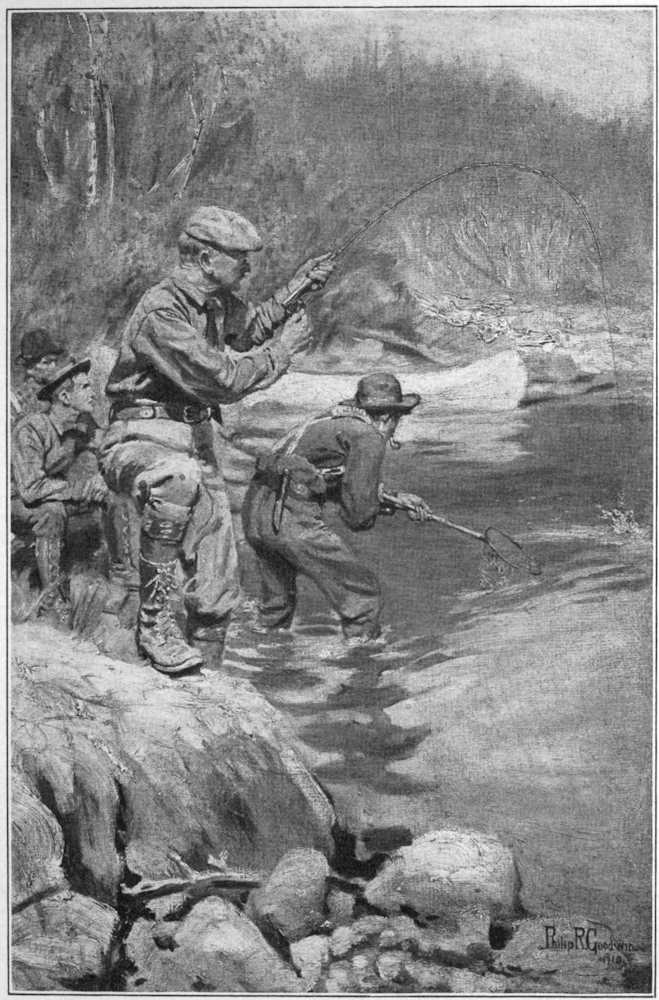
water into foam. The boy, crouching with the landing-net
at the water’s edge, followed the infinitely
quick scintillations with his eyes; the man, lifting,
lowering his rod, keeping the line not too tight, not
too loose, followed them, as mere human muscles
might, with his playing wrist; with that the long,
shining body, brown and gold and silver and pink
and scarlet and spotted, stopped struggling, floated
limply half out of water, and the large m’sieur,
flushed, anxious, drew him slowly inshore. Jack,
with the net deep in the pool four feet to the right
of the defeated king of it, waited till he was close—yet
not too close—till a clock in his brain sounded
the psychological second, and then—swoop; the net
rushed through the brown water, deep under the
trout and up with a sure curve. There was a mad
flopping and struggling, but the big fellow was
in the meshes and Jack lifted him up, both fists
gripping the handle of the heavy-weighted net, and
held him so at arm’s length high in air.
“Gosh!” said Jack.
The large m’sieur did not say anything, but he
lowered the butt of his rod with hands that shook,
and brought out a sigh that appeared to wander up
in stages from his boots. His face radiated a solemn
happiness several flights farther down than words;
his eyes were glued to the landing-net with its freight
of glory. He sat down on the rocks with his boots
casually trailing in the water and sighed profoundly
again.
“I caught him,” he stated.
“Sure,” agreed Jack. “You took him, that’s as
certain as the Pyramids. What’s more, you did it in
style. The way you played that fish, sir, was good
enough for anybody. You may not have experience,”
Jack allowed candidly, “but I’ll be hanged if you
haven’t got promise. You’re a wonder, sir—a plain
wonder.”
By now Jack was squatting before the net, laid on
a flat stone; his hunting-knife was out of the leather-fringed
caribou-skin sheath on his hip, and he had it
in his right hand, the dull side of the blade down,
while with his left he gathered the net tighter around
the still flopping great trout. The wet, dull nose, the
staring eyes were uppermost. Jack gave a sharp rap
on the back of the neck two or three times repeated,
and the king of Profanity Pool, with a long shiver,
was still. Then with big-handed dexterity he drew
back the meshes and pulled him out, a splendid,
shining creature twenty-two inches long.
The large m’sieur, watching the boy’s expert
work, made a sudden movement. “What fly is he
on?” he threw at Jack.
Jack, carefully withdrawing the net from its twists
and double twists around the tail, around the leader
and the flies, bent swiftly, examining. There was the
Parmachene Belle, tied in a yard or two of wet net-meshes;
there was the Silver Doctor, having run in
a half-second a complicated course through a system
of the same and caught itself in the snell of the Parmachene.
That was all. The lad gave a whoop that
set echoes ringing in the dark hills about Profanity
Pool and the gully of the little river.
“Gosh!” shouted Jack, while the large m’sieur
grinned triumphantly, “it’s the Scarlet Ibis!”
Three months later, on a day in November, a tall
young man in good clothes, with a clean face and a
hat, swung along a street up-town in New York
City. The setting and the costume were changed, yet
a person who might have met the bare-headed, gray-shirted,
earth-streaked woodsman and his guide in
the Canadian forest in August might still have
known this correct city character as Jack Vance.
The freedom of the woods had not yet left his
buoyant heels, nor the breeziness of the hills his
physiognomy; by these signs he was the same. But
his mind was working harder than it had on that
morning when he and Josef had found the large
m’sieur fishing by Profanity Pool; his eyes were
absent-minded and intense; if one might have
listened to his thoughts as his long pace lifted them
and him over the pavement, it might be that some
such sentence as this would have come to the light:
“Now how in thunder am I to tell if that’s interstate
commerce or if it isn’t?” Jack was thinking.
With the same whole-heartedness that he had put
into his fishing, into his woodcraft, the boy had
now flung himself into the study of the law at that
hot-house for starting the delicate green sprouts
which are to grow into trees of justice, the Harvard
Law School. He was in New York for what he would
have described as a “bat” of some days, yet his
work fermented in his brain in his holiday. He was
finding law, as one mostly finds things done with all
one’s might, a joy and delight. Yet for all the fun of
it he was badly puzzled just now, and anxious as
well as eager. After exhausting the sources of information
he needed more light.
“If I only knew a man who had a practical hold
on it,” his mind went on, throwing out tentacles to
search for help, “an older man—a clever man, a
man who—” he stopped short; a brain tentacle had
touched something in the dimness. Why had there
come to him in a flash the familiar atmosphere of
the woods, of fishing, of Josef and the little river and—in
a flash again he had arrived. “Profanity Pool!
The large m’sieur—Mr. Bradlee! He said he was a
railroad man—he said I was to call him up and lunch
with him; he said if ever he could help me about
anything he’d do it—by the sign of the Scarlet
Ibis. Ginger! I’m glad I thought of him. The very
chap!”
He dashed into a drug-store and rushed to the
telephone-booth. Here he was—Bradlee—W. R. H.—that
was the man. Wall Street—yes. And he took
down the receiver and gave a number. It was a bit
roundabout getting Mr. Bradlee. It seemed that the
approach to him was guarded by an army of clerks
and secretaries.
“He must think he’s mighty precious,” Jack complained
to himself.
One must send a name—“Mr. Vance,” Jack said
simply. So that when at last a voice out of the long
wire was speaking, the words “Yes—this is Mr.
Bradlee,” came with impersonal iciness. But Jack was
not given to being snubbed; his theory of the friendliness
of mankind prevented that, along with other
discomforts. “Oh, hello, Mr. Bradlee,” he threw back
eagerly. “I hope I’m not butting into business.
This is Jack Vance.”
“Who?” The chilly tone was a bit impatient.
“Jack Vance—of the Montagnard Club—we went
fishing—don’t you remember—?”
The identification was cut short by a shout at
the other end of the telephone in which there was
no iciness or impatience at all. “Oh—Jack Vance—why,
Great Scott, boy, it’s you, is it? I’m delighted
to hear your voice. I was thinking about you yesterday
and of how you fell down on the fly question.
The Scarlet Ibis was crude, was it? What have you
got to say about that now?”
Jack’s great pealing laughter went down the telephone
wires in response. “You certainly pasted me
on that, sir,” he agreed cheerfully, and then, “I
want to know if I can bother you with a question or
two about railroads,” he began, and explained the
situation briefly. He had been assigned to argue a
case in one of the moot courts—the mock trials of
the students—of the law school; it was his first case;
he wanted to win it “the worst way”; he was at a
standstill about a railroad question; he needed the
point of view of a practical experience.
“You’re a railroad man, aren’t you, sir?” Jack
asked.
There was a second’s hesitation at the other end
of the wire, and the answer came as if the speaker
were smiling. “Well, yes—I’m called that.” And
Mr. Bradlee’s friendly voice went on: “Tell you
what, my son—we can’t discuss law over the telephone.
Will you come down to lunch to-morrow at
the Lawyers’ Club?”
“Why, I’d simply love to do it, thank you,”
Jack agreed joyfully.
“Good. One o’clock. Come to my office. Possibly
I may find—somebody who will help me advise
you. We’ve got to win that case if it takes a leg—it’s
a sort of Scarlet Ibis case, I consider, you see.”
And with light-hearted laughter again at both ends
of the wire the telephone was hung up.
Promptly at one next day a tall young man of
fresh color was handed along with distinguished
courtesy from one to another of such an array of
officials as guards the valuable time of magnates in
great offices.
“Gee!” remarked Jack casually as he landed at
last in the private office and the very presence of
Mr. Bradlee. “Gee, this is ‘some’ different from
Adelard Martel and the tent, isn’t it, Mr. Bradlee?”
On the wall of the office, in a frame behind a
bulging glass, hung one of the ugliest and one of the
most satisfactory personal possessions which earth
affords, a trophy trout set up by experts. Its weight,
five and three-quarters pounds, was marked clearly
in a corner, above the date, August 7, 19—. Hooked
in the grim black mouth gleamed a red fly. This
work of art was examined, criticised, and appreciated
by the visitor before he took his way with
his host through the swarming life of down-town to
the great Equitable Building, which held the famous
club restaurant.
Three men were waiting in the reading-room as
the two went in, three grizzled, important personages,
who rose up and greeted Jack’s large m’sieur
as one entitled to consideration.
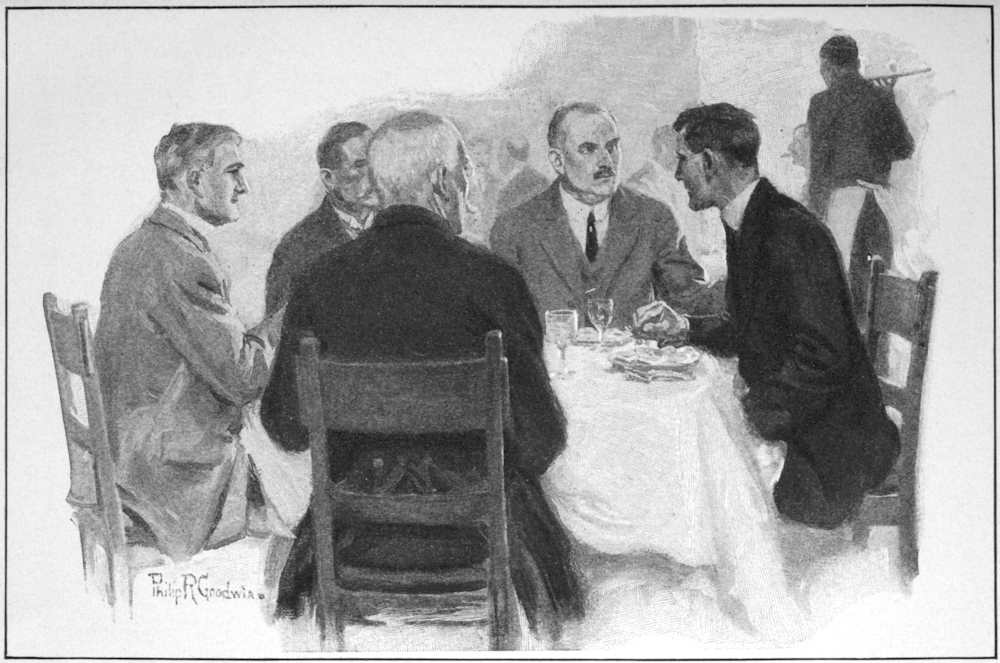
“I want to present Mr. Vance to you,” said Bradlee.
“Mr. Howell—Judge Carroll—Mr. Fitzhugh.”
And Jack, gripping the hands held out with his
friendly, bone-breaking hand-clasp, failed to see the
wonder at his youth on the men’s faces, for the wonder
in his own mind that the large m’sieur had found
him worthy to meet these bully old chaps, who were
quite evidently somebodys. Somebodys—who? He
wondered further. Shortly he found out.
“I asked you three here,” Bradlee began, waving
a comprehensive oyster-fork, “to meet Mr. Vance,
for a purpose.”
A bar of red crept up the clear brown of the boy’s
cheeks. He had not realized that these dignified persons
had come to meet him! He would have described
himself as “rattled.”
Bradlee went on: “It will advance the purpose if
I mention who you all are. Jack, Mr. Howell is the
president of the I. S. I. & O. Z. D.; Judge Carroll,
whom I luckily caught in town for the day, is on the
Interstate Commerce Commission; and Mr. Fitzhugh
is general counsel of four railways in the West
and South. If anybody knows what you want to
find out, these gentlemen do.”
“Holy mackerel!” said Jack simply, and flushed
scarlet having said it, and murmured etiquettically
something about “Certainly am mighty grateful.”
But the four, at the awe in the tone, at the untrammelled
expletive, at something winning and indescribable
in the lad’s embarrassment, broke into
sudden laughter, and Bradlee, well pleased, knew
that the charm which he had felt in the youngster
was working. With that he was telling, what most
men like to hear, a fish story—the story of the Scarlet
Ibis. Plenty of raps for his autocratic ways the boy
got as the large m’sieur told the tale, and once or
twice the deep-toned young laughter rang out in a
shout which made people all over the dining-room
turn and stare and smile. Jack did not see that, but
the elder men saw, and laughed too, and loved the
boy for it, as older men do love youth and unconsciousness
and joy of living.
“So you see,” Mr. Bradlee finished, “Izaak Walton
Vance slipped up on the fly and the humble
scholar guessed right. But the lad gave me the best
time I’ve had for twenty years, bar none, and he
taught me how to fish—I consider that worth anywhere
from ten to forty million. So I’m his debtor
to a large amount, and I want you three gentlemen
to help me to pay an instalment on my debt. I want
you to help the boy win his case in his moot court
up at the Harvard Law School. That’s what you’re
here for.”
“Speaking for myself, it will be a pleasure if I can
help Mr. Vance,” Fitzhugh enunciated with elaborate
Southern courtesy. “And speaking for people
in general, they certainly are likely to do what
Billion Bradlee asks.”
The lad swung about and flashed a startled look
at his host. “Are you—” he began and stopped.
Bradlee frowned slightly. “You’ve heard my nickname,
I see,” he said. “You didn’t place me before?”
“Place you—well, I just didn’t, sir,” Jack smiled
broadly. “You know, I thought you were so darned
extravagant about that Leonard rod.” And Bradlee
smiled too, pleased with the comrade-like confidence.
He laid a fatherly hand on Jack’s arm.
“State the situation now, Izaak Walton,” he commanded.
So Jack, stammering a bit at first, forgetting himself
soon, and, launching out into a perfectly regardless
wealth of law language which flowed quaintly
from his young mouth, set forth his case. There was
a small railroad, it appeared, running twelve miles,
from Skaneateles to Skaneateles Junction, wholly
within the State. At Skaneateles Junction the road
joins the New York Central. A train was made up
at Skaneateles, consisting of engine, tender, caboose,
four local freight cars, and one freight car billed
through to Chicago, via New York Central and
Lake Shore. A brakeman on this train was injured
between Skaneateles and Skaneateles Junction by
the negligence of the railroad company, but also
because of his own negligence.
“You see,” finished Jack, addressing the great
railway magnates and the interstate commerce commissioner
as man to man, “the question to be settled
is whether that small road is engaged in interstate
commerce, so that the brakeman may recover
in an action against it in spite of his contributory
negligence.”
“State the situation now, Izaak Walton,” he commanded.
Billion Bradlee, whose nod shook Wall Street;
Judge Carroll, who, with his associates, decided
every day vast questions of national commerce; and
the two powerful railway men listened with careful
attention. The four pair of keen eyes were fixed on
the boy’s face. The boy went on. His whole personality
was focussed now on his argument, and,
though in the vague margin of consciousness there
might have been a knowledge of the incongruity between
such an audience and a case in a law-school
moot court, yet the glow of his intense interest in
his affair reduced such thoughts to a dim fringe.
The boy went on, unembarrassed, throwing his free
power into his statement.
“You see, sir—you see, Judge Carroll, the act of
1898 speaks of ‘common carriers by railroads, while
engaged in commerce between any of the States,’
being liable to any employee for injuries while ‘employed
by such carrier in such commerce.’ The fact
of contributory negligence does not bar a recovery
in such actions.”
Conway Fitzhugh, who handled railroads in three
States, spoke consideringly. “It’s an interesting
question. I believe it has never been decided,” he
said, and the president of the I. S. I. & O. Z. D. followed
him up quickly.
“Possibly there has been no final test case. But
if such a position as Mr. Vance sets forth is maintained—if
the brakeman could recover—then there
is no such thing as the domestic trade of a State.
Congress may take the entire control of the commerce
of the country.”
Bradlee, leaning back in his chair, laid down
his knife and fork, and the perfectly cooked bird on
his plate was left untasted. His keen blue glance
swept across the table to Jack’s face. Jack, bright-eyed,
flushed, slashed off a manful bit of partridge
and stowed it away before he answered.
“There’s that view of it, sir, of course,” he answered
the mighty Howell respectfully but firmly—and
Bradlee chuckled. He remembered a fishing
lesson up a little lost river and the odd sensation of
being talked to as a novice. He wondered how Howell
would take these fearless tactics. The lad went on:
“But there’s a good deal of authority on the other
side. ‘The Constitution gives Congress plenary
power to regulate interstate commerce,’ you see—doesn’t
it, Judge Carroll? I think that’s a quotation
from one of your opinions, sir. And you may use
the analogy of the Safety Appliance act—under that
it has been held that a railroad wholly within a
State, not even touching the boundary line, may be
engaged in interstate traffic. Then there was an
example—let’s see—what was that?—it was a perfect
peach,” mused Jack, and the four dignitaries
waited, regarding him seriously. “Oh, yes—I know,”
he flashed at them joyfully. “You’ll remember this,
of course, Judge Carroll. The Senate was monkeying
with the question—I mean to say, the question
arose in the Senate. Senator Bacon supposed a case—he
said, take a purely local train from Richmond
to Alexandria. Clearly that train would not be engaged
in interstate commerce. A trainman injured
must sue under the Virginia law. Now suppose a
man at Orange Court House puts on a box of cigars
consigned to Baltimore—does that immediately
change the character of the train? After that may a
trainman injured sue under the United States act?
Senator Dolliver seemed to believe he could.”
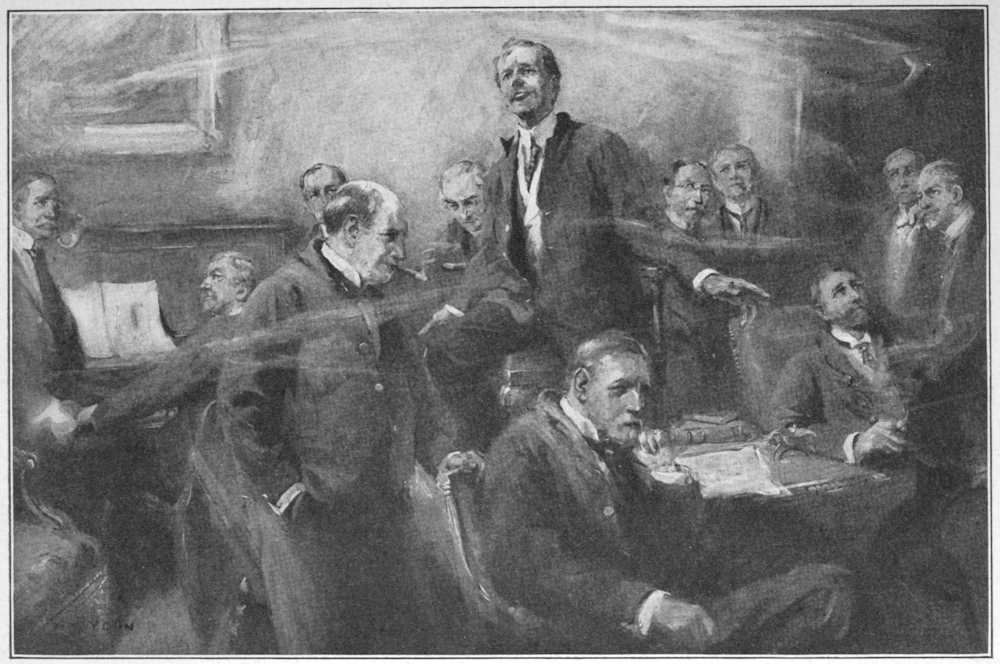
With that there was a battle of the gods. Even
Bradlee dropped his spectator’s attitude and descended
into the arena, for the point was one which
held a vital interest for each of the four, and the lad
had opened the ball with a dance of distinguished
authorities. Moreover, he had the literature of the
question at his fingers’ ends, and his shining spear,
bright and new, flashed back and forth in the thick
of the fray so readily, so accurately, that no thought
of difference in age entered the minds of the older
men any more than it did his own. It was suggestive
of certain remarks of Kipling’s calling attention to
the fact that
“There is neither East nor West nor border nor breed nor birth
When two strong men meet face to face, though they come from the ends of the earth.”
So the four captains of industry, men at the very
crest of international careers, and the lad not yet at
the beginning of his career, bringing only his eager
brain and hard-won young knowledge and the tremendous
impulse of his enthusiasm, debated together
as equals and gave and took pleasure and strength.
And the boy soaked in experience and ideas at every
delighted pore, till at last the lunch was over, and
Jack, due at an engagement, had to leave before the
grandees, and stood up to say good-by. In his manly,
boyish way he expressed his appreciation of their
help, and, as he towered above them all in his young
vigor and bright good looks, each one felt, perhaps,
that he had unconsciously given as much as he had
gotten, and that an impulse of generous new life
had swept like a rushing wind into the world-worn
minds from his contact.
“I can’t begin to thank you, sir,” he said, his
hand in his host’s, and Bradlee’s arm across his
shoulder half-caressingly. “I can’t possibly tell you
how I’ve enjoyed it. It’s been simply great. I—I’ve
never had such a bully time in my life,” he exploded,
and the others laughed quiet little laughs of older
men, but their eyes were very friendly as they
looked at him.
“We shall be interested to hear if you win your
case,” the mighty autocrat Howell said. “Bradlee
must let us know.”
“Send me a telegram, Jack,” ordered Bradlee.
“I sure will,” promised Jack heartily, “if you’d
like it, sir,” and, flushed and radiant and smiling,
was gone.
About four o’clock the door in Jim Fletcher’s room
up-town—where a club of three law-students held
their meetings for study, and where the confrère
from Cambridge was expected this afternoon to
battle with them over a special question—opened,
and three bent heads lifted from a table littered
with papers and legal-looking volumes to regard
Jack Vance.
“Come in,” Fletcher threw at him. “You’re
late. We’re half through. What are you grinning
about?”
Jack shut the door inside with an air of reserved
electricity which arrested the workers at the table.
He came and stood over them and they all stared
up at him; there appeared to be something to wait
for.
“Gee!” spoke Jack at last. “Guess whom I’ve
been lunching with.”
Carl Harrison drew a law-book toward him.
“Don’t care,” he stated with disapproval. “Get to
work, Jack; we’ve got a tough one on to-day.” But
Joe Lewis and Jim were interested.
“What’s up?” Joe asked. “Get it out of your
system, Johnny. Who?”
Jack stuck a thumb in each waistcoat pocket and
looked “chesty.” “Oh,” he flung at them casually
with his lips pursed and his eyes dancing. “Nothing
uncommon. I simply lunched at the Lawyers’ Club
down-town with four of me pals—Billion Bradlee—W.
R. H., you know, the railroad king, and Judge
Carroll, of the Interstate Commerce Commission,
and the president of the I. S. I. & O. Z. D., Mr.
Howell, and Conway Fitzhugh, the Southern railway
magnate—just us five, that’s all. We had some
business to talk over.”
And Jack, grinning consumedly, agitating his
fingers from the thumb fulcrums, posing his slim
figure as near as might be to resemble a bay-windowed
alderman, grinned more and watched the
effect.
“Come off,” responded Jim Fletcher.
“Stop your monkey-shines,” said Carl.
But Joe Lewis asked curiously: “What do you
mean, Jack? Give us straight dope.”
And with that Jack, chuckling very much, told
the tale, to the wonder and amusement and awe of
the three lads. And then, with a dizzying shift from
boyishness to the stress of the battle of life, the
shouts of laughter and light-hearted chaffing stopped
short, and the four bent, grave and responsible, over
the law-books, and the work of the day went on.
And the days went on and the Harvard Law
School and its events went on, varying from mere
recitations to trials in the moot courts, till a Thursday
came, three weeks after the luncheon at the Lawyers’
Club. There was an important meeting that day in
the impressive offices of W. R. H. Bradlee. People
had travelled from long distances to that meeting;
there was a man there from Texas, and Hugh Arkendale
had come from San Francisco on purpose, and
Conway Fitzhugh had left his home in New Orleans
two days before for it. Bradlee, opening the meeting,
was making a short speech setting forth its purpose
and importance. He had just begun when a rap
came at the door. Every one looked up in astonishment;
these men were as unaccustomed to being interrupted
in their councils as the gods of Olympus.
“Come,” thundered Bradlee in a terrible voice,
and an alarmed clerk slid hurriedly in and held out
a telegram.
“Orders”—he murmured—“any message from”—and
the name was a gurgle and the clerk bolted.
Billion Bradlee flopped the paper open, and, as if
a bar of rollicking sunlight had broken into the
dull atmosphere, his face lit up, as he read it, with
a smile, a most unfitting smile. His clear, keen blue
eyes flashed about the company a second, and then,
like a boy, quite unlike a great financier plying his
mighty trade, he tossed the yellow scrap to Fitzhugh.
“Good news,” he spoke—he was shaking a bit
with inward laughter, it seemed. “Read that,
Conway.”
The bald-headed general counsel of four railways
put on his glasses, while the rest of the august company
watched him and waited curiously. With careful,
deliberate enunciation, in a businesslike tone
and manner, the general counsel read aloud—a
picked company of the most important men in
America listening—these somewhat bewildering
words:
“Landed my trout Scarlet Ibis top of the heap
glory be won every blamed thing sure am grateful
to you and high mucky-mucks kindly pass on
thanks and accept most.
J. C. Vance.”
There was a momentary astonishment on the face
of Conway Fitzhugh as he stared over the yellow
paper at Bradlee; the varied expressions of surprise
on the dozen faces of the other men were a psychological
assortment; Fitzhugh suddenly arrived
with a jostle of quick laughter.
“Oh—that boy!” he said, and handed the telegram
back across the table. “That delightful boy—I’m
glad he won his case. Give him my congratulations.”
“A youngster—a friend of mine—and of Fitzhugh’s—”
Bradlee explained vaguely to no one in
particular, but the smile and the look of clean
pleasure were still there, and every one felt at once
as if a draught of sweet air had found its way into
the room and had refreshed them.
“Now, gentlemen,” said W. R. H. Bradlee, “as
I was saying—”
THE CAMPAIGN TROUT
THE CAMPAIGN TROUT
Josef and I were lifting our canoe into Lac Lumière
from the Dammed Little River when we saw
paddles flash up the lake. The “garçons,” Blanc
and Zoëtique, the brace of younger guides, had been
out to the club for mail; as that happened only once
in ten days we hustled.
I ought to mention that the Dammed Little
River is not so named entirely for love of blasphemy,
but because it is little and is dammed—it was over
that dam that we lifted the canoe. I’ll grant you,
however, that it may add a tang to the harmless
stream to call it by the fierce name, and also it
makes you feel pleasantly like a perfect devil to
swear that way without sin. Anyhow that’s where
we were that September afternoon, Josef and I,
just back from a two days’ hunting-trip to Lac
Sauvage country. I’d missed a moose, and I knew I
was going to get jeered when I got back to camp
and told my brother Walter, who never leaves much
to reproach himself with when there’s an opening
for jeerings. But I might as well face the music; and
besides, there was the first mail for ten days a mile
ahead between two glints of sunlight coming and
going—the paddles. So we hustled, as aforesaid.
But Blanc and Zoëtique paddling the home-stretch
are hard to beat, and they had landed minutes before
we got there, and were making oration with
Walter on the porch. He detached himself with difficulty
to greet me.
“Hello, Bob,” he threw at me, and “Bon jour,
Josef. Glad to see you. Any luck? Wait a moment
and I’ll talk to you.”
I sat myself on a bench and stretched my hunting-boots
over the landscape and waited per order. It’s
good for the soul to hear Walter talk French. He
was enthroned in the one store chair, a red rocker,
in the middle of the big camp porch, and I’ll tell
how he looked, for local color’s sake. He’s a lot
older than I to begin with—over forty, while I’m
only at Yale—and they made him a judge the minute
he cut his teeth—the youngest in the State. He
sat there appearing pretty prosperous, with his nice
beefy color, and his dark-gray clothes, and his dark-gray
hair, for his honors have gone to the outside
of his head only. He’s a trifle too embonpointish
around the hips, but great men often have a rush
of dignity to the waist-line, I notice. The light
splashed on his spectacles so that they were all you
could see of his eyes, but the glasses seemed full of
earnestness, and there was a deep line in the middle
of his forehead which comes when he’s most awfully
serious. He was this time. I’d have bet on it, when
I saw his pipe sitting on his knee like an interrogation-point
upside down.
Before him stood Zoëtique and Blanc, dressed in
odds and ends; trousers under their armpits, multiple
suspenders, slouch hats, a red bandanna, an
axe in Zoëtique’s belt, and a caribou-skin knife-sheath
with buckskin fringe in Blanc’s. Rummage-sale
effects. For all that Zoëtique’s got a figure
which any athlete might envy, deep-shouldered,
small-waisted, musclely—and Blanc moves like a
greyhound, all steel springs and lightness. They
stood respectfully in front of the red rocking-chair,
and behind them two miles of lake stretched from
the camp porch to the everlasting hills. In musical,
incorrect French, with the nice polite manner all
these habitants have, Zoëtique was getting to the
end of a story, as I gathered, about a fish. That
made it clear why Walter’s soul-depths were bubbling
and he couldn’t pay attention to me. He’s keen
for fishing. He’d rather fish than be President—rather
than shoot the biggest bull moose on record.
He had the package of letters in his hands, the first
in ten days; around him were piled rolls of newspapers,
and he hadn’t heard a new in all that time—but
nothing mattered. Nothing but Zoëtique’s
fish-story.
When Zoëtique’s crisp, rippling sort of low voice
stopped, Walter leaned forward and got ready with
anxious care to talk. To talk French was a necessity,
for the men didn’t understand English, and I could
see him working his intellect. He usually helps himself
to the French dictionary and kicks it, and calls
that conversation, but this was different. This was
about a fish—it was important to be understood.
“Si je comprenne, Zoëtique. Comme celà. Vous
l’avez view sortir à le Remous Doré, yune gros poison—gros
grosse—vous disons celà?”
I yelped a short yelp. The guides canvassed the
sentence with perfect gravity. I could see them
guessing. “View” they recognized as “vu,” I was
sure; and “yune poison,” was a fish, “un poisson”;
these transformations they’d run up against before.
But “sortir” stumped them a minute. They looked
at each other trying to remember if they’d seen a
big fish go out—sortir. Then Blanc got it—it was
“jump”—“sauter.”
“But, yes, M’sieur, it is true that one saw a big
fish jump—at the Golden Pool—as one passed. A
very big one—b’en gros—gros de même”—and the
knotty hands of Blanc measured a hearty three
feet.
“Great Scott!” gasped Walter excitedly, taking
it all verbatim as he does a fish-story. “Holy Moses!
it’s a six-pounder, at least!”
And with that the French language was batted
through a game. A Parisian would have sobbed.
But Walter got his questions out of his system, and
I pulled him from one or two sad holes by the boots.
And then the garçons raconté-d over again for me
how they had been passing the Golden Pool—the
Remous Doré—on their way up from the club with
the mail and provisions, and had been brought to a
dead stop by an enormous splash in the water.
Zoëtique specified that it was “épouvantable,” and
Blanc, with gestures of hands and shoulders, told
how he was so scared blue that he spilled into a two-foot
hole, and the pack slid off him. Then the trout
came up again, and concerning that appearance
they gave measurements. They had him half the
length of a canoe, and ten pounds heavy, by egging
each other on a little, and Walter didn’t doubt a
syllable; he didn’t want to.
“Je vous dites ce que nous faisait,” he addressed
them enthusiastically.
Then he arranged, with further language, that the
three, he and Blanc and Zoëtique, should go down
to the Golden Pool the next afternoon and collar
that fish. Then he let the men loose, and they
dissolved into the woods toward their own camp,
and Walter glared at me joyfully through his goggles.
“Bob, it’s a sockdologer; it’s the one that nibbled
at my fly two weeks ago, and I couldn’t get him on.
But it was hot, then, and low water, and lots of
flies for the fish to fill up on. Now it’s cold, and they’re
gathering in the deep holes, and the flies are frozen
out—I’ll get him.”
“Please the pigs, you will,” agreed I. “Sounds like
an old he-one, doesn’t it? And Zoëtique never does
lie as well as the rest. Give me my letters, won’t
you?” and with that he came to.
“Well, Bobby, I haven’t heard about your trip.
Did you have a good time? How was the water on
Lac à l’Isles? Have the beaver raised it? And did
you see anything? Get a shot?”
My time was come, so I unbosomed my sorrow,
and Walter was decent at first and said we all knew
what it was to miss, and likely the sights of my rifle
were wrong, as Josef suggested, and shooting from a
canoe was hell anyhow, and these Frenchmen
couldn’t hold a boat still—and all such things.
When you shoot crooked there are just so many
excuses from which your friends will choose comfort
to offer up to you, and you knew beforehand which.
But the feeling left is the same. If you’ve missed,
you’ve missed, and nothing alters that fundamental
grief and the yearning for blood and one more shot,
which remains. And conversely, if you’ve hit you
don’t give a button how easy the shot was, or how
many times you pumped your gun to do it. There’s
a profound peace in the pit of your being that religion
is powerless to bestow.
So as Walter ran over the reasons why I couldn’t
possibly have hit I appreciated his courtesy, and
rejoiced to be let off, but I was sore all the same.
Besides, there was a gleam behind the spectacles
which gave me a good hunch that I wouldn’t be let
off forever. A moose—to miss an old bull moose the
size of a barn! I couldn’t forgive myself, whatever
Walter said, and even if the rifle was gone queer,
which it was. I’ll mention in passing that not long
after I killed one bigger than the first, but that’s
quite another story. I told about my trip, and began
on my letters, and Walter took to the newspapers.
I heard him laughing in a few minutes, and I looked
at him.
“What’s up?”
He glanced at me over a paper, grinning sheepishly.
“They’re talking about me for governor.”
“Hey!” I hurled at him, for I was surprised.
“You!” And I got up and kicked before him a
little. “You! Hooray! Glory has come upon us. And
me associating with you just as free—!” Then I sat
down. “Tell me what it says,” said I.
Walter read some paragraphs from different
papers, and it sure did appear like a promising
young boom.
“Why, look here, Walter,” I gasped. “What’s the
likes of you doing in the wilderness? Oughtn’t you
to be down there fussing? Why don’t you beat it
for the settlements to-morrow—oughtn’t we to go
home?”
But Walter frowned evilly. “Go home? Not much.
I’m going to take that fish at the Golden Pool to-morrow,”
he snapped at me. “Besides, if they need
me they’ll let me know. Whatever happens, I mean
to get my fish to-morrow.”
Then I addressed him. “That’s too ridiklis,” said
I. “An afternoon’s fishing—and us candidates for
governor! Why, you make me laugh. I’m in charge
of you, my good man—”
“Oh, are you?” he inquired sarcastically.
“I am that. See?” So I punched him about a bit
till he yelled for mercy. I can handle him since he
got his embonpoint. I’m in training, and he isn’t.
“Don’t—don’t,” he howled; and then, as I slowed
down, “I do dislike physical demonstration,” said
Walter. And I gave him a dig that rounded his sentence
up with a squeal.
“That’s all,” I stated. “Just wanted to put you
in your place. Am I in charge?”
“Yes, yes—leave me alone, Bob,” he threw at me
hurriedly, and just at that second I happened to
look out at the lake.
I stood petrified. There was a canoe on it. Now
our own guides and canoes were all in camp, and
we’re away beyond everybody’s passing. Nobody
comes to Lac Lumière unless they come to see us.
Who under heaven could be coming to see us? It was
five-thirty in the afternoon, and nobody from another
camp would arrive at that hour, for it would be
too late to get back anywhere. One doesn’t walk
portages after dark in Canada. So I was petrified. It
was a canoe all right, however, and the paddles were
flashing fast; it would be at our dock in five minutes.
“What the devil does that mean?” Walter
growled, and I lit into the camp and brought out
my telescope, and in half a minute it was on the
canoe.
“Two guides—don’t know ’em,” I reported. And
then I shrieked in agony, “For cat’s sake—for cat’s
sake!”
Walter got excited. “Who is it—what is it?” he
threw at me.
“That’s what I say,” answered I. “Who is it?
what is it? It’s, a, straw, hat!”
“A straw hat?” Walter repeated, dazed-like.
For, you see, nature may abhor a vacuum, but I’m
willing to bet she doesn’t abhor it a patch on the
way she does a stiff hat. And there it sat in the
middle of nature, the lake gurgling around; dingy,
regulation guides dipping paddles bow and stern;
outraged mountains rising up green and sanctified
at the horizon; and, in the centre of the stage, a
shiny straw hat. It was too much. I dropped the
glass and doubled with too-muchness. And Walter
glued an eye to the lookout.
“It’s a straw hat,” he admitted, and reserved
judgment, and went down to the dock, me following
in all maidenly modesty.
In five minutes more the canoe’s nose ran up the
bank to our feet. We “bon jour-ed” the guides, and
then the hat was lifted respectfully and a lanky
figure of a man arose to his feet and stood wobbling.
The guides tried to keep the boat steady, but he
lurched at the dock and slopped over. His forefoot
went into some quite wet lake which we kept there—Canadian
canoes aren’t meant for doing the tango.
Walter and I snitched as one man at him, and
yanked him landward, but in the enthusiasm of
salvage his eye-glasses jumped him, and according to
the law of gravity made for a crack in the dock.
And somebody—said to be me—knocked off his lid.
It took to the deep and bobbed away riding a wave,
and Auguste, the guide, had to depêche like sin to
fish it in with a paddle. It was an eventful landing
for that sandy-haired youth, as we discovered him
to be on the escape of the hat. He squished water
sorrowfully out of the yellowest low shoes I ever
saw, and you couldn’t cheer him even when I set
his crown back on him and picked up his glasses.
He just pulled off his hat promptly and gazed at it
like an anxious mother and squished more lake out
of his yellow foot, and clucked softly—I don’t know
how to spell the noise, but it was a kind of a regretful
cluck. Finally he got his glasses rubbed and his
hat wiped, and Walter and I volubly offered him
dozens of shoes, though I knew we’d have to short-come
on the color. With the most exquisite courtesy
we walked him up-stairs over the muddy little precipice
of a trail to the camp, and sat him in the red
rocker, and offered him whiskey. But he wouldn’t.
Heavings, Maud! No. Not for him. So we fed him
Jamaica ginger and hot water, which I prefer myself,
if there’s sugar in it. And behold! he smiled like a
split in a potato and arrived at the next station.
“I beg you will pardon me, Judge Morgan. I have
been disturbed a little by these unfortunate accidents.
I have forgotten to explain my presence in your hospitable
camp. My name is Spafford. I am head clerk
in the office of Bush, Engelhardt & Clarkson. I come
from Mr. Engelhardt, Judge Morgan.”
“Huh!” grunted Walter in a sweet way he has,
like a cross codfish.
The sandy one looked bewildered. “Mr. Engelhardt,”
he emphasized, “the chairman of the State
committee. I mean that Mr. Engelhardt,” and he
paused to give Walter a chance to whoop for joy.
Walter not whooping, he trotted along glibly: “The
convention which is to nominate the candidate for
governor is on the eighteenth, and Mr. Engelhardt
decided yesterday that it would be best that you
should be there. You know, of course, Judge, that
you are likely to be nominated?”
“Huh!” remarked Walter again, making awful
faces, biting his cigar.
“Yes, sir.” Mr. Spafford answered that sound
with firm politeness. “Mr. Engelhardt thinks it
best.” And that to Mr. Spafford seemed to be final.
“To-day is the 14th. If you take the train with me
from the club to-morrow night at eight, leaving from
Quebec the next morning, we will reach headquarters
on the 17th, the day before the convention. Mr.
Engelhardt and I planned it out,” and he smiled
that split-rock smile again.
For the third time Walter got off that insulting
“Huh!” And then in a flash there spread over his
face a thick layer of a peculiar sirupy smile, which I
knew to mean an attack of pig-headedness.
“I’m afraid I shall not be able to join you on the
journey, Mr. Spafford,” he cooed.
Mr. Spafford looked flabbergasted. He simply
didn’t know the repartee. That anybody should disobey
Mr. Engelhardt seemed one form of insanity.
But here was a human being playing fast and loose
with the nomination for governor—that was a form
even more awful. His pale eyes popped till you could
have knocked them off with a stick.
“Are you ill, sir?” he exploded finally.
“Oh, no—not ill, Mr. Spafford,” Walter answered
gently. “But I’m going fishing.”
The cigar which Walter had fed him dropped
splib on the floor, and the lower half of his mouth
nearly joined it. “Fishing!” he gasped. “Fishing!
But—but,” hope dawned. Maybe Walter was absent-minded
or deaf or something—he surely hadn’t understood.
“Judge Morgan,” he began in a first-reader
effect, “it—is—the—nomination—for—Governor.”
He got into capitals at that point. “Mr. Engelhardt—the
Chairman—of—the—State—”
Walter headed him off. “I know—I grasp,” he
interrupted softly. “I would like to be nominated
for governor very much, but there’s a big trout,
Mr. Spafford—are you a fisherman, Mr. Spafford?”
he interrupted himself in dulcet tones.
“No.” The stunned one stared.
“Ah! then you can’t really quite understand. I’m
so sorry to disappoint Mr. Engelhardt if he wants
me, but you see it’s this way.” He proceeded to
explain elaborately, as if in court, the situation to
that dumfounded youth. Walter showed him carefully
how the fish wouldn’t bite of a morning, and so
the first time he could take this one would be the
next afternoon. He pointed out that he’d been after
this fish off and on all summer, and how big he was,
and how one could see that it would be out of the
question to leave before he killed him. This and
more—details about flies and low water and such
things.
When he got through, the head clerk of Bush,
Engelhardt & Clarkson didn’t know what he possibly
could be talking about. Then a bright idea
struck him. Walter was a practical joker—and with
that we got the privilege of hearing Mr. Spafford
laugh. It wasn’t dead merry laughter; it sounded
like a rapid-fire Christmas horn gone rusty. “I see,”
he arrested the flow of it to explain. “You are jesting.”
And with that I butted in.
“Not on your life, he isn’t,” I stated. “But it’s
too blamed bad. Walter, don’t go and do such a
perfectly rotten—” and at that point Walter’s eyes
flashed fire, and I stopped hurriedly.
But I didn’t give in for all that. I can get him to
do things sometimes when most people can’t, and I
was bound to try this time. So that night, after we’d
tucked up the Spafford blossom in his downy guest-tent—and
he was horrid nervous about beasts and
spiders—I went into Walter’s camp and reasoned
with the Judge. I pointed out things which are obvious
to the intelligence of a frog, and after a while
I got him to shed his sirupy smile and talk sense.
“I’m not keen about being at the convention,
Bob,” he explained. “If the nomination comes of
itself I’ll be delighted, but I’m not the build to roll
logs and keep my dignity. And I don’t care to be
led down on a leash by that young fool. I don’t know
what Engelhardt means by sending me such an infernal
puppy.”
“Ought not to talk that way before a boy like
me, Walter,” I remonstrated. And then reminded
him that Mr. Spafford meant awfully well, and that
it was his proud boast that he’d been sent because
of his reputation for persistence.
“Persistence—heavenly powers!” Walter groaned.
“I should say he was persistent. Like a terrier this
whole evening. Made camp a hell. I’m so relieved to
get him to bed that I could yell for joy.”
Back I went to the point. I saw he was only reluctant
to go out, not dead set against it, and I
thought Mr. Engelhardt could likely judge better
than he could. I asked him, and he said yes, likely,
and that it was no harm to be there for the convention,
only—he didn’t feel like it. And he felt amazingly
like taking that trout. Well, I managed a compromise.
It was agreed that we should break camp
next morning, and go down ahead of the guides
early in the afternoon to the Golden Pool, he and I
and Mr. Spafford, and there Walter should fish till
it was time to go on to the club to catch the train.
If he could corral the sockdologer before that psychological
moment, well and good. If not—well, he
wouldn’t promise, but I had a hunch that if we were
all packed up he’d go on. Anyhow it was the best I
could do. So I took Mr. Spafford aside next morning
and stated the case, with a rosy glow over possibilities;
and I warned him politely not to nag at
Walter or he’d break for the North Pole, and never
be governor or anything else but a frozen corpse.
Next morning we were busy little housewives,
bundling our earthly alls into the big canvas mail-bags
which are our camp trunks. The guides were
flying back and forth, and everybody was bubbling
French, and lots doing. And in the middle of it the
poor Spafford waif clung to the red rocking-chair,
with the straw hat on his head, lost in wonder. He
couldn’t comprehend why people who might live
in houses with rugs on the floor, and lace curtains
and upholstered chairs should choose to do this. I
saw him stare at a three-inch hole in my left trouser,
where my complexion showed through, and then lift
his wondering eyes to my gray flannel shirt, with
much mountain wiped upon it, and a red cotton
bandanna decorating the neck of it—he couldn’t see
through the game. You have to be born to it, or
you can’t.
We got off about two, Walter and I paddling, and
Spiff in the middle, in the hat. We left all the guides
to shut up camp and bring on the “butin.” We paddled
two miles down the lake, and then into the
river among the rocks—it was low water and you
had to know the channel. We shot a little rapids, and
the flower of civilization was scared blue, but we
made the portage, and there I flopped the canoe on
my head and walked off, and Walter guided the
steps of the stranger. It’s only a mile down the portage
to the Pool, so we got there an hour after leaving
camp, and Walter at once paid no more attention
to anybody. He began to put up his Leonard
rod as if it were a religious ceremony; he does it that
way. He had his leader ready, and I saw him meditate
on the flies, and then open his fly-box and look
it over thoughtfully to see if there was anything
more seductive to the troutly mind. I remember
that cast; it was a Jock Scott for hand-fly, a Silver
Doctor in the middle, and a Montreal tail-fly.
That’s the way he started. Afterward he changed
the Silver Doctor for a brown hackle—it was a
brightish day. The minute he began to string the
rod, it came to me that we’d forgotten the landing-net.
That was ghastly when we were out for big fish,
but it was much too far to go back, and I knew the
guides would have it, and so I hoped the giant
wouldn’t get on, and Walter wouldn’t notice about
the net till the guides got there. And I kept mum,
not to fuss the fisherman.
The Golden Pool was named that because it is.
In September, when we fish there most, the leaves
around it have turned yellow, and yellow only, for
we’re too far north for red foliage, and it’s all in a
bath of gold light. It’s a widening in the river about
a hundred yards across, and a lot of it is shallow, so,
of a bright afternoon, the tawny-colored sand-bars
show through. And all around the shore are tall
birches which lean over, and their thin leaves are
gold-shot, and the sun glitters through them. There
are alders close to the water, and these are frost-touched
too, and the stream rushes in over a steep
rapids at a gorge between alder walls. It tumbles
flashing around rocks in tier on tier of champagne
whiteness, with sherry-colored slides of smooth
water, and in the deep holes it’s the gold-brown of
brandy. Flecks of foam whirl over the surface,
and under the bushes at the edge lie feathery hunks
of it like piles of whipped cream a foot square. As
you get to the place from the shadow and quiet of
the woods, you seem to have come into a shower of
glancing light and movement and excitement. You
breathe in autumn and energy sharply. Yet it’s all
as still and remote as the big shadows on the mountains.
That’s the Golden Pool, and that’s where
we got, the afternoon of September 15, when my
brother squatted on the rocks, and put up and strung
his rod.
The reel sang as the first line ran, and the snells
fell stiff and curly—but not over the hole—trust
Walter not to stir up that hole till he was ready for
business. In two or three casts the snells were wet,
and the flies spun out on the brown, foam-spotted
water. And then Walter cast carefully at the edge
of the real fishing-ground. Along the left-hand side
of the Pool the bottom is all big rocks, and in between
are deep, cold holes, and there the big trout
lie—never many, yet every year two or three good
ones are taken by the few who know the secret, from
a place about twenty feet square. It’s ticklish fishing,
for there are sharp edges to the rocks for an
educated fish to dodge under, and more than once a
leader has been cut in two by a jerk from a fish that
knew his business; and many’s the fly yanked off
around those edges. So it’s skill against skill, man
with his clumsy inventions against trout with his
exquisite instinct—human brains out of their element
against trout cleverness in its stronghold.
That’s the way it is when you go fishing in the
Golden Pool.
Walter cast his prettiest from the first, and that’s
very pretty casting indeed. The dim-colored Jock
Scott danced delicately toward us as he lifted the
tip of the rod, hardly touching the surface; the Silver
Doctor just wet its bluish, silverish wings, and the
Montreal, with its streak of purple-red, dragged a
bit in the water; big trout are more likely to take a
fly underneath than to jump for it. It was all done
in regulation form, slow recover, wrist motion only,
sidewise jiggle as the flies came in, a lengthening
line covering the hole slowly from side to side.
Close back of us was the forest, with just a few yards
of big rocks and low bushes for clear space; the
recover, you’ll see, was a critical business. It was
mighty easy to catch a fly in one of those alders or
on a fringe of tree, but Walter didn’t catch once.
He’s a shark at the job. However, it was too early;
the sun was too strong; nothing doing. So, after half
an hour of exhibition casting:
“Take me across, Bob,” said Walter, his eyes still
fast on the Pool.
So I slid the canoe in, away off one side, awfully
cautiously so no ripple would disturb the sacred
and holy twenty feet square. And Walter stepped
in the bow, and I slid the paddle into the water
without a splash, and in two or three careful strokes
I had him over at the farther side of the pond, well
away, but yet within casting distance of the hole.
“Zip” went the reel, with the businesslike, sharp,
soft sound which means it’s well oiled and well
wound and well managed. It’s a joy to hear Walter’s
reel. Out flew the nine-foot line of light which was
the leader, and over the brown water danced three
spots of color which were the flies. And then I saw
Walter’s fist jerk back about two inches, hard, and
my eyes jumped to the leader, and the hand-fly was
taut, and there was a bunch of white foam where it
should have been, and a great bubbling of water,
and the Silver Doctor and the Montreal were floating
loose, and the kicking and bubbling and struggling
were stronger each second. A fish was on the
Jock Scott, and Walter had hooked him. I watched
about thirty seconds with my heart in my mouth,
and then I knew it wasn’t what we were after. And
with that Walter gave his pretty grunt.
“Huh!” he said, and began to reel in, casual-like.
“Smoll feesh?” I asked, as Blanc talks English.
“Yes, the little cuss,” Walter murmured, and
yanked up alongside the boat a three-quarter-pound
trout.
“Want to keep him?”
“Heavens, no!” said Walter with contempt.
So I laid the paddle in the boat, and wet my hands
in the stream, because if you don’t do that your
touch will take off the overcoat of slime that’s necessary
to a fish’s life, and he’ll die. If I’d wanted to
keep that fish I couldn’t have landed him without
a net. He was hooked by just a thread in the upper
part of the mouth. But I got the hook out gingerly,
and presented him with the freedom of the pool,
and he slid off with no remarks. He lived all right.
Then big brother proceeded to disgust himself and
me by taking rapidly, one after another, five half
and quarter pounders. I threw them all in, and, seeing
we were too popular with the small game, we
moseyed back to the rocks.
Meanwhile, all this time the outcast from civilization
was sitting on my sweater on a rock, gazing in
wonder at the lunatics. If it hadn’t been for the
infallible Mr. Engelhardt, I’ll bet he’d have shaken
Walter as no fit thing for governor, but as Mr.
Engelhardt said he was, why, he was. Somehow, because
the chairman of the State committee ruled
the cosmos, and said so, Walter had to be nominated.
So he sat, and just wondered. I thought I’d try to
open a dark side of life to his vision—be a missionary,
as it were. Walter had brought the rod-case, and I
dug out an old fly-rod and strung it, and put on a
leader and three flamboyant flies—a Scarlet Ibis,
and a Grisly King, and a White Moth—regular flag
effect. Then I charmed him with kind words to follow
me down the pool a way, and he followed, lamentably
complaining. He fell into holes. At last I got
him where he couldn’t hurt the fishing, and I showed
him how not to hook the tree tops, and how to work
the automatic reel, and then I put the rod in his
virgin hands and said, “Fire away.”
For about three casts he was doing it to oblige
me. Then an infant trout, out of an asylum for
feeble-minded orphan fish, jumped at the Ibis and
hooked himself enthusiastically. And I took it off
and showed it to Mr. Spafford—his first trout!
And you wouldn’t believe what a hurry he was in
to cast again. It sure was funny. But that’s the
magic of the game. The primmest of humans aren’t
proof against the lure of fishing when they take
something. So he took another, and he was a figure
of fun, standing on a rock in that wild place in his
store clothes, gleaming at head and foot with brightness
of straw and leather, prancing with excitement,
and casting very fast. I showed him points, and he
began to catch on, but he threw a fit when he hooked
the Grisly King to a spruce-tree, and I had to climb
for it.
“If you could go faster, Mr. Morgan, I’d be
obliged,” he panted. “There’s a large trout in the
pool which I can see, and I want to catch it.” And
then a frank groan: “Oh, mercy, do hurry!”
So I yanked the fly off the branch and slid, and
he was casting before I struck terra cotta.
About then I began to be conscious that time was
passing. I looked, and it was 4.30; the guides might
be along any minute and we’d have to go on our
winding way in half an hour if we caught the train.
I glanced across at Walter. He was changing a fly.
He put a Brown Hackle in place of the Silver Doctor.
He sent two or three short casts, letting out line,
and the reel whirred sharp above the gurgling of the
rapids. Then he loosed a reckless handful of line on
the butt, and his wrist went back, and the flies
sailed high and forward and floated out over the
pool and touched without a sound—the Montreal
under water, the Hackle skimming, the Jock Scott
an inch over the surface. A corking cast, over sixty
feet, I reckon.
Suddenly there was a swirl, and the Montreal
went under deep, with a steady old he-pull. No mistaking
that taking of the fly—it was a big trout.
Sometimes a huge catfish will make you think he’s
a trout, but you can’t ever mix a trout of large
calibre with a catfish. It isn’t done.
I saw the swirl and pull, and I leaped into the
woods and heard my scholar fisherman wailing as I
fled. I knew that Walter had on the whale, and the
thought of the landing-net minus made me sick. I
crashed through till I got back of Walter; then I
called just a word:
“Go slow till I get the net,” and up the trail I
bolted to meet the guides.
Right where the Green Velvet Brook comes in I
met them; we call it that because there are yards
of flat rocks each side of solid emerald-colored moss.
Zoëtique was prostrate on his lungs with his face in
the drink; Blanc was dipping it up in his hat; the
others were lighting pipes; my eyes lit on the four-foot
handle of the net, and with that I lit on it. I
grabbed it without breaking the stride, and was
loping back down the trail, and not a word said.
Those men were surprised—the tail of my eye saw
that. I took the portage at a hand gallop, and slowed
down twenty feet behind the pool, and crawled out
over the rocks to Walter.
“The net is here,” I gasped at him, and Walter
didn’t throw me a syllable, but I knew he heard and
would be civil when he got time. The brute was
sulking. Down in the rocks—blamed dangerous
trick. It was all uneven on the bottom, and the rocks
were big, and there were deepish holes, and if he
could get the leader across a rough edge and yank,
or if Walter pulled a bit too hard, he could cut the
leader and be off in a second. He knew it too—he was
an educated person, that trout. Wherefore it behooved
Walter to fish like an archangel.
He didn’t look the part, being screwed into a
wuzzle behind his gleaming glasses, but if pretty is
as pretty does, he was a beauty. He held Mr. Sockdologer
on a short line, just feeling him, and giving
him a tiny lift now and then to keep the game going.
Exactly the right amount, that’s why fishing is
hard; you have to do it right to a hair’s breadth,
which is instinct. You acquire it by patient years of
losing fish. So the candidate for governor, huddled
in a brown lump, sat on an inconvenient-shaped
rock and held himself there by one boot planted in
the water, and didn’t give a hang for the governorship
or the discomfort—those qualifications also go
with a fisherman.
I lay along a chosen log six feet back, and watched
the battle. And pretty soon I was aware of shapes
that melted out of the trees, and it was the guides.
They slid together back of me like a group of fauns
or other woods creatures only half human, in the
shadows, and there wasn’t a sound from them, but
a wreath of blue air floated forward in a minute,
and I got the dim odor of Canadian tobacco. That
odor always seems to me just one remove from leaf-mould
and growing ferns and spruce-needles and
other forest-speaking smells. So there we all watched,
while Walter fought the fight.
And around the corner of the pool, out of mischief,
Mr. Spafford, mad with excitement, fished his first
fish with squeals of rapture and of agony. I couldn’t
see him, but I could follow the plot by the noises
he made, and I had to chuckle, in spite of the real
job on hand. First there’d be an “Oh!” high and
sharp, of excitement and hope—a trout was on;
then an “O—O—Oh!” deep and mournful—he’d
lost him. Then he’d adjure them.
“Come, little fishy,” said he; “nice fly—jump for
fly, little fishy,” as unconscious as a kitten, and as
lost in the game. And pretty soon I heard the men
behind me giggling softly, and as I squinted up they
were shaking en masse, and trying to see the débutant
Izaak Walton around the trees.
About then, out of the hidden deeps the whale suddenly
rose right at the rod, coming with a smooth
velocity that was terrific. The tip went up, and the
reel ate line; the line kept taut. But it was a miracle
that did it, and if the beast had got an inch of slack
he’d have shaken loose; he knew his job, the trout.
And the next second the reel screamed, and off he
went like a cannon-ball, out and out and out, tearing
down the stream, and Walter had the rod straight
forward, lowered almost to the water, giving him line
by the yard. It was a tremendous rush, and I tell
you I was proud of Walter. That minute and the
next two or three were the most superb fishing-show
I ever had the luck to be in at. For no sooner had
the beast run like mad for sixty feet straight from
us, than he whirled as chain lightning, and scooted
for us, licketty-split. I thought that settled it; no
human could manage a line at that angle, I thought.
I heard Zoëtique gasp softly back of me:
“Mais, bon Dieu, c’est fini!”
But it wasn’t “fini.” Up flew the tip of the rod;
Walter was turning the reel rapidly, and the line
was ripping in without a sag, without a jerk—I never
saw the equal of it. That, if you please, sir, is fishing.
Also it was lightning. Quick! Heavings! It discouraged
old man whale. Down he went into the rocks
again, sulking, and I knew Walter would rather
have him do rushes than that, for there’s nothing
so anxious in all fishery. You can’t ever tell what
minute’s going to be an earthquake, and you don’t
know what jagged edges he’s got down there to
jerk himself across, and you don’t dare pull him,
and you don’t dare hold him easy. It’s all guesswork,
and mighty dangerous. Moreover, for a hole, the
hole was shallow, and you had less leeway with the
line, and a mistake in gauging the depths would be
fatal quicker than in deep water. So Walter had a
handful and a brainful.
Into that breathless situation reverberated a roar.
“Oh, Mr. Morgan! Oh, Judge! Oh, Mr. Morgan—come
and get ME. I—want—to—go! It’s five o’clock!
Come, and get ME! It’s five o’—”
And about there Walter looked up and frowned
vaguely, and I arose and hesitated as to how to kill
quickest. Walter’s eyes strayed back to the brown
pool with the white bubbles doing waltzes and two-steps
across it; and with that, as I stood reflecting,
I was aware that Mr. Spafford was trying to come
alone. All of two hundred yards—the dare-devil.
I knew it by a crash as of a bull moose, and a howl
following. He’d gone into a hole the first thing.
“Oh, my! Oh, my!” I heard him moan, and then
more crashing, and the guides splashed suppressed
laughter all over me, but Walter didn’t hear. His
soul was at the end of the thread that dipped out
of knowledge at a point of the dark water.
And in a second we were all intent on that same
point, for the trout opened up hostilities once more.
Without warning he gave an enormous pull and rose
to the top and shook himself, and broke water, and
beat with his tail, and tossed, and jerked, and rolled,
and raised the most dangerous Cain ever, and Walter’s
wrist followed the ins and outs of it faster
than any mind could possibly think. If your subliminal
consciousness doesn’t understand fishing you
might as well give up when a trout gets to that
act, for no up-stairs thinking-machine ever could
follow. However, Walter’s sub-qualities saw him
through, and the whale went down again, visibly
tired from the struggle.
And out of the woods burst our guest. So sad and
bad and mad he was that I crouched before him.
“Judge Morgan,” he fired at Walter, who paid no
more attention than if a puppy was barking; “Judge
Morgan, I’ll say nothing about the condition of my
clothes.” So I took notice, and there was a six-inch
square tear in the right knee of them clothes, and
the piece flopped.
“Too bad,” I murmured, and he glanced at me
sarcastically as who should say he knew well enough
I’d put that stick to catch him, so I needn’t be hypocritical.
He further addressed the court:
“Judge Morgan, I’ll suppose that my discomfort
has not been caused intentionally—I’ll suppose
that.”
Walter lifted the tip of the rod the least gingerly
bit, and promptly lowered it; he was there.
“Judge Morgan, I’ll not further mention myself,
but for Heaven’s sake, for reason’s sake, for Mr.
Engelhardt’s sake, stop catching that fish and come
and catch the train. I adjure you, do not throw away
the prize of your career, the governorship,” and that
was shrieked in large capitals. His voice trembled
with emotion. He thrust his hand into his trousers-pocket,
and halted a mere second; then he pulled out
of that pocket as he went on—I couldn’t believe my
eyes—he pulled out of that trousers-pocket a small,
slimy, dead trout, and cast it from him, and pulled
out another, and up to six, and discarded them on
the rocks contemptuously. And I gasped, and the
guides lay down and rolled, choking, but his voice
went on in great exhortation: “The governorship!
For a fish! Come, Judge Morgan. Be sane. There’s
time, but not more than time. We must start this
instant—we must hurry—but we can make the
train. Judge Morgan, I entreat you—come!”
And that “come” was a howl that penetrated
even Walter. When he’s annoyed he’s likely to take
his glasses off. He did that now, pulling them away
hurriedly with one hand, and staring up at the exhorter
near-sightedly, like a troubled bat. “What’s
all this?” he growled, and threw me an appealing,
irritated glance. “I’m not going anywhere till I kill
this fish—you ought to know that, Bob!” and then
he put his glasses on and threw one surprised glance
at the little dead fishes on the rocks, and settled
back to his rod, and I think plain forgot Spafford
and me and everything else.
I realized that the universe, barring the trout,
had been put up to me, so I took the wheel. “Mr.
Spafford, I’m sorry; but it’s no use. Derricks couldn’t
stir him. If you want to go on, you can take two
guides and make the train all right. I’m awfully
sorry, but my brother wouldn’t drop his rod, as
things stand, to be made czar; we might as well
give up.”
“But it’s insanity! It’s—it’s criminal! It’s—”
I just agreed. “All of that,” said I. “Only it’s
Walter. He’s that way, and I can’t change it. It’s
pretty selfish of course”—and I looked sidewise to
see if the criminal was taking in things, but not an
eyelash quivered.
The outraged Mr. Spafford held out a disgusted
hand in answer to mine. “I shall tell Mr. Engelhardt,
and he will believe me, but he will not understand.
No reasonable person could understand that a sane
man would throw away the governorship for a fish.
Good-by.”
At that Walter looked up with the nice beaming
smile which makes him so popular and said pleasantly:
“Good-by, Mr. Spafford. Sorry you have to
go. It would be nice to be governor, Mr. Spafford,
but it’s necessary to finish the job I’m on.” And in
two minutes more the dumfounded youth was in a
canoe between Henri and Godin, and the paddles
were flashing down-stream beyond the Golden Pool.
Walter played the trout twenty minutes more—forty-five
minutes in all. There were more rushes,
and more sulking, but the runs were shorter each
time, and the brute was plainly getting tired. At
last the battle was practically over, and the huge
fish was swimming near the surface, rolling on its
side and flapping its fins helplessly, and Walter drew
it this way and that, waiting to land it till the psychological
moment when it should be too tired to
shy at the net and break loose, as happens often
after a great fight. Zoëtique knelt by him on the
rocks, intent and excited, but responsible, and dipped
the net softly in the stream to make it pliable, and
then held its mouth toward the moving fish, following
its course, ready every second for Walter’s
signal.
“Now!” said Walter, and the net swept toward
the trout, and the trout, with a last effort, splashed,
tore, ran—Zoëtique had missed him.
We all gasped in unison. Then for two or three
minutes more the fish was played gently, carefully,
back and forth, near the surface always now, and
then suddenly Walter’s chin lifted, and Zoëtique,
half in the water himself, brought the net around
and up with a splendid sweep, and in it, high in air,
flapping and splashing spray over us, was the great
trout! And when the net was lowered, and Zoëtique
got out his big dirk to finish the beast with a rap
on the skull, v’là! he fell off the fly into the net.
Lightly hooked as that, and Walter had saved him!
It sure was a mighty fish-fight!
My! you ought to have heard Walter sigh. And
one minute later you ought to have seen him grin. It
was an hour of glory. Then the guides were given
cigars and drinks, as is seemly at a great killing, and
then the scales were dug out. Six and seven-eighths,
just short of seven, the record in the club for the
Salmo-Fontinalis on a fly. Of course, they’re taken
up to nine pounds in our waters in spring, but that’s
trolling, and no credit to anybody. The whale of the
Golden Pool holds the record, to this writing, for
sporting fishing.
And here ends the first chapter. Walter claims
that here ends the story, and that the sequel is a
detached incident. But I am now come to man’s
estate, and I happen to have a perfectly able hunch
of my own about that. It’s the sequel—I give it.
“Now!” said Walter, and the net swept toward the trout.
We went back to camp that night, and by careful
observations my brother hadn’t a regret in the
world, and crowns and principalities and governorships
weren’t on his mind, which was et up by a
huge gloat over his fish. He was the most deeply
satisfied man I ever saw, that night, after he’d
“thrown away the governorship”—see Spafford as
above. We trotted along back and unpacked our
“butin,” and settled down, much like that emperor
of Russia and his thirty thousand men who drew
their swords and put them up again. We stayed a
week, and not an uneasy glance did I surprise in
Walter, but once and again an amused one with a
chuckle onto it, as something recalled the Spafford
episode. We got no mail and he seemed not to care.
At length we broke camp definitely, and paddled
down the lake in the sunshine of a glorious cold
September morning, looking back longingly to
where our long, low log palace, barred and empty,
blinked blind, reproachful windows at us through
the trees. We did hate to leave—we always do.
We got to the club-house at five in the afternoon,
and everything was dead quiet; not even Demerse,
the steward, was in sight. So we wandered up through
the birches to the big house and stood a moment on
the veranda to watch the guides bring up the pacquetons.
Walter was bossing it, so I just stared at
the last wild-woods picture I’d see for a year.
Around the cup of Lac à la Croix in front of us were
two sets of mountains: one stretched calm miles of
greenness and sunshine into the horizon; its double
dipped deep in water upside down, and the wind
zigzagged wet silver across the submerged spruce
spires. With that, out of the spruce spires as it appeared,
leaped Demerse panting before us, excited,
much-grinning.
“Bon jour, Demerse,” said Walter cheerfully, and
shook hands and went on bossing the guides. “Godin,
je veux que vous faisait”—he began. But Demerse
wasn’t to be corked that way. Not much.
“Bon jour, m’sieur le gouverneur,” he burst forth.
“Mes félicitations à votre Excellence. On est b’en content
de ces nouvelles, m’sieur le gouverneur,” and he
grinned and panted more.
“What the devil are you talking about?” remarked
Walter impolitely, and instantly translated, with
that friendly comic grin of his which nobody seems
to resist. “Quaw le diable est-ce que vous disez, Demerse?”
he said. With that Demerse burst into the
club-house and brought forth bunches of papers. It
was so. They’d nominated the old rascal, whether
he would or not. We read that first, and Walter was
interested enough and pleased enough to satisfy
even Mr. Spafford. Then I lit on a head-line in huge
letters, which read:
“‘Consider the Contrast. Candidates of Different
Calibre. Holloway Leaves Sick Child to Make
Speeches. Morgan Says’”—and then I yelped, and
joy got in my legs, and I threw down the paper and
leaped a leap in mid-air.
“Read it, cub; read it, you young cuss,” Walter
fired at me, and I read:
“Morgan says: ‘It would be nice to be Governor,
but it’s necessary to finish the job I’m on.’”
In small type below was the story about the fish.
All straight, too. Spafford in deep disgust had told
it to Mr. Engelhardt, and the chairman had been
quick to see how to use it as a campaign catch.
Holloway, Walter’s rival, had left his small boy,
about to be operated on, to get to the convention,
and was awfully criticised for it; so the picture of
immovable old Walter sticking to his fishing made
a grand set-off to Holloway’s nervousness.
We found it in paper after paper. Mr. Engelhardt
said afterward that the simple account of Spafford’s
despair and Walter’s solid-rock front of determination
to get that trout first, and then attend to the
governorship, but to get the trout first anyhow—that
the account of that did more for the nomination
than Walter’s presence could have done. It
seemed to tickle the people to have him look after
the job on hand, and be impervious to everything
else till he put that through—and that’s the way the
old chap is. Single-minded. I brought him up rather
well, if I do say it, and I only hope this governor job—for
he’s elected now, you see—isn’t going to spoil
our camping-trip next summer. So does Walter.
THE REWARD OF VIRTUE
THE REWARD OF VIRTUE
This is a story about my guide, Josef Vezina.
He’s a corking guide and a wonder at hunting, and
all sorts of a good fellow besides, but he’s a French-Canadian
habitant, and that means that he’s blind
as a bat to some ideas perfectly evident to us. So
he did a stunt last autumn one day, all out of kindness
of heart, which came near getting me into a
nasty hole, and would, if my friend Arthur Shackleton,
my roommate at college last year, hadn’t been
the best ever, and too square himself to think un-squareness
of another fellow. It turned out only a
joke on me after it was straightened out, but I was
feeling rather shy for a while along at first.
I ought to give some idea of the sort Josef is.
Well, to look at he’s a tall, lean, powerful chap of
twenty-four, with slim hips and big shoulders, and
black hair, and large light-blue eyes which are simply
marvellous. They are wide open always, and
snap back and forth over everything like lightning,
and there isn’t a visible object for miles that they
miss. Why, one day out on the lake in a canoe,
fishing, Josef said, in his soft, respectful voice:
“M’sieur Bob!”
And I answered, “Oui—what is it, Josef?”
“If M’sieur will look—so—in the line of my
paddle”—he held it out as lightly as a pencil—“V’là
un oiseau-de-proie”—hawk—“on the tree
across the lake.”
I looked till my eyeballs popped, and not a blessed
bird could I see for minutes, and then, with much
directing from Josef, I caught sight of a lump with
a wriggle to it, on the top branch of a spruce like a
thousand other spruces, half-way up a hillside.
It’s a treat to see him bend over a dim footprint
in the moss, deep in the woods, and to watch those
search-light eyes widen and brighten, and notice
how he puts his rough fingers down as delicately as
a lady. Then in a minute he’ll blink a quick glance
and say quietly:
“Un orignal, M’sieur Bob—a moose. There is
about an hour that he passed. It is a middle one,
and he was not frightened. He but trotted.”
At first I used to say “Gosh! how can you tell all
that, Josef?” and he would shrug his shoulders and
look embarrassed.
“But it is easy—c’est facile—M’sieur. The print
is not large or deeply sunken—calé—so the animal
is of medium size. The marks are close together—he
did not jump long jumps as one does to hurry, when
effrayé. And the left hind foot and right fore foot
come side by side—an animal trots so.”
“And the hour, Josef?”
For the life of him he can’t exactly explain that,
but two or three times his guesses have been exactly
verified. He murmurs something about whether the
fern is withered which the moose crushed into his
step, and whether a leaf or little twigs have fallen
into it, but he lets a lot go unexplained. I reckon it’s
judgment that’s come to be instinct by practice
and thinking about it. For I believe he dreams
hunting, he’s so crazy on the subject, and he’s sure
a shark at it too.
He’s a shy fellow and won’t talk to most people,
but he’s got used to me because we’ve gone off on
trips. Being in the woods alone with a person,
camping in one tent at night, and tramping in one
another’s steps all day long; putting up with short
rations and discomfort, and then having the fun
and glory of killing a caribou, or getting a five-pound
trout together—that game makes you feel as
if you knew the other fellow pretty well. Especially
if it rains—Holy Ike! We did have rain on one trip
to drown a frog. Three days of it. We were off to
find a lake up the right branch of the Castor Noir
river, and we didn’t find it at all that “escousse”—as
the guides say—and we got wetter every step
and didn’t get dry at night so you’d notice it, and
altogether it was a moist and melancholy excursion.
But Josef was such a brick that I had a good time
anyway—I’ve discovered that there are many varieties
of good times and there’s one tied up in
about every package, if you’ll look hard, and shake
it out. So we used to have lots of fun building a
whooping blaze at night near some little green-mossy
arrangement of a brook, and making it go in
spite of the rain—Josef’s a wizard at that. We’d get
the tent up and chop for the all-night fire, and dry
out our clothes and things—it’s wonderful how much
you can. And then we’d have supper, and I never
hope to taste anything as good as that fried bacon
with corn-meal flapjacks. Maple sugar’s fine mixed
right in too—we didn’t stop for courses. I’ve had
meals at Sherry’s and they’re not in it with our
bacon and flapjacks. Then Josef would fumble in
his soggy pocket and bring out an old black pipe,
and fumble in another pocket and bring out a marbled
plug of tobacco, and slice off some with his
ferocious hunting-knife, out of the caribou-skin case
with fringe of the hide, which he wears always on
his belt. Then, when he’d lit up, he’d start in to
amuse me—I think he was deadly afraid I’d get
bored before we found that lake. He’d tell me anything
on an evening off in the woods like that by
ourselves—especially, as I said, if it rained. He told
me about his sweetheart who died, and about the
hundred dollars he’d saved up in five years and then
had to pay the doctor from Quebec when his father
was awfully ill. He’s had a hard time in some ways,
that Josef—yet he has his hunting, which is a great
pleasure. I’d tell him about college and big cities,
where he’s never been in his life, not even to Quebec,
and he’d ask the simplest, most childlike questions
about things, so that sometimes it made me feel
sorry and a bit ashamed somehow to have had all
the chances.
After we’d talked a while that way I’d get him to
sing for me, for he’s got a corking voice and they are
all musical, these habitants. Some of the airs were
fascinating, and the words too, and afterward I got
him to write down a few for me. The one I liked best
began this way:
Les grands bêtes se promenent
Le long de leur forêt—
C’est aux bêtes une salle—
Le forêt, c’est leur salle;
Et le roi de la salle
C’est le Roi Orignal.
Chanceux est le chasseur
Et louable, qui est capable
Vaincre le Roi Orignal.
I had a bit of trouble making out the words because
he spells his own style and splits up syllables any
way that it sounds to him. I’d like to give some of it
the way he wrote it, for it sure was queer, but I’d
feel as if I were playing a mean trick on poor old
Josef if I did that. When he brought the songs to
me, written on a piece of brown paper that came
around a can of pork and beans, he shrugged his
shoulders in an embarrassed way and blinked those
enormous light eyes half a dozen times fast, and
said:
“Sais pas, if M’sieur is capable to read my writing.
I do not write very well—me.” Then the shoulder
stunt. “M’sieur will pardon, as I have had little of instruction.
I was the eldest and could go to the school
but two years. It was necessary that I should work
and gain money. Therefore M’sieur will pardon the
writing.” And you bet I pardoned it, and you see I
can’t make a joke of it after that.
All this song and dance is just to explain how
Josef and I got to be a good pair, so that he’d get
up any hour of the night to hunt with me, and jump
at the chance; and would always manage to get me
the best pool on a river for fishing, and never let me
realize that I was hogging things till after I’d done
it. Sometimes the other guides were up in the air at
him, but Josef didn’t mind. However, the one chance
that was apparently the ambition of his life he’d
never yet been able to give me, and that was to kill
a moose. I’d been pretty slow at getting even a
caribou, and missed one or two somehow—they’re
darned easy things to overshoot, for all they’re so
big. But that I’d finally accomplished, and I drew
a good head with thirty points to the panaches—horns—so
Josef’s mind was at rest so far. At the
present moment the principal reason he was living—you’d
think—was that I should get “un orignal,”
and I didn’t have any objections myself either.
That’s the way things stood when Arthur Shackleton
came up to camp. Shacky’s the best sport going,
but a greenhorn in the woods—he’d tell you so himself
promptly. I saw Josef sizing him up with those
huge shy eyes, as Shacky stood on the dock and
fired my 30-40 Winchester at a target before we
started out on the trip I’m going to tell about.
Josef had one foot in the canoe, loading pacquetons
into it, busy as a beaver and silent as the grave,
and almost too shy to glance at the bunch of “messieurs”
who were popping the guns—all the same
he didn’t miss a motion. He knew perfectly that
Shacky had to be shown the action of the Winchester—how
you saw the guard to load, and then saw it
again to throw out the shell and put in a fresh cartridge.
If it had been the Archangel Michael, Josef
wouldn’t have taken much stock in a fellow who
didn’t understand the Winchester action, and that
afternoon poor old Shacky settled himself. We’d
been travelling all day, paddling in canoes and tramping
on portages, and we’d gone through two or three
lakes and were now working up a little river full of
rapids, but with long “eaux morts” between them.
We were getting to the end of such a dead-water,
and Shacky’s canoe was in front, with a guide in
bow and stern, and him in the middle, with a
rifle. We were behind, but neither of Shacky’s
guides, Blanc or Zoëtique, saw the caribou till
Josef gave a blood-curdling whisper that waked
them up:
“C—caribou! C—caribou!”
And, sure enough, there it was, but so hidden in
the branches on the left bank that no eyes but
those big microscopes of Josef’s could have picked
out the beast. The stream narrowed just there and
a ripple of water dashed over the stones between
alders on one side, where the caribou was, and a
pebbly shore in front of alders, on the other. Of
course the animal heard Josef’s whisper—that
couldn’t be helped. And what do you think he did?
They’re crazy in the head, those caribou. He gave
a leap out of the alders that hid him, and jumped
across the rapids with a tremendous splashing, and
stopped on the pebbles in full sight of the audience,
and stared at us. I suppose he didn’t know where
the trouble was coming from—or else he didn’t
know it was trouble, and liked our looks—but
that question can’t be settled this side the grave.
Anyhow, Zoëtique swung the canoe around with
one mighty stroke so that Shacky had a nice left-hand
shot, and the caribou stood as if trained and
waited for him to be good and ready; and poor old
Shacky proceeded to profit by my lessons on the
Winchester. He put the rifle to his shoulder and
sighted with care, and started in and worked the
lever back and forth, back and forth, till he’d loaded
and thrown out all five cartridges—and never once
touched the trigger. The caribou stood petrified with
astonishment while he went through with this surprising
performance, making a most unholy racket
of course. And when he’d quite finished, and the last
cartridge lay in the bottom of the boat—they rained
all over him—then the beast stuck out his nose and
took to the underbrush, a perfectly good caribou
still. It sounds like an impossibility, but it’s an
absolutely true tale—it was a pure case of blue funk
of course. And he wasn’t used to guns—it’s an
outrage to bring a boy up like that.
Well, old Shacky was as game as they make ’em
about it, and apologized profusely for wasting good
meat, and never whined a whine on his own account.
But that didn’t help with Josef. I explained at length
how the m’sieur was new to the gun, but when his
big eyes lighted on Shacky I saw such contempt in
them I was dreadfully afraid Shacky’d see it too.
He’d queered himself all right, and I believe Josef
would have hated to guide for him at three dollars
a day, he despised him so. Yet that’s putting it
strong—there aren’t many things the French-Canadians
won’t do for money, poor fellows. Anyway,
as things were, Josef never looked at Shacky,
and acted, as far as he decently could, as if he
wasn’t there.
We came to the lake where we were to camp, and
the four men put up the tents, and we settled things,
and then Josef sneaked off in a canoe alone to see
what the signs were for game. We’d planned to
hunt first on the Rivière aux Isles, the inlet to this
lake, which was said to be broad and grassy in
spots.
It was clean dark when Josef got back, and when
he walked into the firelight his eyes looked like
electric lights—blazing, they were. I never saw such
extraordinary eyes. Some old cave-dweller that had
to kill to eat, and depended on his quicker vision
for a quicker chance than the next cave-dweller may
have had that sort—but I’ve never seen the like.
“Did you find good ‘pistes,’ Josef?” I asked him.
He had stopped on the edge of the light, shabby
and silent and respectful in his queer collection of
old clothes, his straight black hair sticking all ways,
like a kingfisher’s feathers, under his faded felt hat.
I tell you he was a picture, with his red bandanna
knotted into his belt on one side and the big skin
knife-sheath with its leather fringe on the other.
That knife gave a savage touch to his make-up.
But he stood erect and light and powerful, a bunch
of steel springs—there’s nothing to pity Josef about
on the physical question. He was shy because of
Shacky’s being there, but when I asked about the
“pistes”—signs, you know—up went his shoulders
and out went his hands—he was too excited to think
of anything but the hunting.
“Mais des pistes, M’sieur Bob! C’est effrayant!
C’est épouvantable!”
Then he went on to tell me, with hands and
shoulders going and his low voice chipping in with
the cracking of the fire. It seems that, as there was a
light drizzle falling, which would wipe out his scent,
he had landed on the shore of the wide-water of the
Rivière aux Isles near where he thought the beasts
might come in. And he had found signs to beat the
band—runways cut wide and brown with steady
use, and huge prints of both caribou and moose.
But what excited him particularly was that, according
to his statement, there was a big moose which
watered there every day.
“He is there to-day about ten o’clock in the morning.
He was there yesterday. There is also a grosse
piste of day before yesterday,” he exploded at me
in mouthfuls of words. “He walks up the pass—I
have seen his steps all along—I have followed. It is
necessary that M’sieur Bob shall go there of a good
hour to-morrow morning and wait till the great one
comes up the river. It is a shot easy for M’sieur Bob
from the wide-water to the place where that great
one comes. In that manner M’sieur Bob will kill a
large moose—crais—but yes.”
“Hold on there a second, Josef,” I halted him.
“M’sieur Shackleton’s got to have the first chance—he’s
my guest,” and then I stopped, for not only
was Josef looking black murder, but Shacky threw
his boot at me.
“No, you don’t,” said Shacky. “No more ruined
chances and healthy wild beasts for mine. I won’t
go, and that’s all. If you’ve got a good, harmless
spot with one caribou track to amuse me, and you’ll
let me sit and work a crank, I’ll do that fast enough.
But as for throwing away any more meat, I plain
won’t.”
“Oh, cut it out, Shacky,” I adjured him. “It was
only a cow caribou anyway, and you’ll be steady as
an old soldier next time”—but he wouldn’t listen
to me.
Then I labored with him, and finally after much
agony we came to an agreement. There was a place,
Lac Monsieur, a little pond to the east, which we had
every reason to believe would be fine hunting. It
was good country, and might beat out Josef’s place,
only we didn’t know for sure. So I terrorized Shacky
into a consent to draw lots, the winner to have the
choice. We drew, and I won the choice. Josef stood
there waiting, his eyes snapping and gleaming and
watching every movement—he could understand
enough English to follow, though he couldn’t speak
any. He saw that I had the long stick and he flashed
a glance of unconcealed rapture at me.
“At what hour is it light, Josef?” I asked him.
“One can see enough to go en canot—in the boat—at
three hours and a half”—he answered happily.
“I will wake M’sieur Bob at that hour, is it?”
I really hated to disappoint the chap, he was so
tickled to death and so certain I’d get my moose.
So I spoke very gently. “I’m sorry, Josef, but we’re
not going en canot, you and I. M’sieur Shackleton
and Zoëtique will go to the river, and we’ll go to
Lac Monsieur, and rake out a moose before they do.”
“Oh, come,” burst in Shacky. “This is a crime.
I simply can’t”—but I interrupted.
“Shut up, dear one,” I said politely. “You talk
like a teapot in early June. It’s my choice, and I
choose Lac Monsieur.”
Josef bent over with a quick swoop, and picked
up the two sticks and held out the long one. “Pardon,
M’sieur Bob. It is this one that M’sieur drew?”
“Yes,” I said. It came hard to rub it into the
fellow and I was just a little sick myself, I’ll own, to
have to throw away that moose on Shacky’s fireworks.
“Yes,” I said.
“And it is for M’sieur to choose?” he asked,
blinking.
“Yes,” I agreed again—I let him fight it out his
own way.
“Then—Mon Dieu! M’sieur Bob will choose the
river. It is certain that M’sieur will there kill the
great moose.”
Well, I had to send him off sulky and raging,
and entirely uncomprehending. He simply couldn’t
grasp why, when I had fairly drawn the choice,
I should throw it away on such a thing as
Shacky. I couldn’t put a glimmer of it into him,
either.
At gray dawn, out of the underbrush there was a
low call of “M’sieur!” repeated more than once
before it got us up. We crawled shiveringly into our
clothes by a smoky fire kicked together from last
night’s logs; we had hot chocolate and not much
else out in the open; and off we went, Shacky and
his guide up the lake in a boat, and Josef and I
through the woods that seemed to have a deathly
stillness in them as if all the small wild creatures
were sound asleep that make an underbuzz in the
daytime.
A little cold light was leaking, up in the branches,
but down where we walked it was dark—mostly I
couldn’t see the plaques—blazes on the trees, plaques
are. But you couldn’t fool Josef—he went straight
from one to another as if it was a trodden portage.
My! but he sure was in an ugly temper. Once when
he whipped his axe out of his belt and clipped a
branch in our way, I just knew he wished it was
Shacky he was chopping at. The light brightened as
we went, and before we got to Lac Monsieur, I could
see the sights of my rifle. As we came to the lake, the
tree-trunks stood black and sharp against a white
wall of mist hanging solid on the water; above that
the mountains showed black again, on the sunrise—only
the sun wasn’t risen. The marsh-grasses were
stiff with frost, and when you stepped the marsh
was crisp. We walked to the east side to get a good
watch; we settled ourselves, and the sun came up
behind us as we sat shivering with cold. First it lit
the tops of the mountains across, and then crawled
down the trees and lay on the water in a band. The
stiff grasses suddenly stood up white in masses, and
then, as the sun hit them, the frost melted and they
turned yellow. I wish I could tell how pretty it was
and describe the feeling it gives you of the world’s
being just made that morning expressly for you to
play with.
We watched there till the light shone high and
came shooting through the branches where we sat
straddling two logs, and the minute it touched us
it grew so warm we had to shed our sweaters—about
seven o’clock, I think. And about then Josef got
restless. He picked twigs, and he crawled about,
and he kept looking at his big silver watch as if he
had a train to catch. Finally, he took out his pipe
and began feeling in his pockets for tobacco—the
flies were chewing us by then. But I couldn’t have
that—it’s a crime to smoke on a hunt, because the
caribou have wonderful noses and scent things a
long way off if the wind is to them.
“C’est bien dangereux,” I whispered.
Then Josef whispered back that this lake was no
good—he didn’t think we’d see anything.
“What can we do about it?” I asked him. I didn’t
agree, yet I trusted Josef’s judgment more than my
own, and he knew it, blame him. He shrugged his
shoulders.
“Sais pas!” he said, and then he changed his
manner. “If M’sieur Bob wishes, there is another
pond where one might have a chance.”
“What distance?” I asked.
“Sais pas,” said Josef. “It might be an hour, it
might be more. I believe well that M’sieur will kill
a moose if he should go to that pond.”
“All right,” I said. “Come on.”
So we crept off through the beaver meadows
edging the lake, where every step comes “galoomph”
out of soggy moss. Josef gave me a peach of a walk
that morning. The sun went under and he had the
compass, so I lost directions and we had a lot of bad
going—windfalls and spruce-thickets and marshes—all
sorts. We walked forever, it seemed to me, more
than an hour, anyway. But finally we came out,
around nine o’clock, on a little pond like a million
others in Canada, which looked the real thing.
There seemed to be quite a big inlet up at the end
where we were. Here’s a map to show how the thing
lay:
We watched at the cross-marked spot and from there
you could shoot all over the pond and up the opening
which seemed the inlet.
I could judge at a glance that the place was good
for game. Opposite us, two hundred yards across
water, lay a bank of mud with lily-pads and grass,
and that bank was trampled like a cow-yard. From
where I stood I could see huge sunken hoof-prints,
lapping, and the mud thrown up on the edges, not
caked or dry even—done inside a few hours. The
big roots of the water-lilies had been dragged up—they
look like long pineapples—and partly eaten
and left floating—that’s the stunt of only a caribou
or moose. I patted Josef on the shoulder silently,
and his big eyes flashed as if he was satisfied. We
selected a stump with some thin bushes in front,
where I was screened, yet could swing my gun all
around the place, and Josef effaced himself back of
me, and we sat there and waited.
Not long. We hadn’t been there over five minutes,
and I hadn’t stopped jumping at the sound of the
water on a big stone below, and the sudden breeze
through the trees back of me, and a squirrel who
kept breaking twigs sharply and then scolding me
about it—when all at once there was a thundering,
unmistakable crack across the pond, in the trees
close to the shore. My heart gave a pole-vault—I
reckon everybody’s does at that sound—and I heard
a breath from Josef:
“Original.”
Neither of us stirred a finger. It was still as the
grave for a second. There was another great crack,
and then a huge rustling and breaking together,
unguarded and continued. My eyes were glued on
the thick screen of alders, and the alders parted,
and out from them stepped the most magnificent
brute I ever saw alive—a huge moose with spreading
antlers that seemed ten feet across. As big as a horse
he was, and looked bigger because he stood higher
and because of the antlers. Gee! what a picture that
made. He waded grandly into the water, making a
terrific rumpus of splashing, and then, as I sighted
down the barrel, I felt Josef’s finger light on my arm.
“Il va marcher—he’s going to walk up the shore.
Wait till he turns.”
The alders parted, and out from them stepped the most magnificent brute I
ever saw alive.
It was plain that he wanted me to have a broadside
shot, and, while it wasn’t flattering, yet I didn’t
care to take chances on this moose myself. I lowered
the rifle. The beast put down that gorgeous head
and tore up a lily and tossed it on the water, and
then bit off a piece of the root and munched it. It
was hard to wait while his lordship lunched; I was
so afraid I’d lose him I nearly exploded. But in a
minute he turned and began to wade again arrogantly
and deliberately up-stream—it was plain he
felt himself cock of the walk and the monarch of the
forest all right. Then Josef’s finger touched me again,
and he grunted—I think he was beyond words. I
lifted the rifle and held on the back of the beast’s
head and pulled the trigger. The stillness sure was
smashed to pieces by the roar of that rifle-shot. I
reloaded instantly, but Josef yelled:
“Vous l’avez, M’sieur Bob—you’ve got him.”
It was so, you know. Of course it was a fluke, but
I hit him in the back of the head where I’d held,
and he dropped like a log. Well, for about five minutes
things were mixed. Josef and I talked to each
other and listened to ourselves, and both of us were
mad to get across that pond to where the big moose
lay, still and enormous—but we hadn’t any boat.
We didn’t dare start to walk around it, for fear the
moose might not be quite dead and might get up
and make off while we were in the woods. So
we stood and waited, ready to plunk him if he
stirred.
“Where the dickens in Canada are we, anyway?”
I burst at Josef in English—but he understood.
“It is a place not too far from camp, M’sieur
Bob,” he answered quietly. “If but we might have
a canoe, à c’t heure. Mais v’là”—he broke off.
And, please the pigs, I lifted my eyes and there
was a canoe paddling down the inlet, and in the
canoe sat old Shacky and Zoëtique.
“Where in time did you drop from?” I howled,
and then, with my hands around my mouth: “I’ve
killed a moose! I’ve killed a moose! There he is!”
Not a sound from Shacky or Zoëtique—I couldn’t
understand any of it. Why were they there? Why
weren’t they surprised to see us? Why didn’t they
answer? However, they paddled steadily on, and as
they got close I saw that Shacky was looking rather
odd.
“What’s up,” I asked. “Can’t you talk English?
Aren’t you glad I’ve killed him?”
“Fine!” answered Shacky with a sort of effort
about it that I couldn’t make out. “Whooping good
shot!” he said, and the boat ran in on the bank
and I squatted on the bow to hold her. Shacky proceeded
to get out, but he didn’t look at me, and Zoëtique,
who’s generally all smiles and winning ways,
was black as thunder—there was something abnormal
in the situation which I couldn’t get on to.
“Corking good shot,” he went on in a forced sort
of way. “The moose went down like the side wall
of a church.”
“How do you know?” I threw at him, for his
manner irritated me.
“Know?” Shacky laughed a queer laugh. “Of
course I know. Didn’t I see him?”
“See him?” I repeated. “Where were you?
What’s this lake, anyway, and what are you doing
here?”
Shacky looked at me hard enough then. “What in
thunder do you mean?” he asked with an astonished
stare.
“Mean? I mean that,” I yapped. “There’s something
about this I don’t grasp. Do you know what
this pond is? For I don’t.”
Shacky’s lower jaw actually dropped, the way you
read about in books. He stood and gaped. “What!
You don’t—know—where you are?” he jerked out.
“Why, this is the lower still-water of the Rivière
aux Isles—just below where you sent me to watch,
you know.”
I gave a gulp; he went on:
“We’ve been listening to that moose an hour—he
walked in from away up the mountain—we’ve
heard him crack all the way—he was just in sight
around the turn when I heard you shoot and saw
him fall. I had my gun cocked and was waiting till
he got a few yards nearer.”
With that Zoëtique could no longer control himself,
but burst in with voluble, broken-hearted indignation.
“C’est b’en malheur!” he moaned, gurgling
like an angry dove. “M’sieur had well the intention
to shoot straight—he would not have missed
this time—M’sieur. M’sieur had examined and
practised the movement of the carabine constantly—he
now knows it comme il faut. Also I remarked
the arm of M’sieur, it had the steadiness of a rock—I
say it as at Mass—it was, in truth, the moose of
M’sieur. He would have gained great credit—also
me his guide. So that it was a hard thing to have
that moose torn from us at the point itself of gaining.
C’est b’en malheur!”
Now here’s the rest of the map to show how it was,
and how we were both holding on that moose around
a corner from each other. That beast’s last day
had come all right, but I got the first crack at the
trumpet of doom. Here’s the map:
When the business had filtered into my intellect
I whirled on Josef.
“You knew where we were? You knew this was
M’sieur Shackleton’s hunting-ground? You brought
me here to get that moose?” I flung at the fellow
in nervous French, never stopping for tenses.
Josef shrugged his shoulders just a touch. “Sass
peut” (Ça se peut) he murmured irresponsibly—which
is Canadian for “It may be.”
I could have choked him. To make me play a
trick like that on poor old Shacky! And with that
Shacky spoke up like the white man he is.
“I guess we’re both stung, Bob,” and he banged
me on the back. “But it’s a thousand times better
you should get it. I’d probably have missed again.
It’s the reward of virtue; you gave me your chance.
Only I did want to redeem myself. I really was
steady, and I’d been fussing with the gun till I knew
it by heart. I was going to do it right or bust—you’ll
give me credit for not being two fools, won’t
you, Bob? But it’s the reward of virtue—that’s
straight.”
I could nearly have cried. Poor old Shacky! When
he was ready and nerved up, and that glorious moose
within gunshot, to have me step in and snap him
off his upper lip when he was almost tasting him.
I was afraid to speak to Josef for a minute, I felt
so much like killing him. I simply hustled those
two guides, without another word about it, into the
canoe, and we crossed to where the moose lay, and
the business of skinning the brute and cutting him
up, and all that, took three good hours of hard work.
But I was laying it up for Josef, I can tell you. I’d
have dismissed him if it hadn’t been that at lunch,
when the men were off, Shacky took me in hand
and reasoned with me, and made me see, what indeed
I knew, that Josef had acted up to his lights.
He couldn’t understand our point of view if I talked
to him a year, so it was no use talking. He had
found that hunting-place and he considered that he
had a right to it for me, and that I should throw it
away seemed to him pure childishness. By his code
it was correct to circumvent me for my own good,
and he had plain done it. Anyway I didn’t dismiss
him, owing to Shacky, and also because I’m fond
of him.
But I did give him an almighty serious lecture,
which did no good at all. He was bursting with
joy and quite ready to face small inconveniences, so
he just shrugged his shoulders and blinked his light,
big eyes when I preached at him, and I don’t believe
he listened to much of it. Zoëtique was sore, too, but
Josef let the storm rage around him and was content.
And all the way down the river and through the
lakes, as we went home in triumph with those huge
antlers garnishing the middle of the boat, I heard
old Josef humming to himself as he paddled stern,
back of me:
Chanceux est le chasseur
Et louable, qui est capable
Vaincre le Roi Orignal.
THE SABINE MAIDEN
THE SABINE MAIDEN
My young brother-in-law, Bob Morgan, is two
yards long by an approximate three-quarters wide;
his brother, my husband, is as long and wider; and
the two frolic together, amid thunders of furniture,
like kittens. Bob is that joyful-hearted thing, a sophomore
at Yale, and the elder barbarian rises, playing
with him, to the same glorious and irresponsible
level. It is lucky that the appointments of our camp
in Canada are of a sort suited to men of the stone
age. Short of knocking down the stovepipe, a real
tragedy is difficult, and after six years of connection
with the Morgans no variation of giant gambols now
surprises. So that the “God Pan” photograph,
which might once have seemed against etiquette, did
not startle me.
The photograph introduced the episode of this
story, so it is fitting to begin with it. The three of
us, Walter, Bob, and I, old comrades in the woods,
had left that centre of civilization, our log camp on
Lac Lumière, for three days in tents early in September.
We hoped for caribou or moose, or both.
All day we travelled a lonely stream, the Rivière à la
Poêle, or Frying-pan River, paddling up sunny, still
reaches between rocky shores, or through gold-green
rustling water grass; then, as rocks thickened and
the rapids came crashing in hoarse sweetness, we disembarked
into a portage opening like a door into
black forest; we followed the trail up the hurrying
water, seeing through the trees the tumbling foam
or the brown, white-speckled whirlpools; hearing it
above the leaves’ whispering. All day we followed
the stream.
We came to a lake, Lac à la Poêle, at three in the
afternoon—a lake which perhaps twelve white people
have seen. The guides, with expert shifting and fitting,
wedged six hundred pounds’ weight, alive and
dead, pacquetons and people, into each sixty-pound
canoe, and we floated au large to the liquid dip of
four paddles.
Into Lac à la Poêle at the farther end, three miles
away, flowed its largest inlet, where we meant to
camp. Its course near the lake was all rapids; at the
head of these rapids we should put up the tents,
leaving the boats at the lake end of the portage;
there we should be far enough away from the big
pond not to disturb the hunting. Lac à la Poêle was
game country, and the marshes about it were cut
into trodden runways. Moreover, the falling water
would drown the sound of the chopping; we had
been here last year, and studied the ground.
But it was fated to be one of those well-laid plans
which “gang agley,” and nobody to blame but
beavers. A beaver seems close to humanity sometimes,
yet a human being gets no satisfaction in
being angry at a wild, shy, black mass to be seen
only in sections, as a glittering head above the
water, or as a broad tail descending thunderingly
on the water’s surface. One might as well be angry
at a centaur or a winged horse as at a spirit of the
forest such as a beaver.
We came, about five o’clock, with heavy loads
and aching muscles, to the spot for our camp, and
found two large, brand-new beaver dams built since
last year, and the entire shore-line changed. Woods
were flooded ten feet in, running water turned to
a pond, everything spoiled for camping. We could
have cried, so we laughed—one transposes in that
way in the woods.
We plodded on, foot-heavy in our high, wet hunting-boots,
perspiring and fly-bitten—but yet with a
laugh at the beaver. It is wisdom in many conditions
to be good-tempered, but in the woods it is
necessity—good temper and salt pork you must have
in a camp. We plunged into a few more holes, fell
over a few more rocks, and around a turn we came
on our reward—a prettier camping-ground than we
had imagined.
Above the two dams a grove of spruces with a
copper floor of needles reached into the water, and
about two sides of it the stream flowed. A silver
birch gleamed through the evergreens, and we could
see the light tops of more on the hillside; there
was good fire-wood near by; late-afternoon sunlight
slanted through the tree tops, and slid in patterns
over the pink-brown of the spruce needles; the river
persistently chanted something cheerful about making
a joke of rough places and laughing over the
rocks and going on steadily in any case, and so we
set to work.
A dead log knocked out with the blunt of an axe,
a few bushes levelled, and the ground was ready for
the tents—mine facing Walter’s and Bob’s, in the
centre of the woodland; that of the guides back a
hundred and fifty feet somewhere, burrowing in the
mountain.
Gold sunset leaked wet through black spruces, and
drowned itself in bright spots in the river; the guides
chopped long poles for the tents, short stakes for
pegging them out; the tents rose flopping, grew
taut, and stood snowy and trim—our homes.
I got birch bark and sticks for a fire, and soon it
crackled between my house and Walter’s, licking
aromatic air with orange tongues. The guides’ axes
rang hollow as another fire—to cook supper—shot
up on the shore; a crotched stick with a swinging
kettle hung over it; Blanc had started the hot water.
We fell to at getting balsam for the beds; we unpacked
blankets and belongings, and then we dressed
for dinner. Clean hands and brushed hair change a
costume.
In the meantime, somewhere in a crack of affairs,
Walter had put up a rod, and stepping from rock to
rock had found a pool where the trout longed for
the fly, and brought back a dozen speckled, pink-and-silver,
scarlet-finned quarter-pounders.
Blanc was chef; his slouch hat back on his shock
head, his marvellous red-striped stockings and pink
calico shirt and aggressive suspenders and other
curios of garments showed up on his figure as on a
telegraph pole, where he stood before the fire. He
squatted low and shook the frying-pan over the red
coals; he stared at the fish earnestly as they doubled
their tails “croche” with freshness; he watched that
the corn-meal in which they were rolled should not
burn; and it was supper-time. We had fish and flapjacks
and bacon and fried potatoes.
Godin, butler, urged these delicacies upon us with
soft French speech and alert glances of interest.
Godin differed in several ways from the butler of
commerce.
The twilight gathered brown around the red firelight;
the fish jumped in the darkening river; tents
glimmered behind us and promised rest and deep
sleep. We had come far to get these gifts of the gods
and had dropped chains on the road; our freed
spirits thought with kindly pity of the bored people
sitting down to banquets in London, suffering
in dinner clothes and candle-light at Newport, trying
to squeeze happiness out of smelly automobiles
and cramped steamer cabins. That three-quarters
of them would pity us did not lessen our sympathy.
Next morning I was slowly aware that the shadows
of innumerable leaves danced noiselessly an
abandoned two-step on the white walls of my tent.
With eyes half open I watched the silent, wild play,
and then I was aware of wild play not silent in the
house across the street.
Bob, with squeals of ecstasy and peals of big laughter,
was waking Walter. By slow groans and quick,
impassioned remonstrances I knew that he was waking
him with water, applied carefully with a sponge
and recklessly out of a cup. I heard it splash in a
fat cupful against the canvas, and by Walter’s howl
I knew the canvas had not got it all. I shivered, for
the morning was sharp—better Walter than I for
that baptism. In a minute more they were fraternizing
against me.
Wake, wake, freshman, wake,
Wake while our song strikes the sky,
Bob thundered out of tune. Walter wandered into
the concert with a recitative strangely like an air,
but yet not. My tent flap was fastened; noise was
all they could do.
“Good morning,” I was saluted. “Are you ready
for breakfast?”
I answered: “Are you?”
“Practically. Bob and I are going to swim. Will
you join us?”
I refused, and they went off complaining of bushes
in a way which suggested lack of shoes, and I heard
their voices down the stream and around the turn.
As I dozed again Walter was pulling at my tent
flap.
“Margaret! Open this—I want my camera.”
Walter was in a blue woolly gown, with his glasses
on, and the faithful cap from which he is seldom
parted was on his head.
“Are you going to swim in a cap? What are you
going to photograph?” I demanded.
“Three films left,” he murmured, and pushed up
his glasses and scrutinized me. “Where’s the tripod?
What? I’m going to take Bob as a—as a Greek
deity.” He grinned. “There—I’ve got it all,” and
he started out of the tent.
As I said, my sense of decorum has wasted by
association with the Morgans. I simply answered:
“If you’re going to do the God Pan you’d better
take him playing on his pipe,” and Walter stopped.
“That’s true.” He came back and dived into his
tent.
Bob had yesterday, on the journey, hollowed an
instrument from a bit of wood which gave out flute-like
murmurings in keeping with the forest. Walter
with this woodland pipe and camera and tripod
melted into the bush.
By that time I was all awake, and after a plunge
in a pool up-stream, a quarter of an hour made me
ready for events. Events came. From the guides’
quarters rose sounds of crackling fire and rattling
dishes and high French voices, busy and interested—breakfast
would soon be ready. Meanwhile from
down the river floated at intervals laughter and
howls—Bob and Walter were playing. But time was
passing and without remonstrances they would not
be ready for breakfast; by now they must have finished
their swim—I might reconnoitre.
As I jumped from stone to stone down the bank
the voices grew louder. I stepped along. A log lay
overturned and I came to the upper beaver dam, a
pile of earth and sticks four feet high. Thirty feet
below lay the second, and from over the top of it
sounded a thanksgiving hymn.
Oh, gee! I’m glad I’m free!
No wedding bells for me!
Bob sang enthusiastically, as if just escaped, and
out of the middle of the dam ripped suddenly a big
peeled birch branch. With it went a mass of mud
and sticks and the river wallowed through the gap.
“Holy Ike!” shouted Bob, invisible below. “It’s
no trick at all. Easy as pullin’ teeth. The beggars’ll
have to sit up nights to sew that together.”
Out sprang another great armful of white sticks
and black dirt and the loosened pool flowed with a
swirl. The boy had crawled out on the dam—or
swam out—and was pulling to pieces the work of the
patient beavers. I called in distress.
“Bob—Bob! Why are you doing that? Don’t!
It’s cruel!” And then I caught sight of Walter
watching through his spectacles, barefooted, robed
in blue, the cap on his nose. “Walter, stop him!”
I pleaded. “Don’t let him. It’s useless and it’s brutal.
Those poor little beavers worked hard to make
that wonderful dam and I think it’s a sin—”
From behind the wonderful dam came incisive
tones.
“Take another think. They’ve ruined the river.
I’m going to teach ’em manners.” And then, as if
hit by a thought, Bob squealed at me: “For cat’s
sake, Margaret, go back—this is no place for you,
my good woman—I’m coming out.”
And Walter added: “You’d better go—he’s not
completely clothed.”
“Well, breakfast’s ready,” I said, and I turned,
and fell splashing behind the upper dam, and as
I sat there and mourned that the river had got
into my boot I heard Walter’s accents, speaking to
Bob.
“That’s enough for scientific research. Now get
your clothes on, cub,” he said, and with that rose
a shriek.
“Oh, gosh! My clothes! Walter—save ’em! Down
on the beach—Oh, Holy Ike! The water’s covered
’em—they’re gone!”
There was a dramatic silence. Splashing and
crackling of underbrush, and for a minute nothing
more. Then came an outcry, a mixture of suffering
and laughter. Accustomed as they were to the pandemonium
of “M’sieur” and “M’sieur Bob,” it
brought the guides—the two light figures raced
down the bank past me as I sat. I did not go. I
guessed what had happened, and I doubted my welcome.
Bob had taken his clothes with him to dress after
his bath—all of his clothes—everything he owned
nearer than Lac Lumière. He had rolled them into
a wad, on a bit of pebbly beach convenient to dress
on, below the dam. Then he had gone up above and
opened the sluice-gate. If he had wanted to lose
them he could not have planned better. The first
rush of freed water must have taken them away,
and by the time he remembered them they were
gone forever.
I scrambled back to camp and awaited developments.
The first was Blanc, who came leaping, catlike,
to the tent of “M’sieur.” He threw me one
glance and slipped in and emerged in the same
breath, with a blanket. I understood—as with our
savage ancestors the first point was protection from
the elements—from black flies and mosquitoes worse
than elements.
A few minutes later a sad little procession filed
up the rocks, and I stood inside my tent and tried
to keep a right expression of countenance and attitude
of mind. Godin came first, ruling his spirit to
seriousness, yet with blue eyes gleaming; then Walter,
silent but rolling in his gait and with a watery
look in his glance; and then came Bob, slim and tall,
and wearing a gray blanket with a dignity which was
like a poke in the ribs.
I said: “Oh, Bob, I’m so sorry.” I said it without
a smile, and then I went quickly into the tent.
Walter came, in a minute.
“I’ve got him put away,” he began, and then we
both tried not to make loud noises. When he lifted
his face, tears were on it and at his first word he
sobbed.
“Margaret, you mustn’t let him hear you laugh,”
he gasped. “He’s dignified. I wish he wouldn’t be.
When I laughed down there, he was raging. If he’d
only—”
“Walter,” cut in a cold, clear young voice. Bob
knew well enough how his family were engaged.
“Yes, Bob, I’m coming,” Walter called back hurriedly.
“Now, Margaret, about this question of
clothes. Let’s see what we can raise.”
I looked at him with concern, for we both knew
what we could raise, and that it was nothing. It was
all I could do to remember, and not to mention,
that I begged them both to bring a change of clothes,
and they would not. But we got him, at the end,
clothed—as it might be. He wore a coat of Blanc’s
which had been his own three years back—it had
suffered under the first régime, but Blanc had ground
its face since then. It was short in the sleeves and
popped open when buttoned; but it was necessary
to keep it buttoned. It had burst on the shoulder
blades. There was no extra shirt in the party, so
this coat must be worn V-necked. I felt a yearning
for a black velvet ribbon to tie around Bob’s neck.
Walter contributed some offerings, not of surface
value, and Bob had his own sneakers and socks—short
socks, because the drowned trousers had been
long ones.
“Holy Ike!” wailed Bob, from his blanket, in a
voice with a squeal in the middle. “What I want is
a pair of clothes!”
I trembled a little. “Cub,” I said, as considerately
as I knew how, “I’m sorry—it’s the only
thing there is—I’m afraid you’ll have to wear my
extra skirt.”
Bob whirled. “Me!” he barked. “Not so’s you’d
notice it!”
Then we reasoned. It was short—yes—but yet.
Of course he was eight inches taller than I—yes,
eight inches was a good bit off a skirt—but yet.
Oh, yes, it would fasten around the waist—with
safety pins. Socks—bare legs—yes, it was too
bad—black flies, yes—but yet. The point was,
what else could you do about it? Which finally
settled things.
When it was on, and anchored around his vague
waist-line, he gazed downward like a young pine-tree
outraged in its finest feelings. He missed the
bony neck, he got a poor view of the strain across
his chest; but he saw the gray corduroy swathing
his knees—just his knees—and, below, a waste of
fly-bitten legs and a little Lord Fauntleroy finish of
gray socks and white sneakers. Before that vision
his young dignity went in a landslide. Laughter and
yelps rose in succession.
“Don’t, cub! You’ll ruin the hunting! Shut up,
you long-legged devil! Stop raising Cain! Stop it!”
Walter exhorted him.
Bob, with his arms around a tree and his legs
prancing in time, thundered on.
We led between us to breakfast a raw-boned and
short-haired lady of six feet, wreathed in a shamefaced
grin, and wreathed in desperately little else.
When the “Messieurs” so presented themselves it
seemed likely during the first shock that there would
be no breakfast, for our respectful guides were incapacitated.
We could not get used to him all day. All day, as
we caught a glimpse of a short skirt skipping high
in air, or vaulting logs with unladylike ease, we were
seized with new spasms of mirth. But that night the
cub lived down his costume. At four he went off
with a body-guard of Blanc, prancing down the portage
to Lac à la Poêle, the gray corduroy skirt glinting
in and out of the forest. At seven there was
talking heard from that direction—reckless talking
and crackling of branches.
“What in thunder?” Walter inquired of space.
“That can’t be Bob—he’d never be such a lunatic.
He’ll scare everything in five miles. It sounds like
Bob’s voice. What does it mean?”
“If we’d heard a shot I’d think he’d killed something,”
I ventured.
“Too early—and we would have heard a shot,
anyway.”
With that Bob broke through the woods. “Hear
me fire?” he burst forth.
“No—what at? Where? When?” Questions hit
him in groups.
“Only a muskrat. Nice easy shot, and I’ve never
killed one—I thought I’d try it.”
“What do you mean, Bob?” Walter asked sternly.
“You did not fire at small game in caribou season,
in a hunting country?”
With that Bob exploded. “Wake up, Walter, and
hear the birdies sing. I’ve got a moose, a peach,
twelve hundred pounds, Blanc says. You’re a nice
lot of Rip Van Winkles not to hear a shot within
two miles. I potted him the first thing, almost at
the landing, beaned him with one shot; he dropped
like a log.”
Whether he wore skirts or wings mattered little
to the cub now. Life was a trumpet peal, and he
gambolled about the wilderness with his gray curtain
flying, callous to criticism. It took most of the next
day to arranger the moose comme il faut, as the
guides delicately put it, for the shot had finished a
mighty life.
“We’ll have to sit up nights and eat,” Bob considered,
regarding the huge pacquetons of meat done
up in a hide, and then his eyes fell on the head and
antlers.
It was a fine head and the panaches were forty
points.
“Hully gee!” the cub gurgled, and caracoled on
all fours, with that mixture of child into the man
which sometimes makes an eighteen-year-old boy
startling. “Won’t the fellows be stunned when they
lay their eyes on that? Won’t that look delicious on
the wall of my house in the ‘Hutch’ next winter!
I wish those boys were here to help eat.”
And his long legs, still as in early youth the most
emotional features of his physique, described ellipses.
“Bob,” Walter remonstrated, “wait till you get
your natural clothing before you jump so much.
Your legs gleam not wisely but too well.”
And Bob chuckled, but calmed down.
“I guess that’s good dope,” he acknowledged—“dope”
being Yaleish for “advice”—and then he
went on: “Ginger!” he brought out explosively.
“I’m glad those fellows aren’t due for a while yet,
till I shed my ball gown. Just picture to yourself if
they’d been on this trip.” His head went back and
his big laugh rang up through the trees, ending in
a projection of a bark and a bleat as if he could not
get it all out. Bob’s laugh ranked with his legs as a
safety valve for his spirits, and both worked overtime.
“Think if those fellows had seen me this way—Buck
and Donnie and Hal Harriman—why, I’d
never have heard the last of it.”
Three of the cub’s classmates, coming to visit us
in camp, were due now in two days.
Walter stared at him fixedly, and Bob’s wide eyes
became attentive. He looked alarmed.
“You’re not going to give me away to the fellows,
are you?”
Walter pulled his cap over his eyes, stuck his
hands in his pockets, and regarded his young brother.
“I can’t say. I’d be glad to say, but I don’t feel
that I can.”
“Look here, Walter,” begged Bob, “if you could
curb yourself enough not to tell the fellows—maybe
it’s asking too much, but Holy Ike, won’t they guy
me! It’ll be a crime! It doesn’t seem as if I could
have you do that form of torture.”
Walter grinned. “You look out, you young cuss.
Be very gentle and thoughtful to your brother, or
it’ll be worse for you. I owe you several. You’re
doomed anyway, I think, but you’re doomed worse
if you’re not careful.”
The next day, with heavy luggage of tents and
pacquetons and game we made a slow way down the
Poêle River toward the home camp. It was necessary,
with so much butin, that the men should triple
the portages. Walter, Bob, and I waited at the
lower end of one for the last charge to be brought
over. Around us lay the impedimenta of a hunting
trip, mail-bags which were our trunks, tents, heavy
bundles wrapped about with rope, and above the
heap, towering darkly, low in the forest, where it
had been carried with stateliness, was the sombre
magnificence of Bob’s moose’s horns. A still-water
stretched a shining band below us between walls
of forest; in front was a pool, foam-flecked from the
white rapids above.
The boy picked up a rod.
“There ought to be trout in that hole even if it
is sunny. If I were a trout I’d—”
He sprang, murmuring a sentence, to a rock.
Then to a farther one. In the middle of the river
he stood in sharp sunshine, and cast into shadows
under the bank. Where the brown hackle touched
a ripple, there was a break; his hand lifted instantaneously,
and a splashing bit of color followed the
glint of the leader—a fish was on. I watched, held
with the never-failing fascination of the game, as
the lad played cleverly the lively half-pounder in
the narrow pool, keeping him away from rocks, away
from shore, giving him no slack and no pull, for he
was lightly hooked.
As I watched I heard a click, as of a camera, and
I turned quickly, and with that, before I had time
to investigate, I turned back in astonishment. Floating
up the stretch of still-water sounded the most
unexpected noise on earth—human voices. As I
looked, around the bend below paddled two canoes,
loaded heavily with men. I stared, dazed. Who were
they? What did they want on our particular planet?
There were seven, four guides and three messieurs.
At this point there was a bang on the rocks close
by and I was blown sideways by a whirlwind. A
flash of bare legs and gray corduroy accompanied
the phenomenon. Bob had dropped the rod in midstream
and left the trout to play himself and had
taken to the woods; the forest crashed as his flying
feet fled up the portage.
I gathered myself. The canoes were within two
hundred yards now, and Walter stood by me glaring
a welcome; for it annoys him to be reminded in the
woods that the earth is not his private star. Who
were these interlopers? A deep, fresh voice called
out:
“Good morning, Mrs. Morgan.”
And I knew. It was, of course, Bob’s friends, the
boys not expected for two days, Buck and Donnie
and Hal Harriman. Buck I had known before; a
magnificent youngster of six feet two, he towered
between desiccated-looking guides in the middle of
the first canoe and sent questions to me in trumpet
tones.
“Where’s Bob, Mrs. Morgan? Do you mind our
getting here sooner? Isn’t Bob up yet? This forest is
a perfect peach. Are we upsetting things, coming
ahead? Do you mind? Where’s that beggar Bob?”
The huge young brute was out on the rocks and
mangling my hand with a friendly grip, while he
introduced the two others, clean-cut, bright-faced
lads like himself. Walter had got back his hospitality,
and we both talked steadily to give time for
the refugee to make arrangements; we wondered
what arrangements he might make. It seemed to
me a case of exposure or suicide, but the cub would
have to decide which. And meantime, of course, the
burning question was Bob’s whereabouts.
“The men at the camp told us you were here;
our guides knew the way, so we thought we’d come
on and meet you,” the boys explained. “But they
said Bob was along, too. Isn’t he?”
By then we had told them four times that we
were delighted to have them sooner, and had said
all that the subject would bear about canoes and
paddling. The moment had arrived when Bob had
to be mentioned.
“Yes; he’s along,” Walter acknowledged carelessly.
“He killed a moose last night, you know.”
The inference was that no gentleman receives
company the first day after killing a moose.
The boys looked mystified, but were full of polite
interest.
“He stayed back then? He didn’t come down
with you?” Buck questioned.
I watched Walter, for this was a crisis. He simply
had to decide now where Bob was: whether a few
rods back or still in camp on Lac à la Poêle; and
whichever way he decided Bob was likely to plan
otherwise. It was a crucial moment. And with that,
out of the forest dashed the long figure of Blanc,
his trousers suspended up under his arms, his belt
six inches lower, the red stripes of his wool socks
giving a flippant expression to his earnest personality.
Blanc was not clever, and he looked anxious as
he came into the midst of us.
“M’sieur,” he opened fire; “it is from M’sieur
Bob.”
“Oui, you may tell me what he said,” Walter allowed.
I saw him bite his lip as if the strain was
great. The three lads listened.
“I do not comprehend—me, M’sieur,” Blanc went
on, “but M’sieur Bob instructed me to say to
M’sieur that M’sieur should say to the new messieurs—”
He glanced about the circle mildly, including
them, and drew his brow together with an
unhappy expression. But he spoke with a pretty
distinctness. “That M’sieur should say to the new
messieurs that he—M’sieur Bob—had unfortunately
returned to Lac Lumière by another route. M’sieur
is to say that M’sieur Bob did not know of the arrival
of the three new messieurs. M’sieur is by no
means to let the new messieurs learn that he—M’sieur
Bob—is at present up the river, one-half
mile of distance from here on the portage.”
Between Bob’s extreme duplicity and Blanc’s extreme
frankness even Walter and I could not make
out the plot for a moment. There is no other route
to Lac Lumière, but it simultaneously came to us
that Bob meant to make a forced march and pass
us back in the woods, so reaching the lake before
us. There he would probably shout till the guides
left in camp heard him and paddled over for him,
and once landed at the base of reserves he could
await his friends clothed properly. It was a well-planned
flank movement—Bob seemed a young
Napoleon, but Blanc as his aide-de-camp was a complete
Waterloo.
With that Blanc veered about and melted, the
way he had come, into the forest. I looked at Walter,
and saw that even a lawyer did not know any
hole out of this corner, and then suddenly the end
came in a way not expected.
The hero Buck has, like many heroes, an eye for
the fair sex. While he waited for the riddle to be
solved, taking it for granted easily that Bob would
turn up some time and that “the guide chap was
loony”—so he told me later—the memory of another
mystery came back to him, the mystery of
an unknown lady.
“Do you have lady guides in these parts?” he
fired at me. “Who was the tall girl that fled off the
rocks as we came around the bend?”
I looked at Walter appealingly, and over the face
of Buck came illumination. There burst from him instinctively
a yell which Bob could not have bettered,
but he instantly choked his feelings to decorum.
“Beg your pardon, Mrs. Morgan.” The boy’s
theory of good manners was stretched on top of a
volcano of curiosity. “I beg your pardon,” he went
on eagerly. “But—but—it wasn’t—wasn’t it Bob—that
queer thing?”
I looked at Walter helplessly, and the bright-eyed
lads looked at both of us, and something about us
answered the question.
“B-Bobby disguised as a f-female, what for?”
stammered, inquiringly, one of them—Donnie, I
knew later.
And then, whether they crowed in chorus like
young roosters, or whether the jubilance of excited
chickens was merely expressed in their silence, I do
not know. I only know that sound was the symbol
of that moment. In another instant, with permission
asked—for whatever he may be underneath, the
typical Yale boy is Lord Chesterfield on top—with
permission impetuously asked and helplessly given,
they were off like hounds on a scent, up the portage,
after the fated Bob.
The next chapter in the drama I did not witness,
but it was told to Walter and me by the actors with
such spirit that I could not regret the real play.
As the boys disappeared we once more regarded
each other.
“He’s lost,” said Walter. “‘The execution will be
private, and may Heaven have mercy on his soul!’
Those young lunatics will raise Cain. All we can
do is to await the remains.”
He settled himself against a pacqueton and lighted
his pipe, and I stepped across the rocks and picked
up Bob’s rod and began to play his unhappy trout,
still going through the motions of a fight about the
pool. I pulled him in. Then I hooked another, and
another, till half a dozen spotted lines of saffron
and silver-gilt lay at my feet on the moss. Walter
meanwhile gave advice—one of the things he does
best.
“Look out for your recover. That last cast was
almost on the alders.” Three puffs. “Don’t draw
your flies so fast; you don’t give them a chance to
rise. Your flies are in the air more than on the water.”
Two puffs. “I wouldn’t let out more line—I’d reel
in. Nobody can handle a long line in a cut-up little
place like this.”
The worm turned. “Walter, do I know how to
fish or don’t I? And haven’t I been pulling in trout
every minute? Look—seven! Why don’t you come
and take them off for me, instead of sitting there
and smoking?”
With that, down the road of the woods came a
sound—an unwoods-like sound. Growing and clearing,
it resolved itself into Lohengrin’s “Wedding
March,” sung in a powerful bass:
Here comes the bride!
Get on to her stride!
The melody floated through the spruces, and
across it cut mirth and plaintive squeals.
“Let me go! Ouch!” And a crash. “It’s no joke,
I tell you, to step through a jagged stump when
you’ve got bare legs on!” And with that Lohengrin
stopped for a second, and heroic laughter filled the
forest. Then
Here comes the bride!
Get on to her stride!
the orchestra repeated.
“Let me alone! Oh, you beast! These portages
aren’t made to go double, Buck. I can’t walk up a
tree. Oh, I say!”
A ripping of timber, and from the woods filed a
procession. Bob’s maiden garb dripped water, and
he was conducted, reluctant, by Buck, who led him
along firmly, chanting “Lohengrin.” The others followed,
lending a hand. Then the tale was told. The
two stranger lads lost strangeness in the telling;
and in language of whose color I can give but an
echo, they painted the picture of a Homeric battle.
“Bob heard us coming,” Buck began, “and he
lit out.”
Hal Harriman was a mighty, square-built, black-headed
lad, whose name I had come to reverence.
Bob’s accounts of him drew an intellectual giant,
eating up the toughest mathematical course in Yale,
taking honors in it, asking for more. An inventor
Hal Harriman was, who sat at his desk and made
machines play about the room. I had come to think
of him as the mediæval world thought of Erasmus.
I felt a little dizzy, then, when Hal Harriman burst
into the conversation on the heels of Buck, like an
excited and slangy boy, not like Erasmus.
“The old nut lit out over the river, kicking his
legs hidjous,” exploded the genius.
Then something told him he had been slangy; he
remembered suddenly that he had never seen me
before, and he apologized with blushes in a general
way for everything. Nobody noticed, for Donnie’s
stammering tongue was jerking out a sentence spaced
like telegraphy.
“M-Mrs. M-Morgan, he fell in and sp-p-plashed
like a—like a careless wh-whale,” he blew out with
difficulty, and at the picture the words recalled, the
three youngsters laid hold on each other, and sagged
together in laughter. I thought the tale was ended.
“You’re all crazy in the head,” Bob remarked
tersely. “But take your time and enjoy yourselves.”
“Me for brevity,” Buck then proclaimed, with
dignity. “You see, it was this way, Mrs. Morgan.
Bob broke for cover when he heard his friends coming—his
friends, you see, I regret to state, whom he’d
urged to visit him and—”
“Instead of which he puts on ladies’ clothes and
runs,” Hal Harriman broke out. “We don’t know
yet why he wears ladies’ clothes. Does he prefer
them?”
“Bobby, wh-why?” Donnie breathed at him. “We
d-didn’t have t-time to ask him up there, M-Mrs.
M-Morgan.”
“Time! Gosh! I beg your pardon, Mrs. Morgan!”
“I don’t mind slang a bit,” I reassured the genius.
“But I do want to know what happened.”
The genius had the floor. “You see, Mrs. Morgan,
when we came out of the portage he was right there;
he had only just heard us because of the noise of the
rapids.” So far Mr. Harriman’s speech was of irreproachable
formality, but with that the rush of the
tale caught him. “So there the sad old goat was
lepping from rock to rock in his kilties, like a Sabine
maiden escaping from her lovers. But such lepps no
maiden ever put up, Sabine or otherwise; he looked
like he had a hundred legs and all of ’em—excuse
me, Mrs. Morgan, beg pardon—I should say that
when we emerged from the woods and when Bob
became aware of us—Oh, holy cats!” The English
as she is wrote left the boy again. “Oh, gee! He lepp
one too many and slid on a rock and rolled down
clawing and scraping. Did you scrape, Bobby?”
“Did I?” murmured Bob, and patted his anatomy.
“He went into the p-pool with a waterspout, and
I’m afr-fr-fraid he got wet,” Donnie put in. “Then
he l-landed.”
“He didn’t; you’ve skipped the best,” Buck interrupted.
“He tried to land and to rise like Venus
from the waves—sort of, don’t you know, Mrs.
Morgan. And we, being naturally irritated, chastised
him with rocks. Not many, Mrs. Morgan; just a
few soft little ones to remind him that he ought
to be glad to see us. Remember we threw rocks
at you, Bobby?”
“Rocks! Gosh! Look at my shins!” responded
Bob mournfully.
“Anyway,” Buck went on, “then he landed, us
pelting him with mud, at that time—gobboons of
mud. Where he landed there was a pile of sticks and
stuff—”
“Old chaussée de castor, beaver dam,” Bob hastened
to explain learnedly.
“All right—have it that way. It was the moth-eatenest
rat-trap I ever met. Bob turned a handspring
and crouched behind it, and grabbed a long,
varnished pole out of the mess.”
“Varnished!” snapped Bob scornfully. “That
was a beaver pole and they’d chewed the bark off.”
“My son, that’s not the point—ain’t it?” reasoned
Buck with dignity. “You grabbed the pole and we
charged you over the rocks—pointed, slippery rocks,
Mrs. Morgan. And as we got near enough our host—our
host!” with telling emphasis—“poked us off
those rocks with that pole. It takes only a small
poke, Mrs. Morgan, to knock a man at a crucial
moment off a little rock that’s slippery. We got some
of our feet wet that way,” he reflected, glancing
down. “Donnie fixed him,” he went on. “Didn’t
you, Donnie, you idiot?” And he patted the stammerer
affectionately.
“I d-did,” Donnie acknowledged, modest but
firm.
The account went on.
“You wouldn’t notice it, Mrs. Morgan, but Donnie’s
got a brain, and sometimes he works it. He
did this time. He withdrew and nobody missed him,
being such as he is, and he ran down the portage
and found another crossing and got over and doubled
up the river. He came behind Bob and Bob didn’t
notice because of the battle, but we saw him coming
and we kept Bobby in play till he got close, and
then—”
“And th-then I th-threw my arms around him
and c-clasped him to my heart b-backward,” Donnie
cut in. “F-fellows, d-didn’t he yell when he
f-felt me?”
Again the three rolled on each other, while Bob
threw sand at them, and grinned.
The tale proceeded.
“They went over together, cracking that old dam
effect—if that’s what it calls itself—into a million
stars.”
“I s-saw the s-stars,” Donnie indorsed.
“And Bobby was taken at last and had to shake
hands with his guests.”
“Had to?” objected Bob politely. “Delighted to
see you.”
At that there was a roar in the big, deep, fresh
young voices, and at the end Donnie’s slow tones,
which were yet never ignored, put in.
“We thought it was so g-good of B-Bobby to ask
us all up here to have a nice time in a q-quiet way.
He said it would be q-quiet, but he could promise us
a hearty w-welcome. He s-said he wanted to see us
so m-much.”
“So he jabs us into the river with a pole!”
“Frostiest reception I ever got.”
And other comments.
We had a week with the lads. Buck killed a caribou,
and Hal Harriman missed one, and Donnie
took a five-and-a-half-pound trout. Some of them
got ducks and partridges; and all had general good
fishing; there were long, rough tramps to remember,
and trips to unknown lakes; there was much
swimming, but always with care for the clothes to
be worn later. The great god Pan did not again
pose as a half-done Venus. I could not tell which
boy I liked best, but in Walter’s case there was an
intimacy with Donnie. It began over photography,
when Walter took the youngster into his room one
day to show him films and prints made in the woods.
We heard sounds of laughter and Donnie’s slow tones
urging something, but while we were in camp the
secret of the interview was not divulged. It came
out a month later in a letter from New Haven.
“Dear Margaret: I’ll get even with Walter
some time if it takes a leg. What do you suppose
he let me in for? Listen to this, if you please, and
learn what a beast you’ve carelessly married. You
know that day he and Donnie were chuckling and
whispering in camp and wouldn’t let us in, and had
the films out? Well, I know now what they were up
to—do I know? Gosh!
“The running for the fraternities began yesterday.
You see, before a fellow is taken into a
society he has to spend a week running around
and doing exactly what the upper classmen of
that society tell him, no matter how crazy it is.
Buck and Donnie, for instance, had to go into
Huyler’s, dressed in weird clothes, and propose simultaneously
to the candy girl, and both had to
burst into tears when she refused them. That’s just
a sample.
“Well, two days ago I got a hint that I’d better appear
in Billy Brent’s room—Donnie’s older brother,
you know, a junior. So up I went, grinning but
shivering. There was a bunch of juniors there, and
I saw by their joyful faces that I was going to get
mine strong.
“I didn’t make any mistake. I was handed two
packages and told that they were photographs, and
I was to go from room to room and peddle them
earnestly for five cents apiece. I was to say to each
fellow that they were pictures of Yale’s favorite son
in his two favorite costumes, and I was to plead and
insist importunately and use every effort of every
sort to make the fellows buy one at least, and five
if possible, without consideration of personal pride.
I supposed they were of the president, don’t you
know, or some big bug, and I thought I was getting
off rather easy. I grabbed the packages—there were
about two hundred in the two—and then Billy Brent
said:
“‘You’d better look at your wares, Morgan, so
you can sell ’em with more enthusiasm.’
“I looked. They were me, both of ’em—me as
the great god Pan—you’ve seen it—a sylvan life
study—in the earliest known costume, gleaming by
glimpses through sheltering foliage—and thank the
cats for the foliage! With that whittled tootling
machine in a pose at my mouth—a hundred of that!
Also me as a Sabine maiden in your darned gray
corduroy petticoat, fishing. I didn’t ever know that
had been taken. It seems Walter snapped it up the
river, at the very moment the fellows came around
the bend, and just before I took to the woods.
Likely you’ve seen it.
“Walter gave both the films to Donnie and he
passed them on to Billy with the suggestion.
“So I started on my weary way, and knocked at
door after door of the ‘Hutch,’ and all around the
street, and was treated first as a white man, and then
as I went on begging and insisting importunately, as
was my duty, to get twenty-five cents out of each
fellow—why, of course, they turned on me and
kicked me out in time. Everybody bought one—that
was easy fruit, but it was harder than the dickens
to squeeze out the other twenty cents—I couldn’t
do it but a few times. Al Nelson took a dozen for
dinner cards and that helped—though humiliating.
But I’ve still got seventy-five on my hands, and after
I go over to Commons in a few minutes from now,
and feed my face, I’ve got to start out and beg and
insist importunately some more. It’s a cruel and unusual
punishment, and you watch me get even with
Walter when I get home. You might as well mention
to him that if I live and keep my health I’ve
got a hunch he’d better cheer up, for the worst is
yet to come.
With love to yourself, Bob.”
THE WHISTLING OF ZOËTIQUE
THE WHISTLING OF ZOËTIQUE
As when a child shakes a kaleidoscope the bits of
colored glass shift from one distinct pattern into
another, so when I think of the events which came
of Zoëtique Vézina’s gift of whistling, the little story
falls into two or three sharply defined pictures, so
different from each other, so linked, so filled with
life, that, simple as it is, the tale appears to me
dramatic enough to tell exactly as it happened.
It is a far cry from the moonlit stillness of an
August night on a Canadian lake—a dark amphitheatre
of hills guarding the sky-line, a road of light
across the water, canoes floating black on silver—from
that to the crowded glare of a New York
theatre. Yet the span of life reaches easily across
such distances, and the stage-settings of the play
I am to tell were such. It was the last night of a
fortnight’s visit to the Morgans’ camp, and they,
as well as I, were going back to civilization next
day. There was a ceremony to be celebrated which
had become a custom of last nights, they explained
to me—the guides gave a concert. It was always
clear and always moonlight on a last night in camp—by
law, young Bob Morgan gave me to understand.
In any case, it was invariable, and here was
this cloudless, bright evening to back up his assertion.
There were two methods of giving the concert:
either the messieurs, which included Mrs. Morgan,
stayed in camp and the men paddled about at a
picturesque distance, and serenaded them from
boats; or else the messieurs went out in the canoes
and the guides “howled from the underbrush,” as
Bob put it. To-night, the air was so warm and the
wet moonlight lay in such thick splashes over the
water that no one wanted to stay on land. It gave
a man a greedy feeling that he must get “au large”
and loot jewelry and broken gold out of the night.
So the canvas canoes slid from the quay with musical
wooden and liquid noises, and off we drifted, two
and two, into the perspective of a dream.
There were six of us, with the two strangers. Fishing
down a deep bay of Lac Lumière that afternoon,
Walter Morgan and I had dropped suddenly, around
a corner, on a camp—two tents, two messieurs, four
guides.
“The devil!” said Morgan, and I, though it was
not my business to do the swearing, repeated the
words.
It is the theory when one gets into camp that one
has discovered an earth without inhabitants, and
proof to the contrary is accounted a rudeness. We
wished not to know that people lived, and it was
immaterial and irrelevant—what Bob Morgan would
sum up as “fresh”—of these unknown ones to thrust
knowledge upon us. All the same, there were tents,
guides, and an unmistakable monsieur in aggressive
sporting clothes on the shore, and, within ten feet
of our boat’s nose, another boat with a bored-looking
Montagnais Indian paddling it, and in the bow
a man with a rod whose first cast explained the
Indian’s expression. A fisherman does not catalogue
when he sees another man cast, but he knows the
details, and he knows their summary—a greenhorn
or an expert. Morgan was a crack, and I had studied
under him, and before his slow “Good-day” greeted
the stranger we were both aware that the rod weighed
at least nine ounces, that the leader was too light
for it, that a Yellow Sally for a hand-fly and a
Scarlet Ibis for the tail were flies that, in this light,
made a blot on a man’s character; that the man
was casting from his neck down, and getting the
flies in a mess as might be expected; that the thirty
feet of line out was all and more than all that he
could handle; and that, last and worst, the person
who would fish for trout in that spot, at a little outlet,
where the water was shallow and warm, in the
month of August, was, as a fisherman, beneath contempt.
I could hear Walter Morgan’s opinion of the
person in that “Good day” when it came.
But I was to see his manner change. The stranger,
his back toward us, at my friend’s voice arrested
his line half-way through a convulsive recover, and
the three flies fell in a heap about his shoulders—one
caught in his brand-new corduroy hat, and the
hook of another went into his thumb. He whirled
about his brilliant tan-leather clad shoulders with
a lurch which missed upsetting the boat, Montagnard
and all, but neither episode disturbed him.
“Good day,” he returned cordially, with a smile
which at once made a difference about an uninhabited
earth. He went on quickly. “Am I in your way?
I’m a greenhorn, and I don’t know other people’s
rights, but I mean well. I’ve never had such fun in
all my life,” he confided in us with a rush, like a
small boy having too good a time to keep to himself.
“I’ve never fished before, and it’s the greatest
thing in the world. I caught a trout a while ago.
Do I do it all right?” he inquired wistfully. “I
wish you’d tell me if anything’s wrong.”
A Roman candle exploded inside of Morgan could
not have left him more scattered. The outcome was
that we landed in a spirit of eager friendliness and
partook of other spirits with this attractive débutant
and his partner, who seemed a person of equal
ignorance and equal, though quieter, enthusiasm.
That this latter was a well-known playwright we
made out shortly, and there was at once a free exchange
of names among us, but our first acquaintance
we did not then place. However, it took no
time at all to see that two such whole-hearted babes
in the woods had probably never before arrived, as
such, at the approximate age of fifty. They were
wax in the hands of their guides, and their guides
were “doing” them without remorse. Morgan,
pleased with the virgin soil, began gardening; he
sowed seeds of woodcraft and of fishcraft which
took root before his eyes, and, charmed with the
business, he invited the two to dinner that night.
That we were breaking camp next day, while they
were just beginning their trip, was a point of genuine
regret on both sides.
We hurried back to our log castle to see that pea
soup and partridges and flapjacks and other delicacies
were assured in force for the meal to come,
and in an hour or two the meal did come, and I
cannot recollect a gayer function. As with the San
Francisco earthquake, there was not a dull moment
from start to finish, and again and again I saw
Morgan look at his wife triumphantly with the
“Trust-me-to-bring-home-pleasant-people” expression
of a man who has sometimes been less fortunate.
The dining-room was a moss-covered point; the
water rippled about two sides of it, forest made its
other walls, and a roof of birch bark its ceiling. This
greenwood hall rang with laughter spontaneous as
children’s, till the silver lake gleamed leaden through
tree trunks, and purple hills turned black, and a
rim of round moon rose into the twilight, big, over
the shoulder of the lowest mountain. Then Godin,
head guide and butler, lighted his lumières électriques—his
candles arranged as a chandelier—and
by their swinging light we finished a feast of the
gods with maple sirup and delicate “mushi frite,”
while the French-Canadian guides sat grouped in
Rembrandt lights and shadows about the kitchen
fire and laughed, too, to hear the peals which, at
everything and nothing, rang across the lake to
the lonely hills. Certainly in entertaining these
strangers we had entertained angels unawares—angels
of light-heartedness—for our sides ached when
we slid from the board benches that were dining
chairs and went down where the canoes lay beached,
where guides evolved out of shadow to slip the boats
into the water, to hold them steady, to direct our
stumbling with deferential French syllables, as we
embarked.
Two hundred yards down the lake, the “camp of
the messieurs” stretched its log front of sixty feet.
The lamplight shone ruddily through windows red-curtained,
the door from the broad gallery stood open,
the bare low room, as we entered, had the qualities
which make a place attractive—space, brightness,
order, and comfort. Many a time in a New York
drawing-room I have thought of the charm of that
big camp with its silver-brown bark of walls and
ceiling, its scarlet cotton curtains, its rough floor,
and rustic furniture; I have remembered how it
breathed hospitality and the joy of life, and I have
wondered what people wanted of more. Into this
room we went, the three Morgans and Dr. Davidge
and Mr. Esmond and I. Pipes and cigars were going
in a moment, and soon young Bob was sent to find
out the plans for the concert. He came back kicking
his boyish long legs ecstatically. “It’s going to
be a peach,” he announced. “Dr. Davidge’s guides
sing, all four of them, and Henri, the old fellow, has
a mouth-organ, and Zoëtique is going to whistle.
It’ll be the pickles all right.”
“I didn’t know Zoëtique whistled,” said Walter
Morgan. “I never heard him.”
Nor had I, but Bob hastened to enlighten us.
“I have,” he said, “and it’s a wonder. Never heard
anything like it. Godin says he’s the best whistler
in Saint Raymond, and they always make him do it
for parties, as a side show. Wait till you hear him—I’ll
bet you’ll like it.”
Mr. Esmond looked up. “Really good whistling
is rare,” he said, and then added as if to himself,
“but of course this isn’t that sort.”
“How are they to arrange, Bob?” asked his sister.
“Are they going out on the lake, or shall we?”
“Oh, they said just as the messieurs wished; so I
settled it,” Bob answered in a lordly way. “It was
such a whooping good night, I thought it would
be the stunt to go out ourselves, and bum around
in the canoes.”
So it was that in half an hour we drifted down the
shore toward the point where the blaze from the
guides’ camp shone and disappeared by glimpses,
a star of orange fire in the trees above, an orange
bar of fire in the water below. The men’s voices in
excited conversation, as conversation is always with
French Canadians, floated out to us; we caught
words which showed the forest road of their thoughts—such
words as “caribou,” and “carabine,” and
“gros poisson de cinq livres,” and “un m’sieur qui
tire b’en,” and there would be a hush while one deep
voice told a story and then all together would break
out in an abandonment of laughter. Suddenly some
one, going outside the range of firelight, caught sight
of the fleet on the lake, and there was a quick word—“les
messieurs” and “les canots”—and then a
silence.
Walter Morgan called from invisibility. “Godin,”
he called—Godin was head guide.
“Oui, M’sieur,” came back with respectful good-will
from among the trees. I listened closely now,
for it is a pity to lose any of Morgan’s French.
“Est-ce que vous êtes mangé?” he demanded cheerfully,
and Bob gave a snort—Bob knows French.
But Godin knew better than that—he knew his
m’sieur and what he meant. “Mais oui, M’sieur, on
a fini de dîner,” he responded promptly, shifting the
sentence graciously.
“Êtes-vous preparry pour nous donner un concert?”
Morgan went on, not bothering particularly
to pronounce according to French models—“concert,”
especially, being done in honest English.
There was an embarrassed ripple from among the
trees—the strange guides believed that M’sieur was
making a joke, and that it was civil to encourage
him. But Godin understood.
“Oui, M’sieur,” his polite tones came back. “One
will sing a song or two with pleasure, if the messieurs
desire it.”
There was an undertone of talking back and forth,
as we waited, and a little self-conscious laughing, a
little chaffing evidently, and then a tremendous
clearing of throats and trying of keys up and down
the scale. A second’s silence and a voice which we
of the camp knew for Blanc’s swung out over the
water, musical, for all its occasional sharpness. It
was one of the old voyageur songs he sang, filled
with the sadness which the gay souls seemed to
crave in their music.
C’est longtemps que j’ai t’aimé,
Jamais je ne t’oublierais.
The refrain came over and over through so many
verses that I wished some one would choke Blanc
and let the concert go on. Yet it was far from painful
to lie in a canoe, with young Bob wielding a skilful
paddle for my benefit, and listen to soft French
words sprinkled over a sapphire night—on the whole,
let Blanc pursue the subject through ten more stanzas
if he must.
He came to an end; there was great hand-clapping
from the floating audience; then from the hidden
performers more earnest undertones of discussion
as to the next number. We waited, smiling to ourselves,
and soon the notes of old Henri’s mouth-organ
sounded from the grove of spruce trees. I
suppose a mouth-organ is not a high form of instrument,
but I am glad that I am not too musical to
have found it pretty that night. I had a vision, too,
in my mind, of the grizzled, labor-worn face, and the
knotted hands which held the cheap toy, and a
thought came to me of a narrow life which had
known little but hard work, to which this common
music meant operas and oratorios. It was nice music,
too—old Henri had a soul, and he put it heartily
into his mouth-organ. We clapped that number and
encored it, and the man played the second tune with
a vim that showed pleasure. And while arrangements
were making for the next event I heard Esmond
talking in his canoe to Mrs. Morgan.
“It’s too charming for words,” he said. “I’ve
never known anything at all like it. The old-world
simplicity—the quaintness—the good-will and earnestness
of it. I didn’t know such people existed outside
of books. Why, if you could get this atmosphere
on a stage—”
With that a preliminary silence and the clearing
of a throat warned us that the performance was
about to continue. A young voice rang out over the
water with manly vigor and pleasant distinctness—one
caught every word:
C’était le vingt-cinq de juillet
Lorsque je me suis engagé
Pour monter dans la rivière
Qu’on appelle la rivière enragé.
On a monté dans la rivièr-e
En canot dans la Gatineau;
Plus souvent les pieds à ter-re,
Avec la charge de sur le dos.
The chanson went on to tell in not too artistic
rhymes the story of a logger on the River Gatineau.
The words were a bit bald in spots, yet they bubbled
with picturesqueness—the rhymer had told
what he knew, and that had kept the song simple
and strong. But the words were beside the question.
Far from an accomplished musician, I yet knew in
a few bars that the air was out of the common, and
probably very old. I knew that many of the songs
of the habitants came with their ancestors from
France, a hundred, three hundred years ago, and
this one had an ancient ring.
The song ended—it was rather long—there was
a second’s pause, and then a frank, manly voice,
the voice of the singer, spoke from the stage of the
spruce grove.
“Excusez-la,” said the voice.
It was prettier than I can describe. What was
implied was so plain and so graceful—and only a
Frenchman could have said it without self-consciousness.
“What I have done is poor, but it is all I
can do. I hope you will let it please you. It is my
best, excuse it,” the two gracious words asked
from us.
I looked at Mr. Esmond—he seemed petrified—he
could not even clap, as the rest of us did. “I
never knew anything like it,” I heard him murmur.
Bob, seldom suppressed for long, came to the
front. “Zoëtique, Zoëtique, whistle it—sifflez-le, sifflez,”
he called, and added an explanatory word to
us. “It’s twice as good when he whistles; it’s a decent
tune sung, but wait till you hear him whistle—it’s
a peach.”
Presently the whistle came.
I think there is not any other whistling like that
in the world—certainly I have never heard any,
and many people who should know have said the
same. The canoes lay motionless, the people in them
hardly breathed, and out from the spruces, over
the track of the moon, floated to us the sweetest
sound I have ever heard made by a human being.
Birds on a dewy morning throw out notes as clear
and silvery, but bird-notes are weak and are haphazard.
These came freighted with the vigor of a
man, with the thought of humanity; there was in
them the gladness of youth, a rapture of artistic
fulfilment; and, beyond what any words can say,
there was in them a personality impossible to say—a
personality cramped into a narrow life which
spread its wings unashamed in these sounds of loveliness.
He whistled the air that he had sung, the old
French air of unexpected harmonies, and it was as
if a magic flute repeated the logger song of the
“River Gatineau, which one called the raging river
in the springtime.”
He stopped, and out of the dark hill beyond us
floated an echo like the ghost of a flute of long ago.
There was deep stillness for a second, and Zoëtique’s
unconcerned, clear voice broke it.
“Excusez-la” he said.
For a moment we were too stirred to join Bob’s
energetic hand clapping. “Don’t you like it?” the
youngster demanded. “I think it’s great. For cat’s
sake, why don’t you encourage the lad?”
And, so adjured, we broke into as great a storm
of applause as six people can manage, and, after,
we discussed the sensation of the evening from boat
to boat while the performers arranged further their
hand-to-mouth programme. The concert went on;
there were choruses, charming to listen to, in the
ten men’s voices, all sweet with the musical sense of
these people; there were separate solos, “A l’école
du Roi,” “Au clair de la lune,” “Alouette, gentille
alouette,” and others characteristically voyageur and
habitant; and old Henri was made to play again on
his mouth-organ. But the hero of the concert was
the whistler, and three times more he was called
before the curtain—which is to say that three times
more from out of the mysterious darkness of the
trees the flute notes flooded full down the moon-path
and thrilled the misty air about us. And each
time, at the end came Zoëtique’s unconscious, honest
little speech of two words:
“Excusez-là.”
It was only Mr. Esmond, I remarked, who did
not discuss the whistling as we paddled back to
“the camp of the messieurs,” where the lamplight
through the scarlet-curtained windows of the long
front sent out a comfortable glow to welcome us.
It seemed to me that Esmond was strangely silent
for a man as talkative as he had shown himself.
Even Mrs. Morgan could not make him express
enthusiasm as to the hit of the evening.
“I’m afraid you didn’t like our whistling gentleman
as much as we did,” she complained at last, as
I helped her out of the canoe.
“Mrs. Morgan,” Esmond answered quickly, in
his decisive, impressive manner, “I liked it far more
than anybody, because, from my peculiar position,
I am able to appreciate its value better and to see
more possibility in it than any one here. I am going
to prove that to you.” The moment we were inside
the camp Esmond turned to his host. “I don’t want
to impose on your hospitality, and I won’t make
any move without your consent, but I’d like to
explain to you who I am and what I want to do.”
Everybody looked surprised, and conversation
stopped. “Yes,” Morgan answered tentatively.
“Perhaps you know my name, if you’re theatre-goers,”
the stranger went on. “I’m Charles Esmond,
the theatrical manager, and I have quite a lot of
stock companies and theatres more or less under
my control. Looking out for new stars isn’t my business
nowadays, but it used to be, and I haven’t
lost my scent for a good thing, and the minute I
heard that boy whistle I knew he was a good thing.
He does what is called double-tongue whistling, and
that in itself is not common. But that is only incidental—it’s
the quality of his performance that is
extraordinary. I have heard the best people that are
known at the business—it’s a limited business—and
I’ve never heard any one who touches this guide of
yours. Take that young fellow and put him on the
stage and he’d make a hit for us, and for himself
he’d make what would seem a big fortune in little
or no time. I’d like to talk to him—now—to-night.
May I?”
Impetuosity is peculiarly winning when it is
backed by knowledge, and Morgan laughed and put
his hand on the other man’s shoulder. “Surely,” he
said. “It’s interesting to run into an adventure up
here in the wilderness. The boy is a good guide and
I like him, yet I would not stand in the way of making
his fortune for anything. Bob—” But Master
Bob’s long legs were already chasing each other out
of the low doorway in a rush after Zoëtique. In three
minutes he was back with the man in tow.
Zoëtique Vézina was perhaps twenty-two years
old, a stocky, well-built chap of five feet ten or so,
with deep, powerful shoulders and a small waist
and a body that moved with the grace of efficient
muscles. His face was roughly carved and of his
class, but he held his head with an air that had
pride and sensitiveness both in it, and when he
spoke and smiled the commonplace modelling of
his features lighted with a gentleness and a spirit
which made you understand his whistling. There
was character and shading back of this ordinary-looking
block of humanity. He wore blackened bottes
sauvages of caribou leather, laced with thongs of hide
through huge brass eyelets; his trousers looked as
if they might have been somebody’s dinner clothes
five years before—somebody not particularly his
shape; his coarse red and blue striped sweater was
belted with a broad band of black leather around
a waist as trim as a girl’s. He pulled a nondescript
felt hat from a shock head of dark hair as he entered,
and his blue eyes gazed about half startled
and half friendly.
We sat and listened as if at a play, while Charles
Esmond, the great theatrical manager, conspicuous
on two continents, interviewed this unknown backwoodsman.
He did it in fluent French, with his own
charm of manner, but it took some time to make
Zoëtique understand what he was offering, and when
he did understand, to our astonishment he did not
respond. Esmond mentioned a salary to begin with
so large that I gasped, and to the guide, accustomed
to two dollars a day in good times, it must have
seemed fabulous. Morgan voiced my thought when
he put in a quiet, reassuring word.
“The m’sieur will do what he says, Zoëtique. I
know all about the m’sieur, and he is to be relied on.”
“Merci, m’sieur,” the man answered with ready
French politeness, but his expression did not change.
His bright, light-blue eyes simply lifted a second
to smile at Walter, and dropped to the floor again.
All of us waited as he stared at one knot-hole—a
minute, two minutes, three minutes we waited in
silence while Zoëtique considered that knot-hole.
At last, “I don’t want to hurry you,” Esmond
said, “yet I would like to know by to-morrow. It’s
the chance of your life, you understand. You couldn’t
make as much money here in forty years as you
could make in a winter or two in New York. I do
not see why you should hesitate five minutes. But
think it over—talk it over with your friends. I will
wait till you pass our camp with your messieurs to-morrow
morning.” He smiled his sudden, fascinating
smile at the guide, and the contrast between the
two was sharp and picturesque—the finished, handsome
man of the world and the awkward, ill-clothed
child of the people. “I know it must be startling
to you,” Esmond said kindly. “You will have to
collect your ideas a bit. But you must answer as I
wish. I will wait till morning.”
Then the guide lifted his clear, light eyes and met
the other’s slightly pitying gaze with unexpected
dignity. “The m’sieur need not wait,” he said serenely.
“I know my answer at this time. The m’sieur
is very good to me, and I am glad that he is content
with my poor whistling. I would be happy to
make all that great money—mais—oui!—but I cannot
go to New York as the m’sieur wishes.”
“You cannot go?” Esmond repeated in surprise,
and we all stared.
Zoëtique’s gentle tones went on firmly. “But no,
m’sieur. I have the intention to marry myself in the
spring, and this winter I build my house. Alixe, my
fiancée, would be disappointed if I should not build
our house this winter.”
“But, man, you’ll have money enough to build a
dozen houses—you can build one ten times as fine—you
can pay men to build it for you, think of
that!”
Zoëtique smiled—his smile was winning, but very
self-contained, and the tilt of his head was assured.
“It would be another thing, m’sieur. Alixe-là, she
would be disappointed.”
Esmond argued. Patiently, with amusement first,
and then a bit hotly, but the guide never lost his
gentle respectfulness of manner or his firmness.
Walter Morgan put in another word.
“Think carefully before you decide to give up so
much money as this means, Zoëtique. As the m’sieur
says, it is a chance for all of your life.”
The young fellow’s alert, bright eyes flashed gratitude.
“But yes, m’sieur. I understand. However,
one knows that to make money is not always to be
happy—is it not the truth, m’sieur? We are a poor
people, we others, habitants, and yet we are content.
I am afraid to lose the happiness that I have, in
that great city which I do not know. Here—I know.
I am strong”—he pushed his big shoulders forward
and smiled proudly as he felt their muscles. “I am
capable and can work hard—I have planned my life,
and I have the things which I wish. Why should I
risk all that for—I do not know what? I thank the
m’sieur”—he turned his blue glance on Esmond
with a self-possession which the cosmopolitan might
not have bettered. “I thank also my m’sieur much
for all his goodness to me.” He stood up, his shabby
old hat crushed in his hand. “I thank madame and
every one for their good wishes. I am content that
madame and the messieurs found pleasure in my poor
whistling. Good night, madame—good night, messieurs.”
He had made his bow, as his peasant ancestors
had been taught to make theirs in old France two
hundred years before, with deep respect, with hat
in hand and head bent. Here was a man who knew
when he had enough. The question was closed. He
was gone.
The next year it was in September that the Morgans
asked me to their camp. Air like cooled wine
breathed life into me as my canoe flew down Lac
Lumière to the double paddle-beat of Godin and
Josef, who had been sent to the club to fetch me.
Sunshine lay over the lake and laughed back at us
from the hills, where flecks of gold through green
tree-tops told that the birches had caught the frost.
One peculiarity of the woods is that at whatever
time you go to them they persuade you at once,
with a wordless, answerless logic, that it is their best
season.
“This is better than August,” I called out to
Walter and Margaret Morgan, standing smiling on
the quay, while Bob kicked chips toward me in
welcome.
“A thousand times better,” they called back together,
and Bob stopped his gattling to respond
classically:
“Golly, you bet!”
And it certainly was—till the next August at
least. There were no flies, and one could fish without
tar oil or citronella; each breath pumped energy into
the lungs; the snap of the water made a man laugh
and shriek aloud as he plunged into the lake in the
morning with air at forty-five degrees; the fishing
and hunting were at their best.
Down by the mouth of the little Rivière à la Poêle—the
“Frying-pan River”—the trout were massing
for the frayage, the spawning, and there in the cool
of the evening, when the shallow water was dim in
the low light—at about six o’clock, perhaps—they
jumped like mad things for the fly. You had
but to paddle across the lake and through the rushes,
slower and slower, till the rustling against the boat
slid into silence as you halted; you had but to pull
loose a few feet of line with your left hand and to
listen to the whir of it spinning out as you put your
right wrist into the cast; you had but to drop the
flies over the mystery of the brown water by the
edge of the lily-pads—gingerly, it must be understood;
cautiously, for this is the first cast for a year;
carefully, man, with a tiny lift of the rod-tip as the
flies fall so that the Parmachene Belle on the tail
takes water first, and the Reuben Wood touches not
too soon, and the black hand-fly skims with its
snell clear of the pool. Such fitting small precautions,
such pleasant proprieties, were all one
had to observe at the mouth of the river “A la
Poêle.”
The sweet water would meet your searching with
a smile as inscrutable as Mona Lisa’s—with the
smile it had worn, careless of your existence, all
these centuries; up the river you would hear the dull
boom of the rapids, the nearer, busy monotone of
the falling stream. The utter quiet of the woods,
with its deep undertone of teeming life, would fold
you in—there is nothing stiller. Peace and silence
and the tranquil pool—only the steady swish of the
line as you cast.
Suddenly a wild lashing and splashing and spraying;
the bubble, bubble, bubble of broken water; a
white and scarlet flashing that comes and goes where
the black hand-fly holds taut to the water; a thrill
and tug on your wrist that brings your heart to your
mouth. You have struck automatically; he is on;
you are playing your first fish of the season.
“Pas trop fort,” Godin remarks calmly from the
stern; “not too hard, m’sieur. It is a big one.”
Probably, for the candidates, a presidential election
is more exciting than this—certainly it lasts
longer—yet I doubt very much if any quarter-hour
of it carries more of a thrill. You feel Godin’s sense
of the importance of the situation by the way he
handles the boat. With light manœuvres of the
paddle, not to disturb the pool too much, he works
you, towing the fish, to a place where the water is
clear and you can play his rushing lordship without
fear of getting him tangled about lily-roots, and so
pulling loose from the fly.
The fight is well on—it is the contest of a man’s
brain, working with the awkward tools of a man’s
muscles, in an unaccustomed situation, against a
wonderful expert and gymnast in his own element.
The outcome is always a doubtful one—it is a fair
fight—that is where the thrill comes in. The long
runs when you must give line with a swiftness beyond
thinking; the lightning rushes toward the boat
when your reel must work faster than your brain
or you lose him; the lifting, the lowering of the
rod that must be done by a sense acquired in many
such battles, a sense come to be instinct more than
reason; the whisper in the muscles that tells you not
to pull him when he sulks; that tells you not to let
him get line enough to shake free—all these phases
and a hundred more which fishermen know were in
that fight of mine on September ninth with my big
record trout, down at the mouth of the Rivière à la
Poêle. I won. I landed him, and he weighed five and
a quarter pounds by the scales. It was my first
fish of the season, and Godin was almost as pleased
as I with this good beginning. We kept at it, of
course, and we had what would have seemed good
luck on other days, for a spotted fellow of two
pounds, and three more of a pound and a half soon
decorated the bottom of the boat. But the battle of
the giants had led off; we had trapped the patriarch
first. And, seeing this, and happy enough with our
afternoon’s work as it was, Godin and I fell to
talking.
He had crossed the pool now, and worked into the
river, and was paddling slowly up it, where birch-trees
hung over and met across brown running water,
foam-spotted from rapids above. I cast at intervals,
leisurely, as we floated up-stream, and the intermittent
bright flight of the flies punctuated the
guide’s clear-cut French sentences. A sudden thought
of last year came to my mind.
“Godin,” I asked, and watched the Parmachene
Belle flash delicately scarlet toward a lily-leaf.
“Godin, where is Zoëtique this year?”
“Ah—oui,” the voice came from behind me. “I
was about to tell the m’sieur of that. The m’sieur
had an interest in Zoëtique, eh?”
“Certainly, I have an interest in him,” I answered.
“I meant to ask M’sieur Morgan about him this
afternoon, but I forgot.”
“Ah—oui,” said Godin again, and no more.
There was a note of importance in his tone, and I
rose to it.
“Well, what is it, then? Why isn’t he here? Where
is he?” I threw over my shoulder.
Godin cleared his throat for heavy conversation.
“Zoëtique est à New York,” he announced.
My flies came slapping against the boat. I certainly
was surprised. “In New York?” I repeated.
“Ah, oui, m’sieur,” said Godin again. “The m’sieur
who was here last year, the strange m’sieur who
wished that he should go to New York to whistle—that
m’sieur sent again to search for him in the
springtime, and Zoëtique was content to go.”
“But I thought he was so decided about not going.
I thought he was to be married, and was satisfied to
stay here. I thought he didn’t care about making
money—I thought—” and I stopped.
“It is the truth, m’sieur. All that was quite true—last
year,” said Godin. “But one changes. Things
arrive, and one’s life changes, and so it happens that
one changes. It was like that with Zoëtique. It was
that he had a quarrel with his girl—with his fiancée.
It was that which altered the opinion of Zoëtique.
I know all about that affair—me—for it is I that am
the cousin of that girl, and she has talked to me.
She has explained to me about what happened,
comme il faut. I am sorry for her and sorry also for
Zoëtique—both the two. It is most unhappy. But”—Godin
shrugged his shoulders with the philosophy
which most of us can feel in another’s tragedy.
“But—what can one do? It is malheur—too bad—but
it is life.”
“Can you tell me about it, Godin?” I asked.
“But yes, m’sieur—most certainly. Yet it is a
long story—m’sieur may be ennuyé. I will recount to
m’sieur all the things which are of importance—is
it not?”
“As you think best.” So Godin began, clearing
his throat as always in preparation for vocal effort.
It was an ordinary enough little history, of a high-spirited,
light-hearted girl, full of coquetry, vain
perhaps, quick-tempered and jealous and exacting,
but all that from thoughtlessness, not from the heart,
and with the good qualities of her defects. For Godin
made me see, with his simple yet keen analysis of
his cousin, that brighter side also, which each one of
us has. He made me see a girl who was honest and
warm-hearted and large-minded enough to acknowledge
herself in the wrong and to do right with a will
when she saw it—a woman strong and deep enough
to keep the current of love alive like a flowing river
on whose surface dead branches and bad things indeed
collect and cover the bright rippling for a moment,
yet whose rushing stream can sweep such
débris easily away. He told me from how little the
trouble had begun; how Alixe had imagined slights
that Zoëtique had never meant; how the man had
tried to be patient at first, and then resented what
he could not understand—cavalier treatment which
he knew to be undeserved; how each had said things
hard to forget; how another man and another girl
had come into the breach and made it wider, and
how at last the two, who really loved each other still,
were so warped from the way of happiness that each
was wretched and unnatural with the other, and
that all comfort in each other’s presence was gone.
I remembered the proud lift of Zoëtique’s head
and his responsive quick smile, and the delicate,
close searching of his blue, alert eyes, as Godin told
me that he was vif—I understood how the big,
strong fellow, with a soul sensitive as a child’s, a
heart modest and secretly distrustful of its own
power to hold affection—how he might have felt at
the end that he had given all that was in him to a
woman who did not care, who held him lightly,
who played with him as he had seen her play with
other men. So it did not surprise me when Godin
went on to narrate how, when a letter had come
again from Mr. Esmond, Zoëtique had suddenly cut
loose from everything and had gone off, with a few
curt words to Alixe for all good-by, to find a new
way of life in New York.
There had been news from him once or twice,
telling of his immediate success, of the astonishing
gayeties of a great city, of his own happiness and
absorption in them, and how he had already almost
forgotten the narrow interests of the Canadian village.
It was the letter that a sore and angry man
would write, I reflected—hitting blindly as hard as
he could, harder than he knew, at the hand that
had hurt him.
“Do you believe he is as happy as all that?” I
asked, thinking aloud.
Godin shrugged his talkative shoulders.
“’Sais pas,” he said. “My cousin Alixe, she is
not happy. One does not know it—the world—but
I know, for she has told me. She will never marry—she
says it, and she is not a girl to change her mind.
It is easy for her to flirt with this man and that—oh,
yes! for she is a girl who draws the garçons. But for
love—it is another matter. She will not love any but
Zoëtique. It is malheur, for she is a good ménagère—a
good worker—and she should marry. But it is that
she will not do. It was to me she said that she was
proud to have loved Zoëtique and proud that he
should once have loved her and that she would
rather have that pride than marry another. It is not
reasonable—but it is Alixe. She goes about her affairs,
oh, but certainly. One does not know that she still
loves him—but I know it. She will not marry—it is
certain. But as to Zoëtique—’sais pas. He gains b’en
d’argent. He sees life. He amuses himself well. It is
much. When one is light-hearted it is much. Yet
when the heart is heavy all that makes nothing. It
is a garçon—a fellow—of much heart always. Always
he was faithful to his friends, Zoëtique. It seems
drôle to me that he can so soon have lost the souvenir
of his place and the people to whom he was accustomed.
It is drôle that. Yet one cannot tell.” He
shrugged his shoulders again as if to slip the whole
question off them with the movement. “’Sais pas.”
In late November the days in the Morgans’ camp
had become a page of past life, a page illuminated
with blue and gold, hazy with romance, bright with
adventure, marginally illustrated with the mighty
shade of the bull moose I had shot, with the pink
and silver vanishing glory of my five-pound trout,
with flying pictures of black duck and partridges
which had fallen to my gun; a page to be turned to
and dreamed over, again and again, yet a page of
the past for all that.
On an evening, then, of November, I went out to
dinner and to the theatre afterward. It was to a
vaudeville which was attracting attention that we
were taken. I do not care for vaudeville, and I merely
suffered the numbers to pass as civilly as I might,
talking between them, during them if I could, to
one or two people of the party who were more interesting.
The big placard in the glare of the footlights
was shifted, read No. 5. I turned my chair sidewise
in the back of the box and leaned forward to the
woman in front of me.
“Don’t watch this number—talk to me,” I suggested.
“It’s an educated pig who does sums.”
“You’re trying to deceive me,” the woman said,
and laughed, and picked up her fluttering play-bill.
“No. 5—why, it isn’t a pig at all, it’s whistling.”
“Then, for heaven’s sake, talk to me,” I begged.
“Some things I can live through, but fifteen minutes
of whistling with no relief—talk to me. It’s life and
death.”
“Look at the name,” she answered irrelevantly.
“What a queer name—it starts out to be Zoroaster
and gets side-tracked. This must be the wonderful
whistling Mrs. Schuyler talked about—we must
listen—they say it’s the best thing in the evening,
and is making a sensation.”
“Let it—I don’t want to hear it,” I answered
from a soul immune to vaudeville sensations, and I
did not glance at the programme.
A boy came into the box swinging a tray of glasses
of ice-water. I took one and held it in my hand as
I spoke. At that moment No. 5 began. With a whirl
of my chair which made the man next me frown with
astonishment, I had twisted toward the stage, the
glass crashed to the floor; the water splashed on a
velvet gown and I did not see it; I saw only a figure
which stood there, alone, by the footlights.
Strong, sweet, the song of the loggers on the
River Gatineau rang flute-like through the theatre.
The homely words, like meek handmaidens, followed
in my mind the melody:
C’était le vingt-cinq de juillet
Lorsque je me suis engagé
Pour monter dans la rivière
Qu’on appelle la rivière enragé.
I gasped as if I had plunged suddenly into the
cold rapids of a rushing little river. The crowded
theatre, the heat, the glare, were gone; I lay in a
canoe in misty moonlight, in deep peace of Canadian
hills, and from the shore floated the bird-notes of
Zoëtique’s whistling.
It took me a minute to get back to earth, and another
to explain, and then I drifted again into the
heart of the woods. Stillness, pure air, running water
and rustling trees; brightness and shadow of long
portages, starlight and firelight and sunny lengths
of lakes, a thousand poignant memories, seized me
and carried me into a quiet, keen world, with a joy
that was almost pain, as I stared from the box at
Zoëtique’s familiar figure standing back of the footlights.
There was a pause; the Gatineau song was finished,
his winning smile flashed.
“Excusez-la,” said Zoëtique.
After the number was over I went back of the
scenes and found him, and talked to him for an unsatisfactory
five minutes. He was glad to see me,
but some men whose air I did not like were waiting
for him, and he was uneasy with me in their
presence.
At that moment No. 5 began.
“Are you happy, Zoëtique?” I asked bluntly, as
I told him good-by, and the blue eyes flashed to
mine a second with an honest, half-tragic look. He
shrugged his shoulders.
“’Sais pas, m’sieur. I am gaining much money.
One is never too happy in this world, is it not? Or in
any case, not for too long.”
We arranged that I should pick him up the next
night after his number, and take him to my rooms,
and with that I left him.
When I got back to my own place I could not
shake off the idea of Zoëtique. I sat and smoked and
considered for an hour, and I came to see that I was
due to meddle in this affair. The boy was out of his
proper atmosphere, and the glimpse I had had of
him and of the men who were his companions had
showed me that he was getting into bad hands.
The Morgans were away—he knew no one else. I
thought of the girl in the little French village in
Canada eating out her heart for him, and of the
happiness and self-respect and normal life waiting
there for him, and a meteoric vaudeville success did
not seem to me worth while as I thought of those
things. So, as I sat smoking alone at three in the
morning in a twelfth-story New York apartment, I
elected to be guardian angel to this backwoods boy
and settle him in a log cabin of his own with a wife
who cared for him. I could not think of anything
else as good that fate could give him.
I decided to see Charles Esmond next day and
get his consent, as was only decent, to send the
youngster about his business, and if there was any
forfeit to pay I was luckily so situated that I could
pay it. Bright and early I hunted up Esmond, and
after a most unpromising start, including surprise,
disgust, reluctance, on his part, I finally got at the
man’s good feeling, and persuaded him.
“I think you’re clean gone off your head,” was
his parting remark, “and I think I’m worse. But
you’ve hypnotized me. Take your brat and ship
him back, or I’ll change my mind.” And I left him
in a hurry.
I bundled Zoëtique into a taxicab that night the
moment he had finished his whistling, leaving two
evil-appearing Frenchmen looking black at his evasion.
I expected enthusiasm over the taxi, but the
lad was too much for me.
“One drives in these wagons every day here,” he
remarked calmly. “My friends tell me it is comme il
faut.”
“The devil they do,” I responded in stout English.
“You must be spending money like water.”
He shrugged his expressive shoulders. “Ça coute
cher,” he acknowledged. “It is expensive. But what
will you? One gains money every night, and one has
nothing to save for. It is well to make pleasure for
one’s friends.” And remembering the adventurers I
had seen, I felt confirmed in my opinion that it was
also well to snatch this brand from the burning.
Sophisticated as he had become, Zoëtique showed
primitive interest in my rooms. He went from one
thing to another, examining, asking deferential questions,
and listening with deep attention to my answers.
He put every picture in the place under
analysis, and at length he came to a wide frame
which held eight photographs set side by side. I
heard him catch his breath as he bent over and saw
what they were, and I heard his long-drawn “Ah,
oui!” that was yet only a whisper. He stood like a
statue, his head thrown forward, gazing.
After a while I put a hand on his shoulder and
pointed to one of the prints. It was a snap-shot of
himself and of me, taken an August morning on a
little, lonely river. Zoëtique stood upright in the
stern of the canoe, poling it through the shallows.
His athletic figure swung with a sure balance; the
wind swayed the grasses and floated the ends of the
bandanna about his throat. I held my hat on my
head as the breeze caught it, and he smiled broadly
to see me. The spire of a tall spruce in the distance
cut into the sky. It was one of those lucky amateur
photographs which wing the spirit and the drawing
combined. It takes perhaps a thousand films to
produce one, but no professional work comes near
the effect when such a one succeeds.
A tremor went through his shoulder as my hand
fell on it. “Which is more pleasure for you and
me, Zoëtique, to drive in a taxicab in New York,
like to-night, or to be together en canot, like that?”
I asked him.
The boy turned and shot at me a wild look, and
with that he dropped into a chair by my writing-table
and laid his head on his arms and sat motionless.
I waited two or three minutes. Then I drew up
a seat and sat down near him, and at the top of the
rough head I fired my opening shot.
“I want you to go home, Zoëtique,” I said quietly.
That brought him up staring.
“Mais, m’sieur—mais—c’est b’en impossible,” he
stammered at me, startled.
So then I talked to him like a Dutch uncle, as a
man of forty can talk to a lad of twenty-three. I
told him, to begin with, that it was arranged with
Mr. Esmond that he might go to-morrow if he
would. I told him that while he was making money
he was not saving any; that he was doing no good
here, and was throwing away his life—and he agreed
with pathetic readiness.
“One is not absolutely happy in this city, m’sieur,”
he agreed. “One gets drunk every night, and it is
not good for the health. At home I got drunk rarely,
m’sieur—me—oh, but rarely. Perhaps at the fête de
Noël, and when one finished logging in the spring—c’est
tout. Not always as often—it is better for the
health like that.”
It was not the psychological moment to lecture,
but I put away a reflection or two at this point for
Zoëtique’s later service.
“Yes, it is bad for the health, Zoëtique,” I answered
with restraint. “It is bad for one in several
ways. One is not so much of a man when one gets
drunk. I’m glad you think with me that Canada is
the place for you.”
There was deep silence. I felt distinctly the stone
wall at which we had arrived, and I knew it must be
taken down rock by rock. I knew that the question
of the girl was coming.
“I cannot go, m’sieur.”
“Why not?”
“There are other things. It is difficult to say.
The m’sieur is good to me. It makes nothing to me
if the m’sieur knows. But it is a small affair—to all
but me—and it would be ennuyant to the m’sieur to
hear about it.”
“It would not be ennuyant at all, Zoëtique,” I
said. “But I know already. Godin told me.”
“Ah!” He was wondering as to how much I
knew.
“I know about your trouble with Alixe, and that
it got worse and not better as time went on, until
you were not happy with each other any more. I
was sorry to hear that, for it is not a little thing to
have a woman love one as Alixe loves you.”
Zoëtique, with his eyes glued on his great hands,
which lay before him on the table, shook his head.
“M’sieur is mistaken. Alixe does not love me.”
“Yes. She does. More than ever.”
The boy’s head lifted, and he flashed an inquiring
glance. Then a look of sick disgust came over his
face and he shook his head again sullenly.
“M’sieur is mistaken,” he repeated. “She does
not care—Alixe.”
But I persisted. “I know, Zoëtique. I have heard
news since you have heard. Alixe cares for you still—she
has always cared. She is sorry for the wrong
things she has done—she would not do them again.
She loves you.”
Then the suppressed soreness of his soul broke
out. It was no longer as guide to m’sieur, it was as
man to man he talked. “m’sieur,” he said roughly,
“I know. You do not know. Is it that a woman loves
a man when she is ready to think him false, ready
to believe he means bad things when he does not
imagine anything bad? Is it that a woman loves a
man when she says words to him that hurt as if
one had cut with a knife? Is it that she loves him
when she will not listen when he tries to make all
right again? Is it that a woman loves a man when”—his
light eyes blazed—“when she plays with other
men—lets others be to her what only one should be—does
that show love? Is it that a woman loves a
man when these things are the truth?”
“Sometimes,” I said, and Zoëtique stared at me
in dumb anger.
I went on. I tried to show him in simple words
how each of us has a Doctor Jekyll and a Mr. Hyde
more or less evenly developed in his or her make-up,
and how at times the bad gets into the saddle and
rides; how this devil of wrong-headedness holds possession
and makes man and woman lose perspective,
so that the brain does not see the ugliness of the
words the mouth speaks; how it is most often to
the ones we care for most that such things are said,
because our very sense of love for them puts us off
our guard. I asked him also—remembering something
from a long time ago—if he had not perhaps put bad
meaning into speeches that were innocent—if his
imagination had not been partly responsible.
“’Sais pas,” said Zoëtique, and shrugged his
shoulders. “One accustomed oneself to have her
words hurt—it might be that one jumped before the
whip fell.”
His face was bitter—this end of my job was no
sinecure. I talked along, trying to put my finger on
the thin part of the boy’s armor. I drew on Godin’s
description, and pointed out how the girl was high-spirited
and imaginative, and how some unmeant
slight, most likely, had set her to thinking that his
love had grown less. How her treatment of him, so
bewildering and insulting, was thus an assertion of
her dignity—foolish and mistaken, yet only, at the
end, a woman’s self-respect. How her exactions, her
air of calling him to account which had so galled
him, were the poisonous flowers which had sprung
in the shadow between them. I tried to make him
see how such bad exotics would wither in five minutes
of sunlight. I talked like a whole committee of
grandfathers to Zoëtique Vézina that night. But at
one time I thought I should have to give it up,
for he simply shook his head.
“One does not put one’s hand into a trap to be
cut off twice,” he said over and over.
Finally I violated Godin’s confidence. “Boy,” I
said, “won’t you understand that you’re throwing
away the most loyal wife a man could have? She is
above the ordinary girl—you know it. If her faults
are bigger than another’s, her virtues are bigger, too.
She will never get into this hole again—you may
wager your life on that. She is clever—she has learned
her lesson. She will not risk shipwreck twice. And—I
know this, for she has said it—she will never marry
any one but you. The other man was a plaything—she
tried to pique you with him. It is a foolish trick,
but women and men will do it to the end of time.”
I wondered then if he suspected ever so dimly
what buried memories made me want to save another
man’s life from this foolishness. I looked squarely at
him and met his eyes.
“Zoëtique,” I flung at him, out of the bottom of
my soul, “do you love her?”
The bright light eyes wavered, looked miserably
back at me—yet straight and honest. I waited, and
out of the bottom of the lad’s soul came the reluctant
answer:
“But yes, m’sieur, I love her.”
“Then, for Heaven’s sake, man, go to her and be
happy!”
Once more the muscular arms were flung out on
my writing-table and the dark head fell on them,
but this time the bitterness was gone from the pose.
The room was still for a minute, and then he lifted
his face and it was smiling, and a tear was wet on
his cheek.
“M’sieur has won—I will do as m’sieur wishes,”
he said, embarrassed, laughing, and the rest of that
interview was as uninteresting as the nations which
have no history.
True love is no hot-house plant, and, like moss
on the trees, it grows warmest where north winds
are cold; but, for all that, it does not take to being
sandpapered, and if one walks on it with hobnailed
boots it is likely to die down. Yet it is true that
deep roots may with cultivation sprout again—may
even sprout thicker if cared for tenderly. All the
same, it is ill-advised to try more than one episode
of hobnails and sandpaper. Zoëtique and Alixe, learning
it painfully, learned this lesson thoroughly, and
I think that never again will they take liberties
with their affection for each other. That it has sprung
plentifully from the trodden roots I am led to believe
from strangely spelled French letters which reach
me from time to time. My conscience as a meddler
is much soothed by these letters.
As for the other side of my meddling—a few nights
ago I dined at the Lambs’ Club, and across the room
was Charles Esmond, with a galaxy of stars shining
about him. At the end of dinner he picked up his
coffee and came over with it to us, smoking like a
chimney as he came. He set down the cup and took
my hand, and then shook his fist at me and laughed
at my host—fascinating and unexpected as I remembered
him in the Canadian camp.
“Dick,” said he to my friend, “this chap is a common
burglar—don’t give him any more dinner. He
burgled the best number out of the best vaudeville
I ever staged—plain stole the boy without remorse—the
most marvellous whistler the profession has
ever seen. I’d have made a mint of money off the
fellow—he was just beginning to make a sensation.
And this man you’re feeding lifted him, inside of
twenty-four hours, and shipped him back to Canada
to the girl he’d left behind him.” He proceeded to
make an anecdote five minutes in length and telling
practically all I have told, from the gist of what I
have spun out so long.
When I got back to my rooms that night I found
in my mail a birch-bark enveloped photograph of
my lovers, now married. Zoëtique, in store clothes
which took all the good looks out of him, sat solemn
in a chair with a cheap derby hat on his head, and
Alixe stood behind him, her hand on his shoulder—smiling,
dark-eyed, and graceful.
I looked at the heroine hard and long, and then
I unlocked a drawer and took out an old photograph
of another dark-eyed girl, and put them side by
side and let myself dream how it would be if that
hand were sometimes on my shoulder, if those eyes
smiled, so, to be at my side—if we had not quarrelled.
I do not often let myself have this dream, because it
makes work and play harder for a day or two.
I look forward to a month in Canada next summer,
and I expect to have a guide who will turn the woods
upside down to get me good fishing and hunting, as
is the just reward of a successful meddler. And in
the intervals of serious business I expect to listen
without paying admission to the “best number of
the best vaudeville ever staged”—No. 5—Zoëtique’s
whistling.
THE YOUNG MAN WITH WINGS
THE YOUNG MAN WITH WINGS
What if some morning when the stars were paling,
And the dawn whitened, and the East was clear,
Strange peace and rest fell on me from the presence
Of a benignant spirit standing near:
And I should tell him, as he stood beside me,
“This is our earth—most friendly earth and fair;
Daily its sea and shore, through sun and shadow,
Faithful it turns, robed in its azure air;
“There is blest living here—loving and serving,
And quest of truth, and serene friendships dear;
But stay not, Spirit! Earth has one destroyer,—His
name is Death—flee, lest he find thee here.”
And what if then, while the still morning brightened,
And freshened in the elm the Summer’s breath,
Should gravely smile on me the gentle angel,
And take my hand, and say: “My name is Death.”
Sill’s verses occurred to the bishop as he lay
awake in the night. A thing had startled him during
the day, and sleep had not come promptly as ordinarily.
He listened, aware of each shading of sound,
to the pleasant, dim noises of the midnight world.
A thin wind rustled the trees outside his windows,
it might be as if a crowd of light-footed ladies in
silk petticoats passed unendingly by; far off in the
road hoof-beats approached rapidly and rapidly
died away; a dog—little Café, for he knew his voice—sent
a shower of light, futile barks after the distant
horse; a shutter somewhere banged aimlessly
at intervals. Each accustomed impression, unnoted
on common nights, reached his brain as a revelation,
because of that which Everingham, the village doctor,
had said in the afternoon.
So he lay awake and thought about the new prospect.
It excited him as the prospect of a trip to Europe
might excite him. However, Everingham was
not certain; he had asked for a consultation, and
the bishop had telegraphed Jim Fletcher, as he had
called him since the two had roomed together at
college fifty years back, to come down when it was
possible. And Jim—Doctor James Austin Fletcher,
as he was known over all America—Jim, to the
bishop, had answered that he would be in Lancaster
to-morrow at eleven. Jim would settle it. Meantime,
what was the use of staying awake? The fact seemed
to verge on emotionalism. He had believed himself
free of that. He had believed himself free, moreover,
of a thought which had once poisoned his days—free,
but here it was following him, and in his veins
throbbed the old uneasiness, familiar yet for all the
years between. “It’s not my affair now,” he spoke
aloud, as if reasoning, and then words came to him
which he knew well, and he said them and peace
came with them. He turned toward the square of
the window where the opal night poured in and lay
on his forehead and filtered to his nerves; with that
the rhythm of Sill’s verses caught and rocked him
as his mother would have rocked him seventy years
before, and he went quietly to sleep.
For an hour he slept dreamlessly, and then, at
about one o’clock of the morning it might have been,
through the hushed chambers of his brain there
moved a presence from beyond them. The bishop
put out his long, strong fingers as if in greeting, and
a smile came on the sleeping face—the dream was
pleasant. Some one, whom he was glad to see, stood
by him, by the bed in the big, airy room, and smiled
down at him. And it surprised the bishop only a
very little that his visitor, the tall young man, had
wings. He could plainly see the face, a face which
he knew. The wings were a touch uncommon, but
why not? The figure was more beautiful because of
them—it was good to see them. Why did he know
the face? And with that the young man spoke three
words:
“Go to Lancaster.” And the bishop woke up.
He smiled broadly at the convincingness of
dreams in general, at the distinctness with which
the imagined voice still sounded in his brain: “Go to
Lancaster.”
It was exactly as if some one had wakened him
with the command. But the face was gone, and he
could not recall it. Puzzled, smiling, he fell asleep.
It might have been half an hour later that the dream
came again. Again the tall figure, bringing, it seemed,
an atmosphere of unlimited easy power, stood by
him; and the bishop, looking up unafraid, saw a
light on the face as if to emphasize—to impress it
on his memory. And again the clear voice spoke the
same three words:
“Go to Lancaster.”
And the bishop woke up. Through him there appeared
to be an infusion of the strength which had
been a vivid impression from the dream. He felt
suddenly young, filled with energy. It was a long
time since he had felt like this—Everingham said
the malady had most likely been gripping him for
years. Was it possible that he was shaking it off?
That he was going to get well, in spite of Everingham’s
croaking? Well, Jim would settle that to-day.
A man could trust Jim. In the meantime it was a
great thing to have this glorious spasm of health,
whatever it might mean. It cleared the brain—and
the bishop fell to thinking. As he opened the door of
his mind there met him the thought which he had
said was not now his affair. Back of it was a procession
of very old memories. He had not for years
let himself review these in detail, yet the details were
sharp. With his fresh sense of buoyancy he went
back now to events which had shaped his career.
The foundations of lives are mostly alike, and
mostly of elemental stuffs. On these rise superstructures
of infinite architecture: a hovel of odds
and ends here, a grim walled castle there, or a stately
palace, or buildings filled with machinery, or sunshiny
homes—there is never an end to the sorts.
But under all the sorts lie masses of primeval rock,
called by a few names such as Ambition and Love
and Hate and Remorse and Honor and others. The
bishop’s business was with foundations, and he uncovered
now in the night those under the dwelling
he had made for himself. He found there one
jagged rock, which cut him as he passed over it; its
name was Remorse. In the crystal of his life was one
cloud which darkened the light. The bishop thought,
as he had thought many times before, of a man who
had “found no place for repentance, though he sought
it carefully and with tears.” He clinched his strong
fist.
“If I might set that one thing right—if I might
find him and tell him, and make amends with all
that I have, then I could go,” he spoke aloud.
With that he felt a desire to turn over his memories
and put them in decent order, and he bent
his mind to consider the old, long story. Wide-awake,
clear-headed, with his new strength pulsing in him,
he went over it all, and perhaps an hour passed,
and at the end his mind rested, relieved. He put
away the unrest; he thought happily of every-day
things, of this big, pleasant place of his which he
loved, the sunshiny garden, the shady driveway,
where he mounted his horse of a morning. And the
horse, Billy, and the joyful big dogs, and the little
dog, Café, who was always so ridiculously glad when
he came back from his ride—he had a great affection
for them all. The gentleness of such thoughts
about him, again he fell asleep.
And as soon as he slept it seemed the young man
with wings stood again by the bedside, a shaft of
strong light on the face; and again he spoke, imperatively:
“Go to Lancaster.”
And at once the bishop awoke. As before, he could
not remember the face which he had seen so distinctly
a moment ago; but flowing through him
was still the strange tide of strength, and with it
an uncontrollable conviction that he must obey this
command—he must go to Lancaster. He laughed at
himself.
“Ridiculous!” he said aloud, attempting to break
the spell by the sound of his own voice.
But the dream would not let him alone, and the
new energy pushed with it. Against his will, against
his judgment, much against his sense of humor he
began to dress. Suddenly, “That settles it,” he said.
Lancaster lay across the river from the bishop’s
place; the only way to get over was by a ferry, and
the ferryman lived on the farther side. He could not
get to Lancaster. “I’ll go back to bed,” he said,
and sat motionless. He could not go back to bed.
There was an impulsion, which would not be put
down, to get dressed, to ride to Lancaster. He was
astonished, displeased. “I must be losing my mind,”
he said; and went on dressing.
He stole down softly, not to waken the household;
it was a quarter after three o’clock. He found
the key of the stable, then turned into the dining-room
and groped in the dim place for the sugar-bowl,
and dropped three or four white lumps into
his pocket.
Billy’s eyes gleamed over the low door of the box
stall; when his master spoke Billy whinnied softly as
if he understood and would be quiet. He blew a
clean breath in the bishop’s face, and as the door
slid he doubled up his forefoot to shake hands. It
was the best “good morning” Billy could say, and
he got his sugar for it. The bishop placed the saddle
and buckled the girths, and Billy put down his big,
gentle head and pushed his nose into the bridle,
proud of his accomplishment. “Good Billy,” and
the bishop smiled, and patted him, and mounted
with a spring such as he had not given for five years.
He would have to turn back when he got to the
river, as Higgins would be asleep on the farther side;
but he would have a ride and see the sun rise. He
had never felt more like it; he was delighted that
he had been imposed upon by that overbearing
young man with wings. What was the lost identity
of that face? The bishop puzzled over this as Billy
cantered along, plunging and snorting with joy to
be out in the freshness.
The garden lay in the half-darkness; it was late
June, and there were roses; a lattice arch loomed
heavy with honeysuckle, and the damp smell met
him like a wall; down by the stream there were rows
of vague lilies. Everything was quiet, yet awake—waiting
for him. It seemed as if some joyful secret
was abroad which only he knew—and maybe Billy.
The gray, long road was in it, and the branches
bent, whispering it, and the cold, wet leaves of the
trees that touched him were full of significance. The
world was his alone, a world opening in his hand.
Sometimes, not often, the glory of the star we live
on comes fresh, and suddenly it is not words but a
reality that we are part of the glory and of the
fight, a cog in the scheme, each least one. The bishop,
in the brightening morning, with no sound on earth
but the wind and Billy’s hoof-beats, threw out his
arm boyishly.
“Si la jeunnesse savait—si la vieillesse pouvait”—he
said aloud. “I am old—I know, and to-day I
am young—I can. It’s a good day. Something good
is to happen to-day.”
The ferryman’s house was on the Lancaster side,
but a hut was on this shore, where he sat often in
the daytime. Out of this rose a man’s figure, and
stood with arms stretched and head back in a giant
yawn.
“What business have you got over here at this
hour, Higgins?” the bishop demanded with asperity.
“Well—well, sir,” Higgins stammered through
the yawn, and the bishop laughed.
“Me! I’m waitin’ fo’ Squire Fassett. County Co’t
to-day; las’ month I slep’ over, an’ the Squire, he
come in early with his cattle, and had the devil’s
own—excuse me, sir—had a hell of a time—excuse
me, sir—I’m sleepy—had a right bad job wakin’
me. He talked some about shootin’, so I thought I’d
sleep handy over this side.”
“Good,” the bishop said thoughtfully. “You’ll
ferry me over? I can get to Lancaster?”
“Get to Lancaster?” the man repeated. “Nothin’
simpler, bishop; I reckon,” he added, apparently to
Billy, “there ain’t much you want of these parts
you can’t get.”
There was a three-mile stretch on the Lancaster
side; the bishop took it slowly; it was six when he
turned into the main street, where the early birds
stared as Billy’s tread echoed from the cobbles.
Embarrassment seized the bishop. This was an absurd
performance. As soon as Billy and he had breakfast
he would ride back to the Thickets. He drew
up at a hotel and gave Billy over to a groom, and
strolled to the echoing dining-room, killing time
over details. He had to wait for breakfast, and when
it was over he found that he had managed the day
up to eight o’clock, and with that the thought occurred
to him that he would wait and meet Doctor
Fletcher at eleven. The ride had not tired him; in
fact he felt like a walk on top of it, a good way to
get rid of some of the time on his hands. There was
a park on the other side of the city, and he had
not seen it for months.
The landlord of the Harrington House stood on
the steps and watched. “There goes the right sort
of parson,” he observed to the clerk. “Look at him
beat it up the street. He ain’t too pious to be a human,
and that’s what rakes in the souls. And he’s awfully
good comp’ny. Heaven for climate, but hell for comp’ny,
folks say; but the bishop’s got hell queered
when he starts business up on high.” In many forms
good-will followed the short figure and the fine gray
head; eyes brightened to see how well he looked,
how young his gait.
It was quiet in the park. It lay high, and through
a vista cut in juicy green he looked across the valley,
where his home lay, the big place with fields
and thickets and trees, and the large, sunshiny garden.
“I’m sorry it all has to go to strangers,” he
said aloud; then his mouth twisted into a queer,
lovable, sidewise smile that was his, and he lifted
himself from the bench to start back to town.
With that came a clatter of muffled hoofs down the
soft bridle-path, and he turned with a rider’s interest
in riders. A young man was galloping fast toward
him through the shifting light and shadow, and the
bishop, still smiling, suddenly started, horror-struck.
Out from a by-path in front of the rider ran a little
boy, late to school, hurrying across the park with his
books and slate, oblivious of everything else. The
bishop shouted, and the rider saw in time and
pulled in, and the child was safe. But it had been a
close shave. The horseman went on, and the bishop
fell to thinking. It was odd that this thing should
have happened twice in two months—almost identically
this thing. Early in May he had landed from
England at Quebec, and had spent three days in
Montreal, and one morning he had driven up the
mountain, Mount Royal, the park for which nature
has done more, perhaps, than for any other in the
world. It was bright weather, and as the carriage
climbed the hanging road he had met many people
on horseback. Around a turn, where the green mist
of leaves arched over a level stretch, a horse and
rider cantered toward him through the speckled sunlight—a
splendid brown horse carrying a big young
man, bare-headed, fair-haired. As pleasant a sight,
the bishop thought, as one might see on earth. Then
without warning there was a sound which made
his pulse stop. A woman at the roadside screamed
as a creature screams in a last agony. And the bishop
followed her wild eyes. In the middle of the sunny
road, where the shadows twisted bewilderingly, a
little lad of three or four bent over a ball which
rolled from him, and the flying hoofs were almost
on him. The horse came galloping—a noble picture—the
little white figure, stooping, fearless of death, in
the sun-splashed road, death bearing down gloriously.
“Ah!” It seemed as if the round world had
gasped that. At the last second the young man had
seen, and with a turn of the hand, with all his
strength, with the skill of a finished horseman, had
thrown his mount. Back they rolled together in a
dangerous mass, the immense hoofs and the bright
head flashing. And the child scrambled away, and
his mother sobbed and did not even look as he ran
toward her, for before her eyes the man who had
given him back to her lay where the body of the
horse must crush him the next second. And as the
horse rolled the great hoofs floundered in air, and
somehow righted, and within six inches of the
helpless head rolled back. In two minutes more they
were all grouped in the road, a joyful and excited
company—the woman sobbing with happiness now;
the baby shrieking for sympathy; the driver swearing
gleefully, regardless of the bishop, and the young
man who had just grazed death up and punching
anxiously here and there at his trembling animal.
The bishop held the beast’s head, and the boy, the
cause of the sensation, played calmly with his ball.
In two minutes more the woman and children had
gone on, but the bishop was still helping the young
man look things over.
“Jove, that’s luck—that’s luck I wouldn’t have
dared hope for,” the boy brought out. He was an
attractive lad, well bred and radiantly good-looking,
an Englishman, yet with a breeziness not English,
and a peculiarity in his speech. It might be Canadian,
the bishop thought as he noticed—it is hard
for Americans to judge. “That’s ripping. Thank you,
bishop. Not a strap or buckle wrong, and the beggar
not scratched. I couldn’t do it again, don’t you
know.” He patted the frightened horse.
“How do you know I’m a bishop?”
The boy laughed, pleased. “You are, aren’t you,
sir? That was easy.” He put his hand on his own
collar and nodded at the bishop’s. “A clergyman,
of course—but I’d have known it anyhow—there’s
something—and—” he hesitated, and then looked
the older man in the eyes frankly, deferentially.
“It’s plain to see, sir, if you will excuse me, that
you’re a personage. I’m not taking liberties, am
I?”
“Not a bit. I like it. I’d walk a mile for a compliment.”
Then he laid his hand on the broad shoulder
above him, for the lad towered. “My boy, I
must tell you something also. That was a fine thing
you did.”
The blue eyes opened wider. “Oh, you mean
throwing the horse? It’s a dangerous trick, of course,
but I had to. I didn’t want to, but the youngster
was close. You’re a horseman—there wasn’t any
other way, was there, bishop?”
“No,” the bishop said slowly. “There wasn’t any
other way,” and let it go at that.
“I’m glad he’s not hurt,” the boy explained,
“because he’s not mine. He belongs to a friend I’m
staying with. That is”—he laughed—“I’m at his
house. He and his people went off yesterday, and
I was due to start for the States last night. But I
stayed over for a ride. You see I was brought up
on a horse, on the other side of the world, that was.
And I’ve not had the chance lately, and I’ve missed
it. Henderson would mind most awfully if I’d hurt
Thunderbolt, and so should I. I’m keeping you,
bishop.” He held out his hand. “Thanks, awfully,
for helping me,” and the stiff formula held a
heartiness which went to the bishop’s heart. He
was attracted beyond explanation by this boy. He
tried to think of a reason to lengthen the incident.
“You’re sure you’re not shaken up? I could drive
you home with pleasure.”
But the young fellow laughed. “I’m perfectly
fit; thanks ever so much. I hope we’ll meet again,
bishop.”
They clasped hands as if both were sorry to part.
“If I can ever do anything for you, you’ll try to
let me know, won’t you?”
“I will, bishop,” the boy said heartily. And neither
remembered that they did not know each other’s
names, for it seemed an old friendship. And the
young fellow vaulted into the saddle and was
gone.
But in the mind of the bishop all that day, and
for days after, there lingered a recollection of the
big young figure, and the honest blue glance, and
of the simplicity with which he had offered his life
for a strange child’s. Seldom had the bishop met
any one who had so pleased him—and he did not
know his name.
“I should like to own a boy like that,” the bishop
thought then, with a touch of the loneliness which
sometimes caught him.
He had said that over to himself more than once
in the two months since the incident, and now, in
the park of Lancaster, as the horseman disappeared
into the June greenness, and the startled little boy
hurried off to school, he thought of his garden and
his house, and the things dear to him, which must
go to strangers, and the bright face of the rider on
Mount Royal came with a throb of pain, and he felt
his isolation and said it again: “I should like to own
a boy like that.” Then he trudged cheerfully back
toward town, putting away, as was his habit, any
personal sadness. And when he got into the city, it
was only ten o’clock—an hour yet before Doctor
Fletcher’s train. He strolled down Brandon Street,
past the court-house. The great doors were wide
open, and through them rang a dictatorial voice
which he knew well, the voice of Judge Lovett.
The bishop halted; the winning, odd smile by which
people who loved him remembered him lighted his
face—a smile which drew his strong mouth sidewise
in a characteristic line, keen, humorous, kindly. He
liked Judge Lovett. He turned into the court-house,
and dropped in the back row by the side of a man
who made way for him deferentially.
“What’s the case?” the bishop whispered.
“A murder case—young fellow’s being tried for
murder done twenty miles from here, about two
months ago—trying to prove an alibi, but it looks
right black. That’s him, the big, light-haired chap.”
And the bishop looked, and saw the rider of Mount
Royal.
Judge Lovett’s voice went on, emotionless, incisive.
“You say that you were in Montreal on the
sixth of last May; can you prove it? Is there any
one who saw you and talked to you there who
would remember you?”
The bishop, standing up, staring, his pulse beating
in jumps, listened to the answer.
“There is one man whom I talked to when I was
riding on the mountain,” the frank tones trailed off
rather hopelessly, “but I don’t know his name or
where he lives.”
At the back of the court-room there was a stir. A
sudden voice lifted across the place, startling judge
and jury and the crowded benches of listeners. “I
am the man,” the bishop spoke loudly and walked
forward down the aisle to the rail.
There was a dramatic silence. The court-room
seemed to catch its breath as one man. The judge’s
dominant speech broke the hush.
“Bishop,” he asked, “did you see this young man
in Montreal on the sixth of May?”
“Yes.”
“Please take the stand,” said the judge.
The bishop testified. People hardly breathed for
fear of missing one of the direct words. It was clear
in five minutes, and before the district-attorney
finished his examination of twenty minutes or so
there was no question, so that when the jury went
out the judge directed them to bring in a verdict
of acquittal. The bishop, stepping down from the
stand, came to the prisoner. He put out his hand,
his face alight, and the boy caught it in both
his, and his mouth worked.
“Bishop, a man can’t say ‘Thank you’—there
aren’t any words—” He stopped.
“My lad,” the little bishop said soothingly to the
towering young giant, and patted the huge fists
with his free fingers as if he spoke to a child—“my
lad, of course there aren’t any words—there never
are if you need them. I’d like to lay my hands on
one or two to tell you how glad I am. And so glad
to see you besides; I’ve thought about you. How
did you come here?”
“It’s a long story—I’ll tell you. But, bishop, you—did
you drop from heaven? I wanted you so—it’s
a miracle.” And people stood about laughing and
crying and listening openly, but the two did not
notice.
“A miracle—yes, I think likely. But at the
moment I strolled into the court-room because I
was killing time till—Mercy!” The bishop jerked
out his watch. “Nine minutes of eleven—I must
rush.” He caught the boy’s hand again. “Come out
and see me—the Thickets—any one will tell you—I
can’t miss that train.” He looked up into the
boy’s face with half appeal, half command. “Don’t
you leave till I’ve seen you again.”
“Not for worlds, bishop.”
“Good-bye!” and the short figure bolted from the
court-room with an impetuousness which nearly
knocked over a mighty policeman on the steps.
Billy, harnessed to a runabout, trotted briskly
along the road which he had covered under saddle
at peep of day, and behind him two gray-haired
dignitaries chattered like boys. By common consent
the main subject was not to be discussed till
after lunch, but the coincidence of the dream and
the scene in the court-house were talked over with
interest.
“It was extraordinary—quite,” Doctor Fletcher
acknowledged. “The verses in your mind gave
rise to the young man with wings; but what made
him tell you to go to Lancaster?” The bishop was
silent. “Had you been planning to go to Lancaster?
To meet me, for instance?”
“No. I didn’t feel up to the trip.”
“Some shaft of memory projecting itself on the
weakened consciousness during sleep,” Doctor
Fletcher reflected. “A lucky accident for the
prisoner.”
“It was not an accident,” observed the bishop
calmly. “It was an intervention.”
The doctor considered. “A lot about dreams—unknown.
Theories. Memory, personality, suggestion,
telepathy—more, likely before we let go and
say supernatural.”
“If there is anything supernatural.” The bishop
caught it up. “Perhaps it is all in nature, only we
don’t know. The most advanced of us stands
before psychology like an ancient cave-dweller
before electricity. We see gleams from the penumbra
of a new universe. Two hundred years ago everybody
jumped at that word supernatural, and burned some
of the people concerned and worshipped others.
To-day we clamor as promptly that there isn’t any
penumbra or any universe, but somebody has
scratched a match. However”—the clear, assured
voice, so compelling in its flexibility, its sympathy,
changed swiftly—“however, Jim, we both use very
beautiful long words when we prod each other a bit.
Don’t we?”
“Why do you put rubber pads on that horse in
summer?” inquired the doctor, and the talk fell to
Billy’s shoeing.
After lunch the bishop and the great doctor, the
“Jim” of his lifelong friendship, went into a pleasant
room with broad open windows looking over
the drowsy garden. Muslin curtains flapped in the
breeze; bees hummed outside; the fragrance of
roses was in the air, and a puff of wind lifted to them
the smell of honeysuckle. The old friends sat and
smoked and talked cheerfully of big affairs and of
little ones, of the bills before Congress, of the last
scientific discovery, of the doctor’s grandchildren,
of boys of fifty years ago and doings of them then
and now. Then, when the cigars were finished,
Everingham, the village physician, had come in and
there had been twenty minutes of serious short
questions and answers, and then Everingham had
gone and the two were together alone again. Doctor
Fletcher was silent. He got up and went to the window
and stood with his back turned and his hands
in his pockets looking out on the garden. With that
the telephone on the study-table rang and the bishop
went to answer it. But as he stood with his hand at
the receiver, ready to take it down, he turned his
face to his friend with an unspoken question, and
the great doctor wheeled sharply and crossed the
room in long strides, and his arm was around his
friend’s shoulder.
“Tell me, Jim,” the bishop said quietly.
“I can’t,” said the doctor, and his forehead
suddenly was against the black clerical coat.
Then the bishop, with his calm hand over the
shaking one, put the receiver to his ear.
“Yes, this is he,” he answered composedly. And
in a moment: “Oh—yes. I’m glad. Surely, my boy.
Come at once.”
Under the big oak in the garden, by the stream
which was the garden’s boundary, were placed
wicker chairs and a table. One went through the
honeysuckle arch to get to them. There were tall
lilies along the stream and blue ranks of larkspur
towered beyond; the hollyhocks were showing spots
of color in the high rows against the hedge; stone
steps led to the little river, and a boat rocked, tied;
the water tinkled; it was as pleasant a place as might
be where two old friends should sit of a warm afternoon
and smoke and talk. They went there, the
bishop and his guest.
Doctor Fletcher, straining after composure, bent
over a blossom.
“A verbena, isn’t it?”
“Jim, you’re probably the original of the man
in the story who knew only two botanical names
of flowers—aurora borealis and delirium tremens.
That’s phlox.”
The hearty contempt helped to steady the stricken
man. No one of his patients had ever seen the great
physician unnerved, but to-day the match shook
which he held to his pipe; for a moment he could
not light it. The bishop laughed and his mouth
twisted whimsically.
“Nonsense, Jim. You mustn’t be upset. You and
I know better. It is a crisis, of course, but there is
nothing final about it—you know all I can say.
Old age and death are just a sort of measles in the
cosmic childhood of us eternal people. We’ll sit in
gardens and talk together thousands of times again—better
gardens than this, maybe, though I can’t imagine
it.” He looked about him wistfully. “To my
mind it’s like the hill of Zion here—‘a fair place,
and the joy of the whole earth’—‘the whole earth’—that’s
me.” He went on: “I’m not bothered. That
is—well, if I could manage two things the way I
want I’d be satisfied to leave the job and move on.”
“What things?” the doctor demanded eagerly,
stretching his fingers across the table between them.
“You can’t manage them, old man.”
“What are they?” the doctor insisted.
The bishop drew a long puff at his pipe and
gazed off toward the hollyhocks, where a vivid blur
of cherry lay in the swinging green. He took the
pipe from his mouth and held it on the table. The
back of his hand just touched his friend’s. “Two
things. One is, if I could get hold of Basil Lynn and
make that thing straight. The other”—he hesitated,
and then snapped out: “I do hate to have this
place go to the Williamsons.”
Out of his sadness the doctor laughed. “It
shouldn’t have to,” he agreed. “Why not make a
hospital?”
“Not much.” The bishop’s eyes flashed. “Butchers
in white pajamas—like you—around my halls? No,
thank you. And I’ve left stacks of money to hospitals,
Jim—don’t nag me—you know that. This place is
different—it’s got to belong to people, not charity
boards. Yet Tom Williamson doesn’t differ much
from a board,” and he smiled sidewise.
“Thoroughly good.”
“Good? Oh, mercy, he’s good,” groaned the bishop.
“But he’d never give Billy sugar. And imagine the
dogs playing with Tom Williamson! And so dull, Jim—so
deadly dull! If I heard—Tom—talking platitudes
in my garden”—the bishop brought his fist
down with a thump—“I’d come back. I’d have to.
The digitalis would die—drought kills it.”
“Tom’s not the point,” Fletcher suggested. “Not
your cousin.”
“No, it’s Anita,” assented the bishop, and
knocked the ashes from his pipe. Then, confidentially:
“She’s so fat.”
“Jerry,” said the doctor, “you may be a bishop,
but you’re unregenerate and full of sin.”
“I am ashamed, Jim. Poor old Tom—he is a nice
fellow, and Anita is kind. I’m sorry, Jim,” the bishop
said penitently, and then changed as swiftly. “All
your fault. I only talk this way to you. You always
did inspire me with the devil.” And they laughed a
little together.
A silence fell again. The pipes burned, and the
bishop’s dark eyes stared absently across the tranquil
spaces of lawn and the flower borders to the
fields spread beyond in sunlight.
At length: “‘Your young men shall see visions
and your old men shall dream dreams,’” he mused
aloud.
“Boy with wings?” Fletcher asked.
“Yes. I wish I could remember the face. Queer
I can’t. A light was on it twice as if to give me a
good chance.” He was silent again; then: “Jim, I
wish I owned a boy like that.”
“I wish to heaven you did, Jerry,” and with that
a horse turned in at the gate and trotted up the
gravel. Through the arch the two saw a tall figure
spring down.
Black Peter, the butler, brought him out to them
in the garden and the doctor stayed to regard him
gravely and approvingly, and strolled away with
inelastic step across the lawn to the house.
“Young man,” shot the bishop at him, “the first
thing I want to know is your name.”
The boy’s eyes widened. “You don’t know my
name, sir? But how should you? It’s Basil Lynn.”
In the still, bright place time and tide seemed to
stop. The pipe in the bishop’s hand fell and rolled
away, and the newcomer sprang after it and brought
it back, smiling. Then he saw the bishop’s face.
“What is it? Are you ill, sir?”
The bishop took the boy’s hands and stared up
at him, and stared—and yet stared. And the boy
turned a slow red, but stood quiet. “Why, it’s plain,”
the bishop said. “Your father’s size, but your
mother’s son. Her son.”
The lad’s face lit. “Why, bishop—you knew
her?”
The bishop still questioned the bright face with
his close gaze.
“I don’t remember my father,” the young fellow
said. “He died when I was a year old—they say I’m
built like him. But this is my mother’s”—he put
his hand through his thick, straight, very light hair.
“I’m mostly like her, I think.”
“She is alive?” the bishop asked.
“Oh, yes—bless her,” the boy beamed. “But
I’ve had to leave her in England.” He hesitated.
“I can tell you anything, bishop. We’re poor—I’ve
come over to make money, and then she’ll
come. She wants to live in America. I must get to
work. I’m anxious to work—I’m in a hurry to get
my mother.”
“‘Lord, now lettest thou thy servant depart in
peace,’” remarked the bishop.
The boy looked dazed—almost smiled. The bishop
was not at all solemn or what is called religious; he
had the air of stating something which gratified him.
“Sit down,” he ordered. “I’ve a great deal to
say to you.” He broke off and stared once more at
the straight-featured, glowing young face. “It’s
just the sort of boy I like,” he considered out loud,
and “it” looked astonished and reddened, and
laughed and looked pleased, but the older man did
not notice. With preoccupied movements he filled his
pipe and packed it, and lighted it and drew a puff,
as if his soul were on it, the boy meantime bursting
with wonder. “A great many things to say to you.
How old are you?”
“Twenty-four.” A moment’s silence.
“It was eleven years before you were born. You
were the only child?”
“No—two others, older; they died.”
The bishop reflected, his luminous eyes on the
boy’s face. “You are like her. I’m glad.”
“So am I,” the lad smiled, and waited in an agony
now of anxiety to know what it all meant. A minute,
two minutes, and he still waited.
“Let me think,” the bishop crossed his legs with
deliberation, and puffed a cloud of smoke and gazed
at it, absorbed, as it rolled toward the hollyhocks.
“Let me think.”
“Yes, sir,” and the lad shut his lips, as it might
be to shut in something which kicked and struggled.
The bees hummed; the bishop smoked as if hours
were nothing, nor yet a young man exploding with
curiosity. At length he put the pipe down on the
table and pushed it from him.
“I’d better tell you the whole story,” he said
gravely. “I have never told it before. Thirty-five
years ago—eleven years before you were born—I
was a lawyer, alone in the world, as I am now.”
He stopped a moment, and suddenly smiled at the
listener. The lad flushed as if he had been caressed.
“As now. I met—a young girl—and fell in love
with her. It was—the only time in my life. She was
much younger than I. I can see now that she never
cared as I did—my impetuousness forced her—but I
did not see that then. We were engaged. Then, the
autumn after, a man—a stranger—came. He had
letters to me from a cousin of mine. My cousin
spoke highly of his ability and of his social qualities.
He gave him also letters to a Mr. Seaton, the
president of a large mine, the Scylla Mine. I felt—his—charm
at once. He was a big fellow, very
handsome, very attractive. I did what I could for
him—it was a good deal, for I knew many people.
Through me he went into a business—temporarily,
for we both thought his best chance would be with
Seaton. But Seaton was off in China and would not
be home till spring. Other chances came, one or
two almost as good as the Scylla, but I felt sure that
with my influence to back him he would be taken
into the mine, and it ought to mean a career. Then
I began to see that—she,” the bishop spoke a bit
difficultly, “was attracted by him. She did not realize
at first, and I tried not to believe it. But I
grew to—” The speaker hesitated and then looked
the boy gently, frankly in the face. “I loved her. I
grew to hate—the man. It poisoned everything—hate
does, you know. One day alone in my office I
was brooding over it, and Seaton came in, the president,
you remember, of the Scylla Mine, just home
from China.”
“‘You know this man?’ he asked me.
“I said ‘yes,’ quietly enough, and Seaton explained
that they wanted a superintendent, that
Jerome, my cousin, had written enthusiastically
of this man, but that he did not put entire trust
in Jerome’s enthusiasm. He had heard,” the bishop
hesitated, “he had heard something not altogether
favorable about—about the man.”
The boy listened, bewildered. What was this
story—why should he know it?
“I did not believe this at the time. I knew the
man to be able; I thought him fitted for Seaton’s
place. I made up my mind what to do, believing
this. Seaton went on to say that he would rather
take my opinion.
“‘You know him well?’ he asked. ‘You’ve known
him some time—seen quite a bit of him?’
“I said simply: ‘Yes.’ You know, my boy, that
one can at times lie and steal and commit murder
with a syllable? Well, I did that. But Seaton wanted
it clear. He looked at me sharply.
“‘I’d be obliged for your opinion,’ he said. ‘I’m
going to do as you say. Tell me this: would you
yourself put the man in a position requiring not
only brains but trustworthiness?’
“I waited a minute, a whole minute I think, not
because I had one shred of doubt as to the crime I
was about to commit—I waited to give emphasis to
my answer. Then I lifted my head and looked Seaton
in the eyes and said: ‘No.’ And many a man
has been sent to state prison for less wickedness than
those two small words, that ‘yes’ and that ‘no.’”
The wrinkled hand that lay on the table was
clinched; never, in all the sermons that had cut
to the souls of men, had the wonderful voice, with
its intense reality, sincerity, been more charged with
power than as the old clergyman told, in bare words,
the story of his own sin. The boy thrilled as if a
drama was played before him; it continued.
“I blasted the man’s future with two words. It
closed the way for him in America. Seaton and I
were his sponsors—any opening worth while would
be referred to us; Seaton was not a man to keep
still about such things. Within a week—” The bishop
stopped. The strong tone hardened a little. “Within
a week—she—the girl—told me that she was ready
to keep her word and marry me but that she loved
him. No”—the old man answered a look from the
young one impetuously—“no—no one may blame
her. She was honorable, true—only—she cared for
him, not me. How could she help it?” The bishop’s
sidewise smile came swiftly, without bitterness, only
sadly. “He was brilliant, winning, and a great, splendid
picture of a man. And I was—as you see—small
and ugly.”
A glance of surprise flashed from the young eyes.
“I don’t see, sir,” he said bluntly, and stared at the
figure in the chair, a strong note in deep black of
clothes and sharp white of collar, against the softness
of the summer setting.
It is said that in another life the bodies we shall
wear—not of flesh and blood, but as real—will be
the close expression of personality; life loves sometimes
here to take a human face and work out on
it that thought. The bishop’s shone with the signs
of such modelling. The man who at thirty-five had
been, for all his intellect, ugly, at seventy-five carried
a face whose radiance startled strangers in the
street.
The bishop answered the boy’s look more than
his words with a quick smile, and his eyes were
pleased. Then they grew sober. “I must tell you
the whole of this—you’ll see why. I went to Italy
the night that she told me, and when I came home
she had married him and gone away. I heard of them
after that once—that his affairs had shaped as I’d
planned—he had found no door open to him and
had gone finally to—to Australia.”
The boy started. “Australia?” he repeated.
“Yes. I tried not to know of them for three or
four years, so it happened I had no clew when I
wanted it. For I wasn’t quite bad enough to be
satisfied with the successful villainy. I had been
brought up to be honorable, and I grew restive.
Moreover”—he hesitated, and then his glance rested
a moment on the thatch of fair hair and he went on—“moreover,
I was unhappy to think that I had
brought unhappiness to the woman—I loved. The
woman whom I have loved—always. I wanted to
make her life bright—I had shadowed it. That
thought haunted me. After three or four years I
made up my mind to find him and tell him and
make amends. I had a great deal of money. I had
no doubt I could find them. But I couldn’t. I
moved heaven and earth, but I couldn’t.
“And success poured in. I was a proverb for luck.
It was all empty to me—and so I handled it carelessly,
and everything prospered—the world was
my oyster. And there was no one to work for but
myself, and I loathed myself; with every good gift
I was wretched. Men kill themselves sometimes in
such a mood—I was near that.”
The flowing voice was arrested. The bishop glanced
up contemplatively and lifted the discarded pipe.
“You’re not going to stop, sir?” the boy ventured,
dismayed. The magnetism which had held
all audiences, always, did not fail with this audience
of one. The flashing, humorous smile answered.
“I’ve not tired you yet? I was thinking if I
could make you understand what happened. It was
an event, yet it’s hard to make it show as a fact.
Probably you haven’t yet had the experience which
could explain what I mean. So you must take
my word for it that there is an experience which
comes to many people and which throws a new
light.” He stopped as if choosing his words. “We
stumble along with our eyes bound tight with the
world, the flesh, and the devil. We see under a bit,
but it’s blind work, and one gets knocked and
banged. Then some one comes along and lifts the
bandage, or a man may push it up himself when
things hurt—the event is objective or subjective.
Anyhow, suddenly one sees the road and the light
that shines down it. It makes the difference.”
The boy nodded. “I’m not very old,” he said,
hesitating. “But I’ve gone through a bit and I believe
I understand.”
“Good!” the bishop threw at him. Then: “It’s
queer,” he mused, “that we don’t keep clear vision
when we’ve got it. It’s so much easier. But most
of us don’t. We mostly pull the same old wool back
over our eyes and begin bumping about again. A
few don’t—they’re the saints. They live on earth,
and after, in the kingdom of heaven. Mighty few—but—I
think—some.” The bishop’s eyes were
as if they took in things not present. “Most of
us fall back; and that’s what sin is—to walk in
darkness deliberately. However—this is a shame—I’m
preaching at you, and taking advantage.” His
smile flashed. “But that illumination of sight which
can’t be described any more than you can describe
love or hunger happened to me. I went to church—I
didn’t do that often—and I heard a sermon.
The message arrived down that much-travelled
road. A man preached, and his key unlocked my
door—and I came out. It was an old idea which released
me, but I found it new. It was the idea that
the best thing to do with a life is to give it away.
When I left church that day I’d decided to do
things. I went into the ministry and went West into
logging-camps. Doing that, remorse lost its sting. I
wasn’t allowed to right the wrong I’d done, but it
seemed coming close if I righted other wrongs.”
The eyes of the old churchman had travelled
away beyond the burnished young head, beyond
the sunny hedges, into years gone by. He was reviewing
his work and it interested him; mostly
he did not remember the present or the listener as
he talked, as the blaze of his spirit lighted up the
old battle-field.
“The men I lived with were rough as beasts, but
I really liked them, and so they let me help them.
They didn’t know that they were helping me. I told
them the truth and at first they were going to
shoot me.” The bishop laughed. “Oh, yes, several
times. But they got into the habit of letting me
live and letting me talk, and by degrees I showed
them things which staggered them. Many of them
had never seen decency, and the minute they looked
at it they liked it. People do—there are few bad
people. Mostly ignorant.”
The born preacher had forgotten his audience, as
a born preacher must. He pushed back his chair
and clasped his strong, old hands behind his head,
and his eyes were on fire.
“Danger, squalor, men; great forests, dirty
camps, and me, just me, changing eternity, opening
humanity for caged brutes. Preaching behind
a barrel with a cloth over it, firing rounds of hot
shot from that pulpit. Exciting—I should say so! I
might be knifed, I might be blessed—you couldn’t
tell. It was living!” He caught a quick breath as if
the thought of those vivid days filled his lungs.
The boy was staring, amazed, eager. “Bishop,”
he threw at him, “bishop—you are Gerard—McVeigh.”
“Of course.” The arms came down, the bishop
stared too. “Of course. Why?”
“I only knew your name this morning, Bishop
McVeigh. Of course that name—all the world
knows it. Your work in the camps—it’s a romance.
My mother used to read all she could find about it.
Why, I knew that she knew you! She was proud—that
you had been her friend.” The boy looked
at the older man with a thought dawning in his
eyes.
The bishop spoke hurriedly. “I’m glad that she
remembered me. But I mustn’t digress. I want to
tell you—”
“But,” the boy interrupted, “excuse me, sir—but—you
refused two bishoprics, and you’re—Bishop
McVeigh.”
The old face flushed a trifle, and then: “You
know all about me, I see,” and he smiled. “Yes—I
wanted to stay with my loggers. But this diocese—”
He hesitated. “I had business training. It was needed
here. I came reluctantly, and because it seemed a
duty, but I’ve been many times rewarded.” He looked
about the bright garden with an odd expression, as
a stranger might have looked, taking it all in. “I’ve
been happy here for years. I could be happy here
years longer.”
“I hope you will be, bishop,” the boy said, a bit
shyly as if afraid to be thought presuming to make
a speech so obvious to a man so famous.
The brilliant old eyes moved to meet the lad’s
with an odd look. “Talk to me about yourself,”
he said shortly, and then, without waiting, told the
story of his dream. “I can’t remember the face of
the angel,” he said. “I wish I could. It bothers me.
But he was the angel of life for you, my lad, that
young man with wings.”
The boy’s face filled with a rush of color. As the
bishop’s sentence ended, he sprang to his feet. He
spoke in an awed voice. “Bishop, I hope you won’t
think me irreverent, but I believe God sent you that
dream—straight.”
“Yes,” the bishop answered calmly. “I think
so.”
“Let me tell you,” the young man begged. “Last
night for me was—horrible. I was here to help my
mother. I’d got tied up in that ghastly net, perfectly
innocent of it all. My mother was going to hear,
instead of the good news I’d hoped to send, that I
was to be hung for murder. It would kill her—kill
her with torture. And I couldn’t do—one thing. I
thought of you, of course, and it came to me what
you’d said that morning as I went off—do you
remember? You said: ‘If I can ever do anything for
you you’ll try to let me know, won’t you?’ That
pleased me, you know, bishop. I’d never met anybody
like you, and that you should take the trouble
seemed wonderful. I knew you meant it, too. So
last night in my trouble I thought of that and of
how I did not know even your name. It’s an odd
thing to talk about to any one, bishop, but I have
to tell you. I prayed. Prayed for all I was worth
that you’d help me—that you should be let know.
I said aloud over and over: ‘Make him go to
Lancaster—go to Lancaster.’ I thought with all my
strength; I tried to get a word to you, somewhere,
somehow—I couldn’t tell where or how. And it got
there. Good Lord!” the boy gasped.
The bishop gazed at him thoughtfully. “Yes, it
got there. It’s wonderful, of course—most things are
wonderful. But it doesn’t surprise me. It’s not the
first time that the Lord has made his angels messengers.
‘Angel’ means messenger, as you know—that’s
their business. I wish I could get that face,”
he complained half to himself. “It bothers me.”
The great young fellow was shaking. He stared
with enormous eyes at the bishop. He was beyond
words. But the bishop smiled his quaint, queer smile
and went on quietly.
“Doctor Fletcher, whom you met just now, would
call this affair suggestion or telepathy. I call it ‘the
Lord’s doing, and marvellous in our eyes.’ Probably
we mean the same thing—a mere difference of
phraseology.”
The boy burst forth. “It was my angel of life.
He and you gave me my life. Bishop—I don’t know
how to say it, but—I’d do anything. If only I could
show you!”
The bishop reached across the table and laid
his long, steady hand on the trembling fingers. “I’m
going to ask you to do something,” he said reassuringly.
“Will you?” The boy’s face lighted.
“But tell me about yourself and your plans.” And
in a few words it was told; a meagre story, yet wide
with courage and manliness. “So you’re only from
Australia this six months, and you’ve got no friends
and practically no prospects,” the old churchman
reflected aloud, and then was still, his eyes alive with
thought. “My boy, I’ll just say a word—first. I
intend to look after you. You’ve dropped into my
clutches, and I mean to clutch you. You’re the best
thing that could have happened to me on earth. If
you’ll do one thing for me.”
“What?” the astonished young man threw at him.
“I didn’t quite finish my story. You must wonder
why I told it to you. You have it in your mind?
That I ruined a man’s career? Deliberately, out of
jealousy and hatred I ruined a man’s career?”
“Yes,” the boy answered and smiled, but the
bishop did not smile.
“Do you want to know the man’s name?”
“Yes.” No faintest thought of what was coming
concentrated the vague surprise of his mind. The
bishop’s dark, luminous eyes played across him. A
cricket sang his sudden drowsy song from the lily
bed.
“The man’s name was Basil Lynn,” said the
bishop.
The boy stared blankly for a long minute. Then:
“You mean—it was—my father?” he brought out
in successive shocks of words.
“Yes.” The grave eyes read him.
“Then—it must have been my mother—it was she—who
hurt you?”
“Yes.”
The boy waited, battling for the ground under
his feet. At length he lifted his head, and his eyes
met the older man’s with a collected seriousness.
“What is the thing I can do for you, bishop?”
Over the face of the old clergyman, as he watched,
came a deep sadness. “Perhaps—I’m afraid—it’s
asking too much of you,” he said. “I want you, in
your father’s name, to forgive me.”
A flame leaped into the boy’s look. “Bishop—oh,
bishop!” He bent and caught the old hands as if
they were a woman’s hands. “As if there could be
any debt between us that wasn’t all on my side,”
he cried. “She—my own mother, who is me—she
made you unhappy and drove you to the one wrong
thing you ever did. But we won’t talk about it!”
He was very close to the black-clothed, quiet
figure, and his big fingers fell on the bishop’s shoulder.
“Talking’s no use—it’s time that tells. Wait
till I can put in years to prove that I mean what
I say. You’ll let me be—the rest of your life—a
little bit what a son might have been?”
He stooped anxiously to the face below, and with
that he saw that the eyes of the bishop were filled
with tears. And through them he was smiling.
“It’s just the sort of boy I like,” brought out the
bishop emphatically. “My son—the rest of my life.
But—” He stopped a moment and then spoke in a
delighted tone. “That’s wonderful,” he said. “That’s
the greatest thing anybody in the world could do
for me. And you’re the only one who could do it.
But it isn’t for long, my dear—” He hesitated a
mere second. “Doctor Fletcher told me to-day that
I’ve only two months more to live.”
At the quiet, cheerful words the lad started erect,
horror-struck, and through the boughs of the great
oak a slanting sun-ray fell suddenly on his young
face and played there, and the bishop tossed up his
hand sharply.
“The face!” he cried out. “It was your face!
Your angel of life!” and then, as the lad dropped
on his knees and bent his head wordless on the table
before him, the bishop laid his hand on the fair hair
as if in a benediction, and suddenly once again the
queer sidewise smile, amused, whimsical, lighted his
face.
“My angel of death,” said the bishop.
AMICI
AMICI
Who cares for the burden, the night, and the rain,
And the long, steep, lonely road?
When out of the darkness a light shines plain,
And a voice calls hail and a friend draws rein
With a hand for the stubborn load?
He strolled across the road and stood with both
hands on the rail which guarded the landslide, and
looked into the distance. Below him, at the foot of
the landslide and rolling to the river and lodged
in the hollows were tin cans and burnt-out kettles
and broken china; the Western city had dumped
its refuse along this way. From below, untidy children
screamed in an untidy garden. But he did not
hear or see these things.
Back of him a woman ran down a path to the
gate which he had left swinging, and latched it and
stood a moment watching him. All his life he had
looked into the distance, she considered. A smile
came, for the woman loved him. She lingered, gazing
at the tall figure with its air of distinction, its
shabby clothes. A breeze lifted the loose hair, and
she knew, though his back was turned, how a brown-gray
lock had blown across the broad forehead—the
forehead of a thinker, a dreamer. She sighed. The
wife of an unsuccessful inventor is likely to sigh
often. She turned to go back, but a little lad scrambled
suddenly over the fence.
“Letter, Mrs. Ellsworth,” he exploded. “Mother
says come s’afternoon. Mother says postman made
mistake.” He was scrambling back in the same
second, with consistent suddenness.
She looked at the letter, saw that it was addressed
to her husband, glanced at him, and went with it
into the house.
The man, unconscious, still stood with those glowing
eyes miles off, where the river widened and lawns
sloped to it and large houses overlooked it. He threw
back his head and gazed high into the orange and
rosy sky, and laughed.
“Up as far as that gold-edged fellow—farther.
It seems queer that I’ll be swimming there before
long. But I shall. And my aeroplane won’t tip over.”
He thrust his hands into his pockets and smiled
happily. “I’ve done it; just to get it on the market
and I’ll have made good. I’ll have earned my place
in the world. And a fortune for Margaret and Jack.
Her drudgery over. Margaret,” he repeated half
aloud; and again: “Margaret.” Then a cloud
drowned the brightness from his face. “If I could
get money for the model,” he spoke aloud. “The
thing is so sure. It’s a hideous joke not to have a
thousand or two now.”
His mind, working this way and that trying to
find a solution for the problem, his thought travelling
along all possible ways, came shortly on another
thought, stirring sorely at a touch.
“The fellows,” he murmured. “A lot of them
have money.” He drew his hand sharply from his
pocket and thumped on the rail. His dreamy eyes
flashed. “Not if I starve,” he cried. “Never that. I
won’t poison the memory of college days. I’ve got
my place among them yet; they don’t know; nobody
knows.”
He dived into a coatpocket, and brought out a
letter. Looking over his shoulder, one might have
read that the class of such a year of Yale University
would hold its thirtieth reunion three months
from the date; that it was hoped that John Ellsworth
of this class would be present; that he was
requested to let the class secretary know. Signed
with a name which brought to the man’s lips a half-laugh.
“Little old Saint Peter,” he murmured.
With that his face was grim. Peter Price had sent
a letter with the formal notice; a friendly, easy
letter, taking it for granted that all of the “boys”
would bring to Alma Mater this June some simple
gifts of the years. Such gifts as success and good
spirits and manly work well done; money to enrich
Yale perhaps; perhaps big lads to carry on her
banner; perhaps honored names for her roll of fame.
The man’s head bent farther over the flimsy rail.
He caught at it again with both hands. He stared,
not away now at the gleaming, darkening river,
but at the rubbish—broken pottery, old chair-legs,
things whose day was done. His day was done; he
was fifty-two, and had not made good; he was a
failure. They had expected great things of him; he
was to have been a Newton, an Edison. He was
to have made the class illustrious; they had said
it, patting him on the shoulder in generous boy
fashion, that last day in New Haven almost thirty
years ago. He remembered well how, a dozen boys,
they had stood together on the campus, under the
elms, very tender-hearted over each other at this
parting of the ways, very shamefaced at their unaccustomed
softness. Jimmy Pendleton, his chum,
with an arm stretched to Ellsworth’s shoulder—for
Jimmy was short and chubby—had fallen into
prophecy.
“We’re all great men, that’s sure, but it’s Johnny
who’s going to be our crown of glory. He’s going to
invent things. Flying-machines will be play. You
listen while I tell you that this class will be known
as the class of John Ellsworth.” And the others had
growled assent in deep, friendly young voices, while
Ellsworth called them all “darn fools,” with love
and gratitude bursting his ribs. He had felt fairly
sure that Jimmy was right.
“Apollo, too,” Jimmy went on, for Ellsworth had
been voted the “best-looking man.” “And our star
singster. I’m no inventor, and I can’t sing, and something
tells me I’m no beauty either,” and he rumpled
his shoe-brush black hair sorrowfully.
Again the group agreed cordially. “You sure are
not, my son.” Peter Price had spoken. “You’re
neither inspired nor beautiful—so’s you’d notice it;
but don’t worry, you may be an honest man yet.”
Ellsworth, across the stretch of years, recalled
such details. The years had been before him then,
and sunshine had flooded them. But one by one his
inventions had gone wrong; fate had been against
him. And now that he had at last a certainty he
must wait, honor and wealth within reach of his
hand, till some other man, whose hand was not
weighted by poverty, should lift it and grasp success.
It is a thing that happens to inventors; many times
a man has died broken-hearted close to his heart’s
desire.
“Down and out,” Ellsworth said. And stood,
bent, in the twilight.
So he turned and came slowly to the large, old,
half-empty house, and a sound of music floated to
him, and a light shone through the curtained glass.
He halted. He must not frighten her. He opened
the door, trying for commonplace cheerfulness.
But she saw. She was playing at her old tinkling
piano; the music stopped.
“What is it, John?”
It was futile to lie to Margaret. “Just bothered
over my job,” he said.
Her arm was about his neck. He drew her down
beside him on a sofa, and like an unhappy child
laid his head against her shoulder.
“Don’t bother, dearest,” she spoke.
“It’s not just that, Margaret,” he said then.
“It’s everything. I’m down and out. I’ve kept you
down with me. You might have been rich, happy—”
“I am happy,” she interrupted.
“You’re wonderful,” he said. “My best friend;
my only friend now. I used to have a lot and they’re
all gone. Except you, my darling, I haven’t a friend
in the world.”
“John, don’t,” she begged. “It’s not our affair if
we have friends. We’ve just got to live our lives as
well as we can, and let the rest come or go.” Her
eyes fell on the letter. “For you, John. It might be
from a friend, this very letter. Read it, dear. It’s
from New York. It might be good news.”
He shook his head; then tore the envelope. As
he read his face darkened. His wife waited.
“What is it?”
He stared angrily at the paper. “It’s—insult,”
he said. “Read it.”
She took it from him and the man went and stood
with his head against the mantel, his face in his
folded arms. She read, and waited a long minute,
considering. “I can’t see it that way.”
He whirled about. “You can’t see it as an insult
that some man should want to pay my way? As
if I were a pauper?”
The woman considered again. “We’re not paupers,
but we’re—poor. This man must be rich. He must
be fond of you to want you there. He must have a
feeling for other people’s feelings, because he keeps
back his name so that you won’t have any burden of
gratitude. That’s fine-grained and delicate of him.”
She looked again at the letter. “The secretary, Mr.
Price, says that no one but he himself and the man
himself will ever know.” She waited a moment,
tense, biting her lip, thinking hard. Then: “I want
you to go, John,” she broke out beseechingly.
“Go?” He looked at her in amazement. “Go?
On charity?”
“Not charity, friendship,” she insisted. “Think
about it. You care a lot for your class; suppose you
had plenty of money and heard that one of them
had none—wouldn’t you be eager to do this very
thing? Could you do it in a kinder way? Wouldn’t
you think it selfish of him to refuse you the joy of
doing that? Isn’t it as big to take generously as to
give generously? He has a chance to give you money
and he’s taking it; you have a chance to give him
pleasure and you’re— Don’t refuse it, John,” she
pleaded.
“Why, Margaret,” he answered wondering, “what
has got into you? You’re so proud, so independent;
more than I. However poor we’ve been, I’ve known
that you preferred it to letting any one, your cousin
for instance, help us. You sent back his check. And
you’re asking me to accept money from a man whose
name we don’t know.”
“Ah, but I know he’s heavenly, or he wouldn’t
have done it like this,” she threw back. “And not
knowing the name helps. It’s as if an angel had
flown down with manna. It would be silly to refuse
manna. And, John,” she went on eagerly, “there’s
possibility in it. When they heard about your airship—”
He made a quick gesture.
“No, you wouldn’t ask them; but you couldn’t
refuse to let them have shares in a great—And there
would be business men who would know how to
organize—”
He interrupted. “Margaret, you’re dreaming.
You know how I am; it’s impossible for me to exploit
myself. I might not tell them if they asked.”
He went on sadly: “I was thinking to-night that
none of them knew I was—a failure.”
Her arm was around his neck again; her lips on
his cheek. “You’re not!” she cried vehemently.
“Success isn’t all making money; success is being
somebody, something. And you’re that. There’s nobody
so wonderful—” She flew back without a
pause. “But that’s not what we’re talking about.
John, you know how I’d guard your self-respect—and
I want you to do this. It might mean everything.
If you could only, this year, get the aeroplane
started, Jacky could go to Yale.” A thrill
shook her; his arm around her, he felt it, and his
will and his pride were like wax in a flame.
“Where is Jacky?” he demanded.
“He had to go to the office after dinner”; she
spoke reluctantly. “Extra work. But it means extra
pay, and he won’t be late to-night.”
He groaned. “The boy is only seventeen; he
ought to be studying and playing tennis; I can’t
bear to have him spend his youth and strength in a
railway office.”
“Don’t worry, dear; Jacky is boiling with youth
and strength. And he’s enchanted to make money.”
Again Ellsworth groaned. “It’s wrong; it’s my
fault.” He got up and paced the room; his soul was
in torment. He went on fiercely: “If I were a steady-going
dry-goods man; if I knew how to run a paper
factory! Fool! I’m good for nothing. If I could
make hair-pins!” he added longingly.
The woman laughed. “You’re so absurd, John,”
she said.
“It’s not absurd.” He halted before her and fired
the words indignantly. “If I had a satisfactory
business in hair-pins you would have a limousine
and Jacky would be in college instead of in a railway
office nights—at seventeen.” He hesitated.
“Sometimes,” he went on in a low voice, “I’m not
sorry that the two older ones died.”
“Don’t, John.” The woman threw out her hands
passionately. “I miss them—always. I never get
over missing them. Don’t say you’re not sorry.”
Her face was quivering. Then she pulled herself together
with a quick effort. “We mustn’t talk about
the babies. It’s Jacky now. John, I do think it
might mean everything for him that you should go
to New Haven in June.”
The man looked beyond her dreamily from his
gray, vision-seeing eyes; one might have thought
his mind had wandered from the subject. Then he
spoke in a matter-of-fact way. “If you think so,
Margaret, I’ll go.”
The class of thirty years back had taken for commencement
week the largest house to be let in New
Haven. The Thirties, as the youngsters called them,
were an impressive body. There was a cabinet
officer and an ambassador and a United States
senator, a famous physician, and a handful of
judges; there was a capitalist with a name spoken
in whispers, so colossal was his wealth; there were
railroad presidents and a great engineer and lesser
fry who were yet not small fish. It was an uncommon
collection of personages for one class. And not one
of these grandees was allowed to pay fifty cents
for his own taxicab or the price of a glass of beer.
Each had made his contribution as he felt it fit for
the reunion fund; each had all expenses defrayed
from that fund, and no one but the class secretary
knew what proportion each had given. They were
for those days on a level—sons of Alma Mater,
brothers.
Most classes coming back to reunions at Yale
wear a costume for commencement time. It is considered
that this common dress helps to wipe out
inequalities. The Thirties wore this year blue blouses
of workmen, to signify, it was said, how they felt
themselves laborers in the thick of the world’s work.
The strong blue made an insistent note of color
about New Haven in those bright days of late June,
and the grizzled heads and thoughtful faces were
more distinguished for the severity of the setting.
Peter Price, driving a magnificent sixty-horse-power
car, in such a blouse, in the blue-crowned, visored
cap of a mechanic, was a study in incongruity.
“Saint Peter,” remarked the finished and cultivated
ambassador to a great court, sitting in a
profound chair with his heels on the table, “Saint
Peter is fooling us. Where’s he got to? He’s been
gone one hour and forty minutes and what he’s after
heaven only knows.”
“Likely all for your own good, Wuggie,” came
soothingly from the great doctor—the Beloved
Physician, men called him. “Little Saint Peter’s
doing good deeds in the dark; that’s his way.
You’d better shut up and keep cool, or you’ll have
apoplexy; you’re getting powerful fat.”
“I’m not fat at all, Molly Allen,” growled his
Excellency. The distinguished heels came down.
“I’m going to find Saint Peter. He’s up to some
deviltry, and we’d better trail him. Who’ll come?”
A dozen blue blouses poured out of the front door.
Lazily they strolled in a long, erratic group up the
diagonal walk across the green, past the three
churches and into College Street. Arm was linked
in arm; hands were on shoulders; they were more
unconscious, more careless to the seeming than the
grave lads in their scholars’ caps and billowing black
gowns, the men of this year’s graduating class, whom
one met as they swept, alert, serious, from one responsibility
to another. These older men in their
workingmen’s blouses, covering shoulders which were
holding up the nation, these iron-gray men, lounging
up College Street, smiled a little wistfully at
the black figures swinging past, at the untired eyes,
solemn to-day with this great business of graduating.
Such as these had they been on that day in June
thirty years back; such as themselves would these
become when thirty years should be gone. “Good
luck! A happy voyage! God bless you!” the gentle
half-smile of the old fellows in midocean said to the
youngsters as they hurried past, setting their new
white sails. But the youngsters did not notice.
“Where’s Saint Peter?” demanded the ambassador,
halting his blue squad.
With that the senator wailed suddenly as they
stood, eleven strong, in College Street: “Oh, little
old Saint Peter—hurry up.”
As if in answer, a mountainous touring-car swept
around the corner of Chapel Street. Behind the wheel
was a small man of fifty-odd, in a blue blouse, in a
mechanic’s cap, blue-crowned, visored. At his side
a dried-up, tiny countrywoman, in an apologetic
black hat, sat stiffly. A purple ribbon was around
the hat, and dusty, artificial violets on its brim. A
clean, brown calico dress went with it, and a worn
and patient but spirited old face. Under the queer
hat one saw gray hair strained back and screwed in
a knot; life had few frills for this farmer’s wife. A
large basket of eggs was held in her lap. Peter Price
drew up at the curb.
“Mrs. Ryder,” said Saint Peter, with great courtesy,
“let me present Judge Whalen and Mr. Cutting
and Dr. Allen and Mr. Pendleton; and Mr.
Ellsworth and Judge Arbuthnot; and Mr. Secretary
Loomis, and—see here, fellows, that tonneau
holds five, not fifty—and Senator Butler and Mr.
Garden and Mr. Lawrence and Mr. Digby.”
The blue-bloused regiment closed, bare-headed,
around the little old woman.
“Pleased to meet you,” said Mrs. Ryder happily,
as she bowed at each name. And one felt that she
was pleased to meet one. Mrs. Ryder would have
been, with a chance, a famous hostess. “Are you
young men comin’ back for your fust meetin’?”
she snapped out, quite in the spirit of the game, in
her quaint, sharp, old New England voice.
And the “young men” roared at her unexpected
little joke. Not at all shy was Mrs. Ryder, but enchanted
with the situation. To the ambassador, inquiring,
she explained how old Whitey and the
buggy had broke down as they come along with
her eggs, and how Saint Peter had rescued her with
his chariot of fire. Saint Peter looked sheepish.
Would they guy him, or wouldn’t they?
“Better climb out now,” he threw back to the
mass-meeting in the tonneau. “Mrs. Ryder and I
must get to market with our eggs.”
“They’re perfectly beautiful eggs,” reflected
Jimmy Pendleton. “I need some eggs. What’ll you
sell them for, Mrs. Ryder?”
“Let me in!”
“We all need eggs,” rose in chorus.
“How much, Mrs. Ryder?” demanded the president
of the R. V. & St. M. Railway.
“Wal, they’re some dearer than last week,”
hesitated Mrs. Ryder.
“Yes, yes. Much dearer. I think I noticed they
were two dollars a pound,” suggested the United
States senator.
And jeers arose from knowing ones. “They don’t
sell eggs by the pound, you poor old idiot. Two
dollars a box,” corrected Mr. Secretary Loomis,
and Mrs. Ryder shook with laughter.
“Eggs is sold by the dozen,” she stated.
“Of course. I knew that sounded queer,” agreed
Jimmy Pendleton. “Two dollars a dozen it is.
How many dozen?”
“I couldn’t cheat you young boys,” said Mrs.
Ryder. “Eggs is twenty cents.”
“Apiece,” stated Pendleton firmly.
“No, sir,” responded Mrs. Ryder as firmly. “A
dozen, ef you please.”
“But not such eggs,” said the doctor. “See, boys,
what a lovely color these eggs are.”
“We couldn’t take them under fifty cents a
dozen,” said Jimmy Pendleton.
And Mrs. Ryder’s New England conscience was
carried by storm, and the total sum of fifteen dollars
travelled from various pockets to her ancient leather
purse.
“Now, I’ll do some tradin’ at the store,” she
announced with perfect confidence in their interest.
“You run along with your eggs to headquarters,
Saint Peter,” ordered the ambassador, “and we’ll
wander back and meet you.” And the big touring-car
had glided away.
Ellsworth, among the others through this episode,
contributing his share, had yet felt himself an outsider.
To all of these men the dollar given the old
country woman was less than nothing; to him it
was an item. As he realized what this difference
stood for, he felt himself of another world. There
were men among these far from rich, but he was the
only one who might not throw away a dollar. And
with that a rush of despair came over him. Why had
he come? Why had he let Margaret persuade him?
He must go back and face a life doubly hard because
of this taste of care-free life. Nothing had happened
which could help him; nothing would happen.
Margaret’s eyes would ask, and he would not be able
to meet her eyes. He felt physically sick as he thought
of that. No one had spoken of his work except in
general terms; he had shrunk from details because
he had no record of work accomplished. There had
been a glow of happiness in seeing the remembered
faces, in hearing the old voices; they had been glad
to see him, friendly, quick to give him his ancient
place of honor among them. In the rush of the first
days, in the levelling atmosphere which the blue
blouses created, he had forgotten till this moment
that these were successful men; that he was that
grim thing—a failure. The kindly farce of the old
woman and her eggs waked him. Not one of “the
fellows” was poor as he was poor. Even Jimmy Pendleton—but,
Ellsworth reflected, what did he know
about that? Jimmy at fifty-two was the natural
development of Jimmy at twenty-two, short, mild
of face, carefully dressed, chubbier; his shoe-brush
mop of black hair replaced on top by a shining baldness.
There was a half-deprecating air about Jimmy
which seemed to tell of a career not too glorious; it
was comforting to Ellsworth.
Yet even Jimmy had tried to pay the old lady
two dollars a dozen for thirty dozen eggs. Sixty dollars!
Ellsworth, sauntering across the sunny green,
bit his lip. How many years was it since he had
spent sixty dollars thoughtlessly? When he and Margaret
were married there had been enough; they
had not worried when his models had taken large
sums and had not returned them. But now there
was no money even when its return would be certain.
He thought with a pang of his flying-machine,
the long-sought sure thing, doomed to lie idle till
some luckier man should invent one like it and win
fame and fortune. How “the fellows” would have
patted him on the shoulder if he had had that success
to bring to the reunion! It was cruelly unjust;
he was torn with keener suffering than he had felt
in all the years before.
By now the party had turned into the big house,
where a blue banner hung out with the legend in
white letters: “Headquarters of the Class of —.”
Blue blouses poured from rooms to meet them; voices
and laughter filled all the place; Saint Peter was
back, and he and his eggs were the joke of the moment.
Ellsworth shot through the gay crowd and
made his way to a little smoking-room. No one was
there. He dropped into a chair by a table; his arms
stretched out, and his head fell on them. Down and
out. The men’s laughter rang through the hall.
Why had he come? What could these men, with their
full lives, their honors, and their large affairs, care
for a bit of wreckage washed among them by a
chance wave from the lost sea of boyhood? He would
go back to the woman who loved him and whose
life he had filled with disappointments, and carry
to her this disappointment more. Down and out.
“Johnny.”
He started angrily and stared up at the man
whose hand was on his shoulder.
“Jim! How you frightened me! I’m deadly
sleepy.” He rubbed his eyes, where tears were.
“I’m not quite fit, and I dropped into a chair—”
The words trailed off.
But Jimmy Pendleton was looking at him as he
would have let no man but Jimmy Pendleton look.
He was searching into his soul, without pretence of
doing otherwise.
“Johnny, old boy, get it out of your system.
We didn’t room together three years for nothing.
I know something is on your mind, and I know
you’d be better if you could talk it over with a
man. You know I’m to be trusted.”
Across the torture that wrung him it seemed that
a strong hand had laid a check. The twist of the
rack had stopped; slowly, as he stared into the
face of the man beside him, dim things that looked,
far off, like hope and courage and peace, stirred
out of the dark of his consciousness. Jimmy Pendleton’s
hand was on his; it was Jimmy’s face he
saw, but it was a transfigured face. Jimmy might
be fat and short and bald, but how had it happened
that one had never before seen the strength
in the square jaw and the keenness in the eyes, the
air of power in the man? He knew in that second
that here was a personality on which he might lean.
“Tell me, old chap,” said Jimmy, and pressed
down the weight of his steady hand.
Ellsworth told. He poured out the aches that had
festered through sore years; the things which even
Margaret had only half known. The sting of long
misery washed away in the cool river of the other’s
understanding silence. He talked on disjointedly,
easing his soul at every breathless sentence. At last
the tale was told, all of it. A tale of fortune failing
by a hairbreadth; inventions patented and never
known; discoveries anticipated, a month, a week,
by some other; years of patient experiment come
to nothing. He spoke haltingly of his wife, the girl
whom Pendleton had also known, of her unfailing
courage; of the two dead children, of the boy who
could not have his birthright of opportunity.
“I haven’t been lazy, you know, Jim,” he explained.
“I’ve worked. But it does seem as if I
played in bad luck. And lately I’ve lost confidence.
Except in this last thing; I have to believe in that;
it’s the real thing. If—” He stopped.
“What, Johnny?”
Ellsworth put his hand in his pocket, hesitated,
looked at the other man doubtfully. The truth was
that he had kept a small drawing of his beloved
machine by him, with a half-formulated idea of
being ready if any chance should come. Here was,
perhaps, the chance. It flashed into his mind, it
was a pity that it was only Jimmy Pendleton. But
he drew the drawing out slowly; a thin paper with
orderly, intricate lines, numbered and lettered.
The sight of them made a new man of him.
“Look, Jimmy!” He spread the paper. “Isn’t it
a miracle that nobody has thought of this? It’s the
simplest thing—it’s inevitable—it’s sure.” His face
was brilliant. Pendleton bent over the paper. “You
see, it’s this way,” Ellsworth said, and explained.
Slowly Pendleton’s expression changed. What
had been sympathy turned to critical interest, to
surprise, to analytical study of the thin little paper.
After a long pause he lifted his head. “Johnny,” he
said, “I’m not an expert, but I know something
about it, and I believe you’re right. I think you’ve
got a big thing.”
“Think!” repeated Ellsworth indignantly. “Think!—I
know it. There’s no earthly question that it’s
a big thing.” With that he groaned. “Will it ever
do me any good?”
“What do you mean?”
Ellsworth hesitated. “I can tell you, Jimmy.”
He had it in mind that this was a poor man too.
He would not seem to be asking for help.
“Go on,” said Pendleton.
“The point is—the point is that I haven’t money
to make my model.”
Pendleton stared at him as he talked swiftly,
explaining the need of money, two thousand dollars
perhaps. Pendleton, silent, stared. With that the
voices down the hall were shouting a name.
“Ellsworth! Johnny Ellsworth,” they were calling.
“Come down and sing; oh, Johnny Ellsworth.”
Pendleton’s chubby face lost the masterful lines.
He chuckled. “We’ll have to go,” he said. “I’ll
take this,” and he folded the drawing and put it in
his pocket, and caught Ellsworth’s arm and drew him
down the hall and into the big room where the
greater part of the Thirties were gathered.
“It isn’t time for lunch,” the ambassador explained.
“And Molly Allen has been talking medicine
till we’re sick, and we want you to make music,
Johnny Ellsworth. Get up there and sing till you
bust, please.”
Ellsworth found himself swung to a chair which
appeared on a table, and a learned judge was playing
“Lauriger Horatius” on the piano, and he was
singing it in the lovely tenor which had never grown
old, which had a subtle tone somewhere in it which
gripped the souls of human beings. The men’s voices
rolled into his when the chorus came, and all the
house rang with strong music.
Ubi sunt o pocula
Dulciora mellæ
Rixæ pax et oscula
Rubentis puellæ.
The swinging old air thundered like the diapason
of an organ. And as it ended, “Give us a jolly one,”
the senator cried. And the judge at the piano dashed
into “Dunderbeck,” and Ellsworth was leading,
beating time with his hand, while every man jack,
he who could sing and equally he who could not,
was roaring out the classic lament:
For long-tailed rats and pussy cats
Shall never more be seen;
They’ll all be ground to sausage meat
In Dunderbeck’s machine.
Some of the stouter lads of fifty gasped a bit
then, while the judge tinkled an interlude on the
keys. Then the doctor spoke, out of a cloud of cigarette
smoke which banked his chair; lounging,
with his legs crossed, and his keen face thrown back,
and his eyes—the luminous blue eyes which could
hold, it seemed, every worth-while human expression—with
those extraordinary eyes on the ceiling,
he spoke out of the smoke:
“There’s one song, you fellows, which I like to
think hits off our class. The words aren’t much—pretty
poor,” he reflected, half aloud, “but they
seem to—do. ‘Amici.’ I’d like to hear Johnny Ellsworth
sing ‘Amici.’”
Instantly Ellsworth was pelted. “‘Amici’—sing
‘Amici,’” they threw at him.
The beautiful voice, with its haunting under-quality, floated out over the company of middle-aged men.
The judge struck a chord; the crowded room was
still. Then the beautiful voice, with its haunting
under-quality, which caught at the secret softnesses
in souls, floated out over the company of middle-aged
men, and behold they were boys again. Very quietly
they listened. The famous doctor’s eyes were still
on the ceiling; the cabinet minister stared hard at
the window; the bishop’s big gray head was bent,
and his look introspective; most of them gazed at
Ellsworth singing. Then the chorus came, and with
a stir as if a breeze had touched all across a field of
corn, the whole room blew softly, deeply, into the
music.
Amici usque ad aras,
and the rest.
So they sang it, gathered back to their old altars,
the men who had been friends for thirty years.
When the judge’s fingers lifted from the last note
there was a silence which said things none of them
there could have said in words. It spoke, as a silence
will sometimes, of memories and faith and loyalty.
It told, as each man looked at the faces about him,
carved with the tools of Time, the sculptor, the
silence told of sorrow and joy, of lives each with its
full measure of fighting and of pathos, but each
lived by the line of straight honor, without which
one does not comfortably face Alma Mater. An
every-day group of American men. A country is
not going to ruin at once which shows by the hundred
such sons.
“Come down, Johnny Ellsworth; you’ll never
sing better than that, so you’d better stop now,”
said the ambassador, and Ellsworth, his hand on
the offered shoulder, saw the light flash in something
bright on the ambassador’s lashes, and wondered
if it were possible that Wuggie Lawrence had been
actually touched by his singing. Then they were in
motion again and pouring out, a burly regiment, up
the street to lunch at Commons.
There were two special cars waiting, after lunch,
to take them, en masse, to the game, the Yale-Harvard
baseball game, which takes place on
Tuesday of commencement week, and is the rallying
of the returning classes.
“I’ll save a seat for you, Johnny. In the first
car.”
Pendleton called this as John Ellsworth flashed
past him up the stairs, when they had come back
from lunch. The writing-room was full, and Ellsworth
wanted to send a word home. He ran up the
two flights and began his letter. Doors were all
open this midsummer day, and across the hall two
maids, unconscious of him, were talking noisily.
Ellsworth heard them without hearing the words until
a name made its sharper impression, as names do.
“J. H. Pendleton,” the woman said. “Yis, it’s
sure him. The short, fat one. That’s the awful rich
Pendleton. Nora McGinnis, she says last night as
how Barney O’Neill he says as how he gits tin thousand
a day.”
Ellsworth got up and shut the door. Jimmy Pendleton.
Of course. Even Ellsworth had heard of J.
H. Pendleton, the financier. But he had never
thought of his old chum as such a person. Nobody
had told him. Everybody had taken it for granted
that he knew. Jimmy Pendleton! And he had been
patronizing him as in the college days, when he with
his music and genius and good looks was a great
man, and roly-poly Jimmy did not count. Suddenly
he remembered their talk before lunch. He had
given his confidence; he had uncovered his poverty,
his need of money. His face flushed. He remembered
that no word was said as to helping him; he thought,
with bitter illogic, that friendship ceased at the
point where effort came in. It was pleasant, this
class feeling, for those who had prospered; for the
unlucky it did not exist. The rich man had listened,
and then had been glad to end the subject by carrying
the other off to sing songs. Down-stairs the voices
surged up louder, and little by little died away.
They were gone to the game. This afternoon’s
events were the culmination of the reunion of the
classes; but he could not go. He stared out into
the tree-tops; his half-written letter fell to the
floor; minutes went by and rolled into half an hour,
an hour. He did not stir. An hour more he sat there,
sinking ever deeper into unhappy thoughts. Then
his misery focussed suddenly into a push of despair.
He would not meet them again; he would go home.
Hurriedly he began to pack.
There were two trolley-cars to take the Thirties
to the game. Jimmy Pendleton saved a seat, but as
Ellsworth did not come he got out and went through
the second car.
“Anybody seen Ellsworth?” he asked.
Nobody had. Then the car started, and he rushed
back to his own place. Out at Yale Field things
moved rapidly, yet even there, as the blue-bloused
Thirties formed in procession, Pendleton cast a
glance about even then for Ellsworth. He had a
word which he was anxious to say to him. Coming
out on the car he had sat next the great engineer;
he had taken out Ellsworth’s drawing.
“What do you think of that, Digby?”
And Digby had studied it while the car shot
through the sunshiny city and the uproarious crowds.
He lifted his head at last, and turned and searched
till he found a man two seats behind, the Secretary
of War.
“Pass this to Loomis, please,” he commanded the
men between, and spoke across: “Tom, you’d better
get that thing for the government. It’s Ellsworth’s.
It’s a go. Look at it.”
And Loomis had looked, and laughed. “I don’t
understand a word of it,” he had thrown back,
“but if you say it’s a go, that settles it. Where’s
Ellsworth?”
The question repeated itself to Pendleton marching
down Yale Field. “Where’s Ellsworth?” he wondered
over and over. A vague uneasiness disquieted
him through the bright turbulent afternoon, but it
was not till he found himself in the midst of the mad
dance all over the color-starred field, celebrating
Yale’s triumph, that it came to him, with that unreasonable
certainty which boys call a “hunch,”
what had happened. Something had upset the man,
and he had not come.
“Great Scott!” thought Pendleton; “it wouldn’t
surprise me if he had taken a train.”
With that he knew that he must find him. It was
hard to miss being with “the fellows” when they
marched down the street together behind the class
banner to make their call on the president; he cared
very much that his voice should not be part of the
ringing shout which would send up the name they
all delighted to honor in the Yale cheer for the president
of Yale. But somebody had got to see to
Johnny Ellsworth.
He brushed an automobile as he left the grounds
and, looking up, saw friends. “For the love of Heaven
give me a lift,” he begged. “And drive fast. Important
business. I’ve got to get to town.”
So that the sea of people had hardly begun to
trickle back into the city when he was landed in
front of headquarters.
“Mr. Ellsworth here?” he demanded of the servant
who met him.
“Just gone, sir.”
“Gone? Where?” threw back Pendleton.
“Couldn’t say, sir. But he had a dress-suit case.
Perhaps he’s took a train, sir.”
Pendleton whirled. He looked about for a taxi,
for anything to take him to the station; everything
had gone to Yale Field. The servant, watching,
understood. “Mr. Price’s car, sir—” Pendleton vanished
to the garage. In three minutes more he was
whirling toward the station. In five minutes he was
dashing through the archway to the tracks. A train
was slowly pulling out. He looked up at the car
windows helplessly as they passed, and suddenly, out
of one of them, Ellsworth’s face of tragedy looked
down at him. He caught at the hand-rail and swung
on. He walked down the car and dropped down.
“Why the devil do you make a fellow run on a
hot day?” he inquired, and fanned himself with his
hat.
Ellsworth stared. “What’s this for, Jimmy?” he
said. “It’s no good. I’m going.”
“Old boy,” said Jimmy Pendleton, “you’re going
to Stamford good and plenty. That’s the first stop.
I’m going there, too. But do you know what will
happen then?” There was a lawless gleam in the
speaker’s eye. He went on: “We’ll get off at Stamford,
and we’ll catch the next train up.”
“No,” said Ellsworth.
“My son, I don’t want talking back,” answered
Pendleton. “We’re going, you and I, to New Haven,
to Digby and Loomis, who are hot on your trail,
with that picayune little paper of yours. Digby
took one look and told Loomis to lose no time pinching
it for the government. So Loomis is sitting on
the front steps waiting for you to come and pick
up your everlasting fortune.”
Then for one moment the good angel was frightened,
for his charge turned pale and trembled.
“Cheer up, old man,” adjured the good angel.
“It’s good news. It’s all right.”
“Jimmy, are you lying?” demanded Ellsworth.
“Don’t be an ass, old chap,” pleaded Jimmy
earnestly. “It’s Gospel truth. You’ve arrived. I
never was so pleased in my life, Johnny. Give
you my word.” In a handful of sentences he told
his tale.
“But what made you stampede, you old goat?”
he inquired. “I thought you were happy as a clam
after you had hypnotized us with that voice of
yours. What got into you?”
And Ellsworth, laughing shakily, told his tale.
“Of course, I didn’t say anything definite,” Pendleton
said, “because I wanted you to get the start
as your right, not as a boost from me. I thought of
Digby at once. So you couldn’t bear it that I’ve
got money,” he added, a bit wistfully. “Why, that’s
all I’ve got. I haven’t any music, or looks, or genius,
or any boy, or”—his voice broke on the little word,
but he went on thickly—“or any Margaret.”
There was an odd silence for a second, and Ellsworth
slewed about and looked at him. Pendleton’s
commonplace blue eyes met his with a look not
commonplace, a look defiant and tragic and lonely.
The blind was down and the soul of the man was
at its windows. Ellsworth’s gaze was a question.
Pendleton answered.
“Yes,” he said, “that’s it. I loved her. Nobody
else, ever. But of course you won out. And you’ve
had her. And you think your life has been hard.
Fool, Johnny Ellsworth. Me, I’ve had millions—and
nothing else. Millions aren’t particularly cosey
to live alone with.”
Ellsworth’s hand was on the other’s now. “I
never knew,” he said, stammering the short words.
“Well, you know now,” said Jimmy Pendleton,
“and if you grudge me any fun I can get out of
being a millionaire, you’re a devil. That boy of yours,
I’m going to send him to Yale; I’m going to take
him abroad; I’m going to—oh, damn.”
“What?” Ellsworth laughed.
“Why, you’ll be rich in six months. The boy won’t
need me.”
“You shall go halves in the boy, Jimmy,” the
other spoke brokenly. And then, in a flash: “There’s
a man in the class I must find now, and I don’t know
who he is.”
“What do you mean?” Pendleton asked.
And Ellsworth told the story of his coming to
New Haven. As he finished, staring with a new passion
of affection at the bald head and unclassic
profile turned from him to the flying landscape, he
felt his pulse leap and stand still. In that second he
knew.
“Jim,” he said, “it was you.”
Pendleton turned his head and looked at him.
“I suppose you’ll want to pay me,” he said sadly.
Ellsworth, quite careless of the hundred or so
people about them, put his arm around the other’s
shoulder. “Never, Jimmy,” he said. “You’ll never
see a cent of that money till your dying day. So
give it up. And I’ll never thank you. I—I can’t.”
“Go to thunder,” remarked Pendleton savagely.
And then, after a pause: “Wouldn’t you have done
it?”
“Margaret said that,” Ellsworth threw at him.
“Margaret said it would be selfish not to take it.
She said that the man who did that thing in that
way was heavenly. That’s her word, heavenly.”
There was no answer, but the slow red which
spread to Jimmy Pendleton’s bald head showed that
he heard.
“I thought I had no friends,” Ellsworth spoke
a moment later. “I thought you fellows were kind-hearted,
but would draw the line at taking any
trouble.”
“Johnny,” said the other, “I want you to cut
out that. It’s poor. It’s cheap. Don’t be a conceited
ass and think you’re the only man with decent feelings.
The cockles of your heart warm up when the
class is concerned, don’t they? You’d go a long way
for one of us, wouldn’t you? All right, then; why
shouldn’t we be as decent as you? We are; we’re
pretty fond of each other, and you’re one of us.
Moreover, you ungrateful chump, you’re a special
one, for that voice of yours gets us where nothing
else can. Nobody gives a hang, except to regret it
for you, if you’ve pulled off success or not. That’s
your damned self-consciousness, don’t you know.
And look here, Johnny, it’s nothing new to say,
but the world is full of friends if you’ll hold out
your hand and take ’em. Most people are kindly;
they’re only hesitating for fear you’ll snub them,
just the way you’re hesitating. It’s such a foolish
waste of energy to be always on guard against a lot
of well-meaning good souls. When we get back to
New Haven to-night just look at the fellows with
new glasses—try rose color. See a friend in each
one of them; he’s there all right.”
“I’ll do anything you say, Jim,” said Johnny
Ellsworth. “I believe in one man now for good. I
didn’t know a fellow could have as good a friend
as—”
“Oh, shut up,” said Jimmy Pendleton.
There is a celebration at Yale the night before
commencement day which turns the campus into
a stage-setting of an unearthly play. The scenery
is an orgy of light and shadow; the music is a whirlpool
of bands and voices of men. The townspeople
are barred, but around Phelps’s archway they gather
by hundreds to watch the classes march through.
For all over New Haven that night are class dinners,
and from the dinners, which are early, the classes
in costume march in procession and, carrying torches,
pass into the campus. By nine or ten o’clock alumni
are congregated there from all over the world, of all
ages, from the lads who graduated three years back
to gray-haired men who went out from college forty-five
or fifty or even more years ago.
Around the edge of the campus are small tents,
each forming a casual headquarters for a class,
over a keg of beer. The bands play by turns or all
together. The men sing as they march; the place is
sulphurous with the reek of torches. In orange blurs
against the thick air torches flame out, a dozen
torches, a hundred, spotty, dancing on the smoke-filled
atmosphere. The atmosphere is pinkish; the
windows of the buildings about flash red reflections.
The quiet elms stand above this turmoil and
rustle in the June night breeze.
“Welcome back, boys of mine,” they seem to
say. “You are mad with play to-night, but so were
your grandfathers sometimes; so will be your grandsons.
Come back to me always and play, always
safe, always boys, under my branches.”
And the pink smoke and the flaring red brightness
lift to the branches, and the light shines on the
under side of the leaves, and, against the absolute
blackness of the night above, the million leaves of
the campus elms have the look of carvings in the roof
of a limitless cathedral.
The runaways had just missed at Stamford an
up-bound train and had waited a long time for the
next. When they finally landed at New Haven it
was eight-thirty in the evening. They had dined en
route, and Pendleton was in the blue blouse and
cap which he had forgotten to change in his rush
after the escaping Ellsworth. They stopped at headquarters
to leave Ellsworth’s bag and to let him get
into the class costume. Then, through the delirium
of the town, the staid old New England town gone
mad with color and uproar of two thousand “boys”
of all ages, they hurried to College Street. In the
tunnel of Phelps’s archway Jim Donnelly, Yale
policeman, friend of every Yale boy for uncounted
years, opposed his authority to trespassers, let pass
the rightful lords of the campus. He honored the
late-comers, as they forced their way through the
crowd, with a short nod.
“Better hurry up; the Thirties are at it,” he admonished
them.
Over the wall of the buildings one heard not a
sound in College Street; even in the archway one
did not hear. As the belated men stepped into the
campus the noise burst on them like a clap of thunder.
Bands played, lights flashed, brilliant figures wove
and interwove, men’s voices filled all the air. Through
the kaleidoscopic crowd a man might thread his
way, but there was no empty space in the campus.
It was pandemonium let loose. With that, one caught
here and there a costume, a face, which one knew.
Then, as they stood peering, out of the smoke and
darkness, out of the mad uproar, coming to them as
if out of a wood, was the head of a column of marching
men. And the men wore blue blouses. The Thirties—his
class—his friends. By the knowledge of the
friend beside him he knew that. They came on,
cheered, challenged, greeted now and again out of
the waving, changing crowd, marching steadily
along, the workmen of the nation.
And as they came, suddenly, by a miracle, the
bands all stopped playing at once; there was a
moment’s lull, and one heard individual voices in
the half silence. And then their own band, the blue-bloused
band of the Thirties, broke into music; an
indeterminate chord, and it swung full into the
familiar rhythm of “Amici.” The foremost men
were at Phelps’s archway by now, and somebody
shouted “Johnny Ellsworth,” as they saw him and
connected the song with his singing of it that morning.
And behold, all along the line they were calling
his name, as if they knew, as if they welcomed
him back to hope and life and undying friendship.
Ellsworth, dizzy with happiness, took the torch
that “little old Saint Peter” thrust at him, and fell
into line beside a fat, short, bald-headed man whose
face shone to him like the face of an angel. Digby
and Loomis were ahead; he had met their smiling
eyes, and he knew with a choking gladness that they
knew that he had a right in this column of efficient
workmen; that he had not come with empty hands
to Mother Yale; that he, too, brought his offering
of honorable work to lay on her altar. He could not
find his voice; but the ambassador, turning, threw
back a word.
“Sing, you devil,” he ordered. “What are you
good for, Johnny Ellsworth? Sing.”
And with that the voice came, and above the
others, clear and sweet through all the others, it
lifted suddenly, with its undertone of words unsaid,
of things men never tell, of friendship eternal. The
strong tones of the world-worn men followed that
wonderful voice, and tears shone in some eyes as
they sang, not knowing that the man who led them
was sending up a thanksgiving.
So the Thirties marched about the campus, with
torches flaring and bands playing and the classes
shouting, and Ellsworth’s voice led them singing
“Amici.”
THE CAPTAINS
THE CAPTAINS
There was consternation in the great offices of
Marcus Trefethen, for the chief had given an order
that could not be understood. It was a sentence of
twelve words, but its result, carried out, would be
the sacrifice of more dollars than might be calmly
contemplated. Beside infinite further consequences—throwing
away, for instance, the glory, now almost
in reach of these offices, of seeing their head the
richest man on earth; that was a probable result if
the twelve words went into action. It is easier to
knock things to pieces than to build them. A great
fortune assured, a great place in the financial world
won, a future tremendous enough for a Dumas
romance lying a few steps on—and the man who
had done the work was tossing these immensities
from him like playthings. What did it mean? Three
men skilled in affairs, in touch with the delicate
pulse of business life, bent their heads together and
discussed it. Friday the policy of the office had been
in the full vigor of its unhurrying, unrelenting swing.
Saturday the chief had been restless, and had gone
away and left things in a plastic form which needed
his master-touch—an action out of character. And
the first thing on this Monday was the extraordinary
order. As long as they dared they discussed
it, Compton and Barnes and Haywood, the three
who stood next the throne, and at length, not over-eagerly,
Compton knocked and went into the inner
room of the great man and closed the door. He
emerged five minutes later with a slight dizziness
in his air. He answered the inquiry of his associates’
attentive silence.
“It’s so,” he said. “The order is to be carried out.
He’s gone clean mad. ‘All negotiations as to the
Southwestern road to be stopped at once.’”
In the inner room a man sat at a desk littered
with the crisp sheets of a large mail, and stared out
of the window, down over a wide landscape of
jutting roofs and soaring sky-scrapers, over a harbor
filled with shipping, and a broad quiet ocean. He
was a big man, with a look of bygone athletic form;
his face was lined, and every line meant accomplishment;
his mouth was set now as if he were this moment
engaged in something whose doing called for
force. He drew a breath, and spoke aloud.
“It’s done,” he said. “Thank the Lord it’s done.
Compton and the lot think me insane; but they
can’t undo it now. Thank the Lord it’s done.”
Then he dropped his head into his hand and, gazing
once more across the brilliant volcano of the feverish
city, across the water-city of masts and smokestacks,
his eyes rested on the sea. With the
crystal-clear, unwavering, and rapid consideration
which was his greatest power he reviewed events; he
followed up a clue which Compton and Barnes and
Haywood had missed. Clearly as if it were a business
affair he reviewed the time—but fully he did it—no
moment of the three days’ crisis was forgotten.
For an hour he sat so, withdrawn from the whirlpool
in which he had been the master-swimmer,
which flowed about him yet.
On Friday at ten there had been a short meeting
of the directors of the Imperial and Western Railway;
seven men present had decided in half an
hour a few questions which would affect twenty
thousand. The Southwestern Railway, covering much
of the same country, willing or unwilling, was to
be consolidated. Unwillingly it would be, for it was
an old road, with a large clientage which could be
held in spite of the new Imperial, and the routes
differed enough to make both still useful. That was
the point. If there was money to make, why should
not the Imperial merge the Southwestern and make
it all? There was a large mortgage on the Southwestern,
and Marcus Trefethen held the bonds; the
Imperial and Western was richer; they could afford
to lower their rates, forcing the older road to do the
same; it was a question of a short time before the
Southwestern would be making no money and would
be unable to pay interest on the mortgage. Trefethen
could foreclose—the two roads would merge.
And beyond this, to Trefethen’s far-seeing eye—the
eye of a poet in stocks and combinations—sounded
the rhythm of a greater combination, a poem in
which railroads rhymed to each other, and whose
metre was the swing of accumulating millions. It
was not money he wanted—he had plenty—it was
the interest of the great game which drew him, the
poet’s joy to fit the verse and realize the vision.
The seven men decided that there was no reason
why money should be made within reach of their
grasp which they did not grasp. Marcus Trefethen
unexpectedly demurred for a moment. In a flash of
memory it came to him who the president of the
Southwestern was, and that all his fortune was in
the road.
“It seems a bit brutal,” he said, “to undo solid
work of forty years’ standing.”
“It’s a case of the survival of the fittest,” Carroll’s
harsh voice answered. “Centralization makes
for efficiency—this is a world where the inefficient
goes under.”
“The Southwestern isn’t inefficient. It’s a well-managed
business, with a future as well as a past.”
“That’s why we want it,” Harrington slid in with
suave readiness, and the others laughed cheerfully.
Carroll took up the thread.
“Don’t strain at a gnat, Trefethen. You’re new
to this business of absorbing small corporations,
but if you want to do large work you’ve got to get
used to it. If you believe in evolution you must see
the reasonableness. The big beast preys on the little
one through nature, and you can’t stop with a jerk
when you get to man. We’re part of the scheme.
Like the other beasts, if we want to live we’ve got
to eat small fry.”
“Live!” said Trefethen, and he threw a glance
around the circle of multi-millionaires, and gave a
short laugh.
Van Vechten spoke. “All this is a side-issue,”
and his glittering small eyes ranged about. “The
point is whether our railroad can afford to let the
old Southwestern, with its large business as a carrier
of both passengers and produce, and with the
prejudice of habit in its favor, continue to exist.
If we do, the Imperial can’t be a great railroad. We
shall not only be forced to divide profits—we shall
have to contend for our existence. The Southwestern
stands for equal rates, and other theories worthy
but impracticable. It will bend our policy into the
same lines. At this moment we are richer than they,
and can force them to sell—it is lack of business
initiative to hesitate. As to brutality, I don’t take
that seriously—sentiment has nothing to do with
business. What reason, as reasons are known in
affairs, is against our absorbing the Southwestern?”
As the chilly tones fell, the men who listened saw
no reason. Trefethen sighed as if he were tired.
“Of course,” he said. “I meant it; but I was
mistaken. It’s my first affair of the sort, as Carroll
said, and I’m not used to it. But it’s got to be done.
The American Beauty rose at its finest is only
obtained by nipping off buds. Well, we’ll make the
Imperial an American Beauty, and nip off the Southwestern
to begin.”
As simply as a golf club committee arranging
for new greens details were settled, and the meeting
ended; clerks in the great offices lifted their heads
to look sharply as the members of it filed out, for
this in flesh and blood was the plutocracy about
which one read in the papers. The most important
of them all, left alone, turned to the calendar on
his desk, where his time was spaced into half-hour,
sometimes into fifteen-minute divisions, to see what
came next. As he whirled about on his swinging
chair, a knock sounded at the door. Young Haywood
opened it.
“The Assistant Secretary of the Treasury had
an appointment at this hour, sir.”
“Yes.”
“He telegraphs that he is detained in Washington
and cannot be here till to-morrow.”
“Very well.” But Haywood stood in the doorway.
Marcus Trefethen lifted his head. “That’s
all.”
“Yes, sir”—the young man hesitated. “I’m
sorry to trouble you, but there’s a lady here—”
“A lady?” Trefethen’s tone was surprised and
not pleased.
“I hope you won’t blame me—she is not an ordinary
person; she is anxious to speak to you.”
Trefethen glanced at his calendar. Here was an
empty half-hour, too long to sit idle, too short to
substitute any business effectively. He might as
well fill it in this way. “Show her in.”
In a moment he was standing before a slim
woman of forty who carried her straight figure and
wore her well-made clothes with certainty, and the
air of a person used to consideration. She put out
her hand frankly.
“I used to know you, Mr. Trefethen. We went
to school together—Sarah Speed.” Trefethen remembered
well enough. It was one of the old names
in the old Southern town. “I’m glad to see you,”
he said cordially, stirred a little, as a reminiscence
of the place and times stirred him always, and he
placed a chair for her.
“I’m afraid you won’t be when you know my errand,”
the woman said, and looked at him earnestly
with wide gray eyes. Her face was troubled and
sad, he noticed, for all her look of prosperity. He
awaited developments. “I’ll try not to keep you
long,” she said; “but the matter is life and death
to me. I am Mrs. Ruthven now—Morgan Ruthven,
the president of the Southwestern Railroad, is my
husband.” The man knew now, and his face hardened
as he hardened his soul, and the woman
saw it.
“Of course you know what I’m going to say”—her
voice shook and then she lifted her head courageously.
“I realize that it is awfully unpleasant
for you, and not quite fair—you’re here for business,
and it’s unbusinesslike to have a woman break in
and beg for mercy. But it isn’t just mercy—it’s
justice. You are going to force the Southwestern
into a position where you can foreclose on it. It
is a personal sort of business, that railroad. My
husband’s father was its president before him, and
it has been prosperous and honorable forty years.
It is now. They don’t want to sell it. They’re willing
to make terms with your new road. You haven’t
any right to force them out simply because you can.
You—”
Trefethen interrupted gently. “I know all this,
Mrs. Ruthven,” he said civilly.
The woman caught her breath and made an
evident effort for calmness. “I know you do. It’s
foolish of me to try you on that side. I won’t waste
your time,” she brought out quickly. “What I want
to do is this: I want to tell you what it means to
us, and let you see if it means as much to you. My
husband is very ill. He has been in an alarming
state for a week, and to-day and to-morrow are
turning-points. His business is on his mind, and last
night when I was trying to calm him I thought of
coming to you and telling you how things were, and
asking you to remember old days and”—her voice
broke, but she cleared her throat quickly and went
on in even tones—“and just be merciful. Of course
you have every right—I don’t mean moral—but
every legal right to wipe out the old Southwestern,
but you don’t understand. If I go back to Morgan
and tell him I’ve failed with you it will kill him
as surely as if I gave him slow poison. The doctor
said yesterday that everything depended on his
being kept cheerful. Cheerful!” She laughed, half
choking. “Keep a man cheerful on the rack! And
there’s more—the boy. He is to graduate at Yale
this summer, and he’s a boy who deserves—everything.
The happiest, cleverest, best boy! Best at
everything—away up in his classes—a hero among
the other boys for athletics. But I mustn’t bore
you,” she caught herself. “Only he—he isn’t just
an ordinary boy”—and she laughed a little, tremblingly,
knowing well enough through her trouble
that all women think that of their boys. “He isn’t,”
she insisted prettily. This wife of Morgan Ruthven’s
was an attractive woman, Trefethen acknowledged
to himself unwillingly. “I want you to realize about
Carl, because then you will know how impossible
it seems to take away all his chances, that he has
worked toward for years. Such a good boy, Mr.
Trefethen,” the gray eyes glowed with the soul close
back of them. “He has worked so hard and been so
happy. And”—she threw this impulsively at him—“he’s
captain of the ’Varsity crew. You’re a college
man. You know what glory that means. To
give all that up—graduation with honors—the
great race—it’s enough to break a boy’s courage.
It would break my heart to have him. He has been
promised a trip abroad with his best friend, a boy
like himself, and after that he is to have a special
course in Germany. He is full of ambition and
vitality. He could do anything—be anything. He’ll
have to give it all up—if you ruin the Southwestern.
You see what it means to me—my husband’s life,
my boy’s future.”
Marcus Trefethen was uncomfortable and annoyed
as the low, eager words stopped suddenly.
This was all beside the question. The question was
this—to make a gigantic enterprise must small interests
be sacrificed? It had been answered. They
must. That being the case, why should he harrow
his soul with the details of each sacrifice? It served
no purpose, his mind being made up, and it might
unsteady his nerves, which he needed to keep
steady. While he considered how to put things most
concisely, the intense voice went on:
“Rich men nowadays, great financiers, seem to
have a new standard of right and wrong. I don’t
see why. I don’t see why the old standards of honesty
and fairness don’t apply as much to magnates
as to every-day people. I don’t see how it can make
you happier, anyway. There’s no real happiness in
doing wrong, and it’s wrong to crush life and hope
out of people just to be richer yourself. You can’t
be good and do that, and you can’t be light-hearted
unless you’re good—and it’s worth a few millions
to have a light heart.”
The gentle, stirring tones stopped. The woman
was full of individuality and charm, and she had
thrown all of it into her speech. The quiet room was
as if swept with the rush of a mountain stream.
But the man who listened meant to be the rock that
such a stream dashes against to break in foam. He
looked at her with cold, half-shut eyes.
“Mrs. Ruthven,” he answered, “you are very
eloquent for your husband’s cause. If eloquence
might affect a business decision of importance, in
which a number of large interests are concerned,
yours would succeed. I considered this view of the
question before I came to any arrangement. I was
reluctant”—there were other things which Marcus
Trefethen was going to say in poised sentences, but
they were suddenly caught from him. The woman
was on her feet; color flooded her face and her hand
flew out in a gesture of command as she gave a
quick gasp.
“Don’t go on—it’s no use—I see,” she said.
“I’ll go home now.” And before he could reach the
door she had opened it for herself and passed
out.
Always as direct and swift as a Winchester bullet,
velocity and penetration seemed to be added
to Trefethen’s mind through the hours of that
day. Every second was full, hands and brain were
full to overflowing, yet not for one of the busy minutes
was the memory of the morning’s interview
crowded out. Through the voices of men who talked
to him, with his intellect keyed to its keenest to
follow, to lead theirs, he heard all day the soft inflections
so incongruous down there in his office. He
saw again and again the gray eyes as she threw out
her hand, heart-broken, scornful. It stabbed him
that he should have broken her heart—it stabbed
him again that she should despise him. Clearly
Marcus Trefethen was not yet an expert in the art
of being cold-blooded; the woman had got on his
nerves—he could not shake off the memory of her.
It was annoying. He dined at a club with men who
were not concerned in the life of his daytime, and
his spirits rose, and he walked over to his house later
with a light step.
“All I needed was to get out of the rut,” he said
aloud and set himself to reading. And there, in
pages of a book on Tibet was the face, the agonized
gray eyes; the descriptions of Lhassa read
with the woman’s subtle accent. He threw down the
book irritably. “I’ve overworked. I thought it was
impossible, but I must have done it. This is morbid.
I’ll get to bed early and sleep it off.”
Out of the blackness, as he lay staring, he heard
a low voice say, “The happiest, cleverest, best boy!”
“Stuff!” Trefethen spoke aloud to himself. He was a
bachelor—he had no boy—why should he care
about a boy? Doubtless she had exaggerated the
whole business. Probably this boy was as commonplace
as the average—each woman thinks hers exceptional.
Yet at three in the morning he turned
impatiently and said words aloud to try if that
might break their hold. “He isn’t just an ordinary
boy—he isn’t!” he repeated aloud. And then
for a short time he fell asleep. But at six his eyes
opened and his brain searched miserably for a
moment after the thing that was harassing him.
Only a moment—the thing was at hand. He sprang
out of bed.
“I have to shake off this possession—it’s out of
proportion,” he said to himself and dressed, and
astonished a sleepy valet by ordering his saddle-horse
at seven.
But the park and the spring freshness and the
plunging beast gave him only temporary relief. In
his office at ten he felt, with almost a terror, the
possession taking hold again. He read his paper
sternly, missing nothing, but his grip on his own
powers was not as firm as yesterday. He had a
nervous dread of certain things he must see in print.
There they were—Morgan Ruthven’s name and the
situation as it was known outside. He flapped the
page over, and his eyes rested on the column beyond.
Sporting news—from long habit it held his
eye—the news of the athletic world had been interesting
to him for twenty-five years.
“Boat-races at New Haven this afternoon.”
The paper fell to the floor. He knew what he
would do. It would straighten him out as nothing
else could—he would go up to New Haven and see
the races. Twenty-five odd years ago he had been
captain of a famous crew, and boats and water fascinated
him to this day—the change of scene, the
air, the old sharp interest in a race—these would
make him over. It was fifteen years since he had
been at New Haven. No one there would recognize
him. This was not one of the great regattas which
would draw crowds of people who might know him.
He could come and go alone and unnoticed. He would
do it. He went through his mail, gave orders, changed
appointments, and at twelve o’clock he was on the
train at Forty-second Street.
At two he went out from it into the New Haven
station—into a throng of fresh, boyish faces—with a
sense of exhilaration. He rushed for a car and hung
from a strap with enjoyment in the discomfort of it.
Soon some one got out, and he dropped into a seat
by a pair of big shoulders which prodded into him.
The owner twisted about.
“I beg your pardon,” he said in a frank young
voice. “I’m afraid I’m taking up too much room,
but I’m wedged into this crack on the bias, and I
can’t help it,” and the two laughed together.
There was an irresponsible gayety in the air, and
Trefethen found himself catching it. This friendly,
honest-faced boy, with his enormous, inconvenient
shoulders, pleased him. He fell to talking—asking
questions about the new buildings, about the regatta,
the university. Surprised, amused, he felt the
old enthusiasm of Alma Mater rising in him. He
was a Yale man—this lad was a Yale man—the
brotherhood asserted itself—for years he had not
had this feeling. Past the green, serene with its
three churches set like oases in its broad expanse,
they shot; past rows of New England homes stately
with a dignity which money does not achieve; into
Whitney Avenue with its wide lawns and fine old
houses, crowned with the great sweep of the Hillhouse
place, and its dominating, pillared mansion.
And about there the car jolted and stopped. Looking
ahead, there was a line of other stopped cars—a
block forward. By slow degrees the passengers got
out, and studied the case, and speculated.
“Let’s walk,” said the boy. “It’s only a mile.”
And Trefethen, with a flattered sense of being
officially taken into the guild of the able-bodied,
swung out by the side of his new friend into a gay
stream of people headed for Lake Whitney. His
sponsor had gathered him under his wing with the
simple, unconscious air of an older brother, which,
to the man used to dictatorship, gave a piquancy
to the situation. It was pleasant, if funny, to be
looked after in this kindly way.
“My name is Richard Elliot,” said the lad, without
preface, and gave his year, and turned his brown
eyes consideringly on the older man.
Trefethen hesitated. Not to return this frank confidence
would be ungracious, yet his name suggested
himself too much just now throughout America to
risk telling and hope to be unidentified. He compromised.
“My graduation is a quarter of a century or so
ahead of yours, I’m sorry to say.” He smiled. “And
my name is Lord”—and spoke truthfully, for this
was his unused middle name.
At that moment the lad’s coat swung open, and
Trefethen saw, pinned on his waistcoat, an Alpha
Delta Phi pin. From some atrophied muscles sprang
a throb which astonished him. Out flew his hand,
the boy’s eyes met his, and their fingers slid into
the fraternity grip.
“Why, this is bully,” spoke the youngster joyfully.
“I’m awfully glad I met you. I wonder if
there’s anything I can do to make you enjoy yourself.
Tell you what”—he went on in a burst—“ginger!
I’m glad I thought of it—come out on the water
with me, will you, Mr. Lord? I’ve got a canoe, and
my side-partner’s sneaked—can’t find him. Anyhow,
there’s plenty of room, even if he turns up, if
you’ll sit tight and part your hair in the middle.
Are you used to boats?”
Trefethen smiled. “That was my business when
I was in college.”
“What, were you on a crew?” the lad asked, his
eyes bright with interest.
Vanity betrayed Trefethen suddenly. “I was
captain of the ’Varsity crew of my year,” he stated,
and then felt alarmed to see the impression.
Elliot stopped short, quite casual as to halting
a long procession back of him. With that he gave
his own knee a sounding slap.
“Ginger!” he exploded. “Ginger! Hullygee! and
I never suspected. I might have known you were
something with that build,” and he glanced over
Trefethen’s figure searchingly. “Nobody has that
look without its meaning something. Ginger!” he
murmured again with no sense of monotony, and
swung on, gazing sidewise admiringly at the embarrassed
Trefethen. “Why, this is simply great,
Mr. Lord,” he addressed him. “We must have you
over at the boat-house to meet the men—maybe
you can row on a veteran crew—I don’t know how
that is—that’s not my line—but anyhow they’d
love to meet you. Lord—Lord,” he reflected. “Don’t
seem to remember the name—but the crews are
not in my beat, as I said—they’ll place you fast
enough at the boat-house. What’s your year?”
With that Trefethen realized that his incognito
was in peril. “It won’t do, Mr. Elliot,” he said
firmly. “I’m tired and came out for a lazy afternoon,
and I don’t want to meet people, even Yale men.
I’m not up to it. I’ll be delighted to go out in your
canoe if it won’t inconvenience you, but I’m a back
number, and would only be in the way at the boat-house.”
“Back number nothing,” responded the boy
earnestly. “Of course they’d be proud and glad.
Yale men don’t shelve their chaps who’ve won
laurels for them. Did you win, by the way? What
class were you?” he demanded.
Now Trefethen’s crew had gained an historic
victory, and to give his class might place it and him.
He did not want to be placed. He had an uneasy
feeling that the multi-millionaire Marcus Trefethen
would lose this unique comradeship which the obscure
graduate Lord had found. This afternoon he
had no use for his millions and his powerful name.
“Don’t pin an old bald-head, young man,” he
argued. “Don’t you see I’m ashamed of my age?”
The boy drew his brows and looked surprised,
yet the glory of a crew-captainship overshadowed
this exhibition of human weakness. “All right,” he
agreed; “but I’ll look you up, you know. What difference
does it make, anyway? Did your crew win?
You can tell me that, Mr. Lord, and that’s the
point.”
“You bet we won,” Trefethen threw at him emphatically,
like another boy.
“Hooray for you!” said the youngster, and
laughed for pure love of Yale’s greatness, and with
that they were at Lake Whitney.
Girls and young men shifted in and out through
a scene of gayety. Gray-haired men, men in the prime
of life, and not a few older women with pleased faces
to be there, thronged the landing-steps, and embarked
every moment in boats of all sorts. And in
every mouthful of the spring air Trefethen drew a
breath of that clean and happy out-of-doors’ enthusiasm,
of forgetfulness of people for deeds, which
is the inspiration of right athletics. In five minutes,
Elliot, serious and businesslike over his responsibility,
was pushing his canoe from the dock with a
well-handled paddle, and Trefethen sat facing him
in the bow. He realized so the tremendous development
of the young figure as, his coat off, the big
muscles worked through a thin silk shirt.
“You must be interested in something muscular
by the look of you,” he said. “What’s your specialty?”
The frank eyes dropped. “Oh—I’m not so good
as I might be at anything,” he answered, and his
manner was confused. He went on quietly: “My
stunt’s football, but I’d like to do it better than I
do.”
“Some failure to make good, poor lad,” the older
man thought to himself, and said aloud, with friendliness,
“That’s too bad—you’re a strapping fellow.
I should think you’d be strong at athletics if you
really tried. But I dare say you make it up some
other way. Probably you’re a fine scholar.”
The boy laughed. “Oh, no. Well, I’m not a positive
disgrace to the family, but I haven’t made
ΦΒΚ by a good bit. Oh, no, I’m afraid you wouldn’t
call me a search-light as a student. I’m afraid I’m
better developed on the physical than the mental
tack—can’t be good at everything, you know. At
least most can’t. There’s only one fellow I know in
Yale who’s all ’round first-class, and he’s a miracle.”
The brown eyes flashed sudden fire. “Gosh!” the
lad shot through set teeth. “Gosh! I wish I had
the killing of that man!”
Trefethen looked at the irate youth in surprise.
“The miracle?” he inquired, smiling. “Do you
want to kill the miracle?”
“No; oh, no.” Elliot’s responsive smile did not
come. He was too stirred. “Not him—of course not.
He’s the finest chap in Yale University—the pride
of the whole class. He’s a peach. Why just let me
tell you, Mr. Lord, what that fellow is: He made
ΦΒΚ, he was on the Junior Prom. Committee. He
made”—the boy hesitated and spoke low—“he
made Bones. He’s good enough for the tennis team,
and he could have been on the football team, and
he’s captain of the ’Varsity crew. You know what
that means. He should have been here to-day—and
he’s gone. And the Harvard race in June will
have to do without him. We’ll lose it, likely, because
of him. He’s gone—gone!” The boy hurled the word
at the man.
“Where has he gone—how?” the other asked
eagerly, carried away by the speaker’s intensity.
The paddle dipped in water for two liquid beats
before he answered, and then it was with an evident
effort for self-control. “It makes me so hot I can
hardly talk about it,” he brought out in repressed
tones. “But you’re a good sport, and square and
all that—you’ll appreciate how we feel. Last night
at the training table the captain had a telegram and
a special delivery. His father has been ill, and his
business has all gone wrong, and he’s—ruined. Just
plain that. And when they were certain of it, yesterday,
he got a lot worse at the news, and they were
alarmed and sent for Carl. And the money’s all lost,
you see, so he can’t come back. It’s a darned shame!”
the lad brought out, losing his grip on himself again.
“I’d like to have that man, that captain of industry,
that robber baron, who’s got Carl down and out, at
the end of my fist”—the great young hand shot out,
clinched. “It’s Marcus Trefethen—the Marcus Trefethen,
you know—and if I got within ten feet of
him I’d beat his bloomin’ brains out.” The man in
the bow, eight feet away, gazed thoughtfully at the
speaker.
The canoe had worked up the lake; far away beyond
the bridge was a stir as if those there could
see the first crews of the first race coming; dozens
of boats, gay with boys and girls and talk and
laughter, lay below, beyond them, but at the turn
where the canoe floated it was quiet. There was deep
silence.
“It’s all his work. He’s a thieving, cold-blooded
monopolist,” the boy went on angrily. “He doesn’t
care how much flesh and blood he chops into hash
to feed to his great fortune. He doesn’t care that
Carl’s father’s railroad stands for forty years’ solid,
honest work. He doesn’t care that wrecking it is
going to kill Mr. Ruthven—that Carl’s got to give
up his career and grind for bread and butter—all
that’s nothing.”
The vehement voice stopped; the boy was out
of breath, and the man felt a necessity to put in a
word. “There are usually two sides,” he said.
“Possibly Trefethen may not be free to stop the
workings of a great affair—there are many men concerned
in such a business. And perhaps he may not
entirely realize the suffering entailed.” He wondered
at his own tone, at his desire to conciliate. Why
should he care how a college student judged his conduct?
But he cared.
The boy’s eyes, gazing up the course, questioned
the distance. His big shoulders stiffened to alertness.
“They’re coming,” he announced, and a twist of the
paddle set the boat sidewise so that Trefethen also
could see. “Ginger, they’re coming fast! It’s the
Columbia freshmen against ours—golly, I hope we
smear ’em! We lead—see—gosh, we’ve got a good
lead!”
Garnished with strange interjections, the pleasant,
well-bred young voice went on in staccato sentences,
and Trefethen, still thunderstruck by the bolt that
had been launched from the blue at him and all his
works, watched the play of excitement on the unconscious
face. The clear eyes followed keenly every
movement of the rapidly nearing crews; they glowed
with joy as the Yale boat forged ahead; they darkened
tragically as the rival shell crawled up on it.
It was a spirited scene and the impersonal rush of
interest all about him carried the man out of himself
and into the bright flood of enthusiasm. Suddenly
he found himself cheering madly, waving his hat
as the blue coxswain, megaphone strapped to his
mouth, howled hoarse encouragement to his men—as
the crew of Yale swept past and first beyond the
finish stakes. How glad the boy was—and how glad
he himself was! When had he had such a day?
“Hooray for Yale!”
He shouted, and laughed as he heard his own
voice. He caught a long breath and drew in a mouthful
of sentiments—sport—fellow-feeling—the game
played fairly—he nearly choked with the unfamiliar
taste—but he liked it.
The first event was finished. “Rain,” young
Elliot announced, turning up his face. “We’ll put
in under the bridge till it’s over. I’ll hurry, so we’ll
get there before the holy-poly.”
The canoe flew in under heavy stone arches only
just in advance of a crowd of others. Everybody
knew his friend, Trefethen remarked. There was a
shouted word for him from almost every boat which
scurried in for shelter, and the boy responded with
ready friendliness always, yet also, it seemed to the
older man, with an unconscious air of being somebody.
A rowboat with two students came bumping
alongside, and one caught the stern of the canoe
and pulled in to it. “Here, you, Dick—you can’t
take all of the roof, if you are a great man,” he threw
at Elliot.
“Lots of room,” said the boy cheerfully. “I want
to present you to my friend, Mr. Lord. Mr. Selden—Mr.
Van Arden,” and two hands gripped him heartily
in spite of the inconveniences of the situation.
“Mr. Lord was captain of the ’Varsity crew of his
year,” Dick Elliot hurried to explain, and there was
instant deep respect in the newcomer’s manner.
“Won’t go to the boat-house. He’s tired—doesn’t
want to be fussed over,” he forestalled their suggestions,
and they met this with a cloud of protestation.
He ought—the men would want to see him.
It wasn’t right for Dick Elliot to keep a good thing
to himself.
“Ought to get you two out of conjunction, anyway,”
Van Arden remarked in a half-shy, eager,
boyish manner. “Two captains in one canoe are
overallowance!” and Trefethen looked inquiringly
at him and then at Elliot.
“Why, he doesn’t know,” Jimmy Selden burst
out. “Mr. Lord doesn’t know that Dick Elliot’s the
great and only captain of the football team! Holy
smoke! But they make ’em ignorant down in New
York!”
And Trefethen—railroads and combinations entirely
overshadowed—was deeply confused. Certainly
he should have known—Elliot—last November’s
victorious team—certainly. But he had forgotten
the first name; he hadn’t thought of such luck—he
simply hadn’t placed him. And the boy laughed
at him as a kind and modest emperor might laugh
at an obscure subject unaware of his greatness.
“Tell you what,” he flung at them, “if Mr. Lord
is game, what do you fellows say to coming to feed
with me at Mory’s this evening?”
“O. K.,” spoke Selden. “We’ll come, anyway.”
“No, you don’t,” responded the host promptly.
“This is a party for a distinguished stranger, and
there ain’t going to be no party without him. Will
you come, Mr. Lord?”
“My train goes at—”
“Oh, there’s another one at nine, and ten—and
maybe eleven,” urged Jimmy Selden. “And we’ll
have big chops and wonderful potatoes and—”
“Look here, Jimmy, who’s giving this dinner?”
demanded Elliot. “Will you come, Mr. Lord? We
will have those chops and things, and they’re great;
but it’s none of his old business.”
“Yes, I’ll come,” said Trefethen. “I never was
as hungry for a chop in my life.”
“Let’s invite Pearly Gates, so he can sing and
tell about outdoor sports,” suggested Selden enthusiastically.
“And you might ask Pat O’Connor—he
does lovely stunts. And what about—”
“Jimmy,” shouted the entertainer, “will you let
me run my own dinner?”
“Two captains in one canoe are overallowance!”
“Well, I don’t know,” growled Jimmy. “The last
one wasn’t satisfactory. You’ve got the cash, but
I’ve got the sense.”
And with that there was a spectacular, close
race coming down the water—the rain was over—the
canoe and rowboat flew out to posts of vantage,
with parting arrangements for dinner-time called
back and forth.
Mory’s is a low, wooden, two-story house on
Temple Street. Trefethen, looking at it, as he and
Elliot turned the corner that evening, suddenly remembered
it well. It had looked just like that, small
and dirty-white, twenty-five and thirty years ago.
Up five or six steps and into a side door they went.
In each of the three or four rooms—low rooms, with
bare floors and a few cheap sporting prints about
the walls—are perhaps three heavy oblong oak
tables covered thick with initials cut deep into the
top. They are initials of students of Yale who for
twenty-odd years have been making monuments of
Mory’s tables. Against the walls of some of the
rooms hang other tables, initial-covered, and the legs
taken off. Freshmen are not allowed in this holy
place, but the three upper classes constantly give
dinners here—little dinners of six or so, for the most
part, and the boys sing college songs all through
them. The especial feature of such a meal is a chop,
enormous in size, and served on a plate twelve or
fourteen inches across and supported by glorified
potatoes. The chops and potatoes at Mory’s are
famous.
Marcus Trefethen looked over the array of
grouped letters, many of them standing for names
now on the country’s roll of honor, carved when
their owners were fresh-faced lads like these who
stood about him, who leaned over him with a big
young hand now and then familiarly, comrade-like,
on his shoulder. Earnestly they studied out famous
name after name to show him.
“There’s a futurity list, too, you know,” Van
Arden spoke in his buoyant, eager way. “Here’s
Dickey Elliot’s mark—football captain to-day, President
of the United States to-morrow—who knows?”
“What’s the matter with Daisy Van Arden,
editor Yale News to-day—Emperor of Russia next
week-ski?” Jimmy Selden contributed, and then,
in an awed tone, with a big forefinger pointed to
letters freshly cut, “Boys, here’s Carl.”
“Ah!” A sound that was half a groan came from
them all in unison, and they leaned across each
other’s shoulders and looked. “C. R.” and the year.
There was a minute’s serious silence as the heads
bent, crowded together.
“It’s a darned shame,” Dick Elliot said slowly,
and then: “Well, let’s have some eats. Our table’s
this way, Mr. Lord.”
Selden’s suggestions, though frowned upon, had
been carried out rather closely. Pat O’Connor, indeed,
turned up missing, but enormous chops and
marvellous potatoes appeared, and Pearly Gates
was on hand with the two gifts which made him a
desired dinner guest. His father’s fortune having
been won by Gates’s Pearly Capsules for Rheumatism,
it was perhaps inevitable that the heir,
Alexander, should be known in college as Pearly
Gates. He was a Glee Club man with a remarkable
voice, and, as Selden put it, a “peculiarly ready
warbler,” and also he was born with a marvellous
ineptness for athletics which amounted to an inverted
genius. It had been discovered that his au
naturel descriptions of a sporting event threw a light
on the occasion which could not be found otherwise;
also it was impossible to him, though healthy and
well made, to jump, run, vault, swim, skate, play
football, baseball, tennis, or any known game.
“The blame thing can walk,” Elliot assured
Trefethen, patting the exhibit fondly as he inventoried
his qualities. “Show the gentleman how
pretty you walk, Pearly,” he urged, and Pearly
beamed from behind his glasses and kicked out
affectionately. “Trainer says he’s made up all
right,” Elliot went on. “It’s just a sort of foolishness
of the muscles. We’re proud of him, you know,” he
explained. “He’s the only one. There isn’t such a
fool in college. Pearly, which will you do first, sing
or tell Mr. Lord about the football game?”
“I’ll do anything you want in about a minute,”
responded the obliging gentleman, “but I do like
to chew this chop. Let me alone just a minute.
Talk about me, but just let me alone.”
“Now look here, Pearly,” Jimmy Selden spoke
severely. “I didn’t get you here to eat—primarily,
that is. You were asked here to sing and be foolish—now
do your part like a man. You’re to amuse Mr.
Lord. That’s what I got you for.”
“You got him—I like your nerve,” observed the
host, outraged. “Am I giving this dinner, I’d like
to know?”
And the songster stuffed food placidly as war went
on over him.
“In a way—in a way, certainly,” Selden agreed
soothingly. “But you know, Dickey, you do give the
rottenest dinners when my fatherly care isn’t about
you. You know you do. Now you’d never have
thought of Pearly, would you? And he’s going to be
the life of the thing in a minute. Pearly—that’s
enough—tune up!”
“All right,” agreed the sweet-tempered youth,
and pushed his chair away a bit and tossed back his
blond head, and out through the room floated, in the
purest, most thrilling baritone, the words of “Amici.”
Our strong band can ne’er be broken;
Firm in friendship’s tie,
Far surpassing wealth unspoken,
It can never die,
he sang, and the words and the young voice went to
the soul of Trefethen. Twenty-five odd years ago a
lad like these and other lads, his friends, had sung
that song in these low, old rooms, and in their hearts
was the promise—he remembered how hotly it had
risen in his—that the good friendship would last out
their lives. How had he kept it? What had he to
show for the years—what that was worth the price
paid—good-will toward the world, belief in ideals,
altruism on fire to brighten the earth? Little by
little he had paid these out, each bit wrapped in
its cover of happiness, for a heap of money. The boys
were all gone—the men—his friends—He had not
seen any of them for years. He had not taken any
interest. Now he thought of it, he had no friends.
His fortune had followers; he had associates—that
was all. And with that all the voices together rose
happily in the chorus:
Amici usque ad aras
Deep graven on each heart
Shall be found unwavering, true,
When we from life shall part.
“Hooray!” yelled Jimmy Selden vociferously.
“Pearly, you’re the shark on the warble. Now buck
up and tell Mr. Lord how you saw the football
game.”
Pearly was seized with shyness. “You fellows
make a fool out of me,” he complained.
“No trouble at all,” Selden assured him.
“It’s this way, Mr. Lord,” the pink-faced, spectacled,
good-humored songster confided. “All these
chaps pretend they see extraordinary things and talk
about ’em with queer words an’ things. An’ I don’t
understand an’ I don’t think most of the others do.
So I just tell ’em about how it looks to the eye of
nature, an’ they think it’s funny. ’Tisn’t funny. I
don’t think it’s funny. I went to that game an’ I ate
my sandwiches in the open, on a shelf with more
like me. Humans—rows of ’em—thirty thousand.
The fellows trotted on, pitter-patter, lookin’ foolish,
and all of us cheered—thirty thousand. Then
the other fellows trotted on, lookin’ foolish, an’ we
cheered. I knew precious little what they were doin’
in the game, but it was pleasant to know they were
doin’ their best an’ that we had an object in bein’
there ’s long ’s they kept it up. They squatted and
reflected an’ then they fell on each other, an’ then
everybody rose and yelled and waved flags and
Yale had the ball—or else Harvard had it. Then
they scattered out, and Harvard’s red-head got
hurt once in so often, and then twice somebody—I
think Yale—kicked the ball over the shinto shrine
at the end. Oh, this is truck”—he appealed to his
confrères—“don’t make me tell any more,” he
pleaded. And Trefethen shook with laughter as he
had not shaken for years. “’S cruel to make sport of
my infirmity,” reasoned Pearly. “But it looked that
way to me, anyhow.”
The dinner was over; pipes came out of coat
pockets. Elliot produced cigars for his guest of
honor, and the military formation of the party “fell
out” about the table; chairs grouped at every angle.
Jimmy Selden pumped a profound sigh.
“Gosh! how Carl would have enjoyed them
mushrooms!” he said sorrowfully.
Dick Elliot’s level black eyebrows drew into a
frown. “I don’t know if we’d better talk about Carl
to-night,” he said. “It’s a pretty melancholy subject
to drag a visitor in on,” and he turned to Trefethen.
“You see, Mr. Lord,” he explained, “the
whole college is sore. Ruthven was popular with both
the undergraduates and the faculty. Everybody was
proud of him. He was just a miracle, you see. A
whooping good fellow, a fine student, but no grind,
and a tiptop athlete. The worst is the race in June.
There’s nobody fit for his place. Harvard will likely
smear us. It’s taken the heart out of the whole business.
It’s hard on us all.”
Van Arden spoke in his nervous, graceful way.
“It’s hardest on Dick, Mr. Lord. Ruthven was his
roommate, and he and Dick had it arranged to go
abroad after they graduated this summer. It’s been
cut and dried for two years.”
“Yes, Dickey-bird’s chief mourner, all right,”
Selden agreed sadly, and with that he burst forth:
“If about four like us had Trefethen clasped inside
these loving arms, we’d fit him for a career of sausage-meat
pretty quick.”
“I give you my word,” Dick Elliot said, and he
threw back his great shoulders and threw up his
square chin, and his brown eyes blazed at Trefethen—“I
give you my word, Mr. Lord, that if that man
Trefethen should get alone with a bunch of us
to-night, feeling the way we do, I’d hate to be
responsible for his safety. I believe we’d hurt
him.”
This nervous English and the muscles that loomed
back of it gave the guest of honor a sensation. He
pulled at his cigar, and his eyes did not meet the
football captain’s.
At last, “You’re a belligerent young lot,” he reflected
aloud, and then, “I dare say the man’s a
beast,” he brought out slowly, “but you boys ought
not to be swept away by half of a question. Remember,
there are always two sides—get at the other
and found your judgment on knowledge—don’t let
personal feeling place you.”
“It isn’t all personal feeling, Mr. Lord,” Van
Arden threw at him eagerly. “It’s the big question
of the day; it happens to have fired a broadside
into us just this minute, and we’re hurt and howling—but
it’s the big question we’re up against—the
magnates—the huge overweight fortunes that destroy
the balance. You’re an unprejudiced man”—and
Trefethen smiled inwardly—“you know they
don’t play the game fairly, these captains of industry—don’t
you?”
“I do not,” Trefethen said with emphasis. “I
know of no proof for a general statement like that.
Of course there is plenty of advantage taken—you
can’t help that when men are human and the stake
is worth while, but—”
“You can’t help it?” Dick Elliot flung at him.
“Of course you can help it—if you’re civilized and
decent. What’s a standard for if not to live up to,
Mr. Lord? What would you think of a football man
that ‘took advantage’ and then said he couldn’t help
it because he was human and the game was worth
while? We’re penalized if we try that on; we’re
kicked out if we keep it up—and that’s right. Lord,
that stake looks bigger to us than a billion dollars!
I don’t see why fair play isn’t the thing—the only
thing—for a white man after he leaves college as
much as before.”
“Hold on, Mr. Elliot, give me a show,” Trefethen
protested. “I’m not advocating dishonesty. I was
going to say that there are hosts of men who have
made fortunes honorably—don’t you hope to be
rich yourselves?”
There was a short stillness, and Pearly—the
richest—broke it. They turned in their chairs and
looked at him surprised. “Seems this way to me—like
th’ story in th’ op’ra, y’ see. When the gold
shines over the waters of the Rhine, an’ the Rhine-maidens
guard it, it’s nice, an’ everybody would
like it. But when the ugly dwarf, Alberich, climbs
up and grabs it, you feel as if you’d rather get
nothin’ than get it by turnin’ into a beast like that.”
“Hooray for Pearly! He’s turning into poetry,”
Jimmy Selden contributed in an undertone, but
Van Arden’s keen face was alert and serious.
“It’s so, what Pearly says—he wouldn’t have
any money but clean money. Nor I. But there’s
more. Even if huge fortunes are made straight we
don’t want them—Americans. We don’t want kings,
good or bad, and we don’t want plutocrats, good or
bad. They don’t fit us. We won’t have them, either,
I’ll bet,” he added sagely, this college editor, speaking
as a man with his hand on the pulse of the people.
“I don’t see why fair play isn’t the thing—the only thing—for a white man after he leaves college as much as before.”
“You’ve missed some points,” said Trefethen
quietly. “If we didn’t have variety we wouldn’t
have civilization. It’s the men who step out of the
ranks who make progress. We’d all be cave-dwellers
yet if some old skin-dressed fellow hadn’t begun
to accumulate stone knives and oyster-shells. I
dare say they called him a menace to society. It’s
better for the world that some houses should be
filled with pictures and books than that all should
be hovels alike.”
He stopped and considered, puffing at his cigar
thoughtfully, and the bright-faced boys, sitting
about the table, regarded him eagerly, respectfully.
“The race is tied together. The whole procession
moves up when the leaders take a step. The hovels
of to-day have luxuries the palaces didn’t have once.
It’s competition; it’s survival of the fittest that
raises the standard for all. To the man fittest to
organize and lead goes the prize. It’s right it should
go to him; he has earned it. He has created capital
by efficiency. Before long his income inevitably exceeds
his expenditures. A fortune is made, and it is
a benefit to mankind that men of mental grasp
should handle such fortunes, have the power to
found libraries and hospitals and great public works;
doing good to thousands, rather than that the money
should be dribbled out in small sums among those
who can’t accumulate and who can’t spend wisely.”
Van Arden was on his feet; his tall, nervous figure
quivered with intensity. “That’s the optimist view,
Mr. Lord; that’s not the average. Here and there,
one in a thousand, maybe, is a magnate who takes
his luck responsibly, but mostly what you see is
vulgar greed—use of privilege without genius—brutal
indifference, power used tyrannically, cynical
hardness to human feelings. Why, the papers are
chuck-full of it. Look at our case; look at this
Trefethen.” He stopped and smiled a frank deprecation.
“You see, I’m back to the personal view. I
own up. Well, it isn’t an abstract question in New
Haven to-night. It’s concrete as the dickens—it’s
Carl.”
“This Trefethen,” lighting a fresh cigar, did not
care to smile back into the sincere eyes; he occupied
himself closely with the cigar. The football captain
thundered in.
“Carl!” he echoed dramatically. “Of course it’s
Carl, and he’s an illustration of the whole mess.
What sort of fairness has been shown in his case?
Legal, all right; but that play wouldn’t go in football.
Just because Trefethen & Co. think they might
as well make all the money in sight. He’s rolling now,
but they say he’s going to be the richest man in the
world—a sweet ambition! Hope he’ll enjoy himself!
I’ll bet a doughnut he isn’t happy this second. I
wouldn’t be in his skin for a dollar a minute.”
And the silent Trefethen squirmed under that
skin and agreed.
“He’s a Yale man,” put in Van Arden reflectively.
“More’s the pity,” growled Elliot. “We’re not
proud of him. Do you suppose any of us will ever
turn into case-hardened octopuses like that? Ginger!
I’ll make a try at least not to be a disgrace to my
Alma Mater.” With that, as his guest sat quiet, his
eyes on his cigar, “We’re giving Mr. Lord a dickens
of a gay time,” Elliot announced cheerfully. “Unloading
all our kicks for his benefit. Now cut it out,
fellows. Mr. Lord’s not crazy about our great
thoughts on political economy. He’s no captain of
industry—” All at once he seemed to realize that
in fact they did not know what their guest might
be. “You said you were a lawyer, didn’t you?” he
demanded a bit anxiously.
Trefethen smiled. “I’ve been called as bad as
that,” he answered truthfully—for he had been admitted
and had practised twenty years ago. And
the boy was quite satisfied.
“That’s all right,” he said, relieved. “Pearly
Gates, you sing.”
And Pearly’s lovely voice floated out as promptly
and as easily as if some one had started a music-box.
First an old song adapted to the football captain
of the year, and all the room—but one—joined
in as he led it:
Here’s to Dick Elliot, Dick Elliot—
Here’s to Dick Elliot, he’s with us to-night.
He’s with us, God bless him; he’s with us, God bless him;
Here’s to Dick Elliot, he’s with us to-night.
With its never-ending chorus of
Chug-a-chug, chug-a-chug, chug-a-chug—
Then, slipping effortless from one air to another,
he was singing a favorite of Trefethen’s own time.
Winds of night around us sighing,
sang Pearly,
’Neath the elm-trees murmur low.
And the other voices joined in, and the deep
sound flooded the room as the boys sang words
about
The merry life we lead ’neath the elms,
’Neath the elms of dear old Yale.
They were out in the street now, marching together,
arm linked in arm. Dick Elliot’s big hand
was on the older man’s shoulder, and the touch
was pleasant to him—so pleasant that his voice
stopped in the middle of a line once, and the phalanx
burst into a roar of young laughter.
“Did it swallow a fly?” Jimmy Selden inquired impudently.
They were all boys together now for sure.
So, singing and laughing, the five went down the
dark street to the station, Trefethen in the midst,
the guest, the hero, quite dazed, and happy as he
thought he had forgotten how to be happy.
“You wouldn’t let us give you a real red celebration,”
Selden explained, as they stood on the
platform, waiting. “It was fittinger that a crew
captain should be officially blowed to a party, and
that dinner wasn’t much—just a snack. But we
done what we could—I done my durndest,” he
finished modestly. And Dick Elliot’s scornful
“Huh!” came out of darkness.
“Did we give you the time of your life? Do you
like us?” Jimmy investigated further, and Trefethen
laid a hand on his arm.
“You’ve given me the best time I’ve had in
twenty-five years,” he said. “And I like you a lot.”
“Well, we like you; you’re the right sort,” Van
Arden’s quick tones threw back frankly, and with
that Pearly broke easily, sweetly, into
He’s a jolly good fellow
As nobody can deny.
And the others chorused it with ringing notes.
And as the train moved slowly out—Trefethen standing
on the platform, watching his friends with intent
eyes, with a new sense of loneliness—Pearly Gates’s
thrilling, clear music rose again in “Bright College
Years,” the other voices instantly lifting to his.
The seasons come, the seasons go;
The earth is green or white with snow;
But time and change shall naught avail
To break the friendships formed at Yale
they sang. And the train moved faster, and the boys
stood in the half-light of the station, arms around
each other’s shoulders, leaning on each other, singing.
And the train drew away.
On the 27th of August the Celtic sailed from
Liverpool for New York. As the land of Wales
melted into clouds a young fellow with conspicuous,
broad shoulders walked aft and fell into conversation
with a man who stood watching the fading
earth-line.
“I never can take any stock in the ship till the
land’s clean gone,” the man said. “It will be gone in
a few minutes now.” He glanced about the deck as
if the next interest were awakening. “A crowd on
board,” he said. “Quite a lot of celebrities. Have
you noticed the passenger list?”
“No,” answered the boy politely, but a bit
absent-mindedly.
“There’s Lord and Lady de Gray, and a French
marquis—I forget his name; and a Russian prince—I
can’t pronounce his. And there are several big
Americans. That’s Trefethen over there—Marcus
Trefethen, the capitalist.” He nodded across the
deck where a tall man stood alone, smoking and
staring out at sea.
The boy turned. “Marcus Trefethen? I’d like to
see him.” His eyes searched. “Where?”
“The tall fellow with a cigar—right where you’re
looking.” The gaze changed to bewilderment, and
with that there flashed to his face an astonished
delight. “Marcus Trefethen your grandmother!”
he threw at the man, and with a leap he was
gone.
“Mr. Lord—why this is great! You haven’t forgotten
me—Dick Elliot—the races on Lake Whitney
last May. Yes—I didn’t think you would.” Trefethen’s
hand hurt with the grip it got.
“So you and young Ruthven had your trip, after
all?” he said five minutes later.
“Golly! Did we!” responded Elliot with enthusiasm.
“Never had such a bully time in all my
life, and Carl’s as happy as a king—his father all
right, his two years in Germany arranged, everything
going his way. The finest chap. I wish you
knew him! Wasn’t it queer, though, about that
old Trefethen, the octopus? Nobody understands,
but he suddenly just took the clamps off, and buzz!
the wheels went ’round. The Southwestern Railroad
came to, and is going like a queen, and Mr. Ruthven
was well the minute he heard it—pretty near dead
he was, too. Carl came back to college with howls
of joy, and he rowed the race, and we smeared the
Harvards, and the whole thing went like a book.
What do you suppose happened to old Trefethen?”
he shot at the other. “Lost his mind, didn’t
he?”
“Old Trefethen” puffed at his cigar. “Hadn’t
heard of it,” he said tersely.
“Well, I’ll tell you one thing, Mr. Lord. I feel
differently toward that old galoot. Since the Southwestern
business I respect him. I don’t understand,
but I swear I respect him. I’ve read every scrap
about him in the papers, and I’ve formed an opinion.
It’s my idea that he’s decided there are better
games than being the richest man in the world.
He’s certainly thrown away his chance for that, by
what they say.”
“He certainly has,” the other responded, as one
having authority, but the boy did not notice. A
flash of amusement lit his face and his words flashed
after it.
“Do you know, Mr. Lord—that’s queer—I’d
forgotten.” The hurrying words fell over each other.
“You were pointed out to me as Trefethen this
minute. That’s how I came to see you.”
The man knocked his cigar ash into the sea.
“Curious,” he said quietly. “It’s not the first time,
however—I look like him.” He went on: “Tell me
about yourself. What are you going to do when you
get home?”
The bright face grew serious. “Well, Mr. Lord,”
he said, “I’m in bad luck. Not the worst, for my
people are all right, thank Heaven—but it’s bad.
My father’s business—he’s a steel man—is in poor
shape, and it’s about inevitable that he’s got to
fail. If he could raise a hundred thousand he could
tide through, but he can’t do it. It’s too much for
the small people, and the big people won’t risk it—and
he can’t ask them. So. They wanted me to stay
over with Carl and finish out my six months, and I
could, for the trip is off money that was left me.
They said they’d rather have me, and I’d only be
in the way at home, and all that. But it seemed to
me that if the governor was in a scrape I’d better
go and stand by him. Even if I’m not good for much
at first, I might help brace him up. Don’t you think
I was right?” he asked wistfully.
“I do, indeed,” the other answered with emphasis.
And then slowly, staring at the earnest face: “I
wish I owned something like a boy to stand by me
in time of trouble.” A quick color rushed to Elliot’s
cheeks.
“If you mean that—you don’t know me much—but
if you’d let me—I’m not a lot of good yet, but
I’m trustworthy. I’ll stand by you, Mr. Lord.”
It was very boyish, but it went straight. So
straight that Trefethen did not speak, and the lad
went on eagerly: “Looks like you were in a scrape
this minute, from the cock of your eye. Is it money?
All right. Here I be. Just use me for a battering-ram
or any old thing, and I’ll take charge of you and the
governor together.”
At that Trefethen found his voice and his hand
fell on the huge shoulder. “You’re adopted,” he
said. “Just remember that. But I don’t need you
just at present—not that way. I’m doing rather well
financially.”
Suddenly he drew back a step, and put his hands
in his pockets and stared at the boy quizzically, a
slow smile coming in his eyes. “You’re a dear lad,”
he said, and his voice sounded strange to him. “But
you’re an expensive luxury. That afternoon at New
Haven cost me five million dollars down, and Heaven
knows how many more by this time.” The boy
stared, amazed. “I don’t grudge it, you know. What
I got for it has paid, and will. I got a new point of
view and a sense of proportion. I got a suspicion that
what men want millions for is happiness, and that
millions don’t bring it; I got a startling and original
impression that the only way to get anything out of
life is to live it for other people; I got the thought
that service and not selfishness is the measure of a
man’s value, and I got—oh, I got this thing rubbed in
with salt and lemon juice till it smarted like the
devil—I got the idea that to play the game fairly
is the first thing required if you mean to be a man at
all.”
The boy gasped. “Who are you?” he stammered.
“Wait a minute. I was just going over the edge
of a precipice. I’d have slid down pleasantly—a long
way down—and I’d have wallowed in gold at the
bottom, and it would have been a mighty cold, hard
bed, too. I’d have been miserable and lonely, with
half the world envying me, after I’d got there. But
there were two or three strings tied to me yet—and
they were lying up on God’s earth above the precipice,
and you boys got hold of them and yanked
me back. Great Scott, but you yanked manfully!”
he said, and laughed and shook his head at the
memory. “It wasn’t your political economy—I’d
read things something like what you said. But I saw
myself through your eyes—honest eyes. You had
nothing to gain or lose, and you gave me your sincere
thoughts—and you gave ’em from the shoulder,
you’ll allow me to say. Jove, how you roasted me!
A spirit that I’d forgotten about was in every word,
and I caught it, and I’m trying to keep the disease,
for I believe that, from a practical point of view,
it’s the spirit that will bring a man peace at the
last—and all along.”
“Who are you?” Dick Elliot demanded again in
a frightened voice.
“I think you half know,” the other said. “I’m
Marcus Lord Trefethen, and I’ll never be the richest
man in the world, and I thank Heaven for it. Don’t
hate me, boy—don’t be afraid of me, for your friendship’s
important to me,” he went on. “You remember
what you said—you’d stand by me. I need you now.”
And the young face brightened and smiled frankly
at him.
“Ginger, I’ll do it, too!” he said. “You’re worth
saving. You can’t phase me just by being a bloated
bondholder, Mr. Lor—Mr. Trefethen.”
“That’s the sort,” said Trefethen gladly. “And
as you belong to me a bit—adopted, you remember—you’re
to take that hundred thousand to your father
from me. We’ll send him a Marconi that will stagger
him.”
Elliot gasped again. “Oh, no—I can’t do that—I
wouldn’t have told you,” he stammered.
“Come, Dick, don’t be a jackass,” advised Trefethen.
“It’s business—I’m lending it to him—I’ll
skin you both yet.” And then, as he still hesitated,
with wide troubled eyes on the great man’s face,
Trefethen put out his hand and found the football
captain’s fingers, and twisted them into the fraternity
grip—and the old college boy smiled at the
young one. “Brothers, aren’t we?” he demanded.
“You’ve done a lot more for me than I can do for
you,” and with that, a flash of misty mischief coming
into his eyes. “‘By ginger,’” quoted Marcus
Trefethen, “let me ‘make a try at least not to be a
disgrace to my Alma Mater.’”
LITTLE MARCUS
LITTLE MARCUS — Transcriber’s Notes
Captain Fitzhugh told me this story as we
sat in the last seat of the last car of the Empire State
Express, west-bound, and flung off the line of the
Hudson River Railway from the reel of the gilt-iron
observation-car just outside. Misty mountains lay on
turquoise sky, cotton-wool clouds hung over the broad
silver of the river; patches of vivid green—yellow-green
of juicy grass, gray-green of shadowy willows,
black-green of pine-trees—shouted aloud of the
spring. “There’s the old Point!” Captain Fitzhugh
said suddenly, breaking off a sentence to say it.
The low mass of the West Point stables lay gray
across the river, and beside it the round-arched end
of the Riding School. The Memorial Building, new
and magnificent, stood higher up, and the slender
shaft of the War Monument shot above the trees by
the Parade Ground. A bit of the hotel showed near
it. If you knew the Point you could see the whole
well-groomed place through the scrap of foreground—the
crossing paths, the sweeping drives, the big
empty Parade, the row of officers’ quarters that
looked across from white-curtained, hospitable windows.
Captain Fitzhugh shook his head with a reminiscent
smile, and stared dreamily at the fast vanishing
hillside. Then it was gone, and he turned to me.
“I remembered a tale of my youth in that two minutes,”
he explained.
“I was looking at Flirtation Walk and thinking
of the blue eyes and brown that have made my poor
old leather heart beat, under those trees. Then I
got around to the corps, and my class, and then suddenly
I remembered little Marcus. Do you think it
would bore you to hear about little Marcus?” It
was unnecessary to answer. He went on. “It was
the worst hole I was ever in, and I used to be an
expert on holes. Duncan was my wife that year—Jack
Duncan of the ‘Fighting 9th.’”
“Your wife that year!”
“You don’t know the expression?” asked Captain
Fitzhugh. “The cadets call their roommates
wives.” He smiled. “Well, then, Duncan was my
wife, you see, and Hill and Carruthers were across
the hall, and we four were thicker than thieves.
The tactical officers had a bad time with us, for
what one didn’t think of another did, and the rest
covered up his tracks.”
“What did you do?” I asked, settling myself
comfortably into my blue velvet chair.
“We raised Cain. We did all the old tricks, and
a good lot of new ones out of our own mighty intellects.
We kept an afternoon tea-table up the chimney
all winter, not that we liked tea, but we liked
to break regulations. Then Carruthers went to New
York every Saturday night for months—all one
winter—in civilian dress-clothes which he wasn’t
supposed to have. His patent leathers lived in my
arctic overshoes. There was much other nonsense,
but the liveliest was the little Marcus episode. It
began when Hill and Carruthers were in our room
one night, and we got speculating how far it was
possible for cadets—for us—to go. We discussed
old scrapes and suggested new ones, and finally one
of the four struck out the great idea.”
Captain Fitzhugh’s easy tones went on, full of
present joy of life and past whirlwinds of mischief,
and as he talked the Hudson River rolled away
unseen, for the tale held me. Yet the words of it are
as lost as the sunshine of that May morning. The
atmosphere of the post, and flavor of cadets’ quarters,
the West Point argot, not to be reproduced,
the little touches which make local color, these could
be rightly given only by an army officer and an
ex-cadet. So I must tell the story as it stays in my
memory—the simple tale of little Marcus.
I could see the four soldierly lads, in their gray
uniforms, as Captain Fitzhugh talked, in the bare,
orderly room, and I could imagine how their jaws
dropped as the inspired one brought out “the great
idea”; for young Machiavelli, searching for a deed of
daring, had suggested that they should keep a baby
in their rooms for a week. The grotesqueness of the
thought made it the more appealing, and at once
they planned a beginning. Carruthers was singled
out to correspond with an orphan asylum. His
aunt in New York was interested in one and he had
been there with her and remembered the address.
On the instant he wrote, and his letter ran:
“Matron St. Winifred’s Orphan Asylum.
“Dear Madam: My sister and I, being maiden
ladies of thirty and seventy years of age—”
“Gosh!” remarked Hill. “Sisters! Why didn’t
you make them grandmother and grandchild?”
“What?” Carruthers looked up annoyed. “What’s
the trouble? Oh—well, that is far apart. I’ll join the
dames.” He scratched a figure. “Fifty and fifty-one—that’s
safe, isn’t it?”
“Go ahead,” was the consensus of opinion.
“Of fifty and fifty-one years of age, and being
very lonely alone together, as we have neither of us
ever succeeded in getting married—”
“Or seldom,” murmured Hill.
Carruthers glanced sternly at him.
“Desire to purchase or obtain by gift a sound,
kind, and well-broken child, of about one year,
light-colored preferred, with good wind and good
eyes, and, if possible, no vices.”
“Send that to a horse exchange,” advised Jack
Duncan.
“Tommy-rot!” said Carruthers politely, and
went on.
“We would like to have such child sent to us for
a week on approval, and guarantee to treat it with
perfect kindness and hygiene. As reference for the
integrity and spotlessness of our characters we are
happy to name—”
“Who the deuce are we happy to name?”
inquired Carruthers despondently. “That queers
it.”
There was deep thought. “Here’s a name,” suggested
Duncan. “It sounds like those two nice old
ladies, the Misses Bellingham, who live down near
Highland Falls. Just sign it their name and give
the chaplain for reference.”
“The chaplain!” The boys gasped.
“Just the thing,” said Duncan confidently.
“He’ll give them a rattling recommend, and he’s
too much of a gentleman to tell them their characters
are questioned. Besides, he’ll never think of
it again after he mails the letter. I know the chaplain.
He’s a good sort—he doesn’t fuss.”
“Proceed!” ordered the chorus.
Carruthers read aloud as he wrote:
“we are—happy to—name—that noble and uplifting—leader
of—religious thought—”
“The chaplain would swat you if he heard you
call him that.”
“Hill,” said Carruthers, with irritation, “you’ve
done nothing but criticise and kick. If you can
write better, do it. As far as I can see there’s not
a fault in this letter, so far. Now let me finish.
Where was I? Oh—‘leader of religious thought.’
That’s enough about the chaplain.
“Anticipating news of our sweet charge, who will
become, we hope, the support of our declining years,
we remain,
“Sincerely yours in hope,
“The Misses Bellingham.
“Now, Hill, any more criticism?”
“If the asylum people think the old ladies are
going to make the child support them, they won’t
send it,” objected Hill gloomily. “And it’s not
etiquettical to sign your name ‘The Misses Bellingham.’
Ought to sign it their front names and no
title.”
“But I don’t know their front names,” complained
Carruthers.
“Might be Letitia and Mary,” suggested Duncan.
“Make ’em that and have the letter sent in
charge of Fitzhugh, else it will go straight to
Letitia.”
“Why in charge of me?” Fitzhugh straightened
suspiciously.
“Because you’ve been sitting there asleep, and
haven’t helped a hair, and it’s time we made you,”
his wife answered, with severity. “Georgy, put in
a P. S., and say it’s more convenient, owing to the
storms, to have an answer sent in charge of Letitia’s
and Mary’s nephew, Cadet Theodore Fitzhugh,” he
directed the author.
Carruthers scribbled obediently.
“Why the storms?” Hill ventured. “There
aren’t any storms.”
“Oh, don’t be such a fuss!” said Duncan. “Of
course there aren’t, but it prevents suspicion to give
reasons, and they won’t investigate our weather.”
There was silence for a moment while the boys
stood over Carruthers, an erect and stately young
trio in their gray and gold, and contemplated his
finished labors. Duncan and Fitzhugh, leaning on
each other’s shoulders, nodded with satisfaction, and
Carruthers grinned with modest pride.
“Good work, lad!” said Fitzhugh, and slapped
the scribe.
But Hill put his lips together. “Now look here!”
he said; “that letter’s no good.”
“No good!” echoed Duncan and Fitzhugh, and
Carruthers asked frowning:
“What do you mean?”
“Why, this”—Hill sat on the edge of the chair
and put his elbows on the table aggressively—“it’s
not businesslike. It’s drivel, and it’s too long. You
ought to talk to the point and not put on frills.”
Carruthers threw down his pencil. “All right then—you
do it.”
Duncan, the conservative, was wary. “Your letter’s
a good one, I think, Georgy,” he said; “but we
want the best possible. Hill might have something
still better up his sleeve, and we’ll need the devil
and all his works to worry us through this. Take
some paper, Mountain-tops, and see if you can beat
Georgy.”
Hill pulled the pad toward him, helped himself
to the pencil, and wrote fiercely. Then, running his
fingers through his thick black locks with an air,
he read:
“Matron St. Winifred’s Orphan Asylum.
“Dear Madam: Please notify if you can send to
address below, on approval for one week, one white
child, nine months old, weight thirty pounds, no teeth,
blue eyes. Adoption to follow if satisfactory. Refer
to Reverend Edgar Stuyvesant, Chaplain.
“Very truly,
“(Misses) Letitia and Mary Bellingham.
“Care Cadet Theodore Fitzhugh,
“U. S. Military Academy,
“West Point, N. Y.”
“There!” Hill looked at his colleagues to mark
the effect.
Duncan voiced the sentiments of the three.
“Won’t do, Topsy.” He shook his head gently
but firmly. “You’d never get one to order exactly
like that. What do you think they’d do if they hadn’t
it in stock—whittle the kid to thirty pounds? And
pull its teeth? It’s all right, you know, if you were
ordering chickens, but Georgy’s has more feeling,
more what you’d expect from old ladies with a kid
in their eye. I think we’ll send Georgy’s letter, won’t
we, boys? Here, you—copy it.”
And Carruthers was planted with pen and ink
while the others discussed ways and means.
“It’ll need peculiar things to drink,” said Hill,
undiscouraged by his lack of success. “My sister
has one that size, little Jimmie, and it drinks—let’s
see—something you see advertised. I don’t know
but it’s some sort of whiskey.”
“Oh, no,” said Duncan decidedly. “I’m sure it
couldn’t. Awful way to begin to raise a kid. I’m
against that.”
“Well, perhaps I’ve got it twisted,” acknowledged
Hill. “But it’s one of those things.”
“Little Jimmie has naps,” went on Hill. “They
sing him to sleep.”
“Holy Moses!” groaned Fitzhugh, who was the
musician. “I see myself singing this thing to sleep!”
“And they change little Jimmie’s dresses afternoons,
and put on clean ones—why, sometimes he’s
dressed as much as four times a day.” Hill’s face
was rapt with reminiscent pride.
“Look here, Topsy,” said Fitzhugh nervously;
“you’d better not get the idea that this kid is to
be modelled on your little Jimmie. Not much. If it
comes out alive from its outing to the country, it’s
all we ask. Most of the time we’ve got to keep it up
the chimney.”
“Let’s turn Wipes on the case,” suggested Jack
Duncan, the fruitful thinker. “He has kids of his
own, and he can get points from his wife. He’ll
keep it dark, too.”
For Wipes was an old collaborator in crime. He
was what the cadets call a “policeman,” an orderly
detailed to take care of cadets’ quarters.
“Little Jimmie has a crib, white iron and brass,”
Hill struck in, quite carried away by poetic possibilities.
“We’ll have to have something for our
young one to sleep in. And toys, you know. I could
write my sister for some of little Jimmie’s—”
“Hill,” broke in Fitzhugh, “cut it out. You’re
losing your mind. Thought you wanted to be businesslike.
This infant isn’t going to live in luxury.
It’s going to live, we hope, but that’s all. Leave your
sister’s kid lay.”
Duncan, tactful as always, put in his word. “Anyway,
there’s no use settling things till we hear from
Mrs. St. Winifred. First, we’ll mail Georgy’s letter.
Then, if they’ll let us have the kid, we’ll call in
Wipes and plan our campaign with that breadth
of foresight which has before led our banners to
victory.”
Five days later saw Fitzhugh a widowed sojourner
in his room, with silence across the hall where Hill’s
and Carruthers’s steps were wont to echo. Scarlet
fever had broken out in the academy, and the three,
Jack Duncan, Carruthers, and Hill, were among the
first to be sent to the infirmary. The cases were light,
but the disease broke up the gay partnership, and
Fitzhugh was low-spirited.
As he came into his room there were letters on his
table. He took them up half-heartedly and slipped
them through his hands. Two bills, a letter from his
mother and—he glanced at the printed words in the
corner of the other envelope. “St. Winifred’s Orphan
Asylum.” His blood ran cold. In the worry of
his friends’ illness he had entirely forgotten that
letter of Georgy Carruthers’s, mailed the morning
after the council of war. He held the long envelope
by two fingers, and stared at it as if afraid to open
it. Then he took courage, cut the flap, and drew out
a page or more of handwriting. This is what he
read:
“Misses Letitia and Mary Bellingham.
“Dear Madams: Your letter of the seventh was
received and we are happy to look forward to placing
one of our little ones in your care. We wrote to
the chaplain, as suggested, and the response was
gratifying. Therefore, as we are satisfied with the
home offered, we shall not wait to hear further from
you, but send by four o’clock train on Friday, in
charge of an attendant, little Marcus.”
The paper dropped from the boy’s hand as if a
bullet had struck it, and his lips moved in wordless
anathema. He sat for a moment stunned by the
blow, then picked up the letter and read on.
“We send him, as advised, to your nephew, Cadet
Theodore Fitzhugh.”
The lad groaned.
“He is a fine child of ten months. Feed him condensed
milk. It should be prepared in the following
way.”
Fitzhugh skipped four lines.
“This should be fed to him every—”
He skipped again. His eyes wandered down the
page, and he read aloud, in a gasping voice, bits of
sentences:
“His bath should be tested with a thermometer.”
“Must have four hours a day of fresh air.” “Sleeps
every morning from ten to—”
He sprang to his feet, dashing the letter to the
floor, and marched back and forth across his room,
muttering. Then he rubbed his eyes as if to see
better. “What under the canopy am I going to do?”
he groaned.
A subdued but firm knock rat-a-tat-tatted at the
door. “Come in,” moaned the cadet, too lost in
misery to try to pull himself together, and in the
open doorway Wipes stood saluting.
Wipes was a tall, ugly soldier with a large
nose, a red complexion, and a wooden expression.
Fitzhugh greeted him like a messenger from
heaven.
“Wipes! Oh, Wipes!” he cried in a bleat of joy.
“I’d rather see you than any one on earth.”
“Very good, sorr,” said Wipes, and saluted again.
Under his stolidity was a heart much like hominy
served for breakfast—as warm, as soft, as steaming
with fragrant kindliness. In spite of experience, such
a greeting flattered him to its depths. It was five
minutes before the boy’s nervous statement made
apparent impression on the slaty surface of
Wipes’s intellect. Then a smile expanded slowly
over the hatchet face, as if a mountainside had
cracked.
“Wipes, if you grin like that I’ll kill you,” said
Fitzhugh, exasperated, and Wipes answered respectfully:
“Very good, sorr.”
Fitzhugh went on. “It’s up to you to get me out
of this hole. It’s the worst one yet, but you’ve never
failed me, Wipesy. Now tell me what can be done?
The kid’s due”—he took out his watch—“oh,
momma! In an hour. Something’s got to be done,
and quick.”
“If ye’d excuse me, sorr,” said Wipes, “Oi’ve
’n idea.”
“I’ll excuse you this time,” Fitzhugh agreed.
“Get it out of your system.”
“F’r me to meet th’ kid, sorr, and sind him back.”
For one moment of exquisite relief Fitzhugh felt
almost sentimental toward Wipes. Of course! Why
had he not thought of it? He wrung the soldier’s
hand till the cracked-rock smile split his face again,
and then he rushed into arrangements. Wipes’s
words were few and direct, and what he said he
seemed to swallow back half-way out, as if with regret
at the outlay. But Fitzhugh was equal to the
talking. Wipes was to say that the Misses Bellingham
had suddenly decided to go abroad for a year,
and had given up the idea of adopting a child; that
they were on the point of so writing the matron when
her promptness forestalled them; the trip of attendant
and child was to be paid for, so that there should be
no discussion. The young man brought out some
bills.
“Wipes, I’m broke, but it’s cheap at bankruptcy.”
But the soldier refused the money. “F’r me to
sind in th’ bill, sorr, whin th’ job’s done,” he remarked
half-way down his throat.
Wipes went off, and Fitzhugh watched him from
his window as the ship that bore the cargo of his
safety or destruction. His figure, fine and erect,
swung with vigorous strides along the diagonal path
that crosses the Parade, and the boy, his eyes glued
on that one dark-blue spot, did not see another
figure advancing to meet it, till the man stopped
sharply. Then, with a jump of his pulse, he saw who
it was. But why should Julia Duncan be talking to
Wipes? However, there was no time to meditate over
that—it wouldn’t help to be late to cavalry-drill.
But a vision haunted him as he took hurdles
with his arms crossed, and made flying leaps over
his horse galloping down the tan-bark. It was the
vision of a slim figure in a tailor-gown, a glory of
red-gold hair gleaming under the black of her hat.
That was all he had seen as she talked to Wipes,
but he knew the details, the laughing face, the brilliant
white, small teeth almost always showing, and
the mischievous eyes with tawny lashes. A fascinating
face, full of charm; and the drowsy voice, with a
reedy note, like a child’s voice just awakened, the
quick wit, and innocently naughty ways—he remembered
all that, too.
In and out through the strenuous mazes of cavalry-drill
went the glint of red hair and the shine of
white teeth, and the echo of her laugh. The evening
was his own till nine o’clock, and “a spirit in his
feet” led him to the house where she stayed, Colonel
Emerson’s house, looking up the river.
“What were you talking to Wipes about, on the
Parade this afternoon?”
“Who is Wipes?” demanded the laughing, slow
voice, and Fitzhugh thought how pleasant a thing
it was to realize a vision and an echo.
“Why, Wipes—our policeman. You oughtn’t to
talk to the men; they’re not allowed luxuries reserved
for the corps.”
“Oh, you mean that bright-red soldier, Weiber—I
forgot Jack called him Wipes. Why, I know him.
Fascinating man! I know his wife, too. She’s not
just fascinating; she’s always scrubbing the children,
and I’m sure she’s right, for they never look
finished. I go to see her sometimes. That is, I went
yesterday.” And Fitzhugh reflected how nice it was
in girls to go to see poor soldiers’ families. It flashed
across him that perhaps he would stroll down to
visit the Wipeses some day himself, when he knew
she was to be there.
Nine o’clock was removed from eight by about
five minutes that evening, and his dreams afterward
were empty of little Marcus and filled with a bewitching,
mischievous personality. But a shock was
in store for him. The next day when Wipes appeared,
his vermilion face seemed longer. Fitzhugh had
waited for him feverishly.
“Is it all right, Wipesy? Did you get him off without
trouble? How much do I owe you?”
“F’r me to sind in th’ bill whin th’ job’s done,”
gulped Wipes.
“Isn’t it done? What do you mean? Why isn’t it
done?”
Wipes, in throaty gurgles, told his tale. The attendant
had thrust the child into the soldier’s arms
and jumped back on the train, refusing to listen to
reason. She was not going back to New York, she
was going up the river to visit her cousin—she had
no further concern with the baby than to deliver
him at West Point. She laughed at the idea of taking
him back to the city. The train went on, and Wipes
was left standing with little Marcus howling in his
arms.
Such was the tale. Fitzhugh stared in horror. He
gasped before he could speak.
“Wipes,” he whispered, “where is it? Here?”
“Yis, sorr—me wife’s got it.”
Fitzhugh breathed again—how good, how thoughtful
of Wipes—and he had never dreamed of this
obvious plan, either. Mrs. Wipes—of course—what
more natural?
“Wipes, you’re a fine fellow—you’re glorious, old
Wipesy!” he exploded. “Tell your wife I’ll pay anything
she wants—anything. Only keep it. Will she
keep it? It’s only a week. She will, won’t she? You
tell her to keep it, Wipesy.”
“Very good, sorr. I’ll tell ’r. She’ll keep ’t,” the
soldier answered in vocal shorthand, and Fitzhugh,
trembling still, shaken with emotion, was yet relieved
and grateful. Wipes turned to go, then
wheeled. “Miss Duncan, sorr.”
Fitzhugh opened startled eyes at him. “What
about Miss Duncan?” he demanded, with dignity.
“Oi met ’r with th’ kid ’n me arrms.”
“Well? She knows you have children, doesn’t
she?”
Wipes shook his head. “’Twas tagged.”
“Tagged?”
“‘To Cadet The’dore Fitz’ugh.’” The name
sounded like a sneeze.
“Oh!” The boy fell back in his chair. “And she
read it, of course. What did you tell her?”
“Oi said ’twas yer pa’s coachman’s kid, sorr,
th’t’d need of air.”
Fitzhugh’s people lived in New York. It was far-fetched,
but yet the gods were good, for they might
have lived in San Francisco. Fitzhugh blessed the
soldier again. “Wipes, you’re a lot brighter than
you look. What did she say?”
“She said how good ’twas ’f ye, sorr, t’ remimber
th’ poor.”
Fitzhugh smiled placidly and was aware of a warm
feeling around his heart.
“Oi told ’r ye’d not like ut mintioned outside,
sorr.”
“Wipes,” said Fitzhugh, “you’re a born gentleman,
you certainly are. Your tact is remarkable.
I’ll make this up to you somehow, Wipesy.”
“F’r me to sind in th’ bill whin th’ job’s done,”
repeated Wipes oracularly, and went.
To the nervous and lonely cadet it was a godsend
that he could even partly discuss his dilemma with
Julia Duncan. He longed to tell her the whole situation,
but feared her teasing spirit. She would worry
him unmercifully, and it might make him ridiculous
in her eyes—he dared not risk that. It was not so
bad to pose as a philanthropist, unintentionally of
course. He chuckled with satisfaction at the accidental
air of the discovery—of how he appeared not
to let his right hand know the good his left was doing.
But he must see her and talk to her about it.
The next day was Sunday, and when the cadets
had formed and marched away after service, a
gallant and soldierly sight, he dashed back from
his quarters to the chapel door, and walked home
with her. He blessed Colonel Emerson for living far
around the turn, beyond the Parade—a quarter of
a mile more with her was worth while.
She began talking about the leaves that were
coming on the trees, the spring in the air, the misty
look over the piled hills beyond the river, and Fitzhugh
fairly jumped with nervousness. It would seem
like ostentation to lug in the coachman’s baby before
she spoke of it; but here they were half-way around
the square, and she was still going on about springtime!
And her eyes were dancing as if it were the
best joke in the world. He wrenched the conversation
off by main force.
“How is Jack, Miss Julia? Does he write you at
all?”
“Every day.” She glanced up at him. “Every
morning I get a nasty letter that smells like a drug-store,
and every afternoon I send him a nice, clean
one. I shall write him something about you to-day.”
“About me?” Fitzhugh tried to be careless. “Is
there anything interesting enough about me to put
in writing?”
The girl’s glancing eyes seemed to watch him.
“Yes, indeed. I’m going to tell him how good you
are.” The cadet felt a dash of discomfort, and the
drawling, soft voice went on. “I think he’ll be surprised.
Isn’t it a new thing, this Coachman’s Babies’
Fresh Air Society of yours and Mr. Wipes?”
The cadet stammered. “I—it was an accident—I—I
didn’t mean any one to know about it.”
“That makes it twice as good. It’s wonderful
that a young man should take such an interest in
the poor and in children, but that you should go to
the trouble of getting one up here and keeping it
for—a week, didn’t Weiber say? And then to be so
modest about any one’s knowing it! Really, that’s
perfectly fine of you! Shows so much generosity
and thoughtfulness, and at the same time such an
unostentatious sort of character!”
Fitzhugh wondered afterward if there was a touch
of mockery in the grave interest of her tone, but at
the moment he felt that he was all of that and more,
and the feeling was agreeable.
“Don’t,” he said. “You praise me too much.”
And he almost forgot, in his satisfaction, the true
history of that baby.
“Not a bit. I’d enjoy praising you more.” Fitzhugh
jumped, for a laugh came running over the
edge of the sentence. “It’s nothing—only a joke I
thought of,” she went on quickly, and so easy was
her laughter always that he only smiled in approval.
“I called on little Marcus yesterday afternoon, and
found him a cunning rat. Don’t you want Mrs.
Weiber to bring him up to see you some day?”
“No—Heavens, no!” said Fitzhugh promptly, in
alarm, and again the laughter bubbled over.
“You’re not half properly interested in him; you
ought to be trundling him about the Parade in the
Weibers’s baby-carriage every afternoon. You know
you’re responsible for that child every minute he is
here—do you know that? You are. If he gets health
and strength out of his visit, it’s to your credit; but
if he falls ill and dies—that’s your fault, just the
same.”
“Oh, don’t,” groaned Fitzhugh. “What a thing
to say! Don’t say it.”
“Oh, I have to—it’s true,” Miss Duncan responded
firmly. “He doesn’t look strong. But it was
very good of you to have him up, and I’m sure I hope
he won’t die or anything.”
Dancing eyes and white teeth joined in the smile
that softened this ominous last speech, and Fitzhugh
swung away down the shaded country street
with a cold dislike of the innocent little Marcus in
the bottom of his heart, but a very warm feeling for
the innocent-seeming Miss Duncan filling all other
space.
Neither Miss Duncan nor Wipes could persuade
the cadet to see his charge. There he drew the line.
But the horrid fact of its presence in the post weighed
less and less upon him, and the daily accounts from
the girl and the soldier began even to amuse him.
He was planning how he could boast to the three
lads of his skilfulness in putting the affair through
by his unaided intellect. It grew to be a habit to expect,
as the carpentered visage of Wipes appeared
in his doorway, the report of:
“F’r me to say from th’ missis, sorr, ’s how’s the
kid’s hearty.”
A habit of a few days, for one morning there was
silence, and Wipes’s head wobbled solemnly. Fitzhugh
did not pay much attention. Wipes’s manner
was not dramatic enough in its shading to convey
a very instant impression.
“Kid all right?” asked the boy cheerfully.
“F’r me to say from th’ missis, sorr, as how’s the
kid’s awful sick.”
Fitzhugh dropped his book on the floor, and the
front legs of his chair came down with a crash.
“What the deuce do you mean, Wipes?”
“Croup, sorr. Crowed awful all last night. Throat’s
all full up. Ain’t no better th’s mornin’.”
“Have you had a doctor?” asked Fitzhugh, with
the solicitude of a fond parent.
And all that day as he went about his regulated
succession of duties, the thought went with him like
a weight of cold lead of little Marcus crowing mirthlessly
on a sick-bed, and of Julia Duncan’s firm
dictum: “If he falls ill and dies that’s your fault.”
He had an engagement to walk with the girl in
the afternoon, and he kept the appointment with
eagerness, but for the first time failed to forget
everything else in the charm of her presence. There
was an impressiveness about her manner.
“He’s a pretty ill baby.” Her lips closed tight and
the bright head nodded. “I was there this afternoon.”
But she would not discuss the situation with the
miserable cadet, who went back again and again
from her sunshine to the cloud that hung over
him.
“Don’t talk any more about that wretched young
coachman,” she pleaded. “There are so many jolly
things; what is the use of dwelling on the bad ones?”
And Fitzhugh, for all his admiration, could not
help wondering if she were a little heartless. He had
the latest Wipes’s bulletin before he went to bed,
and it was unfavorable. Little Marcus was distinctly
worse. The young man lay awake with pangs
of remorse and fear of retribution gnawing at him.
When he slept, the haggard face of an unknown
child and its ghastly, hoarse crowing—Wipes’s word
had taken disagreeable hold on his imagination—haunted
him. He waited for the soldier with sick
impatience, and the first glimpse of the man’s face
was enough.
“Wipes! Don’t tell me—” His voice failed.
“Kid’s dead, sorr,” was Wipes’s terse response,
and Fitzhugh fell in his chair as if struck there by a
blow.
The worst had come, probably exposure, expulsion
from the academy, the shame and disappointment
of his people, his career ruined before its beginning,
and, worst of all, a life lost by his silly play.
There seemed to be no crack in the blackness that
descended upon him. Wipes was vague and unsatisfactory
about arrangements.
“F’r me t’ look afther th’ job to-day, sorr. Don’t
think of ut till t’morr’r,” was all he would say, and
the boy was too sick at heart to press the point.
It was all he could do to crawl about from one
recitation, one drill to another, and as to not thinking
of it “till to-morrow,” as Wipes suggested—he
thought of nothing else. It was a Wednesday, and
that night he was to dine at the Emersons with Miss
Duncan. Only one other cadet was there, and while
he sang rag-time songs with Mrs. Emerson, Fitzhugh
and the girl went outside, where the spring twilight
was dying across river and hills and filtering through
the sweeping elms which stand, like stately old
officers, all along the gravelled driveways.
Little Julia Duncan looked up at the tall cadet,
his white face towering above her grim and miserable
in the dull light. “What is it? You look desperately
ill. You hardly spoke at the table. Is anything
wrong?”
“Wrong?” His voice was full of reproach. “Don’t
you know that child is dead—little Marcus?”
The girl dropped into a chair and put her head
on her hands against the piazza-railing. Her shoulders
were shaking a little. That was too much for Fitzhugh
in his overwrought condition. He put his hand
tremblingly against the ribbons and lace on her
shoulder and it slipped down, past the short sleeve,
over the warm arm, to her fingers.
“Dear—don’t cry,” he said. “Are you crying for
me?”
Swiftly her face lifted and a shock caught the
boy as he saw the blue-green eyes full of the well-known
laughter. His hand left hers with a start, and
he drew himself up.
“I beg your pardon,” he said. “I made a great
mistake. I thought you were gentle—” The rush
of his feelings drowned the sentence that tried to be
restrained. “I didn’t know before how cold-blooded
a girl could be,” he cried roughly. “I thought you
everything that was womanly. I gave you credit for
being sorry for a chap in trouble. But I was wrong.
You’re no friend to me; you’re amused because I’m
wretched; you think it’s a joke that a poor little
child has died from my fault; I don’t believe you
have any heart.” The boy’s bitterly wounded feeling
was in his shaking voice.
Then looking down at her, she lifted her face to
his and he saw an astonishing sight. The bright eyes,
their mischievous dancing all quiet, were filling
slowly with tears.
“I’m sorry you think so badly of me,” she said,
and her voice broke in the words. Then: “I’m going
to tell you—Jack may kill me, but it has gone on
long enough. I won’t have you tortured for Jack
or anybody. It’s all—one—big—lie!”
Fitzhugh gasped, shivered with hope. “Lie!
Little Marcus isn’t dead?”
Then the laughter broke through the tears softly
for a moment, and her voice was sweet as a child’s
as it trembled between the two. “Dead, no! Nor
alive either! He’s just as dead as he is alive. There
isn’t any little Marcus—there never was. It’s all a
joke of those wretched boys in the infirmary. They
cooked it up among them there, and Mr. Carruthers
did the letter. Jack wrote me, and I coached Wipes,
and kept them posted every day. I thought it was
so good for Jack to be amused. But I didn’t know
it would make you really unhappy. They were going
further, they were going to have a mock funeral
and make you come, but I told them I wouldn’t
help in that. And Jack said then I must keep still
and not tell you. It was to be to-morrow. Will you
forgive me? Will you take back those bad names?”
I think Fitzhugh, the cadet, must have interrupted
Miss Duncan rudely then, for Captain Fitzhugh,
the officer, stopped and laughed and would not
tell me what happened next.
The Empire State Express, leaving the shining
Hudson forgotten in the background, rolled into
Albany as he finished the tale. He stood up to put
on his overcoat, but bent from his erect six feet in
air to stare outside, as the train stopped slowly.
“I should think you’d have gotten even with
that girl,” I reflected aloud, my mind still on the
story.
Captain Fitzhugh smiled and nodded at a charming
woman with beautiful bright hair who looked
up eagerly at the car windows.
“I did,” he said as he held out his hand to me
for good-by. “I did. I married her.”
pg 67 Changed: You! Hoorray! Glory has come upon us to: You! Hooray! Glory has come upon us
pg 261 Changed: though I can’t imgine to: though I can’t imagine