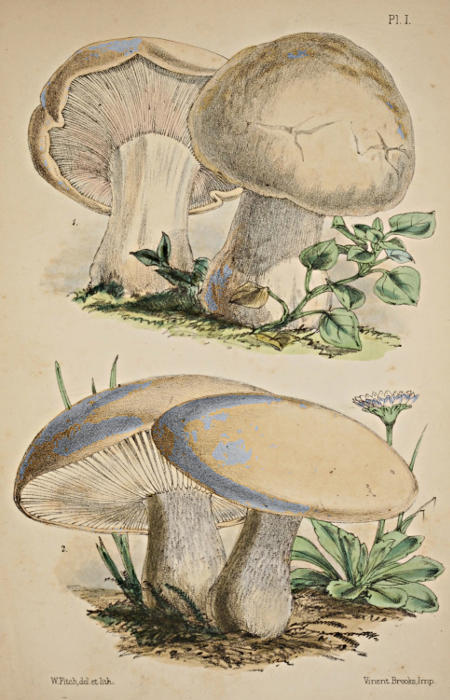
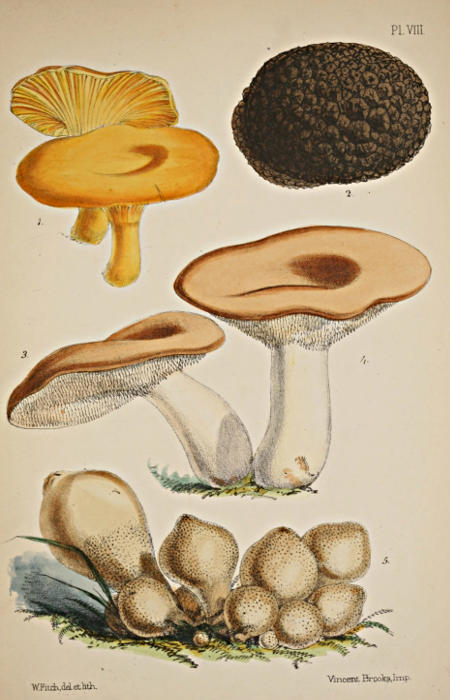
Plate I. Fig. 1.
Subgenus Tricholoma, Fries. Subdivision Personata, ibid.
Agaricus mouceron, Bulliard. Cæsalpinus, p. 617.
Mouceron gris, Paulet, Persoon.
“Cogitatione ante pascuntur succineis novaculis aut argenteo apparatu
comitante.”—Pliny.
“Tout ce qui fait l’ornement des festins s’embaume du parfum de
ces cryptogames.”—Persoon.
Bot. Char. Gregarious, or growing in rings[153] on the
ground; pileus thick, convex, irregular in shape, more or less
tuberculated, sometimes lobed;[154] margin not striate, wavy, expanding
unequally; epidermis cream-coloured, grey, reddish,
or of a dirty nankeen hue, paler towards the circumference,
soft to the touch like kid, minutely tomentose, fragile, dry,
firmly attached to the flesh; flesh firm, compact; gills watery,
white, very numerous, irregular, with many smaller ones
(from 5-11, Vitt.) interposed, lying over each other like the
plaits of a frill, adnato-emarginate,[155] the imperfect gills
rounded off at their posterior end. Stem white, robust, firm,
solid, somewhat irregular in form, generally thickened at the
base, constantly so in young specimens, but in older ones,
though occasionally bulging, it presents not unfrequently an
equal cylinder throughout, and sometimes tapers slightly
downwards. The fibres are effused into the pileus, spreading
out like a fan through its substance; smell strong, taste agreeable;
spores white, elliptical, adhering firmly to the body on
which they fall. The dried plant retains much the same form
it had when fresh.
On tracing this fungus to its origin, (spring is the only
time, and the borders of the woodlands the proper place, to
look for it,) if we dig up the earth where it grows, this will
be found mouldy to a considerable depth beneath the surface,
and strongly impregnated with the peculiar odour which the
Prunulus exhales; this apparent mouldiness being, in fact, the
spawn, amidst the white filaments of which many minute
Agarics, in various stages of their development, may be found;
some, in the earliest, presenting merely white cones destitute
of heads, whilst in others a slight protuberance indicates the
future pileus forming or already formed. The pileus is at
first almost spherical, and involute in its borders, the gills
whitish, very minute, and so thickly set as to press one
against the other, each communicating to the membrane that
lines the next the impressions of its own fibres, which remain
in the form of transverse striæ, and furnish a characteristic
to this fungus retained during all its subsequent growth (Vitt.).
The greatest size which I have known the Prunulus attain has
been in England, where I have picked specimens measuring
six inches across, and weighing between four and five ounces;
as to the fecundity of this fungus, I collected this spring,
from a single ring on the War-Mount at Keston (Kent), from
ten to twelve pounds, and in the one field from twenty to
twenty-five pounds. In this neighbourhood they are generally
destroyed, as injurious to his grass-crops, by the over-careful
farmer, quite ignorant, of course, of their value; to which the
following extract from a letter of Professor Balbi to Persoon
bears testimony:—“This rare and most delicious Agaric, the
Mouceron of Bulliard, and the Ag. prunulus of other authors,
abounds on the hills above the valley of Stafora, near Bobbio,
where it is called Spinaroli, and is in great request; the country
people eat it fresh in a variety of ways, or they dry and
sell it for from twelve to sixteen francs a pound.” Vittadini
says, truly enough, that the fresh is better than the dried
Prunulus, the substance of the latter being rather coriaceous,
but the gravy prepared from it in this state, being very rich
and well-flavoured, is largely used by those who reject the
body of the mushroom; three or four thrown into a pot of
the lighter broths or of beef-tea render them more savoury.
To dry the Prunulus it is usual to cut it into four or more
pieces, which are exposed for some days to a dry air and then
threaded: it acquires an aroma by the process, and communicates
this to any dish of which it is afterwards an ingredient.
It would be extremely difficult to confound this Agaric
with any other; its mode of growth in circles, the extreme
narrowness of its gills, which are moreover striate, the thickness
of its pileus, and the bulging character of its stalk,
would render a mistake almost impossible, even did it grow
in autumn when other funguses abound, in place of appearing
only in spring when few species comparatively abound.
The best mode of cooking the Ag. prunulus is either in a
mince or fricassee it with any sort of meat, or in a vol-au-vent,
the flavour of which it greatly improves; or simply prepared
with salt, pepper, and a small piece of bacon, lard, or butter,
to prevent burning, it constitutes of itself a most excellent
dish. It has the great advantage of appearing in spring, at a
season the common mushroom never occurs. I have placed
it first in the series of Plates, as being the most savoury
fungus with which I am acquainted.[156]
When eaten alone, Sterbeck’s white mustard will be found
an excellent condiment for it; this is prepared as follows:—Bruise
in a mortar some sweet almonds with a little water,
then add salt, pepper, and some lemon-juice, rub together till
the whole is of the consistence of common mustard.
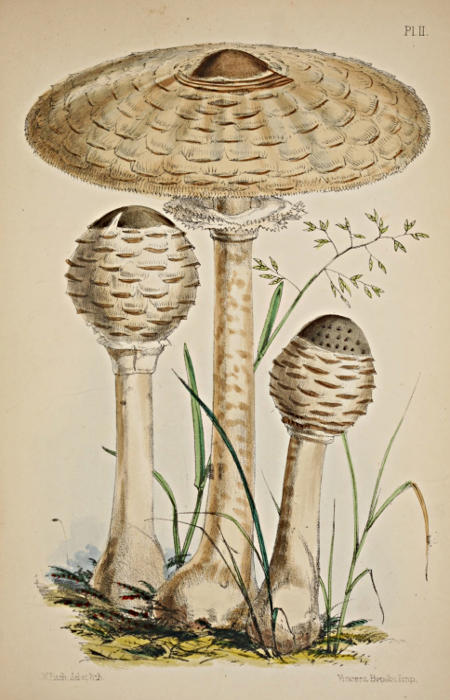
Plate II.
Subgenus Lepiota, Fries.
“Elle est d’une saveur très-agréable et d’une chair tendre, très-délicate
et très-bonne à manger. Les amateurs la préfèrent même
au champignon de couche, comme ayant une chair plus fine et étant
beaucoup plus légère sur l’estomac.”—Paulet.
This, which is one of the most delicate funguses, fortunately
is not rare in England. In Italy it is in equal request
with the Amanita Cæsarea; in France it is also in high esteem,—“servie
sur toutes les tables, elle est bonne à toute
sauce” (Thore); and were its excellent qualities better known
here, they could not fail to secure it a general reception into
our best kitchens, and a frequent place among our side-dishes
at table. The beauty and remarkable appearance of this
Agaric have procured for it a variety of names: colubrinus,
from the snake-like markings on the stem; clypeatus, from
its umbonated top; ‘fungo parasole,’ from the orbicular form
of the wide-spread pileus; and Gambaltiem or Fonz de la
gamba lunga, from the extraordinary height of the stalk.
Autumn is the time of its greatest abundance, but individual
specimens occur occasionally throughout the summer.
It grows solitary or few together in hedgebanks and pasture-grounds.
The pileus, which is commonly from four to four and a half
inches across, sometimes attains a width of six or seven. At
first it is concealed in a volva, but breaking from this it goes
through a variety of forms, from that of an ovoid cone to that
of a flattened disk. It is umbonated at the centre, and covered
with scales, which are formed by the breaking up of the
mud-coloured epidermis, and are large, raised, and persistent
at the centre; thin, regular, and lighter in hue at the circumference,
“the whole surface resembling a delightfully soft,
shaggy-brown leather” (Purton). The flesh of the pileus is
white and cottony, that of the stalk fibrous and somewhat
brittle, with a subrubescent tinge, the whole plant turning to
a rufous-orange when bruised; the gills are of a pale flesh-colour,
occasionally forked, ventricose, denticulate, remote
from the stalk, and having a circular pit between it and their
central extremities, which are fixed into a kind of collar.
The stalk tawny, striped circularly with bands of white,
formed by the breaking up of the epidermis; is bulbous at
the base and attenuated upwards; its apex rounded, and penetrating
deeply through the flesh of the pileus (which receives
it as in a socket), gives rise to the central umbo on the
upper surface of the cap. The ring moveable, like that of an
umbrella-stick, broad, compact, membranaceous immediately
round the stalk, and fibrous towards its free margin, is white
above and tawny or of the same colour as the stalk on its
under surface. The smell is like that of newly-ground meal;
the taste is pleasant; the spores are white and elliptic.
The Ag. excoriatus resembles the Ag. procerus very closely,
but is easily distinguished from it by its smaller size, the absence
of the bulb at the base of the stalk, and the ring being
often attached instead of free.
Being equally esculent, the following receipts will serve for
both:—
“Comme il est très-léger et très-délicat, il faut le faire
sauter dans l’huile fine après l’avoir assaisonné d’un point
d’ail, de poivro et de sel; en quelques instants il est cuit. On
le mange aussi en fricassée de poulet, cuit sur le gril ou dans
la tourtière avec de beurre, de fines herbes, du poivre, du sel,
et de la chapelure de pain; on ne mange point la tige, elle est
d’une texture coriace” (Roques).
The ketchup from both kinds is better than that procured
from the Agaricus campestris, or common mushroom.
N.B.—I have in the above notice described one variety of Agaricus procerus;
there is, however, if not another, at least a remarkable modification of this, in
which the pileus is thinner and much less shaggy, the gills less broad but similar
in shape, the stalk more slender and elongate. This variety is also nearly void
of odour, and its flesh does not change colour on being bruised: for culinary
purposes this distinction is without importance, as both are equally good.
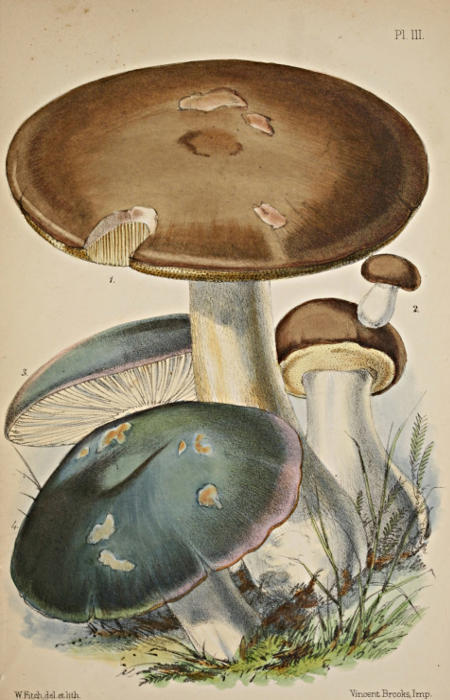
Plate III. Figs. 1 and 2.
Section Cortinaria, Fries.
“Atto sovra ognun altro fungo al commercio, forma da questo lato,
per non pochi paesi della Lombardia, una delle principali risorsi della
povera gente.”—Vitt.
The ancient Romans were well acquainted with this truly
delicious fungus, and in general appear to have done it justice;
the strings of dried Suillus, which his countrymen, on
the testimony of Pliny, were in the habit of fetching from
Bithynia, were in all likelihood the same as those similarly-prepared
strings of the modern Porcino which are sold during
the winter in every market-place throughout Italy.[157]
Vittadini mentions a curious fact respecting them, viz. that
though they are composed of many different Boletuses, no
mischief was ever known to originate from their indiscriminate
and very extensive consumption; whence he concludes
that all the species of this genus are innocuous, or, at least,
that drying and cooking will extract any deleterious principles
which they may have originally contained;—an inference, he
thinks, supported by the daily use among the peasantry of
certain districts of the B. luridus, which of all bad Boletuses
commonly passes for the worst, and by his having experimented
with it in large doses upon animals, who did not suffer
in consequence. I have eaten in England a small quantity
both of B. Grevillei and of B. granulatus, which have much
of the flavour of the B. edulis; of the B. subtomentosus(though,
on the authority of Trattinick, it is eaten in Germany) I have
no personal experience, nor do I recommend to the amateur
any species beyond the two universally eaten and approved of
on the Continent, viz.:—B. edulis and B. scaber.
B. edulis.—Bot. Char. Pileus from six to seven inches
across, pulvinate, smooth, with a thick margin, varying in
colour from light brown or bronze, to bay, dark brown, or
black, or a mixture of all these colours. The epidermis firmly
adherent to the flesh, that firm, and except the part in immediate
contact with the skin, which has a slight brown tint,
white; the under surface of the cap nearly flat, often presenting
a circular pit or depression round the stalk; tubes at
first white, then yellow, lastly of an olive or yellow-green tint,
in the earlier stage of development (their free extremities then
lie against the side of the stalk) closed; afterwards, as the cap
expands, stopped up with a waxy-looking material of a dirty
pearl colour. Stem varying much in shape at different periods
of the growth of the Boletus, always thick and solid; at first
white, but soon changing to fawn colour, beautifully meshed
or mapped (especially on its upper portion) with reticulations
characteristic of this species. As the period for casting its
seed advances, the inferior surface of the cap swells out, the
waxy matter is absorbed, the tubes present deep and rounded
orifices to the eye, and presently emit an abundant seminal
dust, of an ochraceous green hue (sometimes difficult to collect,
from the quantity of moisture exhaled with it), after which
both cap and stalk become flaccid, the tubes turn to a dirty
green, and the whole fungus falls rapidly into a state of
decomposition. The favourite sites for this Boletus are woods,
especially those of pines, oaks, and chestnuts; it abounds in
autumn, but occurs in spring and occasionally in summer.
There is one variety, the pinicola, whose name gives its whereabouts,
which differs from the foregoing, in having a moist,
somewhat sticky cap, a watery flesh changing near the tubes
to a light yellow-green when bruised; the reticulations are
ill-marked in this species.
The Boletus edulis cannot be mistaken for any other Boletus
because it alone presents all the following characters united,
viz. a cap of which the surface is smooth; tubes the colour
of which varies with each period of its growth, beautiful and
singular reticulations of the stalk, especially towards the
upper portion, and a flesh which is white and unchanging.
The Boletus castaneus, which bears, some little general resemblance
to it, is at once distinguished by having a cottony
fibrillose stem without reticulations, a downy cap and dirty
yellow dust: neither can it be confounded with the B. subtomentosus
nor B. luridus, because in addition to many other
points of difference, both these change colour on being cut or
bruised.
As to the best manner of cooking B. edulis, this must be left
to the taste of the gourmet; in every way it is good. Its
tender and juicy flesh, its delicate and sapid flavour, render it
equally acceptable to the plain and to the accomplished cook.
It imparts a relish alike to the homely hash and the dainty
ragout, and may be truly said to improve every dish of which
it is a constituent. “Nihil tetigit quod non ornavit.”
“Though much neglected in this country, it appears to be
a most valuable article of food. It resembles much in taste
the common mushroom, and is quite as delicate; it abounds
in seasons when these are not to be found.” (Berkeley.)
It may be cooked in white sauce, with or without chicken,
in fricassee broiled or baked with butter, salad oil, pepper,
salt, chopped herbs, and bread-crumbs; to which some add
ham or a mince of anchovy. It makes excellent fritters:
some roast it with onions (basting with butter), but as these
take longer to cook than the Boletus, this must not be put
down till the onions have begun to soften.
Having dried some Boletuses in an oven, soak them in
tepid water, thickening with toasted bread, till the whole be of
the consistence of a purée, then rub through a sieve, throw in
some stewed Boletuses, boil together, and serve with the usual
condiments.
Section Pratella. Subdivision Psaliota, Fries.
Agaricus campestris, Linn.
“Où croît ce champignon, délice des festins,
Que l’art fait chaque jour naître dans nos jardins.”—Castel.
There is scarcely any one in England who does not feel
himself competent to decide on the genuineness of a mushroom:
its pink gills are carefully separated from those of a
kindred fungus Ag. Georgii, which are of a flesh-coloured grey,
and out of the pickings of ten thousand hands, a mistake is
of rare occurrence; and yet no fungus presents itself under
such a variety of forms, of such singular diversities of aspect!
the inference is plain; less discrimination than that employed
to distinguish this, would enable any who should take the
trouble, to recognize at a glance many of those esculent
species, which every spring and autumn fill our plantations
and pastures with plenteousness. Neither is this left to be a
mere matter of inference; it is corroborated in a singular manner
by what takes place at Rome; here, whilst many hundred
baskets of what we call toadstools are carried home for the
table, almost the only one condemned to be thrown into the
Tiber, by the inspector of the fungus market is our own
mushroom:[158] indeed, in such dread is this held in the Papal
States, that no one knowingly would touch it. “It is reckoned
one of their fiercest imprecations,” writes Professor Sanguinetti,
“amongst our lower orders, infamous for the horrible
nature of their oaths, to pray that any one may die of a
Pratiolo;” and although it has been some years registered
among the esculent funguses of Milan and Pavia (on the
authority of Vittadini), it has not yet found its way into those
markets. Besides the general botanical characters which
apply to all varieties of Ag. campestris, almost every writer
has felt the necessity of pointing out several peculiarities,
belonging to each. Common to all are a fleshy pileus, which
is sometimes smooth, sometimes scaly, in colour white, or of
different shades of tawny, fuliginous, or brown; gills free, at
first pallid, then flesh-coloured, then pink, next purple, at
length tawny-black; the stem white, full, firm, varying in
shape, furnished with a white persistent ring; the spores
brown-black, and a volva which is very fugacious.
This, which is our button mushroom, lies at first concealed
in the earth, at which period it presents the appearance of a
puff-ball; at a second stage of its growth, it exhibits a white,
smooth, and continuous epidermis; gills rounded off at their
posterior end; a large, somewhat funnel-shaped, double ring,
free, and somewhat moveable on the stem, which is short and
thick. This, according to Vittadini, is the most sapid variety
of any.
This differs from the last in the duskier hue of its pileus,
which is moreover scaly, and has ragged margins; the gills
are ventricose; and the ring, which is subfugacious, is cortinarious,
i. e. of a cobweb texture, and reflexed; the stalk is
longer than in the last species, and tapers towards the base;
the colour of the flesh in this variety is vinous or even
sanguine.
This differs from the two former in the following particulars;
the gills are pallid, taper equally at both ends, and come
off at a considerable distance from the stalk, which is surrounded
above by a very delicate ring, and is bulbous at the
base, the bulb showing traces of the volva.[159]
Such uncultivated mushrooms as when eaten even in small
quantity, produce violent derangement of the stomach and
intestinal canal, belong to a variety which, since it grows under
hedges, is sometimes called “the hedge mushroom;” this,
to which, for distinction’s sake, I have given the name of anceps,
is by no means of rare occurrence. In order to discriminate
it properly from the wholesome varieties, the first point to
notice is its extreme lightness as compared with its bulk, that
the gills are of a deeper and of a more lurid red than those of
var. edulis, and in age less purple; they are also less deliquescent.
The flesh is more tough and not so juicy. The stem,
as in the var. silvicola, is curved and bulbous, but also fistulose
throughout. The ring complete, firm, broad, reflexed,
and persistent; the odour disagreeable, and the taste insipid.
The form of the pileus that of an obtuse cone in young specimens;
extremely flat in the middle state; and more or less
concave in age. It seldom grows solitary. The mushroom
proper, like other funguses, should be eaten fresh; a few hours
making all the difference between its wholesomeness or unwholesomeness:
nor need this surprise us when we consider how
many principles enter into its composition, how short is the
period of its existence, and how liable it must be to enter into
new combinations in consequence. Vauquelin found in its flesh
fat, adipocere, osmazome, an animal matter insoluble in alcohol,
sugar, fungine, and acetate of potash. What a medley! and what
wonder, if the changes induced during decomposition should
cause the indigestions suffered by those who have eaten them
in this state! The mushroom, having the same proximate
principles as meat, requires, like meat, to be cooked before
these become changed. The Ag. campestris may be prepared
in a great variety of ways: they give a fine flavour to soups,
and greatly improve beef-tea;—where arrow-root and weak
broths are distasteful to the patient, the simple seasoning of a
little ketchup will frequently form an agreeable change. Some
roast them, basting with melted butter and white (French)
wine sauce.[160] In patties and vols-au-vent they are equally
excellent; in fricassees, as everybody knows, they are the
important element of the dish. Roques recommends in all
cases the removal of the gills before dressing, which though
it secures a more elegant-looking entremet, is only flattering
the eye at the expense of the palate.
This variety differs from the Ag. Georgii and the type of
the species in size and other particulars. There are specimens
which measure fifteen inches across the pileus, with a stalk of
corresponding dimensions. The pileus is shaggy, like that of
the Ag. procerus, with epidermic scales, which are at first
nearly white, but in fully developed specimens, of a rich
tawny colour, like the Polyporus squamosus; and sometimes
of a red-brown. The scales more depressed than in Ag. procerus,
the gills not ventricose, equal at both ends, separated
from the stalk by a fossa or groove which runs round its apex;
the stalk solid, attenuated at the very base, but thickened just
above it, a slightly vinous hue when bruised; flesh of ring
perfect, persistent, and hanging round the stalk like a sheet
of thin white kid; into which a number of delicate silver
threads may be traced proceeding from the apex of stem.
The smell is powerful but agreeable, as also is the flavour; no
part of the surface ever turns yellow. This variety is both
wholesome and well-flavoured; as it is commonly known by
the peasants under the name of the “Ox-Mushroom,” I have
called it bovinus.
Steep for two hours in oil, with some salt, pepper, and a
little garlic: then toss up in a small stewpan over a brisk
fire, with parsley chopped and a little lemon-juice.
Take large mushrooms, full-grown, but not black; remove
the gills, and place in lieu of them the following stuffing:—bacon
shredded, crumbs of bread, chopped herbs, and a little
garlic or eschalots (as for omelettes), salt, pepper, and a taste
of spice. Broil in paper as a Maintenon cutlet, moistening
with butter when necessary.
Take button mushrooms; put to them a very small quantity
of garlic, finely chopped; toss up over a brisk fire with a
little butter; add some lemon-juice; give them a few turns;
then add salt, pepper, nutmeg, and a wine-glassful of the
richest brown gravy (Grande Espagnole); when the mushrooms
are warmed through in this, add a couple of glasses of
Sauterne, simmer for ten minutes, and serve.
A homely mode of cooking Ag. campestris in Bucks. is to
cut up the buttons with pieces of bacon the size of dice, and
then to boil them in a dumpling.
The following method of cultivating mushrooms is given in
Paxton’s ‘Botanical Dictionary:’—
“Collect a sufficient quantity of fresh horse-droppings, as
free from straw as possible; lay it in an open shed in a heap
or ridge; here it will heat violently, and in consequence
should be now and then turned for sweetening; after this has
subsided to moderation, it will be in a fit state for forming
into a bed. In the process of making the bed, the dung
should be put on in small quantities and beat firmly and
equally together, until it is the required size; in this state let
it remain until the highest degree of heat to which it is capable
of coming is ascertained, which may be readily done by
inserting a heat-stick, and pressing it with the hand; if not
found violent, the spawn may be broken up into pieces of two
or three inches square, and put into holes about three inches
in depth by six inches asunder, over its surface; after this,
throw a very small quantity of well-broken droppings over the
whole. In this state let it remain for two or three weeks,
when a loamy soil may be put on about an inch or an inch
and a half thick, and gently patted with the spade. If the
temperature of the house be kept about sixty or sixty-five
degrees, mushrooms may be expected in six weeks. It is not
well to water the beds much, particularly when bearing; it is
much better to throw a little water over the path and flues,
which will both improve the colour and the flavour of the
mushrooms, without being attended with those bad effects
frequently resulting from watering, viz. that of destroying
the young stock, and turning browner those already fit for
table.”—Paxton’s Bot. Dict.
With regard to the spawn, it may be collected as recommended
in the French work cited by M. Roques, and kept
in a dry place till wanted; or by digging about the roots of
growing mushrooms, and carrying away the earth which contains
it. The débris of a former mushroom-bed will always
furnish spawn for a new.
Plate IV., Figs. 3, 4, and 5.
Section Psaliota, Fries. Subdivision Pratella, ibid.
Agaricus Georgii, Withering.
“L’Agarico esquisito è un fungo sano, oltremodo delicato e di
facilissima digestione.”—Vitt.
“Its flavour is far inferior to that of the common mushroom.”—Berkeley.
This fungus, called also the Horse Mushroom, from the
enormous dimensions[161] to which it sometimes attains, is for
the most part shunned by the English epicure; it is also this
species from which many persons report themselves to have
suffered indigestion attended with violent colicky pains, when
they have eaten it by mistake for the Ag. campestris. It is
sold, under the name of White Caps, for making ketchup; but,
notwithstanding its foreign name and reputation, most persons
will agree with Mr. Berkeley, in holding both its flesh
and its juices as greatly inferior to those of the Ag. campestris.
Our other name for it, that of St. George’s Agaric, can have
no reference to the time of its appearance, as it is seldom met
with in England till after that saint’s day; it has, moreover,
the same name in Hungary, where the inhabitants look upon
it as a special gift from Saint George.
Its botanical characters are the following:—
Pileus at first conico-campanulate, covered with floccose
shreds, which are very fugacious; when fully expanded, minutely
squamulose, of a beautiful white, shining and smooth;
turning yellow when bruised, and sometimes exuding a yellow
juice (Sibthorpe). Gills numerous, broad, attenuated both
ways, but most so behind, free, of a pallid hue (grey flesh-colour),
during the growth of the fungus; later, clouded
brown-black; the imperfect gills obtuse behind. Stem long,
subcylindrical, slightly thickened at the base, white without,
stuffed within. Ring tumid and reflected over the stalk.
Flesh of both pileus and stalk compact, fibrous, and fragile.
Flavour and smell strong, and, according to Vittadini, agreeable,
but according to English perception generally the reverse.
Persoon pronounces this fungus to be superior to the
common mushroom in smell, taste, and digestibility, on which
accounts, he says, it is generally preferred in France. It is
to be cooked in the same way as that, and, if eaten in moderation,
will seldom be found to incommode the stomach or
offend the palate.
Locality.—Pastures, amidst thickets, under trees, generally
in large rings, reproducing itself every year in the same
situations.
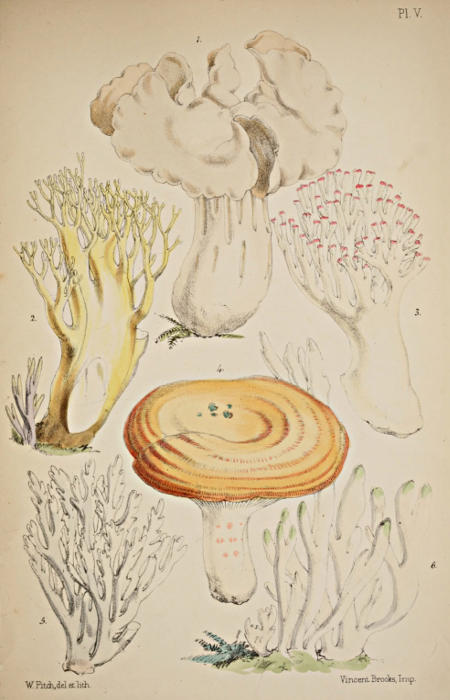
Plate V., Fig. 4.
Orange Milk Agaric.
Subgenus Galorrheus.
Bot. Char. Gregarious. Pileus from three to four inches
across; colour dull orange-rufous, frequently zoned with concentric
circles of a brighter hue, fleshy, firm, full of red orange
milk, which turns green on exposure to the air (as does the
whole plant when bruised); the margin at first involute and
downy, then expanded, afterwards depressed. Gills decurrent,
forked at the base, always of the same colour as the
pileus, rather distant, substantial. Stem from two to three
inches high, slightly bent, stuffed in part, scrobiculate (i. e.
marked with little superficial pits); at the base strigose (i. e.
covered with short pointed hairs).
This is one of the best Agarics with which I am acquainted,
fully deserving both its name and the estimation in which it
is held abroad. Its flesh is firm, juicy, sapid, and nutritious.
It grows under old Scotch firs and pines, and occasionally in
considerable abundance, and is well worth the trouble of
searching for from September to the beginning of November,
when it is in season. There is but one fungus which it in
any way resembles, and as that one (Ag. torminosus) is acrid
and poisonous, the gatherer must pay particular attention to
the following characteristic difference between the two, viz.
that the milk of the Ag. deliciosus is red and subsequently
turns green, while that of the Ag. torminosus is white and unchangeable.
Mr. Sowerby thus speaks in praise of this species:—“I
had one dressed; it was very luscious eating, full of rich
gravy, with a little of the flavour of mussels.”
Sir James Smith, in his ‘Tour,’ says:—“The market of
Marseilles exhibited a prodigious quantity of Ag. deliciosus,
which really deserves its name, being the most delicious mushroom
known.”
The Agaricus deliciosus may be served with a white sauce,
or fried; but the best way to cook them, after duly seasoning
with pepper and salt, and putting a piece of butter upon each,
is to bake (in a closely-covered pie-dish) for about three-quarters
of an hour.
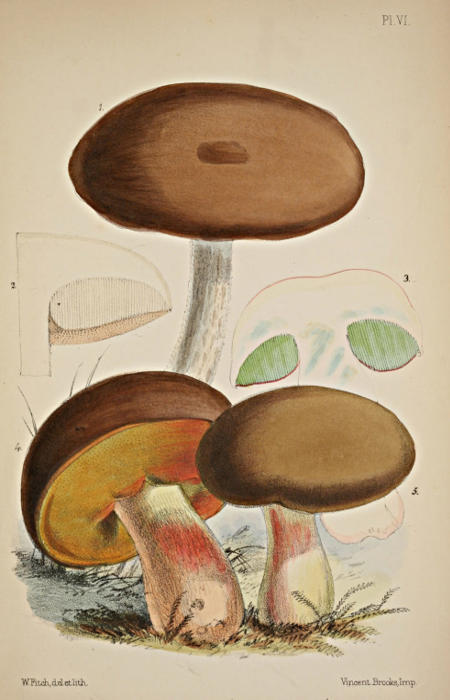
Plate VI. Figs. 1, 2.
“Fungo innocente e che non può cagionare alcun danno, non molto
ricercato a motivo, senza dubbio, del cambiamento di colore in cui va
soggetto la sua carne allorchè viene rotta o compressa.”—Vitt.
Bot. Char. This fungus presents itself under two distinct
forms; in the first, the B. aurantiacus of Bull., the pileus
(generally rather downy, but sometimes rough) is of a beautiful
deep orange hue; in the other it is cinereous.
In both cases its shape is that of a hemisphere of from three
to seven inches across, the surface of which becomes viscid
when moist, and is minutely downy. In the first variety,
the stem is rough with black, in the second with orange
scales.
Half a foot is its average height; it is attenuated upwards.
While young, it is very thick in proportion to the pileus, and
exhibits frequently the traces of a floccose veil. The flesh is
thick and flabby, of a dingy white, not greatly changeable in
young specimens, but deepening in colour when old, and acquiring
a vinous tint;[162] the tubes are of a dirty white, those
that surround the stem being shorter than the rest.
The odour of this fungus is slight; the taste subacid; the
seminal dust copious, and tawny-ferruginous. It may be
cooked like the B. edulis, and has an agreeable flavour; but
being more viscid in substance, it requires when stewed to be
thinned with water; when dried, it loses all odour, and is then
insipid and unfit for food.
Plate VI. Figs. 3, 4, and 5.
Nothing can be more accurate than Mr. Berkeley’s description
of this species, which I therefore subjoin:—“Woods.
Summer and autumn. Common. Pileus two to six inches
broad, convex, expanded, minutely tomentose, olive, brick-red,
pinkish, cream-coloured, or ferruginous-brown. Flesh
more or less yellow, changing to blue.[163] Tubes free, yellow
or greenish; their orifices of a beautiful red or bright orange,
quite simple, round. Spores olivaceous-ochre. Stem very
variable in length, bulbous, tomentose, sometimes quite smooth,
red with ferruginous or the brightest yellow shades, solid,
generally more or less marked or reticulated with crimson-red,
very deleterious”(?[164]).
Plate I. Fig. 2.
Subgenus Tricholoma, Fries.
Blewitts.
I never met with this fungus in Italy; it has not been described
by Vittadini, nor, that I am aware of, by any Italian
mycologist; neither is it mentioned by Cordier or Roques, in
their treatises on the esculent funguses of France. Extremely
common in England, this species has already found its way to
Covent Garden, where, according to Sowerby, it is sold under
the name of “Blewitts.”[165] The favourite haunt of the Blewitt
is amidst grass, where it grows in clusters, or in large rings,
seldom appearing before October.
The botanical characters, as given by Mr. Berkeley, are as
follows:—“Pileus from two to six inches broad, fleshy, firm;
pale bistre or purple-lilac, occasionally violet; convex, obtuse,
very smooth, and shining, as if oiled, but not viscid; margin
involute, pulverulento-tomentose. Gills rounded; free, narrow
in front, paler than the pileus, sometimes violet, turning
to a dirty flesh-colour, especially when bruised; stem from one
to three inches high, three-quarters of an inch thick, firm,
bulbous, solid, mottled within towards the apex, with watery
spots; clothed more or less with villous fibrillæ, tinged with
violet; odour like that of Oreades, but rather overpowering;
taste pleasant.” As the “Blewitt” is apt to imbibe in wet
weather a great quantity of moisture, it should not be gathered
during rain; when not water-soaked it is a fine firm fungus
with a flavour of veal, like which it is to be dressed en papillottes
with savoury herbs and the usual condiments, and the
more highly seasoned the better.
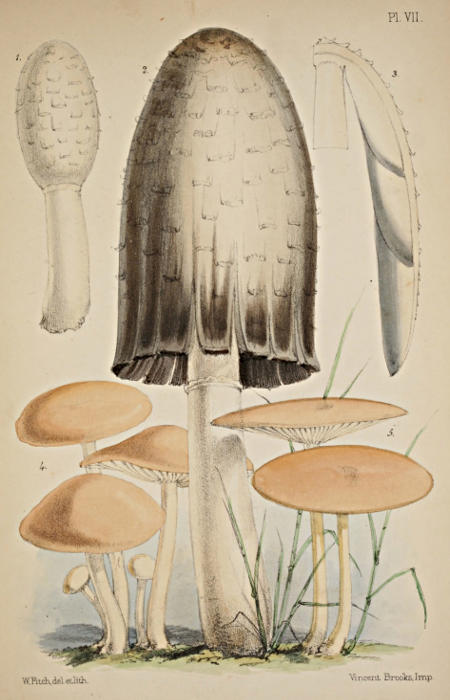
Plate VII. Fig. 4.
Subgenus Clitocybe. Section Scortei, Fries.
Scotch Bonnets.
Every one knows the Champignon,—that little buff fungus
which during so many months in the year comes up in successive
crops, in great profusion after rain, and generally in
rings. These Champignons abound everywhere: this summer
(1847) Hyde Park was full of them; amid the seared and much-trodden
grass they were continually tracing their fairy rings,
and in some instances they reached the very border of the
gravel walks. Independent of the excellent flavour of this
little mushroom, which is as good as that of most funguses,
two circumstances give it an additional value in a domestic
point of view, viz. the facility with which it is dried, and its
very extensive dissemination. When dried (two or three
days’ exposure to the air is generally sufficient to effect this),
the Ag. oreades may be kept for years without losing any of
its aroma or goodness, which on the contrary become improved
by the process, so as, in fact, to impart more flavour
to the dish than would have been imparted by the fresh
fungus; though it is not to be denied that the flesh then becomes
coriaceous and less easy of digestion.[166] From the sad
accidents occasioned by persons mistaking other small and
poisonous Agarics growing in the neighbourhood of the
Champignon for the Champignon itself, this species is frequently
looked upon with suspicion, and not often eaten in
England. The Agaric the least unlike and most commonly
found growing in company with the Ag. oreades, is the Ag.
semilobatus, which is nearly allied to, if it be not the same as
the Ag. virosus of Sowerby. But as I have also heard of a
gentleman who intending to gather Champignons, and taking
home some Ag. dryophilus by mistake, was rendered very ill
by his repast, to prevent the recurrence of such mistakes for
the future, I here add the botanical characters, marking what
is peculiar to each in italics. Ag. dryophilus is represented in
Pl. VII. fig. 5.
Solitary or tufted. Pileus from one to two inches broad, whitish, pinkish,
yellowish, or yellow-brown, flat, sometimes depressed, fleshy, thin, fragile, when
moist easily injured, of a tougher substance when dry. Gills soft, tender, numerous,
white, or pale yellow straw-colour. Stem shining, hollow, of the same
colour as the pileus, but towards the apex generally darker and of a redder
tinge.
In dense rings, or gregarious. Pileus smooth, fleshy, convex, subumbonate,
generally more or less compressed, or sinuate; tough, coriaceous, elastic, wrinkled,
when water-soaked brown, buff or cream-colour when dry; the umbo
often remaining red-brown, as if scorched. Gills distant, ventricose, of the same
tint as the pileus or paler. Stem equal, solid, twisted, very tough and fibrous,
pure, silky, white; base downy, somewhat rooting and attached to the roots of
grass.[167]
Pileus hemispherical, viscid when moist, shining and smooth as if varnished,
obtuse, fleshy. Gills very broad, perfectly horizontal to the stem, broadly adnate,
with a little tooth, minutely serrated, mottled with purple-brown sporules.
Stalk very viscid, shining when dry with a closely-matted silkiness, fistulose,
sometimes bulbous with a hollow bulb; ring generally complete, reflexed, often
dusted with the dark-coloured spores.
Plate IV. Fig. 2.
Subgenus Clitocybe. Section Dasyphylli, Fries.
Ag. pileolarius, Bulliard.
“Il est très-agréable au goût.”—Bulliard.
The following description was made from some among the
more characteristic specimens of a large supply which I
gathered this autumn (1847) near Hayes, from a spot where
they are in the habit of re-appearing regularly in October.
Pileus from two and a half to five inches across; at first
depresso-convex; when expanded nearly flat or broadly subumbonate,
never depressed, margin at first involute and pruinose;
occasionally somewhat waved and lobed, but generally
regular in form; smooth, viscid when moist, so that dead
leaves adhere to it; grey, brown at the centre, paler towards
the circumference. Flesh thick, white, unchanging; gills
cream-colour, narrow, decurrent, close, their margins waved,
unequal, generally simple. Stem from two to four inches
long, from a quarter of an inch to an inch thick; incurved at
the base, not rooting, but attaching by means of a floccose
down, round its lower portion and for one-third of its length,
a large quantity of dead leaves, by which the plant is held
erect; subequal, more or less marked with longitudinal pits,
firm externally, within of a softer substance. The odour
strong, like that of curd cheese.
This Agaric appears to be local in Italy; otherwise it could
scarcely have been omitted in Vittadini’s work, nor by the
author of the article “Fungo” in the Venice edition of the
‘Dizionario Classico di Medicina:’ add to which that I have
never met with it myself either at Florence, Pisa, Naples, or
Leghorn. That it grows in the neighbourhood of Rome is
certain, since I find it admirably delineated in a curious collection
of very old drawings which I purchased there. Moreover
Professor Sanguinetti, of that city, writes in terms of
high commendation of this mushroom, which, he says, may be
discerned inter alia, “by its peculiar odour and grateful taste:
when properly cooked it is equal to any of our funguses, rivalling
not only the Ag. prunulus, but even the Cæsareus: as
few are aware of its good qualities, it seldom finds its way into
the Roman market.” The Ag. nebularis requires but little
cooking; a few minutes’ broiling (à la Maintenon is best),
with butter, pepper, and salt, is sufficient. It may also be
delicately fried with bread crumbs, or stewed in white sauce.
The flesh of this mushroom is perhaps lighter of digestion
than that of any other.
Plate VIII. Fig. 1.
Tribe Mesopus. Subdivision Agaricini, Fries.
“Sunt qui hunc perniciosum scripsere. Verum etiam latranti stomacho
eum comedi; atque ex eo pulmenta parantur, quæ si aridis
mortuorum oribus admovcantur peream ni reviviscerent!”—Batt.
“Jure inter sapidissimos fungos numeratur.”—Fries.
No fungus is more popular than the above, though the
merits—nay, the very existence—of such a fungus at home is
confined to the Freemasons, who keep the secret! Having
collected a quantity at Tunbridge Wells, this summer, and
given them to the cook at the Calverley Hotel to dress, I
learnt from the waiter that they were not novelties to him;
that, in fact, he had been in the habit of dressing them for
years, on state occasions, at the Freemasons’ Tavern. They
were generally fetched, so he said, from, the neighbourhood of
Chelmsford, and were always well paid for. Of the Cantharellus,
this summer (1847), the supplies were immense! the
moss under the beech-trees in Buckhurst Park in particular,
was so lavish of them, that a hamper might soon have
been filled, had there been hands to gather them. On revisiting
the same park about five weeks later, they were still
continuing to come up, but in less abundance.
The botanical characters of the Cantharellus are as follow:—
When young, its stalk is tough, white, and solid; but as it
grows this becomes hollow and presently changes to yellow;
tapering below, it is effused into the substance of the pileus,
which is of the same colour with it. The pileus is lobed, and
irregular in shape, its margin at first deeply involute, afterwards
when expanded, wavy. The veins or plaits are thick,
subdistant, much sinuated, running some way down the stalk.
The flesh is white, fibrous, dense, “having the odour of apricots”
(Purton), or of “plums” (Vitt.). The colour yellow,
that of the yolk of eggs, is deeper on the under surface; when
raw it has the pungent taste of pepper; the spores which are
elliptic, are of a pallid ochre colour (Vitt.).[168] The Chantarelle
grows sometimes sporadically, sometimes in circles or segments
of a circle, and may be found from June to October. At first
it assumes the shape of a minute cone; next, in consequence
of the rolling in of the margin, the pileus is almost spherical,
but as this unfolds, it becomes hemispherical, then flat, at
length irregular and depressed.
“This fungus,” observes Vittadini, “being rather dry and
tough by nature, requires a considerable quantity of fluid
sauce to cook it properly.” The common people in Italy dry
or pickle, or keep it in oil for winter use. Perhaps the best
ways of dressing the Cantharellus are to stew or mince it
by itself, or to combine it with meat or with other funguses.
It requires to be gently stewed and a long time to make
it tender; but by soaking it in milk the night before, less
cooking will be requisite.
The Canth. cibarius is very abundant about Rome, where it
fetches, not being in great esteem, from twopence to twopence
halfpenny a pound.
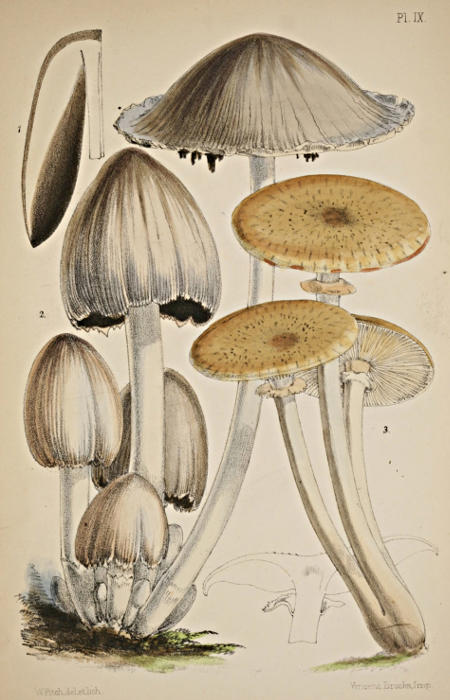
Plate IX. Figs. 1 and 2.
Subgenus Coprinus, Fries.
Bot. Char. Pileus fleshy, campanulate, margin uneven,
colour greyish, then light brown, slightly hairy, often corrugated,
sometimes scaly in the centre. Gills numerous, deep,
with clear veins, light brown, black in age, the edges grey or
white, free, obtuse behind. Stem about four inches high,
swollen at the base, piped, juicy, fibrous, marked with bands.
This is a common fungus in gardens, waste corners of
fields, and lanes, and occasionally growing on stumps of trees
in such situations: it is gregarious and cæspitose, and occurs
both in spring and autumn. Young specimens afford a fine
ketchup.
Plate VII. Figs. 1, 2, and 3.
Subgenus Coprinus, Fries.
“A fungus in great request about Via Reggio and Lucca.”—Puccinelli.
Bot. Char. Pileus cylindrical, breaking up into long scales,
campanulate, epidermis thin, flesh thick in the centre, very
thin and stringy at the margins. Gills numerous, quite free,
leaving a space round the top of the stem. Stem from four
to five inches high, rather bulbous at the base, stuffed with
fibres, brittle, ring moveable.
This fungus may be found from early spring till late in the
autumn, in meadows and waste places.
When used for making ketchup or for the table, only young
specimens should be selected.
Plate III. Figs. 3 and 4.
Subgenus Russula, Scopoli.
“Non meno sicuro e gustoso del Cesareo e del l’orcino.”—Vitt.
It is of the utmost importance that those who gather funguses
for the table, should be accurately acquainted with the
different species composing this genus; its members are so
abundantly distributed; some of them form so excellent and
delicate a food, whilst others produce such deleterious effects
on the economy, that they are well entitled to a diligent and
careful attention. The limits of this work will not permit an
accurate discrimination of all the species, which would require
a long monograph to themselves; but I have endeavoured
to point out amidst those of most frequent occurrence, the
three which may be selected with profit for the table, and
some others which are nearly allied, from which we must be
careful to separate them.
The three mild-flavoured Russulæ are the Ag. heterophyllus,
Ag. ruber, and Ag. virescens; the botanical characters of the
first are as follows:—
Ag. heterophyllus.
Pileus subirregular, from three and a half to four and a half
inches across, at first convex, then more or less excavated
towards the centre; for the most part smooth, the epidermis
covering it, more or less moist, never scored or fissured, but
exhibiting a continuous surface, marked by very small raised
lines, radiating as from the centre, and frequently crossing so
as to present a very minute finely reticulated meshwork, sometimes
slightly zoned, adhering to the flesh of the pileus, which
peels away with it in flakes resembling asbestos. It is very
various in colour, being found of all shades of yellow, lilac,
azure, green, and sometimes a mixture of these in different
parts. The margin even, i. e. not striate, irregularly elevated
and depressed. The gills are watery white, rather numerous
and thick, ascending, tapering away at their stalk extremity,
rather broader at the other, some simple but many of them
forked at the base, in a few instances branched; the imperfect
gills very few, irregular, occasionally broadly adhering to the
side of a perfect gill; the stalk naked, variable as to length
and size, equal or attenuated slightly at the base, white like
spermaceti, externally rugulose, and meshed, like the pileus,
with minute meandering lines, internally stuffed with a compact
subfriable medullary substance, which, as the fungus
grows old, breaks up here and there into sinuses which gradually
coalesce, till at last the whole stem becomes hollow. The
parenchyma is compact, but not thick, and does not change
colour when cut. The spores white, round, and very abundant.
The taste sweet and nutty. Odour none.
This excellent fungus, which Vittadini pronounces to be
not surpassed for fineness of flavour by Am. Cæsarea or by B.
edulis, with either of which it is equally wholesome, has been
introduced by Roques into the houses of many of his friends
in the environs of Paris, some of whom prefer it to Ag. campestris:
an opinion shared by several of our own friends on
this side the Channel. It grows in great abundance during
the summer months generally, and this year nowhere more
plentifully than under the Elm-trees in Kensington Gardens.
There must be no delay in dressing it, otherwise insects, who
are as fond of it as we are, appropriate it to their larvæ, which
in a few hours will utterly consume it; the flesh, being very
tender, requires but slight cooking.
Agaricus ruber, Schœffer. Ag. griseus, Persoon.
“L’Agarico Rosso è uno dei funghi più delicati e gustosi che si
conoscono.”—Vitt.
Bot. Char. Pileus rather fleshy, at first hemispherical, then
obtusely convex, and, when fully expanded, more or less excavated
towards the centre. The margins at first even, at length
tuberculo-sulcate, that is, marked with lines similar to those
left on the skin after cupping. The epidermis dry in dry
weather, but very sticky in moist, of various hues, tawny-purple,
olive-green, ochraceous-yellow, or several of these
united, and generally darkest at the centre; peeling off readily
without laceration of the flesh. The flesh white, when cut
slightly rufescent, when dry cream-coloured. The gills fragile,
cream-coloured, connected below by transverse plaits or veins,
thick and broad, but tapering away towards the stalk, really
simple, though a few imperfect gills interposed between the
entire ones, and attaching themselves to their sides give these
sometimes the appearance of being forked; the stalk equal,
white, or blotched here and there with purple stains, stuffed,
brittle, and Vittadini adds, “long,” which is not my experience
of it; when young it is so short as to be entirely hid by
the globose head of the unexpanded pileus. The flesh inconsiderable
but compact; sporules pale-buff.
The Ag. ruber, the Colombo rossa of the Tuscans, and Rother
Täubling of Schœffer, is a complete wood-pigeon in its haunts;
it grows very abundantly, may be gathered from July to a
very late period in the autumn, and is as delicate and light of
digestion as the Russula last described. It may be readily
distinguished from Ag. alutaceus by the different colour of its
gills and spores, which in that species are buff, but in the Ag.
ruber cream-coloured: moreover the greater thickness of the
substance of the pileus of Ag. alutaceus, the margin of which
is deeply sulcate, even at an early period of its development,
and the pungent acrid taste, which is seldom wanting, are
further means of distinguishing it from Ag. ruber. Ag. emeticus
differs from it in having unequal snow-white gills, and in
extreme acrimony of taste.
Agaricus virescens, Schœff.: the Verdette? Ag. bifidus, Bull.
Russula æruginosa, Persoon.
“La carne di questo Agarico è tenera e di sapore gratissimo.”—Vitt.
Pileus at first flatly convex; at length depressed towards
the centre with an even margin; epidermis whitish, fibrous,
continuous and firmly adhering to the flesh, dry, but coated
over with a thick stratum of opaque meal, which gradually
breaking as the pileus expands maps it in a singular and quite
characteristic manner with a series of irregular polygonal
figures, in greater or less relief according to the thickness of
the coating; its colour varies slightly but is generally made
up of some admixture of green and yellow, communicating to
the surface, as Bulliard has remarked, a farinaceous or mouldy
appearance. The gills of some thickness, very brittle, white,
sublanceolate, generally simple, but occasionally forked, the
imperfect gills interspersed without order amongst the entire
ones; the stalk equal, short, its centre stuffed with cottony
fibres: somewhat compact and elastic. According to Thore,
as quoted by Persoon, this Agaric may be cultivated.[169]
It is an exceedingly delicate fungus, but not very common
in England. The best way of cooking it, according to Vittadini,
is on the gridiron; the peasants about Milan are in the
habit of putting it over wood embers to toast, eating it afterwards
with a little salt, in which way it has a savoury smell,
and a taste like that of the Cancer astacus; when fresh it is
without odour, but acquires a very strong one while drying,
which he compares to that of salt meat. Mr. Berkeley quotes
Roques’ authority as to its being eaten in France; Vittadini,
without giving any authority, states that it is eaten in England.
It loses but little of its volume in drying.
Agaricus alutaceus, Persoon.
Three acrid Russulæ remain to be described, Ag. alutaceus,
Ag. emeticus, Ag. sanguineus; all three common, though not
perhaps so common as the mild ones, and all to be avoided.
The first, A. alutaceus, Fries, is ranked by Vittadini among
the safe kinds, he even affixes a misplaced note of admiration
after his epithet “esculentus!” and describes it even when
raw as “a dainty food, possessed of a most agreeable flavour.”
Mr. Berkeley, who reports it esculent when young, remarks
that individual specimens occur, which prove almost as acrid
as the Ag. emeticus itself; my own experience of it in England
is, that whether young or old, it is always acrid when raw.[170]
I have never tried it dressed, which might possibly extract
its noxious qualities, as Vittadini reports to have been the
case with a caustic variety which he subjected to this test;
but since even then, on his own showing, it proved indigestible,
I would advise no one to try this species, especially
when there are so many others, the good qualities of which are
known.
It is easy to distinguish A. alutaceus from any of the foregoing
species; to do this it is only necessary to look at the
gills, which, in place of being, as in these, white, watery white,
or cream-coloured, are of a rich buff; pileus about three inches
broad, pink or livid olive, smooth on the surface, and viscid in
wet weather; the margin at first even, but in age striate; the
gills broad, equal, slightly forked, ventricose, free, connected
by veins; the sporules rich buff; the stem one and a half inches
long, blunt, surface longitudinally wrinkled or grooved, solid
without, spongy within, varying from white to buff.
Agaricus emeticus, Schœffer.
Reports concerning the qualities of this fungus differ widely,
some asserting it to be a most deleterious species, of which
the mischief was not to be removed by cooking, whilst others,
on the authority of dogs whom they persuaded to eat some,
pronounced it innoxious. In this state of uncertainty Vittadini,
for the sake of science, and peradventure of adventure
also, determined to test its effects upon himself; he had previously
given at different times large doses, of from six to
twelve ounces, to dogs, both in the crude state and also
cooked; but without result. “Still,” says he,[171] “thinking that
though dogs might eat Ag. emeticus with impunity, it might yet
prove injurious to man, I took five specimens of fair dimensions,
and having fried, I ate them with the usual condiments;
but though pains were taken to have them delicately prepared
(oltimamente cucinati), they still retained their acrid bitter
taste, and were most distasteful to the palate.” The reader
will be glad to learn, that the only inconvenience suffered by
this bold self-experimentalist was a slight sense of præcordial
uneasiness accompanied with flatulence,—effects attributable
entirely, as he believed, to the rich mode in which his dish
was prepared: though, more timid apparently for others’
safety than his own, he particularly adds, “though I have
clearly established to my own satisfaction, the complete innocuousness
of the A. emeticus; still, as there are, or are said to
be, other Russulæ of highly deleterious properties and closely
allied, the mistaking which for it might be paid for by the
loss of life, the safer rule is to abstain from all such as have
acrid juices.”
The botanical characters of Ag. emeticus are as follow:—
Pileus more or less rosy, flesh compact, margin striate, epidermis
adherent; gills very brittle, arched in front, attenuated
towards the stalk, connected below by transverse plaits, generally
simple, a few forked, the imperfect gills rounded off behind;
the stalk, which is compact, of equal dimensions, and
white, is generally more or less stained with red spots of the
same hue as the pileus; in the growing fungus, where the
epidermis has been removed and the flesh eaten by insects,
this soon acquires a tint as lively as that of the skin itself;
generally I have remarked that the erosions of insects and
slugs do not produce any change of colour, even in the species
notorious under other circumstances for manifesting such
a change; thus the flesh of the Ag. rubescens, which turns
red when it is divided, may be frequently seen half eaten
through, exhibiting a white flesh; and the same is the case
with the Boletus luridus, the flesh of which, though eroded,
remains white till it is broken through.
Ag. sanguineus, Bull.
This fungus, of which the general facies and most of the
botanical characters, as well as the taste and other qualities,
are similar to those of the last-mentioned Agaric, differs from
it in having its gills for the most part forked, many smaller
ones being interposed between those that are entire, also in
not having its margin striate, as the Ag. emeticus when moderately
expanded always has. The smell of this fungus,
which is only developed in drying, is, according to Vittadini,
“most agreeable,” resembling that of fresh meal; to me its
odour is unpleasant and like that of sour paste.
Ag. acris minor.
Pileus one or two inches across, sticky, of a light muddy-pink,
the epidermis peeling off easily and entire from the flesh,
margin not striate, flesh soft, white, and cellular; gills adnate,
white, forked, brittle, slightly ventricose; the margin subdenticulate;
the stalk of spermaceti-whiteness and appearance,
solid within, brittle, the internal texture looser than the external;
the surface minutely rugulose, 1¼-1½ inch, by 2-4 lines
thick, intensely acrid. In meadows, throughout the summer;
abundant.
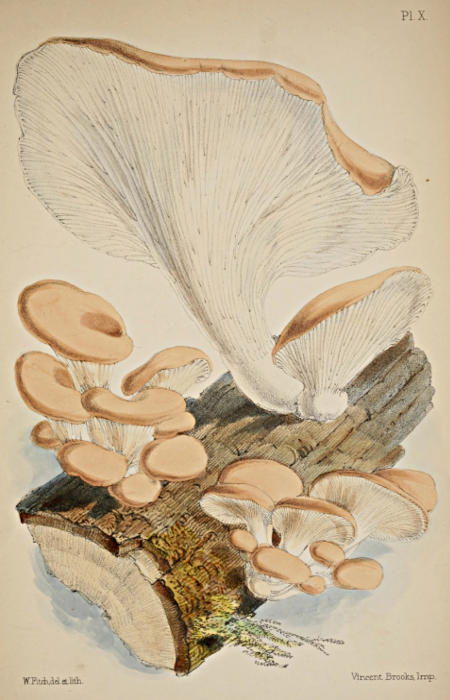
Plate X.
Subgenus Pleuropus, Persoon. Subdivision Concharia,
Fries.
“L’Ag. ostreato viene giustamente per la sua bontà ed innocenza
amesso tra i funghi commestibili, de’ quali è pure permessa la vendita
sulle pubbliche piazze.”—Vitt.
Bot. Char. Cæispitose.[172] Pileus fleshy, smooth, blackish,
then cinereous, at length paler; epidermis strongly adherent,
flesh fibrous, moderately firm; gills anastomosing behind, not
glandular, white; stem sublateral or wanting. On dead trees.[173]
Season, spring and autumn.
As there are some singular differences presented by this
fungus in regard to development, odour, taste, and the colour
of the spores, which seem almost sufficient to entitle it to be
divided into two distinct species, I shall first describe the more
ordinary form, as given by Mr. Berkeley, and then mention
the variations from it.
“Imbricated, large; pileus subdimidiate, very thick and
fleshy; flesh white, dusky towards the surface; one inch
deep, the border at first fibrillose; margin involute, as the
pileus expands the white fibrillæ vanish, and the colour
changes to bistre; margin paler and rimulose, the whole surface
shining and satiny when dry, soft and clammy when moist;
gills broad, here and there forked,”[174] standing out sharp and
erect like the fine flutings of a column, winding down the
stalk to different lengths, and those that reach the bottom
forming there a beautiful raised meshwork highly characteristic
of this species, “dirty (pure?) white, the edge serrated,
umber; taste and smell like that of Ag. personatus, which it
resembles somewhat in colour;” “spores white like those of
the Polyporus suaveolens.”[175] The points of difference in those
which departed from the ordinary type were as follows:[176]—first,
in specimens growing close together and all equally exposed
to the light, the colour of all at the same period of growth
was not the same, being a delicate waxy-white in some of the
specimens, in others, a light-brown. Secondly, whereas this
fungus is generally “invested during infancy with a white
lanugo or down,”[177] I observed the young Agarics, which presented
themselves at first as small semitransparent eminences
rising irregularly from a common stalk, and not unlike in appearance
the blisters on a chalcedony, to be thickly coated
with a light-blue varnish in place of it; the dry débris of
which varnish continued to adhere to the surface of the pileus
for some time afterwards. Thirdly, the complexion of the
spores, commonly described as white, was in these specimens
pale-rose. Fourthly, they exhaled the strong and peculiar
odour of Tarragon; and, finally, in place of being the delicate
fungus at table which in July I had always found it, these
specimens afforded a distasteful food. The Ag. ostreatus resists
cold in a remarkable manner; the circumstance of its
being found in winter has procured for it the trivial name of
Gelon. Ag. ostreatus is found on the barks of many sorts of
trees, and wherever it has once been it is apt to recur frequently
afterwards. It may be dressed in any of the more
usual ways; but as the flesh is rather over-solid and tenacious,
it is all the better for being cooked leisurely over a slow fire.
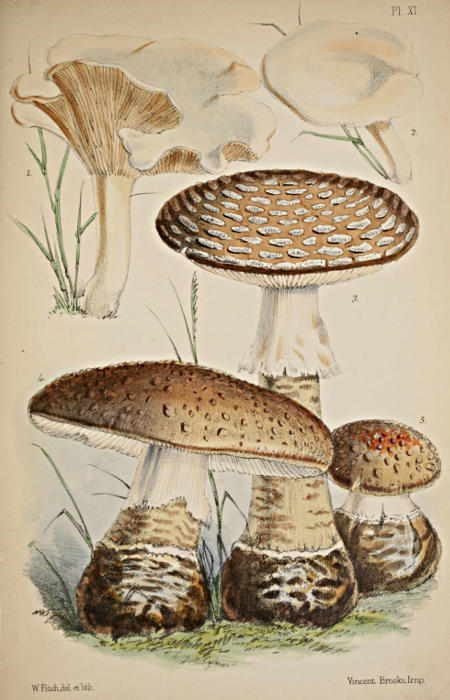
Plate XI. Figs. 3, 4, and 5.
Subgenus 1. Amanita.
“Non altrimenti del Cesareo delicato e sano.”—Vitt.
Bot. Char. Pileus covered with warts of different sizes;
margins even, convex, flesh turns obscurely red when cut or
bruised, slightly moist and shining; gills attenuated behind;
stem at first stuffed, in age becoming hollow, bulbous, sometimes
scaly; ring wide, marked with striæ; spores nearly
elliptical; smell strong; taste not unpleasant.
This is a very delicate fungus, which grows in sufficient
abundance to render it of importance in a culinary point of
view. It makes excellent ketchup. Cordier reports it as one
of the most delicate mushrooms of the Lorraine; and Roques
speaks equally well of it. It generally grows in woods, particularly
of oak and chestnut, both in summer and autumn.
No fungus is more preyed upon than this by mice, snails, and
insects.
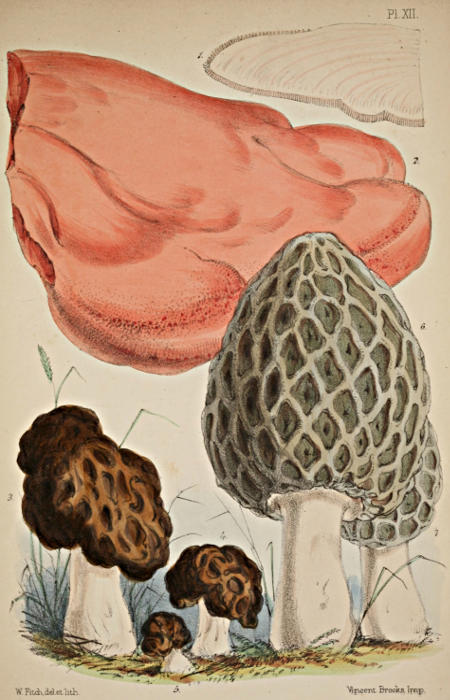
Plate XII. Figs. 6 and 7.
Tribe 3. Mitrati.
Morell.
“Sommamente ricercata,”—Vitt.
Every one knows the Morell, that expensive luxury which
the rich are content to procure at great cost from our Italian
warehouses, and the poor are fain to do without. It is less
generally known that this fungus, though by no means so
common with us as some others, (a circumstance partly attributable
to the prevailing ignorance as to when and where
to look for it, or even of its being indigenous to England,[178])
occurs not unfrequently in our orchards and woods, towards
the beginning of summer. Roques reports favourably of some
specimens sent to him by the Duke of Athol; and others,
from different parts of the country, occasionally find their
way into Covent Garden market. The genus Morchella comprises
very few species, and they are all good to eat. Persoon
remarks, that though the Morell rarely appears in a sandy
soil, preferring a calcareous or argillaceous ground, it frequently
springs up on sites where charcoal has been burnt or
where cinders have been thrown.
Bot. Char. Pileus very various in shape and hue, the surface
broken up into little sinuses or cells, made by folds or
plaits of the hymenium, which are more or less salient, and
constitute the so-called ribs. These ribs are very irregular,
and anastomose with each other throughout; the pileus hollow,
opening into the irregular hollow stem. Spores pale-yellow.
Bot. Char. This may be known from the M. esculenta by
being, as its name imports, half free, i. e. having the pileus
for half its length detached from the stalk. Spores are pale-yellow.
Odour, at first feeble, becomes stronger in drying.
Occurring less frequently than the last, and much less sapid.
Neither of these funguses should be gathered after rain, as
they are then insipid and soon spoil.[179]
M. Roques says the Morell may be dressed in a variety of
ways, both fresh and dry, with butter or in oil, au gras or à
la crême. The following receipts for cooking them are from
Persoon.
1st. Having washed and cleansed them from the earth
which is apt to collect between the plaits, dry thoroughly in a
napkin, and put them into a saucepan with pepper, salt, and
parsley, adding or not a piece of ham; stew for an hour, pouring
in occasionally a little broth to prevent burning; when
sufficiently done, bind with the yolks of two or three eggs,
and serve on buttered toast.
2nd. Morelles à l’Italienne.—Having washed and dried,
divide them across, put them on the fire with some parsley,
scallion, chervil, burnet, tarragon, chives, a little salt, and
two spoonfuls of fine oil. Stew till the juice runs out; then
thicken with a little flour; serve with bread-crumbs and a
squeeze of lemon.
3rd. Stuffed Morells.—Choose the freshest and whitest
Morells, open the stalk at the bottom; wash and wipe them
well, fill with veal stuffing, anchovy, or any rich farce you
please, securing the ends, and dressing between thin slices of
bacon. Serve with a sauce like the last.[180]
Plate VIII. Figs. 3 and 4.
Subgenus Mesopus, Fries.
“The general use made of this fungus throughout France, Italy, and
Germany leaves no doubt as to its good qualities.”—Roques.
Bot. Char. Pileus fleshy, tawny, red, smoothly tomentose,
very irregular in shape, from two to five inches across, lobed
or undulated; margin vaulted, acute, wavy; flesh white,
turning yellow when cut, if bruised becoming brown-red;
spines pale-yellow, unequal, thick-set, apices canino-denticulate
or conical, straight or slightly ungulate; occasionally bifid;
shorter and more obtuse towards the stalk, on the upper part
of which they are somewhat decurrent, leaving small foraminules
when detached; stem at first white, then tawny; two
inches long, solid, of variable thickness (from half an inch to
two inches) more or less flattened, papillated above with the
rudiments of spines which have aborted; spores round, white,
taste when raw at first pleasant, but presently of a saline
bitter, like Glauber salts, somewhat peppery, and smell like
that of horse-radish.
This fungus occurs principally in woods, and especially in
those of pine and oak; sometimes solitary, but more frequently
in company and in rings. In Italy (where the spines
have procured for it the name of “Steccherino,” or Hedgehog),
it is brought into the market and sold promiscuously
with the Chantarelle, to which in colour and in some other
respects it bears a resemblance. There is no fungus with
which this is likely to be confounded; once seen, it is recognized
at a glance afterwards, and may be gathered fearlessly.
According to Paulet, Persoon, and Vittadini, the Hyd. repandum
should be cooked for a long time, and with plenty of
sauce, otherwise, being deficient in moisture, it is apt to become
rather tough; when well stewed it is an excellent dish,
with a slight flavour of oysters; it makes also a very good
purée. Vittadini places it among the most delicate of the
funguses of Italy.
Plate XII. Figs. 1 and 2.
“Fungus pauperibus esculentus.”—Schœff.
This fungus, which, in the earlier stages of its development,
frequently resembles very closely a tongue in shape, structure,
and general appearance, presents later a dark, amorphous,
grumous-looking mass, bearing a still more striking likeness
to liver. Thus, seen while young, and just beginning to bud
out from the oak,[181] its papillated surface, regular shape, and
clear fibrous flesh make it an object of interest to many who,
introduced to it at an advanced period of growth, can hardly
be brought to believe that the blackened misshapen mass, that
looks like liver, and that deeply stains the fingers with an unsightly
red fluid, can indeed be the same plant. It has, from
the earliest-recorded accounts, been designated by names
pointing to these resemblances: Cesalpinus calls it Linguæ;
Wallemb, Buglossus quercinus; the vulgar name in Italy is
“Lingua quercina,” or “Lingua di castagna.” It constitutes
a genus by itself.
Bot. Char. Pileus confluent with the stalk: at first studded
on the upper side with minute papillæ (the rudiments of tubes),
which afterwards disappear; flesh succulent, fibrous, like beetroot
in appearance, with a vinous smell and a slight acid
taste; tubes continuous with the fibres of the receptacle, unequal,
very short, small, cylindrical, ochraceous-rufescent; at
first with closed pores, but as they elongate they become
patent; colour at first a dry dusky white, afterwards a
yellowish-red; the whole surface more or less sticky, with a
gelatinous secretion exuding from it; sporidia ochraceous-green,
and matured at different times from the unequal length
of the tubes. This fungus varies in size from that of a small
kidney to an irregular mass of many pounds’ weight, and of
several feet in circumference. I recently picked a specimen
which measured nearly five feet round, and weighed upwards of
eight pounds; but this is nothing to one found by Mr. Graves,
which, on the authority of Mr. Berkeley, weighed nearly
thirty pounds.
The Fistulina hepatica, which Schœffer calls the Poor Man’s
fungus, “fungus pauperibus esculentus,” deserves indeed the
epithet if we look to its abundance, which makes it an acquisition
to the labouring class wherever it is known; but that it
is in any other sense fitted for the poor, or to be eaten by
those only who can purchase no other food, is what I cannot
subscribe to. No fungus yields a richer gravy, and though
rather tough, when grilled it is scarcely to be distinguished
from broiled meat. The best way to dress it if old, is to stew
it down for stock, and reject the flesh, but if young, it may
be eaten in substance, plain, or with minced meat; in all
cases its succulency is such that it furnishes its own sauce,
which a friend of ours, well versed in the science of the table,
declares each time he eats it to be “undeniably good.”
In England the F. hepatica grows principally on old oak-trees,
and may be found throughout the summer in great
abundance.
Plate XI. Figs. 1 and 2.
Section Mouceron, Fries.
“Senza dubbio uno de’ migliori funghi indigeni.”—Vitt.
“Esculentus!”—Ibid.
This is a very delicate mushroom; it grows either solitary
or in company, and sometimes in rings, succeeding occasionally
a crop of Ag. oreades and Ag. prunulus which had
recently occupied the same site. Its general appearance,
once recognized, is such as to render the mistaking it for any
other species afterwards unlikely, whilst the least attention to
its botanical characters makes it impossible to do so. Its
irregular lobed pileus with smooth undulated borders, its decurrent
gills, and short solid stem are so many particulars in
which at first it might seem to resemble in outline the Canth.
cib., with which it has, however, nothing else in common.
It bears a nearer general resemblance to several of the section
Lactifluus of Persoon, but the exudation, or not, of milk
would be conclusive in any doubtful case, to say nothing of its
peculiar smell of cucumber rind, or syringa leaf,[183] in which
respect it resembles no other fungus. The surface is as soft
and smooth to the touch as kid, except in wet weather, when
it becomes more or less sticky; the size, which does not admit
of much variation, is from two to three inches across; whilst
young the borders are rolled inwards towards the gills, the
stalk is in the centre, and somewhat enlarged at the base;
but as the fungus grows the borders unroll themselves, one
side grows more rapidly than the other, the stalk becomes, in
consequence, eccentric, and this eccentricity is often rendered
greater by a lateral twist towards the base. The gills, which
at first are white, assume later a pale salmon hue; Berkeley
adds that “they are more or less forked, covered with very
minute conical papillæ ending in four spiculæ;” those that
are entire taper away posteriorly and terminate on the stalk,
but the imperfect ones are rounded off midway; the spores
are elliptic, and of the colour of brown-holland.[184]
This mushroom is found occasionally, throughout the summer,
but autumn is the season to look for it, amidst the grass
of woods and pastures, where it abounds. It should be eaten
the day it is gathered, either stewed, broiled, or fried with egg
and bread-crumbs, like cutlets. When dried, it loses much of
its volume and acquires “a very sweet smell,”—“un’ aroma
suavissimo” (Vitt.).
Tribe Mitrati, Fries.
“Può essere con vantaggio raccolta ed agli stessi usi delle spugniole
destinata.”—Vitt.
All Helvellæ are esculent, have an agreeable odour, and bear
a general resemblance in flavour to the Morell. The Helvella
crispa, or pallid Helvella of Scopoli and Fries, is, it seems, “not
uncommon,”[185] and the Helvella lacunosa, or cinereous Helvella
of Afzel (on each of whose heads respectively Sowerby and
Schœffer place an inappropriate mitre), are both indigenous.
They are thus succinctly but excellently described by Mr.
Berkeley.
Bot. Char. Pileus whitish, flesh-coloured or yellowish, deflexed,
lobed, free, crisped, pallid; stem fistulose, costato-lacunose,
3-5 inches high, snowy-white, deeply lacunose and
ribbed, the ribs hollow.
Bot. Char. Pileus inflated, lobed, cinereous,[186] lobes deflexed,
adnate, stem fistulose, costato-lacunose; stem white or dusky.
This Helvella is not so common as the last, neither is it so
sapid. They both grow in woods and on the stumps of old
trees. Bendiscioli places them, for flavour, before the Morell,
but this is not the general opinion entertained of them.
Plate XII. Figs. 3, 4, and 5.
Bot. Char. Pileus inflated, irregular, undulated, gyroso-rugose,
of a rich dark-brown colour, margin united with the
stem; stem white or dusky. In plantations of fir and chestnut
adjoining Weybridge Heath, in Surrey. It has not yet been
found elsewhere in Britain.
Tribe Cupulati.
These funguses are very similar in their properties to the
Helvellæ; that is, are not to be despised when one cannot get
better, nor to be eaten when one can. “The Verpa,” says
Vittadini, “though sold in the market, is only to be recommended
when no other esculent fungus offers, which is sometimes
the case in spring.” The Peziza acetabulum is utterly
insipid, and depends entirely for flavour upon the sauce in
which it is served. As they are rare in England, I shall
merely give the botanical character of each.
Pileus campanulate, three-quarters of an inch high, more or
less closely pressed to the stem, but always free, wrinkled, but
not reticulated, under side slightly pubescent, sporidia yellowish,
elliptic, stem three inches high, half an inch thick, equal
or slightly attenuated downwards, loosely stuffed, by no means
hollow, transversely squamulose.[187] Season, spring.
Bot. Char. Deeply cup-shaped, two inches broad, one and
a half deep, externally floccose, light-umber, darker within,
mouth puckered, tough; stem half to one inch high, smooth,
deeply but irregularly costato-lacunose, ribs solid “branching
at the top and forming reticulations on the outside of the cup,
so as to present the appearance of a cluster of pillars supporting
a font or roof, with fret-work between them” (Berkeley).
Season, spring.
Plate IV. Fig. 1.
There are many species of Polyporus eaten on the Continent;
among the more common kinds to be mentioned are
P. frondosus and P. tuberaster, Persoon, P. corylinus, Mauri,
P. subsquamosus, Pers., P. giganteus, ibid., P. fomentarius, ibid.,
which last is the Amadou, or German tinder fungus. Two
of these are local; the P. tuberaster, which occurs principally
in the kingdom of Naples, and the P. corylinus or that of the
cob-nut tree, which (though it might perhaps be cultivated
elsewhere) is at present restricted to Rome; both these are
excellent for food.
As to the Polyporus squamosus, which is as common in
England as abroad, in substance it cannot be masticated, and
its expressed juice is exceedingly disagreeable; I should not
think the P. fomentarius, to judge from its texture, promised
much better; nor P. giganteus, of which the flesh is sometimes
so tough as to creak under the knife.
The true P. frondosus is probably rare in England, that
which I have met with and have had cooked, without being
able to say much in its favour, is the P. intybaceus of Fries,
which Mr. Berkeley says is distinguished from the other by
having larger pores. Vittadini has not included it among the
esculent funguses in his work; Persoon does not recommend
it for weak stomachs on account of its toughness.[188] Paulet,
indeed, is of a different opinion, telling us that in place of its
being heavy for the stomach, he will feel all the lighter who
sups upon it. The people in the Vosges seem to have an equal
affection for it with this writer, giving it the somewhat whimsical,
though really most graphic sobriquets of the Hen-of-the-Woods
and the Breeding Hen (Mougeot). Professor Sanguinetti
informs me that it sells for six or seven baiocchi in
the Roman market, the finer specimens being sent as surprise
presents, “per meraviglia,” from poor tenants to hard landlords.
Bot. Char. “Pilei very numerous, dimidiate, condensed
into a convex tuft from half a foot to a foot broad, imbricated,
variously confluent, irregular, at first downy, dusky, then
smooth, livid grey; disk depressed, dilated above, from half
to one inch broad, convex, the base confluent with the compound
stem” (Fries).
Plate V. Fig. 3.
Subgenus Ochrosporea, Fries.
“Esculenta deliciosa.”—Vitt.
All the funguses of this genus being esculent, enter more
or less largely into the supplies of the Italian markets. Roques
describes seven species; Persoon five; Vittadini gives a detailed
account and drawings of three, selecting those principally
for the superiority of their flavour over the rest, and because
of their greater abundance in the Milanese district.
Mr. Berkeley, in a list with which he has favoured me, enumerates
four British species as esculent, C. coralloides, C. grisea,
C. cristata, and C. rugosa; as, however, he has no
personal experience of any of these as articles of food, I
shall merely give the botanical character of the C. coralloides,
the most abundant of all the species (for the excellent
qualities of which I can myself vouch), furnishing the reader
with one or two drawings of other sorts, in further illustration
of this elegant genus.
Bot. Char. Pileus erect, white; stem rather thick, branches
unequal, elongated, mostly acute, pure white, sometimes violet
at the base.
Mode of Dressing.
Having thoroughly cleansed away the earth, which is apt
to adhere to them, they are to be sweated with a little butter,
over a slow fire, afterwards to be strained, then (throwing
away the liquor) to be replaced to stew for an hour, with salt,
pepper, chopped chives and parsley, moistening with plain
stock, and dredging with flour occasionally. When sufficiently
cooked, to be thickened with yolks of eggs and cream.
Another Mode.
Proceed as before; after sweating the Clavarias, wrap them
in bacon and stew in a little broth seasoned with salt, pepper,
parsley, and ham; cook for an hour, then serve in white
sauce, or with a fricassée of chicken.
N.B.—The saucepan should be covered with a sheet of paper
under the lid, which keeps the Clavarias white and also preserves
their flavour.
There can be little doubt that our woods, properly explored,
would be found to abound in funguses hitherto considered
rare, and this would probably be one of them. At present
the weald of Kent, within forty miles of London, remains, so
far as Mycology is concerned, nearly as unexplored as the interior
of Africa.
Plate V. fig. 2, represents Clavaria amethystina, Bull.
Plate V. fig. 5, represents C. cinerea, Bull. Plate V., fig. 6,
represents C. rugosa, Bull.
Puff-balls.
Subdivision Gasteromycetes, Fries.
Tribe 3. Trichospermi.
Family 1. Trichogastres. Genus 1. Lycoperdon, Tournef.
“Il Licoperdo piombino è uno dei funghi mangiativi più delicati
che si conoscano. Il suo uso è pressochè generale.”—Vitt.
All these more or less spherical white funguses furnished
with a membranaceous covering, and filled when young with
a white, compact, homogeneous pulp, which we call Puff-balls,
are good to eat; those in most request for the table abroad,
and the best, have no stem, i. e. no sterile base, but are prolific
throughout their whole substance. One of the most
common of these is the Lycoperdon plumbeum, of which the
following excellent description is chiefly taken from Vittadini.
Bot. Char. Body globose; when full-grown about the size
of a walnut, invested with two[189] tunics, the outer one white,
loosely membranaceous and fragile, sometimes smooth, at
others furfuraceous; the innermost one (peridium) very tenacious,
smooth, of a grey-lead colour externally, internally
more or less shaggy with very fine hairs; these hairs occupy
the whole cavity, and in the midst of them a prodigious number
of minute granular bodies, the sporules (each of which is
furnished with a long caudiform process), lie entangled. The
whole plant, carefully removed from the earth, with its root
still adhering, is in form not unlike one of its own seeds
vastly magnified.
The L. plumbeum abounds in dry places, and is to be found
in spring, summer, and autumn, solitary or in groups. “This,”
says Vittadini, “is one of our commonest Puff-balls, and after
the warm rains of summer and of autumn, myriads of these
little plants suddenly springing up will often completely cover
a piece of ground as if they had been sown like grain, for a
crop; if we dig them up we shall find that they are connected
with long fragile threads, extending horizontally underground
and giving attachment to numerous smaller Puff-balls in different
stages of development, which, by continuing to grow,
afford fresh supplies as the old ones die off.”
Subdivision Gasteromycetes, Fries.
Tribe 3. Trichospermi. Family 1. Trichogastres.
“Vescie buone da friggere” (Tuscan vernacular name).
“La sua carne candida compatta si presta facilemente a tutte le
speculazioni del cuoco.”—Vitt.
This differs from the last-mentioned Puff-ball in many particulars;
in the first place it is much larger (sometimes attaining
to vast dimensions), its shape is different, being that of
an inverted cone; never globular, the flesh also is more compact,
while the membrane which holds what is first the pulp
and afterwards the seed, is very thin and tender; the seed,
moreover, has no caudal appendage; and finally, a considerable
portion of the base is sterile, in all which additional particulars
it is unlike the Lycoperdon plumbeum. The plant is
sessile, a purple-black fragile membrane contains the spores,
which are also sessile,[190] and of the same colour as the peridium.
No fungus requires to be eaten so soon after gathering as
this; a few hours will destroy the compactness of the flesh
and change its colour from delicate-white to dirty-yellow;[191]
but when perfectly fresh and properly prepared, it yields to
no other in digestibility. It may be dressed in many ways,
but the best method is to cut it into slices and fry these in
egg and bread-crumbs; so prepared, it has the flavour of a
rich, light omelette.[192]
Plate IX. Fig. 3.
Subgenus 3. Amillaria.
This is a nauseous, disagreeable fungus, however cooked,
and merely finds mention here, as its omission in a work on
the esculent funguses of England might seem strange to
those unacquainted with its demerits; it is really extraordinary
how some Continental writers, speaking from their own
experience, should ever have recommended it for the table.
Pliny’s general apage against all funguses really finds an application
to this, which is so repugnant to our notions of the
savoury, that few would make a second attempt, or get dangerously
far in a first dish. Not to be poisonous is its only
recommendation; for as to the inviting epithet melleus, or
honeyed, by which it is designated, this alludes only to the
colour, and by no means to the taste, which is both harsh
and styptic.
Bot. Char. In tufts, near or upon stumps of trees, or posts.
Pileus dirty-yellow, more or less hairy; stem fibrous, varying
greatly in length, from one inch to nine or ten; enlarged
above and below, thinner in the middle; ring thick, spreading,
rough or leathery; gills somewhat decurrent, deeper
than the pileus; spores white, appearing like fine dust on
the gills.
Subgenus Pleuropus. Subdivision Ægeritaria.
“Fungo mangiativo sommamente ricercato e di ottima qualità.”—Vitt.
Bot. Char. Solitary or connected to others by a common
root; the pileus presenting a dirty-white surface, turning
afterwards to a pale rust-colour, and sometimes tessellated;
varying like all parasitical funguses in shape, but generally
more or less orbicular; flesh continuous with the stalk, white,
compact; stalk very thick, solid, elastic, smooth towards the
summit, tomentose at the base; gills of a yellowish tint,
broad, thick, ventricose, emarginate, i. e. terminating upon
the surface of the stem in a receding angle; the imperfect
gills few; taste and smell agreeable; spores white.
This Agaric which takes its name from the tree where it is
most commonly found, grows also, though less frequently, on
the Poplar and Beech. Mr. Berkeley reports it rare; perhaps,
however, as it is eminently local, it may here, as in Italy, be
common in some places though of unfrequent general occurrence.
No country being so rich in Elm-trees as our own, we
should probably find A. ulmarius more often if the height at
which it grows among the branches did not frequently screen
it from observation.[193] Though registered in the Flora of
Tunbridge Wells, I have not met with a single specimen of it
this autumn.
This Agaric dries well and may be kept (not, however, without
losing some of its aroma) for a long time without spoiling;
the gills, after a time, assume the same hue as the pileus.
Subgenus Clytocybe. Subdivision Chondropodes.
“Il a le même goût quo le Champignon de Couche, quoique un peu
plus prononcé.”—Persoon.
Bot. Char. Gregarious; pileus fleshy, loose, of a uniform
brown colour, sometimes marked with dark blotches, as if
burnt; gills nearly free, serrated, at first dirty-white, afterwards
a clear bistre; easily separable from the stalk; stalk
hollow, ventricose, sulcate, rooting, spindle-shaped, slightly
grooved, tapering at the base, sometimes cracked transversely,
varying singularly both in length and breadth.
This excellent fungus is very abundant throughout summer
and autumn, coming up in tufts at the roots of old Oak-trees
after rain. It may be easily recognized by its peculiar spindle-shaped
stalk.
Vittadini does not mention it, nor does its name occur in
the list of esculent funguses in the Diz. di Med. Class.;
notwithstanding which the young plants make an excellent
pickle; while the full-grown ones may be stewed or dressed
in any of the usual modes adopted for the common mushroom.
Series 1. Leucosporus. Subgenus 1. Amanita.
“La Coucoumèle grise (Ag. vag.) est une des espèces les plus délicates
et les plus sûres à manger.”—De Candolle.
Bot. Char. “Margin of the pileus sulcate, gills white,
stuffed with cottony pith, fistulose, attenuated upwards, almost
smooth; volva like a sheath. Woods and pastures, August
and October; not uncommon. Pileus four inches or more
broad, plane, slightly depressed in the centre, scarcely umbonate,
fleshy, but not at the extreme margin, which is elegantly
grooved in consequence, viscid when moist, beautifully glossy
when dry; epidermis easily detached, more or less studded
with brown scales, the remnants of the volva, not persistent;
gills free, ventricose, broadest in front, often imbricated,
white; sporules white, round; stem six inches or more high,
from half to an inch thick, attenuated upwards, obtuse at the
base, furnished with a volva, this adnate below to the extent
of an inch, with the base of the stem, closely surrounding it
above as in a sheath, but with the margin sometimes expanded;
within and at the base marked with the groovings of the pileus,
brittle, sericeo-squamulose, scarcely fibrillose, but splitting with
ease longitudinally, hollow, or rather stuffed with fine cottony
fibres; the very base solid, not acrid, insipid. Smell scarcely
any. It occurs of various colours, the more general one is a
mouse-grey” (Berkeley).
The perfect accuracy of the above description will strike
every one familiar with this species. Vittadini speaks of it as
a solitary fungus, but I have found it on more than one occasion
in rings. Its flesh, being very delicate and tender, must
not be over-dressed. When properly fried in butter or oil,
and as soon after gathering as possible, the Ag. vaginatus will
be found inferior to but few Agarics in its flavour.
Subgenus 18. Inoloma.
Bot. Char. Pileus from four to six inches broad, obtuse,
expanded, covered with soft hairs, colour deep violet; stem
spongy, grey, tinged with violet, minutely downy, about four
inches high; veil fugacious, composed of fine threads; gills
deep violet when young, but turning tawny in age; flesh thick,
juicy.
This is a handsome fungus, not very common, but plentiful
where it occurs; it grows in woods, particularly under Pine
and Fir trees, and may be dressed either with a white or
a brown sauce.
Subgenus 19. Dermocybe.
Bot. Char. Pileus slightly fleshy, convex when young, at
length umbonate, chestnut colour, from one to three inches
broad, glabrous; gills rather broad, easily detached from the
stem, ventricose, changing from light-purple to a ferruginous
hue; stem rather thin, from one and a half to three inches
long, hollow, silvery, light-lilac or white; veil delicate, composed
of floccose threads; in taste, when raw, it somewhat
resembles the Ag. oreades, but it has no smell.
This Agaric may be distinguished from others by its chestnut
or bistre colour; it is probably not uncommon; growing
all the summer and autumn in woods, and under trees in
meadows. Mr. Berkeley reports it esculent; I have no experience
of it.
Subgenus 7. Galorrheus.
“Ed è veramente commestibile e saporoso quando se ne levi il latte.”—Bendiscioli.
Bot. Char. “Pileus infundibuliform, rigid, smooth, white;
gills very narrow, close; milk, and the solid blunt stem, white.
In woods, July and August. Pileus 3-7 inches broad, slightly
rugulose, quite smooth, white, a little clouded with umber, or
stained with yellow where scratched or bruised, convex, more
or less depressed, often quite infundibuliform, more or less
waved, fleshy, thick, firm but brittle; margin involute at first,
sometimes excentric, milk-white, hot. Gills generally very
narrow (1/20 of an inch broad), but sometimes much broader,
cream-colour, repeatedly dichotomous, very close, ‘like the
teeth of an ivory comb,’ decurrent from the shape of the
pileus, when bruised changing to umber. Stem 1-3 inches
high, 1½-2 inches thick, often compressed, minutely pruinose,
solid, but spongy within, the substance breaking up into transverse
cavities.”[194]
Though very acrid when raw, it loses its bad qualities
entirely by cooking, and is extensively used on the Continent,
prepared in various ways. It is preserved for winter use by
drying or pickling in a mixture of salt and vinegar (Berkeley).
I have frequently eaten this fungus at Lucca, where it is
very abundant, but as it resembles the Ag. vellereus in appearance,
with the properties of which we are unacquainted, too
much caution cannot be exercised in learning to discriminate
it from this and neighbouring species.
Subgenus 8. Clitocybe. Subdivision Camarophylli.
White Field-Agaric.
Bot. Char. Pileus from one to two inches broad, margin
involute when young, then expanded, depressed in the centre.
Gills deep, connected with veins, sometimes forked, broadly
adnate, but breaking away from the stem as the pileus becomes
depressed. Stem six lines broad at the top, tapering downwards,
not more than two at the base; at first stuffed with
fibres, then hollow, excentric; the whole plant white, with
occasionally a tinge of pink. Taste pleasant, odour disagreeable.
These graceful little Agarics grow in pastures, and are extremely
common in the autumn. They are so small that it
requires a great many of them to make a dish, but as they
occur frequently in the same fields with puff-balls, and may be
dressed in the same manner, it is not unusual when the supply
is scarce to serve them together, with the same sauce. The
flavour of Ag. virgineus is not unlike that of Ag. oreades.
Plate VIII. Fig. 2.
Peridium warty, of a blackish-brown colour, the warts
polygonal and striate, flesh traversed by numerous veins; asci
4-6-spored; spores elliptical, reticulated.
This plant, the common truffle of our markets, is abundant
in Wiltshire and some other parts of England, and probably
occurs in many places where it escapes observation, from its
subterranean habit.