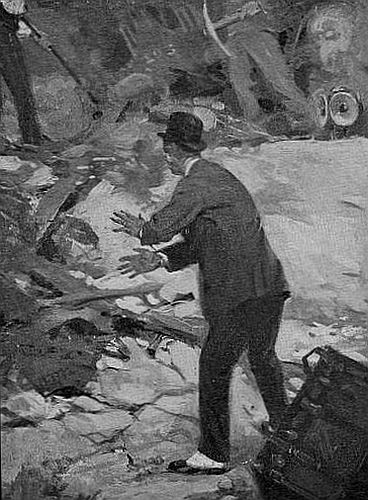
Nobody paid any attention to Mr. Trimm.
—Frontispiece (Page 18)[To List]
HIS PLIGHT AND OTHER PLIGHTS — BY
IRVIN S. COBB — AUTHOR OF OLD JUDGE PRIEST, BACK HOME, Etc. — GROSSET & DUNLAP — PUBLISHERS NEW YORK
Copyright, 1910, 1911, 1912 and 1913 By The Curtis Publishing Company Copyright, 1913 By The Frank A. Munsey Company Copyright, 1913 By George H. Doran Company
Transcriber's Note: A List of Illustrations has been added.
Mr. Trimm, recently president of the
late Thirteenth National Bank, was
taking a trip which was different in
a number of ways from any he had
ever taken. To begin with, he was used to
parlor cars and Pullmans and even luxurious
private cars when he went anywhere; whereas
now he rode with a most mixed company in a
dusty, smelly day coach. In the second place,
his traveling companion was not such a one
as Mr. Trimm would have chosen had the
choice been left to him, being a stupid-looking
German-American with a drooping, yellow
mustache. And in the third place, Mr.
Trimm's plump white hands were folded in
his lap, held in a close and enforced companionship
by a new and shiny pair of Bean's
Latest Model Little Giant handcuffs. Mr.
Trimm was on his way to the Federal penitentiary
to serve twelve years at hard labor for
breaking, one way or another, about all the
laws that are presumed to govern national
banks.
All the time Mr. Trimm was in the Tombs,
fighting for a new trial, a certain question had
lain in his mind unasked and unanswered.
Through the seven months of his stay in the
jail that question had been always at the back
part of his head, ticking away there like a
little watch that never needed winding. A
dozen times a day it would pop into his thoughts
and then go away, only to come back again.
When Copley was taken to the penitentiary—Copley
being the cashier who got off with
a lighter sentence because the judge and jury
held him to be no more than a blind accomplice
in the wrecking of the Thirteenth National—Mr.
Trimm read closely every line that the
papers carried about Copley's departure. But
none of them had seen fit to give the young
cashier more than a short and colorless paragraph.
For Copley was only a small figure
in the big intrigue that had startled the country;
Copley didn't have the money to hire big lawyers
to carry his appeal to the higher courts
for him; Copley's wife was keeping boarders;
and as for Copley himself, he had been wearing
stripes several months now.
With Mr. Trimm it had been vastly different.
From the very beginning he had held the public
eye. His bearing in court when the jury came
in with their judgment; his cold defiance when
the judge, in pronouncing sentence, mercilessly
arraigned him and the system of finance for
which he stood; the manner of his life in the
Tombs; his spectacular fight to beat the
verdict, had all been worth columns of newspaper
space. If Mr. Trimm had been a popular
poisoner, or a society woman named as co-respondent
in a sensational divorce suit, the
papers could not have been more generous in
their space allotments. And Mr. Trimm in
his cell had read all of it with smiling contempt,
even to the semi-hysterical outpourings
of the lady special writers who called him The
Iron Man of Wall Street and undertook to
analyze his emotions—and missed the mark
by a thousand miles or two.
Things had been smoothed as much as
possible for him in the Tombs, for money and
the power of it will go far toward ironing out
even the corrugated routine of that big jail.
He had a large cell to himself in the airiest,
brightest corridor. His meals were served by
a caterer from outside. Although he ate them
without knife or fork, he soon learned that a
spoon and the fingers can accomplish a good
deal when backed by a good appetite, and Mr.
Trimm's appetite was uniformly good. The
warden and his underlings had been models
of official kindliness; the newspapers had sent
their brightest young men to interview him
whenever he felt like talking, which wasn't
often; and surely his lawyers had done all in
his behalf that money—a great deal of money—could
do. Perhaps it was because of these
things that Mr. Trimm had never been able
to bring himself to realize that he was the
Hobart W. Trimm who had been sentenced to
the Federal prison; it seemed to him, somehow,
that he, personally, was merely a spectator
standing to one side watching the fight of
another man to dodge the penitentiary.
However, he didn't fail to give the other man
the advantage of every chance that money
would buy. This sense of aloofness to the
whole thing had persisted even when his
personal lawyer came to him one night in the
early fall and told him that the court of last
possible resort had denied the last possible
motion. Mr. Trimm cut the lawyer short
with a shake of his head as the other began
saying something about the chances of a pardon
from the President. Mr. Trimm wasn't in
the habit of letting men deceive him with idle
words. No President would pardon him, and
he knew it.
“Never mind that, Walling,” he said steadily,
when the lawyer offered to come to see him
again before he started for prison the next
day. “If you'll see that a drawing-room on
the train is reserved for me—for us, I mean—and
all that sort of thing, I'll not detain you
any further. I have a good many things to do
tonight. Good night.”
“Such a man, such a man,” said Walling to
himself as he climbed into his car; “all chilled
steel and brains. And they are going to lock
that brain up for twelve years. It's a crime,”
said Walling, and shook his head. Walling
always said it was a crime when they sent a
client of his to prison. To his credit be it
said, though, they sent very few of them
there. Walling made as high as fifty thousand
a year at criminal law. Some of it was very
criminal law indeed. His specialty was picking
holes in the statutes faster than the legislature
could make them and provide them and
putty them up with amendments. This was
the first case he had lost in a good long time.
When Jerry, the turnkey, came for him in
the morning Mr. Trimm had made as careful
a toilet as the limited means at his command
permitted, and he had eaten a hearty breakfast
and was ready to go, all but putting on his
hat. Looking the picture of well-groomed,
close-buttoned, iron-gray middle age, Mr.
Trimm followed the turnkey through the long
corridor and down the winding iron stairs to
the warden's office. He gave no heed to the
curious eyes that followed him through the
barred doors of many cells; his feet rang
briskly on the flags.
The warden, Hallam, was there in the private
office with another man, a tall, raw-boned
man with a drooping, straw-colored mustache
and the unmistakable look about him of the
police officer. Mr. Trimm knew without being
told that this was the man who would take
him to prison. The stranger was standing at
a desk, signing some papers.
“Sit down, please, Mr. Trimm,” said the
warden with a nervous cordiality. “Be through
here in just one minute. This is Deputy
Marshal Meyers,” he added.
Mr. Trimm started to tell this Mr. Meyers
he was glad to meet him, but caught himself and
merely nodded. The man stared at him with
neither interest nor curiosity in his dull blue
eyes. The warden moved over toward the
door.
“Mr. Trimm,” he said, clearing his throat,
“I took the liberty of calling a cab to take
you gents up to the Grand Central. It's
out front now. But there's a big crowd of
reporters and photographers and a lot of other
people waiting, and if I was you I'd slip out
the back way—one of my men will open the
yard gate for you—and jump aboard the
subway down at Worth Street. Then you'll
miss those fellows.”
“Thank you, Warden—very kind of you,”
said Mr. Trimm in that crisp, businesslike way
of his. He had been crisp and businesslike
all his life. He heard a door opening softly
behind him, and when he turned to look he
saw the warden slipping out, furtively, in
almost an embarrassed fashion.
“Well,” said Meyers, “all ready?”
“Yes,” said Mr. Trimm, and he made as if
to rise.
“Wait one minute,” said Meyers.
He half turned his back on Mr. Trimm and
fumbled at the side pocket of his ill-hanging
coat. Something inside of Mr. Trimm gave
the least little jump, and the question that
had ticked away so busily all those months
began to buzz, buzz in his ears; but it was
only a handkerchief the man was getting out.
Doubtless he was going to mop his face.
He didn't mop his face, though. He unrolled
the handkerchief slowly, as if it contained
something immensely fragile and valuable, and
then, thrusting it back in his pocket, he faced
Mr. Trimm. He was carrying in his hands
a pair of handcuffs that hung open-jawed.
The jaws had little notches in them, like
teeth that could bite. The question that had
ticked in Mr. Trimm's head was answered at
last—in the sight of these steel things with
their notched jaws.
Mr. Trimm stood up and, with a movement
as near to hesitation as he had ever been guilty
of in his life, held out his hands, backs upward.
“I guess you're new at this kind of thing,”
said Meyers, grinning. “This here way—one
at a time.”
He took hold of Mr. Trimm's right hand,
turned it sideways and settled one of the
steel cuffs over the top of the wrist, flipping
the notched jaw up from beneath and pressing
it in so that it locked automatically with
a brisk little click. Slipping the locked cuff
back and forth on Mr. Trimm's lower arm like
a man adjusting a part of machinery, and then
bringing the left hand up to meet the right, he
treated it the same way. Then he stepped
back.
Mr. Trimm hadn't meant to protest. The
word came unbidden.
“This—this isn't necessary, is it?” he
asked in a voice that was husky and didn't
seem to belong to him.
“Yep,” said Meyers. “Standin' orders is
play no favorites and take no chances. But
you won't find them things uncomfortable.
Lightest pair there was in the office, and I
fixed 'em plenty loose.”
For half a minute Mr. Trimm stood like a
rooster hypnotized by a chalkmark, his arms
extended, his eyes set on his bonds. His
hands had fallen perhaps four inches apart,
and in the space between his wrists a little
chain was stretched taut. In the mounting
tumult that filled his brain there sprang before
Mr. Trimm's consciousness a phrase he had
heard or read somewhere, the title of a story
or, perhaps, it was a headline—The Grips
of the Law. The Grips of the Law were upon
Mr. Trimm—he felt them now for the first
time in these shiny wristlets and this bit of
chain that bound his wrists and filled his whole
body with a strange, sinking feeling that made
him physically sick. A sudden sweat beaded out
on Mr. Trimm's face, turning it slick and wet.
He had a handkerchief, a fine linen handkerchief
with a hemstitched border and a monogram
on it, in the upper breast pocket of his
buttoned coat. He tried to reach it. His
hands went up, twisting awkwardly like crab
claws. The fingers of both plucked out the
handkerchief. Holding it so, Mr. Trimm
mopped the sweat away. The links of the
handcuffs fell in upon one another and lengthened
out again at each movement, filling the
room with a smart little sound.
He got the handkerchief stowed away with
the same clumsiness. He raised the manacled
hands to his hat brim, gave it a downward
pull that brought it over his face and then,
letting his short arms slide down upon his
plump stomach, he faced the man who had
put the fetters upon him, squaring his shoulders
back. But it was hard, somehow, for him
to square his shoulders—perhaps because of
his hands being drawn so closely together.
And his eyes would waver and fall upon his
wrists. Mr. Trimm had a feeling that the skin
must be stretched very tight on his jawbones
and his forehead.
“Isn't there some way to hide these—these
things?”
He began by blurting and ended by faltering
it. His hands shuffled together, one over,
then under the other.
“Here's a way,” said Meyers. “This'll
help.”
He bestirred himself, folding one of the
chained hands upon the other, tugging at the
white linen cuffs and drawing the coat sleeves
of his prisoner down over the bonds as far as
the chain would let them come.
“There's the notion,” he said. “Just do
that-a-way and them bracelets won't hardly
show a-tall. Ready? Let's be movin', then.”
But handcuffs were never meant to be hidden.
Merely a pair of steel rings clamped to one's
wrists and coupled together with a scrap of
chain, but they'll twist your arms and hamper
the movements of your body in a way to constantly
catch the eye of the passer-by. When
a man is coming toward you, you can tell that
he is handcuffed before you see the cuffs.
Mr. Trimm was never able to recall afterward
exactly how he got out of the Tombs.
He had a confused memory of a gate that was
swung open by some one whom Mr. Trimm
saw only from the feet to the waist; then he
and his companion were out on Lafayette
Street, speeding south toward the subway
entrance at Worth Street, two blocks below,
with the marshal's hand cupped under Mr.
Trimm's right elbow and Mr. Trimm's plump
legs almost trotting in their haste. For a
moment it looked as if the warden's well-meant
artifice would serve them.
But New York reporters are up to the tricks
of people who want to evade them. At the
sight of them a sentry reporter on the corner
shouted a warning which was instantly caught
up and passed on by another picket stationed
half-way down the block; and around the wall
of the Tombs came pelting a flying mob of
newspaper photographers and reporters, with
a choice rabble behind them. Foot passengers
took up the chase, not knowing what it was
about, but sensing a free show. Truckmen
halted their teams, jumped down from their
wagon seats and joined in. A man-chase is
one of the pleasantest outdoor sports that a
big city like New York can offer its people.
Fairly running now, the manacled banker
and the deputy marshal shot down the winding
steps into the subway a good ten yards ahead
of the foremost pursuers. But there was one
delay, while Meyers skirmished with his free
hand in his trousers' pocket for a dime for the
tickets, and another before a northbound local
rolled into the station. Shouted at, jeered at,
shoved this way and that, panting in gulping
breaths, for he was stout by nature and staled
by lack of exercise, Mr. Trimm, with Meyers
clutching him by the arm, was fairly shot
aboard one of the cars, at the apex of a human
wedge. The astonished guard sensed the situation
as the scrooging, shoving, noisy wave
rolled across the platform toward the doors
which he had opened and, thrusting the officer
and his prisoner into the narrow platform space
behind him, he tried to form with his body a
barrier against those who came jamming in.
It didn't do any good. He was brushed
away, protesting and blustering. The excitement
spread through the train, and men, and
even women, left their seats, overflowing the
aisles.
There is no crueler thing than a city crowd,
all eyes and morbid curiosity. But Mr. Trimm
didn't see the staring eyes on that ride to the
Grand Central. What he saw was many shifting
feet and a hedge of legs shutting him in
closely—those and the things on his wrists.
What the eyes of the crowd saw was a small,
stout man who, for all his bulk, seemed to have
dried up inside his clothes so that they bagged
on him some places and bulged others, with
his head tucked on his chest, his hat over his
face and his fingers straining to hold his coat
sleeves down over a pair of steel bracelets.
Mr. Trimm gave mental thanks to a Deity
whose existence he thought he had forgotten
when the gate of the train-shed clanged behind
him, shutting out the mob that had come with
them all the way. Cameras had been shoved
in his face like gun muzzles, reporters had
scuttled alongside him, dodging under Meyers'
fending arm to shout questions in his ears.
He had neither spoken nor looked at them.
The sweat still ran down his face, so that when
finally he raised his head in the comparative
quiet of the train-shed his skin was a curious
gray under the jail paleness like the color of
wet wood ashes.
“My lawyer promised to arrange for a compartment—for
some private place on the
train,” he said to Meyers. “The conductor
ought to know.”
They were the first words he had uttered
since he left the Tombs. Meyers spoke to a
jaunty Pullman conductor who stood alongside
the car where they had halted.
“No such reservation,” said the conductor,
running through his sheaf of slips, with his eyes
shifting from Mr. Trimm's face to Mr. Trimm's
hands and back again, as though he couldn't
decide which was the more interesting part of
him; “must be some mistake. Or else it was
for some other train. Too late to change now—we
pull out in three minutes.”
“I reckon we better git on the smoker,”
said Meyers, “if there's room there.”
Mr. Trimm was steered back again the length
of the train through a double row of pop-eyed
porters and staring trainmen. At the steps
where they stopped the instinct to stretch out
one hand and swing himself up by the rail
operated automatically and his wrists got a
nasty twist. Meyers and a brakeman practically
lifted him up the steps and Meyers
headed him into a car that was hazy with blue
tobacco smoke. He was confused in his gait,
almost as if his lower limbs had been fettered,
too.
The car was full of shirt-sleeved men who
stood up, craning their necks and stumbling
over each other in their desire to see him.
These men came out into the aisle, so that
Meyers had to shove through them.
“This here'll do as well as any, I guess,”
said Meyers. He drew Mr. Trimm past him
into the seat nearer the window and sat down
alongside him on the side next the aisle, settling
himself on the stuffy plush seat and breathing
deeply, like a man who had got through the
hardest part of a not easy job.
“Smoke?” he asked.
Mr. Trimm shook his head without raising it.
“Them cuffs feel plenty easy?” was the
deputy's next question. He lifted Mr. Trimm's
hands as casually as if they had been his
hands and not Mr. Trimm's, and looked at
them.
“Seem to be all right,” he said as he let them
fall back. “Don't pinch none, I reckon?”
There was no answer.
The deputy tugged a minute at his mustache,
searching his arid mind. An idea came
to him. He drew a newspaper from his pocket,
opened it out flat and spread it over Mr.
Trimm's lap so that it covered the chained
wrists. Almost instantly the train was in
motion, moving through the yards.
“Be there in two hours more,” volunteered
Meyers. It was late afternoon. They were
sliding through woodlands with occasional
openings which showed meadows melting into
wide, flat lands.
“Want a drink?” said the deputy, next.
“No? Well, I guess I'll have a drop myself.
Travelin' fills a feller's throat full of dust.”
He got up, lurching to the motion of the flying
train, and started forward to the water cooler
behind the car door. He had gone perhaps
two-thirds of the way when Mr. Trimm felt
a queer, grinding sensation beneath his feet;
it was exactly as though the train were trying
to go forward and back at the same time.
Almost slowly, it seemed to him, the forward
end of the car slued out of its straight course,
at the same time tilting up. There was a
grinding, roaring, grating sound, and before
Mr. Trimm's eyes Meyers vanished, tumbling
forward out of sight as the car floor buckled
under his feet. Then, as everything—the
train, the earth, the sky—all fused together
in a great spatter of white and black, Mr.
Trimm, plucked from his seat as though a
giant hand had him by the collar, shot forward
through the air over the seatbacks, his chained
hands aloft, clutching wildly. He rolled out
of a ragged opening where the smoker had
broken in two, flopped gently on the sloping
side of the right-of-way and slid easily to the
bottom, where he lay quiet and still on his
back in a bed of weeds and wild grass, staring
straight up.
How many minutes he lay there Mr. Trimm
didn't know. It may have been the shrieks
of the victims or the glare from the fire that
brought him out of the daze. He wriggled
his body to a sitting posture, got on his feet,
holding his head between his coupled hands,
and gazed full-face into the crowning railroad
horror of the year.
There were numbers of the passengers who
had escaped serious hurt, but for the most part
these persons seemed to have gone daft from
terror and shock. Some were running aimlessly
up and down and some, a few, were
pecking feebly with improvised tools at the
wreck, an indescribable jumble of ruin, from
which there issued cries of mortal agony, and
from which, at a point where two locomotives
were lying on their sides, jammed together like
fighting bucks that had died with locked horns,
a tall flame already rippled and spread, sending
up a pillar of black smoke that rose straight,
poisoning the clear blue of the sky. Nobody
paid any attention to Mr. Trimm as he stood
swaying upon his feet. There wasn't a scratch
on him. His clothes were hardly rumpled,
his hat was still on his head. He stood a
minute and then, moved by a sudden impulse,
he turned round and went running straight
away from the railroad at the best speed his
pudgy legs could accomplish, with his arms
pumping up and down in front of him
and his fingers interlaced. It was a grotesque
gait, almost like a rabbit hopping on its
hindlegs.
Instantly, almost, the friendly woods growing
down to the edge of the fill swallowed him
up. He dodged and doubled back and forth
among the tree trunks, his small, patent-leathered
feet skipping nimbly over the irregular
turf, until he stopped for lack of wind in
his lungs to carry him another rod. When
he had got his breath back Mr. Trimm leaned
against a tree and bent his head this way and
that, listening. No sound came to his ears
except the sleepy calls of birds. As well as
Mr. Trimm might judge he had come far into
the depths of a considerable woodland. Already
the shadows under the low limbs were growing
thick and confused as the hurried twilight of
early September came on.
Mr. Trimm sat down on a natural cushion of
thick green moss between two roots of an oak.
The place was clean and soft and sweet-scented.
For some little time he sat there motionless,
in a sort of mental haze. Then his round body
slowly slid down flat upon the moss, his head
lolled to one side and, the reaction having come,
Mr. Trimm's limbs all relaxed and he went to
sleep straightway.
After a while, when the woods were black
and still, the half-grown moon came up and,
sifting through a chink in the canopy of leaves
above, shone down full on Mr. Trimm as he
lay snoring gently with his mouth open, and
his hands rising and falling on his breast. The
moonlight struck upon the Little Giant handcuffs,
making them look like quicksilver.
Toward daylight it turned off sharp and cool.
The dogwoods which had been a solid color at
nightfall now showed pink in one light and
green in another, like changeable silk, as the
first level rays of the sun came up over the
rim of the earth and made long, golden lanes
between the tree trunks. Mr. Trimm opened
his eyes slowly, hardly sensing for the first
moment or two how he came to be lying under
a canopy of leaves, and gaped, seeking to
stretch his arms. At that he remembered
everything; he haunched his shoulders against
the tree roots and wriggled himself up to a
sitting position where he stayed for a while,
letting his mind run over the sequence of
events that had brought him where he was
and taking inventory of the situation.
Of escape he had no thought. The hue and
cry must be out for him before now; doubtless
men were already searching for him. It would
be better for him to walk in and surrender
than to be taken in the woods like an animal
escaped from a traveling menagerie. But
the mere thought of enduring again what he
had already gone through—the thought of
being tagged by crowds and stared at, with
his fetters on—filled him with a nausea.
Nothing that the Federal penitentiary might
hold in store for him could equal the black,
blind shamefulness of yesterday; he knew
that. The thought of the new ignominy that
faced him made Mr. Trimm desperate. He
had a desire to burrow into the thicket yonder
and hide his face and his chained hands.
But perhaps he could get the handcuffs off and
so go to meet his captors in some manner of
dignity. Strange that the idea hadn't occurred
to him before! It seemed to Mr. Trimm that
he desired to get his two hands apart more
than he had ever desired anything in his whole
life before.
The hands had begun naturally to adjust
themselves to their enforced companionship,
and it wasn't such a very hard matter, though
it cost him some painful wrenches and much
twisting of the fingers, for Mr. Trimm to get
his coat unbuttoned and his eyeglasses in their
small leather case out of his upper waistcoat
pocket. With the glasses on his nose he subjected
his bonds to a critical examination.
Each rounded steel band ran unbroken except
for the smooth, almost jointless hinge and the
small lock which sat perched on the back of the
wrist in a little rounded excrescence like a steel
wart. In the flat center of each lock was a
small keyhole and alongside of it a notched
nub, the nub being sunk in a minute depression.
On the inner side, underneath, the cuffs slid
into themselves—two notches on each showing
where the jaws might be tightened to fit
a smaller hand than his—and right over the
large blue veins in the middle of the wrists were
swivel links, shackle-bolted to the cuffs and
connected by a flat, slightly larger middle link,
giving the hands a palm-to-palm play of not
more than four or five inches. The cuffs did
not hurt—even after so many hours there
was no actual discomfort from them and the
flesh beneath them was hardly reddened.
But it didn't take Mr. Trimm long to find
out that they were not to be got off. He
tugged and pulled, trying with his fingers for
a purchase. All he did was to chafe his skin
and make his wrists throb with pain. The
cuffs would go forward just so far, then the
little humps of bone above the hands would
catch and hold them.
Mr. Trimm was not a man to waste time in
the pursuit of the obviously hopeless. Presently
he stood up, shook himself and started
off at a fair gait through the woods. The
sun was up now and the turf was all dappled
with lights and shadows, and about him much
small, furtive wild life was stirring. He stepped
along briskly, a strange figure for that green
solitude, with his correct city garb and the
glint of the steel at his sleeve ends.
Presently he heard the long-drawn, quavering,
banshee wail of a locomotive. The sound
came from almost behind him, in an opposite
direction from where he supposed the track
to be. So he turned around and went back
the other way. He crossed a half-dried-up
runlet and climbed a small hill, neither of
which he remembered having met in his night
from the wreck, and in a little while he came
out upon the railroad. To the north a little
distance the rails ran round a curve. To the
south, where the diminishing rails running
through the unbroken woodland met in a long,
shiny V, he could see a big smoke smudge
against the horizon. This smoke Mr. Trimm
knew must come from the wreck—which was
still burning, evidently. As nearly as he
could judge he had come out of cover at least
two miles above it. After a moment's consideration
he decided to go south toward the
wreck. Soon he could distinguish small dots
like ants moving in and out about the black
spot, and he knew these dots must be men.
A whining, whirring sound came along the
rails to him from behind. He faced about
just as a handcar shot out around the curve
from the north, moving with amazing rapidity
under the strokes of four men at the pumps.
Other men, laborers to judge by their blue
overalls, were sitting on the edges of the car
with their feet dangling. For the second time
within twelve hours impulse ruled Mr. Trimm,
who wasn't given to impulses normally. He
made a jump off the right-of-way, and as the
handcar flashed by he watched its flight from
the covert of a weed tangle.
But even as the handcar was passing him
Mr. Trimm regretted his hastiness. He must
surrender himself sooner or later; why not to
these overalled laborers, since it was a thing
that had to be done? He slid out of hiding and
came trotting back to the tracks. Already
the handcar was a hundred yards away, flitting
into distance like some big, wonderfully
fast bug, the figures of the men at the pumps
rising and falling with a walking-beam regularity.
As he stood watching them fade away
and minded to try hailing them, yet still
hesitating against his judgment, Mr. Trimm
saw something white drop from the hands of
one of the blue-clad figures on the handcar,
unfold into a newspaper and come fluttering
back along the tracks toward him. Just as he,
starting doggedly ahead, met it, the little
ground breeze that had carried it along died
out and the paper dropped and flattened right
in front of him. The front page was uppermost
and he knew it must be of that morning's
issue, for across the column tops ran the flaring
headline: “Twenty Dead in Frightful Collision.”
Squatting on the cindered track, Mr. Trimm
patted the crumpled sheet flat with his hands.
His eyes dropped from the first of the glaring
captions to the second, to the next—and
then his heart gave a great bound inside of him
and, clutching up the newspaper to his breast,
he bounded off the tracks back into another
thicket and huddled there with the paper
spread on the earth in front of him, reading by
gulps while the chain that linked wrist to wrist
tinkled to the tremors running through him.
What he had seen first, in staring black-face
type, was his own name leading the list of
known dead, and what he saw now, broken up
into choppy paragraphs and done in the nervous
English of a trained reporter throwing a great
news story together to catch an edition, but
telling a clear enough story nevertheless, was
a narrative in which his name recurred again
and again. The body of the United States
deputy marshal, Meyers, frightfully crushed,
had been taken from the wreckage of the
smoker—so the double-leaded story ran—and
near to Meyers another body, with features
burned beyond recognition, yet still retaining
certain distinguishing marks of measurement
and contour, had been found and identified
as that of Hobart W. Trimm, the convicted
banker. The bodies of these two, with eighteen
other mangled dead, had been removed
to a town called Westfield, from which town
of Westfield the account of the disaster had
been telegraphed to the New York paper. In
another column farther along was more about
Banker Trimm; facts about his soiled, selfish,
greedy, successful life, his great fortune, his
trial, and a statement that, lacking any close
kin to claim his body, his lawyers had been
notified.
Mr. Trimm read the account through to
the end, and as he read the sense of dominant,
masterful self-control came back to him in
waves. He got up, taking the paper with
him, and went back into the deeper woods,
moving warily and watchfully. As he went
his mind, trained to take hold of problems and
wring the essence out of them, was busy. Of
the charred, grisly thing in the improvised
morgue at Westfield, wherever that might be,
Mr. Trimm took no heed nor wasted any pity.
All his life he had used live men to work his
will, with no thought of what might come to
them afterward. The living had served him,
why not the dead?
He had other things to think of than this
dead proxy of his. He was as good as free!
There would be no hunt for him now; no
alarm out, no posses combing every scrap of
cover for a famous criminal turned fugitive.
He had only to lie quiet a few days, somewhere,
then get in secret touch with Walling.
Walling would do anything for money. And
he had the money—four millions and more,
cannily saved from the crash that had ruined
so many others.
He would alter his personal appearance,
change his name—he thought of Duvall,
which was his mother's name—and with
Walling's aid he would get out of the country
and into some other country where a man
might live like a prince on four millions or the
fractional part of it. He thought of South
America, of South Africa, of a private yacht
swinging through the little frequented islands
of the South Seas. All that the law had tried
to take from him would be given back. Walling
would work out the details of the escape—and
make it safe and sure—trust Walling
for those things. On one side was the prison,
with its promise of twelve grinding years
sliced out of the very heart of his life; on the
other, freedom, ease, security, even power.
Through Mr. Trimm's mind tumbled thoughts
of concessions, enterprises, privileges—the
back corners of the globe were full of possibilities
for the right man. And between this
prospect and Mr. Trimm there stood nothing
in the way, nothing but——
Mr. Trimm's eyes fell upon his bound hands.
Snug-fitting, shiny steel bands irked his wrists.
The Grips of the Law were still upon him.
But only in a way of speaking. It was preposterous,
unbelievable, altogether out of the
question that a man with four millions salted
down and stored away, a man who all his life
had been used to grappling with the big things
and wrestling them down into submission, a
man whose luck had come to be a byword—and
had not it held good even in this last
emergency?—would be balked by puny scraps
of forged steel and a trumpery lock or two.
Why, these cuffs were no thicker than the gold
bands that Mr. Trimm had seen on the arms
of overdressed women at the opera. The
chain that joined them was no larger and,
probably, no stronger than the chains which
Mr. Trimm's chauffeur wrapped around the
tires of the touring car in winter to keep the
wheels from skidding on the slush. There
would be a way, surely, for Mr. Trimm to free
himself from these things. There must be—that
was all there was to it.
Mr. Trimm looked himself over. His clothes
were not badly rumpled; his patent-leather
boots were scarcely scratched. Without the
handcuffs he could pass unnoticed anywhere.
By night then he must be free of them and on
his way to some small inland city, to stay
quiet there until the guarded telegram that
he would send in cipher had reached Walling.
There in the woods by himself Mr. Trimm no
longer felt the ignominy of his bonds; he felt
only the temporary embarrassment of them
and the need of added precaution until he
should have mastered them.
He was once more the unemotional man
of affairs who had stood Wall Street on its
esteemed head and caught the golden streams
that trickled from its pockets. First making
sure that he was in a well-screened covert of
the woods he set about exploring all his pockets.
The coat pockets were comparatively easy, now
that he had got used to using two hands where
one had always served, but it cost him a lot
of twisting of his body and some pain to his
mistreated wrist bones to bring forth the
contents of his trousers' pockets. The chain
kinked time and again as he groped with the
undermost hand for the openings; his dumpy,
pudgy form writhed grotesquely. But finally
he finished. The search produced four cigars
somewhat crumpled and frayed; some matches
in a gun-metal case, a silver cigar cutter, two
five-dollar bills, a handful of silver chicken
feed, the leather case of the eyeglasses, a couple
of quill toothpicks, a gold watch with a dangling
fob, a notebook and some papers. Mr.
Trimm ranged these things in a neat row upon
a log, like a watchmaker setting out his kit,
and took swift inventory of them. Some he
eliminated from his design, stowing them back
in the pockets easiest to reach. He kept for
present employment the match safe, the cigar
cutter and the watch.
This place where he had halted would suit
his present purpose well, he decided. It was
where an uprooted tree, fallen across an incurving
bank, made a snug little recess that was
closed in on three sides. Spreading the newspaper
on the turf to save his knees from soiling,
he knelt and set to his task. For the time he
felt neither hunger nor thirst. He had found
out during his earlier experiments that the
nails of his little fingers, which were trimmed
to a point, could invade the keyholes in the
little steel warts on the backs of his wrists and
touch the locks. The mechanism had even
twitched a little bit under the tickle of the
nail ends. So, having already smashed the gun-metal
match safe under his heel, Mr. Trimm
selected a slender-pointed bit from among its
fragments and got to work, the left hand drawn
up under the right, the fingers of the right
busy with the lock of the left, the chain
tightening and slackening with subdued clinking
sounds at each movement.
Mr. Trimm didn't know much about picking
a lock. He had got his money by a higher form
of burglary that did not require a knowledge
of lock picking. Nor as a boy had he been
one to play at mechanics. He had let other
boys make the toy fluttermills and the wooden
traps and the like, and then he had traded
for them. He was sorry now that he hadn't
given more heed to the mechanical side of
things when he was growing up.
He worked with a deliberate slowness,
steadily. Nevertheless, it was hot work. The
sun rose over the bank and shone on him
through the limbs of the uprooted tree. His
hat was on the ground alongside of him. The
sweat ran down his face, streaking it and wilting
his collar flat. The scrap of gun metal
kept slipping out of his wet fingers. Down
would go the chained hands to scrabble in the
grass for it, and then the picking would go on
again. This happened a good many times.
Birds, nervous with the spirit that presages
the fall migration, flew back and forth along
the creek, almost grazing Mr. Trimm sometimes.
A rain crow wove a brown thread in
the green warp of the bushes above his head.
A chattering red squirrel sat up on a tree
limb to scold him. At intervals, distantly,
came the cough of laboring trains, showing
that the track must have been cleared. There
were times when Mr. Trimm thought he felt
the lock giving. These times he would work
harder.
Late in the afternoon Mr. Trimm lay back
against the bank, panting. His face was
splotched with red, and the little hollows at
the sides of his forehead pulsed rapidly up and
down like the bellies of scared tree frogs. The
bent outer case of the watch littered a bare
patch on the log; its mainspring had gone the
way of the fragments of the gun-metal match
safe which were lying all about, each a worn-down,
twisted wisp of metal. The spring of
the eyeglasses had been confiscated long ago
and the broken crystals powdered the earth
where Mr. Trimm's toes had scraped a smooth
patch. The nails of the two little fingers were
worn to the quick and splintered down into
the raw flesh. There were countless tiny
scratches and mars on the locks of the handcuffs,
and the steel wristbands were dulled with
blood smears and pale-red tarnishes of new
rust; but otherwise they were as stanch and
strong a pair of Bean's Latest Model Little
Giant handcuffs as you'd find in any hardware
store anywhere.
The devilish, stupid malignity of the damned
things! With an acid oath Mr. Trimm raised
his hands and brought them down on the log
violently. There was a double click and the
bonds tightened painfully, pressing the chafed
red skin white. Mr. Trimm snatched up his
hands close to his near-sighted eyes and looked.
One of the little notches on the under side of
each cuff had disappeared. It was as if they
were living things that had turned and bitten
him for the blow he gave them.
From the time the sun went down there
was a tingle of frost in the air. Mr. Trimm
didn't sleep much. Under the squeeze of the
tightened fetters his wrists throbbed steadily
and racking cramps ran through his arms.
His stomach felt as though it were tied into
knots. The water that he drank from the
branch only made his hunger sickness worse.
His undergarments, that had been wet with
perspiration, clung to him clammily. His
middle-aged, tenderly-cared-for body called
through every pore for clean linen and soap
and water and rest, as his empty insides called
for food.
After a while he became so chilled that the
demand for warmth conquered his instinct
for caution. He felt about him in the darkness,
gathering scraps of dead wood, and, after breaking
several of the matches that had been in the
gun-metal match safe, he managed to strike
one and with its tiny flame started a fire. He
huddled almost over the fire, coughing when
the smoke blew into his face and twisting and
pulling at his arms in an effort to get relief
from the everlasting cramps. It seemed to
him that if he could only get an inch or two
more of play for his hands he would be ever
so much more comfortable. But he couldn't,
of course.
He dozed, finally, sitting crosslegged with
his head sunk between his hunched shoulders.
A pain in a new place woke him. The fire
had burned almost through the thin sole of his
right shoe, and as he scrambled to his feet and
stamped, the clap of the hot leather flat against
his blistered foot almost made him cry out.
Soon after sunrise a boy came riding a horse
down a faintly traced footpath along the
creek, driving a cow with a bell on her neck
ahead of him. Mr. Trimm's ears caught the
sound of the clanking bell before either the
cow or her herder was in sight, and he limped
away, running, skulking through the thick
cover. A pendent loop of a wild grapevine,
swinging low, caught his hat and flipped it off
his head; but Mr. Trimm, imagining pursuit,
did not stop to pick it up and went on bareheaded
until he had to stop from exhaustion.
He saw some dark-red berries on a shrub upon
which he had trod, and, stooping, he plucked
some of them with his two hands and put
three or four in his mouth experimentally.
Warned instantly by the acrid, burning taste,
he spat the crushed berries out and went on
doggedly, following, according to his best
judgment, a course parallel to the railroad.
It was characteristic of him, a city-raised man,
that he took no heed of distances nor of the
distinguishing marks of the timber.
Behind a log at the edge of a small clearing
in the woods he halted some little time, watching
and listening. The clearing had grown
up in sumacs and weeds and small saplings
and it seemed deserted; certainly it was still.
Near the center of it rose the sagging roof of
what had been a shack or a shed of some sort.
Stooping cautiously, to keep his bare head
below the tops of the sumacs, Mr. Trimm
made for the ruined shanty and gained it
safely. In the midst of the rotted, punky
logs that had once formed the walls he began
scraping with his feet. Presently he uncovered
something. It was a broken-off harrow tooth,
scaled like a long, red fish with the crusted rust
of years.
Mr. Trimm rested the lower rims of his handcuffs
on the edge of an old, broken watering
trough, worked the pointed end of the rust-crusted
harrow tooth into the flat middle link
of the chain as far as it would go, and then
with one hand on top of the other he pressed
downward with all his might. The pain in his
wrists made him stop this at once. The link
had not sprung or given in the least, but the
twisting pressure had almost broken his wrist
bones. He let the harrow tooth fall, knowing
that it would never serve as a lever to free him—which,
indeed, he had known all along—and
sat on the side of the trough, rubbing his
wrists and thinking.
He had another idea. It came into his mind
as a vague suggestion that fire had certain
effects upon certain metals. He kindled a
fire of bits of the rotted wood, and when the
flames ran together and rose slender and straight
in a single red thread he thrust the chain into
it, holding his hands as far apart as possible
in the attitude of a player about to catch a
bounced ball. But immediately the pain of
that grew unendurable too, and he leaped
back, jerking his hands away. He had succeeded
only in blackening the steel and putting
a big water blister on one of his wrists right
where the shackle bolt would press upon it.
Where he huddled down in the shelter of
one of the fallen walls he noticed, presently,
a strand of rusted fence wire still held to half-tottering
posts by a pair of blackened staples;
it was part of a pen that had been used once
for chickens or swine. Mr. Trimm tried the
wire with his fingers. It was firm and springy.
Rocking and groaning with the pain of it, he
nevertheless began sliding the chain back and
forth, back and forth along the strand of wire.
Eventually the wire, weakened by age,
snapped in two. A tiny shined spot, hardly
deep enough to be called a nick, in its tarnished,
smudged surface was all the mark that
the chain showed.
Staggering a little and putting his feet
down unsteadily, Mr. Trimm left the clearing,
heading as well as he could tell eastward, away
from the railroad. After a mile or two he came
to a dusty wood road winding downhill.
To the north of the clearing where Mr.
Trimm had halted were a farm and a group
of farm buildings. To the southward a mile
or so was a cluster of dwellings set in the midst
of more farm lands, with a shop or two and a
small white church with a green spire in the
center. Along a road that ran northward from
the hamlet to the solitary farm a ten-year-old
boy came, carrying a covered tin pail. A
young gray squirrel flirted across the wagon
ruts ahead of him and darted up a chestnut
sapling. The boy put the pail down at the
side of the road and began looking for a stone
to throw at the squirrel.
Mr. Trimm slid out from behind a tree. A
hemstitched handkerchief, grimed and stained,
was loosely twisted around his wrists, partly
hiding the handcuffs. He moved along with
a queer, sliding gait, keeping as much of his
body as he could turned from the youngster.
The ears of the little chap caught the faint
scuffle of feet and he spun around on his bare
heel.
“My boy, would you——” Mr. Trimm began.
The boy's round eyes widened at the apparition
that was sidling toward him in so strange
a fashion, and then, taking fright, he dodged
past Mr. Trimm and ran back the way he had
come, as fast as his slim brown legs could take
him. In half a minute he was out of sight
round a bend.
Had the boy looked back he would have
seen a still more curious spectacle than the
one that had frightened him. He would have
seen a man worth four million dollars down on
his knees in the yellow dust, pawing with
chained hands at the tight-fitting lid of the
tin pail, and then, when he had got the lid off,
drinking the fresh, warm milk which the pail
held with great, choking gulps, uttering little
mewing, animal sounds as he drank, while
the white, creamy milk ran over his chin and
splashed down his breast in little, spurting
streams.
But the boy didn't look back. He ran all
the way home and told his mother he had seen
a wild man on the road to the village; and
later, when his father came in from the fields,
he was soundly thrashed for letting the sight
of a tramp make him lose a good tin bucket
and half a gallon of milk worth six cents a
quart.
The rich, fresh milk put life into Mr. Trimm.
He rested the better for it during the early
part of that night in a haw thicket. Only
the sharp, darting pains in his wrists kept rousing
him to temporary wakefulness. In one
of those intervals of waking the plan that had
been sketchily forming in his mind from the
time he had quit the clearing in the woods took
on a definite, fixed shape. But how was he
with safety to get the sort of aid he needed,
and where?
Canvassing tentative plans in his head, he
dozed off again.
On a smooth patch of turf behind the blacksmith
shop three yokels were languidly pitching
horseshoes—“quaits” they called them—at
a stake driven in the earth. Just beyond,
the woods shredded out into a long, yellow and
green peninsula which stretched up almost to
the back door of the smithy, so that late of
afternoons the slanting shadows of the near-most
trees fell on its roof of warped shingles.
At the extreme end of this point of woods Mr.
Trimm was squatted behind a big boulder,
squinting warily through a thick-fringed curtain
of ripened goldenrod tops and sumacs,
heavy-headed with their dark-red tapers. He
had been there more than an hour, cautiously
waiting his chance to hail the blacksmith,
whose figure he could make out in the smoky
interior of his shop, passing back and forth in
front of a smudgy forge fire and rattling metal
against metal in intermittent fits of professional
activity.
From where Mr. Trimm watched to where
the horseshoe-pitching game went on was not
more than sixty feet. He could hear what
the players said and even see the little puffs
of dust rise when one of them clapped his
hands together after a pitch. He judged by
the signs of slackening interest that they would
be stopping soon and, he hoped, going clear
away.
But the smith loafed out of his shop and,
after an exchange of bucolic banter with the
three of them, he took a hand in their game
himself. He wore no coat or waistcoat and,
as he poised a horseshoe for his first cast at
the stake, Mr. Trimm saw, pinned flat against
the broad strap of his suspenders, a shiny,
silvery-looking disk. Having pitched the shoe,
the smith moved over into the shade, so that
he almost touched the clump of undergrowth
that half buried Mr. Trimm's protecting
boulder. The near-sighted eyes of the fugitive
banker could make out then what the flat,
silvery disk was, and Mr. Trimm cowered
low in his covert behind the rock, holding his
hands down between his knees, fearful that a
gleam from his burnished wristlets might strike
through the screen of weed growth and catch
the inquiring eye of the smith. So he stayed,
not daring to move, until a dinner horn sounded
somewhere in the cluster of cottages beyond,
and the smith, closing the doors of his shop,
went away with the three yokels.
Then Mr. Trimm, stooping low, stole back
into the deep woods again. In his extremity
he was ready to risk making a bid for the
hire of a blacksmith's aid to rid himself of
his bonds, but not a blacksmith who wore a
deputy sheriff's badge pinned to his suspenders.
He caught himself scraping his wrists up
and down again against the rough, scrofulous
trunk of a shellbark hickory. The irritation
was comforting to the swollen skin. The
cuffs, which kept catching on the bark and
snagging small fragments of it loose, seemed
to Mr. Trimm to have been a part and parcel
of him for a long time—almost as long a time
as he could remember. But the hands which
they clasped so close seemed like the hands of
somebody else. There was a numbness about
them that made them feel as though they were
a stranger's hands which never had belonged
to him. As he looked at them with a sort of
vague curiosity they seemed to swell and grow,
these two strange, fettered hands, until they
measured yards across, while the steel bands
shrunk to the thinness of piano wire, cutting
deeper and deeper into the flesh. Then the
hands in turn began to shrink down and the
cuffs to grow up into great, thick things as
cumbersome as the couplings of a freight car.
A voice that Mr. Trimm dimly recognized as
his own was saying something about four
million dollars over and over again.
Mr. Trimm roused up and shook his head
angrily to clear it. He rubbed his eyes free
of the clouding delusion. It wouldn't do for
him to be getting light-headed.
On a flat, shelving bluff, forty feet above a
cut through which the railroad ran at a point
about five miles north of where the collision
had occurred, a tramp was busy, just before
sundown, cooking something in an old washboiler
that perched precariously on a fire of
wood coals. This tramp was tall and spindle-legged,
with reddish hair and a pale, beardless,
freckled face with no chin to it and not much
forehead, so that it ran out to a peak like the
profile of some featherless, unpleasant sort of
fowl. The skirts of an old, ragged overcoat
dangled grotesquely about his spare shanks.
Desperate as his plight had become, Mr.
Trimm felt the old sick shame at the prospect
of exposing himself to this knavish-looking
vagabond whose help he meant to buy with a
bribe. It was the sight of a dainty wisp of
smoke from the wood fire curling upward
through the cloudy, damp air that had brought
him limping cautiously across the right-of-way,
to climb the rocky shelf along the cut; but now
he hesitated, shielded in the shadows twenty
yards away. It was a whiff of something
savory in the washboiler, borne to him on the
still air and almost making him cry out with
eagerness, that drew him forth finally. At
the sound of the halting footsteps the tramp
stopped stirring the mess in the washboiler
and glanced up apprehensively. As he took in
the figure of the newcomer his eyes narrowed
and his pasty, nasty face spread in a grin of
comprehension.
“Well, well, well,” he said, leering offensively,
“welcome to our city, little stranger.”
Mr. Trimm came nearer, dragging his feet,
for they were almost out of the wrecks of his
patent-leather shoes. His gaze shifted from
the tramp's face to the stuff on the fire, his
nostrils wrinkling. Then slowly: “I'm in
trouble,” he said, and held out his hands.
“Wot I'd call a mild way o' puttin' it,”
said the tramp coolly. “That purticular kind
o' joolry ain't gen'lly wore for pleasure.”
His eyes took on a nervous squint and roved
past Mr. Trimm's stooped figure down the
slope of the hillock.
“Say, pal, how fur ahead are you of yore
keeper?” he demanded, his manner changing.
“There is no one after me—no one that
I know of,” explained Mr. Trimm. “I am
quite alone—I am certain of it.”
“Sure there ain't nobody lookin' fur you?”
the other persisted suspiciously.
“I tell you I am all alone,” protested Mr.
Trimm. “I want your help in getting these—these
things off and sending a message to a
friend. You'll be well paid, very well paid.
I can pay you more money than you ever
had in your life, probably, for your help.
I can promise——”
He broke off, for the tramp, as if reassured
by his words, had stooped again to his cooking
and was stirring the bubbling contents of the
washboiler with a peeled stick. The smell of
the stew, rising strongly, filled Mr. Trimm with
such a sharp and an aching hunger that he
could not speak for a moment. He mastered
himself, but the effort left him shaking and
gulping.
“Go on, then, an' tell us somethin' about
yourself,” said the freckled man. “Wot brings
you roamin' round this here railroad cut with
them bracelets on?”
“I was in the wreck,” obeyed Mr. Trimm.
“The man with me—the officer—was killed.
I wasn't hurt and I got away into these woods.
But they think I'm dead too—my name was
among the list of dead.”
The other's peaky face lengthened in astonishment.
“Why, say,” he began, “I read all about
that there wreck—seen the list myself—say,
you can't be Trimm, the New York banker?
Yes, you are! Wot a streak of luck! Lemme
look at you! Trimm, the swell financeer,
sportin' 'round with the darbies on him all
nice an' snug an' reg'lar! Mister Trimm—well,
if this ain't rich!”
“My name is Trimm,” said the starving
banker miserably. “I've been wandering
about here a great many hours—several days,
I think it must be—and I need rest and food
very much indeed. I don't—don't feel very
well,” he added, his voice trailing off.
At this his self-control gave way again and
he began to quake violently as if with an ague.
The smell of the cooking overcame him.
“You don't look so well an' that's a fact,
Trimm,” sneered the tramp, resuming his
malicious, mocking air. “But set down an'
make yourself at home, an' after a while, when
this is done, we'll have a bite together—you
an' me. It'll be a reg'lar tea party fur jest us
two.”
He broke off to chuckle. His mirth made
him appear even more repulsive than before.
“But looky here, you wus sayin' somethin'
about money,” he said suddenly. “Le's take
a look at all this here money.”
He came over to him and went through Mr.
Trimm's pockets. Mr. Trimm said nothing
and stood quietly, making no resistance. The
tramp finished a workmanlike search of the
banker's pockets. He looked at the result as
it lay in his grimy palm—a moist little wad
of bills and some chicken-feed change—and
spat disgustedly with a nasty oath.
“Well, Trimm,” he said, “fur a Wall Street
guy seems to me you travel purty light. About
how much did you think you'd get done fur
all this pile of wealth?”
“You will be well paid,” said Mr. Trimm,
arguing hard; “my friend will see to that.
What I want you to do is to take the money
you have there in your hand and buy a cold
chisel or a file—any tools that will cut these
things off me. And then you will send a telegram
to a certain gentleman in New York.
And let me stay with you until we get an
answer—until he comes here. He will pay
you well; I promise it.”
He halted, his eyes and his mind again on the
bubbling stuff in the rusted washboiler. The
freckled vagrant studied him through his red-lidded
eyes, kicking some loose embers back
into the fire with his toe.
“I've heard a lot about you one way an'
another, Trimm,” he said. “'Tain't as if you
wuz some pore down-an'-out devil tryin' to
beat the cops out of doin' his bit in stir. You're
the way-up, high-an'-mighty kind of crook.
An' from wot I've read an' heard about you,
you never toted fair with nobody yet. There
wuz that young feller, wot's his name?—the
cashier—him that wuz tried with you. He
went along with you in yore games an' done
yore work fur you an' you let him go over the
road to the same place you're tryin' to dodge
now. Besides,” he added cunningly, “you
come here talkin' mighty big about money,
yet I notice you ain't carryin' much of it in
yore clothes. All I've had to go by is yore
word. An' yore word ain't worth much, by
all accounts.”
“I tell you, man, that you'll profit richly,”
burst out Mr. Trimm, the words falling over
each other in his new panic. “You must help
me; I've endured too much—I've gone
through too much to give up now.” He
pleaded fast, his hands shaking in a quiver of
fear and eagerness as he stretched them out
in entreaty and his linked chain shaking with
them. Promises, pledges, commands, orders,
arguments poured from him. His tormentor
checked him with a gesture.
“You're wot I'd call a bird in the hand,”
he chuckled, hugging his slack frame, “an'
it ain't fur you to be givin' orders—it's fur
me. An', anyway, I guess we ain't a-goin'
to be able to make a trade—leastwise not on
yore terms. But we'll do business all right, all
right—anyhow, I will.”
“What do you mean?” panted Mr. Trimm,
full of terror. “You'll help me?”
“I mean this,” said the tramp slowly. He
put his hands under his loose-hanging overcoat
and began to fumble at a leather strap
about his waist. “If I turn you over to the
Government I know wot you'll be worth,
purty near, by guessin' at the reward; an'
besides, it'll maybe help to square me up fur
one or two little matters. If I turn you loose
I ain't got nothin' only your word—an'
I've got an idea how much faith I kin put in
that.”
Mr. Trimm glanced about him wildly. There
was no escape. He was fast in a trap which
he himself had sprung. The thought of being
led to jail, all foul of body and fettered as
he was, by this filthy, smirking wretch made
him crazy. He stumbled backward with some
insane idea of running away.
“No hurry, no hurry a-tall,” gloated the
tramp, enjoying the torture of this helpless
captive who had walked into his hands. “I
ain't goin' to hurt you none—only make sure
that you don't wander off an' hurt yourself
while I'm gone. Won't do to let you be
damagin' yoreself; you're valuable property.
Trimm, now, I'll tell you wot we'll do! We'll
just back you up agin one of these trees an'
then we'll jest slip this here belt through
yore elbows an' buckle it around behind at
the back; an' I kinder guess you'll stay right
there till I go down yonder to that station
that I passed comin' up here an' see wot kind
of a bargain I kin strike up with the marshal.
Come on, now,” he threatened with a show of
bluster, reading the resolution that was mounting
in Mr. Trimm's face. “Come on peaceable,
if you don't want to git hurt.”
Of a sudden Mr. Trimm became the primitive
man. He was filled with those elemental
emotions that make a man see in spatters of
crimson. Gathering strength from passion out
of an exhausted frame, he sprang forward at
the tramp. He struck at him with his head,
his shoulders, his knees, his manacled wrists,
all at once. Not really hurt by the puny
assault, but caught by surprise, the freckled
man staggered back, clawing at the air, tripped
on the washboiler in the fire, and with a yell
vanished below the smooth edge of the cut.
Mr. Trimm stole forward and looked over
the bluff. Half-way down the cliff on an outcropping
shelf of rock the man lay, face downward,
motionless. He seemed to have grown
smaller and to have shrunk into his clothes.
One long, thin leg was bent up under the skirts
of the overcoat in a queer, twisted way, and
the cloth of the trouser leg looked flattened
and empty. As Mr. Trimm peered down at
him he saw a red stain spreading on the rock
under the still, silent figure's head.
Mr. Trimm turned to the washboiler. It
lay on its side, empty, the last of its recent
contents sputtering out into the half-drowned
fire. He stared at this ruin a minute. Then
without another look over the cliff edge he
stumbled slowly down the hill, muttering to
himself as he went. Just as he struck the level
it began to rain, gently at first, then hard,
and despite the shelter of the full-leaved forest
trees, he was soon wet through to his skin
and dripped water as he lurched along without
sense of direction or, indeed, without any
active realization of what he was doing.
Late that night it was still raining—a cold,
steady, autumnal downpour. A huddled figure
slowly climbed upon a low fence running about
the house-yard of the little farm where the boy
lived who got thrashed for losing a milkpail.
On the wet top rail, precariously perching, the
figure slipped and sprawled forward in the
miry yard. It got up, painfully swaying on
its feet. It was Mr. Trimm, looking for food.
He moved slowly toward the house, tottering
with weakness and because of the slick mud
underfoot; peering near-sightedly this way and
that through the murk; starting at every sound
and stopping often to listen.
The outlines of a lean-to kitchen at the back
of the house were looming dead ahead of him
when from the corner of the cottage sprang a
small terrier. It made for Mr. Trimm, barking
shrilly. He retreated backward, kicking
at the little dog and, to hold his balance, striking
out with short, dabby jerks of his fettered
hands—they were such motions as the terrier
itself might make trying to walk on its hindlegs.
Still backing away, expecting every
instant to feel the terrier's teeth in his flesh,
Mr. Trimm put one foot into a hotbed with
a great clatter of the breaking glass. He felt
the sharp ends of shattered glass tearing and
cutting his shin as he jerked free. Recovering
himself, he dealt the terrier a lucky
kick under the throat that sent it back, yowling,
to where it had come from, and then, as
a door jerked open and a half-dressed man
jumped out into the darkness, Mr. Trimm
half hobbled, half fell out of sight behind the
woodpile.
Back and forth along the lower edge of his
yard the farmer hunted, with the whimpering,
cowed terrier to guide him, poking in dark
corners with the muzzle of his shotgun for the
unseen intruder whose coming had aroused
the household. In a brushpile just over the
fence to the east Mr. Trimm lay on his face
upon the wet earth, with the rain beating down
on him, sobbing with choking gulps that
wrenched him cruelly, biting at the bonds on
his wrists until the sound of breaking teeth
gritted in the air. Finally, in the hopeless,
helpless frenzy of his agony he beat his arms up
and down until the bracelets struck squarely
on a flat stone and the force of the blow sent
the cuffs home to the last notch so that they
pressed harder and faster than ever upon the
tortured wrist bones.
When he had wasted ten or fifteen minutes
in a vain search the farmer went shivering back
indoors to dry out his wet shirt. But the
groveling figure in the brushpile lay for a long
time where it was, only stirring a little while
the rain dripped steadily down on everything.
The wreck was on a Tuesday evening. Early
on the Saturday morning following the chief
of police, who was likewise the whole of the day
police force in the town of Westfield, nine miles
from the place where the collision occurred,
heard a peculiar, strangely weak knocking at
the front door of his cottage, where he also had
his office. The door was a Dutch door, sawed
through the middle, so that the top half might
be opened independently, leaving the lower
panel fast. He swung this top half back.
A face was framed in the opening—an
indescribably dirty, unutterably weary face,
with matted white hair and a rime of whitish
beard stubble on the jaws. It was fallen in
and sunken and it drooped on the chest of its
owner. The mouth, swollen and pulpy, as if
from repeated hard blows, hung agape, and
between the purplish parted lips showed the
stumps of broken teeth. The eyes blinked
weakly at the chief from under lids as colorless
as the eyelids of a corpse. The bare white
head was filthy with plastered mud and twigs,
and dripping wet.
“Hello, there!” said the chief, startled at
this apparition. “What do you want?”
With a movement that told of straining
effort the lolled head came up off the chest.
The thin, corded neck stiffened back, rising
from a dirty, collarless neckband. The Adam's
apple bulged out prominently, as big as a
pigeon's egg.
“I have come,” said the specter in a wheezing
rasp of a voice which the chief could hardly
hear—“I have come to surrender myself. I
am Hobart W. Trimm.”
“I guess you got another thing comin',”
said the chief, who was by way of being a
neighborhood wag. “When last seen Hobart
W. Trimm was only fifty-two years old. Besides
which, he's dead and buried. I guess
maybe you'd better think agin, grandpap, and
see if you ain't Methus'lah or the Wanderin'
Jew.”
“I am Hobart W. Trimm, the banker,”
whispered the stranger with a sort of wan
stubbornness.
“Go on and prove it,” suggested the chief,
more than willing to prolong the enjoyment of
the sensation. It wasn't often in Westfield
that wandering lunatics came a-calling.
“Got any way to prove it?” he repeated as
the visitor stared at him.
“Yes,” came the creaking, rusted hinge of
a voice, “I have.”
Slowly, with struggling attempts, he raised
his hands into the chief's sight. They were
horribly swollen hands, red with the dried blood
where they were not black with the dried dirt;
the fingers puffed up out of shape; the nails
broken; they were like the skinned paws of a
bear. And at the wrists, almost buried in the
bloated folds of flesh, blackened, rusted, battered,
yet still strong and whole, was a tightly-locked
pair of Bean's Latest Model Little Giant
handcuffs.
“Great God!” cried the chief, transfixed at
the sight. He drew the bolt and jerked open
the lower half of the door.
“Come in,” he said, “and lemme get them
irons off of you—they must hurt something
terrible.”
“They can wait,” said Mr. Trimm very
feebly, very slowly and very humbly. “I
have worn them a long, long while—I am
used to them. Wouldn't you please get me
some food first?”
There was a swamp known as Little
Niggerwool, to distinguish it from Big
Niggerwool, which lay across the river.
It was traversable only by those who
knew it well—an oblong stretch of tawny
mud and tawny water, measuring maybe four
miles its longest way and two miles roughly
at its widest; and it was full of cypress and
stunted swamp oak, with edgings of canebrake
and rank weeds; and in one place, where a
ridge crossed it from side to side, it was snaggled
like an old jaw with dead tree trunks,
rising close-ranked and thick as teeth. It
was untenanted of living things—except,
down below, there were snakes and mosquitoes,
and a few wading and swimming fowl;
and up above, those big woodpeckers that the
country people called logcocks—larger than
pigeons, with flaming crests and spiky tails—swooping
in their long, loping flight from snag
to snag, always just out of gunshot of the
chance invader, and uttering a strident cry
which matched those surroundings so fitly
that it might well have been the voice of the
swamp itself.
On one side little Niggerwool drained its
saffron waters off into a sluggish creek, where
summer ducks bred, and on the other it ended
abruptly at a natural bank of high ground,
along which the county turnpike ran. The
swamp came right up to the road and thrust
its fringe of reedy, weedy undergrowth forward
as though in challenge to the good farm lands
that were spread beyond the barrier. At the
time I am speaking of it was mid-summer, and
from these canes and weeds and waterplants
there came a smell so rank as almost to be
overpowering. They grew thick as a curtain,
making a blank green wall taller than a man's
head.
Along the dusty stretch of road fronting the
swamp nothing living had stirred for half an
hour or more. And so at length the weed-stems
rustled and parted, and out from among
them a man came forth silently and cautiously.
He was an old man—an old man who had
once been fat, but with age had grown lean
again, so that now his skin was by odds too
large for him. It lay on the back of his neck
in folds. Under the chin he was pouched like
a pelican and about the jowls was wattled
like a turkey gobbler.
He came out upon the road slowly and
stopped there, switching his legs absently
with the stalk of a horseweed. He was in his
shirtsleeves—a respectable, snuffy old figure;
evidently a man deliberate in words and
thoughts and actions. There was something
about him suggestive of an old staid sheep
that had been engaged in a clandestine transaction
and was afraid of being found out.
He had made amply sure no one was in sight
before he came out of the swamp, but now,
to be doubly certain, he watched the empty
road—first up, then down—for a long half
minute, and fetched a sighing breath of satisfaction.
His eyes fell upon his feet, and,
taken with an idea, he stepped back to the edge
of the road and with a wisp of crabgrass wiped
his shoes clean of the swamp mud, which was
of a different color and texture from the soil
of the upland. All his life Squire H. B.
Gathers had been a careful, canny man, and
he had need to be doubly careful on this summer
morning. Having disposed of the mud on his
feet, he settled his white straw hat down
firmly upon his head, and, crossing the road,
he climbed a stake-and-rider fence laboriously
and went plodding sedately across a weedfield
and up a slight slope toward his house, half a
mile away, upon the crest of the little hill.
He felt perfectly natural—not like a man
who had just taken a fellowman's life—but
natural and safe, and well satisfied with himself
and with his morning's work. And he was
safe; that was the main thing—absolutely
safe. Without hitch or hindrance he had done
the thing for which he had been planning and
waiting and longing all these months. There
had been no slip or mischance; the whole
thing had worked out as plainly and simply
as two and two make four. No living creature
except himself knew of the meeting in the
early morning at the head of Little Niggerwool,
exactly where the squire had figured they
should meet; none knew of the device by which
the other man had been lured deeper and
deeper in the swamp to the exact spot where
the gun was hidden. No one had seen the two
of them enter the swamp; no one had seen
the squire emerge, three hours later, alone.
The gun, having served its purpose, was hidden
again, in a place no mortal eye would
ever discover. Face downward, with a hole
between his shoulder blades, the dead man was
lying where he might lie undiscovered for
months or for years, or forever. His pedler's
pack was buried in the mud so deep that not
even the probing crawfishes could find it.
He would never be missed probably. There
was but the slightest likelihood that inquiry
would ever be made for him—let alone a
search. He was a stranger and a foreigner,
the dead man was, whose comings and goings
made no great stir in the neighborhood, and
whose failure to come again would be taken as
a matter of course—just one of those shiftless,
wandering Dagoes, here today and gone
tomorrow. That was one of the best things
about it—these Dagoes never had any people
in this country to worry about them or look
for them when they disappeared. And so it
was all over and done with, and nobody the
wiser. The squire clapped his hands together
briskly with the air of a man dismissing a
subject from his mind for good, and mended
his gait.
He felt no stabbings of conscience. On
the contrary, a glow of gratification filled him.
His house was saved from scandal; his present
wife would philander no more—before his
very eyes—with these young Dagoes, who
came from nobody knew where, with packs on
their backs and persuasive, wheedling tongues
in their heads. At this thought the squire
raised his head and considered his homestead.
It looked good to him—the small white
cottage among the honey locusts, with beehives
and flower beds about it; the tidy whitewashed
fence; the sound outbuildings at the back,
and the well-tilled acres roundabout.
At the fence he halted and turned about,
carelessly and casually, and looked back along
the way he had come. Everything was as
it should be—the weedfield steaming in the
heat; the empty road stretching along the
crooked ridge like a long gray snake sunning
itself; and beyond it, massing up, the dark,
cloaking stretch of swamp. Everything was
all right, but——The squire's eyes, in their
loose sacs of skin, narrowed and squinted.
Out of the blue arch away over yonder a small
black dot had resolved itself and was swinging
to and fro, like a mote. A buzzard—hey?
Well, there were always buzzards about on a
clear day like this. Buzzards were nothing
to worry about—almost any time you could
see one buzzard, or a dozen buzzards if you
were a mind to look for them.
But this particular buzzard now—wasn't
he making for Little Niggerwool? The squire
did not like the idea of that. He had not
thought of the buzzards until this minute.
Sometimes when cattle strayed the owners
had been known to follow the buzzards, knowing
mighty well that if the buzzards led the
way to where the stray was, the stray would
be past the small salvage of hide and hoofs—but
the owner's doubts would be set at rest
for good and all.
There was a grain of disquiet in this. The
squire shook his head to drive the thought
away—yet it persisted, coming back like a
midge dancing before his face. Once at home,
however, Squire Gathers deported himself in a
perfectly normal manner. With the satisfied
proprietorial eye of an elderly husband who
has no rivals, he considered his young wife,
busied about her household duties. He sat
in an easy-chair upon his front gallery and read
his yesterday's Courier-Journal which the rural
carrier had brought him; but he kept stepping
out into the yard to peer up into the sky and
all about him. To the second Mrs. Gathers
he explained that he was looking for weather
signs. A day as hot and still as this one was a
regular weather breeder; there ought to be
rain before night.
“Maybe so,” she said; “but looking's not
going to bring rain.”
Nevertheless the squire continued to look.
There was really nothing to worry about; still
at midday he did not eat much dinner, and
before his wife was half through with hers he
was back on the gallery. His paper was cast
aside and he was watching. The original
buzzard—or, anyhow, he judged it was the
first one he had seen—was swinging back and
forth in great pendulum swings, but closer
down toward the swamp—closer and closer—until
it looked from that distance as though
the buzzard flew almost at the level of the
tallest snags there. And on beyond this first
buzzard, coursing above him, were other buzzards.
Were there four of them? No; there
were five—five in all.
Such is the way of the buzzard—that
shifting black question mark which punctuates
a Southern sky. In the woods a shoat or a
sheep or a horse lies down to die. At once,
coming seemingly out of nowhere, appears a
black spot, up five hundred feet or a thousand
in the air. In broad loops and swirls this dot
swings round and round and round, coming a
little closer to earth at every turn and always
with one particular spot upon the earth for
the axis of its wheel. Out of space also other
moving spots emerge and grow larger as they
tack and jib and drop nearer, coming in their
leisurely buzzard way to the feast. There
is no haste—the feast will wait. If it is a
dumb creature that has fallen stricken the
grim coursers will sooner or later be assembled
about it and alongside it, scrouging ever closer
and closer to the dying thing, with awkward
out-thrustings of their naked necks and great
dust-raising flaps of the huge, unkempt wings;
lifting their feathered shanks high and stiffly
like old crippled grave-diggers in overalls that
are too tight—but silent and patient all,
offering no attack until the last tremor runs
through the stiffening carcass and the eyes
glaze over. To humans the buzzard pays a
deeper meed of respect—he hangs aloft longer;
but in the end he comes. No scavenger shark,
no carrion crab, ever chambered more grisly
secrets in his digestive processes than this
big charnel bird. Such is the way of the
buzzard.
The squire missed his afternoon nap, a thing
that had not happened in years. He stayed
on the front gallery and kept count. Those
moving distant black specks typified uneasiness
for the squire—not fear exactly, or panic
or anything akin to it, but a nibbling, nagging
kind of uneasiness. Time and again he said
to himself that he would not think about them
any more; but he did—unceasingly.
By supper time there were seven of them.
He slept light and slept badly. It was not
the thought of that dead man lying yonder
in Little Niggerwool that made him toss
and fume while his wife snored gently alongside
him. It was something else altogether.
Finally his stirrings roused her and she asked
him drowsily what ailed him. Was he sick?
Or bothered about anything?
Irritated, he answered her snappishly. Certainly
nothing was bothering him, he told her.
It was a hot enough night—wasn't it? And
when a man got a little along in life he was apt
to be a light sleeper—wasn't that so? Well,
then? She turned upon her side and slept
again with her light, purring snore. The
squire lay awake, thinking hard and waiting
for day to come.
At the first faint pink-and-gray glow he was
up and out upon the gallery. He cut a comic
figure standing there in his shirt in the half
light, with the dewlap at his throat dangling
grotesquely in the neck opening of the unbuttoned
garment, and his bare bowed legs
showing, splotched and varicose. He kept
his eyes fixed on the skyline below, to the south.
Buzzards are early risers too. Presently, as
the heavens shimmered with the miracle of
sunrise, he could make them out—six or
seven, or maybe eight.
An hour after breakfast the squire was on
his way down through the weedfield to the
county road. He went half eagerly, half
unwillingly. He wanted to make sure about
those buzzards. It might be that they were
aiming for the old pasture at the head of the
swamp. There were sheep grazing there—and
it might be that a sheep had died. Buzzards
were notoriously fond of sheep, when dead.
Or, if they were pointed for the swamp, he
must satisfy himself exactly what part of the
swamp it was. He was at the stake-and-rider
fence when a mare came jogging down the road,
drawing a rig with a man in it. At sight of
the squire in the field the man pulled up.
“Hi, squire!” he saluted. “Goin' somewheres?”
“No; jest knockin' about,” the squire
said—“jest sorter lookin' the place over.”
“Hot agin—ain't it?” said the other.
The squire allowed that it was, for a fact,
mighty hot. Commonplaces of gossip followed
this—county politics and a neighbor's wife
sick of breakbone fever down the road a piece.
The subject of crops succeeded inevitably.
The squire spoke of the need of rain. Instantly
he regretted it, for the other man, who was by
way of being a weather wiseacre, cocked his head
aloft to study the sky for any signs of clouds.
“Wonder whut all them buzzards are doin'
yonder, squire,” he said, pointing upward with
his whipstock.
“Whut buzzards—where?” asked the squire
with an elaborate note of carelessness in his
voice.
“Right yonder, over Little Niggerwool—see
'em there?”
“Oh, yes,” the squire made answer. “Now
I see 'em. They ain't doin' nothin', I reckin—jest
flyin' round same as they always do in
clear weather.”
“Must be somethin' dead over there!”
speculated the man in the buggy.
“A hawg probably,” said the squire promptly—almost
too promptly. “There's likely to
be hawgs usin' in Niggerwool. Bristow, over
on the other side from here—he's got a big
drove of hawgs.”
“Well, mebbe so,” said the man; “but
hawgs is a heap more apt to be feedin' on high
ground, seems like to me. Well, I'll be gittin'
along towards town. G'day, squire.” And
he slapped the lines down on the mare's flank
and jogged off through the dust.
He could not have suspected anything—that
man couldn't. As the squire turned away
from the road and headed for his house he
congratulated himself upon that stroke of his
in bringing in Bristow's hogs; and yet there
remained this disquieting note in the situation,
that buzzards flying, and especially buzzards
flying over Little Niggerwool, made people
curious—made them ask questions.
He was half-way across the weedfield when,
above the hum of insect life, above the inward
clamor of his own busy speculations, there came
to his ear dimly and distantly a sound that
made him halt and cant his head to one side
the better to hear it. Somewhere, a good way
off, there was a thin, thready, broken strain
of metallic clinking and clanking—an eery
ghost-chime ringing. It came nearer and became
plainer—tonk-tonk-tonk; then the tonks
all running together briskly.
A sheep bell or a cowbell—that was it; but
why did it seem to come from overhead, from
up in the sky, like? And why did it shift so
abruptly from one quarter to another—from
left to right and back again to left? And how
was it that the clapper seemed to strike so fast?
Not even the breachiest of breachy young
heifers could be expected to tinkle a cowbell
with such briskness. The squire's eye searched
the earth and the sky, his troubled mind giving
to his eye a quick and flashing scrutiny. He
had it. It was not a cow at all. It was not
anything that went on four legs.
One of the loathly flock had left the others.
The orbit of his swing had carried him across
the road and over Squire Gathers' land. He
was sailing right toward and over the squire
now. Craning his flabby neck, the squire
could make out the unwholesome contour of
the huge bird. He could see the ragged black
wings—a buzzard's wings are so often ragged
and uneven—and the naked throat; the
slim, naked head; the big feet folded up against
the dingy belly. And he could see a bell too—an
undersized cowbell—that dangled at the
creature's breast and jangled incessantly. All
his life nearly Squire Gathers had been hearing
about the Belled Buzzard. Now with his own
eye he was seeing him.
Once, years and years and years ago, some
one trapped a buzzard, and before freeing it
clamped about its skinny neck a copper band
with a cowbell pendent from it. Since then
the bird so ornamented has been seen a hundred
times—and heard oftener—over an area
as wide as half the continent. It has been
reported, now in Kentucky, now in Texas,
now in North Carolina—now anywhere between
the Ohio River and the Gulf. Crossroads
correspondents take their pens in hand
to write to the country papers that on such
and such a date, at such a place, So-and-So
saw the Belled Buzzard. Always it is the
Belled Buzzard, never a belled buzzard. The
Belled Buzzard is an institution.
There must be more than one of them. It
seems hard to believe that one bird, even a
buzzard in his prime, and protected by law in
every Southern state and known to be a bird
of great age, could live so long and range so
far and wear a clinking cowbell all the time!
Probably other jokers have emulated the
original joker; probably if the truth were
known there have been a dozen such; but the
country people will have it that there is only
one Belled Buzzard—a bird that bears a
charmed life and on his neck a never silent
bell.
Squire Gathers regarded it a most untoward
thing that the Belled Buzzard should have
come just at this time. The movements of
ordinary, unmarked buzzards mainly concerned
only those whose stock had strayed;
but almost anybody with time to spare might
follow this rare and famous visitor, this belled
and feathered junkman of the sky. Supposing
now that some one followed it today—maybe
followed it even to a certain thick clump of
cypress in the middle of Little Niggerwool!
But at this particular moment the Belled
Buzzard was heading directly away from that
quarter. Could it be following him? Of
course not! It was just by chance that it flew
along the course the squire was taking. But,
to make sure, he veered off sharply, away from
the footpath into the high weeds so that the
startled grasshoppers sprayed up in front of
him in fan-like flights.
He was right; it was only a chance. The
Belled Buzzard swung off too, but in the
opposite direction, with a sharp tonking of its
bell, and, flapping hard, was in a minute or
two out of hearing and sight, past the trees
to the westward.
Again the squire skimped his dinner, and
again he spent the long drowsy afternoon
upon his front gallery. In all the sky there
were now no buzzards visible, belled or unbelled—they
had settled to earth somewhere; and
this served somewhat to soothe the squire's pestered
mind. This does not mean, though, that
he was by any means easy in his thoughts.
Outwardly he was calm enough, with the ruminative
judicial air befitting the oldest justice
of the peace in the county; but, within him,
a little something gnawed unceasingly at his
nerves like one of those small white worms that
are to be found in seemingly sound nuts.
About once in so long a tiny spasm of the
muscles would contract the dewlap under his
chin. The squire had never heard of that
play, made famous by a famous player, wherein
the murdered victim was a pedler too, and
a clamoring bell the voice of unappeasable
remorse in the murderer's ear. As a strict
churchgoer the squire had no use for players or
for play actors, and so was spared that added
canker to his conscience. It was bad enough
as it was.
That night, as on the night before, the old
man's sleep was broken and fitful and disturbed
by dreaming, in which he heard a metal
clapper striking against a brazen surface.
This was one dream that came true. Just
after daybreak he heaved himself out of bed,
with a flop of his broad bare feet upon the floor,
and stepped to the window and peered out.
Half seen in the pinkish light, the Belled Buzzard
flapped directly over his roof and flew
due south, right toward the swamp—drawing
a direct line through the air between the slayer
and the victim—or, anyway, so it seemed to
the watcher, grown suddenly tremulous.
Knee deep in yellow swamp water the squire
squatted, with his shotgun cocked and loaded
and ready, waiting to kill the bird that now
typified for him guilt and danger and an abiding
great fear. Gnats plagued him and about
him frogs croaked. Almost overhead a log-cock
clung lengthwise to a snag, watching him.
Snake doctors, limber, long insects with bronze
bodies and filmy wings, went back and forth
like small living shuttles. Other buzzards
passed and repassed, but the squire waited,
forgetting the cramps in his elderly limbs and
the discomfort of the water in his shoes.
At length he heard the bell. It came nearer
and nearer, and the Belled Buzzard swung
overhead not sixty feet up, its black bulk a fair
target against the blue. He aimed and fired,
both barrels bellowing at once and a fog of
thick powder smoke enveloping him. Through
the smoke he saw the bird careen and its bell
jangled furiously; then the buzzard righted
itself and was gone, fleeing so fast that the
sound of its bell was hushed almost instantly.
Two long wing feathers drifted slowly down;
torn disks of gunwadding and shredded green
scraps of leaves descended about the squire in
a little shower.
He cast his empty gun from him so that it
fell in the water and disappeared; and he
hurried out of the swamp as fast as his shaky
legs would take him, splashing himself with
mire and water to his eyebrows. Mucked with
mud, breathing in great gulps, trembling, a
suspicious figure to any eye, he burst through
the weed curtain and staggered into the open,
his caution all gone and a vast desperation
fairly choking him—but the gray road was
empty and the field beyond the road was
empty; and, except for him, the whole world
seemed empty and silent.
As he crossed the field Squire Gathers composed
himself. With plucked handfuls of grass
he cleansed himself of much of the swamp mire
that coated him over; but the little white
worm that gnawed at his nerves had become a
cold snake that was coiled about his heart,
squeezing it tighter and tighter!
“Two long wing feathers drifted slowly down.”
—Page 70To List
This episode of the attempt to kill the Belled
Buzzard occurred in the afternoon of the third
day. In the forenoon of the fourth, the weather
being still hot, with cloudless skies and no air
stirring, there was a rattle of warped wheels
in the squire's lane and a hail at his yard fence.
Coming out upon his gallery from the innermost
darkened room of his house, where he had been
stretched upon a bed, the squire shaded his
eyes from the glare and saw the constable of
his own magisterial district sitting in a buggy
at the gate waiting.
The old man went down the dirtpath slowly,
almost reluctantly, with his head twisted up
side wise, listening, watching; but the constable
sensed nothing strange about the other's
gait and posture; the constable was full of
the news he brought. He began to unload the
burden of it without preamble.
“Mornin', Squire Gathers. There's been a
dead man found in Little Niggerwool—and
you're wanted.”
He did not notice that the squire was holding
on with both hands to the gate; but he did
notice that the squire had a sick look out of
his eyes and a dead, pasty color in his face;
and he noticed—but attached no meaning
to it—that when the squire spoke his voice
seemed flat and hollow.
“Wanted—fur—whut?” The squire
forced the words out of his throat, pumped
them out fairly.
“Why, to hold the inquest,” explained the
constable. “The coroner's sick abed, and he
said you bein' the nearest jestice of the peace
you should serve.”
“Oh,” said the squire with more ease. “Well,
where is it—the body?”
“They taken it to Bristow's place and put
it in his stable for the present. They brought
it out over on that side and his place was the
nearest. If you'll hop in here with me, squire,
I'll ride you right over there now. There's
enough men already gathered to make up a
jury, I reckin.”
“I—I ain't well,” demurred the squire.
“I've been sleepin' porely these last few nights.
It's the heat,” he added quickly.
“Well, suh, you don't look very brash, and
that's a fact,” said the constable; “but this
here job ain't goin' to keep you long. You see
it's in such shape—the body is—that there
ain't no way of makin' out who the feller
was nor whut killed him. There ain't nobody
reported missin' in this county as we know of,
either; so I jedge a verdict of a unknown
person dead from unknown causes would be
about the correct thing. And we kin git it all
over mighty quick and put him underground
right away, suh—if you'll go along now.”
“I'll go,” agreed the squire, almost quivering
in his newborn eagerness. “I'll go right now.”
He did not wait to get his coat or to notify
his wife of the errand that was taking him.
In his shirtsleeves he climbed into the buggy,
and the constable turned his horse and clucked
him into a trot. And now the squire asked the
question that knocked at his lips demanding to
be asked—the question the answer to which
he yearned for and yet dreaded.
“How did they come to find—it?”
“Well, suh, that's a funny thing,” said
the constable. “Early this mornin' Bristow's
oldest boy—that one they call Buddy—he
heared a cowbell over in the swamp and so he
went to look; Bristow's got cows, as you know,
and one or two of 'em is belled. And he kept
on followin' after the sound of it till he got way
down into the thickest part of them cypress
slashes that's near the middle there; and
right there he run acrost it—this body.
“But, suh, squire, it wasn't no cow at all.
No, suh; it was a buzzard with a cowbell on
his neck—that's whut it was. Yes, suh;
that there same old Belled Buzzard he's come
back agin and is hangin' round. They tell
me he ain't been seen round here since the year
of the yellow fever—I don't remember myself,
but that's whut they tell me. The niggers
over on the other side are right smartly worked
up over it. They say—the niggers do—that
when the Belled Buzzard comes it's a sign
of bad luck for somebody, shore!”
The constable drove on, talking on, garrulous
as a guinea hen. The squire didn't heed
him. Hunched back in the buggy, he harkened
only to those busy inner voices filling his mind
with thundering portents. Even so, his ear
was first to catch above the rattle of the
buggy wheels the far-away, faint tonk-tonk!
They were about half-way to Bristow's place
then. He gave no sign, and it was perhaps
half a minute before his companion heard
it too.
The constable jerked the horse to a standstill
and craned his neck over his shoulder.
“Well, by doctors!” he cried, “if there ain't
the old scoundrel now, right here behind us!
I kin see him plain as day—he's got an old
cowbell hitched to his neck; and he's shy a
couple of feathers out of one wing. By doctors,
that's somethin' you won't see every day! In
all my born days I ain't never seen the beat of
that!”
Squire Gathers did not look; he only cowered
back farther under the buggy top. In the
pleasing excitement of the moment his companion
took no heed, though, of anything
except the Belled Buzzard.
“Is he followin' us?” asked the squire in a
curiously flat, weighted voice.
“Which—him?” answered the constable,
still stretching his neck. “No, he's gone now—gone
off to the left—jest a-zoomin', like
he'd done forgot somethin'.”
And Bristow's place was to the left! But
there might still be time. To get the inquest
over and the body underground—those were
the main things. Ordinarily humane in his
treatment of stock, Squire Gathers urged the
constable to greater speed. The horse was
lathered and his sides heaved wearily as they
pounded across the bridge over the creek which
was the outlet to the swamp and emerged from
a patch of woods in sight of Bristow's farm
buildings.
The house was set on a little hill among
cleared fields and was in other respects much
like the squire's own house except that it was
smaller and not so well painted. There was
a wide yard in front with shade trees and a lye
hopper and a well-box, and a paling fence with
a stile in it instead of a gate. At the rear,
behind a clutter of outbuildings—a barn, a
smokehouse and a corncrib—was a little
peach orchard, and flanking the house on the
right there was a good-sized cowyard, empty
of stock at this hour, with feedracks ranged in
a row against the fence. A two-year-old negro
child, bareheaded and barefooted and wearing
but a single garment, was grubbing busily in
the dirt under one of these feedracks.
To the front fence a dozen or more riding
horses were hitched, flicking their tails at the
flies; and on the gallery men in their shirtsleeves
were grouped. An old negro woman,
with her head tied in a bandanna and a man's
old slouch hat perched upon the bandanna,
peeped out from behind a corner. There were
gaunt hound dogs wandering about, sniffing
uneasily.
Before the constable had the horse hitched
the squire was out of the buggy and on his
way up the footpath, going at a brisker step
than the squire usually traveled. The men
on the porch hailed him gravely and ceremoniously,
as befitting an occasion of solemnity.
Afterward some of them recalled the look in
his eye; but at the moment they noted it—if
they noted it at all—subconsciously.
For all his haste the squire, as was also
remembered later, was almost the last to enter
the door; and before he did enter he halted and
searched the flawless sky as though for signs
of rain. Then he hurried on after the others,
who clumped single file along a narrow little
hall, the bare, uncarpeted floor creaking loudly
under their heavy farm shoes, and entered a
good-sized room that had in it, among other
things, a high-piled feather bed and a cottage
organ—Bristow's best room, now to be placed
at the disposal of the law's representatives
for the inquest. The squire took the largest
chair and drew it to the very center of the
room, in front of a fireplace, where the grate
was banked with withering asparagus ferns.
The constable took his place formally at one
side of the presiding official. The others sat
or stood about where they could find room—all
but six of them, whom the squire picked for
his coroner's jury, and who backed themselves
against the wall.
The squire showed haste. He drove the
preliminaries forward with a sort of tremulous
insistence. Bristow's wife brought a bucket
of fresh drinking water and a gourd, and
almost before she was out of the room and the
door closed behind her the squire had sworn his
jurors and was calling the first witness, who it
seemed likely would also be the only witness—Bristow's
oldest boy. The boy wriggled
in confusion as he sat on a cane-bottomed
chair facing the old magistrate. All there,
barring one or two, had heard his story a dozen
times already, but now it was to be repeated
under oath; and so they bent their heads,
listening as though it were a brand-new tale.
All eyes were on him; none were fastened on
the squire as he, too, gravely bent his head,
listening—listening.
The witness began—but had no more than
started when the squire gave a great, screeching
howl and sprang from his chair and staggered
backward, his eyes popped and the
pouch under his chin quivering as though it
had a separate life all its own. Startled, the
constable made toward him and they struck
together heavily and went down—both on
their all fours—right in front of the fireplace.
The constable scrambled free and got upon
his feet, in a squat of astonishment, with his
head craned; but the squire stayed upon the
floor, face downward, his feet flopping among
the rustling asparagus greens—a picture of
slavering animal fear. And now his gagging
screech resolved itself into articulate speech.
“I done it!” they made out his shrieked
words. “I done it! I own up—I killed him!
He aimed fur to break up my home and I
tolled him off into Niggerwool and killed him!
There's a hole in his back if you'll look fur it.
I done it—oh, I done it—and I'll tell everything
jest like it happened if you'll jest keep
that thing away from me! Oh, my Lawdy!
Don't you hear it? It's a-comin' clos'ter and
clos'ter—it's a-comin' after me! Keep it
away——” His voice gave out and he buried
his head in his hands and rolled upon the
gaudy carpet.
And now they all heard what he had heard
first—they heard the tonk-tonk-tonk of a
cowbell, coming near and nearer toward them
along the hallway without. It was as though
the sound floated along. There was no creak
of footsteps upon the loose, bare boards—and
the bell jangled faster than it would
dangling from a cow's neck. The sound
came right to the door and Squire Gathers
wallowed among the chair legs.
The door swung open. In the doorway
stood a negro child, barefooted and naked
except for a single garment, eyeing them with
serious, rolling eyes—and, with all the strength
of his two puny arms, proudly but solemnly
tolling a small rusty cowbell he had found in
the cowyard.
“See if he's still there, will you?” said
the man listlessly, as if knowing in
advance what the answer would be.
The woman, who, like the man, was
in her stocking feet, crossed the room, closing
the door with all softness behind her. She
felt her way silently through the darkness of a
small hallway, putting first her ear and then
her eye to a tiny cranny in some thick curtains
at a front window.
She looked downward and outward upon one
of those New York side streets that is precisely
like forty other New York side streets: two
unbroken lines of high-shouldered, narrow-chested
brick-and-stone houses, rising in abrupt,
straight cliffs; at the bottom of the canyon a
narrow river of roadway with manholes and
conduit covers dotting its channel intermittently
like scattered stepping stones; and on
either side wide, flat pavements, as though the
stream had fallen to low-water mark and
left bare its shallow banks. Daylight would
have shown most of the houses boarded up,
with diamond-shaped vents, like leering eyes,
cut in the painted planking of the windows and
doors; but now it was night time—eleven
o'clock of a wet, hot, humid night of the late
summer—and the street was buttoned down
its length in the double-breasted fashion of a
bandmaster's coat with twin rows of gas lamps
evenly spaced. Under each small circle of
lighted space the dripping, black asphalt had
a slimy, slick look like the sides of a newly
caught catfish. Elsewhere the whole vista
lay all in close shadow, black as a cave mouth
under every stoop front and blacker still in
the hooded basement areas. Only, half a mile
to the eastward a dim, distant flicker showed
where Broadway ran, a broad, yellow streak
down the spine of the city, and high above
the broken skyline of eaves and cornices there
rolled in cloudy waves the sullen red radiance,
born of a million electrics and the flares from
gas tanks and chimneys, which is only to be
seen on such nights as this, giving to the heaven
above New York that same color tone you find
in an artist's conception of Babylon falling or
Rome burning.
From where the woman stood at the window
she could make out the round, white, mushroom
top of a policeman's summer helmet as
its wearer leaned back, half sheltered under
the narrow portico of the stoop just below her;
and she could see his uniform sleeve and his
hand, covered with a white cotton glove, come
up, carrying a handkerchief, and mop the
hidden face under the helmet's brim. The
squeak of his heavy shoes was plainly audible
to her also. While she stayed there, watching
and listening, two pedestrians—and only
two—passed on her side of the street: a
messenger boy in a glistening rubber poncho
going west and a man under an umbrella going
east. Each was hurrying along until he came
just opposite her, and then, as though controlled
by the same set of strings, each stopped
short and looked up curiously at the blind, dark
house and at the figure lounging in the doorway,
then hurried on without a word, leaving the
silent policeman fretfully mopping his moist
face and tugging at the wilted collar about
his neck.
After a minute or two at her peephole behind
the window curtains above, the woman passed
back through the door to the inner, middle
room where the man sat.
“Still there,” she said lifelessly in the half
whisper that she had come to use almost
altogether these last few days; “still there
and sure to stay there until another one just
like him comes to take his place. What else
did you expect?”
The man only nodded absently and went on
peeling an overripe peach, striking out constantly,
with the hand that held the knife, at
the flies. They were green flies—huge, shiny-backed,
buzzing, persistent vermin. There
were a thousand of them; there seemed to be
a million of them. They filled the shut-in
room with their vile humming; they swarmed
everywhere in the half light. They were
thickest, though, in a corner at the back, where
there was a closed, white door. Here a great
knot of them, like an iridescent, shimmering
jewel, was clustered about the keyhole. They
scrolled the white enameled panels with intricate,
shifting patterns, and in pairs and singly
they promenaded busily on the white porcelain
knob, giving it the appearance of being alive
and having a motion of its own.
It was stiflingly hot and sticky in the room.
The sweat rolled down the man's face as he
peeled his peach and pared some half-rotted
spots out of it. He protected it with a cupped
palm as he bit into it. One huge green fly
flipped nimbly under the fending hand and lit
on the peach. With a savage little snarl of
disgust and loathing the man shook the clinging
insect off and with the knife carved away
the place where its feet had touched the soft
fruit. Then he went on munching, meanwhile
furtively watching the woman. She was on
the opposite side of a small center-table from
him, with her face in her hands, shaking her
head with a little shuddering motion whenever
one of the flies settled on her close-cropped hair
or brushed her bare neck.
He was a smallish man, with a suggestion of
something dapper about him even in his present
unkempt disorder; he might have been handsome,
in a weakly effeminate way, had not
Nature or some mishap given his face a twist
that skewed it all to one side, drawing all of
his features out of focus, like a reflection viewed
in a flawed mirror. He was no heavier than
the woman and hardly as tall. She, however,
looked less than her real height, seeing that
she was dressed, like a half-grown boy, in a
soft-collared shirt open at the throat and a
pair of loose trousers. She had large but
rather regular features, pouting lips, a clear
brown skin and full, prominent brown eyes;
and one of them had a pronounced cast in
it—an imperfection already made familiar
by picture and printed description to sundry
millions of newspaper readers. For this was
Ella Gilmorris, the woman in the case of the
Gilmorris murder, about which the continent
of North America was now reading and talking.
And the little man with the twisted face, who
sat across from her, gnawing a peach stone
clean, was the notorious “Doctor” Harris
Devine, alias Vanderburg, her accomplice, and
worth more now to society in his present untidy
state than ever before at any one moment of
his whole discreditable life, since for his capture
the people of the state of New York stood
willing to pay the sum of one thousand dollars,
which tidy reward one of the afternoon papers
had increased by another thousand.
Everywhere detectives—amateurs and the
kind who work for hire—were seeking the
pair who at this precise moment faced each
other across a little center-table in the last
place any searcher would have suspected or
expected them to be—on the second floor of
the house in which the late Cassius Gilmorris
had been killed. This, then, was the situation:
inside, these two fugitives, watchful, silent,
their eyes red-rimmed for lack of sleep, their
nerves raw and tingling as though rasped with
files, each busy with certain private plans, each
fighting off constantly the touch of the nasty
scavenger flies that flickered and flitted iridescently
about them; outside, in the steamy,
hot drizzle, with his back to the locked and
double-locked door, a leg-weary policeman,
believing that he guarded a house all empty
except for such evidences as yet remained of
the Gilmorris murder.
It was one of those small, chancy things that
so often disarrange the best laid plots of murderers
that had dished their hope of a clean
getaway and brought them back, at the last,
to the starting point. If the plumber's helper,
who was sent to cure a bathtub of leaking in
the house next door, had not made a mistake
and come to the wrong number; and if they,
in the haste of flight, had not left an area door
unfastened; and if this young plumbing apprentice,
stumbling his way upstairs on the hunt
for the misbehaving drain, had not opened the
white enameled door and found inside there
what he did find—if this small sequence of
incidents had not occurred as it did and when
it did, or if only it had been delayed another
twenty-four hours, or even twelve, everything
might have turned out differently. But fate,
to call it by its fancy name—coincidence, to
use its garden one—interfered, as it usually
does in cases such as this. And so here they
were.
The man had been on his way to the steamship
office to get the tickets when an eruption
of newsboys boiled out of Mail Street into
Broadway, with extras on their arms, all shouting
out certain words that sent him scurrying
back in a panic to the small, obscure family
hotel in the lower thirties where the woman
waited. From that moment it was she, really,
who took the initiative in all the efforts to
break through the doubled and tripled lines
that the police machinery looped about the
five boroughs of the city.
At dark that evening “Mr. and Mrs. A.
Thompson, of Jersey City,” a quiet couple
who went closely muffled up, considering that
it was August, and carrying heavy valises,
took quarters at a dingy furnished room house
on a miscalled avenue of Brooklyn not far
from the Wall Street ferries and overlooking
the East River waterfront from its bleary back
windows. Two hours later a very different-looking
pair issued quietly from a side entrance of
this place and vanished swiftly down toward the
docks. The thing was well devised and carried
out well too; yet by morning the detectives,
already ranging and quartering the town as
bird-dogs quarter a brier-field, had caught
up again and pieced together the broken ends
of the trail; and, thanks to them and the
newspapers, a good many thousand wide awake
persons were on the lookout for a plump, brown-skinned
young woman with a cast in her right
eye, wearing a boy's disguise and accompanied
by a slender little man carrying his head slightly
to one side, who when last seen wore smoked
glasses and had his face extensively bandaged,
as though suffering from a toothache.
Then had followed days and nights of blind
twisting and dodging and hiding, with the hunt
growing warmer behind them all the time.
Through this they were guided and at times
aided by things printed in the very papers
that worked the hardest to run them down.
Once they ventured as far as the outer entrance
of the great, new uptown terminal, and turned
away, too far gone and sick with fear to dare
run the gauntlet of the waiting room and the
train-shed. Once—because they saw a made-up
Central Office man in every lounging long-shoreman,
and were not so far wrong either—they
halted at the street end of one of the
smaller piers and from there watched a grimy
little foreign boat that carried no wireless
masts and that might have taken them to any
one of half a dozen obscure banana ports of
South America—watched her while she hiccoughed
out into midstream and straightened
down the river for the open bay—watched
her out of sight and then fled again to their
newest hiding place in the lower East Side
in a cold sweat, with the feeling that every
casual eye glance from every chance passer-by
carried suspicion and recognition in its flash,
that every briskening footstep on the pavement
behind them meant pursuit.
Once in that tormented journey there was a
sudden jingle of metal, like rattling handcuffs,
in the man's ear and a heavy hand fell detainingly
on his shoulder—and he squeaked like
a caught shore-bird and shrunk away from
under the rough grips of a truckman who had
yanked him clear of a lurching truck horse
tangled in its own traces. Then, finally, had
come a growing distrust for their latest landlord,
a stolid Russian Jew who read no papers
and knew no English, and saw in his pale pair
of guests only an American lady and gentleman
who kept much to their room and paid
well in advance for everything; and after
that, in the hot rainy night, the flight afoot
across weary miles of soaking cross streets
and up through ill-lighted, shabby avenues
to the one place of refuge left open to them.
They had learned from the newspapers, at
once a guide and a bane, a friend and a dogging
enemy, that the place was locked up, now that
the police had got through searching it, and
that the coroner's people held the keys. And
the woman knew of a faulty catch on a rear
cellar window, and so, in a fit of stark desperation
bordering on lunacy, back they ran, like
a pair of spent foxes circling to a burrow from
which they have been smoked out.
Again it was the woman who picked for her
companion the easiest path through the inky-black
alley, and with her own hands she pulled
down noiselessly the broken slats of the rotting
wooden wall at the back of the house. And
then, soon, they were inside, with the reeking
heat of the boxed-up house and the knowledge
that at any moment discovery might come
bursting in upon them—inside with their
busy thoughts and the busy green flies. How
persistent the things were—shake them off a
hundred times and back they came buzzing!
And where had they all come from? There
had been none of them about before, surely,
and now their maddening, everlasting droning
filled the ear. And what nasty creatures they
were, forever cleaning their shiny wings and
rubbing the ends of their forelegs together
with the loathsome suggestion of little grave-diggers
anointing their palms. To the woman,
at least, these flies almost made bearable the
realization that, at best, this stopping point
could be only a temporary one, and that within
a few hours a fresh start must somehow be
made, with fresh dangers to face at every
turning.
It was during this last hideous day of flight
and terror that the thing which had been growing
in the back part of the brain of each of
them began to assume shape and a definite
aspect. The man had the craftier mind, but
the woman had a woman's intuition, and she
already had read his thoughts while yet he
had no clue to hers. For the primal instinct
of self-preservation, blazing up high, had
burned away the bond of bogus love that held
them together while they were putting her
drunkard of a husband out of the way, and
now there only remained to tie them fast this
partnership of a common guilt.
In these last few hours they had both come
to know that together there was no chance of
ultimate escape; traveling together the very
disparity of their compared appearances marked
them with a fatal and unmistakable conspicuousness,
as though they were daubed with
red paint from the same paint brush; staying
together meant ruin—certain, sure. Now,
then, separated and going singly, there might
be a thin strand of hope. Yet the man felt
that, parted a single hour from the woman,
and she still alive, his wofully small prospect
would diminish and shrink to the vanishing
point—New York juries being most notoriously
easy upon women murderers who give themselves
up and turn state's evidence; and, by
the same mistaken processes of judgment,
notoriously hard upon their male accomplices—half
a dozen such instances had been playing
in flashes across his memory already.
Neither had so much as hinted at separating.
The man didn't speak, because of a
certain idea that had worked itself all out
hours before within his side-flattened skull.
The woman likewise had refrained from putting
in words the suggestion that had been uppermost
in her brain from the time they broke
into the locked house. Some darting look of
quick, malignant suspicion from him, some
inner warning sense, held her mute at first;
and later, as the newborn hate and dread of
him grew and mastered her and she began to
canvass ways and means to a certain end, she
stayed mute still.
Whatever was to be done must be done
quietly, without a struggle—the least sound
might arouse the policeman at the door below.
One thing was in her favor—she knew he was
not armed; he had the contempt and the
fear of a tried and proved poisoner for cruder
lethal tools.
It was characteristic also of the difference
between these two that Devine should have
had his plan stage-set and put to motion long
before the woman dreamed of acting. It was
all within his orderly scheme of the thing
proposed that he, a shrinking coward, should
have set his squirrel teeth hard and risked
detection twice in that night: once to buy a
basket of overripe fruit from a dripping Italian
at a sidewalk stand, taking care to get some
peaches—he just must have a peach, he had
explained to her; and once again when he
entered a dark little store on Second Avenue,
where liquors were sold in their original packages,
and bought from a sleepy, stupid clerk
two bottles of a cheap domestic champagne—“to
give us the strength for making a fresh
start,” he told her glibly, as an excuse for taking
this second risk. So, then, with the third
essential already resting at the bottom of an
inner waistcoat pocket, he was prepared; and
he had been waiting for his opportunity from
the moment when they crept in through the
basement window and felt their way along, she
resolutely leading, to the windowless, shrouded
middle room here on the second floor.
How she hated him, feared him too! He
could munch his peaches and uncork his warm,
cheap wine in this very room, with that bathroom
just yonder and these flies all about.
From under her fingers, interlaced over her
forehead, her eyes roved past him, searching
the littered room for the twentieth time in the
hour, looking, seeking—and suddenly they
fell on something—a crushed and rumpled
hat of her own, a milliner's masterpiece, laden
with florid plumage, lying almost behind him
on a couch end where some prying detective
had dropped it, with a big, round black button
shining dully from the midst of its damaged
tulle crown. She knew that button well. It
was the imitation-jet head of a hatpin—a
steel hatpin—that was ten inches long and
maybe longer.
She looked and looked at the round, dull
knob, like a mystic held by a hypnotist's
crystal ball, and she began to breathe a little
faster; she could feel her resolution tighten
within her like a turning screw.
Beneath her brows, heavy and thick for a
woman's, her eyes flitted back to the man.
With the careful affectation of doing nothing at
all, a theatricalism that she detected instantly,
but for which she could guess no reason, he
was cutting away at the damp, close-gnawed
seed of the peach, trying apparently to fashion
some little trinket—a toy basket, possibly—from
it. His fingers moved deftly over its
slick, wet surface. He had already poured
out some of the champagne. One of the pint
bottles stood empty, with the distorted button-headed
cork lying beside it, and in two glasses
the yellow wine was fast going flat and dead in
that stifling heat. It still spat up a few little
bubbles to the surface, as though minute
creatures were drowning in it down below.
The man was sweating more than ever, so that,
under the single, low-turned gas jet, his crooked
face had a greasy shine to it. A church clock
down in the next block struck twelve slowly.
The sleepless flies buzzed evilly.
“Look out again, won't you?” he said for
perhaps the tenth time in two hours. “There's
a chance, you know, that he might be gone—just
a bare chance. And be sure you close
the door into the hall behind you,” he added
as if by an afterthought. “You left it ajar
once—this light might show through the
window draperies.”
At his bidding she rose more willingly than
at any time before. To reach the door she
passed within a foot of the end of the couch,
and watching over her shoulder at his hunched-up
back she paused there for the smallest fraction
of time. The damaged picture hat slid
off on the floor with a soft little thud, but he
never turned around.
The instant, though, that the hall door closed
behind her the man's hands became briskly
active. He fumbled in an inner pocket of his
unbuttoned waistcoat; then his right hand,
holding a small cylindrical vial of a colorless
liquid, passed swiftly over one of the two
glasses of slaking champagne and hovered
there a second. A few tiny globules fell
dimpling into the top of the yellow wine, then
vanished; a heavy reek, like the smell of
crushed peach kernels, spread through the
whole room. In the same motion almost he
recorked the little bottle, stowed it out of sight,
and with a quick, wrenching thrust that bent
the small blade of his penknife in its socket he
split the peach seed in two lengthwise and
with his thumb-nail bruised the small brown
kernel lying snugly within. He dropped the
knife and the halved seed and began sipping
at the undoctored glass of champagne, not
forgetting even then to wave his fingers above
it to keep the winged green tormentors out.
The door at the front reopened and the
woman came in. Her thoughts were not upon
smells, but instinctively she sniffed at the
thick scent on the poisoned air.
“I accidentally split this peach seed open,”
he said quickly, with an elaborate explanatory
air. “Stenches up the whole place, don't it?
Come, take that other glass of champagne—it
will do you good to——”
Perhaps it was some subtle sixth sense that
warned him; perhaps the lightning-quick realization
that she had moved right alongside him,
poised and set to strike. At any rate he
started to fling up his head—too late! The
needle point of the jet-headed hatpin entered
exactly at the outer corner of his right eye and
passed backward for nearly its full length into
his brain—smoothly, painlessly, swiftly. He
gave a little surprised gasp, almost like a sob,
and lolled his head back against the chair rest,
like a man who has grown suddenly tired. The
hand that held the champagne glass relaxed
naturally and the glass turned over on its side
with a small tinkling sound and spilled its
thin contents on the table.
It had been easier than she had thought it
would be. She stepped back, still holding the
hatpin. She moved around from behind him,
and then she saw his face, half upturned, almost
directly beneath the low light. There was no
blood, no sign even of the wound, but his jaw
had dropped down unpleasantly, showing the
ends of his lower front teeth, and his eyes
stared up unwinkingly with a puzzled, almost
a disappointed, look in them. A green fly lit
at the outer corner of his right eye; more green
flies were coming. And he didn't put up his
hand to brush it away. He let it stay—he
let it stay there.
With her eyes still fixed on his face, the
woman reached out, feeling for her glass of
the champagne. She felt that she needed it
now, and at a gulp she took a good half of it
down her throat.
She put the glass down steadily enough on
the table; but into her eyes came the same
puzzled, baffled look that his wore, and almost
gently she slipped down into the chair facing
him.
Then her jaw lolled a little too, and some of
the other flies came buzzing toward her.
The first time I saw Major Putnam
Stone I didn't see him first. To be
exact, I heard him first, and then I
walked round the end of a seven-foot
partition and saw him.
I had just gone to work for the Evening Press.
As I recall now it was my second day, and I
hadn't begun to feel at home there yet, and
probably was more sensitive to outside sights
and noises than I would ever again be in that
place. Generally speaking, when a reporter
settles down to his knitting, which in his case
is his writing, he becomes impervious to all
disturbances excepting those that occur inside
his own brainpan. If he couldn't, he wouldn't
amount to shucks in his trade. Give him a
good, live-action story to write for an edition
going to press in about nine minutes, and the
rattles and slams of half a dozen typewriting
machines, and the blattings of a pestered city
editor, and the gabble of a couple of copy boys
at his elbow, and all the rest of it won't worry
him. He may not think he hears it, but he
does, only instead of being distracting it is
stimulating. It's all a part of the mechanism
of the shop, helping him along unconsciously to
speed and efficiency. I've often thought that,
when I was handling a good, bloody murder
story, say, it would tone up my style to have
a phonograph about ten feet away grinding out
The Last Ravings of John McCullough. Anyway,
I am sure it wouldn't do any harm. A
brass band playing a John Philip Sousa march
makes fine accompaniment to write copy to.
I've done it before now, covering parades and
conventions, and I know.
But on this particular occasion I was, as I
say, new to the job and maybe a little nervous
to boot, and as I sat there, trying to frame a
snappy opening paragraph for the interview I
had just brought back with me from one of
the hotels, I became aware of a voice somewhere
in the immediate vicinity, a voice that didn't
jibe in with my thoughts. At the moment I
stopped to listen it was saying: “As for me,
sir, I have always contended that the ultimate
fate of the cause was due in great measure to
the death of Albert Sidney Johnston at Shiloh
on the evening of the first day's fight. Now
then, what would have been the final result
if Albert Sidney Johnston had lived? I ask
you, gentlemen, what would have been the
final result if Albert Sidney Johnston had
lived?”
Across the room from me I heard Devore
give a hollow groan. His desk was backed
right up against the cross partition, and the
partition was built of thin pine boards and was
like a sounding board in his ear. Devore was
city editor.
“Oh, thunder!” he said, half under his
breath, “I'll be the goat! What would have
been the result if Albert Sidney Johnston had
lived?” He looked at me and gave a wink of
serio-comic despair, and then he ran his blue
pencil up through his hair and left a blue
streak like a scar on his scalp. Devore was one
of the few city editors I have ever seen who
used that tool which all of them are popularly
supposed to handle so murderously—a blue
pencil. And as he had a habit, when he was
flustered or annoyed—and that was most of
the time—of scratching his head with the
point end of it, his forehead under the hair
roots was usually streaked with purplish-blue
tracings, like a fly-catcher's egg.
The voice, which had a deep and space-filling
quality to it, continued to come through and
over the partition that divided off our cubby-hole
of a workroom—called a city room by
courtesy—from the space where certain other
members of the staff had their desks. I got
up from my place and stepped over to where
the thin wall ended in a doorway, being minded
to have a look at the speaker. The voice
sounded as though it must belong to a big man
with a barrel-organ chest. I was surprised to
find that it didn't.
Its owner was sitting in a chair in the middle
of a little space cluttered up with discarded
exchanges and galley proofs. He was rather
a small man, short but compact. He had his
hat off and his hair, which was thin but fine
as silk floss, was combed back over his ears
and sprayed out behind in a sort of mane
effect. It had been red hair once, but was now
so thickly streaked with white that it had
become a faded brindle color. I took notice
of this first because his back was toward me;
in a second or two he turned his head sideways
and I saw that he had exactly the face to
match the hair. It was a round, plump, elderly
face, with a short nose, delicately pink at the
tip. The eyes were a pale blue, and just under
the lower lip, which protruded slightly, was
a small gray-red goatee, sticking straight out
from a cleft in the chin like a dab of a sandy
sheep's wool. Also, as the speaker swung
himself further round, I took note of a shirt of
plaited white linen billowing out over his chest
and ending at the top in a starchy yet rumply
collar that rolled majestically and Byronically
clear up under his ears. Under the collar was
loosely knotted a black-silk tie such as sailors
wear. His vest was unbuttoned, all except the
two lowermost buttons, and the sleeves of his
coat were turned back neatly off his wrists.
This, though, could not have been on account
of the heat, because the weather wasn't very
hot yet. I learned later that, winter or
summer, he always kept his coat sleeves turned
back and the upper buttons of his vest unfastened.
His hands were small and plump,
and his feet were small too and daintily shod
in low, square-toed shoes. About the whole
man there was an air somehow of full-bloomed
foppishness gone to tassel—as though having
been a dandy once, he was now merely neat
and precise in his way of dress.
He was talking along with the death of Albert
Sidney Johnston for his subject, not seeming
to notice that his audience wasn't deeply
interested. He had, it seemed, a way of stating
a proposition as a fact, as an indisputable,
everlasting, eternal fact, an immutable thing.
It became immutable through his way of
stating it. Then he would frame it in the form
of a question and ask it. Then he would
answer it himself and go right ahead.
Boynton, the managing editor, was coiled
up at his desk, wearing a look of patient endurance
on his face. Harty, the telegraph editor,
was trying to do his work—trying, I say,
because the orator was booming away like a
bittern within three feet of him and Harty
plainly was pestered and fretful. Really the
only person in sight who seemed entertained
was Sidley, the exchange editor, a young man
with hair that had turned white before its time
and in his eye the devil-driven look of a man
who drinks hard, not because he wants to drink
but because he can't help drinking. Sidley,
as I was to find out later, had less cause to
care for the old man than anybody about the
shop, for he used to disarrange Sidley's neatly
piled exchanges, pawing through them for his
favorite papers. But Sidley could forget his
own grievances in watchful enjoyment of the
dumb sufferings of Harty, whom he hated, as
I came to know, with the blind hate a dipsomaniac
often has for any mild and perfectly
harmless individual.
As I stood there taking in the picture, the
speaker, sensing a stranger's presence, faced
clear about and saw me. He nodded with a
grave courtesy, and then paused a moment as
though expecting that one of the others would
introduce us. None of the others did introduce
us though, so he went ahead talking about
Albert Sidney Johnston's death, and I turned
away. I stopped by Devore's desk.
“Who is he?” I asked.
“That,” he said, with a kind of leashed and
restrained ferocity in his voice, “is Major
Putnam P. Stone—and the P stands for Pest,
which is his middle name—late of the Southern
Confederacy.”
“Picturesque-looking old fellow, isn't he?”
I said.
“Picturesque old nuisance,” he said, and
jabbed at his scalp with his pencil as though
he meant to puncture his skull. “Wait until
you've been here a few weeks and you'll have
another name for him.”
“Well, anyway, he's got a good carrying
voice,” I said, rather at a loss to understand
Devore's bitterness.
“Great,” he mocked venomously; “you can
hear it a mile. I hear it in my sleep. So will
you when you get to know him, the old bore!”
In due time I did get to know Major Stone
well. He was dignified, tiresome, conversational,
gentle mannered and, I think, rather
lonely. By driblets, a scrap here and a scrap
there, I learned something about his private
life. He came from the extreme eastern end
of the state. He belonged to an old family.
His grandfather—or maybe it was his great-grand-uncle—had
been one of the first United
States senators that went to Washington after
our state was admitted into the Union. He
had never married. He had no business or
profession. From some property or other he
drew an income, small, but enough to keep him
in a sort of simple and genteel poverty. He
belonged to the best club in town and the most
exclusive, the Shawnee Club, and he had served
four years in the Confederate army. That
last was the one big thing in his life. To the
major's conceptions everything that happened
before 1861 had been of a preparatory nature,
leading up to and paving the way for the main
event; and what had happened since 1865
was of no consequence, except in so far as it
reflected the effects of the Civil War.
Daily, as methodically as a milkwagon horse,
he covered the same route. First he sat in
the reading room of the old Gaunt House,
where by an open fire in winter or by an open
window in summer he discussed the blunders
of Braxton Bragg and similar congenial topics
with a little group of aging, fading, testy
veterans. On his way to the Shawnee Club
he would come by the Evening Press office
and stay an hour, or two hours, or three hours,
to go away finally with a couple of favored
exchanges tucked under his arm, and leave us
with our ears still dinned and tingling. Once
in a while of a night, passing the Gaunt House
on my way to the boarding house where I
lived—for four dollars a week—I would see
him through the windows, sometimes sitting
alone, sometimes with one of his cronies.
Round the office he sometimes bothered us
and sometimes he interfered with our work;
but mainly all the men on the staff liked him,
I think, or at least we put up with him. In
our home town each of us had known somebody
very much like him—there used to be at least
one Major Stone in every community in the
South, although most of them are dead now,
I guess—so we all could understand him.
When I say all I mean all but Devore. The
major's mere presence would poison Devore's
whole day for him. The major's blaring notes
would cross-cut Devore's nerves as with a dull
and haggling saw. He—Devore I mean—disliked
the major with a dislike almost too
deep for words. It had got to be an obsession
with him.
“You fellows that were born down here have
to stand for him,” he said once, when the
major had stumped out on his short legs after
an unusually long visit. “It's part of the
penalty you pay for belonging in this country.
But I don't have to venerate him and fuss over
him and listen to him. I'm a Yankee, thank
the Lord!” Devore came from Michigan and
had worked on papers in Cleveland and Detroit
before he drifted South. “Oh, we've got his
counterpart up my way,” he went on. “Up
there he'd be a pension-grabbing old kicker,
ready to have a fit any time anybody wearing
a gray uniform got within ninety miles of him,
and writing red-hot letters of protest to the
newspapers every time the state authorities
sent a captured battle flag back down South.
Down here he's a pompous, noisy old fraud, too
proud to work for a living—or too lazy—and
too poor to count for anything in this world.
The difference is that up in my country we've
squelched the breed—we got good and tired
of these professional Bloody Shirt wavers a
good while ago; but here you fuss over this
man, and you'll sit round and pretend to listen
while he drools away about things that happened
before any one of you was born. Do
you fellows know what I've found out about
your Major Putnam Stone? He's a life member
of the Shawnee Club—a life member, mind
you! And here I've been living in this town
over a year, and nobody ever so much as
invited me inside its front door!”
All of which was, perhaps, true, even though
Devore had an unnecessarily harsh way of
stating the case; the part about the Shawnee
Club was true, at any rate, and I used to think
it possibly had something to do with Devore's
feelings for Major Stone. Not that Devore
gave open utterance to his feelings to the
major's face. To the major he was always
silently polite, with a little edging of ice on
his politeness; he saved up his spleen to spew
it out behind the old fellow's back. Farther
than that he couldn't well afford to go anyhow.
The Chief, owner of the paper and its editor,
was the major's friend. As for the major
himself, he seemed never to notice Devore's
attitude. For a fact, I believe he actually felt
a sort of pity for Devore, seeing that Devore
had been born in the North. Not to have been
born in the South was, from the major's way of
looking at the thing, a great and regrettable
misfortune for which the victim could not be
held responsible, since the fault lay with his
parents and not with him. By way of a suitable
return for this, Devore spent many a spare
moment thinking up grotesque yet wickedly
appropriate nicknames for the major. He
called him Old First and Second Manassas
and Old Hardee's Tactics and Old Valley of
Virginia. He called him an old bluffer too.
He was wrong there, though, certainly.
Though the major talked pretty exclusively
about the war, I took notice that he rarely
talked about the part he himself had played
in it. Indeed, he rarely discussed anybody
below the rank of brigadier. The errors of
Hood's campaign concerned him more deeply
than the personal performances of any individual.
Campaigns you might say were his
specialty, campaigns and strategy. About such
things as these he could talk for hours—and
he did.
I've known other men—plenty of them—not
nearly so well educated as the major, who
could tell you tales of the war that would
make you see it—yes, and smell it too—the
smoke of the campfires, the unutterable fatigue
of forced marches when the men, with their
tongues lolling out of their mouths like dogs,
staggered along, panting like dogs; the bloody
prints of unshod feet on flinty, frozen clods;
the shock and fearful joy of the fighting; the
shamed numbness of retreats; artillery horses,
their hides all blood-boltered and their tails
clubbed and clotted with mire, lying dead with
stiff legs between overturned guns; dead men
piled in heaps and living men huddled in
panics—all of it. But when the major talked
I saw only some serious-minded officers, in
whiskers of an obsolete cut and queer-looking
shirt collars, poring over maps round a table
in a farmhouse parlor. When he chewed on
the cud of the vanished past it certainly was
mighty dry chewing.
There came a day, a few weeks after I went
to work for the Evening Press, when for once
anyway the major didn't seem to have anything
to say. It was in the middle of a blistering,
smothering hot forenoon in early June, muggy
and still and close, when a fellow breathing
felt as though he had his nose buried in layers
of damp cotton waste. The city room was a
place fit to addle eggs, and from the composing
room at the back the stenches of melting metals
and stale machine oils came rolling in to us in
nasty waves. With his face glistening through
the trickling sweat, the major came in about
ten o'clock, fanning himself with his hat, and
when he spoke his greeting the booming note
seemed all melted and gone out of his voice.
He went through the city room into the room
behind the partition, and passing through a
minute later I saw him sitting there with one
of Sidley's exchanges unfolded across his knee,
but he wasn't reading it. Presently I saw him
climbing laboriously up the stairs to the second
floor where the chief had his office. At quitting
time that afternoon I dropped into the place
on the corner for a beer, and I was drinking it,
as close to an electric fan as I could get, when
Devore came in and made for where I was
standing. I asked him to have something.
“I'll take the same,” he said to the man
behind the bar, and then to me with a kind
of explosive snap: “By George, I'm in a good
mind to resign this rotten job!” That didn't
startle me. I had been in the business long
enough to know that the average newspaper
man is forever threatening to resign. Most
of them—to hear them talk—are always
just on the point of throwing up their jobs
and buying a good-paying country weekly
somewhere and taking things easy for the rest
of their lives, or else they're going into magazine
work. Only they hardly ever do it. So
Devore's threat didn't jar me much. I'd
heard it too often.
“What's the trouble?” I asked. “Heat
getting on your nerves?”
“No, it's not the heat,” he said peevishly;
“it's worse than the heat. Do you know
what's happened? The chief has saddled Old
Signal Corps on me. Yes, sir, I've got to take
his old pet, the major, on the city staff. It
seems he's succeeded in losing what little
property he had—the chief told me some rigmarole
about sudden financial reverses—and
now he's down and out. So I'm elected. I've
got to take him on as a reporter—a cub
reporter sixty-odd years old, mind you, who
hasn't heard of anything worth while since
Robert E. Lee surrendered!”
The pathos of the situation—if you could
call it that—hit me with a jolt; but it hadn't
hit Devore, that was plain. He saw only the
annoying part of it.
“What's he going to do?” I asked—“assignments,
or cover a route like the district men?”
“Lord knows,” said Devore. “Because the
old bore knows a lot of big people in this town
and is friendly with all the old-timers in the
state, the chief has a wild delusion that he can
pick up a lot of stuff that an ordinary reporter
wouldn't get. Rats!
“Come on, let's take another beer,” he said,
and then he added: “Well, I'll just make
you two predictions. He'll be a total loss as
a reporter—that's one prediction; and the
other is that he'll have a hard time buying his
provender and his toddies over at the Shawnee
Club on the salary he'll draw down from the
Evening Press.”
Devore was not such a very great city editor,
as I know now in the light of fuller experience,
but I must say that as a prophet he was fairly
accurate. The major did have a hard time
living on his salary—it was twelve a week,
I learned—and as a reporter he certainly was
not what you would call a dazzling success.
He came on for duty at eight the next morning,
the same as the rest of us, and sorry as I
felt for him I had to laugh. He had bought
himself a leather-backed notebook as big as a
young ledger, just as a green kid just out of
high school would have done, and he had a
long, new, shiny, freshly sharpened lead pencil
sticking out of the breast pocket of his coat.
He tried to come in smartly with a businesslike
air, but it wouldn't have fooled a blind man,
because he was as nervous as a debutante. It
struck me as one of the funniest things—and
one of the most pathetic—I had ever seen.
I'll say this for Devore—he tried out the
major on nearly every kind of job; and surely
it wasn't Devore's fault that the major failed
on every single one of them. His first attempt
was as typical a failure as any of them. That
first morning Devore assigned him to cover a
wedding at high noon, high noon being the
phrase we always used for a wedding that took
place round twelve o'clock in the day. The
daughter of one of the wealthiest merchants in
the town, and also one of our largest advertisers,
was going to be married to the first deputy
cotillion leader of the German Club, or something
of that nature. Anyhow the groom was
what is known as prominent in society, and the
chief wanted a spread made of it. Devore sent
the major out to cover the wedding, and when
he came back told him to write about half a
column.
He wrote half a column before he mentioned
the bride's name. He started off with an eight-line
quotation from Walter Scott's Lady of the
Lake, and then he went into a long, flowery
dissertation on the sacred rite or ceremony of
matrimony, proving conclusively and beyond
the peradventure of a doubt that it was handed
down to us from remote antiquity. And he
forgot altogether to tell the minister's name,
and he got the groom's middle initial wrong—he
was the kind of groom who would make a
fuss over a wrong middle initial, too—and
along toward the end of his story he devoted
about three closely-written pages to the military
history of the young woman's father. It
seems that her parent had served with distinction
as colonel of a North Carolina regiment.
And he wound up with a fancy flourish and
handed it in. I know all these details of his
story, because it fell to me to rewrite it.
Devore didn't say a word when the old major
reverently laid that armload of copy down in
front of him. He just sat and waited in silence
until the major had gone out to get a bite to
eat, and then he undertook to edit it. But
there wasn't any way to edit it, except to throw
it away. I suppose that kind of literature went
very well indeed back along about 1850; I
remember having read such accounts in the
back files of old weeklies, printed before the
war. But we were getting out a live, snappy
paper. Devore tried to pattern the local side
after the New York and Chicago models. As
yet we hadn't reached the point where we spoke
of any white woman without the prefix Mrs.
or Miss before her name, but we were up-to-date
in a good many other particulars. Why,
it was even against the office rule to run
“beauty and chivalry” into a story when
describing a mixed assemblage of men and
women; and when a Southern newspaper bars
out that ancient and honorable standby among
phrases it is a sign that the old order has
changed.
For ten minutes or so Devore, cursing softly
to himself, cut and chopped and gutted his way
through the major's introduction, and between
slashing strokes made a war map of the Balkans
in his scalp with his blue pencil. Then
he lost patience altogether.
“Here,” he said to me, “you're not doing
anything, are you? Well, take this awful
bunch of mushy slush and read it through, and
then try to make a decent half-column story
out of it. And rush it over a page at a time,
will you? We've got to hustle to catch the
three o'clock edition with it.”
Long before three o'clock the major was back
in the shop, waiting for the first run of papers
to come off the press. Furtively I watched him
as he hunted through the sticky pages to find
his first story. I guess he had the budding
pride of authorship in him, just as all the rest
of us have it in us. But he didn't find his
story, he found mine. He didn't say anything,
but he looked crushed and forlorn as he got up
and went away. It was like him not to ask
for any explanations, and it was like Devore
not to offer him any.
So it went. Even if he had grown up in the
business I doubt whether Major Putnam Stone
would ever have made a newspaper man; and
now he was too far along in life to pick up even
the rudiments of the trade. He didn't have
any more idea of news values than a rabbit.
He had the most amazing faculty for overlooking
what was vital in the news, but he
could always be depended upon to pick out
some trivial and inconsequential detail and
dress it up with about half a yard of old-point
lace adjectives. He never by any chance used
a short word if he could dig up a long, hard one,
and he never seemed to be able to start a story
without a quotation from one of the poets. It
never was a modern poet either. Excepting
for Sidney Lanier and Father Ryan, apparently
he hadn't heard of any poet worth while since
Edgar Allan Poe died. And everything that
happened seemed to remind him—at great
length—of something else that had happened
between 1861 and 1865. When it came to
lugging the Civil War into a tale, he was as
bad as that character in one of Dickens' novels
who couldn't keep the head of King Charles
the First out of his literary productions. With
that reared-back, flat-heeled, stiff-spined gait
of his, he would go rummaging round the
hotels and the Shawnee Club, meeting all sorts
of people and hearing all sorts of things that
a real reporter would have snatched at like a
hungry dog snatching at a T-bone, and then
he would remember that it was the fortieth
anniversary of the Battle of Kenesaw Mountain,
or something, and, forgetting everything
else, would come bulging and bustling back
to the office, all worked up over the prospect
of writing two or three columns about that.
He just simply couldn't get the viewpoint;
yet I think he tried hard enough. I guess the
man who said you couldn't teach an old dog
new tricks had particular reference to an old
war dog.
I remember mighty well one incident that
illustrates the point I am trying to make.
We had a Sunday edition. We were rather
vain of our Sunday edition. It carried a
colored comic supplement and a section full
of special features, and we all took a more or
less righteous pride in it and tried hard to make
it alive and attractive. We didn't always
succeed, but we tried all right. One Saturday
night we put the Sunday to bed, and about one
o'clock, when the last form was locked, three
or four of us dropped into Tony's place at
the corner for a bite to eat and a drink. We
hadn't been there very long when in came the
old major, and at my invitation he joined us
at one of Tony's little round tables at the back
of the place. As a general thing the major
didn't patronize Tony's. I had never heard
him say so—probably he wouldn't have said
it for fear of hurting our feelings—but I
somehow had gathered the impression that the
major believed a gentleman, if he drank at all,
should drink at his club. But it was long after
midnight now and the Shawnee Club would
be closed. Ike Webb spoke up presently.
“It's a pity we couldn't dig up the governor
tonight,” he said.
The governor had come down from the state
capital about noon, and all the afternoon and
during most of the evening Webb had been
trying to find him. There was a possibility
of a big story in the governor if Webb could
have found him. The major, who had been
sitting there stirring his toddy in an absent-minded
sort of way, spoke up casually: “I
spent an hour with the governor tonight—at
my club. In fact, I supped with him in
one of the private dining rooms.” We looked
up, startled, but the major went right along.
“Young gentlemen, it may interest you to
know that every time I see our worthy governor
I am struck more and more by his
resemblance to General Leonidas Polk, as that
gallant soldier and gentleman looked when I
last saw him——”
Devore, who had been sitting next to the
major, with his shoulder half turned from the
old man, swung round sharply and interrupted
him.
“Major,” he said, with a thin icy stream of
sarcasm trickling through his words, “did
you and the governor by any remote chance
discuss anything so brutally new and fresh
as the present political complications in this
state?”
“Oh, yes,” said the major blandly. “We
discussed them quite at some length—or at
least the governor did. Personally I do not
take a great interest in these matters, not so
great an interest as I should, perhaps, take.
However, I did feel impelled to take issue with
him on one point. Our governor is an honest
gentleman—more than that, he was a brave
soldier—but I fear he is mistaken in some of
his attitudes. I regard him as being badly
advised. For example, he told me that no
longer ago than this afternoon he affixed his
official signature to a veto of Senator Stickney's
measure in regard to the warehouses of
our state——”
As Devore jumped up he overturned the
major's toddy right in the major's lap. He
didn't stop to beg pardon, though; in fact,
none of us stopped. But at the door I threw
one glance backward over my shoulder. The
major was still sitting reared back in his chair,
with his wasted toddy seeping all down the
front of his billowy shirt, viewing our vanishing
figures with amazement and a mild reproof
in his eyes. In the one quick glance that I
took I translated his expression to mean
something like this:
“Good Heavens, is this any way for a party
of gentlemen to break up! This could never
happen at a gentlemen's club.”
It was a foot-race back to the office, and
Devore, who had the start, won by a short
length. Luckily the distance was short, not
quite half a block, and the presses hadn't
started yet. Working like the crew of a sinking
ship, we snatched the first page form back
off the steam table and pried it open and
gouged a double handful of hot slugs out of
the last column—Devore blistered his fingers
doing it. A couple of linotype operators who
were on the late trick threw together the stick
or two of copy that Webb and I scribbled off
a line at a time. And while we were doing this
Devore framed a triple-deck, black-face head.
So we missed only one mail.
The first page had a ragged, sloppy look, but
anyway we were saved from being scooped to
death on the most important story of the year.
The vetoing of the Stickney Bill vitally affected
the tobacco interests, and they were the biggest
interests in the state, and half the people of
the state had been thinking about nothing else
and talking about nothing else for two months—ever
since the extra session of the legislature
started. It was well for us too that we did
save our faces, because the opposition sheet
had managed to find the governor—he was
stopping for the night at the house of a friend
out in the suburbs—and over the telephone
at a late hour he had announced his decision
to them. But by Monday morning the major
seemed to have forgotten the whole thing. I
think he had even forgiven Devore for spilling
his toddy and not stopping to apologize.
As for Devore, he didn't say a word to the
major—what would have been the use? To
Devore's credit also I will say that he didn't
run to the chief, bearing complaints of the
major's hopeless incompetency. He kept his
tongue between his teeth and his teeth locked;
and that must have been hard on Devore, for he
was a flickery, high-tempered man, and nervous
as a cat besides. To my knowledge, the only
time he ever broke out was when we teetotally
missed the Castleton divorce story. So far as
the major's part in it was concerned, it was
the Stickney veto story all over again, with
variations. The Castletons were almost the
richest people in town, and socially they stood
way up. That made the scandal that had been
brewing and steeping and simmering for months
all the bigger when finally it came to a boil.
When young Buford Castleton got his eyes
open and became aware of what everybody else
had known for a year or more, and when the
rival evening paper came out in its last edition
with the full particulars, we, over in the Evening
Press shop, were plastered with shame, for
we didn't have a line of it.
A stranger dropping in just about that time
would have been justified in thinking there
was a corpse laid out in the plant somewhere,
and that all the members of the city staff
were sitting up with the remains. As luck
would have it, it wasn't a stranger that dropped
in on our grand lodge of sorrow. It was
Major Putnam Stone, and as he entered the
door he caught the tag end of what one of us
was saying.
“I gather,” he said in that large round
voice of his, “that you young gentlemen are
discussing the unhappy affair which, I note, is
mentioned with such signally poor taste in the
columns of our sensational contemporary. I
may state that I knew of this contemplated
divorce action yesterday. Mr. Buford Castleton,
Senior, was my informant.”
“What!” Devore almost yelled it. He had
the love of a true city editor for his paper, and
the love of a mother for her child or a miser
for his gold is no greater love than that, let me
tell you. “You knew about this thing here?”
He beat with two fingers that danced like the
prongs of a tuning fork on the paper spread
out in front of him. “You knew it yesterday?”
“Certainly,” said the major. “The elder
Mr. Castleton bared the truly distressing
details to me at the Shawnee Club.”
“In confidence though—he told you about
it in confidence, didn't he, major?” said Ike
Webb, trying to save the old fellow.
But the major besottedly wouldn't be saved.
“Absolutely not,” he said. “There were
several of us present, at least three other
gentlemen whose names I cannot now recall.
Mr. Castleton made the disclosure as though
he wished it to be known among his friends
and his son's friends. It was quite evident to
all of us that he was entirely out of sympathy
with the lady who is his daughter-in-law.”
Devore forced himself to be calm. It was
almost as though he sat on himself to hold
himself down in his chair; but when he spoke
his voice ran up and down the scales quiveringly.
“Major,” he said, “don't you think it would
be a good idea if you would admit that the
Southern Confederacy was defeated, and turned
your attention to a few things that have occurred
subsequently? Why didn't you write
this story? Why didn't you tell me, so that I
could write it? Why didn't——Oh, what's
the use!”
The major straightened himself up.
“Sir,” he said, “allow me to correct you in
regard to a plain misstatement of fact. Sir,
the Southern Confederacy was never defeated.
It ceased to exist as a nation because we were
exhausted—because our devastated country
was exhausted. Another thing, sir, I am
employed upon this paper, I gainsay you, as
a reporter, not as a scandal monger. I would
be the last to give circulation in the public
prints to another gentleman's domestic unhappiness.
I regard it as highly improper that a
gentleman's private affairs should be aired in
a newspaper under any circumstances.”
And with that he bowed and turned on his
heel and went out, leaving Devore shaking
all over with the superhuman task of trying
to hold himself in. About ten minutes later,
when I came out bound for my boarding house,
the major was standing at the front door. He
looped one of his absurdly small fingers into
one of my buttonholes.
“Our city editor means well, no doubt,”
he said, “but he doesn't understand, he doesn't
appreciate our conceptions of these matters.
He was born on the other side of the river,
you know,” he said as though that explained
everything. Then his tone changed and anxiety
crept into it. “Do you think that I went too
far? Do you think I ought to return to him
and apologize to him for the somewhat hasty
and abrupt manner of speech I used just now?”
I told him no—I didn't know what might
happen if he went back in there then—and
I persuaded him that Devore didn't expect
any apology; and with that he seemed better
satisfied and walked off. As I stood there
watching him, his stiff old back growing smaller
as he went away from me, I didn't know which
I blamed the more, Devore for his malignant,
cold disdain of the major, or the major for his
blatant stupidity. And right then and there,
all of a sudden, there came to me an understanding
of a thing that had been puzzling me
all these weeks. Often I had wondered how
the major had endured Devore's contempt.
I had decided in my own mind that he must be
blind to it, else he would have shown resentment.
But now I knew the answer. The
major wasn't blind, he was afraid; as the saying
goes, he was afraid of his job. He needed it;
he needed the little scrap of money it brought
him every Saturday night. That was it, I
knew now.
Knowing it made me sorrier than ever for
the old man. Dimly I began to realize, I
think, what his own mental attitude toward
his position must be. Here he was, a mere
cub reporter—and a remarkably bad one, a
proven failure—skirmishing round for small,
inconsequential items, running errands really,
at an age when most of the men he knew were
getting ready to retire from business. Yet
he didn't dare quit. He didn't dare even to
rebel against the slights of the man over him,
because he needed that twelve dollars a week.
It was all, no doubt, that stood between him
and actual want. His pride was bleeding to
death internally. On top of all that he was
being forced into a readjustment of his whole
scheme of things, at a time of life when its
ordered routine was almost as much a part
of him as his hands and feet. As I figured
it, he had long before adjusted his life to
his income, cunningly fitting in certain small
luxuries and all the small comforts; and now
this income was cut to a third or a quarter
perhaps of its former dimensions. It seemed
a pretty hard thing for the major. It was
fierce.
Perhaps my vision was clouded by my sympathy,
but I thought Major Stone aged visibly
that summer. Maybe you have noticed how
it is with men who have gone along, hale and
stanch, until they reach a certain age. When
they do start to break they break fast. He
lost some of his flesh and most of his rosiness.
The skin on his face loosened a little and
became a tallowy yellowish-red, somewhat like
a winter-killed apple.
His wardrobe suffered. One day one of his
short little shoes was split across the top just
back of the toe cap, and the next morning
it was patched. Pretty soon the other shoe
followed suit—first a crack in the leather,
then a clumsy patch over the crack. He wore
his black slouch hat until it was as green in
spots as a gage plum; and late in August he
supplanted it with one of those cheap, varnished
brown-straw hats that cost about thirty-five
cents apiece and look it.
His linen must have been one of his small
extravagances. Those majestically collared
garments with the tremendous plaited bosoms
and the hand worked eyelets, where the three
big flat gold studs went in, never came ready
made from any shop. They must have been
built to his measure and his order. Now
he wore them until there were gaped places
between the plaits where the fine, fragile linen
had ripped lengthwise, and the collars were
frayed down and broken across and caved in
limply. Finally he gave them up too, and
one morning came to work wearing a flimsy,
sleazy, negligee shirt. I reckon you know the
kind of shirt I mean—always it fits badly,
and the sleeves are always short and the bosom
is skimpy, and the color design is like bad wall-paper.
After his old full-bosomed grandeur
this shirt, with a ten-cent collar buttoned on
to it and overriding the neckband, and gaping
away in the front so that the major's throat
showed, seemed to typify more than anything
else the days upon which he had fallen.
About this time I thought his voice took
on a changed tone permanently. It was still
hollow, but it no longer rang.
A good many men similarly placed would
have taken to drink, but Major Putnam Stone
plainly was never born to be a drunkard and
hard times couldn't make one of him. With
a sort of gentle, stupid persistence he hung
fast to his poor job, blundering through some
way, struggling constantly to learn the first
easy tricks of the trade—the a, b, c's of it—and
never succeeding. He still lugged the
classical poets and the war into every story
he tried to write, and day after day Devore
maintained his policy of eloquent brutal silence,
refusing dumbly to accept the major's clumsy
placating attempts to get upon a better footing
with him. After that once he had never
attempted to scold the old man, but he would
watch the major pottering round the city room,
and he would chew on his under lip and viciously
lance his scalp with his pencil point.
Well, aside from the major, Devore had his
troubles that summer. That was the summer
of the biggest, bitterest campaign that the
state had seen, so old-timers said, since Breckinridge
ran against Douglas and both of them
against Lincoln. If you have ever lived in the
South, probably you know something of political
fights that will divide a state into two
armed camps, getting hotter and hotter until
old slumbering animosities come crawling out
into the open, like poison snakes from under
a rock, and new lively ones hatch from the
shell every hour or so in a multiplying adder
brood.
This was like that, only worse. Stripped of
a lot of embroidery in the shape of side issues
and local complications, it resolved itself in a
last-ditch, last-stand, back-to-the-wall fight of
the old régime of the party against the new.
On one side were the oldsters, bearers of famous
names some of them, who had learned politics
as a trade and followed it as a profession.
Almost to a man they were professional office
holders, professional handshakers, professional
silver tongues. And against them were pitted
a greedy, hungry group of younger men, less
showy perhaps in their persons, less picturesque
in their manner of speech, but filled each one
with a great yearning for office and power;
and they brought to the aid of their vaulting
ambitions a new and a faultlessly running
machine. From the outset the Evening Press
had championed the cause of the old crowd—the
state-house ring as the enemy called it,
when they didn't call it something worse. We
championed it not as a Northern or an Eastern
paper might, in a sedate, half-hearted way, but
fiercely and wholly and blindly—so blindly
that we could see nothing in our own faction
but what was good and high and pure, nothing
in the other but what was smutted with evil
intent. In daily double-leaded editorial columns
the chief preached a Holy War, and in
the local pages we fought the foe tooth and
nail, biting and gouging and clawing, and they
gouged and clawed back at us like catamounts.
That was where the hard work fell upon Devore.
He had to keep half his scanty staff working
on politics while the other half tried to cover
the run of the news.
If I live to be a thousand years old I am
not going to forget the state convention that
began at two o'clock that muggy September
afternoon at Lyric Hall up on Washington
Street in the old part of the town. Once upon
a time, twenty or thirty years before, Lyric
Hall had been the biggest theater in town.
The stage was still there and the boxes, and
at the back there were miles—they seemed
miles anyway—of ancient, crumbling, dauby
scenery stacked up and smelling of age and
decay. Booth and Barrett had played there,
and Fanny Davenport and Billy Florence.
Now, having fallen from its high estate, it
served altered purposes—conventions were
held at Lyric Hall and cheap masquerade balls
and the like.
The press tables that had been provided
were not, strictly speaking, press tables at
all. They were ordinary unpainted kitchen
tables, ranged two on one side and two on the
other side at the front of the stage, close up
to the old gas-tipped footlights; and when we
came in by the back way that afternoon and
found our appointed places I was struck by
certain sinister facts. Usually women flocked
to a state convention. By rights there should
have been ladies in the boxes and in the balcony.
Now there wasn't a woman in sight anywhere,
only men, row after row of them. And there
wasn't any cheering, or mighty little of it.
When I tell you the band played Dixie all the
way through with only a stray whoop now and
then, you will understand better the temper
of that crowd.
The situation, you see, was like this: One
side had carried the mountain end of the
state; the other had carried the lowlands.
One side had swept the city; that meant a
solid block of more than a hundred delegates.
The other side had won the small towns and
the inland counties. So it stood lowlander
against highlander, city man against country
man, and the bitter waters of those ancient
feuds have their wellsprings back a thousand
years in history, they tell me. One side led
slenderly on instructed vote. The other side
had enough contesting delegations on hand to
upset the result if these contestants or any
considerable proportion of them should be
recognized in the preliminary organization.
One side held a majority of the delegates who
sat upon the floor; the other side had packed
the balcony and the aisles and the corners with
its armed partizans. One side was in the
saddle and determined; the other afoot and
grimly desperate. And it was our side, as I
shall call it, meaning by that the state-house
ring, that for the moment had the whiphand;
and it was the other side, led in person by State
Senator Stickney, god of the new machine,
that stood ready to wade hip deep through
trouble to unhorse us.
Just below me, stretching across the hall
from side to side in favored front places, sat
the city delegates—Stickney men all of them.
And as my eye swept the curved double row
of faces it seemed to me I saw there every man
in town with a reputation as a gun-fighter or
a knife-fighter or a fist-fighter; and every one
of them wore, pinning his delegate's badge to
his breast, a Stickney button that was round
and bright red, like a clot of blood on his shirt
front.
They made a contrast, these half-moon
lines of blocky men, to the lank, slouch-hatted,
low-collared country delegates—farmers, school
teachers, country doctors and country lawyers—who
filled the seats behind them and on
beyond them. To the one group politics was
a business in which there was money to be
made and excitement to be had; to the other
group it was a passion, veritably a sacredly
high and serious thing, which they took as
they did their religion, with a solemn, intolerant,
Calvinistic sincerity. There was one
thing, though, they all shared in common.
Whether a man's coat was of black alpaca or
striped flannel, the right-hand pocket sagged
under the weight of unseen ironmongery; or if
the coat pocket didn't sag there was a bulging
clump back under the skirts on the right hip.
For all the heat, hardly a man there was in
his shirtsleeves; and it would have been funny
to watch how carefully this man or that eased
himself down into his seat, favoring his flanks
against the pressure of his hardware—that is
to say, it would have been funny if it all hadn't
been so deadly earnest.
You could fairly smell trouble cooking in
that hall. In any corner almost there were
the potential makings of half a dozen prominent
funerals. There was scarce a man, I judged,
but nursed a private grudge against some
other man; and then besides these there was
the big issue itself, which had split the state
apart lengthwise as a butcher's cleaver splits
a joint. Looking out over that convention,
you could read danger spelled out everywhere,
in everything, as plain as print.
I was where I could read it with particular
and uncomfortable distinctness, too, for I had
the second place at the table that had been
assigned to the Evening Press crew. There
were four of us in all—Devore, who had
elected to be in direct charge of the detail;
Ike Webb, our star man, who was to handle
the main story; I who was to write the running
account—and, fourthly and lastly, Major
Putnam Stone. The major hadn't been included
in the assignment originally, but little
Pinky Gilfoil had turned up sick that morning,
and the chief decided the major should come
along with us in Gilfoil's place. The chief
had a deluded notion that the major could
circulate on a roving commission and pick up
spicy scraps of gossip. But here, for this once
anyway, was a convention wherein there were
no spicy bits of gossip to be picked up—curse
words, yes, and cold-chilled fighting words,
but not gossip—everything focused and was
summed up in the one main point: Should
the majority rule the machine or should the
machine rule the majority? So the major sat
there at the far inside corner of the table doing
nothing at all—Devore saw to that—and
was rather in the way. For the time I forgot
all about him.
The clash wasn't long in coming. It came
on the first roll call of the counties. Later
we found out that the Stickney forces had been
counting, all along, on throwing the convention
into a disorder of such proportions as to force
an adjournment, trusting then to their acknowledged
superiority at organization to win some
strong strategic advantage in the intervening
gap of time. Failing there they meant to raise
a cry of unfairness and walk out. That then
was their program—first the riot and then,
as a last resort, the bolt. But they had men
in their ranks, high-tempered men who, like
so many skittish colts, wouldn't stand without
hitching. The signals crossed and the thunder
cracked across that calm-before-the-storm situation
before there was proper color of excuse
either for attack or for retreat.
It came with scarcely any warning at all.
Old Judge Marcellus Barbee, the state chairman,
called the convention to order, he standing
at a little table in the center of the stage.
Although counted as our man, the judge was
of such uncertain fiber as to render it doubtful
whose man he really was. He was a kindly,
wind-blown old gentleman, who very much
against his will had been drawn unawares, as it
were, into the middle of this fight, and he was
bewildered by it all—and not only bewildered
but unhappy and frightened. His gavel
seemed to quaver its raps out timorously.
A pastor of one of the churches, a reverend
man with a bleak, worried face, prayed the
Good Lord that peace and good-will and wise
counsel might rule these deliberations, and then
fled away as though fearing the mocking echoes
of his own Amen. Summoning his skulking
voice out of his lower throat, Judge Barbee
bade the secretary of the state committee
call the counties. The secretary got as far
as Blanton, the third county alphabetically
down the list. And Blanton was one of the
contested counties. So up rose two rival
chairmen of delegations, each waving aloft
his credentials, each demanding the right to
cast the vote of free and sovereign Blanton,
each shaking a clenched fist at the other. Up
got the rival delegations from Blanton. Up
got everybody. Judge Barbee, with a gesture,
recognized the rights of the anti-Stickney delegation.
Jeers and yells broke out, spattering
forth like a skirmish fire, then almost instantly
were merged into a vast, ominous roar. Chairs
began to overturn. Not twenty feet from me
the clattering of the chairman's gavel, as he
vainly beat for order, sounded like the clicking
of a telegraph instrument in a cyclone.
I saw the sergeant-at-arms—who was our
man too—start down the middle aisle and
saw him trip over a hostile leg and stumble
and fall, and I saw a big mountaineer drop
right on top of him, pinning him flat to the
floor. I saw the musicians inside the orchestra
rail, almost under my feet, scuttling away in
two directions like a divided covey of gorgeous
blue and red birds. I saw the snare drummer,
a little round German, put his foot through
the skin roof of his own drum. I saw Judge
Barbee overturn the white china pitcher of ice
water that sweated on the table at his elbow,
and as the cold stream of its contents spattered
down the legs of his trousers saw him staring
downward, contemplating his drenched limbs
as though that mattered greatly.
All in a flash I saw these things, and in that
same flash I saw, taking shape and impulse,
a groundswell of men, all wearing red buttons,
rolling toward the stage, with the picked bad
men of the city wards for its crest; and out
of the tail of my eye I saw too, stealing out
from the rear of the stage, a small, compact
wedge of men wearing those same red buttons;
and the prow of the wedge was Fighting Dave
Dancy, the official bad man of a bad county,
a man who packed a gun on each hip and carried
a dirk knife down the back of his neck; a man
who would shoot you at the drop of a hat and
provide the hat himself—or at least so it was
said of him.
And I realized that the enemy, coming by
concerted agreement from front and rear at
once, had nipped those of us who were upon
the stage as between two closing walls, and
I was exceedingly unhappy to be there. I
ducked my head low, waiting for the shooting
to begin. Afterward we figured it out that
nobody fired the first shot because everybody
knew the first shot would mean a massacre,
where likely enough a man would kill more
friends than foes.
What happened now in the space of the next
few seconds I saw with particular clarity of
vision, because it happened right alongside me
and in part right over me. I recall in especial
Mink Satterlee. Mink Satterlee was one of
the worst men in town, and he ran the worst
saloon and prevailed mightily in ward politics.
He had been sitting just below our table in the
front row of seats. He was a big-bodied man,
fat-necked, but this day he showed himself
quick on his feet as any toe-dancer. Leading
his own forces by a length, he vaulted the
orchestra rail and lit lightly where a scared
oboe player had been squatted a moment before;
Mink breasted the gutterlike edging of
the footlights and leaped upward, teetering a
moment in space. One of his hands grabbed
out for a purchase and closed on the leg of
our table and jerked it almost from under us.
At that Devore either lost his head or else
indignation made him reckless. Still half
sitting, he kicked out at the wriggling bulk
at his feet, and the toe of his shoe took Mink
Satterlee in his chest. It was a puny enough
kick; it didn't even shake Mink Satterlee
loose from where he clung. He gave a bellow
and heaved himself up on the stage and, before
any of us could move, grabbed Devore by the
throat with his left hand and jammed him
back, face upward, on the table until I thought
Devore's spine would crack. His right hand
shot into his coat pocket, then, quick as a
snake, came out again, showing the fat fist
armed with a set of murderously heavy brass
knucks, and he bent his arm in a crooked sickle-like
stroke, aiming for Devore's left temple.
I've always been satisfied—and so has Devore—that
if the blow had landed true his skull
would have caved in like a puff-ball. Only it
never landed.
Above me a shadow of something hung for
the hundredth part of a second, something
white flashed over me and by me, moving downward
whizzingly; something cracked on something;
and Mink Satterlee breathed a gentle
little grunt right in Devore's face and then
relaxed and slid down on the floor, lying half
under the table and half in the tin trough
where the stubby gas jets of the footlights
stood up, with his legs protruding stiffly out
over its edge toward his friends. Subconsciously
I noted that his socks were not mates,
one of them being blue and one black; also
that his scalp had a crescent-shaped split
place in it just between and above his half-closed
eyes. All this, though, couldn't have
taken one-fifth of the time it has required for
me to tell it. It couldn't have taken more
than a brace of seconds, but even so it was
time enough for other things to happen; and
I looked back again toward the center of the
stage just as Fighting Dave Dancy seized
startled old Judge Barbee by the middle from
behind and flung him aside so roughly that
the old man spun round twice, clutching at
nothing, and then sat down very hard, yards
away from where he started spinning.
Dancy stooped for the gavel, which had
fallen from the judge's hand, being minded,
I think, to run the convention awhile in the
interest of his own crowd. But his greedy
fingers never closed over its black-walnut
handle, because, facing him, he saw just then
what made him freeze solid where he was.
Out from behind the Evening Press table
and through a scattering huddle of newspaper
reporters, stepping on the balls of his feet as
lightly as a puss-cat, emerged Major Putnam
Stone. His sleeves were turned back off his
wrists and his vest flared open. His head
was thrust forward so that the tuft of goatee
on his chin stuck straight out ahead of him
like a little burgee in a fair breeze. His face
was all a clear, bright, glowing pink; and in
his right hand he held one of the longest cavalry
revolvers that ever was made, I reckon.
It had a square-butted ivory handle, and as I
saw that ivory handle I knew what the white
thing was that had flashed by me only a
moment before to fell Mink Satterlee so
expeditiously.
Writing this, I've been trying to think of
the one word that would best describe how
Major Putnam Stone looked to me as he advanced
on Dave Dancy. I think now that
the proper word is competent, for indeed the
old major did look most competent—the
tremendous efficiency he radiated filled him
out and made him seem sundry sizes larger
than he really was. A great emergency acts
upon different men as chemical processes act
upon different metals. Some it melts like lead,
so that their resolution softens and runs away
from them; and some it hardens to tempered
steel. There was the old major now. Always
before this he had seemed to me to be but
pot metal and putty, and here, poised, alert,
ready—a wire-drawn, hard-hammered Damascus
blade of a man—all changed and transformed
and glorified, he was coming down on
Dave Dancy, finger on trigger, thumb on
hammer, eye on target, dominating the whole
scene.
Ten feet from him he halted and there
was nobody between them. Somehow everybody
else halted too, some even giving back a
little. Over the edge of the stage a ring of
staring faces, like a high-water mark, showed
where the onward rushing swell of the Stickney
city delegates had checked itself. Seemingly
to all at once came the realization that the
destinies of the fight had by the chances of
the fight been entrusted to these two men—to
Dancy and the major—and that between
them the issue would be settled one way or
the other.
Still at a half crouch, Dancy's right hand
began to steal back under the skirt of his long
black coat. At that the major flung up the
muzzle of his weapon so that it pointed skyward,
and he braced his left arm at his side
in the attitude you have seen in the pictures
of dueling scenes of olden times.
“I am waiting, sir, for you to draw,” said
the major quite briskly. “I will shoot it
out with you to see whether right or might
shall control this convention.” And his heels
clicked together like castanets.
Dancy's right hand kept stealing farther and
farther back. And then you could mark by
the change of his skin and by the look out of
his eyes how his courage was clabbering to
whey inside him, making his face a milky,
curdled white, the color of a poorly stirred
emulsion, and then he quit—he quit cold—his
hand came out again from under his coat
tails and it was an empty hand and wide open.
It was from that moment on that throughout
our state Fighting Dave Dancy ceased to
be Fighting Dave and became instead Yaller
Dave.
“Then, sir,” said the major, “as you do not
seem to care to shoot it out with me, man to
man, you and your friends will kindly withdraw
from this stage and allow the business of this
convention to proceed in an orderly manner.”
And as Dave Dancy started to go somebody
laughed. In another second we were all
laughing and the danger was over. When an
American crowd begins laughing the danger is
always over.
Newspaper men down in that town still
talk about the story that Ike Webb wrote for
the last edition of the Evening Press that afternoon.
It was a great story, as Ike Webb told
it—how, still sitting on the floor, old Judge
Barbee got his wits back and by word of mouth
commissioned the major a special sergeant-at-arms;
how the major privily sent men to close
and lock and hold the doors so that the Stickney
people couldn't get out to bolt, even if
they had now been of a mind to do so; how
the convention, catching the spirit of the
moment, elected the major its temporary chairman,
and how even after that, for quite a
spell, until some of his friends bethought to
remove him, Mink Satterlee slept peacefully
under our press table with his mismated legs
bridged across the tin trough of the footlights.
In rapid succession a number of unusual
events occurred in the Evening Press shop
the next morning. To begin with, the chief
came down early. He had a few words in
private with Devore and went upstairs. When
the major came at eight as usual, Devore was
waiting for him at the door of the city room;
and as they went upstairs together, side by side,
I saw Devore's arm steal timidly out and rest
a moment on the major's shoulder.
The major was the first to descend. Walking
unusually erect, even for him, he bustled
into the telephone booth. Jessie, our operator,
told us afterward that he called up a haberdasher,
and in a voice that boomed like a bell
ordered fourteen of those plaited-bosom shirts
of his, the same to be made up and delivered
as soon as possible. Then he stalked out.
And in a minute or two more Devore came
down looking happy and unhappy and embarrassed
and exalted, all of them at once.
On his way to his desk he halted midway of
the floor.
“Gentlemen,” he said huskily—“fellows,
I mean—I've got an announcement to make,
or rather two announcements. One is this:
Right here before you fellows who heard most
of them I want to take back all the mean
things I ever said about him—about Major
Stone—and I want to say I'm sorry for all
the mean things I've done to him. I've tried
to beg his pardon, but he wouldn't listen—he
wouldn't let me beg his pardon—he—he
said everything was all right. That's
one announcement. Here's the other: The
major is going to have a new job with this
paper. He's going to leave the city staff.
Hereafter he's going to be upstairs in the room
next to the chief. He's gone out now to pick
out his own desk. He's going to write specials
for the Sunday—specials about the war.
And he's going to do it on a decent salary too.”
I judge by my own feelings that we all
wanted to cheer, but didn't because we thought
it might sound theatrical and foolish. Anyhow,
I know that was how I felt. So there
was a little awkward pause.
“What's his new title going to be?” asked
somebody then.
“The title is appropriate—I suggested it
myself,” said Devore. “Major Stone is going
to be war editor.”
This befell during the period that Major
Putnam Stone, at the age of sixty-two,
held a job as cub reporter on the Evening
Press and worked at it until his
supply of fine linen and the patience of City
Editor Wilbert Devore frazzled out practically
together. The episode to which I would here
direct attention came to pass in the middle of
a particularly hot week in the middle of that
particularly hot and grubby summer, at a
time when the major was still wearing the last
limp survivor of his once adequate stock of
frill-bosomed, roll-collared shirts, and when
Devore's scanty stock of endurance had already
worn perilously near the snapping point.
As may be recalled, Major Stone lived a
life of comparative leisure from the day he
came out of the Confederate army, a seasoned
veteran, until the day he joined the staff of the
Evening Press, a rank beginner; and of these
two employments one lay a matter of four
decades back in a half-forgotten past, while
the other was of pressing moment, having
to do with Major Stone's enjoyment of his
daily bread and other elements of nutrition
regarded as essential to the sustenance of
human life. In his military career he might
have been more or less of a success. Certainly
he must have acquitted himself with
some measure of personal credit; the rank he
had attained in the service and the standing
he had subsequently enjoyed among his comrades
abundantly testified to that.
As a reporter he was absolutely a total loss;
for, as already set forth in some detail, he was
hopelessly old-fashioned in thought and speech—hopelessly
old-fashioned and pedantic in his
style of writing; and since his mind mainly
concerned itself with retrospections upon the
things that happened between April, 1861,
and May, 1865, he very naturally—and very
frequently—forgot that to a newspaper reporter
every day is a new day and a new beginning,
and that yesterday always is or always
should be ancient history, let alone the time-tarnished
yesterdays of forty-odd years ago.
Indeed I doubt whether the major ever comprehended
that first commandment of the
prentice reporter's catechism.
Devore, himself no grand and glittering success
as a newspaper man, nevertheless had
mighty little use for the pottering, ponderous
old major. Devore did not believe that bricks
could be made without straw. He considered
it a waste of time and raw material to
try. Through that summer he kept the major
on the payroll solely because the chief so willed
it. But, though he might not discharge the
major, at least he could bait him—and bait
him Devore did—not, mind you, with words,
but with a silent, sublimated contempt more
bitter and more biting than any words.
So there, on the occasion in question, the
situation stood—the major hanging on tooth
and nail to his small job, because he needed
most desperately the twelve dollars a week
it brought him; the city editor regarding him
and all his manifold reportorial sins of omission,
commission and remission with a corrosive,
speechless venom; and the rest of us
in the city room divided in our sympathies
as between those two. We sympathized with
Devore for having to carry so woful an incompetent
upon his small and overworked crew;
we sympathized with the kindly, gentle, tiresome
old major for his bungling, vain attempts
to creditably cover the small and piddling
assignments that came his way.
I remember the date mighty well—the
third of July. For three days now the Democratic
party, in national convention assembled
at Chicago, had been in the throes of labor.
It had been expected—in fact had been as
good as promised—that by ten o'clock that
evening the deadlock would melt before a
sweetly gushing freshet of party harmony and
the head of the presidential ticket would be
named, wherefore in the Evening Press shop
a late shift had stayed on duty to get out an
extra. Back in the press-room the press was
dressed. A front page form was made up and
ready, all but the space where the name of the
nominee would be inserted when the flash
came; and in the alley outside a picked squad
of newsboys, renowned for speed of the leg
and carrying quality of the voice, awaited
their wares, meanwhile skylarking under the
eye of a circulation manager.
Besides, there was no telling when an arrest
might be made in the Bullard murder case—that
just by itself would provide ample excuse
for an extra. Two days had passed and two
nights since the killing of Attorney-at-Law
Rodney G. Bullard, and still the killing, to
quote a favorite line of the local descriptive
writers, “remained shrouded in impenetrable
mystery.” If the police force, now busily
engaged in running clues into theories and
theories into the ground, should by any blind
chance of fortune be lucky enough to ascertain
the identity and lay hands upon the person
of Bullard's assassin, the whole town,
regardless of the hour, would rise up out of
bed to read the news of it. It was the biggest
crime story that town had known for ten
years; one of the biggest crime stories it had
ever known.
In the end our waiting all went for nothing.
There were no developments at Central Station
or elsewhere in the Bullard case, and at
Chicago there was no nomination. At nine-thirty
a bulletin came over our leased wire
saying that Tammany, having been beaten
before the Resolutions Committee, was still
battling on the floor for its candidate; so that
finally the convention had adjourned until
morning, and now the delegates were streaming
out of the hall, too tired to cheer and almost
too tired to jeer—all of which was sad news
to us, because it meant that, instead of taking
a holiday on the Fourth, we must work until
noon at least, and very likely until later.
Down that way the Fourth was not observed
with quite the firecrackery and skyrockety
enthusiasm that marked its celebration in most
of the states to the north of us; nevertheless,
a day off was a day off and we were deeply disgusted
at the turn affairs had taken. It was
almost enough to make a fellow feel friendly
toward the Republicans.
Following the tension there was a snapback;
a feeling of languor and disappointment possessed
us. Devore slammed down the lid of
his desk and departed, cursing the luck as he
went. Harty, the telegraph editor, and Wilbur,
the telegraph operator, rolled down their
shirtsleeves and, taking their coats over their
arms, departed in company for Tony's place
up at the corner, where cool beers were to be
found and electric fans, and a business men's
lunch served at all hours.
That left in the city room four or five men.
Sprawled upon battered chairs and draped
over battered desks, they inhaled the smells
of rancid greases that floated in to them from
the back of the building; they coddled their
disappointment to keep it warm and they
talked shop. When it comes to talking shop
in season and out of season, neither stock actors
nor hospital surgeons are worse offenders than
newspaper reporters—especially young newspaper
reporters, as all these men were except
only Major Stone.
It was inevitable that the talk should turn
upon the Bullard murder, and that the failure
of the police force to find the killer or even to
find a likely suspect should be the hinge for
its turning. For the moment Ike Webb had
the floor, expounding his own pet theories.
Ike was a good talker—a mighty good reporter
too, let me tell you. Across the room from
Ike, tilted back in a chair against the wall,
sat the major, looking shabby and a bit forlorn.
For a month now shabbiness had been
seizing on the major, spreading over him like
a mildew. It started first with his shoes, which
turned brown and then cracked across the
toes, it extended to his hat, which sagged in
its brim and became a moldy green in its
crown, and now it had touched his coat
lapels, his waistcoat front, his collar—his
rolling Lord Byron collar—and his sleeve
ends.
The major's harmlessly pompous manner
was all gone from him that night. Of late his
self-assurance had seemed to be fraying and
frazzling away, along with those old-timey,
full-bosomed shirts of which he had in times
gone by been so tremendously proud. It was
as though the passing of the one marked the
passing of the other—symbolic as you might
say. Formerly, too, the major had also excelled
mightily in miscellaneous conversation,
dominating it by sheer weight of tediousness.
Now he sat silent while these youngsters with
their unthatched lips—born, most of them,
after he reached middle age—babbled the
jargon of their trade. He considered a little
ravelly strip along one of his cuffs solicitously.
Ike Webb was saying this—that the biggest
thing in the whole created world was a big
scoop—an exclusive, world-beating, bottled-up
scoop of a scoop. Nothing that could possibly
come into a reporter's life was one-half so big
and so glorious and satisfying. He warmed to
his theme:
“Gee! fellows, but wouldn't it be great to
get a scoop on a thing like this Bullard murder!
Just suppose now that one of us, all by
himself, found the person who did the shooting
and got a full confession from him, whoever
he was; and got the gun that it was done
with—got the whole thing—and then turned
it loose all over the front page before that big
stiff of a Chief Gotlieb down at Central Station
knew a thing about it. Beating the police to
it would be the best part of that job. That's
the way they do things in New York. In
New York it's the newspapers that do the
real work on big murder mysteries, and the
police take their tips from them. Why, some
of the best detectives in New York are reporters.
Look what they did in that Guldensuppe case!
Look at what they've done in half a dozen
other big cases! Down here we just follow
along, like sheep, behind a bunch of fat-necked
cops, taking their leavings. Up there a
paper turns a man loose, with an unlimited
expense account and all the time he needs, and
tells him to go to it. That's the right way
too!”
By that the others knew Ike Webb was
thinking of what Vogel had told him. Vogel
was a gifted but admittedly erratic genius
from the metropolis who had come upon us as
angels sometimes do—unawares—two weeks
before, with cinders in his ears and the grime
of a dusty right-of-way upon his collar. He
had worked for the sheet two weeks and
then, on a Saturday night, had borrowed what
sums of small change he could and under cover
of friendly night had moved on to parts unknown,
leaving us dazzled by the careless,
somewhat patronizing brilliance of his manner,
and stuffed to our earlobes with tales of
the splendid, adventurous, bohemian lives that
newspaper men in New York lived.
“Well, I know this,” put in little Pinky
Gilfoil, who was red-headed, red-freckled and
red-tempered: “I'd give my right leg to pull
off that Bullard story as a scoop. No, not
my right leg—a reporter needs all the legs
he's got; but I'd give my right arm and throw
in an eye for good measure. It would be the
making of a reporter in this town—he'd have
'em all eating out of his hand after that.” He
licked his lips. Even the bare thought of the
thing tasted pretty good to Pinky.
“Now you're whistling!” chimed Ike Webb.
“The fellow who single-handed got that tale
would have a job on this paper as long as he
lived. The chief would just naturally have
to hand him more money. In New York,
though, he'd get a big cash bonus besides, an
award they call it up there. I'd go anywhere
and do anything and take any kind of a chance
to land that story as an exclusive—yes, or
any other big story.”
To all this the major, it appeared, had been
listening, for now he spoke up in a pretty fair
imitation of his old impressive manner:
“But, young gentlemen—pardon me—do
you seriously think—any of you—that any
honorarium, however large, should or could
be sufficient temptation to induce one in your—in
our profession—to give utterance in
print to a matter that he had learned, let us
say, in confidence? And suppose also that by
printing it he brought suffering or disgrace
upon innocent parties. Unless one felt that
he was serving the best ends of society—unless
one, in short, were actuated by the
highest of human motives—could one afford
to do such a thing? And, under any circumstances,
could one violate a trust—could one
violate the common obligation of a gentleman's
rules of deportment——”
“Major,” broke in Ike Webb earnestly, “the
way I look at it, a reporter can't afford too
many of the luxuries you're mentioning. His
duty, it seems to me, is to his paper first and
the rest of the world afterward. His paper
ought to be his mother and his father and all
his family. If he gets a big scoop—no matter
how he gets it or where he gets it—he
ought to be able to figure out some way of
getting it into print. It's not alone what he
owes his paper—it's what he owes himself.
Personally I wouldn't be interested for a minute
in bringing the person that killed Rod Bullard
to justice—that's not the point. He was a
pretty shady person—Rod Bullard. By all
accounts he got what was coming to him. It's
the story itself that I'd want.”
“Say, listen here, major,” put in Pinky
Gilfoil, suddenly possessed of a strengthening
argument; “I reckon back yonder in the Civil
War, when you all got the smoke of battle in
your noses, you didn't stop to consider that
you were about to make a large crop of widows
and orphans and cause suffering to a whole
slue of innocent people that'd never done you
any harm! You didn't stop then, did you?
I'll bet you didn't—you just sailed in! It
was your duty—the right thing to do—and
you just went and did it. 'War is hell!' Sherman
said. Well, so is newspaper work hell—in
a way. And smelling out a big story
ought to be the same to a reporter that the
smoke of battle is to a soldier. That's right—I'll
leave it to any fellow here if that ain't
right!” he wound up, forgetting in his enthusiasm
to be grammatical.
It was an unfortunate simile to be making
and Pinky should have known better, for at
Pinky's last words the old major's mild eye
widened and, expanding himself, he brought
his chair legs down to the floor with a thump.
“Ah, yes!” he said, and his voice took on
still more of its old ringing quality. “Speaking
of battles, I am just reminded, young
gentlemen, that tomorrow is the anniversary
of the fall of Vicksburg. Though Northern-born,
General Pemberton was a gallant officer—none
of our own Southern leaders was more
gallant—but it has always seemed to me that
his defense of Vicksburg was marked by a
series of the most lamentable and disastrous
mistakes. If you care to listen, I will explain
further.” And he squared himself forward,
with one short, plump hand raised, ready to
tick off his points against Pemberton upon his
fingers.
By experience dearly bought at the expense
of our ear-drums, the members of the Evening
Press staff knew what that meant; for as you
already know, the major's conversational specialty
was the Civil War—it and its campaigns.
Describing it, he made even war a
commonplace and a tiresome topic. In his hands
an account of the hardest fought battle became
a tremendously uninteresting thing. He weeded
out all the thrills and in their places planted
hedges of dusty, deadly dry statistics. When
the major started on the war it was time to be
going. One by one the youngsters got up and
slipped out. Presently the major, booming
away like a bell buoy, became aware that his
audience had dwindled. Only Ike Webb remained,
and Ike was getting upon his feet and
reaching for the peg where his coat swung.
“I'm sorry to leave you right in the middle
of your story, major; but, honestly, I've got
to be going,” apologized Ike. “Good night,
and don't forget this, major”—Ike had halted
at the door—“when a big story comes your
way freeze to it with both hands and slam it
across the plate as a scoop. Do that and you
can give 'em all the laugh. Good night again—see
you in the morning, major!”
He grinned to himself as he turned away.
The major was a mighty decent, tender-hearted
little old scout, a gentleman by birth and breeding,
even if he was down and out and dog-poor.
It was a shame that Devore kept him skittering
round on little picayunish jobs—running
errands, that was really what it was. Still,
at that, the old major was no reporter and
never would be. He wouldn't know a big
story if he ran into it on the big road—it
would have to burst right in his face before he
recognized it. And even then the chances were
that he wouldn't know what to do with it. It
was enough to make a fellow grin.
Deserted by the last of his youthful compatriots—which
was what he himself generally
called them—the major lingered a moment
in heavy thought. He glanced about the
cluttered city room, now suddenly grown
large and empty. This was the theater where
his own little drama of unfitness and failure
and private mortification had been staged and
acted. It had run nearly a month now, and a
month is a long run for a small tragedy in a
newspaper office or anywhere else. He shook
his head. He shook it as though he were trying
to shake it clear of a job lot of old-fashioned,
antiquated ideals—as though he were trying
to make room for newer, more useful, more
modern conceptions. Then he settled his
aged and infirm slouch hat more firmly upon
his round-domed skull, straightened his shoulders
and stumped out.
At the second turning up the street from the
office an observant onlooker might have noticed
a small, an almost imperceptible change in
the old man's bearing. There was not a sneaky
bone in the major's body—he walked as he
thought and as he talked, in straight lines;
but before he turned the corner he glanced up
and down the empty sidewalk in a quick,
furtive fashion, and after he had swung into
the side street a trifle of the steam seemed
gone from his stiff-spined, hard-heeled gait.
It ceased to be a strut; it became a plod.
The street he had now entered was a badly
lighted street, with long stretches of murkiness
between small patches of gas-lamped
brilliance. By day the houses that walled it
would have showed themselves as shabby and
gone to seed—the sort of houses that second
cousins move into after first families have
moved out. Two-thirds of the way along the
block the major turned in at a sagged gate.
He traversed a short walk of seamed and
decrepit flagging, where tufts of rank grass
sprouted between the fractures in the limestone
slabs, and mounted the front porch of a house
that had cheap boarding house written all
over it.
When the major opened the front door the
tepid smell that gushed out to greet him was
the smell of a cheap boarding house too, if you
know what I mean—a spilt-kerosene, boiled-cabbage,
dust-in-the-corners smell. Once upon
a time the oilcloth upon the floor of the entry
way had exhibited a vivid and violent pattern
of green octagons upon a red and yellow
background, but that had been in some far
distant day of its youth and freshness. Now
it was worn to a scaly, crumbly color of
nothing at all, and it was frayed into fringes
at the door and in places scuffed clear through,
so that the knot-holes of the naked planking
showed like staring eyes.
Standing just inside the hall, the major
glanced down first at the floor and then up to
where in a pendent nub a pinprick of light
like a captive lightning-bug flickered up and
down feebly as the air pumped through the
pipe; and out of his chest the major fetched
a small sigh. It was a sigh of resignation,
but it had loneliness in it too. Well, it was a
come-down, after all these peaceful and congenial
years spent among the marble-columned,
red-plushed glories of the old Gaunt House, to
be living in this place.
The major had been here now almost a month.
Very quietly, almost secretly, he had come
hither when he found that by no amount of
stretching could his pay as a reporter on the
Evening Press be made to cover the cost of
living as he had been accustomed to live prior
to that disastrous day when the major waked
up in the morning to find that all his inherited
investments had vanished over night—and,
vanishing so, had taken with them the
small but sufficient income that had always
been ample for his needs.
In that month the major had seen but one
or two of his fellow lodgers, slouching forms
that passed him by in the gloom of the
half-lighted hallways or on the creaky stairs.
His landlady he saw but once a week—on
Saturday, which was settlement day. She
was a forlorn, gray creature, half blind, and
she felt her way about gropingly. By the
droop in her spine and by the corners of her
lips, permanently puckered from holding pins
in her mouth, a close observer would have
guessed that she had been a seamstress before
her eyes gave out on her and she took to keeping
lodgers. Of the character of the establishment
the innocent old major knew nothing; he
knew that it was cheap and that it was on a
quiet by-street, and for his purposes that was
sufficient.
He heaved another small sigh and passed
slowly up the worn steps of the stairwell until
he came to the top of the house. His room
was on the attic floor, the middle room of the
three that lined the bare hall on one side.
The door-knob was broken off; only its iron
center remained. His fingers slipped as he
fumbled for a purchase upon the metal core;
but finally, after two attempts, he gripped it
and it turned, admitting him into the darkness
of a stuffy interior. The major made
haste to open the one small window before
he lit the single gas jet. Its guttery flare
exposed a bed, with a thin mattress and a
skimpy cover, shoved close up under the
sloping wall; a sprained chair on its last legs;
an old horsehide trunk; a shaky washstand of
cheap yellow pine, garnished forth with an ewer
and a basin; a limp, frayed towel; and a
minute segment of pale pink soap.
Major Stone was in the act of removing his
coat when he became aware of a certain sound,
occurring at quick intervals. In the posture
of a plump and mature robin he cocked his
head on one side to listen; and now he remembered
that he had heard the same sound the
night before, and the night before that. These
times, though, he had heard it intermittently
and dimly, as he tossed about half awake and
half asleep, trying to accommodate his elderly
bones to the irregularities of his hot and uncomfortable
bed. But now he heard it more
plainly, and at once he recognized it for what
it was—the sound of a woman crying; a
wrenching succession of deep, racking gulps,
and in between them little moaning, panting
breaths, as of utter exhaustion—a sound
such as might be distilled from the very dregs
of a grief too great to be borne.
He looked about him, his eyes and ears
searching for further explanation of this. He
had it. There was a door set in the cross-wall
of his room—a door bolted and nailed
up. It had a transom over it and against the
dirty glass of the transom a light was reflected,
and through the door and the transom the
sound came. The person in trouble, whoever
it might be, was in that next room—and that
person was a woman and she was in dire distress.
There was a compelling note in her
sobbing.
Undecided, Major Stone stood a minute
rubbing his nose pensively with a small forefinger;
then the resolution to act fastened
upon him. He slipped his coat back on,
smoothed down his thin mane of reddish
gray hair with his hands, stepped out into the
hall and rapped delicately with a knuckled
finger upon the door of the next room. There
was no answer, so he rapped a little harder;
and at that a sob checked itself and broke off
chokingly in the throat that uttered it. From
within a voice came. It was a shaken, tear-drained
voice—flat and uncultivated.
“Who's there?” The major cleared his
throat. “Is it a woman—or a man?” demanded
the unseen speaker without waiting
for an answer to the first question.
“It is a gentleman,” began the major—“a
gentleman who——”
“Come on in!” she bade him—“the door
ain't latched.”
And at that the major turned the knob and
looked into a room that was practically a counterpart
of his own, except that, instead of a
trunk, a cheap imitation-leather suitcase stood
upright on the floor, its sides bulging and
strained from over-packing. Upon the bed,
fully dressed, was stretched a woman—or,
rather, a girl. Her head was just rising from
the crumpled pillow and her eyes, red-rimmed
and widely distended, stared full into his.
What she saw, as she sat up, was a short,
elderly man with a solicitous, gentle face; the
coat sleeves were turned back off his wrists
and his linen shirt jutted out between the
unfastened upper buttons and buttonholes of
his waistcoat. What the major saw was a
girl of perhaps twenty or maybe twenty-two—in
her present state it was hard to guess—with
hunched-in shoulders and dyed, stringy
hair falling in a streaky disarray down over
her face like unraveled hemp.
It was her face that told her story. Upon
the drawn cheeks and the drooped, woful lips
there was no dabbing of cosmetics now; the
professional smile, painted, pitiable and betraying,
was lacking from the characterless mouth,
yet the major—sweet-minded, clean-living old
man though he was—knew at a glance what
manner of woman he had found here in this
lodging house. It was the face of a woman
who never intentionally does any evil and yet
rarely gets a chance to do any good—a weak,
indecisive, commonplace face; and every line
in it was a line of least resistance.
That then was what these two saw in each
other as they stared a moment across the
intervening space. It was the girl who took
the initiative.
“Are you one of the police?” Then instantly
on the heels of the query: “No; I
know better'n that—you ain't no police!”
Her voice was unmusical, vulgar and husky
from much weeping. Magically, though, she
had checked her sobbing to an occasional hard
gulp that clicked down in her throat.
“No, ma'am,” said Major Stone, with a
grave and respectful courtesy, “I am not
connected with the police department. I am
a professional man—associated at this time
with the practice of journalism. I have the
apartment or chamber adjoining yours and,
accidentally overhearing a member of the opposite
sex in seeming distress, I took it upon
myself to offer any assistance that might lie
within my power. If I am intruding I will
withdraw.”
“No,” she said; “it ain't no intrusion. I
wisht, please, sir, you'd come in jest a minute
anyway. I feel like I jest got to talk to
somebody a minute. I'm sorry, though, if
I disturbed you by my cryin'—but I jest
couldn't help it. Last night and the night
before—that was the first night I come here—I
cried all night purty near; but I kept my
head in the bedclothes. But tonight, after it
got dark up here and me layin' here all alone, I
felt 's if I couldn't stand it no longer. Honest,
I like to died! Right this minute I'm almost
plum' distracted.”
The major advanced a step.
“I assure you I deeply regret to learn of
your unhappiness,” he said. “If you desire
it I will be only too glad to summon our
worthy landlady, Miss—Miss——” he paused.
“Miss La Mode,” she said, divining—“Blanche
La Mode—that's my name. I
come from Indianapolis, Indiana. But please,
mister, don't call that there woman. I don't
want to see her. For a while I didn't think
I wanted to see nobody, and yit I've known all
along, from the very first, that sooner or later
I'd jest naturally have to talk to somebody.
I knew I'd jest have to!” she repeated with a
kind of weak intensity. “And it might jest
as well be you as anybody, I guess.”
She sat up on the side of the bed, dangling
her feet, and subconsciously the major took
in fuller details of her attire—the cheap white
slippers with rickety, worn-down high heels;
the sleazy stockings; the over-decorated skirt
of shabby blue cloth; the soiled and rumpled
waist of coarse lace, gaping away from the
scrawny neck, where the fastenings had pulled
awry. Looped about her throat and dangling
down on her flat breast, where they heaved up
and down with her breathing, was a double
string of pearls that would have been worth
ten thousand dollars had they been genuine
pearls. A hand which was big-knuckled and
thin held a small, moist wad of handkerchief.
About her there was something unmistakably
bucolic, and yet she was town-branded, too,
flesh and soul. Major Stone bowed with the
ceremonious detail that was a part of him.
“My name, ma'am, is Stone—Major Putnam
Stone, at your service,” he told her.
“Yes, sir,” she said, seeming not to catch
either his name or his title. “Well, mister,
I'm goin' to tell you something that'll maybe
surprise you. I ain't goin' to ast you not to
tell anybody, 'cause I guess you will anyhow,
sooner or later; and it don't make much difference
if you do. But seems's if I can't hold
in no longer. I guess maybe I'll feel easier in
my own mind when I git it all told. Shet that
door—jest close it—the lock is broke—and
set down in that chair, please, sir.”
The major closed the latchless door and
took the one tottery chair. The girl remained
where she was, on the side of her bed, her slippered
feet dangling, her eyes fixed on a spot
where there was a three-cornered break in the
dirty-gray plastering.
“You know about Rodney G. Bullard, the
lawyer, don't you?—about him bein' found
shot day before yistiddy evenin' in the mouth
of that alley?” she asked.
“Yes, ma'am,” he said. “Though I was
not personally acquainted with the man himself,
I am familiar with the circumstances you
mention.”
“Well,” she said, with a sort of jerk behind
each word, “it was me that done it!”
“I beg your pardon,” he said, half doubting
whether he had heard aright, “but what
was it you said you did?”
“Shot him!” she answered—“I was the
one that shot him—with this thing here.”
She reached one hand under the pillow and
drew out a short-barreled, stubby revolver
and extended it to him. Mechanically he
took it, and thereafter for a space he held it
in his hands. The girl went straight on, pouring
out her sentences with a driven, desperate
eagerness.
“I didn't mean to do it, though—God
knows I didn't mean to do it! He treated me
mighty sorry—it was lowdown and mean all
the way through, the way he done me—but I
didn't mean him no real harm. I was only
aimin' to skeer him into doin' the right thing
by me. It was accidental-like—it really was,
mister! In all my life I ain't never intentionally
done nobody any harm. And yit it seems
like somebody's forever and a day imposin'
on me!” She quavered with the puny passion
of her protest against the world that had
bruised and beaten her as with rods.
Shocked, stunned, the major sat in a daze,
making little clucking sounds in his throat.
For once in his conversational life he couldn't
think of the right words to say. He fumbled
the short pistol in his hands.
“I was the one that shot him—with this thing here.”—Page 164To List
“I'm goin' to tell you the whole story, jest
like it was,” she went on in her flat drone; and
the words she spoke seemed to come to him
from a long way off. “That there Rodney
Bullard he tricked me somethin' shameful.
He come to the town where I was livin' to make
a speech in a political race, and we got acquainted
and he made up to me. I was workin'
in a hotel there—one of the dinin' room help.
That was two years ago this comin' September.
Well, the next day, when he left, he got
me to come 'long with him. He said he'd
look after me. I liked him some then and he
talked mighty big about what he was goin'
to do for me; so I come with him. He told
me that I could be his——” She hesitated.
“His amanuensis, perhaps,” suggested the
old man.
“Which?” she said. “No; it wasn't that
way—he didn't say nothin' about marryin' me
and I didn't expect him to. He told me that
I should be his girl—that was all; but he didn't
keep his word—no, sir; right from the very
first he broke his word to me! It wasn't
more'n a month after I got here before he quit
comin' to see me at all. Well, after that I
stayed a spell longer at the house where I was
livin' and then I went to another house—Vic
Magner's. You know who she is, I reckin?”
The major half nodded, half shook his head.
“By reputation only I know the person in
question,” he answered a bit stiffly.
“Well,” she went on, “there ain't so much
more to tell. I've been sick lately—I had a
right hard spell. I ain't got my strength all
back yit. I was laid up three weeks, and last
Monday, when I was up and jest barely able
to crawl round, Vic Magner, she come to me
and told me that I'd have to git out unless
I could git somebody to stand good for my
board. I owed her for three weeks already
and I didn't have but nine dollars to my name.
I offered her that, but she said she wanted it
all or nothin'. I think she wanted to git shet
of me anyway. Mister, I was mighty weak
and discouraged—I was so! I didn't know
what to do.
“I hadn't seen Rod Bullard for goin' on
more than a year, but he was the only one I
could think of; so I slipped out of the house
and went acrost the street to a grocery store
where there was a pay station, and I called
him up on the telephone and ast him to help
me out a little. It wasn't no more than right
that he should, was it, seein' as he was responsible
for my comin' here? Besides, if it hadn't
been for him in the first place I wouldn't never
'a' got into all that trouble. I talked with
him over the telephone at his office and he said
he'd do somethin' for me. He said he'd send
me some money that evenin' or else he'd bring
it round himself. But he didn't do neither
one. And Vic Magner, she kept on doggin'
after me for her board money.
“I telephoned him again the next mornin';
but before I could say more'n two words to
him he got mad and told me to quit botherin'
him, and he rung off. That was day before
yistiddy. When I got back to the house Vic
Magner come to me, and I couldn't give her
no satisfaction. So about six o'clock in the
evenin' she made me pack up and git out. I
didn't have nowheres to go and only eight
dollars and ninety cents left—I'd spent a
dime telephoning so, before I got out I took
and wrote Rod Bullard a note, and when I got
outside I give a little nigger boy fifteen cents
to take it to him. I told him in the note I
was out in the street, without nowheres to
go, and that if he didn't meet me that night
and do somethin' for me I'd jest have to come
to his office. I said for him to meet me at
eight o'clock at the mouth of Grayson Street
Alley. That give me two hours to wait. I
walked round and round, packin' my baggage.
“Then I come by a pawnstore and seen a
lot of pistols in the window, and I went in and
I bought one for two dollars and a half. The
pawnstore man he throwed in the shells. But
I wasn't aimin' to hurt Rod Bullard—jest
to skeer him. I was thinkin' some of killin'
myself too. Then I walked round some more
till I was plum' wore out.
“When eight o'clock come I was waitin'
where I said, and purty soon he come along. As
soon as he saw me standin' there in the shadder
he bulged up to me. He was mighty mad.
He called me out of my name and said I didn't
have no claims on him—a whole lot more
like that—and said he didn't purpose to be
bothered with me phonin' him and writin' him
notes and callin' on him for money. I said
somethin' back, and then he made like he
was goin' to hit me with his fist. I'd had
that pistol in my hand all the time, holdin' it
behind my skirt. And I pulled it and I pointed
it like I was goin' to shoot—jest to skeer him,
though, and make him do the right thing by
me. I jest simply pointed it at him—that's
all. I didn't have no idea it would go off
without you pulled the hammer back first!
“Then it happened! It went off right in
my hand. And he said to me: 'Now you've
done it!'—jest like that. He walked away
from me about ten feet, and started to lean
up against a tree, and then he fell down right
smack on his face. And I grabbed up my
baggage and run away. I wasn't sorry about
him. I ain't been sorry about him a minute
since—ain't that funny? But I was awful
skeered!”
Rocking her body back and forth from the
hips, she put her hands up to her face. Major
Stone stared at her, his mind in a twisting
eddy of confused thoughts. Perhaps it was
the clearest possible betrayal of his utter unfitness
for his new vocation in life that not until
that very moment when the girl had halted her
narrative did it come to him—and it came
then with a sudden jolt—that here he had
one of those monumental news stories for
which young Gilfoil or young Webb would be
willing to barter his right arm and throw in an
eye for good measure. It was a scoop, as
those young fellows had called it—an exclusive
confession of a big crime—a thing that
would mean much to any paper and to any
reporter who brought it to his paper. It
would transform a failure into a conspicuous
success. It would put more money into a pay
envelope. And he had it all! Sheer luck had
brought it to him and flung it into his lap.
Nor was he under any actual pledge of
secrecy. This girl had told it to him freely,
of her own volition. It was not in the nature
of her to keep her secret. She had told it to
him, a stranger; she would tell it to other
strangers—or else somebody would betray
her. And surely this sickly, slack-twisted
little wanton would be better off inside the
strong arm of the law than outside it? No
jury of Southern men would convict her of
murder—the thought was incredible. She
would be kindly dealt with. In one illuminating
flash the major divined that these would
have been the inevitable conclusions of any
one of those ambitious young men at the
office. He bent forward.
“What did you do then, ma'am?” he asked.
“I didn't know what to do,” she said, dropping
her hands into her lap. “I run till I
couldn't run no more, and then I walked and
walked and walked. I reckin I must 'a' walked
ten miles. And then, when I was jest about to
drop, I come past this house. There was a
light burnin' on the porch and I could make
out to read the sign on the door, and it said
Lodgers Taken.
“So I walked in and rung the bell, and when
the woman came I said I'd jest got here from
the country and wanted a room. She charged
me two dollars a week, in advance; and I
paid her two dollars down—and she showed
me the way up here.
“I've been here ever since, except twice
when I slipped out to buy me somethin' to eat
at a grocery store and to git some newspapers.
At first I figgered the police would be a-comin'
after me; but they didn't—there wasn't
nobody at all seen the shootin', I reckin. And
I was skeered Vic Magner might tell on me;
but I guess she didn't want to run no risk of
gittin' in trouble herself—that Captain Brennan,
of the Second Precinct, he's been threatenin'
to run her out of town the first good
chance he got. And there wasn't none of the
other girls there that knowed I ever knew Rod
Bullard. So, you see, I ain't been arrested
yit.
“Layin' here yistiddy all day, with nothin'
to do but think and cry, I made up my mind
I'd kill myself. I tried to do it. I took that
there pistol out and I put it up to my head
and I said to myself that all I had to do was
jest to pull on that trigger thing and it wouldn't
hurt me but a secont—and maybe not that
long. But I couldn't do it, mister—I jest
couldn't do it at all. It seemed like I wanted
to die, and yit I wanted to live too. All my
life I've been jest that way—first thinkin'
about doin' one thing and then another, and
hardly ever doin' either one of 'em.
“Here on this bed tonight I got to thinkin'
if I could jest tell somebody about it that maybe
after that I'd feel easier in my mind. And
right that very minute you come and knocked
on the door, and I knowed it was a sign—I
knowed you was the one for me to tell it to.
And so I've done it, and already I think I
feel a little bit easier in my mind. And so
that's all, mister. But I wisht please you'd
take that pistol away with you when you go—I
don't never want to see it again as long
as I live.”
She paused, huddling herself in a heap upon
the bed. The major's short arm made a gesture
toward the cheap suitcase.
“I observe,” he said, “that your portmanteau
is packed as if for a journey. Were you
thinking of leaving, may I ask?”
“My which?” she said. “Oh, you mean
my baggage! Yes; I ain't never unpacked it
since I come here. I was aimin' to go back to
my home—I got a stepsister livin' there and she
might take me in—only after payin' for this
room I ain't got quite enough money to take
me there; and now I don't know as I want to
go, either. If I kin git my strength back I
might stay on here—I kind of like city life.
Or I might go up to Cincinnati. A girl that
I used to know here is livin' there now and
she wrote to me a couple of times, and I know
her address—it was backed on the envelope.
Still, I ain't sure—my plans ain't all made
yit. Sometimes I think I'll give myself up,
but most generally I think I won't. I've got
to do somethin' purty soon though, one way or
another, because I ain't got but a little over
three dollars left out of what I had.”
She sank her head in the pillow wearily,
with her face turned away from him. The
major stood up. Into his side coat pocket he
slipped the revolver that had snuffed out the
late and unsavory Rodney Bullard's light of
life, and from his trousers pocket he slowly
drew forth his supply of ready money. He
had three silver dollars, one quarter, one dime,
and a nickel—three-forty in all. Contemplating
the disks of metal in the palm of his
hand, he did a quick sum in mental arithmetic.
This was Thursday night now. Saturday
afternoon at two he would draw a pay
envelope containing twelve dollars. Meantime
he must eat. Well, if he stinted himself
closely a dollar might be stretched to bridge
the gap until Saturday. The major had
learned a good deal about the noble art of
stinting these last few weeks.
On the coverlet alongside the girl he softly
piled two of the silver dollars and the forty
cents in change. Then, after a momentary
hesitation, he put down the third silver dollar,
gathered up the forty cents, slid it gently
into his pocket and started for the door, the
loose planks creaking under his tread. At the
threshold he halted.
“Good night, Miss La Mode,” he said. “I
trust your night's repose may be restful and
refreshing to you, ma'am.”
She lifted her face from the pillow and
spoke, without turning to look at him.
“Mister,” she said, “I've told you the whole
truth about that thing and I ain't goin' to lie
to you about anythin' else. I didn't come
from Indianapolis, Indiana, like I told you.
My home is in Swainboro', this state—a
little town. You might know where it is?
And my real name ain't La Mode, neither.
I taken it out of a book—the La Mode part—and
I always did think Blanche was an awful
sweet name for a girl. But my real name is
Gussie Stammer. Good night, mister. I'm
much obliged to you fer listenin', and I ain't
goin' to disturb you no more with my cryin'
if I kin help it.”
As the major gently closed her door behind
him he heard her give a long, sleepy sigh, like
a tired child. Back in his own room he glanced
about him, meanwhile feeling himself over for
writing material. He found in his pockets a
pencil and a couple of old letters, whereas he
knew he needed a big sheaf of copy paper for
the story he had to write. Anyway, there was
no place here to do an extended piece of writing—no
desk and no comfortable chair. The
office would be a much better place.
The office was only a matter of two or three
blocks away. The negro watchman would be
there; he stayed on duty all night. Using the
corner of his washstand for a desk, the major
set down his notes—names, places, details,
dates—upon the backs of his two letters.
This done, he settled his ancient hat on his
head, picked up his cane, and in another minute
was tiptoeing down the stairs and out the
front doorway. Once outside, his tread took
on the brisk emphasis of one set upon an
important task and in a hurry to do it.
Ten minutes later Major Stone sat at his
desk in the empty city room of the Evening
Press. Except for Henry, the old black night
watchman, there was no other person in the
building anywhere. Just over his head an
incandescent bulb blazed, bringing out in strong
relief the major's intent old face, mullioned
with crisscross lines. A cedar pencil, newly
sharpened, was in his fingers; under his right
hand was a block of clean copy paper. His
notes lay in front of him, the little stubnosed
pistol serving as a paper weight to hold the
two wrinkled envelopes flat. Through the loop
of the trigger guard the words, Gussie Stammer,
alias Blanche La Mode, showed. Everything
was ready.
The major hesitated, though. He readjusted
his paper and fidgeted his pencil. He
scratched his head and pulled at the little tuft
of goatee under his lower lip. Like many
a more experienced author, Major Stone was
having trouble getting under way. He had his
own ideas about a fitting introductory paragraph.
Coming along, he had thought up a
full sonorous one, with a biblical injunction
touching on the wages of sin embodied in it;
but, on the other hand, there was to be borne
in mind the daily-dinned injunction of Devore
that every important news item should begin
with a sentence in which the whole story was
summed up. Finally Major Stone made a beginning.
He covered nearly a sheet of paper.
Then, becoming suddenly dissatisfied with
it, he tore up what he had written and started
all over again, only to repeat the same operation.
Two salty drops rolled down his face
and fell upon the paper, and instantly little
twin blistered blobs like tearmarks appeared
on its clear surface. They were not tears,
though—they were drops of sweat wrung
from the major's brow by the pains of creation.
Again he poised his pencil and again he halted
it in the air—he needed inspiration. His gaze
rested absently upon the pistol; absently he
picked it up and began examining it.
It was a cheap, rusted, second-hand thing,
poorly made, but no doubt deadly enough at
close range. He unbreeched it and spun the
cylinder with his thumb and spilled the contents
into his palm—four loaded shells, suety
and slick with grease, and one that had been
recently fired; and it was discolored and
flattened a trifle. Each of the four loaded
shells had a small cap like a little round staring
eye set in the exact center of its flanged
butt-end, but the eye of the fifth shell was
punched in. He turned the empty weapon in
his hands, steadying its mechanism, and as
he did so a scent of burnt powder, stale and
dead, came to him out of the fouled muzzle.
He wrinkled his nose and sniffed at it.
It had been many a long day since the major
had had that smell in his nostrils—many a
long, long day. But there had been a time
when it was familiar enough to him. Even
now it brought the clamoring memories of that
far distant time back to him, fresh and vivid.
It stimulated his imagination, quickening his
mind with big thoughts. It recalled those
four years when he had fought for a principle,
and had kept on fighting even when the substance
of the thing he fought for was gone
and there remained but the empty husks. It
recalled those last few hopeless months when
the forlorn hope had become indeed a lost
cause; when the forty cents he now carried in
his pocket would have seemed a fortune; when
the sorry house where he lodged now would
have seemed a palace; when, without prospect
or hope of reward or victory, he had piled
risk upon risk, had piled sacrifice upon sacrifice,
and through it all had borne it all without
whimper or complaint—fighting the good
fight like a soldier, keeping the faith like a
gentleman. It was the Smoke of Battle!
The major had his inspiration now, right
enough. He knew just what he would write;
knew just how he would write it. He laid
down the pistol and the shells and squared off
and straightway began writing. For two hours
nearly he wrote away steadily, rarely changing
or erasing a word, stopping only to repoint
the lead of his pencil. Methodically as a machine
he covered sheet after sheet with his fine
old-fashioned script. Never for one instant
did he hesitate or falter.
Just before one o'clock he finished. The
completed manuscript, each page of the twenty-odd
pages properly numbered, lay in a neat
pile before him. He scooped up the pistol
shells and stored them in an inner breast
pocket of his coat; then he opened a drawer,
slipped the emptied revolver well back under
a riffle of papers and clippings and closed the
drawer and locked it. His notes he tore into
squares, and those squares into smaller squares—and
so on until the fragments would tear
no finer, but fluttered out between his fingers
in a small white shower like stage snow.
He shoved his completed narrative back
under the roll-top of Devore's desk, where the
city editor would see it the very first thing
when he came to work; and as he straightened
up with a little grunt of satisfaction and
stretched his arms out the last of his fine-linen
shirts, with a rending sound, ripped down the
plaited front, from collarband almost to waistline.
He eyed the ruined bosom with a regretful
stare, plucking at the gaping tear with his
graphite-dusted fingers and shaking his head
mournfully. Yet as he stepped out into the
street, bound for his lodgings, he jarred his
heels down upon the sidewalk with the brisk,
snapping gait of a man who has tackled a hard
job and has done it well, and is satisfied with
the way he has done it.
Under a large black head the major's story
was printed in the Fourth of July edition of
the Evening Press. It ran full two columns
and lapped over into a third column. It was
an exhaustive—and exhausting—account of
the Fall of Vicksburg.
When a Kentucky mountaineer goes
to the penitentiary the chances are
that he gets sore eyes from the
white walls that enclose him, or
quick consumption from the thick air that he
breathes. It was entirely in accordance with
the run of his luck that Anse Dugmore should
get them both, the sore eyes first and then the
consumption.
There is seldom anything that is picturesque
about the man-killer of the mountain country.
He is lacking sadly in the romantic aspect
and the delightfully studied vernacular with
which an inspired school of fiction has invested
our Western gun-fighter. No alluring jingle
of belted accouterment goes with him, no gift
of deadly humor adorns his equally deadly
gun-play. He does his killing in an unemotional,
unattractive kind of way, with absolutely no
regard for costume or setting. Rarely is he a
fine figure of a man.
Take Anse Dugmore now. He had a short-waisted,
thin body and abnormally long, thin
legs, like the shadow a man casts at sunup.
He didn't have that steel-gray eye of which
we so often read. His eyes weren't of any
particular color, and he had a straggly mustache
of sandy red and no chin worth mentioning;
but he could shoot off a squirrel's
head, or a man's, at the distance of a considerable
number of yards.
Until he was past thirty he played merely
an incidental part in the tribal war that had
raged up and down Yellow Banks Creek and
its principal tributary, the Pigeon Roost,
since long before the Big War. He was getting
out timber to be floated down the river on the
spring rise when word came to him of an
ambuscade that made him the head of his
immediate clan and the upholder of his family's
honor.
“Yore paw an' yore two brothers was laywaid
this mawnin' comin' 'long Yaller Banks
togither,” was the message brought by a breathless
bearer of news. “The wimmenfolks air
totin' 'em home now. Talt, he ain't dead yit.”
From a dry spot behind a log Anse lifted his
rifle and started over the ridge with the long,
shambling gait of the born hill-climber that
eats up the miles. For this emergency he had
been schooled years back when he sat by a wood
fire in a cabin of split boards and listened to
his crippled-up father reciting the saga of the
feud, with the tally of this one killed and that
one maimed; for this he had been schooled
when he practised with rifle and revolver
until, even as a boy, his aim had become as
near an infallible thing as anything human
gets to be; for this he had been schooled still
more when he rode, armed and watchful, to
church or court or election. Its coming found
him ready.
Two days he ranged the ridges, watching his
chance. The Tranthams were hard to find.
They were barricaded in their log-walled strongholds,
well guarded in anticipation of expected
reprisals, and prepared in due season to come
forth and prove by a dozen witnesses, or two
dozen if so many should be needed to establish
the alibi, that they had no hand in the massacre
of the Dugmores.
But two days and nights of still-hunting,
of patiently lying in wait behind brush fences,
of noiseless, pussy-footed patrolling in likely
places, brought the survivor of the decimated
Dugmores his chance. He caught Pegleg Trantham
riding down Red Bird Creek on a mare-mule.
Pegleg was only a distant connection of
the main strain of the enemy. It was probable
that he had no part in the latest murdering;
perhaps doubtful that he had any prior knowledge
of the plot. But by his name and his
blood-tie he was a Trantham, which was enough.
A writer of the Western school would have
found little in this encounter that was really
worth while to write about. Above the place
of the meeting rose the flank of the mountain,
scarred with washes and scantily clothed with
stunted trees, so that in patches the soil showed
through like the hide of a mangy hound. The
creek was swollen by the April rains and ran
bank-full through raw, red walls. Old Pegleg
came cantering along with his rifle balanced
on the sliding withers of his mare-mule, for he
rode without a saddle. He was an oldish man
and fat for a mountaineer. A ten-year-old
nephew rode behind him, with his short arms
encircling his uncle's paunch. The old man
wore a dirty white shirt with a tabbed bosom;
a single shiny white china button held the neckband
together at the back. Below the button
the shirt billowed open, showing his naked back.
His wooden leg stuck straight out to the side,
its worn brass tip carrying a blob of red mud,
and his good leg dangled down straight, with
the trousers hitched half-way up the bare
shank and a soiled white-yarn sock falling down
into the wrinkled and gaping top of an ancient
congress gaiter.
From out of the woods came Anse Dugmore,
bareheaded, crusted to his knees with dried
mud and wet from the rain that had been dripping
down since daybreak. A purpose showed
in all the lines of his slouchy frame.
Pegleg jerked his rifle up, but he was hampered
by the boy's arms about his middle and
by his insecure perch upon the peaks of the
slab-sided mule. The man afoot fired before
the mounted enemy could swing his gunbarrel
into line. The bullet ripped away the lower
part of Pegleg's face and grazed the cheek of
the crouching youngster behind him. The
white-eyed nephew slid head first off the buck-jumping
mule and instantly scuttled on all
fours into the underbrush. The rifle dropped
out of Trantham's hands and he lurched forward
on the mule's neck, grabbing out with
blind, groping motions. Dugmore stepped
two paces forward to free his eyes of the smoke,
which eddied back from his gunmuzzle into
his face, and fired twice rapidly. The mule
was bouncing up and down, sideways, in a mild
panic. Pegleg rolled off her, as inert as a sack
of grits, and lay face upward in the path, with
his arms wide outspread on the mud. The
mule galloped off in a restrained and dignified
style until she was a hundred yards away,
and then, having snorted the smells of burnt
powder and fresh blood out of her nostrils,
she fell to cropping the young leaves off the
wayside bushes, mouthing the tender green
shoots on her heavy iron bit contentedly.
For a long minute Anse Dugmore stood in
the narrow footpath, listening. Then he slid
three new shells into his rifle, and slipping down
the bank he crossed the creek on a jam of
driftwood and, avoiding the roads that followed
the little watercourse, made over the shoulder
of the mountain for his cabin, two miles down
on the opposite side. When he was gone
from sight the nephew of the dead Trantham
rolled out of his hiding place and fled up the
road, holding one hand to his wounded cheek
and whimpering. Presently a gaunt, half-wild
boar pig, with his spine arched like the mountains,
came sniffing slowly down the hill,
pausing frequently to cock his wedge-shaped
head aloft and fix a hostile eye on two turkey
buzzards that began to swing in narrowing
circles over one particular spot on the bank
of the creek.
The following day Anse sent word to the
sheriff that he would be coming in to give
himself up. It would not have been etiquette
for the sheriff to come for him. He came
in, well guarded on the way by certain of his
clan, pleaded self-defense before a friendly
county judge and was locked up in a one-cell
log jail. His own cousin was the jailer and
ministered to him kindly. He avoided passing
the single barred window of the jail in the daytime
or at night when there was a light behind
him, and he expected to “come clear” shortly,
as was customary.
But the Tranthams broke the rules of the
game. The circuit judge lived half-way across
the mountains in a county on the Virginia line;
he was not an active partizan of either side in
the feud. These Tranthams, disregarding all
the ethics, went before this circuit judge and
asked him for a change of venue, and got it,
which was more; so that instead of being tried
in Clayton County—and promptly acquitted—Anse
Dugmore was taken to Woodbine
County and there lodged in a shiny new brick
jail. Things were in process of change in
Woodbine. A spur of the railroad had nosed
its way up from the lowlands and on through
the Gap, and had made Loudon, the county-seat,
a division terminal. Strangers from the
North had come in, opening up the mountains
to mines and sawmills and bringing with them
many swarthy foreign laborers. A young
man of large hopes and an Eastern college
education had started a weekly newspaper and
was talking big, in his editorial columns, of
a new order of things. The foundation had
even been laid for a graded school. Plainly
Woodbine County was falling out of touch
with the century-old traditions of her sisters
to the north and west of her.
In due season, then, Anse Dugmore was
brought up on a charge of homicide. The
trial lasted less than a day. A jury of strangers
heard the stories of Anse himself and of the
dead Pegleg's white-eyed nephew. In the
early afternoon they came back, a wooden
toothpick in each mouth, from the new hotel
where they had just had a most satisfying
fifty-cent dinner at the expense of the commonwealth,
and sentenced the defendant, Anderson
Dugmore, to state prison at hard labor for the
balance of his natural life.
The sheriff of Woodbine padlocked on Anse's
ankles a set of leg irons that had been made by
a mountain blacksmith out of log chains and
led him to the new depot. It was Anse Dugmore's
first ride on a railroad train; also it
was the first ride on any train for Wyatt Trantham,
head of the other clan, who, having been
elected to the legislature while Anse lay in
jail, had come over from Clayton, bound for
the state capital, to draw his mileage and be
a statesman.
It was not in the breed for the victorious
Trantham to taunt his hobbled enemy or even
to look his way, but he sat just across the
aisle from the prisoner so that his ear might
catch the jangle of the heavy irons when Dugmore
moved in his seat. They all left the train
together at the little blue-painted Frankfort
station, Trantham turning off at the first
crossroads to go where the round dome of the
old capitol showed above the water-maple
trees, and Dugmore clanking straight ahead,
with a string of negroes and boys and the
sheriff following along behind him. Under the
shadow of a quarried-out hillside a gate opened
in a high stone wall to admit him into life
membership with a white-and-black-striped
brotherhood of shame.
Four years there did the work for the gangling,
silent mountaineer. One day, just before
the Christmas holidays, the new governor of
the state paid a visit to the prison. Only his
private secretary came with him. The warden
showed them through the cell houses, the
workshops, the dining hall and the walled
yards. It was a Sunday afternoon; the white
prisoners loafed in their stockade, the blacks
in theirs. In a corner on the white side, where
the thin and skimpy winter sunshine slanted
over the stockade wall, Anse Dugmore was
squatted; merely a rack of bones enclosed in
a shapeless covering of black-and-white stripes.
On his close-cropped head and over his cheekbones
the skin was stretched so tight it seemed
nearly ready to split. His eyes, glassy and
bleared with pain, stared ahead of him with
a sick man's fixed stare. Inside his convict's
cotton shirt his chest was caved away almost
to nothing, and from the collarless neckband
his neck rose as bony as a plucked fowl's, with
great, blue cords in it. Lacking a coverlet to
pick, his fingers picked at the skin on his
retreating chin.
As the governor stood in an arched doorway
watching, the lengthening afternoon shadow
edged along and covered the hunkered-down
figure by the wall. Anse tottered to his feet,
moved a few inches so that he might still be
in the sunshine, and settled down again. This
small exertion started a cough that threatened
to tear him apart. He drew his hand across
his mouth and a red stain came away on the
knotty knuckles. The warden was a kindly
enough man in the ordinary relations of life,
but nine years as a tamer of man-beasts in a
great stone cage had overlaid his sympathies
with a thickening callus.
“One of our lifers that we won't have with
us much longer,” he said casually, noting that
the governor's eyes followed the sick convict.
“When the con gets one of these hill billies
he goes mighty fast.”
“A mountaineer, then?” said the governor.
“What's his name?”
“Dugmore,” answered the warden; “sent
from Clayton County. One of those Clayton
County feud fighters.”
The governor nodded understandingly.
“What sort of a record has he made here?”
“Oh, fair enough!” said the warden. “Those
man-killers from the mountains generally make
good prisoners. Funny thing about this fellow,
though. All the time he's been here he never,
so far as I know, had a message or a visitor
or a line of writing from the outside. Nor
wrote a letter out himself. Nor made friends
with anybody, convict or guard.”
“Has he applied for a pardon?” asked the
governor.
“Lord, no!” said the warden. “When he
was well he just took what was coming to him,
the same as he's taking it now. I can look up
his record, though, if you'd care to see it, sir.”
“I believe I should,” said the governor
quietly.
A spectacled young wife-murderer, who
worked in the prison office on the prison books,
got down a book and looked through it until
he came to a certain entry on a certain page.
The warden was right—so far as the black
marks of the prison discipline went, the friendless
convict's record showed fair.
“I think,” said the young governor to the
warden and his secretary when they had moved
out of hearing of the convict bookkeeper—“I
think I'll give that poor devil a pardon for
a Christmas gift. It's no more than a mercy
to let him die at home, if he has any home to
go to.”
“I could have him brought in and let you
tell him yourself, sir,” volunteered the warden.
“No, no,” said the governor quickly. “I
don't want to hear that cough again. Nor
look on such a wreck,” he added.
Two days before Christmas the warden sent
to the hospital ward for No. 874. No. 874,
that being Anse Dugmore, came shuffling in
and kept himself upright by holding with one
hand to the door jamb. The warden sat
rotund and impressive, in a swivel chair, holding
in his hands a folded-up, blue-backed
document.
“Dugmore,” he said in his best official
manner, “when His Excellency, Governor
Woodford, was here on Sunday he took notice
that your general health was not good. So, of his
own accord, he has sent you an unconditional
pardon for a Christmas gift, and here it is.”
The sick convict's eyes, between their festering
lids, fixed on the warden's face and a sudden
light flickered in their pale, glazed shallows;
but he didn't speak. There was a little pause.
“I said the governor has given you a pardon,”
repeated the warden, staring hard at him.
“I heered you the fust time,” croaked the
prisoner in his eaten-out voice. “When kin
I go?”
“Is that all you've got to say?” demanded
the warden, bristling up.
“I said, when kin I go?” repeated No. 874.
“Go!—you can go now. You can't go too
soon to suit me!”
The warden swung his chair around and
showed him the broad of his indignant back.
When he had filled out certain forms at his
desk he shoved a pen into the silent consumptive's
fingers and showed him crossly where to
make his mark. At a signal from his bent
forefinger a negro trusty came forward and took
the pardoned man away and helped him put
his shrunken limbs into a suit of the prison-made
slops, of cheap, black shoddy, with the
taint of a jail thick and heavy on it. A deputy
warden thrust into Dugmore's hands a railroad
ticket and the five dollars that the law requires
shall be given to a freed felon. He took them
without a word and, still without a word,
stepped out of the gate that swung open for
him and into a light, spitty snowstorm. With
the inbred instinct of the hillsman he swung
about and headed for the little, light-blue
station at the head of the crooked street. He
went slowly, coughing often as the cold air
struck into his wasted lungs, and sometimes
staggering up against the fences. Through a
barred window the wondering warden sourly
watched the crawling, tottery figure.
“Damned savage!” he said to himself.
“Didn't even say thank you. I'll bet he never
had any more feelings or sentiments in his life
than a moccasin snake.”
Something to the same general effect was
expressed a few minutes later by a brakeman
who had just helped a wofully feeble passenger
aboard the eastbound train and had steered
him, staggering and gasping from weakness,
to a seat at the forward end of an odorous red-plush
day coach.
“Just a bundle of bones held together by a
skin,” the brakeman was saying to the conductor,
“and the smell of the pen all over him.
Never said a word to me—just looked at me
sort of dumb. Bound for plumb up at the far
end of the division, accordin' to the way his
ticket reads. I doubt if he lives to get there.”
The warden and the brakeman both were
wrong. The freed man did live to get there.
And it was an emotion which the warden had
never suspected that held life in him all that
afternoon and through the comfortless night in
the packed and noisome day coach, while the
fussy, self-sufficient little train went looping,
like an overgrown measuring worm, up through
the blue grass, around the outlying knobs of the
foothills, on and on through the great riven
chasm of the gateway into a bleak, bare clutch
of undersized mountains. Anse Dugmore had
two bad hemorrhages on the way, but he lived.
Under the full moon of a white and flawless
night before Christmas, Shem Dugmore's
squatty log cabin made a blot on the thin
blanket of snow, and inside the one room of
the cabin Shem Dugmore sat alone by the
daubed-clay hearth, glooming. Hours passed
and he hardly moved except to stir the red
coals or kick back some ambitious ember of
hickory that leaped out upon the uneven
floor. Suddenly something heavy fell limply
against the locked door, and instantly, all
alertness, the shock-headed mountaineer was
backed up against the farther wall, out of
range of the two windows, with his weapons
drawn, silent, ready for what might come.
After a minute there was a feeble, faint pecking
sound—half knock, half scratch—at the
lower part of the door. It might have been
a wornout dog or any spent wild creature, but
no line of Shem Dugmore's figure relaxed, and
under his thick, sandy brows his eyes, in the
flickering light, had the greenish shine of an
angry cat-animal's.
“Whut is it?” he called. “And whut do
you want? Speak out peartly!”
He dragged the rifle by the barrel, so that its butt made a
crooked furrow in the snow.—Page 197. To List
The answer came through the thick planking
thinly, in a sort of gasping whine that
ended in a chattering cough; but even after
Shem's ear caught the words, and even after
he recognized the changed but still familiar
cadence of the voice, he abated none of his
caution. Carefully he unbolted the door,
and, drawing it inch by inch slowly ajar, he
reached out, exposing only his hand and arm,
and drew bodily inside the shell of a man that
was fallen, huddled up, against the log door
jamb. He dropped the wooden crossbar back
into its sockets before he looked a second time
at the intruder, who had crawled across the
floor and now lay before the wide mouth of
the hearth in a choking spell. Shem Dugmore
made no move until the fit was over and the
sufferer lay quiet.
“How did you git out, Anse?” were the first
words he spoke.
The consumptive rolled his head weakly from
side to side and swallowed desperately. “Pardoned
out—in writin'—yistiddy.”
“You air in purty bad shape,” said Shem.
“Yes,”—the words came very slowly—“my
lungs give out on me—and my eyes.
But—but I got here.”
“You come jist in time,” said his cousin;
“this time tomorrer and you wouldn't a' never
found me here. I'd 'a' been gone.”
“Gone!—gone whar?”
“Well,” said Shem slowly, “after you was
sent away it seemed like them Tranthams
got the upper hand complete. All of our side
whut ain't dead—and that's powerful few—is
moved off out of the mountings to Winchester,
down in the settlemints. I'm 'bout the
last, and I'm a-purposin' to slip out tomorrer
night while the Tranthams is at their Christmas
rackets—they'd layway me too ef——”
“But my wife—did she——”
“I thought maybe you'd heered tell about
that whilst you was down yon,” said Shem
in a dulled wonder. “The fall after you was
took away yore woman she went over to the
Tranthams. Yes, sir; she took up with the
head devil of 'em all—old Wyatt Trantham
hisself—and she went to live at his house up
on the Yaller Banks.”
“Is she——Did she——”
The ex-convict was struggling to his knees.
His groping skeletons of hands were right in
the hot ashes. The heat cooked the moisture
from his sodden garments in little films of
vapor and filled the cabin with the reek of
the prison dye.
“Did she—did she——”
“Oh, she's been dead quite a spell now,”
stated Shem. “I would have s'posed you'd
'a' heered that, too, somewhars. She had a
kind of a risin' in the breast.”
“But my young uns—little Anderson and—and
Elviry?”
The sick man was clear up on his knees now,
his long arms hanging and his eyes, behind
their matted lids, fixed on Shem's impassive
face. Could the warden have seen him now,
and marked his attitude and his words, he
would have known what it was that had brought
this dying man back to his own mountain
valley with the breath of life still in him. A
dumb, unuttered love for the two shock-headed
babies he had left behind in the split-board
cabin was the one big thing in Anse Dugmore's
whole being—bigger even than his sense of
allegiance to the feud.
“My young uns, Shem?”
“Wyatt Trantham took 'em and he kep'
'em—he's got 'em both now.”
“Does he—does he use 'em kindly?”
“I ain't never heered,” said Shem simply.
“He never had no young uns of his own, and
it mout be he uses 'em well. He's the high
sheriff now.”
“I was countin' on gittin' to see 'em agin—an
buyin 'em some little Chrismus fixin's,”
the father wheezed. Hopelessness was coming
into his rasping whisper. “I reckon it ain't no
use to—to be thinkin'—of that there now?”
“No 'arthly use at all,” said Shem, with
brutal directness. “Ef you had the strength
to git thar, the Tranthams would shoot you
down like a fice dog.”
Anse nodded weakly. He sank down again
on the floor, face to the boards, coughing hard.
It was the droning voice of his cousin that
brought him back from the borders of the coma
he had been fighting off for hours.
For, to Shem, the best hater and the poorest
fighter of all his cleaned-out clan, had come
a great thought. He shook the drowsing man
and roused him, and plied him with sips from
a dipper of the unhallowed white corn whisky
of a mountain still-house. And as he worked
over him he told off the tally of the last four
years: of the uneven, unmerciful war, ticking
off on his blunt finger ends the grim totals of
this one ambushed and that one killed in the
open, overpowered and beaten under by weight
of odds. He told such details as he knew of
the theft of the young wife and the young ones,
Elvira and little Anderson.
“Anse, did ary Trantham see you a-gittin'
here tonight?”
“Nobody—that knowed me—seed me.”
“Old Wyatt Trantham, he rid into Manchester
this evenin' 'bout fo' o'clock—I seed
him passin' over the ridge,” went on Shem.
“He'll be ridin' back 'long Pigeon Roost some
time before mawnin'. He done you a heap o'
dirt, Anse.”
The prostrate man was listening hard.
“Anse, I got yore old rifle right here in the
house. Ef you could git up thar on the mounting,
somewhar's alongside the Pigeon Roost
trail, you could git him shore. He'll be full
of licker comin' back.”
And now a seeming marvel was coming to
pass, for the caved-in trunk was rising on the
pipestem legs and the shaking fingers were
outstretched, reaching for something.
Shem stepped lightly to a corner of the cabin
and brought forth a rifle and began reloading
it afresh from a box of shells.
A wavering figure crept across the small
stump-dotted “dead'ning”—Anse Dugmore
was upon his errand. He dragged the rifle
by the barrel, so that its butt made a crooked,
broken furrow in the new snow like the trail
of a crippled snake. He fell and got up, and
fell and rose again. He coughed and up the
ridge a ranging dog-fox barked back an answer
to his cough.
From out of the slitted door Shem watched
him until the scrub oaks at the edge of the
clearing swallowed him up. Then Shem fastened
himself in and made ready to start his
flight to the lowlands that very night.
Just below the forks of Pigeon Roost Creek
the trail that followed its banks widened into
a track wide enough for wagon wheels. On
one side lay the diminished creek, now filmed
over with a glaze of young ice. On the other
the mountain rose steeply. Fifteen feet up
the bluff side a fallen dead tree projected its
rotted, broken roots, like snaggled teeth, from
the clayey bank. Behind this tree's trunk, in
the snow and half-frozen, half-melted yellow
mire, Anse Dugmore was stretched on his face.
The barrel of the rifle barely showed itself
through the interlacing root ends. It pointed
downward and northward toward the broad,
moonlit place in the road. Its stock was
pressed tightly against Anse Dugmore's fallen-in
cheek; the trigger finger of his right hand,
fleshless as a joint of cane, was crooked about
the trigger guard. A thin stream of blood
ran from his mouth and dribbled down his chin
and coagulated in a sticky smear upon the gun
stock. His lungs, what was left of them, were
draining away.
He lay without motion, saving up the last
ounce of his life. The cold had crawled up
his legs to his hips; he was dead already from
the waist down. He no longer coughed, only
gasped thickly. He knew that he was about
gone; but he knew, too, that he would last,
clear-minded and clear-eyed, until High Sheriff
Wyatt Trantham came. His brain would last—and
his trigger finger.
Then he heard him coming. Up the trail
sounded the muffled music of a pacer's hoofs
single-footing through the snow, and after
that, almost instantly Trantham rode out into
sight and loomed larger and larger as he drew
steadily near the open place under the bank.
He was wavering in the saddle. He drew nearer
and nearer, and as he came out on the wide
patch of moonlit snow, he pulled the single-footer
down to a walk and halted him and
began fumbling in the right-hand side of the
saddlebags that draped his horse's shoulder.
Up in its covert the rifle barrel moved an
inch or two, then steadied and stopped, the
bone-sight at its tip resting full on the broad
of the drunken rider's breast. The boney
finger moved inward from the trigger guard
and closed ever so gently about the touchy, hair-filed
trigger—then waited.
For the uncertain hand of Trantham, every
movement showing plain in the crystal, hard,
white moon, was slowly bringing from under
the flap of the right-side saddlebag something
that was round and smooth and shone with a
yellowish glassy light, like a fat flask filled
with spirits. And Anse Dugmore waited, being
minded now to shoot him as he put the bottle
to his lips, and so cheat Trantham of his last
drink on earth, as Trantham had cheated him
of his liberty and his babies—as Trantham
had cheated those babies of the Christmas
fixings which the state's five dollars might have
bought.
He waited, waited——
This was not the first time the high sheriff
had stopped that night on his homeward ride
from the tiny county seat, as his befuddlement
proclaimed; but halting there in the
open, just past the forks of the Pigeon Roost,
he was moved by a new idea. He fumbled
in the right-hand flap of his saddlebags and
brought out a toy drum, round and smooth,
with shiny yellow sides. A cheap china doll
with painted black ringlets and painted blue
eyes followed the drum, and then a torn paper
bag, from which small pieces of cheap red-and-green
dyed candy sifted out between the
sheriff's fumbling fingers and fell into the snow.
Thirty feet away, in the dead leaves matted
under the roots of an uptorn dead tree, something
moved—something moved; and then
there was a sound like a long, deep, gurgling
sigh, and another sound like some heavy,
lengthy object settling itself down flat upon
the snow and the leaves.
The first faint rustle cleared Trantham's
brain of the liquor fumes. He jammed the
toys and the candy back into the saddlebags
and jerked his horse sidewise into the protecting
shadow of the bluff, reaching at the same
time to the shoulder holster buckled about
his body under the unbuttoned overcoat. For a
long minute he listened keenly, the drawn pistol
in his hand. There was nothing to hear except
his own breathing and the breathing of his horse.
“Sho! Some old hawg turnin' over in her
bed,” he said to the horse, and holstering
the pistol he went racking on down Pigeon
Roost Creek, with Christmas for Elviry and
little Anderson in his saddlebags.
When they found Anse Dugmore in his
ambush another snow had fallen on his back
and he was slightly more of a skeleton than
ever; but the bony finger was still crooked
about the trigger, the rusted hammer was back
at full cock and there was a dried brownish
stain on the gun stock. So, from these facts,
his finders were moved to conclude that the
freed convict must have bled to death from
his lungs before the sheriff ever passed, which
they held to be a good thing all round and a
lucky thing for the sheriff.
There was a sound, heard in the early
hours of a Sunday morning, that used
to bother strangers in our town until
they got used to it. It started usually
along about half past five or six o'clock and it
kept up interminably—so it seemed to them—a
monotonous, jarring thump-thump, thump-thump
that was like the far-off beating of
African tomtoms; but at breakfast, when the
beaten biscuits came upon the table, throwing
off a steamy hot halo of their own goodness,
these aliens knew what it was that had roused
them, and, unless they were dyspeptics by
nature, felt amply recompensed for the lost
hours of their beauty sleep.
In these degenerate latter days I believe
there is a machine that accomplishes the same
purpose noiselessly by a process of rolling and
crushing, which no doubt is efficacious; but
it seems somehow to take the poetry out of
the operation. Old Judge Priest, our circuit
judge, and the reigning black deity of his
kitchen, Aunt Dilsey Turner, would have
naught of it. So long as his digestion survived
and her good right arm held out to endure,
there would be real beaten biscuits for the
judge's Sunday morning breakfast. And so,
having risen with the dawn or a little later,
Aunt Dilsey, wielding a maul-headed tool of
whittled wood, would pound the dough with
rhythmic strokes until it was as plastic as
sculptor's modeling clay and as light as eiderdown,
full of tiny hills and hollows, in which
small yeasty bubbles rose and spread and burst
like foam globules on the flanks of gentle wavelets.
Then, with her master hand, she would
roll it thin and cut out the small round disks
and delicately pink each one with a fork—and
then, if you were listening, you could hear
the stove door slam like the smacking of an
iron lip.
On a certain Sunday I have in mind, Judge
Priest woke with the first premonitory thud
from the kitchen, and he was up and dressed
in his white linens and out upon the wide front
porch while the summer day was young and
unblemished. The sun was not up good yet.
It made a red glow, like a barn afire, through
the treetops looking eastward. Lie-abed blackbirds
were still talking over family matters
in the maples that clustered round the house,
and in the back yard Judge Priest's big red
rooster hoarsely circulated gossip in regard to
a certain little brown hen, first crowing out
the news loudly and then listening, with his
head on one side, while the rooster in the next
yard took it up and repeated it to a rooster
living farther down the road, as is the custom
among male scandalizers the world over.
Upon the lawn the little gossamer hammocks
that the grass spiders had seamed together
overnight were spangled with dew, so that
each out-thrown thread was a glittering rosary
and the center of each web a silken, cushioned
jewel casket. Likewise each web was outlined
in white mist, for the cottonwood trees were
shedding down their podded product so thickly
that across open spaces the slanting lines of
the drifting fiber looked like snow. It would
be hot enough after a while, but now the whole
world was sweet and fresh and washed clean.
It impressed Judge Priest so. He lowered
his bulk into a rustic chair made of hickory
withes that gave to his weight, and put his
thoughts upon breakfast and the goodness of
the day; but presently, as he sat there, he saw
something that set a frown between his faded
blue eyes.
He saw, coming down Clay Street, upon the
opposite side, an old man—a very feeble old
man—who was tall and thin and dressed in
somber black. The man was lame—he
dragged one leg along with the hitching gait
of the paralytic. Traveling with painful slowness,
he came on until he reached the corner
above. Then automatically he turned at right
angles and left the narrow wooden sidewalk
and crossed the dusty road. He passed Judge
Priest's, looking neither to the right nor the
left, and so kept on until he reached the corner
below. Still following an invisible path in
the deep-furrowed dust, he crossed again to
the other side. Just as he got there his halt
leg seemed to give out altogether and for a
minute or two he stood holding himself up by
a fumbling grip upon the slats of a tree box
before he went laboriously on, a figure of pain
and weakness in the early sunshine that was
now beginning to slant across his path and
dapple his back with checkerings of shadow
and light.
This maneuver was inexplicable—a stranger
would have puzzled to make it out. The
shade was as plentiful upon one side of Clay
Street as upon the other; each sagged wooden
sidewalk was in as bad repair as its brother
over the way. The small, shabby frame
house, buried in honeysuckles and balsam
vines, which stood close up to the pavement
line on the opposite side of Clay Street, facing
Judge Priest's roomy and rambling old home,
had no flag of pestilence at its door or its
window. And surely to this lone pedestrian
every added step must have been an added
labor. A stranger would never have understood
it; but Judge Priest understood it—he
had seen that same thing repeated countless
times in the years that stretched behind him.
Always it had distressed him inwardly, but
on this particular morning it distressed him
more than ever. The toiling grim figure in
black had seemed so feeble and so tottery and
old.
Well, Judge Priest was not exactly what you
would call young. With an effort he heaved
himself up out of the depths of his hickory
chair and stood at the edge of his porch, polishing
a pink bald dome of forehead as though
trying to make up his mind to something.
Jefferson Poindexter, resplendent in starchy
white jacket and white apron, came to the
door.
“Breakfus' served, suh!” he said, giving to an
announcement touching on food that glamour
of grandeur of which his race alone enjoys the
splendid secret.
“Hey?” asked the judge absently.
“Breakfus'—hit's on the table waitin',
suh,” stated Jeff. “Mizz Polks sent over her
houseboy with a dish of fresh razberries fur
yore breakfus'; and she say to tell you, with
her and Mistah Polkses' compliments, they is
fresh picked out of her garden—specially
fur you.”
The lady and gentleman to whom Jeff had
reference were named Polk, but in speaking of
white persons for whom he had a high regard
Jeff always, wherever possible within the limitations
of our speech, tacked on that final s.
It was in the nature of a delicate verbal compliment,
implying that the person referred to
was worthy of enlargement and pluralization.
Alone in the cool, high-ceiled, white-walled
dining room, Judge Priest ate his breakfast
mechanically. The raspberries were pink beads
of sweetness; the young fried chicken was a
poem in delicate and flaky browns; the spoon
bread could not have been any better if it had
tried; and the beaten biscuits were as light as
snowflakes and as ready to melt on the tongue;
but Judge Priest spoke hardly a word all through
the meal. Jeff, going out to the kitchen for
the last course, said to Aunt Dilsey:
“Ole boss-man seem lak he's got somethin'
on his mind worryin' him this mawnin'.”
When Jeff returned, with a turn of crisp
waffles in one hand and a pitcher of cane sirup
in the other, he stared in surprise, for the
dining room was empty and he could hear his
employer creaking down the hall. Jeff just
naturally hated to see good hot waffles going to
waste. He ate them himself, standing up; and
they gave him a zest for his regular breakfast,
which followed in due course of time.
From the old walnut hatrack, with its white-tipped
knobs that stood just inside the front
door, Judge Priest picked up a palmleaf fan;
and he held the fan slantwise as a shield for
his eyes and his bare head against the sun's
glare as he went down the porch steps and
passed out of his own yard, traversed the
empty street and strove with the stubborn
gate latch of the little house that faced his
own. It was a poor-looking little house, and
its poorness had extended to its surroundings—as
if poverty was a contagion that spread.
In Judge Priest's yard, now, the grass, though
uncared for, yet grew thick and lush; but
here, in this small yard, there were bare, shiny
spots of earth showing through the grass—as
though the soil itself was out at elbows and
the nap worn off its green-velvet coat; but
the vines about the porch were thick enough
for an ambuscade and from behind their green
screen came a voice in hospitable recognition.
“Is that you, judge? Well sir, I'm glad to
see you! Come right in; take a seat and sit
down and rest yourself.”
The speaker showed himself in the arched
opening of the vine barrier—an old man—not
quite so old, perhaps, as the judge. He
was in his shirtsleeves. There was a patch
upon one of the sleeves. His shoes had been
newly shined, but the job was poorly done;
the leather showed a dulled black upon the
toes and a weathered yellow at the sides and
heels. As he spoke his voice ran up and down—the
voice of a deaf person who cannot hear
his own words clearly, so that he pitches them
in a false key. For added proof of this affliction
he held a lean and slightly tremulous hand
cupped behind his ear.
The other hand he extended in greeting as
the old judge mounted the step of the low
porch. The visitor took one of two creaky
wooden rockers that stood in the narrow space
behind the balsam vines, and for a minute or
two he sat without speech, fanning himself.
Evidently these neighborly calls between these
two old men were not uncommon; they could
enjoy the communion of silence together without
embarrassment.
The town clocks struck—first the one on
the city hall struck eight times sedately; and
then, farther away, the one on the county
courthouse. This one struck five times slowly,
hesitated a moment, struck eleven times with
great vigor, hesitated again, struck once with
a big, final boom, and was through. No
amount of repairing could cure the courthouse
clock of this peculiarity. It kept the time, but
kept it according to a private way of its own.
Immediately after it ceased the bell on the
Catholic church, first and earliest of the Sunday
bells, began tolling briskly. Judge Priest
waited until its clamoring had died away.
“Goin' to be good and hot after while,” he
said, raising his voice.
“What say?”
“I say it's goin' to be mighty warm a little
later on in the day,” repeated Judge Priest.
“Yes, suh; I reckon you're right there,”
assented the host. “Just a minute ago, before
you came over, I was telling Liddie she'd find
it middlin' close in church this morning. She's
going, though—runaway horses wouldn't keep
her away from church! I'm not going myself—seems
as though I'm getting more and more
out of the church habit here lately.”
Judge Priest's eyes squinted in whimsical
appreciation of this admission. He remembered
that the other man, during the lifetime of
his second wife, had been a regular attendant
at services—going twice on Sundays and to
Wednesday night prayer meetings too; but
the second wife had been dead going on four
years now—or was it five? Time sped so!
The deaf man spoke on:
“So I just thought I'd sit here and try to
keep cool and wait for that Ledbetter boy
to come round with the Sunday paper. Did
you read last Sunday's paper, judge? Colonel
Watterson certainly had a mighty fine piece
on those Northern money devils. It's round
here somewhere—I cut it out to keep it.
I'd like to have you read it and pass your
opinion on it. These young fellows do pretty
well, but there's none of them can write like
the colonel, in my judgment.”
Judge Priest appeared not to have heard him.
“Ed Tilghman,” he said abruptly in his high,
fine voice, that seemed absurdly out of place,
coming from his round frame, “you and me
have lived neighbors together a good while,
haven't we? We've been right acros't the street
from one another all this time. It kind of
jolts me sometimes when I git to thinkin' how
many years it's really been; because we're
gittin' along right smartly in years—all us
old fellows are. Ten years from now, say,
there won't be so many of us left.” He
glanced sidewise at the lean, firm profile of his
friend. “You're younger than some of us;
but, even so, you ain't exactly what I'd call
a young man yourself.”
Avoiding the direct, questioning gaze that
his companion turned on him at this, the judge
reached forward and touched a ripe balsam
apple that dangled in front of him. Instantly
it split, showing the gummed red seeds clinging
to the inner walls of the sensitive pod.
“I'm listening to you, judge,” said the deaf
man.
For a moment the old judge waited. There
was about him almost an air of embarrassment.
Still considering the ruin of the balsam apple,
he spoke, and it was with a sort of hurried
anxiety, as though he feared he might be checked
before he could say what he had to say.
“Ed,” he said, “I was settin' on my porch
a while ago waitin' for breakfast, and your
brother came by.” He shot a quick, apprehensive
glance at his silent auditor. Except
for a tautened flickering of the muscles about
the mouth, there was no sign that the other
had heard him. “Your brother Abner came
by,” repeated the judge, “and I set over there
on my porch and watched him pass. Ed,
Abner's gittin' mighty feeble! He jest about
kin drag himself along—he's had another
stroke lately, they tell me. He had to hold on
to that there treebox down yonder, steadyin'
himself after he crossed back over to this side.
Lord knows what he was doin' draggin' down-town
on a Sunday mornin'—force of habit,
I reckin. Anyway he certainly did look older
and more poorly than ever I saw him before.
He's a failin' man if I'm any judge. Do you
hear me plain?” he asked.
“I hear you,” said his neighbor in a curiously
flat voice. It was Tilghman's turn to avoid
the glances of his friend. He stared straight
ahead of him through a rift in the vines.
“Well, then,” went on Judge Priest, “here's
what I've got to say to you, Ed Tilghman. You
know as well as I do that I've never pried into
your private affairs, and it goes mightily against
the grain for me to be doin' so now; but, Ed,
when I think of how old we're all gittin' to be,
and when the Camp meets and I see you settin'
there side by side almost, and yet never seemin'
to see each other—and this mornin' when I
saw Abner pass, lookin' so gaunt and sick—and
it sech a sweet, ca'm mornin' too, and
everything so quiet and peaceful——” He
broke off and started anew. “I don't seem
to know exactly how to put my thoughts into
words—and puttin' things into words is
supposed to be my trade too. Anyway I
couldn't go to Abner. He's not my neighbor
and you are; and besides, you're the youngest
of the two. So—so I came over here to you.
Ed, I'd like mightily to take some word from
you to your brother Abner. I'd like to do
it the best in the world! Can't I go to him
with a message from you—today? Tomorrow
might be too late!”
He laid one of his pudgy hands on the bony
knee of the deaf man; but the hand slipped
away as Tilghman stood up.
“Judge Priest,” said Tilghman, looking down
at him, “I've listened to what you've had to
say; and I didn't stop you, because you are
my friend and I know you mean well by it.
Besides, you're my guest, under my own roof.”
He stumped back and forth in the narrow confines
of the porch. Otherwise he gave no sign
of any emotion that might be astir within
him, his face being still set and his voice flat.
“What's between me and my—what's between
me and that man you just named always will
be between us. He's satisfied to let things go
on as they are. I'm satisfied to let them go on.
It's in our breed, I guess. Words—just
words—wouldn't help mend this thing. The
reason for it would be there just the same, and
neither one of us is going to be able to forget
that so long as we both live. I'd just as soon
you never brought this—this subject up again.
If you went to him I presume he'd tell you
the same thing. Let it be, Judge Priest—it's
past mending. We two have gone on
this way for fifty years nearly. We'll keep
on going on so. I appreciate your kindness,
Judge Priest; but let it be—let it be!”
There was finality miles deep and fixed as
basalt in his tone. He checked his walk and
called in at a shuttered window.
“Liddie,” he said in his natural up-and-down
voice, “before you put off for church, couldn't
you mix up a couple of lemonades or something?
Judge Priest is out here on the porch with me.”
“No,” said Judge Priest, getting slowly up,
“I've got to be gittin' back before the sun's up
too high. If I don't see you again meanwhile
be shore to come to the next regular meetin'
of the Camp—on Friday night,” he added.
“I'll be there,” said Tilghman. “And I'll
try to find that piece of Colonel Watterson's
and send it over to you. I'd like mightily
for you to read it.”
He stood at the opening in the vines, with
one slightly palsied hand fumbling at a loose
tendril as the judge passed down the short
yard-walk and out at the gate. Then he went
back to his chair and sat down again. All
those little muscles in his jowls were jumping.
Clay Street was no longer empty. Looking
down its dusty length from beneath the shelter
of his palmleaf fan, Judge Priest saw here and
there groups of children—the little girls in
prim and starchy white, the little boys hobbling
in the Sunday torment of shoes and
stockings; and all of them were moving toward
a common center—Sunday school. Twice
again that day would the street show life—a
little later when grown-ups went their way
to church, and again just after the noonday
dinner, when young people and servants,
carrying trays and dishes under napkins, would
cross and recross from one house to another.
The Sunday interchange of special dainties
between neighbors amounted in our town to a
ceremonial and a rite; but after that, until the
cool of the evening, the town would simmer
in quiet, while everybody took Sunday naps.
With his fan, Judge Priest made an angry
sawing motion in the air, as though trying to
fend off something disagreeable—a memory,
perhaps, or it might have been only a persistent
midge. There were plenty of gnats and midges
about, for by now—even so soon—the dew
was dried. The leaves of the silver poplars
were turning their white under sides up like
countless frog bellies, and the long, podded
pendants of the Injun-cigar trees hung dangling
and still. It would be a hot day, sure enough;
already the judge felt wilted and worn out.
In our town we had our tragedies that
endured for years and, in the small-town way,
finally became institutions. There was the
case of the Burnleys. For thirty-odd years
old Major Burnley lived on one side of his
house and his wife lived on the other, neither
of them ever crossing an imaginary dividing
line that ran down the middle of the hall,
having for their medium of intercourse all that
time a lean, spinster daughter, in whose gray
and barren life churchwork and these strange
home duties took the place that Nature had
intended to be filled by a husband and by
babies and grandbabies.
There was crazy Saul Vance, in his garb of
a fantastic scarecrow, who was forever starting
somewhere and never going there—because,
as sure as he came to a place where two roads
crossed, he could not make up his mind which
turn to take. In his youth a girl had jilted
him, or a bank had failed on him, or a horse
had kicked him in the head—or maybe it was
all three of these things that had addled his
poor brains. Anyhow he went his pitiable,
aimless way for years, taunted daily by small
boys who were more cruel than jungle beasts.
How he lived nobody knew, but when he died
some of the men who as boys had jeered him
turned out to be his volunteer pallbearers.
There was Mr. H. Jackman—Brother Jackman
to all the town—who had been our leading
hatter once and rich besides, and in the
days of his affluence had given the Baptist
church its bells. In his old age, when he was
dog-poor, he lived on charity, only it was not
known by that word, which is at once the
sweetest and bitterest word in our tongue;
for Brother Jackman, always primped, always
plump and well clad, would go through the
market to take his pick of what was there,
and to the Richland House bar for his toddies,
and to Felsburg Brothers for new garments
when his old ones wore shabby—and yet
never paid a cent for anything; a kindly conspiracy
on the part of the whole town enabling
him to maintain his self-respect to the last.
Strangers in our town used to take him for a
retired banker—that's a fact!
And there was old man Stackpole, who had
killed his man—had killed him in fair fight
and had been acquitted—and yet walked quiet
back streets at all hours, a gray, silent shadow,
and never slept except with a bright light
burning in his room.
The tragedy of Mr. Edward Tilghman,
though, and of Captain Abner G. Tilghman, his
elder brother, was both a tragedy and a mystery—the
biggest tragedy and the deepest mystery
our town had ever known or ever would know
probably. All that anybody knew for certain
was that for upward of fifty years neither of
them had spoken to the other, nor by deed or
look had given heed to the other. As boys,
back in sixty-one, they had gone out together.
Side by side, each with his arm over the other's
shoulder, they had stood up with a hundred
others to be sworn into the service of the
Confederate States of America; and on the
morning they went away Miss Sally May
Ghoulson had given the older brother her silk
scarf off her shoulders to wear for a sash. Both
the brothers had liked her; but by this public
act she made it plain which of them was her
choice.
Then the company had marched off to the
camp on the Tennessee border, where the new
troops were drilling; and as they marched
some watchers wept and others cheered—but
the cheering predominated, for it was to be
only a sort of picnic anyhow—so everybody
agreed. As the orators—who mainly stayed
behind—had pointed out, the Northern people
would not fight. And even if they should fight
could not one Southerner whip four Yankees?
Certainly he could; any fool knew that much.
In a month or two months, or at most three
months, they would all be tramping home again,
covered with glory and the spoils of war, and
then—this by common report and understanding—Miss
Sally May Ghoulson and
Abner Tilghman would be married, with a big
church wedding.
The Yankees, however, unaccountably fought,
and it was not a ninety-day picnic after all.
It was not any kind of a picnic. And
when it was over, after four years and a
month, Miss Sally May Ghoulson and Abner
Tilghman did not marry. It was just before
the battle of Chickamauga when the other men
in the company first noticed that the two
Tilghmans had become as strangers, and worse
than strangers, to each other. They quit
speaking to each other then and there, and to
any man's knowledge they never spoke again.
They served the war out, Abner rising just
before the end to a captaincy, Edward serving
always as a private in the ranks. In a dour,
grim silence they took the fortunes of those
last hard, hopeless days and after the surrender
down in Mississippi they came back with the
limping handful that was left of the company;
and in age they were all boys still—but in
experience, men, and in suffering, grandsires.
Two months after they got back Miss Sally
May Ghoulson was married to Edward, the
younger brother. Within a year she died, and
after a decent period of mourning Edward
married a second time—only to be widowed
again after many years. His second wife bore
him children and they died—all except one,
a daughter, who grew up and married badly;
and after her mother's death she came back to
live with her deaf father and minister to him.
As for Captain Abner Tilghman, he never
married—never, so far as the watching eyes
of the town might tell, looked with favor
upon another woman. And he never spoke to
his brother or to any of his brother's family—or
his brother to him.
With years the wall of silence they had
builded up between them turned to ice and the
ice to stone. They lived on the same street,
but never did Edward enter Captain Abner's
bank, never did Captain Abner pass Edward's
house—always he crossed over to the opposite
side. They belonged to the same Veterans'
Camp—indeed there was only the one for
them to belong to; they voted the same ticket—straight
Democratic; and in the same
church, the old Independent Presbyterian, they
worshiped the same God by the same creed,
the older brother being an elder and the younger
a plain member—and yet never crossed looks.
The town had come to accept this dumb and
bitter feud as unchangeable and eternal; in
time people ceased even to wonder what its
cause had been, and in all the long years only
one man had tried, before now, to heal it up.
When old Doctor Henrickson died, a young
and ardent clergyman, fresh from the Virginia
theological school, came out to take the vacant
pulpit; and he, being filled with a high sense
of his holy calling, thought it shameful that
such a thing should be in the congregation.
He went to see Captain Tilghman about it.
He never went but that once. Afterward it
came out that Captain Tilghman had threatened
to walk out of church and never darken
its doors again if the minister ever dared to
mention his brother's name in his presence.
So the young minister sorrowed, but obeyed,
for the captain was rich and a generous giver
to the church.
And he had grown richer with the years,
and as he grew richer his brother grew poorer—another
man owned the drug store where
Edward Tilghman had failed. They had grown
from young to middle-aged men and from
middle-aged men to old, infirm men; and first
the grace of youth and then the solidness of
maturity had gone out of them and the gnarliness
of age had come upon them; one was halt
of step and the other was dull of ear; and the
town through half a century of schooling had
accustomed itself to the situation and took it
as a matter of course. So it was and so it always
would be—a tragedy and a mystery. It had
not been of any use when the minister interfered
and it was of no use now. Judge Priest,
with the gesture of a man who is beaten,
dropped the fan on the porch floor, went
into his darkened sitting room, stretched
himself wearily on a creaking horsehide sofa
and called out to Jeff to make him a mild
toddy—one with plenty of ice in it.
On this same Sunday—or, anyhow, I like
to fancy it was on this same Sunday—at a
point distant approximately nine hundred and
seventy miles in a northeasterly direction from
Judge Priest's town, Corporal Jacob Speck,
late of Sigel's command, sat at the kitchen window
of the combined Speck and Engel apartment
on East Eighty-fifth Street in the Borough
of Manhattan, New York. He was in his shirtsleeves;
his tender feet were incased in a pair
of red-and-green carpet slippers. In the angle
of his left arm he held his youngest grandchild,
aged one and a half years, while his right
hand carefully poised a china pipe, with a bowl
like an egg-cup and a stem like a fishpole.
The corporal's blue Hanoverian eyes, behind
their thick-lensed glasses, were fixed upon a
comprehensive vista of East Eighty-fifth Street
back yards and clothespoles and fire escapes;
but his thoughts were very much elsewhere.
Reared back there at seeming ease, the
corporal none the less was not happy in his
mind. It was not that he so much minded
being left at home to mind the youngest baby
while the rest of the family spent the afternoon
amid the Teutonic splendors of Smeltzer's
Harlem River Casino, with its acres of gravel
walks and its whitewashed tree trunks, its
straggly flower beds and its high-collared beers.
He was used to that sort of thing. Since a
plague of multiplying infirmities of the body
had driven him out of his job in the tax office,
the corporal had not done much except nurse
the babies that occurred in the Speck-Engel
establishment with such unerring regularity.
Sometimes, it is true, he did slip down to the
corner for maybe zwei glasses of beer and
a game of pinocle; but then, likely as not,
there would come inopportunely a towheaded
descendant to tell him Mommer needed him
back at the flat right away to mind the baby
while she went marketing or to the movies.
He could endure that—he had to. What
riled Corporal Jacob Speck on this warm and
sunny Sunday was a realization that he was
not doing his share at making the history of
the period. The week before had befallen the
fiftieth anniversary of the marching away of
his old regiment to the front; there had been
articles in the daily papers about it. Also,
in patriotic commemoration of the great event
there had been a parade of the wrinkled survivors—ninety-odd
of them—following their
tattered and faded battle flag down Fifth
Avenue past apathetic crowds, nine-tenths of
whom had been born since the war—in foreign
lands mainly; and at least half, if one might
judge by their looks, did not know what the
parading was all about, and did not particularly
care either.
The corporal had not participated in the
march of the veterans; he had not even attended
the banquet that followed it. True, the
youngest grandchild was at the moment cutting
one of her largest jaw teeth and so had required,
for the time, an extraordinary and special
amount of minding; but the young lady's
dental difficulty was not the sole reason for his
absence. Three weeks earlier the corporal had
taken part in Decoration Day, and certainly
one parade a month was ample strain upon a
pair of legs such as he owned. He had returned
home with his game leg behaving more gamely
then usual and with his sound one full of new
and painful kinks. Also, in honor of the
occasion he had committed the error of wearing
a pair of stiff and inflexible new shoes; wherefore
he had worn his carpet slippers ever since.
Missing the fiftieth anniversary was not
the main point with the corporal—that was
merely the fortune of war, to be accepted with
fortitude and with no more than a proper and
natural amount of grumbling by one who had
been a good soldier and was now a good citizen;
but for days before the event, and daily ever
since, divers members of the old regiment had
been writing pieces to the papers—the German
papers and the English-printing papers
too—long pieces, telling of the trip to Washington,
and then on into Virginia and Tennessee,
speaking of this campaign and that and
this battle and that. And because there was
just now a passing wave of interest in Civil
War matters, the papers had printed these
contributions, thereby reflecting much glory
on the writers thereof. But Corporal Speck,
reading these things, had marveled deeply
that sane men should have such disgustingly
bad memories; for his own recollection of these
stirring and epochal events differed most widely
from the reminiscent narration of each misguided
chronicler.
It was, indeed, a shameful thing that the
most important occurrences of the whole war
should be so shockingly mangled and mishandled
in the retelling. They were so grievously
wrong, those other veterans, and he was
so absolutely right. He was always right in
these matters. Only the night before, during
a merciful respite from his nursing duties, he
had, in Otto Wittenpen's back barroom, spoken
across the rim of a tall stein with some bitterness
of certain especially grievous misstatements
of plain fact on the part of certain
faulty-minded comrades. In reply Otto had
said, in a rather sneering tone the corporal
thought:
“Say, then, Jacob, why don't you yourself
write a piece to the paper telling about this
regiment of yours—the way it was?”
“I will. Tomorrow I will do so without
fail,” he had said, the ambition of authorship
suddenly stirring within him. Now, however,
as he sat at the kitchen window, he gloomed
in his disappointment, for he had tried and
he knew he had not the gift of the written line.
A good soldier he had been—yes, none better—and
a good citizen, and in his day a capable
and painstaking doorkeeper in the tax office;
but he could not write his own story. That
morning, when the youngest grandchild slept
and his daughter and his daughter's husband
and the brood of his older grandchildren
were all at the Lutheran church over in the
next block, he sat himself down to compose
his article to the paper; but the words would
not come—or, at least, after the first line or
two they would not come.
The mental pictures of those stirring great
days when he marched off on his two good legs—both
good legs then—to fight for the
country whose language he could not yet speak
was there in bright and living colors; but
the sorry part of it was he could not clothe
them in language. In the trash box under the
sink a dozen crumpled sheets of paper testified
to his failure, and now, alone with the youngest
Miss Engel, he brooded over it and got low in
his mind and let his pipe go smack out. And
right then and there, with absolutely no warning
at all, there came to him, as you might say
from the clear sky, a great idea—an idea so
magnificent that he almost dropped the youngest
Miss Engel off his lap at the splendid shock
of it.
With solicitude he glanced down at the
small, moist, pink, lumpy bundle of prickly
heat and sore gums. Despite the sudden
jostle the young lady slept steadily on. Very
carefully he laid his pipe aside and very carefully
he got upon his feet, jouncing his charge
soothingly up and down, and with deftness
he committed her small person to the crib that
stood handily by. She stirred fretfully, but
did not wake. The corporal steered his gimpy
leg and his rheumatic one out of the kitchen,
which was white with scouring and as clean
as a new pin, into the rearmost and smallest
of the three sleeping rooms that mainly made
up the Speck-Engel apartment.
The bed, whereon of nights Corporal Speck
reposed with a bucking bronco of an eight-year-old
grandson for a bedmate, was jammed
close against the plastering, under the one
small window set diagonally in a jog in the wall,
and opening out upon an airshaft, like a chimney.
Time had been when the corporal had
a room and a bed all his own; that was before
the family began to grow so fast in its second
generation and while he still held a place of
lucrative employment at the tax office.
As he got down upon his knees beside the
bed the old man uttered a little groan of discomfort.
He felt about in the space underneath
and drew out a small tin trunk, rusted
on its corners and dented in its sides. He
made a laborious selection of keys from a
key-ring he got out of his pocket, unlocked
the trunk and lifted out a heavy top tray.
The tray contained, among other things, such
treasures as his naturalization papers, his pension
papers, a photograph of his dead wife,
and a small bethumbed passbook of the East
Side Germania Savings Bank. Underneath was
a black fatigue hat with a gold cord round
its crown, a neatly folded blue uniform coat,
with the G. A. R. bronze showing in its uppermost
lapel, and below that, in turn, the suit
of neat black the corporal wore on high state
occasions and would one day wear to be buried
in. Pawing and digging, he worked his hands
to the very bottom, and then, with a little
grunt, he heaved out the thing he wanted—the
one trophy, except a stiffened kneecap
and an honorable record, this old man had
brought home from the South. It was a
captured Confederate knapsack, flattened and
flabby. Its leather was dry-rotted with age
and the brass C. S. A. on the outer flap was
gangrened and sunken in; the flap curled up
stiffly, like an old shoe sole.
The crooked old fingers undid a buckle
fastening and from the musty and odorous
interior of the knapsack withdrew a letter,
in a queer-looking yellowed envelope, with a
queer-looking stamp upon the upper right-hand
corner and a faint superscription upon
its face. The three sheets of paper he slid
out of the envelope were too old even to rustle,
but the close writing upon them in a brownish,
faded ink was still plainly to be made out.
Corporal Speck replaced the knapsack in
its place at the very bottom, put the tray back
in its place, closed the trunk and locked it
and shoved it under the bed. The trunk
resisted slightly and he lost one carpet slipper
and considerable breath in the struggle. Limping
back to the kitchen and seeing that little
Miss Engel still slumbered, he eased his frame
into a chair and composed himself to literary
composition, not in the least disturbed by the
shouts of roistering sidewalk comedians that
filtered up to him from down below in front of
the house, or by the distant clatter of intermittent
traffic over the cobbly spine of Second
Avenue, half a block away. For some time he
wrote, with a most scratchy pen; and this is
what he wrote:
“To the Editor of the Sun, City.
“Dear Sir: The undersigned would state
that he served two years and nine months—until
wounded in action—in the Fighting
Two Hundred and Tenth New York Infantry,
and has been much interested to see what other
comrades wrote for the papers regarding same
in connection with the Rebellion War of North
and South respectively. I would state that
during the battle of Chickamauga I was for a
while lying near by to a Confederate soldier—name
unknown—who was dying on account
of a wound in the chest. By his request I
gave him a drink of water from my canteen,
he dying shortly thereafter. Being myself
wounded—right knee shattered by a Minie
ball—I was removed to a field hospital; but
before doing so I brought away this man's
knapsack for a keepsake of the occasion.
Some years later I found in said knapsack a
letter, which previous to then was overlooked
by me. I inclose herewith a copy of said
letter, which it may be interesting for reading
purposes by surviving comrades.
“Respectfully yours,
“Jacob Speck,
“Late Corporal L Company,
“Fighting Two Hundred and Tenth New York, U. S. A.”
With deliberation and squeaky emphasis
the pen progressed slowly across the paper,
while the corporal, with his left hand, held
flat the dead man's ancient letter before him,
intent on copying it. Hard words puzzled
him and long words daunted him, and he was
making a long job of it when there were steps
in the hall without. There entered breezily
Miss Hortense Engel, who was the oldest of
all the multiplying Engels, pretty beyond question
and every inch American, having the gift
of wearing Lower Sixth Avenue stock designs
in a way to make them seem Upper Fifth
Avenue models. Miss Engel's face was pleasantly
flushed; she had just parted lingeringly
from her steady company, whose name was
Mr. Lawrence J. McLaughlin, in the lower
hallway, which is the trysting place and courting
place of tenement-dwelling sweethearts,
and now she had come to make ready the
family's cold Sunday night tea. At sight of
her the corporal had another inspiration—his
second within the hour. His brow smoothed
and he fetched a sigh of relief.
“'Lo, grosspops!” she said. “How's every
little thing? The kiddo all right?”
She unpinned a Sunday hat that was plumed
like a hearse and slipped on a long apron that
covered her from Robespierre bib to hobble hem.
“Girl,” said her grandfather, “would you
make tomorrow for me at the office a copy of
this letter on the typewriter machine?”
He spoke in German and she answered in
New-Yorkese, while her nimble fingers wrestled
with the task of back-buttoning her apron.
“Sure thing! It won't take hardly a minute
to rattle that off. Funny-looking old thing!”
she went on, taking up the creased and faded
original. “Who wrote it? And whatcher
goin' to do with it, grosspops?”
“That,” he told her, “is mine own business!
It is for you, please, to make the copy
and bring both to me tomorrow, the letter and
also the copy.”
So on Monday morning, when the rush of
taking dictation at the office of the Great
American Hosiery Company, in Broome Street,
was well abated, the competent Miss Hortense
copied the letter, and that same evening her
grandfather mailed it to the Sun, accompanied
by his own introduction. The Sun straightway
printed it without change and—what
was still better—with the sender's name
spelled out in capital letters; and that night,
at the place down by the corner, Corporal
Jacob Speck was a prophet not without honor
in his own country—much honor, in fact,
accrued.
If you have read certain other stories of
mine you may remember that, upon a memorable
occasion, Judge William Pitman Priest
made a trip to New York and while there had
dealings with a Mr. J. Hayden Witherbee, a
promoter of gas and other hot-air propositions;
and that during the course of his stay in the
metropolis he made the acquaintance of one
Malley, a Sun reporter. This had happened
some years back, but Malley was still on the
staff of the Sun. It happened also that, going
through the paper to clip out and measure up
his own space, Malley came upon the corporal's
contribution. Glancing over it idly, he caught
the name, twice or thrice repeated, of the town
where Judge Priest lived. So he bundled
together a couple of copies and sent them South
with a short letter; and therefore it came
about in due season, through the good offices
of the United States Post-office Department,
that these enclosures reached the judge on a
showery afternoon as he loafed upon his wide
front porch, waiting for his supper.
First, he read Malley's letter and was glad
to hear from Malley. With a quickened
interest he ran a plump thumb under the
wrappings of the two close-rolled papers, opened
out one of them at page ten and read the
opening statement of Corporal Jacob Speck,
for whom instantly the judge conceived a long-distance
fondness. Next he came to the
letter that Miss Hortense Engel had so accurately
transcribed, and at the very first words
of it he sat up straighter, with a surprised and
gratified little grunt; for he had known them
both—the writer of that letter and its recipient.
One still lived in his memory as a red-haired
girl with a pert, malicious face, and the other
as a stripling youth in a ragged gray uniform.
And he had known most of those whose names
studded the printed lines so thickly. Indeed,
some of them he still knew—only now they
were old men and old women—faded, wrinkled
bucks and belles of a far-distant day.
As he read the first words it came back to
the judge, almost with the jolting emphasis
of a new and fresh sensation, that in the days
of his own youth he had never liked the girl
who wrote that letter or the man who received
it. But she was dead this many and many
a year—why, she must have died soon after
she wrote this very letter—the date proved
that—and he, the man, had fallen at Chickamauga,
taking his death in front like a soldier;
and surely that settled everything and
made all things right! But the letter—that
was the main thing. His old blue eyes
skipped nimbly behind the glasses that saddled
the tip of his plump pink nose, and the
old judge read it—just such a letter as he
himself had received many a time; just such
a wartime letter as uncounted thousands of
soldiers North and South received from their
sweethearts and read and reread by the light
of flickering campfires and carried afterward
in their knapsacks through weary miles of
marching.
It was crammed with the small-town gossip
of a small town that was but little more than
a memory now—telling how, because he would
not volunteer, a hapless youth had been waylaid
by a dozen high-spirited girls and overpowered,
and dressed in a woman's shawl and
a woman's poke bonnet, so that he left town
with his shame between two suns; how, since
the Yankees had come, sundry faithless females
were friendly—actually friendly, this being
underscored—with the more personable of
the young Yankee officers; how half the town
was in mourning for a son or brother dead or
wounded; how a new and sweetly sentimental
song, called Rosalie, the Prairie Flower, was
being much sung at the time—and had it
reached the army yet? how old Mrs. Hobbs
had been exiled to Canada for seditious acts
and language and had departed northward
between two files of bluecoats, reviling the
Yankees with an unbitted tongue at every step;
how So-and-So had died or married or gone
refugeeing below the enemy's line into safely
Southern territory; how this thing had happened
and that thing had not.
The old judge read on and on, catching
gladly at names that kindled a tenderly warm
glow of half-forgotten memories in his soul,
until he came to the last paragraph of all;
and then, as he comprehended the intent of
it in all its barbed and venomed malice, he
stood suddenly erect, with the outspread
paper shaking in his hard grip. For now,
coming back to him by so strange a way across
fifty years of silence and misunderstanding, he
read there the answer to the town's oldest,
biggest tragedy and knew what it was that all
this time had festered, like buried thorns, in
the flesh of those two men, his comrades and
friends. He dropped the paper, and up and
down the wide, empty porch he stumped on
his short stout legs, shaking with the shock
of revelation and with indignation and pity for
the blind and bitter uselessness of it all.
“Ah hah!” he said to himself over and over
again understandingly. “Ah hah!” And then:
“Next to a mean man, a mean woman is the
meanest thing in this whole created world, I
reckin. I ain't sure but what she's the meanest
of the two. And to think of what them
two did between 'em—she writin' that hellish
black lyin' tale to 'Lonzo Pike and he puttin'
off hotfoot to Abner Tilghman to poison his
mind with it and set him like a flint against his
own flesh and blood! And wasn't it jest like
Lon Pike to go and git himself killed the next
day after he got that there letter! And wasn't
it jest like her to up and die before the truth
could be brought home to her! And wasn't
it like them two stubborn, set, contrary, close-mouthed
Tilghman boys to go 'long through
all these years, without neither one of 'em ever
offerin' to make or take an explanation!”
His tone changed. “Oh, ain't it been a pitiful
thing! And all so useless! But—oh, thank
the Lord—it ain't too late to mend it part
way anyhow! Thank God, it ain't too late
for that!”
Exulting now, he caught up the paper he
had dropped, and with it crumpled in his
pudgy fist was half-way down the gravel walk,
bound for the little cottage snuggled in its
vine ambush across Clay Street before a better
and a bigger inspiration caught up with him
and halted him midway of an onward stride.
Was not this the second Friday in the month?
It certainly was. And would not the Camp be
meeting tonight in regular semimonthly session
at Kamleiter's Hall? It certainly would.
For just a moment Judge Priest considered the
proposition. He slapped his linen clad flank
gleefully, and his round old face, which had
been knotted with resolution, broke up into
a wrinkly, ample smile; he spun on his
heel and hurried back into the house and to
the telephone in the hall. For half an hour,
more or less, Judge Priest was busy at that
telephone, calling in a high, excited voice,
first for one number and then for another.
While he did this his supper grew cold on
the table, and in the dining room Jeff, the
white-clad, fidgeted and out in the kitchen
Aunt Dilsey, the turbaned, fumed—but, at
Kamleiter's Hall that night at eight, Judge
Priest's industry was in abundant fulness
rewarded.
Once upon a time Gideon K. Irons Camp
claimed a full two hundred members, but
that had been when it was first organized.
Now there were in good standing less than
twenty. Of these twenty, fifteen sat on the
hard wooden chairs when Judge Priest rapped
with his metal spectacle case for order, and
that fifteen meant all who could travel out at
nights. Doctor Lake was there, and Sergeant
Jimmy Bagby, the faithful and inevitable.
It was the biggest turnout the Camp had had
in a year.
Far over on one side, cramped down in a
chair, was Captain Abner Tilghman, feeble
and worn-looking. His buggy horse stood
hitched by the curb downstairs. Sergeant
Jimmy Bagby had gone to his house for him
and on the plea of business of vital moment
had made him come with him. Almost directly
across the middle aisle on the other side sat
Mr. Edward Tilghman. Nobody had to go for
him. He always came to a regular meeting of
the Camp, even though he heard the proceedings
only in broken bits.
The adjutant called the roll and those present
answered, each one to his name; and mainly
the voices sounded bent and sagged, like the
bodies of their owners. A keen onlooker might
have noticed a sort of tremulous, joyous impatience,
which filled all save two of these old,
gray men, pushing the preliminaries forward
with uncommon speed. They fidgeted in their
places.
Presently Judge Priest cleared his throat of
a persistent huskiness and stood up.
“Before we proceed to the regular routine,”
he piped, “I desire to present a certain matter
to a couple of our members.” He came down
off the little platform, where the flags were
draped, with a step that was almost light,
and into Captain Abner Tilghman's hand he
put a copy of a city paper, turned and folded
at a certain place, where a column of printed
matter was scored about with heavy pencil
bracketings. “Cap'n,” he said, “as a personal
favor to me, suh, would you please read this
here article?—the one that's marked”—he
pointed with his finger—“not aloud—read
it to yourself, please.”
It was characteristic of the paralytic to say
nothing. Without a word he adjusted his
glasses and without a word he began to read.
So instantly intent was he that he did not see
what followed next—and that was Judge Priest
crossing over to Mr. Edward Tilghman's side
with another copy of a paper in his hand.
“Ed,” he bade him, “read this here article,
won't you? Read it clear through to the end—it
might interest you maybe.” The deaf
man looked up at him wonderingly, but took
the paper in his slightly palsied hand and bent
his head close above the printed sheet.
Judge Priest stood in the middle aisle, making
no move to go back to his own place. He
watched the two silent readers. All the others
watched them too. They read on, making
slow progress, for the light was poor and their
eyes were poor. And the watchers could
hardly contain themselves; they could hardly
wait. Sergeant Jimmy Bagby kept bobbing
up and down like a pudgy jack-in-the-box that
is slightly stiff in its joints. A small, restrained
rustle of bodies accompanied the rustle of the
folded newspapers held in shaky hands.
Unconscious of all scrutiny, the brothers
read on. Perhaps because he had started first—perhaps
because his glasses were the more
expensive and presumably therefore the more
helpful—Captain Abner Tilghman came to
the concluding paragraph first. He read it
through—and then Judge Priest turned his
head away, for a moment almost regretting he
had chosen so public a place for this thing.
He looked back again in time to see Captain
Abner getting upon his feet. Dragging his
dead leg behind him, the paralytic crossed the
bare floor to where his brother's gray head
was bent to his task. And at his side he halted,
making no sound or sign, but only waiting.
He waited there, trembling all over, until the
sitter came to the end of the column and read
what was there—and lifted a face all glorified
with a perfect understanding.
“Eddie!” said the older man—“Eddie!”
He uttered a name of boyhood affection that
none there had heard uttered for fifty years
nearly; and it was as though a stone had
been rolled away from a tomb—as though
out of the grave of a dead past a voice had
been resurrected. “Eddie!” he said a third
time, pleadingly, abjectly, humbly, craving
for forgiveness.
“Brother Abner!” said the other man. “Oh,
Brother Abner!” he said—and that was all
he did say—all he had need to say, for he
was on his feet now, reaching out with wide-spread,
shaking arms.
Sergeant Jimmy Bagby tried to start a cheer,
but could not make it come out of his throat—only
a clicking, squeaking kind of sound
came. As a cheer it was a miserable failure.
Side by side, each with his inner arm tight
gripped about the other, the brothers, bareheaded,
turned their backs upon their friends
and went away. Slowly they passed out
through the doorway into the darkness of the
stair landing, and the members of the Gideon
K. Irons Camp were all up on their feet.
“Mind that top step, Abner!” they heard
the younger man say. “Wait! I'll help you
down.”
That was all that was heard, except a scuffling
sound of uncertainly placed feet, growing
fainter and fainter as the two brothers passed
down the long stairs of Kamleiter's Hall and
out into the night—that was all, unless you
would care to take cognizance of a subdued
little chorus such as might be produced by
twelve or thirteen elderly men snuffling in a
large bare room. As commandant of the
Camp it was fitting, perhaps, that Judge
Priest should speak first.
“The trouble with this here Camp is jest
this,” he said: “it's got a lot of snifflin' old
fools in it that don't know no better than to
bust out cryin' when they oughter be happy!”
And then, as if to show how deeply he felt the
shame of such weakness on the part of others,
Judge Priest blew his nose with great violence,
and for a space of minutes industriously
mopped at his indignant eyes with an enormous
pocket handkerchief.
In accordance with a rule, Jeff Poindexter
waited up for his employer. Jeff expected
him by nine-thirty at the latest; but it was
actually getting along toward ten-thirty before
Jeff, who had been dozing lightly in the dim-lit
hall, oblivious to the fanged attentions of some
large mosquitoes, roused suddenly as he heard
the sound of a rambling but familiar step
clunking along the wooden sidewalk of Clay
Street. The latch on the front gate clicked,
and as Jeff poked his nose out of the front door
he heard, down the aisle of trees that bordered
the gravel walk, the voice of his master uplifted
in solitary song.
In the matter of song the judge had a peculiarity.
It made no difference what the words
might be or the theme—he sang every song
and all songs to a fine, high, tuneless little
tune of his own. At this moment Judge
Priest, as Jeff gathered, was showing a wide
range of selection. One second he was announcing
that his name it was Joe Bowers and he
was all the way from Pike, and the next he
was stating, for the benefit of all who might
care to hear these details, that they—presumably
certain horses—were bound to run all
night—bound to run all day; so you could
bet on the bobtailed nag and he'd bet on the
bay. Nearer to the porch steps it boastingly
transpired that somebody had jumped aboard
the telegraf and steered her by the triggers,
whereat the lightnin' flew and 'lectrified
and killed ten thousand niggers! But even
so general a catastrophe could not weigh
down the singer's spirits. As he put a
fumbling foot upon the lowermost step of
the porch, he threw his head far back and
shrilly issued the following blanket invitation
to ladies resident in a far-away district:
Oh, Bowery gals, won't you come out tonight? Won't you come out tonight? Oh, Bowery gals, won't you come out tonight, And dance by the light of the moon? I danced with a gal with a hole in her stockin'; And her heel it kep' a-rockin'—kep' a-rockin'! She was the purtiest gal in the room!
Jeff pulled the front door wide open. The
song stopped and Judge Priest stood in the
opening, teetering a little on his heels. His
face was all a blushing pinky glow.
“Jeff,” said Judge Priest slowly, “it's a
beautiful evenin'.”
Amazed, Jeff stared at him. As a matter
of fact, the drizzle of the afternoon had changed,
soon after dark, to a steady downpour. The
judge's limpened hat brim dripped raindrops
and his shoulders were sopping wet, but Jeff
had yet to knowingly and wilfully contradict
a prominent white citizen.
“Yas, suh!” he said, half affirmatively, half
questioningly. “Is it?”
“It is so!” said Judge Priest. “Every star
in the sky shines like a diamond! Jeff, it's the
most beautiful evenin' I ever remember!”
It goes past the powers of my pen to try to
describe Reelfoot Lake for you so that
you, reading this, will get the picture of
it in your mind as I have it in mine.
For Reelfoot Lake is like no other lake that
I know anything about. It is an afterthought
of Creation.
The rest of this continent was made and
had dried in the sun for thousands of years—for
millions of years for all I know—before
Reelfoot came to be. It's the newest
big thing in nature on this hemisphere probably,
for it was formed by the great earthquake
of 1811, just a little more than a hundred
years ago. That earthquake of 1811 surely
altered the face of the earth on the then far
frontier of this country. It changed the
course of rivers, it converted hills into what
are now the sunk lands of three states, and it
turned the solid ground to jelly and made it
roll in waves like the sea. And in the midst
of the retching of the land and the vomiting
of the waters it depressed to varying depths
a section of the earth crust sixty miles long,
taking it down—trees, hills, hollows and all;
and a crack broke through to the Mississippi
River so that for three days the river ran up
stream, filling the hole.
The result was the largest lake south of the
Ohio, lying mostly in Tennessee, but extending
up across what is now the Kentucky line, and
taking its name from a fancied resemblance
in its outline to the splay, reeled foot of a
cornfield negro. Niggerwool Swamp, not so
far away, may have got its name from the same
man who christened Reelfoot; at least so it
sounds.
Reelfoot is, and has always been, a lake of
mystery. In places it is bottomless. Other
places the skeletons of the cypress trees that
went down when the earth sank still stand
upright, so that if the sun shines from the
right quarter and the water is less muddy
than common, a man peering face downward
into its depths sees, or thinks he sees, down
below him the bare top-limbs upstretching
like drowned men's fingers, all coated with
the mud of years and bandaged with pennons
of the green lake slime. In still other places
the lake is shallow for long stretches, no deeper
than breast deep to a man, but dangerous
because of the weed growths and the sunken
drifts which entangle a swimmer's limbs. Its
banks are mainly mud, its waters are muddied
too, being a rich coffee color in the spring and
a copperish yellow in the summer, and the
trees along its shore are mud colored clear up to
their lower limbs after the spring floods, when
the dried sediment covers their trunks with a
thick, scrofulous-looking coat.
There are stretches of unbroken woodland
around it and slashes where the cypress knees
rise countlessly like headstones and footstones
for the dead snags that rot in the soft ooze.
There are deadenings with the lowland corn
growing high and rank below and the bleached,
fire-blackened girdled trees rising above, barren
of leaf and limb. There are long, dismal flats
where in the spring the clotted frog-spawn
clings like patches of white mucus among the
weed stalks and at night the turtles crawl
out to lay clutches of perfectly round, white
eggs with tough, rubbery shells in the sand.
There are bayous leading off to nowhere
and sloughs that wind aimlessly, like great,
blind worms, to finally join the big river that
rolls its semi-liquid torrents a few miles to the
westward.
So Reelfoot lies there, flat in the bottoms,
freezing lightly in the winter, steaming torridly
in the summer, swollen in the spring when the
woods have turned a vivid green and the
buffalo gnats by the million and the billion
fill the flooded hollows with their pestilential
buzzing, and in the fall ringed about gloriously
with all the colors which the first frost brings—gold
of hickory, yellow-russet of sycamore,
red of dogwood and ash and purple-black of
sweet-gum.
But the Reelfoot country has its uses. It
is the best game and fish country, natural or
artificial, that is left in the South today. In
their appointed seasons the duck and the
geese flock in, and even semi-tropical birds,
like the brown pelican and the Florida snake-bird,
have been known to come there to nest.
Pigs, gone back to wildness, range the ridges,
each razor-backed drove captained by a gaunt,
savage, slab-sided old boar. By night the
bull frogs, inconceivably big and tremendously
vocal, bellow under the banks.
It is a wonderful place for fish—bass and
crappie and perch and the snouted buffalo
fish. How these edible sorts live to spawn
and how their spawn in turn live to spawn
again is a marvel, seeing how many of the
big fish-eating cannibal fish there are in Reelfoot.
Here, bigger than anywhere else, you
find the garfish, all bones and appetite and
horny plates, with a snout like an alligator,
the nearest link, naturalists say, between the
animal life of today and the animal life of the
Reptilian Period. The shovel-nose cat, really
a deformed kind of freshwater sturgeon, with
a great fan-shaped membranous plate jutting
out from his nose like a bowsprit, jumps all
day in the quiet places with mighty splashing
sounds, as though a horse had fallen into the
water. On every stranded log the huge snapping
turtles lie on sunny days in groups of
four and six, baking their shells black in the
sun, with their little snaky heads raised watchfully,
ready to slip noiselessly off at the first
sound of oars grating in the row-locks.
But the biggest of them all are the catfish.
These are monstrous creatures, these catfish of
Reelfoot—scaleless, slick things, with corpsy,
dead eyes and poisonous fins like javelins and
long whiskers dangling from the sides of their
cavernous heads. Six and seven feet long they
grow to be and to weigh two hundred pounds
or more, and they have mouths wide enough to
take in a man's foot or a man's fist and strong
enough to break any hook save the strongest
and greedy enough to eat anything, living or
dead or putrid, that the horny jaws can master.
Oh, but they are wicked things, and they tell
wicked tales of them down there. They call
them man-eaters and compare them, in certain
of their habits, to sharks.
Fishhead was of a piece with this setting.
He fitted into it as an acorn fits its cup. All
his life he had lived on Reelfoot, always in
the one place, at the mouth of a certain slough.
He had been born there, of a negro father and
a half-breed Indian mother, both of them now
dead, and the story was that before his birth
his mother was frightened by one of the big
fish, so that the child came into the world
most hideously marked. Anyhow, Fishhead
was a human monstrosity, the veritable embodiment
of nightmare. He had the body of
a man—a short, stocky, sinewy body—but
his face was as near to being the face of a
great fish as any face could be and yet retain
some trace of human aspect. His skull sloped
back so abruptly that he could hardly be said
to have a forehead at all; his chin slanted off
right into nothing. His eyes were small and
round with shallow, glazed, pale-yellow pupils,
and they were set wide apart in his head and
they were unwinking and staring, like a fish's
eyes. His nose was no more than a pair of
tiny slits in the middle of the yellow mask.
His mouth was the worst of all. It was the
awful mouth of a catfish, lipless and almost
inconceivably wide, stretching from side to
side. Also when Fishhead became a man
grown his likeness to a fish increased, for the
hair upon his face grew out into two tightly
kinked, slender pendants that drooped down
either side of the mouth like the beards of a
fish.
If he had any other name than Fishhead,
none excepting he knew it. As Fishhead he
was known and as Fishhead he answered.
Because he knew the waters and the woods of
Reelfoot better than any other man there,
he was valued as a guide by the city men who
came every year to hunt or fish; but there
were few such jobs that Fishhead would take.
Mainly he kept to himself, tending his corn
patch, netting the lake, trapping a little and
in season pot hunting for the city markets.
His neighbors, ague-bitten whites and malaria-proof
negroes alike, left him to himself. Indeed
for the most part they had a superstitious fear
of him. So he lived alone, with no kith nor
kin, nor even a friend, shunning his kind and
shunned by them.
His cabin stood just below the state line,
where Mud Slough runs into the lake. It
was a shack of logs, the only human habitation
for four miles up or down. Behind it the
thick timber came shouldering right up to the
edge of Fishhead's small truck patch, enclosing
it in thick shade except when the sun stood
just overhead. He cooked his food in a primitive
fashion, outdoors, over a hole in the soggy
earth or upon the rusted red ruin of an old
cook stove, and he drank the saffron water
of the lake out of a dipper made of a gourd,
faring and fending for himself, a master hand
at skiff and net, competent with duck gun
and fish spear, yet a creature of affliction and
loneliness, part savage, almost amphibious, set
apart from his fellows, silent and suspicious.
In front of his cabin jutted out a long fallen
cottonwood trunk, lying half in and half out
of the water, its top side burnt by the sun
and worn by the friction of Fishhead's bare
feet until it showed countless patterns of tiny
scrolled lines, its under side black and rotted
and lapped at unceasingly by little waves like
tiny licking tongues. Its farther end reached
deep water. And it was a part of Fishhead,
for no matter how far his fishing and trapping
might take him in the daytime, sunset would
find him back there, his boat drawn up on the
bank and he on the outer end of this log.
From a distance men had seen him there many
times, sometimes squatted, motionless as the
big turtles that would crawl upon its dipping
tip in his absence, sometimes erect and vigilant
like a creek crane, his misshapen yellow
form outlined against the yellow sun, the
yellow water, the yellow banks—all of them
yellow together.
If the Reelfooters shunned Fishhead by
day they feared him by night and avoided him
as a plague, dreading even the chance of a
casual meeting. For there were ugly stories
about Fishhead—stories which all the negroes
and some of the whites believed. They said
that a cry which had been heard just before
dusk and just after, skittering across the
darkened waters, was his calling cry to the big
cats, and at his bidding they came trooping in,
and that in their company he swam in the lake
on moonlight nights, sporting with them, diving
with them, even feeding with them on what
manner of unclean things they fed. The cry
had been heard many times, that much was
certain, and it was certain also that the big
fish were noticeably thick at the mouth of
Fishhead's slough. No native Reelfooter, white
or black, would willingly wet a leg or an arm
there.
Here Fishhead had lived and here he was
going to die. The Baxters were going to kill
him, and this day in mid-summer was to be the
time of the killing. The two Baxters—Jake
and Joel—were coming in their dugout to do
it. This murder had been a long time in the
making. The Baxters had to brew their hate
over a slow fire for months before it reached the
pitch of action. They were poor whites, poor
in everything—repute and worldly goods and
standing—a pair of fever-ridden squatters who
lived on whisky and tobacco when they could
get it, and on fish and cornbread when they
couldn't.
The feud itself was of months' standing.
Meeting Fishhead one day in the spring on
the spindly scaffolding of the skiff landing at
Walnut Log, and being themselves far overtaken
in liquor and vainglorious with a bogus
alcoholic substitute for courage, the brothers
had accused him, wantonly and without proof,
of running their trot-line and stripping it of
the hooked catch—an unforgivable sin among
the water dwellers and the shanty boaters of the
South. Seeing that he bore this accusation
in silence, only eyeing them steadfastly, they
had been emboldened then to slap his face,
whereupon he turned and gave them both the
beating of their lives—bloodying their noses
and bruising their lips with hard blows against
their front teeth, and finally leaving them,
mauled and prone, in the dirt. Moreover, in
the onlookers a sense of the everlasting fitness
of things had triumphed over race prejudice
and allowed them—two freeborn, sovereign
whites—to be licked by a nigger.
Therefore, they were going to get the nigger.
The whole thing had been planned out amply.
They were going to kill him on his log at sundown.
There would be no witnesses to see it,
no retribution to follow after it. The very
ease of the undertaking made them forget
even their inborn fear of the place of Fishhead's
habitation.
For more than an hour now they had been
coming from their shack across a deeply
indented arm of the lake. Their dugout,
fashioned by fire and adz and draw-knife from
the bole of a gum tree, moved through the
water as noiselessly as a swimming mallard,
leaving behind it a long, wavy trail on the
stilled waters. Jake, the better oarsman sat
flat in the stern of the round-bottomed craft,
paddling with quick, splashless strokes. Joel,
the better shot, was squatted forward. There
was a heavy, rusted duck gun between his
knees.
Though their spying upon the victim had
made them certain sure he would not be about
the shore for hours, a doubled sense of caution
led them to hug closely the weedy banks.
They slid along the shore like shadows, moving
so swiftly and in such silence that the watchful
mud turtles barely turned their snaky
heads as they passed. So, a full hour before
the time, they came slipping around the
mouth of the slough and made for a natural
ambuscade which the mixed breed had left
within a stone's jerk of his cabin to his own
undoing.
Where the slough's flow joined deeper water
a partly uprooted tree was stretched, prone
from shore, at the top still thick and green
with leaves that drew nourishment from the
earth in which the half-uncovered roots yet
held, and twined about with an exuberance of
trumpet vines and wild fox-grapes. All about
was a huddle of drift—last year's cornstalks,
shreddy strips of bark, chunks of rotted weed,
all the riffle and dunnage of a quiet eddy.
Straight into this green clump glided the dugout
and swung, broadside on, against the
protecting trunk of the tree, hidden from the
inner side by the intervening curtains of rank
growth, just as the Baxters had intended it
should be hidden, when days before in their
scouting they marked this masked place of
waiting and included it, then and there, in the
scope of their plans.
There had been no hitch or mishap. No one
had been abroad in the late afternoon to mark
their movements—and in a little while Fishhead
ought to be due. Jake's woodman's
eye followed the downward swing of the sun
speculatively. The shadows, thrown shoreward,
lengthened and slithered on the small
ripples. The small noises of the day died out;
the small noises of the coming night began to
multiply. The green-bodied flies went away
and big mosquitoes, with speckled gray legs,
came to take the places of the flies. The
sleepy lake sucked at the mud banks with
small mouthing sounds as though it found the
taste of the raw mud agreeable. A monster
crawfish, big as a chicken lobster, crawled out
of the top of his dried mud chimney and
perched himself there, an armored sentinel
on the watchtower. Bull bats began to flitter
back and forth above the tops of the trees. A
pudgy muskrat, swimming with head up, was
moved to sidle off briskly as he met a cotton-mouth
moccasin snake, so fat and swollen with
summer poison that it looked almost like a legless
lizard as it moved along the surface of the
water in a series of slow torpid s's. Directly
above the head of either of the waiting assassins
a compact little swarm of midges hung,
holding to a sort of kite-shaped formation.
A little more time passed and Fishhead came
out of the woods at the back, walking swiftly,
with a sack over his shoulder. For a few
seconds his deformities showed in the clearing,
then the black inside of the cabin swallowed
him up. By now the sun was almost down.
Only the red nub of it showed above the
timber line across the lake, and the shadows
lay inland a long way. Out beyond, the big
cats were stirring, and the great smacking
sounds as their twisting bodies leaped clear
and fell back in the water came shoreward in
a chorus.
But the two brothers in their green covert
gave heed to nothing except the one thing
upon which their hearts were set and their
nerves tensed. Joel gently shoved his gun-barrels
across the log, cuddling the stock to
his shoulder and slipping two fingers caressingly
back and forth upon the triggers. Jake
held the narrow dugout steady by a grip upon
a fox-grape tendril.
A little wait and then the finish came.
Fishhead emerged from the cabin door and
came down the narrow footpath to the water
and out upon the water on his log. He was
barefooted and bareheaded, his cotton shirt
open down the front to show his yellow neck
and breast, his dungaree trousers held about
his waist by a twisted tow string. His broad
splay feet, with the prehensile toes outspread,
gripped the polished curve of the log as he
moved along its swaying, dipping surface until
he came to its outer end and stood there
erect, his chest filling, his chinless face lifted
up and something of mastership and dominion
in his poise. And then—his eye caught what
another's eyes might have missed—the round,
twin ends of the gun barrels, the fixed gleams
of Joel's eyes, aimed at him through the green
tracery.
In that swift passage of time, too swift almost
to be measured by seconds, realization flashed
all through him, and he threw his head still
higher and opened wide his shapeless trap of a
mouth, and out across the lake he sent skittering
and rolling his cry. And in his cry was
the laugh of a loon, and the croaking bellow
of a frog, and the bay of a hound, all the compounded
night noises of the lake. And in
it, too, was a farewell and a defiance and an
appeal. The heavy roar of the duck gun came.
At twenty yards the double charge tore the
throat out of him. He came down, face forward,
upon the log and clung there, his trunk
twisting distortedly, his legs twitching and
kicking like the legs of a speared frog, his
shoulders hunching and lifting spasmodically
as the life ran out of him all in one swift coursing
flow. His head canted up between the
heaving shoulders, his eyes looked full on the
staring face of his murderer, and then the blood
came out of his mouth and Fishhead, in death
still as much fish as man, slid flopping, head
first, off the end of the log and sank, face
downward, slowly, his limbs all extended out.
One after another a string of big bubbles came
up to burst in the middle of a widening reddish
stain on the coffee-colored water.
The brothers watched this, held by the horror
of the thing they had done, and the cranky
dugout, tipped far over by the recoil of the gun,
took water steadily across its gunwale; and
now there was a sudden stroke from below
upon its careening bottom and it went over
and they were in the lake. But shore was only
twenty feet away, the trunk of the uprooted
tree only five. Joel, still holding fast to his
hot gun, made for the log, gaining it with
one stroke. He threw his free arm over it and
clung there, treading water, as he shook his
eyes free. Something gripped him—some
great, sinewy, unseen thing gripped him fast
by the thigh, crushing down on his flesh.
He uttered no cry, but his eyes popped out
and his mouth set in a square shape of agony,
and his fingers gripped into the bark of the tree
like grapples. He was pulled down and down,
by steady jerks, not rapidly but steadily, so
steadily, and as he went his fingernails tore
four little white strips in the tree bark. His
mouth went under, next his popping eyes, then
his erect hair, and finally his clawing, clutching
hand, and that was the end of him.
Jake's fate was harder still, for he lived
longer—long enough to see Joel's finish. He
saw it through the water that ran down his
face, and with a great surge of his whole body
he literally flung himself across the log and
jerked his legs up high into the air to save them.
He flung himself too far, though, for his face
and chest hit the water on the far side. And
out of this water rose the head of a great fish,
with the lake slime of years on its flat, black
head, its whiskers bristling, its corpsy eyes
alight. Its horny jaws closed and clamped in
the front of Jake's flannel shirt. His hand
struck out wildly and was speared on a poisoned
fin, and unlike Joel, he went from sight with
a great yell and a whirling and a churning of
the water that made the cornstalks circle on
the edges of a small whirlpool.
But the whirlpool soon thinned away into
widening rings of ripples and the cornstalks
quit circling and became still again, and only
the multiplying night noises sounded about the
mouth of the slough.
The bodies of all three came ashore on the
same day near the same place. Except for
the gaping gunshot wound where the neck
met the chest, Fishhead's body was unmarked.
But the bodies of the two Baxters were so
marred and mauled that the Reelfooters buried
them together on the bank without ever knowing
which might be Jake's and which might
be Joel's.
The Jew, I take it, is essentially temperamental,
whereas the Irishman is
by nature sentimental; so that in the
long run both of them may reach the
same results by varying mental routes. This,
however, has nothing to do with the story
I am telling here, except inferentially.
It was trial day at headquarters. To be
exact, it was the tail end of trial day at headquarters.
The mills of the police gods, which
grind not so slowly but ofttimes exceeding
fine, were about done with their grinding;
and as the last of the grist came through the
hopper, the last of the afternoon sunlight
came sifting in through the windows at the
west, thin and pale as skim milk. One after
another the culprits, patrolmen mainly, had
been arraigned on charges preferred by a superior
officer, who was usually a lieutenant
or a captain, but once in a while an inspector,
full-breasted and gold-banded, like a fat blue
bumblebee. In due turn each offender had
made his defense; those who were lying about
it did their lying, as a rule, glibly and easily
and with a certain bogus frankness very pleasing
to see. Contrary to a general opinion, the
Father of Lies is often quite good to his children.
But those who were telling the truth
were frequently shamefaced and mumbling of
speech, making poor impressions.
In due turn, also, each man had been convicted
or had been acquitted, yet all—the
proven innocent and the adjudged guilty alike—had
undergone punishment, since they all
had to sit and listen to lectures on police discipline
and police manners from the trial
deputy. It was perhaps as well for the peace
and good order of the community that the
public did not attend these séances. Those
classes now that are the most thoroughly and
most personally governed—the pushcart pedlers,
with the permanent cringing droops in
their alien backs; the sinful small boys, who
play baseball in the streets against the statutes
made and provided; the broken old wrecks,
who ambush the prosperous passer-by in the
shadows of dark corners, begging for money
with which to keep body and soul together—it
was just as well perhaps that none of them
was admitted there to see these large, firm,
stern men in uniform wriggling on the punishment
chair, fumbling at their buttons, explaining,
whining, even begging for mercy under
the lashing flail of Third Deputy Commissioner
Donohue's sleety judgments.
“The only time old Donny warms up is
when he's got a grudge against you,” a wit of
headquarters—Larry Magee by name—had
said once as he came forth from the ordeal,
brushing imaginary hailstones off his shoulders.
“It's always snowing hard in his soul!”
Unlike most icy-tempered men, though, Third
Deputy Commissioner Donohue was addicted
to speech. Dearly he loved to hear the sound
of his own voice. Give to Donohue a congenial
topic, such as some one's official or
personal shortcomings, and a congenial audience,
and he excelled mightily in saw-edged
oratory, rolling his r's until the tortured consonants
fairly lay on their backs and begged
for mercy.
This, however, would have to be said for
Deputy Commissioner Donohue—he was a
hard one to fool. Himself a grayed ex-private
of the force, who had climbed from the ranks
step by step through slow and devious stages,
he was coldly aware of every trick and device
of the delinquent policeman. A new and particularly
ingenious subterfuge, one that tasted
of the fresh paint, might win his begrudged
admiration—his gray flints of eyes would
strike off sparks of grim appreciation; but
then, nearly always, as though to discourage
originality even in lying, he would plaster on
the penalty—and the lecture—twice as thick.
Wherefore, because of all these things, the
newspaper men at headquarters viewed this
elderly disciplinarian with mixed professional
emotions. Presiding over a trial day, he
made abundant copy for them, which was very
good; but if the case were an important one
he often prolonged it until they missed getting
the result into their final editions, which, if
you know anything about final editions, was
very, very bad.
It was so on this particular afternoon. Here
it was nearly dusk. The windows toward the
east showed merely as opaque patches set
against a wall of thickening gloom, and the
third deputy commissioner had started in at
two-thirty and was not done yet. Sparse
and bony, he crouched forward on the edge
of his chair, with his lean head drawn down
between his leaner shoulders and his stiff
stubble of hair erect on his scalp, and he
looked, perching there, like a broody but
vigilant old crested cormorant upon a barren
rock.
Except for one lone figure of misery, the
anxious bench below him was by now empty.
Most of the witnesses were gone and most
of the spectators, and all the newspaper men
but two. He whetted a lean and crooked
forefinger like a talon on the edge of the docket
book, turned the page and called the last case,
being the case of Patrolman James J. Rogan.
Patrolman Rogan was a short horse and soon
curried. For being on such and such a day,
at such and such an hour, off his post, where
he belonged, and in a saloon where he did not
belong, sitting down, with his blouse unfastened
and his belt unbuckled; and for having no
better excuse, or no worse one, than the ancient
tale of a sudden attack of faintness causing
him to make his way into the nearest place
where he might recover himself—that it
happened to be a family liquor store was, he
protested, a sheer accident—Patrolman Rogan
was required to pay five days' pay and, moreover,
to listen to divers remarks in which he
heard himself likened to several things, none
of them of a complimentary character.
Properly crushed and shrunken, the culprit
departed thence with his uniform bagged and
wrinkling upon his diminished form, and the
third deputy commissioner, well pleased, on
the whole, with his day's hunting, prepared to
adjourn. The two lone reporters got up and
made for the door, intending to telephone in
to their two shops the grand total and final
summary of old Donohue's bag of game.
They were at the door, in a little press of
departing witnesses and late defendants, when
behind them a word in Donohue's hard-rolled
official accents made them halt and turn round.
The veteran had picked up from his desk a
sheet of paper and was squinting up his hedgy,
thick eyebrows in an effort to read what was
written there.
“Wan more case to be heard,” he announced.
“Keep order there, you men at the door!
The case of Lieutenant Isidore Weil”—he
grated the name out lingeringly—“charged
with—with——” He broke off, peering
about him for some one to scold. “Couldn't
you be makin' a light here, some of you! I
can't see to make out these here charges and
specifications.”
Some one bestirred himself and many lights
popped on, chasing the shadows back into the
far corners. Outside in the hall a policeman
doing duty as a bailiff called the name of
Lieutenant Isidore Weil, thrice repeated.
“Gee! Have they landed that slick kike at
last?” said La Farge, the older of the reporters,
half to himself. “Say, you know, that
tickles me! I've been looking this long time
for something like this to be coming off.” Like
most old headquarters reporters, La Farge
had his deep-seated prejudices. To judge
by his present expression, this was a very
deep-seated one, amounting, you might say,
to a constitutional infirmity with La
Farge.
“Who's Weil and what's he done?” inquired
Rogers. Rogers was a young reporter.
“I don't know yet—the charge must be
newly filed, I guess,” said La Farge, answering
the last question first. “But I hope they
nail him! I don't like him—never did.
He's too fresh. He's too smart—one of those
self-educated East Side Yiddishers, you know.
Used to be a court interpreter down at Essex
Market—knows about steen languages. And
he—here he comes now.”
Weil passed them, going into the trial room—a
short, squarely built man with oily black
hair above a dark, round face. Instantly you
knew him for one of the effusive Semitic type;
every angle and turn of his outward aspect
testified frankly of his breed and his sort.
And at sight of him entering you could
almost see the gorge of Deputy Commissioner
Donohue's race antagonism rising inside
of him. His gray hackles stiffened and
his thick-set eyebrows bristled outward like
bits of frosted privet. Again he began whetting
his forefinger on the leather back of the
closed docket book. It was generally a bad
sign for somebody when Donohue whetted his
forefinger like that, and La Farge would have
delighted to note it. But La Farge's appraising
eyes were upon the accused.
“Listen!” he said under his breath to Rogers.
“I think they must have the goods on Mister
Wisenheimer at last. Usually he's the cockiest
person round this building. Now take a look
at him.”
Indeed, there was a visible air of self-abasement
about Lieutenant Weil as he crossed the
wide chamber. It was a thing hard to define
in words; yet undeniably there was a diffidence
and a reluctance manifest in him, as though
a sense of guilt wrestled with the man's natural
conceit and assurance.
“Rogers,” said La Farge, “let's hustle out
and 'phone in what we've got and then come
back right away. If this fellow's going to get
the harpoon stuck into him I want to be on
hand when he starts bleeding.”
Only a few of the dwindled crowd turned
back to hear the beginning of the case, whatever
it might be, against the Jew. The rest
scattered through the corridors, heading mainly
for the exits, so that the two newspaper men
had company as they hurried toward the main
door, making for their offices across the street.
When they came back the long cross halls were
almost deserted; it had taken them a little
longer to finish the job of telephoning than
they had figured. At the door of the trial
room stood one bulky blue figure. It was the
acting bailiff.
“How far along have they got?” asked
La Farge as the policeman made way for them
to pass in.
“Captain Meagher is the first witness,”
said the policeman. “He's the one that's
makin' the charge.”
“What is the charge?” put in Rogers.
“At this distance I couldn't make out—Cap
Meagher, he mumbles so,” confessed the
doorkeeper. “Somethin' about misuse of police
property, I take it to be.”
“Aha!” gloated La Farge in his gratification.
“Come on, Rogers—I don't want to
miss any of this.”
It was plain, however, that they had missed
something; for, to judge by his attitude, Captain
Meagher was quite through with his testimony.
He still sat in the witness chair
alongside the deputy commissioner's desk;
but he was silent and he stared vacantly at
vacancy. Captain Meagher was known in the
department as a man incredibly honest and
unbelievably dull. He had no more imagination
than one of his own reports. He had a
long, sad face, like a tired workhorse's, and
heavy black eyebrows that curved high in the
middle and arched downward at each end—circumflexes
accenting the incurable stupidity
of his expression. His black mustache drooped
the same way, too, in the design of an inverted
magnet. Larry Magee had coined one of his
best whimsies on the subject of the shape of
the captain's mustache.
“No wonder,” he said, “old Meagher never
has any luck—he wears his horseshoe upside
down on his face!”
Just as the two reporters, re-entering, took
their seats the trial deputy spoke.
“Is that all, Captain Meagher?” he asked
sonorously.
“That's all,” said Meagher.
“I note,” went on Donohue, glancing about
him, “that the accused does not appear to be
represented by counsel.”
A man on trial at headquarters has the right
to hire a lawyer to defend him.
“No, sir,” spoke up Weil briskly. “I've
got no lawyer, commissioner.” His speech
was the elaborated and painfully emphasized
English of the self-taught East Sider. It
carried in it just the bare suggestion of the
racial lisp, and it made an acute contrast to
the menacing Hibernian purr of Donohue's
heavier voice. “I kind of thought I'd conduct
my own case myself.”
Donohue merely grunted.
“Do you desire, Lieutenant Weil, for to ask
Captain Meagher any questions?” he demanded.
Weil shook his oily head of hair.
“No, sir. I wouldn't wish to ask the captain
anything.”
“Are there any other witnesses?” inquired
Donohue next.
There was no answer. Plainly there were no
other witnesses.
“Lieutenant Weil, do you desire for to say
something in your own behalf?” queried the
deputy commissioner.
“I think I'd like to,” answered Weil.
He stood to be sworn, took the chair Meagher
vacated and sat facing the room, appearing—so
La Farge thought—more shamefaced and
abashed than ever.
“Now, then,” commanded Donohue impressively,
“what statement, if any, have
you to make, Lieutenant Weil, touchin' on
this here charge preferred by your superior
officer?”
Weil cleared his throat. Rogers figured that
this bespoke embarrassment; but, to the biased
understanding of the hostile La Farge, there
was something falsely theatrical even in the
way Weil cleared his throat.
“Once a grandstander always a grandstander!”
he muttered derisively.
“What did you say?” whispered Rogers.
“Nothing,” replied La Farge—“just thinking
out loud. Listen to what Foxy Issy has
to say for himself.”
“Well, sir, commissioner,” began the accused,
“this here thing happens last Thursday, just
as Captain Meagher is telling you.” He had
slipped already into the policeman's trick of
detailing a past event in the present tense.
“It's late in the afternoon—round five
o'clock I guess—and I'm downstairs in the
Detective Bureau alone.”
“Alone, you say?” broke in Donohue, emphasizing
the word as though the admission
scored a point against the man on trial.
“Yes, sir, I'm alone. It happens that
everybody else is out and I'm in temporary
charge, as you might say. It's getting along
toward dark when Patrolman Morgan, who's
on duty out in the hall, comes in and says
to me there's a woman outside who can't talk
English and he can't make out what she wants.
So I tells him to bring her in. She comes in.
Right away I see she's a Ginney—an Italian,”
he corrected himself hurriedly. “She's got a
child with her—a little boy about two years
old.”
“Describe this here woman!” ordered Donohue,
who loved to drag in details at a trial,
not so much for the sake of the details themselves
as to show his skill as a cross-examiner.
“Well, sir,” complied Weil, “I should say
she's about twenty-five years old. It's hard
to tell about those Italian women, but I should
say she's about twenty-five—or maybe twenty-six.
She's got no figure at all and she's dressed
poor. But she's got a pretty face—big
brown eyes and——”
“That will do,” interrupted the deputy
commissioner—“that will do for that. I
take it you're not qualifyin' here for a beauty
expert, Lieutenant Weil!” he added with elaborate
sarcasm.
“You asked me about her looks, sir,” parried
Weil defensively, “and I'm just trying to tell
you.”
“Proceed! Proceed!” bade Donohue, rumbling
his consonants.
“Yes, sir. Well, in regard to this woman:
She's talking so fast I can't figure out at first
what she's trying to tell me. It's Italian she's
talking—or I should say the kind of Italian
they talk in parts of Sicily. After a little I
begin to see what she's driving at. It seems
she's the wife of one Antonio Terranova and
her name is Maria Terranova. And after I get
her straightened out and going slow she tells
me her story.”
“Is this here story got a bearin' on the
charges pendin'?”
“I think it has. Yes, sir; it helps to explain
what happens. As near as I can make out
she comes from some small town down round
Messina somewhere, and the way she tells
it to me, her husband leaves there not long
after they're married and comes over here to
New York to get work, and when he gets enough
money saved up ahead he's going to send back
for her. That's near about three years ago.
So she stays behind waiting for him, and in
about four months after he leaves the baby
is born—the same baby that she brings in
here to headquarters with her last Thursday.
She says neither one of them thinks it'll be
long before he can save up money for her
passage, but it seems like he has the bad luck.
He's sick for a while after he lands, and then
when he gets a job in a construction gang the
padrone takes the most of what he makes.
And just about the time he gets a little saved
up some other Ginney—Italian—in the construction
camp steals it off of him.
“So he's up against it, and after a while he
gets desperate. So he joins in with a Black
Hander gang—amateurs operating up in the
Bronx—and the very first trick he helps turn
he does well by it. His share is near about a
hundred dollars, and he sends her the best
part of it to bring her and the baby over. She
don't know at the time, though, how he raises
all this money—so she tells me. And I think,
at that, she's telling the truth—she ain't got
sense enough to lie, I think. Anyway it
sounds truthful to me—the way she tells it
to me here last Thursday night.”
“Proceed!” prompted Donohue testily.
“So she takes this here money and buys
herself a steerage ticket and comes over here
with the baby. That, as near as I can figure
out, is about three months ago. She's not
seen this husband of hers for going on three
years—of course the baby's never seen him.
And she figures he'll be at the dock to meet
her. But he's not there. But his cousin is
there—another Italian from the same town.
He gets her through Ellis Island somehow
and he takes her up to where he's living—up
in the Bronx—and tells her the reason her
husband ain't there to meet her. The reason
is, he's at Sing Sing, doing four years.
“It seems that after he's sent her this passage
money the husband gets to thinking Black
Handing is a pretty soft way to make a living,
especially compared to day laboring, and he
tries to raise a stake single-handed. He writes
a Black Hand letter to an Italian grocer he
knows has got money laid by, only the grocer
is foxy and goes to the Tremont Avenue Station
and shows the letter. They rig up a plant and
this here Antonio Terranova walks into it.
He's caught with the marked bills on him.
So just the week before she lands he takes a
plea in General Sessions and the judge gives
him four years. When she gets to where she's
telling me that part of it she starts crying.
“Well, anyway, that's the situation—him
up there at Sing Sing doing his four years and
her down here in New York with the kid on
her hands. And she don't ever see him again,
either, because in about three or four weeks—something
like that—he's working with a
gang in the rock quarry across the river, where
they're building the new cell house, and a chunk
of slate falls down and kills him and two
others.”
“Right here and now,” interrupted the third
deputy commissioner, “I want to know what's
all this here stuff got to do with these here
charges and specifications?”
“Just a minute, please. I'm coming to
that right away, commissioner,” protested the
accused lieutenant with a sort of glib nervous
agility; yet for all of his promising, he paused
for a little bit before he continued. And this
pause, brief enough as it was, gave the listening
La Farge time to discover, with a small
inward jar of surprise, that somehow, some
way, he was beginning to lose some of his
acrid antagonism for Weil; that, by mental
processes which as yet he could not exactly
resolve into their proper constituents, it was
beginning to dribble away from him. And
realization came to him, almost with a shock,
that the man on the stand was telling the truth.
Truth or not, though, the narrative thus far
had been commonplace enough—people at
headquarters hear the like of it often; and as
a seasoned police reporter La Farge's emotions
by now should be coated over with a calloused
shell inches deep and hard as horn. Trying
with half his mind to figure out what it was
that had quickened these emotions, he listened
all the harder as Weil went on.
“So this here big chunk of rock or slate
or whatever it was falls on him and the two
others and kills them. Not knowing where
to send the body, they bury it up there at
Sing Sing, and she never sees him again,
living or dead. But here just a few days ago
it seems she picks up, from overhearing some
of the other Italians talking, that we've got
such a thing as a Rogues' Gallery down here
at headquarters and that her husband's picture
is liable to be in it. So that's why she's
here. She's found her way here somehow and
she asks me won't I”—he caught himself—“won't
the police please give her her husband's
picture out of the gallery.”
“And for why did she want that?” rumbled
Donohue.
“That's what I asks her myself. It seems
she's got no shame about it at all. She tells
me she wants to hang on to it until she can
get the money to have it enlarged into a big
picture, and then she's going to keep it—till
the bambino—that's Italian for baby, commissioner,
you know—till the baby grows
up, so he can see what his dead father looked
like.”
Now of a sudden La Farge knew—or
thought he knew—why his interest had
stirred in him a minute before. Instinctively
his reporter's sixth sense had scented a good
news story before the real point of the story
had come out, even. A curious little silence
had fallen on the half-lighted, almost empty
big room. Only the voice of Weil broke this
silence:
“Of course, commissioner, I tries to explain
to her what the circumstances are. I tells
her that, in the first place, on account of the
mayor's orders about cutting down the gallery
having gone into effect, it's an even bet her
husband's picture ain't there anyhow—that
it's most likely been destroyed; and in the
second place, even if it is there, I tells her I've
got no right to be giving it to her without an
order from somebody higher up. But either
she can't understand or she won't. I guess
my being in uniform makes her think I'm
running the whole department, and she won't
seem to listen to what I says.
“She cries and she carries on worse than
ever, and begs and begs me to give it to her.
I guess you know how excitable those Italian
women can be, especially when they are
Sicilians. Anyhow, commissioner, after a lot
of that sort of thing I tells her to wait where
she is for a minute. I leaves her and I goes
across into the Bertillon room, where the
pictures are, and I looks up this here Antonio
Terranova. I forget his number now and I
don't know how it is he comes to be overlooked
when we're cleaning out the gallery;
but he's there all right, full face and side view,
with his gallery number in big white figures
on his chest. And, commissioner, he's a
pretty tolerable tough-looking Ginney.” The
witness checked an inclination to grin. “I
takes a slant at his picture, and I can't make
up my own mind which way he'll look the worst
enlarged into a crayon portrait—full face or
side view. I can still hear her crying outside
the door. She's crying harder than ever.
“I puts the picture back, and I goes out
to where she is and tries to argue with her.
It's no use. She goes down on her knees and
holds the baby up, and tells me it ain't for her
sake she's asking this—it's for the bambino.
And she calls on a lot of Italian saints that I
never even heard the names of some of them
before—and so on, like that. It's pretty
tough.
“She's such a stupid, ignorant thing you
can't help from feeling sorry for her—nobody
could.” He hesitated a moment as though
seeking for words of explanation and extenuation
that were not in his regular vocabulary.
“I got kids of my own, commissioner,” he
said suddenly, and stopped dead short for a
moment. “I'm no Italian, but I got kids of
my own!” he repeated, as though the fact
constituted a defense.
“Well, well—what happened then?” The
deputy commissioner's frosty voice seemed to
have frozen so hard it had a crack in it. And
now then the Semitic face of Weil twisted into
a grin that was more than shamefaced—it
was downright sheepish.
“Why, then,” he said, “when I comes back
out of the Bertillon room the second time she
goes back down on her knees again and she
says to me—of course she ain't expected to
know what my religion is—maybe that explains
it, commissioner—she says to me that
all her life—every morning and every night—she's
going to pray to the Blessed Virgin
for me. That's what she says anyway. So I
just lets it go at that.”
He halted as though he were through.
“Then do I understand that, without an
order from any superior authority, you gave
this here woman certain property belonging
to the Police Department?” Old Donohue's
voice was gruffer than common, even. He
whetted his talon forefinger on the desk top.
“Yes, sir,” owned up the Jew. “There's
nobody there but just us two. And I don't
know how Captain Meagher comes to find the
picture is gone and that it was me took it—but
it's true, commissioner. She goes away
kissing it and holding it to the breast of her
clothes—that Rogues' Gallery picture! Yes,
sir; I gives it to her.”
The third deputy commissioner's gold-banded
right arm was shoved out, with all the lean
fingers upon the hand at the far end of it
widely extended. He spoke, and something
in his throat—a hard lump perhaps—husked
his brogue and made his r's roll out like dice.
“Lieutenant Weil,” he said, “I congratulate
you! You're guilty!”