THE ENGLISHWOMAN IN RUSSIA; IMPRESSIONS OF THE SOCIETY AND MANNERS
OF THE
RUSSIANS AT HOME.
BY A LADY, TEN YEARS RESIDENT IN THAT COUNTRY.
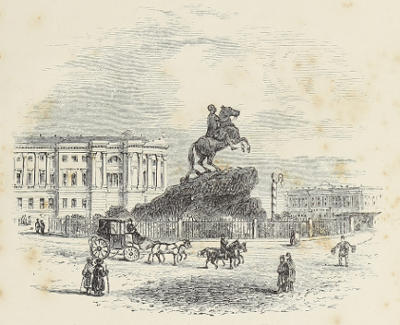
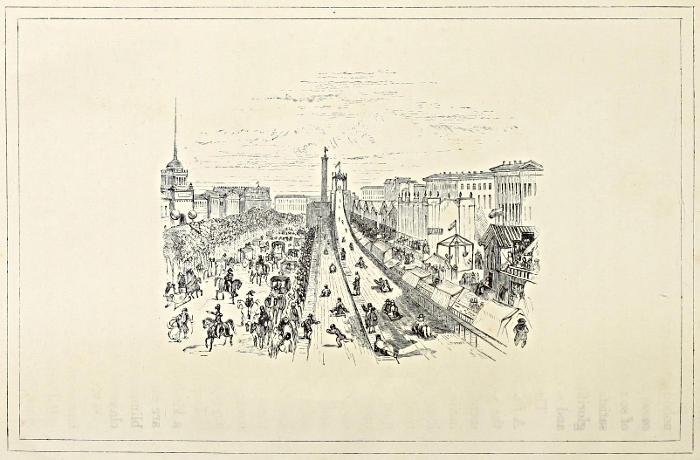
Peter the Great’s Statue, and the Office of the Senate.
With Illustrations.
LONDON:
JOHN MURRAY, ALBEMARLE STREET.
1855.
The Proprietor of the Copyright of this Work reserves to himself the right
of Translation in Foreign Countries.
TO
HER BROTHER, THESE PAGES ARE AFFECTIONATELY INSCRIBED BY THE AUTHOR.
Without troubling the reader with any account of a
sea voyage from England to Archangel, as all travels on
the “vasty deep” present pretty much the same features
which have been so frequently and so well described by
others, I will only observe that circumstances induced me
to reside for more than ten years in Russia, which I
have only recently quitted.
The following pages contain a simple account of the
manners, customs, and genre de vie chez eux of a people
whose domestic habits are comparatively but little known
to the English nation.
Of the truth of many of the anecdotes I can assure the
reader; others I have had from good authority, and I
have every reason to believe that they are veracious.
The names of persons that are inserted in the text are
not those of Russian families: the Russians, like the
ancient Greeks, have a termination denoting parentage;
the syllables vitch for the masculine, and ovna for the
feminine, are merely equivalent to the classic ides.
Thus, Dmitri Ivanovitch, means Demetrius the son of
Ivan; Cleopatra Ivanovna, Cleopatra the daughter of
Ivan, &c. I have therefore betrayed none, because the
surname is omitted; I have also taken the further precaution
to change one of the names in every instance, lest
my friends should incur any evil consequences from their
government, which is at the present time so exceedingly
suspicious, that, for the most harmless expression, the
offender who made use of it would be liable to be banished
to Siberia.
I trust that I have done full justice to all the amiable
and social excellences of the Russians. Of their other
qualities I beg the reader to form his own judgment.
“Une nation de barbares polis,” said a French gentleman,
in speaking of them; but one cannot deny that they
possess the good qualities of savages, as well as their bad
ones. Perhaps the Muscovite character is the most difficult
of any to understand; and after living for years in
Russia, it is very possible not to know the Russians.
They seem indeed to possess two characters, each distinguished
by traits diametrically opposed to those of the
other. One may be considered as their private, and the
other as their public character; and I cannot pretend to
the power of defining them. I have seen a Russian colonel,
known for his excessive severity, who would witness unmoved
the terrible infliction of the knout, perfectly unable
to control his tears at the mimic sorrows of a French
actress. He that is mean and despicable in public life,
is often kind, amiable, and liberal at home. He who
would be merciless and oppressive to his inferiors, is
frequently affectionate to his family and sincere to his
friend. The lady who would be shocked to say a petulant
word to an acquaintance, would not hesitate to strike
her maid; and though she would be overwhelmed with
grief at the distress she could see, she would, by her
reckless extravagance, cause the severest sufferings to
her serfs, and reduce them to the extremity of want,
without feeling remorse.
This slight sketch of Muscovite manners having no
pretension whatever to literary excellence, the writer
trusts that its manner of delineation will escape criticism,
and that its truthfulness will counterbalance the many
faults it undoubtedly contains.
The interest at present excited by a nation with whom
the English are at war has induced her to listen to several
friends who have recommended her to present these written
observations to the public.
London, October, 1854.
PAGE
CHAPTER I.
Aspect of the Dwina—Crosses erected by the peasants—Sunset
in the North—Russian boats and barks—Boatmen—Their
cargoes—Solombol—Shallowness of the river—Archangel—Samoïdes—Their
mode of living—A visit to their Tchume, or
encampment—Reindeer and sledges—Samoïde bridegroom—A
wedding-feast—The Samoïde costume—Their ideas of
the Supreme Being—A keepsake—Catching a reindeer—Manner
of eating—Strange custom
Wedding of a Starosta’s daughter—Politeness of the host—The
guests—The bride—Bridal etiquette—Description of the
bride’s dress—The bridegroom—The hospitality shown—The
amusements of the guests—Improvised songs—The bridegroom’s
riches—Demeanour of the company—Dance of the
peasant-women—Dance of the men—National songs
Travellers in Russia—False impressions—Civilization in the
Czar’s dominions—Public roads—Morasses and forests—The
Vologda road—Wretched horses—Rough roads—The
crown peasants—Aspect of the villages—Civilization of the
people—Vanity of the Russians—Provincial towns—The
churches—The postmasters—The yemstchicks or drivers—Personal
appearance of the peasantry—Their costumes—Crossing
the Dwina—Pleasing scene—Village burying-ground
Vologda: its inhabitants—A Polish lady—Treatment of the Poles—Russian
ladies: their politeness—Peter the Great’s civilization—Slavery:
its effects on the character—Conversation—Card-playing—A
princess—Poverty—Filthy households—Equal
division of property—Cause of poverty—An old
gambler
Our journey—Kabitkas—Russian custom—Endless forests and
morasses—Desolation of the country—Musical yemstchick—Scarcity
of inhabitants—Criminals: their aspect—A bad mother—Monastery
of Seea—Visit to the abbot—The church—A
saint’s shrine—Peasants—Change in the scenery—Accidents—The
driver—A contented veteran—Love of country—Soldiers’
songs—Russian melodies—Yemstchick’s gratitude—Another
driver: his prospects in life—Beautiful
effect—Ladinapol—Schlusselberg—A village inn in
Russia
Appearance of the capital—The public buildings—The statue of
Peter—The quays—The lighting of the streets—The shops
and shopmen—A bargain—The dwornicks: their wretched
life—Tea-taverns: the company assembled—The itinerant
merchants—Cossacks—Circassians: their fidelity—The soldiers
of the line—Shameful treatment—The butitchnick—A
sad occurrence—Winter aspect—The Nevsky Perspective—Costumes—A
drowning man—Police regulations—Number
of murders—A poor man’s funeral—Funeral cortège of a
prince—Effect of twilight—Convicts—The metropolitan—The
Emperor—Police regulations on salutations—The Kazane
church
Places worth visiting—Peter’s Museum—The Czar’s works—Curious
effigy—The war-horse—The Nevsky monastery—The
saint’s shrine—Magnificent tomb—Superstition—The
cemetery—Catherine—Imperial mausoleum—Description
of the sarcophagi—Prisoners—Political offenders—Spy
system—Bombardment of Odessa—Dumb spy—A spy of
rank—Assemblée de la noblesse—Masked balls—Russian
civilization—Love of money—Inebriety—Society in St.
Petersburg
Winter amusements—The opera and French theatre—Hamlet—A
true Russian play—Corruption of the police—Anecdotes—The
hermitage—The museum—Dinner parties—Russian
hospitality—Want of information—The censor’s office: its
restrictions
Russian courtship—State of household servants—Anecdotes—Trousseaux—The
matrimonial candidate—Matchmakers—Serfs’
weddings—Rich dowry—Matchmakings—Curious
custom—Russian marriages—Blessing the threshold—Bridal
parties—Statute-fair for wives in St. Petersburg—Habit of
painting—Lottery of marriage, &c.
The abbess—The inmates of the convent—The wardrobe—A
young Russian priest and his bride—The archbishop—Ancient
manuscripts—Alexis, son of Peter the Great—Description of
a monastery—Prisoners—The church, cemetery, and garden—Monastic
serfs—The archimandrite—Superior and inferior
class of Russian clergy—Peter the Great’s policy—Political
use of religion—A modern miracle—General estimate of
monastic institutions—Proscribed sects—Russian hermits—Hermitage
at Kastroma
Aspect of the country—Sketch of the peasants—Forebodings of
evil—State of the serfs—Anecdotes of proprietors—The
French waiting-maid—Shameful treatment of serfs—State of
crime—Mutilations and murders—Revenge for a beating—Dreadful
vengeance of the serfs—Pleasing anecdote—Wealthy
serfs—Recklessness of the nobles—Selling slaves—The cook
and his sorrows—Anecdotes—Serf apprentices—The old
gourmand—A good bargain and a bad one—The gardener—A
boorish audience—The peasants—Superstitions and ignorance—Anecdotes
Landed proprietors—Sketch of the country—The wolves: dreadful
occurrence—A child lost—Winter amusements—Wolf-hunt—A
cunning animal—Summer sketch—Russian costumes—The
national dance—The peasants—Avarice of the landowners—Serfs
and their treatment—Cruel and unprincipled proprietors—Opinion
of the upper classes
Government employés, their servility—Baseness, and its fruits—Duty
of the senate—Dishonesty, bribery, and poverty—New
way to pay old debts—Mistrust—Conduct of the ladies—Duties
of those in office—The railway serfs—Police-masters
in Russia—The military officers and the soldiers—The wretched
fare of the army—Peculations of the colonel—Army regulation—A
colonel in the Caucasus—Why the people are created
Description of churches—A devotee—Saints’ portraits—The lower
class of worshippers—Infant communion—Administering the
sacrament—A funeral—Customs of oriental origin—Tartar
burying-ground—A wake—Prayers for the dead—Horror of
death—A baptism—Authenticity of Christ’s portraits—A
procession in Moscow—Miraculous portrait of the Virgin—Religious
processions—Aquatic procession—Pilgrims—A pilgrimage—The
miraculous image at Jaroslaf—Angelic artists—Monks
and money—A holy tradition—Religious ceremonies—Confession
in the Greek Church—Representation of
Christ’s interment—High mass in the Kazane church
The carnival—Amusements at the fair—Curious procession—Palm
fair—Whitsuntide—The Resurrection on Easter-night—Easter-day—Easter
privilege—Anecdote of the Emperor—Bell-ringing—Kindness
of heart among the Russians—Household
gods—Christmas—Midsummer-eve—Heathen custom—New-year’s-eve—A
Russian election—Unfortunate orator—Russian
maypole—Characteristic dance by a soldier, its
beautiful execution—Military picnics—Disagreeable traits of
character—Shopkeepers’ balls—Splendid festivals—The Kremlin
illuminated
Travelling in Russia—Monotony of scene—Want of animation—Style
of dwellings of the nobles, the gentry, and the peasantry—Poor
gentry—Pride and poverty—Peasants’ isbas, the furniture
they contain—Vermin—The breaking up of the ice—The
Dwina—Distressing occurrences—The peasant and his
dog—The aged peasant—The commandant’s gold cup—Native
barks: the peasants on board of them—Neva boats—Concerts
al fresco—Numerous imperial palaces
Education—The highest studies—Russian history—Infallibility
of the Czar—Moral excellence—Devotedness of a young lady—Profiting
by instruction—Noble culprits—Education of
the serfs—The University—The students’ costume—Naval
school—School for the deaf and dumb—Academy of Fine Arts—Priouts—Education
of boys—Studies—Ladies’ institutes—Plan
of education—Uniforms—Private education—Remarks
on education in Russia
Moscow—Poushkin’s verses—The Moscowites—Dislike of
foreigners—Antipathy to the St. Petersburg people—Ancient
devotees—Places of amusement—General remarks—The
Kremlin—The churches—General view of the city—Napoleon—The
miraculous image—Ivan and his recompence for
genius—The Gostinoi Dwor—The shopkeepers’ brides—A
wedding coach—The Tartar—The Persian—The Metropolitan
of Moscow—The Jews—The shopkeepers—Smoking—The
Tiramà, or ancient palace—The new palace—The Treasury—The
diadems—The Tartars of the present day—The
church of Warsaw—The last fight for freedom—Various
curiosities—Spoils of the grande armée—The officer’s
widow—French refugees: their gratitude—The model of
the Kremlin
English people in Russia—Sudden change of sentiment—Intolerant
feelings of the Russians towards them—Opinions of the
people—Ideas of the Russians on the English ministry—Their
hope of aid from the Americans—The lower classes—Losses
of the Russians—Disagreeable remarks—Their manner of
speaking of the French—Political ideas—The Americans in
St. Petersburg—Invented news—Odd ideas of a war-ship—The
English in fault—Mr. Pim’s designs—Russian disgust at
the new warlike inventions—Dread of the British—The serfs—The
troops in the capital—Vanity of the Russians—Their
disappointment about Turkey—False ideas—Evil effects of
the conscription and slavery—The recruits—Deserters—Dissatisfaction—The
Czar’s ambition—Aspect of St. Petersburg—Wretched
recruits—Embarrassments of the Russians—A
bivouac—The dying officer—March of the army—The
future of Russia—A review—Anecdote of the
Emperor
Foreigners in Russia—The Poles—The oath of allegiance—Disgraceful
treatment—Want of cordiality—Polish exiles—Greek
and Roman churches—Difference of creed—Saints—Christmas
custom—Warsaw—Polish cottages—Peasants:
their treatment—Germans in Russia: their customs; their mode
of life—New-Year’s eve—Pleasing custom—Character of
the Germans—Variety of foreigners—The French—The
Turkish renegade—Mixed society—Conclusion
Aspect of the Dwina—Crosses erected by the peasants—Sunset in the
North—Russian boats and barks—Boatmen—Their cargoes—Solombol—Shallowness
of the river—Archangel—Samoïdes—Their
mode of living—A visit to their Tchume, or encampment—Reindeer
and sledges—Samoïde bridegroom—A wedding-feast—The
Samoïde costume—Their ideas of the Supreme Being—A
keepsake—Catching a reindeer—Manner of eating—Strange
custom.
“By the quarter seven” sang out the musical voice of
the sailor who was engaged in heaving the lead. I
hastened on deck, and found we were crossing the bar at
the mouth of the Dwina. I looked around on the
banks of the broad but shallow river; they were flat and
marshy, abounding in brushwood and stunted firs, small
birch-trees, with here and there an ash, the coral berries
of which served to enliven the mass of green foliage.
There were some cleared spaces, which, at a distance,
with the setting sun shining full upon them, appeared
like verdant lawns, but were, in fact, only sheets of
morass, of which, indeed, the whole province of Archangel
mainly consists. Here and there, amongst the
sombre and interminable forests, I descried, far distant
from every human habitation, a solitary Greek cross,
erected by some pious peasant or grateful fisherman, on
his escape from danger. Contrary as such are to our
more spiritual creed, yet I confess that I never could
gaze unmoved on the holy symbol of our faith, thus
made an offering from a simple and devoted heart.
Many and many a time, during my long journeys
through hundreds of versts[1] of the forest-land and
sandy plains of Russia, have I felt cheered by this
sign of a belief and church that we (because we are
happily more enlightened) are too apt to condemn;
yet our ancestors, to whom the Russians, in their present
state, may be compared, did not find it an useless
symbol to awaken sentiments of religion in their
breasts.
The evening was beautiful, and the sunset magnificent!
the sky and river, the forest, the distant ocean,
and the whole landscape, seemed wrapped in a flood of
crimson light; every object was as perfectly distinct as in
broad day, the only difference being that there was no
shadow. The native barks glided calmly past us, strange-looking
things, gaudily painted with red, black, and
yellow designs, on the rough wood. Their clumsy vanes
resembled those on Chinese junks; some were in the
form of a serpent, others in that of a fish, a griffin, or
some fabulous creature or other, and decorated with
streamers of scarlet, all fluttering in the slight breeze that
swept down the stream. The heavy one-masted vessels,
with their large square sails, reminded me of the old
pictures of the Saxon boats some thousand years ago.
The boatmen are fine-looking men, of the real and pure
Russian race, uncontaminated by a mixture with the
Tartar blood, of which there are so many traces in the
middle provinces. Their dress is picturesque, and serves
greatly to enliven the landscape; their gaily-coloured
shirts show off to much advantage their sturdy forms;
their costume, their manly beards, fair complexions, and
light flaxen hair, might cause us almost to imagine that
we were gazing on the men of Hengist and Horsa, who
lived years and years ago; they were singing a monotonous
and sad yet pleasing air, as they walked to and
fro the whole length of their bark, propelling it with their
long poles through the shallow part of the river. Their
cargoes consist of articles of which the odour is not
savoury, such as tallow, sheepskins, and hides in the
raw state: evil awaits the nose of him who stands to
leeward.
I landed at Solombol, which is the port of Archangel,
as vessels of any considerable burthen cannot proceed
so far up the river as the city, on account of the shallowness
of the water.
Archangel, although the capital of the province, and
the chief port in the north of Russia, by no means
answers the expectations of a foreigner who has seen it
only in the large letters printed on the map: it was (for
it has since been burnt down) a long straggling street of
dismal-looking wooden houses, mostly painted dark gray
or black, with the window-frames and doors of a staring
white; the only buildings that were tolerable were (as is
commonly the case in Russian provincial towns) the
government offices, the gymnasium, and the churches.
A more wretched place dignified by the name of city it is
impossible to conceive; but we comforted ourselves with
the reflection that we should not remain long in it, a few
months at the utmost, when we calculated upon bidding
adieu to it for ever; we therefore determined upon
philosophically bearing all the désagrémens which we
might be condemned to meet with. It contained, at the
time of which I am writing, about twenty-five thousand
inhabitants, including the foreigners (mostly Germans)
and the government authorities, but it was a miserably
dull place. In the winter, which lasts about eight
months of the year, we lived almost entirely by candle-light,
our monotonous existence only varied by a drive in
the sledge, or a stiff formal ball at the governor’s of the
province, in which our sole amusement was staring at the
uniforms, bowing to his excellency, and eating bonbons.
I do not know how we should have got through the
dreary winter, had we not been cheered by the consolation
that summer would come some time or other, though
it appeared distant enough in the prospect as we walked
out during the short hour of daylight, or rather twilight,
in the middle of the day; when we made ourselves still
more miserable by continually conversing of the daisied
meadows and shady lanes, the forest glades and pretty
flowers of “merry England.” Not only did we suffer
terribly from mal de pays, that extreme longing for home
that amounts to a malady, but the heaviness of the sky
seemed to affect the mind, as if the excessive cold had
frozen all one’s energies. It appeared of no use struggling
against our misfortunes, so we resigned ourselves to
our fate, and made ourselves as miserable as possible.
There was only one circumstance that afforded us amusement,
and that was the visits that some savages, a tribe
of Samoïdes, occasionally paid to the town; they came
from their desolate country to avoid the rigour of their
cold climate, by passing a few months in the more genial
south; indeed, comparatively speaking, Archangel was a
Naples for them, since here the mercury freezes only
sometimes. These poor people, who belong to the Esquimaux
race, as some suppose, are natives of a wild, inhospitable
land, stretching far away to the north: little is
known of their manners and customs chez eux; but when
they descend from their high latitudes, and make the
neighbourhood of the Russian towns their asylum for the
winter, they seem to live in much the same way as the
gipsies do, pitching their tents wherever they may find it
most convenient to do so, and obtaining their subsistence
either by the sale of reindeer, of coats made of their
skins, and of curious dolls dressed in their own fashion,
or by begging.
We determined to pay our uncivilized friends a visit.
There were but 18° of Réaumur; the sky was beautifully
blue; the sun was so kind as to cast a few odd rays upon
the wide plains of snow, stretching like the waves of the
ocean towards the utmost verge of the horizon; there
had been foggy weather during several preceding days,
and the particles had frozen so thickly on the trees,
that the branches, hanging pendant with the weight,
had an indescribably beautiful effect, like gigantic white
ostrich-feathers, or as if the forest had been transformed
by sudden enchantment into glittering crystals;
in fact, it was the very beau idéal of an hyperborean
landscape.
Above a dozen sledges, each drawn by four reindeer,
with either a male or female Samoïde acting as coachman,
were waiting in the yard. After making a good
provision wherewith to treat our new friends, and taking
every precaution against the severity of the cold, by
wrapping ourselves well up in warm fur cloaks and skins,
we each took possession of the particular equipage allotted
to us. These little reindeer sledges are very slightly
constructed to enable them to pass lightly and swiftly
over the deep snow; in form they are something like a
small boat, supported by a frail-looking frame; they are
not meant apparently for a social people, for there is only
sufficient space for one person in each, besides the driver,
who sits sideways in front, and who guides his pretty-looking
team by means of a long pole. The men and
women are so much alike among this people, that we
were obliged to ask which were masculine and which
feminine. A lady-driver fell to my share, who beat the
deer rather more than the others, and seemed in a particularly
bad humour; perhaps, as the Samoïde wives
are really and truly subjected to their husbands in all
things, being treated like slaves and drudges, her good
man might have caused her to feel his power and physical
strength before setting out, for, when he spoke to
her, it seemed very much as if he were swearing; so in
turn SHE was unmerciful to the weaker creatures in her
power. Our road lay across the river; the “Tchume,”
or encampment, being at about eighteen versts on the
further side; the country was covered with snow, so that
nothing but an immense white plain, varied here and
there by a dark stunted fir, formed the landscape in
whichever direction we turned our eyes; to strangers the
novelty of such a scene is agreeable, but one soon wearies
of its monotony. The sun had not long risen, it being
nearly noon; so we had the advantage of daylight, a
rather scarce commodity in the dreary north; and as we
were all inclined to be unusually gay, we made the desolate
wilderness quite re-echo with our laughter, to which
the clicking of the reindeer’s hoofs formed a kind of castanet
accompaniment. Nature has provided them with
widely-spreading feet, which prevent them from sinking
in the snow, and which open and shut with a smart
snapping noise at every step they take. In about an
hour and a half we reached the Tchume, to which we
had been guided by the long wreaths of gray smoke
ascending from the midst of the pine forest. Here we
found a little colony encamped; there were four tents
constructed in a very simple fashion, in form very like
a sugar-loaf; the frame was composed of fir-poles joined
by some means at the top, the whole being thickly covered
and lined with reindeer-skins. We peeped into one of
the tents: in a space of about eight feet in diameter
were huddled together men, women, babies, and dogs,
somewhat in the mode of herrings in a cask: at first
the smoke was so thick that I could discern nothing
distinctly; but I soon perceived that the inmates were
well wrapped up in furs; their greatest enjoyment
seemed to consist in getting as warm as circumstances
permitted. In a small sledge filled with the softest skins
was a diminutive baby; I should think it could not have
been more than a few weeks old; its pretty face (for it
was pretty although a Samoïde) was half covered with its
fur wrappings; its bright black eyes and Lilliputian
features made it look like an Indian doll. The rigour of
their climate does not, it seems, congeal the tender sympathies
of the human heart, for its mother fondled it with
the greatest affection and pride; she was much delighted
with the notice her infant attracted, and, although she did
not understand a word we uttered, yet she gathered from
smiles and signs, the freemasonry of nature, that we
admired her baby, and she was pleased and grateful.
We made her a little present for its sake, and then went
to visit the other tents; we found them all constructed
exactly on the same plan.
There were a great many men and women belonging
to the tribe; their dress was curious; the men’s was composed
of a long gown, called a militza, furnished with a
hood lined with fur; the whole consisted of prepared
reindeer-skins sewed together with the tendons and
sinews of the animal; the leg-coverings were a kind of
boot, which, being much lengthened, served for other
garments as well; they were striped white and brown,
the former being the under fur of the deer, the latter the
upper; they were neatly stitched together, and formed,
I should imagine, a very effective protection from the
climate. The ladies’ dress differed in many respects
from that of their lords and masters, inasmuch as it was
much finer, which may cause the malicious to remark
that the same vanity reigns in the female heart in every
race and clime alike: it consisted in a kind of gown
very much ornamented; across the shoulders there were
alternate brown and white stripes; from the waist downwards
it was further decorated with pieces of black and
red cloth, so arranged that at a distance it had in some
measure the appearance of a plaid petticoat; indeed, an
odd idea struck me, that perhaps the tartan was derived
from the originally savage dress of the ancient Scotch
and other Celtic nations: the whole garment was finished
by a deep fringe formed of the long hair of the reindeer’s
beard; the hood was separate from the dress, and furnished
with lappets to cover the poll of the neck. As
for the rest of their attire, it was precisely similar to that
of the men. In regard to their persons, the descriptions
that have been given of the Esquimaux are equally applicable
to the Samoïdes; indeed they are apparently of
the same family. They have a language peculiar to
themselves, but many speak Russian, and some of our
party got up quite an agreeable conversation with them.
They informed us, amongst other things, that they had
been to a grand wedding some time previous: the bridegroom,
it appears, was, according to their ideas, the
richest man they had ever heard of; he had countless
herds of reindeer, and militzas without number; but, as
the most convincing proof of his boundless wealth, we
were assured that he gave so much strong waters on the
occasion, that everybody became so drunk that they could
not move. I do not recollect this happy man’s name, or
whether the bride was young and beautiful; doubtless
they will both be celebrated in the ballads of their native
land, and be the theme of wonder and admiration to their
countrymen for future generations.
Most of these nomads have been baptized into the
Russian Church; but a gentleman assured me that they
paid very little respect to its forms and ceremonies; and
he mentioned a circumstance that would seem to indicate
that they had a much higher sense of the Supreme Being
than the besotted serfs of Russia possess. It appears
that he and another gentleman had paid one of the tribes
a visit, when one of the men asked him if he were
a Russian? On being answered in the negative, he
showed him some pictures of saints, hidden under some
skins in the tent, and, pointing to them with disdain, he
exclaimed, “See! these are Russian gods, but ours
(raising his hand towards heaven) is greater; He lives
up there.”
These savages can also feel, and deeply too, much
gratitude for kindness. I remember, when I had the
pleasure of meeting, in Petersburg, M. M——, of the
Académie des Sciences, who was sent some years ago
to explore the northern regions of Asia, he showed me
some little figures carved out of a mammoth-bone; they
represented the chief of a tribe and his wife in their
national dress, and had been given to him by the former
as a token of his gratitude and esteem. He had heard
that amongst other people it was frequently the custom
to give your own portrait to a friend, and therefore he
had begged M. M—— to accept his. M. M—— also
related to us the extreme kindness he had experienced
from some of these uncivilized races. He was attacked
with a severe fever, owing to the great privations and
fatigue he was obliged to undergo in his long and
trackless journey across almost endless forests and morasses,
sometimes floundering through stagnant water up
to his horse’s saddle-girths, at others pursuing his dreary
path with dog-sledges in intensely cold weather, without
provisions or places of shelter. At last he was so very
ill that he did not expect to live, and begged to remain
behind. His companions dug a kind of cave for him
out of the snow, and left him to his fate; he remained
unconscious he knew not how long. When he recovered
his senses, the fever had left him, but his hunger drove
him almost mad; there seemed nothing but death before
him, and, after having in his extremity devoured his
gloves and other articles of clothing, he gave up all hope,
and resigned himself to the terrible fate of perishing of
starvation in the wilderness; but when all chance seemed
lost, he suddenly heard a dog bark; he crawled out of
the cave; a tribe of these Samoïdes was passing by, they
caught sight of him and stopped; some of them advanced
and gazed on him with astonishment; his famished state
filled them with compassion; they placed him in a sledge,
and conveyed him to their tents, where they tended him
with the greatest care and kindness until he was enabled
to rejoin the “expedition,” to which they conducted him.
He rewarded them with various trinkets highly prized
among these people; but such actions are above recompence.
We had not come unprovided with refreshments
suited to their taste, and we produced sundry bottles of
strong brandy, at the sight of which their eyes sparkled
with unwonted fires; each of them was regaled with a
tumblerful, which both ladies and gentlemen tossed off
as if it were water, and which had no other effect than
that of rendering them in infinite good humour with us
and each other. Even my sulky driver and her husband
felt its power, and drank a loving-cup together, whilst
they began to chatter much faster, and became very
obliging. The daylight was disappearing, so we began
to think of returning home. Being desirous of tasting
what a haunch of reindeer was like (which, by the by, we
afterwards found to be extremely tough), we resolved
upon purchasing a fine young animal, which, “all unconscious
of his fate,” was quietly grazing amid the numerous
herd scattered around. At our request the proprietor
seized a lasso, and with unerring aim caught the poor
little creature by the horns, and, gradually hauling in
the rope, sailor’s fashion, soon brought it near enough
for another Samoïde to lay it dead at his feet with a blow
on its forehead. This gave us an opportunity of witnessing
a truly savage feast; for, no sooner were they given
to understand that we only required the haunches, than
they tore out the heart and liver, and immediately devoured
them warm and raw! I remarked that they had a very
peculiar manner of eating; they held the meat with their
teeth, and, like the Abyssinians, cut off each mouthful
with their knife so close to their nose, that we were in
constant fear lest its tip would be sliced off at the same
time. I was assured that amongst these people, when
the father becomes too old to follow his usual pursuits, it
is the duty of the eldest son to kill and bury him! Just
before I quitted Russia I met a chief and chieftainess of
the Samoïdes, wearing an ornamental head-dress of gold,
and was told that they were staying at the winter-palace,
but for what purpose I could not learn; perhaps the
government means to make use of them in the present
war; if so, it can only be in America against the Indians
of the British territories.
The cold greatly increased; before we reached home
the snow fell so thickly that we could scarcely see; indeed
it seemed more like cutting particles of ice than aught
else, so that we were glad to find ourselves again under a
warm roof.
CHAPTER III.
Wedding of a Starosta’s daughter—Politeness of the host—The
guests—The bride—Bridal etiquette—Description of the bride’s
dress—The bridegroom—The hospitality shown—The amusements
of the guests—Improvised songs—The bridegroom’s riches—Demeanour
of the company—Dance of the peasant women—Dance
of the men—National songs.
There was but little to vary the monotony of our life in
Archangel, as we had but few opportunities of seeing
much of the Russians. In the spring we decided upon
paying a visit to Vologda, having received an invitation
to pass a few weeks at the house of the governor of the
province. In the midst of our busy preparations for the
journey, the Starosta or head man of a neighbouring
village came to beg the honour of our company at a
festival which he proposed giving the next day to celebrate
his daughter’s marriage. We accepted the invitation,
and the following morning hired a boat to take us
across the Dwina, for the village was situated on the
opposite bank at the distance of about eight versts. We
had no sooner landed than the bride’s father, the Starosta
himself, came out to welcome us, and to conduct us to
his house. A great number of people were assembled in
front of it; they all seemed very merry, and were gaily
dressed in their best attire: we passed through the crowd
and followed our host, who ushered us with many profound
bows into the best apartment, where we found a
numerous company already arrived. There were at the
least thirty women, all in their national dress, seated in
straight rows round the room; most of them had their
arms crossed, and remained almost motionless; their
gaily coloured silks and showy head-dresses had a very
striking effect. The bride herself, a pretty-looking girl
of about seventeen, was seated at the upper end of the
room with the bridegroom at her right hand. A table,
covered with a white cloth and tastefully ornamented
with festoons of artificial flowers and bows of pink ribbon,
was before them, on which was placed the wedding-cake
made of flour and honey, with almonds on the top;
several dishes of sweetmeats, preserves, and dried fruits
were arranged around it. It was, as I was told, the
etiquette for the bride not to speak even to the bridegroom;
but we went up to her, and offered our congratulations,
which they both acknowledged by a graceful
inclination. The Starosta ordered chairs to be placed
just opposite the table, and begged us to be seated, so we
had a good opportunity of examining and admiring the
bride’s dress. It was composed of a coiffure nearly a
foot high, somewhat resembling a brimless hat; it was of
gold, enriched with pearls and fastened on by a knot of
gold tissue behind, which was edged with lace; her ears
were decorated with handsome rings, and round her neck
were innumerable rows of pearls. I expressed a doubt
as to whether they were real; but I was assured they
were so, only they were defective in form. Her casackan
or jacket was of gold cloth, with a border of pearl embroidery,
the sleeves of cambric, short and very full, tied
up with blue ribbon and finished by a lace trimming; the
skirt of her dress was of crimson flowered silk, having a
gold border nearly a foot deep, with gold buttons up the
front. This is the national costume, but it varies in
different provinces, and is not equally rich. But then the
Starosta was well to do; he was not only the head man
of the village, but he had shops of his own in Moscow
and in St. Petersburg. I noticed that the bride’s fingers
were loaded with rings; indeed she seemed to have on
all the finery the whole family could muster. As for the
bridegroom, he was a good-looking young man of twenty-two
or so, and very respectably dressed in the costume
of a shopkeeper, which consists of a long blue coat called
a caftan, closely buttoned up to the throat. We were
presented with tea, coffee, wine, bonbons, cakes, fruit, &c.,
in succession, all of which we were expected to partake
of, or the hosts would think themselves slighted, and
their hospitality insulted. The spoons I remarked were
of Tula work, and had the appearance of being of gold,
but were in reality of silver-gilt, with arabesque flowers
all over them, which they say are done with some kind
of acid: I believe the secret is not known out of Russia.
All the Russian women assembled at this festival were
of the upper class of petty shopkeepers or farmers, and
they were dressed in the same costume as the bride, with
perhaps fewer ornaments. During the whole time we
were in the room their amusement consisted in singing,
one after the other, in a low kind of chant, songs improvised
in honour of the occasion, all the rest of the company
sitting silent and motionless as statues. As soon as
one had exhausted all her available talent on the subject,
another took it up and gave us her ideas upon it. According
to one, the bride was too young to be married:
she wondered how her mother could part with her, and
thought she ought to have kept her at home for a long
time yet. Another seemed to think she was doing perfectly
right to marry her daughter, after bringing her up
so prudently, and making her so clever in household
affairs. A third wished to settle the matter entirely by
praising the bridegroom; “he was so gay of heart, he
loved his bride so well.” His possessions, it appears,
were worth having, and enough to tempt a village-maid;
for “he had plenty of cows, pigs, and horses;” and as the
climax to all these advantages of estates real and personal,
she assured us, “that he could take his wife to church
in a droshsky!” The whole of the guests remained quite
silent, listening with a serious face to the songs; there
was no laughing or chatting; each kept her seat and
preserved such an intense gravity all the time, that they
evidently considered matrimony as no joke after all, and
not in the least amusing. Were I malicious, I would
remark that they had every one of them been married
themselves. After we had remained a reasonable time
in the company of the young couple, we went outside to
see the guests assembled in the front of the house; there
we found several women dancing a wearisome kind of
dance, if such it might be called, which consisted in
merely walking to and fro in pairs placed one behind
the other in a long line. They moved forwards and then
backwards to a monotonous singsong kind of air; on
advancing, the first two changed places with the last
couple, and so on in succession. The amusement seemed
to afford them intense delight, and so fond are they of it
that they keep it up for hours together. On the opposite
side of the yard the men were having a ball amongst
themselves; their performance was more entertaining,
and we laughed heartily at a comic pas de deux by a
couple of young men, who capered about in a very diverting
manner. Another peasant danced a solo in very
good style. After the dancing the men sang us some
national airs; each took the hand or leant on the shoulder
of his neighbour, “in order to unite the tones,” as they
said. We thanked them for their entertainment, and
re-entered the house to take our leave of the good
Starosta and his family, when we again expressed our
wishes for their happiness, but we were not allowed to
depart until we had drunk their health in a glass of
champagne, a wine which the Russians give upon all
extraordinary occasions. As we were stepping into the
boat the peasants gave us a parting cheer, and far away,
when the village was quite lost to our view in the distance,
we heard their wild voices still singing in chorus their
beautiful national airs in honour of the young Russian
bride.
CHAPTER IV.
Travellers in Russia—False impressions—Civilization in the Czar’s
dominions—Public roads—Morasses and forests—The Vologda
road—Wretched horses—Rough roads—The crown peasants—Aspect
of the villages—Civilization of the people—Vanity of the
Russians—Provincial towns—The churches—The postmasters—The
yemstchicks, or drivers—Personal appearance of the peasantry—Their
costumes—Crossing the Dwina—Pleasing scene—Village
burying-ground.
The generality of travellers in Russia, at least of those
tourists who have obliged the world with ‘Winters in St.
Petersburg’ and ‘Journeys to Moscow,’ containing the
most flourishing accounts of the state of the roads, the
high civilization, the rapid strides to excellence, &c., of
the Czar’s dominions, are unfortunately limited to a class
who, having a few months’ leisure, and being desirous of
change, take the voyage to Russia as one promising more
novelty than the hackneyed roads of France and Switzerland.
Their ordinary plan is, to take the steamer to St.
Petersburg, and after a stay of a short time take a “run”
to Moscow, whence they return in time for the “boat,”
and hasten back at the rate of ten or twelve knots an
hour, carrying away with them the most erroneous and
false ideas of the real state of things, the mere surface of
which they have scarcely had time to skim. Had they
remained a few years among the Russians, not living, as
the most part of the English do, in little colonies by themselves,
but mixing with the people, and had they travelled
a few thousand miles over the cross-country roads, they
would soon have had “the gilding taken off the gingerbread”
of Muscovite civilization. In fact, the excessive
exterior polish always reminded me of a woman with her
face painted, who hopes by factitious bloom on her cheeks
to hide her ugliness. Moscow and St. Petersburg are
certainly fine cities; the former may be regarded as the
true Russian capital, the latter is merely a handsome
imitation of other European great towns. Having seen
them, the stranger has seen all that is civilized in the empire.
In illustration of what I have said, I may remark
that, excepting the chaussée from the western to the inland
capital, and from the former to Warsaw, there are
really no roads; those fine macadamised highways so
much lauded by travellers, and deservedly so, extend but
a few miles beyond the towns: farther on the route lies
through immense plains of sand, endless morasses, and
interminable forests in the north, and steppes in the south,
across which the post-road has been cut; but this post-road
scarcely deserves the name, for, generally, it is
merely a cleared space cut through the woods, with boughs
of trees laid down here and there where there are spots
that would be otherwise impassable. There is little
enough to vary the monotony of the journey; the miserable
villages with their wretched inhabitants scarcely
serve to enliven the scene.
The whole of the distance between Archangel and
Vologda, comprising several hundred miles, with the exception
of the two pretty towns Vycavajai and Velsk, is
composed of those desolate features which, indeed, characterise
nearly all the north of Russia. Sometimes we
had to be dragged through sand so deep that our carriage-wheels
sank a foot or two, and the eight ragged-looking
brutes—they were scarcely worthy of the name of
horses—would suddenly stand stock still, and thus confess
their utter inability to fulfil their engagement of taking
us to the next post-station. Whenever this happened,
there was nothing for it but to descend from the carriage
in order to lighten the weight, and to stand patiently
until some peasants had been procured from a neighbouring
village, who, by the aid of poles inserted between
the spokes of the wheels, and by loud barbarous cries,
aroused the energies of our gallant team to make further
efforts and extricate us from this dilemma. After the
usual number of Slavo Bogens (thank God) had been
uttered by the wild-looking, long-bearded boors, and after
being again seated comfortably, with every reason for
congratulating ourselves that we were progressing, although
at a snail’s pace, perhaps I would be tempted
to take a little nap, being convinced that I should lose
nothing of the prospect, for I might be pretty sure of
seeing the same endless forests of fir if I were to awake
the next day. With this assurance I begin to nod, and,
perhaps, by some unaccountable delusion am dreaming
of the smooth highways and green hedges of merry England,
when bump we come against something, the shock
giving me such a rap on the head that it effectually dispels
all visions and fantasies. I look out and find we
are splashing gaily through a morass which hides in its
bosom sly stones and stocks, and which seems as interminable
as the sandy plains from which we have just
escaped, and of which we shall have many repetitions before
the journey is over. Of course, as every one knows,
there are no inns on the cross-roads, and places whereat
to rest at night are altogether unknown. Even on
the great chaussées it is better to travel day and night
and remain in the carriage, for he must be a bold man
who would be willing to face the vermin of all kinds, even
for a single night, in a wayside hotel. The better class
of Russian travellers know well how they are peopled,
and avoid them accordingly. As for the lower class, they
are too much accustomed to such company to care in the
least. A Russian lady whom I know once spoke to her
peasants on the subject of cleanliness, and especially concerning
the vermin. Their reply would have done honour
to a Gentoo: “Ah, Sudarina, it is a sin to kill them, because
God has given them to us!”
The post-station is generally kept by a government
official: a samovar or tea-urn can be obtained from him,
for the use of which he expects a few copecks; and this,
with the addition of black bread and salt, is all that can
be procured during the whole route: it is therefore absolutely
necessary to provide oneself with everything that
is needful, such as bread, meat, tea, &c., and in very long
journeys a cooking apparatus. If the traveller does not
take spoons, cups, and plates, let him be very careful to
wash those he finds at the station, or he may swallow
some little animal and transgress the Gentoo laws, besides
which entire confidence cannot be placed in the
mode of their being purified. I remember taking tea at
a certain monastery. There were many ladies and gentlemen
at the abbot’s party; and, to make it more pleasant,
his reverence proposed our adjourning to a summerhouse
in the garden to eat ices. The young monks or
novices were to act as servitors, and they stood behind
some bushes near the place where we sat. I confess my
relish for the refreshment was somewhat taken away when
I saw them lick the spoons and wipe them: I could not
warn my friends, but I took good care not to make use
of them myself. But in regard to travelling in Russia, I
am sure that those who have done so in the summer time
will well remember the miserable nights passed en route,
the myriads of mosquitoes, rising like a brown cloud from
the marshy grounds, allowing no rest, to which the excessive
heat formed no agreeable addition. In Archangel
the English sailors suffered so dreadfully from the
bites of these insects that they were frequently obliged to
go to the hospital: they used to declare that “it was
worse than in the West Indies.” The winter journeys,
notwithstanding the extreme cold, are infinitely more
pleasant.
The people at the post-stations are generally civil, and
are much obliged for a small gratuity. As for the poor
yemstchicks or drivers, they are overcome with gratitude
at a trifling present of a few copecks at the end of each
post.
I remarked that the inhabitants of the villages belonging
to the crown, through which we passed, appeared
more comfortably lodged and far more at their ease than
those who were the property of private landowners: perhaps
their less degraded look was owing to their enjoying
upon the whole more freedom than those who are ground
down to the dust by the tyranny of the petty noblesse.
The crown peasants pay a poll-tax to the Emperor.
Some of the villages were in a most wretched condition,
the houses dirty and dilapidated, without windows, and
having only a little trap-door just large enough for a man
to peep through, which shuts at pleasure to exclude the
cold. Indeed the log-huts of the Russian peasants are
very little better than the wigwams of the Red Indians,
although sometimes the exterior is more ornamented.
The inhabitants live in much the same manner as they
did centuries before Peter the Great’s reign. The people
have not made a single forward step in the march of intellect,
of which the admirers of Russia so madly rave.
Scores of the Russians of the upper classes, I have heard,
say the same thing, notwithstanding their own vanity,
which so blinds their eyes that they imagine that by imitating
the exterior polish of the French—although omitting
the solid enlightenment of that nation—they have
really become civilized, and many, I verily believe, think
that they have even surpassed them. Perhaps the Czar
would have done more towards the advancement of his
people, and have benefited the cause of civilization more,
had he spent his money in forming roads throughout his
empire, and made the means of communication easier between
the various towns, instead of playing the game of
chess in Turkey, and sinking such enormous sums in the
marshes of the Danube.
A short time since the Grand-Duke Alexander, the
heir apparent to the throne, was at a banquet, when some
one was remarking on the great advantage it would be
to the country when the railway was finished between
St. Petersburg and Warsaw. His Imperial Highness
replied that it would be so indeed, but that his Majesty,
being engaged in war with the Turks, was obliged to
employ the money intended for its construction in defraying
the expenses of the army. When we were passing
through Poland I noticed that the works had been
entirely suspended. A propos of this subject I may mention
that, when the railway between St. Petersburg and
Moscow was nearly finished, orders came that it was to
be ready on a certain day, as the Imperial family were to
visit the latter city, and proposed going thither by train.
There were several miles of it entirely unconstructed,
but, to obey orders, they patched them up in the best way
they could, and laid the rails down so that the waggons
might pass over them. The most wonderful thing was
that some fatal accident did not happen. The Emperor,
of course, knew nothing about it, or perhaps he would
not exactly have liked to risk his own life and those of
his court on the Moscow railroad. We were staying near
the spot at the time. So badly arranged was this road at
first, that, when we went to St. Petersburg by it, we were
kept thirty-six hours in the midst of the Valdai hills, in
twenty-eight degrees of cold (Réaumur), without anything
to eat or drink. Some of the third-class passengers were
obliged to be brought into the first-class waggons, lest
they should be frozen to death; and a poor peasant-woman’s
child died in her arms from the dreadful severity
of the weather. Some of the passengers (one of them an
officer in the army) fainted; and all this was through the
negligence of the authorities. So many complaints were
made that it is now well managed and the conductors are
very civil.
The description of one provincial town in Russia is
applicable to almost every other. The most remarkable
buildings are the churches and monasteries, the domes
and cupolas of which are painted green, gilt, or of dark
blue with golden stars sprinkled over them, each dome and
minaret being surmounted by a glittering cross standing on
a crescent; the gymnasium, or government school for young
gentlemen; barracks (a sine quâ non), and a post-office:
these, with a few good houses, and many mere wooden
huts similar to those in the villages, make the substance of
a country town, up to the very barriers of which the interminable
forests form the suburbs. We changed horses
and driver at every station; the postmasters are bound to
have horses in readiness for all travellers furnished with a
padarosjnai or government feuille de route. They very
often make a little money by suddenly losing their memory
regarding the horses at their disposal, as they only
recover it again at the sight of a small piece of silver,
which serves wonderfully to recall to their mind’s eye the
vision of sundry rough nags in the field at the back. It
is but just to them to say that the apparition of a military
uniform possesses the same magic influence.
The life the poor yemstchicks lead must be miserable
in the extreme: any complaint lodged against them is
pretty sure of procuring them a good beating; and I
have seen the conductors or guards of the mail-coach
thrash them most unmercifully with the sword, or give
them such blows on the ears with their post-horn as to
make one feel sick at heart to think that any human
being was obliged to endure so great an indignity, and
that without the hope of redress. The mode in which
they live I can compare to nothing but to that of dogs.
Wherever we stopped at night on our summer’s journeys
we were almost in danger of stumbling over the sleeping
bodies of these poor people; for all the space in front of
the station was crowded with what at the first sight I
really thought were heaps of brown skins on the bare
ground, but which I soon perceived were yemstchicks, all
in readiness to be hired by the next travellers who might
be passing. When a carriage arrived, they would suddenly
start into life and draw lots amongst themselves as
to who should take the turn: he on whom the lot fell
immediately fetched the horses and mounted; the rest
threw themselves again on the ground and instantly returned
to their slumber, so exactly like a number of animals
that it was painful to see them. In the winter-time
they sleep in cribs something like a horse’s manger, with
a little hay or straw. “Our peasants,” said a Russian
to me, “are nothing but brutes; the only argument with
them is blows, for that is all they can understand.” Is
this, then, the land in which civilization has made her
abode, and whose wonderful advance in the path of wisdom
is to form an era in the records of the human race?
Surely those who are under this delusion can have but
very little idea how small an amount of civilization exists
beyond Moscow and St. Petersburg, or they must have
been too ready to believe the boastings of the Russians
and the flourishing accounts of superficial travellers.
A Russian village is generally composed of a long row
of wooden houses on each side of the post-road, with
usually a line of birch-trees in front. Some of the well-to-do
peasants, or those amongst them who are the most
ingenious, have the eaves of their cottages ornamented in
a very pretty manner with a kind of border of so light
and elegant a description that it may be compared to
wooden lace; the windows, where there are any, are decorated
in the same manner. At the entrance of the
villages we generally saw painted on the same board the
number of men and of cows contained in each; the fair
sex were not thought worth the trouble of being enumerated.
As to the inhabitants, they are true children of the
soil; the men have something fine in their appearance;
they wear a loose shirt fastened round the waist. In
some of the villages through which we passed a few of
the men had boots on, but the greater part had only
leggings bound round with thongs, sandal-fashion; their
feet were furnished with shoes of a kind of basket-work,
made of strips of the birch-tree. The women had on a
coarse chemise with full sleeves, and over that the national
dress, the sarafane, which was generally of common
blue or red cotton, having no boddice, but kept on the
shoulder by a band of the same. The married ones wore
a handkerchief tied round the head in a peculiar manner;
most of the girls had their hair formed into a long plait
hanging down their back: the children ran about at play
almost in a state of nature, having on only a short shirt
with open sleeves. Nearly every house in the villages
was furnished with a kind of settee outside, where in the
evening we frequently saw groups of the peasants sitting
to have a chat or to sing together their national airs, of
which they are very fond. During our journey we had
to pass several rivers on rafts, which were dragged to the
opposite bank by means of ropes. We had to cross a
very rapid branch of the northern Dwina, which had been
much increased by the melting of the snow. Here we
were very nearly drowned, for, the carriage being too
heavy for the raft, it began to sink when in the middle of
the stream; but fortunately, through the great exertions
used by the peasants, we at last reached the shore. We
continued to follow the course of the Dwina for more
than fifty miles. I do not know anything that gives a
more dreary idea of a country than the sight of a broad
and silent river, whose unbroken surface reflects no human
habitation as far as the eye can reach, not a single bark
to ruffle the mysterious stillness of the waters, nor any
living thing to awaken the echoes of those dismal forests
of pine which stretch far away to the verge of the horizon,
and seem an impenetrable bar to the advance of civilization.
Such is the aspect of the Dwina and its dark, untrodden
shores; yet, in coming to a very broad part of the river
we were greatly delighted by a scene which, like many
others—we know not why or wherefore—become indelibly
impressed on the mind, a pleasing and vivid picture
of the past. The scene of which I speak may seem in
description not to be worthy of remark, nor perhaps
would it have appeared remarkable to us had we not previously
passed so many monotonous days. In a bend of
the river, at the confluence of several smaller streams
that empty themselves into the Dwina, we suddenly came
to a considerable elevation rising abruptly from the water.
The sun had just set, but his parting rays still illumined
the beautiful gilt cross surmounting a small church which
crowned the height above us; the lamps were already
lighted and gleamed through its long narrow windows,
and borne on the calm summer breeze came the voices
of the monks and choristers singing the magnificent responses
of the Greco-Russian Church. It was a saint’s-day,
and the people from the neighbouring village,
dressed in their gayest and best attire, were hastening up
the path in groups of twos and threes; others were crossing
the stream in boats; but all were intent upon worshiping
the heavenly Father of All in his holy place.
A little farther on we passed the burying-ground of the
village. Most of the graves were marked by a rudely-constructed
cross in wood, but some of these were so old
and broken that little of their original form remained.
CHAPTER V.
Vologda: its inhabitants—A Polish lady—Treatment of the Poles—Russian
ladies: their politeness—Peter the Great’s civilization—Slavery:
its effects on the character—Conversation—Card-playing—A
princess—Poverty—Filthy households—Equal division of
property—Cause of poverty—An old gambler.
Vologda is a pretty town, but we did not prolong our
stay in it beyond a few weeks, being desirous of returning
to Archangel to make our preparations for proceeding to
St. Petersburg. There is nothing very remarkable in the
place. We made several acquaintances among the Germans,
Russians, and Poles, of whom the inhabitants
chiefly consist; among the latter was a most amiable Polish
lady, who, together with her husband, had been banished
thither for some political offence. I shall never forget
the pride and exultation with which she presented her
son, a lad of about ten years old, saying “that he
could not speak a word of Russian,” and that she took
every care to prevent him from learning the hated accents
of the Muscovite. It was then that I learnt that it was
a general custom of the government to banish into the
interior of Russia those Poles who wore suspected or convicted
of minor political faults, the more grave crimes
being punished by an exile into Siberia. I have since
met with those Polish offenders in many places, and I
must say that, as far as it has been in my power to ascertain
the fact, they have been well and kindly received
even at the Governor’s table, nor would any one imagine
that their stay in the place was compulsory. It is now
ten years since I first went to Russia, and I have resided
there until the last three months, not living like
a stranger in the land, but in the closest intimacy with
Russian families, and I willingly bear witness to their
general hospitality and kindness of heart, not towards
the rich alone, for a well-educated person, let his circumstances
be what they may, is always well received. The
ladies are most amiable and polite; they are, however, often
accused of want of sincerity, but, in my opinion, unjustly
so. We are too apt to judge foreigners by ourselves, and
think that they ought not to utter sentiments that they
do not feel; but the fact is, what they mean only as expressions
of every-day civility, we translate literally into
those of regard, and hence our false estimate of their
character. A Russian lady will say, on your being introduced,
“that she is delighted at having the advantage of
your acquaintance,” “that she has much esteem for you,”
and so on; all of which is only very kindly meant to
put you at your ease, and prevent you from being gênée
in her house; but, in regard to real worth and goodness
of heart, she is by no means deficient. In a thousand
instances I have remarked acts of benevolence and
charity that would do honour to the name of Russian,
and serve to counterbalance grave faults and errors with
which unfortunately they are mingled. Such must be
expected in a nation on whom civilization was thrust at
the sword’s point, and perhaps Peter the Great did his
country more harm than good by obliging them to adopt
the similitude of a state that ought gradually to be acquired.
No civilization can be truly solid unless it be
reached step by step through the weary road of experience.
Gilt frames have all the appearance of gold,
but scrape off the exterior, and nothing but worthless
wood is underneath. One does not build a house without
first laying the foundation, nor does a child run before it
learns to walk! The people of Russia would very likely
have been more advanced in the real essentials of a
civilized state if Peter had never obliged them to wear
short-skirted coats, and their wives to appear in public
unveiled. In the summer gardens in St. Petersburg a
walk is still shown, up and down which the half-savage
Czar obliged the Russian ladies to promenade with their
faces uncovered, whilst a regiment of soldiers was drawn
up on each side. To do them justice, they soon learned
to profit by the lesson, and have gone infinitely further
than their instructor could have intended them to do.
The immoral conduct and the inconceivable want of delicacy
of many of the ladies of rank cannot fail to have
a very unfavourable influence on others below them,
especially as the court is regarded as the criterion of what
is right. Were I to relate the almost incredible actions
of many of the titled dames, I fear I should be accused of
falsehood, but I am happy to say there are some noble
exceptions; indeed, I have had the pleasure of knowing
many who are an ornament and a pattern to their sex.
The state of slavery, which is so disgraceful to an European
nation, must also greatly influence the domestic
character of the ladies, for, being surrounded by so many
menials always at hand, it must induce habits of indolence;
and “idleness,” as is well known, “is the parent
of many vices.” Many of the ladies never do any work,
and are almost ignorant of the use of the needle. “Why
should I sew, when I have others to do it for me?” is a
common question. The absence of the necessity of being
employed, and the want of mental resources, drive them
to pass their existence in reclining on the sofa and reading
some silly French romance when alone, or to the
card-table when in company. There is really no conversation
in Russia, unless the ridiculous compliments and
inanities of a drawing-room be dignified as such; the
ladies generally discuss the price and quality of their
acquaintances’ dress. “Where did you get that charming
mantle?” “From France.” “O, indeed; ah! now
I see it could only be made in Paris.” “How much did
you give an arsheen for your dress?” &c. Such are the
efforts of the Russian ladies’ ideas. The remainder of
the evening is made up of flirting, eating bonbons, and
jouant aux petits jeux for the unmarried. As for the
married, they sit down to cards and play the coquette
with some friend near, or make remarks on the personal
appearance of their acquaintances:—“I saw Madame Vasiliwitch
yesterday—how old she is looking!” “It is your
turn to deal, madame.” “How much the princess paints!
she puts on so much white! I think an old lady ought to
rouge, but really she uses too much.” “You have made
a miss-deal.” “Madame Beck is separated from her
husband; she is going to sue for a divorce.” “Well, it
is lucky she and her husband are Germans, for if he had
been a Russian she would never get it.” “How old is
she?” “O, she must be forty at the least.” Such is a
sample of the conversation at a soirée; nor are the subjects
on which the gentlemen converse one whit more
intellectual. “Que voulez-vous?” said a nobleman one
evening—“que voulez-vous? on ne peut parler la politique,
et il n’y a rien à faire que de jouer aux cartes;” and it is
certain that the dread of being everywhere within hearing
of some government spy must be a disagreeable check on
conversation. It is astonishing how much the absence of
political discussion influences the amount of information
current in society, or how much freedom of speech contributes
to intelligence; any one who has lived in Russia
can bear witness to this fact. When we were near the
frontiers of Prussia, some French and German gentlemen
got into the railway carriage, and began conversing on
the present state of Europe. One of the latter remained
quiet for a few minutes, and then said, “My friends,
listen: we shall in less than an hour have quitted the territories
of Russia; until we do so, let us be silent, for how
do we know who may be within hearing?” The others
acquiesced in the justice of the proposition, and not until
we reached Myslowitz did they give any further expression
to their thoughts.
But to return to the Russian ladies. I remember I
once went to call on the Princess O——ff: she was of
very good family, but extremely poor, yet of course she
could not do without a carriage, horses, a footman, and
maid-servants, but the state of dirt and misery in which
she lived would disgust almost a beggar amongst us. A
very filthy lacquey, in livery the facings of which were
scarcely visible, so discoloured were they with long use,
ushered me through a room quite as dirty as himself to a
second apartment, in which was seated the princess. She
was at breakfast, it being twelve o’clock. The abominably
filthy room, her equally disgusting attire, and the
super-dirtiness of a miserable little maid who brought
her some rusks, made me almost afraid to take a seat
on the chair placed for me. She very politely requested
me to partake of her refreshment, which I, as politely,
declined: but imagine, gentle reader, how infinitely I
was disgusted when she took up a piece of paper from
the table, spat in it, and then replaced it near the bread
she was eating! She begged me to come and see her
again, as she assured me she was very fond of the
English: I need not say that I did not repeat my visit.
Candidly speaking, this was the only instance I met of
such an extremely filthy ménage, therefore I hope it
formed a rare exception. I must, however, say that in
St. Petersburg I once called at a house where the footman
who opened the door presented so dirty an appearance
that I would not enter it, and therefore cannot say
whether it was his own fault or that of his master. In
order to give an example of the state of moral feeling
in the country, I will narrate a little incident that occurred
one evening at the house of a lady of very high
rank: a Madame ——, the wife of a governor of a
large province, was present; and Prince T——koi, who
had been ordered to join his regiment, had come to take
leave of his friends: to my astonishment, Madame ——
burst into a violent flood of tears, and “refused to be
comforted,” when she bid him adieu. On my inquiring
why she was so affected, the prince being no relation of
hers, I was informed that, “poor thing! she was so
deeply in love with him that she was unable maîtriser son
émotion.” I ventured to remark that it was rather disagreeable
to her husband that she should make so public
a display of her preference for another. For my pains
I was told that I had no heart, and that, like all the
English, I was quite destitute of feeling. I do believe
that not a lady was there present who did not regard her
as quite a martyr of sensibility.
Many of the noblesse are extremely poor; indeed, it is
almost a wonder how they can exist. A great cause of
their indigence is the equal division of the family estates
among all the children. M. M——ff, a gentleman
belonging to one of the most ancient houses in Russia—indeed,
he used to boast of his descent from Rurick, the
founder of the empire—often bitterly lamented the subdivision
of the property. “My father,” said he, “had
eight children; he was possessed of a fortune of four thousand
slaves, a very handsome estate; when he died we
each had five hundred as our share; I have four sons
and a daughter, among whom my patrimony must be
again subdivided; if they marry, they must be very poor,
and, if they have families, still more so; by this means
my descendants will eventually become mere beggars.”
Another common cause of their poverty is their propensity
for gambling, which ruins many. One day an
old gentleman called on Madame P——ska, a lady with
whom I was well acquainted in St. Petersburg; he came
to borrow a few rubles, which she kindly gave him. On
his leaving the room I begged to know what had thus
reduced him. “Ah! poor man,” said my friend, “think
how unfortunate he has been; he once possessed fourteen
thousand slaves, and he lost them all at cards.” I said
I was sorry that a man of his years should have rendered
himself miserable by such a vice. “How old do you
think him?” asked my friend. “Oh, sixty at the least.”
“Sixty!” answered she, “he is past eighty, only he
wears a wig, paints his eyebrows, and rouges to make
himself look younger.” Wretched old man! he died
soon after I saw him, on his return from a card-party;
he was found lifeless on his bed, and did not leave a
single ruble to defray the expenses of his interment.
CHAPTER VI.
Our journey—Kabitkas—Russian custom—Endless forests and morasses—Desolation
of the country—Musical yemstchick—Scarcity
of inhabitants—Criminals: their aspect—A bad mother—Monastery
of Seea—Visit to the abbot—The church—A saint’s
shrine—Peasants—Change in the scenery—Accidents—The
driver—A contented veteran—Love of country—Soldiers’ songs—Russian
melodies—Yemstchick’s gratitude—Another driver:
his prospects in life—Beautiful effect—Ladinapol—Schlusselberg—A
village inn in Russia.
After our return to Archangel we had to wait there
some weeks, until the winter roads had become sufficiently
hard to render sledge-travelling pleasant. We
procured a kabitka—a kind of Russian vehicle much resembling
a large cradle on slides—bought a mattress to
fit into it, and provided ourselves with enough provisions
for our long journey, such as frozen fowls, soups, &c.,
which we were to thaw at the different stations. As it
was quite unsafe to traverse roads so unfrequented alone,
we agreed to join a party of Russians and Germans
who were going to visit the capital. It was arranged
that our kabitka was to precede those of our acquaintances,
as we were strangers to the country. On the
morning of our departure we assembled at a house
belonging to one of our acquaintances: a great many
friends had met there in order to see us set out, and
to bid us God speed on the journey. We seated ourselves,
conformably to the Russian custom, a few moments
in silence: champagne was handed round to drink to our
success; the whole company then arose, and assembled at
the gate to see us comfortably seated in our sledges; some
of them even escorted us beyond the barriers of the town
before they would bid us adieu; nor was it without regret
on our side that we took leave of those kind-hearted
people, whom in all probability we should never see
again.
Once fairly on our journey, we found ourselves surrounded
by those dreary forests and boundless morasses
(now hidden by the deep snow) of which we had so recently
had so much experience. I do not know whether
this wild region is not more agreeable in the winter-season,
as then its barrenness is concealed. It is not an
exaggeration to say that four-fifths of the northern portions
of Russia consist of the sandy plains and marshy
forest-land I have already described, but, in the winter,
it matters little what lies underneath the frozen
snow.
From Archangel to St. Petersburg we passed hundreds
of versts of this description of country. In these
districts utter desolation reigns, scarcely a living thing is
seen; even the birds have deserted them, and have flown
to the neighbourhood of the towns, to find there the food
their native woods can no longer afford them. A solitary
wolf or fox may occasionally be descried, either skulking
among the bushes or sitting watchfully by the wayside, in
faint hopes, perhaps, of some weary horse being left on
the road to die and to become the victim of the hungry
droves now lying perdus in the forest depths, and only
scared from the traveller’s path by the tinkling of the bell
attached to the sledge. No other sound breaks the weary
silence but the yell of the yemstchick inciting his team
to greater speed, or his wild voice chanting forth the
songs of the people, which echo far away through those
melancholy forests, and only serve to awaken the heart to
a still greater sense of the utter desolation around. Yet
Nature is always grand, and perhaps never more so than
in the wilderness!
No inhabitants dwell in these tracts, with the exception
of the few poor peasants whose huts surround the government
post-stations; it is a rare occurrence indeed to
meet a human being, and for hours one travels on, and
the only sign of being in a civilized country is the wooden
cross, gray with age, placed here and there by the wayside.
Several times on the journey we met gangs of
wretched criminals, heavily chained, and escorted by soldiers,
whose duty it is to conduct them from station to
station. Along the roads in Russia the traveller may
remark small brick houses, placed at intervals of about
twenty or twenty-five versts; these are the places at which
these gangs rest on their way to Siberia. One of these
miserable escorts was standing still as we were changing
horses, which gave us the opportunity of examining their
countenances. Features more debased or expressions
more frightful it is impossible to conceive. Crime and
every evil thought seemed to have deprived them almost
of even the traces of human beings; I shuddered as I
gazed on them. Among the convicts was a woman with
a face, if possible, more horrible than that of the men;
she had a child with her, a poor little thing of scarcely
five years old, that was suffering dreadfully from the
hooping-cough; instead of treating it with kindness and
compassion, its wicked mother was treating it unmercifully,
until even the men, her companions in crime, brutalized
though they were, called out shame on her, and
begged her to desist. I never felt so convinced that
punishment was justly deserved as in the case of this
wretched woman.
At the distance of about fifty-five or sixty versts from
Archangel we came to a monastery at a place called
Seea; it was surrounded by woods and lakes, which, in
the summer-time, must have a very pretty effect. For a
Russian building, it was quite an ancient one, and was
erected before Peter the Great’s reign: it was the sanctuary
to which that monarch often retired to perform his
devotions. Like most monasteries in the empire, it was
surrounded by a wall, having a curiously dovetailed top
with towers at each corner pierced with loopholes. One
of the gentlemen, who was acquainted with the abbot,
proposed to us to pay him a visit; we all of course willingly
assented, and turned out of the post-road for the
purpose. Half a verst brought us to the gates: on ringing
a bell, one of the holy brothers appeared, who to our
disappointment informed us that the Father (for such they
designate their superior) was ill and asleep, but offered to
awake him if we wished; we thanked him, but begged
that the abbot’s slumbers should not be disturbed on our
account, and requested the monk to express our great
regret at his superior’s indisposition, with good wishes
for his recovery. The monk, seeing us about to depart,
entreated us to take some little refreshment in the refectory:
on our declining, he asked us if we would not like
to see the shrine of their patron, Saint Anthony, whose
body was interred in their church. We accepted his
offer, and followed him into the cathedral, which, like all
Greek places of worship, was filled with pictures of the
innumerable saints of their calendar, and wretchedly-painted
scripture-pieces. Having walked round the interior
of the building and examined the very curious
lamps hung before several of the images, we were led to
a shrine quite brilliant with lighted tapers and oil, and
here our guide pointed with evident pride to a full-length
likeness of the saint placed on the top of a long box that
covered his mortal remains. Above it was a wretched
daub of a Virgin and Child, which he triumphantly informed
us was the holy man’s own work. Although there
was nothing to admire in it, we saw that it would give
him pleasure to express our satisfaction, and therefore did
not fail to do so: we also made the offering of a piece
of silver to the church, which seemed to raise us immensely
in the good monk’s estimation. After thanking
him for the trouble, we left the monastery of St. Anthony
just as a party of the peasantry from a village close
by, dressed in their best clothes, with smooth hair and
well-combed beards, were reverently ascending the steps,
bent on asking the prayers of the respected superior for
the success of the ensuing harvest.
Having traversed about four hundred versts, we came
to the town of Kargapol; it contains nothing remarkable,
and is composed of wooden houses, as usual. From this
place the scenery began to show a little variety. We
had no longer to complain of those monotonous plains of
which we were so thoroughly weary: the country now
became diversified by hills and valleys; sometimes we
were rapidly galloping up a declivity (for the Russians
drive at the top of the horse’s speed up hill), at others we
were gliding along the edge of a precipice. One of the
horses slipped aside, and by so doing broke his thighbone;
the poor yemstchick cried most bitterly, saying
that his master would beat him almost to death. We
were so grieved at his misfortune that we made up a
little subscription for him, which afforded him some consolation,
and I dare say served to comfort him under the
correction. As for our unlucky steed, we were obliged
to leave him behind on the snow, and doubtless in a few
hours his carcase had furnished an unwonted feast to
the prowling wolves with which the forests around were
infested. During the next post we were doomed to
meet with more misfortunes, for our yemstchick drove us
so near to the edge of the road that he turned us both
out into the midst of an enormous snow-drift I really
thought we should be smothered, for the kabitka rolled
right over upon us; being half-buried in the snow was
disagreeable enough, but to have pillows, mattress, portmanteaux,
and a whole shower of small etcetera with
which our sledge was filled, upon our backs, rendering it
impossible for us to move, was even worse. The other
kabitkas had by this time come up, and great inquiries
were made for our yemstchick, who had unaccountably
disappeared; presently a voice was heard whose smothered
tones seemed to come somewhere from under
ground, and to our horror we found that he was just
under us, and that the kabitka had jammed him deeply
into the snow, so that he could not get out. To raise
the sledge was the first thing to be done, and with the
aid of the other yemstchicks we were extricated from our
dilemma; our coachman was pulled out of the snow.
We expected to find him half-dead, or at the least with
some bones broken; he, however, merely shook himself,
just as a dog does on coming out of the water, and
jumped upon his seat as if nothing had happened. Our
friends, finding that we were neither of us hurt, enjoyed
a hearty laugh at our expense: I make no doubt that we
cut a sorry figure. As for our yemstchick, he was ready
to go down on his knees to ask our forgiveness. He
begged to know if we were bruised at all; being answered
in the negative, he repeatedly crossed himself, and
thanked God for our sakes, and perhaps for his own
too. We were glad enough to get into the sledge again
and drive on, to escape the jokes with which our friends
assailed us. Our yemstchick had been a soldier, he said,
and boasted of having served the Czar in every government
in his dominions; but now that his time was out,
he had turned post-driver. He told us that the last
province he had been in was Podolia, of which he gave
the most flourishing accounts.
“But,” said I, “why did you not remain, when, as
you say, your prospects were so good, and the country
so delightful?”
“Ah! Matutchka, how was it possible? I thought
of my native village far away in the north. I was always
longing to see the snow and pine-forests again, which
made me so miserable that I asked for my discharge;
and as I had served the required term, here I am.”
“But how did you return from so great a distance?
Did the government send you back?”
“Not at all, Barishna! I walked all the way.”
“What! fifteen hundred versts?”
“Yes, to be sure; that is nothing.”
“But I suppose you live comfortably here. You have
a little pension, I dare say?”
“Pension! no, only the officers ever get that, and they
only when they are wounded. But as for being well off,
slavo Bogen! we live as our neighbours do. I have a
wife and two children; we get plenty of black bread and
salt, and very often stchie. What else could we wish
for?”
It was really something agreeable to hear that even
this poor man could feel attachment for his miserable
village of log-huts, situated, doubtless, in the midst of
some dreary morass in this obscure corner of the earth.
My reflections on the wonderful affection everywhere felt
for the scenes in which childhood has been passed were
interrupted by the driver asking if we would like to hear
some of the songs the soldiers used to sing on the march.
On our assenting, he began in a full, deep-toned tenor,
awakening all the echoes of the surrounding forests. The
burthen of his song was concerning some country belle
who danced so elegantly that even the Czar himself came
to see her performance. According to all accounts, the
hearts of the village-swains were all sore with being so
much in love with her; but she settled the matter by
choosing a happy fellow named Ivan, whose felicity, we
were assured, was inconceivable. This love does not
appear to have been entirely disinterested, for there followed
a long list of the bride’s trousseau. She had a
crasnoi sarafane, or red gown, and was further endowed
with some pillows and a counterpane; added to which
she was the richest bride in the whole village. The air
was pretty, and, like most Russian melodies, in the minor
key; the whole was terminated by the peculiar scream
which finishes each cadence. We were so amused by our
yemstchick that we were quite sorry when we arrived at
the station. Notwithstanding his mal-adresse in overturning
us, we made him a present, which was so much
more than he expected, that he was overpowered with
gratitude, and crossed himself many times in wishing us
a prosperous journey.
He was succeeded by a merry little fellow, who entertained
us by giving us a confidential tableau of his prospects
in life. He began by informing us that he was going
to be married, and that he was so much in love he could
get no rest night or day; that his intended bride’s name
was Katrina; she was seventeen and he was twenty-one,
and “Please God, they should soon be as happy as they
need be.” He also volunteered a song, the subject of
which was a soldier’s daughter who had fallen in love
with the major of the regiment; but, it appears, her case
was a hopeless one, as he was going to wed another.
Night had now closed in, and for the first time during
our journey the full moon shone in all her splendour
upon the scene; during the previous days the sky had
been much clouded, and occasional falls of snow had prevented
our remarking a most beautiful effect produced
by the shadow of the trees on the pure glittering plains
beneath. I can compare it to nothing but a mezzo-tinto
drawing, only infinitely more defined. There was not
a breath of air to stir the branches of the lofty pines
interlaced over our heads; a mysterious silence seemed
to pervade the very atmosphere we breathed; it was
excessively cold, and the moon lighted up the clear sky
with such brilliancy, that we could easily read a moderately-sized
print; the snow at the same time glittered
and sparkled like millions of diamonds strewn in our
path, and clung to the sombre foliage of the forest like
gems of the purest water on sable plumes. Yes, truly,
even this barren land possesses beauty and loveliness.
One who has travelled through a night such as this will
never forget the impression left on his mind by so
splendid a scene, and will cease to wonder at the attachment
of the barbarian serfs to their isolated villages.
The next day we reached Ladinapol, an insignificant
place. The extensive lake of Ladoga not being sufficiently
frozen to make it safe for us to cross it in our
sledges, we continued our route by the post-road. We
passed the small river Swere, and soon came to the town
of Ladoga on the Volkof; from thence we proceeded to
Schlusselberg, on the lake which formerly belonged to
Sweden, and of which Peter the Great deprived her. It
was in the castle of this place that his son was confined.
Once during our journey we were tempted to see what
a village-inn was like, for after travelling eight days and
nights we felt so thoroughly worn out by fatigue, that
we thought any place in which we could rest a little
would be welcome; we therefore asked our yemstchick
if there were no house of entertainment at the neighbouring
hamlet. “Ay, surely,” replied he, “there is a
very good tavern for travellers at the other end of the
village.”
“Then drive on, pray, my good fellow, and let us be
there as quickly as possible.”
“Horro sha Barishna!”
Crack went his whip, and our steeds, having a vision of
hay near at hand, were tempted to stretch their legs into
a real gallop; we, in the mean while, had the douce
illusion of thinking that we should soon have a smoking
samovar on the table and a few hours’ repose. Alas!
how our hopes were disappointed! Our kabitka suddenly
drew up at a miserable-looking peasant’s isba, half
tumbling down, from the foundation having sunk a foot
or two on one side. The yemstchick rapped at the door,
which was opened by a dirty, long-bearded old fellow,
who seemed to have had quite enough whisky to make him
perfectly stupid. When we at last succeeded in making
him understand what our wishes were, he said that he had
a room in which we could very well pass the night. Our
Russian acquaintance begged us to alight, which we did
in the faint hope of finding the interior better than the
exterior would lead us to suppose. Our host thereupon
threw open the door of an apartment, on the floor of
which some dozen or two of peasants in their sheepskins,
men, women, and children, were huddled promiscuously
on the bare boards. The heat and stench were intolerable;
one look was sufficient. I and my friend hastened
back to the kabitka, nor did we heed the repeated assurance
of the worthy landlord that we could sleep very well
on the table! Our compagnons de voyage, however, had
the courage to pass the night somewhere in the house;
we ladies preferred the refuge of our kabitka, which
was drawn under an open shed that served as a stable
as well. Our slumbers were somewhat disturbed by the
horses’ noses sniffing at us several times during the night,
attracted, I suppose, by the hay placed at the bottom
of our sledge. According to the accounts our friends
gave of the manner in which they had passed the time,
we had, notwithstanding this annoyance, every reason to
congratulate ourselves on having given the preference to
the stable.
There is a chaussée from Schlusselberg to St. Petersburg;
so the remainder of our journey was easily enough
accomplished, nor did we observe anything more that
was worthy of remark excepting the very wretched state
of the villages belonging to the Count Sherrematief,
in the neighbourhood of the capital, which we thought
were a perfect disgrace to one who is considered the
richest nobleman in the empire.
CHAPTER VII.
Appearance of the capital—The public buildings—The statue of Peter—The
quays—The lighting of the streets—The shops and shopmen—A
bargain—The dwornicks: their wretched life—Tea-taverns:
the company assembled—The itinerant merchants—Cossacks—Circassians:
their fidelity—The soldiers of the line—Shameful
treatment—The butitchnick—A sad occurrence—Winter
aspect—The Nevsky Perspective—Costumes—A drowning
man—Police regulations—Number of murders—A poor
man’s funeral—Funeral cortège of a prince—Effect of twilight—Convicts—The
metropolitan—The Emperor—Police regulations
on salutations—The Kazane Church.
I was greatly disappointed with my first view of St.
Petersburg. From the extraordinary accounts I had so
often read of its magnificence, I was certainly led to
expect something infinitely more grand. A drive of
half an hour enables the stranger to pass through all the
best parts of the city. It is true that in one tableau are
assembled a number of splendid buildings, such as few
capitals afford; but if within the same space were collected
all the finest public buildings in London, with all
the advantages of the great extent of ground and clear
atmosphere, enabling the visitor to obtain an unobstructed
view of their various beauties, it would be easy to guess
which would present the most imposing appearance;
added to which, it must be recollected that the edifices in
St. Petersburg are for the most part only of brick and
stucco. That this assemblage of all that is splendid in
the city gives it at first sight a magnificent ensemble, I
do not deny; but, like everything Russian, the showy
façade only hides what is mean behind. In the same
tableau we see the Admiralty, on a line with which is
the Winter Palace itself, facing the War-office; in the
intermediate space stands the Alexander Column, with
the bronze angel on the top, whose head is bowed in
adoration, and who bears a golden cross in his arms. In
the large square of the Admiralty stands the celebrated
statue of the Czar Peter, on the left hand of which is the
ministerial and judicial department. Behind the statue
is the Isaac Church, not yet finished, a heavy-looking
building of dark granite, with gilt dome and crosses,
and four ridiculous-looking little towers, one at each
corner. Some affirm that the dome and cupolas are
covered with thin sheets of pure gold, of the thickness of
a ducat; but this is quite a mistake; they are only trebly
gilt. The interior is in an unfinished state, but it will be
much ornamented with rich mosaics; and it is for this
cathedral that the pictures and statues are intended
which formed the cargo of the vessel that so cleverly
escaped a few weeks ago being seized by the allied
cruisers. On the bank of the Neva, opposite to this
edifice, are the University and the Academy of Fine
Arts, the latter a large and handsome square building.
There is one really fine street in the city: it is called
the Nevsky-Perspective, which as far as the Anitchkin
bridge presents a splendid appearance, but at the other
extremity degenerates into miserable dwellings, some of
them of wood. The objects that attracted my attention
the most were the granite quays with which the Neva
and the canals are bordered, and which must have cost
incalculable trouble, and an immense expenditure, both of
treasure and human life, in their construction. The
pavement in St. Petersburg is absolutely abominable, and
only two or three streets are lighted with gas; the
remainder still retain the almost heathen obscurity of oil.
A propos of these same oil-lamps: I was told by a
Russian gentleman that the police authorities in the
capital find them immensely to their advantage; for by
lighting two wicks instead of three, which greatly economizes
the light and oil, and putting down the extra one
to their own account, they manage to make a handsome
profit by the end of the year; and this will serve to show
how, even in the merest trifles, the government is at the
mercy of the employés.
All the best shops in St. Petersburg are kept by
foreigners; articles of clothing are very dear, especially
those imported, which I was informed was mainly caused
by the very great duty imposed on them, and by the
unwise restrictions of the government. The Russian
shops are almost all confined to the Gostinoi Dwor, a
kind of bazaar, situated in the centre of the town. It is
a square building, surrounded by a piazza, and contains
an immense number of warehouses. We never passed
through it without being reminded of the London
“’prentices” in Walter Scott’s ‘Nigel,’ who formerly in
Cheapside saluted the passers by with “What do ye
lack?” Just the very same thing may be heard in
Moscow and St. Petersburg; for at the door of each
shop either the master or a servant takes his station, and
endeavours to draw the stranger’s attention to his goods:
“What do you wish, Sudarina? beautiful ribbons, laces,
collars, handkerchiefs?”
Another calls out, “Warm boots, shoes, slippers!” A
third assails one with “Fine bonnets of the newest
fashion; velvet, silk, satin, whatever you wish!” A
fourth with “Brooches, rings, scissors, knives (real
English), bracelets,” &c. &c. All this is pronounced
with inconceivable volubility, which, at the first hearing,
seems to be some interminable word peculiarly Russian.
The shops that strike a foreigner most forcibly are those
filled with pictures of the saints, household gods, and
crosses. Here a St. Anthony or St. Serge, a Virgin
and Child, or a Catherine, as the purchaser may require,
can be bought at any price, from sixpence to fifty guineas.
These portraits are highly ornamented with an immense
quantity of gold and pearls, or tinsel, according to the
sum the buyer may wish to give for his patron and
guardian angel, and make a glittering show in the warehouse.
Having arrived at the shop to which the stranger has
been directed, the purchase is made somewhat in this
fashion:—
Lady. “I wish, if you please, to look at some French
ribbons.”
Shopman. “Horro sha, Sudarina” (very well, lady).
The shopman takes down a box, the contents of which are
undeniably of Russian manufacture.
L. “These are not French—I want French ribbons.”
S. “These are real French: they are from Paris.”
L. “No, I am sure they are not.”
S. (After again most energetically repeating his
assertion) “Well! how much do you want?”
L. “Show me the ribbons, and then I will tell you.”
S. “How many arsheens did you say?”
L. “Show me the French ribbons.”
The shopman unblushingly puts back the box which he
has so recently declared contained the real article, and
takes down another, which is filled with ribbons really of
French fabrication.
L. “How much is this an arsheen?”
S. (With a most graceful inclination) “Seventy copecks.”
L. “Seventy copecks! Why, the price is only fifty,
and that is all I will give you.”
S. (Quite indignant) “Fifty! they cost us more than
that; you shall have it for sixty-five.”
L. “Fifty.”
S. “Bosja moia! No; I can’t think of fifty—say sixty.”
L. “Not a copeck more than fifty.”
S. “By Heaven! I can’t sell it for that price; you
shall have it for fifty-five.”
L. “Will you take fifty or not?”
S. “I can’t indeed.” (He shuts up the box and puts it
back into its place.) “You shall have it for fifty-three.”
The purchaser refuses to be cheated of even three
copecks an arsheen, and walks out of the shop; she has
perhaps gone half-a-dozen yards, when the shopkeeper’s
voice is heard calling out, “Barishna, Barishna! come
back, if you please!”
L. “Not a copeck more than fifty.”
S. (Having persuaded her to re-enter the warehouse,
says in a confidential manner) “You shall have it for
fifty-one.”
L. “I said fifty, and I will give you no more.”
S. “Well! say fifty and a half!”
L. “If you don’t like to take what I said, I will go to
the next shop.”
S. (Finding that his customer will not be cheated)
“Horro sha, Mosjna! well, you may have it; how much
do you want?”
L. “Six arsheens.” He proceeds to measure the
ribbon, and she takes out her purse, and gives him,
perhaps, a five-rouble note to change. The shopkeeper’s
hopes of cheating begin to revive at the sight of the note,
for he can’t find the amount of the balance due to his
customer by two or three copecks.
L. “You must give me three copecks more; this is
not right.”
S. (With a very low bow) “Isvenete veno vat, I beg
your pardon, I am in fault.” The remaining three copecks
are slowly produced, and the customer at last walks
away with her ribbon. In this senseless manner do the
Russian shopkeepers waste their own time and that of the
purchaser. One would think that the minutes thus lost
would be of more value than the consideration of the
profit of a few copecks more.
Every house in Russia has a kind of out-of-door servant,
called a Dwornick, who may be considered as the real
police of the country, for it is he that guards the establishment
from thieves, &c. His duties are of a very
varied description; he attends to the state of the yard,
sees that the roof is free from snow, brings the water from
the river, and is at every one’s call night and day.
Their place is no sinecure, poor fellows! and I never
could find out when they had time to sleep; for in addition
to all that they have to do during the day, they
watch over the house at night, and from seven in the
evening until the same hour the ensuing morning they
are obliged by the law to sit outside of the gate, to keep
a look-out for all comers. Theirs must be a very hard
life; yet, to do them justice, they seemed gay enough in
the long summer evenings; many a time have I heard
them tinkling on their balaika, or triangular guitar, and
humming the wild airs of their native village, hours after
I have retired to rest. In the winter, however, it must
be dreadful to be obliged to remain so many hours exposed
to the intense cold of a northern climate. In all
their sorrows tea and votku (a kind of Russian whisky
made from rye) seem alternately to be the consolation of
the lower classes. See that house at the corner; the
upper part of it is devoted to the goddess Bohea, which
is sufficiently indicated by the rude painting of a tea-urn,
surrounded by a numerous progeny of white tea-cups on
a dark-blue ground, placed over the door. The windows
are open, which enables us to see what is passing within.
Long-bearded shopkeepers, in their blue caftans, well
buttoned-up, istvostchicks or droshsky-drivers, rough
peasants from the country, in their loose shirts or sheepskins,
and with queerly-cut hair, are all seated in little
groups, round small tables placed in lines down the whole
length of the room, as many as it will contain. Young
boys, in loose shirts, and mostly without shoes or stockings,
are running about attending to the wants of the
guests, bringing little loaves to one, rusks to another, and
tea to all. Teacups do not seem to be the fashion, for
most of the guests are drinking out of glasses; some
prefer cream, but the majority have a slice of lemon
swimming on the top, and “a portion” of sugar in a
small saucer, all ready to be used, is near at hand; they
do not put it into the glass, but hold it between their
teeth, and suck the beverage through it. They seem
happy and contented enough as we see them now, but
doubtless each could tell of some act of oppression and
violence which weighs heavily on his heart, and which
will inevitably be avenged some day or other by him or
his children’s children!
Let us now cast a look into the cellars below. If the
first floor be dedicated to a Chinese deity, these are under
the protection of a classic god that indeed ought to be
the tutelar deity of the Russian people. The gigantic
bunches of purple and white grapes on a gold field plainly
indicate that “Votku is sold here,” and that Bacchus
holds his reign in this subterraneous temple, even if we
did not perceive the state of those reeling mujiks (peasants)
and young boys continually going in and out, in
danger of stumbling down the steps of the drinking-shop,
the doors of which are happily closed, and thus prevent
our being disgusted with what is passing within: we will
therefore stand aside for a few minutes and remark the
passers-by. If it be summer, we shall see the lemonade-boys
with their large glass jugs and one glass for universal
use. Sometimes, instead of this beverage, they
vend a kind of drink made of cranberries. I dare say
what they sell is very refreshing, but its purity cannot be
depended on. The bread-merchants with their portable
tray supported by a strap round their shoulders; the
fruit-venders, whose treasures are crude enough and
never ripen in this northern clime; the flower-girls with
well-arranged nosegays; the begging monks and nuns,
with their board covered with cloth, on which is embroidered
a cross, and on which the pious are expected to
place a trifle, which they pretend goes to their religious
house—their disagreeable whine is the true tone of a
hypocrite. All these are mixed up with an indefinite
number of peasants and employés, of whom, with the
exception of the military, the population at this season
seems composed, for the “families” are all out of town,
enjoying the short summer on their estates, or at the
“Islands” in the environs of St. Petersburg. There
seems no lack of uniforms, notwithstanding that the soldiers
are “aux camps” some forty versts from the city:
but this is the capital of a nation kept down by the
knout and the sword. Yonder are four horsemen abreast:
they are Cossacks. Remark their black sheepskin caps,
their blue frock-coats tightly fastened by a narrow belt
round the waist. By the bye, it must be a great misfortune
if they grow stout, for the belt is only allowed to be
of a certain length, as if even flesh and blood must obey
military regulations. Their immensely long spears with
red shafts are supported by a leathern strap; the hay is
curiously twisted up into a kind of gigantic ring and
fastened to the saddle-bow. They have good features,
but are too small in size to be handsome figures. Those
two soldiers that you see coming on horseback, looking
round with ineffable disdain upon the people, are Circassians:
their proud and stately bearing, their magnificent
dress and ancient arms, recall to our remembrance the
days of chivalry, when in the olden time the warriors of
merry England went forth to fight Saladin in the plains
of Syria. Their closely-fitting burnished helmets with
little scarlet ornament at the top, their steel veil falling
over their necks, their shirt of linked mail, the plate-armour
on their legs, and their barbed steeds, make us
imagine them to be some ancient knights of high renown
ready caparisoned for the tournament. Their piercing
black eyes and noble features do not belie what we
have heard of the beauty of the Circassian race. These
are probably some of a tribe that have been induced to
swear fealty to the Czar, or perhaps are two of the hostages
from Circassia. I remember a gentleman telling
me that the Circassians were among the most faithful of
the Emperor’s soldiers: perhaps the time may be near at
hand in which their fidelity will be put to the test. You
see those other soldiers opposite; they cut but a poor
figure by the side of the Circassians. They are some of
the infantry of the line; their downcast, inanimate look,
their thin and miserable forms, tell of the many kicks
and blows, the scanty rations of black bread and salt, the
life of drudgery and the shameful ill-treatment to which,
poor wretches! they are too much accustomed. “It is no
wonder our soldiers are brave,” said a Russian official to
me; “they have so little worth living for, that, as Grinion
the author says, ‘they lose nothing when they lose their
life:’ the only way to make a good trooper is to make him
care nothing at all about his existence.” What abominable
policy!
That little house at the corner of the street is inhabited
by a butitchnick or stationary policeman; he is
placed there to keep the streets in order: I am sorry
to say he has not the reputation of being very honest
himself. So many stories are told and known to be
true concerning the police in Russia, that they really
may be regarded as the wolves instead of the watch-dogs
of the community. Among the many examples of what
is here asserted, I remember two. The first was that of
a servant-girl who was the slave of a lady with whom I
was slightly acquainted, and who was one evening sent
out to purchase something. The girl, like the generality
of domestics in this country, was not of good character,
and she stopped to talk with the butitchnick, who invited
her into his house. She was never seen again alive, and
several weeks passed before any trace of her was discovered.
By chance, as the police-officer was going his
rounds, he entered the man’s cabin, and looking round
he caught sight of a very small portion of a cotton dress
that was jammed between the boards of the floor. He
instantly had them taken up, and beneath them was found
the body of the wretched servant-girl: the butitchnick
confessed that the silver rouble intrusted to her had
tempted him to commit the murder. The second case
was that of a lady who went to take a walk in the
Strogonoff gardens, at a few versts’ distance from St.
Petersburg. She was seen to enter them, but she never
left them again. Nothing was heard of her during nine
months, notwithstanding the untiring efforts of her friends
and the large sum offered by them for some information
concerning her fate. Many of her acquaintances were
therefore reluctantly obliged to conclude that in some
sudden fit of insanity she must have committed suicide
by throwing herself into the water. The mystery was
however, at length cleared up. It so happened that a
gentleman, a friend of this lady’s, while taking a ride,
was accosted by a butitchnick, who asked him if he would
like to buy a parasol. It immediately struck him that it
was very similar to the one which the unfortunate lady
had in her hand when she so suddenly disappeared. He
therefore told the man to keep it until his return, which
would be soon, as he had only to call on an acquaintance.
The policeman, suspecting nothing, promised to do as he was
requested, and the gentleman rode on. The butitchnick’s
surprise may be well imagined when he saw him come back
with the police-master and two or three of his men to take
him into custody. He soon met with the punishment he
so well deserved: he was knouted, and, if he survived, was
afterwards to be sent to the mines. No man in Russia
can be punished unless he confess his crime, but means
are resorted to for making him do so. This man’s
reason for committing the murder was his being unable
to withstand the temptation offered by the lady’s handsome
dress, and he unconcernedly lifted up a part of the
floor of his house and showed where he had buried her.
In winter the aspect of the streets of St. Petersburg is
very different from what it is in summer. Instead of the
venders of lemonade, &c., we see the itinerant tea-sellers
furnished with a kettle well wrapped up in towels to preserve
the heat, and a whole row of glasses in a kind of
leathern rack in front of them, slung round their neck in
some way or other: their tea finds a ready sale among
the groups of red-faced, sheepskin-clad boys and men
whom they meet in the street, and the shopmen in the
Gostinoi Dwor. Instead of droshskies, the sledges filled
with ladies, smartly dressed in gaily-coloured bonnets and
fur-lined velvet or satin cloaks, glide swiftly along the
streets. The Nevsky Perspective is crowded with belles
and beaux, all anxious to display the newest fashions from
Paris. The innumerable officers saunter along equally
desirous of admiration. Here and there may be seen a
nurse in the full splendour of the national costume—gold
embroidered head-dress, the resplendent pavoinik and
crasnoi sarafane, kasackan, and immense amber necklace,
which they wear “pour guérir les humeurs froides,” as
they say. The coachmen are conspicuous from their red
velvet caps stuffed with wadding and trimmed with gold
lace, and their long caftan with red scarf tied round their
waist; their strangely cropped hair[2] and bushy beard,
all covered with frozen breath, appear as if they were
thickly powdered with snow; their horses’ backs are
like fleece from the same cause, and icicles hang round
their mouths and from their eyelids. The canals and
river are frozen three feet deep, yet that does not prevent
the washerwomen from still following their occupation of
rinsing the linen in the holes made in the ice. One
would think that their fingers would freeze, but the fact
is, the water is so much warmer than the air, that they
have no fear of that, yet they must surely suffer from
standing so many hours on the ice: their loud laughter
and rude jokes, however, seem to contradict this opinion.
There is a crowd standing further down—what has happened?
Let us ask this shopman.
“It is only a man in the water, Madam: he has slipped
down through the hole in the ice, that is all.”
“But why do they not pull him out?”
“No one must touch him until the police arrive; it is
their business.”
“Good heavens! the poor man will be drowned meanwhile.”
“Tchto delat?” (what is to be done?) answers the
shopman, shrugging his shoulders. And there is nothing
done, at least to the purpose; for, of course, in the quarter
of an hour or twenty minutes expended in fetching
the police, the poor creature has had ample time to be
drowned, and his body, when at last fished up from the
water by the accredited authorities, is set up on a droshsky
with a butitchnick to hold it on, and so is driven, a horrid
spectacle, through the streets to the station. This is one
of the senseless regulations of the Russian police, that
everything must be done by their agency; surely it ought
to be lawful to save a fellow-creature’s life under any circumstances.
When I was staying at Twer, one of the
men-servants, in a fit of jealousy, thought proper to
hang himself in an outhouse. One of his companions
happened to enter and saw him struggling; he did not
dare to cut the cord, but ran to fetch the authorities.
They came, and poor Ivan was nearly cold. I recollect,
on the road to Nova Derevna, seeing a carriage tear
along the stones as if the horses were wild, and the coachman
was lashing them like a madman. It appears that
he had accidentally run over a drunken man, and was so
afraid of the consequences of stopping a moment out of
humanity to raise the poor wretch, whose leg was broken,
that he thus frantically drove on. If the man had been
killed he would have been punished as if for a murder,
and the carriage and horses confiscated; but in any case,
had he been caught, the latter part of the sentence would
have been carried into effect, and he himself would have
been severely beaten.
Another stupid regulation also exists. If one man
should happen to see another lying murdered on the
ground, and should be so unwary as to give information
of the fact to the authorities, he is in danger of being
himself detained until some trace of the real assassin be
discovered. An English person informed me that he was
one day crossing the river on foot at an early hour in the
morning, and, to his horror, he saw the body of a murdered
man lying close to a hole in the ice. Apparently,
those who had committed the dreadful crime had been
alarmed just as they were on the point of sinking their
victim in the Neva, and had fled and left him. As for
the Englishman, he did not dare to give information of
it, as he knew too well the penalty. Who can tell how
many wicked deeds are done in this gaudy capital between
the setting and the rising of the sun on a long
winter’s night, or how many of the murdered have floated
beneath the ponderous ice, silently pursuing their frightful
voyage towards the gulf! Alas! many, very many,
I have been repeatedly assured by those who had every
means of knowing the truth.
Yonder is a poor man’s funeral—how sad! There is
not a single mourner to follow him to his final place of
rest; perhaps he was a common soldier or a convict, for
here one is almost as much respected as the other. The
coffin is nothing but a long, roughly-made deal box
stuffed with straw (a few pieces of which escape from
under the lid), and is dragged along on a peasant’s
sledge with as much unconcern as if it contained the body
of a dog. How different from the magnificent funeral
cortège I saw only yesterday! it was that of the Prince L.
The road was strewn with branches of fir; numbers of
men preceded the procession with flaming torches in their
hands: the bishop in his mitre, the priests in their silver-bordered
robes; the choristers chanting the funeral service
in solemn tones; the splendid coffin with its rich and
beautiful mountings; the glittering pall of cloth of gold;
the magnificent canopy of crimson velvet with white
ostrich-feathers waving in the wind, as if they mocked
the lifeless corse beneath them; the footmen in their
white-bordered coats, cocked hats, and long streamers of
red, blue, and white ribbons. The innumerable carriages
and sledges, marshalled in a long line by the gensdarmes,
closed the procession; the soldiers presented arms to the
dead. Yet all his riches and nobility could not free the
proud Prince L. from Nature’s heavy debt, nor prevent
him from treading the same dreary path as yon poor
friendless wretch.
St. Petersburg never looks so beautiful as on a summer’s
night; the buildings are then seen to great advantage.
The peculiar twilight of these latitudes casts a
softness yet a clearness over them, of which those who
have not seen it can have no idea: the utter silence of a
great city in what seems broad daylight gives a mysterious
feeling to the heart, and subdues the thoughts.
I was never more struck with the beauty of St. Petersburg
than once when, on returning from a party at a late
hour, I was crossing the upper bridge from Kamanoi
Oustroff: the long line of palaces fading away in the
distance, the magnificent quays, the calm river, the unbroken
stillness, all produced the effect of a fairy-scene,
as if they were fabrics of a vision too lovely to be
real, erected on the enchanting shores of a lake of liquid
silver.
But, see! yonder is a strange group. They are prisoners
being escorted out of the town by soldiers. There
is a Cossack of the Black Sea among them. What a
savage look he casts around! The long hairs of his
shaggy white cap almost fall into his eyes, and make
him look even more ferocious than he otherwise would;
his legs are heavily chained, so are those of his companions.
The man next to him is a Cossack of the
Ural; his rough sheepskin cap, like those of the soldiers,
and wild-looking dress, mark him as a complete barbarian.
It would be difficult to decide which has the more villanous
countenance of the two. We need scarcely ask
what their crimes are. That young girl cannot be more
than sixteen, yet she has been knouted, and is now
sufficiently recovered to be able to accompany the gang
to Siberia; her crime was that of striking her mistress:
she will not be reclaimed by the wicked wretches with
whom she is marching. The charitable are bestowing
alms on them, kindly wishing to alleviate their sufferings
as much as possible, and the money will enable them to
buy some trifling comforts on their journey. One of the
convicts seems to be the treasurer of the party, for everything
is handed over to him. There is kindness in that
poor peasant who is running after them to give them
the little he can afford. The Russians are, generally
speaking, a good-hearted people, and would eventually
become a noble nation under a freer and better government.
Many of their vices and crimes proceed from
ignorance and fear.
That fine carriage with six horses, the two first bearing
postilions in long frock-coats and prodigious cocked
hats, putting us in mind of our respected friend Punch
on horseback, the two footmen behind in the same becoming
costume, and the coachman holding the reins
à la Russe with outstretched arms, contains the Metropolitan
of St. Petersburg. He is a venerable-looking old
man, with a long snowy beard and straight head-dress
like a brimless hat, covered with white cashmere falling
down behind: his forehead surmounted by a diamond
cross; his long loose robe hanging in rich folds; his
breast covered with crosses and stars, for every profession
has a military rank in Russia, give him a most imposing
appearance; if not exactly like that of an apostle, he
may remind us of the high-priest of Rome, when Rome
was mistress of the world. The people salute him, and
uncover their heads with much reverence; he raises his
hand, and seems as if he were bestowing his benediction
on them. But let us stand on one side, for the Emperor’s
sledge is coming; he is dressed in a gray military cloak
and leather helmet ornamented with gold, precisely similar
to that of any other officer. He has a fine face; his fair
complexion and the general cast of his features show his
German descent, but there is something peculiarly disagreeable
about his eyes. His noble figure amply fills
the sledge, which drives at a rapid rate past us. His
majesty looks much older than he did a few months ago;
his hair is grayer and his shoulders rounder, yet he is a
fine man still. He acknowledges the low bows of his
people by a military salute, and leaves behind him as he
advances many open mouths and wide-staring eyes among
the sheepskin gentry, who perhaps have but just come
into St. Petersburg with the “winter-loads,” and can
scarcely gaze their fill at the Czar, who, in their ignorance,
they imagine a kind of God upon the earth.
Look! the Emperor is giving a military salute to some
ladies in a blue carriage, with two Cossacks in scarlet
behind; it his her Majesty the Empress and her daughter.
The red uniform of the Cossacks is the distinctive mark
between her livery and that of the wife of the heir-apparent,
which is blue.
It must not be imagined that all the respect with which
the Czar is greeted is quite spontaneous. A Polish
gentleman told me once an anecdote of an acquaintance
of his. He had recently arrived in the capital from some
out-of-the-way place in Poland, and, as the Emperor
does not wear his crown in the street, he of course did
not know him from Adam; he therefore committed the
crime of not taking off his hat when the Emperor passed.
On his return home he had a notification that he must
uncover on meeting his Majesty. He did not fail to do
it the next time, and saluted him with two or three low
bows quite down to the ground. He soon had another
visit from the authorities, ordering him out of the city,
which made him practically to understand that the Czar
could have too much respect paid him as well as too
little. I need scarcely add that the Pole did not delay
his departure, and thought himself fortunate in being able
to return in safety to his obscure village in his own country.
Mais allons! Let us continue our walk down the
Nevsky Perspective. The carriages with scarlet liveries
and lined with wolfskin are those of families belonging
to the court, of which there are plenty in St. Petersburg.
The shops, or magazines as they are called here
to distinguish them from the common Russian warehouses
in the Gostinoi Dwor, all have signboards with
the articles their proprietors sell painted thereon—a
proof of the general ignorance, for, if the people could
read, such signs would not be necessary. Opposite, you
see is a hairdresser’s; he himself is represented on his
signboard as exercising his skill on the head of a very
sentimental young gentleman dressed for a ball; he
unites phlebotomy with his other accomplishments, for
vis-à-vis is represented a very fine lady in a blue dress
and pink bows looking very so-so, whose arm is at the
mercy of the operator, while a boy in a white shirt is
holding the basin.
Next door to the hairdresser lives a milliner, whose
gay caps and bonnets are duly delineated on her board.
Yonder is a toy-shop, with a fine painting containing the
most artistic grouping of rocking-horses with happy little
boys on them for ever smiling, and Punch reclining
wearily on a drum, mixed up with swords and guns that
will never kill Turks, and helmets, shakoes, Cossack-caps,
&c., destined to raise ambitious hopes in many a childish
breast. But we have reached the Anitchkin bridge,
which crosses the Fontanka. These four equestrian statues
in bronze have a fine effect; the human figures endeavouring
to restrain the fiery steeds are full of life and
animation. There are some fine buildings near; that
large handsome mansion on the right hand belongs to
Prince Wasiliwitch; the long range that you see yonder
to the left is the Catherine Institution; it contains some
hundreds of young ladies belonging to noble families,
and, like most establishments of education here, is a
government one. It is of no use going further than the
Amitchkin bridge, because there is absolutely nothing
to see; the houses beyond it degenerate greatly, so we
will return. That large white mansion is the palace of
the Archduchess Olga, which she inhabits when she visits
the capital. Leaving the Gostinoi Dwor on the left, we
look down a street, facing which we see at a distance the
Michael Palace, a handsome edifice. Soon afterwards we
reach the Kazane church; it is built on the model of
St. Peter’s in Rome, only on a diminutive scale. We
will finish our morning’s ramble by entering it for a few
minutes and examining the interior. It is large, and the
space, unobstructed by pews, appears even greater than
it is; the fine marble pillars supporting the roof are surmounted
by gilt capitals; the pavement is tesselated;
the walls are covered with pictures, before which silver
lamps are suspended, and stands are placed, in which are
stuck innumerable thin wax tapers, reminding us of the
joss-sticks of the Chinese. That portrait, before which
the ignorant lower class are performing their devotions,
and bowing so low that their foreheads touch the ground,
is the likeness of the Emperor’s daughter Alexandrine,
who died some years ago. Alas! and are the days of
heathen apotheosis not yet passed away? Must we, in
the nineteenth century of the Christian era, see anything
so shocking as this? What difference is there between
the adoration of Romulus by the ancient Romans and
this idolatry? Before that shrine opposite are kneeling
two nuns; one of them is only a novice, as shown by her
black velvet cone-shaped head-dress and gauze veil hanging
down behind; the other has a straight head-dress
covered with black cloth; they are both habited in gowns
of black serge, and carry rosaries. A face, however
beautiful, could never look so in this unbecoming costume.
Near them is a poor woman decently clad, whose repeated
prostrations, and the tears coursing each other
rapidly down her cheeks, show that true devotion, and
perhaps repentance for sin, can be felt even by one so
humble and ignorant as a Russian peasant-girl. The
massive balustrade round the altar, the gate of the Holy
of Holies, and the candelabra are of real silver, made, as
they say, from the spoils of the “grande armée,” when
the French invaded the country; but who can believe all
the Russians say? We have often heard them boast,
among other incredible triumphs of their arms, that they
took Paris in 1814, and they even had the assurance to
deny that any one else had aught to do with their entry
into that city. The large filagree silver doors that
enclose the Holy of Holies are shown to advantage by
the crimson velvet curtains behind them. We ladies are
not allowed to enter the “sanctum,” so we must content
ourselves with the knowledge that there is nothing worth
seeing inside, and with admiring the portraits of the
saints inserted in the gates; they are really well executed,
but “saint-painting” is a profession in Russia, something
like that of the artificers of brass who worked for
the great temple of Ephesus. This royal-looking lady is
St. Olga, whose only claim to merit was that of introducing
the Greek religion into Muscovy. Her horrid
cruelty and detestable immorality would lead us to think
that she deserved any other abode but that of heaven.
These people, just coming up the steps as we are leaving,
are a party of pilgrims come on a devotional journey to
St. Petersburg; they have no cockle-shells or gourds, no
staves nor sandal shoon, as we generally see on the stage.
They have all the appearance of common mendicants,
with a stout stick in their hands and a wallet on their
back; and such indeed they generally are, for under the
pretence of a pilgrimage they manage to make a very
profitable begging tour through the country.
CHAPTER VIII.
Places worth visiting—Peter’s Museum—The Czar’s works—Curious
effigy—The war-horse—The Nevsky monastery—The saint’s
shrine—Magnificent tomb—Superstition—The cemetery—Catherine—Imperial
mausoleum—Description of the sarcophagi—Prisoners—Political
offenders—Spy system—Bombardment of
Odessa—Dumb spy—A spy of rank—Assemblée de la noblesse—Masked
balls—Russian civilization—Love of money—Inebriety—Society
in St. Petersburg.
There are many places well worth visiting in St. Petersburg:
such as Peter’s Museum at the Academy of
Sciences, the Palace of the Hermitage, the Monastery of
Alexander Nevsky, &c. &c. The first of these (Peter’s
Museum) contains a great many relics of the Czar after
whom it is named; many of them are the work of his
own hands—models of ships, a chandelier, some iron
articles, shoes, and little ivory figures. There are also
his tools and instruments, carefully preserved under a
glass case. In another apartment is the effigy of the
great Peter himself, modelled in wax, habited in one of
his own court-dresses, having shoes on that he himself
made, and the head is decorated with his own natural
hair made into a wig. Unlike the Russians generally, he
had dark eyes and hair, and his features had more of the
southern cast than of the northern. He must have been
of immense stature, for a rod was shown us which we
were assured was exactly his height, and its length was
some inches more than six feet. Another room contains
the horse on which he rode at the battle of Poltava, when
the royal Swede “was taught to fly;” it is a wiry little
animal, of a light brown, much resembling in size and
appearance one of the small species ridden by the Cossacks,
but quite out of proportion to the gigantic Czar,
whose feet must have nearly reached the ground. I
believe there is another museum also called after Peter
the Great, but we did not go to see it.
At the very end of the Nevsky Perspective, after passing
a vast number of miserable dwellings, we reach the
Nevsky Monastery, from which the street is named.
Alexander Nevsky is an imperial and warrior saint, and
was Czar of Muscovy. After his death he was canonized
for some reason or other; and of course, with all his
imperial and religious advantages, his shrine is greatly
visited and much reverenced by the people. It seems a
general rule, not only among the heathen nations of
antiquity, but with the Russians as well, that, when
thoroughly tired of the “fantastic tricks” played by their
monarchs “before high Heaven,” they are content to
worship them as gods, though they might themselves have
forwarded them on the road to Paradise. The late Emperor
Alexander, though not yet dignified with the title
of saint, has obtained the first step towards it by being
surnamed the “Blessed,” but why and wherefore no one
could ever tell us.
The Nevsky Monastery is a large pile of buildings
painted white, with a green roof; the road to it leads
through an avenue of birch-trees, as is generally the case
in Russian monasteries. A large cathedral forms the
principal attraction, for in it is contained the saint’s
shrine, which is very magnificent and consists of an immense
silver monument, several yards in height, and
placed against the wall: in the front is a sarcophagus of
the same metal on a raised dais; on its cover is a full-length
likeness of the dead, crowned by one of those
circles of radiant glory in pure gold which distinguish
the Greek images,[3] and further decorated with a wreath
of artificial flowers. At the head of the tomb a beautiful
silver lamp is always kept burning, which casts down on
the features a soft light, and gives them a peculiarly
pleasing effect. At the foot of the shrine are seated two
large figures of angels in silver, and at each side of it is
a military trophy consisting of shields, spears, battle-axes,
&c. &c., all of the same precious metal; over the sarcophagus
was thrown a magnificent pall of cloth of gold
most richly ornamented. I was assured by the Russian
lady who accompanied me that the body of the saint lay
uncorrupted beneath.
“And do you really believe that Alexander Nevsky’s
corpse is exempted from the decay of other mortals?”
“Undoubtedly I do,” was the reply: “I have as little
doubt of it as that I see you now before my eyes.”
“But have you ever seen it?”
“No! that of course is not allowed, but the priests have
done so, and they tell us that he lies there just as if he
were asleep; even his limbs are not become rigid, and
that is one of the great proofs that he is worthy of being
numbered among our patron saints.” Seeing me still
incredulous, she added, “I assure you that at Kiev there
are numbers of the uncorrupted bodies of our holy men
and martyrs, which, if you went thither, you could see
yourself and be convinced.”
“But perhaps the monks have the secret of thus preserving
them; I have heard so.”
“I will not talk to you any more,” replied my friend;
“you English heretics will not believe any of our miracles.”
She quitted me, and went up the steps leading to the
sarcophagus; and devoutly kissing the hands and feet
of the image, she repeatedly crossed herself, whilst she
muttered a few words in prayer; and having made the
offering of a piece of money, by slipping it through the
top of a well-secured box, she turned to accompany me
out of the church. We lingered a few moments longer
to admire the rich canopy, supported by massive silver
pillars, that overshadows the tomb, and to read the name
of “Souvarof” on a small mural slab, and then proceeded
to the cemetery attached to the establishment. It was
much crowded with monuments; broken pillars, surmounted
by a gilt cross, weeping female figures of the
purest white marble, and simple white crosses, were
among the most common and interesting of these offerings
to the memory of the dead, made by affection,
ostentation, or hypocrisy. It was here that Peter III.,
the husband of the too famous Catherine, was interred,
for she would not even allow him to repose with his
ancestors. Perhaps the idea of herself being placed side
by side with him of whose dreadful death she stands
arraigned, might not have been a very pleasant one.
After Catherine’s decease, Paul had his father’s body
removed to the fortress, which has been the mausoleum
of the imperial family since Peter the Great’s reign.
I was told that he caused the nobleman who had
actually done the murderous deed to stand as guard the
whole of the first night alone in the church, between the
tomb of the woman whose wicked orders he had obeyed
in the hopes of sharing the crown (of which reward she
cheated him), and that of the unhappy monarch whom he
had murdered: the fearful feelings of that night’s dreadful
ordeal rendered him a maniac during the remainder
of his life.
We visited the chapel in which the members of the
Romanof family are deposited. Their resting-place is
extremely simple, and is an ordinary church. The tombs
or sarcophagi are merely long boxes, standing in rows
before the altar, each covered with a crimson velvet pall,
on which the arms of Russia are embroidered. I was
told that they were precisely similar to the tombs of the
Sultans in Constantinople, with the exception of the turban.
Among other things we were shown the cushion on
which Souvarof, the half-barbarian general, reposed when
in his tent; it was of leather, stuffed with straw; but as
I have no respect for the man, I was not much interested
in seeing it. On the other side of the river, opposite
the fortress, is a statue of him “en héros,” as our friend
said; en barbare would have been more appropriate.
On leaving the place we perceived several of the criminals
(it being the state prison) peeping through the
gratings of their cells; the whole of one side of their
heads was shaved, beginning with the line of the nose,
and finishing at the nape of the neck, presenting a most
strange appearance; the object of this is, that they may
be recognised if they should effect an escape. Beneath
the fortress are the dungeons in which the state prisoners
are confined; I was assured that the dungeons extend
to a considerable distance under the Neva. How inconceivably
wretched such an existence must be!—in darkness,
silence, and solitude, it seems wonderful how they
can survive, even for a few days. The church clock
chimes every quarter of an hour, which must be wearisome
enough to the unhappy creatures within hearing.
At one time I was residing just opposite to this place,
on the other side of the river. One morning, at about
nine o’clock, I perceived a long line of sledges crossing
the ice, preceded and followed by a party of mounted
gensdarmes: each equipage contained a gentleman and
one of the police. I found out afterwards that these
poor fellows, most of them quite youths, had been incarcerated
for some silly nonsense they had uttered about
politics; they were then being taken before the authorities
to hear their final sentence. I do not think that any
of them escaped; they were hurried off to Siberia, in the
prisoners’ kabitkas that stood ready to receive them in
the yard. It appears that they had been to a supper-party,
and had taken more wine than needful, when they
had talked pretty freely, of course. When three meet
together in Russia, you may safely count one of them as
a spy; it proved to be so in this instance, for information
was quickly given that some horrible conspiracy was
being formed. The result we have seen. A young
gendarme officer used to visit at the house of one of
our acquaintances; his presence always produced restraint,
as they are obliged by their duty to report whatever
they may hear. A propos of the spy system: I
was informed that, besides the secret police, there are
eighty thousand paid agents in the country, among whom,
to their shame be it spoken, are many Poles and foreigners.
I am happy to say that I never heard an instance
of an Englishman being so employed. A great many
women belong to this hateful profession; even some of
the French milliners in St. Petersburg have the reputation
of being agents of police. One would wonder how
politics could be brought on the tapis while a lady is
engaged in trying on a new cap or bonnet; but these
marchandes de modes have free admission to the masquerades,
theatres, &c. &c., where they can exercise their
detective talents. It is no exaggeration to say that a
Russian subject scarcely dares to utter his true sentiments,
even to his own brother or familiar friend. I
am sure that I have often been present at conversations
in which perhaps four or five would be taking part, each
knowing that his neighbour was telling a lie, and avowing
sentiments exactly contrary to those he felt; yet the
subject under consideration would be discussed with all
the gravity and seriousness of entire conviction. Take
for example the recent bombardment of Odessa: I was
present in St. Petersburg at the time, and read the
proclamation of the Emperor announcing to his faithful
people the astounding fact that the allied fleets, mounting
three hundred and fifty cannon, had fired for twelve consecutive
hours upon the town, killing only four men, and
that the people were so well behaved, they did not let
even the tremendous cannonading interrupt their peaceful
devotions! Added to which, they were assured, after a
few remarks on our fleet firing at too great a distance to
be within range of the battery guns, that the English
ships retired with great loss and damage. How this was
caused when the Russian balls could not reach them, the
Emperor forgot to explain. I had an invitation to
dine with a family the very day on which the news came,
and I would not be absent, lest it should be ascribed to
some feeling of annoyance among the English. During
the whole dinner (at which were some generals, other
officers, and ladies of rank), nothing was talked of but
this wonderful triumph of the Russian arms. I am
convinced that there was not one single person there
present who believed it: but who could venture to doubt
the imperial words? Evil would have befallen him who
had dared to do so.
I remember, when in the province of Archangel,
a deaf and dumb gentleman paid the town a visit;
he was furnished with letters of introduction to some
families there, and was well received at the governor’s
table; his agreeable manners and accomplishments, joined
to his misfortune, made him a general favourite, and
caused much interest; he could read French, German,
Russian, and Polish; was a connoisseur of art, and
showed us several pretty drawings of his own execution.
Two or three times I was struck with an expression of
more intelligence in his face than one would expect when
any conversation was going on behind his back. It was
not until three years after that I accidentally heard this
very man spoken of in St. Petersburg. He was one of
the government spies. It was no doubt for a very large
sum that he had been induced to put so great a constraint
upon himself, and it must have required long training
to enable him to perform so difficult a part. This vile
system must have a dreadful effect in demoralizing all
ranks of society, producing hypocrisy, falsehood, meanness,
and cunning, which are felt in the minutest relations
of life. On one occasion I was conversing with a Polish
lady and gentleman upon Count Custine’s work on
Russia, which is rigidly prohibited by the censor; in the
midst of our conversation a gentleman called, and by
some à propos accident asked if we had read the book in
question. I, being English, immediately replied in the
affirmative; but my Polish friends pretended that they
had scarcely ever heard even its title; and although only
a few minutes previously they had acquiesced in the justice
of many of the Count’s remarks, they said “of course
they would not read a work condemned and prohibited.”
I will add another instance. A general officer visited
the province in which I was for some time residing; his
rank gave him easy access to all the best houses, and he
was sure to be met with at any grand dinner. Alas! he
also was a spy. It was not until he had quitted the place
that this began to be whispered, and it was afterwards
confirmed. I have heard that professions learned and
sacred, as well as honourable, all have members who
act as spies upon the rest.
Among the places worth visiting in the capital is the
“nobility’s assemblée,” at the corner of St Michael-street
and the square. When I first went to reside in St. Petersburg,
these rooms were considered quite the mode, but
now they are no longer so, for public places soon degenerate
in Russia from the comme il faut to the mauvais
genre; there were given balls and masquerades, at which
the imperial family were frequently present; the ladies
wore dominoes after midnight, but the gentlemen went
unmasked. Any lady could intrigue the Emperor (no
gentleman was allowed to do so), who frequently was surrounded
by a little gay crowd of beaux masqués, entertaining
him with all the chit-chat and conversations
légères peculiar to the style of such amusements. I
was informed that a great many Frenchwomen, even
milliners, were furnished with tickets gratis, their gay
badinage and cheerful manners serving so much to enliven
the company. Among the tales of scandal which, in the
absence of politics, shares with actors and actresses the
honour of being made the subject of conversation in
Russian society, was one which I make no doubt whatever
was a positive fact, and, as it is à propos to these bals
masqués, I will relate it. A lady, the daughter of an
old general named B——, was one evening at the
masquerade; she intrigued a personage of very high rank,
and while so doing was imprudent enough to touch upon
some forbidden subject; shortly after she left the assemblée
and returned home, perfectly unconscious that orders
had been given not to let her out of sight until her name
and place of residence had been ascertained. The next
morning she was disagreeably surprised by a visit from
an officer of the secret police, who politely requested her
to accompany him to Count Orloff’s office. Such an
invitation was, of course, not to be refused—she went
immediately. The gentleman who received her was
aimabilité itself; he kindly pointed to a seat that stood
near, and blandly proceeded to ask her a few questions
concerning the previous evening’s amusement, to all of
which the terrified lady tremblingly replied “the truth,
the whole truth, and nothing but the truth,” for no equivocation
would have availed her in that place. When
the interrogation was finished, the chair suddenly sank
through the floor, and I am ashamed to say that from
the hand of some unseen person below she received a
correction such as little boys used formerly to be subjected
to from the birch of old-fashioned schoolmasters.
I met this lady frequently in company, and knew her
sister well. I had the anecdote from an intimate friend
of the family, and have not the slightest doubt of its
being true.
The same misfortune is said to have occurred about
four months ago to a certain noble princess from the
south, who expressed some sympathy with the cause of
the Western Powers. I have often asked Russians,
when they were boasting of their great civilization, if this
were a proof of it. Once the reply was that “a great
many of the Russian ladies deserved to be beaten, and
that it would do them a great deal of good.” At another
time, in speaking of the peasant-women being so treated, a
certain Prince A—— replied that “they were not worthy
of the title of women, they were no better than cattle!”
Once, on complaining of the impertinence of a servant,
I was recommended to “box her ears well;” on my remarking
that such an action would be a greater disgrace
to me than to the girl herself, the lady, whose maid she
was, answered, “If you do not do it, I will;” she rang
the bell, the footman was told to send Marousha, and the
instant she came, notwithstanding my entreaties, the lady
administered with her own hand a sound blow on each
side of the poor girl’s head!
When abroad, the Russians invariably deny that such
a state of things exists; they will even sometimes attempt
to hide it in their own country, which shows that at the
least they have the grace to be ashamed of it.
A stranger in walking through the streets in St. Petersburg,
if he understands anything of the language spoken,
cannot fail to remark that the general theme of conversation
among the lower classes is money; scarcely one
of the men or women passes by without our catching the
words tchitvertack, grebinick, roup, &c. In no country
is more avidity displayed in the pursuit of gain; only
speak of a piece of silver, and a Russian’s eyes sparkle at
the sound, and he is ready to do anything in order to
obtain it. Copecks and whisky are the two greatest
temptations of his heart. M. P——ski, a gentleman of
education, assured me, only the morning I left St. Petersburg,
that they were in much more danger from the
pillage of the lower classes than from any exterior enemy;
and he expressed the greatest fears for the consequences
of bringing so many thousands of wild savages of soldiers
into the town, for, if they rose, it would be en masse,
and he was fearful that the great temptation offered by
the sight of a civilized capital for the first time would
shortly prove an irresistible one; if they did have an outbreak,
it would sweep the upper classes away like a
torrent.
In regard to the love of whisky to be remarked at
every step, how can we wonder that the Russian boor
is addicted to drinking when there is every inducement
held out to him to do so? he is more to be pitied than
condemned. The government revenues are in great
part acquired by the sale of votku; there are people
called brandy-farmers, who contract with the authorities
for the monopoly; they generally make great fortunes,
and the poor people pay for all. The charge of inebriety
among those of superior rank is entirely false; a Russian
gentleman seldom takes much wine, and the ladies never;
they have faults grave enough, but this is not one of
them.
The society in St. Petersburg is, of course, as varied
and as much divided into cliques as that of any other
great city, and it entirely depends upon which circle the
stranger has the fortune to be introduced into whether
he be favourably impressed with what he sees, or the
contrary; from my own experience I should say that
it is rare to meet with more agreeable people. I do
not speak of their knowledge, or what is denominated
mind, for there are not many lovers of deep study or
profound erudition among the Russians, either gentlemen
or ladies; but of their kindness, good-nature, and desire
to afford pleasure to others, the foreigner will have no
reason to complain. It must, however, be confessed that
their feeling towards strangers has much changed since
the present state of affairs has commenced.
CHAPTER IX.
Winter amusements—The opera and French theatre—Hamlet—A
true Russian play—Corruption of the police—Anecdotes—The
hermitage—The museum—Dinner-parties—Russian hospitality—Want
of information—The censor’s office: its restrictions.
The winter amusements in St. Petersburg are the same
as those of other capitals during the season—the opera,
French theatre, balls, concerts, bals masqués, &c. The
opera is of course an Italian one, and the same artistes
perform there as in London. I was once at the opera
when the Emperor thought proper to applaud the cantatrice
(Castellan I believe) by clapping his hands; he
had no sooner done so than somebody hissed; he again
showed his approbation—the unknown hissed a second
time; his Majesty stood up and looked round on the
assembled multitude, and the third time gave his applause;
he was answered in the same manner as before.
I soon after heard a terrible scuffle overhead; the police
had discovered the hardy offender, and quickly dragged
him out of the house: I never learnt what became of him;
doubtless he was made to repent that he had dared to have
an opinion different from that of the Czar.
A gentleman in our box suggested that it must be
a foreigner, for no Russian subject would have dared to
act so.
The French theatre is extremely good; all the best
artistes from Paris are engaged for the season at enormous
salaries. We were informed that his Majesty once
said to the Director that “he was one of his best friends,
because he amused society.” A great deal more was
perhaps sous entendu than the mere words expressed.
It is certain that, as long as the government can get the
people (that is the upper classes—there are no “gods” in
Russia) to wrangle and quarrel about the merits of an
actress or a singer, instead of thinking upon what great
events are passing around them, it is safe enough, and
security is worth purchasing at any rate. This last winter,
as very extraordinary affairs were being transacted,
Madlle. Rachel was imported: I forget the exact amount
she received, but the diamonds and jewels with which she
was presented were of enormous value, and her performance,
the Czar’s generosity, and her conduct furnished all
the nobility and gentry with a fruitful theme of conversation.
As the climax to all the compliments paid this
actress, the Emperor did the Empress the honour of presenting
Madlle. Rachel to her, and gracefully led her to
his consort’s presence. Madlle. Rachel in return wrote a
flourishing letter to the Emperor (a copy of which was
shown me), containing innumerable highflown compliments
on his might and power, and she spoke of the tears
of gratitude she shed on her return to her lodgings, &c.:
it was handed round with about as much reverence as we
should do an autograph epistle of Shakspere or of Alfred
the Great. Doubtless, the great tragedian laughed heartily
at it all, and thought the Russians a set of dupes. As
politics are dangerous subjects to talk about, and as people
must have something to converse on, the actors and
actresses take the place of “whigs and tories;” their performance,
of some “new measure;” their manners and
conduct, of “new bills and reforms;” and the news of a fresh
play, of “a change in the ministry.” English people can
only wonder how a society such as that in St. Petersburg
can employ all their energies about such absurdities.
There are translations of some of Shakspere’s plays
performed; the two most frequently witnessed are Hamlet
and King Lear; the class of shopkeepers, who may be
called the people in Russia, for the others are mere serfs,
are those by whom they are chiefly appreciated, and
Shakspere is reverenced by most of them nearly as much as
in England, although they have read his works only in a
translation; perhaps at some future time his lofty thoughts
will have a good effect upon their opinions and conduct.
When I was at Twer I saw the part of Hamlet exceedingly
well performed by a young actor, and the audience,
even in this small provincial town, seemed thoroughly to
appreciate it. I once went to a shop in St. Petersburg,
when I remarked to a lady who was with me “that the
proprietor much resembled the portraits of Shakspere;”
although the remark was made in French, the shopkeeper
understood it, and to my astonishment made me a low
bow and thanked me. It was only a small fruit-shop, and
we neither of us had the least idea that he had ever heard
the poet’s name.
Such of Shakspere’s plays as Julius Cæsar, and others
containing sentiments of freedom, are not permitted to be
performed, and are not even translated.
The Russian stage is very destitute of good pieces, but
I saw one which, being truly national, may serve to give
an idea of their plays. It was the best I ever witnessed
on the Russian stage, and it gives too true a picture of
the unjust extortion and bribery which are also truly
national, for they pervade all ranks in an equal degree.
I was in perfect astonishment that the piece was allowed
to be played at all; one would think that pride
alone would have prevented such an exposure of their
prevailing vice to the foreigners with whom the capital
is crowded.
It was called the ‘Reviseur,’ that being the title of an
officer sent from time to time into the provinces to examine
into the state of the government, and to report concerning
the manner in which it is carried on.
The play opened by a domestic scene, in which the
police-master, his wife and daughter, are all eagerly conversing
on the shortly-expected visit of the Reviseur, and
we are let into the secret of various amiable weaknesses
and domestic plans to keep up an appearance of propriety,
in the midst of which the elder lady suddenly sees a carriage
pass, which she is sure can be no other than that of
the great man himself. An extraordinary bustle ensues:
the police-master, in all haste, gives various absurd
orders to the employés under him, one of which is that
“the soldiers should not on any account be seen without
their coats, as it would be then discovered that they had
no shirts on,”—the money furnished by the crown for
providing them has of course been pocketed by himself and
the colonel. After taking all the precautions he can think
of, he hastens to inform the other principal men of the
arrival of the Reviseur.
The next scene introduces us to the servant of the
supposed functionary, who is no Reviseur at all, but a
poor gentleman who is running away from St. Petersburg,
on account of certain bills which he has not the
means of paying. The miserable lodging, and the hungry
lamentations of the unlucky servant, give us to understand
the state of his master’s finances, that he has actually
expended the very last of his cherished rubles, nor does
there appear to be any probability of his purse being replenished:
how they will be enabled to continue the
journey is a casse-tête. Thereupon the master himself
enters, and, being quite as famished as his man, orders
him to go and get something for dinner, for it appears
he has been to an eating-house, and they refused to
give him credit. The servant refuses to go without the
money. At last, with the help of a great deal of blustering,
he is persuaded to “try his luck:” he soon returns;
he has been successful in some measure, for he
is accompanied by the boy from the cook-shop, who has
brought two dishes and—the bill. The savoury smell of
the soup and beef drives the hungry pair almost mad,
but the purse, unlike that of Fortunatus, is as empty as
their stomachs, and, unless the boy gets the money, he is
ordered by no means to leave the dinner. Now, here was
a dreadful dilemma; but in the midst of it the police-master
arrives: the distressed traveller is in fearful
trouble, for he is convinced that the dreaded officer is
come to arrest him; “he has doubtless heard of his flight
from St. Petersburg, and has received orders to take him
prisoner.” The police-master, on his side, is equally sure
that he is in the presence of the real Reviseur, but that
he travels thus in disguise that he may take them unawares,
and so detect their numerous acts of dishonesty
and corruption: consequently, a most laughable dialogue
ensues—the official trembles as he addresses the supposed
great man, and is ready to cringe in the dust at
his feet. At last the latter begins to see “which way
the wind blows,” and, perceiving to what profit he may
turn the mistake, informs the other as a very great secret
that he is really the Reviseur, and compliments him on his
extreme penetration, which alone could have discovered him
under such a disguise. No sooner has he done so than
the police-master slips an excessively heavy purse into his
hand, the contents of which have been furnished by himself
and the other chief government officers, to blind his
eyes, and to act as golden spectacles. Here the boy
from the cook-shop re-enters to be paid for the dinner;
the traveller takes out his newly-acquired riches, and is
on the point of paying for it, when the police-master
politely interferes, and orders the boy to put it down “to
his account;” the latter casts a terrified look at the two,
and, seeing what a powerful friend his customer has acquired,
rushes off in extreme dismay. The official, then
turning to the traveller, expresses the hope that they shall
have the honour of his company at his house, and respectfully
begs permission to write a few words to his wife
to inform her of the intended visit; on its being graciously
accorded, he sits down and indites a note, in
which he bids her strain every nerve for the reception of
the distinguished guest, for that she was quite right, it was
really the Reviseur that she had seen.
In the following scene the wife and daughter are
gravely consulting concerning the toilet proper for the
occasion, as they have some sly matrimonial designs on
the stranger’s heart. The police-master returns home
accompanied by all the chief officials in the place; they
have been all “oppressors and unjust judges alike,” and
every scheme is canvassed to ensure concealment. The
soi-disant Reviseur arrives, and is received with all the
slavish obsequiousness of which only Russians are capable.
The poor shopkeepers, who come, according to the national
custom, to present the bread and salt, and who
have been fleeced by the authorities, are summarily dismissed,
and can obtain no hearing for their complaints.
As for the supposed Reviseur, he knows well the character
of his countrymen, and takes care to profit by it by
receiving bribes from every one. The inferior officers,
whose turn to be introduced is not yet arrived, are all
assembled outside the door, determined to listen to what
is going on, and to see as much as the keyhole will permit
them. Their anxiety is so great that they push the
door down and roll over each other on the floor, to the great
damage of their noses. Order being restored, the Reviseur
gives audience to one at a time: they have received
such severe contusions in the fall that most of them have
patches on, and one has a black one covering the whole
of his nose. Each gives a bribe to the great man, according
to his rank: a great deal of laughter is produced
by the one with the black nose not being able to find
more than eightpence; but the Reviseur takes it, being
resolved to get all he can. After all these people are
dismissed there is a grand flirtation with the police-master’s
daughter, whose visions of a splendid match can
only be equalled by the exultation of the mother.
Having obtained as much as he can, our traveller
thinks it “high time to be off,” lest by any untoward
chance his deception should be discovered. He pockets
the money, in all eight hundred roubles, protests his entire
satisfaction of everything, his eternal devotion to the
daughter, and his fixed intention of shortly returning to
marry her, in the midst of which the kabitka drives up
to the door; he takes his leave, and the traveller’s bell is
soon heard; everybody runs to the window to take a last
look at the retreating sledge; the tinkling of the bell becomes
fainter, and the act is finished.
The last act opens with a scene between the police-master
and the shopkeepers, whom he most bitterly
upbraids for daring to complain of his oppression, and
refuses to be pacified until they have promised to send
him various valuable offerings, so many arsheens of cloth,
and so on, to act as peace-makers. At last, on this consideration,
he consents to “think no more of it,” and the
poor people take their leave. They are replaced by the
numerous friends of the family, who have heard of the
intended marriage, and have come to congratulate them
upon it. A shower, or rather a deluge, of compliments
greets them on all sides, in the midst of which the police-master
sneezes. When such an accident occurs, the Russians
always exclaim, “I wish you well.” It may therefore
be imagined what a chorus of voices, each desirous
to be remarked above the other; is heard simultaneously.
Various grand plans are discussed for the future couple,
and the whole family seem ready to die with triumphant
exultation, when in comes the postmaster so much out
of breath that he cannot speak. On recovering his voice
he informs them that he has opened the letter that the
traveller had forwarded to St. Petersburg, that he is no
Reviseur, and that he had turned them all into ridicule,
calling them asses, dupes, and fools, and had given a detailed
account of everything that had passed. The distress
of the whole company is inconceivable; the police-master
is frantic with despair, the daughter and mother
faint, the ladies scream, the confusion becomes greater
and greater the more they have time to reflect on their
position. In the midst of all this terror, consternation,
recrimination, and misfortune, enters a chasseur, who announces
that the real Reviseur has just arrived. Their
despair is now excessive; it becomes deeper and deeper,
whereupon the curtain drops and leaves them to their fate.
The acting was admirable throughout. I forget the
name of the artiste who performed the first character,
but he did it in a manner beyond praise. The comic
actors in Russia are excellent; there are not many first-rate
actresses; Mlle. Samoiloff was the best—she has
since quitted the stage.
Perhaps it may be thought that the preceding play is
but a burlesque, an extremely exaggerated picture of what
really passes in Russia. Far from it. The Count Z. was
sitting next to me, and we were conversing upon the excessive
truth of the whole, when Madame P. turned and
entreated us, “pour l’amour de Dieu,” not to pass such
remarks, for if we were heard we might have a visit from
the police before the next morning; so we waited until
we returned home, when every one acknowledged that the
picture was by no means overdrawn.
We were once staying at the house of a provincial
governor, and had many opportunities of hearing and
knowing what was going on. The police-master was a
colonel in rank; the pay that he received from the government
was not forty pounds per annum, yet he kept a
carriage, four horses, two footmen, and a coachman; his
wife was always extravagantly dressed; she had two or
three children, and of course a maid and a cook, added
to which she paid a visit every season to the capital. On
my expressing wonder as to what miracle enabled him to
support his family in such luxury, when it was well known
to everybody that he had no estates and nothing besides
his pay, I was told a little anecdote of him that deserves
to be recorded, if it be only to show to British
tradesmen that their brethren in Russia have a worse incubus
than that of taxes weighing on their hearts.
On one occasion the Colonel was going to St. Petersburg,
but he had not a ruble in his purse, and how to
find the money to defray the expenses of the journey was
a question. He was not long in solving it, for he hit
upon the following plan. There happened to be a rich
iron-merchant in the town; he called on him and ordered
an immense number of poods of iron to be supplied for
the use of the government. To what earthly use could a
police-master put all this iron? The poor merchant
knew very well that iron was not the metal he wanted,
and was glad to compromise the affair by begging his
acceptance of a good round sum of silver rubles instead.
As for the poods of iron, they peaceably continued to
repose in the store, and our “brave homme” went and
enjoyed himself very much in the capital.
Scores of similar anecdotes have fallen under my knowledge
in every province in which I have resided. It was
no longer an enigma to me in what way a police-master’s
carriage and horses were paid for. I remember going
with a friend to the Persian shop in the Galitzin Gallery
in Moscow. Whilst we were there a servant came in and
ordered several silk dresses of the kind called canaouse
to be sent to the house of the police-master. Never shall
I forget the rueful look of the poor Persian as he gave
them into the man’s hand, for he well knew that payment
was out of the question: he might send in the bill, which
would be laid on the table and postponed sine die, but he
could not refuse to send the dresses for fear of the consequences,
as very likely some pretext would soon be
found for ordering his shop to be shut up.
The Palace of the Hermitage is a place of great interest,
and contains various beautiful vases in malachite,
lapis lazuli, jasper, &c., of great value. There is one
enormous vase, I forget of what stone: it is of an oval
shape, and measures twenty feet in diameter. These
objects are the work of criminals, and are brought from
the Ural Mountains and Siberia. The apartments are
very fine; the floors are particularly worthy of attention,
being curiously and most elaborately inlaid. The gallery
of paintings is good; those by Sneyder are excellent. I
saw here Brulof’s ‘Last Days of Pompeii,’ but it certainly
did not answer the expectations I had formed of
it from the immense praise previously bestowed upon it
by my friends. The Russians used to boast that he was
the first artist in Europe, but everything in Russia is “the
first,” according to their own account. Among the pictures
here shown, the English stranger will see with
regret the splendid collection once at Strawberry Hill,
which were unhappily allowed to leave the shores of Britain:
there are also some good statues and a few antiquities
that are interesting.
The Museum in St. Petersburg is very small; it contains
some badly-stuffed birds and animals, and very little
besides, nor would it be worth the trouble of visiting were
it not for the celebrated remains of the mammoth which
are preserved in it. Some portions of the skin and hair
are shown; the former is like discoloured board, the latter
resembles enormous bristles.
A dinner-party in Russia differs little from our own,
excepting that all the dishes are handed round, which is
much more pleasant than the stiff formality of the joints
being placed on the table: the lady and gentleman of
the house are thus at leisure to enter into conversation
with the guests, and can attend to the minor politesses
requisite. I was once at a large dinner-party in Moscow,
and was surprised to remark that the host and
hostess did not take their seat at all at the table, but
walked about chatting first to one, then to another, recommending
this wine or that dish to the attention of their
assembled friends. I found that it was formerly a very
general custom, but has now much fallen into disuse; it
had its origin doubtless in the anxious wish to perform
thoroughly the duties of hospitality, for which the Russians
are justly celebrated. There is one custom that
might well be entirely abolished. Each person washes
his mouth out after dinner, and, after having well rinsed
it, empties its contents into the finger-glass: it certainly
is not pleasant to see a whole party thus employed. Immediately
after coffee the guests depart; they do not, as
with us, remain the whole evening. This is a good
arrangement, as it gives the lady the opportunity of
going to the opera, or to a friend’s house, as she pleases.
There is little conversation worth remembering at a
Russian dinner, efforts at making those antediluvian
solecisms called puns, or endeavouring to say bons mots,
repeating the last anecdote, real or invented, of the
Emperor, the Empress, or some fortieth cousin of the
imperial family, news as to who has obtained the cross
of St. Anne, or that of Vladimir, or of some other
order of knighthood which the Russians are ready to sell
their souls to obtain, some great honour done to one
of the party by his Majesty’s having looked at him, &c.,
flirtation, and paying personal compliments, are the staple
of their “feast of reason.” We have often remarked
with astonishment the excessive want of general information
among the gentlemen; many of them seemed to
know nothing at all beyond the frontiers of the empire.
Knowledge is decidedly at a discount. Their showy
exterior, their brilliant accomplishments of music and
dancing, their fluency in speaking so many foreign languages,
are apt to strike foreigners with surprise, and
they give them credit for knowing all those solid acquirements
which with us are the sine quâ non of a good
education. An attempt to converse on any scientific
subject would astonish every one, for it would soon show
how very little real knowledge they possess. There is
also another peculiar trait in the national character. A
Russian will frequently pretend an intimate acquaintance
with a subject of which he is perfectly ignorant, yet so
well will he conceal this fact, that he will keep up the
deception for an incredible time, when all at once he will
ask some extraordinarily stupid question which shows you
that he has not understood a single syllable of all that
you have been saying. To this general rule there are
of course many exceptions, but in speaking of a nation
we take the majority. I do not know how it can be
otherwise in a country where so absurd a department
exists as that of the censor’s, through which all books
and papers must pass before they reach the hands of the
community. The extreme fear of the government lest
the nation should become too enlightened will some time
or other meet with its reward, for they may as well
attempt to curb the waves of the Atlantic as to stem the
tide of civilization in its course round the world. It
seems the rule with the censor’s office to let all the books
pass that are likely to increase the demoralization of the
nation, such as the detestable novels of Eugène Sue and
Georges Sand, the vicious works of Paul de Koch, and
so on, and to exclude all those that would tend to its
enlightenment, or would contribute to forward true and
solid civilization. The overstrained sentiments, the caricatures
of affection, the degrading views of society, and
the familiarity with vice exhibited in these works, find their
most ardent admirers in Russia, and will undoubtedly
have a fearful influence at some future time when the
“siècle de Louis XVI.” shall arrive: then they will perform
in action what they have learned in theory, and a
terrible retribution will fall upon the heads of their rulers
for their sin and wickedness in thus aiding their country’s
degradation.
I remember well the lamentations of one of the best
living authors in Russia in speaking of his works, and
his bitter regrets that the very parts he had most valued
were not allowed to be published. Among others he
mentioned a play, which really contained some most
admirable speeches, but when it returned from the
censor’s office he showed us that they had all been
erased, leaving nothing but the light conversations and
“parties légères,” which alone were thought suitable for
public amusement; of course the play was never performed,
for, as he said, “c’était parfaitement ridicule.”
How can a nation possess great poets, historians, or other
literary men when such an embargo is laid on mind and
thought? “Our cleverest men are in Siberia,” said a
Russian one day: perhaps the remembrance of its snows
serves to chill many a rising genius that would make his
country greater than their vaunted army of a million of
warriors. We were told that Karamsin, the modern
historian, was obliged first to read over his pages in the
presence of the Emperor before they were allowed to go
forth to the world; it may, therefore, easily be conceived
to what extent the truth of his statements may be relied
on. So exceedingly strict are the regulations of the
censor’s office, that I used jestingly to say that the
introduction of foreign literature would be, at last, restricted
to the alphabet! A short time ago a gentleman
of literary pursuits, being anxious to write a play, the
subject of which was to be taken from English history,
was making some notes on the different events, but every
one of them was either too expressive of the love of
liberty, or some equally well-founded objection was discovered.
“But why not, then, take the story of Elfrida,
the daughter of the Earl of Devonshire?” proposed I;
“it is a thousand years ago nearly, and cannot much
influence the present century.”
“Impossible!” was the reply; “it would never be
allowed to pass the censor’s office, or be permitted to be
performed on the stage here.”
“But what is the objection?”
“Why, they would never let a play be represented in
which Elfrida’s husband deceives the king.”
“But he was not the Czar of Muscovy.”
“That does not signify; the act is still the same, and
the possibility of a crowned head’s being deceived would
on no account be allowed.”
By this it may be seen how impossible it is for a
Russian author to write anything better than the silly
farces and absurd comedies which are nightly performed
to amuse the public in St. Petersburg.
CHAPTER X.
Russian courtship—State of household servants—Anecdotes—Trousseaux—The
matrimonial candidate—Matchmakers—Serfs’ weddings—Rich
dowry—Matchmakings—Curious custom—Russian
marriages—Blessing the threshold—Bridal parties—Statute-fair
for wives in St. Petersburg—Habit of painting—Lottery of
marriage, &c.
In Russia, especially among the lower classes, courtship
and love-making, as we understand the terms, are little
known. Marriages, for the serfs, are not “made in
heaven,” but by the proprietors of the estates and the
land-stewards—the reason is obvious. As for the domestic
servants, they cannot marry at all without the
consent of their master or mistress (which is seldom
given), or by purchasing their freedom at a price fixed
by their owners; for if a girl wed a serf belonging to
another proprietor, she must become the property of his
master.
“Do you think I am going to let Zouboff marry Ivan?”
was the speech of a lady one day: “why, I should never
get another maid to suit me so well; besides which, I
apprenticed her, for which I paid good money to Solavieff,
one of the best dressmakers in St. Petersburg; and if I
were to let her marry I should lose her services entirely.”
The fearful immorality to which such a state of things
gives rise may be imagined, but not described: in fact,
the vice of the lower classes can only be equalled by
that of the upper: in the former it proceeds from their
unhappy position and ignorance, in the latter from idleness
and corruption.
When staying, on one occasion, at the house of a lady
of high rank in Russia, I was present at a scene that
would scarcely be credited in England. The establishment
was on a very grand scale; as many as sixty men-servants
were residing at the house, and in the lapse of
time the numerous boys, sons of these servants, had grown
up into young men. The nobleman, on looking over his
list, seemed to think that so many were not needed—at
least, that they were wasting their time in town when they
ought, for his advantage, to be down at the villages and
getting married: he therefore ordered them into his
presence—there were about twenty altogether. He began
by telling them that it was quite time they should think
of becoming settled in life, that it was their duty to be
married, and for that purpose he would give them a fortnight,
at the expiration of which he expected every one
of them would have found a wife, and that they must
go down to their village to do so.
The young men stood for a few moments in silence with
downcast eyes and serious aspect; a little whispering took
place among them, and then one of them stepped forward
and respectfully intimated that the shortness of the time
was such “that they were afraid they could not find so
many marriageable women in the village, and it would
take them longer to look about them, as they must make
inquiries in the neighbourhood.” Their master, therefore,
granted them a week longer, with which they appeared
satisfied, and withdrew. I had the curiosity to inquire as
to whether they had succeeded in finding the requisite
number of wives, and was assured they had all got married,
and within the time specified.
At Moscow we became acquainted with a lady whose
husband was one of the richest men in that city. She
had the misfortune to lose her daughter, an amiable young
person, in her twentieth year. According to the custom in
Russia, her dowry had been prepared for her settlement
in life:[4] it was on a magnificent scale, and consisted in
enormous quantities of the finest linen, table-cloths, bed
furniture, silks, jewels, plate, everything that a rich bride
is expected to possess. It is the custom for the bride to
furnish the sleeping apartment, the drawing-rooms, and the
kitchen, to find the linen, &c., besides her trousseau; and
even a dozen new shirts of the finest quality for her husband.
Everything is marked with the lady’s name, as in
case of a separation she may reclaim her dowry. The
bridegroom has to fit up his own apartment and the dining-room,
in addition to which he purchases the carriages and
horses. This shows how very advantageous it is for the
gentleman to enter the state of matrimony, especially as
in Russia he generally depends upon his bride to find the
fortune as well; but, as a Muscovite once said in my
hearing, “On doit être payé pour les épouser, car elles sont
si ennuyantes!” It was on the anniversary of the young
lady’s death that her parents resolved to dispose of her
trousseau, and with the proceeds to find dowries for six
young portionless girls, whose prayers they hoped thus to
secure for the repose of their beloved Marie’s soul. I was
staying in the house at the time, and I believe I saw all
the candidates for marriage in Moscow. It was announced
that any young person of noble birth (that is, of respectable
station—the offspring neither of slaves nor of tradespeople)
who wished to present herself would be eligible.
I need scarcely say there was no lack of candidates for
the promised dowry. I found that the lady’s consideration
was infinitely greater concerning the beauty of the
six girls than their worthiness or their good conduct. All
the virtues under heaven could not, in her eyes, counterbalance
the want of personal attractions. She ran into
my room one day, exclaiming, “There are four more
young persons arrived; pray come into the hall, for I wish
you would give me your opinion as to whether you think
them pretty.” I accompanied her: there were, as she
had said, four girls, decently dressed, the eldest of whom
might have been twenty-two: one of them was really
good-looking; she was perhaps eighteen. I was astonished
to see the cringing baseness to which two of them
stooped to obtain the dowry. They prostrated themselves
to the ground, and kissed the feet of the lady. I was
very glad that neither of them was chosen.
As soon as we had had an examination of the different
faces we adjourned to the next room, when my friend
asked me what I thought of them. I scarcely knew what
to reply, but I decidedly gave my opinion against the two
that had so disgusted me. She herself made an objection
to one of them, by saying “that, as she had a handkerchief
round her face, she had, she supposed, the toothache,
and she would not have one that had bad teeth.”
However, she settled the matter by sending for the best-looking
girl, and dismissing the others. On her entering
the room the following dialogue took place:—
Lady. “How old are you, young lady?”
Girl (with a low inclination). “Just eighteen, Madame.”
L. “Have you any father, and what is he?”
G. “My father is dead, he was an employé; but my
mother is still alive, she lives near the Kousmitski most
(Smith’s bridge).”
L. “Very well: what is your intended’s name?”
G. “I have none, Madame.”
L. “You have none! and yet you ask me for a dowry?
How is that?”
G. (with a very low bow). “If you will promise me a
trousseau, Madame, I shall be able to find one before to-morrow
morning.”
Incredible as it may appear, she actually did find one,
for the next day she presented herself, accompanied by
a tall, fine-looking young man of about five-and-twenty,
who came and examined the various articles of which the
dowry consisted: he carefully counted each dozen of
linen, had a strict survey of the six gowns and three
bonnets, tested their quality, and, having been thoroughly
convinced that there was no cheating in the case, consented
to accept her “for better and for worse,” and her
marriage took place on the same day as that of the other
five; when my friend exultingly said, “that she was quite
delighted at having found six pretty brides, for she should
have been sorry to see such good wedding-clothes thrown
away upon ugly people.”
In Russia many marriages, even of people of rank, are
made up by professed matchmakers. In the villages an
old woman is generally employed by a young man to find
him a suitable partner; he gives a correct account of the
prospect his wife may expect, both of the agreeable and
disagreeable; how much work she will have to do, whether
his mother be alive (for that is a great consideration,
as the daughter-in-law is entirely under her rule
during her life), how great a marriage portion he expects,
&c.; even the number of gowns and shoes is specified. A
girl being found that will accept the terms, the courtship
does not last long, for the church ceremony takes place
immediately, or as soon as possible. When a general
order arrives in a village from the proprietor, desiring all
the young men and women to get married, the priest
makes very short work of the religious ceremony, and
marries a dozen couples or so at once. A lady told me
that she was present when twenty-five couples were united
by one perusal of the mass appointed by the Greek
Church for the occasion.
Very frequently old women will go about begging from
house to house for the ladies’ left-off dresses, with which
to make their daughter’s trousseau, as they say, “unless
she has a certain number, no one will have her.” I have
frequently myself thus contributed to a bride’s dowry, for
a Russian husband will take nothing by hearsay alone; he
must be convinced by ocular demonstration that he is not
going to be cheated.
Among the upper classes the “trousseau” is always
shown for several days before the wedding takes place.
I once saw one which was worth many thousands of
pounds: there were dozens of everything, all tied up with
narrow pink satin ribbon, quantities of table and bed
linen, countless dresses, mantles, and all the etcetera of a
lady’s toilette, beautiful jewellery and magnificent furs,
everything that money could purchase, and in such abundance,
that in the longest lifetime it would be impossible
to wear them out.
I knew a lady of very high rank in Russia, at whose
house I frequently met some old ladies well known in St.
Petersburg as a kind of “matrimonial attorneys.” I was
surprised that such persons should be so intimate with
her, but my astonishment ceased when it was announced
that “the Princess L. was going to be married.” I
guessed how matters had been arranged, and my conjectures
were afterwards confirmed by the parties themselves,
and I found that it was a very common occurrence
among the aristocracy.
As soon as the conditions are agreed on between a
Russian and his bride, they go together to call at the
houses of their friends and acquaintances to receive their
congratulations: the same is done the day after the
marriage ceremony has been performed.
The general rule in Russia that the lady’s friends
should find the money, which is of rather more consequence
than the bride, and that the gentleman’s friends
should find the man to accept it, may partly account for
the unhappy marriages and immoral consequences of them,
by which one half of the inhabitants are enabled to amuse
themselves with the scandal of the other half. I have
frequently been told by the Russian ladies themselves,
that, if a young person has money, it needs only to
become known for a certainty, and suitors will present
themselves even from remote provinces: it matters little
whether she be good, handsome, or amiable; they make
an offer after having seen her but once, and they are
married. It must, indeed, be a chance if they are happy.
One of the great reasons why the ladies in Russia are
so extremely desirous of being married is, that they really
enjoy no freedom until they are so: before marriage they
are under so strict a surveillance, that they can scarcely
go from one room to another without being watched. This
excessive restraint only makes them abuse their freedom
when they get it, and doubtless much of their légèreté
may be ascribed to it. As soon as they are Madame
instead of Mademoiselle, they frequently commence a life
of dissipation that only ends when they are too old to
enjoy it: they then devote the remainder of their existence
to Heaven, hoping by the prayers of their age to
efface the sins of their youth. Yet it is but just to say
that illustrious examples of excellent and affectionate
mothers, as well as amiable and devoted wives, are very
often met with among the Russian ladies; their natural
kindness of heart and charming dispositions cause them
to centre their affections on their families, and prevent
them from falling into errors of which the highest classes
are guilty. “Le nôtre est le siècle de Louis Quinze,”
said a gentleman one day, in speaking of the society in
St. Petersburg. Alas! with too much truth. Yet if we
take his as a true comparison, we should find that all
classes in France, even under the reign of such a king, at
the head of such a court, were not equally corrupted.
I will add one more example of the manner in which
alliances are formed in Russia. A lady, who had adopted
her nephew, being desirous of seeing him settled, mentioned
her wish one day to him. “Very well, chère
tante, and whom would you wish me to marry?”
“Eh bien! there is Catherine ——; she is rich, of good
family, and would, I dare say, make you a suitable wife;
I saw her some weeks since, when we were down on our
estate.”
“Is she handsome?”
“She is not bad looking, and she is twenty-six.”
“If you wish it, certainly, my dear aunt, I will go
down to Tcheringoff and make her an offer.”
He did so, and they were married.
In the northern provinces there is a curious custom.
When a young woman is going to be married, she invites
all her companions to an evening-party the night preceding
the intended ceremony. When all the company
are assembled, the bride begins to weep and lament, expressing
the utmost sorrow at the change about to take
place, and at her now being obliged to bid adieu to the
pleasures and friends of her girlhood. In all her distress
she is joined by her acquaintances, who each shed tears
and mourn with her. During all this time the bridegroom
is probably in the next room, and very likely
catches a glimpse of his bride through the open door for
the first or second time that he has ever seen her. An
old woman always acts as the prompter on these occasions;
her duty consists in warning the young person as
to the proper time to weep, what she ought to say, &c.,
as until she begins it is not the etiquette for the others to
do so. I imagine that this custom is confined to some of
the northern provinces, as I have frequently inquired
about it elsewhere, and found it was quite unknown.
The marriage ceremony in the Greco-Russian Church
is full of form, as, indeed, are most of its acts of worship.
The first Russian wedding I saw struck me as curious.
A servant-girl of the family was married to the gardener;
they both belonged to the same proprietor, therefore there
was no possible objection to the match. As the Russians
are very anxious to have as many witnesses as may be at
the ceremony, the bride begged the honour of her mistress’s
company, as well as that of all those on a visit at
the house. The lady herself assisted in dressing the
bride, and made her a present of a great deal of finery
for the occasion, among which was a white silk dress and
a wreath of orange blossoms: she was present when the
ceremony of parting the hair into two plaits[5] was performed,
and appeared to take great interest in the whole
affair. We all dressed en grande tenue, to do honour to
the occasion, and repaired to the cathedral in which the
marriage was to take place. On entering we found the
happy couple already arrived; the bride was standing on
the left hand of the bridegroom; she had two bridesmaids
besides the two garçons de nôces necessary for the
Greek ceremony. A moveable reading-desk stood in the
body of the church, at which the priest took his place,
assisted by the deacon or clerk. The bridal party advanced
towards it, the bridegroom presenting the two
rings (for among the Russians husband and wife each
wear one) to the clergyman, who, having blessed and
changed them, held them above the head of the kneeling
couple, and made the sign of the cross; he then addressed
a few words to each, asking them if they had no greater
love for another, and if any objection existed against the
marriage. On their replying in the negative, he placed
the hand of the bride in that of the bridegroom, and led
them thrice round the reading-desk, the two garçons de
nôces holding above their heads two silver-gilt crowns,
ornamented with the miniatures of saints. A piece of
rose-coloured satin was laid down at one part of the
ceremony for the pair to stand on, and it is considered a
very unlucky omen if the bride step on it before the bridegroom.
The newly-married couple received the communion,
and the priest, having read to them the portions
of Scripture addressed to those who take upon them the
holy state of matrimony, gave them his benediction, and
the ceremony was concluded. If a widow marry, the use
of the crown is dispensed with.
After leaving the church we proceeded to the house of
the bridegroom, to witness the ceremony of the blessing
on the threshold. The bride bowed thrice, her brow
touching the ground, and each time she was raised by
the husband’s friends; his mother then, holding a loaf of
black bread above the head of her daughter-in-law, made
the sign of the cross three times, and bestowed her blessing
on the union, whilst others went to the image of the
Virgin and Child, and lighted the lamp suspended before
it.
A wedding in Russia is a general feast for all the
friends and acquaintances of both bride and bridegroom,
and only differs in the profusion and wealth displayed
according to the means of the parties. Among the rich
a splendid supper and ball are given, because among
them the ceremony is performed in the evening; and when
the newly-married couple wish to retire, their desire is
intimated to the guests by the presentation of bonbonnières
to each of them, when they immediately take their
leave.
I often met bridal parties in the villages. I remember
near Twer encountering a curious cavalcade, consisting
of the wedding-guests of a yemstchick. He and
his male companions were on horseback, carrying flags
of different colours, or handkerchiefs tied to sticks; their
hats were decorated with peacocks’ feathers and faded
artificial flowers, and their crimson shirts fluttered in the
wind; they had no saddles, and with difficulty could keep
their seats on the rough-coated wild-looking cattle they
bestrode: altogether they presented a rather picturesque
appearance. They seemed very merry, for they were
singing with all their might some of their national airs,
which we heard at the distance of a verst before we saw
the party. As for the ladies, they followed behind, sitting
à califourchon, two on each droshsky, and appeared too
much occupied in eating gingerbread and cracking nuts
to care much about the very ridiculous figure they made.
The whole of the company seemed to have had quite
enough whisky to make them not only gay but boisterous,
and they appeared determined to forget all grief
and sorrow, and to spend at least one day of their life in
complete enjoyment.
Even the imperial sledge makes way for a bridal party,
so of course we turned our horses aside to let all these gay
people pass, which complaisance on our part seemed to
give extreme satisfaction, if I may judge by the shouts
of laughter on the occasion.
I once met a bridal party in a village in the province of
Jaroslaf, which struck me as being very interesting; they
had just quitted the church, and were apparently repairing
to the young husband’s isba or cottage. The bride was a
girl of about seventeen, pretty and modest; she was slowly
walking with downcast eyes by the side of her husband,
who was a youth of twenty or so; their hands were clasped
together, and the look of real affection he cast on his companion
proved that, in their case at least, the marriage
made at the command of their proprietor was not felt as
an act of despotism.
Among the various modes of matchmaking in Russia
I ought not to omit to mention that of Whit Monday. On
that day a general meeting of lads and lasses takes place,
at least of all those who are desirous of taking upon them
the duties of a married life.
I went several times on such occasions to the summer
gardens of St. Petersburg to see “the brides.” Along
the principal walk were two rows of candidates: on one
side were the young men, on the opposite side the young
women: they appeared to consist for the most part of
shopkeepers and servants, and were of course all of the
inferior ranks in society. They were dressed in a great
deal of finery badly put on, and a great many colours
ill-assorted. The young men were, upon the whole,
rather good-looking, but an uglier assemblage of young
women it would be difficult to meet with anywhere, notwithstanding
their painted faces and silk gowns.
Speaking of paint reminds me of a curious custom in
Russia, which may serve to show how very common its
use is among the people: when a young man is paying
his court to a girl he generally presents her with a box of
both red and white paint, as a necessary addition to her
beauty. Among the upper classes this habit is also very
general, and I have often been present when ladies have
most unceremoniously rouged their face before going
into the drawing-room. The lower class use a great deal
of white paint, which gives them an extremely ghastly
appearance, and must be very injurious to the health, as
it turns the teeth quite black; I was told that it consists
of a preparation of mercury.
But to return to the “brides” in the summer garden.
There seemed to be very little laughing or merriment
among them; there they stood, silent and almost motionless,
with their arms hanging straight by their sides; they
had evidently come upon a serious business, and were
heroically intent on carrying it through. I noticed
that behind the young people were the elders of the
family, to whom now and then they addressed a few
words.
Being anxious to know in what manner matches were
made at this “statute-fair,” I applied to an old lady of
our party.
“Do you not see,” replied she, “that the parents and
friends of the candidates are behind them? Well, when
a young man has fixed his choice on one of the girls,
he informs his mother or father of it, who immediately
proceeds to make all sorts of inquiries concerning her,
as to the amount of her marriage-portion, quantity of
wedding-clothes, what her household accomplishments are,
&c.: having received the necessary replies, and given information
in return, if it meet with the approbation of the
parties the affair does not take long to be arranged to
the satisfaction of all.”
“But do you think they can be happy?”
“And why not?” replied my friend: “having once determined
upon taking a ticket in the matrimonial lottery,
the chances are they enjoy as much felicity as generally
falls to the share of other couples. Marriages, you know,
the proverb says, are made in heaven.”
Those married in the Greek Church cannot be divorced,
but I believe the union can be dissolved by the
Emperor for some particular reasons. I have been told
that, if the husband be banished for life to Siberia, the
wife is perfectly at liberty to wed again, as in the eye of
the law the former is to all intents and purposes considered
as defunct, and has neither a name nor family, being only
designated according to the number by which he may be
classed, such as one, two, three, and so on. No one can
be married more than thrice in Russia.
CHAPTER XI.
The abbess—The inmates of the convent—The wardrobe—A young
Russian priest and his bride—The archbishop—Ancient manuscripts—Alexis,
son of Peter the Great—Description of a monastery—Prisoners—The
church, cemetery, and garden—Monastic serfs—The
archimandrite—Superior and inferior class of Russian clergy—Peter
the Great’s policy—Political use of religion—A modern
miracle—General estimate of monastic institutions—Proscribed
sects—Russian hermits—Hermitage at Kastroma.
Among my acquaintances was the abbess of a nunnery in
the province of Twer. Her reason for having embraced
the sacred profession was one which we found common
enough in Russia: “Je n’avais pas de succès dans le
monde, ainsi je me suis faite religieuse,” was her candid
confession. She was of high family, but the generality
of those who thus devote themselves to a convent life are
not of noble birth; indeed, we were told that by so doing
those who are of gentle blood lose their rank. We frequently
went to pay her a visit, and were always received
kindly and with true Russian hospitality; but as the
monks and nuns of the Greek Church are forbidden to
eat any kind of meat, they can only furnish their table
with fish cooked in different ways, generally in oil, and
with pastry, sweetmeats, and so on; and, to confess the
truth, I was not very fond of dining at the convent. The
abbess was a lady well accustomed to the politesse of the
world; it made no difference to her that I was a busermanca
or heretic; she very politely took me over her
establishment and explained their mode of life: most
of the nuns were either the daughters or widows of
priests.
“Those young girls,” said the superior, throwing open
the door of a large apartment, “are the orphan children
of priests; they are being brought up in the convent as
the proper asylum for such. They are, as you perceive,
very busy in embroidering the church vestments.”
“But what becomes of them in after life, ma mère?”
“Oh,” replied the abbess, “some of them are married
off to young priests, for, of course, you are aware that
no pope[6] can have a cure unless he be married. Those
who have not a chance of becoming so settled remain in
the convent, and when they are of the proper age they
take the veil; but as no one can do so until she is forty,
they hold the position of novices until then.”
The young girls were all occupied in embroidery. One
was making a chalice-cover; it was about three-quarters
of a yard square, of crimson velvet and pearls; in the
middle was a resplendent cross, and the figure of a cherub
with its wings spread, painted on some peculiar substance,
was inserted at each corner. Another was engaged
in ornamenting the collar of a robe with spangles and
gold lace, with here and there the imitation of some precious
stone. They seemed pleased at my admiration of
their skill, and the abbess kindly offered to show me the
wardrobe belonging to the church, which she assured me
had been made entirely by the inmates of the convent.
On my expressing a great wish to see it, she led the way
through a long corridor; we descended some stone steps,
at the foot of which was a door, which my friend opened.
Here I was shown into several rooms surrounded by
immense clothes-presses and chests of drawers. Each
was unlocked in succession, and innumerable suits of
vestments were displayed to view. Some were of silver
tissue with flowers of silk woven on it, others of silk
with gold flowers, or of cloth of gold enriched with
pearl embroidery. Each seemed to me more magnificent
than the last, and the dresses were in such quantities
that I thought the holy sister who accompanied us
would never have finished opening and shutting the
drawers. I inquired whether the splendid materials
had been presented to the establishment. “Yes,” answered
the superior; “all these vestments are made out
of the palls thrown over the coffin at rich funerals. After
the interment they become the property of the church
in which the deceased is buried, and are put to the use
you see. Many of the dresses,” continued she, “are, as
you may perceive, very ancient; some were embroidered
in the reign of Peter the Great, and others in the time
of Anne and Elizabeth. But you have seen enough of
these; would you not like to visit our infant-school?”
So saying she opened a door on the opposite side and led
the way through the church. There was an old nun
standing before an image as motionless as a statue; she
was rapidly repeating in a low tone some prayers in Sclavonic,
and then prostrated herself several times and kissed
the pavement. The superior smiled approvingly as we
passed, and then informed me that it was sister Marie,
“one of the most truly devout women in the convent, for
no illness nor any other reason ever prevents her from
performing her religious duties either night or day.” By
this time we had reached a moderately-sized apartment,
in which about twenty children were being taught to read
by some of the nuns. They seemed happy and contented,
and, to all appearance, were well treated: these were also
children of priests. We afterwards visited some of the
cells, which were very poorly furnished with a small mattress,
a deal table, and one chair: we then proceeded to
the refectory. It was their supper-time, being five o’clock,
for the nuns retire to rest at six, in order to be enabled
to perform mass at two o’clock A.M. The sisters were
all seated at long tables, partaking of the mushroom-soup
of which the Russians are very fond, but which is
very distasteful to foreigners. We did not stay in the
apartment, as we would not interrupt their repast. My
friend the abbess often expressed the most enlightened
sentiments regarding religious sects, and I always ascribed
great liberality to her on those points, but I was
assured that they were not her real sentiments, but that
she very frequently uttered them merely out of politeness
when persons of another creed were present. Whether
that was the case or not I had, of course, no means of
ascertaining, but it must, I think, be allowed that the
members of the Russian Church are very liberal in their
sentiments and conduct towards those of a different religion.
They never display the bigotry and narrowness
of mind too frequent among the Roman Catholics: they
certainly prefer their own road to heaven, but their
doing so is no reason why they should deem that none
other leads to it. No one who has lived among them can
really believe that the fanatical agitation so general at
present in the country can be ascribed to any other cause
than to the unwise policy of a government that thus
influences the minds of the people.
One day, when I was at the convent, a young priest
begged to speak with the superior. He was of an interesting
appearance, apparently about twenty-four or
twenty-five years of age; his beautiful hair was parted in
the middle and hung down in wavy curls a foot long over
his shoulders; his nose and mouth were well formed, but
what gave extreme intelligence to his countenance was a
pair of bright black eyes with dark eyebrows: altogether
I had rarely seen a more prepossessing young man. He
was dressed in the long purple silk robe with loose sleeves,
the extremely becoming costume of the Greek clergy,
and suspended round his neck was a thick gold chain, to
which was attached a crucifix of the same precious metal.
The abbess received him with much kindness, and after
remaining a few minutes in the drawing-room they retired
together into another apartment. A short time
elapsed ere the superior returned: when she did so, she
informed me that her visitor was a young priest to whom
a cure had been offered, and, as no one can accept a cure
unless he be married, he had called to inquire of her if,
among the orphan daughters of the clergy in her convent,
she could recommend him a suitable wife, “which is very
fortunate,” added she, “for there is a young girl named
Annushca, whom I have been wishing to get married for
the last year; she is just nineteen, and he could not find
a better partner.”
“But is she likely to be agreeable to the match?”
“I think so,” replied the abbess; “but he is to come
to-morrow morning to see her.”
About a month afterwards we saw the abbess’s carriage
pass our house. There were three young persons
in it; one we had no difficulty in perceiving was a bride,
by her orange-flower wreath and long white veil—the
two others were bridesmaids. In another carriage was
the young priest himself, looking as happy as possible,
for on that evening he was to wed Annushca the convent
bride.
Among the Greek clergy it is absolutely necessary that
the priest should be married, but, if his wife die, he cannot
wed a second, because they interpret the phrase
“having one wife” in its entirely literal sense: should
he have the misfortune to become a widower, he generally
enters a monastery, as he can no longer have the
care of a parish.
The priesthood in Russia form a class almost entirely
distinct from the rest of the community: they mostly
intermarry among their own families, and the circle of
their acquaintance is limited to those of their profession.
If a clergyman have no sons, an alliance with his daughter,
if there be one, is much sought after by the young
unbeneficed priests, as, on her father’s death, his living
becomes her dowry: it may therefore be readily imagined
how many suitors are desirous of espousing a girl so portioned.
Our friend the abbess frequently came to pay us a visit.
She was always accompanied by one or two nuns, who
treated her with extreme respect: they waited on her
with great attention, and supported her as she walked to
and from the carriage as if they were servants. I was
told that she was a very strict disciplinarian in her convent,
but, with two hundred women to govern and to keep
on the road to heaven, some severity was perhaps necessary.
If all the stories that I used to hear told of their
backslidings were true, she had no sinecure of it, poor
old lady!
I had many acquaintances among the clergy in the
provinces, especially in Twer. I remember once I went
to a fête given by the archbishop, and a very pleasant
evening I passed. There was no dancing, of course,
but we were entertained with singing and agreeable conversation.
The young choristers and monks possessed
beautiful voices; they stood among the thick shrubs and
sang at intervals their charming national airs like so
many nightingales, whilst the brothers of the monastery
handed round refreshments of all kinds. Among the
company were our friend the abbess and the superior of
another convent at some versts distance: they were really
very pleasant people. Our entertainer was a very reverend
personage; his appearance well befitted his sacred
position; his long snowy hair and beard, his benevolent
countenance, and his stately figure, habited in the flowing
robes of his order, gave him a truly apostolic look, and
made us almost wish that the English clergy would adopt
so becoming a costume. His conversation was lively and
interesting; he spoke several modern languages, including
Greek and Turkish, and amused us greatly with
anecdotes of his travels through different countries. I
remember that, in speaking of the monasteries near the
Black Sea and in other distant provinces, he informed us
that many of them contained valuable ancient manuscripts
in Greek, Chaldaic, &c., which are most jealously guarded
by the monks under whose care they are, although the
holy men are ordinarily so ignorant that they cannot read
them. He seemed to think that many works now supposed
to be lost may at some future time be discovered
in those unknown collections. On my inquiring in what
way the monks had obtained possession of them, he told
us that at the siege of Byzantium, and at the destruction
of the library of Alexandria, many persons fled into the
remoter districts for safety, and carried with them the
manuscripts of valuable ancient writings, which in the
dark ages gradually became lost to the learned men of the
West. Whether the venerable archbishop was right in
his conjectures, still, I believe, remains to be proved.
On our taking leave, he bestowed his benediction on us
all, but not before he had made us partake of some excellent
champagne, and I really quitted the palace with
much greater respect for the Greek clergy than I had
entertained before.
Among other estimable members of the priesthood may
be mentioned the archimandrite of a very large monastery
in the same province, to whom I frequently paid a
visit. In this monastery Alexis, Peter the Great’s son,
was confined for a considerable time. I saw the apartments
that were appropriated to him: they had thickly-barred
windows and strong doors, well suited to a prison;
the furniture was in the same state as when he resided
there, and consisted of a few tables and chairs clumsily
made of deal, ornamented with green and red streaks on
the unpainted wood. I could not help feeling compassion
for the unfortunate prince, who, whatever his faults
might have been, was certainly unnaturally treated and
cruelly deceived by his father. I thought, as I stood
in those small, close rooms, how many weary hours he
must have passed, and how bitter must his reflections
have been as, day after day, he gazed from those grated
windows on the never-changing scene outside.
A description of this monastery will serve to give an
idea of those buildings in general.
In form it was nearly square, and was surrounded by
a high whitewashed wall deeply dovetailed, having at
each corner a small circular tower with a pointed roof,
furnished with numerous loopholes. A gallery ran along
the whole length inside, from which, in the time of the
Tartar wars, the men could shoot their arrows on the
besiegers. The gateway was surmounted by portraits of
the Virgin and Child and those of other saints, before
which a lamp was always kept burning. On entering I
found a well-kept grass-plot, on two sides of which were
buildings three stories high, containing the cells of the
monks, the superior’s apartments, and the domestic offices.
The lower range was partly devoted to a kind of monastic
prison, in which disobedient monks and those convicted
of bigamy were confined; for, in Russia, the punishment
for men guilty of that crime is imprisonment for life in
some religious establishment: the female convicts are, of
course, sent to the nunneries. At the time of my first
visit there were three criminals confined in the monastery:
one for having had three wives; another who had killed
a man in self-defence, and who, according to the law, was
sent there for one year to atone by repentance and prayer
for the blood he had shed. One of the monks informed
me that the prisoner in question was quite a youth, being
only nineteen; that he was crossing the river very late
one night on a hired sledge, when, on arriving at a very
solitary spot, the driver suddenly turned and attempted
to strangle him. He found means to draw his sword,
with which he gave a mortal wound to his assailant, who
fell dead instantly. He remained for a few minutes
horror-stricken at what he had done and uncertain as to
the measures he ought to take. At last he lifted the
lifeless body on the sledge, drove back to the town, and
presented himself at the police-station. He was arrested,
but, as there was every probability that he had committed
the act in self-defence, his punishment was the being sent
to the monastery. The third prisoner was a monk accused
of great immorality, who was shortly to be exiled to
Siberia, but, as the final decision of the superior courts
had not arrived, he was detained here in the mean time.
On the other sides of the square were the church, the
cemetery, and the garden. The church was ancient, and
contained various extraordinary old paintings of saints.
Several monks were at their devotions when we entered;
their long black garments and silent demeanour, their
frequent prostrations, and the burning lamps, almost led
me to imagine them to be disciples of Zoroaster offering
their adoration to the sacred fire, whilst the darkness of
the building gave an air of sombre mystery to the scene.
The burying-ground was extensive, and I remarked
some curious sarcophagi of great antiquity.
After we had examined all that we thought interesting,
we were shown into the garden; it contained a great
many fruit-trees and shrubs suitable to the climate, such
as apples, pears, currants, gooseberries, and raspberries,
a large bed of sun-flowers, and about twenty beehives,
for whose benefit the sun-flowers had, I imagine, been
planted. On our return to the superior’s apartments we
passed through the large room in which all the servants
of the establishment, as well as the peasants from the
neighbouring village belonging to the monastic estate,
were at dinner. Their repast consisted of large bowls of
buckwheat, with oil, black bread, and salt, the whole
washed down with quass, a kind of sour drink made of fermented
meal—a dinner not according to our taste, perhaps,
but nevertheless well relished by these poor people, who
had acquired a good appetite by making hay in the fields
outside of the walls.
But to return from this long digression. The archimandrite
was a dignified-looking man of about fifty, and had
lost his wife six years previously, when, according to the
custom, he had embraced the monastic life. He had two
sons, government employés, who resided with him in the
establishment. He was a man of great erudition, and had
views on religious points much too enlightened for his
nation, as I was informed that he had been imprisoned some
time before on account of opinions he had expressed concerning
modern miracles, &c., but, in consideration of his
high character for learning and moral excellence, extreme
severity had not been resorted to. He always seemed
much pleased at our visits, and received us with kindness
and hospitality. My Russian friends had known him for
many years, and respected him greatly. I was fortunate,
certainly, in being acquainted with so many worthy people
belonging to the Greek priesthood, and am glad to be
able to speak well of a class of men of whom favourable
opinions are not generally entertained by foreigners; but
I believe that many speak ill of them upon false reports,
and judge lightly of the merits of the many from the
disgraceful conduct of a few, or from those ignorant, debased
members of the profession who are to be found in
the remote villages and almost barbarous districts of the
interior. I remember accompanying a friend once on a
visit to one of her estates at about seven hundred versts
from St. Petersburg; the peasants came as usual to pay
their respects to their proprietor. I was not astonished
at any display of slavish servility on their part, as a long
residence in different parts of Russia had too much accustomed
me to such conduct, but I was greatly shocked
and disgusted to see the priest descend to such meanness
as to prostrate himself to the earth, and kiss the lady’s
feet: in fact he seemed not a whit superior to the degraded
boors amongst whom he lived. A Russo-French
gentleman, who had travelled over nearly every part of
the empire, even to the interior of Siberia, informed me
that the state of the clergy in the remote country places
was inconceivably bad; that they were ignorant, slavish,
vicious, and drunken in almost an equal degree with the
debased peasantry; that, although it is strictly forbidden
for a priest to be seen to enter a whisky-shop, yet they
are not ashamed to send one of their flock to fetch
spirits, nor do they blush to be seen intoxicated in the
miserable villages of which they are the pastors; that
their wives and children are ragged and filthy, and are
scarcely as respectable as those of the serfs. In what
state of morality can the peasants be whose teachers are
thus degraded?
Notwithstanding the evil state of things in the retired
parts of the country, I was assured that great improvements
have taken place of late years in the clergy at
large, owing to the seminaries established for the education
of priests, which are under the direction and
management of efficient superiors. In the neighbourhood
of most large towns many estimable and worthy members
of the sacred profession may be found. It is a pity that
the priesthood do not occupy a higher position in Russia,
for, as everything is valued according to rank in the
country, one would imagine that more personal respect
would increase their spiritual authority. Peter the Great
deprived the Church of most of its privileges on account
of the political use to which they were put, and perhaps
his successors have been unwilling to give too much
influence to a body of men forming so very numerous a
portion of the population, and possessing a great deal of
power over an ignorant and superstitious people. Of this
power the government makes use to its own advantage as
an instrument by which to support its domination over
the nation in the present crisis, and by its means
contributes to the fanaticism now so rife in Russia, by
wickedly appealing to the weak points in the national
character, in making the aggression on Turkey wear the
semblance of a religious war. Not only are prayers now
daily offered in the Russian churches against the “English
heretics,” but even pretended miracles are resorted to
in order to make the people believe in the sympathy of
Heaven. A gentleman told me a short time ago that
he had that same morning been present in one of the
gymnasiums in St. Petersburg, when the priest belonging
to the institution, in giving his wonted lecture on religion,
informed the young men and boys there assembled that
God had vouchsafed, in a wonderful manner, to show his
gracious approbation of the imperial cause by performing
a miracle in the sight of men. He went on to say that
a child had been born during the previous week, which,
to the astonishment of all beholders, when only three days
old arose and uttered prophecies concerning the present
war! Of course, this extraordinary little monster only
said what was favourable to the Muscovite arms, and to
the glorification of the Emperor and members of the
imperial family; but will it be believed that in the
nineteenth century, the age of railroads and electric telegraphs,
any one would dare to utter such absurd blasphemies?
Think of the wickedness of thus lying in the
face of Heaven to forward the ambition of a man! But
this man, be it remembered, is the head of the Russo-Greek
Church, and is considered as infallible in his
spiritual functions by the Greek clergy as the Pope of
Rome is by the Romanists.
I found the monkish institutions by no means liked
among the upper classes in Russia. I have frequently
heard them say, “Those lazy monks and nuns, who pass
all their days in idleness, ought to be abolished; they
are a burthen to the community, and only eat up the
bread of the industrious!” Yet those very people in
their old age would, most likely, be continually making
rich presents to them for their prayers, by which they
hope to render more smooth their own path to heaven.
There are some sects of the Greek Church severely
restricted by the Russian government. When I was
at Twer a whole religious society, with their superior at
their head, were arrested and put under judgment. I
could not make out what their peculiar tenets were; but
they were accused of shocking crimes and gross ignorance,
perverting the doctrines of Christianity as a pretence
for vile actions more becoming Indian idolaters
than the followers of Christ. Dresses of black stuff
embroidered with hieroglyphics and mysterious symbols,
veils something like those worn by the familiars of the
Spanish Inquisition, which have two holes for the eyes,
together with all the etcetera of their degraded superstition,
were brought to the governor’s house as so many
proofs against them. I believe the sisterhood were dispersed,
and placed in different convents belonging to the
orthodox Church.
Notwithstanding the excessive severity of the climate,
hermits still exist in the immense and almost untrodden
forests of the interior, who are held in the same estimation
as saints by the population. A Russian noble informed
me that in the province of Kastroma a curious subterraneous
chapel had been discovered on the estate
next to his: it had been dug out by the hands of one of
these fanatics, and his skeleton was found lying before
the altar, as if he had expired in the midst of his prayers.
None of the peasantry of the district had ever seen any
person answering to his description, nor was there any
tradition concerning him extant; he must have lived and
died unremarked and unknown. Probably he was some
escaped criminal or deserter, or perhaps a monk who had
become deranged with distorted ideas of devotion, and
was ambitious of aspiring to the honour of canonization.
But how these recluses can possibly exist during the
intense severity of a northern winter, where they can
find the food to support them, or how they escape becoming
the prey of the numerous wolves and bears with
which the country abounds, is incomprehensible to me.
The Greek Church permits the New Testament to be
read by the laity, with the exception of the Revelation of
St. John, but the Old Testament is withheld. Children
are taught religion by the priests, who are engaged, just
as the masters of languages are, to give a lesson once or
twice a week, for which they are also paid.
CHAPTER XII.
Aspect of the country—Sketch of the peasants—Forebodings of evil—State
of the serfs—Anecdotes of proprietors—The French waiting-maid—Shameful
treatment of serfs—State of crime—Mutilations
and murders—Revenge for a beating—Dreadful vengeance of the
serfs—Pleasing anecdote—Wealthy serfs—Recklessness of the
nobles—Selling slaves—The cook and his sorrows—Anecdotes—Serf
apprentices—The old gourmand—A good bargain and
a bad one—The gardener—A boorish audience—The peasants—Superstitions
and ignorance—Anecdotes.
In the summer-time the country in Russia is very agreeable;
the unconstrained hospitality of the proprietors, the
manner of living, sans gêne, is particularly pleasant. Of
course where estates consist of some five hundred square
versts, and comprise immense forests and lakes, with a
very scanty population, it would be absurd to expect that
cultivation and flourishing appearance which we so much
prize in England; yet there is a great deal to like and
admire, notwithstanding. The plains extending far and
wide, unenclosed by hedges; the bright green fields of
flax or waving corn in the midst of forests of sombre
pine; the broad silvery lake swarming with fish; the
numerous eagles careering aloft in the clear blue sky;
the peasants in their gaily-coloured costumes, merrily
singing their native airs while at their work, or sitting
down under the shade of the birch-trees taking their
frugal repast; whilst in the background is seen rising
from among the woods the white church with its blue dome
bespangled with gold stars, its tapering gilt spire and
numerous glittering crosses, all rendered doubly brilliant
by the rays of an unclouded sun—all this makes a scene
peculiarly Russian, but not the less beautiful. When
the peasants have finished their repast, they devoutly
turn towards the church and make the sign of the cross
as they bow in gratitude for their daily bread; they will
then throw themselves down in the shade to take their
midday nap of two hours during the excessive heat:[7]
this is not laziness, for the poor men generally get up at
three o’clock in the morning, and do not leave off labour
until ten at night; the continual twilight of a Russian
summer enabling them to continue thus long at their
employment. Towards the evening, if it be the eve of
some saint’s day, or great national holiday, we shall see
them lively and merry enough, all dressed in clean shirts
of the brightest hues, and gay sarafanes, dancing in the
space before their houses, singing their native airs to the
tinkling of their triangular guitars, as if slavery were but
a name and its burthens feathers. Alas! this is the
sunny side of their existence. Could we but see the
oppression of the land-stewards and the ill-treatment
they meet with, we should soon discover how many clouds
cast a shadow on their daily course. Men and women in
name, and children in their thoughts and ideas, they are
now governed like so many infants; but when the day
comes on which they will awaken to their true condition,
how fearful will be the retribution on the heads of those
who have thus oppressed them. “We all look forward to
a revolution,” said a gentleman of great talent one day;
“we all look forward to a revolution; and when it does
break out, the French tragedy will be but a game of play
in comparison to it.” I often thought of his words when
I saw the peasantry with their axes stuck into their
girdle, a national custom, and shuddered to imagine the
horrid deeds they will commit with these weapons when
their vengeance shall have been aroused for the many
years of injustice and cruelty to which they have been
subjected.
Under the large landowners the lot of the peasantry is
often tolerably happy; and as they do not know what
freedom means, slavery is not greatly felt; but it is
under the petty proprietors that they suffer the most;
then indeed they are to be pitied. It is among these that
we are continually hearing of such detestable actions as
in any other country would cause them to be excluded
from respectable society.
I remember, among dozens of other instances, some
little anecdotes which illustrate this:—
A lady (?) who was in St. Petersburg for the winter,
and whom I met two or three times at evening parties,
was one day extremely unlucky at cards: she had some
servants (slaves) who possessed very beautiful hair; and
as she had not enough ready money to pay the debt
incurred by her losses, she actually sent to a barber and
had all their long tresses cut off, the sale of which enabled
her to discharge it honourably! As closely-cropped hair
is a punishment for immoral conduct, and exposes a girl
to the jeers and mockeries of her companions, it may
readily be imagined what a bitter mortification such an
act must have been to them. I must, however, add that
the person in question was a Pole; and as far as I have
been able to judge, the Poles are infinitely more unfeeling
and tyrannical to their serfs than the Russians.
I was once going to the opera in company with a
Polish lady; she came and begged me to wait a few
minutes, as she was not quite ready; she was magnificently
dressed in dark crimson velvet, a profusion of
jewels, lace, and marabout feathers. I took a seat in
the drawing-room, next to her cabinet de toilette, whilst
she completed her head-dress. Suddenly I heard a
tremendous noise in the adjoining apartment; mistress
and maid seemed to be endeavouring to outscold each
other; but as they spoke Polish I did not understand
what it was all about. Presently a loud crash, and the
fall of a heavy body on the floor, announced that some
catastrophe had happened. Very soon after the lady
made her appearance, smiling with all the politeness
possible, and expressing her regret at having kept me
waiting. I made no remark, of course, nor did she
allude to the mysterious fracas that had just taken place;
but I afterwards learned the facts of the case: the maid
had not pleased her in her coiffure; the lady scolded;
the girl answered impertinently, which so enraged her
amiable mistress, that, with the chair on which she
was sitting, she knocked her down with so much violence
that two of her front teeth were broken off in her
fall!
An amusing anecdote was told me by a French lady.
One of her countrywomen was engaged as dressing-maid
to a lady of rank in Russia: one day, while combing out
her mistress’s long back hair, she hurt her head; the
lady turned round and gave her a slap on the face. The
Frenchwoman, who had hold of her hair, which she was
on the point of tying, so that it was all gathered together
in her hand, grasped it tightly, and then inflicted a sound
correction on the lady’s ears with the hair-brush. Perhaps
it may be thought that she was immediately punished
by being taken to the police, or at the least summarily
dismissed from the household. Far from it; the maid
knew the character of the Russians well, and also what
she was about: she was perfectly aware that her mistress
would not dare to expose her, on account of the disgrace
to herself; for it would be an indelible one for a noble
lady to have been beaten (in any place but Count Orloff’s
office), and especially by a menial: she therefore not only
took the whole quietly, but presented the Frenchwoman
with thirty silver roubles and a new gown, to buy her
silence; she was ever after treated with much consideration,
and at the time the anecdote was told to me was still
in the same situation.
When we were in the province of Vologda, I was one
day walking alone in the garden; presently I heard
loud voice accompanied by a heavy thump on somebody’s
back frequently repeated. I stepped on one side, behind
the thick shrubs, for I recognised the accents of the lady
at whose house we were on a visit, and I thought she
would rather not be seen just at that moment; but I could
not resist gratifying my curiosity so far as to ascertain who
the person was who had displeased her. I found that it
was the gardener, a tall athletic young man, who, with a
basket in his hands, was slowly walking down a path,
followed by his proprietress, who between every sentence
struck him a smart blow on his back with her clenched
fist. The man was going forward with a downcast look,
like a great overgrown child, exclaiming at intervals,
“Isvenete, matutchka, isvenete, veno vat” (Pardon,
mother, pardon; I am guilty). As for the lady, when I
gazed on her face inflamed with anger, and saw her
infuriated gestures, I could scarcely believe that she
was the same person whom I had seen in the drawing-room
not ten minutes before, whose graceful hospitality
and amiable politeness had impressed us all with admiration.
During our stay in Jaroslaf a commission was sent
from St. Petersburg to inquire into the manner in which
the slaves of a neighbouring estate had been treated by
their proprietress. Her shameful conduct had driven the
unhappy serfs to such desperation, that some of them had
found the means to escape, and had fled to the capital;
they threw themselves at the feet of the Emperor, and
implored him, in the name of God their common Father,
to be their friend and protector, and to do them justice,
as they had none other that would help them. His
Majesty (who, if unbiassed by evil counsellors and interested
landowners, is always ready to listen to the
prayers of his poor peasants) promised that, if he found
that they were guiltless, and had spoken truly, he would
see that they received justice, and immediately gave
orders that the strictest inquiries should be made concerning
them. The result was that the estate was taken
from the lady who had so ill-treated the peasants: she
was allowed a small pension, enough to keep her from
actual want, out of the rents, and the property was put
under the care of trustees, that she should no longer have
the power in her hands which she had so disgracefully
abused. Even her daughters were removed from her
guardianship, lest her example should have a bad influence
on them.
Many other instances have been mentioned to me in
which the Emperor has displayed as much humanity as
justice; undoubtedly there would be fewer abuses were
it possible that the knowledge of them could reach him;
but thousands of vile and unjust actions are committed
that are hushed up and escape the punishment they
deserve. The Russians stand infinitely more in fear of
the Emperor than they do of their Creator. The common
saying, “The Czar is near, but God is far off,” gives a
good idea of their feeling on the subject. I was once
staying with a friend whose husband had at that time a
great deal to do with the judicial department; and the
horrible tales of crimes and cruelties committed by some
of the proprietors that came under his excellency’s consideration
would not be credited. It is true that there
are badly-disposed people in every country, but happily
they have not, as in Russia, such power in their hands.
The very recital of such deeds was enough to make one
shudder. It is difficult to know the exact extent of the
evil existing, as no accounts really authentic are published.
I may mention a few that came under my personal
knowledge.
When we were at Nova Derevna, not far from St.
Petersburg, two hands recently severed were found near
our house in a wood: they were tied together, but it was
never discovered to whom they belonged, or who had
done the dreadful deed.
When we were on a visit on Count ——’s estate, the
head servant found in the garden the corpse of a woman
who had evidently been murdered; the act had not long
been perpetrated, for the body was yet warm. In this
case also it was never discovered either who she was or
who was the assassin.
One of the trials that took place before my friend’s
husband was that of a proprietress who had amused
herself with shamefully cutting and maiming several
children on her estates; when asked what could have
induced her to commit acts of such demoniacal cruelty,
her reply was, “C’était pour me distraire!” She was
exiled to Siberia.
It cannot be expected of human beings, although they
be born bondsmen and serfs, that they will always quietly
submit to a tyrannical master, or that they will forego
revenge when they cannot obtain justice. Many examples
of the most dreadful vengeance have come under my
knowledge in different parts of Russia. The first anecdote
I will give is rather laughable than serious, and I
mention it en passant, as it was one that occurred in my
presence.
I was once dining at the house of a provincial
governor; eighty people formed the party, including a
vast number of officers, employés, and their ladies. The
feast was given in honour of the anniversary of the
Emperor’s coronation, so all the company were in full
dress: his excellency was in his general’s uniform, resplendent
with gold embroidery and stars. When the
footman handed round the dish of roast meat as usual,
he cleverly contrived to upset all the gravy over his
master’s back, and in such a manner that epaulettes,
facings, and all were covered with immense spots of
grease: it was evidently done on purpose. The general
rose in a great passion, but the man put on so contrite an
expression, and so humbly begged pardon, that there was
nothing to be done but to change the coat. I shall never
forget the sly look of triumph the servant cast on his
master’s back as he followed him officiously from the
dining-hall, and the grin with which he returned to it with
his excellency, who was obliged to make his reappearance
in a plain black coat and civilian’s dress. I afterwards
heard that the previous day the footman had been
severely beaten, for which he had thus taken revenge.
The brother of a gentleman in a provincial town, with
whom I was well acquainted, had caused a peasant
belonging to his estate to be flogged; the man took the
punishment quietly, and uttered no threats; but the next
time he met with M. P——ski he raised his axe, and
with one blow clave his skull from the forehead to the
chin. It was not until two days after that the body was
found. The man was taken into custody, and accused of
the murder; he confessed it immediately, and was consequently
banished to the Siberian mines.
Some years ago I met a lady and her daughter in
society: they were in deep mourning, and, as I had seen
them a short time before otherwise dressed, I asked a
friend what near relative of theirs had lately died. “O,
do you not know?” answered she; “I thought everybody
was talking of it. Marie Ivanovna is now a widow; her
husband met with his death in a shocking manner: he
had ill-treated the daughter of a peasant belonging to his
estate, which so raised the anger of the girl’s father, that,
when he met him in the wood near his château, he
attacked him with his axe and killed him on the spot.
Marie Ivanovna, finding that her husband did not return
home, went with her daughter into the wood to meet
him, and, catching sight of some strange-looking object
at a distance, approached it in order to see what it was.
Her horror may well be conceived when she discovered
that it was the body of her husband placed in a sitting
posture, with his back leaning against a tree, and his
hands on his knees, on which was laid the head that the
peasant had severed from the trunk with his axe.” As it
was well known that the man had had just cause for
vengeance, there was no difficulty in discovering the
murderer, and he was banished to Siberia. An instance
was also related to me of the slaves burning their
proprietors in their beds in revenge for their excessive
cruelty.
A Swiss lady with whom I was slightly acquainted
resided as governess in the interior of Russia, with a
family who had a large estate and several villages. The
three children slept in an inner room adjoining hers; they
were all very young; the eldest was a boy of eight, the
two others were little girls. One morning she arose; her
young charge were dressed; and as they generally breakfasted
alone, they were not surprised that they saw
nothing of their mamma and papa; the servants attended
to them as usual, and they had no reason for suspecting
that anything extraordinary had occurred; but as the
day advanced, they began to wonder that everything was
so quiet in their parents’ room; the servants expressed
the same surprise, and at last the Swiss lady determined
upon knocking at the door, for she began now to fear that
something serious had happened; obtaining no reply to
her repeated knocks, she ventured upon looking in. To
her inconceivable horror and dismay, she beheld the lady
and gentleman lying in bed with their heads almost
severed from their bodies. She had the admirable presence
of mind to prevent the children, who had crowded
to the door, from entering, and so mastered her emotion
that she did not scream or utter any exclamation that
would betray her agitation at the dreadful sight; but
closing the door, she told them not to make a noise, for
their parents were ill, and led them back to their apartments.
She then summoned the household, to whom she
communicated what she had seen, and sent off to the
neighbouring town for the authorities. On the affair
being examined into, it appeared that the murdered
couple, although tolerably kind towards their household
servants, were extremely oppressive and unjust in regard
to the serfs on their estates; and these latter, in order to
free themselves from such tyranny, had committed this
fearful crime; yet in their revenge they still had some
sense of justice; they would not slay the children for the
evil their parents had done. So quietly had they executed
their designs, that they had not disturbed any of
the domestics. This may be the more easily understood
when it is mentioned that all the rooms in the
house were on the ground-floor; and it being the summer
time, the lady and her husband slept with the windows
open.
I heard of many more examples, but these will show
that even the serfs of Russia, ground down to the dust as
they are, will not always writhe like a trodden worm, but
will turn and seek revenge.
I must not omit to relate an anecdote more pleasing
than the foregoing, which will serve to illustrate another
trait in the national character.
Count B——, a gentleman of very extensive landed
property in the south of Russia, was left an orphan at
about the age of seventeen, and, of course, until he was
of age he was under the direction of his guardians. On
his attaining his majority he determined upon visiting each
of his estates in succession. It was night when he reached
the largest one in Little Russia; he drove quietly to the
house, as he thought unremarked by the villagers, but not
so; early the next morning he was awakened by great
noise and tumult; he looked out of the window, and to
his dismay beheld the whole yard crowded with the
peasantry. A momentary fear presented itself to his
mind, that the serfs had risen and that they designed
his destruction. He determined, however, to meet the
danger boldly; he dressed, and hastened down amongst
them. He was received with shouts that did not re-assure
him, and then a sudden silence succeeded. This was
broken by two or three of the oldest peasants, who
advanced towards him, and with great respect begged to
know if it were true that he was, as they had heard,
deeply involved in debt. “Because,” said they, “we do
not wish to be disgraced by having a proprietor who is in
such embarrassment. We therefore hope that you will
allow us to discharge your debts, that you may be freed
from it; for that purpose we have collected together a
million of roubles (assignats), which we have brought
with us, and which we entreat you to accept.” Some of
their companions then stepped forward, having in their
hands heavy bags and rolls of bank-notes, showing that
they had the means as well as the will to ensure the
success of their plan. The Count was too much affected
to answer them immediately, but when he had acquired
sufficient composure he thanked them heartily, but assured
them that they were mistaken. “It is true,” he said,
“that on my father’s death some of the property was
mortgaged, but my guardians, by a careful economy, have
been enabled to free it from all liabilities; and now not a
single copeck is owing to any one.”
The peasants hesitated; they did not wish to doubt his
word, but were fearful lest he should have told them so
because he did not desire their money. It was only by
repeated assurances that they were at last convinced that
it was a fact. They then begged he would accept the
money as a present; on that being declined, they would
only be satisfied with the promise that in case he should
find himself in difficulties he would apply for assistance to
them and not to strangers.
It may seem strange to English people that serfs should
be possessed of so large a sum as a million of roubles
(45,000l.); but it must be remembered that many of
them are not mere field labourers, but rich shopkeepers
and tradesmen with large fortunes. Some of the slaves
belonging to Count S. (a nobleman who possesses one
hundred and twenty thousand souls on his estates) are
among the wealthiest shopkeepers in St. Petersburg, and
have hundreds of thousands of pounds capital. The
question naturally arises, “Why do they not, then, purchase
their freedom?” They cannot do so without the
consent of their proprietor; and as he is not willing to
give it, having a kind of pride in possessing people of
such enormous fortunes, they remain in the condition
in which they were born. It is said that very lately
they have lent Count S. above one hundred and fifty
thousand pounds to pay off debts on his property. The
shopkeepers and merchants in Russia are now the richest
class in the country; the nobility every year are becoming
poorer. The policy of Catherine has worked well in that
respect; for, they say, it was she who began to lower
their power, which has ever been dangerous to the
imperial family, and her successors follow in her steps.
It is astonishing how reckless the Russian nobles are
of the consequences of their extravagance. I was well
acquainted with a family whose daughter was to be presented
at court; to my certain knowledge they pawned
a part of their hereditary estates to enable them to make
a brilliant figure for the season. As their estates are
generally pawned to the crown, and their improvidence
and love of show make it very improbable that either they
or their children will ever be in a condition to reclaim
them, the consequences are not difficult to foresee.
It is not lawful in Russia to sell the serfs without the
land, or to separate individuals of a family unless the
parents accompany them; it is nevertheless sometimes
done, for two or three instances have come to my own
knowledge, in establishments in which I was residing;
and although I was present on the occasions, and know
the terms on which the sales took place, Russians have
often contradicted me, and assured me that such a thing
was impossible, as it was not allowed. It is true, indeed,
that it is not allowed by the law, but, if the two proprietors
consent to the bargain, who is to complain? It certainly
would not be the servant so disposed of, as her existence
would be wretched enough afterwards; and we have
often heard both male and female domestics beg another
owner to purchase them, if they dislike the family they
are in. After twenty-five years service in their master’s
household, they can have the choice of being free or not;
but they do not often profit by it, for, after the best
years of their life have been passed in working for their
proprietor, they with reason think that their old age
should be taken care of by him; and that, if permitted,
they would prefer passing the evening of their days in the
village in which they were born, and among the scenes
endeared to them by their youthful associations, to dragging
out a toilsome and precarious life among strangers
or in a crowded city. Many of the household servants
are hired; they are furnished by their owners with a
passport; they can then go whither they please, and serve
whom they like, upon the condition of their paying the
yearly abrock, or poll-tax, to him; but as this sum is not
fixed by law, and the amount is entirely dependent on the
will of the proprietor, he often abuses the trust, and
manages to exercise a tyrannical influence even on those
of his serfs who are at a distance and removed from his
immediate power. The chief cuisinier in Madame-B.’s
house at Twer belonged to a landowner who lived in
Kalonga, and who had furnished him with a passport.
The man was clever at his profession, and had served a
seven years’ apprenticeship in a French house in St.
Petersburg; he was therefore a valuable acquisition to
a large establishment; he had three other cooks under
him, and was very much respected. Madame B. was
generous: his wages were high, and in addition she
kindly allowed him to superintend public suppers and
private parties in the houses of the neighbouring gentry,
for which he received so good a remuneration that he
realized a handsome profit. So far so good. By economy
he might have saved in a few years sufficient money
to buy his freedom, and he would have done so, as he
was extremely anxious to marry one of the upper servants
that lived in the same family; but then there was the
abrock, and his master was one who never seemed to have
enough. As soon as he found that Vassili was making
money, he raised the amount of the poll-tax, and, by
adding every year a little more to it, contrived to squeeze
out of the poor fellow’s hands almost all his earnings.
Many and many a time have I seen the tears rolling
down his cheeks as he saw that his hopes for the future
were daily getting more indistinct, and that he had no
prospect of becoming free and wedding Grushia. One
day we found him sobbing bitterly over an open letter;
he had just received it from his proprietor: it was, as
usual, demanding more abrock, but, worse than all, it was
an answer, to a proposition made by Madame regarding
his purchase: she with her wonted kindness wished to
render all her household as happy as it lay in her power
to do, and had told Vassili to inquire what amount was
necessary to make him a free man. The sum named
was so exorbitant that it was beyond the lady’s means.
Apparently his master was determined not to part with a
property that afforded him so great an annual profit and
the hopes of increasing it in future.
The way the Russians treat their household servants is
sometimes very amusing—exactly as if they were babies.
One day the eight footmen, and the five other men-servants
at Madame R.’s, all had new liveries. Being
desirous to see how they looked, Madame ordered them
all into her presence; they came, with the porter at their
head: the lady bade them stand in a row, so that she
might see the effect; and having had a good survey of
the waistcoats, commanded them to turn about, which
they did in true military order, and gave us a gratifying
view of thirteen pairs of broad shoulders, all covered
with light blue broadcloth of the best quality; they then
marched out as if they had performed an exemplary duty.
At another time the family was increased by a raw
recruit of a lacquey, about six feet two high, who was
endowed with the awkward habit of letting everything
fall that he took in his fingers. After he had exhausted
the patience of everybody in the house, he was told that
the next time he gave us a specimen of his mal-adresse,
he should be punished. The very next day, as he was
handing the dish of fish to Madame, down went the
elegant silver slice; after having picked it up with a very
red face, he cast a terrified look on his master, expecting
some awful retribution on his head for the sin he had
committed; when the lady, turning to him, ordered him
immediately to go and stand in the corner for the rest of
the time we should be at dinner. He obeyed with the
most contrite face, and stood there like one of Madame
Tussaud’s wax-work figures, without changing countenance
or moving in the least. It was wonderful how the
other servants could keep a serious expression. We
were all nearly choked with suppressed laughter, it was
so perfectly ridiculous.
It is frequently, indeed generally, the case for the proprietors
to place many of their serfs out as apprentices to
different trades, some as carpenters, others as hairdressers,
shoemakers, tailors, cooks, milliners, dressmakers, &c.
After their time is out, if their services be not required in
their master’s house, they are furnished with a passport,
and pay the poll-tax like Vassili, of whom I have spoken.
In many of the châteaux the domestics are capable of
doing all the work for the family: one makes the shoes
and boots; another his master’s coat; a third, brought
up as a coiffeur, is the valet; a fourth the head cook; a
fifth the confectioner, who attends to all the preserves,
pickles, and bonbons used in the establishment; his place
is no sinecure, as the Russians eat a great quantity of
these things, especially in the winter-time. In very large
households there are serfs who have been educated as
musicians and singers. One family with whom I was
acquainted in St. Petersburg had a private theatre in
which their own people performed operas in very good
style: the orchestra and vocalists had all been trained at
the owner’s expense expressly for his amusement.
There was an old noble (?), an acquaintance of my
friends in Moscow, who was possessed of an enormous
fortune, and who made it his boast that he was the
greatest gourmand in Russia; his whole conversation was
concerning savoury dishes and delicious meats, to the
concocting of which his entire mental energies (if he had
any) were devoted. His dreams were nothing but visions
of soups, fricassées, and pâtés, varied with ragoûts, jellies,
and macédoines. Whenever he called we were sure to
hear that his genius had discovered some new combination
of good things, which he seemed to think redounded as
much to his honour as Napoleon’s victory at Austerlitz
did to his, or as Newton’s discovery of the theory of gravitation.
By excessively high living he had attained so
preposterous a size, that the door of his carriage had to
be made the entire width of one side to allow of his
getting in and out: his eyes were almost buried in the
fat of his cheeks, and his thick lips and heavy looks
showed to what an extent he pursued the gratification of
his favourite vice.
This estimable old gentleman, in order to have the
cookery of every nation in the highest perfection, hit upon
the ingenious plan of sending one of his serfs to each of
the great capitals of Europe, in order that they might be
initiated in all the mysteries of the cuisine of the country.
One was in Vienna, another in Paris, a third in London,
and the fourth in Naples. The sum this cost him was
enormous, not only for the journeys, but on account of the
high premium demanded for their instruction. The man
sent to Paris was bound for three years; he was the most
intelligent of the four; his master built immense castles
in the air about him; he was never tired of talking of the
great progress the man was making in the culinary art,
whilst the agreeable prospect of innumerable good dinners,
rich soups, and magnificent entremets, solaced him
and served to cheer him up whenever an attack of
indigestion caused him a fit of the “blues.” He did
not know, poor man! that the dreams of his distant serf
were widely different from his own; nor perhaps had it
ever entered his mind, that, in learning “la cuisine
Française,” he might possibly learn the language, and
imbibe French notions of liberty as well—but so it was.
The three years were out, and the old gentleman was on
the tiptoe of expectation; his delicious rêves were about
to become realized; he had invited a host of acquaintances
to dine with him on a certain day. But, alas! the
very morning on which he made so sure of welcoming
with open arms his chef de cuisine from abroad, there
came a letter, in which the ci-devant slave politely and
delicately informed him that, owing to a great change in
his views, both social and political, he could not decide upon
devoting the rest of his days to his service; that he was
going to be married to a charming young grisette, and
had resolved upon becoming a French subject, as he was
already one at heart. He concluded by returning his
sincere thanks for the protection and patronage his former
master had afforded him; sent the receipted bills for the
expenses which had been incurred on his account, which
he assured him had been honourably paid in his name,
out of the money forwarded to Paris for the purpose, and
finished with the most amiable wishes for his health and
prosperity.
The grief and dismay of the old gourmand were inconceivable,
and such an effect did the mortification take on
him, that he remained in bed a whole fortnight to lament
in solitude his irreparable loss.
As for the other three, I never heard what became of
them; but it is to be hoped that they all followed the
same laudable plan.
Most of the dressing-maids have served their time, and
are milliners and couturières by profession. I was present
one day when a bargain was struck for a dressmaker; it
was at Jaroslaf, and a gentleman from a neighbouring
estate had just dropped in to dine. In the course of conversation
the host had accidentally mentioned that his
wife was in great want of a good dressing-maid.
“Oh,” said the guest, “if that be all, my wife has an
excellent one that she will part with; she has been several
years with a French dressmaker in St. Petersburg to
learn the trade, and I am sure my wife would be glad to
let Madame D——f have her.”
“Eh bien!” replied the other, “and her price?”
“Two hundred and fifty silver roubles.”
“That,” answered the host, “is, I am sure, much more
than we should like to give for a servant; we had better
hire one; Madame D. is going to Moscow, and she must
engage one there.”
“What do you say then to two hundred?”
“Still too much.”
“Well, then, listen, mon ami: you were talking of
buying a new instrument: will you give me one hundred
roubles and your old piano?”
Both parties agreed to these terms, and it was arranged
that the girl should be sent in the course of the following
week, and that the rickety old piano should be duly forwarded
in exchange. Madame D.’s dressmaker arrived
at the stated time; she was about twenty-five years of
age and a good needlewoman. After having served a
month or six weeks her mistress told me in confidence
“that she thought she had made a fair bargain,” and
even seemed to intimate that the proprietor had cheated
himself in the affair. I ought to add that the girl herself
was a consenting party to the transaction.
At another time when I was in St. Petersburg, a young
servant-girl of sixteen came into the room and begged to
know if her mistress would buy her, for her proprietress
wanted some money, and would be glad to sell her.
“I really do not know what to say to it,” was the reply.
“How much does she ask for you, Marousha?”
Girl (with a low bow). “Eighty silver roubles, Madame.”
“Well,” said the lady, “I will consult my husband
about it, and will give you the answer after dinner.” The
girl made a low inclination and retired. On the husband’s
return there was a serious consultation concerning
the proposed purchase. His remark had better be expressed
in French than in English. “Quatre-vingt roubles
argent! c’est beaucoup trop; et outre cela la fille a
tellement les humeurs froides qu’elle serait chère même à
un prix moins grand!” I do not know whether the proprietress
agreed to take less on this consideration, or how
it was arranged; but some weeks afterwards I learnt
that the girl had really changed owners, at which she
showed much satisfaction.
It is not allowed by law for the masters and mistresses
to beat their servants, unless they be their own slaves;
but it is easy enough to get it done by sending them with
a complaint to the police, and, if the leaven of a few
roubles be added, they will have as fair a quantum of
stripes as are displayed on the American flag, or were
ever administered in that land of freedom. The ceremony
of whipping takes place in the night, and is performed
in a place at the station devoted to the purpose.
The reason given us was, that “the culprits cried out so
loudly that it was much better to do it at that time than
when everybody was about.” In Twer the head-gardener
thought proper to get intoxicated three days together;
he had often been in the same state before, and the
patience of his master was quite exhausted: so when he
met him in the yard, perfectly unable to stand, he ordered
the police-master (who happened to be then in the office
making his reports) to take him under his care and administer
a sound flogging, so that he might in future know
what he would have to expect.
The order was well attended to, and the gardener was
led to the station-house, where he suffered the penalty of
his offence. The next day I was surprised to see him in
the entrance-hall, looking as sober and demure as possible.
He waited quietly until his Excellency appeared;
he then prostrated himself several times at his feet until
his face touched the ground, begging in the most humble
manner to return thanks for the great kindness he had
been shown. I could not think why he was so grateful,
and asked the General if he had pardoned his late offence.
“Pardoned! not a bit of it,” answered he, laughing;
“he is expressing his acknowledgments for the sound
beating I caused him to receive.”
I could not help expressing my aversion to such meanness.
“You judge wrongly,” said his Excellency; “the man,
I think, displays very good feeling on the occasion. He
committed a fault, for which I have had him corrected,
and he now thanks me for my judicious punishment. You
see by this that our people bear no malice in their hearts.”
He forgot to add that fear might have had a great deal
more to do with it than gratitude.
It will certainly take many years, ay, centuries, for
such a people to be in a condition to appreciate the blessings
of freedom, and perhaps they are too Asiatic ever
properly to do so.[8]
It is almost dangerous to endeavour to ameliorate their
state. The cousin of a lady with whom I was intimate,
having just returned from abroad, where he had witnessed
the good effects of civilization, determined to devote his
life and fortune to the enlightenment of his peasantry.
The ignorant priest, however, made them believe that his
design was to destroy their ancient customs and to subvert
the religion of their forefathers. The consequence
was, that the slaves formed a conspiracy against him, and
shot him one evening as he was reading a book in his
own sitting-room.
Some years ago a party of ladies and gentlemen, while
spending the summer in the country, determined upon
getting up a succession of theatrical amusements, just to
try their effect upon the minds of the lower class. They
accordingly fitted up a hall with great care, took immense
pains to learn their parts, and when all was ready they
invited the serfs as their audience, and gave them a holiday
for the purpose of attending. The ignorant boors
stood with open eyes and mouths wondering what it was
all about, and what the gentry could mean by coming in
and going out, and chattering so much to each other.
After the play was over, the gentlemen asked them how
they liked it.
“O, very well, Barinia,” was the reply, “but we hope
you will pay us for the time we have lost in coming to
see it!”
It need scarcely be said that the entertainment was
not repeated, their plan being thus stifled at the commencement.
In the autumn the women belonging to the estates
have a very busy time; they help to reap the corn, cut
the flax, and pull up the hemp-stalks, and then prepare
them for sale by beating them with flat pieces of wood,
which is extremely fatiguing, but they enliven their work
by singing their national ballads.
In the winter both men and women employ themselves
in weaving the Russian linen and canvas; the girls also
in some villages make a pretty kind of lace. The produce
of their winter industry is either sent to the proprietor,
who disposes of it to the shopkeepers, or the
women carry it about and offer it for sale in the same
manner as the hawkers of Irish cloth do in England. In
the dark days or evenings, having no candles, they make
use of slips of pine-wood or the bark of the birch-tree,
which are very inflammable and emit a strong light that
enables them to continue their work. They make the
thread in the ancient manner with the distaff, which has
quite a classic appearance.
In some of the villages all the females make lace, in
others there is nothing but linen manufactured. I saw
some beautiful samples of the former, the work of the
peasants belonging to the Princess L., which would be
admired even in London or Paris; and a woman once
offered to sell me a scarf for sixty roubles (10l.), which
she assured me took her three entire years to make.
Some of the serfs are trained as hunters on the estates:
their whole lives are devoted to killing and ensnaring
game in the forests, which is sold, and becomes a part of
the revenue of the property.
When a very fine bear is slain, his skin is generally
presented to the proprietor, together with the head. The
skin is made into a magnificent rug, the head into a foot-stool,
forming a handsome ornament to the drawing-room.
The peasants one day sent us a young bear; he was
not full-grown, but he was so enraged at being made
captive that he gnawed his paws to pieces, and they were
obliged to kill him. It is no uncommon thing to see
young wolf-cubs offered for sale even in St. Petersburg
itself, but I do not know to what use they are put. In
the most northern parts, in which lynxes and ermines,
squirrels and sables are found, the hunters go into the
forests for weeks at a time. They are provided with a
little sledge, which they draw after them, containing the
necessary provisions, and which they fill with skins as the
stock of provisions diminishes. I was told that their
quickness of sight is wonderful, and that they can discern
at an immense distance the little black tip of the
ermine’s tail on the wide plains of snow that it traverses.
Whoever has travelled in Russia cannot fail to have
admired the great skill of the peasantry in using their
axes: it is no exaggeration to say that a common boor
can build and furnish his house with the help of that instrument
alone. Nothing can be more interesting than
to watch a number of these poor people engaged in constructing
their dwellings, and very much goodwill is also
to be remarked among them in assisting each other. All
who have ever seen them must have felt the greatest
admiration and even respect for the serfs, who, with all
their faults, are really good-hearted, and possessed of
natural talents which it is a shame and a sin in the
government to stifle or render useless by keeping them
in ignorance; but until slavery disappears from the land,
and they are taught the proper use of freedom, it is
nonsense to hope that great men will rise from the people.
There was a poor man in Twer, a slave belonging to M.
M——ff, a land-proprietor, who was possessed of a genius
for painting that in any other country would have acquired
for him both fame and fortune. Better for him
had he been born an idiot! To him his talents were a
dire misfortune, for his master, on learning his love for
drawing and his great natural gifts, perceived at once
that some handsome profit, by the way of abrock, might
be realized for himself in cultivating them. Accordingly
he placed him with an ordinary portrait-painter, where
he was forced to learn a branch of the art which, although
the most likely to serve his owner’s views, was most distasteful
to himself, as he had genius for better things.
He had no sooner served his time than the amount of
poll-tax was yearly demanded: as everybody does not
have a likeness taken, especially in a provincial town, it
was no small difficulty to pay it. When we last saw him
he had pined into a decline, and doubtless ere this the
village grave has closed over his griefs and sorrows, and
buried his genius in the shades of its eternal oblivion.
As superstition and ignorance generally go together,
we need not be surprised to find that, as the Russian
peasants possess the latter, so they have the former
quality. Many of their ideas have changed but little
since their forefathers’ heathen state in days of yore.
They have the greatest faith in ghost-stories, sorcery,
the evil eye, and the tricks of a mischievous kind of
Puck called the Domovoi or house-spirit, who is a very
useful being in a household, as everything that nobody
wishes to take upon himself is laid on this naughty sprite.
If the horses become thin, it is not because the groom
sells the corn and hay; if the wine diminish or the sugar
vanish, it is of course not Grushia or Marousha, but it is
the ne’er-do-weel Domovoi; if the tray of china fall
down and the best set is destroyed, of course it is all his
doing: in fact, there is scarcely a wicked act that he
does not do. One day some cottages caught fire in the
village near our country-house. Being only of wood and
very dry, the flames soon rose to a considerable height.
Suddenly I saw several men run out of the isbas opposite.
At the first moment I thought they were going to
help in extinguishing the flames. I was soon undeceived,
for as fast as their legs could carry them they rushed in
exactly the contrary direction, but stopped when they
had reached the middle of a field, when they began beckoning
and making the most violent gestures with their
hands.
“Are those men mad?” I asked of a gentleman who
was standing near, “or what are they doing?”
“O no, they are sane enough,” replied he; “but they
fancy that by acting so they will induce the wind to
change, so that their own cottages may not be destroyed
by the flames.”
Another time we were passing through an immense
village, every house of which was burning. The peasants
were standing in a group watching the cracking walls and
rafters and the long crimson columns of fire, as if it were
some raree-show got up expressly for their amusement:
they made no effort to save anything; perhaps they had
tried the wind-conjuring and did not find it answer;
so they let things take their course, and philosophically
resigned themselves to whatever might happen. The only
words I heard them utter were “Vot tak posmaterite!” a
common expression among them, which may be translated
“So only look!” and then with open mouths they were
again absorbed in watching the ascending flames.
The crown allows a certain sum to the people in the
imperial villages, if their houses are burned, to help to
rebuild them. I was staying for some time in the house
of a provincial governor, and frequently saw the peasants
come for money to enable them to reconstruct their isbas.
One morning we were surprised to see the whole yard
filled with the peasantry; young and old were eagerly and
loudly demanding to see the governor: he soon appeared
and asked them what they wanted. They said that they
had come to complain of the cruel treatment they had
received at the hands of their proprietor, and a most sad
picture they drew of their ills and grievances; they added
that, driven to desperation, they had all left the estate in
a body to ask protection. The governor spoke kindly to
them, and promised them to make every inquiry, and that
they should be righted, but begged them meanwhile to
return home to their village. Some of the men stooped
down, and, taking up a handful of earth, placed it on their
heads, swearing that they took Heaven itself to witness
that they had spoken the truth, and that, if they worked
again for their owner, they hoped that trouble and evil
would descend upon them like the dust upon their heads.
The kind-hearted governor at length succeeded in pacifying
them, and they quitted the yard. The inquest was
begun but not ended when I left the province, so I had
no opportunity of knowing in what manner it was decided.
A fatal instance of the superstition of the lower classes
took place five or six years ago. A balloon ascent was
announced to take place in St. Petersburg, and a French
gentleman was to go up in the car. Everything went off
admirably amid the gratified expressions of the citizens
and assembled company; it was a fine day with a little
wind, and the enormous ball sailed beautifully along until
entirely lost to view. I believe it was the last time that
such a sight was seen in St. Petersburg, and it certainly
was the last time that this balloon was seen.
For a long time no one knew what had become of it and
the unfortunate aëronaut; every one concluded that it had
descended into the lake either of Onega or Ladoga, and
nothing more was said about it. At last it was discovered
that it had come down in the midst of a field near a
village at some fifty versts from the capital, and that the
peasants, who had never seen such a thing before, had
murdered the unhappy Frenchman, under the conviction
that he was a supernatural being, especially as they could
not understand a word he said.
The superstitions of the Russians are not wholly confined
to the lower classes: many a time when approaching
a card-table have I been requested “not to come too
near, lest I should cast an evil eye on the cards, and so
turn the luck;” and innumerable stories have been gravely
told me about children who have fallen ill or died from its
effects. In very few houses will they allow the number
thirteen at table, and they will either cause one of the party
to sit apart, or call an upper servant to dine, so that there
may be fourteen; and they deem it unlucky to hand the
salt to any one unless both parties smile at the time. They
have lucky and unlucky days; if anything were to be
begun on a Saturday it would be attended with misfortune.
No true Russian would ever think of commencing a
journey on a Monday, and on entering the court-yard of
a house it is a bad omen if the coachman turn the horses’
heads round.
Many also put the greatest faith in love-philtres and
charms, talismans and crosses; the belief in witches and
the existence of sorcery is universal. If a hare[9] run
across the path, or if a person meet a priest, it is an unfortunate
omen that can only be averted by thrice spitting
over the right shoulder; indeed, in the latter case it is
thought better to return home at once, if the person be
going on very important business, unless he make a present
to the priest and induce him to retrace his steps. “Alexis
Ivanowitch,” said a gentleman to me one day, “was going
to see the emperor this morning, but just as he was turning
the corner he came upon three popes abreast. As
the affair on which he was to see his majesty was a very
important one, he gave them each five silver roubles to
turn back, so that the ill luck might be averted.”
“Why does not Cleopatra Gregorovna eat anything?”
asked I one day of an acquaintance at a dinner-party
concerning a lady who sat opposite to me; “she looks
wretchedly pale and thin.”
“Oh, she cannot eat anything, she is condemned to a
perpetual fast” (i.e. to eat of lenten dishes only).
“Why so?”
“Because once, immediately after taking the sacrament,
when she was a child about nine years old, she had a
violent attack of vomiting, and the priests ordered that she
should fast for the rest of her life, as it could only be the
Evil One, you know, that had possessed her and caused so
great a misfortune.”
At another time I was travelling with an old lady who
was continually taking a little sip of something out of a
small phial. Of course I could not ask her what it was,
and to tell the truth I began to suspect her very wrongfully.
I was soon undeceived, for the next morning the
maid came to my friends in great tribulation, saying that
her mistress had a bottle of holy water, which she (the
servant) had had the misfortune to break in the night, and
she did not know what would be said or done to her if
the old lady were told of it, for she had caused it to be
blessed before setting out in order to avert their being
overturned, so that, if any accident happened to us, she
alone would be blamed for it all, because she had spilled
the holy water. As it was merely a wine-bottle of the
commonest description, we advised the distressed girl to
obtain another from the postmaster of the station, and to
fill it at the neighbouring well, promising at the same
time the greatest secrecy on our part. She followed our
counsels, and her mistress, who had not the slightest suspicion
of what had been done, consoled herself as before
with the little sips, to our infinite amusement. The next
day we fortunately arrived in Moscow safe and sound,
which she undoubtedly ascribed to the virtues of the contents
of her bottle.
During one of my visits to Moscow I went into the
church of Ivan near the Kremlin. I was astonished to see
a stout-looking woman lying flat on her face on the pavement
before one of the shrines, and barking like a dog.
The priest was singing a mass, but his voice was nearly
drowned by the noise she made; the more loudly he sang,
the more loudly she barked, and she seemed determined,
come what would, to have the best of the duet. A crowd
of people surrounded the altar, who stood crossing themselves
with the greatest devotion and bowing continually,
but they did not seem at all surprised at the strange scene
they were witnessing. A priest or deacon stood by with
a tray in his hand, to whom many of the devout gave
offerings; and every time the chink of the money was
heard, I remarked that the din became greater. At last
I asked a bystander what it all meant, and what particular
service was being performed.
“It is a woman,” answered he, “that is possessed of
the devil. She has lately arrived in Moscow from a great
distance on a pilgrimage, and is in hopes of being cured
by the saint. The priest is exorcising the evil spirit.”
I immediately left the church, and never learnt whether
he succeeded or not in driving out the demon, who doubtless
disappeared when no more contributions were made
to the tray.
Among the superstitions of the country may be
mentioned the blessing of the cattle by the priest before
they are sent out in the spring to graze, and of the different
kinds of fruit before they are allowed to be sold in the
market. The latter may be a wise law in the state of
ignorance in which the lower classes are at present, for
they are just like children and cannot govern their
appetites, so they would infallibly render themselves ill
by eating unripe fruit, if their superstition did not act as
a check upon them.
The common people really believe that the pictures of
saints can see what they are doing. A lady told me an
amusing anecdote of a servant belonging to one of her
acquaintances. It was during one of the two long fasts
ordered by the Greek Church. The poor girl was sorely
tempted by a can of fresh milk that was brought into
the kitchen; the temptation was too strong, she could no
longer resist it; so she took off her apron and threw it
over the portrait of the Virgin (for in every kitchen, and
almost in every room, some picture is suspended), being
very careful to look that there was no hole through which
she could peep. She then turned her back and took a
long draught of the delicious fluid, after which she removed
the apron and quietly tied it round her waist as before,
being perfectly convinced that Heaven had been blinded
to her backsliding.
The four besetting sins of the Russian serfs are their
propensity for lying, their deceitful cunning, their want of
honesty, and their frequent intoxication. But undoubtedly
their state of slavery, their half-civilized condition, and
the demoralizing effects of their government have mainly
contributed to these grave defects.
Lying is but the handmaid of cunning and deceit; and
the two latter being in every known land of despotism and
slavery a distinctive mark of the people, it would be absurd
to expect that the Russians would be exceptions. So
deeply-rooted are these vices in the national character,
that it is rare to hear the truth spoken at all: even children
will continue stoutly to deny a most palpable fact, and
persist so resolutely in their falsehood, that neither threats,
persuasions, nor coaxings will induce them to tell the truth;
no doubt fear is the origin of this evil trait. When I
was staying in the country at about twenty versts from
Jaroslaf, a quantity of plate was one day missed after
dinner. The domestics were all in consternation; the
strictest search was made, but no trace of it could be discovered,
when all at once the housekeeper remembered
having seen a little village girl near the house: the child
used often to come in the kitchen to beg for small scraps
of the good things left, but had never excited suspicion.
However, as every other inquiry had been made, she was
sent for and interrogated. She was only eight years old,
and she had been quite a favourite with us all; there was
something in her manner that made us think that she
knew more of the affair than she chose to tell, and it was
decided that she should not return home to her parents,
but remain with the servants until she had confessed it.
The extreme obstinacy and firmness with which she withstood
every temptation of reward, and her constant denial
of the truth, were wonderful, and for four whole days she
still persisted in it. At last, finding that everybody was
convinced that she knew the thief, and seeing that we were
determined not to let her go, she acknowledged that her
parents had instructed her to take the missing articles,
and mentioned where they were hidden. The starosta
or headman of the neighbouring village was sent for,
search was made in the cottage, and there were the
spoons and forks under a plank in the floor, as the child
had said.
We ought not to accuse the serfs in general of want
of honesty. They are very honest among themselves and
towards their proprietor, nor will they often steal what is
his property, excepting in the way of eatables, to which
they seem to think they have a right; nor do they consider
it a theft to take what they wish of tea, sugar, coffee, &c.
In regard to strangers and foreigners they are not so particular;
from them they take whatever is not likely to be
soon missed; the laws of property are totally forgotten
but they are ordinarily so wretchedly poor, that the
temptation must be very great, and they have never been
taught better or shown a good example. The system of
continual beating has never yet succeeded in teaching
any people.
In regard to their want of sobriety they must be judged
with the greatest indulgence. I have referred before to
the inducements held out to them: to these we must
add their excessively cold climate, which renders some
stimulant almost necessary, and the love of excitement
prevalent in all ranks in Russia: in the upper classes
this is gratified by public amusements; but in the lower
by the gaiety and forgetfulness induced by intoxication.
We must pity the poor Russians rather than condemn
them, and earnestly pray for the time when their rulers
will see that true power consists in their enlightenment
rather than in their demoralization.
I remember, when the last revolution took place in
France, and Louis Philippe was obliged to fly the country,
it became the topic of conversation in a large evening
party; the Russians there present exultingly exclaimed
that the two greatest nations in the world, namely, Russia
and England, in the midst of all the countries of Europe,
were alone tranquil and unshaken, even by the agitation
and throes of monarchies surrounding them on all sides.
“Yes,” said a gentleman near me, in an under tone,
“his excellency says truly, but he forgets to add that
there is a slight difference in the two people: yours is the
repose of the living, but ours is the slumber of the dead.
Russia should have for its flag a death’s head and the
motto Resurgam.”
CHAPTER XIII.
Landed proprietors—Sketch of the country—The wolves: dreadful
occurrence—A child lost—Winter amusements—Wolf-hunt—A
cunning animal—Summer sketch—Russian costumes—The
national dance—The peasants—Avarice of the landowners—Serfs
and their treatment—Cruel and unprincipled proprietors—Opinion
of the upper classes.
Mr. Oliphant, in his interesting account of his voyage
down the Volga, mentions having fallen in with a vulgar
landowner, who was addicted to habits of intemperance,
and who was the envy of all because he was rich enough
to become intoxicated on English bottled porter. Undoubtedly
there are such low characters to be met with,
but I believe they form exceptions to the general rule, for
I must say that, as far as it was possible for me to judge,
the landed proprietors in Russia are for the most part a
very different class of individuals; they are not perhaps
very refined or well-informed—far from it; and it is not
possible that in the existing state of things they could
become so. Many of them live with their families on
their estates, surrounded by their serfs; their mode of
existence is monotonous enough, and only varied by an
occasional visit to the capital, or to the neighbouring
town; the friends with whom they are acquainted are
similarly situated with themselves. When we consider
the immense distance the cities are apart, the total want
of good roads, and the wide extent of their estates, it
would be ridiculous to expect the high polish and great
information that can only be attained by constant intercourse
in good society and in civilized capitals. Supposing
that a century ago, in the times of our fox-hunting
squires, a traveller had accidentally met one of them in
an intoxicated state on board of a Yarmouth hoy; he
certainly, if he had no other opportunity of judging of
the state of civilization in the rural districts of England,
would have entertained anything but an exalted idea of
its excellence. As far as it has been possible for a lady
to remark, I have every reason to feel respect for the
country ladies and gentlemen of the interior of Russia.
Their hospitality is unbounded; they are, for the most
part, humane to the serfs, are kind-hearted in the true
sense of the word, and exceedingly amiable and polite
to foreigners. There is very little ceremony, but much
more heartiness in their welcome, and, rather than allow
their guests to return home at night, they will put themselves
to any inconvenience, and turn every apartment in
the house into a sleeping-room, cause beds to be made up
on sofas and chairs, and find accommodation for a couple
of dozen acquaintances with as little care about the
trouble it gives them as if it were merely a shake-down
of straw in the stable: their principal concern is that
everybody should be as comfortable as possible and sans
gêne in their house; and what is more, the guests are
welcome to stay as long as they please—one night or six.
The serfs are better off if the proprietor resides on the
estate all the year: it is the land-stewards that make the
most tyrannical and oppressive masters: being very often
foreigners, generally Germans, they have no sympathy
for the Russian race, and have besides two pockets to fill—their
own and their employers’. They all seem to
think that the poor peasants are fair game, and it is their
object to squeeze as much out of them as possible. I have
often accompanied my friends on visits to the country
seats in the interior, and I speak from experience. In
Novogorod, Jaroslaf, Kastroma, Vologda, Twer, Moscow,
and other provinces, I have found many estimable
people, ready to offer the same kindness and hospitality.
Some of the proprietors undoubtedly abuse their power,
are cruel to their people, vicious, intemperate, grasping,
and hateful; of them I speak chiefly by report; they are
not often met in really good society, and their company
is generally avoided by families of respectability.
There is very little of the country to be seen on the
post-roads, which generally run in a straight line through
forests, plains, and morasses; and there being few elevations,
there are no extensive views. Were there such,
many beautiful spots might be discovered, widely separated
from each other it is true, but consisting of woods
and lakes, with hills to vary the scenery, verdant islands
here and there in the broad sheets of water, reflected as
in a mirror in the clear blue surface. The white house
of the noble proprietor, half-buried amid the trees, and
close by the church with gilded dome belonging to the
estate, in which both lord and serf offer up their prayers
every Sunday and saint’s holiday. It is a different landscape
in every respect from those in Old England, but
it is beautiful nevertheless, and somehow becomes more
firmly impressed on the memory than a more cultivated
one, perhaps because there is more of nature in it.
It is dreary enough in the winter, when the ice has
closed over the lake, and the trees have lost their foliage;
when the snow lies three or four feet deep, like a white
sheet over all, rendering it impossible to distinguish land
from water, and silence and solitude hold their desolate
reign. Plenty of wolves and bears then infest the woods
near the house, and with stealthy step run across the
frozen surface of the lake, while a few melancholy crows
and sparrows hover in the vicinity of the village.
The wolves are sometimes rendered so bold by famine,
that they will devour the dogs belonging to the villagers;
and if an unlucky cow or horse be left out of the byre, its
bones are the only relics remaining of it in the morning.
One winter they even ate up a poor sentinel, whose post
was near the palace at Twer, and who had probably fallen
asleep; but they seldom attack men except when driven
to desperation.
A dreadful anecdote was told me of a peasant woman
and her children, who were crossing the forest that
stretched for many miles between her isba and the neighbouring
village. They were in one of those small country
sledges, in shape something like a boat, drawn by a single
horse. Suddenly they heard a rustling sound among the
trees; it was but faint at first, but it rapidly approached;
the instinct of the affrighted steed told him that danger
was near at hand, he rushed on with redoubled speed.
Presently the short yelp of a wolf aroused the mother;
she started up and gazed around; to her terror she
beheld a mighty pack of wolves sweeping across the
frozen snow, in full cry upon their traces. She seized the
whip, and endeavoured by repeated blows to urge on the
fear-stricken horse to even greater swiftness. The poor
animal needed no incentive to hasten his steps, but his
force was well-nigh spent; his convulsive gasping showed
how painfully his utmost energies were exerted. “But
courage! there is hope! the village is in sight! far off
it is true, but we shall gain it yet!” So thought the
unhappy mother as she cast a look of horror on the hungry
savage beasts that were following in the rear, and saw
that they were rapidly gaining upon her. Now they are
near enough for her to see their open mouths and hanging
tongues, their fiery eyes and bristling hair, as they
rush on with unrelenting speed, turning neither to the
right nor to the left, but steadily pursuing their horrible
chace. At last they came near enough for their eager
breathing to be heard, and the foremost was within a few
yards of the sledge; the overspent horse flagged in his
speed; all hope seemed lost, when the wretched woman,
frantic with despair, caught up one of her three children
and threw him into the midst of the pack, trusting by
this means to gain a little time by which the others might
be saved. He was devoured in an instant; and the
famished wolves, whose appetite it had only served to
whet, again rushed after the retreating family. The
second and the third infant were sacrificed in the same
dreadful manner; but now the village was gained. A
peasant came out of an isba, at the sight of whom the
wolves fell back. The almost insensible woman threw
herself out of the sledge, and, when she could find sufficient
strength to speak, she related the fearful danger in
which she had been, and the horrible means she had
employed to escape from it.
“And did you throw them all to the wolves, even the
little baby you held in your arms?” exclaimed the horror-stricken
peasant.
“Yes, all!” was the reply.
The words had scarcely escaped from the white lips of
the miserable mother, when the man laid her dead at his
feet with a single blow of the axe with which he was
cleaving wood when she arrived. He was arrested for
the murder, and the case was decided by the Emperor,
who pardoned him, wisely making allowance for his agitation
and the sudden impulse with which horror and indignation
at the unnatural act had inspired him.
When I was passing through a village in Olonetz, I
remarked that the people were in great agitation. Upon
asking the reason of it, the postmaster informed me that
a child had been carried off by the wolves in the evening,
and that the parents were half-distracted with grief at its
loss.
Once I had a little adventure myself with one of these
animals. It was in the autumn, and I very imprudently
went to walk in a wood at a considerable distance from
the house; presently I saw what I thought was a village
dog, for there is much resemblance between the two. I
wondered what it could do so far from a dwelling, and I
noticed that whithersoever I went the creature followed,
keeping a watchful eye on all my movements. I was
engaged in picking hazel-nuts, and for a long time the
idea of its being a wolf never entered my mind; but
all at once the thought struck me: I however did not
attempt to run away, as it would have been highly dangerous
to have done so; but gradually backed out of the
wood, keeping my face towards my companion. The
animal advanced step by step as I retreated; fortunately
I had not long to play the part, for I soon reached the
open space; when I did so, and found I was no longer
followed, I hastened home as quickly as possible. Search
was instantly made by the villagers on the spot, and an
enormous she-wolf and her cubs were found close by.
She was apparently watching my steps, to see if I were
going near her little ones; had I done so she would
instantly have attacked me. My friends all congratulated
me on my escape, and indeed I had reason to be thankful.
I do not know how true it may be, but wolf-hunters
have often told me that the pack is almost always led by
a female: that when a he-wolf is killed, the others will
frequently stop and devour him; but if a she-wolf fall,
they have never been known to do so, and at the cry of a
she-wolf hundreds of animals will rush out of the forest
to her assistance.
The amusements of the country ladies in the winter are
very few—driving out in sledges, practising on the piano,
and reading French novels, are the principal ones, now
and then varied by a visit to a friend’s house. They find
occupation in their household affairs and in embroidery,
chiefly in Berlin work.
The gentlemen who are fond of sport make up hunting
parties, their game being bears and wolves: the
former are hunted out by dogs and peasants and then
shot, but there are several ways employed to destroy the
latter. Sometimes a dozen sportsmen collect, and all go
out in a large sledge capable of containing the whole
party: they are well provided with powder and shot, a
long rope, a bag of hay, a young pig, and plenty of refreshments
to keep them in good humour. When they
have reached a part of the country well known as being
the resort of wolves they prepare for the sport: the manservant
who has charge of the pig gives its tail two or
three pulls, which has the desired effect of causing as
many loud squeaks; the bag of hay to which the rope is
attached is then thrown out behind and trails after the
sledge. A few more pulls at the tail and a few more
squeaks as they go on cause the rushing sound of wolves
to be heard at a distance, and very soon the pack is in
sight, all eager to obtain the dainty bit of pork which
the sounds warn them must be somewhere near at hand;
their peculiar yelp brings others out of the forests, who
all join in the pursuit. The repeated squeaks of the poor
pig convince them that it is right ahead, and they fancy
it must be in the bag of hay, consequently all their efforts
are to reach it, whilst as fast as they advance within gunshot
they are picked off by the rifles of the hunters: the
bodies are left on the snow, but the peasants are sent
the next day to pick them up, as their skins are valuable
to line cloaks with.
An old gentleman with whom some of my friends were
acquainted was so fond of this sport that, even when years
had rendered him too feeble to take his place with the
others, he often accompanied them in his close carriage,
and used to fire upon the wolves from the window. One
day he shot an enormous one, that fell, as he thought,
dead on the snow: it lay perfectly quiet and motionless;
he saw that it was wounded, for its blood had already
dyed the ground, and the old sportsman, delighted with
his success, descended from his carriage, determined upon
seizing his prey to show it as a trophy to his companions,
who were now a considerable distance in advance. The
cunning wolf let him come quite close without showing
the slightest sign of life; he then suddenly sprang up,
seized the old gentleman by the throat, and tore it so
dreadfully before the coachman could interfere that he
expired almost instantly. The animal had, it appears,
only been slightly wounded, and was enabled to make
good his escape into the forest.
The summer amusements are agreeable in the country,
and are enjoyed with greater zest on account of the long
dreary winter and the weariness induced by continually
gazing on snowy plains during the previous six months.
No sooner has the ice disappeared than summer commences;
the ground quickly becomes covered with verdure,
the trees with foliage, and numberless lilies of the
valley and buttercups (but no pink-edged daisies, alas!) are
to be seen intermixed with what we call Canterbury-bells
and various other wild flowers: even the dog-rose is often
met with. There are no hawthorn-bushes, or May-hedges,
or honeysuckles, or wild vines, blue-bells, cowslips,
or violets, such as we see in the shady lanes of
merry England; but the linden-flowers,[10] the white blossoms
of the mountain-ash, the bright flowers of the flax-fields,
the varied forest tints, from that of the sombre
pine to the light birch, the beautiful sky, and the majestic
eagle floating magnificently on the air, are sufficient to
inspire us with admiration.
Immense quantities of strawberries and raspberries
grow wild in Russia, also red and black currants are frequently
met with in the woods. In the northern provinces
there is a kind of yellow fruit, in shape like a
mulberry, called maroshca, which makes an excellent
preserve, and is also used medicinally as a remedy for
the dropsy. Various wild berries, such as cranberries,
bilberries, &c., abound in the forests, and numberless
species of mushrooms; of all these they make preserves
and pickles, which they use in the long winter-season as
a substitute for fresh vegetables. The peasant-women
and children gather them in great quantities and carry
them about for sale, by which means they obtain a little
money for the winter. A party of these villagers, with
their prettily-shaped baskets made of birch-bark in their
hands, and wearing their national costume, make interesting
groups of figures, befitting admirably their native
landscape.
There is something quite classic in the Russian dress,
and we frequently stood to admire the people at their
employment. The straight, half-moon shaped head-dress
of the girls is almost a copy of that on Diana’s brow;
the narrow band confining the hair of the men could find
its counterpart on many antique heads; the closely-setting
folds of the women’s sarafane are very like those in Greek
paintings and on Etruscan vases; the loose shirts tied
round the waist worn by the men, their moustached and
bearded faces, look very like the figures on the friezes of
the Athenian temples. Perhaps the reader may smile at
the idea of comparing the half-civilized boors of Russia
with the productions of the celebrated Phidias; but let
him see those people in their native villages, not wrapped
up in their sheepskin-coats, but in their summer attire,
and he will alter his opinion; or let him witness a “chariot-race”
between two peasants standing upright in their
small country-carts and driving at the top of their horses’
speed, holding the reins with outstretched arms, their
heads uncovered, their fine figures clothed in the red or
white shirt fluttering in the wind, and their faces, if not
classically handsome, not devoid of manly beauty, and
say then whether it does not recall to his mind the Greek
chariot-races such as were depicted when Greece was
Greece.
During the summer the inhabitants of a Russian château
live almost entirely out of doors; they pass their time in
sitting under the trees, reading or smoking (for many of
the ladies smoke), embroidering, and chatting, or they
stroll into the woods in parties to look for mushrooms,
which form a favourite dish at their tables. Nothing
indeed can be more pleasant than the life at a country-house;
everything is easy and without restraint. There
is not that splendour and opulence which we see in England;
on the contrary, the rooms are but scantily furnished—only
what is absolutely necessary for use is kept
there, excepting when the family reside entirely on their
estates, for the summer season lasts but two or three
months in the year, so it would be scarcely worth while to
go to the expense and trouble of keeping up an establishment
there for the other ten. The peasants have their
own recreations, and very often on Sunday afternoon they
assemble before the proprietor’s house, all dressed in their
best, and dance and sing, not only for their own amusement,
but because they think it agreeable to their master
and mistress, who, with their family and guests, come
out in the balcony to see them, and to scatter apples,
sweetmeats, bonbons, and small coin among them, which
they are quite as eager to scramble for as so many
children.
Some of their dances are extremely pretty, and others
are monotonous. I remember at one of the village fêtes
a handsome young girl and a fine-looking man of about
twenty-two stepped out from a group of their companions
and performed a pas-de-deux, the national dance par
excellence.
The girl had on the peculiar head-dress, her long hair
hanging in a thick plait down the middle of her back; a
crimson silk sarafane trimmed with gold lace and gilt
buttons up the front; her white chemise gathered into a
band round her shoulders and fastened before, the full
sleeves tied up with sky-blue ribbon: gold-embroidered
shoes from Tajock completed her costume. Her partner
wore a crimson shirt confined with a narrow silver band
round the waist (the peasants wear the shirt outside) over
very full black velvet inexpressibles, the lower ends thrust
into black leather boots. The dance was descriptive of
courtship. At first the advances were treated with disdain;
the suitor was not discouraged, he still hoped: he
again made advances; she began to relent, then seemed
pleased; he inspired her with love, but resolved to punish
her former contempt with coldness. They at last become
reconciled, and, after demonstrating their mutual happiness,
the performance finished. Another dance, of which
the villagers seemed very fond, was one in which a young
man was enclosed in a circle of girls, who all joined hands
and prevented him from breaking through the ring.
There is a game they very often used to play called
garelki. They stand in a long double column, one pair
behind the other, with a single one as leader. On the
signal being given he runs forward as fast as he can; the
two next endeavour to catch him; he or she that succeeds
has him as partner, and the other takes his place, and so
on in succession until the whole party are tired.
If this appear too Arcadian a picture, it is at least a
true one; but it must be remembered that these are the
bright hours of their existence. God knows that they
have many a stormy day, full of toil and trouble, suffering
and slavery, to counterbalance the few pleasures they
have in life, even though they should have the good fortune
to be under a kind proprietor, and it is a real happiness
to see them joyous and merry sometimes.
The serfs belonging to inhuman and cruel landowners,
or ground down by the merciless grasping of a steward,
must suffer incredible hardships—they are at the mercy
of every one, and find none merciful. I have heard
tales of their wrongs and dreadful evils in the provinces
that it was impossible to listen to without indignation,
and a hearty detestation of those by whom they were inflicted.
A few years ago, during our stay in the country, there
was quite a famine in some of the provinces. Now, by
the law, each proprietor must have granaries on his
estates, and keep a certain quantity of corn in store, in
order to be provided against such a misfortune. It was
just at the time that England was buying up large provisions
of grain for the Irish, and was consequently paying
very high prices in foreign markets. The landowners
in Russia, tempted by this, actually sent millions of
tchetvas of corn out of the country, and left their own
people in a state of absolute starvation: they emptied the
granaries, and the unhappy serfs were reduced to dreadful
extremities. It is true that the crown appoints officers to
visit the estates and see that the granaries are filled;
but any one who has been in Russia knows well how easy
it is to bribe them, and induce them, for the sake of a
few roubles, to shut their eyes to abuses and their ears to
complaints. If the Emperor could have known it, the
poor serfs would have found a protector, but how was he
to be informed of it? The officers sent affirmed that the
granaries were full, and reported them as such to their
superiors. Few of the slaves can ever escape to make
their complaints in person, and, even if they should do so,
the chances are that their owner has friends at court,
who make out that the accusation is false, that the serfs
are discontented, lazy, and disobedient, and deserving of
punishment. I recollect seeing some slaves once in the
country driven to their work by soldiers with bayonets
fixed, and they had chains on their legs as if they were
common convicts. We were told that they had gone to
St. Petersburg to make some complaint; that the Emperor
had caused inquiries to be made, and, finding them
to blame, had commanded that they should be sent back
to the estate and made to work in the condition in which
we saw them.
The upper class of the land-proprietors are often estimable
people, but there are others unprincipled and immoral,
intemperate and debased, unworthy of the position
they hold, and of whom fearful and disgusting tales are
told enough to make one shudder that they should possess
any power over their fellow-creatures. No wonder
that the Russians look forward to a revolution, for, let the
people be ever so patient, there is a measure of evil which
cannot be borne for ever.
Among the upper classes there are several whom I
have heard lament the existence of slavery, and express
their hope for the time when the name of serf would no
longer be known in the land, but they seemed to regard
it as a kind of necessary evil in the present condition of
the nation. Necessary it can scarcely be. One would
think that as, in the course of a few years under the
enlightened government of England, the natives of New
Zealand were turned into an almost civilized community,
the same period of cultivation of the Russian mind would
ensure amongst the people as rapid an advance in the
march of intelligence and intellect.
CHAPTER XIV.
Government employés, their servility—Baseness, and its fruits—Duty
of the senate—Dishonesty, bribery, and poverty—New way to pay
old debts—Mistrust—Conduct of the ladies—Duties of those in
office—The railway serfs—Police-masters in Russia—The military
officers and the soldiers—The wretched fare of the army—Peculations
of the colonel—Army regulation—A colonel in the Caucasus—Why
the people are created.
The most detestably mean class in Russia are certainly
the government employés. There is no baseness too base,
no dishonesty too dishonest, no cringing too low, no lie
too barefaced, no time-serving too vile for them. “Do
you see those men in their gold-laced coats, cocked-hats,
swords, and ribbons?” said a governor’s lady to me one
day; “they are all coming to congratulate my husband.
There is not one but would think it an honour to wipe
the dust off his shoes.” I fear, although severe, she spoke
the truth, and knew well how to appreciate the character of
her countrymen. There are, as far as we could learn, few
exceptions to this servility, and unfortunately it seems to run
through the whole of the different official ranks in Russia.
It begins at the beginning: the ministers cringe to the
Emperor, the heads of the departments to the ministers,
the employés to their chiefs, and so on down to the very
lowest writer or clerk receiving pay from the government;
and, what is worse, every one has his price according to
his rank. When I was staying at the house of a provincial
governor, the Emperor paid a visit to the place, and
walked up and down in front of the station talking to his
Excellency. His Majesty had no sooner left the town
than the heads of the departments, the military officers,
police, and employés rushed in full dress to the governor’s
to offer their congratulations on the occasion. If he had
been promised the inheritance of the imperial crown itself,
they could scarcely have magnified the honour more, or
proffered a greater amount of flattery and adulation than
they did on this event.
There were two of the employés in the province of
which I speak who were exceptions to this: the governor
respected them accordingly; they were almost daily
at his house, and he esteemed them highly; they were
the two principal adjutants, and were honourable men.
Neither of these gentlemen came to congratulate the
governor upon the occasion to which I have referred.
One of them came in the evening, as usual, to take
tea. He sat almost in silence, and seemed much out of
spirits: at last he arose, and, complaining of a headache,
asked if we would like to take a walk round the
garden. Madame declined, but I arose and accompanied
him. As soon as we had reached the broad avenue,
I said,—
“I fear it is more than a headache that you are suffering
from; you have been annoyed by something.”
“You are right, Madame,” answered he; “I am
vexed and ashamed when I think that I am obliged to
be the witness of such degrading baseness in my own
country-people as was shown to-day. What a dreadful
thing it is that men should so lower themselves, and
vilify the image in which they have been created!” He
stopped suddenly, and he seemed overwhelmed with
sorrow.
“They will behave more nobly,” I said, “when more
enlightened.”
“Never, never!” he exclaimed, “until a dreadful
revolution has swept over the land and destroyed every
vestige of the government now existing and of the corruption
throughout every rank.”
“Hush! you must not talk so, Dmitri Ivanowitch;
suppose any one should hear you.”
“I am quite glad,” he replied, “that I have had an
opportunity of telling my feelings to some one: I know I
am safe in speaking to an English person. You can
sympathize in our cause of grief, as yours is a free
nation.”
Poor man! such noble sentiments were almost a misfortune
to one condemned to serve in Russia.
“Without being base, it is impossible to get on,” was
the remark of another Russian to me one day.
The general rule certainly seems to be, that every
encouragement shall be given to slavishness, and none to
nobility of soul. “Do you know,” said Dmitri Ivanowitch
one day, “do you know why there are so many
mean people? It is this: a young man, for example,
enters the service with the determination to keep up a
character for honour and integrity, and he does so for
some time, and lives in poverty; in the mean while he sees
those whose meanness he despises rise over his head in
reward for their cringing; he gets no credit for being
honourably poor; he wearies of the pursuit of honour,
and so gradually becomes as debased as the others.”
There is a senate of the empire; the senators assemble
at the ministerial department in St. Petersburg. Their
duties cannot be very fatiguing, as they consist in saying,
“Sa Majesté a parfaitement raison” to everything that
is proposed. One would be apt to think, also, that the
law must be an easy study, as on the first page of the
statute-book it is announced that everything is according
to the will of the Emperor.
I am certain that the dishonourable actions to which
many of these employés are addicted, and which I myself
have witnessed, would scarcely be credited in England,
where officers and gentlemen are synonymous terms.
One day we saw an officer boldly pocket some money
belonging to his neighbour, at cards. Another slipped
some concert tickets up his sleeve, that were the property
of my friend. We both saw him do it, but neither of us
could accuse him to his face. Many a time things were
missing that could have been missing in no other way.
One day a young officer called while the family were at
dinner. The footman very carelessly had requested him
to enter one of the drawing-rooms whilst he went and
informed his master. He came back in a minute or two,
and begged him to wait a little, but the officer politely
said that he did not wish to derange the dinner-party,
and, as he had to call elsewhere, he would shortly return.
He then went away. No sooner had he done so than the
servant discovered that his lady’s watch had disappeared.
The police were not informed of it, out of respect to his
uncle, who was of rank.
Bribery is everywhere practised. There are some
honourable men among the employés undoubtedly, but
they are generally so wretchedly poor, that really the
temptation must be almost irresistible. Their pay from
the government is so small that they can scarcely supply
themselves with shoes and gloves out of it; so the money
must be obtained somehow to enable them to make a
genteel appearance. A few have perhaps private property,
but the major part have only their appointment.
From all that is told concerning them, the Russo-Germans
seem to be the most rapacious of any people in the
country: they are the most cringing when in an inferior
station, and the most tyrannical and merciless when in
power.
“Immense numbers of our officers are Germans,” said
a nobleman to me. “They enter the service, and, as
they have their fortune to make, they will submit to all
sorts of insults, cringe and curry favour with their superiors,
and do anything to get on. Now, a Russian will
not do that; he will throw up his commission and leave
the service upon a very slight provocation.” My experience
did not enable me to agree with him.
“Every man has his price,” is said to have been one of
Sir Robert Walpole’s axioms; had he lived in Russia, he
would have nearly hit the truth, and, he might have
added, “every woman” too.
A lady in St. Petersburg, whose husband was indebted
to the crown in the sum of about ten thousand silver
roubles, and had not the means, or perhaps the will, to
pay it, hit upon the following expedient:—It was the
anniversary of the marriage of a personage of the most
exalted rank, so she thought fit to address a letter of
humble congratulations on the occasion. Humble enough!
for it began thus:—“If a worm crawling upon the earth
dare to offer,” &c. &c., through a couple of pages, all in
the same style. The letter deserved to be kept, were it
only as a curiosity of literature, and to preserve it as an
existing proof to what grovelling meanness a human being
can descend. It was not in this light, however, that it
was regarded by the personage to whom it was sent, or
by those who had the pleasure of perusing it. The entire
household was in an extasy of admiration for three whole
days concerning Madame K—ska’s beautiful address to
the E——. The writer obtained what she so ardently
desired; the debt was remitted. When I state that this
was the person mentioned in a former chapter as having
caused her poor servants’ hair to be cut off, her character
can be justly appreciated.
One day we went to pay a visit to an old lady. As
all the drawing-rooms were thrown open for the reception
of visitors, I committed no solecism of etiquette in rising
to take a nearer view of some beautiful English engravings
of which I caught a glimpse in the next room. I
was surprised and rather annoyed to find that I was followed
step by step by the old lady herself, and that every
movement of mine was closely watched by her. I was so
vexed that I returned to my seat without having had the
pleasure I expected. On going home I mentioned the
circumstance to my friend. “You must not be surprised
at it, ma chère,” answered she, “for really you do not
know how many things are lost in such parties from the
too great admiration of the visitors.” At a ball it is
quite disgraceful to see the quantities of sweetmeats and
fruit the ladies and gentlemen put into their pockets.
The rush into the refreshment-room, when it is thrown
open, is quite disgusting; it can be compared to nothing
else than a swarm of locusts, and they leave the same
desolation behind them. When the ladies go into the
dressing-room they will often actually take the packet of
white gloves or hair-pins which it is the custom to place
on the toilette-table in case any of the visitors should
require them. It would really be an insult to the lowest
peasant in England to suspect him of such meanness as
one meets with every day among the employés and soi-disant
gentlemen and ladies in Russia. Dmitri Ivanowitch
was perhaps right in saying that nothing but the
hurricane of revolution could clear the social atmosphere
of its corruption. Perhaps the figure of Justice on the
outside of the ministerial department in St. Petersburg
is an unintentional satire upon the state of affairs within.
Everybody seems to think that he is placed in an office
for no other purpose than to fill his own pockets; and it
is astonishing with what rapidity he manages to do so,
especially if there be any public work on hand. We
were staying in one of the provinces through which the
railway from Moscow to St. Petersburg runs. While it
was being constructed, the fortunes made by the engineers
and employés were astonishing: from having nothing at
all, they soon acquired estates, and became quite rich,
and that at the expense of the crown and of the miserable
serfs that laboured on the road. Once, when the trains
began to run, we went to a picnic by one of them. When
we stopped at the station we found about four hundred
of the workmen assembled. They eagerly asked if the
governor were of the party. Being told that he was not,
but that his lady was among us, they earnestly begged
to see her. She very kindly came at their request. We
then heard a sad story, showing the way in which these
poor people were treated: they had not been paid any
wages for six weeks; their rations were bad; and, more
than that, a dreadful fever, something like the plague,
had broken out among them, which had not been reported,
and they said that their companions had perished by
scores, and had been buried, like so many dogs, in the
morasses along the line. The wretched looks and half-clad
bodies of these ill-used men bore witness to their
unhappy state, and showed too plainly how they had been
wronged by the rapacity of the government employés.
The police-master and the officer of gensdarmes, with
some of the chief engineers, were of the party. They
pretended utter ignorance of the whole affair, and wished
to make every one believe that they were quite shocked
to hear of it; but undoubtedly they knew well whither
the money had gone. They made so plausible a tale,
and put so fair a face on the matter, telling the poor
serfs that they would see it all righted, that one would
have deemed them their guardian angels, instead of their
robbers: not so thought the unhappy peasants, if one
might judge by the look of despair and hopelessness that
they cast on each other. They too well knew that vengeance
would fall on them for daring to make the complaints
we had heard, and that they had only rendered
their condition infinitely more wretched than before.
At another time a large body of the serfs from the
railway came to the governor’s house, and made similar
complaints; they waited and saw his excellency themselves,
and he immediately caused their wages to be
paid.
As for the police, they have been spoken of elsewhere,
but I cannot avoid mentioning in what manner the chief
master of the provincial police is regarded by the
governor. He seems to be a kind of head lacquey, who
is expected to run about as an errand-boy, and to perform
all the dirty work of the government.
The police-master of a provincial capital in which we
were residing was a colonel in the army, six feet high
and stout in proportion; yet, when he used to come to
make the daily reports, he stood with the humility of a
servant before his master, and bore all the insulting
speeches and all the opprobrious names that the governor
chose to bestow upon him, without showing the least
indignation at them. He looked just like a great overgrown
schoolboy being scolded by a little old pedagogue.
In regard to the military, if they are gentlemen by
education and fortune, they behave as such; but the
major part, having nothing but their pay, resort to the
same unjust means as the government officials, and the
poor soldiers suffer dreadfully from the injustice of their
superiors. I believe their lot is not quite so miserable in
the capital as in the provinces, because by chance abuses
may come to the Emperor’s knowledge; but it is a fact
that sentinels on duty have frequently as we were passing
begged in an under-tone a few copecks to buy themselves
bread; they saw perhaps, poor men! that we were
foreign ladies, and not likely to tell. One of them
assured us (and from all that I know to be true there is
no reason to think he spoke falsely) that he was really
more than half-starved, and was so continually tormented
by incessant craving, that it nearly drove him mad.
How many of the grand dinners given by the colonel
are paid for by the hunger of the unhappy soldiers of his
regiment, his conscience (if a Russian colonel have one)
can best decide. Russians have often said in my hearing
that they would prefer being colonels to having the rank
of general, because the former have so many more advantages
in a pecuniary view. It is true that there is an
army regulation, that, when a general is sent down from
St. Petersburg into the provinces (which takes place at
certain intervals) to review the troops and to inspect military
matters, he can call any man he pleases out of the
ranks, and, taking him aside, ask him questions as to
whether he has any cause for complaint regarding his
rations, clothing, &c., against his colonel or commanding
officer. It is supposed to be strictly confidential, and to
be kept a great secret. The plan is certainly a good
one, and was established for a humane purpose, to remove
abuses as much as possible, and would doubtlessly act
as a check if there were any trust to be reposed in the
generals; but, from all that we have heard, that man
must be a bold one who would dare to tell the truth:
there would be too many opportunities to make him feel
his commander’s vengeance in case it should be believed.
I have heard Russians relate the most dreadful tales of
the way in which the poor soldiers in the Caucasus are
treated. Some years since the brother of a lady we knew
in St. Petersburg (it was the same who suffered from the
birch in Orloff’s office) was under judgment for his conduct
in the Caucasus; he had so starved his miserable
regiment, and given such bad food for the men’s use, that
a pestilence broke out among them, and ils se mouraient
comme des mouches, as it was said. It took half his fortune
to bribe the authorities to hush the matter up. In
fact, from all that is seen and heard in Russia, one would
think that the lower classes are created expressly to
become the prey of the upper, just as we see the smaller
fish serve to support the larger, or to be regarded merely
as a breed of sheep whose fleece the farmer takes whenever
he pleases to do so.
CHAPTER XV.
Description of churches—A devotee—Saints’ portraits—The lower
class of worshippers—Infant communion—Administering the
sacrament—A funeral—Customs of oriental origin—Tartar burying-ground—A
wake—Prayers for the dead—Horror of death—A
baptism—Authenticity of Christ’s portraits—A procession in
Moscow—Miraculous portrait of the Virgin—Religious processions—Aquatic
procession—Pilgrims—A pilgrimage—The miraculous
image at Jaroslaf—Angelic artists—Monks and money—A holy
tradition—Religious ceremonies—Confession in the Greek Church—Representation
of Christ’s interment—High mass in the Kazane
church.
The Russian churches are much decorated internally; in
some, indeed most of them, the walls are entirely covered
with the pictures of saints, the Virgin and Child, and, the
Protestant will be shocked to see, of the Creator also, who
is generally represented under the figure of an aged man
with long white hair and beard, having the triangle or
symbol of the Godhead either in his hand or above his
head. He is sometimes represented as sitting on the
clouds, with his foot placed on the earth or globe; indeed
so depicted it appeared to be merely a copy of the
heathen Jupiter or the northern Thor. Sometimes our
Saviour and the Virgin Mary were painted one on either
side. The circle of glory round the brows of the saints is
ordinarily of silver gilt, but very often of pure gold, set
with pearls and precious stones. Many of the dresses are
of metal (either gold or silver gilt), and they so entirely
cover the space that only the face and hands of the figures
are visible out of the mass of rich settings of innumerable
pearls, rubies, and diamonds. An anecdote was told us
by the head of a judicial department, of a very devout
lady, who was so exceedingly assiduous in repeating
prayers, and in earnestly embracing the portrait of “Our
Lady” in the Kazane church, that the priests began to
suspect that so much unction was not purely spiritual;
they therefore set the police to watch, and “sure enough”
they discovered that the devotee had actually succeeded
in dislodging some of the valuable diamonds with her
teeth: she was punished by being sent on a pilgrimage
to Siberia. Many of the saints’ portraits are extremely
ancient, and costly as regards the materials of which they
are composed, but they are executed in the most barbarous
taste, and possess no artistic excellence whatever. Some
of them are so blackened by time that at first sight the
face and hands appear merely dark spaces left in the
brilliant surface; but the older and uglier these Virgins
are, the more they are adored and the more miracles they
are said to perform.
There is an immense deal of gilding about the churches,
which, with rows of saints, all in their gold and silver
dresses, lighted up by the innumerable little lamps suspended
before them, the small tapers stuck in stands here
and there, and candles of gigantic circumference in silver
sconces, near the shrines and altars, makes a very glittering
appearance, and harmonizes well with the splendid
robes of the priests when they perform mass. More
enlightened nations are apt to look with contempt on all
these gewgaws, but undoubtedly they have their use in
impressing a people so uncivilized and illiterate as are the
lower classes in Russia, with respect for a religion which
they are not yet in a condition to understand by precept
alone. It is like teaching children to read by means of a
pictured alphabet. Many and many a time have we seen
deeply-felt devotion among the poorer portion of a
Russian congregation; certainly they do frequent their
places of worship much more than their brethren in more
polished countries, and believe what their pastors teach
them. In the Greek Church, even the babies in arms
communicate. I was present at a mass in which a child
of about three months old took the sacrament. The
reason given is, that they follow the command of Christ,
that the children should be brought to him, from the
text, “Suffer little children to come unto me, and forbid
them not.” The infant above-mentioned was that of a
gipsy-woman, who, with a party of her tribe, had come to
worship at the cathedral of Novogorod.
The manner of administering the sacrament in the
Greek Church differs from that of ours. The priest holds
the cup in his hand, and presents a portion of the wine in
a spoon to the communicant, together with a small loaf,
something in the shape of what we call a cottage-loaf,
which is always made either by a nun or a priest’s widow,
but never by less sacred hands. A very small triangular
piece is cut out of the loaf, which the communicant takes
with the wine.
Everybody in Russia is expected to take the communion
once a year at the least, and those in the government
employ must produce a certificate from the clergyman to
that effect.
We once went to witness the ceremony of electing the
mayor of a town: it took place in the cathedral. The bishop,
a venerable-looking old man, was standing in the front of
the altar when we entered; on his right hand was the
golden cross, borne by a priest, and the Bible placed on a
stand. Each officer in succession first kissed the cross, then
the book, and lastly the prelate’s hand, as a token of his
faithfulness to the chief of the commonalty. The address
of the bishop and his benediction terminated the election.
There is a very curious painting on the walls of the
cathedral in Archangel. It represents the parable of the
mote and the beam; the former is depicted as a large
branch of holly, stuck in a man’s eye; the latter as an
immense rafter traversing his neighbour’s head. On the
other side is a large view of the place of final punishment,
in which hideous-looking devils, with birds’ claws in lieu
of hands and feet, are engaged in punishing the wicked.
A Russian funeral, if it be that of a rich person, is a
very splendid sight. An old lady of rank, with whom I
was acquainted, died suddenly. A description of her
interment may serve to convey an idea of such in general.
No sooner had it been ascertained that life was extinct,
than the body was carefully washed, and dressed in the
handsomest gown she possessed when alive, together with
all the remaining articles of toilet, even to the satin shoes
and silk stockings, the beautiful lace cap trimmed with
flowers, and the white kid gloves, just as if she were going
to an evening party. Sometimes the face is painted, as it
was not long ago in the case of a certain prince in St.
Petersburg; but in the instance of which I speak this was
not done.
The body was then placed in the coffin, which is not
like those used in England, but more resembles an ornamental
box,[11] highly decorated with silver lace and large
bullion tassels at each corner, and laid on the table in the
great hall of reception. Priests came and sang mass
incessantly night and day until the fourth morning, which
is the time fixed by law for the interment.
During all this time the friends and acquaintances of
the family came and stayed with them in succession night
and day, so that they should not be left alone with the
corpse for a single instant; and even for a considerable
time after the funeral, as they have a belief that the soul
still haunts the abode for a stated period previous to
taking its flight to the place of eternal rest. In all cases
of domestic misfortune and trouble the Russians are
unequalled in their display of kindness of heart and
sympathy towards the sufferers, and unwearied in their
endeavours to lighten the sorrows of their friends—a most
estimable trait in the national character. It is at such
times as these that their amiable qualities, their charity,
and affectionate feelings ought to be witnessed: they
serve to counterbalance the grave faults and errors of
which they are guilty.
When the day of interment arrived, the cover of the
coffin was placed on it, but was not fastened down—that
is done at the very last moment; the coffin was then placed
on an open hearse, a rich pall of cloth of gold was partly
thrown over it, on which a silver cross was embroidered.
But previously I should mention that a piece of paper was
placed in the hand of the corpse, a kind of certificate from
the priest, a passport to heaven. This may remind the
reader of the Egyptian custom of judging the dead and
the story of Charon.
When all was ready the procession set out; although
it was midday, several men with lighted torches preceded
it. They were dressed in long black cloaks, with
very broad-brimmed hats, ornamented with streamers of
white ribbon. Then followed the bishop, wearing his
mitre, and carrying a golden cross, accompanied by several
priests and deacons, habited in black velvet robes, trimmed
with silver lace, bearing church banners and pictures of
saints, followed by a number of choristers chanting a part
of the mass for the dead. After them came the hearse,
drawn by four black horses, covered with cloth, escorted
by more torchbearers: immediately following were the
nearest relatives; a long line of carriages belonging
to friends and acquaintances closed the procession. After
the interment was over, the priests and acquaintances
returned to the house and partook of a magnificent repast,
which it is the custom to provide on these occasions. I
believe that it was on the fortieth day after the death that
the nearest relatives went to the church, and made an
offering of rice, bread, and salt, the reason of which they
could not tell us, but said it was an ancient rite that
ought to be attended to. Probably, like many of their
customs, it is one derived from the East. The ceremony
of blessing the waters twice a year, which has been so
often described, the reverence shown to doves and pigeons,
although ascribed by the Russians to a Christian origin,
must (if Asiatic travellers tell truly) have had a similar
one.
The same may be said of their driving out to meet the
summer, which seems to find its counterpart in China; and
the presentation of the egg at Easter might have been
derived from the Hindoo religion, as we are told that the
Brahmins affirm that the Creator was floating on the surface
of the waters under the form of an egg. It is certain
that some superstitions regarding this object must have
a more ancient origin than the Christian era, so many
traces of it having been found in Egyptian tombs; nor can
it have been since that time confined to the Christian
Church alone; for when we were at Twer a new road was
being cut close to our house, and the men in digging came
to a Tartar burying-ground; hundreds of coffins were
removed, and in many eggs were found; some of them were
brought to us. The bodies were all enclosed in strips of
the birch-bark, but a few had the remains of the Tartar
costume. In speaking on this subject I may mention that
in one coffin a large bottle of some strong liquor was discovered,
which the workmen had no sooner opened than
they drank the whole of its contents, which they pronounced
as some of the best they had ever tasted! It had probably
been some centuries under ground.
We were once at a grand festival given in honour of the
memory of a rich proprietor on the anniversary of his death:
it lasted three days, and was in fact a “wake,” as the
Irish call it. It differed in no way from an ordinary
rejoicing, excepting that we went in the morning to church,
in which all the peasants belonging to the estate were
assembled. In the afternoon the villagers danced in front
of the edifice, just as they would have done at a wedding,
whilst the friends of the gentleman at whose house it was
given dined together. There were all kinds of delicacies
and every description of wine—champagne, œil de
perdrix, burgundy, claret, &c.
A family with whom my friends were acquainted had
the misfortune to lose their mother. The friends and
relatives of the deceased as usual assembled to keep the
survivors company, and the people below stairs actually
played at cards, whilst the clergy above were singing the
mass over the corpse. The reason given us was “que
c’était tellement ennuyant à s’asseoir et ne rien faire;”
but this was an exception to the general conduct on
such occasions. The Russians believe in the efficacy of
prayers for the dead, and for the good of souls in the
intermediate state, but they do not seem to have any very
definite ideas about purgatory. Indeed the Greek religion
only teaches that there are two places: one for the good,
and the other for the bad. Yet they attend to the annual
performance of a mass for those that are departed, and
hold the communion of spirits in its literal sense. They
endeavour by every means to render the prospect of death
less terrible, yet perhaps there is not a nation upon the
earth that contemplates it with so great horror and dread:
like the ancient Romans, they cannot endure to hear it
even named before them, and frequently, when death
becomes accidentally the subject of conversation, they will
beg that the subject may be dropped as being too disagreeable.
One morning the porter found a basket on the snow in
front of the house in which we were residing, and brought
it to the princess. To our astonishment, on removing the
numerous wrappings on the top, a little baby of not more
than a few days old was exposed to our view. Madame,
although she had six children of her own, immediately,
with all the kindness of a Russian, declared that she would
adopt it. “She would not,” she said, “on any account
show such inhospitality to the little distressed stranger as
to send it away; it had been evidently destined by
Heaven that it should be left at her gate, so that she
might afford it the protection its own unfortunate mother
was unable to give it.” She therefore immediately sent to
a priest, and requested him to christen the child, and she
and the prince stood as sponsors. It is a curious thing
that among the Russians the father and mother of an infant
not only cannot stand as sponsors to it, but they are not
allowed to be present at its baptism. The godfather and
godmother, by answering for the child, become related to
it, and to each other; and a lady and gentleman who have
stood as sponsors to the same child are not allowed to
marry each other. The form of christening differs materially
from that of our Church. The priest takes the child,
which is quite naked, and, holding it by the head, so that
his thumb and finger stop the orifices of the ears, he dips
it thrice into the water; he cuts off a small portion of the
hair, which he twists up with a little wax from the tapers
and throws into the font; then, anointing the baby’s
breast, hands, and feet with the holy oil, and making the
sign of the cross with the same on the forehead, he concludes
by a prayer and benediction.
In regard to the authenticity of the pictures of Christ,
I have often asked my Russian friends how they could
prove that the portrait before which they bowed really
in any way resembled the Saviour or the Virgin. “In
respect to that of Christ,” was the reply, “we are convinced
of its being like him, for, when he had wiped the
apostles’ feet, to show a still greater humility, he immediately
after removed the moisture from his own face with
the same cloth, and his likeness became instantly miraculously
reflected thereon. It is from this towel, which some
say is still preserved, that all the portraits have been
handed down to us.”
“Well! but you have not accounted for that of the
Virgin; we have no record of her wiping the feet of any
one.” “How you heretics talk!” exclaimed they; “why,
have you never heard how many miraculous pictures of
her have descended from heaven? they must needs be
like her, for they were painted by the angels themselves
who attend on her.”
It appears that there are a great many of these portraits
dispersed about Russia, for we saw several miracle-working
ones in different parts of the country. In Moscow I frequently
met a carriage and six, with postilions, coachman,
and two footmen behind, all with uncovered heads, though
it might have been in the depth of winter. It contained
a portrait of the Virgin placed on the seat of honour, with
two priests sitting facing it. All the people along the
streets took off their hats and made the sign of the cross
as it passed by, and seemed to regard it with as much
respect as they would have done the Czar himself.
During the time of the cholera I frequently used to see
this carriage pass, and my Russian friends informed me
that the presence of the image served to raise the spirits
of the people, who believed that the dreadful scourge
became lessened by it. I was even assured that, when
taken, as it frequently was, into the chamber of the dying,
their faith in it was so great that they had been often
known to rally their failing energies and recover from a
hopeless sickness, even after they had been entirely given
over by the doctors that attended them. “But as it costs
a great deal of money,” continued my informant, “to cause
a miraculous portrait to be brought to a house, of course
only the rich can afford it.”
In St. Petersburg there are very often processions of
these pictures when the cholera is about, or any great
event takes place: I saw them many times. The priests
in their magnificent robes, bearing golden crosses and
sacred banners, and several deacons carrying some miraculous
portrait or other, go round the town accompanied
by a band of choristers singing mass, and followed by
immense crowds of the poorer classes, who consider themselves
to be thereby performing an act of great devotion,
every man having his head uncovered during the whole
time. The picture is generally taken to some church,
wherein mass is performed in its presence. When I was
staying in Jaroslaf one spring, I had an opportunity of
seeing the extent to which the superstition of the people
and their reverence for these pictures prevailed.
As soon as the Volga was cleared of ice, hundreds of
pilgrims and peasants from all parts of the country poured
into the town, and they might have been seen in groups
lying asleep on the bare ground, both men and women,
there not being lodgings sufficient for their accommodation,
but they probably preferred the open air, as they
frequently sleep by the roadside on their marches. The
custom of going on a pilgrimage is very general in Russia.
We had a servant who went from St. Petersburg to Jerusalem
and back again on foot. She went to the holy
sepulchre to return thanks for her son’s recovery from
sickness, and was absent a year. There is really something
very affecting in such an act of gratitude and devotion.
The object of the pilgrimage to Jaroslaf was to assist
in the procession of a wonderful miraculous picture of the
Virgin, which was shortly expected to arrive from a
monastery distant about eighty versts down the river.
The day at length came. Several barks with streamers
flying and sacred banners displayed were seen from
afar. On their nearer approach the sound of monkish
hymns floating on the air caused a lively excitement
among the people, who began crossing themselves with
extreme assiduity. At last the Virgin disembarked: she
was received by the governor with intense respect, who,
together with the vice-governor, the maréchal de noblesse,
the military, the police, and all the employés, were in
their most magnificent uniforms. Those who had stars
and crosses (which are about as plentiful in Russia as
gingerbread-nuts at a fair, and as valuable) displayed
them in their full splendour on this occasion in rows along
their breast. The mayor and shopkeepers, and about
twenty thousand of the lower classes all in their gala
dresses, the pilgrims, and large numbers of children, accompanied
the picture in the procession round the town,
the governor walking next to it and the rest following
according to their rank. It was then placed in the cathedral,
where it was to remain for some weeks in order to
receive the adoration (and the money) of the devout.
Hearing so much about this wonderful portrait, I was induced
to pay it a visit also. It was some time ere I could
make my way into the cathedral, so great was the crowd,
but at last my friend and I reached the altar on which it
was placed. Certes, if the angels are no better artists
they would assuredly starve on earth, for nobody, and certainly
no lady, would wish her likeness taken in the same
style. It could be compared to nothing but to a piece of
a brown saddle, with some dark lines for the eyebrows,
added to which the unfortunate Virgin had no nose—great
age had deprived her of every trace of it. As usual
in these old pictures, nothing but the face and hands were
visible: the crown and robes were sheets of gold set with
precious stones. A priest was standing near singing
mass, another by his side had a tray in his hands, a third
had charge of a powder-puff and a bowl of flour. As
soon as the worshipper had contributed to the tray, the
priest with the puff powdered the Madonna’s hand, and
then the former was permitted to have the consolation of
kissing it, which he did with many bows and crossings;
he then retired with the air of being highly edified with
what he had done: hundreds of people in succession performed
the same ceremony. The clergy must obtain
immense sums of money by means of these miraculous
portraits, for I am afraid to say how frequently, even
during the short time we were in the cathedral, the tray
was filled by the offerings and taken to a chest placed
against the wall, and secured by three locks, into which
its contents were emptied. To be sure, a great deal of
the coin was in copper, but there was also a fair quantity
of silver.
The history of this Madonna may serve to give an idea
of the traditions taught not only to the common people
but to those of education.
It was in the fourteenth century, they say, that a holy
pilgrim, on his way to Jerusalem, rested a night on the
banks of the Volga, and lo! whilst he slept a vision appeared
unto him and told him that under a certain tree
on the opposite side of the river he should find the portrait
of the “Mother of God.” In troubled agitation he
awoke, for he knew that he had seen the blessed Virgin
herself. On looking round him he perceived, to his unspeakable
astonishment, that he had been conveyed in a
miraculous manner across the rapid waters in the night,
and that he was reposing under the very tree described
in his dream. Near him was the heavenly portrait mentioned
by the spiritual visitant. He gazed on it in silent
extasy, but on reflection he felt convinced that he ought
to make known the event to the proper authorities: he
therefore proceeded to a neighbouring monastery and
informed the venerable abbot and brothers of the facts.
They immediately set out in grand procession to the spot,
singing joyfully on the way, and there, as the pilgrim had
said, was the miraculous portrait, now guarded by two
bright angels, who instantly vanished. The abbot and the
brotherhood interpreted the vision as the desire of Heaven
that a church should be built on the spot, which was
accordingly done, and the wonderful picture was reverently
placed in it.
The service in the Russian Church is neither in Greek
nor in the vulgar tongue, but in Sclavonic, which has
about the same resemblance to Russ as the old English
has to the modern. Religious ceremonies are used on
all the ordinary occasions of life; in removing from one
house to another, when the priest comes and sprinkles the
doorposts and the threshold, blesses the images, and says
prayers; on the reopening of a school after the vacation;
on the anniversary of alleged victories, when perhaps a
dozen enemies have fallen and the rest run away; thanksgivings
for having taken a flag from the Turks (which is
then paraded round the town with a band of music playing);
Te Deums for such triumphs as that of Odessa,
when, indeed, they might have had good reason to praise
Heaven that their foes were too merciful; &c. &c.
Confession is one of the sacraments, but it is by no
means of so particular a kind as among the Roman Catholics,
but in a much more general sense, and is ordinarily
made but once a year, during the first or last week in
Lent. The six or eight days preceding the performance
of this duty the penitents attend mass twice a day very
strictly and fast conscientiously in order to prepare themselves
for it. They assured me that it was not necessary
to name any particular sin, but that, in acknowledging
themselves guilty of having broken the commandments,
they are exhorted by the confessor and advised to repent.
The rite is generally performed at home, the priest attending
for that purpose, and not in the church, but they
go thither the next morning, or perhaps the same evening,
to communicate: even the merest children are expected
to confess, but it is not necessary that they should fast.
On Good Friday the ceremony of Christ’s interment
takes place: it is conducted in exactly the same manner
as if it were a real funeral. I witnessed this ceremony at
one of the cathedrals.
First came the priests and deacons bearing sacred banners,
on which were depicted the lying in the sepulchre,
the Resurrection, and various other incidents in the history
of the Saviour; next two clergymen, who preceded
the archbishop, a fine old man with a long silvery beard;
four others followed him, who bore the coffin on their
shoulders: the whole of the officiating clergy were dressed
in black and silver. I followed the procession into the
cathedral, and the service immediately commenced by the
choristers chanting a psalm whilst the supposed body was
being placed before the altar. On that being accomplished,
the archbishop advanced and prostrated himself
thrice on the pavement, each time being raised by the
attendant priests, after which he kissed with great reverence
the hands and feet of the image on the cover of the
coffin, walked three times round the bier and bowed, signing
himself with the cross at each corner; he then concluded
the act of worship by prostrating himself as before.
After the archbishop had retired, the different members
of the clergy advanced two and two and performed the
same devotions. The prelate then seated himself on a
throne, a priest advanced and read a discourse to the
people, which contained some excellent moral advice, and
the service concluded with the usual benedictions.
The high mass in the Kazane church in St. Petersburg
is well worthy of the stranger’s attendance, especially
when the metropolitan officiates. His venerable figure
standing before the altar offering incense, the prostrations
of the clergy, their splendid dresses, the beautiful voices
of the two bands of choristers alternately making the
responses whilst the high priest is in the seclusion of the
Holy of Holies interceding with Heaven for the sins of
the people, have an imposing and solemn effect. Although
their creed may not be ours, still it is impossible to assist
at such a service without being edified, or without feeling
that it is the house of the great Father of all in which the
prayers are being offered; but this feeling of reverence
was greatly diminished by the scenes that were enacted
on our leaving the church. The lower class, as usual,
rushed forward to kiss the metropolitan’s hand, when the
police made a charge on them in a body, and there was
such a scuffling and such a shower of blows given right
and left as would have been a disgrace to a den of thieves.
At last, with great exertions, a space was cleared, and the
prelate, surrounded by the officials, was hustled out more
like a criminal than aught else, and safely lodged in the
carriage. We then, amidst a crowd of whining beggars
and mendicant nuns and monks, with difficulty made our
way into the open air. It was really a pleasure to do so,
for the smell of the incense, the smoke of so many lamps
and candles, the bad odour that there always is in a Russian
crowd (perhaps from the sheepskins), made the fresh
breeze outside particularly agreeable.
CHAPTER XVI.
The carnival—Amusements at the fair—Curious procession—Palm
fair—Whitsuntide—The Resurrection on Easter-night—Easter-day—Easter
privilege—Anecdote of the Emperor—Bell-ringing—Kindness
of heart among the Russians—Household gods—Christmas—Midsummer-eve—Heathen
custom—New-year’s eve—A
Russian election—Unfortunate orator—Russian maypole—Characteristic
dance by a soldier, its beautiful execution—Military
picnics—Disagreeable traits of character—Shopkeepers’ balls—Splendid
festivals—The Kremlin illuminated.
The Carnival in Russia, although not so gay and animated
as in Italy, has its pleasures nevertheless. There
are continual parties, visits, and feasting, almost in as
great a degree as during the Easter week. There is a
grand fair held for the amusement of the people, in the
great place opposite the Admiralty, in which whirligigs
of all fashions, swings, ice-hills, and theatres à la Richardson,
form the delight of their hearts. The Russians of
the lower class are just like overgrown children: they are
as much pleased with a ride on a wooden horse, or in one
of the boats of a whirligig, in a swing, or down an ice-hill,
as a party of school-children would be. In the grand
theatre this last Carnival they have been intensely gratified
with the “glorious battle of Sinope,” fought over for
their amusement about twelve times every day, in which
not a single Russian got wounded, although the heads of
the poor Turks were rolling by scores in all directions.
It was, as they said, really a special Providence that
nobody was hurt at all, and only shows how just their
cause is. Of course the pleasant sight of the destruction
of so many unbelieving dogs of Mahometans gave immense
satisfaction to everybody, and tended much to their self-glorification,
and the conviction of the Emperor’s might,
and so on.
The Carnival at St. Petersburg. Russian Mountains.
The “ice-hill” is an amusement peculiarly Russian.
A framework, with steps up one side, is erected, and on
the upper part is a small stage, covered with an ornamental
roof supported by four pillars, and a rapidly
inclined plane on the other side, which terminates in a
long run, both of which are paved with blocks of ice, and
rendered perfectly smooth by pouring water down, which
quickly becomes frozen. The pastime consists in going
up the steps and then sliding down the descent on small
sledges. At the other end are a similar inclined plane
and a similar flight of steps, which enable the slider to
return to the first, and so on to and fro. The Russians
are extremely fond of this amusement, and often have
these ice-hills erected at some village at a little distance
from the town, whither they repair in picnic parties to
enjoy the game for a few hours.
During the Carnival week everybody feasts on blinnies,
a kind of pancake, something like our crumpets, which
are eaten with sour cream or melted butter. There are
blinnies at lunch and blinnies at dinner, whilst the lower
classes do nothing but regale on them all the day long.
“Well, Grushia,” I once said to the servant, “and
how many have you had to-day?”
“Thirty-four, Madame; but I am going to have some
more.”
The custom of going about masked from one friend’s
house to another’s at the new year and in Carnival time
is no longer bon genre. It was some time since very
fashionable to go thus disguised, and dance a polka or
quadrille in one place, and then proceed to another, and
so on until they were weary of the amusement. I believe
the various articles missing have contributed to render
the custom obsolete.
During the week of the Carnival there is the grand
promenade round and round the place where the fair is
held. Everybody that keeps a carriage or a sledge joins
in the procession, which consists in a long line or single
file of vehicles following each other at a foot’s pace, marshalled
by mounted gensdarmes. I could never, for the
life of me, imagine what pleasure could be discovered in
it, excepting that of staring at one’s acquaintances and
envying their new bonnets. But it pleases the Russians,
et cela suffit.
I remember when in Archangel seeing a curious kind
of procession at this festival. A large sledge, made to
imitate a ship, having many stuffed animals on board,
with skins and other objects, and accompanied by men in
various disguises, was drawn round the town, in the same
manner as our chimney-sweeps have their public show
and Jack-in-the-green, raising contributions on the spectators,
which they spend, à la Russe, at the whisky-shop.
In no other part of the country did we ever see
such; and I think somebody told us that it was not a
national custom, but one introduced by settlers many
years ago.
The day before Palm Sunday another fair is held in
the Nevsky Perspective, close to the Gostinoi Dwor—indeed,
a part of it is under the piazza—where are to be
seen immense quantities of toys, including little figures of
John the Baptist lying asleep in a mossy cradle, with a
cross by the side; the queerest-looking dolls that it is
possible to imagine,—some of them swathed up like mummies,
and forming close imitations of Russian babies, for
the nurses in the country confine the infant’s arms down
to its side, and wrap it up so that nothing but the face is
visible, giving it the appearance of the papouse of the
savages. Added to these are endless varieties of military
toys for juvenile warriors, and palm-branches for the
morrow’s festival. These branches are variously ornamented,
but the most common have the figure of a cherub
with its wings spread, stuck on a small branch of artificial
leaves, roses and lilies, &c. Small boughs of the downy
buds which our boys call catkins are also very generally
used for this purpose. In the evening the priest comes to
bless the palm-branches, when he presents one to each of
the family, which he or she is expected to carry to church
on the next day, in commemoration of the entry of Christ
into Jerusalem.
At Whitsuntide the servants always place a large
bough of the linden at the head of every bed, and also in
the corner of the rooms, men carrying them about in
carts to sell, in the same manner as they do the holly-branches
at Christmas with us.
Easter is the greatest of the Russian Church festivals,
and is a season of universal rejoicing, for the long fast of
Lent is now over, or will be so when midnight strikes on
Easter-eve. Everybody is dressed in his or her finest
clothes: rich and poor, great and small, the Czar and
the humblest serf in his dominions, men, women, and
children, are all joyfully preparing to celebrate the Resurrection
of the Lord. Service is performed at midnight in
all the cathedrals. The sacred corpse that was supposed
to have been buried on Good Friday will rise again at
that hour, amid the songs of the choristers and the joyful
thanksgiving of the people. At midnight the mass begins.
The archbishop is in the Holy of Holies, praying for the
pardon and absolution of the multitude that are waiting
in silence in the body of the cathedral. Every one is
standing, for there are no pews or seats in the Russian
churches. The splendid silver doors are thrown open;
the devotions of the archbishop are concluded. He
appears standing on the highest step of the altar; he
raises his hands towards heaven, and bestows his benediction
upon the people. Descending from the altar, he
advances towards the bier, and, raising the cover of the
coffin, he discovers that the body of Christ is no longer
reposing therein; he announces it to the congregation,
and then leaves the sacred edifice, at the head of the procession
of the clergy. The people wait in silence, for he is
gone to seek the body, which is no more “where it was
laid.” The sound of solemn voices is heard at intervals
from without, whilst the procession makes the circuit of the
cathedral three times in the search. Amid the breathless
silence of the expectant multitude the procession re-enters.
The archbishop then, remounting the steps of the altar,
and standing upon the highest, in front of the Holy of
Holies, pronounces, in a voice whose tones reverberate to
the remotest corner of the edifice, and thrill like an electric
shock through the hearts of his congregation, the
words “Christos vos chris” (Christ is risen). In an instant
the singers burst out into a joyful chorus; every one lights
the taper in his hand; universal delight pervades the
people, who turn and congratulate each other upon the
happy event, and return thanksgivings to Heaven. The
archbishop, bearing incense, followed by the priests, goes
among the congregation, still proclaiming the welcome
tidings; and, amid the cheerful voices of the choir, the
fumes of incense, and the brilliancy of a thousand lights,
moving with each inclination of the people, the gratitude
of the Russians for their salvation ascends doubtlessly to
the throne of the Creator, who, we are taught to believe,
will not reject those that worship Him. The form of celebrating
the resurrection of the Saviour is not according to
our Protestant sentiments; but we must not condemn the
Russians, who have been taught from their youth to
reverence such ceremonies. The hour for a Sclavonic
Luther is not yet come.
The service is concluded by reading a portion of the
Scriptures in twelve different tongues; and then the benediction
is given by the archbishop.
No organ or instrument of any kind is used in the
Greek Church; the whole of the music is vocal; it is not
joined in by the multitude, but is entirely performed by
the clergy and the choristers. The celebration of the
mass is really splendid: the innumerable lights, the magnificent
robes of the clergy, the brilliant uniforms and
costumes of the congregation, and the beauty of the
psalms and choruses, make a tout ensemble that easily
accounts for its taking so strong a hold on the minds of
an illiterate and semi-barbarous people.
On returning from the church a magnificent supper is
always laid out. Each family, like the Jews, holds a
kind of Passover feast, at which twirock (a sort of white
cheese), ham, hard eggs, and butter made in the form of
a sheep with gilt horns, form necessary dishes. The
ham, the Russians say, is a sine quâ non at Easter, because
the eating of it is a proof that they are neither Jews[12] nor
Mahometans; the butter represents the paschal lamb, and
the eggs are in remembrance of the persecutions of the
early Christians, who recognised each other by the presentation
of one as a symbol of the Resurrection.
It is quite an amusement for the ladies and children to
prepare these eggs, by staining them of different colours,
by boiling them in pieces of silk several days previous to
the festival. Very beautiful ones, made of china, sugar,
chocolate, and various other materials, are sold at the
shops, for Easter presents, and they frequently contain
some valuable article of jewelry, such as a pair of diamond
ear-rings, a broach, &c. &c.
If a Russian die during Easter, his soul is supposed to
ascend immediately into heaven with Christ; and it is
always rather a source of rejoicing than of sorrow when
the decease of a friend takes place at this season, as a
sojourn in the intermediate state is thereby avoided.
The lower class in Russia have a curious privilege
during the whole of Easter week, that of becoming intoxicated
with perfect impunity; it may therefore be easily
imagined how many drunken men are to be seen at that
season reeling about the streets.
On Easter-day everybody congratulates everybody:
the ministers and nobility go to pay their respects to the
Imperial family, the employés to their chiefs, the servants
to their masters, and acquaintances to each other.
We were told that His Majesty the Emperor kisses one
man out of every regiment on this day.
One morning, as he was leaving the palace, he accosted,
as is his custom, the first man he met, which happened to
be a private soldier, with the usual phrase, “Christos vos
chris.” The latter turned instantly, and denied the fact,
saying that Christ was not risen. “How!” exclaimed
the Czar, in great astonishment; “who and what then
are you?” “I am a Jew, your Majesty.”
The manner of offering congratulations at Easter is to
present an egg, saying, “Christos vos chris.” The party
accepting it answers, “Christ is risen indeed.” Both
then embrace, kiss each other thrice on the cheeks, bow,
and retire.
The bells of the churches play a prominent part in all
these grand festivals; and, as each place of worship prides
itself on the size, number, and loudness of its peal, it may
well be imagined what an awful din they make; added
to which, the boys and men think it quite a treat to pull
them, and are privileged to do so on every particular
occasion, such as Easter, the Ascension, &c. In Moscow
we were nearly stunned with the noise, for there are about
three hundred and sixty churches, and some of their bells
are enormous; so, when they were all ringing at once, the
tintamarre was terrific.
On all these occasions of public rejoicing, the stranger
may remark how kind and hospitable, how friendly and
sociable, the Russian people are. Their hospitality is
unbounded; from the highest to the lowest they will give
what they can afford. They display their good will by
making presents to those about them, to their relations
and acquaintances, and their charity by freely giving alms
to the poor. The clergy receive gifts from the members
of their congregations: it is a period of pleasure and of
profit to them; and they are frequently so extremely poor
that it ought not to be grudged. They go about from
house to house to sing hymns and consecrate anew the
saints’ pictures with which almost every room is furnished.
From all the opportunities that I had of judging, I am
convinced that there are many estimable and conscientious
men among the superior grades of the Greek clergy, who
religiously believe the creed they teach, and endeavour to
set a good example to their flocks. In regard to the
attachment of the people to their crosses and saints’ pictures,
although it may seem strange in a Protestant to
say so, yet it appears to me a very natural feeling, and
we ought not to be surprised at so great a reverence paid
to objects which from their birth they have been taught to
regard as holy. “I would not have a post removed which
I had been accustomed to see,” was the remark of a
French philosopher: how much greater then must be the
affection that these poor people have for these sacred
things! besides which, they may feel that they have a
friend always near at hand whom they can address in
their grief and trouble, and who will not betray them.
I never saw a peasant carrying his picture of the Virgin
and Child from one isba to another, holding it as carefully
in his arms as if it were some treasure of incalculable
price, without being reminded of the household gods of
antiquity,—the Lares and Penates of nations that now
exist no more. We have heard many turn these superstitions
into ridicule, because to them a clearer faith has
rendered such unnecessary; but let him that does so consult
his own heart, and ask if he also have not some object
that he regards with love and reverence, and prizes almost
as highly as the Russian does his saint’s picture.
In Russia, Christmas is not so great a feast as that of
Easter, nor are there any national dishes set apart for
that season, but the New-Year’s Day is a very high festival.
Similar congratulations between inferiors and superiors,
friends and acquaintances, take place as at Easter,
whilst hospitality, generosity, and charity are shown in an
equal degree. On Midsummer Eve a custom still exists
in Russia among the lower classes that could only be derived
from a very remote antiquity, and is perhaps a remnant
of the worship of Baal. A party of peasant-women
and girls assemble in some retired, unfrequented spot,
and light a large fire, over which they leap in succession.
If by chance any one of the other sex should be found
near the place, or should have seen them in the act of
performing the heathenish rite, it is at the imminent
hazard of his life, for the women would not scruple to
sacrifice him for his temerity: I was assured that such
instances had often been known. Numberless charms and
acts of sorcery are supposed to succeed on this eve, among
which may be mentioned the sitting alone for about an
hour before midnight with the eyes fixed on a looking-glass,
in order to see the reflection of the future husband’s
face thereon when the clock strikes.
On New-Year’s Eve the Russians “try their luck” in a
great many ways. They pour melted wax or lead into
water, and exercise their imaginations regarding the varied
forms that it assumes; they fill two bowls with water, one
of which is for the men and the other for the women, and
stick slips of paper round them, on each of which is a
name, either male or female as the case may be: a wax
taper is then set afloat on the surface, and those whose
names have the good fortune to be burned will be married
ere the next year. The ladies send out their servants
and the gentlemen their valets to watch at midnight for
the passers by; the first one that is perceived is asked his
or her name, which, of course, will be that of the future
spouse, &c. &c.
Numerous superstitions of this kind are practised, and
too often believed in, by the upper as well as the lower
classes.
Among the festivals ought to be mentioned the elections,
which, even in despotic Russia as well as in Britain,
are attended with speeches, votes, and opposition.
I was present once at one of these public ceremonies;
it was the election of the Maréchal de Noblesse, a kind of
officer chosen in each province from among the landed
proprietors. His duties are various, but the most important
one is his guardianship of orphans whose fathers
have died intestate: he is a kind of provincial lord-chancellor,
and, next to the governor, is the most important
personage in the county.
The election is perfectly free, and supposed to be entirely
unbiassed by the government authorities: even the
governor himself is not allowed to be present or to have
the least voice in the matter.
The ceremony takes place once in three years, and is
looked forward to with as much interest and anxiety as
the choice of a member of parliament could be with us,
and perhaps even more so, for it is the only opportunity
the people here have of making a free election of anything.
On the morning of the election the carriages of the
pamestchicks or landowners rolled into the town from all
parts of the province. Innumerable gentlemen descended
therefrom and entered the assembly-rooms, in which the
extraordinary event was to take place, with all the manière
affairée, the bustle, the importance, the seriousness,
and the chattering of the members of a “Constitution
République” or a Congress. Two or three were gravely
consulting upon somebody’s pretensions to the honour;
two or three in another place were laughing him and his
pretensions to scorn. The noise was so great that I could
only catch a word or two here and there, which, rising
above the din, reached the ladies up in the gallery. “We
won’t have him, he’s a rogue”—“A most amiable man”—“Don’t
let S——ff speak”—“Hold your tongue,
S——ff is the man”—“Hush! N——toff is going to make
a speech”—“Speak more loudly, we can’t hear”—“What
does he say?” and so on.
Amid all this noise and confusion, a gentleman placed
his chair on a table and mounted thereon, intent on addressing,
not the people, for there were none, but the free
and independent electors. Scarcely a word of what he
said reached us; whether he proposed himself or anybody
else it was impossible to make out, but, apparently, his
speech did not meet with general approbation. He however
became more and more excited, made frantic gestures
with his arms, tossing them above his head as if he were
mad. His speech was suddenly cut short by his rapid
disappearance from the table, chair and all; whether intentionally
or accidentally there was no evidence to show,
but he got up again as well as he could, and, amid shouts
of laughter from the audience, he was glad to hide his
diminished head among the crowd. The next speaker
was a little, round, bald-headed old gentleman, who made
a long and energetic discourse upon the moral excellences
of one of the candidates. The audience listened to it with
attention, so probably there was truth in it. The third
was an orator who, by all appearance, was “unaccustomed
to public speaking,” &c. &c., for he quickly got into a
labyrinth, and did not know for the life of him how to get
out of it: he soon descended amid intense and general
disapprobation. Several others “trespassed upon the time
and attention of the assembled electors,” and put their
patience to a sore trial, some with greater and others with
very indifferent success, after which the meeting was adjourned
until the following morning. The second and
third days offered but a repetition of the scenes of the first:
at last the election was referred to the ballot, and the
candidate who had the majority of votes was declared duly
elected.
The whole affair terminated in a grand dinner and ball,
whereat the opposition and the maréchal side seemed
equally to enjoy themselves. The next day the landowners
and their carriages left the town: they had all
had their say, they had strutted in “brief authority,” and
were now going home to bury themselves in their woods
and forests for the next three years, until another such
opportunity of exercising the freedom of election should
occur.
Among other ancient customs of Oriental origin is a
species of maypole dancing, but it has little or no resemblance
to what was once the delight of the merry lads
and lasses of Old England. The peasant-women and girls
fix upon a small fir-tree or bush; they then attach streamers
to it of as many gay colours as they can obtain; the ends
are held in their hands, and they continue to walk round
and round the maypole, singing a monotonous chant one
after the other until they are tired.
The different provinces in Russia have dances peculiar
to each as well as different costumes. I remember at a
picnic we were all greatly delighted with the picturesque
dances of some soldiers from Malo Russia. One dance
in particular, executed by a private soldier to the singing
of his comrades, was descriptive of the love and occupations
of a peasant-girl. It began by a song, during the
performance of which the supposed maiden was seated on
the ground, imitating the making of thread so well that
we could almost fancy we saw it between her fingers and
the distaff in her hand. Presently she pretends to be
listening to the chorus, the subject of which is her absent
lover. Her fingers move faster and faster as she
becomes agitated. At last she throws away the distaff
in despair and weeps bitterly. The chorus goes on to
describe the warlike exploits of the loved one, the thoughts
of her and his far-off village that occupy his mind. Hope
begins to spring up; joy reanimates her features; the
spinning is resumed; she makes responses to the singers,
who tell her that a horseman is in sight, that he comes
nearer; they perceive it is the absent warrior. She can
no longer contain her emotions: she springs up, dances a
beautifully descriptive pas-seul, and then rushes among the
chorus as if for the purpose of welcoming the supposed
lover to her cottage.
It is perfectly impossible to convey an idea of the
charming manner in which the story was told by the very
expressive and graceful movements of the dancer, or the
wild and beautiful air to which the whole was executed.
In speaking of this picnic I may mention, just to show
how everything in Russia is à la militaire, and how the
love of the wild life of their nomadic ancestors is not yet
banished from the hearts of their descendants, the way in
which these amusements were conducted, at least all that
I witnessed.
On some place being fixed upon, little tents of boughs
were erected, and a number of watch-fires lighted, round
which the company were seated in groups: there was
always a military band and a great number of soldiers
hired to sing the national airs, to dance, and to amuse the
guests. They stood in parties at a distance, one composed
of the musicians, and the others of the dancers and
singers. As soon as one party had finished their performance
another commenced, and so on during the whole
time. Whilst we were at supper the band marched round
the wood and played the soldiers’ war-song, and the others
stood as sentinels and videttes. It was really a great
treat for foreigners to go to one of these military picnics,
and they seemed never to lose their novelty. One of the
principal amusements at them was firing pistols at a mark,
and, from the display of skill on these occasions, I should
say that the Russian ladies are much cleverer at it than
the gentlemen. There were generally several officers of
rank present, yet the ladies hit the target certainly four
times as frequently as they did. Parties of the peasantry
always formed the spectators of these scenes, and they
came in for the remains of the good things that happened
to be left. On the national festivals, such as the coronation-day,
the Emperor’s birthday, &c., as well as at Easter
and the new year, the governor of a province holds a
levée, as the representative of his majesty, and receives
the congratulations of the military and government employés.
It is at such times that the Russian character
shows to the greatest disadvantage: respect sinks into
slavishness, politeness into fawning, civility into adulation,
and the conversation throughout is a mass of hypocrisy
and deceit. Heaven only knows how many centuries it
will take to teach the Russians to speak the truth. The
wives and grown-up daughters of the employés congratulate
the governor’s lady just as the husbands do his excellency,
when it is customary to invite them to a ball and
supper in the evening. The government allows three
hundred silver roubles per month to pay for their entertainment.
The same ceremony takes place on the anniversary
of the governor’s birthday as on that of the
Czar.
Balls in Russia are much the same as in other civilized
countries, but it is a disagreeable fact that it is absolutely
necessary to burn scent in the rooms. “I will
really speak to the police-master’s daughters,” said the
lady of a governor after one of these general balls; “and
I will advise them to put on clean linen, otherwise I will
not invite them to the ball!” There is also another disagreeable
custom, that of leaving the lady in the middle
of a room after the dance is over, instead of escorting her
to a seat.
I went several times to balls given by merchants,
generally on the occasion of a daughter’s marriage; they
were all in the same style. It seemed to me that the
grand object in view with the shopkeepers’ wives and
daughters was not to dance, but to show off their finery.
They sat in a straight line all round the room, dressed in
a most splendid manner, with magnificent diamonds, rubies,
and pearls, their hands folded over each other, loaded with
valuable rings; just as if they were so many portraits or
waxen figures, placed there for exhibition. They scarcely
moved, excepting when they partook of some refreshment
handed round. A very few of the younger portion danced,
but the sole amusement of the remainder seemed to consist
in criticising and admiring the costume and jewelry of each
other. A room was always on these occasions set aside for
the governor’s family. As soon as we entered, the host
and hostess stepped forward, and respectfully indicated
with many bows and inclinations the apartment prepared
for our reception; it was sure to contain several tables
completely loaded with refreshments of all kinds, immense
cakes, trays of fruit, preserves, bonbons, &c., twenty times
as much as it was possible to require. Nothing would ever
induce the host and hostess to sit down; they came in
occasionally to entreat us to do honour to the feast and to
show their hospitable wishes for our sakes; they appeared
never so pleased as when they saw us eating; indeed, they
seemed to expect us never to leave off for a single instant
from the time of our entrance to that of our departure.
The most splendid fêtes at which I was present during
my stay in Russia were two given by the Emperor: the
first was on the occasion of the Archduchess Olga’s
marriage, and the second on the twenty-fifth anniversary
of his own accession. The former took place at Peterhoff,
the marine palace, not many versts distant from Cronstadt.
The banqueting, illuminations, and rejoicings lasted three
whole days, and cost, as the Russians said, “des millions de
roubles.” The bride was one blaze of diamonds, but she
looked anything but happy. All the riches and magnificence
of the court and nobility were displayed on the
occasion: the variety of national costumes, Georgian,
Circassian, and others; the glitter of the innumerable
military uniforms, belonging to every regiment and race in
the Czar’s dominions; the foreign ministers and visitors—all
formed a coup-d’œil of extreme splendour: not the
least conspicuous among the throng were the negroes
belonging to the court in their rich and picturesque oriental
costume.
The court-ladies wear an uniform taken from the national
dress; the married ladies of honour wear a train of green
velvet embroidered with gold over a white robe, and the
maids of honour a train of crimson velvet; the head-dress is
in the shape of a crescent, similar to that of the peasants, only
much enriched with diamonds and other precious stones;
on the shoulder is a bow of blue ribbon, in which are the
Empress’s initials in brilliants. A long blonde veil is
thrown over the head and descends in folds behind. Notwithstanding
the richness of the costume, there is a stiffness
about it, and there are not many faces to which it is
becoming, as it can be so only to classic features. There
were very few handsome or pretty women in the whole
assembly; indeed, generally speaking, beauty is rare among
the Russians. It is very uncommon in every rank, yet,
perhaps, no people value exterior appearance so much as
they do, or are so vain of their persons. One proof of the
latter failing may be seen at every step, for there is not a
single shop in St. Petersburg in which a looking-glass is
not placed for the benefit of the customers. Mirrors hold
the same position in Russia as clocks do in England; with
us time is valuable, with them appearance.
Every night during the festival the gardens of the palace
were illuminated; Russians said that there were ten millions
of lamps. Perhaps there were two or three millions at the
most; but they always multiply every number, like the
Orientals, who slay tens of thousands, when probably a few
hundreds only are meant. Twenty thousand soldiers were
engaged in relighting the wicks as they became extinguished
by the wind. Walls of light were on each side of
the walks and avenues, pyramids and obelisks from fifty to
seventy feet in height, resplendent stars seemingly suspended
in mid air were everywhere to be seen, but the
most beautiful sight of all were the fountains. The palace
is built on an elevation, and the water falls in artificial
cascades from this height, forming a pretty stream. Below,
in the hollows of the overhanging rocks, rows of lamps
were placed, over which the fluid rushed from the cascade
like a shower of diamonds, whilst the flashing lights beneath
had an indescribably brilliant effect; the fine bronze
figures untarnished glittered like statues of gold in the
rays of thousands of beaming stars; the long avenues of
splendid pines that border each side of the artificial stream
below were also illuminated; and the view was terminated
by an enormous sun, sixty feet in diameter, that appeared
to be hovering over the sea in the distance, invisibly suspended
in the air. There were not many coloured lamps,
and those were placed among the flowers in the gardens,
which had an extremely pleasing effect. The others did
not resemble those used in England, but were merely little
earthenware saucers, filled with grease, and furnished with
a wick; these were placed on a framework of wood,
painted black, and made into various designs. Soldiers
stood at intervals on it, or were mounted on ladders
behind, in readiness to relight the lamps that might
accidentally become extinguished. One little fact connected
with this magnificent festival deserves to be
recorded, if it be only to show that enthusiastic cheers and
delighted shouts can be made to order, and according to
the regulations of the police, by which everything in fact
is conducted in Russia. A general assured us that there
was a number of men stationed among the crowd whose
duty it was to shout in extasy whenever the signal was
given them on the appearance of any person of rank on the
balcony whose position demanded notice. This was the
key-note for as many as liked to join in the chorus, otherwise
they did not dare to make any exclamations of pleasure
or satisfaction. Disapprobation was of course entirely out
of the question, as the least sign of it would subject the
delinquent to disagreeable consequences. There were
also a great many spies doing duty among the crowd,
who were placed there in order to hear what might be
said of the whole affair.
The second festival, that on the anniversary of the
Emperor’s coronation, took place in Moscow. A description
of it would be merely a repetition of what has just
been stated. There was one sight, however, that could be
seen nowhere else but in that city, and that was the
Kremlin illuminated. Its numerous churches and towers
decorated with what appeared from below to be a vast
number of brilliant little stars,—the gilded crosses glittering
in the dark azure sky,—the high and massive walls
covered with one immense design resembling embroidery
in light,—the Alexander gardens below, illuminated with
thousands of lamps,—the showy costumes of the Circassian
guards,—the gay dresses of the people,—the bright uniforms
of the military, as they passed in crowds to and
fro,—formed altogether a splendid sight, well worth the
trouble of a journey from St. Petersburg to Moscow
to behold. The illumination was at the expense of
the city merchants and shopkeepers, who subscribed an
enormous sum for the purpose. Magnificent though it
was, yet for the large sum subscribed it ought to have been
more so; but as it was necessarily under the direction of
the police authorities, they doubtless took a good percentage
for their trouble.
Illuminations in St. Petersburg are paid for by a kind
of tax which the police demand of each house; and as the
Russians illuminate for everything, they must form a good
source of profit to these “honourable men.” Not a single
baby belonging in the fiftieth degree to the imperial
family can either be born or christened without a round of
five hundred cannon and an illumination; not a score of
Turks can be killed, or half a dozen guns taken, without
a similar demonstration of public rejoicing. The latter
may be a “make-believe,” very convenient in the time of
defeats and retreats to blind the nation’s eyes to the truth,
especially as no authentic accounts are ever published for
the people. The manner of illuminating in Russia is
different from ours. Little grease-pots are placed at
intervals along the kerbstone of the pavement, at about
the same distance apart as are our lamp-posts in London.
The effect is not at all imposing; besides which, they are
at the mercy of the wind and rain, which generally cause
an ugly hiatus here and there.
Whilst speaking of illuminations I must not omit to
mention one that we saw in Archangel; it was certainly
not to be compared to the two already described, but it had a
very beautiful effect from the lamps being placed in holes
made in the snow. The weather was very cold, and the
damp had frozen in crystals on the trees, so that it looked
like a scene in northern fairy-land, or as if some silver
grotto of the gnomes had been suddenly thrown up on the
surface of the earth.
The night on which the news reached St. Petersburg
that the Russian army had crossed the Danube, there was
a great illumination by order of the authorities. The
weather was fearful; the high wind and beating storm soon
effaced all traces of the lights, and the streets shortly became
as dark and as desolate as before—an evil augury of the
misfortunes so soon to follow.
CHAPTER XVII.
Travelling in Russia—Monotony of scene—Want of animation—Style
of dwellings of the nobles, the gentry, and the peasantry—Poor
gentry—Pride and poverty—Peasants’ isbas, the furniture
they contain—Vermin—The breaking up of the ice—The Dwina—Distressing
occurrences—The peasant and his dog—The aged
peasant—The commandant’s gold cup—Native barks: the peasants
on board of them—Neva boats—Concerts al fresco—Numerous
imperial palaces.
I have given no account of our various journeys in
Russia, as it would be merely a repetition of the same
terms, in which forest, sand, and morass would figure as
the leading objects, and would indeed be only wearisome
to the reader. Not but that there are some pretty places
here and there, but they are very wide apart, and the
trouble of wading through two or three hundred versts of
monotonous travels over the unchanging post-roads would
be but ill repaid by being told that on such a spot stands
such a town or such a village, the name of which is never
heard beyond the frontiers of the province in which it is
situated, and which possesses no interest whatever for any
one but the traveller himself, who in journeying through
the country is apt to hail the sight of an inhabited place
with much the same feeling as he who in making a voyage
across the ocean welcomes the appearance of a strange ship
in the offing: so inconceivably wearying is the constant
view of the endless tracts of forest-land and waste. Descriptions
of provincial towns would be almost as tiresome
as those of pine-woods and marshes; the same style of
houses, the same kind of churches with green roofs and
gilt domes; the streets badly paved, or rather unpaved;
the same unvarying background of firs and sky—in fact
“sameness all.” Besides all these objections to a detailed
account, so many descriptions have already been
published, that the road from St. Petersburg to Moscow
must be almost as well known as that from London to
York. Nothing perhaps is more striking to a foreigner
travelling through Russia than the utter want of animation
in the people; there are no merry laughs ringing
joyously on the ear from some light-hearted maiden; no
lively bustle at the post-stations when the diligence stops
to change horses, such as was seen on similar occasions
when stage-coaches ran on the level roads of England,
when the arrival of the London mail caused quite an
excitement in the village. The sound of songs may be
everywhere heard, it is true; but they can scarcely be
called joyful ones—they are almost always sad and
mournful, being in the minor key; their melancholy
cadences, as a French writer remarks, “might be said
each to contain a tear.” The peasants’ downcast looks
and inexpressive faces—their cowed manner, as if they
were shrinking from an uplifted lash—the want of intelligence
which the absence of civilization causes in their
countenance, give them an almost brutish appearance,
and cause a painful sensation in the stranger’s heart.
Even the cattle seem to want that air of life which makes
our fields and meadows so gay; there are no snowy flocks
and frisking lambs, no shepherd’s dog with joyous bark,
no robin on the flowery thorn: it is, as my friend remarked,
not the “repose of the living,” but the “slumber
of the dead,” that reigns over the land of Muscovy.
A nobleman’s mansion contains as much beautiful furniture,
as many articles of taste and luxury, as we could
see anywhere else; the apartments are, generally speaking,
much larger and loftier than with us; the whole of
them are thrown open for the reception of guests and for
the free circulation of the air; and a long suite of rooms
thus disclosed has a very pretty perspective effect. The
floors are not covered with carpets, but are composed of
parquet, or inlaid oak; very often each room has a floor
of a different design; the doors are shaded by rich portières,
matching the window-curtains of each room; splendid
chandeliers are everywhere suspended from above;
many of the ceilings are richly painted in fresco, and a
great deal of gilding adds to the effect; the chairs and
sofas are covered with velvet or flowered silk of the most
beautiful and delicate colours; marble statues and elegant
vases are placed here and there, with objects of virtù, &c.
The lady of the house has a boudoir which is often a complete
gem; the splendid furniture, covered with light blue
or rose-coloured satin or brocade; the inlaid floor partly
covered with a Persian carpet; the tables in marqueterie,
enamel, and ormolu, on which elegant trifles of the most
exquisite taste are placed; fine and valuable pictures
decorate the walls, which are probably covered with
flowered silk or satin, instead of paper. The gentleman’s
cabinet is but plainly furnished in comparison. I do not
know where I read, some time since, ‘A Description of
the Sties of the Russian Nobility.’ It was certainly with
indignation that I did so: whoever wrote the description
could never have seen or entered the house of a nobleman
either in St. Petersburg or Moscow; nor is it fair or just
to speak so of a people, merely because our nation is at
war with them; the truth ought not to be affected by any
sentiment of hostility we might feel to the government.
The above description may serve to give a slight idea of
what really exists. The less wealthy of the nobility take
a suite of apartments (flats as they are called in Scotland)
in some large hotel, built on the plan of those in France.
Some of the extremely poor gentry do, it is true, live in a
very comfortless state, of which an anecdote has already
been given in these pages; their pride of birth preventing
them from gaining a livelihood by following any profession,
for fear of losing caste; and their natural indolence
making them prefer a life of poverty, and almost of want,
to the doing anything to increase, by their own labour,
the slender means furnished by the serfs of some insignificant
estate, who generally are doubly miserable from the
pressing indigence of their owners. To these people and
their dwellings the names of sties and their usual occupants
may be justly applied, for they live in dirt and discomfort,
in the midst of filth and vermin that could only
find their equal in an Irish lodging-house; they sleep on
the sofa, which is so dirty that the silk with which it is
covered is almost invisible; their clothing is so abominably
unclean, that it is quite offensive; and they live “littéralement
de pommes de terre,” as we were often assured.
Yet when these people go out their filthy underclothing is
hidden by a showy silk gown and cloak à la mode. They
pay visits in their own carriages, which are wormeaten
and worn, with four horses half-starved—a coachman,
footman, and postilion in miserably soiled and tarnished
liveries; they look down with contempt upon respectable
merchants and shopkeepers, and, to use a vulgar expression,
they turn up their nose at the industrious, “parce
que leur naissance est noble.” I shall never forget the
disdain with which one of these second-rate people mentioned
one day at dinner that an English merchant in St.
Petersburg had made her daughter an offer; “but how
was it possible?” she said, “un homme qui n’est pas
noble!”
The sleeping apartments in the houses of very rich
people are elegantly arranged and separate from the
drawing-rooms; but in many they form a part of the
suite of salons. They are divided by an ornamental
screen from the other part of the room, so that a stranger
may frequently have been in them without having had the
least idea that they were the sleeping-rooms. Each room
is heated by a kind of oven, which, when the wood is
burned to ashes, is shut down so as to confine all the warm
air and prevent it from escaping, and thus an equal temperature
is ensured. If this stove happen to be closed too
soon, the vapour diffused through the apartment is extremely
injurious, being the fumes of charcoal, which find
no egress from the double windows, and produce a terrible
headache, and a sensation as if water were running over
the brain: it is soon cured by being a short time in the
open air.
The isbas, or cottages, are constructed by the peasants
themselves; the exterior is formed of balks, cut of precisely
the same length and thickness, laid horizontally one
above the other, the ends of which cross each other at
each corner of the building; the interstices are filled with
moss and tow; the roof is somewhat like that of a Swiss
châlet (indeed, in general appearance an isba resembles
one); the eaves are decorated with wood-work à
jour; pretty balconies are very often to be seen, and
windows round which the same ornament is carried; these
are the cottages of the wealthier peasants, but the poorest
isbas are destitute of any of these gay decorations, and
sometimes even of windows, and consist of merely a small
balk cottage, with a plain roof. The furniture inside is
in almost every case the same: a wooden settee, a deal
table and a chair or two, a samovar or tea-urn, a few
earthenware pipkins and basins, some bowls of birch-wood
and spoons to match them, and a picture of the Virgin or
of some saint, which is always suspended in the corner;
and, if the peasant be rich enough, a lamp filled with oil
is burning before it. The bedroom in a cottage is the
one in which the inmates live and cook; the bed for the
family is the flat top of the stove, where they enjoy their
sleep and fairy dreams in company with the cockroaches,
tarracans, and brown beetles, in a heat that seems sufficient
to bake them, and in an air foul and close enough
to stifle any one but a Russian. We were once travelling
near Velsk, and stopped for a short time at one
of the cross-road stations; it was in the middle of the
night when we arrived. On going into the room we
looked around, and at the first sight we all thought that
the walls were papered, a small tallow candle alone
serving to make darkness visible; but on approaching
nearer, to our horror and dismay they were completely
covered with insects that must not be named to ears
polite; myriads swarmed even upon the ceiling. We
rushed breathlessly down the stairs, and, when we had
reached the asylum of our carriage, we trembled lest we
should unwittingly have transported a colony on our dresses.
In the summer-time the peasants sleep on the bare
ground, and generally in the open air. When the
weather is not wet they throw themselves down anywhere,
in their ordinary dress and sheepskin, and usually turn
their faces to the earth.
When the foundation of one of their isbas becomes
decayed, they raise the whole of the upper part by means
of beams inserted between the balks, and reconstruct the
lower part, which operation renders the cottage almost as
good as it was before.
To a stranger one of the most interesting sights is the
breaking up of the ice on the large rivers. As spring
advances, everybody is anxiously expecting the day when
it will take place. Groups of people may be seen standing
along the quays or banks, with their eyes all fixed on the
same object, giving their opinion from past experiences,
drawing inferences from the black and watery appearance
of the ice, and gravely debating upon the probability of
its disappearing “either to-day or to-morrow.” Gentlemen
bet wagers on it, ladies chatter about it, peasants
quarrel over it; every person is interested concerning it,
and, when it is first seen to move, pleasure is expressed on
every face.
The breaking up of the ice of the Neva is by no means
so magnificent a spectacle as that of the Volga or the
Northern Dwina, although the whole of the frozen masses
from the lake of Ladoga descend by its stream.
How delighted I was when, for the first time, I saw
the breaking up of the ice in the Dwina! Sometimes the
immense blocks seemed to assume the shape of a lion, a
dog, a swan, and every kind of figure, beautiful or grotesque,
according to the fancy of the spectator. The
rushing and crashing of the enormous masses in their
onward journey to the ocean; the force with which they
became heaped one on another, as if they were really
endowed with life, and were struggling to obtain the foremost
place in the watery race; the deep blue sunny sky
that had succeeded the cloudy canopy of the dreary winter
months; the flocks of wild swans; the solitary sea-mew,
skimming with snowy pinions the liberated waves—formed
a scene altogether strange and beautiful. Sometimes
some huge bark would float by, like a wreck vainly
struggling with its fate amid the sea of ice, and carried
along with irresistible force; sometimes an uprooted pine
or sombre fir might be seen dashing against everything in
its way.
Many fatal accidents occur at these times. I remember
a sad day we once passed at Jaroslaf when the Volga
was breaking up. The ice is a long time floating past,
from the immense length of the river and the numerous
tributaries that empty themselves into it. We used, when
the weather was fine, to go in a party to the shore to
enjoy the sight. It was on one of these occasions that we
perceived a bark rapidly descending the stream. On its
nearer approach it was discovered that there were several
people on board. It came so close to the shore that the
men could hail it. To our horror they informed us that
they had been seven days on board, and that they had
eaten up all their provisions “three days ago.” They
begged and prayed that some help might be given them,
for they had not a single piece of bread or any other
article of food remaining. Loaves were instantly brought,
and every exertion was made to throw them on the deck.
Some men even drove at full speed along the banks, so as
to precede the vessel, and have the better chance of succeeding;
but, alas! all was in vain. Every attempt
failed; and the bark, with the ill-fated peasants, was carried
away by the rapid current far out of sight.
“And what will become of these poor men?” I asked
of one of our party.
“The probability is, that they will be driven with the
ice down into the Caspian Sea, unless, as sometimes
happens, a stoppage may occur by the masses being
jammed together in some narrow part; they will then be
saved; but, if not, nothing but starvation is before them.”
Can any one imagine a death more dreadful than to be
dying of want while passing through so many inhabited
places, within a stone’s throw of them, seeing crowds of
people on the shores, all anxious to afford aid, yet unable
to do so?
Apparently the waters were unusually high that year,
for several isbas also floated by that had been swept away
by the flood, indicating that one or more villages had
been overflowed. At Twer the flood was so great that
the governor’s family all went in boats, with hundreds of
loaves in each, down the centre of the streets, and the
servants were employed to throw them into the windows
of the poor people’s houses, lest they should be starved.
In Petersburg there are stones inserted here and there
with the date 1824 inscribed on them, to commemorate
the dreadful inundation of that year. During it thousands
of people perished, whole villages were washed
away, the coffins of the dead were seen floating down
the streets, and the names of those enclosed therein were
read on the plates as they passed by. Each spring the
capital is in a similar danger. One other like misfortune
would be almost the ruin of it. A lady told me that she
was residing on the quay at the time, and mentioned a
curious circumstance. The countless rats infesting the
banks suddenly made their appearance by thousands, and
sat on the window-sills, or any place where they could be
in safety, until the waters had subsided: they then as
suddenly disappeared, and were seen no more.
It seemed that we were destined to witness misfortunes
on the day above alluded to on the shores of the Volga, for
we were just on the point of returning home when another
bark hove in sight. We waited, out of curiosity, to see it
pass by. Only one man was on board: he and a dog were
standing together on the deck. At last, perceiving how
near they were to the shore, he resolved to make a desperate
attempt to reach it. He seized a pole, and, calling
to his companion, leaped upon a large sheet of ice that
was floating past. The people on shore, admiring his
courage and agility, cheered him to the utmost, and, with
shouts and acclamations, stood ready to welcome him to
land. The poor dog, having less boldness than his master,
or warned by instinct of the imminent danger, remained
for a few seconds upon the fast receding bark, whining
with grief and dismay, and then made up his mind to run
the same risk. He soon stood by the side of the man,
whose steps he followed as he leaped from one sheet of ice
to another by the aid of the pole. All eyes were eagerly
watching their movements. They really seemed to have
a chance of success. Another and another leap, and they
were now within twenty yards of the shore. “Courage!”
shouted the multitude; “there is but one leap more, and
the danger is over.” The man looked at the crowd of
eager faces, all anxious to extend a helping hand, when
he was seen to hesitate, and he trembled violently. Was
it possible that at the last effort his heart failed him?
The dog had already leaped the watery space, and had
reached the shore in safety, on which he stood barking
encouragement to his master. “Courage!” again shouted
the people; “Courage!” The piece of ice on which the
man was standing was floating on: there was but one
chance, and that was going from him. He summoned all
his energies. A cry of despair was heard, answered by
one of horror from the spectators, as the body of the
unhappy peasant was swept rapidly past us down the
river, impelled onwards by the crashing masses under
which he had disappeared. Poor fellow! the ice that had
been strong enough to bear the weight of his light-footed
companion, gave way with his, and the fate he so earnestly
sought to avert overtook him at the last.
A friend of ours related to us that some years before,
being at Peterhoff when the Neva was breaking up,
she was at the window one day, when she thought she
perceived an object at an immense distance off on the
ice. By means of a telescope she was enabled to see a
poor old peasant on his knees, his white hair streaming in
the wind, his hands raised in imploring despair towards
heaven, apparently praying for that aid that none,
alas! could render him. His horse and telega were
standing by, soon destined to become the prey of the
rushing waters that surrounded them. He was swept
gradually from her sight, but, as long as it was possible to
discern him, he still remained on his knees, in the same
attitude of devotion.
In St. Petersburg, as soon as the ice has disappeared,
the commandant of the fortress crosses the river to the
winter palace on the opposite side. Several boats, with
flags flying and bands playing, form a kind of aquatic
procession. The custom was, that, on the commandant’s
presentation of a gold cup on this occasion to the Emperor,
his Majesty should return it filled with ducats; “but,”
said General P——, “his Majesty, perceiving that by
some unaccountable means the cup became larger every
year, was under the necessity of limiting the number of
ducats to a fixed sum, since which time no change has been
observed in the size of the cup.” It is not until this ceremony
has taken place that any boats are permitted to
cross the Neva, as the rapid descent of the ice may cause
fatal accidents.
Immense numbers of native barks come down from the
interior as soon as the river is clear. They are large,
unwieldy, flat-bottomed boats, constructed in a very primitive
fashion, with an enormous barbarous-looking helm,
at which a long-bearded peasant, in loose shirt and
trowsers, is generally standing. Several others propel the
vessel with long poles, which must be very fatiguing, as
they are obliged to walk to and fro incessantly. A gallery
is often erected outside, on the upper part of the
large corn-barks, with a long wooden seat, on which the
men can sit when the vessel is at anchor. When a couple
of these boats run foul of each other, the people on board
run hither and thither, shouting and bawling with all
their might, making clumsy attempts to get free, and perform
a frantic pantomime, as if the accident had driven
them completely mad. At last, slavo Bogen! they part
company with their bulky friend, and are in no more
danger from his awkward embraces, so all goes on as
before, until a similar event again occurs, when they
become animated by another accès.
These poor men have perhaps come a thousand versts
or more from their native villages, pursuing patiently their
toilsome and weary journey, pushing themselves onwards
with those long thin poles, walking three times the length
of the whole distance in going to and fro as we see them
now, to bring the produce of their proprietors’ estates—corn,
flax, linseed, deals, and hides. Their cargoes are
destined mostly for the English market, and will be taken
in this manner down to Cronstadt,[13] where they will be transferred
to British vessels. Theirs must be a dreary life, one
would think; yet on the banks of the Volga I have often
passed an agreeable hour in listening to their wild songs,
is the sounds were borne to the shore from the strange-looking
barks, during the calm evenings of a Russian
summer.
The little ferry-boats that ply on the Neva are slight,
dangerous-looking things, with a very elevated stern,
painted with all sorts of colours, and in every device that
may suggest itself to the owner’s fancy: sometimes there
is a fine landscape at the back of the seat, sometimes
extraordinary tulips and marvellous roses, most unhappy-looking
fish, or a melancholy lady and gentleman staring
at each other. The boatmen are like the peasants, with
long beards and loose shirts, and generally civil and
obliging; indeed, it must be allowed that the lower class
of the Russians are remarkably so, not only to their superiors,
but to each other. The most unpolished boor in
the country will always take off his hat when he meets a
companion or acquaintance, and that with quite as much
respect as to a person above him in rank.
A little pleasure-trip in these small boats to some of
the numerous islands in the vicinity of St. Petersburg is
extremely agreeable on a summer’s evening. These
islands are formed by different branches of the Neva and
by canals, which serve to drain the marshy ground of
which they are composed. Although everything about
them is purely artificial, Nature having done little enough
to embellish them, yet the effect produced is very delightful.
Pretty little country houses, or fancy isbas, built of
wood and fantastically decorated, show themselves here
and there among the foliage of a forest of trees and
shrubs; a Chinese temple or Turkish kiosk placed on
some little promontory arrests our attention; a Greek
statue or Corinthian column ornamenting some sequestered
spot, and half buried in the creeping plants that
twine around it. The whole scenery is entirely flat,
there are no hills or even elevations, and its chief charm
consists in the bright-green verdure with which the islands
are covered, the clear blue streams everywhere meeting
the eye, and the glorious sky of a northern summer.
Bands of musicians play in various spots on certain days:
they are mostly Germans. These al fresco concerts are
excellent, the pieces (generally selections from operas)
are admirably performed, and crowds of ladies in beautiful
dresses, and gentlemen in country costumes, repair
in the evening to attend them. Now and then there is a
benefit-night, otherwise the amusement is entirely gratuitous.
As the entertainment takes place in the open
air, even the humblest classes can enjoy it, and numerous
groups of the people may be seen standing at a respectful
distance among the trees, for they are very fond of music.
No disturbances ever take place in Russia, even when a
crowd is assembled; but then, as Count Custine said,
when the remark was exultingly made to him by a Russian
nobleman on some public occasion, “Mon cher, c’est
très bien, mais je ne vois pas de peuple!”
Yalagen is among the islands, and is a very favourite
place of resort: the grounds belonging to the palace are
beautiful and the flower-garden charming.
Pavlofski is another place whither many go to reside
during the summer: there is a palace there also and a
Vauxhall, whereat concerts and balls are given. Tzarskoselo
is a large estate belonging to the crown, the grounds
of which are laid out in the English style: of course there
is a palace there also. At Gatchen there is another; indeed
there seems no end to imperial residences. Go
where you will, there is a country house belonging either
to the Emperor, the Empress, some grand-duchess or
other, nephew or grandchild of Nicholas the Czar. They
almost seem to have descended in some hailstorm, they
lie so thickly on the ground. The expense[14] of supporting
them must be almost equal to that incurred by the “million
of men,” the mighty boast of the Russian nation,
which is not yet enlightened enough to perceive who pays
for them all.
CHAPTER XVIII.
Education—The highest studies—Russian history—Infallibility of
the Czar—Moral excellence—Devotedness of a young lady—Profiting
by instruction—Noble culprits—Education of the serfs—The
University—The students’ costume—Naval school—School
for the deaf and dumb—Academy of Fine Arts—Priouts—Education
of boys—Studies—Ladies’ institutes—Plan of education—Uniforms—Private
education—Remarks on education in Russia.
Education in Russia, unless strictly private and superintended
by tutors and governesses at home, is entirely
under the surveillance and control of the government, in
which undoubtedly there is great policy. “Train up a
child in the way he should go, and when he is old he will
not depart from it.” This is a truth from too high an authority
to be called in question, and it is on this principle
that the government acts, justly judging that what is instilled
into the mind of youth is the most difficult to efface,
and possesses an influence in after years that can never be
entirely shaken off, although it may become weakened.
Even ordinary schools are visited by inspectors appointed
by the authorities, who examine the pupils, the branches
of instruction studied by them, the books used, &c.
By this means they possess immense power over the
rising generation, as of course only such an amount of
knowledge as the government approves of is allowed
to be taught—history, in which the names of the Czars
and the dates alone can be regarded as true, the remainder
being merely an historical romance written for
the glorification of Russia and all that appertains to it or
to the imperial family, in which every prince that ever
reigned in Muscovy, excepting the false Dmitri,[15] is recorded
as having been possessed of all the virtues under
heaven, while not the slightest notice is taken of their
violent exit from the world; geography and statistics,
which magnify every object within the frontiers of the
empire, giving the most fabulous account of all the possessions
and might, the resources and riches of the Czar,
and diminishing those of every other country; and so on
of every other study that can be turned to advantage by
the government.
Religion is also taught by priests at all public establishments,
and it must be confessed that one of the chief
uses to which it is put is to inculcate the most slavish
reverence for the Emperor, who, according to them, is
infallible in all spiritual and temporal matters, and as
holy as the Pope is in the eyes of fanatical Roman Catholics.
Submission and obedience, or rather slavishness and
servility, are qualities infinitely more valued by the
authorities than any other virtue. On making inquiries
of students concerning rewards, &c., we were
always answered, “O, good conduct (i.e. submission) is
the first consideration, much greater than the progress we
make in our studies.”
All St. Petersburg was in extasy some months ago at
an anecdote that ran the round of the court, and was
cited everywhere as the very climax of moral perfection.
It was this. A young lady in one of the first Institutes
of that city, whose brother had been slain at Kalafat by
the Turks, received one morning the news of his death.
On its being communicated to her she smiled and said
that she was “rejoiced to hear it, as he had died for the
Emperor.” A sentiment so elevated and noble was of
course repeated to imperial ears, and the pseudo-Spartan
damsel was handsomely rewarded by a splendid dowry,
and the assurance that her future fortune should be cared
for. “Pour encourager les autres,” as Voltaire said on
another occasion. When such encouragements are given
to youth of both sexes, and what we should consider as a
vice is held up as the highest point of excellence, and inculcated
from the earliest age, when the heart can be
moulded to any form, it would be worse than useless
to expect a just sense of moral independence, nobility
of soul, or true sentiments on liberty, from men and
women so educated. To do the Russians justice, they
have “minded what their teachers said,” and have perfected
themselves in the lesson, for, notwithstanding many
good natural qualities which they undeniably possess, I
think it would be impossible to find in any country so
much baseness, deceit, and hypocrisy as are to be met
with every day in Russia, and especially in the capital.
One of the greatest punishments to the nobility is the
being banished from St. Petersburg and from the light of
the Emperor’s countenance. I remember, a few years
ago, when four ladies of rank, one of whom was, they
say, a Countess O——f, thought proper to go to a
masquerade and afterwards to a restaurant, where they
all became “tellement ivres” that they were taken home
by the police on droshskies. Two of them were exiled to
their estates for five years, and it was remarked, par les
mauvaises langues, that his Majesty had shown his usual
discrimination, for the two who were endowed with pretty
faces were allowed to remain in the capital (where I believe
they are still an ornament to his court), and the
others were sent away.
The government, in its excessive care regarding instruction,
has established colleges and schools for every
branch and for every rank in society excepting the serfs,
who, poor people! know very little more than the cattle
they drive, or beyond their own name and that of their
village. It is not an exaggeration to say that they do
not know their grandfathers, for among the serfs there
are no surnames; like a dog, they only bear one name
while alive, and leave none behind them when they are
dead. Nine out of every ten cannot tell you how old
they are, so it may readily be imagined what the extent
of their knowledge is. In speaking of this wronged and
“evil entreated” class, I may mention, as à propos to the
subject of education, that I once went to a school which
M. S——, a gentleman of the province of Twer, boasted
he had established on his estate. He was possessed of
nearly four thousand souls (i.e. men), so, of course, I
expected to see a noisy crowd of merry boys all busily
engaged in learning their A B C. I was shown into a
small room in which were six or eight young lads standing
with a dull and heavy look over some dirty books, the
contents of which I had the curiosity to examine. The
first one I took up was a Latin catalogue of the names of
plants, with the pronunciation in Russian letters and the
translation on the opposite page. No wonder, poor boy!
he looked dull and heavy, to be obliged to con over those
long botanical names in a language of which he knew
nothing, and to repeat them like a parrot to the master,
without feeling the least interest or meaning in the study.
I expressed my surprise at his having to learn out of such
a book, when I was informed that the lad was destined to
be a gardener on the estate! and every one of those
eight unhappy youths was only being taught to serve his
owner’s interest. One was to be a steward, another a
village apothecary for the serfs, and so on, just as if they
were so many machines of flesh and blood which might be
put to any use that their master pleased. This circumstance
accounted sufficiently for the absence of the others,
for, as they were destined to be merely field-labourers, it
was not thought worth while to teach them any more than
the horses and oxen on the estate!
The University at St. Petersburg is a long white-faced
building on the quay of Vassili Ostroff. The students
are taught as much as it is thought proper for them to
know, and their studies are conducted under the watchful
eye of the authorities; from all I could find out, astronomy
seems the only science that is permitted to be thoroughly
investigated by Russian subjects;[16] for the revolutions of
the stars have not much to do with those of monarchies,
nor the precession of the equinox with the advance of
civilization.
Some years ago I was told an anecdote, which I was
assured was a true one, and my informant affirmed that
he knew the parties well. I will relate it here, as it
may serve to show how matters are conducted in the
Russian alma mater. I premise that the students do
not reside under the roof of the university, but have
to find lodgings elsewhere, and that many of them
are extremely poor. Among the latter class was a
young man of more than ordinary talents, who by great
perseverance and industrious application had twice
merited the prize; but there were two obstacles to his
receiving it; the first was his poverty, which forbade him
to offer any of those golden bribes which cause the superiors
to discover wisdom in a fool and talent in an idiot;
the second was the dislike one of the professors bore to
him and his jealousy of his talents.
The young student, having been twice cheated of his
just reward, was yet determined upon making a third effort
to obtain it. His finances were become so reduced, that it
was only by great privations and excessive economy that
he could manage to exist, and pay for the humble lodging
he occupied; indeed it was almost beyond his means to
remain long enough to pass his examination. He was
sure of the prize if it depended only on the knowledge
required to obtain it; and it may readily be imagined
with what anxiety he awaited the day which was to decide
his fate. I should remark that more than the actual
honour was involved; his daily bread, his very rescue
from utter starvation, depended upon his passing the
ordeal with credit; as so doing would entitle him to some
post under government, which would furnish him with at
least the means of subsistence. The time at last arrived;
the examination was passed, and nothing remained but
the receiving of the reward which he had so justly earned.
All the professors, excepting the one before-mentioned,
had testified their approbation; his voice alone was
necessary to complete the votes that would decide the
affair. All eyes were turned on him, when suddenly
he arose and announced his intention of retaining his
“suffrage,” making some remarks concerning the conduct
(i.e. submission) of the student as the excuse for his hateful
injustice. The unfortunate young man, before whose
eyes starvation and want presented themselves in grim
and terrible reality, who had been buoyed up to the very
last moment with the certainty of reward, now saw all
his hopes scattered to the winds, his prospects for the
future dashed to the earth, his plan for his own support
and that of his mother (for he was a widow’s son) crumbled
into dust. Indignation at the injustice, grief at his
loss, anger, rage, and despair, seized upon his heart, and,
urged by an irresistible impulse, he rushed forward and
struck the villain whose envy and hatred had caused him
so great a misfortune. He was immediately arrested,
brought to trial, and condemned by the Emperor himself
to receive a thousand lashes of the knout.
This instrument, which happily is unknown out of the
Muscovite empire, inflicts so dreadful a chastisement, that
a single blow, when struck on particular parts of the back
or side, is sufficient to deprive a human being of life;
and I have often been assured that, if the criminal be
rich enough, he pays the wretch destined to be his executioner[17]
to put him as speedily as possible out of his
pain, by striking him in a vital part. When the day
arrived on which the unhappy young man was to suffer
for his imprudence, the whole of the students and professors
were ordered to be assembled to witness his
punishment, the horrible details of which can scarcely be
conceived; at every blow of the barbarous knout a long
line of flesh flew off, until the bones were quite bare and
the heart was exposed to view. Of course long ere this
the unfortunate victim had ceased to breathe, but the
sentence was a thousand lashes, and, whether he was alive
or dead, the number must be given. Several of the
horror-stricken students, the spectators of this disgraceful
sight, were lying insensible on the ground, having fainted
with dismay; and my informant shuddered as he mentioned
that a piece of flesh fell on his own sleeve as the
knout was uplifted. The Almighty will be the judge
between this wronged man and his assassins; but what
real civilization can exist in a land where such savage
acts are done? Scenes such as this are sufficient to show
from their cruelty the barbarous state of the nation at
large, and would do more to retard its enlightenment
than a whole university of professors could contribute to
its advancement.
Whilst speaking of this horrible punishment I may mention
another execution which took place in St. Petersburg,
although it has nothing to do either with the university or
education. A certain gentleman (?), who was rich in
“blood and ore,” employed his faculties in the invention
of what may be designated a truly “infernal machine”
for the castigation of his slaves: it was constructed in
such a manner that, when the unfortunate delinquent
was placed in it, so that he could not move, a piece of
mechanism, ingeniously contrived, was put in motion and
inflicted severe blows on his back. The slaves, at last
driven to desperation at being made victims for his
amusement, one day placed him in the machine, and let
him feel by experience the pain he had so often out of
mere wanton cruelty caused them to endure. How he
escaped from their hands I never heard; but he did
find means to do so, and immediately lodged complaints
against them; they were cited, and condemned to be
knouted. An eye-witness of their punishment assured
me that the same fearful details took place as those mentioned
in the preceding example; but he also added that
carriages filled with ladies (to their shame and disgrace)
were drawn up in a line, and their occupants were the
spectators of this diabolical execution. Well might our
friend have pronounced that “c’était le siècle de Louis
Quinze,” for does not this remind us of the crowd of ladies
of his court who were witnesses to the awful punishment
of his would-be assassin, and of the amiable countess who
so feelingly and gracefully gave a description of the
horrid scene at an evening party on the same day on
which she had seen it?
But enough of these horrors; let us return to the subject
from which their recital has formed a long digression.
The University men eschew the long black gown and
square-topped cap of Oxford and Cambridge, and have
an uniform assigned them in which a cocked-hat and
sword figure as the most remarkable features. As regards
the hat, there is nothing against that, as we may
suppose a cocked one answers the purpose of covering the
head as well as any other; but the utility of the sword is
incomprehensible. A great number of the students are
Germans, or rather Russo-Germans, and some of them
are excellent musicians; they give a concert about once
a fortnight during the winter season, for the benefit of
their poorer brethren. These concerts are well worth
attending, not only for the pleasure of contributing to a
laudable purpose, but also from the excellent manner in
which the music is performed.
There is a naval school at the Admiralty, in which
maritime affairs are taught by theory, and fresh-water
sailors manufactured.
“Have you ever been to sea?” I asked of a young
officer of three-and-twenty.
“Oh, yes!” was the reply, “certainly; I have been to
Helsingfors!”
There is a corps forestier, an establishment in which
the mode of cultivating land, planting trees, &c., is
taught. The gardens belonging to this corps are about
four miles from St. Petersburg, and are very interesting;
they contain a great variety of shrubs and flowers, to
which much attention is paid. The grounds are laid out
in the English style.
Not far from this college, on the Viborg road, is one
for the deaf and dumb. I frequently saw the boys out at
play in the garden attached to the establishment. The
utter silence reigning among so many unfortunate youths
had a mournful and oppressive effect, but they seemed
happy and even merry. I had no opportunity of learning
anything touching the mode of instruction pursued,
or to what occupation the young men were destined upon
quitting; perhaps the government finds them useful.
In St. Petersburg there is an academy for actors and
actresses, near the Alexander Theatre; they are educated
at the expense of the crown, and for the first fifteen years
after completing their training they are obliged to give
up the greater part of their salaries to the government;
this arrangement cannot be very gratifying to the artistes
one would think, for those fifteen years must be the very
best in their lives, supposing that they commence their
histrionic career at the age of eighteen. After the
expiration of the above term they are free to retain for
themselves all they earn by their engagements.
A large square building in Vassili Ostrof is the Academy
of the Fine Arts, where the productions of modern
painters are exhibited every year for a certain length of
time. Great encouragement is given by the government
to the students, and he who gains the first prize is sent at
the expense of the crown to travel in various countries for
the space of two years, so that he may have the advantage
of seeing the works of men of genius, and of profiting by
them.
As the Russian government is a military one, there are
of course innumerable establishments for the education of
officers: there are the Gymnasiums, the Corps des Pages,
and fifty others, in which warlike studies are pursued.
“Notre Empereur aime à jouer aux soldats,” said a
Russian; “ce n’est pas sûr qu’il FAIT des soldats.”
There are commercial schools for the bourgeoisie, and
priouts, or establishments on the Bell and Lancaster system,
for poor children, such as those of petty shopkeepers,
domestic servants, and such like. Immense numbers of
the scholars in all the colleges and different establishments
are maintained at the expense of the crown; others
are paid for by their parents.
The boys are always under the embarrassing restraints
of a strict surveillance; even young men of seventeen and
eighteen cannot go home or return from school unless
they are attended by a relation or a servant. This plan,
although it may be thought proper for young ladies,
seems excessively ridiculous for young men; and of
course, as a natural consequence of such a measure, as
soon as they become their own masters they do not know
how to govern themselves; and this is doubtless the cause
of a vast deal of evil in Russia.
The study of the greatest importance in the Russian
code of instruction is that of modern languages,—French,
German, and English. The classic tongues are but little
studied. Very few gentlemen know Latin, and still fewer
have any acquaintance with Greek. Although it is agreeable
to be able to converse in all these different languages,
yet upon the whole it must be a defect in the plan of
education to learn so many at once; for the time thus
taken up in acquiring so many words and grammatical
rules would be better employed in obtaining useful and
solid information in one’s own, and that is what the
Russians are extremely deficient in. A great many really
know nothing beyond the frontiers of their own country.
The appearance of knowledge given by the facility of
chattering fluently in so many languages is a kind of
imposition unless accompanied by the acquirement of the
wisdom contained in each.
The establishments set apart for young ladies are under
the surveillance of the authorities in an equal degree as
those of the other sex. The principal colleges, or institutes
as they are called, are—the Catherine, in which none
but girls of noble birth are admitted; the Smolnoy, which
is divided into two parts, one of which is for noble children
and the other for the bourgeoisie; the Patriotic, for ladies of
inferior rank; the Elizabeth, for the daughters of merchants,
employés, &c.; the Foundling, for orphans and others; and
the different Priouts, similar to those for the education of boys.
The branches of study are various. As usual, languages
take the first rank, followed by geography, religion,
ancient and modern history (à la Russe), physics, &c.
&c.; for each of these there is a professor appointed by
the crown. Music, drawing, dancing, and singing form
the accomplishments, to which much time is devoted.
In the Catherine Institute there are nearly four hundred
young ladies of rank, and it is an excellent establishment,
admirably conducted, under the direction of a lady of high
rank who is responsible to the Empress; she is assisted by
three ladies who have the title of inspectresses, and surveillantes,
called dames de classe. The directress is
always designated Mamma by the pupils, which has a
pleasing social sound. The ladies who conduct the establishment
are obliged to wear an uniform, which consists
of a dark blue dress and lace cap: the pupils, who are
divided into two great classes, have also their uniform;
the high class wear a puce-coloured stuff frock, the lower
a dark green; but they all have white aprons, sleeves, and
tippets, similar to those of our national schools.
The young ladies enter for six years, three of which are
passed in the lower class, and the remainder of the term in
the upper. During the whole of this period they are not
allowed to be absent on any pretence whatever; they never
go out for a walk, and only twice a year for a drive, and
they live quite as retired from the exterior world as if they
were buried in a convent. In the establishment there is a
church, an hospital, and a splendid ball-room, and attached
to it are a priest, a comptroller of the household, an
architect and carpenters, a band of musicians, a guard of
soldiers, and an immense number of servants, who have
been educated for the purpose. The greatest order and
regularity prevail; but the influence of a military government
is felt even in a school for young ladies, which gives
a kind of mannerism to those brought up under this system,
as every action has its drilling before going on parade.
One day when I was there I noticed an unusual shouting
in the ball-room; one of the inspectresses was continually
entering and quitting it; each time she did so
I remarked the same simultaneous cheers as before.
Curiosity led me to inquire what it meant. “Oh!” I
was answered, “it is only the young ladies practising the
salutation to the superior when she arrives, for she is to
come the day after to-morrow from the country, and they
are therefore rehearsing ‘We hope you are well, Mamma,’
so that they may all say it together.”
Notwithstanding the brilliant education that the young
ladies receive by the aid of so many first-rate professors,
and the care and trouble taken in their surveillance, it is
still a question whether it is wise to have so many young
people together; at least, it does not agree with the ideas
usually entertained in England. There is another great
defect in this plan; the pupils have so very little leisure
that they can take neither exercise nor recreation; the
only unoccupied time they have is one hour after dinner,
which they spend in walking up and down the immense
corridors which run the whole length of the building.
The even tenor of their existence is varied by balls among
themselves on the anniversary of an imperial birthday,
that of the coronation, the saint’s day of the Institute, &c.
On these occasions the invitations are restricted to female
relatives of the young ladies. They have also a long recess
during the summer; but they often used to tell me in confidence
“that they would rather the masters came, for it
made a little variety.” A sortie or breaking up takes
place once in three years, when the whole of the upper
class leave the school, and then the lower take their place
and become the first. A public examination takes place
on these occasions, at which most of the imperial family
are present; prizes are awarded, the highest of which is
le chiffre or the Empress’s initials in diamonds, and the
others consist in gold and silver medals. The young lady
who gains the first prize becomes immortalized by having
her name inscribed in golden letters on an oval board,
painted dark blue, which is suspended in the ball-room,
which the others have the pleasure of reading every day,
and which serves to incite them to obtain a like distinction.
She is also honoured by a kiss from the Empress.
At the sortie the friends and relations attend, when some
excellent performances on the piano, beautiful singing by
the pupils, and the examination of their drawings and
embroidery, form a part of this interesting ceremony.
In addition to the studies and accomplishments before
mentioned, there is a week at certain intervals in which
the young ladies are taught to embroider, and attend in
the kitchen to learn the culinary art. I have taken the
Catherine Institute as an example, as it is the first in the
empire, but the others are conducted nearly on the same
plan. The Smolnoy Institute contains a greater number of
pupils, because several classes of society are received: there
are eight hundred in the two divisions. In the Patriotic
there are three hundred and fifty, in the Elizabeth three
hundred, in the Foundling six hundred. There are similar
establishments in Moscow.
Everything is found for the use of the pupils by the
crown: their dresses, linen, shoes, even their pocket-handkerchiefs.
The surveillantes, or dames de classe, are
“de service” every alternate day, the other is entirely at
their own disposal.
Private education, that is education conducted under
the parent’s roof, is in almost every instance directed by
foreigners—French, English, or Germans. If the family
be rich, generally an individual of each nation is resident
in the house, by which means the practice of speaking the
three languages is ensured. It is very rare that a Russian
is engaged either as tutor or as governess. The Russians
are extremely kind to those who undertake the education
of their children. Certainly in respect, consideration, and
manière d’être towards them, they set an excellent example
which might with advantage be followed elsewhere; for
they judge truly when they say “that, if they be wanting
in these points themselves towards those intrusted with the
care of their children, they could not expect those children
to profit from their instruction or respect them as they
ought to do.” In speaking of education in general I
should say that in Russia there is a great deal too much
restraint and watching, leaving the young person no time
for reflection by which the mind may be strengthened, and
by this means so much distrust is displayed in the conduct
of a youth of either sex, that, as a natural consequence,
lying, deceit, and cunning are produced, for no human
being likes to know that his every action is the subject of
an established espionage, and he will inevitably resort to
meanness to avoid detection. Too much attention also
is paid to exterior and showy accomplishments, such as
dancing, music, &c.; if they make a good figure in these,
peu importe le reste. In Russia there are few, it must be
confessed, whom we should call well-informed people,
among either the ladies or gentlemen.
The whole system of education in Russia seems to have
been, indeed, expressly devised for stifling all feelings of
independence in the heart of youth, so that they may
submit without a struggle to the despotic government
under which they have had the misfortune to be born.
Their minds are formed to one pattern, just as their
persons are by the military drill; their energies are
made to contribute in every way towards the aggrandizement
of the Czar’s power, and to render more solid the
chains of their country. “We can have no great men,”
said a Russian, “because they are all absorbed in the
name of the Emperor:” meaning that individual glory
could not exist. The Mussulman teaches his child—“There
is but one God, and Mahomet is his prophet.”
The Russian as piously inculcates the precept that
“Nicholas is his general.” “God and the Czar know
it,” is often the reply of a Muscovite when he can give
no direct answer to a question. A gentleman was one
evening giving us an account of the Emperor’s journey
to Moscow, and of the manner in which he had been
received on the route. “I assure you,” continued he, “it
was gratifying in the extreme; for the peasants knelt as
he passed, just as if ‘c’était le bon Dieu lui-même.’”
Whatever pleasure he might have felt on the occasion, I
could not help regarding with astonishment and intense
disgust a person who could thus exultingly speak of the
moral degradation of his countrymen.
CHAPTER XIX.
Moscow—Poushkin’s verses—The Moscowites—Dislike of foreigners—Antipathy
to the St. Petersburg people—Ancient devotees—Places
of amusement—General remarks—The Kremlin—The
churches—General view of the city—Napoleon—The miraculous
image—Ivan and his recompence for genius—The Gostinoi Dwor—The
shopkeepers’ brides—A wedding coach—The Tartar—The
Persian—The Metropolitan of Moscow—The Jews—The shopkeepers—Smoking—The
Tiramà, or ancient palace—The new
palace—The Treasury—The diadems—The Tartars of the present
day—The church of Warsaw—The last fight for freedom—Various
curiosities—Spoils of the grande armée—The officer’s widow—French
refugees: their gratitude—The model of the Kremlin.
Although this is no book of travels, but merely a sketch
of the Russians and Russian life, yet, as I have frequently
spoken of Moscow, perhaps a description of it may be
acceptable. This beautiful city strikes the stranger with
admiration, as much from its fine situation as from the
semi-Asiatic barbarism of its splendour. Poushkin, the
national poet, speaks of its gardens and its palaces, its
crosses, and its cupolas that “form a crescent,” and
appeals to the hearts of his countrymen in some beautiful
stanzas that find their echo in every Russian breast, for
there is no place in the empire for which they have so
great an affection. “Mother” Moscow is the endearing
epithet they bestow on their ancient capital; and they
would rather see St. Petersburg buried in the morasses
on which it is built than that any evil should befal
Moscow. Patriotism in every people is to be admired;
and certainly the love the Russians bear to their country,
although mixed up with much fanaticism, is worthy of our
respect. Moscow has all the prestige of a holy city, and is
still regarded by the nation as the capital. The Moscowites
themselves look down on the inhabitants of St. Petersburg
as a kind of parvenus and mushrooms,—people of no caste,
and a race of mixed blood, descended from foreigners and
adventurers,—whilst they hold themselves up as the true
sons of Old Russia, and are in every respect much more
truly Russian than the St. Petersburg people. The feeling
against foreigners, although their society is much courted
by the upper classes, is, as a national sentiment, very
strong. Were a revolution to break out, I have heard it
said a thousand times, they would be the first to fall victims
to the people’s rage, for they are looked on as
heretics, and subverters of the manners and customs of
their forefathers, to which they cling as tenaciously as any
oriental nation. If the lower class were to rise, as some
fear they will do, a Russian massacre of St. Bartholomew
would inevitably ensue. The English were the most liked
and respected by them before the late events; they are
now the most intensely hated of any.
The general rule appears to be, that what is liked in
St. Petersburg should be hated in Moscow, and vice versâ;
if, therefore, an actress or singer fait fureur in the
western city, she is immediately hissed in the eastern. If
people be in an extasy of delight at some grand discovery,
such as table-moving, which has occupied the powerful
intellect of the inhabitants of St. Petersburg for the last
year and a half, it is, of course, but coldly received in
Moscow; and so on. In religion the Moscowites are in
everything the most orthodox “Greek.” It seems an
established rule that old ladies superannuated from society
should go to reside in Moscow, in order to spend their
last years among the ancient churches, bigoted priests,
monks, and nuns, with which the city is perfectly crowded.
When the world has lost its charms for them (or, rather,
they have lost their charms for the world), they retire
thither, and assiduously fast, pray, and pay, in the hopes
of more surely paving the road to heaven, and removing
the brambles of youthful sins and follies out of their path.
The time that was formerly spent by them at balls, the
opera, and card-tables, they now devote to nightly vigils
in the churches, attending mass, and in visits to the convents
and their musty inmates. The money which they
used to throw away in gambling and extravagance, they
now employ in making rich gifts to religious houses, in
purchasing dresses for the priests, and in giving presents
to pilgrims; so that, as may be supposed, the prospect of
living merrily in Moscow is rather clouded; but fortunately
there are people neither so old nor so bigoted but
that they have amusements of their own. There are an
opera, a French theatre, assembly-rooms, which are very
splendid, and every social entertainment the same as in
St. Petersburg; but the truth must be told, they are all
in very second-rate style. The streets in Moscow are
irregular, narrow, and badly paved, but there is an Asiatic
look about them and the inhabitants that pleases from its
novelty. Some of the houses are magnificent in appearance,
and the elevated situation of many of them adds
greatly to their effect: they lie scattered here and there
among gardens, which serve greatly to embellish the
general aspect of the city. The views presented by
almost every opening are really beautiful, and possess so
great a variety that they never cease to delight the eye.
The churches are extremely curious; many of them are
very ancient, and, were it not for the gilt crosses on the
top, they might be mistaken for oriental mosques. Some
of them have the most strange galleries on the exterior,
the most extraordinary embellishments of paint and
colours, twisted towers, and wonderful roofs, that can be
imagined. But let us take a walk into the Kremlin, and
have a general view of the whole city. We are now
passing down the Kousmitski Most, or Smiths’ Bridge,
which is the principal street, the Pall-Mall of the Moscowites;
there are some good shops, nearly all French or
Italian, yet everything bears the stamp of a second capital.
The faces we meet are quite in a different style from
those we saw in St. Petersburg: some of them are
extremely pretty, and others very much the contrary.
I believe it was in Moscow that I saw the most frightful
countenance I ever beheld. There are not many
pedestrians: the Moscow people are too Asiatic to be
fond of exercise. The carriages that pass contain numerous
portly old ladies and gentlemen, some of them with
very Tartar-like faces, and looking solemn and grave. A
few minutes’ walk, and we are at the far-famed Kremlin
itself. Its massive walls, and curious towers tapering to
the sky, with small loopholes and windows, the terrace of
earth on which it is built, may all recall to our mind the
time when it formed the stronghold of Muscovy, when
men fought with bows and arrows, and the besiegers were
repulsed from lofty battlements. The general appearance
almost reminds us of the pictures of the old palaces of
Hindûstan, so perfectly oriental does it seem. What
a number of churches crowded together! What a
variety of domes, cupolas, and crosses, all glittering in the
sun! That long, narrow garden, which forms a walk
under the walls, was formerly the moat which rendered
the Kremlin a more secure abode for the Czar, for here is
still the ancient palace of the Muscovite monarchs. That
huge white building yonder, audaciously lifting its staring
front over the walls, is the new imperial residence, which
joins on to the old one. It certainly spoils the picturesque
ensemble of the Kremlin, and looks infinitely more like a
range of barracks than aught else. Crossing the sloping
way over the Alexander Gardens, we perceive that the
wall encloses within its precincts not only innumerable
churches and convents, but an arsenal and casernes, before
which are displayed, in a very prominent manner, several
handsome guns, a part of the spoils of the grande armée,
as they say. As we proceed we see a variety of curious
old churches, each more quaint and interesting than the
last; and now we have a good view of Ivan Veliki (or
the Cathedral of John the Great), the pride of the Moscowites,
in front of which is the celebrated great bell of
which everybody has heard or read. Several monks sweep
past us in their long black gowns, and innumerable military
men saunter about, making a fitting group in the
foreground. If we stand and look over this wall on the
side of the walk, we shall have a view that is worth
coming a thousand versts to see. Below us lies the city;
what a gay-looking place! The gilt domes and golden
crosses, the star-bespangled cupolas, the belfries with their
lofty spires, the palace-like buildings, the gardens, the
gaily-painted roofs, the very irregularity of the streets,
lend an additional beauty; the hills on which the city is
built, rising from the Moskwa’s banks, succeed each other
until lost in the distance. The only object wanting to
render the panorama perfect is water. What a pity that
the river is so narrow and scanty! The view of Moscow,
for an inland town, if it only had the broad Volga running
through it instead of this poor shallow stream, which
scarcely serves to float the river-boats, would be unequalled,
excepting perhaps by the city of Mexico, which
filled Cortez and his iron warriors with so much delight.
That enormous square building with a church in the
centre, that we see yonder to the left, is the Foundling
Hospital: it contains some thousands of inmates; the
children are brought up to serve the crown, or as servants
and needlewomen, according to their sex. The present
state of affairs in Russia renders such establishments necessary,
in order to prevent the crime of infanticide, which
would otherwise be a common one. Far away to the right
are the Sparrow Hills, a very pretty place of resort for
picnic parties, &c.
It was near the spot on which we now are that Napoleon
the Great is said to have stood and gazed on the
flames of the burning city beneath him, in whose red glare
of fiery light he read, as Belshazzar did of old upon the
wall, that his empire had passed away. Why did not
Nicholas learn of a mightier man than himself how dangerous
it is to invade the hearths and altars of another
race, when ambition and not justice prompts the deed?
We could remain here for hours and yet never be tired
of gazing on this beautiful tableau; but there are many
other objects to see, and so we will continue our promenade.
In crossing the space within the Kremlin we pass more
churches and more barracks until we reach the Holy Gate:
the picture of the Virgin and Child is above it—of course
it is a miraculous one. One of the greatest miracles it
ever performed was the remaining where it is when the
French invaded the city; for that gay and frolicsome
people tried, so the Russians say, with all their force to
remove it, but in vain; so, sous entendu, it could be nothing
but a supernatural power that kept it fixed where we now
see it. We heretics may imagine, from its shabby appearance,
that they let it stay because it really was not worth
their while to take it away. The Russians regard it with
extreme reverence, and the sentinel placed near has strict
orders to let no one pass through the gateway unless he
uncover his head. We ladies are exempted from this
penalty, and having unceremoniously walked through the
arch we reach the large space in front of the Gorod or
Gostinoi Dwor. That strangely-built church to the right,
painted of all sorts of colours and twisted into all sorts of
contortions, is one that was erected at the command of
Vassili the Blessed, or, as some say, Ivan the Terrible, the
Muscovite Caligula,[18] who was so enchanted with it when
it was finished that he ordered the architect’s eyes to be
pulled out, lest he should ever construct another similar
in beauty. What a pleasing encouragement to genius!
That heavy statue in front of the Gostinoi Dwor was,
they say, cast to commemorate the defeat of the Poles
when Poland was more powerful than Russia. That ponderous
arm appears disproportioned to the figure. The
Gorod is much larger than the Gostinoi Dwor in St. Petersburg,
but it is neither so clean nor kept in so good
order: I think the shopmen are still more tiresome with
their “What do you wish?” Some of the shops contain
things of great value, although not displayed to view.
That decent-looking woman is inspecting real cashmere
shawls. “How much is this one?” she asks.
“Seven hundred silver roubles” (110l.); and he adds,
“not a copeck less.”
That young girl standing near her is her daughter;
she is going to be married, and one of these expensive
shawls must always form an item in the dowry of a shopkeeper’s
bride. Generally, the most extravagant furs,
brocades, jewels, and satins are to be seen worn by the
women of this class: they frequently have no bonnet, and
wear merely a silk handkerchief tied tightly round the
head and fastened in the front with a diamond brooch.
That splendid carriage with six horses, three postilions,
coachman, and two footmen behind, all richly bedizened
with gold lace, and having cocked hats trimmed with
white ostrich-feathers, is one sent to fetch another bride
of the merchant class: she is probably the destined wife
of one of the shopkeepers in this Gostinoi Dwor. I remember
once seeing the dowry of one of these people; it
was being carried by on the heads of about sixty men
one after another. Such quantities of fine things, enough
to raise the envy of all the damsels in the city. Certainly
there was nothing hidden under a bushel, for every
article was frankly displayed to the greatest advantage
in midday and in the public streets. Formerly it was the
custom to marry the daughters at twelve and thirteen:
there are many now alive who were married at that youthful
age, but an ukase has since been published forbidding
any girl to be espoused before she has attained her seventeenth
year. That man with a covered dish is selling hot
blinnies (pancakes); he seems to find numerous customers.
The one next to him is a Tartar; his shaven head is
covered by a light-coloured felt hat, and he wears a long
blue caftan, which is their usual costume: he is vending
Kazane soap, made of eggs, and very much prized by the
ladies. Like all Mahometans he abominates pork. We
used to see the village children, as one was passing, hold
the two corners of their apron in their fingers, imitating
the shape of pigs’ ears, which invariably filled them with
unutterable disgust, and which they always showed by
spitting several times over the shoulder. The man opposite,
standing in front of an eastern-looking shop, is a
Persian: notice his high black sheepskin cap of a conical
shape, such as those seen on the Nimroud sculptures, and
his long open sleeves tied in a knot behind his back: he
is speaking to a countryman of his in a language that
seems to equal the Italian for its softness. His Asiatic
countenance and elegant appearance form a marked contrast
to the group of peasants near him, who are standing
admiring the shoes and boots of coloured leather embroidered
with gold and silver, for which the town of Torjock
is celebrated.
Yonder goes the metropolitan of Moscow in his coach
and six, exactly similar to the one we saw in St. Petersburg.
They say that he would not be long primate here
if his Majesty had the power to remove him, for even his
authority finds a check in the reverence and respect with
which his Eminence is regarded by the Russian people.
He is the author of several theological works, and bears
besides so exemplary a character for piety and good works,
that it is no wonder they look upon him as a saint: indeed
there are many so designated in the Greek kalendar
who have not merited the title half so well.
Many of those whom we meet have the unmistakeable
traits of the Hebrew countenance, yet there are no Jews
allowed to reside either in Moscow or St. Petersburg
unless they produce the certificate of their baptism. Can
it be that the temptation of gain has caused them to call
themselves Christians and to forswear the creed of their
fathers?
The people of Moscow seem even greater lovers of tea
than those of St. Petersburg, for almost every shopman is
comforted by a glass of it, which is constantly standing on
the counter beside him. On the other side you may remark
a small frame with strong wires stretched across it,
on which wooden or ivory heads are threaded, by means
of which he makes his calculations very rapidly, the Russian
money being in decimals. It is most probably an
invention introduced by the Chinese, as Mr. Davis speaks
of an instrument exactly similar in common use in the
Celestial Empire, and very likely the merchants from that
country, at the great fair of Nishni Novogorod, might have
first taught the Muscovites its utility. It is true that with
this instrument they can instantly calculate any sum of
whatever amount, but it must be a bad practice after all
to do so, as without its aid they can do nothing in arithmetic,
and appear quite at a loss in counting the most
trifling sums.
That gentleman opposite is making a bargain with our
friend the Persian; he wishes to buy some narghilés. See
what a number of pipes he has brought out, of all fashions
and prices; some of them are beautifully ornamented: he
finds a ready sale for them, the Russians being as much
addicted to smoking as any Oriental nation, but it is
strictly forbidden to do so in the streets; any person seen
so occupied would be taken to the police-station. There
is a story they used to tell in St. Petersburg; I do not
know whether it be a true one, as so many anecdotes are
invented about the Emperor. One morning he was walking
down the Perspective, and a French gentleman, who
was on a visit to the capital, was sauntering along with a
cigar, the tip of which was as red as a ruby, and pretty
wreaths of smoke were gaily ascending in the frosty air.
The Emperor looked at him, and he in return looked at
the Emperor. He then, with all the grace for which
the grande nation is celebrated, accosted him in elegant
French, and turned to enter into a little chat. His
Majesty took it all in good part, and they continued their
walk until they came near the palace; but on the way he
mentioned to the stranger that the strictest orders were
given concerning smoking, and asked if he had heard of
them. The Frenchman replied that he believed somebody
had told him something about it, but he was going
to leave Russia in a day or so, and he would not care even
if he met Nicholas himself. Just at that moment the
guard turned out and saluted his Majesty. “Ah!” said
the Frenchman, “and who are you, mon cher?” “I am
Nicholas himself,” answered the Emperor. The gallant
Français immediately put his cigar in his pocket.
The Kremlin we have just visited contains, among other
interesting buildings, the Tiramà and the Treasury. The
first mentioned is the ancient palace of the Czars. Among
other apartments shown are those formerly occupied as a
kind of harem. The Russian women in former times were
kept as secluded from the world as are the ladies in eastern
countries: they were veiled and jealously guarded, and
were not allowed to quit the palace even to go to church:
the place on which they were accustomed to stand to hear
the mass sung in the adjoining cathedral was pointed
out to us. The rooms in the Tiramà are small, with
vaulted ceilings, the whole of which, as well as the
walls, are completely covered with arabesque paintings
exceedingly rich and curious: they were executed by
Byzantine artists: the doors are à jour and similarly
decorated.
The chair, table, and Bible of the Czar Alexis, father
of Peter the Great, are carefully preserved in one of the
apartments: the book was securely locked, so we could
not see in what language it was written, probably in Sclavonic.
The window still exists out of which the so-called
false Dmitri leaped when the insurgents had effected an
entrance into the palace in order to assassinate him. The
story of this unfortunate prince still remains an enigma
in history: certainly it was greatly to the advantage of
Shuisky, his immediate successor, and of those that followed
him, to endeavour to prove that he was an impostor.
Outside of the palace is the terrace on which the Czars
appeared after their accession to the throne, to show themselves
to the people in all the pomp and circumstance of
imperial power.
The church adjoining the Tiramà is curious and very
ancient: there are a great many paintings and ornaments
in the old Byzantine style.
Connected with this antique palace is the new one built
by the present Emperor: it is certainly magnificent in the
interior, from the immensity and splendour of the suite of
state apartments, each of which is designated after one of
the orders of knighthood. I do not know which is the
most imposing of these grand halls; each one is perfect
in itself and of its kind, but the largest is that of St.
George.[19] The walls are completely covered with gilt
arabesque carving, relieved at intervals by the insignia of
the order; enormous chandeliers depend from the ceiling,
and the floors are of inlaid oak. Even in the daytime the
effect of so much gilding was dazzling, and when the
lamps are lighted it must be almost overpowering. So
much glitter and overcharged ornament do not accord
with our English taste, accustomed as we are to Gothic
architecture and buildings of simple grandeur; but the
Russians are extremely fond of show and barbaric splendour,
so that perhaps they look with equal dégoût on our
public edifices.
The treasury contains a great variety of interesting
objects. In the jewel-room, placed on pedestals, are
sixteen crowns, among which is the imperial diadem of
Russia, the crown of unhappy Poland, and those of
Siberia and Astrachan. Both of the latter are extremely
curious, and resemble a highly-ornamented skull-cap of
gold, trimmed round with black fur. Whilst gazing on
these, it is impossible to avoid reflecting upon the vicissitudes
of nations. I remember when we were staying near
the Volga, in the summer-time, we frequently took a walk
along the upper bank, whence we could look down on the
river and watch the numerous barks heavily laden with
corn and other raw produce, being tugged up the stream
by gangs of Tartars; they were harnessed together like
so many cattle, sometimes as many as forty in a company,
with a headman or driver. Now and then they were
allowed an hour or so for rest, and, just like so many
beasts of burthen, they threw themselves, leashed together
as they were, upon the bare ground, and were soon
asleep. When the leader thought that they had reposed
long enough, he went about from one to another, kicking
them up with as little ceremony as if they were merely
slumbering dogs. Having received a sufficient number
of these gentle admonitions, the men arose, and immediately
re-commenced their toilsome journey, singing with
sharp piercing voices the barbarous songs they had learned
far away amid the plains of Tartary, and with which they
awoke the echoes in a land where their forefathers once
caused their scarcely less savage war-cry to resound. The
very cities through which they were wearily marching bore
the monuments of their ancestors’ triumphs, and many a high
wall of earth or solid tower pointed out the spot over which
they reigned in other times as the conquerors of the land.
In gazing on these Tartar slaves, whose faces had no more
expression than that of a brute, one could scarcely believe
that these were the descendants of a race at whose name
not only all Asia but the whole of eastern Europe trembled,
who founded empires and dynasties, who overran kingdoms
and carried monarchs away captive, and who have left the
traces of their conquests from the Yellow Sea to the Neva.
Among other objects to be seen at the Treasury are the
throne of Poland, her sceptre, and, alas for her! the keys
of Warsaw. How sad must be the feelings of a Polish
heart at the sight of the spoils of his miserable country!
When I was at Warsaw I saw the church at which the
unhappy people made their last stand against the overwhelming
armies of Russia. When every other part of the
city had fallen into the hands of the enemy, the Poles shut
themselves up in the church that is to the right as you
enter from the St. Petersburg road, determined in their
despair at least to sell their lives as dearly as possible, and
to perish rather than to become the degraded slaves of the
hated Muscovites. They fought until, faint and weary,
they could defend the place no longer; they were forced
to give way, and the Russians entered. Heaps of the
dying and the dead, weeping women who were on their
knees praying for the aid of Heaven, infants wildly clasped
in the arms of their frantic mothers, wretched girls shrieking
with terror or vainly begging for mercy, wounded children
and bleeding patriots were presented to the sight of the
savage soldiers in their career of glory! The victors did
not remain long in the church, and when they quitted it
there was not a man, woman, or child left alive within its
walls—“thus was Warsaw lost and won!” The lady who
was with me spoke in guarded whispers as she recounted
the sorrows of her country, and looked round several times
in fear lest she should be heard by some passer by, so
dangerous is it to speak the truth under Russian rule.
Perhaps the time will come when the blackened walls of
this doubly sacred edifice will be replaced by a glorious
monument which shall proudly meet the gaze of the Muscovite
traveller in future years, when Poland shall be
again a country, and the Poles a people; for surely so much
patriot blood has not fallen like rain upon the soil, though
now trodden down by the iron heel of oppression, without
bringing forth a rich harvest of noble hearts who will sweep
the name of Russian from their land, and restore that land
again to its place among the nations. It is to be hoped
that the days of adversity have not been entirely lost, nor
the lesson taught by it unheeded; perhaps the chastisement
has been dealt them by the hand of Heaven, that the evils
may be swept away, and that they may rise once more a
wiser nation and a better people. How many scores of sad
and mournful tales have been told me by my Polish friends,
showing the miserable state of their country! The brother
of one of them, who was in the revolution of 1830, was
obliged to take refuge, with another patriot, in the wild
forests of the west of Poland: they remained there during
several days, subsisting on berries and crude fruits; at last
the latter was determined to make an effort to leave the
country, but previous to so doing he wished to obtain an
interview with the young lady to whom he was going to be
married, as he could not think of quitting the country
without informing her of his fate, lest she should imagine
that he had been slain. He accordingly found means to
let her know that he would meet her on the next night at
a peasant’s cottage, and when the hour came he set out
for the purpose. My friend’s brother accompanied him
as far as he dared, but he had scarcely left the forest,
and was not out of sight, before some soldiers suddenly
appeared who had been sent to scour the country in search
of them: they seized him immediately, and shot him dead
before the eyes of his companion, who hastened to quit the
spot. How he crossed the frontier I was not told, but he
did find an opportunity to do so, for my friend informed
me that he was then in the service of France. The last
time that news was heard of him he was with the army in
Algiers, and perhaps ere this he has taken part in those
grand struggles now going on between the soldiers of
freedom and the slaves of despotism, in which he will have
a noble opportunity for avenging the death of his brother
patriot.
The Treasury contains many other remarkable curiosities
besides those I have mentioned—the coronation robes of
Peter the Great, Alexander, and the present Czar, together
with the canopy borne at the ceremony; a curious chair
richly set with turquoises and precious stones; an ivory
throne, &c. In glass cases were a number of bâtons,
crosses, stars of knighthood, and insignia; a quantity of
plate was also displayed on shelves round the room of a
very ancient appearance—forks that must have been made
about the time when they were first invented, the prongs
of which were three inches long, so that they looked much
more like warlike instruments than any destined for the
festive board. Another apartment was appropriated to
curiosities in armour and weapons. Some wax figures
upon pedestals were dressed in the ancient national costume,
which did not much differ from the modern, and also in
that of Muscovite warriors; their shirt of mail and the
formidable axe might recall the armed figure of some
Norman knight. This warlike instrument, which the soldiers
formerly threw in battle with so unerring an aim that they
rarely missed cleaving the enemy’s skull, resembles in every
respect the axe of the modern Russian peasants. There is
something very Saxon about the features and figures of
these effigies, so that one might almost imagine that
the supposition of some historians is a true one, that
the original race of Sclavons was nearly related to the one
from which we are descended, but the admixture of the
Tartars has changed the Russian face. I do not know
how true all these suppositions of the learned may be, but
the Highland Scotch whom I met in Russia have often
assured me that Russ resembles Erse so much that they
found it extremely easy to learn; according to them the
numerals are almost the same. As I do not know the
Celtic language, I could only judge by the sound, and
certainly, when ten were counted, I had no difficulty to
understand the words.
In a room further on we were shown a collection of
muskets, pistols, &c. &c., which we were told had been
taken from the French: they had most likely been collected
after the terrible retreat from Moscow in 1812. I was
acquainted with a lady whose first husband was an officer
in the grande armée; her history would furnish ample
incidents to make an attractive romance. She was only
sixteen when she crossed the Borodino sitting on a telega,
with a baby a few weeks old on her lap, and was present
in that battle, or rather she was left in her husband’s tent:
she never saw him more; and in the evening, when she
was anxiously expecting his return, she was terrified by the
appearance of several Cossacks, who with their drawn swords
rushed into the tent: they were on the point of seizing her
and her infant, when she pulled out a pistol which she
always had by her loaded, and, boldly taking aim, she vowed
that she would fire at the first who dared to touch her: the
savage soldiers did not, of course, understand what she
said, as she spoke only French, but they easily guessed her
intention, and drew back. Just at that moment M. K., a
Russian officer of rank, happened to pass near the spot,
and, hearing a female voice, entered the tent. Struck with
the lady’s youth and beautiful countenance, as well as with
her courage, he ordered the Cossacks out of the place,
which command they reluctantly obeyed, and then, as
he spoke her language, requested an explanation. She
informed him who she was, that her husband was a French
officer, and begged M. K.’s protection. A soldier belonging
to the army of Napoleon entered whilst she was speaking,
and informed her that her husband was killed, and
that he himself saw him fall. Her situation was now
really desperate, for she was alone in an enemy’s country,
ignorant of their language, with an infant in arms, and
destitute of means. M. K., sincerely pitying her misfortunes,
offered her the shelter of his mother’s roof until
she could be forwarded to Paris. She accepted gratefully
his kindness; he procured a country cart with a sufficient
escort, and she was enabled to reach Madame K.’s
estate in safety. When the campaign was over, the gallant
Russian returned home, made an offer of his hand
to the young French widow, and they were married. He
died of the cholera in 1832, and she again became a
widow. I am still in correspondence with her daughters,
and therefore am well acquainted with the family.
Another old lady with whom we were intimate often
gave us the most fearful accounts of the scenes she had
witnessed during “la retraite,” and of the dreadful sufferings
of the unhappy French soldiers. She told us, among
other anecdotes, that she herself had sheltered some officers
and men who came to her once in the depth of the night
to beg her aid. They had been flying before the Russians
for several days, and had at last reached her estate. It
was awfully cold, and the poor foreigners were nearly
starved; so her womanly compassion, surmounting her
antipathy to the enemies of her country, prompted her to
afford them assistance. She did so at the imminent hazard
of her own life, for the people were so exasperated against
the invaders, and so infuriated against those who offered the
least protection to them, that they would infallibly have
sacrificed her as a traitor. The utmost caution was therefore
necessary: she bade the unfortunate Frenchmen to go
away for the present as quietly as they could, lest any of
the household should hear them, and directed them to a
wood not far from the mansion, where they would find a
hut filled with hay, promising them that she herself would
come to relieve their necessities. They did as she requested,
and she instantly slipped on her fur cloak and hood, and,
filling a basket with all the cooked provisions and wine she
could find without the aid of her servants, she fearlessly left
the house and hastened alone on her mission of charity,
although the neighbourhood was much infested with wolves
rendered ravenous by the excessive inclemency of the
weather. The gratitude of the poor refugees may well be
imagined, and every night, let the weather be what it
would, she repeated her kind visit for a long time, until by
heavy bribes she found the means to get them across the
frontiers, and they returned in safety to their beautiful
France. It was not until some years after that she heard
what had become of them, when one day she received a
splendid piece of plate illustrative of the Retreat, on which
was an inscription expressive of the most grateful remembrance
of her benevolence, and accompanied with many
prayers for her happiness and prosperity.
By the side of the spoils of the grande armée were some
richly ornamented saddles set with turquoises, pearls, and
diamonds, with frontlets and bridles to match, mostly of
Persian manufacture.
In the lower story of the building is shown the model of
the Kremlin[20] as Catherine II. wished it to be re-constructed;
but although the long line of Greek columns would have
had a fine effect, it would neither have been so picturesque
nor so truly national as the present structure.
CHAPTER XX.
English people in Russia—Sudden change of sentiment—Intolerant
feelings of the Russians towards them—Opinions of the people—Ideas
of the Russians on the English ministry—Their hope of aid
from the Americans—The lower classes—Losses of the Russians—Disagreeable
remarks—Their manner of speaking of the French—Political
ideas—The Americans in St. Petersburg—Invented
news—Odd ideas of a war-ship—The English in fault—Mr. Pim’s
designs—Russian disgust at the new warlike inventions—Dread of
the British—The serfs—The troops in the capital—Vanity of the
Russians—Their disappointment about Turkey—False ideas—Evil
effects of the conscription and slavery—The recruits—Deserters—Dissatisfaction—The
Czar’s ambition—Aspect of St. Petersburg—Wretched
recruits—Embarrassments of the Russians—A
bivouac—The dying officer—March of the army—The future of
Russia—A review—Anecdote of the Emperor.
The English in Russia have always been much more
respected than liked; and latterly they have become most
intensely hated, from the political position in which Great
Britain stands towards that country. Among us, if a
Russian were in company, it is not probable that he would
find any difference in the manner in which he was received
because the two governments are at war; but the Russians
are really not enlightened enough to separate the
individual from the nation, and think it a proof of patriotism
to show their resentment to any son or daughter of
England whom they may chance to meet. As soon as the
Declaration of War was known, there was a marked and
very disagreeable change in the manners of even my
oldest and most attached friends: it seemed that those
few words were sufficient to sever the bonds of amity, and
to place a barrier of ice between those who had previously
been on the closest terms of intimacy; indeed, I verily
believe that they would just as readily have touched a
toad as have shaken hands with an English person. This
intolerant feeling of course found vent in words, as well as
in silent indications; and at last it reached so great a
height, that it became almost impossible for any one to
remain in the country who was obliged to come into daily
contact with them. No opprobrious term was too coarse
for us: “those dogs,” “those swine the English,” were
expressions so general, that we were not surprised to hear
them even from the lips of ladies of rank and education.
Added to this was the impossibility of making any reply,
unless in the most guarded terms; for the immense number
of spies, and their excessive pleasure at catching a
stray word or so, would have subjected either a lady or a
gentleman to the most disagreeable visits of an emissary
of the secret police, and a summons to Count Orloff’s
office. Indeed I was told of two Englishmen who were
requested to present themselves at that place, for speaking
disrespectfully of the Russian journals in a coffee-house,
and expressing some well-founded doubts of the
veracity of their contents. I was informed that they
received a severe reprimand, and were ordered to believe
all that was written under the government sanction—a
thing extremely difficult to do, seeing the extraordinary
falsehoods inserted in the papers, and the wonderful triumphs
of Russian valour recounted; but to be sure the
word victory is as easily written as the word defeat; and
it certainly sounds much more agreeably to the ear.
Although we English did not believe the accounts published,
yet it was extremely annoying to hear the exulting
remarks of the Russians on the supposed advantages
obtained by their armies. The majority of the people
professed to believe the accounts given, and very likely
they really did so, as only a select few are acquainted with
anything like the truth. I was told that even the Emperor
himself is not always informed of the extent of his
losses, because so few have the courage to tell him of
them. A friend of mine accidentally heard two military
generals[21] talking of the great reverses the Russian arms
had experienced; they were speaking in an under-tone,
but she distinctly heard the words—
“It is very strange that three generals should have
fallen, and so few soldiers slain!”
“How!” exclaimed the other, “few? why, we have
lost altogether forty thousand men!”
This was before the fatal siege of Silistria, or just at
its commencement: so the thousands that have perished
altogether by the sword and pestilence must amount to a
fearful number. Even while I was at St. Petersburg, it
was affirmed that the Russians had lost since their entry
into the principalities, at the lowest estimate, seventy
thousand men.
The absurd falsehoods daily published for the amusement
of the Russians, and the abuse of our nation, we
can well afford to laugh at in England; but it is widely
different to one standing alone in a foreign land, and
among the enemies of one’s country. None but those
who have been placed in such a position can have any
idea of the grief and heartburning it causes, nor how very
difficult it is to remain silent on hearing such expressions
as, “There will be plenty of English blood shed this year,
thank God!” “We must have some new hospitals built
for the wounded when the British fleet is destroyed!”
“Count Besborodku has made a present of cannon to the
Emperor, to shoot those swine when they approach us!”
“There won’t be many of the British that will ever return
home again!” “The first victory we gain over those
dogs of islanders,” &c. &c. Amid all their resentment
and hatred towards the English, it was strange to remark
how tenderly the French were treated, as if they were a
people too insignificant and helpless to merit any other
sentiment but that of the most profound pity and compassion,
the victims of English policy, and as if they were
merely a cat’s-paw to serve the turn of our government.
The Russians expressed the greatest contempt for them in
the light of antagonists: “We have beaten them before,
and we will beat them again,” was a phrase a thousand
times repeated, for they vauntingly boast of having defeated
la grande armée in 1812, and of having hunted the
French out of their country as if they were sheep; but
all Europe knows what truth there is in Russian history.
The Russians expressed great friendship for Lord
Aberdeen, and intense hatred of Lord Palmerston, whom
they blamed as the prime mover of public affairs, and as
the author indirectly of all their misfortunes. I may
mention en passant that the names of Napier and Palmerston
inspired the lower classes with so great a terror, that
the women used to frighten the children by saying that
the English Admiral was coming! And among the
common men, after exhausting all the opprobrious terms
they could think of (and the Russian language is singularly
rich in that respect), one would turn to the other
and say, “You are an English dog!” Then followed
a few more civilities, which they would finish by calling
each other “Palmerston,” without having the remotest
idea of what the word meant; but as the very
climax of hatred and revenge, they would bawl out
“Napier!” as if he were fifty times worse than Satan
himself.
There was an English lady of influence in St. Petersburg,
of whose great wit and penetration the Russians
stood in the most profound dread and awe. I shall never
forget the unbounded rage with which they related an
anecdote of her, which showed how deeply they felt the
cut they had received, and how true they knew her words
were. Soon after the Battle (?) of Sinope, one of the
Russian nobles was so obliging as to call on her, expressly
to hear what she would say concerning that glorious feat
of valour or cowardice, and in the course of conversation
remarked that it must be very disagreeable to her to reside
on the quay.
“Why so, your Excellence?”
“Because,” replied he, “it must be so annoying to you
to hear the cannon fired in honour of our victories!”
“Oh! dear, no!” was the reply; “not in the least;
it happens so very seldom.”
The Russian, finding he was no match for the English
lady, remained silent, and was soon glad to beat a retreat
to hide his discomfiture.
In revenge we were told that “she would not be invited
to their balls,” as if to be excluded from their dull
feasts of frivolity were a severe punishment and an irremediable
misfortune. It was really ridiculous to see what
puny efforts the Russians made to show their anger at the
English: they would pass you in the street, and not bow,
although they had previously been well acquainted with
you. It may be judged to what an excess they carried
their resentment, when I mention that even children
behaved in the same manner. I was well acquainted with
a lady who resided at one of the Institutes in St. Petersburg,
and I was in the habit of frequently calling to see
her; before the Declaration I was always met with smiles,
and, according to the established custom, the young persons
used to bow as they passed us; but as soon as they
knew that the war had commenced, we heard them continually
make the remark one to the other, “Ne la saluez
pas, ma chère, c’est une Anglaise!”
All the shop windows in St. Petersburg were filled with
plates inscribed “The Glorious Battle of Sinope,” as the
Russians are pleased to call that fearful act of cowardice.
On my arrival in London I found the very same representations,
or fac-similes of them, displayed, with the far
truer designation of “Horrible Massacre!”
Among the upper ranks the most ridiculous ideas concerning
the war were prevalent; they were kept so entirely
in the dark by all the government accounts, and by
the absurd severity of the officials at the Censor’s office,
who carefully erase every article that has any reference to
political affairs or to Muscovite losses, that it is no wonder
that their conjectures were sometimes laughable, and if
related in England appear incredible. The Emperor in
their eyes was a martyr, and the English his persecutors;
they blamed them as the most cunning of people, nor
could they conceal their spite and vexation at having been
outwitted by our government. They were convinced that
the union with France could not possibly last, and that
the Americans would come to their rescue; that English
money was the chief instigator in the whole affair; and
that it was mainly the curry-favouring spirit of our people,
who hastened to congratulate Louis Napoleon on his
being elected Emperor, that had prevented a friendship
between Russia and la grande nation. “Ah, quel malheur!”
exclaimed one of the Czar’s aides-de-camp, “that
our Emperor did not call him ‘mon frère;’ how different
it would have all been!” To hear them talk, one would
imagine that all the evils existing in the world are to be
ascribed to British influence, which at least proves how
very powerful they must deem it. It was usual to hear
them affirm that the revolution in China was all our
doing, and that we were trying to raise Poland against
Russia; that the Indian empire was in imminent danger
from their army in Asia, which they declared had been
sent against Hindûstan; that we were on the point of
learning a great deal from their teaching in military
matters, meaning by that, that our soldiers never had so
powerful an enemy to contend with as the Russians.
“Deceitful England” was to receive condign punishment.
“If,” said an old general, “Napoleon the Great called
England ‘Perfide Albion,’ our Emperor should name her
‘Fausse Angleterre:’” a sentiment that met with universal
approbation. The Greeks, according to them, were
a nation of saints and martyrs, who were worthy of the
utmost admiration, and the French were to be despised
and pitied for being so led astray; yet, notwithstanding
their pretended disdain of the latter people for their inferiority
to themselves in every respect, they still had a
dash of hope that they would ultimately be induced to
change sides and serve the turn of Russia.
It was extraordinary how the Russians clung to the idea
that they had secured the aid of America[22] to save them
from their embarrassments. They spoke of the help they
were to receive with as much assurance as if a treaty had
already been signed on the subject, and they appeared to
regard the President of the United States with as much
respect as a sailor does his sheet-anchor in a storm. To
do the Americans justice, they took all the advances in
perfectly good faith, and rather encouraged the hope:
they were courted in all companies, feasted, petted, and,
as they say, “made much of,” and seemed rather pleased
than otherwise. It is odd that citizens of a republican
nation such as that of the States should have so great a
reverence for titles, orders, stars, and the like trumpery,
for surely, if a person be a gentleman in the proper sense
of the word, it is not necessary that he be ticketed as such
like a prize-ox in a cattle-show; and in Russia, above
every other country, a glittering star, or a cross suspended
by à scarlet ribbon round the neck, would be a most fallacious
criterion that the wearer merited so high an appellation.
Indeed it often happens that the subjects of the
Czar, the breast of whose coat is like a cushion, on which
all the family jewels are pinned, have the vilest souls and
the blackest hearts, together with the most empty heads,
in his dominions. I do not know if a foreigner would not
really form a more correct estimate of their character if
he judged of their baseness by the number of orders they
display. The Americans in St. Petersburg did not seem
to think so, for, the very morning I left it, one of the
attachés of their embassy showed my friends, with the
greatest exultation, the Easter eggs with which the Princess
so-and-so, the Countess such-an-one, and several
officials of high rank about the court, had presented him:
he also exhibited the portraits of the whole of the Imperial
family, which he intended to hang up, he said, “as
household treasures, when he returned to New York,”
whither he was going “right away,” as he assured us.
The Russians, upon the strength of their hopes, were
always threatening us with the American fleet in the
Baltic, which would place the Allied fleets between two
enemies. Is the old adage about extremes meeting really
so near the truth? Whether there were any substantial
foundations to all these castles in the air, we had no means
of knowing. The French have a proverb, “Il n’y a pas
de fumée sans feu.”
Almost every morning we were hearing news of the
discomfiture of the Allies, the destruction of at least a part
of the fleet, and so on. One day I went to call on a lady,
and an elderly gentleman there present informed her, as
a piece of pleasing intelligence, that four more of the ships
in the Baltic had been sunk. As this was about the tenth
time that reliable information had been received of a similar
event, upon a fair calculation there were already forty of
them put hors de combat. In speaking of Sir Charles
Napier one evening, I was informed, “He is the most
savage monster breathing; he never shows mercy to any
one, because he really does not know what the word means;
and as the parliament has ordered him to spare nothing
that is Russian, God knows who would live to speak of the
scenes we shall witness when he comes to St. Petersburg.”
Notwithstanding the terror which was universal, they
still affected to laugh at the idea of a naval invasion.
“Look at Odessa; what did the fleet do except making
themselves ridiculous, and what is that place compared to
Cronstadt and our other forts?”
We were much amused once by the account an old
gentleman gave a whole company concerning the manœuvres
of the Allied fleets near Denmark. According
to him, the splendid “men” of war now floating on the
Russian seas were constructed somewhat in the fashion of
hens and chickens; for he gravely told us that the hulls
were made to open, and a whole progeny of little gunboats
made their sudden appearance, which, after having
fired off the cannon and done all the mischief they could,
ran back like lightning to the shelter of their great
parent’s wing, the hull of which opened and closed by
means of machinery, and were thus enabled to place all
the young fry in safety!
Instead of the Russians being the aggressors and the
cause of the war, the English were always accused of it,
and, according to the people in St. Petersburg, our Queen
would have declared war long before she did so had our
government been sure of the co-operation of the French.
“Vous prenez la France par la manche, because if you
do not guide her she may turn against you.” At another
time we were told that the chief object for which the
English made war was that of obtaining possession of the
gold-mines in Siberia. In England people would scarcely
credit that anything so absurd could be believed even
in Russia, yet it undoubtedly was so. I remember when
Mr. Pim, the naval lieutenant, came to St. Petersburg,
proposing to cross overland to the north of Siberia in
search of Sir John Franklin, all the Russians were convinced
that he was sent merely as a spy to look out for
the gold-mines,[23] whilst some went so far as to say that his
designs were to corrupt the nomads of Asia, only they
forgot to add what we intended to do with them when we
had them.
We heard a Russian gentleman remark that, in fighting
with the Anglo-French powers, they should at the least
have the advantage of doing so with people more enlightened
than themselves, and, gain or lose, they should still
profit, for, even if they were beaten, they should acquire
greater civilization; and he adduced Prussia in illustration
of the proposition, “for she would never be the nation she
is were it not for her wars with France.”
Intense indignation was also expressed on account of
the new warlike inventions. “Look at those long-range
guns and asphyxiant balls; it is a perfect disgrace to any
people to invent such, and it is cowardice and baseness to
make use of them.” The knowledge of the superiority of
English mechanism and wonderful machinery, of which
even the lower classes in St. Petersburg have some idea,
seemed more than anything else to inspire them with terror,
and by them nothing was considered impossible for
the English to perform. I heard a common man say one
day to another, with a grave shake of his head, “The
English, ah! there is no getting on against them!” and
such seemed to be the universal impression. I was informed
that many of the lower classes in the capital had
the idea that, if the English conquered them, they should
be no longer slaves, and not have a poll-tax to pay. If
this be true, and I was assured it was so, who can calculate
what the consequences of such a belief spread among
the populace might be, or how soon the hollow fabric of
the Russian government would fall into ruins? If this
conviction once enter into the national mind, the nobility
may soon find that they have a greater enemy in their
oppressed peasantry than in a foreign army. They have
a thousand years of wrongs and slavery to avenge, and,
like the heaving of ground in an earthquake, they will
shake and topple down the mighty strongholds and towers
of those who vainly hope to tread them under their feet
for ever. It was the opinion of many when I left St.
Petersburg that the eighty thousand soldiers (as the Russians
said) bivouacked in the streets and billeted on the
houses, were a great deal more for the purpose of ensuring
peace within the barriers of the town than for that of
repelling a foreign invader au dehors.[24]
Everything that could be done by the government for
raising the anger and fanaticism of the people against the
English was resorted to, and it was nothing uncommon to
hear many of the lower classes declare that they would
cut the throats of all the heretics within reach as soon as
they heard the sound of the cannon at Cronstadt, as the
sacrifice of a certain number of them was necessary in
order to ensure the victory on their side. A pleasant
prospect for our poor countrymen left in the capital!
But it is not astonishing, taught, as they are, that we are
heretics, that all their fanatical feelings are raised and all
their barbarian antipathy set in antagonism to us and
the French.
The upper classes were equally enraged against us, and
even in society they sometimes could not restrain the
expression of their anger and spite within the bounds of
politeness or propriety. One day I called on a lady of
rank, and I had scarcely entered the room ere she began
to attack me in a rather violent manner concerning the
present war. It was in vain that I assured her that I
knew nothing at all about it, and that it was the affair of
our government. “Ah!” said she, “you pretend to be
very cool and unconcerned now, but you will tell another
tale when you see the Russian flag flying over the Tower
of London!”
Before the war began the Russians were always boasting
of their navy and the excellence of their seamen.
“Our sailors,” said the senator L——ski one day, “are,
you must allow, quite equal to those of England—le
mâtelot Russe ne cédera jamais à qui que ce soit.” Since
the Declaration of war they have wisely been silent. It is
strange, however, that a people possessing nautical qualities
in so admirable a degree should be glad to run behind
stone walls and keep there whilst the enemy’s ships
are sailing merrily over their seas. “What inconceivable
insolence,” said a court lady once, as she was reading the
gazette, “what inconceivable insolence of those English
to call their squadrons by the names of the ‘Baltic fleet,’
the ‘Black-Sea fleet!’ the seas are our Emperor’s, and not
theirs.” I had a great mind to ask her why they did not
assert it in a stronger manner than by words only; but I
reflected that I was in an enemy’s land, and the vision of
Count Orloff’s office and the birch had a great deal to do
with my prudence.
The boastings of the Russians are intolerable. To hear
them talk you would think that, like the Khan of Tartary,
their Czar bids all the kings and potentates of the earth
to eat their dinner; and I do believe, if St. Petersburg
were demolished by the Allies, and Moscow in ruins, they
would still declare that they were invincible. If their
Emperor is not exactly the brother of the sun and moon,
he is Heaven’s first lieutenant at the very least. Perhaps
this fanfaronnade is a remnant of their Asiatic habits,
which may possibly shortly be cured by European remedies.
How much soever the Czar might have sought to disguise
his intentions concerning Turkey and Constantinople,
his nobles did not attempt to do so, and that even
two years ago, long ere this war was certain.
“Quant à Constantinople, nous l’aurons; soyez tranquille,”
said a nobleman one evening.
“But perhaps it would be advisable to ask the permission
of France and England,” I remarked.
“It is not necessary,” replied he; “what could your
fleets or the French with their armies do against our brave
troops?”
“We shall see that perhaps some time or other.”
“We shall, but Turkey is ours!”
This is a phrase I have heard them repeat scores of
times, even before the English dreamt of a war, with as
much confidence as if the double eagle were already
stretching his black wings over Stamboul and the Bosphorus,
and the Czar were issuing imperial ukases from
the Sublime Porte itself.
When the Anglo-French fleets entered the Black Sea
and a few troops were forwarded to Constantinople,
nothing could then exceed their rage and indignation.
“There is no such country as Turkey now,” said they,
“and no longer a Sultan, for henceforward the game will
be played by France and England.” The Russians would
not believe that England seriously intended to declare
war against them. “It is not possible,” said they; “she
will never do it; how could she ever exist without Russia
and Russian commerce?” This was the illusion they
had; in fact, they really seemed to imagine that all our
national prosperity depended upon the flax, hemp, tallow,
and corn of their steppes and fields; but when the news
came at last with a copy of the Queen’s declaration, there
was a complete panic. I was informed by an acquaintance
that the merchants on ’Change looked perfectly aghast
and were silent with terror, for they and the nobles equally
felt how serious the effects would be to them, and with the
continual draining of the young men from the estates,
and the money from their pockets, ruin and distress stared
them in the face. No one can have any idea of the effect
on the population these continual conscriptions produce
unless he has seen it. When we were leaving the country
we passed through nearly twelve hundred versts of
Russian and Polish land: excepting recruits, we scarcely
saw a young man in any of the villages. There were
only very old peasants with the women and children;
even young lads were drawn away, and the chaussées or
post-roads were all being mended by women and girls.
What desolation will reign in these districts ere the war
is over it is impossible to imagine. But the loss of life is
not the only evil that attends the wretched system of a
military despotism; the dreadful effect it has on the morals
of the people will be felt generation after generation.
These young men, totally ignorant and illiterate, are
drawn away from their homes and families in all probability
for ever; they have no means of communicating
with their relations or wives, as they do not know how to
read or write, and the loosening of all social ties, the forgetfulness
of duty and affection, causing them to feel that
none sympathize with them or even know that they are
still in being, produce a fearful amount of vice and crime
that will be an inheritance for many a year to come. I
remember hearing a Russian noble say that “true communism
is only to be found in Russia.” From that assertion
it may be imagined what the state of morality must
be in the villages. The condition of slavery must also
contribute to this evil state of things; for the domestic
servants, who are often separated from their parents when
very young, perhaps apprenticed or taken to some place
hundreds of versts distant from their native village, entirely
forget each other, and for years consecutively never
hear or know anything concerning their relations. Most
of the men-servants are married, and many of them have
their wives in the country, whom perhaps they do not see
even once a year. When the young men are taken for
soldiers, their relations do not even expect to see them
again. One morning a poor woman came to me crying
most bitterly, and saying that her two nephews had just
been forced from her house to go into the army. I tried
to console her, saying that they would return when the
war was over, but this only made her more distressed.
“No, no,” exclaimed she in the deepest sorrow, “they
will never come back any more; the Russians are beaten
in every place.” Until lately the lower classes were
always convinced that the Emperor’s troops were invincible,
but it seems, by what she said, that even they have
got to know something of the truth. A foreigner in St.
Petersburg informed me that he had “gone to see the
recruits that morning, but there did not seem to be much
patriotism among them: there was nothing but sobs and
tears to be seen among those who were pronounced fit for
service, whilst the rejected ones were frantic with delight,
and bowed and crossed themselves with the greatest gratitude.”
The most distressing scenes may be seen in the
streets among the bands of recruits—they, their mothers
and sisters, or wives, all weeping together as they walk
along; for the women, with innate tenderness, accompany
them for many miles out of the town, unwilling, until the
very last moment, to bid the objects of their affection
adieu for ever, whilst the latter, in entering the Russian
army, like the condemned in Dante’s ‘Inferno,’ leave all
hope behind.
Before the war began it was the universal custom
among the landowners to send all the worthless characters
into the army, and, as men of any size are eligible to
serve therein, it was a convenient manner of getting rid
of those that were idle or disobedient. I have often been
present when a lady or gentleman, in writing to the
steward, would say, “Since you can do nothing with
Vassili, Ivan, or Gregory, you can hand them over to the
recruiting-officers at the next conscription.”
“Do you know,” said one of these proprietors, “if you
say to one of our serfs, ‘I will send you for a soldier,’ he
will tremble at the words, and not forget them either for
two years at the least.” By this we may form some idea
of the light in which the honourable profession of arms is
regarded by them, and of the treatment they expect when
they are forced to embrace it.
Desertions are, of course, extremely frequent, and since
the commencement of the war they are fifty times multiplied,
if one may judge from the numerous groups of
miserable wretches, heavily chained, met with almost
hourly in the streets of St. Petersburg. I am sure it was
enough to make one’s heart ache with sorrow and indignation
to look on their grief-stricken faces and thin
figures, which seemed as if they had been wandering with
the wolves in the wilderness to escape from the cruelty of
their fellow-men. Once or twice I met a group even more
horrible than these. Several soldiers with fixed bayonets
were walking on each side of a droshsky, on which was
seated one of their comrades holding in his arms what was
certainly the corpse of some unhappy deserter who had
just received the punishment for his fault, his head shaking
listlessly from side to side, and his arms hanging straight
and rigid, the livid shadow of death on his sharp and
painful features, showing that the heavy lash had at last
released him from his misery. In looking round on the
broad streets of the capital, and seeing, in contrast with
so much suffering and misfortune, the gaudy carriages of
the nobles and their gaily-dressed occupants, who seemed
so wholly busied in the pursuit of pleasure that they could
not spare a single moment to reflect on the unhappiness
of their fellow-creatures, I was often tempted to ask myself
whether, if entreaty were made, as in times of old, “to
spare the city for ten’s sake,” the domes and towers of St.
Petersburg would still stand to cast their shadow on the
earth.
The numerous conscriptions levied since the Russians
entered the Principalities have taken away not only the
worthless slaves but the very flower of the estates, and great
was the dissatisfaction even openly expressed by the proprietors:
“Notre Empereur se trouvera en face de son
peuple,” said one of them; from which an inference may
be drawn. On all sides universal disapprobation was
heard; but they were careful not to lay the blame on the
Czar, so their anger was vented on the English and Lord
Palmerston, whom they still persisted in saying was the
prime mover of all, and on whom, of course, their own
government was glad to throw the odium. It was not
known, nor would it be believed when affirmed, that the
Allied Powers had caused the rights of the Christians to
be recognised in Turkey; and even when the “Confidential
Correspondence” was published, they actually, with the
Emperor’s letter before them, declared that the whole was
a forgery and a tissue of falsehoods.[25] In consequence all
their hatred, anger, and fanaticism were roused against the
English as abettors of infidels and downright liars; their
monarch was a martyr, and the English his persecutors.
At last, when they could no longer shut their eyes entirely
to the truth, the upper classes said that they supposed the
Emperor wished to acquire the surname of Great, and that
he was willing to become the admiration of future ages and
be spoken of by posterity. If the latter reason be a true
one, there is every probability that his expectations will be
realized, only in a manner rather contrary to what he
desired. Perhaps the illusion concerning the wonderful
power of Russia will be further dispelled when they have
been enlightened by a few flashes of the cannon of the
Allies, and have been made to feel that of France and
England, for as yet scarcely any of them are acquainted
with the resources of the two countries, thanks to their
education and the government books of instruction. They
are truly like people walking in darkness, and are now
moved like chessmen anywhere that the player pleases.
One morning I went to call on a lady, and as usual the
parties present were railing at the English. At last I
asked my friend why they did not say something about the
French as well. Her answer was naïve enough: “Oh, we
don’t mind them; but I believe they talk about the English
so much because they fear them the most. Our people
you know,” she continued, “are accustomed to think of the
former as a nation they have vanquished, but they were
not prepared to see your countrymen in the light of enemies,
the two countries have been so many centuries friends.”
Certainly the communication with England has existed from
time immemorial; even in the remotest ages commerce
was carried on between the two countries, although it was
only established in the reign of Ivan IV.; and it may be
remembered by the reader of Russian history that the
daughter of Harold the Unfortunate married a Russian
prince.[26] I remember a gentleman near Orenburg informing
me that, in digging among the ruins of an ancient Tartar
city near his residence, fragments of English pottery were
frequently turned up, yet the very name of the town had
disappeared and was forgotten. An English gentleman in
Moscow once showed me a gold coin, half the size of a
fourpenny-piece, of Ethelred, or Ethelbert, I am not sure
which, that had been dug up or found near the lake of
Ladoga, and, as he supposed, had been dropped there by
some British merchant on his way to the fair of Nisny
Novogorod, which has been annually held at that place for
centuries beyond record, and was in former ages the grand
emporium of Europe and Asia, whither merchants of both
continents repaired to exchange the manufactures and
produce of each. It is still held in the month of July, and
lasts six weeks, and is also still resorted to by dealers from
most of the nations of Europe to purchase cashmere shawls,
&c. I was once very near the place during the time of the
fair, but, as it is not considered “comme il faut” for a
lady to be seen there, I did not visit it. It is the grand
market for tea, which is brought thither by the Chinese to
exchange for Russian money. Formerly the Russians gave
their own manufactures of cloth instead of paying in coin
for the chests of tea, but I was assured that their speculations
on that head had been entirely ruined by themselves;
“for,” said my informant, “with true Muscovite dishonesty
they, finding that the Chinese did not unroll the bundles
of cloth, hit upon the ingenious plan of making the first
few arsheens of good quality, and the remainder of the
veriest rubbish: the unsuspecting Celestials took them as
usual without much examination at the word of the western
merchants, and carried them back to China, the Russian
cheats meanwhile laughing in their sleeve to think how
they had taken them in. But they were severely punished
the next year, and have been ever since, for the Chinese
tea-dealers were not to be duped a second time; they
attended the fair with their well-packed chests, but obstinately
refused to receive anything but silver money in payment;
so the Russians, who had prepared a vast quantity
of cloth, were obliged to carry it all back again; and as
the people cannot do without tea, they were forced to
purchase it for ready cash, and bear the loss as they best
could.” Any one that knows the Russian character and
their want of foresight will have no difficulty in recognising
this anecdote as a true trait of the national mind.
In London we may walk through every street, and,
from any indication we see of the fact, we should never
guess that the nation was at war with anybody. It was
far different in St. Petersburg when I left it; there not
only every street but every house gave some intimation of
the struggle in which they are engaged: trade was almost
at a stand-still; scarcely any of the shops had customers
in them; everybody seemed to be economizing their
money lest poverty should come.
Long lines of cannon and ammunition-waggons were
drawn up here and there, outworks were being thrown up,
parks of artillery were being dragged through the streets
continually, regiments marching in and marching out,
whilst whole armies were being sent to the Baltic provinces,
which I was informed were to be occupied by four hundred
thousand troops, but, as the authority was a Russian one,
there is no reason to believe it. Every morning, look
out of the window at what hour I would, hundreds, nay
thousands, of raw recruits, torn from their villages perhaps
a thousand versts off, were tramping wearily along, with
all their worldly riches in bundles at their back, with
dresses wet and muddy, and faces stricken with grief, as
they marched in the direction of the palace in order
to receive the Emperor’s approval. I know not what the
feelings in that man’s breast can be as he deliberately scans
the downcast countenances of so many miserable wretches,
and then sends them down to the seat of war, really and
truly for nothing else than to become food for cannon, and
the prey of vultures and jackals. Does he ever reflect
that for each life he thus sacrifices for his ambition he will
be called to account and stand arraigned as a murderer
before the judgment-seat of God, who has committed them
into his hands that he may be the protector and not the
slayer of his people?
Reviews were held almost daily: Cossacks, Circassians,
guards, and the line, all had their turn and their destination
assigned them. I was told that the Czar, in reviewing
a number of troops previous to their being forwarded
on their march to the south, was struck with the sad and
dejected air of the poor men, and even the officers. “Hold
your heads up,” he angrily exclaimed; “why do you look
so miserable? there is nothing to cause you to be so!”
Perhaps the soldiers saw more plainly than he the evils
that threatened them. From all that I could learn, the
government was at its wit’s end to know what to do with
the forces: they were marched hither and thither, to and
fro, according as some fresh intelligence arrived, bringing
news of intended attacks just in the opposite points to
those reported before, and by this means wearing out the
men’s strength and spirits, until they would be too happy
to surrender as prisoners to whoever would have the charity
to take them. The daily expense of supporting all these
myriads amounts, as a Russian informed me, to about a
million of silver roubles, or rather more than a hundred and
fifty-eight thousand pounds. To the English, who pay their
troops more liberally, and feed them with better rations
than the detestable black bread and salt with which the
Russian warriors are furnished, this may seem a small sum
for so vast a number as they boast of possessing, but
perhaps, with the national failing concerning numbers,
they might have put in a stray figure or so to look well
on paper.
In speaking of the Anglo-French invasion, the Russians
declared that, if the enemy took Cronstadt, they would
themselves burn St. Petersburg, as they did Moscow in
1812. Indeed it looked somewhat as if they had the idea
in view, for all the great families were sending their
jewels, plate, and valuables into the interior, whilst many
of them went to their estates with the intention of remaining
there a whole year. I was informed that the treasures
from the palace were also taken away, and, among other
articles worthy of removal, the state prisoners from the
fortress, who were transported to some unknown place at
a distance. There was also a grave discussion as to the
propriety of forming another capital near the ancient city
of Novogorod, which in former times, under Rurick, in the
ninth century, was the metropolis of his dominions. If
they do so they will incur the danger of falling into the
status quo ante Peter’s reign, for, if cut off from easy communication
with Europe, civilization, which is still but an
exotic in the country, and has not yet taken a firm root in
its soil, will die away, and barbarism, which is the normal
state of Russia, will assert its supremacy. In short, the
Russians are in that agreeable position that any prospect
would be preferable to that which they have before them.
Perhaps the sentiments of a gentleman in St. Petersburg,
concerning the present state of affairs, may be interesting:
he is of Polish descent, a man of talent and
education, and one of the best authors in the country. A
great many visitors were assembled, and during their
stay my friend assented to everything that was proposed;
but when they had all departed, he frankly told me that
he was convinced the Russians had no chance, and that
he was sure they would be dreadfully beaten. On my
asking him what he really thought of the whole affair, he
replied, “In a few words I will tell you. This Emperor
Nicholas seems to me to have been placed by Heaven on
the throne in order to punish the wickedness of his people:
how otherwise could he have been tempted thus to
risk his country, crown, life, and all, upon a single turn of
a card? vous verrez qu’il sera flambé. No one has ever
yet stood against Lord Palmerston, and neither will he.
Look at Louis Philippe; who caused him to repent of
kicking against the pricks? And that Queen of Spain—you
will see how long she will rule. Lord Palmerston is
one of the greatest statesmen the English have ever had,
and you may be sure he would not be so much hated in
Russia were he not feared, and with good reason too.”
I remarked that it was a pity the Emperor did not
withdraw ere it was too late.
“He would be glad to do so,” was the reply, “but he
dares not; he has raised a legion of demons that he cannot
lay. What would the proprietors say? What would
the ruined merchants say? and what would become of him
if he were thus publicly to acknowledge that he is in the
wrong? No; now that he has advanced so far, he is
obliged to continue, and leave the bill he has drawn to be
dishonoured by those that come after him.” He also
expressed the conviction that the allies could take St.
Petersburg if it suited them to do so. “But in regard to
that,” he said, “they would do well to destroy what the
efforts of barbarians have erected. This city,” continued
he, “is but a false imitation of a civilized capital. What
barbarism has planned and fostered, let civilization demolish:
we shall then perhaps see the nation reduced to a
savage state, and so much the better, as they will have to
learn by experience, instead of having the outward appearance
of a civilized people thrust upon them by a despot’s
sword. Peter the Great made an enormous mistake that
it will take centuries to correct.”
On my expressing regret that so many fine buildings
should be destroyed, “It seems so at the first sight,”
replied my friend, “but it ought to be done for more than
one reason, for the sake of the human race thousands of
years to come, who would bless the hands that had dealt
chastisement to a tyrant, and had shown an example that
would be felt to the end of time.” He finished by presenting
me with a copy of the imperial proclamation
concerning the miraculous preservation of Odessa, which
he laughingly bade me keep as a precious document, one
of the most wonderful productions of the age, and a most
astonishing proof of the extent it was possible to lie in the
face of Heaven. I believe that, although I had been
acquainted with the family seven or eight years, my friend
would not have dared to speak so freely, had he not been
aware that the next day I was to leave Russia probably
for ever.
Whether my friend’s ideas be just or not, I cannot tell;
but how can we expect that a blessing will be on a city,
every stone of whose foundations was laid at the cost of a
human life?[27] The Russians themselves have ever had a
foreboding that St. Petersburg will not long exist, and
that evil will befal it. Perhaps they feel that the myriads
whose clay has long ere this mingled with the morasses
into which they were thrown, still cry for vengeance unto
Heaven, and that they will be heard at last.
When I was on the road to Warsaw, I saw the large
army that Russia was sending through Poland to the south
and the Principalities; as nearly as I could calculate there
were about sixty thousand men, chiefly infantry of the
line, in three divisions, perhaps at the distance of fifty
versts apart. It was not without a feeling of sincere
compassion that I gazed on the poor people’s faces, and
thought how few, how very few, of all those would ever
return again. One division of many thousands was
bivouacked on the plains à la belle étoile; most of them
were fast asleep on the bare ground, their arms piled up
near them, with sentinels guarding different points;
videttes were stationed at a distance, looking in their dark
coats like bronze statues, with the twilight sky in the background.
Here and there were watch-fires, with a few
soldiers sitting around; scores of ammunition-waggons and
gun-carriages were at a little distance further on, with
men standing under arms, and the horses grazing on the
scanty grass of the fields close by. I came up with the
second division early on the next morning; the soldiers
were all marching merrily along to the voices of those in
the van of each regiment, who were singing the war-song
of the Russian army; and they really seemed, in the
excitement of the moment, to have forgotten the scanty
rations and infamous treatment they receive, and for
which they are compensated by the munificent pay of nine
shillings per annum! I remarked that the officers were
dressed precisely the same as the privates; a small piece
of twisted gold lace, from the neck to the shoulder, was
the only distinguishing mark by which they were known.
The reason of their being so attired was because so many
had been shot by the enemy, who, it was affirmed, took
aim at their more showy uniforms; but from all that I
was told, the rifles of the Turks are not the only ones of
which they need stand in fear, nor are the Turks their
only enemies; their oppression has caused them to find
both among their own ranks.
At one of the stations an officer belonging to this division
got into the mail-coach; he was evidently in a deep
decline, and was so extremely ill that he could scarcely
stand: it was truly sad to hear him talk. He informed
me that he had received orders to join his regiment, living
or dead, and that he was obliged to obey, although he
feared it would only be to leave his corpse on the route,
as he could be of very little service to his country in the
state in which he was. It was plain enough that he would
never again be able to bear arms in the field; but he was
going to the war, nevertheless, although he must have
perished not many days after I saw him. His brother
officers appeared very kind to him, and rode several miles
by the side of the diligence, cheering him with their conversation,
and endeavouring to instil some hope into his
heart, but in vain; he smiled faintly, and shook his head
with mournful significance, for he felt that his march in
life was over, and that ambition and a soldier’s name had
found an early grave. But he seemed resigned to his
fate; and when we stopped at the wretched village in
which his company was to rest for the night, I doubt
whether he ever quitted it again, and most likely rose
no more from the miserable bed in the peasant’s isba to
which he was supported. We were all very grieved to
see him, yet perhaps some of his gay companions have ere
this met a worse fate still; for they may now lie with thousands
of their poor fellow-soldiers in their dismal graves
amid the pestilent marshes of the Danube, or in the
ghastly trench that forms the grave of thousands on the
heights of Alma—a horrible sacrifice made to the hateful
ambition of their imperial master. The third division was
crossing the Vistula in flat boats and rafts at the time
we were doing so; indeed many of the men and horses
were on the same raft with us: their cannon, and ammunition-waggons
were drawn up in a long line on the
opposite bank. I asked some of them whither they
were going, but I met with the usual answer of the
Russian boor—“Ya nisnaiu” (I don’t know); on listening,
however, to the conversation of a group of officers
who stood near me, I concluded that a part were to
remain in Poland, and the remainder to proceed further
south.
There must have been immense numbers of soldiers
wounded in the affairs of Oltenitza and Kalafat; for, go
into whatever house you would in St. Petersburg, the
ladies and children were all occupied in preparing lint, by
unravelling linen rags, for the use of the army; and all
the ladies in the Institutes were so engaged by order of
the Crown: the enormous quantities they made, and the
repeated demands for more, proved how many poor men
had been sufferers for the Emperor’s sake.
The check that the Russian arms are receiving at our
hands, we may be well assured they will neither forgive
nor forget; and even centuries to come, they will, if they
have the power, take their revenge for it: it is their
national character, and they will never rest until their
thirst for vengeance is slaked, if it be possible. How fairly
soever they may speak—how plausibly soever they may
act—they will ever be on the watch, like a cat for its prey,
for the slightest weakness, or the least slip, that could give
them the most trifling advantage, or tend to the attainment
of their object. Remember the taking of Moscow
by the Poles, and see for how many centuries they were
lying in wait for Warsaw, and how patiently generation
after generation they set traps and pitfalls to catch the
Polish people tripping, although their enemies were at
that time one of the most civilized and powerful states of
Europe, whilst they themselves were scarcely recognised
as a nation, and were almost unknown to the west. Like
drops of water undermining a bank, they venture little by
little, and work in silence until their object is gained—then
woe and desolation to those that fall! But now that
“vaulting ambition has o’erleap’d itself,” let us hope
that the children’s children of England and France may
bid defiance for ever to their schemes of vengeance!
One of the most splendid sights in the world is perhaps
the grande révue, in St. Petersburg, of the troops, previous
to their proceeding to the summer encampment; it lasts
nearly a whole day, and takes place on the Champ de
Mars, a large space in front of the summer gardens. We
went several times to see it; on the last occasion there
were eighty thousand men assembled—a hundred thousand,
a gentleman who was with us affirmed, which he
pronounced “affrayant pour le monde entier.” There
is usually a great crowd to witness the spectacle, but we
were so fortunate as to have seats secured for us at a
friend’s house, whence we could have a good view of the
whole field. On reaching the Champ de Mars my first
feeling was one of disappointment, for I could scarcely
believe that so great a multitude of men and horses would
have occupied comparatively so small a space. The square
is not more than one-third of a mile in length, yet there
seemed ample room left for performing their military
evolutions. The men were all standing under arms,
awaiting the arrival of his Imperial Majesty and staff—they
and the horses immoveable as statues of bronze; the
solid squadrons of Cossacks, like a dark cloud, were drawn
up at the further end of the field; their long spears held
quite upright had the effect of an endless line of palisades,
so even and motionless did they appear. The Czar was
expected every minute, so we anxiously kept our gaze
fixed in the direction of the palace; at length he arrived:
tremendous indeed was the effect of the salutation which
he received from the multitude of warriors; He, followed
by his glittering staff, passed close to the spot where we
were seated, mounted on a black war-horse, his noble
figure dressed in the full uniform of the guards, his brow
surmounted by the magnificent helmet with a golden
eagle, whose widely-spread wings form the crest; he looked
like another Attila reviewing the descendants of the Huns.
It was with a feeling almost of sorrow that I gazed on
that brilliant group as they swept proudly along the serried
lines of the living mass, and thought that, long ere
another century had fled, not one of all that mighty
multitude would exist to speak of that splendid sight, and
that the magnificent pageant of that day was doomed, like
thousands of others that had passed before, to fade away
like a shadow, and be remembered no more.
It was only when the masses began to move that I
could form any idea of the myriads assembled; then indeed
the sight was magnificent. As to the military evolutions,
of course I could not attempt a description of them, but
the beautiful costumes of the various nations, the handsome
uniforms, the glittering casques and flashing swords, the
wild strains of the martial bands, formed a scene that
could perhaps be only equalled by the Champ de Mars in
Paris on a similar occasion. Now would come sweeping
past a regiment of Circassians, like a hand of warriors
from some gay tournament, heroes of song and romance
awakened from their sleep of ages into a new and stirring
life; presently a squadron of the guards, their eagle-crested
helms flashing in the sun; then would rush by the
sombre cloud of Cossacks, their lances couched as if to
attack the ranks of an enemy, their rough-looking horses
galloping at the top of their speed; then again regiments
of infantry, until there seemed no end of the long line,
their martial tread sounding like the rushing of a mountain
stream, and until the eye was weary of watching their (to
me at least) inexplicable movements. A gentleman with
whom my friends were acquainted, and who ought to
know, if anybody could do so, informed me that the
Emperor was a very timid horseman, that he never
mounted but mares of the gentlest and most docile temper,
and that numbers intended for his use died ere they were
sufficiently broken in. I do not now remember whether
it was three or five years that he mentioned they were
in training, but, to use his own expression, “les pauvres
bêtes se brisaient le cœur;” they died of grief, in fact,
being wearied out with the trial.
An incident took place at one of these grand reviews
in St. Petersburg which is greatly to the Emperor’s
honour. I will therefore relate it, especially as I
had it from good authority: indeed so much has been
said against him of late, that a short anecdote in his
favour will, I hope, prove an agreeable change. During
the performance of some military evolution the Czar despatched
a young aide-de-camp to an old general with a
particular order. Whether the officer was confused, or
timid, I do not know, but he gave an exactly contrary one
to that which he had received. The astonishment of his
Imperial Majesty may well be imagined when he perceived
that the grandest movement of the day was entirely
defeated by some unforeseen stratagem of the general’s.
The Emperor is naturally très emporté; indeed I have
heard that he is subject to fits of ungovernable rage, similar
to those that Peter I. was so frequently attacked with,
and, as may be supposed, his anger was unbounded on this
occasion thus to be humiliated in the face of all the officers.
He commanded the general to his presence, and before the
crowd of military there present he called him “Durak!”[28]
The venerable old warrior drew back; his grey hairs were
insulted, and his veteran experience called in question;
the angry flush mounted to his brow, but, remembering
that it was the voice of the sovereign that had dared
to utter such a term, he made a martial salute and was
silent; but, complaining of sudden indisposition, he was
allowed to retire. The review was nearly over, so the
Emperor returned to the palace. Early the next morning
the young aide-de-camp presented himself, and earnestly
begged an audience of his Majesty. On its being
accorded, he in the most frank and manly manner confessed
the error of which he had been guilty, and, expressing
sincere regret, entreated that he might be degraded
from his rank, or suffer any punishment, rather than his
venerated general should be thus disgraced. The Emperor
heard his account in silence, and on its termination bade
him return to his barracks and report himself under an
arrest. What reparation could now be made by a Czar
to the old man whom he had thus insulted? To the
astonishment of the military, another review was ordered
to take place, at which the same regiments were to attend;
and when the whole were assembled, the Emperor, calling
the veteran general to his side, made a public apology for
his late conduct, embraced him, and, kissing him on each
cheek, presented him with a star which he himself had
worn. I heard some call this a theatrical representation;
I do not believe it was so: why should the Autocrat of all
the Russias not have the credit of possessing noble sentiments
in common with any other gentleman, though he be
the enemy of our country, and though his heart be proud
and ambitious? The young aide-de-camp was not disgraced;
indeed, the action redounded so much to his
honour that he became an especial favourite.
After the grand review of which I have before spoken,
the troops left the ground by different routes, and in half
an hour the Champ de Mars was as silent as before; the
only trace of the lately assembled host was the marks of
the horses’ hoofs by myriads in every direction deeply cut
into the sand.
GENERAL REMARKS. — FOOTNOTES
Foreigners in Russia—The Poles—The oath of allegiance—Disgraceful
treatment—Want of cordiality—Polish exiles—Greek
and Roman churches—Difference of creed—Saints—Christmas
custom—Warsaw—Polish cottages—Peasants: their treatment—Germans
in Russia: their customs; their mode of life—New-Year’s
eve—Pleasing custom—Character of the Germans—Variety
of foreigners—The French—The Turkish renegade—Mixed
society—Conclusion.
In writing about Russia, some notice of the foreign residents
will not be out of place, as they form so great a
proportion of the inhabitants of all the large towns. The
most numerous among them are the Poles and the Germans:
the former are dispersed all over the empire, being
obliged to serve as employés and in the army. Centuries
of warfare and mutual cruelties have caused these two
great divisions of the same race to hate each other with
an intensity that would have satisfied the great Dr. Johnson
himself. Every Polish gentleman is forced to take
the oath, in which he calls on Heaven to witness that he
will shed the last drop of his blood for the Emperor’s sake.
It must be galling indeed to have to pronounce these
words, with the recollection of the wrongs of his country
weighing on his heart, and, perhaps, the remembrance of
an outraged mother or sister who might have been publicly
flogged for instilling sentiments of patriotism into
his soul. Let it not be thought that these are merely idle
words. Many a time have I been told of Polish ladies
who have been sufferers from the executioner’s lash, not
many years ago, in the very capital of their country. A
hundred instances have been told me, with the names of
the unfortunate women who were the victims of such
brutal treatment. To them we may give our pity and
compassion—the eternal shame and dishonour will fall on
the head of those at whose command such acts were done.
Among my acquaintances abroad I numbered a great
many Poles, and I asked a noble one day how he could
conscientiously take the oath above mentioned. “We
wait patiently,” replied he, “for the time is not yet come.
As for the allegiance, we make a reservation to ourselves
concerning it; but hope leads us still to expect that the
hour for Poland’s resurrection will arrive. What can we
do at present?” Notwithstanding that the Poles are
everywhere received in society, there is very little cordiality
in regard to friendship: many have, it is true, intermarried
with Russians, but they are not, for the most part,
of the superior class of gentry, but are merely petty employés,
or people of no “family” in the aristocratic sense
of the word. In almost every part of Russia Polish
people may be met who have been banished from their
native land for some political offence, either proved or
suspected. Many have assured me that they were taken
away in the middle of the night from their own house,
and perhaps dragged from their bed, merely on suspicion
of being disaffected. It was impossible to refute the accusation,
because, according to the wise laws of despotism,
they had never been confronted with their accusers, or
even knew who they were: very probably the information
had been given by some government spy, the name of
whom is “legion” in Poland. One of these victims was
a gentleman who, with his wife, had been imprisoned four
months, when they were hurried away from Vilna to the
interior of Russia, and they assured me that they had not
the remotest idea what the crime was of which they were
accused. Added to the antipathy the Poles and Russians
naturally feel for each other politically, the difference in
religion contributes to their animosity; for although the
Greek Church and the Roman may appear in the eyes of
Protestants to possess few points of difference, yet, perhaps
for that very reason, their hatred to each other is the
more intense. As far as I could learn, the chief differences
between the Greek and Roman belief consist of a trivial
distinction, scarcely more than verbal, in the doctrine of
the equality of the three persons in the Trinity, of the
denial by the Greeks of the necessity of their priests remaining
unmarried, and of the substitution of pictures for
images as objects of worship and reverence. It is true
that, since the division of the Christian Church into the
eastern and the western, a vast number of extra saints
have been added to each, which may have caused considerable
jealousy between them. If so, the Russians must
triumph, for they have about twice as many as the Romanists;
but, on the other hand, they are not quite so
select.
I once went to dine with some Polish friends on Christmas
Day, and I remarked a quantity of straw scattered
under the table. On my begging to know why this was
done, I was informed that it was in commemoration of
the Saviour having been born in a manger: the Russians
have not this custom.
Warsaw is beautifully situated on the Vistula, and contains
a great many buildings erected in former times;
but it must be very vexing and grievous to the people to
see the monument in their “grande place” supported by
Russian eagles, publicly reminding them of their loss of
nationality. The Vistula is so extremely shallow that the
sand is everywhere visible through the water. As to the
general aspect of the country, it much reminded me of
some parts of England; even the whitewashed cottages
with thatched roofs looked very like those we see at home,
but the peasants bore no resemblance to our sturdy, independent-looking
countrymen. They, poor people! with
their sullen, downcast faces, too plainly showed, even more
so than the Russian serfs, how hardly they fared, and how
they were ground down by the oppression of their conquerors.
It seemed to me that every Muscovite, dressed
in a little brief authority, was at liberty to play the tyrant
over them, and I used to feel quite indignant at the
merciless manner in which the post-guards treated them.
The blows they inflicted seemed almost enough to break
the back of any human being, whilst the screams they
elicited frequently broke the silence of the night, filling
our party with horror and dismay, and made us sincerely
pray for the time when retribution shall fall on the heads
of their oppressors, and Poland shall be free again.
The Polish dishes are not at all according to the English
taste; they contain too much garlic and sour cream, and
are much too coarse to be pleasant. In all the provinces
of Poland through which I have travelled the bread was
extremely bad; even in Warsaw, at the hotels, although
the waiters presented us with what they called English
loaves, they bore very little resemblance to the white bread
of London. Perhaps the best bread in Europe is made
in Moscow: it is perfectly delicious.
The Germans in Russia are extremely numerous; they
have spread themselves over the whole country and have
monopolized a great deal of the trade. “There are only
two patriotic nations in Europe,” said a Russian admiral,
“Russia and England; the French are partisans of their
party; but as for those Germans, their country is where
they find they can gain most money.” In regard to his
judgment on the French, it must be a false one, for in
their history we see many proofs of real patriotism, which
show that, in respect to them, he was in error; but his
assertion touching the German people, especially those in
Russia, was probably the truth. They are not liked by
the Russians, who look upon them with all the antipathy
of race; added to which, their penurious habits and desire
for accumulating wealth, qualities so different from the
national character of the people among whom they dwell,
and their excessive severity as officers and overseers,
cause them to be detested by the lower classes, while the
upper classes look down upon them with disdain, and consider
them as a sordid, money-getting nation, who possess
no nobility of soul, so that with them the name German
and “nobody” are synonymous, although, owing to the
German predilections of the Emperor, many of the very
highest places in every department are filled by people
of that race. Among the lower classes they go by the
name of sausage-eaters, from their love of that viand. The
Germans in St. Petersburg are mostly from Livonia and
Esthonia, countries long under the Russian rule: indeed
the same may be said of those scattered over the empire;
some of them are from Prussia, but, upon the whole, there
are not many from the true Teutonic states. They live
mostly in small colonies, mixing but little with the Russian
society; indeed many of them, although they have
been born and educated in the country, do not speak
Russ at all well. They retain the manners and customs
of their ancestors as well as their religion; they have
their Christmas-tree on the eve of Christmas Day, their
commemoration of Luther, and their festivities at the
New Year in their own fashion. The Christmas-tree, with
its gay decorations and hundred lights, the presents laid
round it for the children and relations, and the croque-mitaine,
so formidable to baby offenders, are all now so
well known in England that a description of them is not
necessary. The Germans are a social people among
themselves, and they enjoy life quietly—mais ils mènent
une vie ennuyante. Their society, however agreeable,
still wants that gay animation of the French, which makes
even trifling subjects interesting in conversation.
A great many of the medical men in Russia are Germans,
and people of that nation may be found in every
town: I believe I may say, without exaggeration, that
nearly all the bakers’ shops, as well as those of chemists,
are kept by them.
The ladies are exceedingly good housewives, but, as a
French person of my acquaintance remarked, “Elles
sont ou des heroïnes de Werter ou des ménagères.” One
of their greatest pleasures consists in going once a week
to the Singanstalt, or singing-club, to which nearly all
the young persons of both sexes belong: the evening is
passed in singing German Lieder, and the choruses from
operas and oratorios by national composers, which they
perform in very agreeable style.
One of the most delightful New-Year’s Eves I ever
passed was at the house of a German friend. The family
was a very large one, and all the members of it were
assembled, even down to the third-cousins—grandmamma,
grandpapa, all their married sons and daughters, with
every one of the children, those of a few months old included,
cousins, nephews, and nieces, not one was absent.
After spending the evening in various social games, in
which both great and small took part, the whole company
took their seats round the room a little before midnight,
and waited in silence until the clock struck twelve,
announcing that another year had passed for ever, and
that a new one had already commenced. All those who
could sing stood in a group at one end of the hall, and
the instant that the last stroke had solemnly sounded
they burst into a chorus of thanksgiving. Each then sang
a verse in turn, the grandfather, although past sixty,
commencing in a fine tenor; after him sang the eldest
son, and then the eldest daughter, and so on. The
words, which are really beautiful, were partly composed
by Voss; other verses had been added by the singers
themselves. They began by thanking God for the renewal
of another great division of time, expressed delight
that so many were thus joyously assembled, with hopes
for the welfare of those far away: but in the midst of
their rejoicings they affectingly referred to the dead,
who were sleeping in solitude, wrapped in their cold and
silent graves, and whose place on earth was no more
seen; and much emotion was excited by the following
verses:—
Tears fell fast from many an eye as each gazed round
that circle of friends and relatives, and all seemed to
dread that some beloved face would be missing ere
another New-Year’s Eve found them there assembled;
they were scarcely dried ere the two concluding lines
echoed cheerfully through the hall—
And then the grand chorus of thanksgiving was sung in
gratitude to Heaven for the hope of an eternal re-union
hereafter.
As soon as the New-Year’s hymn had been sung, the
sons and daughters embraced the aged mother and father,
and then the grandchildren came forward to do the same;
after them the other relatives, according to their proximity
of relationship, and finally the friends who had been invited.
Champagne was then handed round; universal congratulations
and affectionate embraces followed, after which a
merry supper restored the gaiety and cheerfulness of the
whole party.
Although I have mentioned the general character which
the Germans bear among the Russians, it must not be
concluded therefrom that they are not very frequently
most estimable people; indeed many of them merit the
utmost respect and admiration. It must be borne in mind
that the lower class in Russia hold all foreigners in detestation,
and the Germanic race more than any other.
Until the present war broke out, all strangers to their
country were designated by them “Germans,”[31] for the
petty distinctions of French, English, and so on, were not
known to the half-barbarous serfs; they only knew that
they were not Russians, and concluded therefore that they
came from Germany. Now all other nations of Europe
are swallowed up in the designation of English, which at
present is a word of hateful import to them, as our country-people
are held up as the most to be feared and detested.
The French people, as well as the English, live in
societies quite distinct from either the Germans or the
Russians; but the French, being more liked in company,
and considered more agreeable, from their gay and lively
temperament, associate much more with the Russians, who
take them as the established model for bon genre and
politeness: their language also is as much used in society
as it is in France, for everybody speaks it; so that, in
making friends and acquaintances, our neighbours get on
a great deal better than we do. Among the Russians the
English were certainly greatly respected by the upper
classes, and were perhaps (if it be possible for the lower
classes to like any foreigner) preferred by them, especially
in matters of business.
There are many Italians and Greeks established in the
country; the latter visit a great deal at the houses of the
nobility, their common religion being a bond of union
between them. There are some renegade Mahometans
also in the Russian service. I remember once dining at a
friend’s house where I met several; one of them was a
general, who had previously served the Sultan, and was
himself a Turk by birth. In throwing aside his nationality
he seemed also to have thrown away his natural characteristics;
for his laugh was the loudest, and his jest the
merriest, in the whole party. He gave good proof of
eschewing the doctrines of Mahomet, by drinking two
bottles of champagne; and when one of his neighbours
took the liberty of reminding him of the prohibition
against wine, his reply was that the Prophet had never
tasted champagne, or he would have ordered the faithful
to drink nothing else. There are of course a great number
of Mahometans in the Russian army, as many of the
tribes of the South of Asia profess that religion; also a
vast number of Jews, and even gipsies, are to be found in
the army, as no one in the empire is exempt from military
service. I was told that all creeds are respected by the
government. There are not many Englishmen in the
imperial army; I believe the greater part of those so
designated are either Scotch or of Scotch extraction.
Perhaps in no country in the world does one meet so
great a variety of foreigners: almost every nation has its
representative in Russia; from the Norwegian and Swede
to the Albanian and Turk, from the Spanish adventurer
to the Moldavian and Wallachian, they are all to be encountered
in society. At an evening party natives of
perhaps ten or a dozen countries may be met, and that
not by any remarkable accident, but merely in an invitation
to one’s general acquaintances. French is the
medium by which all these people hold communication
with each other, and interchange ideas; but it is necessary
to understand German and Russian to enjoy a conversation,
as it very often lapses into one or the other, according
to the majority of people of either nation in the company.
It is exceedingly disagreeable for those who speak
only the French language, as very frequently, when some
interesting anecdote is being recounted, a chance remark
made by some one in German will cause the conversation
to be continued in that tongue, to the great disappointment
of the listener.
Having said thus much of Russia and the Russians, I
have but few words to add. Of the character of the
people I leave the reader to draw his own conclusions,
from the anecdotes with which the preceding remarks are
illustrated. That the Russians possess most excellent and
amiable qualities of heart, no one can deny who has ever
resided in their country, or had the pleasure of knowing
them. Their virtues are their own, and many of their
grave defects may be ascribed to the evil system of
government under which they have so long suffered.
Centuries of slavery and oppression are enough to change
the characteristics of any people, and to infuse into the
national mind all the meanness, cunning, and moral
cowardice of a Helot. Wild though the country be, it is
no inhospitable shore, and the warm-heartedness of the
people richly compensates for the coldness of its clime.
It is that which throws a kind of charm over the remembrance
of Russia in the mind of one who has long resided
on its snow-clad plains, and gives an interest to everything
connected with them. There is much to love and little to
esteem—much to admire and little to respect—in Russia
and the Russians; and should these pages ever fall into
the hands of my friends there, I entreat them not to consider
what is herein written as ill meant. If I have
remarked upon what is evil, I have not omitted to note
that which is good. I have “nothing extenuated nor
set down aught in malice;” and the greatest proof I can
give of my attachment for them is the assurance of the
sincere regret with which I bade adieu to the Russian
shores for ever, and of the anxious and earnest desire with
which I look forward to the time when a change in their
system of government shall free them from the withering
thraldom under which they now suffer, and shall enable
the many good qualities of their nation to expand and
come to maturity under the fostering influence of free
and enlightened institutions.
In examining the ancient mythology of the Slaves the
reader will be particularly struck not only with the great
resemblance it bears to that of the classic Greeks, but by
the apparent engrafting of many of its superstitions and
forms of worship on the Christian religion as professed in
Russia and Greece. Perhaps this affinity between the
ancient Pagan creeds of the two nations may be the cause
why both have so easily embraced the same form of
Christianity. The similitude which is so plainly seen
between the Russo-Greek Church and the heathen system
of former ages may also be the reason why mythology
is forbidden to be studied in the schools throughout the
empire. Paganism indeed seems not yet to have entirely
disappeared from the land, and it is curious to remark
how easy it is to trace some of the acts and ceremonies of
the Russian Church to their heathen origin. Almost every
god and goddess of antiquity has a corresponding saint
in the calendar, and many of their high festivals are
apparently merely those of their Pagan creed under
another name; so difficult is it to eradicate the idolatrous
superstitions of a nation, or to instil into the hearts of a
people the sentiments of a pure religion. The extreme
reverence with which the images of the Virgin and Child
are regarded, and their rich settings, are most probably
only the adoration of their former much-loved idol the
Zolotaïa Baba, or the golden woman; who, according
to their mythology, was the mother of the gods. It was
highly gilt, and held in its arms the figure of a child.
In the Russian Church the Virgin is never, I believe,
represented without the infant Christ.
The blessing of the waters, which is performed twice a
year, although now regarded as a Christian ceremony, is
one very likely to have been derived from the adoration of
the great rivers by the Sclavonic races, especially the Bog,
the Don, and the Danube. The first-named was, according
to the historian, who quotes Procopius as his authority,
held in the most estimation by them; they never approached
its shores without fear and trembling, and they drank of
its waters with awe, as if by so doing they profaned the
sacred stream. Lomonosof, the author, even asserts that
the Russian name for God (Bog) is identical with its
designation.
The great attachment of the people to the pictures of
their saints, on which the rich, especially of the merchant
class, lavish immense sums, may be traced to the domestic
gods of their ancestors, which were called Domovi Doukhi,
or house-protectors, the Lares and Penates of the Slaves.[32]
In every wealthy shopkeeper’s best apartment there is a
place assigned for the patron saints of the family, generally
in the corner, in which is fixed a closet with a glass door,
entirely filled with them; their settings are very costly,
generally of silver, gold, and precious stones. Every shop
possesses at least one image, and in the piazzas of the
Gostinoi Dwor there are large portraits of the Virgin suspended,
before which lamps are continually kept burning.
In the nobility’s houses the saints’ images are usually
placed in the sleeping-room.
The Russians say that on St. Elias’s day it always
thunders, which they religiously believe is caused by the
rumbling of his chariot-wheels among the clouds; as
according to their account the saint takes a drive in
heaven on his name’s day. Undoubtedly this superstition
must have been derived from the worship of Peroun,
the Sclavonic Jupiter, which was formerly celebrated on
the day now set apart for the above saint. The form of
this idol was almost identical with that of the classic deity,
and, like the Olympian Jove, he held lightning in his hand
and announced his will in thunders. His statue had a
silver head, moustaches and ears of gold, and feet of iron.
Before it a sacred fire was ever burning, which if the
priests neglected they would have been put to death.
The profane representations of the Godhead remarked in
a preceding chapter seem to be merely that of Peroun;
the only difference is, that in the former the figure holds
a triangle in his hand instead of lightning. The heathenish
rite mentioned in a preceding chapter, as being performed
by the village women on Midsummer Eve, if it
had not its origin in the worship of Baal, was probably
derived from that of Koupalo, the god of the fruits of the
earth, who was adored by the Slaves with a like ceremony.
Perhaps indeed the Sclavonic races, in migrating from the
East, brought with them the idols and traditions of their
forefathers: in that case Koupalo and Baal may have
been the same principle. I believe that the common
people still call the rite by the name of Koupalnitza.
Many more instances could be cited, but the above will
suffice to show that the remembrance of their Pagan creed
still exists among the Russians.
When free access can be obtained to the various collections
of ancient manuscripts that are preserved in the
monasteries and cathedrals in Russia, much light will
probably be thrown, not only on the belief of the Slaves,
but on their social state, their laws and civilization, of
which so little is at present known in Europe. A Russian
gentleman assured me that he had seen and examined
many of these collections, which he thought were well
worthy of the notice of the learned.
There are not many readers of the ancient Muscovite
history; indeed, I believe that few would deem the dry
records of the Russian race very interesting, until the
policy of Peter I. and Catherine II. forced the name of
Russia upon the attention of Europe. It is a pity they
have not been more generally studied, as perhaps they
would have afforded a kind of key to the designs of the
northern autocrats.
Probably nine out of every ten persons in England
imagine that civilization was almost unknown to the
Muscovites anterior to the reign of Peter the Great, and
are not aware that the most powerful republic in Europe
had for its capital the city of Novogorod; and that, until
the ninth century of our era, its wealth and might caused
it to be so respected among the neighbouring states, that
the saying, “Who would dare to attack God and Novogorod
the great?” is still a proverb in Russia. One would
be apt to imagine that Peter’s object in building St.
Petersburg was to extend and strengthen his frontiers,
and to forward more effectually the designs of his predecessors;
yet perhaps he committed the greatest error in
endeavouring to turn aside the slowly but surely advancing
course of Muscovite civilization (which, although more
Asiatic than ours, would probably have been more solid
than it now is, because gradually acquired), by forcibly
and prematurely introducing that of another race upon
his people, teaching ideas that they could not understand,
and making changes that they could not comprehend.
The civilization of England and France was not certainly
owing to the swords of the Romans, for the inundations
of the barbarians swept away almost every vestige of
it: the work had to be begun afresh, because it was not
based on a solid foundation. Peter I. made the Russians
polished, but not civilized; the heart of the nation was
not prepared for the change; they therefore made more
progress in learning that which is evil than that which is
good; they were infinitely more apt at acquiring the vices
than the virtues of those set over them as teachers, and
from being simple they became corrupted.
Perhaps it would not be an error to assert that, excepting
the nobility about the court, many of whom are not of
Russian descent at all, but derived from foreign parvenus,
and some of the upper classes, the nation still regrets
the innovation of western civilization, and, if they could
have a free choice, they would rather return to the good
old times when Moscow was the capital of their country.
The old Russian party, whose strength is centred in that
ancient capital, are daily becoming more powerful, and
may indeed be destined to cause a reaction against the
artificial refinement which has polished a certain portion
at the expense of the community at large. Perhaps it is
possible to dam up the waters of the Volga for a time,
but they would inevitably break their bounds, and find
the way to the sea at last through their own natural
course.
The republic of Novogorod[33] must have existed for
many ages, and had attained a considerable advance in
commerce, and consequently civilization; for towards the
middle of the ninth century we are told that it declined,
and, being attacked by enemies from without, and weakened
by dissensions within, the inhabitants, who could no
longer defend themselves, were obliged to apply to Rurick,
the chief of a race residing on the shores of the Baltic
Sea, to become their general, and to assist them with his
soldiers; and just as we see in our own history that
Hengist, Horsa, and Cerdic established themselves as
princes on the shores of Britain, so did Rurick, and his
two brothers Sinaf and Trouvor, become the sovereigns of
Novogorod and the immense territories belonging to the
republic; thus laying the foundation of the Russian
empire, A.D. 862.
Rurick died in 879, and left a son only four years of
age.
The best historians say that the Slaves are not the same
race as the Russians, but that the former assumed the
name of their conquerors; the origin of both is so
obscured by the mists of time, that the learned alone can
decide upon the validity of their claims. According to
Herbelot, who quotes the Tartar historian Aboulgasi
Baïadour, the Russians trace their descent through a long
line of ancestors to Rouss, a son of Japhet, whilst the
Slaves claim to be derived from Seklab, or Saklab, another
son of the same remote progenitor.
I have heard the Russians frequently assert that they
derived their name from the colour of their hair, which is
of a peculiar yellow tint that I do not think is met with
in other countries; indeed those of the true Russian race,
in many of the villages, have hair of a light straw-colour.
Even so early as the ninth century, and probably long
previous to that date, the Novogorodians had much commercial
intercourse with the Greeks of Constantinople.
We are told that in their voyages thither they descended
the Dnieper; that on coming to rocks they lightened the
weight of their ships, by discharging the cargoes, and
carrying them on men’s shoulders along the shores; they
re-embarked when the danger was passed. On reaching
the mouth of the Dnieper, they waited for a fair wind,
and then coasted along the western shores of the Black
Sea, until they came to the Greek capital, which in their
language was designated Tzargrad, or the City of the
Cæsars. Oleg, the guardian of Rurick’s son, is said to
have made a successful attack on Constantinople, and
committed fearful ravages in its vicinity. Leo the Philosopher
was then Emperor of the East, and, being too
enervated to defend his capital by arms, he purchased the
forbearance of the Russians by the payment of immense
treasures and costly stuffs, the display of which on their
return home struck their fellow-countrymen with astonishment.
Perhaps that event was the origin of the restless
longing and excessive desire of the Russian people to
become the conquerors and possessors of Constantinople;
for it is curious to remark how, ever since that time, they
have, generation after generation, kept their eyes steadfastly
fixed on the south, and have slowly advanced
towards the attainment of their object. Treaties of peace
and commerce are still, according to the historian, extant,
which were made between some of the Greek emperors
and the early princes of Novogorod.
Olga, who reigned as regent over the Russians from
945 to 955 A.D., was thought worthy of being canonized
by the Russo-Greek Church because she went to Constantinople
and became baptized as a Christian; but religion
does not appear to have been the sole object of her journey:
like a true Muscovite, she had other designs hidden under
its cloak, for we are expressly told that commercial views
as well as pious ones induced her to go to the Greek
capital. Constantine stood as sponsor at her baptism.
The revenge this princess took on the Drevlians, a people
who dwelt near the lake of Ilmen, was certainly anything
but saintlike. Olga’s husband, Igor, having invaded their
country, was slain by them: the widow, after having
caused the members of two embassies sent to her by their
king to be murdered, would not be appeased unless she
took still greater vengeance on the nation: to do so she
dissimulated her hatred, spoke fairly to them, and expressed
her willingness to forget what had passed, on
condition that for every house in their town they should
present her with three pigeons and three sparrows. The
deceived Drevlians joyfully agreed to the terms; they
brought the birds and then returned home; but Olga
caused lighted matches to be attached to them, and then
let them go; they naturally flew back to their nests, and
thus set the city on fire. The inhabitants, in endeavouring
to save themselves from the flames, were put to the sword.
Yet before the portrait of this cruel and wicked woman
the Russians of all classes bow and prostrate themselves
to the earth, and beg her intercession for them at the
throne of Heaven.
Alexander Nevski, the description of whose tomb has
been given in these pages, reigned in Russia from about
the year 1255 to 1264 A.D. The Russian Church has
also thought proper to consider him as a saint, for no
other quality, one would think, than that of his savage
cruelty. His odious barbarities exercised on the inhabitants
of Novogorod, after their struggle to resist their
Tartar tyrants, must render his name hateful to any but
to Russian ears. He cut off the noses of some, the ears
of others; ordered their eyes to be pulled out, their feet
and hands to be chopped off; and committed all the actions
of cruelty and wickedness he could think of in respect to
them. Yet this wretch is revered and adored as if he had
been a true benefactor to the human race.
In noticing the Nevsky monastery I forgot to mention
that it was founded by Peter the Great near the spot where
he had vanquished the Swedes, and he caused his relics to
be transported thither: the costly tomb was erected by the
Empress Elizabeth.
Perhaps Peter saw in Alexander Nevsky’s conduct much
resemblance to his own, and wished to increase his own
power over his people by holding up to their adoration a
Czar similar to himself in his actions.
Dmitri, surnamed by Russian historians “the False,”
was, according to them, the Perkin Warbeck of Muscovite
history. They affirm that his real name was Jachko
(or in English James) Otrepief; that he was brought up
in a monastery, and assumed the habit of a novice at the
age of fourteen. He himself asserted that he was the son
of Ivan the Terrible, or Cruel, and the legitimate heir to
the crown. His history, which is perhaps the most interesting
one in the Muscovite annals, is too long to be
inserted here, but, after having obtained the protection of
Sigismund and the Diet of Poland in 1603, he at last
ascended the throne of Muscovy. There are many circumstances
that would lead us to conclude that Dmitri V. was
no impostor. Chuiski, his successor, aimed at the imperial
crown, and, having murdered the Czar, it was to his
interest, and to that of his successors, to proclaim that
Dmitri was the false heir, lest he might have left one to
inherit his title. Was it not also to the interest of Michael
Romanof, the founder of the present dynasty, still to keep
up the belief.
Michael Romanof, the ancestor of the present Czar, was
the son of a Boyar, or Muscovite noble, named Phedor
Nikititch. He was not a prince, or of Russian descent;
but they say his forefather was a Prussian named Andrew,
who emigrated to Russia towards the end of the fourteenth
century. He was elected Czar in 1613.—Levesque, from
a MS. on the imperial family.
Siberia was conquered by Yermak, an Ataman or Hetman
of the Don Cossacks, between the years 1577 and
1580, and by him secured to the Czar Ivan IV. Yermak
was drowned in the Vagai, one of the tributary streams of
the Irtish, 1583.
The Samoïdes, or Samoyedes, are a race of people inhabiting
a wild marshy country in the extreme north of
Siberia, its shores being washed by the Frozen Ocean.
The word Samoïde, Samoïede, or Samoïade, means a
cannibal according to most authors, but it does not appear
that they merit such an appellation: they pay a tribute of
skins yearly to the Czar, but, like most of the nomads of
Siberia, they govern themselves.
The custom mentioned in the fourteenth chapter regarding
the offering of bread, &c., made to the Church after
a funeral, is apparently derived from Shamanism, for
it is also a rite performed by those who profess that
religion, and also on the fortieth day. Shamanism is
still professed by immense numbers of the nomads,
although its doctrines are now much corrupted: it was
formerly an universal belief, even so far west of the Ural
mountains as Jaroslaf.
The Russian language is one of the richest and most
beautiful in the world: it is soft and agreeable in sound,
and has not the defect of the Italian in being too effeminate;
it contains many words that express the same ideas. If
ever a Sclavonic Milton or Shakspeare arise, he will find
an inexhaustible treasure in his native tongue wherewith
to express his thoughts, but at present there is scarcely
any national literature, owing to the deadening influence
of the government. The principal Russian authors are
Poushkin the poet, Karamsin the historian, and Kriloff
the writer of fables. In the alphabet there are thirty-six
letters, of which a great number are vowels: many of them
are purely Greek characters. A friend who understood
the classic tongues assured me that a great similitude
existed between Russ and Greek; the resemblance to Erse
remarked by my Highland acquaintances has already been
mentioned.
The words which appear to be spelled with so many consonants
merely contain letters of which we have not the
equivalent,—such as shtch, cz, tch, which are each expressed
in Russian by a single character.
In the preceding pages, whenever Russian words occur,
the true orthography has not been given, but they are
written according to the sound as nearly as possible.
[1] A verst is about five furlongs. A verst and a half, with the addition
of six yards, makes a mile.
[2] I was informed that they tie a string round the head and then
cut the hair in a straight line: the poll of the neck is shaved quite bare.
[3] The Greek Church forbids any carved images, although it allows
painted ones: they say “graven images” are expressly forbidden; how
they get over the ensuing “nor the likeness,” &c., they could never
satisfactorily explain.
[4] The Russians begin preparing a dowry for their daughters almost
as soon as they are born, and they accumulate an immense quantity of
things by the time they are marriageable.
[5] The unmarried girls have their hair done in one long thick plait
hanging straight down the back; the married have two, which are
twisted under the head-dress.
[7] The heat is so great for some weeks in the summer that I have
heard people who have just arrived from India declare it is more insupportable
than anything which they had experienced in that country.
[8] So absurdly anxious is the government to prevent even the faintest
echo of the voice of freedom from being heard in Russia, that it is a
positive fact that the librettos of the operas of Masaniello and William
Tell were ordered to be changed lest the subject should be too exciting!
[9] In Russia there are many superstitions regarding this animal; the
people never eat it, as they consider it unclean. Perhaps this might
have arisen from their ancient Pagan creed, as one of their idols had the
body of a woman and the head of a hare.
[10] The Russians make a kind of tea out of these blossoms, which they
take as a cure for a cold; also of dried raspberries, which is used for the
same purpose—a decoction of either producing a violent perspiration.
[11] The coffin for an old person is generally covered with black and
trimmed with silver, but for a young person it is pink or white, with a
quantity of gold ornaments; wreaths of flowers, according to the age of
the dead, are laid on the top.
[12] The Russians have a strange idea that the Jews steal children to eat
them, especially at the time of Pentecost, and no reasoning will persuade
them of the absurdity and falsehood of this idea.
[13] Cronstadt, the celebrated port of St. Petersburg, although strongly
fortified, which of course is to protect the capital, is in itself a wretched
town; most of the houses are of wood, the streets unpaved, and containing
scarcely a single handsome building. There was much talk of
immense batteries and mines under the water; but people who had
resided there for years assured me that it was not possible that it could
be true.
[14] The expenses of the Russian Court, we were informed, amount to
about forty millions of silver rubles per annum, or rather more than
six million three hundred and thirty-three thousand pounds sterling.—From
a Russian authority.
[15] This unfortunate prince, although thus named, might have been
the true heir: there are many more circumstances to prove that he was
so than that he was not; his extreme resemblance to his father, his
public recognition by his mother, and the cross that had been placed
round his neck at his baptism, &c. But it was too much against the
interest of his successors for them to acknowledge his rights; his name
is still yearly anathematized in the Russian churches, to keep up the
belief in his imposture.
[16] A learned Russian traveller assured me that even the account he
gave of his journeys in the north of Asia was not allowed to be published;
only those parts wherein the desolation of the land was not exposed
were permitted to be printed.
[17] The executioner (it is said) is always made intoxicated before
inflicting the punishment of the knout.
[18] It is almost a compliment to Ivan IV. so to call him.
[19] St. George with the dragon is the insignia of the Russian order, as
well as of the garter in England.
[20] Kremlin is a Tartar word; it means a fortress.
[21] In Russia civilians, as well as military men, have the title of general;
it is, therefore, usual to distinguish them by the designation of
military or civil as the case may be.
[22] Yet they always spoke of the United States as a half-savage country,
and of the Americans as half civilized.
[23] A Russo-French gentleman, who is the possessor of large property
in these mines, assured us that the idea that the Emperor derives much
from them is entirely false; that the expense of working them is enormous,
and the time that they can be excavated in each year is very short;
added to which is the charge of transport; and, above all, the necessity
of their productions passing through the hands of the employés, who,
according to Russian custom, rub off a great deal in the process. “It
is true,” said he, “that sometimes large amounts are forwarded to the
capital, which make a figure in print, but they omit to say what expenses
were incurred in obtaining them. You may be sure that very little in
the way of profit reaches the Imperial Treasury, but private speculators
make them pay better because they themselves superintend them.”
[24] In order to ensure the fidelity of the Finnish people, the Emperor
took a journey to Finland, and, after having exerted all his talents
pour faire l’aimable, he promised them fifty years of immunity from
taxation, &c.
[25] So little do the Russians know of the true state of affairs, that,
since writing the above, I have received two letters from Russia, in the
first of which my friend begs me to “excuse the faults, for she is so
much interrupted by the cannonading in honour of their great victories
over the Turks.” In the second it is stated that “thirteen thousand
English have been slain near Anapa!” which, according to the writer, took
place about a month before the army left Varna; and I was further told
that “the manner in which we treat the prisoners of war, in giving them
neither food nor money, is disgraceful to a Christian country.” To one
of these epistles is a postscript, giving me to understand that the British
fleet were too frightened to remain before Cronstadt, &c.
[27] Peter the Great caused immense levies to be made throughout his
dominions to furnish men sufficient to construct his capital; crowds of
Cossacks were also brought from the Ukraine after Mazeppa’s defeat,
who, together with the prisoners of war taken from Sweden, were all
employed in the work of excavation; and in laying the foundations
hundreds of thousands, it is said, perished from fatigue, pestilence, and
ill-treatment. One hundred thousand died from famine alone.
[31] German in Russ is niemetz, from niemoe, dumb. The Slaves always
so designated those who could not speak their language. According to
some authors, the name of Slaves is derived from slovo, a word, and
slovene, i.e. men who speak. The letter o in Russian frequently takes
the sound of a. Others say that the name is derived from slava, glory.
[32] I have myself seen in the remote villages grotesque figures painted
on the wall outside of the cottages, or else a frightful demon on the
apex of the roof in front, which the peasants called a domovoi or house-guardian.
[33] The city of Novogorod alone, it is said, contained four hundred
thousand inhabitants.
LONDON: PRINTED BY W. CLOWES AND SONS, STAMFORD STREET, AND CHARING CROSS.
50, Albemarle Street, London. April, 1854.
MR. MURRAY’S GENERAL LIST OF WORK.
ABBOTT’S (Rev. J.) Philip Musgrave; or, Memoirs of a Church of
England Missionary in the North American Colonies. Post 8vo. 2s. 6d.
ABELL’S (Mrs.) Recollections of the Emperor Napoleon during
the First Three Years of his Captivity on the Island of St. Helena.
Second Edition. Woodcuts. Post 8vo. 10s. 6d.
ABERCROMBIE’S (John, M.D.) Enquiries concerning the Intellectual
Powers and the Investigation of Truth. Fourteenth Edition.
Fcap. 8vo. 6s. 6d.
—— Philosophy of the Moral Feelings, Ninth
Edition. Fcap. 8vo. 4s.
—— Pathological and Practical Researches on the
Diseases of the Stomach, the Intestinal Canal, the Liver, and other
Viscera of the Abdomen. Third Edition. Fcap. 8vo. 6s.
ACLAND’S (Rev. Charles) Popular Account of the Manners and
Customs of India, Illustrated with Numerous Anecdotes. Post 8vo. 2s. 6d.
ADDISON’S (Joseph) WORKS. A New Edition, with a New
Life and Notes. By Rev. Whitwell Elwin. 4 Vols. 8vo. In the
Press.
ÆSCHYLUS. (The Agamemnon and Choephoræ). A New
Edition of the Text, with Notes, Critical, Explanatory, and Philological,
for the Use of Students. By Rev. W. Peile, D.D., Head Master of
Repton School. Second Edition. 2 Vols. 8vo. 9s. each.
ÆSOP’S FABLES, for Old and Young. A New Version. By
Rev. Thomas James, M.A. Illustrated with 100 Woodcuts, by John
Tenniel. Post 8vo. 2s. 6d.
AGRICULTURAL (The) Journal. Published (half-yearly) by the
Royal Agricultural Society of England. 8vo. 10s.
AMBER-WITCH (The). The most interesting Trial for Witchcraft
ever known. Edited by Dr. Meinhold. Translated from the
German by Lady Duff Gordon. Post 8vo. 2s. 6d.
ARABIAN NIGHTS. A New Translation. By E. W. Lane.
With Explanatory Notes. 600 Woodcuts. Medium 8vo. 21s.
ARAGO’S (M.) Historical Eloge on James Watt. Translated from
the French, with Notes by J. P. Muirhead. Portrait. 8vo. 8s. 6d.
ARTHUR’S (Little) History of England. By Lady Callcott.
Seventeenth Edition. Woodcuts. 18mo. 2s. 6d.
AUNT IDA’S Walks and Talks; a Story Book for Children. By
a Lady. Woodcuts. 16mo. 5s.
ADMIRALTY PUBLICATIONS (The); Issued by direction of
the Lords Commissioners of the Admiralty:—
1. A MANUAL OF SCIENTIFIC ENQUIRY, for the Use of Officers in
H.M. Navy and Travellers in General. By Various Hands. Edited
by Sir J. F. Herschel, Bart. Second Edition. Post 8vo. 10s. 6d.
2. AIRY’S ASTRONOMICAL OBSERVATIONS made at Greenwich.
1836 to 1847. Royal 4to. 50s. each.
3. —— APPENDIX TO THE ASTRONOMICAL OBSERVATIONS.
1836, 1837, 1842, 8s. each; and 1847, 14s. Royal 4to.
CONTENTS.
1836.—Bessel’s Refraction Tables.
Tables for converting Errors of R.A. and N.P.D. into Errors
of Longitude and Ecliptic P.D.
1837.—Logarithms of Sines and Cosines to every Ten Seconds
of Time.
Table for converting Sidereal into Mean Solar Time.
1842.—Catalogue of 1439 Stars.
1847.—Twelve Years’ Catalogue of Stars.
4. —— MAGNETICAL AND METEOROLOGICAL OBSERVATIONS.
1840 to 1847. Royal 4to. 50s. each.
5. —— ASTRONOMICAL, MAGNETICAL, AND METEOROLOGICAL
OBSERVATIONS, 1848, 49, & 50. Royal 4to. 50s. each.
6. —— REDUCTION OF THE OBSERVATIONS OF PLANETS.
1750 to 1830. Royal 4to. 50s.
7. —— —— —— —— LUNAR OBSERVATIONS, 1750
to 1830. 2 Vols. Royal 4to. 50s. each.
14. EDWARDS ON THE COMPOSITION OF METALS FOR REFLECTING
TELESCOPES. 8vo. 2s. 6d.
15. EIFFE’S ACCOUNT OF IMPROVEMENTS IN CHRONOMETERS.
4to. 2s.
16. ENCKE’S BERLINER JAHRBUCH, for 1830. Berlin, 1828. 8vo. 9s.
17. GROOMBRIDGE’S CATALOGUE OF CIRCUMPOLAR STARS.
4to. 10s.
18. HARRISON’S PRINCIPLES OF HIS TIME-KEEPER. Plates.
1767. 4to. 5s.
19. HUTTON’S TABLES OF THE PRODUCTS AND POWERS OF
NUMBERS. 1781. Folio. 7s. 6d.
20. LAX’S TABLES FOR FINDING THE LATITUDE AND LONGITUDE.
1821. 8vo. 10s.
21. LUNAR OBSERVATIONS at GREENWICH. 1783 to 1819. Compared
with the Tables, 1821. 4to. 7s. 6d.
22. —— DISTANCES of the MOON’S CENTRE from the PLANETS.
1822, 3s.; 1823, 4s. 6d. 1824 to 1835. 8vo. 4s. each.
23. MASKELYNE’S ACCOUNT OF THE GOING OF HARRISON’S
WATCH. 1767. 4to. 2s. 6d.
24. MAYER’S THEORIA LUNÆ JUXTA SYSTEMA NEWTONIANUM.
4to. 2s. 6d.
25. —— TABULÆ MOTUUM SOLIS ET LUNÆ. 1770. 4to. 5s.
26. —— ASTRONOMICAL OBSERVATIONS MADE AT GOTTINGEN,
from 1756 to 1761. 1826. Folio. 7s. 6d.
27. NAUTICAL ALMANACS, from 1767 to 1855. 8vo. 2s. 6d. each.
28. —— —— SELECTIONS FROM THE ADDITIONS
up to 1812. 8vo. 5s. 1834-54. 8vo. 5s.
29. —— —— SUPPLEMENTS, 1828 to 1833, 1837 and 1838.
8vo. 2s. each.
30. —— —— TABLE requisite to be used with the N.A.
1766. 8vo. 2s. 6d.
31. —— —— Second Edition, enlarged. 1781. 8vo. 5s.
32. —— —— Third Edition, corrected. 1802. 8vo. 5s.
33. POND’S ASTRONOMICAL OBSERVATIONS. 1811 to 1835. 4to. 21s.
each.
34. RAMSDEN’S ENGINE for Dividing Mathematical Instruments.
4to. 5s.
35. —— ENGINE for Dividing Straight Lines. 4to. 5s.
36. SABINE’S PENDULUM EXPERIMENTS to Determine the Figure
of the Earth. 1825. 4to. 40s.
37. SHEPHERD’S TABLES for Correcting Lunar Distances. 1772.
Royal 4to. 21s.
38. —— TABLES, GENERAL, of the MOON’S DISTANCE
from the SUN, and 10 STARS. 1787. Folio. 5s. 6d.
39. TAYLOR’S SEXAGESIMAL TABLE. 1780. 4to. 15s.
40. —— TABLES OF LOGARITHMS. 4to. 3l.
41. TIARK’S ASTRONOMICAL OBSERVATIONS for the Longitude
of Madeira. 1822. 4to. 5s.
42. —— CHRONOMETRICAL OBSERVATIONS for Differences
of Longitude between Dover, Portsmouth, and Falmouth. 1823.
4to. 5s.
43. VENUS and JUPITER: Observations of, compared with the Tables.
London, 1822. 4to. 2s.
44. WALES’ AND BAYLY’S ASTRONOMICAL OBSERVATIONS.
1777. 4to. 21s.
45. WALES’ REDUCTION OF ASTRONOMICAL OBSERVATIONS
made in the Southern Hemisphere. 1764-1771. 1788. 4to.
10s. 6d.
AUSTIN’S (Mrs.) Fragments from German Prose Writers. Translated,
with Biographical Notes. Post. 8vo. 10s.
—— Translation of Ranke’s Political and Ecclesiastical
History of the Popes of Rome. Third Edition. 2 Vols. 8vo. 24s.
BABBAGE’S (Charles) Economy of Machinery and Manufactures.
Fourth Edition. Fcap. 8vo. 6s.
—— Table of the Logarithms of the Natural Numbers
from 1 to 108000. Fourth Edition. Royal 8vo. 6s.
—— Ninth Bridgewater Treatise. Second Edition. 8vo.
9s. 6d.
—— Reflections on the Decline of Science in England,
and on some of its Causes. 4to. 15s.
—— Exposition of 1851; or, Views of the Industry, the
Science, and the Government of England. Second Edition. 8vo. 7s. 6d.
BANKES’ (Right Hon. G.) STORY OF CORFE CASTLE,
with documents relating to the Time of the Civil Wars, &c. Woodcuts.
Post 8vo. 10s. 6d.
BASSOMPIERRE’S Memoirs of his Embassy to the Court of
England in 1626. Translated, with Notes. 8vo. 9s. 6d.
BARROW’S (The late Sir John) Autobiographical Memoir, including
Reflections, Observations, and Reminiscences at Home and
Abroad. From Early Life to Advanced Age. Portrait. 8vo. 16s.
—— Voyages of Discovery and Research within the
Arctic Regions, from 1818 to the present time, in search of a North-West
Passage: with Two Attempts to reach the North Pole. Abridged
and arranged from the Official Narratives. 8vo. 15s.
—— (John) Naval Worthies of Queen Elizabeth’s Reign,
their Gallant Deeds, Daring Adventures, and Services in the infant state
of the British Navy. 8vo. 14s.
—— Life and Voyages of Sir Francis Drake. With numerous
Original Letters. Post 8vo. 2s. 6d.
—— Tour in Austrian Lombardy, the Northern Tyrol,
and Bavaria. Woodcuts. Post 8vo. 10s. 6d.
BEES AND FLOWERS. Two Essays reprinted from the “Quarterly
Review.” Fcap. 8vo. 1s. each.
BELL’S (Sir Charles) Anatomy and Philosophy of Expression as
connected with the Fine Arts. Fourth Edition. Plates. Impl. 8vo. 21s.
—— Mechanism and Vital Endowments of the Hand as
evincing Design. The Bridgewater Treatise. Fifth Edition. Plates.
Post 8vo. 7s. 6d.
BENEDICT’S (Jules) Sketch of the Life and Works of Felix
Mendelssohn Bartholdy. Second Edition. 8vo. 2s. 6d.
BERTHA’S Journal during a Visit to her Uncle in England.
Containing a Variety of Interesting and Instructive Information. Seventh
Edition. Woodcuts. 12mo. 7s. 6d.
—— The Heiress in her Minority; or, the Progress of
Character. By Author of “Bertha’s Journal.” 2 Vols. 12mo. 18s.
BETHUNE’S (J. E. D.) Specimens of Swedish and German Poetry.
Crown 8vo. 12s.
BIRCH’S (Samuel) History of Ancient Pottery: Egyptian, Asiatic,
Greek, Roman, Etruscan, and Celtic. With Illustrations. 8vo. (Nearly
Ready.)
BIRT’S (W. R.) Hurricane Guide. Being an Attempt to connect
the Rotatory Gale, or Revolving Storm, with Atmospheric Waves.
With Circles on Cards. Post 8vo. 3s.
BIOSCOPE (The); or, the Dial of Life explained. By Granville
Penn. Second Edition. With Plate. 12mo. 12s.
BLAINE (Roberton) on the Laws of Artistic Copyright and their
Defects, for Artists, Engravers, Printsellers, &c. 8vo. 3s. 6d.
BLUNT’S (Rev. J. J.) Undesigned Coincidences in the Writings
of the Old and New Testament, an Argument of their Veracity: with
an Appendix containing Undesigned Coincidences between the Gospels,
Acts, and Josephus. Fourth Edition. 8vo. 9s.
—— Principles for the proper understanding of the Mosaic
Writings, stated and applied, together with an Incidental Argument for
the truth of the Resurrection of our Lord. Being the Hulsean Lectures
for 1832. Post 8vo. 6s. 6d.
BOOK OF COMMON PRAYER. With 1000 Illustrations of
Borders, Initials, and Woodcut Vignettes. A New Edition. Medium
8vo. 21s. cloth, 31s. 6d. calf, or 42s. morocco.
BORROW’S (George) Lavengro; The Scholar—Gipsy—and Priest.
With Portrait. 3 Vols. Post 8vo. 30s.
—— Bible in Spain; or the Journeys, Adventures, and
Imprisonments of an Englishman in an Attempt to circulate the
Scriptures in the Peninsula. 3 Vols. Post 8vo. 27s., or Cheap Edition,
16mo, 5s.
—— Zincali, or the Gipsies of Spain; their Manners,
Customs, Religion, and Language. 2 Vols. Post 8vo. 18s., or Cheap
Edition, 16mo. 5s.
BOSWELL’S (James) Life of Dr. Samuel Johnson. Including the
Tour to the Hebrides, with Notes by Sir W. Scott. Edited by the Right
Hon. John Wilson Croker. A New Edition, with much additional
Matter. Portraits. One Volume Royal 8vo. 15s.
BRAY’S (Mrs.) Life of Thomas Stothard, R.A. With Personal
Reminiscences. Illustrated with Portrait and 60 Woodcuts of his
chief works. 4to. 21s.
BREWSTER’S (Sir David) Martyrs of Science, or the Lives of
Galileo, Tycho Brahe, and Kepler. Second Edition. Fcap. 8vo. 4s. 6d.
BROGDEN’S (Rev. Jas.) Illustrations of the Liturgy and Ritual
of the United Church of England and Ireland. Being Sermons and
Discourses selected from the Works of eminent Divines of the 17th
Century. 3 Vols. Post 8vo. 27s.
—— Catholic Safeguards against the Errors, Corruptions,
and Novelties of the Church of Rome. Being Sermons and Tracts selected
from the Works of eminent Divines of the 17th Century. Second Edition.
With Preface and Index. 3 Vols. 8vo. 36s.
The Second and Third Volumes may be had separately, 14s. each.
BROOKE’S (Sir James) Journals of Events in Borneo, including
the Occupation of Labuan, and a Visit to the Celebes. Together with
the Expedition of H.M.S. Iris. By Capt. Rodney Mundy, R.N.
Plates. 2 Vols. 8vo. 32s.
BUBBLES FROM THE BRUNNEN OF NASSAU. By an Old
Man. Sixth Edition. 16mo.
BUNBURY’S (C. J. F.) Journal of a Residence at the Cape of Good
Hope; with Excursions into the Interior, and Notes on the Natural
History and Native Tribes of the Country. Woodcuts. Post 8vo. 9s.
BUNYAN (John) and Oliver Cromwell. Select Biographies. By
Robert Southey. Post 8vo. 2s. 6d.
BURGHERSH’S (Lord) Memoir of the Operations of the Allied
Armies under Prince Schwarzenberg and Marshal Blucher during the
latter end of 1813-14. 8vo. 21s.
—— Early Campaigns of the Duke of Wellington in
Portugal and Spain. 8vo. 8s. 6d.
BURN’S (Lieut.-Col.) Naval and Military Technical Dictionary of
the French Language. French and English—English and French.
Crown 8vo. 15s.
BURNES’ (Sir Alexander) Journey to and Residence in the City
of Cabool. Second Edition. Plates. 8vo. 18s.
BURNS’ (Robert) Life. By John Gibson Lockhart. Fifth
Edition. Fcap. 8vo. 3s.
BURR’S (G. D.) Instructions in Practical Surveying, Topographical
Plan-drawing, and on sketching ground without Instruments.
Second Edition. Woodcuts. Post 8vo. 7s. 6d.
BUXTON’S (Sir Fowell) Memoirs. With Selections from his
Correspondence. By his Son. Fourth Edition. 16mo. 7s. 6d.
BYRON’S (Lord) Life and Letters. By Thomas Moore. Plates.
6 Vols. Fcap. 8vo. 18s.
—— —— —— —— Complete in One Volume.
Portraits. Royal 8vo. 12s.
—— —— —— Complete in One Volume. Portrait.
Royal 8vo. 12s.
—— Poetical Works. 8 Vols. 24mo. 2s. 6d. each.
Sold separately as follows:
Childe Harold.
Dramas, 2 Vols.
Tales and Poems.
Miscellanies, 2 Vols.
Beppo and Don Juan, 2 Vols.
—— Childe Harold’s Pilgrimage. With Portrait of Ada, and
30 Vignettes. Crown 8vo. 10s. 6d.
—— (Beauties of Lord Byron’s Writings), Prose and Verse.
Selected by a Clergyman. Fcap. 8vo. 3s.
BUTTMAN’S LEXILOGUS; or, a Critical Examination of the
Meaning and Etymology of numerous Greek Words and Passages,
intended principally for Homer and Hesiod. Translated, and edited, with
Explanatory Notes and copious Indexes, by Rev. J. R. Fishlake.
Third Edition. 8vo. 14s.
—— Catalogue of Irregular Greek Verbs; With all the
Tenses extant—their Formation, Meaning, and Usage, accompanied by
an Index. Translated, with Notes, by Rev. J. R. Fishlake. Second
Edition. 8vo. 7s. 6d.
CALVIN’S (John) Life. With Extracts from his Correspondence.
By Thomas H. Dyer. Portrait. 8vo. 15s.
CALLCOTT’S (Lady) Little Arthur’s History of England. Seventeenth
Edition. Woodcuts. 18mo. 2s. 6d.
CARÈME’S FRENCH COOKERY. Translated by W. Hall.
Second Edition. Plates. 8vo. 15s.
CARMICHAEL’S (A. N.) Greek Verbs. Their Formations,
Irregularities, and Defects. Second Edition. Post 8vo. 8s. 6d.
CARNARVON’S (Lord) Portugal, Gallicia, and the Basque
Provinces. From Notes made during a Journey to those Countries.
Third Edition. Post 8vo. 5s.
CAMPBELL’S (Lord) Lives of the Lord Chancellors and Keepers
of the Great Seal of England. From the Earliest Times to the Death of
Lord Eldon in 1838. Third Edition. 7 Vols. 8vo. 102s.
The Work may also be had as follows.
1st Series. From the Earliest Times to the Revolution of 1688. 3 Vols.
8vo. 42s.
2nd Series. From the Revolution of 1688 to the Death of Lord Thurlow
in 1806. 2 Vols. 8vo. 30s.
3rd Series. From the Birth of Lord Loughborough, in 1733, to the
Death of Lord Eldon, in 1838. 2 Vols. 8vo. 30s.
—— Lives of the Chief Justices of England. From the
Norman Conquest to the Death of Lord Mansfield. 2 Vols. 8vo. 30s.
—— Life of Lord Chancellor Bacon. Fcap. 8vo. 2s.
—— (George). Modern India. A Sketch of the System
of Civil Government. With some Account of the Natives and Native
Institutions. Second Edition. 8vo. 16s.
—— India as it may be. An Outline of a proposed
Government and Policy. 8vo. 12s.
—— (Thos.) Specimens of the British Poets. With Biographical
and Critical Notices, and an Essay on English Poetry. Third
Edition. Portrait. Royal 8vo. 15s.
—— Short Lives of the British Poets. With an Essay
on English Poetry. Post 8vo. 5s.
CASTLEREAGH (The) DESPATCHES, from the commencement
of the official career of the late Viscount Castlereagh to the close of his
life. Edited by the Marquis of Londonderry. 12 Vols. 8vo. 14s. each.
The Work was published as follows:—
1st Series. The Irish Rebellion. 4 Vols.
2nd Series. Military and Miscellaneous. 4 Vols.
3rd Series. Military and Diplomatic. Leipsig—Paris—Waterloo, &c.
4 Vols.
CATHCART’S (Major-General) Commentaries on the War in
Russia and Germany, 1812-13. Plans. 8vo. 14s.
CHARMED ROE (The); or, The Story of the Little Brother and
Sister. By Otto Speckter. Plates. 16mo. 5s.
CLARENDON (Lord Chancellor); Lives of his Friends and
Contemporaries, illustrative of Portraits in his Gallery. By Lady
Theresa Lewis. Portraits. 3 Vols. 8vo. 42s.
CLARK (Sir James) On the Sanative Influence of Climate, with an
Account of the Best Places for Invalids in the South of Europe, &c. Fourth
Edition. Post 8vo. 10s. 6d.
CLAUSEWITZ’S (General Carl Von) Campaign of 1812, in
Russia. Translated from the German. Map. 8vo. 10s. 6d.
CLIVE’S (Lord) Life. By Rev. G. R. Gleig, M.A. Post 8vo. 5s.
—— (Henry Nelson) Introductions to the Study of
the Greek Classic Poets. Third Edition. Fcap. 8vo. 5s. 6d.
COLONIAL LIBRARY. [See Home and Colonial Library.]
COMBER’S (Dean) Friendly Advice to the Roman Catholics
of England. By Rev. Dr. Hook. Fcap. 8vo. 3s.
COOKERY (Modern Domestic). Founded on Principles of Economy
and Practical Knowledge, and adapted for Private Families. New
and Cheaper Edition. Woodcuts. Fcap. 8vo. 5s.
CRABBE’S (Rev. George) Life and Letters. By his Son. Portrait.
Fcap. 8vo. 3s.
—— —— —— Complete in One Volume.
Portrait and Vignette. Royal 8vo. 10s. 6d.
CUMMING’S (R. Gordon) Five Years of a Hunter’s Life in the Far
Interior of South Africa. Third Edition. With Woodcuts. 2 Vols.
Post 8vo. 24s.
CURZON’S (Hon. Robert) Visits to the Monasteries of the Levant.
Fourth Edition. Woodcuts. Post 8vo. 15s.
—— ARMENIA AND ERZEROUM. A Year on the
Frontiers of RUSSIA, TURKEY, and PERSIA. Map and Woodcuts.
Post 8vo. 7s. 6d.
CUNNINGHAM’S (Allan) Life of Sir David Wilkie. With his
Journals, and Critical Remarks on Works of Art. Portrait. 3 Vols.
8vo. 42s.
—— —— Poems and Songs. Now first collected
and arranged, with Biographical Notice. 24mo. 2s. 6d.
—— (Capt. J. D.) History of the Sikhs. From
the Origin of the Nation to the Battle of the Sutlej. Second Edition.
Maps. 8vo. 15s.
—— (Peter) London—Past and Present. A Handbook
to the Antiquities, Curiosities, Churches, Works of Art, Public
Buildings, and Places connected with interesting and historical associations.
Second Edition. Post 8vo. 16s.
—— Modern London. A complete Guide for
Visitors to the Metropolis. Map. 16mo. 5s.
—— Environs of London. Including a circle of 30
miles round St. Paul’s. With Hints for Excursions by Rail,—Road,—and
River. Post 8vo. In the Press.
—— Westminster Abbey. Its Art, Architecture,
and Associations. Woodcuts. Fcap. 8vo. 1s.
—— Works of Oliver Goldsmith. A New Library
Edition, now first printed from the last editions which passed under the
Author’s own eye. Vignettes. 4 vols. 8vo. 7s. 6d. each. (Murray’s
British Classics.)
CROKER’S (Right Hon. J. W.) Progressive Geography for Children.
Fourth Edition. 18mo. 1s. 6d.
—— Stories for Children Selected from the History of
England. Fifteenth Edition. Woodcuts. 16mo. 2s. 6d.
—— Boswell’s Life of Johnson. Including the Tour to the
Hebrides. A New Edition. Portraits. Royal 8vo. 15s.
—— Lord Hervey’s Memoirs of the Reign of George the
Second, from his accession to the death of Queen Caroline. Edited
with Notes. Portrait, 2 Vols. 8vo.
—— History of the Guillotine. Woodcuts. Fcap. 8vo. 1s.
CROMWELL (Oliver) and John Bunyan. Select Biographies.
By Robert Southey. Post 8vo. 2s. 6d.
DARWIN’S (Charles) Journal of Researches into the Natural
History and Geology of the Countries visited during a Voyage round the
World. Post 8vo. 7s. 6d.
DATES AND DISTANCES; Showing what may be done in a
Tour of Sixteen Months upon the Continent of Europe. Post 8vo. 8s. 6d.
DAVY’S (Sir Humphry) Consolations in Travel; or, Last Days
of a Philosopher. Fifth Edition. Woodcuts. Fcap. 8vo. 6s.
—— Salmonia; or, Days of Fly Fishing. With some Account
of the Habits of Fishes belonging to the genus Salmo. Fourth Edition.
Woodcuts. Fcap. 8vo. 6s.
DENNIS’ (George) Cities and Cemeteries of Etruria; or, the
extant Local Remains of Etruscan Art. Plates. 2 Vols. 8vo. 42s.
—— Summer in Andalusia. New Edition. Post 8vo. In
the Press.
DEVEREUX’S (Hon. Capt., R.N.) Lives and Letters of the Devereux
Earls of Essex, in the Reigns of Elizabeth, James I., and Charles I.,
1540-1646. Chiefly from unpublished documents. Portraits. 2 Vols.
8vo. 30s.
DE VERE’S (Aubrey) English Misrule and Irish Misdeeds.
Four Letters from Ireland, addressed to an English M.P. Second Edition.
Post 8vo. 7s. 6d.
DODGSON’S (Rev. C.) Controversy of Faith; or, Advice to Candidates
for Holy Orders. Containing an Analysis and Exposition of the
Argument by which the Catholic Interpretation of the Baptismal Services
is to be vindicated. 12mo. 3s.
DOG-BREAKING; the Most Expeditious, Certain, and Easy
Method, whether great excellence or only mediocrity be required. By
Lieut.-Col. Hutchinson. Second Edition. Woodcuts. Fcap. 8vo. 7s. 6d.
DOMESTIC MODERN COOKERY. Founded on Principles of
Economy and Practical Knowledge, and adapted for Private Families.
New and Cheaper Edition. Woodcuts. Fcap. 8vo. 5s.
DOUGLAS’S (General Sir Howard) Treatise on Improved
Gunnery: with Descriptions of the New Guns introduced since the War.
Third Edition, revised. Plates. 8vo.
—— Treatise on the Principle and Construction of Military
Bridges, and the Passage of Rivers in Military Operations. Third
Edition, with much new matter. Plates. 8vo. 21s.
DRAKE’S (Sir Francis) Life, Voyages, and Exploits, by Sea and
Land. By John Barrow. Third Edition. Post 8vo. 2s. 6d.
DRINKWATER’S (John) History of the Siege of Gibraltar.
1779-1783. With a Description and Account of that Garrison from the
Earliest Periods. Post 8vo. 2s. 6d.
DRUMMOND’S (Henry) Abstract Principles of Revealed Religion.
Post 8vo. 9s. 6d.
DRYDEN’S (John) Works. A New Edition, based upon Sir
Walter Scott’s Edition, entirely revised. 8vo. In Preparation.
DUDLEY’S (Earl of) Letters to the late Bishop of Llandaff.
Second Edition. Portrait. 8vo. 10s. 6d.
DURHAM’S (Admiral Sir Philip) Naval Life and Services; By
Capt. Alexander Murray. 8vo. 5s. 6d.
DYER’S (Thomas H.) Life and Letters of John Calvin. Compiled
from authentic Sources. Portrait. 8vo. 15s.
EASTLAKE (Sir Charles) The Schools of Painting in Italy.
From the Earliest times. From the German of Kugler. Edited, with
Notes. Second Edition. Illustrated with 100 Engravings from the Old
Masters. 2 Vols. Post 8vo. 24s.
—— Contributions to the Literature of the Fine Arts,
8vo. 12s.
EDWARDS’ (W. H.) Voyage up the River Amazon, including a
Visit to Para. Post 8vo. 2s. 6d.
EGERTON’S (Hon. Capt. Francis) Journal of a Winter’s Tour in
India; with a Visit to Nepaul. Woodcuts. 2 Vols. Post 8vo. 18s.
ELDON’S (Lord Chancellor) Public and Private Life, with Selections
from his Correspondence and Diaries. By Horace Twiss. Third
Edition. Portrait. 2 Vols. Post 8vo. 21s.
ELLESMERE’S (Lord) Two Sieges of Vienna by the Turks.
Translated from the German. Post 8vo. 2s. 6d.
—— Second Campaign of Radetzky in Piedmont.
The Defence of Temeswar and the Camp of the Ban. From the German.
Post 8vo. 6s. 6d.
—— Life and Character of the Duke of Wellington;
a Discourse. Second Edition. Fcap. 8vo. 6d.
—— Campaign of 1812 in Russia, from the German
of General Carl Von Clausewitz. Map. 8vo. 10s. 6d.
ELPHINSTONE’S (Hon. Mountstuart) History of India—the
Hindoo and Mahomedan Periods. Third Edition. Map. 8vo. 18s.
ELWIN’S (Rev. W.) Lives of Eminent British Poets. From
Chaucer to Wordsworth. 4 Vols. 8vo. In the Press.
ENGLAND (History of) From the Peace of Utrecht to the Peace
of Versailles, 1713-83. By Lord Mahon. Library Edition, 6 Vols.,
8vo, 78s.; or, Popular Edition, 6 Vols. Post 8vo, 36s.
—— —— From the First Invasion by the Romans,
down to the 14th year of Queen Victoria’s Reign. By Mrs. Markham.
68th Thousand. Woodcuts. 12mo. 6s.
—— As it is: Social, Political, and Industrial, in the
Middle of the 19th Century. By W. Johnston. 2 Vols, Post 8vo. 18s.
—— and France under the House of Lancaster.
With an Introductory View of the Early Reformation. 8vo. 15s.
ERSKINE’S (Capt., R.N.) Journal of a Cruise among the Islands
of the Western Pacific, including the Fejees and others inhabited by
the Polynesian Negro Races. Plates. 8vo. 16s.
ESKIMAUX (The) and English Vocabulary, for the use of Travellers
in the Arctic Regions. 16mo. 3s. 6d.
ESSAYS FROM “THE TIMES.” Being a Selection from the
Literary Papers which have appeared in that Journal. Reprinted by
Permission. 5th Thousand. First and Second Series. Fcap. 8vo. 4s. each.
ESSEX (The Earls of) Their Lives and Letters. 1540-1646.
Founded upon Documents chiefly unpublished. By the Hon. Capt.
Devereux, R.N. Portraits. 2 Vols. 8vo. 30s.
EXETER’S (Bishop of) Letters to the late Charles Butler, on the
Theological parts of his Book of the Roman Catholic Church; with
Remarks on certain Works of Dr. Milner and Dr. Lingard, and on some
parts of the Evidence of Dr. Doyle. Second Edition. 8vo. 16s.
—— Sermons. Preached during the Visitation of the Bishop
of Exeter in 1845. Published by Request. 12mo. 6s.
FAIRY RING (The), A Collection of Tales and Stories for Young
Persons. From the German. By J. E. Taylor. Illustrated by Richard
Doyle. Second Edition. Fcap. 8vo.
FALKNER’S (Fred.) Muck Manual for the Use of Farmers. A
Treatise on the Nature and Value of Manures. Second Edition, with a
Glossary of Terms and an Index. Fcap. 8vo. 5s.
FAMILY RECEIPT-BOOK. A Collection of a Thousand Valuable
and Useful Receipts. Fcap. 8vo. 5s. 6d.
FANCOURT’S (Col.) History of Yucatan, from its Discovery
to the Close of the 17th Century. With Map. 8vo. 10s. 6d.
FARINI’S (Luigi Carlo) History of the Roman State, 1815-50.
Translated from the Italian. By Right Hon. W. E. Gladstone.
Vols. 3 & 4. 8vo. 12s. each.
FEATHERSTONHAUGH’S (G. W.) Tour through the Slave States
of North America, from the River Potomac, to Texas and the Frontiers
of Mexico. Plates. 2 Vols. 8vo. 26s.
FELLOWS’ (Sir Charles) Travels and Researches in Asia Minor,
more particularly in the Province of Lycia. New Edition. Plates. Post
8vo. 9s.
FERGUSON’S (Robert, M.D.) Essays on the Diseases of Women.
Part I. Puerperal Fever. Post 8vo. 9s. 6d.
FERGUSSON’S (James) Palaces of Nineveh and Persepolis
Restored: an Essay on Ancient Assyrian and Persian Architecture.
With 45 Woodcuts. 8vo. 16s.
—— Peril of Portsmouth; or French Fleets and English
Forts. Third Edition. Plan. 8vo. 3s.
—— —— Handbook of Architecture. Being a
Concise and Popular Account of the Different Styles prevailing in all
Ages and Countries in the World. With a Description of the most
remarkable Buildings. With 1000 Illustrations. 8vo. In the Press.
FEUERBACH’S Remarkable German Crimes and Trials. Translated
from the German by Lady Duff Gordon. 8vo. 12s.
FISHER’S (Rev. George) Elements of Geometry, for the Use of
Schools. Third Edition. 18mo. 3s.
——First Principles of Algebra, for the Use of Schools.
Third Edition. 18mo. 3s.
FISHLAKE’S (Rev. J. R.) Translation of Buttman’s Lexilogus; A
Critical Examination of the Meaning and Etymology of numerous Greek
Words and Passages, intended principally for Homer and Hesiod. With
Explanatory Notes and Copious Indexes. Third Edition. 8vo. 14s.
—— Translation of Buttman’s Catalogue of Irregular
Greek Verbs; with all the Tenses extant—their Formation, Meaning,
and Usage. With Explanatory Notes, and accompanied by an Index.
Second Edition. 8vo. 7s. 6d.
FLOWER GARDEN (The). An Essay reprinted from the
“Quarterly Review.” Fcap. 8vo. 1s.
FORD’S (Richard) Handbook for Spain, Andalusia, Ronda, Valencia,
Catalonia, Granada, Gallicia, Arragon, Navarre, &c. 2 Vols. Post 8vo.
—— Gatherings from Spain. Post 8vo. 6s.
FORSYTH’S (William) Hortensius, or the Advocate: an Historical
Essay on the Office and Duties of an Advocate. Post 8vo. 12s.
—— History of Napoleon at St. Helena. From the
Letters and Journals of Sir Hudson Lowe. Portrait and Maps. 3 Vols.
8vo. 45s.
FORTUNE’S (Robert) Narrative of Two Visits to China, between
the years 1843-52, with full Descriptions of the Culture of the Tea
Plant. Third Edition. Woodcuts. 2 Vols. Post 8vo. 18s.
FRANCE (History of). From the Conquest by the Gauls to the Death
of Louis Philippe. By Mrs. Markham. 30th Thousand. Woodcuts.
12mo. 6s.
FRENCH (The) in Algiers; The Soldier of the Foreign Legion—and
the Prisoners of Abd-el-Kadir. Translated by Lady Duff Gordon.
Post 8vo. 2s. 6d.
GALTON’S (Francis) Exploring Expedition in Tropical South
Africa. Plates. Post 8vo. 12s.
GEOGRAPHICAL (The) Journal. Published by the Royal Geographical
Society of London. 8vo.
GERMANY (History of). From the Invasion by Marius, to the
present time. On the plan of Mrs. Markham. 6th Thousand. Woodcuts.
12mo. 6s.
GIBBON’S (Edward) Decline and Fall of the Roman Empire.
Edited with Notes by Milman and Guizot. A New Edition. Preceded
by the Autobiography of Gibbon. Edited with additional Notes by
Dr. Wm. Smith. With Portrait and Maps. 8 Vols. 8vo. 7s. 6d. each.
(Murray’s British Classics.)
—— Life and Correspondence. By Dean Milman. Portrait.
8vo. 9s.
GIFFARD’S (Edward) Visit to the Ionian Islands, Athens, and
the Morea. Plates. Post 8vo. 12s.
—— Deeds of Naval Daring; or, Anecdotes of the British
Navy. Fcap. 8vo. 2s. 6d.
GILLY’S (Rev. Dr.) Romaunt Version of the Gospel of St. John,
originally in use among the old Waldenses. Edited from the MSS.,
with Notes. 8vo. 5s. 6d.
GISBORNE’S (Thomas) Essays on Agriculture. Post 8vo. 5s.
GLADSTONE’S (Right Hon. W. E.) Prayers arranged from the
Liturgy for Family Use. Second Edition. 12mo. 2s. 6d.
——Farini’s History of the Roman State. From the Italian.
Vols. 3 and 4. 8vo.
GODLEY’S (John Robert) Letters from America. 2 Vols. Post
8vo. 16s.
GOLDSMITH’S (Oliver) Works. New Library Edition, now
first printed from the last editions which passed under the Author’s own
eye. Edited by Peter Cunningham. With Vignettes. 4 Vols. 8vo.
7s. 6d. each. (Murray’s British Classics.)
GLEIG’S (Rev. G. R.) Campaigns of the British Army at Washington
and New Orleans. Post 8vo. 2s. 6d.
—— Story of the Battle of Waterloo. Compiled from Public
and Authentic Sources. Post 8vo. 5s.
—— Narrative of Sir Robert Sale’s Brigade in Afghanistan,
with an Account of the Seizure and Defence of Jellalabad. Post 8vo. 2s. 6d.
—— Life of Robert Lord Clive. Post 8vo. 5s.
—— Life and Letters of General Sir Thomas Munro. Post
8vo. 5s.
GOOCH (Robert, M.D.), On the most Important Diseases peculiar to
Women. Second Edition. 8vo. 12s.
GORDON’S (Sir Alex. Duff) Sketches of German Life, and Scenes
from the War of Liberation. From the German. Post 8vo. 5s.
—— (Lady Duff), Amber-Witch: the most interesting
Trial for Witchcraft ever known. From the German. Post 8vo. 2s. 6d.
——French in Algiers. 1. The Soldier of the Foreign
Legion. 2. The Prisoners of Abd-el-Kadir. From the French.
Post 8vo. 2s. 6d.
—— Remarkable German Crimes and Trials. From the
German. 8vo. 12s.
GOSPEL STORIES FOR CHILDREN. An Attempt to render the
Chief Events of the Life of Our Saviour intelligible and profitable.
Second Edition. 18mo. 3s. 6d.
GRANT’S (Asahel), Nestorians, or the Lost Tribes; containing
Evidence of their Identity, their Manners, Customs, and Ceremonies;
with Sketches of Travel in Ancient Assyria, Armenia, and Mesopotamia;
and Illustrations of Scripture Prophecy. Third Edition. Fcap. 8vo. 6s.
GRENVILLE (The) LETTERS AND DIARIES; being the Public
and Private Correspondence of George Grenville, his Friends and Contemporaries,
during a period of 30 years.—Including his Diary of
Political Events while First Lord of the Treasury. Edited, with
Notes, by W. J. Smith. 4 Vols. 8vo. 16s. each.
GREEK GRAMMAR FOR SCHOOLS. Abridged from Matthiæ.
By the Bishop of London. Seventh Edition, revised by Rev. J. Edwards.
12mo. 3s.
—— Accidence for Schools. Abridged from Matthiæ.
By the Bishop of London. Fourth Edition, revised by Rev. J. Edwards.
12mo. 2s.
GROTE’S (George) History of Greece. From the Earliest Period
to the Accession of Philip of Macedon (B.C. 403-359). Maps. Vols. 1
to 10. 8vo. 16s. each. The Work may be had as follows:—
Vols. I.-II.—Legendary Greece. Grecian History to the Reign of
Peisistratus at Athens.
Vols. III.-IV.—History of Early Athens, and the Legislation of Solon.
Grecian Colonies. View of the Contemporary Nations surrounding
Greece. Grecian History down to the first Persian Invasion, and the
Battle of Marathon.
Vols. V.-VI.—Persian War and Invasion of Greece by Xerxes. Period
between the Persian and the Peloponnesian Wars. Peloponnesian
War down to the Expedition of the Athenians against Syracuse.
Vols. VII.-VIII.—The Peace of Nikias down to the Battle of Knidus
(B.C. 421 to 394). Socrates and the Sophists.
Vols. IX.-XI.—From the Restoration of the Democracy at Athens down
to the Death of Philip of Macedon (B.C. 403-359).
GUIZOT (M.), on the Causes of the Success of the English
Revolution of 1640-1688. 8vo. 6s.; or Cheap Edition, 12mo, 1s.
—— Democracy in France. Sixth Edition. 8vo. 3s. 6d.
GURWOOD’S (Col.) Despatches of the Duke of Wellington during
his various Campaigns. Compiled from Official and Authentic Documents.
New, enlarged, and complete Edition. 8 vols. 8vo. 21s. each.
—— Selections from the Wellington Despatches
and General Orders. New Edition. 8vo. 18s.
—— Speeches in Parliament of the Duke of
Wellington. 2 Vols. 8vo. 42s.
GUSTAVUS VASA (History of), King of Sweden. With Extracts
from his Correspondence. Portrait. 8vo. 10s. 6d.
HALFORD’S (Sir Henry) Popular Essays and Orations. Third
Edition. Fcap. 8vo. 6s. 6d.
—— Nugæ Metricæ. Fcap. 8vo. 3s. 6d.
HALLAM’S (Henry) Constitutional History of England, from the
Accession of Henry the Seventh to the Death of George the Second. Sixth
Edition. 2 Vols. 8vo. 24s.
—— History of Europe during the Middle Ages. Tenth
Edition. Including the Supplemental Notes. 3 Vols. 8vo. 30s.
—— Introduction to the Literary History of Europe, during
the 16th, 17th, and 18th Centuries. Fourth Edition. 3 Vols. 8vo. 36s.
—— Literary Essays and Characters. Selected from the
larger work. Fcap. 8vo. 2s.
HAMILTON’S (Walter) Facts to Assist the Memory in various
Sciences. Second Edition. Fcap. 8vo. 6s. 6d.
—— (W. J.) Researches in Asia Minor, Pontus, and
Armenia; with some Account of the Antiquities and Geology of those
Countries. Plates. 2 Vols. 8vo. 38s.
HAMPDEN’S (Bishop) Essay on the Philosophical Evidence of
Christianity, or the Credibility obtained to a Scripture Revelation
from its Coincidence with the Facts of Nature. 8vo. 9s. 6d.
HARCOURT’S (Edward Vernon) Sketch of Madeira; with Map
and Plates. Post 8vo. 8s. 6d.
HART’S (Major) ARMY LIST. 8vo. (Published Quarterly and
Annually.)
HASE’S ANCIENT GREEKS; their Public and Private Life,
Manners, and Customs. Translated from the German. By Mrs. Austin.
Fcap. 8vo. 5s. 6d.
HAY’S (J. H. Drummond) Western Barbary, its wild Tribes and
savage Animals. Post 8vo. 2s. 6d.
HAND-BOOK OF TRAVEL-TALK; or, Conversations in
English, German, French, and Italian. Intended for Englishmen travelling
abroad, or Foreigners visiting Great Britain. 18mo. 3s. 6d.
—— BELGIUM AND THE RHINE. Maps. Post 8vo. 5s.
—— NORTH GERMANY AND HOLLAND—including
Belgium and the Rhine. Map. Post 8vo. 9s.
—— SOUTH GERMANY—Bavaria, Austria, Salzberg,
the Austrian and Bavarian Alps, the Tyrol, and the Danube, from Ulm
to the Black Sea. Map. Post 8vo. 9s.
—— SWITZERLAND—the Alps of Savoy, and Piedmont.
Maps. Post 8vo. 7s. 6d.
——FRANCE—Normandy, Brittany, the French Alps,
the Rivers Loire, Seine, Rhone, and Garonne, Dauphiné, Provence, and
the Pyrenees. Maps. Post 8vo. 9s.
—— SPAIN—Andalusia, Ronda, Granada, Valencia,
Catalonia, Gallicia, Arragon, and Navarre. Maps. 2 Vols. Post 8vo.
—— PAINTING—the German, Dutch, Spanish, and
French Schools. Translated in part from the German of Kugler.
Edited, with Notes, by Sir Edmund Head. With Illustrations. 2 Vols.
Post 8vo. 24s.
—— MADEIRA AND PORTUGAL. Woodcuts. 2 Vols.
Post 8vo. 12s.
—— NORTH ITALY—Florence, Sardinia, Genoa, the
Riviera, Venice, Lombardy, and Tuscany. Map. Post 8vo. 9s.
—— CENTRAL ITALY—Part I. South Tuscany and
the Papal States.—Part II. Rome and its Environs. Maps. 2 Vols.
Post 8vo. 7s. each.
—— SOUTHERN ITALY—the Continental Portion of
the Two Sicilies, including Naples, Pompeii, Herculaneum, Vesuvius,
Bay of Naples, &c. Map. Post 8vo. 15s.
—— PAINTING—the Italian Schools. From the German
of Kugler. Edited by Sir Charles Eastlake. With Woodcuts.
2 Vols. Post 8vo. 24s.
—— GREECE—the Ionian Islands, Albania, Thessaly,
and Macedonia. Maps. Post 8vo. 15s.
—— TURKEY, ASIA MINOR, and CONSTANTINOPLE,
Armenia, Mesopotamia, &c. Maps. Post 8vo.
—— MALTA, EGYPT—Thebes, the Nile, Alexandria,
Cairo, the Pyramids, Mount Sinai, &c. Map. Post 8vo. 15s.
—— SYRIA AND THE HOLY LAND. Maps. Post
8vo. (Preparing.)
—— DENMARK, NORWAY, AND SWEDEN. Maps.
Post 8vo. 12s.
—— THE BALTIC, RUSSIA, AND FINLAND. Maps.
Post 8vo. 12s.
—— ENGLAND AND WALES.—Part I. Devon and
Cornwall. 6s.
—— LONDON, Past and Present. Being an Alphabetical
Account of all the Antiquities, Curiosities, Churches, Works
of Art, Places, and Streets connected with Interesting and Historical
Associations. Post 8vo. 16s.
—— MODERN LONDON. A Guide to all objects
of interest in the Metropolis. Map. 16mo. 5s.
—— ENVIRONS OF LONDON. Including a Circle of
30 Miles round St. Paul’s. Maps. Post 8vo. (Nearly ready.)
—— BRITISH MUSEUM; its Antiquities and Sculpture.
300 Woodcuts. Post 8vo. 7s. 6d.
—— PICTURE GALLERIES in and near London.
With Critical Notices. Post 8vo. 10s.
—— WESTMINSTER ABBEY—its Art, Architecture,
and Associations. Woodcuts. 16mo. 1s.
—— HISTORY AND CHRONOLOGY, Alphabetically
arranged. 8vo. (Nearly Ready.)
—— (OFFICIAL). Giving an Historical Account of the
Duties attached to the various Civil and Ecclesiastical Departments of
the Government. Post 8vo. 6s.
——FAMILIAR QUOTATIONS. Chiefly from English
Authors. A New Edition with an Index. Fcap. 8vo. 5s.
—— ARCHITECTURE. Being a Concise and Popular
Account of the Different Styles prevailing in all Ages and Countries
in the World. With a Description of the most remarkable Buildings.
By James Fergusson. Illustrations. 8vo. In the Press.
—— CATHEDRALS OF ENGLAND. With Plates.
Post 8vo. In the Press.
—— MEDIÆVAL ART. Translated from the French
of M. Jules Labarthe, and Edited by Mrs. Palliser. With Illustrations.
8vo. In the Press.
HEAD’S (Sir Francis) Rough Notes of some Rapid Journeys across
the Pampas and over the Andes. Post 8vo. 2s. 6d.
—— Bubbles from the Brunnen of Nassau. By an Old Man.
Sixth Edition. 16mo. 5s.
—— Emigrant. Sixth Edition. Fcap. 8vo. 2s. 6d.
—— Stokers and Pokers, or the London and North-Western
Railway. Post 8vo. 2s. 6d.
—— Defenceless State of Great Britain. A series of Descriptive
Sketches, containing—1. Military Warfare. 2. Naval Warfare.
3. The Invasion of England. 4. The Capture of London by a French
Army. 5. The Treatment of Women in War. 6. How to Defend Great
Britain. Post 8vo. 12s.
—— Paris in 1851—a Faggot of French Sticks. Second Edition.
2 Vols. Post 8vo. 24s.
——Fortnight in Ireland. Second Edition. Map. 8vo. 12s.
—— (Sir George) Forest Scenes and Incidents in Canada.
Second Edition. Post 8vo. 10s.
—— Home Tour through the Manufacturing Districts of
England, Scotland, and Ireland, including the Channel Islands, and the
Isle of Man. Third Edition. 2 Vols. Post 8vo. 12s.
—— (Sir Edmund) Handbook of Painting—the German,
Dutch, Spanish and French Schools. Partly from the German of
Kugler. With Illustrations. 2 Vols. Post 8vo. 24s.
HEBER’S (Bishop) Parish Sermons; on the Lessons, the Gospel,
or the Epistle, for every Sunday in the Year, and for Week-day Festivals.
Sixth Edition. 2 Vols. Post 8vo. 16s.
—— Sermons Preached in England. Second Edition. 8vo.
9s. 6d.
—— Hymns written and adapted for the weekly Church
Service of the Year. Twelfth Edition. 16mo. 2s.
—— Journey through the Upper Provinces of India. From
Calcutta to Bombay, with a Journey to Madras and the Southern Provinces.
2 Vols. Post 8vo. 10s.
HEIRESS (The) in Her Minority; or, The Progress of Character.
By the Author of “Bertha’s Journal.” 2 Vols. 12mo. 18s.
HERODOTUS. A New English Version. Translated from the
Text of Gaisford, and Edited with Notes, illustrating the History and
Geography of Herodotus, from the most recent sources of information.
By Rev. G. Rawlinson, Colonel Rawlinson, and Sir J. G. Wilkinson.
4 Vols. 8vo. In Preparation.
HERSCHEL’S (Sir J. W. F.) Manual of Scientific Enquiry, for the
Use of Travellers. By various Writers. Second Edition. Post 8vo. 10s. 6d.
HERVEY’S (Lord) Memoirs of the Reign of George the Second,
from his Accession to the Death of Queen Caroline. Edited, with Notes,
by Right Hon. J. W. Croker. Portrait. 2 Vols. 8vo.
HICKMAN’S (Wm.) Treatise on the Law and Practice of Naval
Courts Martial. 8vo. 10s. 6d.
HILL (General Lord) Life of. By Rev. Edwin Sidney. Second
Edition. Portrait. 8vo. 12s.
—— (Frederic) On Crime: its Amount, Causes, and Remedies.
8vo. 12s.
HILLARD’S (G. S.) Six Months in Italy. 2 Vols. Post 8vo. 16s.
HISTORY OF ENGLAND AND FRANCE under the House
of Lancaster. With an Introductory View of the Early Reformation.
8vo. 15s.
—— —— the late War: with Sketches of Nelson, Wellington,
and Napoleon. By J. G. Lockhart. 18mo. 2s. 6d.
HOLLAND’S (Rev. W. B.) Psalms and Hymns, selected and
adapted to the various Solemnities of the Church. 24mo. 1s. 3d.
HOLMES’ (Mrs. Dalkeith) Ride on Horseback through France
and Switzerland to Florence. 2 Vols. Post 8vo. 18s.
HOLLWAY’S (J. G.) Month in Norway during the Autumn of
1852. Fcap. 8vo. 2s.
HONEY BEE (The). An Essay Reprinted from the “Quarterly
Review.” Fcap. 8vo. 1s.
HOME AND COLONIAL LIBRARY. Complete in 76 Parts.
Post 8vo, or bound in 37 Volumes, cloth.
CONTENTS OF THE SERIES.
THE BIBLE IN SPAIN. By George Borrow.
JOURNALS IN INDIA. By Bishop Heber.
TRAVELS IN THE HOLY LAND. By Captains Irby and Mangles.
THE SIEGE OF GIBRALTAR. By John Drinkwater.
MOROCCO AND THE MOORS. By J. Drummond Hay.
LETTERS FROM THE BALTIC. By a Lady.
THE AMBER WITCH. By Lady Duff Gordon.
OLIVER CROMWELL & JOHN BUNYAN. By Robert Southey.
NEW SOUTH WALES. By Mrs. Meredith.
LIFE OF SIR FRANCIS DRAKE. By John Barrow.
FATHER RIPA’S MEMOIRS OF THE COURT OF CHINA.
A RESIDENCE IN THE WEST INDIES. By M. G. Lewis.
SKETCHES OF PERSIA. By Sir John Malcolm.
THE FRENCH IN ALGIERS. By Lady Duff Gordon.
BRACEBRIDGE HALL. By Washington Irving.
VOYAGE OF A NATURALIST. By Charles Darwin.
HISTORY OF THE FALL OF THE JESUITS.
LIFE OF LOUIS PRINCE CONDE. By Lord Mahon.
GIPSIES OF SPAIN. By George Borrow.
THE MARQUESAS. By Hermann Melville.
LIVONIAN TALES. By a Lady.
MISSIONARY LIFE IN CANADA. By Rev. J. Abbott.
SALE’S BRIGADE IN AFGHANISTAN. By Rev. G. R. Gleig.
LETTERS FROM MADRAS. By a Lady.
HIGHLAND SPORTS. By Charles St. John.
JOURNEYS ACROSS THE PAMPAS. By Sir F. B. Head.
GATHERINGS FROM SPAIN. By Richard Ford.
SIEGES OF VIENNA BY THE TURKS. By Lord Ellesmere.
SKETCHES OF GERMAN LIFE. By Sir A. Gordon.
ADVENTURES IN THE SOUTH SEAS. By Hermann Melville.
STORY OF BATTLE OF WATERLOO. By Rev. G. R. Gleig.
A VOYAGE UP THE RIVER AMAZON. By W. H. Edwards.
THE WAYSIDE CROSS. By Capt. Milman.
MANNERS & CUSTOMS OF INDIA. By Rev. C. Acland.
CAMPAIGNS AT WASHINGTON. By Rev. G. R. Gleig.
ADVENTURES IN MEXICO. By G. F. Ruxton.
PORTUGAL AND GALLICIA. By Lord Carnarvon.
LIFE OF LORD CLIVE. By Rev. G. R. Gleig.
BUSH LIFE IN AUSTRALIA. By H. W. Haygarth.
THE AUTOBIOGRAPHY OF HENRY STEFFENS.
TALES OF A TRAVELLER. By Washington Irving.
SHORT LIVES OF THE POETS. By Thomas Campbell.
HISTORICAL ESSAYS. By Lord Mahon.
LONDON & NORTH-WESTERN RAILWAY. By Sir F. B. Head.
ADVENTURES IN THE LYBIAN DESERT. By Bayle St. John.
A RESIDENCE AT SIERRA LEONE. By a Lady.
LIFE OF GENERAL MUNRO. By Rev. G. R. Gleig.
MEMOIRS OF SIR FOWELL BUXTON. By his Son.
LIFE OF OLIVER GOLDSMITH. By Washington Irving.
HOOK’S (Rev. Dr.) Church Dictionary. Seventh Edition. 8vo. 16s.
—— Discourses on the Religious Controversies of the Day.
8vo. 9s.
—— Advice to the Roman Catholics. By Dean Comber. A
New Edition. With Notes. Fcap. 8vo. 3s.
—— (Theodore) Life. From the “Quarterly Review.” Fcap.
8vo. 1s.
HOOKER’S (J. D.) Himalayan Journals; or, Notes of an Oriental
Naturalist in Bengal, the Sikkim and Nepal Himalayas, the Khasia
Mountains, &c. Maps, Plates, and Woodcuts. 2 vols. 8vo. 36s.
HOOPER’S (Lieut.) Ten Months among the Tents of the Tuski;
with Incidents of an Arctic Boat Expedition in Search of Sir John
Franklin. By Lieut. Hooper, R.N. Plates 8vo. 14s.
HORACE (Works of). Edited by Dean Milman. New Edition.
With 300 Woodcuts. Crown 8vo. 21s.
—— (Life of). By Dean Milman. New Edition. With Woodcuts,
and coloured Borders. 8vo.
HORNER’S (Francis) Memoirs and Letters. By his Brother.
Second Edition. Portrait. 2 Vols. 8vo. 30s.
HOUSTOUN’S (Mrs.) Yacht Voyage to Texas and the Gulf of
Mexico. Plates. 2 Vols. Post 8vo. 21s.
HUMBOLDT’S (Alex.) Cosmos; or, a Physical Description of the
World. Translated by Col. and Mrs. Sabine. Seventh Edition. 3 Vols.
Post 8vo. 10s. 6d.
—— Aspects of Nature in different Lands and in
different Climates. Translated by Col. and Mrs. Sabine. 2 Vols.
Post 8vo. 5s.
HUTCHINSON (Colonel) on Dog-Breaking; the most expeditious,
certain, and easy Method, whether great Excellence or only
Mediocrity be required. Second Edition. Woodcuts. Fcap. 8vo. 7s. 6d.
INKERSLEY’S (Thos.) Gothic Architecture in France; Being an
Inquiry into the Chronological Succession of the Romanesque and
Pointed Styles; with Notices of some of the principal Buildings, and
an Index. 8vo. 12s.
IRBY AND MANGLES’ (Captains) Travels in Egypt, Nubia,
Syria, and the Holy Land, including a Journey round the Dead Sea, and
through the Country east of the Jordan. Post 8vo. 2s. 6d.
JAMES’ (Rev. Thomas) Fables of Æsop. A New Version, for Old
and Young. With 100 Original Designs, by John Tenniel. Post 8vo.
2s. 6d.
JAMESON’S (Mrs.) Handbook to the Picture Galleries in and
near London. With Historical, Biographical, and Critical Notices.
Post 8vo. Second Edition. 10s.
JAPAN AND THE JAPANESE. Described from the Accounts
of Recent Dutch Travellers. New Edition. Post 8vo. 6s.
JERVIS’S (Lieut.) Manual of Military Operations, for the Use of
Officers. Post 8vo. 9s. 6d.
JESSE’S (Edward) Visits to Spots of Interest in the Vicinity of
Windsor and Eton. Woodcuts. Post 8vo. 12s.
—— Scenes and Occupations of Country Life. With Recollections
of Natural History. Third Edition. Woodcuts. Fcap. 8vo.
—— Gleanings in Natural History. With Anecdotes of the
Sagacity and Instinct of Animals. Sixth Edition. Fcap. 8vo. 6s. 6d.
JOCELYN’S (Lord) Six Months with the Chinese Expedition; or,
Leaves from a Soldier’s Note-Book. Seventh Edition. Fcap. 8vo. 5s. 6d.
JOHNSON’S (Dr. Samuel) Life: By James Boswell. Including
the Tour to the Hebrides, with Notes by Sir W. Scott. Edited by
the Right Hon. John Wilson Croker. A New Edition, with much
additional matter. 1 Vol. Portraits. Royal 8vo. 15s.
—— Lives of the Poets. A New Edition. Edited
and annotated. By Peter Cunningham. 3 vols. 8vo. In the Press.
JOHNSTON’S (Wm.) England as it is: Social, Political, and
Industrial, in the Middle of the 19th Century. 2 Vols. Post 8vo. 18s.
JONES’S (Rev. Richard) Essay on the Distribution of Wealth,
and on the Sources of Taxation. Part I.—RENT. Second Edition. Post
8vo. 7s. 6d.
JOURNAL OF A NATURALIST. Fourth Edition. Woodcuts.
Post 8vo. 9s. 6d.
JOWETT’S (Rev. B.) St. Paul’s Epistles to the Thessalonians,
Galatians, and Romans. With critical Notes and Dissertations. 8vo.
In the Press.
JUKES’ (J. B.) Excursions in and about Newfoundland during the
Years 1839-40. Map. 2 Vols. Post 8vo. 21s.
KING EDWARD VIth’s Latin Grammar; or, an Introduction
to the Latin Tongue, for the Use of Schools. Eighth Edition. 12mo.
3s. 6d.
—— —— —— Latin Accidence; or, Elements of the
Latin Tongue, for the Use of Junior Classes. 12mo. 2s.
KINNEAR’S (John G.) Cairo, Petra, and Damascus, described
from Notes made during a Tour in those Countries: with Remarks on
the Government of Mehemet Ali, and on the present prospects of Syria.
Post 8vo. 9s. 6d.
KNIGHT’S (Charles) Once upon a Time. 2 Vols. Fcap. 8vo. 12s.
KUGLER’S (Dr. Franz) Handbook to the History of Painting
(the Italian Schools). Translated from the German. Edited, with
Notes, by Sir Charles Eastlake. Second Edition. With Woodcuts
from the Old Masters. 2 Vols. Post 8vo. 24s.
—— —— —— —— —— —— —— (the German, Dutch, Spanish,
and French Schools). Partly Translated from the German. Edited,
with Notes, by Sir Edmund Head, Bart. With Woodcuts from the Old
Masters. 2 Vols. Post 8vo. 24s.
LABORDE’S (Leon De) Journey through Arabia Petræa, to Mount
Sinai, and the Excavated City of Petræa,—the Edom of the Prophecies.
Second Edition. With Plates. 8vo. 18s.
LAMBERT’S (Miss) Church Needlework. With Practical Remarks
on its Preparation and Arrangement. Plates. Post 8vo. 9s. 6d.
—— My Knitting Book. Woodcuts. Two Parts. 16mo. 3s.
—— My Crochet Sampler. Woodcuts. Two Parts. 16mo. 4s.
—— Hints on Decorative Needlework. 16mo. 1s. 6d.
LANE’S (E. W.) Arabian Nights. Translated with Explanatory
Notes. With Woodcuts. Royal 8vo. 21s.
LATIN GRAMMAR (King Edward the VIth’s.) For the Use
of Schools. Eighth Edition. 12mo. 3s. 6d.
—— Accidence (King Edward VI.); or, Elements of the
Latin Tongue, for the Use of Junior Classes. 12mo. 2s.
LAYARD’S (Austen H.) Nineveh and its Remains. Being a
Narrative of Researches and Discoveries amidst the Ruins of Assyria.
With an Account of the Chaldean Christians of Kurdistan; the Yezedis,
or Devil-worshippers; and an Enquiry into the Manners and Arts of
the Ancient Assyrians. Fifth Edition. Plates and Woodcuts. 2 Vols.
8vo. 36s.
—— Nineveh and Babylon; being the Result
of a Second Expedition to Assyria. Fourteenth Thousand. Plates and
Woodcuts. 8vo. 21s. Or Fine Paper. 2 Vols. 8vo. 30s.
—— Monuments of Nineveh. Illustrated by One Hundred
Engravings. Imperial Folio, 10l. 10s.
—— —— —— —— Second Series. Illustrated by
Seventy Plates. Imperial Folio. 10l. 10s.
—— Popular Account of Nineveh. 15th Edition. With
Woodcuts. Post 8vo. 5s.
LEAKE’S (Col. W. Martin) Topography of Athens, with Remarks
on its Antiquities; to which is added, the Demi of Attica. Second
Edition. Plates. 2 Vols. 8vo. 30s.
—— Travels in Northern Greece. Maps. 4 Vols. 8vo. 60s.
—— Greece at the End of Twenty-three Years Protection.
8vo. 6d.
—— Peloponnesiaca: A Supplement to Travels in the Morea.
8vo. 15s.
—— Thoughts on the Degradation of Science in England.
8vo. 3s. 6d.
LETTERS FROM THE SHORES OF THE BALTIC. By a
Lady. Post 8vo. 2s. 6d.
—— —— Madras; or, First Impressions of Life and
Manners in India. By a Lady. Post 8vo. 2s. 6d.
—— —— Sierra Leone, written to Friends at Home.
By a Lady. Edited by Mrs. Norton. Post 8vo. 5s.
LEWIS’ (G. Cornewall) Essay on the Government of Dependencies.
8vo. 12s.
—— Glossary of Provincial Words used in Herefordshire and
some of the adjoining Counties. 12mo. 4s. 6d.
—— Essay on the Origin and Formation of the Romance
Languages: Second Edition. 8vo. 12s.
—— (Lady Theresa) Friends and Contemporaries of the
Lord Chancellor Clarendon, illustrative of Portraits in his Gallery.
With an Introduction, Containing a Descriptive Catalogue of the Pictures,
and an Account of the Origin of the Collection. Portraits. 3 Vols.
8vo. 42s.
—— (M. G.) Journal of a Residence among the Negroes in the
West Indies. Post 8vo. 2s. 6d.
LEXINGTON (The) PAPERS; or, Some Account of the Courts
of London and Vienna at the end of the 17th Century. Extracted from
the Official and Private Correspondence of Robert Sutton (Lord
Lexington) while Minister at Vienna, 1694-1698. Edited by Hon. H.
Manners Sutton. 8vo. 14s.
LINDSAY’S (Lord) Sketches of the History of Christian Art.
3 Vols. 8vo. 31s. 6d.
—— Lives of the Lindsays; or, a Memoir of the Houses
of Crawford and Balcarres. To which are added, Extracts from the
Official Correspondence of Alexander, sixth Earl of Balcarres, during
the Maroon War; together with Personal Narratives, by his Brothers,
the Hon. Robert, Colin, James, John, and Hugh Lindsay; and by his
Sister, Lady Anne Barnard. 3 Vols. 8vo. 42s.
—— Progression by Antagonism. A Theory, involving
Considerations touching the Present Position, Duties, and Destiny of
Great Britain. 8vo. 6s.
—— (Rev. Henry) Practical Lectures on the Historical
Books of the Old Testament. 2 Vols. 16mo. 10s.
LITTLE ARTHUR’S HISTORY OF ENGLAND. By Lady
Callcott. Seventeenth Edition. 18mo. 2s. 6d.
LIVONIAN TALES.—The Disponent.—The Wolves.—The Jewess.
By the Author of “Letters from the Baltic.” Post 8vo. 2s. 6d.
LOCH’S (Capt. G. C.) Events of the Closing Campaign in China.
Map. Post 8vo. 8s. 6d.
LOCKHART’S (J. G.) Ancient Spanish Ballads; Historical and
Romantic. Translated, with Notes. New Edition, with Illuminated
Titles, Borders, &c. 4to. Or Cheap Edition. Post 8vo. 2s. 6d.
—— Life of Robert Burns. Fifth Edition. Fcap. 8vo. 3s.
—— History of the Late War: with Sketches of Nelson,
Wellington, and Napoleon. 18mo. 2s. 6d.
LONG’S (George) Essays on the Conduct of Life, and Moral Nature
of Man. 2 Vols. Post 8vo. 6s. each.
LOUDON’S (Mrs.) Ladies’ Gardener; or, Instructions in Gardening.
With Directions for Every Month in the Year, and a Calendar of
Operations. Eighth Edition. Woodcuts. Fcap. 8vo. 5s.
—— Modern Botany for Ladies; or, a Popular Introduction
to the Natural System of Plants. Second Edition. Woodcuts. Fcap. 8vo. 6s.
LOWE’S (Sir Hudson) Letters and Journals, during the Captivity
of Napoleon at St. Helena. By William Forsyth. Portrait. 3 Vols.
8vo. 45s.
LUSHINGTON’S (Mrs.) Narrative of a Journey from Calcutta
to Europe, by way of Egypt. Second Edition. Post 8vo. 8s. 6d.
LYELL’S (Sir Charles) Principles of Geology; or, the Modern
Changes of the Earth and its Inhabitants considered as illustrative of
Geology. Ninth Edition. Woodcuts. 8vo. 18s.
—— Manual of Elementary Geology; or, the Ancient Changes
of the Earth and its Inhabitants illustrated by its Geological Monuments.
Fifth Edition. Woodcuts. 8vo. In the Press.
—— Travels in North America, 1841-2; with Observations on
the United States, Canada, and Nova Scotia. Plates. 2 Vols. Post 8vo. 21s.
—— Second Visit to the United States of North America,
1845-6. Second Edition. 2 Vols. Post 8vo. 18s.
MAHON’S (Lord) History of England, from the Peace of Utrecht
to the Peace of Versailles, 1713-83. Third Edition revised. Vols.
I. to VI. Library Edition. 8vo. 78s.Popular Edition. Post 8vo. 36s.
—— “Forty-Five;” or, a Narrative of the Rebellion in
Scotland. Post 8vo. 3s.
—— History of the War of the Succession in Spain. Second
Edition. Map. 8vo. 15s.
—— Spain under Charles the Second; or, Extracts from the
Correspondence of the Hon. Alexander Stanhope, British Minister at
Madrid from 1690 to 1700. Second Edition. Post 8vo. 6s. 6d.
—— Life of Louis Prince of Condé, surnamed the Great.
Post 8vo. 5s.
—— Life of Belisarius. Second Edition. Post 8vo. 10s. 6d.
—— Historical and Critical Essays. Post 8vo. 5s.
—— Story of Joan of Arc. Fcap. 8vo. 1s.
McCULLOCH (J. R.); Collected Edition of Ricardo’s Political
Works. With Notes and Memoir. Second Edition. 8vo. 16s.
MACFARLANE’S (Charles) Travels in Turkey during the Years
1847-8. 2 Vols. 8vo. 28s.
MALCOLM’S (Sir John) Sketches of Persia. Third Edition.
Post 8vo. 5s.
MANTELL’S (Gideon A.) Thoughts on Animalcules; or, the
Invisible World, as revealed by the Microscope. Second Edition. Plates.
16mo. 6s.
MANUAL OF SCIENTIFIC ENQUIRY, Prepared for the Use of
Officers and Travellers in general. By various Writers. Edited by Sir
J. Herschel, Bart. Second Edition. Maps. Post 8vo. 10s. 6d. (Published
by order of the Lords of the Admiralty.)
MARKHAM’S (Mrs.) History of England. From the First Invasion
by the Romans, down to the fourteenth year of Queen Victoria’s
Reign. New and Cheaper Edition. Woodcuts. 12mo. 6s.
—— History of France. From the Conquest by the Gauls,
to the Death of Louis Philippe. New and Cheaper Edition. Woodcuts.
12mo. 6s.
—— History of Germany. From the Invasion by Marius,
to the present time. New and Cheaper Edition. Woodcuts. 12mo. 6s.
—— History of Greece. With Chapters on the Literature,
Art, and Domestic Manners of the Greeks. By Dr. Wm. Smith. Woodcuts.
12mo. 7s. 6d.
—— History of Rome. 12mo. In Preparation.
—— Sermons for Children. Second Edition. Fcap. 8vo. 3s.
MARKLAND’S (J. H.) Remarks on English Churches, and Sepulchral
Memorials. Fourth Edition. Woodcuts. Fcap. 8vo. 6s. 6d.
—— Reverence due to Holy Places. Third Edition.
Fcap. 8vo. 2s.
MARRYAT’S (Joseph) History of Pottery and Porcelain, in the
15th, 16th, 17th, and 18th Centuries. With a Description of the Manufacture,
a Glossary, and a List of Monograms. With Coloured Plates
and Woodcuts. 8vo. 31s. 6d.
A few copies on India Proofs, mounted on Large Paper. 4to. 5l. 5s.
MATTHIÆ’S (Augustus) Greek Grammar for Schools. Abridged
from the Larger Grammar. By the Bishop of London. Seventh Edition,
revised by Rev. J. Edwards. 12mo. 3s.
—— Greek Accidence for Schools. Abridged by the
Bishop of London. Fourth Edition, revised by Rev. J. Edwards. 12mo. 2s.
—— Index of Quotations from Greek Authors contained
in Matthiæ’s Greek Grammar. Second Edition. 8vo. 7s. 6d.
MAUREL’S (Jules) Essay on the Character, Actions, and Writings
of the Duke of Wellington. Second Edition. Fcap. 8vo. 1s. 6d.
MAWE’S (H. L.) Journal of a Passage from the Pacific to the
Atlantic, crossing the Andes in the Northern Provinces of Peru, and
descending the great River Maranon. 8vo. 12s.
MAXIMS AND HINTS for an Angler, and the Miseries of
Fishing. By Richard Penn. Second Edition. Woodcuts. 12mo. 5s.
MAYO’S (Dr.) Pathology of the Human Mind. Fcap. 8vo. 5s. 6d.
MELVILLE’S (Hermann) Typee and Omoo; or, Adventures
amongst the Marquesas and South Seas. 2 Vols. Post 8vo. 10s.
MENDELSSOHN’S (Felix Bartholdy) Life. By Jules Benedict.
8vo. 2s. 6d.
MERRIFIELD (Mrs.) on the Arts of Painting in Oil, Miniature,
Mosaic, and Glass; Gilding, Dyeing, and the Preparation of Colours
and Artificial Gems, described in several old Manuscripts. 2 Vols. 8vo.
30s.
MEREDITH’S (Mrs. Charles) Notes and Sketches of New South
Wales, during a Residence from 1839 to 1844. Post 8vo. 2s. 6d.
—— Tasmania, during a Residence of Nine Years. With
Illustrations. 2 Vols. Post 8vo. 18s.
MILFORD’S (John) Norway and her Laplanders in 1841; with a
Few Hints to the Salmon Fisher. 8vo. 10s. 6d.
MITCHELL’S (Thomas) Plays of Aristophanes. With English
Notes. 8vo.—1. CLOUDS, 10s.—2. WASPS, 10s.—3. FROGS, 15s.
MODERN DOMESTIC COOKERY. Founded on Principles of
Economy and Practical Knowledge, and adapted for Private Families.
New and Cheaper Edition. Woodcuts. Fcap. 8vo. 5s.
MILMAN’S (Dean) History of Christianity, from the Birth of
Christ to the Extinction of Paganism in the Roman Empire. 3 Vols.
8vo. 36s.
—— History of Latin Christianity; including that of the
Popes to the Pontificate of Nicholas V. Vols. I. to III. 8vo.
—— Character and Conduct of the Apostles considered as
an Evidence of Christianity. 8vo. 10s. 6d.
—— Edition of Gibbon’s Decline and Fall of the Roman
Empire. New Edition, with Additional Notes by Dr. Wm. Smith.
Portrait and Maps. 8 Vols. 8vo. 7s. 6d. each.
—— Life and Correspondence of Edward Gibbon. Portrait.
8vo. 9s.
—— Life and Works of Horace. New Edition. With 300
Woodcuts. 2 Vols. Crown 8vo. 30s.
—— (Capt. E. A.) Wayside Cross; or, the Raid of Gomez.
A Tale of the Carlist War. Post 8vo. 2s. 6d.
MOORE’S (Thomas) Life and Letters of Lord Byron. Plates.
6 Vols. Fcap. 8vo. 18s.
—— —— —— —— —— —— —— Complete
in One Volume. Portrait and Vignette. Royal 8vo. 12s.
MUCK MANUAL (The) for the Use of Farmers. A Practical Treatise
on the Chemical Properties, Management, and Application of Manures.
By Frederick Falkner. Second Edition. Fcap. 8vo. 5s.
MUIRHEAD (J. P.). James Watt, an Historical Eloge. By M.
Arago. Translated; with Notes. 8vo, 8s. 6d.
—— Correspondence of James Watt on his Discovery of
the Theory of the Composition of Water, with a Letter from his Son.
Portrait. 8vo. 10s. 6d.
MULLER’S DORIANS; The History and Antiquities of the Doric
Race. Translated by the Right Hon. Henry Tufnell and George
Cornewall Lewis, Esq. Second Edition. Maps. 2 Vols. 8vo. 26s.
MUNDY’S (Capt. Rodney) Events in Borneo, including the Occupation
of Labuan and Visit to the Celebes. Plates. 2 Vols. 8vo. 32s.
MUNRO’S (General Sir Thomas) Life and Letters. By the Rev.
G. R. Gleig. Post 8vo. 5s.
MURCHISON’S (Sir Roderick) Russia in Europe and the Ural
Mountains; Geologically Illustrated. With Coloured Maps, Plates,
Sections, &c. 2 Vols. Royal 4to. 8l. 8s.
—— Siluria; or, a History of the Oldest Rocks containing
Organic Remains. With Map and Plates. 8vo.
MURRAY’S (Capt. A.) Naval Life and Services of Admiral Sir
Philip Durham. 8vo. 5s. 6d.
MURRAY’S RAILWAY READING. Published occasionally;
varying in size and price, and suited for all classes of Readers.
[The following are published:]
Wellington. By Lord Ellesmere. 6d.
Nimrod on the Chase. 1s.
Essays from “The Times.” 2 Vols. 8s.
Music and Dress. 1s.
Layard’s Popular Account of Nineveh. 5s.
Milman’s Fall of Jerusalem. 1s.
Mahon’s “Forty-Five.” 3s.
Life of Theodore Hook. 1s.
Deeds of Naval Daring. 2 Vols. 5s.
The Honey Bee. 1s.
James’ Æsop’s Fables. 2s. 6d.
Nimrod on the Turf. 1s. 6d.
Oliphant’s Nepaul. 2s. 6d.
Art of Dining. 1s. 6d.
Hallam’s Literary Essays. 2s.
Mahon’s Joan of Arc. 1s.
Head’s Emigrant. 2s. 6d.
Nimrod on the Road. 1s.
Wilkinson’s Ancient Egyptians. 12s.
Croker on the Guillotine. 1s.
Hollway’s Norway. 2s.
Maurel’s Wellington. 1s. 6d.
Campbell’s Life of Bacon. 2s.
The Flower Garden. 1s.
Lockhart’s Spanish Ballads. 2s. 6d.
Lucas on History. 6d.
Beauties of Byron. 3s.
MUSIC AND DRESS. Two Essays reprinted from the “Quarterly
Review.” Fcap. 8vo. 1s.
NAUTICAL ALMANACK (The). (Published by Order of the
Lords Commissioners of the Admiralty.) Royal 8vo. 2s. 6d.
NAVY LIST (The Royal). (Published Quarterly, by Authority.)
12mo. 2s. 6d.
NEALE’S (E. V.) Feasts and Fasts: an Essay on the Rise, Progress,
and Present State of the Laws relating to Sundays and other
Holidays, &c. Fcap. 8vo. 9s. 6d.
NEVILLE’S (Hon. R. C.) Saxon Obsequies; illustrated by Ornaments
and Weapons discovered in a Cemetery near Little Wilbraham, Cambridgeshire.
With short Descriptions. Illustrated by 40 Plates: 4to. 84s.
NEWBOLD’S (Lieut.) Straits of Malacca, Penang, Malacca, and
Singapore. 2 Vols. 8vo. 26s.
NIMROD On the Chace—The Turf—and The Road. Reprinted
from the “Quarterly Review.” Woodcuts. Fcap. 8vo. 3s. 6d.
NORTON’S (Hon. Caroline) Letters from Sierra Leone. By a Lady,
written to Friends at Home. Edited by Mrs. Norton. Post 8vo. 5s.
O’BYRNE’S (W. R.) Naval Biographical Dictionary, comprising
the Life and Services of every Living Officer in H. M. Navy, from the
Rank of Admiral to that of Lieutenant. Compiled from Authentic and
Family Documents. Royal 8vo, 42s.
O’CONNOR’S (R.) Field Sports of France; or, Hunting, Shooting,
and Fishing on the Continent. Woodcuts. 12mo. 7s. 6d.
OLIPHANT’S (Laurence) Journey to Katmandu, with Visit to
the Camp of the Nepaulese Ambassador. Fcap. 8vo. 2s. 6d.
OXENHAM’S (Rev. W.) English Notes for Latin Elegiacs; designed
for early Proficients in the Art of Latin Versification, with Prefatory
Rules of Composition in Elegiac Metre. Second Edition. 12mo. 4s.
PAGET’S (John) Hungary and Transylvania. With Remarks on
their Condition, Social, Political, and Economical. Second Edition.
Woodcuts. 2 Vols. 8vo. 24s.
PALLISER’S (John) Solitary Rambles and Adventures of a Hunter
in the Prairies. Woodcuts. Post 8vo.
PARISH’S (Sir Woodbine) Buenos Ayres and the Provinces of the
Rio de la Plata. Their First Discovery and Conquest, Present State,
Trade, Debt, &c. Second Edition. Map and Woodcuts. 8vo. 15s.
PARIS’S (T. C.) Letters from the Pyrenees during Three Months’
Pedestrian Wanderings amidst the Wildest Scenes of the French and
Spanish Pyrenees. Woodcuts. Post 8vo. 10s. 6d.
PARKYNS’ (Mansfield) Personal Narrative of Three Years’ Residence
and Adventures in Abyssinia. Woodcuts. 2 Vols. 8vo. 30s.
PEILE’S (Rev. Dr.) Agamemnon of Æschylus. A New Edition
of the Text, with Notes, Critical, Explanatory, and Philological, for
the Use of Students. Second Edition. 8vo. 9s.
—— Choephoræ of Æschylus. A New Edition of the Text,
with Notes, Critical, Explanatory, and Philological, for the Use of
Students. Second Edition. 8vo. 9s.
PELLEW’S (Dean of Norwich) Life of Lord Sidmouth, with
his Correspondence. Portraits. 3 Vols. 8vo. 42s.
PENN’S (Richard) Maxims and Hints for an Angler, and the
Miseries of Fishing. To which is added, Maxims and Hints for a
Chess-player. Second Edition. Woodcuts. Fcap. 8vo. 5s.
—— (Granville) Bioscope; or, Dial of Life Explained. To
which is added, a Translation of St. Paulinus’ Epistle to Celantia, on
the Rule of Christian Life; and an Elementary View of General Chronology.
Second Edition. With Dial Plate. 12mo. 12s.
PENROSE’S (Rev. John) Lives of Vice-Admiral Sir C. V. Penrose,
and Captain James Trevenen. Portraits. 8vo. 10s. 6d.
—— Sermons for Households, or Fifty-four Sermons Written
for Sunday Reading in Families. 8vo. 10s. 6d.
—— (F. C.) Principles of Athenian Architecture, and the
Optical Refinements exhibited in the Construction of the Ancient
Buildings at Athens, from a Survey. With 40 Plates. Folio. 51. 5s.
(Published under the direction of the Dilettanti Society.)
PENNINGTON (G. J.) On the Pronunciation of the Greek Language.
8vo. 8s. 6d.
PHILLIPS’ (John) Memoirs of William Smith, LL.D., (the Geologist).
Portrait. 8vo. 7s. 6d.
—— Geology of Yorkshire. The Yorkshire Coast, and the
Mountain-Limestone District. Plates 4to. Part I., 31s. 6d.—Part II.,
52s. 6d.
—— Rivers, Mountains, and Sea Coast of Yorkshire; with
Essays on the Climate, Scenery and Ancient Inhabitants of the County.
Plates 8vo. 15s.
PHILOSOPHY IN SPORT MADE SCIENCE IN EARNEST;
or, the First Principles of Natural Philosophy inculcated by aid of the Toys
and Sports of Youth. Seventh Edition. Woodcuts. Fcap. 8vo. 7s. 6d.
PHILPOTT’S (Bishop) Letters to the late Charles Butler, on the
Theological parts of his “Book of the Roman Catholic Church;” with
Remarks on certain Works of Dr. Milner and Dr. Lingard, and on some
parts of the Evidence of Dr. Doyle. Second Edition. 8vo. 16s.
PHIPPS’ (Hon. Edmund) Memoir, Correspondence, Literary and
Unpublished Diaries of Robert Plumer Ward. Portrait. 2 Vols. 8vo. 28s.
POOLE’S (R. S.) Horæ Egyptiacæ; or, the Chronology of Ancient
Egypt, discovered from Astronomical and Hieroglyphic Records upon
its Monuments. Plates. 8vo. 10s. 6d.
—— (Rev. G. A.) Handbook for the Cathedrals of England.
Containing Descriptions of each. Woodcuts. Post 8vo. In the Press.
POPE’S (Alexander) WORKS. An entirely New Edition. Edited
by the Right Hon. John Wilson Croker and Peter Cunningham,
F.S.A. 6 vols. 8vo. In the Press.
PORTER’S (G. R.) Progress of the Nation, in its various Social and
Economical Relations, from the beginning of the Nineteenth Century.
Third Edition. 8vo. 24s.
—— (Mrs. G. R.) Rational Arithmetic for Schools and for
Private Instruction. 12mo. 3s. 6d.
POWELL’S (Rev. W. P.) Latin Grammar simplified. 12mo. 3s. 6d.
PRAYER-BOOK (The), Illuminated with 1000 Illustrations of Borders,
Initials, Vignettes, &c. Medium 8vo. Cloth, 21s.; Calf, 31s. 6d.
Morocco, 42s.
PROGRESS OF RUSSIA IN THE EAST. An Historical Summary,
continued to the Present Time. With Map by Arrowsmith.
Third Edition. 8vo. 6s. 6d.
PUSS IN BOOTS. Suited to the Tastes of Little and Grown
Children. By Otto Speckter. Second Edition. Plates. 16mo. 5s.
QUARTERLY REVIEW (The). 8vo. 6s.
RANKE’S (Leopold) Political and Ecclesiastical History of the
Popes of Rome, during the Sixteenth and Seventeenth Centuries. Translated
from the German by Mrs. Austin. Third Edition. 2 Vols. 8vo. 24s.
—— History of Prussia; or, Memoirs of the House of Brandenburgh.
Translated from the German by Sir Alexander Duff
Gordon Bart. 3 Vols. 8vo. 36s.
RAWLINSON’S (Rev. George) Herodotus. A New English
Version. Translated from the Text of Gaisford, and Edited with
Notes, illustrating the History and Geography of Herodotus, from the
most recent sources of information, embodying the chief Results,
Historical and Ethnographical, which have been arrived at in the progress
of Cuneiform and Hieroglyphical Discovery. Assisted by Colonel
Rawlinson, and Sir J. G. Wilkinson. 4 Vols. 8vo. In the Press.
REJECTED ADDRESSES (The). By James and Horace Smith.
With Biographies of the Authors, and additional Notes. Twenty-second
Edition. Portraits. Fcap. 8vo. 5s.
RICARDO’S (David) Political Works. With a Notice of his
Life and Writings. By J. R. M’Culloch. New Edition. 8vo. 16s.
RIDE on Horseback to Florence through France and Switzerland.
Described in a Series of Letters. By a Lady. 2 Vols. Post 8vo. 18s.
RIPA’S (Father) Memoirs during Thirteen Years’ Residence at the
Court of Peking, in the Service of the Emperor of China. Translated
from the Italian. By Fortunato Prandi. Post 8vo. 2s. 6d.
ROBERTSON’S (Lord) Leaves from a Journal, and other Fragments
in Verse. Crown 8vo. 7s. 6d.
—— (Rev. J. C.) History of the Christian Church, to
the Pontificate of Gregory the Great: a Manual for general Readers as
well as for Students in Theology. 8vo. 12s.
ROMILLY’S (Sir Samuel) Memoirs and Political Diary. By his
Sons. Third Edition. Portrait. 2 Vols. Fcap. 8vo. 12s.
ROSS’S (Sir James) Voyage of Discovery and Research in the
Southern and Antarctic Regions during the years 1839-43. Plates.
2 Vols. 8vo. 36s.
ROYAL SOCIETY OF LITERATURE (The). Transactions.
Plates. Vols. I. to III. 8vo. 12s. each.
RUNDELL’S (Mrs.) Modern Domestic Cookery, founded on Principles
of Economy and Practice, and adapted for Private Families. New and
Cheaper Edition. Woodcuts. Fcap. 8vo. 5s.
RUXTON’S (George F.) Travels in Mexico; with Adventures
among the Wild Tribes and Animals of the Prairies and Rocky Mountains.
Post 8vo. 5s.
SALE’S (Lady) Journal of the Disasters in Affghanistan. Eighth
Edition. Post 8vo. 12s.
—— (Sir Robert) Brigade in Affghanistan. With an Account of
the Seizure and Defence of Jellalabad. By Rev. G. R. Gleig. Post 8vo. 2s. 6d.
SAXON (The) in Ireland. Being Notes of the Rambles of an
Englishman in the West of Ireland, in search of a Settlement. Second
Edition. Fcap. 8vo.
SCROPE’S (William) Days of Deer-Stalking in the Forest of Atholl;
with some Account of the Nature and Habits of the Red Deer. Third
Edition. Woodcuts. Crown 8vo. 20s.
—— Days and Nights of Salmon Fishing in the Tweed;
with a short Account of the Natural History and Habits of the Salmon.
Second Edition. Woodcuts. Royal 8vo.
—— (G. P.) Memoir of Lord Sydenham, and his Administration
in Canada. Second Edition. Portrait. 8vo. 9s. 6d.
SENTENCES FROM THE PROVERBS. In English, French,
Italian, and German. For the Daily Use of Young Persons. By A Lady.
16mo. 3s. 6d.
SERMONS. Preached during the Visitation of the Bishop of
Exeter in 1845. Published by Request. 12mo. 6s.
SEWELL’S (Rev. W.) Evidences of Christianity; or, Dialogues
between a Brahmin and a Christian. Fcap. 8vo. 7s. 6d.
SHAW’S (Thos. B.) Outlines of English Literature, for the Use of
Young Students. Post 8vo. 12s.
SIDMOUTH’S (Lord) Life and Correspondence. By the Hon. and
Rev. George Pellew, Dean of Norwich. Portraits. 3 Vols. 8vo. 42s.
SIDNEY’S (Rev. Edwin) Life of Lord Hill. Second Edition.
Portrait. 8vo. 12s.
SIERRA LEONE; Described in a Series of Letters to Friends at
Home. By A Lady. Edited by Mrs. Norton. Post 8vo. 5s.
SMITH’S (Wm., LL.D.) Dictionary of Greek and Roman Antiquities.
Second Edition. With 500 Woodcuts. 8vo. 42s.
—— Smaller Dictionary of Greek and Roman Antiquities,
abridged from the above Work. Second Edition. With 200 Woodcuts.
Crown 8vo. 7s. 6d.
—— Dictionary of Greek and Roman Biography and Mythology.
With 500 Woodcuts. 3 Vols. 8vo. 5l. 15s. 6d.
—— Dictionary of Greek and Roman Geography. Woodcuts.
Vol. I. 8vo. 36s. (To be completed in 2 Vols.)
—— Classical Dictionary for Schools. Compiled from the
above works. Second Edition. 8vo. 15s.
—— Smaller Classical Dictionary. Second Edition. With
200 Woodcuts. Crown 8vo. 7s. 6d.
—— New Latin-English Dictionary, founded on the best and
most recent authorities. 8vo. In Preparation.
—— Edition of Gibbon’s Decline and Fall of the Roman
Empire. With Notes by Milman and Guizot. Portrait and Map.
8 Vols. 8vo. 7s. 6d. each.
—— (Wm. Jas.) Grenville Letters and Diaries, including
Mr. Grenville’s Diary of Political Events, while First Lord of
the Treasury. Edited with Notes. 4 Vols. 8vo. 64s.
—— Connexion of the Physical Sciences. Eighth
Edition. Plates. Fcap. 8vo. 10s. 6d.
SOUTHEY’S (Robert) Book of the Church; with Notes containing
the Authorities, and an Index. Sixth Edition. 8vo. 12s.
—— Lives of John Bunyan & Oliver Cromwell. Post 8 vo. 2s. 6d.
SPECKTER’S (Otto) Puss in Boots; or, the Story of the Marquis of
Carabas. Illustrated. Second Edition. 16mo. 5s.
—— Charmed Roe; or, the Story of the Little Brother and
Sister. Illustrated. 16mo. 5s.
STANLEY’S (Edward, D.D., Bp. of Norwich) Addresses and
Charges. With a Memoir of his Life. By His Son. Second Edition.
8vo. 10s. 6d.
—— (Arthur P.) St. Paul’s Epistles to the Corinthians.
Edited with Critical Notes and Dissertations, &c. 8vo. In the Press.
ST. JOHN’S (Charles) Field Notes of a Sportsman and Naturalist
in Sutherland. Woodcuts. 2 Vols. Post 8vo. 18s.
—— Wild Sports and Natural History of the Highlands.
Post 8vo. 5s.
—— (Bayle) Adventures in the Libyan Desert and the
Oasis of Jupiter Ammon. Woodcuts. Post 8vo. 2s. 6d.
STAUNTON’S (Sir George) Miscellaneous Notices relating to
China, and our Commercial Intercourse with that Country. Including a
few Translations from the Chinese Language, and some Observations
on our Intercourse with that Country. Third Edition. 8vo. 10s. 6d.
STEPHENS’ (J. L.) Incidents of a First and Second Visit to
Central America and Yucatan. New Edition. Post 8vo. In Preparation.
STEVENS’ (Wm., M.D.) Observations on the Healthy and Diseased
Properties of the Blood. 8vo. 15s.
STISTED’S (Mrs. Henry) Letters from the Bye-Ways of Italy.
Plates. 8vo. 15s.
STOTHARD’S (Thos., R. A.) Life. With Personal Reminiscences.
By Mrs. Bray. With Portrait, and 60 Woodcuts. 4to. 21s.
STRIFE FOR THE MASTERY. Two Allegories. With Illustrations.
Crown 8vo. 6s.
SUNLIGHT THROUGH THE MIST; or, Practical Lessons
drawn from the Lives of Good Men, intended as a Sunday Book for
Children. By A Lady. 16mo. 3s. 6d.
SUTTON (Hon. H. Manners). Some Account of the Courts of
London and Vienna, at the end of the Seventeenth Century, extracted
from the Official and Private Correspondence of Robert Sutton (late
Lord Lexington) while British Minister at Vienna, 1694-98. 8vo. 14s.
SUVERN’S ARISTOPHANES. The Birds and the Clouds.
Translated by W. R. Hamilton, F.R.S. 2 Vols. Post 8vo. 9s.
SWIFT’S (Jonathan) Works. New Edition, based upon Sir
Walter Scott’s Edition, entirely revised. 8vo. In the Press.
SYDENHAM’S (Lord) Memoirs. With his Administration in
Canada. By G. Poulet Scrope, M.P. Second Edition. Portrait. 8vo. 9s. 6d.
TAIT’S (Dean) Suggestions to the Theological Student under
present Difficulties. Post 8vo. 6s. 6d.
TALBOT’S (H. Fox) English Etymologies. 8vo. 12s.
TAYLOR’S (Henry) Notes from Life and Books. Third Edition.
2 Vols. Post 8vo. 15s.
—— (J. E.) Fairy Ring. A Collection of Stories for Young
Persons. From the German. With Illustrations by Richard Doyle.
Second Edition. Woodcuts. Fcap. 8vo. 7s. 6d.
—— Michael Angelo considered as a Philosophic Poet.
Second Edition. Post 8vo. 5s.
TENNENT’S (Sir J. E.) Christianity in Ceylon. Its Introduction
and Progress under the Portuguese, Dutch, British, and American Missions.
With an Historical Sketch of the Brahmanical and Buddhist
Superstitions. Woodcuts. 8vo. 14s.
THEOPHILUS’ Essay upon Various Arts; forming an Encyclopædia
of Christian Art of the 11th Century. Translated with Notes,
by Robert Hendrie. 8vo. 21s.
THORNTON’S (Wm. T.) Plea for Peasant Proprietors; with the
Outlines of a Plan for their Establishment in Ireland. Post 8vo. 7s. 6d.
THREE-LEAVED MANUAL OF FAMILY PRAYER; arranged
so as to save the trouble of turning the Pages backwards and forwards.
Royal 8vo. 2s.
THRESHOLD (The) OF LIFE. A Series of Letters addressed to
a Son on his Entrance into the World. Fcap. 8vo. In the Press.
TICKNOR’S (George) History of Spanish Literature. With Criticisms
on particular Works, and Biographical Notices of Prominent
Writers. 3 Vols. 8vo. 42s.
TREMENHEERE’S (H. S.) Political Experience of the Ancients,
in its bearing on Modern Times. Fcap. 8vo. 2s. 6d.
—— Notes on Public Subjects, made during a
Tour in the United States and Canada. Post 8vo. 10s. 6d.
—— Constitution of the United States compared
with our own. Post 8vo. 9s. 6d.
TURNBULL’S (P. E.) Narrative of Travels in Austria, with
Remarks on its Social and Political Conditions. 2 Vols. 8vo. 24s.
TWISS’ (Horace) Public and Private Life of Lord Chancellor Eldon,
with Selections from his Correspondence. Portrait. Third Edition.
2 Vols. Post 8vo. 21s.
VAUGHAN’S (Rev. Dr.) Sermons on Various Occasions. 8vo. 12s. 6d.
—— Sermons preached in Harrow School. 8vo. 10s. 6d.
—— Nine New Sermons. 12mo. 5s.
VAUX’S (W. S. W.) Handbook to the Antiquities in the British
Museum; being a Description of the Remains of Greek, Assyrian,
Egyptian, and Etruscan Art preserved there. With 300 Woodcuts.
Post 8vo. 7s. 6d.
VENABLES’ (Rev. R. L.) Domestic Manners of the Russians.
Described from a Year’s Residence in that Country. Post 8vo. 9s. 6d.
VOYAGE to the Mauritius and back, touching at the Cape of Good
Hope, and St. Helena. By Author of “Paddiana.” Post 8vo. 9s. 6d.
WAAGEN’S (Dr.) Treasures of Art in Great Britain. Being an
Account of the Chief Collections of Paintings, Sculpture, Manuscripts,
Miniatures, &c. &c., in this Country. Obtained from Personal Inspection
during Visits to England. 3 Vols. 8vo.
WAKEFIELD’S (E. J.) Adventures in New Zealand, 1839-1844.
With some Account of the Beginning of the British Colonisation of the
Island. Map. 2 Vols. 8vo. 28s.
WALKS AND TALKS. A Story-book for Young Children. By
Aunt Ida. With Woodcuts. 16mo. 5s.
WARD’S (Robert Plumer) Memoir, Correspondence, Literary and
Unpublished Diaries and Remains. By the Hon. Edmund Phipps.
Portrait. 2 Vols. 8vo. 28s.
WATT (James); an Historical Eloge. By M. Arago. Translated,
with Notes, by J. P. Muirhead. 8vo, 8s. 6d.; or 4to, 21s.
—— Correspondence on his Discovery of the Theory of the
Composition of Water. Edited, with Notes, by J. P. Muirhead.
Portrait. 8vo, 10s. 6d.; or 4to, 24s.
—— The Origin and Progress of his Inventions. Illustrated
by his correspondence with his friends. Edited by J. P. Muirhead.
2 vols. 8vo. Plates, 4to. In the Press.
WELLESLEY’S (Rev. Dr.) Anthologia Polyglotta; a Selection
of Versions in various Languages chiefly from the Greek Anthology.
8vo, 15s.; or 4to, 42s.
WELLINGTON (The Duke of); his Character, his Actions, and
his Writings. By Jules Maurel. Second Edition with Additions. 1s. 6d.
—— His Despatches during his various Campaigns.
Compiled from Official and other Authentic Documents. By Col.
Gurwood, C.B. New, Enlarged Edition. 8 Vols. 8vo. 21s. each.
—— Selections from the Wellington Despatches.
8vo. 18s.
—— Speeches in Parliament. Collected and Arranged
with his sanction. 2 Vols. 42s.
WILBERFORCE’S (Archdeacon) Incarnation of our Lord Jesus
Christ in its relation to Mankind. Fourth Edition. Fcap. 8vo. 6s.
—— Doctrine of Holy Baptism, with Remarks upon
the Rev. W. Goode’s Effects of Infant Baptism. Third Edition.
8vo. 7s. 6d.
—— Sermons on the New Birth of Man’s Nature. 8vo. 8s.
—— History of Erastianism. Second Edition. Post
8vo. 3s.
WILKIE’S (Sir David) Life, Journals, Tours, and Critical Remarks
on Works of Art, with a Selection from his Correspondence. By Allan
Cunningham. Portrait. 3 Vols. 8vo. 42s.
WILKINSON’S (Sir J. G.) Popular Account of the Private Life,
Manners, and Customs of the Ancient Egyptians. With 500 Woodcuts.
2 Vols. Post 8vo. 12s.
—— Dalmatia and Montenegro; with a Journey to
Mostar in Hertzegovina, and Remarks on the Slavonic Nations. Plates
and Woodcuts. 2 Vols. 8vo. 42s.
—— Handbook for Egypt.—Thebes, the Nile, Alexandria,
Cairo, the Pyramids, Mount Sinai, &c. Map. Post 8vo. 15s.
—— (Matthew, D.D.) School Sermons, preached in the
Chapel of Marlborough College. 8vo. 9s.
—— (G. B.) Working Man’s Handbook to South Australia;
with Advice to the Farmer, and Detailed Information for the
several Classes of Labourers and Artisans. Map. 18mo. 1s. 6d.
WOOD’S (Lieut.) Voyage up the Indus to the Source of the
River Oxus, by Kabul and Badakhshan, Map. 8vo. 14s.
WORDSWORTH’S (Rev. Dr.) Athens and Attica. New Edition.
Plates. Post 8vo. In the Press.
——Fac-Similes of Ancient Writings on the Walls
of Pompeii. Second Edition. 8vo. 2s. 6d.
—— King Edward VIth’s Latin Grammar, for the
Use of Schools. Seventh Edition, revised. 12mo. 3s. 6d.
—— —— —— —— —— Accidence, for the
Use of Junior Classes. 12mo. 2s.
WORSAAE’S (J. J. A.) Account of the Danes and Northmen in
England, Scotland, and Ireland. Woodcuts. 8vo. 10s. 6d.
YOUNG’S (Dr. Thos.) Miscellaneous Works, now first collected
and edited, with a Memoir of his Life. 4 Vols. 8vo. In the Press.