An especial love for home comfort has always been an English
characteristic. It has formed a species of national taste and pride even
among our working classes. The constant changes of our climate are
injurious to every class; the chief point of attraction in the English
dwellings, during winter’s wet, cold, and fog, is centred in the
fireplace. This has long been deemed the favoured spot where
“Social mirth
Exults and glows before the blazing hearth.”
The fireplace suits our climate; it is cheerful and attractive, but it
gives its heat only by radiation. We are warmed on one side and chilled
on the other, but neither the warmth nor the chill is too great to bear,
and the occupant of the room can move into any temperature that suits
him. In more northern climates the use of the fireplace would not be
tolerated; there the cold is so excessive that an equal warmth must be
diffused throughout the apartments, and flues in hollow walls, and
closed stoves either in iron or brick are in the ascendant, as already
mentioned in an earlier part of this work. But such means, by which the
air is heated, and not merely warmed—and there is a great difference
between warmed air and heated—would not be tolerated here. A puff of
air from a closed stove caused by a back draught is not pleasant, and is
very different from the honest puff of smoke from an English fireplace,
that gives as a natural product of combustion, carbonic acid gas. But
not one of these stoves, nor those that are called “smoke-consuming
stoves,” make a good companionable fire—and this is not liked.
The common open fireplace has held its own, and will continue to hold
its own, against the best-contrived stove that can be introduced in lieu
of it. But it still remains to find such a construction as will remedy
its serious defects. These are chiefly such as pertain to the flue; it
is not to the stove that these belong, for that, thanks to our excellent
makers, is quite perfect.
In our sluggish winter atmosphere the smoke leaves the open flue with
tolerable certainty unless the flue is foul with soot; but when high
winds prevail and the atmosphere is anything but sluggish, it teaches us
the faults of the open flue, and volumes of smoke descend into our
apartments. There are few occurrences in domestic life more vexatious
and annoying than this; the numerous unsightly appendages in the form
of cowls, turncaps, and windguards which appear alike on our houses,
churches, and palaces, whilst they exhibit the ingenuity of our builders
and workmen in remedying the trouble of smoky chimneys, demonstrate also
the frequency of the misfortune.
When flues are carefully constructed, with the best modern improvements,
and a due supply of air is admitted into the stove, a smoky chimney is
an exception; still the flue forms only a simple open funnel for the
passage of the smoke, and failures will inevitably often happen. A
construction on a good principle should render these defects as trifling
as possible. In our best houses—those constructed within the last
twenty or thirty years—two kinds of the common brick flue are mostly in
use. One is of the old-fashioned kind, having a section of 14 by 9 in.,
which was made originally of that size for the accommodation of the poor
sweeping-boys. This is now retained only for the kitchen fire, which
makes a large quantity of smoke, and for the rest of the fireplaces the
flue known as “Cubitt’s” flue is employed, which has a diameter each way
of 9 in. The author prefers the small flue, and always uses it in the
buildings he has constructed. There are many persons who still maintain
that the old-fashioned flue is the correct one, and it is still very
generally used. There is an old saying about the proof of the pudding.
In Belgrave Square, all the houses first designed and erected have the
old-fashioned flue, and there are scarcely a dozen of the old
chimney-pots left; all have been changed for tall-boys and other similar
contrivances; one house has about 24 in one stack. No. 49, built by
Cubitt about 35 years ago, and having the descending or sweeping flue,
has the stacks exactly as at first constructed, with the exception only
of a little doctoring to the kitchen flue. In the house opposite, No.
48, one of the first, the external stack alone, next the street, has no
less than 17 tall-boys, two of which appear to be broken off. On the
opposite side of the Square, in Chesham Place, is No. 38, built by
Cubitt about 30 years; it has all the original stacks untouched.
The Cubitt flue can be recognised by the small peculiar cap on the
chimney-pot, and several of these stacks remain in their original state.
In Eaton Place and Eccleston Square, where this flue is used, the roofs
tell the same story. In the first buildings erected by the author he
used the large flue, and he now finds several specimens of
chimney-doctoring on the roofs. In some large houses he lately erected
at Queen’s Gate, in which the sweeping flue is used, there are several
houses together without any disfigurement at all on the roof. He
considers that the appearance of a tall-boy on one of them would be
rather a proof that there was something wrong about the servants’
management of the fires, than an error in the construction of his flues.
A representation of this flue, and the manner of introducing it into a
building, is here given. Fig. 1
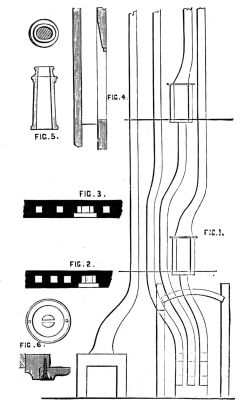
represents a portion of the chimney-flue construction of a first-rate
house; the lower chimney opening is in the basement, and above it are
two others, one on the ground floor, and one on the first floor. It will
be seen that there are three flues descending or taken down to the
basement. The third flue belongs to the room on the second floor. The
wall is two bricks thick, the flue 9 in. in diameter, and contained
within the wall with no chimney-breast projecting. Fig. 2 is a plan of
the flues on the ground floor, and fig. 3 of those on the first floor.
Fig. 4 is a section of the fireplace opening; this is 3 ft. in height
from the floor-line, the brickwork at top is splayed, and supported by
an iron bar; these openings are always filled up with 4½ straight joint
work, to be taken out when the mantelpiece is fixed. Fig. 5 is the
chimney-pot and its cap, the latter opening at top 7 in. by 9 in. only;
fig. 6 shows one of the sweeping doors, in which there are two to each
descending flue. The latter three figures are twice the scale of the
former. A plan and section of the chimney complete, with its marble
mantel and stove, is given in figs. 7 and 8. The flue passes completely
down at the back of the stove, the front is closed by an iron plate to a
height of 2 ft. On this is fixed the moveable door or register, shut
fully or partly over the flue when the stove is in use, and closed over
the stove when the flue has to be swept. The arrows show the mode of
admission of air to the front of the fire; it is brought through the
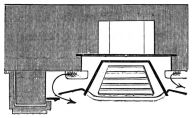
floor and two openings in the back hearth from the outside of the house.
This is generally kept concealed,
and in order to ensure a supply of air to the stove the room should be
kept completely closed.
To cause as full and perfect a combustion of the fuel as possible, a
draught or current of the external air should be always admitted to the
stove, and it could easily be placed under open management, so as to
admit either a large or small supply of air, as required. Numerous
patent processes to effect this are in use, but the most effective way
of doing it is that shown in figs. 7 and 8: it is too simple for a
patent.

Fig. 9 shows a method of admitting air above the architrave of the
entrance door of the room. The opening is made about 2 ft. in length;
this, after a little time, becomes marked by the blacklets coming in
from the passage. The sweeping flue when the fire is lighted becomes
very hot; the smoke ascends speedily and soon leaves it. The flue
requires the stove to be formed expressly for it. Mr. Cubitt made the
stoves only for his own houses, and the author had some difficulty at
Queen’s Gate, in procuring stoves of the right pattern, for
manufacturers prefer their own shop patterns, and some of these would
have covered up half the descending flue. Those he used were supplied by
Messrs. Feetham of Clifford Street, who are well acquainted with the use
of the flue and stove. The flue is considered an excellent one; it is a
builder’s flue, constructed solely of brick, and is certainly the best
of the brick flues. The same attention was paid to it as was given to
every part of Mr. Cubitt’s buildings. It may be asked, “Are there no
other kinds of flues constructed of superior materials?” Yes, certainly
there are; particular attention has often been paid to the flue. There
is Hiort’s circular flue, formed in each course of four wedge-formed
bricks. Mr. Hiort held a very important position; he was Treasurer of
the office of Works at Whitehall, and his flue was extensively used in
some of the Government buildings and the houses in Carlton Gardens. It
did not bond well with the brickwork, so we have Mr. Moon’s improvement
upon it. This was considered not sufficient, and another patent was
taken out in 1844 by Messrs. Clark and Reed for its further improvement.
The flue was an excellent one, but on Mr. Hiort’s retirement from the
Government Board, it went out of use.
There is Seth Smith’s metallic chimney lining, which makes an excellent
flue; the lining is a pipe of from 5 to 10 in. in diameter, built in the
brickwork. About 150 of these flues are at the Pantechnicon. Mr. Smith
announced his determination of never building any house above the value
of 30l. per annum, without using them. They could be introduced, to
form perfect linings to chimneys in buildings already erected, and allow
the stack to be reduced in height, without having the unsightly
appearance of contractions made above them. The drawback to the use of
these tubes by builders was the price. Without any royalty, the 9 in.
tube cost 3s. 4d. per ft. run, the curved tubes 4s. 3d., the
starting tube 3s. 8d. The tubes were of the exact form of drain
pipes, and they were cheaper, and as effectual.
If Mr. Smith’s metal tubes had been introduced into a large brick flue,
they would have rendered the latter an efficient shaft for ventilating
every room in its upward course, openings being made for the purpose at
the upper part of the rooms. This mode of ventilation was applied to
hospitals on a large scale by the late Mr. Jacob Perkins several years
ago, with perfect success.
Denley’s flue, introduced in 1843, is believed to have been the
precursor of that used by the late Mr. Thos. Cubitt at Belgravia and
Pimlico, and there is a great resemblance between the two; but Mr.
Denley’s flue has nothing like the simplicity nor ease of construction
of Mr. Cubitt’s. The downward flues were merged into one at the
basement, and all the soot and cinders were collected or thrown down
into a fire-proof box, which must have stood out in the lower rooms,
from which they had to be removed. The flues were swept from the roof,
the register doors of the stoves being closed, and there was no
provision for sweeping the flues between the basement and the stoves.
Joined to his system for sweeping, was one of air flues which brought a
current of air direct from the exterior of the house to each fireplace.
We have several flue systems which have ventilating flues in connexion
with them. Boyd’s flue forms the wythes, or half-brick spaces between
the flues, of iron plates, and the open spaces thus gained make
ventilating passages. Mr. Doulton’s combined smoke and air flues are
manufactured in terra-cotta, in three sizes; the air flues follow the
line of the smoke flue, the passages being quite distinct, as in Mr.
Boyd’s. The heat from the smoke flue causes a current in the air-flue
which carries off the vitiated air admitted by openings near the
ceiling. The common drain pipes and the glazed fire-clay pipes make good
flues; the use of these pipe-flues has greatly increased during the last
few years; they improve the draught, and clean easily. Flues for
ventilation from rooms should, like Arnott’s ventilator, enter into the
smoke or a hot ventilating flue. Arnott’s ventilator requires careful
adjustment, to be balanced in such a way that it should stand closed on
a calm day.
The superior patented flues, as they are of considerable cost, and take
extra time in construction, are only used in the better class of
buildings, or in those erected under the express direction of the
owner. In speculative buildings they are never used. The time required
for their construction beyond that of the common brick flue, being
regarded by the builder as so much money lost.
The great desideratum in a flue is to make it pass off its smoke
quickly, and this the small size flue effects more certainly than the
larger one, as it warms sooner and keeps its heat longer.
An enthusiastic admirer of the descending or sweeping flue once told the
author that with a good fire in the grate, if a kettle of water could be
placed on the top of the chimney-cap the water would soon boil, even if
the flue were fifty feet high. The flues constructed of metallic or
earthenware casings retain also the heat longer, and keep hotter. It may
be imagined that with these flues, and the large quantity of gas lamps
in the streets, why the temperature of London should be always some
degrees higher than that of the country. In winter snow may be seen in
the suburban fields, but none is found in town.
Architects have often been blamed for not inventing a good system of
flue-construction, not only for the prevention of smoke in our
dwellings, but for the hindrance of its presence in the atmosphere.
Several, and most excellent attempts, have been made for the former, but
very few for the latter, which is one of far greater difficulty. Yet
this is one that admits of a cure, great as the evil is. The chimney
flue might be so improved as to effect a more certain and larger
ventilation of our houses, without any addition of ventilation flues.
The introduction of the French Mansard roof with us, one from a country
where coal fires are not in use, renders it almost imperative for the
chimneys belonging to such buildings to have a different construction,
for chimneys when placed against a building or roof that overtops them,
are sure, as they are at present made, to become smoky: the wind
returning owing to the high construction, and descending in the flues.
The following few designs are offered to cure these various evils.
Accepting as a fact that tall-boys, and the other iron and zinc
constructions, are useful appendages, there can be no reason why they
should be so used as to disfigure our buildings. Some of the finest
specimens of architecture in the Metropolis serve only as pedestals to
an ugly collection of cowls.
The author proposes to form the upper part of the flues in a building,
for a length of about 15 to 20 feet, entirely of iron or other tubing,
in square, round, or oblong sections, of a less diameter than the brick
flues to which they are attached. This tubing is gathered up in groups,
and carried out at an angle of 45° towards a centre stack: the tubes in
direct contact with each other, having no brick wyths, except one or
two to strengthen the stack.
It is obvious that if only one of the flues be in use, it would
moderately warm those next to it; and if the whole of the flues of a
building were constructed on this plan, and two or three were in use,
such a power would be obtained as would effectually ventilate every
room; the action would be continuous and imperceptible, and a fire could
be lighted in any one without the risk of return smoke from a cold or
damp flue.
Thus the heat now wasted in the atmosphere by the action of the common
flue, would be partly retained and turned to use, and the draught of the
flue very much improved.
This tubing could be readily introduced into either old or new
buildings, as the introduction does not involve taking down more than
twelve feet of the brickwork, measuring from the top of the coping. The
tubes could never become sufficiently heated to be dangerous, and less
brickwork would be required.
They might be made either of zinc or earthenware; cast-iron would be
objectionable on account of its weight. It will be seen that they admit
a better mode of sweeping than that now practised, and they could easily
have some kind of capping to prevent down-draughts.
These “stack flues” should commence from the attic or upper storey of a
building, at about six feet from the floor; sweeping doors should be
placed beneath them, so as to give the sweep command of the flue beneath
as well as above.
Each flue should be composed of three separate forms of tubing, by which
the various directions and turns necessary for the construction might be
obtained.
Fig. 10 gives the representation of the three forms; 1, is the first;
this is placed directly over the brick
flue, and gathers it up to a size having an internal dimension of 6 +
4½. It is 21 inches in height. 2, the second piece, is on a curve; the
top and bottom lines, if carried on, would form an angle of 45°; it is
about 18 inches in height, and internal size 6 + 4½. The third, 3, is a
straight piece, internal size 6 + 4½, the lengths various. Fig. 11
gives a plan of four flues and an elevation of the commencement of two.
The sweeping doors are shown below. The flue without a door is the
ventilating flue for the basement. The ease with which this tubing can
be grouped is shown in fig. 12. The stack consists of five flues; the
tube, 2, connects them together below, and
separates them above. The stack above the roof is 4 feet 9 inches in
length.
Fig. 13 shows, in the upper plan, how the flue wall could be reduced in
thickness, made a brick and a half only, with a two-brick block at each
end; it contains coupled and tripled sets of tubes.
The middle plan shows nine flues grouped together, the centre being that
belonging to the kitchen. The last plan shows a group of six in a
two-and-a-half-brick wall; by the side of this are two flues of the
common construction, 14 inches by 9, made of this
size to enable a boy to get up to the top and place his head out of the
chimney-pot.
The tube 1, fig. 12, can have its position reversed, as shown in fig.
14; six flues can thus be grouped together, as shown in the third plan,
fig. 13. The elevation of this stack is given in fig. 15.
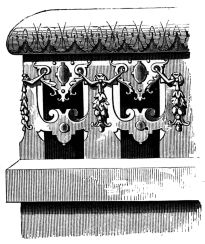
For a covering to these tubes figs. 16 to 20 show ornamental pots and
their sections. The only merit
in these may be that they are of a more ornamental character than any
that have ever been introduced; they are formed of zinc, supported by a
stout dwarf iron railing. The intention is to permit the smoke to escape
in any direction, either upwards, sideways, or downwards, sheltering it
as far as possible from any action of the wind, and rendering of little
consequence whether the stack is high, low, unsheltered or
otherwise. If any sudden gust of wind take place and the smoke be driven
back, the capping provides larger outlets for its escape than the small
aperture of the flue itself; in other words, it is easier for the smoke
to pass in any direction rather than return down the flue.
The stack flues are only, in fact, tall-boys boxed up and not put out in
the cold, and it is presumed they would be sufficiently powerful, from
their warmth, to ensure a good passing off of the smoke, and secure
ventilation to the building.
A forced ventilation to our dwellings, in ever so slight a degree, is a
matter of importance. By the proper construction of these proposed stack
flues it is presumed that any amount of ventilating power, self-acting
and continuous, could be obtained. Their introduction alone would be
beneficial; combined with the flue pedestal, to be described, the tubes
could be led into one general upward shaft; by either plan we should
have some command over the smoke, while the roofs of our buildings might
be made ornamental and picturesque. It would be a treatment of
bituminous coal alike artistic and novel, surprising to foreigners and
creditable to ourselves.
It remains to show how the open character of the flue could be taken
away (this forms its chief evil), and how a chimney-stack may be formed
without chimney-pots. The late Lord Palmerston, when Home Secretary,
proposed the abolition of chimney-stacks, and the use of only one
chimney-stalk for each separate dwelling. In 1856, a commission was
appointed to inquire into the best modes of warming and ventilating the
apartments of dwelling-houses and barracks. Their report, given to the
General Board of Health, was published in 1857, and it afforded a
section illustrating “the principle on which it was proposed to
construct dwelling-houses.” There was only to be
one flue, and this of metal 10 inches in diameter, enclosed in a large
brick flue, which was to serve for ventilation. In the metal flue were
to be inserted the flues of the several fireplaces; these were placed
back to back, and if the register doors of the stoves were open, a
person in one room might both see and converse with another in the
next; the music of a pianoforte in one room could be heard in them all;
this construction was taken up through four storeys, there being eight
fireplaces. For one fireplace alone it would have been perfect, but the
smoke from the two kitchen fires would have been sufficient to have
choked
the flue and caused the smoke to enter into the whole of the eight
rooms.
The chimney-stack might possibly be lowered, and it certainly could be
constructed without chimney-pots, but each separate flue must have its
own outlet. A design for this, one that should take away the open
character of the flue, and fit the stack, possibly for the Mansard roof,
is here given.
In fig. 21, a a are the flues, delivering their smoke into a large
ventilating flue, b. The warm smoke would induce a current of air to
enter at c: any current will have a tendency to draw another with it,
so that the smoke leaving the flues c c would be taken out at d by
the current of air at c.
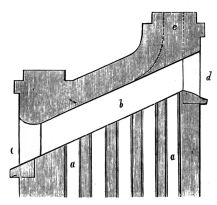
Fig. 21.—The ventilating flue.
This is the principle upon which all the best ventilating chimney-pots,
tall-boys, and cowls are made, and it is a very sure one. The jet of
steam in the funnel of the locomotive, drawing the smoke from the fire,
and creating a draught, is adopted on the same principle.
In scientific language, the established law both of pneumatics and
hydraulics is that when two currents of fluid matter passing in the same
direction, but in separate channels, arrive at any point of confluence,
the stronger current draws the other along in its course, and with a
considerable portion of its own velocity. Thus the force of the wind,
which checks in other instances the action of a chimney-draught, is made
to produce a stronger draught, exactly in proportion to the violence
with which it blows.
Returning to fig. 21, a current of air, instead of coming in at the
opening c, might come in at d. It would then have a tendency to blow
down the flues a a: to prevent this, the opening d could be
closed, and an upright stalk placed at e,—this should have a downward
shaft, a place for soot, and a sweeping door.
There is still another mode of treatment; fig. 22 represents the flues
grouped, each with a separate ventilating flue, the smoke delivered
being at the side of each.
The stack might be covered with zinc in the ornamental style with which
that metal is now treated.
It is probable that if a stack on this principle was placed parallel to
the side of one of these Mansard roofs, it would be secure from the
ill-effects of any wind returning against it. The author will not vouch
for its success, but it is offered here to the attention of architects
and builders as an experiment worthy of trial.
It has been affirmed that the smoke of towns, however disagreeable it
may be to the inhabitants, neutralizes the poisonous effect of the gases
caused by sewers, &c. If it was possible wholly to remove carbon
evolved by smoke, our towns would almost be uninhabitable, and they
represent that any scheme for getting rid of smoke must be combined with
one for getting rid of the exhalations from sewers at the same time. If
the two evils were brought together, they would neutralize each other,
and both could then be got rid of at one operation. The best scheme for
this is a matter of important consideration, but few have been proposed.
It may be asked, what has a work on Picturesque Architecture to do with
either smoke or sewer gases? The author in reply considers that
buildings never will look picturesque while they are covered with great
patches of soot. An eminent sculptor once affirmed that the statues of
London were improved by their soot covering, because it made them stand
boldly out against the sky. But those beautiful decorated smoke towers
which stand on the roof of the Houses of Parliament, and which are as
black as Erebus, look anything but pleasing, standing amidst the whiter
front of the rest of the building. Besides, tall-boys are beginning to
make their appearance on the roof under the Victoria tower, and these
certainly form no part of the architecture, but appear monstrously ugly;
consequently smoke and its abolition are clearly questions to be
considered in relation to Picturesque Architecture.
A plan for removing smoke from the atmosphere of towns, and at the same
time ventilating buildings and sewers, was proposed in 1849 by Mr.
Flockton, surveyor to the town trustees of Sheffield,[F] a town as much
begrimed with sooty smoke, only in a smaller way, as the Metropolis.
The proposal was, that under the footways along the side of every street
and lane, flues should be constructed of sufficient capacity to carry
off all the smoke and other atmospheric impurities, these flues all
converging, upon a general plan, to tall shafts or chimneys at some
distance from the town, and supplied with furnaces. These, when the
fires were once ignited, would give a fire produced by the combustion of
the inflammable gases accompanying the smoke, and which would burn
spontaneously in a similar manner to the combustion of foul air from old
shafts connected with coal mines. The combustion might be assisted by
jets of coal gas, in a fire of coke.
In very large towns it would be necessary, Mr. Flockton added, to divide
the whole into districts, and to erect towers in the centre of each, to
which all the flues should converge. He published a plate, showing two
large dwelling-houses, with a street between, the common sewer in the
middle of the carriage way, and the smoke flues on each side under the
footpaths, also showing the connexion between the sewer and flue. The
alteration proposed to houses already erected consisted in converting
ascending into descending flues; turning the smoke from the chimney-top
into the latter, and from thence into the street flue. This operation
would have necessitated the pulling down and rebuilding of the flue
walls. The street smoke flues, in order to carry off the smoke from a
few thousand chimneys, would require to have been made of a size even
larger than the sewer itself. Provision must have been made for clearing
out the soot, for the smoke would have been cooled and the soot would
accumulate in large quantities in them.
The same scheme, with similar constructions, was proposed by a foreign
gentleman, who took out a patent for it in 1850 (No. 13,061). His plan
was a very grand one; he did not propose alterations in existing
buildings, but pulled them down and gave designs for a new city.
A more practical plan was proposed about 1851 by Mr. Devey, a surveyor
of Furnival’s Inn. A model of his invention was in the Great Exhibition
of 1851, and it is described and an engraving given of it in the
illustrated volumes published by the Royal Exhibition Commissioners at
the close of the Exhibition. The model is now in the Museum at South
Kensington. Mr. Devey’s plan was to make only one descending flue to
each building, to which the flues at the top could be either connected
or not, at pleasure; the descending flue was carried to the sewer in the
middle of the street, and the action of this was to be assisted by the
heat of the kitchen fire. He says, “The smoke would be drawn down by the
current produced by exhaustion in the sewer, the action being assisted
by the kitchen fire.” Mr. Devey did not propose to have furnace shafts,
but depended entirely upon the sewer acting as an exhaust.
In this scheme the objections were, that one descending flue was not
sufficient to carry off the smoke from several chimneys, and the sewer
certainly would not act as an exhaust without its being connected with
upright furnaces. Our sewers generally have ventilating openings which
permit their odours to ascend into our streets. Soot would no doubt
neutralize these odours—this, a paper in a late Quarterly Review
(April, 1866) admits. First, speaking of the sewer gases, the reviewer
says: “These offensive gases have often engendered formidable diseases,
and have, in several instances of late, been clearly shown to have
caused the outbreak both of typhoid fever and cholera.” Of this the
author has had proof during the outbreak of cholera in London in 1849.
He was superintending the construction of a mass of buildings in one of
the worst dwelling districts in London. This builder, who had just
finished the erection of Harrington House, a description of which is
given in this volume, died the first night of the outbreak in the
greatest agony; he was a strong robust man; from one to three deaths
took place in every house in the locality; a black flag was put up in
the streets, and the foul fiend reigned for a while supreme. A large
mass of the worst buildings have been cleared away, and model
lodging-houses erected, but a considerable portion of the rotten old
structures remain, the sewers are untouched, and the visitation of the
cholera forgotten.
The Quarterly Review says there is no reason why ordinary sewers
should not be made to serve the double purpose of carrying off smoke and
sewage at the same time, provided they were connected here and there
with high shafts rendered powerfully expansive by furnaces; and adds,
“sewage would be improved for agricultural purposes by admixture with
soot, which is an excellent manure, and the noxious qualities of the
sewer gases would be destroyed.” Whether soot would increase the value
of sewage or decrease it, is a question for chemists to decide; a
generally increasing opinion is, that our method of using sewage by
liquefaction and sending it away, is a mistake, and renders it quite
worthless, and that the system of dry earth-closets is more conformable
to Nature’s laws.
The subject was taken up in 1857 by Mr. Peter Spence, of Manchester, a
large alum manufacturer.[G] This gentleman states that the “blacks,” the
horror of the Londoner, are guiltless of any deleterious effect to human
health, as carbon is one of the most anti-putrescent of bodies, and
while floating in the atmosphere over everything, arrest and destroy
noxious and miasmatic vapours. Perfect freedom from smoke would, if
accomplished, only increase the evil arising from the purely gaseous
results of combustion. He proposed a system of atmospheric or gaseous
sewage, and the complete removal of all their gases to a safe distance
from our towns. He would combine this gaseous sewage in such a form with
town drainage as would bring all the liquid sewage into contact with the
gases from our furnaces and house fires, the liquid sewage being kept
from all surface drainage. The same liquid and fœtid mass of sewage he
would concentrate in an innoxious form, to be converted, in a convenient
place, where it might with perfect safety be manufactured into manure
more valuable than the richest guano.
For effecting this all the gases from our coal combustion would have to
be conveyed along the same tunnel with the sewage to centralizing
conduits converging to a point, where an immense chimney, 600 ft. high,
should be erected, to discharge these gases into the atmosphere, the
ascensive power being obtained either from the retained heat of the
gases, which would probably be found quite sufficient, or if not,
artificial heat could then be applied to effect the object. The chimney
should be of the internal diameter of 100 ft. at the top, and 140 ft.
external diameter at the bottom. This would take the smoke from 500
chimneys and every particle of foul emanation from the sewer, and every
leak or opening to the upward air from these sewers would not then emit
foul gases, but draw in fresh air with a pressure or suction of three
and a half pounds per foot, and with a velocity of 40 feet per second.
This gentleman says: “It is idle to talk of trapping, and thus confining
gases evolved under ground; exit they must and will have, and when you
imagine you have secured them in one place, you will find them pouring
out in another.” He makes this plain by an illustration. He took an
old-fashioned detached house; after entering into possession he found
frequently very disagreeable smells, especially after rain, a change of
wind, or a fall of the barometer; it may be remarked here that it was
not necessary to take an old-fashioned house to find out this; in more
modern built houses in London, after a fall in the barometer or rain,
such a thing is repeatedly occurring. Mr. Spence, to cure the evil in
his old mansion, exhausted all the remedies which the philosophy of
London schemes acknowledges; he trapped all the exits from the sewer
with the most approved patent girds; all slopstone pipes were cut and
water-luted. But this was of no use, the smell came through the very
walls and floors, and one bedroom on the first floor, which showed no
connexion with the sewer, was quite uninhabitable. He adopted a plan
which succeeded: a branch from the main sewer was brought right under
the kitchen grate, from that a pipe of cast iron, four inches in
diameter, was carried up through the brickwork, and the open top
projected into the chimney a yard and a half behind the kitchen fire,
above the fire. When this fire was again lighted, in a few hours the
house was perfectly sweet, and the distant bedroom, uninhabitable
before, has been slept in ever since. When this nuisance occurs in a
London house the only remedy is to open the doors and windows to get rid
of it, as we are not allowed to meddle with the sewers. Disagreeable
effluvia in dwellings often occur, and baffle every endeavour to trace
from where they proceed; in every case it is from choked-up drains or
the sewer, and the decomposition of animal and vegetable matter therein
retained.
As for Mr. Spence’s scheme, its grandeur almost stops its execution. It
is well known that in all large manufactories, and in gas works, a tall
chimney serves to draw out the smoke from the numerous fires, and it
forms a smoke-outlet for them all. In most of these places the fuel is
used up so completely that it is only the gases of combustion that are
drawn away. Mr. Spence’s scheme has been successfully tried in its
application to private residences, and also on a large scale to the new
Assize Courts in Manchester. It was adopted by one of the architects in
the competitive designs for the New Law Courts in London.
If these tall shafts and furnaces were applied in London, it may be
questioned whether the smoke in cooling would not deposit the soot in
the sewer, and this must be removed, if not run off by water. The flues
connecting the house fires with the sewer would be partly horizontal,
and these would certainly fill with soot, and no machines we have at
present in use could clean out these flues from above. The operation
must be performed from within the sewer, and then these flues being
unsupplied with drain-eyes at their entrance to the sewer, would form so
many open channels for the passage of the sewer gases into the houses.
This would be the case in a very great degree where there were no fires
in the stoves and their register doors were open. It would require an
immense consumption of fuel in the high stalks to cause a current to
prevent it, and the furnaces must be close together to lessen the
cooling effects of cold currents of air from flues not in use.
As to the mere ventilation of the sewer itself, it could easily be
effected by single drain pipes 6 inches in diameter, placed at
intervals, from the sewer to the ash-pit of any neighbouring furnace. It
would be probably to the advantage of the furnace itself, as even the
tall stalks must sometimes make black smoke. A legislative enactment
should require their owners to let them perform this service. It might
require strong furnaces and plenty of them to effect it. A suggestion
for getting rid of that “monster nuisance, London smoke” was made known
in the Builder about 1859, by Messrs. Bruce Neil. It is thus
described: “The plan consists in placing small tanks containing water
over the chimney (the chimney-pots being fixed inside the tanks, and
made of a spiral and bent form). The chill of the water gradually
condenses the smoke, which becomes decomposed and destroyed, being
precipitated at the bottom of the tank in the form of mineral tar. The
water is turned on and off daily. It will be here observed that in the
event of a fire in the chimney the flames cannot spread, as they are
immediately quenched by the water in the tank. According to Mr. Bruce
Neil’s calculation, the smoke of 80 tons of coal, if collected, will
yield upwards of 28 barrels of tar, of 2½ cwt. each. He proposes that
the Legislature, or the Society of Arts, should offer a premium to the
person who will undertake to rid us of this monster nuisance and convert
the smoke into tar, so as to make it applicable to commercial purposes.
In the adoption of the above plan a slight alteration in the mode of
ventilating our apartments is all that is required, he tells us.
As to the possibility of converting smoke into tar by such means as are
above described, some doubts might be expressed if it could really be
done; the remedy would be worse even than the disease, every household
using yearly 20 tons of coal would have in that time to remove 7 barrels
or 17½ cwt. of tar from their roof. The Builder, in publishing this
suggestion, did not give any diagram or sketch showing how the process
was to be effected. Mr. Bruce Neil no doubt made one, as he speaks of
the alteration required in the ventilation of our apartments; a drawing
would at least have explained how the water was to collect the soot, and
how it was to have access to the flue in case of its being on fire.
The suggestion of collecting soot at the chimney-top by means of water
was a valuable one, and there is no doubt it could be done to some
extent, but not by encircling the pots with cold water, which would
chill the smoke and prevent the soot from rising. A
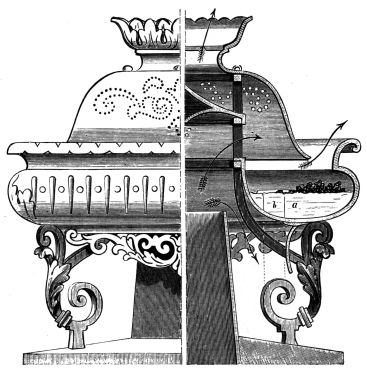
Fig. 23.—Water chimney-vase for collecting soot.
|
Half elevation.
| |
Half section.
|
design is here given, fig. 23, to show how it could be effected.
It will be seen that the chimney-pot or funnel has a zinc cover carried
by stout ironwork surrounding it; a is the water, b the pipe to
convey it away; it would be self-acting, and being washed by every
shower would not be likely to get out of order. The rain-water must be
looked for as to supply—to pay for high service for the roof of our
houses to the water companies would not do.
Our climate is more damp than cold, and a considerable quantity of rain
falls on our roofs. The zinc cover is spread out, so as to retain as
large a portion as possible of the rain-fall. In winter, when there is
most smoke, there is most water, with little or no evaporation. A pool
of water could be thus collected, and the smoke projected over it would
lose some portion of its soot, which could be floated away by the pipe
into a receptacle provided for it in the back yard. The water might be
sent into the drain and the soot left; or it could be sent into the
drain as well.
The arrows in the diagram show the direction of the smoke, and the cover
is so spread out and curved as to render it unlikely for any violent
wind to flow out both water and soot into the street beneath.
Certainly coal smoke is a great nuisance; it is yearly pointed out as
such by our paper the Times, in one, probably two, very excellently
written leaders. Even the youngest member of the press, the Echo, in
one of the common London fogs occurring in April, 1868, thus remarks:
“The most sad and remarkable circumstance about the fog of yesterday was
that the newspapers and people in the streets spoke of it as a
‘visitation,’ as a ‘gigantic pall,’ as if, indeed, the black darkness
was something as strange and unaccountable as a fall of frogs or fishes
from the sky. Of course it was nothing but our own familiar coal smoke
which stopped the way of the sunlight. It is most lamentable that
Londoners are becoming so used to this filthy nuisance that nothing more
than a passing exclamation is uttered when it is forced down upon them
in such volumes as to produce almost the darkness of midnight at midday.
If ‘cleanliness is next to godliness,’ then the people of London must
have been yesterday the most ungodly people in the world, for nothing
would remain clean which was exposed to the fog of that morning. A
plague of locusts would not create more terror and sense of ruin in any
foreign capital, where every article of dress and furniture and house
decoration, both external and internal, would have been regarded as
spoiled by the loss of freshness. But London received its coat of dirt
yesterday, and to-day only wonders with the remark ‘how dark it was!’
Will nothing move us to abate the nuisance? Is there no hope but that
distant one of the exhaustion of our coal-beds? Must we inhale
coal-blacks, and always contemplate dirty houses and grimy furniture? Is
it not possible by smoke sewers, or some contrivance or machinery, to
relieve us of this plague?” It is very possible it could be done with
the greatest ease, but at some first expense; and in some generation or
other it will be written that it found London foul and left it sweet,
and there will be a time when this will be appreciated; and the man who
gives the city the pure atmosphere of a small country town will receive
all due honour and acknowledgment, that is, when he is in his grave and
securely buried.
The public have so long been accustomed to be choked with smoke, and
their health affected by deleterious gases, that they look upon the
proposal of any scheme to secure pure air as the hallucinations of
dreamy philosophers or inexperienced Utopians.
None of our present flues can, in the very slightest degree, stop these
aqueous vapours from ascending into the atmosphere, neither can they
effect any purification of the smoke, or retain the blacks for any
useful purpose; and it is of no use disguising the fact that any
contrivance or appliance, to effect either of these most desirable
objects, must consist of an additional construction to the flue, which
will be attended with additional expense, and require extra attention.
Therefore any such appliance, if introduced, should be effectual, and
repay such additional cost to its owner, by a saving, or at least a more
economical use of fuel.
The appliance to the flue the author has to recommend, he considers will
not only cause an economical use of the fuel by not permitting the
present waste of heat, but it will purify the smoke, and retain the
blacks for any useful object to which they can be applied.
The principle of the best-constructed flue at present is to get rid of
all vapour, smoke, and soot as soon as possible, without the slightest
consideration for the people outside. That the smoke should not return
to annoy the occupants within the house is the aim of the constructors,
and to secure this, the waste of heat in the chimney, and the consequent
waste of fuel, is considered of no importance, for is it not the hot
smoke that carries up the soot and ventilates the apartment?
This operation of the flue could be taken advantage of. In the
construction of chimney-flues in a wall they are often turned at an
angle to the right or left to pass an obstruction, such as a fireplace
or timber placed within or against the wall. A flue could easily be
taken out of the wall and returned, and if the part so taken out was
formed in cast iron with a small cistern of water at top, it would
become a warm-water pedestal, and could moderately warm or air an
apartment in which it was placed; the author calls this the flue
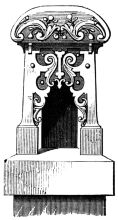
pedestal, and it is represented in the following cut.
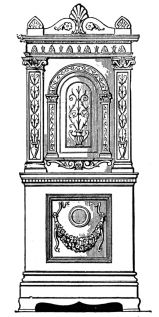
Fig. 24.—The flue pedestal.
It is about three feet six in height, not much higher than a small
cabinet. The door could open, and a small tap supplying warm water for
domestic use would be seen. Thus the upper rooms of a house could be
warmed or aired by the fires below in perfect safety, and the present
waste of heat in the flues prevented. This would be economical, as in
most cases no fires would be necessary in the upper rooms.
The flue thus brought out in iron could contain a fine spray of water,
that would draw up the smoke, and take down its vapours and soot at the
same time into the sewer.
Fig. 25 shows a section of the flue thus brought out. The wall is two
bricks thick, the flue a, is 9 inches in diameter, d is the
cast-iron flue, and another, e, shaped like a funnel, is placed behind
it, to collect the soot and water, and pass it off through the pipe h.
The cistern is partly within the walls and partly covering the two
flues. It is not necessary that the water in the cistern should supply
the spray: that might be done by a separate pipe with a tap to turn off
and on as desirable; b is the moveable pedestal covering the whole.
The adaptation of this simple contrivance to any kind of domestic
chimney-flue is not a very difficult operation. It is only necessary to
take out the brickwork in front of a flue of a height of 4 to 5 feet,
and then introduce the iron flue, gathering up the brickwork beneath it;
the section, fig. 25, supposes the iron flues to be in an external wall;
should it be required in a party wall the soot goes off at g g, to
be conveyed outside the building in the nearest way; doors are provided
for the purpose of sweeping; any down
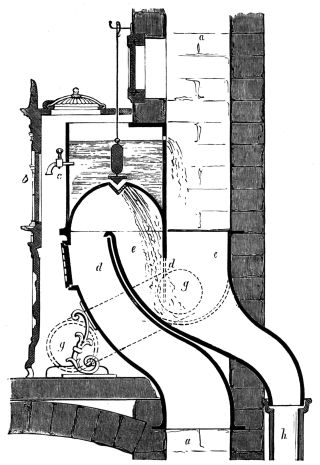
Fig. 25.—Section of the flue pedestal.
draught of air in the chimney might expend itself in the soot flue, and
the smoke having passed the spray could not return. The spray of water
should be equal to the whole width of the flue, and proportioned in
strength to the work it has to do; the smoke from a whole group of flues
might be conducted to one powerful spray, one upper flue or chimney
would then suffice for the roof, while the soot and flues in any number
might be formed into one before passing to the sewer.
The pipe h, shown in fig. 25, would not form an open communication
with the sewer; it would be supplied with a flap-cover or drain-eye,
like the common house drain at its extremity. This would open only when
sufficient water and soot was behind it, and close when it was passed.
It would not require sweeping, the water keeping it clear. It should
have another kind of drain-eye to that at present in use, the lid, or
flap of which is hinged from the top, the soot floating on the surface
of the water, would require the flap to open from below. Fig. 26 shows
the kind of drain-eye that would be required.
If it was not for the difficulty of the present form of drain-eye to our
houses, the soot flue might discharge its contents into the house drains
at once, below the trappings; there is probably no absolute necessity at
all for drain-eyes at the termination of house drains, their use is to
make precaution doubly sure, to prevent the rising of the gases from the
sewer, and to keep out the rats, to prevent them, by getting through the
traps, from entering the house.
Experiments were made with a shower of water in Mr. Cubitt’s descending
flue. It will be seen by inspecting the figures 1 to 8 that these flues
could easily be formed into one, and taken into the drain; the
experiment did not succeed, as none will, that brings heavy smoke in
opposition to a water-fall. The smoke must go with the current or
water-shower, and not against it.
The flue pedestal, with its water-spray, is the whole of the contrivance
by which the author believes the smoke of the domestic hearth could be
got rid of, or rendered inoffensive. What the action of the water would
be on the gases that escape from the fuel he cannot say, but he presumes
it could not be other than beneficial.
He experimented on the subject a few years ago, and had a stove and flue
erected about ten feet in height; the lower part of the stove was of
brick, the upper part with the cistern of zinc. The coal fire was
lighted, and as soon as black smoke appeared at the chimney-top, the
water-valve was lifted and about 16 fine jets of water were sprayed
against a piece of loose perforated zinc, suspended in the flue; this
zinc is shown in fig. 25; in the second flue e (it should have been
marked f, but by a mistake in the cutting it is made d), the smoke
had to pass through under this perforated zinc to get to the chimney
above. On the instant the water was applied, the smoke appeared at the
chimney-top of a light colour, and it came out of the soot receptacle,
placed a little height above the ground, nearly as much as it did at
top, and of a similar light vapourish character,[H] a sure sign that it
was drawn down by the current of water. Soot in large quantities was
soon seen in the receptacle; the author has not ascertained the quantity
of soot which would be obtained by this process from a ton of coals, but
he believes it would be very considerable, possibly two sacks or more.
As clean unmixed soot is worth in London 2s. 6d. per sack, if this
soot were retained it would pay for the extra expense of the water, and
the retaining of it, and to carry off the water would be an easy
operation.
The “blacks” are good things at present in their wrong place; they could
in the way proposed be very easily got rid of, and if it were possible
to cut into all the chimneys of London and apply the remedy, the whole
of the soot, which at present escapes into the atmosphere, might be
caught and passed into the drains; it would there probably fully
deodorize them. It is certainly not possible, from the herculean nature
of the task, to disturb the whole of the chimneys of London, but the
worst only might be operated upon, such as the chief kitchen flues of
the great establishments, which are continually sending out black smoke.
Among the chief offenders are our bakers, nearly twenty of them being
fined weekly for this by the magistrates, and for fires occurring in
their chimneys. It appears that the Smoke Nuisance Act bears hardly upon
them; the smoke-consuming apparatus forced upon them by the Act has
utterly failed in its purpose, and it is impossible for them to comply
with the requirements of the Act, and carry on their business in a
satisfactory manner either to themselves or the public. They have
applied to the Home Secretary for relief, and a bill to repeal so much
of the Act 16 and 17 Vict. that relates to bakehouses has been in
contemplation.
There would be no difficulty in placing a flue pedestal in their flues
at any height above their oven fires; it would not only relieve their
neighbours from the annoyance of black smoke from their chimneys, but it
would secure the chimneys themselves from taking fire. The water need
only be turned on when required, when black smoke was being made, and if
they chose to collect the soot the expense of the operation would be
trifling, if anything, beyond the first expense of the flue pedestal, in
the end.
In large country houses the flue pedestal would warm the upper rooms or
passages, and cause a more equal temperature in the building; this,
together with the practicability of collecting the soot for agricultural
purposes, might be an inducement to its introduction. Water could be
lifted to the roof of a country mansion by that ingenious contrivance
the hydraulic ram, and passed off to its original source when done with,
the soot being left behind.
The beautiful self-acting machine, known as Gwynne and Co.’s improved
hydraulic ram, is peculiarly adapted for raising or lifting water to any
required elevation. It is necessary to have a fall of water to work it,
and the greater the height of the fall, the more effective will be the
machine. In favourable cases it will raise water thirty times higher
than the fall working it. The greater the height of the lift, of course
the less will be the quantity raised in a given time. This machine can
be made to deliver comparatively large quantities of water, either in
tanks on the roofs of houses, or in farmyards for filling ponds. It will
work day and night without any attendance or expense after it is once
fixed. Two or more rams may be used to force through the same pipe, or
rising main. Where a continuous stream of water to work the machine
cannot be obtained, a spring, or even rainfall, or drainage may be
stored up in a reservoir or dam, and made to work the ram.
The expense of these machines is not excessive, as the following table
will show:—
Diameter of
Feed Pipe. |
Diameter of
Delivery
Pipe. |
Approximate Number of
Gallons of Water raised
in a day of 24 hours. |
Price of Ram, complete,
with all the accessories,
but exclusive of Pipes. |
| Inches. | Inches. | | £ |
| 2 | 1 | 800 to 1150 | 12 |
| 3 | 2 | 3000 to 4000 | 24 |
| 4 | 2 | 4000 to 5000 | 34 |
A small room or enclosure must be erected to contain the machine.
The question of how far the removal of smoke from the atmosphere would
affect the various gases of combustion floating therein is a question
for the chemist. The plan that has been here proposed is founded on the
supposition that Nature’s law, relative to the diffusion of gases,
permits only carbonic acid gas, the chief product of combustion, to
remain in the proportion of 1 in 2000. The introduction of so much water
in the sewer, where its presence already is considered an injury to the
sewage, is an objection, but the present system of drainage requires a
plentiful supply of water, to prevent stoppages or choking. Should the
dry earth system ever be generally introduced, the present sewers would
serve to remove liquid sewage and all products of combustion. The
operation of the sewer in any way in receiving this smoke and soot,
would permit the full and cheering light of the sun to shine alike in
country and town.