Lorchas—Outrage on the Arrow—Question of access to city—Tone of
British Foreign Office—Firm tone of British Government—Destruction
of Canton factories and flight of foreign residents—Operations in
river.
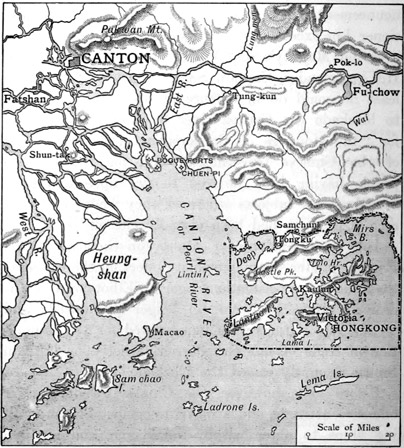
From the earliest days of the British occupation it
had been the aim of the Canton authorities to destroy
the "junk" trade of Hongkong by obstructive
regulations, for which the supplementary treaty of
1843 afforded them a certain warrant. But as the
Chinese began to settle in large numbers on the
island the claims of free commerce asserted themselves,
and gradually made headway against the restrictive
schemes of the mandarins. The Government
fostered the legitimate commercial ambition
of the Chinese colonists by passing ordinances whereby
they were enabled to register vessels of their
own, sail them under the British flag, and trade to
such ports as were open to British shipping. Certificates
of registry were granted only to men of substance
and respectability who were lessees of Crown
land in the colony. The class of vessel for which
colonial registers were granted was of native build and
rig, more or less modified, of good sea-going qualities,
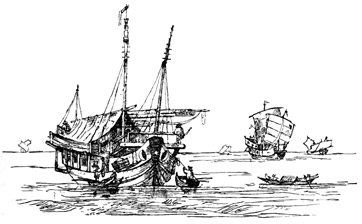
known by the local name of lorcha. Naturally the
Canton authorities looked askance at any measure
aimed at the liberation of trade, and so truculent an
imperial commissioner as Yeh was not likely to miss
an opportunity of wreaking vengeance on the "native-born"
who dared to exercise privileges derived from
residence in the hateful colony.
One of these registered vessels was the Arrow, commanded
by an Englishman and manned by Chinese.
This vessel was in the course of her traffic boarded at
Canton at midday on October 8, 1856, by order of
the Chinese authorities, with marked official ostentation,
her crew forcibly carried off on a charge,
according to a Chinese version, "of being in collusion
with barbarians," and her ensign hauled down.
How this outrage on the British flag was perpetrated,
how resisted, and what came of it, have been
so often set forth that there is no need to dwell
upon the details here. The traditional insolence of
the Chinese was reasserted in all its virulence, as in
the days of Commissioner Lin, and once more the
British agents were confronted with the dilemma of
aggravating past griefs by submission or of putting
their foot down and ending them. A single-minded
and courageous man was in charge of British interests
in Canton, and, left with a free hand, there could be no
doubting the line Mr Parkes would take. The decision,
however, lay with Sir John Bowring, governor of
Hongkong, her Majesty's plenipotentiary and superintendent
of trade, and with the naval commander-in-chief,
Sir Michael Seymour.
We have seen that the likelihood of sooner or later
having to clear accounts with the authorities of Canton
had not been absent from the mind of her Majesty's
Government for some years previously, though by no
initial act of their own would they have brought the
question to a crisis. If the governor entertained
doubts whether the Arrow insult furnished adequate
provocation, his decision was materially helped by
the deadlock in relations which followed. A simple
amende for the indignity offered to the flag was asked
for, such as the Chinese were adepts in devising
without "losing face"; but all discussion was refused;
the viceroy would not admit any foreign official to a
personal conference. The small Arrow question thus
became merged in the larger one of access to the city,
and to the provincial authorities, which had on various
pretexts been denied to the British representatives in
contravention of the treaty of 1842.
It happened that the question had lately assumed
a somewhat definite place in the agenda of the British
plenipotentiary. Lord Clarendon had in 1854 instructed
Sir John Bowring to take any opportunity
of bringing the "city question" to a solution, and Sir
John addressed a long despatch to Commissioner Yeh
on the subject in April of that year. It had no effect,
and was followed up a few months later by an effort in
another direction. The turbulent character of the Cantonese
people and the impracticable arrogance of the
imperial officers who successively held office there had
often prompted an appeal to Cæsar, and more than
one attempt had been made in times gone by to submit
the Canton grievances to the judgment of the
Imperial Court. These attempts were inspired by a
total misconception of the relations between the provinces
and the capital. In the year 1854, however,
it was decided to renew the effort to open direct communications
with the Imperial Government. And
circumstances seemed to promise a more favourable
issue to the mission than had attended preceding ones.
The time had come when a revision of the tariff and
commercial articles of the treaties might be claimed,
and besides the standing grievance at Canton there
were sundry matters in connection with the fulfilment
of the treaties which together constituted a
justifying pretext for an unarmed expedition to the
Peiho. The chances of a favourable reception were
thought to be strengthened by the combination of the
Treaty Powers. Sir John Bowring and the American
Minister, Mr McLane, accordingly went together, with
a competent staff of interpreters, to Tientsin, where
they were soon followed by the French secretary of
Legation.
High officials were appointed to treat with them,
because it was feared that if some courtesy were not
shown them the barbarians would return south and
join the rebels, who were then threatening the
southern provinces. But the net result of the mission
was that it was allowed to depart in peace. Lord
Elgin, commenting on the proceedings, sums up the
instructions to the Chinese officials, gathered from the
secret reports afterwards discovered, as, "Get rid of
the barbarians," which would be an equally exhaustive
rendering of all the instructions ever given to Chinese
plenipotentiaries. On the occasion of this visit to the
Peiho the foreign plenipotentiaries resorted, as had
been done on sundry previous occasions, to the oriental
custom of approaching a great man gift in hand. In
the depleted condition of the imperial treasury they
calculated that the recovery of the duties unpaid during
the recent interregnum at Shanghai would be a
tempting bait to the Peking Government. The offer,
however, could not, it would appear, be intelligibly
conveyed to the minds of the northern functionaries:
unacquainted with commercial affairs, and misconstruing
the proposal as a plea for the forgiveness of arrears,
they at once conceded the sop to Cerberus, pleased to
have such a convenient way of closing the mouths of
the barbarians.
In December following a favourable opportunity
seemed to present itself for renewing the attack on
the exclusiveness of Canton. The Taiping rebels had
blockaded the river, and in a "pitched battle" defeated
the imperialist fleet and were actually threatening the
city. In this emergency Yeh implored the aid of the
English forces. Sir John Bowring thereupon proceeded
to Canton with a naval force of five ships to
protect the foreign factories, the presence of the
squadron having at the same time the desired deterrent
effect on the rebels, who withdrew their forces.
Now at last the governor felt confident that the barrier
to intercourse was removed, and he applied to
the viceroy for an interview; but Yeh remained
obdurate, refused audience as before, and with all
the old contumely. Precisely the same thing had
happened in the north in 1853, when the governor of
Kiangsu applied through Consul Alcock to the superintendent
of trade, Sir George Bonham, for the assistance
of one of her Majesty's ships in defending Nanking
against the expected attack of the Taipings.
Divers communications of like tenor had, during several
months, led up to this definite application. The appeal
was most urgent, and yet in the title given to her
Majesty's plenipotentiary the two important characters
had been omitted, indicating that his power emanated
from the ruler of an "independent sovereign state."
"Such an omission," remarked Mr Alcock, "is characteristic
of the race we have to deal with, for even
in a time of danger to the national existence they
cannot suppress their arrogance and contempt for barbarians."
Arrogant and contemptuous of course they
were, and yet it may perhaps be questioned whether
such terms fully explain the mutilation of the plenipotentiary's
official titles. Although they had been
compelled by mechanical force to accord titles implying
equality to foreign officials, yet in the innermost
conviction of the Chinese an independent sovereign
State was at that time almost unthinkable, and could
only be expressed by a solecism. If, therefore, we ask
how an imperial commissioner could demean himself
by soliciting protection from the barbarians to whom
he was denying the scantiest courtesy, we have to
consider the point of view from which China had from
time immemorial and without challenge regarded all
the outer States. For it is the point of view that is
paradoxical. To Yeh, considering barbarians merely
as refractory subjects, there was no inconsistence in
commanding their aid, while denying their requests.
The position is analogous to that of Ultramontanes,
who claim tolerance for themselves in heretical communities
by a divine right which excludes the idea of
reciprocity. This key to the history of foreign intercourse
with China is too often forgotten.
Nothing daunted, Sir John returned to the charge
in June 1855, on the occasion of the appointment of
the new consul, Mr Alcock, whom he asked permission
to introduce to the Imperial Commissioner. His letter
was not even acknowledged for a month, and then
in the usual contemptuous terms.
So far, indeed, from Yeh's being mollified by the assistance
indirectly accorded to him in defending the
city from rebel attack, or by the succession of respectful
appeals made to him by Sir John Bowring, a new
campaign of aggression was inaugurated against the
lives and liberties of the foreign residents in Canton.
This followed the traditional course. Inflammatory
placards denouncing foreigners, and holding them up
to the odium of the populace, were extensively posted
about the city and suburbs in the summer of 1856.
These, as usual, were followed by personal attacks on
isolated Englishmen found defenceless, and, following
the precedents of ten years before, the outbreaks
of anti-foreign feeling in Canton found their echo
also in Foochow, where an American gentleman met
his death in a riot which was got up there in July.
So serious was the situation becoming that Mr Consul
Parkes, who had succeeded Mr Alcock in June, solemnly
warned the Imperial Commissioner that such
acts, if not promptly discountenanced by the authorities
(who of course were well known to be the
instigators), must inevitably lead to deplorable consequences.
The Chinese reply to this remonstrance
was the outrage on the lorcha Arrow. To isolate that
incident, therefore, would be wholly to miss the significance
of it: it would be to mistake the match
for the mine.
Those who were on the spot and familiar with
antecedent events could have no doubt whatever that,
in condoning the present insults, the British authorities
would have invited greater and always
greater, as in the days of Lin. The tone of recent
despatches from the Foreign Office fortified the governor
in taking a strong resolution; the clearness
of Consul Parkes' view made also a deep impression
on him; and yet another factor should not be altogether
overlooked which contributed its share in
bringing the two responsible officials to a definite
decision. It was not an unknown phenomenon in
public life that two functionaries whose co-operation
was essential should mistrust each other. This was
distinctly the case with Sir John Bowring and Sir
Michael Seymour. They needed some connecting
medium to make them mutually intelligible, and it
was found in the influence of local public opinion.
The mercantile community, which for twenty years,
or as long as they had had utterance, had never
wavered in the conviction that in strength alone
lay their safety, were to a man for vigorous measures
at Canton. And it happened that, scarcely perceived
either by themselves or by the other parties concerned,
they possessed a special channel for bringing
the force of their views to bear on the two responsible
men. Sir John Bowring had himself deplored "the
enormous influence wielded by the great and opulent
commercial houses" when adverse to his projects.
He was now to experience that influence in another
sense, without perhaps recognising it, for when the
wind is fair it makes slight impression on those whose
sails it fills.
Among the business houses in China two stood
pre-eminent. One had a son of the plenipotentiary
for partner; both were noted for their princely hospitality,
especially to officers of the navy. "Those
princely merchants, Dent & Co., as well as Matheson,"
writes Admiral Keppel in his Diary, "kept open
house. They lived in palaces." One of the two
buildings occupied by the former firm, "Kiying
House," which some twenty years later became the
Hongkong Hotel, was as good as a naval club for
all ranks, while admirals and post-captains found snug
anchorage within the adjoining domain of the seniors
of the firm. The two great houses did not always
pull together, but on this occasion their separate
action, converging on a single point, was more effectual
than any half-hearted combination could have been.
Night after night was the question of Canton discussed
with slow deliberation and accumulating emphasis
in the executive and the administrative, the
naval and the political, camps respectively. Conviction
was imbibed with the claret and cheroots, and
it was not altogether without reason that what followed
has sometimes been called the "Merchants'
War."
The die was cast. The great Canton bubble, the
bugbear of a succession of British Governments and
representatives, was at last to be pricked, though
with a delay which, however regrettable at the time,
perhaps conduced to greater thoroughness in the long-run.
Those of our readers who desire to trace the
various operations against Canton during the twelve
months which followed cannot do better than consult
Mr Stanley Lane-Poole's 'Life of Sir Harry
Parkes,' the volume of 'Times' correspondence by that
sage observer and vivacious narrator, Mr Wingrove
Cooke, and the delightful sailors book recently published
by Vice-Admiral Sir W. R. Kennedy. The
campaign unfolded itself in a drama of surprises. The
force at the admiral's disposal being too small to follow
up the initial movement against the city, which
gave no sign of yielding by first intention, Sir Michael
Seymour had to content himself with intimating to
the Viceroy Yeh that, notwithstanding his Excellency's
interdict, he had, with a guard of bluejackets,
visited the Viceregal Yamên; and with keeping hostilities
alive by a blockade of the river while awaiting
reinforcements.
The Arrow incident occurred in October. In December
the foreign factories were burned by the
Chinese, and the Viceroy Yeh issued proclamations
offering rewards for English heads. The mercantile
community retired to Hongkong, a few to the
quieter retreat of Macao. The vengeance of Commissioner
Yeh pursued them exactly as that of Commissioner
Lin had done in 1839. Assassinations were
not infrequent on the outskirts of the city of Victoria;
and in January 1857 the principal baker in
the colony was induced to put a sack of arsenic into
his morning supply of bread, which only failed of
its effect through the excess of the dose acting as an
emetic.
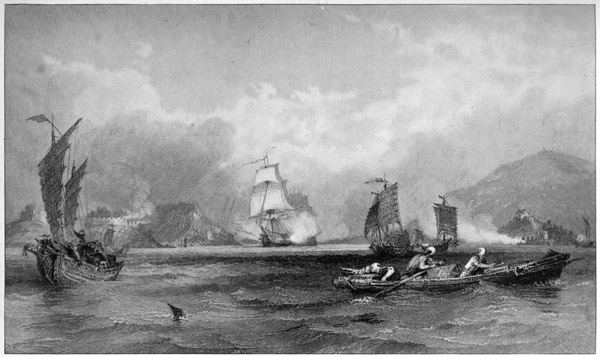
The early portion of the year 1857 was enlivened by
active operations in hunting out Chinese war-junks in
the various creeks and branches of the river, commenced
by Commodore Elliot and continued on a brilliant
scale by Commodore H. Keppel, who arrived
opportunely in the frigate Raleigh, of which he speaks
with so much pride and affection in his Memoirs. That
fine vessel, however, was lost on a rock approaching
Macao, sinking in shallow water in the act of saluting
the French flag, a war vessel of that nationality having
been descried in the anchorage. The commodore and
his officers and crew, thus detached, were soon accommodated
with small craft good for river service, and
in a very short time they made a memorable cutting-out
expedition as far as the city of Fatshan, destroying
formidable and well-posted fleets of war-junks in what
the commodore described as "one of the prettiest boat
actions recorded in naval history." Sir W. Kennedy
served as a midshipman in those expeditions, and his
descriptions supply a much-needed supplement to that
of the Admiral of the Fleet, correcting it in some particulars
and filling in the gaps in a wonderfully realistic
manner. No adequate estimate can be formed of the
importance of the year's operations in the Canton river
without reading Admiral Kennedy's brilliant but simple
story.
The Canton imbroglio made the kind of impression
that such occurrences are apt to do in England. The
merits of the case being usually ignored, the bare incidents
furnish convenient weapons with which to assail
the Government that happens to be in office. Under
such conditions statements can be made and arguments
applied with all the freedom of a debating club. The
Arrow trouble occasioned a temporary fusion of the
most incongruous elements in English politics. When
Lord Derby, Lord Lyndhurst, Bishop Wilberforce, Mr
Cobden, Mr Bright, Mr Gladstone, and Mr Disraeli
were found banded together as one man, it was neither
common knowledge nor any sincere interest in the question
at issue, but "unanimosity" towards the Premier,
that inspired them. The Opposition orators took their
brief from the published despatches of Commissioner
Yeh, which they assumed as the starting-point of the
China question, and found no difficulty whatever in
discovering all the nobility and good faith on the
Chinese side, the perfidy and brutality on the side
of the British representative. Though successful in
carrying a vote of censure on the Government, the
attitude of the Coalition did not impress the public,
and Lord Palmerston's appeal to the electorate was
responded to by his being returned to power by a
large majority.
How very little the question itself affected public
men in England may be inferred from the notices of
it in the Memoirs, since published, of leading statesmen
of the period. The fate of China, or of British commerce
there, was not in their minds at all, their horizon
being bounded by the immediate fate of the
Ministry, to them the be-all and end-all of national
policy. What deplorable consequences all over the
world have arisen from the insouciance of British
statesmen as regards all matters outside the arena
of their party conflicts!
Sir John Bowring was made the scapegoat of the
war. A philosophical Radical, he had been president
of the Peace Society, and his quondam friends could
not forgive a doctrinaire who yielded to the stern
logic of facts. As consul at Canton he had had
better opportunities of studying the question of intercourse
with the Chinese than any holder of his
office either before or since his time. No one had
worked more persistently for the exercise of the
right of entry into Canton. Superseded in the office
of plenipotentiary by the appointment of the Earl of
Elgin as High Commissioner for Great Britain, Sir
John Bowring remained Governor of Hongkong, and
it fell to him to "do the honours" to his successor,
from whom he received scant consideration. Indeed
Lord Elgin made no secret of his aversion to the
colony and all its concerns, and marked his feeling
towards the governor by determining that he should
never see the city of Canton—that Promised Land so
soon to be opened to the world through Sir John's
instrumentality.
Capture of Canton—The Treaty of Tientsin—Comments on the treaty—Sequel
to the treaty—Omission to visit Peking—Comments thereon—How
to deal with Chinese—Commissioners to Shanghai to negotiate
the tariff—Two pressing questions to be settled—Delay of Commissioners'
arrival—Resentment of Lord Elgin and change of tactics re
Canton—Canton question same as Chinese question—Chinese demand
for abandonment of Resident Minister—Lord Elgin's assent—Comments
thereon—Treaty with Japan—The Taku disaster.
The transports bringing the troops from England
were meanwhile hurrying at top speed—not in those
days a very high one—round the Cape of Good
Hope, and the navy was being reinforced by several
powerful ships, including the mosquito squadron of
gunboats which were destined to play so useful a
part, first in the operations of war, and subsequently
in patrolling the coast and rivers for the protection of
peaceful traders. Lord Elgin's arrival in Hongkong,
coinciding in time with that of the frigates Shannon,
commanded by Sir William Peel, and Pearl, Captain
Sotheby, put heart into the long-suffering British
community at the port. But sinister news from India
had reached Lord Elgin on his voyage to China, in
consequence of which, and on the urgent request of
the Governor-General, he took on himself to intercept
the troopships wherever they could be met with, and
turn their course to Calcutta. Before he had been
many days in Hongkong, foreseeing an indefinite period
of inaction in China, and being obliged in any case
to wait the arrival of his French colleague, without
whom no French co-operation could be had, Lord
Elgin determined to proceed himself to Calcutta,
taking with him the two frigates Shannon and Pearl.
This welcome reinforcement not only arrived opportunely
in India, but, as is well known, did heroic
service in throwing back the tide of mutiny.
Fortune seemed in all this to be favouring the
Chinese, nothing more hurtful threatening them than
a passive blockade of the Canton river and its branches.
But a fresh expedition was promptly despatched from
England to take the place of that which had been
diverted to India. A body of 1500 marines arrived
in the autumn, and on them, supplemented by the
Hongkong garrison, devolved the duty of bringing
China to terms, the navy, of course, being the essential
arm in all these operations.
Lord Elgin returned to China in ample time to
meet the French plenipotentiary, Baron Gros. His
lordship's policy had from the first been an interesting
theme for speculation, not less so as the time
for putting it in force drew near. It had been surmised
that his object would be to leave Canton alone,
and set out on another wild-goose chase to the north.
That so futile a scheme should not be carried out without
at least a protest, the mercantile community met
Lord Elgin on his arrival in June with an address
couched in the following terms:—
We venture upon no opinion at present respecting the
readjustment of our relations with the empire at large, though
always prepared to hold our advice and experience at your
lordship's command; but upon that branch of the question
which we distinguish as the "Canton difficulty" we would
take this, the earliest opportunity, of recording our opinion—an
opinion founded upon long, reluctant, and, we may add,
traditional experience—that any compromise of it, or any
sort of settlement which shall stop short of the complete
humiliation of the Cantonese,—which shall fail to teach them
a wholesome respect for the obligations of their own Government
in its relations with independent Powers, and a more
hospitable reception of the foreigner who resorts to their shores
for the peaceable purposes of trade,—will only result in further
suffering to themselves and further disastrous interruptions
to us.
Many of us have already been heavy sufferers by the present
difficulty. It must be apparent to your lordship that our
best interests lie upon the side of peace, and upon the earliest
solid peace that can be obtained. But, notwithstanding this,
we would most earnestly deprecate any settlement of the
question which should not have eliminated from it the very
last element of future disorder.
The meaning of these weighty words, as interpreted
by Wingrove Cooke, was, "You must take Canton,
my lord, and negotiate at Peking with Canton in your
possession." And he adds, "Such is the opinion of
every one here, from the highest to the lowest." We
learn from his private letters that it was by no means
the opinion of the new plenipotentiary. "The course
I am about to follow," he writes, "does not square
with the views of the merchants." Yet his reply to
their address was so diplomatic that he was able to
say "it gave them for the moment wonderful satisfaction."
The editor of Lord Elgin's letters suppresses
the rest of the sentence. The new plenipotentiary
hoped even "to conclude a treaty in Shanghai, and
hasten home afterwards,"—a hope which could only
coexist with an entire disregard of our whole previous
experience in China; almost, one might argue, with
an entire ignorance of the record.[37]
On his return from India, however, and on the assembling
of the Allied forces, he found that the course
prescribed by history and common-sense was, after all,
the only practical one to follow, and that was to commence
hostilities at Canton. Yet Lord Elgin seems to
have submitted to the inexorable demands of circumstances
with no very good grace. Indeed his attitude
towards the Canton overture and his mission generally
was decidedly anomalous. The two leading ideas
running through the published portion of his correspondence
were, "It revolts me, but I do it"; and,
"Get the wretched business over and hurry home."
Lord Elgin's mental constitution, as such, is of no interest
to us except as it affected his acts and left its
impress on the national interests in China. From that
point of view, however, it is public property, and as
much an ingredient in the history as any other quality
of the makers of it. First, we find him at variance
with the Government which commissioned him, in that
he speaks with shame of his mission: "That wretched
question of the Arrow is a scandal to us." Why?
Her Majesty's Government had deliberated maturely
on the Arrow question, had referred it to their law
officers, had concluded it was a good case, and had
written unreservedly in that sense to their representative
in China. Was it, then, greater knowledge, or
superior judgment, that inspired Lord Elgin to an
opposite opinion? And in either case would it not
have been better to have had the point cleared up
before undertaking the mission?
But, in point of fact, the Arrow question was not
the question with which Lord Elgin had to deal, as
it had long before been merged, as we have said,
into the much larger one of our official relations
with China.
The truth seems to be that Lord Elgin came to
China filled with the conviction that in all our disputes
the Chinese had been the oppressed and we
the oppressors. Of our intercourse with them he
had nothing more complimentary or more definite to
say than that it was "scandalous." For his own
countrymen he had never a good word, for the Chinese
nothing but good—until they came into collision with
himself, when they at once became "fools and tricksters."
Having assembled a hostile force in front of
Canton, he writes, December 22, 1857, "I never felt
so ashamed of myself in my life.... When I look
at that town I feel that I am earning for myself a
place in the Litany immediately after 'plague, pestilence,
and famine.'" Becoming gradually reconciled to
events, however, he writes, "If we can take the city
without much massacre I shall think the job a good
one, because no doubt the relations of the Cantonese
with the foreign population were very unsatisfactory."
But why "massacre," much or little? It was but a
phantasy of his own he was thus deprecating. The
curious point is, however, that Lord Elgin imagined
that everybody was bent on this massacre except himself,
and when all was over, and "there never was a
Chinese town which suffered so little by the occupation
of a hostile force," he appropriates the whole credit
for this satisfactory issue! "If," he writes, "Yeh had
surrendered on the mild demand made upon him, I
should have brought on my head the imprecations both
of the navy and the army, and of the civilians, the
time being given by the missionaries and the women."
An insinuation so purely hypothetical and so sweeping
would not be seriously considered in any relation of
life whatsoever; but no one who knows either the
navy or the army would hesitate to affirm that the
humanity of every officer and man in these services
was as much beyond reproach as Lord Elgin's own,
albeit it might assume a different form of expression.
When the city, "doomed to destruction from the folly
of its own rulers and the vanity and levity of ours,"
had been occupied, and the bugbear of massacre had
vanished, the object of Lord Elgin's sympathies became
shifted: "I could not help feeling melancholy when I
thought that we were so ruthlessly destroying"—not
the place or the people, but—"the prestige of a place
which has been for so many centuries intact and undefiled
by the stranger." Had he written this after
witnessing some of the horrors of the city described by
Wingrove Cooke, possibly these regrets for its defilement
might have been less poignant. But though
reverence for the mere antiquity of China is a most
salutary lesson to inculcate in these our days, it is
pathetic to see the particular man whose mission was
to humble her historical prestige tortured by compunctions
for what he is doing. One is tempted to
wish the "job" had been intrusted to more commonplace
hands.
Some of those English officials by whose vanity and
levity the "city was doomed to destruction" were also
writing their private letters, and this was the purport.
"I confidently hope," wrote Mr Parkes, before Lord
Elgin's first arrival in China, "that a satisfactory
adjustment of all difficulties may be attained with a
slight effusion of blood. Canton, it is true, must fall.
I see no hope of any arrangement being arrived at
without this primary step being effected, but I trust
that with the fall of that city hostilities may end, and
that the emperor may then consent to receive a representative
at Peking." However, as soon as he gets to
actual business with the Chinese, Lord Elgin finds
that he also has to be stern even as others. As early
as January 10, 1858, a week after the occupation of the
city, "I addressed the governor in a pretty arrogant
tone. I did so out of kindness, as I now know what
fools they are, and what calamities they bring upon
themselves, or rather on the wretched people, by their
pride and trickery." But what the novice was only
beginning to find out the veterans had learned years
before.[38]
His attitude to his countrymen generally is scarcely
less censorious than towards the officials who had borne,
and were yet to bear, the burden and heat of the day
in China. From Calcutta he wrote:—
It is a terrible business being among inferior races. I have
seldom from man or woman since I came to the East heard a
sentence which was reconcilable with the hypothesis that
Christianity had ever come into the world. Detestation,
contempt, ferocity, vengeance, whether Chinamen or Indians
be the object.
From China:—
The whole world just now is raving mad with a passion for
killing and slaying, and it is difficult for a person in his sober
senses, like myself, to keep his own among them.
Again:—
I have seen more to disgust me with my fellow-countrymen
than I saw during the whole course of my previous life.... I
have an instinct in me which loves righteousness and hates
iniquity, and all this keeps me in a perpetual boil.... The
tone of the two or three men connected with mercantile houses
in China whom I find on board is all for blood and massacre
on a great scale.
The perennial fallacy that underlies the "one-righteous-man"
theory from the days of Elijah the
Tishbite downwards, and the ineptitude of all indiscriminate
invective, would be sufficient answer to such
sweeping maledictions. Below these ebullitions of the
surface, however, there lay a grave misgiving in Lord
Elgin's mind concerning his mission as a whole, in which
many thoughtful people must have shared: "Whose
work are we engaged in when we burst thus with
hideous violence and brutal energy into these darkest
and most mysterious recesses of the traditions of the
past?" This was written at Tientsin after the passage
of the forts, and it is well worth recalling, now that the
vultures of Europe are wheeling round the moribund
empire.
Canton city was occupied by the Allies on January 2,
1858. Commissioner Yeh was captured, carried on
board the paddle-sloop Inflexible, and conveyed to
Calcutta, where he eventually died. His absence made
it easier to deal with the other authorities. He is
perhaps the only Chinese official who has ever been
made personally responsible for attacks on foreigners.
A provisional government was established under three
commissioners nominated by the Allied commanders-in-chief,
though in fact the labour and responsibility
rested solely on one of the three, Mr Parkes. Having
induced the native governor, Pikwei, to resume his
functions and administer the affairs of the city, under
supervision, order was partially established, and the
chiefs, diplomatic and military, withdrew—much too
abruptly, it was generally thought—to prepare an
expedition to the north.
But the commissioners were left with inadequate
forces to maintain order, fettered as they were by
instructions which rendered them immobile. The
British admiral, after nearly a year and a half's experience
in the river, might have known something of
the Canton problem, while the Allied plenipotentiaries
apparently understood nothing of it. This was shown
by what contemporary opinion designated Lord Elgin's
"first symptom of weakness." When the figurehead
Pikwei was brought from his prison to be invested
with authority under the Allied commanders he coolly
claimed precedence of the English admiral and general,
and Lord Elgin, contrary to his own pre-arrangement of
seats, &c., conceded the claim, thereby striking the keynote
of the relations which were to exist between the
Allied commissioners and the Chinese officials. Lord
Elgin had occasion to remember this when, in 1860,
Prince Kung tried to lead him into a similar trap,
whereby he himself would have been relegated to a
second place. The result of these arrangements was
very much what might have been expected. Finding
the foreign garrison passive, the turbulent elements in
the city and the surrounding villages soon began to fan
the embers of their former fires. They refused to consider
themselves conquered, and set about reorganising
their forces as they had done on previous occasions,
and, beginning with secret schemes of assassination, they
became emboldened by impunity, and by-and-by mustered
courage to attack and annoy the garrison of the
city, which was as helpless to repel insults as the
mounted sentries at the Horse Guards. The army of
occupation was besieged, the prestige of the capture of
the city was in a few months wholly dissipated, and
the officials and gentry affected to believe that the
barbarians were only in the river, their presence in the
city being ostentatiously ignored in public correspondence.
During the whole of the year 1858 the cry
went up continuously from the commissioners and
military commanders, but it remained practically unheeded
by the chiefs in the far north, except in so
far that they drew still shorter the tether of the
beleaguered force, in order that they might avoid all
possible collision with their Chinese assailants. Lord
Elgin at first deemed the turbulence at Canton a good
reason for effecting a speedy settlement with the Imperial
Government; but, as we shall see presently, that
settlement when made had no influence at all upon
either the Government officials or the gentry and
populace of that city. The solution of the Canton
problem was found in an entirely different direction.
It may be mentioned here that besides the administration
of the city, several important matters of business
were arranged during the commissionership of Mr
Parkes. There was the question of the site at Shameen
for the future residence of foreigners; and the regulation
of coolie emigration, which had been carried on in
an unsatisfactory manner; and last, not least, the first
lease of Kowloon, on the mainland facing Hongkong,
and forming one side of the harbour. This important
concession, as already said, was negotiated on the sole
initiative of Mr Parkes, the military authorities being
talked into it afterwards. It was the first response to
the demand of Wingrove Cooke, Why we had not taken
possession of the peninsula of Kowloon, for "if any other
Powers should do so—and what is to prevent them—the
harbour of Hongkong is lost to us." Several important
exploratory expeditions were also undertaken in 1859,
in which Parkes was everywhere warmly received by
officials and people, one of these excursions being far up
the West river, the opening of which, however, to foreign
trade remained in abeyance for forty years thereafter.
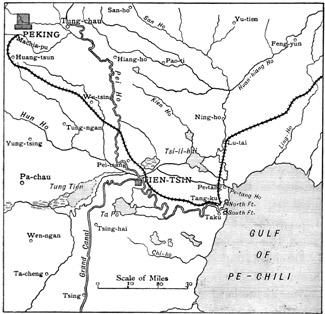
ROADS AND WATERWAYS BETWEEN PEKING AND TIENTSIN.
The next object of the plenipotentiaries, of course,
was to negotiate at Peking, or wherever properly
accredited negotiators could be met with, Canton being
held in pledge. Progress was slow, because the fleet
was so largely composed of sailing-vessels, which must
wait for the fair monsoon; and the plenipotentiaries
did not assemble within the river Peiho—the forts at
its mouth having been silenced and the guns captured—until
June. There followed Lord Elgin to Tientsin the
French, American, and Russian Ministers, all bent on
making treaties and on observing each other. The
resources of Chinese resistance having been provisionally
exhausted, imperial commissioners came to
arrest the further progress of the foreigners by negotiations,
or, to speak with strict accuracy, to concede
the minimum that was necessary to induce them to
depart. Such, we may be sure, was the beginning
and the end of their instructions then, as it was
afterwards. The work of negotiation, so far as the
form went, seems to have fallen to Mr H. N. Lay,
whose place was very soon to know him no more;
but, in the words of Lord Elgin, "anybody could have
made the treaty."
The contents of the treaty, signed June 26, 1858,
fulfilled the instructions of Lord Clarendon, and the
commercial articles which constituted its main body
corresponded substantially with the desiderata of the
merchants as set forth in their memorials in response to
the invitation of Lord Elgin, the treaty going in advance
of their demands on certain points and falling
short of them on others. Opium was not mentioned,
but was afterwards placed on the tariff; and a toleration
clause for the Christian religion was inserted,
without much apparent consideration for the consequences
involved in it. A special memorandum from
Consul Alcock, called for by the Foreign Office, had
dwelt mainly on the precautions which should accompany
the exercise of such new privileges as promiscuous
residence in the interior; but, excepting in the case of
merchants, where little or no risk was involved, the
warnings of Mr Alcock were unheeded alike in the
text of the treaty and in the subsidiary regulations.
"The most important matter gained by the treaty,"
however, in the opinion of Lord Elgin, was "the resident
Minister at Peking," "without which," wrote Mr Parkes,
"the treaty was not worth a straw." And substituting
"lost" for "gained," such was also the opinion of the
Chinese negotiators. It was, indeed, the universal
opinion. Diplomatic representation at Peking might be
fairly considered to have been the primary object of the
war of 1857-58, as commercial extension and access to
Canton had been that of 1839-42. And when "the
miserable war was finished" and "his liberty regained"
Lord Elgin cleared out his force, bag and baggage, as if
he had been escaping from something, leaving not a
trace behind.
As this move constituted a veritable crisis in Anglo-Chinese
relations, it seems advisable for a moment
to consider its bearings. Judging after the event, it
is of course easy to perceive the fatal error of Lord
Elgin in hurrying away from the Peiho. A fair
criticism of his policy will confine itself strictly to
the circumstances as known at the time. His experience
had so closely resembled that of his predecessors,
that he was aware that the Chinese were "yielding
nothing to reason and everything to fear." He had
seen with his own eyes the Queen's ratifications of
previous treaties exhumed from a collection of miscellaneous
papers in Canton, they being, as Commissioner
Yeh remarked, not worth sending to Peking;
he knew that the treaty of Nanking had been
observed by the Chinese only as far as force or fear
compelled them, and that its crucial stipulation had
been for many years evaded, and then with unmasked
arrogance repudiated; he knew that the very war in
which he had been engaged, and his whole mission to
China, were caused and provoked by the refusal of the
provincial authorities to admit his predecessors or himself
within the walls of Canton. In his own ultimatum
to Commissioner Yeh, Lord Elgin had asked no more
than the execution of the treaty of Nanking, which
included access to the city of Canton, and compensation
for damage to British property. Yet the Chinese
Government, dreading war as they did, had notwithstanding
incurred its hazards rather than open the
gates of a distant provincial city. How, then, were
they likely to regard the, to them, infinitely greater
outrage of resident foreign Ministers in the sacred
capital itself? This demand was practically the only
one against which the Chinese commissioners made a
stand. When everything had been written down ready
for signature they drew back, saying it was as much as
their heads were worth to subscribe such a condition.
The answer was a peremptory threat to march on
Peking, whereupon the commissioners signed the paper
without another word. The crisis did not last twenty-four
hours. No one could believe that a miracle of
conversion had been wrought in that time, or that the
enforced signature of the Imperial Commissioners had
changed a fundamental principle of Chinese policy.
What, under these circumstances, was the "present
value" of the treaty? Was it so much as conceivable
that it would be voluntarily carried out? Was it not
evident rather that it was signed under duresse solely
with the immediate view of getting the barbarians out
of doors and leaving the key within? What said the
imperial decree published in the 'Peking Gazette'?
"The barbarians[39] had come headlong with their ships
to Tientsin. Moved by the commands of Kweiliang
and his colleagues, they have now weighed anchor and
stood out to sea." If our former treaty needed a
material guarantee for its execution, how much more
this one? The test of good faith was in Lord Elgin's
own hands; he should clearly have applied it, and presented
himself at Peking for audience of the emperor.
Perhaps it would have been refused, in which case he
would have at least known where he stood. A campaign
against Peking would have been easy with the
handy force he possessed, or at the worst he could have
occupied Tientsin and the Taku forts until all questions
were settled.
This was the view generally held at the time both by
officials and the lay community in China, before any
untoward consequences had revealed themselves. It
was strongly expressed by Parkes, who deplored "the
ominous omission that Lord Elgin had gone away
to Japan without entering Peking or having an audience
with the emperor." We have not the advantage
of knowing what Wingrove Cooke would have said of
it, but we may infer the prevailing opinion by what
another newspaper correspondent wrote from Shanghai
on the receipt of the first news of the signing of the
treaty:—
Shanghai, July 13, 1858.[40]
The "Chinese War," properly so called, has now reached its
termination, and the fleet in the Gulf of Pechili is dispersing.
Lord Elgin arrived here yesterday with the new treaty, which
his brother, the Hon. F. Bruce, carries home by the present
mail. The document will not be published until it is ratified
by the Queen, but in the mean time the chief points of it may
be tolerably well guessed at. The diplomatists are confident
that the new treaty will "give satisfaction." That is saying
a good deal, but how could it be otherwise than satisfactory?
The emperor was so terror-struck by our audacious advance
on Tientsin, that he was ready to concede everything we wanted
rather than see us approach any nearer to his capital. There
could have been but little discussion—the ambassadors had
simply to make their terms. The new treaty, then, provides
for indemnification for losses at Canton, a contribution towards
the expenses of the war (for which Canton is held as a
guarantee), the opening of more ports for trade, freedom of
access to the interior, toleration for Christians, and a resident
Minister at Peking. The only omission seems to be that
Lord Elgin did not himself go to Peking; for unless the right
of residence at the capital receives a practical recognition from
the Chinese Government at once, it will certainly lead to
vexatious discussion whenever we wish to exercise it. The
right of entry into Canton, conceded by the treaty of Nanking,
but not insisted on through the timidity of our representatives,
ought to have taught us a useful lesson. While the emperor is
in a state of alarm anything may be done with him, but when
the pressure is removed and the fleet dispersed, Pharaoh's heart
will certainly be hardened, and then Chinese ingenuity will be
employed in evading as many of the provisions of the treaty as
they dare. Let us hope, however, that when the weather cools
a little and the thing can be done comfortably, Lord Elgin may
still pay a friendly visit to his new allies at their headquarters
[which he more than once threatened to do].
Such was contemporary opinion unbiassed as yet
by visible effects. When the tragedy took place a
year later, of course people spoke out more clearly.
Parkes then wrote:—
The Chinese Government never intended, nor do they intend,
if they can avoid it, to carry out the Elgin treaty. It was
granted by them against their will, and we omitted all precautions
necessary to ensure its being carried out—I mean,
in quitting Tientsin as we did in July 1858, instead of remaining
there until the treaty had been actually carried into
effect. You will recollect in what a hurry the admiral and
Lord Elgin, one and all, were to leave and run off to recreate
in Japan and elsewhere. By that step they just undid all they
had previously done.
Writing eighteen months after the event, and six
months after the Taku repulse, Laurence Oliphant fully
confirmed the views of Parkes. "The political importance,"
he observed, "of such an achievement"—i.e.,
a march to Peking—"it is impossible to overestimate.
The much-vexed question of the reception of a
British Minister at the capital would have been set at
rest for ever." He then goes on to give a number of
exculpatory reasons for the omission, which would have
been more convincing had they been stated by Lord
Elgin himself in despatches written at the time.
Nor was Lord Elgin's own explanation to the House
of Lords any more satisfying. "In point of fact," he
said, "I was never charged with the ratification of the
treaty. The treaty was never placed in my possession.
I never had the option of going to Peking." If his
lordship had had a better case he would never have
elected to rest his vindication on a piece of verbal
finesse. Yet this speech gave their Lordships for the
moment "wonderful satisfaction."[41]
The omission to consummate the treaty was followed
a few months later by an act of commission of which it
is difficult to render any clear account, and which Oliphant
in his 'Narrative' makes no attempt to explain,
merely reproducing the official despatches. Before
leaving China Lord Elgin pulled the key-stone from
the arch of his own work, reducing the treaty to that
condition which Parkes had described as "not worth a
straw." At the instance of the Chinese commissioners
he moved her Majesty's Government to suspend the
operation of "the most important" article in it, the
residence of a British Minister in Peking. It is needless
to follow the arguments, utterly unreal and having
no root either in history or in experience, by which this
fatal course was urged upon the Government, for they
were of the same species as those which had induced
her Majesty's Ministers to tolerate for fourteen years
the exclusion of their representatives from Canton, the
right to enter which city had just been recovered by
force. It is most instructive to mark, as the key to
many failures, how, like successive generations of
youth, successive British agents in China have failed
to profit by the experience of their predecessors, and
have had in so many cases to buy their own at the
expense of their country; for we see still the same
thing indefinitely repeating itself, like a recurring
decimal. Even at this the end of the nineteenth
century we seem as far off as ever from laying hold of
any saving principle, though it stares at us out of the
whole panorama of our intercourse. Lord Elgin's procedure
afforded at once the best example what to do
and the clearest warning what to avoid in China, and
it is the most useful for future guidance for the reason
that effect followed cause as closely as report follows
flash. It was his fate, much against his will apparently,
to wage war on China in order to revindicate a
right which had lapsed through the weakness and
wrong-headedness of certain British representatives;
yet in the closing act of a perfectly successful war he
commits the self-same error on a more comprehensive
scale, entailing on some future Government and plenipotentiary
the necessity of making yet another war on
China to recover what he was giving away. What is
the explanation of this continuous repetition of the
same mistake? It would seem that, knowing nothing
of the Chinese, yet imagining they know something,
the representatives of Great Britain and of other
Powers, notably the United States, have been in the
habit of evolving from their own consciousness and
keeping by them a subjective Chinaman with whom
they play "dummy," and of course "score horribly," as
the most recent diplomatic slang has it. Their despatches
are full of this game—of reckoning without
their host, who, when brought to book, turns out to be
a wholly different personage from the intelligent automaton
kept for Cabinet use. Then, under the shock
of this discovery, denunciations of treachery—black,
base, and so forth—relieve the feelings of the foiled
diplomat, while the substance of his previous triumph
has quite eluded him. To this kind of illusion Lord
Elgin was by temperament more predisposed than perhaps
any of his predecessors save Captain Elliot.
Though convinced by his first encounter that Chinese
statesmen were "fools and tricksters," the simulacrum
soon asserted supremacy over the actuality of experience,
and to the honour of the very persons so
stigmatised he committed the interests of his country,
abandoning all the securities which he held in his
hand.
But what, then, is the secret of dealing with the
Chinese which so many able men, not certainly intending
to make failures, have missed? This interesting
question is thus partially answered by Wingrove Cooke.
"The result of all I hear and see," he wrote, "is a
settled conviction that at present we know nothing—absolutely
nothing—of the nature of those elements
which are at work inside China. Crotchets, &c., are
rife, but they are all the offspring of vain imaginings,
not sober deductions from facts.... Treat John
Chinaman as a man, and exact from him the duties of
a civilised man, and you will have no more trouble with
him." Which is but a paraphrase of Lord Palmerston's
prescription to consider the Chinese as "not greatly
different from the rest of mankind." Such, however,
has always been too simple a formula for the smaller
minds. They would complicate it by trying, with
ludicrous effect, to get behind the brain of the Chinese
and play their opponent's hand as well as their own.
Probably it matters less on what particular footing we
deal with the Chinese than the consistency with which
we adhere to it. To treat them as protégés, and excuse
them as minors or imbeciles while yet allowing them
the full licence and privileges of the adult and the sane,
is manifestly absurd. To treat them as dependent and
independent at the same time can lead to nothing but
confusion and violent injustice. To allow engagements
with them to become waste paper is the surest road to
their ruin and our discomfiture. To let our Yea be Yea,
and our Nay, Nay, is as much the Law and the Prophets
in China as it is throughout the world of diplomacy.
To this simplicity Lord Elgin had attained, at least in
theory, when he told the merchants of Shanghai that
in dealing with Chinese officials he had "been guided
by two simple rules of action. I have never preferred
a demand which I did not believe to be both moderate
and just, and from a demand so preferred I have never
receded."
What misgiving troubled the repose of Lord Elgin as
to the good faith of the Imperial Government on which
he had ventured so much, may be partly inferred from
his avidity in catching at any straw which might support
his faith. Hearing that "his friends the two
Imperial Commissioners" who had signed the treaty
were appointed to meet him in Shanghai to arrange
the tariff, Lord Elgin welcomed the news as "proof
that the emperor has made up his mind to accept the
treaty." But as the emperor had already, by imperial
decree dated 3rd July, and communicated in the most
formal manner to Lord Elgin, expressly sanctioned the
treaty before the plenipotentiary left Tientsin, wherefore
the anxiety for further proofs of his good intentions?
"This decree was forced out of the emperor," Mr
Oliphant tells us, "by Lord Elgin's pertinacity"—and
the threat of bringing up to Tientsin a regiment of
British soldiers then at the mouth of the river! As a
matter of fact, the mission of the two Imperial Commissioners
was of quite another character from that
assigned to it by Lord Elgin. The two men were
sent to complete their task of preventing by every
means the advent of the barbarians to Peking, just
as Lord Elgin himself was, two years later, sent back
to China to finish his work, which was to bring the
said barbarians into the imperial city. Between two
such missions there could be neither reconciliation nor
compromise.
There is authority for stating that the Imperial
Commissioners were expressly sent by the emperor
to Shanghai (1) to annul the whole treaty of Tientsin,
and (2) failing the whole, as much of it as possible, but
especially the article providing for a Minister at Peking.
The ostensible purpose of the mission, from the foreign
point of view, was the settlement of the tariff and trade
regulations,—about which, however, the Chinese cared
very little,—and delegates were appointed for this purpose.
The labour was conscientiously performed, on one
side at any rate, and the result was highly creditable
to the delegates. It was by insertion in the tariff of
imports that opium became recognised, chiefly, it would
appear, at the instance of the United States Minister,
Mr W. B. Reed, who was on the spot.
Apart from the tariff two principal questions occupied
the minds of the negotiators of the treaty—the actual
situation at Canton on the part of the English, and
the prospective residence in Peking on the part of
the Chinese. Lord Elgin hoped, by an appeal to the
treaty of peace, to put an end to the hostile proceedings
of officials and people which had harassed the occupying
force in Canton with impunity for nine months.
But it was the treaty itself against which officials,
gentry, and braves were making war, just as they
had done in the case of the treaty of 1842. There
was no ambiguity about the movement. The Government
was carried on not in Canton but in the neighbouring
city of Fatshan, where the Governor-General
Huang, who had been appointed to succeed Yeh, held
his court and issued his decrees. Two months after
the occupation of Canton the puppet whom the Allies
had installed there admitted that the object of the
assemblage of braves was to retake the city. Two
months after the signature of the treaty and its acceptance
by the emperor the Governor-General Huang
was publicly offering a reward of $30,000 for the head
of Parkes, and was stimulating the people in every
way to expel the foreigners from the city. All this
was in perfect accord both with imperial policy and
with Chinese ethics. It had the full sanction of the
emperor, just as similar operations had formerly had of
his father. For the grand purpose of destroying or
impairing the treaty there was no distinction in the
Chinese mind between legitimate and illegitimate,
honourable or treacherous, methods.
Lord Elgin, who had returned from Japan to Shanghai
to meet the Imperial Commissioners in September,
disappointed at their non-arrival, opened communications
with them by a threat of returning to Tientsin
and thus saving them the trouble of completing their
slow journey to Shanghai. On their eventual arrival
there he opened a diplomatic campaign against Canton
by a demand (October 7) to know under what authority
Huang and the military committees were organising
attacks on the Allies. In reply the Imperial Commissioners
naïvely proposed to promulgate the treaty.
This frivolous answer provoked the rejoinder (October
9) that the treaty had been three months before
publicly sanctioned by imperial decree, that something
more than "documents and professions" were
required to satisfy Lord Elgin on a question of "peace
or war," and he demanded the removal of the Governor-General
Huang. The commissioners then said they had
denounced Huang to the throne, and hoped for his removal
at no very distant date. They would also move
his Majesty the Emperor to withdraw his authority
from the hostile militia. Canton being thus disposed
of, as he supposed, Lord Elgin proceeded to other
business. But the hostilities at Canton continued
without the least abatement for three months longer,
until something more strenuous than diplomatising
with the Imperial Commissioners was resorted to.
The British Government had at last become exasperated,
and the Foreign Secretary, Lord Malmesbury,
wrote on October 14 to Lord Elgin, "The most severe
measures against the braves are the only ones which
will obtain the recognition by the Cantonese of the
treaty of Tientsin." It was not long before Lord
Elgin himself became converted to the same belief,
for on January 20, 1859, he wrote to General van
Straubenzee, after some successful reprisals he had
made on the village braves, that "advantage should
be taken of the cool weather to familiarise the rural
inhabitants of the vicinity of Canton with the presence
of our troops, and to punish severely braves or others
who venture to attack them." By this time also he
had realised that the promise on which he relied in
October had been evaded, and he told the Imperial
Commissioners on January 22 that he would "have
nothing more to say to them on Canton matters,—that
our soldiers and sailors would take the braves
into their own hands."
The effect of the new tactics was immediate and
satisfactory. When the Allied troops began to move
about they were welcomed in the very hotbeds of hostility.
"At Fatshan," writes General van Straubenzee
on January 28, "we were received most courteously
by the authorities and respectfully by the people."
A five-days' excursion to Fa Yuen, the headquarters
of the anti-foreign committee, was likewise a perfect
success; and so everywhere throughout the Canton
district. Lord Elgin was now able to assume a
bolder tone with the Imperial Commissioners and
address them in still plainer terms.
"The moderation of the Allies," he wrote to them
in February, "has been misunderstood by the officials
and gentry by whom the braves are organised....
This habit of insult and outrage shall be put down
with the strong hand.... It shall be punished by
the annihilation of all who persist in it." There was
no need for any such extreme remedy, for as soon as
the burglars realised that the watch-dog had been
loosed they ceased from troubling the household, and
fell back on peaceful and respectable ways of life.
"With the cessation of official instigation," Lord Elgin
wrote in March, "hostile feeling on the part of the
inhabitants appears to have subsided," thus falling
into line with Consul Alcock, who wrote: "Clear
proof was furnished that the long-nurtured and often-invoked
hostility of the Cantonese was entirely of
fictitious growth, due exclusively to the inclinations
of the mandarins as a part of the policy of the Court
of Peking." And then, too, the difficulty of removing
the Governor-General Huang disappeared. He had,
in fact, been unsuccessful in expelling the barbarians,
just as Yeh had been, and the imperial decree superseding
him naturally followed. His presence or absence
had then become of no importance to the Allies, as, had
he remained, he would have accepted the accomplished
fact of the foreign supremacy with as good a grace
as the gentry and their braves had done, for they
never contemplated endangering their lives by fighting.
Outrages on stragglers, assassination, kidnapping,
and bravado filled up the repertory of their
militant resources, and when these were no longer
effective they retired into private life as if nothing
had happened. The officials were no less acquiescent
once they realised that they had a master.
The interest of this Canton episode lies in its relation
to the Chinese question generally. Foreign intercourse
with China is marked by a rhythm so regular that any
part of it may be taken as an epitome of the whole, like
a pattern of wall-paper. From Canton we learn that
calculation of national advantage or danger, argument
from policy, even threats which are not believed, are so
much "clouds and wind," not profitable even as mental
exercises. What alone is valid is concrete fact; not
treaties, but the execution of them.
The Imperial Commissioners had in good time
presented their own demand on Lord Elgin, and
in most becoming terms, for between preferring and
meeting a request there is all the difference in the
world. The two Chinese signatories of the treaty
frankly avowed that they had signed without scrutiny
under military pressure, and that certain stipulations
were highly inconvenient to the Imperial Government,
particularly the right of keeping a Minister in residence
in Peking. Lord Elgin agreed to move his Government,
and the Government consented to waive the
right, conditionally. Lord Elgin laid stress on the
retention of the right as a right, forgetting that in
China a right conditionally waived is a right definitely
abandoned. Nor only so, but so far from consolidating
what remains, it constitutes a vantage-ground for
demanding further concessions, and in other fields of
international relations besides that of China. Nothing
therefore could have been wider of the mark than
any expectation that "the decision of her Majesty's
Government respecting residence in Peking would
induce the Chinese Government to receive in a becoming
manner a representative of her Majesty when he
proceeds to the Peiho to exchange the ratification."
Experience pointed to quite the opposite effect.
These critical remarks are by no means intended
either to belittle Lord Elgin's good work, to depreciate
his real statesmanship, or to scoff at his sensibility and
high-mindedness. But his errors being like a flaw in a
steel casting, pregnant with destruction, and as the
same kind of flaw continues to vitiate many of our
smaller diplomatic castings, the China question could
not really be understood without giving proper consideration
to them. For the rest, as a despatch writer
Lord Elgin was both copious and able—he did not take
a double first at Oxford for nothing. Still, his writings
and orations are scarcely the source whence one would
seek for light and leading on the Chinese problem.
They are vitiated by self-vindication. Many of them
are elaborate efforts to make the worse appear the
better reason, while their political philosophy is based
too much on speculative conceptions where ascertained
data were available.
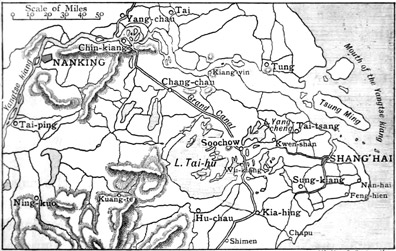
On the last day of July 1858 Lord Elgin with his
suite set out on their memorable voyage to Japan, the
narrative of which has been so skilfully woven by
Laurence Oliphant. This episode will claim our
attention later. His lordship came, saw, and conquered—returned
to China in a month crowned with
fresh laurels. At Shanghai he saw the tariff settled,
and then performed another pioneer voyage of prodigious
significance. This was up the Yangtze as far
as the great central emporium Hankow. Captain
Sherard Osborn was the Palinurus of that original
and venturesome voyage. After that, Lord Elgin bent
his steps towards England; but before leaving China
the ghosts of things done and undone haunted him.
"A variety of circumstances lead me to the conclusion
that the Court of Peking is about to play us false," was
the melancholy epitaph he wrote on his mixed policy,
on his honest attempt to make war with rose-water,
and his subordination, on critical occasions, of judgment
to sentiment.
Meantime his brother Frederick, who had carried the
Tientsin treaty to London, was returning with it and
the Queen's ratification and his letter of credence as
British Minister to China. The dénoûment of the
plot was now at hand. The real mind of the Chinese
Government was finally declared in the sanguinary
reception the new envoy met with at the entrance
of the Peiho in June 1859. Frederick Bruce was
generally considered a man of larger calibre than his
elder brother. "In disposition he was a fine, upright,
honourable fellow," writes Sir Hope Grant, "and in
appearance tall and strong made, with a remarkably
good expression of countenance." But it took even
him a long time to fathom the new situation. After
his disastrous repulse from the Taku forts he wrote
in August, "I regret much that when the permanent
residence was waived it was not laid down in detail
what the reception of the Minister at Peking was
to be." But it was no question of detail that barred
his passage to Peking. It was the settled determination
never to see the face of any foreign Minister;
and it seems strange that it should have taken not
only another year but another war finally to convince
the British plenipotentiaries and their Government that
the message of China from first to last, from Peking
and Canton, had been to fling the treaty in their
face.
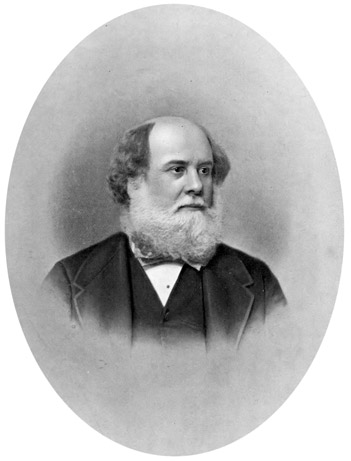
SIR FREDERICK BRUCE.
Invasion of Peking—Convention of Peking—Establishment of the British
Legation—Russian and British, a contrast.
The Chinese perfidy at Taku had of course to be
avenged. A formidable expedition was equipped by
the Allied Powers, Lord Elgin and Baron Gros being
reappointed as plenipotentiaries. The history of the
famous Peking campaign of 1860, with its tragic incidents,
has been impressed on the world by so many
writers, military and civil, most of them actors in the
scenes they depict, that the barest outline of events
may suffice in this place.
In the preliminary agreement between the two
Governments, the British military force was limited to
10,000 effectives; but the number actually placed in
the field exceeded that figure by the consent of the
French, whose forces were between 6000 and 7000.
The British contingent was commanded by General
Sir Hope Grant, the French by General Montauban,
afterwards created Count Palikao,—"a fine, handsome,
soldier-like man, apparently under sixty years
of age."
The naval forces were commanded respectively by
Vice-Admiral Sir James Hope, "a tall, noble-looking
man, with a prepossessing and most gentlemanlike
appearance,"[42] and by Admiral Page, "a superior man
with a great deal of dry humour, but bad-tempered."[43]
The friction arising between Allies working together,
waiting for each other, consulting at every step, taking
precedence of each other on alternate days, at
first vexatious, was in the end overcome by the tact
of the commanders on both sides.
The first operation of war was to occupy the harbour
of Chusan as an intermediate base. After that the
British force was conveyed in transports to Talien-wan,
where they were disembarked, while the French were
landed at Chefoo, on the opposite shore of the Gulf of
Pechili. At these points preparations were made for
the intended descent on the coast of the province of
Chihli, between 200 and 300 miles to the westward.
The British force included 1000 cavalry in splendid condition,
and a battery of Armstrong guns, then for the
first time used in active service. The French had no
cavalry, the attempts to import horses from Japan were
not successful, and the scarcity of draught-animals on
their side caused great delay in the sailing of the
expedition from the temporary depots. At length on
July 26 a fleet of over 200 sail—a magnificent spectacle—carried
the two armies to within twenty miles of the
Peiho, where they anchored, waiting for favourable
weather and a minute reconnaissance.
The one piece of strategy in the campaign was the
choice of a landing-place. The Taku forts, which had
been strong enough to repulse Sir James Hope with
severe loss a year before, had been further strengthened,
for to the Chinese it was a matter of life and death to
bar the entrance to the Peiho. The chain barrier across
the mouth of the river could not be forced under the
concentrated fire of the forts; only the lightest draught
vessels could approach within five miles; and a frontal
attack was not to be thought of. But a decided difference
of opinion between the Allied generals had disclosed
itself as to the mode of procedure. The French
commander was determined to land on the coast to the
southward of the forts; the English was still more
resolute in selecting as a landing-place the mouth of
the Peitang river, eight miles northward of Taku. So
irreconcilable were their views that it was agreed that
each should go his own way, only starting simultaneously.
After more careful study, however, General
Montauban came to think better of his own scheme,
and proposed to Sir Hope Grant to join him in the
landing at Peitang.
So on August 2 the first detachments of 2000
from each army were disembarked, and the campaign
proper commenced. The forts at Peitang were easily
occupied, "a kind old man" pointing out where there
were loaded shells which would explode on foot
pressure on a gun-lock laid so as to fire a train.
By means of a raised causeway leading through a
sea of "briny slush," positions were reached whence
the Taku forts could be attacked from the rear.
Though bravely defended, the forts on the left bank
were captured, and as they commanded those on the
opposite bank no resistance was offered by the latter.
The Peiho was thus opened for the conveyance of
troops and stores to Tientsin, which was made the
base of operations for the advance of the Allied
armies on Peking.
The military movements were hampered by the presence
of the two plenipotentiaries, who stopped on the
way to negotiate with the unbeaten foe. Delay was
not the only untoward consequence of these proceedings.
At one moment a military disaster seemed
to have been narrowly escaped. Taking advantage of
the singular credulity of the Allies, the Chinese, while
engaging them in friendly negotiations, had planned
to decoy the army into a convenient camping-ground
at Changchia-wan, towards which the troops were
marching, when, "To my surprise," writes the commander-in-chief,
"we found a strong Tartar picket,
who retired on our approach; and a little farther on
were seen great bodies of cavalry and infantry, the
latter drawn up behind a large nullah to our right front,
displaying a number of banners." In the meantime
the envoys, Parkes, Loch, and other officers, who had
been negotiating with the higher mandarins at Tungchow,
a couple of miles off, were seized and made
prisoners with their escort, all being subsequently
cruelly tortured, and most of them massacred, in
accordance with Chinese practice in war.
Sir Hope Grant, finding his army of 4000 men in
process of being hemmed in, attacked and routed the
Chinese troops on September 18, resuming his march
on the 21st, when the remainder of his force had
joined him. He had not gone far, however, when
the way was again barred, and another action had to
be fought at the bridge Pali-chiao, ten miles from
Peking, where General Montauban distinguished himself,
and whence he derived his title.
Far from owning themselves defeated, the Chinese
on the morrow resumed negotiations as between equals.
The Imperial Commissioners who had mismanaged the
affair were replaced by Prince Kung, a brother of the
emperor, who sent letters under a flag of truce, saying
he was ready to come to terms, but "said nothing
about our poor prisoners." The Allied plenipotentiaries
declined to treat until the captives should be returned,
whereupon Prince Kung sent another letter saying
they were safe, but would only be sent back on the
restitution of the Taku forts and the evacuation of the
river by the Allied fleets.
Lord Elgin had demanded that he should deliver
the Queen's letter in person to the emperor. Prince
Kung refused this demand, which Lord Elgin incontinently
abandoned. Waxing bolder, Prince Kung
next threatened that the entry of the Allied forces
into the capital would be followed by the instant
massacre of the prisoners. The plenipotentiaries retorted
by intimating that the surrender of prisoners
was a necessary condition of the suspension of hostilities.
A week having been wasted in this vain seesaw,
an ultimatum was sent into Peking on September
30. This was answered by the Chinese inviting the
Allies to retire to Changchia-wan, the scene of the
great defeat of their army, offering to sign the treaty
there. And so the contest was maintained until the
Allied artillery was planted within sixty yards of the
north gate, and the hour was about to strike when the
wall was to be battered down.
Most valuable information—the topography of the
city—had been supplied by General Ignatieff, who accompanied
the Allies. A map which he lent to Sir
Hope Grant showed every street and house of importance
in Peking, laid down by a scientific member
of the Russian mission in the city. The data had been
obtained by traversing the streets in a cart, from which
angles were taken, while an indicator fixed to the wheel
marked the distances covered. Without this plan the
attack would have been made from the south side, as
proposed by General Montauban, which would have
involved a march through the commercial or Chinese
quarter, and the surmounting first of the Chinese and
then of the Tartar wall. The map made it clear that
from every point of view the north side offered the
most eligible point of attack, where nothing intervened
between a great open plain and the wall of the Manchu
city.
Passing over the dramatic incidents of the destruction
of the Summer Palace, an act of calculated vengeance
for the murder and maltreatment of envoys and prisoners,
the flight of the emperor on a hunting tour to Jêho,
whence he never returned, the release of the prisoners
and their account of the captivity, the new treaty
was signed at the Hall of Ceremonies on October 22,
1860, by Prince Kung, "a delicate gentlemanlike
man, evidently overcome with fear," and his coadjutor,
Hangki. The treaties of Tientsin were ratified, and
some further indemnities exacted. The special provisions
introduced into the French treaty will be
referred to in a subsequent chapter.[44]
The closing scene was marked by a degree of haste
somewhat recalling Tientsin in 1858. The very slow
advance on Peking brought the climax of the campaign
unpleasantly close to the season when communication
by water would be shut off by ice; "the weather
became bitterly cold, some of the hills being covered
with snow." And Sir Hope Grant's never-failing counsellor,
Ignatieff, with "his usual extreme kindness,"
furnished him with the most important information
that the Peiho would soon become frozen up and it
would be unsafe to linger in Peking. Mr Loch's galloping
off with the treaty, as shown in the illustration,
was rather typical of the whole business. The treaty
as such was of little consequence—the fulfilment of its
provisions was everything.
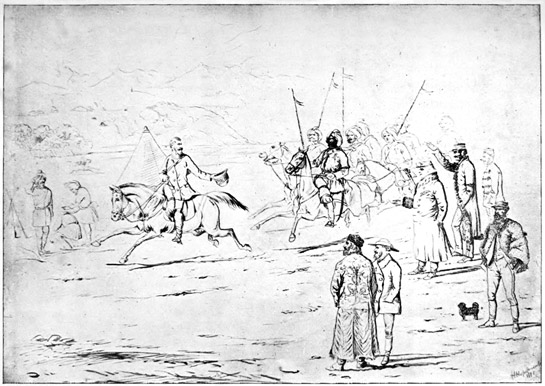
MR LOCH DEPARTS FROM PEKING FOR ENGLAND WITH CHINESE TREATY.
Some lessons, nevertheless, had been learned in the
school of diplomatic adversity. Peking was not left
without a locum tenens of the Minister, Tientsin was
not left without a garrison, and the Taku forts were
occupied by the Allies for a couple of years after the
final conclusion of peace.
"Ring out the old; ring in the new." There seemed
a natural fitness in the Hon. Frederick Bruce succeeding
the Earl of Elgin as Minister plenipotentiary, and
there was a dramatic finish in the farewell ceremonial
when the retiring representative of the Queen vacated
the seat of honour, placing therein his younger brother,
whom he introduced to Prince Kung as the accredited
agent of Great Britain. The new era was inaugurated;
a real representative of her Britannic Majesty was installed
in the capital of the Son of Heaven.
The season was late, and though two palaces had
been granted on lease for the residences of the British
and the French Ministers, many alterations and repairs
were needed to render them fit for occupation,
which could not be effected before the closing of the
sea communication by ice. The Ministers therefore
resolved to withdraw from Peking for the winter,
placing their respective legations in charge of a junior
consular officer, Mr Thomas Adkins, who volunteered to
hold the post until the return of the plenipotentiaries
in the following spring.
Mr Adkins was not the only foreign sojourner in the
Chinese capital. There was a French Lazarist priest,
Mouilli by name, who, having successfully concealed
himself among his native Christians during the military
advance of the Allies, emerged from his hiding-place
on the triumphant entry of the ambassadors,
and showed himself in the streets in a sedan chair
with four bearers. There was the permanent Russian
establishment within the city, with its unbroken record
of 173 years. Originally composed of prisoners taken
at the siege of Albazin, it had become a seminary of
the Orthodox Church and a political vedette of the
Russian empire, invaluable to the two masterful
diplomatists who appeared suddenly on the scene in
the years 1858 and 1860. The mission served as
a speculum through which Russia could look into
the inner recesses of the Chinese State, while to
the Chinese it was a window of bottle-glass through
which the external world was refracted for them. The
Russian Government selects its agents on the principle
on which we select university crews or All-England
elevens—namely, the most fit. So important and
far-sighted a scheme as the Peking mission was not
left to chance or the claims of seniority, but was maintained
in the highest efficiency. Its members—six
ecclesiastical and four lay—were changed every ten
years. All of them, from the Archimandrite downwards,
were accomplished linguists, speaking Chinese
like the natives, and masters also of the Manchu
and Mongol languages. Their relations with the
Chinese officials were unostentatious, yet brotherly.
Few secrets, either of administration, dynastic politics,
or official intrigue, no communications between
the Government, provincial or imperial, and any
foreigners, escaped record in the archives of the
Russian mission. The personnel were protected from
outrage or insult by their own tact and their traditional
prestige; and as the Daimios of Japan in
their anti-foreign manifestos declared that every
foreigner could be insulted with impunity except the
Russians, so in China the name was a talisman of
security. While the Anglo-French expedition was
marching towards Peking the Russian Secretary, M.
Popoff, had occasion to leave that city and pass the
night at a native inn on the road to Tientsin. The
place became filled with the retreating Chinese soldiery,
and M. Popoff had the pleasure of hearing
their excited conversation respecting himself. They
were for dragging him out and killing him on the
spot, when the landlord interposed. "That foreigner
is a Russian," said he; "it will be dangerous to lay
a hand on him."
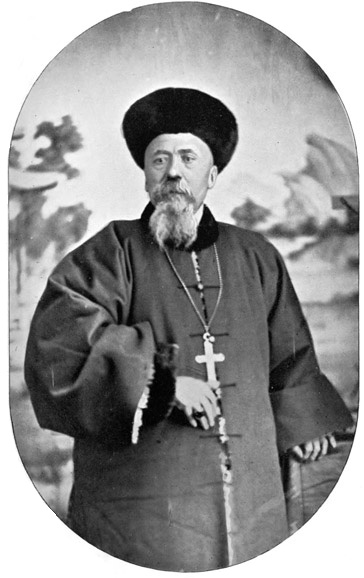
MONSEIGNEUR MOUILLI.
M. Popoff's errand was to meet General Ignatieff,
who was making his way to Peking with the Allied
forces. It was of the utmost importance that he
should arrive simultaneously with the French and
English plenipotentiaries in order to save China from
her doom. China's extremity was Russia's opportunity
for showing the sincerity of her long unbroken friendship.
The foreigners had come to possess themselves
of the empire and destroy the dynasty. Their ruthless
character was soon to be shown in the burning and
pillage of the Summer Palace. The Chinese Court's
apprehension of the impending calamity was proved
by the flight of the emperor to a quasi-inaccessible
retreat. In that terrible crisis no sacrifice would
have been deemed by the imperial family too great
to "get rid of the barbarians." Confirming their
own worst fears as to the designs of the invaders,
General Ignatieff revealed to them the only way of
salvation. Nothing would arrest the schemes of
the Allies but the intervention of a strong Power
friendly to China. He had it in his power to
make such representations to Baron Gros and Lord
Elgin as would induce them to withdraw their
troops. This essential service he offered to the Chinese
for a nominal consideration. Only a rectification of
frontier by inclusion of a sterile region inhabited by
robbers and infested by tigers, where no mandarin
could make a living, fit only for a penal settlement,
with a rugged sea-coast where no Chinese sail was ever
seen. Prince Kung jumped at the providential offer of
deliverance, and so that great province called Primorsk,
with its 600 miles of coast-line, which gave to Russia
the dominion of the East—"Vladivostock"—was
signed away by the panic-stricken rulers of China.
A year later this transaction cropped up in conversation
over the teacups, after the business of the day had
been disposed of, between Prince Kung and a certain
foreign diplomatist, who remarked that there was
never the remotest intention on the part of the Allies
of keeping a single soldier in China after the treaty
was made. The Prince looked aghast, then said
solemnly, "Do you mean to say we have been deceived?"
"Utterly," replied the other; and then the
dejection of the Prince was such as the foreigner,
who lived to enjoy a twenty-years' acquaintance with
him, declared he never saw in his or any other Chinese
countenance. Thus General Ignatieff, without any
force, in the vulgar sense, of his own, was adroit
enough and bold enough to wield the forces of his
belligerent neighbours so as to carry off the only
solid fruit of the war, while fulfilling the obligations
of friendship for China and denouncing her spoilers.
The Russian envoy had not the same incentive to
hurry away from Peking as the other treaty-makers
had, for the ice which would imprison them would
afford him the most expeditious road for travel
homewards through Siberia. He was nearly as much
relieved as Prince Kung himself at getting rid of these
"barbarians," for then he had the field of diplomacy all
to himself. He made his treaty, and departed during
the winter by the back door, across Mongolia.
Ignatieff was a man well known in English society,
and thoroughly conversant with England. Like most
educated Russians, he was affable and sympathetic—a
"charming fellow." He was courteous and companionable
to the locum tenens of the English Legation, and
in taking leave of Mr Adkins expressed the opinion
that he would be all right in his isolation so long as
the emperor did not return to Peking, but in that
event his position would not be an enviable one.
However, "if you fear any trouble, go over to the
Russian mission: they will take care of you."
The winter of 1860 left the statesmen of China some
food for reflection. The thundering legions had passed
like a tornado which leaves a great calm behind it.
The "still small voice" had also departed, with a
province in his chemadán, gained without a shot or
even a shout. Two strongly contrasted foreign types
had thus been simultaneously presented to the
astonished Chinese. Can it be doubted which left
the deeper impression?
Preparations were made during the winter for
receiving the foreign Ministers in the spring. A
department of Foreign Affairs was created under the
title of "Tsung-li Koh Kwoh She Yu Yamên," or
briefly, "Tsungli-Yamên," the three original members
being Prince Kung, Kweiliang, and Wênsiang. The
Yamên was established by imperial decrees in January;
Mr Bruce and M. Bourboulon arrived in March 1861,
when diplomacy proper began, the thread of which will
be resumed in a later section.