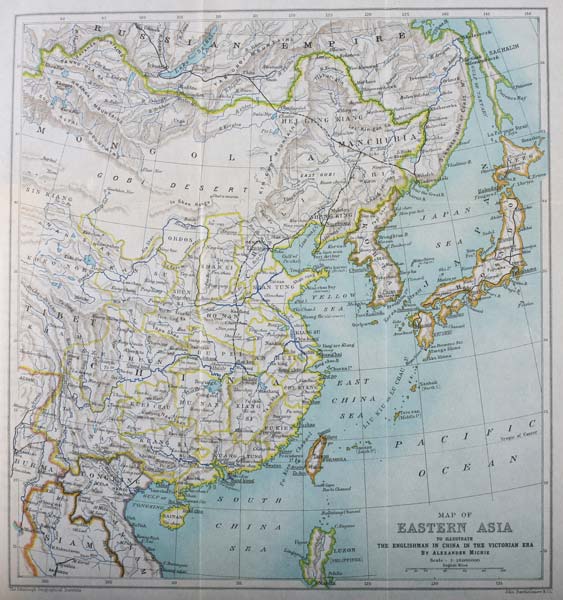
Commodore Perry's expedition, 1853-54—Townsend Harris—Count Poutiatine—Lord
Elgin—The treaties of 1858—The solidarity of Western
Powers—The practical attitude of the Japanese—Their yielding to
circumstances—The condition of the country—The character of the
people—Nagasaki—The Dutch—Their two hundred years' imprisonment.
A mystery hung over the island empire, which had
been sealed against foreign intercourse for two hundred
years, and its mere seclusion, apart from the weird
romance that gilded such fragments of its history
as were known, invested the efforts to reopen the
country with a romantic charm. It was in Japan
that Lord Elgin achieved the real diplomatic success
of his life, in the briefest possible time, at the least
possible cost, and with the most far-reaching consequences;
for undoubtedly he hastened the entry
of the Land of the Rising Sun into the family of
nations.
The poetical side of the mission was done ample
justice to by Laurence Oliphant in his 'Narrative,'
by Captain Sherard Osborn in the pages of 'Blackwood,'
and elsewhere. The prosaic side and the
practical issues of this rediscovery of an old world
were not so clearly apprehended by them or by any
other contemporary writer. The Powers of Europe
and America had long been watching for opportunities
to effect an opening in the barrier, but all
tentatives proved in vain until force was resorted to.
This was first done by the United States, whence
a naval squadron under Commodore Perry appeared
off the coast in 1853, repeating the visit, on a still
more imposing scale, in 1854. The apparition deeply
impressed the minds of the Japanese Government
and people, who, Lafcadio Hearn tells us, speak to
this day of the "black ships," birds of omen foreshadowing
events for which it behoved them to prepare
themselves. Black, indeed, they were, grim
of aspect, huge in bulk, and looming larger than they
really were, with their high sides, great paddle-boxes,
and "smoke-stacks." The ships were armed with a
few guns of such calibre and power as had not till
then been placed on any floating battery. Jonathan
is never second-best in naval artillery. Commodore
Perry with his three black ships, the steamers Powhattan,
Susquehanna, and Mississippi, and his squadron
of sailing-vessels, opened the door of Japan—not very
wide, it is true, yet so that it could never again be
closed. The rudimentary treaty he made was little
more than a covenant to supply wood and water to
needy ships and to be merciful to their crews. A
similar treaty was made by the English Admiral Stirling
in 1854, and it included the "most-favoured-nation"
clause, only excepting from its application
the privileges enjoyed by China and Holland.
To carry the work forward to a more practical stage
a man of affairs was required, and he was found in
the person of Townsend Harris, who was accredited
to Japan under the title of Consul-General for the
United States. Mr Harris had been nearly two years
in the country when Lord Elgin, with his modest
escort, arrived and made his acquaintance. With
infinite patience Mr Harris had been prosecuting
his negotiations, against wind and current, it would
seem, until a propitious gale wafted his venture
into port. The black ships had gone, but another
fleet more numerous was assembled on the neighbouring
coast, whence their fame had reached the
secluded empire. Riding on the shoulders of the
Anglo-French exploits in China, and not obscurely
hinting at the prospect of the allies shortly visiting
Japan, Mr Harris induced his Japanese friends to
"hurry up" with his treaty, that it might not only
serve as a model of moderation for the other Powers
when they also should come to negotiate, but provide
in advance friendly mediation between them and
Japan. Lord Elgin justified the forewarnings of
Mr Harris by appearing in the Bay of Yedo within
a few weeks after the signature of the American
treaty.
How much both Mr Harris's treaty and the one
which Lord Elgin was about to sign owed to the
previous Russian negotiations cannot be estimated.
Admiral Count Poutiatine concluded a treaty in 1855,
and improved it in 1857, on the basis of Sir James
Stirling's opening the ports of Nagasaki, Hakodate,
and Shimoda for ship's supplies, with sundry minor
privileges. When Lord Elgin reached the Bay of
Yedo in August 1858 he found Count Poutiatine
already there with a frigate and a gunboat.
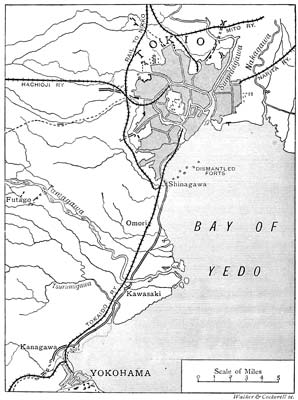
BAY OF YEDO.
Walker & Cockerell sc.
This convergence of the great Powers of the world
upon a single object, that of breaking down the
seclusion of Japan, was clearly recognised, and its
proximate effect weighed, by the Japanese statesmen
of the day. Too wise to oppose an uncompromising
resistance to the pressure, they employed their skill
more profitably in deflecting its course. In accordance
with this policy, Lord Elgin's demand, backed as it was
by the prestige of his recent achievements in China,
was promptly conceded, and within the short space
of fourteen days from his arrival in the bay a treaty
was concluded of the same tenor as the American, of
which Lord Elgin had obtained a copy from Mr Harris,
who also lent him the invaluable services of his Dutch
interpreter, Mr Heusken. By the two treaties three
of the chief ports of the empire were opened to foreign
trade within one year, and two more at later dates.
In some respects the English was an advance on the
American treaty. By the latter the import tariff had
been reduced from the old Dutch rate of 35 per cent
to a general rate of 5 per cent ad valorem. The
British treaty specifically provided that cotton and
woollen manufactured goods should be included in the
class of merchandise paying 5 per cent. The immunities
of extra-territoriality were unreservedly conceded,
and were only rescinded by the revised treaties, the
first of which was made with Great Britain in 1894,
coming into force in July 1899.
One general remark applies to all treaties made
between foreign powers and China or Japan, that
the interests of each separate Power were safeguarded
by the virtual solidarity which existed among them,
through the operation of that convenient diplomatic
save-all, the "most-favoured-nation" clause. This
comprehensive provision inserted in the treaties secured
for all the Powers the advantages gained by any one
of their number. Faith in this ultimate protection
may have led occasionally to slipshod negotiations.
There might even be a temptation in some cases to
seek special credit for moderation, with the foreknowledge
that the exactions of any of the Powers
would inure to the benefit of all. Lord Elgin wrote
the simple truth when he said that, "as regards
all these important commercial privileges, I have
to fight the battles of the Western trading nations
single-handed." This feature had been particularly
noticeable in the negotiations in China, where it was
so well understood that the English treaty would
be the common standard that it mattered little that
the signature of some of the others was hurried forward
so as to take priority of the British in point
of date. The treaty which Lord Elgin negotiated
with Japan was destined to occupy the same ruling
position as the treaty with China, and therefore it
devolved upon him to make provision for all manner
of contingencies which no experience could enable him
to foresee. Considering that these treaties were drawn
up with so little knowledge of the circumstances of
the country and of the future exigencies of trade,
the fact that they have stood the test of forty
years' experience redounds greatly to the credit of
the negotiants.
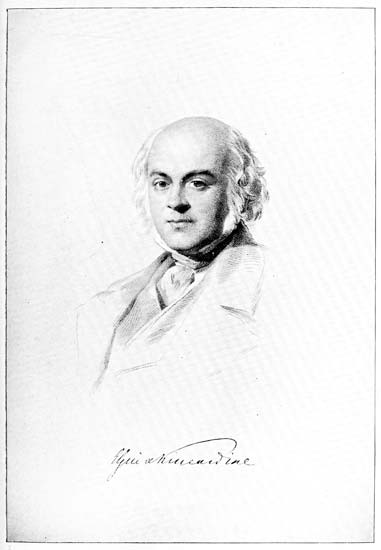
LORD ELGIN.
Lord Elgin had to learn what a Daimio was from
Count Poutiatine, who probably had but just acquired
the knowledge himself. It is strange at the present
day to read the solemn preamble, "Her Majesty the
Queen of the United Kingdom of Great Britain and
Ireland and his Majesty the Tycoon of Japan." "It
was not till some time later that it was discovered
that there was a still higher power than the Shôgun,"
said Earl Russell in 1865. The imperfect knowledge,
however, attests the general soundness of the principles
adopted.
It must be admitted that on the Japanese side,
also, nothing seemed wanting to render the treaty a
workable instrument. The Japanese negotiators were
animated by a more practical spirit than any Chinese
diplomatist with whom foreigners had had dealings.
There was no idea in their minds of blind obstruction;
they were bent, if not upon efficient working,
at least on the minimising of friction and risk.
And though it is probable, indeed quite certain, that
no treaty whatever could have been made without
substantial force in the background, intelligently
apprehended by the Japanese Government, yet, that
being conceded, it was clearly their object to make
the best of the position in which they actually
found themselves. Under no other circumstances
could treaties so complete in detail and so effective
for their purpose have been concluded.
To judge of the acts of the pioneers of foreign
intercourse, or to form a just opinion of the conditions
under which the treaties came into force,
it would be necessary for the critic to regard the
whole surroundings as a painter does his subject,
not representing what he knows or may afterwards
discover to be there, but considering only what
actually meets his eye. This, of course, is next to
impossible in the case of Japan, where the transformation
resulting from the contact with foreigners
was so rapid and so kaleidoscopic, and while foreign
knowledge of things Japanese has increased at so
marvellous a rate, that only a series of mutoscopic
photographs could have preserved the sequence.
Opinions were at first, and for some time after,
unduly affected by the preconception of a certain
analogy between China and Japan founded on geographical
propinquity, and in a measure on language:
this bias influenced the first influx of foreigners in
1859, who were largely drawn from the commercial
ports of China. Yet those who had been habituated
to the manners and customs of the Chinese
were at once struck, not by the similarities, but by
the violent contrasts, which the two peoples presented.
These visitants had left behind them filth
and squalor; they met cleanliness and tidiness of
an extreme type. They left behind vagueness of
thought, slovenliness of action; and they encountered
pedantic precision. They left behind indifference and
stolidity, with ignorance cherished as a proud possession;
and they encountered a keen and intelligent
appetite for knowledge. These features met the
stranger before even his ship had cast anchor, or
he had set foot on shore. He soon perceived, also,
that existence was carried on under an elaborate
prescription which left but a narrow margin to spontaneous
action, and such a minute supervision that
a sparrow could hardly cross the road without being
noted by the official guardians of the peace; that
every function, whether of official or private life,
was under the undisputed control of the same
vigilant organisation.[1] On entering the narrow
waters approaching the harbour of Nagasaki, he
would pass under forts where through a telescope
he could see guns and gunners' quarters all spick
and span. If there happened to be another vessel
approaching from seaward, he would know it by
the booming of two guns from the outermost fort,
the signal being taken up and passed on by those
inland, and so all the way to Yedo. This, he learned,
was the mode of announcing to the capital the
appearance of any foreign craft off the coast. On
entering the inner harbour he would see boats full of
men who looked like women, pushing off to his ship;
and then a posse of officers, each armed with two
sharp swords, would come on board. They, by means
of a very imperfect interpreter, would at once ply the
master with questions on every conceivable subject, as
if he were competing in an examination in universal
knowledge. The tedious catechism, with its admixture
of seeming frivolity, would have been exasperating
but for the imperturbable suavity of the catechists.
Every answer was promptly, yet deliberately, committed
to writing. Such was, and is, the custom of
the race.
Nagasaki being still, in the first half of 1859, the
gate of Japan, and the only sample of the country
known to foreigners, the bright welcome with which
it greeted the new arrivals was of happy augury.
It was there, also, that the first observations of the
ways of Japanese commerce were made, for Nagasaki
had carried on trade with China and with Holland
for two hundred years,—a trade which was conducted
on the one side by officials of the Government, who
fixed the prices of the commodities exchanged, and
which was all but strangled by monopoly. The restricted
annual "turn-over" must have required a
high percentage of profit to support the Dutch
factory, and the privilege of trading on so petty a
scale seemed to be dearly bought by the perpetual
imprisonment of the agents. The unfortunate Dutchmen
were confined, with their whole establishment
of warehouses, residences, &c., within an area of less
than three acres of reclaimed foreshore called Deshima,
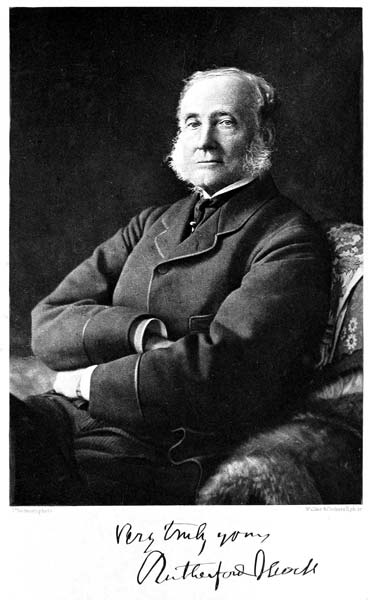
thus described by Sir Rutherford Alcock in 'The
Capital of the Tycoon':—
A low fan-shaped strip of land, dammed out from the waters
of the bay, the handle being towards the shore and truncated.
One large wide street, with two-storeyed houses on each side,
built in European style, gives an air of great tidiness; but they
look with large hollow eyes into each other's interiors in a
dismal sort of way, as if they had been so engaged for six
generations at least, and were quite weary of the view....
But the view from the Dutch commissioner's residence, with its
quaint Japanese garden and its fine sweep down the bay, is
very charming.... There flitted before me a vision of the
solitary chiefs of the factory in long succession taking up their
present station in long rotation and looking forward upon the
fair bay with which their sight alone may be gladdened. How
often must the occupants of this lone post have strained their
eyes looking in vain for the solitary ship bringing tidings from
Europe and home!
The imprisonment of the Dutch was aggravated by
many degrading conditions imposed by the Japanese
Government. Their position bore some analogy to that
of the English and other foreigners in Canton previous
to 1839. In both cases the Europeans endured indignities
at the hands of Asiatics for the sake of profit,
but beyond that point it is the differences rather than
the resemblances which are significant. The humiliation
of the Dutch in the island of Deshima was indeed
unmitigated so far as it went, but it was neither
capricious nor spiteful. Once the yoke was peacefully
adjusted, what remained of life to the Dutchman
was made as agreeable to him as to a cockatoo in a
cage. His jailors had no particular animus against
him; they had a purpose of their own to serve in
keeping open, through the foreigners, a channel of
communication with the West, and they had as valid
reasons of State for tethering him as one may have
for tying up his ox or his ass. These purposes once
served, however, the Japanese did not revel in harshness
or cruelty.[2] With the Chinese it was otherwise.
They also had a political object in restricting the barbarians,
only they were never satisfied with its attainment,
but continued heaping up insults on their victims
to the utmost limits of their submissiveness.
The petty trade which the new-comers were able
to do at Nagasaki was, in the beginning, managed
through the existing agency of the Dutch, from whom,
however, there was nothing useful to be learned, much
indeed to be unlearned; and in a few months it was
the Dutch themselves who had to go to school to the
interlopers. As commerce had been kept entirely in
the hands of the Government officials, there had been
no opportunity for the rise of any mercantile class
among the natives: that was to be a product of the
new era.
Japanese preparations for trade at Yokohama—Mr Alcock's arrival as
consul-general—Assumes the rank of Minister—The situation as
he found it—The establishment of diplomatic intercourse at the
capital—The location of the foreign settlement—The currency—The
low value of gold—Its rapid exportation—Friction caused by
conditions of exchange—Efforts of Mr Alcock to set matters right—Report
by Secretary of H.B.M. Treasury—Japanese double standard,
gold and copper—Japanese courage in meeting difficulties—The
Daimios' coinage—Beginnings of trade—Amenities of residence—The
charm of the people—The two Japans, official and non-official—Complete
despotism and complete submission.
The treaties of 1858 took their proper effect at the
two ports of Hakodate and Kanagawa; but the former
being remote from any centre of population, and its
trading resources so obviously limited, it attracted
little attention in commercial circles. It was in the
more southerly port that the new foreign interests
became concentrated; and it was so near the capital—only
seventeen miles distant—that the political and
commercial currents soon acted and reacted on each
other with direct, and sometimes violent, effect. To
Kanagawa, therefore, the merchants of all nations
gathered in anticipation of the official opening of the
port on the 1st of July 1859.
We say "Kanagawa," to follow the official nomenclature,
but in reality the adventurers who came there
to seek their fortunes did not land at that place, but
three miles away from it, at an obscure village called
Yokohama. There the Japanese Government had
decided should be the future settlement for foreigners,
and they had made costly preparations, according to
their lights, for the accommodation of the strangers.
Roads were marked out, a certain number of wooden
bungalows had been run up, a few shops had been
opened in the quarter which was designed for native
occupation, a custom-house was built, with warehouses
attached, and stone landing-places had been constructed
for boats and lighters. The area thus marked out
for the native and foreign business quarter was a
narrow strip along the sea-shore, having in its flank
and rear an immense lagoon, or, as it was called,
"the swamp," intersected by boat channels, where
punting after wildfowl provided amusement for idle
foreigners. Being an inlet of the bay, the swamp made
a peninsula of Yokohama, which had just been connected
with the tokaido, the great trunk road between
the capital of the Tycoon and that of the Mikado, by
a new causeway and several good bridges, admitting
of boat traffic between the swamp and the sea.
In the middle of the swamp, in rear of Yokohama,
was a reclaimed portion whereon was erected an extensive
range of buildings connected by a causeway with
the dry land of the settlement. From its balconies
there waved pendants of cotton cloth bearing the
legend, "This place is designed for the amusement
of foreigners," a class of amusement of which there
has never been any lack in Japan.
Such were some of the outward and visible preparations
made by the Japanese Government, on its own
initiative, for the reception of the foreigners under the
new treaties,—preparations which surprised and somewhat
disconcerted the representatives of the Western
Governments when they arrived on the eve of the
opening of the port.
Mr Alcock, who had recently returned to his post
as consul at Canton, was chosen as the first representative
of Great Britain in Japan, with the rank
of consul-general. As this rank placed the representative
of the leading Power in an inferior position to
his colleagues, and consequently derogated from the
influence he could exercise on the Japanese, Mr Alcock
took it upon himself to assume the title of Plenipotentiary,
placing his resignation in the hands of his
Government in case they should disavow his action.
At the same time he recommended that the future
British representative should bear the title of Minister
Resident. So far from disavowing his action, the
Government appointed him Envoy Extraordinary and
Minister Plenipotentiary, a higher rank than that
suggested by him, and he was authorised to at once
assume the title, although so unusual a proceeding as
the transfer of a consular official to the diplomatic
service involved considerable delay while the needful
formalities were being arranged. The appointment,
however, was coupled with the conditions that the
step should not be made a precedent, and that it
should confer no claim to future diplomatic employment
in the countries of the West.
Mr Alcock was conveyed from China in one of her
Majesty's ships, arriving at the port of Nagasaki
in June 1859. There he found a fleet of foreign merchantmen
already in the harbour, and some fifteen
British subjects resident on shore, under the ægis of
the old Dutch conventions supplemented by more
recent enactments. Mr Alcock remained some days,
and having made arrangements for the carrying on of
trade under the new treaties, left a consul in charge
of British interests and proceeded to Yedo, where he
arrived on June 26.
It is a date to be remembered as that of the practical
initiation of diplomatic intercourse with the ruling
Power in Japan. The difference between a mission to
negotiate treaties and one to carry them into effect is
thus set forth by Sir Rutherford Alcock in the preface
to his valuable work, 'The Capital of the Tycoon,' in
terms the simple truth of which must commend itself
to every candid reader:—
The Ambassadors Extraordinary had only to extort certain
privileges on paper; it was the business of the resident Ministers
to make of these paper-concessions realities—practical,
everyday realities. As this was the very thing the rulers of
the country had determined to prevent, it cannot be matter of
wonder that there was not, and never could be, any real
accord, whatever the outward professions of good faith and
amity. Hence also it naturally followed that, although the
original negotiators were received with smiles, and their path
was strewn with flowers, their successors had only the poisoned
chalice held to their lips, thorns in their path, and the scowl
of the two-sworded braves and Samurai to welcome them
whenever they ventured to leave their gates—while the
assassin haunted their steps, and broke their rest in the still
hours of the night with fell intent to massacre.
To say the situation was novel is to say little. The
forces at work in the Japanese state economy were
either unknown to, or, what was perhaps even worse,
misunderstood by, foreign Powers. The lurid history
of previous intercourse, followed by rigid exclusion for
two centuries, would have sufficed to establish one
factor in the problem, the iron resolution of the Japanese
rulers. With such men neutrality or indifference
was out of the question, while there was nothing as
yet to indicate what was henceforth to be the ruling
motive of Japanese policy. Both parties were embarking
on an unknown voyage, and the avoidance of
shipwreck depended in a very large measure on the
character of those who had to discover for themselves
the winds and currents, the rocks and shoals, through
which they had to steer. The leadership among the
foreign Powers was tacitly assigned to Great Britain,
and it was a born leader who was commissioned to
represent her. Mr Alcock had had fifteen years' experience
of Asiatic relations, during which time he
had proved himself the possessor of those qualities
which were now in special request. These were
indomitable energy, earnestness of purpose much beyond
the common run of official service, fearlessness
of responsibility, and alertness to grasp the nettle
danger in order to avert greater evils, and a spirit
which would neither shirk nor postpone an unpleasant
duty nor tolerate lukewarmness nor dilatoriness in
others. He was fifty years old—matured in character
and experience, while yet in the prime of his intellectual
vigour.
Mr Alcock arrived in Yedo Bay in time to arrange
for the opening of trade at the appointed date, July 1.
Nagasaki to Yedo! Two centuries lie between these points,
so near on the map, but so far and completely separated by
the determined policy of the Japanese rulers. A policy of
isolation so effectually carried out that no foreigner, though he
might under the Dutch flag gain access to Nagasaki, could
force or find his way to the capital.
Steaming up the Bay of Yedo, and leaving Kanagawa
unvisited, Mr Alcock anchored as close to the capital as
the depth of water would allow, and at once informed
the Foreign Minister that he had come to stay. This
was done advisedly, as he has explained, to obviate all
discussion as to his place of residence, for he knew that
efforts had been made—more Sinico—through Lord
Elgin to induce her Majesty's Government to postpone
the residence in Yedo for a couple of years, and to keep
their representative at a distance. His first object was
to obtain a suitable residence for himself and the Legation
staff, in which assistance was cheerfully rendered
by the Government officials, as soon as they saw he was
resolved to remain in the capital. Diplomatic intercourse
became thus an established fact.
The opening of the trading-port did not prove quite
so simple, for the consul-general found he had been
forestalled in the choice of a site for the merchants'
residence, which the Government had, as we have seen,
prepared at great expense some three miles away from
Kanagawa, the port named in the treaty. Interpreting
this hurried action of the Japanese as covering the
ulterior design of segregating the foreigners from the
natives by thrusting them to a distance from the
trunk road which led through Kanagawa, of keeping
them in a kind of imprisonment like the Dutch at
Deshima, and of retaining the power to stop their
supplies, whether of the materials of trade or of
sustenance, Mr Alcock warmly contested the action
of the Government. In the end he extorted from
them the concession of a commercial site at Kanagawa
itself, which, however, was never taken up.
Events proved too strong for the consul-general,
for the merchants of all nations as they arrived
settled in Yokohama, where there was deep water for
shipping and every convenience for business. And it
soon began also to be felt that there was an element of
safety in this foreign settlement being removed from
the great imperial road along which armed processions
were continually passing to and from the capital.
Within a year the controversy had died a natural
death, and Yokohama speaks for itself.
The second obstacle to the free course of trade was
a more deep-rooted one, being nothing less than that
chronic bugbear of commerce and finance, the currency.
There was no circulating medium in Japan in the least
degree adequate for the service of international commerce.
The trade in miniature that had been carried
on in Nagasaki had been a simple exchange of commodities
without the intervention of the precious metals.
Mr Consul Winchester says that neither in the Dutch
nor in the Chinese factories was a Japanese coin ever
seen. But the commerce inaugurated in 1859 could
brook no such limitations, while the extent of its requirements
was of course absolutely unknown to the
negotiators of the treaties. In this state of doubt and
ignorance on both sides it seemed that the best temporary
provision that the circumstances admitted of
was for the Tycoon's Government to undertake, after
twelve months, to make all foreign money current in
Japan at its natural value, and that until the expiration
of that period Japanese coin should be supplied
in exchange for foreign, weight for weight. Yet it was
a monstrous stipulation to insert in any international
treaty, and could never, in fact, be enforced.
The amazing laxity in this respect with which
the treaties of 1858 were drawn opened the door to
unfathomed abuses in the matter of currency. The
coin which was in the minds of the American and
English negotiators was what was then current on
the coast of China, the dollar, or more specifically
the Mexican dollar. Yet, as was afterwards pointed
out by Mr G. Arbuthnot, Secretary to her Majesty's
Treasury, no provision was made in the treaties expressly
for exchanging that, but only British and
American money. In his opinion the Tycoon's Government
might have refused altogether to receive the
Mexican dollar, which was the only coin tendered to
them, and thus the currency clause in the treaty
would have been a dead letter from the first. But
since they did not know the weakness of the ground
which the foreigners had chosen, they had to fight
out the question under all the disadvantages of a
false position.
By the treaty provisions, then, as interpreted by
both sides, the foreign merchants who chose to import
specie were to be supplied in exchange with current
coin of the realm whereby they could purchase the
produce of the country without awaiting the slow
and uncertain realisation of imported merchandise.
But the Japanese, apart from any question of good
faith, had vastly under-estimated the demand which
this agreement was to make on their mintage resources.
They could only supply tens where thousands
were required, and in consequence of their scarcity
native silver coins were soon run up to a high premium.
These coins were needed not alone for the purchase of
produce, but for the more lucrative investment in the
gold coinage of the country; for an extraordinary
anomaly presented itself to the foreign traders in the
relative value of silver and gold in Japan. The ratio
between the two metals throughout the commercial
world was at that time about fifteen to one, but in
Japan, owing partly to the fact that the silver ichibu
was a token coin, and yet interchangeable, weight
for weight, with foreign silver coins, the ratio in the
market was reduced to five to one. Nothing could
better show how completely the country had been isolated
than this simple phenomenon. Since the seclusion
of Japan no such opportunity of profit without risk had
ever tempted merchant adventurers outside the dreams
of romance.[3] It could not be the intention of the
treaty-makers to deprive Japan of her gold, yet the
exportation of it was not only not prohibited, it was expressly
sanctioned by treaty, the export of copper coins
alone being forbidden; and once the conduit was opened
no power could arrest the flow from the higher to the
lower level. The currency question presented many
intricacies and anomalies against which the foreign
representatives struggled in the dark, but the ratio of
gold to silver was the ruling factor which underlay the
whole problem, and until every koban was exported,
or the relative value of gold and silver had been assimilated
to that of the outer world, there could be no
settlement of the currency question in Japan.
In the mean time the friction caused by the unsatisfied
demands of the traders was considerable; it
became in time ludicrous. There was a daily exchange
held at the custom-house, and various arbitrary systems
of distribution were adopted by the officials there.
The discovery that a kind of manhood suffrage was recognised,
and that an employee received as much as his
employer, led to applications being made in the names
of servants and even of fictitious persons, to each of
whom an allotment was granted. Again, the discovery
that allotments were also made pro rata according to
the amount applied for led to the applications being
sent in for ever larger and larger sums until billions
and quintillions were reached. By such devices, no
doubt, some of the applicants may have gained a
momentary advantage over their neighbours, but at
no time did the merchants receive a sufficiency of
Japanese coin to carry on the most restricted business.
At one time, about a year after the opening, it was
estimated that there was in the hands of foreign merchants
one million and a half of dollars which were not
exchangeable, and were a "drug in the market."
Their wants were, however, partially supplied in
another manner. For among the anomalies of the
place and period one must be mentioned which had
a quite peculiar bearing on the supply of currency for
commercial purposes. The precious coin, which was
doled out homœopathically to merchants, was supplied
to foreign officials in liberal measure. Every minister,
consul, and assistant; every admiral, captain, and lieutenant;
every paymaster, for himself and for the service
of his ship, received his quota of Japanese money
on a scale graduated according to rank. The amount
put in circulation by these means was given by Mr
Winchester as $2,000,000 per annum. The recipients,
whether directly or through agents, were able to sell
their surpluses to the merchants, of course at a handsome
profit, and no doubt abuses grew out of what
was in its original intention a simple measure of
justice to salaried officers. The practice was condemned
by Mr Arbuthnot, and was discontinued by
order of the Foreign Office in 1864, on the initiative of
the Prussian Government, whose agent in Japan had
voluntarily renounced the privilege. But, oddly enough,
the official exchange was resumed by request of the
Japanese Government, and continued for several years
longer, until, in fact, foreign and native coin had found
their common level.
Trade certainly suffered much in the beginning from
the incongruous state of the currency, which was greatly
more complicated than we have attempted to outline.
Even after the year of probation foreign coins were
neither received by traders at their value nor exchangeable
in accordance with the treaties. Whether the
Government was at the bottom of the obstruction or
was overruled by circumstances beyond its control
was uncertain, but the British consul-general made
masterful exertions to set the matter right. Currency
reform, however, has baffled so many generations of
expert economists that, even assuming the goodwill of
the native Government, an alien official new to the
country must have found it difficult to accomplish
much, with the time and means at his disposal. Earl
Russell in 1862 "declined to pronounce on so large
and intricate a question," and would not even discuss
it with the Japanese envoys.
Japanese currency formed the subject of four
elaborate reports by the Secretary to her Majesty's
Treasury, extending over twelve months, from December
1862 to December 1863, drawn up after personal
conference with Sir Rutherford Alcock and
on information derived from various other sources,
especially from a series of very able papers by Consul
Winchester. In each of these reports Mr Arbuthnot
remarks on the paucity of data, and in each he qualifies
the deductions of the preceding one. Had the series
been still further extended, it is even doubtful if
finality of judgment would have been reached; for in
his third report he says, "The whole question, both as
regards the condition of the currency and the real
intentions of the Japanese Government, is involved in
so much obscurity that no sound judgment can yet be
formed on the subject" (May 1863).
It would be a mere weariness to the reader to
attempt to elucidate a problem which an expert
student found perplexing, but a few salient points
brought out in Mr Arbuthnot's review may repay
citation, as illustrative of the general state of relations
beyond the immediate question of the currency. "We
found," he says, "the Japanese with a carefully devised
system of coinage, presenting indeed anomalies, when
regarded from a European point of view, but apparently
well adapted to their domestic wants; and their coins
were found on assay in London to be well manufactured."
The Chinese had no such system, and the
evolution of a metallic currency entitled to such high
praise, in a country from which the rest of the world
had been long shut off, is one of the most striking
evidences of the high originating faculty of the
Japanese.
As to the stipulation in the treaties that foreign coin
should be current in Japan on a par with native, weight
for weight (not a word said about purity), it was not
only preposterous and absolutely unworkable, but it
was imposed by the ignorance of the foreign negotiators
against the superior knowledge of the Japanese; for it
is remarkable that in the negotiations carried on by
the Americans in 1854 the Japanese took up the impregnable
ground that "American coin was only
bullion to them." Force alone—or the fear of it—drove
them from that position in 1858, and in yielding
to the unreasoning pressure of the subsequent negotiators
the Japanese probably consoled themselves with
their resources of secret evasion to save them from the
worst consequences of the obligation—a characteristic
of the whole treaty-making campaign.
It appeared to Mr Arbuthnot that the Japanese had
a double standard—itself "a contradiction in terms"—gold
and copper; silver occupying the position of a
token currency between the two, at a highly artificial
value, strictly governed by law. The fact was exemplified
in many ways. Art objects in silver
contained more metal than the coin paid for them,
the work of the artificer thrown into the bargain.
Gold and copper, on the other hand, bore about the
same relationship to each other as prevailed in other
countries. It was silver alone that was maintained at
a conventional level three times above its value in the
outer world. And the philosophy of this is explained
by Mr Winchester, who tells us that, whereas the
supply of gold and copper was in many hands, the
sources of the supply of silver were in the exclusive
control of the Tycoon's Government, which derived
great advantage from maintaining the silver coinage at
a high fictitious level.
The efforts of the Japanese to readjust the currency
to meet the demands of the treaty were naturally first
directed to silver, which was recoined and revalued,
but confusion was worse confounded by all these
attempts. Eventually the gold koban, worth intrinsically
18s. 4d. sterling, or 4 bus of the intrinsic
value of 1s. 4d., was reduced to a sterling value of
5s. 6d., but was still rated at 4 bus, while the copper
coinage was disestablished and iron substituted of no
intrinsic value. "I am aware of no other example,"
says Mr Arbuthnot, "of so sudden and violent a
rending of the monetary regulations of a country;
certainly of none which has been produced by the
interference of foreigners."
The effect of these inquiries by the Treasury was
to discourage further interference by foreign Governments,
to trust much to that great solvent of anomalies,
the silent operation of commerce; while the
only complete remedy was recognised as the establishment
of a mint under European regulations.
The problem was still further complicated by the
separate coinage of the Daimios. Their nibukin, as
a general rule, passed only at first in their own provinces,
but gradually they filtered down to the open
ports, and at one time considerable embarrassment
arose from the mixture of the coinage thus caused.
In 1871-72 the Imperial Government, then just come
to supreme power, took the matter up with the
thoroughness they showed in all their doings. They
gave secret notice to the foreign Ministers of their
intention to call in all princes' nibukin, and thereupon
issued an order that during one week these
coins should be brought into the custom-houses at
the treaty ports, where they would be fastened up
in sealed packets of $100 value, and notified that coins
so stamped within the week would be accepted by
the Government as legal tender, but that thereafter
their use would be prohibited. Now, as the Daimios'
money stood at about 90 per cent discount at the
time, the fact that some of the foreign officials who
had access to this confidential information were also
merchants created immediate speculation, with the result
that within a fortnight these silver-gilt nibukin
rose from 90 per cent discount to 2 or 3 per cent
premium, the officially sealed packets being a most
convenient form for the payment of duties.
The alacrity with which the Government applied
heroic remedies to a disastrous predicament was typical
of the energy of the Japanese, which has been displayed
since in wider fields. They do not sit down
and bemoan their troubles, but at once arm themselves
against them.
When to the inherent difficulties common to currency
problems generally were superadded the complexities
of the monetary system of a non-commercial
and long-secluded country, surprise should be felt
that the regulation of the circulating medium in
Japan was accomplished so soon, rather than that it
took so many years to arrive at the solution. The
Tycoon's Government did not live long enough to
settle the currency, but left the problem as a legacy
to the Restoration. A good many years elapsed before
the Mikado's Government succeeded in evolving
order out of chaos.
In the mean time, in spite of many drawbacks,
trade was making headway in other directions besides
the exportation of gold, and quaint indeed were the
beginnings of it. The staple products happened to
be the same in Japan as in China, tea and silk, and
they soon began to be regularly brought down to
Yokohama for sale. But business was at first on
such a lilliputian scale, and was introduced in so
dainty a manner, that to merchants accustomed to
the large transactions of China the whole affair wore
something of the air of comic opera, or as if children
were playing at being merchants. This impression
was strengthened by the aspect of the fragile wooden
structures with their sliding doors and windows, but
without sitting accommodation, wherein business was
transacted, which to those habituated to the massive,
if inelegant, buildings of Hongkong and Shanghai
irresistibly suggested the idea of a doll's house. The
Chinese methods also were inverted. Instead of sending
samples of substantial quantities, such as a thousand
chests of tea or fifty bales of silk, and the owner
or his broker coming to chaffer in the silk-room or
the tea-room of the foreign merchant, the latter had to
go the round of the Japanese shops to find out what
they had got. Early every morning the leading merchants
might be seen booted to the thighs—for the
rain was frequent and the roads unmade—trudging
up and down the Japanese bazaar to see what novelties
had come to hand. The more zealous would
sometimes make a second round in the afternoon, in
case there might be some late as well as early worms
to be picked up. The bodily fatigue and consumption
of time involved in this process would have rendered
a large business impossible. There were as yet no
Japanese merchants properly so called, and their endless
parley resembled more the tenacious higgling of
peasants than the negotiations of men of business.
Moreover, the native dealers seemed scarcely conscious
of any law which should hold them to a bargain in
the event of a more acceptable offer turning up.
Conclusions unfavourable to Japanese commercial
morality have been drawn from some of those early—and
later—experiences; but commercial like other
kinds of specialised morality has necessarily something
of a professional character. The akindo, or merchant,
was a sort of pariah in Japan, his social status being
inferior to those of the peasant and the handicraftsman.
His sense of honour was not, therefore, sustained
by tradition or stimulated by esprit de corps.
There being no mercantile body in Japan, there was
no mercantile code, at least none applicable to international
trade, and those unwritten laws without
which large commerce is impossible had not yet been
called into being. Contrasts between the two neighbouring
nations have just been mentioned very much
to the advantage of the Japanese; but in matters of
commerce, it must be conceded, the advantage lay
entirely with the Chinese, a nation of traders from
their birth.
In the sale of lacquer ware and objects of art the
Japanese were much more at home than in dealing in
raw products of foreign manufactures, and the treasures
which were in the early days exposed in the shops of
Yokohama would make a modern dealer sigh for opportunities
which are no more. Speaking roundly, it
would have been safe to buy the stock indiscriminately
at the sellers' own prices, when fortune would have
awaited the investor as surely as if he had bought up
the gold coinage at the ratio of 5 to 1. The same
remark would apply to such of the raw produce of
Japan as had been in large demand in China; and
conversely the rule applied also to selected articles of
foreign manufacture, which the Japanese were satisfied
to buy at a price mid-way between the high level of
the Dutch monopoly and the low level of what would
remunerate the free importer. Therefore the sudden
inroad of open trade on a market artificially confined
resulted in profitable trading while a new equilibrium
was being found; but such prosperity was in its nature
evanescent.
Irrespective of the material aims which attracted
foreign residents to Japan, the life itself presented
several novel and interesting features. Nothing could
have been pleasanter than the social relations which
sprang up between the foreign communities and the
unofficial natives. The strangers were received everywhere
with open arms, and the residence among a
smiling people (excluding altogether the meretricious
allurements of the country, which have also not been
without their influence) and amid enchanting scenery
was found to add a new pleasure to existence. Here
again we must resort for illustration to a comparison
with China, where strangers at the best were sullenly
tolerated, where one might live a lifetime without
entering a house, or seeing a respectable woman, or
making a friend save on a business footing. The
Japanese of Yokohama and Kanagawa, as well as in
the surrounding villages and temples, never failed in
courtesy and hospitality to passers-by, and were eager
for conversation with foreigners. A useful smattering
of the language was soon acquired under the stimulus
of a quick-witted and sympathetic people alert to jump
at the meaning and patient to help the novice to find
his words. The women of the household were always
charming, and if their domestic conversation sometimes
startled the stranger by its freedom, there was neither
malice nor any such impropriety as leaves an evil
odour in its trail. Friendships were formed, not deep
perhaps, but genuine as far as they went, and certainly
not the less sincere on the Japanese than on
the foreign side.
The intelligence also of the common people enhanced
both the pleasure and the value of friendly intercourse
with them: apt as they were to receive, they were no
less ready to impart, information. Their appreciation
of their country—its beauties, history, traditions, and
folk-lore—was conscious and unrestrained, indeed it
amounted to a passion. This afforded endless subject
for talk. Everything save the politics of the day
might be freely discussed, and though the first-arrived
foreigners came poorly prepared to assimilate
so much that was novel, they could not help carrying
away a good deal from their frequent confabulations.
The native guide-books formed a reservoir of suggestive
topics: surprisingly minute they were, noting
every gem of scenery or point of interest, with the
legends of history, romance, or mythology attaching
to them. So accurate were these itineraries that
with their contents well studied foreigners might
make excursions inland lasting several days without
the aid of guide or the necessity of inquiring
the way.
It need not, of course, be said that the mutual
intelligence of Japanese and foreigners did not penetrate
below the surface of every-day phenomena. Of
their festivals, their pilgrimages, their votive offerings
to temples and shrines, their ancestral worship,
and their whole relation to the Unseen—call it religion,
superstition, or idolatry—the strangers had no comprehension.
Although its outward symbols were passing
constantly under their eyes, esoteric Japan was
to them a sealed book, as the mental processes of the
Oriental always are to the Occidental, whose imagination
is cramped by the syllogism, and whose faith
languishes for demonstration. There was, however,
ample outside the region of mysticism, outside the
concerns of trade, and equally apart from political
questions, to nourish the best relations between
Japanese and foreigners.
The impressions of the British Minister on his
journeys of relaxation are by no means the least interesting
portion of his important work, 'The Capital
of the Tycoon.' Having shaken off the official incubus,
and breathing the free air of the country, the intercourse
with the common people in which he was able
to indulge was fruitful of reflections of a brighter hue
than any that were prompted by his strenuous life in
the capital. He observes:—
They are really a kindly people when not perverted by their
rulers and prompted to hostility.... I had begun to forget I
was in Japan, so much goodwill was shown.... There may
be a good deal of tyranny and oppression, but the people show
no marks of it.... The feudal lord is everything and the
lower and labouring classes nothing. Yet what do we see?
Peace, plenty, apparent content, and a country more perfectly
and carefully cultivated and kept, with more ornamental
timber everywhere, than can be matched even in England....
The material prosperity of a population estimated at
thirty millions, which has made a garden of Eden of this
volcanic soil, and had grown in numbers and in wealth by
unaided native industry.
Such were the observations made during a few days'
rest at the mineral springs of Atami, and they coincided
exactly with the opinions formed by those whose
daily intercourse lay with these same common people,
in which term, of course, were included such town
populations as foreigners had acquaintance with. A
contemporary writer, Nagasaki, 1859, remarked: "The
Government of Japan is the most absolute despotism
in the world, and perfectly successful.... For the
present it is consistent with great prosperity and
contentment on the part of the people, but it seems
to me it is only their exclusive policy that has kept
it so."
The great, industrious, prosperous masses of Japan,
enjoying the gifts of the gods with thankful hearts, and
drinking the cup of life as presented to them without
any acidulating scruples, seemed to be happiest of all
in this, that they were not burdened with the dignity
of wearing swords. The storms that convulsed the
upper regions passed over their humble heads without
interrupting the cast of a fishing-net or hindering by a
day the gathering of their harvest. How different the
life of the nobles and their following! their humanity
dominated by an elaborate and intolerable ceremonial,
settling their quarrels at the sword's point, and ever
on the alert for bloody intrigue.[4]
For there were two Japans, that of the people and
that of the ruling class, separated by an impassable
gulf. "The very existence of the plebeian seems
unrecognised by the patrician in his lordly progress,"
wrote Sir Rutherford Alcock. "And for that very
reason there may be more real liberty among the mass
of the people than we imagine."
The members of the official class were distinguished
by carrying in their girdle two heavy swords with a
razor's edge, one long, one short. The functionaries
of the custom-house, with whom alone the foreign
lay community had contact, also wore swords as
part of their official uniform, which they placed with
delicate ceremony on a rack in front of them as they
sat on their mats at the receipt of custom,—for there
were no chairs, and the habitual posture was squatting
on the hams and heels. To the aristocratic
caste the Japanese people were as absolutely submissive
as if every two-sworded man wielded the
power of life and death, which, so far as the common
people were concerned, was not far from the
simple truth.[5] The only great concourses of armed
men which the foreign residents were in the way of
seeing were the Daimio processions, which, hundreds,
sometimes thousands strong, were constantly travelling
along the highroad; and in the long town of Kanagawa
they could observe the people prostrated by the
sides of the road with heads abased while the great man
with his scowling retainers passed. Residents in Yedo—that
is, the personnel of the foreign Legations—had
less agreeable experience of these feudal swordsmen,
who, living in idleness during their prince's sojourn in
the capital, were quick in quarrel, especially in their
cups, and far from agreeable to meet in the streets.
Storms begin—Russians murdered at Kanagawa—Two Dutchmen in
Yokohama—Prince regent assassinated—Servant of French Minister
attacked—Mr Heusken, secretary to American Legation, murdered—Ministers
withdraw to Yokohama—And return to Yedo—First
murderous attack on British Legation, 1861—Mr Oliphant wounded—Attempt
on a Japanese Minister—The causes of these outrages—Partly
anti-foreign feeling—Foreign treaties imposed by force on
Tycoon never received sanction of emperor—Hence universal hostility
to foreigners—Internecine jealousy—Mr Alcock makes ascent of
Fujiyama—Against the wish of Japanese Ministers—Makes a second
overland journey from Nagasaki to Yedo—Sullen attitude of Daimios.
The ports had not been many months opened when
storms began to disturb the political sky, and the
idyllic charm of the new life became tempered by
assassination. The why and the wherefore of these
outrages was imperfectly understood at the time,
though it has since been copiously expounded. The
uncertainty as to the moving cause or causes rendered
precautions difficult, and the only safe resource was a
watchful eye and the nimble revolver.
Much bad feeling had been displayed towards the
foreign diplomatic staff in Yedo, and assaults had been
frequent, but nothing of a tragic nature had occurred
until the arrival of a Russian squadron of ten ships,
with Count Mouravieff-Amurski on board. He landed
in August 1859 with an escort of 300 men in Yedo,
where he was safe; but an officer and two men at
Kanagawa, buying provisions, were cut to pieces by
armed Japanese. This was what Sir Rutherford
Alcock designated as "first blood." The next was
the assassination of a native linguist employed in the
British Legation. Early in 1860 two Dutch shipmasters,
one over sixty years of age, were hacked to
pieces in Yokohama. Next the prince regent himself
was, within the precincts of the castle, set upon by an
armed band of retainers of the Prince of Mito and
killed, his head being carried off to assure the said
prince of the accomplishment of an act of long-meditated
revenge.
Before the end of the year 1860 the Italian servant
of the French Minister had to defend himself at the
entrance of the Legation from the murderous attack
of a couple of two-sworded men; and the year 1861
was ushered in by the assassination of Mr Heusken,
secretary to the American Legation, on his way from
the Prussian Minister, whom he had been assisting
in the negotiation of his treaty. This crime filled
the cup for the time being. The Government proved
itself unable or unwilling to protect the diplomatic
body from their bloodthirsty assailants, and three out
of the four foreign representatives—the Dutch minister
not being at the time resident in Yedo—made a protest
to the Tycoon's Government, struck their flags,
and withdrew to Yokohama. The American Minister
alone remained in Yedo. Soon the Prussian and Dutch
returned thither, leaving only the British and French
representatives in Yokohama, where they remained
until specially invited back to the capital under conditions
which they had demanded of the Government.
The following summer witnessed the most desperate
attempt of all to exterminate the inmates of at least
one of the Legations. Mr Alcock had just returned
from a long, venturesome, dangerous, but most fruitful
journey overland from south to north—from Nagasaki
to Yedo—which included a sea passage through the
Inland Sea, when an assault was made on the Legation
at midnight on 4th July 1861. The Tycoon's guard of
150 men are charitably credited with having been
asleep, for they opposed no obstacle to the entrance of
a band of men who cut an opening through a substantial
bamboo stockade at the outer gate, and on
their way thence to the apartments of the Legation
staff, a distance of some three hundred yards, killed,
at intervals, four men, some of whom defended themselves,
and a barking dog. The scene is fully and
graphically described in 'The Capital of the Tycoon.'
The central object of the attack seems to have been the
Minister himself, who however escaped unhurt, while
two members of the Legation were wounded,—Laurence
Oliphant, who had recently come out as secretary of
Legation, having a very severe sword-cut in the
arm and another in the neck. Being more than
common tall, Mr Oliphant's head was saved by the
intervention of a low beam, in which a deep sword-cut
was found. If that brilliant writer had seen Yedo
rose-tinted in 1858, he had now at least a chance of
judging it in a greyer light. The guard did not put
in an appearance until after the assailants had been
beaten off from, or at least baffled in, their attempt
on that portion of the temple buildings which was
occupied by the Minister, and a fierce struggle ensued
in the precincts, in which two of the assailants were
killed and one badly wounded, while twelve of the
guard were wounded and one of the Tycoon's bodyguard
killed. The details of Japanese sword-play
are not pleasant matters to dwell upon, but a few
words from Mr Alcock's notes of the tragedy will
suffice to give an idea of the manner in which these
massacres were carried out. "I have seen many a
battlefield," he says, "but of sabre wounds I never
saw any so horrible. One man had his skull shorn
clean through from the back and half the head sliced
off to the spine, while his limbs only hung together
by shreds." "There is probably not in all the annals
of our diplomacy an example of such a bloodthirsty
and deliberate plot to massacre a whole Legation."
This is a sufficiently full list of the outrages of what
may be called the Yedo period, to distinguish it from a
subsequent chapter of history which was opened in connection
with the new port in the Inland Sea, but which
is beyond the range of the present work.
The only conclusions to be drawn from these occurrences,
and those yet to be related, were—(1) that
either the Tycoon's Government itself or some powerful
faction was in deadly opposition to the admission
of foreigners into the country, and (2) that the
Tycoon's Government was either unable or unwilling
to protect the persons of foreigners either within the
capital or out of it; (3) that certain great Daimios
were concerned in these murderous outrages. The
Prince of Mito's men assassinated the regent, and
were most probably the assailants of the British Legation,
while the Prince of Satsuma's retainers killed
Richardson. Another great Daimio, whose forts commanded
the western gate of the Inland Sea, put himself
a year later in a state of war with all the foreign
nations.
The motives of these powerful feudatories were not
free from ambiguity, for they might be animated by a
bonâ fide desire to expel the foreigners, or they might
be plotting to embroil the Government with the
Western Powers. It was evident that the authority
of the Tycoon over the great Daimios was far from
absolute, and that at any rate he dared not enforce it
in defence of the hated foreigners.[6] Thus the Legations
were left to the mercy of a ferocity which has known
no parallel. The midnight attempt on the British Legation
on July 4, 1861, typified the whole situation. The
inmates were ignorant whence the several attacks on
them came, the imperial and Daimio's guard were
asserted to have slept through the crucial stage of
the assault, and the provoking cause of the attempt
to exterminate the English was unknown. In such a
maze of occult forces it was almost as difficult to adopt
precautions as against earthquakes.
What lay at the root of all these troubles, according
to the deliberate opinion of Mr Alcock, was that the
foreign treaties had been forced on the Government
against its will and in violation of the fundamental laws
of the empire. He says the treaties were not sanctioned
by the Mikado, and that therefore the opposition of the
Daimios was on strictly legitimate lines. Also that the
law of the seventeenth century which made it a capital
offence for a foreigner to land in Japan had not been
repealed. The Tycoon's Ministers had been scared into
signing even Commodore Perry's almost platonic treaty;
for though that officer had strict orders to use no force,
he did not impart this information to the Japanese, and
they could not otherwise interpret the naval demonstration
than as an intimation that the ship's guns would
support the commodore's demands. The case of Mr
Harris's treaty of 1858 was even clearer. It had been
drawn up, but the signature postponed sine die until
the great nobles should have been gained over, and Mr
Harris retired to his retreat at Shimoda to wait events.
The news of the forcing of the Peiho forts by the Anglo-French
squadron and the imposing of a treaty on the
Emperor of China was conveyed express to Mr Harris
by the steam frigate Mississippi. Another vessel, the
Powhattan, arrived fortuitously at the same time, in
which Mr Harris proceeded to Kanagawa, where commissioners
were sent down at once to meet him, and in
three days the treaty was signed. Of course the Allies
who had forced the door of China, having no quarrel
whatever with Japan, had no more thought of coercing
that country than the United States had in 1853 and
1854; but it was perhaps scarcely conceivable to the
oriental mind that any nation should deny itself the
exercise of a power it consciously possessed. Naturally,
therefore, the Japanese were predisposed to believe in
the aggressive purposes of the invaders of China. No
less natural was it that subsequent evidence of the
self-imposed limitation of their pressure on China
should lead the Tycoon's advisers to deplore the panic-haste
with which they had been hustled into making
treaties against the will of the great council of the
Empire. In the interval between the signing and the
execution of the treaties the Government had time for
reflection on all that: the malcontent majority of
Daimios had also time to consider what resistance they
could offer to innovations which they detested.
The reactionary policy that had set in was also
clearly shown in the obstacles thrown in the way of
the negotiation of the Prussian treaty. Count Eulenberg
had been six months at work, and as his treaty
was but a copy of those already signed there was no
reason in the thing itself for the obstruction. But
Prussia was not then a nation from which there was
much to be feared at such a distance, and therefore the
true disposition of the Japanese Government had free
play.
The Tycoonate itself was a perpetual cause of jealousy
among the three great families, one of which
was Mito, who had themselves pretensions to the
honour; and the combination of their private grievances
with a quasi-patriotic and probably sincere
hatred of foreign intruders raised a storm against
the Tycoon with which his advisers found it hard to
cope. The Government being committed to the protection
of foreigners, massacres of the latter offered
a ready means of gratifying the double passion of
hatred of them and of the Tycoon.
But although the foreign representatives and the
Tycoon were thus to an unknown extent the objects of
a common enmity, it was yet impossible for them to
make common cause, for they were not in harmony.
The Government would willingly have got rid of the
treaties or reduced them to a dead letter. The foreign
Ministers, on the other hand, had no choice but to
insist on the fulfilment of the engagements into which
the Government had entered. Not for them to count
the cost, the difficulties, or the danger: relaxation of
their demands would have aggravated all three. So
there was nothing for it but the "rigour of the game."
The British Minister held decided views on the importance
of keeping alive all rights and privileges by
exercising them. China would have taught him, if
the knowledge did not come by nature, the value of
the modern principle of "effective occupation" as the
only valid sanction of an abstract title. The treaties
of 1858 conferred upon the representatives of Foreign
Powers the right of travelling throughout Japan. The
Tycoon's Government desired to restrict or nullify the
privilege, no doubt for reasons quite sufficient from
their point of view. Mr Alcock on his part saw good
reasons for opposing this tendency from the outset.
Consequently, as a first experiment, he organised a
journey by the tokaido to the "matchless" mountain,
Fujiyama, distant about eighty miles from the capital.
Every effort was made by the Government officials to
dissuade him from the undertaking; dangers natural
and supernatural were conjured up, a more convenient
season was recommended. At length their pleas for the
abandonment or delay of the expedition having been
exhausted without any effect on the resolution of the
Minister, the officials became helpful in the preparations
and most careful to provide for the success of
the journey. The party—eight Europeans in all with
a large native contingent—set out on September 4,
1860, rather late in the year for the ascent, which
was, nevertheless, successfully accomplished, and for
the first time the foot of the stranger trod the sacred
summit, the object of constant religious pilgrimages.
The whole journey, including a detour to the hot
springs of Atami, occupied one month: it was fruitful
in first-hand information, and replete with agreeable
experiences.
A more important journey was undertaken eight
months later, on the occasion of a return voyage from
China and Hongkong, whither the Minister had gone
on certain legal business. Being at Nagasaki, Mr
Alcock arranged to travel in the company of Mr de
Wit, the head of the Dutch mission, across the island
of Kiusiu, then by junk up the Inland Sea to Hiogo,
thence by the highroad to Yedo. The proposal met
with the same kind of opposition from the Japanese
authorities as the going to Fujiyama the previous
year had done: the dangers of the journey were depicted
in strong colours, and the unsettled state of the
country was alleged as a cogent reason why a foreigner
should not trust himself on the highroad. When these
arguments proved unavailing, and the journey was
finally resolved upon, the authorities endeavoured to
minimise both its pleasure and its usefulness by an
attempt to extort from the two Ministers an undertaking
in writing never to go in advance of the escort
or to leave the highroad. The plea for the latter
restriction was that the road alone was under imperial
control, the land on either side belonging to the
Daimios. The feudatories on their part took effective
measures to enforce the condition by supplying guards
through their respective domains, who blocked up
every byway, and in the towns and villages where the
party rested screened off the side streets even from
view by means of large curtains stretched on high
poles, emblazoned with the Prince's arms. When the
party landed at Hiogo to resume the journey by the
tokaido, they were met by a "Governor" of Foreign
Affairs, sent expressly from Yedo to warn the foreign
Ministers once more of the dangers of the road, and to
persuade them to complete their journey by sea. This
had become such a stereotyped formula that the two
diplomats paid no attention to the warning, though
they had some reason afterwards to think that on this
single occasion the cry of wolf was genuine; for the
assassins who attacked the English Legation on the
night of the return of the party to Yedo were said to
have tracked the foreigners the whole way from Hiogo.
These two interesting and—the second one especially—arduous
journeys, each of one month's duration,
settled the question of the right of the foreign representatives
to travel through the length and breadth of
Japan. They also afforded much insight into the state
of the country and the real feeling of the general
population. But they were only interludes in the
drama of sensational diplomacy, which had now to
be resumed with redoubled energy. The Legations
had been two years located in Yedo, and no progress
whatever had been made towards establishing
a state of security for foreign life. Matters were,
indeed, going from bad to worse. One point had
been gained after the murder of the American secretary
in January—the Government had formally
assumed the responsibility for the protection of the
foreigners. Moreover, strong guards of the Tycoon's
men were posted in the different Legations; but,
as we have seen, they added nothing to the sense
of security. The demonstration of the inadequacy of
all these precautions left the conditions of foreign
life in the capital in worse plight than ever. The
attack on the British Legation therefore called for
a fresh review of the position.
British and French guards brought to Yedo—Marks a new era—Decided
position of British Government—Concessions asked by Japanese, refused
by Mr Alcock, granted by Earl Russell to Japanese envoys—Retrogression—Position
of foreign Ministers assimilating to that of
the Dutch at Deshima—Mr Alcock's departure for Europe, 1862—Bad
effects of Lord Russell's concessions to Japanese—Encouraged them to
make fresh demands—The building of a British Legation in Yedo—Chargé
d'affaires resides mostly in Yokohama—Colonel Neale's account
of the system of guarding the Legation—Midnight attack on the
guards—British sentries murdered—Suspicious behaviour of Government—British
guard increased—Admiral Hope's opinion—Attack on
an English riding party and murder of Mr Richardson on highroad—Admiral
Hope's proposal to "nip assassination in the bud."
The question now, therefore, entered on a new
phase. Since reliance on the Government afforded
no sense of security, the foreigners must abandon
the position or find some more effective protection,
not to supersede, but to supplement, that which was
afforded by the Government. There was fortunately
a British despatch vessel, the Ringdove, at the
moment at Yokohama, to the commander of which
Mr Alcock appealed for a guard of marines and
bluejackets. These arrived the next day, twenty-five
all told, with Captain Craigie himself at their
head, and they were happily accompanied by a detachment
of fifteen men from the French transport
Dordogne, brought up by the French Minister, Mons.
de Bellecourt, always a staunch supporter of his
British colleague. That gentleman, on hearing the
tragic news at Yokohama, where he had been staying,
returned promptly to his post with this most
welcome reinforcement for the defence of the Legations.
This simple proceeding marked the beginning
of a new era in the foreign relations with Japan—the
era in which the Powers represented there took
the law into their own hands, with highly important
consequences to Japan and to the world. The
British naval guard was reinforced within a few
months by a mounted escort of twelve men drawn
from the force then in China. This step was strongly
objected to by the Tycoon's Ministers, but the answer
was complete: the Government's acknowledged incompetence
had forced this measure of self-defence
on the Legations. The position taken up by Mr
Alcock was confirmed in the most explicit manner
by Earl Russell a year later, who thus addressed the
Japanese envoys in London:—
Her Majesty's Government will not agree to any proposal
which may be made by the Ministers of the Tycoon having for
its object to preclude the representatives of the Queen in
Japan from maintaining a cavalry escort for the protection
of her Majesty's servants in that country. The Tycoon cannot
ensure the safety of the British officers within the precincts of
the capital and its immediate neighbourhood; and even if the
Tycoon were to engage to do so, it is notorious that he would
not have the power to fulfil his engagement.
This plain speaking defined the status of "old"
Japan, and gave the clue to the remarkable train
of events which followed.
Much anxiety and many sinister rumours, but no
serious outrages, disturbed the peace of the Legations
and the general foreign community during the remainder
of the year 1861. Mr Oliphant was sent
home in consequence of his wounds, and the occasion
was taken advantage of to have certain private conferences
with the Japanese Foreign Ministers, at which
that gentleman assisted, when the "past, present, and
future" were confidentially discussed. Mr Oliphant,
thus thoroughly "posted," was able personally to explain
the state of affairs to her Majesty's Ministers,
which greatly assisted them in forming their decisions.
He was also the bearer of an autograph letter from
the Tycoon to her Majesty the Queen.
The Japanese Government had long been pressing
the foreign representatives for the relaxation of some
of the articles in the treaties, which were not to come
into operation until a subsequent date. These provided
for the opening of Yedo for general residence
on 1st January 1862, and for the opening of the
trading ports of Hiogo, Osaka, and Ní-í-gata on
1st January 1863. The Tycoon's Government was
most anxious to postpone all these privileges to an
indefinite period, nominally seven years, and as the
foreign Ministers in Yedo had no such authority—Mr
Alcock had been instructed to grant "no concessions
without equivalents"—the Government prepared
to despatch special envoys to the five Courts
of Europe with which they had treaties. A similar
mission to the United States the previous year had
been so well received as to encourage the second effort.
The principle involved in the Japanese plea was precisely
the same as that which had kept Canton
closed for so many years, notwithstanding the treaty
provision opening it; but there was this difference
of fact between the two cases, that whereas the
danger apprehended and alleged by the Japanese was
probably real, that which had been put forward by
the Chinese was false, and manufactured by the authorities
themselves.
The Japanese were now in full retrogression, and
every point they might gain was certain to become
a new fulcrum for forcing more and more concessions
from the foreign Powers. This was proved in many
kinds of ways. For example, the restrictions placed
on the foreign envoys, by which they were kept
as prisoners in their Legations, and were attended in
their walks abroad by officious guards who prevented
them from seeing more than could be helped, and
forbade intercourse with the people, were almost
tantamount to those formerly imposed on the Dutch
in Deshima. Mr Oliphant frankly speaks of his
"jailors." Then repression, and yet more repression—as
much repression, in fact, as the foreigners could
be brought to endure—was the unvarying rule.
Even when they were themselves seeking favours,
and had therefore every inducement to show their
liberal side to the foreign Minister, the rule of repression
was rigorously maintained. Mr Alcock relates
how this determination prevented him from
presenting the Queen's reply to the Tycoon's letter.
First, the audience was delayed on frivolous grounds;
then the ceremonial was varied. Among other things
it was proposed to place the envoy at double the
distance from the Tycoon which had been observed
on a previous occasion. Being anxious to take his
leave, to present his locum tenens, and to deliver
the Queen's autograph, Mr Alcock waived these innovations
under protest—"being reluctant at the
last moment to stand upon a point of mere etiquette";
but "having found my desire was strong not to
raise difficulties on any minor points, it had been
resolved [by the Japanese] to profit by the circumstance
to gain some further advantages derogatory
to the position of the British Minister," and
so after everything had been arranged according to
their own wishes the Court officials returned the
following day to say they had made a mistake, and
that, in fact, sundry further restrictions must be
observed. This was too much, and the Minister
quitted the capital without his audience, March 1862.
The same tactics were observed by the envoys in
Europe. When the mission reached London and had
laid their case before the same Foreign Secretary who
had instructed the Minister in Japan to "make no
concessions without equivalents," he at once conceded
the whole of the Japanese demands unconditionally,
for the nominal conditions were merely that the rest
of the treaty should stand. A detailed memorandum of
the agreement was drawn up and formally signed by
Earl Russell and the three Japanese envoys on June 6,
1862. Having succeeded beyond all expectation in
their demands, the Japanese envoys evidently concluded
that the Foreign Office was of plastic substance,
and within two days they had formulated a list of
nine further concessions which they desired to discuss.
This, however, was too much for Lord Russell's patience,
and as the envoys had "completed their business
and taken their leave," he declined to enter on
any fresh questions.
The effect of Lord Russell's concessions could not
be otherwise than detrimental, the only open question
being whether his insistence on opening the ports on
the agreed dates would have been a greater or a
lesser evil. Mr Alcock points out the family likeness
between the Japanese pleas for suspension of treaty
rights and those with which we had so long been
familiar in China. "The time," he says, allowed to
the authorities of Canton to "soothe the people and
prepare the way" was deliberately used by them to
"create the very difficulties which they alleged already
to exist, and make it each year more and more impossible
to admit the foreigners,"—a comment on the
Japanese proposal which leaves little doubt as to his
opinion of that transaction. Yet there were cogent
reasons for the course actually adopted, if the premisses
be granted that the ports could only be opened
by force, and that England would have been left alone
to employ the necessary force. The most that can be
said, then, for the concessions to the Japanese is that
they represented the choice of evils. No one was
benefited by them. They did not help the Tycoon
or avert the catastrophe to his dynasty. They did
not lessen the friction, or the danger to foreign life
and interests, or interrupt the long series of assassinations
of foreigners in Japan; nor did they obviate the
necessity of using force in that country, to avoid which
was the principal inducement to her Majesty's Government
to violate its own principle. The analogy with
China was, in fact, complete; the old lesson was once
more driven home, that there is no safety in doing
wrong. As Sir Rutherford Alcock puts it, "To
retrograde safely and with dignity is often more
difficult for nations and their governments than to
advance."
During the year 1861 an important improvement
was inaugurated in respect to the housing of the
foreign Legations. Hitherto they had been accommodated
in temples neither suited to Western modes
of living nor, as had been proved, adapted for defence.
Independent sites were now allotted on a commanding
ridge within the city, where the respective Ministers
might have buildings erected on their own plans.
These were promptly put in hand, and soon after
Mr Alcock was able to bring his first arduous campaign—a
term applicable in its double sense—to a
close. Having brought the various business of the
Legation into a state convenient for transfer to new
hands, he left Yedo in March 1862, a few days before
the arrival of the future chargé d'affaires, Lieutenant-Colonel
Edward St John Neale. The Minister was
accompanied to England by Moriyama, the chief interpreter
to the Japanese Foreign Office, who was
charged with special instructions to the three envoys
then in England.
From the time that Colonel Neale took charge of
the British Legation events chased each other rapidly.
While the new buildings were in progress the chargé
d'affaires divided his time between Yedo and Yokohama,
and while in the capital continued to reside in
the temple called To-zen-ji, where the Legation had
been located from the beginning. The inner buildings
were guarded by the mounted escort and by the naval
contingent, which had been renewed as one British
warship took the place of another during the year.
In the outer enclosure there was a guard of 500
Japanese, the retainers of a certain Daimio who was
intrusted by the Tycoon with the protection of the
Legation.
In order to understand what follows, it is necessary
to give Colonel Neale's account of the arrangements
which were in force for the protection of the British
Legation:—
I found on my arrival that the usual precautions had been
taken by the authorities, and which consisted in placing
numerous guards, entirely surrounding this residence, in detached
wooden huts: the number of these guards, according to
the Japanese return which I obtained, amounted to no less
than 535 men, partly of the Tycoon's bodyguard, but chiefly
composed of the retainers of a Daimio named Matsudaira
Temba no Kami, who had been chosen and charged by the
Government with the protection of this Legation.
Small parties of these men came down at short intervals
during the night to the very doors of this residence, and remained
for a short time with our own sentries, leaving behind
them one man at each post to aid in challenging persons
approaching and demanding the parole, which was in the
Japanese language, and issued at sunset each evening.
These dispositions were uninterruptedly observed up to the
evening of the 26th June. At midnight on that day the
several British sentinels were at their post, and challenging
with vigilance the Japanese guards, who, in parties of two or
three, descended from the heights overhanging this building at
the back for the purpose of relieving their men.
What took place at midnight on the 26th June
may also be best described in Colonel Neale's own
language:—
At half an hour after midnight the British sentry posted at
the door adjoining my bedroom challenged some approaching
object in my hearing, and received in answer the right parole;
but the sentry sharply challenged again in an anxious and
eager manner, as if some circumstance excited his suspicion,
after which he walked three or four steps towards the object
approaching. I rose in bed to hear the result, and in an
instant the deadened sound of a rapid succession of heavy
blows and cuts reached my ears, given in less than two
minutes, and at every one of which followed a cry of anguish
from the unfortunate sentry. Silence succeeded for the
moment, and was followed by the beating of drums from
the heights and the gathering of Japanese guards with their
red lanterns.... The assassin having left the sentry at my
door, went on towards the corner of the residence occupied by
the guard, a distance of twenty paces, where he met Corporal
Crimp, R.M., coming alone on his rounds to visit the sentry at
my door. A conflict appears instantly to have taken place
between them: a revolver-shot was heard about the moment
the guard was turning out, but nothing further.
The corporal was found dead with sixteen sword and
lance wounds: the sentry had nine sword-wounds—"every
cut had severed the member it was aimed at";
but he survived long enough to tell of the instant
desertion of the Japanese sentry who was posted with
him.
This attack was marked by several distinguishing
features:—
1. The assassins belonged to the Legation guard,
or were their comrades; the only weapon found on the
ground was a lance of the precise pattern of those of
the Daimio's guard, which was twelve feet long, and,
according to Colonel Neale, no man carrying such a
weapon could have passed the strong barricade or
crawled through the brushwood: presumably, therefore,
the lance was supplied from the armoury within the
Legation. According to the Japanese Ministers, there
was but a single assassin. In their anxiety to maintain
their contention that the wounds were all inflicted by
the same man, the Ministers explained to Colonel Neale
a little of the science of Japanese sword-play. "They
have attained the climax of dexterity. The sword is
always carried at the side, and adepts in the use of it
wound the moment it is drawn." The fatal stroke,
upwards, is given in the act of drawing. Hence, placing
the hand on the hilt is equivalent to presenting a cocked
revolver, and if the assailant is not disabled in the act
it is too late for defence. One only, being wounded
by a pistol-bullet and having committed suicide, was
found, and though they could not help admitting that
the man was a retainer of the Daimio who supplied the
guard, the Ministers yet drew a vain distinction between
him and the men actually on duty. It could not,
however, be denied that he, or they, were allowed
free ingress and egress through hundreds of men carefully
posted as described by Colonel Neale, and already
alert and sounding the alarm, or that the huts of the
Japanese were within 150 feet of the spot where two
Englishmen were murdered, and while the assassin (or
assassins) was inflicting sixteen wounds on one victim
and nine on the other.
2. The intended attack was publicly known beforehand:
for several days the Japanese servants had refused
to remain in the Legation overnight, absenting
themselves against orders. The Government also were
aware of the plot, and of the day when it was to be
put in execution, which was on the recurrence of a
festival, and, according to the Japanese calendar, the
anniversary of the attack in 1861. The actual day
having passed, one of the Governors of Foreign Affairs
was deputed by the Council to call and congratulate
Colonel Neale on his escape. Colonel Neale remarked
that he had no reason for anxiety. The Governor
smiled and took leave. But the "ides of March ...
had not gone," In the darkness of that very night the
attack was made. Colonel Neale, recounting the circumstances
to the Council of Foreign Affairs, asked
why the Governor had not warned him of what was
impending, instead of congratulating him on his supposed
escape; but "the Gorogiu, to my great surprise,
replied that I was quite right in my observations, and
they regretted they had not thought of warning me."
3. The Japanese Ministers treated the whole matter
with apparent indifference, months having elapsed before
any information was communicated to the British
Minister respecting either the cause of the attack or
the execution of justice on the instigators, and then it
was only such information as had been common property
for two months. All that the Japanese Ministers had
to say by way of explanation to the foreign envoys was
that the attack proceeded from the unsettled state of
public feeling and from the Japanese nation clinging to
the old régime; but that they, the Ministers, hoped
gradually to modify this national feeling so that the
foreigners might live in the country without apprehension,
&c. But in the meantime? Well, they "had
given strict orders to increase the protection." Tragicomedy
could not well go further. Evidently matters
must soon reach a climax.
As the first outward and visible consequence of the
assassination of the two marines, an infantry guard of
twenty-five men from the 67th Regiment was sent over
from China in addition to the naval guard and the
cavalry escort; and thus another step was taken
towards the dénoûment of the plot. Then the word
"retribution" was revived in the diplomatic correspondence,
after having been launched by the Foreign
Office in 1861 but arrested in transitu, so that it did
not reach the Japanese authorities. It was Admiral
Hope, a man who never shrank from speaking his mind
or backing his opinion, who put the case in a pointed
form to the British Admiralty. "Deeply as I should
lament the adoption of hostile measures against the
Japanese," he wrote on August 28, "after the best
consideration I have been able to give to the subject I
cannot avoid the conclusion that it is absolutely necessary
to nip this assassination-system in the bud; and
that not to take effectual measures for doing so now
will be merely to postpone the evil day to a future, but
not far distant, occasion."
If further impetus had been wanting to develop this
idea, the Japanese lost no time in supplying it; for the
next assassination which has left a dark blood-stain on
the annals of the time was perpetrated on the highroad
between Yedo and Kanagawa on September 14, 1862.
The victims were a party of three gentlemen and
one lady from Yokohama who had crossed the bay
in a boat to Kanagawa, where their horses awaited
them on the tokaido. This broad road not being
macadamised made an agreeable riding-course, and
it was beautified with lines of old trees, one section
in particular near where the tragedy occurred being
known as "The Avenue." The party proceeded
from Kanagawa towards Yedo, not intending to go
farther than Kawasaki, which was the limit of authorised
excursions in that direction. On the way they
met the cortège of a Daimio, the first indication of
which was several norimono (the heavy palanquin
in which the nobles of Japan travel) with armed
attendants, forming an irregular train with considerable
intervals between. When passing these
norimono the foreigners walked their horses. In the
intervals where the road was clear they cantered,
and this mode of alternate progression continued for
three or four miles. Then a regular procession was
met, preceded by about a hundred men marching
in single file on either side of the road. The foreign
party thereupon proceeded at a foot's pace, keeping
close to the left side, until they reached "the main
body, which was then occupying the whole breadth
of the road." The English party halted on approaching
the main body, according to one of the survivors;
but according to another, they were stopped "when
they had got about twelve men deep in the procession,"
by "a man of large stature[7] issuing from
the main body," who, swinging his sword with both
hands, cut at the two leading foreigners, Mr Richardson
and Mrs Borrodaile, as their horses were being turned
round, and then rushed on the other two. Whereupon
the advance-guard, who had been described as marching
in single file, closed in upon the retreating riders.
They were all able by the speed of their horses to
get clear of their assailants; but Mr Richardson was
so terribly hacked that after going some distance
he fell from his horse, dying, or, as his companions
thought, dead. He lived, however, until the Daimio's
procession reached the spot, when several of his retainers
proceeded to butcher and mutilate the dying
man in the most shocking manner. It speaks well
for all three gentlemen that Mrs Borrodaile escaped
substantially unhurt, though a sword-stroke aimed
at her head cut away her hat as she stooped to avoid
the blow. She saw Mr Richardson fall, and her two
wounded companions, unable to render help, urged
her to ride on. She miraculously arrived at Yokohama,
bespattered with blood and in a state of very natural
agitation. Mr Clarke and Mr Marshall, exhausted by
their wounds, managed to reach Kanagawa, where they
were properly cared for at the American consulate.
This tragedy made a more vivid impression on the
world at large than previous ones had done, for
several reasons. The cumulative effect of so many
cold-blooded massacres was beginning to tell, and the
Japanese cup was nearly full. There was a lady
in the case who galloped seven miles for dear life,
her horse falling twice under her. The chief victim
was a fine specimen of a young Englishman, and very
popular. The crime touched the general foreign community
in Japan in a special manner, since the party
belonged to, or were the guests of, Yokohama, where
there were also newspapers and press correspondents
to make literature of the event.
Some friction was created between the foreign community
and the British representative by the ghastly
circumstances of this murder. The community, seeing
their own comrades slaughtered without mercy,
were incensed, and called for vengeance, which they
deemed to be within reach, for the Daimio's retinue
were sleeping at Hodogaya, a station but a few miles
off. There was force enough afloat and on shore to
effect the capture of the murderers red-handed, and
the residents called for this to be done. Reasons of
policy and expediency influenced Colonel Neale in a
contrary sense, in which he was fully supported by
the Foreign Office when the reports reached England.
The Richardson murder, like that at the British
Legation, had its special characteristics, though of a
different order. The outrage was unpremeditated;
the Government was not implicated: it was a fortuitous
collision between the spirit and traditions of
two opposed civilisations. The deed might be construed
as the natural punishment of a breach of
good manners—for Japanese etiquette, of which the
party seemed to have been ignorant, required them
to dismount—or, as the spontaneous expression of
feudal Japan's deep hatred of the foreigner, concentrated
in the act of a single moment. There was
no need on this occasion to hazard guesses as to the
responsible author of the crime, or to keep up a long
train of make-believe negotiations. The cortège belonged
to the Prince of Satsuma, and was escorting
his father, Shimadso Saburo, who went afterwards
to the Mikado and said he had been grossly insulted
by the foreigners on the road, and had ordered them
to be cut down.[8]
The problem was thus reduced to its simplest
expression. The circumstances supplied precisely
what was wanting to give shape and point to
Admiral Hope's proposal to "nip this assassination-system
in the bud"; and a month after the event
he followed up his previous despatch to the Admiralty
by a detailed scheme of reprisals, with the amount
and precise distribution of the force required to give
effect to it. And he concludes his despatch appropriately
with the remark, that "should it be found
necessary to use measures of coercion especially
against Satsuma, ... the position and confirmation
of his principality render him peculiarly open
to attack."
There were now two reclamations on the Japanese
Government—redress for the murder of the two
marines at the Legation in June, and for the killing
and wounding of the Richardson party in September.
The British chargé d'affaires pressed both demands,
without committing himself to specific threats until
the mind of her Majesty's Government should be
known. Lord Russell's instructions were sent on
24th December 1862, and would reach Japan some
time in February. They were peremptory as to the
use of force in case of need, whether against the
Government or the Prince of Satsuma.
Strife of parties in Japan—Impotence of Tycoon—His prospective overthrow—Orders
issued by Mikado to drive foreigners out of Japan—Prevarications
of Tycoon—Plots and counterplots—French and English
troops in Yokohama—Compensation paid for the Richardson
murder, but assassin not yet brought to justice—Demand made on
Prince of Satsuma—Bombardment of his castle by Admiral Kuper—Happy
results—Offensive attitude of Prince of Nagato—Firing on
foreign ships of war—Sir R. Alcock's return from furlough—Publication
of his book 'The Capital of the Tycoon'—His exposition of the
political status of parties in Japan—Dubious attitude of Tycoon—And
Mikado—Utmost limit of concession to Japanese pleas of weakness
reached.
During the interval that elapsed between the tragedy
of September 1862 and the expiation of the crime,
revelations of a startling character were made respecting
the strife which was raging among the various
parties in the State—the Tycoon, the Mikado, the
great Daimios, and the lesser Daimios, who followed
the Tycoon and the Mikado respectively. These revelations,
however, though they lit up as by lurid lightning-flashes
some corners of the landscape, left the whole
in a fog more treacherous than total darkness. The
foreign officials who were called upon to act in the
midst of it confessed themselves unable to unravel the
mystery that surrounded them, nor is it any part of our
task to make such an attempt. It was the chaos which
preceded order, a period when the elemental forces
were in the melting-pot, a phase of foreshortened evolution
such as had never till then been dreamed of.
However trying such an ordeal was to the foreign
agents who had to go through it, the stress upon
them was as nothing compared to that which lay
upon the principalities and powers of the country
itself during the agony of their national birth-throes—a
circumstance which has to be borne in mind
when judging of the behaviour of the Japanese
Government in that trying time; for truly the defence
of their proceedings stood much in need of extenuating
circumstances.
We have seen that the British Government had
already confessed its belief that the Tycoon's Government
was incompetent to maintain order where
foreigners were concerned. Yet until that Government
itself should plead incompetence, foreign States
could only hold it wholly accountable for all that was
done affecting their interests. But the Tycoon's
Government fought tooth and nail against such admission,
resorting to every subterfuge to maintain their
status, while yet evading the responsibilities of the
position. The success of this ambiguous policy required
that the foreign representatives should be kept in
ignorance of the relations which subsisted between the
different parties in the Japanese State. Hence secrecy
and misdirection governed their diplomatic intercourse.
The treaties themselves having been tainted from their
origin with deception, every stage of their execution
was marked by dissimulation, which came gradually to
light as the pressure from within and from without
caused now one corner, now another, of the curtain to
be raised.
The Tycoon was between the upper and the nether
millstone,—foreigners pressing him for fulfilment of his
obligations, while a power greater than his own was
demanding the complete repudiation, or at least the
substantial curtailment, of all these obligations. The
straits he was put to to keep up his two faces were
pitiable and desperate, for he had to make the Mikado
and the Daimios believe he was as much opposed to
the foreigners as they were, while to foreigners he was
professing loyalty and throwing the blame of the
reaction on the hostile Daimios. Instigated by them,
the Mikado had fully asserted his authority, and
the Tycoon was no longer able to pose as the
sovereign ruler of Japan. The allocation of a site
for the foreign Legations on Gotenyama, a popular
pleasure-ground in Yedo, was attacked, and the
Tycoon ordered to rescind the grant, which he endeavoured
to do by proposing the substitution of
another site. This being refused by the British chargé
d'affaires, the Japanese sentry on the buildings under
construction was assassinated, and soon after the whole
building was blown up and burned.[9] So ambiguous
had become the attitude of the Tycoon, that Colonel
Neale was in doubt whether this conflagration pleased
or displeased the Yedo Government. (Six months
later the buildings occupied by the United States
Legation were likewise destroyed by fire.) The
hostile Daimios, in the name of the Mikado, were, in
fact, putting strong pressure on the Tycoon, while
those Daimios who had favoured the treaties had
been punished by confiscation of their revenues. The
Tycoon's position was fast becoming untenable, and
in the last extremity his advisers decided to take
the foreign representatives for the first time into
their confidence.
In January 1863 a Governor of Foreign Affairs
informed Colonel Neale that the Mikado was angry
because he had not been consulted about the treaties,
either before or after the signing of them; and that
his Majesty had ordered the Tycoon repeatedly to
drive foreigners out of the country. "But," replied
the British chargé d'affaires, "that is wholly inconsistent
with what the Gorogiu previously told Sir
Rutherford Alcock." "Quite so," rejoined the Governor;
"only what the Ministers told Sir Rutherford
Alcock was false." "But if one member of the
Gorogiu can thus give the other the lie, what
security have we that some successor of yours will
not equally disavow what you say? so that at one
time we have the Mikado reported as friendly and at
another as hostile to foreign treaties and trade, and
we shall never know which to believe." This not
very promising beginning of "confidences" was quickly
followed by singular confessions and proposals—part
of the system of "frauds, stratagems, and deceptions
practised by the Tycoon's Government," as Colonel
Neale characterises them. The Tycoon's Government
was ordered to communicate officially to the foreign
representatives the mandate of the Mikado to drive
out foreigners and close the ports. In obedience to
this order a Governor of Foreign Affairs, in announcing
the fact to the French Minister, softened its
effect by explaining that this was carrying out the
Mikado's orders "officially"; but "ce n'est là qu'un
stratagème nécessaire pour tromper le peuple japonnais."
In developing his plan of campaign the
Governor laid bare to the French Minister the intention
of the Tycoon to deceive the Mikado by pretending
to share his views about foreigners; he was
in like manner to deceive the Daimios. Ogasawara,
the Minister who was responsible for carrying out
the edict against foreigners, being "un homme très
capable," would find a means of avoiding the execution;
he would himself go to Kioto and make the
Mikado listen to reason; if he refused, then he would
pick a quarrel and employ force against the sovereign.
In that case would the foreign Powers assist the
Tycoon? All this, however, must be kept from Hitotsubashi,
the First Minister of the Tycoon, "whose views
were as yet uncertain whether to carry out the expulsive
orders from Kioto or not. Ogasawara had
formed the plan to declare himself the enemy of
foreigners in order to deceive the high officers even
of the Tycoon who might not be favourable to his
scheme; but everything was to be done to "save
Japan." Finally, Ogasawara was to come the day
following himself to interview the foreign Ministers
at Yokohama, but not a word of all this would he
utter "for fear of indiscretions." He would only
speak briefly to the point of the notification of the
Mikado's order of expulsion. And if the foreign
Ministers would be good enough to frame their reply
to that message in such severe terms as would make
an impression on the agitators in Kioto and Yedo,
it would assist the patriotic schemes of this bustling
statesman. So everybody in Japan from the highest
to the lowest was to be bamboozled—even one's own
colleagues in the Tycoon's service—and the only
people with whom faith was to be kept were the detested
foreigners, as represented by the Ministers of
England and France! Well might Colonel Neale recoil
in disgust from such a brewage of "fraud, stratagem,
and deception." The Tycoon's officers had in all this
one definite object in view, which was to induce the
foreign squadrons then menacing Yedo to transfer
themselves to Osaka and Hiogo and menace some
one in that part of the empire. And, curiously
enough, the presence of the French troops which had
recently arrived in Yokohama was not only tolerated
by the Tycoon, but they were to serve him as a lever
whereby the astute Ogasawara was to work on the
feelings of the Mikado, by representing to his sovereign
the indignation of the foreign Governments and the
difficulty of giving effect to an order for general expulsion,
which would include a body of well-armed troops.
For while such comedies were being enacted at
Yokohama the Tycoon himself was at Kioto under
the friendly surveillance of the Mikado and his faithful
Daimios, and it was a reasonable enough calculation
that the vicinity of foreign fleets might tend to
moderate the counsels of these recalcitrants, to ease
the tension between the contending factions, and
lighten the burden of the Tycoon.
Meantime the pressure of the British demands for
redress of the two grievances was met by evasions
and delays until the ultimatum stage was reached in
June 1863. The pecuniary indemnity charged on the
Tycoon, amounting to £110,000, was then paid under
circumstances so peculiar as to be worth recounting
as affording further insight into the agitations of the
period. After exhaustive negotiations, leading to an
ultimatum, an agreement was made whereby the
Government was to pay the amount demanded by
seven instalments, commencing 18th June 1863. On
the 17th June Ogasawara, third member of the
Gorogiu, wrote a curt note to say the money could
not be paid owing to an "unforeseen circumstance,"
and postponing payment till 22nd June. On the
19th the same Minister wrote to Colonel Neale that
he intended to have left Yedo for Yokohama for an
interview, but was prevented by sudden illness. This
was followed by an intimation from the Government
that no payment whatever would be made. Diplomatic
relations were thereupon broken off by the
British chargé d'affaires, and the conduct of affairs
was placed in the hands of the admiral. This brought
about the interview with the French Minister above
alluded to, when the Japanese emissaries promised
to pay at once the whole amount due under the
agreement with Colonel Neale, and the specie was
actually conveyed in four cartloads to the British
Legation on 24th June. The only explanation given
of this strange shuffle was that the numerous enemies
of the Tycoon and of foreigners were on the watch,
and threatened terrible consequences if any money
should be paid to the foreigners. That difficulty,
however, had been surmounted by the resourceful
Japanese Machiavel issuing strict orders that the
payment should be kept a dead secret from all except
the Governors of Foreign Affairs themselves,—the
four cartloads of silver, drawn each by a dozen or
two of men, grunting laboriously at the task, from
the Japanese custom-house to the British Legation,
remaining for this purpose conveniently invisible to
a cloud of hostile witnesses.
The demands made on the Tycoon in respect of the
attack on the British Legation and on the Richardson
party being thus satisfied, it only remained to carry out
the second portion of Earl Russell's instructions and
exact equal satisfaction from the Prince of Satsuma,
over whom the Yedo Government had shown itself to
have no control whatever. Much delay had occurred,
due to a variety of circumstances—mainly to the aggressive
acts of another great Daimio, Choshiu, who
possessed the western key of the Inland Sea. This
might have necessitated a concentration of the British
squadron in that spot—which actually came to pass a
year later. Finally, however, Rear-Admiral Sir Augustus
Kuper proceeded in August to the Bay of Kagoshima,
the stronghold of the Satsuma principality,
Colonel Neale accompanying him to present the demand
on the prince with which he had been intrusted
by the British Government.
The sole reply vouchsafed by the Daimio was a recommendation
to Colonel Neale to return to Yedo and
treat with the Tycoon, as Satsuma had no relations
with Great Britain. It was now the admiral's turn to
act, and his first step in the way of reprisal was the
seizing of three steamers, then lying in the bay, which
were soon burned to relieve the squadron of their
charge. Thereupon the Daimio's forts opened fire, and
a hot engagement ensued in the midst of a terrific gale,
which the prince's people afterwards said was reckoned
on as a condition favourable for his attack on the
foreign ships. There was considerable loss of life on
both sides; much damage was done to the Daimio's
defences, arsenal, and magazines. But the inhabitants
of the town escaped injury from the conflagration, they
having previously been removed to places of safety.
The squadron returned to the Bay of Yedo.
Within a short time the Prince of Satsuma sued for
terms, paid the indemnity demanded, £25,000, promised
to punish the murderer of Richardson, when caught,
and became a good friend to the English, to the extent
at least of desiring to cultivate relations with them.
Thus happily ended the first hostile encounter between
Japan and any Western Power, the first demonstration
of the superiority of foreign arms, and, as some
think, the baptism of fire which was the inaugurating
rite by which Japan entered into the comity and the
competition of the Western nations, and into that path
of material progress which has since led to such astonishing
results.
The attitude of the Yedo Government in this affair
may be said to have been one of placid observation.
They had nothing to regret in the chastisement inflicted
on a prince who set their authority at defiance.
In the interval of time between the settlement of
the indemnities for the two outrages and the departure
of the fleet for Kagoshima the Tycoon's Ministers had
drawn closer and closer to the foreign representatives,
and English steamers were chartered for conveyance
of the Tycoon's troops to Osaka with the knowledge
and approval of the British authorities. The defence
of Yokohama was by the Government voluntarily confided
to the English and French admirals, and sanguine
hopes were held out to the foreign representatives that
if the Tycoon should succeed in his endeavours at
Kioto, foreign relations would assume a totally different
aspect on his return to his capital.
On the other hand, while the negotiations with the
Yedo Government had been dragging their slow length
along, another of the great princes had taken arms
against the foreign Powers indiscriminately. The
Daimio Choshiu had made a strong stand against
foreign intercourse, and in a well-reasoned and moderately
worded letter addressed to the Tycoon in May
1862 he urged union between that high officer and the
Mikado in order that the country might be placed in a
condition to resist foreigners. The territory of the
Prince of Nagato, as he was also designated, commanded
the narrow strait of Shimonoséki, which connects
the Suwonada, or Inland Sea, with the outer
waters. This had become the regular route of steamers
between the Bay of Yedo and the south of Japan, as at
this day.
Moved by an impulse which was not cleared up at
the time, if ever it has been since, Choshiu began in
July 1863 to fire from his forts and from armed vessels
in the straits on passing steamers. French, American,
and Dutch war-vessels were successively bombarded as
they entered the passage. The fire was returned, and
damage inflicted on the Daimio's batteries; but such
was the power of their guns and their precision of aim
that many were killed and wounded on the foreign
ships, some of which were obliged to retire without
getting through the strait. The prince remained obdurate
and continued his hostile proceedings, a steamer
belonging to the Tycoon and another belonging to
Satsuma, said to be the friend and ally of Choshiu,
coming in for the customary salutation as they passed.
He embargoed or destroyed trading junks attempting
to pass the straits, and thus established an effective
blockade of the great commercial artery of Japan.
It was droll to find Satsuma, soon after the affair of
Kagoshima, appealing to the Mikado against these outrages
of Nagato, and opposing the reactionary policy of
his quondam ally. Satsuma had had his lesson; Nagato
had yet to receive his.
Sir Rutherford Alcock returned to his post after two
years' furlough. His distinguished services had been
recognised by the Queen's Government, who conferred
on him the honour of Knight Commander of the Bath.
In the same year, 1862, he completed his valuable
work, 'The Capital of the Tycoon,' which for the first
time brought the real Japan of that day to the knowledge
of the reading world. This, the most important
single literary work left by the busy pen of Sir Rutherford
Alcock, is a storehouse of information on the history,
civilisation, politics, religion, art, and industry of
Japan, carefully sifted and presented in the most
attractive form. It contains, moreover, a vivid narrative
of the reopening of international intercourse
with that country, and of the stirring incidents which
marked the earlier years of its progress. It is also a
philosophical study at first hand of the most remarkable
political evolution that history records. Considering
the official activity and high tension under which the
materials were gathered, the writing of such a book, of
a Japanese Grammar, and other literary and artistic
studies, is a proof of the intellectual detachment which
is usually associated with the higher order of mind.
This work of a single pioneer observer has well borne
the scrutiny of the innumerable host of students, grave
and gay, who have followed in the same path. After
forty years its authority remains intact. A short
extract will at once show the character of the book and
afford a convenient summary of the then Government
of Japan:—
That the Mikado is the hereditary sovereign of the empire,
the descendant of a long and uninterrupted line of sovereigns
of the same dynasty, and the only sovereign de jure recognised
by all Japanese from the Tycoon to the lowest beggar—a true
sovereign in all the legal attributes of sovereignty; and that
the Tycoon receives investiture from him as his lieutenant or
generalissimo, and as such only, the head of the executive, is
known to most readers of the present day. True, the Mikados
have been shorn of much of their power since Yoritomo, in
1143, profiting by civil commotions among the princes of the
land, and armed with power as generalissimo to humble these
turbulent chiefs, only suppressed the troubles to arrogate to
himself the greater part of the sovereign power under the
title given by a grateful master of Ziogun. Another Pepin
d'Héristal and mayor of the palace, he did not care to dethrone
the descendant of an illustrious line of emperors, and was
content with holding the reins, and transmitting the same
privilege to his descendants. And so the power continued
divided in great degree, the shadow from the substance, until
later, towards the close of the sixteenth century, a peasant's
son and favourite attendant of the actual generalissimo, but
known in Japanese history by the name he afterwards assumed
of Taiko Sama, raised himself, apparently by great abilities as
well as daring, to the seat of power on his master's death, and
stripped the reigning Mikado of the last remains of secular
power.
Since that time the successive emperors, or Mikados, are
brought into the world, and live and die within the precincts
of their Court at Miaco (Kioto), the boundaries of which they
never pass during their whole life. Is it possible to conceive a
less desirable destiny? But the Zioguns, or Tycoons, as they
are styled in European treaties, have long been undergoing a
somewhat analogous process, under which all substantial power
has been transferred from them to the principal Daimios, or
Princes, who form a Great Council of State, and whose nominee
the Tycoon himself has become, as well, I believe, as all his
chief Ministers or councillors. They exercise, if they do not
claim, the right of removing both Tycoon and Ministers, and
a voice potential in all affairs of State. For legislative changes
even the almost forgotten Mikado must indeed give his consent,
never of course refused when any unanimity prevails....
The Mikado of the day is the exact type of the last descendant
of Clovis, sitting "sad and solitary, effeminate and
degenerate," doomed only to wield "a barren sceptre" and sigh
away a burdensome and useless existence of mock pageantry;
never permitted to pass the gates of his prison-palace....
This double machinery of a titular sovereign who only
reigns, and a lieutenant of the empire who only governs and
does not reign, from generation to generation, is certainly
something very curious; and by long continuance it seems
to have led to a duplicate system such as never existed in any
other part of the world, carried out to almost every detail of
existence. Every office is doubled; every man is alternately
a watcher and watched. Not only the whole administrative
machinery is in duplicate, but the most elaborate system of
check and countercheck, on the most approved Machiavellian
principle, is here developed with a minuteness and perfection
as regards details difficult at first to realise. As upon all this
is grafted a system of more than oriental mendacity, we feel
launched into a world of shadows and make-believes hard to
grapple with in the practical business of life. Of their mendacity
and cynical views respecting it I had many illustrations.
One of the official gentry upon a particular occasion having
been found by a foreign Minister in deliberate contradiction
with himself, was asked, somewhat abruptly perhaps, how he
could reconcile it to his conscience to utter such palpable
untruths. With perfect calmness and self-possession he replied,
"I told you last month that such and such a thing had
been done, and now I tell you the thing has not been done at
all. I am an officer whose business it is to carry out the
instructions I receive and to say what I am told to say.
What have I to do with its truth or falsehood?"...
To return to the Tycoon and the governors of the early
middle ages, with its suzerain and feudatories, its fiefs and
a phantom king, with hereditary mayors of the palace and
chiefs with 10,000 retainers, each one holding himself as good
as the Tycoon, who must live in constant dread of open revolt
or secret assassination, what a pleasant state of existence for all
parties it reveals! Each of these territorial magnates or great
Daimios is practically independent of the Tycoon when within
his own territory, with power of life and death over all his
subjects and dependants; ... even an imperial passport will
not secure an intruder's life....
Power has passed in no small degree from the Tycoon's
hands, as it formerly did from the Mikado's, and now remains
chiefly in an executive Council of State, consisting of five
Ministers, and these again held in no small check, if not in
subservience, by the Daimios and feudal chiefs of the higher
order, amounting to some 360. Although these do not actually
form a Chamber of Lords nor assemble in a body at stated
periods, nothing legislative, it is said, can be done without their
assent obtained.... They hold themselves too high to demean
themselves by taking part in the administration, or holding office,
under the Tycoon. But neither the Tycoon nor the Ministers,
separately or collectively, can venture upon a change in their
laws and customs without their sanction and a further confirmation
by the phantom sovereign of Miaco....
In the mean time, between the Mikado who nominally
wields the sceptre—the Tycoon, a youth who no less nominally
governs the kingdom, and is but fourth in rank in the Japan
red-book, for three of the Mikado's officers take precedence—and
the Daimios great and small, ... the administrative
machinery of the realm seems to be kept in order.
Another incident of the year was Sir Rutherford
Alcock's second marriage to a friend of the earlier
Shanghai days, the widow of the Rev. T. Lowder, first
consular chaplain of that settlement. They had been
both widowed about the same time. They were about
the same age too, and the union, based on a deep-rooted
and matured affection, proved an exceptionally happy
one during thirty-five years, till death divided them.
Lady Alcock accompanied her husband on his return to
Japan, where they arrived in March 1864.
During the two years of the Minister's absence affairs
in Japan had, as we have seen, been advancing rapidly—whether
towards a reasonable solution or to a catastrophe
was as yet doubtful. The agitation against the
foreign treaties had been gathering force and consistency;
the Tycoon's position was becoming more and
more precarious, his existence being pledged to the
annulment of the hated treaties. Encouraged by the
success which had attended his mission to Europe in
1862, he despatched another in the beginning of 1864,
to represent to the European Governments that the
public feeling in Japan was growing worse every day,
that the Tycoon would not be able to protect foreigners
in Yokohama, and that, in short, the port must be
closed and foreign trade confined to Hakodate and
Nagasaki. The mission, already on its way, was met
by Sir Rutherford Alcock in Shanghai, where he had an
opportunity of personal conference with the envoys.
The situation was thus summarised by the Minister in
a despatch to the Foreign Office, 31st March 1864:—
It is just two years since I left Japan in order to be present
in London when the first mission sent by the Tycoon to the
treaty Powers in Europe should arrive. Returning to my post
a month ago, I met a second mission on its way to the same
Courts. These two embassies seem to me to form very significant
events in the history of Japan and its relations with
foreign States.... I consider the signing of the protocol
of June 1862 (afterwards adopted with unimportant modifications
by all the other Powers), freely granting without
abatement all that the Tycoon asked, was the culminating act
and fitting end of the conciliatory policy so consistently adhered
to from the beginning. It was impossible to concede
more without abandoning the treaties altogether. Thenceforth
it only remained to gather the promised fruit of greater security
to life, and freer intercourse within narrowed limits, which, for
the moment at least, appeared unattainable in the wider range
of five ports and two cities.... The avowed object of the
second mission is to declare that all the hopes held out by the
Tycoon of the probable results of the first concessions have
been illusory.... The only fruit has been indiscriminate
aggression, increased insecurity, calling for measures of coercion
on the part of all the treaty Powers; finally, a decree for the
expulsion of foreigners, with a mission from the Tycoon to
declare his utter inability to maintain the treaties, and to
suggest a surrender of all the rights and privileges they were
framed to secure in perpetuity.
The mission was not successful in its main purpose,
and soon returned to Japan to report progress.
Foreign rights must be sustained by force or definitively abandoned—Organises
a retaliatory demonstration against Nagato—Forts at
Shimonoséki attacked by international squadron, after delays—Satisfactory
results—Nagato claims authority of Mikado for his attacks
on foreign ships—His defeat gave courage to Tycoon—Anti-foreign
measures promptly withdrawn—The treaties of 1858 ratified
by Mikado—Sir R. Alcock's recall—Lord Russell's amende.
The Tycoon's Government had actually succeeded by
patient persistence in evil-doing in making Yedo "too
hot to hold" the foreign representatives, who had
in consequence gradually accustomed themselves to
residence in the freer air of Yokohama. "Incendiarism
and assassination had done their work and effected the
end for which they were employed," writes Sir Rutherford
Alcock, who goes on to remark that "the recovery
of this lapsed right" (of residence in the capital) "will
have now to follow, not precede, other measures." So
far had the foreign nations retreated before the forces
of reaction, forces which necessarily acquired cohesion
and momentum with each retrograde step of the
opposing Powers. The country, meaning thereby the
official hierarchy, was now at least, if not before,
practically unanimous. Mikado, Daimios, the Tycoon
himself, however they may have been embittered by
their mutual jealousies, were now united, and passionately
united, in the determination to expel the
foreigners, so far as it might be possible,—on which
latter point, however, there was room for great differences
of opinion. The Prince of Nagato might be a
rebel against the Tycoon's or the Mikado's authority,
both of whom had disavowed his proceedings, but his
determination to block the passage of the Inland Sea
and suppress all trade but his own was an important
part of the national policy of expulsion. It appeared
that the only friend of foreigners at that time was the
Prince of Satsuma, who had become a changed man
since his stronghold was bombarded, and he began to
see that the restoration of imperial rule and deposition
of the Tycoon might be accomplished by the assistance
of foreigners. That event was undoubtedly accelerated
by the policy of the first two British ministers in Japan.
The new position was reviewed under a sense of deep
personal responsibility by Sir Rutherford Alcock in
several despatches during the spring of 1864, and, as
we have seen, the conclusion he arrived at was that the
utmost limit of concession to Japanese exigencies had
been reached: everything had been given up to them
that could be given up without abandoning the treaties
entirely and leaving the country. There was not even
room left for negotiation. "No attempt at a compromise
of such conflicting pretensions could possibly
succeed." "Compromise or concession is plainly impossible
in the nature of things." Moreover, Earl
Russell had enjoined on both the chargé d'affaires and
the Minister to stand firmly for their rights. His latest
instruction to Sir Rutherford Alcock on his departure
from England was, "You will in any case require from
the Tycoon and the Daimios the execution of the
treaty." In the face of a determination to annul the
treaties this necessitated some vigorous action.
The most obvious and most straightforward course
indicated was to deal a decisive blow against the Prince
of Nagato, who for nearly twelve months had set the
whole of the Western Powers at defiance. He was
more accessible from the salt water than even Satsuma;
he was repudiated, hypocritically or not, by his
sovereign; and a punitive expedition to Shimonoséki
would not involve detriment to trade or inflict injury
on innocent people. Such an operation had, moreover,
much to recommend it from the point of view of general
Japanese policy; for "in attacking in his stronghold
the most violent and rash of his class, it may be
possible," said the British Minister, "by one blow to
paralyse the whole body of Daimios.... The command
of the Inland Sea and the whole internal trade
of that portion of Japan which must of necessity be in
our hands during any operations would do more, probably,
to bring the Court of the Mikado and of Yedo
to a sense of the danger and folly of entering upon
hostilities with the treaty Powers than any course
of diplomacy.... The alternative is a probable
catastrophe, and a war of a protracted kind at no
distant period."
About this time the appeals which for two years had
been made in vain to the British military authorities in
China for a sufficient force to give security at Yokohama
were listened to, and a regiment of infantry, the 20th,
and of marines, were detached from Hongkong and a
force of Beloochis from Shanghai. One of the anomalies
of an unprecedented situation was that the Government,
which was concerting measures to expel all foreigners,
was nevertheless constrained to provide accommodation
for these troops, "which were not to make war, but to
prevent acts which would lead to war." For all that,
the presence of foreign troops on the sacred soil was far
from palatable, even though the Tycoon might secretly
acquiesce in the reasoning by which the British Minister
had commended a measure which was in any case an
unavoidable necessity.
The arrival of these troops had a marked effect on
the tactics of the Tycoon. For ten months his Government,
which had been powerless and passive regarding
the warlike proceeding of Choshiu, now became alarmed
lest the foreigners were about to take the law into their
own hands with that recalcitrant Prince. The Tycoon's
Ministers began to affect much concern for his punishment
and repression. They would at once move against
him, and until the result of their efforts was known
they urged that the British garrison should remain
absolutely passive in Yokohama.
For effective action against the Daimio Choshiu it was
necessary that an agreement should be come to among
the treaty Powers, three of whom had been in actual
collision with his batteries and armed ships. Individually
Great Britain had not received this direct provocation,
and was only interested in the general question
of the obstruction to commerce and in the maintenance
of the political status of the Powers. How the concert
was brought about would be an interesting inquiry,
but we may safely conclude that the achievement owed
much to two causes, one positive and one negative.
The former was the strong will, clear sight, and absolute
fearlessness of responsibility of the British Minister;
the latter was the non-existence of any ocean
telegraph. For, as we have so frequently seen nearer
home, the direct efforts of the Great Powers to arrive
at any agreement for common action are always protracted,
often abortive, and seldom successful. The
decision in this case had to be taken by the agents on
the spot, personally intimate with each other, acting
on general principles and on a free interpretation of
the instructions from their Governments. And so it
came to pass that within three months after Sir Rutherford
Alcock's arrival in Japan the Ministers of France,
the United States, the Netherlands, and Great Britain
had signed a protocol in which they agreed to make
a fresh representation in the nature of an ultimatum
to the Tycoon's Government, calling upon it to adopt
means to put an end to the hostilities of the Prince
of Nagato, and informing it that on no account would
their Governments allow the port of Yokohama to be
closed. This agreement of May 1864 was the natural
sequel to a declaration of 25th July 1863, by which
the same four Powers had intimated to the Tycoon
the necessity of reopening the Inland Sea, but which
had remained without any acknowledgment by the
Government. The new note identique addressed to
the Gorogiu was equally left unacknowledged by that
body.
Nothing therefore remained but to take the respective
naval commanders into counsel. The Ministers
had no authority over them, but it was quickly found
that the concert of admirals and captains was as perfect
as that of the diplomatic body. The ships of the
four Powers—Great Britain, France, United States,
and Netherlands—were placed under the command of
Vice-Admiral Sir Augustus Kuper, and a plan of action
was settled upon.
The advance to Shimonoséki was still, however,
delayed by two circumstances. The first was the
return from Europe of two Japanese students, out
of five who had been sent there the previous year
by that very Prince of Choshiu against whom coercive
measures were about to be undertaken. These young
men, hearing while abroad of the proceedings of their
chief, and convinced, from what they had seen in
Europe, of the overwhelming resources of the Powers,
that Choshiu was bringing disaster on himself in forcing
battle on such antagonists, resolved to hurry back
to Japan with the express object of warning their
prince of his danger. The arrival of the two youths
in Yedo was thought by the foreign Ministers to offer
some chance of coming to terms with Choshiu without
the arbitrament of arms, and accordingly facilities were
afforded by Vice-Admiral Kuper for landing the two
travellers at the nearest convenient point to their
prince's territory. They were intrusted with overtures
of peace in the form of a long memorandum
from the British Minister, reviewing the whole situation,
and explaining the attitude of the Powers and
the hopelessness of the armed resistance of any Daimio.
The messengers brought back to the rendezvous, where
a light-draught vessel waited for them, an oral reply
from the prince explaining his attitude and asking for
three months' delay to enable Choshiu to confer with
the Mikado and Tycoon, by whose orders he had done
what he had done, and without whose consent he dare
not change his policy. It is interesting to recall the
fact that the names of the two youthful emissaries
were Ito and Inouyé, who have since played so distinguished
and honourable a part in the development
of their country.
The second cause of suspension of action against
Choshiu was the news of a convention concluded in
Paris between the Japanese envoys and the French
Foreign Minister, dated June 20, 1864, in which this
very object of the reopening of the Straits of Shimonoséki
was provided for. Were this convention to be
ratified by the Tycoon the immediate cause of dispute
would be removed. The matter, however, was disposed
of with more than its accustomed promptitude
by the Japanese Government, who curtly refused to
ratify the French convention. The Tycoon's Ministers
declared themselves unable to carry out the agreement,
and to ratify it would merely be to add another
to their too onerous obligations. Admiral Kuper was
finally given a free hand on August 25, and before
the middle of September the forts and ships of the
recalcitrant prince were completely destroyed by the
Allied squadrons, not without considerable resistance
and some loss to the assailants. The action was conducted
with admirable harmony among the officers
engaged, and the reciprocity of compliments between
the respective commanders-in-chief, especially between
the French and English admirals, is edifying reading
in these later days.
The negotiations which followed on board the British
flagship ended in the most satisfactory manner.
Choshiu submitted with a good grace, while apologetically
throwing the blame of his hostile proceedings
on the two higher authorities, the Mikado and the
Tycoon.
All the Daimios had been notified of the decision
of the Mikado and the Tycoon to break off relations
with foreigners from 20th June 1863. Three days
after this notice its purport was confirmed, and a
positive order given to "make military preparations
with diligence that the ugly barbarians may be swept
out." This was promptly followed by a third yet
more explicit. "Bearing this in mind" (the date of
expulsion, 20th June 1863), "you must omit nothing
which is required to complete the maritime defences
of your province, and you must be ready to sweep
them off should they attack you unawares." A liberal
interpretation of these imperial decrees might be held
to cover the aggressive proceedings of the most powerful
Daimio in the empire, whose province happened to
command its most important strategic position, and
who watched the continual passing of foreign ships
under the guns of his forts. The time when Choshiu
commenced his attacks on passing ships coincided so
exactly with the date assigned by the Mikado for the
general rupture with foreigners, that it is hardly
possible to dissociate his act from the scheme of
his suzerain. When subsequently called before the
council, Choshiu boldly defied both Tycoon and Mikado,
declaring that he alone had obeyed the imperial mandate,
and deserved gratitude for executing single-handed
the law of the empire for the extermination
of foreigners. The rupture was decreed for June 20.
The American steamer Pembroke was fired on on the
25th, being, no doubt, the first foreign vessel to pass
the straits after the 20th. Whatever ulterior designs
this great feudatory may have entertained, therefore,
he was not altogether without provocation in making
a raid on the Mikado's capital, which he did in the
month of August following, and for which he was
condemned by his suzerain to a term of seclusion
within his palace, the usual form of punishment of
an offending feudatory, which implies much more than
would appear from this mild definition.
On the capture of the forts at Shimonoséki the
Government at once stepped in and assumed all the
obligations, pecuniary and other, which the issue of
the collision imposed on the Prince of Nagato. The
town of Shimonoséki had been spared, but held to
ransom. A convention was signed whereby the Tycoon
agreed to pay an indemnity of three million dollars,
which was eventually paid in full, the last instalment
of it after the fall of the Shôgunate.
Taking heart of grace from his defeat by foreigners,
the Tycoon, if not the Mikado also, began to coerce
Choshiu on his own account. Not being able to
reach him conveniently in his principality, the Tycoon's
Government set to work to destroy his vast establishment
at Yedo. The fire brigade was employed in this
work, and such was the extent of it that several thousand
men were said to be engaged for three days in
burning down the buildings and fittings. Moreover,
when categorically questioned by the foreign Minister
whether, now that Satsuma and Choshiu had been
brought under control, "the Tycoon would find it
possible to give full effect to the treaties, and to
deal with any recalcitrant or rebellious Daimios," the
confidential Minister of the Tycoon replied without
hesitation, "Yes, certainly."
The defeat of the two most warlike of the Daimios
illuminated the situation and cleared the way for more
intelligent action all round. To the Japanese Government
it was once for all demonstrated that it was not
by force of arms that the "ugly barbarians" were to be
driven from the country. The foreign fleets were for
the time being invincible, and the Powers had also
shown themselves ready not only to act, but to act
together. There was, besides, a strong garrison of
foreign troops in Yokohama—a British force of 1200
men of all arms, with a marked tendency to increase.
The Mikado and the Tycoon wisely acquiesced in the
situation, so far as foreigners were concerned, not
necessarily abandoning their policy, but at any rate
deferring its execution.
Their immediate attention was directed to the internal
commotions of the country, which could not now
be long in coming to an explosion. A new planet had
intersected their system and upset its balance. There
could be no rest, therefore, until a new equilibrium was
found. Foreign forces chastising the great feudatories,
with the tacit acquiescence and for the benefit of the
suzerain, could only be a step either towards dissolution
and subjugation, or towards renaissance and national
unity. Feudalism had had its day and served its turn;
it was wholly incompatible with the new relations
which had been imposed on the country by the foreign
Powers. But where is the State, ancient or modern,
that could entirely remodel itself, as it were, on the
field of battle and in front of the enemy? That must
remain the proud speciality of Japan.
The effect of the action at Shimonoséki on the
position of foreigners was at once made apparent in
various ways. The Tycoon's Government had laid a
secret embargo on raw silk sent to market at Yokohama
as part and parcel of the general imperial design
of closing that port, or, in the alternative, of a gigantic
scheme of Government monopoly of the whole foreign
trade, such being the only form of commerce for which
the Japanese officials had any real sympathy. The
stoppage had lasted three months. After Choshiu's
defeat the restrictions were at once officially withdrawn,
though considerable efforts were still required
to give full effect to the withdrawal. Once more, also,
"the Tycoon resolved to abandon the policy of equivocation
and duplicity," and to inform the Mikado frankly
of the impossibility of closing the port or of refusing to
maintain the treaties.
The moment seemed opportune for raising the question
of the ratification of the treaties by the Mikado, in
respect to which Sir Rutherford Alcock made certain
plain statements in a letter addressed to the Tycoon in
person. "There exists," he said, "a want of accord on
the subject of foreign relations between the Mikado and
Tycoon.... The Mikado, by requiring the abrogation
of treaties, has reduced the Tycoon to the alternative of
either disobeying his legitimate sovereign or bringing
on his country all the calamities of war.... The only
solution of the difficulty that promises either peace or
security is the ratification of the treaties by the
Mikado." The four foreign representatives simultaneously
pressed the same consideration on the Government,
eliciting from the Japanese Ministers the
admission, "We perfectly agree with you, it should now
take place."
It now became the business of the British Minister to
show to his Government that the proceedings at Shimonoséki
fulfilled in every point the instructions he had
received from the Foreign Office. This he did in a
despatch dated September 28, 1864, and so convincingly
that Earl Russell wrote in reply—
Your despatch of the 28th of September is a successful vindication
of the policy you have pursued.... My despatches
of the 26th of July were written with a view to discourage
the interruption of a progressive trade by acts of hostility, and to
forbid recourse to force while the treaty was generally observed.
Those despatches, you will understand, remain in full force.
But the documents you have sent me, which arrived by the
last mail, show that the silk trade was almost wholly interrupted
by the Tycoon, who seemed to be preparing to abet or
to abandon the project of driving out foreigners according to
the boldness or the timidity of our demeanour.
In this position there could be no better course than to
punish and disarm the Daimio Prince Nagato.
That course had these three separate advantages:—
1. It gave the best promise of concurrence of the four
Powers, as France, Holland, and the United States had all
been sufferers from the Prince of Choshiu's violations of treaty,
while we were most exposed to risk and loss by any Japanese
attack on Yokohama.
2. It involved proceeding only against a rebellious vassal,
and not against the Mikado or the Tycoon.
3. If the operation should prove successful, the four Powers
were under no obligation to undertake further hostilities unless
fresh provocation should be received.
Her Majesty's Government have received with great satisfaction
the account of the naval operations of the four
squadrons, and their result, contained in your despatch of
September 28. Those operations were conducted in the most
gallant manner; the loss was not considerable; the four
Powers acted in harmony together; no defenceless city suffered
during the hostilities; and the terms granted to the offending
Daimio were moderate towards him, and sufficient for us.
I have only to add, that I am commanded to express to you
her Majesty's full approbation of your conduct.
So far so good. But the slow mail service of those
days, and the entire absence of the telegraph, admitted
of wonderful interpolations in correspondence with such
far-off countries as Japan. Events marched quicker
than the course of post could follow them, and despatches
were sometimes written which the writer
would have given a good deal to recall. Such was the
case here. We have said that soon after Sir Rutherford
Alcock's return to Japan he addressed some
weighty despatches to the Foreign Office on the situation,
undoubtedly leading up to the ultimate employment
of force in vindication of the foreign treaties.
This was in full accord with the spirit of Earl Russell's
instructions dated December 17, 1863. These were—
-
1. To require from the Tycoon and the Daimios the
execution of the engagements of the treaty.
-
2. To consult the admiral and any military officer
who may be sent to Japan as to the means of
strengthening and holding our position in
Yokohama.
-
3. To endeavour to procure from Hongkong the
services of a regiment of infantry.
-
4. The admiral to be authorised to land marines and
destroy the batteries which have been erected
for the evident purpose of interrupting the
passage of our merchandise, &c.; but he must
take care that no unarmed and peaceable town
should be bombarded.
But when the Foreign Secretary received the
Minister's despatches of May, following the terms of
these instructions to their only logical conclusion, he
became alarmed at the prospect of active measures, and
by despatch of August 8 he recalled the Minister under
the pretext of the need of a personal consultation on the
state of affairs. This was followed up by some temporising
despatches, saying the Inland Sea was of no
consequence; that the Tycoon was professing an intention
to do all that was necessary; and that the Tycoon
and Mikado, seeing the British forces strong though
passive, would gradually drop all hostile policy. How
were these vacillating utterances to be reconciled with
the position so decidedly taken up eight months before?
A disturbing influence had intervened, causing Lord
Russell to see Japan at an oblique angle. Certain
other brave words of the Foreign Secretary in that
year, 1864, in connection with the Danish Duchies, had
also had their current turned awry and lost the name
of action. Japan was but an echo. Of course, after
the definite energetic policy of the Queen's representative
in Japan had proved a brilliant success, had
involved no complications, had, in fact, been the means
of temporarily uniting four of the treaty Powers, Lord
Russell was ready enough to make the amende to Sir
Rutherford Alcock, though to have cancelled his order
of recall would have been too frank an admission of
error to expect from any statesman. In this manner
was the career of Sir Rutherford Alcock in Japan
brought to an abrupt, but highly honourable, conclusion.
He received his letter of recall while in the act
of completing the final convention with the Tycoon
respecting the affair of the Prince of Choshiu. The
announcement was heard in Japan almost with consternation.
The Tycoon's Ministers were particularly
grieved about it, and they sent a strongly-worded
letter to Earl Russell to be laid before the Queen,
dwelling on the important services the envoy had
rendered to their country, and begging that he might
be sent back to them as soon as the urgent affairs that
required his presence in England had been settled.
The mercantile communities of the treaty ports were no
less warm in their commendation of the services rendered
to them and to general commerce by the decided
measures adopted by the Minister, and in their regret
at his departure. "The principal triumph of your
success," they said in a farewell address, "lies in the
fact that you have accomplished all this not only
without causing a collision between her Majesty's
Government and that of the Tycoon, but by actually
strengthening the Government from which you obtained
the concessions, as well as by acting in such a
way as to secure the cordial co-operation of the foreign
Ministers resident at this port."
Admiral Kuper took so serious a view of the loss
of a representative of such unrivalled experience and
virility, that he took it on himself to address to the
Minister privately a weighty appeal, on public and
patriotic grounds, to postpone his departure until at
least he had time to refer again to the Foreign Office,
which on subsequent information must certainly take a
different view of the action of their Minister. That
the admiral correctly appreciated the attitude of the
Foreign Office is sufficiently shown by Lord Russell's
despatches already quoted, and by that dated January
31, 1865, which concludes, "I shall wish you to return
at once to Yokohama, to perform in Japan such additional
meritorious services as may be expected from
your tried ability and long experience." But Sir
Rutherford Alcock did not consider that the episode
would have left him the prestige necessary for further
useful service in Japan, and he declined to return to
that country.
Sir Rutherford remained at his post long enough
to secure the fulfilment of the primary objects of the
Allied expedition against Choshiu: the reopening of
trade, which had been practically closed both at
Yokohama and Nagasaki, and a number of most important
improvements in the conditions of foreign
residence in Yokohama. These comprised a parade-ground
and racecourse, hospitals, slaughter-houses,
filling in of swamp, a clear and convenient site for
consular buildings, a good carriage-road seven miles
in circuit, away from the town, and various other
extensions of the comforts of foreign residents.
The ratification of the treaties, too, by the Mikado
was virtually arranged. The very day before Sir
Rutherford Alcock embarked for England he was
enabled to report to his Government that the law
interdicting intercourse and putting all foreigners
under the ban of outlawry had been modified, and
its hostile provisions repealed. This was considered
tantamount to the Mikado's acknowledgment of the
Tycoon's treaties, and thus the vice of illegality
which had attached to them from their origin was
at last removed. A year later the Mikado distinctly
and in so many words approved of the treaties.
This, therefore, may fairly be considered Sir Rutherford
Alcock's last service to his country in Japan. It
was not, however, till 1868, after the attack on Sir
H. Parkes while on his way to the palace of the
Mikado, that an edict was published, over the imperial
sign manual, decreeing that the lives of foreigners in
Japan were thenceforth to be deemed as sacred as
the lives of the subjects of the empire.
But it would not have been Japan without an
assassination to mark the close of the Minister's
eventful career. Two officers of the British garrison,
Major Baldwin and Lieutenant Bird, on an excursion
on horseback to the romantic district of Kamakura,
and near the celebrated bronze statue of Buddha, were
stealthily attacked in broad day by a couple of two-sworded
men, and mercilessly cut down. One of them
lived late into the night, spoke, and drank tea, when
the assassins, or accomplices in the crime, paid another
visit to the dying man and, as in the case of Richardson,
despatched him with ghastly ferocity. The Tycoon
might truthfully say, "An enemy hath done this"; but
the position of the Government had been so much
strengthened by the collapse of Choshiu that the
Tycoon's officers were no longer afraid of pursuing
the criminals and bringing them to justice, especially
as they happened to be ronin, or masterless men.
"Twelve similar onslaughts," wrote Sir Rutherford,
"have been made on foreigners, and in no one instance
has justice had its due." For "even in the
only case where men were executed, the Government
did not venture in exposing their heads to declare
their crime, or admit that it was for an attack upon
foreigners." The present case was to prove an exception
to the hitherto unbroken rule. Within a
month certain accomplices in the crime were brought
to punishment in Yokohama, and there one of the
principals, who was executed in presence of British
officers, died boasting of his crime and claiming the
highest patriotic sanction for it.
Sir Rutherford and Lady Alcock took their departure
from Yokohama on December 24, 1864.
Four years of civil strife—Cessation of efforts to eject foreigners—The
adoption of foreign appliances—Educational missions—Unanimity of
Japanese in cultivating foreign intercourse—The merits of those who
promoted the movement—Sir R. Alcock's services in the cause of
Japanese progress—His services to Japanese art.
"Is this the commencement of a civil war?" wrote
the British Minister during his first year of residence
in Japan. When he left the civil war was well advanced.
Feverish energy was being displayed by every
party in the State. There was a race for foreign ships
and armaments among the Daimios; the Tycoon was
involved in a struggle for existence; the legitimate
sovereign was asserting his authority, and the feudatories
were rallying to his support. Neither the
immediate nor the remote issues were clear, but the
sword was out of the scabbard, and would not be
sheathed again until a new order of things should be
established.
The civil strife, which ended within four years in
the abolition of feudalism and the assumption by the
Mikado by divine right of all administrative functions,
may be called revolution, restoration, or merely evolution,
according to the point of view from which we
regard it. The hand of the foreigner had loosened
the stone from the mountain-side, but it rolled down
by its own laws. The introduction of foreigners into
the country brought down vengeance on the Tycoon
as the responsible agent. To abase him and transfer
the sceptre to another house was perhaps as far as
the views of the hostile princes in the first instance
extended. The consummation of the movement in the
unification of the State, though its natural fruit, grew
and ripened with a rapidity which bewildered the
lookers-on. From the moment when the goal was
descried a profound unanimity of sentiment urged
the leaders towards it, the territorial magnates being
themselves the first to propose the abolition of the
privileges, titles, and responsibilities of their order,
which stood in the way of nationality in the larger
sense. But wide and manifold as were the issues
raised in the course of the brief but fierce struggle,
it concerns us chiefly to remember that the avowed
impulse which gave the first impetus to the whole
was the passionate purpose of expelling the foreigner.
This was the rallying cry that brought the entire
nation into line. The presence of the foreigner on
the soil sacred to the gods was an insult and a
deep humiliation. The manifestoes of the Daimios,
their invective against the Tycoon, the distress of
the Mikado and his constant imploring appeals for
help to purge the land of its defilement, testify to
the sincerity and universality of the feeling. In that
sentiment there was no difference between Tycoon
and Mikado, the Daimios attached to the one and
those attached to the other: they were only divided
as to the time and the means, the risks and the
consequences.
From the first the foreigners had evidence of the
tenacious character of the Japanese: their persistency
in face of difficulties and discouragements, and, above
all, their readiness, not only to risk, but deliberately
to sacrifice, their lives in the pursuit of an object.
Such a spirit would render any people formidable,—most
formidable when united in a common purpose;
and their genius for combination is one of their most
typical characteristics. What these qualities have
already led to the world has partly seen; what they
will hereafter lead to is perhaps as much hidden from
our generation as the phenomena of the present were
from the preceding one. But from the earliest days
of the new intercourse it was hardly possible to misconstrue
the seriousness of the Japanese people, though
their refinement of taste, especially in art, their pleasant
vices, and their addiction to light and frivolous
recreation, often masked their more solid qualities.
One word may possibly reconcile the seeming contradiction.
They are an intensely vital people, living every
part of their lives earnestly, which, however, is no
synonym for solemnly. The gravest and the gayest
have their appointed place in the social system, whose
parts appear to be co-ordinated as if the whole were a
direct inspiration of nature itself, elastic, accommodating,
ever renewing itself, and yet so highly organised
that there is no unemployed surplus, no waste material,
nothing that does not find an effective place in the
great cosmic product. That many practical men have
misjudged the Japanese is beyond doubt. Indeed it is
the so-called practical men who are the most apt to
misjudge human phenomena, seeing that their system
leaves out of account all they do not understand, which
is usually a good deal. It was long thought that
the Japanese were mere copyists and imitators, and
disparaging epithets have been applied to them under
that misapprehension. But, rightly considered, their
very imitation was the clearest proof of their depth.
They had been overcome by the foreigner, therefore
they would help themselves to his weapons—all his
weapons, educational, scientific, ethical, and not merely
the machinery of war. This was not imitation, but
adaptation and assimilation. It was no more imitation
than what is seen every day among Americans,
for instance, who so successfully "exploit" the ideas of
Europe, and improve on them. It gradually dawned
upon the intelligent few who watched the process from
the beginning that the adaptation of European customs
and costume was nothing but a strict application of
the laws of evolution. The Japanese began spontaneously
to appropriate ideas from the dress of Europeans;
modifications, scarce perceptible, were adopted
at first by servants. Certain malefactors advertised
for by the Yedo police as early as 1862 were described
as wearing "riding trousers and coats of tight foreign
fashion." Each article of attire was adopted on its
merits, for convenience and for no other reason, one
of the first items being buttons. Strange combinations
were sometimes seen, such as a billycock hat,
or policeman's cast-off coat with a few buttons left on,
surmounting a pair of bare legs shod with wooden
clogs. Such bizarre combinations were not uncommon
during the time of transition. The growing habits of
travel necessitated a revolution in the coiffure. The
ancient custom of shaving part of the head and training
the truncated queue required a staff of skilled
barbers to accompany every travelling party. The
expense and inconvenience were intolerable, and so
the old head-dressing had to go the way of obsolete
things.
The Japanese deliberately resolved to learn every
secret thing that any foreign nation possessed. To do
this they had to be conciliatory, so as to gain access to
schools, laboratories, arsenals, factories of every kind.
Japanese swarmed in the workshops of Europe and
America; they took military, naval, mercantile, and
industrial service wherever they could get it.[10] In such
pursuits an outlandish costume would have been a
severe handicap, not merely marking them as strangers,
but hampering them for the mechanical work they
might be engaged in. To be the comrades of the foreign
workmen they must dress like them, and minimise
all personal peculiarities. It is often said by those
who regret the change that the native dress was so
becoming, and that the Japanese looked ever so much
nicer in their own than in foreign garb—which may
be true, though irrelevant. To look nice was not what
they were aiming at. They had to join the family of
nations, to become men of the world, to comply with
all civilised observances, and as much as in them lay
to avoid attracting notice to their nationality. Such
a programme necessitated adoption of the common
costume of the Western nations, and if we do not
accuse German, French, English, and Americans of
being imitators, who for similar reasons adopt a
uniform society habit, why should the Japanese be
imitators when doing the very same thing? Let the
world not deceive itself,—there is something more
serious than copying in the development of the Japanese
nationality. Borrowers they have undoubtedly
been, and that on a grand scale. Religion, philosophy,
language, literature, art, and artistic manufacture they
took bodily from China, apparently through Korea.
But who shall say they have not improved upon their
teachers? That is a kind of borrowing which may yet
carry Japan very far. We should not forget that even
a Shakespeare may be an incorrigible borrower.
From the first appearance of Commodore Perry's
"black ships" in 1853 one idea took complete possession
of the Japanese ruling classes, and inspired all
their manifestoes. How far the common people were
in sympathy with their rulers there was no evidence
available to show. The idea was that their nation
was weak, and in its seclusion had been outstripped
by the nations of the West, and that they must make
every exertion to arm themselves in order to be able
to cope with and to expel the barbarians. All their
temporising with the enemy had this end in view, and
they followed it up with such zeal, intelligence, and
national harmony, as to excite both wonder and admiration.
In the building up of their nation, and giving
it a status among the military and industrial Powers,
the Japanese freely and extensively employed foreigners
in all capacities, dispensing with their services
when done with as naturally as a builder dispenses
with his temporary scaffolding. They used foreigners
from the outset, but have never allowed foreigners to
use them. They have thus remained the masters in
their own house, and therein has lain their strength,
present and prospective. Teaching they have recompensed
with coin; and though confidences have been
received with courtesy, their own plans and purposes
have been veiled from the most honoured of their
tutors. Their attitude has remained what it was in
the days of the Dutch monopoly, when instruction in
Western lore, including naval and military science,
was freely imparted to them, while the uses to which
it was applied were studiously hidden from the teachers.
Though the Dutch, for example, taught the
Japanese mathematics and triangulation so successfully
that the pupils were able to make accurate surveys
and construct maps of the country and charts of its
sea-coasts, yet the Dutch were never permitted to see
the finished result.
In looking back on the work of those foreign Governments
and their agents who by their interference shook
this new nation into life, it is obvious that they did
not, any of them, know what they were doing. There
was a divinity shaping their ends which they, with
their conventional concessions to the modern spirit,
had no idea of. If we are to pass judgment at all on
those men, it must not be by the ulterior consequences
which they did not and could not foresee, but on the
merits of the problem which immediately presented
itself to them. The demand for free intercourse with
Japan being shared by all the nations of Christendom
was bound to be satisfied one day: it was but a question
of a favourable opportunity. Commodore Perry
and the United States Government made their opportunity.
Townsend Harris had his opportunity made
for him, and with great adroitness, and not too much
scruple, he took advantage of it to force the half-open
door. Lord Elgin, in his turn, did a smart thing in
sandwiching in a full treaty with Japan between his
earlier and later negotiations with China. Each in his
degree contributed to the general result without any
apparent sense of responsibility for unsettling an
ancient polity of which they were ignorant, and to
which they were blind. Lord Elgin was indeed
visited by the qualms of conscience which were as
natural to him as they were honourable, but the
particular consequences of which he had a passing
dread were not those which followed. In any case,
his act was momentary: its results remained to be
dealt with by those who came after. The heat and
burden of the day fell upon those who had to "stub
the Thurnaby waste" which the cavaliers had gaily
cantered round,—to reduce theories and compliments
to everyday practice. Here was not only a labour but
a responsibility, not of the attenuated abstract order,
but one which was apt to knock violently at their door
every morning and every night. For whatever might
be the remote effects, the immediate issues were always
urgent, and what a conscientious man had to do was to
shape a daily course among unknown rocks and whirlpools
such as would eventually lead to a successful
ocean voyage. It is surely a test of good pilotage in
such emergencies that no step need be retraced; that
to whatever extent temporary exigencies may hasten
or retard, they should never deflect the general movement
from its true direction; that the years achievement
should be homogeneous with the day's doings.
It is a test which would eliminate the time-server
from political life, but it was in all important particulars
well responded to in the short career of Sir
Rutherford Alcock in Japan.
It would be idle to conjecture the probable course of
events had a different spirit prevailed among the first
diplomatic representatives in Japan. Had they been a
weak and yielding body, or had they been connected
with the bureaux of their respective Governments by
electric wire; still more, had each step taken by them
formed a bone of contention between opposing factions
in their legislatures, all alike ignorant of the situation,
the proceedings of the Ministers would not only have
been deprived of all initiative, but would have been
liable to paralysis at every critical moment. Under
such conditions foreign policy in Japan would have
been like driftwood in a whirlpool; the forces of reaction
must have gained courage; the position of
foreigners would have been rendered untenable; and
what might have happened in the country itself it
would, as we have said, be quite idle to imagine. In
those days no Power would have interfered to maintain
order or to defend treaties had England held aloof.
There is no need to carry hypothesis further than this
in order to appreciate the good fortune not only of
Great Britain herself, but of Japan and the world,
in having as pioneer representative a man so alert,
so capable, so clear, and with such unshakable nerve
as Sir Rutherford Alcock; for it is the man on the spot
in distant countries who shapes the policy of his
Government, if it is to have a policy at all, and this
historic service the first Minister sent to Japan did
effectually render to his country. Amid difficulties unprecedented,
emergencies incessant, and an elemental
strife ever raging, the terms of which were inscrutable,
two immutable principles guided the Minister to a clear
issue. The first was duty, at all costs and hazards;
the second, the integrity of the treaties. Whatever
might be argued about the policy or the ethics of
making them, once made, retreat from their engagements
was impossible and compromise futile. Matters
had to be pushed to an issue. The whole term of Sir
Rutherford Alcock's service in Japan was filled up with
a warfare against the temptation to temporise in the
hope that things would be better,—a temptation to
which, as we have seen, her Majesty's Government for
a time succumbed. In perplexing situations the best
solvent is simplicity, and the Minister found his safety
in directness of aim and inflexibility of purpose.
Standing on that rock, the mystifications with which
he was surrounded lost their power to disturb him.
"Fortunately," he wrote to Earl Russell, "whether
the Tycoon was playing a comedy or not, the course
plainly indicated is the same, the assertion of a fixed
determination not to be driven out, and to maintain
the rights secured under treaties, by force, if all other
means fail."
To the man who perceived and successfully carried
out this simple rule of action his countrymen owe no
common debt.
As it is proverbially the busiest people who have
the most leisure, the British Minister found time in the
midst of his harassing labours to employ his æsthetic
gifts for the benefit of the public. It fell to his lot,
as the reader may remember, while consul in Shanghai,
to contribute samples of the art, industry, and natural
products of China to the Great Exhibition of 1851,
neither the native Government nor the foreign mercantile
community being sufficiently interested to assist
in the work. A similar service was asked of him in
Japan for the Exhibition of 1862, and it was performed
under similar conditions, neither the native
Government nor the foreign residents taking any part
in it. The task had a special fascination for Sir
Rutherford, for Japanese art was a new and rich field
for the student as for the dilettante. The Japanese
had originally borrowed their whole art, with their
literature and religion, from China, but they had improved
or at least transformed it so much as to make it
their own, though it is contended that in ceramics they
had never succeeded in overtaking the Chinese. For
five hundred years they had worked on the Chinese
idea; but at last in the eleventh century A.D. native
schools sprang up, and thenceforth Japanese artists
followed their own inspiration, which was that of
nature, producing, in the fulness of time, the exquisite
results with which the world is now so familiar. The
introduction of this Japanese work to the connoisseurs
of Europe through the London Exhibition of 1862 was
effected through the personal exertions of Sir Rutherford
Alcock, who added immensely to the obligations
under which he laid his countrymen by the publication
in 1878 of a short but comprehensive work on 'Art
and Art Industries of Japan.' Like the collecting of
objects for the Exhibition, the writing of this book
was evidently a labour of love. It reviews with a
sympathy which almost rises to enthusiasm not only
the finished product, but the stages of the evolution
of Japanese art, having its origin in a loving fellowship
with nature and in a special affinity with what
may be called its humorous side. The genius of
Japan has taken a different form from that of the
West, where "the great works of the sculptor and
the painter are seen by but few," whereas the art
work of Japan, "which is always in sight, tends to
cultivate the taste of the million by bringing constantly
before their eyes objects of taste, not less
effective because they are unconsciously felt and enjoyed."
It is art pressed into the service of the life
of the people "which can give a priceless value to
the commonest and least costly material by the mere
impress of genius and taste, ... which is the most
precious, tested by any true estimate of value and
utility." The volume is well worth perusal by those
who are interested in art, not only for its philosophical
yet simple analysis of the subject generally, but for
the instructive way in which universal principles are
adapted to the popularised art of Japan. To read this
book, one would imagine the writer had devoted the
whole of the three years and a half he spent in Japan
to the cultivation of the industrial fine arts.
The Japanese language, too, attracted the interest
of the busy Minister, who during his stay in Yedo
brought out a grammar and phrase-book in Japanese
and English. They have, as a matter of course, been
superseded by the more recondite studies of later
students; but as a first step towards familiarising the
language to visitors and strangers these introductory
works cannot be denied their meed of merit.
Four Western Powers represented in Tokio—Russia only in Hakodate by
consul—And naval officers—Cordial Anglo-French relations—Temptations
to intrigue—Secret communications to Japanese—Representatives
of the Powers arousing suspicions of each other's designs—Letters cited—The
Tsushima incident—Admiral Sir James Hope obtains its evacuation
by Russians.
During the first few years there were four representatives
of the Western Powers resident in or near
the Tycoon's capital: they were the Ministers of Great
Britain, the United States, France, and Holland.
Russia had accredited no Minister, but intrusted her
interests to the very capable hands of M. Goskavitch,
consul at Hakodate, the treaty port in the northern
island of the Japanese group. What was no doubt
deemed of at least equal importance, she maintained
a powerful squadron on the western coast of Japan,
whose actual strength was magnified to the view by
their incessant activity, which had the character of
a continuous demonstration on the coast both of China
and Japan; and the principle of direct action by naval
officers without the medium of diplomacy, at the ports
of Nagasaki and Hakodate, was so different from that
of any other Power, that the Daimios declared to the
Tycoon that any of the foreigners could be safely
insulted except the Russians. Their manœuvres in
force round Hongkong, meaningless to the ordinary
professional or political eye, played probably a corroborative
part in the impressions they were making on
the rulers of the neighbouring countries. Prussia
had not yet come effectually on the scene when the
decisive operations against the two great Daimios,
which really determined the future course of events,
were undertaken.
The relations of the resident foreign Ministers among
themselves were marked by substantial harmony, in
some instances rising to great cordiality. The foreign
diplomatic body thus presented a united front to the
forces, open or covert, that were opposed to them.
Such differences of opinion as arose in the course of
business either were not of a nature, or were not
allowed, to interfere with the pursuit of the national
interests of each, which were inextricably bound up
in the common interests of all. United, the influence
of the Powers was practically irresistible; divided,
they would have fallen an easy prey to the devices
of what, for want of another term, must be spoken of
as the common enemy, Japan. It is not pleasant to
think of Japan in this way, since she was on her
defence in a position forced upon her; yet overruling
circumstances had, in fact, placed the parties in temporary
antagonism—the world against Japan.
The key to the success of European diplomacy of
the earlier period was without doubt the Anglo-French
alliance, which had culminated in the coercion
of imperial China, and was spending its ebbing strength
in suppressing the great Taiping insurrection against
that empire. Being possessed of mobile forces within
call, the two Powers were always in a position to act
when circumstances called for action, and they had
become accustomed to co-operation. Hence the
potency of their united counsels.
The Minister of France as well as the admiral on
the station had the instructions of the Imperial
Government to support England in her Far Eastern
policy,—"for," said the calculating Emperor Napoleon
III., "though our interests in that part of the world
are trivial, we may find our account in the friendship
of England in quarters where our interests are vital."
That the Ministers of the two countries, therefore,
should be on terms of official intimacy and mutual
confidence was only natural, and it was a tower of
strength to them both. But we gather from the
despatches that personal respect and attachment
went hand in hand with the official liaison; and
whether it was Sir Rutherford Alcock or Colonel
Neale on the one side, or M. Duchesne de Bellecourt
or Leon Roche on the other, their expressions towards
their colleagues were always of the warmest.
So completely confidential were their relations, that
when something was insinuated by third parties
which, if credited, would have necessitated explanations
between the two, it was simply dismissed as
unworthy of consideration. There were not wanting
those who would have regarded with equanimity a
little more coldness between the Allied colleagues.
For, notwithstanding their good fraternal relations,
it cannot be said that the foreign officials in Japan
were uniformly successful in resisting the besetting
sin of diplomacy, the common temptation to intrigue.
In certain cases it was resorted to as the natural
means of advancing the solid interests of a particular
country; in other cases, where no national interest
could be served by it, it would appear that intrigue
was its own allurement, followed for the mere pleasure
of the game. The political situation in Japan was
sufficiently complicated to afford occasion for both
these motives of action. The unstable Government
of the country, oppressed by conflicting obligations
and consciously struggling for existence, offered an
ideal theatre for volunteer experimentation by those
on whom no ulterior responsibility rested.
Be that as it may, however, secret communications
did pass between certain foreign officials and the
Japanese Government of a kind which betrayed the
design of undermining the interests of other Powers
and frustrating their policy, presumably for the benefit
of those whose zeal in the cause of international
honour impelled them to adopt the rôle of international
informers. It need hardly be said that Great
Britain was a principal object of these occult practices;
neither need it be denied that she suffered from their
effects in the estimation of the Japanese Government,
which was naturally credulous of any disparagement
of the Powers it dreaded so much. In the incandescent
condition of the intercourse of those earlier years,
had any of the foreign agents spoken well of his neighbours
he would have obtained no hearing for his
praise; but given vilification for its motive, the representation
would find its way straight to the
Japanese heart, since nothing could be too vile to be
believed of the intentions of any of the foreign nations.
The spy system was congenial to the Japanese, woven
into their whole administration; while as regards
foreigners, they had had ample experience centuries
before of the lengths Christian nations would go in
traducing each other for the sake of gaining a little
favour of the rulers of Japan. It was entirely in
keeping with their medieval experiences that these
dastardly barbarians should now be ready to stab
each other in the back. Whatever reception, therefore,
on other grounds, might be accorded to gratuitous
information conveyed through prejudiced channels, no
surprise was occasioned by it, and as little doubt of
its truth, so long as its burden was evil. This much
has to be borne in mind as a tribute to the intelligence
of the writers of letters such as the following, addressed
to the Gorogiu, or Bureau of Foreign Affairs, and
conveyed to them with ostentatious secrecy. In 1860
one Government agent wrote—
Last year towards the middle of the second month the
English created great difficulties in China in consequence of
the war they waged by sea and land. They had violated the
treaties in a shameful manner, and as this excited the indignation
of the Chinese they attacked the English on the river,
and captured three men-of-war. Feeling herself humbled by
this defeat, England swore revenge. She uttered the most
unjust menaces against China, and at the very moment the
Chinese commenced their conferences upon this subject four or
five months ago the English suddenly ordered forty-seven men-of-war
from London. These vessels are at present at Chusan,
and await the signal for action. Within two or three months
the men-of-war will leave for the north. The merchant vessel
Dayspring brought us all this news on the 12th instant.
On speaking about this important news to Mr —, the
British Consul residing here, he gave me the following information
in a strictly private manner.
"At last," said Mr —, "the war with China is decided
upon. We have for a long time been searching for a good
harbour where we shall be able to put the sick and wounded.
We have chosen Tsushima, where we intend to send the sick
and wounded, and as soon as the war has commenced we have
resolved to take possession of that island."
Mr — communicated this to me as a great secret, and
I now give you this information in a strictly private manner.
You will perceive that this is a question of the utmost
importance, and you must take it into serious consideration
without delay, and with the utmost attention.
Four years ago the English, who had for a long time coveted
an excellent little island called Perim, took possession of it,
informing the Turkish Government that they only wished
to place their invalids on that island, and this false pretext
was matter for serious discussion. The Turks were perfectly
aware of the deceitful conduct of the English. They did not
ignore that fourteen or fifteen years before, while fighting with
the Chinese, the English had stolen Hongkong under the
same pretences.... But while they were deliberating the
English sent their invalids to Perim, and immediately built
forts and stole this island in the most disgraceful manner.
As the English are wonderful impostors, it is your duty
not only to take care of Tsushima, but also of the smallest
island in your empire: this must be done with the utmost
watchfulness.
I inform you of this danger in the most private and secret
manner.
And a year or two later, when the intercourse between
the British Minister and the Tycoon was charged
with contentious, almost with explosive, matter, missives
were passed in from philanthropic onlookers of
a tenor which excited no surprise, but a good deal of
genuine exultation, in the minds of the Japanese Ministers.
It was well known some time before that it
had been sought to prevent a settlement of outstanding
difficulties between the two countries by the assurance
volunteered to the Tycoon's Government that
Great Britain was quite unable to make war on Japan,
and the following letter is only one of a series of
such international amenities which shunned the light
of day:—
Japan was opened by us, ... and after we had settled
down here the other Powers made their appearance. The intentions
of ... in opening this country to foreign intercourse
was to increase the welfare and prosperity of its
inhabitants. While we were doing our utmost for this nation
some English men-of-war suddenly appeared here to demand
indemnities for a murder which, although unjustifiable, was not
a casus belli. As long as the ambitious, warlike, and quarrelsome
Englishmen are here, the object we have in view cannot
be obtained. They must, therefore, be driven out of this
country. You cannot consent to their demands. Do not fear
the English; there are other nations in Japan, and if you require
assistance you may rest assured we shall give you moral
and material support.
But in vain was the snare set by these fowlers in the
sight of the bird. The notion of setting a thief to
catch a thief was not uncongenial to Japanese habits
of thought, but a generous offer of armed assistance
against a foreign Power savoured too much of the
wooden horse even for such inexperienced internationalists
as the New Japan. Having expressed their appreciation—had
it been the Chinese Government it
would have taken the form of praise for their loyal
obedience—the Government intimated that they would
exhaust their own resources before putting these
friendly foreign Powers to the trouble of intervening
on their behalf. The Japanese have always been wary
about accepting help unasked for. The United States
frigate Niagara, which brought back the envoys in
1860, brought also a staff of artillery officers whose
services were tendered to the Tycoon, but declined.
And it was said the American officers were rather
astonished by the proofs afforded them in Yedo of the
efficiency of armament and proficiency of the gunners
which Japan was already able to show.
One of the vigilant observers of political portents
about that time became convinced that the French had
designs upon Tsushima, a belief which was no doubt in
some way also communicated to the Japanese Government;
but by that time—1863—it was too late for
any Power to flirt with that "excellent little island,"
for since the first warning given the Japanese in 1860,
above cited, the island had been made the subject of
definitive arrangements. The incident itself, though
of brief duration and leaving no visible trail behind it,
nevertheless deserves to be remembered as a landmark
of history.
When Count Mouravieff was in Yedo in 1859, he
took the trouble to warn the Tycoon's Government
that the English harboured aggressive designs against
the island of Tsushima, which is a long double or "twin"
island, possessing wonderful harbours, and situated
midway between the main island of Japan and the
southern coast of Korea. On March 13, 1861, the
Russians landed from the corvette Possadnik in
Tsushima, and saying their ship wanted repairs, began
to build houses on shore. Captain Birileff had forced
the Prince of Tsushima to receive him at his capital,
which created an intense feeling of indignation, especially
in the ranks of the nobles, who each saw
himself exposed to similar intrusions. The Daimio
repeatedly requested the Russians to leave, but was
always told the ship required further repairs. In consequence
of reports from his own officers and the
Japanese Government, Vice-Admiral Sir James Hope
looked in at Tsushima himself in the month of August,
and observing what was going on there, he addressed
a letter to Captain Birileff, of which the substance was
as follows: The prolonged stay of his Imperial Majesty's
corvette Possadnik, the erection of buildings, &c., having
created alarm in Yedo, the admiral had the intention
to communicate on the subject as early as possible
with Commodore Likatchoff. Would Captain Birileff
meantime facilitate this correspondence by replying to
the questions—(1) Should the Japanese Government
appeal to the treaty, which conveys no right either to
create establishments ashore, to survey the Japanese
coast without Government sanction, or even to enter
a non-treaty port except in case of necessity, would
Captain Birileff's orders admit of his leaving Tsushima
immediately on the request of the Japanese authorities?
(2) Was it Captain Birileff's intention to leave
Tsushima in October as previously stated to Commander
Ward, leaving the buildings to whomsoever wanted
them?... (3) Had the captain orders to create a
permanent establishment there?
The reply of Captain Birileff was to the effect that
the officers of his Imperial Majesty were accountable
only to their own chiefs; ... that he was quite
astonished to hear of the alarms in Yedo, seeing that
only two months before the Prince of Bungo had been
sent to Tsushima expressly from Yedo to grant permission
to the corvette to remain there; that the same
prince gave him the opportunity of visiting the Prince
of Tsushima, who was instructed to supply workmen and
all that might be necessary for the construction of the
buildings in question; that if the Japanese Government
were annoyed by the surveying operations, they
should address their complaint to the Russian diplomatic
agent; that he had no orders for the occupation
of the island, and the nature of the buildings which the
admiral had done him the honour to visit would not
show any such intention; and finally, that when he
spoke of leaving in October it had referred only to
himself personally. So far Captain Birileff.
It was no "Prince of Bungo," but a Governor of
Foreign Affairs named Bungo, who had been despatched
in haste from the capital to endeavour by any means to
induce the Russians to leave Tsushima, and was, for his
want of success, disgraced.
Sir James Hope forthwith proceeded in search of
Commodore Likatchoff to Olga Bay, whence he addressed
to him a letter dated September 5, pointing out
the irregularity of the proceedings at Tsushima, the bad
effect they were having on the relations of foreigners
generally in Yedo, and that he could not recognise any
establishment on Japanese territory not sanctioned by
treaty—which resolutions he would make known to
the authorities concerned.
To this the Russian commodore courteously replied
from Hakodate, September 23, excusing himself from
entering on any international questions, and pointing
out that in their hydrographical labours the Russians
were only following the excellent example set them by
the British surveying officers whom they met on their
respective missions, and that no complaint had ever
been made by the Japanese Government. As for the
"absurd rumours" alluded to, the Possadnik had
already received orders for another destination, before
receipt of the admiral's letters, and nothing consequently
need be said to calm the doubts and
alarms, "si même elles auraient véritablement raison
d'exister."
Admiral Hope acknowledged this letter, "with much
satisfaction," from Chefoo, October 22, and remarked
that, so far as the surveying operations of the ships in
his squadron were concerned, they were carried out
with the full consent of the Japanese Government, at
whose special request Japanese officers and interpreters
were accommodated on board during the whole of the
cruise. He added that it was not so much the surveying
operations of the Possadnik as the preparation for
a permanent settlement on shore that disquieted the
Japanese Government; and, moreover, that the Japanese
Ministers had distinctly stated that the matter had
been the subject of remonstrance to the commodore,
through M. Goskavitch, the consul at Hakodate, and to
Captain Birileff by an officer specially deputed for the
purpose (Bungo).
The question extended itself to St Petersburg, where
Prince Gortchakoff had remarked to Lord Napier, then
British ambassador, on the tone of Admiral Hope's
letter to Commodore Likatchoff, which, he said, but for
the conciliatory disposition of the latter, might have
led to serious misunderstanding. Lord Napier, in
reply, observed that "Admiral Hope was a man of a
frank, downright, energetic character, who used the
language natural to him without any intention of
giving offence."
As the Russians had abandoned the island, Prince
Gortchakoff called on Lord Napier to declare that the
English would never take possession of Tsushima, whereupon
the ambassador reminded his Excellency that the
English had "offered to sign a treaty binding ourselves
and the other Powers having engagements with
Japan to make no acquisitions in those seas." "I
think," concludes the ambassador in his letter to the
Foreign Office, "that Admiral Hope will do well to
assure himself that the buildings have really been
evacuated." This precaution had already been taken,
and the admiral reported on November 10 that the
Russians had evacuated on September 29.
There the incident ended, but not its historical
significance.
Commerce increases in spite of adverse political situations—And of efforts
of Japanese government to repress it—The personnel of the mercantile
community—British predominance—Relations of merchants to Ministers—Interests
and duties not always identical—Sumptuary laws—Discharges
of firearms forbidden—Seizure of Mr Moss—Wounding
of a Japanese policeman—Trial and sentence of Mr Moss—His liberation
in Hongkong—Sues the Minister and obtains damages—Legal
supremacy at Hongkong—Defects of the consular jurisdiction—The
recreation of shooting.
These fierce struggles, the sudden arousing to intensity
of dormant passions, the dislocation of the whole
structure of Japanese polity, represented to the
foreign nations merely the risks and sacrifices incidental
to the expansion of their commerce. In order
to compel the Government to permit the people to
exchange the products of their soil for the merchandise
of the strangers within their gates, the labour,
anxiety, and expense which we have only faintly indicated
were voluntarily incurred by the Western treaty
Powers, and by them in turn forced on the reluctant
rulers of Japan. An a priori judgment of the probable
effect of the sanguinary conditions into which official
intercourse had been thrown would probably have concluded
that peaceful commerce could not under such
circumstances exist. The restrictions resulting from
an ill-regulated currency, and from the direct interference
of the Government, might have been deemed
sufficient of themselves to check the development
of trade. When to these inimical influences were
superadded the further facts that the foreign traders
went in peril of their lives, that the communities of
Nagasaki and Yokohama were at different times in
such danger that provisional arrangements were made
for conveying them, bag and baggage, on board ship, a
condition of things less favourable to international
traffic could scarcely be conceived. Yet these difficulties,
and a score of others which could be enumerated,
served only to bring into clear recognition the
inherent vitality of commerce, which, like running water,
finds its way through or round almost any obstacle.
There were, on the other hand, circumstances favourable
to trade. In Japan, as has been already hinted, the
traders of the country had neither part nor lot in the
strife that raged above and around them, and for the
most part they could pursue their peaceful avocations
without fear or hindrance. So the quality of commerce
was not strained; but, shedding its benefits on buyer
and seller alike, it grew from small beginnings till it
attained to a volume of world-wide importance, accumulating
momentum as it progressed.
The total amount of foreign trade was a little over
one million sterling per annum for the first three years
of the open ports. In the fourth year, 1863, the development
of Japanese produce, especially the more
precious commodities, silk and the eggs of the silkworm,
began to tell on the gross values, and the
exports for that year amounted to two and a half
millions sterling, the imports of foreign goods being
£811,000. The year 1864, notwithstanding its crowded
events of anti-commercial character, witnessed a notable
advance in the value of foreign trade, which in that
year doubled itself. The same thing occurred again in
1865, when the figures reached a total of eight millions
sterling, being double the returns for 1864.
Thus the foreign trade of Japan had fairly established
itself as "a going concern," advancing in war
and peace, but with great fluctuations and many vicissitudes
to those engaged in it. From the purely commercial
standpoint the result justified the anticipations
of the Powers who opened Japan to the world. The
event proved that when the materials of trade exist
there trade is sure to follow on the removal of obstructions.
And the materials of trade are not wanting
wherever there is a population that wears clothes and
builds houses.[11]
It is obvious to remark that had it been in the power
of the Japanese Government to place an effective interdict
on foreign commerce at its sources within their
own jurisdiction, and beyond the reach of treaty obligations,
it would have been the surest means of causing
the withdrawal of foreigners from the country. That
the Government had the will to do so was shown by
their repeated partial attempts at preventing produce
from reaching the open ports, and even inducing a temporary
exodus therefrom of the native population.
Why their measures of repression were not more
thorough may be conjectured to have been connected
with the circumstance that the advantages of the
foreign trade soon began to be felt in quarters with
which it was not convenient for the Tycoon to inter-meddle.
As in China, so in Japan, the relations of the
merchants to their official representatives exercised a
certain influence on events. The trade was carried
on at first by a very small number of people. In
1861 there were not 200 foreign residents in all the
ports of Japan, the British nationality predominating
in Yokohama, the Dutch at Nagasaki. The
British residents in the former port seem to have
numbered about fifty. It was a small body to carry
the burden of inaugurating commercial intercourse
with an empire of thirty millions of people. Nor
was it individually a community of any particular
weight, being mostly composed of young men, not
themselves principals, but, in the beginning at least,
a considerable number of them occupying the position
of delegates of mercantile houses in China. It was
their representative character which lent importance
to the foreign merchants in Japan. They represented,
first of all, the establishments of which they were
subordinates or offshoots; they represented their respective
nations; and they, in a larger sense, represented
the commercial creed of Christendom. The
present sketch would be wanting in symmetry if no
account were taken of the relationship of these handfuls
of traders to their own national authorities, both being
engaged in the struggle for the development and security
of commerce under the trying conditions of the time
and country. But of course any such inquiry practically
limits itself to those of British nationality, for
two reasons: British trade and British diplomacy were
pre-eminently representative of all others by the preponderance
of the interests involved; in addition to
which, the strong individuality and matured experience
of the first British envoy were such that his
colleagues tacitly assigned to him the leading rôle,
so that his was the personality which exerted the
dominant influence in shaping events from the opening
of the ports.
The tendency to divergence of view between the
merchants and their official representatives has already
been remarked upon in connection with affairs in
China: it was most pronounced in times of difficulty
such as were chronic for more than twenty years in
Canton, where it was so acute at one time that English
Chambers of Commerce made formal complaint to the
Foreign Office that its representative in China—Sir
John Davis—refused to see the merchants in Canton,
who desired to present their views to him in time of
danger. The antagonism was natural: it is generically
the same that one hears constantly in this country in
the form of complaints and criticisms of Government,
Government servants, and generally of all in authority—with,
however, this difference, that in the many-sided
life of a large society there are buffers between the
critics and the criticised. They do not meet face to
face unless it be in such circumstances as on the floor
of "the House" with "a substantial piece of furniture"
between; whereas in nascent communities composed of
a few scores of individuals, where there is no tempering
medium, where the parties are never out of each other's
sight, differences are apt to become accentuated like
village scandals. Nothing escapes censure; the smallest
indiscretions have a magnifying lens constantly applied
to them, and a sinister colour is given to innocent
trifles. Interests are not diversified, shaded off, or
balanced as in adult nations, but are narrow, concentrated,
and highly sensitive. Between Minister and
merchants there was of course a general identity of
interest. They had a common test to apply to all
their proceedings and aspirations, the furtherance of
commerce. The official would, perhaps, add the
qualifying adjective "legitimate," in the interpretation
of which differences of opinion might arise; and he
would naturally give a wider scope to the commercial
idea than those actually engaged in trade could or
ought to do.
The Minister represents the interests of Great Britain
as a whole; the merchants represent trade generally,
but each of them his own interests particularly, and
these various interests cannot always coincide. An
Englishman would naturally give a preference to the
manufactures of his own country, but as a merchant he
has to study the requirements of the country in which
he trades, and if he cannot supply them at all, or so
well, by articles manufactured in his own country, he
is obliged to seek them elsewhere. Officials are apt to
look askance on this as not fostering the trade of Great
Britain; and while recognising the necessity, the fact
does not warm their sympathy for the merchants of
their own country. There are times also when, from
the international point of view, the general interests of
the country may override the special interests of the
small British community in Japan. If policy requires
intimate relations between the Governments, the tendency
must inevitably be for the British Minister to
minimise the just causes of complaint of his countrymen
in order to avoid irritation. But the sufferers
can hardly be expected to appreciate sacrifices so
forced on them; and so from one cause and another
there will never be wanting grounds of dissatisfaction,
and possibly estrangement.
But the ultimate object being definitely agreed upon
between the two parties, there would still remain room
for variance in the means, questions of tactics, of the
nearer or the further view, of the present generation
and the next, and so on ad infinitum. Where there
was a third party influencing and opposing legitimate
commerce by direct or indirect means, as the Government
of China or Japan, whose machinations called
for strong measures of resistance, the occasions of
impatience and dissatisfaction would be frequent,
and friction between the representative and his constituents
would naturally result. But perhaps the
most antagonistic of all to harmony was the fact
already pointed out, that in extra-territorialised countries
like China and Japan the representatives of the
treaty Powers were necessarily intrusted with exceptional
authority over the persons of their nationals—for
they had to assume the functions denied to the
native Governments, of giving the law to the settlers
and punishing evil-doers. What an invidious and
onerous position this entailed on British officials will
presently be shown. Yet it was a temporary necessity,
for which nobody was blamable.
In treating of the period of the consulship in Shanghai,
a certain distance or aloofness between Consul
Alcock and the community of his nationals was remarked
upon, due to difference of age, taste, culture,
or temperament. This characteristic was rather accentuated
than otherwise by the local circumstances
of Japan. The Minister was ten years older, while
the community was about as much younger than in
Shanghai, so that the disparity of age was increased.
The mere conditions of life also placed a material gulf
between the diplomatic representatives in Yedo and
the lay residents of Yokohama. The capital city being
closed to all but the diplomatic body, visitors not
only required a pass from one of the Ministers, but,
in the absence of available accommodation, strangers
had to rely on the hospitality of the foreign Legations.
The curiosity to see Yedo, which in the early days
so attracted tourists and travellers, threw a heavy
and most unfair burden of entertainment on the Ministers,
the principal victim of these birds of passage
being of course the representative of Great Britain.
So long, therefore, as the Legations remained in Yedo
the barrier was effectual against personal intercourse
between the Ministers and the permanent residents
in Yokohama, even had mutual affinity been stronger
than it was. Like most things, this local separation
between the communities and their representative had
its advantages and disadvantages. While on the one
hand it was not conducive to intimacy, on the other
the risk of personal friction was eliminated by it.
Nor was direct intercourse at all necessary in the
conduct of business, seeing the regular official medium
of communication was the local consuls, who had
nothing of the Olympian about them, and were felt
by the residents to be men of like passions with themselves,
with easy manners, the spirit of good fellowship,
and imbued with the characteristic sporting
proclivities of Englishmen at home and abroad, always
an effective bond of sympathy.
The relations of Sir Rutherford Alcock with the
mercantile community had not been very happily inaugurated,
for he clearly felt officially aggrieved by
their settling in Yokohama, instead of waiting till
accommodation could be found for them in Kanagawa;
so much so, indeed, that he seemed almost
to deplore the absence of means of coercing them
into obedience to his will.
While the sore as to the location of the settlement
was still somewhat raw, the Minister found yet
another grievance against the merchants in the fabulous
demands for Japanese coins which a few of them
had put forward, by way of burlesquing the system
of distribution by the native authorities. The severity
with which this schoolboyish escapade was pilloried,
and the community of Yokohama held up to the
opprobrium of the world, was felt by them as going
beyond what the merits of the case warranted, and
the incident did not tend to mollify acerbities on
either side.
A year later evidence of a certain widening of
the breach became more conspicuous in the course
of a rather exceptional lawsuit, in which a merchant
was heavily mulcted for an offence of which the general
opinion was that he was not guilty. A certain
Mr Moss was arrested, cruelly maltreated, and hidden
from his official protector, the consul, by a posse of
Japanese police, for having shot game in the vicinity
of Kanagawa. When faced by these armed men, Mr
Moss cocked his gun and threatened any one who
should approach to lay hands on him. The party
was numerous enough to surround and wrest the
gun from him, which somehow went off, wounding
one of the men badly in the arm. The Minister
ordered the consul to prosecute Mr Moss for murder,
in the Queen's name, the consul himself being judge,
sitting with two assessors. The accused was sentenced
to pay a fine of 1000 dollars (£225) and to
be deported from Japan. The assessors dissented, on
the ground that the Japanese evidence was falsified
to order, and that the prisoner was in their opinion
innocent of the charge on which he was tried. In
consequence of this dissent the judgment had to be
referred to the Minister, who added to the consul's
sentence three months' imprisonment in Hongkong,
whither the culprit was conveyed in a British ship of
war. After a week's incarceration in the Hongkong
jail the warrant for imprisonment was found defective,
and Mr Moss was released. He was then advised
to bring an action against Sir Rutherford Alcock in
the Supreme Court at Hongkong, which occupied
twelve months, and ended in a jury awarding damages
against the Minister for false imprisonment, that being
the only part of the sentence which could be brought
within the jurisdiction of the Hongkong court. As
regards the original sentence of fine and deportation,
the Foreign Office, by advice of their law officers,
had long before quashed the conviction and ordered
the fine to be remitted.
A parallel case had occurred in Canton in 1846.
Sir John Davis instructed the consul there to levy
a fine on a British subject for an alleged offence.
Whether just or not, it was illegal, and on appeal
to the Supreme Court in Hongkong, of which colony
Sir John Davis himself was governor, the judgment of
the consul was reversed, and the fine of 200 dollars refunded.
Even Sir Frederick Bruce, with all his circumspection,
did not escape falling into the same error
with regard to the division of legal authority between
himself and the Supreme Court. "From a careful
perusal of ... her Majesty's Order in Council," he
writes, "the chief superintendent of trade [himself] in
cases arising under this section is the Supreme Court
in China: it is for him to prescribe to the consul the
course he is to pursue, and the Supreme Court at
Hongkong cannot interfere in such matters." Her
Majesty's Government, however, replied: "You fall
into an error by confounding two distinct questions....
You are mistaken in treating the question which
you have referred to them for decision as depending
upon the 4th and following articles of the Order in
Council," and so on. So that had it fallen to his
lot to give a decision involving a penalty, he would
have been sued not before himself, but before the
Supreme Court at Hongkong, and would have sustained
the same reverse as Sir Rutherford Alcock
had done.
These bald facts of the case supplied a striking
illustration of the vices of the consular court system,
which was in vogue in China for twenty years until
the establishment of the Supreme Court for China and
Japan in 1865. Consuls were called upon to exercise
judicial functions, and Ministers those of Courts of
Appeal, without the slightest preparatory training, and
as often as not without natural aptitude. In criminal
cases they were at once prosecutors and judges, it
might even be executioners as well. The state of
conflict in which they lived with the native authorities,
of whom they were accustomed to demand in vain
the punishment of malefactors, placed British officers
under continual temptation to prove how promptly
they could bring to justice their own nationals accused
of offences against the natives. This idea of giving
object-lessons to Chinese and Japanese pervades the
consular and diplomatic records. English officials seem
to have been oppressed with the reflection of what the
natives would think of the failure of justice in any
particular case, and they were ever apprehensive of
political dangers or embarrassments as contingent on
misunderstood lenity to "white men"—natural and
proper feelings on the part of mere political agents,
but quite foreign to the administration of justice
according to the rules and maxims of civilised nations.
It seems not unlikely that the obvious lessons of the
Moss case itself as to the incompatibility of judicial
and administrative functions, and the unfair responsibility
which their combination threw upon the consular
and diplomatic officers, hastened the realisation
of the scheme of an independent judiciary which was
so strongly advocated by Sir Rutherford Alcock in
'The Capital of the Tycoon.'
These various incidents, and sundry vexatious restrictions
imposed on them from time to time for their own
security, no doubt disposed the residents to look askance
at many acts of the Minister, the reasons for
which failed to impress them. But though the surface
of the relations between the Minister and the merchants
was thus perturbed, and regrettable, in the common
interest, as the lukewarmness of personal sympathy
may have been, the residents never failed in their
respect for the high and sterling qualities of the
Minister, and the courageous manner in which he
fought for his country's interests. It only needed an
emergency to give definite expression to this feeling,
and no testimony could be stronger, more genuine, or
less conventional than the farewell addresses in which
the merchants of Yokohama and Nagasaki summed up
the brilliant record of a man of whom they never
ceased to feel proud. Instead of detracting from the
value of such spontaneous testimony, the minor differences
only lent emphasis to it, and set the seal of deep
conviction on what in an ordinary case might have
passed as the language of mere compliment.
As shooting has been alluded to as an occasion of
trouble, a word or two on the subject of this amusement
may have an interest for certain readers. To
the Japanese the pursuit of game seemed to be as
strange a form of sport as the other vagaries of the
foreigner. Firearms were not in use with them, cold
steel being the regulation weapon of offence. There
was a tradition that the discharge of firearms within
twenty-five miles of the Tycoon's palace was prohibited
by law,—what law or how promulgated was never
clearly made out, though the motive was intelligible
enough. For whatever reason, such game as there
was in the country had evidently not been disturbed;
the pheasants were not wilder than the English stall-fed
variety. Small shooting-parties were in the habit
of going out for a day, or half a day, from Yokohama
and Kanagawa with dogs and native beaters among
the coppices where the birds lay. The country itself
was so charming to walk or ride over, the peasant-folk
were so polite and merry, that heavy bags were not
needed to attract sportsmen. Still, a good shot with
industry and a shrewd acquaintance with the habits
of the game could often get several brace of the
splendid green pheasant of the country (Phasianus versicolor)
in an afternoon; while at rarer intervals the
finger would tremble on the trigger as one of those
magnificent birds called locally the "copper" pheasant
(Soemerring's), with tail feathers as long as a peacock's,
would rise from the furrows and sail grandly
into the impenetrable thicket. Objections had been
taken by the Japanese officials to this form of amusement,
because it was not the policy of the rulers to
familiarise the people with the sight of firearms, still
less to facilitate their acquiring them. In accordance
with representations from the authorities, the British
consul had requested his nationals in 1859 to desist
for a time until some arrangement was come to. This
they did, but in the following season resumed the
sport, in which there were no keener participants than
the British consular officers. A contemporary writer
in September 1860 thus refers to the return of the
shooting season: "There being nothing to do, we are
all looking forward anxiously to the 1st October, on
which day the first onslaught on the feathered race
takes place. The weather is now hot, but we are all
in very good health.... We live in a beautiful
country, among a civil, amicable, kind-hearted, and
intelligent people. We can roam over the country
without let or hindrance." It is curious to note by
the way how tenacious the Englishman is of the
punctilio of his game laws, carrying his observance
of them into countries where he and his laws are
alike strangers, and where in many cases the principles
are not applicable to the local conditions.
A new element in the sport appeared with the
advent of cold weather, in the form of flocks of wildfowl,
chiefly geese, which spread themselves over the
low-lying grounds, mostly at some miles distant from
the settlements. They were "geese," indeed, quite
unsophisticated, having no fear of man before their
eyes—inherited instinct apparently at fault. "Their
tameness was shocking" at first, but they wonderfully
soon learned to be wary with a foreigner and a gun.
The morning's bag of one early riser, riding six miles
and back to a nine o'clock breakfast, late in November,
dwindled rapidly from 12 to 6, 4, 2. The birds were
shot within 200 yards of the tokaido, and in full view
of many curious spectators, armed and unarmed. Men
were hired on the spot to carry the game along the
six miles of highroad and through the long street of
Kanagawa, the whole proceeding, in short, enjoying
the utmost possible publicity.
The unfortunate Mr Moss, however, a few days later,
toiled a whole day and bagged one, with the consequences
we have seen. Whether it was law or
not, the evidence supplied by the birds themselves
of prescriptive immunity from gunpowder attack was
overwhelming. Hitherto the heavy winged wildfowl
had felt safe so long as they kept out of sword-range
of the human biped, but the new experience of a
detonating missile fatal at fifty yards broke up in a
week the habits of generations, and forced them to
promptly readjust themselves to their environment.