THE ENGLISH WORKS OF THOMAS HOBBES OF MALMESBURY;
Footnotes have been collected at the end of each section, and are linked for ease of reference.
Minor errors, attributable to the printer, have been corrected. Please see the transcriber’s note at the end of this text for details regarding the handling of any textual issues encountered during its preparation.
New original cover art included with this eBook is granted to the public domain.
Any corrections are indicated using an underline highlight. Placing the cursor over the correction will produce the original text in a small popup.
Any corrections are indicated as hyperlinks, which will navigate the reader to the corresponding entry in the corrections table in the note at the end of the text.
CONTENTS.
| PAGE | |
| SEVEN PHILOSOPHICAL PROBLEMS | 1 |
| DECAMERON PHYSIOLOGICUM | 69 |
| PROPORTION OF A STRAIGHT LINE TO HALF THE ARC OF A QUADRANT | 178 |
| SIX LESSONS TO THE SAVILIAN PROFESSORS OF THE MATHEMATICS | 181 |
| ΣΤΙΓΜΑΙ, OR MARKS OF THE ABSURD GEOMETRY ETC. OF DR. WALLIS | 357 |
| EXTRACT OF A LETTER FROM HENRY STUBBE | 401 |
| THREE PAPERS PRESENTED TO THE ROYAL SOCIETY AGAINST DR. WALLIS | 429 |
| CONSIDERATIONS ON THE ANSWER OF DR. WALLIS | 443 |
| LETTERS AND OTHER PIECES | 449 |
SEVEN PHILOSOPHICAL PROBLEMS AND TWO PROPOSITIONS OF GEOMETRY. — TO THE KING. — CHAPTER I. PROBLEMS OF GRAVITY. — CHAPTER II. PROBLEMS OF TIDES. — CHAPTER III. PROBLEMS OF VACUUM. — CHAPTER IV. PROBLEMS OF HEAT AND LIGHT. — CHAPTER V. PROBLEMS OF HARD AND SOFT. — CHAPTER VI. PROBLEMS OF RAIN, WIND, AND OTHER WEATHER. — CHAPTER VII. PROBLEMS OF MOTION PERPENDICULAR, AND OBLIQUE; OF PRESSION AND PERCUSSION; REFLECTION AND REFRACTION; ATTRACTION AND REPULSION . — CHAPTER VIII. THE DELPHIC PROBLEM, OR DUPLICATION OF THE CUBE.
That which I do here most humbly present to your sacred Majesty, is the best part of my meditations upon the natural causes of events, both of such as are commonly known, and of such as have been of late artificially exhibited by the curious.
They are ranged under seven heads. 1. Problems of gravity. 2. Problems of tides. 3. Problems of vacuum. 4. Problems of heat. 5. Problems of hard and soft. 6. Problems of wind and weather. 7. Problems of motion perpendicular and oblique, &c. To which I have added two propositions of Geometry: one is, the duplication of the cube, hitherto sought in vain; the other, a detection of the absurd use of arithmetic, as it is now applied to geometry.
The doctrine of natural causes hath not infallible and evident principles. For there is no effect which the power of God cannot produce by many several ways.
But seeing all effects are produced by motion, he that supposing some one or more motions, can derive from them the necessity of that effect whose 4cause is required, has done all that is to be expected from natural reason. And though he prove not that the thing was thus produced, yet he proves that thus it may be produced when the materials and the power of moving are in our hands: which is as useful as if the causes themselves were known. And notwithstanding the absence of rigorous demonstration, this contemplation of nature (if not rendered obscure by empty terms) is the most noble employment of the mind that can be, to such as are at leisure from their necessary business.
This that I have done I know is an unworthy present to be offered to a king: though considered, as God considers offerings, together with the mind and fortune of the offerer, I hope will not be to your Majesty unacceptable.
But that which I chiefly consider in it is, that my writing should be tried by your Majesty’s excellent reason, untainted with the language that has been invented or made use of by men when they were puzzled; and who is acquainted with all the experiments of the time; and whose approbation, if I have the good fortune to obtain it, will protect my reasoning from the contempt of my adversaries.
I will not break the custom of joining to my offering a prayer; and it is, that your Majesty will be pleased to pardon this following short apology for my Leviathan . Not that I rely upon apologies, but upon your Majesty’s most gracious general pardon.
5That which is in it of theology, contrary to the general current of divines, is not put there as my opinion, but propounded with submission to those that have the power ecclesiastical.
I did never after, either in writing or discourse, maintain it.
There is nothing in it against episcopacy; I cannot therefore imagine what reason any episcopal man can have to speak of me, as I hear some of them do, as of an atheist, or man of no religion, unless it be for making the authority of the Church wholly upon the regal power; which I hope your Majesty will think is neither atheism nor heresy.
But what had I to do to meddle with matters of that nature, seeing religion is not philosophy, but law?
It was written in a time when the pretence of Christ’s kingdom was made use of for the most horrid actions that can be imagined; and it was in just indignation of that, that I desired to see the bottom of that doctrine of the kingdom of Christ, which divers ministers then preached for a pretence to their rebellion: which may reasonably extenuate, though not excuse the writing of it.
There is therefore no ground for so great a calumny in my writing. There is no sign of it in my life; and for my religion, when I was at the point of death at St. Germain’s, the Bishop of Durham can bear witness of it, if he be asked. Therefore I most humbly beseech your sacred Majesty not to believe so ill of me upon reports, that 6proceed often, and may do so now, from the displeasure which commonly ariseth from difference in opinion; nor to think the worse of me, if snatching up all the weapons to fight against your enemies, I lighted upon one that had a double edge.
Seven Philosophical Problems. English Works, Vol. 7.
A. What may be the cause, think you, that stones and other bodies thrown upward, or carried up and left to their liberty, fall down again, for aught a man can see, of their own accord? I do not think with the old philosophers, that they have any love to the earth; or are sullen, that they will neither go nor stay. And yet I cannot imagine, what body there is above that should drive them back.
B. For my part, I believe the cause of their descending is not in any natural appetite of the bodies that descend; but rather that the globe of the earth hath some special motion, by which it more easily casteth off the air than it doth other bodies. And then this descent of those we call heavy bodies must of necessity follow, unless there be some empty spaces in the world to receive them. For when the air is thrown off from the earth, somewhat must come into the place of it, in case the world be full: and it must be those things which are hardliest cast off, that is, those things which we say are heavy.
A. But suppose there be no place empty, (for 8I will defer the question till anon), how can the earth cast off either the air or anything else?
B. I shall show you how, and that by a familiar example. If you lay both your hands upon a basin with water in it, how little soever, and move it circularly, and continue that motion for a while; and you shall see the water rise upon the sides, and fly over. By which you may be assured that there is a kind of circulating motion, which would cast off such bodies as are contiguous to the body so moved.
A. I know very well there is; and it is the same motion which country people use to purge their corn; for the chaff and straws, by casting the grain to the sides of the sieve, will come towards the middle. But I would see the figure.
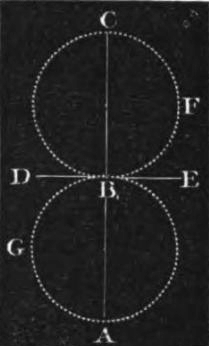
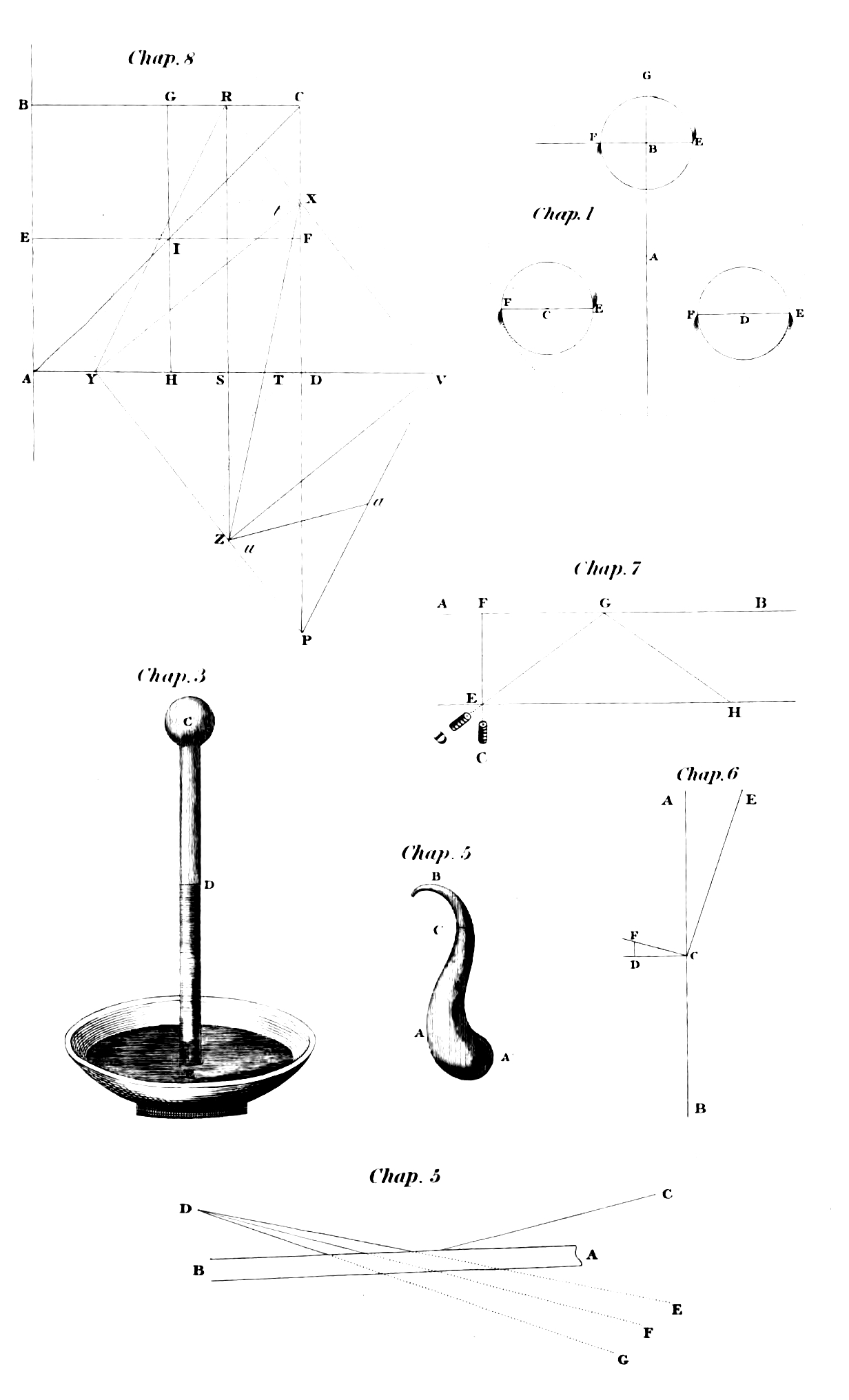
B. Here it is. There is a circle pricked out, whose centre is A, and three less circles, whose centres are B, C, D. Let every one of them represent the earth, as it goeth from B to C, and from C to D, always touching the uttermost circle and throwing off the air, as is marked at E and F. And if the world were not full, there would follow by this scattering of the air, a great deal of space left empty. But supposing the world full, there must be a perpetual shifting of the air, one part into the place of another.
A. But what makes a stone come down, suppose from G?
B. If the air be thrown up beyond G, it will follow that at the last, if the motion be continued, all the air will be above G, that is, above the stone; which cannot be, till the stone be at the earth.
A. But why comes it down still with increasing swiftnessswiftness?
9B. Because as it descends and is already in motion, it receiveth a new impression from the same cause, which is the air, whereof as part mounteth, part also must descend, supposing as we have done the plentitude of the world. For, as you may observe by the figure, the motion of the earth, according to the diameter of the uttermost circle, is progressive; and so the whole motion is compounded of two motions, one circular and the other progressive; and consequently the air ascends and circulates at once. And because the stone descending receiveth a new pressure in every point of its way, the motion thereof must needs be accelerated.
A. It is true; for it will be accelerated equally in equal times; and the way it makes will increase in a double proportion to the times, as hath heretofore been demonstrated by Galileo. I see the solution now of an experiment, which before did not a little puzzle me. You know that if two plummets hang by two strings of equal length, and you remove them from the perpendicular equally, I mean in equal angles, and then let them go, they will make their turns and returns together and in equal times; and though the arches they describe grow continually less and less, yet the times they spend in the greater arches will still be equal to the time they spend in the lesser.
B. It is true. Do you find any experiment to the contrary?
A. Yes; for if you remove one of the plummets from the perpendicular, so as, for example, to make an angle with the perpendicular of eighty degrees, and the other so as to make an angle of sixty 10degrees; they will not make their turns and returns in equal times.
B. And what say you is the cause of this?
A. Because the arches are the spaces which these two motions describe, they must be in double proportion to their own times: which cannot be, unless they be let go from equal altitudes, that is, from equal angles.
B. It is right; and the experiment does not cross, but confirm the equality of the times in all the arches they describe, even from ninety degrees to the least part of one degree.
A. But is it not too bold, if not extravagant an assertion, to say the earth is moved as a man shakes a basin or a sieve? Does not the earth move from west to east every day once, upon its own centre; and in the ecliptic circle once a year? And now you give it another odd motion. How can all these consist in one and the same body?
B. Well enough. If you be a shipboard under sail, do not you go with the ship? Cannot you also walk upon the deck? Cannot every drop of blood move at the same time in your veins? How many motions now do you assign to one and the same drop of blood? Nor is it so extravagant a thing to attribute to the earth this kind of motion; but that I believe, if we certainly knew what motion it is that causeth the descent of bodies, we should find it either the same, or more extravagant. But seeing it can be nothing above that worketh this effect, it must be the earth itself that does it; and if the earth, then you can imagine no other motion to do it withal but this. And you will wonder more, when by the same motion I 11shall give you a probable account of the causes of very many other works of nature.
A. But what part of the heaven do you suppose the poles of your pricked circle point to?
B. I suppose them to be the same with the poles of the ecliptic. For, seeing the axis of the earth in this motion and in the annual motion, keeps parallel to itself, the axis must in both motions be parallel as to sense. For the circle which the earth describes, is not of visible magnitude at the distance it is from the sun.
A. Though I understand well enough how the earth may make a stone descend very swiftly under the ecliptic, or not far from it, where it throws off the air perpendicularly; yet about the poles of the circle methinks, it should cast off the air very weakly. I hope you will not say, that bodies descend faster in places remote from the poles, than nearer to them.
B. No; but I ascribe it to the like motion in the sun and moon. For such motions meeting, must needs cast the stream of the air towards the poles; and then there will be the same necessity for the descent there, that there is in other places, though perhaps a little more slowly. For you may have observed, that when it snows in the south parts, the flakes of snow are not so great as in the north: which is a probable sign they fall in the south from a greater height, and consequently disperse themselves more, as water does that falls down from a high and steep rock.
A. It is not improbable.
B. In natural causes all you are to expect, is but probability; which is better yet, than making 12gravity the cause, when the cause of gravity is that which you desire to know; and better than saying the earth draws it, when the question is, how it draws.
A. Why does the earth cast off air more easily than it does water, or any other heavy bodies?
B. It is indeed the earth that casteth off that air which is next unto it; but it is that air which casteth off the next air; and so continually, air moveth air; which it can more easily do than any other thing, because like bodies are more susceptible of one another’s motions: as you may see in two lute-strings equally strained, what motion one string being stricken communicates to the air, the same will the other receive from the air; but strained to a differing note, will be less or not at all moved. For there is no body but air, that hath not some internal, though invisible, motion of its parts: and it is that internal motion which distinguisheth all natural bodies one from another.
A. What is the cause why certain squibs, though their substance be either wood or other heavy matter, made hollow and filled with gunpowder, which is also heavy; do nevertheless, when the gunpowder is kindled, fly upwards?
B. The same that keeps a man that swims from sinking, though he be heavier than so much water. He keeps himself up, and goes forward, by beating back the water with his feet; and so does a squib, by beating down the air with the stream of fired gunpowder, that proceeding from its tail makes it recoil.
A. Why does any brass or iron vessel, if it be hollow, float upon the water, being so very heavy?heavy?
13B. Because the vessel and the air in it, taken as one body, is more easily cast off than a body of water equal to it.
A. How comes it to pass, that a fish, (especially such a broad fish as a turbot or a plaice, which are broad and thin), in the bottom of the sea, perhaps a mile deep, is not pressed to death with the weight of water that lies upon the back of it?
B. Because all heavy bodies descend towards one point, which is the centre of the earth: and consequently the whole sea, descending at once, does arch itself so, as that the upper parts cannot press the parts next below them.
A. It is evident; nor can there possibly be any weight, as some suppose there is, of a cylinder of air or water or any other liquid thing, while it remains in its own element, or is sustained and inclosed in a vessel by which one part cannot press the other.
A. What makes the flux and reflux of the sea, twice in a natural day?
B. We must come again to our basin of water; wherein you have seen, whilst it was moved, how the water mounteth up by the sides, and withal goes circling round about. Now if you should fasten to the inside of the basin some bar from the bottom to the top, you would see the water, instead of going on, go back again from that bar ebbing, and the water on the other side of the bar 14to do the same, but in counter-time; and consequently to be highest where the contrary streams meet together; and then return again, marking out four quarters of the vessel; two by their meeting, which are the high waters; and two by their retiring, which are the low waters.
A. What bar is that you find in the ocean that stops the current of the water, like that you make in the basin?
B. You know that the main ocean lies east and west, between India and the coast of America; and again on the other side, between America and India. If therefore the earth have such a motion as I have supposed, it must needs carry the current of the sea east and west: in which course, the bar that stoppeth it, is the south part of America, which leaves no passage for the water but the narrow strait of Magellan. The tide rises therefore upon the coast of America; and the rising of the same in this part of the world, proceedeth from the swelling chiefly of the water there, and partly also from the North Sea; which lieth also east and west, and has a passage out of the South Sea by the strait of Anian, between America and Asia.
A. Does not the Mediterranean Sea lie also east and west? Why are there not the like tides there?
B. So there are, proportionable to their lengths and quantity of water.
A. At Genoa, at Ancona, there are none at all, or not sensible.
B. At Venice there are, and in the bottom of the straits, and a current all along both the Mediterranean Sea and the Gulf of Venice: and it is 15the current that makes the tides insensible at the sides; but the check makes them visible at the bottom.
A. How comes it about that the moon hath such a stroke in the business, as so sensibly to increase the tides at full and change?
B. The motion I have hitherto supposed but in the earth, I suppose also in the moon, and in all those great bodies that hang in the air constantly, I mean the stars, both fixed and errant. And for the sun and moon, I suppose the poles of their motion to be the poles of the equinoxial. Which supposed, it will follow (because the sun, the earth, and the moon, at every full and change are almost in one straight line) that this motion of the earth will then be made swifter than in the quarters. For this motion of the sun and moon being communicated to the earth, that hath already the like motion, maketh the same greater; and much greater when they are all three in one straight line, which is only at the full and change, whose tides are therefore called spring tides.
A. But what then is the cause that the spring tides themselves are twice a-year, namely, when the sun is in the equinoxial, greater than at any other times?
B. At other times of the year, the earth being out of the equinoxial, the motion thereof, by which the tides are made, will be less augmented, by so much as a motion in the obliquity of twenty-three degrees, or thereabout, which is the distance between the equinoxial and ecliptic circles, is weaker than the motion which is without obliquity.
A. All this is reasonable enough, if it be possible 16that such motions as you suppose in these bodies, be really there. But that is a thing I have some reason to doubt of. For the throwing off of air, consequent to these motions, is the cause, you say, that other things come to the earth; and therefore the like motions in the sun and moon and stars, casting off the air, should also cause all other things to come to every one of them. From whence it will follow, that the sun, moon, and earth, and all other bodies but air, should presently come together into one heap.
B. That does not follow. For if two bodies cast off the air, the motion of that air will be repressed both ways, and diverted into a course towards the poles on both sides; and then the two bodies cannot possibly come together.
A. It is true. And besides, this driving of the air on both sides, north and south, makes the like motion of air there also. And this may answer the question, how a stone could fall to the earth under the poles of the ecliptic, by the only casting off of air?
B. It follows from hence, that there is a certain and determinate distance of one of these bodies, the stars, from another, without any very sensible variation.
A. All this is probable enough, if it be true that there is no vacuum, no place empty in all the world. And supposing this motion of the sun and moon to be in the plain of the equinoxial, methinks that this should be the cause of the diurnal motion of the earth; and because this motion of the earth is, you say, in the plain of the equinoxial, the same should cause also a motion in the moon on 17her own centre, answerable to the diurnal motion of the earth.
B. Why not? What else can you think makes the diurnal motion of the earth but the sun? And for the moon, if it did not turn upon its own centre, we should see sometimes one, sometimes another face of the moon, which we do not.
A. What convincing argument is there to prove, that in all the world there is no empty place?
B. Many; but I will name but one; and that is, the difficulty of separating two bodies hard and flat laid one upon another. I say the difficulty, not the impossibility. It is possible, without introducing vacuum, to pull asunder any two bodies, how hard and flat soever they be, if the force used be greater than the resistance of the hardness. And in case there be any greater difficulty to part them, besides what proceeds from their hardness, than there is to pull them further asunder when they are parted, that difficulty is argument enough to prove there is no vacuum.
A. These assertions need demonstration. And first, how does the difficulty of separation argue the plenitude of all the rest of the world?
B. If two flat polished marbles lie one upon another, you see they are hardly separated in all points at one and the same instant; and yet the weight of either of them is enough to make them slide off one from the other. Is not the 18cause of this, that the air succeeds the marble that so slides, and fills up the place it leaves?
A. Yes, certainly. What then?
B. But when you pull the whole superficies asunder, not without great difficulty, what is the cause of that difficulty?
A. I think, as most men do, that the air cannot fill up the space between in an instant; for the parting is in an instant.
B. Suppose there be vacuum in that air into which the marble you pull off is to succeed, shall there be no vacuum in the air that was round about the two marbles when they touched? Why cannot that vacuum come into the place between? Air cannot succeed in an instant, because a body, and consequently cannot be moved through the least space in an instant. But emptiness is not a body, nor is moved, but is made by the act itself of separation. There is therefore, if you admit vacuum, no necessity at all for the air to fill the space left in an instant. And therefore, with what ease the marble coming off presseth out the vacuum of the air behind it, with the same ease will the marbles be pulled asunder. Seeing then, if there were vacuum, there would be no difficulty of separation, it follows, because there is difficulty of separation, that there is no vacuum.
A. Well, now, supposing the world full, how do you prove it possible to pull those marbles asunder?
B. Take a piece of soft wax; do not you think the one half touches the other half as close as the smoothest marbles? Yet you can pull them asunder. But how? Still as you pull, the wax 19grows continually more and more slender; there being a perpetual parting or discession of the outermost part of the wax one from another, which the air presently fills; and so there is a continual lessening of the wax, till it be no bigger than a hair, and at last separation. If you can do the same to a pillar of marble, till the outside give way, the effect will be the same, but much quicker, after it once begins to break in the superficies; because the force that can master the first resistance of the hardness, will quickly dispatch the rest.
A. It seems so by the brittleness of some hard bodies. But I shall afterward put some questions to you, touching the nature of hardness. But now to return to our subject. What reason can you render (without supposing vacuum) of the effects produced in the engine they use at Gresham college?
B. That engine produceth the same effects that a strong wind would produce in a narrow room.
A. How comes the wind in? You know the engine is a hollow round pipe of brass, into which is thrust a cylinder of wood covered with leather, and fitted to the cylinder so exactly as no air can possibly pass between the leather and the brass?
B. I know it; and that they may thrust it up, there is a hole left in the cylinder to let the air out before it, which they can stop when they please. There is also in the bottom of the cylinder a passage into a hollow globe of glass, which passage they can also open and shut at pleasure. And at the top of that globe there is a wide mouth to put in what they please to try conclusions on, and that also to be opened and shut as shall be needful. It is of the nature of a pop-gun which children use, 20but great, costly, and more ingenious. They thrust forward and pull back the wooden cylinder (because it requires much strength) with an iron screw. What is there in all this to prove the possibility of vacuum.
A. When this wooden cylinder covered with leather, fit and close, is thrust home to the bottom, and the holes in the hollow cylinder of brass close stopped, how can it be drawn back, as with the screw they draw it, but that the space it leaves must needs be empty: for it is impossible that any air can pass into the place to fill it?
B. Truly I think it close enough to keep out straw and feathers, but not to keep out air, nor yet matter. For suppose they were not so exactly close but that there were round about a difference for a small hair to lie between; then will the pulling back of the cylinder of wood force so much air in, as in retiring it forces back, and that without any sensible difficulty. And the air will so much more swiftly enter as the passage is left more narrow. Or if they touch, and the contact be in some points and not in all, the air will enter as before, in case the force be augmented accordingly. Lastly, though they touch exactly, if either the leather yield, or the brass, which it may do, to the force of a strong screw, the air will again enter. Do you think it possible to make two superficies so exquisitely touch in all points as you suppose, or leather so hard as not to yield to the force of a screw? The body of leather will give passage both to air and water, as you will confess when you ride in rainy and windy weather. You may therefore be assured that in drawing out their 21wooden leather cylinder, they force in as much air as will fill the place it leaves, and that with as much swiftness as is answerable to the strength that drives it in. The effect therefore of their pumping is nothing else but a vehement wind, a very vehement wind, coming in on all sides of the cylinder at once into the hollow of the brass pipe, and into the hollow of the glass globe joined to it.
A. I see the reason already of one of their wonders, which is, that the cylinder they pump with, if it be left to itself, after it is pulled back, will swiftly go up again. You will say the air comes out again with the same violence by reflection, and I believe it.
B. This is argument enough that the place was not empty. For what can fetch or drive up the sucker, as they call it, if the place within were empty? For that there is any weight in the air to do it, I have already demonstrated to be impossible. Besides, you know, when they have sucked out, as they think, all the air from the glass globe, they can nevertheless both see through it what is done, and hear a sound from within when there is any made; which, if there were no other, but there are many other, is argument enough that the place is still full of air.
A. What say you to the swelling of a bladder even to bursting, if it be a little blown when it is put into the receiver, for so they call the globe of glass?
B. The streams of air that from every side meeting together, and turning in an infinite number of small points, do pierce the bladder in innumerable places with great violence at once, like so many 22invisible small wimbles, especially if the bladder be a little blown before it be put in, that it may make a little resistance. And when the air has once pierced it, it is easy to conceive, that it must afterward by the same violent motion be extended till it break. If before it break you let in fresh air upon it, the violence of the motion will thereby be tempered, and the bladder be less extended; for that also they have observed. Can you imagine how a bladder should be extended and broken by being too full of emptiness?
A. How come living creatures to be killed in this receiver, in so little a time as three or four minutes of an hour?
B. If they suck into their lungs so violent a wind thus made, you must needs think it will presently stop the passage of their blood; and that is death; though they may recover if taken out before they be too cold. And so likewise will it put out fire; but the coals taken out whilst they are hot will revive again. It is an ordinary thing in many coal-pits, whereof I have seen the experience, that a wind proceeding from the sides of the pit every way, will extinguish any fire let down into it, and kill the workmen, unless they be quickly taken out.
A. If you put a vessel of water into the receiver, and then suck out the air, the water will boil; what say you to that?
B. It is like enough it will dance in so great a bustling of the air; but I never heard it would be hot. Nor can I imagine how vacuum should make anything dance. I hope you are by this time satisfied, that no experiment made with the engine at 23Gresham College, is sufficient to prove that there is, or that there may be vacuum.
A. The world you know is finite, and consequently, all that infinite space without it is empty. Why may not some of that vacuum be brought in, and mingled with the air here?
B. I know nothing in matters without the world.
A. What say you to Torricellio’s experiment in quicksilver, which is this: there is a basin at A filled with quicksilver, suppose to B, and C D a hollow glass pipe filled with the same, which if you stop with your finger at B, and so set it upright, and then if you take away your finger, the quicksilver will fall from C downwards but not to the bottom, for it will stop by the way, suppose at D. Is it not therefore necessary that that space between C and D be left empty? Or will you say the quicksilver does not exactly touch the sides of the glass pipe?
B. I will say neither. If a man thrust down into a vessel of quicksilver a blown bladder, will not that bladder come up to the top?
A. Yes, certainly, or a bladder of iron, or anything else but gold.
B. You see then that air can pierce quicksilver.
A. Yes, with so much force as the weight of quicksilver comes to.
B. When the quicksilver is fallen to D, there is so much the more in the basin, and that takes up the place which so much air took up before. Whither can this air go if all the world without that glass pipe B C were full? There must needs be the same or as much air come into that space, 24which only is empty, between C and D: by what force? By the weight of the quicksilver between D and B. Which quicksilver weigheth now upward, or else it could never have raised that part higher, which was at first in the basin. So you see the weight of quicksilver can press the air through quicksilver up into the pipe, till it come to an equality of force as in D, where the weight of the quicksilver is equal to the force which is required in air to go through it.
A. If a man suck a phial that has nothing in it but air, and presently dip the mouth of it into water, the water will ascend into the phial. Is not that an argument that part of the air had been sucked out, and part of the room within the phial left empty?
B. No. If there were empty space in the world, why should not there be also some empty space in the phial before it was sucked? And then why does not the water rise to fill that? When a man sucks the phial he draws nothing out, neither into his belly, nor into his lungs, nor into his mouth; only he sets the air within the glass into a circular motion, giving it at once an endeavour to go forth by the sucking, and an endeavour to go back by not receiving it into his mouth; and so with a great deal of labour glues his lips to the neck of the phial. Then taking it off, and dipping the neck of the phial into the water before the circulation ceases, the air, with the endeavour it hath now gotten, pierces the water and goes out: and so much air as goes out, so much matter comes up into the room of it.
A. What is the cause of heat?
B. How know you, that any thing is hot but yourself?
A. Because I perceive by sense it heats me.
B. It is no good argument, the thing heats me; therefore it is hot. But what alteration do you find in your body at any time by being hot?
A. I find my skin more extended in summer than in winter; and am sometimes fainter and weaker then ordinary, as if my spirits were exhaled; and I sweat.
B. Then that is it you would know the cause of. I have told you before that by the motion I suppose both in the sun, and in the earth, the air is dissipated, and consequently that there would be an infinite number of small empty places, but that the world being full, there comes from the next parts other air into the spaces they would else make empty. When therefore this motion of the sun is exercised upon the superficies of the earth, if there do not come out of the earth itself some corporal substance to supply that tearing of the air, we must return again to the admission of vacuum. If there do, then you see how by this motion fluid bodies are made to exhale out of the earth. The like happens to a man’s body or hand, which when he perceives, he says he is hot. And so of the earth when it sendeth forth water and 26earth together in plants, we say it does it by heat from the sun.
A. It is very probable, and no less probable, that the same action of the sun is that which from the sea and moist places of the earth, but especially from the sea, fetcheth up the water into the clouds. But there be many ways of heating besides the action of the sun or of fire. Two pieces of wood will take fire if in turning they be pressed together.
B. Here again you have a manifest laceration of the air by the reciprocal and contrary motions of the two pieces of wood, which necessarily causeth a coming forth of whatsoever is aereal or fluid within them, and (the motion pursued) a dissipation also of the other more solid parts into ashes.
A. How comes it to pass that a man is warmed even to sweating, almost with every extraordinary labour of his body?
B. It is easy to understand, how by that labour all that is liquid in his body is tossed up and down, and thereby part of it also cast forth.
A. There be some things that make a man hot without sweat or other evaporation, as caustics, nettles, and other things.
B. No doubt. But they touch the part they so heat, and cannot work that effect at any distance.
A. How does heat cause light, and that partially, in some bodies more, in some less, though the heat be equal?
B. Heat does not cause light at all. But in many bodies, the same cause, that is to say, the same motion, causeth both together; so that they are not to one another as cause and effect, but are 27concomitant effects sometimes of one and the same motion.
A. How?
B. You know the rubbing or hard pressing of the eye, or a stroke upon it, makes an apparition of light without and before it, which way soever you look. This can proceed from nothing else but from the restitution of the organ pressed or stricken, unto its former ordinary situation of parts. Does not the sun by his thrusting back the air upon your eyes press them? Or do not those bodies whereon the sun shines, though by reflection, do the same, though not so strongly? And do not the organs of sight, the eye, the heart, and brains, resist that pressure by an endeavour of restitution outwards? Why then should there not be without and before the eye, an apparition of light in this case as well as in the other?
A. I grant there must. But what is that which appears after the pressing of the eye? For there is nothing without that was not there before; or if there were, methinks another should see it better, or as well as he; or if in the dark, methinks it should enlighten the place.
B. It is a fancy, such as is the appearance of your face in a looking-glass; such as is a dream; such as is a ghost; such as is a spot before the eye that hath stared upon the sun or fire. For all these are of the regiment of fancy, without any body concealed under them, or behind them, by which they are produced.
A. And when you look towards the sun or moon, why is not that also which appears before your eyes at that time a fancy?
28B. So it is. Though the sun itself be a real body, yet that bright circle of about a foot diameter cannot be the sun, unless there be two suns, a greater and a lesser. And because you may see that which you call the sun, both above you in the sky, and before you in the water, and two suns, by distorting your eye, in two places in the sky, one of them must needs be fancy. And if one, both. All sense is fancy, though the cause be always in a real body.
A. I see by this that those things which the learned call the accidents of bodies, are indeed nothing else but diversity of fancy, and are inherent in the sentient, and not in the objects, except motion and quantity. And I perceive by your doctrine you have been tampering with Leviathan . But how comes wood with a certain degree of heat to shine, and iron also with a greater degree; but no heat at all to be able to make water shine?
B. That which shineth hath the same motion in its parts that I have all this while supposed in the sun and earth. In which motion there must needs be a competent degree of swiftness to move the sense, that is, to make it visible. All bodies that are not fluid will shine with heat, if the heat be very great. Iron will shine and gold will shine; but water will not, because the parts are carried away before they attain to that degree of swiftness which is requisite.
A. There are many fluid bodies whose parts evaporate, and yet they make a flame, as oil, and wine, and other strong drinks.
B. As for oil I never saw any inflamed by itself, how much soever heated, therefore I do not think 29they are the parts of the oil, but of the combustible body oiled that shine; but the parts of wine and strong drinks have partly a strong motion of themselves, and may be made to shine, but not with boiling, but by adding to them as they rise the flame of some other body.
A. How can it be known that the particles of wine have such a motion as you suppose?
B. Have you ever been so much distempered with drinking wine, as to think the windows and table move?
A. I confess, though you be not my confessor, I have; but very seldom; and I remember the window seemed to go and come in a kind of circling motion, such as you have described. But what of that?
B. Nothing, but that it was the wine that caused it; which having a good degree of that motion before, did, when it was heated in the veins, give that concussion, which you thought was in the window, to the veins themselves, and, by the continuation of the parts of man’s body, to the brain; and that was it which made the window seem to move.
A. What is flame? For I have often thought the flame that comes out of a small heap of straw to be more, before it hath done flaming, than a hundred times the straw itself.
B. It was but your fancy. If you take a stick in your hand by one end, the other end burning, and move it swiftly, the burning end, if the motion be circular, shall seem a circle; if straight, a straight line of fire, longer or shorter, according to the swiftness of the motion, or the space it moves in. You know the cause of that.
30A. I think it is, because the impression of that visible object, which was made at the first instant of the motion, did last till it was ended. For then it will follow that it must be visible all the way, the impressions in all points of the time being equal.
B. The cause can be no other. The smallest spark of fire flying up seems a line drawn upward; and again by that swift circular motion which we have supposed for the cause of light, seems also broader than it is. And consequently the flame of every thing must needs seem much greater than it is.
A. What are those sparks that fly out of the fire?
B. They are small pieces of the wood or coals, or other fuel loosened and carried away with the air that cometh up with them. And being extinguished before their parts be quite dissipated into others, are so much soot, and black, and may be fired again.
A. A spark of fire may be stricken out of a cold stone. It is not therefore heat that makes this shining.
B. No it is the motion that makes both the heat and shining; and the stroke makes the motion. For every of those sparks, is a little parcel of the stone, which swiftly moved, imprinteth the same motion into the matter prepared, or fit to receive it.
A. How comes the light of the sun to burn almost any combustible matter by refraction through a convex glass, and by reflection from a concave?
B. The air moved by the sun presseth the convex 31glass in such manner as the action continued through it, proceedeth not in the same straight line by which it proceeded from the sun, but tendeth more toward the centre of the body it enters. Also when the action is continued through the convex body, it bendeth again the same way. By which means the whole action of the sun-beams are enclosed within a very small compass: in which place therefore there must be a very vehement motion; and consequently, if there be in that place combustible matter, such as is not very hard to kindle, the parts of it will be dissipated, and receive that motion which worketh on the eye as other fire does.
The same reason is to be given for burning by reflection. For there also the beams are collected into almost a point.
A. Why may not the sun-beams be such a body as we call fire, and pass through the pores of the glass so disposed as to carry them to a point, or very near?
B. Can there be a glass that is all pores? if there cannot, then cannot this effect be produced by the passing of fire through the pores. You have seen men light their tobacco at the sun with a burning glass, or with a ball of crystal, held which way they will indifferently. Which must be impossible, unless the ball were all pores. Again, neither you nor I can conceive any other fire than we have seen, nor than such as water will put out. But not only a solid globe of glass or crystal will serve for a burning-glass, but also a hollow one filled with water. How then does the fire from the sun pass through the glass of water without being 32put out before it come to the matter they would have it burn?
A. I know not. There comes nothing from the sun. If there did, there is come so much from it already, that at this day we had had no sun.
A. What call you hard, and what soft?
B. That body whereof no one part is easily put out of its place, without removing the whole, is that which I and all men call hard; and the contrary soft. So that they are but degrees one of another.
A. What is the cause that makes one body harder than another, or, seeing you say they are but degrees of one another, what makes one body softer than another, and the same body sometimes harder, sometimes softer?
B. The same motion which we have supposed from the beginning for the cause of so many other effects. Which motion not being upon the centre of the part moved, but the part itself going in another circle to and again, it is not necessary that the motion be perfectly circular. For it is not circulation, but the reciprocation, I mean the to and again, that does cast off, and lacerate the air, and consequently produce the fore-mentioned effects.
For the cause therefore of hardness, I suppose the reciprocation of motion in those things which are hard, to be very swift, and in very small circles.
33A. This is somewhat hard to believe. I would you could supply it with some visible experience.
B. When you see, for example, a cross-bow bent, do you think the parts of it stir?
A. No. I am sure they do not.
B. How are you sure? You have no argument for it, but that you do not see the motion. When I see you sitting still, must I believe there is no motion in your parts within, when there are so many arguments to convince me there is.
A. What argument have you to convince me that there is motion in a cross-bow when it stands bent?
B. If you cut the string, or any way set the bow at liberty, it will have then a very visible motion. What can be the cause of that?
A. Why the setting of the bow at liberty.
B. If the bow had been crooked before it was bent, and the string tied to both ends, and then cut asunder, the bow would not have stirred. Where lies the difference?
A. The bow bent has a spring; unbent it has none, how crooked soever.
B. What mean you by spring?
A. An endeavour of restitution to its former posture.
B. I understand spring as well as I do endeavour.
A. I mean a principle or beginning of motion in a contrary way to that of the force which bent it.
B. But the beginning of motion is also motion, how insensible soever it be. And you know that nothing can give a beginning of motion to itself. What is it therefore that gives the bow (which you say you are sure was at rest when it stood bent) 34its first endeavour to return to its former posture?
A. It was he that bent it.
B. That cannot be. For he gave it an endeavour to come forward, and the bow endeavours to go backward.
A. Well, grant that endeavour be motion, and motion in the bow unbent, how do you derive from thence, that being set at liberty it must return to its former posture?
B. Thus there being within the bow a swift (though invisible) motion of all the parts, and consequently of the whole; the bending causeth that motion, which was along the bow (that was beaten out when it was hot into that length) to operate across the length in every part of it, and the more by how much it is more bent; and consequently endeavours to unbend it all the while it stands bent. And therefore when the force which kept it bent is removed, it must of necessity return to the posture it had before.
A. But has that endeavour no effect at all before the impediment be removed? For if endeavour be motion, and every motion have some effect more or less, methinks this endeavour should in time produce something.
B. So it does. For in time (in a long time) the course of this internal motion will lie along the bow, not according to the former, but to the new acquired posture. And then it well be as uneasy to return it to its former posture, as it was before to bend it.
A. That is true. For bows long bent lose their appetite to restitution, long custom becoming 35nature. But from this internal reciprocation of the parts, how do you infer the hardness of the whole body?
B. If you apply force to any single part of such a body, you must needs disorder the motion of the next parts to it before it yield, and there disordered, the motion of the next again must also be disordered; and consequently no one part can yield without force sufficient to disorder all: but then the whole body must also yield. Now when a body is of such a nature as no single part can be removed without removing the whole, men say that body is hard.
A. Why does the fire melt divers hard bodies, and yet not all?
B. The hardest bodies are those wherein the motion of the parts are the most swift, and yet in the least circles. Wherefore if the fire, the motion of whose parts are swift, and in greater circles, be made so swift, as to be strong enough to master the motion of the parts of the hard body, it will make those parts to move in a greater compass, and thereby weaken their resistance, that is to say, soften them, which is a degree of liquefaction. And when the motion is so weakened, as that the parts lose their coherence by the force of their own weight, then we count the body melted.
A. Why are the hardest things the most brittle, insomuch that what force soever is enough to bend them, is enough also to break them?
B. In bending a hard body, as (for example) a rod of iron, you do not enlarge the space of the internal motion of the parts of iron, as the fire 36does; but you master and interrupt the motion, and that chiefly in one place. In which place the motion that makes the iron hard being once overcome, the prosecution of that bending must needs suddenly master the motions of the parts next unto it, being almost mastered before.
A. I have seen a small piece of glass, the figure whereof is this, A A B C. Which piece of glass if you bend toward the top, as in C, the whole body will shatter asunder into a million of pieces, and be like to so much dust. I would fain see you give a probable reason of that.
B. I have seen the experiment. The making of the glass is thus: they dip an iron rod into the molten glass that stands in a vessel within the furnace. Upon which iron rod taken out, there will hang a drop of molten but tough metal of the figure you have described, which they let fall into the water. So that the main drop comes first to the water, and after it the tail, which though straight whilst it hung on the end of the rod, yet by falling into the water becomes crooked. Now you know the making of it, you may consider what must be the consequence of it. Because the main drop A comes first to the water, it is therefore first quenched, and consequently the motion of the parts of that drop, which by the fire were made to be moved in a larger compass, is by the water made to shrink into lesser circles towards the other end B, but with the same or not much less swiftness.
A. Why so?
B. If you take any long piece of iron, glass, or other uniform and continued body; and having heated one end thereof, you hold the other end in 37your hand, and so quench it suddenly, though before you held it easily enough, yet now it will burn your fingers.
A. It will so.
B. You see then how the motion of the parts from A toward C is made more violent and in less compass by quenching the other parts first. Besides, the whole motion that was in all the parts of the main drop A, is now united in the small end B C. And this I take to be the cause why that small part B C is so exceeding stiff. Seeing also this motion in every small part of the glass, is not only circular, but proceeds also all along the glass from A to B, the whole motion compounded will be such as the motion of spinning any soft matter into thread, and will dispose the whole body of the glass in threads, which in other hard bodies are called the grain. Therefore if you bend this body (for example) in C (which to do will require more force than a man would think that has not tried) those threads of glass must needs be all bent at the same time, and stand so, till by the breaking of the glass at C, they be all at once set at liberty; and then all at once being suddenly unbent, like so many brittle and overbent bows, their strings breaking, be shivered in pieces.
A. It is like enough to be so. And if nature have betrayed herself in any thing, I think it is in this, and in that other experience of the crossbow; which strongly and evidently demonstrates the internal reciprocation of the motion, which you suppose to be in the internal parts of every hard body. And I have observed somewhat in looking-glasses which much confirms that there is some 38such motion in the internal parts of glass, as you have supposed for the cause of hardness. For let the glass be A B, and let the object at C be a candle, and the eye at D. Now by divers reflections and refractions in the two superficies of the glass, if the lines of vision be very oblique, you shall see many images of the candle, as E, F, G, in such order and position as is here described. But if you remove your eye to C, and the candle to D, they will appear in a situation manifestly different from this. Which you will yet more plainly perceive if the looking-glass be coloured, as I have observed in red and blue glasses; and could never conceive any probable cause of it, till now you tell me of this secret motion of the parts across the grain of the glass, acquired by cooling it this or that way.
B. There be very many kinds of hard bodies, metals, stones, and other kinds, in the bowels of the earth, that have been there ever since the beginning of the world; and I believe also many different sorts of juices that may be made hard. But for one general cause of hardness it can be no other than such an internal motion of parts as I have already described, whatsoever may be the cause of the several concomitant qualities of their hardness in particular.
A. We see water hardened every frosty day. It is likely therefore you may give a probable cause of ice. What is the cause of freezing of the ocean towards the poles of the earth?
B. You know the sun being always between the tropics, and (as we have supposed) always casting off the air; and the earth likewise casting it off 39from itself, there must needs on both sides be a great stream of air towards the poles, shaving the superficies of the earth and sea, in the northern and southern climates. This shaving of the earth and sea by the stream of air must needs contract and make to shrink those little circles of the internal parts of earth and water, and consequently harden them, first at the superficies, into a thin skin, which is the first ice; and afterwards the same motion continuing, and the first ice co-operating, the ice becomes thicker. And this I conceive to be the cause of the freezing of the ocean.
A. If that be the cause, I need not ask how a bottle of water is made to freeze in warm weather with snow, or ice mingled with salt. For when the bottle is in the midst of it, the wind that goeth out both of the salt and of the ice as they dissolve, must needs shave the superficies of the bottle, and the bottle work accordingly on the water without it, and so give it first a thin skin, and at last thicken it into a solid piece of ice. But how comes it to pass that water does not use to freeze in a deep pit?
B. A deep pit is a very thick bottle, and such as the air cannot come at but only at the top, or where the earth is very loose and spungy.
A. Why will not wine freeze as well as water?
B. So it will when the frost is great enough. But the internal motion of the parts of wine and other heating liquors is in greater circles and stronger than the motion of the parts of water; and therefore less easily to be frozen, especially quite through, because those parts that have the strongest motion retire to the centre of the vessel.
A. What is the original cause of rain? And how is it generated?
B. The motion of the air (such as I have described to you already) tending to the disunion of the parts of the air, must needs cause a continual endeavour (there being no possibility of vacuum) of whatsoever fluid parts there are upon the face of the earth and sea, to supply the place which would else be empty. This makes the water, and also very small and loose parts of the earth and sea to rise, and mingle themselves with the air, and to become mist and clouds. Of which the greatest quantity arise there, where there is most water, namely, from the large parts of the ocean; which are the South Sea, the Indian Sea, and the sea that divided Europe and Africa from America; over which the sun for the greatest part of the year is perpendicular, and consequently raiseth a greater quantity of water; which afterwards gathered into clouds, falls down in rain.
A. If the sun can thus draw up the water, though but in small drops, why can it not as easily hold it up?
B. It is likely it would also hold them up, if they did not grow greater by meeting together, nor were carried away by the air towards the poles.
A. What makes them gather together?
B. It is not improbable that they are carried 41against hills, and there stopt till more overtake them. And when they are carried towards the North or South where the force of the sun is more oblique and thereby weaker, they descend gently by their own weight. And because they tend all to the centre of the earth, they must needs be united in their way for want of room, and so grow bigger. And then it rains.
A. What is the reason it rains so seldom, but snows so often upon very high mountains?
B. Because, perhaps, when the water is drawn up higher than the highest mountains, where the course of the air between the equator and the poles is free from stoppage, the stream of the air freezeth it into snow. And it is in those places only where the hills shelter it from that stream, that it falls in rain.
A. Why is there so little rain in Egypt, and yet so much in other parts nearer the equinoxial, as to make the Nile overflow the country?
B. The cause of the falling of rain I told you was the stopping, and consequently the collection of clouds about great mountains, especially when the sun is near the equinoxial, and thereby draws up the water more potently, and from greater seas. If you consider therefore that the mountains in which are the springs of Nile, lie near the equinoxial and are exceedingly great, and near the Indian Sea, you will not think it strange there should be great store of snow. This as it melts makes the rain of Nile to rise, which in April and May going on toward Egypt arrive there about the time of the solstice, and overflow the country.
A. Why should not the Nile then overflow that 42country twice a year, for it comes twice a-year to the equinoxial.
B. From the autumnal equinox, the sun goeth on toward the southern tropic, and therefore cannot dissolve the snow on that side of the hills that looks towards Egypt.
A. But then there ought to be such another inundation southward.
B. No doubt but there is a greater descent of water there in their summer than at other times, as there must be wheresoever there is much snow melted. But what should that inundate, unless it should overflow the sea that comes close to the foot of those mountains? And for the cause why it seldom rains in Egypt, it may be this, that there are no very high hills near it to collect the clouds. The mountains whence Nile riseth being near two thousand miles off. The nearest on one side are the mountains of Nubia, and on the other side Sina and the mountains of Arabia.
A. Whence think you proceed the winds?
B. From the motion, I think, especially of the clouds, partly also from whatsoever is moved in the air.
A. It is manifest that the clouds are moved by the winds; so that there were winds before any clouds could be moved. Therefore I think you make the effect before the cause.
B. If nothing could move a cloud but wind, your objection were good. But you allow a cloud to descend by its own weight. But when it so descends, it must needs move the air before it, even to the earth, and the earth again repel it, and so make lateral winds every way, which will 43carry forward other clouds if there be any in their way, but not the cloud that made them. The vapour of the water rising into clouds, must needs also, as they rise, raise a wind.
A. I grant it. But how can the slow motion of a cloud make so swift a wind as it does?
B. It is not one or two little clouds, but many and great ones that do it. Besides, when the air is driven into places already covered, it cannot but be much the swifter for the narrowness of the passage.
A. Why does the south wind more often than any other bring rain with it?
B. Where the sun hath most power, and where the seas are greatest, that is in the south, there is most water in the air; which a south wind can only bring to us. But I have seen great showers of rain sometimes also when the wind hath been north, but it was in summer, and came first, I think, from the south or west, and was brought back from the north.
A. I have seen at sea very great waves when there was no wind at all. What was it then that troubled the water?
B. But had you not wind enough presently after?
A. We had a storm within a little more than a quarter of an hour after.
B. That storm was then coming and had moved the water before it. But the wind you could not perceive, for it came downwards with the descending of the clouds, and pressing the water bounded above your sail till it came very near. And that was it that made you think there was no wind at all.
44A. How comes it to pass that a ship should go against the wind which moves it, even almost point blank, as if it were not driven but drawn?
B. You are to know first, that what body soever is carried against another body, whether perpendicularly or obliquely, it drives it in a perpendicular to the superficies it lighteth on. As for example, a bullet shot against a flat wall, maketh the stone, or other matter it hits, to retire in a perpendicular to that flat; or, if the wall be round, towards the centre, that is to say, perpendicularly. For if the way of the motion be oblique to the wall, the motion is compounded of two motions, one parallel to the wall, and the other perpendicular. By the former whereof the bullet is carried along the wall side, by the other it approacheth to it. Now the former of these motions can have no effect upon it; all the battery is from the motion perpendicular, in which it approacheth, and therefore the part it hits must also retire perpendicularly. If it were not so, a bullet with the same swiftness would execute as much obliquely shot, as perpendicularly, which you know it does not.
A. How do you apply this to a ship?
B. Let A B be the ship, the head of it A. If the wind blow just from A towards B, it is true the ship cannot go forward howsoever the sail be set. Let C D be perpendicular to the ship, and let the sail E C be never so little oblique to it, and F C perpendicular to E C, and then you see the ship will gain the space D F to the headward.
A. It will so; but when it is very near to the wind it will go forward very slowly, and make more way with her side to the leeward.
45B. It will indeed go slower in the proportion of the line A E to the line C E. But the ship will not go so fast as you think sideward: one cause is the force of that wind which lights on the side of the ship itself; the other is the bellying of the sail; for the former, it is not much, because the ship does not easily put from her the water with her side; and bellying of the sail gives some little hold for the wind to drive the ship astern.
A. For the motion sideward I agree with you; but I had thought the bellying of the sail had made the ship go faster.
B. But it does not; only in a fore wind it hinders least.
A. By this reason a broad thin board should make the best sail.
B. You may easily foresee the great incommodities of such a sail. But I have seen tried in little what such a wind can do in such a case. For I have seen a board set upon four truckles, with a staff set up in the midst of it for a mast, and another very thin and broad board fastened to that staff in the stead of a sail, and so set as to receive the wind very obliquely, I mean so as to be within a point of the compass directly opposite to it, and so placed upon a reasonable smooth pavement where the wind blew somewhat strongly. The event was first, that it stood doubting whether it should stir at all or no, but that was not long, and then it ran a-head extreme swiftly, till it was overthrown by a rub.
A. Before you leave the ship, tell me how it comes about that so small a thing as a rudder can so easily turn the greatest ship.
46B. It is not the rudder only, there must also be a stream to do it; you shall never turn a ship with a rudder in a standing pool, nor in a natural current. You must make a stream from head to stern, either with oars or with sails; when you have made such a stream, the turning of the rudder obliquely holds the water from passing freely, and the ship or boat cannot go on directly, but as the rudder inclines to the stern, so will the ship turn; but this is too well known to insist upon. You have observed that the rudders of the greatest ships are not very broad, but go deep into the water, whereas western barges, though but small vessels, have their rudders much broader, which argues that the holding of water from passing is the true office of a rudder; and therefore to a ship that draws much water the rudder is made deep accordingly; and in barges that draw little water, the rudders being less deep, must so much the more be extended in breadth.
A. What makes snow?
B. The same cause which, speaking of hardness, I supposed for the cause of ice. For the stream of air proceeding from that both the earth and the sun cast off the air, consequently maketh a stream of air from the equinoxial towards the poles, passing amongst the clouds, shaving those small drops of water whereof the clouds consist, and congeals them as they do the water of the sea, or of a river. And these small frozen drops are that which we call snow.
A. But then how are great drops frozen into hailstones, and that especially (as we see they are) in summer?
47B. It is especially in summer, and hot weather, that the drops of water which make the clouds, are great enough; but it is then also that clouds are sooner and more plentifully carried up. And therefore the current of the air strengthened between the earth and the clouds, becomes more swift; and thereby freezeth the drops of water, not in the cloud itself, but as they are falling. Nor does it freeze them thoroughly, the time of their falling not permitting it, but gives them only a thin coat of ice; as is manifest by their sudden dissolving.
A. Why are not sometimes also whole clouds when pregnant and ready to drop, frozen into one piece of ice?
B. I believe they are so whensoever it thunders.
A. But upon what ground do you believe it?
B. From the manner or kind of noise they make, namely a crack; which I see not how it can possibly be made by water or any other soft bodies whatsoever.
A. Yes, the powder they call aurum fulminans, when thoroughly warm, gives just such another crack as thunder.
B. But why may not every small grain of that aurum fulminans by itself be heard, though a heap of them together be soft, as is any heap of sand. Salts of all sorts are of the nature of ice. But gold is dissolved into aurum fulminans by nitre and other salts. And the least grain of it gives a little crack in the fire by itself. And therefore when they are so warmed by degrees, the crack cannot choose but be very great.
48A. But before it be aurum fulminans they use to wash away the salt (which they call dulcifying it), and then they dry it gently by degrees.
B. That is, they exhale the pure water that is left in the powder, and leave the salt behind to harden with drying. Other powder made of salts without any gold in them will give a crack as great as aurum fulminans. A very great chemist of our times hath written, that salt of tartar, saltpetre, and a little brimstone ground together into a powder, and dried, a few grains of that powder will be made by the fire to give as great a clap as a musket.
A. Methinks it were worth your trial to see what effect a quart or a pint of aurum fulminans would produce, being put into a great gun made strong enough on purpose, and the breech of the gun set in hot cinders, so as to heat by degrees, till the powder fly.
B. I pray you try it yourself; I cannot spare so much money.
A. What is it that breaketh the clouds when they are frozen?
B. In very hot weather the sun raiseth from the sea and all moist places abundance of water, and to a great height. And whilst this water hangs over us in clouds, or is again descending, it raiseth other clouds, and it happens very often that they press the air between them, and squeeze it through the clouds themselves very violently; which as it passes shaves and hardens them in the manner declared.
A. That has already been granted; my question is what breaks them?
49B. I must here take in one supposition more.
A. Then your basin, it seems, holds not all you have need of.
B. It may for all this, for the supposition I add is no more but this; that what internal motion I ascribe to the earth, and the other concrete parts of the world, is to be supposed also in every of their parts how small soever; for what reason is there to think, in case the whole earth have in truth the motion I have ascribed to it, that one part of it taken away, the remaining part should lose that motion. If you break a loadstone, both parts will retain their virtue, though weakened according to the diminution of their quantity; I suppose therefore in every small part of the earth the same kind of motion, which I have supposed in the whole: and so I recede not yet from my basin.
A. Let it be supposed, and withal, that abundance of earth, (which I see you aim at), be drawn up together with the water. What then?
B. Then if many pregnant clouds, some ascending and some descending meet together, and make concavities between, and by the pressing out of the air, as I have said before, become ice; those atoms, as I may call them, of earth will, by the straining of the air through the water of the clouds, be left behind, and remain in the cavities of the clouds, and be more in number than for the proportion of the air therein. Therefore for want of liberty they must needs justle one another, and become, as they are more and more straightened of room, more and more swift, and consequently at last break the ice suddenly and violently, now in one place, and by 50and by in another; and make thereby so many claps of thunder, and so many flashes of lightning. For the air recoiling upon our eyes, is that which maketh those flashes to our fancy.
A. But I have seen lightning in a very clear evening, when there has been neither thunder nor clouds.
B. Yes, in a clear evening; because the clouds and the rain were below the horizon, perhaps forty or fifty miles off; so that you could not see the clouds nor hear the thunder.
A. If the clouds be indeed frozen into ice, I shall not wonder if they be sometimes also so situated, as, like looking-glasses, to make us see sometimes three or more suns by refraction and reflection.
A. If a bullet from a certain point given, be shot against a wall perpendicularly, and again from the same point obliquely, what will be the proportion of the forces wherewith they urge the wall? For example, let the wall be A B, a point given E, a gun C E, that carries the bullet perpendicularly to F, and another gun D E, that carries the like bullet with the same swiftness obliquely to G; in what proportion will their forces be upon the wall?
B. The force of the stroke perpendicular from E to F will be greater then the oblique force from E 51to G, in the proportion of the line E G to the line E F.
A. How can the difference be so much? Can the bullet lose so much of its force in the way from E to G?
B. No; we will suppose it loseth nothing of its swiftness. But the cause is, that their swiftness being equal, the one is longer in coming to the wall than the other, in proportion of time, as E G to E F. For though their swiftness be the same, considered in themselves, yet the swiftness of their approach to the wall is greater in E F than in E G, in proportion of the lines themselves.
A. When a bullet enters not, but rebounds from the wall, does it make the same angle going off, which it did falling on, as the sun-beams do?
B. If you measure the angles close by the wall their difference will not be sensible; otherwise it will be great enough, for the motion of the bullet grows continually weaker. But it is not so with the sun-beams which press continually and equally.
A. What is the cause of reflection? When a body can go no further on, it has lost its motion. Whence then comes the motion by which it reboundeth?
B. This motion of rebounding or reflecting proceedeth from the resistance. There is a difference to be considered between the reflection of light, and of a bullet, answerable to their different motions, pressing and striking. For the action which makes reflection of light, is the pressure of the air upon the reflecting body, caused by the sun, or other shining body, and is but a contrary endeavour; as if two men should press with their breasts 52upon the two ends of a staff, though they did not remove one another, yet they would find in themselves a great disposition to press backward upon whatsoever is behind them, though not a total going out of their places. Such is the way of reflecting light. Now, when the falling on of the sun-beams is oblique, the action of them is nevertheless perpendicular to the superficies it falls on. And therefore the reflecting body, by resisting, turneth back that motion perpendicularly, as from F to E; but taketh nothing from the force that goes on parallel in the line of E H, because the motion never presses. And thus of the two motions from F to E, and from E to H, is a compounded motion in the line F H, which maketh an angle in B G, equal to the angle F G E.
But in percussion (which is the motion of the bullet against a wall,) the bullet no sooner goeth off than it loseth of its swiftness, and inclineth to the earth by its weight. So that the angles made in falling on and going off, cannot be equal, unless they be measured close to the point where the stroke is made.
A. If a man set a board upright upon its edge, though it may very easily be cast down with a little pressure of one’s finger, yet a bullet from a musket shall not throw it down, but go through it. What is the cause of that?
B. In pressing with your finger you spend time to throw it down. For the motion you give to the part you touch is communicated to every other part before it fall. For the whole cannot fall till every part be moved. But the stroke of a bullet is so swift, as it breaks through, before the motion 53of the part it hits can be communicated to all the other parts that must fall with it.
A. The stroke of a hammer will drive a nail a great way into a piece of wood on a sudden. What weight laid upon the head of a nail, and in how much time will do the same? It is a question I have heard propounded amongst naturalists.
B. The different manner of the operation of weight from the operation of a stroke, makes it incalculable. The suddenness of the stroke upon one point of the wood takes away the time of resistance from the rest. Therefore the nail enters so far as it does. But the weight not only gives them time, but also augments the resistance; but how much, and in how much time, is, I think, impossible to determine.
A. What is the difference between reflection and recoiling?
B. Any reflection may, and not unproperly, be called recoiling; but not contrariwise every recoiling reflection. Reflection is always made by the reaction of a body pressed or stricken; but recoiling not always. The recoiling of a gun is not caused by its own pressing upon the gunpowder, but by the force of the powder itself, inflamed and moved every way alike.
A. I had thought it had been by the sudden re-entering of the air after the flame and bullet were gone out. For it is impossible that so much room as is left empty by the discharging of the gun, should be so suddenly filled with the air that entereth at the touchhole.
B. The flame is nothing but the powder itself, which scattered into its smallest parts, seems of 54greater bulk by much, than in truth it is, because they shine. And as the parts scatter more and more, so still more air gets between them, entering not only at the touchhole, but also at the mouth of the gun, which two ways being opposite, it will be much too weak to make the gun recoil.
A. I have heard that a great gun charged too much or too littletoo little, will shoot, not above, nor below, but beside the mark; and charged with one certain charge between both, will hit it.
B. How that should be I cannot imagine. For when all things in the cause are equal, the effects cannot be unequal. As soon as fire is given, and before the bullet be out, the gun begins to recoil. If then there be any unevenness or rub in the ground more on one side than on the other, it shall shoot beside the mark, whether too much, or too little, or justly charged; because if the line wherein the gun recoileth decline, the way of the bullet will also decline to the contrary side of the mark. Therefore I can imagine no cause of this event, but either in the ground it recoils on, or in the unequal weight of the parts of the breech.
A. How comes refraction?
B. When the action is in a line perpendicular to the superficies of the body wrought upon, there will be no refraction at all. The action will proceed still in the same straight line, whether it be pression as in light, or percussion as in the shooting of a bullet. But when the pression is oblique, then will the refraction be that way which the nature of the bodies through which the action proceeds shall determine.
A. How is light refracted?
55B. If it pass through a body of less, into a body of greater resistance, and to the point of the superficies it falleth on, you draw a line perpendicular to the same superficies, the action will proceed not in the same line by which it fell on, but in another line bending toward that perpendicular.
A. What is the reason of that?
B. I told you before, that the falling on worketh only in the perpendicular; but as soon as the action proceedeth farther inward than a mere touch, it worketh partly in the perpendicular, and partly forward, and would proceed in the same line in which it fell on, but for the greater resistance which now weakeneth the motion forward, and makes it to incline towards the perpendicular.
A. In transparent bodies it may be so; but there be bodies through which the light cannot pass at all.
B. But the action by which light is made, passeth through all bodies. For this action is pression; and whatsoever is pressed, presseth that which is next behind, and so continually. But the cause why there is no light seen through it, is the unevenness of the parts within, whereby the action is by an infinite number of reflections so diverted and weakened, that before it hath proceeded through, it hath not strength left to work upon the eye strongly enough to produce sight.
A. If the body being transparent, the action proceed quite through, into a body again of less resistance, as out of glass into the air, which way shall it then proceed in the air?
B. From the point where it goeth forth, draw a perpendicular to the superficies of the glass, the 56action now freed from the resistance it suffered, will go from that perpendicular, as much as it did before come towards it.
A. When a bullet from out of the air entereth into a wall of earth, will that also be refracted towards the perpendicular.
B. If the earth be all of one kind, it will. For the parallel motion, will there also at the first entrance be resisted, which it was not before it entered.
A. How then comes a bullet, when shot very obliquely into any broad water, and having entered, yet to rise again into the air?
B. When a bullet is shot very obliquely, though the motion be never so swift, yet the approach downwards to the water is very slow, and when it cometh to it, it casteth up much water before it, which with its weight presseth downwards again, and maketh the water to rise under the bullet with force enough to master the weak motion of the bullet downwards, and to make it rise in such manner as bodies use to rise by reflection.
A. By what motion (seeing you ascribe all effects to motion) can a loadstone draw iron to it?
B. By the same motion hitherto supposed. But though all the smallest parts of the earth have this motion, yet it is not supposed that their motions are in equal circles; nor that they keep just time with one another; nor that they have all the same poles. If they had, all bodies would draw one another alike. For such an agreement of motion, of way, of swiftness, and of poles, cannot be maintained, without the conjunction of the bodies themselves in the centre of their common motion, but by violence. If therefore the iron have but so 57much of the nature of the loadstone as readily to receive from it the like motion, as one string of a lute doth from another string strained to the same note, (as it is like enough it hath, the loadstone being but one kind of iron ore), it must needs after that motion received from it, unless the greatness of the weight hinder, come nearer to it, because at distance their motions will differ in time, and oppose each other, whereby they will be forced to a common centre. If the iron be lifted up from the earth, the motion of the loadstone must be stronger, or the body of it nearer, to overcome the weight; and then the iron will leap up to the loadstone as swiftly, as from the same distance it would fall down to the earth; but if both the stone and the iron be set floating upon the water, the attraction will begin to be manifest at a greater distance, because the hindrance of the weight is in part removed.
A. But why does the loadstone, if it float on a calm water, never fail to place itself at last in the meridian just north and south.
B. Not so, just in the meridian, but almost in all places with some variations. But the cause I think is, that the axis of this magnetical motion is parallel to the axis of the ecliptic, which is the axis of the like motion in the earth, and consequently that it cannot freely exercise its natural motion in any other situation.
A. Whence may this consent of motion in the loadstone and the earth proceed? Do you think, as some have written, that the earth is a great loadstone?
B. Dr. Gilbert, that was the first that wrote anything of this subject rationally, inclines to that opinion. Descartes thought the earth, excepting 58this upper crust of a few miles depth, to be of the same nature with all other stars, and bright. For my part, I am content to be ignorant; but I believe the loadstone hath been given its virtue by a long habitude in the mine, the vein of it lying in the plane of some of the meridians, or rather of some of the great circles that pass through the poles of the ecliptic, which are the same with the poles of the like motion supposed in the earth.
A. If that be true, I need not ask why the filings of iron laid on a loadstone equally distant from its poles will lie parallel to the axis, but on each side will incline to the pole that is next. Nor why by drawing a loadstone all along a needle of iron, the needle will receive the same poles. Nor why when the loadstone and iron, or two loadstones, are put together floating upon water, will fall one of them astern of the other, that their like parts may look the same way, and their unlike touch, in which action they are commonly said to repel one another. For all this may be derived from the union of their motions. One thing more I desire to know, and that is; what are those things they call spirits? I mean ghosts, fairies, hobgoblins, and the like apparitions.
B. They are no part of the subject of natural philosophy.
A. That which in all ages, and all places is commonly seen (as those have been, unless a great part of mankind be liars) cannot, I think, be supernatural.
B. All this that I have hitherto said, though upon better ground than can be had for a discourse of ghosts, you ought to take but for a dream.
A. I do so. But there be some dreams more 59like sense then others. And that which is like sense pleases me as well in natural philosophy, as if it were the very truth.
B. I was dreaming also once of these things; but was wakened by their noise. And they never came into any dream of mine since, unless apparitions in dreams and ghost be all one.
A. Have you seen a printed paper sent from Paris, containing the duplication of the cube, written in French?
B. Yes. It was I that writ it, and sent it thither to be printed, on purpose to see what objections would be made to it by our professors of algebra here.
A. Then you have also seen the confutations of it by algebra.
B. I have seen some of them; and have one by me. For there was but one that was rightly calculated, and that is it which I have kept.
A. Your demonstration then is confuted though but by one.
B. That does not follow. For though an arithmetical calculation be true in numbers, yet the same may be, or rather must be false, if the units be not constantly the same.
A. Is their calculation so inconstant, or rather so foolish as you make it?
B. Yes. For the same number is sometimes so many lines, sometimes so many planes, and sometimes 60so many solids; as you shall plainly see, if you will take the pains to examine first a demonstration I have to prove the said duplication, and after that, the algebraic calculation which is pretended to confute it. And not only that this one is false, but also any other arithmetical account used in geometry, unless the numbers be always so many lines, or always so many superficies, or always so many solids.
A. Let me see the geometrical demonstration.
B. There it is. Read it.
Let the side of the cube given be V D. Produce V D to A, till A D be double to D V. Then make the square of A D, namely A B C D. Divide A B and C D in the middle at E and F. Draw E F. Draw also A C cutting E F in I. Then in the sides B C and A D take B R and A S, each of them equal to A I or I C.
Lastly, divide S D in the middle at T, and upon the centre T, with the distance T V, describe a semi-circle cutting A D in Y, and D C in X.
I say the cube of D X is double to the cube of D V. For the three lines D Y, D X, D V are in continual proportion. And continuing the semi-circle V X Y till it cut the line R S, drawn and produced in Z, the line S Z will be equal to D X. And drawing X Z it will pass through T. And the four lines T V, T X, T Y and T Z will be equal. And therefore joining Y X and Y Z, the figure V X Y Z will be a rectangle.
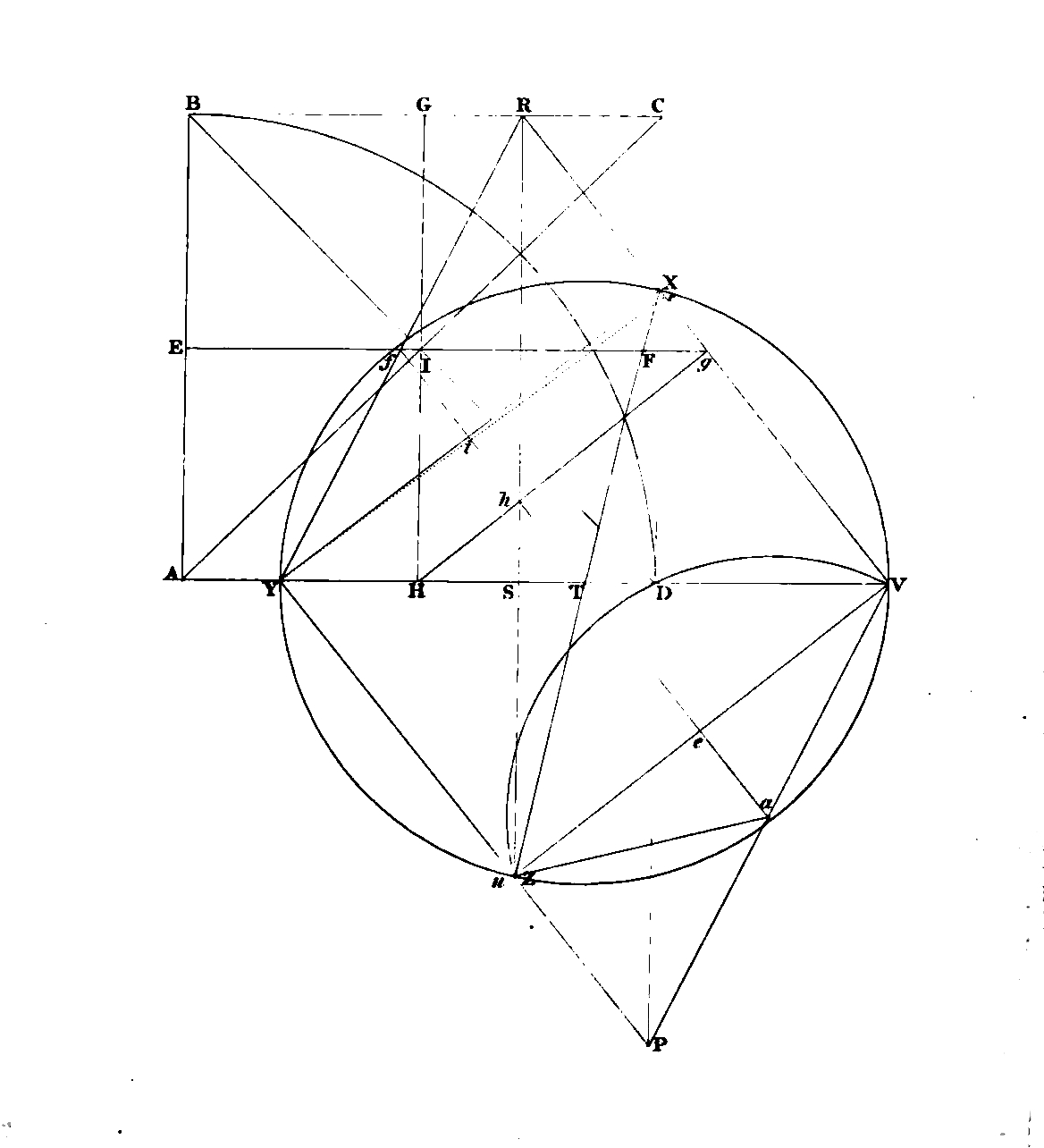
Delphic Problem.
Vol. VII. Eng. p. 60.
Produce C D to P so as D P be equal to A D. Now if Y Z produced fall on P, there will be three rectangle equiangled triangles, D P Y, D Y X, and 61D X V; and consequently four continual proportionals, D P, D Y, D X, and D V, whereof D X is the least of the means. And therefore the cube of D X will be double to the cube of D V.
A. That is true; and the cube of D Y will be double to the cube of D X; and the cube of D P double to the cube of D Y. But that Y Z produced, falls upon P, is the thing they deny, and which you ought to demonstrate.
B. If Y Z produced fall not on P, then draw P Y, and from V let fall a perpendicular upon P Y, suppose at u.. Divide P V in the midst at a., and join a u.; which done a u. will be equal to a. V or a. P. For because V u. P is a right angle, the point u. will be in the semi-circle whereof P V is the diameter.
Therefore drawing V R, the angle u. V R will be a right angle.
A. Why so?
B. Because T V and T Y are equal; and T D, T S equal; S Y will also be equal to D V. And because D P and R S are equal and parallel, R Y will be equal and parallel to P V. And therefore V R and P Y that join them will be equal and parallel. And the angles P u. V, R V u. will be alternate, and consequently equal. But P u. V is a right angle; therefore also R V u. will be a right angle.
A. Hitherto all is evident. Proceed.
B. From the point Y raise a perpendicular cutting V R wheresoever in t., and then (because P Y and V R are parallel) the angle Y t V will be a right angle. And the figure u Y t V a rectangle, and u t equal to Y V. But Y V is equal to Z X; and therefore Z X is equal to u t. And u t must pass through the point T (for the diameters of any 62rectangle divide each other in the middle), therefore Z and u are the same point, and X and t the same point. Therefore Y Z produced falls upon P. And D X is the lesser of the two means between A D and D V. And the cube of D X double to the cube of D V, which was to be demonstateddemonstated
A. I cannot imagine what fault there can be in this demonstration, and yet there is one thing which seems a little strange to me. And it is this. You take B R, which is half the diagonal, and which is the sine of forty-five degrees, and which is also the mean proportional between the two extremes; and yet you bring none of these proprieties into your demonstration. So that though you argue from the construction, yet you do not argue from the cause. And this perhaps your adversaries will object, at least, against the art of your demonstration, or enquire by what luck you pitched upon half the diagonal for your foundation.
B. I see you let nothing pass. But for answer you must know, that if a man argue from the negative of the truth, though he know not that it is the truth which is denied, yet he will fall at last, after many consequences, into one absurdity or another. For though false do often produce truth, yet it produces also absurdity, as it hath done here. But truth produceth nothing but truth. Therefore in demonstrations that tend to absurdity, it is no good logic to require all along the operation of the cause.
A. Have you drawn from hence no corollaries?
B. No. I leave that for others that will; unless you take this for a corollary, that, what arithmetical calculation soever contradicts it, is false.
63A. Let me see now the algebraical demonstration against it.
B. Here it is:
| Let A B or A D be equal to | 2 |
| Then D F or D V is equal to | 1 |
| And B R or A S is equal to the square root of | 2 |
| And D Y equal to | 3 |
| want the square root of | 2 |
| The cube of A B is equal to | 8 |
| The cube of D Y is equal to | 45 |
| want the square root of 1682 that is almost equal to | 4 |
| For 45 want the square root of 1681 is equal to | 4 |
Therefore D Y is a little less then the greater of the two means between A D and D V.
A. There is I see some little difference between this arithmetical and your geometrical demonstration. And though it be insensible, yet if his calculation be true, yours must needs be false, which I am sure cannot be.
B. His calculation is so true, that there is never a proposition in it false, till he come to the conclusion, that the cube of D Y is equal to 45, want the square root of 1682. But that, and the rest, is false.
A. I shall easily see that A D is certainly 2, whereof D V is 1, and A V is certainly 3, whereof D V is 1.
B. Right.
A. And B R is without doubt the square root of 2.
B. Why, what is 2?
A. 2 is the line A D as being double to D V which is 1.
64B. And so, the line B R is the square root of the line A D.
A. Out upon it, it is absurd. Why do you grant it to be true in arithmetic?
B. In arithmetic the numbers consist of so many units, and are never considered there as nothings. And therefore every one line has some latitude, and if you allow to B I, the semi-diagonal, the same latitude you do to A B, or to B R, you will quickly see the square of half the diagonal to be equal to twice the square of half A B.
A. Well, but then your demonstration is not confuted; for the point Y will have latitude enough to take in that little difference which is between the root of 1681 and the root of 1682. This putting off an unit sometimes for one line, sometimes for one square, must needs mar the reckoning. Again he says, the cube of A B is equal to 8; but seeing A B is 2, the cube of A B must be just equal to four of its own sides; so that the unit which was before sometimes a line, sometimes a square, is now a cube.
B. It can be no otherwise when you so apply arithmetic to geometry, as to number the lines of a plane, or the planes of a cube.
A. In the next place, I find that the cube of D Y is equal to 45, want the square root of 1682. What is that 45? Lines, or squares, or cubes?
B. Cubes; cubes of D V.
A. Then if you add to 45 cubes of D V the square root of 1682, the sum will be 45 cubes of D V; and if you add to the cube of D Y the same root of 1682, the sum will be the cube of D Y, plus the square root of 1682, and these two sums must be equal.
65B. They must so.
A. But the square root of 1682, being a line, adds nothing to a cube; therefore the cube alone of D Y, which he says is equal almost to 4 cubes of D V, is equal to 45 cubes of the same D V.
B. All these impossibilities do necessarily follow the confounding of arithmetic and geometry.
A. I pray you let me see the operation by which the cube of D Y (that is, the cube of 3, want the root of 2) is found equal to 45, want the square root of 1682.
B. Here it is.
| 3——√2 | |||
| 3——√2 | |||
| —√18 + 2 | |||
| 9—√18 | |||
| 9—√72 + 2 | |||
| 3—√2 | |||
| —√162 + 12—√8 | |||
| 27—√648 + 6 | |||
| 27—√658—√162 + 18—√8 | |||
A. Why for two roots of 18 do you put the root of 72.
B. Because 2 roots of 18 are equal to one root of four times 18, which is 72.72.
A. Next we have, that the root of 2 multiplied into 2 makes the root of 8. How is that true?
B. Does it not make 2 roots of two? And is not B R the root of 2, and 2 B R equal to the diagonal? 66And is not the square of the diagonal equal to 8 squares of D V?
A. It is true. But here the root of 8 is put for the cube of the root of 2. Can a line be equal to a cube?
B. No. But here we are in arithmetic again, and 8 is a cubic number.
A. How does the root of 2 multiplied into the root of 72 make 12?
B. Because it makes the root of 2 times 72, that is to say the root of 144 which is 12.
A. How does 9 roots of 2 make the root of 162?
B. Because it makes the root of 2 squares of 9, that is the root of 162.
A. How does 3 roots of 72 make the root of 648?
B. Because it makes the root of 9 times 72, that is of 648.
A. For the total sum I see 27 and 18, which make 45. Therefore the root of 648 together with the root of 162 and of 8, which are to be deducted from 45, ought to be equal to the root of 1682.
| B. So they are. For 648 multiplied by 162 makes 104976, of which the double root is | 648 |
| and 648 and 162 added together make | 810 |
| Therefore the root of 648, added to the root of 162, makes the root of | 1458 |
| Again 1458 into 8 is 11664. The double root whereof is | 216 |
| The sum of 1458 and 8 added together | 1466 |
| The sum of 1466 and 216 is 1682, and the root, the root of | 1682 |
A. I see the calculation in numbers is right, though false in lines. The reason whereof can be no other than some difference between multiplying 67numbers into lines or planes, and multiplyingmultiplying lines into the same lines or planes.
B. The difference is manifest. For when you multiply a number into lines, the product is lines; as the number 2 multiplied into 3 lines is no more than 3 lines 2 times told. But if you multiply lines into lines you make planes, and if you multiply lines into planes you make solid bodies. In geometry there are but three dimensions, lengths, superficies, and body. In arithmetic there is but one, and that is number or length which you will. And though there be some numbers called plane, other solids, others plano-solid, others square, others cubic, others square-square, others quadrato-cubic, others cubi-cubic, &c., yet are all these but one dimension, namely number, or a file of things numbered.
A. But seeing this way of calculation by numbers is so apparently false, what is the reason this calculation came so near the truth?
B. It is because in arithmetic units are not nothings, and therefore have breadth. And therefore many lines set together make a superficies though their breadth be insensible. And the greater the number is into which you divide your line, the less sensible will be your error.
A. Archimedes, to find a straight line equal to the circumference of a circle, used this way of extracting roots. And it is the way also by which the table of sines, secants, and tangents have been calculated. Are they all out?
B. As for Archimedes, there is no man that does more admire him than I do: but there is no man that cannot err. His reasoning is good. But he, 68as all other geometricians before and after him, have had two principles that cross one another when they are applied to one and the same science. One is, that a point is no part of a line, which is true in geometry, where a part of a line when it is called a point, is not reckoned; another is, that a unit is part of a number; which is also true; but when they reckon by arithmetic in geometry, there a unit is sometimes part of a line, sometimes a part of a square, and sometimes part of a cube. As for the table of sines, secants, and tangents, I am not the first that find fault with them. Yet I deny not but they are true enough for the reckoning of acres in a map of land.
A. What a deal of labour has been lost by them that being professors of geometry have read nothing else to their auditors but such stuff as this you have here seen. And some of them have written great books of it in strange characters, such as in troublesome times, a man would suspect to be a cypher.
B. I think you have seen enough to satisfy you, that what I have written heretofore concerning the quadrature of the circle, and of other figures made in imitation of the parabola, has not been yet confuted.
A. I see you have wrested out of the hands of our antagonists this weapon of algebra, so as they can never make use of it again. Which I consider as a thing of much more consequence to the science of geometry, than either of the duplication of the cube, or the finding of two mean proportionals, or the quadrature of a circle, or all these problems put together.
DECAMERON PHYSIOLOGICUM;
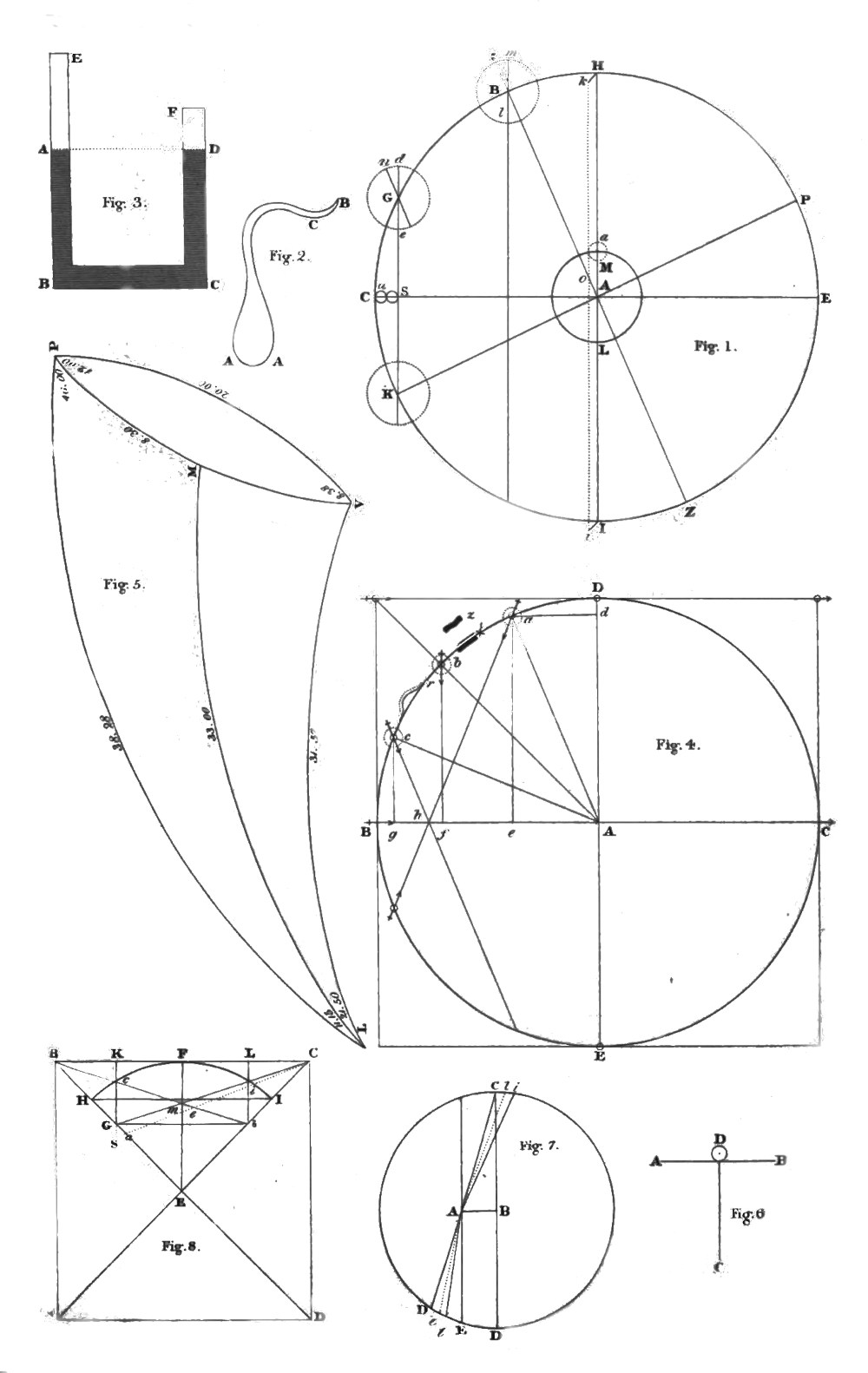
DECAMERON PHYSIOLOGICUM. — CHAPTER I. OF THE ORIGINAL OF NATURAL PHILOSOPHY. — CHAPTER II. OF THE PRINCIPLES AND METHOD OF NATURAL PHILOSOPHY. — CHAPTER III. OF VACUUM. — CHAPTER IV. OF THE SYSTEM OF THE WORLD. — CHAPTER V. OF THE MOTIONS OF WATER AND AIR. — CHAPTER VI. OF THE CAUSES AND EFFECTS OF HEAT AND COLD. — CHAPTER VII. OF HARD AND SOFT, AND OF THE ATOMS THAT FLY IN THE AIR. — CHAPTER VIII. OF GRAVITY AND GRAVITATION. — CHAPTER IX. OF THE LOADSTONE AND ITS POLES, AND WHETHER THEY SHOW THE LONGITUDE OF PLACES ON THE EARTH. — CHAPTER X. OF TRANSPARENCE, REFRACTION, AND OF THE POWER OF THE EARTH TO PRODUCE LIVING CREATURES.
A. I have heard exceeding highly commended a kind of thing which I do not well understand, though it be much talked of, by such as have not otherwise much to do, by the name of philosophy; and the same again by others as much despised and derided: so that I cannot tell whether it be good or ill, nor what to make of it, though I see many other men that thrive by it.
B. I doubt not, but what so many do so highly praise must be very admirable, and what is derided and scorned by many, foolish and ridiculous. The honour and scorn falleth finally not upon philosophy, but upon the professors. Philosophy is the knowledge of natural causes. And there is no knowledge but of truth. And to know the true causes of things, was never in contempt, but in admiration. Scorn can never fasten upon truth. But the difference is all in the writers and teachers. Whereof some have neither studied, nor care for it, otherwise than as a trade to maintain themselves or gain preferment; and some for fashion, and to make themselves fit for ingenious company: and their study hath not been meditation, but acquiescence in the authority of those authors whom they 74have heard commended. And some, but few, there be, that have studied it for curiosity, and the delight which commonly men have in the acquisition of science, and in the mastery of difficult and subtil doctrinesdoctrines. Of this last sort I count Aristotle, and a few others of the ancients, and some few moderns: and to these it is that properly belong the praises which are given to philosophy.
A. If I have a mind to study, for example natural philosophy, must I then needs read Aristotle, or some of those that now are in request?
B. There is no necessity of it. But if in your own meditation you light upon a difficulty, I think it is no loss of time, to enquire what other men say of it, but to rely only upon reason. For though there be some few effects of nature, especially concerning the heavens, whereof the philosophers of old time have assigned very rational causes, such as any man may acquiesce in, as of eclipses of the sun and moon by long observation, and by the calculation of their visible motions; yet what is that to the numberless and quotidian phenomena of nature? Who is there amongst them or their successors, that has satisfied you with the causes of gravity, heat, cold, light, sense, colour, noise, rain, snow, frost, winds, tides of the sea, and a thousand other things which a few men’s lives are too short to go through, and which you and other curious spirits admire (as quotidian as they are), and fain would know the causes of them, but shall not find them in the books of naturalists; and when you ask what are the causes of any of them, of a philosopher now, he will put you off with mere words; which words, examined to the bottom, signify not 75a jot more than I cannot tell, or because it is: such as are intrinsical quality, occult quality, sympathy, antipathy, antiperistasis, and the like. Which pass well enough with those that care not much for such wisdom, though wise enough in their own ways; but will not pass with you that ask not simply what is the cause, but in what manner it comes about that such effects are produced.
A. That is cozening. What need had they of that? When began they thus to play the charlatans?
B. Need had they none. But know you not that men from their very birth, and naturally, scramble for every thing they covet, and would have all the world, if they could, to fear and obey them? If by fortune or industry one light upon a secret in nature, and thereby obtain the credit of an extraordinary knowing man, should he not make use of it to his own benefit? There is scarce one of a thousand but would live upon the charges of the people as far as he dares. What poor geometrician is there, but takes pride to be thought a conjurer? What mountebank would not make a living out of a false opinion that he were a great physician? And when many of them are once engaged in the maintenance of an error, they will join together for the saving of their authority to decry the truth.
A. I pray, tell me, if you can, how and where the study of philosophy first began.
B. If we may give credit to old histories, the first that studied any of the natural sciences were the astronomers of Ethiopia. My author is Diodorus Siculus, accounted a very faithful writer, 76who beginsbegins his history as high as is possible, and tells us that in Ethiopia were the first astronomers; and that for their predictions of eclipses, and other conjunctions and aspects of the planets, they obtained of their king not only towns and fields to a third part of the whole land, but were also in such veneration with the people, that they were thought to have discourse with their gods, which were the stars; and made their kings thereby to stand in awe of them, that they durst not either eat or drink but what and when they prescribed; no nor live, if they said the gods commanded them to die. And thus they continued in subjection to their false prophets, till by one of their kings, called Ergamenes, (about the time of the Ptolemies), they were put to the sword. But long before the time of Ergamenes, the race of these astrologers (for they had no disciples but their own children) was so numerous, that abundance of them (whether sent for or no I cannot tell) transplanted themselves into Egypt, and there also had their cities and lands allowed them, and were in request not only for astronomy and astrology, but also for geometry. And Egypt was then as it were an university to all the world, and thither went the curious Greeks, as Pythagoras, Plato, Thales, and others, to fetch philosophy into Greece. But long before that time, abundance of them went into Assyria, and had their towns and lands assigned them also there; and were by the Hebrews called Chaldees.
A. Why so?
B. I cannot tell; but I find in Martinius’s Lexicon they are called Chasdim, and Chesdim, and (as he saith) from one Chesed the son of Nachor; but I 77find no such man as Chesed amongst the issue of Noah in the scripture. Nor do I find that there was any certain country called Chaldæa; though a town where any of them inhabited were called a town of the Chaldees. Martinius saith farther, that the same word Chasdim did signify also Demons.
A. By this reckoning I should conjecture they were called Chusdim, as being a race of Ethiopians. For the land of Chus is Ethiopia; and so the name degenerated first into Chuldim, and then into Chaldim; so that they were such another kind of people as we call gipsies; saving that they were admired and feared for their knavery, and the gipsies counted rogues.
B. Nay pray, except Claudius Ptolomæus, author of that great work of astronomy, the Almegest.
A. I grant he was excellent both in astronomy and geometry, and to be commended for his Almegest ; but then for his Judiciar Astrologie annexed to it, he is again a gipsy. But the Greeks that travelled, you say, into Egypt, what philosophy did they carry home?
B. The mathematics and astronomy. But for that sublunary physics, which is commonly called natural philosophy, I have not read of any nation that studied it earlier than the Greeks, from whom it proceeded to the Romans. Yet both Greeks and Romans were more addicted to moral than to natural philosophy; in which kind we have their writings, but loosely and incoherently, written upon no other principles than their own passions and presumptions, without any respect to the laws of commonwealth, which are the ground and measure 78of all true morality. So that their books tend rather to teach men to censure than to obey the laws; which has been a great hindrance to the peace of the western world ever since. But they that seriously applied themselves to natural philosophy were but few, as Plato and Aristotle, whose works we have; and Epicurus whose doctrine we have in Lucretius. The writings of Philolaus and many other curious students being by fire or negligence now lost: though the doctrines of Philolaus concerning the motion of the earth have been revived by Copernicus, and explained and confirmed by Galileo now of late.
A. But methinks the natural philosophy of Plato, and Aristotle, and the rest, should have been cultivated and made to flourish by their disciples.
B. Whom do you mean, the successors of Plato, Epicurus, Aristotle, and the other first philosophers? It may be some of them may have been learned and worthy men. But not long after, and down to the time of our Saviour and his Apostles, they were for the most part a sort of needy, ignorant, impudent, cheating fellows, who by the profession of the doctrine of those first philosophers got their living. For at that time, the name of philosophy was so much in fashion and honour amongst great persons, that every rich man had a philosopher of one sect or another to be a schoolmaster to his children. And these were they that feigning Christianity, with their disputing and readiness of talking got themselves into Christian commons, and brought so many heresies into the primitive Church, every one retaining still a tang of what they had been used to teach.
79A. But those heresies were all condemned in the first Council of Nice.
B. Yes. But the Arian heresy for a long time flourished no less than the Roman, and was upheld by divers Emperors, and never fully extinguished as long as there were Vandals in Christendom. Besides, there arose daily other sects, opposing their philosophy to the doctrine of the Councils concerning the divinity of our Saviour; as how many persons he was, how many natures he had. And thus it continued till the time of Charlemagne, when he and Pope Leo the third divided the power of the empire into temporal and spiritual.
A. A very unequal division.
B. Why? Which of them think you had the greater share?
A. No doubt, the Emperor: for he only had the sword.
B. When the swords are in the hands of men, whether had you rather command the men or the swords?
A. I understand you. For he that hath the hands of the men, has also the use both of their swords and strength.
B. The empire thus divided into spiritual and temporal, the freedom of philosophy was to the power spiritual very dangerous. And for that cause it behoved the Pope to get schools set up not only for divinity, but also for other sciences, especially for natural philosophy. Which when by the power of the Emperor he had effected, out of the mixture of Aristotle’s metaphysics with the Scripture, there arose a new science called School-divinity; which has been the principal learning of 80these western parts from the time of Charlemagne till of very late.
A. But I find not in any of the writings of the Schoolmen in what manner, from the causes they assign, the effect is naturally and necessarily produced.
B. You must not wonder at that. For you enquire not so much, when you see a change of anything, what may be said to be the cause of it, as how the same is generated; which generation is the entire progress of nature from the efficient cause to the effect produced. Which is always a hard question, and for the most part impossible for a man to answer to. For the alterations of the things we perceive by our five senses are made by the motion of bodies, for the most part, either for distance, smallness, or transparence, invisible.
A. But what need had they then to assign any cause at all, seeing that they could not show the effect was to follow from it?
B. The Schools, as I said, were erected by the Pope and Emperor, but directed by the Pope only, to answer and confute the heresies of the philosophers. Would you have them then betray their profession and authority, that is to say, their livelihood, by confessing their ignorance? Or rather uphold the same, by putting for causes, strange and unintelligible words; which might serve well enough not only to satisfy the people whom they relied on, but also to trouble the philosophers themselves to find a fault in.
A. Seeing you say that alteration is wrought by the motion of bodies, pray tell me first what I am to understand by the word body.
81B. It is a hard question, though most men think they can easily answer it, as that it is whatsoever they can see, feel, or take notice of by their senses. But if you will know indeed what is body, we must enquire first what there is that is not body. You have seen, I suppose, the effects of glasses, how they multiply and magnify the object of our sight; as when a glass of a certain figure will make a counter or a shilling seem twenty, though you be well assured there is but one. And if you set a mark upon it, you will find the mark upon them all. The counter is certainly one of those things we call bodies: are not the others so too?
A. No, without doubt. For looking through a glass cannot make them really more than they are.
B. What then be they but fancies, so many fancies of one and the same thing in several places?
A. It is manifest they are so many idols, mere nothings.
B. When you have looked upon a star or candle with both your eyes, but one of them a little turned awry with your finger, has not there appeared two stars, or two candles? And though you call it a deception of the sight, you cannot deny but there were two images of the object.
A. It is true, and observed by all men. And the same I say of our faces seen in looking-glasses, and of all dreams, and of all apparitions of dead men’s ghosts; and wonder, since it is so manifest, I never thought upon it before, for it is a very happy encounter, and such as being by everybody well understood, would utterly destroy both idolatry and superstition, and defeat abundance of knaves that cheat and trouble the world with their devices.
82B. But you must not hence conclude that whosoever tells his dream, or sometimes takes his direction from it, is therefore an idolater, or superstitious, or a cheater. For God doth often admonish men by dreams of what they ought to do; yet men must be wary in this case that they trust not dreams with the conduct of their lives farther than by the laws of their country is allowed: for you know what God says, Deut. xiii: If a prophet or a dreamer of dreams give thee a sign or a wonder, and the sign come to pass, yet if he bid thee serve other Gods let him be put to death. Here by serving other Gods (since they have chosen God for their King) we are to understand revolting from their King, or disobeying of his laws. Otherwise I see no idolatry nor superstition in following a dream, as many of the Patriarchs in the Old Testament, and of the Saints in the New Testament did.
A. Yes: their own dreams. But when another man shall dream, or say that he has dreamed, and require me to follow that, he must pardon me if I ask him by what authority, especially if he look I should pay him for it.
B. But if commanded by the laws you live under, you ought to follow it. But when there proceed from one sound divers echoes, what are those echoes? And when with fingers crossed you touch a small bullet, and think it two; and when the same herb or flower smells well to one and ill to another, and the same at several times, well and ill to yourself, and the like of tastes, what are those echoes, feelings, odours, and tastes?
A. It is manifest they are all but fancies. But certainly when the sun seems to my eye no bigger 83than a dish, there is behind it somewhere somewhat else, I suppose a real sun, which creates those fancies, by working, one way or other, upon my eyes, and other organs of my senses, to cause that diversity of fancy.
B. You say right; and that is it I mean by the word body, which briefly I define to be any thing that hath a being in itself, without the help of sense.
A. Aristotle, I think, meaneth by body, substance, or subjectum, wherein colour, sound, and other fancies are, as he says, inherent. For the word essence has no affinity with substance. And Seneca says, he understands it not. And no wonder: for essence is no part of the language of mankind, but a word devised by philosophers out of the copulation of two names, as if a man having two hounds could make a third, if it were need, of their couples.
B. It is just so. For having said in themselves, (for example): a tree is a plant, and conceiving well enough what is the signification of those names, knew not what to make of the word is, that couples those names; nor daring to call it a body, they called it by a new name (derived from the word est), essentia, and substantia, deceived by the idiom of their own language. For in many other tongues, and namely in the Hebrew, there is no such copulative. They thought the names of things sufficiently connected, when they are placed in their natural consequence; and were therefore never troubled with essences, nor other fallacy from the copulative est.
A. This history of the old philosophers has not put me out of love, but out of hope of philosophy from any of their writings. I would therefore try if I could attain any knowledge therein by my own meditation: but I know neither where to begin, nor which way to proceed.
B. Your desire, you say, is to know the causes of the effects or phenomena of nature; and you confess they are fancies, and, consequently, that they are in yourself; so that the causes you seek for only are without you, and now you would know how those external bodies work upon you to produce those phenomena. The beginning therefore of your enquiry ought to be at; What it is you call a cause? I mean an efficient cause: for the philosophers make four kinds of causes, whereof the efficient is one. Another they call the formal cause, or simply the form or essence of the thing caused; as when they say, four equal angles and four equal sides are the cause of a square figure; or that heaviness is the cause that makes heavy bodies to descend; but that is not the cause you seek for, nor any thing but this: It descends because it descends. The third is the material cause, as when they say, the walls and roof, &c. of a house are the cause of a house. The fourth is the final cause, and hath place only in moral philosophy.
85A. We will think of final causes upon some other occasion; of formal and material not at all: I seek only the efficient, and how it acteth from the beginning to the production of the effect.
B. I say then, that in the first place you are to enquire diligently into the nature of motion. For the variations of fancies, or (which is the same thing) of the phenomena of nature, have all of them one universal efficient cause, namely the variety of motion. For if all things in the world were absolutely at rest, there could be no variety of fancy; but living creatures would be without sense of all objects, which is little less than to be dead.
A. What if a child new taken from the womb should with open eyes be exposed to the azure sky, do not you think it would have some sense of the light, but that all would seem unto him darkness?
B. Truly, if he had no memory of any thing formerly seen, or by any other sense perceived, (which is my supposition), I think he would be in the dark. For darkness is darkness, whether it be black or blue, to him that cannot distinguish.
A. Howsoever that be, it is evident enough that whatsoever worketh is moved: for action is motion.
B. Having well considered the nature of motion, you must thence take your principles for the foundation and beginning of your enquiry.
A. As how?
B. Explain as fully and as briefly as you can what you constantly mean by motion; which will save yourself as well as others from being seduced by equivocation.
A. Then I say, motion is nothing but change of 86place for all the effect of a body upon the organs of our senses is nothing but fancy. Therefore we can fancy nothing from seeing it moved, but change of place.
B. It is right. But you must then tell me also what you understand by place: for all men are not yet agreed on that.
A. Well then; seeing we fancy a body, we cannot but fancy it somewhere. And therefore I think place is the fancy of here or there.
B. That is not enough. Here and there are not understood by any but yourself, except you point towards it. But pointing is no part of a definition. Besides, though it help him to find the place, it will never bring him to it.
A. But seeing sense is fancy, when we fancy a body, we fancy also the figure of it, and the space it fills up. And then I may define place to be the precise space within which the body is contained. For space is also part of the image we have of the object seen.
B. And how define you time?
A. As place is to a body, so, I think, is time to the motion of it; and consequently I take time to be our fancy or image of the motion. But is there any necessity of so much niceness?
B. Yes. The want of it is the greatest, if not the only, cause of all the discord amongst philosophers, as may easily be perceived by their abusing and confounding the names of things that differ in their nature; as you shall see when there is occasion to recite some of the tenets of divers philosophers.
A. I will avoid equivocation as much as I can. 87And for the nature of motion, I suppose I understand it by the definition. What is next to be done?
B. You are to draw from these definitions, and from whatsoever truth else you know by the light of nature, such general consequences as may serve for axioms, or principles of your ratiocination.
A. That is hard to do.
B. I will draw them myself, as many as for our present discourse of natural causes we shall have need of; so that your part will be no more than to take heed I do not deceive you.
A. I will look to that.
B. My first axiom then shall be this: Two bodies, at the same time, cannot be in one place.
A. That is true: for we number bodies as we fancy them distinct, and distinguish them by their places. You may therefore add: nor one body at the same time in two places. And philosophers mean the same, when they say: there is no penetration of bodies.
B. But they understand not their own words: for penetration signifies it not. My second axiom is, that nothing can begin, change, or put an end to, its own motion. For supposing it begin just now, or being now in motion, change its way or stop; I require the cause why now rather than before or after, having all that is necessary to such motion, change, or rest, alike at all times?
A. I do not doubt but the argument is good in bodies inanimate; but perhaps in voluntary agents it does not hold.
B. How it holds in voluntary agents we will then consider when our method hath brought us to 88the powers and passions of the mind. A third axiom shall be this: whatsoever body being at rest is afterwards moved, hath for its immediate movement some other body which is in motion and toucheth it. For, since nothing can move itself, the movent must be external. And because motion is change of place, the movent must put it from its place, which it cannot do till it touch it.
A. That is manifest, and that it must more than touch it; it must also follow it. And if more parts of the body are moved than are by the movent touched, the movent is not immediate. And by this reason, a continued body, though never so great, if the first superficies be pressed never so little back, the motion will proceed through it.
B. Do you think that to be impossible? I will prove it from your own words: for you say that the movent does then touch the body which it moveth. Therefore it puts it back; but that which is put back, puts back the next behind, and that again the next; and so onward to any distance, the body being continued. The same is also manifest by experience, seeing one that walks with a staff can distinguish, though blind, between stone and glass; which were impossible, if the parts of his staff between the ground and his hand made no resistance. So also he that in the silence of the night lays his ear to the ground, shall hear the treading of men’s feet farther than if he stood upright.
A. This is certainly true of a staff or other hard body, because it keeps the motion in a straight line from diffusion. But in such a fluid body as the air, which being put back must fill an orb, and 89the farther it is put back, the greater orb, the motion will decrease, and in time, by the resistance of air to air, come to an end.
B. That any body in the world is absolutely at rest, I think not true: but I grant, that in a space filled everywhere with body, though never so fluid, if you give motion to any part thereof, that motion will by resistance of the parts moved, grow less and less, and at last cease; but if you suppose the space utterly void, and nothing in it, then whatsoever is once moved shall go on eternally: or else that which you have granted is not true, viz., that nothing can put an end to its own motion.
A. But what mean you by resistance?
B. Resistance is the motion of a body in a way wholly or partly contrary to the way of its movent, and thereby repelling or retarding it. As when a man runs swiftly, he shall feel the motion of the air in his face. But when two hard bodies meet, much more may you see how they abate each other’s motion, and rebound from one another. For in a space already full, the motion cannot, in an instant, be communicated through the whole depth of the body that is to be moved.
A. What other definitions have I need of?
B. In all motion, as in all quantity, you must take the beginning of your reckoning from the least supposed motion. And this I call the first endeavour of the movent; which endeavour, how weak soever, is also motion. For if it have no effect at all, neither will it do anything though doubled, trebled, or by what number soever multiplied: for nothing, though multiplied, is still nothing. Other 90axioms and definitions we will take in, as we need them, by the way.
A. Is this all the preparation I am to make?
B. No, you are to consider also the several kinds and properties of motion, viz., when a body being moved by one or more movents at once, in what way it is carried, straight, circular, or otherwise crooked; and what degree of swiftness; as also the action of the movent, whether trusion, vection, percussion, reflection, or refraction; and farther you must furnish yourself with as many experiments (which they call phenomenon) as you can. And supposing some motion for the cause of your phenomenon, try, if by evident consequence, without contradiction to any other manifest truth or experiment, you can derive the cause you seek for from your supposition. If you can, it is all that is expected, as to that one question, from philosophy. For there is no effect in nature which the Author of nature cannot bring to pass by more ways than one.
A. What I want of experiments you may supply out of your own store, or such natural history as you know to be true; though I can be well content with the knowledge of the causes of those things which everybody sees commonly produced. Let us therefore now enquire the cause of some effect particular.
B. We will begin with that which is the most universal, the universe; and enquire in the first place, if any place be absolutely empty, that is to say in the language of philosophers, whether there be any vacuum in nature?
A. It is hard to suppose, and harder to believe, that the infinite and omnipotent Creator of all things should make a work so vast as is the world we see, and not leave a few little spaces with nothing at all in them; which put altogether in respect of the whole creation, would be insensible.
B. Why say you that? Do you think any argument can be drawn from it to prove there is vacuum?
A. Why not? For in so great an agitation of natural bodies, may not some small parts of them be cast out, and leave the places empty from whence they were thrown?
B. Because He that created them is not a fancy, but the most real substance that is; who being infinite, there can be no place empty where He is, nor full where He is not.
A. It is hard to answer this argument, because I do not remember that there is any argument for the maintenance of vacuum in the writings of divines: therefore I will quit that argument, and come to another. If you take a glass vial with a narrow neck, and having sucked it, dip it presently at the neck into a basin of water, you shall manifestly see the water rise into the vial. Is not this a certain sign that you had sucked out some of the air, and consequently that some part of the vial was left empty?
92B. No; for when I am about to suck, and have air in my mouth, contracting my checks I drive the same against the air in the glass, and thereby against every part of the sides of the hard glass. And this gives to the air within an endeavour outward, by which, if it be presently dipped into the water, it will penetrate and enter into it. For air if it be pressed will enter into any fluid, much more into water. Therefore there shall rise into the vial so much water as there was air forced into the basin.
A. This I confess is possible, and not improbable.
B. If sucking would make vacuum, what would become of those women that are nurses? Should they not be in a very few days exhausted, were it not that either the air which is in the child’s mouth penetrateth the milk as it descends, and passeth through it, or the breast is contracted?
A. From what experiment can you evidently infer that there is no vacuum?
B. From many, and such as to almost all men are known and familiar. If two hard bodies, flat and smooth, be joined together in a common superficies parallel to the horizontal plane, you cannot without great force pull them asunder, if you apply your force perpendicularly to the common superficies: but if you place that common superficies erect to the horizon, they will fall asunder with their own weight. From whence I argue thus: since their contiguity, in what posture soever, is the same, and that they cannot be pulled asunder by a perpendicular force without letting in the ambient air in an instant, which is impossible; or almost in an instant, which is difficult: and on the 93other side, when the common superficies is erect, the weight of the same hard bodies is able to break the contiguity, and let in the air successively; it is manifest that the difficulty of separation proceeds from this, that neither air nor any other body can be moved to any, how small soever, distance in an instant; but may easily be moved (the hardness at the sides once mastered) successively. So that the cause of this difficulty of separation is this, that they cannot be parted except the air or other matter can enter and fill the space made by their diremption. And if they were infinitely hard, not at all. And hence also you may understand the cause why any hard body, when it is suddenly broken, is heard to crack; which is the swift motion of the air to fill the space betweenbetween. Another experiment, and commonly known, is of a barrel of liquor, whose tap-holetap-hole is very little, and the bung so stopped as to admit no air; for then the liquor will not run: but if the tap-hole be large it will, because the air pressed by a heavier body will pierce through it into the barrel. The like reason holds of a gardener’s watering-pot, when the holes in the bottom are not too great. A third experiment is this: turn a thin brass kettle the bottom upwards, and lay it flat upon the water. It will sink till the water rise within to a certain height, but no higher: yet let the bottom be perforated, and the kettle will be full and sink, and the air rise again through the water without. But if a bell were so laid on, it would be filled and sink, though it were not perforated, because the weight is greater than the weight of the same bulk of water.
94A. By these experiments, without any more, I am convinced, that there is not actually in nature any vacuum; but I am not sure but that there may be made some little place empty, and this from two experiments, one whereof is Toricellius’ experiment, which is this: take a cylinder of glass, hollow throughout, but close at the end, in form of a sack.
B. How long?
A. As long as you will, so it be more than twenty-nine inches.
B. And how broad?
A. As broad as you will, so it be broad enough to pour into it quicksilver. And fill it with quicksilver, and stop up the entrance with your finger, so as to unstop it again at your pleasure. Then set down a basin, or, if you will, a sea of quicksilver, and inverting the cylinder full as it is, dip the end into the quicksilver, and remove your finger, that the cylinder may empt itself. Do you conceive me? For there is so many passing by, that I cannot paint it.
B. Yes, I conceive you well enough. What follows?
A. The quicksilver will descend in the cylinder, not till it be level with that in the basin, according to the nature of heavy fluids, but stay and stand above it, at the height of twenty-nine inches or very near it, the bottom being now uppermost, that no air can get in.
B. What do you infer from this?
A. That all the cavity above twenty-nine inches is filled with vacuum.
B. It is very strange that I, from this same experiment, should infer, and I think evidently, that it is filled with air. I pray, tell me, when you had 95inverted the cylinder, full as it was, and stopped with your finger, dipped into the basin, if you had then removed your finger, whether you think the quicksilver would not all have fallen out?
A. No sureNo sure. The air would have been pressed upward through the quicksilver itself: for a man with his hand can easily thrust a bladder of air to the bottom of a basin of quicksilver.
B. It is therefore manifest that quicksilver can press the air through the same quicksilver.
A. It is manifest; and also itself rise into the air.
B. What cause then can there be, why it should stand still at twenty nine inches above the level of the basin, rather than any place else?
A. It is not hard to assign the cause of that. For so much quicksilver as was above the twenty-nine inches, will rise the first level of that in the basin, as much as if you had poured it on; and thereby bring it to an equilibrium. So that I see plainly now, that there is no necessity of vacuum from this experiment. For I considered only that naturally quicksilver cannot ascend in air, nor air descend in quicksilver, though by force it may.
B. Nor do I think that Torricellius or any other vacuist thought of it more than you. But what is the second experiment?
A. There is a sphere of glass, which they call a recipient, of the capacity of three or four gallons. And there is inserted into it the end of a hollow cylinder of brass above a foot long; so that the whole is one vessel, and the bore of the cylinder three inches diameter. Into which is thrust by force a solid cylinder of wood, covered with leather so just, as it may in every point exactly touch 96the concave superficies of the brass. There is also, to let out the air which the wooden cylinder as it enters (called the sucker) drives before it, a flap to keep out the external air while they are pulling the sucker. Besides, at the top of the recipient there is a hole to put into it anything for experiment. The sucker being now forced up into the cylinder, what do you think must follow?
B. I think it will require as much strength to pull it back, as it did to force it in.
A. That is not it I ask, but what would happen to the recipient?
B. I think so much air as would fill the place the sucker leaves, would descend into it out of the recipient; and also that just so much from the external air would enter into the recipient, between the brass and the wood, at first very swiftly, but, as the place increased, more leisurely.
A. Why may not so much air rather descend into the place forsaken, and leave as much vacuum as that comes to in the recipient? For otherwise no air will be pumped out, nor can that wooden pestle be called a sucker.
B. That is it I say. There is no air either pumped or sucked out.
A. How can the air pass between the leather and the brass, or between the leather and the wood, being so exactly contiguous, or through the leather itself?
B. I conceive no such exact contiguity, nor such fastness of the leather: for I never yet had any that in a storm would keep out either air or water.
A. But how then could there be made in the 97recipient such strange alteration both on animate and inanimate bodies?
B. I will tell you how. The air descends out of the recipient, because the air which the sucker removeth from behind itself, as it is pulling out, has no place to retire into without, and therefore is driven into the engine between the wood of the sucker and the brass of the cylinder, and causes as much air to come into the place forsaken by the retiring sucker; which causeth, by oft repetition of the force, a violent circulation of the air within the recipient, which is able quickly to kill anything that lives by respiration, and make all the alterations that have appeared in the engine.
B. You are come in good time; let us therefore sit down. There is ink, paper, ruler, and compass. Draw a little circle to represent the body of the sun.
A. It is done. The centre is A, the circumference is L M.
B. Upon the same centre A, draw a larger circle to stand for the ecliptic: for you know the sun is always in the plane of the ecliptic.
A. There it is. The diameters of it at right angles are B Z.
B. Draw the diameter of the equator.
A. How?
B. Through the centre A (for the earth is also always in the plane of the equator or of some of its 98parallels) so as to be distant from B twenty-three degrees and a half.
A. Let it be H I: and let C G be equal to B H; and so C will be one of the poles of the ecliptic, suppose the north-pole; and thenthen H will be east, and I west. And C A produced to the circumference in E, makes E the south-pole.
B. Take C K equal to C G, and the chord G K will be the diameter of the arctic circle, and parallel to H I, the diameter of the equator. Lastly, upon the point B, draw a little circle wherein I suppose to be the globe of the earth.
A. It is drawn, and marked with l m. And B D and K G joined will be parallel; and as H and I are east and west, and so are B and D, and G and K.
B. True; but producing Z B to the circumference l m in b, the line B b will be in the diameter of the ecliptic of the earth, and B m in the diameter of the equator of the earth. In like manner, if you produce K G cutting the circle, whose centre is G, in d and e, and make an angle n G d equal to b B m, the line n G will be in the ecliptic of the earth, because G d is in the equator of the earth. So that in the annual motion of the earth through the ecliptic, every straight line drawn in the earth, is perpetually kept parallel to the place from whence it is removed.
A. It is true; and it is the doctrine of Copernicus. But I cannot yet conceive by what one motion this circle can be described otherwise than we are taught by Euclid. And then I am sure that all the diameters shall cross one another in the centre, which in this figure is A.
99B. I do not say that the diameters of a sphere or circle can be parallel; but that if a circle of a lesser sphere be moved upon the circumference of a great circle of a greater sphere, that the straight lines that are in the lesser sphere may be kept parallel perpetually to the places they proceed from.
A. How? And by what motion?
B. Take into your hand any straight line (as in this figure), the line L A M, which we suppose to be the diameter of the sun’s body; and moving it parallelly with the ends in the circumference, so as that the end M may withal describe a small circle, as M a. It is manifest that all the other points of the same line L M will, by the same motion, at the same time, describe equal circles to it. Likewise if you take in your hand any two diameters fastened together, the same parallel motion of the line L M, shall cause all the points of the other diameter to make equal circles to the same M a.
A. It is evident; as also that every point of the sun’s body shall do the like. And not only so, but also if one end describe any other figure, all the other points of the body shall describe like and equal figures to it.
B. You see by this, that this parallel motion is compounded of two motions, one circular upon the superficies of a sphere, the other a straight motion from the centre to every point of the same superficies, and beyond it.
A. I see it.
B. It follows hence, that the sun by this motion must every way repel the air; and since there is no empty place for retiring, the air must turn about in a circular stream; but slower or swifter according 100as it is more or less remote from the sun; and that according to the nature of fluids, the particles of the air must continually change place with one another; and also that the stream of the air shall be the contrary way to that of the motion, for else the air cannot be repelled.
A. All this is certain.
B. Well; then if you suppose the globe of the earth to be in this stream which is made by the motion of the sun’s body from east to west, the stream of air wherein is the earth’s annual motion will be from west to east.
A. It is certain.
B. Well. Then if you suppose the globe of the earth, whose circle is moved annually, to be l m, the stream of the air without the ecliptic falling upon the superficies of the earth l m without the ecliptic, being slower, and the stream that falleth within swifter, the earth shall be turned upon its own centre proportionally to the greatness of the circles; and consequently their diameters shall be parallel; as also are other straight lines correspondent.
A. I deny not but the streams are as you say; and confess that the proportion of the swiftness without, is to the swiftness within, as the sun’s ecliptic to the ecliptic of the earth; that is to say, as the angle H A B to the angle m B b. And I like your argument the better, because it is drawn from Copernicus his foundation. I mean the compounded motion of straight and circular.
B. I think I shall not offer you many demonstrations of physical conclusions that are not derived from the motions supposed or proved by 101Copernicus. For those conclusions in natural philosophy I most suspect of falshood, which require most variety of suppositions for their demonstrations.
A. The next thing I would know, is how great or little you suppose that circle a M?
B. I suppose it less than you can make it: for there appears in the sun no such motion sensible. It is the first endeavour of the sun’s motion. But for all that, as small as the circle is, the motion may be as swift, and of as great strength as it is possible to be named. It is but a kind of trembling that necessarily happeneth in those bodies, which with great resistance press upon one another.
A. I understand now from what cause proceedeth the annual motion. Is the sun the cause also of the diurnal motion?
B. Not the immediate cause. For the diurnal motion of the earth is upon its own centre, and therefore the sun’s motion cannot describe it. But it proceedeth as a necessary consequence from the annual motion. For which I have both experience and demonstration. The experiment is this: into a large hemisphere of wood, spherically concave, put in a globe of lead, and with your hands hold it fast by the brim, moving your hand circularly, but in a very small compass; you shall see the globe circulate about the concave vessel, just in the same manner as the earth doth every year in the air; and you shall see withal, that as it goes, it turns perpetually upon its own centre, and very swiftly.
A. I have seen it: and it is used in some great kitchens to grind mustard.
B. Is it so? Therefore take a hemisphere of 102gold, if you have it, the greater the better, and a bullet of gold, and, without mustard, you shall see the same effect.
A. I doubt it not. But the cause of it is evident. For any spherical body being in motion upon the sides of a concave and hard sphere, is all the way turned upon its own centre by the resistance of the hard wood or metal. But the earth is a bullet without weight, and meeteth only with air, without any harder body in the way to resist it.
B. Do you think the air makes no resistance, especially to so swift a motion as is the annual motion of the earth? If it do make any resistance, you cannot doubt but that it shall turn the earth circularly, and in a contrary way to its annual motion; that is to say, from east to west, because the annual motion is from west to east.
A. I confess it. But what deduce you from these motions of the sun?
B. I deduce, first, that the air must of necessity be moved both circularly about the body of the sun according to the ecliptic, and also every way directly from it. For the motion of the sun’s body is compounded of this circular motion upon the sphere L M, and of the straight motion of its semi-diameters from the centre A to the superficies of the sun’s body, which is L M. And therefore the air must needs be repelled every way, and also continually change place to fill up the places forsaken by other parts of the air, which else would be empty, there being no vacuum to retire unto. So that there would be a perpetual stream of air, and in a contrary way to the motion of the sun’s 103body, such as is the motion of water by the sides of a ship under sail.
A. But this motion of the earth from west to east is only circular, such as is described by a compass about a centre; and cannot therefore repel the air as the sun does. And the disciples of Copernicus will have it to be the cause of the moon’s monthly motion about the earth.
B. And I think Copernicus himself would have said the same, if his purpose had been to have shown the natural causes of the motions of the stars. But that was no part of his design; which was only from his own observations, and those of former astronomers, to compute the times of their motions; partly to foretel the conjunctions, oppositions, and other aspects of the planets; and partly to regulate the times of the Church’s festivals. But his followers, Kepler and Galileo, make the earth’s motion to be the efficient cause of the monthly motion of the moon about the earth; which without the like motion to that of the sun in L M, is impossible. Let us therefore for the present take it in as a necessary hypothesis; which from some experiment that I shall produce in our following discourses, may prove to be a certain truth.
A. But seeing A is the centre both of the sun’s body and of the annual motion of the earth, how can it be (as all astronomers say it is) that the orb of the annual motion of the earth should be eccentric to the sun’s body? For you know that from the vernal equinox to the autumnal, there be one hundred and eighty-seven days; but from the autumnal equinox to the vernal, there be but one 104hundred and seventy-eight days. What natural cause can you assign for this eccentricity?
B. Kepler ascribes it to a magnetic virtue, viz. that one part of the earth’s superficies has a greater kindness for the sun than the other part.
A. I am not satisfied with that. It is magical rather than natural, and unworthy of Kepler. Tell me your own opinion of it.
B. I think that the magnetical virtue he speaks of, consisteth in this: that the southern hemisphere of the earth is for the greatest part sea, and that the greatest part of the northern hemisphere is dry land. But how it is possible that from thence should proceed the eccentricity (the sun being nearest to the earth, when he is in the winter solstice), I shall show you when we come to speak of the motions of air and water.
A. That is time enough: for I intend it for our next meeting. In the mean time I pray you tell me what you think to be the cause why the equinoctial, and consequently the solstitial, points are not always in one and the same point of the ecliptic of the fixed stars. I know they are not, because the sun does not rise and set in points diametrically opposite: for if it did, there would be no difference of the seasons of the year.
B. The cause of that can be no other, than that the earth, which is l m, hath the like motion to that which I suppose the sun to have in L M, compounded of straight and circular from west to east in a day, as the annual motion hath in a year; so that, not reckoning the eccentricity, it will be moved through the ecliptics in one revolution, as Copernicus proveth, about one degree. Suppose 105then the whole earth moved from H to I, (which is half the year) circularly, but falling from I to i in the same time about thirty minutes, and as much in the other hemisphere from H to k; then draw the line i k, which will be equal and parallel to H I, and be the diameter of the equator for the next year. But it shall not cut the diameter of the ecliptic B Z in A, which was the equinoctial of the former year, but in o thirty-six seconds from the first degree of Aries. Suppose the same done in the hemisphere under the plane of the paper, and so you have the double of thirty-six seconds, that is seventy-two seconds, or very near, for the progress of the vernal equinox in a year. The cause why I suppose the arch I i to be half a degree in the ecliptic of the earth, is, that Copernicus and other astronomers, and experience, agree in this, that the equinoctial points proceed according to the order of the signs, Aries, Taurus, Gemini, &c. from west to east every hundredth year one degree or very near.
A. In what time do they make the whole revolution through the ecliptic of the sky?
B. That you may reckon. For we know by
experience that it hath proceeded about one degree,
that is sixty minutes, constantly a long time in a
hundred years. But as one hundred years to one
degree, so is thirty-six thousand years to three
hundred and sixty degrees. Also as one hundred
years to one degree, so is one year to the hundredth
part of one degree, or sixty minutes; which is 60
100,
or thirty-six seconds for the progress of one year;
which must be somewhat more than a degree
according to Copernicus, who, (lib. iii. cap. 2) saith,
106that for four hundred years before Ptolomy it was
one degree almost constantly. Which is well
enough as to the natural cause of the precession of
the equinoctial points, which is the often-said compounded
motion, though not an exact astronomical
calculation.
A. And it is a great sign that his supposition is true. But what is the cause that the obliquity of the ecliptic, that is, the distance between the equinoctial and the solstice, is not always the same?
B. The necessity of the obliquity of the ecliptic is but a consequence to the precession of the equinoctial points. And therefore, if from C, the north pole, you make a little circle, C u, equal to fifteen minutes of a degree upon the earth, and another, u s, equal to the same, which will appear like this figure 8, that is, (as Copernicus calls it), a circle twined, the pole C will be moved half the time of the equinoctial points, in the arc C u, and as much in the alternate arc u s descending to s. But in the arc s u, and its alternate rising to C, the cause of the twining is the earth’s annual motion the same way in the ecliptic, and makes the four quarters of it; and makes also their revolution twice as slow as that of the equinoctial points. And, therefore, the motion of it is the same compounded motion which Copernicus takes for his supposition, and is the cause of the precession of the equinoctial points, and consequently of the variation of the obliquity, adding to it or taking from it somewhere more, somewhere less; so as that one with another the addition is not much more, nor the subtraction much less than 107thirty minutes. But as for the natural efficient cause of this compounded motion, either in the sun, or the earth, or any other natural body, it can be none but the immediate hand of the Creator.
A. By this it seems that the poles of the earth are always the same, but make this 8 in the sphere of the fixed stars near that which is called Cynosura.
B. No: it is described on the earth, but the annual motion describes a circle in the sphere of the fixed stars. Though I think it improper to say a sphere of the fixed stars, when it is so unlikely that all the fixed stars should be in the superficies of one and the same globe.
A. I do not believe they are.
B. Nor I, since they may seem less one than another, as well by their different distances, as by their different magnitudes. Nor is it likely that the sun (which is a fixed star) is the efficient cause of the motion of those remoter planets, Mars, Jupiter, and Saturn; seeing the whole sphere, whose diameter is the distance between the sun and the earth, is but a point in respect of the distance between the sun and any other fixed star. Which I say only to excite those that value the knowledge of the cause of comets, to look for it in the dominion of some other sun than that which moveth the earth. For why may not there be some other fixed star, nearer to some planet than is the sun, and cause such a light in it as we call a comet?
A. As how?
B. You have seen how in high and thin clouds above the earth, the sun-beams piercing them have 108appeared like a beard; and why might not such a beard have appeared to you like a comet, if you had looked upon it from as high as some of the fixed stars?
A. But because it is a thing impossible for me to know, I will proceed in my own way of inquiry. And seeing you ascribe this compounded motion to the sun and earth, I would grant you that the earth (whose annual motion is from west to east) shall give the moon her monthly motion from east to west. But then I ask you whether the moon have also that compounded motion of the earth, and with it a motion upon its own centre, as hath the earth? For seeing the moon has no other planet to carry about her, she needs it not.
B. I see reason enough, and some necessity, that the moon should have both those motions. For you cannot think that the Creator of the stars, when he gave them their circular motion, did first take a centre, and then describe a circle with a chain or compass, as men do? No; he moved all the parts of a star together and equally in the creation: and that is the reason I give you. The necessity of it comes from this phenomenon, that the moon doth turn one and the same face towards the earth; which cannot be by being moved about the earth parallelly, unless also it turn about its own centre. Besides, we know by experience, that the motion of the moon doth add not a little to the motion of the sea: which were impossible if it did not add to the stream of the air, and by consequence to that of the water.
A. If you could get a piece of the true and intimate substance of the earth, of the bigness of 109a musket-bullet, do you believe that the bullet would have the like compounded motion to that which you attribute to the sun, earth, and moon?
B. Yes, truly; but with less strength, according to its magnitude; saving that by its gravity falling to the earth, the activity of it would be unperceived.
A. I will trouble you no more with the nature of celestial appearances; but I pray you tell me by what art a man may find what part of a circle the diameter of the sun’s body doth subtend in the ecliptic circle?
B. Kepler says it subtends thirty minutes, which is half a degree. His way to find it is by letting in the sun-beams into a close room through a small hole, and receiving the image of it upon a plane perpendicularly. For by this means he hath a triangle, whose sides and angles he can know by measure; and the vertical angle he seeks for, and the substance of the arc of the sun’s body.
A. But I think it impossible to distinguish where the part illuminate toucheth the part not illuminate.
B. Another way is this: upon the equinoctial day, with a watch that shows the minutes standing by you, observe when the lower brim of the sun’s setting first comes to the horizon, and set the index to some minute of the watch; and observe again the upper brim when it comes to the horizon: then count the minutes, and you have what you look for. Other way I know none.
A. I have considered, as you bad me, this compounded motion with great admiration. First, it is that which makes the difference between continuum and contiguum, which till now I never could distinguish. For bodies that are but contiguous, with any little force are parted; but by this compounded motion (because every point of the body makes an equal line in equal time, and every line crosses all the rest) one part cannot be separated from another, without disturbing the motion of all the other parts at once. And is not that the cause, think you, that some bodies when they are pressed or bent, as soon as the force is removed, return again of themselves to their former figure?
B. Yes, sure; saving that it is not of themselves that they return, (for we were agreed that nothing can move itself), but it is the motion of the parts which are not pressed, that delivers those that are. And this restitution the learned now call the spring of a body. The Greeks called it antitypia.
A. When I considered this motion in the sun and the earth and planets, I fancied them as so many bodies of the army of the Almighty in an immense field of air, marching swiftly, and commanded (under God) by his glorious officer the sun, or rather forced so to keep their order in every part of every of those bodies, as never to go out from the distance in which he had set them.
B. But the parts of the air and other fluids keep not their places so.
111A. No: you told me that this motion is not natural in the air, but received from the sun.
B. True: but since we seek the natural causes of sublunary effects, where shall we begin?
A. I would fain know what makes the sea to ebb and flow at certain periods, and what causeth such variety in the tides.
B. Remember that the earth turneth every day upon its own axis from west to east; and all the while it so turneth, every point thereof by its compounded motion makes other circlings, but not on the same centre, which is (you know) a rising in one part of the day, and a falling in the other part. What think you must happen to the sea, which resteth on it, and is a fluid body?
A. I think it must make the sea rise and fall. And the same happeneth also to the air, from the motion of the sun.
B. Remember, also, in what manner the sea is situated in respect of the dry land.
A. Is not there a great sea that reacheth from the straits of Magellan eastward to the Indies, and thence to the same straits again? And is not there a great sea called the Atlantic sea that runneth northward to us? And does not the great south sea run also up into the northern seas? But I think the Indian and the South sea of themselves to be greater than all the rest of the surface of the globe.
B. How lieth the water in those two seas?
A. East and west, and rises and falls a little, as it is forced to do by this compounded motion, which is a kind of succussion of the earth, and fills both the Atlantic and Northern seas.
112B. All this would not make a visible difference between high and low water, because this motion being so regular, the unevenness would not be great enough to be seen. For though in a basin the water would be thrown into the air, yet the earth cannot throw the sea into the air.
A. Yes; the basin, if gently moved, will make the water so move, that you shall hardly see it rise.
B. It may be so. But you should never see it rise as it doth, if it were not checked. For at the straits of Magellan, the great South sea is checked by the shore of the continent of Peru and Chili, and forced to rise to a great height, and made to run up into the northern seas on that side by the coast of China; and at the return is checked again and forced through the Atlantic into the British and German seas. And this is done every day. For we have supposed that the earth’s motion in the ecliptic caused by the sun is annual; and that its motion in the equinoctial is diurnal. It followeth therefore from this compounded motion of the earth, the sea must ebb and flow twice in the space of twenty-four hours, or thereabout.
A. Has the moon nothing to do in this business?
B. Yes. For she hath also the like motion. And is, though less swift, yet much nearer to the earth. And therefore when the sun and moon are in conjunction or opposition, the earth, as from two agents at once, must needs have a greater succussion. And if it chance at the same time the moon also be in the ecliptic, it will be yet greater, because the moon then worketh on the earth less obliquely.
113A. But when the full or new moon happen to be then when the earth is in the equinoctial points, the tides are greater than ordinary. Why is that?
B. Because then the force by which they move the sea, is at that time, to the force by which they move the same at other times, as the equinoctial circle to one of its parallels, which is a lesser circle.
A. It is evident. And it is pleasant to see the concord of so many and various motions, when they proceed from one and the same hypothesis. But what say you to the stupendous tides which happen on the coasts of Lincolnshire on the east, and in the river of Severn on the west?
B. The cause of that, is their proper situation. For the current of the ocean through the Atlantic sea, and the current of the south sea through the northern seas, meeting together, rise the water in the Irish and British seas a great deal higher than ordinary. Therefore the mouth of the Severn being directly opposite to the current from the Atlantic sea, and those sands on the coast of Lincolnshire directly opposite to the current of the German sea, those tides must needs fall furiously into them, by this succussion of the water.
A. Does, when the tide runs up into a river, the water all rise together, and fall together when it goes out?
B. No: one part riseth and another falleth at the same time; because the motion of the earth rising and falling, is that which makes the tide.
A. Have you any experiment that shows it?
B. Yes. You know that in the Thames, it is high water at Greenwich before it is high water at London-bridge. The water therefore falls at Greenwich whilst it riseth all the way to London. 114But except the top of the water went up, and the lower part downward, it were impossible.
A. It is certain. It is strange that this one motion should salve so many appearances, and so easily. But I will produce one experiment of water, not in the sea, but in a glass. If you can show me that the cause of it is this compounded motion, I shall go near to think it the cause of all other effects of nature hitherto disputed of. The experiment is common, and described by the Lord Chancellor Bacon, in the third page of his natural history. Take, saith he, a glass of water, and draw your finger round about the lip of the glass, pressing it somewhat hard; after you have done so a few times, it will make the water frisk up into a fine dew. After I had read this, I tried the same with all diligence myself, and found true not only the frisking of the water to above an inch high, but also the whole superficies to circulate, and withal to make a pleasant sound. The cause of the frisking he attributes to a tumult of the inward parts of the substance of the glass striving to free itself from the pressure.
B. I have tried and found both the sound and motion; and do not doubt but the pressure of the parts of the glass was part of the cause. But the motion of my finger about the glass was always parallel; and when it chanced to be otherwise, both sound and motion ceased.
A. I found the same. And being satisfied, I proceed to other questions. How is the water, being a heavy body, made to ascend in small particles into the air, and be there for a time sustained in form of a cloud, and then fall down again in rain?
115B. I have shown already, that this compounded motion of the sun, in one part of its circumlation, drives the air one way, and in the other part, the contrary way; and that it cannot draw it back again, no more than he that sets a stone a flying can pull it back. The air therefore, which is contiguous to the water, being thus distracted, must either leave a vacuum, or else some part of the water must rise and fill the spaces continually forsaken by the air. But, that there is no vacuum, you have granted. Therefore the water riseth into the air, and maketh the clouds; and seeing they are very small and invisible parts of the water, they are, though naturally heavy, easily carried up and down with the wind, till, meeting with some mountain or other clouds, they be pressed together into greater drops, and fall by their weight. So also it is forced up in moist ground, and with it many small atoms of the earth, which are either twisted with the rising water into plants, or are carried up and down in the air incertainly. But the greatest quantity of water is forced up from the great South and Indian Seas, that lie under the tropic of capricorn. And this climate is that which makes the sun’s perigæum to be always on the winter-solstice. And that is the part of the terrestrial globe which Kepler says is kind to the sun; whereas the other part of the globe, which is almost all dry land, has an antipathy to the sun. And so you see where this magnetical virtue of the earth lies. For the globe of the earth having no natural appetite to any place, may be drawn by this motion of the sun a little nearer to it, together with the water which it raiseth.
116A. Can you guess what may be the cause of wind?
B. I think it manifest that the unconstant winds proceed from the uncertain motion of the clouds ascending and descending, or meeting with one another. For the winds after they are generated in any place by the descent of a cloud, they drive other clouds this way and that way before them, the air seeking to free itself from being pent up in a strait. For when a cloud descendeth, it makes no wind sensible directly under itself. But the air between it and the earth is pressed and forced to move violently outward. For it is a certain experiment of mariners, that if the sea go high when they are becalmed, they say they shall have more wind than they would; and take in their sails all but what is necessary for steering. They know, it seems, that the sea is moved by the descent of clouds at some distance off: which presseth the water, and makes it come to them in great waves. For a horizontal wind does but curl the water.
A. From whence come the rivers?
B. From the rain, or from the falling of snow on the higher ground. But when it descendeth under ground, the place where it again ariseth is called the spring.
A. How then can there be a spring uponspring upon the top of a hill?
B. There is no spring upon the very top of a hill, unless some natural pipe bring it thither from a higher hill.
A. Julius Scaliger says, there is a river, and in it a lake, upon the top of Mount Cenis in Savoy; and will therefore have the springs to be ingendered 117in the caverns of the earth by condensation of the air.
B. I wonder he should say that. I have passed over that hill twice since the time I read that in Scaliger, and found that river as I passed, and went by the side of it in plain ground almost two miles; where I saw the water from two great hills, one on one side, the other on the other, in a thousand small rillets of melting snow fall down into it. Which has made me never to use any experiment the which I have not myself seen. As for the conversion of air into water by condensation, and of water into air by rarefaction, though it be the doctrine of the Peripatetics, it is a thing incogitable, and the words are insignificant. For by densum is signified only frequency and closeness of parts; and by rarum the contrary. As when we say a town is thick with houses, or a wood with trees, we mean not that one house or tree is thicker than another, but that the spaces between are not so great. But, since there is no vacuum, the spaces between the parts of air are no larger than between the parts of water, or of any thing else.
A. What think you of those things which mariners that have sailed through the Atlantic Sea, called spouts, which pour down water enough at once to drown a great ship?
B. It is a thing I have not seen: and therefore can say nothing to it; though I doubt not but when two very large and heavy clouds shall be driven together by two great and contrary winds, the thing is possible.
A. I think your reason good. And now I will propound to you another experiment. I have seen 118an exceeding small tube of glass with both ends open, set upright in a vessel of water, and that the superficies of the water within the tube was higher a good deal than of that in the vessel; but I see no reason for it.
B. Was not part of the glass under water? Must not then the water in the vessel rise? Must not the air that lay upon it rise with it? Whither should this rising air go, since there is no place empty to receive it? It is therefore no wonder if the water, pressed by the substance of the glass which is dipt into it, do rather rise into a very small pipe, than come about a longer way into the open air.
A. It is very probable. I observed also that the top of the inclosed water was a concave superficies; which I never saw in other fluids.
B. The water hath some degree of tenacity, though not so great but that it will yield a little to the motion of the air; as is manifest in the bubbles of water, where the concavity is always towards the air. And this I think the cause why the air and water meeting in the tube make the superficies towards the air concave, which it cannot do to a fluid of greater tenacity.
A. If you put into a basin of water a long rag of cloth, first drenched in water, and let the longer part of it hang out, it is known by experience, that the water will drop out as long as there is any part of the other end under water.
B. The cause of it is, that water, as I told you, hath a degree of tenacity. And therefore being continued in the rag till it be lower without than within, the weight will make it continue dropping, 119though not only because it is heavy (for if the rag lay higher without than within, and were made heavier by the breadth, it would not descend), but it is because all heavy bodies naturally descend with proportion of swiftness duplicate to that of the time; whereof I shall say more when we talk of gravity.
A. You see how despicable experiments I trouble you with. But I hope you will pardon me.
B. As for mean and common experiments, I think them a great deal better witnesses of nature, than those that are forced by fire, and known but to very few.
A. It is a fine day, and pleasant walking through the fields, but that the sun is a little too hot.
B. How know you that the sun is hot?
A. I feel it.
B. That is to say, you know that yourself, but not that the sun is hot. But when you find yourself hot, what body do you feel?
A. None.
B. How then can you infer your heat from the sense of feeling? Your walking may have made you hot: is motion therefore hot? No. You are to consider the concomitants of your heat; as, that you are more faint, or more ruddy, or that you sweat, or feel some endeavour of moisture or spirits tending outward; and when you have found the causes of those accidents, you have found the 120causes of heat, which in a living creature, and especially in a man, is many times the motion of the parts within him, such as happen in sickness, anger, and other passions of the mind; which are not in the sun nor in fire.
A. That which I desire now to know, is what motions and of what bodies without me are the efficient causes of my heat.
B. I showed you yesterday, in discoursing of rain, how by this compounded motion of the sun’s body, the air was every way at once thrust off west and east; so that where it was contiguous, the small parts of the water were forced to rise, for the avoiding of vacuum. Think then that your hand were in the place of water so exposed to the sun. Must not the sun work upon it as it did upon the water? Though it break not the skin, yet it will give to the inner fluids and looser parts of your hand, an endeavour to get forth, which will extend the skin, and in some climates fetch up the blood, and in time make the skin black. The fire also will do the same to them that often sit with their naked skins too near it. Nay, one may sit so near, without touching it, as it shall blister or break the skin, and fetch up both spirits and blood mixt into a putrid oily matter, sooner than in a furnace oil can be extracted out of a plant.
A. But if the water be above the fire in a kettle, what then will it do? Shall the particles of water go toward the fire, as it did toward the sun?
B. No. For it cannot. But the motion of the parts of the kettle which are caused by the fire, shall dissipate the water into vapour till it be all cast out.
121A. What is that you call fire? Is it a hard or fluid body?
B. It is not any other body but that of the shining coal; which coal, though extinguished with water, is still the same body. So also in a very hot furnace, the hollow spaces between the shining coals, though they burn that you put into them, are no other body than air moved.
A. Is it not flame?
B. No. For flame is nothing but a multitude of sparks, and sparks are but the atoms of the fuel dissipated by the incredible swift motion of the movent, which makes every spark to seem a hundred times greater than it is, as appears by this; that, when a man swings in the air a small stick fired at one end, though the motion cannot be very swift, yet the fire will appear to the eye to be a long, straight, or crooked line. Therefore a great many sparks together flying upward, must needs appear unto the sight as one continued flame. Nor are the sparks stricken out of a flint any thing else but small particles of the stone, which by their swift motion are made to shine. But that fire is not a substance of itself, is evident enough by this, that the sun-beams passing through a globe of water will burn as other fire does. Which beams, if they were indeed fire, would be quenched in the passage.
A. This is so evident, that I wonder so wise men as Aristotle and his followers, for so long a time could hold it for an element, and one of the primary parts of the universe. But the natural heat of a man or other living creature, whence proceedeth it? Is there anything within their bodies that hath this compounded motion?
122B. At the breaking up of a deer I have seen it plainly in his bowels as long as they were warm. And it is called the peristaltic motion, and in the heart of a beast newly taken out of his body; and this motion is called systole and diastole. But they are both of them this compounded motion, whereof the former causeth the food to wind up and down through the guts, and the latter makes the circulation of the blood.
A. What kind of motion is the cause of cold? Methinks it should be contrary to that which causeth heat.
B. So it is in some respect. For seeing the motion that begets heat, tendeth to the separation of the parts of the body whereon it acteth, it stands with reason, that the motion which maketh cold, should be such as sets them closer together. But contrary motions are, to speak properly, when upon two ends of a line two bodies move towards each other, the effect whereof is to make them meet. But each of them, as to this question, is the same.
A. Do you think (as many philosophers have held and now hold), that cold is nothing but a privation of heat?
B. No. Have you never heard the fable of the satyr that dwelling with a husbandman, and seeing him blow his fingers to warm them, and his pottage to cool it, was so scandalized, that he ran from him, saying he would no longer dwell with one that could blow both hot and cold with one breath? Yet the cause is evident enough. For the air which had gotten a calefactive power from his vital parts, was from his mouth and throat gently 123diffused on his fingers, and retained still that power. But to cool his pottage he straightened the passage at his lips, which extinguished the calefactive motion.
A. Do you think wind the general cause of cold? If that were true, in the greatest winds we should have the greatest frosts.
B. I mean not any of those uncertain winds which, I said, were made by the clouds, but such as a body moved in the air makes to and against itself; (for it is all one motion of the air whether it be carried against the body, or the body against it); such a wind as is constant, if no other be stirring, from east to west; and made by the earth turning daily upon its own centre; which is so swift, as, except it be kept off by some hill, to kill a man, as by experience hath been found by those who have passed over great mountains, and specially over the Andes which are opposed to the east. And such is the wind which the earth maketh in the air by her annual motion, which is so swift, as that, by the calculation of astronomers, to go sixty miles in a minute of an hour. And therefore this must be the motion which makes it so cold about the poles of the ecliptic.
A. Does not the earth make the wind as great in one part of the ecliptic as in another?
B. Yes. But when the sun is in Cancer, it tempers the cold, and still less and less, but least of all in the winter-solstice, where his beams are most oblique to the superficies of the earth.
A. I thought the greatest cold had been about the poles of the equator.
B. And so did I once. But the reason commonly 124given for it is so improbable, that I do not think so now. For the cause they render of it is only, that the motion of the earth is swiftest in the equinoctial, and slowest about the poles; and consequently, since motion is the cause of heat, and cold is but, as it was thought, a want of the same, they inferred that the greatest cold must be about the poles of the equinoctial. Wherein they miscounted. For not every motion causeth heat, but this agitation only, which we call compounded motion; though some have alleged experience for that opinion; as that a bullet out of a gun will with its own swiftness melt. Which I never shall believe.
A. It is a common thing with many philosophers to maintain their fancies with any rash report, and sometimes with a lie. But how is it possible that so soft a substance as water should be turned into so hard a substance as ice?
B. When the air shaves the globe of the earth with such swiftness, as that of sixty miles in a minute of an hour, it cannot, where it meets with still water, but beat it up into small and undistinguishable bubbles, and involve itself in them as in so many bladders or skins of water. And ice is nothing else but the smallest imaginable parts of air and water mixed; which is made hard by this compounded motion, that keeps the parts so close together, as not to be separated in one place without disordering the motion of them all. For when a body will not easily yield to the impression of an external movent in one place without yielding in all, we call it hard; and when it does, we say it is soft.
A. Why is not ice as well made in a moved as in 125a still water? Are there not great seas of ice in the northern parts of the earth?
B. Yes, and perhaps also in the southern parts. But I cannot imagine how ice can be made in such agitation as is always in the open sea, made by the tides and by the winds. But how it may be made at the shore, it is not hard to imagine. For in a river or current, though swift, the water that adhereth to the banks is quiet, and easily by the motion of the air driven into small insensible bubbles; and so may the water that adhereth to those bubbles, and so forwards till it come into a stream that breaks it, and then it is no wonder though the fragments be driven into the open sea, and freeze together into greater lumps. But when in the open sea, or at the shore, the tide or a great wave shall arise, this young and tender ice will presently be washed away. And therefore I think it evident, that as in the Thames the ice is first made at the banks where the tide is weak or none, and, broken by the stream, comes down to London, and part goes to the sea floating till it dissolve, and part, being too great to pass the bridge, stoppeth there and sustains that which follows, till the river be quite frozen over; so also the ice in the northern seas begins first at the banks of the continent and islands which are situated in that climate, and then broken off, are carried up and down, and one against another, till they become great bodies.
A. But what if there be islands, and narrow inlets of the sea, or rivers also about the pole of the equinoctial?
B. If there be, it is very likely the sea may also there be covered all over with ice. But for the 126truth of this, we must stay for some farther discovery.
A. When the ice is once made and hard, what dissolves it?
B. The principal cause of it, is the weight of the water itself; but not without some abatement in the stream of the air that hardeneth it; as when the sunbeams are less oblique to the earth, or some contrary wind resisteth the stream of the air. For when the impediment is removed, then the nature of the water only worketh, and, being a heavy body, downward.
A. I forgot to ask you, why two pieces of wood rubbed swiftly one against another, will at length set on fire.
B. Not only at length, but quickly, if the wood be dry. And the cause is evident, viz. the compounded motion which dissipates the external small parts of the wood. And then the inner parts must of necessity, to preserve the plentitude of the universe, come after; first the most fluid, and then those also of greater consistence, which are first erected, and the motion continued, made to fly swiftly out; whereby the air driven to the eye of the beholder, maketh that fancy which is called light.
A. Yes; I remember you told me before, that upon any strong pressure of the eye, the resistance from within would appear a light. But to return to the enquiry of heat and cold, there be two things that beyond all other put me into admiration. One is the swiftness of kindling in gunpowder. The other is the freezing of water in a vessel, though not far from the fire, set about with other water 127with ice and snow in it. When paper or flax is flaming, the flame creeps gently on; and if a house full of paper were to be burnt with putting a candle to it, it will be long in burning; whereas a spark of fire would set on flame a mountain of gunpowder in almost an instant.
B. Know you not gunpowder is made of the powder of charcoal, brimstone, and saltpetre? Whereof the first will kindle with a spark, the second flame as soon as touched with fire; and the third blows it, as being composed of many orbs of salt filled with air, and as it dissolveth in the flame, furiously blowing increaseth it. And as for making ice by the fireside; it is manifest that whilst the snow is dissolving in the external vessel, the air must in the like manner break forth, and shave the superficies of the inner vessel, and work through the water till it be frozen.
A. I could easily assent to this, if I could conceive how the air that shaves, as you say, the outside of the vessel, could work through it. I conceive well enough a pail of water with ice or snow dissolving in it, and how it causeth wind. But how that wind should communicate itself through the vessel of wood or metal, so as to make it shave the superficies of the water which is within it, I do not so well understand.
B. I do not say the inner superficies of the vessel shaves the water within it. But it is manifest that the wind made in the pail of water by the melting snow or ice presseth the sides of the vessel that standeth in it; and that the pressure worketh clean through, how hard soever the vessel be; and that again worketh on the water within, by restitution 128of its parts, and so hardeneth the water by degrees.
A. I understand you now. The ice in the pail by its dissolution transfers its hardness to the water within.
B. You are merry. But supposing, as I do, that the ice in the pail is more than the water in the vessel, you will find no absurdity in the argument. Besides, the experiment, you know, is common.
A. I confess it is probable. The Greeks have the word φρίκη (whence the Latins have their word frigus) to signify the curling of the water by the wind; and use the same also for horror, which is the passion of one that cometh suddenly into a cold air, or is put into a sudden affright, whereby he shrinks, and his hair stands upright. Which manifestly shows that the motion which causeth cold, is that which pressing the superficies of a body, sets the parts of it closer together. But to proceed in my queries. Monsieur Des Cartes, whom you know, hath written somewhere, that the noise we hear in thunder, proceeds from breaking of the ice in the clouds; what think you of it? Can a cloud be turned into ice?
B. Why not? A cloud is but water in the air?
A. But how? For he has not told us that.
B. You know that it is only in summer, and in hot weather, that it thunders; or if in winter, it is taken for a prodigy. You know also, that of clouds, some are higher, some lower, and many in number, as you cannot but have oftentimes observed, with spaces between them. Therefore, as in all currents of water, the water is there swiftest where it is straitened with islands, so must the current of 129air made by the annual motion be swiftest there, where it is checked with many clouds, through which it must, as it were, be strained, and leave behind it many small particles of earth always in it, and in hot weather more than ordinary.
A. This I understand, and that it may cause ice. But when the ice is made, how is it broken? And why falls it not down in shivers?
B. The particles are enclosed in small caverns of the ice; and their natural motion being the same which we have ascribed to the globe of the earth, requires a sufficient space to move in. But when it is imprisoned in a less room than that, then a great part of the ice breaks: and this is the thunder-clap. The murmur following is from the settling of the air. The lightning is the fancy made by the recoiling of the air against the eye. The fall is in rain, not in shivers; because the prisons which they break are extreme narrow, and the shivers being small, are dissolved by the heat. But in less heat they would fall in drops of hail, that is to say, half frozen by the shaving of the air as they fall, and be in a very little time, much less than snow or ice, dissolved.
A. Will not that lightning burn?
B. No. But it hath often killed men with cold. But this extraordinary swiftness of lightning consisteth not in the expansion of the air, but in a straight and direct stream from where it breaks forth; which is in many places successively, according to the motion of the cloud.
A. Experience tells us that. I have now done with my problems concerning the great bodies of the world, the stars, and element of air in which 130they are moved, and am therein satisfied, and the rather, because you have answered me by the supposition of one only motion, and commonly known, and the same with that of Copernicus, whose opinion is received by all the learned; and because you have not used any of these empty terms, sympathy, antipathy, antiperistasis, etc., for a natural cause, as the old philosophers have done to save their credit. For though they were many of them wise men, as Plato, Aristotle, Seneca, and others, and have written excellently of morals and politics, yet there is very little natural philosophy to be gathered out of their writings.
B. Their ethics and politics are pleasant reading, but I find not any argument in their discourses of justice or virtue drawn from the supreme authority, on whose laws all justice, virtue, and good politics depend.
A. Concerning this cover, or, as some have called it, the scurf or scab of the terrestrial star, I will begin with you tomorrow. For it is a large subject, containing animals, vegetables, metals, stones, and many other kinds of bodies, the knowledge whereof is desired by most men, and of the greatest and most general profit.
B. And this is it, in which I shall give you the least satisfaction; so great is the variety of motion, and so concealed from human senses.
A. Concerning this cover of the earth, made up of an infinite number of parts of different natures, I had much ado to find any tolerable method of enquiry. But I resolved at last to begin with the questions concerning hard and soft, and what kind of motion it is that makes them so. I know that in any pulsion of air, the parts of it go innumerable and inexplicable ways; but I ask only if every point of it be moved?
B. No. If you mean a mathematical point, you know it is impossible. For nothing is movable but body. But I suppose it divisible, as all other bodies, into parts divisible. For no substance can be divided into nothings.
A. Why may not that substance within our bodies, which are called animal spirits, be another kind of body, and more subtile than the common air?
B. I know not why, no more than you or any man else knows why it is not very air, though purer perhaps than the common air, as being strained through the blood into the brain and nerves. But howsoever that be, there is no doubt, but the least parts of the common air, respectively to the whole, will easilier pierce, with equal motion, the body that resisteth them, than the least parts of water. For it is by motion only that any mutation is made in any thing; and all things standing as they did, will appear as they did. And that which changeth soft into hard, must be such as 132makes the parts not easily to be moved without being moved all together; which cannot be done but by some motion compounded. And we call hard, that whereof no part can be put out of order without disordering all the rest; which is not easily done.
A. How water and air beaten into extreme small bubbles is hardened into ice, you have told me already, and I understand it. But how a soft homogeneous body, as air or water, should be so hardened, I cannot imagine.
B. There is no hard body that hath not also some degree of gravity; and consequently, being loose, there must be some efficient cause, that is, some motion, when it is severed from the earth, to bring the same to it again. And seeing this compounded motion gives to the air and water an endeavour from the earth, the motion which must hinder it, must be in a way contrary to the compounded motion of the earth. For whatsoever, having been asunder, comes together again, must come contrary ways, as those that follow one another go the same way, though both move upon the same line.
A. What experiment have you seen to this purpose?
B. I have seen a drop of glass like that of the second figure, newly taken out of the furnace, and hanging at the end of an iron rod, and yet fluid, and let fall into the water and hardened. The club-end of it A A coming first to the water, the tail B C following it. It is proved before, that the motion that makes it is a compounded motion, and gives an endeavour outward to every part of it; and that the motion which maketh cold, is such as 133shaving the body in every point of contact, and turning it, gives them all an endeavour inward. Such is this motion made by the sinking of the hot and fluid glass into the water. It is therefore manifest that the motion which hardeneth a soft body, must in every point of contact be in the contrary way to that which makes a hard body soft. And farther, that slender tail B C shall be made much more hard than common glass. For towards the upper end, in C, you cannot easily break it, as small as it is. And when you have broken it, the whole body will fall into dust, as it must do, seeing the bending is so difficult. For all the parts are bent with such force, that upon the breaking at D, by their sudden restitution to their liberty, they will break together. And the cause why the tail B C, being so slender, becomes so hard, is, that all the endeavour in the great part A B, is propagated to the small part B C, in the same manner as the force of the sun-beams is derived almost to a point by a burning-glass. But the cause why, when it is broken in D, it breaks also in so many other places, is, that the endeavour in all the other parts, which is called the spring, unbends it; from whence a motion is caused the contrary way, and that motion continued bends it more the other way and breaks it, as a bow over-bent is broken into shivers by a sudden breaking of the string.
A. I conceive now how a body which having been hard and softened again, may be rehardened; but how a fluid and mere homogeneous body, as air or water, may be so, I see not yet. For the hardening of water is making a hard body of two fluids, whereof one, which is the water, hath some tenacity; 134and so a man may make a bladder hard with blowing into it.
B. As for mere air, which hath no natural motion of itself, but is moved only by other bodies of a greater consistence, I think it impossible to be hardened. For the parts of it so easily change places, that they can never be fixed by any motion. No more I think can water, which though somewhat less fluid, is with an insensible force very easily broken.
A. It is the opinion of many learned men, that ice, in long time, will be turned into crystal; and they allege experience for it. For they say that crystal is found hanging on high rocks in the Alps, like icicles on the eaves of a house; and why may not that have formerly been ice, and in many years have lost the power of being reduced?
B. If that were so, it would still be ice, though also crystal: which cannot be, because crystal is heavier than water, and therefore much heavier than ice.
A. Is there then no transubstantiation of bodies but by mixture?
B. Mixture is no transubstantiation.
A. Have you never seen a stone that seemed to have been formerly wood, and some like shells, and some like serpents, and others like other things?
B. Yes. I have seen such things, and particularly I saw at Rome, in a stone-cutter’s workhouse, a billet of wood, as I thought it, partly covered with bark, and partly with the grain bare, as long as a man’s arm, and as thick as the calf of a man’s leg; which handling I found extreme heavy, and saw a small part of it which was polished, and had a very 135fine gloss, and thought it a substance between stone and metal, but nearest to stone. I have seen also a kind of slate painted naturally with forest-work. And I have seen in the hands of a chemist of my acquaintance at Paris, a broken glass, part of a retort, in which had been the rosin of turpentine, wherein though there were left no rosin, yet there appeared in the piece of glass many trees; and plants in the ground about them, such as grow in woods; and better designed than they could be done by any painter; and continued so for a long time. These be great wonders of nature, but I will not undertake to show their causes. But yet this is most certain, that nothing can make a hard body of a soft, but by some motion of its parts. For the parts of the hardest body in the world can be no closer together than to touch; and so close are the parts of air and water, and consequently they should be equally hard, if their smallest parts had not different natural motions. Therefore if you ask me the causes of these effects, I answer, they are different motions. But if you expect from me how and by what motions, I shall fail you. For there is no kind of substance in the world now, that was not at the first creation, when the Creator gave to all things what natural and special motion he thought good. And as he made some bodies wondrous great, so he made others wondrous little. For all his works are wondrous. Man can but guess, nor guess farther, than he hath knowledge of the variety of motion. I am therefore of opinion, that whatsoever perfectly homogeneous is hard, consisteth of the smallest parts, or, as some call them, atoms, that were made hard in 136the beginning, and consequently by an eternal cause; and that the hardness of the whole body is caused only by the contact of the parts by pressure.
A. What motion is it that maketh a hard body to melt?
B. The same compounded motion that heats, namely, that of fire, if it be strong enough. For all motion compounded is an endeavour to dissipate, as I have said before, the parts of the body to be moved by it. If therefore hardness consist only in the pressing contact of the least parts, this motion will make the same parts slide off from one another, and the whole to take such a figure as the weight of the parts shall dispose them to, as in lead, iron, gold, and other things melted with heat. But if the small parts have such figures as they cannot exactly touch, but must leave spaces between them filled with air or other fluids, then this motion of the fire, will dissipate those parts some one way, some another, the hard part still hard; as in the burning of wood or stone into ashes or lime. For this motion is that which maketh fermentation, scattering dissimilar parts, and congregating similar.
A. Why do some hard bodies resist breaking more one way than another?
B. The bodies that do so, are for the most part wood, and receive that quality from their generation. For the heat of the sun in the spring-time draweth up the moisture at the root, and together with it the small parts of the earth, and twisteth it into a small twig, by its motion upwards, to some length, but to very little other dimensions, and so leaves it to dry till the spring following; and then 137does the same to that, and to every small part round about it; so that upward the strength is doubled, and the next year trebled, &c. And these are called the grain of the wood, and but touch one another, like sticks with little or no binding, and therefore can hardly be broken across the grain, but easily all-along it. Also some other hard bodies have this quality of being more fragile one way than another, as we see in quarrels of a glass window, that are aptest many times to break in some crooked line. The cause of this may be, that when the glass, hot from the furnace, is poured out upon a plain, any small stones in or under it will break the stream of it into divers lines, and not only weaken it, but also cause it falsely to represent the object you look on through it.
A. What is the cause why a bow of wood or steel, or other very hard body, being bent, but not broken, will recover its former degree of straightness?
B. I have told you already, how the smallest parts of a hard body have every one, by the generation of hardness, a circular, or other compounded motion; such motion is that of the smallest parts of the bow. Which circles in the bending you press into narrower figures, as a circle into an ellipsis, and an ellipsis into a narrower but longer ellipsis with violence; which turns their natural motion against the outward parts of the bow so bent, and is an endeavour to stretch the bow into its former posture. Therefore if the impediment be removed, the bow must needs recover its former figure.
A. It is manifest; and the cause can be no other but that, except the bow have sense.
138B. And though the bow had sense, and appetite to boot, the cause will be still the same.
A. Do you think air and water to be pure and homogeneous bodies?
B. Yes, and many bodies both hard and heavy to be so too, and many liquors also besides water.
A. Why then do men say they find one air healthy, another infectious?
B. Not because the nature of the air varies, but because there are in the air, drawn, or rather, beaten up by the sun, many little bodies, whereof some have such motion as is healthful, others such as is hurtful to the life of man. For the sun, as you see in the generation of plants, can fetch up earth as well as water: and from the driest ground any kind of body that lieth loose, so it be small enough, rather than admit any emptiness. By some of these small bodies it is that we live; which being taken in with our breath, pass into our blood, and cause it, by their compounded motion, to circulate through the veins and arteries; which the blood of itself, being a heavy body, without it cannot do. What kind of substance these atoms are, I cannot tell. Some suppose them to be nitre. As for those infectious creatures in the air, whereof so many die in the plague, I have heard that Monsieur Des Cartes, a very ingenious man, was of opinion, that they were little flies. But what grounds he had for it, I know not, though there be many experiments that invite me to believe it. For first, we know that the air is never universally infected over a whole country, but only in or near to some populous town. And therefore the cause must also be partly ascribed to the multitude 139thronged together, and constrained to carry their excrements into the fields round about and near to their habitation, which in time fermenting breed worms, which commonly in a month or little more, naturally become flies; and though engendered at one town, may fly to another. Secondly, in the beginning of a plague, those that dwell in the suburbs, that is to say, nearest to this corruption, are the poorest of the people, that are nourished for the most part with the roots and herbs which grow in that corrupted dirt; so that the same filth makes both the blood of poor people, and the substance of the fly. And it is said by Aristotle, that everything is nourished by the matter whereof it is generated. Thirdly, when a town is infected, the gentlemen, and those that live on wholsomest food, scarce one of five hundred die of the plague. It seems therefore, whatsoever creatures they be that invade us from the air, they can discern their proper nourishment, and do not enter into the mouth and nostrils with the breath of every man alike, as they would do if they were inanimate. Fourthly, a man may carry the infection with him a great way into the country in his clothes, and infect a village. Shall another man there draw the infection from the clothes only by his breath? Or from the hangings of a chamber wherein a man hath died? It is impossible. Therefore whatsoever killing thing is in the clothes or hangings, it must rise and go into his mouth or nostrils before it can do him hurt. It must therefore be a fly, whereof great numbers get into the blood, and there feeding and breeding worms, obstruct the circulation of blood, and kill the man.
140A. I would we knew the palate of those little animals; we might perhaps find some medicine to fright them from mingling with our breath. But what is that which kills men that lie asleep too near a charcoal-fire? Is it another kind of fly? Or is charcoal venomous?
B. It is neither fly nor venom, but the effect of a flameless glowing fire, which dissipates those atoms that maintain the circulation of the blood; so that for want of it, by degrees they faint, and being asleep cannot remove, but in short time, there sleeping die; as is evident by this, that being brought into the open air, without other help, they recover.
A. It is very likely. The next thing I would be informed of, is the nature of gravity. But for that, if you please, we will take another day.
B. What books are those?
A. Two books written by two learned men concerning gravity. I brought them with me, because they furnish me with some material questions about that doctrine; though of the nature of gravity, I find no more in either of them than this, that gravity is an intrinsical quality, by which a body so qualified descendeth perpendicularly towards the superficies of the earth.
B. Did neither of them consider that descending is local motion; that they might have called it an 141intrinsical motion rather than an intrinsical quality?
A. Yes. But not how motion should be intrinsical to the special individual body moved. For how should they, when you are the first that ever sought the differences of qualities in local motion, except your authority in philosophy were greater with them than it is? For it is hard for a man to conceive, except he see it, how there should be motion within a body, otherwise than as it is in living creatures.
B. But it may be they never sought, or despaired of finding what natural motion could make any inanimate thing tend one way rather than another.
A. So it seems. But the first of them inquires no farther than, why so much water, being a heavy body, as lies perpendicularly on a fish’s back in the bottom of the sea, should not kill it. The other, whereof the author is Dr. Wallis, treateth universally of gravity.
B. Well; but what are the questions which from these books you intend to ask me?
A. The author of the first book tells me, that water and other fluids are bodies continued, and act, as to gravity, as a piece of ice would do of the same figure and quantity. Is that true?
B. That the universe, supposing there is no place empty, is one entire body, and also, as he saith it is, a continual body, is very true. And yet the parts thereof may be contiguous, without any other cohesion but touch. And it is also true, that a vessel of water will descend in a medium less heavy, but fluid, as ice would do.
142A. But he means that water in a tub would have the same effect upon a fish in the bottom of the tub, as so much ice would have.
B. That also would be true, if the water were frozen to the sides of it. Otherwise the ice, if there be enough, will crush the fish to death. But how applies he this, to prove that the water cannot hurt a fish in the sea by its weight?
A. It plainly appears that water does not gravitate on any part of itself beneath it.
B. It appears by experience, but not by this argument, though instead of water the tub were filled with quicksilver.
A. I thought so. But how it comes to pass that the fish remains uncrushed, I cannot tell.
B. The endeavour of the quicksilver downward is stopped by the resistance of the hard bottom. But all resistance is a contrary endeavour; that is, an endeavour upwards, which gives the like endeavour to the quicksilver, which is also heavy, and thereby the endeavour of the quicksilver is diverted to the sides round about, where stopped again by the resistance of the sides, it receives an endeavour upwards, which carries the fish to the top, lying all the way upon a soft bed of quicksilver. This is the true manner how the fish is saved harmless. But your author, I believe, either wanted age, or had too much business, to study the doctrine of motion; and never considered that resistance is not an impediment only, or privation, but a contrary motion; and that when a man claps two pieces of wax together, their contrary endeavour will turn both the pieces into one cake of wax.
143A. I know not the author; but it seems he has deeplier considered this question than other men; for in the introduction to his book he saith, “that men have pre-engaged themselves to maintain certain principles of their own invention, and are therefore unwilling to receive anything that may render their labour fruitless;” and, “that they have not strictly enough considered the several interventions that abate, impede, advance, or direct the gravitation of bodies.”
B. This is true enough; and he himself is one of those men, in that he considered not, that resistance is one of those interventions which abate, impede, and direct gravitation. But what are his suppositions for the questions he handles?
A. His first is, that as in a pyramid of brick, wherein the bricks are so joined that the uppermost lies everywhere over the joint or cement of the two next below it, you may break down a part and leave a cavity, and yet the bricks above will stand firm and sustain one another by their cross posture: so also it is in wheat, hailshot, sand, or water; and so they arch themselves, and thereby the fish is every way secured by an arch of water over it.
B. That the cause why fishes are not crushed nor hurt in the bottom of the sea by the weight of the water, is the water’s arching itself, is very manifest. For if the uppermost orb of the water should descend by its gravity, it would tend toward the centre of the earth, and place itself all the way in a less and lesser orb, which is impossible. For the places of the same body are always equal. But that wheat, sand, hailshot, or loose stones should make a firm arch, is not credible.
144A. The author therefore, it seems, quits it, and taketh a second hypothesis for the true cause, though the former, he saith, be not useless, but contributes its part to it.
B. I see, though he depart from his hypothesis, he looks back upon it with some kindness. What is his second hypothesis?
A. It is, that air and water have an endeavour to motion upward, downward, directly, obliquely, and every way. For air, he saith, will come down his chimney, and in at his door, and up his stairs.
B. Yes, and mine too; and so would water, if I dwelt under water, rather than admit of vacuum. But what of that?
A. Why then it would follow, that those several tendencies or endeavours would so abate, impede, and correct one another, as none of them should gravitate. Which being granted, the fish can take no harm; wherein I find one difficulty, which is this: the water having an endeavour to motion every way at once, methinks it should go no way, but lie at rest; which, he saith, was the opinion of Stevinus, and rejecteth it, saying, it would crush the fish into pieces.
B. I think the water in this case would neither rest nor crush. For the endeavour being, as he saith, intrinsical, and every way, must needs drive the water perpetually outward; that is to say, as to this question, upwards; and seeing the same endeavour in one individual body cannot be more ways at once than one, it will carry it on perpetually without limit, beyond the fixed stars; and so we shall never more have rain.
A. As ridiculous as it is, it necessarily follows.
145B. What are Dr. Wallis’s suppositions?
A. He goes upon experiments. And, first, he allegeth this, that water left to itself without disturbance, does naturally settle itself into a horizontal plane.
B. He does not then, as your author and all other men, take gravity for that quality whereby a body tendeth to the centre of the earth.
A. Yes, he defines gravity to be a natural propension towards the centre of the earth.
B. Then he contradicteth himself. For if all heavy bodies tend naturally to one centre, they shall never settle in a plane, but in a spherical superficies. But against this, that such an horizontal plane is found in water by experience, I say it is impossible. For the experiment cannot be made in a basin, but in half a mile at sea experience visibly shows the contrary. According to this, he should think also that a pair of scales should hang parallel.
A. He thinks that too.
B. Let us then leave this experiment. What says he farther concerning gravity?
A. He takes for granted, not as an experiment but an axiom, that nature worketh not by election, but ad ultimum virium, with all the power it can.
B. I think he means, (for it is a very obscure passage), that every inanimate body by nature worketh all it can without election; which may be true. But it is certain that men, and beasts, work often by election, and often without election; as when he goes by election, and falls without it. In this sense I grant him, that nature does all it can. But what infers he from it?
146A. That naturally every body has every way, if the ways oppose not one another, an endeavour to motion; and consequently, that if a vessel have two holes, one at the side, another at the bottom, the water will run out at both.
B. Does he think the body of water that runs out at the side, and that which runs out at the bottom, is but one and the same body of water?
A. No, sure; he cannot think but that they are two several parts of the whole water in the vessel.
B. What wonder is it then, if two parts of water run two ways at once, or a thousand parts a thousand ways? Does it follow thence that one body can go more than one way at once? Why is he still meddling with things of such difficulty? He will find at last that he has not a genius either for natural philosophy or for geometry. What other suppositions has he?
A. My first author had affirmed, that a lighter body does not gravitate on a heavier; against this Dr. Wallis thus argueth: Let there be a siphon, A B C D, filled with quicksilver to the level A D; if then you pour oil upon A as high as to E, he asketh if the oil in A E, as being heavy, shall not press down the quicksilver a little at A, and make it rise a little at D, suppose to F; and answers himself, that certainly it will; so that it is neither an experiment nor an hypothesis, but only his opinion.
B. Whatsoever it be, it is not true; though the doctor may be pardoned, because the contrary was never proved.
A. Can you prove the contrary?
B. Yes; for the endeavour of the quicksilver 147both from A and D downward, is stronger than that of the oil downward. If, therefore, the endeavour of the quicksilver were not resisted by the bottom B C, it would fall so, by reason of the acceleration of heavy bodies in their descending, as to leave the oil, so that it should not only not press, but also not touch the quicksilver. It is true, in a pair of scales equally charged with quicksilver, that the addition of a little oil to either scale will make it preponderate. And that was it deceived him.
A. It is evident. The last experiment he cites is the weighing of air in a pair of scales, where it is found manifestly that it has some little weight. For if you weigh a bladder, and put the weight into one scale, and then blow the bladder full of air, and put it into the other scale, the full bladder will outweigh the empty. Must not then the air gravitate?
B. It does not follow. I have seen the experiment just as you describe it, but it can never be thence demonstrated that air has any weight. For as much air as is pressed downward by the weight of the blown bladder, so much will rise from below, and lay itself spherically at the altitude of the centre of gravity of the bladder so blown. So that all the air within the bladder above that centre is carried thither imprisoned, and by violence: and the force that carries it up is equal to that which presseth it down. There must, therefore, be allowed some little counterpoise in the other scale to balance it. Therefore, the experiment proves nothing to his purpose. And whereas they say there be small heavy bodies in the air, 148which make it gravitate, do they think the force which brought them thither cannot hold them there?
A. I leave this question of the fish as clearly resolved, because the water tending every way to one point, which is the centre of the earth, must of necessity arch itself. And now tell me your own opinion concerning the cause of gravity, and why all bodies descend or ascend not all alike. For there can be no more matter in one place than another if the places be equal.
B. I have already showed you in general, that the difference of motion in the parts of several bodies makes the difference of their natures. And all the difference of motions consisteth either in swiftness, or in the way, or in the duration. But to tell you in special why gold is heaviest, and then quicksilver, and then, perhaps, lead, is more than I hope to know, or mean to enquire; for I doubt not but that the species of heavy, hard, opaque, and diaphanous, were all made so at their creation, and at the same time separated from different species. So that I cannot guess at any particular motions that should constitute their natures, farther than I am guided by the experiments made by fire or mixture.
A. You hope not then to make gold by art?
B. No, unless I could make one and the same thing heavier than it was. God hath from the beginning made all the kinds of hard, and heavy, and diaphanous bodies that are, and of such figure and magnitude as he thought fit; but how small soever, they may by accretion become greater in the mine, or perhaps by generation, though we 149know not how. But that gold, by the art of man, should be made of not gold, I cannot understand; nor can they that pretend to show how. For the heaviest of all bodies, by what mixture soever of other bodies, will be made lighter, and not to be received for gold.
A. Why, when the cause of gravity consisteth in motion, should you despair of finding it?
B. It is certain that when any two bodies meet, as the earth and any heavy body will, the motion that brings them to or towards one another, must be upon two contrary ways; and so also it is when two bodies press each other in order to make them hard; so that one contrariety of motion might cause both hard and heavy, but it doth not, for the hardest bodies are not always the heaviest; therefore I find no access that way to compare the causes of different endeavours of heavy bodies to descend.
A. But show me at least how any heavy body that is once above in the air, can descend to the earth, when there is no visible movent to thrust or pull it down.
B. It is already granted, that the earth hath this compounded motion supposed by Copernicus, and that thereby it casteth the contiguous air from itself every way round about. Which air so cast off, must continually, by its nature, range itself in a spherical orb. Suppose a stone, for instance, were taken up from the ground, and held up in the air by a man’s hand, what shall come into the place it filled when it lay upon the earth?
A. So much air as is equal to the stone in magnitude, must descend and place itself in an 150orb upon the earth. But then I see that to avoid vacuum, another orb of air of the same magnitude must descend, and place itself in that, and so perpetually to the man’s hand; and then so much air as would fill the place must descend in the same manner, and bring the stone down with it. For the stone having no endeavour upward, the least motion of the air, the hand being removed, will thrust it downward.
B. It is just so. And farther, the motion of the stone downward shall continually be accelerated according to the odd numbers from unity; as you know hath been demonstrated by Galileo. But we are nothing the nearer, by this, to the knowledge of why one body should have a greater endeavour downward than another. You see the cause of gravity is this compounded motion with exclusion of vacuum.
A. It may be it is the figure that makes the difference. For though figure be not motion, yet it may facilitate motion, as you see commonly the breadth of a heavy body retardeth the sinking of it. And the cause of it is, that it makes the air have farther to go laterally, before it can rise from under it. For suppose a body of quicksilver falling in the air from a certain height, must it not, going as it does toward the centre of the earth, as it draws nearer and nearer to the earth, become more and more slender, in the form of a solid sector? And if it have far to go, divide itself into drops? This figure of a solid sector is like a needle with the point downward, and therefore I should think that facilitating the motion of it does the same that would be done by increasing the endeavour.
151B. Do not you see that this way of facilitating is the same in water, and in all other fluid heavy bodies? Besides, your argument ought to be applicable to the weighing of bodies in a pair of scales, which it is not, for there they have no such figure; it should also hold in the comparison of gravity in hard and fluid bodies.
A. I had not sufficiently considered it. But supposing now, as you do, that both heavy and hard bodies, in their smallest parts, were made so in the creation; yet, because quicksilver is harder than water, a drop of water shall in descending be pressed into a more slender sector than a drop of quicksilver, and consequently the earth shall more easily cast off any quantity of water than the same quantity of quicksilver.
B. This one would think were true; as also that of simple fluid bodies, those whose smallest parts, naturally, without the force of fire, do strongliest cohere, are generally the heaviest. But why then should quicksilver be heavier than stone or steel? Fluidity and hardness are but degrees between greater fluidity and greater hardness. Therefore to the knowledge of what it is that causeth the difference, in different bodies, of their endeavour downward, there are required, if it can be known at all, a great many more experiments than have been yet made. It is not difficult to find why water is heavier than ice, or other body mixed of air and water. But to believe that all bodies are heavier or lighter according to the quantity of air within them, is very hard.
A. I see by this, that the Creator of the world, as by his power he ordered it, so by his wisdom he 152provided it should be never disordered. Therefore leaving this question, I desire to know whether if a heavy body were as high as a fixed star, it would return to the earth.
B. It is hard to try. But if there be this compounded motion in the great bodies so high, such as is in the earth, it is very likely that some heavy bodies will be carried to them. But we shall never know it till we be at the like height.
A. What think you is the reason why a drop of water, though heavy, will stand upon a horizontal plane of dry or unctuous wood, and not spread itself upon it? For let A B, in the sixth figure, be the dry plane, D the drop of water, and D C perpendicular to A B. The drop D, though higher, will not descend and spread itself upon it.
B. The reason I think is manifest. For those bodies which are made by beating of water and air together, show plainly that the parts of water have a great degree of cohesion. For the skin of the bubble is water, and yet it can keep the air, though moved, from getting out. Therefore the whole drop of water at D, hath a good deal of cohesion of parts. And seeing A B is an horizontal plane, the way from the contact in D either to A or B is upwards, and consequently there is no endeavour in D either of those ways, but what proceeds from so much weight of water as is able to break that cohesion, which so small a drop is too weak to do. But the cohesion being once broken, as with your finger, the water will follow.
A. Seeing the descent of a heavy body increaseth according to the odd numbers 1, 3, 5, 7, &c. and the aggregates of those numbers, viz. of 1 and 3; 153and 1 and 3 and 5; and of 1 and 3 and 5 and 7, &c. are square numbers, namely 4, 9, 16; the whole swiftness of the descent will be, I think, to the aggregate of so many swiftnesses equal to the first endeavour, as square numbers are to their sides, 1, 2, 3, 4. Is it so?
B. Yes, you know it hath been demonstrated by Galileo.
A. Then if, for instance, you put into a pair of scales equal quantities of quicksilver and water, seeing they are both accelerated in the same proportion, why should not the weight of quicksilver to the weight of water be in duplicate proportions to their first endeavours?
B. Because they are in a pair of scales. For there the motion of neither of them is accelerated. And therefore it will be, as the first endeavour of the quicksilver to the first endeavour of the water, so the whole weight to the whole weight. By which you may see, that the cause which takes away the gravitation of liquid bodies from fish or other lighter bodies within them, can never be derived from the weight.
A. I have one question more to ask concerning gravity. If gravity be, as some define it, an intrinsical quality, whereby a body descendeth towards the centre of the earth, how is it possible that a piece of iron that hath this intrinsical quality should rise from the earth, to go to a loadstone? Hath it also an intrinsical quality to go from the earth? It cannot be. The cause therefore must be extrinsical. And because when they are come together in the air, if you leave them to their own nature, they will fall down together, they must also 154have some like extrinsical cause. And so this magnetic virtue will be such another virtue as makes all heavy bodies to descend, in this our world, to the earth. If therefore you can from this your hypothesis of compounded motion, by which you have so probably salved the problem of gravity, salve also this of the loadstone, I shall acknowledge both your hypothesis to be true, and your conclusion to be well deduced.
B. I think it not impossible. But I will proceed no farther in it now, than, for the facilitating of the demonstrations, to tell you the several proprieties of the magnet, whereof I am to show the causes. As first, that iron, and no other body, at some little distance, though heavy, will rise to it. Secondly, that if it be laid upon a still water in a floating vessel, and left to itself, it will turn itself till it lie in a meridian, that is to say, with one and the same line still north and south. Thirdly, if you take a long slender piece of iron, and apply the loadstone to it, and, according to the position of the poles of the loadstone, draw it over to the end of the iron, the iron will have the same poles with the magnet, so it be drawn with some pressure; but the poles will lie in a contrary position; and also this long iron will draw other iron to it as the magnet doth.
Fourthly, this long iron, if it be so small as that poised upon a pin, the weight of it have no visible effect, the navigators use it for the needle of their compass, because it points north and south; saving that in most places by particular accidents it is diverted; which diversion is called the variation of the horizontal needle. Fifthly, the same needle placed in a plane perpendicular to the horizon, hath 155another motion called the inclination. Which that you may the better conceive, draw a fourth figure; wherein let there be a circle to represent the terrella, that is to say, a spherical magnet.
A. Let this be it, whose centre is A, the north pole B, the south pole C.
B. Join B C, and cross it at right angles with the diameter D E.
A. It is done.
B. Upon the point D set the needle parallel to B C, with the cross of the south pole, and the barb for the north; and describe a square about the circle B D C E, and divide the arch D B into four equal parts in a, b, c.
A. It is done.
B. Then place the middle of the needle on the points a, b, c, so that they may freely turn; and set the barb which is at D towards the north, and that which is at C towards the south. You see plainly by this, that the angles of inclination through the arch D C taken altogether, are double to a right angle. For when the south point of the needle, looking north, as at D, comes to look south, as at C, it must make half a circle.
A. That is true. And if you draw the sine of the arch D a, which is d a, and the sine of the arch B a, which is a e, and the sine of the arch D b, which is b f, and the sine of the arch B c, which is c g, the needle will lie upon b f with the north-point downwards, so that the needle will be parallel to A D. Then from a draw the line a h, making the angle e a h equal to the angle D A a. And then the needle at a shall lie in the line a h with the south point toward h. Finally, draw 156the line c h, which, with c g, will also make a quarter of a right angle; and therefore if the needle be placed on the point c, it will lie in c h with the south point toward h. And thus you see by what degrees the needle inclines or dips under the horizon more and more from D till it come to the north pole at B; where it will lie parallel to the needle in D; but with their barbs looking contrary ways. And this is certain by experience, and by none contradicted.
You see then why the degrees of the inclinatory needle, in coming from D to B, are double to the degrees of a quadrant. It is found also by experience, that iron both of the mine and of the furnace put into a vessel so as to float, will lay itself (if some accident in the earth hinder it not) exactly north and south. And now I am, from this compounded motion supposed by Copernicus, to derive the causes why a loadstone draws iron; why it makes iron to do the same; why naturally it placeth itself in a parallel to the axis of the earth; why by passing it over the needle it changes its poles; and what is the cause that it inclines. But it is your part to remember what I told you of motion at our second meeting; and what I told you of this compounded motion supposed by Copernicus, at our fourth meeting.
A. I come now to hear what natural causes you can assign of the virtues of the magnet; and first, why it draws iron to it, and only iron.
B. You know I have no other cause to assign but some local motion, and that I never approved of any argument drawn from sympathy, influence, substantial forms, or incorporeal effluvia. For I am not, nor am accounted by my antagonists for a witch. But to answer this question, I should describe the globe of the earth greater than it is at B in the first figure, but that the terrella in the fourth figure will serve our turn. For it is but calling B and C the poles of the earth, and D E the diameter of the equinoctial circle, and making D the east, and E the west. And then you must remember that the annual motion of the earth is from west to east, and compounded of a straight and circular motion, so as that every point of it shall describe a small circle from west to east, as is done by the whole globe. And let the circles about a b c be three of those small circles.
A. Before you go any farther, I pray you show me how I must distinguish east and west in every part of this figure. For wheresoever I am on earth, suppose at London, and see the sun rise suppose in Cancer, is not a straight line from my eye to the sun terminated in the east?
B. It is not due east, but partly east, partly south. For the earth, being but a point compared 158to the sun, all the parallels to D E the equator, such as are e a, f b, c g, if they be produced, will fall upon the body of the sun. And therefore A b is north-east; A a east north-east; and A c north north-east.
A. Proceed now to the cause of attraction.
B. Suppose now that the internal parts of the loadstone had the same motion with that of the internal parts of the sun which make the annual motion of the earth from west to east, but in a contrary way, for otherwise the loadstone and the iron can never be made to meet. Then set the loadstone at a little distance from the earth, marked with z; and the iron marked with x upon the superficies of the earth. Now that which makes x rise to z, can be nothing else but air; for nothing touches it but air. And that which makes the air to rise, can be nothing but those small circles made by the parts of the earth, such are at a b c, for nothing else touches the air. Seeing then the motion of each point of the loadstone is from east to west in circles, and the motion of each point of the iron from west to east; it follows, that the air between the loadstone and the iron shall be cast off both east and west; and consequently the place left empty, if the iron did not rise up and fill it. Thus you see the cause that maketh the loadstone and the iron to meet.
A. Hitherto I assent. But why they should meet when some heterogeneous body lies in the air between them, I cannot imagine. And yet I have seen a knife, though within the sheath, attract one end of the needle of a mariner’s compass; and have heard it will do the same though a stone-wall were between.
159B. Such iron were indeed a very vigorous loadstone. But the cause of it is the same that causeth fire or hot water, which have the same compounded motion, to work through a vessel of brass. For though the motion be altered by restraint within the heterogeneous body, yet being continued quite through, it restores itself.
A. What is the cause why the iron rubbed over by a loadstone will receive the virtue which the loadstone hath of drawing iron to it?
B. Since the motion that brings two bodies to meet must have contrary ways, and that the motions of the internal parts of the magnet and of the iron are contrary; the rubbing of them together does not give the iron the first endeavour to rise, but multiplies it. For the iron untouched will rise to a loadstone; but if touched, it becomes a loadstone to other iron. For when they touch a piece of iron, they pass the loadstone over it only one way, viz. from pole to pole; not back again, for that would undo what before had been done; also they press it in passing to the very end of the iron, and somewhat hard. So that by this pressing motion all the small circles about the points a b c, are turned the contrary way; and the halves of those small circles made on the arch D B will be taken away and the poles changed, so as that the north poles shall point south, and the south poles north, as in the figure.
A. But how comes it to pass, that when a loadstone hath drawn a piece of iron, you may add to it another, as if they begat one another? Is there the like motion in the generation of animals?
B. I have told you that iron of itself will rise to 160the loadstone; much more then will it adhere to it when it is armed with iron, and both it and the iron have a plain superficies. For then not only the points of contact will be many, which make the coherence stronger, but also the iron wherewith it is armed is now another loadstone, differing a little, which you perhaps think, as male and female. But whether this compounded motion and confrication causeth the generation of animals, how should I know, that never had so much leisure as to make any observation which might conduce to that?
A. My next question is, seeing you say the loadstone, or a needle touched with it, naturally respecteth the poles of the earth, but that the variation of it proceedeth from some accidents in the superficies of the earth; what are those accidents?
B. Suppose there be a hill upon the earth, for example, at r; then the stream of the air whichwhich was between z and x westward, coming to the hill, shall go up the hill’s side, and so down to the other side, according to the crooked line which I have marked about the hill by points; and this infallibly will turn the north point of the needle, being on the east side, more towards the east, and that on the other side more towards the west, than if there had been no hill. And where upon the earth are there not eminences and depressions, except in some wide sea, and a great way from land.
A. But if that be true, the variation in the same place should be always the same, for the hills are not removed.
B. The variation of the needle at the same place is still the same; but the variation of the variation 161is partly from the motion of the pole itself, which by the astronomers is called motus trepidationis; and partly from that, that the variation cannot be truly observed, for the horizontal needle and the inclinatory needle incline alike, but cannot incline in due quantity. For whether set upon a pin or an axis, their inclination is hindered, in the horizontal needle, by the pin itself: if upon an axis, if the axis be just, it cannot move; if slack, the weight will hinder it; but chiefly because the north pole of the earth draws away from it the north pole of the needle, for two like poles cannot come together. And this is the cause why the variation in one place is east, and another west.
A. This is indeed the most probable reason why the variation varies that ever I heard given; and I should presently acknowledge that this parallel motion of the axis of the earth in the ecliptic, supposed by Copernicus, is the true annual motion of the earth, but that there is lately come forth a book called Longitude Found , which makes the magnetical poles distant from the poles of the earth eight degrees and a half.
B. I have the book. It is far from being demonstrated, as you shall find, if you have the patience to see it examined. For wheresoever his demonstration is true, the conclusion, if rightly inferred, will be this, that the poles of the loadstone and the poles of the earth are the same. And where, on the contrary, his demonstrations are fallacies, it is because sometimes he fancieth the lines he hath drawn, not where they are; sometimes because he mistakes his station; and sometimes because he goes on some false principle of 162natural philosophy; and sometimes also because he knoweth not sufficiently the doctrine of spherical triangles.
A. I think that is the book there which lies at your elbow. Pray you read.
B. I find first (p. 4), that the grounds of his argument are the two observations made by Mr. Burroughs, one at Vaygates, in 1576, where the variation from the pole of the earth he found to be 11 deg. 15 min. east; the other at Limehouse, near London, in 1580, where the variation from the pole of the earth was 8 deg. 38 min. west, by which, he saith, he might find out the magnetical pole.
A. Where is Vaygates?
B. In 70 degrees of north latitude; the difference of longitude between London and it being 58 degrees.
A. The longitude of places being yet to seek, how came he to know this difference of 58 degrees, except the poles of the magnet and the earth be the same?
B. I believe he trusted to the globe for that. For the distance between the places is not above 2000 miles the nearest way. But we will pass by that, and come to his demonstration, and to his diagram, wherein L is London, P the north-pole of the earth, V Vaygates. So that L P is 38 deg. 28 min.; P V 20 deg.; the angle L P V 58 deg. for the difference between the longitudes of Vaygates and London. This is the construction. But before I come to the demonstration, I have an inference to draw from these observations, which is this. Because in the same year the variation at London 163was 11 deg. 15 min. east, and at Vaygates 8 deg. 38 min. west; if you subtract 11 deg. 15 min. from the arc L P; and 8 deg. 38 min. from the arc L V, the variation on both sides will be taken away; so that P V being the meridian of Vaygates, and L P the meridian of London, they shall both of them meet in P the pole of the earth. And if the pole of the magnet be nearer to the zenith of London than is the pole of the earth, it shall be just as much nearer to the zenith of Vaygates in the meridian of Vaygates, which is P V; as is manifest by the diurnal motion of the earth.
A. All this I conceive without difficulty. Proceed to the demonstration.
B. Mark well now. His words are these (page 5): From P L V subtract 11 deg. 15 min., and there remains the angle V L M. Consider now which is the angle P L V, and which is the remaining angle V L M, and tell what you understand by it.
A. He has marked the angle P L V with two numbers, 11 deg. 15 min. and 21 deg. 50 min., which together make 33 deg. 5 min. And the angle 11 deg. 15 min. being subtracted from P L V, there will remain 21 deg. 50 min. for the angle V L M. I know not what to say to it. For I thought the arc P V, which is 20 deg., had been the arc of the spherical angle P L V; and that the arc L V had been 58 deg., because he says the angle L P V is so; and that the arc L M had been 46 deg., because the angle L P M is so; and lastly, that the angle P L M had been 8 deg. 30 min., because the arc P M is so.
B. And what you thought had been true, if a spherical angle were a very angle. For all men 164that have written of spherical triangles take for the ground of their calculation, as Regiomontanus, Copernicus, and Clavius, that the arch of a spherical angle is the side opposite to the angle. You should have considered also that he makes the angle V P M 12 deg., but sets down no arc to answer it. But that you may find I am in the right, look into the definitions which Clavius hath put down before his treatise of spherical triangles, and amongst them is this; “the arc of a spherical triangle is a part of a great circle intercepted between the two sides drawn from the pole of the said great circle.”
A. The book is nothing worth; for it is impossible to subtract an arc of a circle out of a spherical angle. And I see besides that he takes the superficies that lieth between the sides L P and L M for an arch, which is the quantity of an angle; and is a line, and cannot be taken out of a superficies. I wonder how any man that pretends to mathematics could be so much mistaken.
B. It is no great wonder. For Clavius himself striving to maintain that a right angle is greater than the angle made by the diameter and the circumference, fell into the same error. A corner, in vulgar speech, and an angle, in the language of geometry, are not the same thing. But it is easy even for a learned man sometimes to take them for the same, as this author now has done; and proceeding he saith, subtract 8 deg. 38 min. from the angle P V L, and there remains the angle L V M.
A. That again is false, because impossible. What was it that deceived him now?
B. The same misunderstanding of the nature of 165a spherical angle. Which appears farther in this, that when he knew the arc V P was part of a great circle, he thought V M, which he maketh 8 deg. 30 min., were also parts of a great circle; which is manifestly false. For two great circles, because they pass through the centre, do cut each other into halves. But V P is not half a circle. He sure thought himself at Vaygates, and that P M V was equal to P V, although in the same hemisphere.
A. But how proves he that the arc P M is 8 degrees 30 minutes?minutes?
B. Thus. We have in two triangles, P L M and P V M, two sides and one angle included, to find P M the distance of the magnetical pole from the pole of the earth 8 deg. 30 min.
A. Is that all? It is very short for a demonstration of two so difficult problems, as the quantity of 8 deg. 30 min.; and of the place of the magnetical pole. But he has proved nothing till he has showed how he found it. And though P M be 8 deg. 30 min., it follows not that M is the magnetical pole.
B. Nor is it true. For if P M be 8 deg. 30 min., and V M 8 deg. 38 min., the whole arc P M V will be 17 deg. 8 min., which should be 20 deg. Besides, whereas the variations were east and west, the subtracting of them should be also east and west, but they are north and south.
A. I am satisfied that the magnetical poles and the poles of the earth are the same. But thus much I confess, if they were not the same, the longitude were found. For the difference of the latitudes of the earth’s equator and of the magnetical equator, is the difference of the longitude. But proceed.
166B. “The earth being a solid body, and the magnetic sphere that encompasseth the earth being a substance that hath not solidity to keep pace with the earth, loseth in its motion: and that may be the cause of the motion of the magnetic poles from east to west.”
A. This is very fine and unexpected. The magnetic sphere, which I took for a globe made of a magnet, has not solidity to keep pace with the earth, though it be one of the hardest stones that are. It encompasseth the earth; yet I thought nothing had encompassed the earth but air in which I breath and move. By this also the whole earth must be a loadstone. For two bodies cannot be in one place. So that he is yet no farther than Dr. Gilbert whom he slights. And if the sphere be a magnet, then the earth and loadstone have the same poles. See the force of truth! which though it could not draw to it his reason, hath drawn his words to it.
B. But perhaps he meant that the magnetic virtue encompasseth the earth, and not the magnetic body.
A. But that helpeth him not. For if the body of the magnet be not there, the virtue then is the virtue of the earth; and so again the poles of the earth are magnetic poles.
B. You see how unsafe it is to boast of doctrines as of God’s gifts, till we are sure that they are true. For God giveth and denieth as he pleaseth, not as ourselves wish; as now to him he hath given confidence enough, but hath denied him, at least hitherto, the finding of the longitudes. In the next place (p. 8) he seems much pleased that 167his doctrine agrees with an opinion of Keplerus, that from the creation to the year of our Lord, it is to the year 1657 now 5650 years; and with that which he saith some divines have held in times past, that as this world was created in six days, so it should continue six thousand years. By which account the world will be at an end three hundred and fifty years hence; though the Scripture tells us it shall come as a thief in the night. O what advantage three hundred and forty years hence will they have that know this, over them that know it not, by taking up money at interest, or selling lands at twenty years’ purchase!
A. But he says he will not meddle with that.
B. Yes, when he had meddled with it too much already.
A. But you have not told me wherein consisteth this agreement between him and Keplerus.
B. I forgot it. It is in the motion of the magnetic poles. For precedently (p. 7), he had said “that their period or revolution was six hundred years; their yearly motion thirty-six minutes; and (p. 8) that their motion is by sixes. Six tenths of a degree in one year; six degrees in ten years; sixty degrees in a hundred years; and six times sixty degrees in six hundred years.”
A. But what natural cause doth he assign of this revolution of six hundred years?
B. None at all. For the magnet lying upon the earth, can have no motion at all but what the earth and the air give it. And because it is always at 8 deg. 30 min. distance from the pole of the earth, the earth can give it no other motion than what it gives to its own poles by the precession of the 168equinoctial points. Nor can the air give it any motion but by its stream; which must needs vary when the stream varieth. But what a vast difference does he make between the period of the motion of the equinoctial points, which is about or near thirty-six thousand years according to Copernicus (lib. iii. cap. 6), which makes the annual precession to be 36 seconds, and the period of the magnetical poles’ motion, which is but six hundred years.
A. Go on.
B. He comes now (p. 15) to the inclinatory needle upon a spherical loadstone. Where he shows, by diagram, that the needle and the instrument together moved towards the magnetical pole, make the sum of the inclinations equal to two quadrants, setting the north-point of the needle southward: which I confess is true. But, in the same page, he ascribeth the same motion to the earth in these words: “as the horizontal needle hath a double motion about the round loadstone or terrella, so also the inclinatory needle hath a double motion about the earth.” What is this, but a confession that the poles of the magnet and of the earth are the same?
A. It is plain enough.
B. Besides, seeing he placeth the magnetical pole at M in the meridian of Vaygates, the needle being touched shall incline to the pole of the earth which is P, as well there as at London, and make the north-pole of the earth point south.
A. It is certain, because he puts both the magnetical pole and the pole of the earth in the same meridian of the earth. Nor see I any cause why, the needle being the same, it should not be 169as subject to variation, and to variation of variation, and to all accidents of the earth there, as in any other part.
B. He putteth (p. 16) a question, “at what distance from the earth are the magnetic poles? and answers to it, they are very near the earth, because the nearer the earth, the greater the strength.” What think you of this?
A. I think they are in the superficies of the magnet, as the pole of the earth is in the superficies of the earth. And consequently, that then the earth must be a part of the magnet, and their poles the same. For the body of the magnet and the body of the earth, if they be two, cannot be in one place.
B. His next words are, “some things are to be considered concerning those variations of the horizontal needle which are not according to the situation of the place from the magnetic poles, but are contrary; as all the West Indies according to the poles should be easterly, and they are westerly. Which is by some accidental cause in the earth; and their motion, as I formerly said, is a forced motion, and not natural.”
A. He has clearly overthrown his main doctrine. For to say the motion of the needle is forced and unnatural, is a most pitiful shift, and manifestly false, no motion being more constant or less accidental, notwithstanding the variation, to which the inclinatory needle is no less subject than the horizontal needle.
B. That which deceived him, was, that he thought them two sorts of needles, forgetting what he had said of Norman’s invention of the inclinatory needle by the inclining of the horizontal needle (p. 11). 170For I will show you that what he says is easterly and should be westerly, should be easterly as it is. Consider the fourth figure, in which B is the north-pole, and B c 11 deg. 15 min. easterly, which was the variation at London in 1576 easterly. Suppose A c to be the needle, shall it not incline, as well here as at D a, and the variation B c be easterly? Again, D a is 11 deg. 15 min., and the needle in D parallel to A B, and at a inclining also 11 deg. 15 min. westerly. And is not the variation there D a westerly, with the north point of the needle in the line a h?
A. But the West-Indies are not in this hemisphere B C D E. The variation therefore will proceed in an arc of the opposite hemisphere, which is westerly.
B. I believe he might think so, forgetting that he and his compass were on the superficies of the earth, and fancying them in the centre at A.
A. It is like enough. If we had a straight line exactly equal to the arc of a quadrant, I think it would very much facilitate the doctrine of spherical triangles.
B. When you have done with your questions of natural philosophy, I will give you a clear demonstration of the equality of a straight line to the arc of a quadrant, which, if it satisfy you, you may carry with you, and try thereby if you can find the angle of a spherical triangle given.
A. It is time now to give over. And at our next meeting I desire your opinion concerning the causes of diaphaniety, and refraction. This Copernicus has done much more than he thought of. For he has not only restored to us astronomy, but also made the way open to physiology.
A. Thinking upon what you said yesterday, it looked like a generation of living creatures. I saw the love between the loadstone and the iron in their mutual attraction, their engendering in their close and contrary motion, and their issue in the iron, which being touched, hath the same attractive virtue. Now seeing they have the same internal motion of parts with that of the earth, why should not their substance be the same, or very near a-kin?
B. The most of them, if not all, that have written on this subject, when they call the loadstone a terrella, seem to think as you do. But I, except I could find proof for it, will not affirm it. For the earth attracteth all kind of bodies but air, and the loadstone none but iron. The earth is a star, and it were too bold to pronounce any sentence of its substance, especially of the planets, that are so lapt up in their several coats, as that they cannot work on our eyes, or any organ of our other senses.
A. I come therefore now to the business of the day. Seeing all generation, augmentation, and alteration is local motion, how can a body not transparent be made transparent?
B. I think it can never be done by the art of man. For as I said of hard and heavy bodies in the creation, so I think of diaphanous, that the very same individual body which was not transparent 172then, shall never be made transparent by human art.
A. Do not you see that every day men make glass, and other diaphanous bodies not much inferior in beauty to the fairest gems?
B. It is one thing to make one transparent of many by mixture, and another to make transparent of not transparent. Any very hard stone, if it be beaten into small sands, such as is used for hour-glasses, every one of those sands, if you look upon it with a microscope, you will find to be transparent; and the harder and whiter a stone is, so much the more transparent, as I have seen in the stone of which are made millstones, which stone is here called greet. And I doubt not but the sands of white marble must be more transparent. But there are no sands so transparent that they have not a scurf upon them, as hard, perhaps, as the stone itself; which they whose profession it is to make glass, have the art to scour and wash away. And therefore I think it no great wonder to bring those sands into one lump, though I know not how they do it.
A. I know they do it with lye made with a salt extracted from the ashes of an herb, of which salt they make a strong lye, and mingle it with the sand, and then bake it.
B. Like enough. But still it is a compound of two transparent bodies, whereof one is the natural stone, the other is the mortar. This therefore doth not prove, that one and the same body of not transparent can be made transparent.
A. Since they can make one transparent body of many, why do they not of a great many small 173sparks of natural diamond compound one great one? It would bear the charges of all the materials, and beside, enrich them.
B. It is probable it would. But it may be they know no salt that howsoever prepared, which, with how great a fire soever, can make them melt. And, it may be, the true crystal of the mountain, which is found in great pieces in the Alps, is but a compound of many small ones, and made by the earth’s annual motion; for it is a very swift motion. Suppose now that within a very small cavern of those rocks whose smallest atoms are crystal, and the cavity filled with air; and consider what a tumult would be made by the swift reciprocation of that air; whether it would not in time separate those atoms from the rock, and jumbling them together make them rub off their scurf from one another, and by little and little to touch one another in polished planes, and consequently stick together, till in length of time they become one lump of clean crystal.
A. I believe that the least parts of created substances lay mingled together at first, till it pleased God to separate all dissimilar natures, and congregate the similar, to which this annual motion is proper. But they say that crystal is found in the open air hanging like icicles upon the rocks, which, if true, defeats this supposition of a narrow cavern, and therefore I must have some farther experience of it before I make it my opinion. But howsoever, it still holds true that diaphanous bodies of all sorts, in their least parts, were made by God in the beginning of the world. But it may be true, notwithstanding those icicles. For 174the force of the air that could break off those diaphanous atoms in a cavern, can do the same in the open air. And I know that a less force of air can break some bodies into small pieces, not much less hard than crystal, by corrupting them.
B. That which you now have said is somewhat. But I deny not the possibility, but only doubt of the operation. You may therefore pass to some other question.
A. Well, I will ask you then a question about refraction. I know already that for the cause of refraction, when the light falleth through a thinner medium upon a thicker, you assign the resistance of the thicker body; but you do not mean there, by rarum and densum, two bodies whereof in equal spaces one has more substance in it than the other.
B. No; for equal spaces contain equal bodies. But I mean by densum any body which more resisteth the motion of the air, and by rarum that which resisteth less.
A. But you have not declared in what that resistance consisteth.
B. I suppose it proceedeth from the hardness.
A. But from thence it will follow, that all transparent bodies that equally refract are equally hard, which I think is not true, because the refraction of glass is not greater, at least in comparison of their hardnesses, than that of water.
B. I confess it. Therefore I think we must take in gravity to a share in the production of this refraction. For I never considered refraction but in glass, because my business then was only to find the causes of the phenomena of telescopes and microscopes. Let therefore A B (in fig. 7) be a 175hard, and consequently, a heavy body; and from above, as from the sun, let C A be the line of incidence, and produced to D; and draw A E perpendicular to A B. It is manifest that the hardness in A B shall turn the stream of the light inwards toward A E, suppose in the line A e. It is also evident that the endeavour in B, which is, being heavy, downward, shall turn the stream again inward, towards A E, as in A b. Thus it is in refraction from the sun downwards. In like manner, if the light come from below, as from a candle in the point D, the line of incidence will be D A, and produced will pass to C. And the resistance of the hardness in A will turn the stream A C inward, suppose into A l, and make C l equal to D e. For passing into a thinner medium, it will depart from the perpendicular in an angle equal to the angle D A e, by which it came nearer to it in A e. So also the resistance of the gravity in the point A shall turn the stream of the light into the line A i, and make the angle l A i equal to the angle e A b. And thus you see in what manner, though not in what proportion, hardness and gravity conjoin their resistance in the causing of refraction.
A. But you proved yesterday, that a heavy body does not gravitate upon a body equally heavy. Now this A B has upper parts and lower parts; and if the upper parts do not gravitate upon the lower parts, how can there be any endeavour at all downward to contribute to the refraction?
B. I told you yesterday, that when a heavy body was set upon another body heavier or harder than itself, the endeavour of it downward was diverted another way, but not that it was extinguished. 176But in this case, where it lieth upon air, the first endeavour of the lowest part worketh downward. For neither motion nor body can be utterly extinguished by a less than an omnipotent power. All bodies, as long as they are bodies, are in motion one way or other, though the farther it be communicated, so much the less.
A. But since you hold that motion is propagated through all bodies, how hard or heavy soever they be, I see no cause but that all bodies should be transparent.
B. There are divers causes that take away transparency. First, if the body be not perfectly homogeneous, that is to say, if the smallest parts of it be not all precisely of the same nature, or do not so touch one another as to leave no vacuum within it; or though they touch, if they be not as hard in the contact as in any other line. For then the refractions will be so changed both in their direction, and in their strength, as that no light shall come through it to the eye; as in wood and ordinary stone and metal. Secondly, the gravity and hardness may be so great, as to make the angle refracted so great, as the second refraction shall not direct the beam of light to the eye; as if the angle of refraction were D A E, the refracted line would be perpendicular to A B, and never come to the line A D, in which is the eye.
A. To know how much of the refraction is due to the hardness, and how much to the gravity, I believe it is impossible, though the quantity of the whole be easily measured in a diaphanous body given. And both you and Mr. Warner have demonstrated, that as the sine of the angle refracted 177in one inclination is to the sine of the angle refracted in another inclination, so is the sine of one inclination to the sine of the angle of the other inclination. Which demonstrations are both published by Mersennus in the end of the first volume of his Cogitata Physico-Mathematica. But since there be many bodies, through which though there pass light enough, yet no object appear through them to the eye, what is the reason of that?
B. You mean paper. For paper windows will enlighten a room, and yet not show the image of an object without the room. But it is because there are in paper abundance of pores, through which the air passing moveth the air within; by the reflections whereof anything within may be seen. And in the same paper there are again as many parts not transparent, through which the air cannot pass, but must be reflected first to all parts of the object, and from them again to the paper; and at the paper either reflected again or transmitted, according as it falls upon pores or not pores; so that the light from the object can never come together at the eye.
A. There belongs yet to this subject the causes of the diversity of colours. But I am so well satisfied with that which you have written of it in the twenty-fourth chapter of your book de Corpore, that I need not trouble you farther in it. And now I have but one question more to ask you, which I thought upon last night. I have read in an ancient historian, that living creatures after a great deluge were produced by the earth, which being then very soft, there were bred in it, it may be by the rapid motion of the sun, many blisters, which in time 178breaking, brought forth, like so many eggs, all manner of living creatures great and small, which since it is grown hard it cannot do. What think you of it?
B. It is true that the earth produced the first living creatures of all sorts but man. For God said (Gen. i. 24), Let the earth produce every living creature, cattle, and creeping thing, &c. But then again (ver. 25) it is said that God made the beast of the earth, &c. So that it is evident that God gave unto the earth that virtue. Which virtue must needs consist in motion, because all generation is motion. But man, though the same day, was made afterward.
A. Why hath not the earth the same virtue now? Is not the sun the same as it was? Or is there no earth now soft enough?
B. Yes. And it may be the earth may yet produce some very small living creatures: and perhaps male and female. For the smallest creatures which we take notice of, do engender, though they do not all by conjunction; therefore if the earth produce living creatures at this day, God did not absolutely rest from all his works on the seventh day, but (as it is chap. ii. 2) he rested from all the work he had made. And therefore it is no harm to think that God worketh still, and when and where and what he pleaseth. Beside, it is very hard to believe, that to produce male and female, and all that belongs thereto, as also the several and curious organs of sense and memory, could be the work of anything that had not understanding. From whence, I think we may conclude, that whatsoever was made after the creation, was 179a new creature made by God no otherwise than the first creatures were, excepting only man.
A. They are then in an error that think there are no more different kinds of animals in the world now, than there were in the ark of Noah.
B. Yes, doubtless. For they have no text of Scripture from which it can be proved.
A. The questions of nature which I could yet propound are innumerable. And since I cannot go through them, I must give over somewhere, and why not here? For I have troubled you enough, though I hope you will forgive me.
B. So God forgive us both as we do one another. But forget not to take with you the demonstration of a straight line equal to an arc of a circle.