PART II. THE FIRST GROUNDS OF PHILOSOPHY. — CHAPTER VII. OF PLACE AND TIME. — CHAPTER VIII. OF BODY AND ACCIDENT. — CHAPTER IX. OF CAUSE AND EFFECT. — CHAPTER X. OF POWER AND ACT. — CHAPTER XI. OF IDENTITY AND DIFFERENCE. — CHAPTER XII. OF QUANTITY. — CHAPTER XIII. OF ANALOGISM, OR THE SAME PROPORTION. — CHAP. XIV. OF STRAIT AND CROOKED, ANGLE AND FIGURE.
91
1. Things that have no existence, may nevertheless be understood
and computed.—2. What is Space.—3. Time.—4. Part.—5.
Division.—6. One.—7. Number.—8. Composition.—9.
The whole.—10. Spaces and times contiguous, and continual.—11.
Beginning, end, way, finite, infinite.—12. What
is infinite in power. Nothing infinite can be truly said to be
either whole, or one; nor infinite spaces or times, many.—13.
Division proceeds not to the least.
Things that have no existence, may nevertheless be understood and computed.
1. In the teaching of natural philosophy, I cannot
begin better (as I have already shewn) than from
privation; that is, from feigning the world to be
annihilated. But, if such annihilation of all things
be supposed, it may perhaps be asked, what would
remain for any man (whom only I except from
this universal annihilation of things) to consider
as the subject of philosophy, or at all to reason
upon; or what to give names unto for ratiocination's
sake.
92I say, therefore, there would remain to that man
ideas of the world, and of all such bodies as he
had, before their annihilation, seen with his eyes,
or perceived by any other sense; that is to say,
the memory and imagination of magnitudes,
motions, sounds, colours, &c. as also of their order
and parts. All which things, though they be
nothing but ideas and phantasms, happening internally
to him that imagineth; yet they will
appear as if they were external, and not at all
depending upon any power of the mind. And
these are the things to which he would give
names, and subtract them from, and compound
them with one another. For seeing, that after the
destruction of all other things, I suppose man
still remaining, and namely that he thinks, imagines,
and remembers, there can be nothing for
him to think of but what is past; nay, if we do
but observe diligently what it is we do when we
consider and reason, we shall find, that though
all things be still remaining in the world, yet we
compute nothing but our own phantasms. For
when we calculate the magnitude and motions of
heaven or earth, we do not ascend into heaven
that we may divide it into parts, or measure the
motions thereof, but we do it sitting still in our
closets or in the dark. Now things may be considered,
that is, be brought into account, either as
internal accidents of our mind, in which manner
we consider them when the question is about
some faculty of the mind; or as species of external
things, not as really existing, but appearing only
to exist, or to have a being without us. And in
this manner we are now to consider them.
What is Space.
932. If therefore we remember, or have a phantasm
of any thing that was in the world before the
supposed annihilation of the same; and consider,
not that the thing was such or such, but only that
it had a being without the mind, we have presently
a conception of that we call space: an
imaginary space indeed, because a mere phantasm,
yet that very thing which all men call so. For no
man calls it space for being already filled, but
because it may be filled; nor does any man
think bodies carry their places away with them,
but that the same space contains sometimes one,
sometimes another body; which could not be if
space should always accompany the body which is
once in it. And this is of itself so manifest, that
I should not think it needed any explaining at all,
but that I find space to be falsely defined by
certain philosophers, who infer from thence, one,
that the world is infinite (for taking space to be
the extension of bodies, and thinking extension
may encrease continually, he infers that bodies
may be infinitely extended); and, another, from the
same definition, concludes rashly, that it is impossible
even to God himself to create more
worlds than one; for, if another world were to be
created, he says, that seeing there is nothing
without this world, and therefore (according to his
definition) no space, that new world must be
placed in nothing; but in nothing nothing can be
placed; which he affirms only, without showing
any reason for the same; whereas the contrary is
the truth: for more cannot be put into a place
already filled, so much is empty space fitter than
that, which is full, for the receiving of new bodies.
94Having therefore spoken thus much for these
men's sakes, and for theirs that assent to them,
I return to my purpose, and define space thus:
SPACE is the phantasm of a thing existing without
the mind simply; that is to say, that phantasm,
in which we consider no other accident, but only
that it appears without us.
Time.
3. As a body leaves a phantasm of its magnitude
in the mind, so also a moved body leaves a
phantasm of its motion, namely, an idea of that
body passing out of one space into another by
continual succession. And this idea, or phantasm,
is that, which (without receding much from the
common opinion, or from Aristotle's definition)
I call Time. For seeing all men confess a year
to be time, and yet do not think a year to be
the accident or affection of any body, they must
needs confess it to be, not in the things without
us, but only in the thought of the mind. So
when they speak of the times of their predecessors,
they do not think after their predecessors are
gone, that their times can be any where else than
in the memory of those that remember them.
And as for those that say, days, years, and months
are the motions of the sun and moon, seeing it is
all one to say, motion past and motion destroyed,
and that future motion is the same with motion
which is not yet begun, they say that, which they
do not mean, that there neither is, nor has been,
nor shall be any time: for of whatsoever it may
be said, it has been or it shall be, of the same
also it might have been said heretofore, or may
be said hereafter, it is. What then can days,
months, and years, be, but the names of such
95computations made in our mind? Time therefore
is a phantasm, but a phantasm of motion, for if
we would know by what moments time passes
away, we make use of some motion or other, as
of the sun, of a clock, of the sand in an hour-glass,
or we mark some line upon which we
imagine something to be moved, there being no
other means by which we can take notice of any
time at all. And yet, when I say time is a phantasm
of motion, I do not say this is sufficient to
define it by; for this word time comprehends the
notion of former and latter, or of succession
in the motion of a body, in as much as it is first
here then there. Wherefore a complete definition
of time is such as this, TIME is the phantasm of
before and after in motion; which agrees with
this definition of Aristotle, time is the number of
motion according to former and latter; for that
numbering is an act of the mind; and therefore
it is all one to say, time is the number of motion
according to former and latter; and time is a
phantasm of motion numbered. But that other
definition, time is the measure of motion, is not
so exact, for we measure time by motion and
not motion by time.
Part.
4. One space is called part of another space,
and one time part of another time, when this
contains that and something besides. From
whence it may be collected, that nothing can
rightly be called a PART, but that which is compared
with something that contains it.
Division.
5. And therefore to make parts, or to part or
DIVIDE space or time, is nothing else but to consider
one and another within the same; so that
96if any man divide space or time, the diverse
conceptions he has are more, by one, than the
parts he makes; for his first conception is of that
which is to be divided, then of some part of it,
and again of some other part of it, and so
forwards as long as he goes on in dividing.
But it is to be noted, that here, by division, I
do not mean the severing or pulling asunder of
one space or time from another (for does any
man think that one hemisphere may be separated
from the other hemisphere, or the first hour from
the second?) but diversity of consideration; so
that division is not made by the operation of the
hands but of the mind.
One.
6. When space or time is considered among
other spaces or times, it is said to be ONE, namely
one of them; for except one space might be
added to another, and subtracted from another
space, and so of time, it would be sufficient to
say space or time simply, and superfluous to say
one space or one time, if it could not be conceived
that there were another. The common definition
of one, namely, that one is that which is undivided,
is obnoxious to an absurd consequence; for it may
thence be inferred, that whatsoever is divided is
many things, that is, that every divided thing, is
divided things, which is insignificant.
Number.
7. NUMBER is one and one, or one one and one,
and so forwards; namely, one and one make the
number two, and one one and one the number
three; so are all other numbers made; which is
all one as if we should say, number is unities.
Composition.
8. To COMPOUND space of spaces, or time of
times, is first to consider them one after another,
97and then altogether as one; as if one should
reckon first the head, the feet, the arms, and the
body, severally, and then for the account of them
all together put man. And that which is so put
for all the severals of which it consists, is called
the WHOLE; and those severals, when by the
division of the whole they come again to be
considered singly, are parts thereof; and therefore
the whole and all the parts taken together are
the same thing. And as I noted above, that in
division it is not necessary to pull the parts
asunder; so in composition, it is to be understood,
that for the making up of a whole there is no
need of putting the parts together, so as to make
them touch one another, but only of collecting
them into one sum in the mind. For thus all men,
being considered together, make up the whole of
mankind, though never so much dispersed by time
and place; and twelve hours, though the hours of
several days, may be compounded into one number
of twelve.
The whole.
9. This being well understood, it is manifest,
that nothing can rightly be called a whole, that is
not conceived to be compounded of parts, and that
it may be divided into parts; so that if we deny
that a thing has parts, we deny the same to be a
whole. For example, if we say the soul can have
no parts, we affirm that no soul can be a whole
soul. Also it is manifest, that nothing has parts
till it be divided; and when a thing is divided,
the parts are only so many as the division makes
them. Again, that a part of a part is a part of
the whole; and thus any part of the number four,
as two, is a part of the number eight; for four is
98made of two and two; but eight is compounded
of two, two, and four, and therefore two, which
is a part of the part four, is also a part of the
whole eight.
Spaces and times contiguous and continual.
10. Two spaces are said to be CONTIGUOUS,
when there is no other space betwixt them. But
two times, betwixt which there is no other time, are
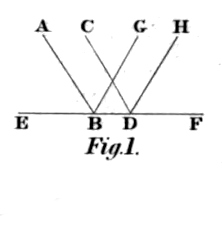
called immediate, as A B, B C.|A B C|
And any two spaces, as well as
times, are said to be CONTINUAL, when they have
one common part, as A C, B D,
where the part B C is common;
|A B C D|
and more spaces and times are continual, when
every two which are next one another are
continual.
Beginning, end, way, finite, infinite.
11. That part which is between two other parts,
is called a MEAN; and that which is not between
two other parts, an EXTREME. And of extremes,
that which is first reckoned is the BEGINNING,
and that which last, the END; and all the means
together taken are the WAY. Also, extreme parts
and limits are the same thing. And from hence
it is manifest, that beginning and end depend
upon the order in which we number them; and
that to terminate or limit space and time, is the
same thing with imagining their beginning and
end; as also that every thing is FINITE or INFINITE,
according as we imagine or not imagine it
limited or terminated every way; and that the
limits of any number are unities, and of these,
that which is the first in our numbering is the
beginning, and that which we number last, is the
end. When we say number is infinite, we mean
only that no number is expressed; for when we
99speak of the numbers two, three, a thousand, &c.
they are always finite. But when no more is said
but this, number is infinite, it is to be understood
as if it were said, this name number is an indefinite
name.
What is infinite in power. Nothing infinite can be truly said to be either whole or one; nor infinite spaces or times, many.
12. Space or time is said to finite in power,
or terminable, when there may be assigned a
number of finite spaces or times, as of paces or
hours, than which there can be no greater number
of the same measure in that space or time; and
infinite in power is that space or time, in which
a greater number of the said paces or hours may
be assigned, than any number that can be given.
But we must note, that, although in that space or
time which is infinite in power, there may be
numbered more paces or hours than any number
that can be assigned, yet their number will always
be finite; for every number is finite. And therefore
his ratiocination was not good, that undertaking
to prove the world to be finite, reasoned
thus; If the world be infinite, then there may be
taken in it some part which is distant from us an
infinite number of paces: but no such part can
be taken; wherefore the world is not infinite;
because that consequence of the major proposition
is false; for in an infinite space, whatsoever we take
or design in our mind, the distance of the same
from us is a finite space; for in the very designing
of the place thereof, we put an end to that space,
of which we ourselves are the beginning; and
whatsoever any man with his mind cuts off both
ways from infinite, he determines the same, that
is, he makes it finite.
Of infinite space or time, it cannot be said that
100it is a whole or one: not a whole, because not
compounded of parts; for seeing parts, how many
soever they be, are severally finite, they will also,
when they are all put together, make a whole
finite: nor one, because nothing can be said to be
one, except there be another to compare it with;
but it cannot be conceived that there are two
spaces, or two times, infinite. Lastly, when we
make question whether the world be finite or
infinite, we have nothing in our mind answering
to the name world; for whatsoever we imagine,
is therefore finite, though our computation reach
the fixed stars, or the ninth or tenth, nay, the
thousandth sphere. The meaning of the question
is this only, whether God has actually made so
great an addition of body to body, as we are able
to make of space to space.
Division proceeds not to the least.
13. And, therefore, that which is commonly
said, that space and time may be divided infinitely,
is not to be so understood, as if there might be
any infinite or eternal division; but rather to be
taken in this sense, whatsoever is divided, is
divided into such parts as may again be divided;
or thus, the least divisible thing is not to be
given; or, as geometricians have it, no quantity
is so small, but a less may be taken; which may
easily be demonstrated in this manner. Let any
space or time, that which was thought to be the
least divisible, be divided into two equal parts, A
and B. I say either of them, as A, may be
divided again. For suppose the part A to be
contiguous to the part B of one side, and of the
other side to some other space equal to B. This
whole space, therefore, being greater than the
101space given, is divisible. Wherefore, if it be
divided into two equal parts, the part in the
middle, which is A, will be also divided into two
equal parts; and therefore A was divisible.
1. Body defined.—2. Accident defined.—3. How an accident
may be understood to be in its subject.—4. Magnitude, what
it is.—5. Place, what it is, and that it is immovable.—6.
What is full and empty.—7. Here, there, somewhere, what
they signify.—8. Many bodies cannot be in one place, nor
one body in many places.—9. Contiguous and continual, what
they are.—10. The definition of motion. No motion intelligible
but with time.—11. What it is to be at rest, to have
been moved, and to be moved. No motion to be conceived,
without the conception of past and future.—12. A point, a
line, superficies and solid, what they are.—13. Equal, greater,
and less in bodies and magnitudes, what they are.—14. One
and the same body has always one and the same magnitude.—15.
Velocity, what it is.—16. Equal, greater, and less in times,
what they are.—17. Equal, greater, and less, in velocity, what.—18.
Equal, greater, and less, in motion, what.—19. That
which is at rest, will always be at rest, except it be moved by
some external thing; and that which is moved, will always be
moved, unless it be hindered by some external thing.—20.
Accidents are generated and destroyed, but bodies not so.—21.
An accident cannot depart from its subject.—22. Nor be
moved.—23. Essence, form, and matter, what they are.—24.
First matter, what.—25. That the whole is greater than
any part thereof, why demonstrated.
Body defined.
1. Having understood what imaginary space is,
in which we supposed nothing remaining without
us, but all those things to be destroyed, that, by
102existing heretofore, left images of themselves in
our minds; let us now suppose some one of those
things to be placed again in the world, or created
anew. It is necessary, therefore, that this new-created
or replaced thing do not only fill some
part of the space above mentioned, or be coincident
and coextended with it, but also that it have
no dependance upon our thought. And this is
that which, for the extension of it, we commonly
call body; and because it depends not upon our
thought, we say is a thing subsisting of itself;
as also existing, because without us; and, lastly,
it is called the subject, because it is so placed in
and subjected to imaginary space, that it may be
understood by reason, as well as perceived by
sense. The definition, therefore, of body may be
this, a body is that, which having no dependance
upon our thought, is coincident or coextended
with some part of space.
Accident defined.
2. But what an accident is cannot so easily be
explained by any definition, as by examples. Let
us imagine, therefore, that a body fills any space,
or is coextended with it; that coextension is not
the coextended body: and, in like manner, let us
imagine that the same body is removed out of its
place; that removing is not the removed body: or
let us think the same not removed; that not
removing or rest is not the resting body. What,
then, are these things? They are accidents of
that body. But the thing in question is, what is
an accident? which is an enquiry after that which
we know already, and not that which we should
enquire after. For who does not always and in
the same manner understand him that says any
103thing is extended, or moved, or not moved? But
most men will have it be said that an accident is
something, namely, some part of a natural thing,
when, indeed, it is no part of the same. To satisfy
these men, as well as may be, they answer best
that define an accident to be the manner by which
any body is conceived; which is all one as if they
should say, an accident is that faculty of any
body, by which it works in us a conception of
itself. Which definition, though it be not an
answer to the question propounded, yet it is an
answer to that question which should have been
propounded, namely, whence does it happen that
one part of any body appears here, another
there? For this is well answered thus: it happens
from the extension of that body. Or, how comes
it to pass that the whole body, by succession, is
seen now here, now there? and the answer will be,
by reason of its motion. Or, lastly, whence is it
that any body possesseth the same space for
sometime? and the answer will be, because it is
not moved. For if concerning the name of a
body, that is, concerning a concrete name, it be
asked, what is it? the answer must be made by
definition; for the question is concerning the
signification of the name. But if it be asked
concerning an abstract name, what is it? the
cause is demanded why a thing appears so or so.
As if it be asked, what is hard? The answer
will be, hard is that, whereof no part gives place,
but when the whole gives place. But if it be
demanded, what is hardness? a cause must be
shewn why a part does not give place, except the
104whole give place. Wherefore, I define an accident
to be the manner of our conception of body.
How an accident may be understood to be in its subject.
3. When an accident is said to be in a body, it
is not so to be understood, as if any thing were
contained in that body; as if, for example, redness
were in blood, in the same manner, as blood is in
a bloody cloth, that is, as a part in the whole;
for so, an accident would be a body also. But, as
magnitude, or rest, or motion, is in that which is
great, or which resteth, or which is moved, (which,
how it is to be understood, every man understands)
so also, it is to be understood, that every other
accident is in its subject. And this, also, is
explicated by Aristotle no otherwise than negatively,
namely, that an accident is in its subject,
not as any part thereof, but so as that it may be
away, the subject still remaining; which is right,
saving that there are certain accidents which can
never perish except the body perish also; for no
body can be conceived to be without extension, or
without figure. All other accidents, which are
not common to all bodies, but peculiar to some
only, as to be at rest, to be moved, colour,
hardness, and the like, do perish continually, and
are succeeded by others; yet so, as that the body
never perisheth. And as for the opinion that some
may have, that all other accidents are not in their
bodies in the same manner that extension, motion,
rest, or figure, are in the same; for example, that
colour, heat, odour, virtue, vice, and the like, are
otherwise in them, and, as they say, inherent;
I desire they would suspend their judgment for
the present, and expect a little, till it be found out
105by ratiocination, whether these very accidents are
not also certain motions either of the mind of the
perceiver, or of the bodies themselves which are
perceived; for in the search of this, a great part
of natural philosophy consists.
Magnitude, what it is.
4. The extension of a body, is the same thing
with the magnitude of it, or that which some call
real space. But this magnitude does not depend
upon our cogitation, as imaginary space doth; for
this is an effect of our imagination, but magnitude
is the cause of it; this is an accident of the mind,
that of a body existing out of the mind.
Place, what it is, and that it is immovable.
5. That space, by which word I here understand
imaginary space, which is coincident with the
magnitude of any body, is called the place of that
body; and the body itself is that which we call
the thing placed. Now place, and the magnitude
of the thing placed, differ. First in this, that a
body keeps always the same magnitude, both
when it is at rest, and when it is moved; but when
it is moved, it does not keep the same place.
Secondly in this, that place is a phantasm of any
body of such and such quantity and figure; but
magnitude is the peculiar accident of every body;
for one body may at several times have several
places, but has always one and the same magnitude.
Thirdly in this, that place is nothing out of the
mind, nor magnitude any thing within it. And
lastly, place is feigned extension, but magnitude
true extension; and a placed body is not extension,
but a thing extended. Besides, place is immovable;
for, seeing that which is moved, is understood to
be carried from place to place, if place were
moved, it would also be carried from place to
106place, so that one place must have another place,
and that place another place, and so on infinitely,
which is ridiculous. And as for those, that, by
making place to be of the same nature with real
space, would from thence maintain it to be
immovable, they also make place, though they do
not perceive they make it so, to be a mere phantasm.
For whilst one affirms that place is therefore
said to be immovable, because space in general is
considered there; if he had remembered that
nothing is general or universal besides names or
signs, he would easily have seen that that space,
which he says is considered in general, is nothing
but a phantasm, in the mind or the memory, of a
body of such magnitude and such figure. And
whilst another says: real space is made immovable
by the understanding; as when, under the superficies
of running water, we imagine other and
other water to come by continual succession, that
superficies fixed there by the understanding, is the
immovable place of the river: what else does he
make it to be but a phantasm, though he do it
obscurely and in perplexed words? Lastly, the
nature of place does not consist in the superficies
of the ambient, but in solid space; for the whole
placed body is coextended with its whole place,
and every part of it with every answering part of
the same place; but seeing every placed body is a
solid thing, it cannot be understood to be coextended
with superficies. Besides, how can any
whole body be moved, unless all its parts be
moved together with it? Or how can the internal
parts of it be moved, but by leaving their place?
But the internal parts of a body cannot leave the
107superficies of an external part contiguous to it;
and, therefore, it follows, that if place be the
superficies of the ambient, then the parts of a
body moved, that is, bodies moved, are not moved.
What is full and empty.
6. Space, or place, that is possessed by a body,
is called full, and that which is not so possessed,
is called empty.
Here, there, somewhere, what they signify.
7. Here, there, in the country, in the city, and
other the like names, by which answer is made to
the question where is it? are not properly names
of place, nor do they of themselves bring into the
mind the place that is sought; for here and there
signify nothing, unless the thing be shewn at the
same time with the finger or something else; but
when the eye of him that seeks, is, by pointing or
some other sign, directed to the thing sought, the
place of it is not hereby defined by him that
answers, but found out by him that asks the question.
Now such shewings as are made by words
only, as when we say, in the country, or in the
city, are some of greater latitude than others, as
when we say, in the country, in the city, in such a
street, in a house, in the chamber, in bed, &c.
For these do, by little and little, direct the seeker
nearer to the proper place; and yet they do not
determine the same, but only restrain it to a lesser
space, and signify no more, than that the place of
the thing is within a certain space designed by
those words, as a part is in the whole. And all
such names, by which answer is made to the question
where? have, for their highest genus, the
name somewhere. From whence it may be understood,
that whatsoever is somewhere, is in some
place properly so called, which place is part of
108that greater space that is signified by some of these
names, in the country, in the city, or the like.
Many bodies cannot be in one place, nor one body in many places.
8. A body, and the magnitude, and the place
thereof, are divided by one and the same act of
the mind; for, to divide an extended body, and the
extension thereof, and the idea of that extension,
which is place, is the same with dividing any one
of them; because they are coincident, and it
cannot be done but by the mind, that is by the
division of space. From whence it is manifest,
that neither two bodies can be together in the
same place, nor one body be in two places at the
same time. Not two bodies in the same place;
because when a body that fills its whole place is
divided into two, the place itself is divided into
two also, so that there will be two places. Not
one body in two places; for the place that a body
fills being divided into two, the placed body will
be also divided into two; for, as I said, a place
and the body that fills that place, are divided both
together; and so there will be two bodies.
Contiguous and continual, what they are.
9. Two bodies are said to be contiguous to one
another, and continual, in the same manner as
spaces are; namely, those are contiguous, between
which there is no space. Now, by space I understand,
here as formerly, an idea or phantasm of a
body. Wherefore, though between two bodies
there be put no other body, and consequently no
magnitude, or, as they call it, real space, yet if
another body may be put between them, that is, if
there intercede any imagined space which may
receive another body, then those bodies are not
contiguous. And this is so easy to be understood,
that I should wonder at some men, who being
109otherwise skilful enough in philosophy, are of a
different opinion, but that I find that most of those
that affect metaphysical subtleties wander from
truth, as if they were led out of their way by an
ignis fatuus. For can any man that has his
natural senses, think that two bodies must
therefore necessarily touch one another, because
no other body is between them? Or that there
can be no vacuum, because vacuum is nothing, or
as they call it, non ens? Which is as childish, as
if one should reason thus; no man can fast,
because to fast is to eat nothing; but nothing
cannot be eaten. Continual, are any two bodies
that have a common part; and more than two are
continual, when every two, that are next to one
another, are continual.
The definition of motion. No motion intelligible but with time.
10. MOTION is a continual relinquishing of
one place, and acquiring of another; and that
place which is relinquished is commonly called the
terminus a quo, as that which is acquired is called
the terminus ad quem; I say a continual relinquishing,
because no body, how little soever, can
totally and at once go out of its former place into
another, so, but that some part of it will be in a
part of a place which is common to both, namely,
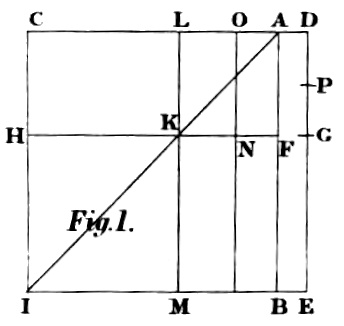
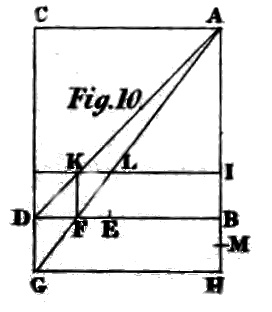
to the relinquished and the acquired places. | A G B I E
+-----+------+
:
:
:
:
+-----+------+
C H D K F| For
example, let any body be in the
place A C B D; the same body cannot
come into the place B D E F,
but it must first be in G H I K,
whose part G H B D is common to
both the places A C B D, and G H I K, and
whose part B D I K, is common to both the places
G H I K, and B D E F. Now it cannot be conceived
110that any thing can be moved without time;
for time is, by the definition of it, a phantasm, that
is, a conception of motion; and, therefore, to conceive
that any thing may be moved without time,
were to conceive motion without motion, which is
impossible.
What it is to be at rest, to have been moved, and to be moved. No motion to be conceived without the conception of past and future.
11. That is said to be at rest, which, during
any time, is in one place; and that to be moved,
or to have been moved, which, whether it be now
at rest or moved, was formerly in another place
than that which it is now in. From which definitions
it may be inferred, first, that whatsoever is
moved, has been moved; for if it be still in the
same place in which it was formerly, it is at rest,
that is, it is not moved, by the definition of rest;
but if it be in another place, it has been moved,
by the definition of moved. Secondly, that what
is moved, will yet be moved; for that which is
moved, leaveth the place where it is, and therefore
will be in another place, and consequently will
be moved still. Thirdly, that whatsoever is
moved, is not in one place during any time, how
little soever that time be; for by the definition of
rest, that which is in one place during any time,
is at rest.
There is a certain sophism against motion, which
seems to spring from the not understanding of
this last proposition. For they say, that, if any
body be moved, it is moved either in the place
where it is, or in the place where it is not; both
which are false; and therefore nothing is moved.
But the falsity lies in the major proposition; for
that which is moved, is neither moved in the place
where it is, nor in the place where is not; but
111from the place where it is, to the place where it is
not. Indeed it cannot be denied but that whatsoever
is moved, is moved somewhere, that is,
within some space; but then the place of that
body is not that whole space, but a part of it, as
is said above in the seventh article. From what
is above demonstrated, namely, that whatsoever is
moved, has also been moved, and will be moved,
this also may be collected, that there can be no
conception of motion, without conceiving past
and future time.
A point, a line, superficies, and solid, what they are.
12. Though there be no body which has not
some magnitude, yet if, when any body is moved,
the magnitude of it be not at all considered, the
way it makes is called a line, or one single
dimension; and the space, through which it
passeth, is called length; and the body itself, a
point; in which sense the earth is called a point,
and the way of its yearly revolution, the ecliptic
line. But if a body, which is moved, be considered
as long, and be supposed to be so moved, as that
all the several parts of it be understood to make
several lines, then the way of every part of that
body is called breadth, and the space which is
made is called superficies, consisting of two
dimensions, one whereof to every several part of
the other is applied whole. Again, if a body be
considered as having superficies, and be understood
to be so moved, that all the several parts of
it describe several lines, then the way of every
part of that body is called thickness or depth,
and the space which is made is called solid,
consisting of three dimensions, any two whereof
are applied whole to every several part of the
third.
112But if a body be considered as solid, then it is
not possible that all the several parts of it should
describe several lines; for what way soever it be
moved, the way of the following part will fall into
the way of the part before it, so that the same
solid will still be made which the foremost superficies
would have made by itself. And therefore
there can be no other dimension in any body, as
it is a body, than the three which I have now
described; though, as it shall be shewed hereafter,
velocity, which is motion according to length,
may, by being applied to all the parts of a solid,
make a magnitude of motion, consisting of four
dimensions; as the goodness of gold, computed
in all the parts of it, makes the price and value
thereof.
Equal, great, greater, and less, in bodies and magnitudes, what they are.
13. Bodies, how many soever they be, that
can fill every one the place of every one, are said
to be equal every one to every other. Now, one
body may fill the same place which another body
filleth, though it be not of the same figure with
that other body, if so be that it may be understood
to be reducible to the same figure, either by
flexion or transposition of the parts. And one
body is greater than another body, when a part
of that is equal to all this; and less, when all
that is equal to a part of this. Also, magnitudes
are equal, or greater, or lesser, than one another,
for the same consideration, namely, when the
bodies, of which they are the magnitudes, are
either equal, or greater, or less, &c.
One and the same body has always one and the same magnitude.
14. One and the same body is always of one
and the same magnitude. For seeing a body
and the magnitude and place thereof cannot be
comprehended in the mind otherwise than as they
113are coincident, if any body be understood to be at
rest, that is, to remain in the same place during
some time, and the magnitude thereof be in one
part of that time greater, and in another part less,
that body's place, which is one and the same, will
be coincident sometimes with greater, sometimes
with less magnitude, that is, the same place will be
greater and less than itself, which is impossible.
But there would be no need at all of demonstrating
a thing that is in itself so manifest, if there were
not some, whose opinion concerning bodies and
their magnitudes is, that a body may exist separated
from its magnitude, and have greater or less magnitude
bestowed upon it, making use of this
principle for the explication of the nature of rarum
and densum.
Velocity, what it is.
15. Motion, in as much as a certain length may
in a certain time be transmitted by it, is called
VELOCITY or swiftness: &c. For though swift
be very often understood with relation to slower
or less swift, as great is in respect of less, yet
nevertheless, as magnitude is by philosophers taken
absolutely for extension, so also velocity or swiftness
may be put absolutely for motion according to
length.
Equal, greater, and less, in times, what they are.
16. Many motions are said to be made in equal
times, when every one of them begins and ends
together with some other motion, or if it had
begun together, would also have ended together
with the same. For time, which is a phantasm of
motion, cannot be reckoned but by some exposed
motion; as in dials by the motion of the sun or of
the hand; and if two or more motions begin and
end with this motion, they are said to be made in
114equal times; from whence also it is easy to understand
what it is to be moved in greater or longer
time, and in less time or not so long; namely,
that that is longer moved, which beginning with
another, ends later; or ending together, began
sooner.
Equal, greater, and less, in velocity, what.
17. Motions are said to be equally swift, when
equal lengths are transmitted in equal times; and
greater swiftness is that, wherein greater length is
passed in equal time, or equal length in less time.
Also that swiftness by which equal lengths are
passed in equal parts of time, is called uniform
swiftness or motion; and of motions not uniform,
such as become swifter or slower by equal increasings
or decreasings in equal parts of time, are
said to be accelerated or retarded uniformly.
Equal, greater, and less, in motion, what.
18. But motion is said to be greater, less, and
equal, not only in regard of the length which is
transmitted in a certain time, that is, in regard of
swiftness only, but of swiftness applied to every
smallest particle of magnitude; for when any
body is moved, every part of it is also moved; and
supposing the parts to be halves, the motions of
those halves have their swiftness equal to one
another, and severally equal to that of the whole;
but the motion of the whole is equal to those two
motions, either of which is of equal swiftness with
it; and therefore it is one thing for two motions
to be equal to one another, and another thing for
them to be equally swift. And this is manifest in
two horses that draw abreast, where the motion of
both the horses together is of equal swiftness with
the motion of either of them singly; but the
motion of both is greater than the motion of one
115of them, namely, double. Wherefore motions are
said to be simply equal to one another, when the
swiftness of one, computed in every part of its
magnitude, is equal to the swiftness of the other
computed also in every part of its magnitude:
and greater than one another, when the swiftness
of one computed as above, is greater than the
swiftness of the other so computed; and less,
when less. Besides, the magnitude of motion
computed in this manner is that which is commonly
called FORCE.
That which is at rest will always be at rest, except it be moved by some external thing.
19. Whatsoever is at rest, will always be at
rest, unless there be some other body besides it,
which, by endeavouring to get into its place by
motion, suffers it no longer to remain at rest.
For suppose that some finite body exist and be at
rest, and that all space besides be empty; if now
this body begin to be moved, it will certainly be
moved some way; seeing therefore there was
nothing in that body which did not dispose it to
rest, the reason why it is moved this way is in
something out of it; and in like manner, if it had
been moved any other way, the reason of motion
that way had also been in something out of it; but
seeing it was supposed that nothing is out of it,
the reason of its motion one way would be the
same with the reason of its motion every other
way, wherefore it would be moved alike all ways
at once; which is impossible.
That which is moved will always be moved, unless it be hindered by some external thing.
In like manner, whatsoever is moved, will
always be moved, except there be some other body
besides it, which causeth it to rest. For if we
suppose nothing to be without it, there will be no
reason why it should rest now, rather than at
116another time; wherefore its motion would cease
in every particle of time alike; which is not
intelligible.
Accidents are generated and destroyed, but bodies not so.
20. When we say a living creature, a tree, or any
other specified body is generated or destroyed,
it is not to be so understood as if there were made
a body of that which is not-body, or not a body of
a body, but of a living creature not a living creature,
of a tree not a tree, &c. that is, that those
accidents for which we call one thing a living
creature, another thing a tree, and another by
some other name, are generated and destroyed;
and that therefore the same names are not to be
given to them now, which were given them before.
But that magnitude for which we give to any
thing the name of body is neither generated nor
destroyed. For though we may feign in our mind
that a point may swell to a huge bulk, and that
this may again contract itself to a point; that is,
though we may imagine something to arise where
before was nothing, and nothing to be there where
before was something, yet we cannot comprehend
in our mind how this may possibly be done in
nature. And therefore philosophers, who tie
themselves to natural reason, suppose that a body
can neither be generated nor destroyed, but only
that it may appear otherwise than it did to us,
that is, under different species, and consequently
be called by other and other names; so that that
which is now called man, may at another time
have the name of not-man; but that which is once
called body, can never be called not-body. But it
is manifest, that all other accidents besides magnitude
or extension may be generated and destroyed;
117as when a white thing is made black, the whiteness
that was in it perisheth, and the blackness that
was not in it is now generated; and therefore
bodies, and the accidents under which they appear
diversely, have this difference, that bodies are
things, and not generated; accidents are generated,
and not things.
An accident cannot depart from its subject
21. And therefore, when any thing appears
otherwise than it did by reason of other and other
accidents, it is not to be thought that an accident
goes out of one subject into another, (for they are
not, as I said above, in their subjects as a part in
the whole, or as a contained thing in that which
contains it, or as a master of a family in his house,)
but that one accident perisheth, and another is
generated. For example, when the hand, being
moved, moves the pen, motion does not go out of
the hand into the pen; for so the writing might be
continued though the hand stood still; but a new
motion is generated in the pen, and is the pen's
motion.
Nor be moved.
22. And therefore also it is improper to say, an
accident is moved; as when, instead of saying,
figure is an accident of a body carried away, we
say, a body carries away its figure.
Essence, form, and matter, what they are.
23. Now that accident for which we give a
certain name to any body, or the accident which
denominates its subject, is commonly called the
ESSENCE thereof; as rationality is the essence of
a man; whiteness, of any white thing, and extension
the essence of a body. And the same essence,
in as much as it is generated, is called the FORM.
Again, a body, in respect of any accident, is called
the SUBJECT, and in respect of the form it is
called the MATTER.
118Also, the production or perishing of any accident
makes its subject be said to be changed; only the
production or perishing of form makes it be said it
is generated or destroyed; but in all generation
and mutation, the name of matter still remains.
For a table made of wood is not only wooden, but
wood; and a statue of brass is brass as well as
brazen; though Aristotle, in his Metaphysics, says,
that whatsoever is made of any thing ought not to
be called ἐκεινὸ, but ἐκέινινον; as that which is made
of wood, not ξύλον, but ξύλινον, that is, not wood,
but wooden.
First matter, what.
24. And as for that matter which is common to
all things, and which philosophers, following Aristotle,
usually call materia prima, that is, first
matter, it is not any body distinct from all other
bodies, nor is it one of them. What then is it?
A mere name; yet a name which is not of vain
use; for it signifies a conception of body without
the consideration of any form or other accident
except only magnitude or extension, and aptness
to receive form and other accident. So that whensoever
we have use of the name body in general,
if we use that of materia prima, we do well. For
as when a man not knowing which was first,
water or ice, would find out which of the two were
the matter of both, he would be fain to suppose
some third matter which were neither of these
two; so he that would find out what is the matter
of all things, ought to suppose such as is not the
matter of anything that exists. Wherefore materia
prima is nothing; and therefore they do not
attribute to it either form or any other accident
besides quantity; whereas all singular things have
their forms and accidents certain.
119Materia prima, therefore, is body in general,
that is, body considered universally, not as having
neither form nor any accident, but in which no
form nor any other accident but quantity are at all
considered, that is, they are not drawn into argumentation.
That the whole is greater than any part thereof, why demonstrated.
25. From what has been said, those axioms may
be demonstrated, which are assumed by Euclid in
the beginning of his first element, about the equality
and inequality of magnitudes; of which,
omitting the rest, I will here demonstrate only
this one, the whole is greater than any part
thereof; to the end that the reader may know that
those axioms are not indemonstrable, and therefore
not principles of demonstration; and from hence
learn to be wary how he admits any thing for a
principle, which is not at least as evident as these
are. Greater is defined to be that, whose part is
equal to the whole of another. Now if we suppose
any whole to be A, and a part of it to be B;
seeing the whole B is equal to itself, and the same
B is a part of A; therefore a part of A will be
equal to the whole B. Wherefore, by the definition
above, A is greater than B; which was to be proved.
120
1. Action and passion, what they are.—2. Action and passion
mediate and immediate.—3. Cause simply taken. Cause
without which no effect follows, or cause necessary by supposition.—4.
Cause efficient and material.—5. An entire
cause is always sufficient to produce its effect. At the same
instant that the cause is entire, the effect is produced. Every
effect has a necessary cause.—6. The generation of effects is
continual. What is the beginning in causation.—7. No cause
of motion but in a body contiguous and moved.—8. The same
agents and patients, if alike disposed, produce like effects
though at different times.—9. All mutation is motion.—10.
Contingent accidents, what they are.
Action and passion, what they are.
1. A body is said to work upon or act, that is to
say, do something to another body, when it either
generates or destroys some accident in it: and the
body in which an accident is generated or destroyed
is said to suffer, that is, to have something done to
it by another body; as when one body by putting
forwards another body generates motion in it, it is
called the AGENT; and the body in which motion
is so generated, is called the PATIENT; so fire that
warms the hand is the agent, and the hand, which
is warmed, is the patient. That accident, which
is generated in the patient, is called the EFFECT.
Action and passion, mediate, and immediate.
2. When an agent and patient are contiguous to
one another, their action and passion are then said
to be immediate, otherwise, mediate; and when
another body, lying betwixt the agent and patient,
is contiguous to them both, it is then itself both an
121agent and a patient; an agent in respect of the
body next after it, upon which it works, and a
patient in respect of the body next before it, from
which it suffers. Also, if many bodies be so
ordered that every two which are next to one
another be contiguous, then all those that are
betwixt the first and the last are both agents and
patients, and the first is an agent only, and the last
a patient only.
Cause simply taken.
3. An agent is understood to produce its determined
or certain effect in the patient, according to
some certain accident or accidents, with which
both it and the patient are affected; that is to say,
the agent hath its effect precisely such, not because
it is a body, but because such a body, or so moved.
For otherwise all agents, seeing they are all bodies
alike, would produce like effects in all patients.
And therefore the fire, for example, does not warm,
because it is a body, but because it is hot; nor
does one body put forward another body because it
is a body, but because it is moved into the place
of that other body. |Cause without which no effect follows, or cause necessary by supposition.|The cause, therefore, of all
effects consists in certain accidents both in the
agents and in the patients; which when they are
all present, the effect is produced; but if any one
of them be wanting, it is not produced; and that
accident either of the agent or patient, without
which the effect cannot be produced, is called
causa sine qua non, or cause necessary by supposition,
as also the cause requisite for the production
of the effect. But a CAUSE simply, or an
entire cause, is the aggregate of all the accidents
both of the agents how many soever they be, and
of the patient, put together; which when they
122are all supposed to be present, it cannot be understood
but that the effect is produced at the same
instant; and if any one of them be wanting, it
cannot be understood but that the effect is not
produced.
Cause efficient, and material.
4. The aggregate of accidents in the agent or
agents, requisite for the production of the effect,
the effect being produced, is called the efficient
cause thereof; and the aggregate of accidents in
the patient, the effect being produced, is usually
called the material cause; I say the effect being
produced; for where there is no effect, there can
be no cause; for nothing can be called a cause,
where there is nothing that can be called an
effect. But the efficient and material causes are
both but partial causes, or parts of that cause, which
in the next precedent article I called an entire
cause. And from hence it is manifest, that the
effect we expect, though the agents be not defective
on their part, may nevertheless be frustrated by a
defect in the patient; and when the patient is
sufficient, by a defect in the agents.
An entire cause is always sufficient to produce its effect.
5. An entire cause is always sufficient for the
production of its effect, if the effect be at all
possible. For let any effect whatsoever be propounded
to be produced; if the same be produced,
it is manifest that the cause which produced it was
a sufficient cause; but if it be not produced, and
yet be possible, it is evident that something was
wanting either in some agent, or in the patient,
without which it could not be produced; that is,
that some accident was wanting which was requisite
for its production; and therefore, that cause was
not entire, which is contrary to what was supposed.
At the same instant that the cause is entire, the effect is produced.
123It follows also from hence, that in whatsoever
instant the cause is entire, in the same instant the
effect is produced. For if it be not produced,
something is still wanting, which is requisite for
the production of it; and therefore the cause was
not entire, as was supposed.
Every effect has a necessary cause.
And seeing a necessary cause is defined to be
that, which being supposed, the effect cannot but
follow; this also may be collected, that whatsoever
effect is produced at any time, the same is produced
by a necessary cause. For whatsoever is produced,
in as much as it is produced, had an entire cause,
that is, had all those things, which being supposed,
it cannot be understood but that the effect follows;
that is, it had a necessary cause. And in the
same manner it may be shewn, that whatsoever
effects are hereafter to be produced, shall have a
necessary cause; so that all the effects that have
been, or shall be produced, have their necessity in
things antecedent.
The generation of effects is continual. What is the beginning in causation.
6. And from this, that whensoever the cause is
entire, the effect is produced in the same instant,
it is manifest that causation and the production
of effects consist in a certain continual progress;
so that as there is a continual mutation in the
agent or agents, by the working of other agents
upon them, so also the patient, upon which they
work, is continually altered and changed. For
example: as the heat of the fire increases more
and more, so also the effects thereof, namely, the
heat of such bodies as are next to it, and again, of
such other bodies as are next to them, increase
more and more accordingly; which is already no
little argument that all mutation consists in motion
124only; the truth whereof shall be further demonstrated
in the ninth article. But in this progress
of causation, that is, of action and passion, if any
man comprehend in his imagination a part thereof,
and divide the same into parts, the first part or
beginning of it cannot be considered otherwise
than as action or cause; for, if it should be considered
as effect or passion, then it would be necessary
to consider something before it, for its cause
or action; which cannot be, for nothing can be
before the beginning. And in like manner, the
last part is considered only as effect; for it cannot
be called cause, if nothing follow it; but after the
last, nothing follows. And from hence it is, that in
all action the beginning and cause are taken for
the same thing. But every one of the intermediate
parts are both action and passion, and cause and
effect, according as they are compared with the
antecedent or subsequent part.
No cause of motion but in a body contiguous and moved.
7. There can be no cause of motion, except in a
body contiguous and moved. For let there be
any two bodies which are not contiguous, and betwixt
which the intermediate space is empty, or, if
filled, filled with another body which is at rest;
and let one of the propounded bodies be supposed
to be at rest; I say it shall always be at rest. For
if it shall be moved, the cause of that motion, by
the 8th chapter, article 19, will be some external
body; and, therefore, if between it and that external
body there be nothing but empty space,
then whatsoever the disposition be of that external
body or of the patient itself, yet if it be supposed
to be now at rest, we may conceive it will continue
so till it be touched by some other body.
125But seeing cause, by the definition, is the aggregate
of all such accidents, which being supposed
to be present, it cannot be conceived but that the
effect will follow, those accidents, which are either
in external bodies, or in the patient itself, cannot
be the cause of future motion. And in like manner,
seeing we may conceive that whatsoever is at rest
will still be at rest, though it be touched by some
other body, except that other body be moved;
therefore in a contiguous body, which is at rest,
there can be no cause of motion. Wherefore there
is no cause of motion in any body, except it be
contiguous and moved.
The same reason may serve to prove that whatsoever
is moved, will always be moved on in the
same way and with the same velocity, except it
be hindered by some other contiguous and moved
body; and consequently that no bodies, either
when they are at rest, or when there is an interposition
of vacuum, can generate or extinguish or
lessen motion in other bodies. There is one that
has written that things moved are more resisted
by things at rest, than by things contrarily moved;
for this reason, that he conceived motion not to be
so contrary to motion as rest. That which deceived
him was, that the words rest and motion are but
contradictory names; whereas motion, indeed, is
not resisted by rest, but by contrary motion.
The same agents and patients, if alike disposed, produce like effects, though at different times.
8. But if a body work upon another body at one
time, and afterwards the same body work upon the
same body at another time, so that both the agent
and patient, and all their parts, be in all things as
they were; and there be no difference, except only
in time, that is, that one action be former, the
126other later in time; it is manifest of itself, that the
effects will be equal and like, as not differing in
anything besides time. And as effects themselves
proceed from their causes, so the diversity of them
depends upon the diversity of their causes also.
All mutation is motion.
9. This being true, it is necessary that mutation
can be nothing else but motion of the parts of that
body which is changed. For first, we do not say
anything is changed, but that which appears to our
senses otherwise than it appeared formerly. Secondly,
both those appearances are effects produced
in the sentient; and, therefore, if they be
different, it is necessary, by the preceding article,
that either some part of the agent, which was formerly
at rest, is now moved, and so the mutation
consists in this motion; or some part, which was
formerly moved, is now otherwise moved, and so
also the mutation consists in this new motion; or
which, being formerly moved, is now at rest,
which, as I have shewn above, cannot come to
pass without motion; and so again, mutation is
motion; or lastly, it happens in some of these
manners to the patient, or some of its parts; so
that mutation, howsoever it be made, will consist
in the motion of the parts, either of the body
which is perceived, or of the sentient body, or of
both. Mutation therefore is motion, namely, of
the parts either of the agent or of the patient;
which was to be demonstrated. And to this it is
consequent, that rest cannot be the cause of anything,
nor can any action proceed from it; seeing
neither motion nor mutation can be caused by it.
Contingent accidents.
10. Accidents, in respect of other accidents
which precede them, or are before them in time,
127and upon which they do not depend as upon their
causes, are called contingent accidents; I say, in
respect of those accidents by which they are not
generated; for, in respect of their causes, all things
come to pass with equal necessity; for otherwise
they would have no causes at all; which, of things
generated, is not intelligible.
1. Power and cause are the same thing.—2. An act is produced
at the same instant in which the power is plenary.—3. Active
and passive power are parts only of plenary power.—4. An
act, when said to be possible.—5. An act necessary and contingent,
what.—6. Active power consists in motion.—7. Cause,
formal and final, what they are.
Power and cause are the same thing.
1. Correspondent to cause and effect, are
POWER and ACT; nay, those and these are the
same things; though, for divers considerations,
they have divers names. For whensoever any
agent has all those accidents which are necessarily
requisite for the production of some effect in the
patient, then we say that agent has power to produce
that effect, if it be applied to a patient. But,
as I have shewn in the precedent chapter, those
accidents constitute the efficient cause; and therefore
the same accidents, which constitute the
efficient cause, constitute also the power of the
agent. Wherefore the power of the agent and
the efficient cause are the same thing. But they
are considered with this difference, that cause is
128so called in respect of the effect already produced,
and power in respect of the same effect to be produced
hereafter; so that cause respects the past,
power the future time. Also, the power of the
agent is that which is commonly called active
power.
In like manner, whensoever any patient has all
those accidents which it is requisite it should have,
for the production of some effect in it, we say it is
in the power of that patient to produce that effect,
if it be applied to a fitting agent. But those accidents,
as is defined in the precedent chapter, constitute
the material cause; and therefore the power
of the patient, commonly called passive power,
and material cause, are the same thing; but with
this different consideration, that in cause the past
time, and in power the future, is respected.
Wherefore the power of the agent and patient
together, which may be called entire or plenary
power, is the same thing with entire cause; for
they both consist in the sum or aggregate of all
the accidents, as well in the agent as in the patient,
which are requisite for the production of the effect.
Lastly, as the accident produced is, in respect of
the cause, called an effect, so in respect of the
power, it is called an act.
An act is produced at the same instant in which the power is plenary.
2. As therefore the effect is produced in the
same instant in which the cause is entire, so also
every act that may be produced, is produced in the
same instant in which the power is plenary. And
as there can be no effect but from a sufficient and
necessary cause, so also no act can be produced but
by sufficient power, or that power by which it
could not but be produced.
Active and passive power are parts only of plenary power.
1293. And as it is manifest, as I have shewn, that
the efficient and material causes are severally and
by themselves parts only of an entire cause, and
cannot produce any effect but by being joined
together, so also power, active and passive, are
parts only of plenary and entire power; nor, except
they be joined, can any act proceed from them;
and therefore these powers, as I said in the first
article, are but conditional, namely, the agent has
power, if it be applied to a patient; and the
patient has power, if it be applied to an agent;
otherwise neither of them have power, nor can the
accidents, which are in them severally, be properly
called powers; nor any action be said to be possible
for the power of the agent alone or of the
patient alone.
An act, when said to be possible.
4. For that is an impossible act, for the production
of which there is no power plenary. For
seeing plenary power is that in which all things
concur, which are requisite for the production of
an act, if the power shall never be plenary, there
will always be wanting some of those things, without
which the act cannot be produced; wherefore
that act shall never be produced; that is, that act
is IMPOSSIBLE: and every act, which is not impossible,
is POSSIBLE. Every act, therefore, which is
possible, shall at some time be produced; for if it
shall never be produced, then those things shall
never concur which are requisite for the production
of it; wherefore that act is impossible, by the
definition; which is contrary to what was supposed.
An act necessary and contingent, what.
5. A necessary act is that, the production
whereof it is impossible to hinder; and therefore
130every act, that shall be produced, shall necessarily
be produced; for, that it shall not be produced, is
impossible; because, as is already demonstrated,
every possible act shall at some time be produced;
nay, this proposition, what shall be, shall be, is as
necessary a proposition as this, a man is a man.
But here, perhaps, some man may ask whether
those future things, which are commonly called
contingents, are necessary. I say, therefore, that
generally all contingents have their necessary
causes, as is shewn in the preceding chapter; but
are called contingents in respect of other events,
upon which they do not depend; as the rain, which
shall be tomorrow, shall be necessary, that is,
from necessary causes; but we think and say it
happens by chance, because we do not yet perceive
the causes thereof, though they exist now; for men
commonly call that casual or contingent, whereof
they do not perceive the necessary cause; and in
the same manner they used to speak of things past,
when not knowing whether a thing be done or no,
they say it is possible it never was done.
Wherefore, all propositions concerning future
things, contingent or not contingent, as this, it
will rain tomorrow, or this, tomorrow the sun
will rise, are either necessarily true, or necessarily
false; but we call them contingent, because we do
not yet know whether they be true or false;
whereas their verity depends not upon our knowledge,
but upon the foregoing of their causes. But
there are some, who though they confess this whole
proposition, tomorrow it will either rain, or not
rain, to be true, yet they will not acknowledge the
parts of it, as, tomorrow it will rain, or, tomorrow
131it will not rain, to be either of them true by itself;
because they say neither this nor that is true determinately.
But what is this determinately true, but
true upon our knowledge, or evidently true? And
therefore they say no more but that it is not yet
known whether it be true or no; but they say it
more obscurely, and darken the evidence of the
truth with the same words, with which they endeavour
to hide their own ignorance.
Active power consists in motion.
6. In the 9th article of the preceding chapter, I
have shewn that the efficient cause of all motion
and mutation consists in the motion of the agent,
or agents; and in the first article of this chapter,
that the power of the agent is the same thing with
the efficient cause. From whence it may be understood,
that all active power consists in motion also;
and that power is not a certain accident, which
differs from all acts, but is, indeed, an act, namely,
motion, which is therefore called power, because
another act shall be produced by it afterwards.
For example, if of three bodies the first put
forward the second, and this the third, the motion
of the second, in respect of the first which produceth
it, is the act of the second body; but, in
respect of the third, it is the active power of the
same second body.
Cause, formal and final, what they are.
7. The writers of metaphysics reckon up two
other causes besides the efficient and material,
namely, the ESSENCE, which some call the formal
cause, and the END, or final cause; both which
are nevertheless efficient causes. For when it is
said the essence of a thing is the cause thereof, as
to be rational is the cause of man, it is not intelligible;
for it is all one, as if it were said, to be a
132man is the cause of man; which is not well said.
And yet the knowledge of the essence of anything,
is the cause of the knowledge of the thing itself;
for, if I first know that a thing is rational, I know
from thence, that the same is man; but this is no
other than an efficient cause. A final cause has no
place but in such things as have sense and will;
and this also I shall prove hereafter to be an efficient
cause.
1. What it is for one thing to differ from another.—2. To differ
in number, magnitude, species, and genus, what.—3. What is
relation, proportion, and relatives.—4. Proportionals, what.—5.
The proportion of magnitudes to one another, wherein it
consists.—6. Relation is no new accident, but one of those
that were in the relative before the relation or comparison was
made. Also the causes of accidents in the correlatives, are the
cause of relation.—7. Of the beginning of individuation.
What it is for one thing to differ from another.
1. Hitherto I have spoken of body simply, and
accidents common to all bodies, as magnitude,
motion, rest, action, passion, power, possible, &c.;
and I should now descend to those accidents by
which one body is distinguished from another, but
that it is first to be declared what it is to be distinct
and not distinct, namely, what are the SAME
and DIFFERENT; for this also is common to all
bodies, that they may be distinguished and differenced
from one another. Now, two bodies are
said to differ from one another, when something
may be said of one of them, which cannot be said
of the other at the same time.
To differ in number, magnitude, species, and genus, what.
1332. And, first of all, it is manifest that no two
bodies are the same; for seeing they are two, they
are in two places at the same time; as that, which is
the same, is at the same time in one and the same
place. All bodies therefore differ from one another
in number, namely, as one and another; so that
the same and different in number, are names
opposed to one another by contradiction.
In magnitude bodies differ when one is greater
than another, as a cubit long, and two cubits long,
of two pound weight, and of three pound weight.
And to these, equals are opposed.
Bodies, which differ more than in magnitude, are
called unlike; and those, which differ only in magnitude,
like. Also, of unlike bodies, some are said
to differ in the species, others in the genus; in the
species, when their difference is perceived by one
and the same sense, as white and black; and in the
genus, when their difference is not perceived but
by divers senses, as white and hot.
What is relation, proportion, and relatives.
3. And the likeness, or unlikeness, equality, or
inequality of one body to another, is called their
RELATION; and the bodies themselves relatives or
correlatives; Aristotle calls them τὰ πρὸς τί; the
first whereof is usually named the antecedent, and
the second the consequent; and the relation of the
antecedent to the consequent, according to magnitude,
namely, the equality, the excess or defect
thereof, is called the PROPORTION of the antecedent
to the consequent; so that proportion is
nothing but the equality or inequality of the magnitude
of the antecedent compared to the magnitude
of the consequent by their difference only,
or compared also with their difference. For example,
134the proportion of three to two consists
only in this, that three exceeds two by unity; and
the proportion of two to five in this, that two,
compared with five, is deficient of it by three,
either simply, or compared with the numbers different;
and therefore in the proportion of unequals,
the proportion of the less to the greater, is called DEFECT;
and that of the greater to the less, EXCESS.
Proportionals, what.
4. Besides, of unequals, some are more, some
less, and some equally unequal; so that there is
proportion of proportions, as well as of magnitudes;
namely, where two unequals have relation
to two other unequals; as, when the inequality
which is between 2 and 3, is compared with the
inequality which is between 4 and 5. In which
comparison there are always four magnitudes; or,
which is all one, if there be but three, the middlemost
is twice numbered; and if the proportion of
the first to the second, be equal to the proportion
of the third to the fourth, then the four are said
to be proportionals; otherwise they are not proportionals.
The proportion of magnitudes to one another, wherein it consists.
5. The proportion of the antecedent to the consequent
consists in their difference, not only
simply taken, but also as compared with one of
the relatives; that is, either in that part of the
greater, by which it exceeds the less, or in the remainder,
after the less is taken out of the greater;
as the proportion of two to five consists in the
three by which five exceeds two, not in three
simply only, but also as compared with five or two.
For though there be the same difference between
two and five, which is between nine and twelve,
namely three, yet there is not the same inequality;
135and therefore the proportion of two to five is not
in all relation the same with that of nine to twelve,
but only in that which is called arithmetical.
Relation is no new accident, but one of those that were in the relative, before the relation or comparison was made. Also the causes of accidents in correlatives are the cause of relation.
6. But we must not so think of relation, as if it
were an accident differing from all the other accidents
of the relative; but one of them, namely,
that by which the comparison is made. For example,
the likeness of one white to another white,
or its unlikeness to black, is the same accident
with its whiteness; and equality and inequality,
the same accident with the magnitude of the thing
compared, though under another name: for that
which is called white or great, when it is not compared
with something else, the same when it is
compared, is called like or unlike, equal or unequal.
And from this it follows that the causes
of the accidents, which are in relatives, are the
causes also of likeness, unlikeness, equality and
inequality; namely, that he, that makes two unequal
bodies, makes also their inequality; and he, that
makes a rule and an action, makes also, if the
action be congruous to the rule, their congruity;
if incongruous, their incongruity. And thus much
concerning comparison of one body with another.
Of the beginning of individuation.
7. But the same body may at different times be
compared with itself. And from hence springs a
great controversy among philosophers about the
beginning of individuation, namely, in what sense
it may be conceived that a body is at one time the
same, at another time not the same it was formerly.
For example, whether a man grown old be the
same man he was whilst he was young, or another
man; or whether a city be in different ages the
same, or another city. Some place individuity in
136the unity of matter; others, in the unity of form;
and one says it consists in the unity of the aggregate
of all the accidents together. For matter,
it is pleaded that a lump of wax, whether it be
spherical or cubical, is the same wax, because the
same matter. For form, that when a man is grown
from an infant to be an old man, though his matter
be changed, yet he is still the same numerical
man; for that identity which cannot be attributed
to the matter, ought probably to be ascribed to the
form. For the aggregate of accidents, no instance
can be made; but because, when any new accident
is generated, a new name is commonly imposed on
the thing, therefore he, that assigned this cause of
individuity, thought the thing itself also was
become another thing. According to the first
opinion, he that sins, and he that is punished,
should not be the same man, by reason of the perpetual
flux and change of man's body; nor should
the city, which makes laws in one age and abrogates
them in another, be the same city; which
were to confound all civil rights. According to
the second opinion, two bodies existing both at
once, would be one and the same numerical body.
For if, for example, that ship of Theseus, concerning
the difference whereof made by continual reparation
in taking out the old planks and putting
in new, the sophisters of Athens were wont to dispute,
were, after all the planks were changed, the
same numerical ship it was at the beginning; and
if some man had kept the old planks as they were
taken out, and by putting them afterwards together
in the same order, had again made a ship of them,
this, without doubt, had also been the same numerical
137ship with that which was at the beginning;
and so there would have been two ships numerically
the same, which is absurd. But, according to the
third opinion, nothing would be the same it
was; so that a man standing would not be the same
he was sitting; nor the water, which is in the vessel,
the same with that which is poured out of it.
Wherefore the beginning of individuation is not
always to be taken either from matter alone, or
from form alone.
But we must consider by what name anything
is called, when we inquire concerning the identity
of it. For it is one thing to ask concerning Socrates,
whether he be the same man, and another to ask
whether he be the same body; for his body, when
he is old, cannot be the same it was when he was
an infant, by reason of the difference of magnitude;
for one body has always one and the same magnitude;
yet, nevertheless, he may be the same man.
And therefore, whensoever the name, by which it
is asked whether a thing be the same it was, is
given it for the matter only, then, if the matter be
the same, the thing also is individually the same;
as the water, which was in the sea, is the same
which is afterwards in the cloud; and any body is
the same, whether the parts of it be put together,
or dispersed; or whether it be congealed, or dissolved.
Also, if the name be given for such form
as is the beginning of motion, then, as long as that
motion remains, it will be the same individual
thing; as that man will be always the same, whose
actions and thoughts proceed all from the same
beginning of motion, namely, that which was in
his generation; and that will be the same river
138which flows from one and the same fountain,
whether the same water, or other water, or something
else than water, flow from thence; and that
the same city, whose acts proceed continually from
the same institution, whether the men be the same
or no. Lastly, if the name be given for some
accident, then the identity of the thing will depend
upon the matter; for, by the taking away and
supplying of matter, the accidents that were, are
destroyed, and other new ones are generated,
which cannot be the same numerically; so that a
ship, which signifies matter so figured, will be the
same as long as the matter remains the same; but
if no part of the matter be the same, then it is
numerically another ship; and if part of the matter
remain and part be changed, then the ship will
be partly the same, and partly not the same.
1. The definition of quantity.—2. The exposition of quantity,
what it is.—3. How line, superficies, and solid, are exposed.—4.
How time is exposed.—5. How number is exposed.—6. How
velocity is exposed.—7. How weight is exposed.—8. How the
proportion of magnitudes is exposed.—9. How the proportion
of times and velocities is exposed.
Definition of quantity.
1. What and how manifold dimension is, has
been said in the 8th chapter, namely, that there are
three dimensions, line or length, superficies, and
solid; every one of which, if it be determined, that
is, if the limits of it be made known, is commonly
called quantity; for by quantity all men understand
139that which is signified by that word, by
which answer is made to the question, How much
is it? Whensoever, therefore, it is asked, for
example, How long is the journey? it is not
answered indefinitely, length; nor, when it is
asked, How big is the field? is it answered indefinitely,
superficies; nor, if a man ask, How great
is the bulk? indefinitely, solid: but it is answered
determinately, the journey is a hundred miles; the
field is a hundred acres; the bulk is a hundred
cubical feet; or at least in some such manner, that
the magnitude of the thing enquired after may
by certain limits be comprehended in the mind.
QUANTITY, therefore, cannot otherwise be defined,
than to be a dimension determined, or a dimension,
whose limits are set out, either by their
place, or by some comparison.
The exposition of quantity, what it is.
2. And quantity is determined two ways; one,
by the sense, when some sensible object is set
before it; as when a line, a superficies or solid,
of a foot or cubit, marked out in some matter, is
objected to the eyes; which way of determining,
is called exposition, and the quantity so known
is called exposed quantity; the other by memory,
that is, by comparison with some exposed quantity.
In the first manner, when it is asked of what
quantity a thing is, it is answered, of such quantity
as you see exposed. In the second manner, answer
cannot be made but by comparison with some
exposed quantity; for if it be asked, how long is
the way? the answer is, so many thousand paces;
that is, by comparing the way with a pace, or some
other measure, determined and known by exposition;
or the quantity of it is to some other quantity
140known by exposition, as the diameter of a
square is to the side of the same, or by some
other the like means. But it is to be understood,
that the quantity exposed must be some standing
or permanent thing, such as is marked out in
consistent or durable matter; or at least something
which is revocable to sense; for otherwise no comparison
can be made by it. Seeing, therefore, by
what has been said in the next preceding chapter,
comparison of one magnitude with another is the
same thing with proportion; it is manifest, that
quantity determined in the second manner is
nothing else but the proportion of a dimension not
exposed to another which is exposed; that is, the
comparison of the equality or inequality thereof
with an exposed quantity.
How line, superficies, and solids, are exposed.
3. Lines, superficies, and solids, are exposed,
first, by motion, in such manner as in the 8th
chapter I have said they are generated; but so as
that the marks of such motion be permanent; as
when they are designed upon some matter, as a
line upon paper; or graven in some durable
matter. Secondly, by apposition; as when one
line or length is applied to another line or length,
one breadth to another breadth, and one thickness
to another thickness; which is as much as to
describe a line by points, a superficies by lines,
and a solid by superficies; saving that by points
in this place are to be understood very short
lines; and, by superficies, very thin solids.
Thirdly, lines and superficies may be exposed by
section, namely, a line may be made by cutting
an exposed superficies; and a superficies, by the
cutting of an exposed solid.
How time is exposed.
1414. Time is exposed, not only by the exposition
of a line, but also of some moveable thing, which
is moved uniformly upon that line, or at least is
supposed so to be moved. For, seeing time is an
idea of motion, in which we consider former and
latter, that is succession, it is not sufficient for the
exposition of time that a line be described; but
we must also have in our mind an imagination of
some moveable thing passing over that line; and
the motion of it must be uniform, that time may
be divided and compounded as often as there shall
be need. And, therefore, when philosophers, in
their demonstrations, draw a line, and say, Let
that line be time, it is to be understood as if they
said, Let the conception of uniform motion upon
that line, be time. For though the circles in dials
be lines, yet they are not of themselves sufficient
to note time by, except also there be, or be supposed
to be, a motion of the shadow or the hand.
How number is exposed.
5. Number is exposed, either by the exposition
of points, or of the names of number, one, two,
three, &c.; and those points must not be contiguous,
so as that they cannot be distinguished by
notes, but they must be so placed that they may
be discerned one from another; for, from this it
is, that number is called discreet quantity,
whereas all quantity, which is designed by motion,
is called continual quantity. But that number
may be exposed by the names of number, it is
necessary that they be recited by heart and in
order, as one, two, three, &c.; for by saying one,
one, one, and so forward, we know not what
number we are at beyond two or three; which
also appear to us in this manner, not as number,
but as figure.
How velocity is exposed.
1426. For the exposition of velocity, which, by the
definition thereof, is a motion which, in a certain
time, passeth over a certain space, it is requisite,
not only that time be exposed, but that there be
also exposed that space which is transmitted by
the body, whose velocity we would determine;
and that a body be understood to be moved in
that space also; so that there must be exposed two
lines, upon one of which uniform motion must be
understood to be made, that the time may be determined;
and, upon the other, the velocity is to be computed.
|A B
C D|
As if we would expose the velocity of the
we would expose the velocity of the
body A, we draw two lines A B
and C D, and place a body in C also; which done,
we say the velocity of the body A is so great,
that it passeth over the line A B in the same time
in which the body C passeth over the line C D
with uniform motion.
How weight is exposed.
7. Weight is exposed by any heavy body, of
what matter soever, so it be always alike heavy.
How the proportion of magnitudes is exposed.
8. The proportion of two magnitudes is then
exposed, when the magnitudes themselves are exposed,
namely, the proportion of equality, when
the magnitudes are equal; and of inequality, when
they are unequal. For seeing, by the 5th article
of the preceding chapter, the proportion of two
unequal magnitudes consists in their difference,
compared with either of them; and when two unequal
magnitudes are exposed, their difference is
also exposed; it follows, that when magnitudes,
which have proportion to one another, are exposed,
their proportion also is exposed with them;
and, in like manner, the proportion of equals,
143which consists in this, that there is no difference
of magnitude betwixt them, is exposed at the
same time when the equal magnitudes themselves
are exposed. For example, if the exposed lines
A B and C D be equal, the proportion
of equality is exposed in them;
|A B
C D
E G F|
and if the exposed lines, E F and E G
be unequal, the proportion which
E F has to E G, and that which E G
has to E F are also exposed in them; for not only
the lines themselves, but also their difference, G F,
is exposed. The proportion of unequals is quantity;
for the difference, G F, in which it consists,
is quantity. But the proportion of equality is not
quantity; because, between equals, there is no
difference; nor is one equality greater than another,
as one inequality is greater than another inequality.
How the proportion of times and velocities is exposed.
9. The proportion of two times, or of two uniform
velocities, is then exposed, when two lines
are exposed by which two bodies are understood
to be moved uniformly; and therefore the same
two lines serve to exhibit both their own proportion,
and that of the times and velocities, according
as they are considered to be exposed for the
magnitudes themselves, or for the times or velocities.
For let the two lines A and B be exposed;
| A
B |
their proportion therefore (by the
last foregoing article) is exposed; and if
they be considered as drawn with equal
and uniform velocity, then, seeing their times are
greater, or equal, or less, according as the same
spaces are transmitted in greater, or equal, or
less time, the lines A and B will exhibit the
equality or inequality, that is, the proportion
144of the times. To conclude, if the same lines, A
and B, be considered as drawn in the same time,
then, seeing their velocities are greater, or equal,
or less, according as they pass over in the same
time longer, or equal, or shorter lines, the same
lines, A and B, will exhibit the equality, or inequality,
that is, the proportion of their velocities.
1, 2, 3, 4. The nature and definition of proportion, arithmetical
and geometrical.—5. The definition, and some properties of
the same arithmetical proportion.—6, 7. The definition and
transmutations of analogism, or the same geometrical proportion.—8, 9.. The definitions of hyperlogism and hypologism,
that is, of greater and less proportion, and their transmutations.—10, 11, 12.
Comparison of analogical quantities, according
to magnitude.—13, 14, 15. Composition of proportions.—16, 17, 18, 19, 20, 21, 22, 23, 24, 25.
The definition and
properties of continual proportion.—26, 27, 28, 29. Comparison
of arithmetical and geometrical proportions.
[Note, that in this chapter the sign + signifies that the quantities betwixt
which it is put, are added together; and this sign - the remainder after
the latter quantity is taken out of the former. So that A + B is equal to
both A and B together; and where you see A - B, there A is the whole,
B the part taken out of it, and A - B the remainder. Also, two letters, set
together without any sign, signify, unless they belong to a figure, that one
of the quantities is multiplied by the other; as A B signifies the product of
A multiplied by B.]
The nature and definition of proportion, arithmetical & geometrical.
1. Great and little are not intelligible, but by comparison.
Now that, to which they are compared,
is something exposed; that is, some magnitude
either perceived by sense, or so defined by words,
that it may be comprehended by the mind. Also
that, to which any magnitude is compared, is either
145greater or less, or equal to it. And therefore proportion
(which, as I have shewn, is the estimation
or comprehension of magnitudes by comparison,)
is threefold, namely, proportion of equality, that
is, of equal to equal; or of excess, which is of the
greater to the less; or of defect, which is the proportion
of the less to the greater.
Again, every one of these proportions is two-fold;
for if it be asked concerning any magnitude
given, how great it is, the answer may be made
by comparing it two ways; first, by saying it is
greater or less than another magnitude, by so
much; as seven is less than ten, by three unities;
and this is called arithmetical proportion. Secondly,
by saying it is greater or less than another
magnitude, by such a part or parts thereof; as
seven is less than ten, by three tenth parts of the
same ten. And though this proportion be not
always explicable by number, yet it is a determinate
proportion, and of a different kind from
the former, and called geometrical proportion,
and most commonly proportion simply.
2. Proportion, whether it be arithmetical or
geometrical, cannot be exposed but in two magnitudes,
(of which the former is commonly called the
antecedent, and the latter the consequent of the
proportion) as I have shewn in the 8th article of
the preceding chapter. And, therefore, if two
proportions be to be compared, there must be four
magnitudes exposed, namely, two antecedents and
two consequents; for though it happen sometimes
that the consequent of the former proportion be
the same with the antecedent of the latter, yet in
that double comparison it must of necessity be
146twice numbered; so that there will be always four
terms.
3. Of two proportions, whether they be arithmetical
or geometrical, when the magnitudes compared
in both (which Euclid, in the fifth definition
of his sixth book, calls the quantities of proportions,)
are equal, then one of the proportions
cannot be either greater or less than the other;
for one equality is neither greater nor less than
another equality. But of two proportions of inequality,
whether they be proportions of excess or
of defect, one of them may be either greater or less
than the other, or they may both be equal; for
though there be propounded two magnitudes that
are unequal to one another, yet there may be
other two more, unequal, and other two equally
unequal, and other two less unequal than the two
which were propounded. And from hence it may
be understood, that the proportions of excess and
defect are quantity, being capable of more and
less; but the proportion of equality is not quantity,
because not capable neither of more, nor of
less. And therefore proportions of inequality may
be added together, or subtracted from one another,
or be multiplied or divided by one another, or by
number; but proportions of equality not so.
4. Two equal proportions are commonly called
the same proportion; and, it is said, that the
proportion of the first antecedent to the first
consequent is the same with that of the second
antecedent to the second consequent. And when
four magnitudes are thus to one another in geometrical
proportion, they are called proportionals;
and by some, more briefly, analogism. And greater
147proportion is the proportion of a greater antecedent
to the same consequent, or of the same
antecedent to a less consequent; and when the
proportion of the first antecedent to the first consequent
is greater than that of the second antecedent
to the second consequent, the four magnitudes,
which are so to one another, may be called
hyperlogism.
Less proportion is the proportion of a less antecedent
to the same consequent, or of the same
antecedent to a greater consequent; and when the
proportion of the first antecedent to the first consequent
is less than that of the second to the second,
the four magnitudes may be called hypologism.
The definition and some properties of the same arithmetical proportion.
5. One arithmetical proportion is the same with
another arithmetical proportion, when one of the
antecedents exceeds its consequent, or is exceeded
by it, as much as the other antecedent exceeds its
consequent, or is exceeded by it. And therefore,
in four magnitudes, arithmetically proportional,
the sum of the extremes is equal to the sum of the
means. For if A. B :: C. D be arithmetically proportional,
and the difference on both sides be the
same excess, or the same defect, E, then B + C (if
A be greater than B) will be equal to A - E + C;
and A + D will be equal to A + C - E; but A - E + C
and A + C - E are equal. Or if A be less than B,
then B + C will be equal to A + E + C; and A + D
will be equal to A + C + E; but A + E + C and A + C + E
are equal.
Also, if there be never so many magnitudes,
arithmetically proportional, the sum of them all
will be equal to the product of half the number of
the terms multiplied by the sum of the extremes.
148For if A. B :: C. D :: E. F be arithmetically proportional,
the couples A + F, B + E, C + D will be
equal to one another; and their sum will be equal
to A + F, multiplied by the number of their combinations,
that is, by half the number of the terms.
If, of four unequal magnitudes, any two, together
taken, be equal to the other two together taken,
then the greatest and the least of them will be in
the same combination. Let the unequal magnitudes
be A, B, C, D; and let A + B be equal to
C + D; and let A be the greatest of them all; I say
B will be the least. For, if it may be, let any of
the rest, as D, be the least. Seeing therefore A
is greater than C, and B than D, A+B will be
greater than C + D; which is contrary to what was
supposed.
If there be any four magnitudes, the sum of the
greatest and least, the sum of the means, the
difference of the two greatest, and the difference
of the two least, will be arithmetically proportional.
For, let there be four magnitudes, whereof
A is the greatest, D the least, and B and C the
means; I say A + D. B + C :: A - B. C - D are
arithmetically proportional. For the difference
between the first antecedent and its consequent is
this, A + D - B - C; and the difference between
the second antecedent and its consequent this,
A - B - C + D; but these two differences are equal;
and therefore, by this 5th article, A + D. B + C ::
A - B. C - D are arithmetically proportional.
If, of four magnitudes, two be equal to the other
two, they will be in reciprocal arithmetical proportion.
For let A + B be equal to C + D, I say
A. C :: D. B are arithmetically proportional. For
149if they be not, let A. C :: D. E (supposing E to be
greater or less than B) be arithmetically proportional,
and then A + E will be equal to C + D;
wherefore A + B and C + D are not equal; which is
contrary to what was supposed.
The definition and transmutations of analogism, or the same geometrical proportion.
6. One geometrical proportion is the same with
another geometrical proportion; when the same
cause, producing equal effects in equal times, determines
both the proportions.
If a point uniformly moved describe two lines,
either with the same, or different velocity, all the
parts of them which are contemporary, that is,
which are described in the same time, will be two
to two, in geometrical proportion, whether the
antecedents be taken in the same line, or not.
For, from the point A (in the 10th figure at the
end of the 14th chapter) let the two lines, A D,
A G, be described with uniform motion; and let
there be taken in them two parts A B, A E, and
again, two other parts, A C, A F; in such manner,
that A B, A E, be contemporary, and likewise
A C, A F contemporary. I say first (taking the
antecedents A B, A C in the line A D, and the conquents
A E, A F in the line A G) that A B. A C ::
A E. A F are proportionals. For seeing (by the
8th chap, and the 15th art.) velocity is motion
considered as determined by a certain length or
line, in a certain time transmitted by it, the quantity
of the line A B will be determined by the
velocity and time by which the same A B is described;
and for the same reason, the quantity of
the line A C will be determined by the velocity
and time, by which the same A C is described;
and therefore the proportion of A B to A C, whether
150it be proportion of equality, or of excess or
defect, is determined by the velocities and times
by which A B, A C are described; but seeing the
motion of the point A upon A B and A C is uniform,
they are both described with equal velocity;
and therefore whether one of them have to the
other the proportion of majority or of minority,
the sole cause of that proportion is the difference
of their times; and by the same reason it is evident,
that the proportion of A E to A F is determined
by the difference of their times only. Seeing
therefore A B, A E, as also A C, A F are contemporary,
the difference of the times in which A B
and A C are described, is the same with that in
which A E and A F are described. Wherefore the
proportion of A B to A C, and the proportion of
A E to A F are both determined by the same cause.
But the cause, which so determines the proportion
of both, works equally in equal times, for it is uniform
motion; and therefore (by the last precedent
definition) the proportion of A B to A C is the same
with that of A E to A F; and consequently A B.
A C :: A E. A F are proportionals; which is the
first.
Secondly, (taking the antecedents in different
lines) I say, A B. A E :: A C. A F are proportionals;
for seeing A B, A E are described in the same
time, the difference of the velocities in which they
are described is the sole cause of the proportion
they have to one another. And the same may be
said of the proportion of A C to A F. But seeing
both the lines A D and A G are passed over by
uniform motion, the difference of the velocities in
which A B, A E are described, will be the same
151with the difference of the velocities, in which A C,
A F are described. Wherefore the cause which
determines the proportion of A B to A E, is the
same with that which determines the proportion of
A C to A F; and therefore A B. A E :: A C. A F,
are proportionals; which remained to be proved.
Coroll. I. If four magnitudes be in geometrical
proportion, they will also be proportionals by permutation,
that is, by transposing the middle terms.
For I have shown, that not only A B. A C :: A E.
A F, but also that, by permutation, A B. A E ::
A C. A F are proportionals.
Coroll. II. If there be four proportionals, they
will also be proportionals by inversion or conversion,
that is, by turning the antecedents into consequents.
For if in the last analogism, I had for
A B, A C, put by inversion A C, A B, and in like
manner converted A E, A F into A F, A E, yet the
same demonstration had served. For as well A C,
A B, as A B, A C are of equal velocity; and A C,
A F, as well as A F, A C are contemporary.
Coroll. III. If proportionals be added to proportionals,
or taken from them, the aggregates, or
remainders, will be proportionals. For contemporaries,
whether they be added to contemporaries,
or taken from them, make the aggregates or remainders
contemporary, though the addition or
subtraction be of all the terms, or of the antecedents
alone, or of the consequents alone.
Coroll. IV. If both the antecedents of four proportionals,
or both the consequents, or all the
terms, be multiplied or divided by the same number
or quantity, the products or quotients will be
proportionals. For the multiplication and division
152of proportionals, is the same with the addition and
subtraction of them.
Coroll. V. If there be four proportionals, they
will also be proportionals by composition, that is,
by compounding an antecedent of the antecedent
and consequent put together, and by taking for
consequent either the consequent singly, or the
antecedent singly. For this composition is nothing
but addition of proportionals, namely, of consequents
to their own antecedents, which by supposition
are proportionals.
Coroll. VI. In like manner, if the antecedent
singly, or consequent singly, be put for antecedent,
and the consequent be made of both put together,
these also will be proportionals. For it is the inversion
of proportion by composition.
Coroll. VII. If there be four proportionals, they
will also be proportionals by division, that is, by
taking the remainder after the consequent is subtracted
from the antecedent, or the difference
between the antecedent and consequent for antecedent,
and either the whole or the subtracted for
consequent; as if A. B :: C. D be proportionals,
they will by division be A - B. B :: C - D. D, and
A - B. A :: C - D. C; and when the consequent is
greater than the antecedent, B - A. A :: D - C. C,
and B - A. B :: D - C. D. For in all these divisions,
proportionals are, by the very supposition of the
analogism A. B :: C. D, taken from A and B, and
from C and D.
Coroll. VIII. If there be four proportionals, they
will also be proportionals by the conversion of
proportion, that is, by inverting the divided proportion,
or by taking the whole for antecedent,
and the difference or remainder for consequent.
153As, if A. B :: C. D be proportionals, then A. A - B
:: C. C - D, as also B. A - B :: D. C - D will be
proportionals. For seeing these inverted be proportionals,
they are also themselves proportionals.
Coroll. IX. If there be two analogisms which
have their quantities equal, the second to the second,
and the fourth to the fourth, then either the
sum or difference of the first quantities will be to
the second, as the sum or difference of the third
quantities is to the fourth. Let A. B :: C. D and
E. B :: F. D be analogisms; I say A + E. B :: C + F. D
are proportionals. For the said analogisms will
by permutation be A. C :: B. D, and E. F :: B. D;
and therefore A. C :: E. F will be proportionals,
for they have both the proportion of B to D common.
Wherefore, if in the permutation of the
first analogism, there be added E and F to A and
C, which E and F are proportional to A and C,
then (by the third coroll.) A + E. B :: C + F. D will
be proportionals; which was to be proved.
Also in the same manner it may be shown, that
A - E. B :: C - F. D are proportionals.
7. If there be two analogisms, where four antecedents
make an analogism, their consequents
also shall make an analogism; as also the sums of
their antecedents will be proportional to the sums
of their consequents. For if A. B :: C. D and
E. F :: G. H be two analogisms, and A. E :: C. G be
proportionals, then by permutation A. C :: E. G,
and E. G :: F. H, and A. C :: B. D will be proportionals;
wherefore B. D :: E. G, that is, B. D :: F. H,
and by permutation B. F :: D. H are proportionals;
which is the first. Secondly, I say A + E. B + F ::
C + G. D + H will be proportionals. For seeing
154A. E :: C. G are proportionals, A + E. E :: C + G. G
will also by composition be proportionals, and by
permutation A + E. C + G :: E. G will be proportionals;
wherefore, also A + E. C + G :: B + F. D + H will
be proportionals. Again, seeing, as is shown above,
B. F :: D. H are proportionals, B + F. F :: D + H. H
will also by composition be proportionals; and by
permutation B + F. D + H :: F. H will also be proportionals;
wherefore A + E. C + G :: B + F. D + H
are proportionals; which remained to be proved.
Coroll. By the same reason, if there be never so
many analogisms, and the antecedents be proportional
to the antecedents, it may be demonstrated
also that the consequents will be proportional to
the consequents, as also the sum of the antecedents
to the sum of the consequents.
The definition of hyperlogism and hypologism, that is, of greater and less proportion, and their transmutations.
8. In an hyperlogism, that is, where the proportion
of the first antecedent to its consequent
is greater than the proportion of the second antecedent
to its consequent, the permutation of the
proportionals, and the addition of proportionals to
proportionals, and substraction of them from one
another, as also their composition and division, and
their multiplication and division by the same number,
produce always an hyperlogism. For suppose
A. B :: C . D and A. C :: E. F be analogisms, A + E. B
:: C + F . D will also be an analogism; but A + E.
B :: C. D will be an hyperlogism; wherefore by
permutation, A + E. C :: B. D is an hyperlogism,
because A. B :: C. D is an analogism. Secondly, if
to the hyperlogism A + E. B :: C. D the proportionals
G and H be added, A + E + G. B :: C + H. D
will be an hyperlogism, by reason A + E + G.
B :: C + F + H. D is an analogism. Also, if G and
155H be taken away, A + E - G. B :: C - H. D will be
an hyperlogism; for A + E - G. B :: C + F - H. D
is an analogism. Thirdly, by composition A + E
+ B. B :: C + D. D will be an hyperlogism, because
A + E + B. B :: C + F + D. D is ah analogism, and so
it will be in all the varieties of composition.
Fourthly, by division, A + E - B. B :: C - D. D will
by an hyperlogism, by reason A E - B. B :: C + F
- D. D is an analogism. Also A + E - B. A + E ::
C - D. C is an hyperlogism; for A + E - B. A + E ::
C + F - D. C is an analogism. Fifthly, by multiplication
4 A + 4 E. B :: 4 C. D is an hyperlogism, because
4 A. B :: 4 C. D is an analogism; and by
division ¼ A + ¼ E. B :: ¼ C.D is an hyperlogism,
because ¼ A. B :: ¼ C. D is an analogism.
9. But if A + E. B :: C. D be an hyperlogism,
then by inversion B. A + E :: D. C will be an hypologism,
because B. A :: D. C being an analogism,
the first consequent will be too great. Also,
by conversion of proportion, A + E. A + E - B :: C.
C - D is an hypologism, because the inversion of
it, namely A + E - B. A + E :: C - D. C is an hyperlogism,
as I have shown but now. So also B. A +
E - B :: D. C - D is an hypologism, because, as I
have newly shown, the inversion of it, namely
A + E - B. B :: C - D. D is an hyperlogism. Note
that this hypologism A + E. A + E - B :: C. C - D is
commonly thus expressed; if the proportion of
the whole, (A + E) to that which is taken out of it
(B), be greater than the proportion of the whole
(C) to that which is taken out of it (D), then the
proportion of the whole (A + E) to the remainder
(A + E - B) will be less than the proportion of the
whole (C) to the remainder (C - D).
Comparison of analogical quantities, according to magnitude.
15610. If there be four proportionals, the difference
of the two first, to the difference of the two last,
will be as the first antecedent is to the second
antecedent, or as the first consequent to the second
consequent. For if A. B :: C. D be proportionals,
then by division A - B. B :: C - D. D will be proportionals;
and by permutation A - B. C - D ::
B. D; that is, the differences are proportional to
the consequents, and therefore they are so also to
the antecedents.
11. Of four proportionals, if the first be greater
than the second, the third also shall be greater
than the fourth. For seeing the first is greater
than the second, the proportion of the first to the
second is the proportion of excess; but the proportion
of the third to the fourth is the same with
that of the first to the second; and therefore also
the proportion of the third to the fourth is the
proportion of excess; wherefore the third is greater
than the fourth. In the same manner it may be
proved, that whensoever the first is less than the
second, the third also is less than the fourth; and
when those are equal, that these also are equal.
12. If there be four proportionals whatsoever,
A. B :: C.D, and the first and third be multiplied by
any one number, as by 2; and again the second and
fourth be multiplied by any one number, as by 3;
and the product of the first 2 A, be greater than
the product of the second 3 B; the product also
of the third 2 C, will be greater than the product
of the fourth 3 D. But if the product of the first
be less than the product of the second, then the
product of the third will be less than that of the
fourth. And lastly, if the products of the first
157and second be equal, the products of the third and
fourth shall also be equal. Now this theorem
is all one with Euclid's definition of the same
proportion; and it may be demonstrated thus.
Seeing A. B :: C. D are proportionals, by permutation
also (art. 6, coroll. I.) A. C :: B . D will be
proportionals; wherefore (by coroll. IV. art. 6) 2 A.
2 C :: 3 B. 3 D will be proportionals; and again,
by permutation, 2 A. 3 B :: 2 C. 3 D will be proportionals;
and therefore, by the last article, if
2 A be greater than 3 B, then 2 C will be greater
than 3 D; if less, less; and if equal, equal; which
was to be demonstrated.
Composition of proportions.
13. If any three magnitudes be propounded, or
three things whatsoever that have any proportion
one to another, as three numbers, three times,
three degrees, &c.; the proportions of the first to
the second, and of the second to the third, together
taken, are equal to the proportion of the first to
the third. Let there be three lines, for any proportion
may be reduced to the proportion of lines,
A B, A C, A D; and in the first place, let the proportion
as well of the first A B to the second A C,
as of the second A C to the|A B C D|
third AD, be the proportion
of defect, or of less to greater; I say the proportions
together taken of A B to A C, and of A C to
A D, are equal to the proportion of A B to A D.
Suppose the point A to be moved over the whole
line A D with uniform motion; then the proportions
as well of A B to A C, as of A C to A D, are
determined by the difference of the times in which
they are described; that is, A B has to A C such
proportion as is determined by the different times
of their description; and A C to AD such proportion
158as is determined by their times. But the
proportion of A B to A D is such as is determined
by the difference of the times in which A B and
A D are described; and the difference of the times
in which A B and A C are described, together with
the difference of the times in which A C and A D
are described, is the same with the difference of
the times in which A B and A D are described.
And therefore, the same cause which determines
the two proportions of A B to A C and of A C to
A D, determines also the proportion of A B to
A D. Wherefore, by the definition of the same
proportion, delivered above in the 6th article, the
proportion of A B to A C together with the proportion
of A C to A D, is the same with the proportion
of A B to A D.
In the second place, let A D be the first, A C
the second, and A B the third, and let their proportion
be the proportion of excess, or the greater
to less; then, as before, the proportions of A D to
A C, and of A C to A B, and of A D to A B, will be
determined by the difference of their times; which
in the description of A D and A C, and of A C and
A B together taken, is the same with the difference
of the times in the description of A D and
A B. Wherefore the proportion of A D to A B is
equal to the two proportions of A D to A C and of
A C to A B.
In the last place. If one of the proportions,
namely of A D to A B, be the proportion of excess,
and another of them, as of A B to A C be the proportion
of defect, thus also the proportion of A D
to A C will be equal to the two proportions together
taken of A D to A B, and of A B to A C. For
the difference of the times in which AD and AB
159are described, is excess of time; for there goes
more time to the description of A D than of A B;
and the difference of the times in which A B and
A C are described, is defect of time, for less time
goes to the description of A B than of A C; but
this excess and defect being added together, make
D B - B C, which is equal to D C, by which the
first A D exceeds the third A C; and therefore the
proportions of the first A D to the second A B,
and of the second A B to the third A C, are determined
by the same cause which determines the
proportion of the first A D to the third A C.
Wherefore, if any three magnitudes, &c.
Coroll. I. If there be never so many magnitudes
having proportion to one another, the proportion
of the first to the last is compounded of the proportions
of the first to the second, of the second
to the third, and so on till you come to the last;
or, the proportion of the first to the last is the
same with the sum of all the intermediate proportions.
For any number of magnitudes having proportion
to one another, as A, B, C, D, E being
propounded, the proportion of A to E, as is newly
shown, is compounded of the proportions of A to D
and of D to E; and again, the proportion of A to
D, of the proportions of A to C, and of C to D;
and lastly, the proportion of A to C, of the proportions
of A to B, and of B to C.
Coroll. II. From hence it may be understood
how any two proportions may be compounded. For
if the proportions of A to B, and of C to D, be
propounded to be added together, let B have to
something else, as to E, the same proportion which
C has to D, and let them be set in this order,
160A, B, E; for so the proportion of A to E will evidently
be the sum of the two proportions of A to B,
and of B to E, that is, of C to D. Or let it be as
D to C, so A to something else, as to E, and let
them be ordered thus, E, A, B; for the proportion
of E to B will be compounded of the proportions
of E to A, that is, of C to D, and of A to B. Also,
it may be understood how one proportion may be
taken out of another. For if the proportion of C
to D be to be subtracted out of the proportion of
A to B, let it be as C to D, so A to something else,
as E, and setting them in this order, A, E, B, and
taking away the proportion of A to E, that is, of
C to D, there will remain the proportion of E to B.
Coroll. III. If there be two orders of magnitudes
which have proportion to one another, and the
several proportions of the first order be the same
and equal in number with the proportions of the
second order; then, whether the proportions in
both orders be successively answerable to one another,
which is called ordinate proportion, or not
successively answerable, which is called perturbed
proportion, the first and the last in both will be proportionals.
For the proportion of the first to the
last is equal to all the intermediate proportions;
which being in both orders the same, and equal in
number, the aggregates of those proportions will
also be equal to one another; but to their aggregates,
the proportions of the first to the last are
equal; and therefore the proportion of the first to
the last in one order, is the same with the proportion
of the first to the last in the other order.
Wherefore the first and the last in both are proportionals.
Composition of proportions.
16114. If any two quantities be made of the mutual
multiplication of many quantities, which have proportion
to one another, and the efficient quantities
on both sides be equal in number, the proportion
of the products will be compounded of the several
proportions, which the efficient quantities have to
one another.
First, let the two products be A B and C D,
whereof one is made of the multiplication of A
into B, and the other of the multiplication of C
into D. I say the proportion of A B to C D is
compounded of the proportions of the efficient A
to the efficient C, and of the efficient B to the
efficient D. For let A B, C B and C D be set in
order; and as B is to D, so let C be to another
quantity as E; and let A, C, E be
set also in order. |A B. A.
C B. C
C D. E| Then (by
coroll. IV. of the 6th art.) it will
be as A B the first quantity to C B
the second quantity in the first order, so A to C in
the second order; and again, as C B to C D in the
first order, so B to D, that is, by construction,
so C to E in the second order; and therefore (by
the last corollary) A B. C D :: A. E will be proportionals.
But the proportion of A to E is compounded
of the proportions of A to C, and of B to
D; wherefore also the proportion of A B to C D
is compounded of the same.
Secondly, let the two products be A B F, and
C D G, each of them made of three efficients, the
first of A, B and F, and the second of C, D and
G; I say, the proportion of A B F to C D G is
compounded of the proportions of A to C, of B to
D, and of F to G. For let them be set in order as
162before; and as B is to D, so let C be to another
quantity E; and again, as F is to G, so let E be to
another, H; and let the first order stand thus,
ABF, CBF, CDF and CDG; |A B F. A.
C B F. C.
C D F. E.
C D G. H.|
and the second order thus,
A, C, E, H. Then the proportion
of A B F to C B F in the
first order, will be as A to C in
the second; and the proportion of CBF to CDF
in the first order, as B to D, that is, as C to E (by
construction) in the second order; and the proportion
of CDF to CDG in the first, as F to G,
that is, as E to H (by construction) in the second
order; and therefore A B F. C D G:: A. H will be
proportionals. But the proportion of A to H is
compounded of the proportions of A to C, B to D,
and F to G. Wherefore the proportion of the
product A B F to C D G is also compounded of the
same. And this operation serves, how many soever
the efficients be that make the quantities given.
From hence ariseth another way of compounding
many proportions into one, namely, that which is
supposed in the 5th definition of the 6th book of
Euclid; which is, by multiplying all the antecedents
of the proportions into one another, and in
like manner all the consequents into one another.
And from hence also it is evident, in the first
place, that the cause why parallelograms, which
are made by the duction of two straight lines into
one another, and all solids which are equal to
figures so made, have their proportions compounded
of the proportions of the efficients; and in the
second place, why the multiplication of two or
more fractions into one another is the same thing
163with the composition of the proportions of their
several numerators to their several denominators.
For example, if these fractions 1⁄2, 2⁄3, 3⁄4 be to be
multiplied into one another, the numerators 1, 2, 3,
are first to be multiplied into one another, which
make 6; and next the denominators 2, 3, 4, which
make 24; and these two products make the fraction
6⁄24. In like manner, if the proportions of 1
to 2, of 2 to 3, and of 3 to 4, be to be compounded,
by working as I have shown above, the same proportion
of 6 to 24 will be produced.
15. If any proportion be compounded with itself
inverted, the compound will be the proportion of
equality. For let any proportion be given, as of
A to B, and let the inverse of it be that of C to D;
and as C to D, so let B be to another quantity;
for thus they will be compounded (by the second
coroll. of the 12th art.) Now seeing the proportion
of C to D is the inverse of the proportion of
A to B, it will be as C to D, so B to A; and therefore
if they be placed in order, A, B, A, the proportion
compounded of the proportions of A to B, and
of C to D, will be the proportion of A to A, that
is, the proportion of equality. And from hence
the cause is evident why two equal products have
their efficients reciprocally proportional. For, for
the making of two products equal, the proportions
of their efficients must be such, as being compounded
may make the proportion of equality,
which cannot be except one be the inverse of the
other; for if betwixt A and A any other quantity,
as C, be interposed, their order will be A, C, A, and
the later proportion of C to A will be the inverse
of the former proportion of A to C.
The definition and properties of continual proportion.
16416. A proportion is said to be multiplied by a
number, when it is so often taken as there be
unities in that number; and if the proportion be
of the greater to the less, then shall also the
quantity of the proportion be increased by the
multiplication; but when the proportion is of the
less to the greater, then as the number increaseth,
the quantity of the proportion diminisheth; as in
these three numbers, 4, 2, 1, the proportion of 4 to
1 is not only the duplicate of 4 to 2, but also twice
as great; but inverting the order of those numbers
thus, 1, 2, 4, the proportion of 1 to 2 is greater
than that of 1 to 4; and therefore though the
proportion of 1 to 4 be the duplicate of 1 to 2, yet
it is not twice so great as that of 1 to 2, but contrarily
the half of it. In like manner, a proportion
is said to be divided, when between two quantities
are interposed one or more means in continual
proportion, and then the proportion of the first to
the second is said to be subduplicate of that of the
first to the third, and subtriplicate of that of the
first to the fourth, &c.
This mixture of proportions, where some are
proportions of excess, others of defect, as in a
merchant's account of debtor and creditor, is not
so easily reckoned as some think; but maketh the
composition of proportions sometimes to be addition,
sometimes substraction; which soundeth
absurdly to such as have always by composition
understood addition, and by diminution substraction.
Therefore to make this account a little
clearer, we are to consider (that which is commonly
assumed, and truly) that if there be never
so many quantities, the proportion of the first to
165the last is compounded of the proportions of the
first to the second, and of the second to the third,
and so on to the last, without regarding their
equality, excess, or defect; so that if two proportions,
one of inequality, the other of equality, be
added together, the proportion is not thereby made
greater nor less; as for example, if the proportions
of A to B and of B to B be compounded, the proportion
of the first to the second is as much as the
sum of both, because proportion of equality, being
not quantity, neither augmenteth quantity nor
lesseneth it. But if there be three quantities,
A, B, C, unequal, and the first be the greatest, the
last least, then the proportion of B to C is an addition
to that of A to B, and makes it greater;
and on the contrary, if A be the least, and C the
greatest quantity, then doth the addition of the
proportion of B to C make the compounded proportion
of A to C less than the proportion of A to
B, that is, the whole less than the part. The composition
therefore of proportions is not in this case
the augmentation of them, but the diminution;
for the same quantity (Euclid V. 8) compared with
two other quantities, hath a greater proportion to
the lesser of them than to the greater. Likewise,
when the proportions compounded are one of
excess, the other of defect, if the first be of excess,
as in these numbers, 8, 6, 9, the proportion compounded,
namely, of 8 to 9, is less than the proportion
of one of the parts of it, namely, of 8
to 6; but if the proportion of the first to the
second be of defect, and that of the second to
the third be of excess, as in these numbers, 6, 8, 4,
then shall the proportion of the first to the third
166be greater than that of the first to the second, as
6 hath a greater proportion to 4 than to 8; the
reason whereof is manifestly this, that the less any
quantity is deficient of another, or the more one
exceedeth another, the proportion of it to that
other is the greater.
Suppose now three quantities in continual proportion,
A B 4, A C 6, A D 9. Because therefore
A D is greater than A C, but not greater than A D,
the proportion of A D to AC will be (by Euclid,
V. 8) greater than that of A D to A D; and likewise,
because the proportions of A D to A C, and
of A C to A B are the same, the proportions of A D
to A C and of A C to A B, being both proportions
of excess, make the whole proportion of A D to
A B, or of 9 to 4, not only the duplicate of A D to
A C, that is, of 9 to 6, but also the double, or
twice so great. On the other side, because the
proportion of A D to A D, or 9 to 9, being proportion
of equality, is no quantity, and yet greater
than that of A C to A D, or 6 to 9, it will be as 0 - 9
to 0 - 6, so A C to A D, and again, as 0 - 9 to 0 - 6,
so 0 - 6 to 0 - 4; but 0 - 4, 0 - 6, 0 - 9 are in continual
proportion; and because 0 - 4 is greater
than 0 - 6, the proportion of 0 - 4 to 0 - 6 will be
double to the proportion of 0 - 4 to 0 - 9, double I
say, and yet not duplicate, but subduplicate.
If any be unsatisfied with this ratiocination, let
him first consider that (by Euclid V. 8) the proportion
of A B to A C is greater than that of A B to
A D, wheresoever D be | Ḅ C̣ Ḍ
A——————E|
placed in the line A C
prolonged; and the
further off the point
167D is from C, so much the greater is the proportion
of A B to A C than that of A B to A D. There is
therefore some point (which suppose be E) in such
distance from C, as that the proportion of A B to
A C will be twice as great as that of A B to A E.
That considered, let him determine the length of
the line A E, and demonstrate, if he can, that A E
is greater or less than A D.
By the same method, if there be more quantities
than three, as A, B, C, D, in continual proportion,
and A be the least, it may be made appear that
the proportion of A to B is triple magnitude,
though subtriple in multitude, to the proportion of
A to D.
17. If there be never so many quantities, the
number whereof is odd, and their order such, that
from the middlemost quantity both ways they
proceed in continual proportion, the proportion of
the two which are next on either side to the middlemost
is subduplicate to the proportion of the
two which are next to these on both sides, and
subtriplicate of the proportion of the two which
are yet one place more remote, &c. For let the
magnitudes be C, B, A, D, E, and let A, B, C, as
also A, D, E be in continual proportion; I say
the proportion of D to B is subduplicate of the
proportion of E to C. For the proportion of D to
B is compounded of the proportions of D to A, and
of A to B once taken; but the proportion of E to
C is compounded of the same twice taken; and
therefore the proportion of D to B is subduplicate
of the proportion of E to C. And in the same
manner, if there were three terms on either side,
it might be demonstrated that the proportion of
168D to B would be subtriplicate of that of the extremes,
&c.
18. If there be never so many continual proportionals,
as the first, second, third, &c. their differences
will be proportional to them. For the second,
third, &c. are severally consequents of the preceding,
and antecedents of the following proportion. But
(by art. 10) the difference of the first antecedent
and consequent, to difference of the second antecedent
and consequent, is as the first antecedent to
the second antecedent, that is, as the first term to
the second, or as the second to the third, &c. in
continual proportionals.
19. If there be three continual proportionals,
the sum of the extremes, together with the mean
twice taken, the sum of the mean and either of
the extremes, and the same extreme, are continual
proportionals. For let A. B. C be continual
proportionals. Seeing, therefore, A. B :: B. C are
proportionals, by composition also A + B. B :: B + C.
C will be proportionals; and by permutation A + B.
B + C :: B. C will also be proportionals; and again,
by composition A + 2B + C. B + C :: B + C. C; which
was to be proved.
20. In four continual proportionals, the greatest
and the least put together is a greater quantity
than the other two put together. Let A. B :: C. D
be continual proportionals; whereof let the greatest
be A, and the least be D; I say A + D is greater
than B + C. For by art. 10, A - B. C - D :: A. C
are proportionals; and therefore A - B is, by art. 11, greater than C - D. Add B on both sides, and
A will be greater than C + B - D. And again, add
D on both sides, and A + D will be greater than
B + C; which was to be proved.
The definition and properties of continual proportion.
16921. If there be four proportionals, the extremes
multiplied into one another, and the means multiplied
into one another, will make equal products.
Let A. B :: C. D be proportionals; I say A D is
equal to B C. For the proportion of A D to B C
is compounded, by art. 13, of the proportions of
A to B, and D to C, that is, its inverse B to A;
and therefore, by art. 14, this compounded proportion
is the proportion of equality; and therefore
also, the proportion of A D to B C is the proportion
of equality. Wherefore they are equal.
22. If there be four quantities, and the proportion
of the first to the second be duplicate of the
proportion of the third to the fourth, the product
of the extremes to the product of the means, will
be as the third to the fourth. Let the four quantities
be A, B, C and D; and let the proportion of
A to B be duplicate of the proportion of C to D,
I say A D, that is, the product of A into D is to
B C, that is, to the product of the means, as C to D.
For seeing the proportion of A to B is duplicate of
the proportion of C to D, if it be as C to D, so D
to another, E, then A. B :: C. E will be proportionals;
for the proportion of A to B is by supposition
duplicate of the proportion of C to D; and
C to E duplicate also of that of C to D by the definition,
art. 15. Wherefore, by the last article, A E
or A into E is equal to B C or B into C; but, by
coroll. IV. art. 6, A D is to A E as D to E, that is,
as C to D; and therefore A D is to B C, which as
I have shown is equal to A E, as C to D; which
was to be proved.
Moreover, if the proportion of the first A to
the second B be triplicate of the proportion of
170the third C to the fourth D, the product of the
extremes to the product of the means will be
duplicate of the proportion of the third to the
fourth. For if it be as C to D so D to E, and
again, as D to E so E to another, F, then the
proportion of C to F will be triplicate of the proportion
of C to D; and consequently, A. B :: C. F
will be proportionals, and A F equal to B C. But
as A D to A F, so is D to F; and therefore, also,
as A D to B C, so D to F, that is, so C to E; but
the proportion of C to E is duplicate of the proportion
of C to D; wherefore, also, the proportion
of A D to B C is duplicate of that of C to D, as was
propounded.
23. If there be four proportionals, and a mean
be interposed betwixt the first and second, and
another betwixt the third and fourth, the first of
these means will be to the second, as the first of
the proportionals is to the third, or as the second
of them is to the fourth. For let A. B :: C. D be
proportionals, and let E be a mean betwixt A and
B, and F a mean betwixt C and D; I say A. C ::
E. F are proportionals. For the proportion of A
to E is subduplicate of the proportion of A to B,
or of C to D. Also, the proportion of C to F is
subduplicate of that of C to D; and therefore
A. E :: C. F are proportionals; and by permutation
A. C :: E. F are also proportionals; which was to
be proved.
24. Any thing is said to be divided into extreme
and mean proportion, when the whole and the
parts are in continual proportion. As for example,
when A + B. A. B are continual proportionals; or
when the straight line A C is so divided in B, that
171A C. A B. B C are in continual proportion. And if
the same line A C be again divided
|A B C
——+——+——
D|
in D, so as that A C. C D. A D be
continual proportionals; then also
A C. A B. A D will be continual proportionals;
and in like manner, though in contrary order,
C A. C D. C B will be continual proportionals;
which cannot happen in any line otherwise
divided.
25. If there be three continual proportionals, and
again, three other continual proportions, which
have the same middle term, their extremes will be
in reciprocal proportion. For let A. B. C and
D. B. E be continual proportionals, I say A. D ::
E. C shall be proportionals. For the proportion of
A to D is compounded of the proportions of A to B,
and of B to D; and the proportion of E to C is
compounded of those of E to B, that is, of B to D,
and of B to C, that is, of A to B. Wherefore, by
equality, A. D :: E. C are proportionals.
Comparison of arithmetical and geometrical proportion.
26. If any two unequal quantities be made extremes,
and there be interposed betwixt them any
number of means in geometrical proportion, and
the same number of means in arithmetical proportion,
the several means in geometrical proportion
will be less than the several means in arithmetical
proportion. For betwixt A the lesser, and E the
greater extreme, let there be interposed three
means, B, C, D, in geometrical proportion, and as
many more, F, G, H, in arithmetical proportion;
I say B will be less than F, C than G, and D than
H. For first, the difference between A and F is the
same with that between F and G, and with that
between G and H, by the definition of arithmetical
172proportion; and therefore, the difference of
the proportionals which stand next to one another,
to the difference of the extremes, is, when there is
but one mean, half their difference; when two, a
third part of it; when three, a quarter, &c.; so that
in this example it is a quarter. But the difference
between D and E, by art. 17, is more than a
| A A
- -
B F
— —
C G
–— –—
D H
—— ——
E E
——— ———|
quarter of the difference between
the extremes, because
the proportion is geometrical,
and therefore the difference
between A and D is less than
three quarters of the same
difference of the extremes. In
like manner, if the difference
between A and D be understood to be divided
into three equal parts, it may be proved, that the
difference between A and C is less than two quarters
of the difference of the extremes A and E.
And lastly, if the difference between A and C be
divided into two equal parts, that the difference
between A and B is less than a quarter of the
difference of the extremes A and E.
From the consideration hereof, it is manifest,
that B, that is A together with something else
which is less than a fourth part of the difference of
the extremes A and E, is less than F, that is, than
the same A with something else which is equal to
the said fourth part. Also, that C, that is A with
something else which is less than two fourth parts
of the said difference, is less than G, that is, than
A together with the said two-fourths. And lastly,
that D, which exceeds A by less than three-fourths
of the said difference, is less than H, which exceeds
173the same A by three entire fourths of the
said difference. And in the same manner it would
be if there were four means, saving that instead
of fourths of the difference of the extremes we are
to take fifth parts; and so on.
27. Lemma. If a quantity being given, first one
quantity be both added to it and subtracted from
it, and then another greater or less, the proportion
of the remainder to the aggregate, is greater
where the less quantity is added and substracted,
than where the greater quantity is added and substracted.
Let B be added to and substracted from
the quantity A; so that A - B be the remainder,
and A + B the aggregate; and again, let C, a
greater quantity than B, be added to and substracted
from the same A, so that A - C be the
remainder and A + C the aggregate; I say A - B.
A + B :: A - C. A + C will be an hyperlogism. For
A - B. A :: A - C. A is an hyperlogism of a greater
antecedent to the same consequent; and therefore
A - B. A + B :: A - C. A + C is a much greater hyperlogism,
being made of a greater antecedent to
a less consequent.
28. If unequal parts be taken from two equal
quantities, and betwixt the whole and the part of
each there be interposed two means, one in geometrical,
the other in arithmetical proportion; the
difference betwixt the two means will be greatest,
where the difference betwixt the whole and its part
is greatest. |A E G H B
───┼──┼──┼───
────┼──┼──┼──
A F I K B|For let A B and A B be two equal quantities,
from which let two unequal parts be taken,
namely, A E the less, and A F the greater; and
betwixt A B and A E let A G be a mean in geometrical
proportion, and A H a mean in arithmetical
174proportion. Also
betwixt A B and A F let
A I be a mean in geometrical
proportion, and
A K a mean in arithmetical proportion; I say
H G is greater than K I.
For in the first place we have this analogism
|
A B. A G :: B G. G E, by
article 18. |
| |
|
Then by composition we have this
|
A B + A G. A B :: B G + G E
that is, B E. B G. |
| |
|
And by taking the halves of the antecedents this third
|
½A B + ½A G. A B :: ½B G + ½G E,
that is, B H. B G. |
| |
|
| And by conversion a fourth |
A B. ½A B + ½A G :: B G. B H. |
| |
|
| And by division this fifth |
½A B - ½A G. ½A B + ½A G
:: H G. B H. |
| |
|
And by doubling the first antecedent and the first consequent
|
A B - A G. A B + A G :: H G. B H. |
| |
|
| Also by the same method may be found out this analogism |
A B - A I. A B + AI :: K I. B K. |
Now seeing the proportion of A B to A E is
greater than that of A B to A F, the proportion of
A B to A G, which is half the greater proportion,
is greater than the proportion of A B to A I the
half of the less proportion; and therefore A I is
greater than A G. Wherefore the proportion of
A B - A G to A B + A G, by the precedent lemma,
will be greater than the proportion of A B - A I to
A B + A I; and therefore also the proportion of
H G to B H will be greater than that of K I to B K,
and much greater than the proportion of K I to
B H, which is greater than B K; for B H is the
half of B E, as B K is the half of B F, which, by
175supposition, is less than B E. Wherefore H G is
greater than K I; which was to be proved.
Coroll. It is manifest from hence, that if any
quantity be supposed to be divided into equal
parts infinite in number, the difference between
the arithmetical and geometrical means will be
infinitely little, that is, none at all. And upon
this foundation, chiefly, the art of making those
numbers, which are called Logarithms, seems to
have been built.
29. If any number of quantities be propounded,
whether they be unequal, or equal to one another;
and there be another quantity, which multiplied
by the number of the propounded quantities,
is equal to them all; that other quantity is a mean
in arithmetical proportion to all those propounded
quantities.
176
1. The definition and properties of a strait line.—2. The definition
and properties of a plane superficies.—3. Several sorts of
crooked lines.—4. The definition and properties of a circular
line.—5. The properties of a strait line taken in a plane.—6..
The definition of tangent lines.—7. The definition of an
angle, and the kinds thereof.—8. In concentric circles, arches
of the same angle are to one another, as the whole circumferences
are.—9. The quantity of an angle, in what it consists.
—10. The distinction of angles, simply so called.—11. Of strait
lines from the centre of a circle to a tangent of the same.
—12. The general definition of parallels, and the properties of
strait parallels.—13. The circumferences of circles are to
one another, as their diameters are.—14. In triangles, strait
lines parallel to the bases are to one another, as the parts of
the sides which they cut off from the vertex.—15. By what
fraction of a strait line the circumference of a circle is made.—16.
That an angle of contingence is quantity, but of a different
kind from that of an angle simply so called; and that it
can neither add nor take away any thing from the same.—17.
That the inclination of planes is angle simply so called.—18.
A solid angle what it is.—19. What is the nature of
asymptotes.—20. Situation, by what it is determined.—21.
What is like situation; what is figure; and what are like
figures.
The definition end properties of a strait line.
1. Between two points given, the shortest line is
that, whose extreme points cannot be drawn farther
asunder without altering the quantity, that is,
without altering the proportion of that line to any
other line given. For the magnitude of a line is
computed by the greatest distance which may be
177between its extreme points; so that any one line,
whether it be extended or bowed, has always one
and the same length, because it can have but one
greatest distance between its extreme points.
And seeing the action, by which a strait line is
made crooked, or contrarily a crooked line is made
strait, is nothing but the bringing of its extreme
points nearer to one another, or the setting of
them further asunder, a crooked line may rightly
be defined to be that, whose extreme points may
be understood to be drawn further asunder;
and a strait line to be that, whose extreme
points cannot be drawn further asunder; and
comparatively, a more crooked, to be that line
whose extreme points are nearer to one another
than those of the other, supposing both the lines
to be of equal length. Now, howsoever a line
be bowed, it makes always a sinus or cavity, sometimes
on one side, sometimes on another; so that
the same crooked line may either have its whole
cavity on one side only, or it may have it part on
one side and part on the other side. Which
being well understood, it will be easy to understand
the following comparisons of strait and
crooked lines.
First, if a strait and a crooked line have their
extreme points common, the crooked line is longer
than the strait line. For if the extreme points of
the crooked line be drawn out to their greatest
distance, it will be made a strait line, of which
that, which was a strait line from the beginning,
will be but a part; and therefore the strait line
was shorter than the crooked line, which had the
same extreme points. And for the same reason,
178if two crooked lines have their extreme points
common, and both of them have all their cavity on
one and the same side, the outermost of the two
will be the longest line.
Secondly, a strait line and a perpetually crooked
line cannot be coincident, no, not in the least
part. For if they should, then not only some
strait line would have its extreme points common
with some crooked line, but also they would, by
reason of their coincidence, be equal to one another;
which, as I have newly shown, cannot be.
Thirdly, between two points given, there can
be understood but one strait line; because there
cannot be more than one least interval or length
between the same points. For if there may be
two, they will either be coincident, and so both of
them will be one strait line; or if they be not
coincident, then the application of one to the other
by extension will make the extended line have its
extreme points at greater distance than the other;
and consequently, it was crooked from the beginning.
Fourthly, from this last it follows, that two
strait lines cannot include a superficies. For if
they have both their extreme points common, they
are coincident; and if they have but one or neither
of them common, then at one or both ends the
extreme points will be disjoined, and include no
superficies, but leave all open and undetermined.
Fifthly, every part of a strait line is a strait
line. For seeing every part of a strait line is the
least that can be drawn between its own extreme
points, if all the parts should not constitute a strait
179line, they would altogether be longer than the
whole line.
The definition and properties of a plane superficies.
2. A plane or a plane superficies, is that which
is described by a strait line so moved, that all
the several points thereof describe several strait
lines. A strait line, therefore, is necessarily all of
it in the same plane which it describes. Also the
strait lines, which are made by the points that
describe a plane, are all of them in the same plane.
Moreover, if any line whatsoever be moved in a
plane, the lines, which are described by it, are all
of them in the same plane.
All other superficies, which are not plane, are
crooked, that is, are either concave or convex.
And the same comparisons, which were made of
strait and crooked lines, may also be made of plane
and crooked superficies.
For, first, if a plane and crooked superficies be
terminated with the same lines, the crooked superficies
is greater than the plane superficies. For if
the lines, of which the crooked superficies consists,
be extended, they will be found to be longer
than those of which the plane superficies consists,
which cannot be extended, because they are strait.
Secondly, two superficies, whereof the one is
plane, and the other continually crooked, cannot
be coincident, no, not in the least part. For if they
were coincident, they would be equal; nay, the
same superficies would be both plane and crooked,
which is impossible.
Thirdly, within the same terminating lines
there can be no more than one plane superficies;
because there can be but one least superficies
within the same.
180Fourthly, no number of plane superficies can
include a solid, unless more than two of them end
in a common vertex. For if two planes have both
the same terminating lines, they are coincident,
that is, they are but one superficies; and if their
terminating lines be not the same, they leave one
or more sides open.
Fifthly, every part of a plane superficies is a
plane superficies. For seeing the whole plane
superficies is the least of all those, that have the
same terminating lines; and also every part of the
same superficies is the least of all those, that are
terminated with the same lines; if every part
should not constitute a plane superficies, all the
parts put together would not be equal to the
whole.
Several sorts of crooked lines.
3. Of straitness, whether it be in lines or in
superficies, there is but one kind; but of crookedness
there are many kinds; for of crooked magnitudes,
some are congruous, that is, are coincident
when they are applied to one other; others are
incongruous. Again, some are ὁμοιομερεῖς or uniform,
that is, have their parts, howsoever taken,
congruous to one another; others are ἀνομοιομερεῖς
or of several forms. Moreover, of such as are
crooked, some are continually crooked, others have
parts which are not crooked.
Definition and properties of a circular line.
4. If a strait line be moved in a plane, in such
manner, that while one end of it stands still, the
whole line be carried round about till it come
again into the same place from whence it was first
moved, it will describe a plane superficies, which
will be terminated every way by that crooked line,
which is made by that end of the strait line which
181was carried round. Now this superficies is called
a CIRCLE; and of this circle, the unmoved point is
the centre; the crooked line which terminates it,
the perimeter; and every part of that crooked
line, a circumference or arch; the strait line, which
generated the circle, is the semidiameter or radius;
and any strait line, which passeth through
the centre and is terminated on both sides in the
circumference, is called the diameter. Moreover,
every point of the radius, which describes the
circle, describes in the same time its own perimeter,
terminating its own circle, which is said to
be concentric to all the other circles, because this
and all those have one common centre.
Wherefore in every circle, all strait lines from
the centre to the circumference are equal. For
they are all coincident with the radius which
generates the circle.
Also the diameter divides both the perimeter
and the circle itself into two equal parts. For if
those two parts be applied to one another, and the
semiperimeters be coincident, then, seeing they
have one common diameter, they will be equal;
and the semicircles will be equal also; for these
also will be coincident. But if the semiperimeters
be not coincident, then some one strait line, which
passes through the centre, which centre is in the
diameter, will be cut by them in two points.
Wherefore, seeing all the strait lines from the
centre to the circumference are equal, a part of
the same strait line will be equal to the whole;
which is impossible.
For the same reason the perimeter of a circle
182will be uniform, that is, any one part of it will be
coincident with any other equal part of the same.
The properties of a strait line taken in a plane.
5. From hence may be collected this property
of a strait line, namely, that it is all contained in
that plane which contains both its extreme points.
For seeing both its extreme points are in the
plane, that strait line, which describes the plane,
will pass through them both; and if one of them
be made a centre, and at the distance between
both a circumference be described, whose radius
is the strait line which describes the plane, that
circumference will pass through the other point.
Wherefore between the two propounded points,
there is one strait line, by the definition of a circle,
contained wholly in the propounded plane; and
therefore if another strait line might be drawn
between the same points, and yet not be contained
in the same plane, it would follow, that between
two points two strait lines may be drawn; which
has been demonstrated to be impossible.
It may also be collected, that if two planes cut
one another, their common section will be a strait
line. For the two extreme points of the intersection
are in both the intersecting planes; and
between those points a strait line may be drawn;
but a strait line between any two points is in the
same plane, in which the points are; and seeing
these are in both the planes, the strait line which
connects them will also be in both the same planes,
and therefore it is the common section of both.
And every other line, that can be drawn between
those points, will be either coincident with that
line, that is, it will be the same line; or it will not
183be coincident, and then it will be in neither, or
but in one of those planes.
As a strait line may be understood to be
moved round about whilst one end thereof remains
fixed, as the centre; so in like manner it is easy to
understand, that a plane may be circumduced
about a strait line, whilst the strait line remains
still in one and the same place, as the axis of that
motion. Now from hence it is manifest, that any
three points are in some one plane. For as any
two points, if they be connected by a strait line,
are understood to be in the same plane in which
the strait line is; so, if that plane be circumduced
about the same strait line, it will in its revolution
take in any third point, howsoever it be situate;
and then the three points will be all in that plane;
and consequently the three strait lines which connect
those points, will also be in the same plane.
Definition of tangent lines.
6. Two lines are said to touch one another,
which being both drawn to one and the same
point, will not cut one another, though they be
produced, produced, I say, in the same manner in
which they were generated. And therefore if two
strait lines touch one another in any one point,
they will be contiguous through their whole length.
Also two lines continually crooked will do the
same, if they be congruous and be applied to one
another according to their congruity; otherwise,
if they be incongruously applied, they will, as all
other crooked lines, touch one another, where they
touch, but in one point only. Which is manifest
from this, that there can be no congruity between
a strait line and a line that is continually crooked;
for otherwise the same line might be both strait
184and crooked. Besides, when a strait line touches
a crooked line, if the strait line be never so little
moved about upon the point of contact, it will cut
the crooked line; for seeing it touches it but in
one point, if it incline any way, it will do more
than touch it; that is, it will either be congruous
to it, or it will cut it; but it cannot be congruous
to it; and therefore it will cut it.
The definition of an angle, and the kinds thereof.
7. An angle, according to the most general
acceptation of the word, may be thus defined;
when two lines, or many superficies, concur in one
sole point, and diverge every where else, the
quantity of that divergence is an ANGLE. And an
angle is of two sorts; for, first, it may be made
by the concurrence of lines, and then it is a superficial
angle; or by the concurrence of superficies,
and then it is called a solid angle.
Again, from the two ways by which two lines
may diverge from one another, superficial angles
are divided into two kinds. For two strait lines,
which are applied to one another, and are contiguous
in their whole length, may be separated or
pulled open in such manner, that their concurrence
in one point will still remain; and this
separation or opening may be either by circular
motion, the centre whereof is their point of concurrence,
and the lines will still retain their straitness,
the quantity of which separation or divergence
is an angle simply so called; or they may be
separated by continual flexion or curvation in every
imaginable point; and the quantity of this separation
is that, which is called an angle of contingence.
Besides, of superficial angles simply so called,
185those, which are in a plane superficies, are plane;
and those, which are not plane, are denominated
from the superficies in which they are.
Lastly, those are strait-lined angles, which are
made by strait lines; as those which are made by
crooked lines are crooked-lined; and those which
are made both of strait and crooked lines, are
mixed angles.
In concentric circles, arches of the same angle are to one another, as the whole circumferences are.
8. Two arches intercepted between two radii of
concentric circles, have the same proportion to one
another, which their whole perimeters have to one
another. For let the point A (in the first figure)
be the centre of the two circles B C D and E F G,
in which the radii A E B and A F C intercept the
arches B C and E F; I say the proportion of the
arch B C to the arch E F is the same with that of
the perimeter B C D to the perimeter E F G. For
if the radius A F C be understood to be moved
about the centre A with circular and uniform
motion, that is, with equal swiftness everywhere,
the point C will in a certain time describe the
perimeter B C D, and in a part of that time the
arch B C; and because the velocities are equal by
which both the arch and the whole perimeter are
described, the proportion of the magnitude of the
perimeter B C D to the magnitude of the arch BC
is determined by nothing but the difference of the
times in which the perimeter and the arch are
described. But both the perimeters are described
in one and the same time, and both the arches in
one and the same time; and therefore the proportions
of the perimeter B C D to the arch B C, and
of the perimeter E F G to the arch E F, are
both determined by the same cause. Wherefore
186B C D. B C :: E F G. E F are proportionals (by the
6th art. of the last chapter), and by permutation
B C D. E F G :: B C. E F will also be proportionals;
which was to be demonstrated.
The quantity of an angle, in what it consists.
9. Nothing is contributed towards the quantity
of an angle, neither by the length, nor by the
equality, nor by the inequality of the lines which
comprehend it. For the lines A B and A C comprehend
the same angle which is comprehended by
the lines A E and A F, or A B and A F. Nor is an
angle either increased or diminished by the absolute
quantity of the arch, which subtends the
same; for both the greater arch B C and the
lesser arch E F are subtended to the same angle.
But the quantity of an angle is estimated by the
quantity of the subtending arch compared with the
quantity of the whole perimeter. And therefore
the quantity of an angle simply so called may be
thus defined: the quantity of an angle is an arch
or circumference of a circle, determined by its
proportion to the whole perimeter. So that when
an arch is intercepted between two strait lines
drawn from the centre, look how great a portion
that arch is of the whole perimeter, so great is the
angle. From whence it may be understood, that
when the lines which contain an angle are strait
lines, the quantity of that angle may be taken at
any distance from the centre. But if one or both
of the containing lines be crooked, then the quantity
of the angle is to be taken in the least distance
from the centre, or from their concurrence; for
the least distance is to be considered as a strait
line, seeing no crooked line can be imagined so
little, but that there may be a less strait line. And
187although the least strait line cannot be given,
because the least given line may still be divided,
yet we may come to a part so small, as is not at all
considerable; which we call a point. And this
point may be understood to be in a strait line
which touches a crooked line; for an angle is
generated by separating, by circular motion, one
strait line from another which touches it, as has
been said above in the 7th article. Wherefore an
angle, which two crooked lines make, is the same
with that which is made by two strait lines which
touch them.
The distinction of angles, simply so called.
10. From hence it follows, that vertical angles,
such as are A B C, D B F in the second figure, are
equal to one another. For if, from the two semiperimeters
D A C, F D A, which are equal to one
another, the common arch D A be taken away, the
remaining arches A C, D F will be equal to one
another.
Another distinction of angles is into right and
oblique. A right angle is that, whose quantity is
the fourth part of the perimeter. And the lines,
which make a right angle, are said to be perpendicular
to one another. Also, of oblique angles,
that which is greater than a right, is called an
obtuse angle; and that which is less, an acute
angle. From whence it follows, that all the angles
that can possibly be made at one and the same
point, together taken, are equal to four right
angles; because the quantities of them all put
together make the whole perimeter. Also, that
all the angles, which are made on one side of a
strait line, from any one point taken in the same,
are equal to two right angles; for if that point be
188made the centre, that strait line will be the diameter
of a circle, by whose circumference the
quantity of an angle is determined; and that diameter
will divide the perimeter into two equal
parts.
Of strait lines from the centre of a circle to a tangent of the same.
11. If a tangent be made the diameter of a
circle, whose centre is the point of contact, a
strait line drawn from the centre of the former
circle to the centre of the latter circle, will make
two angles with the tangent, that is, with the diameter
of the latter circle, equal to two right angles,
by the last article. And because, by the 6th article,
the tangent has on both sides equal inclination to
the circle, each of them will be a right angle; as
also the semidiameter will be perpendicular to the
same tangent. Moreover, the semidiameter, inasmuch
as it is the semidiameter, is the least
strait line which can be drawn from the centre
to the tangent; and every other strait line, that
reaches the tangent, will pass out of the circle,
and will therefore be greater than the semidiameter.
In like manner, of all the strait lines,
which may be drawn from the centre to the tangent,
that is the greatest which makes the greatest
angle with the perpendicular; which will be manifest,
if about the same centre another circle be
described, whose semidiameter is a strait line
taken nearer to the perpendicular, and there be
drawn a perpendicular, that is, a tangent, to the
same.
From whence it is also manifest, that if two
strait lines, which make equal angles on either
side of the perpendicular, be produced to the tangent,
they will be equal.
The general definition of parallels; the properties of strait parallels.
18912. There is in Euclid a definition of strait-lined
parallels; but I do not find that parallels in
general are anywhere defined; and therefore for
an universal definition of them, I say that any two
lines whatsoever, strait or crooked, as also any
two superficies, are PARALLEL; when two equal
strait lines, wheresoever they fall upon them,
make always equal angles with each of them.
From which definition it follows; first, that any
two strait lines, not inclined opposite ways, falling
upon two other strait lines, which are parallel, and
intercepting equal parts in both of them, are themselves
also equal and parallel. As if A B and C D
(in the third figure), inclined both the same way,
fall upon the parallels A C and B D, and A C and
B D be equal, A B and C D will also be equal and
parallel. For the perpendiculars B E and D F
being drawn, the right angles E B D and F D H
will be equal. Wherefore, seeing E F and B D are
parallel, the angles E B A and F D C will be equal.
Now if D C be not equal to B A, let any other
strait line equal to B A be drawn from the point D;
which, seeing it cannot fall upon the point C, let
it fall upon G. Wherefore A G will be either
greater or less than B D; and therefore the angles
E B A and F D C are not equal, as was supposed.
Wherefore A B and C D are equal; which is the
first.
Again, because they make equal angles with the
perpendiculars B E and D F; therefore the angle
C D H will be equal to the angle A B D, and, by
the definition of parallels, A B and C D will be
parallel; which is the second.
That plane, which is included both ways
within parallel lines, is called a PARALLELOGRAM.
190Coroll. I. From this last it follows, that the
angles A B D and C D H are equal, that is, that
a strait line, as B H, falling upon two parallels, as
A B and C D, makes the internal angle A B D
equal to the external and opposite angle C D H.
Coroll. II. And from hence again it follows, that
a strait line falling upon two parallels, makes the
alternate angles equal, that is, the angle A G F, in
the fourth figure, equal to the angle G F D. For
seeing G F D is equal to the external opposite
angle E G B, it will be also equal to its vertical
angle A G F, which is alternate to G F D.
Coroll. III. That the internal angles on the
same side of the line F G are equal to two right
angles. For the angles at F, namely, G F C and
G F D, are equal to two right angles. But G F D
is equal to its alternate angle A G F. Wherefore
both the angles G F C and A G F, which are internal
on the same side of the line F G, are equal
to two right angles.
Coroll. IV. That the three angles of a strait-lined
plain triangle are equal to two right angles;
and any side being produced, the external angle
will be equal to the two opposite internal angles.
For if there be drawn by the vertex of the plain
triangle A B C (fig. 5) a parallel to any of the
sides, as to A B, the angles A and B will be equal
to their alternate angles E and F, and the angle C
is common. But, by the 10th article, the three
angles E, C and F, are equal to two right angles;
and therefore the three angles of the triangle are
equal to the same; which is the first. Again,
the two angles B and D are equal to two right
angles, by the 10th article. Wherefore taking
191away B, there will remain the angles A and C,
equal to the angle D; which is the second.
Coroll. V. If the angles A and B be equal, the
sides A C and C B will also be equal, because A B
and E F are parallel; and, on the contrary, if the
sides A C and C B be equal, the angles A and B
will also be equal. For if they be not equal, let
the angles B and G be equal. Wherefore, seeing
G B and E F are parallels, and the angles G and B
equal, the sides G C and C B will also be equal;
and because C B and A C are equal by supposition,
C G and C A will also be equal; which cannot
be, by the 11th article.
Coroll. VI. From hence it is manifest, that if
two radii of a circle be connected by a strait line,
the angles they make with that connecting line
will be equal to one another; and if there be
added that segment of the circle, which is subtended
by the same line which connects the radii,
then the angles, which those radii make with the
circumference, will also be equal to one another.
For a strait line, which subtends any arch, makes
equal angles with the same; because, if the arch
and the subtense be divided in the middle, the two
halves of the segment will be congruous to one
another, by reason of the uniformity both of the
circumference of the circle, and of the strait line.
The circumferences of circles are to one another as their diameters are.
13. Perimeters of circles are to one another, as
their semidiameters are. For let there be any two
circles, as, in the first figure, B C D the greater,
and E F G the lesser, having their common centre
at A; and let their semidiameters be A C and A E.
I say, A C has the same proportion to A E, which
the perimeter B C D has to the perimeter E F G.
192For the magnitude of the semidiameters A C and
A E is determined by the distance of the points
C and E from the centre A; and the same distances
are acquired by the uniform motion of a
point from A to C, in such manner, that in equal
times the distances acquired be equal. But the
perimeters B C D and E F G are also determined
by the same distances of the points C and E from
the centre A; and therefore the perimeters B C D
and E F G, as well as the semidiameters A C and
A E, have their magnitudes determined by the
same cause, which cause makes, in equal times,
equal spaces. Wherefore, by the 13th chapter and 6th article, the perimeters of circles and their
semidiameters are proportionals; which was to be
proved.
In triangles strait lines parallel to the bases are to one another, as the parts of the sides which they cut off from the vertex.
14. If two strait lines, which constitute an angle,
be cut by strait-lined parallels, the intercepted parallels
will be to one another, as the parts which
they cut off from the vertex. Let the strait lines
A B and A C, in the 6th figure, make an angle at
A, and be cut by the two strait-lined parallels B C
and D E, so that the parts cut off from the vertex
in either of those lines, as in A B, may be A B
and A D. I say, the parallels B C and D E are to
one another, as the parts A B and A D. For let
A B be divided into any number of equal parts, as
into A F, F D, D B; and by the points F and D,
let F G and D E be drawn parallel to the base B C,
and cut A C in G and E; and again, by the points
G and E, let other strait lines be drawn parallel
to A B, and cut B C in H and I. If now the point
A be understood to be moved uniformly over A B,
and in the same time B be moved to C, and all the
193points F, D, and B be moved uniformly and with
equal swiftness over F G, D E, and B C; then shall
B pass over B H, equal to F G, in the same time that
A passes over A F; and A F and F G will be to one
another, as their velocities are; and when A is in
F, D will be in K; when A is in D, D will be in E;
and in what manner the point A passes by the
points F, D, and B, in the same manner the point
B will pass by the points H, I, and C; and the
strait lines F G, D K, K E, B H, H I, and I C, are
equal, by reason of their parallelism; and therefore,
as the velocity in A B is to the velocity in B C, so
is A D to D E; but as the velocity in A B is to
the velocity in B C, so is A B to B C; that is to say,
all the parallels will be severally to all the parts
cut off from the vertex, as A F is to F G. Wherefore,
A F. G F :: A D. D E :: A B. B C are proportionals.
The subtenses of equal angles in different circles,
as the strait lines B C and F E (in fig. 1), are to
one another as the arches which they subtend.
For (by art. 8) the arches of equal angles are to
one another as their perimeters are; and (by art. 13)
the perimeters as their semidiameters; but the
subtenses B C and F E are parallel to one another
by reason of the equality of the angles which they
make with the semidiameters; and therefore the
same subtenses, by the last precedent article, will
be proportional to the semidiameters, that is, to
the perimeters, that is, to the arches which they
subtend.
By what fraction of a strait line the circumference of a circle is made.
15. If in a circle any number of equal subtenses
be placed immediately after one another, and strait
lines be drawn from the extreme point of the first
194subtense to the extreme points of all the rest, the
first subtense being produced will make with the
second subtense an external angle double to that,
which is made by the same first subtense, and a
tangent to the circle touching it in the extreme
points thereof; and if a strait line which subtends
two of those arches be produced, it will make an
external angle with the third subtense, triple to
the angle which is made by the tangent with the
first subtense; and so continually. For with the
radius A B (in fig. 7) let a circle be described, and
in it let any number of equal subtenses, B C, C D,
and D E, be placed; also let B D and B E be drawn;
and by producing B C, B D and B E to any distance
in G, H and I, let them make angles with
the subtenses which succeed one another, namely,
the external angles G C D, and H D E. Lastly, let
the tangent K B be drawn, making with the first
subtense the angle K B C. I say the angle G C D
is double to the angle K B C, and the angle H D E
triple to the same angle K B C. For if A C be
drawn cutting B D in M, and from the point C
there be drawn L C perpendicular to the same A C,
then C L and M D will be parallel, by reason of
the right angles at C and M; and therefore the
alterne angles L C D and B D C will be equal: as
also the angles B D C and C B D will be equal,
because of the equality of the strait lines B C and
C D. Wherefore the angle G C D is double to
either of the angles C B D or C D B; and therefore
also the angle G C D is double to the angle
L C D, that is, to the angle K B C. Again, C D is
parallel to B E, by reason of the equality of the
angles C B E and D E B, and of the strait lines
195C B and D E; and therefore the angles G C D and
G B E are equal; and consequently G B E, as also
D E B is double to the angle K B C. But the external
angle H D E is equal to the two internal
D E B and D B E; and therefore the angle H D E
is triple to the angle K B C, &c.; which was to be
proved.
Coroll. I. From hence it is manifest, that the
angles K B C and C B D, as also, that all the angles
that are comprehended by two strait lines meeting
in the circumference of a circle and insisting upon
equal arches, are equal to one another.
Coroll. II. If the tangent B K be moved in the
circumference with uniform motion about the
centre B, it will in equal times cut off equal arches;
and will pass over the whole perimeter in the same
time in which itself describes a semiperimeter about
the centre B.
Coroll. III. From hence also we may understand,
what it is that determines the bending or
curvation of a strait line into the circumference of
a circle; namely, that it is fraction continually increasing
in the same manner, as numbers, from
one upwards, increase by the continual addition of
unity. For the indefinite strait line K B being
broken in B according to any angle, as that of
K B C, and again in C according to a double angle,
and in D according to an angle which is triple,
and in E according to an angle which is quadruple
to the first angle, and so continually, there will
be described a figure which will indeed be rectilineal,
if the broken parts be considered as having
magnitude; but if they be understood to be the
least that can be, that is, as so many points, then
196the figure described will not be rectilineal, but a
circle, whose circumference will be the broken
line.
Coroll. IV. From what has been said in this present
article, it may also be demonstrated, that an
angle in the centre is double to an angle in the
circumference of the same circle, if the intercepted
arches be equal. For seeing that strait line, by
whose motion an angle is determined, passes over
equal arches in equal times, as well from the centre
as from the circumference; and while that, which
is from the circumference, is passing over half its
own perimeter, it passes in the same time over the
whole perimeter of that which is from the centre,
the arches, which it cuts off in the perimeter whose
centre is A, will be double to those, which it makes
in its own semiperimeter, whose centre is B. But
in equal circles, as arches are to one another, so
also are angles.
It may also be demonstrated, that the external
angle made by a subtense produced and the next
equal subtense is equal to an angle from the centre
insisting upon the same arch; as in the last diagram,
the angle G C D is equal to the angle C A D;
for the external angle G C D is double to the angle
C B D; and the angle C A D insisting upon the
same arch C D is also double to the same angle
C B D or K B C.
That an angle of contingence is quantity, but of a different kind from that of an angle simply so called; and that it can neither add nor take away anything from the same.
16. An angle of contingence, if it be compared
with an angle simply so called, how little soever,
has such proportion to it as a point has to a line;
that is, no proportion at all, nor any quantity. For
first, an angle of contingence is made by continual
flexion; so that in the generation of it there is no
197circular motion at all, in which consists the nature
of an angle simply so called; and therefore it cannot
be compared with it according to quantity.
Secondly, seeing the external angle made by a
subtense produced and the next subtense is equal
to an angle from the centre insisting upon the
same arch, as in the last figure the angle G C D is
equal to the angle C A D, the angle of contingence
will be equal to that angle from the centre, which
is made by A B and the same A B; for no part of
a tangent can subtend any arch; but as the point
of contact is to be taken for the subtense, so the
angle of contingence is to be accounted for the
external angle, and equal to that angle whose arch
is the same point B.
Now, seeing an angle in general is defined to be
the opening or divergence of two lines, which concur
in one sole point; and seeing one opening is
greater than another, it cannot be denied, but that
by the very generation of it, an angle of contingence
is quantity; for wheresoever there is greater
and less, there is also quantity; but this quantity
consists in greater and less flexion; for how much
the greater a circle is, so much the nearer comes
the circumference of it to the nature of a strait
line; for the circumference of a circle being made
by the curvation of a strait line, the less that strait
line is, the greater is the curvation; and therefore,
when one strait line is a tangent to many circles,
the angle of contingence, which it makes with a
less circle, is greater than that which it makes
with a greater circle.
Nothing therefore is added to or taken from an
angle simply so called, by the addition to it or
198taking from it of never so many angles of contingence.
And as an angle of one sort can never be
equal to an angle of the other sort, so they cannot
be either greater or less than one another.
From whence it follows, that an angle of a segment,
that is, the angle, which any strait line
makes with any arch, is equal to the angle which
is made by the same strait line, and another which
touches the circle in the point of their concurrence;
as in the last figure, the angle which is
made between G B and B K is equal to that which
is made between G B and the arch B C.
That the inclination of planes is angle simply so called.
17. An angle, which is made by two planes, is
commonly called the inclination of those planes;
and because planes have equal inclination in all
their parts, instead of their inclination an angle is
taken, which is made by two strait lines, one of
which is in one, the other in the other of those
planes, but both perpendicular to the common
section.
A solid angle what it is.
18. A solid angle may be conceived two ways.
First, for the aggregate of all the angles, which are
made by the motion of a strait line, while one extreme
point thereof remaining fixed, it is carried
about any plain figure, in which the fixed point of
the strait line is not contained. And in this sense,
it seems to be understood by Euclid. Now it is
manifest, that the quantity of a solid angle so conceived
is no other, than the aggregate of all the
angles in a superficies so described, that is, in the
superficies of a pyramidal solid. Secondly, when
a pyramis or cone has its vertex in the centre of a
sphere, a solid angle may be understood to be the
proportion of a spherical superficies subtending
199that vertex to the whole superficies of the sphere.
In which sense, solid angles are to one another as
the spherical bases of solids, which have their vertex
in the centre of the same sphere.
What is the nature of asymptotes.
19. All the ways, by which two lines respect one
another, or all the variety of their position, may
be comprehended under four kinds; for any two
lines whatsoever are either parallels, or being produced,
if need be, or moved one of them to the
other parallelly to itself, they make an angle; or
else, by the like production and motion, they touch
one another; or lastly, they are asymptotes. The
nature of parallels, angles, and tangents, has been
already declared. It remains that I speak briefly
of the nature of asymptotes.
Asymptosy depends upon this, that quantity is
infinitely divisible. And from hence it follows, that
any line being given, and a body supposed to be
moved from one extreme thereof towards the other,
it is possible, by taking degrees of velocity always
less and less, in such proportion as the parts of the
line are made less by continual division, that the
same body may be always moved forwards in that
line, and yet never reach the end of it. For it is
manifest, that if any strait line, as A F, (in the 8th figure)
be cut anywhere in B, and again B F be cut
in C, and C F in D, and D F in E, and so eternally,
and there be drawn from the point F, the strait
line F F at any angle A F F; and lastly, if the strait
lines A F, B F, C F, D F, E F, &c., having the same
proportion to one another with the segments of
the line A F, be set in order and parallel to the
same A F, the crooked line A B C D E, and the
strait line F F, will be asymptotes, that is, they
200will always come nearer and nearer together, but
never touch one another. Now, because any line
may be cut eternally according to the proportions
which the segments have to one another, therefore
the divers kinds of asymptotes are infinite in number,
and not necessary to be further spoken of in
this place. In the nature of asymptotes in general
there is no more, than that they come still nearer
and nearer, but never touch. But in special in the
asymptosy of hyperbolic lines, it is understood
they should approach to a distance less than any
given quantity.
Situation, by what it is determined.
20. Situation is the relation of one place to
another; and where there are many places, their
situation is determined by four things; by their
distances from one another; by several distances
from a place assigned; by the order of strait
lines drawn from a place assigned to the places
of them all; and by the angles which are made
by the lines so drawn. For if their distances,
order, and angles, be given, that is, be certainly
known, their several places will also be so certainly
known, as that they can be no other.
What is like situation; what is figure; and what are like figures.
21. Points, how many soever they be, have like
situation with an equal number of other points,
when all the strait lines, that are drawn from some
one point to all these, have severally the same
proportion to those, that are drawn in the same
order and at equal angles from some one point to
all those. For let there be any number of points
as A, B, and C, (in the 9th figure) to which from
some one point D let the strait lines D A, D B, and
D C be drawn; and let there be an equal number
of other points, as E, F, and G, and from some
201point H let the strait lines H E, H F, and H G be
drawn, so that the angles A D B and B D C be
severally and in the same order equal to the angles
E H F and F H G, and the strait lines D A, D B,
and D C proportional to the strait lines H E, H F,
and H G; I say, the three points A, B, and C, have
like situation with the three points E, F, and G, or
are placed alike. For if H E be understood to be
laid upon D A, so that the point H be in D, the
point F will be in the strait line D B, by reason of
the equality of the angles A D B and E H F; and
the point G will be in the strait line D C, by reason
of the equality of the angles B D C and F H G;
and the strait lines A B and E F, as also B C and
F G, will be parallel, because A D. E H :: B D.
F H :: C D. G H are proportionals by construction;
and therefore the distances between the points A
and B, and the points B and C, will be proportional
to the distances between the points E and F,
and the points F and G. Wherefore, in the situation
of the points A, B, and C, and the situation
of the points E, F and G, the angles in the same
order are equal; so that their situations differ in
nothing but the inequality of their distances from
one another, and of their distances from the points
D and H. Now, in both the orders of points, those
inequalities are equal; for A B. B C :: E F. F G,
which are their distances from one another, as
also D A. D B. D C :: H E. H F. H G, which are
their distances from the assumed points D and
H, are proportionals. Their difference, therefore,
consists solely in the magnitude of their distances.
But, by the definition of like, (chapter I. article 2)
those things, which differ only in magnitude, are
like. Wherefore the points A, B, and C, have to
202one another like situation with the points E, F,
and G, or are placed alike; which was to be proved.
Figure is quantity, determined by the situation
or placing of all its extreme points. Now I call
those points extreme, which are contiguous to the
place which is without the figure. In lines therefore
and superficies, all points may be called extreme;
but in solids only those which are in the
superficies that includes them.
Like figures are those, whose extreme points in
one of them are all placed like all the extreme
points in the other; for such figures differ in
nothing but magnitude.
And like figures are alike placed, when in both
of them the homologal strait lines, that is, the strait
lines which connect the points which answer one
another, are parallel, and have their proportional
sides inclined the same way.
And seeing every strait line is like every other
strait line, and every plane like every other plane,
when nothing but planeness is considered; if the
lines, which include planes, or the superficies,
which include solids, have their proportions known,
it will not be hard to know whether any figure
be like or unlike to another propounded figure.
And thus much concerning the first grounds of
philosophy. The next place belongs to geometry;
in which the quantities of figures are sought out
from the proportions of lines and angles. Wherefore
it is necessary for him, that would study geometry,
to know first what is the nature of quantity,
proportion, angle and figure. Having therefore
explained these in the three last chapters, I
thought fit to add them to this part; and so pass
to the next.
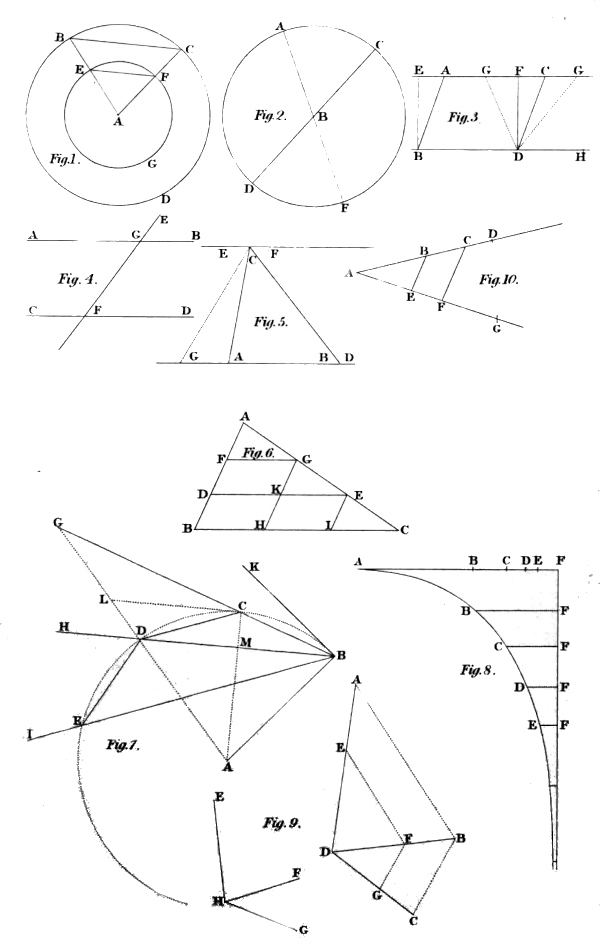
Vol. 1. Lat. & Eng.
C. XIV.
Fig. 1-10
PART III PROPORTIONS OF MOTIONS AND MAGNITUDES. — CHAPTER XV. OF THE NATURE, PROPERTIES, AND DIVERS CONSIDERATIONS OF MOTION AND ENDEAVOUR. — CHAPTER XVI. OF MOTION ACCELERATED AND UNIFORM, AND OF MOTION BY CONCOURSE. — CHAP. XVII. OF FIGURES DEFICIENT. — CHAPTER XVIII. OF THE EQUATION OF STRAIT LINES WITH THE CROOKED LINES OF PARABOLAS AND OTHER FIGURES MADE IN IMITATION OF PARABOLAS. — CHAPTER XIX. OF ANGLES OF INCIDENCE AND REFLECTION, EQUAL BY SUPPOSITION. — CHAPTER XX. OF THE DIMENSION OF A CIRCLE, AND THE DIVISION OF ANGLES OR ARCHES.
203
1.. Repetition of some principles of the doctrine of motion
formerly set down.—2. Other principles added to them.—3.
Certain theorems concerning the nature of motion.—4.
Divers considerations of motion.—5. The way by which the
first endeavour of bodies moved tendeth.—6. In motion which
is made by concourse, one of the movents ceasing, the endeavour
is made by the way by which the rest tend.—7. All endeavour
is propagated in infinitum.—8. How much greater the
velocity or magnitude is of a movent, so much the greater is
the efficacy thereof upon any other body in its way.
Repetition of some principles of the doctrine of motion formerly set down.
1. The next things in order to be treated of are
MOTION and MAGNITUDE, which are the most
common accidents of all bodies. This place therefore
most properly belongs to the elements of
geometry. But because this part of philosophy,
having been improved by the best wits of all ages,
has afforded greater plenty of matter than can well
204be thrust together within the narrow limits of this
discourse, I thought fit to admonish the reader,
that before he proceed further, he take into his
hands the works of Euclid, Archimedes, Apollonius,
and other as well ancient as modern writers.
For to what end is it, to do over again that which
is already done? The little therefore that I shall
say concerning geometry in some of the following
chapters, shall be such only as is new, and conducing
to natural philosophy.
I have already delivered some of the principles
of this doctrine in the eighth and ninth chapters;
which I shall briefly put together here, that the
reader in going on may have their light nearer at
hand.
First, therefore, in chap. VIII. art. 10, motion is
defined to be the continual privation of one place,
and acquisition of another.
Secondly, it is there shown, that whatsoever is
moved is moved in time.
Thirdly, in the same chapter, art. 11, I have
defined rest to be when a body remains for some
time in one place.
Fourthly, it is there shown, that whatsoever is
moved is not in any determined place; as also
that the same has been moved, is still moved, and
will yet be moved; so that in every part of that
space, in which motion is made, we may consider
three times, namely, the past, the present, and
future time.
Fifthly, in art. 15 of the same chapter, I have
defined velocity or swiftness to be motion considered
as power, namely, that power by which a
body moved may in a certain time transmit a
205certain length; which also may more briefly be
enunciated thus, velocity is the quantity of motion
determined by time and line.
Sixthly, in the same chapter, art. 16, I have
shown that motion is the measure of time.
Seventhly, in the same chapter, art. 17, I have
defined motions to be equally swift, when in equal
times equal lengths are transmitted by them.
Eighthly, in art. 18 of the same chapter, motions
are defined to be equal, when the swiftness of one
moved body, computed in every part of its magnitude,
is equal to the swiftness of another, computed
also in every part of its magnitude. From
whence it is to be noted, that motions equal to
one another, and motions equally swift, do not
signify the same thing; for when two horses draw
abreast, the motion of both is greater than the
motion of either of them singly; but the swiftness
of both together is but equal to that of either.
Ninthly, in art. 19 of the same chapter, I have
shown, that whatsoever is at rest will always be
at rest, unless there be some other body besides
it, which by getting into its place suffers it no
longer to remain at rest. And that whatsoever is
moved, will always be moved, unless there be some
other body besides it, which hinders its motion.
Tenthly, in chap. IX. art. 7, I have demonstrated,
that when any body is moved which was formerly
at rest, the immediate efficient cause of that motion
is in some other moved and contiguous body.
Eleventhly, I have shown in the same place, that
whatsoever is moved, will always be moved in the
same way, and with the same swiftness, if it be
206not hindered by some other moved and contiguous
body.
Other principles
added to them.
2. To which principles I shall here add those
that follow. First, I define ENDEAVOUR to be
motion made in less space and time than can be
given; that is, less than can be determined or
assigned by exposition or number; that is, motion
made through the length of a point, and in an
instant or point of time. For the explaining of
which definition it must be remembered, that by a
point is not to be understood that which has no
quantity, or which cannot by any means be
divided; for there is no such thing in nature;
but that, whose quantity is not at all considered,
that is, whereof neither quantity nor any part is
computed in demonstration; so that a point is not
to be taken for an indivisible, but for an undivided
thing; as also an instant is to be taken for an
undivided, and not for an indivisible time.
In like manner, endeavour is to be conceived as
motion; but so as that neither the quantity of the
time in which, nor of the line in which it is made,
may in demonstration be at all brought into comparison
with the quantity of that time, or of that
line of which it is a part. And yet, as a point may
be compared with a point, so one endeavour may
be compared with another endeavour, and one
may be found to be greater or less than another.
For if the vertical points of two angles be compared,
they will be equal or unequal in the same
proportion which the angles themselves have to
one another. Or if a strait line cut many circumferences
of concentric circles, the inequality of the
points of intersection will be in the same proportion
207which the perimeters have to one another.
And in the same manner, if two motions begin
and end both together, their endeavours will be
equal or unequal, according to the proportion of
their velocities; as we see a bullet of lead descend
with greater endeavour than a ball of wool.
Secondly, I define IMPETUS, or quickness of
motion, to be the swiftness or velocity of the body
moved, but considered in the several points of
that time in which it is moved. In which sense
impetus is nothing else but the quantity or velocity
of endeavour. But considered with the whole
time, it is the whole velocity of the body moved
taken together throughout all the time, and equal
to the product of a line representing the time,
multiplied into a line representing the arithmetically
mean impetus or quickness. Which
arithmetical mean, what it is, is defined in the 29th article
of chapter XIII.
And because in equal times the ways that are
passed are as the velocities, and the impetus is the
velocity they go withal, reckoned in all the several
points of the times, it followeth that during any
time whatsoever, howsoever the impetus be increased
or decreased, the length of the way passed
over shall be increased or decreased in the same
proportion; and the same line shall represent
both the way of the body moved, and the several
impetus or degrees of swiftness wherewith the way
is passed over.
And if the body moved be not a point, but a
strait line moved so as that every point thereof
make a several strait line, the plane described by
its motion, whether uniform, accelerated, or retarded,
208shall be greater or less, the time being the
same, in the same proportion with that of the
impetus reckoned in one motion to the impetus
reckoned in the other. For the reason is the same
in parallelograms and their sides.
For the same cause also, if the body moved be a
plane, the solid described shall be still greater or
less in the proportions of the several impetus or
quicknesses reckoned through one line, to the
several impetus reckoned through another.
This understood, let A B C D, (in figure 1, chap.
XVII.) be a parallelogram; in which suppose the
side A B to be moved parallelly to the opposite side
C D, decreasing all the way till it vanish in the
point C, and so describing the figure A B E F C;
the point B, as A B decreaseth, will therefore describe
the line B E F C; and suppose the time of
this motion designed by the line C D; and in the
same time C D, suppose the side A C to be moved
parallel and uniformly to B D. From the point O
taken at adventure in the line C D, draw O R parallel
to B D, cutting the line B E F C in E, and
the side A B in R. And again, from the point Q
taken also at adventure in the line C D, draw Q S
parallel to B D, cutting the line B E F C in F, and
the side A B in S; and draw E G and F H parallel
to C D, cutting A C in G and H. Lastly, suppose
the same construction done in all the points possible
of the line B E F C. I say, that as the proportions
of the swiftness wherewith Q F, O E, D B,
and all the rest supposed to be drawn parallel to
D B and terminated in the line B E F C, are to
the proportions of their several times designed by
the several parallels H F, G E, A B, and all the
209rest supposed to be drawn parallel to the line of
time C D and terminated in the line B E F C, the
aggregate to the aggregate, so is the area or plane
D B E F C to the area or plane A C F E B. For
as A B decreasing continually by the line B E F C
vanisheth in the time C D into the point C, so in
the same time the line D C continually decreasing
vanisheth by the same line C F E B into the point
B; and the point D describeth in that decreasing
motion the line D B equal to the line A C described
by the point A in the decreasing motion of A B;
and their swiftnesses are therefore equal. Again,
because in the time G E the point O describeth the
line OE, and in the same time the point S describeth
the line S E, the line O E shall be to the
line SE, as the swiftness wherewith OE is described
to the swiftness wherewith SE is described.
In like manner, because in the same time H F the
point Q describeth the line Q F, and the point R
the line R F, it shall be as the swiftness by which
Q F is described to the swiftness by which R F is
described, so the line itself Q F to the line itself
R F; and so in all the lines that can possibly be
drawn parallel to B D in the points where they
cut the line B E F C. But all the parallels to B D,
as S E, R F, A C, and the rest that can possibly be
drawn from the line A B to the line B E F C, make
the area of the plane A B E F C; and all the parallels
to the same B D, as Q F, O E, D B and the
rest drawn to the points where they cut the same
line B E F C, make the area of the plane B E F C D.
As therefore the aggregate of the swiftnesses
wherewith the plane B E F C D is described, is
to the aggregate of the swiftnesses wherewith
210the plane A C F E B is described, so is the plane
itself B E F C D to the plane itself A C F E B. But
the aggregate of the times represented by the parallels
A B, G E, H F and the rest, maketh also
the area A C F E B. And therefore, as the aggregate
of all the lines Q F, O E, D B and all the rest
of the lines parallel to B D and terminated in the
line B E F C, is to the aggregate of all the lines
H F, G E, A B and all the rest of the lines parallel
to C D and terminated in the same line
B E F C; that is, as the aggregate of the lines
of swiftness to the aggregate of the lines of time,
or as the whole swiftness in the parallels to D B to
the whole time in the parallels to C D, so is the
plane B E F C D to the plane A C F E B. And the
proportions of Q F to F H, and of O E to E G, and
of D B to B A, and so of all the rest taken together,
are the proportions of the plane D B E F C
to the plane A B E F C. But the lines Q F, O E,
D B and the rest are the lines that design the swiftness;
and the lines H F, G E, A B and the rest are
the lines that design the times of the motions;
and therefore the proportion of the plane D B E F C
to the plane A B E F C is the proportion of all the
velocities taken together to all the times taken
together. Wherefore, as the proportions of the
swiftnesses, &c.; which was to be demonstrated.
The same holds also in the diminution of the
circles, whereof the lines of time are the semidiameters,
as may easily be conceived by imagining
the whole plane A B C D turned round upon the
axis B D; for the line B E F C will be everywhere
in the superficies so made, and the lines H F, G E,
A B, which are here parallelograms, will be there
211cylinders, the diameters of whose bases are the
lines H F, G E, A B, &c. and the altitude a point,
that is to say, a quantity less than any quantity
that can possibly be named; and the lines Q F, O E,
D B, &c. small solids whose lengths and breadths
are less than any quantity that can be named.
But this is to be noted, that unless the proportion
of the sum of the swiftnesses to the proportion
of the sum of the times be determined, the proportion
of the figure D B E F C to the figure A B E F C
cannot be determined.
Thirdly, I define RESISTANCE to be the endeavour
of one moved body either wholly or in part
contrary to the endeavour of another moved body,
which toucheth the same. I say, wholly contrary,
when the endeavour of two bodies proceeds in the
same strait line from the opposite extremes, and
contrary in part, when two bodies have their endeavour
in two lines, which, proceeding from the
extreme points of a strait line, meet without the
same.
Fourthly, that I may define what it is to PRESS,
I say, that of two moved bodies one presses the
other, when with its endeavour it makes either all
or part of the other body to go out of its place.
Fifthly, a body, which is pressed and not
wholly removed, is said to RESTORE itself, when,
the pressing body being taken away, the parts
which were moved do, by reason of the internal
constitution of the pressed body, return every one
into its own place. And this we may observe in
springs, in blown bladders, and in many other
bodies, whose parts yield more or less to the endeavour
which the pressing body makes at the
212first arrival; but afterwards, when the pressing
body is removed, they do, by some force within
them, restore themselves, and give their whole
body the same figure it had before.
Sixthly, I define FORCE to be the impetus or
quickness of motion multiplied either into itself,
or into the magnitude of the movent, by means
whereof the said movent works more or less upon
the body that resists it.
Certain theorems concerning the nature of motion.
3. Having premised thus much, I shall now
demonstrate, first, that if a point moved come to
touch another point which is at rest, how little
soever the impetus or quickness of its motion be,
it shall move that other point. For if by that
impetus it do not at all move it out of its place,
neither shall it move it with double the same
impetus. For nothing doubled is still nothing;
and for the same reason it shall never move it with
that impetus, how many times soever it be multiplied,
because nothing, however it be multiplied,
will for ever be nothing. Wherefore, when a
point is at rest, if it do not yield to the least
impetus, it will yield to none; and consequently
it will be impossible that that, which is at rest,
should ever be moved.
Secondly, that when a point moved, how little
soever the impetus thereof be, falls upon a point of
any body at rest, how hard soever that body be, it
will at the first touch make it yield a little. For if
it do not yield to the impetus which is in that
point, neither will it yield to the impetus of never
so many points, which have all their impetus severally
equal to the impetus of that point. For seeing
all those points together work equally, if any one
213of them have no effect, the aggregate of them all
together shall have no effect as many times told as
there are points in the whole body, that is, still no
effect at all; and by consequent there would be
some bodies so hard that it would be impossible to
break them; that is, a finite hardness, or a finite
force, would not yield to that which is infinite;
which is absurd.
Coroll. It is therefore manifest, that rest does
nothing at all, nor is of any efficacy; and that
nothing but motion gives motion to such things
as be at rest, and takes it from things moved.
Thirdly, that cessation in the movent does not
cause cessation in that which was moved by it.
For (by number 11 of art. 1 of this chapter) whatsoever
is moved perseveres in the same way and
with the same swiftness, as long as it is not hindered
by something that is moved against it. Now
it is manifest, that cessation is not contrary motion;
and therefore it follows that the standing
still of the movent does not make it necessary that
the thing moved should also stand still.
Coroll. They are therefore deceived, that reckon
the taking away of the impediment or resistance
for one of the causes of motion.
Divers considerations of motions.
4. Motion is brought into account for divers
respects; first, as in a body undivided, that is,
considered as a point; or, as in a divided body.
In an undivided body, when we suppose the way,
by which the motion is made, to be a line; and in
a divided body, when we compute the motion of
the several parts of that body, as of parts.
Secondly, from the diversity of the regulation
of motion, it is in body, considered as undivided.
214sometimes uniform and sometimes multiform. Uniform
is that by which equal lines are always
transmitted in equal times; and multiform, when
in one time more, in another time less space is
transmitted. Again, of multiform motions, there
are some in which the degrees of acceleration and
retardation proceed in the same proportions, which
the spaces transmitted have, whether duplicate, or
triplicate, or by whatsoever number multiplied;
and others in which it is otherwise.
Thirdly, from the number of the movents; that
is, one motion is made by one movent only, and
another by the concourse of many movents.
Fourthly, from the position of that line in which
a body is moved, in respect of some other line;
and from hence one motion is called perpendicular,
another oblique, another parallel.
Fifthly, from the position of the movent in respect
of the moved body; from whence one motion
is pulsion or driving, another traction or drawing.
Pulsion, when the movent makes the moved body
go before it; and traction, when it makes it follow.
Again, there are two sorts of pulsion; one, when
the motions of the movent and moved body begin
both together, which may be called trusion or
thrusting and vection; the other, when the movent
is first moved, and afterwards the moved body,
which motion is called percussion or stroke.
Sixthly, motion is considered sometimes from
the effect only which the movent works in the
moved body, which is usually called moment. Now
moment is the excess of motion which the movent
has above the motion or endeavour of the resisting
body.
215Seventhly, it may be considered from the diversity
of the medium; as one motion may be made
in vacuity or empty place; another in a fluid;
another in a consistent medium, that is, a medium
whose parts are by some power so consistent and
cohering, that no part of the same will yield to the
movent, unless the whole yield also.
Eighthly, when a moved body is considered as
having parts, there arises another distinction of
motion into simple and compound. Simple, when
all the several parts describe several equal lines;
compounded, when the lines described are unequal.
The way by which the first endeavour of bodies moved tendeth.
5. All endeavour tends towards that part, that is
to say, in that way which is determined by the
motion of the movent, if the movent be but one;
or, if there be many movents, in that way which
their concourse determines. For example, if a
moved body have direct motion, its first endeavour
will be in a strait line; if it have circular motion,
its first endeavour will be in the circumference of a
circle.
In motion, which it made by concourse, one of the movents ceasing, the endeavour is made by the way by which the rest tend.
6. And whatsoever the line be, in which a
body has its motion from the concourse of two
movents, as soon as in any point thereof the force
of one of the movents ceases, there immediately
the former endeavour of that body will be changed
into an endeavour in the line of the other movent.
Wherefore, when any body is carried on by
the concourse of two winds, one of those winds
ceasing, the endeavour and motion of that body
will be in that line, in which it would have been
carried by that wind alone which blows still. And
in the describing of a circle, where that which is
moved has its motion determined by a movent in a
216tangent, and by the radius which keeps it in a certain
distance from the centre, if the retention of
the radius cease, that endeavour, which was in the
circumference of the circle, will now be in the tangent,
that is, in a strait line. For, seeing endeavour
is computed in a less part of the circumference
than can be given, that is, in a point, the
way by which a body is moved in the circumference
is compounded of innumerable strait lines, of which
every one is less than can be given; which are
therefore called points. Wherefore when any body,
which is moved in the circumference of a circle, is
freed from the retention of the radius, it will proceed
in one of those strait lines, that is, in a
tangent.
All endeavour is propagated in infinitum.
7. All endeavour, whether strong or weak, is
propagated to infinite distance; for it is motion. If
therefore the first endeavour of a body be made in
space which is empty, it will always proceed with
the same velocity; for it cannot be supposed that
it can receive any resistance at all from empty
space; and therefore, (by art. 7, chap, IX) it will
always proceed in the same way and with the
same swiftness. And if its endeavour be in space
which is filled, yet, seeing endeavour is motion,
that which stands next in its way shall be removed,
and endeavour further, and again remove that
which stands next, and so infinitely. Wherefore
the propagation of endeavour, from one part of full
space to another, proceeds infinitely. Besides, it
reaches in any instant to any distance, how great
soever. For in the same instant in which the first
part of the full medium removes that which is next
it, the second also removes that part which is next
217to it; and therefore all endeavour, whether it be in
empty or in full space, proceeds not only to any
distance, how great soever, but also in any time,
how little soever, that is, in an instant. Nor makes
it any matter, that endeavour, by proceeding, grows
weaker and weaker, till at last it can no longer be
perceived by sense; for motion may be insensible;
and I do not here examine things by sense and experience,
but by reason.
How much greater the velocity or magnitude is of a movent, so much the greater is the efficacy thereof upon any other body in its way.
8. When two movents are of equal magnitude,
the swifter of them works with greater force than
the slower, upon a body that resists their motion.
Also, if two movents have equal velocity, the
greater of them works with more force than the
less. For where the magnitude is equal, the movent
of greater velocity makes the greater impression
upon that body upon which it falls; and where the
velocity is equal, the movent of greater magnitude
falling upon the same point, or an equal part of
another body, loses less of its velocity, because the
resisting body works only upon that part of the
movent which it touches, and therefore abates the
impetus of that part only; whereas in the mean
time the parts, which are not touched, proceed,
and retain their whole force, till they also come to
be touched; and their force has some effect.
Wherefore, for example, in batteries a longer than
a shorter piece of timber of the same thickness and
velocity, and a thicker than a slenderer piece of
the same length and velocity, work a greater
effect upon the wall.
218
1. The velocity of any body, in what time soever it be computed,
is that which is made of the multiplication of the impetus, or
quickness of its motion into the time.—2-5. In all motion,
the lengths which are passed through are to one another, as the
products made by the impetus multiplied into the time.—6. If
two bodies be moved with uniform motion through two lengths,
the proportion of those lengths to one another will be compounded
of the proportions of time to time, and impetus to impetus,
directly taken.—7. If two bodies pass through two lengths
with uniform motion, the proportion of their times to one
another will be compounded of the proportions of length to
length, and impetus to impetus reciprocally taken; also the
proportion of their impetus to one another will be compounded
of the proportions of length to length, and time to time reciprocally
taken.—8. If a body be carried on with uniform motion
by two movents together, which meet in an angle, the line by
which it passes will be a strait line, subtending the complement
of that angle to two right angles.—9, &c. If a body be
carried by two movents together, one of them being moved
with uniform, the other with accelerated motion, and the proportion
of their lengths to their times being explicable in
numbers, how to find out what line that body describes.
The velocity of any body, in what time soever it be computed, is that which is made of the multiplication of the impetus or quickness of its motion into the time.
1. The velocity of any body, in whatsoever time it
be moved, has its quantity determined by the sum
of all the several quicknesses or impetus, which it
hath in the several points of the time of the body's
motion. For seeing velocity, (by the definition of
it, chap, VIII, art. 15) is that power by which a
body can in a certain time pass through a certain
length; and quickness of motion or impetus, (by
219chap. XV, art. 2, num. 2) is velocity taken in one
point of time only, all the impetus, together taken
in all the points of time, will be the same thing
with the mean impetus multiplied into the whole
time, or which is all one, will be the velocity of the
whole motion.
Coroll. If the impetus be the same in every
point, any strait line representing it may be taken
for the measure of time: and the quicknesses or
impetus applied ordinately to any strait line
making an angle with it, and representing the way
of the body's motion, will design a parallelogram
which shall represent the velocity of the whole
motion. But if the impetus or quickness of motion
begin from rest and increase uniformly, that
is, in the same proportion continually with the
times which are passed, the whole velocity of the
motion shall be represented by a triangle, one side
whereof is the whole time, and the other the
greatest impetus acquired in that time; or else by
a parallelogram, one of whose sides is the whole
time of motion, and the other, half the greatest
impetus; or lastly, by a parallelogram having for
one side a mean proportional between the whole
time and the half of that time, and for the other
side the half of the greatest impetus. For both
these parallelograms are equal to one another, and
severally equal to the triangle which is made of
the whole line of time, and of the greatest acquired
impetus; as is demonstrated in the elements
of geometry.
In all motion, the lengths which are passed through are to one another, as the products made by the impetus multiplied into time.
2. In all uniform motions the lengths which are
transmitted are to one another, as the product of
the mean impetus multiplied into its time, to the
220product of the mean impetus multiplied also into
its time.
For let A B (in fig. 1) be the time, and A C the
impetus by which any body passes with uniform
motion through the length D E; and in any part of
the time A B, as in the time A F, let another body
be moved with uniform motion, first, with the same
impetus A C. This body, therefore, in the time
A F with the impetus A C will pass through the
length A F. Seeing, therefore, when bodies are
moved in the same time, and with the same velocity
and impetus in every part of their motion, the
proportion of one length transmitted to another
length transmitted, is the same with that of time
to time, it followeth, that the length transmitted in
the time A B with the impetus A C will be to the
length transmitted in the time A F with the same
impetus A C, as A B itself is to A F, that is, as the
parallelogram A I is to the parallelogram A H,
that is, as the product of the time A B into the
mean impetus A C is to the product of the time
A F into the same impetus A C. Again, let it be
supposed that a body be moved in the time A F,
not with the same but with some other uniform
impetus, as A L. Seeing therefore, one of the
bodies has in all the parts of its motion the impetus
A C, and the other in like manner the impetus
A L, the length transmitted by the body moved
with the impetus A C will be to the length transmitted
by the body moved with the impetus A L,
as A C itself is to A L, that is, as the parallelogram
A H is to the parallelogram F L. Wherefore, by
ordinate proportion it will be, as the parallelogram
A I to the parallelogram F L, that is, as the product
221of the mean impetus into the time is to the
product of the mean impetus into the time, so the
length transmitted in the time A B with the impetus
A C, to the length transmitted in the time A F
with the impetus A L; which was to be demonstrated.
Coroll. Seeing, therefore, in uniform motion, as
has been shown, the lengths transmitted are to
one another as the parallelograms which are made
by the multiplication of the mean impetus into the
times, that is, by reason of the equality of the impetus
all the way, as the times themselves, it will
also be, by permutation, as time to length, so time
to length; and in general, to this place are applicable
all the properties and transmutations of analogisms,
which I have set down and demonstrated
in chapter XIII.
3. In motion begun from rest and uniformly
accelerated, that is, where the impetus increaseth
continually according to the proportion of the
times, it will also be, as one product made by the
mean impetus multiplied into the time, to another
product made likewise by the mean impetus multiplied
into the time, so the length transmitted in
the one time to the length transmitted in the other
time.
For let A B (in fig. 1) represent a time; in the
beginning of which time A, let the impetus be as
the point A; but as the time goes on, so let the
impetus increase uniformly, till in the last point of
that time A B, namely in B, the impetus acquired
be B I. Again, let A F represent another time, in
whose beginning A, let the impetus be as the point
itself A; but as the time proceeds, so let the impetus
222increase uniformly, till in the last point F of
the time A F the impetus acquired be F K; and
let D E be the length passed through in the time
A B with impetus uniformly increased. I say, the
length D E is to the length transmitted in the time
A F, as the time A B multiplied into the mean of
the impetus increasing through the time A B, is to
the time A F multiplied into the mean of the impetus
increasing through the time A F.
For seeing the triangle A B I is the whole velocity
of the body moved in the time A B, till the
impetus acquired be B I; and the triangle A F K
the whole velocity of the body moved in the time
A F with impetus increasing till there be acquired
the impetus F K; the length D E to the length
acquired in the time A F with impetus increasing
from rest in A till there be acquired the impetus
F K, will be as the triangle A B I to the triangle
A F K, that is, if the triangles A B I and A F K be
like, in duplicate proportion of the time A B to the
time A F; but if unlike, in the proportion compounded
of the proportions of A B to A F and of
B I to F K. Wherefore, as A B I is to A F K, so
let D E be to D P; for so, the length transmitted
in the time A B with impetus increasing to B I,
will be to the length transmitted in the time A F
with impetus increasing to F K, as the triangle
A B I is to the triangle A F K; but the triangle
A B I is made by the multiplication of the time
A B into the mean of the impetus increasing to
B I; and the triangle A F K is made by the multiplication
of the time A F into the mean of the
impetus increasing to F K; and therefore the
length D E which is transmitted in the time A B
223with impetus increasing to B I, to the length D P
which is transmitted in the time A F with impetus
increasing to F K, is as the product which is made
of the time A B multiplied into its mean impetus,
to the product of the time A F multiplied also into
its mean impetus; which was to be proved.
Coroll. I. In motion uniformly accelerated, the
proportion of the lengths transmitted to that of
their times, is compounded of the proportions of
their times to their times, and impetus to impetus.
Coroll. II. In motion uniformly accelerated, the
lengths transmitted in equal times, taken in continual
succession from the beginning of motion, are
as the differences of square numbers beginning
from unity, namely, as 3, 5, 7, &c. For if in the
first time the length transmitted be as 1, in the
first and second times the length transmitted will
be as 4, which is the square of 2, and in the three
first times it will be as 9, which is the square of 3,
and in the four first times as 16, and so on. Now
the differences of these squares are 3, 5, 7, &c.
Coroll. III. In motion uniformly accelerated from
rest, the length transmitted is to another length
transmitted uniformly in the same time, but with
such impetus as was acquired by the accelerated
motion in the last point of that time, as a triangle
to a parallelogram, which have their altitude and
base common. For seeing the length D E (in fig. 1)
is passed through with velocity as the triangle
A B I, it is necessary that for the passing through
of a length which is double to D E, the velocity be
as the parallelogram A I; for the parallelogram A I
is double to the triangle A B I.
4. In motion, which beginning from rest is so aclerated,
224that the impetus thereof increases continually
in proportion duplicate to the proportion of
the times in which it is made, a length transmitted
in one time will be to a length transmitted in another
time, as the product made by the mean impetus
multiplied into the time of one of those motions, to
the product of the mean impetus multiplied into
the time of the other motion.
For let A B (in fig. 2) represent a time, in whose
first instant A let the impetus be as the point A;
but as the time proceeds, so let the impetus increase
continually in duplicate proportion to that
of the times, till in the last point of time B the
impetus acquired be B I; then taking the point F
anywhere in the time A B, let the impetus F K
acquired in the time A F be ordinately applied to
that point F. Seeing therefore the proportion of
F K to B I is supposed to be duplicate to that of
A F to A B, the proportion of A F to A B will be
subduplicate to that of F K to B I; and that of
A B to A F will be (by chap. XIII. art. 16) duplicate
to that of B I to F K; and consequently the
point K will be in a parabolical line, whose diameter
is A B and base B I; and for the same
reason, to what point soever of the time A B the
impetus acquired in that time be ordinately applied,
the strait line designing that impetus will be
in the same parabolical line A K I. Wherefore the
mean impetus multiplied into the whole time A B
will be the parabola A K I B, equal to the parallelogram
A M, which parallelogram has for one side
the line of time A B and for the other the line of
the impetus A L, which is two-thirds of the impetus
B I; for every parabola is equal to two-thirds
225of that parallelogram with which it has its
altitude and base common. Wherefore the whole
velocity in A B will be the parallelogram A M, as
being made by the multiplication of the impetus
A L into the time A B. And in like manner, if
F N be taken, which is two-thirds of the impetus
F K, and the parallelogram F O be completed, F O
will be the whole velocity in the time A F, as being
made by the uniform impetus A O or F N multiplied
into the time A F. Let now the length
transmitted in the time A B and with the velocity
A M be the strait line D E; and lastly, let the
length transmitted in the time A F with the velocity
A N be D P; I say that as A M is to A N, or as
the parabola A K I B to the parabola A K F, so is
D E to D P. For as A M is to F L, that is, as A B
is to A F, so let D E be to D G. Now the proportion
of A M to A N is compounded of the proportions
of A M to F L, and of F L to A N. But as
A M to F L, so by construction is D E to D G;
and as F L is to A N (seeing the time in both is the
same, namely, A F), so is the length D G to the
length D P; for lengths transmitted in the same
time are to one another as their velocities are.
Wherefore by ordinate proportion, as A M is to
A N, that is, as the mean impetus A L multiplied
into its time A B, is to the mean impetus A O
multiplied into A F, so is D E to D P; which was
to be proved.
Coroll. I. Lengths transmitted with motion so
accelerated, that the impetus increase continually
in duplicate proportion to that of their times, if
the base represent the impetus, are in triplicate
proportion of their impetus acquired in the last
226point of their times. For as the length D E is to
the length D P, so is the parallelogram A M to the
parallelogram A N, and so the parabola A K I B
to the parabola A K F. But the proportion of the
parabola A K I B to the parabola A K F is triplicate
to the proportion which the base B I has to the
base F K. Wherefore also the proportion of D E
to D P is triplicate to that of B I to F K.
Coroll. II. Lengths transmitted in equal times
succeeding one another from the beginning, by
motion so accelerated, that the proportion of the
impetus be duplicate to the proportion of the
times, are to one another as the differences of cubic
numbers beginning at unity, that is as 7, 19, 37, &c.
For if in the first time the length transmitted be as
1, the length at the end of the second time will be
as 8, at the end of the third time as 27, and at the
end of the fourth time as 64, &c.; which are cubic
numbers, whose differences are 7, 19, 37, &c.
Coroll. III. In motion so accelerated, as that the
length transmitted be always to the length transmitted
in duplicate proportion to their times, the
length uniformly transmitted in the whole time,
and with impetus all the way equal to that which
is last acquired, is as a parabola to a parallelogram
of the same altitude and base, that is, as 2 to 3.
For the parabola A K I B is the impetus increasing
in the time A B; and the parallelogram A I is the
greatest uniform impetus multiplied into the same
time A B. Wherefore the lengths transmitted will
be as a parabola to a parallelogram, &c., that is,
as 2 to 3.
5. If I should proceed to the explication of such
motions as are made by impetus increasing in proportion
227triplicate, quadruplicate, quintuplicate, &c.,
to that of their times, it would be a labour infinite
and unnecessary. For by the same method by
which I have computed such lengths, as are transmitted
with impetus increasing in single and duplicate
proportion, any man may compute such as are
transmitted with impetus increasing in triplicate,
quadruplicate, or what other proportion he pleases.
In making which computation he shall find, that
where the impetus increase in proportion triplicate
to that of the times, there the whole velocity will
be designed by the first parabolaster (of which see
the next chapter); and the lengths transmitted
will be in proportion quadruplicate to that of
the times. And in like manner, where the impetus
increase in quadruplicate proportion to that
of the times, that there the whole velocity will be
designed by the second parabolaster, and the
lengths transmitted will be in quintuplicate proportion
to that of the times; and so on continually.
If two bodies be moved with uniform motion through two lengths, the proportion of those lengths to one another, will be compounded of the proportions of time to time, and impetus to impetus, directly taken.
6. If two bodies with uniform motion transmit
two lengths, each with its own impetus and time,
the proportion of the lengths transmitted will be
compounded of the proportions of time to time,
and impetus to impetus, directly taken.
Let two bodies be moved uniformly (as in fig. 3),
one in the time A B with the impetus A C, the
other in the time A D with the impetus A E. I
say the lengths transmitted have their proportion
to one another compounded of the proportions of
A B to A D, and of A C to A E. For let any
length whatsoever, as Z, be transmitted by one of
the bodies in the time A B with the impetus A C;
and any other length, as X, be transmitted by the
228other body in the time A D with the impetus A E;
and let the parallelograms A F and A G be completed.
Seeing now Z is to X (by art. 2) as the
impetus A C multiplied into the time A B is to the
impetus A E multiplied into the time A D, that is,
as A F to A G; the proportion of Z to X will be
compounded of the same proportions, of which the
proportion of A F to A G is compounded; but the
proportion of A F to A G is compounded of the
proportions of the side A B to the side A D, and of
the side A C to the side A E (as is evident by the
Elements of Euclid), that is, of the proportions of
the time A B to the time A D, and of the impetus
A C to the impetus A E. Wherefore also the
proportion of Z to X is compounded of the same
proportions of the time A B to the time A D, and
of the impetus A C to the impetus A E; which was
to be demonstrated.
Coroll. I. When two bodies are moved with
uniform motion, if the times and impetus be in
reciprocal proportion, the lengths transmitted shall
be equal. For if it were as A B to A D (in the
same fig. 3) so reciprocally A E to A C, the proportion
of A F to A G would be compounded of
the proportions of A B to A D, and of A C to A E,
that is, of the proportions of A B to A D, and of
A D to A B. Wherefore, A F would be to A G as
A B to A B, that is, equal; and so the two products
made by the multiplication of impetus into time
would be equal; and by consequent, Z would be
equal to X.
Coroll. II. If two bodies be moved in the same
time, but with different impetus, the lengths transmitted
will be as impetus to impetus. For if the
229time of both of them be A D, and their different
impetus be A E and A C, the proportion of A G to
D C will be compounded of the proportions of A E
to A C and of A D to A D, that is, of the proportions
of A E to A C and of A C to A C; and so
the proportion of A G to D C, that is, the proportion
of length to length, will be as A E to A C, that
is, as that of impetus to impetus. In like manner,
if two bodies be moved uniformly, and both of
them with the same impetus, but in different
times, the proportion of the lengths transmitted by
them will be as that of their times. For if they
have both the same impetus A C, and their different
times be A B and A D, the proportion of A F
to D C will be compounded of the proportions of
A B to A D and of A C to A C; that is, of the
proportions of A B to A D and of A D to A D;
and therefore the proportion of A F to D C, that is,
of length to length, will be the same with that of
A B to A D, which is the proportion of time to time.
If two bodies pass through two lengths with uniform motion, the proportion of their times to one another, will be compounded of the proportions of length to length, and impetus to impetus reciprocally taken; also the proportion of their impetus to one another, will be compounded of the proportions of length to length, and time to time reciprocally taken.
7. If two bodies pass through two lengths with
uniform motion, the proportion of the times in
which they are moved will be compounded of the
proportions of length to length and impetus to
impetus reciprocally taken.
For let any two lengths be given, as (in the same
fig. 3) Z and X, and let one of them be transmitted
with the impetus A C, the other with the impetus
A E. I say the proportion of the times in which
they are transmitted, will be compounded of the
proportions of Z to X, and of A E, which is the
impetus with which X is transmitted, to A C, the
impetus with which Z is transmitted. For seeing
A F is the product of the impetus A C multiplied
230into the time A B, the time of motion through Z
will be a line, which is made by the application of
the parallelogram A F to the strait line A C, which
line is A B; and therefore A B is the time of
motion through Z. In like manner, seeing A G is
the product of the impetus A E multiplied into the
time A D, the time of motion through X will be a
line which is made by the application of A G to the
strait line A D; but A D is the time of motion
through X. Now the proportion of A B to A D
is compounded of the proportions of the parallelogram
A F to the parallelogram A G, and of the
impetus A E to the impetus A C; which may be
demonstrated thus. Put the parallelograms in
order A F, A G, D C, and it will be manifest that
the proportion of A F to D C is compounded of the
proportions of A F to A G and of A G to D C; but
A F is to D C as A B to A D; wherefore also the
proportion of A B to A D is compounded of the
proportions of A F to A G and of A G to D C.
And because the length Z is to the length X as
A F is to A G, and the impetus A E to the impetus
A C as A G to D C, therefore the proportion of
A B to A D will be compounded of the proportions
of the length Z to the length X, and of the impetus
A E to the impetus A C; which was to be demonstrated.
In the same manner it may be proved, that in
two uniform motions the proportion of the impetus
is compounded of the proportions of length to
length and of time to time reciprocally taken.
For if we suppose A C (in the same fig. 3) to be
the time, and A B the impetus with which the
length Z is passed through; and A E to be the
231time, and A D the impetus with which the length X
is passed through, the demonstration will proceed
as in the last article.
If a body be carried on with uniform motion by two movents together, which meet in an angle, the line by which it passes will be a strait line, subtending the complement of that angle to 2 right angles.
8. If a body be carried by two movents together,
which move with strait and uniform motion,
and concur in any given angle, the line by which
that body passes will be a strait line.
Let the movent A B (in fig. 4) have strait and
uniform motion, and be moved till it come into the
place C D; and let another movent A C, having
likewise strait and uniform motion, and making
with the movent A B any given angle C A B, be
understood to be moved in the same time to D B;
and let the body be placed in the point of their
concourse, A. I say the line which that body describes
with its motion is a strait line. For let the
parallelogram A B D C be completed, and its diagonal
A D be drawn; and in the strait line A B
let any point E be taken; and from it let E F be
drawn parallel to the strait lines A C and B D,
cutting A D in G; and through the point G let H I
be drawn parallel to the strait lines A B and C D;
and lastly, let the measure of the time be A C.
Seeing therefore both the motions are made in the
same time, when A B is in C D, the body also
will be in C D; and in like manner, when A C is
in B D, the body will be in B D. But A B is in
C D at the same time when A C is in B D; and
therefore the body will be in C D and B D at the
same time; wherefore it will be in the common
point D. Again, seeing the motion from A C to
B D is uniform, that is, the spaces transmitted by
it are in proportion to one another as the times
in which they are transmitted, when A C is in E F,
232the proportion of A B to A E will be the same with
that of E F to E G, that is, of the time A C to the
time A H. Wherefore A B will be in H I in the
same time in which A C is in E F, so that the body
will at the same time be in E F and H I, and therefore
in their common point G. And in the same
manner it will be, wheresoever the point E be
taken between A and B. Wherefore the body will
always be in the diagonal A D; which was to be
demonstrated.
Coroll. From hence it is manifest, that the body
will be carried through the same strait line A D,
though the motion be not uniform, provided it
have like acceleration; for the proportion of A B
to A E will always be the same with that of A C
to A H.
If a body be carried by two movents together, one of them being moved with uniform, the other with accelerated motion, and the proportion of their lengths to their times being explicable in numbers, how to find out what line that body describes.
9. If a body be carried by two movents together,
which meet in any given angle, and are
moved, the one uniformly, the other with motion
uniformly accelerated from rest, that is, that the
proportion of their impetus be as that of their
times, that is, that the proportion of their lengths
be duplicate to that of the lines of their times, till
the line of greatest impetus acquired by acceleration
be equal to that of the line of time of the uniform
motion; the line in which the body is carried
will be the crooked line of a semiparabola, whose
base is the impetus last acquired, and vertex the
point of rest.
Let the straight line A B (in fig. 5) be understood
to be moved with uniform motion to C D;
and let another movent in the strait line A C be
supposed to be moved in the same time to B D,
but with motion uniformly accelerated, that is,
233with such motion, that the proportion of the
spaces which are transmitted be always duplicate
to that of the times, till the impetus acquired be
B D equal to the strait line A C; and let the
semiparabola A G D B be described. I say that by
the concourse of those two movents, the body will
be carried through the semiparabolical crooked
line A G D. For let the parallelogram A B D C be
completed; and from the point E, taken anywhere
in the strait line A B, let E F be drawn parallel to
A C and cutting the crooked line in G; and lastly,
through the point G let H I be drawn parallel to
the strait lines A B and C D. Seeing therefore
the proportion of A B to A E is by supposition
duplicate to the proportion of E F to E G, that is,
of the time A C to the time A H, at the same time
when A C is in E F, A B will be in H I; and therefore
the moved body will be in the common point
G. And so it will always be, in what part soever
of A B the point E be taken. Wherefore the moved
body will always be found in the parabolical line
A G D; which was to be demonstrated.
10. If a body be carried by two movents together,
which meet in any given angle, and are
moved the one uniformly, the other with impetus
increasing from rest, till it be equal to that of the
uniform motion, and with such acceleration, that
the proportion of the lengths transmitted be every
where triplicate to that of the times in which they
are transmitted; the line, in which that body is
moved, will be the crooked line of the first semiparabolaster
of two means, whose base is the impetus
last acquired.
Let the strait line A B (in the 6th figure) be moved
234uniformly to C D; and let another movent A C be
moved at the same time to B D with motion so
accelerated, that the proportion of the lengths
transmitted be everywhere triplicate to the proportion
of their times; and let the impetus acquired
in the end of that motion be B D, equal to the
strait line A C; and lastly, let A G D be the crooked
line of the first semiparabolaster of two means. I
say, that by the concourse of the two movents
together, the body will be always in that crooked
line A G D. For let the parallelogram A B D C be
completed; and from the point E, taken anywhere
in the strait line A B, let E F be drawn parallel to
A C, and cutting the crooked line in G; and
through the point G let H I be drawn parallel to
the strait lines A B and C D. Seeing therefore the
proportion of A B to A E is, by supposition, triplicate
to the proportion of E F to E G, that is, of the
time A C to the time A H, at the same time when
A C is in E F, A B will be in H I; and therefore
the moved body will be in the common point G.
And so it will always be, in what part soever of
A B the point E be taken; and by consequent, the
body will always be in the crooked line A G D;
which was to be demonstrated.
11. By the same method it may be shown, what
line it is that is made by the motion of a body
carried by the concourse of any two movents,
which are moved one of them uniformly, the other
with acceleration, but in such proportions of spaces
and times as are explicable by numbers, as duplicate,
triplicate, &c., or such as may be designed
by any broken number whatsoever. For which
this is the rule. Let the two numbers of the length
235and time be added together; and let their sum be
the denominator of a fraction, whose numerator
must be the number of the length. Seek this fraction
in the table of the third article of the XVIIth
chapter; and the line sought will be that, which
denominates the three-sided figure noted on the
left hand; and the kind of it will be that, which is
numbered above over the fraction. For example,
let there be a concourse of two movents, whereof
one is moved uniformly, the other with motion so
accelerated, that the spaces are to the times as 5
to 3. Let a fraction be made whose denominator
is the sum of 5 and 3, and the numerator 5, namely
the fraction 5⁄8. Seek in the table, and you will
find 5⁄8 to be the third in that row, which belongs
to the three-sided figure of four means. Wherefore
the line of motion made by the concourse of two
such movents, as are last of all described, will be
the crooked line of the third parabolaster of four
means.
12. If motion be made by the concourse of two
movents, whereof one is moved uniformly, the
other beginning from rest in the angle of concourse
with any acceleration whatsoever; the movent,
which is moved uniformly, shall put forward the
moved body in the several parallel spaces, less
than if both the movents had uniform motion; and
still less and less, as the motion of the other
movent is more and more accelerated.
Let the body be placed in A, (in the 7th figure)
and be moved by two movents, by one with uniform
motion from the strait line A B to the strait
line C D parallel to it; and by the other with any
acceleration, from the strait line A C to the strait
236line B D parallel to it; and in the parallelogram
A B D C let a space be taken between any two parallels
E F and G H. I say, that whilst the movent
A C passes through the latitude which is between
E F and G H, the body is less moved forwards from
A B towards C D, than it would have been, if the
motion from A C to B D had been uniform.
For suppose that whilst the body is made to
descend to the parallel E F by the power of the
movent from A C towards B D, the same body in
the same time is moved forwards to any point F
in the line E F, by the power of the movent from
A B towards C D; and let the strait line A F be
drawn and produced indeterminately, cutting G H
in H. Seeing therefore, it is as A E to A G, so E F
to G H; if A C should descend towards B D with
uniform motion, the body in the time G H, (for I
make A C and its parallels the measure of time,)
would be found in the point H. But because A C
is supposed to be moved towards B D with motion
continually accelerated, that is, in greater proportion
of space to space, than of time to time, in the
time G H the body will be in some parallel beyond
it, as between G H and B D. Suppose now that in
the end of the time G H it be in the parallel I K,
and in I K let I L be taken equal to G H. When
therefore the body is in the parallel I K, it will be
in the point L. Wherefore when it was in the
parallel G H, it was in some point between G and
H, as in the point M; but if both the motions had
been uniform, it had been in the point H; and
therefore whilst the movent A C passes over the
latitude which is between E F and G H, the body is
less moved forwards from A B towards C D, than
237it would have been, if both the motions had been
uniform; which was to be demonstrated.
13. Any length being given, which is passed
through in a given time with uniform motion, to
find out what length shall be passed through in the
same time with motion uniformly accelerated, that
is, with such motion that the proportion of the
lengths passed through be continually duplicate to
that of their times, and that the line of the impetus
last acquired be equal to the line of the whole time
of the motion.
Let A B (in the 8th figure) be a length, transmitted
with uniform motion in the time A C; and
let it be required to find another length, which
shall be transmitted in the same time with motion
uniformly accelerated, so that the line of the impetus
last acquired be equal to the strait line A C.
Let the parallelogram A B D C be completed;
and let B D be divided in the middle at E; and
between B E and B D let B F be a mean proportional;
and let A F be drawn and produced till it
meet with C D produced in G; and lastly, let the
parallelogram A C G H be completed. I say, A H
is the length required.
For as duplicate proportion is to single proportion,
so let A H be to A I, that is, let A I be the
half of A H; and let I K be drawn parallel to the
strait line A C, and cutting the diagonal A D in K,
and the strait line A G in L. Seeing therefore A I
is the half of A H, I L will also be the half of B D,
that is, equal to B E; and I K equal to B F; for
B D, that is, G H, B F, and B E, that is, I L, being
continual proportionals, A H, A B and A I will
also be continual proportionals. But as A B is to
238A I, that is, as A H is to A B, so is B D to I K, and
so also is G H, that is, B D to B F; and therefore
B F and I K are equal. Now the proportion of
A H to A I is duplicate to the proportion of A B
to A I, that is, to that of B D to I K, or of G H to
I K. Wherefore the point K will be in a parabola,
whose diameter is A H, and base G H, which G H
is equal to A C. The body therefore proceeding
from rest in A, with motion uniformly accelerated
in the time A C, when it has passed through the
length A H, will acquire the impetus G H equal to
the time A C, that is, such impetus, as that with it
the body will pass through the length A C in the
time A C. Wherefore any length being given, &c.,
which was propounded to be done.
14. Any length being given, which in a given
time is transmitted with uniform motion, to find
out what length shall be transmitted in the same
time with motion so accelerated, that the lengths
transmitted be continually in triplicate proportion
to that of their times, and the line of the impetus
last of all acquired be equal to the line of time
given.
Let the given length A B (in the 9th figure) be
transmitted with uniform motion in the time A C;
and let it be required to find what length shall be
transmitted in the same time with motion so accelerated,
that the lengths transmitted be continually
in triplicate proportion to that of their times, and
the impetus last acquired be equal to the time
given.
Let the parallelogram A B D C be completed;
and let B D be so divided in E, that B E be a third
part of the whole B D; and let B F be a mean proportional
239between B D and B E; and let A F be
drawn and produced till it meet the strait line C D
in G; and lastly, let the parallelogram A C G H be
completed. I say, A H is the length required.
For as triplicate proportion is to single proportion,
so let A H be to another line, A I, that is,
make A I a third part of the whole A H; and let
I K be drawn parallel to the strait line A C, cutting
the diagonal A D in K, and the strait line A G in
L; then, as A B is to A I, so let A I be to another,
A N; and from the point N let N Q be drawn parallel
to A C, cutting A G, A D, and F K produced
in P, M, and O; and last of all, let F O and L M
be drawn, which will be equal and parallel to the
strait lines B N and I N. By this construction, the
lengths transmitted A H, A B, A I, and A N, will
be continual proportionals; and, in like manner,
the times G H, B F, I L and N P, that is, N Q,
N O, N M and N P, will be continual proportionals,
and in the same proportion with A H, A B, A I
and A N. Wherefore the proportion of A H, A B, A I
and A N. Wherefore the proportion of A H to
A N is the same with that of B D, that is, of N Q
to N P; and the proportion of N Q to N P triplicate
to that of N Q to N O, that is, triplicate to
that of B D to I K; wherefore also the length A H
is to the length A N in triplicate proportion to that
of the time B D, to the time I K; and therefore
the crooked line of the first three-sided figure of
two means whose diameter is A H, and base G H
equal to A C, shall pass through the point O; and
consequently, A H shall be transmitted in the time
A C, and shall have its last acquired impetus G H
equal to A C, and the proportions of the lengths
acquired in any of the times triplicate to the proportions
240of the times themselves. Wherefore A H
is the length required to be found out.
By the same method, if a length be given which
is transmitted with uniform motion in any given
time, another length may be found out which shall
be transmitted in the same time with motion so
accelerated, that the lengths transmitted shall be
to the times in which they are transmitted, in proportion
quadruplicate, quintuplicate, and so on
infinitely. For if B D be divided in E, so that B D
be to B E as 4 to 1; and there be taken between
B D and B E a mean proportional F B; and as
A H is to A B, so A B be made to a third, and
again so that third to a fourth, and that fourth to
a fifth, A N, so that the proportion of A H to A N
be quadruplicate to that of A H to A B, and the
parallelogram N B F O be completed, the crooked
line of the first three-sided figure of three means
will pass through the point O; and consequently,
the body moved will acquire the impetus G H
equal to A C in the time A C. And so of the rest.
15. Also, if the proportion of the lengths transmitted
be to that of their times, as any number to
any number, the same method serves for the finding
out of the length transmitted with such
impetus, and in such time.
For let A C (in the 10th figure) be the time in
which a body is transmitted with uniform motion
from A to B; and the parallelogram A B D C being
completed, let it be required to find out a length
in which that body may be moved in the same time
A C from A, with motion so accelerated, that the
proportion of the lengths transmitted to that of
the times be continually as 3 to 2.
Let B D be so divided in E, that B D be to B E
241as 3 to 2; and between B D and B E let B F be a
mean proportional; and let A F be drawn and produced
till it meet with C D produced in G; and
making A M a mean proportional between A H
and A B, let it be as A M to A B, so A B to A I;
and so the proportion of A H to A I will be to that
of A H to A B as 3 to 2; for of the proportions, of
which that of A H to A M is one, that of A H to
A B is two, and that of A H to A I is three; and
consequently, as 3 to 2 to that of G H to B F, and
(F K being drawn parallel to B I and cutting A D
in K) so likewise to that of G H or B D to I K.
Wherefore the proportion of the length A H to A I
is to the proportion of the time B D to I K as 3 to
2; and therefore if in the time A C the body be
moved with accelerated motion, as was propounded,
till it acquire the impetus H G equal to
A C, the length transmitted in the same time will
be A H.
16. But if the proportion of the lengths to that
of the times had been as 4 to 3, there should then
have been taken two mean proportionals between
A H and A B, and their proportion should have
been continued one term further, so that A H to
A B might have three of the same proportions,
of which A H to A I has four; and all things else
should have been done as is already shown. Now
the way how to interpose any number of means
between two lines given, is not yet found out.
Nevertheless this may stand for a general rule; if
there be a time given, and a length be transmitted
in that time with uniform motion; as for example,
if the time be A C, and the length A B, the strait
line A G, which determines the length C G or A H,
242transmitted in the same time A C with any accelerated
motion, shall so cut B D in F, that B F
shall be a mean proportional between B D and
B E, B E being so taken in B D, that the proportion
of length to length be everywhere to the proportion
of time to time, as the whole B D is to its
part B E.
17. If in a given time two lengths be transmitted,
one with uniform motion, the other with
motion accelerated in any proportion of the lengths
to the times; and again, in part of the same time,
parts of the same lengths be transmitted with the
same motions, the whole length will exceed the
other length in the same proportion in which one
part exceeds the other part.
For example, let A B (in the 8th figure) be a
length transmitted in the time A C, with uniform
motion; and let A H be another length transmitted
in the same time with motion uniformly accelerated,
so that the impetus last acquired be G H
equal to A C; and in A H let any part A I be taken,
and transmitted in part of the time A C with uniform
motion; and let another part A B be taken
and transmitted in the same part of the time A C
with motion uniformly accelerated; I say, that as
A H is to A B, so will A B be to A I.
Let B D be drawn parallel and equal to H G,
and divided in the midst at E, and between B D and
B E let a mean proportional be taken as B F;
and the strait line A G, by the demonstration of
art. 13, shall pass through F. And dividing A H
in the midst at I, A B shall be a mean proportional
between A H and A I. Again, because A I and A B
are described by the same motions, if I K be
243drawn parallel and equal to B F or A M, and
divided in the midst at N, and between I K and
I N be taken the mean proportional I L, the strait
line A F will, by the demonstration of the same
art. 13, pass through L. And dividing A B in the
midst at O, the line A I will be a mean proportional
between A B and A O. Where A B is divided in
I and O, in like manner as A H is divided in B and
I; and as A H to A B, so is A B to A I. Which
was to be proved.
Coroll. Also as A H to A B, so is H B to B I;
and so also B I to I O.
And as this, where one of the motions is uniformly
accelerated, is proved out of the demonstration
of art. 13; so, when the accelerations are
in double proportion to the times, the same may be
proved by the demonstration of art. 14; and by
the same method in all other accelerations, whose
proportions to the times are explicable in numbers.
18. If two sides, which contain an angle in any
parallelogram, be moved in the same time to the
sides opposite to them, one of them with uniform
motion, the other with motion uniformly accelerated;
that side, which is moved uniformly, will
affect as much with its concourse through the
whole length transmitted, as it would do if the
other motion were also uniform, and the length
transmitted by it in the same time were a mean
proportional between the whole and the half.
Let the side A B of the parallelogram A B D C,
(in the 11th figure) be understood to be moved with
uniform motion till it be coincident with C D; and
let the time of that motion be A C or B D. Also
in the same time let the side A C be understood to
244be moved with motion uniformly accelerated, till
it be coincident with B D; then dividing A B in
the middle in E, let A F be made a mean proportional
between A B and A E; and drawing F G
parallel to A C, let the side A C be understood to
be moved in the same time A C with uniform
motion till it be coincident with F G. I say, the
whole A B confers as much to the velocity of the
body placed in A, when the motion of A C is uniformly
accelerated till it comes to B D, as the part
A F confers to the same, when the side A C is
moved uniformly and in the same time to F G.
For seeing A F is a mean proportional between
the whole A B and its half A E, B D will (by the
13th article) be the last impetus acquired by A C,
with motion uniformly accelerated till it come to
the same B D; and consequently, the strait line
F B will be the excess, by which the length, transmitted
by A C with motion uniformly accelerated,
will exceed the length transmitted by the same
A C in the same time with uniform motion, and
with impetus every where equal to B D. Wherefore,
if the whole A B be moved uniformly to C D
in the same time in which A C is moved uniformly
to F G, the part F B, seeing it concurs not at all
with the motion of the side A C which is supposed
to be moved only to F G, will confer nothing to its
motion. Again, supposing the side A C to be
moved to B D with motion uniformly accelerated,
the side A B with its uniform motion to C D will
less put forwards the body when it is accelerated
in all the parallels, than when it is not at all accelerated;
and by how much the greater the acceleration
is, by so much the less it will put it forwards,
245as is shown in the 12th article. When
therefore A C is in F G with accelerated motion,
the body will not be in the side C D at the point G,
but at the point D; so that G D will be the excess,
by which the length transmitted with accelerated
motion to B D exceeds the length transmitted with
uniform motion to F G; so that the body by its
acceleration avoids the action of the part A F, and
comes to the side C D in the time A C, and makes
the length C D, which is equal to the length A B.
Wherefore uniform motion from A B to C D in the
time A C, works no more in the whole length A B
upon the body uniformly accelerated from A C to
B D, than if A C were moved in the same time
with uniform motion to F G; the difference consisting
only in this, that when A B works upon the
body uniformly moved from A C to F G, that, by
which the accelerated motion exceeds the uniform
motion, is altogether in F B or G D; but when the
same A B works upon the body accelerated, that,
by which the accelerated motion exceeds the uniform
motion, is dispersed through the whole length
A B or C D, yet, so that if it were collected and
put together, it would be equal to the same F B or
G D. Wherefore, if two sides which contain an
angle, &c.; which was to be demonstrated.
19. If two transmitted lengths have to their
times any other proportion explicable by number,
and the side A B be so divided in E, that A B be
to A E in the same proportion which the lengths
transmitted have to the times in which they are
transmitted, and between A B and A E there be
taken a mean proportional A F; it may be shown
by the same method, that the side, which is moved
246with uniform motion, works as much with its concourse
through the whole length A B, as it would
do if the other motion were also uniform, and the
length transmitted in the same time A C were that
mean proportional A F.
And thus much concerning motion by concourse.
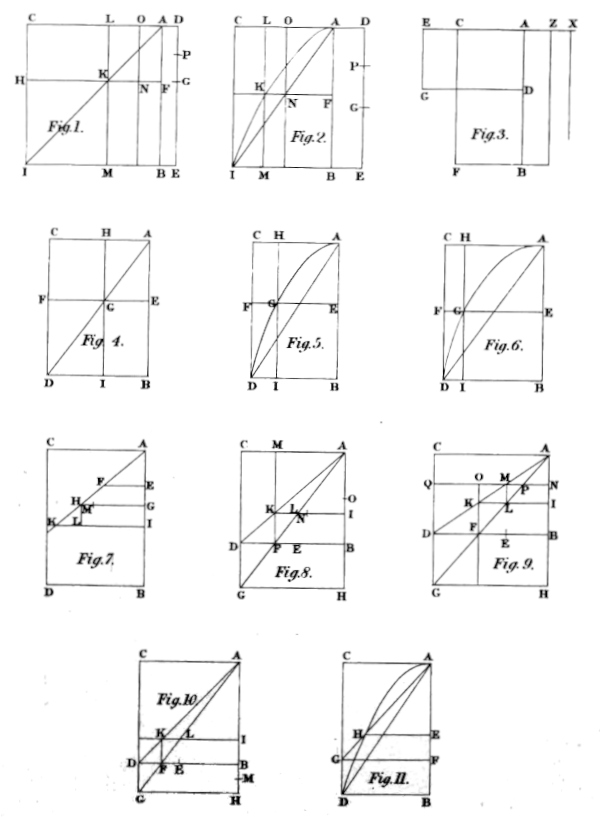
Vol. 1. Lat. & Eng.
C. XVI.
Fig. 1-11
1. Definitions of a deficient figure; of a complete figure; of the
complement of a deficient figure; and of proportions which
are proportional and commensurable to one another.—2. The
proportion of a deficient figure to its complement.—3. The
proportions of deficient figures to the parallelograms in which
they are described, set forth in a table.—4. The description
and production of the same figures.—5. The drawing of tangents
to them.—6. In what proportion the same figures exceed a
strait-lined triangle of the same altitude and base.—7. A table
of solid deficient figures described in a cylinder.—8. In what
proportion the same figures exceed a cone of the same altitude
and base.—9. How a plain deficient figure may be described
in a parallelogram, so that it be to a triangle of the same base
and altitude, as another deficient figure, plain or solid, twice
taken, is to the same deficient figure, together with the complete
figure in which it is described.—10. The transferring of
certain properties of deficient figures described in a parallelogram
to the proportions of the spaces transmitted with several
degrees of velocity.—11. Of deficient figures described in
a circle.—12. The proposition demonstrated in art. 2 confirmed
from the elements of philosophy.—13. An unusual way of
reasoning concerning the equality between the superficies of a
portion of a sphere and a circle.—14. How from the description
of deficient figures in a parallelogram, any number of mean
proportionals may be found out between two given strait lines.
Definition of a deficient figure.
1. I call those deficient figures which may be
understood to be generated by the uniform motion
247of some quantity, which decreases continually, till
at last it have no magnitude at all.
Definitions of a complete figure; of the complement of a deficient figure; and of proportions which are proportional & commensurable to one another.
And I call that a complete figure, answering to
a deficient figure, which is generated with the
same motion and in the same time, by a quantity
which retains always its whole magnitude.
The complement of a deficient figure is that which
being added to the deficient figure makes it complete.
Four proportions are said to be proportional,
when the first of them is to the second as the third
is to the fourth. For example, if the first proportion
be duplicate to the second, and again, the
third be duplicate to the fourth, those proportions
are said to be proportional.
And commensurable proportions are those, which
are to one another as number to number. As
when to a proportion given, one proportion is
duplicate, another triplicate, the duplicate proportion
will be to the triplicate proportion as 2 to 3;
but to the given proportion it will be as 2 to 1;
and therefore I call those three proportions commensurable.
The proportion of a deficient figure to its complement.
2. A deficient figure, which is made by a quantity
continually decreasing to nothing by proportions
everywhere proportional and commensurable, is to
its complement, as the proportion of the whole
altitude to an altitude diminished in any time is
to the proportion of the whole quantity, which
describes the figure, to the same quantity diminished
in the same time.
Let the quantity A B (in fig. 1), by its motion
through the altitude A C, describe the complete
figure A D; and again, let the same quantity, by
248decreasing continually to nothing in C, describe
the deficient figure A B E F C, whose complement
will be the figure B D C F E. Now let A B be
supposed to be moved till it lie in G K, so that the
altitude diminished be G C, and A B diminished
be G E; and let the proportion of the whole altitude
A C to the diminished altitude G C, be, for
example, triplicate to the proportion of the whole
quantity A B or G K to the diminished quantity
G E. And in like manner, let H I be taken equal
to G E, and let it be diminished to H F; and let
the proportion of G C to H C be triplicate to that
of H I to H F; and let the same be done in as
many parts of the strait line A C as is possible;
and a line be drawn through the points B, E, F
and C. I say the deficient figure A B E F C is to
its complement B D C F E as 3 to 1, or as the proportion
of A C to G C is to the proportion of A B,
that is, of G K to G E.
For (by art. 2, chapter XV.) the proportion of
the complement B E F C D to the deficient figure
A B E F C is all the proportions of D B to B A,
O E to E G, Q F to F H, and of all the lines
parallel to D B terminated in the line B E F C, to
all the parallels to A B terminated in the same
points of the line B E F C. And seeing the proportions
of D B to O E, and of D B to Q F &c.
are everywhere triplicate of the proportions of A B
to G E, and of A B to H F &c. the proportions of
H F to A B, and of G E to A B &c. (by art. 16,
chap. XIII.), are triplicate of the proportions of
Q F to D B, and of O E to D B &c. and therefore
the deficient figure A B E F C, which is the aggregate
249of all the lines H F, G E, A B, &c. is triple
to the complement B E F C D made of all the lines
Q F, O E, D B, &c.; which was to be proved.
It follows from hence, that the same complement
B E F C D is 1⁄4 of the whole parallelogram. And
by the same method may be calculated in all other
deficient figures, generated as above declared, the
proportion of the parallelogram to either of its
parts; as that when the parallels increase from a
point in the same proportion, the parallelogram
will be divided into two equal triangles; when
one increase is double to the other, it will be
divided into a semiparabola and its complement,
or into 2 and 1.
The same construction standing, the same conclusion
may otherwise be demonstrated thus.
Let the strait line C B be drawn cutting G K in
L, and through L let M N be drawn parallel to the
strait line A C; wherefore the parallelograms G M
and L D will be equal. Then let L K be divided
into three equal parts, so that it may be to one of
those parts in the same proportion which the proportion
of A C to G C, or of G K to G L, hath to
the proportion of G K to G E. Therefore L K will
be to one of those three parts as the arithmetical
proportion between G K and G L is to the arithmetical
proportion between G K and the same G K
wanting the third part of L K; and K E will be
somewhat greater than a third of L K. Seeing
now the altitude A G or M L is, by reason of the
continual decrease, to be supposed less than any
quantity that can be given; L K, which is intercepted
between the diagonal B C and the side B D,
250will be also less than any quantity that can be
given; and consequently, if G be put so near to A
in g, as that the difference between C g and C A
be less than any quantity that can be assigned,
the difference also between C l (removing L to l)
and C B, will be less than any quantity that can be
assigned; and the line g l being drawn and produced
to the line B D in k, cutting the crooked
line in e, the proportion of G k to G l will still be
triplicate to the proportion of G k to G e, and the
difference between k and e, the third part of k l,
will be less than any quantity that can be given;
and therefore the parallelogram e D will differ
from a third part of the parallelogram A e by a
less difference than any quantity that can be
assigned. Again, let H I be drawn parallel and
equal to G E, cutting C B in P, the crooked line in
F, and O E in I, and the proportion of C g to C H
will be triplicate to the proportion of H F to H P,
and I F will be greater than the third part of P I.
But again, setting H in h so near to g, as that the
difference between C h and C g may be but as a
point, the point P will also in p be so near to l,
as that the difference between C p and C l will be
but as a point; and drawing h p till it meet with
B D in i, cutting the crooked line in f and having
drawn e o parallel to B D, cutting D C in o, the parallelogram
f o will differ less from the third part of
the parallelogram g f, than by any quantity that
can be given. And so it will be in all other spaces
generated in the same manner. Wherefore the
differences of the arithmetical and geometrical
means, which are but as so many points B, e, f, &c.
251(seeing the whole figure is made up of so many
indivisible spaces) will constitute a certain line,
such as is the line B E F C, which will divide the
complete figure A D into two parts, whereof one,
namely, A B E F C, which I call a deficient figure,
is triple to the other, namely, B D C F E, which I
call the complement thereof. And whereas the
proportion of the altitudes to one another is in
this case everywhere triplicate to that of the
decreasing quantities to one another; in the same
manner, if the proportion of the altitudes had
been everywhere quadruplicate to that of the decreasing
quantities, it might have been demonstrated
that the deficient figure had been quadruple
to its complement; and so in any other proportion.
Wherefore, a deficient figure, which is made, &c.
which was to be demonstrated.
The same rule holdeth also in the diminution of
the bases of cylinders, as is demonstrated in the
second article of chapter XV.
The proportion of deficient figures to the parallelograms in which they are described, set forth in a table.
3. By this proposition, the magnitudes of all
deficient figures, when the proportions by which
their bases decrease continually are proportional
to those by which their altitudes decrease, may be
compared with the magnitudes of their complements;
and consequently, with the magnitudes of
their complete figures. And they will be found to
be, as I have set them down in the following
tables; in which I compare a parallelogram with
three-sided figures; and first, with a strait-lined
triangle, made by the base of the parallelogram
continually decreasing in such manner, that the
altitudes be always in proportion to one another
252as the bases are, and so the triangle will be equal
to its complement; or the proportions of the altitudes
and bases will be as 1 to 1, and then the
triangle will be half the parallelogram. Secondly,
with that three-sided figure which is made by the
continual decreasing of the bases in subduplicate
proportion to that of the altitudes; and so the
deficient figure will be double to its complement,
and to the parallelogram as 2 to 3. Then, with
that where the proportion of the altitudes is triplicate
to that of the bases; and then the deficient
figure will be triple to its complement, and to the
parallelogram as 3 to 4. Also the proportion of
the altitudes to that of the bases may be as 3 to 2;
and then the deficient figure will be to its complement
as 3 to 2, and to the parallelogram as 3 to 5;
and so forwards, according as more mean proportionals
are taken, or as the proportions are more
multiplied, as may be seen in the following table.
For example, if the bases decrease so, that the
proportion of the altitudes to that of the bases be
always as 5 to 2, and it be demanded what proportion
the figure made has to the parallelogram,
which is supposed to be unity; then, seeing that
where the proportion is taken five times, there
must be four means; look in the table amongst
the three-sided figures of four means, and seeing
the proportion was as 5 to 2, look in the uppermost
row for the number 2, and descending in
the second column till you meet with that three-sided
figure, you will find 5⁄7; which shows that the
deficient figure is to the parallelogram as 5⁄7 to 1,
or as 5 to 7.
253
| |
1 |
2 |
3 |
4 |
5 |
6 |
7 |
| Parallelogram |
1 |
: |
: |
: |
: |
: |
: |
| Strait-sided triangle |
½ |
: |
: |
: |
: |
: |
: |
| Three-sided figure of 1 mean |
⅔ |
: |
: |
: |
: |
: |
: |
| Three-sided figure of 2 means |
¾ |
⅗ |
: |
: |
: |
: |
: |
| Three-sided figure of 3 means |
⅘ |
4⁄6 |
4⁄7 |
: |
: |
: |
: |
| Three-sided figure of 4 means |
5⁄6 |
5⁄7 |
5⁄8 |
5⁄9 |
: |
: |
: |
| Three-sided figure of 5 means |
6⁄7 |
6⁄8 |
6⁄9 |
6⁄10 |
6⁄11 |
: |
: |
| Three-sided figure of 6 means |
7⁄8 |
7⁄9 |
7⁄10 |
7⁄11 |
7⁄12 |
7⁄13 |
: |
| Three-sided figure of 7 means |
8⁄9 |
8⁄10 |
8⁄11 |
8⁄12 |
8⁄13 |
8⁄14 |
8⁄15 |
Description & production of the same figures.
4. Now for the better understanding of the
nature of these three-sided figures, I will show
how they may be described by points; and first,
those which are in the first column of the table.
Any parallelogram being described, as A B C D
(in figure 2) let the diagonal B D be drawn;
and the strait-lined triangle B C D will be half the
parallelogram; then let any number of lines, as
E F, be drawn parallel to the side B C, and cutting
the diagonal B D in G; and let it be everywhere,
as E F to E G, so E G to another, E H; and through
all the points H let the line B H H D be drawn;
and the figure B H H D C will be that which I call
a three-sided figure of one mean, because in three
proportionals, as E F, E G and E H, there is but
one mean, namely, E G; and this three-sided
figure will be 2⁄3 of the parallelogram, and is called
a parabola. Again, let it be as E G to E H, so E H
to another, E I, and let the line B I I D be drawn,
making the three-sided figure B I I D C; and this
will be 3⁄4 of the parallelogram, and is by many
called a cubic parabola. In like manner, if the
254proportions be further continued in E F, there will
be made the rest of the three-sided figures of the
first column; which I thus demonstrate. Let there
be drawn strait lines, as H K and G L, parallel to
the base D C. Seeing therefore the proportion of
E F to E H is duplicate to that of E F to E G, or of
B C to B L, that is, of C D to L G, or of K M (producing
K H to A D in M) to K H, the proportion
of B C to B K will be duplicate to that of K M to
K H; but as B C is to B K, so is D C or K M to
K N, and therefore the proportion of K M to K N
is duplicate to that of K M to K H; and so it will
be wheresoever the parallel K M be placed. Wherefore
the figure B H H D C is double to its complement
B H H D A, and consequently 2⁄3 of the whole
parallelogram. In the same manner, if through I
be drawn O P I Q parallel and equal to C D, it may
be demonstrated that the proportion of O Q to
O P, that is, of B C to B O, is triplicate that of
O Q to O I, and therefore that the figure B I I D C
is triple to its complement B I I D A, and consequently
¾ of the whole parallelogram, &c.
Secondly, such three-sided figures as are in any
of the transverse rows, may be thus described.
Let A B C D (in fig. 3) be a parallelogram, whose
diagonal is B D. I would describe in it such
figures, as in the preceding table I call three-sided
figures of three means. Parallel to D C, I draw
E F as often as is necessary, cutting B D in G; and
between E F and E G, I take three proportionals
E H, E I and E K. If now there be drawn lines
through all the points H, I and K, that through all
the points H will make the figure B H D C, which
is the first of those three-sided figures; and that
255through all the points I, will make the figure
B I D C, which is the second; and that which is
drawn through all the points K, will make the
figure B K D C the third of those three-sided
figures. The first of these, seeing the proportion
of E F to E G is quadruplicate of that E F to E H,
will be to its complement as 4 to 1, and to the
parallelogram as 4 to 5. The second, seeing the
proportion of E F to E G is to that of E F to E I as
4 to 2, will be double to its complement, and 4⁄6 or
2⁄3 of the parallelogram. The third, seeing the proportionproportion
of E F to E G is that of E F to E K as
4 to 3, will be to its complement as 4 to 3, and to
the parallelogram as 4 to 7.
Any of these figures being described may be
produced at pleasure, thus; let A B C D (in fig. 4)
be a parallelogram, and in it let the figure B K D C
be described, namely, the third three-sided figure
of three means. Let B D be produced indefinitely
to E, and let E F be made parallel to the base D C,
cutting A D produced in G, and B C produced in
F; and in G E let the point H be so taken, that the
proportion of F E to F G may be quadruplicate to
that of F E to F H, which may be done by making
F H the greatest of three proportionals between
F E and F G; the crooked line B K D produced,
will pass through the point H. For if the strait
line B H be drawn, cutting C D in I, and H L be
drawn parallel to G D, and meeting C D produced
in L; it will be as F E to F G, so C L to C I, that
is, in quadruplicate proportion to that of F E to
F H, or of C D to C I. Wherefore if the line B K D
be produced according to its generation, it will
fall upon the point H.
The drawing of tangents to them.
2565. A strait line may be drawn so as to touch
the crooked line of the said figure in any point, in
this manner. Let it be required to draw a tangent
to the line B K D H (in fig. 4) in the point D. Let
the points B and D be connected, and drawing
D A equal and parallel to B C, let B and A be connected;
and because this figure is by construction
the third of three means, let there be taken in A B
three points, so, that by them the same A B be
divided into four equal parts; of which take three,
namely, A M, so that A B may be to A M, as the
figure B K D C is to its complement. I say, the
strait line M D will touch the figure in the point
given D. For let there be drawn anywhere between
A B and D C a parallel, as R Q, cutting the
strait line B D, the crooked line B K D, the strait
line M D, and the strait line A D, in the points
P, K, O and Q. R K will therefore, by construction,
be the least of three means in geometrical
proportion between R Q and R P. Wherefore (by
coroll. of art. 28, chapter XIII.) R K will be less
than R O; and therefore M D will fall without the
figure. Now if M D be produced to N, F N will
be the greatest of three means in arithmetical proportion
between F E and F G; and F H will be the
greatest of three means in geometrical proportion
between the same F E and F G. Wherefore (by
the same coroll. of art. 28, chapter XIII.) F H will
be less than F N; and therefore D N will fall without
the figure, and the strait line M N will touch
the same figure only in the point D.
In what proportion the same figures exceed a strait-lined triangle of the same altitude and base.
6. The proportion of a deficient figure to its
complement being known, it may also be known
257what proportion a strait-lined triangle has to the
excess of the deficient figure above the same triangle;
and these proportions I have set down in
the following table; where if you seek, for example,
how much the fourth three-sided figure of
five means exceeds a triangle of the same altitude
and base, you will find in the concourse of the
fourth column with the three-sided figures of five
means 2⁄10; by which is signified, that that three-sided
figure exceeds the triangle by two-tenths or
by one-fifth part of the same triangle.
| |
|
|
1 |
2 |
3 |
4 |
5 |
6 |
7 |
| |
|
The triangle |
1 |
: |
: |
: |
: |
: |
: |
| |
 |
A three-sided fig. of 1 mean |
1⁄3 |
: |
: |
: |
: |
: |
: |
| The ex- cess of |
A three-sided fig. of 2 means |
2⁄4 |
1⁄5 |
: |
: |
: |
: |
: |
| A three-sided fig. of 3 means |
3⁄5 |
2⁄6 |
1⁄7 |
: |
: |
: |
: |
| A three-sided fig. of 4 means |
4⁄6 |
3⁄7 |
2⁄8 |
1⁄9 |
: |
: |
: |
| A three-sided fig. of 5 means |
5⁄7 |
4⁄8 |
3⁄9 |
2⁄10 |
1⁄11 |
: |
: |
| |
A three-sided fig. of 6 means |
6⁄8 |
5⁄9 |
4⁄10 |
3⁄11 |
2⁄12 |
1⁄13 |
: |
| |
A three-sided fig. of 7 means |
7⁄9 |
6⁄10 |
5⁄11 |
4⁄12 |
3⁄13 |
2⁄14 |
1⁄15 |
A table of solid deficient figures described in a cylinder.
7. In the next table are set down the proportion
of a cone and the solids of the said three-sided
figures, namely, the proportions between them and
a cylinder. As for example, in the concourse of
the second column with the three-sided figures of
four means, you have 5⁄9; which gives you to understand,
that the solid of the second three-sided
figure of four means is to the cylinder as 5⁄9 to 1, or
as 5 to 9.
258
| |
|
|
1 |
2 |
3 |
4 |
5 |
6 |
7 |
| |
|
|
1 |
2 |
3 |
4 |
5 |
6 |
7 |
| |
|
A cylinder |
1 |
: |
: |
: |
: |
: |
: |
| |
|
A cone |
1⁄3 |
: |
: |
: |
: |
: |
: |
| |
|
A three-sided fig. of 1 mean |
2⁄4 |
: |
: |
: |
: |
: |
: |
| |
A three-sided fig. of 2 means |
3⁄5 |
3⁄7 |
: |
: |
: |
: |
: |
| The sol- ids of |
A three-sided fig. of 3 means |
4⁄6 |
4⁄8 |
4⁄10 |
: |
: |
: |
: |
| A three-sided fig. of 4 means |
5⁄7 |
5⁄9 |
5⁄11 |
5⁄13 |
: |
: |
: |
| A three-sided fig. of 5 means |
6⁄8 |
6⁄10 |
6⁄12 |
6⁄14 |
6⁄16 |
: |
: |
| A three-sided fig. of 6 means |
7⁄9 |
7⁄11 |
7⁄13 |
7⁄15 |
7⁄17 |
7⁄19 |
: |
| |
A three-sided fig. of 7 means |
8⁄10 |
8⁄12 |
8⁄14 |
8⁄16 |
8⁄18 |
8⁄20 |
8⁄22 |
In what proportion the same figures exceed a cone of the same altitude and base.
8. Lastly, the excess of the solids of the said
three-sided figures above a cone of the same altitude
and base, are set down in the table which
follows:
| |
|
|
|
1 |
2 |
3 |
4 |
5 |
6 |
7 |
| |
|
The Cone |
|
1 |
: |
: |
: |
: |
: |
: |
| The exces-ses of the sol-ids of these three- sided fig- ures above a cone. |
 |
Of the solid of a three-sided figure of 1 mean |
|
6⁄12 |
: |
: |
: |
: |
: |
: |
| Ditto ditto, 2 means |
|
12⁄15 |
6⁄21 |
: |
: |
: |
: |
: |
| Ditto ditto, 3 means |
|
18⁄18 |
12⁄24 |
6⁄30 |
: |
: |
: |
: |
| Ditto ditto, 4 means |
|
24⁄21 |
18⁄27 |
12⁄33 |
6⁄39 |
: |
: |
: |
| Ditto ditto, 5 means |
|
30⁄24 |
24⁄30 |
18⁄36 |
12⁄42 |
6⁄48 |
: |
: |
| Ditto ditto, 6 means |
|
36⁄27 |
30⁄33 |
24⁄39 |
18⁄45 |
12⁄51 |
6⁄57 |
: |
| Ditto ditto, 7 means |
|
42⁄30 |
36⁄36 |
30⁄42 |
24⁄48 |
18⁄54 |
12⁄60 |
6⁄66 |
How a plain deficient figure may be described in a parallelogram, so that it be to a triangle of the same base and altitude, as another deficient figure, plain or solid, twice taken, is to the same deficient figure, together with the complete figure, in which it is described.
9. If any of these deficient figures, of which I
have now spoken, as A B C D (in the 5th figure) be
inscribed within the complete figure B E, having
A D C E for its complement; and there be made
upon C B produced the triangle A B I; and the
parallelogram A B I K be completed; and there be
drawn parallel to the strait line C I, any number
of lines, as M F, cutting every one of them the
259crooked line of the deficient figure in D, and the
strait lines A C, A B and A I in H, G, and L; and
as G F is to G D, so G L be made to another, G N;
and through all the points N there be drawn the
line A N I: there will be a deficient figure A N I B,
whose complement will be A N I K. I say, the
figure A N I B is to the triangle A B I, as the deficient
figure A B C D twice taken is to the same
deficient figure together with the complete figure
B E.
For as the proportion of A B to A G, that is, of
G M to G L, is to the proportion of G M to G N,
so is the magnitude of the figure A N I B to that
of its complement A N I K, by the second article
of this chapter.
But, by the same article, as the proportion of
A B to A G, that is, of G M to G L, is to the proportion
of G F to G D, that is, by construction, of
G L to G N, so is the figure A B C D to its complement
A D C E.
And by composition, as the proportion of G M
to G L, together with that of G L to G N, is to the
proportion of G M to G L, so is the complete figure
B E to the deficient figure A B C D.
And by conversion, as the proportion of G M to
G L is to both the proportions of G M to G L and
of G L to G N, that is, to the proportion of G M to
G N, which is the proportion compounded of both,
so is the deficient figure A B C D to the complete
figure B E.
But it was, as the proportion of G M to G L to
that of G M to G N, so the figure A N I B to its
complement A N I K. And therefore, A B C D. B E
:: A N I B. A N I K are proportionals. And by composition,
260A B C D + B E. A B C D :: B K. A N I B
are proportionals.
And by doubling the consequents, A B C D +
B E. 2 A B C D :: B K. 2 A N I B are proportionals.
And by taking the halves of the third and the
fourth, A B C D + B E. 2 A B C D :: A B I. A N I B
are also proportionals; which was to be proved.
The transferring of certain properties of deficient figures described in a parallelogram to the proportions of spaces transmitted with several degrees of velocity.
10. From what has been said of deficient figures
described in a parallelogram, may be found out
what proportions spaces, transmitted with accelerated
motion in determined times, have to the
times themselves, according as the moved body is
accelerated in the several times with one or more
degrees of velocity.
For let the parallelogram A B C D, in the 6th figure,
and in it the three-sided figure D E B C be
described; and let F G be drawn anywhere parallel
to the base, cutting the diagonal B D in H, and
the crooked line B E D in E; and let the proportion
of B C to B F be, for example, triplicate to
that of F G to F E; whereupon the figure D E B C
will be triple to its complement B E D A; and in
like manner, I E being drawn parallel to B C, the
three-sided figure E K B F will be triple to its complement
B K E I. Wherefore the parts of the deficient
figure cut off from the vertex by strait lines
parallel to the base, namely, D E B C and E K B F,
will be to one another as the parallelograms A C
and I F; that is, in proportion compounded of the
proportions of the altitudes and bases. Seeing
therefore the proportion of the altitude B C to the
altitude B F is triplicate to the proportion of the
base D C to the base F E, the figure D E B C to the
261figure E K B F will be quadruplicate to the proportion
of the same D C to F E. And by the same
method, may be found out what proportion any of
the said three-sided figures has to any part of the
same, cut off from the vertex by a strait line parallel
to the base.
Now as the said figures are understood to be
described by the continual decreasing of the base,
as of C D, for example, till it end in a point, as in
B; so also they may be understood to be described
by the continual increasing of a point, as of B, till
it acquire any magnitude, as that of C D.
Suppose now the figure B E D C to be described
by the increasing of the point B to the magnitude
C D. Seeing therefore the proportion of B C to
B F is triplicate to that of C D to F E, the proportion
of F E to C D will, by conversion, as I shall
presently demonstrate, be triplicate to that B F to
B C. Wherefore if the strait line B C be taken for
the measure of the time in which the point B is
moved, the figure E K B F will represent the sum
of all the increasing velocities in the time B F; and
the figure D E B C will in like manner represent
the sum of all the increasing velocities in the time
B C. Seeing therefore the proportion of the figure
E K B F to the figure D E B C is compounded of
the proportions of altitude to altitude, and base to
base; and seeing the proportion of F E to C D is
triplicate to that of B F to B C; the proportion of
the figure E K B F to the figure D E B C will be
quadruplicate to that of B F to B C; that is, the
proportion of the sum of the velocities in the time
B F, to the sum of the velocities in the time B C,
will be quadruplicate to the proportion of B F to
262B C. Wherefore if a body be moved from B with
velocity so increasing, that the velocity acquired
in the time B F be to the velocity acquired in the
time B C in triplicate proportion to that of the
times themselves B F to B C, and the body be
carried to F in the time B F; the same body in the
time B C will be carried through a line equal to
the fifth proportional from B F in the continual
proportion of B F to B C. And by the same
manner of working, we may determine what spaces
are transmitted by velocities increasing according
to any other proportions.
It remains that I demonstrate the proportion of
F E to C D to be triplicate to that of B F to B C.
Seeing therefore the proportion of C D, that is, of
F G to F E is subtriplicate to that of B C to B F;
the proportion of F G to F E will also be subtriplicate
to that of F G to F H. Wherefore the proportion
of F G to F H is triplicate to that of F G, that
is, of C D to F E. But in four continual proportionals,
of which the least is the first, the proportion
of the first to the fourth, (by the 16th article
of chapter XIII.), is subtriplicate to the proportion
of the third to the same fourth. Wherefore the
proportion of F H to G F is subtriplicate to that of
F E to C D; and therefore the proportion of F E
to C D is triplicate to that of F H to F G, that is, of
B F to B C; which was to be proved.
It may from hence be collected, that when the
velocity of a body is increased in the same proportion
with that of the times, the degrees of velocity
above one another proceed as numbers do in immediate
succession from unity, namely, as 1, 2, 3, 4,
&c. And when the velocity is increased in proportion
263duplicate to that of the times, the degrees
proceed as numbers from unity, skipping one, as
1, 3, 5, 7, &c. Lastly, when the proportions of
the velocities are triplicate to those of the times,
the progression of the degrees is as that of numbers
from unity, skipping two in every place, as
1, 4, 7, 10, &c., and so of other proportions. For
geometrical proportionals, when they are taken in
every point, are the same with arithmetical proportionals.
Of deficient figures described in a circle.
11. Moreover, it is to be noted that as in quantities,
which are made by any magnitudes decreasing,
the proportions of the figures to one another
are as the proportions of the altitudes to those of
the bases; so also it is in those, which are made
with motion decreasing, which motion is nothing
else but that power by which the described figures
are greater or less. And therefore in the description
of Archimedes' spiral, which is done by the
continual diminution of the semidiameter of a
circle in the same proportion in which the circumference
is diminished, the space, which is contained
within the semidiameter and the spiral
line, is a third part of the whole circle. For the
semidiameters of circles, inasmuch as circles are
understood to be made up of the aggregate of
them, are so many sectors; and therefore in the
description of a spiral, the sector which describes
it is diminished in duplicate proportions to the
diminutions of the circumference of the circle in
which it is inscribed; so that the complement of
the spiral, that is, that space in the circle which
is without the spiral line, is double to the space
within the spiral line. In the same manner, if
264there be taken a mean proportional everywhere
between the semidiameter of the circle, which
contains the spiral, and that part of the semidiameter
which is within the same, there will be
made another figure, which will be half the circle.
And to conclude, this rule serves for all such
spaces as may be described by a line or superficies
decreasing either in magnitude of power; so that
if the proportions, in which they decrease, be
commensurable to the proportions of the times in
which they decrease, the magnitudes of the figures
they describe will be known.
The proposition demonstrated in art. 2 confirmed from the elements of philosophy.
12. The truth of that proposition, which I demonstrated
in art. 2, which is the foundation of all
that has been said concerning deficient figures,
may be derived from the elements of philosophy,
as having its original in this; that all equality
and inequality between two effects, that is, all
proportion, proceeds from, and is determined by,
the equal and unequal causes of those effects, or
from the proportion which the causes, concurring
to one effect, have to the causes which concur to
the producing of the other effect; and that therefore
the proportions of quantities are the same
with the proportions of their causes. Seeing,
therefore, two deficient figures, of which one is
the complement of the other, are made, one by
motion decreasing in a certain time and proportion,
the other by the loss of motion in the same time;
the causes, which make and determine the quantities
of both the figures, so that they can be no
other than they are, differ only in this, that the
proportions by which the quantity which generates
the figure proceeds in describing of the same, that
265is, the proportions of the remainders of all the
times and altitudes, may be other proportions than
those by which the same generating quantity decreases
in making the complement of that figure,
that is, the proportions of the quantity which generates
the figure continually diminished. Wherefore,
as the proportion of the times in which motion is
lost, is to that of the decreasing quantities by
which the deficient figure is generated, so will the
defect or complement be to the figure itself which
is generated.
An unusual way of reasoning concerning the equality between the superficies of a portion of a sphere and a circle.
13. There are also other quantities which are
determinable from the knowledge of their causes,
namely, from the comparison of the motions by
which they are made; and that more easily than
from the common elements of geometry. For
example, that the superficies of any portion of a
sphere is equal to that circle, whose radius is a
strait line drawn from the pole of the portion to
the circumference of its base, I may demonstrate
in this manner. Let B A C (in fig. 7) be a portion
of a sphere, whose axis is A E, and whose base is
B C; and let A B be the strait line drawn from
the pole A to the base in B; and let A D, equal to
A B, touch the great circle B A C in the pole A.
It is to be proved that the circle made by the
radius A D is equal to the superficies of the portion
B A C. Let the plain A E B D be understood to
make a revolution about the axis A E; and it is
manifest that by the strait line A D a circle will be
described; and by the arch A B the superficies of
a portion of a sphere; and lastly, by the subtense
A B the superficies of a right cone. Now seeing
both the strait line A B and the arch A B make
266one and the same revolution, and both of them
have the same extreme points A and B, the cause
why the spherical superficies, which is made by
the arch, is greater than the conical superficies,
which is made by the subtense, is, that A B the
arch is greater than A B the subtense; and the
cause why it is greater consists in this, that
although they be both drawn from A to B, yet the
subtense is drawn strait, but the arch angularly,
namely, according to that angle which the arch
makes with the subtense, which angle is equal to
the angle D A B (for an angle of contingence adds
nothing to an angle of a segment, as has been shown
in chapter XIV, article 16.) Wherefore the magnitude
of the angle D A B is the cause why the
superficies of the portion, described by the arch
A B, is greater than the superficies of the right
cone described by the subtense A B.
Again, the cause why the circle described by
the tangent A D is greater than the superficies of
the right cone described by the subtense A B (notwithstanding
that the tangent and the subtense
are equal, and both moved round in the same
time) is this, that A D stands at right angles to
the axis, but A B obliquely; which obliquity consists
in the same angle D A B. Seeing therefore
the quantity of the angle D A B is that which
makes the excess both of the superficies of the
portion, and of the circle made by the radius A D,
above the superficies of the right cone described
by the subtense A B; it follows, that both the
superficies of the portion and that of the circle
do equally exceed the superficies of the cone.
Wherefore the circle made by A D or A B, and
267the spherical superficies made by the arch A B, are
equal to one another; which was to be proved.
How from the description of deficient figures in a parallelogram, any number of mean proportionals may be found out between two given strait lines.
14. If these deficient figures, which I have described
in a parallelogram, were capable of exact
description, then any number of mean proportionals
might be found out between two strait lines
given. For example, in the parallelogram A B C D,
(in figure 8) let the three-sided figure of two means
be described (which many call a cubical parabola);
and let R and S be two given strait lines; between
which, if it be required to find two mean proportionals,
it may be done thus. Let it be as R to S,
so B C to B F; and let F E be drawn parallel to
B A, and cut the crooked line in E; then through
E let G H be drawn parallel and equal to the strait
line A D, and cut the diagonal B D in I; for thus
we have G I the greatest of two means between
G H and G E, as appears by the description of the
figure in article 4. Wherefore, if it be as G H to
G I, so R to another line, T, that T will be the
greatest of two means between R and S. And
therefore if itit be again as R to T, so T to another
line, X, that will be done which was required.
In the same manner, four mean proportionals
may be found out, by the description of a three-sided
figure of four means; and so any other number
of means, &c.
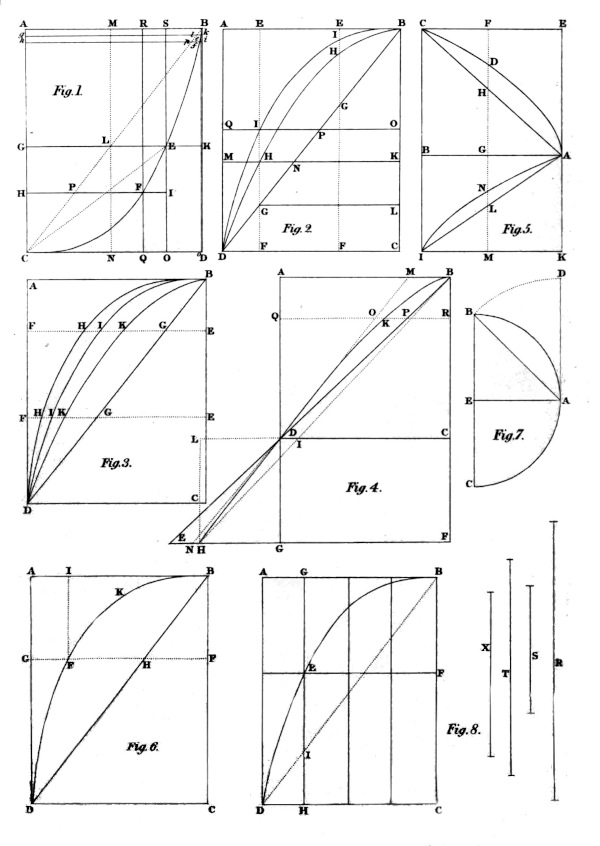
Vol. 1. Lat. & Eng.
C. XVII.
Fig. 1-8
268
1. To find the strait line equal to the crooked line of a semiparabola.—2.
To find a strait line equal to the crooked line of
the first semiparabolaster, or to the crooked line of any other
of the deficient figures of the table of the 3d article of the
precedent chapter.
To find a strait line equal to the crooked line of a semiparabola.
1. A parabola being given, to find a strait line
equal to the crooked line of the semiparabola.
Let the parabolical line given be A B C (in
figure 1), and the diameter found be A D, and the
base drawn D C; and the parallelogram A D C E
being completed, draw the strait line A C. Then
dividing A D into two equal parts in F, draw F H
equal and parallel to D C, cutting A C in K, and
the parabolical line in O; and between F H and
F O take a mean proportional F P, and draw A O,
A P and P C. I say that the two lines A P and
P C, taken together as one line, are equal to the
parabolical line A B O C.
For the line A B O C being a parabolical line, is
generated by the concourse of two motions, one
uniform from A to E, the other in the same time
uniformly accelerated from rest in A to D. And
because the motion from A to E is uniform, A E
may represent the times of both those motions
from the beginning to the end. Let therefore
A E be the time; and consequently the lines ordinately
269applied in the semiparabola will design the
parts of time wherein the body, that describeth
the line A B O C, is in every point of the same; so
that as at the end of the time A E or D C it is in C,
so at the end of the time F O it will be in O. And
because the velocity in A D is increased uniformly,
that is, in the same proportion with the time, the
same lines ordinately applied in the semiparabola
will design also the continual augmentation of the
impetus, till it be at the greatest, designed by the
base D C. Therefore supposing uniform motion
in the line A F, in the time F K the body in A by
the concourse of the two uniform motions in A F
and F K will be moved uniformly in the line A K;
and K O will be the increase of the impetus or
swiftness gained in the time F K; and the line
A O will be uniformly described by the concourse
of the two uniform motions in A F and F O in the
time F O. From O draw O L parallel to E C,
cutting A C in L; and draw L N parallel to D C,
cutting E C in N, and the parabolical line in M;
and produce it on the other side to A D in I; and
I N, I M and I L will be, by the construction of a
parabola, in continual proportion, and equal to
the three lines F H, F P and F O; and a strait
line parallel to E C passing through M will fall on
P; and therefore O P will be the increase of impetus
gained in the time F O or I L. Lastly, produce
P M to C D in Q; and Q C or M N or P H will
be the increase of impetus proportional to the time
F P or I M or D Q. Suppose now uniform motion
from H to C in the time P H. Seeing therefore in
the time F P with uniform motion and the impetus
increased in proportion to the times, is described
270the straight line A P; and in the rest of the time
and impetus, namely, P H, is described the line
C P uniformly; it followeth that the whole line
A P C is described with the whole impetus, and in
the same time wherewith is described the parabolical
line A B C; and therefore the line A P C,
made of the two strait lines A P and P C, is equal
to the parabolical line A B C; which was to be
proved.
To find a strait line equal to the crooked line of the first semiparabolaster or to the crooked line of any other of the deficient figures of the table of
art. 3 of the preceding chapter.
2. To find a strait line equal to the crooked line
of the first semiparabolaster.
Let A B C be the crooked line of the first semiparabolaster;
A D the diameter; D C the base;
and let the parallelogram completed be A D C E,
whose diagonal is A C. Divide the diameter into
two equal parts in F, and draw F H equal and
parallel to D C, cutting A C in K, the crooked line
in O, and E C in H. Then draw O L parallel to
E C, cutting A C in L; and draw L N parallel
to the base D C, cutting the crooked line in M,
and the strait line E C in N; and produce it on
the other side to A D in I. Lastly, through the
point M draw P M Q parallel and equal to H C,
cutting F H in P; and join C P, A P and A O.
I say, the two strait lines A P and P C are equal to
the crooked line A B O C.
For the line A B O C, being the crooked line of
the first semiparabolaster, is generated by the
concourse of two motions, one uniform from A to
E, the other in the same time accelerated from
rest in A to D, so as that the impetus increaseth
in proportion perpetually triplicate to that of the
increase of the time, or which is all one, the
lengths transmitted are in proportion triplicate to
271that of the times of their transmission; for as the
impetus or quicknesses increase, so the lengths
transmitted increase also. And because the motion
from A to E is uniform, the line A E may
serve to represent the time, and consequently the
lines, ordinately drawn in the semiparabolaster,
will design the parts of time wherein the body,
beginning from rest in A, describeth by its
motion the crooked line A B O C. And because
D C, which represents the greatest acquired impetus,
is equal to A E, the same ordinate lines will
represent the several augmentations of the impetus
increasing from rest in A. Therefore, supposing
uniform motion from A to F, in the time F K there
will be described, by the concourse of the two
uniform motions A F and F K, the line A K uniformly,
and K O will be the increase of impetus in
the time F K; and by the concourse of the two
uniform motions in A F and F O will be described
the line A O uniformly. Through the point L
draw the strait line L M N parallel to D C, cutting
the strait line A D in I, the crooked line A B C in
M, and the strait line E C in N; and through the
point M the strait line P M Q parallel and equal to
H C, cutting D C in Q and F H in P. By the
concourse therefore of the two uniform motions in
A F and F P in the time F P will be uniformly
described the strait line A P; and L M or O P
will be the increase of impetus to be added for the
time F O. And because the proportion of I N to
I L is triplicate to the proportion of I N to I M,
the proportion of F H to F O will also be triplicate
to the proportion of F H to F P; and the
proportional impetus gained in the time F P is P H.
272So that F H being equal to D C, which designed
the whole impetus acquired by the acceleration,
there is no more increase of impetus to be computed.
Now in the time P H suppose an uniform
motion from H to C; and by the two uniform motions
in C H and H P will be described uniformly
the strait line P C. Seeing therefore the two strait
lines A P and P C are described in the time A E
with the same increase of impetus, wherewith the
crooked line A B O C is described in the same
time A E, that is, seeing the line A P C and the
line A B O C are transmitted by the same body in
the same time and with equal velocities, the lines
themselves are equal; which was to be demonstrated.
By the same method (if any of the semiparabolasters
in the table of art. 3 of the precedent
chapter be exhibited) may be found a strait line
equal to the crooked line thereof, namely, by
dividing the diameter into two equal parts, and
proceeding as before. Yet no man hitherto hath
compared any crooked with any strait line, though
many geometricians of every age have endeavoured
it. But the cause, why they have not done it,
may be this, that there being in Euclid no definition
of equality, nor any mark by which to judge
of it besides congruity (which is the 8th axiom of
the first Book of his Elements) a thing of no use
at all in the comparing of strait and crooked; and
others after Euclid (except Archimedes and Apollonius,
and in our time Bonaventura) thinking the
industry of the ancients had reached to all that
was to be done in geometry, thought also, that
all that could be propounded was either to be
273deduced from what they had written, or else that
it was not at all to be done: it was therefore disputed
by some of those ancients themselves, whether
there might be any equality at all between
crooked and strait lines; which question Archimedes,
who assumed that some strait line was
equal to the circumference of a circle, seems to
have despised, as he had reason. And there is a
late writer that granteth that between a strait
and a crooked line there is equality; but now,
says he, since the fall of Adam, without the special
assistance of Divine Grace it is not to be
found.
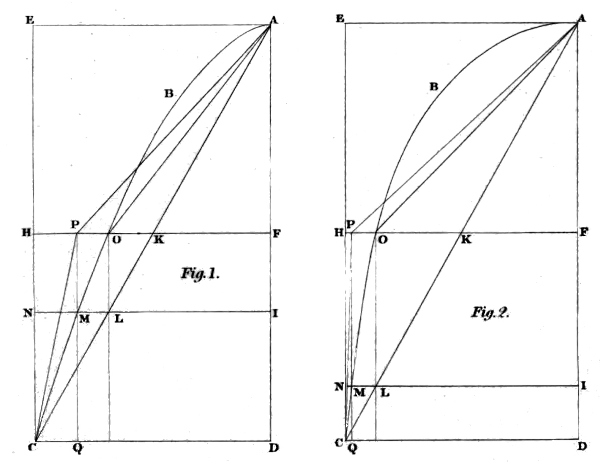
Vol. 1. Lat. & Eng.
C. XVIII.
Fig. 1-2
1. If two strait lines falling upon another strait line be parallel,
the lines reflected from them shall also be parallel.—2. If two
strait lines drawn from one point fall upon another strait line,
the lines reflected from them, if they be drawn out the other
way, will meet in an angle equal to the angle made by the lines
of incidence.—3. If two strait parallel lines, drawn not oppositely,
but from the same parts, fall upon the circumference of
a circle, the lines reflected from them, if produced they meet
within the circle, will make an angle double to that which is
made by two strait lines drawn from the centre to the points of
incidence.—4. If two strait lines drawn from the same point
without a circle fall upon the circumference, and the lines
reflected from them being produced meet within the circle,
they will make an angle equal to twice that angle, which is
made by two strait lines drawn from the centre to the points of
incidence, together with the angle which the incident lines
themselves make.—5. If two strait lines drawn from one point
274fall upon the concave circumference of a circle, and the angle
they make be less than twice the angle at the centre, the lines
reflected from them and meeting within the circle will make an
angle, which being added to the angle of the incident lines will
be equal to twice the angle at the centre.—6. If through any
one point two unequal chords be drawn cutting one another,
and the centre of the circle be not placed between them, and
the lines reflected from them concur wheresoever, there cannot
through the point, through which the two former lines
were drawn, be drawn any other strait line whose reflected
line shall pass through the common point of the two former
lines reflected.—7. In equal chords the same is not true.—8.
Two points being given in the circumference of a circle, to
draw two strait lines to them, so that their reflected lines may
contain any angle given.—9. If a strait line falling upon the
circumference of a circle be produced till it reach the semidiameter,
and that part of it, which is intercepted between
the circumference and the semidiameter, be equal to that part
of the semidiameter which is between the point of concourse
and the centre, the reflected line will be parallel to the semidiameter.—10.
If from a point within a circle, two strait lines
be drawn to the circumference, and their reflected lines meet
in the circumference of the same circle, the angle made by the
reflected lines will be a third part of the angle made by the incident
lines.
Angles of incidence and reflection.
Whether a body falling upon the superficies of
another body and being reflected from it, do make
equal angles at that superficies, it belongs not to
this place to dispute, being a knowledge which
depends upon the natural causes of reflection; of
which hitherto nothing has been said, but shall be
spoken of hereafter.
In this place, therefore, let it be supposed that
the angle of incidence is equal to the angle of
reflection; that our present search may be applied,
not to the finding out of the causes, but
some consequences of the same.
I call an angle of incidence, that which is made
275between a strait line and another line, strait or
crooked, upon which it falls, and which I call the
line reflecting; and an angle of reflection equal
to it, that which is made at the same point between
the strait line which is reflected and the line
reflecting.
If two strait lines falling upon another strait line be parallel, the lines reflected from them shall also be parallel.
1. If two strait lines, which fall upon another
strait line, be parallel, their reflected lines shall be
also parallel.
Let the two strait lines A B and C D (in fig. 1),
which fall upon the strait line E F, at the points
B and D, be parallel; and let the lines reflected
from them be B G and D H. I say, B G and D H
are also parallel.
For the angles A B E and C D E are equal by
reason of the parallelism of A B and C D; and the
angles G B F and H D F are equal to them by supposition;
for the lines B G and D H are reflected
from the lines A B and C D. Wherefore B G and
D H are parallel.
If two strait lines drawn from one point fall upon another strait line, the lines reflected from them, if they be drawn out the other way, will meet in an angle equal to the angle made by the lines of incidence.
2. If two strait lines drawn from the same
point fall upon another strait line, the lines reflected
from them, if they be drawn out the other
way, will meet in an angle equal to the angle of the
incident lines.
From the point A (in fig. 2) let the two strait
lines A B and A D be drawn; and let them fall
upon the strait line E K at the points B and D;
and let the lines B I and D G be reflected from
them. I say, I B and G D do converge, and that if
they be produced on the other side of the line E K,
they shall meet, as in F; and that the angle B F D
shall be equal to the angle B A D.
For the angle of reflection I B K is equal to the
276angle of incidence A B E; and to the angle I B K
its vertical angle E B F is equal; and therefore
the angle A B E is equal to the angle E B F.
Again, the angle A D E is equal to the angle of
reflection G D K, that is, to its vertical angle
E D F; and therefore the two angles A B D and
A D B of the triangle A B D are one by one equal
to the two angles F B D and F D B of the triangle
F B D; wherefore also the third angle B A D is
equal to the third angle B F D; which was to be
proved.
Coroll. I. If the strait line A F be drawn, it will
be perpendicular to the strait line E K. For both
the angles at E will be equal, by reason of the
equality of the two angles A B E and F B E, and
of the two sides A B and F B.
Coroll. II. If upon any point between B and D
there fall a strait line, as A C, whose reflected line is
C H, this also produced beyond C, will fall upon F;
which is evident by the demonstration above.
If two strait parallel lines, drawn not oppositely, but from the same parts, fall upon the circumference of a circle, the lines reflected from them, if produced they meet within the circle, will make an angle double to that which is made by two strait lines drawn from the centre to the points of incidence.
3. If from two points taken without a circle,
two strait parallel lines, drawn not oppositely, but
from the same parts, fall upon the circumference;
the lines reflected from them, if produced they
meet within the circle, will make an angle double
to that which is made by two strait lines drawn
from the centre to the points of incidence.
Let the two strait parallels A B and D C (in
fig. 3) fall upon the circumference B C at the
points B and C; and let the centre of the circle be
E; and let A B reflected be B F, and D C reflected
be C G; and let the lines F B and G C produced
meet within the circle in H; and let E B and E C
277be connected. I say the angle F H G is double to
the angle B E C.
For seeing A B and D C are parallels, and E B
cuts A B in B, the same E B produced will cut
D C somewhere; let it cut it in D; and let D C
be produced howsoever to I, and let the intersection
of D C and B F be at K. The angle therefore
I C H, being external to the triangle C K H, will
be equal to the two opposite angles C K H and
C H K. Again, I C E being external to the triangle
C D E, is equal to the two angles at D and E.
Wherefore the angle I C H, being double to the
angle I C E, is equal to the angles at D and E
twice taken; and therefore the two angles C K H
and C H K are equal to the two angles at D and E
twice taken. But the angle C K H is equal to the
angles D and A B D, that is, D twice taken; for
A B and D C being parallels, the altern angles D
and A B D are equal. Wherefore C H K, that is
the angle F H G is also equal to the angle at E
twice taken; which was to be proved.
Coroll. If from two points taken within a circle
two strait parallels fall upon the circumference,
the lines reflected from them shall meet in an
angle, double to that which is made by two strait
lines drawn from the centre to the points of
incidence. For the parallels A B and I C falling
upon the points B and C, are reflected in the lines
B H and C H, and make the angle at H double to
the angle at E, as was but now demonstrated.
If two strait lines drawn from the same point without a circle fall upon the circumference, and the lines reflected from them being produced meet within
the circle, they will make an angle equal to twice that angle, which is made by two strait lines drawn from the centre to the points of incidence, together with the angle which the incident lines themselves make.
4. If two strait lines drawn from the same point
without a circle fall upon the circumference, and
the lines reflected from them being produced meet
within the circle, they will make an angle equal to
278twice that angle, which is made by two strait lines
drawn from the centre to the points of incidence,
together with the angle which the incident lines
themselves make.
Let the two strait lines A B and A C (in fig. 4)
be drawn from the point A to the circumference
of the circle, whose centre is D; and let the lines
reflected from them be B E and C G, and, being
produced, make within the circle the angle H;
also let the two strait lines D B and D C be drawn
from the centre D to the points of incidence B
and C. I say, the angle H is equal to twice the
angle at D together with the angle at A.
For let A C be produced howsoever to I. Therefore
the angle I C H, which is external to the
triangle C K H, will be equal to the two angles
C K H and C H K. Again, the angle I C D, which
is external to the triangle C L D, will be equal to
the two angles C L D and C D L. But the angle
I C H is double to the angle I C D, and is therefore
equal to the angles C L D and C D L twice taken.
Wherefore the angles C K H and C H K are equal
to the angles C L D and C D L twice taken. But
the angle C L D, being external to the triangle
A L B, is equal to the two angles L A B and L B A;
and consequently C L D twice taken is equal to
L A B and L B A twice taken. Wherefore C K H
and C H K are equal to the angle C D L together
with L A B and L B A twice taken. Also the
angle C K H is equal to the angle L A B once and
A B K, that is, L B A twice taken. Wherefore
the angle C H K is equal to the remaining angle
C D L, that is, to the angle at D, twice taken, and
279the angle L A B, that is, the angle at A, once
taken; which was to be proved.
Coroll. If two strait converging lines, as I C and
M B, fall upon the concave circumference of a
circle, their reflected lines, as C H and B H, will
meet in the angle H, equal to twice the angle D,
together with the angle at A made by the incident
lines produced. Or, if the incident lines be H B
and I C, whose reflected lines C H and B M meet
in the point N, the angle C N B will be equal to
twice the angle D, together with the angle C K H
made by the lines of incidence. For the angle
C N B is equal to the angle H, that is, to twice
the angle D, together with the two angles A, and
N B H, that is, K B A. But the angles K B A
and A are equal to the angle C K H. Wherefore
the angle C N B is equal to twice the angle D,
together with the angle C K H made by the lines
of incidence I C and H B produced to K.
If two strait lines drawn from one point fall upon the concave circumference of a circle, and the angle they make be less than twice the angle at the centre, the lines reflected from them and meeting within the circle will make an angle, which being added to the angle of the incident lines will be equal to twice the angle at the centre.
5. If two strait lines drawn from one point fall
upon the concave circumference of a circle, and
the angle they make be less than twice the angle
at the centre, the lines reflected from them and
meeting within the circle will make an angle,
which being added to the angle of the incident
lines, will be equal to twice the angle at the centre.
Let the two lines A B and A C (in fig. 5), drawn
from the point A, fall upon the concave circumference
of the circle whose centre is D; and let
their reflected lines B E and C E meet in the point
E; also let the angle A be less than twice the
angle D. I say, the angles A and E together
taken are equal to twice the angle D.
For let the strait lines A B and E C cut the
280strait lines D C and D B in the points G and H;
and the angle B H C will be equal to the two
angles E B H and E; also the same angle B H C
will be equal to the two angles D and D C H; and
in like manner the angle B G C will be equal to
the two angles A C D and A, and the same angle
B G C will be also equal to the two angles D B G
and D. Wherefore the four angles E B H, E,
A C D and A, are equal to the four angles D, D C H,
D B G and D. If, therefore, equals be taken away
on both sides, namely, on one side A C D and
E B H, and on the other side D C H and D B G,
(for the angle E B H is equal to the angle D B G,
and the angle A C D equal to the angle D C H),
the remainders on both sides will be equal, namely,
on one side the angles A and E, and on the other
the angle D twice taken. Wherefore the angles
A and E are equal to twice the angle D.
Coroll. If the angle A be greater than twice the
angle D, their reflected lines will diverge. For, by
the corollary of the third proposition, if the angle
A be equal to twice the angle D, the reflected lines
B E and C E will be parallel; and if it be less,
they will concur, as has now been demonstrated.
And therefore, if it be greater, the reflected lines
B E and C E will diverge, and consequently, if
they be produced the other way, they will concur
and make an angle equal to the excess of the angle
A above twice the angle D; as is evident by art. 4.
If through any one point two unequal chords be drawn cutting one another, and the centre of the circle be not placed between them, and the lines reflected from them concur wheresoever, there cannot through the point, through which the two former lines were drawn, be drawn any other strait line whose reflected line shall pass through the common point of the two former lines reflected.
6. If through any one point two unequal chords
be drawn cutting one another, either within the
circle, or, if they be produced, without it, and the
centre of the circle be not placed between them,
and the lines reflected from them concur wheresoever;
281there cannot, through the point through
which the former lines were drawn, be drawn
another strait line, whose reflected line shall pass
through the point where the two former reflected
lines concur.
Let any two unequal chords, as B K and C H
(in fig. 6), be drawn through the point A in the
circle B C; and let their reflected lines B D and
C E meet in F; and let the centre not be between
A B and A C; and from the point A let any other
strait line, as A G, be drawn to the circumference
between B and C. I say, G N, which passes
through the point F, where the reflected lines B D
and C E meet, will not be the reflected line of A G.
For let the arch B L be taken equal to the arch
B G, and the strait line B M equal to the strait
line B A; and L M being drawn, let it be produced
to the circumference in O. Seeing therefore B A
and B M are equal, and the arch B L equal to the
arch B G, and the angle M B L equal to the angle
A B G, A G and M L will also be equal, and, producing
G A to the circumference in I, the whole
lines L O and G I will in like manner be equal.
But L O is greater than G F N, as shall presently
be demonstrated; and therefore also G I is greater
than G N. Wherefore the angles N G C and I G B
are not equal. Wherefore the line G F N is not
reflected from the line of incidence A G, and consequently
no other strait line, besides A B and
A C, which is drawn through the point A, and
falls upon the circumference B C, can be reflected
to the point F; which was to be demonstrated.
It remains that I prove L O to be greater than
G N; which I shall do in this manner. L O and
282G N cut one another in P; and P L is greater than
P G. Seeing now L P. P G :: P N. P O are proportionals,
therefore the two extremes L P and P O
together taken, that is L O, are greater than P G
and P N together taken, that is, G N; which remained
to be proved.
In equal chords the same is not true.
7. But if two equal chords be drawn through one
point within a circle, and the lines reflected from
them meet in another point, then another strait line
may be drawn between them through the former
point, whose reflected line shall pass through the
latter point.
Let the two equal chords B C and E D (in the
7th figure) cut one another in the point A within
the circle B C D; and let their reflected lines C H
and D I meet in the point F. Then dividing the
arch C D equally in G, let the two chords G K and
G L be drawn through the points A and F. I say,
G L will be the line reflected from the chord K G.
For the four chords B C, C H, E D and D I are by
supposition all equal to one another; and therefore
the arch B C H is equal to the arch E D I; as also
the angle B C H to the angle E D I; and the angle
A M C to its verticle angle F M D; and the strait
line D M to the strait line G M; and, in like manner,
the strait line A C to the strait line F D; and
the chords C G and G D being drawn, will also be
equal; and also the angles F D G and A C G, in the
equal segments G D I and G C B. Wherefore the
strait lines F G and A G are equal; and, therefore,
the angle F G D is equal to the angle A G C, that
is, the angle of incidence equal to the angle of reflection.
Wherefore the line G L is reflected from
the incident line C G; which was to be proved.
283Coroll. By the very sight of the figure it is manifest,
that if G be not the middle point between C
and D, the reflected line G L will not pass through
the point F.
Two points being given in the circumference of a circle, to draw two strait lines to them so as that their reflected lines may contain any angle given.
8. Two points in the circumference of a circle
being given to draw two strait lines to them, so as
that their reflected lines may be parallel, or contain
any angle given.
In the circumference of the circle, whose centre
is A, (in the 8th figure) let the two points B and
C be given; and let it be required to draw to them
from two points taken without the circle two incident
lines, so that their reflected lines may, first,
be parallel.
Let A B and A C be drawn; as also any incident
line D C, with its reflected line C F; and let the
angle E C D be made double to the angle A; and
let H B be drawn parallel to E C, and produced
till it meet with D C produced in I. Lastly, producing
A B indefinitely to K, let G B be drawn so
that the angle G B K may be equal to the angle
H B K, and then G B will be the reflected line of
the incident line H B. I say, D C and H B are two
incident lines, whose reflected lines C F and B G
are parallel.
For seeing the angle E C D is double to the angle
B A C, the angle H I C is also, by reason of the
parallels E C and H I, double to the same B A C;
therefore also F C and G B, namely, the lines reflected
from the incident lines D C and H B, are
parallel. Wherefore the first thing required is
done.
Secondly, let it be required to draw to the points
B and C two strait lines of incidence, so that the
284lines reflected from them may contain the given
angle Z.
To the angle E C D made at the point C, let there
be added on one side the angle D C L equal to half
Z, and on the other side the angle E C M equal to
the angle D C L; and let the strait line B N be
drawn parallel to the strait line C M; and let the
angle K B O be made equal to the angle N B K;
which being done, B O will be the line of reflection
from the line of incidence N B. Lastly, from the
incident line L C, let the reflected line C O be
drawn, cutting B O at O, and making the angle
C O B. I say, the angle C O B is equal to the
angle Z.
Let N B be produced till it meet with the strait
line L C produced in P. Seeing, therefore, the
angle L C M is, by construction, equal to twice the
angle B A C, together with the angle Z; the angle
N P L, which is equal to L C M by reason of the
parallels N P and M C, will also be equal to twice
the same angle B A C, together with the angle Z.
And seeing the two strait lines O C and O B fall
from the point O upon the points C and B; and
their reflected lines L C and N B meet in the point
P; the angle N P L will be equal to twice the angle
B A C together with the angle C O B. But I have
already proved the angle N P L to be equal to twice
the angle B A C together with the angle Z. Therefore
the angle C O B is equal to the angle Z; wherefore,
two points in the circumference of a circle
being given, I have drawn, &c.; which was to be done.
But if it be required to draw the incident lines
from a point within the circle, so that the lines reflected
from them may contain an angle equal to
285the angle Z, the same method is to be used, saving
that in this case the angle Z is not to be added to
twice the angle B A C, but to be taken from it.
If a strait line falling upon the circumference of a circle be produced till it reach the semidiameter, and that part of it, which is intercepted between the circumference and the semidiameter, be equal to that part of the semidiameter which is between the point of concourse and the centre, the reflected line will be parallel to the semidiameter.
9. If a strait line, falling upon the circumference
of a circle, be produced till it reach the semidiameter,
and that part of it which is intercepted between
the circumference and the semidiameter be
equal to that part of the semidiameter which is
between the point of concourse and the centre, the
reflected line will be parallel to the semidiameter.
Let any line A B (in the 9th figure) be the semidiameter
of the circle whose centre is A; and upon
the circumference B D let the strait line C D fall,
and be produced till it cut A B in E, so that E D
and E A may be equal; and from the incident line
C D let the line D F be reflected. I say, A B and
D F will be parallel.
Let A G be drawn through the point D. Seeing,
therefore, E D and E A are equal, the angles E D A
and E A D will also be equal. But the angles F D G
and E D A are equal; for each of them is half the
angle E D H or F D C. Wherefore the angles F D G
and E A D are equal; and consequently D F and
A B are parallel; which was to be proved.
Coroll. If E A be greater then E D, then D F
and A B being produced will concur; but if E A
be less than E D, then B A and D H being produced
will concur.
If from a point within a circle two strait lines be drawn to the circumference, and their reflected lines meet in the circumference of the same circle, the angle made by the reflected lines will be a third part of the angle made by the incident lines.
10. If from a point within a circle two strait
lines be drawn to the circumference, and their reflected
lines meet in the circumference of the same
circle, the angle made by the lines of reflection will
be a third part of the angle made by the lines of
incidence.
286From the point B (in the 10th figure) taken
within the circle whose centre is A, let the two
strait lines B C and B D be drawn to the circumference;
and let their reflected lines C E and D E
meet in the circumference of the same circle at the
point E. I say, the angle C E D will be a third
part of the angle C B D.
Let A C and A D be drawn. Seeing, therefore,
the angles C E D and C B D together taken are
equal to twice the angle C A D (as has been demonstrated
in the 5th article); and the angle
C A D twice taken is quadruple to the angle C E D;
the angles C E D and C B D together taken will
also be equal to the angle C E D four times taken;
and therefore if the angle C E D be taken away on
both sides, there will remain the angle C B D on
one side, equal to the angle C E D thrice taken on
the other side; which was to be demonstrated.
Coroll. Therefore a point being given within a
circle, there may be drawn two lines from it to the
circumference, so as their reflected lines may meet
in the circumference. For it is but trisecting the
angle C B D, which how it may be done shall be
shown in the following chapter.
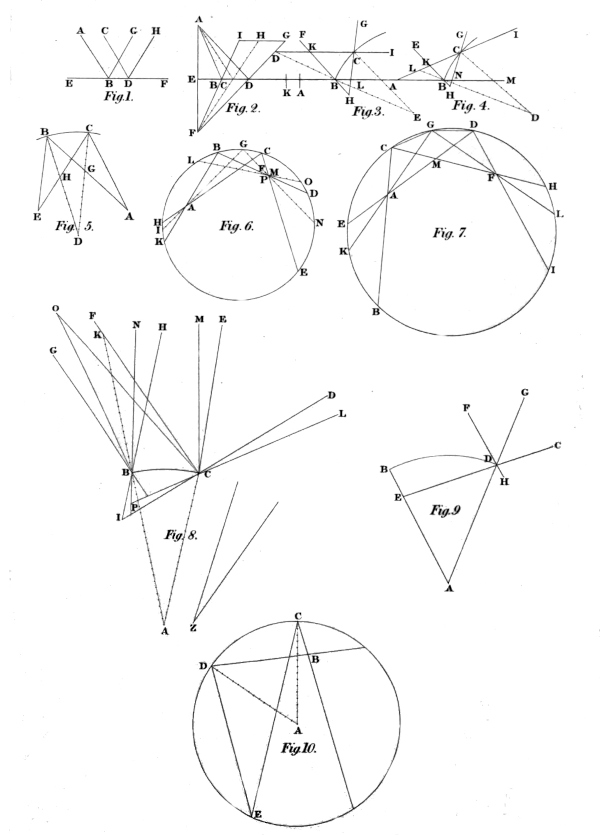
Vol. 1. Lat. & Eng.
C. XIX.
Fig. 1-10
287
1. The dimension of a circle never determined in numbers by
Archimedes and others.—2. The first attempt for the finding out
of the dimension of a circle by lines.—3. The second attempt
for the finding out of the dimension of a circle from the
consideration of the nature of crookedness.—4. The third
attempt; and some things propounded to be further searched
into.—5. The equation of the spiral of Archimedes with a
strait line.—6. Of the analysis of geometricians by the powers
of lines.
The dimension of a circle never determined in numbers by Archimedes and others.
1. In the comparing of an arch of a circle with a
strait line, many and great geometricians, even
from the most ancient times, have exercised their
wits; and more had done the same, if they had
not seen their pains, though undertaken for the
common good, if not brought to perfection, vilified
by those that envy the praises of other men.
Amongst those ancient writers whose works are
come to our hands, Archimedes was the first that
brought the length of the perimeter of a circle
within the limits of numbers very little differing
from the truth; demonstrating the same to be
less than three diameters and a seventh part, but
greater than three diameters and ten seventy-one
parts of the diameter. So that supposing the
radius to consist of 10,000,000 equal parts, the
arch of a quadrant will be between 15,714,285
and 15,704,225 of the same parts. In our times,
Ludovicus Van Cullen and Willebrordus Snellius,
288with joint endeavour, have come yet nearer to
the truth; and pronounced from true principles,
that the arch of a quadrant, putting, as before,
10,000,000 for radius, differs not one whole unity
from the number 15,707,963; which, if they had
exhibited their arithmetical operations, and no
man had discovered any error in that long work
of theirs, had been demonstrated by them. This
is the furthest progress that has been made by the
way of numbers; and they that have proceeded
thus far deserve the praise of industry. Nevertheless,
if we consider the benefit, which is the
scope at which all speculation should aim, the
improvement they have made has been little or
none. For any ordinary man may much sooner
and more accurately find a strait line equal to the
perimeter of a circle, and consequently square the
circle, by winding a small thread about a given
cylinder, than any geometrician shall do the same
by dividing the radius into 10,000,000 equal parts.
But though the length of the circumference were
exactly set out, either by numbers, or mechanically,
or only by chance, yet this would contribute no
help at all towards the section of angles, unless
happily these two problems, to divide a given
angle according to any proportion assigned, and
to find a strait line equal to the arch of a circle,
were reciprocal, and followed one another. Seeing
therefore the benefit proceeding from the knowledge
of the length of the arch of a quadrant
consists in this, that we may thereby divide an
angle according to any proportion, either accurately,
or at least accurately enough for common
use; and seeing this cannot be done by arithmetic, I
289thought fit to attempt the same by geometry,
and in this chapter to make trial whether it might
not be performed by the drawing of strait and
circular lines.
The first attempt for the finding out of the dimension of a circle by lines.
2. Let the square A B C D (in the first figure)
be described; and with the radii A B, B C, and
D C, the three arches B D, C A, and A C; of which
let the two B D and C A cut one another in E, and
the two B D and A C in F. The diagonals therefore
B D and A C being drawn will cut one another
in the centre of the square G, and the two arches
B D and C A in two equal parts in H and Y; and
the arch B H D will be trisected in F and E.
Through the centre G let the two strait lines K G L
and M G N be drawn parallel and equal to the
sides of the square A B and A D, cutting the four
sides of the same square in the points K, L, M,
and N; which being done, K L will pass through
F, and M N through E. Then let O P be drawn
parallel and equal to the side B C, cutting the
arch B F D in F, and the sides A B and D C in O
and P. Therefore O F will be the sine of the arch
B F, which is an arch of 30 degrees; and the
same O F will be equal to half the radius. Lastly,
dividing the arch B F in the middle in Q, let R Q,
the sine of the arch B Q, be drawn and produced
to S, so that Q S be equal to R Q, and consequently
R S be equal to the chord of the arch B F; and
let F S be drawn and produced to T in the side
B C. I say, the strait line B T is equal to the
arch B F; and consequently that B V, the triple of
B T, is equal to the arch of the quadrant B F E D.
Let T F be produced till it meet the side B A
produced in X; and dividing O F in the middle
290in Z, let Q Z be drawn and produced till it meet
with the side B A produced. Seeing therefore the
strait lines R S and O F are parallel, and divided
in the midst in Q and Z, Q Z produced will fall
upon X, and X Z Q produced to the side B C will
cut B T in the midst in α.
Upon the strait line F Z, the fourth part of the
radius A B, let the equilateral triangle a Z F be
constituted; and upon the centre a, with the
radius a Z, let the arch Z F be drawn; which arch
Z F will therefore be equal to the arch Q F, the
half of the arch B F. Again, let the strait line
Z O be cut in the midst in b, and the strait line
b O in the midst in c; and let the bisection be
continued in this manner till the last part O c be
the least that can possibly be taken; and upon it,
and all the rest of the parts equal to it into which
the strait line O F may be cut, let so many equilateral
triangles be understood to be constituted;
of which let the last be d O c. If, therefore, upon
the centre d, with the radius d O, be drawn the
arch O c, and upon the rest of the equal parts
of the strait line O F be drawn in like manner so
many equal arches, all those arches together taken
will be equal to the whole arch B F, and the half
of them, namely, those that are comprehended
between O and Z, or between Z and F, will be
equal to the arch B Q or Q F, and in sum,
what part soever the strait line O c be of the
strait line O F, the same part will the arch O c be
of the arch B F, though both the arch and the
chord be infinitely bisected. Now seeing the
arch O c is more crooked than that part of the
arch B F which is equal to it; and seeing also
291that the more the strait line X c is produced, the
more it diverges from the strait line X O, if the
points O and c be understood to be moved forwards
with strait motion in X O and X c, the
arch O c will thereby be extended by little and
little, till at the last it come somewhere to have
the same crookedness with that part of the arch B F
which is equal to it. In like manner, if the strait
line X b be drawn, and the point b be understood
to be moved forwards at the same time, the arch
c b will also by little and little be extended, till
its crookedness come to be equal to the crookedness
of that part of the arch B F which is equal
to it. And the same will happen in all those
small equal arches which are described upon so
many equal parts of the strait line O F. It is also
manifest, that by strait motion in X O and X Z
all those small arches will lie in the arch B F,
in the points B, Q and F. And though the same
small equal arches should not be coincident with
the equal parts of the arch B F in all the other
points thereof, yet certainly they will constitute
two crooked lines, not only equal to the two
arches B Q and Q F, and equally crooked, but
also having their cavity towards the same parts;
which how it should be, unless all those small
arches should be coincident with the arch B F in
all its points, is not imaginable. They are therefore
coincident, and all the strait lines drawn
from X, and passing through the points of division
of the strait line O F, will also divide the arch
B F into the same proportions into which O F is
divided.
Now seeing X b cuts off from the point B the
292fourth part of the arch B F, let that fourth part
be B e; and let the sine thereof, f e, be produced
to F T in g, for so f e will be the fourth part of
the strait line f g, because as O b is to O F, so is
f e to f g. But B T is greater than f g; and
therefore the same B T is greater than four sines
of the fourth part of the arch B F. And in like
manner, if the arch B F be subdivided into any
number of equal parts whatsoever, it may be
proved that the strait line B T is greater than the
sine of one of those small arches, so many times
taken as there be parts made of the whole arch
B F. Wherefore the strait line B T is not less
than the arch B F. But neither can it be greater,
because if any strait line whatsoever, less than
B T, be drawn below B T, parallel to it, and terminated
in the strait lines X B and X T, it would
cut the arch B F; and so the sine of some one of the
parts of the arch B F, taken so often as that small
arch is found in the whole arch B F, would be
greater than so many of the same arches; which
is absurd. Wherefore the strait line B T is equal
to the arch B F; and the strait line B V equal to
the arch of the quadrant B F D; and B V four
times taken, equal to the perimeter of the circle
described with the radius A B. Also the arch
B F and the strait line B T are everywhere divided
into the same proportions; and consequently any
given angle, whether greater or less than B A F,
may be divided into any proportion given.
But the strait line B V, though its magnitude
fall within the terms assigned by Archimedes, is
found, if computed by the canon of signs, to be
somewhat greater than that which is exhibited by
293the Rudolphine numbers. Nevertheless, if in the
place of B T, another strait line, though never so
little less, be substituted, the division of angles is
immediately lost, as may by any man be demonstrated
by this very scheme.
Howsoever, if any man think this my strait line
B V to be too great, yet, seeing the arch and all the
parallels are everywhere so exactly divided, and
B V comes so near to the truth, I desire he would
search out the reason, why, granting B V to be
precisely true, the arches cut off should not be
equal.
But some man may yet ask the reason why the
strait lines, drawn from X through the equal parts
of the arch B F, should cut off in the tangent B V
so many strait lines equal to them, seeing the connected
straight line X V passes not through the
point D, but cuts the strait line A D produced in l;
and consequently require some determination of
this problem. Concerning which, I will say what
I think to be the reason, namely, that whilst the
magnitude of the arch doth not exceed the magnitude
of the radius, that is, the magnitude of the
tangent B C, both the arch and the tangent are cut
alike by the strait lines drawn from X; otherwise
not. For A V being connected, cutting the arch
B H D in I, if X C being drawn should cut the
same arch in the same point I, it would be as true
that the arch B I is equal to the radius B C, as it is
true that the arch B F is equal to the strait line B T;
and drawing X K it would cut the arch B I in the
midst in i; also drawing A i and producing it to the
tangent B C in k, the strait line B k will be the
294tangent of the arch B i, (which arch is equal to
half the radius) and the same strait line B k will
be equal to the strait line k I. I say all this is true,
if the preceding demonstration be true; and consequently
the proportional section of the arch and
its tangent proceeds hitherto. But it is manifest
by the golden rule, that taking B h double to B T,
the line X h shall not cut off the arch B E, which
is double to the arch B F, but a much greater. For
the magnitude of the straight lines X M, X B, and
M E, being known (in numbers), the magnitude of
the strait line cut off in the tangent by the strait
line X E produced to the tangent, may also be
known; and it will be found to be less than B h;
Wherefore the strait line X h being drawn, will cut
off a part of the arch of the quadrant greater than
the arch B E. But I shall speak more fully in
the next article concerning the magnitude of the
arch B I.
And let this be the first attempt for the finding
out of the dimension of a circle by the section of
the arch B F.
The second attempt for the finding out of the dimension of a circle from the consideration of the nature of crookedness.
3. I shall now attempt the same by arguments
drawn from the nature of the crookedness of the
circle itself; but I shall first set down some premises
necessary for this speculation; and
First, if a strait line be bowed into an arch of
a circle equal to it, as when a stretched thread,
which toucheth a right cylinder, is so bowed in
every point, that it be everywhere coincident with
the perimeter of the base of the cylinder, the
flexion of that line will be equal, in all its points;
and consequently the crookedness of the arch of a
295circle is everywhere uniform; which needs no other
demonstration than this, that the perimeter of a
circle is an uniform line.
Secondly, and consequently: if two unequal
arches of the same circle be made by the bowing of
two strait lines equal to them, the flexion of the
longer line, whilst it is bowed into the greater
arch, is greater than the flexion of the shorter line,
whilst it is bowed into the lesser arch, according
to the proportion of the arches themselves; and
consequently, the crookedness of the greater arch
is to the crookedness of the lesser arch, as the
greater arch is to the lesser arch.
Thirdly: if two unequal circles and a strait line
touch one another in the same point, the crookedness
of any arch taken in the lesser circle, will be
greater than the crookedness of an arch equal to it
taken in the greater circle, in reciprocal proportion
to that of the radii with which the circles are
described; or, which is all one, any strait line
being drawn from the point of contact till it cut
both the circumferences, as the part of that strait
line cut off by the circumference of the greater
circle to that part which is cut off by the circumference
of the lesser circle.
For let A B and A C (in the second figure) be
two circles, touching one another, and the strait
line A D in the point A; and let their centres be
E and F; and let it be supposed, that as A E is to
A F, so is the arch A B to the arch A H. I say the
crookedness of the arch A C is to the crookedness
of the arch A H, as A E is to A F. For let the
strait line A D be supposed to be equal to the arch
A B, and the strait line A G to the arch A C; and
296let A D, for example, be double to A G. Therefore,
by reason of the likeness of the arches A B
and A C, the strait line A B will be double to the
strait line A C, and the radius A E double to the radius
A F, and the arch A B double to the arch A H.
And because the strait line A D is so bowed to be
coincident with the arch A B equal to it, as the
strait line A G is bowed to be coincident with the
arch A C equal also to it, the flexion of the strait
line A G into the crooked line A C will be equal to
the flexion of the strait line A D into the crooked
line A B. But the flexion of the strait line A D
into the crooked line A B is double to the flexion
of the strait line A G into the crooked line A H;
and therefore the flexion of the strait line A G into
the crooked line A C is double to the flexion of
the same strait line A G into the crooked line
A H. Wherefore, as the arch A B is to the arch
A C or A H; or as the radius A E is to the radius
A F; or as the chord A B is to the chord A C; so
reciprocally is the flexion or uniform crookedness
of the arch A C, to the flexion or uniform crookedness
of the arch A H, namely, here double. And
this may by the same method be demonstrated in
circles whose perimeters are to one another triple,
quadruple, or in whatsoever given proportion. The
crookedness therefore of two equal arches taken in
several circles are in proportion reciprocal to that
of their radii, or like arches, or like chords; which
was to be demonstrated.
Let the square A B C D be again described (in
the third figure), and in it the quadrants A B D,
B C A and D A C; and dividing each side of the
square A B C D in the midst in E, F, G and H, let
297E G and F H be connected, which will cut one another
in the centre of the square at I, and divide
the arch of the quadrant A B D into three equal
parts in K and L. Also the diagonals A C and
B D being drawn will cut one another in I, and
divide the arches B K D and C L A into two equal
parts in M and N. Then with the radius B F let
the arch F E be drawn, cutting the diagonal B D
in O; and dividing the arch B M in the midst in P,
let the strait line E a equal to the chord B P be set
off from the point E in the arch E F, and let the
arch a b be taken equal to the arch O a, and let
B a and B b be drawn and produced to the arch
A N in c and d; and lastly, let the strait line A d
be drawn. I say the strait line A d is equal to the
arch A N or B M.
I have proved in the preceding article, that the
arch E O is twice as crooked as the arch B P, that
is to say, that the arch E O is so much more
crooked than the arch B P, as the arch B P is more
crooked than the strait line E a. The crookedness
therefore of the chord E a, of the arch B P, and of
the arch E O, are as 0, 1, 2. Also the difference
between the arches E O and E O, the difference
between the arches E O and E a, and the difference
between the arches E O and E b, are as 0, 1, 2. So
also the difference between the arches A N and
A N, the difference between the arches A N and
A c, and the difference between the arches A N
and A d, are as 0, 1, 2; and the strait line A c is
double to the chord B P or E a, and the strait line
A d double to the chord E b.
Again, let the strait line B F be divided in the
midst in Q, and the arch B P in the midst in R;
298and describing the quadrant B Q S (whose arch
Q S is a fourth part of the arch of the quadrant
B M D, as the arch B R is a fourth part of the arch
B M, which is the arch of the semiquadrant A B M)
let the chord S e equal to the chord B R be set off
from the point S in the arch S Q; and let B e be
drawn and produced to the arch A N in f; which
being done, the strait line A f will be quadruple to
the chord B R or S e. And seeing the crookedness
of the arch S e, or of the arch A c, is double
to the crookedness of the arch B R, the excess of
the crookedness of the arch A f above the crookedness
of the arch A c will be subduple to the
excess of the crookedness of the arch A c above the
crookedness of the arch A N; and therefore the
arch N c will be double to the arch c f. Wherefore
the arch c d is divided in the midst in f, and the
arch N f is ¾ of the arch N d. And in like manner
if the arch B R be bisected in V, and the strait
line B Q in X, and the quadrant B X Y be described,
and the strait line Y g equal to the chord
B V be set off from the point Y in the arch Y X,
it may be demonstrated that the strait line B g
being drawn and produced to the arch A N, will
cut the arch f d into two equal parts, and that a
strait line drawn from A to the point of that section,
will be equal to eight chords of the arch B V,
and so on perpetually; and consequently, that the
strait line A d is equal to so many equal chords of
equal parts of the arch B M, as may be made by
infinite bisections. Wherefore the strait line A d
is equal to the arch B M or A N, that is, to half
the arch of the quadrant A B D or B C A.
Coroll. An arch being given not greater than
299the arch of a quadrant (for being made greater, it
comes again towards the radius B A produced,
from which it receded before) if a strait line double
to the chord of half the given arch be adapted
from the beginning of the arch, and by how much
the arch that is subtended by it is greater than the
given arch, by so much a greater arch be subtended
by another strait line, this strait line shall
be equal to the first given arch.
Supposing the strait line B V (in fig. 1) be equal
to the arch of the quadrant B H D, and A V be
connected cutting the arch B H D in I, it may be
asked what proportion the arch B I has to the
arch I D. Let therefore the arch A Y be divided
in the midst in o, and in the strait line A D let
A p be taken equal, and A q double to the drawn
chord A o. Then upon the centre A, with the
radius A q, let an arch of a circle be drawn cutting
the arch A Y in r, and let the arch Y r be doubled
at t; which being done, the drawn strait line A t
(by what has been last demonstrated) will be
equal to the arch A Y. Again, upon the centre A
with the radius A t let the arch t u be drawn
cutting A D in u; and the strait line A u will be
equal to the arch A Y. From the point u let the
strait line u s be drawn equal and parallel to the
strait line A B, cutting M N in x, and bisected by
M N in the same point x. Therefore the strait
line A x being drawn and produced till it meet
with B C produced in V, it will cut off B V double
to B s, that is, equal to the arch B H D. Now let
the point, where the strait line A V cuts the arch
B H D, be I; and let the arch D I be divided in
the midst in y; and in the strait line D C, let D z
300be taken equal, and D δ double to the drawn chord
D y; and upon the centre D with the radius D δ
let an arch of a circle be drawn cutting the arch
B H D in the point n; and let the arch n m be
taken equal to the arch I n; which being done,
the strait line D m will (by the last foregoing
corollary) be equal to the arch D I. If now the
strait lines D m and C V be equal, the arch B I
will be equal to the radius A B or B C; and consequently
X C being drawn, will pass through the
point I. Moreover, if the semicircle B H D ϐ being
completed, the strait lines ϐ I and B I be drawn,
making a right angle (in the semicircle) at I, and
the arch B I be divided in the midst at i, it will
follow that A i being connected will be parallel to
the strait line ϐ I, and being produced to B C in k,
will cut off the strait line B k equal to the strait
line k I, and equal also to the strait line A γ cut
off in A D by the strait line ϐ I. All which is
manifest, supposing the arch B I and the radius
B C to be equal.
But that the arch B I and the radius B C are
precisely equal, cannot (how true soever it be) be
demonstrated, unless that be first proved which is
contained in art. 1, namely, that the strait lines
drawn from X through the equal parts of O F
(produced to a certain length) cut off so many
parts also in the tangent B C severally equal to
the several arches cut off; which they do most
exactly as far as B C in the tangent, and B I in the
arch B E; insomuch that no inequality between
the arch B I and the radius B C can be discovered
either by the hand or by ratiocination. It is
therefore to be further enquired, whether the
301strait line A V cut the arch of the quadrant in I
in the same proportion as the point C divides the
strait line B V, which is equal to the arch of the
quadrant. But however this be, it has been demonstrated
that the strait line B V is equal to the
arch B H D.
The third attempt; and some things propounded to be further searched into.
4. I shall now attempt the same dimension of a
circle another way, assuming the two following
lemmas.
Lemma I. If to the arch of a quadrant, and the
radius, there be taken in continual proportion a
third line Z; then the arch of the semiquadrant,
half the chord of the quadrant, and Z, will also be
in continual proportion.
For seeing the radius is a mean proportional
between the chord of a quadrant and its semichord,
and the same radius a mean proportional
between the arch of the quadrant and Z, the
square of the radius will be equal as well to the
rectangle made of the chord and semichord of the
quadrant, as to the rectangle made of the arch of
the quadrant and Z; and these two rectangles
will be equal to one another. Wherefore, as the
arch of a quadrant is to its chord, so reciprocally
is half the chord of the quadrant to Z. But as the
arch of the quadrant is to its chord, so is half the
arch of the quadrant to half the chord of the
quadrant. Wherefore, as half the arch of the
quadrant is to half the chord of the quadrant (or
to the sine of 45 degrees), so is half the chord of
the quadrant to Z; which was to be proved.
Lemma II. The radius, the arch of the semiquadrant,
the sine of 45 degrees, and the semiradius,
are proportional.
302For seeing the sine of 45 degrees is a mean
proportional between the radius and the semiradius;
and the same sine of 45 degrees is also a
mean proportional (by the precedent lemma) between
the arch of 45 degrees and Z; the square
of the sine of 45 degrees will be equal as well to
the rectangle made of the radius and semiradius,
as to the rectangle made of the arch of 45 degrees
and Z. Wherefore, as the radius is to the arch of
45 degrees, so reciprocally is Z to the semiradius;
which was to be demonstrated.
Let now A B C D (in fig. 4) be a square; and
with the radii A B, B C and D A, let the three
quadrants A B D, B C A and D A C, be described;
and let the strait lines E F and G H, drawn parallel
to the sides B C and A B, divide the square A B C D
into four equal squares. They will therefore cut
the arch of the quadrant A B D into three equal
parts in I and K, and the arch of the quadrant
B C A into three equal parts in K and L. Also let
the diagonals A C and B D be drawn, cutting the
arches B I D and A L C in M and N. Then upon
the centre H with the radius H F equal to half
the chord of the arch B M D, or to the sine of 45
degrees, let the arch F O be drawn cutting the
arch C K in O; and let A O be drawn and produced
till it meet with B C produced in P; also
let it cut the arch B M D in Q, and the strait line
D C in R. If now the strait line H Q be equal to
the strait line D R, and being produced to D C in
S, cut off D S equal to half the strait line B P; I
say then the strait line B P will be equal to the
arch B M D.
For seeing P B A and A D R are like triangles,
303it will be as P B to the radius B A or A D, so A D
to D R; and therefore as well P B, A D and D R,
as P B, A D (or A Q) and Q H are in continual
proportion; and producing H O to D C in T, D T
will be equal to the sine of 45 degrees, as shall by
and by be demonstrated. Now D S, D T and D R
are in continual proportion by the first lemma;
and by the second lemma D C. D S:: D R. D F are
proportionals. And thus it will be, whether B P
be equal or not equal to the arch of the quadrant
B M D. But if they be equal, it will then be, as
that part of the arch B M D which is equal to the
radius, is to the remainder of the same arch B M D;
so A Q to H Q, or so B C to C P. And then will
B P and the arch B M D be equal. But it is not
demonstrated that the strait lines H Q and D R
are equal; though if from the point B there be
drawn (by the construction of fig. 1) a strait line
equal to the arch B M D, then D R to H Q, and
also the half of the strait line B P to D S, will
always be so equal, that no inequality can be discovered
between them. I will therefore leave this
to be further searched into. For though it be
almost out of doubt, that the strait line B P and
the arch B M D are equal, yet that may not be
received without demonstration; and means of
demonstration the circular line admitteth none
that is not grounded upon the nature of flexion, or
of angles. But by that way I have already exhibited
a strait line equal to the arch of a quadrant
in the first and second aggression.
It remains that I prove D T to be equal to the
sine of 45 degrees.
304In B A produced let A V be taken equal to the
sine of 45 degrees; and drawing and producing
V H, it will cut the arch of the quadrant C N A in
the midst in N, and the same arch again in O, and
the strait line D C in T, so that D T will be equal
to the sine of 45 degrees, or to the strait line A V;
also the strait line V H will be equal to the strait
line H I, or the sine of 60 degrees.
For the square of A V is equal to two squares of
the semiradius; and consequently the square of
V H is equal to three squares of the semiradius.
But H I is a mean proportional between the semiradius
and three semiradii; and, therefore, the
square of H I is equal to three squares of the semiradius.
Wherefore H I is equal to H V. But
because A D is cut in the midst in H, therefore V H
and H T are equal; and, therefore, also D T is
equal to the sine of 45 degrees. In the radius
B A let B X be taken equal to the sine of 45 degrees;
for so V X will be equal to the radius; and
it will be as V A to A H the semiradius, so V X the
radius to X N the sine of 45 degrees. Wherefore
V H produced passes through N. Lastly, upon the
centre V with the radius V A let the arch of a circle
be drawn cutting V H in Y; which being done,
V Y will be equal to H O (for H O is, by construction,
equal to the sine of 45 degrees) and Y H will
be equal to O T; and, therefore, V T passes through
O. All which was to be demonstrated.
I will here add certain problems, of which if
any analyst can make the construction, he will
thereby be able to judge clearly of what I have now
said concerning the dimension of a circle. Now
305these problems are nothing else (at least to sense)
but certain symptoms accompanying the construction
of the first and third figure of this chapter.
Describing, therefore, again, the square A B C D
(in fig. 5) and the three quadrants A B D, B C A
and D A C, let the diagonals A C and B D be drawn,
cutting the arches B H D and C I A in the middle
in H and I; and the strait lines E F and G L, dividing
the square A B C D into four equal squares,
and trisecting the arches B H D and C I A, namely,
B H D in K and M, and C I A in M and O. Then
dividing the arch B K in the midst in P, let Q P
the sine of the arch B P, be drawn and produced to
R, so that Q R be double to Q P; and, connecting
K R, let it be produced one way to B C in S, and
the other way to B A produced in T. Also let B V
be made triple to B S, and consequently, (by the
second article of this chapter) equal to the arch
B D. This construction is the same with that of
the first figure, which I thought fit to renew discharged
of all lines but such as are necessary for my
present purpose.
In the first place, therefore, if A V be drawn,
cutting the arch B H D in X, and the side D C in
Z, I desire some analyst would, if he can, give a
reason why the strait lines T E and T C should cut
the arch B D, the one in Y, the other in X, so as
to make the arch B Y equal to the arch Y X; or if
they be not equal, that he would determine their
difference.
Secondly, if in the side D A, the strait line D a
be taken equal to D Z, and V a be drawn; why
V a and V B should be equal; or if they be not
equal, what is the difference.
306Thirdly, drawing Z b parallel and equal to the
side C B, cutting the arch B H D in c, and drawing
the strait line A c, and producing it to B V in
d; why A d should be equal and parallel to the
strait line a V, and consequently equal also to the
arch B D.
Fourthly, drawing e K the sine of the arch B K,
and taking (in e A produced) e f equal to the diagonal
A C, and connecting f C; why f C should
pass through a (which point being given, the length
of the arch B H D is also given) and c; and why
f e and f c should be equal; or if not, why unequal.
Fifthly, drawing f Z, I desire he would show,
why it is equal to B V, or to the arch B D; or if
they be not equal, what is their difference.
Sixthly, granting f Z to be equal to the arch
B D, I desire he would determine whether it fall
all without the arch B C A, or cut the same, or
touch it, and in what point.
Seventhly, the semicircle B D g being completed,
why g I being drawn and produced, should pass
through X, by which point X the length of the
arch B D is determined. And the same g I being
yet further produced to D C in h, why A d, which
is equal to the arch B D, should pass through that
point h.
Eighthly, upon the centre of the square A B C D,
which let be k, the arch of the quadrant E i L being
drawn, cutting e K produced in i, why the drawn
strait line i X should be parallel to the side C D.
Ninthly, in the sides B A and B C taking g l
and B m severally equal to half B V, or to the arch
B H, and drawing m n parallel and equal to the
307side B A, cutting the arch B D in o, why the strait
line which connects V l should pass through the
point o.
Tenthly, I would know of him why the strait
line which connects a H should be equal to B m;
or if not, how much it differs from it.
The analyst that can solve these problems without
knowing first the length of the arch B D, or
using any other known method than that which
proceeds by perpetual bisection of an angle, or is
drawn from the consideration of the nature of
flexion, shall do more than ordinary geometry is
able to perform. But if the dimension of a circle
cannot be found by any other method, then I have
either found it, or it is not at all to be found.
From the known length of the arch of a quadrant,
and from the proportional division of the arch
and of the tangent B C, may be deduced the section
of an angle into any given proportion; as also
the squaring of the circle, the squaring of a given
sector, and many the like propositions, which it is
not necessary here to demonstrate. I will, therefore,
only exhibit a strait line equal to the spiral of
ArchimedesArchimedes, and so dismiss this speculation.
The equation of the spiral of Archimedes with a strait line.
5. The length of the perimeter of a circle being
found, that strait line is also found, which touches
a spiral at the end of its first conversion. For upon
the centre A (in fig. 6) let the circle B C D E be described;
and in it let Archimedes' spiral A F G H B
be drawn, beginning at A and ending at B. Through
the centre A let the strait line C E be drawn, cutting
the diameter B D at right angles; and let it be
produced to I, so that A I be equal to the perimeter
B C D E B. Therefore I B being drawn will touch
308the spiral A F G H B in B; which is demonstrated
by Archimedes in his book De Spiralibus.
And for a strait line equal to the given spiral
A F G H B, it may be found thus.
Let the strait line A I, which is equal to the perimeter
B C D E, be bisected in K; and taking K L
equal to the radius A B, let the rectangle I L be
completed. Let M L be understood to be the axis,
and K L the base of a parabola, and let M K be
the crooked line thereof. Now if the point M be
conceived to be so moved by the concourse of two
movents, the one from I M to K L with velocity
encreasing continually in the same proportion with
the times, the other from M L to I K uniformly,
that both those motions begin together in M and
end in K; Galilæus has demonstrated that by such
motion of the point M, the crooked line of a parabola
will be described. Again, if the point A be
conceived to be moved uniformly in the strait line
A B, and in the same time to be carried round
upon the centre A by the circular motion of all the
points between A and B; Archimedes has demonstrated
that by such motion will be described a
spiral line. And seeing the circles of all these motions
are concentric in A; and the interior circle
is always less than the exterior in the proportion
of the times in which A B is passed over with uniform
motion; the velocity also of the circular motion
of the point A will continually increase proportionally
to the times. And thus far the generations
of the parabolical line M K, and of the spiral
line A F G H B, are like. But the uniform motion
in A B concurring with circular motion in the perimeters
of all the concentric circles, describes that
309circle, whose centre is A, and perimeter B C D E;
and, therefore, that circle is (by the coroll. of art. 1,
chap, XVI) the aggregate of all the velocities together
taken of the point A whilst it describes the
spiral A F G H B. Also the rectangle I K L M is
the aggregate of all the velocities together taken
of the point M, whilst it describes the crooked line
M K. And, therefore the whole velocity by which
the parabolical line M K is described, is to the
whole velocity with which the spiral line A F G H B
is described in the same time, as the rectangle
I K L M is to the circle B C D E, that is to the
triangle A I B. But because A I is bisected in K,
and the strait lines I M and A B are equal, therefore
the rectangle I K L M and the triangle A I B
are also equal. Wherefore the spiral line A F G H B,
and the parabolical line M K, being described with
equal velocity and in equal times, are equal to one
another. Now, in the first article of chap. XVIII, a
strait line is found out equal to any parabolical
line. Wherefore also a strait line is found out equal
to a given spiral line of the first revolution described
by Archimedes; which was to be done.
Of the analysis of geometricians by the powers of lines.
6. In the sixth chapter, which is of Method,
that which I should there have spoken of the analytics
of geometricians I thought fit to defer, because
I could not there have been understood, as
not having then so much as named lines, superficies,
solids, equal and unequal, &c. Wherefore I
will in this place set down my thoughts concerning
it.
Analysis is continual reasoning from the definitions
of the terms of a proposition we suppose
true, and again from the definitions of the terms of
310those definitions, and so on, till we come to some
things known, the composition whereof is the
demonstration of the truth or falsity of the first
supposition; and this composition or demonstration
is that we call Synthesis. Analytica, therefore, is
that art, by which our reason proceeds from something
supposed, to principles, that is, to prime
propositions, or to such as are known by these, till
we have so many known propositions as are sufficient
for the demonstration of the truth or falsity
of the thing supposed. Synthetica is the art itself
of demonstration. Synthesis, therefore, and analysis,
differ in nothing, but in proceeding forwards
or backwards; and Logistica comprehends both.
So that in the analysis or synthesis of any question,
that is to say, of any problem, the terms of all the
propositions ought to be convertible; or if they be
enunciated hypothetically, the truth of the consequent
ought not only to follow out of the truth of
its antecedent, but contrarily also the truth of the
antecedent must necessarily be inferred from the
truth of the consequent. For otherwise, when by
resolution we are arrived at principles, we cannot
by composition return directly back to the thing
sought for. For those terms which are the first in
analysis, will be the last in synthesis; as for example,
when in resolving, we say, these two
rectangles are equal, and therefore their sides are
reciprocally proportional, we must necessarily in
compounding say, the sides of these rectangles are
reciprocally proportional, and therefore the rectangles
themselves are equal; which we could not
say, unless rectangles have their sides reciprocally
311proportional, and rectangles are equal,
were terms convertible.
Now in every analysis, that which is sought is
the proportion of two quantities; by which proportion,
a figure being described, the quantity
sought for may be exposed to sense. And this
exposition is the end and solution of the question,
or the construction of the problem.
And seeing analysis is reasoning from something
supposed, till we come to principles, that is, to
definitions, or to theorems formerly known; and
seeing the same reasoning tends in the last place to
some equation, we can therefore make no end of resolving,
till we come at last to the causes themselves
of equality and inequality, or to theorems formerly
demonstrated from those causes; and so have a
sufficient number of those theorems for the demonstration
of the thing sought for.
And seeing also, that the end of the analytics is
either the construction of such a problem as is possible,
or the detection of the impossibility thereof;
whensoever the problem may be solved, the analyst
must not stay, till he come to those things which
contain the efficient cause of that whereof he is to
make construction. But he must of necessity stay,
when he comes to prime propositions; and these
are definitions. These definitions therefore must
contain the efficient cause of his construction; I
say of his construction, not of the conclusion which
he demonstrates; for the cause of the conclusion
is contained in the premised propositions; that is
to say, the truth of the proposition he proves is
drawn from the propositions which prove the same.
312But the cause of his construction is in the things
themselves, and consists in motion, or in the concourse
of motions. Wherefore those propositions,
in which analysis ends, are definitions, but such as
signify in what manner the construction or generation
of the thing proceeds. For otherwise, when
he goes back by synthesis to the proof of his
problem, he will come to no demonstration at all;
there being no true demonstration but such as is
scientifical; and no demonstration is scientifical,
but that which proceeds from the knowledge of the
causes from which the construction of the problem
is drawn. To collect therefore what has been said
into few words; ANALYSIS is ratiocination from
the supposed construction or generation of a thing
to the efficient cause or coefficient causes of that
which is constructed or generated. And SYNTHESIS
is ratiocination from the first causes of
the construction, continued through all the middle
causes till we come to the thing itself which is
constructed or generated.
But because there are many means by which the
same thing may be generated, or the same problem
be constructed, therefore neither do all geometricians,
nor doth the same geometrician always, use
one and the same method. For, if to a certain
quantity given, it be required to construct another
quantity equal, there may be some that will inquire
whether this may not be done by means of some
motion. For there are quantities, whose equality
and inequality may be argued from motion and
time, as well as from congruence; and there is
motion, by which two quantities, whether lines or
superficies, though one of them be crooked, the
313other strait, may be made congruous or coincident.
And this method Archimedes made use of in his
book De Spiralibus. Also the equality or inequality
of two quantities may be found out and
demonstrated from the consideration of weight, as
the same Archimedes did in his quadrature of the
parabola. Besides, equality and inequality are found
out often by the division of the two quantities into
parts which are considered as indivisable; as
Cavallerius Bonaventura has done in our time, and
Archimedes often. Lastly, the same is performed
by the consideration of the powers of lines, or the
roots of those powers, and by the multiplication,
division, addition, and subtraction, as also by the
extraction of the roots of those powers, or by finding
where strait lines of the same proportion
terminate. For example, when any number of
strait lines, how many soever, are drawn from a
strait line and pass all through the same point,
look what proportion they have, and if their parts
continued from the point retain everywhere the
same proportion, they shall all terminate in a strait
line. And the same happens if the point be taken
between two circles. So that the places of all their
points of termination make either strait lines, or
circumferences of circles, and are called plane
places. So also when strait parallel lines are
applied to one strait line, if the parts of the strait
line to which they are applied be to one another in
proportion duplicate to that of the contiguous
applied lines, they will all terminate in a conical
section; which section, being the place of their
termination, is called a solid place, because it
serves for the finding out of the quantity of any
314equation which consists of three dimensions. There
are therefore three ways of finding out the cause of
equality or inequality between two given quantities;
namely, first, by the computation of motions; for
by equal motion, and equal time, equal spaces are
described; and ponderation is motion. Secondly,
by indivisibles: because all the parts together
taken are equal to the whole. And thirdly, by the
powers: for when they are equal, their roots also
are equal; and contrarily, the powers are equal,
when their roots are equal. But if the question
be much complicated, there cannot by any of these
ways be constituted a certain rule, from the supposition
of which of the unknown quantities the
analysis may best begin; nor out of the variety of
equations, that at first appear, which we were
best to choose; but the success will depend upon
dexterity, upon formerly acquired science, and
many times upon fortune.
For no man can ever be a good analyst without
being first a good geometrician; nor do the rules
of analysis make a geometrician, as synthesis doth;
which begins at the very elements, and proceeds
by a logical use of the same. For the true teaching
of geometry is by synthesis, according to Euclid's
method; and he that hath Euclid for his master,
may be a geometrician without Vieta, though Vieta
was a most admirable geometrician; but he that
has Vieta for his master, not so, without Euclid.
And as for that part of analysis which works by
the powers, though it be esteemed by some geometricians,
not the chiefest, to be the best way of
solving all problems, yet it is a thing of no great
extent; it being all contained in the doctrine of
315rectangles, and rectangled solids. So that although
they come to an equation which determines the
quantity sought, yet they cannot sometimes by
art exhibit that quantity in a plane, but in some
conic section; that is, as geometricians say, not
geometrically, but mechanically. Now such problems
as these, they call solid; and when they
cannot exhibit the quantity sought for with the
help of a conic section, they call it a lineary problem.
And therefore in the quantities of angles,
and of the arches of circles, there is no use at all
of the analytics which proceed by the powers; so
that the ancients pronounced it impossible to exhibit
in a plane the division of angles, except
bisection, and the bisection of the bisected parts,
otherwise than mechanically. For Pappus, (before
the 31st proposition of his fourth book) distinguishing
and defining the several kinds of problems,
says that "some are plane, others solid,
and others lineary. Those, therefore, which may
be solved by strait lines and the circumferences of
circles, (that is, which may be described with the
rule and compass, without any other instrument),
are fitly called plane; for the lines, by which
such problems are found out, have their generation
in a plane. But those which are solved by the
using of some one or more conic sections in their
construction, are called solid, because their construction
cannot be made without using the superficies
of solid figures, namely, of cones. There
remains the third kind, which is called lineary,
because other lines besides those already mentioned
are made use of in their construction, &c." And a
316little after he says, "of this kind are the spiral
lines, the quadratrices, the conchoeides, and the
cissoeides, And geometricians think it no small
fault, when for the finding out of a plane problem
any man makes use of conics, or new lines." Now
he ranks the trisection of an angle among solid
problems, and the quinquesection among lineary.
But what! are the ancient geometricians to be
blamed, who made use of the quadratrix for the
finding out of a strait line equal to the arch of a
circle? And Pappus himself, was he faulty, when
he found out the trisection of an angle by the
help of an hyperbole? Or am I in the wrong,
who think I have found out the construction of
both these problems by the rule and compass only?
Neither they, nor I. For the ancients made use
of this analysis which proceeds by the powers;
and with them it was a fault to do that by a more
remote power, which might be done by a nearer;
as being an argument that they did not sufficiently
understand the nature of the thing.
The virtue of this kind of analysis consists in the
changing and turning and tossing of rectangles and
analogisms; and the skill of analysts is mere logic, by
which they are able methodically to find out whatsoever
lies hid either in the subject or predicate of the
conclusion sought for. But this doth not properly
belong to algebra, or the analytics specious, symbolical,
or cossick; which are, as I may say, the
brachygraphy of the analytics, and an art neither
of teaching nor learning geometry, but of registering
with brevity and celerity the inventions of
geometricians. For though it be easy to discourse
317by symbols of very remote propositions; yet
whether such discourse deserve to be thought very
profitable, when it is made without any ideas of
the things themselves, I know not.
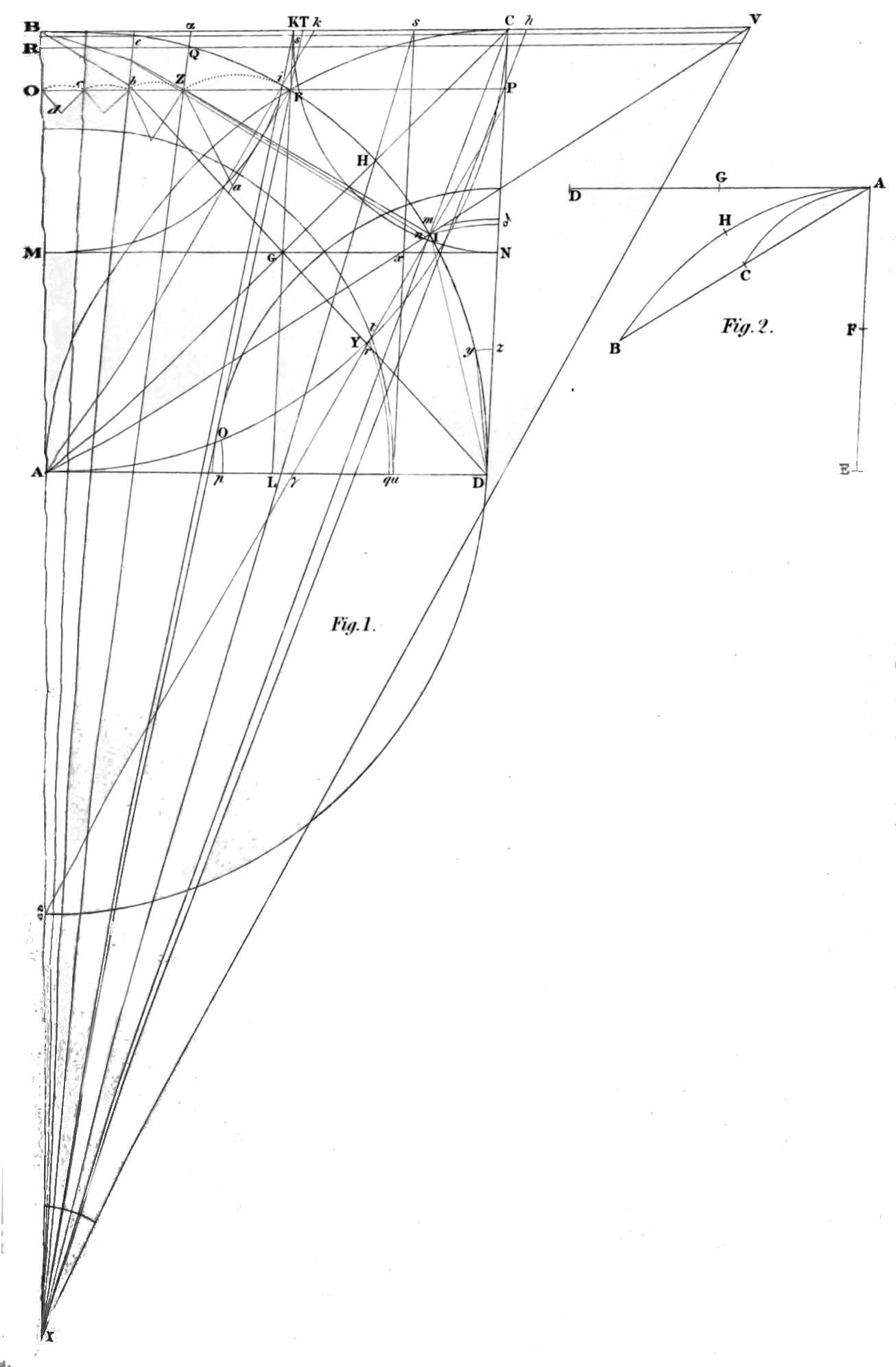
C. XX.
of
the translation.
Fig. 1-2
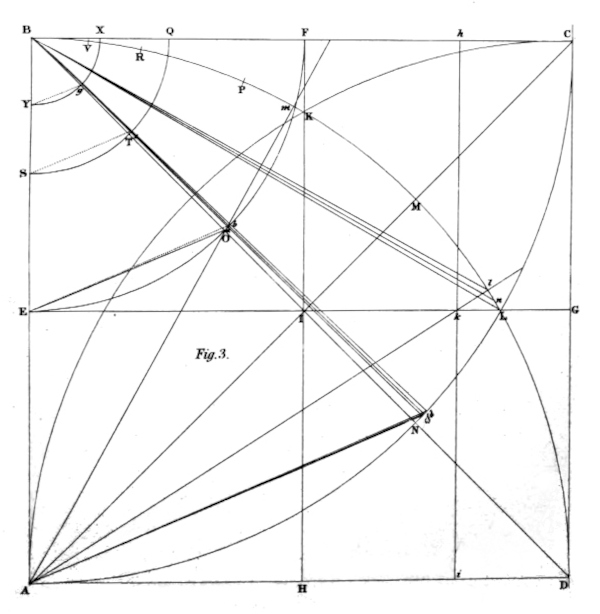
C. XX.
of
the translation.
Fig. 3
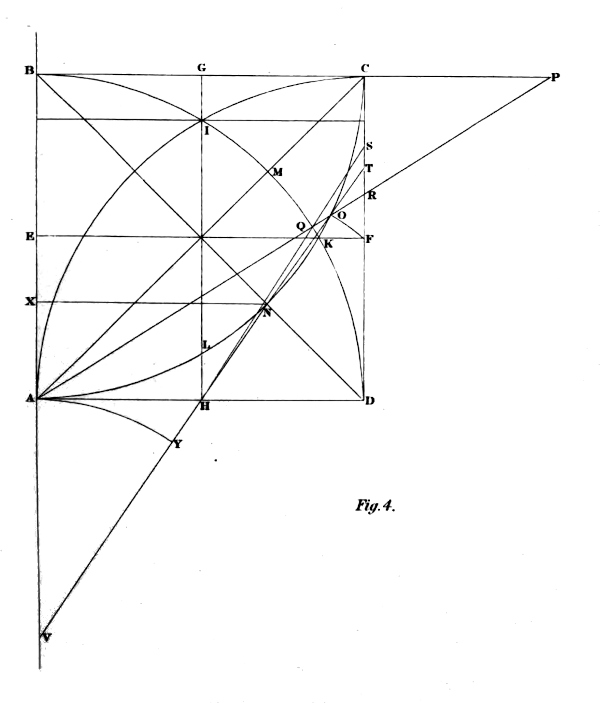
C. XX.
of
the translation.
Fig. 4
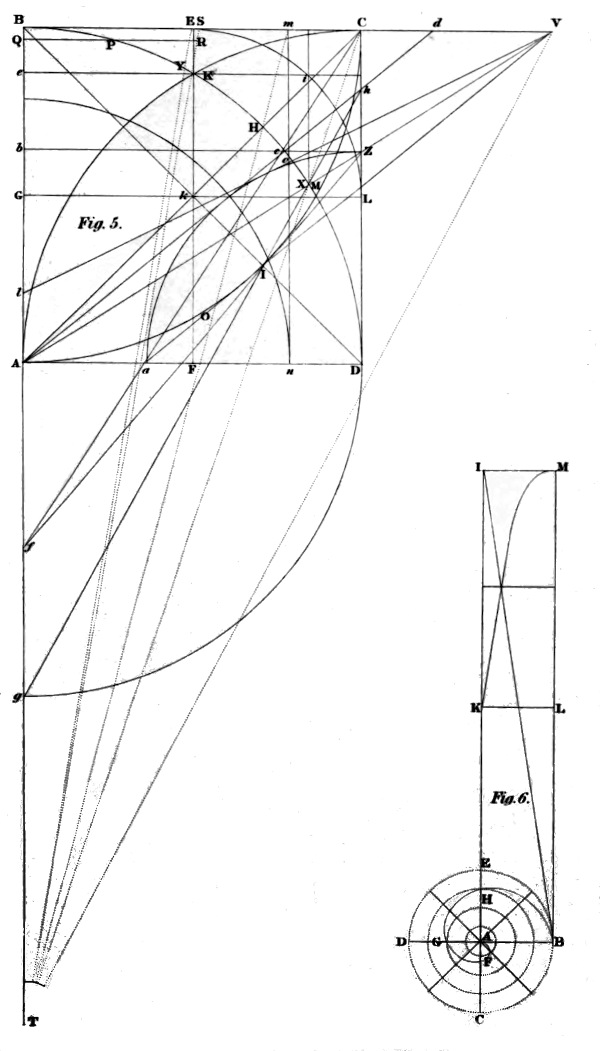
C. XX.
of
the translation.
Fig. 5-6