All military language should be of the utmost brevity
and clarity. Death and disaster are the direct results
of ambiguity. Throughout all history mistaken directions
and information have been the ruin of whole campaigns.
Careless wording, like careless shooting, is not only ineffective
but often suicidal.
The object of these few lessons is to give practice in
putting the language of military communication into form.
It is hoped that by means of certain technical and rhetorical
principles the student may gain proficiency in expressing
his thoughts as he intends them and as military efficiency
demands them.
Our Field Service Regulations state that “clear and
decisive orders are the logical result of definite and sure
decisions.” But this statement does not imply that if a
person arrives at a definite and sure decision, he gains
clear and decisive phraseology without effort on his part.
General Wagner, a pioneer among American military
authorities, divides into completely separate operations the
act of deciding upon a definite plan of action and that of
drafting or framing orders which will carry that decision
into effect. One is purely military and has to do with dispositions
of forces; the other is mainly rhetorical and has
to do with manipulations of language. Many a military
man has decided certainly in his own mind what he is going
to do in order to carry out his mission, only to be faced
immediately with a harder task. He must set that definite
idea in the mind of some one else. “How,” he sighs, “shall
I put this so as to let my Captains, Smith and Jones,
know exactly what I want?” He seats himself on a warm
rock under the blazing sun and chews his pencil. What
he at first writes down, he finds, is full of loop-holes and is
not expressive of what he means. He tries again, crosses
out words here and there, adds others, and changes his
sentences until the whole is undecipherable. In disgust he
tears up the paper and tries again. After fifteen minutes
of such effort he holds in his hand a few paragraphs of
which he is not proud, but which will have to do. There
has been no want, perhaps, of clear tactical reasoning on
his part, but rather a distinct lack of ability to drive
common English home. His case, we find, is not exceptional.
One has only to listen to the discussions of military
beginners (or of some, alas, who are not military
beginners) to hear this statement confirmed. How often
after having given careful or even brilliant estimates of
a situation will a man burst out with, “I know what I
mean right here, but don’t quite know how to say it!”
All the way along there has been a decided blank space
between decision in the mind and embodiment in language.
Whether slang, profanity, or colloquialisms have cut
into our ordinary speech to such an extent as to keep us at
a loss for the apt word, or whether we have grown careless
or slovenly in our habits of expression, is a matter with
which we are not concerned here. We do know that we
are continually hampered by our inability to state absolutely
our meaning. This lack of skill in composition which
besets us, we must overcome in our profession, for the sake
of the lives dependent upon our words. Napoleon sitting
at his desk scribbling off orders and messages as fast as
his nimble fingers can travel, his secretaries standing about
him grasping each finished piece from under his pen and
sending it off immediately by courier without revision
or correction, is a dazzling picture for the military leader
to contemplate. In his writing, a commander capable of
carrying out single-handed all the phases and minor items
of the mightiest of campaigns could, no doubt, be precise
and accurate habitually. He was a genius. Yet Napoleon
had had long years of practice in putting his will into
words; for, we are told, he began to compose orders and to
think tactically and strategically at a time of life when
most of us have not even chosen our careers. If, then,
we can try our hand at transcribing our ideas in as formative
a period as possible in our military careers, we, too,
may attain a proficiency that will become a second nature
with us. At least, we may put behind us a great part of
this uninteresting but indispensable work of learning to
control our language, before we confront the more serious
task of straightening out tactical and strategical difficulties
in the presence of the enemy.
Incidentally, while we are on our way in our progress in
expression, we may pick up much valuable military information.
In our practice with tactical language we must
make use of certain facts which have been found by experience
appropriate to certain happenings connected
with officers’ and soldiers’ duties. We shall be in constant
touch with the workings of patrols, advance guards, outposts,
and forces in battle. Like so many reporters we
shall be present at maneuvers putting our notes into
graphic and specific form.
Now, however, we are going to rivet our attention to
the main issue—the mastery of clear and brief military
communication. It has been mentioned that such ready
skill often prevents loss of battles and human life. It
prevents another loss which we have not taken up separately—the
loss of time. The officer who sat chewing his
pencil on the warm rock threw away from ten to twelve
minutes which might have been used profitably upon the
accomplishment of his mission—an amount of time which
might have given the very advantage needed to gain a complete
victory over the enemy. If he had had a skilful working
knowledge of his own Mother Tongue, the delay would
not have occurred. His effectiveness was lost for want of
power of expression. To illustrate further, consider for
a moment an army post going about its routine duties
of drill, guard, and police. Into the Adjutant’s office
walks an individual who announces himself to be Major
Smart of the Inspector General’s Department. On being
introduced to the Colonel, he identifies himself, and gives
immediate orders that the Colonel shall have his regiment
on the parade ground ready for field service in fifteen
minutes. When the troops are formed, the Inspector rides
up to the Colonel, hands him a typewritten tactical problem,
and asks for a solution of it as soon as possible. The
Inspector then takes out his watch and observes. If the
Colonel consumes more than a reasonable number of
minutes in writing his orders, or if he shows a hesitancy in
so doing, or if he must seek aid from his Adjutant, it is
surprising to note how soon after Major Smart’s departure
from the post, the Colonel receives a letter from
Washington apprising him of his shortcomings, and recommending,
for his own good, a speedy remedy. Because
of the inroads upon efficiency, the War Department, like
any good business firm, cannot brook vacillation or unwarranted
loss of time.
We must, then, adopt some method or procedure by
which we will effectually beat down the causes of this loss
of time, battles, and life. After analysing past proficiencies
and deficiencies in military communication, we spy
out from all the roads to the goal open to us, two which
appear to be shorter than the rest. If we guide ourselves
along these we shall come upon our object in the quickest
way. Since the first leads into the second, they are given
here in order. We should strive: (1) To learn to find
quickly expressions which will cover information and decisions
that are trying to struggle into language; and (2)
To plant that information and decision into the recipient’s
understanding exactly as it was rooted in our minds.
The first process is that of defining thoughts exactly
and briefly.
The second process is that of making those thoughts so
unmistakable that the most stupid cannot misunderstand
and the most captious cannot misinterpret.
After we have done the first, we should look over our
work and be certain that we have done the second.
The first has to do with the kind of situation that faced
the man who knew what he “wanted to say but couldn’t
express himself.” Some authorities argue that there is no
difference between clear thinking and clear expression.
They give no place to the “mute inglorious Milton.” They
would not concede that the man groping for language
had formed a definite plan in his mind, because that
plan was not definite enough to be expressed. “If he has
not thought in language,” they say, “he has not really
thought.” Their opponents claim that a man thinks in
pictures, and that he conceives his ideas as a painter imagines
objects. In his mind are the outlines and colors of
what he considers. There is truth in both views of the
matter. But it is likely from what we know of the training
of the military man that his mind works more by visualizing
the troops and by conjuring up the scene than by gaining
his conceptions through words. His forces are moving
along roads, occupying trenches, or surging into conflict.
His map is not a plane surface with names upon it, but a
vision of highways, waving corps, and rolling hills. He is
looking at these things without mentally describing them.
For the purpose of this course, we shall take the view that
there are occasions where we deduce certain results, but are
unable, because of unfamiliarity with framing good sentences
or because of a small vocabulary, to communicate
those results or deductions in accordance with common
usage.
The second road can be illustrated by comparison with
the first. There is a wide difference, although at first there
does not appear to be, between merely stating a thing
clearly and making it unmistakable. The first is but a
negative approach to complete certainty of expression,
but the second must be a positive one. The distinction
is one more or less of attitude of mind, and although heretofore
it has been overlooked as an entity in English text
books and military regulations, it assuredly illustrates itself
in two types of men who actually exist. The man who
is content with merely making himself clear takes the attitude
of, “O, well, they will get what I meant because any
other interpretation is absurd or incorrect.” The man
who is not content unless he makes himself unmistakable
says, “I won’t let any of them have the slightest excuse
for any other interpretation; when I get through there
will be but one interpretation and that will be mine.” The
first one in sending a message to his commanding officer
locates himself by putting in his heading, “Irrigation
ditch 500 yards east of southeast corner of Catholic
Church.” He notices another irrigation ditch fifty yards
further to the east, but says to himself, “If my commanding
officer measures the distance on the map he will know
which one I mean.” The second man, upon looking about
him and discovering the other ditch, does not accept the
chance of letting his commanding officer confuse the two
ditches by a possible difference of maps or measuring instruments.
He investigates further. By moving a few
yards to the top of a hillock he notices that the farther
ditch is entirely a dirt construction whereas the one he
occupies is a concrete one. He confirms this intelligence
by looking at his map which shows the ditches to be as he
has made them out. He, therefore, heads his message,
“Concrete irrigation ditch 500 yards east of southeast
corner of Catholic Church.” This is a case where an
added word has made the meaning more proof against
error. There are similar cases where a word taken away,
or the change of a phrase, clause, or sentence, will make
the recipient of the communication more sure of the true
state of affairs.
To sum up as far as we have gone, we see that our
object is to put military communication into proper form;
that the failure to make our expression of the utmost
brevity and clarity causes loss of efficiency, battles, and
life; that a condition of inability to express ourselves
exists widely; that by starting as early as we can to
practice clear and brief form within the bounds of rhetorical
and military rules (which, after all, are nothing more
than those of common sense), we shall overcome this deficiency;
and that for ourselves we are going to direct our
course along two highways, viz.:
(1) To learn to find quickly expressions which will
cover information and decisions that are trying to struggle
into language; and
(2) To plant that information or decision in the recipient’s
understanding exactly as it was rooted in our
minds.
We have, so far, rehearsed the general attitude we must
adopt toward conquering indefinite and lengthy expression.
Because this weakness is so natural to us, we cannot
afford to trifle with it if we wish to become a factor
in battle. Positive decisions and information must be given
in a positive way. Since no other kind of decision or information
is countenanced in the military service, we must
search for specific means of having our language stand
sturdily by itself.
It must not choke our idea or our will, however little.
Our decisiveness must reach our farthest superior or subordinate;
and words, phrases, clauses, sentences, and
paragraphs are going to be our only representatives. They
alone will stand for us. Every pencil mark on that paper
will be a part of the photograph of our intelligence. Our
phraseology will be ourselves. We shall be judged by it,
and rightly so, at a time when we shall have no chance
to offer an amendment, an excuse, or an I-didn’t-mean-quite-that.
Guide-posts must mark our highways, if we are in
earnest about our destination of brevity and clarity. In
the specific hints which follow as to what to do and what
not to do, there will be no attempt to point the way to
literary effects which have entertainment for their sole
object. Our effort must be to find a practical and speedy
outlet for military information and decision through the
most unmistakable channels. But since we must be terse
and clear even to entertain, most of the rules of English
will apply here. So we must not betray surprise or anguish
when we are beset on our way by some old enemies
with whom we have wrestled in rhetorics. In meeting
them again we shall become the stronger because of the
exercise on new and professional ground. The effort to
put facts into forceful and compact form now, will create
for us such a habit of brevity and clarity that later on
we shall have room in our natural language for only such
ideas and decisions as are brief and clear.
As to Words.
1. Never use a term which depends upon the point of
view of the observer, such as right, left, in front of, behind,
on this side, beyond, and the like. Any of these directions
may be turned askew in nine cases out of ten for the hearer
or reader. Use instead north, east, etc.—the points of
the compass—designations which do not change. To give
an exact position of a place, state the number of yards it
lies south, west, etc., of a certain point on the map or of
a well-known object called a reference point.
Exceptions.—Right and left may be used in regard to
individuals, banks of a stream, and flanks of troops, because
their rights and lefts do not change. The right of
a man is the side on which his right arm is no matter which
way he faces; the right bank of a stream is the right as
the observer faces down stream; the right flank of a body
of troops is the right as the troops face the enemy.
(Troops in retreat are supposed to be facing the enemy.
The rear guard in reality is doing so.)
2. Do not use qualifying words such as, sort of, kind
of, very, almost, quite, exceedingly, tremendously, somewhat,
rather, nearly, and the like;
For,
(a). They lessen force, because they render uncertain
ideas which should be definite; and
(b). They mean different things to different people.
Smith’s almost may achieve; Jones’ almost may scarcely
start.
3. Do not use slang. There is usually a word which
will express the meaning more truthfully. “Putting it
over” may mean complete victory or a sniper’s accurate
shot. The phrase is not truthful.
4. Use no abbreviations except A. M., and P. M., and
those given in Appendix 9 of our Field Service Regulations.[1]
Noon and midnight should be written out fully.
5. Never use he, it, this, him, her, their, them, that,
those, which, whose, or the like, without looking at them
from every angle to make sure that they refer to a single
word. If they refer to a whole statement or to two or
more possible words, they are used wrongly. The addition
of a noun will usually fix the meaning. Suppose you were
to receive a message with this sentence in it:
The platoon leader assigned to one squad the wrong objective,
and it delayed the firing.
Grammatically, the objective delayed the firing. Logically,
either the act of the platoon leader or the squad
delayed the firing. You make out by re-reading the whole
message that it must have been the mistake of the platoon
leader which delayed the firing. But in the meantime you
have lost three minutes, and the government has lost that
much efficiency.
And this or which in place of “and it” in the message
would have made the sense no clearer. But and this error,
or which error, makes the meaning unmistakable.
6. Never use a participle without inspecting it to see
that it does not dangle—that it refers to the subject of
the sentence rightly. Example:
“Looking over the crater, the periscope of the enemy was seen
to turn.”
What this sentence really says is that the periscope was
looking over the crater—a very possible happening. But
all circumstances connected with the idea, after a series of
mental deductions on the part of the reader, reveal that
the writer had been looking over the crater at the periscope.
The commander who received this information
might have been led to believe that the periscope was situated
in the crater. At least he was delayed, if not misled.
7. Do not use and except where necessary. Usually,
when we connect clauses with it, we do not mean and, but
some more expressive word such as because, whereas, when,
etc.
8. Do not use any word which might not mean the
same thing to any probable recipients, or might not commonly
be understood. For instance, to a southerner
evening means something different from its significance to
a northerner, and to an Englishman clever has not the
American meaning. Watch the words which have local
standards.
As to Phrases and Clauses.
1. Do not allow a phrase or a clause to string out
your expression when one word might answer. Boil your
communication to the clearest minimum.
(a). We went back to headquarters with all possible speed. We
hurried to headquarters.
Here the specific verb hurried does away with your
phrase with all possible speed.
(b). When we were present in the cantonment, the soldiers
looked as though they were quite hungry.
Our inspection of the cantonment revealed the soldiers to be
hungry.
Here our inspection does away with the clause when
we were present; and to be hungry does away with as
though they were quite hungry.
This error of spreading words is common to ordinary
writers and is most tiring and time-wasting to
readers.
2. Do not omit words from your phrases and clauses
where there is a chance for misunderstanding. Examples:
The detachment commander will be with the main body until
7 a. m. and thereafter the advance guard.
What is really stated is that the advance guard will
be with the main body after 7 a. m.—an unintended statement.
Make your grammar accord absolutely with your
meaning. Add the with which belongs before the advance,
and notice how the sense is brought out. Again,
They order us to go to Brownsville and do impossible things.
In this sentence do they order us to do impossible things,
or do they themselves do impossible things?
Add the sign of the infinitive where it belongs before do.
And to do impossible things reads unmistakably.
3. Do not use a participial phrase without first inspecting
it to see that it holds but one idea.
Having changed our position, the enemy was confused.
What this sentence really says is that the enemy, when
he had changed our position, was confused. This meaning
is evidently not intended from the very nature of the statement.
It is clearer and more accurate to use a finite form of
the verb instead of the participle; as,—
Because we changed our position we confused the enemy.
Or if you can condense with accuracy,
The change in our position confused the enemy.
As to Sentences.
1. Avoid long involved sentences. Even if they are
grammatically well constructed, they are liable to rhetorical
error. The following sentence because of its length
violates unity:
“The organization of the German army is today well known to
American Army officers, and experience has shown that German
problems and solutions of a complex character changed in translation
to conform to American units are often more troublesome for
the student to understand than the original would be, as, on account
of the difference in the size of the units, it is often necessary in
reading such a translation to go back to the German organization
in order to explain a distribution of troops, which, though simple
for a German division, would be an awkward one for a division
organized after our own Field Service Regulations.”
The first thought given to the reader is that “the organization
of the German army is today well known to
American Army officers.” The last thought of the sentence
is that the “explanation of a distribution of troops
would be an awkward one for a division organized after our
own Field Service Regulations.” The path from the first
thought to the second is long and winding. In fact the
two do not belong in the same sentence as the sense stands.
With a simple change we can make the whole easier to
read:
The organization of the German army is today well known to
American Army officers. Their experience has shown that German
problems and solutions of a complex character changed in translation
to conform to American units are often more troublesome for the
student to understand than the original would be. On account of the
difference in the size of the units, it is often necessary in reading
such a translation to go back to the German organization in order to
explain a distribution of troops, which, though simple for a German
division, would be an awkward one for a division organized after our
own Field Service Regulations.
The reader has been allowed to take in a thought at a
time instead of three thoughts at once.
In spite of the injunction in our Field Service Regulations
that “short sentences are easily understood,” such
long and involved expressions as the above have abounded
among military writers. In war, this continuous motion in
a single sentence has marred undertakings; in peace, it has
robbed efficiency. It has been an incubus upon general
orders, and even communications in the field.
CAUTION.—By short sentences we do not mean
choppy sentences—sentences unnecessarily short as,—
The battalion halted for the night. It ate supper. Then the battalion
relieved the outpost.
Here the reader has been stopped when he should have
been kept going, for there is in reality but one thought in
the three separate sentences. They should be combined
into some such form as this,—
After the battalion had halted for the night and had eaten supper,
it relieved the outpost.
The proper relation of ideas is here expressed for the
reader. He knows that the relief of the outpost is the
main consideration, depending in point of time upon the
halt and supper. And the whole thought is not too big
for him to take in as he reads.
The first error, illustrated by the sentence concerning
German organization, is a fault common to older writers.
They have allowed themselves to grow into the habit of
adding qualifying phrases and clauses to sentences already
completed until their additions come to swamp the originals.
The second error, illustrated by the sentence concerning
the battalion relieving the outpost, is a fault
common to young writers. They have not yet formed the
habit of relating in their own minds the separate ideas
of a complete thought.
The happy mean between these two indefinite extremes
is the one we wish to find—the sentence that gives speedy
and accurate intelligence.
2. Do not use compound sentences containing and,
save where they cannot be avoided. Here is a common
piece of slovenliness found in such a construction.—
The wagon trains pulled out and the troops ate breakfast.
Any one of the following is more definite.
After the wagon trains pulled out the troops ate breakfast.
The wagon trains pulled out before the troops ate breakfast.
As the wagon trains pulled out the troops ate breakfast.
The writer in the first instance was too lazy or stupid
to think out the specific meaning of and for the reader.
Remember, also, that the use of and to connect clauses
leads us into the treacherous “run-on sentences”—the sentence
that flits from subject to subject like an old gossip.
“They fell into the trap and so the commanding officer’s orders
were lost and they remained there twenty days and were finally
removed to a prison camp and there winter soon came on and finally
they were released and went home in the spring.”
The sentence, in addition to having too many ideas in it,
has them unrelated.
As to Words.
1. Every geographical name must be printed in capitals,
thus,—
WEST POINT, MARNE RIVER, PARIS.
This rule does not mean that the names must be printed,
merely, but that every letter must be capitalized legibly.
If the place be not pronounced as it is spelled, it should
appear thus,—XENIA (Zē′-nĭ-ä), POUGHKEEPSIE
(Pṓ-kĭp′-sĭ), CHIHUAHUA (Chḗ-wä′-wä).
A road must be designated by enough points to make
it unmistakable along the entire course considered; thus:—
BIGLERVILLE—582—CENTER MILLS. (See map,
A-8 and 7.) The 582 inserted in this case keeps the course
from being confused with the turn-off toward GUERNSEY.
If the course were intended to lie through GUERNSEY,
the road would appear thus,—
BIGLERVILLE—GUERNSEY—CENTER MILLS.
2. Use the words of one syllable preferably. You will
find that the longer words come to you more readily but
are usually more hazy in meaning. You will gain vigor
and clearness by the cultivation of Anglo-Saxon.
3. Do not connect two sentences by a comma; for example:—
The phrase does not imply motion, thus it would mean nothing to
say that the battery is advancing on the line Twins-Concrete Ford.
The error here is not so much one of punctuation as of
sentence idea. Somehow, the thought does not run
smoothly. We find that two separate thoughts without
much relationship have been compressed into a single sentence—into
something which should be a complete whole,
and go from capital to period without break. Oftentimes,
by showing this relationship, we may bring the idea within
bounds of a single sentence; for example:—
Since the phrase does not imply motion, it would mean nothing
to say that the battery is advancing on the line, etc.
4. Watch the position of your adverbs. When you
mean,—
We captured almost all the ammunition,
Do not say,—
We almost captured all the ammunition.
The first means that we captured at least a part of the
ammunition; the second means that we were close to success,
but failed to capture ammunition.
5. Use the words head and tail when speaking of a
column of troops. The head is the leading element and the
tail is the other end, no matter in which direction the
column happens to be facing.
6. In the newspaper or book that you are reading,
every time you meet a new word make it yours. Look up
the meaning in the dictionary until you are sure that you
know how to use the word.
At the first opportunity, employ it in your conversation
or writing. Sooner or later “dope” and the eternal
“damn” will have ceased to fill in endless crevices in your
talk and their places will have been taken by incisive words.
You will awake to find that you are expressing yourself
more easily and plainly. On the other hand, every word
you pass over or for which you merely consult the dictionary,
is a tool cast aside in your building of an officer.
Every bit of slang or profanity which now crowds out the
appropriate word will later rise up and clog your thought
at a time when you are making your utmost endeavor to
put into clear, forceful English your plan of action or
your order.
As to Phrases and Clauses.
Remember to place phrases and clauses nearest the
words they modify.
Captain George will divide the tools equally among the battalions
which are fit for felling timber.
The change of the italicized clause to its proper position
next the word tools, gives the intended meaning.
As to Sentences.
1. Use the short complex sentence; such as:—
An attack is expected tomorrow from strong hostile forces
whose advanced troops are near FORT MONTGOMERY.
The enemy’s infantry disappeared to the south as soon as our
advance cavalry came over the hill.
The use of when, since, because, where, whenever, although,
after, till, until, as, so long as, now that, whence,
whither, inasmuch as, that, in order that, so that, and lest,
with the finite form of the verb is a good construction to
practice.
Notice how compact and explicit is the following:—
Lest the enemy should turn your flank, keep veering to the east.
Try to put this same thought into twelve words by
means of a different construction.
2. When you start with one kind of construction, keep
it up unless there be some good reason to change it. If
you begin with the past tense and third person, have the
past tense and third person continue throughout the sentence
or sentences.
It is reported that extensive preparations are being made in the
vicinity of CAMBRAI and the enemy has stored railroad material
there.
It is reported that the enemy has made extensive preparations
at
CAMBRAI and has stored railroad material there.
Which sentence reads along with less break?
Again,
It is advisable to advance part of the ammunition columns and
that the division should follow at 200 yards.
Better,
It is advisable to advance part of the ammunition columns and
to have the division follow at 200 yards.
Now that specific guides have been posted near the grammatical
turns of the road, let us look at two general rules
covering everything we do.
1. Write legibly.—Rain, wear in the pocket, dim and
fading lights, and crumpled paper are going to make
havoc of your orders and messages in war time. Your
commanding officer must be able to make out your script
as well as your meaning. Now is the moment to make your
handwriting a size or two larger and noticeably plainer.
2. Inspect the form. After you have written your
ideas legibly, look at them searchingly to see that they
mean only what you intend.
You cannot be too cold-blooded about this act for two
reasons.
In the first place, there is a habit which is strong upon
us. We have all been too prone to state a thing haphazardly,
and then to exclaim, “You know what I mean!”
The person addressed, of course, is not going to acknowledge
that he has not the brains to understand; so the
jumble is never smoothed out. Thus in nine-tenths of our
off-hand moments we have been accustomed to say what
we do not mean. The habit is so strong that when we find
ourselves dealing with matters of life and death, we are
still liable to whisper to ourselves, “O, well, he’ll get it.”
The result is that the part of the order, message, or report,
which struck us as having our usual clearness, is a puzzle
to the recipient.
In the second place, the impression has grown up in the
minds of many that substance, no matter how it is mixed,
is all that is necessary. There has come about a certain
proud disregard of the manner in which a thing is expressed.
Too many technical books have failed of their
purpose because the writer, although he was an expert
in his line, did not know how to present his subject in an
attractive form. In the same way explanations have
failed upon the drill ground, and lectures have made excellent
tacticians appear like school-boys. The very manner
of communication has not only spoiled the taste for
the subject matter but has hindered its absorption. His
audience has not understood his explanation.
In inspecting your work, take the attitude that the
recipient is skeptical of everything you have said.
It is assumed that you wish to fasten in your mind
everything in this chapter. The following method is suggested
as the best short-cut:
1. Make an outline of the whole chapter, expressing
the main idea of each paragraph and sub-paragraph in
two or three words.
2. Close your books.
3. With the aid of your outline see whether you can
call to your mind everything the paragraph or sub-paragraph
means.

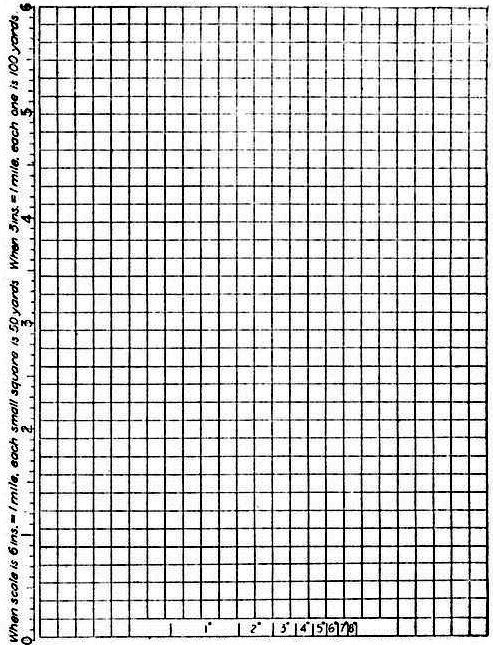 When scale is 6 ins. = 1 mile, each small square is 50 yards.