BANKS, GEORGE LINNAEUS (1821-1881), British miscellaneous
writer, was born at Birmingham on the 2nd of March 1821. After a brief
experience in a variety of trades, he became at the age of seventeen a
contributor to various newspapers, and subsequently a playwright, being
the author of two plays, a couple of burlesques and several lyrics.
Between 1848 and 1864 he edited in succession a variety of newspapers,
including the Birmingham Mercury and the Dublin Daily
Express, and published several volumes of miscellaneous prose and
verse. He died in London on the 3rd of May 1881.
BANKS, SIR JOSEPH, Bart. (1743-1820),
English naturalist, was born in Argyle Street, London, on the 13th of
February 1743. His father, William Banks, was the son of a successful
Lincolnshire doctor, who became sheriff of his county, and represented
Peterborough in parliament; and Joseph was brought up as the son of a
rich man. In 1760 he went to Oxford, where he showed a decided taste for
natural science and was the means of introducing botanical lectures into
the university. In 1764 he came into possession of the ample fortune left
by his father, and in 1766 he made his first scientific expedition to
Newfoundland and Labrador, bringing back a rich collection of plants and
insects. Shortly after his return, Captain Cook was sent by the
government to observe the transit of Venus in the Pacific Ocean, and
Banks, through the influence of his friend Lord Sandwich, obtained leave
to join the expedition in the "Endeavour," which was fitted out at his
own expense. He made the most careful preparations, in order to be able
to profit by every opportunity, and induced Dr Daniel Solander, a
distinguished pupil of Linnaeus, to accompany him. He even engaged
draughtsmen and painters to delineate such objects of interest as did not
admit of being transported or preserved. The voyage occupied three years
and many hardships had to be undergone; but the rich harvest of discovery
was more than adequate compensation. Banks was equally anxious to join
Cook's second expedition and expended large sums in engaging assistants
and furnishing the necessary equipment; but circumstances obliged him to
relinquish his purpose. He, however, employed the assistants and
materials he had collected in a voyage to Iceland in 1772, returning by
the Hebrides and Staffa. In 1778 Banks succeeded Sir John Pringle as
president of the Royal Society, of which he had been a fellow from 1766,
and held the office until his death. In 1781 he was made a baronet; in
1795 he received the order of the Bath; and in 1797 he was admitted to
the privy council. He died at Isleworth on the 19th of June 1820. As
president of the Royal Society he did much to raise the state of science
in Britain, and was at the same time most assiduous and successful in
cultivating friendly relations with scientific men of all nations. It
was, however, objected to him that from his own predilections he was
inclined to overlook and depreciate the labours of the mathematical and
physical sections of the Royal Society and that he exercised his
authority somewhat despotically. He bequeathed his collections of books
and botanical specimens to the British Museum. His fame rests rather on
what his liberality enabled other workers to do than on his own
achievements.
See J. H. Maiden, Sir Joseph Banks (1909).
BANKS, NATHANIEL PRENTISS (1816-1894), American politician and
soldier, was born at Waltham, Massachusetts, on the 30th of January 1816.
He received only a common school education and at an early age began work
as a bobbin-boy in a cotton factory of which his father was
superintendent. Subsequently he edited a weekly paper at Waltham, studied
law and was admitted to the bar, his energy and his ability as a public
speaker soon winning him distinction. He served as a Free Soiler in the
Massachusetts house of representatives from 1849 to 1853, and was speaker
in 1851 and 1852; he was president of the state Constitutional Convention
of 1853, and in the same year was elected to the national House of
Representatives as a coalition candidate of Democrats and Free Soilers.
Although re-elected in 1854 as an American or "Know-Nothing," he soon
left this party, and in 1855 presided over a Republican convention in
Massachusetts. At the opening of the Thirty-Fourth Congress the
anti-Nebraska men gradually united in supporting Banks for speaker, and
after one of the bitterest and most protracted speakership contests in
the history of congress, lasting from the 3rd of December 1855 to the 2nd
of February 1856, he was chosen on the 133rd ballot. This has been called
the first national victory of the Republican party. Re-elected in 1856 as
a Republican, he resigned his seat in December 1857, and was governor of
Massachusetts from 1858 to 1861, a period marked by notable
administrative and educational reforms. He then succeeded George B.
McClellan as president of the Illinois Central railway. Although while
governor he had been a strong advocate of peace, he was one of the
earliest to offer his services to President Lincoln, who appointed him in
1861 major-general of volunteers. Banks was one of the most prominent of
the volunteer officers. When McClellan entered upon his Peninsular
Campaign in 1862 the important duty of defending Washington from the army
of "Stonewall" Jackson fell to the corps commanded by Banks. In the
spring Banks was ordered to move against Jackson in the Shenandoah
Valley, but the latter with superior forces defeated him at Winchester,
Virginia, on the 25th of May, and forced him back to the Potomac river.
On the 9th of August Banks again encountered Jackson at Cedar Mountain,
and, though greatly outnumbered, succeeded in holding his ground after a
very sanguinary battle. He was later placed in command of the garrison at
Washington, and in November sailed from New York with a strong force to
replace General B. F. Butler at New Orleans as commander of the
Department of the Gulf. Being ordered to co-operate with Grant, who was
then before Vicksburg, he invested the defences of Port Hudson,
Louisiana, in May 1863, and after three attempts to carry the works by
storm he began a regular siege. The garrison surrendered to Banks on the
9th of July, on receiving word that Vicksburg had fallen. In the autumn
of 1863 Banks organized a number of expeditions to Texas, chiefly for the
purpose of preventing the French in Mexico from aiding the Confederates,
and secured possession of the region near the mouths of the Nueces and
the Rio Grande. But his Red River expedition, March-May 1864, forced upon
him by superior authority, was a complete failure. In August 1865 he was
mustered out of the service, and from 1865 to 1873 he was again a
representative in congress, serving as chairman of the committee on
foreign affairs. A personal quarrel with President Grant led in 1872,
however, to his joining the Liberal-Republican revolt in support of
Horace Greeley, and as the Liberal-Republican and Democratic candidate he
was defeated for re-election. In 1874 he was successful as a Democratic
candidate, serving one term (1875-1877). Having rejoined the Republican
party in 1876, he was United States marshal for Massachusetts from 1879
until 1888, when for the ninth time he was elected to Congress. He
retired at the close of his term (1891) and died at Waltham on the 1st of
September 1894.
BANKS, THOMAS (1735-1805), English sculptor, son of a surveyor
who was land steward to the duke of Beaufort, was born in London on the
29th of December 1735. He was taught drawing by his father, and in 1750
was apprenticed to a wood-carver. In his spare time he worked at
sculpture, and before 1772, when he obtained a travelling studentship and
proceeded to Rome, he had already exhibited several fine works. Returning
to England in 1779 he found that the taste for classic poetry, ever the
source of his inspiration, no longer existed, and he spent two years in
St Petersburg, being employed by the empress Catherine, who purchased his
"Cupid tormenting a Butterfly." On his return he modelled his colossal
"Achilles mourning the loss of Briseis," a work full of force and
passion; and thereupon he was elected, in 1784, an associate of the Royal
Academy and in the following year a full member. Among other works in St
Paul's cathedral are the monuments to Captain Westcott and Captain
Burges, and in Westminster Abbey to Sir Eyre Coote. His bust of Warren
Hastings is in the National Portrait Gallery. Banks's best-known work is
perhaps the colossal group of "Shakespeare attended by Painting and
Poetry," now in the garden of New Place, Stratford-on-Avon. He died in
London on the 2nd of February 1805.
BANKS AND BANKING. The word "bank," in the economic sense,
covers various meanings which all express one object, a contribution of
money for a common purpose. Thus Bacon, in his essay on Usury,
while explaining "how the discommodities of it may be best avoided and
the commodities retained," refers to a "bank or common stock" as an
expression with which his readers would be familiar. Originally connected
with the idea of a mound or bank of earth—hence with that of a
monte, an Italian word describing a heap—the term has been
gradually applied to several classes of institutions established for the
general purpose of dealing with money.
The manner in which a bank prospers is explained by David Banking as a business. Ricardo, in his
Proposals for an Economical and Secure Currency, in a passage
where he tells us that a bank would never be established if it obtained
no other profits but those derived from the employment of its own
capital. The real advantage of a bank to the community it serves
commences only when it employs the capital of others. The money which a
bank controls in the form of the deposits which it receives and sometimes
of the notes which it issues, is loaned out by it again to those who
desire to borrow and can show that they may be trusted. A bank, in order
to carry on business successfully, must possess a sufficient capital of
its own to give it the standing which will enable it to collect capital
belonging to others. But this it does not hoard. It only holds the funds
with which it is entrusted till it can use them, and the use is found in
the advances that it makes. Some of the deposits merely lie with the bank
till the customer draws what he requires for his ordinary everyday wants.
Some, the greater part by far, of the deposits enable the bank to make
advances to men who employ the funds with which they are entrusted in
reproductive industry, that is to say, in a manner which not only brings
back a greater value than the amount originally lent to them, but assists
the business development of the country by setting on foot and
maintaining enterprises of a profitable description. It is possible that
some part may be employed in loans required through extravagance on the
part of the borrower, but these can only be a small proportion of the
whole, as it is only through reproductive industry that the capital
advanced by a banker can really be replaced. A loan sometimes, it is
true, is repaid from the proceeds of the sale of a security, but this
only means a transfer of capital from one hand to another; money that is
not transferred in this way must be made by its owner. Granted that the
security is complete, there is only one absolute rule as to loans if a
bank desires to conduct its business on safe lines, that the advance
should not be of fixed but of floating capital. Nothing seems simpler
than such a business, but no business requires closer attention or more
strong sense and prudence in its conduct. In other ways also, besides
making loans, a well-conducted bank is of much service to the business
prosperity of a country, as for example by providing facilities for the
ready transmission of money from those who owe money to those to whom it
is due. This is particularly obvious when the debtor lives in one town or
district and the creditor in another at a considerable distance, but the
convenience is very great under any circumstances. Where an easy method
of transmission of cash does not exist, we become aware that a "rate of
exchange" exists as truly between one place and another in the same
country as between two places in different countries. The assistance that
banking gives to the industries of a community, apart from these
facilities, is constant and most valuable.
With these preliminary remarks on some main features of the Historical development. business, we may pass on
to a sketch of the history of modern banking. Banks in Europe from the
16th century onwards may be divided into two classes, the one described
as "exchange banks," the other as "banks of deposits." These last are
banks which, besides receiving deposits, make loans, and thus associate
themselves with the trade and general industries of a country. The
exchange banks included in former years institutions like the Bank of
Hamburg and the Bank of Amsterdam. These were established to deal with
foreign exchange and to facilitate trade with other countries. The
others—founded at very different dates—were established as,
or early became, banks of deposit, like the Bank of England, the Bank of
Venice, the Bank of Sweden, the Bank of France, the Bank of Germany and
others. Some reference to these will be made later. The exchange banks
claim the first attention. Important as they were in their day, the
period of their activity is now generally past, and the interest in their
operations has become mainly historical.
In one respect, and that a very important one, the business carried on
by the exchange banks differed from banking as generally understood at
the present time. No exchange bank had a capital of its own nor did it
require any for the performance of the business. The object for which
exchange banks were established was to turn the values with which they
were entrusted into "current money," "bank money" as it was called, that
is to say, into a currency which was accepted immediately by merchants
without the necessity of testing the value of the coin or the bullion
brought to them. The "value" they provided was equal to the "value" they
received, the only difference being the amount of the small charge they
made to their customers, who gained by dealing with them more than
equivalent advantages.
Short notices of the Bank of Amsterdam, which was one of the most
important, and of the Bank of Hamburg, which survived the longest, its
existence not terminating till 1873, will suffice to explain the working
of these institutions.
The Amsterdamsche Wisselbank, or exchange bank, known later as the
Bank of Amsterdam, was established by the ordinance of the city of
Amsterdam of 31st January 1609. The increased commerce of Holland, which
made Amsterdam a leading city in international dealings, led to the
establishment of this bank, to which any person might bring money or
bullion for deposit, and might withdraw at pleasure the money or the
worth of the bullion. The ordinance which established the bank further
required that all bills of 600 gulden (£50), or upwards—this limit
was, in 1643, lowered to 300 gulden (£25)—should be paid through
the bank, or in other words, by the transfer of deposits or credits at
the bank. These transfers came afterwards to be known as "bank money."
The charge for making the transfers was the sole source of income to the
bank. The bank was established without any capital of its own, being
understood to have actually in its vaults the whole amount of specie for
which "bank money" was outstanding. This regulation was not, however,
strictly observed. Loans were made at various dates to the Dutch East
India Company. In 1795 a report was issued showing that the city of
Amsterdam was largely indebted to the bank, which held as security the
obligations of the states of Holland and West Friesland. The debt was
paid, but it was too late to revive the bank, and in 1820 "the
establishment which for generations had held the leading place in
European commerce ceased to exist." (See Chapters on the Theory and
History of Banking, by Charles F. Dunbar, p. 105.)
Similar banks had been established in Middelburg, (March 28th, 1616),
in Hamburg (1619) and in Rotterdam (February 9th, 1635). Of these the
Bank of Hamburg carried on much the largest business and survived the
longest. It was not till the 15th of February 1873 that its existence was
closed by the act of the German parliament which decreed that Germany
should possess a gold standard, and thus removed those conditions of the
local medium of exchange—silver coins of very different intrinsic
values—whose circulation had provided an ample field for the
operations of the bank. The business of the Bank of Hamburg had been
conducted in absolute accordance with the regulations under which it was
founded.
The exchange banks were established to remedy the inconvenience to
which merchants were subject through the uncertain value of the currency
of other countries in reference to that of the city where the exchange
bank carried on its business. The following quotation from Notes on
Banking, written in 1873, explains the method of operation in
Hamburg. "In this city, the most vigorous offshoot of the once powerful
Hansa, the latest representative of the free commercial cities of
medieval Europe, there still remains a
representative of those older banks which were once of the highest
importance in commercial affairs. Similar institutions greatly aided the
prosperity of Venice, Genoa, Amsterdam and Nuremberg. The Bank of Hamburg
is now the last survivor of these banks, whose business lay in the
assistance of commerce, not by loans, but by the local manufacture, so to
speak, of an international coinage. In a city of the highest rank of
commercial activity, but greatly circumscribed in territory, continually
receiving payments for merchandise in the coin of other countries, a
common standard of value was a matter of primary necessity. The invention
of bank money, that is, of a money of account which could be transferred
at pleasure from one holder to another, enabled the trade of the place to
be carried on without any of those hindrances to business which must have
followed on the delay and expense attendant on the verification of
various coins differing from each other in weight, intrinsic value,
standard of purity of metal, in every point in fact in which coins can
differ from each other. By supplying a currency of universal acceptation
the Bank of Hamburg greatly contributed to the prosperity of that city."
The regulations being strictly carried out, the currency was purely
metallic; the "Mark Banco" being merely the representative of an equal
value of silver.
For the earliest example of a bank for the receipt of deposits
carrying on a business on modern lines, we must turn, as in the case of
the exchange banks, to a great commercial city of the middle ages.
Private banking in Venice began as an adjunct of the business of the
campsores or dealers in foreign moneys. "As early as 1270 it was
deemed necessary to require them to give security to the government as
the condition of carrying on their business, but it is not shown that
they were then receiving deposits. In an act of the 24th of September
1318, however, entitled Bancherii scriptae dent plegiarias
consulibus, the receipt of deposits by the campsores is
recognized as an existing practice, and provision is made for better
security for the depositors." From this act it becomes clear that between
1270 and 1318 the money-changers of Venice were becoming bankers, just as
the same class of men became in Amsterdam a couple of centuries later,
and as later still the goldsmiths in London.
Of the early banks in Europe, the bank in Venice, the Banco The first public bank in Europe. di Rialto, was
established by the acts of the Venetian senate of 1584 and 1587. This
appears to have been the first public bank in that city and in Europe.
The senate by the act of the 3rd of May 1619[1] established by the side of the
Banco di Rialto a second public bank known as the Banco Giro, or Banco
del Giro, which ultimately became the only public bank of the city and
was for generations famous throughout Europe as the Bank of Venice.
Earlier than this the campsores or dealers in foreign moneys had
carried on the business. The Bank of Venice (Banco del Giro) appears to
have been called into existence by the natural developments of trade, but
some banks have been established by governments and have been of great
service to the development of the countries in which they have carried on
their business. Of these, the Bank of Sweden (the Riksbank),
established in 1656, is the earliest. This bank still exists and has
always been the state bank of Sweden. It was founded by a Swede named
Palmstruck, who also invented the use of the bank note—perhaps
adapted for use in Europe is the better expression to employ, as notes
were current in China about A.D. 800. The first
bank note was issued by the Riksbank in 1658. An enquête
made by the French government in 1729 recognizes the priority of Sweden
in this matter, and declares the bank note to be an admirable Swedish
invention, designed to facilitate commerce.
European Countries
United Kingdom.—English banking may be traced back to the
dealings in money carried on by the goldsmiths of London and thus
certainly to the 16th century; but it has been so greatly influenced by
the working of the Bank of England and by the Foundation of the Bank of England. acts of
parliament connected with that institution, that a reference to this
bank's foundation and development must precede any attempt at a detailed
history of banking in the United Kingdom. The Bank of England was founded
in 1694.[2] As
in the case of some of the earlier continental banks, a loan to the
government was the origin of its establishment. The loan, which was
£1,200,000, was subscribed in little more than ten days, between
Thursday, 21st June, and noon of Monday, 2nd July 1694. On Tuesday, 10th
July, the subscribers appointed Sir John Houblon the governor, and
Michael Godfrey (who was killed during the siege of Namur on the 17th of
July 1695) deputy-governor. Michael Godfrey wrote a pamphlet explaining
the purposes for which the bank was established and the use it would be
to the country. The pamphlet supplies some curious illustrations of the
dangers which some persons had imagined might arise from the
establishment of the bank and its connexion with William III.,
deprecating the fear "lest it should hereafter joyn with the prince to
make him absolute and so render parliaments useless."
The governor and the deputy-governor, having thus been appointed, the
first twenty-four directors were elected on Wednesday, 11th July 1694.
Two of them were brothers of the governor, Sir John Houblon. They were
descended from James Houblon, a Flemish refugee who had escaped from the
persecution of Alva. All the directors were men of high mercantile
standing. The business of the bank was first carried on in the Mercers'
chapel. It continued there till the 28th of September, when they moved to
Grocers' Hall. They were tenants of the Grocers' Hall till 1732. The
first stone of the building now occupied by the bank was laid on the 1st
of August 1732. The bank has remained on the same site ever since. The
structure occupied the space previously covered by the house and gardens
of Sir John Houblon, the first governor, which had been bought for the
purpose. Between 1764 and 1788 the wings were erected. In 1780 the
directors, alarmed at the dangerous facilities which the adjacent church
of St Christopher le Stocks might give to a mob, obtained parliamentary
powers and acquired the fabric, on the site of which much of the present
building stands. The structure was developed to its present form about
the commencement of the 19th century.
The bank commenced business with fifty-four assistants, the salaries
of whom amounted to £4350. The total number employed in 1847 was upwards
of nine hundred and their salaries exceeded £210,000. Mr Thomson Hankey
stated that in 1867 upwards of one thousand persons were employed, and
the salaries and wages amounted to nearly £260,000, besides pensions to
superannuated clerks of about £20,000 more. The number of persons of all
classes employed in 1906 (head office and eleven branches) was about
1400.
Originally established to advance the government a loan of £1,200,000,
the management of the British national debt has been confided to the Bank
of England from the date of its foundation, and it has remained the
banker of the government ever since. The interest on the stock in which
the debt is inscribed has always been paid by the bank, originally
half-yearly, now quarterly, and the registration of all transfers of the
stock itself is carried on by the bank, which assumes the responsibility
of the correctness of these transfers. The dignity which the position of
banker to the government gives; the monopoly granted to it of being the
only joint-stock bank allowed to exist in England and Wales till 1826,
while the liability of its shareholders was limited to the amount of
their holdings, an advantage which alone of English banks it possessed
till 1862; the privilege of issuing notes which since 1833 have been
legal tender in England and Wales everywhere except at the bank itself;
the fact that it is the banker of the other banks of the country and for
many years had the control of far larger deposits than any one of them
individually—all these privileges gave it early a pre-eminence
which it still maintains, though more than one competitor now holds
larger deposits, and though, collectively, the deposits of the
other banks of the country which have offices in London many times
overpass its own. Some idea of the strength of its position may be gained
from the fact that stocks are now inscribed in the bank books to an
amount exceeding 1250 millions sterling.
In one sense, the power of the Bank of England is greater Bank Charter Act. now than ever. By the act of
1844, regulating the note-issue of the country, the Bank of England
became the sole source from which legal tender notes can be obtained; a
power important at all times, but pre-eminently so in times of pressure.
The authority to supply the notes required, when the notes needed by the
public exceed in amount the limit fixed by the act of 1844, was granted
by the government at the request of the bank on three occasions only
between 1844 and 1906. Hence the Bank of England becomes the centre of
interest in times of pressure when a "treasury letter" permitting an
excess issue is required, and holds then a power the force of which can
hardly be estimated.
One main feature of the act of 1844 was the manner in which the issue
of notes was dealt with, as described by Sir Robert Peel in parliament on
the 6th of May 1844:—"Two departments of the bank will be
constituted: one for the issue of notes, the other for the transaction of
the ordinary business of banking. The bullion now in the possession of
the bank will be transferred to the issue department. The issue of notes
will be restricted to an issue of £14,000,000 upon securities—the
remainder being issued upon bullion and governed in amount by the
fluctuations in the stock of bullion." The bank was required to issue
weekly returns in a specified form (previously to the act of 1844 it was
necessary only to publish every month a balance-sheet for the previous
quarter), and the first of such returns was issued on the 7th of
September 1844. The old form of return contained merely a statement of
the liabilities and assets of the bank, but in the new form the
balance-sheets of the Issue Department and the Banking Department are
shown separately. A copy of the weekly return in both the old and new
forms will be found in A History of the Bank of England, p. 290,
by A. Andréadès (Eng. trans., 1909); see also R. H. I. Palgrave, Bank
Rate and the Money Market, p. 297.
One result of the division of the accounts of the bank into two
departments is that, if through any circumstance the Bank of England be
called on for a larger sum in notes or specie than the notes held
in its banking department (technically spoken of as the "Reserve") amount
to, permission has to be obtained from the government to "suspend the
Bank Act" in order to allow the demand to be met, whatever the amount of
specie in the "issue department" may be. Three times since the passing of
the Bank Act—during the crises of 1847, 1857 and
1866—authority has been given for the suspension of that act. On
one of these dates only, in 1857, the limits of the act were exceeded; on
the other two occasions the fact that the permission had been given
stayed the alarm. It should be remembered, whenever the act of 1844 is
criticized, that since it came into force there has been no anxiety as to
payment in specie of the note circulation; but the division of the specie
held into two parts is an arrangement not without disadvantages. Bank rate. Certainly since the act of 1844 became
law, the liability to constant fluctuations in the Bank's rate of
discount—one main characteristic of the English money
market—has greatly increased. To charge the responsibility of the
increase in the number of those fluctuations on the Bank Act alone would
not be justifiable, but the working of the act appears to have an
influence in that direction, as the effect of the act is to cut the
specie reserve held by the bank into two parts and to cause the smaller
of these parts to receive the whole strain of any demands either for
notes or for specie. Meanwhile the demands on the English money market
are greater and more continuous than those on any other money market in
the world. Of late years the changes in the bank rate have been frequent,
and the fluctuations even in ordinary years very severe. From the day
when the act came into operation in 1844, to the close of the year 1906,
there had been more than 400 changes in the rate. The hopes which Sir
Robert Peel expressed in 1844, that after the act came into force
commercial crises would cease, have not been realized.
The number of changes in the bank rate from 1876[3] to 1906 in England, France,
Germany, Holland and Belgium were as follows:—
|
England.
|
France.
|
Germany.
|
Holland.
|
Belgium.
|
|
183
|
27
|
110
|
55
|
77
|
There has been frequent discussion among bankers and occasionally with
the government as to the advantage it might be to grant the Bank of
England an automatic power to augment the note issue on securities when
necessary, similar to that possessed by the Bank of Germany
(Reichsbank). One of the hindrances to the success of such a plan
has been that the government, acting on the advice of the treasury,
required an extremely high rate of interest, of which it would reap the
advantage, to be paid on the advances made under these conditions. Those
who made these suggestions did not bear in mind that the mere fact of so
high a rate of interest being demanded intensifies the panic, a high rate
being associated as a rule with risks in business. The object of the
arrangement made between the Reichsbank and the treasury of the
empire of Germany is a different one—to provide the banking
accommodation required and to prevent panic, hence a rate of only 5% has
been generally charged, though in 1899 the rate was 7% for a short time.
As is often the case in business, a moderate rate has been accompanied by
higher profit. The duty on the extra issue between 1881, when the
circulation of the Bank of Germany first exceeded the authorized limit,
and the close of the year 1906 amounted to £839,052. Thus a considerable
sum was provided for the relief of taxation, while business proceeded on
its normal course. The proposal made by Mr Lowe (afterwards Lord
Sherbrooke) in 1873 was to charge 12%, a rate which presupposes panic.
Hence the negotiations came to nothing. The act of 1844 remains
unaltered. The issue on securities allowed by it to the Bank of England
was originally £14,000,000. This has since been increased under the
provisions of the act to £18,450,000 (29th March 1901). Hence against the
notes issued by the bank less gold by £4,450,000 is now held by the bank
than would have been the case had the arrangements as to the securities
remained as they were in 1844.
The Bank of England has, from the date of its establishment, possessed
a practical, though perhaps not an absolutely legal, monopoly of issuing
notes in London. It became gradually surrounded by a circle of private
banks, some of considerable power.
The state papers included in F. G. Hilton Price's Handbook Early English banking. of London Bankers
(1876) contain some of the earliest records about the establishment of
banking in England. The first of these is a petition, printed in the
original Italian, to Queen Elizabeth, of Christopher Hagenbuck and his
partners in November 1581, representing "that he had found out a method
and form in which it will be possible to institute an office into which
shall enter every year a very large sum of money without expense to your
Majesty," so "that not only your Majesty will be able to be always
provided with whatever notable sum of money your Majesty may wish, but by
this means your State and people also; and it shall keep the country in
abundance and remove the extreme usuries that devour your Majesty and
your people." Hagenbuck proposed to explain his plan on condition that he
should receive "6% every year of the whole mass of money" received by the
office for twenty years. The queen agreed "to grant to the said
Christopher and partners 4% for a term of twenty years, and to confirm
the said grant under the great seal." The document is signed by Francis
Walsingham, but nothing further appears to have come of it. When we
compare the date of this document with that of the establishment of the
Banco della Piazza di Rialto at Venice, it is not unlikely that the idea
of the establishment of a bank was floating in the minds of people
connected with business and had become familiar to Hagenbuck from
commerce with Venice. Other state papers in 1621 and 1622 and again in
1662 and 1666 contain somewhat similar proposals which however were never
carried into practice.
The little London Directory, 1677, contains a list of
goldsmiths mentioned as keeping "running cashes." Of these firms
described in 1677, five houses were carrying on business in 1876. Three
of these, or firms immediately descended from them, Child & Co. of
Temple Bar, Martin & Co. of Lombard Street (as Martin's Bank, Ltd.),
and Hoare & Co. of Fleet Street, are still carrying on business.
Barnetts, Hoare & Co. and Willis, Percival & Co. have been
absorbed since 1876, the first by Lloyds Bank (1884), the second by the
Capital and Counties (1878). Many of the goldsmiths carried on a
considerable business. Thus the books of Edward Blackwell, who was an
eminent goldsmith and banker in the reign of Charles II., show that the
king himself, the queen mother, Henrietta Maria, James, duke of York, the
prince of Orange, Samuel Pepys, the East India Company, the Goldsmiths'
Company and other city companies did business with him. Sir John Houblon,
the first governor of the Bank of England, kept an account with
Blackwell, who was, however, ruined by the closing of the exchequer in
1672. But his son married into the family of Sir Francis Child, and his
grandsons became partners in Child's Bank.
Besides the banks in London already mentioned, one in the provinces
claims to have been established before the Bank of England. Smiths' of
Nottingham, since amalgamated with the Union of London Bank, is stated to
have been founded in 1688. Others also claim considerable antiquity. The
old Bank of Bristol (Bailey, Cave & Co.) was founded in 1750; the
business amalgamated with Prescott & Co., Ltd., of London. The Hull
Old Bank (Pease & Co.) dated from 1754; this business also still
continues (amalgamated, 1894, with the York Union Banking Co., Ltd., and
since with Barclay & Co., Ltd.). The banks of Gurney & Co.,
established at the end of the 18th century in the eastern counties, have
with numerous other banks of similar standing amalgamated with the firm
of Barclay & Co., Ltd., of Lombard Street.
The business of banking had been carried on by the goldsmiths of the
city, who took deposits from the time of James I. onwards, and thus
established "deposit-banking" as early as that reign. This is described
in a pamphlet published in 1676, entitled The Mystery of the
New-Fashioned Goldsmiths or Bankers Discovered, quoted by Adam
Anderson in his History of the Great Commercial Interests of the
British Empire, vol. ii. p. 402. During the Civil War "the goldsmiths
or new-fashioned bankers began to receive the rents of gentlemen's
estates remitted to town, and to allow them and others who put cash into
their hands some interest for it, if it remained but for a single month
in their hands, or even a lesser time. This was a great allurement for
people to put their money into their hands, which would bear interest
till the day they wanted it. And they could also draw it out by £100 or
£50, &c., at a time, as they wanted it, with infinitely less trouble
than if they had lent it out on either real or personal security. The
consequence was that it quickly brought a great quantity of cash into
their hands; so that the chief or greatest of them were now enabled to
supply Cromwell with money in advance on the revenues as his occasion
required, upon great advantage to themselves."
The Bank of England, as stated before, was incorporated by the act of
1694. The position of the other banks at that time was defined by that
act and the act of 1697, which declared that no bank, that is, no
joint-stock bank, was "to be established within England during the
continuance of the Bank of England," and also by the act of 1708, which
provided that "during the continuance of the Bank of England, no company
or partnership exceeding six persons in England" should "borrow, owe or
take up any sum or sums of money on their bills or notes payable on
demand or at any less time than six months from the borrowing thereof."
This was confirmed by the act of 1800. No change of importance was made
till the act of 1826, which prohibited "bank notes under £5," and the
second Banking Act of that year which allowed the establishment of
co-partnerships of more than six persons, which necessarily were
joint-stock companies, beyond 65 m. from London. The act of 1833 allowed
the establishment of joint-stock banks within the 65 m. limit, and took
away various restrictions of the amounts of notes for less than £50. But
the power of issuing notes was not allowed to joint-stock banks within
the 65 m. radius.
In the early days in England, issuing notes formed, as Bagehot says in
his Lombard Street, the introduction to the system of
deposit-banking—so much so, that a bank which had not the power of
issuing notes could scarcely exist out of London.
Bank notes in England originated in goldsmiths' notes. Bank notes. Goldsmiths received deposits of
moneys and gave notes or receipts for such moneys payable on demand. The
London bankers continued to give their customers notes or
deposit-receipts for the sums left by them until about 1781, when in lieu
of such notes they gave them books of cheques. Before the invention of
cheque-books, the practice of issuing notes was considered so essentially
the main feature of banking, that a prohibition of issue was considered
an effectual bar against banking. Accordingly the prohibitory clause in
the act of 6 Anne, c. 50, 1707 (in Record edition), which was repeated in
the Bank of England Act 1708, 7 Anne, c. 30, § 66 (in Record edition),
prohibiting more than six persons from issuing promissory notes, was
intended to prevent any bank being formed with more than six partners,
and was so understood at the time; and it did have the effect of
preventing any joint-stock bank being formed.
The prohibition, as already related, was modified in the year 1826 and
removed in 1833. Even then the privilege of limitation of liability was
not permitted to any other bank but the Bank of England. The result was
that when joint-stock banks were first formed many persons of good means
were kept back from becoming shareholders, that is to say partners, in
banks. For up to the date of the act of 1862 permitting "limited
liability," every shareholder in a joint-stock bank was liable to the
extent of the whole of his means (see the article Company). Even as late as 1858 when the Western Bank of
Scotland and 1878 when the City of Glasgow Bank failed, very great
hardship was inflicted on many persons who had trusted with over
confidence to the management of those banks. The failure of the City of
Glasgow Bank was the cause of the Companies Act of 1879, passed to enable
unlimited companies to adopt limited liability. In limited companies the
shareholder who has paid up the nominal amount of his holding is not
liable for any further amount, unless the company issues bank notes, in
which case the shareholders are liable in the same way as if the company
were registered as an unlimited company. The facilities allowed by this
act were used by almost every joint-stock bank in the United Kingdom
except those banks which were at that date limited by charter or by
special act.
To return to the early history of banking—thus, as no bank Private banks. could be formed with more than six
partners during the whole of the period from 1694 to 1826 and 1833, the
majority of the banks formed throughout England and Wales for more than a
century were necessarily small and usually isolated firms. Further, when
a partner died, his capital not infrequently went out of the business;
then a fresh partner with sufficient means had to be found, constant
change was the result, and confidence, "a plant of slow growth," could
not thrive, except in those instances when a son or a relation filled the
vacancy.
The banks in the country districts had frequently branches in the
small market-towns close to them; those in London had never more than one
office. These banks were sometimes powerful and generally well managed, a
considerable number being established by members of the Society of
Friends.
The restriction of partners in private banks to the number of six
continued till 1862. By the act of that year they were allowed to be ten.
This power, however, did not extend to issuing private banks, which were
restricted to six partners as before. The power of increasing bank
partnerships to ten has been made but little use of. The difficulties of
carrying on business on a large scale by private firms were augmented by
certain legal technicalities which practically rendered large private
banks impossible in ordinary circumstances. Hence banking business did
not begin to assume its present form till almost half-way through the
19th century. The gradual change followed the passing of the acts of
1826-1833, of 1844-1845, of 1862 and of 1879. Incidentally the act of
1844 had an unexpected influence on the constitution of the banking
system. After favouring the existence of small banks for many years, it
gradually led, as the time arrived when the establishment of large and
powerful banks in England and Wales became necessary, to their formation.
No new bank of issue whatever was allowed to be
established—restrictions were placed on the English issuing
banks—private issuing banks with not more than six partners were
allowed to remain, to amalgamate with other private issuing banks and to
retain their joint issues. The joint-stock banks which possessed issues
were also allowed to continue these, but when two joint-stock banks
amalgamated, the continuing bank only retained its issue. Also when a
private issuing bank was formed into or joined a joint-stock bank, the
issue lapsed.
The greater number of the provincial banks in England and Wales had
been banks of issue up to 1844. The act of 1844 restricted
their power of issuing notes, which at that date and even subsequently
continued to be of importance to them, in such a manner that, as Sir
R. H. Inglis Palgrave stated in giving evidence before the committee of
the House of Commons at the banking inquiry of 1875, these banks
possessed in their issues a property they could use, but were not able to
sell. The statistics forming part of Appendix 14 to the report of the
select committee of the House of Commons on banks of issue (1875) give
interesting information as to the proportion of notes in circulation to
the deposits of banks in various districts of the country and at various
dates. The statements were supplied by twenty-one banks, some in
agricultural districts, some in places where manufactures flourished,
some in mixed districts, commercial and agricultural, or industrial and
manufacturing. In all of these, the inquiry being carried as far back as
1844, the proportion of the circulation to the banking deposits had
greatly diminished in recent years. In several cases the deposits had
increased three-fold in the time. In one case it was five times as large,
in another nearly seven times, in another nearly twelve and a half times.
The proportion of the circulation to the deposits had very largely
diminished in that time. In one instance, from being about one-third of
the deposits, at which proportion it had remained for five years
consecutively, it fell to 9% at the end of the term. In another from
being 22% it had diminished to 1½% of the total. In all cases where the
detail was given it had diminished greatly.
The Bank Act of 1844 was arranged with the intention of concentrating
the note issues on the Bank of England in order to secure the monopoly of
that bank as the one issuer in England and Wales. The result was that
nearly all the provincial banks in England had by 1906 lost the right of
issue. Doubtless all were destined to do so before long, a result by
which banking in England and the industries of the country must lose the
advantage which the local issues have been to Scotland and Ireland. Had
the English country banks been allowed, as the Scottish banks were, to
associate together and to retain their issues, powerful banks would many
years since have been established throughout England and Wales, and the
amalgamations of recent years would have been carried through at a much
earlier date, and on terms much more favourable to the public.
No security was ever required to be given for the local issues Security of note issue. in the United Kingdom.
The provisions of the acts of 1844-1845 which compel the Irish and
Scottish banks to hold specie against the notes issued beyond the legal
limit, do not make the coin held a security for them. The legislation of
1879 which made the note issues a first charge, with unlimited liability,
on the total assets of the joint-stock banks which accepted the principle
of limited liability for the rest of their business, has been the only
recognition by the state of the duty to the note-holders of rendering
them secure. It has been a real disadvantage to England that this duty
has never been sufficiently recognized, and that the provincial note
issue, which is a very convenient power for a bank to possess, and
incidentally a considerable advantage to its customers, has been swept
away without any attempt being made to remedy its deficiencies. There may
be objections raised to a note circulation secured by the bonds of the
government, but the security of the note issues of the national banks of
the United States made against such bonds, has scarcely ever been
questioned.
A different policy was followed by Sir Robert Peel in Scotland and in
Ireland from that which he established in England. By the acts of
1844-1845 the Scottish and Irish banks were allowed to exceed their
authorized issues on holding specie to the amount of the excess, and no
restrictions were placed on amalgamations among banks in these countries.
In Scotland and in Ireland notes for less than £5 continued to be
allowed. The result has been that the ten large banks in Scotland, and
six of the nine banks in Ireland, possess the power of issuing notes. The
large proportion of local branches in these countries has been greatly
assisted by this power.
Originally, besides the Bank of England, nearly all the provincial
Amounts in circulation. banks in England
and Wales possessed the privilege of issue. These banks continued their
operations as previously during the time while the Bank Act was discussed
in parliament. When the arrangements which that act created were made
public, nine banks, of which eight were private and one was a joint-stock
bank, ceased to issue their notes prior to the 12th of October 1844, when
the act came into operation. Of these, the Western District Joint-Stock
Banking Co. was dissolved, one of the private banks was closed, the
remaining seven issued Bank of England notes and were allowed certain
privileges for doing this. By the act of 1844 the maximum circulation of
the English issuing banks was fixed at the average circulation of the
twelve weeks before the 27th of April 1844.
The number of the banks to which the privilege of circulation was then
allowed and the amount of notes permitted were, in England:—
|
207 private banks with an authorized issue of
|
£5,153,417
|
|
72 joint-stock banks with an authorized issue of
|
3,478,230
|
|
£8,631,647
|
The actual circulation of the country in October 1844 was as
follows:—
Notes in Circulation.—The monthly return of the
circulation ending the 12th of October 1844 (stamps and taxes, 25th
October);
|
England.
|
|
Bank of England
|
£20,228,800
|
|
Private banks
|
4,674,162
|
|
Joint-stock banks
|
3,331,516
|
Scotland.
|
|
Chartered, private and joint-stock banks
|
2,987,665
|
Ireland.
|
|
Bank of Ireland
|
3,597,850
|
|
Private and joint-stock banks
|
2,456,261
|
|
Total
|
£37,276,254
|
In May 1907 the number and amounts were reduced to:—
|
|
Authorized Issue.
|
Actual Issue.
|
|
12 private banks
|
£482,744
|
£122,536
|
|
17 joint-stock banks
|
1,084,836
|
437,693
|
The reason why the actual circulation of these banks is so far below
the authorized issue is that under existing circumstances their
circulation can only extend over a very limited area. The notes of
country banks are now almost unknown except in the immediate
neighbourhood of the places where they are issued; though they may all be
payable in London, yet there is often considerable difficulty in getting
them cashed.
The average circulation in 1906 was as follows:—
|
Bank of England
|
£28,890,000
|
|
Private banks
|
124,000
|
|
Joint-stock banks
|
429,000
|
|
Total in England
|
£29,443,000
|
|
Scotland
|
7,477,000
|
|
Ireland
|
6,452,000
|
|
Total in United Kingdom
|
£43,372,000
|
This shows an apparent increase of more than £6,000,000 since 1844.
The decrease of the country circulation in England and the increase of
the Scottish and Irish circulations may be set off against each other.
The increase is mainly in the notes of the Bank of England. In 1844 the
number of banking offices in England and Wales was 976, while in 1906
there were more than 5880. Each of these offices must hold some
till-money, and of this Bank of England notes almost always form a part.
Hence it is probable that a large part of the increase in the circulation
of the Bank of England since 1844 is held in the tills of the banks in
England and Wales, and that the active note circulation of the United
Kingdom is but little larger than it was.
It may be added that the government received from the note circulation
for a typical year (ending 5th of April 1904), out of the profits of
issue (Bank of England) £184,930, 2s. 2d., and also composition for the
duties on the bills and notes of the banks of England and Ireland and of
country bankers, £120,768, 18s. 6d.
In 1906 the banking business of England was carried on practically by
about ten private and sixty joint-stock banks of which more than one was
properly a private firm under a joint-stock form of organization. Though
the number of individual banks had diminished, the offices had greatly
increased.
The records of the numbers of banks in the United Kingdom have up to
quite recent years been very imperfect. Such as exist were made by
individual observers. The banks of England and Wales are believed to have
been 350 in number in 1792. Those registered from 1826 to 1842
were:—
|
|
Private.
|
Joint-stock.
|
|
1826
|
554
|
...
|
|
1827
|
465
|
6
|
|
1833
|
416
|
35
|
|
1842
|
311
|
118
|
The number of banking offices in England and Wales was estimated by
Mr. William Leatham in 1840 as being 697. The Banking Almanac for
1845 gives the number in 1844 for England and Wales as 336 private bank
offices and 640 joint-stock offices, Scotland 368 offices, Ireland 180
offices.
The number of inhabitants to each office was as follows in 1844 and
1906:—
|
|
Number of
Banking
Offices.
|
Number of
Inhabitants to
Each Office.
|
|
|
1844.
|
1906.
|
1844.
|
1906.
|
|
England and Wales
|
976
|
5527
|
16,305
|
5885
|
|
Isle of Man
|
...
|
23
|
...
|
2417
|
|
Scotland
|
368
|
1180
|
7,120
|
3790
|
|
Ireland
|
180
|
777
|
45,417
|
5738
|
|
In United Kingdom
|
1524
|
7507
|
17,526
|
5530
|
In the latter years of the 18th century and the early years of the
19th, the note circulation was a very important part of the business, but
about that date the deposits began to be, as they have continued since,
far more important. It is unfortunately impossible to give any
trustworthy statistics of the position of banking in the United Kingdom
extending back for more than forty or fifty years. Even the Scottish
banks, who have been less reticent as to their position than the English
banks, did not publish their accounts generally till 1865. The figures of
the total deposits and cash balances in the Irish joint-stock banks were
published collectively from the year 1840 by the care of Dr Neilson
Hancock, but it is only of quite recent years that any statement of the
general position other than an estimate has been possible owing to the
long-continued reluctance of many banks to allow any publication of their
balance-sheets. A paper by W. Newmarch, printed in the Journal of the
Statistical Society for 1851, supplies the earliest basis for a
trustworthy estimate. According to this the total amount of deposits,
including the Bank of England, in England and Wales, Scotland and
Ireland, may have been at that date from £250,000,000 to £360,000,000.
The estimate in Palgrave's Notes on Banking (1872), excluding
deposits in discount houses and the capitals of banks, was from
£430,000,000 to £450,000,000. The corresponding amounts at the close of
1906 were, in round figures, including acceptances &c., £997,000,000.
The total resources, including capitals and reserves and note circulation
(in round figures £177,500,000), were for 1906:—
|
England and Wales—
|
|
Bank of England and other banks
|
£922,297,000
|
|
Scotland
|
135,042,000
|
|
Ireland
|
73,707,000
|
|
Isle of Man
|
898,000
|
|
£1,131,944,000
|
The progressive growth in bank deposits since it has been possible to
keep a record of their amounts, affords some means of checking roughly
the correctness of the estimates of 1851 and 1872. Broadly speaking, it
may be said that the bank deposits of the United Kingdom have about
doubled since 1872.
The purely city banks had associated themselves in a "Clearing Clearing. House" certainly by 1776. An entry in
the books of the Grasshopper,[4] namely—"1773 to quarterly
charge for use of the Clearing-room of 19/6d.," points to an earlier and
perhaps less definitely organized system of settlement. A house was taken
for the purpose in 1810, in which year the number of banking houses who
settled their accounts with each other at the "Clearing House" was
forty-six (Gilbart's History and Principles of Banking, p. 78).
The Bank of England has never been a member of the Clearing House, though
it "clears on one side," i.e. its claim on the clearing bankers is
made through the Clearing House, but the claims of the clearing bankers
on the bank are forwarded direct to Threadneedle Street twice or thrice
daily. Nor did the banks in Fleet Street or at Charing Cross belong to
it. In 1858 the clearing of country cheques was added through
arrangements made by Lord Avebury, then Sir John Lubbock. The "country
clearing" is a great assistance to business, as it enables a cheque drawn
on the most distant village in England to be dealt with as conveniently
as a cheque on London. Of the forty-nine banks in London in 1844,
twenty-six were connected with the Clearing House. At that time only
private banks were allowed to be members. In 1854 the joint-stock banks
made their way into that body, and in 1906 the numbers were one private
bank and eighteen joint-stock banks who joined in the
clearing—nineteen banks in all.
Practically at the present time every large transaction in the United
Kingdom is settled by cheque, that is, by a series of ledger transfers,
notes and specie being but the small change by which the fractional
amounts are paid. A large proportion of these transactions are arranged
through the operation of the London Clearing House. This is facilitated
by the fact that every bank in the United Kingdom has an agent in
London.
The annual circulation shown by the London Clearing House is more than
£12,000,000,000. No one asks what stock of gold is held by the bank on
which the cheques are drawn, or what the bank itself keeps in reserve.
The whole is taken in faith on a well-founded trust. It is the most
easily worked paper circulation and circulating medium in existence. Like
the marvellous tent of the fairy Paribanou, it expands itself to meet
every want and contracts again the moment the strain is passed. (See the
article by R. H. Inglis Palgrave on "Gold and the Banks," Quarterly
Review, January 1906.)
If we add to the returns of the London Clearing House those of the
clearing houses in the large towns of England, Ireland and Scotland, and
the numerous exchanges which occur daily, and the large number which the
different offices of banks with a great many branches settle among
themselves, and the number drawn by one customer of a bank and paid to
another, we may form some notion of the vast amount of the yearly
turnover in cheques. This may be roughly estimated to be at least twice
as great as that registered by the London Clearing House. The earliest
authentic statement as to the clearing is found in the Appendix to the
Second Report, Committee of House of Commons, Banks of Issue
(1841).
|
In 1839 the figures of the London clearings were
|
£954,401,600,
|
29 banks.
|
|
In 1840 " " " "
|
978,496,800,
|
29 "
|
|
In 1899 " " " "
|
9,150,269,000,
|
19 "
|
|
In 1900 " " " "
|
8,960,170,000,
|
19 "
|
|
In 1906 " " " "
|
12,711,334,000,
|
18 "
|
In 1695, shortly after the establishment of the Bank of England, Scottish banks. the Scottish parliament passed an
act for the establishment of a public bank. Amongst the first names is
that of Thomas Coutts, a name still commemorated in one of the most
substantial banks in London. The terms of the establishment were more
favourable than those connected with the establishment of the Bank of
England, for they obtained the exclusive privilege of banking for
twenty-one years without giving any consideration whatever. It may have
been the natural caution of the country, or the fact that William III.
was then king, which led to the Bank of Scotland being prohibited under a
heavy penalty from lending money under any circumstances to the king. It
is the only Scottish bank established by act of parliament. The directors
began at a very early period to receive deposits and to allow interest
thereon, also to grant cash credit accounts, a minute of the directors
respecting the mode of keeping the latter being dated so far back as
1729.
Though the system of branches forms now so marked a feature of banking
in Scotland, a good many years had to pass before they obtained any hold.
It was not till about the year 1700 that the directors of the Bank of
Scotland established branches at Glasgow, Aberdeen, Dundee and Montrose,
but so little encouragement was given to these branches, the expenses far
exceeding the profits arising from them, that the directors resolved to
close them. In 1731 another attempt was made, and agencies were
established at Glasgow, Aberdeen and Dundee. But after a trial of two
years they were discontinued. It was not till 1774 that branches were
again established by the bank.
Soon after the establishment of the Bank of Scotland the directors
began to issue notes, or, as they were then called, bills or tickets, for
£100, £50, £20, £10, and £5. In 1704 £1 notes were issued for the first
time. In 1727 the Royal Bank of Scotland was established by a charter of
incorporation,—which granted them "perpetual succession and a
common seal." There was a great rivalry between the two companies. The
British Linen Company was incorporated in 1746 for the purpose of undertaking the manufacture of linen, but by
1763 they found it best to confine their operations to banking
transactions. This bank also was incorporated by charter.
The note circulation was always an important item in the Scottish
banks. Thus in the case of the Bank of Dundee, the receiving money from
the public did not commence till 1792. Up to that time the whole business
of the bank from 1764 onwards, twenty-eight years in all, had consisted
in its issue of notes, which had varied from about £23,000 to £56,000.
The Bank of Dundee was amalgamated with the Royal Bank of Scotland in
1864, when its deposits amounted in round figures to £700,000 and its
note circulation to £41,000. After 1792, the money deposited with the
banks in Scotland rapidly increased, but the habit of hoarding savings in
a chest up to amounts of £10 or £20 continued to a much later period
(History of the Dundee Banking Co.).
Private banking never appears to have had any considerable hold in
Scotland. In 1819 eight private banks were in existence. These had all
disappeared by 1844. In 1906 there were only ten banks of issue in
Scotland, which practically carried on the whole business of the country.
There were two other small banks established comparatively recently.
These ten banks had, in 1906, 1180 branches.
The history of the growth and expansion of Scottish banking since 1826
is, as far as can be traced, as follows:—
|
Date.
|
Deposits.
|
Number of Offices.
|
|
1826
|
£
|
21,000,000
|
|
167 = 1
|
to every
|
13,170
|
inhabitants.
|
|
1841
|
|
27,000,000
|
|
380 = 1
|
"
|
6,600
|
"
|
|
1856
|

|
63,000,000
and capital
|

|
585 = 1
|
"
|
5,230
|
"
|
|
1872
|
|
92,000,000
including all
liabilities
and
capital
|
|
790 = 1
|
"
|
4,250
|
"
|
|
1906
|
|
135,042,000
including all
liabilities
and
capital
|
|
1,180 = 1
|
"
|
3,790
|
"
|
Against every note issued in excess of the limit allowed by the acts
of 1844-1845, gold has to be held at the offices of the issuing banks in
Scotland and Ireland. The amount of the specie to be thus held was, as
explained by Sir Robert Peel in his speech of the 25th of April 1845, to
be ascertained by the average amount of the note-issue for four weeks
preceding. The object of the holding of this amount of specie by the bank
which issued the notes was designed by Sir Robert Peel to cause the
circulating medium of the country, being partly of notes and partly of
specie, to fluctuate in the same manner as if it had been a metallic
circulation only. The specie held in Scotland and Ireland against the
note-issue is not a special security for the note circulation, but is
placed in the banks there for this purpose. The influence ascribed to the
working of the note circulation in the earlier part of the 19th century
accounts for this legislation, which, as Sir Robert Peel stated in his
speech of the 6th of May 1844, was intended to "ensure the uniform
equivalency of bank notes to coin." It is not applicable to the present
position of the circulating medium of the United Kingdom, which now
consists mainly of a circulation of cheques. This differs absolutely from
what was contemplated by Sir Robert Peel; no attempt is or can be made to
cause such a paper circulation to fluctuate as if it were one of specie
only. One result of the limitation of the power of note-issue to the
banks in Scotland which possessed that power in 1845 has been that no
important bank has been established in that country since. Notes are so
largely employed in ordinary business in Scotland that a bank which does
not possess the power, practically cannot carry on business and supply
the needs of its customers. This limitation in the number of the banks
has, however, not been accompanied by any deficiency in the supply of
banking accommodation to the people. There is a larger number of banking
offices in proportion to the population in Scotland than in England and
Wales or Ireland.
The large number of branches must, however, be a cause of great
expense, and in several other respects it is obvious that a business
carried on in such thinly peopled districts as are found in many parts of
Scotland, must be conducted at a disadvantage in comparison with those
banks which deal with more active centres of commerce. Although the
profit derived from their large issue of notes may be thought to be
considerable, yet, when we consider the many expenses incurred in
conducting a large note circulation, the cost of printing, stamp duty,
and the charges on importing gold from London when the circulation
exceeds the limit fixed by the act of 1845. no small deductions must be
made from the apparent profit to be derived from this head, if there is
any direct profit at all.
On the other hand, the great number of branches possessed by the
Scottish banks tends beyond doubt to their stability and prosperity. The
network of banks on the surface of Scotland is as important to the
development of the prosperity of the country as the network of the
railways. It has caused a great economy of capital, as the universal
practice of people, even of the most moderate means, is to lodge their
money with the banks.
The early history of banking in Ireland was marked by Irish banks. legislation even less favourable to
the formation of a steady and dependable system than in England, and in
1695 several of the principal merchants in Dublin met together for the
purpose of forming a public bank for Ireland on the model of the Bank of
England. For many years this proposal met with no favour. It was not till
1783 that the Bank of Ireland was established and commenced its business.
The first governor was David La Touche, junior, and two other members of
his family were amongst the first board of directors. The bank met with
very great success, but the jealousy against rival establishments was
extreme. By the act forming the Bank of Ireland it was enacted that no
company or society exceeding six in number, except the Bank of Ireland,
should borrow or take up money on their bills or notes payable on demand.
In the year 1821 the act was so far modified as to permit the
establishment of banking companies exceeding six in number at a distance
of 50 m. from Dublin. In 1824, in consequence of the ambiguity of that
act, an act had to be passed to explain it. It was not till 1845 that the
restriction as to the 50-m. limit was withdrawn.
The establishment of any other bank but the Bank of Ireland was for a
long time hindered by the legislation on the subject. Some of the
restrictions were so extraordinary that it will be interesting to refer
to three of the more important acts.
1741, 15 Geo. II.—Partnerships authorized for the purpose of
trade and manufacture; but such partnerships were not to exceed nine in
number, nor was the capital stock of such co-partnership to exceed, at
any time,
the sum of £10,000.
1780-1781, 21 and 22 Geo. III.—"Anonymous Partnership
Act,"—limited liability not to exceed £50,000, but "business of
banking or discounters of money" expressly excluded.
1759, 33 Geo. II.—By this act a person while he continued a
banker could not make a marriage settlement on a son or daughter, a
grandson or granddaughter, so as to be good against his creditors, though
for a valuable consideration, and though such creditors were not
creditors at the time the grant was made. This act gave power to
creditors over all conveyances by bankers affecting real estates; and all
dispositions after the 10th of May 1760 by bankers of real or leasehold
interest therein to or for children were made void as against creditors,
though for valuable consideration and though not creditors at the time.
No banker to issue notes or receipts bearing interest after the 10th of
May 1760. Some of these enactments appear to be in force at the present
day; suggestions have been made, though apparently unsuccessfully, for
their repeal.
So extraordinary were the views of the common people that a banker in
Dublin of the name of Beresford having made himself very unpopular, a
"large assemblage of ignorant country people having previously collected
a quantity of Beresford's notes, publicly burnt them, crying out with
enthusiasm while the promises to pay on demand were consuming, 'What will
he do now; his bank will surely break.'"
The number of banks which failed in Ireland in earlier times was
extraordinary; thus Sir Robert Peel in his speech of the 9th of June 1845
on the Bank Act of that year, made a quotation "from the report of the
committee of Irish exchanges, which sat in 1804. At that period there
were fifty registered banks, but they all failed, and their failures, I
know personally, led to the most fearful distress." Since the legislation
of 1845, however, the business has been carried on with equally
extraordinary steadiness and success, and at the present time is on a
footing fully equal to that of any other part of the United Kingdom.
The earlier history of banking in Ireland pursued very closely the
same process of development as in England. Circulation preceded and fed
deposits. The credit which the banks obtained by the ready
acceptance of their notes brought customers to their counters, and thus
the existing system, fortunate in excellent managers, was built up
gradually and surely.
Alone in the three kingdoms, Ireland maintains the same limit of
authorized circulation as that established by Peel's Act of 1845. Not one
of the six banks which had the privilege of issue at that period has lost
it since.
The names of the banks carrying on business in Ireland, the years when
they were established and their position in 1906, are as
follows:—
Capital of Irish Joint-Stock Banks in 1906
|
Name of Bank and Year
when established.
|
Capital
paid-up.
|
Rate of
Dividend
per annum.
|
|
Bank of Ireland
|
1783
|
£2,769,230
|
11
|
|
Hibernian Bank*
|
1824
|
500,000
|
10
|
|
Provincial Bank
|
1825
|
540,000
|
20
|
|
Northern Banking Co.
|
1825
|
500,000
|
18½
|
|
Belfast Banking Co.
|
1827
|
500,000
|
36
|
|
National Bank
|
1835
|
1,500,000
|
8
|
|
Ulster Banking Co.
|
1836
|
500,000
|
18
|
|
Royal Bank*
|
1836
|
300,000
|
12
|
|
Munster Bank, Ltd.*
|
1864
|
200,000
|
8
|
* Thus marked are not banks of issue.
Banking, like every other business, has to pass through periods Banking crises of difficulty. The severity of
these in the case of banking is intensified by the vast number of
interests affected. These, on the one hand, are world-wide in their
scope, on the other they touch every home in the country. The stringency
of such a time in England has since the passing of the act of 1844 been
greatly enhanced by a doubt being sometimes felt as to whether a
relaxation of the act of 1844 would be allowed. In any case, some little
time must elapse before the assent of the ministers of the crown to the
request of the Bank of England can be known. Since 1844 there have been
five periods of pressure,—during 1847, 1857, 1866, 1870 and 1890.
Of these in three, 1847, 1857 and 1866, the difficulties reached
panic.
The crisis of 1847 was brought on by the speculation in railway
enterprise which had gone on since 1845. So little had the anxieties of
the autumn been anticipated that the bank rate of discount was 3% on the
1st of January. It was raised to 3½% on the 14th and to 4% on the 21st.
It became 5% on 8th April, 5½% on 5th August, 6% on 30th September and 8%
on 25th October. This was the highest. It was lowered to 7% on 22nd
November, on 2nd December to 6% and on 23rd December to 5%. An
announcement was made on the 1st of October that no advances would be
made on public securities. This was followed by general anxiety and
alarm.
The reserve of the bank was rapidly reduced to a very low ebb.
|
Bank of England Reserve of Specie.
|
|
1847,
|
16th October
|
£3,070,000
|
|
"
|
23rd October
|
1,990,000
|
|
"
|
30th October
|
1,600,000
|
Meanwhile the anxiety and alarm prevailing were causing a general
hoarding of coin and bank notes, and it really appeared not unlikely that
the banking department of the Bank of England might be compelled to stop
payment while there was more than £6,000,000 of specie in the issue
department. The chancellor of the exchequer (Sir C. Wood, afterwards Lord
Halifax) was urged by many deputations and remonstrances to relax the
Bank Act, but he declined. At last, on the 22nd or 23rd of October, some
of the leading city bankers had an interview with the prime minister
(Lord John, afterwards Earl, Russell), and on their explaining the
necessities of the position, the desired relaxation was given. The
official letter (25th October) recommended "the directors of the Bank of
England, in the present emergency, to enlarge the amount of their
discounts and advances upon approved security." A high rate, 8%, was to
be charged to keep these operations within reasonable limits; a bill of
indemnity was promised if the arrangement led to a breach of the law. The
extra profit derived was to be for the benefit of the public. The effect
of the government letter in allaying the panic was complete.
The crisis of 1857 was the last occasion of an official inquiry. This
is contained in the Report and Evidence of the Select Committee of the
House of Commons on the Bank Acts (1857, 1858). The evidence given by
Mr Sheffield Neave, the governor, and Mr Bonamy Dobree, deputy-governor
of the bank in 1858, gives a vivid picture not only of what occurred, but
of what might be expected to recur on such occasions. The wildest alarm
prevailed, exchequer bills were scarcely saleable, and the bank itself
sold £3,000,000 government securities at a considerable loss.
The extreme pressure was relaxed by the letter issued by the
government on the 12th of November 1857, signed by Lord Palmerston, then
premier, and Sir G. C. Lewis, which allowed a temporary relaxation of the
Bank Act of 1844. The public alarm, however, was so great that it was not
until the 21st of November that the severity of the pressure was in any
way diminished. On the 20th of November the notes issued to the public on
securities beyond the statutory limit (then £14,475,000) reached the sum
of £928,000. By the next week the issue was almost down to the limit, and
in the week following it was within the limit. On the 1st of January 1858
the bank rate was lowered to 8% and the anxiety gradually passed away.
Had the treasury letter been issued earlier, the pressure might not have
been so severe, and the governor of the bank expressed a strong opinion
that, if it had been later, it would not have been sufficient. November
1857 was the only occasion when the limits of the Bank Act as to issue
were actually passed.
During the crisis of May 1866 £4,000,000 left the bank on one day in
notes and coin, and the reserve of the bank was reduced in the return of
the 1st of June of that year to £415,000. The bank rate was raised to 10%
and permission was given by the government to suspend the act. This,
however, was not done. Tradition says that the bank asked the bankers,
during the period of heaviest pressure of that terrible
crisis—pressure more severe than anything that had taken place
before or that has occurred since, to pay in every night the notes they
had drawn out in the morning which were still in their tills at the close
of the day, and that hence the legal limit was never exceeded. But it was
not till the 6th of August that the rate was reduced to 8%.
The effect of the crisis of October 1890 was far less severe. This was
due to the judgment and skill displayed by the governor (Mr Lidderdale)
and the directors of the bank, who imported £3,000,000 in gold from
Paris. The reserve in that year never dropped below £10,000,000, and
before the end of November the anxiety had greatly passed away. "Caution
prevailed, but not panic, and the distinction is a very clear one." (See
arts. on "Crises," Dictionary of Political Economy, vol. i.)
The most important requirement of banking in the United Kingdom is
still the establishment of an efficient specie reserve. The reserve in
the banking department of the Bank of England averaged:—
|
£8,500,000 in 1845.
|
£11,600,000 in 1875.
|
|
8,400,000 in 1855.
|
15,100,000 in 1885.
|
|
8,000,000 in 1865.
|
29,900,000 in 1895.
|
|
£23,500,000 in 1906.
|
This provides but a narrow basis for the whole business The "Reserve" question. requirements of the
country. Though much larger than in several previous years, it cannot be
regarded as adequate. The figures fluctuate more severely than these
decennial averages show, and the progress has not been one of uniform
increase. Thus the £15,100,000 in 1885 was followed by £12,700,000 in
1888. The £29,900,000 of 1895 was followed by £34,600,000 in 1896 and
£21,200,000 in 1899.
Beyond, or side by side with, the reserve of the Bank of England there
are the reserves held by the other banks. Part of these are held in the
form of balances at the Bank of England, part in specie and bank notes in
their own tills. The latter, hence, are not unlikely to be estimated
twice over. The published figures on this point are meagre.
The expectations expressed by Sir Robert Peel in his speech on
the bank charter and the currency of the 6th of May 1844 have not yet
been fulfilled. "I rejoice," he said, "on public grounds, in the hope
that the wisdom of parliament will at length devise measures which shall
inspire just confidence in the medium of exchange, shall put a check on
improvident speculations, and shall ensure the just reward of industry
and the legitimate profit of commercial enterprise conducted with
integrity and controlled by provident calculation."
The extreme measures which have been required since the act af 1844
point out for themselves the necessity for reform. Three times since the
date of the Bank Act of 1844 it has been needful to give permission for
the suspension of that act which forms the very foundation of the
monetary system of Great Britain. This, whenever it has occurred, has
exercised a very injurious effect on credit abroad, as well as on
prosperity at home.
The British money-market, the clearing-house of the world, is, in
consequence of the smallness of its reserve, exposed to greater
fluctuations than that of any other country. These fluctuations may arise
from the need of meeting the requirements of other countries for specie
or those arising from domestic trade. The recorded excess of imports over
exports, £147,000,000 in 1906, though the difference is eventually
balanced by the "invisible" exports, gives foreign nations at times a
power over the British money-market greater than has ever previously been
the case. The current must always have a tendency to flow outwards; this
is enhanced by the great increase in the number of foreign banks which
have branches in England. The need of providing sufficient reserves to
meet requirements thus occasioned is obvious.
As regards the banks in which British interests are concerned in British banking abroad. British colonies and
other countries we can only speak briefly. It must not be overlooked that
in the Dominion of Canada there are 29 banks, many of them large, managed
much on the Scottish principle with capitals of nearly £19,000,000 and
deposits of about £140,000,000. These banks have more than 1200 offices.
In Australia and New Zealand there are 24 banks with capitals of nearly
£18,000,000 and deposits of about £130,000,000. The number of offices is
nearly 1700. There are, including the three Presidency banks, about 15
banks doing business mainly in India—in some cases connecting
neighbouring countries and places like Bangkok, Hong-Kong and Zanzibar.
These banks have capitals of more than £5,000,000 and deposits of fully
£36,000,000 and over 210 offices. There are at least 8 banks in South and
West Africa with capitals of nearly £5,000,000, deposits of nearly
£50,000,000 and nearly 370 offices. There are 5 banks, including the
Colonial Bank, in other British territories with capitals of about
£1,000,000 and deposits of £3,300,000, and about 25 offices. There are
thus, besides many private firms doing very considerable business, more
than 80 joint-stock British banks working in the colonies with capitals
amounting to £48,000,000, deposits £360,000,000 and offices 3505. Outside
British territories there are 6 banks, principally in South America, with
nearly £4,000,000 capital, £36,000,000 deposits and about 60 offices.
There are 6 large banks doing business principally in the East with more
than £6,700,000 capitals, £77,000,000 deposits and 106 offices: and 7
other banks, including Barings, with about £4,500,000 capitals and
£22,000,000 deposits There are thus about 20 British banks doing business
in foreign countries with capitals amounting to £15,200,000, deposits
£135,000,000 and offices 173.
In this statement we have included only the more important banks,
which collectively wield about £63,000,000 capital and more than
£495,000,000 deposits—in all about £560,000,000 of resources
operating at about 3700 offices situated in places as different from each
other and as widely separated as California and Hong-Kong, Constantinople
and New Zealand.
France.—In France the first bank of issue, originally
called the Banque Générale, was established in 1716 by John Law,
the author of the Mississippi Scheme and the Système. Law's
bank, which had been converted into the Banque Royale in 1718, and
its notes guaranteed by the king (Louis XV.), came to an end in 1721; an
attempt at reconstruction was made in 1767, but the bank thus established
was suppressed in 1793. Other banks, some issuing notes, then carried on
operations with limited success, but these never attained any real power.
There were many negotiations on the subject of the establishment of a
bank in 1796. The financial difficulties of the times prevented any
immediate result, but the advice of those engaged in this plan was of
great assistance to Napoleon I., who, aided by his minister Mollien,
founded in 1800 the Bank of France, which has remained from that time to
the present by far the most powerful financial institution in the
country. The objects for which it was established were to support the
trade and industry of France and to supply the use of loanable capital at
a moderate charge. These functions it has exercised ever since with great
vigour and great judgment, extending itself through its branches and
towns attached to branches over the whole country. At its establishment
and for some time subsequently the operations of the bank did not extend
over the whole of France. Departmental banks with the privilege of issue
had been formed under a law adopted in 1803. At the close of 1847 there
were nine of these banks existing in as many of the larger towns. In
1848, however, they were absorbed into the Bank of France, which has
since possessed an exclusive privilege of issue, and in 1863 took over
the Bank of Savoy after that province was united to France.
The Bank of France has successfully surmounted many political as well
as financial troubles both during and since the times of Napoleon I. The
overthrow of the government of Louis Philippe in 1848, the war with
Germany in 1870, the many difficulties that followed when the Commune
reigned in Paris in 1871, the payment of the war indemnity—not
completed till 1873—were all happily overcome. Great pains, too,
have been taken, especially of recent years, to render services to large
and small businesses and to agricultural industry. In 1877 the offices of
the Bank of France were 78 in number; in 1906 they were 447, including
the towns "connected with the branches"—an arrangement which,
without putting the bank to the expense of opening a branch, gives the
place connected many of the advantages which a branch confers. The
quantity of commercial paper discounted is very large. More than
20,000,000 bills were discounted in 1906, the total amount being
£559,234,996. The advances on securities were in the same year
£106,280,124. The rate of discount in Paris is as a rule lower and the
number of alterations fewer than in London. From May 1900 to January 1906
there was no change, the rate remaining uniformly at 3%. Bills as low as
4s. 2d. are admitted to discount, including those below 8s.; about
232,000 of this class were discounted in 1906. Since the 27th of March
1890 loans of as small an amount as £10 are granted. In most cases three
"names" must be furnished for each bill, or suitable guarantees or
security given, but these necessary safeguards have not to be furnished
in such a manner as to hamper applicants for loans unduly. In this manner
the Bank of France is of great service to the industry of the country. It
has never succeeded, however, in attracting deposits on anything like the
scale of the Bank of England or the banks of the English-speaking
peoples, but it held, as stated in the balance-sheet for the 23rd of
December 1906, about £35,000,000 in deposits, of which £14,000,000 was on
account of the treasury and £21,000,000 for individuals, and the amount
held in this manner gradually increases. The report for 1904 says "each
year the movement in these increases, and this economical and safe mode
of effecting receipts and payments is more and more appreciated by the
public." In one respect the Bank of France stands at a great advantage in
connexion with this branch of its business. The average amount held in
this manner for individuals during 1906 was about £23,000,000. As the
accounts numbered 77,159 the average for each account was comparatively
small. Accounts so subdivided give a great probability of permanence. The
figures of the accounts for 1904 were as follows:—
|
11,178
|
current accounts, with power of discount.
|
|
4,576
|
simple current accounts.
|
|
26,709
|
current accounts, with advances.
|
|
|
24,106
|
accounts, deposits.
|
|
Total
|
66,569
|
accounts, against 59,182 at the end of 1903.
|
At the present time the Bank of France operates chiefly through its
enormous note circulation (averaging in 1906 £186,300,000), by means of
which most business transactions in France are carried on.
The limits of the circulation of the Bank of France and the dates when
it has been extended are as follows:—
|
Dates
|
Millions of
Francs
|
Converting the
Franc as 25 = £1.
|
|
15th March 1848
|
350
|
£14,000,000
|
|
27th April, 2nd May 1848
|
452
|
18,000,000
|
|
2nd December 1849
|
525
|
21,000,000
|
|
12th August 1870
|
1800
|
32,000,000
|
|
14th August 1870
|
2400
|
96,000,000
|
|
29th December 1871
|
2800
|
112,000,000
|
|
15th July 1872
|
3200
|
128,000,000
|
|
30th January 1884
|
3500
|
140,000,000
|
|
25th January 1893
|
4000
|
160,000,000
|
|
17th December 1897
|
5000
|
200,000,000
|
|
In 1906
|
5800
|
232,000,000
|
Most business transactions in France are liquidated, not in cheques as
in England, but in notes of the Bank of France. These, owing to their
convenience, are preferred to specie. This is accumulated in the vaults
of the Bank of France, which in 1906 held on average £115,000,000 gold
and £42,000,000 silver. The gold held by the Bank of France is generally
considerably larger in amount than that held by the Bank of England,
which in the autumn of 1890 had to borrow £3,000,000 in gold from the
Bank of France at the time of the Baring crisis. The large specie reserve
of the bank has given stability to the trade of France, and has enabled
the bank to manage its business without the numerous fluctuations in the
rate of discount which are constantly occurring in England. It is true
that the holding this very large amount of specie imposes a very heavy
burden on the shoulders of the shareholders of the bank, but they do not
complain. The advantage to business from the low rate of interest which
has to be paid for the use of borrowed capital in France is a great
advantage to the trade and industry of that country.
The mass of the reserve in France is so great that the movements of
the precious metals, when they are the result only of natural causes, are
allowed to go on without corresponding movements in the discount rate.
But it must be remembered that this large reserve is held in part against
a gigantic note issue, and also that the trade activity and enterprise of
the French people are less intense than in either the United Kingdom or
Germany; thus it is much easier for the Bank of France to maintain a
steady rate of discount.
Besides the Bank of France, several great credit institutions carry on
business in the country; as the Banque de Paris et des Pays-Bas
(capital and reserve, £3,729,000; other liabilities, deposits, &c.,
£14,842,000), the Banque Française pour le Commerce et l'Industrie
(£2,450,000; and £3,505,000), the Crédit Lyonnais (£14,000,000;
and £82,570,000), the Comptoir National d'Escompte de Paris
(£6,772,000; and £47,593,000), the Société Générale pour favoriser le
développement du Commerce et de l'Industrie en France (£7,469,000;
and £45,800,000), and the Société Générale de Crédit Industriel et
Commercial (£1,600,000; and £10,060,000).
There is also the Crédit Foncier de France with a very
considerable capital, but the business done is so largely that of
mortgages that it can hardly be included among banks, though it carries
on in some measure the business of banking.
Besides the six important joint-stock banks mentioned above, there
exists in France a large number of banks, principally in the provinces,
carrying on a very considerable business. Little is known as to their
deposits, but their business appears to be conducted with great prudence
and discretion. One hundred and eighty-two of these firms were members of
the French Country Bankers' Association in 1898. They carry on business
in 66 out of the 86 departments into which France is divided. More than
one of these banks has several offices—one possessing 18, including
the head office. These branches are situated in the small towns in the
vicinity. In this the business follows more the English method of small
branches. The French Country Bankers' Association holds its meetings in
Paris, where matters of interest to bankers are discussed. (See
Bankers' Magazine, July 1898.)
Germany.—Besides the Imperial Bank of Germany, the
"Reichsbank," there are about 140 banks doing business in the states
which form the German empire. These credit and industrial banks with
their large resources have had an immense influence in bringing about the
astonishing industrial development of their country. Five banks possess
the right of uncovered note-issue; these are:—
|
The Imperial Bank of Germany
|
with right of issue
|
£23,641,450
|
|
The Bank of Saxony
|
" " "
|
838,500
|
|
The Bank of Bavaria
|
" " "
|
1,600,000
|
|
The Bank of Württemberg
|
" " "
|
500,000
|
|
The Bank of Baden
|
" " "
|
500,000
|
|
£27,079,950
|
At the Bank of Germany the coin and bullion held is sometimes larger
than at the Bank of England. The statement of the specie in the weekly
accounts includes silver. The amounts held in gold and silver are only
separated once a year, when the balance-sheet is published. The figures
of the balance-sheet for the 31st of December 1906 showed in round
numbers £24,000,000 gold and £9,000,000 silver. As far as the capital is
concerned the £18,000,000 of the Bank of England considerably exceeds the
£9,000,000 of the Bank of France and the £12,200,000 of the Bank of
Germany. The note circulation of both the other banks is considerably
larger than that of the Bank of England, that of the Bank of France being
£186,300,000, and of the Imperial Bank of Germany £69,000,000 in
1906.
The capitals and reserves of the German banks, including those of
banks established to do business in other countries, as South America and
the Far East, and of the Bank of Germany, are about £133,000,000, with
further resources, including deposits, notes and mortgage bonds,
amounting to fully £414,000,000. The amount of the capital compares very
closely with that of the capitals of the banks of the United Kingdom. The
deposits are increasing. The deposits, however, are not the whole of the
resources of the German banks. The banks make use, besides, of their
acceptances in a manner which is not practised by the banks of other
countries, and the average note circulation of the Reichsbank, included
in the statement given above, is between £60,000,000 and £70,000,000.
A large and apparently increasing proportion of the resources of the
German banks is employed in industrial concerns, some of which are beyond
the boundaries of the empire. The dangers of this practice have called
forth many criticisms in Germany, among which may be quoted the remarks
of Caesar Strauss and of Dr R. Koch, the president of the Reichsbank. Dr
Koch especially points out the need of the development of powerful banks
in Germany unconnected with speculative business of this kind. The object
of employing their funds thus is the higher rate of interest to be
obtained from these investments than from discounting bills or making
loans at home. But such an employment of the resources of a bank is
opposed to all regular rules of business and of banking tradition, which
abstains from making fixed investments of any large part of the resources
of a bank. On the other hand, Dr Koch observes that the risks of the one
"reserve system" mentioned by Bagehot are not to be feared in Germany.[5] The recent
movement in favour of concentration among the banks has been described by
Dr E. Depitre and Dr Riesser, who give particulars of the business done
by these banks, which does not correspond with banking as practised in
the United Kingdom, being more of an industrial character.
There are also many private banking firms in Germany which do a
considerable amount of business.
The Reichsbank, by far the most powerful banking institution in
Germany, is managed by the bank directory appointed by the chancellor of
the empire. The shareholders join in the management through a committee,
of which each member must be qualified by holding not less than three
shares. The government exercises complete powers of control through the
chancellor of the empire. The influence of the Imperial Bank now
permeates, by means of its branches, all the separate kingdoms of the
empire—the uniformity of coinage introduced through the laws of
1871-1873 rendering this possible. The Imperial Bank assists business
principally in two ways—first, through the clearing system
(Giro-Verkehr), which it has greatly developed, and secondly,
through the facilities given to business by its note circulation. The
Imperial Bank also receives deposits, and cheques are drawn against
these, but in Germany notes are principally used in payments for ordinary
business.
Before the Reichsbank was established, Hamburg was the first, and for
a long time the only, example of a clearing in Germany. This was taken up
by the Reichsbank when it established its office in Hamburg in the
time-honoured building which had belonged to the Hamburg Clearing House.
Similar business had long been undertaken by the Bank of Prussia. This
was absorbed and developed by the Reichsbank in 1876. Through the
"clearing system" money can be remitted from any of the 443 places in
which there is an office of the Reichsbank, to any of these places,
without charge either to the sender or the receiver. It is sufficient
that the person to whom the money is to be remitted should have an
account at the bank. Any person owing him money in the remotest parts of
the empire may go to the office of the bank which is most convenient to
him and pay in the amount of his debt, which is credited on the following
day at the office of the bank, without charge, to the account of his
creditor wherever he may reside. The person who makes the payment need
not have any account with the bank. The impetus given to business by this
arrangement has been very considerable. It practically amounts to a
money-order system without charge or risk of loss in transmission. From
Hamburg and Bremen to the frontiers of Russia, from the shores of the
Baltic to the frontiers of Switzerland, the whole of the empire of
Germany has thus become for monetary purposes one country only. The
amount of these transfers for the year 1906 exceeded £1,860,000,000.
The note circulation is also a powerful factor of the business of the
Reichsbank. It is governed by the law of 1875 and the amending law of
1899, corresponding in some degree to Peel's act of 1844, which regulates
the note circulation of the Bank of England. An uncovered limit,
originally £12,500,000, increased to £14,811,450 by the lapse of the
issues of other banks allowed to it, has been extended by these and by
the act of the 5th of June 1902 to £23,641,450. Against the notes thus
issued which are not represented by specie, treasury notes
(Reichskassenscheine, the legal tender notes of the empire)[6] and notes of the issuing banks
which are allowed to be reckoned as specie or discounted bills, must be
held—maturing not later than three months after being
taken—with, as a rule, three, but never less than two, good
indorsements. There is also a provision that at least one-third of the
notes in circulation must be covered by current German notes, money,
notes of the imperial treasury, and gold in bullion or foreign coin
reckoned at £69, 12s. per pound fine. The Reichsbank is bound by law to
redeem its notes in current German money. It is stated that this may be
gold coin or silver thalers, or bar-gold at the rate of 1392 marks (£69,
12s. reckoning marks as 20 = £1) the pound fine of gold. In practice,
however, facilities have not always been given by the Reichsbank for the
payment of its obligations in gold, though the importance of this is
admitted. In the balance-sheet for 1906 the bills held amounted to
£67,000,000, and the loans and advances to £14,200,000. The notes issued
averaged for the year £69,000,000. The gold held amounted, 30th December
1906, to £24,069,000. If the condition of business requires that the
notes in circulation should exceed the limits allowed by the law, the
bank is permitted to do this on the payment of 5% on the surplus. In this
respect the German act differs from the English act, which allows no such
automatic statutory power of overpassing the limit of issue. Some good
authorities consider that this arrangement is an advantage for the German
bank, and the fact that it has been made use of annually since 1895
appears to show that it is needed by the business requirements of the
country. Of late years the excess of issue of the Reichsbank has been
annual and large, having been £25,267,000 on the 29th of September 1906
and £28,632,000 on the 31st of December of the same year. The amount of
the duty paid on the excess issue in the year 1906 was £184,764, and the
total amount paid thus from 1876 to 1906 was £839,052. The increase of
the uncovered limit (untaxed limit of issue called in Germany the "note
reserve") has not been sufficient to obviate the need for an excess of
issue beyond the limit.
In accordance with a law passed in 1906 the Imperial Bank issues notes
(Reichsbanknoten) of the value of 20 marks (£1), and 50 marks (£2,
10s.) in addition to the 5, 10, 100 and 1000 mark notes (5s., 10s., £5,
£50) previously in circulation. Imperial paper currency of the value of
20 or 50 marks (£1 and £2, 10s.) had previously existed only in the form
of treasury notes (Reichskassenscheine); these will in consequence
be withdrawn from circulation.
The amendment of the banking law of Germany, passed in 1899, not only
affects the position of the Reichsbank, but that of the four other
note-issuing banks. The capital of the Reichsbank has been raised by the
bill of that year to £9,000,000. The reserve fund has been raised out of
surplus profits to £3,240,000. This exceeds the amount required by the
act of 1899, which was £3,000,000. The amending act further diminishes
the dividend receivable by the stockholders of the Reichsbank and
increases the share which the government will obtain.
The arrangement with the four note-issuing banks is designed to cause
them to work in harmony with the Reichsbank when the Reichsbank has to
raise its bank-rate in order to protect its gold reserves. The official
published rate of discount of the Reichsbank is to be binding on the
private note-issuing banks after it has reached or when it reaches 4%. At
other times they are not to discount at more than ¼% below the official
rate of the Reichsbank, or in case the Reichsbank itself discounts at a
lower rate than the official rate, at more than ⅛% below that
rate. If the Reichsbank discounts below the official rate, it is to
announce that fact in the Gazette.
The subject being important, we quote from the amending act the
sections governing the discount rate:—Gesetz, betreffend die
Abänderung des Bankgesetzes vom 14. März 1875; vom 7. Juni 1899, Artikel
7, S. 1. The private note-issuing banks are bound by Artikel 7, S.
2, after the 1st of January 1901:—"(1) Not to discount below
the rate published in S. 15 of the bank law, so long as this rate attains
or exceeds 4%, and (2) moreover, not to discount at more than ¼% below
the Reichsbank rate, published in S. 15 of the bank law, or in case the
Reichsbank itself discounts at a lower rate, not to discount at more than
⅛% below that rate."
It remains to be seen whether the note-issuing banks will find these
conditions too onerous, and rather than be bound by them will give up
their right of issuing notes. The object of the enactment is apparently
to protect the specie reserve of the Reichsbank, but it may be doubted
whether, considering the importance of the other banks of
Germany—none of which is bound by similar
conditions—relatively to the note-issuing banks, the restrictions
put on the note-issuing banks will have any practical effect.
Since 1870 banking has made immense progress in Germany, but it may be
some time before the habit of making payments by cheque instead of specie
or notes becomes general.
Authorities.—Parliamentary Papers:
Report, together with Minutes of Evidence and Accounts, from the Select
Committee on the High Price of Gold Bullion, House of Commons, 8th of
June 1810; Reports, Committee of Secrecy on Bank of England
Charter, House of Commons, 1832; Select Committee on Banks of
Issue, House of Commons, 1840; First and Second Reports, Select
Committee on Banks of Issue, House of Commons, 1841; First and
Second Reports, Secret Committee on Commercial Distress, House of
Commons, 1848; Report, Select Committee on Bank Acts, House of
Commons, 1857; Report, Select Committee on Bank Acts, House of
Commons, 1858; Report, Select Committee on Banks of Issue, House
of Commons, 1875; Report from Secret Committee of the House of Lords
on the Causes of the Distress which has for some time prevailed among the
Commercial Classes, and how far it had been affected by the Laws for
regulating the Issue of Bank Notes payable on demand, session
1847-1848; Analysis of the Minutes of Evidence taken before the Select
Committee of the House of Commons on Banks of Issue, 1875, with a
selection from the evidence, by R. H. Inglis Palgrave, London, 1876
(printed for private circulation).
General Information.—Articles on
banking, &c., Dictionary of Political Economy, edited by R. H.
Inglis Palgrave (Macmillan & Co., 1894-1906); Handwörterbuch der
Staatswissenschaften, edited by Conrad, Elster, Lexis and Löning,
1899; Wörterbuch der Volkswirthschaft, 2 vols. (ed. Elster, 1898);
Dictionnaire des finances, edited under the direction of Léon Say,
by L. Foyot and A. Lanjalley (1889); Dictionnaire du commerce, de
l'industrie et de la banque, edited by A. Raffalovich and Yves Guyot;
Bankers' Magazine, commenced 1844, to present time; Journal of
the Institute of Bankers, commenced 1879, to present time;
Bankers' Magazine (New York); Economist newspaper,
commenced 1843, to present time; Banking Almanac, commenced 1845,
to present time; Reports of the Comptroller of the Currency
(Washington).
Early.—De Monetarum Augmento,
variatione et diminutione, Tractatus varii (1509); A proposal to
supply His Majesty with twelve or fourteen Millions of Money (or more if
requir'd), by A. D. of Grey's Inn, Esq., and some Others, his Friends
(1697); Hayes' Negociators' Magazine of Monies and Exchanges,
1730; Lord King, Thoughts on Bank Restrictions (1804); The
Theory of Money with considerations on the Bank of England (1811);
William Cobbett, Paper against Gold and Glory against Prosperity,
2 vols. (1815); Circulating Credit with Hints for improving the
Banking System of Britain, by a Scottish Banker (1832); W. Leckie,
Bank Restriction (1841); Debates in the House of Commons on Sir
R. Peel's Bank Bills of 1844 and 1845, reprinted verbatim from
"Hansard's Parliamentary Debates," 1875; Gilbart's Works, 6 vols.
(1865); The History, Principles and Practice of Banking, by J. W.
Gilbart, edited and revised by A. S. Michie, 1882; Thomson Hankey,
Principles of Banking (1867); Walter Bagehot, Lombard
Street (1873), a brilliant picture of the city at that date (new ed.,
1906); A. S. Cobb, Threadneedle Street, a reply to "Lombard
Street" (1891); John Dun, British Banking Statistics (1876);
R. H. Inglis Palgrave, Notes on Banking; George Rae, The
Country Banker (1886), and several editions later (many sound hints
on practice); J. George Kiddy, The Country Banker's Handbook, 4th
ed. (1903); C. F. Dunbar, Chapters on the Theory and History of
Banking (1891); Charles Gairdner, The Making of the Gold
Reserves (1891); J. B. Attfield, English and Foreign Banks
(1893) (refers to management of banks); T. B. Moxon, English Practical
Banking, 10th ed. (1899); A. Crump, The Key to the London Money
Market (1872); W. Y. Duncan, Notes on the Rate of Discount in
London, 3 vols., 1822-1856, 1856-1866, 1866-1873, privately printed,
Edinburgh, 1856, 1867 and 1877; R. H. Inglis Palgrave, Bank Rate and
the Money Market in England, France, Germany, Holland and Belgium,
1844-1900 (1903); Ernest Seyd, The Bank of England Note Issue and its
Error (1874); Ernest Seyd, London Banking and Bankers' Clearing
House System; Ernest Seyd, The Silver Question in 1893; Walter
Bagehot, Depreciation of Silver (1877); Ernest Seyd, Bullion
and the Foreign Exchanges (1868); Clare, The A B C of the Foreign
Exchanges (1895, 2nd ed. 1895); Tracts, by Lord Overstone
(1837-1857); Select Tracts on Money, &c., reprinted privately
by Lord Overstone, 1856-1859 (containing much valuable and interesting
information on early history); A. Crump, A Practical Treatise on
Banking, Currency and the Exchanges (1866); Bonamy Price, Currency
and Banking (1876) (the interest of this volume to the student of
banking is found mainly in the correspondence between Mr Henry Hucks
Gibbs (Lord Aldenham) and Professor Bonamy Price on the reserve of the
Bank of England); R. H. Inglis Palgrave, On the Influence of a Note
Circulation in the Conduct of Banking Business, read before the
Manchester Statistical Society, 1877; Edgar Jaffé, Das englische
Bankwesen (Leipzig, 1905); A History of Banks (1837); D.
Hardcastle, Banks and Bankers (1843); W. J. Lawson, The History
of Banking (1850); R. Baxter, The Panic of 1866 (1866);
F. G. H. Price, A Handbook of London Bankers (1876); Conant,
History of Modern Banks of Issue (New York, 1896); History of
Banking in all Leading Nations, 4 vols. (New York, 1896); Viscount
Goschen, Essays and Addresses on Economic Questions, 1865-1893
(1905), (arts. on "Seven per cent," "Two per cent," "Our cash reserves
and central stock of gold"); C. F. Dunbar, Economic Essays, edited
by O. M. W. Sprague (1904), (containing many articles on banking,
particularly in the United States).
Bank of England.—T. Fortune, A
Concise and Authentic History of the Bank of England (1802); John
Francis, History of the Bank of England (1847); J. E. Thorold
Rogers, The First Nine Years of the Bank of
England (1887); B. B. Turner, Chronicles of the Bank of
England (1897); T. A. Stephens, Bibliography of the Bank of
England (1897); A. Andréadès, Histoire de la banque
d'Angleterre (1904; Eng. trans., 1909); Sir F. Schuster, The Bank
of England and the State (1906).
History of Banking Houses.—L. H.
Grindon, Manchester Banks and Bankers (1877); J. B. Martin,
"The Grasshopper" in Lombard Street (1892); M. Phillips, Banks,
Bankers, and Banking in Northumberland, Durham and North Yorkshire
(1894); C. H. Cave, History of Banking in Bristol (1899); Bidwell,
Annals of an East Anglian Bank (1900); Richardson, Coutts &
Co., Bankers, Edinburgh and London; H. T. Easton, History of a
Banking House (Smith, Payne & Smiths) (1903); J. Hughes,
Liverpool Banks and Bankers, 1760-1837 (1906).
Scotland.—W. H. Logan, The Scottish
Banker (1847); Robert Somers, The Scotch Banks and System of
Issue (1873); W. Mitchell, Scotch Banks and Limited Liability
(1879); A. W. Kerr, History of Scotch Banking (1884); A. W. Kerr,
Scottish Banking, 1865-1896 (1898); Boase, A Century of Banking
in Dundee (1867).
Ireland.—Malcolm Dillon, History and
Development of Banking in Ireland (1889).
British Colonies.—Edward B. Hamilton,
A Manual of the Law and Practice of Banking in Australia and New
Zealand (1880); Banking in Australasia (1883); The Canadian
System of Banking and the National Banking System of the United
States (Toronto, 1890); Journal of the Canadian Bankers'
Association (Montreal).
France.—Annuaire-Chaix, Les
Principales Sociétés par actions (1905); A. Raffalovich, Le Marché
financier (1905).
Germany.—Dr W. Scharling, Bank
Politik (Jena, 1900); Die Reichsbank, 1876-1900 (a history and
description of the operations of the bank); Dr Adolf Weber,
Depositenbanken und Spekulationsbanken, Ein Vergleich deutschen und
englischen Bankwesens (Leipzig, 1902); Dr Felix Hecht, Die
Mannheimer Banken, 1870 bis 1900 (Leipzig, 1902); Siegfried Buff,
Das Kontokurrentgeschaft im deutschen Bankwerbe (Stuttgart and
Berlin, 1904); Dr Riesser, Zur Entwicklungsgeschichte der deutschen
Grossbanken mit besonderer Rucksicht auf die
Konzentrationsbestrebungen (1905); G. M. Boissevain, Duitsche en
Engelsche Deposito-Banken (1905).
Italy.—La Banca Popolare di
Milano (1881).
Austria.—Compass, Finanzielles
Jahrbuch für Österreich-Ungarn (Vienna).
Japan.—The House of Mitsui
(Tokio); The Law and the By-Laws of the Nippon Kogyo Ginko (The
Industrial Bank of Japan) (1903).
H. W. Wolff, People's Banks (1893). (On systems worked by
Schulze-Delitzsch, Raiffeisen, Luzzatti, Banche Popolari, Dr Wollemborg,
Popular Banks in Belgium, Switzerland, France, England).
(R. H. I. P.)
United States
The early history of the American colonies is strewn, like that of
most new countries, with many crude experiments in banking and currency
issues. Most of these colonial enterprises, however, were projects for
the issue of paper money rather than the creation of commercial banks.
Speculative banking was checked to a large extent in the colonies by the
Bubble Act (6 Geo. I. c. 18), which was passed in England after the
bursting of the South Sea Bubble. This act, which forbade the formation
of banking companies without a special charter, was in 1740 extended to
the colonies.
The serious history of banking in the United States may be said to
have begun with the foundation of the Bank of Pennsylvania. This bank
originated in the project of a number of the citizens of Philadelphia to
supply the continental army with rations. The first bills, issued in
1780, were nothing more than interest-bearing notes payable at a future
time. The advances in continental money made by the shareholders were
secured by bills of exchange for £150,000, drawn on the American envoys
in Europe, but not intended to be negotiated.
A further outgrowth of the needs of the continental government was the
Bank of North America, which was authorized by congress on May 26, 1781.
The act gave to Robert Morris, the financier, power to create a bank with
a capital of $400,000, to be increased if desirable. Morris arranged with
the Bank of Pennsylvania to take over its holdings of foreign bills and
paid in cash its claims against the Federation. The Bank of North America
did not begin business until the 7th of January 1782, and there was so
much doubt of the power of the continental congress to charter a bank
that it was thought advisable to obtain a charter from the state of
Pennsylvania. Under this charter the bank continued to operate until it
was absorbed in the national banking system in 1863, and it may be
considered the oldest organized banking institution in the United
States.
The bank did much, during the first eight years after its
organization, to restore order to the chaos of Federation finances. It
loaned to Morris, as government superintendent of finance, $1,249,975, of
which $996,581 was repaid in cash and the remainder by surrendering the
stock in the bank owned by the government.
The Bank of the United States.—A national bank of issue
was one of the essential parts of the system built up by Alexander
Hamilton in organizing the finances of the Federal government under the
constitution of 1789. The first "Bank of the United States" was
accordingly incorporated in 1791, with a capital of $10,000,000, divided
into 25,000 shares of $400 each. This bank issued circulating notes,
discounted commercial paper and aided the government in its financial
operations. The government subscribed one-fifth of the capital, but paid
for it by a roundabout process which actually resulted in the loan of the
amount by the bank to the treasury. Other loans were made by the bank to
the government, which gradually carried the obligation by the end of 1795
to $6,200,000. In order to meet these obligations, the government
gradually disposed of its bank stock, until by 1802 its entire holdings
had been disposed of at a profit of $671,860. The bank did not publish
regular reports, but a statement submitted by Gallatin to congress for
January 24, 1811, showed resources of $24,183,046, of which $14,578,294
was in loans and discounts, $2,750,000 in United States stock and
$5,009,567 in specie.
The expiration of the charter of the bank in 1811 was the occasion of
a party contest, which prevented renewal and added greatly to the
financial difficulties of the government in the war with Great Britain
which began in the next year. Although foreign shareholders were not
permitted to vote by proxy, and the twenty-five directors were required
to be citizens of the United States, the bank was attacked on the ground
of foreign ownership as well as on the constitutional ground that
congress had no power to create such an institution.
The government was compelled in the war of 1812 to rely on the state
banks. Their suspension of specie payments, in 1814, made it very
difficult for the treasury to transfer funds from one part of the Union
to the other, because the notes of one section did not circulate readily
in another. Gallatin left on record the opinion that the suspension of
specie payments "might have been prevented at the time when it took
place, had the former Bank of the United States been still in
existence."
The financial condition of the government became so bad during the war
that the second Bank of the United States was authorized in April 1816.
The general project was that of Alexander J. Dallas, who in October 1814
had become secretary of the treasury. The capital of the new bank was
$35,000,000, and the government again appeared as owner of one-fifth of
the stock, which was paid in a stock note. The president of the United
States was authorized to appoint five of the twenty-five directors and
public funds were to be deposited in the bank, "unless the secretary of
the treasury shall at any time otherwise order and direct." The right of
congress to charter the bank came before the Supreme Court in 1819 in the
famous case of McCulloch v. Maryland. Chief Justice
Marshall rendered the decision that the right to create the bank was
within the implied powers granted by the Federal constitution, and that
it was not competent for the states to levy taxes upon the circulating
notes of the bank or upon its property except in common with other
property.
The second Bank of the United States was not well managed in the early
part of its career, but was upon a firmer foundation under the presidency
of Langdon Cheves in 1819. Its policy greatly benefited commerce, but
invited bitter complaints from the private dealers in exchange, who had
been enabled to make excessive profits while the currency was below par,
because of its different values in different states and the constant
fluctuations in these values. The Bank, in the language of the report of
Senator Samuel Smith of Maryland in 1832, furnished "a currency as safe
as silver, more convenient, and more valuable than silver,
which through the whole western and southern and interior parts of the
Union, is eagerly sought in exchange for silver; which, in those
sections, often bears a premium paid in silver; which is, throughout the
Union, equal to silver, in payment to the government, and payments to
individuals in business."
The bank in 1835 had attained a circulation of $23,075,422; loans of
$59,232,445; and deposits of $5,061,456. The institution was ultimately
destroyed by the open enmity of President Jackson, who in 1833 had
suspended the deposit of public money in its custody. This policy known
as the "removal of the deposits," excited a bitter political controversy
in which Clay and Webster led the opposition, but Jackson was supported
by the public (see Jackson, Andrew). The Federal
charter of the bank expired in 1836. Under a charter obtained by
President Nicholas Biddle from the state of Pennsylvania, the bank
continued its business, but without success, and in 1841 it went into
liquidation.
The State Banks.—The Bank of the United States found
powerful rivals during its life and successors after its death in the
banks chartered by the separate states. In the undeveloped state of the
country in the early days there was much unsound and speculative banking.
The most successful systems were those of New York and New England, where
the surplus capital of the country in the early days was chiefly
concentrated. The least successful banking systems were those in the
newer and poorer sections of the country, and they grew progressively
worse as poverty and inexperience added to the difficulty of setting
aside capital for investment in the tools of exchange.
The termination of the first charter of the Bank of the United States
was followed by a banking mania. In Pennsylvania a bill authorizing 41
new banks was passed over the veto of the governor, and 37 of them were
in operation in 1814. Similar movements in other states increased the
number of banks in four years (1811-1815) from 88 to 208. The amount of
specie was not adequate to support the mass of credit which these banks
created, and what there was in the country drifted to New England, which
was upon a metallic basis. A number of banks collapsed in 1814, and
business prostration was prolonged for several years.
The banking laws of the states varied considerably. Some states
authorized the issue of notes upon state bonds, many of which, especially
at the outbreak of the Civil War, proved valueless. In New England,
however, a system prevailed which required the prompt redemption of the
banks' notes at par. The New England Bank was the pioneer of this
movement in 1814. In 1824 what was known as the "Suffolk system" of
redemption came into operation. This system provided for the deposit by a
bank in the Suffolk Bank in Boston of a redemption fund, from which the
notes were redeemed and afterwards sent home by the Suffolk Bank for
collection. This system, with slight modifications, continued in
successful operation until 1858. The circulation of the New England banks
in 1858 was less than $40,000,000 and the redemptions in the course of
the year through the Suffolk Bank were $400,000,000. It was the essential
merit claimed for the system that it tended to keep the volume of the
circulation constantly adjusted to the requirements of business. A branch
redemption agency was established at Providence. Legal sanction was given
to the system in Vermont by an act of 1842, which levied a tax of 1% upon
bank capital, but remitted this tax to any bank which should "keep a
sufficient deposit of funds in the city of Boston, and should at that
city uniformly cause its bills to be redeemed at par."
The period from 1836 to 1842 was a trying one for American banking. It
was preceded by another great expansion in financial ventures, made
without sufficient circulating capital or adherence to conservative
banking methods. Foreign capital had come into the country in
considerable amounts after the English crisis of 1825, the entire debt of
the general government was paid off and a tremendous speculation occurred
in public lands, which were expected to advance rapidly in value as the
result of immigration and the growth of the country. The sales of public
lands in 1836, on the eve of the crisis, reached 20,074,870 acres and
brought receipts to the treasury of $25,167,833. How essentially
speculative was the mass of these sales is indicated by the fact that
such receipts declined in 1842 to only $1,417,972. President Jackson
pricked the bubble of speculation by the "Specie circular" of July 11,
1836, requiring payments for public lands to be made only in specie or
notes of specie value. Practically every bank in the Union stopped
payment, and banking capital fell from $358,442,692 in 1840 to
$196,894,309 in 1846. As usual in periods of business collapse the
shrinkage of capital did not follow at once the outbreak of the panic,
but was the result of gradual liquidation. Specie payments were resumed
in 1838, but there was another crash in 1842, after the United States
Bank finally suspended.
In New York, which was becoming the chief commercial state of the
Union, the banks of New York City were generally sound, but several
different systems were tried of securing the circulating notes. The
"safety-fund system," inaugurated in 1829, provided for a contribution by
each bank towards a fund to meet the deficit of any contributing bank
which might fail with assets insufficient to meet its liabilities. It was
the intention of the act to protect by this fund only the bank-notes, but
it was treated as a fund for the payment of all the liabilities of a
failed bank and in consequence the fund was exhausted by important
failures which occurred in the panics of 1837 and 1857. Before 1843 the
issue of notes was not controlled by the state, so that in several cases
there were illegal over-issues.
What was called the "free-banking system" was inaugurated in New York
by the act of 1838. This system permitted any body of persons, complying
with the requirements of the law, to form a bank and issue circulation
secured by the deposit of various classes of public bonds. This system
was in operation at the outbreak of the Civil War, was imitated in
several other states, and became in a measure the model of the national
banking system. The state banks of Indiana and Ohio were among the most
successful of the state banks, being modelled somewhat on the European
plan of a central bank. They held in their states an exclusive charter
for issuing notes and had branches at important points throughout the
state. Under the management of Hugh McCulloch, afterwards secretary of
the treasury, the bank of Indiana weathered the crisis of 1857 without
suspending specie payments, and retired its circulation when gold went to
a premium in 1862.
One of the defects of the state system of note-issues was the
inconvenience which it occasioned. Notes issued outside a state could not
safely be received without careful scrutiny as to the responsibility of
their issuers. The systems prevailing in New England, in Louisiana, in
Ohio and in Indiana were eminently successful, and proved the soundness
of the issue of bank-notes upon the assets of a well-conducted commercial
bank. But the speculation fostered by loose banking laws in some other
states, and the need for uniformity, cast a certain degree of discredit
upon the state banks, and prepared the way for the acceptance of a
uniform banking system in 1864.
The power of note-issue formed a more important part of banking
resources before the Civil War than in later years, because the deposit
system had not attained its full development. Thus in 1835 circulation
and capital of state banks combined were about $335,000,000 and deposits
were only $83,000,000, in 1907 circulation and capital of national banks
$1,430,000,000, while deposits were $4,322,000,000—in the earlier
period deposits forming less than one-third of the other two items and in
the later period three times the other items. The circulation of the
state banks fluctuated widely at different periods. A maximum of
$149,185,890 was attained in 1837, to decline to $106,968,572 three years
later and to a minimum of $58,563,608 in 1843. From this point there was
a tendency upward, with some variations, which put the circulation in
1845 at $89,608,711; 1848, $128,506,091; 1850, $131,366,526; 1854,
$204,689,207; 1856, $195,747,950; 1858, $155,208,344; 1860, $207,102,477;
1863, $238,677,218.
Other leading items of the accounts of the state banks for
representative years are as follows:—
State Banking Progress, 1835-1863.
|
Year.
|
No. of
Banks.
|
Capital Stock.
|
Loans and
Discounts.
|
Deposits.
|
|
1835
|
704
|
$231,250,337
|
$365,163,834
|
$83,081,365
|
|
1845
|
707
|
206,045,969
|
288,617,131
|
88,020,646
|
|
1850
|
824
|
217,317,211
|
364,204,078
|
109,586,595
|
|
1855
|
1307
|
332,177,288
|
576,144,758
|
190,400,342
|
|
1860
|
1562
|
421,880,095
|
691,945,580
|
253,802,129
|
|
1863
|
1466
|
405,045,829
|
648,601,863
|
393,686,226
|
The National Banking System.—The creation of the national
banking system was mainly the outcome of the financial necessities of the
Federal government in the Civil War. It was found difficult to float
government bonds at profitable rates, and Mr Chase, the secretary of the
treasury, devised the scheme of creating a compulsory market for the
bonds by offering special privileges to banks organized under Federal
charters, which would issue circulating notes only when secured by the
deposit of government bonds. But this plan, authorized by the act of 25th
February 1863 (supplemented by the act of 3rd June 1864), was not
sufficient to give predominance to the national banks. The state banking
systems in the older states were so firmly entrenched in the confidence
of the commercial community that it became necessary to provide for
imposing a tax of 10% upon the face-value of the notes of state banks in
circulation after the 1st of July 1866. The state banks were thus driven
out of the note-issuing business, some being converted into national
banks, while others continued their commercial business under state laws
without the privilege of note-issue. A remarkable growth in the national
banking system took place; in 1864 there were 453 national banks with an
aggregate capital of $79,366,950, and in 1865 there were 1014 banks with
an aggregate capital of $242,542,982.
The national banking system was specially marked by the issue of
circulating notes upon United States bonds. Any national bank desiring to
issue notes might by law deposit with the United States treasurer bonds
of the United States to an amount not exceeding its capital stock, and
upon such bonds it might receive circulation equal to 90% of their
par-value. No bank could be established which did not invest one-third of
its capital in bonds. This was changed in 1874 so as to reduce the
requirement to 25%, with a maximum mandatory requirement of $50,000.
Notes were taxed at the rate of 1% per annum. The banks obtained from the
provision for circulation the benefit of what was described by critics as
"double interest," being credited with the interest on bonds in the
custody of the treasury department, and being also able to lend their
notes to the public. But several deductions had to be made: notes could
not be issued to the full par-value of the bonds; the tax of 1% upon
circulation reduced by that amount the profit which would otherwise be
earned; and the banks had to set aside in gold or other lawful money what
was needed for redemption purposes and for reserves. As the banks
suspended specie payments at the close of 1861 and great masses of
government paper-money were issued, gold ceased to be a medium of
exchange except in California, and the new banks redeemed their notes in
government paper. The gold-value of the bank-notes, therefore, rose and
fell with that of government notes until the resumption of payments in
specie by the national treasury on the 1st of January 1879.
The amount of bank-notes in circulation proved in practice to be
influenced largely by the price of bonds. The maximum originally set for
bank circulation was $300,000,000. This was increased in 1870 by
$54,000,000, and in 1875 the limit was removed. The circulation reached
$362,651,169 on the 1st of January 1883, but afterwards declined
materially as bonds became scarce and the price rose. The fact that
circulation could be issued to only 90% of the par-value of the bonds
greatly reduced the net profits on circulation when the price of 4% bonds
rose in 1889 above 129 and other classes of bonds rose in like ratio. The
circulation of bank-notes fell as low as $167,927,574 on the 1st of July
1891, but afterwards increased somewhat as the supply of bonds was
increased to meet the treasury deficiencies of 1894-1896 and the expenses
of the war with Spain.
The national banks supported the government cordially in the measures
taken to bring about resumption of gold payments on the 1st of January
1879 under the law of 1875. The banks held more than $125,000,000 in
legal tender notes, of which sum nearly one-third was held in New York
City. A run upon the treasury for the redemption of these notes would
have exhausted the gold funds laboriously accumulated by secretary
Sherman and compelled a new suspension. But the banks appointed a
committee to co-operate with the treasury, declined to receive gold
longer as a special deposit, and resolved to receive and pay balances
without discrimination between gold and government notes. Thus resumption
was accomplished without jar, and as early as the 17th of December 1878
gold sold at par in paper.
The silver legislation enacted by Congress in 1878 and 1890 caused
uneasiness in banking circles, and the banks discriminated against silver
dollars and silver certificates in their cash. When the treasury began to
lose gold heavily, however, in 1893, a combination of leading bankers in
New York, Boston, Philadelphia, Baltimore and Chicago turned over a large
part of their holdings to replenish the government reserves. About 150
national banks suspended during the panic of 1893, but 84 of these
afterwards resumed business. As in former periods of depression, the
system suffered the greatest decline during the years of liquidation
following the actual panic, the number of banks falling from 3856 on the
1st of June 1893 to 3585 on the 1st of June 1899, and aggregate capital
falling during the same period from $698,454,665 to $610,028,895.
A new extension was given to the national banking system by the
provisions of the gold standard law of 14th March 1900. Banks were
authorized to issue circulation to the full par-value of bonds deposited,
and the tax upon circulation was reduced from 1% to ½ of 1% in the case
of circulation which was secured by the 2% refunding bonds, which were
authorized by this law. By issuing 2% bonds in exchange for those paying
a higher interest, at approximately the market-price, it became possible
to obtain a given amount of notes upon a smaller investment in bonds,
independent of other provisions of the law. Under these provisions the
volume of notes outstanding, secured by bonds, which stood on the 31st of
October 1899 at $207,920,774, reached on the same date in 1900,
$298,829,064; in 1901, $328,198,613; in 1902, $335,783,189; in 1903,
$380,650,821; in 1904, $424,530,581; in 1905, $490,037,806; in 1906,
$536,933,169; and in 1907 $562,727,614.
The lowest denomination of national bank-notes authorized by law is
$5, and not more than one-third of any bank's issues can be of this
denomination. The government issues notes for $1 and $2, as well as for
higher denominations. The largest amount of bank-notes of one
denomination is in bills for $10, which on the 31st of October 1907
constituted $249,946,530 in total outstanding issues of $609,905,441. Of
this total circulation $562,727,614 was secured by bonds, and the
remainder, $47,252,852, was covered by lawful money in the government
treasury, deposited for the redemption and retirement of the notes as
they might be received.
An important extension of the national system resulted from the
authority given by the act of 1900 to incorporate national banks with a
capital as low as $25,000, in places having a population not in excess of
3000. The previous minimum limit had been $50,000. Under this provision
there were incorporated to the 31st of October 1907 2389 national banks
with capitals of less than $50,000, with aggregate capital of
$62,312,500, of which 272 banks were conversions of state and private
institutions, 752 were reorganizations and 1365 were new
institutions.
The national banks possess most of the powers of commercial banks, but
are not permitted to hold real estate other than their banking houses,
unless taken for debt. Five reports are required each year to the
comptroller of the currency at dates selected by him without notice, and
each bank is subject to the visitation of bank examiners acting under the
comptroller. No reserves against notes are required by existing law
except 5%, which is kept in Washington for current
redemption purposes. The redemption system is defective in that
redemptions are not authorized at other places, and the notes reach the
treasury on an average only about once in two years. For many years the
banks were prohibited from retiring more than $3,000,000 of notes
monthly, but the limit was raised by an act of 4th March 1907 to
$9,000,000 per month.
Reserves are required against deposits to the amount of 25% in
so-called "reserve cities," and 15% in what are called the "country
banks" outside of reserve cities. Not all these amounts, however, are
required to be kept in cash. The three central reserve cities, where cash
is required, with only trifling deductions, are New York, Chicago and St
Louis. In other reserve cities, which in 1908 numbered forty, the banks
are permitted to deposit half their cash in national banks in central
reserve cities, while country banks may deposit three-fifths of their
cash in any reserve city. The shareholders of national banks are subject
in case of liquidation to double liability upon their shares, and this is
now the rule in most of the conservative state banking systems. National
bank-notes are not legal tender, but are receivable by the government for
all obligations except customs dues.
The panic of 1907 imposed a severe strain upon the cash resources of
the banks of New York City, but did not cause any such considerable
number of failures as occurred in 1893.
Payment of cheques in currency was suspended in New York on the 28th
of October 1907, and continued until about the beginning of the year
1908. The panic was precipitated by over-speculation by a group of
national banks, followed by the suspension of the Knickerbocker Trust
Company on the 22nd of October with deposits of $48,000,000. Then came
runs on other companies, a deficit in the required reserves of New York
banks of $38,838,825 in the week of 2nd November, and arrangements for
the importation of foreign gold to an amount which soon approached
$100,000,000. With an increase during the autumn of about $77,000,000 in
national bank circulation, a transfer of $72,000,000 from the treasury to
the banks, and a further decline in required reserves in New York during
the next week, the amount of currency which was added to the circulation
or disappeared during a few weeks of the panic amounted to more than
$275,000,000, or nearly one-tenth of the usual volume of circulation in
the country. The total bank-note circulation on the 28th of December 1907
had risen to $687,340,835; but this amount was abnormal and was reduced
somewhat during the spring of 1908.
The position of the trust companies, especially those of the city of
New York, was one of the disturbing features of the panic. These
companies were comparatively a small factor in New York finance at the
time of the panic of 1893. The capitalization of all the trust companies
in the United States, even as late as 1897, was only $106,968,253, and
individual deposits were $566,922,205. The capital of these companies had
risen in 1907 to $276,146,081 and their deposits to $2,061,623,035. The
trust companies of New York were required by the law of the state to
maintain only 5% of their demand deposits in cash in their vaults. Whilst
most of them had also large amounts on deposit in national banks, these
reserves proved inadequate to sustain the vast mass of credit which was
built upon them. The absolute amount of the reserves, however, was
perhaps less important than the class of business to which some of the
less conservative of these companies had committed themselves. Instead of
keeping their assets liquid by purchases of commercial paper and loans on
first-class negotiable securities, they had in some cases engaged in
speculative underwritings and had locked up their funds in enterprises
requiring a long time for their consummation.
It was these combined influences which led to distrust of the
Knickerbocker Trust Company, and to the runs upon that company and others
during the late days of October and early November. The result was to
reduce the total resources of the forty-eight trust companies of Greater
New York from $1,205,019,700 on the 22nd of August 1907 to $858,674,000
on the 19th of December 1907. Individual deposits subject to cheque fell
from $692,744,900 to $437,733,400. Such a reduction of resources within
so short a time, most of it being accomplished within a few weeks, has
hardly ever been recorded in the history of banking, and the fact that
the stronger companies were able to call in their cash and meet such
demands was evidence to a certain extent that the criticisms upon them
were exaggerated. The necessity for stronger reserves and for greater
safeguards against speculative operations was so strongly impressed upon
the public mind, however, that several restrictive measures were enacted
at the session of the New York legislature in 1908, designed to prevent
any abuses of this sort in the future.
The function of issuing notes, which is exclusively a privilege of
national banks, has diminished in importance in America, as other methods
of transferring credit have attained a wide development. This has not
only been true of the national banks themselves, but has accounted for
the development alongside the national banking system of state banks,
private banks and trust companies, which have not had the privilege of
note-issue, but have obtained other privileges sometimes greater than
those of the national banks.
The aggregate resources of all classes of banks in the United States
have greatly increased in recent years. The following table shows the
increase in the chief items of the accounts of national banks for
representative years from the reports made nearest to the beginning of
the year:—
Progress of National Banks, 1865-1908
|
Year.
|
No of
Banks
|
Loans and
Discounts.
|
Individual
Deposits
|
|
|
|
1865
|
638
|
$166,448,718
|
$183,479,636
|
|
1870
|
1615
|
688,875,203
|
546,236,881
|
|
1875
|
2027
|
955,862,580
|
682,846,607
|
|
1880
|
2052
|
933,543,661
|
755,459,966
|
|
1885
|
2664
|
1,234,202,226
|
987,649,055
|
|
1890
|
3326
|
1,811,686,891
|
1,436,402,685
|
|
1895
|
3737
|
1,991,913,123
|
1,695,489,346
|
|
1897
|
3661
|
1,901,160,110
|
1,639,688,393
|
|
1899
|
3590
|
2,214,394,838
|
2,225,269,813
|
|
1900
|
3602
|
2,479,819,494
|
2,380,610,361
|
|
1901
|
3942
|
2,706,534,643
|
2,623,997,521
|
|
1902
|
4291
|
3,038,255,447
|
2,964,417,965
|
|
1903
|
4666
|
3,303,148,091
|
3,152,878,796
|
|
1904
|
5180
|
3,469,195,043
|
3,300,619,898
|
|
1905
|
5528
|
3,728,166,086
|
3,612,499,598
|
|
1906
|
5911
|
4,071,041,164
|
4,088,420,135
|
|
1907
|
6288
|
4,463,267,629
|
4,115,650,294
|
|
1908
|
6625
|
4,585,337,094
|
4,176,873,717
|
The combined returns of state and private banks, savings banks and
loan and trust companies in the United States show a growth within a few
years which is indicated by the principal items of their
accounts:—
Resources of State Banks, Trust Companies, &c.
|
Items.
|
1897.
|
1907.
|
|
Capital stock
|
$380,090,778
|
$807,178,262
|
|
Surplus and profits
|
382,436,990
|
924,655,010
|
|
Loans
|
2,231,013,262
|
6,099,897,535
|
|
Deposits
|
3,324,254,807
|
8,776,755,207
|
|
Total Resources
|
4,258,677,065
|
11,168,514,516
|
The aggregate banking power of the United States, as computed by the
comptroller of the currency in his annual report for 1907, increased from
$5,150,000,000 in 1890 to $17,824,800,000 in 1907, and the banking power
of foreign countries from $10,835,000,000 to $27,034,200,000,
representing an increase for all reporting countries from $15,985,000,000
to $44,859,000,000.
The system of clearing cheques has attained a higher development in
the United States than in any other country, except perhaps, Great
Britain. Clearing-houses exist in about 112 leading cities, and the
aggregate clearings for the year ending 30th September 1907 reached
$154,662,515,258. The New York Clearing-House inevitably does a large
proportion of this business; its clearings constituted in 1906 67.2% of
the total clearings in 55 of the larger cities. The volume of clearings
fluctuates greatly with the volume of stock-exchange transactions and
with the business prosperity of the country. An indication of these
fluctuations at New York is afforded by the following table, taken from
Conant's Principles of Money and Banking, brought down to
1907.
Variations in Clearings at New York
|
Year.
|
Average
Daily
Clearings.
|
Per cent
Balances to
Clearings.
|
Remarks.
|
|
1870
|
$90,274,479
|
3.72
|
|
|
1873
|
115,885,794
|
4.15
|
Great business activity.
|
|
1874
|
74,692,574
|
5.62
|
Industrial depression.
|
|
1881
|
159,232,191
|
3.66
|
Renewal of railway building.
|
|
1885
|
82,789,480
|
5.12
|
Results of bank panic.
|
|
1890
|
123,074,139
|
4.65
|
Business expansion.
|
|
1894
|
79,704,426
|
6.54
|
Depression following panic.
|
|
1896
|
96,232,442
|
6.28
|
Free silver panic.
|
|
1899
|
189,961,029
|
5.37
|
Renewed confidence and activity.
|
|
1901
|
254,193,639
|
4.56
|
Culmination of industrial flotations.
|
|
1904
|
195,648,514
|
5.20
|
Diminished stock-exchange and business activity.
|
|
1906
|
342,422,773
|
3.69
|
Stock-market activity.
|
The Clearing-House Committee of the New York Clearing-House exercises
a powerful influence over the banking situation through its ability to
refuse aid in emergencies to a bank which is unwisely conducted. This
power was used in the panic of 1907 to eliminate several important, but
speculative, financial interests from control of national banks. Only
national and state banks and the sub-Treasury were members of the
Clearing-House at this time. Their weekly reports of condition were
awaited every Saturday as an index of the state of the money-market and
the exchanges; but this index was incomplete and sometimes misleading,
because regular weekly reports were not made by trust companies. It was
announced early in 1908 by the state superintendent of banking that he
would exercise a power vested in him by law to require weekly reports in
future from trust companies, so that the two classes of reports would
present a substantially complete mirror of banking conditions in New
York.
Authorities.—William M. Gouge, A
History of Paper Money and Banking in the United States
(Philadelphia, 1833); Condy Raguet, A Treatise on Currency and
Banking (Philadelphia, 1840); J. S. Gibbons, The Banks of New
York, their Dealers, the Clearing-House and the Panic of 1857 (New
York, 1858); Albert S. Bolles. Financial History of the United
States (3 vols., New York, 1884-1886); Charles F. Dunbar, Chapters
on the Theory and History of Banking (New York and London, 1891);
Horace White, Money and Banking (Boston, 1902); Charles A. Conant,
A History of Modern Banks of Issue (New York, 1896); Alexander D.
Noyes, Thirty Years of American Finance (New York, 1898); Davis
Rich Dewey, Financial History of the United States (New York and
London, 1903); John C. Schwab, The Confederate States of America,
1861-1865 (New York, 1901); David Kinley, The Independent Treasury of
the United States (New York, 1893); Report of the Monetary
Commission of the Indianapolis Convention (Chicago, 1898); Charles A.
Conant, The Principles of Money and Banking (2 vols., New York,
1905); William G. Sumner, A History of American Currency (New
York, 1884); Amos Kidder Fiske, The Modern Bank (New York, 1904);
William G. Sumner, A History of Banking in the United States (New
York, 1896), being vol. i. in A History of Banking in All the Leading
Nations; John Jay Knox, History of Banking in the United
States (rev. ed., New York, 1900); and R. C. H. Catterall, The
Second Bank of the United States (Chicago, 1903).
Much statistical information is contained in the annual reports of the
comptroller of the currency of the United States, published annually at
Washington.
(C. A. C.)
English Law affecting Banks and their Customers
Issue of Notes.—The legislation which culminated in the
Bank Charter Acts of 1844 and 1845 secured to the Bank of England the
absolute monopoly of the note issue within the city of London and a 3-m.
radius. Outside that radius, and within 65 m. of the city, there is a
concurrent right in banks, consisting of six or less than six persons,
established before 1844, and issuing notes at that date; beyond the 65-m.
radius the privilege may be exercised by all banks established before
1844, and then issuing notes, who have not since lost their right to do
so by bankruptcy, abandonment of business, or temporary suspension of
issue. According to some authorities, the effect of 20 and 21 Vict. cap.
49, sec. 12 [re-enacted Companies Consolidation Act 1908, sec. 286
(d)] was to sanction the increase in the constitution of any bank
issuing notes outside the 3-m. and within the 65-m. radius from six to
ten persons without affecting the power to issue notes. The rule as
formulated above is, however, that enunciated by Bowen J. in Capital
and Counties Bank v. Bank of England, 1889; 61 L.T. 516. The
increase in the number of joint-stock banks and the gradual absorption of
the smaller and older concerns have had the effect of minimizing the
output of notes other than those issued by the Bank of England, and, as
exemplified by the case of The Attorney-General v.
Birkbeck, 12 Q.B.D. 57, it would seem impossible to devise any
scheme by which the note-issuing power of an absorbed bank could be
continued to the new or amalgamated body. But a bank having the right
would not necessarily lose it by absorbing other banks (Capital and
Counties Bank v. Bank of England). Foreign banks may establish
branches in Great Britain on complying with the regulations imposed on
them by the Companies Consolidation Act 1908, but cannot apparently issue
notes, even though payable abroad.
Deposit Business.—The term "bank of deposit" gives a
mistaken Relation between banker and
customer. idea of the real relation between banker and customer.
So long ago as 1848 it was decided by the House of Lords in Foley
v. Hill, 2 H. of L. 28, that the real relation between banker and
customer was that of debtor and creditor, not in any sense that of
trustee and cestui que trust, or depositee and depositor, as had
been formerly supposed and contended. The ordinary process by which a man
pays money in to his account at his banker's is in law simply lending the
money to the banker; it fixes the banker with no fiduciary relation, and
he is in no way responsible to the customer for the use he may make of
the money so paid in. And as being a mere debt, a customer's right to
recover money paid in is barred on the expiration of six years by the
Statute of Limitations, if there has been no payment meantime on account
of principal or interest, and no acknowledgment sufficient to bar the
statute (Pott v. Clegg, 16 M. & W. 321). Such a state
of affairs, however, is hardly likely to arise, inasmuch as, in the
absence of specific appropriation, earlier drawings out are attributed to
the earlier payments in, as in the ordinary case of current accounts, and
so the items on the credit and debit side cancel each other. An apparent
exception to this system of appropriation exists in cases where a man
wrongfully pays into his own account moneys held by him in a fiduciary
capacity. In such circumstances he is presumed to have drawn out his own
moneys rather than those affected by the trust, and so long as the
account is in credit, any balance will be attributed to the trust money.
As between contending claims to the money, based on different breaches of
trust, the ordinary rule of appropriation will apply.
It has often been suggested that the only method of withdrawing Cheques. money from a banker is by cheque, that
the presentation of a cheque is a condition precedent to the liability of
the banker to repay. This is not so; such view being inconsistent with
the cases establishing the effect of the Statute of Limitations on money
left in a banker's hands, and with the numerous cases in which a balance
at a bank has been attached as a simple and unconditional debt by a
garnishee order, as, for instance, in Rogers v. Whiteley,
1892, A.C. 118. The banker's position with regard to cheques is that,
superadded to the relation of debtor and creditor, there is an obligation
to honour the customer's cheques provided the banker has a sufficient and
available balance in his hands for the purpose (Foley v.
Hill). If, having such funds in his hands, the banker dishonours a
cheque, he is liable to the customer in substantial damages without proof
of actual injury having accrued (Rolin v. Steward, 14 C.B.
595). Where several cheques are presented simultaneously and the
available balance is insufficient to pay all, the banker should pay as
many as the funds will cover, and is not bound to discriminate between
particular cheques. It would seem a legitimate condition that a cheque
should be drawn in the ordinary recognized form, not in one raising any
question or doubt as to its validity or effect. Cheques drawn to "wages
or order," "petty cash or order," or the like, are common, and are
sometimes regarded as payable to bearer. Such payees are not, however,
"fictitious or non-existent persons," so as to render the cheques payable
to the bearer under sec. 7, subs. 3 of the Bills of Exchange Act 1882,
nor can such payees endorse. Some banks refuse to pay such cheques, and
it is conceived they are justified in so doing. Money paid in so shortly
before the presentation of the cheque that there would not have been time
to pass it through the books of the bank would not be treated as
available for drawing against. If a person have an account at one branch
of a bank, he is not entitled to draw cheques on another branch where he has either no account or is overdrawn, but the
bank has, as against the customer, the right to combine accounts at
different branches and treat them as one account (Garnet v.
McEwen, L.R. 8 Ex. 10). Funds are not available so long
as a garnishee order, founded on a judgment against the customer, is
pending, since it attaches all moneys on current account irrespective of
the amount of the judgment (Rogers v. Whiteley).
The very questionable practice of post-dating cheques has been the
source of considerable doubt and inconvenience to bankers. The use of
such documents enables the drawer to obtain the results of a bill at a
fixed future date without the expense of a regular bill-stamp. But the
Bills of Exchange Act 1882, sec. 13, subs. 1, provides that "a bill is
not invalid by reason only that it is ante-dated or post-dated, or that
it bears date on a Sunday." The banker cannot therefore refuse to pay a
cheque presented after the apparent date of its issue on the ground that
he knows it to have been post-dated. On the other hand, he is entitled
and indeed bound to refuse payment if such a cheque is presented before
the apparent date of its issue (Morley v. Culverwell, 7 M.
& W. at p. 178). Revocation of authority to pay a cheque must come to
the banker's conscious knowledge and be unequivocal both in terms and
method of communication. He is not bound to act on an unconfirmed
telegram (Curtice v. London City & Midland Bank [1908],
1 K.B. 293). The banker's authority to pay cheques is terminated by the
death, insanity or bankruptcy of the customer, or by notice of an
available act of bankruptcy committed by him.
The banker is bound to observe secrecy with respect to the customer's
account, unless good cause exists for disclosure, and the obligation does
not cease if the account becomes overdrawn (Hardy v.
Veasey, L.R. 3 Ex. 107). In England a cheque is not an assignment
of funds in the banker's hands (Bills of Exchange Act 1882, sec. 53). The
holder of the cheque has therefore no claim on the banker in the event of
payment being refused, his remedy being against the drawer and endorser,
if any. On this section is also based the custom of English bankers not
to pay part of the amount of a cheque where there are funds, though not
sufficient to meet the whole amount. The section does not apply to
Scotland, where it would seem that the bank is bound to pay over what
funds it has towards satisfaction of the cheque. A banker is entitled to
hold paid cheques as vouchers until there has been a settlement of
account between him and the customer. The entries in a pass-book
constitute prima facie evidence against the banker, and when
returned by the customer without comment, against him; but the
proposition that such return constitutes a settlement of account has been
much disputed. Indeed where forgery is the ground of repudiation of a
cheque, no dealings or omissions of the customer with regard to the
pass-book would seem to preclude him from objecting to being debited and
throwing the loss on the banker (Kepitigalla Rubber Co. v.
National Bank of India, 25 Times L.R. 402). As against the banker,
however, credit entries in the pass-book cannot be disputed if the
customer has altered his position in reliance thereon, and cheques drawn
against an apparent balance must be honoured (Holland v.
Manchester & Liverpool District Bank, 25 Times L.R. 386).
The rule by which the holder of a cheque has no direct recourse
against the banker who dishonours it, holds good even where the banker
has before issue marked the cheque as good for the amount, such marking
not amounting to an acceptance by the banker. As between banker and
banker, however, such marking or certifying probably amounts to a binding
representation that the cheque will be paid, and, if done by request of
the drawer, the latter cannot subsequently revoke the authority to pay.
In certain circumstances, marking at the instance of the person
presenting the cheque for payment may amount to an undertaking by the
banker to hold the money for his benefit (In re Beaumont [1902], 1
Ch. p. 895).
A banker either paying or collecting money on a cheque to which the
person tendering it for payment or collection has no title or a defective
title is prima facie liable to the true owner for conversion or
money had and received, notwithstanding he acted in perfect good faith
and derived no benefit from the operation. Payment of an open cheque,
payable to bearer either originally or by endorsement, is, however, in
all cases a good payment and discharge (Charles v.
Blackwell, 2 C.P.D. at p. 158). Limited protection in other cases
has been extended by legislation to the banker with regard to both
payment and collection of cheques, usually on the principle of
counterbalancing some particular risk imposed on him by enactments
primarily designed to safeguard the public.
By sec. 19 of the Stamp Act 1853, the banker paying a draft or order
payable to order on demand, drawn upon him, was relieved from liability
in the event of the endorsement having been forged or unauthorized. This
enactment was not repealed by the Bills of Exchange Act 1882, and, in
London City & Midland Bank v. Gordon (1903), A.C. 240,
was held to cover the case of drafts drawn by a branch of a bank on its
head office. Sec. 60 of the Bills of Exchange Act 1882 extends like
protection to the banker in the case of cheques, the definition of which
therein as "bills drawn on a banker payable on demand" debars drafts of
the above-mentioned description. Such definition, involving the
unconditional character of the instrument, also precludes from the
protection of this section the documents now frequently issued by
corporations and others, which direct bankers to make payments on a
specific attached receipt being duly signed (London City & Midland
Bank v. Gordon). Sec. 17 of the Revenue Act 1883, however,
applies to these documents the crossed cheques sections of the Bills of
Exchange Act 1882 (see Bavius, Jr., & Sims v. London &
South-Western Bank [1900], 1 Q.B. 270), while denying them the
position of negotiable instruments, and a banker paying one of them
crossed, in accordance with the crossing and in the absence of any
indication of its having been transferred, could probably claim immunity
under sec. 80. The Bills of Exchange Act 1882 contains no direct
prohibition against a banker paying a crossed cheque otherwise than in
accordance with the crossing, but if he do so he is liable to the true
owner for any loss suffered by him in consequence of such payment (sec.
79), and is probably unable to charge his customer with the amount. A
banker paying a crossed cheque in accordance with its ostensible tenor
obtains protection under sec. 80 and the proviso to sec. 79. Questions
have arisen as to the bearing of the crossed cheques sections when a
crossed cheque drawn on one branch of a bank is paid in for collection by
a customer at another branch; but the transaction is so obviously a
legitimate and necessary one that either by the collecting branch may be
regarded as a separate bank for this purpose, or sec. 79 may be ignored
as inapplicable (Gordon v. London City & Midland Bank
[1902], 1 K.B. 242 C.A.).
The collection of crossed cheques for a customer being virtually
incumbent on a banker, qualified immunity is accorded him in so doing by
sec. 82, a final exposition of which was given by the House of Lords in
London City & Midland Bank v. Gordon (1903), A.C. 240.
To come within its provisions, the banker must fulfil the following
conditions. He must receive the cheque from, and the money for, a
customer, i.e. a person with whom he has definite and existing
business relations (see Great Western Ry. Co. v. London &
County Bank [1901], A.C. 414). He must take the cheque already
crossed generally or specially to himself. His own crossing under sec. 77
is absolutely inefficacious in this connexion. He must take the cheque
and receive the money in good faith and without negligence. Negligence in
this relation is the omission to exercise due care in the interest of the
true owner, not necessarily the customer. To avoid this disqualification
of negligence, the banker must see that the endorsements, where
necessary, are ostensibly correct; he must satisfy himself of the
authority where an endorsement is per procuration; he must not take for
private account a cheque which on its face indicates that the holder is
in possession of it as agent, or in an official capacity, or for
partnership purposes (Hannan's Lake View Central Ld. v.
Armstrong & Co., 16 Times L.R. 236; Bevan v.
National Bank, 23 Times L.R. 65); he must not take a cheque marked
"account payee" for an account other than that indicated
(Bevan v. National Bank). It is further demonstrated by the
Gordon case that the banker only secures protection so long as he is
acting strictly as a conduit pipe, or as agent for the customer. If he
put himself in the position of owner of the cheque, he no longer fulfils
the condition of receiving the money only for the customer. In the Gordon
case, adoption of the not uncommon practice of crediting cheques as cash
in the bank's books before the money was actually received was held
equivalent to taking them as transferee or owner, and to debar the bank
from the protection of sec. 82. The anxiety and inconvenience caused to
bankers by this unexpected decision was ultimately removed by the Bills
of Exchange (Crossed Cheques) Act 1906, which enacts that a banker
receives payment of a crossed cheque for a customer within the meaning of
sec. 82 of the Bills of Exchange Act 1882, notwithstanding that he
credits his customer's account with the amount of the cheque before
receiving payment thereof. Apparently the scope of this act must be
confined to its immediate object, and it does not affect the relations
and rights between the banker and his customer or parties to the cheque
arising from such crediting as cash. For instance, the customer, in the
absence of agreement to the contrary, may at once draw against cheques so
credited, while the banker may still debit the customer with the amount
of the cheque if returned unpaid, or sue the drawer or indorser
thereon.
The protection to the collecting banker is in no way affected by the
cheque being crossed "not negotiable," or by the nature of the fraud or
crime by which the cheque was obtained by the customer or any previous
possessor, although there are dicta which have been interpreted in the
contrary sense. Nor does the fact that the customer is overdrawn deprive
the banker of the character of a collecting agent, unless the cheque be
definitely given and taken in reduction of such overdraft. Where the
conditions requisite for protection exist, the protection covers not only
the receipt of the money, but all operations usual in business and
leading up to such receipt, on the basis of the customer's title being
unimpeachable. The provisions of the crossed cheques sections of the
Bills of Exchange Act 1882 are extended to dividend warrants by sec. 95
of that act, and to certain orders for payment issued by a customer of a
banker by sec. 17 of the Revenue Act 1883, as before stated. But the
wording of the Bills of Exchange (Crossed Cheques) Act 1906, specifying
as it does cheques alone, appears to exclude documents of both these
classes from its operation. With regard to the orders for payment,
inasmuch as the same section which brings them within the crossed cheques
sections expressly provides that they shall not be negotiable, a banker
would probably be protected only in taking them from the specified payee,
though this distinction has been ignored in some recently decided
cases.
Where a banker incurs loss through forgery or fraud in circumstances
Fraud. not covered by statutory protection,
his right to relief, if any, must depend on general principles. He cannot
charge his customer with payments made on a forgery of that customer's
signature, on the ground either that he is presumed to know such
signature or that the payment is unauthorized. But if the customer has
accredited the forgery, or, having knowledge or reasonable ground for
belief that it has been committed, has failed to warn the banker, who has
thereby suffered loss or prejudice, the customer will be held estopped
from disputing the banker's right to debit him with the amount
(Vagliano v. Bank of England [1891], A.C. 107;
McKenzie v. British Linen Co. 6 A.C. 82;
Ewing v. Dominion Bank [1904], A.C. 806). The doctrine of
the fictitious person as payee may also exonerate a banker who has paid
an order bill to a wrongful possessor. Payment on a forgery to an
innocent holder is payment under mistake of fact; but the ordinary right
of the payor to recover money so paid is subordinated to the necessity of
safeguarding the characteristics of negotiability. Views differ as to
whether the recovery is precluded only where the opportunity of giving
notice of dishonour is lost or prejudiced by delay in reclaiming payment,
or whether mere possibility of damage is sufficient (cf. London &
River Plate Bank v. Bank of Liverpool [1896], 1 Q.B. 7, and
Imperial Bank of Canada v. Bank of Hamilton [1903], A.C.
49).
Cases have frequently arisen where the carelessness of a customer in
filling up cheques has enabled a person to fraudulently increase the sum
for which such cheques were originally drawn. In Colonial Bank of
Australasia v. Marshall [1906], A.C. 559, the judicial
committee of the privy council held that the affording such facilities
for forgery was no breach of the customer's duty to his banker, and that
the latter was not entitled to debit the customer with more than the
original amount. As before stated, the customer's dealings with the
pass-book cannot, in the present state of the authorities, be relied on
as debarring him from disputing unauthorized payments appearing
therein.
The payment of bills accepted payable at the bank is not, Custody of valuables. like the payment of
cheques, an essential obligation of the banker, and the risk involved is
enhanced by the fact that the banker must pay or refuse payment at once,
no interval being allowed for verification of endorsements. The abolition
or modification of the practice has frequently been advocated, but it is
one of the facilities which competition compels bankers to extend to
their customers. On the same basis stands the receipt of a customer's
valuables for safe custody. The question of the banker's responsibility
for the loss of goods so deposited with him was raised, but not decided,
in an action brought by Mrs Langtry against the Union Bank of London in
1896. Certain jewels belonging to her had been delivered up by the bank
to an unauthorized person on a forged order. The case was settled; but
bankers being desirous to ascertain their real position, many legal
opinions were taken on the point, and after consideration of these, the
Central Association of Bankers issued a memorandum, in which they stated
that the best legal opinion appeared to be that a distinction must be
drawn between cases in which valuables were by mistake delivered to the
wrong person and cases in which they were destroyed, lost, stolen or
fraudulently abstracted, whether by an officer of the bank or some other
person. That in the former case the question of negligence did not arise,
the case being one of wrongful conversion of the goods by a voluntary act
for which the bank was liable apart from any question of negligence.
That, in the second case, that of loss or theft, the banker, being a
gratuitous bailee, would only be liable if he had failed to use such care
as an ordinary prudent man would take of valuables of his own. The latter
rule is practically that laid down in Giblin v. MacMullen,
L.R. 2 P.C. 318, but in estimating the amount of care to be taken by the
banker, the nature of the goods, if known or suspected, and the
exceptional means of protection at the disposition of bankers, such as
strong-rooms, must be taken into consideration. Methods of obviating both
classes of risk by means of special receipts have frequently been
suggested, but such receipts do not appear to have come into general
use.
Theoretically, bankers are supposed to refuse accounts which Trustees. are either expressedly or are known to
be trust accounts. In practice, however, it is by no means uncommon to
find accounts opened with a definite heading indicating the fiduciary
capacity. In other cases, circumstances exist which affect the banker
with notice of that capacity. In either case, however, the obligation to
honour the customer's cheque is the predominant factor, and the banker is
not bound or entitled to question the propriety or object of the cheque,
unless he has very clear evidence of impending fraud (Gray v.
Johnston, L.R. 3 H. of L. 1). Even though the banker have derived
some personal benefit from the transaction, it cannot be impeached unless
the banker's conduct amount in law to his being party or privy to the
fraud, as where he has stipulated or pressed for the settlement or
reduction of an ascertained overdraft on private account, which has been
effected by cheque on the trust account (Coleman v. Bucks &
Oxon Union Bank [1897], 2 Ch. 243). A banker is entitled, in dealing
with trust moneys, known to be such, to insist on the authority of the
whole body of trustees, direct and not deputed, and this is probably the
safest course to adopt. Scarcely larger responsibility devolves on Joint
Stock Banks appointed custodian trustees under the Public Trustee Act
1906, a remunerative position involving custody of trust funds
and securities, and making and receiving payments on behalf of the
estate, while leaving the active direction thereof in the hands of the
managing trustees.
Other incidents of the ordinary practice of banking are the Bill-discounting. discounting of bills, the
keeping of deposit accounts, properly so called, and the making of
advances to customers, counting either by way of definite loan or
arranged overdraft. So far as the discounting of bills is concerned,
there is little to differentiate the position of the banker from that of
any ordinary bill-discounter. It has been contended, however, that the
peculiar attribute of the banker's lien entitled him to hold funds of the
customer against his liability on current discounted bills. This
contention was ultimately disposed of by Bowen v. Foreign &
Colonial Gas Company, 22 W.R. 740, where it was pointed out that the
essential object of a customer's discounting bills with his banker was to
feed the current account, and that a possible liability constituted no
set-off against an existing debt. Whether a particular bill has been
taken for discount or collection is a question of fact. As in the payment
of bills, so in the collection of them, there is no statutory protection
whatever for the banker; as against third parties he can only rely either
on the customer's title or his own as a holder for value, if no forged
endorsement intervene and he can establish a consideration.
A deposit account, whether at call or on fixed notice, does not Deposit accounts. constitute any fiduciary
relation between the depositor and the banker, but merely a debt due from
the latter to the former. It has been suggested that cheques can be drawn
against deposit account on call, and, though a banker might safely honour
such a cheque, relying, if necessary, on his right of lien or set-off,
there appears no legal right in the customer to enforce such payment.
Deposit receipts given by bankers are exempt from stamp duty, even though
they contain an undertaking with respect to payment of principal and
interest. They are clearly not negotiable instruments, but it is
difficult to deduce from the cases how far dealings with them may amount
to an equitable assignment of the moneys they represent. Probably
deliberate definite transfer, coupled with endorsement, would confer an
effective title to such moneys. Where, as is not uncommon, the form of
deposit note includes a cheque, the banker could not refuse to pay were
the cheque presented and any superadded formalities complied with.
There is no obligation on a banker to permit his customer Overdrafts and advances. to overdraw, apart from
agreement express or implied from course of business. Drawing a cheque or
accepting a bill payable at the banker's which there are not funds meet
is an implied request for an overdraft, which the banker may or may not
comply with. Interest is clearly chargeable on overdrafts whether
stipulated for or not. There is no direct authority establishing this
right in the banker, and interest is not usually recoverable on mere
debts, but the charge is justifiable on the ground of the universal
custom of bankers, if not otherwise. The charging of compound interest or
interest with periodical rests has been supported where such system of
keeping the accounts has been brought to the notice of the customer by
means of the pass-book, and not objected to by him, but in the present
attitude of the courts towards the pass-book some further recognition
would seem necessary. Such system of charging interest, even when fully
recognized, only prevails so long as the relation of banker and customer,
on which it is founded, continues in force; the taking a mortgage for the
existing debt would put an end to it.
The main point in which advances made by bankers differ Lien. from those made by other people is the
exceptional right possessed by bankers of securing repayment by means of
the banker's lien. The banker's lien is part of the law merchant and
entitles him, in the absence of agreement express or implied to the
contrary, to retain and apply, in discharge of the customer's liability
to him, any securities of the customer coming into his possession in his
capacity as banker. It includes bills and cheques paid in for collection
(Currie v. Misa, 1 A.C. 564). Either by virtue of it, or
his right of set-off, the banker can retain moneys paid in by or received
for the credit of the customer, against the customer's debt to him. Goods
deposited for safe custody or moneys paid in to meet particular bills are
exempt from the lien, the purpose for which they come to the banker's
hands being inconsistent with the assertion of the lien. The existence of
the banker's lien entitles him to sue all parties to bills or cheques by
virtue of sec. 27, subs. 3 of the Bills of Exchange Act, and to the
extent of his advances his title is independent of that of the previous
holder. Moreover, the banker's lien, though so termed, is really in
effect an implied pledge, and confers the rights of realization on
default pertaining to that class of bailment. But with regard to the
exercise of his lien, as in many other phases of his relation to his
customer, the banker's strict rights may be curtailed or circumscribed by
limitations arising out of course of business. The principle, based
either on general equity or estoppel and independent of definite
agreement or consideration, requires that when dealings between banker
and customer have for a reasonable space of time proceeded on a
recognized footing, the banker shall not suddenly break away from such
established order of things and assert his strict legal rights to the
detriment of the customer. By the operation of this rule, the banker may
be precluded from asserting his lien in particular cases, as for instance
for an overdraft on one account against another which had habitually been
kept and operated on separately. It equally prevents the dishonouring of
cheques in circumstances in which they have hitherto been paid
independent of the actual available balance.
Restrictions arising from course of business can of course be put an
end to by the banker, but only on reasonable notice to the customer and
by providing for outstanding liabilities undertaken by the latter in
reliance on the continuance of the pre-existing state of affairs (see
Buckingham v. London & Midland Bank, 12 Times L.R. 70).
As against this, the banker can, in some cases, fortify his position by
appeal to the custom of bankers. The validity of such custom, provided it
be general and reasonable, has frequently been recognized by the courts.
Any person entering on business relations with a banker must be taken to
contemplate the existence of such custom and implicitly agree that
business shall be conducted in accordance therewith. Practical difficulty
has been suggested with regard to proof of any such custom not already
recognized in law, as to how far it can be established by the evidence of
one party, the bankers, unsupported by that of members of the outside
public, in most cases impossible to obtain. It is conceived, however,
that on the analogy of local custom and the Stock Exchange rules, such
outside evidence could be dispensed with, and this is the line apparently
indicated with relation to the pass-book by the court of appeal in
Vagliano's case (23 Q.B.D. at p. 245). The unquestionable right of the
banker to summarily debit his customer's account with a returned cheque,
even when unindorsed by the customer and taken by the banker in
circumstances constituting him a transferee of the instrument, is
probably referable to a custom of this nature. So is the common practice
of bankers to refuse payment of a so-called "stale" cheque, that is, one
presented an unreasonable time after its ostensible date; although the
fact that some banks treat a cheque as stale after six months, others not
till after twelve, might be held to militate against the validity of such
custom, and lapse of time is not included by the Bills of Exchange Act
among the matters working revocation of the banker's duty, and authority
to pay his customer's cheque. Indirectly, this particular custom obtains
some support from sec. 74 (2) of the Bills of Exchange Act, although the
object of that section is different.
That section does, however, import the custom of bankers into the
reckoning of a reasonable time for the presentation of a cheque, and with
other sections clears up any doubts which might have arisen on the common
law as to the right of the holder of a cheque, whether crossed or not, to
employ his banker for its collection, without imperilling his rights
against prior parties in case of dishonour. On dishonour of a cheque paid
in for collection, the banker is bound to give notice of
dishonour. Being in the position of an agent, he may either give notice
to his principal, the customer, or to the parties liable on the bill. The
usual practice of bankers has always been to return the cheque to the
customer, and sec. 49, subs. 6 of the Bills of Exchange Act is stated to
have been passed to validate this custom. Inasmuch as it only provides
for the return of the dishonoured bill or cheque to the drawer or an
endorser it appears to miss the case of a cheque to bearer or become
payable to bearer by blank endorsement prior to the customer's.
Where a bank or a banker takes a mortgage, legal or equitable, or a
guarantee as cover for advances or overdraft, there is nothing
necessarily differentiating the position from that of any other mortgagee
or guaranteed party. It has, however, fallen to banks to evoke some
leading decisions with respect to the former class of security. In
London Joint Stock Bank v. Simmons ([1892], A.C. 201) the
House of Lords, professedly explaining their previous decision in
Sheffield v. London Joint Stock Bank, 13 A.C. 333,
determined that negotiable securities, commercial or otherwise, may
safely be taken in pledge for advances, though the person tendering them
is, from his known position, likely to be holding them merely as agent
for other persons, so long as they are taken honestly and there is
nothing tangible, outside the man's position, to arouse suspicion. So
again in Lloyd's Bank v. Cooke [1907], 1 K.B. 794, the bank
vindicated the important principle that the common law of estoppel still
obtains with regard to bills, notes and cheques, save where distinctly
annulled or abrogated by the Bills of Exchange Act, and that therefore a
man putting inchoate negotiable instruments into the hands of an agent
for the purpose of his raising money thereon is responsible to any one
taking them bona fide and for value, although the agent may have
fraudulently exceeded and abused his authority and the case does not fall
within the provisions of the Bills of Exchange Act.
With regard to guarantees, the main incidents peculiarly Guarantees. affecting bankers are the following.
The existence of a guarantee does not oblige the banker to any particular
system of keeping the account. So long as it is not unfairly manipulated
to the detriment of the guarantor, there is no obligation to put moneys
paid in, without appropriation, to the guaranteed rather than to the
unguaranteed account, and on the termination of a guarantee, the banker
may close the account, leaving it to be covered by the guarantee, and
open a new one with the customer, to which he may devote payments in, not
otherwise appropriated. Where by its nature or terms a continuing
guarantee is revocable either summarily or on specified notice, difficult
questions may arise on such revocation as to the banker's duty and
obligations towards the customer, who has probably incurred liabilities
on the strength of the credit afforded by the guarantee. Although the
existence of a guarantee does not bind the banker to advance up to the
prescribed limit, he could not well, on revocation, immediately shut off
all facilities from the customer without notice, while subsequent purely
voluntary advances might not be covered by the guarantee. These
contingencies should therefore be fully provided for by the guarantee,
particularly the crucial period of the pendency of notice.
Authorities.—The Institute of Bankers
(London), Questions on Banking Practice (6th ed., 1909); J.
Douglas Walker, A Treatise on Banking Law (2nd ed., 1885);
Chalmers, Bills of Exchange (7th ed., 1909); Sir J. R. Paget,
The Law of Banking (2nd ed., 1908); H. Hart, The Law of
Banking (2nd ed., 1906).
(J. R. P.)
A translation of
the act of the 3rd of May 1619 may be found in the appendix to the
Quarterly Journal of Economics (Boston, U.S.A.) for April 1892.
These documents present a distinct picture of banking in its true
sense.
The clearest
account of its early days is found in Thorold Rogers' History of the
First Nine Years of the Bank of England.
The date 1876 is
taken as being that when the Imperial Bank of Germany came into full
operation.
"The
Grasshopper" in Lombard Street, by John Biddulph Masters (1892).
See Vorträge
und Aufsätze hauptsächlich aus dem Handels- und Wechselrecht, von Dr
R. Koch, pp. 163-164.
The imperial
treasury is bound to pay the state notes in cash at any time when this is
required, but an independent fund of cash set apart for this purpose does
not exist. See Handwörterbuch der Staatswissenschaften, vol. v.
art. "Papiergeld," p. 97 (Jena, 1893; ed. J. Conrad, L. Elster, W. Lexis
and E. Löning).
BANKSIA, an Australian genus of shrubs and trees (natural order
Proteaceae), with leathery leaves often deeply cut and handsome dense
spikes of flowers. It is named after Sir Joseph Banks (q.v.). The
plants are grown in England for their handsome foliage as evergreen
greenhouse shrubs.
BANKURA, a town and district of British India, within the
Burdwan division of Bengal. The town has a population of 20,737. The
district has an area of 2621 sq. m., and in 1901 its population was
1,116,411, showing an increase of 4% in the decade. It is bounded on the
N. and E. by Burdwan district; on the S. by Midnapur district; and on the
W. by Manbhum district. Bankura forms a connecting link between the delta
of the Ganges on the E. and the mountainous highlands of Chota Nagpur on
the W. Along its eastern boundary adjoining Burdwan district the country
is flat and alluvial, presenting the appearance of the ordinary paddy
lands of Bengal. Going N. and W., however, the surface gradually rises
into long undulating tracts; rice lands and swamps give way to a region
of low thorny jungle or forest trees; the hamlets become smaller and more
scattered, and nearly disappear altogether in the wild forests along the
western boundary. Large quantities of lac and tussur silk are gathered in
the hilly tract. The stone quarries and minerals are little worked. There
are indigo factories and two coal-mines. Both cotton and silk are woven,
and plates, &c., are carved from soap-stone. The old capital of the
country was at Bishnupur, which is still the chief centre of local
industries. The north-east part of the district is skirted by the East
Indian railway beyond the river Damodar. The Midnapur-Jherria line of the
Bengal-Nagpur railway passes through the district, and there is a line
from Howrah to Bankura. The climate of Bankura is generally healthy, the
cold season being bracing, the air wholesome and dry, and fogs of rare
occurrence. The district is exposed to drought and also to destructive
floods. It suffered in the famines of 1866, 1874-1875 and 1896-1897. The
temperature in the hot season is very oppressive and relaxing. The
Bishnupur raj was one of the largest estates in Bengal in the end of the
18th century, but it was sold for arrears of revenue shortly after the
conclusion of the permanent settlement in 1793.
BANN, the principal river in the north of Ireland. Rising in
the Mourne mountains in the south of the Co. Down it runs N.W. until it
enters Lough Neagh (q.v.), which it drains N.N.W. to an estuary at
Coleraine, forming Lough Beg immediately below the larger lough. The
length of its valley (excluding the lesser windings of the river) is
about 90 m. The total drainage area, including the other important
feeders of Lough Neagh, is about 2300 sq. m., extending westward to the
confines of the Co. Fermanagh, and including parts of the Cos. Down and
Antrim, Armagh and Monaghan, Tyrone and Londonderry. The river has
valuable salmon fisheries, but is not of much importance for navigation.
Above Lough Neagh it is known as the Upper Bann and below as the Lower
Bann.
BANNATYNE, GEORGE (1545-?1608), collector of Scottish poems,
was a native of Newtyle, Forfarshire. He became an Edinburgh merchant and
was admitted a burgess in 1587. Some years earlier, in 1568, when the
"pest" raged in the capital, he retired to his native county and amused
himself by writing out copies of poems by 15th and early 16th century
Scots poets. His work extended to eight hundred folio pages, divided into
five parts. The MS. descended to his only daughter Janet, and later to
her husband's family, the Foulises of Woodhall and Ravelston, near
Edinburgh. From them it passed to the Advocates' library, where it is
still preserved. This MS., known as the "Bannatyne Manuscript,"
constitutes with the "Asloan" and "Maitland Folio" MSS. the chief
repository of Middle Scots poetry, especially for the texts of the
greater poets Henryson, Dunbar, Lyndsay and Alexander Scott. Portions of
it were reprinted (with modifications) by Allan Ramsay in his Ever
Green (1724), and later, and more correctly, by Lord Hailes in his
Ancient Scottish Poems (1770). The entire text was issued by the
Hunterian Club (1873-1902) in a handsome and generally accurate form. The
name of Bannatyne was honoured in 1823 by the foundation in Edinburgh of
the Bannatyne Club, devoted to the publication of historical and literary
material from Scottish sources. The thirty-third issue of the club (1829)
was Memorials of George Bannatyne (1545-1608), with a memoir by
Sir Walter Scott and an account of the MS. by David Laing.
See also Gregory Smith, Specimens of Middle Scots (1902).
BANNERET (Fr. banneret, from bannière, banner,
elliptical for seigneur or chevalier banneret, Med. Lat.
banneretus), in feudalism, the name given to those nobles who had
the right to lead their vassals to battle under their own banner.
Ultimately bannerets obtained a place in the feudal hierarchy between
barons and knights bachelors, which has given rise to the
idea that they are the origin of King James I.'s order of baronets.
Selden, indeed, points out that "the old stories" often have
baronetti for bannereti, and he points out that in France
the title had become hereditary; but he himself is careful to say (p.
680) that banneret "hath no relation to this later title." The title of
knight banneret, with the right to display the private banner, came to be
granted for distinguished service in the field. "No knight banneret,"
says Selden, of the English custom, "can be created but in the field, and
that, when either the king is present, or at least his royal standard is
displayed. But the creation is almost the self-same with that in the old
French ceremonies by the solemn delivery of a banner charged with the
arms of him that is to be created, and the cutting of the end of the
pennon or streamer to make it a square or into the shape of a banner in
case that he which is to be created had in the field his arms on a
streamer before the creation." The creation of bannerets is traceable,
according to Selden, to the time of Edward I. "Under these bannerets," he
adds, "divers knights bachelors and esquires usually served; and
according to the number of them, the bannerets received wages." The last
authentic instance of the creation of a knight banneret was that of John
Smith, created banneret at the battle of Edgehill by Charles I. for
rescuing the royal standard from the enemy.
See Selden, Titles of Honor (3rd ed., London, 1672), p. 656; Du
Cange, Glossarium (Niort, 1883), s.v. "Bannereti."
BANNERS, FEAST OF (Jap. Nobori-no-Sekku), a Japanese
festival in honour of male children held on the 5th of May. Every
householder who has sons fastens a bamboo pole over his door and hangs
from it gaily-coloured paper fishes, one for each of his boys. These
fishes are made to represent carp, which are in Japanese folklore
symbolical of health and longevity. The day is recognized as a national
holiday.
For banners in general see Flag.
BANNISTER, CHARLES (1738-1804), English actor and singer, was
born in Gloucestershire, and after some amateur and provincial experience
made his first London appearance in 1762 as Will in The Orators at
the Haymarket. Gifted with a fine bass voice, Bannister acquired a
reputation as a singer at Ranelagh and elsewhere, as well as an actor,
and was received with such favour that Garrick engaged him for Drury
Lane. He died on the 26th of October 1804.
His son John Bannister (1760-1836), born at
Deptford on the 12th of May 1760, first studied to be a painter, but soon
took to the stage. His first formal appearance was at the Haymarket in
1778 as Dick in The Apprentice. The same year at Drury Lane he
played in James Miller's version of Voltaire's Mahomet the part of
Zaphna, which he had studied under Garrick. The Palmira of the cast was
Mrs Robinson ("Perdita"). Bannister was the best low comedian of his day.
As manager of Drury Lane (1802) he was no less successful. He retired in
1815 and died on the 7th of November 1836. He never gave up his taste for
painting, and Gainsborough, Morland and Rowlandson were among his
friends.
See Adolphus's Memoirs of John Bannister (2 vols., 1838).
BANNOCK (adapted from the Gaelic, and apparently connected with
Lat. panis, bread), the term used in Scotland and the north of
England for a large, flattish, round sort of bun or cake, usually made of
barley-meal, but also of wheat, and sometimes with currants.
BANNOCK, the name of a county in the south-east of the state of
Idaho, U.S.A., and of a river in the same state, which runs northward in
Oneida county into the Snake or Lewis river. It is taken from that of the
Bannock Indians (see Banate), a corruption of the
native Panaiti.
BANNOCKBURN, a town of Stirlingshire, Scotland. Pop. (1901)
2444. It is situated on the "burn" from which its name is derived, the
Bannock (Gaelic, ban oc, "white, shining stream"), a right-hand
affluent of the Forth, which was once a considerable river. The town lies
2¼ m. S.S.E. of Stirling by the Caledonian railway, and now has thriving
manufactures of woollens (chiefly tweeds, carpets and tartans) and
leather, though at the beginning of the 19th century it was only a
village. The Bore Stone, in which Bruce planted his standard before the
battle in which he defeated Edward II. in 1314 (see below), is preserved
by an iron grating. A mile to the west is the Gillies' Hill, now finely
wooded, over which the Scots' camp-followers appeared to complete the
discomfiture of the English, to which event it owes its name. Bannockburn
House was Prince Charles Edward's headquarters in January 1746 before the
fight at Falkirk.
The famous battle of Bannockburn (24th June 1314) was fought for the
relief of Stirling Castle, which was besieged by the Scottish forces
under Robert Bruce. The English governor of Stirling had promised that,
if he were not relieved by that date, he would surrender the castle, and
Edward II. hastily collected an army in the northern and midland counties
of England. Bruce made no attempt to defend the border, and selected his
defensive position on the Bannock Burn, 2½ m. S. of Stirling. His front
was covered by the marshy bed of the stream, his left flank by its
northerly bend towards the Forth, his right by a group of woods, behind
which, until the English army appeared, the Scots concealed themselves.
Two corps were left in the open in observation, one at St Ninian's to
watch the lower course of the burn, one to guard the point at which the
Falkirk-Stirling road crosses the burn. On the 23rd the van of the army
of Edward, which numbered about 60,000 against the 40,000 of the Scots,
appeared to the south of the burn and at once despatched two bodies of
men towards Stirling, the first by the direct road, the other over the
lower Bannock Burn near its junction with the Forth. The former was met
by the Scottish outpost on the road, and here occurred the famous single
combat in which Robert Bruce, though not fully armed for battle, killed
Sir Henry Bohun. The English corps which took the other route was met and
after a severe struggle defeated by the second Scottish outpost near St
Ninian's. The English army assembled for battle on the following day.
Early on St John's day the Scottish army took up its assigned positions.
Three corps of pikemen in solid masses formed the first line, which was
kept out of sight behind the crest until the enemy advanced in earnest. A
line of "pottes" (military pits) had been previously dug to give
additional protection to the front, which extended for about one mile
from wing to wing. The reserve under Bruce consisted of a corps of
pikemen and a squadron of 500 chosen men-at-arms under Sir Robert Keith,
the marischal of Scotland. The line of the defenders was unusually dense;
Edward, in forming up on an equal front with greatly superior numbers,
found his army almost hopelessly cramped. The attacking army was formed
in an unwieldy mass of ten "battles," each consisting of horse and foot,
and the whole formed in three lines each of three "battles," with the
tenth "battle" as a reserve in rear. In this order the English moved down
into the valley for a direct attack, the cavalry of each "battle" in
first line, the foot in second. Ignoring the lesson of Falkirk
(q.v.), the mounted men rode through the morass and up the slope,
which was now crowned by the three great masses of the Scottish pikemen.
The attack of the English failed to make any gap in the line of defence,
many knights and men-at-arms were injured by falling into the pits, and
the battle became a mêlée, the Scots, with better fortune than at
Falkirk and Flodden, presenting always an impenetrable hedge of spears,
the English, too stubborn to draw off, constantly trying in vain to break
it down. So great was the press that the "battles" of the second line
which followed the first were unable to reach the front and stood on the
slope, powerless to take part in the battle on the crest. The advance of
the third English line only made matters worse, and the sole attempt to
deploy the archers was crushed with great slaughter by the charge of
Keith's mounted men. Bruce threw his infantry reserve into the battle,
the arrows of the English archers wounded the men-at-arms of their own
side, and the remnants of the leading line were tired and disheartened
when the final impetus to their rout was given by the historic charge of
the "gillies," some thousands of Scottish camp-followers who suddenly
emerged from the woods, blowing horns, waving such weapons as they
possessed, and holding aloft improvised banners. Their cries of
"slay, slay!" seemed to the wearied English to betoken the advance of a
great reserve, and in a few minutes the whole English army broke and fled
in disorder down the slope. Many perished in the burn, and the
demoralized fugitives were hunted by the peasantry until they re-crossed
the English border. One earl, forty-two barons and bannerets, two hundred
knights, seven hundred esquires and probably 10,000 foot were killed in
the battle and the pursuit. One earl, twenty-two barons and bannerets and
sixty-eight knights fell into the hands of the victors, whose total loss
of 4000 men included, it is said, only two knights.
See J. E. Shearer, Fact and Fiction in the Story of Bannockburn
(1909).
BANNS OF MARRIAGE (formerly bannes, from A.S.
gebann, proclamation, Fr. ban, Med. Lat. bannum),
the public legal notice of an impending marriage. The church in earliest
days was forewarned of marriages (Tertullian, Ad Uxorem, De
Pudicitia, c. 4). The first canonical enactment on the subject in the
English church is that contained in the 11th canon of the synod of
Westminster in London (A.D. 1200), which orders
that "no marriage shall be contracted without banns thrice published in
the church, unless by special authority of the bishop." It is, however,
believed that the practice was in France as old as the 9th century, and
certainly Odo, bishop of Paris, ordered it in 1176. Some have thought
that the custom originated in the ancient rule that all "good knights and
true," who elected to take part in the tournaments, should hang up their
shields in the nearest church for some weeks before the opening of the
lists, so that, if any "impediment" existed, they might be "warned off."
By the Lateran Council of 1215 the publication of banns was made
compulsory on all Christendom. In early times it was usual for the priest
to betroth the pair formally in the name of the Blessed Trinity; and
sometimes the banns were published at vespers, sometimes during mass. In
the United Kingdom, under the canon law and by statute, banns are the
normal preliminary to marriage; but a marriage may also be solemnized
without the publication of banns, by obtaining a licence or a registrar's
certificate. In America there is no statutory requirement; and the
practice of banns (though general in the colonial period) is practically
confined to the Roman Catholics.
BANNU, a town and district of British India, in the Derajat
division of the North-West Frontier Province. The town (also called
Edwardesabad and Dhulipnagar) lies in the north-west corner of the
district, in the valley of the Kurram river. Pop. (1901) 14,300. It forms
the base for all punitive expeditions to the Tochi Valley and Waziri
frontier.
The district of Bannu, which only consists of the Bannu and Marwat
tahsils since the constitution of the North-West Frontier Province in
1901, contains an area of 1680 sq. m. lying north of the Indus. The
cis-Indus portions of Bannu and Dera Ismail Khan now comprises the new
Punjab district of Mianwali. In addition to the Indus the other streams
flowing through the district are the Kurram (which falls into the Indus)
and its tributary the Gambila. The valley of Bannu proper, stretching to
the foot of the frontier hills, forms an irregular oval, measuring 60 m.
from north to south and about 40 m. from east to west. In 1901 the
population was 231,485, of whom the great majority were Mahommedans. The
principal tribes inhabiting the district are: (1) Waziri Pathans, recent
immigrants from the hills, for the most part peaceable and good
cultivators; (2) Marwats, a Pathan race, inhabiting the lower and more
sandy portions of the Bannu valley; (3) Bannuchis, a mongrel Afghan tribe
of bad physique and mean vices. The inhabitants of this district have
always been very independent and stubbornly resisted the Afghan and Sikh
predecessors of the British. After the annexation of the Punjab the
valley was administered by Herbert Edwardes so thoroughly that it became
a source of strength instead of weakness during the Mutiny. The
inhabitants of the valley itself are now peaceful, but it is always
subject to incursion from the Waziri tribes in the Tochi valley and the
neighbouring hills. Salt is quarried on government account at Kalabagh
and alum is largely obtained in the same neighbourhood. The chief export
is wheat. A military road leads from Bannu town towards Dera Ismail Khan.
The Indus, which is nowhere bridged within the district, is navigable for
native boats throughout its course of 76 m. The chief frontier tribes on
the border are the Waziris, Battannis and Dawaris. All these are
described under their separate names.
BANSDA, a native state in the south Gujarat division of Bombay,
India, belonging to the Surat agency. Area, 215 sq. m. Pop. (1901)
40,382, showing a decrease of 2% in the decade; estimated revenue
£19,508. Its chief is a rajput. About half the total area of the state is
cultivable, but the bulk is forested.
BANSHEE (Irish bean sidhe; Gaelic ban sith,
"woman of the fairies"), a supernatural being in Irish and general Celtic
folklore, whose mournful screaming, or "keening," at night is held to
foretell the death of some member of the household visited. In Ireland
legends of the banshee belong more particularly to certain families in
whose records periodic visits from the spirit are chronicled. A like
ghostly informer figures in Brittany folklore. The Irish banshee is held
to be the distinction only of families of pure Milesian descent. The
Welsh have the banshee under the name gwrach y Rhibyn (witch of
Rhibyn). Sir Walter Scott mentions a belief in the banshee as existing in
the highlands of Scotland (Demonology and Witchcraft, p. 351). A
Welsh death-portent often confused with the gwrach y Rhibyn and banshee
is the cyhyraeth, the groaning spirit.
See W. Wirt Sikes, British Goblins (1880).
BANSWARA (literally "the forest country"), a rajput feudatory
state in Rajputana, India. It borders on Gujarat and is bounded on the N.
by the native states of Dungarpur and Udaipur or Mewar; on the N.E. and
E. by Partabgarh; on the S. by the dominions of Holkar and the state of
Jabua and on the W. by the state of Rewa Kantha. Banswara state is about
45 m. in length from N. to S., and 33 m. in breadth from E. to W., and
has an area of 1946 sq. m. The population in 1901 was 165,350. The Mahi
is the only river in the state and great scarcity of water occurs in the
dry season. The Banswara chief belongs to the family of Udaipur. During
the vigour of the Delhi empire Banswara formed one of its dependencies;
on its decline the state passed under the Mahrattas. Wearied out by their
oppressions, its chief in 1812 petitioned for English protection, on the
condition of his state becoming tributary on the expulsion of the
Mahrattas. The treaty of 1818 gave effect to this arrangement, Britain
guaranteeing the prince against external enemies and refractory chiefs;
he, on his part, pledging himself to be guided by her representative in
the administration of his state. The chief is assisted in the
administration by a hamdar or minister. The estimated gross
revenue is £17,000 and the tribute £2500. The custom of suttee, or
widow-burning, has long been abolished in the state, but the people
retain all their superstitions regarding witches and sorcery; and as late
as 1870, a Bhil woman, about eighty years old, was swung to death at
Kushalgarh on an accusation of witchcraft. The perpetrators of the crime
were sentenced to five years' rigorous imprisonment, but they had the
sympathy of the people on their side. The chief town is Banswara,
situated about 8 m. W. of the Mahi river, surrounded by an old disused
rampart and adorned by various Hindu temples, with the battlements of the
chief's palace overlooking it. Its population in 1901 was 7038. The petty
state of Kushalgarh is feudatory to Banswara.
BANTAM, the westernmost residency of the island of Java, Dutch
East Indies, bounded W. by the Strait of Sunda, N. by the Java sea, E. by
the residencies of Batavia and Preanger, and S. by the Indian Ocean. It
also includes Princes Island and Dwars-in-den-weg ("right-in-the-way")
Island in Sunda Strait, as well as several smaller islands along the
coasts. Bantam had a population in 1897 of 709,339, including 302
Europeans, 1959 Chinese and 89 Arabs and other Asiatic foreigners. The
natives are Sundanese, except in the northern or Serang division, where
they are Javanese. The coast is low-lying and frequently marshy. The
northern portion of the residency constitutes the most fertile portion,
is generally flat with a hilly group in the middle, where the two
inactive volcanoes, Karang and Pulosari, are found,
while the north-western corner is occupied by the isolated Gede Mountain.
The southern portion is covered by the Kendang (Malay for "range")
Mountains extending into the Preanger. The rivers are only navigable at
their mouths. Various geysers and cold and warm sulphur springs are found
in the centre of the residency, and on a ridge of the Karang Mountain is
the large crater-lake Dano, a great part of which was drained by the
government in 1835 for rice cultivation. Pulse (kachang), rice and
coffee are the principal products of cultivation; but in the days of
government culture sugar, indigo and especially pepper were also largely
grown. The former considerable fishing and coasting trade was ruined by
the eruption of Krakatoa in 1883, a large stretch of coast line and the
seaport towns of Charingin and Anjer being destroyed by the inundation.
The prosperity of the residency was further affected by a cattle plague
in 1879, followed by a fever epidemic which carried off 50,000 people,
and except in the rice season there is a considerable emigration of
natives. Bantam contains five native regencies or territorial divisions,
namely, Serang, Anjer, Pandeglang, Charingin, Lebak. The principal towns
are Serang, the capital of the residency, Chilegon, Pandeglang, Menes and
Rangkas Betug. The chief town, Serang, is situated 2½ m. from Bantam Bay
on the high road from Batavia. The port of Serang is Karangantu, on
Bantam Bay, and close by is the old ruined town of Bantam, once the
capital of the kingdom of Bantam, and before the foundation of Batavia
the principal commercial port of the Dutch East India Company. The ruins
include the remains of the former pepper warehouses, the old factory,
called Fort Speelwijk, belonging to the company, the fortified palace of
the former sultans and a well-preserved mosque thought to have been built
by the third Mahommedan ruler of Bantam about 1562-1576, and containing
the tombs of various princes of Bantam. Before the Dutch conquest Bantam
was a powerful Mahommedan state, whose sovereign extended his conquests
in the neighbouring islands of Borneo and Sumatra. In 1595 the Dutch
expelled the Portuguese and formed their first settlement. A British
factory was established in 1603 and continued to exist till the staff was
expelled in 1682. In 1683 the Dutch reduced the sultan to vassalage,
built the fort of Speelwijk and monopolized the port, which had
previously been free to all comers; and for more than a century
afterwards Bantam was one of the most important seats of commerce in the
East Indies. In 1811 after Batavia had surrendered to the British, Bantam
soon followed; but it was restored to the Dutch in 1814. Two years later,
however, they removed their chief settlement to the more elevated station
of Serang, or Ceram, 7 m. inland, and in 1817 the ruin of Bantam was
hastened by a fire.
For "Bantam" fowls see Poultry.
BANTIN, or Banting, the native name of
the wild ox of Java, known to the Malays as sapi-utan, and in zoology as
Bos (Bibos) sondaicus. The white patch on the rump distinguishes
the bantin from its ally the gaur (q.v.). Bulls of the typical
bantin of Java and Borneo are, when fully adult, completely black except
for the white rump and legs, but the cows and young are rufous. In Burma
the species is represented by the tsaine, or h'saine, in which the colour
of the adult bulls is rufous fawn. Tame bantin are bred in Bali, near
Java, and exported to Singapore. (See Bovidae.)
BANTRY, a seaport, market-town and seaside resort of Co. Cork,
Ireland, in the west parliamentary division, 58 m. S.W. of Cork by the
Cork, Bandon & South Coast railway, on the bay of the same name. Pop.
(1901) 3109. It is an important centre both for sea fisheries and for
sport with the rod. It is the terminus of the railway, and a coaching
station on the famous "Prince of Wales" route (named after King Edward
VII.) from Cork to Glengarriff and Killarney. The bay, with excellent
anchorage, is a picturesque inlet some 22m. long by 3 to 6 broad, with 12
to 32 fathoms of water. It is one of the headquarter stations of the
Channel Squadron, which uses the harbour at Castletown Bearhaven on the
northern shore, behind Bear Island, near the mouth of the bay. It was the
scene of attempts by the French to invade Ireland in 1689 and 1796, and
troops of William of Orange were landed here in 1697. There are several
islands, the principal of which are Bear Island and Whiddy, off the town.
Ruins of the so-called "fish palaces" testify to the failure of the
pilchard fishery in the 18th century.
BANTU LANGUAGES. The greater part of Africa south of the
equator possesses but one linguistic family so far as its native
inhabitants are concerned. This clearly-marked division of human speech
has been entitled the Bantu, a name invented by Dr W. H. I. Bleek, and it
is, on the whole, the fittest general term with which to designate the
most remarkable group of African languages.[1]
It must not be supposed for a moment that all the people who speak
Bantu languages belong necessarily to a special and definite type of
negro. On the contrary, though there is a certain physical resemblance
among those tribes who speak clearly-marked Bantu dialects (the Babangi
of the upper Congo, the people of the Great Lakes, the Ova-herero, the
Ba-tonga, Zulu-Kaffirs, Awemba and some of the East Coast tribes), there
is nevertheless a great diversity in outward appearance, shape of head
and other physical characteristics, among the negroes who inhabit Bantu
Africa. Some tribes speaking Bantu languages are dwarfs or dwarfish, and
belong to the group of Forest Pygmies. Others betray relationship to the
Hottentots; others again cannot be distinguished from the most
exaggerated types of the black West African negro. Yet others again,
especially on the north, are of Gala (Galla) or Nilotic origin. But the
general deduction to be drawn from a study of the Bantu languages, as
they exist at the present day, is that at some period not more than 3000
years ago a powerful tribe of negroes speaking the Bantu mother-language,
allied physically to the negroes of the south-western Nile and southern
Lake Chad basins (yet impregnated with the Caucasian Hamite), pushed
themselves forcibly from the very heart of Africa (the region between the
watersheds of the Shari, Congo and western Nile) into the southern half
of the continent, which at that time was probably sparsely populated
except in the north-west, east and south. The Congo basin and the
south-western watershed of the Nile at the time of the Bantu invasion
would have been occupied on the Atlantic seaboard by West Coast negroes,
and in the centre by negroes of a low type and by Forest Pygmies; the
eastern coasts of Victoria Nyanza and the East African coast region down
to opposite Zanzibar probably had a population partly Nilotic-negro and
partly Hottentot-Bushman. From Lakes Tanganyika and Nyasa south-westwards
to the Cape of Good Hope the population was Forest-negro, Nilotic-negro,
Hottentot and Bushman. Over nearly all this area the Bantu swept; and
they assimilated or absorbed the vast majority of the preceding
populations, of which, physically or linguistically, the only survivors
are the scattered tribes of pygmies in the forests of south-west Nile
land, Congo basin and Gabun, the central Sudanese of the N.E. Congo, a
few patches of quasi-Hottentot, Hamitic and Nilotic peoples between
Victoria Nyanza and the Zanzibar coast, and the Bushmen and Hottentots of
south-west Africa. The first area of decided concentration on the part of
the Bantu was very probably Uganda and the shores of Tanganyika. The main
line of advance south-west trended rather to the east coast of Africa
than to the west, but bifurcated at the south end of Lake Tanganyika, one
great branch passing west between that lake and Nyasa, and the other
southwards. Finally, when the Bantu had reached the south-west corner of Africa, their farther advance was
checked by two causes: first, the concentration in a healthy,
cattle-rearing part of Africa of the Hottentots (themselves only a
superior type of Bushman, but able to offer a much sturdier resistance to
the big black Bantu negroes than the crafty but feeble Bushmen), and
secondly, the arrival on the scene of the Dutch and British, but for
whose final intervention the whole of southern Africa would have been
rapidly Bantuized, as far as the imposition of language was
concerned.
The theory thus set forth of the origin and progress of the Bantu and
the approximate date at which their great southern exodus commenced, is
to some extent attributable to the present writer only, and has been
traversed at different times by other writers on the same subject. In the
nearly total absence of any historical records, the only means of
building up Bantu history lies in linguistic research, in the study of
existing dialects, of their relative degree of purity, of their connexion
one with the other and of the most widely-spread roots common to the
majority of the Bantu languages. The present writer, relying on
linguistic evidence, fixed the approximate date at which the Bantu
negroes left their primal home in the very heart of Africa at not much
more than 2000 years ago; and the reason adduced was worth some
consideration. It lay in the root common to a large proportion of the
Bantu languages expressing the domestic fowl—kuku
(nkuku, ngoko, nsusu, nguku, nku). Now
the domestic fowl reached Africa first through Egypt, at the time of the
Persian occupation—not before 500 to 400 B.C. It would take at that time at least a couple of
hundred years before—from people to people and tribe to tribe up
the Nile valley—the fowl, as a domestic bird, reached the
equatorial regions of Africa. The Muscovy duck, introduced by the
Portuguese from Brazil at the beginning of the 17th century, is spreading
itself over Negro Africa at just about the same rate. Yet the Bantu
people must have had the domestic fowl well established amongst
themselves before they left their original home, because throughout Bantu
Africa (with rare exceptions and those not among the purest Bantu tribes)
the root expressing the domestic fowl recurs to the one vocable of
kuku.[2] Curiously enough this root
kuku resembles to a marked degree several of the Persian words for
"fowl," and is no doubt remotely derived from the cry of the bird. Among
those Negro races which do not speak Bantu languages, though they may be
living in the closest proximity to the Bantu, the name for fowl is quite
different.[3]
The fowl was only introduced into Madagascar, as far as researches go, by
the Arabs during the historical period, and is not known by any name
similar to the root kuku. Moreover, even if the fowl had been (and
there is no record of this fact) introduced from Madagascar on to the
east coast of Africa, it would be indeed strange if it carried with it to
Cameroon, to the White Nile and to Lake Ngami one and the same name. It
may, however, be argued that such a thing is possible, that the
introduction of the fowl south of the equator need not be in any way
coincident with the Bantu invasion, as its name in North Central Africa
may have followed it everywhere among the Bantu peoples. But all other
cases of introduced plants or animals do not support this idea in the
least. The Muscovy duck, for instance, is pretty well distributed
throughout Bantu Africa, but it has no common widely-spread name. Even
tobacco (though the root "taba" turns up unexpectedly in remote parts of
Africa) assumes totally different designations in different Bantu tribes.
The Bantu, moreover, remained faithful to a great number of roots like
"fowl," which referred to animals, plants, implements and abstract
concepts known to them in their original home. Thus there are the
root-words for ox (-ñombe, -ombe, -nte), goat
(-budi, -buzi, -buri), pig (-guluba), pigeon
(-jiba), buffalo (nyati), dog (mbwa), hippopotamus
(-bugu, gubu), elephant (-jobo, -joko),
leopard (ngwi), house (-zo, -do, -yumba,
-anda, -dago, -dabo), moon (-ezi), sun, sky,
or God (-juba), water (-ndi, -ndiba,
mandiba), lake or river (-anza),[4] drum (ngoma), name
(-ina or jina), wizard (nganga), belly, bowel
(-vu, -vumo), buttocks (-tako); adjectives like
-bi (bad), -eru (white); the numerals, 2, 3, 4, 5, 10 and
100; verbs like fwa (to die), ta (to strike, kill), la
(da) or lia (di, dia) (to eat). The root-words
cited are not a hundredth part of the total number of root-words which
are practically common to all the spoken dialects of Bantu Africa.
Therefore the possession amongst its root-words of a common name for
"fowl" seems to the present writer to show conclusively that (1) the
original Bantu tribe must have possessed the domestic fowl before its
dispersal through the southern half of Africa began, and that (2) as it
is historically certain that the fowl as a domestic bird did not reach
Egypt before the Persian conquest in 525 B.C.,
and probably would not have been transmitted to the heart of Africa for
another couple of hundred years, the Bantu exodus (at any rate to the
south of the equatorial region) may safely be placed at a date not much
anterior to 2100 years ago.
The creation of the Bantu type of language (pronominal-prefix) was
certainly a much more ancient event than the exodus from the Bantu
mother-land. Some form of speech like Fula, Kiama (Tern), or Kposo of
northern Togoland, or one of the languages of the lower Niger or Benue,
may have been taken up by ancient Libyan, Hamite or Nilotic conquerors
and cast into the type which we now know as Bantu,—a division of
sexless Negro speech, however, that shows no obvious traces of Hamitic
(Caucasian) influence. We have no clue at present to the exact
birth-place of the Bantu nor to the particular group of dialects or
languages from which it sprang. Its origin and near relationships are as
much a puzzle as is the case with the Aryan speech. Perhaps in
grammatical construction (suffixes taking the place of prefixes) Fula
shows some resemblance; and Fula possesses the concord in a form
considerably like that of the Bantu, as well as offering affinities in
the numerals 3 and 4, and in a few nominal, pronominal and verbal
roots. The Timne and cognate languages of Sierra Leone and the north
Guinea coast use pronominal prefixes and a system of concord, the
employment of the latter being precisely similar to the same practice in
the Bantu languages; but in word-roots (substantives, numerals, pronouns,
verbs) there is absolutely no resemblance with this north Guinea
group of prefix-using languages. In the numerals 2, 3, 4, and sometimes
5, and in a few verbal roots, there is a distinct affinity between Bantu
and the languages of N. Togoland, the Benue river, lower Niger, Calabar
and Gold Coast. The same thing may be said with less emphasis about the
Madi and possibly the Nyam-Nyam (Makarka) group of languages in
Central Africa though in none of these forms of speech is there any
trace of the concord. Prefixes of a simple kind are used in the
tongues of Ashanti, N. Togoland, lower Niger and eastern Niger delta,
Cross River and Benue, to express differences between singular and
plural, and also the quality of the noun; but they do not correspond to
those of the Bantu type, though they sometimes fall into "classes." In
the north-west of the Bantu field, in the region between Cameroon and the
north-western basin of the Congo, the Cross river and the Benue, there is
an area of great extent occupied by languages of a "semi-Bantu"
character, such as Nki, Mbudikum, Akpa, Mbe, Bayoñ, Manyañ, Bafut and
Banshō, and the Munshi, Jaráwa, Kororofa, Kamuku and Gbari of the
central and western Benue basin. The resemblances to the Bantu in certain
word-roots are of an obvious nature; and prefixes in a very simple form
are generally used for singular and plural, but the rest of the concord
is very doubtful. Here, however, we have the nearest relations of the
Bantu, so far as etymology of word-roots is
concerned. Further evidence of slight etymological and even grammatical
relationships may be traced as far west as the lower Niger and northern
and western Gold Coast languages (and, in some word-roots, the Mandingo
group). The Fula language would offer some grammatical resemblance
if its suffixes were turned into prefixes (a change which has actually
taken place in the reverse direction in the English language between its
former Teutonic and its modern Romanized conditions; cf. "offset"
and "set-off," "upstanding" and "standing-up").
The legends and traditions of the Bantu peoples themselves invariably
point to a northern origin, and a period, not wholly removed from their
racial remembrance, when they were strangers in their present lands.
Seemingly the Bantu, somewhat early in their migration down the east
coast, took to the sea, and not merely occupied the islands of Pemba and
Zanzibar, but travelled as far afield as the Comoro archipelago and even
the west coast of Madagascar. Their invasion of Madagascar must have been
fairly considerable in numbers, and they doubtless gave rise to the race
of black people known traditionally to the Hovas as the Va-zimba.
The accompanying map will show pretty accurately the distribution of
the Bantu-speaking Negroes at the present day.
It will be seen by a glance at this map that the areas in which are
spoken Bantu languages of typical structure and archaic form are somewhat
widely spread. Perhaps on the whole the most archaic dialects at the
present day are those of Mount Elgon, Ruwenzori, Unyoro, Uganda, the
north coast of Tanganyika and of the Bemba country to the south-west of
Tanganyika; also those in the vicinity of Lake Bangweulu, and the Nkonde
and Kese dialects of the north and north-east coasts of Lake Nyasa; also
(markedly) the Subiya speech of the western Zambezi. Another language
containing a good many original Bantu roots and typical features is the
well-known Oci-herero of Damaraland (though this S.W. African group also
presents marked peculiarities and some strange divergencies). Kimakonde,
on the east coast of Africa, is a primitive Bantu tongue; so in its
roots, but not in its prefixes, is the celebrated Ki-swahili of Zanzibar.
Ci-bodzo of the Zambezi delta is also an archaic type of great interest.
The Zulu-Kaffir language, though it exhibits marked changes and
deviations in vocabulary and phonetics (both probably of recent date),
preserves a few characteristics of the hypothetical mother-tongue: so
much so that, until the languages of the Great Lakes came to be known,
Zulu-Kaffir was regarded as the most archaic type of Bantu speech, a
position from which it is now completely deposed. It is in some features
unusually divergent from the typical Bantu.
Classification.—With our present knowledge of the
existing Bantu tongues and their affinities, it is possible to divide
them approximately into the following numbered groups and subdivisions,
commencing at the north-eastern extremity of the Bantu domain, where, on
the whole, the languages approximate nearest to the hypothetical parent
speech.
(1) The Uganda-Unyoro group. This includes all the dialects
between the Victoria Nile and Busoga on the east and north, the east
coast of Lake Albert, the range of Ruwenzori and the Congo Forest on the
west; on the south-east and south, the south coast of the Victoria
Nyanza, and a line from near Emin Pasha Gulf to the Malagarazi river and
the east coast of Tanganyika. On the south-west this district is bounded
more or less by the Rusizi river down to Tanganyika. It includes the
district of Busoga on the north-east and all the archipelagoes and
inhabited islands of the Victoria Nyanza even as far east as Bukerebe,
except those islands near the north-east coast. The dialects of Busoga,
the Sese Islands and the west coast of Lake Victoria are closely related
to the language of the kingdom of Uganda. Allied to, yet quite
distinct from the Uganda subjection, is that which is usually classified
as Unyoro.[5] This includes the dialects spoken
by the Hima (Hamitic aristocracy of these equatorial
lands—Uru-hima, Ru-hinda, &c.),
Ru-songora, Ru-iro, Ru-toro, Ru-tusi, and all
the kindred dialects of Karagwe, Busiba, Ruanda, Businja and
Bukerebe. Ki-rundi, of the Burundi country at the north end of
Tanganyika, and the other languages of eastern Tanganyika down to Ufipa
are closely allied to the Unyoro sub-section of group 1, but perhaps
adhere more closely to group 12. The third independent sub-section of
this group is Lu-konjo, the language which is spoken on the
southern flanks of the Ruwenzori Range and thence southwards to Lake Kivu
and the eastern limits of the Congo Forest.
(2) The second group on the geographical list is Lihuku-Kuamba,
the separate and somewhat peculiar Bantu dialects lingering in the lands
to the south and south-west of Albert Nyanza (Mboga country). Lihuku (or
Libvanuma) is a very isolated type of Bantu, quite apart from the
Uganda-Unyoro groups, with which it shows no special affinity at all,
though in close juxtaposition. Its alliance with Kuamba of western
Ruwenzori is not very close. Other affinities are with the degraded Bantu
dialects (Ki-bira, &c.) of the Ituri-Aruwimi forests. Kuamba
is spoken on the west and north slopes of Ruwenzori. Both Kuamba and
Lihuku show a marked relationship with the languages on the northern
Congo and Aruwimi, less in grammar than in vocabulary.
(3) The Kavirondo-Masaba section. This group, which includes
the Lu-nyara, Luwanga, Lukonde and Igizii of
the north-east and eastern shores of the Victoria Nyanza and the northern
Kavirondo and Mount Elgon territories, is related to the Luganda section
more than to any group of the Bantu tongues, but it is a very distinct
division, in its prefixes the most archaic. It includes the languages
spoken along the western flanks of Mount Elgon, those of Bantu Kavirondo,
and of the eastern coast-lands of the Victoria Nyanza (Igizii).
(4) The Kikuyu-Kamba group of British East Africa, east of the
Rift valley. It includes, besides the special dialects of Kikuyu and
Ukambani, all the scattered fragments of Bantu speech on Mount Kenya and
the upper Tana river (Dhaicho).
(5) The Kilimanjaro (Chaga-Siha) group, embracing the
rather peculiar dialects of Mount Kilimanjaro, Mount Meru and Ugweno.
(6) The Pokomo-Nyika-Giriama-Taveita group represents the Bantu
dialects of the coast province of British East Africa, between (and
including) the Tana river on the north and the frontier of German East
Africa on the south.
(7) Swahili, the language of Zanzibar and of the opposite
coast, a form of speech now widely spread as a commercial language over
Eastern and Central Africa. Swahili is a somewhat archaic Bantu dialect,
indigenous probably to the East African coast south of the Ruvu (Pangani)
river, which by intermixture with Arabic has become the lingua
franca of eastern Africa between the White Nile and the Zambezi. It
was almost certainly of mainland origin, distinct from the original local
dialects of Zanzibar and Pemba, which may have belonged to group No. 6.
There are colonies of Swahili-speaking people at Mombasa, Malindi, Lamu,
and even as far north as the Shebeli river in Somaliland, also along the
coast of German and Portuguese East Africa as far south as Angoche. In
the coast-lands between the Ruvu or Pangani river on the north and the
Kilwa settlements on the south, the local languages and dialects are more
or less related to Swahili, though they are independent languages.
Amongst these may be mentioned Bondei, Shambala (north of
the Ruvu), Nguru, Zeguha, Ki-mrima and
Ki-zaramo.
(8) This group might be described as Kaguru-Sagala-Kami. It is
one which occupies the inland territories of German East Africa, between
the Swahili coast dialects on the east and the domain of the Nyamwezi
(No. 11) on the west. On the north this group is bounded by the non-Bantu
languages of the Masai, Mbugu and Taturu, and on the south by the Ruaha
river. This group includes Kigogo and Irangi.
(9) The dialects of the Comoro Islands, between the East African coast
and Madagascar, are styled Hi-nzua or Anzuani and
Shi-ngazija. They are somewhat closely related to Swahili.
(10) The archaic Makonde or Mabiha of the lower Ruvuma,
and the coast between Lindi and Ibo; this might conceivably be attached
to the Swahili branch.
(11) The Nyamwezi group includes all the dialects of the
Nyamwezi country west of Ugogo as far north as the Victoria Nyanza (where
the tongues melt into group No. 1), and bounded on the south by the Upper
Ruaha river, and on the west by the eastern borderlands of Tanganyika.
The Nyamwezi genus penetrates south-west to within a short distance of
Lake Rukwa. A language of this group was at one time a good deal spoken
in the southern part of the Belgian Congo, having been imported there by
traders who made themselves chiefs.
(12) The Tanganyika languages (Ki-rega, Kabwari,
Kiguha, &c). These dialects are chiefly spoken in the regions
west-north-west, and perhaps north and east of Tanganyika, from the
vicinity of Lake Albert Edward on the north and the Lukuga outlet of
Tanganyika on the south. On the west they are bounded by the Congo Forest
and the Manyema genus (No. 13). The languages on the east coast of
Tanganyika (Ki-rundi, Kigeye, &c.) seem to be more
nearly connected with those of group No. 1 (Uganda-Unyoro), yet
perhaps they are more conveniently included here.
(13) The Manyema (Baenya) group includes most of the
corrupt Bantu dialects between the western watershed of Tanganyika and
the main stream of the Luapula-Congo, extending also still farther north,
and comprising (seemingly) the languages of the Aruwimi basin, such as
Yalulema, Soko, Lokele, Kusu,
Tu-rumbu, &c. On the west the Manyema group is bounded by the
languages of the Lomami valley, which belong to groups Nos. 15 and 16; on
the east the Manyema genus merges into the much purer Bantu dialects of
groups Nos. 1 and 12. An examination of the Lihuku-Kuamba section (No. 2)
shows these tongues to be connected with the Manyema group. The
Kibira dialects of the north-eastern Congo Forest (Ituri district)
may perhaps be placed in this section.[6]
(14) The Rua-Luba-Lunda-Marungu group (in which are included
Kanyoka, Lulua and Ki-tabwa) occupies a good deal of
the south central basin of the Congo, between the south-west coast-line
of Tanganyika on the east and the main streams of the Kasai and Kwango on
the west, between the Bakuba country on the north and the Zambezi
watershed on the south.
(15) The Bakuba assemblage of Central Congo dialects
(Songe, Shilange, Babuma, &c.) probably includes
all the Bantu languages between the Lomami river on the east and the
Kwa-Kasai and Upper Kwilu on the west. Its boundary on the north is
perhaps the Sankuru river.
(16) The Balolo group consists of all the languages of the
Northern Congo bend (bounded on the north, east and west by the main
stream of the Congo), and perhaps the corrupt dialects of the Northern
Kasai, Kwilu and Kwango (Babuma, Bahuana, Bambala,
Ba-yaka, Bakutu, &c.), where these are not nearer
allied to Teke (No. 18) or to Bakuba.
(17) The Bangala-Bobangi-Liboko group comprises the commercial
languages of the Upper Congo (Ngala, Bangi, Liboko,
Poto, Ngombe, Yanzi, &c.) and all the known
Congo dialects along and to the north and sometimes south of the main
stream, from as far west as the junction of the Sanga to as far east as
the Rubi and Lomami rivers, and those between the Congo and the Lower
Ubangi river and up the Ubangi, as far north as the limits of the Bantu
domain (about 3° 30′ N.). Allied to these perhaps are the
scarcely-known forms of speech in the basin of the Sanga river, besides
the "Ba-yanzi" dialects of Lakes Mantumba and Leopold II.
(18) The Bateke (Batio) group. This may be taken roughly
to include most of the Bantu dialects west of the Sanga river, northwest
of the Lower Congo, south of the Upper Ogowe and Ngoko rivers and east of
the Atlantic coast-lands.
(19) The Di-Kele and Benga dialects of Spanish Guinea
and the Batanga coast of German Cameroon.
(20) The Fañ or Pangwe forms of speech (so corrupt as to
be only just recognizable as Bantu), which occupy the little-known
interior of German Cameroon and French Gabun, down to the Ogowe, and as
far east and north as the Sañga, Sanagá and Mbam rivers, and the
immediate hinterland of the "Duala" Cameroon.
(21) The Duala group, which on the other hand is of a much
purer Bantu type, includes the languages spoken on the estuary and delta
of the Cameroon river.
(22) The Isubu-Bakwiri group of the coast-lands north of
Cameroon delta (Ambas Bay), and on the west slopes of Cameroon Mts.
(23) The Bantu dialects of Fernando Pô (Ediya,
Bateti, Bani, &c.) distantly allied to Nos 24, 2 and
13.
(24) The Barondo-Bakundu group, which begins on the north at
the Rio del Rey on the extremity of the Bantu field, near the estuary of
the Cross river. This group may also include Barombi and
Basā, Boñkeñ, Abo, Nkosi and other
much-debased dialects, which are spoken on the eastern slopes of the
Cameroon mountains and on the Cameroon river (Magombe), and thence to the
Sanagá and Nyong rivers. Eastwards and north-eastwards of this group, the
languages (such as Mbe, Bati, Nki, Mbudikum,
Bafut, Bayoñ) may be described as "semi-Bantu," and
evincing affinities with the forms of speech in the basin of the Central
Benue river and also with the Fañ (No. 20).
(25) Turning southwards again from the north-westernmost limit of the
Bantu, we meet with another group, the Mpongwe-Orungu and
Aduma languages of French Gabun, and the tongues of the Lower
Ogowe and Fernan Vaz promontory.
(26) These again shade on the south into the group of Kakongo
dialects of the Loango and Sete Kama coast—such as Ba-kama,
Ba-nyanga, Ma-yombe, Ba-vili, Ba-kamba and
Ka-kongo (Kabinda).
(27) The Kongo language group comprises the dialects along the
lower course of the Congo from its mouth to Stanley Pool; also the
territory of the old kingdom of Congo, lying to the south of that river
(and north of the river Loje) from the coast eastwards to the watershed
of the river Kwango (and the longitude, more or less, of Stanley
Pool).
(28) In the south the Kongo dialects melt imperceptibly into the
closely-allied Angola language. This group may be styled in a general way
Mbundu, and it includes the languages of Central Angola, such as
Ki-mbundu, Mbamba, Ki-sama, Songo,
U-mbangala. The boundary of this genus on the east is probably the
Kwango river, beyond which the Lunda languages begin (No. 14). On the
north, the river Loje to some extent serves as a frontier between the
Kongo and Mbundu tongues. On the south the boundary of
group No. 28 is approximately the 11th degree of south latitude.
(29) Very distinct from the Ki-mbundu speech (though with
connecting forms) is the Oci-herero group, which includes the
Herero language of Damaraland, the Umbundu of the Bihe
highlands of south Angola, the Nano of the Benguela coast, and
Si-ndonga, Ku-anyama and Oci-mbo of the southern
regions of Portuguese Angola and the northern half of German South-West
Africa. The languages of group No. 29 probably extend as far inland as
the Kwito and Kubango rivers, in short, to the Zambezi watershed. On the
south they are confronted with the Hottentot languages. The Haukoin or
Hill Damaras—a Negro race of unexplained affinities and apparently
speaking a Hottentot language—occupy an enclave in the area of
Herero speech.
(30) What may be called the Kiboko or Kibokwe (also
Kioko) family of eastern Angola is a language-group which seems to
offer affinities to the languages of the Upper Zambezi and to those of
groups Nos. 28 and 29. It extends eastwards into the south-western
portion of the Belgian Congo, and includes the Lubale of northern
Barotseland and the sources of the river Zambezi, and possibly the
Gangela of south-western Angola.
(31) Southwards of group No. 30 is that of the Barotseland
languages, of which the best-known form—almost the only one that is
effectively illustrated—is Si-luyi. To Si-luyi may be
related the Mabunda of Western Barotseland. The dialects of the
Ambwela, A-mbwe, Ma-bukushu and A-kwamashi
are probably closely related.
(32) Next is a group which might be styled the
Subiya-Tonga-Ila, though some authorities think that Tonga
and Ila deserve to be ranked as an independent group. There is,
however, a close alliance in structure between the languages of each of
the two subsections. The Tonga subgroup would include the dialects
of the Ba-tetela, the Ba-ila (Mashukulumbwe) and of
all Central Zambezia. Ci-subiya is the dominant language of
South-West Zambezia, along a portion of the Zambezi river south of
Barotseland, and in the lands lying between the Zambezi and the
Chobe-Linyante river. Subiya is one of the most archaic of Bantu
languages, more so than Tonga. Both are without any strong
affinity to Oci-herero, and only evince a slight
relationship with the Zulu group (No. 44).
(33) The Bisa or Wisa family includes the languages of
Iramba, Bausi, Lukinga, in the southernmost projection of the Belgian
Congo, and the dialects of Lubisa and Ilala between the
Chambezi river and Lake Bangweulu on the north, and the Luangwa river on
the east and south; perhaps also some of the languages along the course
of the Upper Luapula river.
(34) With it is closely allied that of the Bemba or Emba
dialects. This interesting genus occupies the ground between the
south-west and south coasts of Tanganyika, Lake Mweru, and the Upper
Chambezi river. The Ki-bemba domain may be taken to include the
locally-modified Ki-lungu and Ki-mambwe of South and
South-East Tanganyika.
(35) What may be called the North Nyasa or Nkonde group
comprises all the dialects of the north-west and north coasts of Lake
Nyasa (such as Ici-wandia and Iki-nyikiusa) and
Ishi-nyiχa of the Nyasa-Tanganyika
plateau, and extends perhaps as far north west as the Fipa country
(Iki-fipa), and the shores of Lake Rukwa (Ici-wungu) in the
vicinity of the Nyamwezi domain (No. 11). Iki-fipa, however, has
some affinities to the Tanganyika and western Victoria-Nyanza languages
(groups Nos. 1 and 12).
(36) The western part of Nyasaland, south of group No. 35, is occupied
by the Tumbuka section, which includes the languages of the
Tumbuka, Henga and A-tonga peoples, and occupies the
area between the western shores of Lake Nyasa and the Upper Luangwa
river.
(37) Eastwards of No. 35 (North Nyasa group) lies the Kinga
speech of the lofty Livingstone mountains, which is sufficiently distinct
from its neighbours to be classified as a separate group.
(38) East of the Livingstone mountains and west of the Ruaha river,
south also of the Unyamwezi domain, extends the
Sango-Bena-Hehe-Sutu group.
(39) The extensive Yao genus of languages stretches from just
behind the coast of the Lindi settlements in German East Africa
(Ki-mwera) south-westward across the Ruvuma river to the
north-east shores of Lake Nyasa (Ki-kese), and thence back to the
valley of the Lujenda-Ruvuma (Cingindo), and southwards in various
dialects of the Yao language to the south-east corner of Lake
Nyasa and the region east of the Shire river, between Lake Nyasa, the
Shire highlands and Mt. Mlanje. It is only since the middle of the 19th
century that the Yao language has conquered territory to the south
of Lake Nyasa. There still remain within its domain colonies of
Nyanja-speaking people.
(40) Eastwards of the Yao domain, and bounded on the north by
the range of that language in the Ruvuma valley and by the separate group
of Ki-makonde (No. 10), ranges the well-marked Makua genus.
The languages thus described occupy the greater part of Portuguese East
Africa away from the watershed of Lake Nyasa. The Makua language
is probably divided into the following dialects:—I-medo,
I-lomwe, I-tugulu and Anguru. There are other
dialects unnamed in the Angoji coast-region, where, however, strong
colonies of Swahili-speaking people are settled. The southern part of the
Makua domain is occupied by the Ci-cuambo of the Quelimane
district.
(41) Nyanja, perhaps the most extensive group of cognate
languages in the Bantu field, is principally associated with the east and
west shores of the southern half of Lake Nyasa. It also covers all the
valley of the Shire, except portions of the Shire highlands, down to the
junction of that stream with the Zambezi, and further, the lands on both
banks of the Zambezi down to and including its delta. West of Lake Nyasa,
the Nyanja domain extends in the Senga language to the
river Luangwa and the Central Zambezi, also along both banks of the
Central Zambezi. South of the Central Zambezi, Nyanja dialects are
spoken as far west as the Victoria Falls. Thence they extend eastwards
over Mashonaland to the sea-coast. With this family may also be
associated the languages of the Portuguese coast-region south of the
Zambezi as far as Inhambane. The principal dialects of the Nyanja
language are the Cinyanja of Eastern Nyasaland, Ci-peta and
Ci-maravi of South-West Nyasaland to as far as the watershed of
the Luangwa river, the Ci-mañanja of the Shire highlands,
Ci-mobo and Ci-machinjiri of the Shire valley,
Ci-sena or Ci-nyungwe of Tete and Sena (Zambezi), and
Ci-mazaro of the Lower Zambezi. The Luangwa regions, as already
mentioned, are occupied by the distinct but closely-allied Senga
language. South of the Central Zambezi there are Ci-nanzwa in the
region near the Victoria Falls, Ci-nyai, Shi-kalaña,
Ci-shuna (Ci-gomo), Ci-loze, and possibly
Ci-shangwe (or Ci-hlangane) and Shi-lenge which link
on to the Beira coast dialects. In the delta of the Zambezi is to be
found Ci-podzo, a very distinct language, yet one which belongs to
the Nyanja genus. Ci-shangane, Chopi or
Shi-lenge and other dialects of the Beira and Inhambane
coast-lands and of Manika have been much influenced by Zulu dialects
(Tebele and Ronga).
(42) The well-marked Bechuana language group has very distinct
features of its own. This includes all the Bantu dialects of the
Bechuanaland protectorate west of the Guai river. Bechuana dialects (such
as Ci-venda, Se-suto, Se-peli, Se-roloñ,
Se-χlapi, &c.) cover a good deal
of the north and west of the Transvaal, and extend over all the Orange
River Colony and Bechuanaland. Se-suto is the language of
Basutoland; Se-rolon, Se-mangwato, of the Eastern Kalahri;
Se-kololo is the court language of Barotseland; Ci-venda
and Se-pedi or Peli are the principal dialects of the
Transvaal. Group No. 42, in fact, stretches between the Zambezi on the
north and the Orange river on the south, and extends westward (except for
Hottentot and Bushmen interruptions) to the domain of the
Oci-herero.
(43) The Ronga (Tonga) languages of Portuguese
South-East Africa (Gazaland, Lower Limpopo valley, and patches of the
North Transvaal (Shi-gwamba), Delagoa Bay) are almost equally
related to the Nyanja group (41) on the one hand, and to
Zulu on the other, probably representing a mingling of the two
influences, of which the latter predominates.
(44) Lastly comes the Zulu-Kaffir group, occupying parts of
Rhodesia, the eastern portion of the Transvaal, Swaziland, Natal and the
eastern half of Cape Colony. In vocabulary, and to some degree in
phonetics, the Zulu language (divided at most into three dialects) is
related in some phonetic features to No. 42, and of course to No. 43;
otherwise it stands very much alone in its developments. It may have
distant relations in groups Nos. 29 and 32. Dialects of Zulu
(Tebele and Ki-ngoni or Ci-nongi) are spoken at the
present day in South-West Rhodesia and in Western Nyasaland and on the
plateaus north-east of Lake Nyasa, carried thither by the Zulu raiders of
the early 19th century.
The foregoing is only an attempt to classify the known forms of Bantu
speech and to give their approximate geographical limits. The writer is
well aware that here and there exist small patches of languages spoken by
two or three villages which, though emphatically Bantu, possess isolated
characters making them not easily included within any of the
above-mentioned groups; but too detailed a reference to these languages
would be wearisome and perhaps puzzling. Broadly speaking, the domain of
Bantu speech seems to be divided into four great
sections:—(a) the languages of the Great Lakes and the East
Coast down to and including the Zambezi basin; (b) the
South-Central group (Bechuana-Zulu); (c) the languages of
the South-West, from the southern part of the Belgian Congo to Damaraland
and the Angola-Congo coast; and (d) the Western group, including
all the Central and Northern Congo and Cameroon languages, and probably
also group No. 2 of the Albert Nyanza and Semliki river.
Common Features.—There is no mistaking a Bantu language,
which perhaps is what renders the study of this group so interesting and
encouraging. The homogeneity of this family is so striking, as compared
with the inexplicable confusion of tongues which reigns in Africa north
of the Bantu borderland, that the close relationships of these dialects
have perhaps been a little exaggerated by earlier writers.
The phonology of the Western group (d) is akin to that of the
Negro languages of Western and West-Central Africa. A small portion of
(b) the South-Central group (Zulu) has picked up clicks,
perhaps borrowed from the Hottentots and Bushmen. Otherwise, the three
groups (a), (b) and (c) are closely related in
phonology, and never, except here and there on the borders of the Western
group, adopt the peculiar West African combinations of kp and
gb, which are so characteristic of African speech between the
Upper Nile and the Guinea coast.
The following propositions may be laid down to define the special or
peculiar features of the Bantu languages:—
(1) They are agglutinative in their construction, the syntax being
formed by adding prefixes principally and also suffixes to the root, but
no infixes (that is to say, no mutable syllable incorporated into the
middle of the root-word).[7] (2) The root excepting its
terminal vowel is practically unchanging, though its first or penultimate
vowel or consonant may be modified in pronunciation by the preceding
prefix, or the last vowel in the same way by the succeeding suffix.
(3) The vowels of the Bantu languages are always of the Italian type,
and no true Bantu language includes obscure sounds like ö and
ü. Each word must end in a vowel (though in some modern dialects
in Eastern Equatorial, West and South Africa the terminal vowel may be
elided in rapid pronunciation, or be dropped, or absorbed in the terminal
consonant, generally a nasal). No two consonants can come together
without an intervening vowel, except in the case of a nasal, labial or
sibilant.[8]
No consonant is doubled. Apparent exceptions occur to this last rule
where two nasals, two r's or two d's come together through
the elision of a vowel or a labial.
(4) Substantives are divided into classes or genders, indicated by the
pronominal particle prefixed to the root. These prefixes are used either
in a singular or in a plural sense. With the exception of the "abstract"
prefix Bu (No. 14), no singular prefix can be used as a plural nor
vice versa. There is a certain degree of correspondence between the
singular and plural prefixes (thus No. 2 prefix serves almost invariably
as a plural to No. 3; No. 8 corresponds as a plural to No. 7). The number
of prefixes common to the whole group is perhaps sixteen. The pronominal
particle or prefix of the noun is attached as a prefix to the roots of
the adjectives, pronouns, prepositions and verbs of the sentence which
are connected with the governing noun; and though in course of time these
particles may differ in form from the prefix of the substantive, they
were akin in origin. (This system is the "concord" of Dr Bleek.[9]) The
pronominal particles, whether in nominative or accusative case, must
always precede the nominal, pronominal, adjectival and verbal roots,
though they often follow the auxiliary prefix-participles used in
conjugating verbs,[10] and the roots of some
prepositions.
(5) The root of the verb is the second person singular of the
imperative.
(6) No sexual gender is recognized in the pronouns and
concord. Sexual gender may be indicated by a male "prefix" of
varying form, often identical with a word meaning "father," while there
is a feminine prefix, na or nya, connected with the root
meaning "mother," or a suffix ka or kazi, indicating
"wife," "female." The 1st and 2nd prefixes invariably indicate living
beings and are Usually restricted to humanity.
The sixteen original prefixes of the Bantu languages are given below
in the most archaic forms to be found at the present day. The still older
types of these prefixes met with in one or two languages, and deduced
generally by the other forms of the particle used in the syntax, are
given in brackets. It is possible that some of these prefixes resulted
from the combination of a demonstrative pronoun and a prefix indicating
quality or number.
Old Bantu Prefixes.
|
|
Singular.
|
|
Plural.
|
|
Class
|
1. Umu- (Ñgu-mu-).[11]
|
Class
|
2. Aba (Mba-ba or Ñga-ba).[11]
|
|
"
|
3. Umu- (Ñgu-mu-).
|
"
|
4. Imi- (Ñgi-mi-).
|
|
"
|
5. Idi (Ndi-di-).
|
"
|
6. Ama- (Ñga-ma-).
|
|
"
|
7. Iki- (Ñki-ki-).
|
"
|
8. Ibi- (Mbi-bi-).
|
|
"
|
9. I-n- or I-ni- (?Ngi-ni-).
|
"
|
10. Iti-, Izi-, Iti-n-, Izi-n-
(?Ñgi-ti-).
|
|
"
|
11. Ulu (Ndu-du-).
|
"
|
12. Utu (?Ntu-tu-); often diminutive in sense.
|
|
"
|
13. Aka (?Nka-ka-); usually diminutive, sometimes
honorific.
|
|
"
|
14. Ubu- (?Mbu-bu-); sometimes used in a plural
sense;
generally employed to indicate
abstract nouns.
|
|
"
|
15. Uku (?Ñku-ku-); identical with the preposition
"to,"
used as an infinitive with verbs,
but also with
certain nouns indicating primarily
functions of the body.
|
|
"
|
16. Apa (Mpa-pa-); locative; applied to nouns and
other
forms of speech to indicate place
or position;
identical with the adverb "here,"
as Ku- is with "there."
|
To these sixteen prefixes, the use of which is practically common to
all members of the family, might perhaps be added No. 17, Fi- or
Vi-, a prefix in the singular number, having a diminutive sense,
which is found in some of the western and north-western Bantu tongues,
chiefly in the northern half of the Congo basin and Cameroon. It is
represented as far east (in the form of I-) as the Manyema
language on the Upper Congo, near Tanganyika. This prefix cannot be
traced to derivation from any others among the sixteen, certainly not to
No. 8, as it is always used in the singular. Its corresponding
plural prefix is No. 12 (Tu-). Prefix No. 18 is
Ogu-, which has, as a plural prefix, No. 19, Aga-. These
are both used in an augmentative sense, and their use seems to be
confined to the Luganda and Masaba dialects, and perhaps some branches of
the Unyoro language. These, like No. 17, are regular prefixes, since they
are supplied with the concord (-gu- and -ga-). Lastly,
there is the 20th prefix, Mu-, which is really a preposition
meaning "in" or "into," often combined in meaning with another particle,
-ni, used always as a suffix.[12] The 20th prefix, Mu-,
however, does not seem to have a complete concord, as it is only used
adjectivally or as a preposition and has no pronominal accusative.
The concord may be explained thus:—Let us for a moment
reconstruct the original Bantu mother-tongue (as attempts are sometimes
made to deduce the ancient Aryan from a comparison of the most archaic of
its daughters) and propound sentences to illustrate the repetition of
pronominal particles known as the concord.
|
Old Bantu.
|
|
|
Babo
|
mbaba-ntu[13]
|
babi
|
ba-bo-ta
|
tu-ba-oga.
|
|
|
|
They
|
these-they person
|
they bad
|
they who kill
|
we fear them.
|
|
|
Rendered into the modern dialect of Luganda this would
be:—
|
|
|
Bo
|
aba-ntu
|
ba-bi
|
babota
|
tu-ba-tia.
|
|
|
|
They
|
these-they person
|
they bad
|
they who kill
|
we them fear.
|
|
|
(They are bad people who kill; we fear them.)
|
|
Old Bantu.
|
|
|
Ñgu-mu-ti
|
ñguno
|
ñgu-gwa
|
ku-ñgu-mbona.
|
|
|
|
This tree
|
this here
|
this falls;
|
thou this seest?
|
|
|
Rendered into Kiguha of North-West Tanganyika, this would
be:—
|
|
|
Umuti
|
guno
|
gugwa
|
ugumona?
|
|
|
|
It tree
|
this here
|
it falls;
|
thou it seest?
|
|
|
(The tree falls; dost thou see it?)
|
The prefixes and their corresponding particles have varied greatly in
form from the original syllables, as the various Bantu dialects became
more and more corrupt. Assuming these prefixes to have consisted once of
two distinct particles, such as, for example, Nos. 1 and 3,
Ñgu-mu-, or the 6th plural prefix Nga-ma-, the first
syllable seems to have been of the nature of a demonstrative pronoun, and
the second more like a numeral or an adjective. Mu- probably meant
"one," and Ma- a collective numeral of indefinite number, applied
to liquids (especially water), a tribe of men, a herd of
beasts—anything in the mass.[14] In the corresponding particles
of the concord as applied to adjectives, verbs and pronouns, sometimes
the first syllable, Ñgu or Ñga was taken for the concord
and sometimes the second mu or ma. This would account for
the seemingly inexplicable lack of correspondence between the modern
prefix and its accompanying particle, which so much puzzled Bleek and
other early writers on the Bantu languages. In many of these tongues, for
example, the particle which corresponds at the present day to the plural
prefix Ma- is not always Ma, but more often Ga-,
Ya-, A-; while to Mu- (Classes 1 and 3) the
corresponding particle besides -mu- is gu-, gw-,
u-, wu-, yu-, ñ-, &c.
The second prefix. Ba- or Aba-, is, in the most archaic
Bantu speech (the languages of Mt. Elgon), Baba- in its definite
form (Ñgaba sometimes in Zulu-Kaffir). The concord is -ba-
in all the less corrupt Bantu tongues, but this plural prefix degenerates
into Va-, Wa-, Ma-, and A-. The concord of
the 4th prefix, Mi-, is gi-, -i-, -ji-, and
sometimes -mi-. The commonest form of the 5th prefix at the
present day is Li- (the older and more correct is Di-), and
its concord is the same; this 5th prefix is often dropped (the concord
remaining) or becomes Ri-, I-, Ji-, and Ni-.
The 7th prefix, Ki-, in many non-related dialects pursues a
parallel course through Ci- into Si- (=Shi) and
Si- and its concord resembles it. The 8th prefix is still more
variable. In its oldest form this is Ibi- or Mbibi-. It is
invariably the plural of the 7th. It becomes in different forms of Bantu
speech Vi-, Pi-, Fi-, Fy-, Pši-,
Ši-, I-, By-, Bzi-, Psi-,
Zwi-, Zi- and Ri-, with a concord that is similar.
The 10th prefix, which was originally Ti- or Tin-, or
Zi- or Zin-, becomes Jin-, Rin-, Din-,
Lin-, θin-, θon-. &c. The n in this prefix
is really the singular prefix No. 9, which is sometimes retained in the
plural, and sometimes omitted. In the case of the 10th prefix, the
concord or corresponding pronoun persists long after the prefix has
fallen out of use as a definite article. Thus, though it is absent as a
plural prefix for nouns in the Swahili of Zanzibar, it reappears
in the concord. For instance:—Ñombe hizi zangu—Cows
these mine (These cows are mine), although Ñombe has ceased to be
ziñombe in the plural, the Zi- particle reappears in
hizi and zangu. In fact, the persistence of this concord,
which exists in almost every known Bantu language in connexion with the
10th prefix, shows that prefix to have been in universal use at one time.
The 11th prefix -Lu- seems to be descended from an older form,
Ndu-. Its commonest type is Lu-, but it sometimes loses the
L and becomes U-, and in the more archaic dialects is
usually pronounced Du- or Ru-. It is also Nu- in one
or two languages. The 12th prefix (Tu-), always used in a
diminutive sense, disappears in many of these languages. Where met with
it is generally Tu- or To-, but sometimes the initial
T becomes R (Ru-, Ro-) or L
(Lu-, Lo-) or even Y (Yo-), the concord
following the fortunes of the prefix. The 13th prefix (Ka-) is
sometimes confused with the 7th (Ki) and merged into it and vice
versa. Ka- very often takes the 8th prefix as a plural, more
commonly the 12th, sometimes the 14th. This prefix (Ka-) entirely
disappears in the north-western section of the Bantu languages. Bleek
thought that it persisted in the attenuated form of E- so
characteristic of the Cameroon and northern Congo languages, but later
investigations show this E- to be a reduction of Ki-
(Ke-) the 7th prefix. The 14th prefix Bu- is very
persistent, but frequently loses its initial letter B, which is
either softened into V or W, or disappears altogether, the
prefix becoming U- or O- or Ow-. Sometimes this
prefix becomes palatized into By- or even Tš-
(C-). The concord follows suit. The 15th prefix, Ku-,
occasionally loses its initial K or softens into Hu or
χυ or strengthens into
Gu. Its concord under these circumstances sometimes remains in the
form of Ku-. The 16th, Pa-, prefix is one of the most
puzzling in its distribution and its phonetic changes. A very large
number of the Bantu languages in the north, east and west have a dislike
to the consonant P, which they frequently transmute into an aspirate
(H), or soften into V, W, or F, or simply
drop out. There is too much evidence in favour of this prefix having been
originally Pa- or Mpa-pa to enable us to give it any other
form in reconstructing the Bantu mother-tongue. Yet in the most archaic
Bantu dialects to the north of the Victoria Nyanza it is nowhere found in
the form of Pa-. It is either Ha- (and Ha- changes
eastward into Sa-!) or Wa-.[15] But for its existence in this
shape in the language of Uganda one might almost be led to think that the
16th locative prefix began as Ha-, and by some process without a
parallel changed in the east and south to the form of Pa-. There
are, however, a good many place names in the northern part of the Uganda
protectorate, in the region now occupied by Nilotic negroes, which begin
with Pa-. These place names would seem to be of ancient Bantu
origin in a land from which the Bantu negroes
were subsequently driven by Nilotic invaders from the north. They may be
relics therefore of a time before the Pa- prefix of those regions
had changed to the modern form of Ha-. In S.W. and N.W. Cameroon
the initial p of the 16th prefix reappears in two or three
dialects; but elsewhere in North-West Bantu Africa and in the whole basin
of the Congo, except the extreme south and south-east, the form
Pa- is never met with; it is Va-, Wa-, Ha-,
Fa-, or A-. In the Secuana group of dialects it is
Fa- or Ha-; in the Luyi language of Barotseland it assumes
the very rare form of Ba-, while the first prefix is weakened to
A-.
The pronouns in Bantu are in most cases traceable to some such general
forms as these:—
|
I, me, my
|
ñgi, mi,[16] ñgu.
|
|
Thou, thee, thy
|
gwe, ku; -ko.
|
|
He or she, him, her, his, &c
|
a-, ya-, wa- (nom.); also ñgu-
(which becomes yu-, ye-, wu-,
hu-, u-); -mu (acc.); -ka,
-kwe (poss.); there is also
another form, ndi (nom. and
poss.) in the Western Bantu sphere.
|
|
We, us, our
|
isu, swi-, tu-, ti-; -tu-
(acc.);
-itu (poss.).
|
|
Ye, you, your
|
inu, mu-, nyu-, nyi-, -ni;
-nu, -mu- (acc.); -inu (poss.).
|
|
They, them, their
|
babo, ba-; -ba- (acc.); -babo
(poss.).
|
The Bantu verb consists of a practically unchangeable root which is
employed as the second person singular of the imperative. To this root
are prefixed and suffixed various particles. These are worn-down verbs
which have become auxiliaries or they are reduced adverbs or
prepositions. It is probable (with one exception) that the building up of
the verbal root into moods and tenses has taken place independently in
the principal groups of Bantu languages, the arrangement followed being
probably founded on a fundamental system common to the original Bantu
tongue. The exception alluded to may be a method of forming the preterite
tense, which seems to be shared by a great number of widely-spread Bantu
languages. This may be illustrated by the Zulu tanda, love, which
changes to tandile, have loved, did love. This -ile or
-ili may become in other forms -idi, didi,
-ire, -ine, but is always referable back to some form like
-ili or ile, which is probably connected with the root
li or di (ndi or ni), which means "to be" or
"exist." The initial i in the particle -ile often affects
the last or penultimate syllable of the verbal root, thereby causing one
of the very rare changes which take place in this vocable. In many Bantu
dialects the root pa (which means to give) becomes pele in
the preterite (no doubt from an original pa-ile). Likewise the
Zulu tandile is a contraction of tanda-ile.
Two other frequent changes of the terminal vowel of the common root
are those from a (which is almost invariably the terminal vowel of
Bantu verbs), (1), into e to form the subjunctive tense, (2) into
i to give a negative sense in certain tenses. With these
exceptions the vowel a almost invariably terminates verbal roots.
The departures from this rule are so rare that it might almost be
included among the elementary propositions determining the Bantu
languages. And these instances when they occur are generally due (as in
Swahili) to borrowed foreign words (Arabic, Portuguese or English).[17] This point
of the terminal a is the more interesting because, by changing the
terminal vowel of the verbal root and possibly adding a personal prefix,
one can make nouns from verbs. Thus in Luganda senyua is the
verbal root for "to pardon." "A pardon" or "forgiveness" is
ki-senyuo. "A pardoner" might be mu-senyui. In Swahili
pataniša would be the verbal root for "conciliate";
mpatanaši is a "conciliator," and upatanišo is
"conciliation." Another marked feature of Bantu verbs is their power of
modifying the sense of the original verbal root by suffixes, the affixion
of which modifies the terminal vowel and sometimes the preceding
consonant of the root. Familiar forms of these variations and their usual
meanings are as follows:—
Supposing an original Bantu root, tanda, to love; this may
become
|
tandwa
|
to be loved.
|
|
tandeka or tandika
|
to be lovable.
|
|
tandila or tandela[18]
|
to love for, with, or by some other person.
|
|
tandiza (or -eza)
|
|
to cause to love.
|
|
tandisa (or -esa)[19]
|
|
tandana
|
to love reciprocally.
|
The suffix -aka or -añga sometimes appears and gives a
sense of continuance to the verbal root. Thus tanda may become
tandaka in the sense of "to continue loving."[20]
The negative verbal particle in the Bantu languages may be traced back
to an original ka, ta or sa, ki, ti or
si in the Bantu mother-tongue. Apparently in the parent language
this particle had already these alternative forms, which resemble those
in some West African Negro languages. In the vast majority of the Bantu
dialects at the present day, the negative particle in the verb (which
nearly always coalesces with the pronominal particle) is descended from
this ka, ta or sa, ki, ti or
si, assuming the forms of ka, ga, ñga,
sa, ta, ha, a, ti, si,
hi, &c. It has coalesced to such an extent in some cases with
the pronominal particle that the two are no longer soluble, and it is
only by the existence of some intermediate forms (as in the Kongo
language) that we are able to guess at the original separation between
the two. Originally the negative particle ka, sa, &c.,
was joined to the pronominal particles, thus:—
|
Ka-ngi
|
not I.
|
|
(Therefore Ka-ngi tanda = not I love.)
|
|
Ka-ku or ka-wu
|
not thou.
|
|
Ka-a
|
not he, she.
|
|
Ka-tu
|
not we.
|
|
Ka-nu
|
not ye.
|
|
Ka-ba
|
not they.
|
In like manner sa would become sa-ngi, sa-wu,
&c. But very early in the history of Bantu languages ka-ngi,
or sa-ngi, became contracted into kai, sai, and
finally, ki, si; ka-ku or ka-wu into
ku; and kaa or saa have always been ka or
sa. Sometimes in the modern languages the negative particle (such
as ti or si) is used without any vestige of a pronoun being
attached to it, and is applied indifferently to all the persons.
Occasionally this particle has fallen out of use, and the negative is
expressed (1) by stress or accent; (2) by suffix (traceable to a root
-pe or -ko) answering to the French pas, and having
the same sense; and (3) by the separate employment of an adverb. If not a
few Bantu languages, the verb used in a negative sense changes its
terminal -a to -i. The subjunctive is very frequently
formed by changing the terminal -a to -e: thus, tanda =
love; -tande = may love.
Bibliography.—A Comparative Grammar
of South African Languages (in two parts, left unfinished), by Dr
W. I. Bleek (London, 1869); A Sketch of the Modern Languages of
Africa, by R. N. Cust (1882); Comparative Grammar of the South
African Bantu Languages, by Father J. Torrend (1894; mainly composed
on a study of the languages of the Central Zambezi, interesting, but
erroneous in some deductions, and incomplete). In Sir H. H. Johnston's
The Kilimanjaro Expedition (1884), British Central Africa
(1898), and The Uganda Protectorate (1902-1904), there are
illustrative vocabularies; and in George Grenfell and the Congo
(1908) the Congo groups of Bantu speech are carefully classified, also
the Fernandian and Cameroon. In the numerous essays of Carl Meinhof on
the original structure of the Bantu mother-speech, and on existing
languages in East and South-East Africa, in the Mittheilungen des
Seminärs für Orientalische Sprachen, Berlin (also issued separately
through Brockhaus, Leipzig, 1899), and also in his Grundzüge einer
vergleichenden Grammatik der Bantusprachen (Berlin, 1906), a vast
amount of valuable information has been collected, but Meinhof's
deductions therefrom are not in every case in accord with those of other
authorities. The Swahili-English Dictionary, by Dr L. Krapf
(London, 1882), contains a mass of not well-sorted but invaluable
information concerning the Swahili language as spoken on the coast of
East Africa, especially regarding many words now becoming obsolete. A
similar mine of information is to be found in An Encyclopaedic
Dictionary of the Manañja (Mang'anja) Language of British Central
Africa, by the Rev. D. C. Scott (1891). Other admirable works are the
Dictionary of the Congo Language, by the Rev. Holman Bentley
(1891), and The Folklore of Angola, and a Grammar of
Kimbundu, by Dr. Heli Chatelain. The many handbooks and vocabularies
written and published by Bishop Steere on the languages of the East
African coast-lands are of great importance to the student, especially as
they give forms of the prefixes now passing out of use. The
Introductory Handbook of the Yao Language, by the Rev. Alexander
Hetherwick, illustrates very fully that peculiar and important member of
the East African group. Vocabularies of various Congo languages have been
compiled by Dr. A. Sims; more important works on this subject have been
published by the Rev. W. H. Stapleton (Comparative Handbook of Congo
Languages), and by Rev. John Whitehead (Grammar and Dictionary of
the Bobangi Language (London, 1899). E. Torday has illustrated the
languages of the Western Congo basin (Kwango, Kwilu,
northern Kasai) in the Journal of the Royal Anthropological
Institute. There is a treatise on the Lunda language of the
southwestern part of the Belgian Congo, in Portuguese, by Henrique de
Carvalho, who also in his Ethnographia da Expedicaõ portugueza ao Muata Yanvo goes deeply into Bantu language
questions. The Duala language of Cameroon, has been illustrated by
the Baptist missionary Saker in his works published about 1860, and since
1900 by German missionaries and explorers (such as Schuler). The German
work on the Duala language is mostly published in the Mittheilungen
des Seminärs für Orientalische Sprachen (Berlin); see also Schuler's
Grammatik des Duala. The Rev. S. Koelle, in his Polyglotta
Africana, published in 1851, gave a good many interesting
vocabularies of the almost unknown north-west Bantu borderland, as well
as of other forms of Bantu speech of the Congo coast and Congo basin.
J. T. Last, in his Polyglotta Africana Orientalis, has illustrated
briefly many of the East African dialects and languages, some otherwise
touched by no one else. He has also published an excellent grammar of the
Kaguru language of the East African highlands (Usagara). The
fullest information is now extant regarding the languages of
Uganda and Unyoro, in works by the missionaries of the
Church Missionary Society (Pilkington, Blackledge, Hattersley, Henry Duta
and others). Mr Crabtree, of the same mission, has collected information
regarding the Masaba dialects of Elgon, and these have also been
illustrated by Mr C. W. Hobley, and by Sir H. H. Johnston (Uganda
Protectorate), and privately by Mr S. A. Northcote. Mr A. C. Madan
has published works on the Swahili language and on the
little-known Senga of Central Zambezia and Wisa of
North-East Rhodesia (Oxford University Press). Jacottet (Paris, 1902) has
in his Grammaire Subiya provided an admirable study of the
Subiya and Luyi languages of Barotseland, and in 1907,
Edwin W. Smith (Oxford University Press) brought out a Handbook of the
Ila Language (Mashukulumbwe). The Rev. W. Govan Robertson is the
author of a complete study of the Bemba language. Mrs Sydney Hinde
has illustrated the dialects of Kikuyu and Kamba. F. Van
der Burgt has published a Dictionary of Kirundi (the language
spoken at the north end of Tanganyika). Oci-herero of Damaraland
has chiefly been illustrated by German writers, old and new; such as Dr
Kolbe and Dr P. H. Brincker. The northern languages of this Herero group
have been studied by members of the American Mission at Bailundu under
the name of Umbundu. Some information on the languages of the
south-western part of the Congo basin and those of south-eastern Angola
may be found in the works of Capello and Ivens and of Henrique de
Carvalho and Commander V. L. Cameron. The British, French and German
missionaries have published many dictionaries and grammars of the
different Secuana dialects, notable amongst which is John Brown's
Dictionary of Secuana and Meinhof's Study of the
Tši-venda. The grammars and dictionaries of Zulu-Kaffir are
almost too numerous to catalogue. Among the best are Maclaren's Kafir
Grammar and Roberts' Zulu Dictionary. The works of Boyce,
Appleyard and Bishop Colenso should also be consulted. Miss A. Werner has
written important studies on the Zulu click-words and other grammatical
essays and vocabularies of the Bantu languages in the Journal of the
African Society between 1902 and 1906. The Tebele dialect of Zulu has
been well illustrated by W. A. Elliott in his Dictionary of the Tebele
and Shuna languages (London, 1897). The Ronga (Tonga,
Si-gwamba, Hlengwe, &c.) are dealt with in the
Grammaire Ronga (Lausanne, 1896) of Henri Junod. Bishop Smyth and
John Mathews have published a vocabulary and short grammar of the
Xilenge (Shilenge) language of Inhambane (S.P.C.R., 1902).
The journal Anthropos (Vienna) should also be consulted.
(H. H. J.)
Bantu
(literally Ba-ntu) is the most archaic and most widely spread term
for "men," "mankind," "people," in these languages. It also indicates
aptly the leading feature of this group of tongues, which is the
governing of the unchangeable root by prefixes. The syllable -ntu
is nowhere found now standing alone, but it originally meant "object," or
possibly "person." It is also occasionally used as a relative
pronoun—"that," "that which," "he who." Combined with different
prefixes it has different meanings. Thus (in the purer forms of Bantu
languages) muntu means "a man," bantu means "men,"
kintu means "a thing," bintu "things," kantu means
"a little thing," tuntu "little things," and so on. This term
Bantu has been often criticized, but no one has supplied a better,
simpler designation for this section of Negro languages, and the name has
now been definitely consecrated by usage.
In Luganda and
other languages of Uganda and the Victoria Nyanza, and also in Runyoro on
the Victoria Nile, the word for "fowl" is enkoko. In Ki-Swahili of
Zanzibar it is kuku. In Zulu it is inkuku. In some of the
Cameroon languages it is lokoko, ngoko, ngok, and on
the Congo it is nkogo, nsusu. On the Zambezi it is
nkuku; so also throughout the tribes of Lakes Nyasa and
Tanganyika, and most dialects of South Africa.
From this
statement are excepted those tongues classified as "semi-Bantu." In some
languages of the Lower Niger and of the Gold Coast the word for "fowl" is
generally traceable to a root kuba. This form kuba also
enters the Cameroon region, where it exists alongside of -koko.
Kuba may have arisen independently, or have been derived from the
Bantu kuku.
Whence the many
nyanza, nyanja, nyasa, mwanza, of African
geography.
In using the forms
Uganda, Unyoro, the writer accepts the popular mis-spelling. These
countries should be called Buganda and Bunyoro, and their languages
Luganda and Runyoro.
It is an important
and recently discovered fact (delineated in the work of the Baptist
missionaries and of the Austrian traveller Dr. Franz Thonner) that the
Congo at its northern and north-eastern bend, between the Rubi river and
Stanley Falls, lies outside the Bantu field. The Bondonga and
Wamanga languages are not Bantu. They are allied to the
Mbuba-Momfu of the Ituri and Nepoko, and also to the Mundu
of the Egyptian Sudan. The Mundu group extends westward to the Ubangi
river, as far south as 3° 30′ N. See George Grenfell and the
Congo, by Sir Harry Johnston; and Dans la Grande Forêt de
l'Afrique équatoriale, by Franz Thonner (1899).
These features are
characteristic of almost all the Negro languages of Africa.
This does not
preclude the aspiration of consonants, or the occasional local
change of a palatal into a guttural.
As already
mentioned, a somewhat similar concord is also present as regards the
suffixes of the Fula and the Kiama (Tem) languages in
Western Africa, and as regards the prefixes of the Timne language
of Sierra Leone; it exists likewise in Hottentot and less markedly in
many Aryan, Semitic and Hamitic tongues.
An apparent but
not a real exception to this rule is in the second person plural of the
imperative mood, where an abbreviated form of the pronoun is
affixed to the verb. Other phases of the verb may be occasionally
emphasized by the repetition of the governing pronoun at the end.
The full
hypothetical forms of the prefixes as joined with definite
articles—Ñgumu, Mbaba, Ñgimi, Ñgama and
so on—are added in brackets. Forms very like these are met with
still in the Mt. Elgon languages (Group No. 3) and in Subiya group
(No. 32).
This is
prominently met with in East Africa, and also in the various Bechuana
dialects of Central South Africa, where it takes the form of ñ at
the end of words.
Or perhaps
ñga-ba-ntu (afterwards ña-ba-, aba-); the form
ñgabantu is actually met with in Zulu-Kaffir: also
ñgumuntu.
Likewise
ba- may have meant "two" (Bantu root Bali = two); a dual
first and then a plural.
Wa- in
Luganda. In Lusoga (north coast of Victoria Nyanza) Wa- becomes
Γa (Gha).
Mi is
possibly a softening of ñgi, ñi; ñgi becomes in some
dialects nji, ndi, ni or mbi; there is in
some of the coast Cameroon languages, and in the north-eastern Congo, a
word mbi, mba for "I," "me," which seems to be borrowed
from the Sudanian Mundu tongues. The possessive pronoun for the first
person is devired from two forms, -ami and -añgi
(-am, -añgu, -anji, -ambi, &c.).
An exception to
this rule is the verbal particle li or di, which means "to
be."
Or -ira,
-era.
This form may
also appear as ša, as for instance aka—to be on
fire becomes aša, to set on fire.
In choosing
this common root tanda, and applying it to the above various
terminations, the writer is not prepared to say that it is associated
with all of them in any one Bantu language. Although tanda is a
common verb in Zulu, it has not in Zulu all these variations, and
in some other language where it may by chance exhibit all the variations
its own form is changed to londa or randa.
BANVILLE, THÉODORE FAULLAIN DE (1823-1891), French poet and
miscellaneous writer, was born at Moulins in the Bourbonnais, on the 14th
of March 1823. He was the son of a captain in the French navy. His
boyhood, by his own account, was cheerlessly passed at a lycée in Paris;
he was not harshly treated, but took no part in the amusements of his
companions. On leaving school with but slender means of support, he
devoted himself to letters, and in 1842 published his first volume of
verse (Les Cariatides), which was followed by Les
Stalactites in 1846. The poems encountered some adverse criticism,
but secured for their author the approbation and friendship of Alfred de
Vigny and Jules Janin. Henceforward Banville's life was steadily devoted
to literary production and criticism. He printed other volumes of verse,
among which the Odes funambulesques (Alençon, 1857) received
unstinted praise from Victor Hugo, to whom they were dedicated. Later,
several of his comedies in verse were produced at the Théâtre Français
and on other stages; and from 1853 onwards a stream of prose flowed from
his industrious pen, including studies of Parisian manners, sketches of
well-known persons (Camées parisiennes, &c.), and a series of
tales (Contes bourgeois, Contes héroïques, &c.), most
of which were republished in his collected works (1875-1878). He also
wrote freely for reviews, and acted as dramatic critic for more than one
newspaper. Throughout a life spent mainly in Paris, Banville's genial
character and cultivated mind won him the friendship of the chief men of
letters of his time. He was also intimate with Frédérick-Lemaître and
other famous actors. In 1858 he was decorated with the legion of honour,
and was promoted to be an officer of the order in 1886. He died in Paris
on the 15th of March 1891, having just completed his sixty-eighth year.
Banville's claim to remembrance rests mainly on his poetry. His plays are
written with distinction and refinement, but are deficient in dramatic
power; his stories, though marked by fertility of invention, are as a
rule conventional and unreal. Most of his prose, indeed, in substance if
not in manner, is that of a journalist. His lyrics, however, rank high. A
careful and loving student of the finest models, he did even more than
his greater and somewhat older comrades, Victor Hugo, Alfred de Musset
and Théophile Gautier, to free French poetry from the fetters of metre
and mannerism in which it had limped from the days of Malherbe. In the
Odes funambulesques and elsewhere he revived with perfect grace
and understanding the rondeau and the villanelle, and like
Victor Hugo in Les Orientales, wrote pantoums (pantuns)
after the Malay fashion. He published in 1872 a Petit traité de
versification française in exposition of his metrical methods. He was
a master of delicate satire, and used with much effect the difficult
humour of sheer bathos, happily adapted by him from some of the early
folk-songs. He has somewhat rashly been compared to Heine, whom he
profoundly admired; but if he lacked the supreme touch of genius, he
remains a delightful writer, who exercised a wise and sound influence
upon the art of his generation.
Among his other works may be mentioned the poems, Idylles
prussiennes (1871), and Trente-six ballades joyeuses (1875);
the prose tales, Les Saltimbanques (1853); Esquisses
parisiennes (1859) and Contes féeriques; and the plays, Le
Feuilleton d'Aristophane (1852), Gringoire (1866), and
Deidamia (1876).
See also J. Lemaître, Les Contemporains (first series, 1885);
Sainte-Beuve, Causeries du lundi, vol. xiv.; Maurice Spronck,
Les Artistes littéraires (1889).
(C.)
BANYAN, or Banian (an Arab corruption,
borrowed by the Portuguese from the Sanskrit vanij, "merchant"),
the Ficus Indica, or Bengalensis, a tree of the fig genus.
The name was originally given by Europeans to a particular tree on the
Persian Gulf beneath which some Hindu "merchants" had built a pagoda. In
Calcutta the word was once generally applied to a native broker or head
clerk in any business or private house, now usually known as sircar.
Bunya, a corruption of the word common in Bengal generally, is
usually applied to the native grain-dealer. Early writers sometimes use
the term generically for all Hindus in western India. Banyan was
long Anglo-Indian for an undershirt, in allusion to the body garment of
the Hindus, especially the Banyans.
Banyan days is a nautical slang term. In the British navy there
were formerly two days in each week on which meat formed no part of the
men's rations. These were called banyan days, in allusion to the
vegetarian diet of the Hindu merchants. Banyan hospital also
became a slang term for a hospital for animals, in reference to the
Hindu's humanity and his dislike of taking the life of any animal.
BAOBAB, Adansonia digitata (natural order
Bombaceae), a native of tropical Africa, one of the largest trees
known, its stem reaching 30 ft. in diameter, though the height is not
great. It has a large woody fruit, containing a mucilaginous pulp, with a
pleasant cool taste, in which the seeds are buried. The bark yields a
strong fibre which is made into ropes and woven into cloth. The wood is
very light and soft, and the trunks of living trees are often excavated
to form houses. The name of the genus was given by Linnaeus in honour of
Michel Adanson, a celebrated French botanist and traveller.
BAPHOMET, the imaginary symbol or idol which the Knights
Templars were accused of worshipping in their secret rites. The term is
supposed to be a corruption of Mahomet, who in several medieval
Latin poems seems to be called by this name. J. von Hammer-Purgstall, in
his Mysterium Baphometis relevatum, &c., and Die Schuld der
Templer, revived the old charge against the Templars. The word,
according to his interpretation, signifies the baptism of Metis,
or of fire, and is, therefore, connected with the impurities of the
Gnostic Ophites (q.v.). Additional evidence of
this, according to Hammer-Purgstall, is to be found in the architectural
decorations of the Templars' churches.
An elaborate criticism of Hammer-Purgstall's arguments was made in the
Journal des Savans, March and April 1819, by M. Raynouard, a
well-known defender of the Templars. (See also Hallam, Middle
Ages, c. i. note 15.)
BAPTISM. The Gr. words βαπτισμός and βάπτισμα (both of which
occur in the New Testament) signify "ceremonial washing," from the verb
βαπτίζω, the shorter form
βάπτω
meaning "dip" without ritual significance (e.g. the finger in
water, a robe in blood). That a ritual washing away of sin characterized
other religions than the Christian, the Fathers of the church were aware,
and Tertullian notices, in his tract On Baptism (ch. v.), that the
votaries of Isis and Mithras were initiated per lavacrum, "through
a font," and that in the Ludi Apollinares et Eleusinii,
i.e. the mysteries of Apollo and Eleusis, men were baptized
(tinguntur, Tertullian's favourite word for baptism), and, what is
more, baptized, as they presumed to think, "unto regeneration and
exemption from the guilt of their perjuries." "Among the ancients," he
adds, "anyone who had stained himself with homicide went in search of
waters that could purge him of his guilt."
The texts of the New Testament relating to Christian baptism, given
roughly in chronological order, are the following:—
A.D. 55-60, Rom. vi. 3, 4; 1 Cor. i. 12-17,
vi. 11, x. 1-4, xii. 13, xv. 29; Gal. iii. 27.
A.D. 60-65, Col. ii. 11, 12; Eph. iv. 5, v.
26.
A.D. 60-70, Mark x. 38, 39.
A.D. 80-90, Acts i. 5, ii. 38-41, viii. 16,
17, x. 44-48, xix. 1-7, xxii. 16; 1 Pet. iii. 20, 21; Heb. x. 22.
A.D. 90-100, John iii. 3-8, iii. 22, iii.
26, iv. 1, 2.
Uncertain, Matt, xxviii. 18-20; Mark xvi. 16.
The baptism of John is mentioned in the following:—
A.D. 60-70, Mark i. 1-11.
A.D. 80-90, Matt. iii. 1-16:; Luke iii.
1-22, vii. 29, 30; Acts i. 22, x. 37, xiii. 24, xviii. 25, xix. 3, 4.
A.D. 90-100, John i. 25-33, iii. 23, x.
40.
It is best to defer the question of the origin of Christian baptism
until the history of the rite in the centuries which followed has been
sketched, for we know more clearly what baptism became after the year 100
than what it was before. And that method on which a great scholar[1] insisted when
studying the old Persian religion is doubly to be insisted on in the
study of the history of baptism and the cognate institution, the
eucharist, namely, to avoid equally "the narrowness of mind which clings
to matters of fact without rising to their cause and connecting them with
the series of associated phenomena, and the wild and uncontrolled spirit
of comparison, which, by comparing everything, confounds everything."
Our earliest detailed accounts of baptism are in the Teaching of
the Apostles (c. 90-120) and in Justin Martyr.
The Teaching has the following:—
1. Now concerning baptism, thus baptize ye: having spoken beforehand
all these things, baptize into the name of the Father and of the Son and
of the Holy Spirit, in living water.
2. But if thou hast not living water, baptize into other water; if
thou canst not in cold, in warm.
3. But if thou hast not either, pour water upon the head thrice, in
the name of the Father and of the Son and of the Holy Spirit.
4. Now before the baptism, let him that is baptizing and him that is
being baptized fast, and any others who can; but thou biddest him who is
being baptized to fast one or two days before.
The "things spoken beforehand" are the moral precepts known as the two
ways, the one of life and the other of death, with which the tract
begins. This body of moral teaching is older than the rest of the tract,
and may go back to the year A.D. 80.
Justin thus describes the rite in ch. lxi. of his first
Apology, (c. 140):—
"I will also relate the manner in which we dedicated ourselves to God
when we had been made new through Christ. As many as are persuaded and
believe that what we teach and say is true, and undertake to be able to
live accordingly, are instructed to pray and entreat God with fasting,
for the remission of their sins that are past, we praying and fasting
with them. Then they are brought by us where there is water, and are
regenerated in the same manner in which we were ourselves regenerated.
For in the name of God, the Father and Lord of the universe, and of our
Saviour Jesus Christ and of the Holy Spirit, they then receive the
washing with water."
In the sequel Justin adds:—
"There is pronounced over him who chooses to be born again, and has
repented of his sins, the name of God the Father and Lord of the
universe, he who leads to the laver the person that is to be washed
calling Him by this name alone. For no one can utter the name of the
ineffable God, and this washing is called Illumination (Gr. φωτισμός), because they
who learn these things are illuminated in their understandings. And in
the name of Jesus Christ, who was crucified under Pontius Pilate, and in
the name of the Holy Ghost, who through the prophets foretold all things
about Jesus, he who is illuminated is washed."
In ch. xiv. of the dialogue with Trypho, Justin asserts, as against
Jewish rites of ablution, that Christian baptism alone can purify those
who have repented. "This," he says, "is the water of life. But the
cisterns which you have dug for yourselves are broken and profitless to
you. For what is the use of that baptism which cleanses the flesh and
body alone? Baptize the soul from wrath, from envy and from hatred; and,
lo! the body is pure."
In ch. xliii. of the same dialogue Justin remarks that "those who have
approached God through Jesus Christ have received a circumcision, not
carnal, but spiritual, after the manner of Enoch."
In after ages baptism was regularly called illumination. Late in the
2nd century Tertullian describes the rite of baptism in his treatise
On the Resurrection of the Flesh, thus:
1. The flesh is washed, that the soul may be freed from stain.
2. The flesh is anointed, that the soul may be consecrated.
3. The flesh is sealed (i.e. signed with the cross), that the
soul also may be protected.
4. The flesh is overshadowed with imposition of hands, that the soul
also may be illuminated by the Spirit.
5. The flesh feeds on the body and blood of Christ, that the soul also
may be filled and sated with God.
6. He also mentions elsewhere that the neophytes, after baptism, were
given a draught of milk and honey. (The candidate for baptism, we further
learn from his tract On Baptism, prepared himself by prayer,
fasting and keeping of vigils.)
Before stepping into the font, which both sexes did quite naked, the
neophytes had to renounce the devil, his pomps and angels. Baptisms were
usually conferred at Easter and in the season of Pentecost which ensued,
and by the bishop or by priests and deacons commissioned by him.
Such are the leading features of the rite in Tertullian, and they
reappear in the 4th century in the rites of all the orthodox churches of
East and West; Tertullian testifies that the Marcionites observed the
particulars numbered one to six, which must therefore go back at least to
the year 150. About the year 300, those desirous of being baptized were
(a) admitted to the catechumenate, giving in their names to the
bishop. (b) They were subjected to a scrutiny and prepared, as
to-day in the western churches the young are prepared for confirmation.
The catechetic course included instruction in monotheism, in the folly of
polytheism, in the Christian scheme of salvation, &c. (c) They
were again and again exorcized, in order to rid them of the lingering
taint of the worship of demons. (d) Some days or even weeks
beforehand they had the creed recited to them. They might not write it
down, but learned it by heart and had to repeat it just before baptism.
This rite was called in the West the traditio and redditio
of the symbol. The Lord's Prayer was communicated with similar solemnity
in the West (traditio precis). The
creed given in Rome was the so-called Apostles' Creed, originally
compiled as we now have it to exclude Marcionites. In the East various
other symbols were used. (e) There followed an act of unction,
made in the East with the oil of the catechumens blessed only by the
priest, in the West with the priest's saliva applied to the lips and
ears. The latter was accompanied by the following formula: "Effeta, that
is, be thou opened unto odour of sweetness. But do thou flee, O Devil,
for the judgment of God is at hand." (f) Renunciation of Satan.
The catechumens turned to the west in pronouncing this; then turning to
the east they recited the creed. (g) They stepped into the font,
but were not usually immersed, and the priest recited the baptismal
formula over them as he poured water, generally thrice, over their heads.
(h) They were anointed all over with chrism or scented oil, the
priest reciting an appropriate formula. Deacons anointed the males,
deaconesses the females. (i) They put on white garments and often
baptismal wreaths or chaplets as well. In some churches they had worn
cowls during the catechumenate, in sign of repentance of their sins.
(j) They received the sign of the cross on the brow; the bishop
usually dipped his thumb in the chrism and said: "In name of Father, Son
and Holy Ghost, peace be with thee." In laying his hands on their heads
the bishop in many places, especially in the West, called down upon them
the sevenfold spirit. (k) The first communion followed, with milk
and honey added. (l) Usually the water in the font was exorcized,
blessed and chrism poured into it, just before the catechumen entered it.
(m) Easter was the usual season of baptism, but in the East
Epiphany was equally favoured. Pentecost was sometimes chosen. We hear of
all three feasts being habitually chosen in Jerusalem early in the 4th
century, but fifty years later baptisms seem to have been almost confined
to Easter. The preparatory fasts of the catechumens must have helped to
establish the Lenten fast, if indeed they were not its origin.
Certain features of baptism as used during the earlier centuries must
now be noticed. They are the following:—(1) Use of fonts; (2)
Status of baptizer; (3) Immersion, submersion or aspersion; (4) Exorcism;
(5) Baptismal formula and trine immersion; (6) The age of baptism; (7)
Confirmation; (8) Disciplina arcani; (9) Regeneration; (10)
Relation to repentance; (11) Baptism for the dead; (12) Use of the name;
(13) Origin of the institution; (14) Analogous rites in other
religions.
1. Fonts.—The New Testament, the Didachē,
Justin, Tertullian and other early sources do not enjoin the use of a
font, and contemplate in general the use of running or living water. It
was a Jewish rule that in ablutions the water should run over and away
from the parts of the body washed. In acts of martyrdom, as late as the
age of Decius, we read of baptisms in rivers, in lakes and in the sea. In
exceptional cases it sufficed for a martyr to be sprinkled with his own
blood. But a martyr's death in itself was enough. Nearchus (c.
250) quieted the scruples of his unbaptized friend Polyeuctes, when on
the scaffold he asked if it were possible to attain salvation without
baptism, with this answer: "Behold, we see the Lord, when they brought to
Him the blind that they might be healed, had nothing to say to them about
the holy mystery, nor did He ask them if they had been baptized; but this
only, whether they came to Him with true faith. Wherefore He asked them,
Do ye believe that I am able to do this thing?"
Tertullian (c. 200) writes (de Bapt. iv.) thus: "It
makes no difference whether one is washed in the sea or in a pool, in a
river or spring, in a lake or a ditch. Nor can we distinguish between
those whom John baptized (tinxit) in the Jordan and those whom
Peter baptized in the Tiber." The custom of baptizing in the rivers when
they are annually blessed at Epiphany, the feast of the Lord's baptism,
still survives in Armenia and in the East generally. Those of the
Armenians and Syrians who have retained adult baptism use rivers alone at
any time of year.
The church of Tyre described by Eusebius (H.E. x. 4) seems to
have had a font, and the church order of Macarius, bishop of Jerusalem
(c. 311-335), orders the font to be placed in the same building as
the altar, behind it and on the right hand; but the same order lays down
that a font is not essential in cases of illness for "the Holy Spirit is
not hindered by want of a vessel."
2. Status of Baptizer.—Ignatius (Smyrn. viii.)
wrote that it is not lawful to baptize or hold an agapē
(Lord's Supper) without the bishop. So Tertullian (de Bapt. xvii.)
reserves the right of admitting to baptism and of conferring it to the
summus sacerdos or bishop, Cyprian (Epist. lxxiii. 7) to
bishops and priests. Later canons continued this restriction; and
although in outlying parts of Christendom deacons claimed the right, the
official churches accorded it to presbyters alone and none but bishops
could perform the confirmation or seal. In the Montanist churches women
baptized, and of this there are traces in the earliest church and in the
Caucasus. Thus St Thekla baptized herself in her own blood, and St Nino,
the female evangelist of Georgia, baptized king Mirian (see "Life of
Nino," Studia Biblica, 1903). In cases of imminent death a layman
or a woman could baptize, and in the case of new-born children it is
often necessary.
3. Immersion or Aspersion.—The Didachē bids
us "pour water on the head," and Christian pictures and sculptures
ranging from the 1st to the 10th century represent the baptizand as
standing in the water, while the baptizer pours water from his hand or
from a bowl over his head. Even if we allow for the difficulty of
representing complete submersion in art, it is nevertheless clear that it
was not insisted on; nor were the earliest fonts, to judge from the ruins
of them, large and deep enough for such an usage. The earliest literary
notices of baptism are far from conclusive in favour of submersion, and
are often to be regarded as merely rhetorical. The rubrics of the MSS.,
it is true, enjoin total immersion, but it only came into general vogue
in the 7th century, "when the growing rarity of adult baptism made the
Gr. word βαπτίζω) patient of an
interpretation that suited that of infants only."[2] The Key of Truth, the
manual of the old Armenian Baptists, archaically prescribes that the
penitent admitted into the church shall advance on his knees into the
middle of the water and that the elect one or bishop shall then pour
water over his head.
4. Exorcism.—The Didachē and Justin merely
prescribe fasting, the use of which was to hurry the exit of evil spirits
who, in choosing a nidus or tenement, preferred a well-fed body to
an emaciated one, according to the belief embodied in the interpolated
saying of Matt. xvii. 21: "This kind (of demon) goeth not forth except by
prayer and fasting." The exorcisms tended to become longer and longer,
the later the rite. The English prayer-book excludes them, as it also
excludes the renunciation of the devil and all his angels, his pomps and
works. These elements were old, but scarcely primitive; and the archaic
rite of the Key of Truth (see Paulicians)
is without them. Basil, in his work On the Holy Spirit, confesses
his ignorance of how these and other features of his baptismal rite had
originated. He instances the blessing of the water of baptism, of the oil
of anointing and of the baptizand himself, the use of anointing him with
oil, trine immersion, the formal renunciation of Satan and his angels.
All these features, he says, had been handed down in an unpublished and
unspoken teaching, in a silent and sacramental tradition.
5. The Baptismal Formula.—The trinitarian formula and
trine immersion were not uniformly used from the beginning, nor did they
always go together. The Teaching of the Apostles, indeed,
prescribes baptism in the name of Father, Son and Holy Ghost, but on the
next page speaks of those who have been baptized into the name of the
Lord—the normal formula of the New Testament. In the 3rd century
baptism in the name of Christ was still so widespread that Pope Stephen,
in opposition to Cyprian of Carthage, declared it to be valid. From Pope
Zachariah (Ep. x.) we learn that the Celtic missionaries in
baptizing omitted one or more persons of the Trinity, and this was one of
the reasons why the church of Rome anathematized them; Pope
Nicholas, however (858-867), in the Responsa ad consulta
Bulgarorum, allowed baptism to be valid tantum in nomine
Christi, as in the Acts. Basil, in his work On the Holy Spirit
just mentioned, condemns "baptism into the Lord alone" as insufficient.
Baptism "into the death of Christ" is often specified by the Armenian
fathers as that which alone was essential.
Ursinus, an African monk (in Gennad. de Scr. Eccl. xxvii.),
Hilary (de Synodis, lxxxv.), the synod of Nemours (A.D. 1284), also asserted that baptism into the name
of Christ alone was valid. The formula of Rome is, "I baptize thee in the
name of Father and Son and Holy Spirit." In the East, "so-and-so, the
servant of God, is baptized," &c. The Greeks add Amen after
each person, and conclude with the words, "Now and ever and to aeons of
aeons, amen."
We first find in Tertullian trine immersion explained from the triple
invocation, Nam nec semel, sed ter, ad singula nomina in personas
singulas tinguimur: "Not once, but thrice, for the several names,
into the several persons, are we dipped" (adv. Prax. xxvi.). And
Jerome says: "We are thrice plunged, that the one sacrament of the
Trinity may be shown forth." On the other hand, in numerous fathers of
East and West, e.g. Leo of Rome, Athanasius, Gregory of Nyssa,
Theophylactus, Cyril of Jerusalem and others, trine immersion was
regarded as being symbolic of the three days' entombment of Christ; and
in the Armenian baptismal rubric this interpretation is enjoined, as also
in an epistle of Macarius of Jerusalem addressed to the Armenians
(c. 330). In Armenian writers this interpretation is further
associated with the idea of baptism into the death of Christ.
Trine immersion then, as to the origin of which Basil confesses his
ignorance, must be older than either of the rival explanations. These are
clearly aetiological, and invented to explain an existing custom, which
the church had adopted from its pagan medium. For pagan lustrations were
normally threefold; thus Virgil writes (Aen. vi. 229): Ter
socios pura circumtulit unda. Ovid (Met. vii. 189 and
Fasti, iv. 315), Persius (ii. 16) and Horace (Ep. i. 1. 37)
similarly speak of trine lustrations; and on the last mentioned passage
the scholiast Acro remarks: "He uses the words thrice purely,
because people in expiating their sins, plunge themselves in thrice."
Such examples of the ancient usage encounter us everywhere in Greek and
Latin antiquity.
6. Age of Baptism.—In the oldest Greek, Armenian, Syrian
and other rites of baptism, a service of giving a Christian (i.e.
non-pagan) name, or of sealing a child on its eighth day, is found.
According to it the priest, either at the door of the church or at the
home, blessed the infant, sealed it (this not in Armenia) with the sign
of the cross on its forehead, and prayed that in due season (ἐν
καιρῷ
εὐθέτῳ) or at the proper
time (Armenian) it may enter the holy Catholic church. This rite
announces itself as the analogue of Christ's circumcision.
On the fortieth day from birth another rite is prescribed, of
churching the child, which is now taken into the church
with its mother. Both are blessed by the clergy, whose petition now is
that God "may preserve this child and cause him to grow up by the unseen
grace of His power and made him worthy in due season of the
washing of baptism." As the first rite corresponds to the circumcision
and naming of Jesus, so does the second to His presentation in the
temple. These two rites really begin the catechumenate or period of
instruction in the faith and discipline of the church. It depended on the
individual how long he would wait for initiation. Whenever he felt
inclined, he gave in his name as a candidate. This was usually done at
the beginning of Lent. The bishop and clergy next examined the candidates
one by one, and ascertained from their neighbours whether they had led
such exemplary lives as to be worthy of admission. In case of strangers
from another church certificates of character had to be produced. If a
man seemed unworthy, the bishop dismissed him until another occasion,
when he might be worthier; but if all was satisfactory he was admitted,
in the West as a competens or asker, in the East as a φωτιζόμενος,
i.e. one in course of being illumined. Usually two sponsors made
themselves responsible for the past life of the candidate and for the
sincerity of his faith and repentance. The essential thing was that a man
should come to baptism of his own free will and not under compulsion or
from hope of gain. Macarius of Jerusalem (op. cit.) declares that
the grace of the spirit is given in answer to our prayers and entreaties
for it, and that even a font is not needful, but only the wish and desire
for grace. Tertullian, however, in his work On Baptism, holds that
even that is not always enough. Some girls and boys at Carthage had asked
to be baptized, and there were some who urged the granting of their
request on the score that Christ said: "Forbid them not to come unto Me"
(Matt. xix. 14), and: "To each that asketh thee give" (Luke vi. 30).
Tertullian replies that "We must beware of giving the holy thing to dogs
and of casting pearls before swine." He cites 1 Tim. v. 22: "Lay not on
thy hands hastily, lest thou share in another's sins." He denies that the
precedents of the eunuch baptized by Philip or of Paul baptized
without hesitation by Simon (to which the other party appealed)
were relevant. He dwells on the risk run by the sponsors, in case the
candidates for whose purity they went bail should fall into sin. It is
more expedient, he concludes, to delay baptism. Why should persons still
in the age of innocence be in a hurry to be baptized and win remission of
sins? Let people first learn to feel their need of salvation, so that we
may be sure of giving it only to those who really want it. Especially let
the unmarried postpone it. The risks of the age of puberty are extreme.
Let people have married or be anyhow steeled in continence before they
are admitted to baptism. It would appear from the homilies of Aphraates
(c. 340) that in the Syriac church also it was usual to renounce
the married relation after baptism. Cyril of Jerusalem, in his
Catecheses, insists on "the longing for the heavenly polity, on
the goodly resolution and attendant hope" of the catechumen (Pro.
Cat. ch. 1.). If the resolution be not genuine, the bodily washing,
he says, profits nothing. "God asks for nothing else except a goodly
determination. Say not: How can my sins be wiped out? I tell thee, by
willing, by believing" (ch. viii.). So again (Cat. 1. ch. iii.)
"God gives not his holy treasures to the dogs; but where he sees the
goodly determination, there he bestows the seed of salvation.... Those
then who would receive the spiritual saving seal have need of a
determination and will of their own.... Grace has need of faith on our
part." In Jerusalem, therefore, whither believers flocked from all over
Christendom to be buried, the official point of view as late as A.D. 350 was entirely that of Tertullian.
Tertullian's scruples were not long respected in Carthage, for in
Cyprian's works (c. 250.) we already hear of new-born infants
being baptized. In the same region of Africa, however, Monica would not
let her son Augustine be baptized in boyhood, though he clamoured to be.
She was a conservative. In the Greek world thirty was a usual age in the
4th century for persons to be baptized, in imitation of Christ. It is
still the age preferred by the Baptists of Armenia. But it was often
delayed until the deathbed, for the primitive idea that mortal sins
committed after baptism were sins against the Holy Spirit and
unforgivable, still influenced men, and survived among the Cathars up to
the 14th century. The fathers, however, of the 4th century emphasized
already the danger of deferring the rite until men fall into mortal
sickness, when they may be unconscious or paralysed or otherwise unable
to profess their faith and repentance, or to swallow the viaticum.
Gregory Theologus therefore (c. 340) suggests the age of three
years as suitable for baptism, because by then a child is old enough, if
not to understand the questions put to him, at any rate to speak and make
the necessary responses. Gregory sanctions the baptism of infants only
where there is imminent danger of death. "It is better that they should
be sanctified without their own sense of it than that they pass away
unsealed and uninitiated." And he justifies his view by this, that
circumcision, which foreshadowed the Christian seal (σφραγίς), was imposed on
the eighth day on those who as yet had no use of reason. He also urges
the analogue of "the anointing of the doorposts, which preserved the
first-born by things that have no sense." On such grounds was justified
the transition of a baptism which began as a spontaneous act of self-consecration into an opus operatum. How long
after this it was before infant baptism became normal inside the
Byzantine church, we do not exactly know, but it was natural that mothers
should insist on their children being liberated from Satan and
safeguarded from demons as soon as might be. The change came more quickly
in Latin than in Greek Christendom, and very slowly indeed in the
Armenian and Georgian churches. Augustine's insistence on original sin, a
doctrine never quite accepted in his sense in the East, hurried on the
change.
7. Confirmation.—In the West, however, the sacrament has
been saved from becoming merely magical by the rite of confirmation or of
reception of the Spirit being separated from the baptism of regeneration
and reserved for an adult age. The English church confirms at fifteen or
sixteen; the Roman rather earlier. The catechetic course, which formerly
preceded the complete rite, now intervenes between its two halves; and
the sponsors who formerly attested the worthiness of the candidate and
received him up as anadochi out of the font, have become
god-parents, who take the baptismal vows vicariously for infants who
cannot answer for themselves. In the East, on the contrary, the complete
rite is read over the child, who is thus confirmed from the first. The
Roman church already foreshadowed the change and gave a peculiar salience
to confirmation as early as the 3rd century, when it decreed that persons
already baptized by heretics, but reverting to the church should not be
baptized over again, but only have hands laid on them. It was otherwise
in Africa and the East. Here they insisted in such cases on a repetition
of the entire rite, baptism and confirmation together. The Cathars
(q.v.) of the middle ages discarded water baptism altogether as
being a Jewish rite, but retained the laying on of hands with the
traditio precis as sufficient initiation. This they called the
spiritual baptism, and interpreted Matt. xxviii. 19, as a command to
practise it, and not water baptism.
8. Disciplina arcani.—The communication to the candidates
of the Creed and Lord's Prayer was a solemn rite. Cyril of Jerusalem, in
his instruction of the catechumens, urges them to learn the Creed by
heart, but not write it down. On no account must they divulge it to
unbaptized persons. The same rule already meets us in Clement of
Alexandria before the year 200. In time this rule gave rise to what is
called the Disciplina arcani. Following the fashion of the pagan
mysteries in which men were only permitted to gaze upon the sacred
objects after minute lustrations and scrupulous purifications, Christian
teachers came to represent the Creed, Lord's Prayer and Lord's Supper as
mysteries to be guarded in silence and never divulged either to the
unbaptized or to the pagans. And yet Justin Martyr, Tertullian and other
apologists of the 2nd century had found nothing to conceal from the eye
and ear of pagan emperors and their ministers. In the 3rd century this
love of mystification reached the pitch of hiding even the gospels from
the unclean eyes of pagans. Probably Mgr. Pierre Battifol is correct in
supposing that the Disciplina arcani was more or less of a
make-believe, a bit of belletristic trifling on the part of the
over-rhetorical Fathers of the 4th and 5th centuries.[3] It is in them
that the atmosphere of mystery attains a maximum of intensity. They
clearly felt themselves called upon to out-trump the pagan Mystae.
Yet it is inconceivable that men and women should spend years, even whole
lives, as catechumens within the pale of the church, and really remain
ignorant all the time of the Trinitarian Epiclesis used in baptism, of
the Creed, and above all of the Lord's Prayer. Wherever the Disciplina
arcani, i.e. the obligation to keep secret the formula of the
threefold name, the creed based on it and the Lord's Prayer, was taken
seriously, it was akin to the scruple which exists everywhere among
primitive religionists against revealing to the profane the knowledge of
a powerful name or magic formula. The name of a deity was often kept
secret and not allowed to be written down, as among the Jews.
9. Regeneration.—The idea of regeneration seldom occurs
in the New Testament, and perhaps not at all in connexion with baptism;
for in the conversation with Nicodemus, John iii. 3-8, the words "of
water and" in v. 5 offend the context, spiritual re-birth alone being
insisted upon in vv. 3, 6, 7 and 8; moreover, Justin Martyr, who cites v.
5, seems to omit them. Nor is there any mention of water in ch. i. 13,
where, according to the oldest text, Christ is represented as having been
born or begotten not of blood, nor of the will of the flesh, nor of the
will of man, but of God.
In 1 Pet. i. 3, it is said of the saints that God the Father begat
them anew unto a living hope by the resurrection of Jesus, and in v. 23
that they have been begotten again, not of corruptible seed, but of
incorruptible through the word of God. But here again it is not clear
that the writer has in view water baptism or any rite at all as the means
and occasion of regeneration. In the conversation with Nicodemus we seem
to overhear a protest against the growing tendency of the last years of
the 1st century to substitute formal sacraments for the free afflatus of
the spirit, and to "crib, cabin and confine" the gift of prophecy.
The passage where re-birth is best put forward in connexion with
baptism is Luke iii. 22, where ancient texts, including the Gospel of
the Hebrews, read, "Thou art my beloved Son, this day have I begotten
Thee." These words were taken in the sense that Jesus was then re-born of
the Spirit an adoptive Son of God and Messiah; and with this reading is
bound up the entire adoptionist school of Christology. It apparently
underlies the symbolizing of Christ as a fish in the art of the
catacombs, and in the literature of the 2nd century. Tertullian prefaces
with this idea his work on baptism. Nos pisciculi secundum ΙΧΘΥΝ
nostrum Jesum Christum in aqua nascimur. "We little fishes, after
the example of our Fish Jesus Christ, are born in the
water." So about the year 440 the Gaulish poet Orientius wrote of Christ;
Piscis natus aquis, auctor baptismatis ipse est. "A fish born of
the waters is himself originator of baptism."
But before his time and within a hundred years of Tertullian this
symbolism in its original significance had become heretical, and the
orthodox were thrown back on another explanation of it. This was that the
word ΙΧΘΥΣ is made up of the letters
which begin the Greek words meaning "Jesus Christ, Son of God, Saviour."
An entire mythology soon grew up around the idea of re-birth. The font
was viewed as the womb of the virgin mother church, who was in some
congregations, for example, in the early churches of Gaul, no
abstraction, but a divine aeon watching over and sympathizing with the
children of her womb, the recipient even of hymns of praise and humble
supplications. Other mythoplastic growths succeeded, one of which must be
noticed. The sponsors or anadochi, who, after the introduction of
infant baptism came to be called god-fathers and god-mothers, were really
in a spiritual relation to the children they took up out of the font.
This relation was soon by the canonists identified with the blood-tie
which connects real parents with their offspring, and the corollary drawn
that children, who in baptism had the same god-parent, were real brothers
and sisters, who might not marry either each the other or real children
of the said god-parent. The reformed churches have set aside this
fiction, but in the Latin and Eastern churches it has created a distinct
and very powerful marriage taboo.
10. Relation to Repentance.—Baptism justified the
believer, that is to say, constituted him a saint whose past sins were
abolished. Sin after baptism excluded the sinner afresh from the divine
grace and from the sacraments. He fell back into the status of a
catechumen, and it was much discussed from the 2nd century onwards
whether he could be restored to the church at all, and, if so, how. A
rite was devised, called exhomologesis, by which, after a fresh
term of repentance, marked by austerities more strict than any Trappist
monk imposes on himself to-day, the persons lapsed from grace could
re-enter the church. In effect this rite was a repetition of baptism, the
water of the font alone being omitted. Such restoration could in the
earlier church only be effected once. A second lapse from the state of
grace entailed perpetual exclusion from the sacraments, the means of
salvation. As has been remarked above, the terror of post-baptismal sin
and the fact that only one restoration was allowable influenced many as
late as the 4th century to remain catechumens all their lives, and, like
Constantine, to receive baptism on the deathbed alone.
The same scruples endured among the medieval Cathars. (See Penance and Novatianus.)
11. Baptism for the Dead.—Paul, in 1 Cor. xv. 29, glances
at this as an established practice familiar to those whom he addresses.
Three explanations are possible: (1) The saints before they were
quickened or made alive together with Christ, were dead through their
trespasses and sins. In baptism they were buried with Christ and rose,
like Him, from the dead. We can, therefore, paraphrase v. 29 thus: "Else
what shall they do which are baptized for their dead selves?" &c. It
is in behalf of his own sinful, i.e. dead self, that the sinner is
baptized and receives eternal life. (2) Contact with the dead entailed a
pollution which lasted at least a day and must be washed away by
ablutions, before a man is re-admitted to religious cult. This was the
rule among the Jews. Is it possible that the words "for the dead" signify
"because of contact with the dead"? (3) Both these explanations are
forced, and it is more probable that by a make-believe common in all
religions, and not unknown in the earliest church, the sins of dead
relatives, about whose salvation their survivors were anxious, were
transferred into living persons, who assumed for the nonce their names
and were baptized in their behalf, so in vicarious wise rendering it
possible for the sins of the dead to be washed away. The Mormons have
this rite. The idea of transferring sin into another man or into an
animal, and so getting it purged through him or it, was widespread in the
age of Paul and long afterwards. Chrysostom says that the substitutes
were put into the beds of the deceased, and assuming the voice of the
dead asked for baptism and remission of sins. Tertullian and others
attest this custom among the followers of Cerinthus and Marcion.
12. Use of the Name.—In Acts iv. 7, the rulers and
priests of the Jews summon Peter and inquire by what power or in what
name he has healed the lame. Here a belief is assumed which pervades
ancient magic and religion. Only so far as we can get away from the
modern view that a person's name is a trifling accident, and breathe the
atmosphere which broods over ancient religions, can we understand the use
of the name in baptisms, exorcisms, prayers, purifications and
consecrations. For a name carried with it, for those who were so blessed
as to be acquainted with it, whatever power and influence its owner
wielded in heaven or on earth or under the earth. A vow or prayer
formulated in or through a certain name was fraught with the prestige of
him whose name it was. Thus the psalmist addressing Jehovah cries (Ps.
liv. 1): "Save me, O God, by Thy name, and judge me in Thy might." And in
Acts iii. 16, it is the name itself which renders strong and whole the
man who believed therein. In Acts xviii. 15, the Jews assail Paul because
he has trusted and appealed to the name of a Messiah whom they regard as
an overthrower of the law; for Paul believed that God had invested Jesus
with a name above all names, potent to constrain and overcome all lesser
powers, good or evil, in heaven or earth or under earth. Baptism then in
the name or through the name or into the name of Christ placed the
believer under the influence and tutelage of Christ's personality, as
before he was in popular estimation under the influence of stars and
horoscope. Nay, more, it imported that personality into him, making him a
limb or member of Christ's body, and immortal as Christ was immortal.
Nearly all the passages in which the word name is used in the New
Testament become more intelligible if it be rendered personality.
In Rev. xi. 13, the revisers are obliged to render it by persons,
and should equally have done so in iii. 4: "Thou hast a few names
(i.e. persons) in Sardis which did not defile their garments." (See Consecration.)
13. Origin of Christian Baptism.—When it is asked, Was
this a continuance of the baptism of John or was it merely the baptism of
proselytes?—a distinction is implied between the two latter which
was not always real. In relation to the publicans and soldiers who,
smitten with remorse, sought out John in the wilderness, his baptism was
a purification from their past and so far identical with the proselyte's
bath; but so far as it raised them up to be children unto Abraham and
filled them with the Messianic hope, it advanced them further than that
bath could do, and assured them of a place in the kingdom of God, soon to
be established—this, without imposing circumcision on them; for the
ordinary proselyte was circumcised as well as baptized. For the Jews,
however, who came to John, his baptism could not have the significance of
the proselyte's baptism, but rather accorded with another baptism
undergone by Jews who wished to consecrate their lives by stricter study
and practice of the law. So Epictetus remarks that he only really
understands Judaism who knows "the baptized Jew" (τὸν
βεβαμμένον). We
gather from Acts xix. 4, that John had merely baptized in the name of the
coming Messiah, without identifying him with Jesus of Nazareth. The
apostolic age supplied this identification, and the normal use during it
seems to have been "into Christ Jesus," or "in the name of the Lord Jesus
Christ," or "of Jesus Christ" simply, or "of the Lord Jesus Christ." Paul
explains these formulas as being equivalent to "into the death of Christ
Jesus," as if the faithful were in the rite raised from death into
everlasting life. The likeness of the baptismal ceremony with
Christ's death and resurrection ensured a real union with him of the
believer who underwent the ceremony, according to the well-known
principle in sacris simulata pro veris accipi.
But opinion was still fluid about baptism in the apostolic age,
especially as to its connexion with the descent of the Spirit. The Spirit
falls on the disciples and others at Pentecost without any baptism at
all, and Paul alone of the apostles was baptized. So far was the afflatus
of the Spirit from being conditioned by the rite, that in Acts x. 44 ff.,
the gift of the Spirit was first poured out upon the Gentiles who heard
the word preached so that they spoke with tongues, and it was only after
these manifestations that they were baptized with water in the name of
Jesus Christ at the instance of Peter. We can divine from this passage
why Paul was so eager himself to preach the word, and left it to others
to baptize.
But as a rule the repentant underwent baptism in the name of Christ
Jesus, and washed away their sins before hands were laid upon them unto
reception of the Spirit. Apollos, who only knew the baptism of John (Acts
xviii. 24), needed only instruction in the prophetic gnosis at the
hands of Priscilla and Aquila in order to become a full disciple. On the
other hand, in Acts xix. 1-7, twelve disciples, for such they were
already accounted, who had been baptized into John's baptism, i.e.
into the name of him that should follow John, but had not even heard of
the Holy Spirit, are at Paul's instance re-baptized into the name of the
Lord Jesus. Then Paul himself lays hands on them and the Holy Ghost comes
upon them, so that they speak with tongues and prophecy. Not only do we
hear of these varieties of practice, but also of the laying on of hands
together with prayer as a substantive rite unconnected with baptism. The
seven deacons were so ordained. And this rite of laying on hands, which
was in antiquity a recognized way of transmitting the occult power or
virtue of one man into another, is used in Acts ix. 17, by Ananias, in
order that Paul may recover his sight and be filled with the Holy Ghost.
Saul and Barnabas equally are separated for a certain missionary work by
imposition of hands with prayer and fasting, and are so sent forth by the
Holy Ghost. It was also a way of healing the sick (Acts xxviii. 8), and
as such accompanied by anointing with oil (Jas. v. 14). The Roman church
then had early precedents for separating confirmation from baptism. It
would also appear that in the primitive age confirmation and ordination
were one and the same rite; and so they continued to be among the
dissident believers of the middle ages, who, however, often dropped the
water rite altogether. (See Cathars.) More than
one sect of the 2nd century rejected water baptism on the ground that
knowledge of the truth in itself makes us free, and that external
material washing of a perishable body cannot contribute to the
illumination of the inner man, complete without it. St Paul himself
recognizes (1 Cor. vii. 14) that children, one of whose parents only is a
believer, are ipso facto not unclean, but holy. Even an
unbelieving husband or wife is sanctified by a believing partner.
If we remember the force of the words ἅγιος
ἁγιάζω (cf. 1 Cor. i.
2), here used of children and parents, we realize how far off was St Paul
from the positions of Augustine.
The question arises whether Jesus Himself instituted baptism as a
condition of entry into the Messianic kingdom. The fourth gospel (iii.
22, and iv. 1) asserts that Jesus Himself baptized on a greater scale
than the Baptist, but immediately adds that Jesus Himself baptized not,
but only His disciples, as if the writer felt that he had too boldly
contradicted the older tradition of the other gospels. Nor in these is it
recorded that the disciples baptized during their Master's lifetime;
indeed the very contrary is implied. There remain two texts in which the
injunction to baptize is attributed to Jesus, namely, Mark xvi. 16 and
Matt. xxviii. 18-20. Of these the first is part of an appendix headed "of
Ariston the elder" in an old Armenian codex, and taken perhaps from the
lost compilations of Papias; as to the other text, it has been doubted by
many critics, e.g. Neander, Harnack, Dr Armitage Robinson and
James Martineau, whether it represents a real utterance of Christ and not
rather the liturgical usage of the region in which the first gospel was
compiled. The circumstance, unknown to these critics when they made their
conjectures, that Eusebius Pamphili, in nearly a score of citations,
substitutes the words "in My Name" for the words "baptizing them into the
name of the Father and of the Son and of the Holy Ghost," renders their
conjectures superfluous. Aphraates also in citing the verse substitutes
"and they shall believe in Me"—a paraphrase of "in My Name." The
first gospel thus falls into line with the rest of the New Testament.
14. Analogous Rites in other Religions (see also Purification).—The Fathers themselves were the
first to recognize that "the devil too had his sacraments," and that the
Eleusinian, Isiac, Mithraic and other mystae used baptism in their
rites of initiation. But it is not to be supposed that the Christians
borrowed from these or from any Gentile source any essential features of
their baptismal rites. Baptism was long before the advent of Jesus
imposed on proselytes, and existed inside Judaism itself.
It has been remarked that the developed ceremony of baptism, with its
threefold renunciation, resembles the ceremony of Roman law known as
emancipatio, by which the patria potestas (or power of life
and death of the father over his son) was extinguished. Under the law of
the XII. Tables the father lost it, if he three times sold his child.
This suggested a regular procedure, according to which the father sold
his son thrice into mancipium, while after each sale the
fictitious vendee enfranchized the son, by manumissio vindicta,
i.e. by laying his rod (vindicta) on the slave and claiming
him as free (vindicatio in libertatem). Then the owner also laid
his rod on the slave, declaring his intention to enfranchise him, and the
praetor by his addictor confirmed the owner's declaration.
The third manumission thus gave to the son and slave his freedom.
It is possible that this common ceremony of Roman law suggested the
triple abrenunciatio of Satan. Like the legal ceremony, baptism
freed the believer from one (Satan) who, by the mere fact of the
believer's birth, had power of death over him. And as the legal
manumission dissolved a son's previous agnatic relationships, so, too,
the person baptized gave up father and mother, &c., and became one of
a society of brethren the bond between whom was not physical but
spiritual. The idea of adoption in baptism as a son and heir of God was
almost certainly taken by Paul from Roman law.
The ceremony of turning to the west three times with renunciation of
the Evil One, then to the east, is exactly paralleled in a rite of
purification by water common among the Malays and described by Skeat in
his book on Malay magic. If the Malay rite is not derived through
Mahommedanism from Christianity, it is a remarkable example of how
similar psychological conditions can produce almost identical rites.
The idea of spiritual re-birth, so soon associated with baptism, was
of wide currency in ancient religions. It is met with in Philo of
Alexandria and was familiar to the Jews. Thus the proselyte is said in
the Talmud to resemble a child and must bathe in the name of God. The
Jordan is declared in 2 Kings v. 10 to be a cleansing medium, and
Naaman's cure was held to pre-figure Christian baptism. Jerome relates
that the Jew who taught him Hebrew communicated to him a teaching of the
Rabbi Baraciba, that the inner man who rises up in us at the fourteenth
year after puberty (i.e. at 29) is better than the man who is born
from the mother's womb.
In a Paris papyrus edited by Albr. Dieterich (Leipzig, 1903) under the
title of Eine Mithrasliturgie, an ancient mystic describes his
re-birth in impressive language. In a prayer addressed to "First birth of
my birth, first beginning (or principle) of my beginning, first
spirit of the spirit in me," he prays "to be restored to his deathless
birth (genesis), albeit he is let and hindered by his underlying
nature, to the end that according to the pressing need and spur of his
longing he may gaze upon the deathless principle with deathless spirit,
through the deathless water, through the solid and the air; that he may
be re-born through reason (or idea), that he may be consecrated,
and the holy spirit breathe in him, that he may admire the holy fire,
that he may behold the abyss of the Orient, dread water, and that he may
be heard of the quickening and circumambient ether; for this day he is
about to gaze on the revealed reality with deathless eyes; a mortal born
of mortal womb, he has been enhanced in excellence by the might of the
All-powerful and by the right hand of the Deathless one," &c.
This is but one specimen of the pious ejaculations, which in the first
centuries were rising from the lips of thousands of mystae, in
Egypt, Asia Minor, Italy and elsewhere. The idea of re-birth was in the
air; it was the very keynote of all the solemn initiations and
mysteries—Mythraic, Orphic, Eleusinian—through which
repentant pagans secured pardon and eternal bliss. Yet there is not much
evidence that the church directly borrowed many of its ceremonies or
interpretations from outside sources. They for the most part originated
among the believers, and not improbably the outside cults borrowed as
much from the church as it from them.
Authorities.—The following ancient works
are recommended: Tertullian, De Baptismo (edition with introd.
J. M. Lupton, 1909); Cyril of Jerusalem, Catecheses; Basil, De
Spiritu Sancto; Constitutiones Apostolicae; Gregory Nazianzen,
Orat. 40; Gregory Nyss., Oratio in eos qui differunt baptismum;
Sacramentary of Serapion of Thmuis; Augustine, De Baptismo contra
Donatistas; Jac. Goar, Rituale Graecorum (gives the current
Greek rites); F. C. Conybeare, Rituale Armenorum (the oldest forms
of Armenian and Greek rites); Gerard G. Vossius, De Baptismo
(Amsterdam, 1648); Edmond Martene, De Ant. Ecclesiae Ritibus
(gives Western rites) (Bassani, 1788). The modern literature is infinite;
perhaps the most exhaustive works are W. F. Höfling, Das Sacrament der
Taufe (Erlangen, 1859): Jos. Bingham's Antiquities (London,
1834), and W. Wall, On Infant Baptism (London, 1707); J. Anrich,
Das antike Mysterienwesen (Göttingen, 1894), details the
corresponding rites of the Greek mysteries, also A. Dieterich, Eine
Mithras Liturgie (Leipzig, 1903); J. C. Suicer, Thesaurus, sub
voce βάπτισμα; Ad. Harnack,
Dogmengeschichte (Freiburg im Br. 1894); L. Duchesne, Origines
du culte chrétien (Paris, 1898); Mgr. P. Batiffol, Etudes
historiques (Paris, 1904); J. C. W. Augusti, Denkwürdigkeiten
(Leipzig, 1829-1831); Monumenta Ecclesiae Liturgica by Dom Cabrol
and Dom Leclercq (Paris, 1902) (a summary of all liturgical passages
given in the early Fathers); Corblet, Histoire du sacrement de
baptême (2 vols. Paris, 1881-1882).
(F. C. C.)
James Darmesteter,
in "Introd. to the Vendidad," in the Sacred Books of the East.
Rogers' essay on
Baptism and Christian Archaeology in Studia Biblica, vol. v.
Études
historiques, Essai sur Disc. arc. (Paris 1902).
BAPTISTE, NICOLAS ANSELME (1761-1835), French actor, was born
in Bordeaux on the 18th of June 1761, the elder son of Joseph François
Anselme, a popular actor. His mother played leading parts in tragedy, and
both his parents enjoyed the protection of Voltaire and the friendship of
Lekain. It was probably under the auspices of the latter that Nicolas
Anselme made his first appearance as de Belloy in Gaston et
Bayard; and shortly afterwards, under the name of Baptiste, he made a
contract to play young lover parts at Arras, where he also appeared in
opera and even in pantomime. From Rouen, where he had three successful
years, his reputation spread to Paris and he was summoned to the new
theatre which the comedian Langlois-Courcelles had just founded, and
where he succeeded, not only in making an engagement for himself, but in
bringing all his family, father, mother, wife and brother. They were thus
distinguished in the playbills: Baptiste, aîné, Baptiste
père, Baptiste cadet, Madame Baptiste mère, Madame
Baptiste bru. This resulted in the pun of calling a play in which
they all appeared une pièce de baptistes. Nicolas soon obtained
the public favour, specially in La Martellière's mediocre Robert, chef
de brigands, and as Count Almaviva, in Beaumarchais' La
Mère coupable. His success in this was so great that the directors of
the Théâtre de la République—who had already secured Talma, Dugazon
and Madame Vestris—hastened to obtain his services, and, in order
to get him at once (1793), paid the 20,000 francs forfeit which he was
obliged to surrender on breaking his contract. Later he, as well as his
younger brother, became sociétaire. Nicolas took all the leading
parts in comedy and tragedy. As he grew older his special forte
lay in noble fathers. After a brilliant career of thirty-five years of uninterrupted service, he retired in 1828.
But, after the revolution of 1830, when the Théâtre Français was in great
straits, the brothers Baptiste came to the rescue, reappeared on the
stage and helped to bring back its prosperity. The elder died in Paris on
the 1st of December 1835. The younger brother, Paul Eustache Anselme,
known as Baptiste cadet (1765-1839), was
also a comedian of great talent, and had a long and brilliant career at
the Comédie Française, where he made his début in 1792 in
L'Amour et l'intérêt.
BAPTISTERY (Baptisterium, in the Greek Church φωτιστήριον),
the separate hall or chapel, connected with the early Christian Church,
in which the catechumens were instructed and the sacrament of baptism
administered. The name baptistery is also given to a kind of chapel in a
large church, which serves the same purpose. The baptistery proper was
commonly a circular building, although sometimes it had eight and
sometimes twelve sides, and consisted of an ante-room (προαύλιος
οἶκος) where the catechumens
were instructed, and where before baptism they made their confession of
faith, and an inner apartment where the sacrament was administered. In
the inner apartment the principal object was the baptismal font (κολυμβήθρα,
or piscina), in which those to be baptized were immersed thrice.
Three steps led down to the floor of the font, and over it was suspended
a gold or silver dove; while on the walls were commonly pictures of the
scenes in the life of John the Baptist. The font was at first always of
stone, but latterly metals were often used. Baptisteries belong to a
period of the church when great numbers of adult catechumens were
baptized, and when immersion was the rule. We find little or no trace of
them before Constantine made Christianity the state religion, i.e.
before the 4th century; and as early as the 6th century the baptismal
font was built in the porch of the church and then in the church itself.
After the 9th century few baptisteries were built, the most noteworthy of
later date being those at Pisa, Florence, Padua, Lucca and Parma. Some of
the older baptisteries were very large, so large that we hear of councils
and synods being held in them. It was necessary to make them large,
because in the early Church it was customary for the bishop to baptize
all the catechumens in his diocese (and so baptisteries are commonly
found attached to the cathedral and not to the parish churches), and also
because the rite was performed only thrice in the year. (See Baptism.) During the months when there were no baptisms
the baptistery doors were sealed with the bishop's seal. Some
baptisteries were divided into two parts to separate the sexes; sometimes
the church had two baptisteries, one for each sex. A fireplace was often
provided to warm the neophytes after immersion. Though baptisteries were
forbidden to be used as burial-places by the council of Auxerre (578)
they were not uncommonly used as such. Many of the early archbishops of
Canterbury were buried in the baptistery there. Baptisteries, we find
from the records of early councils, were first built and used to correct
the evils arising from the practice of private baptism. As soon as
Christianity made such progress that baptism became the rule, and as soon
as immersion gave place to sprinkling, the ancient baptisteries were no
longer necessary. They are still in general use, however, in Florence and
Pisa. The baptistery of the Lateran must be the earliest ecclesiastical
building still in use. A large part of it remains as built by
Constantine. The central area, where is the basin of the font, is an
octagon around which stand eight porphyry columns, with marble capitals
and entablature of classical form; outside these are an ambulatory and
outer walls forming a larger octagon. Attached to one side, towards the
Lateran basilica, is a fine porch with two noble porphyry columns and
richly carved capitals, bases and entablatures. The circular church of
Santa Costanza, also of the 4th century, served as a baptistery and
contained the tomb of the daughter of Constantine. This is a remarkably
perfect structure with a central dome, columns and mosaics of classical
fashion. Two side niches contain the earliest known mosaics of
distinctively Christian subjects. In one is represented Moses receiving
the Old Law, in the other Christ delivers to St Peter the New Law—a
charter sealed with the X P monogram.
Another baptistery of the earliest times has recently been excavated
at Aquileia. Ruins of an early baptistery have also been found at Salona.
At Ravenna exist two famous baptisteries encrusted with fine mosaics, one
of them built in the middle of the 5th century, and the other in the 6th.
To the latter date also belongs a large baptistery decorated with mosaics
at Naples.
In the East the metropolitan baptistery at Constantinople still stands
at the side of the mosque which was once the patriarchal church of St
Sophia; and many others, in Syria, have been made known to us by recent
researches, as also have some belonging to the churches of North Africa.
In France the most famous early baptistery is St Jean at Poitiers, and
other early examples exist at Riez, Fréjus and Aix. In England, a
detached baptistery is known to have been associated with the cathedral
of Canterbury.
See Hefele's Concilien, passim; Du Cange,
Glossary, article "Baptisterium"; Eusebius, Hist. Eccl. x.
4; Bingham's Antiquities of the Christian Church, book xi.
(W. R. L.)
BAPTISTS, a body of Christians, distinguished, as their name
imports, from other denominations by the view they hold respecting the
ordinance of baptism (q.v.). This distinctive view, common and
peculiar to all Baptists, is that baptism should be administered to
believers only. The mode of administration of the ordinance has not
always been the same, and some Baptists (e.g. the Mennonites)
still practise baptism by pouring or sprinkling, but among those who will
here be styled modern Baptists, the mode of administration is also
distinctive, to wit, immersion. It should, however, be borne in mind that
immersion is not peculiar to the modern Baptists. It has always been
recognized by Paedobaptists as a legitimate mode, and is still practised
to the exclusion of other modes by a very large proportion of
paedobaptist Christendom (e.g. the Orthodox Eastern Church). We
shall distinguish here between two main groups of Baptists in Europe; the
Anabaptists, now practically extinct, and the modern Baptists whose
churches are in nearly every European country and in all other countries
where white men reside.
I. The Anabaptists
The great spiritual movement of the 15th and 16th centuries had for
its most general characteristic, revolt against authority. This showed
itself not merely in the anti-papal reformation of Luther, but also in
the anti-feudal rising of the peasants and in a variety of
anti-ecclesiastical movements within the reformation areas themselves.
One of the most notable of these radical anti-ecclesiastical movements
was that of the Zwickau prophets, (Marcus Stübner, Nikolaus Storch and
Thomas Münzer): the most vigorous and notorious that of the Münster
Anabaptists. Although they have been called the "harbingers" of the
Anabaptists, the characteristic teaching of the Zwickau prophets was not
Anabaptism. (See, however, Anabaptists.) For
although Münzer repudiated infant baptism in theory, he did not
relinquish its practice, nor did he insist on the re-baptism of
believers. The characteristic teaching of the Zwickau movement, so
closely linked with the peasant rising, was the great emphasis laid upon
the "inner word." Divine revelation, said Münzer, was not received from
the church, nor from preaching, least of all from the dead letter of the
Bible; it was received solely and directly from the Spirit of God. It is
this daring faith in divine illumination that brings the Zwickau teachers
most nearly into touch with the Anabaptists. But if they are not typical
of Anabaptism, still less are the later representatives of the movement
in the last sad months at Münster.
The beginnings of the Anabaptist movement proper were in Zürich, where Wilheld Reubli (1480-1554), Konrad Grebel (d.
1526), Felix Manz (d. 1527) and Simon Strumpf separated from Zwingli and
proposed to form a separate church. They repudiated the use of force,
advocated a scriptural communism of goods, and asserted that Christians
must always exercise love and patience towards each other and so be
independent of worldly tribunals. But their most radical doctrine was the
rejection of infant baptism as unscriptural. They rapidly gained
adherents, among whom was Hans Brödli, pastor of Zollikon. Their refusal,
however, to baptize infants, and the formation of a separate church as
the outcome of this refusal, brought upon them the condemnation of
Zwingli, and a number of them were banished. This act of banishment,
however, drove Jörg Blaurock, Konrad Grebel and others to take the step
which definitely instituted "Anabaptism": they baptized one another and
then partook of the Lord's Supper together. This step took them much
farther than the repudiation of paedobaptism. It formed a new religious
community, which sought to fashion itself on the model of primitive
Christianity, rejecting all tradition and accretions later than New
Testament records. Its members claimed to get back to the simple church
founded on brotherly love. The result was that their numbers grew with
astonishing rapidity, and scholarly saints like Balthasar Hubmaier
(ca. 1480-1528) and Hans Denck (ca. 1495-1527) joined them.
Hubmaier brought no new adherents with him, and in 1525 himself baptized
300 converts. This baptism, however, was not immersion. Blaurock and
Grebel baptized each other, and many adherents, kneeling together in an
ordinary room. Hubmaier baptized his 300 from one bucket. The mode was
sprinkling or pouring. In all this the Anabaptists had maintained one
central article of faith that linked them to the Zwickau prophets, belief
in conscience, religious feeling, or inner light, as the sole true
beginning or ground of religion; and one other article, held with equal
vigour and sincerity, that true Christians are like sheep among wolves,
and must on no account defend themselves from their enemies or take
vengeance for wrong done. Very soon this their faith was put to fiery
test. Not only were Catholics and Protestants opposed to them on
doctrinal grounds, but the secular powers, fearing that the new teaching
was potentially as revolutionary as Münzer's radicalism had been, soon
instituted a persecution of the Anabaptists. On the 7th of March 1526 the
Zürich Rath issued an edict threatening all who were baptized anew with
death by drowning, and in 1529 the emperor Charles V., at the diet of
Spires, ordered Anabaptists to be put to death with fire and sword
without even the form of ecclesiastical trial. A cruel persecution arose.
Manz was drowned at Zürich and Michael Sattler (ca. 1495-1527)
burned to death after torture in 1527; Hubmaier was burned in 1528 and
Blaurock in 1529, and Sebastian Franck (1499-1542) asserts that the
number of slain was in 1530 already about 2000.
Two results followed from this persecution. First, the development of
a self-contained and homogeneous community was made impossible. No
opportunity for the adoption of any common confession was given. Only a
few great doctrines are seen to have been generally held by
Anabaptists—such as the baptism of believers only, the rejection of
the Lutheran doctrine of justification by faith as onesided and the
simple practice of the breaking of bread. This last, the Anabaptist
doctrine of the Lord's Supper, was to the effect that brothers and
sisters in Christ should partake in remembrance of the death of Christ,
and that they should thereby renew the bond of brotherly love as the
basis of neighbourly life. In the second place, the persecution deprived
the Anabaptists of the noble leaders who had preached non-resistance and
at the same time provoked others to an attitude of vengeance which
culminated in the horrors of Münster. For Melchior Hofmann (ca.
1498-1543 or 1544) having taken the Anabaptist teaching to Holland, there
arose in Haarlem a preacher of vengeance, Jan Matthisson or Matthyszoon
(Matthys) (d. 1534) by name, who, prophesying a speedy end of the world
and establishment of the kingdom of heaven, obtained many adherents, and
despatched Boekebinder and de Kniper to Münster. Here the attempt was
made to realise Matthisson's ideals. All who did not embrace Anabaptism
were driven from Münster (1533), and Bernt Knipperdolling (ca.
1495-1536) became burgomaster. The town was now besieged and Matthisson
was killed early in 1534. John (Johann Bockelson) of Leiden (1510-1536)
took his place and the town became the scene of the grossest licence and
cruelty, until in 1535 it was taken by the besieging bishop. Unhappily
the Anabaptists have always been remembered by the crimes of John of
Leiden and the revelry of Münster. They should really be known by the
teaching and martyrdom of Blaurock, Grebel and Hubmaier, and by the
gentle learning and piety of Hans Denck—of whom, with many hundred
others, "the world was not worthy."
For the teaching of the Anabaptists, see Anabaptists.
Reference has already been made to the reason why a common Anabaptist
confession was never made public. Probably, however, the earliest
confession of faith of any Baptist community is that given by Zwingli in
the second part of his Elenchus contra Catabaptistas, published in
1527. Zwingli professes to give it entire, translating it, as he says,
ad verbum into Latin. Whatever opinion may be held as to the
orthodoxy of the seven articles of the Anabaptists, the vehemence with
which they were opposed, and the epithets of abuse which were heaped upon
the unfortunate sect that maintained them, cannot fail to astonish those
used to toleration. Zwingli, who details these articles, as he says, that
the world may see that they are "fanatical, stolid, audacious, impious,"
can scarcely be acquitted of unfairness in joining together two of
them,—the fourth and fifth,—thus making the article treat "of
the avoiding of abominable pastors in the church" (Super devitatione
abominabilium pastorum in Ecclesia), though there is nothing about
pastors in the fourth article, and nothing about abominations in the
fifth, and though in a marginal note he himself explains that the first
two copies that were sent him read as he does, but the other copies make
two articles, as in fact they evidently are. It is strange that the
Protestant Council of Zürich, which had scarcely won its own liberty, and
was still in dread of the persecution of the Romanists, should pass the
decree which instituted the cruel persecution of the Anabaptists.
After Münster had fallen the harassed remnants of the Anabaptists were
gathered together under Menno Simonis, who joined them in 1537. His
moderation and piety held in check the turbulence of the more fanatical
amongst them. He died in 1561 after a life passed amidst continual
dangers and conflicts. His name remains as the designation of the
Mennonites (q.v.), who eventually settled in the Netherlands under
the protection of William the Silent, prince of Orange.
Of the introduction of Anabaptist views into England we have no
certain knowledge. Fox relates that "the registers of London make mention
of certain Dutchmen counted for Anabaptists, of whom ten were put to
death in sundry places in the realm, anno 1535; other ten repented
and were saved." In 1536 King Henry VIII. issued a proclamation together
with articles concerning faith agreed upon by Convocation, in which the
clergy are told to instruct the people that they ought to repute and take
"the Anabaptists' opinions for detestable heresies and to be utterly
condemned." Thomas Fuller (1608-1661) tells us from Stow's
Chronicles that, in the year 1538, "four Anabaptists, three men
and one woman, all Dutch, bare faggots at Paul's Cross, and three days
after a man and woman of their sect was burnt in Smithfield." In the
reign of Edward VI., after the return of the exiles from Zürich, John
Hooper (bishop of Gloucester and Worcester, d. 1555) writes to his friend
Bullinger in 1549, that he reads "a public lecture twice in the day to so
numerous an audience that the church cannot contain them," and adds, "the
Anabaptists flock to the place and give me much trouble." It would seem
that at this time they were united together in communities separate from
the established Church. Latimer, in 1552, speaks of them as segregating
themselves from the company of other men. In the sixth examination of
John Philpot (1516-1555) in 1555 we are told that Lord Riche said to him,
"All heretics do boast of the Spirit of God, and every one would have a
church by himself, as Joan of Kent and the Anabaptists." Philpot was
imprisoned soon after Mary's accession in
1553; and it is very pleasing to find, amidst the records of intense
bitterness and rancour which characterized these times, and with which
Romanist and Protestant alike assailed the persecuted Anabaptists, a
letter of Philpot's, to a friend of his, "prisoner the same time in
Newgate," who held the condemned opinions. His friend had written to ask
his judgment concerning the baptism of infants. Philpot in a long reply,
whilst maintaining the obligation of infant baptism, yet addresses his
correspondent as, "dear brother, saint, and fellow-prisoner for the truth
of Christ's gospel"; and at the close of his argument he says, "I beseech
thee, dear brother in the gospel, follow the steps of the faith of the
glorious martyrs in the primitive church, and of such as at this day
follow the same."
Many Anabaptist communities existed in England toward the end of the
16th century, particularly in East Anglia, Kent and London. Their most
notable representative was Robert Cooke, but they were more notorious for
heretical views as to the Virgin Mary (see Anabaptists) than for their anti-paedobaptist position.
It was for these views that Joan Boucher of Kent was burnt in 1550. There
is no doubt that these prepared the way for the coming of the modern
Baptists, but "the truth is that, while the Anabaptists in England raised
the question of baptism, they were almost entirely a foreign importation,
an alien element; and the rise of the Baptist churches was wholly
independent of them."
II. The Modern Baptists
1. Great Britain and Ireland.—If the Anabaptists of
England were not the progenitors of the modern Baptist church, we must
look abroad for the beginnings of that movement. Although there were
doubtless many who held Baptist views scattered among the Independent
communities, it was not until the time of John Smith or Smyth (d. 1612)
that the modern Baptist movement in England broke away from Brownism.
Smyth was appointed preacher of the city of Lincoln in 1600 as an
ordained clergyman, but became a separatist in 1605 or 1606, and, soon
after, emigrated under stress of persecution with the Gainsborough
Independents to Amsterdam. With Thomas Helwys (ca. 1560-ca.
1616) and Morton he joined the "Ancient" church there, but, coming under
Mennonite teaching in 1609, he separated from the Independents, baptized
himself (hence he is called the "Se-baptist"), Helwys and others probably
according to the Anabaptist or Mennonite fashion of pouring. These then
formed the first English Baptist Church which in 1611 published "a
declaration of faith of English people remaining at Amsterdam in
Holland." The article relating to baptism is as follows:—"That
every church is to receive in all their members by baptism upon the
confession of their faith and sins, wrought by the preaching of the
gospel according to the primitive institution and practice. And therefore
churches constituted after any other manner, or of any other persons, are
not according to Christ's testament. That baptism or washing with water
is the outward manifestation of dying unto sin and walking in newness of
life; and therefore in no wise appertaineth to infants." They held "that
no church ought to challenge any prerogative over any other"; and that
"the magistrate is not to meddle with religion, or matters of conscience
nor compel men to this or that form of religion." This is the first known
expression of absolute liberty of conscience in any confession of
faith.
Smyth died in Holland, but in 1612 Helwys returned to England with his
church and formed the first Baptist church worshipping on English soil.
The church met in Newgate Street, London, and was the origin of the
"General" Baptist denomination. Helwys and his followers were Arminians,
repudiating with heat the Calvinistic doctrine of predestination. They
thus differed from other Independents. "They also differed on the power
of the magistrate in matters of belief and conscience. It was, in short,
from their little dingy meeting house ... that there flashed out, first
in England, the absolute doctrine of Religious Liberty" (Prof. Masson).
Leonard Busher, the author of "Religious Peace: or a Plea for Liberty of
Conscience," was a member of this church.
The next great event in the history of the Baptists (though it should
be mentioned that the last execution for heresy in England by burning was
that of a Baptist, Edward Wightman, at Lichfield 1612) is the rise of the
first Calvinistic or Particular Baptist Church. This was the Jacob church
in Southwark, which numbered among its members John Lothropp or Lathrop
(d. 1653), Praise-God Barbon (ca. 1596-1679), Henry Jessey
(1601-1663), Hanserd Knollys (ca. 1599-1691) and William Kiffin
(1616-1701). It was originally Independent but then became Baptist. From
this six other churches sprang, five of which were Baptist. Before the
Jacob church, however, had itself become Baptist, it dismissed from its
membership a group of its members (the church having grown beyond what
was regarded as proper limits) who, in 1633, became the first Particular
Baptist Church.
Thus there were now in existence in England two sets of Baptists whose
origins were quite distinct and who never had any real intercourse as
churches. They differed in many respects. The General Baptists were
Arminian, owing to the influence of the Mennonite Anabaptists. The
Particular Baptists were Calvinist, springing as they did from the
Independents. But on the question of Baptism both groups, while they
utterly rejected the baptism of infants, were as yet unpledged to
immersion and rarely practised it. The development of their doctrine as
to baptism was marked along three lines of dispute:—(1) who is the
proper administrator of baptism? (2) who are the proper subjects? and (3)
what is the proper mode? Eventually agreement was reached, and in 1644 a
Confession of Faith was published in the names of the Particular Baptist
churches of London, now grown to seven, "commonly (though falsely) called
Anabaptist."
The article on baptism is as follows:—"That baptism is an
ordinance of the New Testament given by Christ to be dispensed only upon
persons professing faith, or that are disciples, or taught, who, upon a
profession of faith, ought to be baptized." "The way and manner of
dispensing this ordinance the Scripture holds out to be dipping or
plunging the whole body under water." They further declare (particularly
in order that they may avoid the charge of being Anabaptists) that "a
civil magistracy is an ordinance of God," which they are bound to obey.
They speak of the "breathing time" which they have had of late, and their
hope that God would, as they say, "incline the magistrates' hearts so for
to tender our consciences as that we might be protected by them from
wrong, injury, oppression and molestation"; and then they proceed: "But
if God withhold the magistrates' allowance and furtherance herein, yet we
must, notwithstanding, proceed together in Christian communion, not
daring to give place to suspend our practice, but to walk in obedience to
Christ in the profession and holding forth this faith before mentioned,
even in the midst of all trials and afflictions, not accounting our
goods, lands, wives, children, fathers, mothers, brethren, sisters, yea,
and our own lives, dear unto us, so that we may finish our course with
joy; remembering always that we ought to obey God rather than men." They
end their confession thus: "If any take this that we have said to be
heresy, then do we with the apostle freely confess, that after the way
which they call heresy worship we the God of our fathers, believing all
things which are written in the Law and in the Prophets and Apostles,
desiring from our souls to disclaim all heresies and opinions which are
not after Christ, and to be stedfast, unmovable, always abounding in the
work of the Lord, as knowing our labour shall not be in vain in the
Lord." The "breathing time" was not of long continuance. Soon after the
Restoration (1660) the meetings of nonconformists were continually
disturbed and preachers were fined or imprisoned. One instance of these
persecutions will, perhaps, be more impressive than any general
statements. In the records of the Broadmead Baptist Church, Bristol, we
find this remark: "On the 29th of November 1685 our pastor, Brother
Fownes, died in Gloucester jail, having been kept there for two years and
about nine months a prisoner, unjustly and maliciously, for the testimony
of Jesus and preaching the gospel. He was a man of great learning, of a
sound judgment, an able preacher, having great knowledge in divinity,
law, physic, &c.; a bold and patient sufferer for the Lord Jesus and
the gospel he preached."
With the Revolution of 1688, and the passing of the Act of Toleration
in 1689, the history of the persecution of Baptists, as well as of other
Protestant dissenters, ends. The removal of the remaining disabilities
such as those imposed by the Test and Corporation Acts repealed in 1828,
has no special bearing on Baptists more than on other nonconformists. The
ministers of the "three denominations of
dissenters,"—Presbyterians, Independents and
Baptists,—resident in London and the neighbourhood, had the
privilege accorded to them of presenting on proper occasions an address
to the sovereign in state, a privilege which they still enjoy under the
name of "the General Body of Protestant Dissenting Ministers of the three
Denominations." The "General Body" was not organized until 1727.
The Baptists, having had a double origin, continued for many years in
two sections—those who in accordance with Arminian views held the
doctrine of "General Redemption," and those who, agreeing with the
Calvinistic theory, held the doctrine of "Particular Redemption"; and
hence they were known respectively as General Baptists and Particular
Baptists. In the 18th century many of the General Baptists gradually
adopted the Arian, or, perhaps, the Socinian theory; whilst, on the other
hand, the Calvinism of the Particular Baptists in many of the churches
became more rigid, and approached or actually became Antinomianism. In
1770 the orthodox portion of the General Baptists, mainly under the
influence of Dan Taylor (b. 1738), formed themselves into a separate
association, under the name of the General Baptist New Connection, since
which time the "Old Connection" has gradually merged into the Unitarian
denomination. By the beginning of the 19th century the New Connection
numbered 40 churches and 3400 members. The old General Baptists "still
keep up a shadowy legal existence." Towards the end of the 18th century
many of the Particular Baptist churches became more moderate in their
Calvinism, a result largely attributable to the writings of Andrew
Fuller. Up to this time a great majority of the Baptists admitted none
either to membership or communion who were not baptized, the principal
exception being the churches in Bedfordshire and Hertfordshire, founded
or influenced by Bunyan, who maintained that difference of opinion in
respect to water baptism was no bar to communion. At the beginning of the
19th century this question was the occasion of great and long-continued
discussion, in which the celebrated Robert Hall (1764-1831) took a
principal part. The practice of mixed communion gradually spread in the
denomination. Still more recently many Baptist churches have considered
it right to admit to full membership persons professing faith in Christ,
who do not agree with them respecting the ordinance of baptism. Such
churches justify their practice on the ground that they ought to grant to
all their fellow-Christians the same right of private judgment as they
claim for themselves. It may not be out of place here to correct the
mistake, which is by no means uncommon, that the terms Particular and
General as applied to Baptist congregations were intended to express this
difference in their practice, whereas these terms related, as has been
already said, to the difference in their doctrinal views. The difference
now under consideration is expressed by the terms "strict" and "open,"
according as communion (or membership) is or is not confined to persons
who, according to their view, are baptized.
In 1891, largely under the influence of Dr John Clifford, a leading
General Baptist, the two denominations, General and Particular, were
united, there being now but one body called "The Baptist Union of Great
Britain and Ireland." This Union, however, is purely voluntary, and some
Baptist churches, a few of them prosperous and powerful, hold aloof from
their sister churches so far as organization is concerned.
There are other Baptist bodies outside the Baptist Union beside
certain isolated churches. Throughout England there are many "Strict"
Baptist churches which really form a separate denomination. For the most
part they are linked together according to geographical distribution in
associations, such as the "Metropolitan Association of Strict Baptist
Churches," and the "Suffolk and Norfolk Association of Particular Baptist
Churches." In the latter case the name "Particular" is preferred, but the
association holds aloof from other Baptist churches because its
principles are "strict." There is, however, no national Union. Indeed,
the Strict Baptists are themselves divided into the "Standard" and
"Vessel" parties—names derived from the "Gospel Standard" and
"Earthen Vessel," the organs of the rival groups.
The general characteristic of the Strict Baptists is their rigorous
adherence to a type of Calvinistic theology now generally obsolete, and
their insistence upon baptism as the condition of Christian communion.
Their loose organization makes it impossible to obtain accurate
statistics, but the number of their adherents is small. There is a strict
Baptist Missionary Society (founded 1860, refounded 1897) which conducts
mission work in South India. The income of this society was £1146 in
1905. It comprises 730 church members and 72 pastors and workers.
The Baptists early felt the necessity of providing an educated
ministry for their congregations. Some of their leading pastors had been
educated in one or other of the English universities. Others had by their
own efforts obtained a large amount of learning, amongst whom Dr John
Gill was eminent for his knowledge of Hebrew, as shown in his
Exposition of the Holy Scriptures, a work in 9 vols. folio,
1746-1766. Edward Terrill, who died in 1685, left a considerable part of
his estate for the instruction of young men desiring to be trained for
the ministry, under the superintendence of the pastor of the Broadmead
Church, Bristol, of which he was a member. Other bequests for the same
purpose were made, and from the year 1720 the Baptist Academy, as it was
then called, received young men as students for the ministry among the
Baptists. In 1770 the Bristol Education Society was formed to enlarge
this academy; and about the year 1811 the present Bristol Baptist College
was erected. In the north of England a similar education society was
formed in 1804 at Bradford, Yorkshire, which has since been removed to
Rawdon, near Leeds. In London another college was formed in 1810 at
Stepney; it was removed to Regent's Park in 1856. The Pastors' College in
connexion with the Metropolitan Tabernacle was instituted in 1856, and in
1866 the present Baptist College at Manchester was instituted at Bury in
the interests of the "Strict" Baptist views. Besides these, which were
voluntary colleges not under denominational control, the General Baptists
maintained a college since 1797, which, since the amalgamation of the two
Baptist bodies, has become also a voluntary institution, though
previously supported by the General Baptist Association. It is called the
"Midland Baptist College," and is situated in Nottingham. There is also a
Baptist theological college in Glasgow, and there are two colleges in
Wales and one in Ireland. The total number of students in these
institutions is about 210.
The Baptists were the first denomination of British Christians to
undertake in a systematic way that work of missions to the heathen, which
became so prominent a feature in the religious activity of the 19th
century. As early as the year 1784 the Northamptonshire Association of
Baptist churches resolved to recommend that the first Monday of every
month should be set apart for prayer for the spread of the gospel.
Shortly after, in 1792, the Baptist Missionary Society was formed at
Kettering in Northamptonshire, after a sermon on Isaiah lii. 2, 3,
preached by William Carey (1761-1834), the prime mover in the work, in
which he urged two points: "Expect great things from God; attempt great
things for God." In the course of the following year Carey sailed for
India, where he was joined a few years later by Marshman and Ward, and
the mission was established at Serampore. The great work of Dr Carey's
life was the translation of the Bible into the various languages and
dialects of India. The society's operations are now carried on, not only
in the East, but in the West Indies, China, Africa (chiefly on the Congo
river), and Europe.
In regard to church government, the Baptists agree with the
Congregationalists that each separate church is complete in itself, and
has, therefore, power to choose its own ministers and to make such
regulations as it deems to be most in accordance with the purpose of its
existence, that is, the advancement of the kingdom of Christ. A
comparatively small section of the denomination maintain that a
"plurality of elders" or pastors is required for the complete
organization of every separate church. This is the distinctive
peculiarity of those churches in Scotland and the north of England which
are known as Scotch Baptists. The largest church of this section,
consisting of approximately 500 members, originated in Edinburgh in 1765,
before which date only one Baptist church—that of Keiss in
Caithness, formed about 1750—appears to have existed in Scotland.
The greater number of the churches are united in association voluntarily
formed, all of them determined by geographical limits. The associations,
as well as the churches not in connexion with them, are united together
in the Baptist Union of Great Britain and Ireland, formed in 1813 by the
Particular Baptists. This union, however, exerts no authoritative action
over the separate churches. One important part of the work of the union
is the collection of information in which all the churches are
interested. In 1909 there were in the United Kingdom: Baptist churches,
3046; chapels, 4124; sittings, 1,450,352; members, 424,008; Sunday school
teachers, 58,687; Sunday scholars, 578,344; local preachers, 5615; and
pastors in charge, 2078.
At the beginning of the 20th century the Baptist Union collected a
"Twentieth Century Fund" of £250,000, which has largely assisted the
formation of new churches, and gives an indication of the
unity and virility of the denomination. A still stronger evidence to the
same effect was given by the Religious Census taken in 1904. While this
only applied to London, its results are valuable as showing the
comparative strength of the Baptist Church. These results are to the
effect that in all respects the Baptists come second to the Anglicans in
the following three particulars:—(1) Percentage of attendances at
public worship contributed by Baptists, 10.81 (London County), 10.70
(Greater London); (2) aggregate of attendances, 54,597; (3) number of
places of worship, 443.
2. The Continent of Europe.—During the 19th century what
we have called the modern Baptist movement made its appearance in nearly
every European country. In Roman Catholic countries Baptist churches were
formed by missionaries coming from either England or America: work in
France began in 1832, in Italy missions were started in 1866 (Spezia
Mission) and in 1884 (Baptist Missionary Society, which also has a
mission in Brittany), and in Spain in 1888. In Protestant countries and
in Russia the Baptist movement began without missionary intervention from
England or America. J. G. Oncken (1800-1884) formed the first church in
Hamburg in 1834, and thereafter Baptist churches were formed in other
countries as follows:—Denmark (1839), Holland and Sweden (1848),
Switzerland (1849), Norway (1860), Austria and Rumania (1869), Hungary
(1871), and Bulgaria (1884). Baptist churches also began to be formed in
Russia and Finland in the 'fifties and 'sixties.
3. British Colonies.—In every colony the Baptists have a
considerable place. There are unions of Baptist churches in the following
colonies:—New South Wales, Victoria, S. Australia, Western
Australia, Queensland, New Zealand, Tasmania, Canada (four Unions) and S.
Africa. The work in S. Africa is assisted by the Baptist South African
Missionary and Colonial Aid Society, having its seat in London.
The Baptist World Alliance was formed in 1905, when the first
Baptist World Congress was held in London. The preamble of the
constitution of this Alliance sufficiently indicates its nature:
"Whereas, in the providence of God, the time has come when it seems
fitting more fully to manifest the essential oneness in the Lord Jesus
Christ, as their God and Saviour, of the churches of the Baptist order
and faith throughout the world, and to promote the spirit of fellowship,
service and co-operation among them, while recognizing the independence
of each particular church and not assuming the functions of any existing
organization, it is agreed to form a Baptist alliance, extending over
every part of the world." This alliance does in fact include Baptists in
every quarter of the globe, as will be seen from the following
statistics:—
|
|
Churches.
|
Members.
|
|
United States—
|
|
National Baptist Convention
|
16,996
|
2,110,269
|
|
Southern Baptist Convention
|
20,431
|
1,832,638
|
|
"Disciples of Christ"
|
11,157
|
1,235,798
|
|
Thirty-five Northern States
|
8,894
|
986,821
|
|
Fourteen other Bodies
|
7,921
|
414,775
|
|
Australasia
|
270
|
23,253
|
|
Canada
|
985
|
103,062
|
|
S. Africa
|
52
|
4,865
|
|
United Kingdom
|
2,934
|
426,563
|
|
Austria Hungary
|
37
|
9,783
|
|
Denmark
|
29
|
3,954
|
|
Finland
|
43
|
2,301
|
|
France
|
28
|
2,278
|
|
Germany
|
180
|
32,462
|
|
Italy
|
53
|
1,375
|
|
Mexico and Central America
|
58
|
1,820
|
|
Netherlands
|
22
|
1,413
|
|
Norway
|
39
|
2,849
|
|
Rumania and Bulgaria
|
5
|
374
|
|
Russia and Poland[1]
|
131
|
24,136
|
|
S. America
|
63
|
3,641
|
|
Spain
|
7
|
245
|
|
Sweden
|
567
|
43,305
|
|
Switzerland
|
8
|
796
|
|
West Indies
|
318
|
42,310
|
|
Ceylon
|
25
|
1,044
|
|
China
|
137
|
12,160
|
|
India
|
1,215
|
121,716
|
|
Japan
|
40
|
2,326
|
|
Palestine
|
1
|
106
|
|
Philippines
|
4
|
425
|
|
Congo
|
21
|
4,673
|
|
West Africa
|
10
|
629
|
|
Total
|
72,681
|
7,454,165
|
In 1909 the comparative totals were roughly:—72,988 churches;
7,480,940 members. In both sets of figures the Disciples of Christ
(U.S.A.) are included.
Literature.—Thomas Crosby, The
History of the English Baptists (4 vols. London, 1738-1740); D.
Masson, Life of John Milton in Connexion with the History of his
Time (6 vols. 1859-1880, new ed. 1881, &c.); B. Evans, The
Early English Baptists, i. ii. (1862-1864); H. C. Vedder, A Short
History of the Baptists (London, 1897); A. H. Newman, A Manual of
Church History (Philadelphia, 1900-1903); R. Heath, Anabaptism
(1895); C. Williams, The Principles and Practices of the Baptists
(1903); E. C. Pike, The Story of the Anabaptists (1904); J. H.
Shakespeare, Baptist and Congregational Pioneers; J. G. Lehmann,
Geschichte der deutschen Baptisten (1896-1900); G. Tumbült, Die
Wiedertäufer (Bielefeld, 1899); The Baptist Handbook
(annually); The Baptist World Congress, 1905; The Religious
Census of London (1904).
(N. H. M.)
4. United States of America.—The first Baptist Church in
America was that founded in the Providence settlement on Narragansett Bay
under the leadership of Roger Williams (q.v.). Having been
sentenced to banishment (October 1635) by the Massachusetts Court because
of his persistence in advocating separatistic views deemed unsettling and
dangerous, to escape deportation to England he betook himself (January
1636) to the wilderness, where he was hospitably entertained by the
natives who gave him a tract of land for a settlement. Having been joined
by a few friends from Massachusetts, Williams founded a commonwealth in
which absolute religious liberty was combined with civil democracy. In
the firm conviction that churches of Christ should be made up exclusively
of regenerate members, the baptism of infants appeared to him not only
valueless but a perversion of a Christian ordinance. About March 1639,
with eleven others, he decided to restore believers' baptism and to form
a church of baptized believers. Ezekiel Holliman, who had been with him
at Plymouth and shared his separatist views, first baptized Williams and
Williams baptized the rest of the company. Williams did not long continue
to find satisfaction in the step he had taken. Believing that the
ordinances and apostolic church organization had been lost in the general
apostasy, he became convinced that it was presumptuous for any man or
company of men to undertake their restoration without a special divine
commission. He felt compelled to withdraw from the church and to assume
the position of a seeker. He continued on friendly terms with the
Baptists of Providence, and in his writings he expressed the conviction
that their practice came nearer than that of other communities to the
first practice of Christ.
In November 1637 John Clarke (1609-1676), a physician, of religious
zeal and theological acumen, arrived at Boston, where, instead of the
religious freedom he was seeking, he found the dominant party in the
Antinomian controversy on the point of banishing the Antinomian minority,
including Mrs Anne Hutchinson (q.v.) and her family, John
Wheelwright (c. 1592-1679), and William Coddington (1601-1678).
Whether from sympathy with the persecuted or aversion to the persecutors,
he cast in his lot with the former and after two unsuccessful attempts at
settlement assisted the fugitives in forming a colony on the island of
Aquidnek (Rhode Island), procured from the Indians through the good
offices of Williams. By 1641 there were, according to John Winthrop,
"professed Anabaptists" on the island, and Clarke was probably their
leader. Robert Lenthall, who joined the Newport company in 1640 when
driven from Massachusetts, probably brought with him antipaedobaptist
convictions. Mrs Scott, sister of Mrs Hutchinson, is thought to have been
an aggressive antipaedobaptist when the colony was founded. Mark Lucar,
who was baptized by immersion in London in January 1642 (N.S.) and was a
member of a Baptist church there, reached Newport about 1644. A few years
later we find him associated with Clarke as one
of the most active members of the Newport church, and as the date of the
organization is uncertain, there is some reason to suspect that he was a
constituent member, and that as a baptized man he took the initiative in
baptizing and organizing. At any rate we have in Lucar an interesting
connecting link between early English and American Baptists.
The Providence church maintained a rather feeble existence after
Williams's withdrawal, with Thomas Olney (d. 1682), William Wickenden,
Chad Brown (d. 1665) and Gregory Dexter as leading members. A schism
occurred in 1652, the last three with a majority of the members
contending for general redemption and for the laying on of hands as
indispensable to fellowship, Olney, with the minority, maintaining
particular redemption and rejecting the laying on of hands as an
ordinance. Olney's party became extinct soon after his death in 1682. The
surviving church became involved in Socinianism and Universalism, but
maintained a somewhat vigorous life and, through Wickenden and others,
exerted considerable influence at Newport, in Connecticut, New York and
elsewhere. Dexter became, with Williams and Clarke, a leading statesman
in Rhode Island and Providence Plantations.
The Newport church extended its influence into Massachusetts, and in
1649 we find a group of Baptists at Rehoboth, with Obadiah Holmes as
leader. The intolerance of the authorities rendered the prosecution of
the work impracticable and these Massachusetts Baptists became members of
the Newport church. In 1651 Clarke, Holmes and Joseph Crandall of the
Newport church made a religious visit to Lynn, Mass. While holding a
meeting in a private house they were arrested and were compelled to
attend the church services of the standing order. For holding an unlawful
meeting and refusing to participate quietly in the public service they
were fined, imprisoned and otherwise maltreated. While in England on
public business in 1652, Clarke published Ill News from New
England, which contained an impressive account of the proceedings
against himself and his brethren at Lynn, and an earnest and
well-reasoned plea for liberty of conscience.
Henry Dunster (1612-1659), the first president of the college at
Cambridge (Harvard), had by 1653 become convinced that "visible believers
only should be baptized." Being unwilling to hold his views in abeyance,
he relinquished in 1654, under circumstances of considerable hardship,
the work that he greatly loved.
In 1663 John Myles (1621-1683), a Welsh Baptist who had been one of
Cromwell's Tryers, with his congregation, took refuge in Massachusetts
from the intolerance of the government of Charles II. They were allowed
to settle in Rehoboth, Mass., and even after they were discovered to be
Baptists they were allowed to remain on condition of establishing their
meeting-place at a considerable distance from that of the standing order.
Myles did much to promote the growth of the Baptist Church in
Massachusetts, and was of service to the denomination in Boston and
elsewhere. Thomas Gould of Charlestown seems to have been in close touch
with President Dunster and to have shared his antipaedobaptist views as
early as 1654. Some time before 1665 several English Baptists had settled
in the neighbourhood of Boston and several others had adopted Baptist
views. These, with Gould, were baptized (May 1665) and joined with those
who had been baptized in England in a church covenant. The church was
severely persecuted, the members being frequently imprisoned and fined
and denied the use of a building they had erected as a meeting-house.
Long after the Act of Toleration (1689) was in full force in England, the
Boston Baptists pleaded in vain for the privileges to which they were
thereby entitled, and it required the most earnest efforts of English
Baptists and other dissenters to gain for them a recognition of the right
to exist. A mandate from Charles II. (July 1679), in which the
Massachusetts authorities were sharply rebuked for denying to others the
liberty to secure which they themselves had gone into exile, had produced
little effect.
In 1682 William Screven (1629-1713) and Humphrey Churchwood, members
of the Boston church, gathered and organized, With the co-operation of
the mother church, a small congregation at Kittery, Me. Persecution led
to migration, Screven and some of the members making their way to South
Carolina, where, with a number of English Baptists of wealth and
position, what became the First Baptist church in Charleston, was
organized (about 1684). This became one of the most important of early
Baptist centres, and through Screven's efforts Baptist principles became
widely disseminated throughout that region. The withdrawal of members to
form other churches in the neighbourhood and the intrusion of Socinianism
almost extinguished the Charleston church about 1746.
A few Baptists of the general (Arminian) type appeared in Virginia
from 1714 onward, and were organized and fostered by missionaries from
the English General Baptists. By 1727 they had invaded North Carolina and
a church was constituted there.
From 1643 onward antipaedobaptists from New England and elsewhere had
settled in the New Netherlands (New York). Lady Deborah Moody left
Massachusetts for the New Netherlands in 1643 because of her
antipaedobaptist views and on her way stopped at New Haven, where she won
to her principles Mrs Eaton, the wife of the governor, Theophilus Eaton.
She settled at Gravesend (now part of Brooklyn) having received from the
Dutch authorities a guarantee of religious liberty. Francis Doughty, an
English Baptist, who had spent some time in Rhode Island, laboured in
this region in 1656 and baptized a number of converts. This latter
proceeding led to his banishment. Later in the same year William
Wickenden of Providence evangelized and administered the ordinances at
Flushing, but was heavily fined and banished. From 1711 onward Valentine
Wightman (1681-1747) of Connecticut (General Baptist) made occasional
missionary visits to New York at the invitation of Nicolas Eyres, a
business man who had adopted Baptist views, and in 1714 baptized Eyres
and several others, and assisted them in organizing a church. The church
was well-nigh wrecked (1730) by debt incurred in the erection of a
meeting-house. A number of Baptists settled on Block Island about 1663.
Some time before 1724 a Baptist church (probably Arminian) was formed at
Oyster Bay.
The Quaker colonies, with their large measure of religious liberty,
early attracted a considerable number of Baptists from New England,
England and Wales. About 1684 a Baptist church was founded at Cold
Spring, Bucks county, Pa., through the efforts of Thomas Dungan, an Irish
Baptist minister who had spent some time in Rhode Island. The Pennepek
church was formed in 1688 through the labours of Elias Keach, son of
Benjamin Keach (1640-1704), the famous English evangelist. Services were
held in Philadelphia under the auspices of the Pennepek church from 1687
onward, but independent organization did not occur till 1698. Several
Keithian Quakers united with the church, which ultimately became
possessed of the Keithian meeting-house. Almost from the beginning
general meetings had been held by the churches of these colonies. In 1707
the Philadelphia Association was formed as a delegated body "to consult
about such things as were wanting in the churches and to set them in
order." From its inception this body proved highly influential in
promoting Baptist co-operation in missionary and educational work, in
efforts to supply the churches with suitable ministers and to silence
unworthy ones, and in maintaining sound doctrine. Sabbatarianism appeared
within the bounds of the association at an early date and Seventh-day
Baptist churches were formed (1705 onward).
The decades preceding the "Great Awakening" of 1740-1743 were a time
of religious declension. A Socinianized Arminianism had paralysed
evangelistic effort. The First Church, Providence, had long since become
Arminian and held aloof from the evangelism of Edwards, Whitefield and
their coadjutors. The First Church, Boston, had become Socinianized and
discountenanced the revival. The First Church, Newport, had been rent
asunder by Arminianism, and the nominally Calvinistic remnant had itself
become divided on the question of the laying on of hands and showed no
sympathy with the Great Awakening. The First Church, Charleston, had been
wrecked by Socinianism. The General (Six Principles) Baptists of Rhode
Island and Connecticut had increased their
congregations and membership, and before the beginning of the 18th
century had inaugurated annual associational meetings. But the fact that
the Great Awakening in America was conducted on Calvinistic principles
was sufficient to prevent their hearty co-operation. The churches of the
Philadelphia Association were organized and engaged to some extent in
missionary endeavour, but they showed little interest in the
Edwards-Whitefield movement. And yet the Baptists ultimately profited by
the Great Awakening beyond almost any of the denominations. In many New
England communities a majority in the churches of the standing order
bitterly opposed the new evangelism, and those who came under its
influence felt constrained to organize "Separate" or "New Light"
churches. These were severely persecuted by the dominant party and were
denied even the scanty privileges that Baptists had succeeded in gaining.
As the chief objection of the "Separates" to the churches of the standing
order was their refusal to insist on personal regeneration as a term of
membership, many of them were led to feel that they were inconsistent in
requiring regenerate membership and yet administering baptism to
unconscious infants. In several cases entire "Separate" churches reached
the conviction that the baptism of infants was not only without
Scriptural warrant but was a chief corner-stone of state-churchism, and
transformed themselves into Baptist churches. In many cases a division of
sentiment came to prevail on the matter of infant-baptism, and for a
while mutual toleration prevailed; but mixed churches had their manifest
disadvantages and separation ultimately ensued.
Among the Baptist leaders gained from Congregationalism as a result of
the awakening was Isaac Backus (1724-1806), who became the New England
champion in the cause of religious liberty and equality, and the
historian of his denomination. To Daniel Marshall (d. 1784) and Shubael
Stearns, "New Light" evangelists who became Baptists, the spread of
Baptist principles and the multiplication of Baptist churches throughout
the southern colonies were in great measure due. The feeble Baptist cause
in Virginia and North Carolina had been considerably strengthened by
missionaries from the churches of the Philadelphia Association, including
Benjamin Griffith, John Gano (1727-1804), John Thomas, Benjamin Miller,
Samuel Eaton, John Garrard and David Thomas, and several churches, formed
or reformed under their influence, united with the association. In 1776
the Ketockton Association was formed by this group of churches. The
Virginia colonial government, in earlier days cruelly intolerant, gave a
limited toleration to Baptists of this type; but the "Separate" Baptists
were too enthusiastic and too much alive to the evils of state control in
religious matters to be willing to take out licences for their meetings,
and soon came into sharp conflict with the authorities. Stearns was an
evangelist of great power. With Marshall, his brother-in-law, and about a
dozen fellow-believers he settled at Sandy Creek, North Carolina, and in
a few years had built up a church with a membership of more than six
hundred. Marshall afterward organized and ministered to a church at
Abbott's Creek about 30 m. distant. From these centres "Separate" Baptist
influence spread throughout North and South Carolina and across the
Georgia border, Marshall himself finally settling and forming a church at
Kiokee, Georgia. From North Carolina as a centre "Separate" Baptist
influence permeated Virginia and extended into Kentucky and Tennessee.
The Sandy Creek Association came to embrace churches in several colonies,
and Stearns, desirous of preserving the harmonious working of the
churches that recognized his leadership, resisted with vehemence all
proposals for the formation of other associations.
From 1760 to 1770 the growth of the "Separate" Baptist body in
Virginia and the Carolinas was phenomenal. Evangelists like Samuel Harris
(1724-c.1794) and John Waller (1741-1802) stirred whole
communities and established Baptist churches where the Baptist name had
hitherto been unknown. The Sandy Creek Association, with Stearns as
leader, undertook to "unfellowship ordinations, ministers and churches
that acted independently," and provoked such opposition that a division
of the association became necessary. The General Association of Virginia
and the Congaree Association of South Carolina now took their places side
by side with the Sandy Creek. The Virginia "Separate" Baptists had more
than doubled their numbers in the two years from May 1771 to May 1773. In
1774 some of the Virginia brethren became convinced that the apostolic
office was meant to be perpetuated and induced the association to appoint
an apostle. Samuel Harris was the unanimous choice and was solemnly
ordained. Waller and Elijah Craig (1743-1800) were made apostles soon
afterward for the northern district. This arrangement, soon abandoned,
was no doubt suggested by Methodist superintendency. In 1775 Methodist
influence appeared in the contention of two of the apostles and Jeremiah
Walker for universal redemption. Schism was narrowly averted by
conciliatory statements on both sides. As a means of preserving harmony
the Philadelphia Confession of Faith, a Calvinistic document, with
provision against too rigid a construction, was adopted and a step was
thus taken toward harmonizing with the "Regular" Baptists of the
Philadelphia type. When the General Association was sub-divided (1783), a
General Committee, made up of delegates from each district association,
was constituted to consider matters that might be for the good of the
whole society. Its chief work was to continue the agitation in which for
some years the body had been successfully engaged in favour of religious
equality and the entire separation of church and state. Since 1780 the
"Separate" Baptists had had the hearty co-operation of the "Regular"
Baptists in their struggle for religious liberty and equality. In 1787
the two bodies united and agreed to drop the names "Separate" and
"Regular." The success of the Baptists of Virginia in securing step by
step the abolition of everything that savoured of religious oppression,
involving at last the disestablishment and the disendowment of the
Episcopal Church, was due in part to the fact that Virginia Baptists were
among the foremost advocates of American independence, while the
Episcopal clergy were loyalists and had made themselves obnoxious to the
people by using the authority of Great Britain in extorting their tithes
from unwilling parishioners, and that they secured the co-operation of
free-thinking statesmen like Thomas Jefferson and James Madison and, in
most measures, that of the Presbyterians.
The Baptist cause in New England that had profited so largely from the
Great Awakening failed to reap a like harvest from the War of
Independence. The standing order in New England represented the patriotic
and popular party. Baptists lost favour by threatening to appeal to
England for a redress of their grievances at the very time when
resistance to English oppression was being determined upon. The result
was slowness of growth and failure to secure religious liberty. Though a
large proportion of the New England Baptists co-operated heartily in the
cause of independence, the denomination failed to win the popularity that
comes from successful leadership.
About 1762 the Philadelphia Association began to plan for the
establishment of a Baptist institution of learning that should serve the
entire denomination. Rhode Island was finally fixed upon, partly as the
abode of religious liberty and because of its intelligent, influential
and relatively wealthy Baptist constituency, the consequent likelihood of
procuring a charter from its legislature, and the probability that the
co-operation of other denominations in an institution under Baptist
control would be available. James Manning (1738-1791), who had just been
graduated from Princeton with high honours, was thought of as a suitable
leader in the enterprise, and was sent to Rhode Island (1763) to confer
with leading men, Baptist and other. As a result a charter was granted by
the legislature in 1764, and after a few years of preliminary work at
Warren (where the first degrees ever bestowed by a Baptist institution
were conferred in 1769), Providence was chosen as the home of the college
(1770). Here, with Manning as president and Hezekiah Smith (1737-1805),
his class-mate at Princeton, as financial agent and influential
supporter, the institution (since 1804 known as Brown University) was for
many years the only degree-conferring institution
controlled by Baptists. The Warren Association (1767) was organized under
the influence of Manning and Smith on the model of the Philadelphia, and
became a chief agency for the consolidation of denominational life, the
promotion of denominational education and the securing of religious
liberty. Hezekiah Smith was a highly successful evangelist, and through
his labours scores of churches were constituted in New England. As
chaplain in the American Revolutionary Army he also exerted a widespread
influence.
The First Church, Charleston, which had become almost extinct through
Arminianism in 1746, entered upon a career of remarkable prosperity in
1749 under the leadership of Oliver Hart (1723-1795), formerly of the
Philadelphia Association. In 1751 the Charleston Association was formed,
also on the model of the Philadelphia, and proved an element of
denominational strength. The association raised funds for domestic
missionary work (1755 onward) and for the education of ministers (1756
onward). Brown University shared largely in the liberality of members of
this highly-cultivated and progressive body. Among the beneficiaries of
the education fund was Samuel Stillman (1737-1807), afterward the
honoured pastor of the Boston church. The most noted leader of the
Baptists of South Carolina during the four decades following the War of
Independence was Richard Furman (1755-1825), pastor of the First Church,
Charleston. The remarkable numerical progress of Baptists in South
Carolina from 1787 to 1812 (from 1620 members to 11,325) was due to the
"Separate" Baptist movement under Stearns and Marshall far more than to
the activity of the churches of the Charleston Association. Both these
types of Baptist life permeated Georgia, the latter making its influence
felt in Savannah, Augusta and the more cultivated communities, the former
evangelizing the masses. Many negro slaves became Baptists in Virginia,
the Carolinas and Georgia. In most cases they became members of the
churches of the white Baptists; but in Richmond, Savannah and some other
towns they were encouraged to have churches of their own.
By 1812 there were in the United States 173,972 Baptist church
members, the denominational numerical strength having considerably more
than doubled since the beginning of the 19th century.
Foreign Missions.—Baptists in Boston and vicinity,
Philadelphia and Charleston, and a few other communities had from the
beginning of the 19th century taken a deep interest in the missionary
work of William Carey, the English missionary, and his coadjutors in
India, and had contributed liberally to its support. The conversion to
Baptist views of Adoniram Judson (q.v.) and Luther Rice (1812),
who had just been sent, with others, by the newly-formed American Board
of Commissioners for Foreign Missions to open up missionary work in
India, marks an epoch in American Baptist history. Judson appealed to his
American brethren to support him in missionary work among the heathen,
and Rice returned to America to organize missionary societies to awaken
interest in Judson's mission. In January 1813 there was formed in Boston
"The Baptist Society for the Propagation of the Gospel in India and other
Foreign Parts." Other societies in the Eastern, Middle and Southern
states speedily followed. The desirability of a national organization
soon became manifest, and in May 1814 thirty-three delegates,
representing eleven states, met in Philadelphia and organized the
"General Missionary Convention of the Baptist Denomination in the United
States of America for Foreign Missions." As its meetings were to be held
every three years it came to be known as the "Triennial Convention." A
Board of Commissioners was appointed with headquarters in Philadelphia
(transferred in 1826 to Boston). The need of a larger supply of educated
ministers for home and for mission work alike soon came to be profoundly
felt, and resulted in the establishment of Columbian College, Washington
(now George Washington University), with its theological department
(1821), intended to be a national Baptist institution. Destitution on the
frontiers led the Triennial Convention to engage extensively in home
mission work (1817 onward), and in 1832 the American Baptist Home Mission
Society was constituted for the promotion of this work. The need of an
organ for the dissemination of information, and the quickening of
interest in the missionary and educational enterprises of the Triennial
Convention, led Rice to establish the Latter Day Luminary (1816)
and the Columbian Star, a weekly journal (1822). From the first
the attempt to rouse the denomination to organized effort for the
propagation of the gospel met with much opposition, agents of the
Convention being looked upon by the less intelligent pastors and churches
as highly-paid and irresponsible collectors of money to be used they knew
not how, or for purposes of which they disapproved. The fact that Rice
was unduly optimistic and allowed the enterprises of the Convention to
become almost hopelessly involved in debt, and was constrained to use
some of the fund collected for missions to meet the exigencies of his
educational and journalistic work, intensified the hostility of those who
had suspected from the beginning the good faith of the agents and denied
the scriptural authority of boards, paid agents, paid missionaries,
&c. So virulent became the opposition that in several states, as
Tennessee and Kentucky, the work of the Convention was for years
excluded, and a large majority in each association refused to receive
into their fellowship those who advocated or contributed to its objects.
Hyper-Calvinism, ignorance and avarice cooperated in making the very name
"missions" odious, ministerial education an impertinent human effort to
supplant a spirit-called and spirit-endowed ministry, Sunday-schools and
prayer-meetings as human institutions, the aim of which was to interfere
with the divine order, and the receiving of salaries for ministerial work
as serving God for hire or rather as serving self. To counteract this
influence, Baptist State Conventions were formed by the friends of
missions and education, only contributing churches, associations,
missionary societies and individuals being invited to membership (1821
onward—Massachusetts had effected state organization in 1802).
These became highly efficient in promoting foreign and domestic missions,
Sunday-school organization, denominational literature and education.
Nearly every state soon had its institutions of learning, which aspired
to become universities.
Before 1844 the sessions of the Triennial Convention had occasionally
been made unpleasant by harsh anti-slavery utterances by Northern members
against their Southern brethren and somewhat acrimonious rejoinders by
the latter. The controversy between Francis Wayland and Richard Fuller
(1804-1876) on the slavery question ultimately convinced the Southern
brethren that separate organization for missionary work was advisable.
The Southern Baptist Convention, with its Home and Foreign Missionary
Boards, and (later) its Sunday-school Board, was formed in 1845. Since
then Northern and Southern Baptists, though in perfect fellowship with
each other, have found it best to carry on their home and foreign
missionary work through separate boards and to have separate annual
meetings. In 1905 a General Baptist Convention for America was formed for
the promotion of fellowship, comity and denominational esprit de
corps, but this organization is not to interfere with the sectional
organizations or to undertake any kind of administrative work.
Since 1845 Northern and Southern Baptists alike have greatly increased
in numbers, in missionary work, in educational institutions, in literary
activity and in everything that pertains to the equipment and
organization of a great religious denomination. Since 1812 they have
increased in numbers from less than 200,000 to more than 5,000,000. In
1812 American Baptists had no theological seminary; in 1906 they had 11
with more than 100 instructors, 1300 students, and endowments and
equipments valued at about $7,000,000. In 1812 they had only one
degree-conferring college with a small faculty, a small student body and
almost no endowment; in 1906 they had more than 100 universities and
colleges with endowment and equipment valued at about $30,000,000, and an
annual income of about $3,000,000. In 1812 the value of church property
was small; in 1906 it was estimated at $100,000,000. Then a single
monthly magazine, with a circulation of a few hundreds, was all that the
denomination possessed in the way of periodical literature; in 1906 its
quarterlies, monthlies and weeklies were numbered by hundreds. The
denomination has a single publishing concern (the American Baptist
Publication Society) with an annual business of nearly $1,000,000 and
assets of $1,750,000.
Baptists in the Dominion of Canada had their rise about the close of
the 18th century in migrations from the United States. They have been
reinforced by considerable numbers of English, Welsh and Scottish
Baptists. They are divided into four sections:—those of the
Maritime Provinces, with their Convention, their Home and Foreign Mission
Boards, an Education Board and a Publication Board, and with
McMaster University (Arts, Theological and Academic departments) as its educational institution; those
of Manitoba and the North-west, with Brandon College as its educational
institution; and those of British Columbia. Canadian Baptists numbered
120,000 in 1909, and are considered in the above general estimates.
(A. H. N.)
The figures for
Russia include only the German-speaking Baptists. It is impossible to
ascertain the numbers of properly Russian Baptists. Estimates have been
made which vary from 60,000 to 100,000.
BAR, FRANÇOIS DE (1538-1606), French scholar, was born at
Seizencourt, near St Quentin, and having studied at the university of
Paris entered the order of St Benedict. He soon became prior of the abbey
of Anchin, near Pecquencourt, and passed much of his time in the valuable
library of the abbey, studying ecclesiastical history, especially that of
Flanders. He also made a catalogue of the manuscripts at Anchin and
annotated many of them. During the French Revolution his manuscripts
passed to the library at Douai. Bar died at Anchin on the 25th of March
1606.
See J. Lelong, Bibliothèque historique de la France (Paris,
1768-1778); C. C. A. Dehaisnes, "Catalogue des manuscrits de Douai," in
the Catalogue général des manuscrits des bibliothèques des
départements, t. vi. (Paris, 1849-1885).
BAR, a town of Russia, in the government of Podolia, 50 m. N.E.
of Kamenets, on an affluent of the Bug. Pop. (1897) 10,614. It was
formerly called Rov. Its present designation was bestowed upon it in
memory of Bari in Italy (where she was born) by Bona Sforza, the consort
of Sigismund I. of Poland, who rebuilt the town after its destruction in
1452 by the Tatars. From 1672 to 1699 it remained in possession of the
Turks. In 1768 a confederation of the Polish nobles (see next article)
against the Russians was formed in the town, which was shortly after
taken by storm, but did not become finally united to Russia till the
partition of 1793.
BAR, CONFEDERATION OF, a famous confederation of the Polish
nobles and gentry formed at the little fortress of Bar in Podolia in 1768
to defend the internal and external independence of Poland against the
aggressions of the Russian government as represented by her
representative at Warsaw, Prince Nicholas Repnin. The originators of this
confederation were Adam Krasinski, bishop of Kamenets, Osip Pulawski and
Michael Krasinski. King Stanislaus was at first inclined to mediate
between the confederates and Russia; but finding this impossible, sent a
force against them under the grand hetman Ksawery Branicki and two
generals, who captured Bar. Nevertheless, a simultaneous outbreak of a
jacquerie in Little-Russia contributed to the extension of the
confederation throughout the eastern province of Poland and even in
Lithuania. The confederates, thereupon, appealed for help abroad and
contributed to bring about a war between Russia and Turkey. So serious
indeed was the situation that Frederick II. advised Catherine to come to
terms with the confederates. Their bands under Ignaty Malchewsky, Michael
Pac and Prince Charles Radziwill ravaged the land in every direction, won
several engagements over the Russians, and at last, utterly ignoring the
king, sent envoys on their own account to the principal European powers.
In 1770 the Council of the Confederation was transferred from its
original seat in Silesia to Hungary, from whence it conducted diplomatic
negotiations with France, Austria and Turkey with the view of forming a
league against Russia. The court of Versailles sent Dumouriez to act as
commander-in-chief of the confederates, but neither as a soldier nor as a
politician did this adroit adventurer particularly distinguish himself,
and his account of his experiences is very unfair to the confederates.
Among other blunders, he pronounced King Stanislaus a tyrant and a
traitor at the very moment when he was about to accede to the
Confederation. The king thereupon reverted to the Russian faction and the
Confederation lost the confidence of Europe. Nevertheless, its army,
thoroughly reorganized by Dumouriez, gallantly maintained the hopeless
struggle for some years, and it was not till 1776 that the last traces of
it disappeared.
See Alexander Kraushar, Prince Repnin in Poland (Pol.) (Warsaw,
1900); F. A. Thesby de Belcour, The Confederates of Bar (Pol.)
(Cracow, 1895); Charles François Dumouriez, Mémoires et
correspondance (Paris, 1834).
(R. N. B.)
BAR (O. Fr. barre, Late Lat. barra, origin
unknown), in physical geography, a ridge of sand or silt crossing an
estuary under water or raised by wave action above sea-level, forming an
impediment to navigation. When a river enters a tidal sea its rate of
flow is checked and the material it carries in suspension is deposited in
a shifting bar crossing the channel from bank to bank. Where the channel
is only partly closed, a spur of this character is called a "spit." A bar
may be produced by tidal action only in an estuary or narrow gulf (as at
Port Adelaide) where the tides sweep the loose sand backwards and
forwards, depositing it where the motion of the water is checked. Nahant
Bay, Mass., is bordered by the ridge of Lynn Beach, which separates it
from Lynn Harbor, and ties Nahant to the mainland by a bar formed in this
way.
BAR, THE. This term, as equivalent to the profession of
barrister (q.v.), originated in the partition or bar dividing the
English law-courts into two parts, for the purpose of separating the
members and officials of the court from the prisoners or suitors, their
advocates and the general public. Theoretically, this division of the
court is still maintained in England, those who are entitled to sit
within the bar including king's counsel, barristers with patents of
precedence, serjeants (till the order died out) and solicitors, while the
other members of the bar and the general public remain without. Parties
in civil suits who appear in person are allowed to stand on the floor
within the bar instead of, as formerly, appearing at the bar itself. In
criminal trials the accused still stands forward at the bar. There is
also a "bar" in parliament. In the House of Commons it remains literally
a bar—a long brass rod hidden in a tube from which it is pulled out
when required to mark the technical boundary of the House. Before it
appear those who are charged with having violated the privileges of the
House; below it also sit those members who have been returned at
bye-elections, to await their introduction to the House and the taking of
the oath of allegiance. In the House of Lords the place where Mr Speaker
and the members of the House of Commons stand when summoned by Black Rod
is called "the bar."
The "call to the bar" in England, by which a law student at one of the
Inns of Court is converted into a barrister, is dealt with under Inns of Court. The exclusive privilege of calling to
the bar belongs to those bodies, which also exercise disciplinary power
over their members; but it was widely felt by members of the bar in
recent years that the benchers or governing body with their self-elected
members did not keep a sufficiently watchful eye on the minutiae of the
profession. Consequently, in 1883, a bar committee was formed for the
purpose of dealing with all matters relating to the profession, such as
the criticizing of proposed legal reforms, and the expression of opinions
on matters of professional etiquette, conduct and practice. In 1894 the
committee was dissolved, and succeeded by the general council of the bar,
elected on a somewhat wider basis. It is composed of a due proportion of
king's counsel and outer barristers elected by voting-papers sent to all
barristers having an address in the Law List within the United
Kingdom. Its expenses are paid by contributions from the four Inns of
Court. Its powers are not disciplinary, but it would draw the attention
of the benchers to any gross violation of the professional etiquette of
the bar.
Each state in America has its own bar, consisting of all
attorneys-at-law residing within it who have been admitted to practice in
its courts. Generally attorneys are admitted in one court to practice in
all courts. Each of the United States courts has a bar of its own. An
attorney of a state cannot practise in a court of the United States
unless he has been admitted to it, or to one of the same class in another
district or circuit. He cannot appear in the Supreme Court of the United
States unless specially admitted and sworn as an attorney of that court,
which is done on motion in case of any one who has practised for three
years in the highest courts of his state and is in good standing at its
bar. In most of the states there is a state bar association, and in some
cities and counties local bar associations. These consist of such members
of its bar as desire thus to associate, the object being to guard and
advance the standards of the profession. Some own valuable libraries.
These associations have no official recognition, but their influence is
considerable in recommending and shaping
legislation respecting the judicial establishment and procedure. They
also serve a useful purpose in instituting or promoting proceedings to
discipline or expel unworthy attorneys from the bar. There is an American
Bar Association, founded in 1878, composed of over 3500 members of
different states of like character and position. Some of these
associations publish annually a volume of transactions. The rights,
duties and liabilities of counsellor-at-law are stated under Attorney. As members of the bar of the state in which
they practise they are subject to its laws regulating such practice,
e.g. in some states they are forbidden to advertise for divorce
cases (New York Penal Code [1902] § 148a) (1905, People v.
Taylor [Colorado], 75 Pac. Rep. 914). It is common throughout the
United States for lawyers to make contracts for "contingent fees,"
i.e. for a percentage of the amount recovered. Such contracts are
not champertous and are upheld by the courts, but will be set aside if an
unconscionable bargain be made with the client (Deering v.
Scheyer [N.Y.], 58 App. D. 322). So also by the U.S. Supreme Court
(Wright v. Tebbets, 91 U.S. 252; Taylor v.
Benis, 110 U.S. 42). The reason for upholding such contracts is
that otherwise poor persons would often fail of securing or protecting
their property or rights. In fact such contracts are seldom set aside,
though no doubt the practice is capable of abuse.
BARA BANKI, a town and district of British India in the Fyzabad
division of the United Provinces. The town, which forms one municipality
with Nawabganj, the administrative headquarters of the district, is 17 m.
E. of Lucknow by railway. The population of Bara Banki alone in 1901 was
3020. There is some trade in sugar and cotton.
The district has an area of 1758 sq. m. It stretches out in a level
plain interspersed with numerous jhils or marshes. In the upper
part of the district the soil is sandy, while in the lower part it is
clayey and produces finer crops. The principal rivers are the Gogra,
forming the northern boundary, and the Gumti, flowing through the middle
of the district. In 1856 it came, with the rest of Oudh, under British
rule. During the Sepoy war of 1857-1858 the whole of the Bara Banki
talukdars joined the mutineers, but offered no serious resistance after
the capture of Lucknow. The cultivators are still, for the most part,
tenants-at-will, rack-rented and debt-ridden. In 1901 the population was
1,179,323, showing an increase of 4% in the decade. The principal crops
are rice, wheat, pulse and other food-grains, sugar-cane and opium. Both
the bordering rivers are navigable; and the district is traversed by two
lines of the Oudh and Rohilkhand railway, with branches. Trade in
agricultural produce is active.
BARABOO, a city and the county-seat of Sauk county, Wisconsin,
U.S.A., about 37 m. N.W. of Madison, on the Baraboo river, a tributary of
the Wisconsin. Pop. (1890) 4605; (1900) 5751, of whom 732 were
foreign-born; (1905) 5835; (1910) 6324. The city is served by the Chicago
& North-Western railway, which maintains here an engine house and
extensive machine shops, and of which it is a division headquarters.
Baraboo has an attractive situation on a series of hills about 1000 ft.
above sea-level. In the vicinity are Devil's Lake (3 m. S.) and the
famous Dells of the Wisconsin river (near Kilbourn, about 12 m. N.), two
summer resorts with picturesque scenery. The principal public buildings
are the court-house (in a small public park), the public library and a
high school. Dairying and the growing of small fruits are important
industries in the surrounding region; and there is a large nursery here.
Stone quarried in the vicinity is exported, and the city is near the
centre of the Sauk county iron range. Among the manufactures are woollen
goods, towels, canned fruit and vegetables, dairy products, beer, and
circus wagons (the city is the headquarters of the Ringling and the
Gollmar circuses). The first permanent settlement here was made in 1839.
Baraboo was named in honour of Jean Baribault, an early French trapper,
and was chartered as a city in 1882.
BARABRA, a name for the complex Nubian races of the Egyptian
Sudan, whose original stock is Hamitic-Berber, long modified by negro
crossings. The word is variously derived from Berberi, i.e.
people of Berber, or as identical with Barabara, figuring in the
inscription on a gateway of Tethmosis I. as the name of one of the 113
tribes conquered by him. In a later inscription of Rameses II. at Karnak
(c. 1300 B.C.) Beraberata is
given as that of a southern conquered people. Thus it is suggested that
Barabra is a real ethnical name, confused later with Greek and Roman
barbarus, and revived in its proper meaning subsequent to the
Moslem conquest. A tribe living on the banks of the Nile between Wadi
Haifa and Assuan are called Barabra. (See further Nubia.)
BARACALDO, a river-port of north-eastern Spain, in the province
of Biscay; on the left bank of the river Nervion or Ansa (in Basque,
Ibaizabal), 5 m. by rail N.W. of Bilbao. Pop. (1900) 15,013. Few Spanish
towns have developed more rapidly than Baracaldo, which nearly doubled
its population between 1880 and 1900. During this period many immigrant
labourers settled here; for the ironworks and dynamite factory of
Baracaldo prospered greatly, owing to the increased output of the
Biscayan mines, the extension of railways in the neighbourhood, and the
growth of shipping at Bilbao. The low flat country round Baracaldo is
covered with maize, pod fruit and vines.
BARACOA, a seaport city of N.E. Cuba, in Santiago province.
Pop. (1907) 5633. The town lies under high hills on a small circular
harbour accessible to small craft. The country round about is extremely
rugged. The hill called the "Anvil of Baracoa" (about 3000 ft.) is
remarkable for its extremely regular formation. It completely dominates
the city's background, and is a well-known sailors' landmark. The town is
the trading centre of a large plantation region behind it and is the
centre of the banana and cocoanut export trade. There is a fort dating
from the middle of the 18th century. Baracoa is the oldest town in Cuba,
having been settled by Diego Velazquez in 1512. It held from its
foundation the honours of a city. From 1512 to 1514 it was the capital of
the island, and from 1518 to 1522 its church was the cathedral of the
island's first diocese. Both honours were taken from it to be given to
Santiago de Cuba; and for two centuries after this Baracoa remained an
obscure village, with little commerce. In the 16th century it was
repeatedly plundered by pirates until it came to terms with them, gave
them welcome harbourage, and based a less precarious existence upon
continuous illicit trade. Until the middle of the 18th century Baracoa
was almost without connexion with Havana and Santiago. In the wars of the
end of the century it was a place of deposit for French and Spanish
corsairs. At this time, too, about 100 fugitive immigrant families from
Santo Domingo greatly augmented its industrial importance. In 1807 an
unsuccessful attack was made upon the city by an English force. In 1826
the port was opened to foreign commerce.
BARAHONA DE SOTO, LUIS (1535?-1595), Spanish poet, was born
about 1535 at Lucena (Cordova), was educated at Granada, and practised as
a physician at Cordova. His principal poem is the Primera parte de la
Angélica (1586), a continuation of the Orlando furioso; the
second part was long believed to be lost, but fragments of it have been
identified in the anonymous Diálogos de la monteria, first printed
in 1890; the Diálogos also embody fragments of a poem by Barahona
entitled Los Principios del mundo, and many graceful lyrics by the
same writer have been published by Francisco Rodriguez Marín. Cervantes
describes Barahona as "one of the best poets not only in Spain, but in
the whole world"; this is friendly hyperbole. Nevertheless Barahona has
high merits: poetic imagination, ingenious fancy, and an exceptional
mastery of the methods transplanted to Spain from Italy. His
Angélica has been reproduced in facsimile (New York, 1904) by
Archer M. Huntington.
See F. Rodriguez Marín, Luis Barahona de Solo, estudio biográfico,
bibliografico, y critico (Madrid. 1903); Diálogos de la
monteria, edited by F. R. de Uhagón (Madrid, 1890).
(J. F.-K.)
BARANTE, AMABLE GUILLAUME PROSPER BRUGIÉRE, Baron de (1782-1866), French statesman and historian,
the son of an advocate, was born at Riom on the 16th of June 1782. At the
age of sixteen he entered the École Polytechnique at Paris,
and at twenty obtained his first appointment in the civil service. His
abilities secured him rapid promotion, and in 1806 he obtained the post
of auditor to the council of state. After being employed in several
political missions in Germany, Poland and Spain, during the next two
years, he became prefect of Vendée. At the time of the return of Napoleon
I. he held the prefecture of Nantes, and this post he immediately
resigned. On the second restoration of the Bourbons he was made
councillor of state and secretary-general of the ministry of the
interior. After filling for several years the post of director-general of
indirect taxes, he was created in 1819 a peer of France and was prominent
among the Liberals. After the revolution of July 1830, M. de Barante was
appointed ambassador to Turin, and five years later to St Petersburg.
Throughout the reign of Louis Philippe he remained a supporter of the
government; and after the fall of the monarchy, in February 1848, he
withdrew from political affairs and retired to his country seat in
Auvergne. Shortly before his retirement he had been made grand cross of
the Legion of Honour. Barante's Histoire des ducs de Bourgogne de la
maison de Valois, which appeared in a series of volumes between 1824
and 1828, procured him immediate admission to the French Academy. Its
narrative qualities, and purity of style, won high praise from the
romantic school, but it exhibits a lack of the critical sense and of
scientific scholarship. Amongst his other literary works are a Tableau
de la littérature française au dixhuitième siècle, of which several
editions were published; Des communes et de l'aristocratie (1821);
a French translation of the dramatic works of Schiller; Questions
constitutionnelles (1850); Histoire de la Convention
Nationale, which appeared in six volumes between 1851 and 1853;
Histoire du Directoire de la République française (1855);
Études historiques et biographiques (1857); La Vie politique de
M. Royer-Collard (1861). The version of Hamlet for Guizot's
Shakespeare was his work. He died on the 22nd of November
1866.
His Souvenirs were published by his grandson (Paris, 1890-99).
See also the article by Guizot in the Revue des deux Mondes, July
1867.
BARASAT, a subdivisional town in the district of the
Twenty-four Parganas, Bengal, India. For a considerable time Barasat town
was the headquarters of a joint magistracy, known as the "Barasat
District," but in 1861, on a readjustment of boundaries Barasat district
was abolished by order of government, and was converted into a
subdivision of the Twenty-four Parganas. Pop. (1901) 8634. It forms a
striking illustration of the rural character of the so-called "towns" in
Bengal, and is merely an agglomeration of 41 separate villages, in which
all the operations of husbandry go on precisely as in the adjacent
hamlets.
BARATIER, JOHANN PHILIPP (1721-1740), German scholar of
precocious genius, was born at Schwabach near Nuremberg on the 10th of
January 1721. His early education was most carefully conducted by his
father, the pastor of the French church at Schwabach, and so rapid was
his progress that by the time he was five years of age he could speak
French, Latin and Dutch with ease, and read Greek fluently. He then
studied Hebrew, and in three years was able to translate the Hebrew Bible
into Latin or French. He collected materials for a dictionary of rare and
difficult Hebrew words, with critical and philological observations; and
when he was about eleven years old translated from the Hebrew Tudela's
Itinerarium. In his fourteenth year he was admitted master of arts
at Halle, and received into the Royal Academy at Berlin. The last years
of his short life he devoted to the study of history and antiquities, and
had collected materials for histories of the Thirty Years' War and of
Antitrinitarianism, and for an Inquiry concerning Egyptian
Antiquities. His health, which had always been weak, gave way
completely under these labours, and he died on the 5th of October 1740.
He had published eleven separate works, and left a great quantity of
manuscript.
BARATYNSKI, JEWGENIJ ABRAMOVICH (1800-1844), Russian poet, was
educated at the royal school at St Petersburg and then entered the army.
He served for eight years in Finland, where he composed his first poem
Eda. Through the interest of friends he obtained leave from the
tsar to retire from the army, and settled in 1827 near Moscow. There he
completed his chief work The Gipsy, a poem written in the style of
Pushkin. He died in 1844 at Naples, whither he had gone for the sake of
the milder climate.
A collected edition of his poems appeared at St Petersburg, in 2 vols.
in 1835; later editions, Moscow 1869, and Kazan 1884.
BARB. (1) (From Lat. barba, a beard), a term used in
various senses, of the folds of mucous membrane under the tongue of
horses and cattle, and of a disease affecting that part, of the wattles
round the mouth of the barbel, of the backward turned points of an arrow
and of the piece of folded linen worn over the neck by nuns. (2) (From
Fr. barbe, meaning "from Barbary"), a name applied to a breed of
horses imported by the Moors into Spain from Barbary, and to a breed of
pigeons.
BARBACENA, an inland town of Brazil, in the state of Minas
Geraes, 150 m. N.N.W. of Rio de Janeiro and about 3500 ft. above
sea-level. The surrounding district is chiefly agricultural, producing
coffee, sugar-cane, Indian corn and cattle, and the town has considerable
commercial importance. It is also noted for its healthiness and possesses
a large sanatorium much frequented by convalescents from Rio de Janeiro
during the hot season. Barbacena was formerly a principal distributing
centre for the mining districts of Minas Geraes, but this distinction was
lost when the railways were extended beyond that point.
BARBADOS, or Barbadoes, an island in
the British West Indies. It lies 78 m. E. of St Vincent, in 13° 4′
N. and 59° 37′ W.; is 21 m. long, 14½ m. at its broadest, and 166
sq. m. (106,470 acres) in extent (roughly equalling the Isle of Wight).
Its coasts are encircled with coral reefs, extending in some places 3 m.
seaward. In its configuration the island is elevated but not mountainous.
Near the centre is its apex, Mount Hillaby (1100 ft.), from which the
land falls on all sides in a series of terraces to the sea. So gentle is
the incline of the hills that in driving over the well-constructed roads
the ascent is scarcely noticeable. The only natural harbour is Carlisle
Bay on the south-western coast, which, however, is little better than a
shallow roadstead, only accessible to light draught vessels.
Geology.—The oldest rocks of Barbados, known as the
Scotland series, are of shallow water origin, consisting of coarse grits,
brown sandstones and sandy clays, in places saturated with petroleum and
traversed by veins of manjak. They have been folded and denuded, so as to
form the foundation on which rest the later beds of the island. Upon the
denuded edges of the Scotland beds lies the Oceanic series. It includes
chalky limestones, siliceous earths, red clay, and, at the top, a layer
of mudstone composed mainly of volcanic dust. The limestones contain
Globigerina and other Foraminifera, the siliceous beds are made of
Radiolaria, sponge spicules and diatoms, while the red clay closely
resembles the red clay of the deepest parts of the oceans. There can be
no doubt that the whole series was laid down in deep waters. The Oceanic
series is generally overlaid directly, and unconformably, by coral
limestones; but at Bissex Hill, at the base of the coral limestones, and
resting unconformably upon the Oceanic series, there is a Globigerina
marl. The Coral Limestone series lies indifferently upon the older beds.
Although of no great thickness it covers six-sevenths of the island,
rising in a series of steps or platforms to a height of nearly 1100
ft.
Even the Scotland series probably belongs to the Tertiary system, but
owing to the want of characteristic fossils, it is impossible to
determine with any degree of certainty the precise homotaxis of the
several formations. Jukes-Browne and Harrison ascribe the Scotland beds
to the Eocene or Oligocene period, the Oceanic series to the Miocene, the
Bissex Hill marls to the Pliocene, and the coral limestones partly to the
Pliocene and partly to the Pleistocene. But these correlations rest upon
imperfect evidence.
Sandstone, and clays suitable for brick-making, are found in the
district of Scotland, so called from a fancied resemblance to the
Highlands of North Britain. The only other mineral product is manjak, a
species of asphalt, also found in this district and to some extent
exported.
Climate, &c.—The climate of Barbados is pleasant. The
seasons are divided into wet and dry, the latter (extending
from December to the end of May) being also the cold season. The
temperature ranges from 70° F. to 86° F., rarely, even on the coldest
days, falling below 65° F. The average annual rainfall is about 60 in.,
September being the wettest month. For eight months the invigorating N.E.
trade winds temper the tropical heat. The absence of swamps, the porous
nature of the soil, and the extent of cultivation account for the freedom
of the island from miasma. Fever is unknown. The climate has a beneficial
effect on pulmonary diseases, especially in their earlier stages, and is
remarkable in arresting the decay of vital power consequent upon old age.
Leprosy occurs amongst the negroes, and elephantiasis is so frequent as
to be known as "Barbados leg."
Industries.—The cultivation of sugar was first introduced
in the middle of the 17th century, and owing to the cheapness of labour,
the extreme fertility of the soil and the care bestowed on its
cultivation, became the staple product of the island. Cotton growing has
recently become of importance. The few other industries include rum
distilleries and factories for chemicals, ice and tobacco. A railway 28
m. long runs from Bridgetown partly round the coast. The island is a
place of call for almost all the steamships plying to and from the West
Indies, and is a great centre of distribution. There is direct
communication at frequent intervals with England, the United States,
Canada and the other West Indian islands.
Population and Administration.—The greater part of the
inhabitants belong to the Church of England, which exceeds in numbers the
combined total of all other denominations. The island is the see of a
bishop, who, with the clergy of all creeds, is paid by the government.
The chief educational establishment is Codrington College, founded by
Colonel Christopher Codrington, who in 1710 bequeathed two estates to the
Society for the Propagation of the Gospel. It trains young men for holy
orders and is affiliated to the university of Durham. Harrison College
and The Lodge are secondary schools for boys, Queen's College for girls.
There are several second grade and a large number of primary schools. The
colony possesses representative institutions but not responsible
government. The crown has a veto on legislation and the home government
appoints the public officials, excepting the treasurer. The island is
administered by a governor, assisted by an executive council, a
legislative council of 9 nominated members, and a house of assembly of 24
members elected on a limited franchise. Barbados is the headquarters of
the Imperial Agricultural Department of the West Indies, to which (under
Sir Daniel Morris) the island owes the development of cotton growing,
&c. The majority of the population consists of negroes, passionately
attached to the island, who have a well-marked physiognomy and dialect of
their own, and are more intelligent than the other West Indian negroes.
They outnumber the whites by 9 to 1. Barbados is one of the most densely
populated areas in the world. In 1901 the numbers amounted to 195,588, or
1178 to the sq. m., and in 1906 they were 196,287. There are no crown
lands nor forests.
Towns.—Bridgetown (pop. 21,000), the capital, situated on
the S.W. coast, is a pretty town nestling at the foot of the hills
leading to the uplands of the interior. It has a cathedral, St Michael's,
which also serves as a parish church. In Trafalgar Square stands the
earliest monument erected to the memory of Nelson. There are a good many
buildings, shops, pleasure grounds, a handsome military parade and
exquisite beaches. Pilgrim, the residence of the governor, is a fine
mansion about a mile from the city. Fontabelle and Hastings are
fashionable suburban watering-places with good sea-bathing. Speighstown
(1500) is the only other town of any size.
History.—Opinions differ as to the derivation of the name
of the island. It may be the Spanish word for the hanging branches of a
vine which strike root in the ground, or the name may have been given
from a species of bearded fig-tree. In the 16th-century maps the name is
variously rendered St Bernardo, Bernados, Barbudoso, Barnodos and
Barnodo. There are more numerous traces of the Carib Indians here than in
any other of the Antilles. Barbados is thought to have been first visited
by the Portuguese. Its history has some special features, showing as it
does the process of peaceful colonization, for the island, acquired
without conquest, has never been out of the possession of the British. It
was touched in 1605 by the British ship "Olive Blossom," whose crew,
finding it uninhabited, took possession in the name of James I.; but the
first actual settlement was made in 1625, at the direction of Sir William
Courteen under the patent of Lord Leigh, afterwards earl of Marlborough,
to whom the island had been granted by the king. Two years later, a
compromise having been effected with Lord Marlborough, a grant of the
island was obtained by the earl of Carlisle, whose claim was based on a
grant, from the king, of all the Caribbean islands in 1624; and in 1628
Charles Wolferstone, a native of Bermuda, was appointed governor. In the
same year sixty-four settlers arrived at Carlisle Bay and the present
capital was founded. During the Civil War in England many Royalists
sought refuge in Barbados, where, under Lord Willoughby (who had leased
the island from the earl of Carlisle), they offered stout resistance to
the forces of the Commonwealth. Willoughby, however, was ultimately
defeated and exiled. After the Restoration, to appease the planters,
doubtful as to the title under which they held the estates which they had
converted into valuable properties, the proprietary or patent interest
was abolished, and the crown took over the government of the island; a
duty of 4½% on all exports being imposed to satisfy the claims of the
patentees. In 1684, under the governorship of Sir Richard Dutton, a
census was taken, according to which the population then consisted of
20,000 whites and 46,000 slaves. The European wars of the 18th century
caused much suffering, as the West Indies were the scene of numerous
battles between the British and the French. During this period a portion
of the 4½% duty was returned to the colony in the form of the governor's
salary. In the course of the American War of Independence Barbados again
experienced great hardships owing to the restrictions placed upon the
importation of provisions from the American colonies, and in 1778 the
distress became so acute that the British government had to send relief.
For three years after the peace of Amiens in 1802 the colony enjoyed
uninterrupted calm, but in 1805 it was only saved from falling into the
hands of the French by the timely arrival of Admiral Cochrane. Since that
date, however, it has remained unthreatened in the possession of the
British. The rupture between Great Britain and the United States in 1812
caused privateering to be resumed, the trade of the colony being thereby
almost destroyed. This led to an agitation for the repeal of the 4½%
duty, but it was not till 1838 that the efforts to secure this were
successful. The abolition of slavery in 1834 was attended by no ill
results, the slaves continuing to work for their masters as hired
servants, and a period of great prosperity succeeded. The proposed
confederation of the Windward Islands in 1876, however, provoked riots,
which occasioned considerable loss of life and property, but secured for
the people their existence as a separate colony. Hurricanes are the
scourge of Barbados, those of 1780, 1831, and 1898 being so disastrous as
to necessitate relief measures on the part of the home government.
See Ligon, History of Barbados (1657); Oldmixon, British
Empire in America (1741); A Short History of Barbados (1768);
Remarks upon the Short History (1768); Poyer, History of
Barbados (1808); Capt. Thom. Southey, Chron. Hist. of W.
Indies (1827); Schomburgk, History of Barbados (1848);
J. H. S. Moxby, Account of a West Indian Sanatorium (1886); N. D.
Davis, The Cavaliers and Roundheads of Barbados (1887); J. H.
Stark, History and Guide to Barbados (1893); R. T. Hill, Cuba
and Porto Rico (1897). For geology, see A. J. Jukes-Browne and J. B.
Harrison, "The Geology of Barbados," Quart. Journ. Geol. Soc.
London vol. xlvii. (1891), pp. 197-250, vol. xlviii. (1892), pp.
170-226; J. W. Gregory, "Contributions to the Palaeontology and Physical
Geology of the West Indies," ibid. vol. li. (1895), pp. 255-310;
G. F. Franks and J. B. Harrison, "The Globigerina-marls and Basal
Reef-rocks of Barbados," ibid. vol. liv. (1898), pp. 540-555;
J. W. Spencer, "On the Geological and Physical Development of Barbados;
with Notes on Trinidad," ibid. vol. lviii. (1902), pp.
354-367.
BARBARA, SAINT, a virgin martyr and saint of the Roman Catholic
and Orthodox Eastern Churches, whose festival day is December 4th. Her
legend is that she was immured in a tower by her father
who was opposed to her marriage; that she was converted to Christianity
by a follower of Origen, and that when her father learnt this, he
beheaded her. The place of her martyrdom is variously given as
Heliopolis, as a town of Tuscany, and as Nicomedia, Bithynia, about the
year 235. St Barbara is the patron saint of armourers and gunsmiths, and
her protection is sought specially against lightning.
BARBARIAN (Gr. βάρβαρος, the name
among the early Greeks for all foreigners. The word is probably
onomatopoetic, designed to represent the uncouth babbling of which
languages other than their own appeared to the Greeks to consist. Even
the Romans were included in the term. The word soon assumed an evil
meaning, becoming associated with the vices and savage natures of which
they believed their enemies to be possessed. The Romans adopted the word
for all peoples other than those under Graeco-Roman influence and
domination. It has long become synonymous with a general lack of
civilization.
BARBARO, ERMOLAO (Hermolaus Barbarus)
(1454-1493), Italian scholar, was born at Venice on the 21st of May 1454.
At an early age he was sent to Rome, where he studied under Pomponius
Laetus. He completed his education at the university of Padua, where he
was appointed professor of philosophy in 1477. Two years later he
revisited Venice, but returned to Padua when the plague broke out in his
native city. He was sent on various missions to persons of high rank,
amongst them Pope Innocent VIII., by whom he was nominated to the
important office of patriarch of Aquileia (1491). The Venetian senate,
however, refused to ratify the appointment, which, contrary to the law,
he had accepted without first obtaining its sanction. He was banished and
forced to resign the patriarchate, under the threat of being punished
vicariously by the confiscation of his father's property. Barbarus
remained at Rome, in receipt of a small pension from the pontifical
government, until his death (probably from the plague) on the 14th of
June 1493 (according to some, two years later). He edited and translated
a number of classical works, of which the most important were:
Castigationes Plinianae (1492), in which he boasted of having made
5000 corrections in the text of Pliny's Natural History;
Themistius' Paraphrases of certain works of Aristotle (1480);
Aristotle's Rhetorica (published in 1544); Castigationes in
Pomponium Melam (1493).
BARBAROSSA ("Redbeard"), the name given by the Christians to a
family of Turkish admirals and sea rovers of the 16th
century,—Arouj and Khizr (alias Khair-ed-Din) and Hassan the
son of Khair-ed-Din. As late as 1840, Captain Walsin Esterhazy, author of
a history of the Turkish rule in Africa, ventured the guess that
"Barbarossa" was simply a mispronunciation of Bábá Arouj, and the
supposition has been widely accepted. But the prefix Bábá was not applied
to Arouj by contemporaries. His name is given in Spanish or Italian form
as "Orux" or "Harrach" or "Ordiche." The contemporary Arab chronicle
published by S. Rang and F. Denis in 1837 says explicitly that Barbarossa
was the name applied by Christians to Khair-ed-Din. It was no doubt a
nickname given to the family on account of their red or tawny beards
(Lat. barba). The founder of the family was Yakub, a Roumeliot,
probably of Albanian blood, who settled in Mitylene after its conquest by
the Turks. He was a coasting trader and skipper, and had four
sons—Elias, Isaak, Arouj and Khizr, all said to have been born
after 1482. Khizr became a potter and Isaak a trader. Elias and Arouj
took to sea roving. In an action with a galley of the Knights of Saint
John, then established at Rhodes, Elias was killed and Arouj taken
prisoner; the latter was ransomed by a Turkish pasha and returned to the
sea. For some time he served the Mamelukes who still held Egypt. During
the conflict between the Mamelukes and the sultan Selim I., he considered
it more prudent to transfer himself to Tunis. The incessant conflicts
among the Berber princes of northern Africa gave him employment as a
mercenary, which he varied by piratical raids on the trade of the
Christians. At Tunis he was joined by Khizr, who took, or was endowed
with, the name of Khair-ed-Din. Isaak soon followed his brothers. Arouj
and Khair-ed-Din joined the exiled Moors of Granada in raids on the
Spanish coast. They also pushed their fortunes by fighting for, or
murdering and supplanting, the native African princes. Their headquarters
were in the island of Jerba in the Gulf of Gabes. They attempted in 1512
to take Bougie from the Spaniards, but were beaten off, and Arouj lost an
arm, shattered by an arquebus shot. In 1514 they took Jijelli from the
Genoese, and after a second beating at Bougie in 1515 were called in by
the natives of Cherchel and Algiers to aid them against the Spaniards.
They occupied the towns and murdered the native ruler who called them in.
The Spaniards still held the little rocky island which gives Algiers its
name and forms the harbour. In 1518 Arouj was drawn away to take part in
a civil war in Tlemçen. He promptly murdered the prince he came to
support and seized the town for himself. The rival party then called in
the Spaniards, by whom Arouj was expelled and slain while fleeing at the
Rio Salado. Khair-ed-Din clung to his possessions on the coast and
appealed to the sultan Selim I. He was named beylerbey by the sultan, and
with him began the establishment of Turkish rule in northern Africa. For
years he was engaged in subduing the native princes, and in carrying on
warfare with the Christians. In 1519 he repelled a Spanish attack on
Algiers, but could not expel his enemies from the island till 1529. As a
combatant in the forefront of the war with the Christians he became a
great hero in Islam, and dreaded by its enemies under his name of
Barbarossa. In 1534 he seized Tunis, acting as capitan pasha for the
sultan Suleiman. The emperor Charles V. intervened on behalf of the
native prince, retook the town, and destroyed great part of Barbarossa's
fleet. The corsair retaliated by leading what remained of his navy on a
plundering raid to the Balearic Islands. During the remainder of his
life—till 1547—Barbarossa, though still beylerbey of northern
Africa, was mainly engaged as capitan pasha in co-operating with the
armies of the sultan Suleiman in the east. He was absent from Algiers
when it was attacked by Charles V. in 1541. In 1543-1544 he commanded the
fleet which Suleiman sent to the coast of Provence to support Francis I.
Barbarossa would not allow the bells of the Christian churches to be rung
while his fleet was at anchor in the ports. He plundered the coast of
Italy on his way back to Constantinople. When he died in his palace at
Constantinople he was succeeded as beylerbey of Africa by his son Hassan.
Hassan Barbarossa, like his father, spent most of his life in the Levant,
but was occasionally in Africa when the influence of his family was
required to suppress the disorders of the Turkish garrisons. He left it
for the last time in 1567, and is said by Hammer-Purgstall to have been
present at Lepanto in 1571. His last years are obscure.
Authorities.—The History of the
Ottoman Empire, by Joseph von Hammer-Purgstall (French translation
J. J. Hellert, 1835-1843), contains accounts of the Barbarossas, but
requires to be corrected by other authorities. See La Fondation de la
régence d'Alger, histoire des Barberousse, chronique arabe du
XVIème siècle published by Sander Rang and
Ferdinand Denis, Paris, 1837—for a curious Moslem version of their
story. H. D. de Grammont has collected later evidence in his Histoire
d'Alger (Paris, 1887); and he discusses the origin of the name in a
paper contributed to the Révue Africaine, No. 171. Their campaigns
are told in a readable way with the advantage of technical knowledge by
Ad. Jurien de la Gravière in Les Corsaires barbaresques et la marine
de Soliman le Grand (1887), and Doria et Barberousse (1886).
The History of the Maritime Wars of the Turks, by Hajji Khalifa
(translated by J. Mitchell for the Oriental Translation Fund, 1831), is
said to have been founded on evidence collected by order of the sultan
Suleiman.
BARBAROUX, CHARLES JEAN MARIE (1767-1794), French
revolutionist, was educated at first by the Oratorians of Marseilles,
then studied law, and became a successful advocate. He was appointed
secretary (greffier) to the commune of Marseilles, and in 1792 was
commissioned to go to the Legislative Assembly and demand the accusation
of the directory of the department of Bouches-du-Rhone, as accomplice in
a royalist movement in Arles. At Paris he was received in the Jacobin
club and entered into relations with J. P. Brissot and the Rolands. It
was at his instigation that Marseilles sent to Paris the battalion of
volunteers which contributed to the insurrection of the 10th of August
1792 against the king. Returning to Marseilles he helped to repress a
royalist movement at Avignon and an ultra-Jacobin movement at
Marseilles, and was elected deputy to the Convention by 775 votes out of
776 voting. From the first he posed as an opponent of the Mountain,
accused Robespierre of aiming at the dictatorship (25th of September
1792), attacked Marat, and proposed to break up the commune of Paris.
Then he got the act of accusation against Louis XVI. adopted, and in the
trial voted for his death "without appeal and without delay." During the
final struggle between the Girondists and the Mountain, he refused to
resign as deputy and rejected the offer made by the sections of Paris to
give hostages for the arrested representatives. He succeeded in escaping,
first to Caen, where he organized the civil war, then to Saint-Emilion
near Bordeaux, where he wrote his Mémoires, which were published
in 1822 by his son, and re-edited in 1866. Discovered, he attempted to
shoot himself, but was only wounded, and was taken to Bordeaux, where he
was guillotined when his identity was established.
See Ch. Vatel, Charlotte Corday et les Girondins (Paris, 1873);
A. Aulard, Les Orateurs de la Législative et de la Convention
(Paris, 2nd ed., 1906).
BARBARY, the general designation of that part of northern
Africa bounded E. by Egypt, W. by the Atlantic, S. by the Sahara and N.
by the Mediterranean, comprising the states of Morocco, Algeria, Tunisia
and Tripoli. The name is derived from the Berbers, the chief inhabitants
of the region.
BARBARY APE, a tailless monkey inhabiting Algeria, Morocco, and
the rock of Gibraltar (where it may have been introduced), and referable
to the otherwise Asiatic group of macaques, in which it alone represents
the subgenus Inuus. This monkey, Macacus inuus, is light
yellowish-brown above and yellowish-white below, with the naked part of
the face flesh-coloured. It is entirely terrestrial in habits, at least
on Gibraltar, and goes about in droves.
BARBARY PIRATES. The coast population of northern Africa has in
past ages been addicted to piratical attacks on the shores of Europe
opposite. Throughout the decline of the Roman empire, the barbarian
invasions, the Mahommedan conquest and the middle ages, mere piracy
always existed by the side of the great strife of peoples and religions.
In the course of the 14th century, when the native Berber dynasties were
in decadence, piracy became particularly flagrant. The town of Bougie was
then the most notorious haunt of these "skimmers of the sea." But the
savage robber powers which, to the disgrace of Europe, infested the
commerce and the coasts, not only of the Mediterranean but even for a
time of the ocean; who were not finally suppressed till the 19th century
was well advanced; and who are properly known as the Barbary pirates,
arose in the 16th century, attained their greatest height in the 17th,
declined gradually throughout the 18th and were extinguished about 1830.
Isolated cases of piracy have occurred on the Rif coast of Morocco even
in our time, but the pirate communities which lived by plunder and could
live by no other resource, vanished with the French conquest of Algiers
in 1830. They are intimately connected with the general history of
northern Africa from about 1492 to their end. The story of the
establishment of Turkish rule in northern Africa and of the revolutions
of Morocco must be sought under the heads of Turkey, Tripoli, Tunisia, Algeria and Morocco.
In dealing with the pirates, it will be sufficient to note a few
leading dates. The conquest of Granada in 1492 by the Catholic sovereigns
of Spain drove many Moors into exile. They revenged themselves by
piratical attacks on the Spanish coast. They had the help of Moslem
adventurers from the Levant, of whom the most successful were Arouj and
his brother Khair-ed-Din, natives of Mitylene, both of whom were known to
the Christians by the nickname of Barbarossa (q.v.) or "Redbeard."
Spain in self-defence began to conquer the coast towns of Oran, Algiers
and Tunis. Arouj having fallen in battle with the Spaniards in 1518, his
brother Khair-ed-Din appealed to Selim, the sultan of Turkey, who sent
him troops. He drove the Spaniards in 1529 from the rocky island in front
of Algiers, where they had a fort, and was the founder of the Turkish
power. From about 1518 till the death of Uluch Ali in 1587, Algiers was
the main seat of government of the beylerbeys of northern Africa, who
ruled over Tripoli, Tunisia and Algeria. From 1587 till 1659, they were
ruled by Turkish pashas, sent from Constantinople to govern for three
years; but in the latter year a military revolt in Algiers reduced the
pashas to nonentities. From 1659 onwards, these African cities, though
nominally forming parts of the Turkish empire, were in fact anarchical
military republics which chose their own rulers and lived by plunder.
It may be pointed out that during the first period (1518-1587) the
beylerbeys were admirals of the sultan, commanding great fleets and
conducting serious operations of war for political ends. They were
slave-hunters and their methods were ferocious, but their Christian
enemies were neither more humane nor more chivalrous. After 1587, plunder
became the sole object of their successors—plunder of the native
tribes on land and of all who went upon the sea. The maritime side of
this long-lived brigandage was conducted by the captains, or
reises, who formed a class or even a corporation. Cruisers were
fitted out by capitalists and commanded by the reises. Ten per
cent of the value of the prizes was paid to the treasury of the pasha or
his successors, who bore the titles of Agha or Dey or Bey. Bougie was the
chief shipbuilding port and the timber was mainly drawn from the country
behind it. Until the 17th century the pirates used galleys, but a Flemish
renegade of the name of Simon Danser taught them the advantage of using
sailing ships. In this century, indeed, the main strength of the pirates
was supplied by renegades from all parts of Christendom. An English
gentleman of the distinguished Buckinghamshire family of Verney was for a
time among them at Algiers. This port was so much the most formidable
that the name of Algerine came to be used as synonymous with Barbary
pirate, but the same trade was carried on, though with less energy, from
Tripoli and Tunis—as also from towns in the empire of Morocco, of
which the most notorious was Salli. The introduction of sailing ships
gave increased scope to the activity of the pirates. While the galleys,
being unfit for the high seas, were confined to the Mediterranean and the
coast, the sailing vessels ranged into the Atlantic as far as the
Canaries or even to Iceland. In 1631 a Flemish renegade, known as Murad
Reis, sacked Baltimore in Ireland, and carried away a number of captives
who were seen in the slave-market of Algiers by the French historian
Pierre Dan.
The first half of the 17th century may be described as the flowering
time of the Barbary pirates. More than 20,000 captives were said to be
imprisoned in Algiers alone. The rich were allowed to redeem themselves,
but the poor were condemned to slavery. Their masters would not in many
cases allow them to secure freedom by professing Mahommedanism. A long
list might be given of people of good social position, not only Italians
or Spaniards, but German or English travellers in the south, who were
captives for a time. The chief sufferers were the inhabitants of the
coasts of Sicily, Naples and Spain. But all traders belonging to nations
which did not pay blackmail in order to secure immunity were liable to be
taken at sea. The payment of blackmail, disguised as presents or ransoms,
did not always secure safety with these faithless barbarians. The most
powerful states in Europe condescended to make payments to them and to
tolerate their insults. Religious orders—the Redemptionists and
Lazarites—were engaged in working for the redemption of captives
and large legacies were left for that purpose in many countries. The
continued existence of this African piracy was indeed a disgrace to
Europe, for it was due to the jealousies of the powers themselves. France
encouraged them during her rivalry with Spain; and when she had no
further need of them they were supported against her by Great Britain and
Holland. In the 18th century British public men were not ashamed to say
that Barbary piracy was a useful check on the competition of the weaker
Mediterranean nations in the carrying trade. When Lord Exmouth sailed to
coerce Algiers in 1816, he expressed doubts in a private letter whether
the suppression of piracy would be acceptable to the trading community.
Every power was, indeed, desirous to secure immunity for itself and more
or less ready to compel Tripoli, Tunis, Algiers, Salli and the
rest to respect its trade and its subjects. In 1655 the British admiral,
Robert Blake, was sent to teach them a lesson, and he gave the Tunisians
a severe beating. A long series of expeditions was undertaken by the
British fleet during the reign of Charles II., sometimes single-handed,
sometimes in combination with the Dutch. In 1682 and 1683 the French
bombarded Algiers. On the second occasion the Algerines blew the French
consul from a gun during the action. An extensive list of such punitive
expeditions could be made out, down to the American operations of 1801-5
and 1815. But in no case was the attack pushed home, and it rarely
happened that the aggrieved Christian state refused in the end to make a
money payment in order to secure peace. The frequent wars among them gave
the pirates numerous opportunities of breaking their engagements, of
which they never failed to take advantage.
After the general pacification of 1815, the suppression of African
piracy was universally felt to be a necessity. The insolence of a
Tunisian squadron which sacked Palma in the island of Sardinia and
carried off 158 of its inhabitants, roused widespread indignation. Other
influences were at work to bring about their extinction. Great Britain
had acquired Malta and the Ionian Islands and had now many Mediterranean
subjects. She was also engaged in pressing the other European powers to
join with her in the suppression of the slave trade which the Barbary
states practised on a large scale and at the expense of Europe. The
suppression of the trade was one of the objects of the congress of
Vienna. Great Britain was called on to act for Europe, and in 1816 Lord
Exmouth was sent to obtain treaties from Tunis and Algiers. His first
visit produced diplomatic documents and promises and he sailed for
England. While he was negotiating, a number of British subjects had been
brutally ill-treated at Bona, without his knowledge. The British
government sent him back to secure reparation, and on the 27th of August,
in combination with a Dutch squadron under Admiral Van de Capellen, he
administered a smashing bombardment to Algiers. The lesson terrified the
pirates both of that city and of Tunis into giving up over 3000 prisoners
and making fresh promises. But they were not reformed and were not
capable of reformation. Algiers renewed its piracies and slave-taking,
though on a smaller scale, and the measures to be taken with it were
discussed at the conference or congress of Aix-la-Chapelle in 1818. In
1824 another British fleet under Admiral Sir Harry Neal had again to
bombard Algiers. The great pirate city was not in fact thoroughly tamed
till its conquest by France in 1830.
Authorities.—The Histoire d'Alger
of H. D. de Grammont (Paris, 1887) is based on original authorities. Sir
R. L. Playfair's Scourge of Christendom (London, 1884) gives the
history of the British consulate in Algiers. The main authorities for the
early history of the Barbary states are:—Luis del Marmol Carvajal,
Descripcion de Africa (Granada, 1573); Diego de Haedo,
Topographia e Historia General de Argel (Valladolid, 1612); and
Père Pierre Dan, Histoire de Barbarie et de ses corsaires (Paris,
1637). The readable treatises of Ad. Jurien de la Gravière, all published
in Paris, Doria et Barberousse (1886), Les Corsaires
barbaresques (1887), Les Chevaliers de Malte (1887), and La
Guerre de Chypre (1888), deal with the epoch of the beylerbeys and
the regular wars. For American work see Gardner Weld Allen, Our Navy
and the Barbary Corsairs (New York, 1905).
(D. H.)
BARBAULD, ANNA LETITIA (1743-1825), English poet and
miscellaneous writer, was born at Kibworth-Harcourt, in Leicestershire,
on the 20th of June 1743. Her father, the Rev. John Aikin, a Presbyterian
minister and schoolmaster, taught his daughter Latin and Greek. In 1758
Mr Aikin removed his family to Warrington, to act as theological tutor in
a dissenting academy there. In 1773 Miss Aikin published a volume of
Poems, which was very successful, and co-operated with her
brother, Dr John Aikin, in a volume of Miscellaneous Pieces in
Prose. In 1774 she married Rochemont Barbauld, a member of a French
Protestant family settled in England. He had been educated in the academy
at Warrington, and was minister of a Presbyterian church at Palgrave, in
Suffolk, where, with his wife's help, he established a boarding school.
Her admirable Hymns in Prose and Early Lessons were written for
their pupils. In 1785 she left England for the continent with her
husband, whose health was seriously impaired. On their return about two
years later, Mr Barbauld was appointed to a church at Hampstead. In 1802
they removed to Stoke Newington. Mrs Barbauld became well known in London
literary circles. She collaborated with Dr Aikin in his Evenings at
Home; in 1795 she published an edition of Akenside's Pleasures of
Imagination, with a critical essay; two years later she edited
Collins's Odes; in 1804 she published a selection of papers from
the English Essayists, and a selection from Samuel Richardson's
correspondence, with a biographical notice; in 1810 a collection of the
British Novelists (50 vols.) with biographical and critical
notices; and in 1811 her longest poem, Eighteen Hundred and
Eleven, giving a gloomy view of the existing state and future
prospects of Britain. This poem anticipated Macaulay in contemplating the
prospect of a visitor from the antipodes regarding at a future day the
ruins of St Paul's from a broken arch of Blackfriars Bridge. Mrs Barbauld
died on the 9th of March 1825; her husband had died in 1808. A collected
edition of her works, with memoir, was published by her niece, Lucy
Aikin, in 2 vols., 1825.
See A. L. le Breton, Memoir of Mrs Barbauld (1874); G. A.
Ellis, Life and Letters of Mrs A. L. Barbauld (1874); and Lady
Thackeray Ritchie, A Book of Sibyls (1883).
BARBECUE (Span. barbacoa), originally a framework on
posts placed over a fire on which to dry or smoke meat; hence, a gridiron
for roasting whole animals, and in Cuba an upper floor on which fruit or
grain is stored. In the United States the word means an open-air feast,
either political or social, where whole animals are roasted and eaten and
hogsheads of beer and other vast quantities of food and drink
consumed.
BARBED WIRE, a protective variety of fencing, consisting
usually of several strands of wire twisted together with sharp spikes or
points clinched or fastened into the strands.
In the United States, barbed wire for fencing was originally suggested
to meet conditions existing in the western states, by reason of the large
cattle-raising industry in sections where timber was scarce. Prior to its
introduction, a No. 9 round or oval iron wire was popular on the frontier
of the United States and in South America, as a fencing material. Large
amounts were used annually for this purpose, but iron lacked strength,
and single wire strand was not fully satisfactory on account of
stretching in warm and contracting in cold weather, and of thus being
broken. Cattle would rub against a smooth fence, and this constant
pressure loosened the posts and broke the wire. To overcome this defect,
ingenious people—the most successful being farmers—set
themselves to find a way by which wire could be used and at the same time
be free from destruction by the animals it was intended to confine. This
investigation resulted in the invention of barbed wire. Soon after,
automatic machinery was invented for rapidly and cheaply placing the barb
upon the smooth wire, so that the cost of barbed wire is much less than
the cost of smooth wire when it was in general use. So immediately did
barbed wire find favour with the farmers of the United States, and, in
fact, all over the world, that the manufacture of wire was
revolutionized.
The history of barbed wire fencing is of recent date. In the United
States—the real home of this industry—patents were taken out
by Lucien B. Smith, Kent, Ohio, in 1867; by William B. Hunt, of Scott,
N.Y., at almost the same time; and by Michael Kelly, of New York, a year
later. The practical beginning of the industry, however, was in the
patents issued to Joseph F. Glidden, De Kalb, Ill., 1874, on barbed fence
wire, and during the same year, to Joseph F. Glidden and Phineas W.
Vaughan, for a machine to manufacture the same. These inventions were the
foundation of the system of patents under which barbed wire has been
protected and sold. The development of the barbed wire industry would
hardly have been possible without steel. Iron wire, used for fencing
prior to the introduction of steel, was not suitable, seeing that iron
does not possess sufficient tensile strength and lacks homogeneity,
qualities which Bessemer and open-hearth steels possess in a high
degree.
The advantages of galvanized barbed wire fencing are that it is almost
imperishable, is no burden on the posts; does not oppose the wind
with enough surface to rack the posts, thus allowing water to settle
around them and rot them; is economical, not only in the comparative
cheapness of its first cost but also in the amount of land covered by it;
and is effective as a barrier against all kinds of stock and a protection
against dogs and wild beasts. Cattle, once discovering what it is, will
not press against it, nor even go near it, and thus it becomes an
effective means of dividing the farmer's ranch into such fields as he may
desire. It is quickly and cheaply constructed, and has the advantage of
freedom from harbouring weeds. It affords no impediment to the view. A
man can see across his farm, and ascertain what is going on in every
portion within the scope of vision, as plainly as if there were no
fences. It does not contribute to the formation of snow drifts as do
other kinds of efficient fence. This makes it a favourite form of fencing
for railroads and along highways. Finally, barbed wire composed of two
wires twisted together, once firmly put in place, will retain its taut
condition through many seasons without repair. The fact of the wire being
twisted allows it to adapt itself to all the varying temperatures.
The introduction of barbed wire met with some opposition in America on
supposed humanitarian grounds, but ample and extended tests, both of the
economy and the humanity of the new material, silenced this objection.
Now no American farmer, especially in the west, ever thinks of putting
any other kind of fencing on his farm, unless it may be the new types of
meshed wire field fencing which have been coming so generally into use
since 1899. Generally speaking, the use of barbed wire fencing in other
countries has not been as extensive as in the western United States.
While it has been used on a comparatively large scale in Argentina and
Australia, both these countries use a much larger quantity of plain wire
fence, and in Argentina there is an important consumption of high-carbon
oval fence wire of great strength, which apparently forms the only kind
of fence that meets the conditions in a satisfactory manner.
It is interesting to note the largely increased demand for meshed wire
field fencing in the more thickly settled-portions of the United States,
and along the lines of railway. Beginning with 1899, there has been an
annual increase in this demand, owing to the scarcity and high cost of
labour, and the discontinuing of the building of rail fences. Meshed wire
is considered by many a better enclosure for small animals, like sheep
and hogs, than the barbed wire fence. Barbed wire has been popular with
railroads, but of late meshed wire fencing has been substituted with
advantage, the fabric being made of wires of larger diameter than
formerly, to insure greater stability. The popularity of barbed wire is
best shown by the following statistics:—
Approximate Production for the United States.
|
Year.
|
Tons barbed wire.
|
Tons meshed field fencing.
|
|
1874
|
5
|
|
1875
|
300
|
|
1876
|
1,500
|
|
1877
|
7,000
|
|
1878
|
13,000
|
|
1879
|
25,000
|
|
1880
|
40,000
|
|
1890
|
125,000
|
|
1900
|
200,000
|
50,000
|
|
1907
|
250,000
|
425,000
|
Barbed wire is usually shipped to customers on wooden spools, each
holding approximately 100 lb or 80 to 100 rods. A hole is provided
through the centre of the spool for inserting a bar, on which the reel
can revolve for unwinding the wire as it is put up. After the wire is
stretched in place, it is attached to the wooden posts by means of
galvanized steel wire staples, ordinarily made from No. 9 wire. They are
cut with a sharp, long, diagonal point and can be easily driven into the
posts. On account of the rapid decay and destruction of wooden posts,
steel posts have become popular, as also have reinforced concrete posts,
which add materially to the durability of the fence. It is essential that
barbed wire should be stretched with great care. For this purpose a
suitable barbed wire stretcher is necessary.
Barbed wire fencing is now manufactured in various patterns. The
general process may be outlined briefly as follows:—The wire is
made of soft Bessemer or Siemens-Martin steel, and is drawn in the wire
mill in the usual way. Galvanizing is done by a continuous process. The
coil of wire to be galvanized is placed on a reel. The first end of the
wire is led longitudinally through an annealing medium—either
red-hot lead or heated fire-brick tubes—of sufficient length to
soften the wire. From the annealing furnace, the wire is fed
longitudinally through a bath of muriatic acid, which removes the scale,
and from the acid, after a thorough washing in water, the wire passes
through a bath of spelter, heated slightly above the melting point. After
coming from the spelter and being cooled by water, the wire is wound on
suitable take-up blocks into finished coils. From 30 to 60 wires are
passing simultaneously in parallel lines through this continuous
galvanizing apparatus, thus insuring a large output. The galvanizing
gives the wire a bright finish and serves to protect it from the
corrosive action of the atmosphere. There is a considerable demand for
painted fencing, in the manufacture of which the galvanizing is dispensed
with, and the spools of finished barbed wire, as they come from the
barbing machine, are submerged in paint and dried. The barbing and
twisting together of the two longitudinal strand wires is done by
automatic machinery. A brief description of the manufacture of 2 and 4
point Glidden wire is as follows:—Two coils of wire on reels are
placed behind the machine, designed to form the main or strand wires of
the fence. One of the main wires passes through the machine
longitudinally. One or two coils of wire are placed on reels at either
side of the machine for making 2 or 4 point wire respectively. These
wires are fed into the machine at right angles to the strand wire. At
each movement of the feeding mechanism, when fabricating 2 point wire,
one cross wire is fed forward. A diagonal cut forms a sharp point on the
first end. The wire is again fed forward and instantly wrapped firmly
around one strand wire and cut off so as to leave a sharp point on the
incoming wire as before, while the bit of pointed wire cut off remains as
a double-pointed steel barb attached firmly to the strand wire. This wire
armed with barbs at regular intervals passes on through a guide, where it
is met by a second strand wire—a plain wire without barbs. The
duplex strand wires are attached to a take-up reel, which is caused to
revolve and take up the finished barbed wire simultaneously and in unison
with the barbing machine. In this way the strand wires are loosely
twisted into a 2-ply strand, armed with barbs projecting at right angles
in every direction.
When once started, the operation of barbed wire making is continuous
and rapid. The advantage of two strands is the automatic adjustment to
changes of temperature. When heat expands the strands, the twist simply
loosens without causing a sag, and when cold contracts them, the twist
tightens, all without materially altering the relative lengths of the
combined wires. A barbed wire machine produces from 2000 to 3000 lb of
wire per day of ten hours.
In some American states, the use of barbed wire is regulated by law,
but as a rule these laws apply to placing barbed wire on highways. Others
prohibit the use of barbed wire fencing to indicate the property line
between different owners, unless both agree to its use. In some states
the use of barbed wire is prohibited unless it has a top rail of
lumber.
Barbed wire is also employed in connexion with "obstacles" in field
fortifications, especially in what are known as "high wire
entanglements." Pointed stakes or "pickets," 4 ft. high, are planted in
rows and secured by ordinary wire to holdfasts or pegs in the ground.
Each picket is connected to all around it, top and bottom, by lengths of
barbed wire.
In England, where the use of barbed wire has also become common, the
Barbed Wire Act 1893 enacted that, where there is on any land adjoining a
highway within the county or district of a local authority, a fence which
is made with barbed wire (i.e. any wire with spikes or jagged
projections), or in which barbed wire has been placed, and where such
barbed wire may probably be injurious to persons or animals lawfully
using the highway, the local authority may require the occupier of the
land to abate the nuisance by serving notice in writing upon him. If the
occupier fails to do so within the specified time, the local authority
may apply to a court of summary jurisdiction, and such court, if
satisfied that the barbed wire is a nuisance, may by summary order direct
the occupier to abate it, and on his failure to comply with the order
within a reasonable time, the local authority may execute it and recover
in a summary manner from the occupier the expenses incurred.
BARBEL (Barbus vulgaris), a fish of the Cyprinid family,
which is an inhabitant of the rivers of central Europe, and is very
locally distributed in England. It has four barbels (Lat. barba,
beard; fleshy appendages hanging from the mouth), and the first ray of
the short dorsal fin is strong, spine-like and serrated behind. It
attains a weight of 50 lb on the continent of Europe. The genus of which
it is the type is a very large one, comprising about 300 species from
Europe, Asia and Africa, among which is the mahseer or mahaseer, the
great sporting fish of India.
BARBÉ-MARBOIS, FRANÇOIS, Marquis de
(1745-1837), French politician, was born at Metz. He began his public
career as intendant of San Domingo under the old régime. At the close of
1789 he returned to France, and then placed his services at the disposal
of the revolutionary government. In 1791 he was sent to Regensburg to
help de Noailles, the French ambassador, in the negotiations with the
diet of the Empire concerning the possessions of
German princes in Alsace and Lorraine. Suspected of treason, he was
arrested on his return but set at liberty again. In 1795 he was elected
to the Council of the Ancients, where the general moderation of his
attitude, especially in his opposition to the exclusion of nobles and the
relations of émigrés from public life, brought him under suspicion
of being a royalist, though he pronounced a eulogy on Bonaparte for his
success in Italy. At the coup d'état of the 18th Fructidor
(September 4) 1797, he was arrested and transported to French Guiana.
Transferred to Oléron in 1799, he owed his liberty to Napoleon, after the
18th Brumaire. In 1801 he became councillor of state and director of the
public treasury, and in 1802 a senator. In 1803 he negotiated the treaty
by which Louisiana was ceded to the United States, and was rewarded by
the First Consul with a gift of 152,000 francs. In 1805 he was made grand
officer of the legion of honour and a count, and in 1808 he became
president of the cour des comptes. In return for these favours, he
addressed Napoleon with servile compliments; yet in 1814 he helped to
draw up the act of abdication of the emperor, and declared to the cour
des comptes, with reference to the invasion of France by the allies,
"united for the most beautiful of causes, it is long since we have been
so free as we now are in the presence of the foreigner in arms." In June
1814, Louis XVIII. named him peer of France and confirmed him in his
office as president of the cour des comptes. Deprived of his
positions by Napoleon during the Hundred Days he was appointed minister
of justice in the ministry of the duc de Richelieu (August 1815). In this
office he tried unsuccessfully to gain the confidence of the
ultra-royalists, and withdrew at the end of nine months (May 10,
1816).
In 1830, when Louis Philippe assumed the reins of government,
Barbé-Marbois went, as president of the cour des comptes, to
compliment him and was confirmed in his position. It was the sixth
government he had served and all with servility. He held his office until
April 1834, and died on the 12th of February 1837. He published various
works, of which may be mentioned: Réflexions sur la colonie de
Saint-Domingue (1794), De la Guyane, &c. (1822), an
Histoire de la Louisiane et la cession de cette colonie par la France
aux États-Unis, &c. (1828), and the story of his transportation
after the 18th Fructidor in Journal d'un déporté non jugé, 2 vols.
(1834).
BARBER (from Lat. barba, beard), one whose occupation it
is to shave or trim beards, a hairdresser. In former times the barber's
craft was dignified with the title of a profession, being conjoined with
the art of surgery. In France the barber-surgeons were separated from the
perruquiers, and incorporated as a distinct body in the reign of Louis
XIV. In England barbers first received incorporation from Edward IV. in
1461. By 32 Henry VIII. c. 42, they were united with the company of
surgeons, it being enacted that the barbers should confine themselves to
the minor operations of blood-letting and drawing teeth, while the
surgeons were prohibited from "barbery or shaving." In 1745 barbers and
surgeons were separated into distinct corporations by 18 George II. c.
15. The barber's shop was a favourite resort of idle persons; and in
addition to its attraction as a focus of news, a lute, viol, or some such
musical instrument, was always kept for the entertainment of waiting
customers. The barber's sign consisted of a striped pole, from which was
suspended a basin, symbols the use of which is still preserved. The
fillet round the pole indicated the ribbon for bandaging the arm in
bleeding, and the basin the vessel to receive the blood.
See also Beard, and Annals of the Barber
Surgeons of London (1890).
BARBERINI, the name of a powerful Italian family, originally of
Tuscan extraction, who settled in Florence during the early part of the
11th century. They acquired great wealth and influence, and in 1623
Maffeo Barberini was raised to the papal throne as Urban VIII. He made
his brother, Antonio, a distinguished soldier, and two nephews,
cardinals, and gave to a third nephew, Taddeo, the principality of
Palestrina. Great jealousy of their increasing power was excited amongst
the neighbouring princes, and Odoardo Farnese, duke of Parma, made war
upon Taddeo, and defeated the papal troops. After the death of Urban in
1644 his successor, Innocent X., showed hostility to the Barberini
family. Taddeo fled to Paris, where he died in 1647, and with him the
family became extinct in the male line. His daughter Cornelia married
Prince Giulio Cesare Colonna di Sciarra in 1728, who added her name to
his own. On the death of Prince Enrico Barberini-Colonna the name went to
his daughter and heiress Donna Maria and her husband Marquis Luigi
Sacchetti, who received the title of prince of Palestrina and permission
to bear the name of Barberini. The fine Barberini palace and library in
Rome give evidence of their wealth and magnificence. The ruthless way in
which they plundered ancient buildings to adorn their own palaces is the
origin of the saying, "Quod non fecerunt barbari, fecerunt
Barberini."
See A. von Reumont, Geschichte der Stadt Rom (Berlin, 1868),
iii. b. 611-612, 615, 617, &c.; Almanach de Gotha (Gotha,
1902); J. H. Douglas, The Principal Noble Families of Rome (Rome,
1905).
BARBERRY (Berberis vulgaris), a shrub with spiny-toothed
leaves, which on the woody shoots are reduced to forked spines, and pale
yellow flowers in hanging racemes, which are succeeded by orange-red
berries. It is a member of the botanical natural order
Berberidaceae, and contains about 100 species in the north
temperate zone and in the Andes of South America extending into
Patagonia. The order is nearly allied to the buttercup order in having
the parts of the flowers all free and arranged in regular succession
below the ovary which consists of only one carpel. It is distinguished by
having the sepals, petals and stamens in multiples of 2, 3 or 4, never of
5. The berries of Berberis are edible; those of the native
barberry are sometimes made into preserves. The alkaloid berberine
(q.v.) occurs in the roots.
BARBERTON, a town of the Transvaal, 283 m. by rail (175 m. in a
direct line) E. of Pretoria and 136 m. W.N.W. of Delagoa Bay. Pop. (1904)
2433, of whom 1214 were whites. Barberton lies 2825 ft. above the sea and
is built on the side of a valley named De Kaap, from a bold headland of
the Drakensberg which towers above it. The chief town of a district of
the same name, it owes its existence to the discovery of gold in the Kaap
valley, and dates from 1886. There are several fine public buildings
grouped mainly round President Square. The town is connected with the
Lourenço Marques-Pretoria trunk railway by a branch line, 35 m. long,
which runs N.E. through fine mountainous country and joins the main line
at Kaapmuiden. During the war of 1899-1902 the Boers were driven out of
Barberton (13th of September 1900) by General (afterwards Sir John)
French.
BARBETTE (Fr. diminutive of barbe, a beard), a platform
inside a fortification raised sufficiently high for artillery placed
thereon to be able to fire en barbette, viz. over the top
of the parapet; also in warships a raised platform, protected by armour
on the sides, upon which guns are mounted en barbette.
BARBEY D'AUREVILLY, JULES AMÉDÉE (1808-1889), French man of
letters, was born at Saint-Sauveur-le-Vicomte (Manche) on the 2nd of
November 1808. His most famous novels are Une Vieille Maîtresse
(1851), attacked at the time of its publication on the charge of
immorality; L'Ensorcelée (1854), an episode of the royalist rising
among the Norman peasants against the first republic; the Chevalier
Destouches (1864); and a collection of extraordinary stories entitled
Les Diaboliques (1874). Barbey d'Aurevilly is an extreme example
of the eccentricities of which the Romanticists were capable, and to read
him is to understand the discredit that fell upon the manner. He held
extreme Catholic views and wrote on the most risqué subjects, he
gave himself aristocratic airs and hinted at a mysterious past, though
his parentage was entirely bourgeois and his youth very hum-drum
and innocent. In the 'fifties d'Aurevilly became literary critic of the
Pays, and a number of his essays, contributed to this and other
journals, were collected as Les Œuvres et les hommes du
XIXe siècle (1861-1865). Other literary studies are Les
Romanciers (1866) and Goethe et Diderot (1880). He died in
Paris on the 23rd of April 1889. Paul Bourget describes him as a dreamer
with an exquisite sense of vision, who sought and found in his work a
refuge from the uncongenial world of every day.
Jules Lemaître, a less sympathetic critic, finds in the extraordinary
crimes of his heroes and heroines, his reactionary views, his dandyism
and snobbery, an exaggerated Byronism.
See also Alcide Dusolier, Jules Barbey d'Aurevilly (1862), a
collection of eulogies and interviews; Paul Bourget, Preface to
d'Aurevilly's Memoranda (1883); Jules Lemaître, Les
Contemporains; Eugène Grelé, Barbey d'Aurevilly, sa vie et son
œuvre (1902); René Doumic, in the Revue des deux mondes
(Sept. 1902).
BARBEYRAC, JEAN (1674-1744), French jurist, the nephew of
Charles Barbeyrac, a distinguished physician of Montpellier, was born at
Beziers in Lower Languedoc on the 15th of March 1674. He removed with his
family into Switzerland after the revocation of the edict of Nantes, and
there studied jurisprudence. After spending some time at Geneva and
Frankfort-on-Main, he became professor of belles-lettres in the French
school of Berlin. Thence, in 1711, he was called to the professorship of
history and civil law at Lausanne, and finally settled as professor of
public law at Groningen. He died on the 3rd of March 1744. His fame rests
chiefly on the preface and notes to his translation of Pufendorf's
treatise De Jure Naturae et Gentium. In fundamental principles he
follows almost entirely Locke and Pufendorf; but he works out with great
skill the theory of moral obligation, referring it to the command or will
of God. He indicates the distinction, developed more fully by Thomasius
and Kant, between the legal and the moral qualities of action. The
principles of international law he reduces to those of the law of nature,
and combats, in so doing, many of the positions taken up by Grotius. He
rejects the notion that sovereignty in any way resembles property, and
makes even marriage a matter of civil contract. Barbeyrac also translated
Grotius's De Jure Belli et Pacis, Cumberland's De Legibus
Naturae, and Pufendorf's smaller treatise De Officio Hominis et
Civis. Among his own productions are a treatise, De la morale des
pères, a history of ancient treaties contained in the Supplément
au grand corps diplomatique, and the curious Traité du jeu
(1709), in which he defends the morality of games of chance.
BARBICAN (from Fr. barbacane, probably of Arabic or
Persian origin), an outwork for the defence of a gate or drawbridge; also
a sort of pent-house or construction of timber to shelter warders or
sentries from arrows or other missiles.
BARBIER, ANTOINE ALEXANDRE (1765-1825), French librarian and
bibliographer, was born on the 11th of January 1765 at Coulommiers
(Seine-et-Marne). He took priest's orders, from which, however, he was
finally released by the pope in 1801. In 1794 he became a member of the
temporary commission of the arts, and was charged with the duty of
distributing among the various libraries of Paris the books that had been
confiscated during the Revolution. In the execution of this task he
discovered the letters of Huet, bishop of Avranches, and the MSS. of the
works of Fénelon. He became librarian successively to the Directory, to
the Conseil d'État, and in 1807 to Napoleon, from whom he carried out a
number of commissions. He produced a standard work in his Dictionnaire
des ouvrages anonymes et pseudonymes (4 vols., 1806-1809; 3rd edition
1872-1879). Only the first part of his Examen critique des
dictionnaires historiques (1820) was published. He had a share in the
foundation of the libraries of the Louvre, of Fontainebleau, of Compiègne
and Saint-Cloud; under Louis XVIII. he became administrator of the king's
private libraries, but in 1822 he was deprived of all his offices.
Barbier died in Paris on the 5th of December 1825.
See also a notice by his son, Louis Barbier, and a list of his works
prefixed to the 3rd edition of the Dict. des ouvrages anonymes et
pseudonymes.
BARBIER, HENRI AUGUSTE (1805-1882), French dramatist and poet,
was born in Paris on the 29th of April 1805. Inspired by the revolution
of July he poured forth a series of eager, vigorous poems, denouncing,
crudely enough, the evils of the time. They are spoken of collectively as
the Iambes (1831), though the designation is not strictly
applicable to all. As the name suggests, they are modelled on the verse
of André Chénier. They include La Curée, La Popularité,
L'Idole, Paris, Dante, Quatre-vingt-treize
and Varsovie. The rest of Barbier's poems are forgotten, and when,
in 1869, he received the long delayed honour of admission to the Academy,
Montalembert expressed the general sentiment in his Barbier? mais il
est mort! It was even asserted, though without foundation, that he
was not the real author of the Iambes. He died at Nice on the 13th
of February 1882. He collaborated with Léon de Wailly in the libretto of
Berlioz's opera, Benvenuto Cellini, and his works include two
series of poems on the political and social troubles of Italy and
England, printed in later editions of Iambes et poèmes.
See also Sainte-Beuve, Portraits Contemporains, vol. ii.
BARBIER, LOUIS, known as the Abbé de la
Rivière (1593-1670), French bishop, was born of humble parents in
Vaudelaincourt, near Compiègne. He entered the church and made his way by
his wit and cleverness, until he was appointed tutor, and then became the
friend and adviser, of Gaston d'Orléans, brother of Louis XIII. He thus
gained an entrance to the court, became grand almoner of the queen, and
received the revenue of rich abbeys. In March 1655 he was named bishop of
Langres, but he spent his time at court, where his wit was always in
demand, and where he gained great sums by gambling. He died very
rich.
BARBIERI, GIOVANNI FRANCESCO (otherwise called Guercino, from his squinting), (1591-1666), Italian
historical painter, was born at Cento, a village not far from Bologna.
His artistic powers were developed very rapidly, and at the age of
seventeen he was associated with Benedetto Gennari (1550-1610), a
well-known painter of the Bolognese school. The fame of the young painter
spread beyond his native village, and in 1615 he removed to Bologna,
where his paintings were much admired. His first style was formed after
that of the Caracci; but the strong colouring and shadows employed by
Caravaggio made a deep impression on his mind, and for a considerable
period his productions showed evident traces of that painter's influence.
Some of his latest pieces approach rather to the manner of his great
contemporary Guido, and are painted with more lightness and clearness.
Guercino was esteemed very highly in his lifetime, not only by the nobles
and princes of Italy, but by his brother artists, who placed him in the
first rank of painters. He was remarkable for the extreme rapidity of his
execution; he completed no fewer than 106 large altar-pieces for
churches, and his other paintings amount to about 144. His most famous
piece is thought to be the St Petronilla, which was painted at Rome for
Gregory XV. and is now in the Capitol. In 1626 he began his frescoes in
the Duomo at Piacenza. Guercino continued to paint and teach up to the
time of his death in 1666. He had amassed a handsome fortune by his
labours. His life, by J. A. Calvi, appeared at Bologna in 1808.
His brother, Paolo Antonio Barbieri
(1603-1649), was a celebrated painter of still life and animals. He chose
for his subjects fruits, flowers, insects and animals, which he painted
after nature with a lively tint of colour, great tenderness of pencil,
and a strong character of truth and life.
BARBITON, or Barbitos (Gr. βάρβιτον or βάρβιτος; Lat.
barbitus; Pers. barbat, barbud), an ancient stringed
instrument known to us from the Greek and Roman classics, but derived
from Persia. Theocritus (xvi. 45), the Sicilian poet, calls it an
instrument of many strings, i.e. more than seven, which was by the
Hellenes accounted the perfect number, as in the cithara of the best
period. Anacreon,[1] (a native of Teos in Asia Minor)
sings that his barbitos only gives out erotic tones. Pollux
(Onomasticon iv. chap. 8, § 59) calls the instrument barbiton or
barymite (from βαρύς, heavy and μίτος, a string), an instrument
producing deep sounds; the strings were twice as long as those of the
pectis and sounded an octave lower. Pindar (in Athen. xiv. p. 635), in
the same line wherein he attributes the introduction of the instrument
into Greece to Terpander, tells us one could magadize, i.e. play
in two parts at an interval of an octave on the two instruments. The word
barbiton was frequently used for the lyre itself. Although in use in Asia
Minor, Italy, Sicily, and Greece, it is evident
that the barbiton never won for itself a place in the affections of the
Greeks of Hellas; it was regarded as a barbarian instrument affected by
those only whose tastes in matters of art were unorthodox. It had fallen
into disuse in the days of Aristotle,[2] but reappeared under the
Romans.
In spite of the few meagre shreds of authentic information extant
concerning this somewhat elusive instrument, it is possible nevertheless
to identify the barbiton as it was known among the Greeks and Romans.
From the Greek writers we know that it was an instrument having some
feature or features in common with the lyre, which warranted
classification with it. From the Persians and Arabs we learn that it was
a kind of rebab or lute, or a chelys-lyre,[3] first introduced into Europe
through Asia Minor by way of Greece, and centuries later into Spain by
the Moors, amongst whom it was in the 14th century known as
al-barbet.[4] There is a stringed instrument,
as yet unidentified by name, of which there are at least four different
representations in sculpture,[5] which combines the
characteristics of both lyre and rebab, having the vaulted back and
gradual narrowing to form a neck which are typical of the rebab and the
stringing of the lyre. In outline it resembles a large lute with a wide
neck, and the seven strings of the lyre of the best period, or sometimes
nine, following the decadent lyre. Most authors in reproducing these
sculptures showing the barbiton represent the instrument as boat-shaped
and without a neck, as, for instance, Carl Engel. This is due to the fact
that the part of the instrument where neck joins body is in deep shadow,
so that the correct outline can hardly be distinguished, being almost
hidden by hand on one side and drapery on the other.
Barbiton, from a bas-relief in the Louvre, "Achilles at
Scyros."
The barbiton, as pictured here, had probably undergone considerable
modification at the hands of the Greeks and had diverged from the
archetype. The barbiton, however, although it underwent many changes,
retained until the end the characteristics of the instruments of the
Greek lyre whose strings were plucked, whereas the rebab was sounded by
means of the bow at the time of its introduction into Europe. At some
period not yet determined, which we can but conjecture, the barbat
approximated to the form of the large lute (q.v.). An
instrument called barbiton was known in the early part of the 16th[6] and during
the 17th century. It was a kind of theorbo or bass-lute, but with one
neck only, bent back at right angles to form the head. Robert Fludd[7] gives a
detailed description of it with an illustration:—"Inter quas
instrumenta non nulla barbito simillima effinxerunt cujus modi sunt illa
quae vulgo appellantur theorba, quae sonos graviores reddunt chordasque
nervosas habent." The people called it theorbo, but the scholar
having identified it with the instrument of classic Greece and Rome
called it barbiton. The barbiton had nine pairs of gut strings, each pair
being in unison. Dictionaries of the 18th century support Fludd's use of
the name barbiton. G. B. Doni[8] mentions the barbiton, defining
it in his index as Barbitos seu major chelys italice tiorba, and
deriving it from lyre and cithara in common with testudines, tiorbas and
all tortoiseshell instruments. Claude Perrault,[9] writing in the 18th century,
states that "les modernes appellent notre luth barbiton" (the moderns
call our lute barbiton). Constantijn Huygens[10] declares that he learnt to play
the barbiton in a few weeks, but took two years to learn the cittern.
The barbat was a variety of rebab (q.v.), a bass
instrument, differing only in size and number of strings. This is quite
in accordance with what we know of the nomenclature of musical
instruments among Persians and Arabs, with whom a slight deviation in the
construction of an instrument called for a new name.[11] The word
barbud applied to the barbiton is said to be derived[12] from a
famous musician living at the time of Chosroes II. (A.D. 590-628), who excelled in playing upon the
instrument. From a later translation of part of the same authority into
German[13]
we obtain the following reference to Persian musical instruments: "Die
Sänger stehen bei seinem Gastmahl; in ihrer Hand Barbiton(i.)
und Leyer(ii.) und Laute(iii.) und
Flöte(iv.) und Deff (Handpauke)." Mr Ellis, of the Oriental
Department of the British Museum, has kindly supplied the original
Persian names translated above, i.e. (i.) barbut, (ii.)
chang, (iii.) rubāb, (iv.) nei. The barbut and
rubab thus were different instruments as late as the 19th century in
Persia. There were but slight differences if any between the archetypes
of the pear-shaped rebab and of the lute before the application of the
bow to the former—both had vaulted backs, body and neck in one, and
gut strings plucked by the fingers.
(K. S.)
See Bergk's
Poetae Lyrici Graeci (4th ed., 1882), p. 291, fr. 143
[113]; and p. 311, 23 [1], 3; and 14 [9], 34, p. 306.
Polit.
viii. (v.), 6, ed. Susemihl-Hicks (1894), pp. 604 (= 1341a 40) and 632;
Daremberg and Saglio, Dict. d'ant. gr. et rom., article "Lyre," p.
1450, for a few more references to the classics.
Johnson's
Persian-Arabic-English dictionary: barbat, a harp or lute,
barbatzan, player upon lute, pl.barābit; G. W.
Freytag, Lexicon Arabico-Latinum, i. p. 102; barbat
(Persian and Arabic), barbitus, genus testudinis, plerumque sex septamve
chordis instructum (rotundam habet formam in Africa); Lexicon Aegidii
Forcellini (Prato, 1858; "Barbito aurataque chely ac doctis fidibus
personare" (Martianus Capella i. 36); G. B. Doni, Lyra Barberina,
ii. index.
Enumeration of
Arab Musical Instruments, xiv. c.
(a) See C.
Clarac, Musée du Louvre, vol. i. pl. 202, No. 261. (b)
Accompanying illustration. See also Kathleen Schlesinger, "Orchestral
Instruments", part ii., "Precursors of the Violin Family," fig. 108 and
p. 23, pp. 106-107, fig. 144 and appendix. (c) Sarcophagus in the
cathedral of Girgenti in Sicily, illustrated by Carl Engel, Early
History of the Violin Family, p. 112. A cast is preserved in the
sepulchral basement at the British Museum. Domenico, Lo Faso
Pietra-Santa, le antichità della Sicilia (Palermo, 1834), vol. 3, pl.
45 (2), text p. 89. (d) C. Zoega, Antike Basreliefe von Rom
(Giessen, 1812), atlas, pl. 98, sarcophagus representing a scene in the
story of Hippolytus and Phaedra.
In Jacob Locher's
Navis Stultifera (Basil, 1506), titulus 7, is an illustration of a
small harp and lute with the legend nec cytharum tangit nec
barbiton.
Historia
Utriusque Cosmi (Oppenheim, 1617), tom. i. tract ii. part ii. lib.
iv. cap. i. p. 226.
Lyra
Barberina, vol. ii. index, and also vol. i. p. 29.
"La Musique des
anciens," Œuvres complètes (ed. Amsterdam, 1727), tom. i. p.
306.
De Vita
propria sermonum inter liberos libri duo (Haarlem, 1817). See also
Edmund van der Straeten, La Musique aux Pays-Bas, vol. ii. p.
349.
See The
Seven Seas, a dictionary and grammar of the Persian language, by
Ghazi ud-din Haidar, king of Oudh, in seven parts (Lucknow, 1822) (only
the title of the book is in English). A review of this book in German
with copious quotations by von Hammer-Purgstall is published in
Jahrbücher der Literatur (Vienna, 1826), Bd. 35 and 36; names of
musical instruments, Bd. 36, p. 292 et seq. See also R. G. Kiesewetter,
Die Musik der Araber, nach Originalquellen dargestellt (Leipzig,
1843, p. 91, classification of instruments).
The Seven
Seas, part i. p. 153; Jahrb. d. Literatur, Bd. 36, p. 294.
Fr. Rückert,
Grammatik, Poetik und Rhetorik der Perser, nach dem 7ten
Bde. des Hefts Kolzum (Gotha, 1874), p. 80.
BARBIZON, a French village, near the forest of Fontainebleau,
which gave its name to the "Barbizon school" of painters, whose leaders
were Corot, Rousseau, Millet and Daubigny, together with Diaz, Dupré,
Jacque, Français, Harpignies and others. They put aside the conventional
idea of "subject" in their pictures of landscape and peasant life, and
went direct to the fields and woods for their inspiration. The
distinctive note of the school is seen in the work of Rousseau and of
Millet, each of whom, after spending his early years in Paris, made his
home in Barbizon. Unappreciated, poor and neglected, it was not until
after years of struggle that they attained recognition and success. They
both died at Barbizon—Rousseau in 1867 and Millet in 1875. It is
difficult now to realize that their work, so unaffected and beautiful,
should have been so hardly received. To understand this, it is necessary
to remember the conflicts that existed between the classic and romantic
schools in the first half of the 19th century, when the classicists,
followers of the tradition of David, were the predominant
school. The romantic movement, with Géricault, Bonington and Delacroix,
was gaining favour. In 1824 Constable's pictures were shown in the Salon,
and confirmed the younger men in their resolution to abandon the lifeless
pedantry of the schools and to seek inspiration from nature. In those
troubled times Rousseau and Millet unburdened their souls to their
friends, and their published lives contain many letters, some extracts
from which will express the ideals which these artists held in common,
and show clearly the true and firmly-based foundation on which their art
stands. Rousseau wrote, "It is good composition when the objects
represented are not there solely as they are, but when they contain under
a natural appearance the sentiments which they have stirred in our
souls.... For God's sake, and in recompense for the life He has given us,
let us try in our works to make the manifestation of life our first
thought: let us make a man breathe, a tree really vegetate." And
Millet—"I try not to have things look as if chance had brought them
together, but as if they had a necessary bond between themselves. I want
the people I represent to look as if they really belonged to their
station, so that imagination cannot conceive of their ever being anything
else. People and things should always be there with an object. I want to
put strongly and completely all that is necessary, for I think things
weakly said might as well not be said at all, for they are, as it were,
deflowered and spoiled—but I profess the greatest horror for
uselessness (however brilliant) and filling up. These things can only
weaken a picture by distracting the attention toward secondary things."
In another letter he says—"Art began to decline from the moment
that the artist did not lean directly and naively upon impressions made
by nature. Cleverness naturally and rapidly took the place of nature, and
decadence then began.... At bottom it always comes to this: a man must be
moved himself in order to move others, and all that is done from theory,
however clever, can never attain this end, for it is impossible that it
should have the breath of life." The ideas of the "Barbizon school" only
gradually obtained acceptance, but the chief members of it now rank among
the greater artists of their time.
See D. Croal Thomson, The Barbizon School (1891), with a full
list of the French authorities to be consulted; Jules Breton, Nos
peintres du siècle, Paris, 1900.
BARBON, NICHOLAS (c. 1640-1698), English economist,
probably the son of Praise-god Barbon, was born in London, studied
medicine at Leiden, graduated M.D. at Utrecht in 1661, and was admitted
an honorary fellow of the College of Physicians in 1664. He took a
considerable part in the rebuilding of London after the great fire of
1666, and has a claim to be considered the institutor of fire-insurance
in England, which he started somewhere about 1680. He was M.P. for
Bramber in 1690 and 1695. He founded a land bank which, according to
contemporaries, was fairly successful and was united with that of John
Briscoe in 1696. He died in 1698. His writings are interesting as
expressing views much in advance of his time and very near akin to those
of modern times on such important topics as value, rent and foreign
trade. The more important were Apology for the Builder; or a Discourse
showing the Cause and Effects of the Increase of Building (1685);
A Discourse of Trade (1690); and A Discourse Concerning Coining
the New Money Lighter (1696).
BARBON (Barebone or Barebones), PRAISE-GOD (c. 1596-1679),
English leather-seller and Fifth Monarchy man, was admitted freeman of
the Leathersellers Company on the 20th of January 1623 and liveryman on
the 13th of October 1634. About the same time he became minister to a
congregation which assembled at his own house, "The Lock and Key," in
Fleet Street, where his preaching attracted large audiences. The exact
nature of his religious opinions is not perfectly clear. He is styled by
his enemies a Brownist and Anabaptist, i.e. probably Baptist, but
he wrote two books in support of paedobaptism, and his congregation had
separated from a larger one of Baptists on that point of controversy.
Later he belonged to the sect of Fifth Monarchy men. He was the object of
the abuse and ridicule of the opposite party, and his meetings were
frequently disturbed by riots. On the 20th of December 1641 his house was
stormed by a mob and he narrowly escaped with his life. Barbon, who was a
man of substantial property, was summoned by Cromwell on the 6th of June
1653 as a member for London to the assembly of nominees called after him
in derision Barebone's Parliament. His name is occasionally mentioned,
but he appears to have taken no part in the debates. In 1660 he showed
great activity in endeavouring to prevent the Restoration. He published
Needham's book, News from Brussels in a Letter from a Near Attendant
on His Majesty's Person ..., which retailed unfavourable anecdotes
relating to Charles's morals, and on the 9th of February he presented the
petition to the Parliament, which proposed that all officials should
abjure the Stuarts, and all publicly proposing the Restoration should be
deemed guilty of high treason. His conduct drew upon him several royalist
attacks. On the 31st of March he was obliged to sign an engagement to the
council not to disturb the peace, and on the 26th of November 1661 he was
arrested, together with John Wildman and James Harrington, and was
imprisoned in the Tower till the 27th of July 1662, when he was released
on bail. Barbon, who was married, was buried on the 5th of January 1680.
He was the author of A Discourse tending to prove ... Baptism ... to
be the ordinance of Jesus Christ. As also that the Baptism of Infants is
warentable (1642), the preface of which shows a spirit of wide
religious tolerance; and A Reply to the Frivolous and Impertinent
answer of R. B. and E. B. to the Discourse of P. B. (1643).
BARBOUR, JOHN (? 1316-1395), Scottish poet, was born, perhaps
in Aberdeenshire, early in the 14th century, approximately 1316. In a
letter of safe-conduct dated 1357, allowing him to go to Oxford for
study, he is described as archdeacon of Aberdeen. He is named in a
similar letter in 1364 and in another in 1368 granting him permission to
pass to France, probably for further study, at the university of Paris.
In 1372 he was one of the auditors of exchequer, and in 1373 a clerk of
audit in the king's household. In 1375 (he gives the date, and his age as
60) he composed his best known poem The Brus, for which he
received, in 1377, the gift of ten pounds, and, in 1378, a life-pension
of twenty shillings. Additional rewards followed, including the renewal
of his exchequer auditorship (though he may have continued to enjoy it
since his first appointment) and ten pounds to his pension. The only
biographical evidence of his closing years is his signature as a witness
to sundry deeds in the "Register of Aberdeen" as late as 1392. According
to the obit-book of the cathedral of Aberdeen, he died on the 13th of
March 1395. The state records show that his life-pension was not paid
after that date.
Considerable controversy has arisen regarding Barbour's literary work.
If he be the author of the five or six long poems which have been
ascribed to him by different writers, he adds to his importance as the
father of Scots poetry the reputation of being one of the most voluminous
writers in Middle English, certainly the most voluminous of all Scots
poets.
(1) The Brus, in twenty books, and running to over 13,500
four-accent lines, in couplets, is a narrative poem with a purpose partly
historical, partly patriotic. It opens with a description of the state of
Scotland at the death of Alexander III. (1286) and concludes with the
death of Douglas and the burial of the Bruce's heart (1332). The central
episode is the battle of Bannockburn. Patriotic as the sentiment is, it
is in more general terms than is found in later Scots literature. The
king is a hero of the chivalric type common in contemporary romance;
freedom is a "noble thing" to be sought and won at all costs; the
opponents of such freedom are shown in the dark colours which history and
poetic propriety require; but there is none of the complacency of the
merely provincial habit of mind. The lines do not lack vigour; and there
are passages of high merit, notably the oft-quoted section beginning "A!
fredome is a noble thing." Despite a number of errors of fact, notably
the confusion of the three Bruces in the person of the hero, the poem is
historically trustworthy as compared with contemporary verse-chronicle,
and especially with the Wallace of the next century. No one has doubted Barbour's authorship of the Brus, but
argument has been attempted to show that the text as we have it is an
edited copy, perhaps by John Ramsay, a Perth scribe, who wrote out the
two extant texts, preserved in the Advocates' library, Edinburgh, and in
the library of St John's College, Cambridge. Extensive portions of the
poem have been incorporated by Wyntoun (q.v.) in his
Chronicle. The first printed edition extant is Charteris's
(Edinburgh, 1571); the second is Hart's (Edinburgh, 1616).
(2) Wyntoun speaks (Chronicle III. iii.) of a "Treteis" which
Barbour made by way of "a genealogy" of "Brutus lynagis"; and elsewhere
in that poem there are references to the archdeacon's "Stewartis
Oryginale." This "Brut" is unknown; but the reference has been held by
some to be to (3) a Troy-book, based on Guido da Colonna's Historia
Destructionis Troiae. Two fragments of such a work have been
preserved in texts of Lydgate's Troy-book, the first in MS. Camb.
Univ. Lib. Kk. v. 30, the second in the same and in MS. Douce 148 in the
Bodleian library, Oxford. This ascription was first made by Henry
Bradshaw, the librarian of Cambridge University; but the consensus of
critical opinion is now against it. Though it were proved that these Troy
fragments are Barbour's, there remains the question whether their
identification with the book on the Stewart line is justified. The scale
of the story in these fragments forces us to doubt this identification.
They contain 595 + 3118 = 3713 lines and are concerned entirely with
"Trojan" matters. This would be an undue allowance in a Scottish
"genealogy."
(4) Yet another work was added to the list of Barbour's works by the
discovery in the university library of Cambridge, by Henry Bradshaw, of a
long Scots poem of over 33,000 lines, dealing with Legends of the
Saints, as told in the Legenda Aurea and other legendaries.
The general likeness of this poem to Barbour's accepted work in
verse-length, dialect and style, and the facts that the lives of English
saints are excluded and those of St Machar (the patron saint of Aberdeen)
and St Ninian are inserted, made the ascription plausible. Later
criticism, though divided, has tended in the contrary direction, and has
based its strongest negative judgment on the consideration of rhymes,
assonance and vocabulary (see bibliography). That the "district" of the
author is the north-east of Scotland cannot be doubted in the face of a
passage such as this, in the fortieth legend (St Ninian), 11, 1359 et
seq.
"A lytil tale ȝet herd I tel,
þat in to my tyme befel,
of a gudman, in murrefe [Moray] borne
in elgyne [Elgin], and his kine beforne,
and callit was a faithful man
vith al þame þat hyme knew than;
& þis mare trastely I say,
for I kend hyme weile mony day.
John balormy ves his name,
a man of ful gud fame."
But whether this north-east Scots author is Barbour is a question
which we cannot answer by means of the data at present available.
(5) If Barbour be the author of the Legends, then (so does one
conclusion hang upon another) he is the author of a Gospel story with the
later life of the Virgin, described in the prologue to the Legends
and in other passages as a book "of the birth of Jhesu criste" and one
"quhare-in I recordit the genology of our lady sanct Mary."
(6) In recent years an attempt has been made to name Barbour as the
author of the Buik of Alexander (a translation of the Roman
d'Alexandre and associated pieces, including the Vœux du
Paon), as known in the unique edition, c. 1580, printed at the
Edinburgh press of Alexander Arbuthnot. The "argument" as it stands is
nothing more than an exaggerated inference from parallel-passages in the
Bruce and Alexander; and it makes no allowance for the
tags, epithets and general vocabulary common to all writers of the
period. Should the assumption be proved to be correct, and should it be
found that the "Troy fragments were written first of all, followed
by Alexander and Bruce or Bruce and
Alexander, and that the Legends end the chapter," it will
be by "evidence" other than that which has been produced to this
date.
For Barbour's life see Exchequer Rolls of Scotland, ii. and
iii.; Registrum Episcopatus Aberdonensis (Spalding Club); Rymer's
Foedera.
Works.—(1)The Brus MSS. and early
editions u.s. Modern editions: J. Pinkerton, 3 vols. (1790)
(called by the editor "the first genuine edition," because printed from
the Advocates' Library text, but carelessly); Jamieson (1820); Cosmo
Innes (Spalding Club, 1856); W. W. Skeat (Early English Text Society,
1870-1889; reprinted, after revision by the editor, by the Scottish Text
Society, 1893-1895). On the question of the recension of Barbour's text,
see J. T. T. Brown, The Wallace and The Bruce restudied (Bonn,
1900). (2 and 3) Troy Fragments. C. Horstmann has printed the text
in his Legendensammlung (ut infra). See Bradshaw,
Transactions of the Cambridge Antiquarian Society (1866); the
prolegomena in Horstmann's edition; Skeat, Brus (S. T. S. edit.
u.s. pp. xlvi. et seq.); Köppel, "Die Fragmente von Barbours
Trojanerkrieg," in Englische Studien, x. 373; Panton and
Donaldson, The Gest Historiale of the Destruction of Troye
(E. E. T. S. pt. ii. Introd. pp. x. et seq.); G. Neilson (ut
infra); and J. T. T. Brown (ut supra) passim. (4)
Legends of the Saints. C. Horstmann, who upholds Barbour's
authorship, has printed the text in his Barbours des schottischen
Nationaldichters Legendensammlung nebst den Fragmenten seines
Trojanerkrieges, 2 vols. (Heilbronn, 1881-1882), and that of the
legend of St Machor in his Altenglische Legenden. Neue
Folge (Heilbronn, 1881) pp. 189-208. A later edition by W. M.
Metcalfe, who disputes Barbour's claim, appeared in 1896 (Legends of
the Saints in the Scottish Dialect of the Fourteenth Century, 3
vols., Scottish Text Society). See the introductions to these editions;
also Skeat and Koppel u.s., and P. Buss, Sind die von Horstmann
herausgegebenen schottischen Legenden ein Werk Barberes? (Halle,
1886) (cf. Anglia, ix. 3, 1886). (5) For the Gospel-story evidence
see Metcalfe, u.s. I. xxix. (6) On the Alexander Book and
its assumed relationships, see G. Neilson, John Barbour, Poet and
Translator (1900) (a reprint from the Transactions of the
Philological Society); J. T. T. Brown u.s., "Postscript," pp.
156-171; and Athenaeum, 17th of November, 1st and 8th December
1900, and the 9th of February 1901.
(G. G. S.)
BARBUDA, an island in the British West Indies. It lies 25 m. N.
of Antigua, of which it is a dependency, in 17° 33′ N. and 61°
43′ W., and it has an area of 62 sq. m. Pop. (1901) 775. It is flat
and densely wooded. On the western side there is a large lagoon,
separated from the sea by a spit of sand. The part of the island under
cultivation is very fertile, and the air is remarkable for its purity.
Cattle and horses are bred and wild deer are still found. Salt and
phosphates of lime are exported. The island was annexed by Great Britain
in 1628 and was bestowed in 1680 upon the Codrington family who, for more
than 200 years, held it as a kind of feudal fief.
BARBY, a town of Germany, in the kingdom of Prussia, on the
left bank of the Elbe, 82 m. S.W. of Berlin on the direct railway to
Cassel. Pop. (1900) 5136. It has two evangelical churches and a seminary
for school teachers, which is housed in the former castle of the lords of
Barby. The industries are mainly agricultural, but there are sugar
factories and breweries. Here from 1749 to 1809 was a settlement of the
Herrnhut evangelical brotherhood.
BARCA (mod. Merj), an ancient city founded in the
territory of Cyrene in the middle of the 6th century B.C. Rising quickly to importance it became a rival
of the older city, and gave its name to the western province of the
latter's territory. The name as a provincial designation is still in
occasional use, but is now applied to all the province of Bengazi. Barca
is said to have owed its origin to Greek refugees flying from the tyranny
of Arcesilaus II. (see Cyrene), but it is certain
that it was rather a Libyan than a Greek town at all times. A Persian
force invited by the notorious Pheretima, mother of Arcesilaus III., in
revenge for Barcan support of a rival faction, sacked it towards the
close of the 6th century and deported a number of its inhabitants to
Bactria. Under Ptolemaic rule it began to decline, like Cyrene, and its
port Ptolemais (Tolmeita) took its place: but after the Arab conquest
(A.D. 641) it became the chief place of the
Cyrenaica for a time and a principal station on the Kairawan road. Though
now a mere village, Merj is still the chief centre of administration
inland, and has a fort and small garrison. No ruins of earlier period
than the late Roman and early Arab seem to be visible on the site. The
latter lies, like Cyrene, about ten miles from the coast on the crest of
Jebel Akhdar, here sunk to a low downland. It owed its early prosperity
to its easy access to the sea, and to the fact that natural conditions in
Cyrenaica and the Sahara behind it, tend to divert
trade to the west of the district—a fact which is exemplified by
the final survival of Berenice (mod. Bengazi). Merj stands in a rich but
ill-cultivated stretch of red soil.
(D. G. H.)
BARCAROLE, or Barcarolle (Ital.
barcaruola, a boat-song) properly a musical term for the songs
sung by the Venetian gondoliers, and hence for an instrumental or vocal
composition, generally in 6-8 time, written in imitation of their
characteristic rhythm.
BARCELONA, a maritime province of north-eastern Spain, formed
in 1833 out of districts belonging to the ancient kingdom of Catalonia,
and bounded on the N.E. and E. by Gerona; S. by the Mediterranean Sea;
S.W. by Tarragona; and W. and N.W. by Lérida. Pop. (1900) 1,054,541; area
2968 sq. m. Apart from a few tracts of level country along the coast and
near Igualada, Manresa, Sabadell and Vich, almost the whole surface
consists of mountain ranges, often densely wooded, rich in minerals and
intersected by deep ravines. These ranges are outliers of the Pyrenees,
which extend along the northern frontier, forming there the lofty Sierra
del Cadi with the peak of Tosa (8317 ft.). Towards the sea, the altitudes
become gradually less, although not with a uniform decrease; for several
isolated peaks and minor ranges such as Montserrat and Monseny rise
conspicuously amid the lower summits to a height of 4000-6000 ft. The
central districts are watered by the Llobrégat, which rises at the base
of the Sierra del Cadi, and flows into the sea near Barcelona, the
capital, after receiving many small tributaries. The river Ter crosses
the eastern extremity of the province.
Barcelona can be divided into three climatic zones; a temperate one
near the sea, where even palm and orange trees grow; a colder one in the
valleys and plains, more inland; and a colder still among the mountains,
where not a few peaks are snow-clad for a great part of the year.
Agriculture and stock-keeping are comparatively unimportant in this
province, which is the centre of Spanish industry and commerce. In every
direction the country looks like a veritable hive of human activity and
enterprise, every town and village full of factories, and alive with the
din of machinery. Lead, zinc, lignite, coal and salt are worked, and
there are numerous mineral springs; but the prosperity of the province
chiefly depends on its transit trade and manufactures. These are
described in detail in articles on the chief towns. Barcelona (pop. 1900,
533,000), Badalona (19,240), Cardona (3855), Igualada (10,442), Manresa
(23,252), Mataró (19,704), Sabadell (23,294), Tarrasa (15,956), Vich
(11,628) and Villanueva y Geltru (11,856). Berga (5465), perhaps the
Roman Castrum Bergium, on the Llobrégat, is the home of the Catalonian
cotton industry. None of the rivers is navigable, and the roads are in
general indifferent and insufficient. The province is better off in
regard to railways, of which there are 349 m. Important lines radiate
from the city of Barcelona north-east along the coast to Gerona and to
Perpignan in France; south-west along the coast to Tarragona and
Valencia; and west to Saragossa and Madrid. Several local railways link
together the principal towns. For a general description of the people,
and for the history of this region see Catalonia.
The population is greater and increases more rapidly than that of any
other Spanish province, a fact due not to any large excess of births over
deaths, but to the industrial life which attracts many immigrants. In the
last quarter of the 19th century the increase exceeded 200,000, while the
average yearly number of emigrants was below 2000. In point of education
this province is quite among the first in Spain, and as far back as 1880
there were 97,077 children enrolled on the school registers; the figures
have since steadily increased.
BARCELONA, formerly the capital of Catalonia, and since 1833
the capital of the province of Barcelona in eastern Spain, in 41°
23′ N. and 2° 11′ E., on the Mediterranean Sea, and at the
head of railways from Madrid, Saragossa, and Perpignan in France. Pop.
(1900) 533,000. Barcelona is a flourishing city and the principal seaport
of Spain. It is built on the sloping edge of a small plain between the
rivers Besós, on the north, and Llobrégat, on the south. Immediately to
the south-west the fortified hills of Montjuich rise to an altitude of
650 ft., while the view is bounded on the west by the heights which
culminate in Tibidabo (1745 ft.), and on the north-east by the Montañas
Matas. The greater part of the space thus enclosed is occupied by
comparatively modern suburbs and gardens of almost tropical luxuriance,
strongly contrasting with the huge factories and busy port of the
original city in their midst.
Barcelona was formerly surrounded by a strong line of ramparts, and
defended, or more correctly, overawed by a citadel on the north-east,
erected in 1715 by Philip V.; but these fortifications being felt as a
painful restriction on the natural development of the city, were, in
spite of the opposition of the central government, finally abolished by
the local authorities in 1845. The walls of the moat were utilized for
the cellars of the houses which soon occupied the site of the ramparts,
and the ground, which had been covered by the citadel, was laid out in
gardens. A rapid extension of the city to the north-west took place, and
in 1860 an elaborate plan for the laying out of new districts received
the royal sanction. Barcelona thus comprises an old town, still
consisting for the most part of irregular and narrow streets, and a new
town built with all the symmetry and precision of a premeditated scheme.
The buildings of the old town are chiefly of brick, from four to five
storeys in height, with flat roofs, and other oriental peculiarities;
while in the new town hewn stone is very largely employed, and the
architecture is often of a modern English style. To the east, on the
tongue of land that helps to form the port, lies the suburb of
Barceloneta. It owes its origin to the marquis de la Mina, who, about
1754, did much for the city, and is regularly laid out, the houses being
built of brick after a uniform pattern. The main street or axis of the
old town is the Rambla, which has a fine promenade planted with
plane-trees running down the middle, and contains the principal hotels
and theatres of the city. The most important suburbs are Grácia, Las
Corts de Sarriá, Horta, San Andrés de Palomar, San Gervasio de Cassolas,
San Martin de Provensals and Sans. Exclusive of these, the city contains
about 334,000 inhabitants, an increase of nearly 150,000 since 1857.
Large numbers of immigrant artisans joined the population during the
latter half of the 19th century, attracted by the great development of
industry. Barcelona is the see of a bishop, and, like most Spanish towns,
has a large number of ecclesiastical buildings, though by no means so
many as it once possessed. No fewer than eighteen convents were still
standing in 1873. The cathedral, erected between 1298 and 1448 on Monte
Taber, an oval hill which forms the highest point of the Rambla, is one
of the finest examples of Spanish Gothic; although it is not designed on
a great scale and some parts have been freely modernized. It contains the
early 14th-century tomb of Santa Eulalia, the patron saint of the city,
besides many other monuments of artistic or historical interest. Its
stained glass windows are among the finest in Spain, and it possesses
archives of great value. Santa Maria del Mar, Santa Ana, Santos Justo y
Pastor, San Pedro de las Puellas, and San Pablo del Campo are all
churches worthy of mention.
The educational institutions of Barcelona have from an early period
been numerous and important. The university (Universidad
Literaria), which was originally founded in 1430 by the magistracy of
the city, and received a bull of confirmation from Pope Nicholas V. in
1450, possessed at that time four faculties and thirty-one chairs all
endowed by the corporation. It was suppressed in 1714, but restored in
1841, and now occupies an extensive building in the new town. There are,
besides, an academy of natural sciences, a college of medicine and
surgery—confirmed by a bull of Benedict XIII. in 1400—an
academy of fine arts, a normal school, a theological seminary, an upper
industrial school, an institution for the education of deaf-mutes, a
school of navigation and many minor establishments. Gratuitous
instruction of a very high order is afforded by the Board of Trade to
upwards of 2000 pupils. The principal charitable foundations are the Casa
de Caridad or house of charity, the hospital general, dating from 1401,
and the foundling hospital. The principal civic and commercial buildings
are the Casa Consistorial, a fine Gothic
hall (1369-1378), the Lonja or exchange (1383), and the Aduana or
custom-house (1792). At the seaward end of the Rambla is a large ancient
structure, the Atarazanas or Arsenals, which was finished about 1243, and
partly demolished in the 19th century to give a better view to the
promenade. Remains of the former royal state of Barcelona are found in
the Palacio Real of the kings of Aragon and the Palacio de la Reina. At
the highest part of the city, in the Calle del Paradis, are some
magnificent columns, and other Roman remains, which, however, are hidden
by the surrounding buildings. Means of public recreation are abundantly
supplied. There are many theatres, the two most important being the
Teatro Principal, and the Teatro del Liceo, a very fine building,
originally erected in 1845 on the site of a convent of Trinitarian monks.
The number of restaurants and similar places of evening resort is very
great, and there are several public courts where the Basque game of
pelota can be witnessed.
The so-called port of Barcelona was at first only an open beach, on
the east, slightly sheltered by the neighbouring hills, but at an early
period the advantage of some artificial protection was felt. In 1438 Don
Alphonso V. granted the magistracy a licence to build a mole; and in 1474
the Moll de Santa Creu was officially begun. Long after this, however,
travellers speak of Barcelona as destitute of a harbour; and it is only
in the 17th century that satisfactory works were undertaken. Until modern
times all the included area was shut off from the open sea by a
sand-bank, which rendered the entrance of large vessels impossible. An
extension of the former mole, and the construction of another from the
foot of Montjuich, have embraced a portion of the sea outside of the
bank, and a convenient shelter is thus afforded for the heaviest
battleships. From 1873 the work of extension and improvement was carried
on systematically, with the addition of new quays, greater storage room,
and better means for handling cargo. After thirty years of steady
development, further plans were approved in 1903. At this time the port
included an inner harbour, with a depth of 18 to 30 ft. at low tide, and
an outer harbour with a depth of 20 to 35 ft. In the following year 8075
vessels of nearly 5,000,000 tons entered the port. Barcelona is well
supplied with inland communication by rail, and the traffic of its
streets is largely facilitated by tramway lines running from the port as
far as Grácia and the other chief suburbs.
Barcelona has long been the industrial and commercial centre of
eastern Spain—a pre-eminence which dates from the 12th and 13th
centuries. It received a temporary check from the disasters of the
Spanish-American War of 1898; but less than a year later it paid about
£550,000 in industrial and commercial taxes, or more than 11% of the
whole amount thus collected in the kingdom; and within five years it had
become a port of regular call for thirty-five important shipping
companies. It also contained the head offices of thirteen other lines,
notably those of the Transatlantic Mail Company, which possessed a fleet
of twenty-five fine steamships. Trades and industries give occupation to
more than 150,000 hands of both sexes. The spinning and weaving of wool,
cotton and silk are the principal industries, but the enterprising spirit
of the Catalans has compelled them to try almost every industry in which
native capital could attempt to compete with foreign, especially since
the institution of the protectionist tariffs of 1892. The native
manufacturers are quite able to compete in peninsular markets with
foreign rivals. This prosperity has been in part due to the great
development of means of communication around the city and in the four
Catalan provinces. Comestibles, raw materials, and combustibles form the
greater part of the imports, but this great manufactory also imports a
considerable quantity of foreign manufactured goods. The principal
exports are wines, cereals, olive-oil, cotton goods, soap,
cigarette-paper, furniture and barrels, boots, shoes and leather goods,
and machinery.
Barcino, the ancient name of the city, is usually connected with that
of the Carthaginian Hamilcar Barca, its traditional founder in the 3rd
century B.C. After the Roman conquest, it
received from Augustus (27 B.C.-A.D. 14) the name of Julia Faventia (afterwards
Augusta and Pia), with the status of a Roman colony; and thenceforward it
rapidly grew to be the leading mart of the western Mediterranean,
rivalling Tarraco (Tarragona) and Massilia (Marseilles) as early as the
2nd century A.D. As its remains testify, the
Roman city occupied Monte Taber. The bishopric of Barcelona was founded
in 343. In 415 and 531, the Visigoths chose Barcelona as their temporary
capital; in 540 and 599 church councils were held there. Barcinona or
Bardjaluna, as it was then called, was captured by the Moors in 713, and
in 801 it passed, with the rest of Catalonia, under the dominion of the
Franks. From 874 the counts of Barcelona ruled as independent monarchs.
But the accession of larger resources due to the union between Catalonia
and Aragon in 1149, brought the city to the zenith of its fame and
wealth. Its merchant ships vied with those of Genoa, Venice and Ragusa,
trading as far west as the North Sea and the Baltic, and as far east as
Alexandria. In 1258 James I. of Aragon empowered Barcelona to issue its
famous Consulado del Mar, a code of maritime law recognized as
authoritative by many European states. Consuls represented Barcelona at
the principal commercial centres on or near the Mediterranean; and the
city was among the first communities to adopt the practice of marine
insurance. But the union of Castile and Aragon in 1479 favoured other
cities of Spain at the expense of Barcelona, whose commercial supremacy
was transferred to the ports of western Spain by the discovery of America
in 1492. The citizens attributed their misfortunes to the "Castilian"
government, and a strong party among them favoured annexation by France.
In 1640 Barcelona was the centre of the Catalonian rebellion against
Philip IV., and threw itself under French protection. In 1652 it returned
to its allegiance, but was captured by the duke of Vendôme in 1697. At
the peace of Ryswick, in the same year, it was restored to the Spanish
monarchy. During the War of the Succession (1701-1714) Barcelona adhered
to the house of Austria. The seizure of Montjuich in 1705, and the
subsequent capture of the city by the earl of Peterborough, formed one of
his most brilliant achievements. In 1714 it was taken after an obstinate
resistance by the duke of Berwick in the interests of Philip V., and at
the close of the war was reluctantly reconciled to the Bourbon dynasty.
In 1809 the French invaders of Spain obtained possession of the fortress
and kept the city in subjection until 1814. Since then it has shared in
most of the revolutionary movements that have swept over Spain, and has
frequently been distinguished by the violence of its civic commotions.
For the historic antagonism between the Catalans and the other
inhabitants of Spain was strengthened by the industrial development of
Barcelona. Among the enterprising and shrewd Catalans, who look upon
their rulers as reactionary, and reserve all their sympathies for the
Provençal neighbours whom they so nearly resemble in race, language and
temperament, French influence and republican ideals spread rapidly;
taking the form partly of powerful labour and socialist organizations,
partly of less reputable bodies, revolutionary and even anarchist.
Strikes are very common, seventy-three having occurred in such a year of
comparative quiet as 1903; but the causes of disturbance are almost as
often political as economic, and the annals of the city include a long
list of revolutionary riots and bomb outrages. A strange contrast is
presented by the co-existence of these turbulent elements with the more
old-fashioned Spanish society of Barcelona. Church festivals, civic and
ecclesiastical processions are almost as animated and picturesque as in
Seville itself; and many medieval customs continue to flourish side by
side with the most modern features of industrial life, giving to
Barcelona a character altogether unique among Spanish cities.
The literature relating to Barcelona is extensive. For a general
description of the city, see A. A. P. Arimon, Barcelona antigua y
moderna, two illustrated folio volumes (Madrid, 1850); and J. Artigas
y Feiner, Guia itineraria de Barcelona (Barcelona, 1888). For the
antiquities, see S. Sampere, Topografia antigua de Barcelona
(1890). The economic history of the city is dealt with by A. Capmany in
his Memorias historicas sobra la marina, comercio, y artes de la
antigua ciudad de Barcelona (Madrid, 1779-1792); and, for its
political history, the same work should be consulted, together with
Historias e conquestas dels comtes de Barcelona, by T. Tomich
(Barcelona, 1888), and the Colecció de documents inédits del Arxin
municipal de la ciutat de Barcelona (Barcelona, 1892).
The spread of the revolutionary movement is traced by M. Gil Maestre, in
his El Anarquismo en España, y el especial de Barcelona (Madrid,
1897), and in his La Criminalidad en Barcelona (Barcelona,
1886).
BARCELONA, a town and port of Venezuela, capital of the state
of Bermudez, on the Neveri river, 3 m. from its mouth and 12 m. by rail
from the port of Guanta, which has superseded the incommodious river port
in the trade of this district. Pop. (est. 1904) 13,000. Built on the
border of a low plain and having a mean annual temperature of 82° F., the
town has the reputation of being unhealthy. There are salt works and
important coal deposits in its vicinity, the latter at Naricual and
Capiricual, 12 m. distant by rail. Though the adjacent country is
fertile, its prosperity has greatly declined, and the exports of coffee,
sugar, cacao and forest products are much less important than formerly.
The town dates from 1637, when it was located at the foot of the Cerro
Santo and was called Nueva Barcelona; it reached a state of much
prosperity and commercial importance before the end of the century. The
War of Independence, however, and the chronic political disorders that
followed nearly ruined its industries and trade.
BARCELONNETTE, a town in the department of Basses-Alpes, in the
S.E. of France. Pop. (1906) 2075. It is built at a height of 3717 ft. on
the right bank of the Ubaye river, on which it is the most important
place. It is situated in a wide and very fertile valley, and is
surrounded by many villas, built by natives who have made their fortune
in Mexico, and are locally known as les Américains. The town
itself is mainly composed of a long street (flanked by two others), which
is really the road from Grenoble to Cuneo over the Col de l'Argentière
(6545 ft.). The only remarkable buildings in the town are a striking
clock-tower of the 15th century (the remains of a Franciscan convent) and
the Musée Chabrand, which contains a very complete collection of birds,
both European and extra-European.
Refounded in 1231 by Raymond Bérenger IV., count of Provence (he was
of the family of the counts of Barcelona, whence the name of the town he
rebuilt), Barcelonnette passed to Savoy in 1388 (formal cession in 1419),
and in 1713 by the treaty of Utrecht was ceded to France in exchange for
the valleys of Exilles, Fénestrelles, and Château Dauphin
(Casteldelfino). It was the birth-place of J. A. Manuel (1775-1827), the
well-known Liberal orator at the time of the Restoration of 1815, after
whom the principal square of the town is named.
See F. Arnaud, Barcelonnette et ses environs (Guide du
C. A. F.) (1898), and La Vallée de Barcelonnette (1900).
(W. A. B. C.)
BARCLAY, ALEXANDER (c. 1476-1552), British poet, was
born about 1476. His nationality is matter of dispute, but William
Bulleyn, who was a native of Ely, and probably knew him when he was in
the monastery there, asserts that he was born "beyonde the cold river of
Twede"; moreover, the spelling of his name and the occasional Scottish
words in his vocabulary point to a northern origin. His early life was
spent at Croydon, but it is not certain whether he was educated at Oxford
or Cambridge. It may be presumed that he took his degree, as he uses the
title of "Syr" in his translation of Sallust, and in his will he is
called doctor of divinity. From the numerous incidental references in his
works, and from his knowledge of European literature, it may be inferred
that he spent some time abroad. Thomas Cornish, suffragan bishop in the
diocese of Bath and Wells, and provost of Oriel College, Oxford, from
1493 to 1507, appointed him chaplain of the college of St Mary Ottery,
Devonshire. Here he translated Sebastian Brant's Ship of Fools,
and even introduced his neighbours into the satire:—
"For if one can flatter, and beare a Hauke on his fist,
He shall be parson of Honington or Cist."
The death of his patron in 1513 apparently put an end to his connexion
with the west, and he became a monk in the Benedictine monastery of Ely.
In this retreat he probably wrote his eclogues, but in 1520 "Maistre
Barkleye, the Blacke Monke and Poete" was desired to devise "histoires
and convenient raisons to florisshe the buildings and banquet house
withal" at the meeting between Henry VIII. and Francis I. at the Field of
the Cloth of Gold. He at length became a Franciscan monk of Canterbury.
It is presumed that he conformed with the change of religion, for he
retained under Edward VI. the livings of Great Baddow, Essex, and of
Wokey, Somerset, which he had received in 1546, and was presented in 1552
by the dean and chapter of Canterbury to the rectory of All Hallows,
Lombard Street, London. He died shortly after this last preferment at
Croydon, Surrey, where he was buried on the 10th of June 1552. All the
evidence in Barclay's own work goes to prove that he was sincere in his
reproof of contemporary follies and vice, and the gross accusations which
John Bale[1]
brings against his moral character may be put down to his hatred of
Barclay's cloth.
The Ship of Fools was as popular in its English dress as it had
been in Germany. It was the starting-point of a new satirical literature.
In itself a product of the medieval conception of the fool who figured so
largely in the Shrovetide and other pageants, it differs entirely from
the general allegorical satires of the preceding centuries. The figures
are no longer abstractions; they are concrete examples of the folly of
the bibliophile who collects books but learns nothing from them, of the
evil judge who takes bribes to favour the guilty, of the old fool whom
time merely strengthens in his folly, of those who are eager to follow
the fashions, of the priests who spend their time in church telling
"gestes" of Robin Hood and so forth. The spirit of the book reflects the
general transition between allegory and narrative, morality and drama.
The Narrenschiff of Sebastian Brant was essentially German in
conception and treatment, but his hundred and thirteen types of fools
possessed, nevertheless, universal interest. It was in reality sins and
vices, however, rather than follies that came under his censure, and this
didactic temper was reflected in Barclay. The book appeared in 1494 with
woodcuts said to have been devised and perhaps partly executed by Brant
himself. In these illustrations, which gave an impulse to the production
of "enblems" and were copied in the English version, there appears a
humour quite absent from the text. In the Latin elegiacs of the
Stultifera Navis (1497) of Jacob Locher the book was read
throughout Europe. Barclay's The Shyp of Folys of the Worlde was
first printed by Richard Pynson in 1509. He says he translated "oute of
Laten, Frenche, and Doche," but he seems to have been most familiar with
the Latin version. He used a good deal of freedom in his translation,
"sometyme addynge, sometyme detractinge and takinge away suche thinges as
semeth me necessary and superflue." The fools are given a local colour,
and Barclay appears as the unsparing satirist of the social evils of his
time. At the end of nearly every section he adds an envoi of his
own to drive home the moral more surely. The poem is written in the
ordinary Chaucerian stanza, and in language which is more modern than the
common literary English of his day.
Certayne Ecloges of Alexander Barclay, Priest, written in his
youth, were probably printed as early as 1513, although the earliest
extant edition is that in John Cawood's reprint (1570) of the Ship of
Fools. They form, with the exception of Henryson's Robin and
Makyn, the earliest examples of the English pastoral. The first three
eclogues, in the form of dialogues between Coridon and Cornix, were
borrowed from the Miseriae Curialium of Aeneas Sylvius Piccolomini
(Pope Pius II.), and contain an eulogy of John Alcock, bishop of Ely, the
founder of Jesus College, Cambridge. The fourth is based on Mantuan's
eclogue, De consuetudine divitum erga poetas, with large
additions. It contains the "Descrypcion of the towre of Virtue and
Honour," an elegy on Sir Edward Howard, lord high admiral of England, who
perished in the attack on the French fleet in the harbour of Brest in
1513. The fifth, printed by Wynkyn de Worde, also without date, is
entitled the "Fyfte Eglog of Alexandre Barclay of the Cytezen and the
uplondyshman" and is also based on Mantuan. Two shepherds, Amintas and
Faustus, discuss the familiar theme of the respective merits of town and
country life, and relate a quaint fable of the origin of the different
classes of society. Barclay's pastorals contain many pictures of rustic
life as he knew it. He describes for instance the Sunday games in the
village, football, and the struggle for food at great feasts; but his eclogues were, like his Italian models, also
satires on social evils. The shepherds are rustics of the Colin Clout
type, and discuss the follies and corruptions around them. Barclay had,
however, no sympathy with the anti-clerical diatribes of John Skelton,
whom he more than once attacks. Bale mentions an Anti-Skeltonum
which is lost. His other works are:—The Castell of Laboure
(Wynkyn de Worde, 1506), from the French of Pierre Gringoire; the
Introductory to write and to pronounce Frenche (Robert Copland,
1521); The Myrrour of Good Maners (Richard Pynson, not dated), a
translation of the De quatuor virtutibus of Dominicus Mancinus;
Cronycle compyled in Latyn by the renowned Sallust (Richard
Pynson, no date), a translation of the Bellum Jugurthinum, The Lyfe of
the glorious Martyr Saynt George (R. Pynson, c. 1530). The
Lyfe of Saynte Thomas, and Haython's Cronycle, both printed by
Pynson, are also attributed to Barclay, but on very doubtful grounds.
See T. H. Jamieson's edition of the Ship of Fools (Edinburgh,
1874), which contains an account of the author and a bibliography of his
works; and J. W. Fairholt's edition of The Cytezen and
Uplondyshman (Percy Soc. 1847), which includes large extracts from
the other eclogues; also Zarncke's edition of Brant (Leipzig, 1854); and
Dr Fedor Fraustadt, Über das Verhältnis von Barclays Ship of Fools zu
den lateinischen, französischen und deutschen Quellen (1894). A prose
version of Locher's Stultifera Navis, by Henry Watson, was printed
by Wynkyn de Worde in 1518.
Script. Ill.
Maj. Brit. (1557, Cent. ix. No. 66).
BARCLAY, JOHN (1582-1621), Scottish satirist and Latin poet,
was born, on the 28th of January 1582, at Pont-à-Mousson, where his
father William Barclay held the chair of civil law. His mother was a
Frenchwoman of good family. His early education was obtained at the
Jesuit College. While there, at the age of nineteen, he wrote a
commentary on the Thebaid of Statius. In 1603 he crossed with his
father to London. Barclay had persistently maintained his Scottish
nationality in his French surroundings, and probably found in James's
accession an opportunity which he would not let slip. He did not remain
long in England, where he is supposed to have published the first part of
his Satyricon, for in 1605 when a second edition of that book
appeared in Paris, he was there, having already spent some time in
Angers, and being now the husband of a French girl, Louise Debonaire. He
returned to London with his wife in 1606, and there published his
Sylvae, a collection of Latin poems. In the following year the
second part of the Satyricon appeared in Paris. Barclay remained
on in London till 1616. In 1609 he edited the De Potestate Papae,
an anti-papal treatise by his father, who had died in the preceding year,
and in 1611 he issued an Apologia or "third part" of the
Satyricon, in answer to the attacks of the Jesuits and others who
were probably embittered by the tone of the earlier parts of the satire.
A so-called "fourth part," with the title of Icon Animorum,
appeared in 1614. James I. is said to have been attracted by his
scholarship, but particulars of this, or of his life in London generally,
are not available. In 1616 he went to Rome, for some reason unexplained,
and there resided till his death on the 15th of August 1621. He appears
to have been on better terms with the Church and notably with Bellarmine;
for in 1617 he issued, from a press at Cologne, a Paraenesis ad
Sectarios, an attack on the position of Protestantism. The literary
effort of his closing years was his best-known work the Argenis,
completed about a fortnight before his death, which has been said to have
been hastened by poison. The romance was printed in Paris in the same
year.
Barclay's contemporary reputation as a writer was of the highest; by
his strict scholarship and graceful style he has deserved the praise of
modern students. The Satyricon, a severe satire on the Jesuits, is
modelled on Petronius and catches his lightness of touch, though it shows
little or nothing of the tone of its model, or of the unhesitating
severity and coarseness of the humanistic satire of Barclay's age. The
Argenis is a long romance, with a monitory purpose on the dangers
of political intrigue, probably suggested to him by his experiences of
the league in France, and by the catholic plot in England after James's
accession. The work has been praised by all parties; and it enjoyed for
more than a century after his death a remarkable popularity. Most of the
innumerable editions are supplied with a key to the characters and names
of the story. Thus Aneroëtus is Clement VIII; Arx non eversa is
the Tower of London; Hippophilus and Radirobanes are the names of the
king of Spain; Hyanisbe is Queen Elizabeth; Mergania, by an easy anagram,
is Germany; Usinulca, by another, is Calvin. The book is of historical
importance in the development of 17th century romance, including
especially Fénelon's Télémaque. Ben Jonson appears, from an entry at
Stationers' Hall on the 2nd of October 1623, to have intended to make a
translation. Barclay's shorter poems, in two books, were printed in the
Delitiae Poetarum Scotorum (Amsterdam, 1637, i. pp. 76-136). In
the dedication, to Prince Charles of England, he refers to his earlier
publication, the Sylvae.
The best account of Barclay is the preface by Jules Dukas in his
bibliography of the Satyricon (Paris, 1889). This supersedes the
life in Bayle's Dictionary, which had been the sole authority. A
"fifth part" of the Satyricon appears in most of the editions, by
Alethophilus (Claude Morisot). For the Argenis, see the
dissertations by Léon Boucher (Paris, 1874), and Dupond (Paris, 1875).
The Icon Animorum was Englished by Thomas May in 1631 (The
Mirrour of Mindes, or Barclay's Icon Animorum). Barclay's works have
never been collected.
BARCLAY, JOHN (1734-1798), Scottish divine, was born in
Perthshire and died at Edinburgh. He graduated at St Andrews, and after
being licensed became assistant to the parish minister of Errol in
Perthshire. Owing to differences with the minister, he left in 1763 and
was appointed assistant to Antony Dow of Fettercairn, Kincardine. In this
parish he became very popular, but his opinions failed to give
satisfaction to his presbytery. In 1772 he was rejected as successor to
Dow, and was even refused by the presbytery the testimonials requisite in
order to obtain another living. The refusal of the presbytery was
sustained by the General Assembly, and Barclay thereupon left the
Scottish church and founded congregations at Sauchyburn, Edinburgh and
London. His followers were sometimes called Bereans, because they
regulated their conduct by a diligent study of the Scriptures (Acts xvii.
11). They hold a modified form of Calvinism.
His works, which include many hymns and paraphrases of the psalms, and
a book called Without Faith, without God, were edited by J.
Thomson and D. Macmillan, with a memoir (1852).
BARCLAY, ROBERT (1648-1690), one of the most eminent writers
belonging to the Society of Friends, or Quakers, was born in 1648 at
Gordonstown in Morayshire. His father had served under Gustavus Adolphus,
and pursued a somewhat tortuous course through the troubles of the civil
war. Robert was sent to finish his education in Paris, and it appears he
was at one time inclined to accept the Roman Catholic faith. In 1667,
however, he followed the example of his father, and joined the
recently-formed Society of Friends. In 1670 he married a Quaker lady,
Christian Mollison of Aberdeen. He was an ardent theological student, a
man of warm feelings and considerable mental powers, and he soon came
prominently forward as the leading apologist of the new doctrine, winning
his spurs in a controversy with one William Mitchell. The publication of
fifteen Theses Theologiae (1676) led to a public discussion in
Aberdeen, each side claiming a victory. The most prominent of the
Theses was that bearing on immediate revelation, in which the
superiority of this inner light to reason or scripture is sharply stated.
His greatest work, An Apology for the True Christian Divinity, was
published in Latin at Amsterdam in 1676, and was an elaborate statement
of the grounds for holding certain fundamental positions laid down in the
Theses. It was translated by its author into English in 1678, and
is "one of the most impressive theological writings of the century." It
breathes a large tolerance and is still perhaps the most important
manifesto of the Quaker Society. Barclay experienced to some extent the
persecutions inflicted on the new society, and was several times thrown
into prison. He travelled extensively in Europe (once with Penn and
George Fox), and had several interviews with Elizabeth, princess
palatine. In later years he had much influence with James II., who as
duke of York had given to twelve members of the society a patent of the
province of East New Jersey, Barclay being made governor (1682-88). He is
said to have visited James with a view to making terms of accommodation
with William of Orange, whose arrival was then imminent.
He died on the 3rd of October 1690.
BARCLAY, WILLIAM (1546-1608) Scottish jurist, was born in
Aberdeenshire in 1546. Educated at Aberdeen University, he went to France
in 1573, and studied law under Cujas, at Bourges, where he took his
doctor's degree. Charles III., duke of Lorraine, appointed him professor
of civil law in the newly-founded university of Pont-à-Mousson, and also
created him counsellor of state and master of requests. In 1603, however,
he was obliged to quit France, having incurred the enmity of the Jesuits,
through his opposition to their proposal to admit his son John
(q.v.) a member of their society. Returning to England, he was
offered considerable preferment by King James on condition of becoming a
member of the Church of England. This offer he refused, and returned to
France in 1604, when he was appointed professor of civil law in the
university of Angers. He died at Angers in 1608. His principal works were
De Regno et Regali Potestate, &c. (Paris, 1600), a strenuous
defence of the rights of kings, in which he refutes the doctrines of
George Buchanan, "Junius Brutus" (Hubert Languet) and Jean Boucher; and
De Potestate Papae, &c. (London, 1609), in opposition to the
usurpation of temporal powers by the pope, which called forth the
celebrated reply of Cardinal Bellarmine; also commentaries on some of the
titles of the Pandects.
BARCLAY DE TOLLY, MICHAEL ANDREAS, called by the Russians Michael, Prince Bogdanovich (1761-1818), Russian field
marshal, was born in Livonia in 1761. He was a descendant of a Scottish
family which had settled in Russia in the 17th century. He entered the
Russian army at an early age. In 1788-1789 he served against the Turks,
in 1790 and 1794 against the Swedes and Poles. He became colonel in 1798
and major-general in 1799. In the war of 1806 against Napoleon, Barclay
took a distinguished part in the battle of Pultusk and was wounded at
Eylau, where his conduct won him promotion to the rank of lieut.-general.
In 1808 he commanded against the Swedes in Finland, and in 1809 by a
rapid and daring march over the frozen Gulf of Bothnia he surprised and
seized Umeo. In 1810 he was made minister of war, and he retained the
post until 1813. In 1812 Barclay was given command of one of the armies
operating against Napoleon. There was very keen opposition to the
appointment of a foreigner as commander-in-chief, and after he was
defeated at Smolensk the outcry was so great that he resigned his command
and took a subordinate place under the veteran Kutusov. Barclay was
present at Borodino, but left the army soon afterwards. In 1813 he was
re-employed in the field and took part in the campaign in Germany. After
the battle of Bautzen he was reinstated as commander-in-chief of the
Russian forces, and in this capacity he served at Dresden, Kulm and
Leipzig. After the last battle he was made a count. He took part in the
invasion of France in 1814 and at Paris received the baton of a field
marshal. In 1815 he was again commander-in-chief of the Russian army
which invaded France, and he was made a prince at the close of the war.
He died at Insterburg in Prussia on the 14th (16th) of May 1818.
BARCOCHEBAS, Bar-Cochab, or Bar Kokba ("son of a star"), the name given in
Christian sources to one Simeon, the leader in the Jewish revolt against
Rome in the time of Hadrian (A.D. 132-135). The
name does not appear in the Roman historians. In Rabbinic sources he is
called Bar (Ben) Coziba, "son of deceit," which perhaps reflects the
later verdict of condemnation recorded after his failure (root כזב "to be false"). Cochab is,
therefore, the name either of his father or of his home. But it is
recorded that the Rabbi ‛Aqība (q.v.), who recognized
him as Messiah, applied Num. xxiv. 17 to him, reading not Cochab
("a star"), but Cosiba ("goes forth from Jacob"); thus Bar-cochab
is a Messianic title of the "man of Cozeba" (cf. Chron. iv. 22)
whose original name was recalled by later Rabbis with sinister intention.
At first the Romans paid little attention to the insurgents, who were
able to strike coins in the name of Simeon, prince of Israel, and Eleazar
the priest, and to persecute the Christians, who refused to join the
revolt. But troops were collected and the various fortresses occupied by
the Jews were successively reduced. The end came with the fall of
Beth-thar (Bethar). Extraordinary stories were told of the prowess of
Barcochebas and of the ordeals to which he subjected his soldiers in the
way of training.
See Eusebius H.E. iv. 6; Dio Cassius xix. 12-14; Schürer,
Gesch. d. jüd. Volkes, 3rd ed. i. 682 ff.; Derenbourg, Hist. de
la Palest. 423 ff. (distinguishes Barcochebas from Simeon);
Schlattler, Gesch. Israels, 2nd ed. 303 ff.; articles Jews and Palestine,
History; also art. s.v. "Bar Kokba" in Jewish Encyc. (S.
Krauss).
BARD, a word of Celtic derivation (Gaelic baird, Cymric
bardh, Irish bard) applied to the ancient Celtic poets,
though the name is sometimes loosely used as synonymous with poet in
general. So far as can be ascertained, the title bards, and some
of the privileges peculiar to that class of poets, are to be found only
among Celtic peoples. The name itself is not used by Caesar in his
account of the manners and customs of Gaul and Britain, but he appears to
ascribe the functions of the bards to a section of the Druids, with which
class they seem to have been closely connected. Later Latin authors, such
as Lucan (Phar. p. 447), Festus (De Verb. Sign. s.v.), and
Ammianus Marcellinus (bk. xv.), used the term Bardi as the
recognized title of the national poets or minstrels among the peoples of
Gaul and Britain. In Gaul, however, the institution soon disappeared; the
purely Celtic peoples were swept back by the waves of Latin and Teutonic
conquest, and finally settled in Wales, Ireland, Brittany and the north
of Scotland. There is clear evidence of the existence of bards in all
these places, though the known relics belong almost entirely to Wales and
Ireland, where the institution was more distinctively national. In Wales
they formed an organized society, with hereditary rights and privileges.
They were treated with the utmost respect and were exempt from taxes or
military service. Their special duties were to celebrate the victories of
their people and to sing hymns of praise to God. They thus gave poetic
expression to the religious and national sentiments of the people, and
therefore exercised a very powerful influence. The whole society of bards
was regulated by laws, said to have been first distinctly formulated by
Hywell Dha, and to have been afterwards revised by Gruffydd ap Conan. At
stated intervals great festivals were held, at which the most famous
bards from the various districts met and contended in song, the umpires
being generally the princes and nobles. Even after the conquest of Wales,
these congresses, or Eisteddfodau, as they were called (from the
Welsh eistedd, to sit), continued to be summoned by royal
commission, but from the reign of Elizabeth the custom has been allowed
to fall into abeyance. They have not been since summoned by royal
authority, but were revived about 1822, and are held regularly at the
present time. In modern Welsh, a bard is a poet whose vocation has been
recognized at an Eisteddfod. In Ireland also the bards were a distinct
class with peculiar and hereditary privileges. They appear to have been
divided into three great sections: the first celebrated victories and
sang hymns of praise; the second chanted the laws of the nation; the
third gave poetic genealogies and family histories. The Irish bards were
held in high repute, and frequently were brought over to Wales to give
instruction to the singers of that country.
In consequence, perhaps, of Lucan's having spoken of carmina
bardi, the word bard began to be used, early in the 17th century, to
designate any kind of a serious poet, whether lyric or epic, and is so
employed by Shakespeare, Milton and Pope. On the other hand, in Lowland
Scots it grew to be a term of contempt and reproach, as describing a
class of frenzied vagabonds.
See Ed. Jones, Relics of the Welsh Bards (1784); Walker,
Memoirs of the Irish Bards (1786); Owen Jones, Myvyrian
Archaeology of Wales (3 vols., 1801-1807); W. F. Skene, Four
Ancient Books of Wales (2 vols., 1868).
BARDAIṢĀN, an early teacher of
Christianity in Mesopotamia, the writer of numerous Syriac works which
have entirely perished[1] (with one possible exception, the
Hymn of the Soul in the Acts of Thomas), and the founder of
a school which was soon branded as heretical. According to the
trustworthy Chronicle of Edessa, he was born in that city on the
11th Tammuz (July), A.D. 154. His
parents were of rank and probably pagan; according to Barhebraeus, he was
in youth a priest in a heathen temple at Mabbōg. Another probable
tradition asserts that he shared the education of a royal prince who
afterwards became king of Edessa—perhaps Abgar bar Manu, who
reigned 202-217. He is said to have converted the prince to Christianity,
and may have had an important share in christianizing the city.
Epiphanius and Barhebraeus assert that he was first an orthodox Christian
and afterwards an adherent of Valentinus; but Eusebius and the Armenian
Moses of Chorene reverse the order, stating that in his later days he
largely, but not completely, purged himself of his earlier errors. The
earliest works attributed to him (by Eusebius and others) are polemical
dialogues against Marcionism and other heresies; these were afterwards
translated into Greek. He also wrote, probably under Caracalla, an
apology for the Christian religion in a time of persecution. But his
greatest title to fame was furnished by his hymns, which, according to St
Ephrem, numbered 150 and were composed in imitation of the Davidic
psalter. He thus became the father of Syriac hymnology, and from the
favour enjoyed by his poems during the century and a half that intervened
between him and St Ephrem we may conclude that he possessed original
poetic genius. This would be clearly proved if (as is not unlikely) the
beautiful Hymn of the Soul incorporated in the apocryphal Acts
of Thomas could be regarded as proceeding from his pen; it is
practically the only piece of real poetry in Syriac that has come down to
us. Perhaps owing to the persecution under Caracalla mentioned above,
Bardaiṣān for
a time retreated into Armenia, and is said to have there preached
Christianity with indifferent success, and also to have composed a
history of the Armenian kings. Porphyry states that on one occasion at
Edessa he interviewed an Indian deputation who had been sent to the Roman
emperor, and questioned them as to the nature of Indian religion. He was
undoubtedly a man of wide culture. He died (according to the patriarch
Michael) in 222.
For our knowledge of Bardaiṣān's doctrine we are mainly
dependent on the hostile witness of St Ephrem, and on statements by Greek
writers who had no acquaintance with his works in their original form.
His teaching had certain affinities with gnosticism. Thus he certainly
denied the resurrection of the body; and so far as we can judge by the
obscure quotations from his hymns furnished by St Ephrem he explained the
origin of the world by a process of emanation from the supreme God whom
he called "the Father of the living." On the other hand the dialogue
known as the Book of the Laws of the Countries, which was written
by a disciple and is quoted by Eusebius as a genuine exposition of the
master's teaching—while it recognizes the influence of the
celestial bodies over the body of man and throughout the material sphere
and attributes to them a certain delegated authority[2]—upholds
the freedom of the human will and can in the main be reconciled with
orthodox Christian teaching. On this M. Nau has based his effort (see
Une Biographie inédite de Bardesane l'astrologue, Paris, 1897;
Le Livre des lois des pays, Paris, 1899) to clear Bardaiṣān of the
reproach of gnosticism, maintaining that the charge of heresy arises from
a misunderstanding of certain astrological speculations. It must be
admitted that it is impossible to reconstruct Bardaiṣān's system from the few
fragments remaining of his own work and therefore a certain verdict
cannot be given. But the ancient testimony to the connexion of Bardaiṣān with
Valentinianism is strong, and the dialogue probably represents a
modification of Bardesanist teaching in the direction of orthodoxy. The
later adherents of the school appear to have moved towards a Manichean
dualism.
The subject is exhaustively discussed in Hort's article "Bardaisan" in
Dict. Christ. Biog., and a full collection of the ancient
testimonies will be found in Harnack's Altchristliche Litteratur,
vol. i. pp. 184 ff.
(N. M.)
The Book of the
Laws of the Countries, referred to below, is the work of a disciple
of Bardaiṣān.
Even Ephrem allows
that Bardaiṣān was in principle a
monotheist.
BARDILI, CHRISTOPH GOTTFRIED (1761-1808), German philosopher,
was born at Blaubeuren in Württemberg, and died at Stuttgart. His system
has had little influence in Germany; Reinhold (q.v.) alone
expounded it against the attacks of Fichte and Schelling. Yet in some
respects his ideas opened the way for the later speculations of Schelling
and Hegel. He dissented strongly from the Kantian distinction between
matter and form of thought, and urged that philosophy should consider
only thought in itself, pure thought, the ground or possibility of being.
The fundamental principle of thought is, according to him, the law of
identity; logical thinking is real thinking. The matter upon which
thought operated is in itself indefinite and is rendered definite through
the action of thought. Bardili worked out his idea in a one-sided manner.
He held that thought has in itself no power of development, and
ultimately reduced it to arithmetical computation. He published
Grundriss der ersten Logik (Stuttgart, 1800); Über die Gesetze
der Ideenassociation (Tübingen, 1796); Briefe über den Ursprung
der Metaphysik (Altona, 1798); Philos. Elementarlehre
(Landshut, 1802-1806); Beiträge zur Beurteilung des gegenwärtigen
Zustandes der Vernunftlehre (Landshut, 1803).
See C. L. Michelet, Geschichte der letzten Systeme; J. E.
Erdmann, Versuch einer Geschichte d. neu. Phil. Bd. iii. pt. i.;
B's und Reinholds Briefwechsel.
BARDOUX, AGÉNOR (1820-1897), French statesman, was a native of
Bourges. Established as an advocate at Clermont, he did not hesitate to
proclaim his republican sympathies. In 1871 he was elected deputy of the
National Assembly, and re-elected in 1876 and in 1877. In the chamber he
was president of the group of the left centre, standing strongly for the
republic but against anti-clericalism. After the coup d'état of
the 16th of May, he was one of the leaders of the "363." In the
republican chamber elected after the 16th of May, he became minister of
public instruction (December 1877), and proposed various republican laws,
notably on compulsory primary education. He resigned in 1879. He was not
re-elected in 1881, but in December 1882 was named senator for life. He
wrote essays on Les Légistes et leur influence sur la société
française (1878); Le Comte de Montlosier et le Gallicanisme
(1881); and published in 1882 his Dix Années de vie politique.
BARDOWIEK, a village of Germany, in the Prussian province of
Hanover, 3 m. N. of Lüneburg on the navigable Ilmenau. Pop. 2000. Its
trade consists entirely in agricultural produce. The Gothic parish church
(c. 1400) incorporates remains of a cathedral of vast
dimensions.
Bardowiek was founded in the 8th century by Charlemagne, who
established a bishopric in it, and until its destruction by Henry the
Lion in 1189, it was the most prosperous commercial city of north
Germany. Its name is derived from the Longobardi, the tribe for whom it
was the home and centre, and from it the colonization of Lombardy
started.
BARDSEY (i.e. "Bards' Island": cf. Anglesey, "Angles'
Island"; Welsh, Ynys Enlli, "isle of the current"), an island at
the northern extremity of Cardigan Bay. The "sound" between Aberdaron
point and the island is some 4 m. wide. Bardsey is included in
Carnarvonshire, North Wales (but traditionally in S. Wales). On the N.W.
side it has high cliffs. It is about 2½ m. long by ¾ m. broad, with an
area of some 370 acres, a third of which is hilly. Barley and oats are
grown. On the S.E. side is a fairly deep harbour. On the N.E. are the
ruins of the tower of St Mary's abbey (13th century). There is no
Anglican church, the inhabitants being Dissenters. They are farmers and
fishermen. The lighthouse, with fixed light, 140 ft. high and visible for
17 m., is locally celebrated. The rectory of Aberdaron (on the mainland,
opposite Bardsey), Penmachno and Llangwnadl (Llangwynhoedl), in Lleyn (S.
Carnarvonshire), belong to St John's College, Cambridge. St Dubricius
made the sanctuary famous, and died here in 612. Here was the
burial-place of all the monks whose friends could afford to go thither
with their bodies. All the great abbeys of England sent their quota.
Roads to Bardsey—with the monks' wells, found at intervals of 7 to
9 m.—run from north, east and south. The remnant of priests fled
thither (after the great massacre of Bangor-is-coed in 613, by Ethelfride
of Northumbria) by the road of the Rivals (Yn Eifl) hill,
S. Carnarvonshire, on which Pistyll farm still gives food gratis to all
pilgrims or travellers. A part of the isle is one great cemetery of about
3 to 4 acres, with rude, rough graves as close to each other as possible,
with slabs upon them. Though Aberdaron rectory does not belong to the
isle, the farm "Cwrt" (Court), where the abbot held his court, still goes
with Bardsey, which was granted to John Wynn of Bodvel, Carnarvonshire,
after the battle and partial sack of Norwich by the Puritans in the Civil
War; passing through Mary Bodvel to her husband, the earl of Radnor, who
sold it to Dr Wilson of York. The doctor, in turn, sold it to Sir John
Wynn, of Glynllifon and Bodfean Hall, Carnarvonshire. One of the Wynns,
the 3rd Baron Newborough, was, at his wish, buried here. The archaeology
and history of the isle are voluminous. Lady Guest's Mabinogion
translation (i. p. 115, ed. of 1838) gives an account of the (legendary)
Bardsey House of Glass, into which Merlin (Myrddin) took a magic ring,
originally kept at Caerleon-on-Usk.
BARÈGES, a town of south-western France, in the department of
Hautes-Pyrénées, in the valley of the Bastan, 25 m. S.S.W. of
Bagnères-de-Bigorre by road. The town, which is situated at an altitude
of 4040 ft., is hardly inhabited in the winter. It is celebrated for its
warm sulphurous springs (75° to 111° F.), which first became generally
known in 1675 when they were visited by Madame de Maintenon and the duke
of Maine, son of Louis XIV. The waters, which are used for drinking and
in baths, are efficacious in the treatment of wounds and ulcers and in
cases of scrofula, gout, skin diseases, &c. There is a military
hospital, founded in 1760. The town was formerly much exposed to
avalanches and floods, which are now less frequent owing to the
construction of embankments and replanting of the hillsides. It is a
centre for mountain excursions. The light silk and wool fabric called
barège takes its name from the place, where it was first made.
BAREILLY, or Bareli, a city and
district of British India in the Bareilly or Rohilkhand division of the
United Provinces. The city is situated on the Ramganga river, 812 m. N.W.
from Calcutta by rail. Pop. (1901) 131,208. The principal buildings are
two mosques built in the 17th century; a modern fort overlooking the
cantonments; the railway station, which is an important junction on the
Oudh and Rohilkhand line; the palace of the nawab of Rampur, and the
government college. Bareilly is the headquarters of a brigade in the 7th
division of the eastern army corps. The chief manufactures are furniture
and upholstery. Bareilly college is a seat of upper class learning for
the surrounding districts. It is conducted by an English staff, and its
course includes the subjects for degrees in the Calcutta University.
The district of Bareilly has an area of 1580 sq. m. It is a level
country, watered by many streams, the general slope being towards the
south. The soil is fertile and highly cultivated, groves of noble trees
abound, and the villages have a neat, prosperous look. A tract of forest
jungle, called the tarai, stretches along the extreme north of the
district, and teems with large game, such as tigers, bears, deer, wild
pigs, &c. The river Sarda or Gogra forms the eastern boundary of the
district and is the principal stream. Next in importance is the Ramganga,
which receives as its tributaries most of the hill torrents of the Kumaon
mountains. The Deoha is another great drainage artery and receives many
minor streams. The Gomati or Gumti also passes through the district. The
population in 1901 was 1,090,117. The Mahommedans are chiefly the
descendants of Yusafzai Afghans, called the Rohilla Pathans, who settled
in the country about the year 1720. The Rohillas were formerly the ruling
race of the tract of country called Rohilkhand, and are men of a taller
stature, a fairer complexion and a more arrogant air than the general
inhabitants of the district. Bishop Heber described them as
follows:—"The country is burdened with a crowd of lazy, profligate,
self-called sawars (cavaliers), who, though many of them are not worth a
rupee, conceive it derogatory to their gentility and Pathan blood to
apply themselves to any honest industry, and obtain for the most part a
precarious livelihood by sponging on the industrious tradesmen and
farmers, on whom they levy a sort of blackmail, or as hangers-on to the
wealthy and noble families yet remaining in the province. These men have
no visible means of maintenance, and no visible occupation except that of
lounging up and down with their swords and shields, like the ancient
Highlanders, whom in many respects they much resemble." The Rohillas,
after fifty years' precarious independence, were subjugated in 1774 by
the confederacy of British troops with the nawab of Oudh's army, which
formed so serious a charge against Warren Hastings. Their territory was
in that year annexed to Oudh. In 1801 the nawab of Oudh ceded it to the
Company in commutation of the subsidy money. During the Mutiny of 1857
the Rohillas took a very active part against the English, but since then
they have been disarmed. Both before and after that year, however, the
Bareilly Mahommedans have distinguished themselves by fanatical tumults
against the Hindus. The district is irrigated from the Rohilkhand system
of government canals. There are no manufactures except for domestic use
and little external trade. Several lines of the Oudh and Rohilkhand
railway pass through the district.
BARENTIN, a town of northern France, in the department of
Seine-Inférieure, 11 m. N.N.W. of Rouen by rail. Pop. (1906) 5245. The
town is situated in the valley of the Austreberthe, a small affluent of
the Seine, here crossed at a height of 100 ft. by a fine railway viaduct
540 yds. long. The manufacture of cotton fabrics is the principal
industry.
BARENTS, WILLEM (d. 1597), Dutch navigator, was born about the
middle of the 16th century. In 1594 he left Amsterdam with two ships to
search for a north-east passage to eastern Asia. He reached the west
coast of Novaya Zemlya, and followed it northward, being finally forced
to turn back when near its northern extremity. In the following year he
commanded another expedition of seven ships, which made for the strait
between the Asiatic coast and Vaygach Island, but was too late to find
open water; while his third journey equally failed of its object and
resulted in his death. On this occasion he had two ships, and on the
outward journey sighted Bear Island and Spitsbergen, where the ships
separated. Barents' vessel, after rounding the north of Novaya Zemlya,
was beset by ice and he was compelled to winter in the north; and as his
ship was not released early in 1597, his party left her in two open boats
on the 13th of June and most of its members escaped. Barents himself,
however, died on the 30th of June 1597. In 1871 the house in which he
wintered was discovered, with many relics, which are preserved at the
Hague, and in 1875 part of his journal was found.
See The Three Voyages of Barents, by Gerrit de Veer, translated
by the Hakluyt Society (1876) from de Veer's text (Amsterdam, 1598).
BARENTS SEA, that part of the Arctic Ocean which is demarcated
by the north coast of Europe, the islands of Novaya Zemlya, Franz Josef
Land and Spitsbergen, and smaller intervening islands; it was named after
the Dutch navigator. Omitting the great inlet of the White Sea in the
south, it extends from about 67° to 80° N., and from 20° to 60° E. The
southern part, off the Murman coast of the Kola peninsula, is sometimes
called the Murman Sea.
BARÈRE DE VIEUZAC, BERTRAND (1755-1841), one of the most
notorious members of the French National Convention, was born at Tarbes
in Gascony on the 10th of September 1755. The name of Barère de Vieuzac,
by which he continued to call himself long after the renunciation of
feudal rights on the famous 4th of August, was assumed from a small fief
belonging to his father, a lawyer at Vieuzac. He began to practise as an
advocate at the parlement of Toulouse in 1770, and soon earned a
considerable reputation as an orator; while his brilliant and flowing
style as a writer of essays led to his election as a member of the
Academy of Floral Games of Toulouse in 1788. At the age of thirty he
married. Four years later, in 1789, he was elected deputy by the estates
of Bigorre to the states-general, which met in May. He had made his first
visit to Paris in the preceding year. His personal appearance, his
manners, social qualities and liberal opinions, gave him a good standing
among the multitude of provincial deputies then thronging into Paris. He
attached himself at first to the constitutional party; but
he was less known as a speaker in the Assembly than as a journalist. His
paper, however, the Point du Jour, according to Aulard, owes its
reputation not so much to its own qualities as to the fact that the
painter David, in his famous picture of the "Oath in the Tennis Court,"
has represented Barère kneeling in the corner and writing a report of the
proceedings as though for posterity. The reports of the debates of the
National Assembly in the Point du Jour, though not inaccurate, are
as a matter of fact very incomplete and very dry. After the flight of the
king to Varennes, Barère passed over to the republican party, though he
continued to keep in touch with the duke of Orleans, to whose natural
daughter, Paméla, he was tutor. Barère, however, appears to have been
wholly free from any guiding principle; conscience he had none, and his
conduct was regulated only by the determination to be on the side of the
strongest. After the close of the National Assembly he was nominated one
of the judges of the newly instituted court of cassation from October
1791 to September 1792. In 1792 he was elected deputy to the National
Convention for the department of the Hautes-Pyrénées. At first he voted
with the Girondists, attacked Robespierre, "a pygmy who should not be set
on a pedestal," and at the trial of the king voted with the Mountain for
the king's death "without appeal and without delay." He closed his speech
with a sentence which became memorable: "the tree of liberty could not
grow were it not watered with the blood of kings." Appointed member of
the Committee of Public Safety on the 7th of April 1793, he busied
himself with foreign affairs; then, joining the party of Robespierre,
whose resentment he had averted by timely flatteries, he played an
important part in the second Committee of Public Safety—after the
17th of July 1793—and voted for the death of the Girondists. He was
thoroughly unscrupulous, stopping at nothing to maintain the supremacy of
the Mountain, and rendered it great service by his rapid work, by the
telling phases of his oratory, and by his clear expositions of the
problems of the day. On the 9th Thermidor (July 27th, 1794) Barère
hesitated, then he drew up the report outlawing Robespierre. In spite of
this, in Germinal of the year III. (the 21st of March to the 4th of April
1795), the Thermidorians decreed the accusation of Barère and his
colleagues of the Terror, Collot d'Herbois and Billaud-Varenne, and he
was sent to the Isle of Oléron. He was removed to Saintes, and thence
escaped to Bordeaux, where he lived in concealment for several years. In
1795 he was elected member of the Council of Five Hundred, but was not
allowed to take his seat. Later he was used as a secret agent by Napoleon
I., for whom he carried on a diplomatic correspondence. On the fall of
Napoleon, Barère played the part of royalist, but on the final
restoration of the Bourbons in 1815 he was banished for life from France
as a regicide, and then withdrew to Brussels and temporary oblivion.
After the revolution of July 1830 he reappeared in France, was reduced by
a series of lawsuits to extreme indigence, accepted a small pension
assigned him by Louis Philippe (on whom he had heaped abuse and railing),
and died, the last survivor of the Committee of Public Safety, on the
13th of January 1841. (See also French
Revolution.)
The Mémoires de B. Barère ... publiés par MM. H. Carnot ... et
David (d'Angers) ... précédés d'une notice historique (Paris,
1824-1844) are false, but contain valuable information; Carnot's
Notice, which is very good, was published separately in 1842. See
F. A. Aulard, Les Orateurs de la Constituante (Paris, 1882);
Les Orateurs de la Convention (2nd ed., Paris, 1905). Macaulay's
essay on Barère, (Edinburgh Review, vol. 79) is eloquent, but
incorrect.
BARETTI, GIUSEPPE MARC' ANTONIO (1719-1789), Italian critic,
was born at Turin in 1719. He was intended by his father for the
profession of law, but at the age of sixteen fled from Turin and went to
Guastalla, where he was for some time employed in a mercantile house. His
leisure hours he devoted to literature and criticism, in which he became
expert. For many years he led a wandering life, supporting himself
chiefly by his writings. At length he arrived in London, where he
remained for a considerable time. He obtained an appointment as secretary
to the Royal Academy of Painting, and became acquainted with Johnson,
Garrick and others of that society. He was a frequent visitor at the
Thrales'; and his name occurs repeatedly in Boswell's Life. In
1769 he was tried for murder, having had the misfortune to inflict a
mortal wound with his fruit knife on a man who had assaulted him on the
street. Johnson among others gave evidence in his favour at the trial,
which resulted in Baretti's acquittal. He died in May 1789. His first
work of any importance was the Italian Library (London, 1757), a
useful catalogue of the lives and works of many Italian authors. The
Lettere famigliari, giving an account of his travels through
Spain, Portugal and France during the years 1761-1765, were well
received, and when afterwards published in English (4 vols., 1770), were
highly commended by Johnson. While in Italy on his travels Baretti set on
foot a journal of literary criticism, to which he gave the title of
Frusta letteraria, the literary scourge. It was published under
considerable difficulties and was soon discontinued. The criticisms on
contemporary writers were sometimes just, but are frequently disfigured
by undue vehemence and coarseness. Among his other numerous works may be
mentioned a useful Dictionary and Grammar of the Italian Language,
and a dissertation on Shakespeare and Voltaire. His collected works were
published at Milan in 1838.
BARFLEUR, a small seaport of north-western France, overlooking
the Bay of the Seine, in the department of Manche, 22½ m. N.N.E. of
Valognes by rail. Pop. (1906) 1069. In the middle ages Barfleur was one
of the chief ports of embarkation for England. In 1120 the "White Ship,"
carrying Prince William, only son of Henry I., went down outside the
harbour. About 2 m. to the north is Cape Barfleur, with a lighthouse 233
ft. high.
BARFURUSH, a town of Persia, in the province of Mazandaran in
36° 32′ N., and 52° 42′ E., and on the left bank of the river
Bawul [Babul], which is here crossed by a bridge of eight arches, about
15 m. distant from the southern shore of the Caspian Sea, where the small
town of Meshed i Sar serves as a port. It is the commercial capital of
Mazandaran, and 26 m. distant from Sari and 90 m. from Teheran. Pop.
about 50,000. Built in a low and swampy country and approached by deep
and almost impassable roads, Barfurush would not seem at all favourably
situated for the seat of an extensive inland trade; it is, however,
peopled entirely by merchants and tradesmen, and is wholly indebted for
its present size and importance to its commercial prosperity. The
principal articles of its trade are rice and cotton, some sugar cane
(nai shakar), flax (Katūn) and hemp (Kanab)
are also grown. The town is of peculiar structure and aspect, being
placed in the midst of a forest of tall trees, by which the buildings are
so separated from one another, and so concealed, that, except in the
bazars, it has no appearance of a populous town. The streets are broad
and neat, though generally unpaved, and kept in good order. No ruins are
to be seen as in other Persian towns; the houses are comfortable, in good
repair, roofed with tiles and enclosed by substantial walls. There are no
public buildings of any importance, and the only places of interest are
the bazars, which extend fully a mile in length, and consist of
substantially built ranges of shops covered with roofs of wood and tiles,
and well stored with commodities. There are about ten commodious
caravanserais and a number of colleges (medresseh), the place
being as much celebrated for learning as for commerce. On an island in a
small lake east of the town is a garden, called Bagh i Shah (garden of
the Shah), with ruined palaces and baths. At Meshed i Sar, the port, or
roadstead of Barfurush, the steamers of the Caucasus and Mercury Company
call weekly, and a brisk shipping trade is carried on between it and
other Caspian ports.
Barfurush was formerly called Māmatīr. The present name is
from a settlement called Barfurush-deh, which was added to the old city
A.D. 1012.
(A. H.-S.)
BARGAIN[1] AND SALE, in English law, a
contract whereby property, real or personal, is transferred from one
person—called the bargainer—to another—called the
bargainee—for a valuable consideration; but the
term is more particularly used to describe a mode of conveyance of lands.
The disabilities under which a feudal owner very frequently lay gave rise
to the practice of conveying land by other methods than that of feoffment
with livery of seisin, that is, a handing over of the feudal possession.
That of "bargain and sale" was one. Where a man bargained and sold his
land to another for pecuniary consideration, which might be merely
nominal, and need not necessarily be actually paid, equity held the
bargainer to be seised of the land to the use of the bargainee. The
Statute of Uses (1535), by converting the bargainee's interest into a
legal estate, had an effect contrary to the intention of its framers. It
made bargain and sale an easy means of secret or private conveyance, a
policy to which the law was opposed. To remedy this defect, a statute
(called the Statute of Enrolments) was passed in the same year, which
provided that every conveyance by bargain and sale of freehold lands
should be enrolled in a court of record or with the custos
rotulorum of the county within six months of its date. The Statute of
Enrolments applied only to estates of inheritance or for life, so that a
bargain and sale of an estate for years might be made without enrolment.
This in turn was the foundation of another mode of conveyance, namely,
lease and release, which took the place of the deed of bargain and sale,
so far as regards freehold. Bargain and sale of copyhold estates, which
operates at common law, is still a mode of conveyance in England in the
case of a sale by executors, where a testator has directed a sale of his
estate to be made, instead of devising it to trustees upon trust to
sell.
See also Conveyancing.
From O. Fr.
bargaigne, a word of doubtful origin, appearing in many Romance
languages, cf. Ital. bargagno; it is connected with Late Lat.
barcaniare, to traffic, possibly derived from barca, a
barge.
BARGE (Med. Lat. barca, possibly connected with Lat.
baris, Gr. βᾶρις, a boat used on the Nile),
formerly a small sailing vessel, but now generally a flat-bottomed boat
used for carrying goods on inland navigations. On canals barges are
usually towed, but are sometimes fitted with some kind of engine; the men
in charge of them are known as bargees. On tidal rivers barges are often
provided with masts and sails ("sailing barges"), or in default of being
towed, they drift with the current, guided by a long oar or oars
("dumb-barges"). Barges used for unloading, or loading, the cargo of
ships in harbours are sometimes called "lighters" (from the verb "to
light" = to relieve of a load). A state barge was a heavy, often highly
ornamented vessel used for carrying passengers on occasions of state
ceremonials. The college barges at Oxford are houseboats moored in the
river for the use of members of the college rowing clubs. In New England
the word barge frequently means a vehicle, usually covered, with seats
down the side, used for picnic parties or the conveyance of passengers to
or from piers or railway stations.
BARGEBOARD (probably from Med. Lat. bargus, or
barcus, a scaffold, and not from the now obsolete synonym
"vergeboard"), the boards fastened to the projecting gables of a roof to
give strength to the same and to mask or hide the horizontal timbers of
the roof to which they were attached. Bargeboards are sometimes moulded
only or carved, but as a rule the lower edges were cusped and had tracery
in the spandrels besides being otherwise elaborated. The richest example
is one at Ockwells in Berkshire, England, which is moulded and carved as
if it were intended for internal work.
BARGHEST, Barguest or Bargest, the name given in the north of England,
especially in Yorkshire, to a monstrous goblin-dog with huge teeth and
claws. The spectre-hound under various names is familiar in folk-lore.
The Demon of Tedworth, the Black Dog of Winchester and the Padfoot of
Wakefield all shared the characteristics of the Barghest of York. In
Wales its counterpart was Gwyllgi, "the Dog of Darkness," a frightful
apparition of a mastiff with baleful breath and blazing red eyes. In
Lancashire the spectre-hound is called Trash or Striker. In
Cambridgeshire and on the Norfolk coast it is known as Shuck or Shock. In
the Isle of Man it is styled Mauthe Doog. It is mentioned by Sir Walter
Scott in "The Lay of the Last Minstrel"—
"For he was speechless, ghastly, wan
Like him of whom the story ran
Who spoke the spectre hound in Man."
A Welsh variant is the Cwn Annwn, or "dogs of hell." The
barghest was essentially a nocturnal spectre, and its appearance was
regarded as a portent of death. Its Welsh form is confined to the
sea-coast parishes, and on the Norfolk coast the creature is supposed to
be amphibious, coming out of the sea by night and travelling about the
lonely lanes. The derivation of the word barghest is disputed. "Ghost" in
the north of England is pronounced "guest," and the name is thought to be
burh-ghest, "town-ghost." Others explain it as German
Berg-geist, "mountain demon," or Bar-geist, "bear-demon,"
in allusion to its alleged appearance at times as a bear. The barghest
has a kinsman in the Rongeur d'Os of Norman folklore. A belief in
the spectre-hound still lingers in the wild parts of the north country of
England, and in Nidderdale, Yorkshire, nurses frighten children with its
name.
See Wirt Sikes, British Goblins (1880); Notes and
Queries, first series, ii. 51; Joseph Ritson, Fairy Tales
(Lond. 1831), p. 58; Lancashire Folklore (1867); Joseph Lucas,
Studies in Nidderdale (Pateley Bridge, 1882).
BARHAM, RICHARD HARRIS (1788-1845), English humourist, better
known by his nom de plume of Thomas
Ingoldsby, was born at Canterbury on the 6th of December 1788. At
seven years of age he lost his father, who left him a small estate, part
of which was the manor of Tappington, so frequently mentioned in the
Legends. At nine he was sent to St Paul's school, but his studies
were interrupted by an accident which shattered his arm and partially
crippled it for life. Thus deprived of the power of bodily activity, he
became a great reader and diligent student. In 1807 he entered Brasenose
College, Oxford, intending at first to study for the profession of the
law. Circumstances, however, induced him to change his mind and to enter
the church. In 1813 he was ordained and took a country curacy; he married
in the following year, and in 1821 removed to London on obtaining the
appointment of minor canon of St Paul's cathedral. Three years later he
became one of the priests in ordinary of the King's Chapel Royal, and was
appointed to a city living. In 1826 he first contributed to
Blackwood's Magazine; and on the establishment of Bentley's
Miscellany in 1837 he began to furnish the series of grotesque
metrical tales known as The Ingoldsby Legends. These became very
popular, were published in a collected form and have since passed through
numerous editions. In variety and whimsicality of rhymes these verses
have hardly a rival since the days of Hudibras. But beneath this
obvious popular quality there lies a store of solid antiquarian learning,
the fruit of patient enthusiastic research, in out-of-the-way old books,
which few readers who laugh over his pages detect. His life was grave,
dignified and highly honoured. His sound judgment and his kind heart made
him the trusted counsellor, the valued friend and the frequent
peacemaker; and he was intolerant of all that was mean and base and
false. In politics he was a Tory of the old school; yet he was the
lifelong friend of the liberal Sydney Smith, whom in many respects he
singularly resembled. Theodore Hook was one of his most intimate friends.
Barham was a contributor to the Edinburgh Review and the
Literary Gazette; he wrote articles for Gorton's Biographical
Dictionary; and a novel, My Cousin Nicholas (1834). He
retained vigour and freshness of heart and mind to the last, and his last
verses ("As I laye a-thynkynge") show no signs of decay. He died in
London after a long, painful illness, on the 17th of June 1845.
A short memoir, by his son, was prefixed to a new edition of
Ingoldsby in 1847, and a fuller Life and Letters, from the
same hand, was published in 2 vols. in 1870.
BAR HARBOR, a well-known summer resort of Hancock county,
Maine, U.S.A., an unincorporated village, in the township of Eden, on
Frenchman's Bay, on the E. side of Mount Desert Island, about 45 m. S.E.
of Bangor. Pop. of the township (1900) 4379; (1910) 4441; of the village
(1910), about 2000, greatly increased during the summer season. Bar
Harbor is served by the Maine Central railway and by steamship lines to
New York, Boston, Portland and other ports. The summer climate is cool,
usually too cool for sea-bathing, but there is a large open-air
salt water swimming bath. Rugged mountains from 1000 to 1500 ft. in
height, a coast with deep indentations and lined with bold cliffs, a sea
dotted with rocky islets, clear lakes, sparkling rivulets, deep gorges,
and wooded glens are features of the attractive scenery here and in the
vicinity. Several fine hotels and a number of costly residences occupy a
plateau along the shore and the hillsides farther back. The Kebo Valley
Club has fine golf links here; and since 1900 an annual horse show and
fair has been held at Robin Hood Park at the foot of Newport Mountain.
Bar Harbor is usually a summer rendezvous of the North Atlantic Squadron
of the United States Navy. The name Bar Harbor, which displaced East
Eden, was suggested by the bar which appears at low water between it and
Bar Island. Although the first summer hotel was built here in 1855, Bar
Harbor's development as a summer resort began about 1870, after some
artists had visited the place, and made it widely known through their
pictures. (See Mount Desert.)
BAR-HEBRAEUS or Abu‛l-Faraj, a
maphriān or catholicus of the Jacobite (Monophysite) Church in the
13th century, and (in Dr. Wright's words) "one of the most learned and
versatile men that Syria ever produced." Perhaps no more industrious
compiler of knowledge ever lived. Simple and uncritical in his modes of
thought, and apparently devoid of any striking originality, he collected
in his numerous and elaborate treatises the results of such research in
theology, philosophy, science and history as was in his time possible in
Syria. Most of his works were written in Syriac, but some few in Arabic,
which had long before his time supplanted Syriac as a living speech.
The son of a physician of Jewish descent, Bar-Hebraeus was born in
1226 at Malaṭiah on
the upper Euphrates. His youth was passed in the troublous times of the
Mongol advance into western Asia, and his father eventually retired to
Antioch, where Bar-Hebraeus completed his education. In 1246 he was
ordained at Tripolis as Jacobite bishop of Gūbās near Malaṭia, and a year later
was transferred to the neighbouring diocese of Laḳabhīn, whence in 1253 he passed
to be bishop of Aleppo. Deposed almost immediately by an ecclesiastical
superior on account of disputes about the patriarchate, he was restored
to his see in 1258, and in 1264 was promoted by the patriarch Ignatius
III. to be maphriān—the next rank below that of
patriarch—an office which he held till his death at Marāgha
in 1286. He seems to have been a model of devotion to his ecclesiastical
duties and to have won the respect of all parties in his diocese.
It is mainly as an historian that Bar-Hebraeus interests the modern
student. His great historical work—the Syriac
Chronicle—is made up of three parts. The first[1] is a history
of secular events from the Creation to his own time, and in its later
portions gives valuable information regarding the history of south-east
Europe and western Asia. A compendium in Arabic of this secular history
was made by Bar-Hebraeus under the title al-Mukhtaṣar
fi‛d-Duwal (Compendious History of the Dynasties). The
second and third parts[2] of the Chronicle deal with
the history of the Church, the second being mainly concerned with the
patriarchate of Antioch, and the third with the eastern branch of the
Syrian Church. Of special value to theologians is the Auṣar
Rāzē (Storehouse of Secrets), a critical and
doctrinal commentary on the text of the Scriptures. Of this many portions
have been edited by various scholars, and a valuable study of the work,
together with a biography and estimate of its author, has been published
by J. Göttsberger (Barhebräus und seine Scholien zur heiligen
Schrift, Freiburg i. B., 1900).
A full list of Bar-Hebraeus's other works, and of editions of such of
them as have been published, will be found in W. Wright's Syriac
Literature, pp. 268-281. The more important of them are:—(1)
Kĕthābhā dhe-Bhābhāthā (Book
of the Pupils of the Eyes), a treatise on logic or dialectics; (2) Ḥēwath
Hēkhmĕthā (Butter of Wisdom), an exposition
of the whole philosophy of Aristotle; (3) Sullāḳā
Haunānāyā (Ascent of the Mind), a treatise
on astronomy and cosmography, edited and translated by F. Nau (Paris,
1899); (4) various medical works; (5) Kĕthābhā
dhĕ-Ṣemḥē (Book of Ravs), a treatise
on grammar; (6) ethical works; (7) poems; (8) Kĕthābhā
dhĕ-Thunnāyē
Mĕghaḥḥĕkhānē (Book of
Entertaining Stories), edited and translated by E. A. W. Budge (London,
1897).
(N. M.)
Imperfectly edited
and translated by Bruns and Kirsch in 1789. There is now a better edition
by Bedjan (Paris, 1890).
Edited and
translated by Abbeloos and Lamy (Paris and Louvain, 1872-1873).
BARI, a tribe of Nilotic negroes, living on the banks of the
upper Nile some 200 m. N. of Albert Nyanza. They have as neighbours the
Dinka to the north, the Madi to the south, and the Galla to the east. The
men are tall and thin, the women fat and under middle height. Their
colour is a deep dead brown. The men and unmarried girls go practically
naked, the married women wearing a goatskin dyed red. The body is
ornamented with red clay and the lower incisors are often extracted.
Their sole wealth is cattle and their chief food milk and blood; meat is
only eaten when a cow happens to die. They live in round grass huts with
conical roofs. Twins are considered unlucky, the mother is divorced by
her husband and her family must refund part of the marriage-price. The
dead are buried in the hut; a square grave is dug in which the body is
arranged in a sitting position with the hands tied behind the back. The
most important men in the country are the rainmakers, who are reverenced
even more than the chiefs, and, indeed, are famous among the surrounding
tribes. The Bari warriors have been much recruited for the Egyptian army
and were formerly used as slave-hunters by the Arab traders.
See Sir Samuel Baker, The Albert N'yanza (London, 1866);
Friedrich Muller, Die Sprache der Bari (Vienna, 1864); G. Casati,
Ten Years in Equatoria (London, 1891); W. Junker, Travels in
Africa (English ed., 1890-1892); R. C. Owen, Bari Grammar
(1908).
BARI (anc. Barium), a seaport and archiepiscopal see of
Apulia, Italy, capital of the province of Bari, situated on a small
peninsula projecting into the Adriatic, 69 m. N.W. of Brindisi by rail.
Pop. (1901) 77,478. The town consists of two parts, the closely built old
town on the peninsula to the N., and the new town to the S., which is
laid out on a rectangular plan. The former contains the cathedral of S.
Sabino, begun in 1035 but not completed till 1171: the exterior preserves
in the main the fine original architecture (notably the dome and
campanile), but the interior has been modernized. Not far off is the
church of S. Nicola, founded in 1087 to receive the relics of this saint,
which were brought from Myra in Lycia, and now lie beneath the altar in
the crypt. The facade is fine, and the interior, divided into three naves
by columns, with galleries over the aisles, has fortunately not been
restored; the vaulting of the crypt has, however, been covered with
modern stucco. The church is one of the four Palatine churches of Apulia
(the others being the cathedrals of Acquaviva and Altamura, and the
church of Monte S. Angelo sul Gargano). Adjacent is the small church of
S. Gregorio, belonging also to the 11th century. The castle, built in
1169, and strengthened in 1233, lies on the W. side of the old town: it
is now used as a prison. The old harbour lies on the E. side of the
peninsula, and the new on the W. In the new town is the Ateneo,
containing the provincial museum, with a large collection of vases found
in the district, in which the pre-Hellenic specimens are especially
important (M. Mayer in Römische Mitteilungen, 1897, 201; 1899, 13;
1904, 188, 276). Bari is the seat of the command of the IX. army corps,
and the most important commercial town in Apulia. It manufactures olive
oil, soap, carbon sulphide and playing-cards, and has a large iron
foundry.
Barium does not seem to have been a place of great importance in early
antiquity; only bronze coins struck by it have been found. In Roman times
it was the point of junction between the coast road and the Via Traiana;
there was also a branch road to Tarentum from Barium. Its harbour,
mentioned as early as 181 B.C., was probably
the principal one of the district in ancient times, as at present, and
was the centre of a fishery. But its greatest importance dates from the
time when it became, in 852, a seat of the Saracen power, and in 885, the
residence of the Byzantine governor. In 1071 it was captured by Robert
Guiscard. In 1095 Peter the Hermit preached the first crusade there. In
1156 it was razed to the ground, and has several times suffered
destruction. In the 14th century it became an independent
duchy, and in 1558 was left by Bona Sforza to Philip II. of Spain and
Naples.
(T. As.)
BARILI, a town of the province of Cebu, island of Cebu,
Philippine Islands, on the Barili river, 2 m. from its mouth and about 35
m. S.W. of Cebu, the capital. Pop. (1903) 31,617. It has a relatively
cool and healthful climate. Its people are agriculturists and raise
Indian corn, sibucao, hemp, cacao and coffee. The language is
Cebu-Visayan.
BARING, the name of a family of English financiers and bankers.
The firm of Baring Brothers was founded by Francis
Baring (1740-1810), whose father, John Baring, son of a Lutheran
minister at Bremen, had come to England from Germany, and started a cloth
manufactory at Larkbear, near Exeter. Francis Baring was born at
Larkbear, and in due course was placed in a London commercial firm. In
1770, in conjunction with his brother John, Francis Baring established a
banking-house in London, and before he died in 1810 had so developed the
business that he was regarded as the first merchant in Europe. He was for
many years a director of the East India Company, and chairman in
1792-1793, receiving a baronetcy for his services. From 1784-1806 he sat
almost continuously in parliament as a Whig. He left five sons, of whom
the eldest, Sir Thomas Baring (1772-1848), was a
well-known art-patron and collector. The control of the business passed
to his second son, Alexander (1774-1848), better
known as Lord Ashburton, who had already been
highly successful in extending the firm's operations in America, where
his marriage with the daughter of William Bingham, a wealthy resident of
Philadelphia and United States senator, secured him considerable
influence with the American commercial community. From 1806-1835 he
represented various constituencies in parliament where he strongly
opposed reform. In 1834 he became president of the Board of Trade and
master of the mint in Sir Robert Peel's first administration, and the
following year was raised to the peerage as Baron Ashburton. His business
capacity and intimate acquaintance with American customs and institutions
caused his appointment in 1842 as commissioner to the United States to
negotiate the settlement of the north-eastern boundary question and other
matters in dispute between the two countries, and he concluded in that
year at Washington the treaty, commonly known as the Ashburton treaty, by
which the frontier between Maine and Canada was fixed. After his death in
1848 the affairs of the house were managed by Thomas
Baring (1799-1873), the son of Sir Thomas Baring. Thomas Baring
represented Huntingdon in parliament from 1844 till his death. His elder
brother, Sir Francis Thornhill Baring
(1796-1866), sat for Portsmouth from 1826-1865. From 1839-1841 he was
chancellor of the exchequer, and from 1849-1852 first lord of the
admiralty. In 1866 he was created Baron
Northbrook, the barony being converted in 1876 into an earldom in
favour of his eldest son Thomas George Baring (1826-1904). The latter,
the 1st Earl of Northbrook, was occupied almost
entirely with public affairs, and filled at different times many
important official positions. He is best remembered as viceroy of India,
which office he held from 1872-1876, but his last public position was
first lord of the admiralty (1880-1885). With the death of Thomas Baring,
Edward Charles Baring (1828-1897), son of Henry Baring, M.P., and
grandson of Sir Francis Baring, became head of the firm of Baring
Brothers, and in 1885 was raised to the peerage as Baron
Revelstoke. The house of Baring then stood at the height of its
prosperity. During the following years a large amount of English capital
was advanced to the Argentine Republic, Barings undertaking the loans and
guaranteeing the interest. Through the continued default of the Argentine
government, Barings became seriously involved, their heavy obligations
precipitating a general financial crisis. Towards the end of 1890 it
became known that the firm was on the eve of suspending payment, with
liabilities amounting to £21,000,000. The prompt action of the Bank of
England, which in conjunction with the leading joint-stock banks of the
United Kingdom took over these liabilities, averted further disaster, and
the firm of Baring Brothers was subsequently reorganized as a limited
company with a capital of £1,000,000. Besides those already referred to,
various other members of the Baring family have achieved public
distinction, notably Charles Baring (1807-1879), bishop of Durham, and
Evelyn Baring, 1st Earl of Cromer (q.v.).
BARING-GOULD, SABINE (1834- ), English novelist, was born at
Exeter on the 28th of January 1834. After graduating at Clare College,
Cambridge, he spent some years in travel, and became in 1864 curate of
Horbury, Yorkshire; then perpetual curate of Dalton, in the same county,
in 1867; and in 1871 rector of East Mersea, Essex. On his father's death
in 1872 he inherited the estate of Lew Trenchard, North Devon, where his
family had been settled for nearly three centuries, and he exchanged his
Essex living for the rectory of Lew Trenchard in 1881. He had a ready
pen, and began publishing books on one subject or another—fiction,
travel, history, folk-lore, religion, mythology, from 1854 onwards. His
novel Mehalah (1880), the scene of which is laid on the east coast
of England, was an excellent story, and among many others may be
mentioned John Herring (1883), a tale of the west country;
Court Royal (1886); Red Spider (1887); The
Pennycomequicks (1889); Cheap Jack Zita (1893); and Broom
Squire (1896), a Sussex tale. His contributions to the study of
topography, antiquities and folk-lore, while popularly written, were also
full of serious research and real learning, notably his Book of
Were-wolves (1865), Curious Myths of the Middle Ages (1866),
Curious Survivals (1892). He produced at the same time many
volumes of sermons and popular theology, and edited (1871-1873) The
Sacristy, a quarterly review of ecclesiastical art and
literature.
Living the life of the rapidly disappearing English "squarson," and
full of cultivated interests, especially in humanizing the local village
mind, and investigating and recording the good things of old-time, his
many-sided activities were shown in every direction and his literary
facility made his work known far and wide. His familiarity with the
country-side and his interest in folk-lore were of special utility in
recovering and preserving for publication a large mass of English popular
song, and in assisting the new English movement for studying and
appreciating the old national ballad-music.
BARINGO, a lake of British East Africa, some 30 m. N. of the
equator in the eastern rift-valley. It is one of a chain of lakes which
stud the floor of the valley and has an elevation of 3325 ft. above the
sea. It is about 16 m. long by 9 broad and has an irregular outline, the
northern shore being deeply indented. Its waters are brackish. Fed by
several small streams it has no outlet. The largest of the rivers which
enter it, the Tigrish and the Nyuki, run north through a flat marshy
country which extends south of the lake. This district, inhabited by the
negro tribe of Njamusi, was by the first explorers called Njemps. It is a
fertile grain-growing region containing two considerable villages. The
Njamusi are peaceful agriculturists who show marked friendliness to
Europeans. N. of the lake rise the Karosi hills; to the E. the land rises
in terraces to the edge of the Laikipia escarpment. A characteristic of
the country in the neighbourhood of the lake are the "hills" of the
termites (white ants). They are hollow columns 10 to 12 ft. high and from
1 ft. to 18 in. broad. The greater kudu, almost unknown elsewhere in East
Africa, inhabits the flanks of the Laikipia escarpment to the east of the
lake and comes to the foot-hills around Baringo to feed.
The existence of Lake Baringo was first reported in Europe by Ludwig
Krapf and J. Rebmann, German missionaries stationed at Mombasa, about
1850; in J. H. Speke's map of the Nile sources (1863) Baringo is confused
with Kavirondo Gulf of Victoria Nyanza; it figures in Sir H. M. Stanley's
map (1877) as a large sheet of water N.E. of Victoria Nyanza. Joseph
Thomson, in his journey through the Masai country in 1883, was the first
white man to see the lake and to correct the exaggerated notions as to
its size. Native tradition, however, asserts that the lake formerly
covered a much larger area.
BARISAL, a town of British India, headquarters of Backergunje
district in Eastern Bengal and Assam, situated on a river of the same
name. Pop. (1901) 18,978. It is an important centre of river trade, on
the steamer route through the Sundarbans from Calcutta
to the Brahmaputra. It contains a first grade college and several
schools. There are a public library, established by subscription in 1858;
and a students' union, for helping the sick and poor and promoting the
intellectual and physical improvement of boys. Barisal has given its name
to a curious physical phenomenon, known as the "Barisal guns," the cause
of which has not been satisfactorily explained. These are noises, like
the report of cannon, frequently heard in the channels of the delta of
the Brahmaputra, at the rising of the tide.
BARIUM (symbol Ba, atomic weight 137.37 [O=16]), one of the
metallic chemical elements included in the group of the alkaline earths.
It takes its name from the Greek βαρύς (heavy) on account of its
presence in barytes or heavy spar which was first investigated in 1602 by
V. Casciorolus, a shoemaker of Bologna, who found that after ignition
with combustible substances it became phosphorescent, and on this account
it was frequently called Bolognian phosphorus. In 1774 K. W. Scheele, in
examining a specimen of pyrolusite, found a new substance to be present
in the mineral, for on treatment with sulphuric acid it gave an insoluble
salt which was afterwards shown to be identical with that contained in
heavy spar. Barium occurs chiefly in the form of barytes or heavy spar,
BaSO4, and witherite, BaCO3, and to a less extent
in baryto-calcite, baryto-celestine, and various complex silicates. The
metal is difficult to isolate, and until recently it may be doubted
whether the pure metal had been obtained. Sir H. Davy tried to
electrolyse baryta, but was unsuccessful; later attempts were made by him
using barium chloride in the presence of mercury. In this way he obtained
an amalgam, from which on distilling off the mercury the barium was
obtained as a silver white residue. R. Bunsen in 1854 electrolysed a
thick paste of barium chloride and dilute hydrochloric acid in the
presence of mercury, at 100° C., obtaining a barium amalgam, from which
the mercury was separated by a process of distillation. A. N. Guntz
(Comptes rendus, 1901, 133, p. 872) electrolyses a saturated
solution of barium chloride using a mercury cathode and obtains a 3%
barium amalgam; this amalgam is transferred to an iron boat in a wide
porcelain tube and the tube slowly heated electrically, a good yield of
pure barium being obtained at about 1000° C. The metal when freshly cut
possesses a silver white lustre, is a little harder than lead, and is
extremely easily oxidized on exposure; it is soluble in liquid ammonia,
and readily attacks both water and alcohol.
Three oxides of barium are known, namely, the monoxide, BaO, the
dioxide, BaO2, and a suboxide, obtained by heating BaO with
magnesium in a vacuum to 1100° (Guntz, loc. cit., 1906, p. 359).
The monoxide is formed when the metal burns in air, but is usually
prepared by the ignition of the nitrate, oxygen and oxides of nitrogen
being liberated. It can also be obtained by the ignition of an intimate
mixture of the carbonate and carbon, and in small quantities by the
ignition of the iodate. It is a greyish coloured solid, which combines
very energetically with water to form the hydroxide, much heat being
evolved during the combination; on heating to redness in a current of
oxygen it combines with the oxygen to form the dioxide, which at higher
temperatures breaks up again into the monoxide and oxygen.
Barium hydroxide, Ba(OH)2, is a white powder that can be
obtained by slaking the monoxide with the requisite quantity of water,
but it is usually made on the large scale by heating heavy spar with
small coal whereby a crude barium sulphide is obtained. This sulphide is
then heated in a current of moist carbon dioxide, barium carbonate being
formed, BaS + H2O + CO2 = BaCO3 +
H2S, and finally the carbonate is decomposed by a current of
superheated steam, BaCO3 + H2O = Ba(OH)2
+ CO2, leaving a residue of the hydroxide. It is a white
powder moderately soluble in cold water, readily soluble in hot water,
the solution possessing an alkaline reaction and absorbing carbon dioxide
readily. The solution, known as baryta-water, finds an extensive
application in practical chemistry, being used in gas-analysis for the
determination of the amount of carbon dioxide in the atmosphere; and also
being used in organic chemistry as a hydrolysing agent for the
decomposition of complex ureides and substituted aceto-acetic esters,
while E. Fischer has used it as a condensing agent in the preparation of
α- and β-acrose from acrolein dibromide. A saturated
solution of the hydroxide deposits on cooling a hydrated form
Ba(OH)2 · 8H2O, as colourless quadratic prisms,
which on exposure to air lose seven molecules of water of
crystallization.
Barium dioxide, BaO2, can be prepared as shown above, or in
the hydrated condition by the addition of excess of baryta-water to
hydrogen peroxide solution, when it is precipitated in the crystalline
condition as BaO2 · 8H2O. These crystals on heating
to 130° C. lose the water of crystallization and leave a residue of the
anhydrous peroxide. In the Brin process for the manufacture of oxygen,
barium dioxide is obtained as an intermediate product by heating barium
monoxide with air under pressure. It is a grey coloured powder which is
readily decomposed by dilute acids with the production of hydrogen
peroxide.
Barium chloride, BaCl2 · 2H2O, can be obtained
by dissolving witherite in dilute hydrochloric acid, and also from heavy
spar by ignition in a reverberatory furnace with a mixture of coal,
limestone and calcium chloride, the barium chloride being extracted from
the fused mass by water, leaving a residue of insoluble calcium sulphide.
The chloride crystallizes in colourless rhombic tables of specific
gravity 3.0 and is readily soluble in water, but is almost insoluble in
concentrated hydrochloric acid and in absolute alcohol. It can be
obtained in the anhydrous condition by heating it gently to about 120° C.
It has a bitter taste and is a strong poison. Barium bromide is prepared
by saturating baryta-water or by decomposing barium carbonate with
hydrobromic acid. It crystallizes as BaBr2 · 2H2O
isomorphous with barium chloride. Barium bromate,
Ba(BrO3)2, can be prepared by the action of excess
of bromine on baryta-water, or by decomposing a boiling aqueous solution
of 100 parts of potassium bromate with a similar solution of 74 parts of
crystallized barium chloride. It crystallizes in the monoclinic system,
and separates from its aqueous solution as
Ba(BrO3)2 · H2O. On heating, it begins
to decompose at 260-265° C. Barium chlorate,
Ba(ClO3)2, is obtained by adding barium chloride to
sodium chlorate solution; on concentration of the solution sodium
chloride separates first, and then on further evaporation barium chlorate
crystallizes out and can be purified by recrystallization. It can also be
obtained by suspending barium carbonate in boiling water and passing in
chlorine. It crystallizes in monoclinic prisms of composition
Ba(ClO3)2 · H2O, and begins to decompose
on being heated to 250° C. Barium iodate, Ba(IO3)2,
is obtained by the action of excess of iodic acid on hot caustic baryta
solution or by adding sodium iodate to barium chloride solution. It
crystallizes in monoclinic prisms of composition
Ba(IO3)2 · H2O, and is only very
sparingly soluble in cold water.
Barium carbide, BaC2, is prepared by a method similar to
that in use for the preparation of calcium carbide (see Acetylene). L. Maquenne has also obtained it by
distilling a mixture of barium amalgam and carbon in a stream of
hydrogen. Barium sulphide, BaS, is obtained by passing sulphuretted
hydrogen over heated barium monoxide, or better by fusion of the sulphate
with a small coal. It is a white powder which is readily decomposed by
water with the formation of the hydroxide and hydrosulphide. The
phosphorescence of the sulphide obtained by heating the thiosulphate is
much increased by adding uranium, bismuth, or thorium before ignition
(J. pr. Chem., 1905, ii. p. 196).
Barium sulphate, BaSO4, is the most abundant of the
naturally occurring barium compounds (see Barytes) and can be obtained artificially by the
addition of sulphuric acid or any soluble sulphate to a solution of a
soluble barium salt, when it is precipitated as an amorphous white powder
of specific gravity 4.5. It is practically insoluble in water, and is
only very slightly soluble in dilute acids; it is soluble to some extent,
when freshly prepared, in hot concentrated sulphuric acid, and on cooling
the solution, crystals of composition BaSO4 ·
H2SO4 are deposited. It is used as a pigment under
the name of "permanent white" or blanc fixe.
Barium nitride, Ba3N2, is obtained as a brownish
mass by passing nitrogen over heated
barium amalgam. It is decomposed by water with evolution of hydrogen, and
on heating in a current of carbonic oxide forms barium cyanide (L.
Maquenne). Barium amide, Ba(NH2)2, is obtained from
potassammonium and barium bromide.
Barium nitrate, Ba(NO3)2, is prepared by
dissolving either the carbonate or sulphide in dilute nitric acid, or by
mixing hot saturated solutions of barium chloride and sodium nitrate. It
crystallizes in octahedra, having a specific gravity of 3.2, and melts at
597° C. (T. Carnelley). It is decomposed by heat, and is largely used in
pyrotechny for the preparation of green fire. Barium carbonate,
BaCO3, occurs rather widely distributed as witherite
(q.v.), and may be prepared by the addition of barium chloride to
a hot solution of ammonium carbonate, when it is precipitated as a dense
white powder of specific gravity 4.3; almost insoluble in water.
Barium and its salts can be readily detected by the yellowish-green
colour they give when moistened with hydrochloric acid and heated in the
Bunsenflame, or by observation of their spectra, when two characteristic
green lines are seen. In solution, barium salts may be detected by the
immediate precipitate they give on the addition of calcium sulphate (this
serves to distinguish barium salts from calcium salts), and by the yellow
precipitate of barium chromate formed on the addition of potassium
chromate. Barium is estimated quantitatively by conversion into the
sulphate. The atomic weight of the element has been determined by C.
Marignac by the conversion of barium chloride into barium sulphate, and
also by a determination of the amount of silver required to precipitate
exactly a known weight of the chloride; the mean value obtained being
136.84; T. W. Richards (Zeit. anorg. Chem., 1893, 6, p. 89), by
determining the equivalent of barium chloride and bromide to silver,
obtained the value 137.44. For the relation of barium to radium, see
Radioactivity.
BARKER, EDMUND HENRY (1788-1839), English classical scholar,
was born at Hollym in Yorkshire. He entered Trinity College, Cambridge,
as a scholar in 1807, but left the university without a degree, being
prevented by religious scruples from taking the oath then required. He
had previously obtained (in 1809) the Browne medal for Greek and Latin
epigrams. After acting as amanuensis to the famous Samuel Parr, the vicar
of Hatton in Warwickshire, he married and settled down at Thetford in
Norfolk, where he lived for about twenty-five years. He was in the habit
of adding the initials O. T. N. (of Thetford, Norfolk) to the title-page
of his published works. In later life he became involved in a law-suit in
connexion with a will, and thus exhausted his means. In 1837-1838 he was
a prisoner for debt in the king's bench and in the Fleet. He died in
London on the 21st of March 1839. Barker was a prolific writer on
classical and other subjects. In addition to contributing to the
Classical Journal, he edited portions of several classical authors for
the use of schools. He was one of the first commentators to write notes
in English instead of Latin. In a volume of letters he disputed the
claims of Sir Philip Francis to the authorship of the Letters of Junius;
his Parriana (1828) is a vast and ill-digested compilation of
literary anecdotes and criticisms. He also saw through the press the
English edition of Lemprière's Classical Dictionary (revised by
Anthon) and of Webster's English Dictionary. It is as a
lexicographer, however, that Barker is chiefly known. While at Hatton, he
conceived the design of a new edition of Stephanus's Thesaurus Graecae
Linguae. The work was undertaken by A. J. Valpy, and, although not
expressly stated, it was understood that Barker was the responsible
editor. When a few parts had appeared, it was severely criticized in the
Quarterly Review (xxii., 1820) by Blomfield; the result was the
curtailment of the original plan of the work and the omission of Barker's
name in connexion with it. It was completed in twelve volumes
(1816-1828). The strictures of the Quarterly were answered by
Barker in his Aristarchus Anti-Blomfieldianus, which, although
unconvincing, was in turn answered by Bishop Monk. He also published
notes on the Etymologicum Gudianum, and collaborated with
Professor Dunbar of Edinburgh in a Greek and English Lexicon (1831). The
editio princeps (1820) of the treatise attributed to Arcadius,
Περὶ
τόνων, was published by him from a Paris
MS. Continental scholars entertained a more favourable opinion of him
than those of his own country. He expressed contempt for the minute
verbal criticism of the Porsonian school, in which he was himself
deficient.
An account of his life will be found in the Gentleman's
Magazine for May 1839; see also Notes and Queries (6th series,
xii. p. 443), where a full list of his works is given.
BARKER'S MILL, a mechanical contrivance invented by a Dr Barker
about the end of the 17th century. It consisted of a hollow vertical
cylinder, provided with a number of horizontal arms fitted with lateral
apertures; the contrivance is mounted so as to rotate about the vertical
axis. By allowing water to enter the vertical tube, a rotation, due to
the discharge through the lateral orifices, is set up.
BARKING, a market-town in the Romford parliamentary division of
Essex, England, on the river Roding near its junction with the Thames, 8
m. E. of Fenchurch Street station and Liverpool Street station, London,
by the London, Tilbury & Southend and Great Eastern railways. Pop. of
urban district of Barking town (1891) 14,301; (1901) 21,547. The church
of St Margaret is Norman with perpendicular additions, and contains many
monuments of interest. Barking was celebrated for its nunnery, one of the
oldest and richest in England, founded about 670 by Erkenwald, bishop of
London, and restored in 970 by King Edgar, about a hundred years after
its destruction by the Danes. The abbess was a baroness ex
officio, and the revenue at the dissolution of the monasteries was
£1084. There remains a perpendicular turreted gateway. There is also an
ancient market-house, used as a town-hall. Victoria Gardens form a public
pleasure-ground, and there are recreation grounds. The Gaslight and Coke
Company's works at Beckton are in the parish, and also extensive rubber
works. At the mouth of the Roding (Barking Creek) are great sewage works,
receiving the Northern Outfall sewer from London. There are also chemical
works, and some shipping trade, principally in timber and fish. Barking
is a suffragan bishopric in the diocese of St Albans.
BARKLY EAST, a town of Cape province, South Africa, capital of
a district of the same name, and 80 m. by rail E.S.E. of Aliwal North.
The town lies north of the Drakensberg on the Kraai tributary of the
Orange river at an elevation of 5831 ft. The district has an area of 1564
sq. m. and a population (1904) of 8490, of whom 50% are whites. The chief
occupation followed is sheep-farming, the pasturage being excellent. Like
Barkly West, the town and district are named after Sir Henry Barkly,
governor of Cape Colony, 1870-1877.
BARKLY WEST, a town of Cape province, South Africa, 21 m. N.W.
of Kimberley, capital of a district and of an electoral division of the
same name in Griqualand West. It is built on the right bank of the Vaal,
here spanned by a bridge. Pop. (1904) 1037. Originally called Klipdrift,
the town was the first founded by the diggers after the discovery in 1867
of diamonds along the valley of the Vaal, and it had for some years a
large floating population. On the discovery of the "dry diggings" at
Kimberley, the majority of the diggers removed thither. Barkly West
remains, however, the centre of the alluvial diamonds industry. The
diamonds of this district are noted for their purity and lustre, and are
generally associated with other crystals—garnets, agates, quartz
and chalcedonies.
Barkly West electoral division includes the whole of Griqualand West
save the Kimberley division. It is divided into the fiscal districts of
Barkly West, Hay and Herbert, with a total pop. (1904) of 48,388, of whom
12,170 are whites (see Griqualand).
BARLAAM AND JOSAPHAT, one of the most popular and widely
disseminated of medieval religious romances, which owes its importance
and interest to the fact that it is a Christianized version of the story
of Gautama Siddharta, the Buddha, with which it agrees not only in broad
outline but in essential details.
The Christian story first appears in Greek among the works of John
(q.v.) of Damascus, who flourished in the early part of the 8th
century, and who, before he adopted the monastic life, had held
high office at the court of the caliph Abū Ja‛far
al-Mansūr, as his father Sergius is said to have done before
him.
The outline of the Greek story is as follows:—St Thomas had
converted the people of India, and after the eremitic life originated in
Egypt, many Indians adopted it. But a powerful pagan king arose who hated
and persecuted the Christians, especially the ascetics. After this king,
Abenner by name, had long been childless, a boy greatly desired and
matchless in beauty, was born to him and received the name of Josaphat.
The king, in his joy, summons astrologers to predict the child's destiny.
They foretell glory and prosperity beyond those of all his predecessors.
One sage, most learned of all, assents, but intimates that the scene of
this glory will be, not the paternal kingdom, but another infinitely more
exalted, and that the child will adopt the faith which his father
persecutes.
The boy shows a thoughtful and devout turn. King Abenner, troubled by
this and by the remembrance of the prediction, selects a secluded city,
in which he causes a splendid palace to be built, where his son should
abide, attended only by tutors and servants in the flower of youth and
health. No stranger was to have access, and the boy was to be cognizant
of none of the sorrows of humanity, such as poverty, disease, old age or
death, but only of what was pleasant, so that he should have no
inducement to think of the future life; nor was he ever to hear a word of
Christ and His religion.
Prince Josaphat grows up in this seclusion, acquires all kinds of
knowledge and exhibits singular endowments. At length, on his urgent
prayer, the king reluctantly permits him to pass the limits of the
palace, after having taken all precautions to keep painful objects out of
sight. But through some neglect of orders, the prince one day encounters
a leper and a blind man, and asks of his attendants with pain and
astonishment what such a spectacle should mean. These, they tell him, are
ills to which man is liable. Shall all men have such ills? he asks. And
in the end he returns home in deep depression. Another day he falls in
with a decrepit old man, and stricken with dismay at the sight, renews
his questions and hears for the first time of death. And in how many
years, continues the prince, does this fate befall man? and must he
expect death as inevitable? Is there no way of escape? No means of
eschewing this wretched state of decay? The attendants reply as may be
imagined; and Josaphat goes home more pensive than ever, dwelling on the
certainty of death and on what shall be thereafter.
At this time Barlaam, an eremite of great sanctity and knowledge,
dwelling in the wilderness of Sennaritis, divinely warned, travels to
India in the disguise of a merchant, and gains access to Prince Josaphat,
to whom he imparts the Christian doctrine and commends the monastic life.
Suspicion arises and Barlaam departs. But all attempts to shake the
prince's convictions fail. As a last resource the king sends for Theudas,
a magician, who removes the prince's attendants and substitutes seductive
girls; but all their blandishments are resisted through prayer. The king
abandons these efforts and associates his son in the government. The
prince uses his power to promote religion, and everything prospers in his
hands. At last Abenner himself yields to the faith, and after some years
of penitence dies. Josaphat surrenders the kingdom to a friend called
Barachias and departs for the wilderness. After two years of painful
search and much buffeting by demons he finds Barlaam. The latter dies,
and Josaphat survives as a hermit many years. King Barachias afterwards
arrives, and transfers the bodies of the two saints to India, where they
are the source of many miracles.
Now this story is, mutatis mutandis, the story of Buddha. It
will suffice to recall the Buddha's education in a secluded palace, his
encounter successively with a decrepit old man, with a man in mortal
disease and poverty, with a dead body, and, lastly, with a religious
recluse radiant with peace and dignity, and his consequent abandonment of
his princely state for the ascetic life in the jungle. Some of the
correspondences in the two stories are most minute, and even the
phraseology, in which some of the details of Josaphat's history are
described, almost literally renders the Sanskrit of the Lalita
Vistara. More than that, the very word Joasaph or Josaphat (Arabic,
Yūdasatf) is a corruption of Bodisat due to a confusion
between the Arabic letters for Y and B, and Bodisatva is a common title
for the Buddha in the many birth-stories that clustered round the life of
the sage. There are good reasons for thinking that the Christian story
did not originate with John of Damascus, and a strong case has been made
out by Zotenberg that it reflects the religious struggles and disputes of
the early 7th century in Syria, and that the Greek text was edited by a
monk of Saint Saba named John, his version being the source of all later
texts and translations. How much older than this the Christian story is,
we cannot tell, but it is interesting to remember that it embodies in the
form of a speech the "Apology" of the 2nd-century philosopher Aristides.
After its appearance among the writings of John of Damascus, it was
incorporated with Simeon Metaphrastes' Lives of the Saints
(c. 950), and thence gained great vogue, being translated into
almost every European language. A famous Icelandic version was made for
Prince Hakon early in the 13th century. In the East, too, it took on new
life and Catholic missionaries freely used it in their propaganda. Thus a
Tagala (Philippine) translation was brought out at Manila in 1712.
Besides furnishing the early playwrights with material for miracle plays,
it has supplied episodes and apologues to many a writer, including
Boccaccio, John Gower and Shakespeare. Rudolph of Ems about 1220 expanded
it into a long poem of 16,000 lines, celebrating the victory of Christian
over heathen teaching. The heroes of the romance have even attained
saintly rank. Their names were inserted by Petrus de Natalibus in his
Catalogus Sanctorum (c. 1380), and Cardinal Baronius
included them in the official Martyrologium authorized by Sixtus
V. (1585-1590) under the date of the 27th of November. In the Orthodox
Eastern Church "the holy Josaph, son of Abener, king of India" is
allotted the 26th of August. Thus unwittingly Gautama the Buddha has come
to official recognition as a saint in two great branches of the Catholic
Church, and no one will say that he does not deserve the honour. A church
dedicated Divo Josaphat in Palermo is probably not the only one of
its kind.
The identity of the stories of Buddha and St Josaphat was recognized
by the historian of Portuguese India, Diogo do Couto (1542-1616), as may
be seen in his history (Dec. v. liv. vi. cap. 2). In modern times
the honour belongs to Laboulaye (1859), Felix Liebrecht in 1860 putting
it beyond dispute. Subsequent researches have been carried out by
Zotenberg, Max Müller, Rhys Davids, Braunholtz and Joseph Jacobs, who
published his Barlaam and Josaphat in 1896.
BAR-LE-DUC, a town of north-eastern France, capital of the
department of Meuse, 50 m. E.S.E. of Châlons-sur-Marne, on the main line
of the Eastern railway between that town and Nancy. Pop. (1906) 14,624.
The lower, more modern and busier part of the town extends along a narrow
valley, shut in by wooded or vine-clad hills, and is traversed throughout
its length by the Ornain, which is crossed by several bridges. It is
limited towards the north-east by the canal from the Marne to the Rhine,
on the south-west by a small arm of the Ornain, called the Canal des
Usines, on the left bank of which the upper town (Ville Haute) is
situated. The Ville Haute, which is reached by staircases and steep
narrow thoroughfares, is intersected by a long, quiet street, bordered by
houses of the 15th, 16th and 17th centuries. In this quarter are the
remains (16th century) of the château of the dukes of Bar, dismantled in
1670, the old clock-tower and the college, built in the latter half of
the 16th century. Its church of St Pierre (14th and 15th centuries)
contains a skilfully-carved effigy in white stone of a half-decayed
corpse, the work of Ligier Richier (1500-1572), a pupil of
Michelangelo—erected to the memory of René de Châlons (d. 1544).
The lower town contains the official buildings and two or three churches,
but these are of little interest. Among the statues of distinguished
natives of the town is one to Charles Nicolas Oudinot, whose house serves
as the hôtel-de-ville. Bar-le-Duc has tribunals of first instance and of
commerce, a board of trade arbitrators, a lycée, a training-college for
girls, a chamber of commerce, a branch of the Bank of France and an art
museum. The industries of the town include iron-founding and the
manufacture of machinery, corsets, hosiery, flannel goods,
jam and wall-paper, and brewing, cotton spinning and weaving,
leather-dressing and dyeing. Wine, timber and iron are important articles
of commerce.
Bar-le-Duc was at one time the seat of the countship, later duchy, of
Bar, the history of which is given below. Though probably of ancient
origin, the town was unimportant till the 10th century when it became the
residence of the counts.
Counts and Dukes of Bar. In the middle of the
10th century the territory of Bar (Barrois) formed a dependency of the
Empire. In the 11th century its lords were only counts by title; they
belonged to the house of Mousson (which also possessed the countships of
Montbéliard and Ferrette), and usually fought in the French ranks, while
their neighbours, the dukes of Lorraine, adhered to the German side.
Theobald I., count of Bar, was an ally of Philip Augustus, as was also
his son Henry II., who distinguished himself at the battle of Bouvines in
1214. But sometimes the counts of Bar bore arms against France. In 1301
Henry III. having made an alliance with Edward I. of England, whose
daughter he had married, was vanquished by Philip the Fair, who forced
him to do homage for a part of Barrois, situated west of the Meuse, which
was called Barrois mouvant. In 1354 Robert, count of Bar, who had
married the daughter of King John, was made marquis of Pont-à-Mousson by
the emperor Charles IV. and took the title of duke of Bar. His successor,
Edward III., was killed at Agincourt in 1415. In 1419 Louis of Bar,
brother of the last-named, a cardinal and bishop of Châlons, gave the
duchy of Bar to René of Anjou, the grandson of his sister Yolande, who
married Isabella, duchess of Lorraine. Yolande of Anjou, who in 1444 had
married Ferri of Lorraine, count of Vaudémont, became heiress of Nicholas
of Anjou, duke of Calabria and of Lorraine, in 1473, and of René of
Anjou, duke of Bar, in 1480; thus Lorraine, with Barrois added to it,
once more returned to the family of its ancient dukes. United with
Lorraine to France in 1634, Barrois remained, except for short intervals,
part of the royal domain. It was granted in 1738 to Stanislaus
Leszczynski, ex-king of Poland, and on his death in 1766 was once more
attached to the crown of France.
(M. P.*)
BARLETTA (anc. Barduli), a seaport town and episcopal
see of Apulia, Italy, on the E.S.E. coast, in the province of Bari, 34½
m. W.N.W. of Bari by rail. Pop. (1901) 42,022. Its importance dates from
the time of the Hohenstaufen. The Gothic church of S. Sepolcro was built
at the close of the 12th century, and the Romanesque cathedral was begun
at the same period, but added to later. In front of the former church
stands a bronze statue, 14 ft. in height, of the emperor Heraclius. The
castle behind the cathedral dates from 1537. The harbour is good. It was
cleared by 508 sailing-vessels and 461 steamers, the latter with a total
tonnage of 364,904 in 1904; the exports were of the value of £180,699
(principally wine, sulphur, oil, tartar and tartaric acid), and the
imports £92,486 (coal, timber and sundries).
In the neighbourhood (between Andria and Corato), during the siege of
Barletta by the French in 1503, the town being defended by the Spanish
army, a combat took place between thirteen picked knights of Italy and
France, which resulted in favour of the former: it has been celebrated by
Massimo d' Azeglio in his Disfida di Barletta. Seven miles to the
N.W. are the salt-works of Barletta, now known under the name of
Margherita di Savoia.
(T. As.)
BARLEY (Hordeum sativum), a member of the grass family,
and an important cereal which belongs peculiarly to temperate regions. It
originated from a wild species, H. spontaneum, a native of western
Asia and has been cultivated from the earliest times. Three subspecies or
races are recognized, (i.) H. sativum, subsp. distichum
(described by Linnaeus as a distinct species, H. distichon),
two-rowed barley. Only the middle spikelet of each triplet is fertile;
the ear has therefore only two longitudinal rows of grain, and the spikes
are strongly compressed laterally. This approaches most nearly to the
wild stock, from which it is distinguished by the non-jointed axis and
somewhat shorter awns. This is the race most commonly grown in the
British Isles and in central Europe, and includes a large number of
sub-races and varieties among which are the finest malting-barleys. The
chief sub-races are (a) peacock, fan or battledore barley,
described by Linnaeus as a distinct species, H. zeocriton, with
erect short ears about 2½ in. long, broad at the base and narrow at the
tip, suggesting an open fan or peacock's tail; (b) erect-eared
barleys (var. erectum) with erect broad ears and closely-packed
plump grains; (c) nodding barleys (var. nutans). The ripe
ears of the last hang so as to become almost parallel with the stem; they
are narrower and longer than in (b), owing to the grains being
placed farther apart on the rachis; it includes the Chevalier variety,
one of the best for malting purposes, (ii.) H. sativum, subsp.
hexastichum, six-rowed barley (the H. hexastichon of
Linnaeus). All the flowers of each triplet of spikelets on both sides of
the rachis are fertile and produce ripe fruits; hence the ear produces
six longitudinal rows of grain. The ears are short, erect, and the grain
thin and coarse; the straw is also short. It is a hardy race, but owing
to the poor quality of the grain is rarely met with in Great Britain,
(iii.) H. sativum, subsp. vulgare, bere, bigg or four-rowed
barley (the H. vulgare of Linnaeus). All the flowers of each
triplet are fertile as in (ii.), but the rows are not arranged regularly
at equal distances round the rachis. The central fruits of each triplet
form two regular rows, but the lateral spikelets form not four straight
single rows as in (ii.), but two regular double rows, the whole ear
appearing irregularly four-rowed. This race seems to be of later origin
than the others. The ears are erect, about 2½ in. long, the grains
thinner and longer than in the two-rowed race, and the awns stiff and
firmly adhering to the flowering glume. The var. pallidum is the
barley most frequently cultivated in northern Europe and northern Asia.
This race was formerly used for malt and beer, but owing to its larger
amount of gluten as compared with starch it is less adapted for brewing
than the two-rowed sorts. To this belong the varieties naked barley
(H. coeleste and H. nudum) and Himalayan barley (H.
trifurcatum and H. aegiceras). In both the fruits fall out
freely from the glume, and in the latter the awns are three-pronged and
shorter than the grain.
Barley is the most hardy of all cereal grains, its limit of
cultivation extending farther north than any other; and, at the same
time, it can be profitably cultivated in sub-tropical countries. The
opinion of Pliny, that it is the most ancient aliment of mankind, appears
to be well-founded, for no less than three varieties have been found in
the lake dwellings of Switzerland, in deposits belonging to the Stone
Period. According to Professor Heer these varieties are the common
two-rowed (H. distichum), the large six-rowed (H.
hexastichum, var. densum), and the small six-rowed (H.
hexastichum, var. sanctum). The last variety is both the most
ancient and the most commonly found, and is the sacred barley of
antiquity, ears of which are frequently represented plaited in the hair
of the goddess Ceres, besides being figured on ancient coins. The
cultivation of barley in ancient Egypt is indicated in Exod. ix. 31. Till
within recent times barley formed an important source of food in northern
countries, and barley cakes are still to some extent eaten. Owing,
however, to its poverty in that form of nitrogenous compound called
gluten, so abundant in wheat, barley-flour cannot be baked into
vesiculated bread; still it is a highly-nutritious substance, the salts
it contains having a high proportion of phosphoric acid. The following is
the composition of barley-meal according to Von Bibra, omitting the
salts:—
|
Water
|
15
|
per cent.
|
|
Nitrogenous compounds
|
12.981
|
"
|
|
Gum
|
6.744
|
"
|
|
Sugar
|
3.200
|
"
|
|
Starch
|
59.950
|
"
|
|
Fat
|
2.170
|
"
|
Barley is now chiefly cultivated for malting (see Malt) to prepare spirits and beer (see Brewing), but it is also largely employed in domestic
cookery. For the latter purpose the hard, somewhat flinty grains are
preferable, and they are prepared by grinding off the outer cuticle which
forms "pot barley." When the attrition is carried further, so that the
grain is reduced to small round pellets, it is termed "pearl barley."
Patent barley is either pot or pearl barley reduced to flour. Under the
name decoctum hordei, a preparation of barley is included in the
British Pharmacopoeia, which is of value as a demulcent and
emollient drink in febrile and inflammatory disorders.
Cultivation.—Apart from the growth-habits of the plant
itself, the consideration that chiefly determines the routine of barley
cultivation is the demand on the part of the maltster for uniformity of
sample. Less care is required in its cultivation when it is intended for
feeding live-stock. It is essential that the grains on the maltster's
floor should germinate simultaneously, hence at the time of reaping, the
whole crop must be as nearly as possible in the same stage of maturity.
On rich soils the crop is liable to grow too rapidly and yield a coarse,
uneven sample, consequently the best barley is grown on light, open and
preferably calcareous soils, while if the condition of the soil is too
high it is often reduced by growing wheat before the barley.
Barley (see Agriculture, Crops and
Cropping) is a rapidly-growing and shallow-rooted plant. The upper
layer of the soil must therefore be free from weeds, finely pulverized
and stocked with a readily-available supply of nutriment. In most
rotations barley is grown after turnips, or some other "cleaning" crop,
with or without the interposition of a wheat crop. The roots are fed off
by sheep during autumn and early winter, after which the ground is
ploughed to a depth of 3 or 4 in. only in order not to put the layer of
soil fertilized by the sheep beyond reach of the plant. The ground is
then left unworked and open to the crumbling influence of frost till
towards the end of winter, when it is stirred with the cultivator
followed by the harrows, or in some cases ploughed with a shallow furrow.
The seed, which should be plump, light in colour, with a thin skin
covered by fine wrinkles, is sown in March and early April[1] at the rate
of from 8 to 12 pecks to the acre and lightly harrowed in. As even
distribution at a uniform depth is necessary, the drill is preferred to
the broadcast-seeder for barley sowing. In early districts seeding may
take place as early as February, provided a fine tilth is obtainable, but
it rarely extends beyond the end of April. If artificial manures are
used, a usual dressing consists of 2 or 3 cwt. of superphosphate to the
acre at the time of sowing, followed, if the ground is in poor condition,
by 1 cwt. of nitrate of soda when the plant is showing. Nitrogen must,
however, be applied with caution as it makes the barley rich in albumen,
and highly albuminous barley keeps badly and easily loses its germinating
capacity. Farm-yard manure should also be avoided. After-cultivation may
comprise rolling, harrowing (to preserve the fineness of the tilth) and
in some districts hoeing. Barley is cut, either with scythe or machine,
when it is quite ripe with the ears bending over. The crop is often
allowed to lie loose for a day or two, owing to the belief that sunshine
and dews or even showers mellow it and improve its colour. It may even be
stacked without tying into sheaves, though this course involves greater
expenditure of labour in carrying and afterwards in threshing. There is a
prejudice against the use of the binder in reaping barley, as it is
impossible to secure uniformity of colour in the grain when the stalks
are tightly tied in the sheaf, and the sun has not free access to those
on the inside. In any case it must not be stacked while damp, and if cut
by machine is therefore sometimes tied in sheaves and set up in stocks as
in the case of wheat. The above sketch indicates the general principles
of barley-cultivation, but in practice they are often modified by local
custom or farming exigencies.
Barley is liable to smut and the other fungus diseases which attack
wheat (q.v.), and the insect pests which prey on the two plants
are also similar. The larvae of the ribbon-footed corn-fly (Chlorops
taeniopus) caused great injury to the barley crop in Great Britain in
1893, when the plant was weakened by extreme drought. A fair crop of
barley yields about 36 bushels (56 lb to the bushel) per acre, but under
the best conditions 40 and 50 bushels may be obtained. The yield of straw
is from 15 to 20 cwt. per acre. Barley-straw is considered inferior both
as fodder and litter.
Barley is
occasionally sown in autumn to provide keep for sheep in the following
spring.
BARLEY-BREAK, an old English country game frequently mentioned
by the poets of the 17th and 18th centuries. It was played by three pairs
composed of one of each sex, who were stationed in three bases or plots,
contiguous to each other. The couple occupying the middle base, called
hell or prison, endeavoured to catch the other two, who,
when chased, might break to avoid being caught. If one was
overtaken, he and his companion were condemned to hell. From this
game was taken the expression "the last couple in hell," often used in
old plays.
BARLEY-CORN, a grain of barley, and thus a measure taken from
the length of a grain of barley, three of which (sometimes four) were
considered to make up an inch. The barley-corn has been personified as
representing the malt liquor made from barley, as in Burns's song "John
Barleycorn."
BARLOW, SIR GEORGE HILARO (1762-1847), Anglo-Indian statesman,
was appointed to the Bengal Civil Service in 1778, and in 1788 carried
into execution the permanent settlement of Bengal. When the marquess of
Cornwallis died in 1805, Sir George Barlow was nominated provisional
governor-general, and his passion for economy and retrenchment in that
capacity has caused him to be known as the only governor-general who
diminished the area of British territory; but his nomination was rejected
by the home government, and Lord Minto was appointed. Subsequently Barlow
was created governor of Madras, where his want of tact caused a mutiny of
officers in 1809, similar to that which had previously occurred under
Clive. In 1812 he was recalled, and lived in retirement until his death
in February 1847. He was created a baronet in 1803.
BARLOW, JOEL (1754-1812), American poet and politician, born in
Redding, Fairfield county, Connecticut, on the 24th of March 1754. He
graduated at Yale in 1778, was a post-graduate student there for two
years, and from September 1780 until the close of the revolutionary war
was chaplain in a Massachusetts brigade. He then, in 1783, removed to
Hartford, Connecticut, established there in July 1784 a weekly paper, the
American Mercury, with which he was connected for a year, and in
1786 was admitted to the bar. At Hartford he was a member of a group of
young writers including Lemuel Hopkins, David Humphreys, and John
Trumbull, known in American literary history as the "Hartford Wits." He
contributed to the Anarchiad, a series of satirico-political
papers, and in 1787 published a long and ambitious poem, The Vision of
Columbus, which gave him a considerable literary reputation and was
once much read. In 1788 he went to France as the agent of the Scioto Land
Company, his object being to sell lands and enlist immigrants. He seems
to have been ignorant of the fraudulent character of the company, which
failed disastrously in 1790. He had previously, however, induced the
company of Frenchmen, who ultimately founded Gallipolis, Ohio, to
emigrate to America. In Paris he became a liberal in religion and an
advanced republican in politics. He remained abroad for several years,
spending much of his time in London; was a member of the obnoxious
"London Society for Constitutional Information"; published various
radical essays, including a volume entitled Advice to the Privileged
Orders (1792), which was proscribed by the British government; and
was made a citizen of France in 1792. He was American consul at Algiers
in 1795-1797, securing the release of American prisoners held for ransom,
and negotiating a treaty with Tripoli (1796). He returned to America in
1805, and lived near Washington, D.C., until 1811, when he became
American plenipotentiary to France, charged with negotiating a commercial
treaty with Napoleon, and with securing the restitution of confiscated
American property or indemnity therefor. He was summoned for an interview
with Napoleon at Wilna, but failed to see the emperor there; became
involved in the retreat of the French army; and, overcome by exposure,
died at the Polish village of Zarnowiec on the 24th of December 1812. In
1807 he had published in a sumptuous volume the Columbiad, an
enlarged edition of his Vision of Columbus, more pompous even than
the original; but, though it added to his reputation in some quarters, on
the whole it was not well received, and it has subsequently been much
ridiculed. The poem for which he is now best known is his mock heroic
Hasty Pudding (1793). Besides the writings mentioned above, he
published Conspiracy of Kings, a Poem addressed to the
Inhabitants of Europe from another Quarter of the Globe (1792);
View of the Public Debt, Receipts and Expenditure of the United
States (1800); and the Political Writings of Joel Barlow (2nd
ed., 1796). He also published an edition, "corrected and enlarged," of
Isaac Watt's Imitation of the Psalms of David (1786).
See C. B. Todd's Life and Letters of Joel Barlow (New York and
London, 1886); and a chapter, "The Literary Strivings of Joel Barlow," in
M. C. Tyler's Three Men of Letters (New York and London,
1895).
BARLOW, PETER (1776-1862), English writer on pure and applied
mathematics, was born at Norwich in 1776 and died on the 1st of March
1862. In 1806 he was appointed mathematical master in the Woolwich
Academy, and filled that post for forty-one years. In 1823 he was made a
fellow of the Royal Society, and two years later received the Copley
medal. Steam locomotion received much attention at his hands, and he sat
on the railway commissions of 1836, 1839, 1842, 1845. He received many
distinctions from British and foreign scientific societies. Barlow's
principal works are—Elementary Investigation of the Theory of
Numbers (1811); New Mathematical and Philosophical Dictionary
(1814); Essay on Magnetic Attractions (1820). The investigations
on magnetism led to the important practical discovery of a means of
rectifying or compensating compass errors in ships. Besides compiling
numerous useful tables, he contributed largely to the Encyclopaedia
Metropolitana.
BARM (a word common to Teutonic languages), the scum formed on
the top of malt liquor when fermenting; yeast used to leaven bread, or to
set up fermentation in liquor.
BARMECIDES, more accurately Barmakids,
a noble Persian family which attained great power under the Abbasid
caliphs. Barmak, the founder of the family, was a Persian
fire-worshipper, and is supposed to have been a native of Khorasan.
According to tradition, his wife was taken for a time into the harem of
Abdallah, brother of Kotaiba the conqueror of Balkh, and became the
mother of Khalid b. Barmak the Barmecide. Barmak subsequently (about
A.D. 736) rebuilt and adorned his native city
of Balkh after the rebellion of Harith. The family prospered, and his
grandson Yaḥyā b.
Khalid was the vizier of the caliph Mahdi and tutor of Harūn
al-Rashid. His sons Fadl and Ja‛far (the Giafar of the Arabian
Nights) both occupied high offices under Harūn. The story of
their disgrace, though romantic, is not improbable. Harūn, it is
said, found his chief pleasure in the society of his sister
‛Abbāsa and Ja‛far, and in order that these two might
be with him continuously without breach of etiquette, persuaded them to
contract a purely formal marriage. The conditions were, however, not
observed and Harūn, learning that ‛Abbāsa had borne a
son, caused Ja‛far suddenly to be arrested and beheaded, and the
rest of the family except Mahommed, Yaḥyā's brother, to be imprisoned and
deprived of their property. It is probable, however, that Harūn's
anger was caused to a large extent by the insinuations of his courtiers
that he was a mere puppet in the hands of a powerful family. See further
Caliphate, section C, §§ 4, 5.
The expression "Barmecide Feast," to denote an imaginary banquet, is
drawn from one of the tales ("The Barber's Tale of his Sixth Brother") in
the Arabian Nights, in which a series of empty dishes is served up to a
hungry man to test his sense of humour by one of the Barmecides (see
edition by L. C. Smithers, Lond., 1894, vol. i. 317).
BARMEN, a town of Germany, in the Prussian Rhine province and
the governmental district of Düsseldorf. Pop. (1816) 19,030; (1890)
116,144; (1905) 156,148. It is served by the main railway from Berlin to
Aix-la-Chapelle, and lies immediately east of Elberfeld, with which it
virtually forms one town. It stretches for some 4 m. along the narrow
valley of the river Wupper, which, within the municipal boundaries, is
crossed by twenty bridges. High wooded hills surround it. It is divided
into three main districts, Upper, Middle and Lower Barmen, and is
connected, throughout its length, with Elberfeld, by railway, tramway,
and a suspended trolley line, hanging over the bed of the Wupper. It
contains nine Evangelical and two Roman Catholic churches, a stately
modern town hall, a Hall of Fame (Ruhmeshalle), with statues of
the emperors William I. and Frederick III., a theatre, a picture-gallery,
an ethnographical museum, and an exchange. There are many public
monuments, one to Bismarck another to the poet Emil Rittershaus
(1834-1897), a native of the town, and one commemorative of the
Franco-German War of 1870-71. There are several high-grade public
schools, academies of technical science, engineering and textile
industry, and a missionary theological seminary. Barmen is one of the
most important manufacturing centres of Germany. The rapid development of
its commercial activity only dates from the beginning of the 19th
century. It is the chief seat of ribbon weaving in Germany, and
manufactures thread, lace, braids, cotton and cloth goods, carpets,
silks, machinery, steel wares, plated goods and buttons, the last
industry employing about 15,000 hands. There are numerous
bleaching-fields, print-fields and dyeworks famous for their Turkey-red,
soap works, chemical works and potteries. There are also extensive
breweries. Its export trade, particularly to the United States, is very
considerable. The hills lying S. of the town are laid out in public
grounds. Here are a health resort, a tower commanding an extensive view,
and numerous villas. Barmen, although mentioned in chronicles in the 11th
century, did not attain civic rights until 1808, when it was formed into
a municipality by the grand-duke of Berg.
See A. Shadwell, Industrial Efficiency (1906), for a good
description of the industrial aspect.
BARMOTE COURT (also written Berghmote,
Barghmote, Bargemote, Barmoot), a name applied to courts held in
the lead-mining districts of Derbyshire, England, for the purpose of
determining the customs peculiar to the industry and also for the
settlements of any disputes which may arise in connexion therewith.
Barmote courts are of very ancient origin, having been in existence in
the reign of Edward I. Their jurisdiction extends both to the crown lands
in the duchy of Lancaster and to those under individual ownership,
comprising seven clearly defined districts. Owing to the progress made in
modern mining, many of the customs and much of the procedure had become
obsolete, and their powers were regulated by the High Peak Mining Customs
and Mineral Courts Act 1851. An appeal from the jurisdiction of the
courts lies by way of certiorari.
BARMOUTH (Abermaw, mouth of the Maw, or Mawddach, in
Cardigan Bay, the only haven in Merionethshire, North Wales), a small
seaport on the north of the estuary. Pop. of urban district (1901), 2214.
The ride to Dolgelley (Dolgellau) is fine. The parish church, Llanaber,
1½ m. from Barmouth, is on a cliff overlooking the sea. Barmouth is a
favourite bathing place, on the Cambrian railway. It is a centre for
coaching in summer, especially to and through the Vale of Llangollen.
BARNABAS, in the New Testament, the surname, according to Acts
iv. 36, given by the apostles (possibly in contrast to Joseph Barsabbas,
Acts i. 23) to Joseph, "a Levite, a man of Cyprus by birth," who, though
like Paul not of the Twelve, came like him to rank as an apostle (Acts
xiv. 4, 14, 1 Cor. ix. 6; see Apostle). The Greek
rendering of this Semitic name υἱὸς
παρακλήσεως)
may be translated "son of consolation" (as in the A.V.), or "son of
exhortation" (as in the R.V.). But there is an initial difficulty about
the Greek rendering itself, as no satisfactory etymology of Bar-nabas in
this sense has as yet been suggested. The one at present in favour on the
ground of philological analogy (see Z.N.T.W., 1906, p. 91 for a fresh
instance), viz. Bar-Nebo, lacks intrinsic fitness for a Jew and a Levite,
and of course does not accord with the statement in Acts itself. Hence it
still seems best to assume some unknown Aramaic form equivalent to παράκλησις,
and then to take the latter in the sense of comfort or encouragement.
This rendering, rather than "exhortation" in the sense of eloquence, best
suits the usage of Acts, which suggests such comfort as is given by
encouraging rather than rousing words (ix. 31, xi. 23, xiii. 15, xv. 31
f.; cf. Luke ii. 25, vi. 24). All we hear of Barnabas points to goodness
of heart ("a good man," xi. 24) as his distinctive quality, giving
fineness of perception (ix. 27, xi. 25 f.) and large insight into
essentials (xi. 23 f.). It was probably the practically helpful and
encouraging form that his gift as a "prophet" took (Acts xiii. i, with 1 Cor. xiv. 3). It is perhaps significant that his
first appearance is of the generously helpful kind described in Acts iv.
36 f. Yet we must beware of regarding Barnabas as merely a fine
character; he plays too prominent a part in the New Testament for any
such limitation. Thus, he next appears as braving the suspicions which
dogged the ex-persecutor Saul (Paul)—possibly an old acquaintance
in Hellenist circles at Jerusalem (cf. vi. 9, ix. 29)—and
introducing him to the older apostles (ix. 27). More suggestive still of
high repute as a man of insight and authority is his mission from the
Jerusalem Church to inspect and judge of the new departure in the Gospel
at Antioch, in Acts xi. 22. This means very much, though his modesty led
him to call in the aid of his friend Saul to cope with the new and
expanding situation (25 f.). After their brief joint visit to Judaea and
Jerusalem (xi. 30, xii. 25) we next get a glimpse of Barnabas as still
chief among the spiritual leaders of the Antiochene Church, and as called
by the Spirit, along with Saul, to initiate the wider mission of the
Gospel, outside Syria even, in regions beyond (xiii. 2, 4). He led the
way to his native Cyprus; but in the crucial struggle with the magician
Bar-Jesus, in the presence of the governor of the island (xiii. 7 ff.),
Saul seems to have come so decisively to the front, that henceforth, for
the author of Acts he takes the lead, and Barnabas appears as his
colleague (see xiii. 13, "Paul and his company," and note the turning
back of Mark, the kinsman of Barnabas). The fact that at Lystra the
natives styled Barnabas, Zeus, and Paul, Hermes, while suggesting that
Barnabas was the man of nobler mien, proves that Paul was the chief
speaker (xiv. 12); and the notices in the Pauline epistles fully bear out
the view that "the gospel of the Gentiles" which they preached was in
conception Paul's (Gal. ii. 1-9). Indeed, Barnabas's vacillation at
Antioch, as recorded in Gal. ii. 11 ff. (whether it preceded or followed
their mission in Acts xiii.-xiv.), shows that, while gifted with true
intuitions, he was not strong in thinking out his position to all its
issues on principle, and that it was here that Paul was so immensely his
superior. But what Barnabas did see with full reasoned conviction, he was
staunch in upholding; thus he upheld the general cause of Gentile freedom
from the obligation of circumcision (as distinct from perfect religious
equality with Jewish believers) at the Jerusalem conference (Acts xv.).
With this stand for principle, however, his main work, as a great link in
the transition of the Gospel from its Jewish to its universal mission,
reached its climax; and Acts transfers its attention wholly to Paul,
after explaining how their roads parted under rather painful
circumstances (xv. 37 ff.).
When Barnabas sails away with Mark to resume work in Cyprus, the mists
of history hide him from our sight. Only now and again do we catch
fugitive and increasingly doubtful glimpses of him and his work. We learn
from 1 Cor. ix. 6 that he adhered to Paul's principle of self-support in
his mission work, and from Col. iv. 10 that his name was well known and
respected at Colossae about A.D. 60. Tradition,
which early regards him as one of the seventy (Clem. Alex.), carries him,
plausibly enough, to Alexandria (Clem. Hom. i. 8, ii. 4; cf. the
ascription to him of the Alexandrine Epistle of Barnabas). But the
evidence for his having visited Rome (later tradition says also Milan) is
stronger because more varied (Clem. Recog. i. 7, cf. Hom.
i. 7; the early Actus Petri Vercellenses; and the late Cypriot
Encomium), especially if we might trust the Western ascription to
him of the epistle to the Hebrews, which begins with Tertullian (De
Pud. 20). But this may itself be mere inference from its
self-description (xiii. 22), as a "word of exhortation," to the "son of
exhortation" (Acts iv. 36) as its author. The legend of his missionary
labours in Cyprus, including martyrdom at Salamis, is quite late and
untrustworthy. The date of his death is uncertain, but he was probably no
longer living when Acts was written (c. A.D. 75-80).
His was essentially a mediating role. He filled a position
intermediate between Jewish and Pauline Christianity—one
characteristic of Christian Hellenists generally. Hence he is spoken of
with respect in the Clementines; while Paul, as a radical in relation to
the Law, is discountenanced. If we could confidently credit him with the
authorship of the epistle to the Hebrews, we could conceive his
theological standpoint more exactly. But, in any case, the Barnabas of
history was a greater man than the Barnabas of modern tradition.
See W. Cunningham, Epistle of Barnabas, pp. xlvii.-lxii.; O.
Braunsberger, Der Apostel Barnabas, sein Leben ... (Mainz, 1876);
articles s.v. in Ency. Biblica and Hastings's Dictionary
of the Bible.
The Epistle of Barnabas is one of the
apocryphal books of the New Testament. At the end of the Codex
Sinaiticus of the 4th century, as a sort of appendix to the New
Testament, there stands an "Epistle of Barnabas." Here it is followed by
the Shepherd of Hermas, while in an 11th-century MS., which
contains also the Didachē, it is followed by two writings
which themselves form an appendix to the New Testament in the Codex
Alexandrinus. This means that it once enjoyed quasi-canonical
authority, a fact amply borne out by what Eusebius (H. E. iii. 25)
says as to its standing in the ancient Church. It was at Alexandria that
its authority was greatest. Clement comments on it, as on the canonical
scriptures, in his Hypotyposes; Origen cites it in the same spirit
as scripture (C. Celsum, i. 63, De Princ. iii. 2, 4, 7).
Clement, too, ascribes it to "the apostle" or "the prophet" Barnabas
(Strom. ii. 6, 31, cf. ii. 20, 116), with explicit reference to
Paul's fellow-apostle. Internal evidence makes this ascription
impossible, nor does the epistle itself lay any claim to such authorship.
Lightfoot, indeed, suggests that its author was "some unknown namesake"
of the famous Barnabas: but it is simpler to suppose that it was fathered
upon the latter by the Alexandrian Church, ready to believe that so
favourite a writing was of apostolic origin.
"That Alexandria, the place of its earliest reception, was also the
place of its birth, is borne out by the internal evidence of style and
interpretation, which is Alexandrian throughout" (Lightfoot). The
picture, too, which it gives of the danger lest the Christianity of its
readers should be unduly Judaic in feeling and practice, suits well the
experiences of a writer living in Alexandria, where Judaism was immensely
strong. Further, he shows an "astonishing familiarity with the Jewish
rites," in the opinion of a modern Jew (Kohler in the Jewish
Encycl.); so much so, that the latter agrees with another Jewish
scholar in saying that "the writer seems to have been a converted Jew,
whose fanatic zeal rendered him a bitter opponent of Judaism within the
Christian Church." These opinions must overrule the view of some
Christian scholars that the writer often blunders in Jewish matters, the
fact being that his knowledge is derived from the Judaism of Alexandria[1] rather than
Palestine. But we need not therefore regard the author as of Jewish
birth. It is enough, and more in keeping with the thought as a whole, to
regard him as having been in close contact with Judaism, possibly as a
proselyte. He now uses his knowledge to warn his readers, with intense
passion, against all compromise between Judaism and the Gospel. In this
he goes so far as to deny any historical connexion between the two,
maintaining with all the devices of an extravagant allegorism, including
the Rabbinic Gematria based on the numerical values of letters
(ix. 7 f.), that the Law and Prophecy, as meant by God, had never been
given to Israel as a people. The Divine oracles had ever pointed to the
Christian Covenant, and had been so understood by the men of God in
Israel, whereas the apostate people had turned aside to keep the
ceremonial letter of the Law at the instigation of an evil angel (ix. 4).
In this way he takes in succession the typical Jewish
institutions—Circumcision, Foods, Ablutions, Covenant, Sabbath,
Temple—showing their spiritual counterpart in the New People and
its ordinances, and that the Cross was prefigured from the first. Such
insight (gnosis) into the reality of the case he regards as the
natural issue of Christian faith; and it is his main object to help his
readers to attain such spirituality—the more so that, by similar
insight applied to the signs of the times, he knows and can show that the
end of the present age is imminent (i. 5, 7-iv.). The burden of his
epistle, then, is, "Let us become spiritual, a
perfect temple unto God" (iv. 11); and that not only by theoretic
insight, but also by practical wisdom of life. In order to enforce this
moral, he passes to "another sort of gnosis and instruction"
(xviii. i), viz. the precepts of the "Two Ways," cited in a
slightly different form from that found in the first part of the
Teaching of the Apostles. The modifications, however, are all in a
more spiritual direction, in keeping with the genuinely evangelic spirit
which underlies and pervades even the allegorical ingenuities of the
epistle.
Its opening shows it to have been addressed to a Church, or rather a
group of Churches, recently visited by the writer, who, while not wishing
to write as an authoritative "teacher" so much as one who has come to
love them as a friend (i. 8, cf. ix. 9), yet belongs to the class of
"teachers" with a recognized spiritual gift (charisma), referred
to e.g. in the Didachē. He evidently feels in a
position to give his gnosis with some claim to a deferential
hearing. This being so, the epistle was probably written, not to
Alexandria, but rather by a "teacher" of the Alexandrine Church to some
body of Christians in Lower Egypt among whom he had recently been
visiting. This would explain the absence of specific address, so that it
appears as in form a "general epistle," as Origen styles it. Its date has
been much debated. But Lightfoot's reading of the apocalyptic passage in
ch. iv.—with a slight modification suggested by Sir W. M.
Ramsay—is really conclusive for the reign of Vespasian (A.D. 70-79). The main counter-view, in favour of a
date about A.D. 130, can give no natural
account of this passage, while it misconstrues the reference in ch. xvi.
to the building of the spiritual temple, the Christian Church. Thus this
epistle is the earliest of the Apostolic Fathers, and as such of special
interest. Its central problem, the relation of Judaism and
Christianity—of the Old and the New forms of a Covenant which, as
Divine, must in a sense abide the same—was one which gave the early
Church much trouble; nor, in absence of a due theory of the education of
the race by gradual development, was it able to solve it
satisfactorily.
Literature.—Besides collected editions
of the Apostolic Fathers, see O. Braunsberger, Der Apostel Barnabas,
... u. der ihm beigelegte Brief (Mainz, 1876); W. Cunningham,
Epistle of Barnabas (1877); sections in J. Donaldson, The
Apostolic Fathers; E. Reuss, Théologie chrétienne, vol. ii.,
and in M. von Engelhardt, Das Christenthum Justins des Martyrers;
and Lightfoot's fragmentary essay in his Clement of Rome, ii.
503-512. See also Apocryphal Literature, section
"New Testament."
Gospel of Barnabas.—We read in
antiquity, e.g. in the Decretum Gelasii, of an apocryphal
Gospel of Barnabas (see Apocryphal Literature),
but we have no knowledge of its contents. There exists, however, in a
single MS. in Italian a longish gospel with this title, written from a
Mahommedan standpoint, but probably embodying materials partly Gnostic in
character and origin. The Italian MS. was found by the Deist, John
Toland, in a private collection at Amsterdam (see his Nazarenus,
1718); subsequently it came into the possession of Prince Eugene of
Savoy, and finally was obtained with Eugene's library by the imperial
library at Vienna. It has been edited, with an English translation (1907)
by (Rev.) Lonsdale and Laura Ragg, who hold that it was the work of a
Christian renegade to Mahommedanism about the 13th-16th century. See also
preliminary notice in the Journal of Theol. Studies, vi. 424 ff.
The old view held by Toland and others that the Italian was a translation
from the Arabic is demonstrably wrong. The Arabic marginal notes are
apparently partly pious ejaculations, partly notes for the aid of Arabic
students. The work is highly imaginative and often grotesque, but it is
pervaded by an unusually high ethical enthusiasm.
(J. V. B.)
His reference to
the wide prevalence of circumcision beyond Israel (ix. 6) is perhaps
simply an exaggeration, more or less conscious.
1. Scalpellum rostratum, Darwin, Philippine
Islands.
2. Pollicipes cornucopiae, Leach, European seas.
3. Tubicinella trachealis, Shaw, attached to whales.
4. Acasta sulcata, Lamk., in sponges, New South Wales;
(4′), tergum; (4″), scutum.
5. Balanus tintinnabulum, Linn., Atlantic.
5′. Section of Balanus, Linn.
6. Coronula diadema, Linn., attached to whales.
BARNACLE, a name applied to Crustacea of the division
Cirripedia or Thyrostraca. Originally, the name was given
to the stalked barnacles (Lepadidae of C. Darwin), which attach
themselves in great numbers to drift-wood and other objects floating in
the sea and are one of the chief agents in the fouling of ships' bottoms
during long voyages. The sessile barnacles (Balanidae of Darwin)
or "acorn-shells" are found in myriads, encrusting the rocks between
tide-marks on all coasts. One of the most extraordinary and persistent
myths of medieval natural history, dating back to the 12th century at
least, was the cause of transferring to these organisms the name of the
barnack or bernacle goose (Bernicla branta). This bird is a winter
visitor to Britain, and its Arctic nesting-places being then unknown, it
was fabled to originate within the shell-like fruit of a tree growing by
the sea-shore. In some variants of the story this shell is said to grow
as a kind of mushroom on rotting timber in the sea, and is obviously one
of the barnacles of the genus Lepas. Even after the scientific
study of zoology had replaced the fabulous tales of medieval writers, it
was a long time before the true affinities of the barnacles were
appreciated, and they were at first classed with the Mollusca, some of
which they closely resemble in external appearance. It was not till
Vaughan Thompson demonstrated, in 1830, their development from a
free-swimming and typically Crustacean larva that it came to be
recognized that, in Huxley's graphic phrase, "a barnacle may be said to
be a Crustacean fixed by its head and kicking the food into its mouth
with its legs." For a systematic account of the barnacles and their
allies, see the article Thyrostraca.
(W. T. Ca.)
BARNARD, LADY ANNE (1750-1825), author of the ballad "Auld
Robin Gray," the eldest daughter of James Lindsay, 5th earl of Balcarres,
was born at Balcarres House, Fife, on the 12th of December 1750. She was
married in 1793 to Andrew Barnard, a son of the bishop of Limerick, for
whom she obtained from Henry Dundas (1st Viscount Melville) an
appointment as colonial secretary at the Cape of Good Hope. Thither the
Barnards went in March 1797, Lady Anne remaining at the Cape until
January 1802. A remarkable series of letters written by Lady Anne thence
to Dundas, then secretary for war and the colonies, was published in 1901
under the title South Africa a Century Ago. In 1806, on the
reconquest of the Cape by the British, Barnard was reappointed colonial
secretary, but Lady Anne did not accompany him thither, where he died in
1807. The rest of her life was passed in London, where she died on the
6th of May 1825. "Auld Robin Gray" was written by her in 1772, to music
by the Rev. William Leeves (1748-1828), as he admitted in 1812. It was
published anonymously in 1783, Lady Anne only acknowledging the
authorship of the words two years before her death in a letter to Sir
Walter Scott, who subsequently edited it for the Bannatyne Club with two
continuations.
See the memoir by W. H. Wilkins, together with the original text of
"Auld Robin Gray," prefixed to South Africa a Century Ago.
BARNARD, FREDERICK AUGUSTUS PORTER (1809-1889), American
scientist and educationalist, was born in Sheffield, Massachusetts, on
the 5th of May 1809. In 1828 he graduated, second on the honour list, at
Yale. He was then in turn a tutor at Yale, a teacher (1831-1832) in the
American Asylum for the Deaf and Dumb at Hartford,
Connecticut, and a teacher (1832-1838) in the New York Institute for the
Instruction of the Deaf and Dumb. From 1838 to 1848 he was professor of
mathematics and natural philosophy, and from 1848 to 1854 was professor
of chemistry and natural history in the University of Alabama, for two
years, also, filling the chair of English literature. In 1854 he was
ordained as deacon in the Protestant Episcopal Church. In the same year
he became professor of mathematics and natural philosophy in the
University of Mississippi, of which institution he was chancellor from
1856 until the outbreak of the Civil War, when, his sympathies being with
the North, he resigned and went to Washington. There for some time he was
in charge of the map and chart department of the United States Coast
Survey. In 1864 he became the tenth president of Columbia College (now
Columbia University) in New York City, which position he held until the
year before his death, his service thus being longer than that of any of
his predecessors. During this period the growth of the college was rapid;
new departments were established; the elective system was greatly
extended; more adequate provision was made for graduate study and
original research, and the enrolment was increased from about 150 to more
than 1000 students. Barnard strove to have educational privileges
extended by the university to women as well as to men, and Barnard
College, for women (see Columbia University),
established immediately after his death, was named in his honour. He died
in New York City on the 27th of April 1889. Barnard was a versatile man,
of catholic training, a classical and English scholar, a mathematician, a
physicist, and a chemist, a good public speaker, and a vigorous but
somewhat prolix writer on various subjects, his annual reports to the
Board of Trustees of Columbia being particularly valuable as discussions
of educational problems. Besides being the editor-in-chief, in 1872, of
Johnson's Universal Cyclopaedia, he published a Treatise on
Arithmetic (1830); an Analytical Grammar with Symbolic
Illustration (1836); Letters on Collegiate Government (1855);
and Recent Progress in Science (1869).
See John Fulton's Memoirs of Frederick A. P. Barnard (New York,
1896).
BARNARD, GEORGE GREY (1863- ), American sculptor, was born at
Bellefonte, Pennsylvania, on the 24th of May 1863. He first studied at
the Art Institute, Chicago, and in 1883-1887 worked in P. T. Cavelier's
atelier at Paris. He lived in Paris for twelve years, returning to
America in 1896; and with his first exhibit at the Salon of 1894 he
scored a great success. His principal works include, "The Boy" (1885);
"Cain" (1886), later destroyed; "Brotherly Love," sometimes called "Two
Friends" (1887); the allegorical "Two Natures" (1894, in the Metropolitan
Museum, New York City); "The Hewer" (1902, at Cairo, Illinois); "Great
God Pan" (in Central Park, New York City); the "Rose Maiden"; the simple
and graceful "Maidenhood"; and sculptural decorations for the new Capitol
building for the state of Pennsylvania at Harrisburg.
BARNARD, HENRY (1811-1900), American educationalist, was born
in Hartford, Connecticut, on the 24th of January 1811. He graduated at
Yale in 1830, and in 1835 was admitted to the Connecticut bar. In
1837-1839 he was a member of the Connecticut legislature, effecting in
1838 the passage of a bill, framed and introduced by himself, which
provided for "the better supervision of the common schools" and
established a board of "commissioners of common schools" in the state. Of
this board he was the secretary from 1838 till its abolition in 1842, and
during this time worked indefatigably to reorganize and reform the common
school system of the state, thus earning a national reputation as an
educational reformer. In 1843 he was appointed by the governor of Rhode
Island agent to examine the public schools of the state, and recommended
improvements; and his work resulted in the reorganization of the school
system two years later. From 1845 to 1849 he was the first commissioner
of public schools in the state, and his administration was marked by a
decided step in educational progress. Returning to Connecticut, he was,
from 1851 to 1855, "superintendent of common schools," and principal of
the State Normal School at New Britain, Conn. From 1859 to 1860 he was
chancellor of the University of Wisconsin and agent of the board of
regents of the normal school fund; in 1866 he was president of St John's
College, Annapolis, Maryland; and from 1867 to 1870 he was the first
United States commissioner of education, and in this position he laid the
foundation for the subsequent useful work of the Bureau of Education. His
chief service to the cause of education, however, was rendered as the
editor, from 1855 to 1881, of the American Journal of Education,
the thirty-one volumes of which are a veritable encyclopaedia of
education, one of the most valuable compendiums of information on the
subject ever brought together through the agency of any one man. He also
edited from 1838 to 1842, and again from 1851 to 1854, the Connecticut
Common School Journal, and from 1846 to 1849 the Journal of the
Rhode Island Institute of Instruction. He died at Hartford, Conn., on
the 5th of July 1900. Among American educational reformers, Barnard is
entitled to rank next to Horace Mann of Massachusetts.
See a biographical sketch by A. D. Mayo in the Report of the
Commissioner of Education for 1896-1897 (Washington, 1898), and W. S.
Monroe's Educational Labours of Henry Barnard (Syracuse,
1893).
BARNARD, JOHN, English musician, was a minor canon of St Paul's
in the reign of Charles I. He was the first to publish a collection of
English cathedral music. It contains some of the finest 16th-century
masterpieces, ranging from the "faux-bourdon" style of Tallis's
Pieces and Responses to the most developed types of full anthem.
The text, however, is not trustworthy.
BARNARD CASTLE, a market-town in the Barnard Castle
parliamentary division of Durham, England, 17 m. W. of Darlington by a
branch of the North Eastern railway. Pop. of urban district (1901) 4421.
It is beautifully situated on the steep left bank of the Tees. A
noteworthy building in the town is the octagonal town-hall, dating from
1747. There are a few picturesque old houses, and a fragment of an
Augustinian convent. St Mary's church, in a variety of styles from Norman
onward, contains some curious monuments; but the building of chief
interest is the castle, which gives the town its name, and is the
principal scene of Sir Walter Scott's Rokeby. The remains extend
over a space of more than six acres. A remarkable building known as the
Bowes' Mansion and Museum, bequeathed in 1874 to the town by a descendant
of Sir George Bowes, contains a valuable collection of works of art. In
the vicinity of the town are Egglestone Abbey, beautifully situated on
the Yorkshire bank of the river, Rokeby Park on the same bank, at the
confluence of the Greta, and the massive 14th century castle of Raby to
the north-east. The principal manufacture is shoe-thread. The corn-market
is important.
As part of the lordship of Gainford, Barnard Castle is said to have
been granted by William Rufus to Guy Baliol Bernard, son of Guy Baliol,
who built the castle, and called it after himself, Castle Bernard. To the
men of the town which grew up outside the castle walls he gave, about the
middle of the 12th century, a charter making them burgesses and granting
them the same privileges as the town of Richmond in Yorkshire. This
charter was confirmed by Bernard Baliol, son of the above Bernard. Other
confirmation charters were granted to the town by Hugh, John, and
Alexander Baliol. The castle and lordship remained in the hands of the
Baliols until John Baliol, king of Scotland, forfeited them with his
other English estates in 1296. Barnard Castle was then seized by Anthony,
bishop of Durham, as being within his palatinate of Durham. Edward I.,
however, denied the bishop's rights and granted the castle and town to
Guy Beauchamp, earl of Warwick, whose descendants continued to hold them
until they passed to the crown by the marriage of Anne Nevill with
Richard III., then duke of Gloucester. In 1630 Barnard Castle was sold to
Sir Henry Vane, and in the same year the castle is said to have been
unroofed and dismantled for the sake of the materials of which it was
built. Tanning leather was formerly one of the chief industries of the
town. In 1614 an act for "knights and burgesses to have place in
parliament for the county palatine and city of Durham and borough of
Barnard Castle" was brought into the House
of Commons, but when the act was finally passed for the county and city
of Durham, Barnard Castle was not included.
BARNARDO, THOMAS JOHN (1845-1905), English philanthropist, and
founder and director of homes for destitute children, was born at Dublin,
Ireland, in 1845. His father was of Spanish origin, his mother being an
Englishwoman. With the intention of qualifying for medical missionary
work in China, he studied medicine at the London hospital, and later at
Paris and Edinburgh, where he became a fellow of the Royal College of
Surgeons. His medical work in the east end of London during the epidemic
of cholera in 1865 first drew his attention to the great numbers of
homeless and destitute children in the cities of England. Encouraged by
the support of the seventh earl of Shaftesbury and the first Earl Cairns,
he gave up his early ambition of foreign missionary labour, and began
what was to prove his life's work. The first of the "Dr Barnardo's Homes"
was opened in 1867 in Stepney Causeway, London, where are still the
headquarters of the institution. From that time the work steadily
increased until, at the time of the founder's death, in 1905, there were
established 112 district "Homes," besides mission branches, throughout
the United Kingdom. The object for which these institutions were started
was to search for and to receive waifs and strays, to feed, clothe,
educate, and, where possible, to give an industrial training suitable to
each child. The principle adopted has been that of free and immediate
admission; there are no restrictions of age or sex, religion or
nationality; the physically robust and the incurably diseased are alike
received, the one necessary qualification being destitution. The system
under which the institution is carried on is broadly as
follows:—the infants and younger girls and boys are chiefly
"boarded out" in rural districts; girls above fourteen years of age are
sent to the industrial training homes, to be taught useful domestic
occupations; boys above seventeen years of age are first tested in labour
homes and then placed in employment at home, sent to sea or emigrated;
boys of between thirteen and seventeen years of age are trained for the
various trades for which they may be mentally or physically fitted.
Besides the various branches necessary for the foregoing work, there are
also, among others, the following institutions:—a rescue home for
girls in danger, a convalescent seaside home, and a hospital for sick
waifs. In 1872 was founded the girls' village home at Barkingside, near
Ilford, with its own church and sanatorium, and between sixty and seventy
cottage homes, forming a real "garden city"; and there Barnardo himself
was buried. In 1901, through the generosity of Mr E. H. Watts, a naval
school was started at North Elmham, near Norwich, to which boys are
drafted from the homes to be trained for the navy and the mercantile
marine. Perhaps the most useful of all the varied work instituted by
Barnardo is the emigration system, by which means thousands of boys and
girls have been sent to British colonies, chiefly to Canada, where there
are distributing centres at Toronto and Winnipeg, and an industrial farm
of some 8000 acres near Russell in Manitoba. The fact that in Canada less
than 2% of the children sent out proved failures confirmed Barnardo's
conviction that "if the children of the slums can be removed from their
surroundings early enough, and can be kept sufficiently long under
training, heredity counts for little, environment for almost everything."
In 1899 the various institutions and organizations were legally
incorporated under the title of "The National Association for the
reclamation of Destitute Waif Children," but the institution has always
been familiarly known as "Dr Barnardo's Homes." Barnardo laid great
stress on the religious teaching of the children under his care. Each
child is brought up under the influence and teaching of the denomination
of the parents. The homes are divided into two sections for religious
teaching, Church of England and Nonconformists; children of Jewish and
Roman Catholic parentage are, where possible, handed over to the care of
the Jewish Board of Guardians in London, and to Roman Catholic
institutions, respectively. From the foundation of the homes in 1867 to
the date of Barnardo's death, nearly 60,000 children had been rescued,
trained and placed out in life. Barnardo died of angina pectoris in
London on the 19th of September 1905. A national memorial was instituted
to form a fund of £250,000 to relieve the various institutions of all
financial liability and to place the entire work on a permanent basis. Dr
William Baker, formerly the chairman of the council, was selected to
succeed the founder of the homes as director. Barnardo was the author of
many books dealing with the charitable work to which he devoted his
life.
His biography (1907) was written by his wife (the daughter of Mr
William Elmslie) and J. Marchant.
BARNAUL, a town of Asiatic Russia, government of Tomsk,
standing in a plain bounded by offshoots of the Altai Mountains, and on
the Barnaulka river, at its confluence with the Ob, in lat. 53° 20′
N. and long. 83° 46′ E., 220 m. S. of Tomsk. It is the capital of
the Altai mining districts, and besides smelting furnaces possesses
glassworks, a bell-foundry and a mint. It has also a meteorological
observatory, established in 1841, a mining school and a museum with a
rich collection of mineral and zoological specimens. Barnaul was founded
in 1730 by A. Demidov, to whose memory a monument has been erected. Pop.
(1900) 29,850.
BARNAVE, ANTOINE PIERRE JOSEPH MARIE (1761-1793), one of the
greatest orators of the first French Revolution, was born at Grenoble in
Dauphiné, on the 22nd of October 1761. He was of a Protestant family. His
father was an advocate at the parlement of Grenoble, and his mother was a
woman of high birth, superior ability and noble character. He was
educated by his mother because, being a Protestant, he could not attend
school, and he grew up at once thoughtful and passionate, studious and
social, handsome in person and graceful in manners. He was brought up to
the law, and at the age of twenty-two made himself favourably known by a
discourse pronounced before the local parlement on the division of
political powers. Dauphiné was one of the first of the provinces to feel
the excitement of the coming revolution; and Barnave was foremost to give
voice to the general feeling, in a pamphlet entitled Esprit des édits
enregistrés militairement le 20 mai 1788. He was immediately elected
deputy, with his father, to the states of Dauphiné, and took a prominent
part in their debates. A few months later he was transferred to a wider
field of action. The states-general were convoked at Versailles for the
5th of May 1789, and Barnave was chosen deputy of the tiers état
for his native province. He soon made an impression on the Assembly,
became the friend of most of the leaders of the popular party, and formed
with Adrien Duport and Alexandre Lameth (q.v.) the group known
during the Constituent Assembly as "the triumvirate." He took part in the
conference on the claims of the three orders, drew up the first address
to the king, and supported the proposal of Sieyès that the Assembly
should declare itself National. Until 1791 he was one of the principal
members of the club known later as the Jacobins, of which he drew up the
manifesto and first rules (see Jacobins). Though
a passionate lover of liberty, he hoped to secure the freedom of France
and her monarchy at the same time. But he was almost unawares borne away
by the mighty currents of the time, and he took part in the attacks on
the monarchy, on the clergy, on church property, and on the provincial
parlements. With the one exception of Mirabeau, Barnave was the most
powerful orator of the Assembly. On several occasions he stood in
opposition to Mirabeau. After the fall of the Bastille he wished to save
the throne. He advocated the suspensory veto, and the establishment of
trial by jury in civil causes, but voted with the Left against the system
of two chambers. His conflict with Mirabeau on the question of assigning
to the king the right to make peace or war (from the 16th to the 23rd of
May 1791) was one of the most striking scenes in the Assembly. In August
1790, after a vehement debate, he fought a duel with J. A. M. de Cazalès,
in which the latter was slightly wounded. About the close of October 1790
Barnave was called to the presidency of the Assembly. On the death of
Mirabeau a few months later, Barnave paid a high tribute to his worth and
public services, designating him the Shakespeare of oratory. On the
arrest of the king and the royal family at Varennes, while attempting to
escape from France, Barnave was one of the three appointed to
conduct them back to Paris. On the journey he was deeply affected by the
mournful fate of Marie-Antoinette, and resolved to do what he could to
alleviate their sufferings. In one of his most powerful speeches he
maintained the inviolability of the king's person. His public career came
to an end with the close of the Constituent Assembly, and he returned to
Grenoble at the beginning of 1792. His sympathy and relations with the
royal family, to whom he had submitted a plan for a counter-revolution,
and his desire to check the downward progress of the Revolution, brought
on him suspicion of treason. Denounced (15th of August 1792) in the
Legislative Assembly, he was arrested and imprisoned for ten months at
Grenoble, then transferred to Fort Barraux, and in November 1793 to
Paris. The nobility of his character was proof against the assaults of
suffering. "Better to suffer and to die," he said, "than lose one shade
of my moral and political character." On the 28th of November he appeared
before the Revolutionary Tribunal. He was condemned on the evidence of
papers found at the Tuileries and executed the next day, with
Duport-Dutertre.
Barnave's Œuvres posthumes were published in 1842 by
Bérenger (de la Drôme) in 4 vols. See F. A. Aulard, Les Orateurs de
l'assemblée constituante (Paris, 1882).
BARNBY, SIR JOSEPH (1838-1896), English musical composer and
conductor, son of Thomas Barnby, an organist, was born at York on the
12th of August 1838. He was a chorister at York minster from the age of
seven, was educated at the Royal Academy of Music under Cipriani Potter
and Charles Lucas, and was appointed in 1862 organist of St Andrew's,
Wells Street, London, where he raised the services to a high degree of
excellence. He was conductor of "Barnby's Choir" from 1864, and in 1871
was appointed, in succession to Gounod, conductor of the Albert Hall
Choral Society, a post he held till his death. In 1875 he was precentor
and director of music at Eton, and in 1892 became principal of the
Guildhall School of Music, receiving the honour of knighthood in July of
that year. His works include an oratorio Rebekah, Ps.
xcvii., many services and anthems, and two hundred and forty-six
hymn-tunes (published in 1897 in one volume), as well as some part-songs
(among them the popular "Sweet and Low"), and some pieces for the organ.
As a conductor he possessed the qualities as well as the defects of the
typical north-countryman; if he was wanting in the higher kind of
imagination or ideality, he infused into those who sang under him
something of his own rectitude and precision. He was largely instrumental
in stimulating the love for Gounod's sacred music among the less educated
part of the London public, although he displayed little practical
sympathy with opera. On the other hand, he organized a remarkable concert
performance of Parsifal at the Albert Hall in London in 1884. He
conducted the Cardiff Festivals of 1892 and 1895. He died in London on
the 28th of January 1896, and after a special service in St Paul's
cathedral was buried in Norwood Cemetery.
BARNES, ALBERT (1798-1870), American theologian, was born at
Rome, New York, on the 1st of December 1798. He graduated at Hamilton
College, Clinton, N.Y., in 1820, and at the Princeton Theological
Seminary in 1823, was ordained as a Presbyterian minister by the
presbytery of Elizabethtown, New Jersey, in 1825, and was the pastor
successively of the Presbyterian Church in Morristown, New Jersey
(1825-1830) and of the First Presbyterian Church of Philadelphia
(1830-1867). He held a prominent place in the New School branch of the
Presbyterians, to which he adhered on the division of the denomination in
1837; he had been tried (but not convicted) for heresy in 1836, the
charge being particularly against the views expressed by him in
Notes on Romans (1835) of the imputation of the sin of Adam,
original sin and the atonement; the bitterness stirred up by this trial
contributed towards widening the breach between the conservative and the
progressive elements in the church. He was an eloquent preacher, but his
reputation rests chiefly on his expository works, which are said to have
had a larger circulation both in Europe and America than any others of
their class. Of the well-known Notes on the New Testament it is
said that more than a million volumes had been issued by 1870. The
Notes on Job, the Psalms, Isaiah and Daniel, found scarcely less
acceptance. Displaying no original critical power, their chief merit lies
in the fact that they bring in a popular (but not always accurate) form
the results of the criticism of others within the reach of general
readers. Barnes was the author of several other works of a practical and
devotional kind, and a collection of his Theological Works was
published in Philadelphia in 1875. He died in Philadelphia on the 24th of
December 1870.
BARNES, BARNABE (1569?-1609), English poet, fourth son of Dr
Richard Barnes, bishop of Durham, was born in Yorkshire, perhaps at
Stonegrave, a living of his father's, in 1568 or 1569. In 1586 he was
entered at Brasenose College, Oxford, where Giovanni Florio was his
servitor, and in 1591 went to France with the earl of Essex, who was then
serving against the prince of Parma. On his return he published
Parthenophil and Parthenophe, Sonnettes, Madrigals, Elegies and
Odes (ent. on Stationers' Register 1593), dedicated to his "dearest
friend," William Percy, who contributed a sonnet to the eulogies prefixed
to a later work, Offices. Parthenophil was possibly printed
for private circulation, and the copy in the duke of Devonshire's library
is believed to be unique. Barnes was well acquainted with the work of
contemporary French sonneteers, to whom he is largely indebted, and he
borrows his title, apparently, from a Neapolitan writer of Latin verse,
Hieronymus Angerianus. It is possible to outline a story from this series
of love lyrics, but the incidents are slight, and in this case, as in
other Elizabethan sonnet-cycles, it is difficult to dogmatize as to what
is the expression of a real personal experience, and what is intellectual
exercise in imitation of Petrarch. Parthenophil abounds in
passages of great freshness and beauty, although its elaborate conceits
are sometimes over-ingenious and strained. Barnes took the part of
Gabriel Harvey and even experimented in classical metres. This
partisanship is sufficient to account for the abuse of Thomas Nashe, who
accused him, apparently on no proof at all, of stealing a nobleman's
chain at Windsor, and of other things. Barnes's second work, A Divine
Centurie of Spirituall Sonnetts, appeared in 1595. He also wrote two
plays:—The Divil's Charter (1607), a tragedy dealing with
the life of Pope Alexander VI., which was played before the king; and
The Battle of Evesham (or Hexham), of which the MS., traced to the
beginning of the 18th century, is lost. In 1606 he dedicated to King
James Offices enabling privat Persons for the speciall service of all
good Princes and Policies, a prose treatise containing, among other
things, descriptions of Queen Elizabeth and of the earl of Essex. Barnes
was buried at Durham in December 1609.
His Parthenophil and Spirituall Sonnetts were edited by
Dr A. B. Grosart in a limited issue in 1875; Parthenophil was
included by Prof. E. Arber in vol. v. of An English Garner; see
also the new edition of An English Garner (Elizabethan
Sonnets, ed. S. Lee, 1904, pp. lxxv. et seq.). Professor E. Dowden
contributed a sympathetic criticism of Barnes to The Academy of
Sept. 2, 1876.
BARNES, SIR EDWARD (1776-1838), British soldier, entered the
47th regiment in 1792, and quickly rose to field rank. He was promoted
lieutenant-colonel in 1807, and colonel in 1810, and two years later went
to the Peninsula to serve on Wellington's staff. His services in this
capacity gained him further promotion, and as a major-general he led a
brigade at Vittoria and in the Pyrenean battles. He had the cross and
three clasps for his Peninsula service. As adjutant-general he served in
the campaign of 1815 and was wounded at Waterloo. Already a K.C.B., he
now received the Austrian order of Maria Theresa, and the Russian order
of St Anne. In 1819 began his connexion with Ceylon, of which island he
was governor from 1824 to 1831. He directed the construction of the great
military road between Colombo and Kandy, and of many other lines of
communication, made the first census of the population, and introduced
coffee cultivation on the West Indian system (1824). In 1831 he received
the G.C.B., and from 1831 to 1853 he was commander-in-chief in India,
with the local rank of general. On his return home, after two
unsuccessful attempts to secure the seat, he became M.P. for Sudbury in
1837, but he died in the following year. Sir
Edward Barnes' portrait was painted, for Ceylon, by John Wood, and a
memorial statue was erected in Colombo.
BARNES, JOSHUA (1654-1712), English scholar, was born in London
on the 10th of January 1654. Educated at Christ's Hospital and at
Emmanuel College, Cambridge, he was in 1695 chosen regius professor of
Greek, a language which he wrote and spoke with the utmost facility. One
of his first publications was entitled Gerania; a New Discovery of a
Little Sort of People, anciently discoursed of, called Pygmies
(1675), a whimsical sketch to which Swift's Voyage to Lilliput
possibly owes something. Among his other works are a History of that
Most Victorious Monarch Edward III. (1688), in which he introduces
long and elaborate speeches into the narrative; editions of Euripides
(1694) and of Homer (1711), also one of Anacreon (1705) which contains
titles of Greek verses of his own which he hoped to publish. He died on
the 3rd of August 1712, at Hemingford, near St Ives, Hunts.
BARNES, ROBERT (1495-1540), English reformer and martyr, born
about 1495, was educated at Cambridge, where he was a member, and
afterwards prior of the convent of Austin Friars, and graduated D.D. in
1523. He was apparently one of the Cambridge men who were wont to gather
at the White Horse Tavern for Bible-reading and theological discussion
early in the third decade of the 16th century. In 1526, he was brought
before the vice-chancellor for preaching a heterodox sermon, and was
subsequently examined by Wolsey and four other bishops. He was condemned
to abjure or be burnt; and preferring the former alternative, was
committed to the Fleet prison and afterwards to the Austin Friars in
London. He escaped thence to Antwerp in 1528, and also visited
Wittenberg, where he made Luther's acquaintance. He also came across
Stephen Vaughan, an agent of Thomas Cromwell and an advanced reformer,
who recommended him to Cromwell: "Look well," he wrote, "upon Dr Barnes'
book. It is such a piece of work as I have not yet seen any like it. I
think he shall seal it with his blood" (Letters and Papers of Henry
VIII. v. 593). In 1531 Barnes returned to England, and became one of
the chief intermediaries between the English government and Lutheran
Germany. In 1535 he was sent to Germany, in the hope of inducing Lutheran
divines to approve of Henry's divorce from Catherine of Aragon, and four
years later he was employed in negotiations connected with Anne of
Cleves's marriage. The policy was Cromwell's, but Henry VIII. had already
in 1538 refused to adopt Lutheran theology, and the statute of Six
Articles (1539), followed by the king's disgust with Anne of Cleves
(1540), brought the agents of that policy to ruin. An attack upon Bishop
Gardiner by Barnes in a sermon at St Paul's Cross was the signal for a
bitter struggle between the Protestant and reactionary parties in Henry's
council, which raged during the spring of 1540. Barnes was forced to
apologize and recant; and Gardiner delivered a series of sermons at St
Paul's Cross to counteract Barnes' invective. But a month or so later
Cromwell was made earl of Essex, Gardiner's friend, Bishop Sampson, was
sent to the Tower, and Barnes reverted to Lutheranism. It was a delusive
victory. In July, Cromwell was attainted, Anne of Cleves was divorced and
Barnes was burnt (30th July 1540). He also had an act of attainder passed
against him, a somewhat novel distinction for a heretic, which
illustrates the way in which Henry VIII. employed secular machinery for
ecclesiastical purposes, and regarded heresy as an offence against the
state rather than against the church. Barnes was one of six executed on
the same day: two, William Jerome and Thomas Gerrard, were, like himself,
burnt for heresy under the Six Articles; three, Thomas Abel, Richard
Fetherstone and Edward Powell, were hanged for treason in denying the
royal supremacy. Both Lutherans and Catholics on the continent were
shocked. Luther published Barnes' confession with a preface of his own as
Bekenntnis des Glaubens (1540), which is included in Walch's
edition of Luther's Werke xxi. 186.
See Letters and Papers of Henry VIII. vols. iv.-xv.
passim; Wriothesley's Chronicle; Foxe's Acts and
Monuments, ed. G. Townsend Burnet's Hist. of the Ref., ed.
Pocock; Dixon's Hist. of the Church; Gairdner's Church in the
XVIth Century; Pollard's Henry VIII. and Cranmer;
Herzog-Hauck, Realencyklopadie, 3rd ed.
(A. F. P.)
BARNES, THOMAS (1785-1841), British journalist, was born about
1785. Educated at Christ's Hospital and Pembroke College, Cambridge, he
came to London and soon joined the famous literary circle of which Hunt,
Lamb and Hazlitt were prominent members. Upon the retirement of Dr
Stoddart in 1817 he was appointed editor of The Times, a position
which he held until his death, when he was succeeded by Delane. Lord
Lyndhurst gave expression to a very widely-held opinion when he described
him as "the most powerful man in the country." He died on the 7th of May
1841.
BARNES, WILLIAM (1800-1886), the Dorsetshire poet, was born on
the 22nd of February 1800, at Rushay, near Pentridge in Dorset, the son
of John Barnes and Grace Scott, of the farmer class. He was a delicate
child, in direct contrast to a strong race of forebears, and inherited
from his mother a refined, retiring disposition and a love for books. He
went to school at Sturminster Newton, where he was considered the clever
boy of the school; and when a solicitor named Dashwood applied to the
master for a quick-witted boy to join him as pupil, Barnes was selected
for the post. He worked with the village parson in his spare hours at
classics and studied music under the organist. In 1818 he left
Sturminster for the office of one Coombs at Dorchester, where he
continued his evening education with another kindly clergyman. He also
made great progress in the art of wood-engraving, and with the money he
received for a series of blocks for a work called Walks about
Dorchester, he printed and published his first book, Orra, a
Lapland Tale, in 1822. In the same year he became engaged to Julia
Miles, the daughter of an excise officer. In 1823 he took a school at
Mere in Wiltshire, and four years later married and settled in Chantry
House, a fine old Tudor mansion in that town. The school grew in numbers,
and Barnes occupied all his spare time in assiduous study, reading during
these years authors so diverse in character as Herodotus, Sallust, Ovid,
Petrarch, Buffon and Burns. He also began to write poetry, and printed
many of his verses in the Dorset County Chronicle. His chief
studies, however, were philological; and in 1829 he published An
Etymological Glossary of English Words of Foreign Derivation. In 1832
a strolling company of actors visited Mere, and Barnes wrote a farce,
The Honest Thief, which they produced, and a comedy which was
played at Wincanton. Barnes also wrote a number of educational books,
such as Elements of Perspective, Outlines of Geography, and in
1833 first began his poems in the Dorsetshire dialect, among them the two
eclogues "The 'Lotments" and "A Bit o' Sly Coorten," in the pages of the
local paper. In 1835 he left Mere, and returned to Dorchester, where he
started another school, removing in 1837 into larger quarters. In 1844 he
published Poems of Rural Life in the Dorset Dialect. Three years
later Barnes took holy orders, and was appointed to the cure of
Whitcombe, 3 m. from Dorchester. He had been for some years upon the
books of St John's College, Cambridge, and took the degree of B.D. in
1850. He resigned Whitcombe in 1852, finding the work too hard in
connexion with his mastership; and in June of that year he sustained a
severe bereavement by the death of his wife. Continuing his studies in
the science of language, he published his Philological Grammar in
1854, drawing examples from more than sixty languages. For the copyright
of this erudite work he received £5. The second series of dialect poems,
Hwomely Rhymes, appeared in 1859 (2nd ed. 1863). Hwomely
Rhymes contained some of his best-known pieces, and in the year of
its publication he first began to give readings from his works. As their
reputation grew he travelled all over the country, delighting large
audiences with his quaint humour and natural pathos. In 1861 he was
awarded a civil list pension of £70 a year, and in the next year
published Tiw, the most striking of his philological studies, in
which the Teutonic roots in the English language are discussed. Barnes
had a horror of Latin forms in English, and would have substituted
English compounds for many Latin forms in common use. In 1862 he broke up
his school, and removed to the rectory of
Winterborne Came, to which he was presented by his old friend, Captain
Seymour Dawson Damer. Here he worked continuously at verse and prose,
contributing largely to the magazines. A new series of Poems of Rural
Life in the Dorset Dialect appeared in 1862, and he was persuaded in
1868 to publish a series of Poems of Rural Life in Common English,
which was less successful than his dialect poems. These latter were
collected into a single volume in 1879, and on the 7th of October 1886
Barnes died at Winterborne Came. His poetry is essentially English in
character; no other writer has given quite so simple and sincere a
picture of the homely life and labour of rural England. His work is full
of humour and the clean, manly joy of life; and its rusticity is
singularly allied to a literary sense and to high technical finish. He is
indeed the Victorian Theocritus; and, as English country life is slowly
swept away before the advance of the railway and the telegraph, he will
be more and more read for his warm-hearted and fragrant record of rustic
love and piety. His original and suggestive books on the English
language, which are valuable in spite of their eccentricities,
include:—Se Gefylsta: an Anglo-Saxon Delectus (1849); A
Grammar and Glossary of the Dorset Dialect (1864); An Outline of
English Speech-Craft (1878); and A Glossary of the Dorset
Dialect (Dorchester, 1886).
See The Life of William Barnes, Poet and Philologist (1887), by
his daughter, Lucy E. Baxter, who is known as a writer on art by the
pseudonym of Leader Scott; and a notice by Thomas Hardy in the
Athenaeum (16th of October 1886).
BARNET, a residential district in the mid or St Albans
parliamentary division of Hertfordshire, England; 10 m. N. of London,
served by the main line and branches of the Great Northern railway. The
three chief divisions are as follows:—(1) Chipping or High Barnet, a
market town and urban district (Barnet), pop. (1901) 7876. The second
epithet designates its position on a hill, but the first is given it from
the market granted to the abbots of St Albans to be kept there, by Henry
II. Near the town, round a point marked by an obelisk, was fought in 1471
the decisive battle between the houses of York and Lancaster, in which
the earl of Warwick fell and the Lancastrians were totally defeated. The
town is on the Great North Road, on which it was formerly an important
coaching station. A large annual horse and cattle fair is held. (2) East Barnet, 2 m. S.E. of Chipping Barnet, has an
ancient parish church retaining Norman portions, though enlarged in
modern times. Pop. of East Barnet Valley urban district, 10,094. (3)
New Barnet lies 1 m. E. by S. from Chipping
Barnet.
Friern Barnet, in the Enfield parliamentary
division of Middlesex, lies 3 m. S. of Chipping Barnet. Pop. of urban
district, 11,566. The prefix recalls the former lordship of the manor
possessed by the friary of St John of Jerusalem in Clerkenwell, London.
Friern Barnet adjoins Finchley on the north and Whetstone on the south,
the whole district being residential.
BARNETT, JOHN (1802-1890), English musical composer, son of a
Prussian named Bernhard Beer, who changed his name on settling in England
as a jeweller, was born at Bedford, and at the age of eleven sang on the
Lyceum stage in London. His good voice led to his being given a musical
education, and he soon began writing songs and lighter pieces for the
stage. In 1834 he published a collection of Lyrical Illustrations of
the Modern Poets, His Mountain Sylph—with which his name
is chiefly connected—received a warm welcome when produced at the
Lyceum on August 25, 1834, as the first modern English opera: and it was
followed by another opera Fair Rosamund in 1837, and by
Farinelli in 1839. He had a large connexion as a singing-master at
Cheltenham, and published Systems and Singing-masters (1842) and
School for the Voice (1844). He died on the 16th of April
1890.
His nephew, John Francis Barnett (1837- ), son
of John's brother, Joseph Alfred, also a professor of music, carried on
the traditions of the family as a composer and teacher. He obtained a
queen's scholarship at the Royal Academy of Music, and developed into an
accomplished pianist, visiting Germany to study in 1857 and playing at a
Gewandhaus concert at Leipzig in 1860. He came into notice as a composer
with his symphony in A minor (1864), and followed this with a number of
compositions for orchestra, strings or pianoforte. His cantata The
Ancient Mariner was brought out at Birmingham in 1867, and another,
Paradise and the Peri, in 1870, both with great success. In 1873
his most important work, the oratorio The Raising of Lazarus, was
written, and in 1876 produced at Hereford. Many other cantatas,
pianoforte pieces, &c. were composed by him, and successfully brought
out; and he took an active part as a professor in the work of the
Guildhall School of Music and Royal College of Music.
BARNETT, SAMUEL AUGUSTUS (1844- ), English clergyman and social
reformer, was born at Bristol on the 8th of February 1844, the son of
Francis Augustus Barnett, an iron manufacturer. After leaving Wadham
College, Oxford, in 1866, he visited the United States. Next year he was
ordained to the curacy of St Mary's, Bryanston Square, and took priest's
orders in 1868. In 1872 he became vicar of St Jude's, Commercial Street,
Whitechapel, and in the next year married Henrietta Octavia Rowland, who
had been a co-worker with Miss Octavia Hill and was no less ardent a
philanthropist than her husband. Mr and Mrs Barnett worked hard for the
poor of their parish, opening evening schools for adults, providing them
with music and reasonable entertainment, and serving on the board of
guardians and on the managing committees of schools. Mr Barnett did much
to discourage outdoor relief, as tending to the pauperization of the
neighbourhood. At the same time the conditions of indoor relief were
improved, and the various charities were co-ordinated, by co-operation
with the Charity Organization Society and the parish board of guardians.
In 1875 Arnold Toynbee paid a visit, the first of many, to Whitechapel,
and Mr Barnett, who kept in constant touch with Oxford, formed in 1877 a
small committee, over which he presided himself, to consider the
organization of university extension in London, his chief assistants
being Leonard Montefiore, a young Oxford man, and Frederick Rogers, a
member of the vellum binders' trade union. The committee received
influential support, and in October four courses of lectures, one by Dr
S. R. Gardiner on English history, were given in Whitechapel. The
Barnetts were also associated with the building of model dwellings, with
the establishment of the children's country holiday fund and the annual
loan exhibitions of fine art at the Whitechapel gallery. In 1884 an
article by Mr Barnett in the Nineteenth Century discussed the
question of university settlements. This resulted in July in the
formation of the University Settlements Association, and when Toynbee
Hall was built shortly afterwards Mr Barnett became its warden. He was a
select preacher at Oxford in 1895-1897, and at Cambridge in 1900; he
received a canonry in Bristol cathedral in 1893, but retained his
wardenship of Toynbee Hall, while relinquishing the living of St Jude's.
In June 1906 he was preferred to a canonry at Westminster, and when in
December he resigned the wardenship of Toynbee Hall the position of
president was created so that he might retain his connexion with the
institution. Among Canon Barnett's works is Practicable Socialism
(1888, 2nd ed. 1894), written in conjunction with his wife.
BARNFIELD, RICHARD (1574-1627), English poet, was born at
Norbury, Staffordshire, and baptized on the 13th of June 1574. His
obscure though close relationship with Shakespeare has long made him
interesting to students and has attracted of late years further attention
from the circumstance that important discoveries regarding his life have
been made. Until recently nothing whatever was known about the facts of
Barnfield's career, whose very existence had been doubted. It was,
however, discovered by the late Dr A. B. Grosart that the poet was the
son of Richard Barnfield (or Barnefield) and Maria Skrymsher, his wife,
who were married in April 1572. They resided in the parish of Norbury, in
Staffordshire, on the borders of Salop, where the poet was baptized on
the 13th of June 1574. The mother died in giving birth to a daughter
early in 1581, and her unmarried sister, Elizabeth Skrymsher, seems to
have devoted herself to the care of the children. In November 1589
Barnfield matriculated at Brasenose College, Oxford, and took his degree
in February 1592. He "performed the exercise for his master's
gown," but seems to have left the university abruptly, without proceeding
to the M.A. It is conjectured that he came up to London in 1593, and
became acquainted with Watson, Drayton, and perhaps with Spenser. The
death of Sir Philip Sidney had occurred while Barnfield was still a
school-boy, but it seems to have strongly affected his imagination and to
have inspired some of his earliest verses. In November 1594, in his
twenty-first year, Barnfield published anonymously his first work, The
Affectionate Shepherd, dedicated with familiar devotion to Penelope,
Lady Rich. This was a sort of florid romance, in two books of six-line
stanza, in the manner of Lodge and Shakespeare, dealing at large with
"the complaint of Daphnis for the love of Ganymede." As the author
expressly admitted later, it was an expansion or paraphrase of Virgil's
second eclogue—
"Formosum pastor Corydon ardebat Alexin."
This poem of Barnfield's was the most extraordinary specimen hitherto
produced in England of the licence introduced from Italy at the
Renaissance. Although the poem was successful, it did not pass without
censure from the moral point of view. Into the conventional outlines of
The Affectionate Shepherd the young poet has poured all his fancy,
all his epithets, and all his coloured touches of nature. If we are not
repelled by the absurd subject, we have to admit that none of the
immediate imitators of Venus and Adonis has equalled the juvenile
Barnfield in the picturesqueness of his "fine ruff-footed doves," his
"speckled flower call'd sops-in-wine," or his desire "by the bright
glimmering of the starry light, to catch the long-bill'd woodcock." Two
months later, in January 1595, Barnfield published his second volume,
Cynthia, with certain Sonnets, and this time signed the preface,
which was dedicated, in terms which imply close personal relations, to
William Stanley, the new earl of Derby. This is a book of extreme
interest; it exemplifies the earliest study both of Spenser and
Shakespeare. "Cynthia" itself, a panegyric on Queen Elizabeth, is written
in the Spenserian stanza, of which it is probably the earliest example
extant outside The Faerie Queene. This is followed by a sequence
of twenty sonnets, which have the extraordinary interest that, while
preceding the publication of Shakespeare's sonnets by fourteen years,
they are closer to them in manner than are any others of the Elizabethan
age. They celebrate, with extravagant ardour, the charms of a young man
whose initials seem to have been J. U. or J. V., and of whom nothing else
seems known. These sonnets, which preceded even the Amoretti of
Spenser, are of unusual merit as poetry, and would rank as high in
quality as in date of publication if their subject-matter were not so
preposterous. They show the influence of Drayton's Idea, which had
appeared a few months before; in that collection also, it is to be
observed, there had appeared amatory sonnets addressed to a young man. If
editors would courageously alter the gender of the pronouns, several of
Barnfield's glowing sonnets might take their place at once in our
anthologies. Before the publication of his volume, however, he had
repented of his heresies, and had become enamoured of a "lass" named
Eliza (or Elizabeth), whom he celebrates with effusion in an "Ode." This
is probably the lady whom he presently married, and as we find him a
grandfather in 1626 it is unlikely that the wedding was long delayed. In
1598 Barnfield published his third volume, The Encomion of Lady
Pecunia, a poem in praise of money, followed by a sort of
continuation, in the same six-line stanza, called "The Complaint of
Poetry for the Death of Liberality." In this volume there is already a
decline in poetic quality. But an appendix of "Poems in diverse Humours"
to this volume of 1598 presents some very interesting features. Here
appears what seems to be the absolutely earliest praise of Shakespeare in
a piece entitled "A Remembrance of some English Poets," in which the
still unrecognized author of Venus and Adonis is celebrated by the
side of Spenser, Daniel and Drayton. Here also are the sonnet, "If Music
and sweet Poetry agree," and the beautiful ode beginning "As it fell upon
a day," which were until recently attributed to Shakespeare himself. In
the next year, 1599, The Passionate Pilgrim was published, with
the words "By W. Shakespeare" on the title-page. It was long supposed
that this attribution was correct, but Barnfield claimed one of the two
pieces just mentioned, not only in 1598, but again in 1605. It is certain
that both are his, and possibly other things in The Passionate
Pilgrim also; Shakespeare's share in the twenty poems of that
miscellany being doubtless confined to the five short pieces which have
been definitely identified as his. In the opinion of the present writer
the sonnet beginning "Sweet Cytherea" has unmistakably the stamp of
Barnfield, and is probably a gloss on the first rapturous perusal of
Venus and Adonis; the same is to be said of "Scarce had the sun,"
which is aut Barnfield, aut diabolus. One or two other
contributions to The Passionate Pilgrim may be conjectured, with
less confidence, to be Barnfield's. It has been stated that the poet was
now studying the law at Gray's Inn, but for this the writer is unable to
discover the authority, except that several members of that society are
mentioned in the course of the volume of 1598. In all probability
Barnfield now married and withdrew to his estate of Dorlestone (or
Darlaston), in the county of Stafford, a house romantically situated on
the river Trent, where he henceforth resided as a country gentleman. In
1605 he reprinted his Lady Pecunia, and this was his latest
appearance as a man of letters. His son Robert Barnfield and his cousin
Elinor Skrymsher were his executors when his will was proved at
Lichfield; his wife, therefore, doubtless predeceased him. Barnfield died
at Dorlestone Hall, and was buried in the neighbouring parish church of
St Michael's, Stone, on the 6th of March 1627. The labours of Dr Grosart
and of Professor Arber have thrown much light on the circumstances of
Barnfield's career. He has taken of late years a far more prominent place
than ever before in the history of English literature. This is due partly
to the remarkable merit of his graceful, melodious and highly-coloured
verse, which was practically unknown until it was privately printed in
1876 (ed. Grosart, Roxburghe Club), and at length given to the public in
1882 (ed. Arber, English Scholars' Library). It is also due to the
mysterious personal relation of Barnfield to Shakespeare, a relation not
easy to prove in detail, as it is built up on a great variety of small
indications. It is, however, obvious that Barnfield warmly admired
Shakespeare, whose earliest imitator he may be said to have been, and
that between 1595 and 1600 the younger poet was so close to the elder
that the compositions of the former could be confused with those of the
latter. Barnfield died, as a poet, in his twenty-fifth year. Up to that
time he had displayed a talent which, if he had pursued it, might have
placed him very high among the English poets. As it is, he will always
interest a certain number of readers as being, in his languid
"Italianate" way, a sort of ineffectual Meleager in the rich Elizabethan
anthology.
Besides the editions already cited, The Affectionate Shepherd
was edited by Mr J. O. Halliwell-Phillipps for the Percy Society
(Early English Poetry, vol. xx.); The Encomion of Pecunia
and some other poems by J. Boswell (Roxburghe Club, 1816); and by J. P.
Collier in Illustrations of Old English Literature (vol. i.,
1866).
(E. G.)
BARNIM, the name of a district between the Spree, the Oder and
the Havel, which was added to the mark of Brandenburg during the 13th
century. In the 15th century it was divided into upper and lower Barnim,
and these names are now borne by two circles (Kreise) in the
kingdom of Prussia.
BARNIM, the name of thirteen dukes who ruled over various
divisions of the duchy of Pomerania. The following are the most
important:—
Barnim I. (c. 1209-1278), called the
Good, was the son of Bogislaus II., duke of Pomerania-Stettin, and
succeeded to this duchy on his father's death in 1220. After he became of
age he was engaged in a long struggle with external enemies, and in 1250
was compelled to recognize the supremacy of the margrave of Brandenburg.
Having in 1264 united the whole of Pomerania under his rule, Barnim
devoted his energies to improving its internal condition. He introduced
German settlers and customs into the duchy, founded many towns, and was
extremely generous towards ecclesiastical foundations. He died on the
13th or 14th of November 1278.
Barnim III. (c. 1303-1368), called the
Great, was the son of Otto I., duke of Pomerania-Stettin, and took
a prominent part in the defence and government of the duchy before his
father's death in 1344. A long and
intermittent struggle with the representatives of the emperor Louis IV.,
who had invested his own son Louis with the mark of Brandenburg, enabled
him to gain military experience and distinction. A victory gained by him
in August 1332 was mainly instrumental in freeing Pomerania for a time
from the vexatious claim of Brandenburg to supremacy over the duchy,
which moreover he extended by conquest. Barnim assisted the emperor
Charles IV. in his struggle with the family of Wittelsbach. He died on
the 24th of August 1368.
Barnim XI. (1501-1573), son of Bogislaus X.,
duke of Pomerania, became duke on his father's death in 1523. He ruled
for a time in common with his elder brother George; and after George's
death in 1531 he shared the duchy with his nephew Philip I., retaining
for himself the duchy of Pomerania-Stettin. The earlier years of his rule
were troubled by a quarrel with the margrave of Brandenburg, who wished
to annex Pomerania. In 1529, however, a treaty was made which freed
Pomerania from the supremacy of Brandenburg on condition that if the
ducal family became extinct the duchy should revert to Brandenburg.
Barnim adopted the doctrines of Martin Luther, and joined the league of
Schmalkalden, but took no part in the subsequent war. But as this
attitude left him without supporters he was obliged to submit to the
emperor Charles V., to pay a heavy fine, and to accept the
Interim, issued from Augsburg in May 1548. In 1569 Barnim handed
over his duchy to his grand-nephew, John Frederick, and died at Stettin
on the 2nd of June 1573.
BARNSLEY (Black, or properly Bleak Barnsley), a market town and municipal borough in
the Barnsley parliamentary division of the West Riding of Yorkshire,
England, 15 m. N. of Sheffield. Pop. (1891) 35,427; (1901) 41,086. It is
served by the Midland, Great Central, Lancashire & Yorkshire, Great
Northern, and Hull & Barnsley railways. It is in the parish of
Silkstone, which gives name to important collieries. It is situated on
rising ground west of the river Dearne, and, though it loses in
attraction owing to its numerous factories, its neighbourhood has
considerable natural beauty. Among the principal buildings and
institutions are several churches, of which the oldest, the parish church
of St Mary, was built in 1821 on an early site; court house, public hall,
institute and free library. Among several educational institutions, the
free grammar school dates from 1665; and a philosophical society was
founded in 1828. A monument was erected in 1905 to prominent members of
the Yorkshire Miners' Association. The park was presented in 1862 by the
widow of Joseph Locke, M.P. The manufacture of iron and steel, and the
weaving of linen and other cloth, are the two principal industries; but
there are also bleachfields, printfields, dyeworks, sawmills, cornmills
and malt-houses; and the manufacture of glass, needles and wire is
carried on. There are large coalfields in the neighbourhood, which,
indeed, extend under the town. Coal and coke are largely exported to
London and Hull. In the vicinity, Monk Bretton Priory, a Cluniac
foundation of 1157, retains a Perpendicular gatehouse, some Decorated
domestic remains, and fragments of the church. Wentworth Castle, built in
1730 by Thomas, earl of Strafford, stands in a singularly beautiful park,
and contains a fine collection of portraits of historical interest.
Besides the communications afforded by railway, Barnsley has the
advantage of connexion with the Aire and Calder Navigation system of
canals. The borough is under a mayor, six aldermen and eighteen
councillors. Area, 2385 acres.
At the time of the Domesday survey Ilbert de Lacy held Barnsley by
gift of William the Conqueror as part of the honour of Pontefract, and
the overlordship remained in his family until the reign of Stephen, when
it was granted by Henry de Lacy to the monks of Pontefract. Henry III. in
1249 granted the prior and convent of Pontefract a market every Wednesday
at Barnsley, and a fair on the vigil and feast of St Michael and two
following days, and Henry VIII. in 1512 granted them a new fair on the
day of the Conversion of St Paul and two following days. The monastery
evidently also held another fair there called St Ellen's fair, for in
1583 Queen Elizabeth granted this fair and St Paul's fair and the market
"lately belonging to the dissolved monastery of Pontefract" to one Henry
Burdett, and Ralph and Henry his sons for their lives. Besides these
charters and others granting land in Barnsley to the monks of Pontefract
there is very little history of the town, since it was not until after
the introduction of the linen manufacture in 1744 that it became really
important. Before that time the chief industry had been wire-drawing, but
this trade began to decrease about the end of the 18th century, just as
the linen trade was becoming important. In 1869 Barnsley was
incorporated.
See Rowland Jackson, The History of the Town and Township of
Barnsley (1858); Victoria County History—Yorkshire.
BARNSTABLE, a seaport township and the county-seat of the
county of the same name, in Massachusetts, U.S.A. Pop. (1900) 4364, of
whom 391 were foreign-born; (1910, U.S. census) 4676. Barnstable is
served by the New York, New Haven & Hartford Railway. It is situated
between Cape Cod Bay on the N. and Nantucket Sound on the S., extending
across Cape Cod. The soil of the township, unlike that of other parts of
the county, is well adapted to agriculture, and the principal industry is
the growing of vegetables and the supplying of milk and poultry for its
several villages, nearly all of which are summer resorts. At Hyannis is a
state normal school (1897; co-educational). Cranberries are raised in
large quantities, and there are oyster and other shell fisheries. In the
17th century the mackerel and whale fisheries were the basis of economic
life; the latter gave way later to the cod and other fisheries, but the
fishing industry is now relatively unimportant. Much of the county is a
region of sands, salt-marshes, beach-grass and scattered woods. From 1865
to 1895 the county diminished 20.1% in population. Barnstable was settled
and incorporated in 1639 (county created 1685), and includes among its
natives James Otis and Lemuel Shaw.
See F. Freeman, The History of Cape Cod: the Annals of Barnstable
County (2 vols., Boston, 1858, 1862; and other impressions 1860 to
1869).
BARNSTAPLE, a seaport, market town and municipal borough, in
the Barnstaple parliamentary division of Devonshire, England, on the
river Taw, near the north coast. Pop. (1901) 14,137. It is served by the
London & South-Western, the Great Western, and the Lynton &
Barnstaple railways. The Taw is here crossed by a stone bridge of sixteen
arches, said to have been built in the 12th or 13th century. The town
manufactures lace, gloves, sail-cloth and fishing-nets, and has extensive
potteries, tanneries, sawmills and foundries, while shipbuilding is also
carried on. The harbour admits only small coasting vessels. The public
buildings and institutions include a guildhall (1826), a free grammar
school and a large market-place. The poet John Gay was born in the
vicinity, and received his education at the grammar school, which at an
earlier period had numbered Bishop Jewel among its pupils. It was founded
in the 14th century, in connexion with a chantry. There are also some
curious Jacobean almshouses. The borough is under a mayor, six aldermen
and eighteen councillors. Area, 2236 acres.
Barnstaple (Berdestaple, Barnstapol, Barstaple, also Barum) ranks
among the most ancient of royal boroughs. As early as Domesday, where it
is several times mentioned, there were forty burgesses within the town
and nine without, who rendered 40s. Tradition claims that King Athelstan
threw up defensive earthworks here, but the existing castle is attributed
to Joel of Totnes, who held the manor during the reign of William the
Conqueror, and also founded a Cluniac priory, dedicated to St Mary
Magdalene. From this date the borough and priory grew up side by side,
but each preserving its independent privileges and rights of government
until the dissolution of the latter in 1535. In Edward II.'s reign the
burgesses petitioned for the restoration of rights bestowed by a
pretended charter from Athelstan. The existence of this charter was
denied, but the desired privileges were conceded, including the right to
elect a mayor. The earliest authenticated charter is that of Henry I.,
which was confirmed in a charter of Henry II. The later charter states
that the burgesses should have customs similar to those granted to
London, and further charters confirmed the same right. A charter of Queen
Mary in 1556 added some new privileges, and specified that the common
council should consist of a mayor, two aldermen and twenty-four
chief burgesses. James I., by a charter dated 1610, increased the number
of chief burgesses to twenty-five and instituted a recorder, a clerk of
the market, justices of the peace and other officers. This charter was
confirmed in 1611 and 1689, and held force until the Municipal
Corporations Act of 1835, which established six aldermen and eighteen
councillors. The borough sent two members to parliament in 1295, and so
continued to do until the Redistribution of Seats Act of 1885, when the
representation was merged in that of the county. Barnstaple was once
famous for its woollen trade, now entirely declined, and as early as the
reign of Edward III. was an important naval port, with an extensive
shipping trade. That this prosperity was not altogether uninterrupted is
testified by the fact that, at the time of the Armada, the mayor pleaded
inability to contribute three ships, on account of injuries to trade
consequent on the war with Spain. The Friday market and the annual four
days' fair in September are held by immemorial prescription.
See J. B. Gribble, Memorials of Barnstaple (Barnstaple,
1830).
BARNUM, PHINEAS TAYLOR (1810-1891), American showman, was born
in Bethel, Connecticut, on the 5th of July 1810, his father being an inn-
and store-keeper. Barnum first started as a store-keeper, and was also
concerned in the lottery mania then prevailing in the United States.
After failing in business, he started in 1829 a weekly paper, The
Herald of Freedom, in Danbury; after several libel suits and a
prosecution which resulted in imprisonment, he moved to New York in 1834,
and in 1835 began his career as a showman, with his purchase and
exploitation of a coloured woman, Joyce Heth, reputed to have been the
nurse of George Washington, and to be over a hundred and sixty years old.
With this woman and a small company he made well-advertised and
successful tours in America till 1839, though Joyce Heth died in 1836,
when her age was proved to be not more than seventy. After a period of
failure, he purchased Scudder's American Museum, New York, in 1841; to
this he added considerably, and it became one of the most popular shows
in the United States. He made a special hit by the exhibition, in 1842,
of Charles Stratton, the celebrated "General Tom Thumb" (see Dwarf). In 1844 Barnum toured with the dwarf in
England. A remarkable instance of his enterprise was the engagement of
Jenny Lind to sing in America at $1000 a night for one hundred and fifty
nights, all expenses being paid by the entrepreneur. The tour
began in 1850. Barnum retired from the show business in 1855, but had to
settle with his creditors in 1857, and began his old career again as
showman and museum proprietor. In 1871 he established the "Greatest Show
on Earth," a travelling amalgamation of circus, menagerie and museum of
"freaks," &c. This show, incorporated in the name of "Barnum, Bailey
& Hutchinson," and later as "Barnum & Bailey's" toured all over
the world. In 1907 the business was sold to Ringling Brothers. Barnum
wrote several books, such as The Humbugs of the World (1865),
Struggles and Triumphs (1869), and his Autobiography (1854,
and later editions). He died on the 7th of April 1891.
BAROCCHIO (or Barozzi), GIACOMO,
called Da Vignola (1507-1573), Italian architect,
was born at Vignola in the Modenese territory on the 1st of October 1507.
His early work was conducted at Bologna, Piacenza, Assisi and Perugia,
until he was summoned to Rome as papal architect under Pope Julius III.
In 1564 he succeeded Michelangelo as the architect of St Peter's, and
executed various portions of that fabric, besides a variety of works in
Rome. The designs for the Escorial were also supplied by him. He is the
author of an excellent work on the Five Orders of Architecture
(Rome, 1563), and another work on Practical Perspective (Rome,
1583). To his extensive acquirements and exquisite taste were superadded
an amenity of manners and a noble generosity that won the affection and
admiration of all who knew him. He died in Rome on the 7th of July 1573.
He was an eminent upholder of the classic style at a period when the
style known as baroque was corrupting the architecture of Italy.
The term baroque owes its origin to the Spanish word
barrueco or berrueco, an imperfectly round pearl, and is
not derived from the architect Barocchio, whose name so much resembles
it. Yet it is curious that it was much used to describe a debased form of
architecture encouraged by the Jesuits whose church in Rome was built by
Barocchio.
BAROCCI (or Baroccio), FEDERIGO
(1528-1612), Italian painter, was born at Urbino, where the genius of
Raphael inspired him. In his early youth he travelled to Rome, where he
painted in fresco and was warmly commended by Michelangelo. He then
returned to Urbino, where, with the exception of some short visits to
Rome, he continued to reside till his death. He acquired great fame by
his paintings of religious subjects, in the style of which he to some
extent imitated Correggio. His own followers were very numerous, but
according to Lanzi (Hist. of Painting) carried their master's
peculiarities to excess. Barocci also etched from his own designs a few
prints, which are highly finished, and executed with great softness and
delicacy.
BARODA, a native state of India, within the Gujarat province of
Bombay, but in direct relations with the governor-general. It consists of
four isolated divisions, each of which is interlaced in the most
intricate fashion with British territory or with other native states.
Three of these divisions—Kadi, Baroda and Nausari—are in
Gujarat proper; the fourth, Amreli with Okhamandal, is in the peninsula
of Kathiawar. The total area covers 8099 sq. m. In 1901 the population
was 1,952,692, showing a decrease of 19% in the decade, compared with an
increase of 11% in the preceding decade. This decrease was due partly to
the famines of 1896-1897 and 1900-1901, partly to the epidemics of
cholera and fever which accompanied them, and partly to the plague which
attacked the state in as great measure as the surrounding presidency.
The princes of Baroda were one of the chief branches of the Mahratta
confederacy, which in the 18th century spread devastation and terror over
India. About 1721 one Pilaji gaekwar carved a fertile slice of territory
out of Gujarat, and afterwards received the title of "Leader of the Royal
Troops" from the peshwa. During the last thirty-two years of the century
the house fell a prey to one of those bitter and unappeasable family
feuds which are the ruin of great Indian families. In 1800 the
inheritance descended to a prince feeble in body and almost idiotic in
mind. British troops were sent in defence of the hereditary ruler against
all claimants; a treaty was signed in 1802, by which his independence of
the peshwa and his dependence on British government were secured. Three
years later these and various other engagements were consolidated into a
systematic plan for the administration of the Baroda territory, under a
prince with a revenue of three-quarters of a million sterling, perfectly
independent in all internal matters, but practically kept on his throne
by subsidiary British troops. For some time the history of the gaekwars
was very much the same as that of most territorial houses in India: an
occasional able minister, more rarely an able prince; but, on the other
hand, a long dreary list of incompetent heads, venal advisers and
taskmasters oppressive to the people. At last a fierce family feud came
to a climax. In 1873 an English committee of inquiry was appointed to
investigate various complaints of oppression against the gaekwar, Malhar
Rao, who had recently succeeded to the throne after being for a long time
kept in prison by his brother, the former gaekwar. No real reform
resulted, and in 1874 an attempt at poisoning the British resident led to
the gaekwar being formally accused of the crime and tried by a mixed
commission. The result of the trial (1875) was a failure to obtain a
unanimous verdict on the charge of poisoning; the viceroy, Lord
Northbrook, however, decided to depose Malhar Rao on the ground of gross
misgovernment, the widow of his brother and predecessor, Khande Rao,
being permitted to adopt an heir from among the descendants of the
founder of the family. This heir, by name Sayaji Rao, then a boy of
twelve years in the humble home of a Deccani cultivator, was educated by
an English tutor, the administration being meanwhile placed for eight
years under the charge of Sir T. Madhava Rao, formerly diwan of
Travancore, one of the ablest and most enlightened of Indian statesmen.
The result was a conspicuous success. The gaekwar showed himself a model
prince, and his territories became as well governed and
prosperous as a British district. He repeatedly visited Europe in company
with his wife. In 1887 the queen-empress conferred upon him at Windsor
the insignia of G.C.S.I., and in 1892 upon his wife the Imperial order of
the crown of India.
The gross revenue of the state is more than a million sterling. In
1901 the state currency of Babashai rupees was withdrawn, and the British
rupee was introduced. The regular military force consists of a field
battery, with several regiments of cavalry and battalions of infantry. In
addition, there is an irregular force of horse and foot. Compulsory
education has been carried on experimentally since 1893 in the Amreli
division with apparent success, the compulsory age being 7 to 12 for boys
and 7 to 10 for girls. Special measures are also adopted for the
education of low castes and aboriginal tribes. There is a female training
college under a Christian lady superintendent. The Kala Bhavan, or
technical school, has departments for drawing, carpentry, dyeing, weaving
and agriculture. There is also a state museum under a European director,
and a state library. Portions of the state are crossed by the Bombay
& Baroda and the Rajputana railways. In addition, the state has
constructed three railways of its own, on three different gauges. Other
railways are in contemplation. The state possesses a cotton mill.
The city of Baroda is situated on the river Viswamitri, a station on
the Bombay & Baroda railway, 245 m. N. of Bombay by rail. Pop. (1901)
103,790. The whole aspect of the city has been changed by the
construction of handsome public buildings, the laying-out of parks and
the widening of the streets. An excellent water-supply is provided from
the Ajwa lake. The cantonments, garrisoned by a native infantry regiment,
are under British jurisdiction, and have a population of 4000. The city
contains a college and many schools. The chief hospitals are called after
the countess of Dufferin, Sayaji Rao and Jamnabai, the widow of Khande
Rao.
See Baroda Gazetteer, 1908.
BAROMETER (from Gr. βάρος, pressure, and μέτρον,
measure), an instrument by which the weight or pressure of the atmosphere
is measured. The ordinary or mercurial barometer consists of a tube about
36 in. long, hermetically closed at the upper end and containing mercury.
In the "cistern barometer" the tube is placed with its open end in a
basin of mercury, and the atmospheric pressure is measured by the
difference of the heights of the mercury in the tube and the cistern. In
the "siphon barometer" the cistern is dispensed with, the tube being bent
round upon itself at its lower end; the reading is taken of the
difference in the levels of the mercury in the two limbs. The "aneroid"
barometer (from the Gr. α-
privative, and νηρός, wet) employs no liquid, but
depends upon the changes in volume experienced by an exhausted metallic
chamber under varying pressures. "Baroscopes" simply indicate variations
in the atmospheric pressure, without supplying quantitative data.
"Barographs" are barometers which automatically record any variations in
pressure.
Philosophers prior to Galileo had endeavoured to explain the Historical. action of a suction pump by
postulating a principle that "Nature abhorred a vacuum." When Galileo
observed that a common suction pump could not raise water to a greater
height than about 32 ft. he considered that the "abhorrence" was limited
to 32 ft., and commended the matter to the attention of his pupil
Evangelista Torricelli. Torricelli perceived a ready explanation of the
observed phenomenon if only it could be proved that the atmosphere had
weight, and the pressure which it exerted was equal to that of a 32-ft.
column of water. He proved this to be the correct explanation by
reasoning as follows:—If the atmosphere supports 32 feet of water,
then it should also support a column of about 2½ ft. of mercury, for this
liquid is about 13½ times heavier than water. This he proved in the
following manner. He selected a glass tube about a quarter of an inch in
diameter and 4 ft. long, and hermetically sealed one of its ends; he then
filled it with mercury and, applying his finger to the open end, inverted
it in a basin containing mercury. The mercury instantly sank to nearly 30
in. above the surface of the mercury in the basin, leaving in the top of
the tube an apparent vacuum, which is now called the Torricellian
vacuum; this experiment is sometimes known as the Torricellian
experiment. Torricelli's views rapidly gained ground, notwithstanding
the objections of certain philosophers. Valuable confirmation was
afforded by the variation of the barometric column at different
elevations. René Descartes and Blaise Pascal predicted a fall in the
height when the barometer was carried to the top of a mountain, since,
the pressure of the atmosphere being diminished, it necessarily followed
that the column of mercury sustained by the atmosphere would be
diminished also. This was experimentally observed by Pascal's
brother-in-law, Florin Périer (1605-1672), who measured the height of the
mercury column at various altitudes on the Puy de Dôme. Pascal himself
tried the experiment at several towers in Paris,—Notre Dame, St
Jacques de la Boucherie, &c. The results of his researches were
embodied in his treatises De l'équilibre des liqueurs and De la
pesanteur de la masse d'air, which were written before 1651, but were
not published till 1663 after his death. Corroboration was also afforded
by Marin Mersenne and Christiaan Huygens. It was not long before it was
discovered that the height of the column varied at the same place, and
that a rise or fall was accompanied by meteorological changes. The
instrument thus came to be used as a means of predicting the weather, and
it was frequently known as the weather-glass. The relation of the
barometric pressure to the weather is mentioned by Robert Boyle, who
expressed the opinion that it is exceedingly difficult to draw any
correct conclusions. Edmund Halley, Leibnitz, Jean André Deluc
(1727-1817) and many others investigated this subject, giving rules for
predicting the weather and attempting explanations for the phenomena.
Since the height of the barometric column varies with the elevation of
the station at which it is observed, it follows that observations of the
barometer afford a means for measuring altitudes. The early experiments
of Pascal were developed by Edmund Halley, Edme Mariotte, J. Cassini, D.
Bernoulli, and more especially by Deluc in his Recherches sur les
modifications de l'atmosphère (1772), which contains a full account
of the early history of the barometer and its applications. More highly
mathematical investigations have been given by Laplace, and also by
Richard Ruhlmann (Barometrischen Hohenmessung., Leipzig, 1870).
The modern aspects of the relation between atmospheric pressure and the
weather and altitudes are treated in the article Meteorology.
Many attempts have been made by which the variation in the height of
the mercury column could be magnified, and so more exact measurements
taken. It is not possible to enumerate in this article the many devices
which have been proposed; and the reader is referred to Charles Hutton's
Mathematical and Philosophical Dictionary (1815), William Ellis's
paper on the history of the barometer in the Quarterly Journal of the
Royal Meteorological Society, vol. xii. (1886), and E. Gerland and F.
Traumüller's Geschichte der physikalischen Experimentierkunst
(1899). Descartes suggested a method which Huygens put into practice. The
barometer tube was expanded into a cylindrical vessel at the top, and
into this chamber a fine tube partly filled with water was inserted. A
slight motion of the mercury occasioned a larger displacement of the
water, and hence the changes in the barometric pressure were more readily
detected and estimated. But the instrument failed as all water-barometers
do, for the gases dissolved in the water coupled with its high vapour
tension destroy its efficacy. The substitution of methyl salicylate for
the water has been attended with success. Its low vapour tension (Sir
William Ramsay and Sydney Young give no value below 70° C.), its low
specific gravity (1.18 at 10° C.), its freedom from viscosity, have
contributed to its successful use. In the form patented by C. O. Bartrum
it is claimed that readings to .001 of an inch of mercury can be taken
without the use of a vernier.
The diagonal barometer, in which the upper part of the tube is
inclined to the lower part, was suggested by Bernardo Ramazzini
(1633-1714), and also by Sir Samuel Morland (or Moreland). This form has
many defects, and even when the tube is bent through 45° the
readings are only increased in the ratio of 7 to 5. The wheel barometer
of Dr R. Hooke, and the steel-yard barometer, endeavour to magnify the
oscillation of the mercury column by means of a float resting on the
surface of the mercury in the cistern; the motion of the float due to any
alteration in the level of the mercury being rendered apparent by a
change in the position of the wheel or steel-yard. The pendant barometer
of G. Amontons, invented in 1695, consists of a funnel-shaped tube, which
is hung vertically with the wide end downwards and closed in at the upper
end. The tube contains mercury which adjusts itself in the tube so that
the length of the column balances the atmospheric pressure. The
instability of this instrument is obvious, for any jar would cause the
mercury to leave the tube.

Fig. 1. Siphon Barometer.
The Siphon Barometer (fig. 1) consists of a tube bent in the
form of a siphon, and is of the same diameter throughout. A graduated
scale passes along the whole length of the tube, and the height of the
barometer is ascertained by taking the difference of the readings of the
upper and lower limbs respectively. This instrument may also be read by
bringing the zero-point of the graduated scale to the level of the
surface of the lower limb by means of a screw, and reading off the height
at once from the surface of the upper limb. This barometer requires no
correction for errors of capillarity or capacity. Since, however,
impurities are contracted by the mercury in the lower limb, which is
usually in open contact with the air, the satisfactory working of the
instrument comes soon to be seriously interfered with.
Fig. 2. Cistern Barometer.
Fig. 2 shows the Cistern Barometer in its essential and
simplest form. This barometer is subject to two kinds of error, the one
arising from capillarity, and the other from changes in the level of the
surface of the cistern as the mercury rises and falls in the tube, the
latter being technically called the error of capacity. If a glass
tube of small bore be plunged into a vessel containing mercury, it will
be observed that the level of the mercury in the tube is not in the line
of that of the mercury in the vessel, but somewhat below it, and that the
surface is convex. The capillary depression is inversely proportional to
the diameter of the tube. In standard barometers, the tube is about an
inch in diameter, and the error due to capillarity is less than .001 of
an inch. Since capillarity depresses the height of the column, cistern
barometers require an addition to be made to the observed height, in
order to give the true pressure, the amount depending, of course, on the
diameter of the tube.
The error of capacity arises in this way. The height of the barometer
is the perpendicular distance between the surface of the mercury in the
cistern and the upper surface of the mercurial column. Now, when the
barometer falls from 30 to 29 inches, an inch of mercury must flow out of
the tube and pass into the cistern, thus raising the cistern level; and,
on the other hand, when the barometer rises, mercury must flow out of the
cistern into the tube, thus lowering the level of the mercury in the
cistern. Since the scales of barometers are usually engraved on their
brass cases, which are fixed (and, consequently, the zero-point from
which the scale is graduated is also fixed), it follows that, from the
incessant changes in the level of the cistern, the readings would be
sometimes too high and sometimes too low, if no provision were made
against this source of error.
A simple way of correcting the error of capacity is—to ascertain
(1) the neutral point of the instrument, or that height at which the zero
of the scale is exactly at the height of the surface of the cistern, and
(2) the rate of error as the barometer rises or falls above this point,
and then apply a correction proportional to Fortin's Barometer. this rate. The instrument in
which the error of capacity is satisfactorily (indeed, entirely) got rid
of is Fortin's Barometer. Fig. 3 shows how this is effected. The
upper part of the cistern is formed of a glass cylinder, through which
the level of the mercury may be seen. The bottom is made like a bag, of
flexible leather, against which a screw works. At the top of the interior
of the cistern is a small piece of ivory, the point of which coincides
with the zero of the scale. By means of the screw, which acts on the
flexible cistern bottom, the level of the mercury can be raised or
depressed so as to bring the ivory point exactly to the surface of the
mercury in the cistern. In some barometers the cistern is fixed, and the
ivory point is brought to the level of the mercury in the cistern by
raising or depressing the scale.

Fig. 3.—Fortin's
Barometer.
In constructing the best barometers three materials are employed,
viz.:—(1) brass, for the case, on which the scale is engraved; (2)
glass, for the tube containing the mercury; and (3) the mercury itself.
It is evident that if the coefficient of expansion of mercury and brass
were the same, the height of the mercury as indicated by the brass scale
would be the true height of the mercurial column. But this is not the
case, the coefficient of expansion for mercury being considerably greater
than that for brass. The result is that if a barometer stand at 30 in.
when the temperature of the whole instrument, mercury and brass, is 32°,
it will no longer stand at 30 in. if the temperature be raised to 69°; in
fact, it will then stand at 30.1 in. Corrections
of the barometer reading. This increase in the height of the
column by the tenth of an inch is not due to any increase of pressure,
but altogether to the greater expansion of the mercury at the higher
temperature, as compared with the expansion of the brass case with the
engraved scale by which the height is measured. In order, therefore, to
compare with each other with exactness barometric observations made at
different temperatures, it is necessary to reduce them to the heights at
which they would stand at some uniform temperature. The temperature to
which such observations are reduced is 32° Fahr. or 0° cent.
If English units be used (Fahrenheit degrees and inches), this
correction is given by the formula
in the centigrade-centimetre system the correction is .0001614 HT (H
being the observed height and T the observed temperature). Devices have
been invented which determine these corrections mechanically, and hence
obviate the necessity of applying the above formula, or of referring to
tables in which these corrections for any height of the column and any
temperature are given.
The standard temperature of the English yard being 62° and not 32°, it
will be found in working out the corrections from the above formula that
the temperature of no correction is not 32° but 28.5°. If the scale be
engraved on the glass tube, or if the instrument be furnished with a
glass scale or with a wooden scale, different corrections are required.
These may be worked out from the above formula by substituting for the
coefficient of the expansion of brass that of glass, which is assumed to
be 0.00000498, or that of wood, which is assumed to be 0. Wood, however,
should not be used, its expansion with temperature being unsteady, as
well as uncertain.
If the brass scale be attached to a wooden frame and be free to move
up and down the frame, as is the case with many siphon barometers, the
corrections for brass scales are to be used, since the zero-point of the
scale is brought to the level of the lower limb; but if the brass scale
be fixed to a wooden frame, the corrections for brass scales are
only applicable provided the zero of the scale be fixed at (or nearly at)
the zero line of the column, and be free to expand upwards. In siphon
barometers, with which an observation is made from two readings on the
scale, the scale must be free to expand in
one direction. Again, if only the upper part of the scale, say from 27 to
31 in., be screwed to a wooden frame, it is evident that not the
corrections for brass scales, but those for wooden scales must be used.
No account need be taken of the expansion of the glass tube containing
the mercury, it being evident that no correction for this expansion is
required in the case of any barometer the height of which is measured
from the surface of the mercury in the cistern.
In fixing a barometer for observation, it is indispensable that Position of barometer. it be hung in a
perpendicular position, seeing that it is the perpendicular
distance between the surface of the mercury in the cistern and the
top of the column which is the true height of the barometer. The surface
of the mercury column is convex, and in noting the height of the
barometer, it is not the chord of the curve, but its tangent which is
taken. This is done by setting the straight lower edge of the vernier, an
appendage with which the barometer is furnished, as a tangent to the
curve. The vernier is made to slide up and down the scale, and by it the
height of the barometer may be read true to 0.002 or even to 0.001
in.
It is essential that the barometer is at the temperature shown by the
attached thermometer. No observation can be regarded as good if the
thermometer indicates a temperature differing from that of the whole
instrument by more than a degree. For every degree of temperature the
attached thermometer differs from the barometer, the observation will be
faulty to the extent of about 0.003 in., which in discussions of diurnal
range, &c., is a serious amount.
Before being used, barometers should be thoroughly examined as to the
state of the mercury, the size of cistern (so as to admit of low
readings), and their agreement with some known standard instrument at
different points of the scale. The pressure of the atmosphere is not
expressed by the weight of the mercury sustained in the tube by it, but
by the perpendicular height of the column. Thus, when the height of the
column is 30 in., it is not said that the atmospheric pressure is 14.7 lb
on the square inch, or the weight of the mercury filling a tube at that
height whose transverse section equals a square inch, but that it is 30
in., meaning that the pressure will sustain a column of mercury of that
height.
It is essential in gasometry to fix upon some standard pressure to
which all measurements can be reduced. The height of the standard mercury
column commonly used is 76 cms. (29.922 in.) of pure mercury at 0°; this
is near the average height of the barometer. Since the actual
force exerted by the atmosphere varies with the intensity of
gravity, and therefore with the position on the earth's surface, a place
must be specified in defining the standard pressure. This may be avoided
by expressing the force as the pressure in dynes due to a column of
mercury, one square centimetre in section, which is supported by the
atmosphere. If H cms. be the height at 0°, and g the value of
gravity, the pressure is 13.596 Hg dynes (13.596 being the density
of mercury). At Greenwich, where g = 981.17, the standard pressure
at 0° is 1,013,800 dynes. At Paris the pressure is 1,013,600 dynes. The
closeness of this unit to a mega-dyne (a million dynes) has led to the
suggestion that a mega-dyne per square centimetre should be adopted as
the standard pressure, and it has been adopted by some modern writers on
account of its convenience of calculation and independence of
locality.
The height of the barometer is expressed in English inches Barometric readings. in England and America, but
the metric system is used in all scientific work excepting in
meteorology. In France and most European countries, the height is given
in millimetres, a millimetre being the thousandth part of a metre, which
equals 39.37079 English inches. Up to 1869 the barometer was given in
half-lines in Russia, which, equalling the twentieth of an English inch,
were readily reduced to English inches by dividing by 20. The metric
barometric scale is now used in Russia. In a few European countries the
French or Paris line, equalling 0.088814 in., is sometimes used. The
English measure of length being a standard at 62° Fahr., the old French
measure at 61.2°, and the metric scale at 32°, it is necessary, before
comparing observations made with the three barometers, to reduce them to
the same temperature, so as to neutralize the inequalities arising from
the expansion of the scales by heat.
The sympiezometer was invented in 1818 by Adie of Edinburgh. Sympiezometer. It is a revived form of Hooke's
marine barometer. It consists of a glass tube, with a small chamber at
the top and an open cistern below. The upper part of the tube is filled
with air, and the lower part and cistern with glycerin. When atmospheric
pressure is increased, the air is compressed by the rising of the fluid;
but when it is diminished the fluid falls, and the contained air expands.
To correct for the error arising from the increased pressure of the
contained air when its temperature varies, a thermometer and
sliding-scale are added, so that the instrument may be adjusted to the
temperature at each observation. It is a sensitive instrument, and well
suited for rough purposes at sea and for travelling, but not for exact
observation. It has long been superseded by the Aneroid, which far
exceeds it in handiness.
 Fig.
Fig. 4.—Aneroid Barometer.
Aneroid Barometer.—Much obscurity surrounds the invention
of barometers in which variations in pressure are rendered apparent by
the alteration in the volume of an elastic chamber. The credit of the
invention is usually given to Lucien Vidie, who patented his instrument
in 1845, but similar instruments were in use much earlier. Thus in 1799
Nicolas Jacques Conté (1755-1805), director of the aerostatical school at
Meudon, and a man of many parts—a chemist, mechanician and
painter,—devised an instrument in which the lid of the metal
chamber was supported by internal springs; this instrument was employed
during the Egyptian campaign for measuring the altitudes of the
war-balloons. Although Vidie patented his device in 1845, the commercial
manufacture of aneroids only followed after E. Bourdon's patent of the
metallic manometer in 1849, when Bourdon and Richard placed about 10,000
aneroids on the market. The production was stopped by an action taken by
Vidie against Bourdon for infringing the former's patent, and in 1858
Vidie obtained 25,000 francs (£1000) damages.
Fig. 4 represents the internal construction, as seen when the face is
removed, but with the hand still attached, of an aneroid which differs
only slightly from Vidie's form. a is a flat circular metallic
box, having its upper and under surfaces corrugated in concentric
circles. This box or chamber being partially exhausted of air, through
the short tube b, which is subsequently made air-tight by
soldering, constitutes a spring, which is affected by every variation of
pressure in the external atmosphere, the corrugations on its surface
increasing its elasticity. At the centre of the upper surface of the
exhausted chamber there is a solid cylindrical projection x, to
the top of which the principal lever cde is attached. This lever
rests partly on a spiral spring at d; it is also supported by two
vertical pins, with perfect freedom of motion. The end e of the
lever is attached to a second or small lever f, from which a chain
g extends to h, where it works on a drum attached to the
axis of the hand, connected with a hair spring at h, changing the
motion from vertical to horizontal, and regulating the hand, the
attachments of which are made to the metallic plate i. The motion
originates in the corrugated elastic box a, the surface of which
is depressed or elevated as the weight of the atmosphere is increased or
diminished, and this motion is communicated through the levers to the
axis of the hand at h. The spiral
spring on which the lever rests at d is intended to compensate for
the effects of alterations of temperature. The actual movement at the
centre of the exhausted box, whence the indications emanate, is very
slight, but by the action of the levers is multiplied 657 times at the
point of the hand, so that a movement of the 220th part of an inch in the
box carries the point of the hand through three inches on the dial. The
effect of this combination is to multiply the smallest degrees of
atmospheric pressure, so as to render them sensible on the index. Vidie's
instrument has been improved by Vaudet and Hulot. Eugène Bourdon's
aneroid depends on the same principle. The aneroid requires, however, to
be repeatedly compared with a mercurial barometer, being liable to
changes from the elasticity of the metal chamber changing, or from
changes in the system of levers which work the pointer. Though aneroids
are constructed showing great accuracy in their indications, yet none can
lay any claim to the exactness of mercurial barometers. The mechanism is
liable to get fouled and otherwise go out of order, so that they may
change 0.300 in. in a few weeks, or even indicate pressure so
inaccurately and so irregularly that no confidence can be placed in them
for even a few days, if the means of comparing them with a mercurial
barometer be not at hand.
The mercurial barometer can be made self-registering by concentrating
Barographs. the rays from a source of light
by a lens, so that they strike the top of the mercurial column, and
having a sheet of sensitized paper attached to a frame and placed behind
a screen, with a narrow vertical slit in the line of the rays. The
mercury being opaque throws a part of the paper in the shade, while above
the mercury the rays from the lamp pass unobstructed to the paper. The
paper being carried steadily round on a drum at a given rate per hour,
the height of the column of mercury is photographed continuously on the
paper. From the photograph the height of the barometer at any instant may
be taken. The principle of the aneroid barometer has been applied to the
construction of barographs. The lever attached to the collapsible chamber
terminates in an ink-fed style which records the pressure of the
atmosphere on a moving ribbon. In all continuously registering
barometers, however, it is necessary, as a check, to make
eye-observations with a mercury standard barometer hanging near the
registering barometer from four to eight times daily.
See Marvin, Barometers and the Measurement of Atmospheric
Pressure (1901); and C. Abbe, Meteorological Apparatus (1888).
Reference may also be made to B. Stewart and W. W. H. Gee, Practical
Physics (vol. i. 1901), for the construction of standard barometers,
their corrections and method of reading.
BAROMETRIC LIGHT, the luminous glow emitted by mercury in a
barometer tube when shaken. It was first observed by Jean Picard, and
formed the subject of many experiments at the hands of Francis Hawksbee.
The latter showed that the Torricellian vacuum was not essential to the
phenomenon, for the same glow was apparent when mercury was shaken with
air only partially rarefied. The glow is an effect of the electricity
generated by the friction of the mercury and the air in the barometer
tube.
BARON, MICHEL (1653-1729), French actor (whose family name
originally was Boyron), was born in Paris, the son of a leading actor (d.
1655) and of a talented actress (d. 1662). At the age of twelve he joined
the company of children known as the Petits Comédiens Dauphins, of
which he was the brightest star. Molière was delighted with his talent,
and with the king's permission secured him for his own company. In
consequence of a misunderstanding with Molière's wife, the actor withdrew
from the dramatist's company, but rejoined it in 1670, reappearing as
Domitien in Corneille's Tite et Bérénice, and in his
Psyche. He remained in this company until Molière's death. He then
became a member of the company at the Hôtel de Bourgogne, and from this
time until his retirement in 1691 was undisputed master of the French
stage, creating many of the leading rôles in Racine's tragedies, besides
those in two of his own comedies, L'Homme à bonnes fortunes
(1686), and La Coquette (1687). He also wrote Les
Enlèvements (1685), Le Débauché (1689), and translated and
acted two plays of Terence. In 1720 Baron reappeared at the Palais Royal,
and his activity on the stage was renewed in a multitude of parts. He
died on the 22nd of December 1729.
His son Étienne Michel Baron (1676-1711) was
also a fine actor, and left a son and two daughters who all played at the
Comédie Française.
See George Monval, Un Comédien amateur d'art (1893); also the
Abbé d'Allamial's Lettres à mylord XXX. sur Baron et la demoiselle
Lecouvreur, in F. G. J. S. Andrieux's Collection des mémoires sur
l'art dramatique (1822).
BARON. This word, of uncertain origin, was introduced into
England at the Conquest to denote "the man" (i.e. one who had done
him "homage") of a great lord, and more especially of the king. All who
held "in chief" (i.e. directly) of the king were alike barones
regis, bound to perform a stipulated service, and members, in theory
at least, of his council. Great nobles, whether earls or not, also spoke
of their tenants as "barons," where lesser magnates spoke of their "men"
(homines). This was especially the case in earldoms of a palatine
character, such as Chester, where the earl's barons were a
well-recognized body, the Venables family, "barons of Kinderton,"
continuing in existence down to 1679. In the palatinate of Durham also,
the bishop had his barons, among whom the Hiltons of Hilton Castle were
usually styled "Barons of Hilton" till extinct in 1746. Other families to
whom the title was accorded, independently of peerage dignity and on
somewhat uncertain grounds, were "the barons of Greystock," "the barons
of Stafford," and the Cornwalls, "barons of Burford." Fantosme makes
Henry II. speak of "mes baruns de Lundres"; John's charter granting
permission to elect a mayor speaks of "our barons of our city of London,"
and a London document even speaks of "the greater barons of the city."
The aldermen seem to have been loosely deemed equivalent to barons and
were actually assessed to the poll-tax as such under Richard II. In
Ireland the palatine character of the great lordships made the title not
uncommon (e.g. the barons of Galtrim, the barons of Slane, the
barons of the Naas).
As all those who held direct of the crown by military service (for
those who held "by serjeanty" appear to have been classed apart), from
earls downwards, were alike "barons," the great difference in their
position and importance must have led, from an early date, to their being
roughly divided into "greater" and "lesser" barons, and indeed, under
Henry II., the Dialogus de Scaccario already distinguishes their
holdings as "greater" or "lesser" baronies. Within a century of the
Conquest, as we learn from Becket's case (1164), there arose the practice
of sending to the greater barons a special summons to the council, while
the lesser barons, it is stipulated in Magna Carta (1215), were to be
summoned only through the sheriffs. Thus was introduced a definite
distinction, which eventually had the effect of restricting to the
greater barons the rights and privileges of peerage.
Thus far the baron's position was connected with the tenure of land;
in theory the barons were those who held their lands of the king; in
practice, they were those who so held a large amount of land. The great
change in their status was effected when their presence in that council
of the realm which became the House of Lords was determined by the issue
of a writ of summons, dependent not on the tenure of land, but only on
the king's will. Camden's statement that this change was made by Henry
III. after "the Barons' War" was long and widely accepted, but it is now
assigned, as by Stubbs, to Edward I., and the earliest writs accepted as
creating hereditary baronies are those issued in his reign. It must not,
however, be supposed that those who received such summons were as yet
distinguished from commoners by any style or title. The only possible
prefix at that time was Dominus (lord), which was regularly used
by simple knights, and writs of summons were still issued to the lowest
order of peers as knights (chevaliers) only. The style of baron
was first introduced by Richard II. in 1387, when he created John de
Beauchamp, by patent, Lord de Beauchamp and baron of Kidderminster, to
make him "unum parium et baronum regni nostri." But it was not till 1433
that the next "baron" was created, Sir John Cornwall being then made
baron of Fanhope. In spite, however, of these innovations, the former
was only summoned to parliament by the style of "John
Beauchamp of Kidderminster," and the latter by that of "John Cornwall,
knight." Such creations became common under Henry VI., a transition
period in peerage styles, but "Baron" could not evict "Sire," "Chevalier"
and "Dominus." Patents of creation contained the formula "Lord A. (and)
Baron of B.," but the grantee still styled himself "Lord" only, and it is
an historically interesting fact that to this day a baron is addressed in
correspondence, not by that style, but as "the Lord A.," although all
peers under the rank of Duke are spoken of as "lords," while they are
addressed in correspondence by their proper styles. To speak of "Baron
A." or "Baron B." is an unhistorical and quite recent practice. When a
barony, however, is vested in a lady it is now the recognized custom to
speak of her as baroness, e.g. Baroness Berkeley.
The solemn investiture of barons created by patent was performed by
the king himself, by enrobing the peer in the scarlet "robe of estate"
during the reading of the patent, and this form continued till 13 Jac.
I., when the lawyers declared that the delivery of the letters patent
without ceremony was sufficient. The letters patent express the limits of
inheritance of the barony. The usual limit is to the grantee and heirs
male of his body, occasionally, in default of male issue, to a collateral
male relative (as in the case of Lord Brougham, 1860) or (as in the case
of Lord Basset, 1797, and Lord Burton, 1897) to the heirs-male of a
daughter, and occasionally (as in the case of Lord Nelson, 1801) to the
heirs-male of a sister. Sometimes also (as in the case of the barony of
Rayleigh, 1821) the dignity is bestowed upon a lady with remainder to the
heirs-male of her body. The coronation robes of a baron are the same as
those of an earl, except that he has only two rows of spots on each
shoulder; and, in like manner, his parliamentary robes have but two
guards of white fur, with rows of gold lace; but in other respects they
are the same as those of other peers. King Charles II. granted to the
barons a coronet, having six large pearls set at equal distances on the
chaplet. A baron's cap is the same as a viscount's. His style is "Right
Honourable"; and he is addressed by the king or queen, "Right Trusty and
Well-beloved." His children are by courtesy entitled to the prefix "The
Honourable."
Barons of the Exchequer were formerly six judges (a chief baron
and five puisne barons) to whom the administration of justice was
committed in causes betwixt the king and his subjects relative to matters
of revenue. Selden, in his Titles of Honour, conjectures that they
were originally chosen from among the barons of the kingdom, and hence
their name; but it would probably be more exact to say that they were
officers of a branch of the king's Curia, which was theoretically
composed of his "barons." The title has become obsolete since 1875, when
the court of exchequer was merged in the High Court of Judicature.
Barons of the Cinque Ports (originally Hastings, Dover, Hythe,
Romney and Sandwich) were at first the whole body of their freemen, who
were so spoken of in royal charters. But the style was afterwards
restricted to their mayors, jurats, and (prior to 1831) members of the
House of Commons elected by the Cinque Ports, two for each port. Their
right to the title is recognized in many old statutes, but in 1606 the
use of the term in a message from the Lower House drew forth a protest
from the peers, that "they would never acknowledge any man that sitteth
in the Lower House to the right or title of a baron of parliament"
(Lords' Journals). It was the ancient privilege of these "barons"
to bear a canopy over the sovereign at his or her coronation and retain
it as their perquisite. They petitioned as "barons of the Cinque Ports"
to attend the coronation of Edward VII., and a deputation was allowed to
do so.
Baron and Feme, in English law, is a phrase used for husband
and wife, in relation to each other, who are accounted as one person.
Hence, by the old law of evidence, the one party was excluded from giving
evidence for or against the other in civil questions, and a relic of this
is still preserved in the criminal law.
Baron and Feme, in heraldry, is the term used when the
coats-of-arms of a man and his wife are borne per pale in the same
escutcheon, the man's being always on the dexter side, and the woman's on
the sinister. But in this case the woman is supposed not to be an
heiress, for then her coat must be borne by the husband on an escutcheon
of pretence. (See Heraldry.)
The foreign title of baron is occasionally borne by English subjects,
but confers no precedence in the United Kingdom. It may be Russian,
e.g. Baron Dimsdale (1762); German, e.g. Baron Stockmar,
Baron Halkett (Hanoverian); Austrian, e.g. Baron Rothschild
(1822), Baron de Worms; Italian, e.g. Baron Heath; French,
e.g. Baron de Teissier; French-Canadian, e.g. Baron de
Longueil (1700); Dutch, e.g. Baron Mackay (Lord Reay).
(J. H. R.)
The Foreign Title.—On the continent of Europe the title
baron, though the same in its origin, has come, owing to a variety of
causes, to imply a rank and status very different from its connotation in
the United Kingdom, and again varies considerably in different countries.
Originally baro meant no more than "man," and is so used in the
Salic and other "barbarian" laws; e.g. Si quis mortaudit barum
vel feminam, &c. (Lex Aleman. tit. 76). In this way, too,
it was long preserved in the sense of "husband," as in the Assize of
Jerusalem (MSS. cap. 98): Si l'on appelle aucune chose femme qui aura
baron, et il la veut deffendre, il la peut deffendre de son cors,
&c. Gradually the word seems to have come to mean a "strong or
powerful man," and thus generally "a magnate." Finally, in France in the
12th century the general expression barones was introduced in a
restricted sense, as applied properly to all lords possessing an
important fief, subject to the rule of primogeniture and thus not liable
to be divided up, and held of one overlord alone. Sometimes it included
ecclesiastical lordships of the first rank. In the 13th century the
Register of King Philip Augustus places the barones regis Francie
next to the dukes and counts holding in chief, the title being limited to
vassals of the second rank. Towards the end of the century the title had
come to mean that its bearer held his principal fief direct from the
crown, and was therefore more important than that of count, since many
counts were only mediate vassals. Thus the kings in granting a duchy or
countship as an apanage to their brothers or sons used the phrase in
comitatum et baroniam. From this period, however, the title tends to
sink in comparative importance. When, in the 14th century, the feudal
hierarchy was completed and stereotyped, the barons are ranked not only
below counts, but below viscounts, though in power and possessions many
barons were superior to many counts. In any case, until the 17th century,
the title of baron could only be borne by the holder of a territorial
barony; and it was Louis XIV. who first cheapened the title in France by
creating numerous barons by royal letters. This entire dissociation of
the title from the idea of feudal rights and obligations was completed by
Napoleon's decree of March 1, 1808, reviving the ancient titles. By this
instrument the title of baron was to be borne ex officio by a
number of high officials, e.g. ministers, senators, councillors of
state, archbishops and bishops. It was given to the 37 mayors who
attended the coronation, and could be claimed by any mayor who had served
to the emperor's satisfaction for ten years, and by any member of an
electoral college who had attended three sessions. The title was made to
descend in order of primogeniture to legitimate or adopted sons and to
the nephews of bishops, the sole condition being that proof must be
presented of an actual income of 15,000 fr., of which one-third should
descend with the title. The creation of barons was continued by Louis
XVIII., Charles X. and Louis Philippe, and, suspended at the revolution
of 1848, was revived again on a generous scale by Napoleon III. The
tolerant attitude of the Third Republic towards titles, which it does not
officially recognize, has increased the confusion by facilitating the
assumption of the title on very slender grounds of right. The result has
been that in France the title of Baron, unless borne by the recognized
representative of a historic name, not only involves no political status,
but confers also but very slight social distinction.
The same is true, mutatis mutandis, of most other European
countries, and notably of Italy. In Austria and Germany the case
is somewhat different. Though in Latin documents of the middle ages the
term barones for liberi domini was used, it was not until
the 17th century that the word Baron, perhaps under the influence
of the court of Versailles, began to be used as the equivalent of the old
German Freiherr, or free lord of the Empire. The style
Freiherr (liber dominus) implied originally a dynastic
status, and many Freiherren held countships without taking the
title of count. When the more important of them styled themselves counts,
the Freiherren sank into an inferior class of nobility. The
practice of conferring the title Freiherr by imperial letters was
begun in the 16th century by Charles V., was assumed on the ground of
special imperial concessions by many of the princes of the Empire, and is
now exercised by all the German sovereigns. Though the practice of all
the children taking the title of their father has tended to make that of
Baron comparatively very common, and has dissociated it from all idea of
territorial possession, it still implies considerable social status and
privilege in countries where a sharp line is drawn between the caste of
"nobles" and the common herd, whom no wealth or intellectual eminence can
place on the same social level with the poorest Adeliger. In Japan
the title baron (Dan) is the lowest of the five titles of nobility
introduced in 1885, on the European model. It was given to the least
important class of territorial nobles, but is also bestowed as a title of
honour without reference to territorial possession.
See du Cange, Glossarium, s. "Baro" (ed. Niort, 1883); John
Selden, Titles of Honor, p. 353 (ed. 1672); Achille Luchaire,
Manuel des institutions françaises (Paris, 1892); Maurice Prou,
art. "Baron" in La Grande Encyclopédie.
(W. A. P.)
BARONET. Although the origin of this title has been the subject
of learned speculation, it is not known for certain why it was selected
as that of "a new Dignitie between Barons and Knights" created by James
I. The object of its institution was to raise money for the crown, as was
also done by the sale of peerage dignities under this sovereign. But the
money was professedly devoted to the support of troops in Ulster, that
is, each grantee was to be liable for the pay of thirty men, at 8d. a day
for three years. This amounted to £1095, which was the sum paid for the
honour. When it was instituted, in May 1611, the king, to keep the
baronetage select, covenanted that he would not create more than two
hundred, and that only those who had £1000 a year in landed estate and
whose paternal grandfathers had borne arms should receive the honour. But
these qualifications were before long abandoned. As an inducement to
apply for it, it was made to confer the prefix of "Sir" and "Lady" (or
"Dame"), and was assigned precedence above knights, though below the
younger sons of barons. Eight years later (30th of September 1619), the
baronetage of Ireland was instituted, the king pledging himself not to
create more than a hundred baronets. Meanwhile, questions had arisen as
to the exact precedence of the baronets, and James by royal decree (28th
of May 1612) had announced that it was his intention to rank them below
the younger sons of barons. As this had the effect of stopping
applications for the honour, James issued a fresh commission (18th of
November 1614) to encourage them, and finally, as "the Kinges wants might
be much relieved out of the vanities and ambition of the gentrie" (in
Chamberlain's words), he granted, in 1616, the further privilege that the
heirs apparent of baronets should be knighted on coming of age.
The baronetage of Nova Scotia was devised in 1624 as a means of
promoting the "plantation" of that province, and James announced his
intention of creating a hundred baronets, each of whom was to support six
colonists for two years (or pay 2000 marks in lieu thereof) and also to
pay 1000 marks to Sir William Alexander (afterwards earl of Stirling), to
whom the province had been granted by charter in 1621. For this he was to
receive a "free barony" of 16,000 acres in Nova Scotia, and to become a
baronet of "his Hienes Kingdom of Scotland." James dying at this point,
Charles I. carried out the scheme, creating the first Scottish baronet on
the 28th of May 1625, covenanting in the creation charter that the
baronets "of Scotland or of Nova Scotia" should never exceed a hundred
and fifty in number, that their heirs apparent should be knighted on
coming of age, and that no one should receive the honour who had not
fulfilled the conditions, viz. paid 3000 marks (£166, 13s. 4d.) towards
the plantation of the colony. Four years later (17th of November 1629)
the king wrote to "the contractors for baronets," recognizing that they
had advanced large sums to Sir William Alexander for the plantation on
the security of the payments to be made by future baronets, and
empowering them to offer a further inducement to applicants; and on the
same day he granted to all Nova Scotia baronets the right to wear about
their necks, suspended by an orange tawny ribbon, a badge bearing an
azure saltire with a crowned inescutcheon of the arms of Scotland and the
motto "Fax mentis honestae gloria." As the required number, however,
could not be completed, Charles announced in 1633 that English and Irish
gentlemen might receive the honour, and in 1634 they began to do so. Yet
even so, he was only able to create a few more than a hundred and twenty
in all. In 1638 the creation ceased to carry with it the grant of lands
in Nova Scotia, and on the union with England (1707) the Scottish
creations ceased, English and Scotsmen alike receiving thenceforth
baronetcies of Great Britain.
It is a matter of dispute whether James I. had kept faith with the
baronets of England as to limiting their number; but his son soon
rejected the restriction freely. Creations became one of his devices for
raising money; blank patents were hawked about, and in 1641 Nicholas
wrote that baronetcies were to be had for £400 or even for £350; a patent
was offered about this time to Mr Wrottesley of Wrottesley for £300. On
the other hand, the honour appears to have been bestowed for nothing on
some ardent royalists when the great struggle began.
Cromwell created a few baronets, but at the Restoration the honour was
bestowed so lavishly that a letter to Sir Richard Leveson (3rd of June
1660) describes it as "too common," and offers to procure it for any one
in return for £300 or £400. Sir William Wiseman, however, is said to have
given £500.
The history of the baronetage was uneventful till 1783, when in
consequence of the wrongful assumption of baronetcies, an old and then
increasing evil, a royal warrant was issued (6th of December) directing
that no one should be recognized as a baronet in official documents till
he had proved his right to the dignity, and also that those created in
future must register their arms and pedigree at the Heralds' College. In
consequence of the opposition of the baronets themselves, the first of
these two regulations was rescinded and the evil remained unabated. Since
the union with Ireland (1800) baronets have been created, not as of Great
Britain or of Ireland, but as of the United Kingdom.
In 1834 a movement was initiated by Mr Richard Broun (whose father had
assumed a Nova Scotia baronetcy some years before), to obtain certain
privileges for the order, but on the advice of the Heralds' College, the
request was refused. A further petition, for permission to all baronets
to wear a badge, as did those of Nova Scotia, met with the same fate in
1836. Meanwhile George IV. had revoked (19th of December 1827), as to all
future creations the right of baronets' eldest sons to claim knighthood.
Mr Broun claimed it as an heir apparent in 1836, and on finally meeting
with refusal, publicly assumed the honour in 1842, a foolish and futile
act. In 1854 Sir J. Kingston James was knighted as a baronet's son, and
Sir Ludlow Cotter similarly in 1874, on his coming of age; but when Sir
Claude de Crespigny's son applied for the honour (17th of May 1895), his
application was refused, on the ground that the lord chancellor did not
consider the clause in the patent (1805) valid. The reason for this
decision appears to be unknown.
Mr Broun's subsequent connexion with a scheme for reviving the
territorial claims of the Nova Scotia baronets as part of a colonizing
scheme need not be discussed here. A fresh agitation was aroused in 1897
by an order giving the sons of life peers precedence over baronets, some
of whom formed themselves, in 1898, into "the Honourable Society of the
Baronetage" for the maintenance of its privileges. But a royal warrant
was issued on the 15th of August 1898, confirming the precedence
complained of as an infringement of their rights. The above body,
however, has continued in existence as the
"Standing Council of the Baronetage," and succeeded in obtaining
invitations for some representatives of the order to the coronation of
King Edward VII. It has been sought to obtain badges or other
distinctions for baronets and also to purge the order of wrongful
assumptions, an evil to which the baronetage of Nova Scotia is peculiarly
exposed, owing to the dignity being descendible to collateral heirs male
of the grantee as well as to those of his body. A departmental committee
at the home office was appointed in 1906 to consider the question of such
assumptions and the best means of stopping them.
All baronets are entitled to display in their coat of arms, either on
a canton or on an inescutcheon, the red hand of Ulster, save those of
Nova Scotia, who display, instead of it, the saltire of that province.
The precedency of baronets of Nova Scotia and of Ireland in relation to
those of England was left undetermined by the Acts of Union, and appears
to be still a moot point with heralds. The premier baronet of England is
Sir Hickman Bacon, whose ancestor was the first to receive the honour in
1611.
See Pixley's History of the Baronetage; Playfair's "Baronetage"
(in British Family Antiquity, vols. vi.-ix.); Foster's
Baronetage; G. E. Cokayne's Complete Baronetage; Nichols,
"The Dignity of Baronet" (in Herald and Genealogist, vol.
iii.)
(J. H. R.)
BARONIUS, CAESAR (1538-1607), Italian cardinal and
ecclesiastical historian, was born at Sora, and was educated at Veroli
and Naples. At Rome he joined the Oratory in 1557 under St Philip Neri
(q.v.) and succeeded him as superior in 1593. Clement VIII., whose
confessor he was, made him cardinal in 1596 and librarian of the Vatican.
At subsequent conclaves he was twice nearly elected pope, but on each
occasion was opposed by Spain on account of his work On the Monarchy
of Sicily, in which he supported the papal claims against those of
the Spanish government. Baronius is best known by his Annales
Ecclesiastici, undertaken by the order of St Philip as an answer to
the Magdeburg Centuries. After nearly thirty years of lecturing on
the history of the Church at the Vallicella and being trained by St
Philip as a great man for a great work, he began to write, and produced
twelve folios (1588-1607). In the Annales he treats history in
strict chronological order and keeps theology in the background. In spite
of many errors, especially in Greek history, in which he had to depend
upon secondhand information, the work of Baronius stands as an honest
attempt to write history, marked with a sincere love of truth. Sarpi, in
urging Casaubon to write against Baronius, warns him never to charge or
suspect him of bad faith, for no one who knew him could accuse him of
disloyalty to truth. Baronius makes use of the words of St Augustine: "I
shall love with a special love the man who most rigidly and severely
corrects my errors." He also undertook a new edition to the Roman
martyrology (1586), which he purified of many inaccuracies.
His Annales, which end in 1198, were continued by Rinaldi (9
vols., 1676-1677); by Laderchi (3 vols., 1728-1737); and by Theiner (3
vols., 1856). The most useful edition is that of Mansi (38 vols., Lucca,
1738-1759), giving Pagi's corrections at the foot of each page.
(E. Tn.)
BARONY, the domain of a baron (q.v.). In Ireland
counties are divided into "baronies," which are equivalent to the
"hundreds" (q.v.) in England, and seem to have been formed out of
the territories of the Irish chiefs, as each submitted to English rule
(General Report of the Census of England, iv. 181, 1873). In Scotland the
term is applied to any large freehold estate even when held by a
commoner. Barony also denotes the rank or dignity of a baron, and the
feudal tenure "by barony."
BAROQUE, a technical term, chiefly applicable to architecture,
furniture and household decoration. Apparently of Spanish origin—a
barrueco is a large, irregularly-shaped pearl—the word was
for a time confined to the craft of the jeweller. It indicates the more
extravagant fashions of design that were common in the first half of the
18th century, chiefly in Italy and France, in which everything is
fantastic, grotesque, florid or incongruous—irregular shapes,
meaningless forms, an utter lack of restraint and simplicity. The word
suggests much the same order of ideas as rococo.
BAROSS, GABOR (1848-1892), Hungarian statesman, was born at
Trencsén on the 6th of July 1848, and educated at Esztergom. He was for a
time one of the professors there under Cardinal Kolos Vaszary. After
acquiring considerable local reputation as chief notary of his county, he
entered parliament in 1875. He at once attached himself to Kálmán Tisza
and remained faithful to his chief even after the Bosnian occupation had
alienated so many of the supporters of the prime minister. It was he who
drew up the reply to the malcontents on this occasion, for the first time
demonstrating his many-sided ability and his genius for sustained hard
work. But it was in the field of economics that he principally achieved
his fame. In 1883 he was appointed secretary to the ministry of ways and
communications. Baross, who had prepared himself for quite another
career, and had only become acquainted with the civilized West at the
time of the Composition of 1867, mastered, in an incredibly short time,
the details of this difficult department. His zeal, conscientiousness and
energy were so universally recognized, that on the retirement of Gábor
Kemény, in 1886, he was appointed minister of ways and communications. He
devoted himself especially to the development of the national railways,
and the gigantic network of the Austro-Hungarian railway system and its
unification is mainly his work. But his most original creation in this
respect was the zone system, which immensely facilitated and cheapened
the circulation of all wares and produce, and brought the remotest
districts into direct communication with the central point at Budapest.
The amalgamation of the ministry of commerce with the ministry of ways in
1889 further enabled Baross to realize his great idea of making the trade
of Hungary independent of foreign influences, of increasing the
commercial productiveness of the kingdom and of gaining every possible
advantage for her export trade by a revision of tolls. This patriotic
policy provoked loud protests both from Austria and Germany at the
conference of Vienna in 1890, and Baross was obliged somewhat to modify
his system. This was by no means the only instance in which his
commercial policy was attacked and even hampered by foreign courts. But
wherever he was allowed a free hand he introduced epoch-making reforms in
all the branches of his department, including posts, telegraphs, &c.
A man of such strength of character was not to be turned from his course
by any amount of opposition, and he rather enjoyed to be alluded to as
"the iron-handed minister." The crowning point of his railway policy was
the regulation of the Danube at the hitherto impassable Iron-Gates Rapids
by the construction of canals, which opened up the eastern trade to
Hungary and was an event of international importance. It was while
inspecting his work there in March 1892 that he caught a chill, from
which he died on the 8th of May. The day of his burial was a day of
national mourning, and rightly so, for Baross had dedicated his whole
time and genius to the promotion of his country's prosperity.
See László Petrovics, Biography of Gabriel Baross (Hung.
Eperies, 1892).
(R. N. B.)
BAROTAC NUEVO, a town of the province of Iloílo, Panay,
Philippine Islands, near the Jalaur river, above its mouth on the S.E.
coast, and about 15 m. N.E. of Iloílo, the capital. Pop. (1903) 9904; in
1903 after the census had been taken the neighbouring town of Dumangas
(pop. 12,428) was annexed to Barotac Nuevo. The town lies in a fertile
plain and deals in rice, trepang and pina. Here, in what was formerly
Dumangas, are a fine church and convent, built of iron, pressed brick and
marble. Dumangas was destroyed by fire in June 1900, during a fight with
insurgents, but its rebuilding was begun in May 1901.
BAROTSE, BAROTSELAND, a people and country of South Central
Africa. The greater part of the country is a British protectorate,
forming part of Rhodesia. The Barotse are the paramount tribe in the
region of the Upper Zambezi basin, but by popular usage the name is also
applied to contiguous subject tribes, Barotseland being the country over
which the Barotse paramount chief exercises authority. The present
article treats (1) of the people, (2) of the country, (3) of the
establishment of the British protectorate and of subsequent
developments.
1. The Barotse.—These people, originally known as Aälui,
have occupied the extensive plain through which the Zambezi
passes from 14° 35′ S. to 16° 25′ S. throughout the reigns of
twenty-two successive paramount chiefs and therefore approximately since
the commencement of the 17th century. Previously, for an indefinite
period, they dwelt on the Kabompo river, 200 m. to the N.E. of their
present country, and here the descendants of a section of the tribe which
did not migrate still remain, under the name Balokwakwa (men of the
ambuscade), formerly known as Aälukolui. That the Barotse at a still more
remote period emigrated from the far north-east is indicated by vague
tradition as well as by a certain similarity in type and language to some
tribes living in that direction, though the fact that natives from
Mashonaland can understand those at Lialui (the Barotse capital) has led
to the assumption by some writers that the Barotse are an offshoot of the
Mashona. The variety in type among the Mashona and the homogeneity of the
Barotse would rather point to an opposite conclusion.
Early in the 19th century a section of the Basuto tribe known as
Makololo trekked from the south of what is now the Orange River Colony
and fought their way through Bechuanaland and the Kalahari to the land of
the Barotse, whom they ultimately subdued. Their chief, Sebituane, who as
an administrator and general was far in advance of his compeers,
established the rule of his house for some forty years, until about 1865
an organized rebellion of the Barotse led to the almost complete
extinction of this Makololo oligarchy and the reinstatement of the
original dynasty. It was the Makololo who gave the Barotse their present
name (Rotse, plain—Burotse, country of the
plain—Murotse, man of the plain—Marotse,
people of the plain, the latter being inaccurately rendered
Barotse, Ba being the equivalent of Ma in certain
other languages).
The Barotse proper are comparatively few in number, but as is inferred
from the fact that for many generations they have held in sway a country
two and a half times the size of Great Britain, they are the intellectual
and physical superiors of the vast majority of the negro races of Africa.
Very black, tall in stature, deep in chest and comparatively speaking
refined in feature, a Barotse is readily distinguishable amidst a mixed
group of natives. Being numerically small they form an oligarchy in
which, with few exceptions, each man holds rank in a chieftainship of
which there are three grades. Next to the chiefs rank their descendants
who have not themselves acquired chief's rank and hold an intermediate
position as freeborn; all others, whether members of the subject-tribes
or prisoners of war, being, up to 1906, mere slaves. This class was also
graded. Slaves might own slaves who in their turn might own slaves, the
highest grade always being directly responsible to some Barotse chief. As
a reward of gallantry or ability the paramount chief occasionally
conferred chief's rank on individuals not of Barotse birth, and these
ipso facto assumed the name and privileges of the Barotse. It was
a counterpart of the feudal system of Europe in which every grade from
king to serf found a place. In 1906 the paramount chief, by proclamation,
abolished the state of slavery, an act which, however, left untouched the
predominant position of the Barotse and their rights to chieftainship.
The paramount chief shares with a queen (Mokwai) his authority and
prerogatives. The Mokwai is not the wife but the eldest sister of the
ruling chief. With his death her privileges lapse. Theoretically, these
co-rulers are equal, neither may promulgate a national decree without the
assent of the other, but each has a capital town, councillors and
absolute authority in a province, the two having joint authority over all
other provinces. In their code of laws the Barotse show an advance on the
standard of probably any other African negro state. By right, an accused
chief is tried by his peers, each of whom in rotation from junior to
senior gives his verdict, after which the president reports the finding
of the court to the paramount chief, who passes sentence. As to their
religious beliefs the Barotse imagine the sun to be the embodiment of a
great god whose sole care is for the amelioration of man. Him they
worship, though more pains are taken to appease evil spirits, in whose
existence they also believe, to whom every evil to which man is heir is
attributed. The spirits of ancestors—especially of deceased
chiefs—are also objects of worship. Christianity, of a Protestant
evangelical type, was first introduced into the country in 1884 by
François Coillard and has made some progress among the people, among the
converts being Letia, eldest son and heir of Lewanika, the paramount
chief.
2. Barotseland.—This term includes, in the sense of the
country in which the authority of the paramount Barotse chief is
acknowledged, not only the lands of the Barotse proper, but the territory
of fifteen contiguous and subject tribes. This vast territory extends
approximately from the Kwito river in the west to the Kafue river in the
east, and from the Congo-Zambezi watershed in the north to the Linyante
or Kwando river and Zambezi in the south, and may be divided into three
groups:—
(a) Central provinces directly administered by the paramount
chief from the capital Lialui (a town on the Zambezi), by the Mokwai from
Nalolo, and by two chiefs of the blood from Sesheke;
(b) Outlying provinces over which, in the absence of a central
local system of government, Barotse chiefs administer districts under the
direction of the paramount chief; and
(c) Tribes over which the local chiefs are permitted to retain
their position subject to the payment of annual tribute and to their
doing homage in person at Lialui when called upon to do so.
With the publication of the king of Italy's award in 1905 in the
Anglo-Portuguese Barotse Boundary dispute (see below), the term
Barotseland may be said to have acquired a second meaning. By this award
the western and part of the northern section of Barotseland as described
above were declared to be outside the dominion of the paramount chief and
therefore not in the British sphere of influence, while tribal boundaries
were complicated by the introduction of a longitudinal and latitudinal
frontier. Though this award altered the political boundaries,
ethnologically Barotseland remains much as above described. The area of
the country under British protection is about 182,000 sq. m.
Excluding the ridge of high ground running east and west which,
culminating at a height of 5000 ft., forms the Congo-Zambezi
water-parting, the extreme east (Batoka) and the district in the
immediate vicinity of the Victoria Falls (q.v.) throughout which,
with local variations, a red laterite clay predominates, the main
physical features of Barotseland may be described as a series of heavy
white sand undulations covered with subtropical forest vegetation. These
are intersected by alluvium-charged valleys through which streams and
rivers flow inwards towards the central basin of the Upper Zambezi. There
is evidence that this has at one time been the site of a large lake.
These valleys, which towards the close of the wet season become
inundated, afford rich cattle pasture, the succulence of which prevents
cattle losing condition towards the end of the dry season, as is the case
in many parts of Africa. There seems to be little or no indication of
mineral wealth in the white sand area, but in the north and east there is
not only every prospect of a great agricultural and pastoral future but
also of considerable mining development. Though basalt predominates in
the neighbourhood of the Victoria Falls and large fields of granite crop
up on the Batoka plateau and elsewhere, there is every indication of the
existence of useful minerals in these districts. Gold, copper, tin, lead,
zinc and iron have been discovered.
Much of the area of Barotseland is within the healthy zone, the
healthiest districts being the Batoka and Mashikolumbwe plateaus in the
east with extreme altitudes of 4400 and 4150 ft. respectively, and the
line of the Congo-Zambezi watershed which rises to 5000 ft. in many
places. The Zambezi valley from the Victoria Falls (3000 ft.) to the
Kabompo confluence (3500 ft.), though involving little or no risk to
health to the traveller, cannot be considered suitable for white
settlement. Taking into consideration the relative value of altitude to
latitude, the plateauland of Barotseland compares very favourably with
existing conditions elsewhere, being several degrees more temperate than
would be expected. Approximately the mean maximum and
minimum temperatures stand at 80° and 55° F. respectively, with an
extreme range of 100° to 35° and a mean annual temperature of 68° to 70°.
The rainfall varies according to district from 22 to 32 in. a year and
has shown extraordinary stability. Since 1884, the first year in which a
record was taken by François Coillard, Barotseland has known no droughts,
though South Africa has suffered periodically in this respect.
The Zambezi, as would be expected, forms a definite boundary line in
the distribution of many species of fauna and flora. In these respects,
as well as from an ethnological standpoint, Barotseland essentially
belongs not to South but to Central Africa. The great river has also
served to prevent the spread from South Africa into Barotseland of such
disastrous cattle diseases as tick fever and lung sickness.
3. The Establishment of British Suzerainty.—By the
charter granted to the British South Africa Company in October 1889, the
company was allowed to establish its rule in the regions north of the
Middle Zambezi not included in the Portuguese dominions, and by a treaty
of the 11th of June 1891 between Great Britain and Portugal it was
declared that the Barotse kingdom was within the British sphere of
influence. The dispute between the contracting powers as to what were the
western limits of Barotseland was eventually referred to the arbitration
of the king of Italy, who by his award of the 30th of May 1905, fixed the
frontier at the Kwando river as far north as 22° E., then that meridian
up to the 13° S., which parallel it follows as far east as 24° E., and
then that meridian to the Belgian Congo frontier. In the meantime the
British South Africa Company had entered into friendly relations with
Lewanika (q.v.), the paramount chief of the Barotse, and an
administrator was appointed on behalf of the company to reside in the
country. A native police force under the command of a British officer was
raised and magistrates and district commissioners appointed. In the
internal affairs of the Barotse the company did not interfere, and the
relations between the British and Barotse have been uniformly friendly.
The pioneers of Western civilization were not, however, the agents of the
Chartered Company, but missionaries. F. S. Arnot, an Englishman, spent
two years in the country (1882-1884) and in 1884 a mission, fruitful of
good results, was established by the Société des Missions Evangéliques de
Paris. Its first agent was François Coillard (1834-1904), who had
previously been engaged in mission work in Basutoland and who devoted the
rest of his life to the Barotse. Though always an admirer of British
institutions and anxious that the country should ultimately fall under
British jurisdiction, Coillard in the interests of his mission was in the
first instance anxious to delay the advent of white men into the country.
It was contrary to his advice that Lewanika petitioned the "Great White
Queen" to assume a protectorate over his dominions, but from the moment
Great Britain assumed responsibility and the advance of European
civilization became inevitable, all the influence acquired by Coillard's
exceptional personal magnetism and singleness of purpose was used to
prepare the way for the extension of British rule. Only those few
pioneers who knew the Barotse under the old conditions can fully realise
what civilization and England owe to the co-operation of this high-minded
Frenchman.
Under the Chartered Company's rule considerable progress has been made
in the development of the resources of the country, especially in opening
up the mining districts in the north. The seat of the administration,
Kalomo, is on the "Cape to Cairo" railway, about midway between the
Zambezi and Kafue rivers. The railway reached the Broken Hill copper
mines, 110 m. N. of the Kafue in 1906, and the Belgian Congo frontier in
1910. From Lobito Bay in Portuguese West Africa a railway was being built
in 1909 which would connect with the main line near the Congo frontier.
This would not only supply Barotseland with a route to the sea
alternative to the Beira and Cape Town lines, but while reducing the land
route by many hundred miles would also supply a seaport outlet 1700 m.
nearer England than Cape Town and thus create a new and more rapid mail
route to southern Rhodesia and the Transvaal. The Zambezi also, with
Kebrabasa as its one bar to navigation between Barotseland and the sea,
will supply a cheap line of communication. (See Rhodesia.)
See David Livingstone, Missionary Travels and Researches in South
Africa (London, 1857); Major Serpa Pinto, How I crossed Africa
(London, 1881); F. Coillard, On the Threshold of Central Africa
(London, 1897); Major A. St H. Gibbons, Exploration and Hunting in
Central Africa (London, 1898), Africa South to North through
Marotseland (London, 1904); "Journeys in Marotseland,"
Geographical Journal, 1897; "Travels in the Upper Zambezi Basin,"
Geographical Journal, 1901; A. Bertrand, Aux pays des Barotse,
haut Zambèze (Paris, 1898); Col. Colin Harding, In Remotest
Barotseland, (London, 1905); C. W. Mackintosh, Coillard of the
Zambesi (London, 1907), with a bibliography; L. Decle, Three Years
in Savage Africa (London, 1898). Consult also the annual reports of
the British South Africa Company, published in London.
(A. St H. G.)
BAROUCHE (Ger. barutsche, Span. barrocho, Ital.
baroccio; from Lat. bi-rotus, double-wheeled), the name of
a sort of carriage, with four wheels and a hood, arranged for two couples
to sit inside facing one another.
BARQUISIMETO, a city of western Venezuela, capital of the state
of Lara, on the Barquisimeto river, 101 m. by rail S.W. of Tucacas, its
port on the Caribbean coast. Pop. (est. 1899) 40,000. It is built in a
small, fertile valley of the Merida Cordilleras, 1985 ft. above
sea-level, has a temperate, healthy climate with a mean annual
temperature of 78° F., and is surrounded by a highly productive country
from which are exported coffee, sugar, cacao and rum. It is also an
important distributing centre for neighbouring districts. The city is the
seat of a bishopric, is regularly laid out and well built, and is well
provided with educational and charitable institutions. Barquisimeto was
founded in 1522 by Juan de Villegas, who was exploring the neighbourhood
for gold, and it was first called Nueva Segovia after his native city. In
1807 its population had risen to 15,000, principally through its
commercial importance, but on the 26th of March 1812 it was totally
destroyed by an earthquake, and with it 1500 lives, including a part of
the revolutionary forces occupying the town. It was soon rebuilt and is
one of the few cities of Venezuela which have recovered from the ravages
of the war of independence and subsequent disorders.
BARR, a town of Germany, in the imperial province of
Alsace-Lorraine, on the Kirneck, 13 m. N. from Schlettstadt by rail. It
has an Evangelical and a Roman Catholic church and considerable
tanneries. There is an active trade in wine and timber. Pop. (1900)
5243.
BARRA, or Barray (Scand. Baraey,
isle of the ocean), an island of the outer Hebrides, Inverness-shire,
Scotland. Pop. (1901) 2362. It lies about 5 m. S.W. of South Uist, is 8
m. in length and from 2 to 4 m. in breadth, save at the sandy isthmus 2
m. below Scurrival Point, where it is only a few hundred yards broad. The
rock formation is gneiss. The highest hill is Heaval (1260 ft.) and there
are several small lochs. The chief village is Castlebay, at which the
Glasgow steamer calls once a week. This place derives its name from the
castle of Kishmul standing on a rock in the bay, which was once the
stronghold of the McNeills of Barra, one of the oldest of
Highland clans. There are remains of ancient chapels, Danish duns and
Druidical circles on the island. There is communication by ferry with
South Uist. The parish comprises a number of smaller islands and
islets—among them Frida, Gighay, Hellisay, Flodda to the N.E., and
Vatersay, Pabbay, Mingalay (pop. 135) and Berneray to the S.E.—and
contains 4000 acres of arable land and 18,000 acres of meadow and hill
pasture. The cod, ling and herring fisheries are important, and the
coasts abound with shell-fish, especially cockles, for which it has
always been famous. On Barra Head, the highest point of Berneray, and
also the most southerly point of the outer Hebrides chain, is a
lighthouse 680 ft. above high water.
BARRACKPUR, a town and magisterial subdivision of British
India, in the district of Twenty-four Parganas, Bengal. The town is the
largest cantonment in Lower Bengal, having accommodation for two
batteries of artillery, the wing of a European regiment and two native
battalions. Its name is said to be derived from the fact of troops having
been stationed here since 1772. It is a station on the Eastern Bengal
railway. Job Charnock, the founder of Calcutta,
erected a bungalow and established a small bazaar here in 1689. The
cantonment is situated on the left bank of the Hugli; it has also a large
bazaar and several large tanks, and also a parade ground. To the south of
the cantonment is situated the park, created by the taste and public
spirit of Lord Wellesley. Within the park is situated the Government
House, a noble building begun by Lord Minto, and enlarged into its
present state by the marquess of Hastings. The park is beautifully laid
out, and contains a small menagerie. Its most interesting feature is now
Lady Canning's tomb. Barrackpur played an important part in the two Sepoy
mutinies of 1824 and 1857, but the details of these belong to the general
history of British rule in India. North Barrackpur had a population in
1901 of 12,600 and south Barrackpur of 19,307.
Barrackpur subdivision was formed in 1904. It contains an area of 190
sq. m., which, at the census of 1901, had a population of 206,311, a
large proportion being workers in the mills on the left bank of the
Hugli.
BARRACKS (derived through the French from the Late Lat.
barra, a bar), the buildings used for the accommodation of
military or naval forces, including the quarters for officers, warrant
officers, non-commissioned officers and men, with their messes and
recreation establishments, regimental offices, shops, stores, stables,
vehicle sheds and other accessory buildings for military or domestic
purposes. The term is usually applied to permanent structures of brick or
stone used for the peace occupation of troops; but many hut barracks of
corrugated iron lined with wood have been built, generally in connexion
with a training ground for troops, and in these the accommodation given
is somewhat less than in permanent barracks, and conditions more nearly
approach those of a military encampment.
British System.—The accommodation to be given in British
military barracks is scheduled in the Barrack Synopsis, which
contains "statements of particulars, based upon decisions which have,
from time to time, been laid down by authority, as regards the military
buildings authorized for various units, and the accommodation and
fittings to be provided in connexion therewith." Each item of ordinary
accommodation is described in the synopsis, and the areas and cubic
contents of rooms therein laid down form the basis of the designs for any
new barrack buildings. Supplementary to the synopsis is a series of
"Standard Plans," which illustrate how the accommodation may be
conveniently arranged; the object of the issue of these plans is to put
in convenient form the best points of previous designs, and to avoid the
necessity of making an entirely fresh design for each building that is to
be erected, by using the standard type modified to suit local conditions.
External appearance is considered with regard to the materials to be
used, and the position the buildings are to occupy; convenience of plan
and sound sanitary construction being the principal objects rather than
external effect, designs are usually simple, and depend for architectural
effect more on the grouping and balance of the parts than on
ornamentation such as would add to expense. The synopsis and standard
plans are from time to time revised, and brought up to date as
improvements suggest themselves, and increases in scale of accommodation
are authorized, after due consideration of the financial effect; so that
systematic evolution of barrack design is carried on.
Modern British Barracks.—A description of a modern
barrack for a battalion of infantry will give an idea of the standard of
accommodation which is now authorized, and to which older barracks are
gradually remodelled as funds permit. The unmarried soldiers are
quartered in barrack-rooms usually planned to contain twelve men in each;
this number forms a convenient division to suit the organization of the
company, and is more popular with the men than the larger numbers which
were formerly the rule in each barrack-room; there is a greater privacy,
whilst the number is not too small to keep up the feeling of barrack-room
comradeship which plays an important part in the soldier's training. The
rooms give 600 cub. ft. of air per man, and have windows on each side:
the beds are spaced between the windows so that only one bed comes in a
corner, and not more than two between any two windows: inlet ventilators
are fixed high up in the side walls, and an extract shaft warmed by the
chimney flue keeps up a circulation of air through the room: the door is
usually at one end of the room and the fireplace at the opposite end:
over each man's bed is a locker and shelf where he keeps his kit, and his
rifle stands near the head of his bed. Convenient of access from the door
to the barrack-room is the ablution-room with basins and foot-bath; also
disconnected by a lobby is a water-closet and urinal for night use,
others for day use being provided in separate external blocks. Baths are
usually grouped in a central bath-house adjacent to the cook-house, and
have hot water laid on. For every two or four barrack-rooms, a small
single room is provided for the occupation of the sergeant in charge, who
is responsible for the safety of a small store, where men may leave their
rifle and kit when going on furlough. Adjacent to the barrack blocks and
next to the cook-house are arranged the dining-rooms where the men
assemble for their meals; no food is now served in the barrack-rooms, and
the air in them is thus kept much purer and fresher than under the old
system. The dining-rooms are lofty and well ventilated, and are warmed by
hot water; tables and forms are arranged so as to make the most of the
space, and room is provided for all the men to dine simultaneously.
Barracks
Next to the dining-room is the cook-house where the meals for a half
battalion are cooked, and served direct to the dining-rooms on each side.
Wash-up rooms are arranged off the serving-lobby with plate-racks and
shelves for the storage of the crockery after it has been washed. The
cooking apparatus is designed for economical use of coal fuel, and, if
carefully used, consumes little more than ½ lb of coal per man per day.
The cook-house is well lighted and ventilated by a top lantern; tables,
dressers, and pastry slab are provided for preparing and serving the
meals, and a sink for washing kitchen utensils. Under the kitchen block
is a basement containing the boiler for heating the dining-rooms and
another for the supply of hot water to baths and sinks, with in some
cases also a hot-air furnace for heating drying-rooms, for drying the
men's clothing when they come in wet from a route-march or field day. Not
far from the barrack blocks is placed the recreation establishment or
soldiers' club, where the rank and file may go for relaxation and
amusement when off duty; this establishment has, on the ground floor, a
large and lofty room with a stage at one end for lectures or
entertainments, and at the other end is a supper
bar, extending across the room, where mineral waters and other light
refreshments are sold; tables are also arranged for suppers. A grocery
shop is provided where the men and their families may purchase goods
bought under regimental arrangements at wholesale prices, and sold
without more profit than is necessary to keep the institution
self-supporting. On the first floor are billiard and games room,
reading-room and library, and writing-room. The manager's quarter and
kitchen premises complete the establishment. Near the recreation
establishment is the canteen, devoted solely to the sale of beer, and not
permitted to vie in attractiveness with the recreation establishment. A
bar is provided for the soldiers, a separate room for corporals, and a
jug department for the supply of the families; this building also has a
manager's quarter attached to it, and an office for the checking of
accounts.
For the senior non-commissioned officers a sergeants' mess is
provided, containing dining-room, reading-room and billiard-room, with
kitchen premises and liquor store, which also has a jug department for
the sergeants' families. The single non-commissioned officers have all
their meals in this mess, and the married members also use it as a club.
The warrant officers, and the proportion of non-commissioned officers and
men who are on the married establishment, are provided with accommodation
at some little distance from the men's barracks. In all recent schemes,
on open sites, self-contained cottages have been built, and these are
more popular than the older pattern of tenement buildings approached by
common staircases or verandahs. The warrant officers are allowed a
living-room, kitchen, and scullery, with three bedrooms and a bathroom.
The married soldiers have a living-room, scullery, and one, two, or three
bedrooms according to the size of their families. A laundry is provided
adjacent to the married quarters, equipped with washing-troughs, wringer,
drying-closet, and ironing-room; and the women are encouraged to use this
in preference to doing washing in their cottages.
Officers' Quarters.—At a little distance from the men's
barracks, and usually looking over the parade or cricket ground, is the
officers' mess. This building has an entrance-hall with band alcove,
where the band plays on guest nights; on one side of the hall is the
mess-room (or dining-room), and on the other the anteroom (or
reading-room), whilst the billiard-room and kitchen are kept to the back
so that lantern lights can be arranged for. A mess office is provided,
and all the accessories required for the mess waiters' department,
including pantry, plate-closet and cellarage, and for the kitchen or
mess-man's department, with also a quarter for the mess-man. The
officers' quarters are usually arranged in wings extending the frontage
of the mess building, and in a storey over the mess itself. Each officer
has a large room, part of which is partitioned off for a bedroom, and the
field officers are allowed two rooms. The soldier servant, told off to
each officer, has a small room allotted for cleaning purposes, and
bathrooms, supplied with hot water from the mess kitchen, are centrally
situated. A detached house, containing three sitting-rooms, seven bed-
and dressing-rooms, bathroom, kitchen, servants' hall, and the usual
accessories, is provided for the commanding officer: also a smaller
house, having two sitting-rooms, four bedrooms, bath, kitchen, &c.,
for the quartermaster. Other regimental married officers are not provided
for, and have to arrange to house themselves, a lodging allowance being
usually granted.
Regimental Accessories.—Apart from the buildings
providing accommodation, others are required for administrative and
military purposes. These are the guard house and regimental offices, the
small-arm ammunition store, the fire-engine house, the drill and
gymnastic hall, and the medical inspection block with dispensary, where
the sick are seen by a medical officer and either prescribed for or sent
into hospital, as may be necessary. Stables are provided for the
officers' and transport horses, and a vehicle shed and storehouse for the
mobilization equipment. Stores are required for bread, meat, coal,
clothing, and for musketry, signalling, and general small stores under
the quartermaster's charge—also workshops for armourers,
carpenters, plumbers, painters and glaziers, shoemakers, and tailors.
Mention of the fives court, recreation ground and parade ground completes
the description of a battalion barrack.
Cavalry Barracks.—The accommodation provided for cavalry
is very similar to that already described for infantry. The barrack
blocks are arranged to suit the organization of the regiment, and are
placed so that the men can turn out readily and get to their horses.
Detached buildings are provided for cavalry troop stables, one block for
the horses of each troop. Formerly stables were often built for
convenience with the barrack-rooms over them; but this system has been
abandoned on sanitary grounds, to the benefit of both men and horses.
Each horse is given 1500 cub. ft. of air space, the horses' heads are
turned to the outer walls, and provision is made, by traversed air-ducts
below the mangers, for fresh air to be supplied to the horses while lying
down. Above the horses' heads are windows which are arranged to open
inwards, being hinged at the bottom and fitted with hopper checks to
avoid direct draught. Ridge ventilation and skylights are given, so that
all parts of the stable are well lighted and airy.
Cast-iron mangers and hay-racks are provided, and the horses are
separated by bails, with chains to manger brackets and heel posts; saddle
brackets are fixed to the heel posts. Each stable has a troop store,
where spare saddles and gear are kept; also an expense forage store, in
which the day's ration, after issue in bulk from the forage barn, is kept
until it is given out in feeds. The stables are paved with blue
Staffordshire paving bricks, graded to a collecting channel carrying the
drainage well clear of the building, before it is taken into a gully.
The space between the blocks of stables is paved with cement concrete
to form a yard, and horse-troughs, litter-sheds and dung-pits are
provided. Officers' stables are built in separate blocks, and usually
have only one row of stalls; the stalls are divided by partitions, and
separate saddle-rooms are provided. Stalls and loose boxes in infirmary
stables give 2000 cub. ft. of air space per horse and are placed at some
distance from the troop stables in a separate enclosure. A forge and
shoeing shed is provided in a detached block near the troop stables. A
forage barn and granary is usually built to hold a fortnight's supply,
and a chaff-cutter driven by horse power is fixed close by. Cavalry
regiments each have a large covered riding school, and a number of open
manèges, for exercise and riding instruction.
Artillery, &c.—The accommodation provided for horse
and field artillery is arranged to suit their organization in batteries
and brigades, and is generally similar to that already described, with
the addition of vehicle sheds for guns and ammunition wagons, and special
shops for wheelers and saddlers. Accommodation for other units follows
the general lines already laid down, but has to be arranged to suit the
particular organization and requirements of each unit.
Garrison Accessories.—In every large military station in
addition to the regimental buildings which have been described, a number
of buildings and works are required for the service of the garrison
generally. Military hospitals are established at home and abroad
for the treatment of sick officers and soldiers as well as their wives
and families. Military hospitals are classified as
follows:—First-grade hospitals are large central hospitals serving
important districts. These hospitals are complete in themselves and fully
equipped for the carrying out of operations of all kinds; they generally
contain wards for officers, and may have attached to them separate
isolation hospitals for the treatment of infectious cases, and military
families' hospitals for women and children. Second-grade hospitals are
smaller in size and less fully equipped, but are capable of acting
independently and have operation rooms. Third-grade hospitals or
reception stations are required for small stations principally, to act as
feeders to the large hospitals, and to deal with accident and
non-transportable cases. The principles of construction of military
hospitals do not differ materially from the best modern civil practice;
all are now built on the pavilion system with connecting corridors
arranged so as to interfere as little as possible with the free
circulation of air between the blocks. The site is carefully selected and
enclosed with railings. The administration block is centrally
placed, with ward blocks on each side, and accessory buildings placed
where most convenient; the isolation wards are in a retired position and
divided off from the hospital enclosure. Ward blocks usually have two
storeys, and the ordinary large wards provide 1200 cub. ft. of air space
per patient. A due proportion of special case and other special wards is
arranged in which the space per patient is greater or less, as
necessary.
Army schools are built to give slightly more liberal
accommodation than is laid down as the minimum by the Board of Education,
but the principles of planning are much the same as in civil elementary
schools. Schools are usually placed between the married quarters and the
barracks, so as to serve both for the instruction of the men, when
working for educational certificates, and for the education of the
children of the married soldiers. Garrison churches are built when
arrangements for the troops to attend divine service at neighbouring
places of worship cannot well be made. Only two military prisons
now remain, viz. Dover and Curragh, and these are for soldiers discharged
from the service with ignominy. For ordinary sentences detention
barracks and branch detention barracks are attached to the
military commands and districts: these are constructed in accordance with
the home office regulations; but crime in the army fortunately continues
to decrease, and little accommodation has recently been added. Barrack
expense stores for the issue of bedding, utensils and other stores for
which the troops depend upon the Army Service Corps, are necessary in all
barracks; and in large stations a supply depot for the issue of
provisions, with abattoir and bakery attached to it, may be necessary. An
engineer office with building yard and workshops to deal with the
ordinary duties in connexion with the upkeep of War Department property
is required at every station, and for large stations such as Aldershot,
it may be necessary to undertake special water supply schemes, works for
disposal of sewage, and for the supply of electricity or gas for lighting
the barracks. The system of roads, pipes and mains within the barracks
are in all cases maintained by the Royal Engineers, as well as the
buildings themselves. District and brigade offices are necessary for the
administration of large units, and quarters for the general officer
commanding and the headquarters staff may sometimes be required.
Location of Barracks.—The selection of a healthy site for
a barrack building or new military station is a matter of great
importance. In the earlier days of barrack construction, barracks were,
for political reasons, usually built in large towns, where troops would
be at hand for putting down disturbances, and cramped and inconvenient
buildings of many storeys, were erected on a small piece of ground often
surrounded by the worst slums of the city; such, for example, were the
Ship Street barracks in Dublin, and the cavalry barracks at Hulme,
Manchester. Worse still were cases where an existing building, such as
the Linen Hall in Dublin, was purchased, and converted into barracks with
little regard for the convenience of the occupants, and a total disregard
for the need of a free circulation of pure air in and about the
buildings, which is the first condition of health. In the present day,
except in a few cases where strong local influence is allowed to prevail
to retain troops in towns, where their presence, and perhaps the money
they spend, are appreciated for patriotic or other motives, every
opportunity is taken to move troops from the vicinity of crowded towns,
and quarter them in barracks or hutments built in the open country. Due
regard can then be given to sanitary location, and military training can
more effectively be carried out. With improvements in communication by
rail, road and telegraph, support to the civil power in case of
disturbance can always be afforded in good time, without permanently
stationing troops in the actual locality where their assistance may be
needed. It has been recognized ever since the Crimean War, that the
leading principle of barrack policy must, in the future, be to facilitate
in peace time the training of the army for war, and that this can only be
done by quartering troops in large bodies, including all branches of the
service, in positions where they have space for training, gun and rifle
practice, and manœuvring. The camps at Aldershot, Colchester,
Shorncliffe and Curragh were accordingly started between 1856 and 1860,
and the same policy has since been continued by the acquisition of
Strensall Common, near York, Kilworth domain, near Fermoy, the lease of a
portion of Dartmoor and a large area at Glen Imaal in Co. Wicklow, and
the purchase of the Stobs estate in Scotland and of a large part of
Salisbury Plain.
Barrack Construction.—The history of barrack construction
in Great Britain is an interesting study, but can only be touched on
briefly. As long as operations in the field were carried on by troops
levied especially for the war in hand, no barracks apart from
fortifications were required, except those for the royal bodyguard; and
even after the standing army exceeded those limits, the necessity for
additional barracks was often avoided by having recourse to the device of
billeting, i.e. quartering the soldiers on the populations of the
towns where they were posted. This, however, was a device burdensome to
the people, subversive of discipline, and prejudicial to military
efficiency in many ways, while it exposed the scattered soldiers to many
temptations to disloyalty. Hence barracks were gradually provided, at
first in places where such an arrangement was most necessary owing to the
paucity of the population, or where concentration of troops was most
important, owing to the disaffection of some of the inhabitants. The
earliest barracks of which there is any record as regards England, were
those for the foot guards, erected in 1660. Among the earliest of those
still existing are the Royal Barracks at Dublin, dating from 1700, and
during the 18th century barracks were built in several parts of Ireland;
but in England it was at the end of the 18th and beginning of the 19th
century that most of the earlier barracks were constructed. So long as
barracks were mainly in connexion with fortresses their construction
naturally fell to the duty of the King's Engineers, afterwards the Corps
of Engineers, working under the master-general of the ordnance. About
1796, however, a special civil department was formed under the
commissioners for the affairs of barracks, to deal with barracks apart
from fortifications. In 1816 we find a warrant appointing a civilian
comptroller of the barrack department to deal with the erection and
upkeep of barracks and barrack hospitals not within fortified places.
This warrant gives one of the earliest records of the nature of
accommodation provided, and a few extracts from it are worth notice. No
definite regulations as to cubic or floor space per man are laid down;
but in the infantry, twelve men, and in the cavalry, eight men are
allotted to one room. "Bedsteads or berths" are allowed, "a single one to
each man, or a double one to two men," or "hammocks where necessary." The
married soldier's wife is barely recognized, as shown by the following
extract:—"The Comptroller of the barrack department may, if he sees
fit, and when it in no shape interferes with or straitens the
accommodation of the men, permit (as an occasional indulgence, and as
tending to promote cleanliness, and the convenience of the soldier) four
married women per troop or company of sixty men, and six per troop or
company of a hundred men, to be resident within the barracks; but no one
article shall on this account be furnished by the barrack-masters, upon
any consideration whatever. And if the barrack-masters perceive that any
mischief, or damage, arises from such indulgence, the commanding officer
shall, on their representation, displace such women. Nor shall any dogs
be suffered to be kept in the rooms of any barrack or hospital." Another
regulation says: "Where kitchens are provided for the soldiers, they
shall not be allowed to dress their provisions in any other places." In
about 1818 the civil barrack department was abolished on account of
abuses which had grown up, and the duke of Wellington as master-general
of the ordnance and commander-in-chief transferred to the corps of Royal
Engineers the duties of construction and maintenance of barracks. In 1826
a course of practical architecture was started at the school of military
engineering at Chatham under Lieutenant-Colonel (afterwards Sir Charles)
Pasley, the first commandant of the school, who himself wrote an outline
of the course. Wellington interested himself in the barrack question, and under his orders single iron
bedsteads were substituted for the wooden berths, two tiers high, in
which two men slept in the same bed, then a certain cubical space per man
was allotted, and cook-houses and ablution-rooms were added. Next,
sergeants' messes were started, and ball courts allowed for the
recreation of the men. It was not, however, till after the Crimean War
that public attention was directed by the report dated 1857 of the royal
commission on the sanitary state of the army, to the high death-rate, and
certain sanitary defects in barracks and hospitals, such as overcrowding,
defective ventilation, bad drainage and insufficient means of cooking and
cleanliness, to which this excessive mortality was among other causes
assigned.
In 1857 a commission appointed for improving the sanitary condition of
barracks and hospitals made an exhaustive inspection of the barracks in
the United Kingdom, and reported in 1861. This was followed by similar
commissions to examine the barracks in the Mediterranean stations and in
India. These commissions, besides making valuable recommendations for the
improvement of almost every barrack inspected by them, laid down the
general sanitary principles applicable to the arrangement and
construction of military barracks and hospitals; and in spite of the
lapse of time, the reports repay close study by any one interested in
sanitary science as applied to the construction and improvement of such
buildings. The names of Sidney Herbert (afterwards Lord Herbert of Lea),
Captain (afterwards Sir Douglas) Gallon, R.E., and John Sutherland, M.D.,
stand out prominently among those who contributed to the work. The
commission was constituted a standing body in 1862, and continues its
work to the present day, under the name of the Army Sanitary Committee,
which advises the secretary of state for war on all sites for new
barracks or hospitals, also upon type plans, especially as to sanitary
details, and principles of sanitary construction and fitments. A definite
standard of accommodation was laid down, which formed the basis of the
first issue of the Barrack Synopsis in 1865. A general order dated
1845 had directed that a space of 450 to 500 cub. ft. per man should be
provided in all new barracks at home stations; but this had not been
applied in existing barracks or buildings appropriated as such, and when
detailed examination was made, it was found that some men had actually
less than 250 cub. ft., and out of accommodation for nominally 76,813
soldiers, 2003 only had 600 cub. ft. per man, which was the minimum scale
now laid down by the royal commission of 1857. To give every soldier his
allotted amount of 600 cub. ft., meant a reduction in accommodation of
the barracks by nearly one-third the number. Many buildings were
condemned as being entirely unsuitable for use as barracks; in other
cases improvements were possible by alterations to buildings and
opening-up of sites. Ventilation of the rooms was greatly improved,
cook-houses, ablution-rooms and sanitary accessories were carefully
examined and a proper scale laid down. Separate quarters for the married
soldiers did not exist in many barracks, and in some instances married
men's beds were found in the men's barrack-rooms without even a screen to
separate them; in other cases, married people were accommodated together
in a barrack-room, with only a blanket hung on a cord as a screen between
the different families. The recommendations of the committee resulted in
a single room being allotted to all married soldiers, and this
accommodation has gradually improved up to the comfortable cottage now
provided.
From the time of this first thorough inquiry into barrack
accommodation, steady and systematic progress has been made. Although
lack of funds has always hampered rapid progress, and keeps the
accommodation actually existing below the standard aimed at, much has
been done to improve the soldiers' condition in this respect. Numerous
regimental depots and other barracks were built under the Military Forces
Localization Act of 1872. The Barracks Act of 1890 replaced the worn-out
huts at Aldershot, Colchester, Shorncliffe and Curragh by convenient and
sanitary permanent buildings, and further additions and improvements have
been made under the Military Works Acts of 1897, 1899 and 1901. As some
evidence of the practical result of the care and money that has been
expended on this work, it is interesting to note that while, in 1857, the
annual rate of mortality in the army at home per 1000 men was 17.5
(compared with 9.2 for the civil male population of corresponding age),
forty years later, in 1897, the rate of mortality in the army was only
3.42 per 1000. No doubt, improved barrack accommodation contributed
greatly to this result. Barrack construction work remained in the hands
of the Corps of Royal Engineers until 1904, when a civil department was
again formed under an architect styled "director of barrack
construction," to deal with the construction of barracks at home
stations, and the construction and maintenance of military hospitals.
British Colonial.—Barracks at colonial stations are
governed by the general scale of accommodation in the Barrack
Synopsis, modified according to the climate of the station, in the
direction of increase in floor area and height of rooms. In the planning
of rooms for occupation in tropical or sub-tropical countries provision
has to be made for the freest possible circulation of air through the
buildings. The walls have to be protected by verandahs from the direct
rays of the sun, and the special local domestic arrangements have to be
taken into consideration. For example, in hot countries it is usually
undesirable to have kitchens directly attached to the dwelling-houses,
sanitary arrangements vary according to the method's adopted, and in some
cases it is necessary to provide a free circulation of air below the
ground floors of all inhabited buildings by raising them off the ground
some 4 ft. The aspect of the buildings will usually be arranged so as to
catch the prevailing wind, and the mode of construction varies greatly
according to the custom and resources of the country.
Indian Barracks.—In India, barracks for the British
troops are built by the Royal Engineer officers detailed for military
work duties, assisted by military foremen, who pass through the civil
engineering colleges, and by a native subordinate staff. The scale of
accommodation to be provided is laid down in the Indian army regulations,
and is for the private soldier more liberal than is allowed by the home
government for any of the colonial stations. The barrack-rooms are lofty
and airy, with verandahs all round, and clerestory windows. Roofs are
usually of double tiling. The allowance of space is 90 sq. ft. per man in
rooms 16 ft. high, with, in addition, a day room adjoining for the use of
the men for their meals or as a sitting-room. Recreation establishments
are liberally provided for, and other means of recreation, such as
bowling and skittle alleys, fives courts, plunge baths and cricket
grounds, are given. Separate blocks of married quarters are provided, and
schools for the children. Hospital accommodation on a higher scale than
at home is necessary; but hill sanatoria have in recent years done much
to improve the health of the troops by giving change of air, during the
hot weather, to a large proportion of the men and families. Piped water
supplies have replaced the old wells at many stations, and attention is
being directed to improved cooking and sanitary arrangements.
Naval Barracks.—In recent years, large naval barracks
have been built, notably at Portsmouth, Chatham and Devonport. These
differ from military barracks principally in that they keep up the system
of board-ship life to which the men are accustomed. Large barrack-rooms
are provided with caulked floors like ships' decks, and have rows of
hammocks slung across them; these are stowed in the day-time, when the
rooms are used as mess-rooms. Ablution and sanitary arrangements are
grouped together on the basement floors. Fine recreation establishments
and canteens have been built. The officers' messes have splendid public
rooms, but the officers' quarters are not so large as in military
barracks, though no doubt spacious to the naval officer, accustomed as he
is to a small cabin. Married quarters for the men are not provided except
in connexion with coastguard stations.
Other Countries.—A great number of the German and French
barracks are erected in the form of a large block of three or four
storeys containing all the accommodation and accessories for officers,
married and single non-commissioned officers and men, of a complete
battalion or regiment in one building. Some of the modern
barracks, however, are arranged more on the pavilion system with separate
blocks; but the single block system is well liked on account of its
compactness and the facility it gives for supervision; it is also more
satisfactory from the architectural point of view. The system of
allotment and arrangement of accommodation for these two great armies
does not differ much, except in detail, from that adopted by the British
army. The floor and cubic space allotted per man is a little less;
accommodation for officers is not usually provided, except to a limited
extent, unless the barracks are on a country site. The German army,
however, now provides every regiment with a fine officers' mess-house
furnished at the public expense. Married quarters for some of the
non-commissioned officers are provided, but not for privates. American
barracks are interesting, as providing for perhaps a higher class of
recruit than usual; they are well designed and superior finish internally
is given. The barracks are arranged usually on the separate block system,
and centre round a post-exchange or soldiers' club, which is a combined
recreation establishment, gymnasium and sergeants' mess, with bath-house
attached. Canteens for the sale of liquor were abolished in 1901.
See The Barrack Synopsis (1905); The Handbook of Design and
Construction of Military Buildings (1905); The Army Regulations,
India, vol. xii.
(E. N. S.)
BARRANDE, JOACHIM (1799-1883), Austrian geologist and
palaeontologist, was born at Saugues, Haute Loire, on the 11th of August
1799, and educated in the École Polytechnique at Paris. Although he had
received the training of an engineer, his first appointment was that of
tutor to the duc de Bordeaux (afterwards known as the comte de Chambord),
grandson of Charles X., and when the king abdicated in 1830, Barrande
accompanied the royal exiles to England and Scotland, and afterwards to
Prague. Settling in that city in 1831, he became occupied in engineering
works, and his attention was then attracted to the fossils from the Lower
Palaeozoic rocks of Bohemia. The publication in 1839 of Murchison's
Silurian System incited Barrande to carry on systematic researches
on the equivalent strata in Bohemia. For ten years (1840-1850) he made a
detailed study of these rocks, engaging workmen specially to collect
fossils, and in this way he obtained upwards of 3500 species of
graptolites, brachiopoda, mollusca, crustacea (particularly trilobites)
and fishes. The first volume of his great work, Système silurien du
centre de la Bohême (dealing with trilobites), appeared in 1852; and
from that date until 1881, he issued twenty-one quarto volumes of text
and plates. Two other volumes were issued after his death in 1887 and
1894. It is estimated that he spent nearly £10,000 on these works. In
addition he published a large number of separate papers. In recognition
of his important researches the Geological Society of London in 1855
awarded to him the Wollaston medal.
The term Silurian was employed by Barrande, after Murchison, in a more
comprehensive sense than was justified by subsequent knowledge. Thus the
Silurian rocks of Bohemia were divided into certain stages (A to
H)—the two lowermost, A and B without fossils (Azoic), succeeded by
the third stage, C, which included the primordial zone, since recognized
as part of the Cambrian of Sedgwick. The fourth stage (Étage D), the true
lower Silurian, was described by Barrande as including isolated patches
of strata with organic remains like those of the Upper Silurian. These
assemblages of fossils were designated "Colonies," and regarded as
evidence of the early introduction into the area of species from
neighbouring districts, that became locally extinct, and reappeared in
later stages. The interpretation of Barrande was questioned in 1854 by
Edward Forbes, who pointed to the disturbances, overturns and crumplings
in the older rocks as affording a more reasonable explanation of the
occurrence of strata with newer fossils amid those containing older ones.
Other geologists subsequently questioned the doctrine of "Colonies." In
1880 Dr J. E. Marr, from a personal study in the field, brought forward
evidence to show that the repetitions of the fossiliferous strata on
which the "Colonies" were based were due to faults. The later stages of
Barrande, F, G and H, have since been shown by Emanuel Friedrich Heinrich
Kayser (b. 1845) to be Devonian.
Despite these modifications in the original groupings of the strata,
it is recognized that Barrande "made Bohemia classic ground for the study
of the oldest fossiliferous formations." He died at Frohsdorf on the 5th
of October 1883.
See "Sketch of the Life of Joachim Barrande," Geol. Mag.
(1883), p. 529 (with portrait).
BARRANQUILLA, a city and port of Colombia, South America,
capital of a province of the same name in the department of Atlantico, on
the left bank of the Magdalena river about 7 m. above its mouth and 18½
m. by rail from its seaport, Puerto Colombia. Pop. (est. 1902) 31,000.
Owing to a dangerous bar at the mouth of the Magdalena the trade of the
extensive territory tributary to that river, which is about 60% of that
of the entire country, must pass in great part through Barranquilla and
its seaport, making it the principal commercial centre of the republic.
Savanilla was used as a seaport until about 1890, when shoals caused by
drifting sands compelled a removal to Puerto Colombia, a short distance
westward, where a steel pier, 4000 ft. in length, has been constructed to
facilitate the handling of freight. The navigation of the Magdalena is
carried on by means of light-draught steamboats which ascend to Yeguas,
14 m. below Honda, where goods are transhipped by rail to the latter
place, and thence by pack animals to Bogotá, or by smaller boats to
points farther up the river. Barranquilla was originally founded in 1629,
but attracted no attention as a commercial centre until about the middle
of the 19th century, when efforts were initiated to secure the trade
passing through Cartagena. The city is built on a low plain, is regularly
laid out, and has many fine warehouses, public buildings and residences,
but its greater part, however, consists of mud-walled cabins supported by
bamboo (guadua) framework and thatched with rushes. The
water-supply is drawn from the Magdalena, and the city is provided with
telephone, electric light and tram services. Owing to periodical
inundations, the surrounding country is but little cultivated, and the
greater part of the population, which is of the mixed type common to the
lowlands of Columbia, is engaged in no settled productive occupation.
BARRAS, PAUL FRANÇOIS NICOLAS, Comte de
(1755-1829), member of the French Directory of 1795-1799, was descended
from a noble family of Provence, and was born at Fox-Amphoux. At the age
of sixteen he entered the regiment of Languedoc as "gentleman cadet," but
embarked for India in 1776. After an adventurous voyage he reached
Pondicherry and shared in the defence of that city, which ended in its
capitulation to the British on the 18th of October 1778. The garrison
being released, Barras returned to France. After taking part in a second
expedition to the East Indies in 1782-1783, he left the army and occupied
the following years with the frivolities congenial to his class and to
his nature. At the outbreak of the Revolution in 1789, he espoused the
democratic cause, and became one of the administrators of the department
of the Var. In June 1792 he took his seat in the high national court at
Orleans; and later in that year, on the outbreak of war with the kingdom
of Sardinia, he became commissioner to the French army of Italy, and
entered the Convention (the third of the national assemblies of France)
as a deputy for the department of the Var. In January 1793 he voted with
the majority for the death of Louis XVI. Much of his time, however, was
spent in missions to the districts of the south-east of France; and in
this way he made the acquaintance of Bonaparte at the siege of Toulon. As
an example of the incorrectness of the Barras Memoirs we may note
that the writer assigned 30,000 men to the royalist defending force,
whereas it was less than 12,000; he also sought to minimize the share
taken by Bonaparte in the capture of that city.
In 1794 Barras sided with the men who sought to overthrow the
Robespierre faction, and their success in the coup d'état of 9
Thermidor (27th of July) brought him almost to the front rank. In the
next year, when the Convention was threatened by the malcontent National
Guards of Paris, it appointed Barras to command the troops engaged in its
defence. His nomination of Bonaparte as one of his subalterns led to the
adoption of vigorous measures, which ensured the dispersion of the
royalists and malcontents in the streets near
the Tuileries, 13 Vendémiaire (5th of October 1795). Thereupon Barras
became one of the five Directors who controlled the executive of the
French republic. Owing to his intimate relations with Joséphine de
Beauharnais, he helped to facilitate a marriage between her and
Bonaparte; and many have averred, though on defective evidence, that
Barras procured the appointment of Bonaparte to the command of the army
of Italy early in the year 1796. The achievements of Bonaparte gave to
the Directory a stability which it would not otherwise have enjoyed; and
when in the summer of 1797 the royalist and constitutional opposition
again gathered strength, Bonaparte sent General Augereau (q.v.), a
headstrong Jacobin, forcibly to repress that movement by what was known
as the coup d'état of 18 Fructidor (4th September). Barras and the
violent Jacobins now carried matters with so high a hand as to render the
government of the Directory odious; and Bonaparte had no difficulty in
overthrowing it by the coup d'état of 18-19 Brumaire (9th-10th of
November). Barras saw the need of a change and was to some extent (how
far will perhaps never be known) an accomplice in Bonaparte's designs,
though he did not suspect the power and ambition of their contriver. He
was left on one side by the three Consuls who took the place of the five
Directors and found his political career at an end. He had amassed a
large fortune and spent his later years in voluptuous ease. Among the men
of the Revolution few did more than Barras to degrade that movement. His
immorality in both public and private life was notorious and contributed
in no small degree to the downfall of the Directory, and with it of the
first French Republic. Despite his profession of royalism in and after
1815, he remained more or less suspect to the Bourbons; and it was with
some difficulty that the notes for his memoirs were saved from seizure on
his death on the 29th of January 1829.
Barras left memoirs in a rough state to be drawn up by his literary
executor, M. Rousselin de St Albin. The amount of alteration which they
underwent at his hands is not fully known; but M. George Duruy, who
edited them on their publication in 1895, has given fairly satisfactory
proofs of their genuineness. For other sources respecting Barras see the
Memoirs of Gohier, Larevellière-Lépeaux and de Lescure; also
Sciout, Le Directoire (4 vols., Paris, 1895-1897), A. Sorel,
L'Europe et la Révolution française (esp. vols. v. and vi., Paris,
1903-1904), and A. Vandal, L'Avènement de Bonaparte (Paris,
1902-1904).
(J. Hl. R.)
BARRATRY (O. Fr. bareter, barater, to barter or
cheat), in English criminal law, the offence (more usually called
common barratry) of constantly inciting and stirring up quarrels
in disturbance of the peace, either in courts or elsewhere. It is an
offence both at common law and by statute, and is punishable by fine and
imprisonment. By a statute of 1726, if the person guilty of common
barratry belonged to the profession of the law, he was disabled from
practising in the future. It is a cumulative offence, and it is necessary
to prove at least three commissions of the act. For nearly two centuries
there had been no record of an indictment having been preferred for this
offence, but in 1889 a case occurred at the Guildford summer assizes,
R. v. Bellgrove (The Times, 8th July 1889). As,
however, the defendant was convicted of another offence, the charge was
not proceeded upon. (See Pollock and Maitland, History of English
Law; Russell, Crimes and Misdemeanours; Stephen, Criminal
Law.)
In marine insurance barratry is any kind of fraud committed
upon the owner or insurers of a ship by a master with the intention of
benefiting himself at their expense. Continental jurists give a wider
meaning to barratry, as meaning any wilful act by the master or crew, by
whatever motive induced, whereby the owners or charterers are damnified.
In bills of lading it is usual to except it from the shipowners'
liability (see Affreightment).
In Scotland, barratry is the crime committed by a judge who is induced
by bribery to pronounce judgment.
BARRÉ, ISAAC (1726-1802), British soldier and politician, was
born at Dublin in 1726, the son of a French refugee. He was educated at
Trinity College, Dublin, entered the army, and in 1759 was with Wolfe at
the taking of Quebec, on which occasion he was wounded in the cheek. His
entry into parliament in 1761 under the auspices of Lord Shelburne, who
had selected him "as a bravo to run down Mr Pitt," was characterized by a
virulent attack on Pitt, of whom, however, he became ultimately a devoted
adherent. A vigorous opponent of the taxation of America, his mastery of
invective was powerfully displayed in his championship of the American
cause, and the name "Sons of Liberty," which he had applied to the
colonists in one of his speeches, became a common designation of the
American organizations directed against the Stamp Act, as well as of
later patriotic clubs. His appointment in 1782 to the treasurership of
the navy, which carried with it a pension of £3200 a year, at a time when
the government was ostensibly advocating economy, caused great
discontent; subsequently, however, he received from the younger Pitt the
clerkship of the pells in place of the pension, which thus was saved to
the public. Becoming blind, he retired from office in 1790 and died on
the 20th of July 1802.
BARRE, a city of Washington county, Vermont, U.S.A., in the
north central part of the state, about 6 m. S.E. of Montpelier. Pop.
(1890) 4146; (1900) 8448, of whom 2831 were foreign-born; (1910, census)
10,734. It is served by the Central Vermont and the Montpelier &
Wells River railways, and is connected by electric street railways with
Montpelier. Barre is an important seat of the granite industry, and
manufactures monuments and tombstones, stone-cutting implements and other
machinery. In 1905 the city's factory products were valued at $3,373,046,
of which 86.9% was the value of the monuments and tombstones
manufactured. Among its institutions are the Aldrich public library and
Goddard Seminary (1870; Universalist). There is a beautiful granite
statue of Burns (by J. Massey Rhind), erected in 1899 by the Scotsmen of
Barre. The water-works are owned and operated by the municipality.
Settled soon after the close of the War of Independence, the township of
Barre (pop. in 1910, 4194) was organized in 1793 and named in honour of
Isaac Barré (1726-1802), a defender of American rights in the British
parliament. The present city, chartered in 1894, was originally a part of
the township.
BARREL (a word of uncertain origin common to Romance languages;
the Celtic forms, as in the Gaelic baraill, are derived from the
English), a vessel of cylindrical shape, made of staves bound together by
hoops, a cask; also a dry and liquid measure of capacity, varying with
the commodity which it contains (see Weights and
Measures). The term is applied to many cylindrical objects, as to
the drum round which the chain is wound in a crane, a capstan or a watch;
to the cylinder studded with pins in a barrel-organ or musical-box; to
the hollow shaft in which the piston of a pump works; or to the tube of a
gun. The "barrel" of a horse is that part of the body lying between the
shoulders and the quarters. For the system of vaulting in architecture
known as "barrel-vaulting" see Vault.
BARREL-ORGAN (Eng. "grinder-organ," "street-organ,"
"hand-organ," "Dutch organ"; Fr. orgue de Barbarie, orgue
d'Allemagne, orgue mécanique, cabinet d'orgue,
serinette; Ger. Drehorgel, Leierkasten; Ital.
organetto a manovella, organo tedesco), a small portable
organ mechanically played by turning a handle. The barrel-organ owes its
name to the cylinder on which the tunes are pricked out with pins and
staples of various lengths, set at definite intervals according to the
scheme required by the music. The function of these pins and staples is
to raise balanced keys connected by simple mechanism with the valves of
the pipes, which are thus mechanically opened, admitting the stream of
air from the wind-chest. The handle attached to the shaft sets the
cylinder in slow rotation by means of a worm working in a fine-toothed
gear on the barrel-head; the same motion works the bellows by means of
cranks and connecting rods on the shaft. The wind is thereby forced into
a reservoir, whence it passes into the wind-chest, on the sides of which
are grouped the pipes. The barrel revolves slowly from back to front,
each revolution as a rule playing one complete tune. A notch-pin in the
barrelhead, furnished with as many notches as there are tunes, enables
the performer to shift the barrel and change the tune. The ordinary
street barrel-organ had a compass varying from 24 to 34 notes, forming a
diatonic scale with a few accidentals, generally F♯, G♯, C♯. There were usually two stops, one for the
open pipes of metal, the other for the closed wooden pipes. Barrel-organs
have been made with as many as three or four cylinders set
in a circular revolving frame, but these more elaborate instruments were
mainly used in churches[1] and chapels, a purpose for which
they were in great demand for playing hymns, chants and voluntaries
during the 18th and early 19th centuries. A barrel-organ was built for
Fulham church by Wright, and a large instrument with four barrels was
constructed by Bishop for Northallerton church in 1820.
Fig. 1.—Large stationary
barrel-organ worked by hydraulic power, from Solomon de Caus, Les
Raisons des forces mouvantes (Frankfort-on-Main, 1615).
The origin of the barrel-organ is now clearly established, and many
will doubtless be surprised to find that it must be sought in the
Netherlands as early as the middle of the 15th century, and that accurate
and detailed diagrams of every part of the mechanism for a large
stationary barrel-organ worked by hydraulic power were published in 1615.
There are letters patent preserved in the archives of Belgium appointing
a certain organ-builder, Jehan van Steenken, dit Aren, "Master of
organs which play of themselves"; in the original Flemish Meester van
orgelen spelende bij hen selven.[2] This organ was not a portable one
like English street organs, but a more imposing instrument, as we learn
from other documents giving a detailed account of the moneys paid to
Maistre Jehan for conveying the organs from Bruges to Brussels.[3] Steenken was,
by virtue of the same letters patent, awarded an annual pension of fifty
Rhenish florins in consideration of the services rendered to the duke of
Burgundy, and on condition of his submitting to his liege Philip the Good
all other instruments he might make in the future. There is nothing
singular in the early date of this invention, for the 15th century was
distinguished for the extraordinary impulse which the patronage and
appreciation of the dukes of Burgundy gave to automatic contrivances of
all kinds, carillons, clocks, speaking animals and other curiosities due
to Flemish genius.[4] No contemporary illustration is
forthcoming, but in 1615 Solomon de Caus, who avowedly owed his
inspiration to Hero and Vitruvius, describes a number of hydraulic
machines, amongst which is the barrel-organ,[5] illustrating his description by
means of several large drawings and diagrams very carefully carried out.
De Caus' organ, entitled "Machine par laquelle l'on fera sonner un jeu
d'orgues par le moyen de l'eau," was built up on a wall a foot thick. In
the illustrations the barrel is shown to be divided into bars, and each
bar into eight beats for the quavers. The whole drum is pierced with
holes at the intersecting points, the pins being movable, so that when
the performer grew tired of one tune, he could re-arrange the pins to
form another. The four bellows are set in motion by means of ropes
strained over pulleys and attached to four cranks on the rotating shaft.
Solomon de Caus lays no claim to the invention of this organ, but only to
the adaptation of hydraulic power for revolving the drum; on the
contrary, in a dissertation on the invention of hydraulic machines and
organs, he states that there was evidently some difference between the
organs of the ancients and those of his day, since there is no mention in
the classics of any musical wheel by means of which tunes could be played
in several parts—the ancients, indeed, seem to have used their
fingers on the keyboard to sound their organs. The eighteen keys drawn in
one diagram bear names, beginning at the left, D, C, B, A, G, F, F♯, E, D, C, B, A, G, F, E, D,
C, B; De Caus states that only half the keyboard is given for want of
space; the compass, therefore, probably was as shown, with a few
accidentals.  A barrel-organ, also worked by hydraulic
power, is somewhat fantastically drawn by Robert Fludd in a work[6] published two
years after that of Solomon de Caus. This diagram is of no value except
as a curiosity, for the author betrays a very imperfect knowledge of the
mechanical principles involved. The piece of music actually set on de
Caus' barrel-organ, six bars of which can be made out,[7] consists of a
madrigal, "Chi fara fed' al ciel," by Alessandro Striggio, written in
organ tablature by Peter Philips, organist of the Chapel Royal, Brussels,
at the end of the 16th century.[8] A French barrel-organ[9] in the
collection of the Brussels Conservatoire, bearing the date "5 Mars 1797,"
has the following compass with flats, beginning at the left:—
A barrel-organ, also worked by hydraulic
power, is somewhat fantastically drawn by Robert Fludd in a work[6] published two
years after that of Solomon de Caus. This diagram is of no value except
as a curiosity, for the author betrays a very imperfect knowledge of the
mechanical principles involved. The piece of music actually set on de
Caus' barrel-organ, six bars of which can be made out,[7] consists of a
madrigal, "Chi fara fed' al ciel," by Alessandro Striggio, written in
organ tablature by Peter Philips, organist of the Chapel Royal, Brussels,
at the end of the 16th century.[8] A French barrel-organ[9] in the
collection of the Brussels Conservatoire, bearing the date "5 Mars 1797,"
has the following compass with flats, beginning at the left:—

Other evidences of the origin of the barrel-organ are not wanting. The
inventory of the organs and other keyboard instruments belonging to the
duke of Modena, drawn up in 1598, contains two entries of an organo
Tedesco.[10] In England these organs were
also known as "Dutch organs," and the name clung to the instrument even
in its diminutive form of hand-organ of the itinerant musician. In
Jedediah Morse's description of the manners and
customs of the Netherlands,[11] we find the following
allusion:—"The diversions of the Dutch differ not much from those
of the English, who seem to have borrowed from them the neatness of their
drinking booths, skittle and other grounds ... which form the amusements
of the middle ranks, not to mention their hand-organs and other musical
inventions." An illustration of the hand-organ of that period is given in
Knight's London[12] being one of a collection of
street views published by Dayes in 1789. In a description of Bartholomew
Fair, as held at the beginning of the 18th century, is a further
reference to the Dutch origin of the barrel-organ:—"A band at the
west-end of the town, well known for playing on winter evenings before
Spring Garden Coffee House, opposite Wigley's great exhibition room,
consisted of a double drum, a Dutch organ, the tambourine, violin, pipes
and the Turkish jingle used in the army. This band was generally hired at
one of the booths of the fair."[13] Mr Thomas Brown relates that
one Mr Stephens, a Poultry author, proposed to parliament for any
one that should presume to keep an organ in a Publick House to be fined
£20 and made incapable of being an ale-draper for the future.[14] In 1737
Horace Walpole writes[15]:—"I am now in pursuit of
getting the finest piece of music that ever was heard; it is a thing that
will play eight tunes. Handel and all the great musicians say that it is
beyond anything they can do, and this may be performed by the most
ignorant person, and when you are weary of those eight tunes, you may
have them changed for any other that you like." The organ was put in a
lottery and fetched £1000.
There was a very small barrel-organ in use during the 18th and 19th
centuries, known as the bird-organ (Fr. serinette,
turlutaine, merline). One of these now in the collection of
the Brussels Conservatoire is described by V. C. Mahillon.[16] The
instrument is in the form of a book, on the back of which is the title
"Le chant des oiseaux, Tome vi." There are ten pewter stopped
pipes giving the scale of G with the addition of F♭ and A two octaves higher.  The
whole instrument measures approximately 8 × 5½ × 2¾ in. and plays eight
tunes. Mozart wrote an Andante[17] for a small barrel-organ.
The
whole instrument measures approximately 8 × 5½ × 2¾ in. and plays eight
tunes. Mozart wrote an Andante[17] for a small barrel-organ.
For an illustration of the construction of the barrel-organ during the
18th century, consult P. M. D. J. Engramelle, La Tonotechnie ou l'art
de noter les cylindres et tout ce qui est susceptible de notage dans les
instruments de concerts méchaniques (Paris, 1775), with engravings
(not in the British Museum); and for a clear diagram of the modern
instrument the article on "Automatic Appliances connected with Music," by
Dr. E. J. Hopkins, in Grove's Dictionary of Music and Musicians,
vol. i. (1904), p. 134.
(K. S.)
This practice had
evidently not been adopted in Germany, as the following instance will
show. The use of barrel-organs (Drehorgeln) in country churches
was seriously recommended by an anonymous writer in two German papers at
the beginning of the 19th century (Beobachter an der Spree,
Berlin, 22nd October 1821, and in Markische Boten, Nos. 138 and
139, 1821). The organist Wilke of Leipzig published in reply an article
in the Allgem. musik. Zeitung (1822, pp. 777 et seq.) in which "he
very properly repudiated such a laughable recommendation."
Archives
générales du royaume de Belgique, Chambre des Comptes, No. 2, 449
ro. cf. 52 ro.; and Edmund van der Straeten, La
Musique aux Pays-Bas, vol. vii. pp. 230-232.
Van der Straeten,
op. cit. p. 299.
Van der Straeten,
op. cit. p. 231.
Solomon de Caus,
Les Raisons des forces mouvantes (Frankfort, 1615), problems 25,
28, 29, 30.
Historia
utriusque cosmi (Oppenheim, 1617), t. i., experimentum viii. p.
483.
Op. cit.
problem 29 shows the arrangement of the bellows for the wind-supply. In
problem 30 is drawn a large section of the barrel, showing six bars of
music represented by the pin tablature, which can be actually deciphered
by the help of the keyboard included in the drawing. These diagrams are
admirably clear and of real technical value. A copy of this work is in
the library of the British Museum.
See also E. van
der Straeten, who has translated Philips' setting into modern notation,
op. cit. t. vi. pp. 506 and 510.
See V. C.
Mahillon, Catalogue descriptif (Brussels, 1896), No. 1137, p.
371.
Tedesco
was applied by Italians to both German and Dutch. Count Valdrighi,
Musurgiana I. Serandola, Pianoforte, Salterio (Modena, 1879), pp.
27 and 28; and E. van der Straeten, op. cit. vol. vi. p. 122.
Jedediah Morse
American Geography, part ii. p. 334 (Boston, Mass., 1796).
Knight's
London, vol. i. p. 144.
Hone's Every
Day Book, i. p. 1248.
Collection
of all the Dialogues written by Mr Thomas Brown (London, 1704), p.
297.
Hone's Every
Day Book, ii. pp. 1452-1453.
See
Catalogue descriptif (Ghent, 1880), Nos. 461 and 462.
Breitkopf and
Härtel's Critically revised edition of Mozart's Works, series x.
no. 10.
BARREN ISLAND, a volcanic island in the Bay of Bengal. It has
an irregularly circular form of about 2 m. in diameter, composed of an
outer rim rising to a height of from 700 to 1000 ft., with a central cone
the altitude of which is 1015 ft. This cone rises from a depth of 800
fathoms below the sea. It was active between 1789 and 1832, but has since
been dormant.
BARRÈS, MAURICE (1862- ), French novelist and politician, was
born at Charmes (Vosges) on the 22nd of September 1862; he was educated
at the lycée of Nancy, and in 1883 went to Paris to continue his
legal studies. He was already a contributor to the monthly periodical,
Jeune France, and he now issued a periodical of his own, Les
Taches d'encre, which survived for a few months only. After four
years of journalism he went to Italy, where he wrote Sous l'œil
des barbares (1888), the first volume of a trilogie du moi,
completed by Un Homme libre (1889), and Le Jardin de
Bérénice (1891). He divided the world into moi and the
barbarians, the latter including all those antipathetic to the writer's
individuality. These apologies for individualism were supplemented by
L'Ennemi des lois (1892), and an admirable volume of impressions
of travel, Du sang, de la volupté et de la mort (1893). His early
books are written in an elaborate style and are often very obscure.
Barrès carried his theory of individualism into politics as an ardent
partisan of General Boulanger. He directed a Boulangist paper at Nancy,
and was elected deputy in 1889, retaining his seat in the legislature
until 1893. His play, Une Journée parlementaire, was produced at
the Comédie Française in 1894. In 1897 he began his trilogy, Le Roman
de l'énergie nationale, with the publication of Les Déracinés.
The series is a plea for local patriotism, and for the preservation of
the distinctive qualities of the old French provinces. The first narrates
the adventures of seven young Lorrainers, who set out to conquer fortune
in Paris. Six of them survive in the second novel of the trilogy,
L'Appel au soldat (1900), which gives the history of Boulangism;
the sequel, Leurs figures (1902), deals with the Panama scandals.
Later works are:—Scènes et doctrines du nationalisme (1902);
Les Amitiés françaises (1903), in which he urges the inculcation
of patriotism by the early study of national history; Ce que j'ai vu à
Rennes (1904); Au service de l'Allemagne (1905), the
experiences of an Alsatian conscript in a German regiment; Le Voyage
de Sparte (1906). M. Barrès was admitted to the French Academy in
1906.
See also R. Doumic, Les Jeunes (1896); J. Lionnet,
L'Évolution des idees (1903); Anatole France, La Vie
littéraire (4th series, 1892).
BARRETT, LAWRENCE (1838-1891), American actor, was born of
Irish parents in Paterson, New Jersey, on the 4th of April 1838. His
family name was Brannigan. He made his first stage appearance at Detroit
as Murad in The French Spy in 1853. In December 1856 he made his
first New York appearance at the Chambers Street theatre as Sir Thomas
Clifford in The Hunchback. In 1858 he was in the stock company at
the Boston Museum. He served with distinction in the Civil War as captain
in the 28th Massachusetts infantry regiment. From 1867 to 1870, with John
McCullough, he managed the California theatre, San Francisco.
Among his many and varied parts may be mentioned Hamlet, Lear, Macbeth,
Shylock, Richard III., Wolsey, Benedick, Richelieu, David Garrick,
Hernani, Alfred Evelyn, Lanciotto in George Henry Boker's (1823-1890)
Francesca da Rimini, and James Harebell in The Man o'
Airlie. He played Othello to Booth's Iago and Cassius to his Brutus.
He acted in London in 1867, 1881, 1883 and 1884, his Richelieu in Bulwer
Lytton's drama being considered his best part. He wrote a life of Edwin
Forrest in the American Actors Series (Boston, 1881), and an
admirable sketch of Edwin Booth in Edwin Booth and his
Contemporaries (Boston, 1886). He died on the 20th of March 1891.
BARRETT, LUCAS (1837-1862), English naturalist and geologist,
was born in London on the 14th of November 1837, and educated at
University College school and at Ebersdorf. In 1855 he accompanied R.
McAndrew on a dredging excursion from the Shetlands to Norway and beyond
the Arctic Circle; and subsequently made other cruises to Greenland and
to the coast of Spain. These expeditions laid the foundations of an
extensive knowledge of the distribution of marine life. In 1855 he was
engaged by Sedgwick to assist in the Woodwardian Museum at Cambridge, and
during the following three years he aided the professor by delivering
lectures. He discovered bones of birds in the Cambridge Greensand, and he
also prepared a geological map of Cambridge on the one-inch Ordnance map.
In 1859, when twenty-two years of age, he was appointed director of the
Geological Survey of Jamaica. He there determined the Cretaceous age of
certain rocks which contained Hippurites, the new genus Barrettia
being named after him by S. P. Woodward; he also obtained many fossils
from the Miocene and newer strata. He was drowned at the early age of
twenty-five, on the 18th of December 1862, while investigating the
sea-bottom off Kingston, Jamaica.
Obituary by S. P. Woodward in Geologist (Feb. 1863), p. 60.
BARRETT, WILSON (1846-1904), English actor, manager and
playwright, was born in Essex on the 18th of February 1846, the son of a farmer. He made his first appearance on the stage
at Halifax in 1864, and then played in the provinces alone and with his
wife, Caroline Heath, in East Lynne. After managerial experiences
at Leeds and elsewhere, in 1879 he took the management of the old Court
theatre, where he introduced Madame Modjeska to London, in an adaptation
of Schiller's Maria Stuart, Adrienne Lecouvreur, La Dame
aux camélias and other plays. It was not till 1881, however, when he
took the Princess's theatre, that he became well known to the public in
the emotional drama, The Lights o' London, by G. R. Sims. The play
which made him an established favourite was The Silver King by
Henry Arthur Jones, perhaps the most successful melodrama ever staged,
produced in 1882 with himself as Wilfred Denver, his brother George (an
excellent comedian) in the cast, and E. S. Willard (b. 1853) as the
"Spider,"—this being the part in which Mr Willard, afterwards a
well-known actor both in America and England, first came to the front.
Barrett played this part for three hundred nights without a break, and
repeated his London success in W. G. Wills's Claudian which
followed. In 1884 he appeared in Hamlet, but soon returned to
melodrama, and though he had occasional seasons in London he acted
chiefly in the provinces. In 1886 he made his first visit to America,
repeated in later years, and in 1898 he visited Australia. During these
years the London stage was coming under new influences, and Wilson
Barrett's vogue in melodrama had waned. But in 1895 he struck a new vein
of success with his drama of religious emotion, The Sign of the
Cross, which crowded his theatre with audiences largely composed of
people outside the ordinary circle of playgoers. He attempted to repeat
the success with other plays of a religious type, but not with equal
effect, and several of his later plays were failures. He died on the 22nd
of July 1904. Wilson Barrett was a sterling actor of a robust type and
striking physique, not remarkable for intellectual finesse, but excelling
in melodrama, and very successful as the central figure on his own
stage.
BARRHEAD, a police burgh of Renfrewshire, Scotland, situated on
the Levern, 7½ m. S.W. of Glasgow by the Glasgow & South-Western
railway. Pop. (1901) 9855. Founded in 1773, it has gradually absorbed the
villages of Arthurlie, Dovecothall and Grahamston, and become a thriving
town. The chief industries include bleaching, calico-printing,
cotton-spinning, weaving, iron and brass founding, engineering and the
manufacture of sanitary appliances. Neilston (pop. 2668), about 2 m.
S.W., has bleachfields and print-works, and 2 m. N. by E. lie Hurlet,
where are important manufactures of alum and other chemicals, and
Nitshill (pop. 1242) with chemical works, quarries and collieries.
BARRICADE, or Barricado (from the Span.
barricada, from barrica, a cask, casks filled with earth
having been early used to form barricades), an improvised fortification
of earth, paving-stones, trees or any materials ready to hand, thrown up,
especially across a street, to hinder the advance of an enemy; in the old
wooden warships a fence or wooden rail, supported by stanchions and
strengthened by various materials, extending across the quarter-deck as a
protection during action.
BARRIE, JAMES MATTHEW (1860- ), British novelist and dramatist,
was born at Kirriemuir, a small village in Forfarshire, on the 9th of May
1860. He was educated at the Dumfries academy and Edinburgh University.
He has told us in his quasi-autobiographical Margaret Ogilvy that
he wrote tales in the garret before he went to school, and at Edinburgh
wrote the greater part of a three-volume novel, which a publisher
presumed was the work of a clever lady and offered to publish for £100.
The offer was not accepted, and it was through journalism that he found
his way to literature. After a short period of waiting in Edinburgh, he
became leader-writer on the Nottingham Journal in February 1883.
To this paper he contributed also special articles and notes, which
provided an opening and training for his personal talent. He soon began
to submit articles to London editors, and on the 17th of November 1884 Mr
Frederick Greenwood printed in the St James's Gazette his article
on "An Auld Licht Community." With the encouragement of this able editor,
more Auld Licht "Idylls" followed; and in 1885 Mr Barrie moved to London.
He continued to write for the St James's Gazette and for Home
Chimes (edited by Mr F. W. Robinson). He was soon enlisted by Mr
Alexander Riach for the Edinburgh Evening Dispatch, which in turn
led to his writing (over the signature "Gavin Ogilvy ") for Dr Robertson
Nicoll's British Weekly. Later he became a contributor to the
Scots (afterwards National) Observer, edited by
W. E. Henley, and also to the Speaker, upon its foundation in
1890. In 1887 he published his first book, Better Dead. It was a
mere jeu d'esprit, a specimen of his humorous journalism,
elaborated from the St James's Gazette. This was followed in 1888
by Auld Licht Idylls, a collection of the Scots village sketches
written for the same paper. They portrayed the life and humours of his
native village, idealized as "Thrums," and were the fruits of early
observation and of his mother's tales. "She told me everything," Mr
Barrie has written, "and so my memories of our little red town were
coloured by her memories." Kirriemuir itself was not wholly satisfied
with the portrait, but "Thrums" took its place securely on the literary
map of the world. In the same year he published An Edinburgh
Eleven, sketches from the British Weekly of eminent Edinburgh
students; also his first long story, When a Man's Single, a
humorous transcription of his experiences as journalist, particularly in
the Nottingham office. The book was introduced by what was in fact
another Thrums "Idyll," on a higher level than the rest of the book. In
1889 came A Window in Thrums. This beautiful book, and the
Idylls, gave the full measure of Mr Barrie's gifts of humanity,
humour and pathos, with abundant evidence of the whimsical turn of his
wit, and of his original and vernacular style. In 1891 he made a
collection of his lighter papers from the St James's Gazette and
published them as My Lady Nicotine. In 1891 appeared his first
long novel, The Little Minister, which had been first published
serially in Good Words. It introduced, not with unmixed success,
extraneous elements, including the winsome heroine Babbie, into the
familiar life of Thrums, but proved the author's possession of a
considerable gift of romance. In 1894 he published Margaret
Ogilvy, based on the life of his mother and his own relations with
her, most tenderly conceived and beautifully written, though too intimate
for the taste of many. The book is full of revelations of great interest
to admirers of Mr Barrie's genius. The following year came Sentimental
Tommy, a story tracing curiously the psychological development of the
"artistic temperament" in a Scots lad of the people. R. L. Stevenson
supposed himself to be portrayed in the hero, but it may be safely
assumed that the author derived his material largely from introspection.
The story was completed by a sequel, Tommy and Grizel, published
in 1900. The effect of this story was somewhat marred by the comparative
failure of the scenes in society remote from Thrums. In 1902 he published
The Little White Bird, a pretty fantasy, wherein he gave full play
to his whimsical invention, and his tenderness for child life, which is
relieved by the genius of sincerity from a suspicion of mawkishness. This
book contained the episode of "Peter Pan," which afterwards suggested the
play of that name. In the meantime Mr Barrie had been developing his
talent as a dramatist. In 1892 Mr Toole had made a great success at his
own theatre of Barrie's Walker, London, a farce founded on a
sketch in When a Man's Single. In 1893 Mr Barrie married Miss
Ansell (divorced in 1909), who had acted in Walker, London. In
this year he wrote, with Sir A. Conan Doyle, a play called Jane
Annie. He found more success, however, in The Professor's
Love-Story in 1895; and in 1897 the popularity of his dramatized
version of The Little Minister probably confirmed him in a
predilection for drama, evident already in some of his first sketches in
the Nottingham Journal. In 1900 Mr Bourchier produced The
Wedding Guest, which was printed as a supplement to the
Fortnightly Review in December of the same year. After the
publication of The Little White Bird, Mr Barrie burst upon the
town as a popular and prolific playwright. The struggling journalist of
the early 'nineties had now become one of the most prosperous literary
men of the day. In 1903 no fewer than three plays from his hand held the
stage—Quality Street, The Admirable Crichton and Little Mary. The year 1904 produced
Peter Pan, a kind of poetical pantomime, in which the author found
scope for some of his most characteristic and permanently delightful
gifts. In 1905 Alice-Sit-by-the-Fire and in 1908 What Every
Woman Knows were added to the list. As dramatist Mr Barrie brought,
to a sphere rather ridden by convention, a method wholly unconventional
and a singularly fresh fancy, seasoned by a shrewd touch of satirical
humour; and in Peter Pan he proved himself a Hans Andersen of the
stage. In literature, the success of "Thrums" produced a crop of
imitations, christened in derision by W. E. Henley the "Kailyard School,"
though the imitations were by no means confined to Scotland. In this
school the Auld Licht Idylls and A Window in Thrums
remained unsurpassed and unapproached. The Scots village tale was no
novelty in literature—witness John Gait, the Chronicles of
Carlingford and George MacDonald. Yet Mr Barrie, in spite of a
dialect not easy to the Southron, contrived to touch a more intimate and
more responsive chord. With the simplest materials he achieved an almost
unendurable pathos, which yet is never forced; and the pathos is salted
with humour, while about the moving homeliness of his humanity play the
gleams of a whimsical wit. Stevenson, in a letter to Mr Henry James, in
December 1892, said justly of Barrie that "there was genius in him, but
there was a journalist on his elbow." This genius found its most perfect
and characteristic expression in the humanity of "Thrums" and the bizarre
and tender fantasy of Peter Pan.
See also J. M. Barrie and His Books, by J. A. Hamerton (Horace
Marshall, 1902); and for bibliography up to May 1903, English
Illustrated Magazine, vol. xxix. (N.S.), p. 208.
(W. P. J.)
BARRIE, the capital of Simcoe county, Ontario, Canada, 56 m. N.
of Toronto, on Lake Simcoe, an important centre on the Grand Trunk
railway. It contains several breweries, carriage factories, boat-building
and railway shops, and manufactories of woollens, stoves and leather. It
is also a summer resort and the starting-point for the numerous Lake
Simcoe steamers. Pop. (1901) 5949.
BARRIÈRE, THÉODORE (1823-1877), French dramatist, was born in
Paris in 1823. He belonged to a family of map engravers which had long
been connected with the war department, and spent nine years in that
service himself. The success of a vaudeville he had performed at the
Beaumarchais and which was immediately snapped up for the repertory of
the Palais Royal, showed him his real vocation. During the next thirty
years he signed, alone or in collaboration, over a hundred plays; among
the most successful were: La Vie de bohème (1849), adapted from
Henri Murger's book with the novelist's help; Manon Lescaut
(1851); Les Filles de marbre (1853); L'Héritage de Monsieur
Plumet (1858); Les Faux Bonshommes (1856) with Ernest Capendu;
Malheureux vaincus (1865), which was forbidden by the censor;
Le Gascon (1878). Barrière died in Paris on the 16th of October
1877.
See also Revue des deux mondes (March 1859).
BARRIER TREATY, the name given first to the treaty signed on
29th of October 1709 between Great Britain and the states-general of the
United Netherlands, by which the latter engaged to guarantee the
Protestant succession in England in favour of the house of Hanover; while
Great Britain undertook to procure for the Dutch an adequate
barrier on the side of the Netherlands, consisting of the towns of
Furnes, Nieuport, Ypres, Menin, Lille, Tournai, Condé, Valenciennes,
Maubeuge, Charleroi, Namur, Halle, Damme, Dendermond and the citadel of
Ghent. The treaty was based on the same principle of securing Holland
against French aggression that had inspired that of Ryswick in 1698, by
the terms of which the chief frontier fortresses of the Netherlands were
to be garrisoned by Dutch troops. A second Barrier Treaty was signed
between Great Britain and Holland on 29th of January 1713, by which the
strong places designed for the barrier were reduced to Furnes, the fort
of Knocke, Ypres, Menin, Tournai, Mons, Charleroi and the citadel of
Ghent, and certain fortresses in the neighbourhood of that city and of
Bruges; Great Britain undertaking to obtain the right for the Dutch to
garrison them from the future sovereign of the Spanish Netherlands. Its
terms were included in the treaty of Rastatt, between the emperor and
France, signed on the 7th of March 1714. A third Barrier Treaty was
signed in November 1715.
See Jean Dumont, Corps universel diplomatique, &c.
(1726-1731), vol. viii.
BARRILI, ANTONIO GIULIO (1836- ), Italian novelist, was born at
Savona, and was educated for the legal profession, which he abandoned for
journalism in Genoa. He was a volunteer in the campaign of 1859 and
served with Garibaldi in 1866 and 1867. From 1865 (Capitan Dodero)
onwards he published a large number of books of fiction, which had wide
popularity, his work being commonly compared with that of Victor
Cherbuliez. Some of the best of the later ones are Santa Cecilia
(1866), Come un Sogno (1875), and L'Olmo e l' Edera (1877).
His Raggio di Dio appeared in 1899. Barrili also wrote two plays
and various volumes of criticism, including Il rinnovamento letterario
italiano (1890). He was elected to the Italian chamber of deputies in
1876; and in 1889 became professor of Italian literature at Genoa.
BARRING-OUT, a custom, formerly common in English schools, of
barring the master out of the school premises. A typical example of this
practice was at Bromfield school, Cumberland, where William Hutchinson
says "it was the custom, time out of mind, for the scholars, at Fasting's
Even (the beginning of Lent) to depose and exclude the master from the
school for three days." During this period the school doors were
barricaded and the boys armed with mock weapons. If the master's attempts
to re-enter were successful, extra tasks were inflicted as a penalty, and
willingly performed by the boys. On the third day terms of capitulation,
usually in Latin verse, were signed, and these always conceded the
immediate right to indulge in football and a cockfight. The custom was
long retained at Eton and figures in many school stories.
BARRINGTON, DAINES (1727-1800), English lawyer, antiquary and
naturalist, was born in 1727, fourth son of the first Viscount
Barrington. He was educated for the profession of the law, and after
filling various posts, was appointed a Welsh judge in 1757 and afterwards
second justice of Chester. Though an indifferent judge, his
Observations on the Statutes, chiefly the more ancient, from Magna
Charta to 21st James I., cap. 27, with an appendix, being a proposal for
new-modelling the Statutes (1766), had a high reputation among
historians and constitutional antiquaries. In 1773 he published an
edition of Orosius, with Alfred's Saxon version, and an English
translation with original notes. His Tracts on the Probability of
reaching the North Pole (1775) were written in consequence of the
northern voyage of discovery undertaken by Captain C. J. Phipps,
afterwards Lord Mulgrave (1744-1792). Barrington's other writings are
chiefly to be found in the publications of the Royal and Antiquarian
Societies, of both of which he was long a member, and of the latter
vice-president. Many of these were collected by him in a quarto volume
entitled Miscellanies on various Subjects (1781). He contributed
to the Philosophical Transactions for 1780 an account of Mozart's
visit at eight years of age to London. In his Miscellanies on
varied subjects he included this with accounts of four other prodigies,
namely, Crotch, Charles and Samuel Wesley, and Garrett Wellesley, Lord
Mornington. Among the most curious and ingenious of his papers are his
Experiments and Observations on the Singing of Birds, and his
Essay on the Language of Birds. He died on the 14th of March 1800
and was buried in the Temple church.
BARRINGTON, GEORGE (b. 1755), an Irishman with a curious
history, was born at Maynooth on the 14th of May 1755, the son of a
working silversmith named Waldron. In 1771 he robbed his schoolmaster at
Dublin and ran away from school, becoming a member of a touring
theatrical company under the assumed name of Barrington. At Limerick
races he joined the manager of the company in pocket-picking. The manager
was detected and sentenced to transportation, and Barrington fled to
London, where he assumed clerical dress and continued his pocket-picking.
At Covent Garden theatre he robbed the Russian prince Orlov of a
snuff-box, said to be worth £30,000. He was detected and
arrested, but as Prince Orlov declined to prosecute, was discharged,
though subsequently he was sentenced to three years' hard labour for
pocket-picking at Drury Lane theatre. On his release he was again caught
at his old practices and sentenced to five years' hard labour, but
influence secured his release on the condition that he left England. He
accordingly went for a short time to Dublin, and then returned to London,
where he was once more detected pocket-picking, and, in 1790, sentenced
to seven years' transportation. On the voyage out to Botany Bay a
conspiracy was hatched by the convicts on board to seize the ship.
Barrington disclosed the plot to the captain, and the latter, on reaching
New South Wales, reported him favourably to the authorities, with the
result that in 1792 Barrington obtained a warrant of emancipation (the
first issued), becoming subsequently superintendent of convicts and later
high constable of Paramatta. In 1796 a theatre was opened at Sydney, the
principal actors being convicts, and Barrington wrote the prologue to the
first production. This prologue has obtained a wide publicity. It
begins:—
"From distant climes, o'er widespread seas, we come,
Though not with much éclat or beat of drum;
True patriots we, for, be it understood,
We left our country for our country's good."
Barrington died at a ripe old age at Paramatta, but the exact date is
not on record. He was the author of A Voyage to Botany Bay
(London, 1801); The History of New South Wales (London, 1802);
The History of New Holland (London, 1808).
BARRINGTON, JOHN SHUTE, 1st Viscount
(1678-1734), English lawyer and theologian, was the son of Benjamin
Shute, merchant, and was born at Theobalds, in Hertfordshire, in 1678. He
received part of his education at the university of Utrecht; and, after
returning to England in 1698, studied law in the Inner Temple. In 1701 he
published several pamphlets in favour of the civil rights of Protestant
dissenters, to which class he belonged. On the recommendation of Lord
Somers he was employed to induce the Presbyterians in Scotland to favour
the union of the two kingdoms, and in 1708 he was rewarded for this
service by being appointed to the office of commissioner of the customs.
From this, however, he was removed on the change of administration in
1711; but his fortune had, in the meantime, been improved by the bequest
of two considerable estates,—one of them left him by Francis
Barrington of Tofts, whose name he assumed by act of parliament, the
other by John Wildman of Becket. Barrington now stood at the head of the
dissenters. On the accession of George I. he was returned to parliament
for Berwick-upon-Tweed; and in 1720 the king raised him to the Irish
peerage, with the title of Viscount Barrington of Ardglass. But having
unfortunately engaged in the Harburg lottery, one of the bubble
speculations of the time, he was expelled from the House of Commons in
1723,—a punishment which was considered much too severe, and was
thought to be due to personal malice of Walpole. In 1725 he published his
principal work, entitled Miscellanea Sacra or a New Method of
considering so much of the History of the Apostles as is contained in
Scripture, 2 vols. 8vo,—afterwards reprinted with additions and
corrections, in 3 vols. 8vo, 1770, by his son Shute. In the same year he
published An Essay on the Several Dispensations of God to Mankind.
He died on the 14th of December 1734.
BARRINGTON, SAMUEL (1720-1800), British admiral, was the fourth
son of the 1st Viscount Barrington. He entered the navy at an early age
and in 1747 had worked his way to a post-captaincy. He was in continuous
employment during the peace of 1748-1756, and on the outbreak of the
Seven Years' War served with Hawke in the Basque roads in command of the
"Achilles" (60). In 1759 the "Achilles" captured a powerful French
privateer, after two hours' fighting. In the Havre-de-Grace expedition of
the same year Barrington's ship carried the flag of Rear-Admiral Rodney,
and in 1760 sailed with John Byron to destroy the Louisburg
fortifications. At the peace in 1763 Barrington had been almost
continuously afloat for twenty-two years. He was next appointed in 1768
to the frigate "Venus" as governor to the duke of Cumberland, who
remained with him in all ranks from midshipman to rear-admiral. In 1778
the duke's flag-captain became rear-admiral and went to the West Indies,
while in conjunction with the army he took the island of Santa Lucia from
the French, and repulsed the attempt of the Comte d'Estaing to retake it.
Superseded after a time by Byron, he remained as that officer's
second-in-command and was present at Grenada and St. Kitts (6th and 22nd
of July 1779). On his return home, he was offered, but refused, the
command of the Channel fleet. His last active service was the relief of
Gibraltar in October 1782. As admiral he flew his flag for a short time
in 1790, but was not employed in the French revolutionary wars. He died
in 1800.
See Ralfe, Naval Biographies, i. 120; Charnock, Biographia
Navalis, vi. 10.
BARRINGTON, SHUTE (1734-1826), youngest son of the 1st Viscount
Barrington, was educated at Eton and Oxford, and after holding some minor
dignities was made bishop of Llandaff in 1769. In 1782 he was translated
to Salisbury and in 1791 to Durham. He was a vigorous Protestant, though
willing to grant Roman Catholics "every degree of toleration short of
political power and establishment." He published several volumes of
sermons and tracts, and wrote the political life of his brother, Viscount
Barrington.
BARRINGTON, WILLIAM WILDMAN SHUTE, 2nd
Viscount (1717-1793), eldest son of the 1st Viscount Barrington,
was born on the 15th of January 1717. Succeeding to the title in 1734, he
spent some time in travel, and in March 1740 was returned to parliament
as member for Berwick-upon-Tweed. Having taken his seat in the Irish
House of Lords in 1745, he was appointed one of the lords commissioners
of the admiralty in 1746, and was one of the "managers" of the
impeachment of Simon, Lord Lovat. In 1754 he became member of parliament
for Plymouth, in 1755 was made a privy councillor and secretary at war,
and in 1761 was transferred to the office of chancellor of the exchequer.
In 1762 he became treasurer of the navy, and in 1765 returned to his
former position of secretary at war. He retained this office until
December 1778, and during four months in 1782 was joint
postmaster-general. He married in 1740 Mary, daughter of Mr Henry Lovell,
but left no children. He died at Becket on the 1st of February 1793, and
was buried in Shrivenham church.
See Shute Barrington, Political Life of William Wildman, Viscount
Barrington (London, 1814).
BARRISTER, in England and Ireland the term applied to the
highest class of lawyers who have exclusive audience in all the superior
courts, the word being derived from the "bar" (q.v.) in the law
courts. Every barrister in England must be a member of one of the four
ancient societies called Inns of Court, viz. Lincoln's Inn, the Inner and
Middle Temples, and Gray's Inn, and in Ireland, of the King's Inns. The
existence of the English societies as schools can be traced back to the
13th century, and their rise is attributed to the clause in Magna Carta,
by which the Common Pleas were fixed at Westminster instead of following
the king's court, and the professors of law were consequently brought
together in London. Associations of lawyers acquired houses of their own
in which students were educated in the common law, and the degrees of
barrister (corresponding to apprentice or bachelor) and sergeant
(corresponding to doctor) were conferred. These schools of law are now
represented by the Inns of Court (q.v.).
Students are admitted as members of the Inns of Court, on paying
certain fees and on passing a general (elementary) examination or
(alternatively) producing evidence of having passed a public examination
at a university; their subsequent call to the bar depends on their
keeping twelve terms (of which there are four in each year), and passing
certain further examinations (see English Law
ad fin.). A term is "kept" by dining six times (three for a
student whose name is on the books of a university) in hall. This is a
relic of the older system in which examinations were not included, the
only requisite being a certificate from a barrister that the student had
read for twelve months in his chambers. Dining in hall then applied a
certain social test, which has now become unmeaning. The profession of
barrister is open to almost every one; but no person connected with the law in any inferior capacity or who is a chartered
or professional accountant, can enter an Inn of Court as a student until
he has entirely and bona fide ceased to act or practise in such capacity.
Some of the Inns also make a restriction that their members shall not be
engaged in trade. A form of admission has to be filled up, containing a
declaration to this effect, and mentioning inter alia the age,
nationality, condition in life and occupation of the applicant. Previous
to the student's call this declaration must be repeated, and he must
further declare that he is not in holy orders, has not held any clerical
preferment and has not performed any clerical functions during the year
preceding. Subject to the above, practising solicitors of not less than
five years' standing may be called to the bar without keeping any terms,
upon passing the necessary examinations, and, per contra, a
barrister of the same standing may, without any period of apprenticeship,
become a solicitor upon passing the final examination for solicitors.
Irish barristers of three years' standing may be called to the English
bar without passing any examination upon keeping three terms, and so also
may barristers of those colonies where the professions of barrister and
solicitor are still kept distinct. No one can become a barrister till he
is twenty-one years old.
The benchers of the different Inns of Court have the right of
rejecting any applicant for membership with or without cause assigned;
and for sufficient reasons, subject to an appeal to the common-law judges
as visitors of the Inns, they may refuse to call a student to the bar, or
may expel from their society or from the profession ("dis-bar" or
"dis-bench") even barristers or benchers. The benchers appear to take
cognizance of any kind of misconduct, whether professional or not, which
they may deem unworthy of the rank of barrister. The grade of barrister
comprehends the attorney-general and solicitor-general (appointed by and
holding office solely at the will of the government of the day), who rank
as the heads of the profession, king's counsel and ordinary
practitioners, sometimes technically known as "utter barristers."
The peculiar business of barristers is the advocacy of causes in open
court, but in England a great deal of other business falls into their
hands. They are the chief conveyancers, and the pleadings
(i.e. the counter statements of parties previous to joining issue)
are in all but the simplest cases drafted by them. There was formerly,
indeed, a separate class of conveyancers and special pleaders, being
persons who kept the necessary number of terms qualifying for a call but
who, instead of being called, took out licences, granted for one year
only, but renewable, to practise under the bar, but now conveyancing and
special pleading form part of the ordinary work of a junior barrister.
The higher rank among barristers is that of king's or queen's counsel.
They lead in court, and give opinions on cases submitted to them, but
they do not accept conveyancing or pleading, nor do they admit pupils to
their chambers. Precedence among king's counsel, as well as among outer
barristers, is determined by seniority.[1] The old order of serjeants-at-law
(q.v.) who ranked after king's counsel, is now extinct. Although
every barrister has a right to practise in any court in England, each
special class of business has its own practitioners, so that the bar may
almost be said to be divided into several professions. The most marked
distinction is that between barristers practising in chancery and
barristers practising in the courts of common law. The fusion of law and
equity brought about by the Judicature Acts 1873 and 1875 was expected in
course of time to break down this distinction; but to a large extent the
separation between these two great branches of the profession remains.
There are also subordinate distinctions in each branch. Counsel at common
law attach themselves to one or other of the circuits into which England
is divided, and may not practise elsewhere unless under special
conditions. In chancery the king's counsel for the most part restrict
themselves to one or other of the courts of the chancery division.
Business before the court of probate, divorce and admiralty, the privy
council and parliamentary committees, exhibits, though in a less degree,
the same tendency to specialization. In some of the larger provincial
towns there are also local bars of considerable strength. The bar of
Ireland exhibits in its general arrangements the same features as the bar
of England. For the Scottish bar, see under Advocates,
Faculty of. There is no connexion whatever between the Scottish
and English bars. A distinctive dress is worn by barristers when
attending the courts, consisting of a stuff gown, exchanged for one of
silk (whence the expression "to take silk") when the wearer has attained
the rank of king's counsel, both classes also having wigs dating in
pattern and material from the 18th century.
Counsel is not answerable for anything spoken by him relative to the
cause in hand and suggested in the client's instructions, even though it
should reflect on the character of another and prove absolutely
groundless, but if he mention an untruth of his own invention, or even
upon instructions if it be impertinent to the matter in hand, he is then
liable to an action from the party injured. Counsel may also be punished
by the summary power of the court or judge as for a contempt, and by the
benchers of the inn to which he may belong on cause shown.
The rank of barrister is a necessary qualification for nearly all
offices of a judicial character, and a very usual qualification for other
important appointments. Not only the judgeships in the superior courts of
law and equity in England and in her colonies, but nearly all the
magistracies of minor rank—recorderships, county court judgeships,
&c.—are restricted to the bar. The result is a unique feature
in the English system of justice, viz. the perfect harmony of opinion and
interest between the bar as a profession and all degrees of the judicial
bench. Barristers have the rank of esquires, and are privileged from
arrest whilst in attendance on the superior courts and on circuit, and
also from serving on juries whilst in active practice.
Revising Barristers are counsel of not less than seven years'
standing appointed to revise the lists of parliamentary voters.
Barristers cannot maintain an action for their fees, which are
regarded as gratuities, nor can they, by the usage of the profession,
undertake a case without the intervention of a solicitor, except in
criminal cases, where a barrister may be engaged directly, by having a
fee given him in open court, nor is it competent for them to enter into
any contract for payment by their clients with respect to litigation.
See J. R. V. Marchant, Barrister-at-law: an Essay on the legal
position of Counsel in England (1905).
A king's counsel
is appointed by letters patent to be "one of His Majesty's counsel
learned in the law." The appointment rests with the lord chancellor, to
whom the barrister desiring a silk gown makes application. There is no
definite time required to elapse between "call" and application for a
seat within the bar, but it is generally understood that a barrister must
be of at least ten years' standing before he is appointed a king's
counsel. The first king's counsel was Sir Francis Bacon, who was
appointed by Queen Elizabeth "queen's counsel extraordinary," and
received a payment, by way of "pledge and fee," of £40 a year, payable
half-yearly. Succeeding king's counsel received a similar payment, until
its abolition in 1831. There was not another appointment of a king's
counsel until 1668, when Lord Chancellor Francis North was so honoured.
From 1775 king's counsel may be said to have become a regular order.
Their number was very small so late as the middle of the 19th century (20
in 1789; 30 in 1810; 28 in 1850), but at the beginning of the 20 century
there were over 250. A king's counsel may not, unless by special licence,
take a brief against the crown, but such a licence is never refused
unless the crown desires his services in the case.
BARROIS, CHARLES (1851- ), French geologist, was born at Lille
on the 21st of April 1851, and educated at the college in that town,
where he studied geology under Prof. Jules Gosselet and qualified as D.
ès Sc. To this master he dedicated his first comprehensive work,
Recherches sur le terrain crétacé supérieur de l'Angleterre et de
l'Irlande, published in the Mémoires de la société géologique du
Nord in 1876. In this essay the palaeontological zones in the Chalk
and Upper Greensand of Britain were for the first time marked out in
detail, and the results of Dr Barrois's original researches have formed
the basis of subsequent work, and have in all leading features been
confirmed. In 1876 Dr Barrois was appointed a collaborateur to the French
Geological Survey, and in 1877 professor of geology in the university
of Lille. In other memoirs, among which may be mentioned
those on the Cretaceous rocks of the Ardennes and of the Basin of Oviedo,
Spain; on the (Devonian) Calcaire d'Erbray; on the Palaeozoic rocks of
Brittany and of northern Spain; and on the granitic and metamorphic rocks
of Brittany, Dr Barrois has proved himself an accomplished petrologist as
well as palaeontologist and field-geologist. In 1881 he was awarded the
Bigsby medal, and in 1901 the Wollaston medal by the Geological Society
of London. He was chosen member of the Institute (Academy of Sciences) in
1904.
BARROS, JOÃO DE (1496-1570), called the Portuguese Livy, may be
said to have been the first great historian of his country. Educated in
the palace of King Manoel, he early conceived the idea of writing
history, and, to prove his powers, composed, at the age of twenty, a
romance of chivalry, the Chronicle of the Emperor Clarimundo, in
which he is said to have had the assistance of Prince John, afterwards
King John III. The latter, on ascending the throne, gave Barros the
captaincy of the fortress of St George of Elmina, whither he proceeded in
1522, and he obtained in 1525 the post of treasurer of the India House,
which he held until 1528. The pest of 1530 drove him from Lisbon to his
country house near Pombal, and there he finished a moral dialogue,
Rhopica Pneuma, which met with the applause of the learned Juan
Luis Vives. On his return to Lisbon in 1532 the king appointed Barros
factor of the India and Mina House—positions of great
responsibility and importance at a time when Lisbon was the European
emporium for the trade of the East. Barros proved a good administrator,
displaying great industry and a disinterestedness rare in that age, with
the result that he made but little money where his predecessors had
amassed fortunes. At this time, John III., wishful to attract settlers to
Brazil, divided it up into captaincies and gave that of Maranhão to
Barros, who, associating two partners in the enterprise with himself,
prepared an armada of ten vessels, carrying nine hundred men, which set
sail in 1539. Owing to the ignorance of the pilots, the whole fleet
suffered shipwreck, which entailed serious financial loss on Barros, yet
not content with meeting his own obligations, he paid the debts of those
who had perished in the expedition. During all these busy years he had
continued his studies in his leisure hours, and shortly after the
Brazilian disaster he offered to write a history of the Portuguese in
India, which the king accepted. He began work forthwith, but, before
printing the first part, he again proved his pen by publishing a
Portuguese grammar (1540) and some more moral Dialogues. The first of the
Decades of his Asia appeared in 1552, and its reception was such
that the king straightway charged Barros to write a chronicle of King
Manoel. His many occupations, however, prevented him from undertaking
this book, which was finally composed by Damião de Goes (q.v.).
The Second Decade came out in 1553 and the Third in 1563, but the Fourth
and final one was not published until 1615, long after the author's
death. In January 1568 Barros retired from his remunerative appointment
at the India House, receiving the rank of fidalgo together with a
pension and other pecuniary emoluments from King Sebastian, and died on
the 20th of October 1570. A man of lofty character, he preferred leaving
his children an example of good morals and learning to bequeathing them a
large pecuniary inheritance, and, though he received many royal
benefactions, they were volunteered, never asked for. As an historian and
a stylist Barros deserves the high fame he has always enjoyed. His
Decades contain the early history of the Portuguese in Asia and reveal
careful study of Eastern historians and geographers, as well as of the
records of his own country. They are distinguished by clearness of
exposition and orderly arrangement. His style has all the simplicity and
grandeur of the masters of historical writing, and the purity of his
diction is incontestable. Though, on the whole, impartial, Barros is the
narrator and apologist of the great deeds of his countrymen, and lacks
the critical spirit and intellectual acumen of Damião de Goes. Diogo do
Couto continued the Decades, adding nine more, and a modern edition of
the whole appeared in Lisbon in 14 vols. in 1778-1788. The title of
Barros's work is Da Asia de João de Barros, dos feitos que os
Portuguezes fizeram no descubrimento e conquista dos mares e terras do
Oriente, and the edition is accompanied by a volume containing a life
of Barros by the historian Manoel Severim de Faria and a copious index of
all the Decades. An Italian version in 2 vols. appeared in Venice in
1561-1562 and a German in 5 vols. in 1821. Clarimundo has gone
through the following editions: 1522, 1555, 1601, 1742, 1791 and 1843,
all published in Lisbon. It influenced Francisco de Moraes (q.v.);
cf. Purser, Palmerin of England, Dublin, 1904, pp. 440 et seq.
The minor works of Barros are described by Innocencio da Silva:
Diccionario Bibliographico Portuguez, vol. iii. pp. 320-323 and
vol. x. pp. 187-189, and in Severim de Faria's Life, cited above.
A compilation of Barros's Varia was published by the visconde de
Azevedo (Porto, 1869).
(E. Pr.)
BARROT, CAMILLE HYACINTHE ODILON (1791-1873), French
politician, was born at Villefort (Lozère) on the 19th of September 1791.
He belonged to a legal family, his father, an advocate of Toulouse,
having been a member of the Convention who had voted against the death of
Louis XVI. Odilon Barrot's earliest recollections were of the October
insurrection of 1795. He was sent to the military school of Saint-Cyr,
but presently removed to the Lycée Napoleon to study law and was called
to the Parisian bar in 1811. He was placed in the office of the
conventionel Jean Mailhe, who was advocate before the council of
state and the court of cassation and was proscribed at the second
restoration. Barrot eventually succeeded him in both positions. His
dissatisfaction with the government of the restoration was shown in his
conduct of some political trials. For his opposition in 1820 to a law by
which any person might be arrested and detained on a warrant signed by
three ministers, he was summoned before a court of assize, but acquitted.
Although intimate with Lafayette and others, he took no actual share in
their schemes for the overthrow of the government, but in 1827 he joined
the association known as Aide-toi, le ciel t'aidera. He presided
over the banquet given by the society to the 221 deputies who had signed
the address of March 1830 to Charles X., and threatened to reply to force
by force. After the ordinances of the 26th of July 1830, he joined the
National Guard and took an active part in the revolution. As secretary of
the municipal commission, which sat at the hôtel-de-ville and formed
itself into a provisional government, he was charged to convey to the
chamber of deputies a protest embodying the terms which the advanced
Liberals wished to impose on the king to be elected. He supported the
idea of a constitutional monarchy against the extreme Republicans, and he
was appointed one of the three commissioners chosen to escort Charles X.
out of France. On his return he was nominated prefect of the department
of the Seine. His concessions to the Parisian mob and his extreme
gentleness towards those who demanded the prosecution of the ministers of
Charles X. led to an unflattering comparison with Jérôme Pétion under
similar circumstances. Louis Philippe's government was far from
satisfying his desires for reform, and he persistently urged the
"broadening of the bases of the monarchy," while he protested his loyalty
to the dynasty. He was returned to the chamber of deputies for the
department of Eure in 1831. The day after the demonstration of June 1832
on the occasion of the funeral of General Lamarque, he made himself
indirectly the mouthpiece of the Democrats in an interview with Louis
Philippe, which is given at length in his Mémoires. Subsequently,
in pleading before the court of cassation on behalf of one of the
rioters, he secured the annulling of the judgments given by the council
of war. The death of the duke of Orleans in 1842 was a blow to Barrot's
party, which sought to substitute the regency of the duchess of Orleans
for that of the duke of Nemours in the event of the succession of the
count of Paris. In 1846 Barrot made a tour in the Near East, returning in
time to take part a second time in the preliminaries of revolution. He
organized banquets of the disaffected in the various cities of France,
and demanded electoral reform to avoid revolution. He did not foresee the
strength of the outbreak for which his eloquence had prepared the way,
and clung to the programme of 1830. He tried to support the regency of
the duchess in the chamber on the 24th of February, only to find that the
time was past for half-measures. He acquiesced in
the republic and gave his adhesion to General Cavaignac. He became the
chief of Louis Napoleon's first ministry in the hope of extracting
Liberal measures, but was dismissed in 1849 as soon as he had served the
president's purpose of avoiding open conflict. After the coup
d'état of December 1851 he was one of those who sought to accuse
Napoleon of high treason. He was imprisoned for a short time and retired
from active politics for some ten years. He was drawn once more into
affairs by the hopes of reform held out by Émile Ollivier, accepting in
1869 the presidency of an extra-parliamentary committee on
decentralization. After the fall of the empire he was nominated by
Thiers, whom he had supported under Louis Philippe, president of the
council of state. But his powers were now failing, and he had only filled
his new office for about a year when he died at Bougival on the 6th of
August 1873. He had been sufficiently an optimist to believe in the
triumph of the liberal but non-republican institutions dear to him under
the restoration, under Louis Philippe and Louis Napoleon successively. He
was unable to foresee and unwilling to accept the consequences of his
political agitation in 1830 and 1848, and in spite of his talents and
acknowledged influence he thus failed to secure the honours won by more
uncompromising politicians. He was described by Thureau-Dangin as "le
plus solennel des indécis, le plus méditatif des irréfléchis, le plus
heureux des ambitieux, le plus austère des courtisans de la foule."
His personal relations with Louis Philippe and Napoleon, with his
views on the events in which he was concerned, are described in the four
volumes of his Mémoires, edited by Duvergier de Hauranne in
1875-1876. See also Thureau-Dangin, Hist. de la monarchie de
juillet.
BARROW, ISAAC (1630-1677), English mathematician and divine,
was the son of Thomas Barrow, a linen-draper in London, belonging to an
old Suffolk and Cambridgeshire family. His uncle was Bishop Isaac Barrow
of St Asaph (1614-1680). He was at first placed for two or three years at
the Charterhouse school. There, however, his conduct gave but little
hopes of his ever succeeding as a scholar. But after his removal from
this establishment to Felsted school in Essex, where Martin Holbeach was
master, his disposition took a happier turn; and having soon made
considerable progress in learning, he was in 1643 entered at St Peter's
College, and afterwards at Trinity College, Cambridge, where he applied
himself to the study of literature and science, especially of natural
philosophy. He at first intended to adopt the medical profession, and
made some progress in anatomy, botany and chemistry, after which he
studied chronology, geometry and astronomy. He then travelled in France
and Italy, and in a voyage from Leghorn to Smyrna gave proofs of great
personal bravery during an attack made by an Algerine pirate. At Smyrna
he met with a kind reception from the English consul, Mr Bretton, upon
whose death he afterwards wrote a Latin elegy. From this place he
proceeded to Constantinople, where he received similar civilities from
Sir Thomas Bendish, the English ambassador, and Sir Jonathan Dawes, with
whom he afterwards contracted an intimate friendship. While at
Constantinople he read and studied the works of St Chrysostom, whom he
preferred to all the other Fathers. He resided in Turkey somewhat more
than a year, after which he proceeded to Venice, and thence returned home
through Germany and Holland in 1659.
Immediately on his reaching England he received ordination from Bishop
Brownrig, and in 1660 he was appointed to the Greek professorship at
Cambridge. When he entered upon this office he intended to have prelected
upon the tragedies of Sophocles; but he altered his intention and made
choice of Aristotle's rhetoric. His lectures on this subject, having been
lent to a friend who never returned them, are irrecoverably lost. In July
1662 he was elected professor of geometry in Gresham College, on the
recommendation of Dr John Wilkins, master of Trinity College and
afterwards bishop of Chester; and in May 1663 he was chosen a fellow of
the Royal Society, at the first election made by the council after
obtaining their charter. The same year the executors of Henry Lucas, who,
according to the terms of his will, had founded a mathematical chair at
Cambridge, fixed upon Barrow as the first professor; and although his two
professorships were not inconsistent with each other, he chose to resign
that of Gresham College, which he did on the 20th of May 1664. In 1669 he
resigned his mathematical chair to his pupil, Isaac Newton, having now
determined to renounce the study of mathematics for that of divinity.
Upon quitting his professorship Barrow was only a fellow of Trinity
College; but his uncle gave him a small sinecure in Wales, and Dr Seth
Ward, bishop of Salisbury, conferred upon him a prebend in that church.
In the year 1670 he was created doctor in divinity by mandate; and, upon
the promotion of Dr Pearson to the see of Chester, he was appointed to
succeed him as master of Trinity College by the king's patent, bearing
the date of the 13th of February 1672. In 1675 Dr Barrow was chosen
vice-chancellor of the university. He died on the 4th of May 1677, and
was interred in Westminster Abbey, where a monument, surmounted by his
bust, was soon after erected by the contributions of his friends.
By his English contemporaries Barrow was considered a mathematician
second only to Newton. Continental writers do not place him so high, and
their judgment is probably the more correct one. He was undoubtedly a
clear-sighted and able mathematician, who handled admirably the severe
geometrical method, and who in his Method of Tangents approximated
to the course of reasoning by which Newton was afterwards led to the
doctrine of ultimate ratios; but his substantial contributions to the
science are of no great importance, and his lectures upon elementary
principles do not throw much light on the difficulties surrounding the
border-land between mathematics and philosophy. (See Infinitesimal Calculus.) His Sermons have long
enjoyed a high reputation; they are weighty pieces of reasoning,
elaborate in construction and ponderous in style.
His scientific works are very numerous. The most important
are:—Euclid's Elements; Euclid's Data; Optical Lectures,
read in the public school of Cambridge; Thirteen Geometrical Lectures;
The Works of Archimedes, the Four Books of Apollonius's Conic Sections,
and Theodosius's Spherics, explained in a New Method; A
Lecture, in which Archimedes' Theorems of the Sphere and Cylinder
are investigated and briefly demonstrated; Mathematical Lectures,
read in the public schools of the university of Cambridge. The above were
all written in Latin. His English works have been collected and published
in four volumes folio.
See Ward, Lives of the Gresham Professors, and Whewell's
biography prefixed to the 9th volume of Napier's edition of Barrow's
Sermons.
BARROW, SIR JOHN (1764-1848), English statesman, was born in
the village of Dragley Beck in the parish of Ulverston in Lancashire, on
the 19th of June 1764. He started in life as superintending clerk of an
iron foundry at Liverpool and afterwards taught mathematics at a school
in Greenwich. Through the interest of Sir George Staunton, to whose son
he taught mathematics, he was attached on the first British embassy to
China as comptroller of the household to Lord Macartney. He soon acquired
a good knowledge of the Chinese language, on which he subsequently
contributed interesting articles to the Quarterly Review; and the
account of the embassy published by Sir George Staunton records many of
Barrow's valuable contributions to literature and science connected with
China.
Although Barrow ceased to be officially connected with Chinese affairs
after the return of the embassy in 1794, he always took much interest in
them, and on critical occasions was frequently consulted by the British
government. In 1797 he accompanied Lord Macartney, as private secretary,
in his important and delicate mission to settle the government of the
newly acquired colony of the Cape of Good Hope. Barrow was entrusted with
the task of reconciling the Boers and Kaffirs and of reporting on the
country in the interior. On his return from his journey, in the course of
which he visited all parts of the colony, he was appointed
auditor-general of public accounts. He now decided to settle in South
Africa, married Anne Maria Trüter, and in 1800 bought a house in Cape
Town. But the surrender of the colony at the peace of Amiens (1802) upset
this plan. He returned to England in 1804, was appointed by Lord Melville
second secretary to the admiralty, a post which he held for forty
years. He enjoyed the esteem and confidence of all the eleven chief lords
who successively presided at the admiralty board during that period, and
more especially of King William IV. while lord high admiral, who honoured
him with tokens of his personal regard. Barrow was a fellow of the Royal
Society, and in 1821 received the degree of LL.D. from Edinburgh
University. A baronetcy was conferred on him by Sir Robert Peel in 1835.
He retired from public life in 1845 and devoted himself to writing a
history of the modern Arctic voyages of discovery (1846), of which he was
a great promoter, as well as his autobiography, published in 1847. He
died suddenly on the 23rd of November 1848.
Besides the numerous articles in the Quarterly Review already
mentioned, Barrow published among other works, Travels in China
(1804); Travels into the Interior of South Africa (1806); and
lives of Lord Macartney (1807), Lord Anson (1839), Lord Howe (1838). He
was also the author of several valuable contributions to the seventh
edition of the Encyclopaedia Britannica.
See Memoir of John Barlow, by G. F. Staunton (1852).
BARROW, a river of south-eastern Ireland. It rises in the
Slieve Bloom mountains, and flows at first easterly and then almost due
south, until, on joining the Suir, it forms the estuary of the south
coast known as Waterford Harbour. Including the 12 m. of the estuary, the
length of its valley is rather more than 100 m., without counting the
lesser windings of the river. The total area of drainage to Waterford
Harbour (including the basin of the Suir) is 3500 sq. m., and covers the
whole of the county Kilkenny, with parts of Waterford, Cork and Limerick,
Tipperary, Carlow, King's and Queen's counties. The chief towns on the
banks of the Barrow are Athy (where it becomes navigable and has a
junction with the Grand Canal), Carlow, Bagenalstown and New Ross. The
chief affluent is the Nore, which it receives from the north-west a
little above New Ross. The scenery on its banks is in parts very
beautiful.
BARROW (from A.S. beorh, a mount or hillock), a word
found occasionally among place-names in England applied to natural
eminences, but generally restricted in its modern application to denote
an ancient grave-mound. The custom of constructing barrows or mounds of
stone or earth over the remains of the dead was a characteristic feature
of the sepulchral systems of primitive times. Originating in the common
sentiment of humanity, which desires by some visible memorial to honour
and perpetuate the memory of the dead, it was practised alike by peoples
of high and of low development, and continued through all the stages of
culture that preceded the introduction of Christianity. The primary idea
of sepulture appears to have been the provision of a habitation for the
dead; and thus, in its perfect form, the barrow included a chamber or
chambers where the tenant was surrounded with the prized possessions of
his previous life. A common feature of the earlier barrows is the
enclosing fence, which marked off the site from the surrounding ground.
When the barrow was of earth, this was effected by an encircling trench
or a low vallum. When the barrow was a stone structure, the
enclosure was usually a circle of standing stones. Sometimes, instead of
a chamber formed above ground, the barrow covered a pit excavated for the
interment under the original surface. In later times the mound itself was
frequently dispensed with, and the interments made within the enclosure
of a trench, a vallum or a circle of standing stones. Usually the
great barrows occupy conspicuous sites; but in general the external form
is no index to the internal construction and gives no definite indication
of the nature of the sepulchral usages. Thus, while the long barrow is
characteristic of the Stone Age, it is impossible to tell without direct
examination whether it may be chambered or unchambered, or whether the
burials within it may be those of burnt or of unburnt bodies.
In England the long barrow usually contains a single chamber, entering
by a passage underneath the higher and wider end of the mound. In Denmark
the chambers are at irregular intervals along the body of the mound, and
have no passages leading into them. The long barrows of Great Britain are
often from 200 to 400 ft. in length by 60 to 80 ft. wide. Their chambers
are rudely but strongly built, with dome-shaped roofs, formed by
overlapping the successive courses of the upper part of the side walls.
In Scandinavia, on the other hand, such dome-roofed chambers are unknown,
and the construction of the chambers as a rule is megalithic, five or six
monoliths supporting one or more capstones of enormous size. Such
chambers, denuded of the covering mound, or over which no covering mound
has been raised, are popularly known in England as "cromlechs" and in
France as "dolmens" (see Stone Monuments). The
prevailing mode of sepulture in all the different varieties of these
structures is by the deposit of the body in a contracted position,
accompanied by weapons and implements of stone, occasionally by ornaments
of gold, jet or amber. Vessels of clay, more or less ornate in character,
which occur with these early interments of unburnt bodies, have been
regarded as food-vessels and drinking-cups, differing in character and
purpose from the cinerary urns of larger size in which the ashes of the
dead were deposited after cremation.
The custom of burning the body commenced in the Stone Age, before the
long barrow or the dolmen had passed out of use. While cremation is rare
in the long barrows of the south of England, it is the rule in those of
Yorkshire and the north of Scotland. In Ireland, where the long barrow
form is all but unknown, the round barrow or chambered cairn prevailed
from the earliest Pagan period till the introduction of Christianity. The
Irish barrows occur in groups in certain localities, some of which seem
to have been the royal cemeteries of the tribal confederacies, whereof
eight are enumerated in an ancient Irish manuscript, the Leabhar na h-Uidhri, compiled c. A.D. 1100. The best-known of these is situated on the
banks of the Boyne above Drogheda, and consists of a group of the largest
cairns in Ireland. One, at New Grange, is a huge mound of stones and
earth, over 300 ft. in diameter and 70 ft. in height. Around its base are
the remains of a circle of large standing stones. The chamber, which is
20 ft. high in the centre, is reached by a passage about 70 ft. in
length. In the Loughcrew Hills, Co. Meath, there is a group of about
thirty stone barrows or cairns, mostly chambered, their bases measuring
from 5 or 6 to 60 yds. in diameter. They are unusually interesting from
the fact that many of the exposed slabs in the walls of the chambers are
ornamented with spirals and other devices, rudely incised. As in the case
of the long barrows, the traditional form of the circular, chambered
barrow was retained through various changes in the sepulchral customs of
the people. It was the natural result of the practice of cremation,
however, that it should induce a modification of the barrow structure.
The chamber, no longer regarded as a habitation to be tenanted by the
deceased, became simply a cist for the reception of the urn which held
his ashes. The degradation of the chamber naturally produced a
corresponding degradation of the mound which covered it, and the barrows
of the Bronze Age, in which cremation was common, are smaller and less
imposing than those of the Stone Age, but often surprisingly rich in the
relics of the life and of the art workmanship of the time. In addition to
the varied and beautiful forms of implements and weapons—frequently
ornamented with a high degree of artistic taste—armlets and other
personal ornaments in gold, amber, jet and bronze are not uncommon. The
barrows of the bronze period, like some of those of the Stone Age, appear
to have been used as tribal or family cemeteries. In Denmark as many as
seventy deposits of burnt interments have been observed in a single
mound, indicating its use as a burying-place throughout a long succession
of years.
In the Iron Age there was less uniformity in the burial customs. In
some of the barrows in central France, and in the wolds of Yorkshire, the
interments include the arms and accoutrements of a charioteer, with his
chariot, harness and horses. In Scandinavia a custom, alluded to in the
sagas, of burying the viking in his ship, drawn up on land, and raising a
barrow over it, is exemplified by the ship-burials discovered in Norway.
The ship found in the Gokstad mound was 78 ft. long, and had a mast and
sixteen pairs of oars. In a chamber abaft the mast the viking had been
laid, with his weapons, and together with him were buried twelve
horses, six dogs and a peacock. An interesting example of the great
timber-chambered barrow is that at Jelling in Jutland, known as the
barrow of Thyre Danebod, queen of King Gorm the Old, who died about the
middle of the 10th century. It is a mound about 200 ft. in diameter, and
over 50 ft. in height, containing a chamber 23 ft. long, 8 ft. wide and 5
ft. high, formed of massive slabs of oak. Though it had been entered and
plundered in the middle ages, a few relics were found when it was
reopened, among which were a silver cup, ornamented with the interlacing
work characteristic of the time and some personal ornaments. It is highly
illustrative of the tenacity with which the ancient sepulchral usages
were retained even after the introduction of Christianity that King
Harold, son and successor of Gorm the Old, who is said to have
christianized all Denmark and Norway, followed the pagan custom of
erecting a chambered tumulus over the remains of his father, on the
summit of which was placed a rude pillar-stone, bearing on one side the
memorial inscription in runes, and on the other a representation of the
Saviour of mankind distinguished by the crossed nimbus surrounding the
head. The so-called Kings' Hows at Upsala in Sweden rival those of
Jelling in size and height. In the chamber of one, opened in 1829, there
was found an urn full of calcined bones; and along with it were ornaments
of gold showing the characteristic workmanship of the 5th and 6th
centuries of the Christian era. Along with the calcined human bones were
bones of animals, among which those of the horse and the dog were
distinguished.
Comparing the results of the researches in European barrows with such
notices of barrow-burial as may be gleaned from early writings, we find
them mutually illustrative.
The Homeric account of the building of the barrow of Hector
(Il. xxiv.) brings vividly before us the scene so often suggested
by the examination of the tumuli of prehistoric times. During nine days
wood was collected and brought, in carts drawn by oxen, to the site of
the funeral pyre. Then the pyre was built and the body laid upon it.
After burning for twenty-four hours the smouldering embers were
extinguished with libations of wine. The white and calcined bones were
then picked out of the ashes by the friends and placed in a metallic urn,
which was deposited in a hollow grave or cist and covered over with large
well-fitting stones. Finally, a barrow of great magnitude was heaped over
the remains and the funeral feast was celebrated. The obsequies of
Achilles, as described in the Odyssey, were also celebrated with
details which are strikingly similar to those observed in tumuli both of
the Bronze and Iron Ages. The body was brought to the pile in an
embroidered robe and jars of unguents and honey were placed beside it.
Sheep and oxen were slaughtered at the pile. The incinerated bones were
collected from the ashes and placed in a golden urn along with those of
Patroclus, Achilles's dearest friend. Over the remains a great and
shapely mound was raised on the high headland, so that it might be seen
from afar by future generations of men.
Herodotus, describing the funeral customs of the Scythians, states
that, on the death of a chief, the body was placed upon a couch in a
chamber sunk in the earth and covered with timber, in which were
deposited all things needful for the comfort of the deceased in the other
world. One of his wives was strangled and laid beside him, his cup-bearer
and other attendants, his charioteer and his horses were killed and
placed in the tomb, which was then filled up with earth and an enormous
mound raised high over all. The barrows which cover the plains of ancient
Scythia attest the truth of this description. A Siberian barrow,
described by Demidov, contained three contiguous chambers of unhewn
stone. In the central chamber lay the skeleton of the ancient chief, with
his sword, his spear, his bow and a quiver full of arrows. The skeleton
reclined upon a sheet of pure gold, extending the whole length of the
body, which had been wrapped in a mantle broidered with gold and studded
with precious stones. Over it was extended another sheet of pure gold. In
a smaller chamber at the chief's head lay the skeleton of a female,
richly attired, extended upon a sheet of pure gold and similarly covered
with a sheet of the same metal. A golden chain adorned her neck and her
arms were encircled with bracelets of pure gold. In a third chamber, at
the chief's feet, lay the skeleton of his favourite horse with saddle,
bridle and stirrups.
So curiously alike in their general features were the sepulchral
usages connected with barrow-burial over the whole of Europe, that we
find the Anglo-Saxon Saga of Beowulf describing the chambered tumulus
with its gigantic masonry "held fast on props, with vaults of stone," and
the passage under the mound haunted by a dragon, the guardian of the
treasures of heathen gold which it contained. Beowulf's own burial is
minutely described in terms which have a strong resemblance to the
parallel passages in the Iliad and Odyssey. There is first
the preparation of the pile, which is hung round with helmets, shields
and coats of mail. Then the corpse is brought and laid in the midst; the
pile is kindled and the roaring flame rises, mingled with weeping, till
all is consumed. Then, for ten long days, the warriors labour at the
rearing of his mighty mound on the headland, high and broad, to be seen
afar by the passers-by on land and sea.
The pyramids of Egypt, the mausolea of the Lydian kings, the circular,
chambered sepulchres of Mycenae, and the Etruscan tombs at Caere and
Volci, are lineally descended from the chambered barrows of prehistoric
times, modified in construction according to the advancement of
architectural art at the period of their erection. There is no country in
Europe destitute of more or less abundant proofs of the almost universal
prevalence of barrow-burial in early times. It can also be traced on both
sides of the basin of the Mediterranean, and from Asia Minor across the
continent to India, China and Japan.
In the new world as well as in the old, similar customs prevailed from
a very remote period. In the great plains of North America the dead were
buried in barrows of enormous magnitude, which occasionally present a
remarkable similarity to the barrows of Great Britain. In these mounds
cremation appears more frequently than inhumation; and both are
accompanied by implements, weapons and ornaments of stone and bone. The
pottery accompanying the remains is often elaborately ornamented, and the
mound builders were evidently possessed of a higher development of taste
and skill than is evinced by any of the modern aboriginal races, by whom
the mounds and their contents are regarded as utterly mysterious.
It is not to be wondered at that customs so widely spread and so
deeply rooted as those connected with barrow-burial should have been
difficult to eradicate. In fact, compliance with the Christian practice
of inhumation in the cemeteries sanctioned by the church, was only
enforced in Europe by capitularies denouncing the punishment of death on
those who persisted in burying their dead after the pagan fashion or in
the pagan mounds. Yet even in the middle ages kings of Christian
countries were buried with their swords and spears, and queens with their
spindles and ornaments; the bishop was laid in his grave with his crozier
and comb; the priest with his chalice and vestments; and clay vessels
filled with charcoal (answering to the urns of heathen times) are found
in the churches of France and Denmark.
Authorities.—Canon W. Greenwell,
British Barrows (London, 1877); Dr J. Thurnam, "On Ancient British
Barrows," in Archaeologia, vols. 42, 43 (1869); J. R. Mortimer,
Forty Years' Researches in Burial Mounds of East Yorkshire
(London, 1905); J. Anderson, Scotland in Pagan Times (Edinburgh,
1886); Dr T. H. Bryce, "Records of Explorations among the Cairns of Arran
and Bute," in Proceedings of the Society of Antiquaries of
Scotland, vols. 36, 37, 38 (1901-1903); W. C. Borlase, The Dolmens
of Ireland (London, 1897); Dictionnaire archéologique de la
Gaule (Paris, 1875); A. P. Madsen, Gravhoie og Gravfund fra
Stenalderen i Danmark (Copenhagen, 1900); S. Müller, Nordische
Altertumskunde aus Dänemark und Schleswig (Strassburg, 1897); O.
Montelius, The Civilization of Sweden in Heathen Times (London,
1888), and Der Orient und Europa (Stockholm, 1899); E. Cartailhac,
Les Âges préhistoriques de l'Espagne et du Portugal (Paris, 1886);
W. Gowland, "The Dolmens and Burial Mounds in Japan," in
Archaeologia, vol. 55 (1897); C. Thomas, "Report on the Mound
Explorations of the Bureau of Ethnology" (Twelfth Annual Report
for 1890-1891, Washington, 1894.)
(J. An.)
BARROWE, HENRY (?1550-1593), English Puritan and Separatist,
was born about 1550, at Shipdam, Norfolk, of a family related by marriage
to the lord keeper Bacon, and probably to Aylmer, bishop of
London. He matriculated at Clare Hall, Cambridge, in November 1566, and
graduated B.A. in 1569-1570. Afterwards he "followed the court" for some
time, leading a frivolous if not licentious life. He was a member of
Gray's Inn for a few years from 1576, but was never called to the bar.
About 1580 or 1581 he was deeply impressed by a sermon, whereupon he
retired to the country, and was led by study and meditation to the
strictest form of Puritanism. Subsequently, in what manner is not known,
he came into intimate relations with John Greenwood, the Separatist
leader, whose views (probably due, in part at least, to Browne's
influence) he adopted without reserve. Though not strictly resident in
London at this time, he was associated with "the brethren of the
Separation" there, in whose secret meetings his natural earnestness and
eloquence made him conspicuous. Greenwood having been imprisoned in the
Clink, Barrowe came from the country to visit him, and on the 19th of
November 1586 was detained by the gaoler and brought before Archbishop
Whitgift. He insisted on the illegality of this arrest, refused either to
take the ex officio oath or to give bail for future appearance,
and was committed to the Gatehouse. After nearly six months' detention
and several irregular examinations before the high commissioners, he and
Greenwood were formally indicted (May 1587) for recusancy under an act
originally directed against Papists. They were ordered to find heavy bail
for comformity, and to remain in the Fleet Prison until it was
forthcoming. Barrowe continued a prisoner for the remainder of his life,
nearly six years, sometimes in close confinement, sometimes having "the
liberty of the prison." He was subjected to several more examinations,
once before the privy council at Whitehall on the 18th of March 1588, as
a result of petition to the queen. On these occasions he vigorously
maintained the principle of separatism, denouncing the prescribed ritual
of the Church as "a false worship," and the bishops as oppressors and
persecutors. During his imprisonments he was engaged in written
controversy with Robert Browne (down to 1588), who had yielded a partial
submission to the established order, and whom he therefore accounted a
renegade. He also wrote several vigorous treatises in defence of
separatism and congregational independency, the most important
being:—A True Description of the Visible Congregation of the
Saints, &c. (1589); A Plain Refutation of Mr Gifford's Booke,
intituled A Short Treatise Gainst the Donatistes of England
(1590-1591), and A Brief Discovery of the False Church (1591).
Others were written in conjunction with his fellow-prisoner, Greenwood.
These writings were taken charge of by friends and mostly printed in
Holland. By 1590 the bishops thought it advisable to try other means of
convincing or silencing these indomitable controversialists, and sent
several conforming Puritan ministers to confer with them, but without
effect. At length it was resolved to proceed on a capital charge of
"devising and circulating seditious books," for which, as the law then
stood, it was easy to secure a conviction. They were tried and sentenced
to death on the 23rd of March 1593. What followed is, happily, unique in
the history of English misrule. The day after sentence they were brought
out as if for execution and respited. On the 31st of March they were
taken to the gallows, and after the ropes had been placed about their
necks were again respited. Finally they were hanged early on the morning
of the 6th of April. The motive of all this is obscure, but there is some
evidence that the lord treasurer Burghley endeavoured to save their
lives, and was frustrated by Whitgift and other bishops.
The opinions of Browne and Barrowe had much in common, but were not
identical. Both maintained the right and duty of the Church to carry out
necessary reforms without awaiting the permission of the civil power; and
both advocated congregational independency. But the ideal of Browne was a
spiritual democracy, towards which separation was only a means. Barrowe,
on the other hand, regarded the whole established church order as
polluted by the relics of Roman Catholicism, and insisted on separation
as essential to pure worship and discipline (see further Congregationalism). Barrowe has been credited by H. M.
Dexter and others with being the author of the "Marprelate Tracts"; but
this is improbable.
Authorities.—H. M. Dexter, The
Congregationalism of the Last Three Hundred Years; F. J. Powicke,
Henry Barrowe and the Exiled Church. See also B. Brook, Lives
of the Puritans; and Cooper, Athenae Cantabrigienses (1861),
vol. ii.
BARROW-IN-FURNESS, a seaport and municipal, county and
parliamentary borough of Lancashire, England, 264½ m. N.W. by N. from
London, on the Furness railway. Pop. (1891) 51,712; (1901) 57,586. It
lies on the seaward side of the hammer-shaped peninsula forming part of
the district of Furness, between the estuary of the Duddon and Morecambe
Bay, where a narrow channel intervenes between the mainland and the long
low island of Walney, on which the erection of a strong fort was
undertaken by the War Office in 1904. In 1905 the connexion of Walney
with the mainland by a bridge was undertaken. In the channel is Barrow
Island (among others) which is connected with the mainland, reclamation
having been carried on until only a narrow channel was left, which was
utilized as docks. Barrow is of modern and remarkably rapid growth. Its
rise was dependent primarily on the existence and working of the veins of
pure haematite iron ore in the district of Furness (q.v.). At the
outset Barrow merely exported the ore to the furnaces of South Wales and
the midlands. At the beginning of the 19th century this export amounted
at most to a few thousand tons, and though by the middle of the century
it had reached some 50,000 in 1847 the population of Barrow was only 325.
In 1846 the first section of the Furness railway was opened, connecting
Barrow with the mines near Dalton; in the ensuing years a great increase
in trade justified the opening of further communications, and in 1859 the
iron works of Messrs Schneider & Hannay were instituted. The Barrow
Haematite Steel Company (1866) absorbed this company, and a great output
of steel produced by the Bessemer process was begun. Other industries
followed. Of these the shipbuilding works have surpassed the steel works
in importance, the celebrated firm of Vickers, Sons & Maxim having a
yard where they construct numerous vessels of war as well as others.
There are also a petroleum storage establishment, a paper-pulp factory,
jute works, and engineering and wagon works.
The docks in the strait between Barrow Island and the mainland were
constructed in 1867, and named the Devonshire and Buccleuch docks. The
Ramsden docks are a subsequent extension. These are 24 ft. in depth.
There are also a graving dock 500 ft. long, a depositing dock
accommodating vessels of 16 ft. draught, and two electric cranes each
able to lift 150 tons. The Furness railway company is the dock authority.
Passenger steamers run on weekdays to Belfast.
The town is laid out in rectangular form, and contains several
handsome churches, municipal buildings, exchange and other public
buildings. An electric tramway service connects the outskirts and the
centre. There are statues of Lord Frederick Cavendish (assassinated at
Dublin, 1882), in front of the town-hall, and of Sir James Ramsden (d.
1896), managing director of the Furness railway and first mayor of
Barrow, to whom, together with the dukes of Devonshire and Buccleuch, the
town owed much of its rise in the middle of the 19th century. The cottage
inhabited by George Romney the painter from 1742 to 1755 has been
preserved from demolition and retained as a memorial. Educational
institutions include a school of science and art, a girls' high school
and a technical school. Barrow is a suffragan bishopric in the diocese of
Carlisle. The parliamentary borough (1885), falling within the North
Lonsdale division of the county, returns one member. The town was
incorporated in 1867, and became a county borough in 1888. The
corporation consists of a mayor, 8 aldermen and 24 councillors. Area,
11,023 acres.
BARRY, SIR CHARLES (1795-1860), English architect, was born in
London on the 23rd of May 1795, the son of a stationer. He was articled
to a firm of architects, with whom he remained till 1817, when he set out
on a three years' tour in Greece and Italy, Egypt and Palestine for the
purpose of studying architecture. On his return to
England in 1820 he settled in London. One of the first works by which his
abilities as an architect became generally known was the church of St
Peter at Brighton, completed in 1826. He built many other churches; but
the marked preference for Italian architecture, which he acquired during
his travels, showed itself in various important undertakings of his
earlier years. In 1831 he completed the Travellers' Club in Pall Mall, a
splendid work in the Italian style and the first of its kind built in
London. In the same style and on a grander scale he built in 1837 the
Reform Club. He was also engaged on numerous private mansions in London,
the finest being Bridgewater House (1847). Birmingham possesses one of
his best works in King Edward's grammar school, built in the Tudor style
between 1833 and 1836. For Manchester be designed the Royal Institution
of Fine Arts (1824) and the Athenaeum (1836); and for Halifax the
town-hall. He was engaged for some years in reconstructing the Treasury
buildings, Whitehall. But his masterpiece, notwithstanding all
unfavourable criticism, is the Houses of Parliament at Westminster
(1840-1860). Barry was elected A.R.A. in 1840 and R.A. in the following
year. His genius and achievements were recognized by the representative
artistic bodies of the principal European nations; and his name was
enrolled as a member of the academies of art at Rome, Berlin, St
Petersburg, Brussels and Stockholm. He was chosen F.R.S. in 1849 and was
knighted by Queen Victoria in 1852. He died suddenly at Clapham near
London on the 12th of May 1860, and his remains were interred in
Westminster Abbey. As a landscape gardener he was no less brilliant than
as an architect, and in connexion with the building of the Houses of
Parliament he formed schools of modelling, stone and wood carving,
cabinet-making, metal-working, glass and decorative painting, and of
encaustic tile-making. In 1867 appeared a life of him by his son Bishop
Alfred Barry. A claim was thereupon set up on behalf of Pugin, the famous
architect, who was dead and who had been Barry's assistant, to a much
larger share in the work of designing the Houses of Parliament than was
admitted in Dr Barry's narrative. The controversy raged for a time, but
without substantiating Pugin's claim.
His second son, Alfred Barry (1826- ), was
educated at King's College, London, and Trinity College, Cambridge, where
he was 4th wrangler and gained a first-class in the classical tripos in
1848. He was successively sub-warden of Trinity College, Glenalmond
(1849-1854), head-master of Leeds grammar school (1854-1862), principal
of Cheltenham College (1862-1868), and principal of King's College,
London (1868-1883). He was canon of Worcester from 1871 to 1881, and of
Westminster from 1881 to 1884. From 1884 to 1889 he served as bishop of
Sydney and primate of Australia, and on his return to England he was
assistant bishop in the diocese of Rochester from 1889 to 1891, and
rector of St James's, Piccadilly, from 1895 to 1900. He was appointed
canon of Windsor in 1891 and assistant bishop in West London in 1897.
Besides the life of his father mentioned above, he published numerous
theological works.
Another son, Edward Middleton Barry
(1830-1880), was also an architect. He acted as assistant to his father
during the latter years of Sir Charles's life. On the death of his
father, the duty of completing the latter's unfinished work devolved upon
him. Amongst other buildings thus completed were the Houses of Parliament
at Westminster (see Architecture, fig. 91, and
Plate X. fig. 118), and Halifax town-hall (Id. fig. 90). In 1861
he was elected an associate of the Royal Academy; and in 1869 a full
academician. From 1873 till his death he held the Academy's professorship
of architecture. Among other buildings designed by him were Covent Garden
theatre, Charing Cross and Cannon Street hotels, the Birmingham and
Midland Institute, new galleries for the National Gallery and new
chambers for the Inner Temple. He died on the 27th of January, 1880.
The youngest son, Sir John Wolfe Wolfe-Barry
(1836- ), the eminent engineer, who assumed the additional name of Wolfe
in 1898, was educated at Glenalmond, and was articled as engineering
pupil to Sir John Hawkshaw, with whom he was associated in the building
of the railway bridges across the Thames at Charing Cross and Cannon
Street. In 1867 he began to practise on his own account, and soon gained
an extensive connexion with railway companies, both in Great Britain and
in other countries. Among the works on which he was engaged were
extensions of the Metropolitan District railway, the St Paul's station
and bridge of the London, Chatham & Dover railway, the Barry Docks of
the Barry railway company near Cardiff, and the Tower and new Kew bridges
over the Thames. On the completion of the Tower Bridge in 1894, he was
made a C.B., becoming K.C.B. three years later. He served on several
royal commissions, including those on Irish Public Works (1886-1890),
Highlands and Islands of Scotland (1889-1890), Accidents to Railway
Servants (1899-1900), Port of London (1900-1902), and London Traffic
(1903-1905). He was elected president of the Institution of Civil
Engineers in 1896, and published books on Railway Appliances
(1874), and, with Sir F. J. Bramwell, on Railways and Locomotives
(1882).
BARRY, ELIZABETH (1658-1713), English actress, of whose early
life the details are meagre. At first she was so unsuccessful on the
stage as to be more than once dismissed; but she was coached by her lover
the earl of Rochester, who had laid a wager that in a short time he would
make a first-rate actress of her, and the results confirmed his judgment.
Mrs Barry's performance as Isabella, queen of Hungary, in the earl of
Orrery's Mustapha, was said to have caused Charles II. and the
duke and duchess of York so much delight that the duchess took lessons in
English from her, and when she became queen she gave Mrs Barry her
coronation robes in which to appear as Elizabeth in Banks's Earl of
Essex. Mrs Barry is said to have created over 100 parts, and she was
particularly successful in the plays of Thomas Otway. Betterton says that
her acting gave "success to plays that would disgust the most patient
reader." Dryden pronounced her "always excellent." Cibber is authority
for the statement that it was on her behalf that benefits, which up to
that time were reserved for authors, were first established for actors by
command of James II. Mrs Barry had a child by Lord Rochester and a second
by Sir George Etheredge, both of whom were provided for by their fathers.
In 1709 she retired from the stage and died on the 7th of November
1713.
BARRY, JAMES (1741-1806), English painter, was born at Cork on
the 11th of October 1741. His father had been a builder, and, at one time
of his life, a coasting trader between the two countries of England and
Ireland. To this business of trader James was destined, and he actually
made when a boy several voyages; but he manifested such an aversion to
the life and habits of a sailor as to induce his father to suffer him to
pursue his own inclinations, which led strongly towards drawing and
study. At the schools in Cork to which he was sent he was regarded as a
prodigy. About the age of seventeen he first attempted oil-painting, and
between that and the age of twenty-two, when he first went to Dublin, he
produced several large pictures, which decorated his father's house, such
as "Aeneas escaping with his Family from the Flames of Troy," "Susanna
and the Elders," "Daniel in the Lions' Den," &c. At this period he
also produced the painting which first brought him into public notice,
and gained him the acquaintance and patronage of Edmund Burke. The
picture was founded on an old tradition of the landing of St Patrick on
the sea-coast of Cashel, and of the conversion and baptism of the king of
that district by the patron saint of Ireland. It was exhibited in London
in 1762 or 1763.
By the liberality of Burke and his other friends, Barry in the latter
part of 1765 was enabled to go abroad. He went first to Paris, then to
Rome, where he remained upwards of three years, from Rome to Florence and
Bologna, and thence home through Venice. His letters to the Burkes,
giving an account of Raphael, Michelangelo, Titian and Leonardo da Vinci,
show remarkable insight. Barry painted two pictures while abroad, an Adam
and Eve, and a Philoctetes, neither of them of any merit. Soon after his
return to England in 1771 he produced his picture of Venus, which was
compared, though with little justice, to the Galatea of Raphael, the
Venus of Titian and the Venus de Medici. In 1773 he exhibited his
"Jupiter and Juno on Mount Ida." His "Death of
General Wolfe," in which the British and French soldiers are represented
in very primitive costumes, was considered as a falling-off from his
great style of art. His fondness for Greek costume was assigned by his
admirers as the cause of his reluctance to paint portraits. His failure
to go on with a portrait of Burke which he had begun caused a
misunderstanding with his early patron. The difference between them is
said to have been widened by Burke's growing intimacy with Sir Joshua
Reynolds, and by Barry's feeling some little jealousy of the fame and
fortune of his rival "in a humbler walk of the art." About the same time
he painted a pair of classical subjects, Mercury inventing the lyre, and
Narcissus looking at himself in the water, the last suggested to him by
Burke. He also painted a historical picture of Chiron and Achilles, and
another of the story of Stratonice, for which last the duke of Richmond
gave him a hundred guineas. In 1773 it was proposed to decorate the
interior of St Paul's with historical and sacred subjects; but the plan
fell to the ground, from not meeting with the concurrence of the bishop
of London and the archbishop of Canterbury. Barry was much mortified at
the failure, for he had in anticipation fixed upon the subject he
intended to paint—the rejection of Christ by the Jews when Pilate
proposes his release. In 1773 he published An Inquiry into the real
and imaginary Obstructions to the Acquisition of the Arts in England,
vindicating the capacity of the English for the fine arts and tracing
their slow progress hitherto to the Reformation, to political and civil
dissensions, and lastly to the general direction of the public mind to
mechanics, manufactures and commerce. In 1774 a proposal was made through
Valentine Green to Reynolds, West, Cipriani, Barry, and other artists to
ornament the great room of the Society for the Encouragement of Arts,
Manufactures and Commerce in the Adelphi with historical and allegorical
paintings. This proposal was at the time rejected by the artists
themselves; but in 1777 Barry made an offer to paint the whole on
condition of being allowed the choice of his subjects, and being paid by
the society the expenses of canvas, paints and models. His offer was
accepted, and he finished the series of pictures at the end of seven
years to the entire satisfaction of the members of the society, who
granted him two exhibitions, and at different periods voted him 50
guineas, their gold medal and 200 guineas. Of the six paintings making up
the series, only one, that of the Olympic Games, shows any artistic
power.
Soon after his return from the continent Barry had been chosen a
member of the Royal Academy; and in 1782 he was appointed professor of
painting in the room of Mr Penny with a salary of £30 a year. Among other
things, he insisted on the necessity of purchasing a collection of
pictures by the best masters as models for the students, and proposed
several of those in the Orleans collection. This recommendation was not
relished, and in 1799 Barry was expelled from the academy, soon after the
appearance of his Letter to the Dilettanti Society, a very amusing
but eccentric publication, full of enthusiasm for his art and at the same
time of contempt for the living professors of it. After the loss of his
salary, a subscription was set on foot by the earl of Buchan to relieve
him from his difficulties, and to settle him in a larger house to finish
his picture of Pandora. The subscription amounted to £1000, with which an
annuity was bought, but on the 6th of February 1806 he was seized with
illness and died on the 22nd of the same month. On the 14th of March his
remains were interred in St Paul's.
As an artist, Barry was more distinguished for the strength of his
conceptions, and for his resolute and persistent determination to apply
himself only to great subjects, than for his skill in designing or for
beauty in his colouring. His drawing is rarely good, his colouring
frequently wretched. He was extremely impulsive and unequal; sometimes
morose, sometimes sociable and urbane; jealous of his contemporaries, and
yet capable of pronouncing a splendid eulogy on Reynolds.
BARRY, SIR REDMOND (1813-1880), British colonial judge, son of
Major-General H. G. Barry, of Ballyclough, Co. Cork, was educated at a
military school in Kent, and at Trinity College, Dublin, and was called
to the Irish bar in 1838. He emigrated to Australia, and after a short
stay at Sydney went to Melbourne, with which city he was ever afterwards
closely identified. After practising his profession for some years, he
became commissioner of the court of requests, and after the creation in
1851 of the colony of Victoria, out of the Port Phillip district of New
South Wales, was the first solicitor-general with a seat in the
legislative and executive councils. Subsequently he held the offices of
judge of the Supreme Court, acting chief-justice and administrator of the
government. He represented Victoria at the London International
Exhibition of 1862 and at the Philadelphia Exhibition of 1876. He was
knighted in 1860 and was created K.C.M.G. in 1877. Sir Redmond Barry was
the first person in Victoria to take an interest in higher education, and
induced the local government to expend large sums of money upon that
object. He was the founder of the university of Melbourne (1853), of
which he was the first chancellor, was president of the Melbourne public
library (1854), national gallery and museum, and was one of the first to
foster the volunteer movement in Australia. To his exertions is due the
prosperity of the two institutions with which his memory is
identified.
BARRY, SPRANGER (1719-1777), British actor, was born in Dublin
on the 23rd of November 1719, the son of a silversmith, to whose business
he was brought up. His first appearance on the stage was at the Smock
Alley theatre on the 5th of February 1744, and his engagement at once
increased its prosperity. His first London appearance was made in 1746 as
Othello at Drury Lane. Here his talents were speedily recognized, and in
Hamlet and Macbeth he alternated with Garrick, arousing the
latter's jealousy by his success as Romeo. This resulted in his leaving
Drury Lane for Covent Garden in 1750, accompanied by Mrs Cibber, his
Juliet. Both houses now at once put on Romeo and Juliet for a
series of rival performances, and Barry's impersonation was preferred by
the critics to Garrick's. In 1758 Barry built the Crow Street theatre,
Dublin, and later a new theatre in Cork, but he was not successful as a
manager and returned to London to play at the Haymarket, then under the
management of Foote. As his second wife, he married in 1768 the actress
Mrs Dancer (1734-1801), and he and Mrs Barry played under Garrick's
management, Barry appearing in 1767, after ten years' absence from the
stage, in Othello, his greatest part. In 1774 they both moved to Covent
Garden, where Barry remained until his death on the 10th of January 1777.
He was a singularly handsome man, with the advantage of height which
Garrick lacked.
His second wife, Ann Street Barry, was born in
Bath in 1734, the daughter of an apothecary. Early in life she married an
actor of the name of Dancer, and it was as Mrs Dancer that she made her
first recorded appearance in 1758 as Cordelia to Spranger Barry's Lear at
the Crow Street theatre. During the next nine years she played all the
leading tragic parts, but without any great success, and it was not until
she came to Drury Lane with Barry that her reputation advanced to the
high point at which it afterwards stood. After his death, she remained at
Covent Garden and married a man much younger than herself, named
Crawford, being first billed as Mrs Crawford in 1778. Her last appearance
is said to have been as Lady Randolph in Douglas at Covent Garden
in 1798. This part, and that of Desdemona, were among her great
impersonations; in both she was considered by some critics superior to
Mrs Siddons, who expressed her fear of her in one of her letters. She
died on the 29th of November 1801 and was buried in Westminster
Abbey.
BARRY, an urban district and seaport of Glamorganshire, Wales,
on the Bristol Channel, 153 m. by rail from London and 8 m. S.W. from
Cardiff. Its station is a terminus on the Barry railway, which starts at
Hafod in the Rhondda Valley, where it joins the Taff Vale railway, having
also junctions with the same line for Aberdare and Merthyr at Treforest,
and for Cardiff and Penarth at Cogan, and with the Great Western main
line at Peterstone and St Fagans. A branch from the main line at
Tyn-y-caeau connects with the Rhymney railway, the London &
North-Western railway, and the Brecon & Merthyr railway. The Vale of
Glamorgan railway (which is worked by the Barry
company and has a junction with the Great Western railway at Bridgend)
affords a direct route to Barry from the Llynvi, Ogmore and Garw
coalfields. The urban district of Barry, with a population in 1901 of
27,030, comprises the ecclesiastical parishes of Barry, Cadoxton,
Merthyr-Dovan, and a portion of Sully in which is included Barry Island
(194 acres), now, however, joined to the mainland. The total population
of this area in 1881 was only about 500, that of Barry village alone
being only 85. A small brook named Barri runs here into the sea, whence
the place was formerly known in Welsh as Aber-Barri, but the name of both
the river and the island is supposed to be derived from Baruch, a Welsh
saint of the 7th century, who had a cell on the island. His chapel (which
still existed in Leland's time) was a place of pilgrimage in the middle
ages. According to Giraldus, his own family derived its name de Barri
from the island which they once owned. One of the followers of Fitzhamon
settled at Barry about the end of the 11th century, building there a
castle of which only a gateway remains. Besides the small old parish
churches of Merthyr-Dovan and Cadoxton, and the rebuilt parish church of
Barry, there are four modern churches (in one of which Welsh services are
held). There are about thirty nonconformist chapels, in nearly a third of
which the services are Welsh. There are also a Roman Catholic church, and
one for German and Scandinavian seamen. The other public buildings are a
county intermediate school for 250 boys and girls, built in 1896, a free
library (opened in 1892) with four branch reading-rooms, a seamen's
institute, the Barry market, built in 1890 at a cost of £3500 (but now
used as a concert-hall), and Romilly hall for public meetings.
Barry owes its seaport to the determination of a number of colliery
owners to secure an alternative port to Cardiff, with an independent
railway to it from the coalfields. After failing in 1883, they obtained
parliamentary powers for this purpose in 1884, and the first sod of the
new dock at Barry was cut in November of that year. The docks are 114
acres in extent, and have accommodation for the largest vessels afloat.
Dock No. 1, opened on the 18th of July 1889, is 73 acres (with a basin of
7 acres) and occupies the eastern side of the old channel between the
island and the mainland, having a well-sheltered deep-sea entrance. There
is good anchorage between Barry and Sully islands. Dock No. 2 (34 acres)
was opened on the 10th of October 1898. There are 41 acres of
timber-ponds and three large graving-docks. For loading the coal there
are thirty fixed and seven movable coal-hoists. The total tonnage of the
exports in 1906 was 9,757,380 (all of which, except 26,491 tons, was
coal), and of the imports 506,103 tons.
BAR-ṢALĪBĪ, JACOB or
DIONYSIUS,[1] the best-known and most
voluminous writer in the Syrian Jacobite church of the 12th century, was,
like Bar-Hebraeus, a native of Malatia on the Upper Euphrates. In 1154 he
was created bishop of Mar‛ash by the patriarch Athanasius VIII.; a
year later the diocese of Mabbōg was added to his charge. In 1166
Michael I., the successor of Athanasius, transferred him to the
metropolitan see of Āmid in Mesopotamia, and there he remained till
his death in 1171. A long account of his writings, with copious extracts
from some of them, has been given by Assemani (Bibl. Orient. ii.
pp. 156-211); and W. Wright (Syriac Literature, pp. 246-250) has
added further particulars as to the MSS. in which they are contained.
Probably the most important are his exhaustive commentaries on the text
of the Old and New Testaments, in which he has skilfully interwoven and
summarized the interpretations of previous writers such as Ephrem,
Chrysostom, Cyril, Moses Bar-Kēphā and John of
Dārā, whom he mentions together in the preface to his
commentary on St Matthew. Among his other main works are a treatise
against heretics, containing inter alia a polemic against the Jews
and the Mahommedans; liturgical treatises, epistles and homilies. His
commentaries on the Gospels were to some extent used by Dudley Loftus in
the 17th century. But the systematic editing of his works was only begun
in 1903 with H. Labourt's edition and translation of his Exposition of
the Liturgy (Paris). His commentaries on the Gospels have been edited
and translated by J. Sedlaček and J. B. Chabot (Fasc. I., Paris,
1906), and the Syriac text of the treatise against the Jews has been
edited by J. de Zwaan (Leiden, 1906). Bar-Ṣalībī was undoubtedly
an able theologian; his vigour combined with terseness in argument is
well seen, for instance, in the introductory sections of his commentary
on St Matthew. Of his originality it is hard to judge, as he does not
usually indicate in detail the sources of his arguments and
interpretations. He does not, however, claim for himself to be more than
a compiler, at least in his commentaries. His Syriac style is good,
considering the lateness of the period at which he wrote.
(N. M.)
Jacob was his
baptismal name; Dionysius he assumed when consecrated to the
bishopric.
BARSI, a town of British India, in the Sholapur district of
Bombay, lying within a tract entirely surrounded by the Nizam's
dominions. Pop. (1901) 24,242. Barsi is a flourishing centre of trade,
exporting to Bombay large quantities of cotton and oil-seeds. It has
several factories for ginning and pressing cotton—some on a large
scale. It is connected with the main line of the Great Indian Peninsula
railway by a light railway.
BAR-SUR-AUBE, a town of north-eastern France, capital of an
arrondissement in the department of Aube, 34 m. E. by S. of Troyes on the
main line of the Eastern railway between that town and Belfort. Pop.
(1906) 4276. Bar-sur-Aube lies at the foot of hills on the right bank of
the Aube at its confluence with the Bresse. A circle of boulevards
occupies the site of the old ramparts, fragments of which still remain.
Of the ecclesiastical buildings, the most noteworthy are St Pierre and St
Maclou, both dating mainly from the end of the 12th century. St Pierre
has wooden exterior galleries and two fine Gothic porches. The sacristy
of St Maclou is conjectured to have formed the chapel of the castle of
the counts of Bar, of which the square tower flanking the north side of
the church formed the entrance. The town is the seat of a sub-prefect,
and the public institutions include a tribunal of first instance and a
communal college. Flour-milling, tanning, and the manufacture of brandy,
hosiery and agricultural implements are carried on. The wine of the
district is much esteemed.
Traces of a Roman settlement have been found on hills to the south of
the town. Under the domination of the counts of Champagne, it became the
scene of important fairs which did not cease till 1648. In 1814 several
actions between the French and the army of the allies took place at
Bar-sur-Aube (see Napoleonic Wars).
BAR-SUR-SEINE, a town of eastern France, capital of an
arrondissement in the department of Aube, on the left bank of the Seine,
20 m. S.E. of Troyes by the Eastern railway. Pop. (1906) 2812. The town
lies at the foot of a wooded hill on which stand the ruins of the castle
of the counts of Bar, and is composed chiefly of one long street,
bordered in places by houses of the 16th century. Its principal building
is the church of St Etienne, of the 16th and 17th centuries, which
contains some fine stained glass. Bar-sur-Seine has a sub-prefecture and
a tribunal of first instance. Tanning, dyeing, flour-milling,
brandy-distilling and the manufacture of glass are among the industries.
The Canal de la Haute-Seine begins at this point. The town was devastated
in 1359 by the English, when, according to Froissart, no fewer than 900
mansions were burnt. Afterwards it suffered greatly in the religious wars
of the 16th century.
BART, JEAN (1651-1702), French naval commander, son of a
fisherman, was born in Dunkirk on the 21st of October 1651. He served
when young in the Dutch navy, but when war broke out between Louis XIV.
and Holland in 1672 he entered the French service. He gained great
distinction in the Mediterranean, where he held an irregular sort of
commission, not being then able from his low birth to receive a command
in the navy. His success was so great, however, that he was made a
lieutenant in 1679. He rose rapidly to the rank of captain and then to
that of admiral. The peace of Ryswick put a close to his active service.
Many anecdotes are narrated of the courage and bluntness of the
uncultivated sailor, who became the popular hero of the French
naval service. The town of Dunkirk has honoured his memory by a statue
and by naming a public square after him.
See Richer, Vie de Jean Bart (1780), and many editions since;
Vanderest, Histoire de Jean Bart.
BARTAN, more correctly Bartin, a town
in the vilayet of Kastamuni, Asiatic Turkey, retaining the name of the
ancient village Parthenia and situated near the mouth of the Bartan-su
(anc. Parthenius), which formed part of the boundary between
Bithynia and Paphlagonia. Various aetiological explanations of the name
Parthenius were given by the ancients, e.g. that the maiden
Artemis hunted on its banks, or that the flow of its waters was gentle
and maiden-like. The town, which is the residence of a kaïmakam,
is built on two low limestone hills and its streets are paved with
limestone blocks. It is noted for the fine boxwood grown in the vicinity,
is a port of call for Black Sea coasting steamers and carries on a
considerable trade with Constantinople which might be increased were it
not for the obstruction of the harbour by a bar. Pop. 8677, according to
Cuinet, La Turquie d'Asie (1894).
BARTELS, HANS VON (1856- ), German painter, was born in
Hamburg, the son of Dr N. F. F. von Bartels, a Russian government
official. He studied first under the marine painter R. Hardorff in
Hamburg, then under C. Schweitzer in Düsseldorf and C. Oesterley in
Hamburg, and finally at the Berlin School of Art. After travelling
extensively, especially in Italy, he settled in Munich in 1885 and was
appointed professor of painting in 1891. An oil painter of great power,
he is one of the leading German water-colour painters, mainly of marines
and scenes of fishing life, painted with rude vigour and a great display
of technical skill. He excels in storm scenes and in depicting the
strong, healthy fishing-folk of the northern coasts. He became an
honorary member of leading English, German, Dutch, Belgian and Austrian
art societies. Among his principal works are:—"Sturmflut" (Berlin
Gallery); "Lonely Beach" (Hungarian National Gallery); "Potato
Harvest—Rügen" (Prague); "Storm—Bornholm" (German emperor's
collection); and "Moonlight on the Zuyder Zee" (New Pinakothek,
Munich).
BARTENSTEIN, a town of Germany, in the kingdom of Prussia, on
the Alle, 34 m. S. of Königsberg by rail. Pop. (1900) 6805. It has a
considerable trade in corn and live stock, and its industries comprise
founding and carriage-building, tanneries, breweries and potteries.
Bartenstein is celebrated for the treaty concluded here on the 26th of
April 1807, between Prussia and Russia.
BARTER (from Fr. barater, to truck, to exchange), the
exchange of commodities for commodities, in contra-distinction to the
exchange of commodities for money. Barter was the simplest form of
trading among primitive communities, but its inconveniences led, at an
early stage of civilization, to the adoption of metals as mediums of
exchange. Barter, however, is still very common in dealings with
uncivilized peoples, and traders in many countries find that the most
satisfactory method of effecting exchange is to furnish themselves with
such commodities as weapons, tools and ornaments, which are more readily
taken than money.
For the history of barter and the steps by which a system of currency
was gradually evolved, see Money. Consult also
W. S. Jevons, Money and the Mechanism of Exchange; A. Marshall,
Economics; W. Ridgeway, Origin of Currency and Weight
Standards.
BARTET (Regnault), JEANNE JULIA
(1854- ), French actress, was born in Paris and trained at the
Conservatoire. In 1872 she began a successful career at the Vaudeville,
and in 1879 was engaged at the Comédie Francaise, of which she became a
sociétaire in 1880. For many years she played the chief parts both
in tragedy and comedy, her grand style and exquisite finesse making her
supreme among the younger actresses on the French stage. She had a season
in London in 1908, when her consummate art was displayed in a number of
parts.
BARTH, HEINRICH (1821-1865), German explorer, was born at
Hamburg on the 16th of February 1821, and educated at Berlin University,
where he graduated in 1844. He had already visited Italy and Sicily and
had formed a plan to journey through the Mediterranean countries. After
studying Arabic in London he set out on his travels in 1845. From Tangier
he made his way overland throughout the length of North Africa, visiting
the sites of the ancient cities of Barbary and Cyrenaica. He also
travelled through Egypt, ascending the Nile to Wadi Halfa and crossing
the desert to Berenice. While in Egypt he was attacked and wounded by
robbers. Crossing the Sinai peninsula he traversed Palestine, Syria, Asia
Minor, Turkey and Greece, everywhere examining the remains of antiquity;
and returned to Berlin in 1847. For a time he was engaged there as
Privat-docent, and in preparing for publication the narrative of
his Wanderungen durch die Küstenländer des Mittelmeeres, which
appeared in 1849.
At the instance of Bunsen and other scientists, Barth and Adolf
Overweg, a Prussian astronomer, were appointed colleagues of James
Richardson, an explorer of the Sahara who had been selected by the
British government to open up commercial relations with the states of the
central and western Sudan. The party left Tripoli early in 1850, but the
deaths of Richardson (March 1851) and Overweg (September 1852) left Barth
to early on the mission alone. He returned to Europe in September 1855,
after one of the most fruitful expeditions ever undertaken in inner
Africa. In addition to journeys across the Sahara, Barth traversed the
country from Lake Chad and Bagirmi on the east to Timbuktu on the west
and Cameroon on the south, making prolonged sojourns in the ancient
sultanates or emirates of Bornu, Kano, Nupe, Sokoto and Gando and at
Timbuktu. He studied minutely the topography, history, civilizations and
resources of the countries he visited. The story of his travels was
published simultaneously in English and German, under the title
Travels and Discoveries in North and Central Africa (1857-1858, 5
vols.). For accuracy, interest, variety and extent of information Barth's
Travels have few rivals among works of the kind. It is a book that
will always rank as a standard authority on the regions in question, of
which a great part, under the name of Nigeria, has since come under
British rule. Except a C.B., Barth himself received no recognition of his
services from the British government. He returned to Germany, where he
prepared a collection of Central African vocabularies (Gotha, 1862-1866).
In 1858 he undertook another journey in Asia Minor, and in 1862 visited
Turkey in Europe. In the following year he was appointed professor of
geography at Berlin University and president of the Geographical Society.
He died at Berlin on the 25th of November 1865.
See Schubert's Heinrich Barth, der Bahnbrecher der deutschen
Afrikaforschung (Berlin, 1897). An edition of the Travels in
two volumes was published in London in 1890 (Minerva Library of Famous
Books).
BARTH, KASPAR VON (1587-1658), German philologist, was born at
Küstrin in the province of Brandenburg on the 21st of June 1587. He was
an extremely precocious child, and was looked upon as a marvel of
learning. After studying at Gotha, Eisenach, Wittenberg and Jena, he
travelled extensively, visiting most of the countries of Europe. Too
independent to accept any regular post, he lived alternately at Halle and
on his property at Sellerhausen near Leipzig. In 1636, his library and
MSS. at Sellerhausen having been destroyed by fire, he removed to the
Paulinum at Leipzig, where he died on the 17th of September 1658. Barth
was a very voluminous writer; his works, which were the fruits of
extensive reading and a retentive memory, are unmethodical and uncritical
and marred by want of taste and of clearness. He appears to have been
excessively vain and of an unamiable disposition. Of his writings the
most important are; Adversaria (1624), a storehouse of
miscellaneous learning, dealing not only with classical but also with
medieval and modern writers; and commentaries on Claudian (1612, 1650)
and Statius (1664).
BARTH, a town of Germany, in the kingdom of Prussia, on the
Barther Bodden, a lake connecting with the Baltic, 15 m. N.W. from
Stralsund by rail. Pop. (1900) 7070. It contains a fine Gothic Protestant
church (St Mary's) dating from the 13th century and has several
educational establishments, notably a school of
seamanship. Its industries comprise iron-founding, ship-building,
brewing, and the manufacture of cigars, leather and tinned fish. There is
an active export trade in grain.
BARTHÉLEMY, ANATOLE JEAN-BAPTISTE ANTOINE DE (1821-1904),
French archaeologist and numismatist, was born at Reims on the 1st of
July 1821, and died at Ville d'Avray on the 27th of June 1904. In
collaboration with J. Geslin de Bourgogne he published Études sur la
révolution en Bretagne in 1858, and between 1855 and 1879 an
exhaustive work in six volumes on the Anciens évêchés de Bretagne;
histoire et monuments. In 1880 appeared the Choix de documents
inédits sur l'histoire de la ligue en Bretagne, by himself alone. But
it was, above all, his numismatical work which established his
reputation. This included several popular publications, such as the
Nouveau manuel complet de numismatique ancienne (1851; second
edition, revised, 1890), and the Nouveau manuel complet de
numismatique du moyen âge et moderne (1853; new edition revised by
Adrien Planchet), and a large number of monographs and articles in the
technical reviews. The following may be specially mentioned:
Numismatique mérovingienne (1865); Essai sur la monnaie
parisis (1874); Note sur l'origine de la monnaie tournoise
(1896); and in the series of instructions issued by the Comité des
travaux historiques et scientifiques he edited the number on La
Numismatique de la France (1891). In 1897 he was elected a member of
the Académie des Inscriptions et Belles-lettres.
His younger brother, Édouard Marie, comte de
Barthélemy, who was born in Angers in 1830, has published a number of
documents upon the ancient French nobility and upon the history of
Champagne.
BARTHÉLEMY, AUGUSTE MARSEILLE (1796-1867), French satirical
poet, was born at Marseilles in 1796. His name can hardly be separated
from that of his friend and compatriot, J. P. A. Méry (1798-1866), with
whom he carried on so intimate a collaboration that it is not possible to
distinguish their personalities in their joint works. After having
established some local reputation as a poet, Barthélemy went to Paris,
where by one of his first efforts, Le Sacre de Charles X (1825) he
gained the favour of the court. His energies, however, were soon enlisted
in the service of the opposition party. In 1825 appeared a clever
political satire, Les Sidiennes, followed by La Villéliade ou
la prise du château de Rivoli (1827), La Corbiéréide (1827),
La Peyronnéide (1827), the joint productions of Barthélemy and
Méry. The success was immediate and pronounced; fifteen editions of the
Villéliade were called for during the year. A rapid succession of
political squibs and satires was now poured forth by the authors, among
the most remarkable being Biographie des quarante de l'académie
française (1826) and Napoléon en Égypte (1828), which passed
through nearly a dozen editions in a year. In 1829 Barthélemy was
imprisoned and fined 1000 francs for the publication of their Fils de
l'homme, a poem on the duke of Reichstadt, Napoleon's son. The
Revolution of 1830 liberated him; and in company with Méry, he celebrated
the triumph of the people in one of their most brilliant efforts,
L'Insurrection. From March 1831 to April 1832 they produced a
series of verse satires issued weekly, the Némésis, attacking the
government and ministers of Louis Philippe. The small pension of which
Barthélemy was the recipient was stopped. When the publication ceased
there was a strong suspicion that Barthélemy had been paid for his
silence. In 1832 he published an anonymous poem, supporting some acts of
the government which were peculiarly obnoxious to the Liberal party. This
change of front destroyed his influence and his later writings passed
unnoticed. For the next few years he enjoyed a handsome pension from the
government and refrained from all satirical writing. He again resumed his
old style in 1844 but without the former success. From that date he
contented himself with merely occasional poems. Barthélemy died on the
23rd of August 1867 at Marseilles. Joseph Méry was an ardent romanticist
and wrote a great number of stories now forgotten. He produced several
pieces at the Paris theatres, and also collaborated with Gérard de Nerval
in adaptations from Shakespeare and in other plays. He received a pension
from Napoleon III. and died in Paris on the 16th of June 1866.
The Œuvres of Barthélemy and Méry were collected, with a
notice by L. Reybaud, in 1831 (4 vols.). See also Barthélemy et Méry
étudiés spécialement dans leurs rapports avec la légende
napoléonienne, by Jules Garsou in vol. lviii. of the Mémoires of the
Académie Royale ... de Belgique, which contains full information on both
authors.
BARTHÉLEMY, FRANÇOIS, Marquis de (1747
or 1750-1830), French politician, was educated by his uncle the abbé Jean
Jacques Barthélemy for a diplomatic career, and after serving as
secretary of legation in Sweden, in Switzerland and in England, was
appointed minister plenipotentiary in Switzerland, in which capacity he
negotiated the treaties of Basel with Prussia and Spain (1795). Elected a
member of the Directory in May 1797, through royalist influence, he was
arrested at the coup d'état of the 18 Fructidor (17th of September
1797) and deported to French Guiana, but escaped and made his way to the
United States and then to England. He returned to France after the 18
Brumaire, entered the senate in February 1800 and contributed to the
establishment of the consulship for life and the empire. In 1814 he
abandoned Napoleon, took part in the drawing up of the constitutional
charter and was named peer of France. During the Hundred Days he lived in
concealment, and after the second Restoration obtained the title marquis,
and in 1819 introduced a motion in the chamber of peers tending to render
the electoral law more aristocratic.
His Papiers have been published by J. Kaulek, 4 vols. (Paris,
1886-1888). See A. Sorel, L'Europe et la Révolution française, iv.
(Paris, 1892); L. Sciout, Le Directoire (Paris, 1895).
BARTHÉLEMY, JEAN JACQUES (1716-1795) French writer and
numismatist, was born on the 20th of January 1716 at Cassis, in Provence.
He was educated first at the college of the Oratory in Marseilles, and
afterwards at that of the Jesuits in the same city. While studying for
the priesthood, which he intended to join, he devoted much attention to
oriental languages, and was introduced by his friend M. Gary of
Marseilles to the study of classical antiquities, particularly in the
department of numismatics. In 1744 he went to Paris with a letter of
introduction to M. Gros de Boze, perpetual secretary of the Academy of
Inscriptions and Belles-lettres and keeper of the royal collection of
medals. He became assistant to de Boze, on whose death (1753) he became
keeper of the medals. In 1755 he accompanied the French ambassador, M. de
Stainville, afterwards duc de Choiseul, to Italy, where he spent three
years in archaeological research. Choiseul had a great regard for
Barthélemy, and on his return to France, Barthélemy became an inmate of
his house, and received valuable preferments from his patron. In 1789,
after the publication of his Voyage du jeune Anacharsis, he was
elected a member of the French Academy. During the Revolution Barthélemy
was arrested as an aristocrat. The Committee of Public Safety, however,
were no sooner informed by the duchess of Choiseul of the arrest, than
they gave orders for his immediate release, and in 1793 he was nominated
librarian of the Bibliothèque Nationale. He refused this post but resumed
his old functions as keeper of medals, and enriched the national
collection by many valuable accessions. Barthélemy died on the 30th of
April 1795.
Barthélemy was the author of a number of learned works on antiquarian
subjects, but the great work on which his fame rests is Voyage du
jeune Anacharsis en Grèce, vers le milieu du quatrième siècle avant l'ère
chrétienne (4 vols., 1787). He had begun it in 1757 and had been
working on it for thirty years. The hero, a young Scythian descended from
the famous philosopher Anacharsis, is supposed to repair to Greece for
instruction in his early youth, and after making the tour of her
republics, colonies and islands, to return to his native country and
write this book in his old age, after the Macedonian hero had overturned
the Persian empire. In the manner of modern travellers, he gives an
account of the customs, government and antiquities of the country he is
supposed to have visited; a copious introduction supplies whatever may be
wanting in respect to historical details; whilst various dissertations on
the music of the Greeks, on the literature of the Athenians, and on the
economy, pursuits, ruling passions, manners and customs of the
surrounding states supply ample information on the subjects of
which they treat. Modern scholarship has superseded most of the details
in the Voyage, but the author himself did not imagine his book to
be a register of accurately ascertained facts; he rather intended to
afford to his countrymen, in an interesting form, some knowledge of Greek
civilization. The Charicles of W. A. Becker is an attempt in a
similar direction, but, though superior in scholarship, it wants the
charm of style of the Anacharsis.
Barthélémy's correspondence with Paolo Paciaudi, chiefly on
antiquarian subjects, was edited with the Correspondance inédite du
comte de Caylus in 1877 by Ch. Nisard; his letters to the comte de
Caylus were published by Antoine Serieys as Voyage en Italie
(1801); and his letters to Mme du Deffand, with whom he was on intimate
terms, in the Correspondance complète de Mme du Deffand avec la
duchesse de Choiseul, l'abbé Barthélemy et M. Craufurt (3 vols.,
1866), edited by the marquis de Sainte-Aulaire. See also Mémoires sur
la vie de l'abbé Barthélemy, écrits par lui-même (1824), with a
notice by Lalande. His Œuvres complètes (4 vols. 1821),
contain a notice by Villenave.
BARTHÉLEMY SAINT-HILAIRE, JULES (1805-1895), French philosopher
and statesman, was born at Paris on the 19th of August 1805. In his early
years he was an active political journalist, and from 1826 to 1830
opposed the reactionary policy of the king in Le Globe. At the
revolution of 1830 he signed the protestation of the journalists on the
28th of July 1830. After 1830 he contributed to different
newspapers—Le Constitutionnel, Le National and the
Courrier français—until 1833, when he gave up politics in
order to devote himself to the history of ancient philosophy, undertaking
a translation of Aristotle, which occupied him the greater part of his
life (1837-1892). The reputation which he gained from this work won for
him the chair of ancient philosophy at the Collège de France (1838) and a
seat at the Academy of Moral and Political Science (1839). After the
revolution of 1848 he was elected as a republican deputy; but was obliged
to withdraw after the coup d'état of Louis Napoleon. In 1855 he
went as member of the international commission to Egypt to report on the
possibility of the proposed Suez canal, and by the articles which he
wrote he contributed largely to making the project popular in France.
Elected deputy again in 1869, he joined the opposition to the Empire, and
in 1871 bent all his efforts to the election of Thiers as president of
the republic, acting afterwards as his secretary. Appointed senator for
life in 1875, he took his place among the moderate republicans, and from
September 1880 to November 1881 was minister of foreign affairs in the
cabinet of Jules Ferry. The most important event of his administration
was the annexation of Tunis under the form of a French protectorate,
which he actively promoted. He died on the 24th of November 1895. His
principal works, besides the translation of Aristotle and a number of
studies connected with the same subject, are Des Védas (1854),
Du Bouddhisme (1856) and Mahomet et le Coran (1865).
BARTHEZ, or Barthès, PAUL JOSEPH
(1734-1806), French physician, was born on the 11th of December 1734 at
Montpellier. He was educated at Narbonne and Toulouse, and began the
study of medicine at Montpellier in 1750, taking his doctor's degree in
1753. In 1756 he obtained the appointment of physician to the military
hospital in Normandy attached to the army of observation commanded by
Marshal d'Estrées, but a severe attack of hospital fever compelled him to
leave this post. In 1757 his services were required in the medical staff
of the army of Westphalia, where he had the rank of consulting physician,
and on his return to Paris he acted as joint editor of the Journal des
savants and the Encyclopédie méthodique. In 1759 he obtained a
medical professorship at Montpellier, and in 1774 he was created joint
chancellor of the university. In 1778 he published his most famous work,
Nouveaux élémens de la science de l'homme, in which he employs the
expression "vital principle" as a convenient term for the cause of the
phenomena of life, without committing himself to either a spiritualistic
or a materialistic view of its nature. Taking the degree of doctor of
civil law in 1780, he secured the appointment of counsellor to the
Supreme Court of Aids at Montpellier, but he soon took up his residence
in Paris, having been nominated consulting physician to the king.
On the outbreak of the French Revolution he lost much of his fortune
and retired to Carcassonne, where he devoted himself to the study of
theoretical medicine. It was from this retreat that he gave to the world
his Nouvelle mécanique des mouvemens de l'homme et des animaux,
which appeared in 1798. In 1802 he published his Traitement des
maladies goutteuses, and he afterwards occupied himself in preparing
for the press a new edition of his Élémens de la science de
l'homme, of which he just lived to see the publication. His health
had been declining for some years before his death, which took place soon
after his removal to Paris, on the 15th of October 1806. He bequeathed
his books and manuscripts to J. Lordat, who published two volumes of his
Consultations de médecine in 1810. His Traité du beau was
also published posthumously in 1807.
BARTHOLINUS, GASPARD [Caspar
Berthelsen], (1585-1629), physician, was born in 1585 at Malmö, in
Sweden. His precocity was extraordinary; at three years of age he was
able to read, and in his thirteenth year he composed Greek and Latin
orations and delivered them in public. When he was about eighteen he went
to the university of Copenhagen and afterwards studied at Rostock and
Wittenberg. He then travelled through Germany, the Netherlands, England,
France and Italy, and was received with marked respect at the different
universities he visited. In 1613 he was chosen professor of medicine in
the university of Copenhagen, and filled that office for eleven years,
when, falling into a dangerous illness, he made a vow that if he should
recover he would apply himself solely to the study of divinity. He
fulfilled his vow by becoming professor of divinity at Copenhagen and
canon of Roskilde. He died on the 13th of July 1629 at Sorö in
Zeeland.
Of his sons, Thomas (1616-1680) was born at Copenhagen, where, after a
long course of study in various universities of Europe, he was appointed
successively professor of mathematics (1647) and anatomy (1648). During
his tenure of the latter chair he distinguished himself by observations
on the lymphatics. In 1661 he retired to Hagestaed. In 1670 his house and
library were burnt, and in consideration of his loss he was appointed
physician to the king, with a handsome salary, and librarian to the
university of Copenhagen. He died at Hagestaed in 1680. Another son,
Erasmus (1625-1698), born at Roskilde, spent ten years in visiting
England, Holland, Germany and Italy, and filled the chairs of mathematics
and medicine at Copenhagen. He discovered double refraction in Iceland
spar (Experimenta crystalli islandici disdiaclastici, Copenhagen,
1669). He died at Copenhagen in 1698. In the third generation Caspar
Thomeson (1655-1738), son of Thomas, also taught anatomy at Copenhagen,
his name being associated with the description of one of the ducts of the
sublingual gland and of the glandulae Bartholini, while his
younger brother, Thomas (1659-1690), was a student of northern
antiquities who published Antiquitatum Danicarum libri tres in
1689.
BARTHOLOMEW, SAINT, one of the twelve apostles, regarding whose
early life we know nothing, unless in accordance with a widely-spread
belief he is to be identified with Nathanael (q.v.). If so,
Bartholomew is probably a patronymic, the apostle's full name being
Nathanael Bartolmai, i.e. the son of Tolmai. On the other hand,
according to a Syrian tradition, Bartholomew's original name was Jesus,
which he dropped owing to its being the name of the Master Himself. In
the synoptic gospels Bartholomew is never mentioned except in the lists
of the apostles, where his name always appears after Philip's. He is said
to have gone, after the ascension of the Lord, on a missionary tour to
India (then a very wide geographical designation) where, according to a
story in Eusebius (H.E. v. 10), he left behind him a copy of St
Matthew's gospel. According to the traditional account he was flayed
alive and then crucified with his head downwards, at Albanopolis in
Armenia, or, according to Nicephorus, at Urbanopolis in Cilicia. In works
of art he is generally represented with a large knife, the instrument of
his martyrdom, or, as in Michelangelo's "Last Judgment," with his own
skin hanging over his arm. The festival of St Bartholomew is celebrated
on the 24th of August.
Dr. Nestle has drawn attention to the fact that in the Syriac
translation of Eusebius' history the name Tolmai, i.e.
Bartholomew, takes the place of Matthias, the apostle who was appointed
in place of Judas (i. 12, cf. ii. 1, iii. 25 and 29). If this
identification can be made out there would, in the list of apostles as
finally constituted, be two men who bore the patronymic Bartholomew. See
further Expository Times, ix. pp. 566 ff. (1898).
BARTHOLOMEW, JOHN (1831-1893), Scottish cartographer, was born
at Edinburgh on the 25th of December 1831. His father had a
cartographical establishment there and he was educated in the work. He
was subsequently assistant to the German geographer August Petermann,
until in 1856 he took up the management of his father's firm. For this
establishment, now known as the Edinburgh Geographical Institute,
Bartholomew built up a reputation unsurpassed in Great Britain for the
production of the finest cartographical work. Among his numerous
publications mention may be specially made of the series of maps of Great
Britain reduced from the Ordnance Survey to scales of ½ in. and ¼ in. to
1 m., with relief shown by contours and a systematic scale of colours.
The ½ in. series, which was extended (and its principles applied to many
other works) by Mr. J. G. Bartholomew, who succeeded his father in the
business, is the finest of its kind ever produced. John Bartholomew died
in London on the 29th of March 1893.
BARTHOLOMEW FAIR, a fair held in West Smithfield, London, on St
Bartholomew's Day (24th of August, O.S.) from 1133 to 1855. The charter
authorizing its holding was granted by Henry I. to his former minstrel,
Rahere, who had taken orders and had founded the priory of St Bartholomew
close by. For many centuries the fair lasted a fortnight, but in 1691 it
was shortened to four days only. In 1641 it had become so large that it
involved no less than four parishes: Christ Church, Great and Little St
Bartholomew's and St Sepulchre's. It was customary for the lord mayor of
London to open the fair formally on St Bartholomew's Eve, and on his way
to stop at Newgate where he received from the governor a cup of sack. In
1753, owing to the change in the calendar, the fair was proclaimed on the
3rd of September. During its earlier history the fair grew to be a vast
national market and the chief cloth sale in the kingdom. Down to 1854 it
was usual for the representative of the Merchant Taylors' Gild to proceed
to the cloth fair which formed part of Bartholomew fair, and test the
measures used for selling cloth there by the company's silver yard. The
fair was finally closed in 1855.
For a full account see Prof. H. Morley, Memoirs of Bartholomew
Fair (1859).
BARTIZAN (according to the New English Dictionary, from
bertizene, a Scottish corruption of "bratticing" or "brattishing,"
from O. Fr. bretesche, and meaning a battlemented parapet;
apparently first used by Sir Walter Scott), a small battlemented turret,
corbelled out at the angle of a wall or tower to protect a warder and
enable him to see around him. Bartizans generally are furnished with
oylets or arrow-slits.
BARTLETT, JOHN (1820-1905), American publisher and compiler,
was born in Plymouth, Massachusetts, on the 14th of June 1820. He became
a bookseller and publisher in Cambridge, Mass., and from 1865 to 1889,
when he retired, was a member of the bookselling and publishing firm of
Little, Brown & Co., in Boston. In 1855 he published the first
edition of his Familiar Quotations, subsequently greatly expanded
and long the best-known collection of the sort, and in 1894 (although it
had been copyrighted five years before), after many years' labour, he
published his New and Complete Concordance or Verbal Index to Words,
Phrases and Passages in the Dramatic Works of Shakespeare; with a
Supplementary Concordance to the Poems—surpassing any of its
predecessors in the number and fulness of its citations from the poet's
writings.. In all of his work he was greatly assisted by his wife, a
daughter of Sidney Willard (1780-1856), professor of Hebrew at Harvard
from 1807 to 1831. Bartlett died at Cambridge, Mass., on the 3rd of
December 1905.
BARTLETT, JOHN RUSSELL (1805-1886), American historical and
linguistic student, was born in Providence, Rhode Island, on the 23rd of
October 1805. From his first to his eighteenth year he lived in Kingston,
Canada; he was then in turn, from 1824 to 1836, a clerk in a dry goods
store, a book-keeper and a bank cashier at Providence, and for more than
ten years after 1836 he was a bookseller in New York City, returning to
Providence in 1850. In 1850-1853 he was the commissioner on the part of
the United States for the survey of the boundary between the United
States and Mexico, but owing to the lack of funds did not finish the
work. After being superseded by another commissioner upon the accession
of President Franklin Pierce, he published A Personal Narrative of
Explorations and Incidents in Texas, New Mexico, California, Sonora and
Chihuahua (2 vols., 1854), which contains much valuable scientific
and historical material concerning the south-west. From 1855 to 1872 he
was secretary of state of Rhode Island, and while serving in this
capacity thoroughly re-arranged and classified the state records, and
prepared various bibliographies and compilations, relating chiefly to the
history of the state. He is chiefly remembered however, for his
Dictionary of Americanisms (1848), a pioneer work, which, although
later dialect changes have, of course, deprived it of completeness or
final authoritativeness, is still of value to students of language and
remains the chief contribution to the subject. He died in Providence on
the 28th of May 1886.
BARTLETT, PAUL WAYLAND (1865- ), American sculptor, was born in
New Haven, Connecticut, the son of Truman H. Bartlett, an art critic and
sculptor. When fifteen he began to study at Paris under Frémiet,
modelling from animals in the Jardin des Plantes. He won a medal at the
Paris Salon of 1887. Among his principal works are: "The Bear Tamer," in
the Metropolitan Museum of Art, New York; the equestrian statue of
Lafayette, in the Place du Carrousel, Paris, presented to the French
Republic by the school children of America; the powerful and virile
Columbus and Michelangelo, in the Congressional Library, Washington,
D.C.; the "Ghost Dancer," in the Pennsylvania Academy, Philadelphia; the
"Dying Lion"; the equestrian statue of McClellan in Philadelphia; and a
statue of Joseph Warren in Boston, Massachusetts. His bronze patinas of
reptiles, insects and fish are also remarkable.
BARTOLI, DANIELLO (1608-1685), Italian Jesuit priest, was born
at Ferrara and entered the Society of Jesus in 1623. Debarred from the
foreign mission field, he attained high distinction as a preacher and as
a teacher of rhetoric in Genoa, Florence and Rome. He wrote (in Italian)
a book called The Learned Man as a counterblast to the widespread
reading of romances, and also a history of his order in 6 vols. (Rome,
1650-1673), which is particularly informing with regard to the early work
of the society in Asia. He died at Rome.
A collected edition of his works, in 12 vols., was published by
Marietti at Turin, 1825-1856; another in 50 vols. at Florence in
1826.
BARTOLINI, LORENZO (1777-1850), Italian sculptor, was born in
Vernio in Tuscany. After acquiring great skill and reputation as a
modeller in alabaster, he went in 1797 to Paris, where he studied
painting under Desmarets, and afterwards sculpture under F. F. Lemot. The
bas-relief "Cleobis and Biton," with which he gained the second prize of
the Academy in 1803, at once established his fame as a sculptor and
gained for him a number of influential patrons. He executed many minor
pieces for Denon, besides busts of Méhul and Cherubini. His great patron,
however, was Napoleon, for whom he executed a colossal bust, and who sent
him to Carrara to found a school of sculpture. Here he remained till
after the fall of Napoleon, and then took up his residence in Florence,
where he resided till his death. His works are varied and include an
immense number of busts. The best are, perhaps, the group of Charity, the
"Hercules and Lichas" and the "Faith in God," which exemplify the highest
types of Bartolini's style. Popular opinion in Italy associates his
qualities as a sculptor with those of Thorwaldsen and Canova.
BARTOLOMMEI, MARQUIS FERDINANDO (1821-1869), Italian
revolutionist and statesman, who played an important part in the
political events of Tuscany from 1848 to 1860. From the beginning of the
revolutionary movement Bartolommei was always an ardent Liberal, and
although belonging to an old and noble
Florentine family his sympathies were with the democratic party rather
than with the moderately liberal aristocracy. In 1847-1848 his house was
a centre of revolutionary committees, and during the brief constitutional
régime he was much to the fore. After the return of the grand duke
Leopold II. in 1849 under Austrian protection, Bartolommei was present at
a requiem service in the church of Santa Croce for those who fell in the
late campaign against Austria; on that occasion disorders occurred and he
was relegated to his country estate in consequence (1851). Shortly
afterwards he was implicated in the distribution of seditious literature
and exiled from Tuscany for a year. He settled at Turin for a time and
established relations with Cavour and the Piedmontese liberals. He
subsequently visited France and England, and like many Italian patriots
became enamoured of British institutions. He returned to Florence in
1853; from that time onward he devoted himself to the task of promoting
the ideas of Italian independence and unity among the people, and
although carefully watched by the police, he kept a secret printing-press
in his palace in Florence. Finding that the nobility still hesitated at
the idea of uncompromising hostility to the house of Lorraine, he allied
himself more firmly with the popular party, and found an able lieutenant
in the baker Giuseppe Dolfi (1818-1869), an honest and whole-hearted
enthusiast who had great influence with the common people. As soon as war
between Piedmont and Austria appeared imminent, Bartolommei organized the
expedition of Tuscan volunteers to join the Piedmontese army, spending
large sums out of his own pocket for the purpose, and was also president
of the Tuscan branch of the Società Nazionale (see under La Farina and Cavour). He
worked desperately hard conspiring for the overthrow of the grand duke,
assisted by all the liberal elements, and on the 27th of April 1859,
Florence rose as one man, the troops refused to fire on the people, and
the grand duke departed, never to return. Sapristi! pas un carreau
cassé! was the comment of the French minister to Tuscany on this
bloodless revolution. A provisional government was formed and Bartolommei
elected gonfaloniere. He had much opposition to encounter from those who
still believed that the retention of the grand duke as a constitutional
sovereign and member of an Italian confederation was possible. In the
summer elections were held, and on the meeting of parliament
Bartolommei's Unitarian views prevailed, the assembly voting the
resolution that the house of Lorraine had forfeited its rights and that
Tuscany must be united to Italy under King Victor Emmanuel. Bartolommei
was made senator of the Italian kingdom and received various other
honours. His last years were spent in educational and philanthropic work.
He died on the 15th of June 1869, leaving a widow and two daughters.
The best biography of Bartolommei is contained in Il Rivolgimento
Toscano e l'azione popolare, by his daughter Matilde Gioli (Florence,
1905), but the author attributes perhaps an undue preponderance to her
father in the Tuscan revolution, and is not quite fair towards Bettino
Ricasoli (q.v.) and other leaders of the aristocratic party. Cf.
Lettere e documenti di B. Ricasoli (Florence, 1887-1896), and D.
Zanichelli's Lettere politiche di B. Ricasoli, U. Peruzzi, N. Corsini,
e C. Ridolfi (Bologna, 1898).
BARTOLOMMEO DI PAGHOLO, FRA (1475-1517), the Italian historical
and portrait painter,—known also as Baccio
(short for Bartolommeo) Bella Porta (because he
lived near the Porta Romana) was born at Soffignano, near Florence, in
1475, and died at Florence in 1517. He received the first elements of his
artistic education from Cosimo Roselli; and after leaving him, devoted
himself to the study of the great works of Leonardo da Vinci. Of his
early productions, which are distinguished for their grace and beauty,
the most important is the fresco of the Last Judgment, in which he was
assisted by his friend Mariotto Albertinelli. While he was engaged upon
some pieces for the convent of the Dominican friars, he made the
acquaintance of Savonarola, who quickly acquired great influence over
him, and Bartolommeo was so affected by his cruel death, that he soon
after entered the convent, and for some years gave up his art. He had not
long resumed it, in obedience to his superior, when Raphael came to
Florence and formed a close friendship with him. Bartolommeo learned from
the younger artist the rules of perspective, in which he was so skilled,
while Raphael owes to the frate the improvement in his colouring
and handling of drapery, which was noticeable in the works he produced
after their meeting. Some years afterwards he visited Rome, and was
struck with admiration and a feeling of his own inferiority when he
contemplated the masterpieces of Michelangelo and Raphael. With the
latter, however, he remained on the most friendly terms, and when he
departed from Rome, left in his hands two unfinished pictures which
Raphael completed. Fra Bartolommeo's figures had generally been small and
draped. These qualities were alleged against him as defects, and to prove
that his style was not the result of want of power, he painted the
magnificent figure of St Mark (his masterpiece, at Florence), and the
undraped figure of St Sebastian. The latter was so well designed, so
naturally and beautifully coloured, and so strongly expressive of
suffering and agony, that it was found necessary to remove it from the
place where it had been exhibited in the chapel of a convent. The
majority of Bartolommeo's compositions are altar-pieces. They are
remarkable for skill in the massing of light and shade, richness and
delicacy of colouring, and for the admirable style in which the drapery
of the figures is handled, Bartolommeo having been the first to introduce
and use the lay-figure with joints.
BARTOLOZZI, FRANCESCO (1725-1815), Italian engraver, was born
at Florence. He was originally destined to follow the profession of his
father, who was a gold- and silver-smith; but he manifested so much skill
and taste in designing that he was placed under the superintendence of
two Florentine artists, who instructed him in painting. After devoting
three years to that art, he went to Venice and studied engraving. He made
very rapid progress, and executed some works of considerable importance
at Venice.. He then removed for a short time to Rome, where he completed
a set of engravings representing events from the life of St Nilus, and,
after returning to Venice, set out for London in 1764. For nearly forty
years he resided in London, and produced an enormous number of
engravings, the best being those of Clytie, after Annibale Caracci, and
of the Virgin and Child, after Carlo Dolce. A great proportion of them
are from the works of Cipriani and Angelica Kauffmann. Bartolozzi also
contributed a number of plates to Boydell's Shakespeare Gallery.
In 1802 he was invited to Lisbon as director of the National Academy. He
remained in Portugal till his death. His son Gaetano Stephano
(1757-1821), also an engraver, was the father of Madame Vestris.
BARTOLUS (1314-1357), Italian jurist, professor of the civil
law at the university of Perugia, and the most famous master of the
dialectical school of jurists, was born in 1314, at Sassoferrato, in the
duchy of Urbino, and hence is generally styled Bartolus de Saxoferrato.
His father was Franciscus Severi, and his mother was of the family of the
Alfani. He studied the civil law first of all under Cinus at Perugia, and
afterwards under Oldradus and Jacobus de Belvisio at Bologna, where he
was promoted to the degree of doctor of civil law in 1334. His great
reputation dates from his appointment to a chair of civil law in the
university of Perugia, 1343, where he lectured for many years, raising
the character of the law school of Perugia to a level with that of
Bologna. He died in 1357 at Perugia, where a magnificent monument
recorded the interment of his remains in the church of San Francisco, by
the simple inscription of "Ossa Bartoli." Bartolus left behind him a
great reputation, and many writers have sought to explain the fact by
attributing to him the introduction of the dialectical method of teaching
law; but this method had been employed by Odofredus, a pupil of
Accursius, in the previous century, and the successors of Odofredus had
abused it to an extent which has rendered their writings in many
instances unprofitable to read, the subject matter being overlaid with
dialectical forms. It was the merit of Bartolus, on the other hand, that
he employed the dialectical method with advantage as a teacher, and
discountenanced the abuse of it; but his great reputation was more
probably owing to the circumstance that he revived the exegetical system
of teaching law (which had been neglected since the ascendancy of
Accursius) in a spirit which gave it new life, whilst he imparted to his
teaching a practical interest, from the judicial experience which he had
acquired while acting as assessor to the courts at Todi and at Pisa
before he undertook the duties of a professorial chair. His treatises
On Procedure and On Evidence are amongst his most valuable
works, whilst his Commentary on the Code of Justinian has been in
some countries regarded as of equal authority with the code itself.
BARTON, BENJAMIN SMITH (1766-1815), American naturalist, was
born at Lancaster, Pennsylvania, in 1766, studied for two years at
Edinburgh, and afterwards graduated at Göttingen. He settled at
Philadelphia, and soon obtained a considerable practice. In 1789 he was
appointed professor of botany and natural history in the College of
Philadelphia, now the University of Pennsylvania; he was made professor
of materia medica in 1795, and on the death of Dr Benjamin Rush in
1813 he obtained the chair of practical medicine. In 1802 he was chosen
president of the American Philosophical Society, of which he was a strong
supporter. Barton was the author of various works on natural history,
botany and materia medica, his Elements of Botany (1803)
being the best known. He died at Philadelphia on the 19th of December
1815.
BARTON, BERNARD (1784-1849), English poet, was born at Carlisle
on the 31st of January 1784. His parents were Quakers, and he was
commonly known as the Quaker poet. After some experience of business, he
became, in 1809, clerk to Messrs Alexander's bank at Woodbridge, Suffolk,
and retained this post till his death. His first volume of
verse—Metrical Effusions—was published in 1812. It
brought him into correspondence with Southey, and shortly afterwards,
through the medium of a set of complimentary verses, he made the
acquaintance of Hogg. From this time onwards to 1828 Barton published
various volumes of verse. After 1828 his work appeared but rarely in
print, but his Household Verses published in 1845 secured him, on
the recommendation of Sir Robert Peel, a Civil List pension of £100 a
year, £1200 having already been raised for him by some members of the
Society of Friends. Barton is chiefly remembered for his friendship with
Charles Lamb, which arose, curiously enough, out of a remonstrance
addressed by him to the author of Essays of Elia on the freedom
with which the Quakers had been handled in that volume. When Barton
contemplated resigning his bank clerkship and supporting himself entirely
by literature, Lamb strongly dissuaded him. "Keep to your bank," he
wrote, "and the bank will keep you." Barton died at Woodbridge on 19th
February 1849. His daughter Lucy married Edward FitzGerald.
See Poems and Letters of Bernard Barton, selected by Lucy Barton,
with a biographical notice by Edward FitzGerald (1849).
BARTON, CLARA (1821- ), American philanthropist, was born in
Oxford, Massachusetts, in 1821. She was educated at the Clinton Liberal
Institute (then in Clinton, New York). Ill-health compelled her to give
up the profession of teaching, which she had taken up when she was only
sixteen years old, and from 1854 to 1857 she was a clerk in the Patent
Office at Washington. During the Civil War she distributed large
quantities of supplies for the relief of wounded soldiers; and at its
close she organized at Washington a bureau of records to aid in the
search of missing men for whom inquiries were made. In connexion with
this work, which was continued for about four years, she identified and
marked the graves of more than twelve thousand soldiers in the National
Cemetery at Andersonville, Georgia. In 1869 she went for her health to
Switzerland. Upon her arrival at Geneva she was visited by members of the
International Committee of the Red Cross, who sought her co-operation in
the work of their society. The United States had declined to become a
party to the treaty of Geneva on the basis of which the Red Cross Society
was founded, but upon the outbreak of the Franco-Prussian War Miss Barton
went with members of this society to the seat of hostilities and assisted
them in organizing their military hospitals. In 1871 she superintended
the distribution of relief to the poor in Strassburg, and in 1872
performed a like service in Paris. For her services she was decorated
with the Iron Cross by the German emperor. In 1873 she returned to the
United States, where she at once began her efforts to effect the
organization of the United States branch of the Red Cross and to bring
her country into the treaty of Geneva, which efforts were successful in
1881-1882. She was the first president of the American Red Cross, holding
the position until 1904: and represented the United States at the
International conference held at Geneva, 1884; Karlsruhe, 1887; Rome,
1892; Vienna, 1897; and St Petersburg, 1903. She was the author of the
American amendment to the constitution of the Red Cross which provides
that the society shall distribute relief not only in war but in times of
such other calamities as famines, floods, earthquakes, cyclones, and
pestilence, and in accordance with this amended constitution, she
conducted the society's relief for sufferers from the yellow fever in
Florida (1887), the flood at Johnstown, Pennsylvania (1889), the famine
in Russia (1891), the hurricane along the coast of South Carolina (1893),
the massacre in Armenia (1896), the Spanish-American War in Cuba (1898),
the hurricane at Galveston, Texas (1900), and several other calamities.
Upon her retirement from the Red Cross she incorporated and became
president of "The National First Aid of America" for "first aid to the
injured." She wrote An Official History of the Red Cross (1882),
The Red Cross in Peace and War (1898), A Story of the Red
Cross (1904), and Story of my Childhood (1907).
BARTON, ELIZABETH (c. 1506-1534), "the maid of Kent,"
was, according to her own statement, born in 1506 at Aldington, Kent. She
appears to have been a neurotic girl, subject to epilepsy, and an illness
in her nineteenth year resulted in hysteria and religious mania. She was
at the time a servant in the house of Thomas Cobb, steward of an estate
near Aldington owned by William Warham, archbishop of Canterbury. During
her convalescence she passed into trances lasting for days at a time, and
in this state her ravings were of such "marvellous holiness in rebuke of
sin and vice" that the country folk believed her to be inspired. Cobb
reported the matter to Richard Masters, the parish priest, who in turn
acquainted Archbishop Warham. The girl having recovered, and finding
herself the object of local admiration, was cunning enough, as she
confessed at her trial, to feign trances, during which she continued her
prophecies. Her fame steadily growing, the archbishop in 1526 instructed
the prior of Christ Church, Canterbury, to send two of his monks to hold
an inquiry into the case. One of these latter, Edward Bocking, obtained
her admission as a nun to St Sepulchre's convent, Canterbury. Under
Bocking's instruction Barton's prophecies became still more remarkable,
and attracted many pilgrims, who believed her to be, as she asserted, in
direct communication with the Virgin Mary. Her utterances were cunningly
directed towards political matters, and a profound and widespread
sensation was caused by her declaration that should Henry persist in his
intention of divorcing Catherine he "should no longer be king of this
realm ... and should die a villain's death." Even such men as Fisher,
bishop of Rochester, and Sir Thomas More, corresponded with Barton. On
his return from France in 1532 Henry passed through Canterbury and is
said to have allowed the nun to force herself into his presence, when she
made an attempt to terrify him into abandoning his marriage. After its
solemnization in May 1533. her utterances becoming still more
treasonable, she was examined before Cranmer (who had in March succeeded
to the archbishopric on Warham's death) and confessed. On the 25th of
September Bocking and another monk, Hadley, were arrested, and in
November, Masters and others were implicated. The maid and her fellow
prisoners were examined before the Star Chamber, and were by its order
publicly exposed at St Paul's Cross, where they each read a confession.
In January 1534 by a bill of attainder the maid and her chief accomplices
were condemned to death, and were executed at Tyburn on the 20th of
April. It has been held that her confession was extracted by force, and
therefore valueless, but the evidence of her imposture seems
conclusive.
See Froude, History of England; Burnet, History of the
Reformation; Lingard, History of England; F. A. Gasquet,
Henry VIII. and the English Monasteries
(ch. iii. 1899 ed.); T. E. Bridgett, Life of Blessed John Fisher
(1888); vols. vi. and vii. of Letters and Papers of Henry VIII.;
James Gairdner, The English Church in the 16th Century (1899);
Strype, Memorials, I. i. 271, and Cranmer; a detailed
account of the case is contained in the published Act of Attainder 25
Henry VIII. c. 12.
BARTON BEDS, in geology, the name given to a series of softish
grey and brown clays, with layers of sand, of Upper Eocene age, which are
found in the Hampshire Tertiary basin, where they are particularly well
exposed in the cliffs of Barton, Hordwell, and in the Isle of Wight.
Above the highly fossiliferous Barton Clay there is a sandy series with
few fossils; these are the Headon Hill or Barton Sands. Either of these
names is preferable to the term "Upper Bagshot Beds," which has been
applied to these sands. The Barton Beds are absent from the London basin,
and the Upper Bagshot Sands of that area are probably at a lower horizon
than the Barton Sands. The term "Bartonien" was introduced by Mayer-Eymar
in 1857 for the continental equivalents of the series.
|
Hampshire basin and
Isle of Wight.
|
|
Paris Basin.
|
|
Barton Sands
Barton Clay
|
140-200 ft.
162-255 ft
|
}
|
Bartonien
|
{
|
Limestone of St. Ouen.
Sands of Beauchamp (sables moyen).
|
Fusus longaevus, Volutilithes luctatrix, Ostrea
gigantea, Pectunculus (Glycimeris) deleta are characteristic
fossils; fishes (Lamna, Arius, &c.) and a crocodile
(Diplocynodon) are also found in the Barton Clay. The sands are
very pure and are used in glass making.
See "Geology of the Isle of Wight," Mem. Geol. Survey (2nd ed.,
1889); and "The Geology of the Country around Southampton," Mem. Geol.
Survey (1902).
(J. A. H.)
BARTON-UPON-HUMBER, a market town in the N. Lindsey or Brigg
parliamentary division of Lincolnshire, England, the terminus of a branch
of the Great Central railway, 44 m. N. by E. of Lincoln. Pop. of urban
district (1901) 5671. It lies beneath low hills, on flat ground bordering
the Humber, but the centre of the town is a mile from the river. The
church of St Peter has a remarkable west tower of pre-Conquest
workmanship, excepting the early Norman top storey. Against the western
face is a low building of the date of the lower tower-storeys, measuring
15 ft. by 12, with rude, deeply-splayed windows. The tower itself is
arcaded in the two lower storeys, having round arches in the lower and
triangular in the upper, and there is a round-headed S. doorway and a
triangular-headed N. doorway. The rest of the church is Decorated and
Perpendicular. The church of St Mary is fine Early English with
Perpendicular clerestory. Industries include brick-making, malting, and
rope-making. Barton appears in Domesday, when the ferry over the Humber
existed. As a port, moreover, it subsequently rose into some importance,
for it was able to supply eight ships and men to the expedition of Edward
III. to Brittany.
BARUCH, the name (meaning "Blessed" in Hebrew) of a character
in the Old Testament (Jer. xxxvi., xxxvii., xliii.), associated with the
prophet Jeremiah, and described as his secretary and spokesman.
Book of Baruch. This deutero-canonical book of
the Old Testament is placed by the LXX. between Jeremiah and
Lamentations, and in the Vulgate after Lamentations. It
consists of several parts, which cohere so badly that we are obliged to
assume plurality of authorship.
Contents.—The book consists of the following
parts:—
i. 1-14. The historical preface with a description of the origin and
purpose of the book.
i. 15-ii. 5. A confession of sin used by the Palestinian Remnant. This
confession was according to i. 14 sent from Babylon (i. 4, 7) to
Jerusalem to be read "on the day of the feast and on the days of the
solemn assembly." The confession is restricted to the use of the remnant
at home (see next paragraph). In this confession there is a national
acknowledgment of sin and a recognition of the Exile as a righteous
judgment.
ii. 6-iii. 8. A confession of the captives in Babylon and a prayer for
restoration. This confession opens as the former (in i. 15) with the
words found also in Daniel ix. 7, "To the Lord our God belongeth
righteousness, &c." The confession is of the Exiles and not of the
remnant in Palestine, as Marshall has pointed out. Thus it is the Exiles
clearly who are speaking in ii. 13, "We are but a few left among the
heathen where thou hast scattered us"; ii. 14, "Give us favour in
the sight of them which have led us away captive"; iii. 7, "We will
praise thee in our captivity"; iii. 8, "We are yet this day in our
captivity where thou hast scattered us." On the other hand the speakers
in the confession in i. 15-ii. 5 are clearly the remnant in Jerusalem. i.
15, "To the Lord our God belongeth righteousness, but unto us confusion
of face ... to the men of Judah and the inhabitants of Jerusalem." The
Exiles are mentioned by way of contrast to the speakers; ii. 4, 5, "He
hath given them to be in subjection to all the kingdoms that are
round about us to be a reproach among all the people round about
where the Lord hath scattered them. Thus were they cast down ...
because we sinned against the Lord our God."[1]
iii. 9-iv. 4. The glorification of wisdom, that is, of the Law. Israel
is bidden to walk in the light of it; it is the glory of Israel and is
not to be given to another.
iv. 5-v. 9. Consolation of Israel with the promise of deliverance and
lasting happiness and blessing to Jerusalem.
Integrity.—From the foregoing description it seems clear
that the book is derived from a plurality of authors. Most scholars, such
as Fritzsche, Hitzig, Kneucker, Hilgenfeld, Reuss, agree in assuming that
i.-iii. 8 and iii. 9-v. 9 are from distinct writers. But some critics
have gone farther. Thus Rothstein (Kautzsch, Apok. und Pseud. i.
213-215) holds that there is no unity in iii. 9-v. 9, but that it is
composed of two independent writings—iii. 9-iv. 4 and iv. 5-v. 9.
Marshall (Hastings' Bible Dictionary, i. 251-254) gives a still
more complex analysis. He finds in it the work of four distinct writers:
i. 1-14, i. 15-iii. 8, iii. 9-iv. 4, iv. 5-v. 9. The evidence for a
fourfold authorship is strong though not convincing. In any case i.-iii.
8 and iii. 9-v. 9 must be ascribed to different authors.
Original Language.—(1) Some scholars, as Ewald, Kneucker,
Davidson, Rothstein and König, believe that the whole book was originally
written in Hebrew; (2) Fritzsche, Hilgenfeld, Reuss, Gifford, Schürer,
and Toy advocate a Hebrew original of i.-iii. 8 and a Greek original of
the rest; (3) Marshall argues that i.-iii. 8 is translated from a Hebrew
original, iii. 9-iv. 4 from an Aramaic, and the rest from the Greek; (4)
and lastly, Bertholdt, Havernick and Nöldeke regard the Greek as the
primitive text. The last view must be put aside as unworkable. For the
third no convincing evidence has been adduced, nor does it seem likely
that any can be. We have therefore to decide between the two remaining
theories. In any case we can hardly err in admitting a Hebrew original of
i.-iii. 8. For (1) we have such Hebraisms as οὗ ... ἐπ' αὐτῷ
= אשר ...
עליו (ii. 26); οὗ ... ἐκεῖ = אשר ... שׁם
(ii. 4, 13, 29; iii. 8); ὧν ... τὸ πνεῦμα
αὐτῶν = אשר ...
רוחם (ii. 7). (2) We have
meaningless expressions which are really mistranslations of the Hebrew.
It is noteworthy that these mistranslations are for the most part found
in Jeremiah—a fact which has rightly drawn scholars to the
conclusion that we owe the LXX of Baruch i.-iii. 8, and of Jeremiah to
the same translator. Thus in i. 9 we have δεσμώτης,
"prisoner," where the text had מַסְגֵר
and the Greek should have been rendered "locksmith." The same
mistranslation is found in Jer. xxiv. 1, xxxvi. (xxix.) 2. Next in ii. 4
we have ἄβατον, "wilderness," where the
text had שׁמה and the translation
should have ἔκστασιν. The same
misrendering is found several times in Jeremiah. Again ἐργάζεσθαι
is used in i. 22, ii. 21, 22, 24 as a translation of עבד in the sense of "serving,"
where δουλεύειν
ought to have been the rendering. So also in Jer. xxxiv. (xxvii.) 11,
xxxvii. (xxx.) 8, &c. Again in πόλεων
Ἰούδα καὶ
ἔξωθεν
Ἰερουσαλήμ
the ἔξωθεν is a misrendering of
בחוצות as in
Jer. xi. 6, xl. (xxxiii.) 10, &c., where the
translator should have given πλατειῶν.[2] For βόμβησις (ii. 29) המון we should have πλῆθος. (3) Finally there
are passages where by re-translation we discover that the translator
either misread his text or had a corrupt text before him. Thus μάννα in i. 10 is
a corrupt translation of מנחה as elsewhere in a
dozen passages of the LXX. In iii. 4 τεθνηκότων =
מֵתֵי—which
the translator should have read as מְתֵי = ἀνθρώπων.
From the above instances, which could be multiplied, we have no
hesitation in postulating a Hebrew original of i.-iii. 8.
As regards iii. 9-v. 9 the case is different. This section is free
from such notable Hebraisms as we have just dealt with, and no convincing
grounds have been advanced to prove that it is a translation from a
Semitic original.
Date.—The dates of the various constituents of the book
are quite uncertain. Ewald, followed by Gifford and Marshall, assigns
i.-iii. 8 to the period after the conquest of Jerusalem by Ptolemy I. in
320 B.C.; Reuss to some decades later; and
Fritzsche, Schrade, Keil and Toy to the time of the Maccabees. Hitzig,
Kneucker and Schürer assume that it was written after A.D. 70. Ryle and James (Pss. of Solomon, pp.
lxxii.-lxxvii.) hold that iv. 31-v. 9 is dependent on the Greek version
of Ps. xi., and that, accordingly, Baruch was reduced to its present form
after A.D. 70. The most probable of the above
dates appears to be that maintained by Fritzsche, that is, if we
understand by the Maccabean times the early decades of the 2nd cent.
B.C. For during the palmy days of the Maccabean
dynasty the Twelve tribes were supposed to be in Palestine. The idea that
the Jewish Kingdom embraced once again the entire nation easily arose
when the Maccabees extended their dominion northwards over Samaria and
Galilee and eastwards beyond the Jordan. This belief displaced the older
one that the nine and a half tribes were still in captivity. With the
downfall of the Maccabean dynasty, however, the older idea revived in the
1st cent. A.D. To the beginnings of the 2nd
cent. A.D. the view of the dead given in ii. 17
would point, where it is said that those whose spirits had been taken
from their bodies would not give glory unto the Lord. The statement as to
the desolate condition of the Temple in ii. 26a is with
Kneucker to be rejected as an interpolation.
Canonicity.—The Book of Baruch was never accepted as
canonical by the Palestinian Jews (Baba Batra 14b), though the
Apostolic Constitutions, v. 10, state that it was read in public
worship on the 10th day of the month Gorpiaeus, but this statement can
hardly be correct. It was in general use in the church till its
canonicity was rejected by the Protestant churches and accepted by the
Roman church at the council of Trent.
Literature. Versions and Editions.—The versions are the
two Latin, a Syriac, and an Arabic. The Latin one in the Vulgate belongs
to a time prior to Jerome, and is tolerably literal. Another, somewhat
later, was first published by Jos. Maria Caro in 1688, and was reprinted
by Sabatier, side by side with the ante-Hieronymian one, in his
Bibliorum Sacrorum Latinae Versiones Antiquae. It is founded upon
the preceding one, and is less literal. The Syriac and Arabic versions,
printed in the London Polyglot, are literal. The Hexaplar-Syriac version
made by Paul, bishop of Tella, in the beginning of the 7th century has
been published by Ceriani.
The most convenient editions of the Greek text are Tischendorf's in
the second volume of his Septuagint, and Swete's in vol. iii.;
Fritzsche's in Libri Apocryphi Veteris Testamenti Graece (1871).
The best editions of the book are Kneucker's Das Buch Baruch
(1879); Gifford's in the Speaker's Apoc. ii. See also the articles
in the Encyc. Biblica, Hastings' Bible Dictionary; Schürer,
History of Jewish People.
Apocalypse of Baruch. The discovery of this
long lost apocalypse was due to Ceriani. This apocalypse has survived
only in the Syriac version of which Ceriani discovered a 6th century MS.
in the Milan library. Of this he published a Latin translation in 1866
(Monumenta Sacra, I. ii. 73-98), which Fritzsche reproduced in
1871 (Libri Apocryphi V. T., pp.654-699), and the text in 1871
(Mon. Sacra. V. ii. 113-180), and subsequently in
photo-lithographic facsimile in 1883. Chaps. lxxviii.-lxxxvi., indeed, of
this book have long been known. These constitute Baruch's epistle to the
nine and a half tribes in captivity, and have been published in Syriac
and Latin in the London and Paris Polyglots, and in Syriac alone from one
MS. in Lagarde's Libri V. T. Apocryphi Syr. (1861); and by Charles
from ten MSS. (Apocalypse of Baruch, 1896, pp. 124-167). The
entire book was translated into English by the last-named writer (op.
cit. pp. 1-167), and into German by Ryssel (Kautzsch's Apok. und
Pseud., 1900, ii. pp. 413-446).
The Syriac is translated from the Greek; for Greek words are
occasionally transliterated, and passages can be explained only on the
hypothesis that the wrong alternative meanings of certain Greek words
were followed by the translator. The Greek in turn is derived from the
Hebrew, for unintelligible expressions in the Syriac can be explained and
the text restored by retranslation into Hebrew. Thus in xxi. 9, 11, 12,
xxiv. 2, lxii. 7 we have an unintelligible antithesis, "those who sin and
those who are justified." The source of the error can be discovered by
retranslation. The Syriac in these passages is a stock rendering of δικαιοῦσθαι,
and this in turn of צדק. But צדק means not only δικαιοῦσθαι
but also δίκαιος
εἶναι, and this is the very meaning
required by the context in the above passages: "those who sin and those
who are righteous."[3] Again xliv. 12 the text reads:
"the new world which does not turn to corruption those who depart on
its beginning and has no mercy on those who depart to torment." Here
"on its beginning" is set over antithetically against "to torment,"
whereas the context requires "to its blessedness." The words "on its
beginning"—כראשו, a corruption
of באשרו—"to its
blessedness." Again in lvi. 6 it is said that the fall of man brought
grief, anguish, pain, trouble and boasting into the world. The
term "boasting" in this connexion cannot be right. The word = καύχημα = תהלה(?), corrupt for מחלה, "disease." A further
ground for inferring a Hebrew original is to be found in the fact that
paronomasiae not infrequently discover themselves in the course of
retranslation into Hebrew. One instance will suffice. In xlviii. 35,
"Honour will be turned into shame, strength humiliated into contempt ...
and beauty will become a scorn" contains three such:
כבוד יהפך
לקלון עז
יורד אל בוז
וּופי יהיה
לדופי
(see Charles, Apoc. Bar. pp. xliv.-liii). The necessity of
postulating a Hebrew original was first shown by the present writer, and
has since been maintained by Wellhausen (Skizzen u. Vorarbeiten,
vi. 234), by Ryssel (Apok. und Pseudepig. A. T., 1900, ii. 411),
and Ginzberg (Jewish Encyclopaedia, ii. 555).
Different Elements in the Book and their Dates.—As there
are undoubtedly conflicting elements in the book, it is possible to
assume either a diversity of authorship or a diversity of sources. The
latter view is advocated by Ryssel and Ginzberg, the former by Kabisch,
de Faye, R. H. Charles and Beer (Herzog's Realenc., art.
"Pseudepigraphen des Alten Testaments," p. 250). A short summary
may here be given of the grounds on which the present writer has
postulated a diversity of authorship. If the letter to the tribes in
captivity (lxxviii.-lxxxvi.) be disregarded, the book falls into seven
sections separated by fasts, save in one case (after xxxv.) where the
text is probably defective. These sections, which are of unequal length,
are—(1) i.-v. 6; (2) v. 7-viii.; (3) ix.-xii. 4; (4) xii. 5-xx.;
(5) xxi.-xxxv.; (6) xxxvi.-xlvi.; (7) xlvii.-lxxvii. These treat of the
Messiah and the Messianic kingdom, the woes of Israel in the past and the
destruction of Jerusalem in the present, as well as of theological
questions relating to original sin, free will, works, the number of the
saved, the nature of the resurrection body, &c. The views expressed
on several of the above subjects are often conflicting. In one class of
passages there is everywhere manifest a vigorous optimism as to Israel's
ultimate well-being on earth, and the blessedness of the chosen people in
the Messianic kingdom is sketched in glowing and sensuous colours (xxix.,
xxxix.-xl., lxiii.-lxxiv.). Over against these passages stand others of a
hopelessly pessimistic character, wherein, alike as to Israel's present and future destiny on earth, there is written
nothing save "lamentation, and mourning, and woe." The world is a scene
of corruption, its evils are irremediable, its end is nigh, and the
advent of the new and spiritual world at hand. The first to draw
attention to the composite elements in this book was Kabisch
(Jahrbücher f. protest. Theol., 1891, pp. 66-107). This critic
regarded xxiv. 3-xxix., xxxvi.-xl. and liii.-lxxiv. as independent
sources written before the fall of Jerusalem, A.D. 70, and his groundwork, which consists of the
rest of his book, with the exception of a few verses, as composed after
that date. All these elements were put together by a Christian
contemporary of Papias. Many of these conclusions were arrived at
independently by a French scholar, De Faye (Les Apocalypses
juives, 1892, pp. 25-28, 76-103, 192-204). The present writer
(Apocalypse of Baruch, 1896, pp. liii.-lxvii.), after submitting
the book to a fresh study, has come to the following
conclusions:—The book is of Pharisaic authorship and composed of
six independent writings—A1, A2,
A3, B1, B2, B3. The first
three were composed when Jerusalem was still standing and the Messiah and
the Messianic kingdom were expected: A1, a mutilated
apocalypse = xxvii.-xxx. 1; A2, the Cedar and Vine Vision =
xxxvi.-xl.; A3, the Cloud Vision = liii.-lxxiv. The last three
were written after A.D. 70, and probably before
90. Thus B3 = lxxxv. was written by a Jew in exile, who,
despairing of a national restoration, looked only for a spiritual
recompense in heaven. The rest of the book is derived from B1
and B2, written in Palestine after A.D. 70. These writings belong to very different
types of thought. In B1 the earthly Jerusalem is to be
rebuilt, but not so in B2; in the former the exiles are to be
restored, but not in the latter; in the former a Messianic kingdom
without a Messiah is expected, but no earthly blessedness of any kind in
the latter, &c. B1 = i.-ix. 1, xxxii. 2-4, xliii.-xliv. 7,
xlv.-xlvi., lxxvii.-lxxxii., lxxxiv., lxxxvi.-lxxxvii. B2 =
ix.-xxv., xxx. 2-xxxv., xli.-xlii., xliv. 8-15, xlvii.-lii.,
lxxv.-lxxvi., lxxxiii. The final editor of the work wrote in the name of
Baruch the son of Neriah.
The above critical analyses were attacked and rejected by Clemen
(Stud. und Krit., 1898, 211 sqq.). He fails, however, in many
cases to recognize the difficulties at issue, and those which cannot be
ignored he sets down to the conflicting apocalyptic traditions, on which
the author was obliged to draw for his subject-matter. Though Ryssel
(Kautzsch, Apok. u. Pseud. des A. T. ii. 409) has followed Clemen,
neither has given any real explanation of the disorder of the book as it
stands at present. Beer (op. cit.) agrees that xxxvi.-xl. and
liii.-lxx. are of different authorship from the rest of the book and
belong to the earlier date.
Relation to 4 Ezra.—The affinities of this book and 4
Ezra are so numerous (see Charles, op. cit. 170-171) that Ewald
and Ryle assumed identity of authorship. But their points of divergence
are so weighty (see op. cit. pp. lxix.-lxxi.) that this view
cannot be sustained. Three courses still remain open. If we assume that
both works are composite, we shall perforce admit that some of the
constituents of 4 Ezra are older than the latest of Baruch, and that
other constituents of Baruch are decidedly older than the remaining ones
of 4 Ezra. On the other hand, if we assume unity of authorship, it seems
impossible to arrive at finality on the chronological relations of these
two works. Langen, Hilgenfeld, Wieseler, Stähelin, Renan, Hausrath,
Drummond, Dillmann, Rosenthal, Gunkel, have maintained on various grounds
the priority of 4 Ezra; and Schürer, Bissell, Thomson, Deane, Kabisch, De
Faye, Wellhausen, and Ryssel the priority of Baruch on grounds no less
convincing.
Relation to Rabbinical Literature.—A very close relation
subsists between our book and rabbinical literature. Indeed in some
instances the parallels are so close that they are almost word for word.
The description of the destruction of Jerusalem by angels in vi.-viii. is
found also in the Pesikta Rabbati 26 (ed. Friedmann 131a). By means of
this passage we are, as Ginzberg has shown, able to correct the corrupt
reading "the holy Ephod" (vi. 7), אפוד
הקודש into "the holy Ark,"
i.e. ארון
הקודש. What might be taken as
poetic fancies in our text are recounted as historical facts in
rabbinical literature. Thus the words (x. 18):
"And ye priests, take ye the keys of the sanctuary,
And cast them into the height of heaven,
And give them to the Lord and say:
'Guard Thine own house; for lo we are found unfaithful stewards,'"
are given in various accounts of the fall of Jerusalem. (See Ta'anith,
29a; Pesiḳt. R.,
loc. cit.; Yalquṭ Shim‛oni on Is. xxi; Aboth of
Rabbi Nathan vii.). Even the statement that the bodies of Sennacherib's
soldiers were burned while their garments and armour remained unconsumed
has its parallel in Sanh. 94a.
Integrity of the Book.—In lxxvii. 19 it is said that
Baruch wrote two epistles, one to the nine and a half tribes and the
other to the two and a half at Babylon. The former is found in
lxxviii.-lxxxvi.; the latter is lost, but is probably preserved either
wholly or in part in the Book of Baruch, iii. 9-iv. 29 (see Charles,
op. cit. pp. lxv.-lxvii). On the other hand, it is not necessary
to infer from lxxv. that an account of Baruch's assumption was to be
looked for in the book.
Authorities.—The literature is fully
cited in Schürer, Gesch. iii. 223-232, and R. H. Charles,
Apocalypse of Baruch, pp. xxx.-xliii. Ginzberg's article in the
Jewish Encyclopaedia, ii. 551-556, is a fresh and valuable
contribution.
Rest of the Words of Baruch. This book was
undoubtedly written originally by a Jew but was subsequently revised by a
Christian, as has been shown by Kohler in the Jewish Quarterly
Review (1893), pp. 407-409. It passed under a double name in the
Abyssinian Church, where it was known both as "the Rest of the Words of
Baruch" and "the Rest of the Words of Jeremiah." Its Greek name is the
latter—τὰ
παραλειπόμενα
Ἱερεμίου
προφήτου. It has
been preserved in Greek, Ethiopic, Armenian and Slavonic. The Greek was
first printed at Venice in 1609, next by Ceriani in 1868 in his Mon.
Sacra, v. 11-18; by Harris, The Rest of the Words of Baruch,
in 1889; and Bassiliev, Anec. Graeco-Byzantina, i. 308 sqq.
(1893). The book begins like the Syriac Apocalypse of Baruch with an
account of the removal of the sacred vessels of the Temple before its
capture by the Chaldees. Baruch remains in Jerusalem and Jeremiah
accompanies the Exiles to Babylon. After 66 years' exile Jeremiah brings
back the Jews to Jerusalem, but refuses to admit such as had brought with
them heathen wives. Then follows a vision of Jeremiah which is
Christian.
Harris regards the book in its present form as an eirenicon addressed
to the Jews by a Christian after the rebellion of Bar Cochba
(Barcochebas) and written about 136. Though the original work was
dependent on the Apocalypse of Baruch it cannot have been written much
before the close of the 1st cent. A.D. Its
terminus ad quem is at present indeterminable.
(R. H. C.)
Toy (Jewish
Enc. ii. 556) thinks that the "them" in ii. 4, 5 may be a scribal
slip and that we have here not the confession of the Palestinian remnant
and that of the Exiles, but simply a juxtaposition of two forms of
confession.
In ii. 25 we have
the word ἀποστολή with
the extraordinary meaning of "plague" as in Jer. xxxix. (xxxii.) 36.
Ryssel has adopted
Charles's restoration of the text in these passages and practically also
in xliv. 12. but without acknowledgment.
BARUGO, a town on the north coast of the province of Leyte,
island of Leyte, Philippine Islands, on Carigara Bay. Pop. (1903) 12,360.
It exports large quantities of hemp and copra, and imports rice,
petroleum, and cotton-goods.
BARWANI, a native state of India, in the Bhopawar agency in
central India. It lies in the Satpura mountains, south of the Nerbudda.
Area, 1178 sq. m.; pop. (1901) 76,136. Many of the inhabitants are Bhils.
The chief, whose title is Rana, is a Rajput of the Sisodhyia clan,
connected with the Udaipur family. Though the family lost most of its
possessions during the Mahratta invasion in the 14th century, it never
became tributary to any Malwa chief. The forests are under an English
official. The town of Barwani is situated near the left bank of the
Nerbudda. The population in 1901 was 6277.
BARYATINSKY, ALEXANDER IVANOVICH, Prince (1814-1879), Russian soldier and governor of the
Caucasus, was privately educated, entered the school of the ensigns of
the Guard in his seventeenth year and, on the 8th of November 1833,
received his commission of cornet in the Life Guards of the cesarevich
Alexander. In 1835 he served with great gallantry in the Caucasus, and on
his return to St Petersburg was rewarded with a gold sword "for valour."
On the first of January 1836 he was attached to the suite of Alexander,
and in 1845 was again ordered off to the Caucasus and again most
brilliantly distinguished himself, especially in the attack on Shamyl's
stronghold, for which he received the order of St George. In 1846 he
assisted Fieldmarshal Paskievich to
suppress the Cracow rising. From 1848 to 1856 he took a leading part in
all the chief military events in the Caucasus, his most notable exploits being
his victory at Mezeninsk in 1850 and his operations against Shamyl at
Chechen. His energetic and at the same time systematic tactics
inaugurated a new era of mountain warfare. On the 6th of January 1853 he
was appointed adjutant-general and, on July 5th of the same year, chief
of the staff. In 1854 he took part in the brilliant Kürük Dere campaign.
On the 1st of January 1856 he became commander-in-chief of the Caucasian
army, and, subsequently, governor of the Caucasus. As an administrator he
showed himself fully worthy of his high reputation. Within three years of
his appointment, the whole of the eastern Caucasus was subdued and the
long elusive Shamyl was taken captive. Baryatinsky also conquered many of
the tribes of the western Caucasus dwelling between the rivers Laba and
Byelaya. For these fresh services he was created a fieldmarshal. But his
health was now entirely broken by his strenuous labours, and on the 6th
of December 1862 he was, at his own request, relieved of his post. He
spent the last days of his life abroad and died at Geneva, after
forty-eight years of active service.
See A. L. Zisserman, Fieldmarshal Prince A. I. Baryatinski
(Russ.) (Moscow, 1888-1891).
BARYE, ANTOINE LOUIS (1796-1875), French sculptor, was born in
Paris on the 24th of September 1796. Like many of the sculptors of the
Renaissance he began life as a goldsmith. After studying under Bosio, the
sculptor, and Gros, the painter, he was in 1818 admitted to the École des
Beaux Arts. But it was not till 1823, when he was working for Fauconnier,
the goldsmith, that he discovered his real bent from watching the wild
beasts in the Jardin des Plantes, making vigorous studies of them in
pencil drawings worthy of Delacroix and then modelling them in sculpture
on a large or small scale. In 1831 he exhibited his "Tiger devouring a
Crocodile," and in 1832 had mastered a style of his own in the "Lion and
Snake." Thenceforward Barye, though engaged in a perpetual struggle with
want, exhibited year after year these studies of animals—admirable
groups which reveal him as inspired by a spirit of true romance and a
feeling for the beauty of the antique, as in "Theseus and the Minotaur"
(1847), "Lapitha and Centaur" (1848), and numerous minor works now very
highly valued. Barye was no less successful in sculpture on a small
scale, and excelled in representing animals in their most familiar
attitudes. As examples of his larger work we may mention the Lion of the
Column of July, of which the plaster model was cast in 1839, various
lions and tigers in the gardens of the Tuileries, and the four
groups—War, Peace, Strength, and Order (1854). In 1852 he cast his
bronze "Jaguar devouring a Hare." The fame he deserved came too late to
the sculptor. He was made professor at the museum in 1854, and was
elected to the Academy of Fine Arts in 1868. He died on the 25th of June
1875. The mass of admirable work left to us by Barye entitles him to be
regarded as the greatest artist of animal life of the French school, and
as the creator of a new class of art which has attracted such men as
Frémiet, Peter, Cain, and Gardet, who are regarded with justice as his
worthiest followers.
Authorities.—Emile Lamé, Les
Sculpteurs d'animaux; M. Barye (Paris, 1856); Gustave Planche, "M.
Barye," Revue des deux mondes (July 1851); Théophile Silvestre,
Histoires des artistes vivants (Paris, 1856); Arsène Alexandre,
"A. L. Barye," Les Artistes célèbres, ed. E. Muntz (Paris, 1889)
(with a bibliog.); Charles DeKay, Life and Works of A. L. Barye
(1889), published by the Barye Monument Assoc. of New York; Jules
Claretie, Peintres et sculpteurs contemporains (1882); Roger
Ballu, L'Œuvre de Barye (1890); Charles Sprague Smith,
Barbizon Days (1903).
(H. Fr.)
BARYTES, a widely distributed mineral composed of barium
sulphate (BaSO4). Its most striking feature and the one from
which it derives its name barytes, barite (from the Greek βαρύς
heavy) or heavy spar, is its weight. Its specific gravity of 4.5 is about
twice as great as that of salt and of many other colourless, transparent
and glassy minerals not unlike barytes in general appearance. The mineral
is usually found in a state of considerable chemical purity, though small
amounts of strontium and calcium sulphates may isomorphously replace the
barium sulphate: ammonium sulphate is also sometimes present, whilst
clay, silica, bituminous matter, &c., may be enclosed as
impurities.
Crystals of barytes are orthorhombic and isomorphous with the
strontium and lead sulphates (celestite and anglesite); they are usually
very perfectly developed and present great variety of form. The simplest
are rhomb-shaped tables (fig. 1) bounded by the two faces of the basal
pinacoid (c) and the four faces of the prism (m); the angle
between the prism-faces (mm) is 78° 23′, whilst that between
c and m is 90°. The mineral has a very perfect cleavage
parallel to the faces c and m, and the cleavage surfaces
are perfectly smooth and bright. The crystals of prismatic habit
represented in figs. 2 and 3 are bounded by the domes d and
f and the basal pinacoid c; fig. 4 is a plan of a still
more complex crystal. Twinning is represented only by twin-lamellae,
which are parallel to the planes m and f and are of
secondary origin, having been produced by pressure.
Crystals of barytes may be transparent and colourless, or white and
opaque, or of a yellow, brown, bluish or greenish colour. Well developed
crystals are extremely common, but the mineral occurs also in a granular,
earthy, or stalactitic condition. It is known as cawk in the Derbyshire
lead mines. The "crested" or "cock's comb" barytes occurs as rounded
aggregations of thin lamellar crystals.
Barytes is of common occurrence in metalliferous veins, especially
those which yield ores of lead and silver; some of the largest and most
perfect crystals of colourless barytes were obtained from the lead mines
near Dufton in Westmorland. It is found also in beds of iron ore, and the
haematite mines of the Cleator Moor district in west Cumberland have
yielded many extremely fine crystals, specimens of which may be seen in
all mineral collections. In the neighbourhood of Nottingham, and other
places in the Midlands, barytes forms a cementing material in the
Triassic sandstones; amber-coloured crystals of the same mineral are
found in the fuller's earth at Nutfield in Surrey; and the septarian
nodules in London Clay contain crystals of barytes as well as of calcite.
Crystals are found as a rarity in the amygdaloidal cavities of igneous
rocks.
Artificially prepared crystals of barytes may be obtained by allowing
a solution of a soluble barium salt to diffuse slowly into a solution of
a soluble sulphate. Barium chloride is present in some natural waters,
and when this is the case the interaction of sulphates results in a
deposition of barytes, as has occurred in the pipes and water-boxes of
the Newcastle-on-Tyne coal mines.
Commercially, barytes is used in the preparation of barium compounds,
as a body for certain kinds of paper and cloth, and as a white pigment
("permanent white"). The finely powdered and washed mineral is too
crystalline and consequently of insufficient opacity to be used alone as
a paint, and is therefore mixed with "white lead," of which material it
is also used as an adulterant.
(L. J. S.)
BARYTOCALCITE, a rare mineral found only at Alston Moor in
Cumberland, where it occurs as diverging groups of white transparent
crystals lining cavities in the Mountain Limestone. The
crystals belong to the monoclinic system and are usually prismatic or
blade-shaped in habit. The hardness is 4, and the sp. gr. 3.65. There are
perfect cleavages parallel to the prism faces inclined at an angle of 73°
6′, and a less perfect cleavage parallel to the basal plane, the
angle between which and the prism faces is 77° 6′; the angles
between these three cleavages thus approximate to the angles (74°
55′) between the three cleavages of calcite, and there are other
points of superficial resemblance between these two minerals. Chemically,
barytocalcite is a double salt of barium and calcium carbonates,
BaCa(CO3)2, thus differing from the orthorhombic
bromlite (q.v.) which is an isomorphous mixture of the two
carbonates.
(L. J. S.)
BARYTONE, or Baritone (Ital.
baritono, from Gr. βαρύτονος,
deep sounding), a musical term for the male voice whose range lies
between those of the tenor and of the bass—a high bass rather than
a low tenor; also the name of an obsolete stringed instrument like the
viola da Gamba, and of the small B♭ or C saxhorn.
BASALT, in petrology, one of the oldest rock names, supposed to
be derived from an Ethiopian word basal, signifying a stone which
yields iron; according to Pliny, the first basalts were obtained in
Ethiopia. In current usage the term includes a large variety of types of
igneous rock belonging to the basic subdivision, dark in colour
weathering to brown, and comparatively rich in magnesia and iron. Some
basalts are in large measure glassy (tachylites), and many are very fine
grained and compact; but it is more usual for them to exhibit porphyritic
structure, showing larger crystals of olivine, augite or felspar in a
finely crystalline groundmass. Olivine and augite are the commonest
porphyritic minerals in basalts, the former green or yellowish (and
weathering to green or brown serpentine), the latter pitch-black.
Porphyritic plagioclase felspars, however, are also very common, and may
be one or two inches in length, though usually not exceeding a quarter of
an inch; when fresh they are dark grey with smooth lustrous cleavage
surfaces; when decomposed they become turbid, and assume grey or greenish
shades. Basaltic lavas are frequently spongy or pumiceous, especially
near their surfaces; and, in course of time, the steam cavities become
filled with secondary minerals such as calcite, chlorite and zeolites.
Another characteristic of this group of rocks is the perfection with
which many of them show prismatic or columnar jointing, a structure often
called "basaltic jointing."
The minerals of basaltic rocks have a fairly uniform character
throughout the whole group. In microscopic section the olivine is pale
green or colourless, and is very frequently more or less altered to
serpentine. The secondary mineral begins to form upon the surfaces and
along the cracks of the olivine, gradually producing a mesh-work in the
interstices of which small kernels of olivine remain; and when the
process is completed the mesh structure persists in the resulting
pseudomorph, giving a clear indication as to its history. The augite is
mostly brown, often with a purplish tinge, hardly at all dichroic, but
frequently showing zonal or hour-glass structure, and various types of
twinning. It weathers to chlorite, uralite, calcite, &c. The
plagioclase felspar, if fresh, is transparent and appears simple in
ordinary light, but when polarized breaks up into a series of bars of
different colours owing to its complex twinned structure. Practically all
varieties of this mineral from anorthite to albite are known to occur in
basalt, but by far the commonest species are bytownite and labradorite.
Weathering destroys the limpid character of the fresh mineral, producing
turbid pseudomorphs containing epidote, calcite, white micas, kaolin,
&c. When these minerals occur as phenocrysts their crystalline
outlines may be very perfect (though, especially in the olivine,
corrosion and partial resorption may give rise to rounded or irregular
forms).
In the groundmass, or second generation of crystal, not only are the
ingredients smaller, but their crystals are less perfect; yet in many
basalts small lath-shaped felspars and minute prisms of augite, densely
crowded together, form the matrix. With these there may be a greater or
less amount of brown, isotropic glass. Olivine rarely occurs as an
ingredient of the groundmass. In the vitreous basalts sometimes very few
crystallized minerals are observable; the greater part of the rock is a
dark brown glassy material, almost opaque even in the thinnest sections,
and generally charged with black grains of magnetite, skeleton crystals
of augite or felspar, spherulites, perlitic cracks, or steam vesicles. In
other basaltic rocks no glassy material appears, but the whole mass is
thoroughly crystallized; rocks of this nature are generally known to
British petrologists as dolerites (q.v.). Till recent years it was
widely believed by continental geologists that the pre-Tertiary basalts
differed so fundamentally from their Tertiary and recent representatives
that they were entitled to be regarded as a distinct class. For the older
rocks the names anamesite, diabase porphyrite,
diabas-mandel-stein, or melaphyre were used, and are still
favoured by many writers, to indicate varieties and states of more or
less altered basalts and dolerites, though no longer held to differ in
any essential respects from the better preserved basalts. Still older is
the term trap, which is derived from a Swedish word meaning "a
stair," for in many places superposed sheets of basalt weather with
well-marked step-like or terraced features. This designation is still
used as a general term for the whole suite of basaltic rocks by many
geologists and travellers (e.g. trap-dikes, the "traps" of the
Deccan).
In the early years of the 19th century a great controversy convulsed
the geological world as to the origin of the older basalts or
"floetz-traps." Werner, the Saxon mineralogist, and his school held them
to be of aqueous origin, the chemical precipitates deposited in primeval
seas, but Hutton and a number of French geologists maintained that they
were really volcanic rocks emitted by craters now extinct (see Geology: Historical).
Of the less common minerals of basalt, a few may be mentioned. Black
hornblende, dark brown in thin sections, and often corroded, is not
uncommon, especially in intrusive basalts. Hypersthene occurs also,
usually replacing olivine. Black mica (biotite) is not infrequently to be
seen. Sapphire, garnet and zircon are rare. Minerals of the felspathoid
group occur in a large number of basaltic rocks; nepheline and leucite
are the most common, but haüyne is occasionally present. If nepheline
entirely replaces felspar, the rock is known as nepheline-basalt; if the
replacement is only partial the term nepheline-basanite is used.
Similarly there are leucite-basalts and leucite-basanites. The nepheline
is in small six-sized prisms, and usually cannot be detected with the
unaided eye. Even with the help of the microscope nepheline basalts are
not always easy to determine, as the crystals may be exceedingly small
and imperfect, and they readily decompose into analcite and zeolites. In
some cases only the presence of an anisotropic substance, with weak
double refraction and readily attacked by acids (the so-called
"nephelinitoid"), can be made out. This substance may be imperfectly
crystallized nepheline, or a peculiar glass which is rich in soda. Most
nepheline basalts are fine grained, very dark coloured rocks, and belong
to the Tertiary period. They are fairly common in some parts of Germany
and occur also in Tripoli, Asia Minor, Montana, Cape Verde Islands,
&c. Leucite-basalts contain small rounded crystals of leucite in
place of plagioclase felspar. Rocks of this group are well known in the
Eifel, and other volcanic districts in Germany, also in Bohemia, Italy,
Java, Montana, Celebes, &c. The minerals haüyne, nosean, sodalite and
melilite tend to occur with some frequency in nepheline and
leucite-basalts, though rare in ordinary basalts. Melilite, a
lime-alumina-silicate, is characteristic of certain very basic rocks, the
melilite-basalts. It is pale yellow or colourless in thin sections, and
yields peculiar and characteristic dark blue polarization colours. This
rare group of rocks is known to occur in Bohemia, Swabia and South
Africa. Perofskite, in small dark brown cubic crystals, is a constant
accessory in these rocks. The augite is usually violet coloured, and
shows zonal and hour-glass structures. Green augite may occur in the
nepheline-basalts, and aegerine (soda-iron-augite) is occasionally found
in them.
The distribution of basalts is world-wide; and in some places they occur in immense masses, and cover great areas. In
Washington, Oregon, and Idaho many thousands of square miles are occupied
by basaltic-lava flows. In the Sandwich Islands and Iceland they are the
prevalent lavas; and the well-known columnar jointed basalts of Skye,
Staffa, and Antrim (Giant's Causeway) form a southward extension of the
Icelandic volcanic province, with which they are connected by the similar
rocks of the Faeroe Islands. In the Deccan in India great basaltic lava
fields are known; and Etna and Vesuvius emit basaltic rocks. In older
geological periods they were not less common; for example, in the
Carboniferous in Scotland.
(J. S. F.)
BASCOM, JOHN (1827- ), American educationalist and
philosophical writer, was born at Genoa, New York, on the 1st of May
1827. He graduated at Williams College in 1849 and at the Andover
Theological Seminary in 1855, was professor of rhetoric at Williams
College from 1855 to 1874, and was president of the University of
Wisconsin and professor of mental and moral philosophy there from 1874 to
1887. In 1887-1891 and in 1901-1903 he was lecturer in sociology, and in
1891-1901 professor of economics in Williams College. He retired in 1903.
Among his publications may be mentioned: Aesthetics (1862);
Philosophy of Rhetoric (1865); Science, Philosophy and
Religion (1871); Philosophy of English Literature (1874);
Philosophy of Religions (1876); Problems in Philosophy
(1885); The New Theology (1891); Social Theory (1895);
Evolution and Religion (1896); Growth of Nationality in the
United States (1899); and God and His Goodness (1901).
BASE. (1) (Fr. bas, Late Lat. bassus, low; cf.
Gr. βαθύς) an adjective meaning low or
deep, and so mean, worthless, or wicked. This sense of the word has
sometimes affected the next, which is really distinct. (2) (Gr. βάσις,
strictly "stepping," and so a foundation or pedestal) a term for a
foundation or starting point, used in various senses; in sports,
e.g. hockey and baseball; in geometry, the line or face on which a
figure or solid stands; in crystallography, e.g. "basal plane"; in
surveying, in the "base line," an accurately measured distance between
the points from which the survey is conducted; in heraldry, in the phrase
"in base," applied to any figure or emblem placed in the lowest part of a
shield.
In chemistry the term denotes a substance which combines with an acid
to form a salt. In inorganic chemistry such compounds are almost
invariably oxides or hydroxides, and water in eliminated during the
combination; but in organic chemistry many compounds exist, especially
ammonia derivatives, which directly combine with acids. Chemical bases
are consequently antithetical to acids; and an acid is neutralized by a
base with the production of a salt. They reverse certain colour reactions
of acids, e.g. turn red litmus blue; this is termed an "alkaline
reaction."
In architecture the "base" is the lowest member of a column or shaft.
In Egyptian and Greek architecture it is the raised slab in stone or
cement on which the primitive timber column was placed, to keep it dry.
Afterwards it was always reproduced in Egypt, even although the column,
being in stone, no longer required it; a custom probably retained
because, being of a much larger circumference than the lower part of the
column, it gave increased stability. In Assyrian architecture, where it
served to carry wooden posts or columns, it took the form of a large
torus moulding with enrichments. In Persian architecture the base was
much higher than in any other style, and was elaborately carved. In
primitive Greek work the base consisted of the stone plinth as found in
Crete and Tiryns, and of three small steps at Mycenae. In archaic Greek
work it has already disappeared in the Doric order, but in the Ionic and
Corinthian orders it is more or less richly moulded, the most elaborate
examples being those found in the temple of Apollo at Branchidae in
Milesia. For the contour of the mouldings see Orders. The Roman orders all have the favourite design
known as the Attic base. Romanesque bases were rude but vigorous copies
of the old classic base, and were often decorated with projections or
spurs (Fr. griffes) at the angles of the square dies, thus
connecting them with the square base. In the Early English style, these
spurs followed the conventional design of the period, and about the same
time the mouldings were deeply sunk and occasionally cut downwards, so
that they would have held water if used externally. Later, the base
becomes less bold in treatment, but much more complex in its contours,
and in the 15th century is given an unusual height with two stages, the
lower one constituting a kind of plinth, which is sometimes known as the
ground table, or the base course.
A Base Court (Fr. basse cour,
i.e. the lower court), is the first open space within the gates of
a castle. It was used for exercising cavalry, and keeping live stock
during a siege. (See Enceinte).
The Base of a Wall or Ground
Table, in architecture, is the mouldings round a building just
above ground; they mostly consist of similar members to those above
described and run round the buttresses. The flat band between the plinth
and upper mouldings is frequently panelled and carved with shields, as in
Henry VII. Chapel at Westminster.
BASE-BALL (so-called from the bases and ball used), the
national summer sport of the United States, popular also throughout
Canada and in Japan. Its origin is obscure. According to some authorities
it is derived from the old English game of rounders (q.v.),
several variations of which were played in America during the colonial
period; according to other authorities, its resemblance to rounders is
merely a coincidence, and it had its origin in the United States,
probably at Cooperstown, New York, in 1839, when it is said, Abner
Doubleday (later a general in the U.S. army) devised a scheme for playing
it. About the beginning of the 19th century a game generally known as
"One Old Cat" became popular with schoolboys in the North Atlantic
states; this game was played by three boys, each fielding and batting in
turn, a run being scored by the batsman running to a single base and back
without being put out. Two Old Cat, Three Old Cat, and Four Old Cat were
modifications of this game, having respectively four, six, and eight
players. A development of this game bore the name of town-ball and the
Olympic Town-Ball Club of Philadelphia was organized in 1833. Matches
between organized base-ball clubs were first played in the neighbourhood
of New York, where the Washington Baseball Club was founded in 1843. The
first regular code of rules was drawn up in 1845 by the Knickerbocker
Baseball Club and used in its matches with the Gotham Eagle and Empire
clubs of New York, and the Excelsior, Putnam, Atlantic and Eckford clubs
of Brooklyn. In 1858 the first National Association was organized, and,
while its few simple laws were generally similar to the corresponding
rules of the present code, the ball was larger and "livelier," and the
pitcher was compelled to deliver it with a full toss, no approach to a
throw being allowed. The popularity of the game spread rapidly, resulting
in the organization of many famous clubs, such as the Beacon and Lowell
of Boston, the Red Stockings of Cincinnati, the Forest City of Cleveland
and the Maple Leaf of Guelph, but owing to the sharp rivalry between the
foremost teams, semi-professionalism soon crept in, although in those
days a man who played for a financial consideration always had some other
means of livelihood, as the income to be derived from playing ball in the
summer time was not enough to support him throughout the year. In spite
of its popularity, the game acquired certain undesirable adjuncts. The
betting and pool selling evils became prominent, and before long the game
was in thorough disrepute. It was not only generally believed that the
matches were not played on their merits, but it was known that players
themselves were not above selling contests. At that time many of the
journals of the day foretold the speedy downfall of the sport. A
convention of those interested financially and otherwise in the game, was
held in 1867 in Philadelphia, and an effort was made to effect a
reformation. That the sport even then was by no means insignificant can
be seen from the fact that in that convention some 500 organizations were
represented. While the work done at the convention did not accomplish all
that was expected, it did produce certain reforms, and the sport grew
rapidly thereafter both in the eastern and in the middle western part of
the United States. In the next five years the interest in the
game became so great that it was decided to send a representation of
American base-ball players to England; and two clubs, the Bostons, who
were the champions that year, and the Athletics, former champions,
crossed the Atlantic and played several exhibition games with each other.
While successful in exciting some interest, the trip did not succeed in
popularizing base-ball in Great Britain. Fifteen years later two other
nines of representative American base-ball players made a general tour of
Australia and various other countries, completing their trip by a contest
in England. This too, however, had little effect, and later attempts to
establish base-ball in England have likewise been unsuccessful. But in
America the game continued to prosper. The first entirely professional
club was the Cincinnati Red Stockings (1868). Two national associations
were formed in 1871, one having jurisdiction over professional clubs and
the other over amateurs. In 1876 was formed the National League, of eight
clubs under the presidency of Nicholas E. Young, which contained the
expert ball-players of the country. There were so many people in the
United States who wanted to see professional base-ball that this
organization proved too small to furnish the desired number of games, and
hence in 1882 the American Association was formed. For a time it seemed
that there would be room for both organizations; but there was
considerable rivalry, and it was not until an agreement was made between
the two organizations that they were able to work together in harmony.
They practically controlled professional base-ball for many years,
although there were occasional attempts to overthrow their authority, the
most notable being the formation in 1890 of a brotherhood of players
called the Players' League, organized for the purpose of securing some of
the financial benefits accruing to the managers, as well as for the
purpose of abolishing black-listing and other supposed abuses. The
Players' League proved not sufficiently strong for the task, and fell to
pieces. For some years the National League consisted of twelve clubs
organized as stock companies, representing cities as far apart as Boston
and St Louis, but in 1900 the number was reduced to eight, namely,
Boston, Brooklyn, Chicago, Cincinnati, New York, Pittsburg, Philadelphia
and St Louis. Certain aggressive and dissatisfied elements took advantage
of this change to organize a second great professional association under
the presidency of B. B. Johnson, the "American League," of eight clubs,
six of them in cities where the National League was already represented.
Most of the clubs of both leagues flourish financially, as also do the
many minor associations which control the clubs of the different sections
of the country, among which are the Eastern League, the American
Association, Western League, Southern Association, New England League,
Pacific League and the different state leagues. Professional base-ball
has not been free from certain objectionable elements, of which the
unnecessary and rowdyish fault-finding with the umpires has been the most
evident, but the authorities of the different leagues have lately
succeeded, by strenuous legislation, in abating these. Of authorities on
base-ball, Henry Chadwick (d. 1908) is the best known.
Amateur base-ball, in its organized phase, is played mostly by school
and university clubs as well as those of athletic associations. The first
college league was formed in 1879 and comprised Harvard, Princeton,
Amherst, Brown and Dartmouth, Yale joining a year later. The Eastern
College League, with Columbia, Harvard, Princeton and Yale, followed in
1887. This was afterwards dissolved and at present the most important
universities of the eastern states are members of no league, although
such organizations exist in New England and different parts of the west
and south. Amateur base-ball has progressed along the same lines as
professional, although the college playing rules formerly differed in
certain minor points from those of the professional leagues.
The following is a general description of the field and of the manner
in which the game is played, but as the game has become highly
complicated, situations may arise in playing in which general statements
do not strictly hold. Any smooth, level field about 150 yds. long and 100
yds. broad will serve for a base-ball ground. Upon this field is marked
out with white chalk a square, commonly called the diamond, smooth, like
a cricket pitch, the sides of which measure 30 yds. each, and the nearest
corner of which is distant about 30 yds. from the limit of the field.
This corner is marked with a white plate, called the home-base or plate,
five-sided in shape, two of the sides being 1 ft. long and that towards
the pitcher 17 in. At the other three corners and attached to pegs are
white canvas bags 15 in. square filled with some soft material, and
called, beginning at the right as one looks towards the field,
first-base, second-base and third-base respectively. The lines from
home-base to first, and from home to third are indefinitely prolonged and
called foul-lines. The game is played by two sides of nine men each, one
of these taking its turn at the bat while the other is in the field
endeavouring, as provided by certain rules, to put out the side at bat.
Each side has nine turns, or innings, at bat, unless the side last at bat
does not need its ninth innings in order to win; a tie at the end of the
ninth innings makes additional innings necessary. A full game usually
takes from 1½ to 2 hrs. to play. Three batsmen are put out in each
innings, and the side scoring the greatest number of runs (complete
encircling of the bases without being put out) wins. A runner who is not
put out but fails to reach home-base does not score a run, but is "left
on base."
Implements of the Game.—The ball, which is 9-9¼ in. in
circumference and weighs 5-5¼ oz., is made of yarn wound upon a small
core of vulcanized rubber and covered with white leather, which may not
be intentionally discoloured. The bat must be round, not over 2¾ in. in
diameter at the thickest part, nor more than 42 in. in length. It is
usually made of ash or some other hard wood, and the handle may be wound
with twine. Three-cornered spikes are usually worn on the players' shoes.
The catcher and first-baseman (v. infra) may wear a glove of any
size on one hand; the gloves worn by all other players may not measure
more than 14 in. round the palm nor weigh more than 10 oz.
The Players.—The fielding side consists of (a) the
pitcher and catcher, called the battery, (b) the first-baseman,
second-baseman, third-baseman and short-stop, called infielders, and
(c) the left-fielder, centre-fielder and right-fielder, called
out-fielders.
The pitcher, who delivers the ball to the batsman, is the most
important member of the side. In the act of pitching, which is throwing
either over or underhand, he must keep one foot in contact with a white
plate, called the pitcher's plate, 24 in. long and 6 in. wide, placed
60.5 ft. from the back of the home-base. Before 1875 the pitcher was
obliged to deliver the ball with a full toss only, but about that time a
disguised underhand throw, which greatly increased the pace, began to be
used so generally that it was soon legalized, and the overhand throw
followed as a matter of course. As long as the arm was held stiff no
curve could be imparted to the flight of the ball in the air, but with
the increase of pace came the possibility of doing this by a movement of
the wrist as the ball left the hand, the twist thus given causing the
ball, by the pressure on the air, to swerve to one side or the other, or
downwards, according to the position of the hand and fingers as the ball
is let go. The commonest of these swerving deliveries, and the first one
invented, is the out-curve, the ball coming straight towards the batsman
until almost within reach of his bat, when it suddenly swerves away from
him towards the right, if he be right-handed. The other important curves
are the incurve, shooting sharply to the left, and the drop, with their
many variations, nearly every pitcher using some favourite curve. Change
of pace, disguised as well as possible, is also an important part of
pitching strategy, as well as variation of the delivery and the play upon
the known weaknesses or idiosyncrasies of the batsman. Good control over
the ball is a necessity, as four "balls" called by the umpire,—that
is, balls not over the base, or over the base and not between the
shoulder and knee of the batsman,—entitle the batsman to become a
base-runner and take his first base. If the pitcher disregards the
restrictions placed upon him by the rules (e.g. he may not, while
in position, make a motion to deliver the ball to the batsman without
actually delivering it, or to first-base,
while that base is occupied by a runner, without completing the throw),
he is said to have made a balk, which permits a base runner to advance a
base. In fielding batted balls the pitcher takes all that come directly
to him, especially slow ones which the other fielders cannot reach in
time. One of his duties is to "back up" the first-baseman in order to
stop balls thrown wide, and to cover first-base in place of the baseman
whenever that player has to leave his base to field a ground ball. On
occasion he also backs up other positions.
The catcher usually stands about 1 yd. behind the home plate,
and he must never be more than 10 ft. behind the home plate when the
pitcher delivers the ball to the batsman. He generally catches the ball
from the pitcher before it strikes the ground, and, when a man of the
opposing side has succeeded in getting to a base, must be on the alert to
head this opponent off should he endeavour to steal the next base,
i.e. run to it while the pitcher is delivering the ball to the
batsman. For this reason the catcher must be a quick, strong and accurate
thrower. As the catcher alone faces the whole field, he is able to warn
the pitcher when to throw to a base in order to catch a runner
napping off the base, and by secretly signalling to the pitcher
(usually by means of signs with his fingers) he directs what kind of a
ball is to be pitched, so that he may be in the proper position to
receive the ball, be it high or low, to left or right. Some pitchers,
however, prefer to reserve their choice of balls and therefore do the
signalling themselves. The catcher wears a mask, a breast-pad, and a
large glove, without which the position would be a very dangerous
one.
Diagram of Base-ball Field.
As every batsman upon hitting the ball must run for the first-base,
the first-baseman must be a sure catch of balls thrown to head runners
off, even those thrown too low, high or wide. A tall man is usually
chosen for this position. The second-baseman usually stands about 30 ft.
to the right of second-base and back of the line between the bases, and
attends to balls batted to his side of the diamond. He also backs up any
exposed position and must be ready to cover second-base whenever a runner
tries to steal down from first-base, or whenever there is a runner on
second-base, a duty which he shares with the short-stop, whose position
corresponds to that of the second-baseman on the left side of the
diamond. Short-stop must be a quick and accurate thrower and a lively
fielder, as he is required to back up second- and third-base. Both he and
the second-baseman must field ground balls cleanly and are often called
upon to catch fly balls also. The requirements of third-baseman are very
similar, but he must be an exceptionally good thrower, as he has the
longest distance to throw to the first-base; and as he plays nearer to
the batsman than do the second-baseman and the short-stop, the balls
batted in his direction are apt to be faster and more difficult to field.
One of the third-baseman's chief duties is to be ready to run in towards
the batsman to field "bunts," i.e. balls blocked by allowing them
to rebound from a loosely held bat. These commonly roll slowly in the
direction of third-baseman, who, in order to get them to first-base in
time to put the runner out, must run in, pick them up, usually with one
hand, so as to be in position to throw without the loss of an instant,
and "snap" them to the first-baseman, i.e. throw them underhand
without taking time to raise his body to an erect position. Many of these
bunts can be fielded either by the pitcher or, if they drop dead in front
of the home-plate, by the catcher. The positions of the three outfielders
can be seen on the diagram. Their duties consist of catching all "flies"
batted over the heads of the infielders (i.e. high batted balls
that have not touched the ground), stopping and returning ground balls
that pass the infield, and backing up the baseman. The accompanying
diagram indicates the territory roughly allotted to the different
fielders. "Backing up" is a very prominent feature in fielding. Even the
pitcher, for example, should run behind the first-baseman when the ball
is thrown to the latter by another, in order to stop a widely thrown or
missed ball, which, if allowed to pass, would enable the runner to gain
one or more additional bases. Bases vacated by their basemen while
fielding balls must often, also, be promptly covered by another player.
The general rule of defence strategy is similar to that in cricket,
namely, to have as many men as possible at the probable point of attack.
There is usually an infield and an outfield captain for the special
purpose of calling the name of the player who is to take a certain fly
ball, to prevent collisions.
The batsman stands three-quarters facing the pitcher within a
parallelogram ("box") 6 ft. long and 4 ft. wide, the lines of which he
may not overstep, on penalty of being declared out. His object is to get
to first-base without being put out. This he may do in several ways. (1)
He may make a "safe-hit," i.e. one that is "fair" but cannot be
caught, or fielded in time to put him out. (2) He is entitled to
first-base if the pitcher pitches four bad balls, at none of which he
(the batsman) has struck. (3) He may be unavoidably struck by a pitched
ball, in which case he is given his base. (4) He may, except in certain
specified cases, after a third strike, if the catcher has failed to catch
the third one, earn his base if he can reach it before the catcher can
throw the ball to the first-baseman, and the first-baseman, with the ball
in his possession, touch first-base. (5) He may reach his base by an
error of some fielder, which may be either a muffed fly, a failure to
stop and field a ground ball, a muffed thrown ball or a bad throw. Only
balls batted within the foul-lines (see diagram) are fair. All others are
"fouls," and the batsman cannot run on them. All foul-struck balls are
called strikes until two strikes have been called by the umpire, after
which fouls are not counted.
Batting, as in cricket, is a science by itself, although comparatively
more stress is laid on fielding than in cricket. A good batsman can place
the ball in any part of the field he chooses by meeting the ball at
different angles. He may make a safe hit either by hitting the ball on
the ground directly through the infield out of reach of the fielders, or
so hard that it cannot be stopped. In the last case a
failure to stop and field it does not count as an "error" (misplay) for
the fielder, even though it came straight at him, the decision as to
errors appearing in the score (v. infra) depending upon the
official scorer of the home club. The batsman may also hit safely by
placing the ball over the heads of the infielders, but not far enough to
be caught by the outfielders, or over the heads of the outfielders
themselves, or he may bunt successfully. A hit by which two bases can be
made (without errors by opponents) is a "two-base-hit," one for three
bases a "three-base-hit," and one for four bases a "home-run." The
batsman may be put out in various ways. For example, he is out (1) if he
fails to bat in the order named in the published batting-list; (2) if he
fails to take his position within one minute after the umpire has
summoned him; (3) if he makes a foul hit which is caught before it
strikes the ground (a ball barely ticked by the bat ["foul-tip"] does not
count); (4) if he oversteps the batting-lines; (5) if he intentionally
obstructs or interferes with the catcher; (6) if he unsuccessfully
attempts the third strike and the ball hits his person or is caught by
the catcher (under certain conditions he is out whether the ball is so
caught or not), or, not being caught, is thrown to first-base and held
there by an opposing player before the batsman can get there; (7) if a
fair ball be caught before striking the ground; (8) if any fair ball is
fielded to first-baseman before he reaches the base. The batsman becomes
a base-runner the moment he starts for first-base. He may, when he first
reaches first-base, overrun his base (provided he turns to his right in
returning to it) without risk of being put out, but thereafter can be put
out by being touched with the ball in the hands of a fielder unless some
part of the runner's person is in contact with the base. When a fair or
foul ball struck by a batsman on his side is caught on the fly, he must
retouch his base, or be put out if the baseman receives the ball before
he can do so. A runner on first-base is forced to run to second as soon
as a fair ball is batted, or, being on second with another runner on
first, he is forced to run to third. This is called being "forced off his
base." In such a situation the forced runner can be put out if the ball
is thrown to the baseman at the next base before the runner gets there.
He does not require to be touched with the ball. The runner on first is
entitled, however, to advance to second without risk of being put out if
the batsman becomes similarly entitled to first-base (e.g. on
being unavoidably struck by the ball, or on four balls). Frequently, if
the ball is batted to the infield while a runner is on first-base, the
fielder tosses it to second-baseman, putting out the runner, and the
second-baseman has still time to throw the ball to first-base ahead of
the batsman, thus completing a "double play." Triple plays are sometimes
made when there are runners on two or on all of the bases. Base-running
is one of the important arts of base-ball play. A good base-runner takes
as long a lead off the base as he dares, starts to run the moment the
pitcher makes the first movement to deliver the ball, and if necessary
throws himself with a slide, either feet or head first, on to the
objective base, the reason for the slide being to make it more difficult
for the baseman to touch the runner, having to stoop in order to do so,
thus losing time. A base-runner is out if he interferes with an opponent
while the latter is fielding a ball or if he is hit by a batted ball. An
example of modern base-running is offered by the "double steal," carried
out, e.g., when there is a runner on first-base and a runner on
third-base. The runner on first starts for second leisurely in order to
draw a throw to second by the catcher. If the catcher throws, the runner
on third runs for the home-plate, the second-baseman returning the ball
to the catcher in order to put the runner out. The play often results in
a score, but the runner is frequently caught if the throws are quick and
accurate, or when the catcher deceives the runner by throwing, not to the
player at second-base, but to a man stationed for the purpose much nearer
the home-plate, this man intercepting the ball and returning it to the
catcher if the runner on third is attempting to score, or letting it pass
to the player on second-base, if the runner on third does not make the
attempt.
Team batting is the co-operation of batsman and base-runner. The
commonest example is the "hit and run" play, e.g. when a runner is
on first-base. After the runner has ascertained by a false start which
infielder, whether second-baseman or short-stop, will cover second-base,
the batsman signals to the runner that he will hit the next ball. As soon
as the pitcher delivers the ball the runner starts for second and the
batsman hits the ball to that part of the infield vacated by the fielder
who has gone to receive the ball at second from the catcher. If
successful this play results in a safe hit, while the runner not
infrequently makes, not only second, but third-base as well. Another
instance of team batting is when a runner is on third-base and the
batsman signals that he will hit the next ball. This enables the runner
to get a long start, making his scoring nearly certain if the batsman
succeeds in hitting the ball fairly. If the ball is hit without the
signal and consequent long start by the runner, the latter is frequently
put out at the plate, as the infielder who fields the ball will ignore
the batsman and throw the ball to the catcher to head off the runner and
prevent a run being scored. In close games the "sacrifice-hit," a part of
team batting, is an important element. It consists, when a runner is on
base, of a hit by the batsman resulting in his own retirement but the
advancement to the next base of the runner. The sacrifice-hit is most
frequently a bunt, as this gives the batsman the best chance of reaching
first-base safely, besides surely advancing the runner. Another kind of
sacrifice-hit is a long fly to the outfield. On such a hit a runner on
third-base (as on the other bases) must remain on the base until after
the ball is caught, but the distance from the outfield to the home-plate
is so great that a fast runner can generally beat the ball and score his
run. When men are on bases, coaches are allowed to stand near first and
third bases to direct the runners.
One umpire, who has absolute jurisdiction over all points of play,
usually officiates in base-ball, but, in important games, two umpires are
often employed, one of them standing behind the catcher and calling the
good and bad balls pitched, and the other, posted in the infield, giving
decisions on plays at the bases.
In cases where the game is tied after nine innings, extra ones are
played, the umpire "calling" a game when it becomes too dark to play. In
case of rain, play is suspended by the umpire, who calls the game if the
rain continues for one half-hour. Should play be permanently interrupted
the game counts if five innings have been completed by each side.
Scoring.—The base-ball score shows, in vertical columns,
(1) how many times each player has been at bat (bases taken on balls and
sacrifice-hits not counted); (2) how many runs he has scored; (3) how
many base-hits he has made; (4) how many sacrifice-hits he has made; (5)
how many opponents he has put out; (6) how many "assists," i.e.
times he has assisted in putting out (e.g. stopping a ground ball
and throwing it to first-base); (7) the number of errors he has made,
wild pitches and "passed balls," i.e. not held by the catcher, as
well as balks and bases on balls, not being counted as errors but set
down under the regular columns, together with the record of stolen bases,
extra long hits, double and triple plays, batsmen struck out by each
pitcher, the number of men struck by each pitcher with the ball, the time
of the game and the name of the umpire.
Careful record is kept of the batting, fielding, pitching and
base-running averages of both professional and amateur players. To find
the batting record of a player, divide the number of hits made by the
number of times at bat. To find a fielding record, divide the number of
accepted chances by the total chances, e.g. A.B. put 1188 men out,
and assisted sixty-four times, while making fifteen errors; his fielding
average is therefore 1252 divided by 1267, or 988, 1000 being perfect
fielding.
See Spalding's Base-ball Guide, in Spalding's Athletic Library,
published annually; How to Play Base-ball, by T. H. Murnane,
Spalding's Athletic Library; The Book of School and College
Sports, by R. H. Barbour (New York, 1904).
(E. B.)
BASEDOW, JOHANN BERNHARD (1723-1790), German educational
reformer, was born at Hamburg on the 11th of September 1723, the son of a
hairdresser. He was educated at the Johanneum in that town, where he came
under the influence of the rationalist H. S. Reimarus (1694-1768), author
of the famous Wolfenbütteler Fragmente, published by
Lessing. In 1744 he went to Leipzig as a student of theology, but gave
himself up entirely to the study of philosophy. This at first induced
sceptical notions; a more profound examination of the sacred writings,
and of all that relates to them, brought him back to the Christian faith,
but, in his retirement, he formed his belief after his own ideas, and it
was far from orthodox. He returned to Hamburg, and between 1749 and 1753
was private tutor in a nobleman's family in Holstein. Basedow now began
to exhibit his really remarkable powers as an educator of the young, and
acquired so much distinction that, in 1753, he was chosen professor of
moral philosophy and belles-lettres in the academy of Sorö in Denmark. On
account of his theological opinions he was in 1761 removed from this post
and transferred to Altona, where some of his published works brought him
into great disfavour with the orthodox clergy. He was forbidden to give
further instruction, but did not lose his salary; and, towards the end of
1767, he abandoned theology to devote himself with the same ardour to
education, of which he conceived the project of a general reform in
Germany. In 1768 appeared his Vorstellung an Menschenfreunde für
Schulen, nebst dem Plan eines Elementarbuches der menschlichen
Erkenntnisse, which was strongly influenced by Rousseau's
Émile. He proposed the reform of schools and of the common methods
of instruction, and the establishment of an institute for qualifying
teachers,—soliciting subscriptions for the printing of his
Elementarwerk, where his principles were to be explained at
length, and illustrated by plates. The subscriptions for this object
amounted to 15,000 Talers (£2250), and in 1774 he was able to publish the
work in four volumes. It contains a complete system of primary education,
intended to develop the intelligence of the pupils and to bring them, so
far as possible, into contact with realities, not with mere words. The
work was received with great favour, and Basedow obtained means to
establish an institute for education at Dessau, and to apply his
principles in training disciples, who might spread them over all Germany.
The name of Philanthropin which he gave to the institution
appeared to him the most expressive of his views; and he engaged in the
new project with all his accustomed ardour. But he had few scholars, and
the success by no means answered his hopes. Nevertheless, so well had his
ideas been received that similar institutions sprang up all over the
land, and the most prominent writers and thinkers openly advocated the
plan. Basedow, unfortunately, was little calculated by nature or habit to
succeed in an employment which required the greatest regularity, patience
and attention; his temper was intractable, and his management was one
long quarrel with his colleagues. He resigned his directorship of the
institution in 1778, and it was finally closed in 1793. Basedow died at
Magdeburg on the 25th of July 1790.
See H. Rathmann, Beiträge zur Lebensgeschichte Basedows
(Magdeburg, 1791); J. C. Meyer, Leben, Charakter und Schriften
Basedows (2 vols., Hamburg, 1791-1792); G. P. R. Hahn, Basedow und
sein Verhaltnis zu Rousseau (Leipzig, 1885); A. Pinloche, Basedow
et le philanthropinisme (Paris, 1890); C. Gössgen, Rousseau und
Basedow (1891).
BASE FEE, in law, a freehold estate of inheritance which is
limited or qualified by the existence of certain conditions. In modern
property law the commonest example of a base fee is an estate created by
a tenant in tail, not in possession, who bars the entail without the
consent of the protector of the settlement. Though he bars his own issue,
he cannot bar any remainder or reversion, and the estate (i.e. the
base fee) thus created is determinable on the failure of his issue
in tail. An example of this kind of estate was introduced by George Eliot
into the plot of Felix Holt. Another example of a base fee is an
estate descendible to heirs general, but terminable on an uncertain
event; for example, a grant of land to A and his heirs, tenants of the
manor of Dale. The estate terminates whenever the prescribed
qualification ceases. An early meaning of base fee was an estate held not
by free or military service, but by base service, i.e. at the will
of the lord.
BASEL (Fr. Bâle), one of the most northerly of the Swiss
cantons, and the only one (save Schaffhausen) that includes any territory
north of the Rhine. It is traversed by the chain of the Jura, and is
watered by the Birs and the Ergolz, both tributaries (left) of the Rhine.
It is traversed by railways from Basel to Olten (25 m.) and to Laufen
(14¼ m.), besides local lines from Basel to Flühen (8 m.) for the
frequented pilgrimage resort of Mariastein, and from Liestal to
Waldenburg (8¾ m.), From 1803 to 1814 the canton was one of the six
"Directorial" cantons of the Confederation. Since 1833 it has been
divided into two half cantons, with independent constitutions.
One is that of Basel Stadt or Bâle Ville, including, besides the city
of Basel, the three rural districts (all to the north of the Rhine) of
Riehen, Bettingen and Klein Hüningen (the latter now united to the city).
The total area of this half canton is 13.7 sq. m. only, of which 11 sq.
m. are classed as "productive," forests occupying 1.5 sq. m., but its
total population in 1900 was 112,227 (of whom 3066 inhabited the rural
districts), mainly German-speaking, and numbering 73,063 Protestants,
37,101 Romanists (including the Old Catholics), and 1897 Jews. The
cantonal constitution dates from 1889. The executive of seven members and
the legislature (Grossrat) of 130 members, as well as the one
member sent to the Federal Ständerat and the six sent to the
Federal Nationalrat, are all elected by a direct popular vote for
the term of three years. Since 1875, 1000 citizens can claim a popular
vote (facultative Referendum) on all bills, or can exercise the
right of initiative whether as to laws or the revision of the
cantonal constitution.
The other half canton is that of Basel Landschaft or Bâle Campagne,
which is divided into four administrative districts and comprises
seventy-four communes, its capital being Liestal. Its total area is 165
sq. m., of which all but 5 sq. m. is reckoned "productive" (including
55.9 sq. m. of forests). In 1900 its total population was 68,497, nearly
all German-speaking, while there were 52,763 Protestants, 15,564
Romanists, and 130 Jews.
The cantonal constitution dates from 1892. The executive of 5 members
and the legislature or Landrat (one member per 800 inhabitants or
fraction over 400), as well as the single member sent to the Federal
Ständerat and the three sent to the Federal Nationalrat,
are all elected by a direct popular vote for three years. The "obligatory
Referendum" obtains in the case of all laws, while 1500 citizens have the
right of "initiative" whether as to laws or the revision of the cantonal
constitution. Silk ribbon weaving, textile industries and the manufacture
of tiles are carried on.
(W. A. B. C.)
BASEL (Fr. Bâle, but Basle is a wholly erroneous
form; Ital. Basilea), the capital of the Swiss half canton of
Basel Stadt or Bâle Ville. It is now the second most populous (109,161
inhabitants) town (ranking after Zürich) in the Swiss Confederation,
while it is reputed to be the richest, the number of resident
millionaires (in francs) exceeding that of any other Swiss town. Both
facts are largely due to the opening (1882) of the St Gotthard railway,
as merchandise collected from every part of north and central Europe is
stored in Basel previous to being redistributed by means of that line.
Hence the city has an extremely large and flourishing transit trade,
despite the rather dingy appearance of its older portions. The city is
divided by the Rhine into Gross Basel (south) and Klein Basel (north),
the former being by far the larger. There are several bridges over the
river, the old wooden bridge having been replaced in 1905 by one built of
stone. The central or main railway station is in Gross Basel, while the
Baden station is in Klein Basel. The most prominent building in the city
is the cathedral or Münster, built of deep red sandstone, on a terrace
high above the Rhine. It was consecrated in 1019, but was mainly rebuilt
after the disastrous earthquake of 1356 that nearly ruined the city. The
public meetings of the great oecumenical council (1431-1449) were held in
the choir, while the committees sat in the chapter-house. Erasmus lived
in Basel 1521-1529, and on his death there (1536) was buried in the
cathedral, attached to which are cloisters, in which various celebrated
men are buried, e.g. Oecolampadius (d. 1531), Grynaeus (d. 1541),
Buxtorf (d. 1732). The 16th-century Rathaus or town hall has recently
been restored. In the museum is a fine collection of works of art by
Holbein (who lived in Basel from 1528 to 1531),
while the historical museum (in the old Franciscan church) contains many
treasures, and among them the fragments of the famous Dance of
Death, wrongly attributed to Holbein. The university (founded by Pius
II. in 1460) is the oldest in Switzerland, and of late years has been
extended by the construction of detached buildings for the study of the
natural sciences, e.g. the Vesalianum and the Bernoullianum. The
university library is very rich, and contains the original MSS. of the
acts of the great oecumenical council. There are a number of modern
monuments in the city, the most important being that set up to the memory
of the Swiss who fell in the battle of St Jakob (1444), won by the
French. Basel is the seat of the chief missionary society in Switzerland,
the training school for missionaries being at St Chrischona, 6 m. out of
the city.
The town was founded in A.D. 374 by the
emperor Valentinian, from whose residence there it takes its name. In the
5th century the bishop of Augusta Rauricorum (now called Kaiser Augst),
7½ m. to the east, moved his see thither. Henceforth the history of the
city is that of the growing power, spiritual and temporal, of the
bishops, whose secular influence was gradually supplanted in the 14th
century by the advance of the rival power of the burghers. In 1356 the
city was nearly destroyed by a great earthquake. After long swaying
between the neighbouring Rhine cities and the Swiss Confederation, it was
admitted into the latter in 1501. It later became one of the chief
centres of the Reformation movement in Switzerland, so that the bishop
retired in 1525 to Porrentruy, where he resided till 1792, finally
settling at Soleure in 1828, the bishopric having been wholly reorganized
since 1814. As in other Swiss towns the trade gilds got all political
power into their hands, especially by the 18th century. They naturally
favoured the city at the expense of the rural districts, so that in 1832
the latter proclaimed their independence, and in 1833 were organized into
the half canton of Basel Landschaft, the city forming that of Basel
Stadt.
See Basler Biographien (3 vols., 1900-1905); Basler
Chroniken (original chronicles), (5 vols., Leipzig, 1872-1890); H.
Boos, Geschichte von Basel, vol. i. (to 1501) alone published
(1877); A. Burckhardt, Bilder aus d. Geschichte von Basel (3
vols., 1869-1882); Festschrift z. 400ten Jahrestage d. ewig. Bundes
zwisch. B. und den Eidgenossen (1901); T. Geering, Handel und
Industrie d. Stadt Basel (1885); A. Heusler, Verfassungsgeschichte
d. Stadt Basel im Mittelalter (1860), and Rechtsquellen von
Basel (2 vols., 1856-1865); L. A. Stocker, Basler Stadtbilder
(1890); L. Stouff, Pouvoir temporel des évêques de Bâle (2 vols.,
Paris, 1891); R. Thommen, Gesch. d. Universität B., 1532-1632
(1889); Urkundenbuch d. Landschaft B. (pub. from 1881), and ditto
for the city (pub. from 1890); W. Vischer, Gesch. d. Universität
B., 1460-1529 (1860); R. Wackernagel, Gesch. d. Stadt Basel (3
vols., 1906 sqq.); K. Weber, Die Revolution im Kanton Basel,
1830-1833 (1907); G. Gautherot, La République rauracienne
(1908).
(W. A. B. C.)
BASEL, CONFESSION OF, one of the many statements of faith
produced by the Reformation. It was put out in 1534 and must be
distinguished from the First and Second Helvetic Confessions, its author
being Oswald Myconius, who based it on a shorter confession promulgated
by Oecolampadius, his predecessor in the church at Basel. Though it was
an attempt to bring into line with the reforming party both those who
still inclined to the old faith and the anabaptist section, its
publication provoked a good deal of controversy, especially on its
statements concerning the Eucharist, and the people of Strassburg even
reproached those of Basel with celebrating a Christless supper. Up to the
year 1826 the Confession (sometimes also known as the Confession of
Mühlhausen from its adoption by that town) was publicly read from the
pulpits of Basel on the Wednesday of Passion week in each year. In 1872 a
resolution of the great council of the city practically annulled it.
BASEL, COUNCIL OF. A decree of the council of Constance (9th of
October 1417) sanctioned by Martin V. had obliged the papacy periodically
to summon general councils. At the expiry of the first term fixed by this
decree, Martin V. did, in fact, call together at Pavia a council, which
it was necessary to transfer almost at once to Siena, owing to an
epidemic, and which had to be dissolved owing to circumstances still
imperfectly known, just as it was beginning to discuss the subject of
reform (1424). The next council was due to assemble at the expiry of
seven years, i.e. in 1431; with his usual punctuality, Martin V.
duly convoked it for this date to the town of Basel, and selected to
preside over it the cardinal Julian Cesarini, a man of the greatest
worth, both intellectually and morally. Martin himself, however, died
before the opening of the synod.
From Italy, France and Germany the fathers were slow in appearing at
Basel. Cesarini devoted all his energies to the war against the Hussites,
until the disaster of Taus forced him hastily to evacuate Bohemia. The
progress of heresy, the reported troubles in Germany, the war which had
lately broken out between the dukes of Austria and Burgundy, and finally,
the small number of fathers who had responded to the summons of Martin
V., caused that pontiff's successor, Eugenius IV., to think that the
synod of Basel was doomed to certain failure. This opinion, added to the
desire which he had of himself presiding over the council, induced him to
recall the fathers from Germany, whither his health, impaired of late,
probably owing to a cerebral congestion, rendered it all the more
difficult for him to go. He commanded the fathers to disperse, and
appointed Bologna as their meeting-place in eighteen months' time, his
intention being to make the session of the council coincide with some
conferences with representatives of the Greek church, which were to be
held there with a view to union (18th December 1431).
This order led to an outcry among the fathers of Basel and incurred
the deep disapproval of the legate Cesarini. The Hussites, it was said,
would think that the Church was afraid to face them; the laity would
accuse the clergy of shirking reform; in short, this failure of the
councils would produce disastrous effects. In vain did the pope explain
his reasons and yield certain points; the fathers would listen to
nothing, and, relying on the decrees of the council of Constance, which
amid the troubles of the schism had proclaimed the superiority, in
certain cases, of the council over the pope, they insisted upon their
right of remaining assembled, hastily beat up the laggards, held
sessions, promulgated decrees, interfered in the government of the papal
countship of Venaissin, treated with the Hussites, and, as
representatives of the universal Church, presumed to impose laws upon the
sovereign pontiff himself. Eugenius IV. resolved to resist this
supremacy, though he did not dare openly to repudiate a very widespread
doctrine considered by many to be the actual foundation of the authority
of the popes before the schism. However, he soon realized the
impossibility of treating the fathers of Basel as ordinary rebels, and
tried a compromise; but as time went on, the fathers became more and more
intractable, and between him and them gradually arose an impassable
barrier.
Abandoned by a number of his cardinals, condemned by most of the
powers, deprived of his dominions by condottieri who shamelessly
invoked the authority of the council, the pope made concession after
concession, and ended on the 15th of December 1433 by a pitiable
surrender of all the points at issue in a bull, the terms of which were
dictated by the fathers of Basel, that is, by declaring his bull of
dissolution null and void, and recognizing that the synod had not ceased
to be legitimately assembled. It would be wrong, however, to believe that
Eugenius IV. ratified all the decrees coming from Basel, or that he made
a definite submission to the supremacy of the council. No express
pronouncement on this subject could be wrung from him, and his enforced
silence concealed the secret design of safeguarding the principle of
sovereignty.
The fathers, who were filled with suspicion, would only allow the
legates of the pope to preside over them on condition of their
recognizing the superiority of the council; the legates ended by
submitting to this humiliating formality, but in their own name only,
thus reserving the judgment of the Holy See. Nay more, the difficulties
of all kinds against which Eugenius had to contend, the insurrection at
Rome, which forced him to escape by the Tiber, lying in the bottom of a
boat, left him at first little chance of resisting the enterprises of the
council. Emboldened by their success, the fathers approached the subject
of reform, their principal object being to curtail the power and
resources of the papacy. This is why, besides the disciplinary measures which regulated the elections, the celebration of
divine service, the periodical holding of diocesan synods and provincial
councils, are found also decrees aimed at some of the "rights" by which
the popes had extended their power, and helped out their finances at the
expense of the local churches. Thus annates (q.v.) were abolished,
the abuse of "reservation" of the patronage of benefices by the pope was
much limited, and the right claimed by the pope of "next presentation" to
benefices not yet vacant (known as gratiae expectativae) was done
away with altogether. By other decrees the jurisdiction of the court of
Rome was much limited, and rules were even made for the election of popes
and the constitution of the Sacred College. The fathers continued to
devote themselves to the subjugation of the Hussites; they also
intervened, in rivalry with the pope, in the negotiations between France
and England which led only to the treaty of Arras, concluded by Charles
VII. with the duke of Burgundy; finally, they investigated and judged
numbers of private cases, lawsuits between prelates, members of religious
orders and holders of benefices, thus themselves falling into one of the
serious abuses for which they had most blamed the court of Rome.
The democratic character of the assembly of Basel was the result both
of its composition and of its organization; not only was the number of
prelates in it always small in comparison with that of the doctors,
masters, representatives of chapters, monks or clerks of inferior orders,
but the influence of the superior clergy had all the less weight because,
instead of being separated into "nations," as at Constance, the fathers
divided themselves according to their tastes or aptitudes into four large
committees or "deputations" (deputationes), one concerned with
questions of faith (fidei), another with negotiations for peace
(pacis), the third with reform (reformatorii), the fourth
with what they called "common concerns" (pro communibus). Every
decision made by three of these "deputations"—and in each of them
the lower clergy formed the majority—was ratified for the sake of
form in general congregation, and if necessary led to decrees promulgated
in session. It was on this account that the council could sometimes be
called, not without exaggeration, "an assembly of copyists" or even "a
set of grooms and scullions."
Eugenius IV., however much he may have wished to keep on good terms
with the fathers of Basel, was neither able nor willing to accept or
observe all their decrees. The question of the union with the Greek
church, especially, gave rise to a misunderstanding between them which
soon led to a rupture. The emperor John Palaeologus, pressed hard by the
Turks, showed a great desire to unite himself with the Catholics; he
consented to come with the principal representatives of the Greek church
to some place in the west where the union could be concluded in the
presence of the pope and of the Latin council. Hence arose a double
negotiation between him and Eugenius IV. on the one hand and the fathers
of Basel on the other. The chief object of the latter was to fix the
meeting-place at a place remote from the influence of the pope, and they
persisted in suggesting Basel or Avignon or Savoy, which neither Eugenius
nor the Greeks would on any account accept. The result was that
Palaeologus accepted the offers of the pope, who, by a bull dated the
18th of September 1437, again pronounced the dissolution of the council
of Basel, and summoned the fathers to Ferrara, where on the 8th of
January 1438 he opened a new synod which he later transferred to
Florence. In this latter town took place the momentary union, which was
more apparent than real, between the Latin and the Greek church (6th July
1439). During this time the council of Basel, though abandoned by
Cesarini and most of its members, persisted none the less, under the
presidency of Cardinal Aleman, in affirming its oecumenical character. On
the 24th of January 1438 it suspended Eugenius IV., and went on in spite
of the intervention of most of the powers to pronounce his deposition
(25th June 1439), finally giving rise to a new schism by electing on the
4th of November Amadeus VIII., duke of Savoy, as pope, who took the name
of Felix V.
This schism lasted fully ten years, although the antipope found hardly
any adherents outside of his own hereditary states, those of Alphonso of
Aragon, of the Swiss confederation and certain universities. Germany
remained neutral; Charles VII. of France confined himself to securing to
his kingdom by the Pragmatic Sanction of Bourges, which became law on the
13th of July 1438, the benefit of a great number of the reforms decreed
at Basel; England and Italy remained faithful to Eugenius IV. Finally, in
1447 Frederick III., king of the Romans, after negotiations with
Eugenius, commanded the burgomaster of Basel not to allow the presence of
the council any longer in the imperial city. In June 1448 the rump of the
council migrated to Lausanne. The antipope, at the instance of France,
ended by abdicating (7th April 1449). Eugenius IV. died on the 23rd of
February 1447, and the fathers of Lausanne, to save appearances, gave
their support to his successor, Nicholas V., who had already been
governing the Church for two years. Trustworthy evidence, they said,
proved to them that this pontiff accepted the dogma of the superiority of
the council as it had been defined at Constance and at Basel. In reality,
the struggle which they had carried on in defence of this principle for
seventeen years, with a good faith which it is impossible to ignore,
ended in a defeat. The papacy, which had been so fundamentally shaken by
the great schism of the West, came through this trial victorious. The era
of the great councils of the 15th century was closed; the constitution of
the Church remained monarchical.
Authorities.—Mansi, vol. xxix.-xxxi.;
Aeneas Sylvius, De rebus Basileae gestis (Fermo, 1803); Hefele,
Conciliengeschichte, vol. vii. (Freiburg-im-Breisgau, 1874); O.
Richter, Die Organisation und Geschaftsordnung des Baseler Konzils
(Leipzig, 1877); Monumenta Conciliorum generalium seculi xv.,
Scriptorum, vol. i., ii. and iii. (Vienna, 1857-1895); J. Haller,
Concilium Basiliense, vol. i.-v. (Basel, 1896-1904); G. Perouse,
Le Cardinal Louis Aleman, président du concile de Bâle (Paris,
1904). Much useful material will also be found in J. C. L. Gieseler's
Ecclesiastical History, vol. iv. p. 312, &c., notes (Eng.
trans., Edinburgh, 1853).
(N. V.)
BASEMENT, the term applied to the lowest storey of any building
placed wholly or partly below the level of the ground. It is incorrectly
applied to the ground storey of any building, even when, as for instance
in the case of Somerset House, London, the ground floor is of plain or
rusticated masonry, and the upper storey which it supports is divided up
and decorated with columns or pilasters.
BASHAHR, or Bisahir, a Rajput hill
state, within the Punjab, amid the Himalayan mountains, with an area of
3820 sq. m. and a population in 1901 of 80,582. In 1898, the raja being
of weak intellect and without heir, the administration was undertaken by
a British official. In 1906 there were some local troubles owing to the
refusal of the people to pay taxes. The revenue is obtained chiefly from
land and forests, the latter being leased to the British government.
BASHAN, a region lying E. of the Jordan, and towards its
source. Its boundaries are not very well defined, but it may be said in
general to have been north of the territory of Gilead. The name first
appears in Hebrew history in connexion with the wanderings of the
Israelites. According to Numbers xxi. 33, the tribes after the rout of
Sihon, king of the Amorites, turned to go by the land of Bashan; and its
king, Og, met them at Edrei, and was there defeated and slain. The value
of this narrative is a matter of much dispute. The gigantic stature of
the king, and the curious details about his "bedstead" (Deut. iii. 11)
are regarded as suggestive of legend; to say nothing of the lateness of
all the documents relating to the wars of Og, and the remoteness of
Bashan from the regions of the Israelites' wandering. The story, however,
had so firm a hold on Hebrew tradition that it can hardly fail to have
some basis in fact; and an invasion by Israel of Bashan before coming to
Jordan is by no means an improbability.
The great stature of Og is explained in the passage of Deuteronomy
mentioned by the statement that he was of the remnant of the aboriginal
Rephaim. This was a race distinguished by lofty stature; and in
Genesis xiv. 5 we find them established in Ashteroth-Karnaim (probably
the same as Ashtaroth, which, as we shall see, was an important
city of Bashan). The territory was allotted on the partition of
the conquered land to the eastern division of the tribe of Manasseh
(Numbers xxxiii. 33; Josh. xiii. 29). One of the cities of refuge, Golan,
was in Bashan (Deut. iv. 43). By Solomon, Bashan, or rather "the region
of Argob in Bashan," containing "threescore great cities with walls and
brazen bars," was assigned to the administrative district of Ben-Geber,
one of his lieutenants (1 Kings iv. 13, compare ver. 19). In the days of
Jehu the country was taken from Israel by Hazael, king of Syria (2 Kings
x. 33). This is the last historical event related in the Old Testament of
Bashan. In the poetical and prophetic books it is referred to in
connexion with the products for which it was noted. From a passage in the
"Blessing of Moses" (Deut. xxxiii. 22) it seems to have been inhabited by
lions. Elsewhere it is referred to in connexion with its cattle (Deut.
xxxii. 14; Ezek. xxxix. 18), which seem to have been proverbial for
ferocity (Ps. xxii. 12); Amos (iv. 1) calls the wealthy women of Samaria,
who oppressed the poor, "kine of Bashan." It is also noted for its
mountain (Ps. lxviii. 15), and especially for oaks, which are coupled
with the cedars of Lebanon (Isa. ii. 13; compare xxxiii. 9; Zechariah xi.
2). Oars were made from them (Ezek. xxvii. 6).
The boundaries of Bashan may to some extent be deduced from the
indications afforded in the earlier historical books. Og dwelt at
Ashteroth, and did battle with the Israelites at Edrei (Deut. i. 4). In
Deut. iii. 4, "the region of Argob" with its threescore cities is
mentioned; Mt. Hermon is referred to as a northern limit, and Salecah is
alluded to in addition to the other cities already mentioned. Josh. xii.
4 and Josh. xiii. 29 confirm this. Josephus (Ant. iv. 5. 3;
Wars, ii. 6. 3) enumerates four provinces of Bashan, Gaulanitis,
Trachonitis, Auranitis and Batanaea. Gaulanitis (which probably derived
its name from the city of refuge, Golan, the site of which has not yet
been discovered) is represented by the modern Jaulān, a province
extending from the Jordan lakes to the Haj Road. Josephus (Wars,
iv. 1. 1) speaks of it as divided into two sections, Gamalitis and
Sogana. Trachonitis (mentioned in Luke iii. 1 as in the territory of
Philip the tetrarch) adjoined the territory of Damascus, Auranitis and
Batanaea. This corresponds to the Trachōnes of Strabo (xvi.
20), and the modern district of the Lejā; inscriptions have been
found in the Lejā giving Trachōn as its former name.
Auranitis is the Hauran of Ezekiel xlvii. 16, and of the modern Arabs. It
is south of the Jaulān and north of Gilead. According to Porter
(Journal Soc. Lit., 1854, p. 303), the name is locally restricted
to the plain south of the Lejā. and the narrow strip on the west;
although it is loosely applied by strangers to the whole country east of
the Jaulān. The fourth province, Batanaea, which still is
remembered in the name ‛Ard el-Bathaniyeh, lies east of the
Lejā and the Hauran plain, and includes the Jebel ed-Drūz or
Hauran mountain.
The identification of Argob, a region of the kingdom of Og, is a
matter of much difficulty. It has been equated on philological grounds to
the Lejā. But these arguments have been shown to be shaky if not
baseless, and the identification is now generally abandoned. The
confidence with which the great cities of Og were identified with the
extensive remains of ancient sites in the Lejā and Hauran has also
been shown to be without justification. All the so-called "giant cities
of Bashan" without exception are now known to be Greco-Roman, not earlier
than the time of Herod, and, though in themselves of very high
architectural and historical interest, have no connexion whatever with
the more ancient periods. No tangible traces of Og and his people, or
even of their Israelite supplanters, have yet been found.
This fact somewhat weakens the various identifications that have been
proposed for the cities of Bashan enumerated by name. Edrei for example
is identified with Ed-Dera‛a. This is perhaps the most
satisfactory comparison, for besides the Greco-Roman remains there is an
extensive subterranean city of unknown date, which may be of great
antiquity, though even this is still sub judice. The other
identifications that have commanded most acceptance are as
follows:—Ashteroth Karnaim, also called Ashtaroth and (Josh. xxi.
27) Be-eshterah, has been identified with Busrah (Bostra), where
are very important Herodian ruins, but there is no tangible evidence yet
adduced that the history of this site is of so remote antiquity. From the
similarity of the names, it has also been sought at Tell Ashari
and Tell ‛Ashtera. The true site can be determined, if at
all; by excavation only; identifications based on mere outward similarity
of names have always been fruitful sources of error. Salecah is perhaps
less doubtful; it is a remarkable name, and a ruin similarly styled,
Salkhat, is to be seen in the Hauran. It is inhabited by Druses.
Another town in eastern Manasseh, namely Kenath, has been identified by
Porter with Kanawat, which may be correct.
In the later history Bashan became remarkable as a refuge for outlaws
and robbers, a character it still retains. The great subterranean "city"
at Ed-Dera‛a has been partially destroyed by the local
sub-governor, in order to prevent it becoming a refuge of fugitives from
justice or from government requirements (conscription, taxation,
&c.). Strabo refers to a great cave in Trachonitis capable of holding
4000 robbers. Arab tradition regards it as the home of Job; and it is
famous as being the centre of the Ghassanid dynasty. The Hauran is one of
the principal habitations of the sect of the Druses (q.v.).
The physical characteristics of Bashan are noteworthy. Volcanic in
origin—the Jebel ed-Druz is a group of extinct volcanoes—the
friable volcanic soil is extraordinarily fertile. It is said to yield
wheat eighty-fold and barley a hundred. The oaks for which the country
was once famous still distinguish it in places.
Bibliography.—In addition to books
mentioned under Palestine see the
following:—U. J. Seetzen, Reisen durch Syrien, Palastina,
Phonicien, &c. (4 vols., 1854); Rev. J. L. Porter, Five Years
in Damascus (2 vols., 1855); The Giant Cities of Bashan (out
of date, but some of the descriptions good, 1865); J. G. Wetzstein,
Reisebericht über Hauran und die Trachonen (Berlin, 1860); Sir
R. F. Burton and C. F. T. Drake, Unexplored Syria (1872); G.
Schumacher, The Jaulān (1888); Abila, Fella and Northern
Ajlun (1890); Across the Jordan (1886), (Palestine Exploration
Fund); Rev. W. Ewing, A Journey in the Hauran (with a large
collection of inscriptions); Palestine Exploration Fund Quarterly
Statement, 1895; W. H. Waddington's Inscriptions of Syria may
also be consulted; Dussaud (René) and Frédéric Macler, Voyage
archéologique au Safâ et dans le Djabel ed-Drūz (1901). In 1900
an important survey of the Hauran and neighbouring regions was made under
American auspices, directed by Dr Enno Littmann; the publication of the
great harvest of results was begun in 1906.
(R. A. S. M.)
BASHI-BAZOUK, the name given to a species of irregular mounted
troops employed by the Turks. They are armed and maintained by the
government but do not receive pay. They do not wear uniform or
distinctive badges. They fight either mounted or dismounted, chiefly the
latter, but are incapable of undertaking serious work, because of their
lack of discipline. Their uncertain temper has sometimes made it
necessary for the Turkish regular troops to disarm them by force, but
they are often useful in the work of reconnaissance and in outpost duty.
They are accused, and generally with justice, of robbery and maltreatment
of the civil population, resembling in those things, as in their fighting
methods and value, the Croats, Pandours and Tolpatches of 18th-century
European armies. The term is also used of a mounted force, existing in
peace time in various provinces of the Turkish empire, which performs the
duties of gendarmerie.
BASHKALA, the chief town of a sanjak of the vilayet of Van in
Asiatic Turkey. It is a military station, situated at an elevation of
7500 ft. above sea-level in the valley of the Great Zab river. It stands
on the east slope of lofty bare mountains, overlooking a wide valley on
the farther side of which flows the Zab. On a knoll above is a ruined
fortress formerly occupied by a Kurdish Bey. The population numbers some
10,000, principally Kurds, but including 1500 Armenians and 1000 Jews.
The place is important as the centre of the Hakkiari sanjak, a very
difficult mountain district to the south-west containing numerous tribes
of Kurds and Nestorian Christians, and also the many Kurdish tribes along
the Persian frontier. The houses are well built of sun-dried brick, and
the streets are wide and fairly clean. Good smiths' and carpenters' work
is done. The bazaar is small, although a thriving trade is
done with the mountain districts. Owing to the great elevation the winter
is extremely severe, and the summer of short duration. Wheat, barley,
millet and sesame are cultivated on the plain, but fruit and vegetables
have mostly to be imported from Persia. Roads lead to Van, Urmia in
Persia and Mosul through the Nestorian country. The Kurd and Nestorian
tribes in the wilder parts of the Hakkiari Mountains are under slight
government control, and are permitted to pay tribute and given
self-government in a large degree.
(F. R. M.)
BASHKIRS, a people inhabiting the Russian governments of Ufa,
Orenburg, Perm and Samara, and parts of Vyatka, especially on the slopes
and confines of the Ural, and in the neighbouring plains. They speak a
Tatar language, but some authorities think that they are ethnically a
Finnish tribe transformed by Tatar influence. The name Bashkir or
Bash-kûrt appears for the first time in the beginning of the 10th century
in the writings of Ibn-Foslan, who, describing his travels among the
Volga-Bulgarians, mentions the Bashkirs as a warlike and idolatrous race.
The name was not used by the people themselves in the 10th century, but
is a mere nickname.
Of European writers, the first to mention the Bashkirs are Joannes de
Plano Carpini (c. 1200-1260) and William of Rubruquis (1220-1293).
These travellers, who fell in with them in the upper parts of the river
Ural, call them Pascatir, and assert that they spoke at that time the
same language as the Hungarians. Till the arrival of the Mongolians,
about the middle of the 13th century, the Bashkirs were a strong and
independent people and troublesome to their neighbours, the Bulgarians
and Petchenegs. At the time of the downfall of the Kazan kingdom they
were in a weak state. In 1556 they voluntarily recognized the supremacy
of Russia, and, in consequence, the city of Ufa was founded to defend
them from the Kirghiz, and they were subjected to a fur-tax. In 1676 they
rebelled under a leader named Seit, and were with difficulty reduced; and
again in 1707, under Aldar and Kûsyom, on account of ill-treatment by the
Russian officials. Their third and last insurrection was in 1735, at the
time of the foundation of Orenburg, and it lasted for six years. In 1786
they were freed from taxes; and in 1798 an irregular army was formed from
among them. They are now divided into cantons and give little trouble,
though some differences have arisen between them and the government about
land questions. By mode of life the Bashkirs are divided into settled and
nomadic. The former are engaged in agriculture, cattle-rearing and
bee-keeping, and live without want. The nomadic portion is subdivided,
according to the districts in which they wander, into those of the
mountains and those of the steppes. Almost their sole occupation is the
rearing of cattle; and they attend to that in a very negligent manner,
not collecting a sufficient store of winter fodder for all their herds,
but allowing part of them to perish. The Bashkirs are usually very poor,
and in winter live partly on a kind of gruel called yûryu, and
badly prepared cheese named skûrt. They are hospitable but
suspicious, apt to plunder and to the last degree lazy. They have large
heads, black hair, eyes narrow and flat, small foreheads, ears always
sticking out and a swarthy skin. In general, they are strong and
muscular, and able to endure all kinds of labour and privation. They
profess Mahommedanism, but know little of its doctrines. Their
intellectual development is low.
See J. P. Carpini, Liber Tartarorum, edited under the title
Relations des Mongols ou Tartares, by d'Avezac (Paris, 1838);
Gulielmus de Rubruquis, The Journey of William of Rubruck to the
Eastern Parts of the World, translated by W. W. Rockhill (London,
1900); Semenoff, Slovar Ross. Imp., s.v.; Frahn, "De Baskiris," in
Mém. de l'Acad. de St-Pétersbourg (1822); Florinsky, in Westnik
Evropi (1874); and Katarinskij, Dictionnaire Bashkir-Russe
(1900).
BASHKIRTSEFF, MARIA CONSTANTINOVA [Marie] (1860-1884), Russian artist and writer, was born
at Gavrontsi in the government of Pultowa in Russia on the 23rd of
November 1860. When Marie was seven years old, as her father (marshal of
the nobility at Pultowa) and her mother were unable through
incompatibility to live together, Madame Bashkirtseff with her little
daughter left Russia to spend the winters at Nice or in Italy, and the
summers at German watering-places. Marie acquired an education superior
to that given to most girls of her rank. She could read Plato and Virgil
in the original, and write four languages with almost equal facility. A
gifted musician, she at first hoped to be a singer, and studied seriously
in Italy to that end; her voice, however, was not strong enough to stand
hard work and failed her. Meanwhile she was also learning to draw. When
she lost her voice she devoted herself to painting, and in 1877 settled
in Paris, where she worked steadily in Tony Robert-Fleury's studio. In
1880 she exhibited in the salon a portrait of a woman; in 1881 she
exhibited the "Atelier Julian"; in 1882 "Jean et Jacques"; in 1884 the
"Meeting," and a portrait in pastel of a lady—her cousin—now
in the Luxembourg gallery, for which she was awarded a mention
honorable. Her health, always delicate, could not endure the labour
she imposed on herself in addition to the life of fashion in which she
became involved as a result of her success as an artist, and she died of
consumption on the 31st of October 1884, leaving a small series of works
of remarkable promise. From her childhood Marie Bashkirtseff kept an
autobiographical journal; but the editors of these brilliant confessions
(Journal de Marie Bashkirtseff, 1890), aiming apparently at
captivating the reader's interest by the girl's precocious gifts and by
the names of the various distinguished persons with whom she came in
contact, so treated certain portions as to draw down vehement protest.
This, to some extent, has brought into question the stamp of truthfulness
which constitutes the chief merit of this extraordinarily interesting
book. A further instalment of Marie Bashkirtseff literature was published
in the shape of letters between her and Guy de Maupassant, with whom she
started a correspondence under a feigned name and without revealing her
identity.
See Mathilde Blind, A Study of Marie Bashkirtseff (T. Fisher
Unwin, 1892); The Journal of Marie Bashkirtseff: an Exposure and a
Defence, by "S." (showing that there is throughout a mistake of four
years in the date of the diary); Black and White, 6th Feb. and
11th April 1891, pp. 17, 304; The Journal of Marie Bashkirtseff,
translated, with an Introduction, by Mathilde Blind (2 vols., London,
1890); The Letters of Marie Bashkirtseff (1 vol.).
(B. K.)
BASIL,[1] known as Basil
the Great (c. 330-379), bishop of Caesarea, a leading
churchman in the 4th century, came of a famous family, which gave a
number of distinguished supporters to the Church. His eldest sister,
Macrina, was celebrated for her saintly life; his second brother was the
famous Gregory of Nyssa; his youngest was Peter, bishop of Sebaste; and
his eldest brother was the famous Christian jurist Naucratius. There was
in the whole family a tendency to ecstatic emotion and enthusiastic
piety, and it is worth noting that Cappadocia had already given to the
Church men like Firmilian and Gregory Thaumaturgus. Basil was born about
330 at Caesarea in Cappadocia. While he was still a child, the family
removed to Pontus; but he soon returned to Cappadocia to live with his
mother's relations, and seems to have been brought up by his grandmother
Macrina. Eager to learn, he went to Constantinople and spent four or five
years there and at Athens, where he had Gregory (q.v.) of
Nazianzus for a fellow-student. Both men were deeply influenced by
Origen, and compiled the well-known anthology of his writings, known as
Philocalia (edited by J. A. Robinson, Cambridge, 1893). It was at
Athens that he seriously began to think of religion, and resolved to seek
out the most famous hermit saints in Syria and Arabia, in order to learn
from them how to attain to that enthusiastic piety in which
he delighted, and how to keep his body under by maceration and other
ascetic devices. After this we find him at the head of a convent near
Arnesi in Pontus, in which his mother Emilia, now a widow, his sister
Macrina and several other ladies, gave themselves to a pious life of
prayer and charitable works. He was not ordained presbyter until 365, and
his ordination was probably the result of the entreaties of his
ecclesiastical superiors, who wished to use his talents against the
Arians, who were numerous in that part of the country and were favoured
by the Arian emperor, Valens, who then reigned in Constantinople. In 370
Eusebius, bishop of Caesarea, died, and Basil was chosen to succeed him.
It was then that his great powers were called into action. Caesarea was
an important diocese, and its bishop was, ex officio, exarch of
the great diocese of Pontus. Hot-blooded and somewhat imperious, Basil
was also generous and sympathetic. "His zeal for orthodoxy did not blind
him to what was good in an opponent; and for the sake of peace and
charity he was content to waive the use of orthodox terminology when it
could be surrendered without a sacrifice of truth." He died in 379.
The principal theological writings of Basil are his De Spiritu
Sancto, a lucid and edifying appeal to Scripture and early Christian
tradition, and his three books against Eunomius, the chief exponent of
Anomoian Arianism. He was a famous preacher, and many of his homilies,
including a series of lenten lectures on the Hexaëmeron, and an
exposition of the psalter, have been preserved. His ascetic tendencies
are exhibited in the Moralia and Regulae, ethical manuals
for use in the world and the cloister respectively. His three hundred
letters reveal a rich and observant nature, which, despite the troubles
of ill-health and ecclesiastical unrest, remained optimistic, tender and
even playful. His principal efforts as a reformer were directed towards
the improvement of the liturgy, and the reformation of the monastic
orders of the East. (See Basilian Monks.)
Bibliography.—Editions of his works
appeared at Basel (1532); Paris, by J. Garnier and P. Maranus
(1721-1730), and by L. de Sinner (1839). Migne's Patrol. ser.
graec. 29-32; De Spiritu Sancto, ed. C. F. H. Johnston
(Oxford, 1892); Liturgia, ed. A. Robertson (London, 1894). See
also the patrologies, e.g. that of O. Bardenhewer, and the
histories of dogma, e.g. those of A. Harnack and F. Loofs.
The name Basil
also belongs to several other distinguished churchmen, (1) Basil, bishop
of Ancyra from 336 to 360, a semi-Arian, highly favoured by the emperor
Constantine, and a great polemical writer; none of his works are extant.
(2) Basil of Seleucia (fl. 448-458), a bishop who shifted sides
continually in the Eutychian controversy, and who wrote extensively; his
works were published in Paris in 1622. (3) Basil of Ancyra, fl. 787; he
opposed image-worship at the second council of Nicaea, but afterwards
retracted. (4) Basil of Achrida, archbishop of Thessalonica about 1155;
he was a stanch upholder of the claims of the Eastern Church against the
widening supremacy of the papacy.
BASIL I. (d. 886), known as the "Macedonian", Roman emperor in the East, was born of a
family of Armenian (not Slavonic) descent, settled in Macedonia.
He spent a part of his boyhood in captivity in Bulgaria, whither his
family was carried by the Bulgarian prince Krum in 813. He succeeded in
escaping and was ultimately lucky enough to enter the service of
Theophilitzes, a relative of the Caesar Bardas (uncle of Michael III.),
as groom. It seems that while serving in this capacity he visited Patrae
with his master, and gained the favour of Danielis, a very wealthy lady
of that place, who received him into her household, and endowed him with
a fortune. He earned the notice of Michael III. by winning a victory in a
wrestling match, and soon became the emperor's boon companion and was
appointed chamberlain (parakoemōmenos). A man of his stamp,
advancing unscrupulously on the road of fortune, had no hesitation in
divorcing his wife and marrying a mistress of Michael, Eudocia Ingerina,
to please his master. It was commonly believed that Leo VI., Basil's
successor and reputed son, was really the son of Michael. The next step
was to murder the powerful Caesar Bardas, who, as the emperor was devoted
to amusement, virtually ruled the empire; this was done with the
emperor's consent by Basil's own hand (April 866), and a few weeks later
Basil was raised to the imperial dignity. Hitherto few perhaps had
divined in the unprincipled adventurer, who shared in the debauches of
the imperial drunkard, the talents of a born ruler. On the throne he soon
displayed the serious side of his nature and his exceptional capacities
for administration. In September 867 he caused his worthless benefactor
to be assassinated, and reigned alone. He inaugurated a new age in the
history of the empire, associated with the dynasty which he
founded,—"the Macedonian dynasty" it is usually called; it would be
more instructive to call it "Armenian." It was a period of territorial
expansion, during which the empire was the strongest power in Europe. The
great legislative work which Basil undertook and his successor completed,
and which may be described as a revival of Justinianean law, entitles him
to the designation of a second Justinian (the Basilica, a
collection of laws in sixty books; and the manuals known as the
Prochiron and Epanagogē. For this legislation see
Basilica and Roman Empire,
Later). His financial administration was prudent. His
ecclesiastical policy was marked by a wish to keep on good terms with
Rome. One of his first acts was to exile the patriarch Photius and
restore his rival Ignatius, whose claims were supported by the pope. Yet
he had no intention of yielding to Rome's pretensions beyond a certain
point. The decision of the Bulgarian tsar Michael to submit the new
Bulgarian Church to the jurisdiction of Constantinople was a great blow
to Rome, who had hoped to secure it for herself. In 877 Photius became
patriarch again, and there was a virtual though not a formal breach with
Rome. Thus the independence of the Greek Church may be said to date from
the time of Basil. His reign was marked by a troublesome war with the
Paulician heretics, an inheritance from his predecessor; the death of
their able chief Chrysochir led to the definite subjection of this little
state, of which the chief stronghold was Tephrice on the upper Euphrates,
and which the Saracens had helped to bid a long defiance to the
government of Constantinople. There was the usual frontier warfare with
the Saracens in Asia Minor. Cyprus was recovered, but only retained for
seven years. Syracuse was lost, but Bari was won back and those parts of
Calabria which had been occupied by the Saracens. The last successes
opened a new period of Byzantine domination in southern Italy. Above all,
New Rome was again mistress of the sea, and especially of the gates of
the Adriatic. Basil reigned nineteen years as sole sovereign. His death
(29th of August 886) was due to a fever contracted in consequence of a
serious accident in hunting. A stag dragged him from his horse by fixing
its antlers in his belt. He was saved by an attendant who cut him loose
with a knife. His last act was to cause his saviour to be beheaded,
suspecting him of the intention to kill and not to rescue. Basil is one
of the most remarkable examples of a man, without education and exposed
to the most demoralizing influences, manifesting extraordinary talents in
the government of a great state, when he had climbed to the throne by
acts of unscrupulous bloodshed.
Sources.—Vita Basilii, by his
grandson Constantine VII. (bk. v. of the Continuation of
Theophanes, ed. Bonn); Genesius (ed. Bonn); Vita Euthymii, ed.
De Boor (Berlin, 1888). Of the Arabic sources Tabari is the most
important.
Modern Works.—Finlay, History of
Greece, vol. ii. (Oxford, 1877); Gibbon, Decline and Fall,
vols. v. and vi. (ed. Bury, London, 1898); Hergenröther, Photius,
Patriarch von Constantinopel, vol. ii. (Regensburg, 1867).
(J. B. B.)
BASIL II. (c. 958-1025), known as Bulgaroktonos (slayer of Bulgarians), Roman emperor in
the East, son of Romanus II. and Theophano, great-great-grandson of Basil
I., was born about 958 and crowned on the 22nd of April 960. After their
father's death (963) he and his younger brother Constantine were nominal
emperors during the actual reigns of Nicephorus Phocas, their stepfather,
and John Tzimisces. On the death of the latter (10th of January 976) they
assumed the sovereignty without a colleague, but throughout their joint
reign Constantine exercised no power and devoted himself chiefly to
pleasure. This was in accordance with the Byzantine principle that in the
case of two or more co-regnant basileis only one governed. Basil
was a brave soldier and a superb horseman; he was to approve himself a
strong ruler and an able general. He did not at first display the full
extent of his energy. The administration remained in the hands of the
eunuch Basileios (an illegitimate son of Romanus I.), president of the
senate, a wily and gifted man, who hoped that the young emperors would be
his puppets. Basil waited and watched without interfering, and devoted
himself to learning the details of administrative business and
instructing himself in military science. During this time the throne was
seriously endangered by the rebellion of an ambitious general who aspired
to play the part of Nicephorus Phocas or Tzimisces. This was Bardas Sclerus, whom the eunuch deposed from his post of general
in the East. He belonged to the powerful landed aristocracy of Asia
Minor, whose pretensions were a perpetual menace to the throne. He made
himself master of the Asiatic provinces and threatened Constantinople. To
oppose him, Bardas Phocas, another general who had revolted in the
previous reign and been interned in a monastery, was recalled. Defeated
in two battles, he was victorious in a third and the revolt was
suppressed (979). Phocas remained general in the East till 987, when he
rebelled and was proclaimed emperor by his troops. It seems that the
minister Basileios was privy to this act, and the cause was
dissatisfaction at the energy which was displayed by the emperor, who
showed that he was determined to take the administration into his own
hands and personally to control the army. Phocas advanced to the
Hellespont and besieged Abydos. Basil obtained timely aid, in the shape
of Varangian mercenaries, from his brother-in-law Vladimir, the Russian
prince of Kiev, and marched to Abydos. The two armies were facing each
other, when Basil galloped forward, seeking a personal combat with the
usurper who was riding in front of his lines. Phocas, just as he prepared
to face him, fell from his horse and was found to be dead. This ended the
rebellion.
The fall of Basileios followed; he was punished with exile and the
confiscation of his enormous property. Basil made ruthless war upon the
system of immense estates which had grown up in Asia Minor and which his
predecessor, Romanus I., had endeavoured to check. (For this evil and the
legislation which was aimed at it see Roman Empire,
Later.) He sought to protect the lower and middle classes.
Basil gained some successes against the Saracens (995); but his most
important work in the East was the annexation of the principalities of
Armenia. He created in those highlands a strongly fortified frontier,
which, if his successors had been capable, should have proved an
effective barrier against the invasions of the Seljuk Turks. The greatest
achievement of the reign was the subjugation of Bulgaria. After the death
of Tzimisces (who had reduced only the eastern part of the Bulgarian
kingdom), the power of Bulgaria was restored by the Tsar Samuel, in whom
Basil found a worthy foe. The emperor's first efforts against him were
unsuccessful (981), and the war was not resumed till 996, Samuel in the
meantime extending his rule along the Adriatic coast and imposing his
lordship on Servia. Eastern Bulgaria was finally recovered in 1000; but
the war continued with varying successes till 1014, when the Bulgarian
army suffered an overwhelming defeat. Basil blinded 15,000 prisoners,
leaving a one-eyed man to every hundred to lead them to their tsar, who
fainted at the sight and died two days later. The last sparks of
resistance were extinguished in 1018, and the great Slavonic realm lay in
the dust. The power of Byzantium controlled once more the Illyrian
peninsula. Basil died in December 1025 in the midst of preparations to
send a naval expedition to recover Sicily from the Saracens.
Basil's reign marks the highest point of the power of the Eastern
empire since Justinian I. Part of the credit is due to his predecessors
Nicephorus and Tzimisces, but the greater part belongs to him. He
dedicated himself unsparingly to the laborious duties of ruling, and he
had to reckon throughout with the ill-will of a rich and powerful section
of his subjects. He was hard and cruel, without any refinement or
interest in culture. In a contemporary psalter (preserved in the library
of St Mark at Venice) there is a portrait of him, with a grey beard,
crowned and robed in imperial costume.
Authorities.—Leo Diaconus (ed. Bonn,
1828); Psellus, History (ed. Sathas, London, 1899); George
Cedrenus (Chronicle, transcribed from the work of John Scylitzes,
vol. ii., ed. Bonn, 1839); Zonaras, bk. xvii. (ed. Bonn, vol. iii.,
1897); Cecaumenus, Strategikon (ed. Vasilievski and Jernstedt, St
Petersburg, 1896); Yahyā of Antioch (contemporary Asiatic
chronicle), extracts with Russian translation by Rosen (St Petersburg,
1883); Al Mekin (Elmacinus), Historia Saracenica, (ed. with Latin
translation by Erpenius, Leiden, 1625); "Laws (Novellae) of Basil"
(ed. Zachariä von Lingenthal, in Jus Graeco-Romanum, vol. iii.,
1853); Finlay, Hist. of Greece; Gibbon, Decline and Fall;
G. Schlumberger, L'Épopée byzantine, part i. and part ii. (Paris,
1896, 1900).
(J. B. B.)
BASIL (Russ. Vasily), the name of four
grand-dukes of Moscow and tsars of Muscovy.
Basil I. Dmitrevich (1371-1425), son of Dmitri
(Demetrius) Donskoi, whom he succeeded in 1389, married Sophia, the
daughter of Vitovt, grand-duke of Lithuania. In his reign the grand-duchy
of Muscovy became practically hereditary, and asserted its supremacy over
all the surrounding principalities. Nevertheless Basil received his
yarluik, or investiture, from the Golden Horde and was compelled
to pay tribute to the grand khan, Tokhtamuish. He annexed the
principality of Suzdal to Moscovy, together with Murom, Kozelsk
Peremyshl, and other places; reduced the grand-duchy of Rostov to a state
of vassalage; and acquired territory from the republic of Great Novgorod
by treaty. In his reign occurred the invasion of Timur (1395), who ruined
the Volgan regions, but did not penetrate so far as Moscow. Indeed
Timur's raid was of service to the Russian prince as it all but wiped out
the Golden Horde, which for the next twelve years was in a state of
anarchy. During the whole of this time no tribute was paid to the khan,
though vast sums of money were collected in the Moscow treasury for
military purposes. In 1408 the Mirza Edigei ravaged Muscovite territory,
but was unable to take Moscow. In 1412, however, Basil found it necessary
to pay the long-deferred visit of submission to the Horde. The most
important ecclesiastical event of the reign was the elevation of the
Bulgarian, Gregory Tsamblak, to the metropolitan see of Kiev (1425) by
Vitovt, grand-duke of Lithuania; the immediate political consequence of
which was the weakening of the hold of Muscovy on the south-western
Russian states. During Basil's reign a terrible visitation of the "Black
Death" decimated the population.
See T. Schiemann, Russland bis ins 17. Jahrhundert (Gotha,
1885-1887).
Basil II., called Temny ("the Blind")
(1415-1462), son of the preceding, succeeded his father as grand-duke of
Moscow in 1425. He was a man of small ability and unusual timidity,
though not without tenacity of purpose. Nevertheless, during his reign
Moscow steadily increased in power, as if to show that the personality of
the grand-dukes had become quite a subordinate factor in its development.
In 1430 Basil was seized by his uncle, George of Halicz, and sent a
prisoner to Kostroma; but the nation, dissatisfied with George, released
Basil and in 1433 he returned in triumph to Moscow. George, however, took
the field against him and Basil fled to Novgorod. On the death of George,
Basil was at constant variance with George's children, one of whom,
Basil, he had blinded; but in 1445 the grand-duke fell into the hands of
blind Basil's brother, Shemyak, and was himself deprived of his sight and
banished to Uglich (1445). The clergy and people, however, being devoted
to the grand-duke, assisted him not only to recover his throne a second
time, but to put Shemyak to flight, and to seize Halicz, his patrimony.
During the remainder of Basil II.'s reign he slowly and unobtrusively
added district after district to the grand-duchy of Muscovy, so that, in
fine, only the republics of Novgorod and Pskov and the principalities of
Tver and Vereya remained independent of Moscow. Yet all this time the
realm was overrun continually by the Tatars and Lithuanians, and suffered
severely from their depredations. Basil's reign saw the foundation of the
Solovetsk monastery and the rise of the khanate of the Crimea. In 1448
the north Russian Church became virtually independent of the patriarchal
see of Constantinople by adopting the practice of selecting its
metropolitan from among native priests and prelates exclusively.
See S. M. Solovev, History of Russia (Russ.), (Petersburg,
1895).
Basil III., Ivanovich (1479-1533), tsar of
Muscovy, son of Ivan III. and Sophia Palaeologa, succeeded his father in
1505. A crafty prince, with all the tenacity of his race, Basil succeeded
in incorporating with Muscovy the last remnants of the ancient
independent principalities, by accusing the princes of Ryazan and
Syeversk of conspiracy against him, seizing their persons, and annexing
their domains (1517-1523). Seven years earlier (24th of January 1510) the
last free republic of old Russia, Pskov, was deprived of its charter and
assembly-bell, which were sent to Moscow, and tsarish governors
were appointed to rule it. Basil also took advantage of the difficult
position of Sigismund of Poland to capture Smolensk, the great eastern
fortress of Poland (1512), chiefly through the aid of the rebel
Lithuanian, Prince Michael Glinsky, who provided him with artillery and
engineers from western Europe. The loss of Smolensk was the first serious
injury inflicted by Muscovy on Poland and only the exigencies of
Sigismund compelled him to acquiesce in its surrender (1522). Equally
successful, on the whole, was Basil against the Tatars. Although in 1519
he was obliged to buy off the khan of the Crimea, Mahommed Girai, under
the very walls of Moscow, towards the end of his reign he established the
Russian influence on the Volga, and in 1530 placed the pretender Elanyei
on the throne of Kazan. Basil was the first grand-duke of Moscow who
adopted the title of tsar and the double-headed eagle of the East Roman
empire. By his second wife, Helena Glinska, whom he married in 1526,
Basil had a son Ivan, who succeeded him as Ivan IV.
See Sigismund Herberstain, Rerum Moscoviticarum Commentarii
(Vienna, 1549); P. A. Byelov, Russian History Previous to the Reforms
of Peter the Great (Russ.), (Petersburg, 1895); E. I. Kashprovsky,
The War of Basil III. with Sigismund I. (Russ.), (Nyezhin,
1899).
Basil IV., Shuisky (d. 1612), tsar of Muscovy,
was during the reigns of Theodore I. and Boris Godunov, one of the
leading boyars of Muscovy. It was he who, in obedience to the secret
orders of Tsar Boris, went to Uglich to inquire into the cause of the
death of Demetrius, the infant son of Ivan the Terrible, who had been
murdered there by the agents of Boris. Shuisky obsequiously reported that
it was a case of suicide; yet, on the death of Boris and the accession of
his son Theodore II., the false boyar, in order to gain favour with the
first false Demetrius, went back upon his own words and recognized the
pretender as the real Demetrius, thus bringing about the assassination of
the young Theodore. Shuisky then plotted against the false Demetrius and
procured his death (May 1606) also by publicly confessing that the real
Demetrius had been indeed slain and that the reigning tsar was an
impostor. This was the viler in him as the pseudo-Demetrius had already
forgiven him one conspiracy. Shuisky's adherents thereupon proclaimed him
tsar (19th of May 1606). He reigned till the 19th of July 1610, but was
never generally recognized. Even in Moscow itself he had little or no
authority, and was only not deposed by the dominant boyars because they
had none to put in his place. Only the popularity of his heroic cousin,
Prince Michael Skopin-Shuisky, who led his armies and fought his battles
for him, and soldiers from Sweden, whose assistance he purchased by a
disgraceful cession of Russian territory, kept him for a time on his
unstable throne. In 1610 he was deposed, made a monk, and finally carried
off as a trophy by the Polish grand hetman, Stanislaus Zolkiewski. He
died at Warsaw in 1612.
See D. I. Ilovaisky, The Troubled Period of the Muscovite Realm
(Russ.), (Moscow, 1894); S. I. Platonov, Sketches of the Great Anarchy
in the Realm of Moscow (Petersburg, 1899); D. V. Tsvyeltev, Tsar
Vasily Shuisky (Russ.), (Warsaw, 1901-1903); R. Nisbet Bain,
Slavonic Europe, ch. viii. (Cambridge, 1907).
(R. N. B.)
BASILIAN MONKS, those who follow the rule of Basil the Great.
The chief importance of the monastic rule and institute of St Basil lies
in the fact that to this day his reconstruction of the monastic life is
the basis of the monasticism of the Greek and Slavonic Churches, though
the monks do not call themselves Basilians. St Basil's claim to the
authorship of the Rules and other ascetical writings that go under his
name, has been questioned; but the tendency now is to recognize as his at
any rate the two sets of Rules. Probably the truest idea of his monastic
system may be derived from a correspondence between him and St Gregory
Nazianzen at the beginning of his monastic life, the chief portions
whereof are translated by Newman in the Church of the Fathers,
"Basil and Gregory," §§ 4, 5. On leaving Athens Basil visited the
monasteries of Egypt and Palestine; in the latter country and in Syria
the monastic life tended to become more and more eremitical and to run to
great extravagances in the matter of bodily austerities (see Monasticism). When (c. 360) Basil formed his
monastery in the neighbourhood of Neocaesarea in Pontus, he deliberately
set himself against these tendencies. He declared that the cenobitical
life is superior to the eremitical; that fasting and austerities should
not interfere with prayer or work; that work should form an integral part
of the monastic life, not merely as an occupation, but for its own sake
and in order to do good to others; and therefore that monasteries should
be near towns. All this was a new departure in monachism. The life St
Basil established was strictly cenobitical, with common prayer seven
times a day, common work, common meals. It was, in spite of the new
ideas, an austere life, of the kind called contemplative, given up to
prayer, the reading of the Scriptures and heavy field-work. The so-called
Rules (the Longer and the Shorter) are catechisms of the spiritual life
rather than a body of regulations for the corporate working of a
community, such as is now understood by a monastic rule. Apparently no
vows were taken, but obedience, personal poverty, chastity, self-denial,
and the other monastic virtues were strongly enforced, and a monk was not
free to abandon the monastic life. A novitiate had to be passed, and
young boys were to be educated in the monastery, but were not expected to
become monks.
St Basil's influence, and the greater suitability of his institute to
European ideas, ensured the propagation of Basilian monachism; and
Sozomen says that in Cappadocia and the neighbouring provinces there were
no hermits but only cenobites. However, the eastern hankering after the
eremitical life long survived, and it was only by dint of legislation,
both ecclesiastical (council of Chalcedon) and civil (Justinian Code),
that the Basilian cenobitic form of monasticism came to prevail
throughout the Greek-speaking lands, though the eremitical forms have
always maintained themselves.
Greek monachism underwent no development or change for four centuries,
except the vicissitudes inevitable in all things human, which in
monasticism assume the form of alternations of relaxation and revival.
The second half of the 8th century seems to have been a time of very
general decadence; but about the year 800 Theodore, destined to be the
only other creative name in Greek monachism, became abbot of the
monastery of the Studium in Constantinople. He set himself to reform his
monastery and restore St Basil's spirit in its primitive vigour. But to
effect this, and to give permanence to the reformation, he saw that there
was need of a more practical code of laws to regulate the details of the
daily life, as a supplement to St Basil's Rules. He therefore drew up
constitutions, afterwards codified (see Migne, Patrol. Graec.
xcix., 1704-1757), which became the norm of the life at the Studium
monastery, and gradually spread thence to the monasteries of the rest of
the Greek empire. Thus to this day the Rules of Basil and the
Constitutions of Theodore the Studite, along with the canons of the
Councils, constitute the chief part of Greek and Russian monastic
law.
The spirit of Greek monachism, as regenerated by Theodore, may best be
gathered from his Letters, Discourses and Testament.[1] Under the
abbot were several officials to superintend the various departments; the
liturgical services in the church took up a considerable portion of the
day, but Theodore seems to have made no attempt to revive the early
practice of the Studium in this matter (see Acoemeti); the rest of the time was divided between
reading and work; the latter included the chief handicrafts, for the
monks, only ten in number, when Theodore became abbot, increased under
his rule to over a thousand. One kind of work practised with great zeal
and success by the Studite monks, was the copying of manuscripts, so that
to them and to the schools that went forth from them we owe a great
number of existing Greek MSS. and the preservation of many works of
classical and ecclesiastical antiquity. In addition to this, literary and
theological studies were pursued, and the mysticism of pseudo-Dionysius
was cultivated. The life, though simple and self-denying and hard, was
not of extreme austerity. There was a division of the monks into two
classes, similar to the division in vogue in later time in the West into
choir-monks and lay-brothers. The life of the choir-monks was
predominantly contemplative, being taken up with the church
services and private prayer and study; the lay-brothers carried on the
various trades and external works. There is little or no evidence of
works of charity outside the monastery being undertaken by Studite monks.
Strict personal poverty was enforced, and all were encouraged to approach
confession and communion frequently. Vows had been imposed on monks by
the council of Chalcedon (451). The picture of Studite life is the
picture of normal Greek and Slavonic monachism to this day.
During the middle ages the centre of Greek monachism shifted from
Constantinople to Mount Athos. The first monastery to be founded here was
that of St Athanasius (c. 960), and in the course of the next
three or four centuries monasteries in great numbers—Greek,
Slavonic and one Latin—were established on Mount Athos, some twenty
of which still survive.
Basilian monachism spread from Greece to Italy and Russia. Rufinus had
translated St Basil's Rules into Latin (c. 400) and they became
the rule of life in certain Italian monasteries. They were known to St
Benedict, who refers his monks to "the Rule of our holy Father
Basil,"—indeed St Benedict owed more of the ground-ideas of his
Rule to St Basil than to any other monastic legislator. In the 6th and
7th centuries there appear to have been Greek monasteries in Rome and
south Italy and especially in Sicily. But during the course of the 8th,
9th and 10th centuries crowds of fugitives poured into southern Italy
from Greece and Sicily, under stress of the Saracenic, Arab and other
invasions; and from the middle of the 9th century Basilian monasteries,
peopled by Greek-speaking monks, were established in great numbers in
Calabria and spread northwards as far as Rome. Some of them existed on
into the 18th century, but the only survivor now is the monastery founded
by St Nilus (c. 1000) at Grottaferrata in the Alban Hills.
Professor Kirsopp Lake has (1903) written four valuable articles
(Journal of Theological Studies, iv., v.) on "The Greek
monasteries of South Italy"; he deals in detail with their scriptoria and
the dispersal of their libraries, a matter of much interest, in that some
of the chief collections of Greek MSS. in western Europe—as the
Bessarion at Venice and a great number at the Vatican—come from the
spoils of these Italian Basilian houses.
Of much greater importance was the importation of Basilian monachism
into Russia, for it thereby became the norm of monachism for all the
Slavonic lands. Greek monks played a considerable part in the
evangelization of the Slavs, and the first Russian monastery was founded
at Kiev (c. 1050) by a monk from Mount Athos. The monastic
institute had a great development in Russia, and at the present day there
are in the Russian empire some 400 monasteries of men and 100 of women,
many of which support hospitals, almshouses and schools. In the other
Slavonic lands there are a considerable number of monasteries, as also in
Greece itself, while in the Turkish dominions there are no fewer than 100
Greek monasteries. The monasteries are of three kinds: cenobia
proper, wherein full monastic common life, with personal poverty, is
observed; others called idiorrhythmic, wherein the monks are
allowed the use of their private means and lead a generally mitigated and
free kind of monastic life; and the lauras, wherein the life is
semi-eremitical. Greek and Slavonic monks wear a black habit. The visits
of Western scholars in modern times to Greek monasteries in search of
MSS.—notably to St Catherine's on Mount Sinai, and to Mount
Athos—has directed much attention to contemporary Greek monachism,
and the accounts of these expeditions commonly contain descriptions, more
or less sympathetic and intelligent, of the present-day life of Greek
monks. The first such account was Robert Curzon's in parts iii. (1834)
and iv. (1837) of the Monasteries of the Levant; the most recent
in English is Athelstan Riley's Athos (1887). The life is mainly
given up to devotional contemplative exercises; the church services are
of extreme length; intellectual study is little cultivated; manual labour
has almost disappeared; there are many hermits on Athos
(q.v.).
The ecclesiastical importance of the monks in the various branches of
the Orthodox Church lies in this, that as bishops must be celibate,
whereas the parochial clergy must be married, the bishops are all
recruited from the monks. But besides this they have been a strong
spiritual and religious influence, as is recognized even by those who
have scant sympathy with monastic ideals (see Harnack, What is
Christianity? Lect. xiii., end).
Outside the Orthodox Church are some small congregations of Uniat
Basilians. Besides Grottaferrata, there are Catholic Basilian monasteries
in Poland, Hungary, Galicia, Rumania; and among the Melchites or Uniat
Syrians.
There have been Basilian nuns from the beginning, St Macrina, St
Basil's sister, having established a nunnery which was under his
direction. The nuns are devoted to a purely contemplative life, and in
Russia, where there are about a hundred nunneries, they are not allowed
to take final vows until the age of sixty. They are very numerous
throughout the East.
Authorities.—In addition to the
authorities for different portions of the subject-matter named in the
course of this article, may be mentioned, on St Basil and his Rules,
Montalembert, Monks of the West, second part of bk. ii., and the
chapter on St Basil in James O. Hannay's Spirit and Origin of
Christian Monasticism (1903). On the history and spirit of Basilian
Monachism, Helyot, Hist. des Ordres Religieux, i. (1714);
Heimbucher, Orden und Kongregationen (1907), i., § 11; Abbé Marin,
Les Moines de Constantinople (1897); Karl Holl, Enthusiasmus
und Bussgewalt beim griechischen Mönchtum (1898); Otto Zöckler,
Askese und Mönchtum, pp. 285-309 (1897). For general information
see Wetzer und Welte, Kirchenlexicon (ed. ii.), art. "Basilianer,"
and Herzog-Hauck, Realencyklopädie (ed. iii.), in articles
"Mönchtum," "Orientalische Kirche," and "Athosberg," where copious
references will be found.
(E. C. B.)
Specimen passages,
and also a general picture of the life, will be found in Miss Alice
Gardner's Theodore of Studium, ch. v.
BASILICA, a word of Greek origin (see below), frequently used
in Latin literature and inscriptions to denote a large covered building
that could accommodate a considerable number of people. Strictly
speaking, a basilica was a building of this kind situated near the
business centre of a city and arranged for the convenience of merchants,
litigants and persons engaged on the public service; but in a derived
sense the word might be used for any large structure wherever situated,
such as a hall of audience (Vitruv. vi. 5. 2) or a covered promenade (St
Jerome, Ep. 46) in a private palace; a riding school (basilica
equestris exercitatoria, C.I.L. vii. 965); a market or store
for flowers (basilica floscellaria [Notitia]), or other
kinds of goods (basilica vestiaria, C.I.L. viii. 20156), or
a hall of meeting for a religious body. In this derived sense the word
came naturally to be applied to the extensive buildings used for
Christian worship in the age of Constantine and his successors.
The question whether this word conveyed to the ancients any special
architectural significance is a difficult one, and some writers hold that
the name betokened only the use of the building, others that it suggested
also a certain form. Our knowledge of the ancient basilica as a civil
structure is derived primarily from Vitruvius, and we learn about it also
from existing remains and from incidental notices in classical writers
and in inscriptions. If we review all the evidence we are led to the
conclusion that there did exist a normal form of the building, though
many examples deviated therefrom. This normal form we shall understand if
we consider the essential character of the building in the light of what
Vitruvius tells us of it.
Vitruvius treats the basilica in close connexion with the forum, to
which in his view it is an adjunct. In the earlier classical times, both
in Greece and Italy, business of every kind, political, commercial and
legal, was transacted in the open forum, and there also were presented
shows and pageants. When business increased and the numbers of the
population were multiplied, it was found convenient to provide additional
accommodation for these purposes. Theatres and amphitheatres took the
performances and games. Markets provided for those that bought and sold,
while for business of more important kinds accommodation could be secured
by laying out new agorae or fora in the immediate vicinity
of the old. At Rome this was done by means of the so-called imperial
fora, the latest and most splendid of which was that of Trajan. These
fora corresponded to the later Greek or Hellenistic agora, which, as
Vitruvius tells us, was of regular form and surrounded by colonnades in
two stories, and they had the practical use of relieving the pressure on
the original forum (Cic., ad Att., iv. 16). The basilica
was a structure intended for the same purposes. It was to all intents and
purposes a covered forum, and in its normal form was constituted by an
arrangement of colonnades in two stories round a rectangular space, that
was not, like the Greek agora, open, but covered with a roof. Vitruvius
writes of it as frequented by merchants, who would find in it shelter and
quiet for the transaction of their business. Legal tribunals were also
set up in it, though it is a mistake to suppose the basilica a mere law
court. The magistrates who presided over these tribunals had sometimes
platforms, curved or rectangular in plan, provided as part of the
permanent fittings of the edifice.
According to Vitruvius (v. 1. 4, cf. also vi. 3. 9) the building is to
be in plan a rectangle, not more than three times nor less than twice as
long as it is broad. If the site oblige the length to be greater, the
surplus is to be cut off to form what he calls chalcidica, by
which must be meant open vestibules. The interior is divided into a
central space and side aisles one-third the width of this. The ground
plan of the basilica at Pompeii (fig. 1) illustrates this description,
though the superstructure did not correspond to the Vitruvian scheme. The
columns between nave and aisles, Vitruvius proceeds, are the same height
as the width of the latter, and the aisle is covered with a flat roof
forming a terrace (contignatio) on which people can walk.
Surrounding this on the inner side is a breastwork or parapet
(pluteum), which would conceal these promenaders from the view of
the merchants in the basilica below. On the top of this parapet stood the
upper row of columns, three-quarters as high as the lower ones. The
spaces between these columns, above the top of the pluteum, would
be left free for the admission of light to the central space, which was
covered by a roof called by Vitruvius (v. 1. 6) mediana testudo.
Nothing is said about a permanent tribunal or about an apse.
Fig. 1.—Basilica at
Pompeii. 1, Portico (Chalcidicum); 2, hall of basilica; 3, aisles; 4,
altar; 5, tribunal; 6, offices.
How far existing remains agree with the Vitruvian scheme will be seen
as we proceed. We have now to consider the derivation of the word
"basilica," the history of the form of building, and its architectural
scheme as represented in actual relics.
The word "basilica" is a Latinized form of the Greek adjective βασιλική, "royal,"
and some feminine substantive, such as domus, or stoa, must
be understood with it. A certain building at Athens, wherein the ἄρχων
βασιλεύς
transacted business and the court of the Areopagus sometimes assembled,
was called βασίλειος
στοά, and it is an accredited theory,
though it is by no means proved, that we have here the origin of the
later basilica. It is difficult to see why this was called "royal" except
for some special but accidental reason such as can in this case be
divined. There are other instances in which a term that becomes specific
has been derived from some one specimen accidentally named. "Labyrinth"
is one case in point, and "basilica" may be another. It is true that we
do not know what was the shape of the King Archon's portico, but the same
name (βασίλειος
στοά) was given to the grand structure
erected by Herod the Great along the southern edge of the Temple platform
at Jerusalem, and this corresponded to the Vitruvian scheme of a columned
fabric, with nave and aisles and clerestory lighting.
Whether the Roman basilicas, with which we are chiefly concerned, were
derived directly from the Athenian example, or mediately from this
through structures of the same kind erected in the later Greek cities, is
hard to say. We should naturally look in that direction for the
prototypes of the Roman basilicas, but as a fact we are not informed of
any very early basilicas in these cities. The earliest we know of is the
existing basilica at Pompeii, that may date back into the 2nd century
B.C., whereas basilicas made their appearance
at Rome nearly at the beginning of that century. The first was erected by
M. Porcius Cato, the censor, in 184 B.C., and
was called after his name Basilica Porcia. Cato had recently visited
Athens and had been struck by the beauty of the city, so that it is quite
possible that the importation was direct.
 Fig.
Fig. 2.—Plan of Basilica Julia, Rome.
(From Baedeker's Central Italy, by permission of
Karl Baedeker.)
 Fig.
Fig. 3.—Plan of Basilica Ulpia, from
Capitoline plan of Rome.
Rome soon obtained other basilicas, of which the important Basilica
Fulvia-Aemilia came next in point of time, till by the age of Augustus
there were at least five in the immediate neighbourhood of the forum, the
latest and most extensive being the Basilica Julia, which ran parallel to
its southern side, and is shown in plan in fig. 2. The great Basilica
Ulpia was built by Trajan in connexion with his forum about A.D. 112, and a fragment of the Capitoline plan of
Rome gives the scheme of it (fig. 3), while an attempted restoration of
the interior by Canina is shown in fig. 4. The vaulted basilica of
Maxentius or Constantine on the Via Sacra dates from the beginning of the
4th century, and fig. 5 gives the section of it. The number of public
basilicas we read of at Rome alone amounts to about a score, while many
private basilicas, for business or recreation, must also have existed,
that in the palace of Domitian on the Palatine being the best known. In
provincial cities in Italy, and indeed all over the empire, basilicas
were almost universal, and in the case of Italy we have proof of this as
early as the date of the death of Augustus, for Suetonius (Aug.
100) tells us that the body of that emperor, when it was brought from
Nola in Campania to Rome, rested "in basilica cujusque
oppidi."
 Fig.
Fig. 4.—Interior view of Trajan's
Basilica (
Basilica Ulpia), as restored by Canina.
As regards existing examples, neither in the peninsula nor the
provinces can it be said that these give any adequate idea of the former
abundance and wide distribution of basilicas. Northern Africa contributes
one or two examples, and a plan is given of that at Timgad (fig. 6). The
Gallic basilicas, which must have been very numerous, are represented
only by the noble structure at Trier (Trèves), which is now a single vast
hall 180 ft. long, 90 ft. wide and 100 ft. high, commanded at one end by
a spacious apse. There is reason to conjecture that this is the basilica
erected by Constantine, and some authorities believe that originally it
had internal colonnades. In England basilicas remain in part at
Silchester (fig. 7), Uriconium (Wroxeter), Chester (?) and
Lincoln, while three others are mentioned in inscriptions (C.I.L.
vii. 287, 445, 965).
A comparison of the plans of existing basilicas shows considerable
variety in form. Some basilicas (Julia, Ulpia, Pompeii) have the central
space surrounded by galleries supported on columns or piers, according to
the normal scheme, and the newly excavated Basilica Aemilia, north of the
Roman forum, agrees with these. In some North African examples, in the
palace basilica of Domitian, and at Silchester, there are colonnades down
the long sides but not across the ends. Others (Trier [?], Timgad) have
no interior divisions. One (Maxentius) is entirely a vaulted structure
and in form resembles the great halls of the Roman Thermae. At Pompeii,
Timgad and Silchester, there are fixed tribunals, while vaulted apses
that may have contained tribunals occur in the basilica of Maxentius. In
the Basilica Julia there was no tribunal at all, though we know that the
building was regularly used for the centumviral court (Quint. xii. 5. 6),
and the same was the case in the Ulpia, for the semicircular projection
at the end shown on the Capitoline-plan, was not a vaulted apse and was
evidently distinct from the basilica.
Fig. 5.—Section of the
Basilica of Maxentius or Constantine (Temple of Peace).
In view of the above it might be questioned whether it is safe to
speak of a normal form of the basilica, but when we consider the vast
number of basilicas that have perished compared to the few that have
survived, and the fact that the origins and traditions of the building
show it to have been, as Vitruvius describes it, essentially a columned
structure, there is ample justification for the view expressed earlier in
this article. There can be little doubt that the earlier basilicas, and
the majority of basilicas taken as a whole, had a central space with
galleries, generally in two stories, round it, and some arrangement for
clerestory lighting. Later basilicas might vary in architectural scheme,
while affording the same sort of accommodation as the older ones.
The relation of the civil basilica of the Romans to the Christian
church has been extensively discussed, and the reader will find the
controversy ably summarized in Kraus's Geschichte der christlichen
Kunst, bk. 5. There is nothing remarkable in the fact that a large
church was called a basilica, for the term was applied, as we have seen,
to structures of many kinds, and we even find "basilica" used for the
meeting-place of a pagan religious association (Röm. Mitt. 1891,
p. 109). The similarity in some respects of the early Christian churches
to the normal form of the columned basilica is so striking, that we can
understand how the theory was once held that Christian churches were the
actual civil basilicas turned over from secular to religious uses. There
is no evidence for this in the case of public basilicas, and it stands to
reason that the demands on these for secular purposes would remain the
same whether Christianity were the religion of the empire or not.
Moreover, though there are one or two civil basilicas that resemble
churches, the latter differ in some most important respects from the form
of the basilica that we have recognized as normal. The early Christian
basilicas, at any rate in the west, had very seldom, if ever, galleries
over the side aisles, and their interior is always dominated by the
semi-dome of an apse that terminates the central nave, whereas, with the
doubtful exception of Silchester (Archaeologia, liii. 549), there
is no instance known of a vaulted apse in a columned civil basilica of
the normal kind.
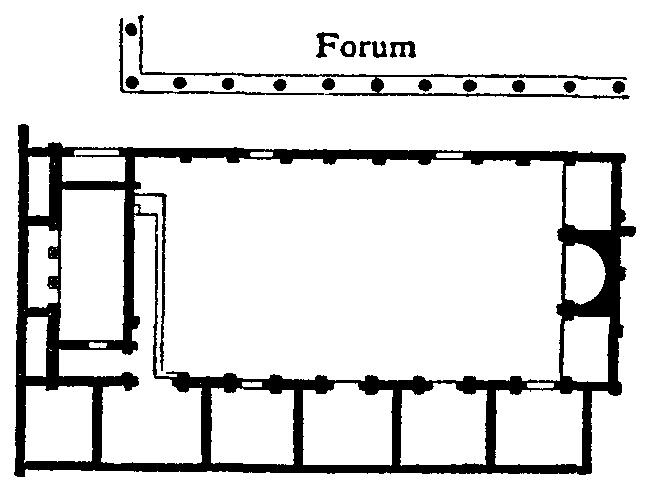
Fig. 6.—Plan of Basilica
adjoining the Forum of the Roman city of Timgad, in North Africa.
(From Gsell's Monuments antiques de l'Algerie,
by permission of A. Fontemoing.)
When buildings were first expressly erected for Christian worship, in
the 3rd or perhaps already in the 2nd century A.D. (Leclercq, Manuel, ch. iii. "Les édifices
chrétiens avant la paix de l'église"), they probably took the form of an
oblong interior terminated by an apse. After the
time of Constantine, when the numbers of the faithful were enormously
increased, side aisles were added, and in this way the structure came to
assume an appearance similar to that of the civil basilica. A striking
confirmation of this view has recently come to light at S. Saba on the
Aventine at Rome, where a small and very early church, without aisles,
has been discovered beneath the floor of the present basilica.
There are, on the other hand, instances in which private basilicas in
palaces and mansions were handed over to the Christians for sacred uses.
We know that to have been the case with the basilicas of S. Croce in
Gerusalemme and S. Maria Maggiore at Rome, which originated in the halls
of the Sessorian and Liberian palaces respectively, granted by
Constantine to the Christians. We may adduce also as evidence of the same
practice a passage in bk. x. ch. 71 of the theological romance known as
The Recognitions of Clement, probably dating from the early half
of the 3rd century, in which we are told that Theophilus of Antioch, on
his conversion by St Peter, made over "the basilica of his house" for a
church. But however this may have been, with, perhaps, the single
exception of S. Croce, the existing Christian basilicas were erected from
the ground for their sacred purpose. At Rome the columns, friezes and
other materials of the desecrated temples and public buildings furnished
abundant materials for their construction. The decadence of art is
plainly shown by the absence of rudimentary architectural knowledge in
these reconstructions. Not only are columns of various heights and
diameters made to do duty in the same colonnade, but even different
orders stand side by side (e.g. Ionic, Corinthian and Composite at
S. Maria in Trastevere); while pilasters assume a horizontal position and
serve as entablatures, as at S. Lorenzo fuori le Mura. There being no
such quarry of ready-worked materials at Ravenna, the noble basilicas of
that city are free from these defects, and exhibit greater unity of
design and harmony of proportions.
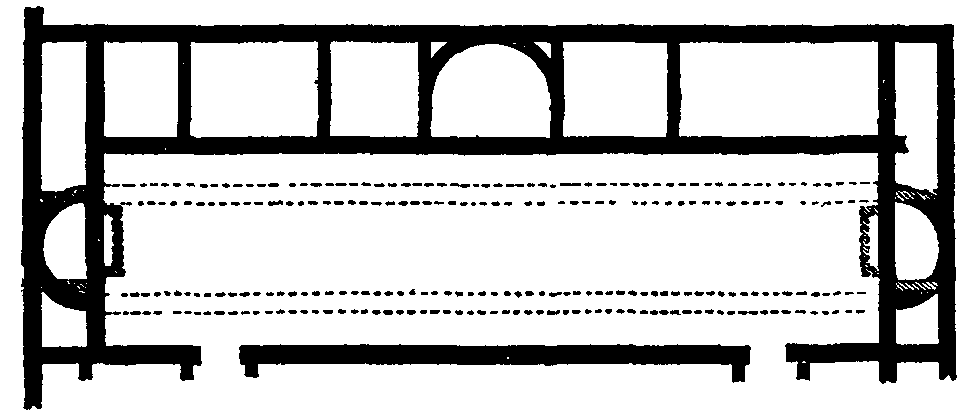
Fig. 7.—Plan of Basilica
adjoining the Forum of the Roman city at Silchester, Hants. (From
Archaeologia, vol. liii.)
An early Christian basilica may be thus described in its main
features:—A porch supported on pillars (as at S. Clemente) gave
admission into an open court or atrium, surrounded by a colonnaded
cloister (S. Clemente, Old St Peter's, S. Ambrogio at Milan, Parenzo). In
the centre of the court stood a cistern or fountain (cantharus,
phiale), for drinking and ablutions. In close contiguity to the
atrium, often to the west, was the baptistery, usually octagonal
(Parenzo). The church was entered through a long narrow porch
(narthex), beyond which penitents, or those under ecclesiastical
censure, were forbidden to pass. Three or more lofty doorways, according
to the number of the aisles, set in marble cases, gave admission to the
church. The doors themselves were of rich wood, elaborately carved with
scriptural subjects (S. Sabina on the Aventine), or of bronze similarly
adorned and often gilt. Magnificent curtains, frequently embroidered with
sacred figures or scenes, closed the entrance, keeping out the heat of
summer and the cold of winter.
The interior consisted of a long and wide nave, sometimes as much as
80 ft. across, terminating in a semicircular apse, with one or sometimes
(St Paul's, Old St Peter's, St John Lateran) two aisles on each side,
separated by colonnades of marble pillars supporting horizontal
entablatures (Old St Peter's, S. Maria Maggiore, S. Lorenzo) or arches
(St Paul's, S. Agnese, S. Clemente, the two basilicas of S. Apollinare at
Ravenna). Above the pillars the clerestory wall rose to a great height,
pierced in its upper part by a range of plain round-headed windows. The
space between the windows and the colonnade (the later triforium-space)
was usually decorated with a series of mosaic pictures in panels. The
colonnades sometimes extended quite to the end of the church (the Ravenna
basilicas), sometimes ceased some little distance from the end, thus
admitting the formation of a transverse aisle or transept (St Paul's, Old
St Peter's, St John Lateran). Where this transept occurred it was divided
from the nave by a wide arch, the face and soffit of which were richly
decorated with mosaics. Over the crown of the arch we often find a bust
of Christ or the holy lamb lying upon the altar, and, on either side, the
evangelistic symbols, the seven candlesticks and the twenty-four elders.
Another arch spanned the semicircular apse, in which the church always
terminated. From Carolingian times this was designated the arch of
triumph, because a cross was suspended from it.
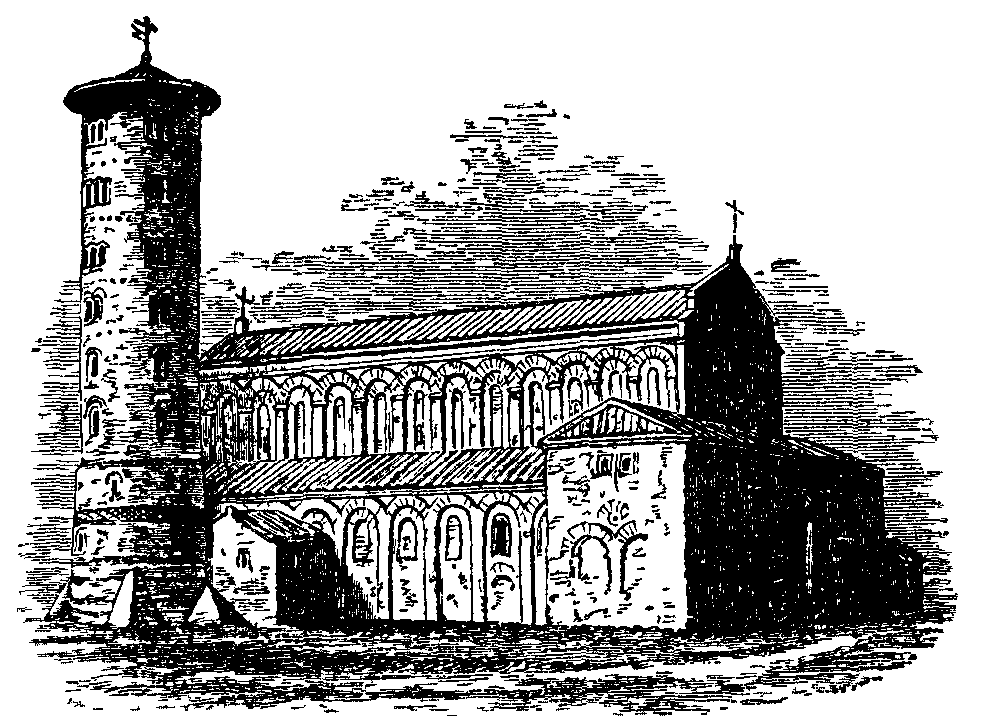 Fig.
Fig. 8.—S. Apollinare in Classe, Ravenna.
The conch or semi-dome that covered the apse was always covered with
mosaic pictures, usually paintings of our Lord, either seated or
standing, with St Peter and St Paul, and other apostles and saints, on
either hand. The beams of the roof were sometimes concealed by a flat
ceiling, richly carved and gilt. The altar, standing in the centre of the
chord of the apse on a raised platform reached by flights of steps, was
rendered conspicuous by a lofty canopy supported by marble pillars
(ciborium, baldacchino), from which depended curtains of
the richest materials. Beneath the altar was the confessio, a
subterranean chapel, containing the body of the patron saint, and relics
of other holy persons. This was approached by descending flights of steps
from the nave or aisles. The confessio in some cases reproduced
the original place of interment of the patron saint, either in a
catacomb-chapel or in an ordinary grave, and thus formed the sacred
nucleus round which the church arose. We have good examples of this
arrangement at St Peter's and St Paul's at Rome, and S. Apollinare in
Classe, Ravenna. It was copied in the original cathedral of Canterbury.
The bishop or officiating presbyter advanced from his seat in the centre
of the semicircle of the apse to the altar, and celebrated the Eucharist
with his face to the congregation below. At the foot of the altar steps a
raised platform, occupying the upper portion of the nave, formed a choir
for the singers, readers and other inferior clergy. This oblong space was
separated from the aisles and from the western portion of the nave by low
marble walls or railings (cancelli). From these walls projected
ambones or pulpits with desks, also of marble, ascended by
steps.
The exterior of the basilicas was usually of an extreme plainness. The
vast brick walls were unrelieved by ornament, save occasionally by
arcading as at S. Apollinare in Classe, Ravenna, and had no compensating
grace of outline or beauty of proportion. An exception was made for the
entrance front, which was sometimes covered with plates of marble mosaics
or painted stucco (Old St Peter's, S. Lorenzo). But in spite of any
decorations the external effect of a basilica must always have been heavy
and unattractive. S. Apollinare in Classe at Ravenna (fig. 8) affords a
typical example. The campanile is a later
addition. Within, apart from the beautiful mosaic decoration, a fine
effect was produced by the arch of triumph and the apse, which terminated
the nave and dominated the whole vast space of the interior.
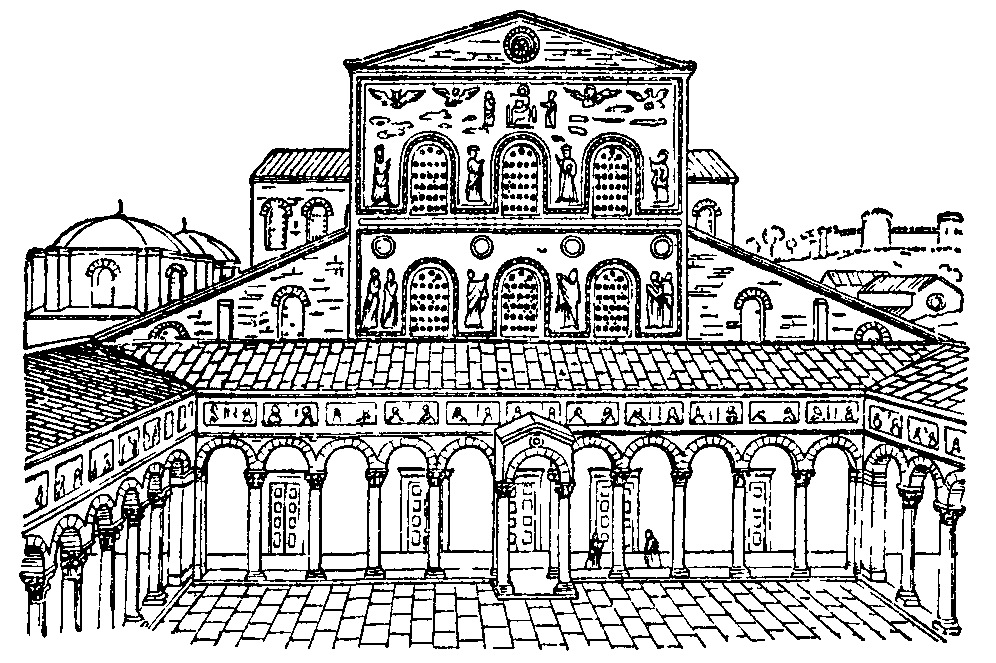 Fig.
Fig. 9.—Façade of old St Peter's, Rome.
Fig. 10.—Ground-Plan of
the original Basilica of St Peter's at Rome.
a, Porch. b, Atrium. c, Cloisters.
d, Narthex. e, Nave. f, f, Aisles,
g, Bema. h, Altar, protected by a double screen.
i, Bishop's throne in centre of the apse. k, Sacristy.
l, Tomb of Honorius. m, Church of St Andrew.
To pass from general description to individual churches, the first
place must be given, as the earliest and grandest examples of the type,
to the world-famous Roman basilicas; those of St Peter, St Paul and St
John Lateran, "omnium urbis et orbis ecclesiarum mater et caput."
It is true that no one of these exists in its original form, Old St
Peter's having been entirely removed in the 16th century to make room for
its magnificent successor; and both St Paul's and St John Lateran having
been greatly injured by fire, and the last named being so completely
modernized as to have lost all interest. Of the two former, however, we
possess drawings and plans and minute descriptions, which give an
accurate conception of the original buildings. To commence with St
Peter's, from the illustrations annexed (figs. 9, 10, 11) it will be seen
that the church was entered through a vast colonnaded atrium, 212
ft. by 235 ft., with a fountain in the centre,—the atrium being
preceded by a porch mounted by a noble flight of steps. The church was
212 ft. wide by 380 ft. long; the nave, 80 ft. in width, was six steps
lower than the side aisles, of which there were two on each side. The
four dividing colonnades were each of twenty-two Corinthian columns.
Those next the nave supported horizontal entablatures. The inner
colonnades bore arches, with a second clerestory. The main clerestory
walls were divided into two rows of square panels containing mosaics, and
had windows above. The transept projected beyond the body of the
church,—a very unusual arrangement. The apse, of remarkably small
dimensions, was screened off by a double row of twelve wreathed columns
of Parian marble. The pontifical chair was placed in the centre of the
curve of the apse, on a platform raised several steps above the
presbytery. To the right and left the seats of the cardinals followed the
line of the apse. At the centre of the chord stood the high altar beneath
a ciborium, resting on four pillars of porphyry. Beneath the altar was
the subterranean chapel, the centre of the devotion of so large a portion
of the Christian world, believed to contain the remains of St Peter; a
vaulted crypt ran round the foundation wall of the apse in which many of
the popes were buried. The roof showed its naked beams and rafters.
Fig. 11.—Sectional view
of the old Basilica of St Peter, before its destruction in the 16th
century.
Fig. 12.—Ground-Plan of
St Paul's, Rome, before its destruction by fire.
a, Narthex. b, Nave. c, c,
Side aisles. d, Altar. e, Bema. f, Apse.
The basilica of St Paul without the walls, dedicated 324 A.D., rebuilt 388-423, remained in a sadly neglected
state, but substantially unaltered, till the disastrous fire of 1823,
which reduced the nave to a calcined ruin. Its plan and dimensions (figs.
12, 13) were almost identical with those of St Peter's.
The only parts of the modernized five-aisled basilica of St John
Lateran (of which we have a plan in its original state, Agincourt, pl.
lxxiii. No. 22) which retain any interest, are the double-vaulted aisle
which runs round the apse, a most unusual arrangement, and the
baptistery. The latter is an octagonal building standing some little
distance from the basilica to the south. Its roof is supported by a
double range of columns, one above the other, encircling the baptismal
basin sunk below the floor.
Of the three-aisled basilicas the best example is the Liberian or S.
Maria Maggiore dedicated 365, and reconstructed 432 A.D. Its internal length to the chord of the apse is
250 ft. by 100 ft. in breadth. The Ionic pillars of grey granite, uniform
in style, twenty on each side, form a colonnade of great dignity and
beauty, unfortunately broken towards the east by intrusive arches opening
into chapels. The clerestory, though modern, is excellent in style and
arrangement. Corinthian pilasters divide the windows, beneath which are
very remarkable mosaic pictures of subjects from Old Testament history,
generally supposed to date from the pontificate of
Sixtus III., 432-440. The face of the arch of triumph presents also a
series of mosaics illustrative of the infancy of our Lord, of great value
in the history of art. The apse is of later date, reconstructed by
Paschal I. in 818.
 Fig.
Fig. 13.—Section of the Basilica of St
Paul, Rome.
 Fig.
Fig. 14.—Section of Basilica of S. Agnese
at Rome.
Of the remaining Roman basilicas that of S. Sabina on the Aventine is
of special interest as its interior, dating from about A.D. 430, has preserved more of the primitive aspect
than any other. Its carved wooden doors of early Christian date are of
unique value, and in the spandrils of its inner arcades, upborne by
splendid antique Corinthian columns, are some good specimens of opus
sectile or mosaic of cut marble. The ancient roof is an open one. The
basilicas of S. Lorenzo fuori le Mura and S. Agnese deserve particular
notice, as exhibiting galleries corresponding to those of the civil
basilicas and to the later triforium, carried above the aisles and
returned across the entrance end. It is doubtful, however, whether these
galleries are part of the original schemes. The architectural history of
S. Lorenzo's is curious. When originally constructed in A.D. 432, it consisted of a short nave of six bays,
with an internal narthex the whole height of the building. In the 13th
century Honorius III. disorientated the church by pulling down the apse
and erecting a nave of twelve bays on its site and beyond it, thus
converting the original nave into a square-ended choir, the level being
much raised, and the magnificent Corinthian columns half buried. As a
consequence of the church being thus shifted completely round, the face
of the arch of triumph, turned away from the present entrance, but
towards the original one, is invested with the usual mosaics (Agincourt,
pl. xxviii. Nos. 29, 30, 31). The basilica of S. Agnese, of which we give
a section (fig. 14), is a small but interesting building, much like what
S. Lorenzo must have been before it was altered.
Fig. 15.—Plan of Basilica
of S. Clemente in Rome.
1. Porch. 2. Atrium. 3. Nave. 4. Aisle for men. 5.
Aisle for women. 6. Chorus cantorum. 7. Altar. 8. Gospel-ambo. 9.
Epistle-ambo. 10. Confessio. 11. Bishop's throne.
Though inferior in size, and later in date than most of the basilicas
already mentioned, that of S. Clemente is not surpassed in interest by
any one of them. This is due to its having retained its original ritual
arrangements and church-fittings more perfectly than any other. These
fittings have been removed from the earlier church, lying below the
existing building, which at some unknown date and for some unrecorded
reason was abandoned and filled up with earth, while a new building was
erected upon it as a foundation. The most probable account is that the
earlier church was so completely overwhelmed in the ruin of the city in
1084, when Robert Guiscard burnt all the public buildings from the
Lateran to the Capitol, that it was found simpler and more convenient to
build a new edifice at a higher level than to repair the old one. The
annexed plan (fig. 15) and view (fig. 16) show the peculiarities of the
existing building. The church is preceded by an atrium, the only
perfect example remaining in Rome, in the centre of which is the
cantharus or fountain for ablutions. The atrium is entered by a
portico made up of earlier fragments very carelessly put together. The
chorus cantorum, which occupies about one-third of the nave, is
enclosed by a low marble screen, about 3 ft. high, a work of the 9th
century, preserved from the old church but newly arranged. The white
marble slabs are covered with patterns in low relief, and are decorated
with ribbons of glass mosaic of the 13th century. These screen-walls
stand quite free of the pillars, leaving a passage between. On the ritual
north stands the gospel-ambo, of octagonal form, with a double flight of
steps westwards and eastwards. To the west of it stands the great Paschal
candlestick, with a spiral shaft, decorated with mosaic. Opposite, to the
south, is the epistle-ambo, square in plan, with two marble reading-desks
facing east and west, for the reading of the epistle and the gradual
respectively. The sanctuary is raised two steps above the choir, from
which it is divided by another portion of the same marble screen. The
altar stands beneath a lofty ciborium, supported by marble
columns, with a canopy on smaller shafts above. It retains the rods and
rings for the curtains to run on. Behind the altar, in the centre of the
curved line of the apse, is a marble episcopal throne, bearing the
monogram of Anastasius who was titular cardinal of this church in 1108.
The conch of the apse is inlaid with mosaics of quite the end of the 13th
century. The subterranean church, disinterred by the zeal of Father
Mullooly, the prior of the adjacent Irish Dominican convent, is supported
by columns of very rich marble of various kinds. The aisle walls, as well
as those of the narthex, are covered with fresco-paintings of various
dates from the 7th to the 11th century, in a marvellous state of
preservation (See St Clement, Pope and Martyr, and his Basilica in
Rome, by Joseph Mullooly, O.P., Rome, 1873.)
 Fig.
Fig. 16.—Interior of S. Clemente in Rome.
The fullest lists of early Christian basilicas outside Rome are given
in Kraus's Realencyklopädie der christlichen Alterthümer, Freiburg
i. B., 1882, art. "Basilica," and more recently in Leclercq's Manuel
d'archéologie chrétienne, Paris 1907, vol. i. App. i., "Essai de
Classement des Principaux Monuments." Only a few characteristic specimens
in different regions can here be noticed. In Italy, apart from Rome, the
most remarkable basilican churches are the two dedicated to S. Apollinare
at Ravenna. They are of smaller dimensions than those of Rome, but the
design and proportions are better. The cathedral of this city, a noble
basilica with double aisles, erected by Archbishop Ursus, A.D. 400 (Agincourt, pl. xxiii. No. 21), was
unfortunately destroyed on the erection of the present tasteless
building. Of the two basilicas of S. Apollinare, the earlier, S.
Apollinare Nuovo, originally an Arian church erected by Theodoric,
493-525, measuring 315 ft. in length by 115 ft. in breadth, has a nave 51
ft. wide, separated from the single aisles by colonnades of twenty-two
pillars, supporting arches, a small prismatic block bearing a sculptured
cross intervening with very happy effect between the capital and the
arch. Below the windows a continuous band of saintly figures, male on one
side and female on the other, advancing in stately procession towards Our
Lord and the Virgin Mother respectively, affords one of the most
beautiful examples of mosaic ornamentation to be found in any
church (fig. 17). The design of the somewhat later and smaller church of
S. Apollinare in Classe, A.D. 538-549,
measuring 216 ft. by 104 ft., is so similar that they must have proceeded
from the same architect (Agincourt, pl lxxiii. No. 35).
Fig. 17.—Arches of S
Apollinare Nuovo, Ravenna.
The cathedral on the island of Torcello near Venice, originally built
in the 7th century, but largely repaired c. A.D. 1000, deserves special attention from the fact
that it preserves, in a more perfect state than can be seen elsewhere,
the arrangements of the seats in the apse (fig. 18). The bishop's throne
occupies the centre of the arc, approached by a steep flight of steps.
Six rows of stone benches for the presbyters, rising one above another
like the seats in a theatre, follow the curve on either side—the
whole being singularly plain and almost rude. The altar stands on a
platform; the sanctuary is divided from the nave by a screen of six
pillars. The walls of the apse are inlaid with plates of marble. The
church is 125 ft. by 75 ft. The narrow aisles are only 7 ft. in
width.
Fig. 18.—Apse of
Basilica, Torcello, with Bishop's throne and seats for the clergy.
(From a drawing by Lady Palgrave.)
Another very remarkable basilica, less known than it deserves to be,
is that of Parenzo in Istria, c. A.D.
542. Few basilicas have sustained so little alteration. From the annexed
ground-plan (fig. 19) it will be seen that it retains its atrium
and a baptistery, square without, octagonal within, to the west of it.
Nine pillars divide each aisle from the nave, some of them borrowed from
earlier buildings. The capitals are Byzantine. The choir occupies the
three easternmost bays. The apse, as at Torcello, retains the bishop's
throne and the bench for the presbyters apparently unaltered. The mosaics
are singularly gorgeous, and the apse walls, as at Torcello, are inlaid
with rich marble and mother-of-pearl. The dimensions are small—121
ft. by 32 ft. (See Kunstdenkmale des österreichischen
Kaiserreichs, by Dr G. Heider and others.)
Fig. 19.—Ground-Plan of
Cathedral of Parenzo, Istria.
a, Cloistered atrium. +, Narthex. b,
Nave. c, c, Aisles. d, Chorus cantorum. e,
Altar. f, Bishop's throne. g, Baptistery. h,
Belfry. i, Chapel of St Andrew.
In the Eastern church, though the erection of St Sophia at
Constantinople introduced a new type which almost entirely superseded the
old one, the basilican form, or as it was then termed dromical,
from its shape being that of a race-course (dromos), was
originally as much the rule as in the West. The earliest church of which
we have any clear account, that of Paulinus at Tyre, A.D. 313-322, described by Eusebius (Hist.
Eccl. x. 4 § 37), was evidently basilican, with galleries over the
aisles, and had an atrium in front. That erected by Constantine at
Jerusalem, on the side of the Holy Sepulchre, 333, followed the same plan
(Euseb., Vit. Const. iii. c. 29), as did the original churches of
St Sophia and of the Apostles at Constantinople. Both these buildings
have entirely passed away, but we have an excellent example of an
oriental basilica of the same date still standing in the church of the
Nativity at Bethlehem, rebuilt by Justinian in the 6th century (fig. 20).
Here we find an oblong atrium, a vestibule or narthex, double aisles with
Corinthian columns, and a transept, each end of which terminates in an
apse, in addition to that in the usual position. Beneath the centre of
the transept is the subterranean church of the Nativity (Vogué, Les
Églises de la Terre Sainte, p. 46).
Constantinople preserved till recently a basilican church of the 5th
century, that of St John Studios, 463, now a ruin. It had a nave and side
aisles divided by columns supporting a horizontal entablature, with
another order supporting arches forming a gallery above. There was the
usual apsidal termination. The chief difference between the Eastern and
Roman basilicas is in the galleries. This feature is very rare in the
West, and only occurs in some few examples, the antiquity of which is
questioned at Rome but never at Ravenna. It is, on the other hand, a
characteristic feature of Eastern churches, the galleries being intended
for women, for whom privacy was more studied than in the West
(Salzenberg, Altchrist. Baudenkmale von Constantinople).
Fig. 20.—Plan of church
of the Nativity, Bethlehem. 1, Narthex; 2, nave; 3, 3, aisles.
Other basilican churches in the East which deserve notice are those of
the monastery of St Catherine on Mt. Sinai built by Justinian, that of
Dana between Antioch and Bir of the same date, St Philip at Athens, Bosra
in Arabia, Xanthus in Lycia, and the very noble church of St Demetrius at
Thessalonica. Views and descriptions of most of these may be found in
Texier and Pullan's Byzantine Architecture, Couchaud's Choix
d'églises byzantines, and the works of the count de Vogué. In the
Roman province of North Africa there are abundant remains of early
Christian churches, and S. Gsell, Les Monuments antiques de
l'Algérie, has noticed more than 130 examples. Basilicas of strictly
early Christian date are not now to be met with in France, Spain or
Germany, but the interesting though very plain "Basse Œuvre" at
Beauvais may date from Carolingian times, while Germany can show at
Michelstadt in the Odenwald an unaltered basilica of the time of Charles
the Great. The fine-columned basilica of St Mauritius, near Hildesheim,
dates from the 11th century, and the basilican form has been revived in
the noble modern basilica at Munich.
Fig. 21.—Plan of early
Christian Basilica of about the 4th century at Silchester, Hants.
(From Archaeologia, liii.)
England can show more early Christian survivals than France or
Germany. In the course of the excavation of the Roman city of Silchester,
there was brought to light in 1892 the remains of a small early Christian
basilica dating from the 4th century of which fig. 21 gives the plan
(Archaeologia, vol. liii.). It will be noted that the
apse is flanked by two chambers, of the nature of sacristies, cut off
from the rest of the church, and known in ecclesiastical terminology as
prothesis and diaconicon. These features, rare in Italy,
are almost universal in the churches of North Africa and Syria. Another
existing English basilica of early date is that of Brixworth in
Northamptonshire, probably erected by Saxulphus, abbot of Peterborough,
c. A.D. 680. It consisted of a nave
divided from its aisles by quadrangular piers supporting arches turned in
Roman brick, with clerestory windows above, and a short chancel
terminating in an apse, outside which, as at St Peter's at Rome, ran a
circumscribing crypt entered by steps from the chancel. At the west end
was a square porch, the walls of which were carried up later in the form
of a tower.
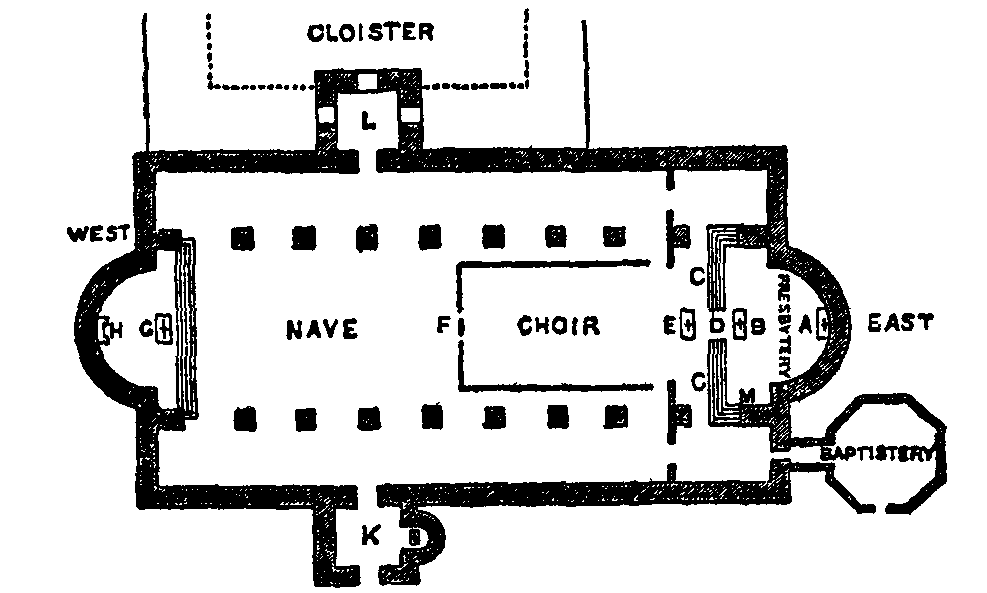
Fig. 22.—Ground-Plan of
the original Cathedral at Canterbury, as restored by Willis.
A, High altar. B, Altar of our Lord. C, C, Steps to
crypt. D, Crypt. E, F, Chorus cantorum. G, Our Lady's altar. H,
Bishop's throne. K, South porch with altar. L, North porch containing
school. M, Archbishop Odo's tomb.
The first church built in England under Roman influence was the
original Saxon cathedral of Canterbury. From the annexed ground-plan
(fig. 22), as conjecturally restored from Eadmer's description, we see
that it was an aisled basilica, with an apse at either end, containing
altars standing on raised platforms approached by steps. Beneath the
eastern platform was a crypt, or confessio, containing relics,
"fabricated in the likeness of the confessionary of St Peter at Rome"
(Eadmer). The western apse, dedicated to the Blessed Virgin, contained
the bishop's throne. From this and other indications Willis thinks that
this was the original altar end, the eastern apse being a subsequent
addition of Archbishop Odo, c. 950, the church having been thus
turned from west to east, as at the already-described basilica of S.
Lorenzo at Rome. The choir, as at S. Clemente's, occupied the eastern
part of the nave, and like it was probably enclosed by breast-high
partitions. There were attached porches to the north and south of the
nave. The main entrance of the church was through that to the south. At
this suthdure, according to Eadmer, "all disputes from the whole
kingdom, which could not legally be referred to the king's court, or to
the hundreds and counties, received judgment." The northern porch
contained a school for the younger clergy.
Authorities.—Vitruvius, De
Architectura, v. 1, vi. 3, 9; Huelsen, The Roman Forum (1906);
Mau, Pompeii: its Life and Art; C. Lange, Haus und Halle;
Canina, Edifizii di Roma Antica; Ciampini, Vetera
Monimenta; Seroux d'Agincourt, L'Histoire de l'art par les
monumens; Bunsen and Plattner, Beschreibung der Stadt Rom;
Gutensohn and Knapp, Basiliken des christlichen Roms; Zestermann,
Die antiken u. die christlichen Basiliken; Hübsch, Die
altchristlichen Kirchen; Messmer, Über den Ursprung, &c., der
Basilica; Letarouilly, Edifices de Rome moderne; Von Quast,
Altchristliche Bauwerke von Ravenna; Texier and Pullan,
Byzantine Architecture; Vogué, Eglises de la Terre Sainte;
Syrie Centrale, Architecture, &c.; Couchaud, Choix d'églises
byzantines; Dehio und von Bezold, Die kirchliche Baukunst des
Abendlandes; Holtzinger, Die altchristliche Architectur in
systematischer Darstellung; Kraus, Geschichte der christlichen
Kunst; Leclercq, Manuel d'archéologie chrétienne (Paris,
1907).
(E. V.; G. B. B.)
BASILICA, a code of law, drawn up in the Greek language, with a
view to putting an end to the uncertainty which prevailed throughout the
East Roman empire in the 9th century as to the authorized sources of law.
This uncertainty had been brought about by the conflicting opinions of
the jurists of the 6th century as to the proper interpretation to be
given to the legislation of the emperor Justinian, from which had
resulted a system of teaching which had deprived that legislation of all
authority, and the imperial judges at last were at a loss to know by what
rules of law they were to regulate their decisions. An endeavour had been
made by the emperor Leo the Isaurian to remedy this evil, but his
attempted reform of the law had been rather calculated to increase its
uncertainty; and it was reserved for Basil the Macedonian to show himself
worthy of the throne, which he had usurped, by purifying the
administration of justice and once more reducing the law into an
intelligible code. There has been considerable controversy as to the part
which the emperor Basil took in framing the new code. There is, however,
no doubt that he abrogated in a formal manner the ancient laws, which had
fallen into desuetude, and the more probable opinion would seem to be,
that he caused a revision to be made of the ancient laws which were to
continue in force, and divided them into forty books, and that this code
of laws was subsequently enlarged and distributed into sixty books by his
son Leo the Philosopher. A further revision of this code is stated to
have been made by Constantine Porphyrogenitus, the son and successor of
Leo, but this statement rests only on the authority of Theodorus
Balsamon, a very learned canonist of the 12th century, who, in his
preface to the Nomocanon of Patriarch Photius, cites passages from
the Basilica which differ from the text of the code as revised by the
emperor Leo. The weight of authority, however, is against any further
revision of the code having been made after the formal revision which it
underwent in the reign of the emperor Leo, who appointed a commission of
jurists under the presidency of Sympathius, the captain of the
body-guard, to revise the work of his father, to which he makes allusion
in the first of his Novellae. This latter conclusion is the more
probable from the circumstance, that the text of the code, as revised by
the emperor Leo, agrees with the citations from the Basilica which occur
in the works of Michael Psellus and Michael Attaliates, both of them high
dignitaries of the court of Constantinople, who lived a century before
Balsamon, and who are silent as to any second revision of the code having
taken place in the reign of Constantine Porphyrogenitus, as well as with
other citations from the Basilica, which are found in the writings of
Mathaeus Blastares and of Constantine Harmenopulus, both of whom wrote
shortly after Balsamon, and the latter of whom was far too learned a
jurist and too accurate a lawyer to cite any but the official text of the
code.
Authors are not agreed as to the origin of the term Basilica, by which
the code of the emperor Leo is now distinguished. The code itself appears
to have been originally entitled The Revision of the Ancient Laws
(ἡ
ἀνακάθαρσις
τῶν παλαιῶν
νόμων); next there came into use the title
ἡ
ἑξηκοντάβιβλος,
derived from the division of the work into sixty books; and finally,
before the conclusion of the 10th century, the code came to be designated
ὁ
βασιλικός,
or τὰ
βασιλικά, being
elliptical forms of ὁ
βασιλικὸς
νόμος and τὰ βασιλικά
νόμιμα, namely the Imperial Law or the
Imperial Constitutions. This explanation of the term "Basilica" is more
probable than the derivation of it from the name of the father of the
emperor Leo, inasmuch as the Byzantine jurists of the 11th and 12th
centuries ignored altogether the part which the emperor Basil had taken
in initiating the legal reforms, which were completed by his son; besides
the name of the father of the emperor Leo was written βασίλειος,
from which substantive, according to the genius of the ancient
Greek language, the adjective βασιλικός
could not well be derived.
No perfect MS. has been preserved of the text of the Basilica, and the
existence of any portion of the code seems to have been ignored by the
jurists of western Europe, until the important bearing of it upon the
study of the Roman law was brought to their attention by Viglius
Zuichemus, in his preface to his edition of the Greek Paraphrase of
Theophilus, published in 1533. A century, however, elapsed before an
edition of the sixty books of the Basilica, as far as the MSS. then known
to exist supplied materials, was published in seven volumes, by Charles
Annibal Fabrot, under the patronage of Louis XIII. of France, who
assigned an annual stipend of two thousand livres to the editor during
its publication, and placed at his disposal the royal printing-press.
This edition, although it was a great undertaking and a work of
considerable merit, was a very imperfect representation of the original
code. A newly-restored and far more complete text of the sixty books of
the Basilica was published at Leipzig in six volumes (1833-1870), edited
by K. W. E. Heimbach and G. E. Heimbach. It may seem strange that so
important a body of law as the Basilica should not have come down to us
in its integrity, but a letter has been preserved, which was addressed by
Mark the patriarch of Alexandria to Theodoras Balsamon, from which it
appears that copies of the Basilica were in the 12th century very scarce,
as the patriarch was unable to procure a copy of the work. The great bulk
of the code was an obstacle to the multiplication of copies of it, whilst
the necessity for them was in a great degree superseded by the
publication from time to time of synopses and encheiridia of its
contents, composed by the most eminent jurists, of which a very full
account will be found in the Histoire au droit byzantin, by the
advocate Mortreuil, published in Paris in 1846.
BASILICATA, a territorial division of Italy, now known as the
province of Potenza, which formed a part of the ancient Lucania
(q.v.). It is bounded N. by the province of Foggia, N E. by those
of Bari and Lecce, E. by the Gulf of Taranto (for a distance of 24 m.),
S. by the province of Cosenza, and W. by the Mediterranean (for a
distance of 10 m. only), and by the provinces of Salerno and Avellino. It
has an area of 3845 sq. m. The province is as a whole mountainous, the
highest point being the Monte Pollino (7325 ft.) on the boundary of the
province of Cosenza, while the Monte Vulture, at the N.W. extremity, is
an extinct volcano (4365 ft.). It is traversed by five rivers, the
Bradano, Basento, Cavone or Salandrella, Agri and Sinni. The longest, the
Bradano, is 104 m. in length; all run S.E. or E. into the Gulf of
Taranto. The province is traversed from W. to E. by the railway from
Naples to Taranto and Brindisi, which passes through Potenza and reaches
at Metaponto the line along the E. coast from Taranto to Reggio di
Calabria. A branch line runs N. from Potenza via Melfi to Rocchetta S.
Antonio, a junction for Foggia, Gioia del Colle and Avellino (the second
of these lines runs through the province of Potenza as far as Palazzo S.
Gervasio), while a branch S. from the Naples and Taranto line at
Sicignano terminates at Lagonegro, on the W. edge of the province.
Communications are rendered difficult by the mountainous character of the
interior. The mountains are still to some extent clothed with forests; in
places the soil is fertile, especially along the Gulf of Taranto, though
here malaria is the cause of inefficient cultivation. Olive-oil is the
most important product. The total population of the province was 490,705
in 1901. The chief towns are Potenza (pop. 1901, 16,186), Avigliana
(18,313), Matera (17,237), Melfi (14,649), Rionero in Vulture (11,809),
Lauria (10,099).
BASILIDES, one of the most conspicuous exponents of Gnosticism,
was living at Alexandria probably as early as the first decades of the
2nd century. It is true that Eusebius, in his Chronicle, dates his
first appearance from A.D. 133, but according
to Eusebius, Hist. Eccl. iv. 7 §§ 6-8, Agrippa Castor, who lived
under Hadrian (117-138), already wrote a polemic against him, so that his
activity may perhaps be set back to a date earlier than 138. Basilides
wrote an exegetical work in twenty-four books on "his" gospel, but which
this was is not known. In addition to this there are certain writings by
his son Isidorus Περὶ
προσφυοῦς
ψυχῆς; Ἐξηγητικά on the
prophet Parchor (Παρχώρ); Ἠθικά. The surviving fragments of
these works are collected and commented on in Hilgenfeld's
Ketzergeschichte, 207-218. The most important fragment published
by Hilgenfeld (p. 207), part of the 13th book of the Exegetica, in
the Acta Archelai et Manetis c. 55, only became known in its
complete form later, and was published by L. Traube in the
Sitzungsbericht der Münchener Akad., phil. histor. Kl. (1903), pp.
533-549. Irenaeus (Adv. Haer. i. 24 §§ 3-7) gives a sketch of
Basilides' school of thought, perhaps derived from Justin's
Syntagma. Closely related to this is the account in the
Syntagma of Hippolytus, which is preserved in Epiphanius,
Haer. 24, Philaster, Haer. 32, and Pseudo-Tertullian,
Haer. 4. These are completed and confirmed by a number of
scattered notices in the Stromateis of Clemens Alexandrinus. An
essentially different account, with a pronounced monistic tendency, is
presented by the so-called Philosophumena of Hippolytus (vii.
20-27; x. 14). Whether this last account, or that given by Irenaeus and
in the Syntagma of Hippolytus, represents the original system of
Basilides, has been the subject of a long controversy. (See Hilgenfeld p.
205, note 337.) The most recent opinion tends to decide against the
Philosophumena; for, in its composition, Hippolytus appears to
have used as his principal source the compendium of a Gnostic author who
has introduced into most of the systems treated by him, in addition to
the employment of older sources, his own opinions or those of his sect.
The Philosophumena, therefore, cannot be taken into account in
describing the teaching of Basilides (see also H. Stachelin, "Die
gnostischen Quellen Hippolyts" in Texte und Untersuchungen, vi. 3;
and the article Gnosticism). A comparison of the
surviving fragments of Basilides, moreover, with the outline of his
system in Irenaeus-Hippolytus (Syntagma) shows that the account
given by the Fathers of the Church is also in the highest degree
untrustworthy. The principal and most characteristic points are not
noticed by them. If we assume, as we must needs do, that the opinions
which Basilides promulgates as the teaching of the "barbari" (Acta
Archelai c. 55) were in fact his own, the fragments prove him to have
been a decided dualist, and his teaching an interesting further
development of oriental (Iranian) dualism. Entirely consistent with this
is the information given by the Acta Archelai that Basilides,
before he came to Alexandria, had appeared publicly among the Persians
(fuit praedicator apud Persas); and the allusion to his having
appealed to prophets with oriental names, Barkabbas and Barkoph (Agrippa
in Eusebius Hist. Eccl. iv. 7 § 7). So too his son Isidorus
explained the prophecies of a certain Parchor ( = Barkoph) and appealed
to the prophecies of Cham[1] (Clemens Alexandrinus,
Stromat. vi. 6 § 53). Thus Basilides assumed the existence of two
principles, not derivable from each other: Light and Darkness. These had
existed for a long time side by side, without knowing anything of each
other, but when they perceived each other, the Light had only looked and
then turned away; but the Darkness, seized with desire for the Light, had
made itself master, not indeed of the Light itself, but only of its
reflection (species, color). Thus they had been in a
position to form this world: unde nec perfectum bonum est in hoc
mundo, et quod est, valde est exiguum. This speculation is clearly a
development of that which the Iranian cosmology has to tell about the
battles between Ahura-Mazda and Angro-Mainyu (Ormuzd and Ahriman). The
Iranian optimism has been replaced here by a strong pessimism. This
material world is no longer, as in Zoroastrianism, essentially a creation
of the good God, but the powers of evil have created it with the aid of
some stolen portions of light. This is practically the transference of
Iranian dualism to the more Greek antithesis of soul and body, spirit and
matter (cf. Irenaeus i. 24 § 5: animae autem eorum solam esse salutem,
corpus enim natura corruptibile existit). The fundamental dualism of
Basilides is confirmed also by one or two other passages. In the parable
of the rich man and Lazarus, Basilides saw the proof of naturam sine
radice et sine loco rebus supervenientem (Acta Archelai).
According to Clemens, Strom. iv. 12 § 83, &c., Basilides
taught that even those who have not sinned in act, even Jesus himself,
possess a sinful nature. It is possibly also in connexion with the
dualism of his fundamental views that he taught the
transmigration of souls (Origen in Ep. ad Rom. lib. v.; Opp. de la
Rue iv. 549; cf. Clemens, Excerpta ex Theodoto, § 28). Isidorus
set up celibacy, though in a modified form, as the ideal of the perfect
(Clemens, Strom. iii. 1 § 1, &c.) Clemens accuses Basilides of
a deification of the Devil (θειάζειν
τὸν
διάβολον), and
regards as his two dogmas that of the Devil and that of the
transmigration of souls (Strom. iv. 12 § 85: cf. v. 11 § 75). It
is remarkable too that Isidorus held the existence of two souls in man, a
good and a bad (Clemens, Strom. ii. 20 113); with which may be
compared the teaching of Mani about the two souls, which it is impossible
to follow F, Ch. Baur in excluding,[2] and also the teaching of the
Pistis Sophia (translated by C. Schmidt, p. 182, &c.).
According to Clemens (Strom. ii. 20 § 112), the followers of
Basilides spoke of πνεύματά τινα
προσηρτημένα
τῇ λογικῇ
φυχῇ κατά
τινα τάραχον
καὶ
σύγχυσιν
ἀρχικήν: that is to say, here
also is assumed an original confusion and intermingling. Epiphanius too
tells us that the teaching of Basilides had its beginning in the question
as to the origin of evil (Haer. xxiv. 6).
Now, of this sharply-defined dualism there is scarcely a trace in the
system described by the Fathers of the Church. It is therefore only with
caution that we can use them to supplement our knowledge of the true
Basilides. The doctrine described by them that from the supreme God (the
innatus pater) had emanated 365 heavens with their spirits,
answers originally to the astronomical conception of the heavens with
their 365 daily aspects (Irenaeus i. 24. 7; Trecentorum autem
sexaginta quinque caelorum locales positiones distribuunt similiter ut
mathematici). When, therefore, the supreme God is called by the name
Αβρασαξ or Αβραξας, which contains the
numerical value 365, it is worthy of remark that the name of the Persian
god Mithras (Μείθρας) also was known
in antiquity to contain this numerical value (Jerome in Amos 3;
Opp. Vallarsi VI. i. 257). Speculations about the Perso-Hellenistic
Mithras appear to have been transferred to the Gnostic Abraxas. Further,
if the Pater innatus be surrounded by a series of (from five to
seven) Hypostases (according to Irenaeus i. 24. 3; Νοῦς, Λόγος,
Φρόνησις,
Σοφία,
Δύναμις; according to
Clemens, Strom. iv. 25 § 164, Δικαιοσύνη
and Ἐιρήνη may perhaps be added), we
are reminded of the Ameshas-spentas which surround Ahura-Mazda.
Finally, in the system of Basilides, the (seven ?) powers from whom this
world originates are accepted as the lowest emanations of the supreme
God. This conception which is repeated in nearly every Gnostic system, of
(seven) world-creating angels, is a specifically oriental speculation.
The seven powers which create and rule the world are without doubt the
seven planetary deities of the later Babylonian religion. If, in the
Gnostic systems, these become daemonic or semi-daemonic forces, this
points to the fact that a stronger monotheistic religion (the Iranian)
had gained the upper hand over the Babylonian, and had degraded its gods
to daemons. The syncretism of the Babylonian and the Persian religion was
also the nursing-ground of Gnosticism. When, then, Basilides identified
the highest angel of the seven, the creator of the worlds, with the God
of the Jews, this is a development of the idea which did not occur until
late, possibly first in the specifically Christian circles of the
Gnostics. We may note in this connexion that the system of Basilides
ascribes the many battles and quarrels in the world to the privileged
position given to his people by the God of the Jews.[3]
It is at this point that the idea of salvation is introduced into the
system. The confusion in the world has meanwhile risen to such a pitch
that the supreme God sends his Nous, who is also called Christ,
into the world (Irenaeus i. 24. 4). According to Clemens, the Saviour is
termed πνεῦμα
διακονούμενον
(Strom. ii. 8 § 36) or διάκονος
(Excerpta ex Theodoto, § 16). It is impossible certainly to
determine how Basilides conceived the relation of this Saviour to Jesus
of Nazareth. Basilides himself (Strom. iv. 12 § 83) knows of an
earthly Jesus and denies the principle of his sinlessness (see above).
According to the account given by Irenaeus, the Saviour is said to have
appeared only as a phantasm; according to the Excerpta ex
Theodoto, 17, the Diakonos descended upon Jesus at His baptism in the
form of a dove, for which reason the followers of Basilides celebrated
the day of the baptism of Jesus, the day of the ἐπιφανεία. as a
high festival (Clemens, Strom. i. 21 § 18). The various attempts
at combination probably point to the fact that the purely mythical figure
of a god-saviour (Heros) was connected first by Basilides with Jesus of
Nazareth. As to what the conception of Basilides was of the completion of
the process of redemption, the available sources tell us next to nothing.
According to an allusion in Clemens, Strom. ii. 8 § 36, with the
mission of the Saviour begins the great separation of the sexes, the
fulfilment and the restoration of all things. This agrees with the
beginning of the speculation of Basilides. Salvation consists in this,
that that which was combined for evil is once more separated.
Among the later followers of Basilides, actual magic played a
determining part. They hand down the names of the rulers of the several
heavens as a weighty secret. This was a result of the belief, that
whoever knew the names of these rulers would after death pass through all
the heavens to the supreme God. In accordance with this, Christ also, in
the opinion of these followers of Basilides, was in the possession of a
mystic name (Caulacau = קַו
לָקַו Jes. xxviii. 10) by the
power of which he had descended through all the heavens to earth, and had
then again ascended to the Father. Redemption, accordingly, could be
conceived as simply the revelation of mystic names. In this connexion the
name Abraxas and the Abraxas gems must be remembered. Whether Basilides
himself had already given this magic tendency to Gnosticism cannot be
decided.
Basilides, then, represents that form of Gnosticism that is closest to
Persian dualism in its final form. His doctrine is most closely related
to that of Satornil (Saturninus). From most of the other Gnostic sects,
with the exception perhaps of the Jewish-Christian Gnosticism, he is
distinguished by the fact that with him the figure of the fallen female
god (Sophia Achamoth), and, in general, the idea of a fall within the
godhead is entirely wanting. So far as we can see, on the other hand,
Basilides appears actually to represent a further development of Iranian
dualism, which later produced the religious system of Mani.
Accounts of the teaching of Basilides are to be found in all the more
complete works on Gnosticism (see bibliography to the article Gnosticism). The original sources are best reproduced
in Hilgenfeld, Ketzergeschichte des Urchristentums (1884), pp.
195-230. See also Krüger, article "Basilides," in Herzog-Hauck,
Realencyklopadie, ed. 3.
(W. Bo.)
= Nimrod =
Zoroaster, cf. Pseudo-Clement, Homil. ix. 3; Recogn. iv.
27.
The materials are
in Baur, Das manichäische Religionssystem (1831), p. 162,
&c.
Whether the myth
of the creation of the first man by the angels, which recurs in many
Gnostic systems, found a place also in the system of Basilides, cannot be
determined with any certainty. Philastrius, however, says: hominem
autem ab angelis factum asserit, while according to Epiphanus xxiv.
2, men are created by the God of the Jews.
BASILISK (the Βασιλίσκος
of the Greeks, and Tsepha (cockatrice) of the Hebrews), a name
given by the ancients to a horrid monster of their own imagination, to
which they attributed the most malignant powers and an equally fiendish
appearance. The term is now applied, owing to a certain fanciful
resemblance, to a genus of lizards belonging to the family
Iguanidae, the species of which are characterized by the presence,
in the males, of an erectile crest on the head, and a still higher,
likewise erectile crest—beset with scales—on the back, and
another on the long tail. Basiliscus americanus reaches the length
of one yard; its colour is green and brown, with dark crossbars, while
the crest is reddish. This beautiful, strictly herbivorous creature is
rather common amidst the luxuriant vegetation on the banks of rivers and
streams of the Atlantic hot lands of Mexico and Guatemala. The lizards
lie upon the branches of trees overhanging the water, into which they
plunge at the slightest alarm. Then they propel themselves by rapid
strokes of the hind limbs, beating the water in a semi-erect position and
letting the long rudder-like tail drag behind. They are universally known
as pasa-rios, i.e. ferrymen.
BASIM, a town of India, in the Akola district, Berar, 52 m.
S.S.E. from Akola station of the Great Indian Peninsula railway. Pop.
(1901) 13,823. Until 1905 it was the headquarters of the district of
Basim, which had an area of 2949 sq. m.; but in that year
the district was abolished, its component taluks being divided
between the districts of Akola and Yeotmal. Its western portion, the
Basim taluk, consists of a fertile tableland, about 1000 ft. above
sea-level, sloping down westward and southward to the rich valley of the
Penganga; its eastern portion, the taluks of Mangrul and Pasud,
mainly of a succession of low hills covered with poor grass. In the Pasud
taluk, however, there are wide stretches of woodland, while some
of the peaks rise to a height of 2000 ft., the scenery (especially during
the rains) being very beautiful. The climate of the locality is better
than that of the other districts of Berar; the hot wind which blows
during the day in the summer months being succeeded at night by a cool
breeze. The principal crops are millet, wheat, other food grains, pulse,
oilseeds and cotton; there is some manufacture of cotton-cloth and
blankets, and there are ginning factories in the town. In 1901 the
population was 353,410, showing a decrease of 11% in the decade, due to
the famine of 1899-1900, which was severely felt in the district.
BASIN, THOMAS (1412-1491), bishop of Lisieux and historian, was
born probably at Caudebec in Normandy, but owing to the devastation
caused by the Hundred Years' War, his childhood was mainly spent in
moving from one place to another. In 1424 he went to the university of
Paris, where he became a master of arts in 1429, and afterwards studied
law at Louvain and Pavia. He attended the council of Ferrara, and was
soon made canon of the church at Rouen, professor of canon law in the new
university of Caen and vicar-general for the bishop of Bayeux. In 1447 he
became bishop of Lisieux. He was much involved in the wars between the
English and French and was employed by Charles VII. of France, and by his
successor Louis XI., at whose request Basin drew up a memorandum setting
forth the misery of the people and suggesting measures for alleviating
their condition. In 1464 the bishop joined the league of the Public Weal,
and fell into disfavour with the king, who seized the temporalities of
his see. After exile in various places Basin proceeded to Rome and
renounced his bishopric. At this time (1474) Pope Sixtus IV. bestowed
upon him the title of archbishop of Caesarea. Occupied with his writings
Basin then passed some years at Trier, and afterwards transferred his
residence to Utrecht, where he died on the 3rd of December 1491. He was
buried in the church of St John, Utrecht.
Basin's principal work is his Historiae de rebus a Carolo VII. et
Ludovico XI. Francorum regibus eorumque in tempore in Gallia gestis.
This is of considerable historical value, but is marred to some extent by
the author's dislike for Louis XI. At one time it was regarded as the
work of a priest of Liége, named Amelgard, but it is now practically
certain that Basin was the writer. He also wrote a suggestion for reform
in the administration of justice entitled Libellus de optimo ordine
forenses lites audiendi et deferendi; an Apologia, written to
answer the charges brought against him by Louis XI; a
Breviloquium, or allegorical account of his own misfortunes; a
Peregrinatio; a defence of Joan of Arc entitled Opinio et
consilium super processu et condemnatione Johanne, dicte Puelle, and
other miscellaneous writings. He wrote in French, Advis de Monseigneur
de Lysieux au roi (Paris, 1677).
See the edition of the Historiae, by J. E. J. Quicherat (Paris,
1855-1859); also G. du F. de Beaucourt, Charles VII et Louis XI
d'après Thomas Basin (Paris, 1858).
BASIN, or Bason (the older form
bacin is found in many of the Romanic languages, from the Late
Lat. baccinus or bacchinus, probably derived from
bacca, a bowl), a round vessel for holding liquids. Hence the term
has various technical uses, as of a dock constructed with flood-gates in
a tidal-river, or of a widening in a canal for unloading barges; also, in
physical geography, of the drainage area of a river and its
tributaries.
In geology, "basin" is equivalent to a broad shallow syncline,
i.e. it is a structure proper to the bed rock of the district
covered by the term; it must not be confused with the physiographic river
basin, although it occasionally happens that the two coincide to some
extent. Some of the better known geological basins in England are, the
London basin, a shallow trough or syncline of Tertiary, Cretaceous
and Jurassic rocks; the Hampshire basin, of similar formations;
and the numerous coal basins, e.g. the S. Wales coalfield,
the Forest of Dean, N. Staffordshire coalfield, &c. The Paris
basin is made of strata similar to those in the London and Hampshire
basins. Strictly speaking, a structural basin is formed of rock beds
which exhibit a centroclinal dip; an elongated narrow syncline or
trough is not a basin. "Rock-basins" are comparatively small, steep-sided
depressions that have been scooped out of the solid rock in mountainous
regions, mainly through the agency of glaciers (see Cirque). Lakes sometimes occupy basins that have been
caused by the removal in solution of some of the more soluble
constituents (rock salt, &c.) in the underlying strata; occasionally
lake basins have been formed directly by crustal movements.
BASINET (a diminutive of "basin"), a form of helmet or
headpiece. The original small basinet was a light open cap, with a peaked
crown. This was used alternately to, and even in conjunction with, the
large heavy heaume. But in the latter half of the 13th century the
basinet was developed into a complete war head-dress and replaced the
heaume. In this form it was larger and heavier, had a vizor (though not
always a pivoted vizor like that of the later armet), and was connected
with the gorget by a "camail" or mail hood, the head and neck thus being
entirely covered. It is always to be recognized by its peaked crown. The
word is spelt in various forms, "bassinet," "bascinet," "bacinet," or
"basnet." The form "bassinet" is used for the hooded wicker cradle or
perambulator for babies.
BASINGSTOKE, a market-town and municipal borough of Hampshire,
England, 48 m. W.S.W. from London by the London & South-Western
railway; served also by a branch of the Great Western railway. Pop.
(1901) 9793. The church of St Michael and All Angels is a fine specimen
of a late Perpendicular building (principally of the time of Henry
VIII.). The chapel of the Holy Ghost is a picturesque ruin, standing in
an ancient cemetery, built for the use of the local gild of the Holy
Ghost which was founded in 1525, but flourished for less than a century.
Close to the neighbouring village of Old Basing are remains of Basing
House, remarkable as the scene of the stubborn opposition of John, fifth
marquess of Winchester, to Cromwell, by whom it was taken after a
protracted siege in 1645. A castle occupied its site from Norman times.
Numerous prehistoric relics have been discovered in the district, and a
large circular encampment is seen at Winklebury Hill. Basingstoke has
considerable agricultural trade, and brewing, and the manufacture of
agricultural implements, and of clothing, are carried on. The Basingstoke
canal, which connects the town with the river Wey and so with the Thames,
was opened about 1794, but lost its trade owing to railway competition.
It was offered for sale by auction unsuccessfully in 1904, but was bought
in 1905. The municipal borough is under a mayor, four aldermen and twelve
councillors. Area, 4195 acres.
Basingstoke is a town of great antiquity, and excavations have brought
to light undoubted traces of Roman occupation. The first recorded
historical event relating to the town is a victory won here by Æthelred
and Alfred over the Danes in 871. According to the Domesday survey it had
always been a royal manor, and comprised three mills and a market. A
charter from Henry III. in 1256 granted to the men of Basingstoke the
manor and hundred of that name and certain other privileges, which were
confirmed by Edward III., Henry V. and Henry VI. As compensation for loss
sustained by a serious fire, Richard II. in 1392 granted to the men of
Basingstoke the rights of a corporation and a common seal. A charter from
James I. dated 1622 instituted two bailiffs, fourteen capital burgesses,
four justices of the peace, a high steward and under steward, two
serjeants-at-mace and a court of record. Charles I. in 1641 changed the
corporation to a mayor, seven aldermen and seven burgesses. Basingstoke
returned two members to parliament in 1295, 1302 and 1306, but no writs
are extant after this date. In 1202-1203 the market day was changed from
Sunday to Monday, but in 1214 was transferred to Wednesday, and has not
since been changed. Henry VI. granted a fair
at Whitsun to be held near the chapel of the Holy Ghost. The charter from
James I. confirmed another fair at the feast of St Michael the Archangel,
and that of Charles I. granted two fairs on Basingstoke Down at Easter
and on the 10th and 11th of September. The wool trade flourished in
Basingstoke at an early date, but later appears to have declined, and in
1631 the clothiers of Basingstoke were complaining of the loss of trade
and consequent distress.
See Victoria County History—Hants; F. G. Baigent and
J. E. Millard, History of Basingstoke (Basingstoke, 1889).
BASIN-STAND, a piece of furniture consisting of a small stand,
usually supported on three legs, and most commonly made of mahogany or
rosewood, for holding a wash-hand basin. The smaller varieties were used
for rose-water ablutions, or for the operation of hair-powdering. The
larger ones, which possessed sockets for soap-dishes, were the
predecessors of the ample modern wash-hand stand. Both varieties, often
of very elegant form, were in extensive use throughout a large part of
the 18th century.
BASKERVILLE, JOHN (1706-1775), English printer, was born at
Wolverley in Worcestershire on the 28th of January 1706. About 1726 he
became a writing master at Birmingham, and he seems to have had a great
talent for calligraphy and for cutting inscriptions in stone. While at
Birmingham he made some important improvements in the process of
japanning, and gained a considerable fortune. About the year 1750 he
began to make experiments in type-founding, producing types much superior
in distinctness and elegance to any that had hitherto been employed. He
set up a printing-house, and in 1757 published his first work, a
Virgil in royal quarto, followed, in 1758, by his famous edition
of Milton. In that year he was appointed printer to the university of
Cambridge, and undertook editions of the Bible and the Book of Common
Prayer. The Horace, published in 1762, is distinguished even among
the productions of the Baskerville press for its correctness and for the
beauty of the paper and type. A second Horace appeared in 1770 in
quarto, and its success encouraged Baskerville to publish a series of
quarto editions of Latin authors, which included Catullus, Tibullus,
Propertius, Lucretius, Terence, Sallust and Florus. This list of books
issued by Baskerville from his press lends some irony to the allegation
that he was a person of no education. These books are admirable specimens
of typography; and Baskerville is deservedly ranked among the foremost of
those who have advanced the art of printing. His contemporaries asserted
that his books owed more to the quality of the paper and ink than to the
type itself, but the difficulty in obtaining specimens from the
Baskerville press shows the estimation in which they are now held. His
wife, Sarah Baskerville, carried on the business for some time after his
death, which took place on the 8th of January 1775.
BASKET, a vessel made of twigs, cane or rushes, as well as of a
variety of other materials, interwoven together, and used for holding,
protecting or carrying any commodity. The process of interweaving twigs,
rushes or leaves, is practised among the rudest nations of the world; and
as it is one of the most universal of arts, so also does it rank among
the most ancient industries, being probably the origin of all the textile
arts of the world. Decorative designs in old ceramic ware are derived
from the marks left by the basket mould used before the invention of the
potter's wheel, and in the willow pattern on old china, and the basket
capitals or mouldings of Byzantine architecture, the influence of the
basketmaker's art is clearly traceable. Essentially a primitive craft,
its relative importance is in inverse ratio to the industrial development
of a people.
The word "basket" has been generally identified with the Latin
bascauda, as in Martial (xiv. 99):—
"Barbara de pictis veni bascauda Britannis:
Sed me iam mavult dicere Roma suam."
But its etymology is unknown, and the New English Dictionary
states that there is no evidence to connect basket with bascauda,
which denotes rather a tub, tray or brazen vessel.
Among many uncivilized tribes, baskets of a superior order are made
and applied to various useful purposes. The North American Indians
prepare strong water-tight Wattape baskets from the roots of a
species of abies, and these they frequently adorn with very pretty
patterns made from the dyed quills of their native porcupine,
Erethizon dorsatum. Wealthy Americans have formed collections of
the beautiful ware treasured as heirlooms in Indian families, and large
prices have been paid for baskets made by the few squaws who have
inherited the traditions and practice of the art, as much as £300 having
been given for one specimen. It has been computed that baskets to the
value of £1,000,000 were recently drawn from California and Arizona
within two years. The Indians of South America weave baskets equally
useful from the fronds of the Carnahuba and other palms. The Kaffirs and
Hottentots of South Africa are similarly skilful in using the Ilala reed
and the roots of plants; while the Abyssinians and the tribes of Central
Africa display great adroitness in the art of basket-weaving.
Basket-making, however, has by no means been confined to the
fabrication of those simple and useful utensils from which its name is
derived. Of old, the shields of soldiers were fashioned of wicker-work,
either plain or covered with hides. Xenophon, in his story of the Thirty
Tyrants at Athens, relates that the exiled Greeks who had seized on the
Peiraeus made themselves shields of whitened osiers; and similar weapons
of defence are still constructed by modern savages. The huts of the
earliest settlers in Rome and in western Europe generally were made of
osier work plastered with clay. Some interesting remains of British
dwellings of this nature found near Lewes in 1877 were described by
Major-General H. L. F. Pitt-Rivers in Archaeologia, vol. xlvi. pp.
456-458. Boats of the same material, covered with the skins of animals,
attracted the notice of the Romans in Britain; they seem to have been of
the ordinary boat-shape. The basketwork boats mentioned by Herodotus as
being used on the Tigris and Euphrates were round and covered with
bitumen. Boats of this shape are still used on these rivers, and boats of
analogous construction are employed in crossing the rivers of India, in
which the current is not rapid. Nor have methods of making much changed.
The strokes employed in the construction of basket-work found in Etruscan
tombs and now exhibited in the Museo Etrusco at Florence, and in similar
articles discovered in Egyptian tombs, are the same as those used by the
English basket-maker to-day. General Pitt-Rivers, on comparing the
remains excavated near Lewes with a modern hamper in his possession,
found the method to be identical.
Since about the middle of the 19th century the character of
basket-work in England has been greatly modified. The old English cradle,
reticule, and other small domestic wares, have been driven out of the
market by cheap goods made on the continent of Europe, and the coarse
brown osier packing and hampers have been largely superseded by rough
casks and cases made from cheap imported timber. This loss has, however,
been more than counterbalanced by the production of work of a higher
class, such as finely made chairs, tables, lounges and other articles of
furniture; luncheon and tea-baskets and similar requisites of travel. In
addition to the foregoing the chief categories of English manufacture
are: vegetable and fruit baskets, transit and travelling hampers, laundry
and linen baskets, partition baskets for wine, and protective wicker
cases for fragile ware such as glass carboys, stone and other bottles.
Wicker shields or cases made from cane pith, for the protection of
shells, have been introduced by the English military authorities. Some
evidence of the above-mentioned developments is afforded by a comparison
of the wages lists of the London Union of Journeymen Basketmakers issued
in 1865 and in 1896. The former consists of 87 printed pages; the latter
of 144 pages, and these more closely set.
No machinery is used in basket-making. A considerable training and
natural aptitude go to form the expert workman, for the ultimate
perfection of shape and beauty of texture depend upon the more or less
perfect conception of form in the craftsman's
mind and on his power to impress it on a recalcitrant material. In
England at least, he rarely uses a mould; every stroke made has a
permanent effect on the symmetry of the whole work and no subsequent
pressure will alter it. Wages in London vary from 25s. to 50s. per week
according to aptitude. The Basketmakers' Company is one of the oldest
craft gilds of the city of London and still exists.
Employment is given by the London Association for the Welfare of the
Blind to a number of partially or wholly blind workpeople, who are
engaged in the making of some of the coarser kinds of baskets; but the
work, which bears obvious traces of its origin, is not commercially
remunerative, and the association depends for partial support on the
contributions of the charitable, and on supplementary sales of fine or
fancy work produced under ordinary conditions and largely imported.
Similar associations exist in some English provincial towns, in
Edinburgh, in Dublin and Belfast, and in certain European cities.
The materials which are actually employed in the construction of
basket-work are numerous and varied, but it is from certain species of
willow that the largest supply of basket-making materials is produced.
Willows for basket-work are extensively grown on the continent of Europe,
whence large quantities are exported to Great Britain and the United
States; but no rods surpass those of English growth for their tough and
leathery texture, and the finest of basket-making willows are now
cultivated in England—in Leicestershire, Nottinghamshire and the
valleys of the Thames and the Trent. In the early part of the 19th
century, considerable attention was given in Britain to the cultivation
of willows suitable for basket-making, and the industry was first
stimulated by premiums offered by the Society of Arts. Mr William Scaling
of Basford, Notts, was a most successful grower and published some
admirable pamphlets on the cultivation of willows. The most extensive
English willow plantation or salicetum (Lat. salix, willow) of the
present day is that planted by Mr W. P. Ellmore at Thurmaston near
Leicester, and consists of about 100 acres of the finest qualities. Mr
Ellmore, a practical basket-maker, successfully introduced some valuable
continental varieties (see Osier).
Willows are roughly classed by the basket-maker into "osier" and
"fine." The former consists of varieties of the true osier, Salix
viminalis; the latter of varieties of Salix triandra, S.
purpurea and some other species and hybrids of tougher texture. For
the coarsest work, dried unpeeled osiers, known as "brown stuff," are
used; for finer work, "white (peeled) stuff" and "buff" (willows stained
a tawny hue by boiling them previous to peeling). Brown stuff is sorted,
before it reaches the workman, into lengths varying from 3½ ft. to 8 or
10 ft., the smallest being known in London and the home counties as
"luke," the largest as "great," and the intermediate sizes as "long
small," "threepenny" and "middleboro." White and buff rods are more
carefully sorted, the smallest, about 2 ft. or less, being known as
"small tack," and rising sizes as "tack," "short small," "small," "long
small," "threepenny," "middleboro" and "great." Rods of two to three
years' growth, known as "sticks," are used to form the rigid framework of
the bottoms and lids of square work. In every case, except the last, the
stuff is soaked in tanks to render it pliable before use—brown from
three to seven days, white and buff from half-an-hour to half a day. The
rods are used whole for ordinary work, but for baskets of slight and
finer texture each is divided into "skains" of different degrees of size.
"Skains" are osiers cleft into three or four parts, by means of an
implement called a "cleaver," which is a wedge-shaped tool of boxwood
inserted at the point or top end of the rod and run down through its
entire length. They are next drawn through an implement resembling the
common spokeshave, keeping the grain of the split next the iron or stock
of the shave, while the pith is presented to the steel edge of the
instrument, and in order to bring the split into a shape still more
regular, it is passed through another implement called an upright,
consisting of a flat piece of steel, each end of which is fashioned into
a cutting edge, like that of an ordinary chisel and adjusted to the
required width by means of a thumb-screw.
The tools required by a basket-maker are few and simple. They consist,
besides the foregoing, of a shop-knife for cutting out material; a
picking knife for cutting off the protruding butts and tops of the rods
after the work is completed; two or three bodkins of varying sizes; a
flat piece of iron somewhat narrowly triangular in shape for driving the
work closely together; a stout pair of shears and a "dog" or "commander"
for straightening sticks. The employer supplies a screw block or vice for
gripping the bottom and cover sticks of square work, and a lapboard on
which the workman fixes the upsetted bottom while siding up the basket.
This is the full kit. A common round or oval basket may, however, be made
with no other tools than a shop-knife and a bodkin. On the continent of
Europe shapes or blocks are in use on which the fabric is in some cases
woven.
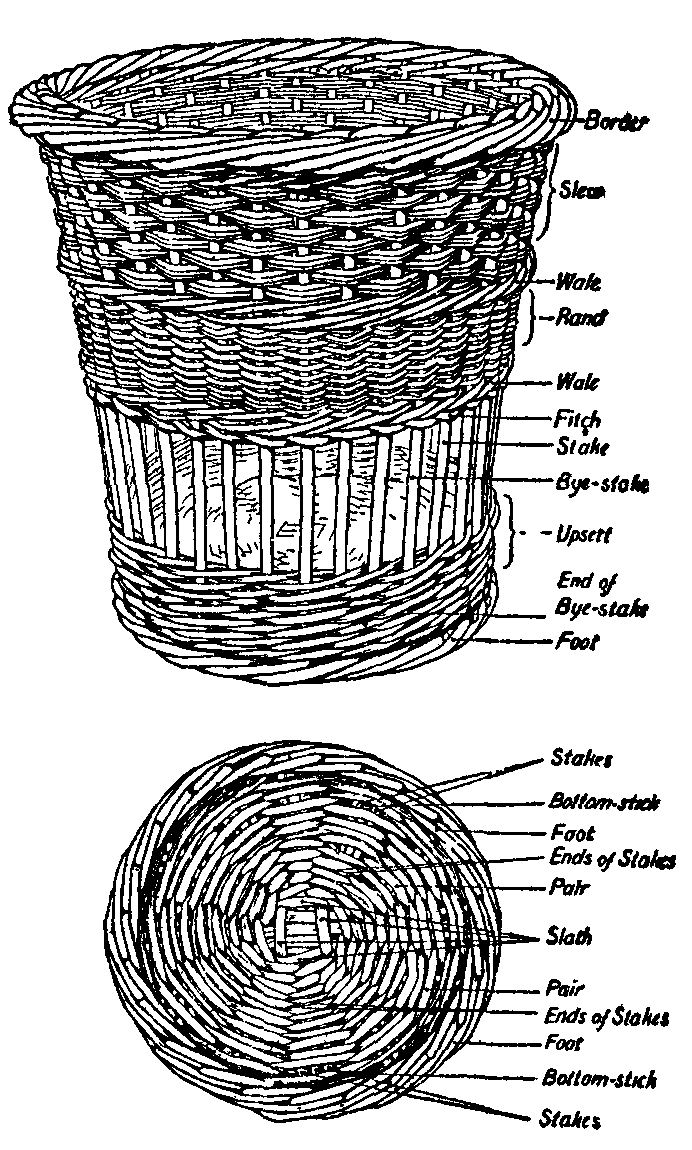
The technicalities of basket-making may be easily followed by a glance
at the illustration here reproduced by the courtesy of the Society of
Arts.[1] It
will be seen that the "bye-stakes" are merely inserted in the "upsett,"
whereas the stakes are driven in at each side of the "bottom-sticks" and
pricked up to form the rigid framework of the side. When the
"bottom-stick" and "stake" are formed of one and the same continuous rod,
it is termed a "league." If the bottom is made on a hoop the butts of the
stakes are "sliped," i.e. cut away with a long cut of the
shop-knife, and turned tightly round the hoop; they are then said to be
"scallomed" on. The chief strokes used in constructing an ordinary basket
are:—the "slew"—two or more rods woven together; the "rand,"
rods woven in singly; the "fitch," two rods tightly worked alternately
one under the other, employed for skeleton work such as cages and
waste-paper baskets; the "pair," two rods worked alternately one over the
other, used for filling up bottoms and covers of round and oval baskets;
and the "wale," three or more rods worked alternately, forming a string
or binding course. Various forms of plaiting, roping and tracking are
used for bordering off or finishing.
An ordinary oval basket is made by preparing the requisite number of
bottom sticks, preserving their length greater than the required width of
the bottom. They are ranged in pairs on the floor parallel to each other
at small intervals, in the direction of the longer diameter of the
basket, thus forming what may be called the "woof," for basket-work is
literally a web. These parallel rods are then crossed at right angles by
two pairs of the largest osiers, on the butt ends of which the workman
places his feet; and they are confined in their places by being each
woven alternately over and under the parallel pieces first laid down and
their own butts which form the end bottom sticks. The whole now forms
what is technically called the "slath," which is the foundation of the
basket. Next other rods are taken and woven under and
over the sticks all round the bottom until it be of sufficient size, and
the woof be occupied by them. Thus the bottom or foundation on which the
superstructure is to be raised is finished. This latter part is
accomplished by sharpening the large ends of as many long and stout
osiers as may be necessary to form the stakes or skeleton. These are
forced between the bottom sticks from the edge towards the centre, and
are turned up or "upset" in the direction of the sides; then other rods
are woven in and out between each of them, until the basket is raised to
the intended height, or, more correctly speaking, the depth it is to
receive. The edge or border is finished by turning down the ends of the
stakes, now standing up, behind and in front of each other, whereby the
whole is firmly and compactly united, and it is technically known as the
"belly." A lid is constructed on the same plan as that of the bottom, and
tied on with hinges formed of twisted rods; simple handles may be made by
inserting similar rods by the sides of two opposite stakes and looping
them under the border to form rope-like handles of three strands. This is
the most simple kind of basket, from which others differ only in being
made with finer materials and in being more nicely executed; but in these
there is considerable scope for taste and fancy, and articles are
produced of extreme neatness and ingenuity in construction.
In addition to willows many other materials are employed in the
fabrication of wicker-work. Among the more important of these is the stem
of Calamus viminalis or other allied species—the cane or
rattan of commerce—which is used whole or made into skains. Since
1880 the central pith of this material, known as "cane-pulp" or
"cane-pith," has been largely used in Great Britain and on the continent
of Europe in the manufacture of furniture and other finer classes of
work. About the same period plaited rush and straw, often coloured, came
into use together with enamelled skains of cane. It must be admitted,
however, that basket-work in these developments has encroached somewhat
on the domain of cabinet-making; for wood and nails are now much used in
constructing basket-work chairs, tables and other furniture.
With splits of various species of bamboo the Japanese and Chinese
manufacture baskets of unequalled beauty and finish. The bamboo
wicker-work with which the Japanese sometimes encase their delicate
egg-shell porcelain is a marvellous example of manipulation, and they and
the Chinese excel in the application of bamboo wicker-work to furniture.
In India "Cajan" baskets are extensively made from the fronds of the
Palmyra palm, Borassus flabelliformis, and this manufacture has
been established in the Black Forest of Germany, where it is now an
important and characteristic staple. Among the other materials may be
enumerated the odorous roots of the khus-khus grass, Anatherum
muricatum, and the leaves of various species of screw pine, used in
India and the East generally. The fronds of the palm of the Seychelles,
Lodoicea sechellarum, are used for very delicate basket-work in
those islands. Strips of the New Zealand flax plant, Phormium
tenax, are made into baskets in New Zealand. Esparto fibre is used in
Spain and Algeria for rude fruit baskets. Various species of
Maranta yield basket materials in the West Indies and South
America; and the Tirite, a species of Calathea, a member of
the order Zingiberaceae, is also employed similarly in Trinidad.
Baskets are also frequently made from straw, from various sedges
(Cyperus), and from shavings and splints of many kinds of
wood.
The chief centres of English basket manufacture outside London are
Thurmaston near Leicester, Basford near Nottingham, and Grantham. Large
but decreasing quantities of light basket-work are made for the English
market in Verdun, in the department of the Aisne, and in other parts of
France; and great quantities of fancy and other work are produced in
Belgium, in the Netherlands and in Germany, notably at Lichtenfels in
Bavaria, at Sonnefeld in Saxony and in the Black Forest.
The import and export values of baskets and basket-ware, and of
willows and rods for basket-making, have been enumerated in the Board of
Trade returns for the United Kingdom since 1900, in which year
basket-ware from foreign countries was imported to the value of £239,402.
In 1901 the imports increased to £264,183; then they declined to £227,070
in 1905. The main sources of supply are shown in this comparison of 1900
and 1905:
|
|
1900.
|
1905.
|
|
|
Belgium
|
£72,031
|
£77,766
|
+£5,735
|
|
Holland
|
58,214
|
54,407
|
- 3,807
|
|
France
|
55,870
|
27,910
|
-27,960
|
|
Germany
|
33,155
|
22,892
|
-10,263
|
|
Japan
|
8,140
|
25,536
|
+17,396
|
|
Portugal
|
5,066
|
3,971
|
- 1,095
|
The increase from Japan (for 1904 the value was £52,377) and the
decrease from France are remarkable.
The import values of foreign willows increased from £52,219 in 1900 to
£62,286 in 1905, the most important exporting countries being:—
|
|
1900.
|
1905.
|
|
|
Germany
|
£22,594
|
£34,752
|
+£12,158
|
|
Belgium
|
18,800
|
11,864
|
- 6,936
|
|
Holland
|
9,771
|
12,750
|
+ 2,979
|
Small British re-exports of willows (£1808 in 1900 and £371 in 1905)
and of baskets (£3785 in 1900 and £6633 in 1905) to foreign parts and
British possessions are tabulated. No particulars of exports of British
produce and manufacture are specified in the returns.
(T. O.)
See the report of
a paper by T. Okey, published in the Journal of the Society of
Arts, January 11th, 1907.
BASKET-BALL, a game adapted to the open air, but usually played
upon the floor of a gymnasium and in the cold season. It was the
invention, in 1891, of James Naismith, an instructor in the gymnasium of
the Young Men's Christian Association training-school at Springfield,
Massachusetts. A demand had arisen for a game for the gymnasium class,
which would break the monotony and take the place, during the winter
months, of football and baseball, and which was not too rough to be
played indoors. The idea of the game was first published in the
Triangle, the school paper. It soon became one of the most popular
indoor games of America, for girls as well as for men, and spread to
England and elsewhere.
Basket-ball is played on a marked-off space 60 ft. by 40 ft. in
extent, though in the open air the dimensions may be greater. In the
middle of each short side and 10 ft. above the floor or ground, is placed
a basket consisting of a net suspended from a metal ring 18 in. in
diameter, backed, at a distance of 6 in., by a back-board 6 ft. long and
4 ft. high. The object of the game is to propel an inflated,
leather-covered ball, 30 in. in circumference, into the opponents'
basket, which is the goal, by striking it with the open hands. The side
wins that scores most goals during two periods of play divided by an
interval of rest. Although there is practically no limit to the number of
players on each side, all indoor matches are played by teams of five, in
positions opposing one another as in lacrosse, centre, right and left
forwards and right and left guards (or backs). A referee has the general
supervision of the game and decides when goals have been properly scored,
and an umpire watches for infringements of the rules, which constitute
fouls. There are also a scorer and timekeeper.
The game is started with the two opposing centres standing within a
4-foot ring in the middle of the floor. The referee puts the ball in play
by tossing it into the air over the heads of the centres, who jump into
the air for its possession or endeavour to bat it towards the opposing
goal. From this moment the ball is in play until it falls into a basket,
or passes the boundary-lines, or a foul is made. After a goal has been
scored, the ball is again put in play by the referee in the centre.
Should it be thrown across the boundary, a player of the opposing side,
standing on the line at the point where the ball went over, puts it in
play by passing or throwing it to one of his own side in any direction,
there being no off-side rule—another point of similarity to
lacrosse. His opponents, of course, try to prevent the pass or intercept
the throw, thus securing the ball themselves. When a foul has been
called, a player of the opposing side is allowed a "free throw" for his
opponents' basket from a mark 15 ft. distant from it and without
interference. A goal scored from a free throw
counts one point; one scored while the ball is in play counts two.
Hacking, striking, holding and kicking are foul, but a player may
interfere with an opponent who has the ball so long as he uses one arm
only and does not hold. A player must throw the ball from where he gets
it, no running with it being allowed excepting when continuously bounding
it on the floor. Basket-ball is an extremely fast game and admits of a
high degree of combination or team-play. The principal qualifications of
a good player are quickness of movement and of judgment, coolness,
endurance, accuracy and self-control. Good dodging, throwing, passing and
team-play are the important requisites of the game, which is looked upon
as excellent winter training for outdoor games. Basket-ball, with
somewhat modified rules, is extremely popular with young women.
See Spalding's Basket-Ball Guide; and George T. Hepbron, How
to Play Basket-Ball; and Spalding's Basket-Ball Guide for
Women.
BASNAGE, JACQUES (1653-1723), French Protestant divine, was the
eldest son of the eminent lawyer Henri Basnage, sieur de Franquenay
(1615-1695), and was born at Rouen in Normandy in 1653. He studied
classical languages at Saumur and afterwards theology at Geneva. He was
pastor at Rouen (his native place) from 1676 till 1685, when, on the
revocation of the edict of Nantes, he obtained leave of the king to
retire to Holland. He settled at Rotterdam as a minister pensionary till
1691, when he was chosen pastor of the Walloon church. In 1709 the grand
pensionary A. Heinsius (1641-1720) secured his election as one of the
pastors of the Walloon church at the Hague, intending to employ him
mainly in civil affairs. Accordingly he was engaged in a secret
negotiation with Marshal d'Uxelles, plenipotentiary of France at the
congress of Utrecht—a service which he executed with so much
success that he was entrusted with several important commissions, all of
which he discharged with great ability. In 1716 Dubois, who was at the
Hague at the instance of the regent Orleans, for the purpose of
negotiating the Triple Alliance between France, Great Britain and
Holland, sought the advice of Basnage, who, in spite of the fact that he
had failed to receive permission to return to France on a short visit the
year before, did his best to further the negotiations. The French
government also turned to him for help in view of the threatened rising
in the Cevennes. Basnage had welcomed the revival of the Protestant
church due to the zeal of Antoine Court; but he assured the regent that
no danger of active resistance was to be feared from it, and, true to the
principles of Calvin, he denounced the rebellion of the Camisards
(q.v.) in his Instructions pastorales aux Réformés de France
sur l'obéissance due aux souverains (Paris, 1720), which was printed
by order of the court and scattered broadcast in the south of France.
Basnage died on the 22nd of September 1723.
Basnage was a good preacher and a prolific writer. His works include
several dogmatic and polemical treatises, but the most important are the
historical. Of these may be mentioned Histoire de la religion des
églises réformées (Rotterdam, 1690), the Histoire de l'église
depuis Jésus-Christ jusqu'à présent (ib. 1699)—both of
them written from the point of view of Protestant polemics—and, of
greater scientific value, the Histoire des Juifs (Rotterdam, 1706,
Eng. trans. 1708) and the Antiquités judaiques ou remarques critiques
sur la république des Hébreux (1713). He also wrote short explanatory
introductions and notes to a collection of copper-plate engravings, much
valued by connoisseurs, called Histoires du Vieux et du Nouveau
Testament, représentées par des figures gravées en taille-douce par R. de
Hooge (Amsterdam, 1704).
BASOCHE, or Bazoche, with the analogous
forms Basoque, Basogue
and Bazouges; from the Lat. basilica, in
the sense of law courts, a French gild of clerks, from among whom legal
representatives (procureurs) were recruited. This gild was very
ancient, even older than the gild of the procureurs, with which it
was often at variance. It dated, no doubt, from the time when the
profession of procureur (procurator, advocate or legal
representative) was still free in the sense that persons rendering that
service to others when so permitted by the law were not yet public and
ministerial officers. For this purpose there was established near each
important juridical centre a group of clerks, that is to say, of men
skilled in law (or reputed to be so), who at first would probably fill
indifferently the rôles of representative or advocate. Such was the
origin of the Basoche of the parlement of Paris; which naturally formed
itself into a gild, like other professions and trades in the middle ages.
But this organization eventually became disintegrated, dividing up into
more specialized bodies: that of the advocates, whose history then
begins; and that of legal representatives, whose profession was
regularized in 1344, and speedily became a saleable charge. The remnant
of the original clerks constituted the new Basoche, which thenceforward
consisted only of those who worked as clerks for the procureurs, the
richer ones among them aspiring themselves to attain the position of
procureur. They all, however, retained some traces of their original
conditions. "They are admitted," writes an 18th-century author, "to plead
before M. le lieutenant civil sur les réferés[1] and before M.
le juge auditeur; so that the procureurs of these days are but the former
clerks of the Basoche, admitted to officiate in important cases in
preference to other clerks and to their exclusion." From its ancient past
the Basoche had also preserved certain picturesque forms and names. It
was called the "kingdom of the Basoche," and for a long time its
chief, elected each year in general assembly, bore the title of "king."
This he had to give up towards the end of the 16th century, by order, it
is said, of Henry III., and was thenceforth called the "chancellor." The
Basoche had besides its maîtres des requêtes, a grand court-crier,
a referendary, an advocate-general, a procureur-général, a
chaplain, &c. In early days, and until the first half of the 16th
century, it was organized in companies in a military manner and held
periodical reviews or parades (montres), sometimes taking up arms
in the king's service in time of war. Of this there survived later only
an annual cavalcade, when the members of the Basoche went to the
royal forest of Bondy to cut the maypole, which they afterwards set up in
the court-yard of the Palais. We hear also of satirical and literary
entertainments given by clerks of the Palais de Justice, and of the
moralities played by them in public, which form an important element in
the history of the national theatre; but at the end of the 16th century
these performances were restricted to the great hall of the Palais.
To the last the Basoche retained two principal prerogatives. (1) In
order to be recognized as a qualified procureur it was necessary to have
gone through one's "stage" in the Basoche, to have been entered by name
for ten years on its register. It was not sufficient to have been merely
clerk to a procureur during the period and to have been registered at his
office. This rule was the occasion of frequent conflicts during the 17th
and 18th centuries between the members of the Basoche and the procureurs,
and on the whole, despite certain decisions favouring the latter, the
parlement maintained the rights of the Basoche. Opinion was favourable to
it because the certificats de complaisance issued by the
procureurs were dreaded. These certificats held good, moreover, in
places where there was no Basoche. (2) The Basoche had judiciary powers
recognized by the law. It had disciplinary jurisdiction over its members
and decided personal actions in civil law brought by one clerk against
another or by an outsider against a clerk. The judgment, at any rate if
delivered by a maître des requêtes, was authoritative, and could
only be contested by a civil petition before the ancient council of the
Basoche. The Châtelet of Paris had its special basoche, which claimed to
be older even than that of the Palais de Justice, and there was
contention between them as to certain rights. The clerks of the
procureurs at the cour des comptes of Paris had their own Basoche
of great antiquity, called the "empire de Galilée." The Basoche of the
Palais de Justice had in its ancient days the right to create
provostships in localities within the jurisdiction of the parlement of
Paris, and thus there sprang up a certain number of local basoches.
Others were independent in origin; among such being the "regency" of
Rouen and the Basoche of the parlement of Toulouse.
See also Répertoire de jurisprudence des Guyot; Recueil des Statuts
du royaume de la basoche (Paris, 1654); L. A. Fabre, Études
historiques sur les clercs de la basoche (Paris, 1856).
(J. P. E.)
A procedure for
obtaining a provisional judgment on urgent cases.
BASQUE PROVINCES (Provincias Vascongadas), a division of
north-eastern Spain, comprising the three provinces of Álava, Biscay or
Vizcaya and Guipúzcoa. Pop. (1900) 603,596; area 2739 sq. m., the third
in density in Spain. The territory occupied by the Basque Provinces forms
a triangle bounded on the west and south by the provinces of Santander,
Burgos and Logrono, on the east by Navarre, on the north by France and
the Bay of Biscay. The French Pays Basque forms part of the
arrondissements of Bayonne and Mauléon. For an account of the people,
their origin, customs and language, see Basques.
Of the Provinces, Guipúzcoa is the only one which is wholly Basque, Álava
is the least so. Its capital, Vitoria, is said to have been founded by
the Gothic king Leovigild (581). Older than these divisions, the date of
which is uncertain, the ancient limits of the dioceses of Pamplona,
Bayonne and Calahorra, probably corresponded more nearly to the
boundaries of the ancient tribes, the Autrigones, the Caristi, the
Varduli and the Vascones, with their still differing dialects, than do
these civil provinces.
Leaving aside the legendary and uncertain portion of their history, we
find the Provinces in some districts dependent allies of Navarre, in
others of Castile. In Biscay the counts of Haro were lords of Biscay from
1093 to 1350. There was a short union with Castile under Pedro the Cruel,
but the definitive union did not take place till 1370. In Álava the
ruling power was the confederation of Arriaga (so called after its
meeting place), which united the province to the crown of Castile in
1332. Guipúzcoa, which had been dependent sometimes on Navarre, sometimes
on Castile, was definitively united to Castile in 1200. From the year
1425 the provinces were desolated by party wars among the lesser nobles
(parientes mayores) but these came to an end in 1460-1498, when
Henry IV. and Ferdinand the Catholic strengthened the power of the towns
and forbade the erection of any fortified house in the country. Though
the three Basque Provinces were thus united to the crown of Spain, they
still remained a land apart (tierra apartada). Their juntas acted
to some extent in common; and although no written federal pact is known
to have existed, they employed, as the symbol of their unity, a seal with
the word Iruracbat, "The Three One," engraved upon it. They
preserved their own laws, customs, fueros (see Basques), which the Spanish kings swore to observe and
maintain. Unless countersigned by the juntas the decrees of Cortes and
Spanish legislation or royal orders had no force in the Provinces. In the
junta of 1481 Guipúzcoa alone proposed a treaty of friendship, peace and
free trade for ten years with England, and this was signed in
Westminster, on the 9th of March 1482 (see Rymer, Foedera). The
Basques still made their own treaties with England and France and are
mentioned apart from Spain in the treaty of Utrecht (1713). They still
preserved in their municipal institutions the old style of
republicas derived from the civitates and
respublicae of ancient Rome. This kind of independence and
autonomy lasted unchallenged until the death of Ferdinand VII. in 1833,
when, in default of male heirs, his brother Don Carlos claimed the
throne, confirmed the Basque fueros, and raised the standard of
revolt against his niece, Isabel II. A seven years' war followed, in
which an English legion under Sir George de Lacy Evans and a naval force
under Lord John Hay took part. It was ended by the Convenio de Vergara
(August 31st, 1839) in which the concession and modification of the
fueros was demanded. The troubled period which followed the
expulsion of Isabel II. in 1868 gave opportunity for a second Carlist war
from 1872 to 1876. This ended, unlike the former one, in the utter defeat
of the Carlist forces, and left the Provinces at the mercy of the
government, without terms or agreement. In general government and
legislation the Provinces were then assimilated to the rest of the
nation. After 1876, the Provincial parliaments (diputaciones) were
elected like the other provincial councils of Spain, deprived of many
privileges and subjected to the ordinary interference of the civil
governors. But their representatives, assisted by the senators and
deputies of the Basque Provinces in the Cortes, negotiated successive
pacts, each lasting several years, securing for the three Provinces their
municipal and provincial self-government, and the assessment,
distribution and collection of their principal taxes and octroi duties,
on the understanding that an agreed sum should be paid annually to the
state, subject to an increase whenever the national taxation of other
provinces was augmented. In December 1906, after long discussion, the
contribution of the Basque Provinces to the state, according to the law
of the 21st of July 1876, was fixed for the next twenty years; for the
first ten years at 8,500,000 pesetas, for the next ten an additional
500,000 pesetas, from 31st December 1916 to 31st December 1926, the
province of Guipúzcoa paying in addition 700,000 pesetas to the treasury.
These pacts have hitherto been scrupulously observed, and as the local
authorities levy the contribution after their own local customs, landed
property and the industrial and commercial classes are less heavily taxed
in these territories than in the rest of Spain. Enough is raised,
however, besides the amount handed over to the government, to enable the
schools, roads, harbours and public works of every kind to be maintained
at a standard which compares very favourably with other parts of Spain.
When the three provinces sent in their first contingent of conscripts in
1877, it was found that all but about sixty knew how to read and write,
and succeeding contingents have kept up this high standard.
In agriculture the Basque Provinces and the Pays Basque were great
cider countries, but during the 19th century this was gradually replaced
by wine-growing. The chief industries of the Basque Provinces are the sea
fisheries and iron mining. Some of the mines round Bilbao have been
worked from prehistoric times. In 1905 the Basque Provinces produced
5,302,344 tons of iron, over five millions of which came from Biscay, out
of a total of 9,395,314 tons for the whole of Spain. More than the half
of this total 5,845,895 tons, was exported to England. The swords of
Mondragon in Guipúzcoa were renowned before those of Toledo. Eibar in the
same province has long been a small-arms factory. There in the 19th
century Señor Zuloaga successfully revived the artistic inlaying of gold
and silver in steel and iron.
Bibliography.—Of older works, though
often uncritical, R. P. Henao's Averiguaciones de las Antiguedades de
Cantabria (Salamanca, 1688) is still valuable (new edition, 1894).
For all that relates to the manners and customs of the people,
Corografía de Guipúzcoa, by R. P. M. de Larramendi, S.J., is
indispensable. Written about 1750, it was first printed in Barcelona in
1882 (later edition, San Sebastian, 1896). There are excellent chapters
on the Basque Provinces in the Introduccion a la Historia Natural, y a
la Geografía Fisica de España, by D. Guillermo Bowles (Madrid, 1775).
El Guipuzcoano instruido (San Sebastian, 1780), in the form of a
dictionary, gives full details of the life, the rights, duties and
obligations of a Basque citizen of that date. The Diccionario
Geografico-Historico de España, tome i., ii. El Reyno de Navarra
Senorio de Vizcaya y Provincias de Álava y Guipúzcoa (Madrid, 1802),
is full of local information, but with a strong bias in favour of the
central government. The best works on the various editions of the
fueros are Historia de la Legislacion ... civil de España,
by A. Marichalar, Marques de Montesa, and Cayetano Manrique; Fueros de
Navarra Vizcaya, Guipúzcoa y Álava (Madrid, 2nd ed., 1868); and the
Noticia de las cosas memorables de Guipúzcoa, by D. Pablo de
Gorosabel (Tolosa, 1899-1901), the last volume of which by C. de
Echegaray, gives the legislative acts down to May 1900. Las Provincias
Vascongadas a Fines de la Edad Media, by D. Carmelo de Echegaray (San
Sebastian, 1895), is excellent. There is a Historia de Bizcaya, by
Dr E. de Labayru, and a Compendio of the same by Fermin Herran
(Bilbao, 1903). D. Carmelo de Echegaray, Cronista de las Provincias
Vascongadas, with his colleagues D. Serapio Mugica, F. Soraluce, and
other historians, has examined, catalogued and indexed the municipal
archives of all the towns, without which no true history can be written.
Several discoveries of important missing documents and MSS. were thus
made. The development of the Basque mining industry is fully described in
Las Minas de hierro de la provincia de Vizcaya, progressos realizados
en esta region derde 1870 hasta 1899 (Bilbao, 1900).
(W. We.)
BASQUES, a people inhabiting the three Basque
Provinces—Biscay, Álava and Guipúzcoa—and Navarre in Spain,
and the arrondissement of Bayonne and Mauléon in France. The number of
those who can be considered in any sense pure Basques is probably about 600,000 in Europe, with perhaps 100,000
emigrants in the Americas, chiefly in the region of La Plata in South
America. The word Basques is historically derived from Vascones,
which, written Wascones, has also given the name Gascons to
a very different race. The Basques call themselves Eskualdunak,
i.e. "those who possess the Eskuara," and their country
Eskual-Herria.
Language.—The original and proper name of the language is
Eskuara (euskara, uskara), a word the exact meaning of which has not yet
been ascertained, but which probably corresponds with the idea "clearly
speaking." The language is highly interesting and stands as yet
absolutely isolated from the other tongues of Europe, though from the
purely grammatical point of view it recalls the Magyar and Finnic
languages. It is an agglutinative, incorporating and polysynthetic system
of speech; in the general series of organized linguistic families it
would take an intermediate place between the American on the one side and
the Ugro-Altaic or Ugrian on the other.
Basque has no graphic system of its own and uses the Roman character,
either Spanish or French; a few particular sounds are indicated in modern
writings by dotted or accented letters. The alphabet would vary according
to the dialects. Prince L. L. Bonaparte counts, on the whole, thirteen
simple vowels, thirty-eight simple consonants. Nasal vowels are found in
some dialects as well as "wet" consonants—ty, dy,
ny, &c. The doubling of consonants is not allowed and in
actual current speech most of the soft consonants are dropped. The letter
r cannot begin a word, so that rationem is written in
Basque arrazoin.
Declension is replaced by a highly developed postpositional system;
first, the definite article itself a (plural ak) is a
postposition—zaldi, "horse," zaldia "the horse,"
zaldiak, "the horses." The declensional suffixes or postpositions,
which, just like our prepositions, may be added to one another, are
postponed to the article when the noun is definite. The principal
suffixes are k, the mark of the plural, and of the singular
nominative agent; n, "of" and "in"; i, "to"; z,
"by"; ik, "some"; ko, "from," "of" (Lat. a);
tik, "from" (Lat. ex); tzat, kotzat,
tzako, "for"; kin, gaz, "with"; gatik, "for
the sake of"; gana, "towards"; ra, rat, "to,"
"into," "at," &c. Of these suffixes some are joined to the definite,
others to the indefinite noun, or even to both.
The personal pronouns, which to a superficial observer appear closely
related to those of the Semitic or Hamitic languages, are ni, "I";
hi, "thou"; gu, "we"; zu, "you" in modern times,
zu has become a polite form of "thou," and a true plural "you"
(i.e. more than one) has been formed by suffixing the pluralizing
sign k—zuek. The pronouns of the third person are mere
demonstratives. There are three: hura or kura, "that";
hau or kau, "this"; ori or kori, "this" or
"that." Other unexplained forms are found in the verbal inflexions,
e.g. d, it, and t, "I" or "me";
d-akus-t, "it see I" = I see it; d-arrai-t, "it follows
me." The demonstratives are used as articles: gazt-en-or, "this
younger one"; andre-ori, "this lady at some distance." The
reflective "self" is expressed by buru, "head." The relative does
not exist, and in its place is used as a kind of verbal participle with
the ending n: doa, "he goes"; doana, "he who is going"; in
the modern Basque, however, by imitation of French or Spanish, the
interrogative zein, zoin, is used as a relative. Other
interrogatives are nor, "who"; zer, "what"; zembait,
"how much," &c. Bat, "one"; batzu, "several";
bakotch, "each"; norbait, "some one"; hanitz or
hainitz, "much"; elkar, "both"; are the most common
indefinite pronouns. The numeral system is vicesimal; e.g. 34 is
hogoi ta hamalaur, "twenty and fourteen." The numbers from one to
ten are: 1, bat; 2, bi; 3, hiru; 4, lau; 5,
bortz or bost; 6, sei; 7, zazpi; 8,
zortzi; 9, bederatzi; 10, hamar; 20, hogoi or
hogei; 40, berrogoi (i.e. twice twenty); 100,
ehun. There is no genuine word for a thousand.
The genders in Basque grammar are distinguished only in the verbal
forms, in which the sex of the person addressed is indicated by a special
suffix; so that eztakit means, "I do not know it"; but to a woman
one says also: eztakinat, "I do not know it, oh woman!" To a man
one says: eztakiat (for eztakikat), "I do not know it, oh
man!" moreover, certain dialectic varieties have a respectful form:
eztakizut, "I do not know it, you respectable one," from which
also a childish form is derived, eztakichut, "I do not know it, oh
child!"
The Basque conjugation appears most complicated, since it incorporates
not only the subject pronouns, but, at the same time, the indirect and
direct complement. Each transitive form may thus offer twenty-four
variations—"he gives it," "he gives it to you," "he gives them to
us," &c., &c. Primitively there were two tenses only, an
imperfect and a present, which were distinguished in the transitive verb
by the place of the personal subject element: dakigu, "we are
knowing it" (gu, i.e. we), and ginaki, "we were
knowing it"; in the intransitive by a nasalization of the radical:
niz, "I am"; nintz, "I was." In modern times a conjectural
future has been derived by adding the suffix ke, dakiket,
"I will, shall or probably can know it." No proper moods are known, but
subjunctive or conjunctive forms are formed by adding a final n,
as dakusat, "I am looking at it"; dakusadan, "if I see it."
No voices appear to have been used in the same radical, so that there are
separate transitive and intransitive verbs.
In its present state Basque only employs its regular conjugation
exceptionally; but it has developed, probably under the influence of
neo-Latin, a most extensive conjugation by combining a few auxiliary
verbs and what may be called participles, in fact declined nouns:
ikusten dut, "I have it in seeing," "I see it"; ikusiko
dut, "I have it to be seen," "I will see it," &c. The principal
auxiliaries are: izan, "to be"; and ukan, "to have"; but
edin, "to can"; eza, "to be able"; egin, "to make";
joan, "to go"; eroan, "to draw," "to move," are also much
used in this manner.
The syntax is simple, the phrases are short and generally the order of
words is: subject, complement, verb. The determining element follows the
determined: gizon handia, "man great the"—the great man: the
genitive, however, precedes the nominative—gizonaren etchea,
"the man's house." Composition is common and it has caused several
juxtaposed words to be combined and contracted, so that they are
partially fused with one another—a process called
polysyntheticism; odei, "cloud," and ots, "noise," form
odots, "thunder"; belar, "forehead," and oin,
"foot," give belaun, "knee," front of the foot. The vocabulary is
poor; general and synthetic words are often wanting; but particular terms
abound. There is no proper term for "sister," but arreba, a man's
sister, is distinguished from ahizpa, a woman's sister. We find no
original words for abstract ideas, and God is simply "the Lord of the
high."
The vocabulary, however, varies extremely from place to place and the
dialectic varieties are very numerous. They have been summed up by Prince
L. L. Bonaparte as eight; these may be reduced to three principal groups:
the eastern, comprising the Souletine and the two lower Navarrese; the
central formed by the two upper Navarrese, the Guipúzcoan and the
Labourdine; and the western, formed by the Biscayan, spoken too in Álava.
These names are drawn from the territorial subdivisions, although the
dialects do not exactly correspond with them.
Ethnology and Anthropology.—The earliest notices of the
geography of Spain, from the 5th century B.C.,
represent Spain as occupied by a congeries of tribes distinguished mainly
as Iberi, Celtiberi and Celts. These had no cohesion together, and unless
temporarily united against some foreign foe, were at war with one another
and were in constant movement; the ruder tribes being driven northwards
by the advancing tide of Mediterranean civilization. The tribes in the
south in Baetica had, according to Trogus and Strabo, written laws, poems
of ancient date and a literature. Of this nothing has reached us. We have
only some inscriptions, legends on coins, marks on pottery and on
megalithic monuments, in alphabets slightly differing, and belonging to
six geographical districts. These still await an interpreter; but they
show that a like general language was once spoken through the whole of
Spain, and for a short distance on the northern
slope of the Pyrenees. The character of the letters is clearly of Levant
origin, but the particular alphabets, to which each may be referred, and
their connexion, if any, with the Basque, are still undetermined. It was
early remarked by the classical scholars among the Basques after the
Renaissance that certain names in the ancient toponymy of Spain, though
transcribed by Greek and Latin writers, i.e. by foreigners,
ignorant of the language, yet bear a strong resemblance to actual
place-names in Basque (e.g. Iliberis, Iriberry); and in a few
cases (Mondiculeia, Mendigorry; Iluro, Oloron) the site itself shows the
reason of the name. Andres de Poza (1587), Larramendi (1760), Juan B.
Erro (1806) and others had noted some of these facts, but it was W. von
Humboldt (1821) who first aroused the attention of Europe to them. This
greater extension of a people speaking a language akin to the Basque
throughout Spain, and perhaps in Sicily and Sardinia, has been accepted
by the majority of students, though some competent Basque scholars deny
it; and the certain connexion of the Basques, either with the Iberians or
Celtiberians, whether in race or language, cannot be said to be
conclusively proved as long as the so-called Celtiberian inscriptions
remain uninterpreted. (See also Iberians.)
After so many centuries of close contact and interpenetration with
other peoples, we can hardly expect to find a pure physical type among
the present Basques. All that we can expect is to be able to
differentiate them from their neighbours. The earliest notice we have of
the Basques, by Einhard (778), speaks of their wonderful agility. The
next, the pilgrim of the Codex Calixtinus (12th century), says the
Basques are fairer in face (facie candiliores) than the
Navarrese.
Anthropologists no longer rely solely on craniology, and the
measurement of the skull, to distinguish race. The researches of Aranzadi
(1889 and 1905) and of Collignon (1899) show them as less fair than
northern Europeans, but fairer than any of the southern races; not so
tall as the Scandinavians, Teutons or British, but taller than their
neighbours of southern races. There is no tendency to prognathism, as in
some of the Celts. The profile is often very fine; the carriage is
remarkably upright. Neither markedly brachycephalous nor
dolichocephalous, the skull has yet certain peculiarities. In the
conjunction of the whole physical qualities, says Collignon, there is a
Basque type, differing from all those he has studied in Europe and
northern Africa. There are differences of type among themselves, yet,
when they emigrate to South America, French and Spanish Basques are known
simply as Basques, distinct from all other races.
On the origin of the Basques, the chief theories are:—(1) that
they are descended from the tribes whom the Greeks and Latins called
Iberi; (2) that they belong to some of the fairer Berber tribes
("Eurafrican," Hervé) and through the ancient Libyans, from a people
depicted on the Egyptian monuments; (3) the Atlantic theory, that they
belong to a lost Atlantic continent, whose inhabitants were represented
by the Guanches of the Canary Islands, and by a fair race on the western
coast of Africa; (4) that they are an indigenous race, who have never had
any greater extension than their present quarters.
The remains of prehistoric races hitherto discovered in Spain throw
little light on the subject, but some skulls found in southeastern Spain
in the age of metal resemble the Basque skulls of Zaraus.
The megalithic remains, the dolmens, menhirs, cromlechs and stone
circles are said to resemble more closely those of northern Africa than
the larger remains of Brittany and of the British Isles. Aristotle tells
us that the Iberi fixed obelisks round the tomb of each warrior in number
equal to the enemies he had slain (Polit. vii. c. 2. 6), but proof
is wanting that these Iberi were Basques.
Iberian inscriptions have been found on the so-called toros de
guisando, rude stone bulls or boars, on other monuments of northern
Spain and in ancient sepulchres; some of these figures, e.g. at
the Cerro de los Santos in Murcia, recall the physical type of the
modern Basques, but they are associated with others of very varied
types.
Of the religion of the Basques anterior to Christianity, little is
certainly known. The few notices we have point to a worship of the
elements, the sun, the moon and the morning star, and to a belief in the
immortality of the unburnt and unburied body. The custom of the
couvade, attributed by Strabo to the Cantabri, is unknown among
the modern Basques. As elsewhere, the Romans assimilated Basque local
deities to their own pantheon, thus we find Deo Baicorrixo
(Baigorry) and Herauscorrtsehe in Latin inscriptions. But the name
which the Basques themselves give to the Deity is Jaincoa,
Jaungoikoa, which may mean lord or master, Lord of the high; but
in the dialect of Roncal, Goikoa means "the moon," and
Jaungoikokoa would mean "Lord of the moon." The term Jaun,
lord or master, Etcheko Jauna, the lord or master of the house, is
applied to every householder.
There is no aid to be got from folk-tales; none can be considered
exclusively Basque and the literature is altogether too modern. The first
book printed in Basque, the Linguae Vasconum Primitiae, the poems
of Bernard d'Echepare, is dated 1545. The work which is considered the
standard of the language is the Protestant translation of the New
Testament made by Jean de Liçarrague, under the auspices of Jeanne
d'Albret, and printed at La Rochelle in 1571. The pastorales are
open-air dramas, like the moralities and mysteries of the middle ages.
They are derived from French materials; but a dancing chorus, invariably
introduced, and other parts of the mise-en-scène, point to
possibly earlier traditions. No MS. hitherto discovered is earlier than
the 18th century. The greater part of the other literature is religious
and translated. It is only recently that a real literature has been
attempted in Basque with any success.
In spite of this modernity in literature there are other matters which
show how strong the conservatism of the Basques really is. Thus, in
dealing with the language, the only true measure of the antiquity of the
race, we find that all cutting instruments are of stone; that the week
has only three days. There are also other survivals now fast
disappearing. Instead of the plough, the Basques used the laya, a
two-pronged short-handled steel digging fork, admirably adapted to small
properties, where labour is abundant. They alone of the peoples of
western Europe have preserved specimens of almost every class of dance
known to primitive races. These are (1) animal (or possibly totem)
dances, in which men personate animals, the bear, the fox, the horse,
&c.; (2) dances to represent agriculture and the vintage performed
with wine-skins; (3) the simple arts, such as weaving, where the dancers,
each holding a long coloured ribbon, dance round a pole on which is
gradually formed a pattern like a Scotch tartan; (4) war-dances, as the
sword-dance and others; (5) religious dances in procession before the
Host and before the altar; (6) ceremonial dances in which both sexes take
part at the beginning and end of a festival, and to welcome distinguished
people. How large a part these played in the life of the people, and the
value attached to them, may be seen in the vehement defence of the
religious dances by Father Larramendi, S.J., in his Corografia de
Guipúzcoa, and by the large sums paid for the privilege of dancing
the first Saut Basque on the stage at the close of a
Pastorale.
The old Basque house is the product of a land where stone and timber
were almost equally abundant. The front-work is of wood with carved
beams; the balconies and huge over-hanging roof recall the Swiss chalet,
but the side and back walls are of stone often heavily buttressed. The
cattle occupy the ground-floor, and the first storey is reached often by
an outside staircase. The carven tombstones with their ornaments resemble
those of Celtic countries, and are found also at Bologna in Italy.
In customs, in institutions, in administration, in civil and political
life there is no one thing that we can say is peculiarly and exclusively
Basque; but their whole system taken together marks them off from other
people and especially from their neighbours.
Character.—The most marked features in the Basque
character are an intense self-respect, a pride of race and an obstinate
conservatism. Much has been written in ridicule of the claim of all
Basques to be noble, but it was a fact both in the laws of Spain,
in the fueros and in practice. Every Basque freeholder
(vecino) could prove himself noble and thus eligible to any
office. They are not a town race; a Basque village consists of a few
houses; the population lives in scattered habitations. They do not fear
solitude, and this makes them excellent emigrants and missionaries. They
are splendid seamen, and were early renowned as whale fishermen in the
Bay of Biscay. They were the first to establish the cod-fishery off the
coast of Newfoundland. They took their full part in the colonization of
America. Basque names abound in the older colonial families, and Basque
newspapers have been published in Buenos-Aires and in Los Angeles,
California. As soldiers they are splendid marchers; they retain the
tenacity and power of endurance which the Romans remarked in the Iberians
and Celtiberians. They are better in defence than in attack. The failure
to take Bilbao was the turning-point in both Carlist wars. In civil
institutions and in the tenures of property the legal position of women
was very high. The eldest born, whether boy or girl, inherited the
ancestral property, and this not only among the higher classes but among
the peasantry also. In the fueros an insult done to a woman, or in
the presence of a woman, is punished more severely than a similar offence
among men. This did not prevent women from working as hard as, or even
harder than, the men. All authors speak of the robust appearance of the
women-rowers on the Bidassoa, and of those who loaded and unloaded the
ships in Bilbao.
Institutions.—In their municipal institutions they kept
the old Roman term respublica for the civitas and the
territory belonging to it. All municipal officers were elective in some
form or other, and there is hardly any mode of election, from universal
suffrage to nomination by a single person chosen by lot, that the Basques
have not tried. The municipalities sent deputies to the juntas or
parliaments of each province. These assemblies took place originally in
the open air, as in other parts of the Pyrenees, under trees, the most
celebrated of which is the oak of Guernica in Biscay, or under copses, as
the Bilzaar in the French Pays Basque. The cortes of Navarre met at
Pamplona. Delegates from the juntas met annually to consider the common
interests of the three provinces. Besides the separate municipalities and
the juntas, there were often associations and assemblies of three or five
towns, or of three or four valleys, to preserve the special privilege or
for the special needs of each. Hence was formed a habit of
self-government, the practice of legislative, judicial and administrative
functions, which resulted gradually in a code of written or unwritten
laws embodied in the fueros or fors of each province, and
the cartas-pueblos of the towns. In form these fueros or
charters are often grants from the lord or sovereign; in reality they are
only a confirmation or codification of unwritten customary laws in
practice among the people, the origin of which is lost in antiquity. The
kings of Castile, of Spain and of Navarre were obliged at their
accession, either in person, or by deputy, to swear to observe these
fueros; and this oath was really kept. While the cortes were
trampled upon and absolutism reigned both in Spain and in France, the
Basque fueros were respected; in Spain to the middle of the 19th
century and in France down to the Revolution. The fueros thus
observed made the Basque provinces a land apart (una tierra
apartada), a self-governing republic (una verdadera
autonomia), under an absolute monarchy, to which, however, they were
always loyal. And this independence was acknowledged, not only in local,
but also in international and European treaties, as in art. 15 of the
treaty of Utrecht 1713. So the act of the 3rd of June 1876, which
assimilated the Basque Provinces to the rest of Spain, acknowledged the
true self-government which they had enjoyed for centuries.
The circumstances and methods which enabled the Basques to preserve
this independence were, first, the isolation caused by their peculiar
language; next, the mountainous and easily-defended nature of the
country, its comparative poverty and the possession of a sea-board. Then
there were the rights and the safeguards which the fueros
themselves gave against encroachments. The rights were:—freedom of
election to all offices and to the juntas; exemption from all forced
military service except for the defence of the country and under their
own officers; and payment beforehand exacted for all service beyond their
own frontiers (this did not of course exclude voluntary service of
individuals in the Spanish or French armies). Then there was free trade
with foreign nations, and especially between the Basques of both nations.
The customs' frontier of Spain really began on the Ebro. Then no decree
or sentence of the royal authorities could have effect in the provinces
except countersigned by the junta. Otherwise the resisting and even the
killing of a royal officer was no murder. But chiefest of all the
safeguards was the provision that no tax or contribution should be levied
or paid to the crown till all petitions had been heard and wrongs
redressed; that such a vote should be the last act of the junta or
cortes, and the money should be paid not as a demand of right or a tax,
but as a free gift and above all a voluntary one. It was paid in a lump
sum, and the repartition and levying were left entirely in the hands of
the junta and the municipalities.
As a further precaution against the inroads of absolutism, no lawyer
was allowed to be a deputy to the junta and all clergy were likewise
excluded. The Basques considered that men of these professions would be
always on the side of tyranny. One lawyer (letrado) was present at
the juntas for consultation on the points of law, but he was not allowed
to vote. So strictly was this observed that after the battle of Vitoria
in 1813, when it was difficult to get together a quorum for the
reorganization of the country, the letrado, though one of the most
active and influential members in consultation, was not allowed to
vote.
The relations between Church and State among the Basques have been
very remarkable. They are a highly religious people, eminently
conservative in their religious practices. In religion alone, through
Ignatius de Loyola of Guipúzcoa and Francis Xavier of Navarre, they have
left their mark upon Europe. They have kept the earliest form of
Christian marriage and of the primitive order of deaconesses, forgotten
elsewhere in the West. The feast of Corpus Christi instituted by Pope
Urban IV. (1262) still appears in Basque almanacs as
Phesta-berria, the New Feast. The earliest notice that we have of
them speaks of their liberality to the clergy; yet with all this
religious conservatism they have never allowed themselves to be
priest-ridden. They constantly resisted the attempts of the crown to
force upon them the authority of the Spanish bishops. When Ferdinand the
Catholic came to Biscay in 1477 to swear to the fueros, he was
compelled to send back the bishop of Pamplona whom he had brought with
him. No strange priest could enter the town when the junta was sitting,
and in some places if a deputy was seen speaking to a priest before a
session he lost his vote for that day. The bishops had no share in
ecclesiastical patronage in Guipúzcoa; all was in the hands of the king,
of the nobles or of the municipalities, or else the priests were chosen
by competitive examination or elected by the people. They would not allow
the priest to interfere with the games or dances, and when the drama was
forbidden in all Spain in 1757 by the authority of the Spanish bishops,
the cortes of Navarre compelled the king to withdraw the order.
For a stranger coming from lands of larger farms and apparently higher
cultivation, the agriculture of the Basques seems poor, but the old
scattered homesteads show a sense of security that has been lacking in
many parts of Spain; and the Basques have shown great adaptability in
suiting their agriculture to new conditions, helped by the presence of
the courts at San Sebastian and Biarritz. When the old self-sufficient
village industries declined, in consequence of the invention of machinery
and manufacture elsewhere, the Basques entered at once upon emigration to
the agricultural parts of the Americas, and the result has been that the
Basque Provinces and the Pays Basque probably have never been more
prosperous than they are now, and perhaps a new Eskual-herria and a new
Eskuara are being built up in the distant lands to which they are such
valued immigrants.
Bibliography.—For so restricted a
literature the Essai d'une bibliographie de la langue basque, by
Julien Vinson (Paris, 1891), with the volume of additions and
corrections, 1898, is practically exhaustive, and is a mine of
information on the principal works. See also for the language, A.
Oihenart, Notitia utriusque Vasconiae (Paris. 1638 and 1656),
4to., ch. xiv.; Fl. Lecluse, Manuel de la langue
basque (Toulouse, 1826); C. Ribary, Essai sur la langue basque
(1866), translated from the Hungarian by Julien Vinson (Paris, 1877);
W. J. Van Eys, Grammaire comparée des dialectes basques (Paris,
London, Amsterdam, 1879); Prince L. L. Bonaparte, Le Verbe basque en
tableaux (London, 1864-1869); J. Vinson, articles in Revue de
linguistique (Paris, 1867-1906); L'Abbé Ithurry, Grammaire
basque (Bayonne, 1895-1906); Dr H. Schuchardt, Die Entstehung der
Bezugsformen des Baskischen (Wien, 1893); W. J. Van Eys,
Dictionnaire basque-français (Paris, 1873); R. M. de Azkue,
Diccionario vascongado español-français (Tours, 1906);
Monumenta Linguae Ibericae, edidit Aemilius Hubner, fol. (Berlin,
1893) (texts and introduction good; analysis and interpretation faulty).
Other works of interest on various subjects are:—Wentworth Webster,
Basque Legends (London, 1877 and 1879); Puyol y Camps, "La
Epigraphia Numismatica Iberica," in tomo xvi. of Boletin de la Real
Academia de la Historia (Madrid, 1890), (for geographical
distribution of the alphabets); T. de Aranzadi, El Pueblo Euskalduna.
Estudio de Antropologia (San Sebastian, 1889); and the same author's
Existe una raza Euskara? Sus caracteres antropologicos (1905);
La Tradition au pays basque (Paris, 1899), (a collection of papers
by local authorities); Julien Vinson, Les Basques et le pays
basque (Paris, 1882), a sufficient survey for the general reader; the
same author's Le Folk-Lore du pays basque (Paris, 1883), treats of
the Pastorales and embraces the whole Folk-Lore; Le Codex de
Saint-Jacques de Compostella, lib. iv. (Paris, 1882), by R. P. F.
Fita and J. Vinson, gives the first Basque vocabulary; Les Coutumes
générales gardées et observées au pais & baillage de Labourt
(Bordeaux, 1700); G. Olphe-Galliard, Le Paysan basque à travers les
âges (Paris, 1905); Pierre Yturbide, Le Pays de Labourd avant
1789 (Bayonne, 1905), (for the time of the English domination); Henry
O'Shea, La Tombe basque (Pau, 1889), (valuable for the comparison
of Basque and Celtic sepulchral ornament). See also the bibliography to
Basque Provinces.
(W. We.; J. Vn.)
BASRA (written also Busra, Bassora and Bussora), the name
of a vilayet of Asiatic Turkey, and of its capital. The vilayet has an
area of 16,470 sq. m., formed in 1884 by detaching the southern districts
of the Bagdad vilayet. It includes the great marshy districts of the
lower Euphrates and Tigris, and of their joint stream, the Shatt el-Arab,
and a sanjak on the western shore of the Persian Gulf. A settled
population is found only along the river banks. Except the capital,
Basra, there are no towns of importance. Korna, at the junction of the
two great rivers; Amara on the Tigris; Shatra on the Shatt el-Haï canal,
connecting the Tigris and Euphrates; Nasrieh, at the junction of that
canal with the Euphrates and Suk esh-Sheiukh, on the lower reaches of the
Euphrates, are the principal settlements, with a population varying from
3000 to 10,000 or somewhat less. Along the Shatt el-Arab and the lower
reaches of the Tigris and Euphrates there are vast plantations of
date-palms, which produce the finest dates known. Here and there are
found extensive rice-fields; liquorice, wheat, barley and roses are also
cultivated in places. But in general the ancient canals on which the
fertility of the country depends have been allowed to go to ruin. The
whole land is subject to inundations which render settled agriculture
impracticable, and the population consists chiefly of nomadic and
semi-nomadic tribes whose wealth consists in herds of buffaloes, horses,
sheep and goats. The principal exports are wool, dates, cereals, gum,
liquorice-root and horses. The climate is humid and unhealthy. The
population is estimated at about 200,000 almost exclusively Moslems, of
whom three-quarters are Shi‛ites. There are about 4000 Jews and
perhaps 6000 Christians, among whom are reckoned the remains of the
curious sect of Sabaeans or Mandaeans, whose headquarters are in the
neighbourhood of Suk esh-Sheiukh.
The capital of the vilayet, also called Basra, is situated in 47°
34′ E. long. and 32° N. lat., near the western bank of the Shatt
el-Arab, about 55 m. from the Persian Gulf. The town proper lies on the
canal el-‛Assar about 1½ to 2 m. W. of the Shatt el-Arab. There
are no public buildings of importance. The houses are meanly built,
partly of sun-dried and partly of burnt bricks, with flat roofs
surrounded by parapets. The bazaars are miserable structures, covered
with mats laid on rafters of date trees. The streets are irregular,
narrow and unpaved. The greater part of the area of the town is occupied
by gardens and plantations of palm-trees, intersected by a number of
little canals, cleansed twice daily with the ebb and flow of the tide,
which rises here about 9 ft. These canals are navigated by small boats,
called bellem (plur. ablam), resembling dug-outs in form,
but light and graceful. At high-tide, accordingly, the town presents a
very attractive appearance, but at low-tide, when the mud banks are
exposed, it seems dirty and repulsive, and the noxious exhalations are
extremely trying. The whole region is subject to inundations. The town
itself is unhealthy and strangers especially are apt to be attacked by
fever. Basra is the port of Bagdad, with which it has steam communication
by an English line of river steamers weekly and also by a Turkish line.
The Shatt el-Arab is deep and broad, easily navigable for ocean steamers,
and there is weekly communication by passenger steamer with India, while
two or more freight lines, which also take passengers, connect Basra
directly with the Mediterranean, and with European and British ports. It
is the great date port of the world, and the dates of Basra are regarded
as the finest in the market. Besides dates the principal articles of
export are wool, horses, liquorice, gum and attar of roses. The annual
value of the exports is approximately £1,000,000 and of the imports a
little more. The foreign trade is almost exclusively in the hands of the
English, but of late the Germans have begun to enter the market, and the
Hamburg-American line of steamers has established direct communication.
Since 1898 there has been a British consul at Basra (before that time he
was a representative of the Indian government). France and Russia also
maintain consular establishments at Basra. The settled population of
Basra is probably under 50,000, but how much it is impossible to
estimate. It is a heterogeneous mixture of all the nations and religions
of the East—Turks, Arabs, Persians, Indians, Armenians, Chaldaeans
and Jews. Of the latter there are about 1900, engaged in trade and
commerce. Fewest in number are the Turks, comprising only the officials.
Most numerous are the Arabs, chiefly Shi‛ites. The wealthiest and
most influential personage in the capital and the vilayet is the
nakib, or marshal of the nobility (i.e. descendants of the
family of the prophet, who are entitled to wear the green turban). Basra
is a station of the Arabian mission of the Dutch Reformed Church of
America.
History.—The original city of Basra was founded by the
caliph Omar in A.D. 636 about 8 m. S.W. of its
present site, on the edge of the stony and pebbly Arabian plateau, on an
ancient canal now dry. The modern town of Zobeir, a sort of health
suburb, occupied by the villas of well-to-do inhabitants of Basra, lies
near the ruin mounds which mark the situation of the ancient city. In the
days of its prosperity it rivalled Kufa and Wasit in wealth and size, and
its fame is in the tales of the Arabian Nights. With the decay of
the power of the Abbasid caliphate its importance declined. The canals
were neglected, communication with the Persian Gulf was cut off and
finally the place was abandoned altogether. The present city was
conquered by the Turks in 1668, and since that period has been the scene
of many revolutions. It was taken in 1777 after a siege of eight months
by the Persians under Sadik Khan. In about a year it fell again into the
hands of the Turks, who were again deprived of it by the sheikh of the
Montefik (Montafiq) Arabs. The town was in the October following
recovered by Suleiman Pasha, who encountered the sheikh on the banks of
the Euphrates and put him to flight; it has since remained in the hands
of the Turks.
(J. P. Pe.)
BASS, the name of a family of English brewers. The founder of
the firm, William Bass (b. 1720), was originally a carrier, one of his
chief clients being Benjamin Printon, a Burton-on-Trent brewer. By 1777
Bass had saved a little money, and seeing the growing demand for Burton
beer he started as a brewer himself. The principal market for Burton beer
at that time was in St Petersburg, whither the beer could be sent by
water direct from Burton via the Trent and Hull, and William Bass managed
to secure a tolerable share of the large Russian orders. But in 1822 the
Russian government placed a prohibitory duty on Burton ales, and the
Burton brewers were forced into cultivating the home market. William Bass
opened up a connexion with London, and established a fairly profitable
home trade. A misunderstanding between the East India Company and the
London brewers who were the proprietors of Hodgson's India Pale
Ale, at that time the standard drink of Englishmen in the East, resulted
in Bass being asked to supply a beer which would withstand the Indian
climate and be generally suitable to the Indian market. After a series of
experiments he produced what is still known as Bass's pale ale. This new
and lighter beer at once became popular all over India, and Bass's firm
became the largest in Burton. After William Bass's death the business was
carried on by his son, M. T. Bass, and then by his grandson, Michael
Thomas Bass (1799-1884). In 1827 a vessel laden with Bass's beer was
wrecked in the Irish Channel. A large proportion of the cargo was however
salved and sold at Liverpool, where it met with great approval in the
local market, and through this chance circumstance the firm opened up a
regular trade in the north-west of England and Ireland. "Bass" was,
however, little drunk in London till 1851, when it was supplied on
draught at the Exhibition of that year, since which time its reputation
has been world-wide. In 1880 the business was turned into a limited
liability company. Michael Thomas Bass, besides actively conducting and
extending the firm's operations, was a man of great public spirit and
philanthropy, and the towns of Burton and Derby are largely indebted to
his munificence. He took a keen interest in all questions affecting the
welfare of the working classes, and was largely instrumental in securing
the abolition of imprisonment for debt. On his death, prior to which he
had taken into partnership Messrs Ratcliff and Gretton, two of the
leading officials of the brewery, converting the business into a limited
company known as Messrs Bass, Ratcliff & Gretton, Ltd., the control
of the firm passed to his sons, Michael Arthur Bass and Hamar Bass (d.
1898). Michael Arthur Bass (1837-1909), after twenty-one years in
parliament as member first for Stafford, then for two divisions of
Staffordshire, was in 1886 raised to the peerage as Baron Burton; by a
special patent of 1897 the peerage descended to his daughter, Nellie, the
wife of Mr J. E. Baillie of Dochfour, the baronetcy descending to his
nephew W. A. Hamar Bass (b. 1879).
BASS (the same word as "base," and so pronounced, but
influenced in spelling by the Ital. basso), deep, low; especially
in music, the lower part in the harmony of a composition, the lowest male
voice, or the lowest-pitched of a class of instruments, as the
bass-clarinet.
Bass or bast (a word of doubtful origin, pronounced băs)
is the fibrous bark of the lime tree, used in gardening for tying up
plants, or to make mats, soft plaited baskets, &c. Basswood is the
American lime-tree, Tilia Americana; white basswood is T.
heterophylla.
The name bass is also given to a fish closely resembling the
perch.
BASSA, a province of the British protectorate of Northern
Nigeria, occupying the angle made by the meeting of the Benue river with
the Niger. It has an area of 7000 sq. m., with a population estimated at
about one and a half millions. It is bounded N. by the Benue, W. by the
Niger, S. by the frontier of Southern Nigeria, and E. by the province of
Muri. The province is heavily forested, and is estimated to be one of the
richest of the protectorate in natural products. It has never been
penetrated by Moslem influence, and is inhabited in the greater part by
warlike and unruly pagans. Early in the 16th century the Igbira (Okpoto
or Ibo) were one of the most powerful pagan peoples of Nigeria and had
their capital at Iddah. At a later period the Bassas conquered the
western portion of the state and the Munshis the eastern, while the
Okpoto still held the south and a wedge-shaped district partially
dividing the Munshis and Bassas. The Bassas are a very remarkable pagan
race who permeate the entire protectorate of Northern Nigeria, and are to
be found in small colonies in almost every province. They are clever
agriculturists, naturally peaceful and industrious. The Munshis, though
also good agriculturists, are a warlike and most unruly race, as are also
the Okpoto.
The districts which now comprise the province of Bassa came nominally
under British control in 1900, but up to the year 1903 administrative
authority was confined to the western half with Dekina (in 7° 3′
E., 7° 41′ N.) for its capital. In December of 1903 a disturbance
resulting in the murder of the British resident led to the despatch of a
military expedition, and as a result of the operations the frontiers of
the districts under control were extended to the borders of the Munshi
country in about 8° E. The western portion of the province, occupied by
friendly and peaceful tribes upon the Niger, has been organized for
administration on the same system as the rest of the protectorate. Courts
of justice are operative and taxes are peacefully collected. The Okpoto,
however, remain turbulent, as do their neighbours the Munshis. Spirits,
of which the importation is forbidden in Northern Nigeria, are freely
smuggled over the border from Southern Nigeria. Arms and powder are also
imported. The slave-trade is still alive in this district, and an
overland route for slaves is believed to have been established through
eastern Bassa to the Benue. In consequence of the natural wealth of the
province, there are trading establishments of the Niger Company and of
Messrs Holt on the Niger and Benue, and colonies of native traders have
penetrated the country from the north. Roman Catholic and Protestant
missions are established at Dekina and Gbebe.
BASSANO, JACOPO DA PONTE (1510-1592), Venetian painter, was
born at Bassano. He was educated by his father, who was himself an
artist, and then completed his studies at Venice. On the death of his
father he returned to Bassano and settled there. His subjects were
generally peasants and villagers, cattle and landscapes, with some
portraits and historical designs. His figures are well designed, and his
animals and landscapes have an agreeable air of simple nature. His
compositions, though they have not much eloquence or grandeur, have
abundance of force and truth; the local colours are well observed, the
flesh-tints are fresh and brilliant, and his chiaroscuro and perspective
are unexceptionable. He is said to have finished a great number of
pictures; but his genuine works are somewhat rare and valuable—many
of those which are called originals being copies either by the sons of
Bassano or by others. Bassano's style varied considerably during his
lifetime. He naturally was at first a copier of his father, but his
productions in this style are not of great value. He was then strongly
attracted by the lightness and beautiful colouring of Titian, and finally
adopted the style which is recognized as his own. Although he painted few
great pictures, and preferred humble subjects, yet his altar-piece of the
Nativity at Bassano is estimated highly by the best judges, and in
Lanzi's opinion is the finest work of its class.
BASSANO, a city of Venetia, Italy, in the province of Vicenza,
24 m. N.E. of Vicenza and 30 m. N. of Padua by rail, at the foot of the
Venetian Alps. Pop. (1901) town, 7553; commune, 15,097. It is well
situated upon the Brenta, which is here spanned by a covered wooden
bridge, and commands fine views. The castle, erected by the Ezzelini in
the 13th century, lies in the upper portion of the town, above the river;
a tower, erected by a member of the same family, is a conspicuous
feature. The museum and cathedral and some of the other churches contain
pictures by the da Ponte family (16th and early 17th century), surnamed
Bassano from their birth-place; Jacopo is the most eminent of them. The
museum also contains drawings and letters of the sculptor Antonio Canova.
The church of S. Francesco, begun in the 12th century in the Lombard
Romanesque style, was continued in the 13th in the Gothic style. Some of
the houses have traces of paintings on their façades. In the 11th century
Eccelin, a German, obtained fiefs in this district from Conrad II. and
founded the family of the Ezzelini, who were prominent in the history of
North Italy in the 13th and 14th centuries. Bassano apparently came into
existence about A.D. 1000. Its possession was
disputed between Padua and Vicenza; it passed for a moment under the
power of Gian Galeazzo Visconti of Milan, who fortified it. At the
beginning of the 15th century it went over to Venice; its industries
flourished under Venetian government, especially its printing-press and
manufacture of majolica, the latter of which still continues. On the 8th
of September 1796 an action was fought here between the French and the
Austrians, in which the French were victorious.
(T. As.)
BASSARAB or Bassaraba, the name of a
dynasty in Rumania, which ruled Walachia from the dawn of its history
until 1658. The origin of the name and family
has not yet been explained. It undoubtedly stands in close connexion with
the name of the province of Bessarabia, which oriental chroniclers gave
in olden times to the whole of Walachia. The heraldic sign, three heads
of negroes in the Bassarab shield, seems to be of late western origin and
to rest on a popular etymology connecting the second half of the word
with Arabs, who were taken to signify Moors (blacks). The other heraldic
signs, the crescent and the star, have evidently been added on the same
supposition of an oriental origin of the family. The Servian chroniclers
connect its origin with their own nationality, basing this view upon the
identification of Sarab with Sorb or Serbia. All this is mere conjecture.
It is, however, a fact that the first appearance of the Bassarabs as
rulers (knyaz, ban or voivod) is in the western part
of Rumania (originally called Little Walachia), and also in the southern
parts of Transylvania—the old dukedoms of Fogarash and Almash,
which are situated on the right bank of the Olt (Aluta) and extend south
to Severin and Craiova. Whatever the origin of the Bassarabs may be, the
foundation of the Walachian principality is undoubtedly connected with a
member of that family, who, according to tradition, came from
Transylvania and settled first in Câmpulung and Tîrgovishtea. It is
equally certain that almost every one of the long line of princes and
voivods bore a Slavonic surname, perhaps due to the influence of the
Slavonic Church, to which the Rumanians belonged. Starting from the 13th
Century the Bassarabs soon split into two rival factions, known in
history as the descendants of the two brothers Dan and Dragul. The form
Drakul—devil—by which this line is known in history is no
doubt a nickname given by the rival line. It has fastened on the family
on account of the cruelties perpetrated by Vlad Drakul (1433-1446) and
Vlad Tsepesh (1456-1476), who figure in popular legend as representatives
of the most fiendish cruelty. The feud between the rival dynasties lasted
from the beginning of the 15th century to the beginning of the 17th.
The most prominent members of the family were Mircea (1386-1418), who
accepted Turkish suzerainty; Neagoe, the founder of the famous cathedral
at Curtea de Argesh (q.v.); Michael, surnamed the Brave
(1592-1601); and Petru Cercel, famous for his profound learning, who
spoke twelve languages and carried on friendly correspondence with the
greater scholars and poets of Italy. He was drowned by the Turks in
Constantinople in 1590 through the intrigues of Mihnea, who succeeded him
on the throne of Walachia. The British Museum possesses the oldest MSS.
of the Rumanian Gospels, once owned by this Petru Cercel, and containing
his autograph signature. The text was published by Dr M. Caster at the
expense of the Rumanian government. Mateiu Bassarab (1633-1654)
established the first printing-press in Rumania, and under his influence
the first code of laws was compiled and published in Bucharest in 1654.
The Bassarab dynasty became extinct with Constantine Sherban in 1658. See
Rumania: Language and Literature.
(M. G.)
BASS CLARINET (Fr. clarinette basse; Ger.
Bass-Klarinette; Ital. clarinetto basso or darone),
practically the A, B♭ or
C clarinet speaking an octave lower; what therefore has been said
concerning the fingering, transposition, acoustic properties and general
history of the clarinet (q.v.) also applies to the bass clarinet.
Owing to its greater length the form of the bass clarinet differs from
that of the clarinets in that the bell joint is bent up in front of the
instrument, terminating in a large gloxinea-shaped bell, and that the
mouthpiece is attached by means of a strong ligature and screws to a
serpent-shaped crook of brass or silver. The compass of the modern
orchestral bass clarinet is in the main the same as that of the higher
clarinets in C, B♭ and
A, but an octave lower, and therefore for the bass clarinet in C is  ; for the
bass clarinet in B♭ the
real sounds are one tone, and for the bass clarinet in A 1½ tone lower,
although the notation is the same for all three.
; for the
bass clarinet in B♭ the
real sounds are one tone, and for the bass clarinet in A 1½ tone lower,
although the notation is the same for all three.
Sometimes the treble clef is used in notation for the bass clarinet.
It must then be understood that the instrument in C speaks an octave
lower, the bass clarinet in B♭ a major ninth and the bass clarinet in A a
minor tenth lower. The tenor clef is also frequently used in orchestral
works.
The quality of tone is less reedy in the bass clarinet than in the
higher instruments. It resembles the bourdon stop on the organ, and in
the lowest register, more especially, the tone is somewhat hollow and
wanting in power although mellower than that of the bassoon. In the
lowest octave the instrument speaks slowly and is chiefly used for
sustained bass or melody notes; rapid passages are impossible.
The modern orchestral model may be fitted with almost every kind of
key-mechanism, including the Boehm, and the degree of perfection and
ingenuity attained has removed the all but insuperable difficulties which
stood in the way of the original inventors who, not understanding
key-work, made many futile attempts to bridge the necessarily great
distance between the finger-holes by making the bore serpentine, boring
the holes obliquely, &c.
The low pitch of the bass clarinet (8 ft. tone) contrasted with the
moderate length of the instrument—whose bore measures only some 42
to 43 inches from mouthpiece to bell, whereas that of the bassoon, an
instrument of the same pitch, is twice that length—is a puzzle to
many. An explanation of the fact is to be found in the peculiar acoustic
properties of the cylindrical tube played by means of a reed mouthpiece
characterizing the clarinet family, which acts as a closed pipe speaking
an octave lower than an open pipe of the same length, and overblowing a
twelfth instead of an octave. This is more fully explained in the
articles Clarinet and Aulos.
The construction of the bass clarinet demands the greatest care. The
bore should theoretically be strictly cylindrical throughout its length
from mouthpiece to bell joint; the slightest deviation from mathematical
accuracy, such as an undue widening of the bell from the point where it
joins the body to the mouth of the bell, would tend to muffle the lower
notes of the instrument and to destroy correct intonation.
The origin of the bass clarinet must be sought in Germany, where
Heinrich Grenser of Dresden, one of the most famous instrument-makers of
his day, made the first bass clarinet in 1793. The basset horn
(q.v.) or tenor clarinet, which had reached the height of its
popularity, no doubt suggested to Grenser, who was more especially
renowned for his excellent fagottos, the possibility of providing for the
clarinet a bass of its own. One of these earliest attempts in the form of
a fagotto, stamped "A. Grenser, Dresden," with nine square-flapped brass
keys working on knobs, is in the Grossherzogliches Museum at Darmstadt
and was lent to the Royal Military Exhibition, London 1890.[1] Two other
early specimens,[2] belonging originally to Adolphe
Sax and to M. de Coussemaker, are now respectively preserved in the
museums of the Brussels Conservatoire and of the Berlin Hochschule
(Snoeck Collection). The tubes are of great thickness and the holes are
bored obliquely through the walls. Both instruments are in A.
Attempts were made in Italy to overcome the mechanical difficulties by
making the bore of the bass clarinet serpentine. A specimen by Nicolas
Papalini of Pavia[3] in the museum of the Brussels
Conservatoire has the serpentine bore pierced through two slabs of
pear-wood; the two halves, each forming a vertical section of the
instrument, are fitted together with wooden pins. The outside length is
only 2 ft. 3½ in. and there are nineteen finger-holes.
Joseph Uhlmann of Vienna[4] constructed a bass clarinet, also
termed "bass basset horn," with twenty-three keys and a compass from
B♭ through four complete
octaves with all chromatic semitones. These instruments
resemble the saxophones (q.v.), having the bell joint bent up in
front and the crook almost at right angles backwards, but the bore of the
saxophone is conical.
Georg Streitwolf (1779-1837), an ingenious musical instrument-maker of
Göttingen, produced in 1828 a bass clarinet with a compass extending from
A♭ to F, nineteen keys
and a fingering the same as that of the clarinet with but few exceptions.
In form it resembled the fagotto and had a crook terminating in a beak
mouthpiece. The Streitwolf bass clarinet was adopted in 1834 by the
Prussian infantry as bass to the wood-wind.[5] Streitwolf's first bass clarinets
were in C, but later he constructed instruments in B♭ as well. Like the basset horn, Streitwolf's
instruments had the four chromatic open keys extending the compass
downwards to B♭. The
tone was of very fine quality. One of these instruments is in the
possession of Herr C. Kruspe of Erfurt,[6] and another is preserved in the
Berlin collection at the Hochschule.
It was, however, the successive improvements of Adolphe Sax (Paris,
1814-1894), working probably from Grenser's and later from Streitwolf's
models, which produced the modern bass clarinet, and following up the
work of Halary and Buffet in the same field, he secured its introduction
into the orchestra at the opera. The bass clarinet in C made its first
appearance in opera in 1836 in Meyerbeer's Huguenots, Act V.,
where in a fine passage the lower register of the instrument is displayed
to advantage, and later in Dinorah (Le pardon de Ploermel).
Two years later (1838) at the theatre of Modena a bass clarinet by P.
Maino of Milan, differing in construction from the Sax model, was
independently introduced into the orchestra.[7] Wagner employed the bass clarinet
in B♭ and C in
Tristan und Isolde,[8] where at the end of Act II. it is
used with great effect to characterize the reproachful utterance of King
Mark, thus:
etc.
(K. S.)
See Captain C. R.
Day, Descriptive Catalogue (London, 1891), No. 266, p. 125.
See Victor
Mahillon, Catalogue descriptif, vol. ii. (1896), pp. 224-226, No.
940.
See Captain C. R.
Day, op. cit. p. 123, pl. v. B. and p. 123, No. 262.
See Dr
Schafhäutl's report on the Munich exhibition, Bericht der
Beurtheilungscommission für Musikinstrumente (Munich, 1855), P.
153.
See Allgemeine
musikalische Zeitung (Leipzig, 1834), Bd. xxxvi. March, p. 193.
See Wilhelm
Altenburg, Die Klarinette (Heilbronn, 1904-1905), p. 33.
See W. Altenburg,
op. cit. p. 34.
Orchestral score,
p. 284.
BASSEIN, a district and town in the Irrawaddy division of Lower
Burma, in the delta of the Irrawaddy. The district has been reduced to
4127 sq. m., from 8954 sq. m. in 1871, having given up a large tract to
the district of Myaungmya formed in 1896.
A mountain range called the Anauk-pet Taungmyin stretches through the
district from N. to S. along the coast. The principal river of the
district is the Irrawaddy, which debouches on the sea at its eastern
extremity through a delta intersected with salt water creeks, among which
the Pyamalaw, Pyinzalu, Kyuntôn, and Ngawun Shagègyi or Bassein river
rank as important arms of the sea. Irrawaddy and Inyègyi are the only two
lakes in the district. The delta of the Irrawaddy forms, wherever
cultivable, a vast sheet of rice, with cotton, sesamum, and tobacco as
subsidiary crops. In 1901 the population was 391,427.
Bassein, the chief town and port, is the
capital of the district and division, and is situated on the eastern bank
of the Bassein river, one of the main arteries by which the waters of the
Irrawaddy discharge themselves into the sea. It forms an important seat
of the rice trade with several steam rice mills, and has great
capabilities both from a mercantile and a military point of view, as it
commands the great outlet of the Irrawaddy. It fell before the British
arms, in May 1852, during the second Burmese war. In 1901 it had a
population of 31,864. The vessels of the Irrawaddy Flotilla Company ply
between Rangoon and Bassein, &c., by inland waters, and a railway
opened in 1903 runs northeastward through the centre of the district, to
Henzada and Letpadan.
BASSELIN, OLIVIER (c. 1400-c. 1450), French poet,
was born in the Val-de-Vire in Normandy about the end of the 14th
century. He was by occupation a fuller, and tradition still points out
the site of his mill. His drinking songs became famous under the name of
Vaux-de-Vire, corrupted in modern times into "vaudeville." From various
traditions it may be gathered that Basselin was killed in the English
wars about the middle of the century, possibly at the battle of Formigny
(1450). At the beginning of the 17th century a collection of songs was
published by a Norman lawyer, Jean Le Houx, purporting to be the work of
Olivier Basselin. There seems to be very little doubt that Le Houx was
himself the author of the songs attributed to Basselin, as well as of
those he acknowledged as his own.
It has been suggested that Basselin's name may be safely connected
with some songs preserved in the Bibliothèque Nationale at Paris,
and published at Caen in 1866 by M. Armand Gasté. The question is
discussed in M. V. Patard's La Vérité dans la question Olivier
Basselin et Jean le Houx à propos du Vau-de-Vire (1897). A. Gasté's
edition (1875) of the Vaux-de-Vire was translated (1885) by J. P.
Muirhead.
BASSES-ALPES, a department of south-eastern France, formed in
1790 out of the northern portion of Provence. It is bounded N. by the
department of the Hautes Alpes, E. by Italy and the department of the
Alpes Maritimes, S. by that of the Var, and W. by those of Vaucluse and
the Drôme. Its area is about 2698 sq. m., while its greatest length is
89½ m. and its greatest breadth 56 m. Pop. (1906) 113,126. The river
Durance passes through the western part of this department, receiving
(left), as affluents, the Ubaye, the Bléone and the Asse (the entire
course of each of these rivers is included within the department) as well
as the Verdon, the upper course of which is within the department, while
the lower course forms its southern limit. It is a poor and hilly
district, the highest summits (the loftiest is the Aiguille de
Chambeyron, 11,155 ft.) rising round the head waters of the Ubaye. The
department is divided into five arrondissements (Digne, Barcelonnette,
Castellane, Forcalquier, and Sisteron), 30 cantons and 250 communes. It
forms the bishopric of Digne, formerly in the ecclesiastical province of
Embrun, but since 1802 in that of Aix-en-Provence. Its chief towns are
Digne, Barcelonnette, Castellane, Forcalquier, and Sisteron. It is poorly
supplied with railways (total length 109½ m.), the main line from
Grenoble to Avignon running through it from Sisteron to Manosque, and
sending off two short branch lines to Digne (14 m.) and to Forcalquier (9
m.). It is a poor department from the material point of view, being very
mountainous and containing many mountain pastures. But these pastures
have been much damaged by the Provençal shepherds to whom they are let
out, while the forests have been very much thinned (though extensive
reafforestments are now being carried out) so that the soil is very dry
and made drier by exposure to the southern sun. From near the head of the
Ubaye valley the pass of the Col de l'Argentière (6545 ft.) leads over
from Barcelonnette to Cuneo, in Italy; it was perhaps traversed by
Hannibal, and certainly in 1515 by Francis I.
See C. J. J. M. Féraud, Histoire, géographie et statistique du
Département des Basses-Alpes (Digne, 1861).
(W. A. B. C.)
BASSES-PYRÉNÉES, a department of south-western France, at the
angle of the Bay of Biscay, formed in 1790, two-thirds of it from Béarn
and the rest from three districts of Gascony—Basse-Navarre, Soule
and Labourd. The latter constitute the Basque region of France (see Basques) and cover the west of the department.
Basses-Pyrénées is bounded N. by Landes and Gers, E. by Hautes-Pyrénées
(which has two enclaves forming five communes within this department), S.
by Spain, and W. by the Atlantic Ocean. Pop. (1906) 426,817. Area, 2977
sq. m. The whole of the south of the department is occupied by the
western and lower summits of the Pyrenees. The remainder consists of a
region of heaths and plateaus to the northeast of the Gave de Pau, and of
hills divided by numberless fertile valleys to the west of that river.
The height of the mountains of the southern frontier increases gradually
from west to east. The peak of the Rhune, to the south of St Jean de Luz,
rises only to 2950 ft.; and on the border of the Basque country the mean
height of the summits is not much greater. The peak of Orhy alone, in the
south of the valley of Mauléon, reaches 6618 ft. But beyond that of Anie
(8215 ft.), on the meridian of Orthez, which marks the boundary of Béarn,
much loftier elevations appear,—Mourrous (9760 ft.), on the border
of Hautes-Pyrénées, and the southern peak of Ossau (9465 ft.). The
frontier between France and Spain, for the most part, follows the crest-line of the main range. Forts guard the
upper valleys of the Nive and the Aspe, along which run important passes
into Spain. The general direction of the rivers of the department is
towards the north-west. The streams almost all meet in the Adour through
the Gave de Pau, the Bidouze, and the Nive. In the north-east the two
Luys flow directly to the Adour, which they join in Landes. In the
south-west the Nivelle and the Bidassoa flow directly into the sea. The
lower course of the Adour forms the boundary between Basses-Pyrénées and
Landes; it enters the sea a short distance below Bayonne over a shifting
bar, which has often altered the position of its mouth. The Gave de Pau,
a larger stream than the Adour, passes Pau and Orthez, but its current is
so swift that it is only navigable for a few miles above its junction
with the Adour. On the left it receives the Gave d'Oloron, formed by the
Gave d'Ossau, descending from the Pic du Midi, and the Gave d'Aspe, which
rises in Spain. An important affluent of the Gave d'Oloron, the Saison or
Gave de Mauléon, descends from the Pic d'Orhy. From the Pic des
Escaliers, which rises above the forest of Iraty, the Bidouze descends
northwards; while the forest, though situated on the southern slope of
the chain, forms a part of French territory. The Nive, a beautiful river
of the Basque country, takes its rise in Spain; after flowing past St
Jean-Pied-de-Port, formerly capital of French Navarre and fortified by
Vauban to guard the pass of Roncevaux, it joins the Adour at Bayonne. The
Nivelle also belongs only partly to France and ends its course at St
Jean-de-Luz. The Bidassoa, which is only important as forming part of the
frontier, contains the Ile des Faisans, where the treaty of the Pyrenees
was concluded (1659), and debouches between Hendaye (France) and
Fuenterrabia (Spain).
The climate of the department is mild and it has an abundant rainfall,
partly due to the west wind which drives the clouds from the gulf of
Gascony. The spring is rainy; the best seasons are summer and autumn, the
heat of summer being moderated by the sea. The winters are mild. The air
of Pau agrees with invalids and delicate constitutions, and St
Jean-de-Luz and Biarritz are much frequented by winter visitors.
Despite extensive tracts of uncultivated land, the department is
mainly agricultural. Maize and wheat are the chief cereals; potatoes,
flax and vegetables are also produced. Pasture is abundant, and horses,
cattle, sheep and pigs are largely reared. The vine is grown on the lower
slopes sheltered from the north wind, the wines of Jurançon, near Pau,
being the most renowned. Of the fruits grown, chestnuts, cider-apples,
and pears are most important. About one-thirteenth of the department
consists of woods, a very small proportion of which belong to the
government, the rest to the communes and private individuals.
The department furnishes salt, building-stone, and other quarry
products. There are mineral springs at Eaux-Bonnes, Eaux-Chaudes,
Cambo-les-Bains (resorted to by the Basques on St John's Eve), St
Christau, and Salies. At Le Boucau, 3 m. from Bayonne, there are large
metallurgical works, the Forges de l'Adour, and chemical works.
The manufactures of the department include woollen caps and sashes, cord
slippers, chocolate, and paper, and there are also tanneries, saw- and
flour-mills. "Bayonne hams" and other table delicacies are prepared at
Orthez. There is a considerable fishing population at Bayonne and St
Jean-de-Luz. Bayonne is the principal port. Exports consist chiefly of
timber, mine-props, minerals, wine, salt and resinous products. Coal,
minerals, phosphates, grain and wool are leading imports. The interior
commerce of the department is, however, of greater importance to its
inhabitants; it takes the form of exchange of products between the
regions of mountain and plain. The railway lines of Basses-Pyrénées, the
chief of which is that from Bayonne to Toulouse via Orthez and Pau,
belong to the Southern Company. The Adour, the Nive and the Bidouze are
navigable on their lower courses. The department has five
arrondissements—Pau, Bayonne, Oloron, Orthez and Mauléon, divided
into 41 cantons and 559 communes. It constitutes the diocese of Bayonne,
comes within the educational circumscription (académie) of
Bordeaux and belongs to the district of the XVIII. army corps. Pau, the
capital and seat of a court of appeal, Bayonne, Oloron, Biarritz, Orthez,
Eaux-Bonnes, and St Jean-de-Luz are the principal towns. The following
places are also of interest:—Lescar, which has a church of the 12th
and 16th century, once a cathedral; Montaner, with a stronghold built in
1380 by Gaston Phoebus, count of Foix and viscount, of Béarn; and
Sauveterre, a town finely situated on the Gave d'Oloron, with an old
bridge, remains of a feudal castle, and a church in the Romanesque and
Gothic styles.
BASSET, or Bassette, a French game of
cards played by five persons with a pack of fifty-two cards. Once very
popular, it is now practically obsolete. It is said to be of Venetian
origin and to have been introduced into France by Justiniani, the
ambassador of Venice in the second half of the 17th century. It resembles
lansquenet (q.v.) in a general way, in that it is played between a
banker and several punters, the players winning or losing according as
cards turned up match those already exposed or not.
BASSET HORN (Fr. Cor de Basset, or Cor de
Bassette; Ger. Bassethorn, Basshorn; Ital. Corno di
Bassetto), a wood-wind instrument, not a "horn," member of the
clarinet family, of which it is the tenor. The basset horn consists of a
nearly cylindrical tube of wood (generally cocus or box-wood), having a
cylindrical bore and terminating in a metal bell wider than that of the
clarinet. For convenience in reaching the keys and holes, the modern
instrument is usually bent or curved either near the mouthpiece or at the
bell, which is turned upwards. The older models were bent in the middle
at an obtuse angle, and had at the bottom of the lower joint, near the
bell, a wooden block, inside which the bore was reflexed, and bent down
upon itself.[1] The basset horn has the same
fingering as the clarinet, and corresponds to the tenor of that
instrument, being pitched a fifth below the clarinet in C. The alto
clarinet in E♭ is often
substituted for the basset horn, especially in military bands, but the
instruments differ in three particulars:—(1) The basset horn has a
metal bell instead of the pear-shaped contracted bell of the alto
clarinet. (2) The bore of the basset horn is wider than that of the alto
clarinet in E♭, or of
the tenor clarinet in F. (3) The tube of the basset horn is longer than
that of the clarinet, and contains four additional long keys, worked by
the thumb of the right hand, which in the clarinet is only used to steady
the instrument. These keys give the basset horn an extended compass of
two tones downwards to F  whereas the E♭ clarinet only extends to G
  and the F
clarinet to A
and the F
clarinet to A  (actual sounds). This brings the compass of
the basset horn to a range of four octaves from
(actual sounds). This brings the compass of
the basset horn to a range of four octaves from  ,
actual sounds
,
actual sounds  .
.
Fig. 1. (From photographs lent
by M. Victor Mahillon.)
Like the clarinet, the basset horn is a transposing instrument, its
music being written a fifth higher than the actual sounds. The treble
clef is used in notation for all but the lowest register. The technical
capabilities of the basset horn are the same as for the clarinet, except
that the extra low notes from A to F (actual sounds) can only be intoned
slowly and staccato; the notes of the upper register being better
represented in the clarinet are seldom used in orchestral music.
The tone of the basset horn is extremely reedy and rich, especially in
the medium and low registers; the tone colour is similar to that of the
clarinet without its brilliancy; it is mellow and sensuous, but slightly
sombre, and therefore well adapted for music of an elegiac funereal
character.
The basset horn flourished mainly in Germany, where at the end of the
18th century it was the favourite solo instrument of many celebrated
instrumentalists, such as Czerny, David, Lotz, Springer, &c. Among
the great masters, Mozart seems to have been foremost in his appreciation
of this beautiful instrument. In his Requiem, the reed family is
represented by two basset horns having independent parts, and two
bassoons. Mozart has also used the instrument with great effect in his
opera La Clemenza di Tito, where he has written a fine obbligato
for it in the aria "Non piu di Flori"; in Zauberflöte; and in
chamber music, viz. short adagio for two basset horns and bassoon, and
another for two clarinets and three basset horns (Series 10 of Breitkopf
& Härtel's complete edition). Beethoven employed it in his
Prometheus overture. Mendelssohn used it in military music, and in
two concerted pieces for clarinet and basset horn with pianoforte
accompaniment, in F and D min., opp. 113 and 114, dedicated to Heinrich
and Carl Bärmann.
The archetypes of the basset horn are the same as those of the
clarinet (q.v.). The basset horn was the outcome of the desire,
prevailing during the 16th and 17th centuries, to obtain complete
families of instruments to play in concert. The invention of the basset
horn in 1770 is attributed to a clarinet maker of Passau, named Horn,
whose name was given to the instrument;[2] by a misnomer, the basset horn
became known in Italy as corno di bassetto, and in France as
cor de basset. In 1782, Theodore Lotz of Pressburg made some
modifications in the instrument, which was further improved by two
instrumentalists of Vienna, Anton and Johann Stadler, and finally in 1812
by Iwan Mueller, a famous clarinettist, who invented the alto clarinet in
E♭ from the basset horn,
by giving the latter a construction and fingering analogous to those of
the clarinet in B♭,
which he took as his model, instead of the clarinet in C.
See J. G. H. Backofen, Anweisung zur Klarinette, nebst einer kurzen
Abhandlung über das Basset-Horn, with illustration, p. 37 (Leipzig,
Breitkopf & Härtel, 1803); Iwan Mueller, Anweisung zu der neuen
Clarinette und der Clarinette-alto, nebst einigen Bemerkungen für
Instrumentenmacher (Leipzig, Freidrich Hofmeister, 1826, with
illustrations); Gottfried Weber, "Über Clarinette und Bassethorn,"
Cacilia, Band xi. pp. 35-37 (Mainz, 1834); Wilhelm Altenburg,
Die Clarinette, ihre Entstehung und Entwickelung bis zur Jetztzeit in
akustischer, technischer u. musikalischer Beziehung (Heilbronn,
1904), pp. 16-32; good heliogravures of early basset horns in
Descriptive Catalogue of the Musical Instruments at the Royal Military
Exhibition, London, 1890, compiled by Capt. C. R. Day (1891), pl.
v.
(K. S.)
An instrument of
this type, stamped "H. Grenser, S. Wiesner, Dresden," is in the
collection of the Rev. F. W. Galpin, of Hatfield, Broad Oak.
Cantor Lectures
on Musical Instruments, their Construction and Capabilities, by A. J.
Hipkins, p. 15; Henri Lavoix, Histoire de l'instrumentation depuis le
seizième siècle jusqu'à nos jours (Paris, 1878), on p. 123 the date
is given as 1777.
BASSI, LAURA MARIA CATERINA (1711-1778), an Italian lady
eminently distinguished for her learning, was born at Bologna in 1711. On
account of her extraordinary attainments she received a doctor's degree,
and was appointed professor in the philosophical college, where she
delivered public lectures on experimental philosophy till the time of her
death. She was elected member of many literary societies and carried on
an extensive correspondence with the most eminent European men of
letters. She was well acquainted with classical literature, as well as
with that of France and Italy. In 1738 she married Giuseppe Verrati, a
physician, and left several children. She died in 1778.
BASSI, UGO (1800-1849), Italian patriot, was born at Cento, and
received his early education at Bologna. An unhappy love affair induced
him to become a novice in the Barnabite order when eighteen years old. He
repaired to Rome, where he led a life of study and devotion, and entered
on his ministry in 1833. It was as a preacher that he became famous, his
sermons attracting large crowds owing to their eloquence and genuine
enthusiasm. He lived chiefly at Bologna, but travelled all over Italy
preaching and tending the poor, so poor himself as to be sometimes almost
starving. On the outbreak of the revolutionary movements in 1848, when
Pope Pius IX. still appeared to be a Liberal and an Italian patriot,
Bassi, filled with national enthusiasm, joined General Durando's papal
force to protect the frontiers as army chaplain. His eloquence drew fresh
recruits to the ranks, and he exercised great influence over the soldiers
and people. When the pope discarded all connexion with the national
movement, it was only Bassi who could restrain the Bolognese in their
indignation. At Treviso, where he had followed Guidotti's volunteers
against the Austrians, he received three wounds, delighted to shed his
blood for Italy (12th of May, 1848). He was taken to Venice, and on his
recovery he marched unarmed at the head of the volunteers in the fight at
Mestre. After the pope's flight from Rome and the proclamation of the
Roman republic, Bassi took part with Garibaldi's forces against the
French troops sent to re-establish the temporal power. He exposed his
life many times while tending the wounded under fire, and when Garibaldi
was forced to leave Rome with his volunteers the faithful monk followed
him in his wanderings to San Marino. When the legion broke up Garibaldi
escaped, but Bassi and a fellow-Garibaldian, Count Livraghi, after
endless hardships, were captured near Comacchio. On being brought before
the papal governor, Bassi said: "I am guilty of no crime save that of
being an Italian like yourself. I have risked my life for Italy, and your
duty is to do good to those who have suffered for her." The governor
would have freed the prisoners; but he did not dare, and gave them over
to an Austrian officer. They were escorted to Bologna, falsely charged
before a court martial with having been found with arms in their hands
(Bassi had never borne arms at all), and shot on the 8th of August, 1849.
Bassi is one of the most beautiful figures of the Italian revolution, a
gentle unselfish soul, who, although unusually gifted and accomplished,
had an almost childlike nature. His execution excited a feeling of horror
all over Italy.
Countess Martinengo gives a charming sketch of his life in her
Italian Characters (2nd ed., London, 1901); see also Zironi,
Vita del Padre Ugo Bassi (Bologna, 1879); F. Venosta, "Ugo Bassi,
Martire di Bologna," in the Pantheon dei Martiri Italiani (Milan,
1863).
(L. V.*)
BASSIANUS, JOANNES, Italian jurist of the 12th century. Little
is known of his origin, but he is said by Corolus de Tocco to have been a
native of Cremona. He was a professor in the law school of Bologna, the
pupil of Bulgarus (q.v.), and the master of Azo (q.v.). The
most important of his writings which have been preserved in his
Summary on the Authentica, which Savigny regarded as one of the
most precious works of the school of the Gloss-writers. Joannes, as he is
generally termed, was remarkable for his talent in inventing ingenious
forms for explaining his ideas with greater precision, and perhaps his
most celebrated work is his "Law-Tree," which he entitled Arbor
Arborum, and which has been the subject of numerous commentaries. The
work presents a tree, upon the branches of which the various kinds of
actions are arranged after the manner of fruit. The civil actions, or
actiones stricti juris, being forty-eight in number, are arranged
on one side, whilst the equitable or praetorian actions, in number
one hundred and twenty-one, are arranged on the other side. A further
scientific division of actions was made by him under twelve heads, and by
an ingenious system of notation the student was enabled to class at once
each of the civil or praetorian actions, as the case might be, under its
proper head in the scientific division. By the side of the tree a few
glosses were added by Joannes to explain and justify his classification.
His Lectures on the Pandects and the Code, which were
collected by his pupil Nicolaus Furiosus, have unfortunately
perished.
BASSOMPIERRE, FRANÇOIS DE (1579-1646), French courtier, son of
Christophe de Bassompierre (1547-1596), was born at the castle of
Harrouel in Lorraine. He was descended from an old family which had for
generations served the dukes of Burgundy and Lorraine, and after being
educated with his brothers in Bavaria and Italy, was introduced to the
court of Henry IV. in 1598. He became a great favourite of the king and
shared to the full in the dissipations of court life. In 1600 he took
part in the brief campaign in Savoy, and in 1603 fought in Hungary for
the emperor against the Turks. In 1614 he assisted Marie de' Medici in
her struggle against the nobles, but upon her failure in 1617 remained
loyal to the King Louis XIII. and assisted the royalists when they routed
Marie's supporters at Ponts-de-Cé in 1620. His services during the
Huguenot rising of 1621-22 won for him the dignity of marshal of France.
He was with the army of the king during the siege of La Rochelle in 1628,
and in 1629 distinguished himself in the campaign against the rebels of
Languedoc. In 1615 Bassompierre had purchased from Henri, duc de Rohan
(1579-1638), the coveted position of colonel-general of the Swiss and
Grisons; on this account he was sent to raise troops in Switzerland when
Louis XIII. marched against Savoy in 1629, and after a short campaign in
Italy his military career ended. As a diplomatist his career was a
failure. In 1621 he went to Madrid as envoy extraordinary to arrange the
dispute concerning the seizure of the Valteline forts by Spain, and
signed the fruitless treaty of Madrid. In 1625 he was sent into
Switzerland on an equally futile mission, and in 1626 to London to secure
the retention of the Catholic ecclesiastics and attendants of Henrietta
Maria, wife of Charles I. The personal influence of Henry IV. had
deterred Bassompierre from a marriage with Charlotte de Montmorency,
daughter of the constable Montmorency, afterwards princesse de Condé, and
between 1614 and 1630 he was secretly married to Louise Marguerite, widow
of Francois, prince de Conti, and through her became implicated in the
plot to overthrow Richelieu on the "Day of Dupes" 1630. His share was
only a slight one, but his wife was an intimate friend of Marie de'
Medici, and her hostility to the cardinal aroused his suspicions. By
Richelieu's orders, Bassompierre was arrested at Senlis on the 25th of
February 1631, and put into the Bastille, where he remained until
Richelieu's death in 1643. On his release his offices were restored to
him, and he passed most of his time at the castle of Tillières in
Normandy, until his death on the 12th of October 1646. He left a son,
François de la Tour, by the princesse de Conti, and an illegitimate son,
Louis de Bassompierre, afterwards bishop of Saintes. His Mémoires,
which are an important source for the history of his time, were first
published at Cologne in 1665. He also left an incomplete account of his
embassies to Spain, Switzerland and England (Cologne, 1668) and a number
of discourses upon various subjects.
The best edition of the Mémoires is that issued by the Société
de l'Histoire de France (Paris, 1877); see also G. Tallemant des Reaux,
Historiettes de la princesse de Conti, et du maréchal de
Bassompierre (Paris, 1854-1860).
Fig. 1.—Bassoon with 17
keys. Savary Model. (Rudall, Carte & Co.)
BASSOON (Fr. basson; Ger. Fagott; Ital.
fagotto), a woodwind instrument with double reed mouthpiece, a
member of the oboe (q.v.) family, of which it is the bass. The
German and Italian names of the instrument were bestowed from a fancied
resemblance to a bundle of sticks, the bassoon being the first instrument
of the kind to be doubled back upon itself; its direct ancestor, the bass
pommer, 6 ft. in length, was quite straight. The English and French names
refer to the pitch of the instrument as the bass of the wood-wind.
The bassoon is composed of five pieces, which, when fitted together,
form a wooden tube about 8 ft. long (93 in.) with a conical bore tapering
from a diameter of 1¾ in., at the bell, to 3/16 in. at the reed. The tube
is doubled back upon itself, the shorter joint extending to about
two-thirds of the length of the longer, whereby the height of the
instrument is reduced to about 4 ft. The holes are brought into a
convenient position for the fingers by the device of boring them
obliquely through the thickness of the wood. The five pieces
are:—(1) the bell; (2) the long joint, forming the upper part of
the instrument when played, although its notes are the lowest in pitch;
(3) the wing overlapping the long joint and having a projecting flap
through which are bored three holes; (4) the butt or lower end of the
instrument (when played) containing the double bore necessitated by the
abrupt bend of the tube upon itself. Both bores are pierced in one block
of wood, the prolongation of the double tube being usually stopped by a
flat oval pad of cork in the older models, whereas the modern instruments
have instead a U-shaped tube; (5) the crook, a narrow curved metal tube
about 12 in. long, to which is attached the double reed forming the
mouthpiece.
The performer holds the instrument in a diagonal position; the lower
part of the tube (the butt joint) played by the right hand resting
against his right thigh, and the little bell, turned upwards, pointing
over his left shoulder; a strap round the neck affords additional
support. The notes are produced by means of seven holes and 16, 17, or 19
keys. The mechanism and fingering are very intricate. Theoretically the
whole construction of the bassoon is imperfect and arbitrary, important
acoustic principles being disregarded, but these mechanical defects only
enhance its value as an artistic musical instrument. The player is
obliged to rely very much on his ear in order to obtain a correct
intonation, and next to the strings no instrument gives greater scope to
the artist.
The bassoon has an eight foot tone, the compass extending from B♭ bass [1]  to A♭ treble
  , or in
modern instruments by means of additional mechanism to C or even F
, or in
modern instruments by means of additional mechanism to C or even F  .
These extra high notes are from their extreme sweetness called vox
humana. The pitch of the bassoon apparently lies two octaves below
that of the oboe, since the lowest note of both is B, but in reality the
interval is only a twelfth, as may be ascertained by comparing their
fundamental scales. On the bassoon the fundamental scale is that of F
maj., obtained by opening and closing the holes; the notes downwards from
F to B♭
.
These extra high notes are from their extreme sweetness called vox
humana. The pitch of the bassoon apparently lies two octaves below
that of the oboe, since the lowest note of both is B, but in reality the
interval is only a twelfth, as may be ascertained by comparing their
fundamental scales. On the bassoon the fundamental scale is that of F
maj., obtained by opening and closing the holes; the notes downwards from
F to B♭  are
extra notes obtained by means of interlocking keys on the long joint,
worked by the left thumb; they have no counterpart on the oboe and do not
belong to the fundamental scale of the bassoon. The fundamental scale of
the oboe is that of C, although the compass has been extended a tone to
B♭
are
extra notes obtained by means of interlocking keys on the long joint,
worked by the left thumb; they have no counterpart on the oboe and do not
belong to the fundamental scale of the bassoon. The fundamental scale of
the oboe is that of C, although the compass has been extended a tone to
B♭  .
Therefore the difference in pitch between the bassoon and the oboe is a
twelfth. In the first register of the bassoon, seven
semitones
.
Therefore the difference in pitch between the bassoon and the oboe is a
twelfth. In the first register of the bassoon, seven
semitones  are obtained, as stated above, by means
of keys in the long joint and bell; the next eight notes (holes and keys)
each produce two sounds—the fundamental tone, and, by increased
pressure of the breath, its harmonic octave. The remaining notes are
obtained by cross fingering and by overblowing the notes of the
fundamental scale a twelfth as far as A♭
are obtained, as stated above, by means
of keys in the long joint and bell; the next eight notes (holes and keys)
each produce two sounds—the fundamental tone, and, by increased
pressure of the breath, its harmonic octave. The remaining notes are
obtained by cross fingering and by overblowing the notes of the
fundamental scale a twelfth as far as A♭  which forms the normal compass. From A to
E♭ the vox humana
notes are produced by the help of small harmonic holes opened by means of
keys at the top of the wind joint; exceptional players obtain, without
additional keys, two or more higher harmonic notes, which, however, are
only used by virtuosi. This then forms the intricate scheme of
fingering for the bassoon, and in order to appreciate the efforts of such
instrument makers as Carl Almenräder in Germany, Triebert and Jancourt in
France, Sax in Belgium, Cornelius Ward and Morton in England, to
introduce improvements based upon acoustic principles, it is necessary to
understand what these general principles are, and why they have been
disregarded in the bassoon. In all tubes the note given by the vibrating
air column is influenced directly by the length of the tube, but very
little, if at all, by the diameter of the bore. The pitch, however, is
greatly affected by the diameter of the opening, whether lateral or at
the bell, through which the vibrating column of air is again brought into
communication with the outer air. The tube only sounds the normal note in
proportion to its length, when the diameter of the lateral opening is
equal to the internal diameter of the tube at the opening. As in most of
our early wood-wind instruments the holes would in that case have been
too large to be stopped by the fingers, and key-mechanism was still
primitive, instrument-makers resorted to the expedient of substituting a
hole of smaller diameter nearer the mouthpiece for one of greater
diameter in the position the hole should theoretically occupy. This
important principle was well understood by the Romans, and perhaps even
by the ancient Greeks, as is proved by existing specimens of the aulos
(q.v.) and by certain passages from the classics.[2]
which forms the normal compass. From A to
E♭ the vox humana
notes are produced by the help of small harmonic holes opened by means of
keys at the top of the wind joint; exceptional players obtain, without
additional keys, two or more higher harmonic notes, which, however, are
only used by virtuosi. This then forms the intricate scheme of
fingering for the bassoon, and in order to appreciate the efforts of such
instrument makers as Carl Almenräder in Germany, Triebert and Jancourt in
France, Sax in Belgium, Cornelius Ward and Morton in England, to
introduce improvements based upon acoustic principles, it is necessary to
understand what these general principles are, and why they have been
disregarded in the bassoon. In all tubes the note given by the vibrating
air column is influenced directly by the length of the tube, but very
little, if at all, by the diameter of the bore. The pitch, however, is
greatly affected by the diameter of the opening, whether lateral or at
the bell, through which the vibrating column of air is again brought into
communication with the outer air. The tube only sounds the normal note in
proportion to its length, when the diameter of the lateral opening is
equal to the internal diameter of the tube at the opening. As in most of
our early wood-wind instruments the holes would in that case have been
too large to be stopped by the fingers, and key-mechanism was still
primitive, instrument-makers resorted to the expedient of substituting a
hole of smaller diameter nearer the mouthpiece for one of greater
diameter in the position the hole should theoretically occupy. This
important principle was well understood by the Romans, and perhaps even
by the ancient Greeks, as is proved by existing specimens of the aulos
(q.v.) and by certain passages from the classics.[2]
Another curious acoustic phenomenon bears upon the construction of
wind instruments, and especially upon the bassoon. When the diameter of
the lateral opening or bell is smaller than that of the bore, the portion
of the tube below the hole, which should theoretically be as though
non-existent, asserts itself, lowering the pitch of the note produced at
the hole and damping the tone; this is peculiarly noticeable in the A of
the bassoon  whose hole is much too high and too small in
diameter.[3]
To cite an example of the scope of Carl Almenräder's improvements in the
bassoon, he readjusted the position of the A hole, stopped by the third
finger of the right hand, boring lower down the tube, not one large hole,
but two of medium diameter, covered by an open key to be closed by the
same finger from the accustomed position; one of these A holes
communicates with the narrower bore in the butt joint, and the other with
the wider bore. The effect is a perfectly clear, full and accurate tone.
Almenräder's other alterations were made on the same principle, and
produced an instrument more perfect mechanically and theoretically than
Savary's, but lacking some of the characteristics of the bassoon. In
Germany Almenräder's improvements[4] have been generally adopted and
his model with 16 keys is followed by most makers, and notably by Heckel
of Biebrich.[5]
whose hole is much too high and too small in
diameter.[3]
To cite an example of the scope of Carl Almenräder's improvements in the
bassoon, he readjusted the position of the A hole, stopped by the third
finger of the right hand, boring lower down the tube, not one large hole,
but two of medium diameter, covered by an open key to be closed by the
same finger from the accustomed position; one of these A holes
communicates with the narrower bore in the butt joint, and the other with
the wider bore. The effect is a perfectly clear, full and accurate tone.
Almenräder's other alterations were made on the same principle, and
produced an instrument more perfect mechanically and theoretically than
Savary's, but lacking some of the characteristics of the bassoon. In
Germany Almenräder's improvements[4] have been generally adopted and
his model with 16 keys is followed by most makers, and notably by Heckel
of Biebrich.[5]
The unwieldy bass pommers of the 15th and 16th centuries led to many
attempts to produce a more practical bass for the orchestra by doubling
back the long tube of the instrument. Thus transformed, the pommer became
a fagotto. The invention of the bassoon or fagotto is ascribed to
Afranio, a canon of Ferrara, in a work by his nephew, Theseus Ambrosius
Albonesius, entitled Introductio in Chaldaicam Linguam ... et
descriptio ac Simulacrum Phagoti Afranii (Pavia, 1539). The
illustration of the instrument, showing front and back views (p. 179),
taken in conjunction with the detailed description (pp. 33-38), at once
disposes of the suggestion that the phagotus of Afranio and the fagotto
or bassoon were in any way related; the author himself is greatly puzzled
as to the etymology of the word. The phagotus in fact, resembles nothing
so much as the musical curiosity known as flûte-à-bec à colonne[6], but double
and played by bellows, assigned by G. Chouquet to the 16th century. This
flute consisted of a column, with base and capital, both stopped, the
vent and the whistle being concealed within perforated brass boxes, in
the upper and lower parts of the column. Afranio's phagotus consisted of
two similar twin columns with base and capital containing finger-holes
and keys; between the columns in front was a shorter column for ornament,
and at the back of it another still shorter whose capital could be
lifted, and a sort of bellows or bag-pipe inserted by means of which the
instrument was sounded. The first instrument was made, we are told, by
Ravilius of Ferrara, from Afranio's design.[7] Mersenne[8], who does not seem to have any
difficulty in understanding the construction of Afranio's phagotus, does
not consider him the inventor of the fagotto or bassoon, but of another
kind of fagotto which he classes with the Neapolitan sourdeline, a
complicated kind of musette[9] (see Bag-Pipe). Afranio's instrument consists, he states, of
two bassons as it were interconnected by tubes and blown by
bellows. As in the sourdeline, these only speak when the springs
(keys) are open. He disposes of Theseus Albonesius's fanciful etymology
of the name by showing it to be nothing but the French word fagot,
and that it was applied because the instrument consists of two or more
"flutes," bound or fagotées together. There is no evidence that
the phagotus contained a reed, which would account for Mersenne calling
the pipes flutes. Mersenne's statements thus seem to uphold the theory
that Afranio's phagotus was only a double flûte à colonne with
bellows. Evidence is at hand that in 1555 a contrabass wind instrument
was well known as fagotto. In the catalogue of the musical instruments
belonging to the Flemish band of Marie de Hongrie in Spain, we find the
following: "Ala dicha prinçesa y al dicho matoto dos ynstrumentos de
musica contrabaxos, que llaman fagotes, metidos en dos caos redondas como
pareçe por el dicho entrego."[10] Sigmund Schnitzer[11] of
Nuremberg (d. 1578), a maker of wind instruments who attained
considerable notoriety, has been named as the
probable author of the transformation of pommer into bassoon.
We learn from an historical work of the 18th century, that he was
renowned "almost everywhere" as a maker of fagotte of
extraordinary size, of skilful workmanship and pure intonation, speaking
easily. Schnitzer's instruments were so highly appreciated not only all
over Germany, but also in France and Italy, that he was kept continually
at work producing fagotte for lovers of music.[12]
An earlier chronicler of the artistic celebrities and craftsmen of
Nuremberg, Johann Neudorfer, writing in 1549,[13] names Sigmund Schnitzer merely
as Pfeifenmacher und Stadtpfeifer. Had he been also noted as an
inventor of a new form of instrument, the fellow-citizen and contemporary
chronicler would not have failed to note the fact. If Schnitzer had been
the first to reduce the great length of the bass pommer by doubling the
tube back upon itself, he would hardly have been handed down to posterity
as the clever craftsman who made fagottos of extraordinary size;
Doppelmaier, who chronicles in these eulogistic terms, wrote nearly two
centuries after the supposed invention of the fagotto, the value of which
was realized later by retrospection.
Fig. 2.—Old English
double curtail (before 1688). (From Harl MS 2034 in Brit. Mus.)
An explanation may perhaps be found in Eisel's statement about the
Deutscher Basson, which he distinguishes from the Basson
(our bassoon). "The Deutsche Bassons, Fagotte or Bombardi, as our
German ancestors termed them, before music was clothed in Italian and
French style, are no longer in use" (Eisel wrote in 1738) "and therefore
it is unnecessary to waste paper on them."[14] This refers, of course, to the
bombard or bass pommer, the extraordinarily long instruments which
Schnitzer made so successfully. From this it would seem that our bassoon
was not of German origin. In the meanwhile we get a clue to the early
history of the pommer in transition, but we find it under a different
name in no way connected with fagotto. In order to shorten the
unwieldy proportions of the tenor pommer in C, and to increase its
portability, it was constructed out of a block of wood of rather more
than double the diameter of the pommer, in which two bores were cut,
communicating at the bottom of the instrument which was flat. The bell
and the crook containing the double reed mouthpiece were side by side at
the top. This instrument, which had six holes in front and one at the
back as well as two keys, was known as the dulceian, dolcian,
douçaine, and also in France as courtaud and in England as the
curtail, curtal,[15] curtoll, &c., being
mentioned in 1582—"The common bleting musick of ye Drone, Hobius
(Hautboy) and Curtoll." The next step in the evolution produced the
double curtail, a converted bass pommer an octave below the single
curtail and therefore identical in pitch as in construction with the
early fagotto in C. The instrument is shown in fig. 2, the reproduction
of a drawing in the MS. of The Academy of Armoury by Randle
Holme,[16]
written some time before 1688. At the side of the drawing is the
following description: "A double curtaile.[17] This is double the bigness of
the single, mentioned ch. xvi. n. 6" (the MS. begins at ch. xvii. of bk.
3) "and is played 8 notes deeper. It is as it were 2 pipes fixed in on(e)
thick bass pipe, one much longer than the other, from the top of the
lower comes a crooked pipe of brass in which is fixed a reed, through it
the wind passeth to make the instrument make a sound. It hath 6 holes on
the outside and one on that side next the man or back part and 2 brass
keys, the highest called double La sol re, and the other double
B mi."
We may therefore conclude that the satirical name fagotto,
presumably bestowed in Italy, since the French equivalent fagot
was never used for the basson, was not necessarily applied to the
new form of pommer at the outset, but in any case before 1555; that the
very term Phagoto d'Afranio, by which the instrument was known
during its short fabulous existence, with its pretended Greek etymology,
presupposes the pre-existence in Italy of another fagotto with
which Afranio was acquainted, perhaps imperfectly. Afranio's was the age
of ingenious mechanical devices applied to musical instruments, many of
which, like Afranio's, being mere freaks, did not survive the inventor. A
document selected from the valuable archives published by Edm. van der
Straeten[18]
suggests a satisfactory clue. In 1426 Louis Willay, a musical instrument
maker of Bruges, sold to Philippe le Bon a triple set of wood-wind
instruments, i.e. "4 bombardes, 4 douçaines and 4 flûtes," to be
sent as a gift to Nicolas III., marquis of Ferrara. The new instrument,
the douçaine, we may imagine, by its unusual appearance provoked the
satirical wit of some courtier, and was henceforth known as
fagotto. Just a century later Ravilius of Ferrara made Afranio's
first phagotus from the inventor's design.
The bassoon has been a favourite with all the great masters, excepting
Handel. Beethoven uses the bassoon largely in his symphonies, writing
everywhere for it independent parts of great beauty and originality.
Bach, in his mass in B min., has parts for two bassoons. Mozart wrote a
concerto in B♭ for
bassoon, with orchestra (Kochel, No. 191). Weber has also written a
concerto for bassoon in F (op. 75), scored for full orchestra.
See also Etienne Ozi, Nouvelle Methode du Bassoon (Paris, 1788
and 1800); J. B. J. Willent-Bordogny, Gran Methodo completo per il
Fagotto (Milan, 1844), with illustrations of early bassoons (English
edition, London, J. R. Lafleur & Son); Joseph Fröhlich,
Vollständige Musikschule für alle beym Orchester gebrauchliche
wichtigere Instrumente (many practical illustrations) (Cologne, Bonn,
1811); article "Bassoon," by W. H. Stone and D. J. Blaikley in Grove's
Dictionary of Music and Musicians (2nd ed.); article "Fagott" in
Mendel's Musikalisches Conversations-Lexikon; for the history of
the instrument, and of its prototypes, see OBOE and BOMBARD.
(K. S.)
At Wagner's
instigation, the wind-instrument-maker, W. Heckel of Biebrich-am-Rhein,
made bassoons with an extra key, extending the compass downwards to
A.
Macrobius in
Somn. Scip. lib. ii. cap. 4. 5.
Gottfried Weber,
"Verbesserungen des Fagotts," in Cacilia (Mainz, 1825), vol. ii.
p. 123.
See Traité sur
le perfectionnement du basson, avec 2 tableaux, par Charles
Almenräder (Mayence, Schott), and also the above mentioned article by
Gottfried Weber in Cacilia, whose explanations are clearer than
those of the inventor.
For a description
of the modern instrument see Victor Charles Mahillon, Catalogue
descriptif et analytique du musée instrumental du Conservatoire Royal de
Musique (Bruxelles, 1896), vol. ii. pp. 275-276, No. 999.
As far as is known
only three of these curious instruments are in existence; two in the
museum of the Conservatoire, Paris, and one in Brussels; all three bear a
trefoil as maker's mark; the smallest, in F, is reproduced in the
Catalogue of the Musical Instruments exhibited at the Royal Military
Exhibition, London, 1890, by Capt. C. R. Day (London, 1891), pl. iv.
F. It is also described (without illustration) in Mahillon's
Catalogue, p. 201, No. 189. The two flutes in Paris, measuring 73
cm. and 94 cm., are described by Gustave Chouquet, Le Musée du
Conservatoire National de Musique—Catalogue descriptif et
raisonné (Paris, 1884), Nos. 409 and 410, p. 106.
An Italian
translation of the description is given by Count L. F. Valdrighi in
Musurgiana, No. 4 (Milano, 1881), "Il Phagotus di Afranio," p. 40
et seq. (without illustration). An illustration of the phagotus is given
by W. J. von Wasielewski in Gesch. d. Instrumentalmusik im XVI.
Jahrh. (Berlin, 1878), pl. v. and vi., text p. 74.
See L'Harmonie
universelle (Paris, 1636), part ii. p. 305.
Ibid., illustrated
and described, bk. v. p. 293.
See Edm. van
der Straeten, Hist. de la musique aux Pays-Bas, vol. vii. pp. 433,
436, 448.
J. J. Quantz,
Frederick the Great's flute-master, gives France the credit of
transforming the bombard (pommer) into the bassoon, and the schalmey into
oboe, see Versuch einer Anweisung die Flote traversière zu spielen
(Berlin, 1752), p. 24 and again p. 241, § 6.
J. G.
Doppelmaier, Historische Nachricht von den Nürnbergischen Mathematicis
und Künstlern (Nürnberg, 1730), p. 293.
See
"Nachrichten von Künstlern und Werkleuten Nürnbergs aus dem Jahre 1549,"
in R. Eitelberger von Edelberg's Quellenschriften für Kunstgeschichte
und Kunsttechnik des Mittelalters (Vienna. 1875), vols. viii.-x.
See J. J.
Eisel, Musicus autodidactus oder der sich selbst informierende
Musicus (Erfurt, 1738), pp. 104 and 100, and also J. Mattheson,
Das neu-eröffnete Orchester (Hamburg, 1713), "Basson," from whom
Eisel borrowed.
See the New
English Dictionary, and Bateman upon Bartholinus, 423, 1, margin.
British Museum,
Harl. MS. 2034, fol. 207b, a reference communicated by Augustus
Hughes-Hughes from his valuable appendix to part iii. (Instrumental Music
and Works on Music) of a Catalogue of MS. Music in the British
Museum (London, 1908-1909). The Appendix contains a list of typical
musical instruments represented in illuminated MSS., or described in
other MSS. in the British Museum, with a brief description and full
references.
Compare Randle
Holme's double curtail with the dolcian in C, pl. vi. H. of Capt.
C. R. Day's catalogue, and with a dolcian or single curtail by J. C.
Denner in Paul de Wit's Katalog des Musikhistorischen Museums von Paul
de Wit (Leipzig, 1903), p. 127, No. 380, and illust. p. 121
(Collection now transferred to Cologne). Consult also Mersenne, op.
cit., and Michael Praetorius, Syntagma Musicum (Wolfenbüttel,
1618), both of whom describe and figure these forms of early
bassoons.
Op. cit.
vol. vii. p. 38.


