BACONTHORPE [Bacon, Baco, Bacconius],
JOHN (d. 1346), known as "the Resolute Doctor," a learned
Carmelite monk, was born at Baconthorpe in Norfolk. He seems to have been
the grandnephew of Roger Bacon (Brit. Mus. Add. MS. 19. 116). Brought up
in the Carmelite monastery of Blakeney, near Walsingham, he studied at
Oxford and Paris, where he was known as "Princeps" of the Averroists.
Renan, however, says that he merely tried to justify Averroism against
the charge of heterodoxy. In 1329 he was chosen twelfth provincial of the
English Carmelites. He appears to have anticipated Wycliffe in advocating
the subordination of the clergy to the king. In 1333 he was sent for to
Rome, where, we are told, he first maintained the pope's authority in
cases of divorce; but this opinion he retracted. He died in London in
1346. His chief work, Doctoris resoluti Joannis Bacconis Anglici
Carmelitae radiantissimi opus super quattuor sententiarum libris
(published 1510), has passed through several editions. Nearly three
centuries later, it was still studied at Padua, the last home of
Averroism, and Lucilio Vanini speaks of him with great veneration.
See Brucker, Hist. Crit. iii. 865; Stöckl, Phil. d.
Mittel. ii. 1044-1045; Hauréau, Phil. Scol. ii. 476; K.
Prantl, Ges. d. Logik, iii. 318. For information as to his life,
not found otherwise and of doubtful accuracy, see J. B. de Lezana's
Annales Sacri, iv.
BACSANYI, JANOS (1763-1845), Hungarian poet, was born at
Tapolcza on the 11th of May 1763. In 1785 he published his first work, a
patriotic poem, The Valour of the Magyars. In the same year he
obtained a situation as clerk in the treasury at Kaschau, and there, in
conjunction with other two Hungarian patriots, edited the Magyar
Museum, which was suppressed by the government in 1792. In the
following year he was deprived of his clerkship; and in 1794, having
taken part in the conspiracy of Bishop Martinovich, he was thrown into
the state prison of the Spielberg, near Brünn, where he remained for two
years. After his release he took a considerable share in the Magyar
Minerva, a literary review, and then proceeded to Vienna, where he
obtained a post in the bank, and married. In 1809 he translated
Napoleon's proclamation to the Magyars, and, in consequence of this
anti-Austrian act, had to take refuge in Paris. After the fall of
Napoleon he was given up to the Austrians, who allowed him to reside at
Linz, on condition of never leaving that town. He published a collection
of poems at Pest, 1827 (2nd ed. Buda, 1835), and also edited the poetical
works of Anyos and Faludi. He died at Linz on the 12th of May 1845.
BACTERIOLOGY. The minute organisms which are commonly called
"bacteria"[1]
are also known popularly under other designations, e.g.
"microbes," "micro-organisms," "microphytes," "bacilli," "micrococci."
All these terms, including the usual one of bacteria, are unsatisfactory;
for "bacterium," "bacillus" and "micrococcus" have narrow technical
meanings, and the other terms are too vague to be scientific. The most
satisfactory designation is that proposed by Nägeli in 1857, namely
"schizomycetes," and it is by this term that they are usually known among
botanists; the less exact term, however, is also used and is retained in
this article since the science is commonly known as "bacteriology." The
first part of this article deals with the general scientific aspects of
the subject, while a second part is concerned with the medical
aspects.
I. The Study of Bacteria
The general advances which have been made of late years in the study
of bacteria are clearly brought to mind when we reflect that in the
middle of the 19th century these organisms were only known to a few
experts and in a few forms as curiosities of the microscope, chiefly
interesting for their minuteness and motility. They were then known under
the name of "animalculae," and were confounded with all kinds of other
small organisms. At that time nothing was known of their life-history,
and no one dreamed of their being of importance to man and other living
beings, or of their capacity to produce the profound chemical changes
with which we are now so familiar. At the present day, however, not only
have hundreds of forms or species been described, but our knowledge of
their biology has so extended that we have entire laboratories equipped
for their study, and large libraries devoted solely to this subject.
Furthermore, this branch of science has become so complex that the
bacteriological departments of medicine, of agriculture, of sewage,
&c., have become more or less separate studies.
The schizomycetes or bacteria are minute vegetable organisms Definition. devoid of chlorophyll and multiplying
by repeated bipartitions. They consist of single cells, which may be
spherical, oblong or cylindrical in shape, or of filamentous or other
aggregates of cells. They are characterized by the absence of ordinary
sexual reproduction and by the absence of an ordinary nucleus. In the two
last-mentioned characters and in their manner of division the bacteria
resemble Schizophyceae (Cyanophyceae or blue-green algae), and the two
groups of Schizophyceae and Schizomycetes are usually united in the class
Schizophyta, to indicate the generally received view that most of the
typical bacteria have been derived from the Cyanophyceae. Some forms,
however, such as "Sarcina," have their algal analogues in Palmellaceae
among the green algae, while Thaxter's group of Myxobacteriaceae suggests
a relationship with the Myxomycetes. The existence of ciliated micrococci
together with the formation of endospores—structures not known in
the Cyanophyceae—reminds us of the flagellate Protozoa, e.g.
Monas, Chromulina. Resemblances also exist between the
endospores and the spore-formations in the Saccharomycetes, and if
Bacillus inflatus, B. ventriculus, &c., really form
more than one spore in the cell, these analogies are strengthened.
Schizomycetes such as Clostridium, Plectridium, &c.,
where the sporiferous cells enlarge, bear out the same argument, and we
must not forget that there are extremely minute "yeasts," easily mistaken
for Micrococci, and that yeasts occasionally form only one spore in the
cell.
Nor must we overlook the possibility that the endospore-formation in
non-motile bacteria more than merely resembles the development of
azygospores in the Conjugatae, and some Ulothricaceae, if reduced in
size, would resemble them. Meyer regards them as chlamydospores, and
Klebs as "carpospores" or possibly chlamydospores similar to the
endospores of yeast. The former also looks on the
ordinary disjointing bacterial cell as an oidium, and it must be admitted
that since Brefeld's discovery of the frequency of minute oidia and
chlamydospores among the fungi, the probability that some so-called
bacteria—and this applies especially to the branching forms
accepted by some bacteriologists—are merely reduced fungi is
increased. Even the curious one-sided growth of certain species which
form sheaths and stalks—e.g. Bacterium vermiforme,
B. pediculatum—can be matched by Algae such as
Oocardium, Hydrurus, and some Diatoms. It is clear then
that the bacteria are very possibly a heterogeneous group, and in the
present state of our knowledge their phylogeny must be considered as very
doubtful.
Nearly all bacteria, owing to the absence of chlorophyll, are
saprophytic or parasitic forms. Most of them are colourless, but a few
secrete colouring matters other than chlorophyll. In size their cells are
commonly about 0.001 mm. (1 micromillimetre or 1 µ) in diameter,
and from two to five times that length, but smaller ones and a few larger
ones are known. Some of the shapes assumed by the cells are shown in fig.
1.
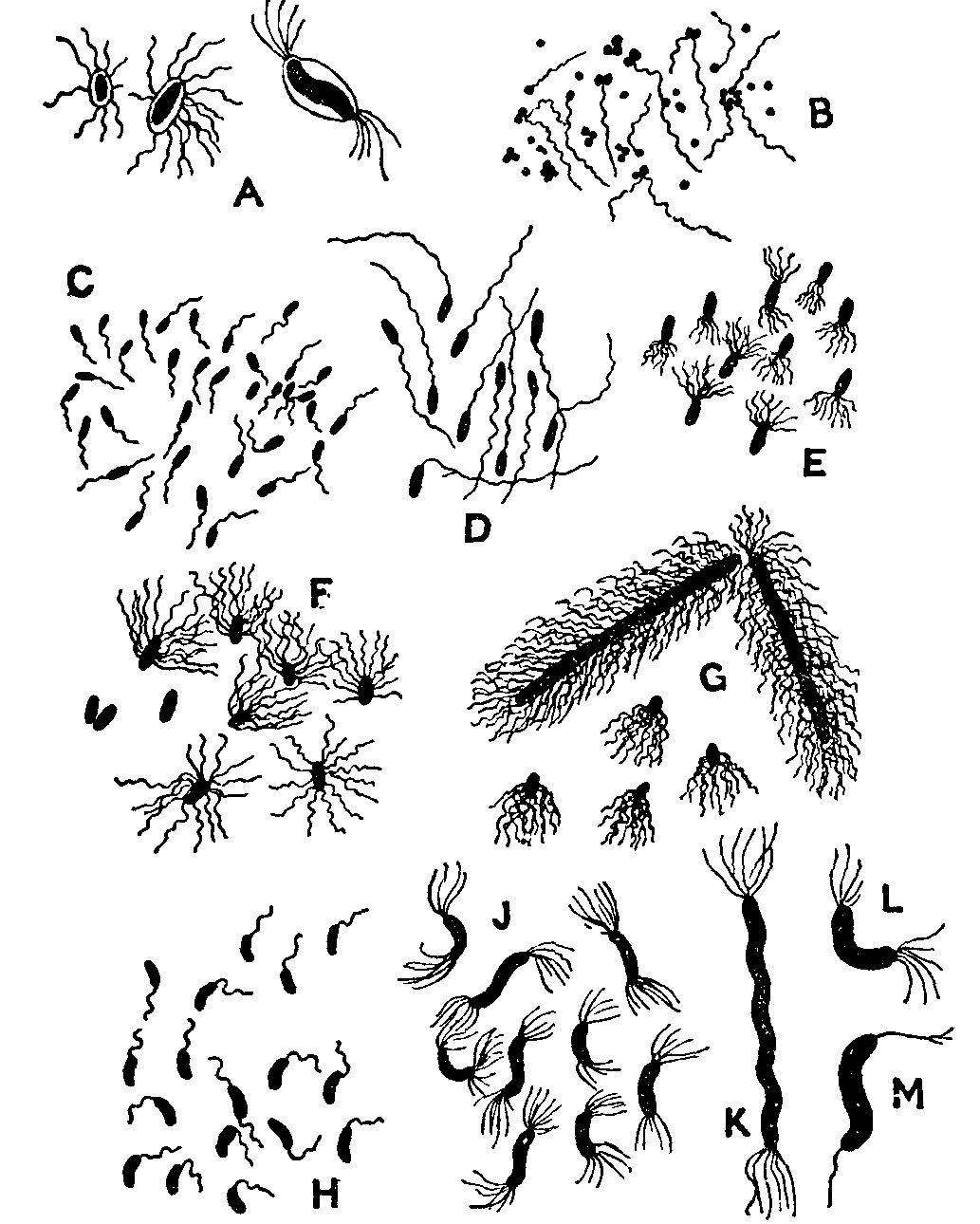
Fig. 1.—Preparations
showing various forms of bacteria and the various types of cilia and
their arrangement.
A. Bacillus subtilis, Cohn, and Spirillum
undula, Ehrenb.
B. Planococcus citreus (Menge) Migula.
C. Pseudomonas pyocyanea (Gessard), Migula.
D. P. macroselmis, Migula.
E. P. syncyanea (Ehrenb.), Migula.
F. Bacillus typhi, Gaffky.
G. B. vulgaris (Hauser), Migula.
H. Microspira Comma (Koch), Schroeter.
J, K. Spirillum rubrum, Esmarsch.
L, M. S. undula (Müller), Ehrenb. (All after Migula.)
That bacteria have existed from very early periods is clear from Distribution in Time. their presence in fossils;
and although we cannot accept all the conclusions drawn from the
imperfect records of the rocks, and may dismiss as absurd the statements
that geologically immured forms have been found still living, the
researches of Renault and van Tieghem have shown pretty clearly that
large numbers of bacteria existed in Carboniferous and Devonian times,
and probably earlier.
Schizomycetes are ubiquitous as saprophytes in still ponds and Distribution in Space. ditches, in running
streams and rivers, and in the sea, and especially in drains, bogs,
refuse heaps, and in the soil, and wherever organic infusions are allowed
to stand for a short time. Any liquid (blood, urine, milk, beer, &c.)
containing organic matter, or any solid food-stuff (meat preserves,
vegetables, &c.), allowed to stand exposed to the air soon swarms
with bacteria, if moisture is present and the temperature not abnormal.
Though they occur all the world over in the space, air and on the surface
of exposed bodies, it is not to be supposed that they are by any means
equally distributed, and it is questionable whether the bacteria
suspended in the air ever exist in such enormous quantities as was once
believed. The evidence to hand shows that on heights and in open country,
especially in the north, there may be few or even no Schizomycetes
detected in the air, and even in towns their distribution varies greatly;
sometimes they appear to exist in minute clouds, as it were, with
interspaces devoid of any, but in laboratories and closed spaces where
their cultivation has been promoted the air may be considerably laden
with them. Of course the distribution of bodies so light and small is
easily influenced by movements, rain, wind, changes of temperature,
&c. As parasites, certain Schizomycetes inhabit and prey upon the
organs of man and animals in varying degrees, and the conditions for
their growth and distribution are then very complex. Plants appear to be
less subject to their attacks—possibly, as has been suggested,
because the acid fluids of the higher vegetable organisms are less suited
for the development of Schizomycetes; nevertheless some are known to be
parasitic on plants. Schizomycetes exist in every part of the alimentary
canal of animals, except, perhaps, where acid secretions prevail; these
are by no means necessarily harmful, though, by destroying the teeth for
instance, certain forms may incidentally be the forerunners of damage
which they do not directly cause.
Little was known about these extremely minute organisms History. before 1860. A. van Leeuwenhoek figured
bacteria as far back as the 17th century, and O. F. Müller knew several
important forms in 1773, while Ehrenberg in 1830 had advanced to the
commencement of a scientific separation and grouping of them, and in 1838
had proposed at least sixteen species, distributing them into four
genera. Our modern more accurate though still fragmentary knowledge of
the forms of Schizomycetes, however, dates from F. J. Conn's brilliant
researches, the chief results of which were published at various periods
between 1853 and 1872; Cohn's classification of the bacteria, published
in 1872 and extended in 1875, has in fact dominated the study of these
organisms almost ever since. He proceeded in the main on the assumption
that the forms of bacteria as met with and described by him are
practically constant, at any rate within limits which are not wide:
observing that a minute spherical micrococcus or a rod-like bacillus
regularly produced similar micrococci and bacilli respectively, he based
his classification on what may be considered the constancy of forms which
he called species and genera. As to the constancy of form, however, Cohn
maintained certain reservations which have been ignored by some of his
followers. The fact that Schizomycetes produce spores appeals to have
been discovered by Cohn in 1857, though it was expressed dubiously in
1872; these spores had no doubt been observed previously. In 1876,
however, Cohn had seen the spores germinate, and Koch, Brefeld,
Pratzmowski, van Tieghem, de Bary and others confirmed the discovery in
various species.
The supposed constancy of forms in Cohn's species and genera received
a shock when Lankester in 1873 pointed out that his Bacterium
rubescens (since named Beggiatoa roseo-persicina, Zopf) passes
through conditions which would have been described by most observers
influenced by the current doctrine as so many separate "species" or even
"genera,"—that in fact forms known as Bacterium,
Micrococcus, Bacillus, Leptothrix, &c., occur as
phases in one life-history. Lister put forth similar ideas about the same
time; and Billroth came forward in 1874 with the extravagant view that
the various bacteria are only different states of one and the same
organism which he called Cocco-bacteria septica. From that time
the question of the pleomorphism (mutability of shape) of the bacteria
has been hotly discussed: but it is now generally agreed that, while a
certain number of forms may show different types of cell
during the various phases of the life-history,[2] yet the majority of forms are
uniform, showing one type of cell throughout their life-history. The
question of species in the bacteria is essentially the same as in other
groups of plants; before a form can be placed in a satisfactory
classificatory position its whole life-history must be studied, so that
all the phases may be known. In the meantime, while various observers
were building up our knowledge of the morphology of bacteria, others were
laying the foundation of what is known of the relations of these
organisms to fermentation and disease—that ancient will-o'-the-wisp
"spontaneous generation" being revived by the way. When Pasteur in 1857
showed that the lactic fermentation depends on the presence of an
organism, it was already known from the researches of Schwann (1837) and
Helmholtz (1843) that fermentation and putrefaction are intimately
connected with the presence of organisms derived from the air, and that
the preservation of putrescible substances depends on this principle. In
1862 Pasteur placed it beyond reasonable doubt that the ammoniacal
fermentation of urea is due to the action of a minute Schizomycete; in
1864 this was confirmed by van Tieghem, and in 1874 by Cohn, who named
the organism Micrococcus ureae. Pasteur and Cohn also pointed out
that putrefaction is but a special case of fermentation, and before 1872
the doctrines of Pasteur were established with respect to Schizomycetes.
Meanwhile two branches of inquiry had arisen, so to speak, from the
above. In the first place, the ancient question of "spontaneous
generation" received fresh impetus from the difficulty of keeping such
minute organisms as bacteria from reaching and developing in organic
infusions; and, secondly, the long-suspected analogies between the
phenomena of fermentation and those of certain diseases again made
themselves felt, as both became better understood. Needham in 1745 had
declared that heated infusions of organic matter were not deprived of
living beings; Spallanzani (1777) had replied that more careful heating
and other precautions prevent the appearance of organisms in the fluid.
Various experiments by Schwann, Helmholtz, Schultz, Schroeder, Dusch and
others led to the refutation, step by step, of the belief that the more
minute organisms, and particularly bacteria, arose de novo in the
special cases quoted. Nevertheless, instances were adduced where the most
careful heating of yolk of egg, milk, hay-infusions, &c., had
failed,—the boiled infusions, &c., turning putrid and swarming
with bacteria after a few hours.
In 1862 Pasteur repeated and extended such experiments, and paved the
way for a complete explanation of the anomalies; Cohn in 1872 published
confirmatory results; and it became clear that no putrefaction can take
place without bacteria or some other living organism. In the hands of
Brefeld, Burdon-Sanderson, de Bary, Tyndall, Roberts, Lister and others,
the various links in the chain of evidence grew stronger and stronger,
and every case adduced as one of "spontaneous generation" fell to the
ground when examined. No case of so-called "spontaneous generation" has
withstood rigid investigation; but the discussion contributed to more
exact ideas as to the ubiquity, minuteness, and high powers of resistance
to physical agents of the spores of Schizomycetes, and led to more exact
ideas of antiseptic treatments. Methods were also improved, and the
application of some of them to surgery at the hands of Lister, Koch and
others has yielded results of the highest value.
Long before any clear ideas as to the relations of Schizomycetes to
fermentation and disease were possible, various thinkers at different
times had suggested that resemblances existed between the phenomena of
certain diseases and those of fermentation, and the idea that a virus or
contagium might be something of the nature of a minute organism capable
of spreading and reproducing itself had been entertained. Such vague
notions began to take more definite shape as the ferment theory of
Cagniard de la Tour (1828), Schwann (1837) and Pasteur made way,
especially in the hands of the last-named savant. From about 1870 onwards
the "germ theory of disease" has passed into acceptance. P. F. O. Rayer
in 1850 and Davaine had observed the bacilli in the blood of animals dead
of anthrax (splenic fever), and Pollender discovered them anew in 1855.
In 1863, imbued with ideas derived from Pasteur's researches on
fermentation, Davaine reinvestigated the matter, and put forth the
opinion that the anthrax bacilli caused the splenic fever; this was
proved to result from inoculation. Koch in 1876 published his
observations on Davaine's bacilli, placed beyond doubt their causal
relation to splenic fever, discovered the spores and the saprophytic
phase in the life-history of the organism, and cleared up important
points in the whole question (figs. 7 and 9). In 1870 Pasteur had proved
that a disease of silkworms was due to an organism of the nature of a
bacterium; and in 1871 Oertel showed that a Micrococcus already
known to exist in diphtheria is intimately concerned in producing that
disease. In 1872, therefore, Cohn was already justified in grouping
together a number of "pathogenous" Schizomycetes. Thus arose the
foundations of the modern "germ theory of disease;" and, in the midst of
the wildest conjectures and the worst of logic, a nucleus of facts was
won, which has since grown, and is growing daily. Septicaemia,
tuberculosis, glanders, fowl-cholera, relapsing fever, and other diseases
are now brought definitely within the range of biology, and it is clear
that all contagious and infectious diseases are due to the action of
bacteria or, in a few cases, to fungi, or to protozoa or other
animals.
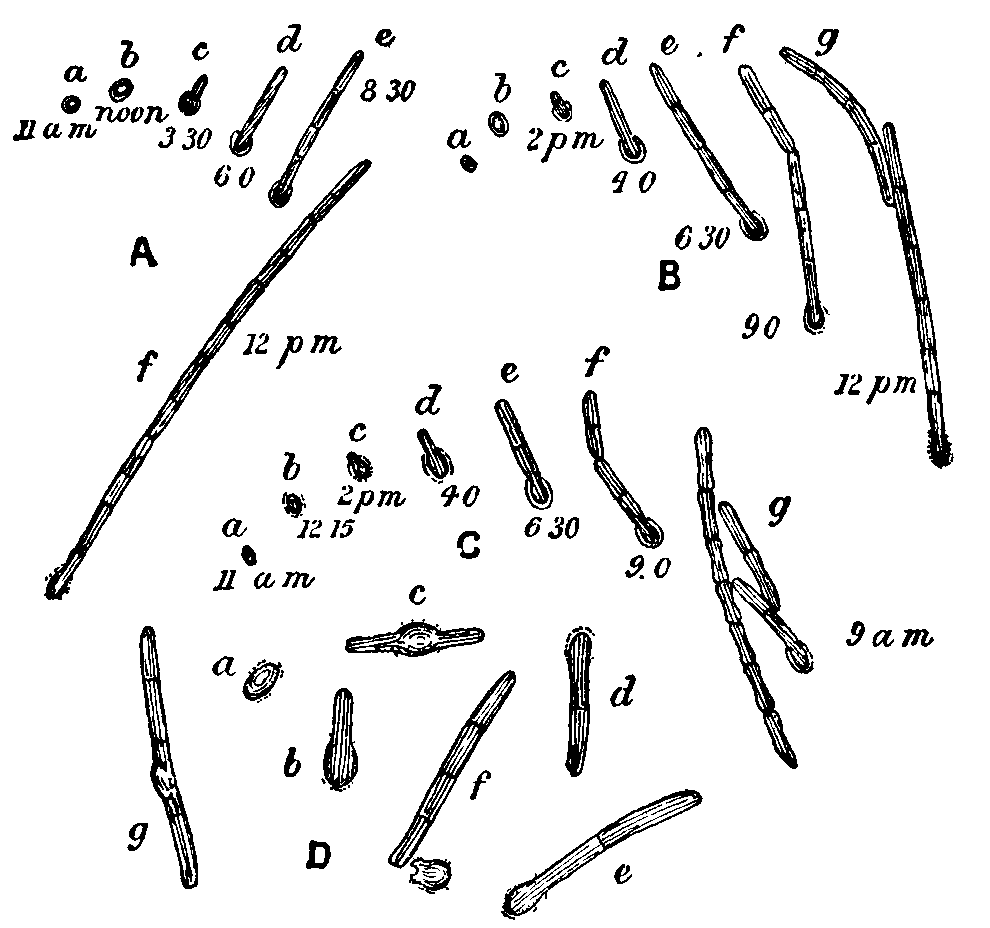
Fig. 2.—The various
phases of germination of spores of Bacillus ramosus (Fraenkel),
as actually observed in hanging drops under very high powers.
A. The spore sown at 11 A.M.,
as shown at a, had swollen (b) perceptibly by noon, and
had germinated by 3.30 P.M., as shown at
c: in d at 6 P.M., and e
at 8.30 P.M.; the resulting filament is
segmenting into bacilli as it elongates, and at midnight (f)
consisted of twelve such segments.
B, C. Similar series of phases in the order of the
small letters in each case, and with the times of observation attached.
At f and g occurs the breaking up of the filament into
rodlets.
D. Germinating spores in various stages, more highly
magnified, and showing the different ways of escape of the filament
from the spore-membrane. (H. M. W.)
Other questions of the highest importance have arisen from the
foregoing. About 1880 Pasteur first showed that Bacillus anthracis
cultivated in chicken broth, with plenty of oxygen and at a temperature
of 42-43° C., lost its virulence after a few "generations," and ceased to
kill even the mouse; Toussaint and Chauveau confirmed, and others have
extended the observations. More remarkable still, animals inoculated with
such "attenuated" bacilli proved to be curiously resistant to the deadly
effects of subsequent inoculations of the non-attenuated form. In other
words, animals vaccinated with the cultivated bacillus showed immunity
from disease when reinoculated with the deadly wild form. The questions
as to the causes and nature of the changes in the bacillus and in the
host, as to the extent of immunity enjoyed by the latter, &c., are of
the greatest interest and importance. These matters, however, and others
such as phagocytosis (first described by Metchnikoff in 1884), and the
epoch-making discovery of the opsonins of the blood by Wright, do not
here concern us (see II. below).
Morphology.—Sizes, Forms, Structure,
&c.—The Schizomycetes Form and
Structure. consist of single cells, or of filamentous or other
groups of cells, according as the divisions are completed at once or not.
While some unicellular forms are less than 1 µ (.001 mm.) in
diameter, others have cells measuring 4 µ or 5 µ or even 7
µ or 8 µ, in thickness, while the length may vary from that
of the diameter to many times that measurement. In the filamentous forms
the individual cells are often difficult to observe until reagents are
applied (e.g. fig. 14), and the length of the rows of cylindrical
cells may be many hundred times greater than the breadth. Similarly, the
diameters of flat or spheroidal colonies may vary from a few times to
many hundred Cell-wall. times that of the
individual cells, the divisions of which have produced the colony. The
shape of the individual cell (fig. 1) varies from that of a minute sphere
to that of a straight, curved, or twisted filament or cylinder, which is
not necessarily of the same diameter throughout, and may have flattened,
rounded, or even pointed ends. The rule is that the cells divide in one
direction only—i.e. transverse to the long axis—and
therefore produce aggregates of long cylindrical shape; but in rarer
cases iso-diametric cells divide in two or three directions, producing
flat, or spheroidal, or irregular colonies, the size of which is
practically unlimited. The bacterial cell is always
clothed by a definite cell-membrane, as was shown by the plasmolysing
experiments of Fischer and others. Unlike the cell-wall of the higher
plants, it gives usually no reactions of cellulose, nor is chitin present
as in the fungi, but it consists of a proteid substance and is apparently
a modification of the general protoplasm. In some cases, however, as in
B. tuberculosis, analysis of the cell shows a large amount of
cellulose. The cell-walls in some forms swell up into a gelatinous mass
so that the cell appears to be surrounded in the unstained condition by a
clear, transparent space. When the swollen wall is dense and regular in
appearance the term "capsule" is applied to the sheath as in
Leuconostoc. Secreted pigments (red, yellow, green and blue) are
sometimes deposited in the wall, and some of the iron-bacteria have
deposits of oxide of iron in the membranes.
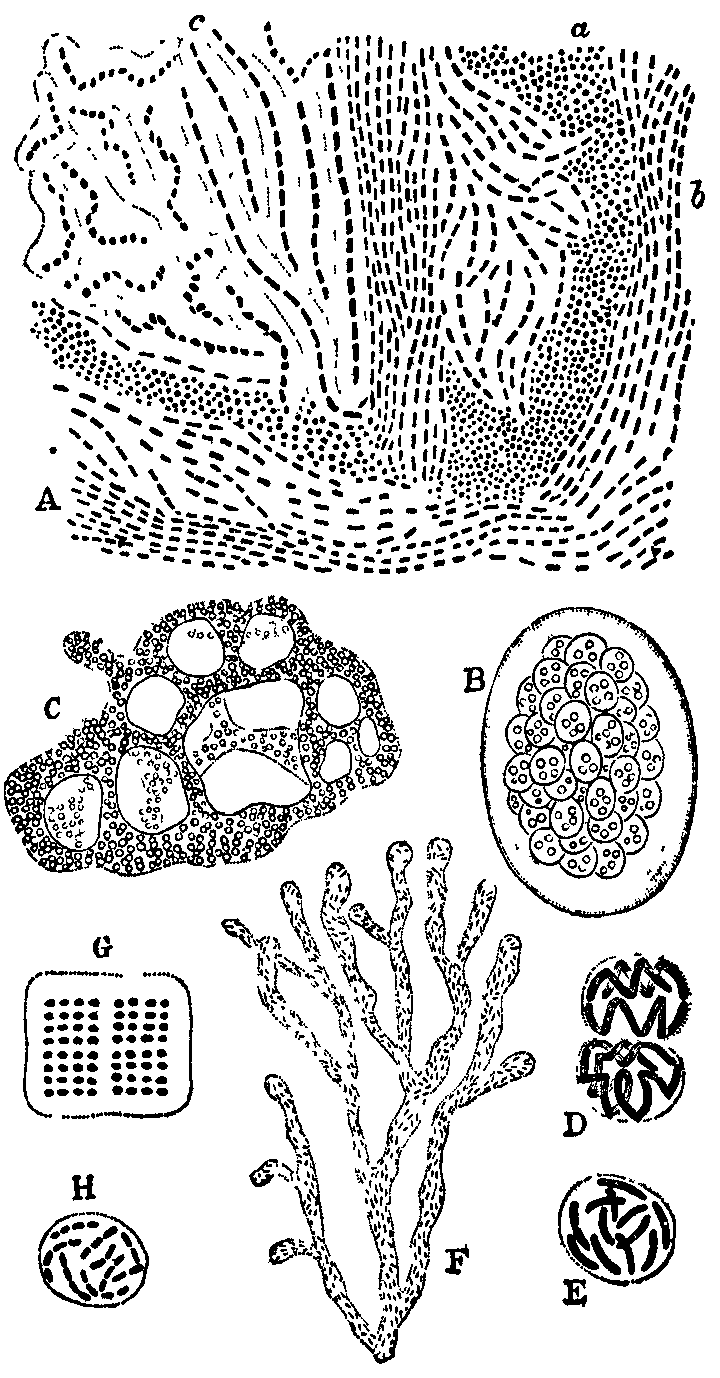
Fig. 3.—Types of
Zoogloea. (After Zopf.)
A. Mixed zoogloea found as a pellicle on the surface of
vegetable infusions, &c.; it consists of various forms, and
contains cocci (a) and rodlets, in series (b and
c), &c.
B. Egg-shaped mass of zoogloea of Beggiatoa
roseo-persicina (Bacterium rubescens of Lankester); the
gelatinous swollen walls of the large crowded cocci are fused into a
common gelatinous envelope.
C. Reticulate zoogloea of the same.
D, E, H. Colonies of Myconostoc enveloped in
diffluent matrix.
F. Branched fruticose zoogloea of Cladothrix
(slightly magnified).
G. Zoogloea of Bacterium merismopedioides, Zopf,
containing cocci arranged in tablets.
The substance of the bacterial cell when suitably prepared Cell-contents. and stained shows in the larger
forms a mass of homogeneous protoplasm containing irregular spaces, the
vacuoles, which enclose a watery fluid. Scattered in the protoplasm arc
usually one or more deeply-staining granules. The protoplasm itself may
be tinged with colouring matter, bright red, yellow, &c., and may
occasionally contain substances other than the deeply-staining granules.
The occurrence of a starch-like substance which stains deep blue with
iodine has been clearly shown in some forms even where the bacterium is
growing on a medium containing no starch, as shown by Ward and others. In
other forms a substance (probably glycogen or amylo-dextrin) which turns
brown with iodine has been observed. Oil and fat drops have also been
shown to occur, and in the sulphur-bacteria numerous fine granules of
sulphur.
The question of the existence of a nucleus in the bacteria is Nucleus. one that has led to much discussion and
is a problem of some difficulty. In the majority of forms it has not
hitherto been possible to demonstrate a nucleus of the type which is so
characteristic of the higher plants. Attention has accordingly been
directed to the deeply-staining granules mentioned above, and the term
chromatin-granules has been applied to them, and they have been
considered to represent a rudimentary nucleus. That these granules
consist of a material similar to the chromatin of the nucleus of higher
forms is very doubtful, and the comparison with the nucleus of more
highly organized cells rests on a very slender basis. The most recent
works (Vejdovsky, Mencl), however, appear to show that nuclei of a
structure and mode of division almost typical are to be found in some of
the largest bacteria. It is possible that a similar structure has been
overlooked or is invisible in other forms owing to their small size, and
that there may be another type of nucleus—the diffuse
nucleus—such as Schaudinn believed to be the case in B.
butschlii. Many bacteria when suspended in a fluid exhibit a power of
independent movement which is, of course, quite distinct from the
Brownian movement—a non-vital phenomenon common to all
finely-divided particles suspended in a fluid. Independent movement is
effected by special motile organs, the cilia or flagella. These
structures are invisible, with ordinary illumination in living cells or
unstained preparations, and can only be made clearly visible by special
methods of preparation and staining first used by Löffler. By these
methods the cilia are seen to be fine protoplasmic outgrowths of the cell
(fig. 1) of the same nature as those of the zoospores and antherozoids of
algae, mosses, &c. Cilia. These cilia
appear to be attached to the cell-wall, being unaffected by plasmolysis,
but Fischer states that they really are derived from the central
protoplasm and pass through minute pores in the wall. The cilia may be
present during a short period only in the life of a Schizomycete, and
their number may vary according to the medium on which the organism is
growing. Nevertheless, there is more or less constancy in the type of
distribution, &c., of the cilia for each species when growing at its
best. The chief results may be summed up as follows: some species,
e.g. B. anthracis, have no cilia; others have only one
flagellum at one pole (Monotrichous), e.g. Bacillus
pyocyaneus (fig. 1, C, D), or one at each pole; others again have a
tuft of several cilia at one pole
(Lophotrichous), e.g. B. syncyaneus (fig. 1, E), or
at each pole (Amphitrichous) (fig. 1, J, K, L); and, finally, many
actively motile forms have the cilia springing all round
(Peritrichous), e.g. B. vulgaris (fig. 1, G). It is
found, however, that strict reliance cannot be placed on the distinction
between the Monotrichous, Lophotrichous and
Amphitrichous conditions, since one and the same species may have
one, two or more cilia at one or both poles; nevertheless some stress may
usually be laid on the existence of one or two as opposed to
several—e.g. five or six or more—at one or each
pole.
In Beggiatoa, a filamentous form, peculiar, slow, oscillatory
Vegetative State. movements are to be
observed, reminding us of the movements of Oscillatoria among the
Cyanophyceae. In these cases no cilia have been observed, and
there is a firm cell-wall, so the movement remains quite unexplained.
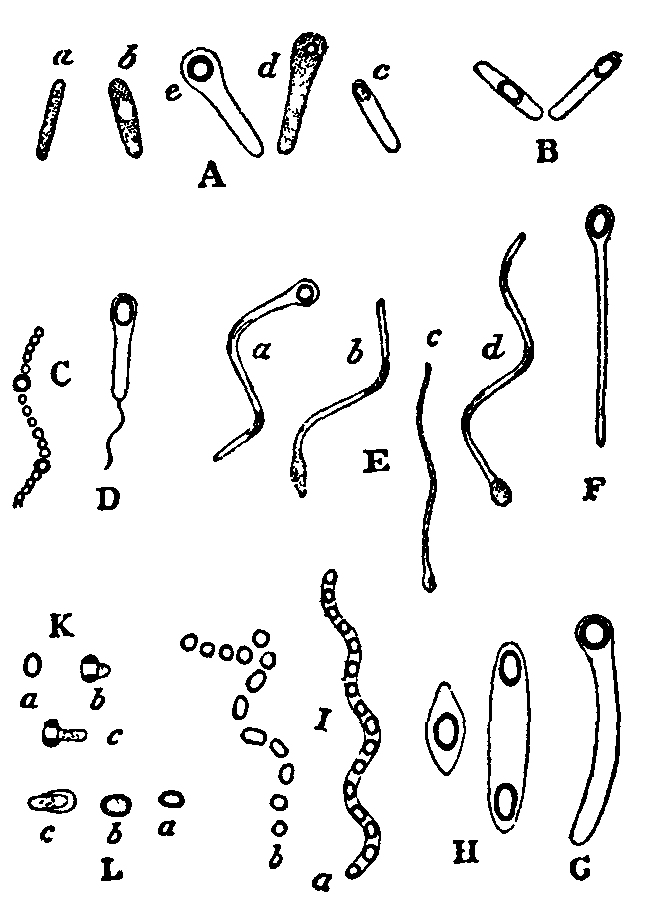
Fig. 4.—Types of
Spore-formation in Schizomycetes. (After Zopf.)
A. Various stages in the development of the endogenous
spores in a Clostridium—the small letters indicate the
order.
B. Endogenous spores of the hay bacillus.
C. A chain of cocci of Leuconostoc
mesenterioides, with two "resting spores," i.e.
arthrospores. (After van Tieghem.)
D. A motile rodlet with one cilium and with a spore
formed inside.
E. Spore-formation in Vibrio-like (c) and
Spirillum-like (a b, a) Schizomycetes.
F. Long rod-like form containing a spore (these are the
so-called "Köpfchenbacterien" of German authors).
G. Vibrio form with spore. (After
Prazmowski.)
H. Clostridium—one cell contains two
spores. (After Prazmowski.)
I. Spirillum containing many spores (a),
which are liberated at b by the breaking up of the parent
cells.
K. Germination of the spore of the hay bacillus (B.
subtilis)—the axis of growth of the germinal rodlet is at
right angles to the long axis of the spore.
L. Germination of spore of Clostridium
butyricum—the axis of growth coincides with the long axis of
the spore.
While many forms are fixed to the substratum, others are free, being
in this condition either motile or immotile. The chief of these forms are
described below.
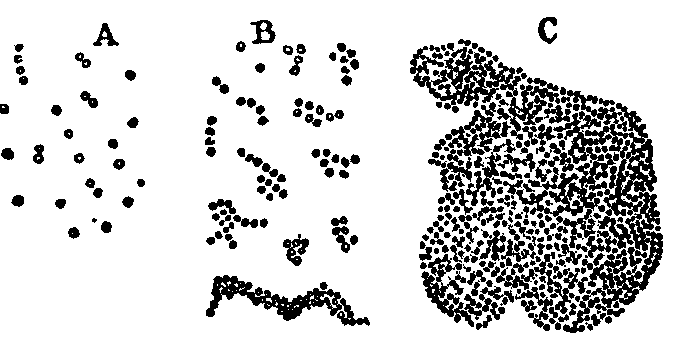
Fig. 5.—Characteristic
groups of Micrococci. (After Cohn.) A. Micrococcus
prodigiosus. B. M. vaccinae. C. Zoogloea stage of a
Micrococcus, forming a close membrane on
infusion—Pasteur's Mycoderma. (Very highly magnified.)
Cocci: spherical or spheroidal cells, which, according to their
relative (not very well defined) sizes are spoken of as
Micrococci, Macrococci, and perhaps Monas forms.
Rods or rodlets: slightly or more considerably elongated
cells which are cylindrical, biscuit-shaped or somewhat fusiform. The
cylindrical forms are short, i.e. only three or four times as long
as broad (Bacterium), or longer (Bacillus); the
biscuit-shaped ones are Bacteria in the early stages of division.
Clostridia, &c., are spindle-shaped.
Filaments really consist of elongated cylindrical cells which
remain united end to end after division, and they may break up later into
elements such as those described above. Such filaments are not always of
the same diameter throughout, and their segmentation varies considerably.
They may be free or attached at one (the "basal") end. A distinction is
made between simple filaments (e.g. Leptothrix) and
such as exhibit a false branching (e.g. Cladothrix).
Curved and spiral forms. Any of the elongated forms
described above may be curved or sinuous or twisted into a corkscrew-like
spiral instead of straight. If the sinuosity is slight we have the
Vibrio form; if pronounced, and the spiral winding well marked,
the forms are known as Spirillum, Spirochaete, &c.
These and similar terms have been applied partly to individual cells, but
more often to filaments consisting of several cells; and much confusion
has arisen from the difficulty of defining the terms themselves.
In addition to the above, however, certain Schizomycetes present
aggregates in the form of plates, or solid or hollow and irregular
branched colonies. This may be due to the successive divisions occurring
in two or three planes instead of only across the long axis
(Sarcina), or to displacements of the cells after division.
Growth and Division.—Whatever the shape and size of the
Reproduction. individual cell,
cell-filament or cell-colony, the immediate visible results of active
nutrition are elongation of the cell and its division into two equal
halves, across the long axis, by the formation of a septum, which either
splits at once or remains intact for a shorter or longer time. This
process is then repeated and so on. In the first case the separated cells
assume the character of the parent-cell whose division gave rise to them;
in the second case they form filaments, or, if the further elongation and
divisions of the cells proceed in different directions, plates or
spheroidal or other shaped colonies. It not unfrequently happens,
however, that groups of cells break away from their former connexion as
longer or shorter straight or curved filaments, or as solid masses. In
some filamentous forms this "fragmentation" into multicellular pieces of
equal length or nearly so is a normal phenomenon, each partial filament
repeating the growth, division and fragmentation as before (cf. figs. 2
and 6). By rapid division hundreds of thousands of cells may be produced
in a few hours,[3] and, according to the species and
the conditions (the medium, temperature, &c.), enormous collections
of isolated cells may cloud the fluid in which they are cultivated, or
form deposits below or films on its surface; valuable characters are
sometimes obtained from these appearances. When these dense "swarms" of
vegetative cells become fixed in a matrix of their own swollen contiguous
cell-walls, they pass over into a sort of resting state as a so-called
zoogloea (fig. 3).
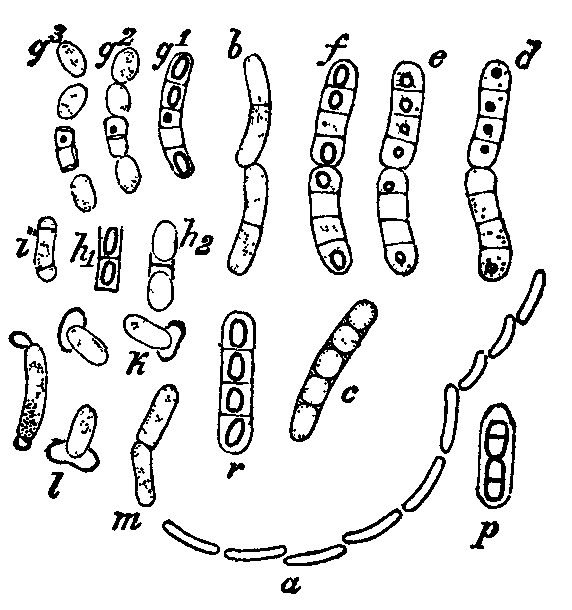
Fig. 6.—Bacillus
megaterium. (After de Bary.)
a, a chain of motile rodlets still growing and
dividing (bacilli).
b, a pair of bacilli actively growing and
dividing.
p, a rodlet in this condition (but divided into
four segments) after treatment with alcoholic iodine solution.
c, d, e, f, successive
stages in the development of the spores.
r, a rodlet segmented in four, each segment
containing one ripe spore.
g1, g2, g3, early stages in the
germination of the spores (after being dried several days);
h1, h2, k, l and m,
successive stages in the germination of the spore.
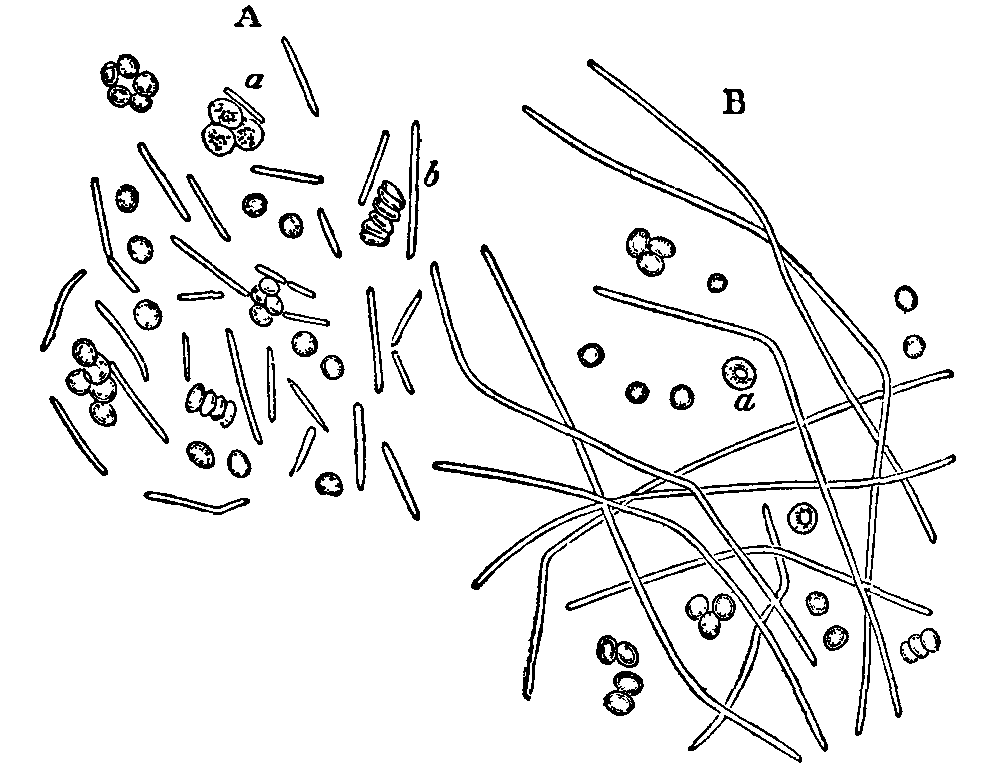
Fig. 7.—Bacillus
anthracis. (After Koch.)
A. Bacilli mingled with blood-corpuscles from
the blood of a guinea-pig; some of the bacilli dividing.
B. The rodlets after three hours' culture in a drop of
aqueous humour. They grow out into long leptothrix-like
filaments, which become septate later, and spores are developed in the
segments.
One of the most remarkable Zoogloeae.
phenomena in the life-history of the Schizomycetes is the formation of
this zoogloea stage, which corresponds to the "palmella" condition of the
lower Algae. This occurs as a membrane on the surface of the
medium, or as irregular clumps or branched masses (sometimes several
inches across) submerged in it, and consists of more or less gelatinous
matrix enclosing innumerable "cocci," "bacteria," or other elements of
the Schizomycete concerned. Formerly regarded as a distinct
genus—the natural fate of all the various forms—the
zoogloea is now known to be a sort of resting condition of the
Schizomycetes, the various elements being glued together, as it were, by
their enormously swollen and diffluent cell-walls becoming contiguous.
The zoogloea is formed by active division of single or of several
mother-cells, and the progeny appear to go on secreting the cell-wall
substance, which then absorbs many times its volume of water, and remains
as a consistent matrix, in which the cells come to rest. The
matrix—i.e. the swollen cell-walls—in some cases
consists mainly of cellulose, in others chiefly of a proteid substance;
the matrix in some cases is horny and resistant, in others more like a
thick solution of gum. It is intelligible from the mode of formation that
foreign bodies may become entangled in the gelatinous matrix, and
compound zoogloeae may arise by the apposition of several distinct forms,
a common event in macerating troughs (fig. 3, A). Characteristic forms
may be assumed by the young zoogloea of different
species,—spherical, ovoid, reticular, filamentous, fruiticose,
lamellar, &c.,—but these vary considerably as the mass
increases or comes in contact with others. Older zoogloeae may
precipitate oxide of iron in the matrix, if that metal exists in small
quantities in the medium. Under favourable conditions the elements in the
zoogloea again become active, and move out of the matrix, distribute
themselves in the surrounding medium, to grow and multiply as before. If
the zoogloea is formed on a solid substratum it may become firm and
horny; immersion in water softens it as described above.
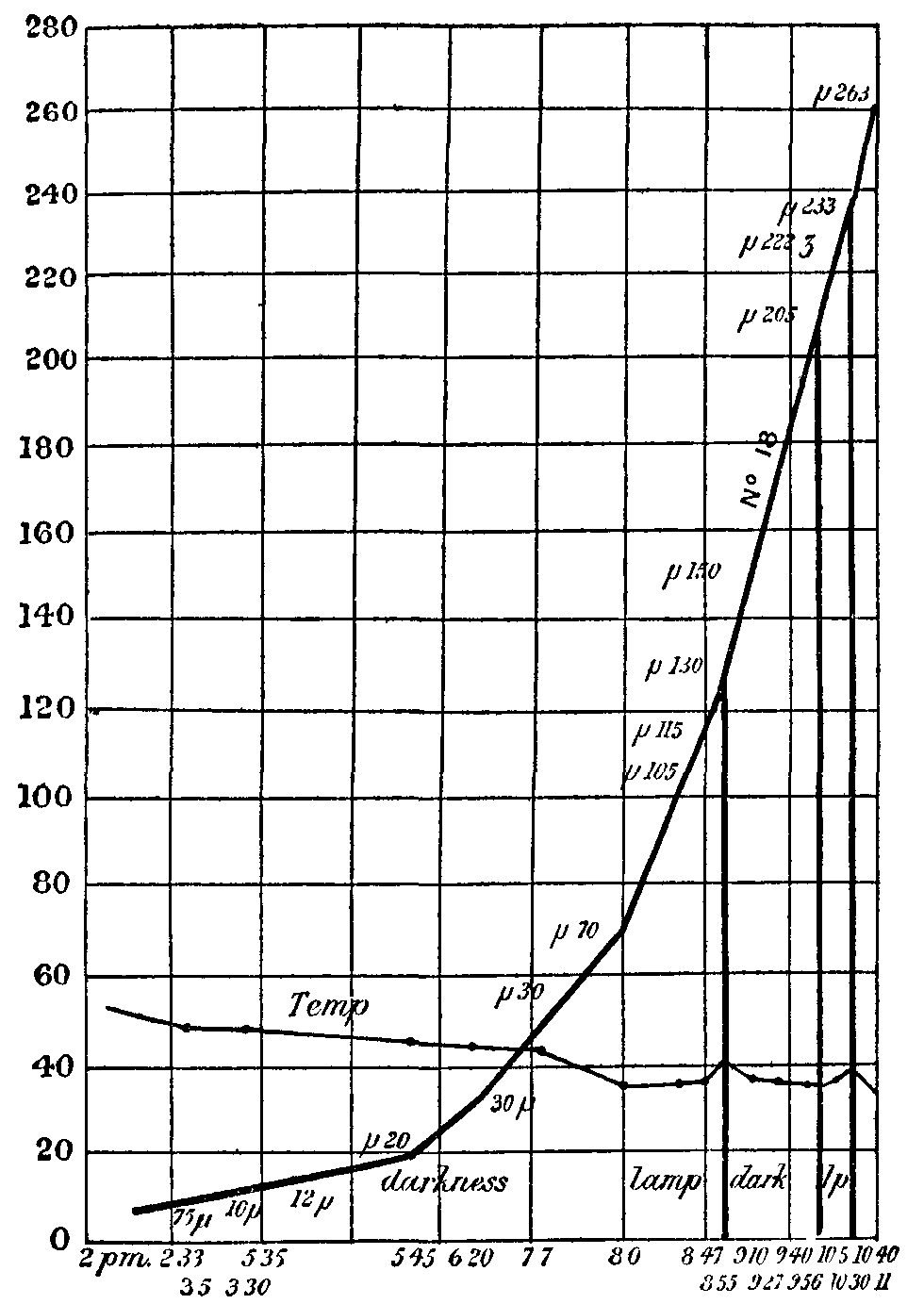
Fig. 8.—Curve of growth
of a filament of Bacillus ramosus (Fraenkel), constructed from
data such as in fig. 4. The abscissae represent intervals of time, the
ordinates the measured lengths of the growing filament. Thus, at 2.33
P.M. the length of the filament was 6
µ; at 5.45, 20 µ; at 8 P.M., 70
µ and so on. Such curves show differences of steepness according
to the temperature (see temp. curve), and to alterations of light
(lamp) and darkness. (H. M. W.)
The growth of an ordinary bacterium consists in uniform Measurement of growth. elongation of the rodlet
until its length is doubled, followed by division by a median septum,
then by the simultaneous doubling in length of each daughter cell, again
followed by the median division, and so on (figs. 13, 14). If the cells
remain connected the resulting filament repeats these processes of
elongation and subsequent division uniformly so long as the conditions
are maintained, and very accurate measurements have been obtained on such
a form, e.g. B. ramosus. If a rodlet in a hanging drop of
nutrient gelatine is fixed under the microscope and kept at constant
temperature, a curve of growth can be obtained recording the behaviour
during many hours or days. The measured lengths are marked off on
ordinates erected on an abscissa, along which the times are noted. The
curve obtained on joining the former points then brings out a number of
facts, foremost among which are (1) that as long as the conditions remain
constant the doubling periods—i.e. the times taken by any
portion of the filament to double its length—are constant, because
each cell is equally active along the whole length; (2) there are
optimum, minimum and maximum temperatures, other conditions remaining
constant, at which growth begins, runs at its best and is soon exhausted,
respectively; (3) that the most rapid cell-division and maximum growth do
not necessarily accord with the best conditions for the life of the
organism; and (4) that any sudden alteration of temperature brings about
a check, though a slow rise may accelerate growth (fig. 8). It was also
shown that exposure to light, dilution or exhaustion of the food-media,
the presence of traces of poisons or metabolic products check growth or
even bring it to a standstill; and the death or injury of any single cell
in the filamentous series shows its effect on the curve by lengthening
the doubling period, because its potential progeny have been put out of
play. Hardy has shown that such a destruction of part of the filament may
be effected by the attacks of another organism.
A very characteristic method of reproduction is that of Spores. spore-formation, and these minute
reproductive bodies, which represent a resting stage of the organism, are
now known in many forms. Formerly two kinds of spores were described,
arthrospores and endospores. An arthrospore, however, is
not a true spore but merely an ordinary vegetative cell which separates
and passes into a condition of rest, and such may occur in forms which
form endospores, e.g. B. subtilis, as well as in species
not known to form endospores. The true spore or endospore begins with the
appearance of a minute granule in the protoplasm of a vegetative cell;
this granule enlarges and in a few hours has taken to itself all the
protoplasm, secreted a thin but very resistive envelope, and is a ripe
ovoid spore, smaller than the mother-cell and lying loosely in it (cf.
figs. 6, 9, 10, and 11). In the case of the simplest and most minute
Schizomycetes (Micrococcus, &c.) no
definite spores have been discovered; any one of the vegetative
micrococci may commence a new series of cell by growth and division. We
may call these forms "asporous," at any rate provisionally.
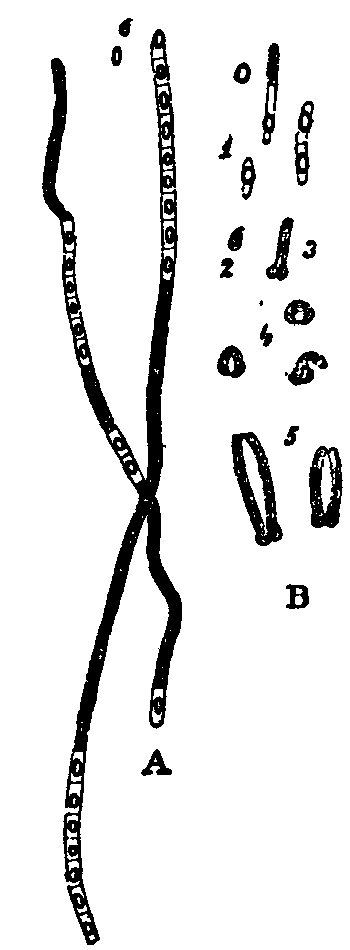 Fig.
Fig. 9.
A. Bacillus anthracis. (After de Bary) Two of
the long filaments (B, fig. 10) in which spores are being developed.
The specimen was cultivated in broth, and spores are drawn a little too
small—they should be of the same diameter transversely as the
segments.
B. Bacillus subtilis. (After de Bary.) 1,
fragments of filaments with ripe spores; 2-5, successive stages in the
germination of the spores, the remains of the spore attached to the
germinal rodlets.
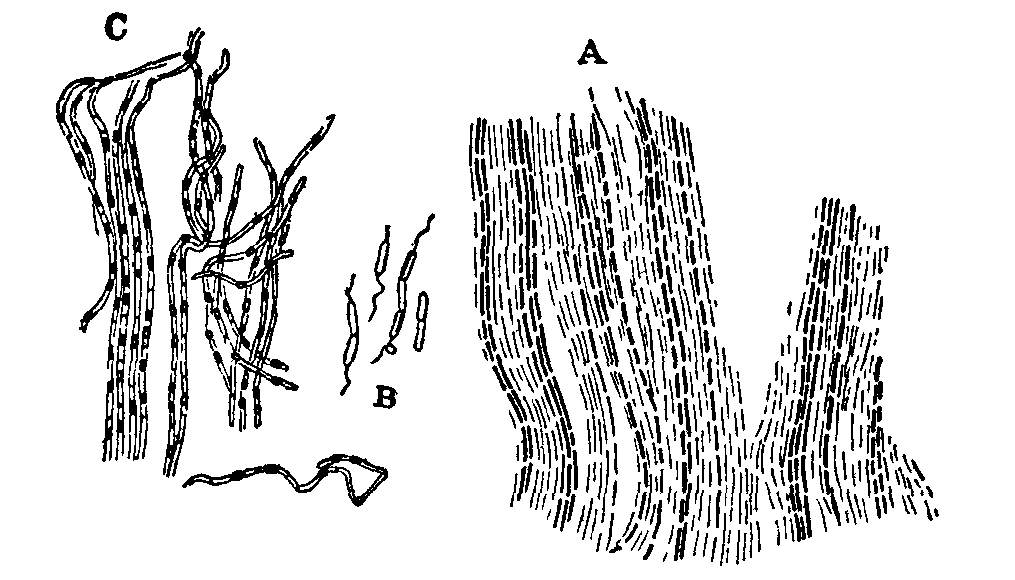
Fig. 10.—Bacillus
subtilis. (After Strasburger.) A. Zoogloea pellicle. B. Motile
rodlets. C. Development of spores.
The spore may be formed in short or long segments, the cell-wall of
which may undergo change of form to accommodate itself to the contents.
As a rule only one spore is formed in a cell, and the process usually
takes place in a bacillar segment. In some cases the spore-forming
protoplasm gives a blue reaction with iodine solutions. The spores may be
developed in cells which are actively swarming, the movements not being
interfered with by the process (fig. 4, D). The so-called
"Köpfchenbacterien" of older writers are simply bacterioid segments with
a spore at one end, the mother cell-wall having adapted itself to the
outline of the spore (fig. 4, F). The ripe spores of Schizomycetes are
spherical, ovoid or long-ovoid in shape and extremely minute (e.g.
those of Bacillus subtilis measure 0.0012 mm. long by 0.0006 mm.
broad according to Zopf), highly refractive and colourless (or very dark,
probably owing to the high index of refraction and minute size). The
membrane may be relatively thick, and even exhibit shells or strata.
The germination of the spores has now been observed in several forms
with care. The spores are capable of germination at once, or they may be
kept for months and even years, and are very resistant against
desiccation, heat and cold, &c. In a suitable medium and at a proper
temperature the germination is completed in a few hours. The spore swells
and elongates and the contents grow forth to a cell like that which
produced it, in some cases clearly breaking through the membrane, the
remains of which may be seen attached to the young germinal rodlet (figs.
5, 9 and 11); in other cases the surrounding membrane of the spore swells
and dissolves. The germinal cell then grows forth into the forms typical
for the particular Schizomycete concerned.
The conditions for spore-formation differ. Anaerobic species usually
require little oxygen, but aerobic species a free supply. Each species
has an optimum temperature and many are known to require very special
food-media. The systematic interference with these conditions has enabled
bacteriologists to induce the development of so-called asporogenous
races, in which the formation of spores is indefinitely postponed,
changes in vigour, virulence and other properties being also involved, in
some cases at any rate. The addition of minute traces of acids, poisons,
&c., leads to this change in some forms; high temperature has also
been used successfully.
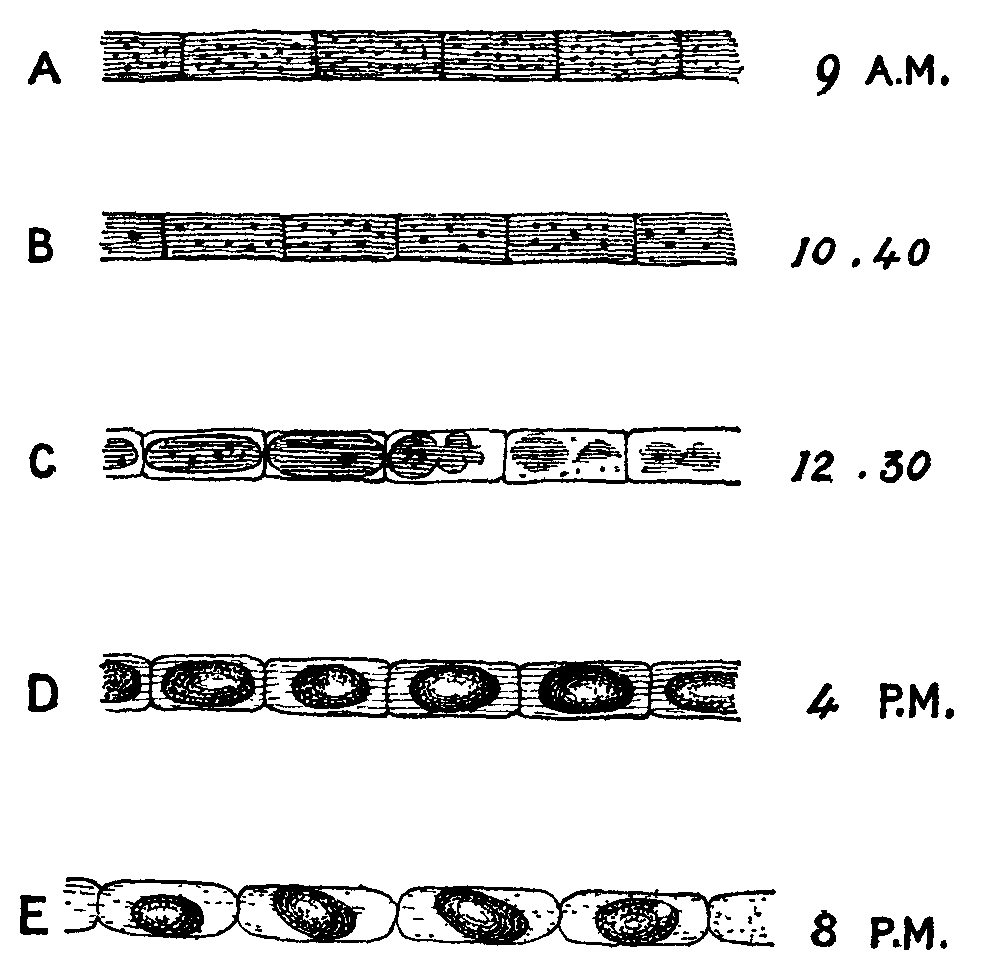
Fig. 11.—Stages in the
development of spores of Bacillus ramosus (Fraenkel), in the
order and at the times given, in a hanging drop culture, under a very
high power. The process begins with the formation of brilliant granules
(A, B); these increase, and the brilliant substance gradually balls
together (C) and forms the spores (D), one in each segment, which soon
acquire a membrane and ripen (E). (H. M. W.)
The difficult subject of the classification[4] Classification. of bacteria dates from the year
1872, when Cohn published his system, which was extended in 1875; this
scheme has in fact dominated the study of bacteria ever since. Zopf in
1885 proposed a scheme based on the acceptance of extreme views of
pleomorphism; his system, however, was extraordinarily impracticable and
was recognized by him as provisional only. Systems have also been brought
forward based on the formation of arthrospores and endospores, but as
explained above this is eminently unsatisfactory, as arthrospores are not
true spores and both kinds of reproductive bodies are found in one and
the same form. Numerous attempts have been made to construct schemes of
classification based on the power of growing colonies to liquefy
gelatine, to secrete coloured pigments, to ferment certain media with
evolution of carbon dioxide or other gases, or to induce pathological
conditions in animals. None of these systems, which are chiefly due to
the medical bacteriologists, has maintained its position, owing to the
difficulty of applying the characters and to the fact that such
properties are physiological and liable to great fluctuations in culture,
because a given organism may vary greatly in such respects according to
its degree of vitality at the time, its age, the mode of nutrition and the influence of external factors on its growth. Even
when used in conjunction with purely morphological characters, these
physiological properties are too variable to aid us in the discrimination
of species and genera, and are apt to break down at critical periods.
Among the more characteristic of these schemes adopted at various times
may be mentioned those of Miquel (1891), Eisenberg (1891), and Lehmann
and Neumann (1897). Although much progress has been made in determining
the value and constancy of morphological characters, we are still in need
of a sufficiently comprehensive and easily applied scheme of
classification, partly owing to the existence in the literature of
imperfectly described forms the life-history of which is not yet known,
or the microscopic characters of which have not been examined with
sufficient accuracy and thoroughness. Fischer's
Scheme. The principal attempts at morphological classifications
recently brought forward are those of de Toni and Trevisan (1889),
Fischer (1897) and Migula (1897). Of these systems, which alone are
available in any practical scheme of classification, the two most
important and most modern are those of Fischer and Migula. The extended
investigations of the former on the number and distribution of cilia (see
fig. 1) led him to propose a scheme of classification based on these and
other morphological characters, and differing essentially from any
preceding one. This scheme may be tabulated as follows:—
I. Order—Haplobacterinae.
Vegetative body unicellular; spheroidal, cylindrical or spirally twisted;
isolated or connected in filamentous or other growth series.
1. Family—Coccaceae. Vegetative
cells spheroidal.
(a) Sub-family—Allococcaceae.
Division in all or any planes, colonies indefinite in shape and size, of
cells in short chains, irregular clumps, pairs or isolated:—
Micrococcus (Cohn), cells non-motile; Planococcus (Migula),
cells motile.
(b) Sub-family—Homococcaceae.
Division planes regular and definite:—Sarcina (Goods.),
cells non-motile; growth and division in three successive planes at right
angles, resulting in packet-like groups; Planosarcina (Migula), as
before, but motile; Pediococcus (Lindner), division planes at
right angles in two successive planes, and cells in tablets of four or
more; Streptococcus (Billr.), divisions in one plane only,
resulting in chains of cells.
2. Family—Bacillaceae. Vegetative
cells cylindric (rodlets), ellipsoid or ovoid, and straight. Division
planes always perpendicular to the long axis.
(a) Sub-family—Bacilleae.
Sporogenous rodlets cylindric, not altered in
shape:—Bacillus (Cohn), non-motile; Bactrinium
(Fischer), motile, with one polar flagellum (monotrichous);
Bactrillum (Fischer), motile, with a terminal tuft of cilia
(lophotrichous); Bactridium (Fischer), motile, with cilia all over
the surface (peritrichous).
(b) Sub-family—Clostridieae.
Sporogenous rodlets, spindle-shaped:—Clostridium (Prazm.),
motile (peritrichous).
(c) Sub-family—Plectridieae.
Sporogenous rodlets, drumstick-shaped:—Plectridium
(Fischer), motile (peritrichous).
3. Family—Spirillaceae.
Vegetative cells, cylindric but curved more or less spirally. Divisions
perpendicular to the long axis:—Vibrio (Müller-Löffler),
comma-shaped, motile, monotrichous; Spirillum (Ehrenb.), more
strongly curved in open spirals, motile, lophotrichous;
Spirochaete (Ehrenb.), spirally coiled in numerous close turns,
motile, but apparently owing to flexile movements, as no cilia are
found.
II. Order—Trichobacterinae.
Vegetative body of branched or unbranched cell-filaments, the segments of
which separate as swarm-cells (Gonidia).
1. Family—Trichobacteriaceae.
Characters those of the Order.
(a) Filaments rigid, non-motile,
sheathed:—Crenothrix (Cohn), filaments unbranched and devoid
of sulphur particles; Thiothrix (Winogr.), as before, but with
sulphur particles; Cladothrix (Cohn), filaments branched in a
pseudo-dichotomous manner.
(b) Filaments showing slow pendulous and creeping movements,
and with no distinct sheath:—Beggiatoa (Trev.), with sulphur
particles.
The principal objections to this system are the following:—(1)
The extraordinary difficulty in obtaining satisfactory preparations
showing the cilia, and the discovery that these motile organs are not
formed on all substrata, or are only developed during short periods of
activity while the organism is young and vigorous, render this character
almost nugatory. For instance, B. megatherium and B.
subtilis pass in a few hours after commencement of growth from a
motile stage with peritrichous cilia, into one of filamentous growth
preceded by casting of the cilia. (2) By far the majority of the
described species (over 1000) fall into the three
genera—Micrococcus (about 400), Bacillus (about 200)
and Bactridium (about 150), so that only a quarter or so of the
forms are selected out by the other genera. (3) The monotrichous and
lophotrichous conditions are by no means constant even in the motile
stage; thus Pseudomonas rosea (Mig.) may have 1, 2 or 3 cilia at
either end, and would be distributed by Fischer's classification between
Bactrinium and Bactrillum, according to which state was
observed. In Migula's scheme the attempt is made to avoid some of these
difficulties, but others are introduced by his otherwise clever devices
for dealing with these puzzling little organisms.
The question, What is an individual? has given rise to much
difficulty, and around it many of the speculations regarding pleomorphism
have centred without useful result. If a tree fall apart into its
constituent cells periodically we should have the same difficulty on a
larger and more complex scale. The fact that every bacterial cell in a
species in most cases appears equally capable of performing all the
physiological functions of the species has led most authorities, however,
to regard it as the individual—a view which cannot be consistent in
those cases where a simple or branched filamentous series exhibits
differences between free apex and fixed base and so forth. It may be
doubted whether the discussion is profitable, though it appears necessary
in some cases—e.g. concerning pleomorphy—to adopt some
definition of individual.
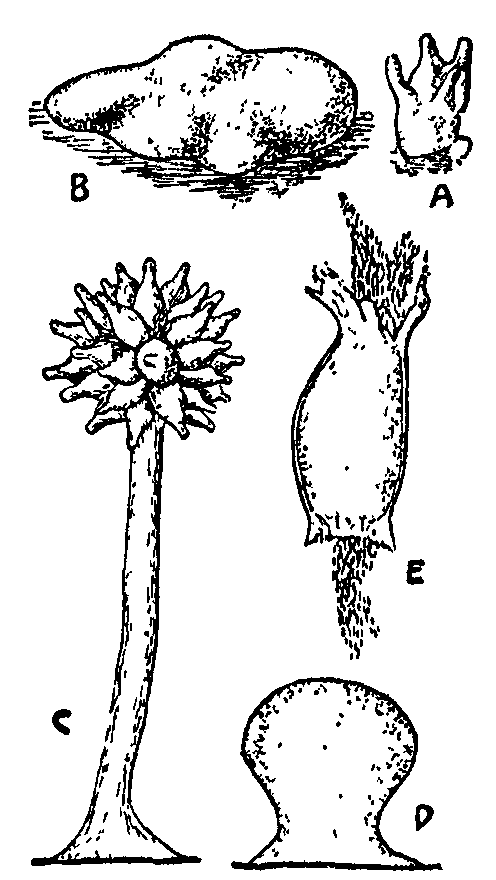 Fig.
Fig. 12.
A. Myxococcus digelatus, bright red
fructification occurring on dung.
B. Polyangium primigenum, red fructification on
dog's dung.
C. Chondromyces apiculatus, orange
fructification on antelope's dung.
D. Young fructification.
E. Single cyst germinating.
(A, B, after Quehl; C-E, after Thaxter.) From
Strasburger's Lehrbuch der Botanik, by permission of Gustav
Fischer.
Myxobacteriaceae.—To the two divisions of bacteria,
Haplobacterinae and Trichobacterinae, must now be added a third division,
Myxobacterinae. One of the first members of this group, Chondromyces
crocatus, was described as long ago as 1857 by Berkeley, but its
nature was not understood and it was ascribed to the Hyphomycetes. In
1892, however, Thaxter rediscovered it and showed its bacterial nature,
founding for it and some allied forms the group Myxobacteriaceae. Another
form, which he described as Myxobacter, was shown later to be the
same as Polyangium vitellinum described by Link in 1795, the exact
nature of which had hitherto been in doubt. Thaxter's observations and
conclusions were called in question by some botanists, but his later
observations and those of Baur have established firmly the position of
the group. The peculiarity of the group lies in the fact that the
bacteria form plasmodium-like aggregations and build themselves up into
sporogenous structures of definite form superficially similar to the
cysts of the Mycetozoa (fig. 12). Most of the forms in question are found
growing on the dung of herbivorous animals, but the bacteria occur not
only in the alimentary canal of the animal but also free in the air. The
Myxobacteria are most easily obtained by keeping at a temperature of
30-35° C. in the dark dung which has lain exposed to the air for at least
eight days. The high temperature is favourable to the growth of the
bacteria but inimical to that of the fungi
which are so common on this substratum.
The discoveries that some species of nitrifying bacteria and Function and life of bacteria. perhaps pigmented
forms are capable of carbon-assimilation, that others can fix free
nitrogen and that a number of decompositions hitherto unsuspected are
accomplished by Schizomycetes, have put the questions of nutrition and
fermentation in quite new lights. Apart from numerous fermentation
processes such as rotting, the soaking of skins for tanning, the
preparation of indigo and of tobacco, hay, ensilage, &c., in all of
which bacterial fermentations are concerned, attention may be especially
directed to the following evidence of the supreme importance of
Schizomycetes in agriculture and daily life. Indeed, nothing marks the
attitude of modern bacteriology more clearly than the increasing
attention which is being paid to useful fermentations. The vast majority
of these organisms are not pathogenic, most are harmless and many are
indispensable aids in natural operations important to man.
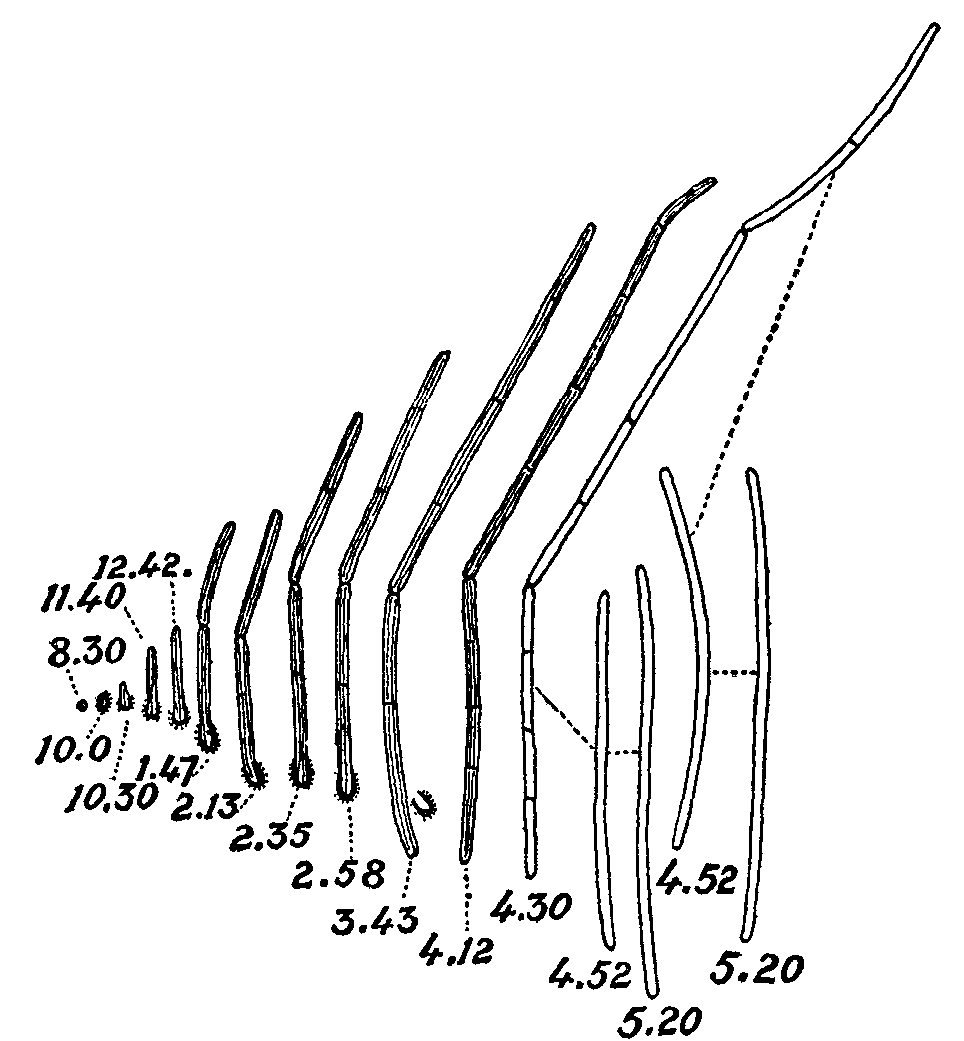
Fig. 13.—A series of
phases of germination of the spore of B. ramosus sown at 8.30
(to the extreme left), showing how the growth can be measured. If we
place the base of the filament in each case on a base line in the order
of the successive times of observation recorded, and at distances apart
proportional to the intervals of time (8.30, 10.0, 10.30, 11.40, and so
on) and erect the straightened-out filaments, the proportional length
of each of which is here given for each period, a line joining the tips
of the filaments gives the curve of growth. (H. M. W.)
Fischer has proposed that the old division into saprophytes and
parasites should be replaced by one which takes into account other
peculiarities in the mode of nutrition of bacteria. The nitrifying,
nitrogen-fixing, sulphur- and iron-bacteria he regards as monotrophic,
i.e. as able to carry on one particular series of fermentations or
decompositions only, and since they require no organic food materials, or
at least are able to work up nitrogen or carbon from inorganic sources,
he regards them as primitive forms in this respect and terms them
Prototrophic. They may be looked upon as the nearest existing
representatives of the primary forms of life which first obtained the
power of working up non-living into living materials, and as playing a
correspondingly important rôle in the evolution of life on our
globe. The vast majority of bacteria, on the other hand, which are
ordinarily termed saprophytes, are saprogenic, i.e. bring
organic material to the putrefactive state—or saprophilous,
i.e. live best in such putrefying materials—or become
zymogenic, i.e. their metabolic products may induce
blood-poisoning or other toxic effects (facultative parasites) though
they are not true parasites. These forms are termed by Fischer
Metatrophic, because they require various kinds of organic
materials obtained from the dead remains of other organisms or from the
surfaces of their bodies, and can utilize and decompose them in various
ways (Polytrophic) or, if monotrophic, are at least unable to work
them up. The true parasites—obligate parasites of de Bary—are
placed by Fischer in a third biological group, Paratrophic
bacteria, to mark the importance of their mode of life in the interior of
living organisms where they live and multiply in the blood, juices or
tissues.
When we reflect that some hundreds of thousands of tons of Nitrogen bacteria. urea are daily deposited,
which ordinary plants are unable to assimilate until considerable changes
have been undergone, the question is of importance, What happens in the
meantime? In effect the urea first becomes carbonate of ammonia by a
simple hydrolysis brought about by bacteria, more and more definitely
known since Pasteur, van Tieghem and Cohn first described them. Lea and
Miquel further proved that the hydrolysis is due to an
enzyme—urase—separable with difficulty from the bacteria
concerned. Many forms in rivers, soil, manure heaps, &c., are capable
of bringing about this change to ammonium carbonate, and much of the loss
of volatile ammonia on farms is preventible if the facts are apprehended.
The excreta of urea alone thus afford to the soil enormous stores of
nitrogen combined in a form which can be rendered available by bacteria,
and there are in addition the supplies brought down in rain from the
atmosphere, and those due to other living débris. The researches of later
years have demonstrated that a still more inexhaustible supply of
nitrogen is made available by the nitrogen-fixing bacteria of the soil.
There are in all cultivated soils forms of bacteria which are capable of
forcing the inert free nitrogen to combine with other elements into
compounds assimilable by plants. This was long asserted as probable
before Winogradsky showed that the conclusions of M. P. E. Berthelot, A.
Laurent and others were right, and that Clostridium pasteurianum,
for instance, if protected from access of free oxygen by an envelope of
aerobic bacteria or fungi, and provided with the carbohydrates and
minerals necessary for its growth, fixes nitrogen in proportion to the
amount of sugar consumed. This interesting case of symbiosis is equalled
by yet another case. The work of numerous observers has shown that the
free nitrogen of the atmosphere is brought into combination in the soil
in the nodules filled with bacteria on the roots of Leguminosae, and
since these nodules are the morphological expression of a symbiosis
between the higher plant and the bacteria, there is evidently here a case
similar to the last.
As regards the ammonium carbonate accumulating in the soil from the
conversion of urea and other sources, we know from Winogradsky's
researches that it undergoes oxidation in two stages owing to the
activity of the so-called "nitrifying" bacteria (an unfortunate term
inasmuch as "nitrification" refers merely to a particular phase of the
cycle of changes undergone by nitrogen). It had long been known that
under certain conditions large quantities of nitrate (saltpetre) are
formed on exposed heaps of manure, &c., and it was supposed that
direct oxidation of the ammonia, facilitated by the presence of porous
bodies, brought this to pass. But research showed that this process of
nitrification is dependent on temperature, aeration and moisture, as is
life, and that while nitre-beds can infect one another, the process is
stopped by sterilization. R. Warington, J. T. Schloessing, C. A. Müntz
and others had proved that nitrification was promoted by some organism,
when Winogradsky hit on the happy idea of isolating the organism by using
gelatinous silica, and so avoiding the difficulties which Warington had
shown to exist with the organism in presence of organic nitrogen, owing
to its refusal to nitrify on gelatine or other nitrogenous media.
Winogradsky's investigations resulted in the discovery that two kinds of
bacteria are concerned in nitrification; one of these, which he terms the
Nitroso-bacteria, is only capable of bringing about the oxidation
of the ammonia to nitrous acid, and the astonishing result was obtained
that this can be done, in the dark, by bacteria to which only
pure mineral salts—e.g. carbonates, sulphates and chlorides
of ammonium, sodium and magnesium—were added. In other words these
bacteria can build up organic matter from purely mineral sources by
assimilating carbon from carbon dioxide in the dark and by obtaining
their nitrogen from ammonia. The energy liberated during the oxidation of
the nitrogen is regarded as splitting the carbon dioxide
molecule,—in green plants it is the energy of the solar rays which
does this. Since the supply of free oxygen is dependent on the activity
of green plants the process is indirectly dependent on energy derived
from the sun, but it is none the less an astounding one and outside the
limits of our previous generalizations. It has been suggested that urea
is formed by polymerization of ammonium carbonate, and formic aldehyde is
synthesized from CO2 and OH2. The
Nitro-bacteria are smaller, finer and quite different from the
nitroso-bacteria, and are incapable of attacking and utilizing ammonium
carbonate. When the latter have oxidized ammonia to nitrite, however, the
former step in and oxidize it still further to nitric acid. It is
probable that important consequences of these actions result from the
presence of nitrifying bacteria in rotten stone, decaying bricks,
&c., where all the conditions are realized for preparing primitive
soil, the breaking up of the mineral constituents being a secondary
matter. That "soil" is thus prepared on barren rocks and mountain peaks
may be concluded with some certainty.
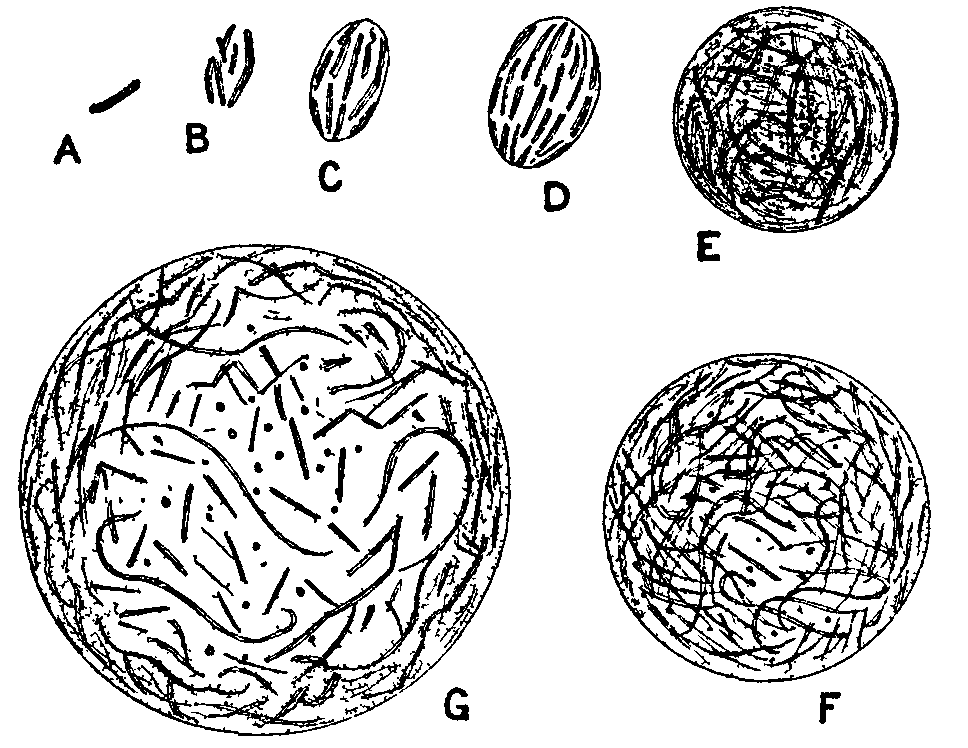
Fig. 14.—Stages in the
formation of a colony of a variety of Bacillus (Proteus)
vulgaris (Hauser), observed in a hanging drop. At 11 A.M. a rodlet appeared (A); at 4 P.M. it had grown and divided and broken up into
eight rodlets (B); C shows further development at 8 P.M., D at 9.30 P.M.—all under a high power. At E, F, and G
further stages are drawn, as seen under much lower power. (H. M.
W.)
In addition to the bacterial actions which result in the oxidization
of ammonia to nitrous acid, and of the latter to nitric acid, the
reversal of such processes is also brought about by numerous bacteria in
the soil, rivers, &c. Warington showed some time ago that many
species are able to reduce nitrates to nitrites, and such reduction is
now known to occur very widely in nature. The researches of Gayon and
Dupetit, Giltay and Aberson and others have shown, moreover, that
bacteria exist which carry such reduction still further, so that ammonia
or even free nitrogen may escape. The importance of these results is
evident in explaining an old puzzle in agriculture, viz. that it is a
wasteful process to put nitrates and manure together on the land. Fresh
manure abounds in de-nitrifying bacteria, and these organisms not only
reduce the nitrates to nitrites, even setting free nitrogen and ammonia,
but their effect extends to the undoing of the work of what nitrifying
bacteria may be present also, with great loss. The combined nitrogen of
dead organisms, broken down to ammonia by putrefactive bacteria, the
ammonia of urea and the results of the fixation of free nitrogen,
together with traces of nitrogen salts due to meteoric activity, are thus
seen to undergo various vicissitudes in the soil, rivers and surface of
the globe generally. The ammonia may be oxidized to nitrites and
nitrates, and then pass into the higher plants and be worked up into
proteids, and so be handed on to animals, eventually to be broken down by
bacterial action again to ammonia; or the nitrates may be degraded to
nitrites and even to free nitrogen or ammonia, which escapes.
That the Leguminosae (a group of plants including peas, beans, Bacteria and Leguminosae. vetches, lupins,
&c.) play a special part in agriculture was known even to the
ancients and was mentioned by Pliny (Historia Naturalis, viii).
These plants will not only grow on poor sandy soil without any addition
of nitrogenous manure, but they actually enrich the soil on which they
are grown. Hence leguminous plants are essential in all rotation of
crops. By analysis it was shown by Schulz-Lupitz in 1881 that the way in
which these plants enrich the soil is by increasing the nitrogen-content.
Soil which had been cultivated for many years as pasture was sown with
lupins for fifteen years in succession; an analysis then showed that the
soil contained more than three times as much nitrogen as at the beginning
of the experiment. The only possible source for this increase was the
atmospheric nitrogen. It had been, however, an axiom with botanists that
the green plants were unable to use the nitrogen of the air. The apparent
contradiction was explained by the experiments of H. Hellriegel and
Wilfarth in 1888. They showed that, when grown on sterilized sand with
the addition of mineral salts, the Leguminosae were no more able to use
the atmospheric nitrogen than other plants such as oats and barley. Both
kinds of plants required the addition of nitrates to the soil. But if a
little water in which arable soil had been shaken up was added to the
sand, then the leguminous plants flourished in the absence of nitrates
and showed an increase in nitrogenous material. They had clearly made use
of the nitrogen of the air. When these plants were examined they had
small swellings or nodules on their roots, while those grown in sterile
sand without soil-extract had no nodules. Now these peculiar nodules are
a normal characteristic of the roots of leguminous plants grown in
ordinary soil. The experiments above mentioned made clear for the first
time the nature and activity of these nodules. They are clearly the
result of infection (if the soil extract was boiled before addition to
the sand no nodules were produced), and their presence enabled the plant
to absorb the free nitrogen of the air.
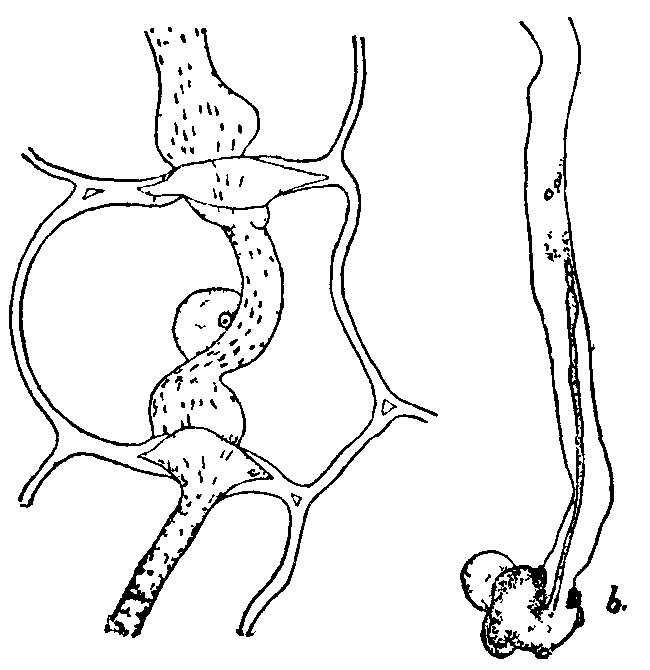
Fig. 15.—Invasion of
leguminous roots by bacteria.
a, cell from the epidermis of root of Pea with
"infection thread" (zoogloea) pushing its way through the cell-walls.
(After Prazmowski.)
b, free end of a root-hair of Pea; at the right
are particles of earth and on the left a mass of bacteria. Inside the
hair the bacteria are pushing their way up in a thin stream.
(From Fischer's Vorlesungen über Bakterien.)
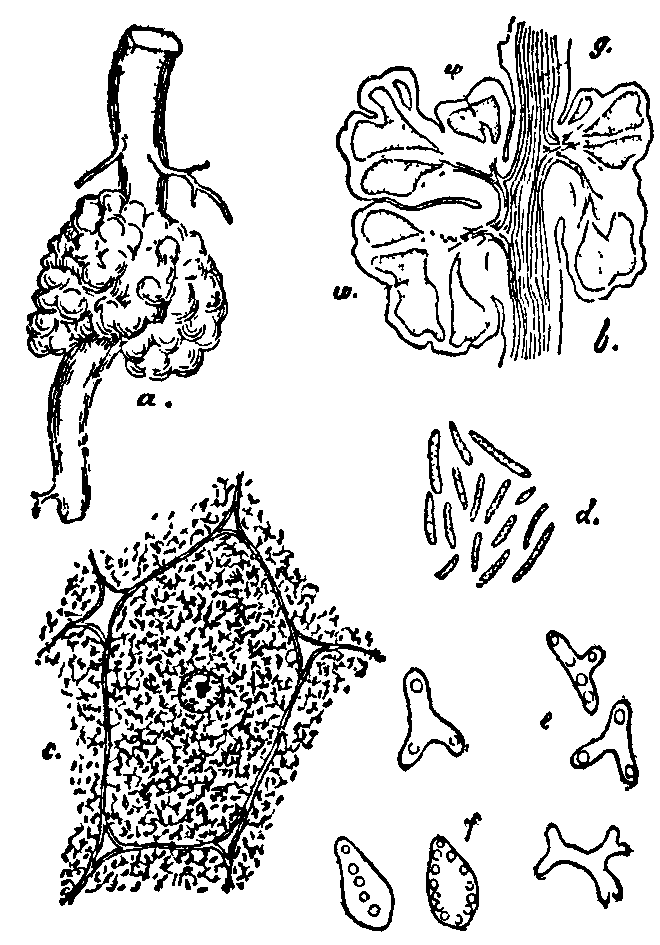 Fig.
Fig. 16.
a, root nodule of the lupin, nat. size. (From
Woromv.)
b, longitudinal section through root and
nodule.
g, fibro-vascular bundle.
w, bacterial tissue. (After Woromv.)
c, cell from bacterial tissues showing nucleus
and protoplasm filled with bacteria.
d, bacteria from nodule of lupin, normal
undegenerate form.
e and f, bacteroids from Vicia
villosa and Lupinus albus. (After Morck.)
(From Fischer's Vorlesungen über Bakterien.)
The work of recent investigators has made clear the whole process. In
ordinary arable soil there exist motile rod-like bacteria, Bacterium
radicicola. These enter the root-hairs of leguminous plants, and
passing down the hair in the form of a long, slimy (zoogloea) thread,
penetrate the tissues of the root. As a result the tissues become
hypertrophied, producing the well-known nodule. In the cells of the
nodule the bacteria multiply and develop, drawing material from their
host. Many of the bacteria exhibit curious involution forms
("bacteroids"), which are finally broken down and their products absorbed
by the plant. The nitrogen of the air is absorbed by the nodules, being
built up into the bacterial cell and later handed on to the host-plant.
It appears from the observations of Mazé that the bacterium can even
absorb free nitrogen when grown in cultures outside the
plant. We have here a very interesting case of symbiosis as mentioned
above. The green plant, however, always keeps the upper hand, restricting
the development of the bacteria to the nodules and later absorbing them
for its own use. It should be mentioned that different genera require
different races of the bacterium for the production of nodules.
The important part that these bacteria play in agriculture led to the
introduction in Germany of a commercial product (the so-called
"nitragin") consisting of a pure culture of the bacteria, which is to be
sprayed over the soil or applied to the seeds before sowing. This
material was found at first to have a very uncertain effect, but later
experiments in America, and the use of a modified preparation in England,
under the direction of Professor Bottomley, have had successful results;
it is possible that in the future a preparation of this sort will be
widely used.
The apparent specialization of these bacteria to the leguminous plants
has always been a very striking fact, for similar bacterial nodules are
known only in two or three cases outside this particular group. However,
Professor Bottomley announced at the meeting of the British Association
for the Advancement of Science in 1907 that he had succeeded in breaking
down this specialization and by a suitable treatment had caused bacteria
from leguminous nodules to infect other plants such as cereals, tomato,
rose, with a marked effect on their growth. If these results are
confirmed and the treatment can be worked commercially, the importance to
agriculture of the discovery cannot be overestimated; each plant will
provide, like the bean and vetch, its own nitrogenous manure, and larger
crops will be produced at a decreased cost.
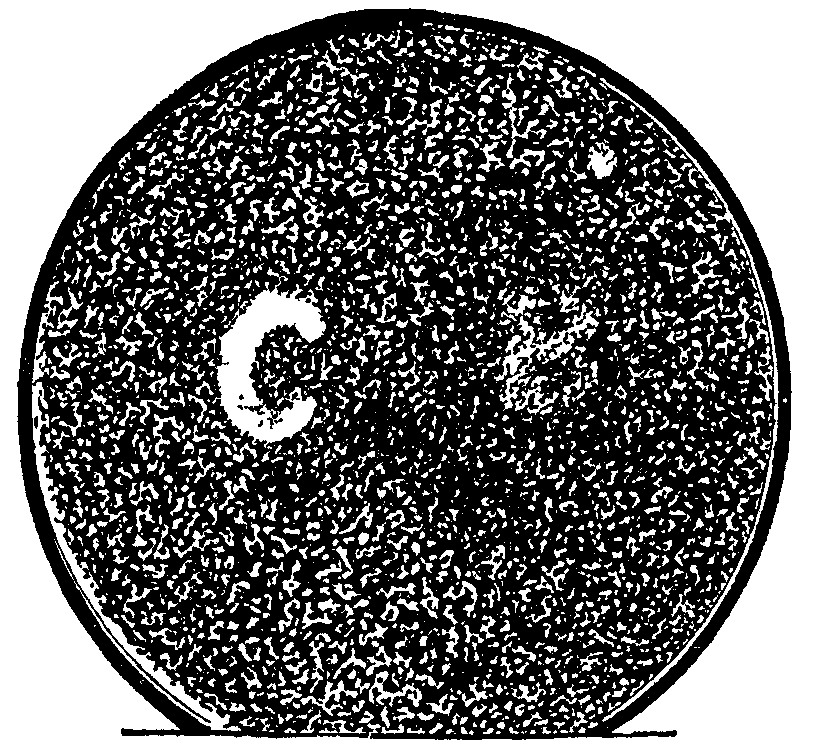
Fig. 17.—A plate-culture
of a bacillus which had been exposed for a period of four hours behind
a zinc stencil-plate, in which the letters C and B were cut. The light
had to traverse a screen of water before passing through the C, and one
of aesculin (which filters out the blue and violet rays) before passing
the B. The plate was then incubated, and, as the figure shows, the
bacteria on the C-shaped area were all killed, whereas they developed
elsewhere on the plate (traces of the B are just visible to the right)
and covered it with an opaque growth. (H. M. W.)
Another important advance is in our knowledge of the part Cellulose-bacteria. played by bacteria in the
circulation of carbon in nature. The enormous masses of cellulose
deposited annually on the earth's surface are, as we know, principally
the result of chlorophyll action on the carbon dioxide of the atmosphere
decomposed by energy derived from the sun; and although we know little as
yet concerning the magnitude of other processes of
carbon-assimilation—e.g. by nitrifying bacteria—it is
probably comparatively small. Such cellulose is gradually reconverted
into water and carbon dioxide, but for some time nothing positive was
known as to the agents which thus break up the paper, rags, straw, leaves
and wood, &c., accumulating in cesspools, forests, marshes and
elsewhere in such abundance. The work of van Tieghem, van Senus, Fribes,
Omeliansky and others has now shown that while certain anaerobic bacteria
decompose the substance of the middle lamella—chiefly pectin
compounds—and thus bring about the isolation of the cellulose
fibres when, for instance, flax is steeped or "retted," they are unable
to attack the cellulose itself. There exist in the mud of marshes, rivers
and cloacae, &c., however, other anaerobic bacteria which decompose
cellulose, probably hydrolysing it first and then splitting the products
into carbon dioxide and marsh gas. When calcium sulphate is present, the
nascent methane induces the formation of calcium carbonate, sulphuretted
hydrogen and water. We have thus an explanation of the occurrence of
marsh gas and sulphuretted hydrogen in bogs, and it is highly probable
that the existence of these gases in the intestines of herbivorous
animals is due to similar putrefactive changes in the undigested
cellulose remains.
Cohn long ago showed that certain glistening particles observed Sulphur bacteria. in the cells of
Beggiatoa consist of sulphur, and Winogradsky and Beyerinck have
shown that a whole series of sulphur bacteria of the genera
Thiothrix, Chromatium, Spirillum, Monas,
&c., exist, and play important parts in the circulation of this
element in nature, e.g. in marshes, estuaries, sulphur springs,
&c. When cellulose bacteria set free marsh gas, the nascent gas
reduces sulphates—e.g. gypsum—with liberation of
SH2, and it is found that the sulphur bacteria thrive under
such conditions by oxidizing the SH2 and storing the sulphur
in their own protoplasm. If the SH2 runs short they oxidize
the sulphur again to sulphuric acid, which combines with any calcium
carbonate present and forms sulphate again. Similarly nascent methane may
reduce iron salts, and the black mud in which these bacteria often occur
owes its colour to the FeS formed. Beyerinck and Jegunow have shown that
some partially anaerobic sulphur bacteria can only exist in strata at a
certain depth below the level of quiet waters where SH2 is
being set free below by the bacterial decompositions of vegetable mud and
rises to meet the atmospheric oxygen coming down from above, and that
this zone of physiological activity rises and falls with the variations
of partial pressure of the gases due to the rate of evolution of the
SH2. In the deeper parts of this zone the bacteria absorb the
SH2, and, as they rise, oxidize it and store up the sulphur;
then ascending into planes more highly oxygenated, oxidize the sulphur to
SO3. These bacteria therefore employ SH2 as their
respiratory substance, much as higher plants employ
carbohydrates—instead of liberating energy as heat by the
respiratory combustion of sugars, they do it by oxidizing hydrogen
sulphide. Beyerinck has shown that Spirillum desulphuricans, a
definite anaerobic form, attacks and reduces sulphates, thus undoing the
work of the sulphur bacteria as certain de-nitrifying bacteria reverse
the operations of nitro-bacteria. Here again, therefore, we have sulphur,
taken into the higher plants as sulphates, built up into
proteids, decomposed by putrefactive bacteria and yielding SH2
which the sulphur bacteria oxidize, the resulting sulphur is then again
oxidized to SO3 and again combined with calcium to gypsum, the
cycle being thus complete.
Chalybeate waters, pools in marshes near ironstone, &c, Iron bacteria. abound in bacteria, some of which
belong to the remarkable genera Crenothrix, Cladothrix and
Leptothrix, and contain ferric oxide, i.e. rust, in their
cell-walls. This iron deposit is not merely mechanical but is due to the
physiological activity of the organism which, according to Winogradsky,
liberates energy by oxidizing ferrous and ferric oxide in its
protoplasm—a view not accepted by H. Molisch. The iron must be in
certain soluble conditions, however, and the soluble bicarbonate of the
protoxide of chalybeate springs seems most favourable, the hydrocarbonate
absorbed by the cells is oxidized, probably thus—
2FeCO3 + 3OH2 + O = Fe2(OH)6 + 2CO2.
The ferric hydroxide accumulates in the sheath, and gradually passes
into the more insoluble ferric oxide. These actions are of extreme
importance in nature, as their continuation results in the enormous
deposits of bog-iron ore, ochre, and—since Molisch has shown that
the iron can be replaced by manganese in some bacteria—of manganese
ores.
Considerable advances in our knowledge of the various chromogenic
Pigment bacteria. bacteria have been made
by the studies of Beyerinck, Lankester, Engelmann, Ewart and others, and
have assumed exceptional importance owing to the discovery that
Bacteriopurpurin—the red colouring matter contained in
certain sulphur bacteria—absorbs certain rays of solar energy, and
enables the organism to utilize the energy for its own life-purposes.
Engelmann showed, for instance, that these red-purple bacteria collect in
the ultra-red, and to a less extent in the orange and green, in bands
which agree with the absorption spectrum of the extracted colouring
matter. Not only so, but the evident parallelism between this absorption
of light and that by the chlorophyll of green plants, is completed by the
demonstration that oxygen is set free by these bacteria—i.e.
by means of radiant energy trapped by their colour-screens the living
cells are in both cases enabled to do work, such as the reduction of
highly oxidized compounds.
The most recent observations of Molisch seem to show that bacteria
possessing bacteriopurpurin exhibit a new type of assimilation—the
assimilation of organic material under the influence of light. In the
case of these red-purple bacteria the colouring matter is contained in
the protoplasm of the cell, but in most chromogenic bacteria it occurs as
excreted pigment on and between the cells, or is formed by their action
in the medium. Ewart has confirmed the principal conclusions concerning
these purple, and also the so-called chlorophyll bacteria (B.
viride, B. chlorinum, &c.), the results going to show that
these are, as many authorities have held, merely minute algae. The
pigment itself may be soluble in water, as is the case with the
blue-green fluorescent body formed by B. pyocyaneus, B.
fluorescens and a whole group of fluorescent bacteria. Neelson found
that the pigment of B. cyanogenus gives a band in the yellow and
strong lines at E and F in the solar spectrum—an absorption
spectrum almost identical with that of triphenyl-rosaniline. In the case
of the scarlet and crimson red pigments of B. prodigiosus, B.
ruber, &c., the violet of B. violacens, B
janthinus, &c., the red-purple of the sulphur bacteria, and
indeed most bacterial pigments, solution in water does not occur, though
alcohol extracts the colour readily. Finally, there are a few forms which
yield their colour to neither alcohol nor water, e.g. the yellow
Micrococcus cereus flavus and the B. berolinensis. Much
work is still necessary before we can estimate the importance of these
pigments. Their spectra are only imperfectly known in a few cases, and
the bearing of the absorption on the life-history is still a mystery. In
many cases the colour-production is dependent on certain definite
conditions—temperature, presence of oxygen, nature of the
food-medium, &c. Ewart's important discovery that some of these
lipochrome pigments occlude oxygen, while others do not, may have
bearings on the facultative anaerobism of these organisms.
A branch of bacteriology which offers numerous problems of Dairy bacteria. importance is that which deals
with the organisms so common in milk, butter and cheese. Milk is a medium
not only admirably suited to the growth of bacteria, but, as a matter of
fact, always contaminated with these organisms in the ordinary course of
supply. F. Lafar has stated that 20% of the cows in Germany suffer from
tuberculosis, which also affected 17.7% of the cattle slaughtered in
Copenhagen between 1891 and 1893, and that one in every thirteen samples
of milk examined in Paris, and one in every nineteen in Washington,
contained tubercle bacilli. Hence the desirability of sterilizing milk
used for domestic purposes becomes imperative.
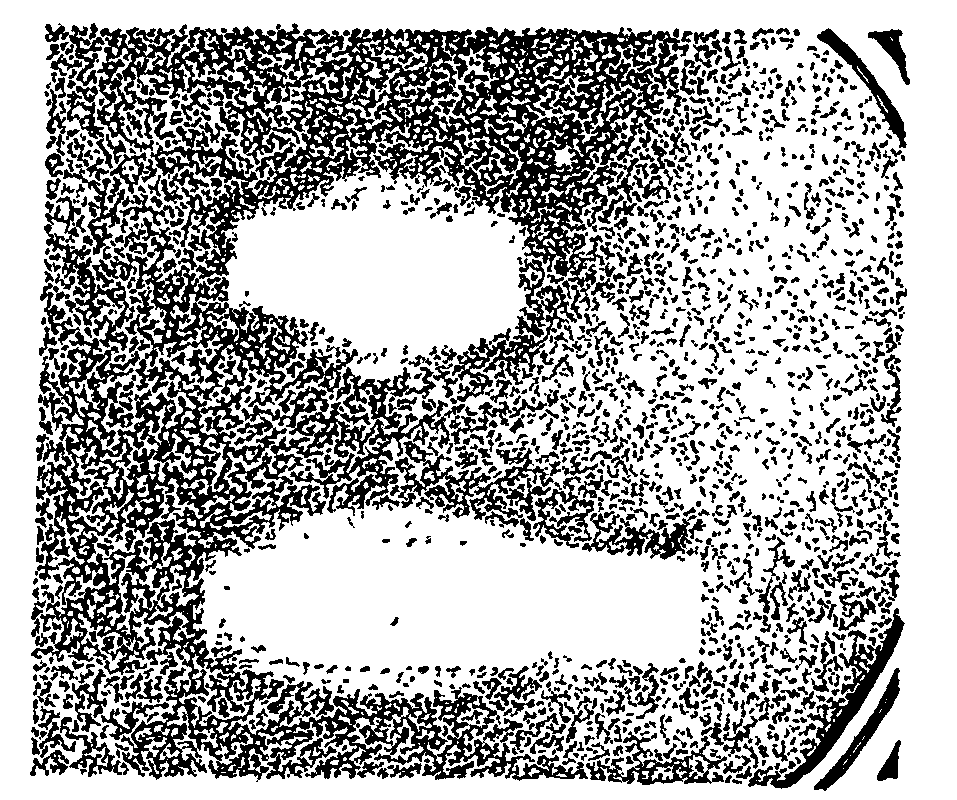
Fig. 18.—A similar
preparation to fig. 17, except that two slit-like openings of equal
length allowed the light to pass, and that the light was that of the
electric arc passed through a quartz prism and casting a powerful
spectrum on the plate. The upper slit was covered with glass, the lower
with quartz. The bacteria were killed over the clear areas shown. The
left-hand boundary of the clear area corresponds to the line F (green
end of the blue), and the beginning of the ultra-violet was at the
extreme right of the upper (short) area. The lower area of bactericidal
action extends much farther to the right, because the quartz allows
more ultra-violet rays to pass than does glass. The red-yellow-green to
the left of F were without effect. (H. M. W.)
No milk is free from bacteria, because the external orifices of the
milk-ducts always contain them, but the forms present in the normal fluid
are principally those which induce such changes as the souring or
"turning" so frequently observed in standing milk (these were examined by
Lord Lister as long ago as 1873-1877, though several other species are
now known), and those which bring about the various changes and
fermentations in butter and cheese made from it. The presence of foreign
germs, which may gain the upper hand and totally destroy the flavours of
butter and cheese, has led to the search for those particular forms to
which the approved properties are due. A definite bacillus to which the
peculiarly fine flavour of certain butters is due, is said to be largely
employed in pure cultures in American dairies, and in Denmark certain
butters are said to keep fresh much longer owing to the use of pure
cultures and the treatment employed to suppress the forms which cause
rancidity. Quite distinct is the search for the germs which cause
undesirable changes, or "diseases"; and great strides have been made in
discovering the bacteria concerned in rendering milk "ropy," butter
"oily" and "rancid," &c. Cheese in its numerous forms contains
myriads of bacteria, and some of these are now known to be concerned in
the various processes of ripening and other changes affecting the
product, and although little is known as to the exact part played by any
species, practical applications of the discoveries of the decade
1890-1900 have been made, e.g. Edam cheese. The Japanese have
cheeses resulting from the bacterial fermentation of boiled Soja
beans.
That bacterial fermentations are accompanied by the evolution Thermophilous bacteria. of heat is an old
experience; but the discovery that the "spontaneous" combustion of
sterilized cotton-waste does not occur simply if moist and freely exposed
to oxygen, but results when the washings of fresh waste are added, has
led to clearer proof that the heating of hay-stacks, hops, tobacco and
other vegetable products is due to the vital activity of bacteria and
fungi, and is physiologically a consequence of respiratory processes like
those in malting. It seems fairly established that when the preliminary
heating process of fermentation is drawing to a close, the cotton, hay,
&c., having been converted into a highly porous friable and
combustible mass, may then ignite in certain circumstances by the
occlusion of oxygen, just as ignition is induced by finely divided
metals. A remarkable point in this connexion has always been the
necessary conclusion that the living bacteria concerned must be exposed
to temperatures of at least 70° C. in the hot heaps. Apart from the
resolution of doubts as to the power of spores to withstand such
temperatures for long periods, the discoveries of Miquel, Globig and
others have shown that there are numerous bacteria which will grow and
divide at such temperatures, e.g. B. thermophilus, from
sewage, which is quite active at 70° C., and B. Ludwigi and B.
ilidzensis, &c., from hot springs, &c.
The bodies of sea fish, e.g. mackerel and other animals, have
Phosphorescent bacteria. long been known to
exhibit phosphorescence. This phenomenon is due to the activity of a
whole series of marine bacteria of various genera, the examination and
cultivation of which have been successfully carried out by Cohn,
Beyerinck, Fischer and others. The cause of the phosphorescence is still
a mystery. The suggestion that it is due to the oxidation of a body
excreted by the bacteria seems answered by the failure to filter off or
extract any such body. Beyerinck's view that it occurs at the moment
peptones are worked up into the protoplasm cannot be regarded as proved,
and the same must be said of the suggestion that the phosphorescence is
due to the oxidation of phosphoretted hydrogen. The conditions of
phosphorescence are, the presence of free oxygen, and, generally, a
relatively low temperature, together with a medium containing sodium
chloride, and peptones, but little or no carbohydrates. Considerable
differences occur in these latter respects, however, and interesting
results were obtained by Beyerinck with mixtures of species possessing
different powers of enzyme action as regards carbohydrates. Thus, a form
termed Photobacterium phosphorescens by Beyerinck will absorb
maltose, and will become luminous if that sugar is present, whereas P.
Pflugeri is indifferent to maltose. If then we prepare densely
inseminated plates of these two bacteria in gelatine food-medium to which
starch is added as the only carbohydrate, the bacteria grow but do not
phosphoresce. If we now streak these plates with an organism, e.g.
a yeast, which saccharifies starch, it is possible to tell whether
maltose or levulose and fructose are formed; if the former, only those
plates containing P. phosphorescens will become luminous; if the
latter, only those containing P. Pflugeri. The more recent
researches of Molisch have shown that the luminosity of ordinary
butcher's meat under appropriate conditions is quite a common occurrence.
Thus of samples of meat bought in Prague and kept in a cool room for
about two days, luminosity was present in 52% of the samples in the case
of beef, 50% for veal, and 39% for liver. If the meat was treated
previously with a 3% salt solution, 89% of the samples of beef and 65% of
the samples of horseflesh were found to exhibit this phenomenon. The
cause of this luminosity is Micrococcus phosphorens, an immotile
round, or almost round organism. This organism is quite distinct from
that causing the luminosity of marine fish.
It has long been known that the production of vinegar depends Oxidizing bacteria. on the oxidization of the
alcohol in wine or beer to acetic acid, the chemical process being
probably carried out in two stages, viz. the oxidation of the alcohol
leading to the formation of aldehyde and water, and the further oxidation
of the aldehyde to acetic acid. The process may even go farther, and the
acetic acid be oxidized to CO2 and OH2; the art of
the vinegar-maker is directed to preventing the accomplishment of the
last stage. These oxidations are brought about by the vital activity of
several bacteria, of which four—Bacterium aceti, B.
pasteurianum, B. kutzingianum, and B.
xylinum—have been thoroughly studied by Hansen and A. Brown. It
is these bacteria which form the zoogloea of the "mother of vinegar,"
though this film may contain other organisms as well. The idea that this
film of bacteria oxidizes the alcohol beneath by merely condensing
atmospheric oxygen in its interstices, after the manner of spongy
platinum, has long been given up; but the explanation of the action as an
incomplete combustion, depending on the peculiar respiration of these
organisms—much as in the case of nitrifying and sulphur
bacteria—is not clear, though the discovery that the acetic
bacteria will not only oxidize alcohol to acetic acid, but further
oxidize the latter to CO2 and OH2 supports the view
that the alcohol is absorbed by the organism and employed as its
respirable substance. Promise of more light on these oxidation
fermentations is afforded by the recent discovery that not only bacteria
and fungi, but even the living cells of higher plants, contain peculiar
enzymes which possess the remarkable property of "carrying"
oxygen—much as it is carried in the sulphuric acid
chamber—and which have therefore been termed oxydases. It is
apparently the presence of these oxydases which causes certain wines to
change colour and alter in taste when poured from bottle to glass, and so
exposed to air.
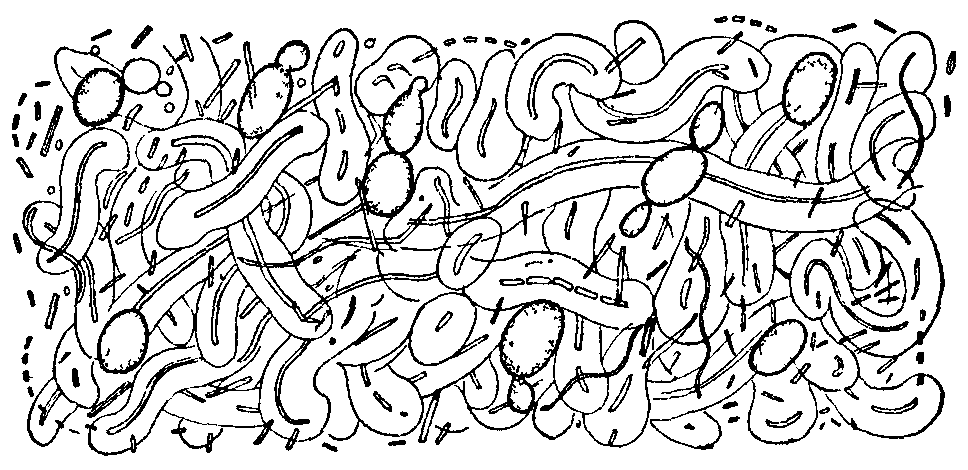
Fig. 19.—Ginger-beer
plant, showing yeast (Saccharomyces pyriformis) entangled in the
meshes of the bacterium (B. vermiforme). (H. M. W.)
Much as the decade from 1880 to 1890 abounded with investigations
Bacteria and light. on the reactions of
bacteria to heat, so the following decade was remarkable for discoveries
regarding the effects of other forms of radiant energy. The observations
of Downes and Blunt in 1877 left it uncertain whether the bactericidal
effects in broth cultures exposed to solar rays were due to thermal
action or not. Further investigations, in which Arloing, Buchner,
Chmelewski, and others took part, have led to the proof that rays of
light alone are quite capable of killing these organisms. The principal
questions were satisfactorily settled by Marshall Ward's experiments in
1892-1893, when he showed that even the spores of B. anthracis,
which withstand temperatures of 100° C. and upwards, can be killed by
exposure to rays of reflected light at temperatures far below anything
injurious, or even favourable to growth. He also showed that the
bactericidal action takes place in the absence of food materials, thus
proving that it is not merely a poisoning effect of the altered medium.
The principal experiments also indicate that it is the rays of highest
refrangibility—the blue-violet and ultra-violet rays of the
spectrum—which bring about the destruction of the organisms (figs.
17, 18). The practical effect of the bactericidal action of solar light
is the destruction of enormous quantities of germs in rivers, the
atmosphere and other exposed situations, and experiments have shown that
it is especially the pathogenic bacteria—anthrax, typhoid,
&c.—which thus succumb to light-action; the discovery that the
electric arc is very rich in bactericidal rays led to the hope that it
could be used for disinfecting purposes in hospitals, but mechanical
difficulties intervene. The recent application of the action of
bactericidal rays to the cure of lupus is, however, an extension of the
same discovery. Even when the light is not sufficiently intense, or the
exposure is too short to kill the spores, the experiments show that
attenuation of virulence may result, a point of extreme
importance in connexion with the lighting and ventilation of dwellings,
the purification of rivers and streams, and the general diminution of
epidemics in nature.
As we have seen, thermophilous bacteria can grow at high Bacteria and cold. temperatures, and it has long
been known that some forms develop on ice. The somewhat different
question of the resistance of ripe spores or cells to extremes of heat
and cold has received attention. Ravenel, Macfadyen and Rowland have
shown that several bacilli will bear exposure for seven days to the
temperature of liquid air (-192° C. to -183° C.) and again grow when put
into normal conditions. More recent experiments have shown that even ten
hours' exposure to the temperature of liquid hydrogen -252° C. (21° on
the absolute scale) failed to kill them. It is probable that all these
cases of resistance of seeds, spores, &c., are to be connected with
the fact that completely dry albumin does not lose its coagulability on
heating to 110° C. for some hours, since it is well known that completely
ripe spores and dry heat are the conditions of extreme experiments.
No sharp line can be drawn between pathogenic and non-pathogenic Pathogenic bacteria. Schizomycetes, and some of
the most marked steps in the progress of our modern knowledge of these
organisms depend on the discovery that their pathogenicity or virulence
can be modified—diminished or increased—by definite
treatment, and, in the natural course of epidemics, by alterations in the
environment. Similarly we are unable to divide Schizomycetes sharply into
parasites and saprophytes, since it is well proved that a number of
species—facultative parasites—can become one or the other
according to circumstances. These facts, and the further knowledge that
many bacteria never observed as parasites, or as pathogenic forms,
produce toxins or poisons as the result of their decompositions and
fermentations of organic substances, have led to important results in the
applications of bacteriology to medicine.
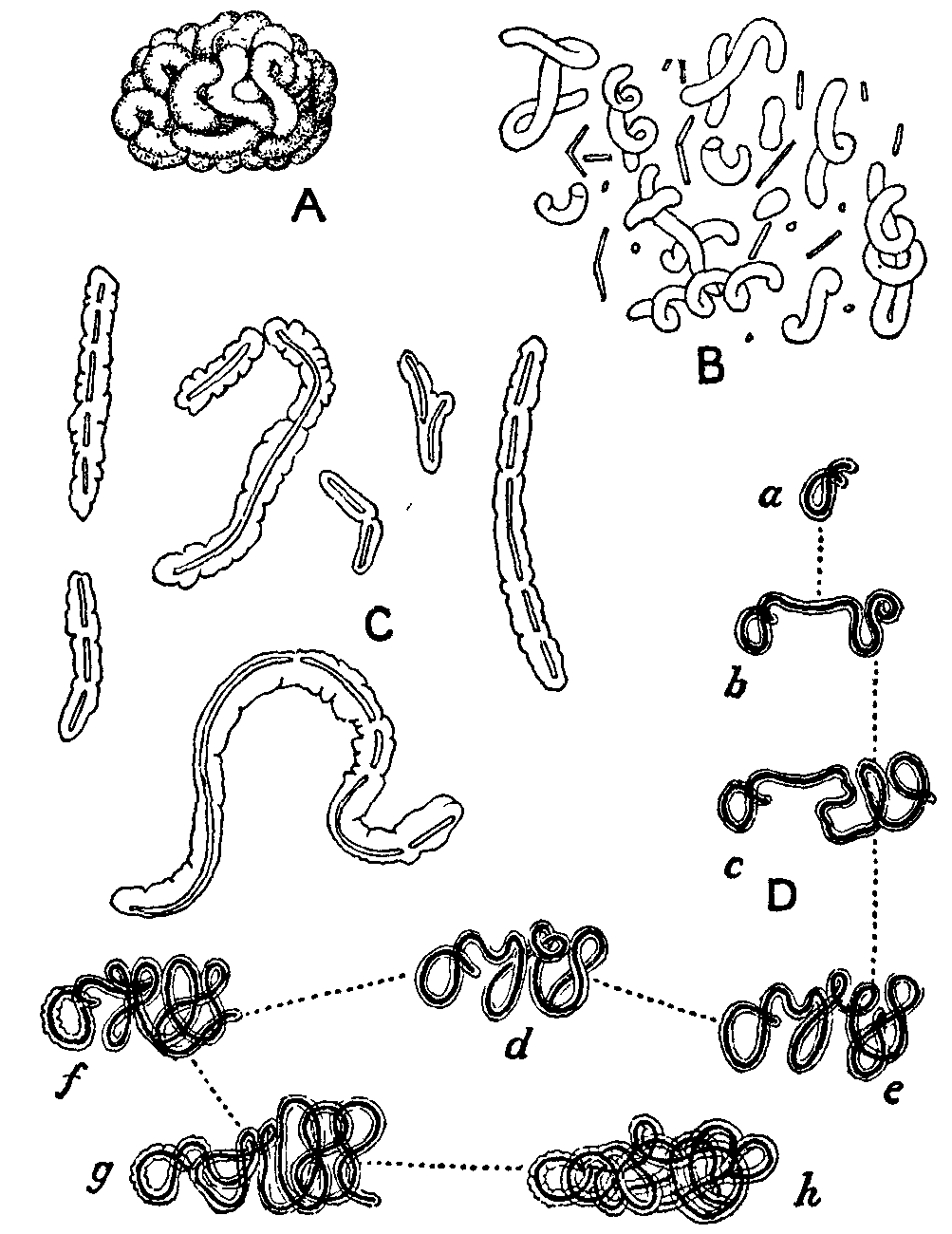 Fig.
Fig. 20.—The ginger-beer plant.
A. One of the brain-like gelatinous masses into which
the mature "plant" condenses.
B. The bacterium with and without its gelatinous
sheaths (cf. fig. 19).
C. Typical filaments and rodlets in the slimy
sheaths.
D. Stages of growth of a sheathed
filament—a at 9 A.M., b
at 3 P.M., c at 9 P.M., d at 11 A.M.
next day, e at 3 P.M., f at 9
P.M., g at 10.30 A.M. next day, h at 24 hours later. (H. M.
W.)
Bacterial diseases in the higher plants have been described, Bacteriosis in plants. but the subject requires
careful treatment, since several points suggest doubts as to the organism
described being the cause of the disease referred to their agency. Until
recently it was urged that the acid contents of plants explained their
immunity from bacterial diseases, but it is now known that many bacteria
can flourish in acid media. Another objection was that even if bacteria
obtained access through the stomata, they could not penetrate the
cell-walls bounding the intercellular spaces, but certain anaerobic forms
are known to ferment cellulose, and others possess the power of
penetrating the cell-walls of living cells, as the bacteria of
Leguminosae first described by Marshall Ward in 1887, and confirmed by
Miss Dawson in 1898. On the other hand a long list of plant-diseases has
been of late years attributed to bacterial action. Some, e.g. the
Sereh disease of the sugar-cane, the slime fluxes of oaks and other
trees, are not only very doubtful cases, in which other organisms such as
yeasts and fungi play their parts, but it may be regarded as extremely
improbable that the bacteria are the primary agents at all; they are
doubtless saprophytic forms which have gained access to rotting tissues
injured by other agents. Saprophytic bacteria can readily make their way
down the dead hypha of an invading fungus, or into the punctures made by
insects, and Aphides have been credited with the bacterial infection of
carnations, though more recent researches by Woods go to show the
correctness of his conclusion that Aphides alone are responsible for the
carnation disease. On the other hand, recent investigation has brought to
light cases in which bacteria are certainly the primary agents in
diseases of plants. The principal features are the stoppage of the
vessels and consequent wilting of the shoots; as a rule the cut vessels
on transverse sections of the shoots appear brown and choked with a dark
yellowish slime in which bacteria may be detected, e.g. cabbages,
cucumbers, potatoes, &c. In the carnation disease and in certain
diseases of tobacco and other plants the seat of bacterial action appears
to be the parenchyma, and it may be that Aphides or other piercing
insects infect the plants, much as insects convey pollen from plant to
plant, or (though in a different way) as mosquitoes infect man with
malaria. If the recent work on the cabbage disease may be accepted, the
bacteria make their entry at the water pores at the margins of the leaf,
and thence via the glandular cells to the tracheids. Little is known of
the mode of action of bacteria on these plants, but it may be assumed
with great confidence that they excrete enzymes and poisons (toxins),
which diffuse into the cells and kill them, and that the effects are in
principle the same as those of parasitic fungi. Support is found for this
opinion in Beyerinck's discovery that the juices of tobacco plants
affected with the disease known as "leaf mosaic," will induce this
disease after filtration through porcelain.
In addition to such cases as the kephir and ginger-beer plants Symbiosis. (figs. 19, 20), where anaerobic
bacteria are associated with yeasts, several interesting examples of
symbiosis among bacteria are now known. Bacillus chauvaei ferments
cane-sugar solutions in such a way that normal butyric arid, inactive
lactic acid, carbon dioxide, and hydrogen result; Micrococcus
acidi-paralactici, on the other hand, ferments such solutions to
optically active paralactic acid. Nencki showed, however, that if both
these organisms occur together, the resulting products contain large
quantities of normal butyl alcohol, a substance neither bacterium can
produce alone. Other observers have brought forward other cases. Thus
neither B. coli nor the B. denitrificans of Burri and
Stutzer can reduce nitrates, but if acting together they so completely
undo the structure of sodium nitrate that the nitrogen passes off in the
free state. Van Senus showed that the concurrence of two bacteria is
necessary before his B. amylobacter can ferment cellulose, and the
case of mud bacteria which evolve sulphuretted hydrogen below which is
utilized by sulphur bacteria above has already been quoted, as also that
of Winogradsky's Clostridium pasteurianum, which is
anaerobic, and can fix nitrogen only if protected from oxygen by aerobic
species. It is very probable that numerous symbiotic fermentations in the
soil are due to this co-operation of oxygen-protecting species with
anaerobic ones, e.g. Tetanus.
Fig. 21.—A plate-culture
colony of a species of Bacillus—Proteus (Hauser)—on
the fifth day. The flame-like processes and outliers are composed of
writhing filaments, and the contours are continually changing while the
colony moves as a whole. Slightly magnified. (H. M. W.)
Astonishment has been frequently expressed at the powerful Activity of bacteria. activities of
bacteria—their rapid growth and dissemination, the extensive and
profound decompositions and fermentations induced by them, the resistance
of their spores to dessication, heat, &c.—but it is worth while
to ask how far these properties are really remarkable when all the data
for comparison with other organisms are considered. In the first place,
the extremely small size and isolation of the vegetative cells place the
protoplasmic contents in peculiarly favourable circumstances for action,
and we may safely conclude that, weight for weight and molecule for
molecule, the protoplasm of bacteria is brought into contact with the
environment at far more points and over a far larger surface than is that
of higher organisms, whether—as in plants—it is distributed
in thin layers round the sap-vacuoles, or—as in animals—is
bathed in fluids brought by special mechanisms to irrigate it. Not only
so, the isolation of the cells facilitates the exchange of liquids and
gases, the passage in of food materials and out of enzymes and products
of metabolism, and thus each unit of protoplasm obtains opportunities of
immediate action, the results of which are removed with equal rapidity,
not attainable in more complex multi-cellular organisms. To put the
matter in another way, if we could imagine all the living cells of a
large oak or of a horse, having given up the specializations of function
impressed on them during evolution and simply carrying out the
fundamental functions of nutrition, growth, and multiplication which mark
the generalized activities of the bacterial cell, and at the same time
rendered as accessible to the environment by isolation and consequent
extension of surface, we should doubtless find them exerting changes in
the fermentable fluids necessary to their life similar to those exerted
by an equal mass of bacteria, and that in proportion to their
approximation in size to the latter. Ciliary movements, which undoubtedly
contribute in bringing the surface into contact with larger supplies of
oxygen and other fluids in unity of time, are not so rapid or so
extensive when compared with other standards than the apparent dimensions
of the microscopic field. The microscope magnifies the distance traversed
as well as the organism, and although a bacterium which covers 9-10 cm.
or more in 15 minutes—say 0.1 mm. or 100 µ per
second—appears to be darting across the field with great velocity,
because its own small size—say 5 × 1 µ—comes into
comparison, it should be borne in mind that if a mouse 2 in. long only,
travelled twenty times its own length, i.e. 40 in., in a second,
the distance traversed in 15 minutes at that rate, viz. 1000 yards, would
not appear excessive. In a similar way we must be careful, in our wonder
at the marvellous rapidity of cell-division and growth of bacteria, that
we do not exaggerate the significance of the phenomenon. It takes any
ordinary rodlet 30-40 minutes to double its length and divide into two
equal daughter cells when growth is at its best; nearer the minimum it
may require 3-4 hours or even much longer. It is by no means certain that
even the higher rate is greater than that exhibited by a tropical bamboo
which will grow over a foot a day, or even common grasses, or asparagus,
during the active period of cell-division, though the phenomenon is here
complicated by the phase of extension due to intercalation of water. The
enormous extension of surface also facilitates the absorption of energy
from the environment, and, to take one case only, it is impossible to
doubt that some source of radiant energy must be at the disposal of those
prototrophic forms which decompose carbonates and assimilate carbonic
acid in the dark and oxidize nitrogen in dry rocky regions where no
organic materials are at their disposal, even could they utilize them. It
is usually stated that the carbon dioxide molecule is here split by means
of energy derived from the oxidation of nitrogen, but apart from the fact
that none of these processes can proceed until the temperature rises to
the minimum cardinal point, Engelmann's experiment shows that in the
purple bacteria rays are used other than those employed by green plants,
and especially ultra-red rays not seen in the spectrum, and we may
probably conclude that "dark rays"—i.e. rays not appearing
in the visible spectrum—are absorbed and employed by these and
other colourless bacteria. The purple bacteria have thus two sources of
energy, one by the oxidation of sulphur and another by the absorption of
"dark rays." Stoney (Scient. Proc. R. Dub. Soc., 1893, p. 154) has
suggested yet another source of energy, in the bombardment of these
minute masses by the molecules of the environment, the velocity of which
is sufficient to drive them well into the organism, and carry energy in
of which they can avail themselves.
Fig. 22.—Portions of a
colony such as that in fig. 21, highly magnified, showing the kinds of
changes brought about in a few minutes, from A to B, and B to C, by the
growth and ciliary movements of the filaments. The arrows show the
direction of motion. (H. M. W.)
Authorities.—General: Fischer, The
Structure and Functions of Bacteria (Oxford, 1900, 2nd ed.), German
(Jena, 1903); Migula, System der Bakterien (Jena, 1897); and in
Engler and Prantl, Die natürlichen Pflanzenfamilien, I. Th. 1 Abt.
a; Lafar, Technical Mycology (vol. i. London, 1898); Mace,
Traité pratique de bakteriologie (5th ed. 1904). Fossil bacteria:
Renault, "Recherches sur les Bactériacées fossiles," Ann. des Sc.
Nat., 1896, p. 275. Bacteria in Water: Frankland and Marshall Ward.
"Reports on the Bacteriology of Water," Proc. R. Soc., vol. li. p.
183, vol. liii. p. 245, vol. lvi. p. 1; Marshall Ward, "On the Biology of
B. ramosus," Proc. R. Soc., vol. lviii. p. 1; and papers on
Bacteria of the river Thames in Ann. of Bot. vol. xii. pp. 59 and
287, and vol. xiii. p. 197. Cell-membrane, &c.: Butschli, Weitere
Ausfuhrungen über den Bau der Cyanophyceen und Bakterien (Leipzig,
1896); Fischer, Unters. über den Bau der Cyanophyceen und
Bakterien (Jena, 1897); Rowland, "Observations upon the Structure of
Bacteria," Trans. Jenner Institute, 2nd ser. 1899, p. 143, with
literature. Cilia: Fischer, "Unters. über Bakterien," Pringsh.
Jahrb. vol. xxvii.; also the works of Migula and Fischer already
cited. Nucleus: Wager in Ann. Bot. vol. ix. p. 659; also Migula
and Fischer, l.c.; Vejdovsky, "Über den Kern der Bakterien und
seine Teilung," Cent. f. Bakt. Abt. II. Bd. xi. (1904) p. 481;
ibid. "Cytologisches über die Bakterien der Prager Wasserleitung,"
Cent. f. Bakt. Abt. II. Bd. xv. (1905); Mencl, "Nachträge zu den
Strukturverhältnissen von Bakterium gammari" in Archiv f.
Protistenkunde, Bd. viii. (1907), p. 257. Spores, &c.: Marshall
Ward, "On the Biology of B. ramosus," Proc. R. Soc., 1895,
vol. lviii. p. 1; Sturgis, "A Soil Bacillus of the type of de Bary's
B. megatherium," Phil. Trans. vol. cxci. p.
147; Klein, L., Ber. d. deutschen bot. Gesellsch. (1889), Bd.
vii.; and Cent. f. Bakt. und Par. (1889), Bd. vi. Classification:
Marshall Ward, "On the Characters or Marks employed for classifying the
Schizomycetes," Ann. of Bot., 1892, vol. vi.; Lehmann and Neumann,
Atlas and Essentials of Bacteriology; also the works of Migula and
Fischer already cited. Myxobacteriaceae: Berkeley, Introd. to
Cryptogamic Botany (1857), p. 313; Thaxter, "A New Order of
Schizomycetes," Bot. Gaz. vol. xvii. (1892), p. 389; and "Further
Observations on the Myxobacteriaceae," ibid. vol. xxiii. (1897),
p. 395, and "Notes on the Myxobacteriaceae," ibid. vol. xxxvii.
(1904), p. 405; Baur, "Myxobakterienstudien," Arch. f.
Protistenkunde, Bd. v. (1904), p. 92; Smith, "Myxobacteria," Jour.
of Botany, 1901, p. 69; Quehl, Cent. f. Bakt. xvi. (1896), p.
9. Growth: Marshall Ward, "On the Biology of B. ramosus," Proc.
R. Soc. vol. lviii. p. 1 (1895). Fermentation, &c.: Warington,
The Chemical Action of some Micro-organisms (London, 1888);
Winogradsky, "Recherches sur les organismes de la nitrification," Ann.
de l'Inst. Past., 1890, pp. 213, 257, 760, 1891, pp. 92 and 577; "Sur
l'assimilation de l'azote gazeux, &c.," Compt. Rend., 12 Feb.
1894; "Zur Microbiologie des Nitrifikationsprozesses," Cent. f.
Bakt. Abt. II. Bd. ii. (1896), p. 415; "Ueber Schwefel-Bakterien,"
Bot. Zeitg., 1887, Nos. 31-37; Beitr. zur Morph. u. Phys. der
Bakterien, H. 1 (1888); "Ueber Eisenbakterien," Bot. Zeitg.,
1888, p. 261; and Omeliansky, "Ueber den Einfluss der organischen
Substanzen auf die Arbeit der nitrifizierenden Organismen," Cent. f.
Bakt. Abt. II. Bd. v. (1896); Schorler, "Beitr. zur Kenntniss der
Eisenbakterien," Cent. f. Bakt. Abt. II. Bd. xii. (1904), p. 681;
Marshall Ward, "On the Tubercular Swellings on the Roots of Vicia Faba,"
Phil. Trans., 1877, p. 539; Hellriegel and Wilfarth, "Unters. über
die Stickstoffnahrung der Gramineen u. Leguminosen," Beit. Zeit. d.
Vereins für die Rübenzuckerindustrie (Berlin, 1888); Nobbe and
Hiltner, Landw. Versuchsstationen (1899), Bd. 51, p. 241, and Bd.
52, p. 455; Mazé, Annales de l'Institut Pasteur, t. II, p. 44, and
t. 12, p. 1 (1897); Prazmowski, Land. Versuchsstationen, Bd. 37
(1890), p. 161, Bd. 38 (1891), p. 5; Frank, Landw. Jahrb. Bd. 17
(1888), p. 441; Omelianski, "Sur la fermentation de la cellulose,"
Compt. Rend., 4 Nov. 1895; van Senus, Beitr. zur Kenntn. der
Cellulosegährung (Leiden, 1890); van Tieghem, "Sur la fermentation de
la cellulose," Bull. de la soc. bot. de Fr. t. xxvi. (1879), p.
28; Beyerinck "Ueber Spirillum desulphuricans, &c.," Cent. f.
Bakt. Abt. II. Bd. i. (1895), p. 1; Molisch, Die Pflanze in ihren
Beziehungen zum Eisen (Jena, 1892). Pigment Bacteria: Ewart, "On the
Evolution of Oxygen from Coloured Bacteria," Linn. Journ., 1897,
vol. xxxiii. p. 123; Molisch, Die Purpurbakterien (Jena, 1907).
Oxydases and Enzymes: Green, The Soluble Ferments and Fermentation
(Cambridge, 1899). Action of Light, &c.: Marshall Ward, "The Action
of Light on Bacteria," Phil. Trans., 1893, p. 961, and literature.
Resistance to Cold, &c.: Ravenel, Med. News, 1899, vol.
lxxiv.; Macfadyen and Rowland, Proc. R. Soc. vol. lxvi. pp. 180,
339, and 488; Farmer, "Observations on the Effect of Desiccation of
Albumin upon its Coagulability," ibid. p. 329. Pathogenic
Bacteria: Baumgarten, Pathologische Mykologie (1890); Kolle and
Wassermann, Handbuch der pathogenen Mikroorganismen (1902-1904);
and numerous special works in medical literature. Immunity: Ehrlich, "On
Immunity with Special Reference to Cell-life," Proc. R. Soc. vol.
lxvi. p. 424; Calcar, "Die Fortschritte der Immunitäts- und
Spezifizetätslehre seit 1870," Progressus Rei Botanicae, Bd. I.
Heft 3 (1907). Bacteriosis: Migula, l.c. p. 322, has collected the
literature; see also Sorauer, Handbuch der Pflanzenkrankheiten, I.
(1905), pp. 18-93, for later literature. Symbiosis: Marshall Ward,
"Symbiosis," Ann. of Bot. vol. xiii. p. 549, and literature.
(H. M. W.; V. H. B.)
II. Pathological Importance
The action of bacteria as pathogenic agents is in great part merely an
instance of their general action as producers of chemical change, yet
bacteriology as a whole has become so extensive, and has so important a
bearing on subjects widely different from one another, that division of
it has become essential. The science will accordingly be treated in this
section from the pathological standpoint only. It will be considered
under the three following heads, viz. (1) the methods employed in the
study; (2) the modes of action of bacteria and the effects produced by
them; and (3) the facts and theories with regard to immunity against
bacterial disease.
The demonstration by Pasteur that definite diseases could Historical summary. be produced by bacteria,
proved a great stimulus to research in the etiology of infective
conditions, and the result was a rapid advance in human knowledge. An
all-important factor in this remarkable progress was the introduction by
Koch of solid culture media, of the "plate-method," &c., an account
of which he published in 1881. By means of these the modes of
cultivation, and especially of separation, of bacteria were greatly
simplified. Various modifications have since been made, but the routine
methods in bacteriological procedure still employed are in great part
those given by Koch. By 1876 the anthrax bacillus had been obtained in
pure culture by Koch, and some other pathogenic bacteria had been
observed in the tissues, but it was in the decade 1880-1890 that the most
important discoveries were made in this field. Thus the organisms of
suppuration, tubercle, glanders, diphtheria, typhoid fever, cholera,
tetanus, and others were identified, and their relationship to the
individual diseases established. In the last decade of the 19th century
the chief discoveries were of the bacillus of influenza (1892), of the
bacillus of plague (1894) and of the bacillus of dysentery (1898).
Immunity against diseases caused by bacteria has been the subject of
systematic research from 1880 onwards. In producing active immunity by
the attenuated virus, Duguid and J. S. Burdon-Sanderson and W. S.
Greenfield in Great Britain, and Pasteur, Toussaint and Chauveau in
France, were pioneers. The work of Metchnikoff, dating from about 1884,
has proved of high importance, his theory of phagocytosis (vide
infra) having given a great stimulus to research, and having also
contributed to important advances. The modes by which bacteria produce
their effects also became a subject of study, and attention was naturally
turned to their toxic products. The earlier work, notably that of L.
Brieger, chiefly concerned ptomaines (vide infra), but no great
advance resulted. A new field of inquiry was, however, opened up when, by
filtration a bacterium-free toxic fluid was obtained which produced the
important symptoms of the disease—in the case of diphtheria by
P. P. E. Roux and A. Yersin (1888), and in the case of tetanus a little
later by various observers. Research was thus directed towards
ascertaining the nature of the toxic bodies in such a fluid, and Brieger
and Fraenkel (1890) found that they were proteids, to which they gave the
name "toxalbumins." Though subsequent researches have on the whole
confirmed these results, it is still a matter of dispute whether these
proteids are the true toxins or merely contain the toxic bodies
precipitated along with them. In the United Kingdom the work of Sidney
Martin, in the separation of toxic substances from the bodies of those
who have died from certain diseases, is also worthy of mention. Immunity
against toxins also became a subject of investigation, and the result was
the discovery of the antitoxic action of the serum of animals immunized
against tetanus toxin by E. Behring and Kitazato (1890), and by Tizzoni
and Cattani. A similar result was also obtained in the case of
diphtheria. The facts with regard to passive immunity were thus
established and were put to practical application by the introduction of
diphtheria antitoxin as a therapeutic agent in 1894. The technique of
serum preparation has become since that time greatly elaborated and
improved, the work of P. Ehrlich in this respect being specially
noteworthy. The laws of passive immunity were shown to hold also in the
case of immunity against living organisms by R. Pfeiffer (1894), and
various anti-bacterial sera have been introduced. Of these the
anti-streptococcic serum of A. Marmorek (1895) is one of the best known.
The principles of protective inoculation have been developed and
practically applied on a large scale, notably by W. M. W. Haffkine in the
case of cholera (1893) and plague (1896), and more recently by Wright and
Semple in the case of typhoid fever. One other discovery of great
importance may be mentioned, viz. the agglutinative action of the serum
of a patient suffering from a bacterial disease, first described in the
case of typhoid fever independently by Widal and by Grünbaum in 1896,
though led up to by the work of Pfeiffer, Gruber and Durham and others.
Thus a new aid was added to medical science, viz. serum diagnosis of
disease. The last decade of the 19th century will stand out in the
history of medical science as the period in which serum therapeutics and
serum diagnosis had their birth.
In recent years the relations of toxin and antitoxin, still obscure,
have been the subject of much study and controversy. It was formerly
supposed that the injection of attenuated cultures or dead
organisms—vaccines in the widest sense—was only of service in
producing immunity as a preventive measure against the corresponding
organism, but the work of Sir Almroth Wright has shown that
the use of such vaccines may be of service even after infection has
occurred, especially when the resulting disease is localized. In this
case a general reaction is stimulated by the vaccine which may aid in the
destruction of the invading organisms. In regulating the administration
of such vaccines he has introduced the method of observing the opsonic
index, to which reference is made below. Of the discoveries of new
organisms the most important is that of the Spirochaete pallida in
syphilis by Schaudinn and Hoffmann in 1905; and although proof that it is
the cause of the disease is not absolute, the facts that have been
established constitute very strong presumptive evidence in favour of this
being the case. It may be noted, however, that it is still doubtful
whether this organism is to be placed amongst the bacteria or amongst the
protozoa.
The methods employed in studying the relation of bacteria Methods of study. to disease are in principle
comparatively simple, but considerable experience and great care are
necessary in applying them and in interpreting results. In any given
disease there are three chief steps, viz. (1) the discovery of a
bacterium in the affected tissues by means of the microscope; (2) the
obtaining of the bacterium in pure culture; and (3) the production of the
disease by inoculation with a pure culture. By means of microscopic
examination more than one organism may sometimes be observed in the
tissues, but one single organism by its constant presence and special
relations to the tissue changes can usually be selected as the probable
cause of the disease, and attempts towards its cultivation can then be
made. Such microscopic examination requires the use of the finest lenses
and the application of various staining methods. In these latter
the basic aniline dyes in solution are almost exclusively used, on
account of their special affinity for the bacterial protoplasm. The
methods vary much in detail, though in each case the endeavour is to
colour the bacteria as deeply, and the tissues as faintly, as possible.
Sometimes a simple watery solution of the dye is sufficient, but very
often the best result is obtained by increasing the staining power,
e.g. by addition of weak alkali, application of heat, &c., and
by using some substance which acts as a mordant and tends to fix the
stain to the bacteria. Excess of stain is afterwards removed from the
tissues by the use of decolorizing agents, such as acids of varying
strength and concentration, alcohol, &c. Different bacteria behave
very differently to stains; some take them up rapidly, others slowly,
some resist decolorization, others are easily decolorized. In some
instances the stain can be entirely removed from the tissues, leaving the
bacteria alone coloured, and the tissues can then be stained by another
colour. This is the case in the methods for staining the tubercle
bacillus and also in Gram's method, the essential point in which latter
is the treatment with a solution of iodine before decolorizing. In Gram's
method, however, only some bacteria retain the stain, while others lose
it. The tissues and fluids are treated by various histological methods,
but, to speak generally, examination is made either in films smeared on
thin cover-glasses and allowed to dry, or in thin sections cut by the
microtome after suitable fixation and hardening of the tissue. In the
case of any bacterium discovered, observation must be made in a long
series of instances in order to determine its invariable presence.
In cultivating bacteria outside the body various media to Cultivation. serve as food material must be
prepared and sterilized by heat. The general principle in their
preparation is to supply the nutriment for bacterial growth in a form as
nearly similar as possible to that of the natural habitat of the
organisms—in the case of pathogenic bacteria, the natural fluids of
the body. The media are used either in a fluid or solid condition, the
latter being obtained by a process of coagulation, or by the addition of
a gelatinizing agent, and are placed in glass tubes or flasks plugged
with cotton-wool. To mention examples, blood serum solidified at a
suitable temperature is a highly suitable medium, and various media are
made with extract of meat as a basis, with the addition of gelatine or
agar as solidifying agents and of non-coagulable proteids (commercial
"peptone") to make up for proteids lost by coagulation in the
preparation. The reaction of the media must in every case be carefully
attended to, a neutral or slightly alkaline reaction being, as a rule,
most suitable; for delicate work it may be necessary to standardize the
reaction by titration methods. The media from the store-flasks are placed
in glass test-tubes or small flasks, protected from contamination by
cotton-wool plugs, and are sterilized by heat. For most purposes the
solid media are to be preferred, since bacterial growth appears as a
discrete mass and accidental contamination can be readily recognized.
Cultures are made by transferring by means of a sterile platinum wire a
little of the material containing the bacteria to the medium. The tubes,
after being thus inoculated, are kept at suitable temperatures, usually
either at 37° C., the temperature of the body, or at about 20° C., a warm
summer temperature, until growth appears. For maintaining a constant
temperature incubators with regulating apparatus are used. Subsequent
cultures or, as they are called, "subcultures," may be made by
inoculating fresh tubes, and in this way growth may be maintained often
for an indefinite period. The simplest case is that in which only one
variety of bacterium is present, and a "pure culture" may then be
obtained at once. When, however, several species are present together,
means must be adopted for separating them. For this purpose various
methods have been devised, the most important being the
plate-method of Koch. In this method the bacteria are distributed
in a gelatine or agar medium liquefied by heat, and the medium is then
poured out on sterile glass plates or in shallow glass dishes, and
allowed to solidify. Each bacterium capable of growth gives rise to a
colony visible to the naked eye, and if the colonies are sufficiently
apart, an inoculation can be made from any one to a tube of
culture-medium and a pure culture obtained. Of course, in applying the
method means must be adopted for suitably diluting the bacterial mixture.
Another important method consists in inoculating an animal with some
fluid containing the various bacteria. A pathogenic bacterium present may
invade the body, and may be obtained in pure culture from the internal
organs. This method applies especially to pathogenic bacteria whose
growth on culture media is slow, e.g. the tubercle bacillus.
The full description of a particular bacterium implies an account not
only of its microscopical characters, but also of its growth characters
in various culture media, its biological properties, and the effects
produced in animals by inoculation. To demonstrate readily its action on
various substances, certain media have been devised. For example, various
sugars—lactose, glucose, saccharose, &c.—are added to
test the fermentative action of the bacterium on these substances; litmus
is added to show changes in reaction, specially standardized media being
used for estimating such changes; peptone solution is commonly employed
for testing whether or not the bacterium forms indol; sterilized milk is
used as a culture medium to determine whether or not it is curdled by the
growth. Sometimes a bacterium can be readily recognized from one or two
characters, but not infrequently a whole series of tests must be made
before the species is determined. As our knowledge has advanced it has
become abundantly evident that the so-called pathogenic bacteria are not
organisms with special features, but that each is a member of a group of
organisms possessing closely allied characters. From the point of view of
evolution we may suppose that certain races of a group of bacteria have
gradually acquired the power of invading the tissues of the body and
producing disease. In the acquisition of pathogenic properties some of
their original characters have become changed, but in many instances this
has taken place only to a slight degree, and, furthermore, some of these
changes are not of a permanent character. It is to be noted that in the
case of bacteria we can only judge of organisms being of different
species by the stability of the characters which distinguish them, and
numerous examples might be given where their characters become modified
by comparatively slight change in their environment. The cultural as well
as the microscopical characters of a pathogenic
organism may be closely similar to other non-pathogenic members of the
same group, and it thus comes to be a matter of extreme difficulty in
certain cases to state what criterion should be used in differentiating
varieties. The tests which are applied for this purpose at present are
chiefly of two kinds. In the first place, such organisms may be
differentiated by the chemical change produced by them in various culture
media, e.g. by their fermentative action on various sugars,
&c., though in this case such properties may become modified in the
course of time. And in the second place, the various serum reactions to
be described below have been called into requisition. It may be stated
that the introduction of a particular bacterium into the tissues of the
body leads to certain properties appearing in the serum, which are
chiefly exerted towards this particular bacterium. Such a serum may
accordingly within certain limits be used for differentiating this
organism from others closely allied to it (vide infra).
The modes of cultivation described apply only to organisms which grow
in presence of oxygen. Some, however—the strictly anaerobic
bacteria—grow only in the absence of oxygen; hence means must be
adopted for excluding this gas. It is found that if the inoculation be
made deep down in a solid medium, growth of an anaerobic organism will
take place, especially if the medium contains some reducing agent such as
glucose. Such cultures are called "deep cultures." To obtain growth of an
anaerobic organism on the surface of a medium, in using the plate method,
and also for cultures in fluids, the air is displaced by an indifferent
gas, usually hydrogen.
In testing the effects of bacteria by inoculation the smaller Inoculation. rodents, rabbits, guinea-pigs, and
mice, are usually employed. One great drawback in certain cases is that
such animals are not susceptible to a given bacterium, or that the
disease is different in character from that in the human subject. In some
cases, e.g. Malta fever and relapsing fever, monkeys have been
used with success, but in others, e.g. leprosy, none of the lower
animals has been found to be susceptible. Discretion must therefore be
exercised in interpreting negative results in the lower animals. For
purposes of inoculation young vigorous cultures must be used. The
bacteria are mixed with some indifferent fluid, or a fluid culture is
employed. The injections are made by means of a hypodermic syringe into
the subcutaneous tissue, into a vein, into one of the serous sacs, or
more rarely into some special part of the body. The animal, after
injection, must be kept in favourable surroundings, and any resulting
symptoms noted. It may die, or may be killed at any time desired, and
then a post-mortem examination is made, the conditions of the organs,
&c., being observed and noted. The various tissues affected are
examined microscopically and cultures made from them; in this way the
structural changes and the relation of bacteria to them can be
determined.
Though the causal relationship of a bacterium to a disease may be
completely established by the methods given, another very important part
of bacteriology is concerned with the poisons or toxins formed by
bacteria. These toxins may become free in the culture fluid, and the
living bacteria may then be got rid Separation of
toxins. of by filtering the fluid through a filter of unglazed
porcelain, whose pores are sufficiently small to retain them. The passage
of the fluid is readily effected by negative pressure produced by an
ordinary water exhaust-pump. The effects of the filtrate are then tested
by the methods used in pharmacology. In other instances the toxins are
retained to a large extent within the bacteria, and in this case the dead
bacteria are injected as a suspension in fluid. Methods have been
introduced for the purpose of breaking up the bodies of bacteria and
setting free the intracellular toxins. For this purpose Koch ground up
tubercle bacilli in an agate mortar and treated them with distilled water
until practically no deposit remained. Rowland and Macfadyen for the same
purpose introduced the method of grinding the bacilli in liquid air. At
this temperature the bacterial bodies are extremely brittle, and are thus
readily broken up. The study of the nature of toxins requires, of course,
the various methods of organic chemistry. Attempts to obtain them in an
absolutely pure condition have, however, failed in important cases. So
that when a "toxin" is spoken of, a mixture with other organic substances
is usually implied. Or the toxin may be precipitated with other organic
substances, purified to a certain extent by re-solution,
re-precipitation, &c., and desiccated. A "dry toxin" is thus
obtained, though still in an impure condition. Toxic substances have also
been separated by corresponding methods from the bodies of those who have
died of certain diseases, and the action of such substances on animals is
in some cases an important point in the pathology of the disease. Another
auxiliary method has been applied in this department, viz. the separation
of organic substances by filtration under high pressure through a colloid
membrane, gelatine supported in the pores of a porcelain filter being
usually employed. It has been found, for example, that a toxin may pass
through such a filter while an antitoxin may not. The methods of
producing immunity are dealt with below.
The fact that in anthrax, one of the first diseases to be fully Bacteria as agents of disease. studied, numerous
bacilli are present in the blood of infected animals, gave origin to the
idea that the organisms might produce their effect by using up the oxygen
of the blood. Such action is now known to be quite a subsidiary matter.
And although effects may sometimes be produced in a mechanical manner by
bacteria plugging capillaries of important organs, e.g. brain and
kidneys, it may now be stated as an accepted fact that all the important
results of bacteria in the tissues are due to poisonous bodies or toxins
formed by them. Here, just as in the general subject of fermentation, we
must inquire whether the bacteria form the substances in question
directly or by means of non-living ferments or enzymes. With regard to
toxin formation the following general statements may be made. In certain
instances, e.g. in the case of the tetanus and diphtheria bacilli,
the production of soluble toxins can be readily demonstrated by filtering
a culture in bouillon germ-free by means of a porcelain filter, and then
injecting some of the filtrate into an animal. In this way the
characteristic features of the disease can be reproduced. Such toxins
being set free in the culture medium are often known as
extracellular. In many cases, however, the filtrate, when
injected, produces comparatively little effect, whilst toxic action is
observed when the bacteria in a dead condition are used; this is the case
with the organisms of tubercle, cholera, typhoid and many others. The
toxins are here manifestly contained within the bodies of the bacteria,
i.e. are intracellular, though they may become free on
disintegration of the bacteria. The action of these intracellular toxins
has in many instances nothing characteristic, but is merely in the
direction of producing fever and interfering with the vital processes of
the body generally, these disturbances often going on to a fatal result.
In other words, the toxins of different bacteria are closely similar in
their results on the body and the features of the corresponding diseases
are largely regulated by the vital properties of the bacteria, their
distribution in the tissues, &c. The distinction between the two
varieties of toxins, though convenient, must not be pushed too far, as we
know little regarding their mode of formation. Although the formation of
toxins with characteristic action can be shown by the above methods, yet
in some cases little or no toxic action can be demonstrated. This, for
example, is the case with the anthrax bacillus; although the effect of
this organism in the living body indicates the production of toxins which
diffuse for a distance around the bacteria. This and similar facts have
suggested that some toxins are only produced in the living body. A
considerable amount of work has been done in connexion with this subject,
and many observers have found that fluids taken from the living body in
which the organisms have been growing, contain toxic substances, to which
the name of aggressins has been applied. Fluid containing these
aggressins greatly increases the toxic effect of the corresponding
bacteria, and may produce death at an earlier stage than ever occurs with
the bacteria alone. They also appear to have in certain cases a
paralysing action on the cells which act as phagocytes. The work
on this subject is highly suggestive, and opens up new possibilities with
regard to the investigation of bacterial action within the body. Not only
are the general symptoms of poisoning in bacterial disease due to toxic
substances, but also the tissue changes, many of them of inflammatory
nature, in the neighbourhood of the bacteria. Thus, to mention examples,
diphtheria toxin produces inflammatory oedema which may be followed by
necrosis; dead tubercle bacilli give rise to a tubercle-like nodule,
&c. Furthermore, a bacillus may give rise to more than one toxic
body, either as stages in one process of change or as distinct products.
Thus paralysis following diphtheria is in all probability due to a
different toxin from that which causes the acute symptoms of poisoning or
possibly to a modification of it sometimes formed in specially large
amount. It is interesting to note that in the case of the closely
analogous example of snake venoms, there may be separated from a single
venom a number of toxic bodies which have a selective action on different
animal tissues.
Regarding the chemical nature of toxins less is known than Nature of toxins. regarding their physiological
action. Though an enormous amount of work has been done on the subject,
no important bacterial toxin has as yet been obtained in a pure
condition, and, though many of them are probably of proteid nature, even
this cannot be asserted with absolute certainty. Brieger, in his earlier
work, found that alkaloids were formed by bacteria in a variety of
conditions, and that some of them were poisonous. These alkaloids he
called ptomaines. The methods used in the investigations were,
however, open to objection, and it is now recognized that although
organic bases may sometimes be formed, and may be toxic, the important
toxins are not of that nature. A later research by Brieger along with
Fraenkel pointed to the extracellular toxins of diphtheria, tetanus and
other diseases being of proteid nature, and various other observers have
arrived at a like conclusion. The general result of such research has
been to show that the toxic bodies are, like proteids, precipitable by
alcohol and various salts; they are soluble in water, are somewhat easily
dialysable, and are relatively unstable both to light and heat. Attempts
to get a pure toxin by repeated precipitation and solution have resulted
in the production of a whitish amorphous powder with highly toxic
properties. Such a powder gives a proteid reaction, and is no doubt
largely composed of albumoses, hence the name toxalbumoses has
been applied. The question has, however, been raised whether the toxin is
really itself a proteid, or whether it is not merely carried down with
the precipitate. Brieger and Boer, by precipitation with certain salts,
notably of zinc, obtained a body which was toxic but gave no reaction of
any form of proteid. There is of course the possibility in this case that
the toxin was a proteid, but was in so small amount that it escaped
detection. These facts show the great difficulty of the problem, which is
probably insoluble by present methods of analysis; the only test, in
fact, for the existence of a toxin is its physiological effect. It may
also be mentioned that many toxins have now been obtained by growing the
particular organism in a proteid-free medium, a fact which shows that if
the toxin is a proteid it may be formed synthetically by the bacterium as
well as by modification of proteid already present. With regard to the
nature of intracellular toxins, there is even greater difficulty in the
investigation and still less is known. Many of them, probably also of
proteid nature, are much more resistant to heat; thus the intracellular
toxins of the tubercle bacillus retain certain of their effects even
after exposure to 100° C. Like the extracellular toxins they may be of
remarkable potency; for example, fever is produced in the human subject
by the injection into the blood of an extremely minute quantity of dead
typhoid bacilli.
We cannot as yet speak definitely with regard to the part Enzymes. played by enzymes in these toxic
processes. Certain toxins resemble enzymes as regards their conditions of
precipitation and relative instability, and the fact that in most cases a
considerable period intervenes between the time of injection and the
occurrence of symptoms has been adduced in support of the view that
enzymes are present. In the case of diphtheria Sidney Martin obtained
toxic albumoses in the spleen, which he considered were due to the
digestive action of an enzyme formed by the bacillus in the membrane and
absorbed into the circulation. According to this view, then, a part at
least of the directly toxic substance is produced in the living body by
enzymes present in the so-called toxin obtained from the bacterial
culture. Recent researches go to show that enzymes play a greater part in
fermentation by living ferments than was formerly supposed, and by
analogy it is likely that they are also concerned in the processes of
disease. But this has not been proved, and hitherto no enzyme has been
separated from a pathogenic bacterium capable of forming, by digestive or
other action, the toxic bodies from proteids outside the body. It is also
to be noted that, as in the case of poisons of known constitution, each
toxin has a minimum lethal dose which is proportionate to the weight of
the animal and which can be ascertained with a fair degree of
accuracy.
The action of toxins is little understood. It consists in all
probability of disturbance, by means of the chemical affinities of the
toxin, of the highly complicated molecules of living cells. This
disturbance results in disintegration to a varying degree, and may
produce changes visible on microscopic examination. In other cases such
changes cannot be detected, and the only evidence of their occurrence may
be the associated symptoms. The very important work of Ehrlich on
diphtheria toxin shows that in the molecule of toxin there are at least
two chief atom groups—one, the "haptophorous," by which the toxin
molecule is attached to the cell protoplasm; and the other the
"toxophorous," which has a ferment-like action on the living molecule,
producing a disturbance which results in the toxic symptoms. On this
theory, susceptibility to a toxin will imply both a chemical affinity of
certain tissues for the toxin molecule and also sensitiveness to its
actions, and, furthermore, non-susceptibility may result from the absence
of either of these two properties.
A bacterial infection when analysed is seen to be of the nature Bacterial infection. of an intoxication. There
is, however, another all-important factor concerned, viz. the
multiplication of the living organisms in the tissues; this is essential
to, and regulates, the supply of toxins. It is important that these two
essential factors should be kept clearly in view, since the means of
defence against any disease may depend upon the power either of
neutralizing toxins or of killing the organisms producing them. It is to
be noted that there is no fixed relation between toxin production and
bacterial multiplication in the body, some of the organisms most active
as toxin producers having comparatively little power of invading the
tissues.
We shall now consider how bacteria may behave when they The production of disease. have gained entrance
to the body, what effects may be produced, and what circumstances may
modify the disease in any particular case. The extreme instance of
bacterial invasion is found in some of the septicaemias in the lower
animals, e.g. anthrax septicaemia in guinea-pigs, pneumococcus
septicaemia in rabbits. In such diseases the bacteria, when introduced
into the subcutaneous tissue, rapidly gain entrance to the blood stream
and multiply freely in it, and by means of their toxins cause symptoms of
general poisoning. A widespread toxic action is indicated by the lesions
found—cloudy swelling, which may be followed by fatty degeneration,
in internal organs, capillary haemorrhages, &c. In septicaemia in the
human subject, often due to streptococci, the process is similar, but the
organisms are found especially in the capillaries of the internal organs
and may not be detectable in the peripheral circulation during life. In
another class of diseases, the organisms first produce some well-marked
local lesion, from which secondary extension takes place by the lymph or
blood stream to other parts of the body, where corresponding lesions are
formed. In this way secondary abscesses, secondary tubercle glanders and
nodules, &c., result; in typhoid fever there is secondary invasion of
the mesenteric glands, and clumps of bacilli are also found in internal
organs, especially the spleen, though there may be little tissue change
around them. In all such cases there is seen a selective character in the
distribution of the lesions, some organs being in any disease much more
liable to infection than others. In still another class
of diseases the bacteria are restricted to some particular part of the
body, and the symptoms are due to toxins which are absorbed from it. Thus
in cholera the bacteria are practically confined to the intestine, in
diphtheria to the region of the false membrane, in tetanus to some wound.
In the last-mentioned disease even the local multiplication depends upon
the presence of other bacteria, as the tetanus bacillus has practically
no power of multiplying in the healthy tissues when introduced alone.
The effects produced by bacteria may be considered under Tissue changes. the following heads: (1) tissue
changes produced in the vicinity of the bacteria, either at the primary
or secondary foci; (2) tissue changes produced at a distance by
absorption of their toxins; (3) symptoms. The changes in the vicinity of
bacteria are to be regarded partly as the direct result of the
action of toxins on living cells, and partly as indicating a
reaction on the part of the tissues. (Many such changes are
usually grouped together under the heading of "inflammation" of varying
degree—acute, subacute and chronic.) Degeneration and death of
cells, haemorrhages, serous and fibrinous exudations, leucocyte
emigration, proliferation of connective tissue and other cells, may be
mentioned as some of the fundamental changes. Acute inflammation of
various types, suppuration, granulation-tissue formation, &c.,
represent some of the complex resulting processes. The changes produced
at a distance by distribution of toxins may be very manifold—cloudy
swelling and fatty degeneration, serous effusions, capillary
haemorrhages, various degenerations of muscle, hyaline degeneration of
small blood-vessels, and, in certain chronic diseases, waxy degeneration,
all of which may be widespread, are examples of the effects of toxins,
rapid or slow in action. Again, in certain cases the toxin has a special
affinity for certain tissues. Thus in diphtheria changes in both nerve
cells and nerve fibres have been found, and in tetanus minute alterations
in the nucleus and protoplasm of nerve cells.
The lesions mentioned are in many instances necessarily Symptoms. accompanied by functional disturbances
or clinical symptoms, varying according to site, and to the nature and
degree of the affection. In addition, however, there occur in bacterial
diseases symptoms to which the correlated structural changes have not yet
been demonstrated. Amongst these the most important is fever with
increased protein metabolism, attended with disturbances of the
circulatory and respiratory Systems. Nervous symptoms, somnolence, coma,
spasms, convulsions and paralysis are of common occurrence. All such
phenomena, however, are likewise due to the disturbance of the molecular
constitution of living cells. Alterations in metabolism are found to be
associated with some of these, but with others no corresponding physical
change can be demonstrated. The action of toxins on various glands,
producing diminished or increased functional activity, has a close
analogy to that of certain drugs. In short, if we place aside the
outstanding exception of tumour growth, we may say that practically all
the important phenomena met with in disease may be experimentally
produced by the injection of bacteria or of their toxins.
The result of the entrance of a virulent bacterium into the Susceptibility. tissues of an animal is not a
disease with hard and fast characters, but varies greatly with
circumstances. With regard to the subject of infection the chief factor
is susceptibility; with regard to the bacterium virulence is
all-important. Susceptibility, as is well recognized, varies much under
natural conditions in different species, in different races of the same
species, and amongst individuals of the same race. It also varies with
the period of life, young subjects being more susceptible to certain
diseases, e.g. diphtheria, than adults. Further, there is the very
important factor of acquired susceptibility. It has been experimentally
shown that conditions such as fatigue, starvation, exposure to cold,
&c., lower the general resisting powers and increase the
susceptibility to bacterial infection. So also the local powers of
resistance may be lowered by injury or depressed vitality. In this way
conditions formerly believed to be the causes of disease are now
recognized as playing their part in predisposing to the action of the
true causal agent, viz. the bacterium. In health the blood and internal
tissues are bacterium-free; after death they offer a most suitable
pabulum for various bacteria; but between these two extremes lie states
of varying liability to infection. It is also probable that in a state of
health organisms do gain entrance to the blood from time to time and are
rapidly killed off. The circumstances which alter the virulence of
bacteria will be referred to again in connexion with immunity, but it may
be stated here that, as a general rule, the virulence of an organism
towards an animal is increased by sojourn in the tissues of that animal.
The increase of virulence becomes especially marked when the organism is
inoculated from animal to animal in series, the method of passage.
This is chiefly to be regarded as an adaptation to surroundings, though
the fact that the less virulent members of the bacterial species will be
liable to be killed off also plays a part. Conversely, the virulence
tends to diminish on cultivation on artificial media outside the body,
especially in circumstances little favourable to growth.
By immunity is meant non-susceptibility to a given disease, Immunity. or to experimental inoculation with a
given bacterium or toxin. The term must be used in a relative sense, and
account must always be taken of the conditions present. An animal may be
readily susceptible to a disease on experimental inoculation, and yet
rarely or never suffer from it naturally, because the necessary
conditions of infection are not supplied in nature. That an animal
possesses natural immunity can only be shown on exposing it to such
conditions, this being usually most satisfactorily done in direct
experiment. Further, there are various degrees of immunity, and in this
connexion conditions of local or general diminished vitality play an
important part in increasing the susceptibility. Animals naturally
susceptible may acquire immunity, on the one hand by successfully passing
through an attack of the disease, or, on the other hand, by various
methods of inoculation. Two chief varieties of artificial immunity are
now generally recognized, differing chiefly according to the mode of
production. In the first—active immunity—a reaction or
series of reactions is produced in the body of the animal, usually by
injections of bacteria or their products. The second—passive
immunity—is produced by the transference of a quantity of the
serum of an animal actively immunized to a fresh animal; the term is
applied because there is brought into play no active change in the
tissues of the second animal. The methods of active immunity have been
practically applied in preventive inoculation against disease;
those of passive immunity have given us serum therapeutics. The
chief facts with regard to each may now be stated.
1. Active Immunity.—The key to the artificial
establishment of active immunity is given by the fact long established
that recovery from an attack of certain infective diseases is accompanied
by protection for varying periods of time against a subsequent attack.
Hence follows the idea of producing a modified attack of the disease as a
means of prevention—a principle which had been previously applied
in inoculation against smallpox. Immunity, however, probably results from
certain substances introduced into the system during the disease rather
than from the disease itself; for by properly adjusted doses of the
poison (in the widest sense), immunity may result without any symptoms of
the disease occurring. Of the chief methods used in producing active
immunity the first is by inoculation with bacteria whose virulence has
been diminished, i.e. with an "attenuated virus." Many of the
earlier methods of attenuation were devised in the case of the anthrax
bacillus, an organism which is, however, somewhat exceptional as regards
the relative stability of its virulence. Many such methods consist, to
speak generally, in growing the organism outside the body under somewhat
unsuitable conditions, e.g. at higher temperatures than the
optimum, in the presence of weak antiseptics, &c. The virulence of
many organisms, however, becomes diminished when they are grown on the
ordinary artificial media, and the diminution is sometimes accelerated by
passing a current of air over the surface of the
growth. Sometimes also the virulence of a bacterium for a particular kind
of animal becomes lessened on passing it through the body of one of
another species. Cultures of varying degree of virulence may be obtained
by such methods, and immunity can be gradually increased by inoculation
with vaccines of increasing virulence. The immunity may be made to reach
a very high degree by ultimately using cultures of intensified virulence,
this "supervirulent" character being usually attained by the method of
passage already explained. A second method is by injection of the
bacterium in the dead condition, whereby immunity against the living
organism may be produced. Here manifestly the dose may be easily
controlled, and may be gradually increased in successive inoculations.
This method has a wide application. A third method is by injections of
the separated toxins of a bacterium, the resulting immunity being not
only against the toxin, but, so far as present knowledge shows, also
against the living organism. In the development of toxin-immunity the
doses, small at first, are gradually increased in successive
inoculations; or, as in the case of very active toxins, the initial
injections are made with toxin modified by heat or by the addition of
various chemical substances. Immunity of the same nature can be acquired
in the same way against snake and scorpion poisons, and against certain
vegetable toxins, e.g. ricin, abrin, &c.
In order that the immunity may reach a high degree, either the
bacterium in a very virulent state or a large dose of toxin must
ultimately be used in the injections. In such cases the immunity is, to
speak generally, specific, i.e. applies only to the bacterium or
toxin used in its production. A certain degree of non-specific immunity
or increased tissue resistance may be produced locally, e.g. in
the peritoneum, by injections of non-pathogenic organisms, peptone,
nucleic acid and various other substances. In these cases the immunity is
without specific character, and cannot be transferred to another animal.
Lastly, in a few instances one organism has an antagonistic action to
another; for example, the products of B. pyocyaneus have a certain
protective action against B. anthracis. This method has, however,
not yielded any important practical application.
2. Passive Immunity: Anti-sera.—The development of active
immunity by the above methods is essentially the result of a reactive
process on the part of the cells of the body, though as yet we know
little of its real nature. It is, however, also accompanied by the
appearance of certain bodies in the blood serum of the animal treated, to
which the name of anti-substances is given, and these have been
the subject of extensive study. It is by means of them that immunity
(passive) can be transferred to a fresh animal. The development of
anti-substances is, however, not peculiar to bacteria, but occurs also
when alien cells of various kinds, proteins, ferments, &c., are
injected. In fact, organic molecules can be divided into two classes
according as they give rise to anti-substances or fail to do so. Amongst
the latter, the vegetable poisons of known constitution, alkaloids,
glucosides, &c., are to be placed. The molecules which lead to the
production of anti-substances are usually known as antigens, and each
antigen has a specific combining affinity for its corresponding
anti-substance, fitting it as a lock does a key. The antigens, as already
indicated, may occur in bacteria, cells, &c., or they may occur free
in a fluid. Anti-substances may be arranged, as has been done by Ehrlich,
into three main groups. In the first group, the anti-substance simply
combines with the antigen, without, so far as we know, producing any
change in it. The antitoxins are examples of this variety. In the second
group, the anti-substance, in addition to combining with the antigen,
produces some recognizable physical change in it; the precipitins and
agglutinins may be mentioned as examples. In the third group, the
anti-substance, after it has combined with the antigen, leads to the
union of a third body called complement (alexine or
cytase of French writers), which is present in normal serum. As a
result of the union of the three substances, a dissolving or digestive
action is often to be observed. This is the mode of action of the
anti-substances in the case of a haemolytic or bacteriolytic serum. So
far as bacterial immunity is concerned, the anti-serum exerts its action
either on the toxin or on the bacterium itself; that is, its action is
either antitoxic or anti-bacterial. The properties of these two kinds of
serum may now be considered.
The term "antitoxic" signifies that serum has the power of Antitoxic serum. neutralizing the action of the
toxin, as is shown by mixing them together outside the body and then
injecting them into an animal. The antitoxic serum when injected
previously to the toxin also confers immunity (passive) against it; when
injected after the toxin it has within certain limits a curative action,
though in this case its dose requires to be large. The antitoxic property
is developed in a susceptible animal by successive and gradually
increasing doses of the toxin. In the earlier experiments on smaller
animals the potency of the toxin was modified for the first injections,
but in preparing antitoxin for therapeutical purposes the toxin is used
in its unaltered condition, the horse being the animal usually employed.
The injections are made subcutaneously and afterwards intravenously; and,
while the dose must be gradually increased, care must be taken that this
is not done too quickly, otherwise the antitoxic power of the serum may
fall and the health of the animal suffer. The serum of the animal is
tested from time to time against a known amount of toxin, i.e. is
standardized. The unit of antitoxin in Ehrlich's new standard is the
amount requisite to antagonize 100 times the minimum lethal dose of a
particular toxin to a guinea-pig of 250 grm. weight, the indication that
the toxin has been antagonized being that a fatal result does not follow
within five days after the injection. In the case of diphtheria the
antitoxic power of the serum may reach 800 units per cubic centimetre, or
even more. The laws of antitoxin production and action are not confined
to bacterial toxins, but apply also to other vegetable and animal toxins,
resembling them in constitution, viz. the vegetable toxalbumoses and the
snake-venom group referred to above.
The production of antitoxin is one of the most striking facts of Action of antitoxin. biological science, and two
important questions with regard to it must next be considered, viz. how
does the antitoxin act? and how is it formed within the body?
Theoretically there are two possible modes of action: antitoxin may act
by means of the cells of the body, i.e. indirectly or
physiologically; or it may act directly on the toxin, i.e.
chemically or physically. The second view may now be said to be
established, and, though the question cannot be fully discussed here, the
chief grounds in support of a direct action may be given. (a) The
action of antitoxin on toxin, as tested by neutralization effects, takes
place more quickly in concentrated than in weak solutions, and more
quickly at a warm (within certain limits) than at a cold temperature.
(b) Antitoxin acts more powerfully when injected along with the
toxin than when injected at the same time in another part of the body; if
its action were on the tissue-cells one would expect that the site of
injection would be immaterial. For example, the amount necessary to
neutralize five times the lethal dose being determined, twenty times that
amount will neutralize a hundred times the lethal dose. In the case of
physiological antagonism of drugs this relationship does not hold.
(c) It has been shown by C. J. Martin and Cherry, and by A. A.
Kanthack and Cobbett, that in certain instances the toxin can be made to
pass through a gelatine membrane, whereas the antitoxin cannot, its
molecules being of larger size. If, however, toxin be mixed with
antitoxin for some time, it can no longer be passed through, presumably
because it has become combined with the antitoxin.
Lastly it may be mentioned that when a toxin has some action which can
be demonstrated in a test-tube experiment, for example, a dissolving
action on red corpuscles, this action may be annulled by previously
adding the antitoxin to toxin; in such a case the intervention of the
living tissues is excluded. In view of the fact that antitoxin has a
direct action on toxin, we may say that theoretically this may take place
in one of two ways. It may produce a disintegration of the toxin
molecule, or it may combine with it to produce a body whose combining
affinities are satisfied. The latter view, first advocated by Ehrlich, harmonizes with the facts established with regard
to toxic action and the behaviour of antitoxins, and may now be regarded
as established. His view as to the dual composition of the toxin molecule
has already been mentioned, and it is evident that if the haptophorous or
combining group has its affinity satisfied by union with antitoxin, the
toxin will no longer combine with living cells, and will thus be rendered
harmless. One other important fact in support of what has been stated is
that a toxin may have its toxic action diminished, and may still require
the same amount of antitoxin as previously for neutralization. This is
readily intelligible on the supposition that the toxophorous group is
more labile than the haptophorous. There is, however, still dispute with
regard to the exact nature of the union of toxin and antitoxin. Ehrlich's
view is that the two substances form a firm combination like a strong
acid and a base. He found, however, that if he took the largest amount of
toxin which was just neutralized by a given amount of antitoxin, much
more than a single dose of toxin had to be added before a single dose was
left free. For example, if 100 doses of toxin were neutralized by a unit
of antitoxin (v. supra) it might be that 125 doses would need to
be added to the same amount of antitoxin before the mixture produced a
fatal result when it was injected. This result, which is usually known
now as the "Ehrlich phenomenon," was explained by him on the supposition
that the "toxin" does not represent molecules which are all the same, but
contains molecules of different degrees of combining affinity and of
toxic action. Accordingly, the most actively toxic molecules will be
neutralized first, and those which are left over, that is, uncombined
with antitoxin, will have a weaker toxic action. This view has been
assailed by Thorvald Madsen and S. A. Arrhenius, who hold that the union
of toxin and antitoxin is comparatively loose, and belongs to the class
of reversible actions, being comparable in fact with the union of a weak
acid and base. If such were the condition there would always be a certain
amount both of free toxin and of free antitoxin in the mixture, and in
this case also considerably more than a dose of toxin would have to be
added to a "neutral mixture" before the amount of free toxin was
increased by a dose, that is, before the mixture became lethal. It may be
stated that while in certain instances the union of toxin and antitoxin
may be reversible, all the facts established cannot be explained on this
simple hypothesis of reversible action. Still another view, advocated by
Bordet, is that the union of toxin and antitoxin is rather of physical
than of strictly chemical nature, and represents an interaction of
colloidal substances, a sort of molecular deposition by which the smaller
toxin molecule becomes entangled in the larger molecule of antitoxin.
Sufficient has been said to show that the subject is one of great
intricacy, and no simple statement with regard to it is as yet possible.
We are probably safe in saying, however, that the molecules of a toxin
are not identical but vary in the degree of their combining affinities,
and also in their toxic action, and that, while in some cases the
combination of anti-substances has been shown to be reversible, we are
far from being able to say that this is a general law.
The origin of antitoxin is of course merely a part of the general
Formation of antitoxin. question regarding
the production of anti-substances in general, as these all combine in the
same way with their homologous substances and have the same character of
specificity. As, however, most of the work has been done with regard to
antitoxin production we may consider here the theoretical aspect of the
subject. There are three chief possibilities: (a) that the
antitoxin is a modification of the toxin; (b) that it is a
substance normally present, but produced in excess under stimulation of
the toxin; (c) that it is an entirely new product. The first of
these, which would imply a process of a very remarkable nature, is
disproved by what is observed after bleeding an animal whose blood
contains antitoxin. In such a case it has been shown that, without the
introduction of fresh toxin, new antitoxin appears, and therefore must be
produced by the living tissues. The second theory is the more probable
a priori, and if established removes the necessity for the third.
It is strongly supported by Ehrlich, who, in his so-called "side-chain"
(Seitenkette) theory, explains antitoxin production as an instance
of regeneration after loss. Living protoplasm, or in other words a biogen
molecule, is regarded as consisting of a central atom group
(Leistungskern), related to which are numerous secondary atom
groups or side-chains, with unsatisfied chemical affinities. "Side-chain" theory. The side-chains constitute
the means by which other molecules are added to the living molecule,
e.g. in the process of nutrition. It is by means of such
side-chains that toxin molecules are attached to the protoplasm, so that
the living molecules are brought under the action of the toxophorous
groups of the toxins. In antitoxin production this combination takes
place, though not in sufficient amount to produce serious toxic symptoms.
It is further supposed that the combination being of somewhat firm
character, the side-chains thus combined are lost for the purposes of the
cell and are therefore thrown off. By the introduction of fresh toxin the
process is repeated and the regeneration of side-chains is increased.
Ultimately the regeneration becomes an over-regeneration and free
side-chains produced in excess are set free and appear in the blood as
antitoxin molecules. In other words the substances, which when forming
part of the cells fix the toxin to the cells, constitute antitoxin
molecules when free in the serum. This theory, though not yet
established, certainly affords the most satisfactory explanation at
present available. In support of it there is the remarkable fact,
discovered by A. Wassermann and Takaki in the case of tetanus, that there
do exist in the nervous system molecules with combining affinity for the
tetanus toxin. If, for example, the brain and spinal cord removed from an
animal be bruised and brought into contact with tetanus toxin, a certain
amount of the toxicity disappears, as shown by injecting the mixture into
another animal. Further, these molecules in the nervous system present
the same susceptibility to heat and other physical agencies as does
tetanus antitoxin. There is therefore strong evidence that antitoxin
molecules do exist as part of the living substance of nerve cells. It
has, moreover, been found that the serum of various animals has a certain
amount of antitoxic action, and thus the basis for antitoxin production,
according to Ehrlich's theory, is afforded. The theory also supplies the
explanation of the power which an animal possesses of producing various
antitoxins, since this depends ultimately upon susceptibility to toxic
action. The explanation is thus carried back to the complicated
constitution of biogen molecules in various living cells of the body. It
may be added that in the case of all the other kinds of anti-substances,
which are produced by a corresponding reaction, we have examples of the
existence of traces of them in the blood serum under normal conditions.
We are, accordingly, justified in definitely concluding that their
appearance in large amount in the blood, as the result of active
immunization, represents an increased production of molecules which are
already present in the body, either in a free condition in its fluids or
as constituent elements of its cells.
In preparing anti-bacterial sera the lines of procedure correspond
Anti-bacterial serum. to those followed in
the case of antitoxins, but the bacteria themselves in the living or dead
condition or their maceration products are always used in the injections.
Sometimes dead bacteria, living virulent bacteria, and living
supervirulent bacteria, are used in succession, the object being to
arrive ultimately at a high dosage, though the details vary in different
instances. The serum of an animal thus actively immunized has powerful
protective properties towards another animal, the amount necessary for
protection being sometimes almost inconceivably small. As a rule it has
no action on the corresponding toxin, i.e. is not antitoxic. In
addition to the protective action, such a serum may possess activities
which can be demonstrated outside the body. Of these the most important
are (a) bacteriolytic or lysogenic action, (b)
agglutinative action, and (c) opsonic action.
The first of these, lysogenic or bacteriolytic action, consists in
(a) Lysogenic action. the
production of a change in the corresponding bacterium whereby it becomes
granular, swells up and ultimately may undergo dissolution. Pfeiffer was
the first to show that this occurred when the bacterium was injected into
the peritoneal cavity of the animal immunized against it, and also when a
little of the serum of such an animal was injected with the bacterium
into the peritoneum of a fresh, i.e. non-immunized animal.
Metchnikoff and Bordet subsequently devised means by which a similar
change could be produced in vitro, and analysed the conditions
necessary for its occurrence. It has been completely established that in
this phenomenon of lysogenesis there are two substances concerned, one
specially developed or developed in excess, and the other present in
normal serum. The former (Immunkörper of Ehrlich, substance
sensibilisatrice of Bordet) is the more stable, resisting a
temperature of 60° C., and though giving the specific character to the
reaction cannot act alone. The latter is ferment-like and much more
labile than the former, being readily destroyed at 60° C. It may be added
that the protective power is not lost by exposure to the temperature
mentioned, this apparently depending upon a specific anti-substance.
Furthermore, lysogenic action is not confined to the case of bacteria but
obtains also with other organized structures, e.g. red corpuscles
(Bordet, Ehrlich and Morgenroth), leucocytes and spermatozoa
(Metchnikoff). That is to say, if an animal be treated with injections of
these bodies, its serum acquires the power of dissolving or of producing
some disintegrative effect in them. The development of the immune body
with specific combining affinity thus presents an analogy to antitoxin
production, the difference being that in lysogenesis another substance is
necessary to complete the process. It can be shown that in many cases
when bacteria are injected the serum of the treated animal has no
bacteriolytic effect, and still an immune body is present, which leads to
the fixation of complement; in this case bacteriolysis does not occur,
because the organism is not susceptible to the action of the complement.
In all cases the important action is the binding of complement to the
bacterium by means of the corresponding immune body; whether or not death
of the bacterium occurs, will depend upon its susceptibility to the
action of the particular complement, the latter acting like a toxin or
digestive ferment. It is to be noted that in the process of immunization
complement does not increase in amount; accordingly the immune serum
comes to contain immune body much in excess of the amount of complement
necessary to complete its action. An important point with regard to the
therapeutic application of an anti-bacterial serum, is that when the
serum is kept in vitro the complement rapidly disappears, and
accordingly the complement necessary for the production of the
bactericidal action must be supplied by the blood of the patient treated.
This latter complement may not suit the immune body, that is, may not be
fixed to the bacterium by means of it, or if the latter event does occur,
may fail to bring about the death of the bacteria. These circumstances
serve, in part at least, to explain the fact that the success attending
the use of anti-bacterial sera has been much inferior to that in the case
of antitoxic sera.
Another property which may be possessed by an anti-bacterial (b) Agglutination. serum is that of
agglutination. By this is meant the aggregation into clumps of the
bacteria uniformly distributed in an indifferent fluid; if the bacterium
is motile its movement is arrested during the process. The process is of
course observed by means of the microscope, but the clumps soon settle in
the fluid and ultimately form a sediment, leaving the upper part clear.
This change, visible to the naked eye, is called sedimentation.
B. J. A. Charrin and G. E. H. Roger first showed in the case of B.
pyocyaneus that when a small quantity of the homologous serum
(i.e. the serum of an animal immunized against the bacterium) was
added to a fluid culture of this bacillus, growth formed a sediment
instead of a uniform turbidity. Gruber and Durham showed that
sedimentation occurred when a small quantity of the homologous serum was
added to an emulsion of the bacterium in a small test-tube, and found
that this obtained in all cases where Pfeiffer's lysogenic action could
be demonstrated. Shortly afterwards Widal and also Grünbaum showed that
the serum of patients suffering from typhoid fever, even at an early
stage of the disease, agglutinated the typhoid bacillus—a fact
which laid the foundation of serum diagnosis. A similar phenomenon has
been demonstrated in the case of Malta fever, cholera, plague, infection
with B. coli, "meat-poisoning" due to Gärtner's bacillus, and
various other infections. As regards the mode of action of agglutinins,
Gruber and Durham considered that it consists in a change in the
envelopes of the bacteria, by which they swell up and become adhesive.
The view has various facts in its support, but F. Kruse and C. Nicolle
have found that if a bacterial culture be filtered germ-free, an
agglutinating serum still produces some change in it, so that particles
suspended in it become gathered into clumps. E. Duclaux, for this reason,
considers that agglutinins are coagulative ferments.
The phenomenon of agglutination depends essentially on the union of
molecules in the bacteria—the agglutinogens—with the
corresponding agglutinins, but another essential is the presence of a
certain amount of salts in the fluid, as it can be shown that when
agglutinated masses of bacteria are washed salt-free the clumps become
resolved. The fact that agglutinins appear in the body at an early stage
in a disease has been taken by some observers as indicating that they
have nothing to do with immunity, their development being spoken of as a
reaction of infection. This conclusion is not justified, as we must
suppose that the process of immunization begins to be developed at an
early period in the disease, that it gradually increases, and ultimately
results in cure. It should also be stated that agglutinins are used up in
the process of agglutination, apparently combining with some element of
the bacterial structure. In view of all the facts it must be admitted
that the agglutinins and immune bodies are the result of corresponding
reactive processes, and are probably related to one another. The
development of all antagonistic substances which confer the special
character on antimicrobic sera, as well as antitoxins, may be expressed
as the formation of bodies with specific combining affinity for the
organic substance introduced into the system—toxin, bacterium, red
corpuscle, &c., as the case may be. The bacterium, being a complex
organic substance, may thus give rise to more than one antagonistic or
combining substance.
By opsonic action is meant the effect which a serum has on (c) Opsonic action. bacteria in making
them more susceptible to phagocytosis by the white corpuscles of the
blood (q.v.). Such an effect may be demonstrated outside the body
by making a suitable mixture of (a) a suspension of the particular
bacterium, (b) the serum to be tested, and (c) leucocytes
of a normal animal or person. The mixture is placed in a thin capillary
tube and incubated at 37° C. for half an hour; a film preparation is then
made from it on a glass slide, stained by a suitable method and then
examined microscopically. The number of bacteria contained within a
number of, say fifty, leucocytes can be counted and the average taken. In
estimating the opsonic power of the serum in cases of disease a control
with normal serum is made at the same time and under precisely the same
conditions. The average number of bacteria contained within leucocytes in
the case tested, divided by the number given by the normal serum, is
called the phagocytic index. Wright and Douglas showed that under
these conditions phagocytosis might occur when a small quantity of normal
serum was present, whereas it was absent when normal salt solution was
substituted for the serum; the latter thus contained substances which
made the organisms susceptible to the action of the phagocytosis. They
further showed that this substance acted by combining with the organisms
and apparently producing some alteration in them; on the other hand it
had no direct action on the leucocytes. This opsonin of normal serum is
very labile, being rapidly destroyed at 55° C.; that is, a serum heated
at this temperature has practically no greater effect in aiding
phagocytosis than normal salt solution has. Various observers had
previously found that the serum of an animal immunized against a
particular bacterium had a special action in bringing about phagocytosis
of that organism, and it had been found that this property was retained
when the serum was heated at 55° C. It is now generally admitted that at
least two distinct classes of substances are concerned in opsonic action,
that thermostable immune opsonins are developed as a result of active
immunization and these possess the specific properties of anti-substances
in general, that is, act only on the corresponding bacterium. On the
contrary the labile opsonins of normal serum have a comparatively general
action on different organisms. It is quite evident that the specific
immune-opsonins may play a very important part in the phenomena of
immunity, as by their means the organisms are taken up more actively by
the phagocytic cells, and thereafter may undergo rapid
disintegration.
The opsonic action of the serum has been employed by Sir A. Wright and
his co-workers to control the treatment of bacterial infections by
vaccines; that is, by injections of varying amounts of a dead culture of
the corresponding bacterium. The object in such treatment is to raise the
opsonic index of the serum, this being taken as an indication of
increased immunity. The effect of the injection of a small quantity of
vaccine is usually to produce an increase in the opsonic index within a
few days. If then an additional quantity of vaccine be injected there
occurs a fall in the opsonic index (negative phase) which, however, is
followed later by a rise to a higher level than before. If the amounts of
vaccine used and the times of the injection are suitably chosen, there
may thus be produced by a series of steps a rise of the opsonic index to
a high level. One of the chief objects in registering the opsonic power
in such cases is to avoid the introduction of additional vaccine when the
opsonic index is low, that is, during the negative phase, as if this were
done a further diminution of the opsonic action might result. The
principle in such treatment by means of vaccines is to stimulate the
general production of anti-substances throughout the body, so that these
may be carried to the sites of bacterial growth, and aid the destruction
of the organisms by means of the cells of the tissues. A large number of
favourable results obtained by such treatment controlled by the
observation of the opsonic index have already been published, but it
would be unwise at present to offer a decided opinion as to the ultimate
value of the method.
Active immunity has thus been shown to be associated with the presence
of certain anti-substances in the serum. After these substances have
disappeared, however, as they always do in the course of time, the animal
still possesses immunity for a varying period. This apparently depends
upon some alteration in the cells of the body, but its exact nature is
not known.
The destruction of bacteria by direct cellular agency both Phagocytosis. in natural and acquired immunity
must not be overlooked. The behaviour of certain cells, especially
leucocytes, in infective conditions led Metchnikoff to place great
importance on phagocytosis. In this process there are two factors
concerned, viz. the ingestion of bacteria by the cells, and the
subsequent intracellular digestion. If either of these is wanting or
interfered with, phagocytosis will necessarily fail as a means of
defence. As regards the former, leucocytes are guided chiefly by
chemiotaxis, i.e. by sensitiveness to chemical substances in their
surroundings—a property which is not peculiar to them but is
possessed by various unicellular organisms, including motile bacteria.
When the cell moves from a less to a greater degree of concentration,
i.e. towards the focus of production, the chemiotaxis is termed
positive; when the converse obtains, negative. This apparently purposive
movement has been pointed out by M. Verworn to depend upon stimulation to
contraction or the reverse. Metchnikoff showed that in animals immune to
a given organism phagocytosis is present, whereas in susceptible animals
it is deficient or absent. He also showed that the development of
artificial immunity is attended by the appearance of phagocytosis; also,
when an anti-serum is injected into an animal, the phagocytes which
formerly were indifferent might move towards and destroy the bacteria. In
the light of all the facts, however, especially those with regard to
anti-bacterial sera, the presence of phagocytosis cannot be regarded as
the essence of immunity, but rather the evidence of its existence. The
increased ingestion of bacteria in active immunity would seem to depend
upon the presence of immune opsonins in the serum. These, as already
explained, are true anti-substances. Thus the apparent increased activity
of the leucocytes is due to a preliminary effect of the opsonins on the
bacteria. We have no distinct proof that there occurs in active immunity
any education of the phagocytes, in Metchnikoff's sense, that is, any
increase of the inherent ingestive or digestive activity of these cells.
There is some evidence that in certain cases anti-substances may act upon
the leucocytes, and to these the name of "stimulins" has been given. We
cannot, however, say that these play an important part in immunity, and
even if it were so, the essential factor would be the development of the
substances which act in this way. While in immunity there probably occurs
no marked change in the leucocytes themselves, it must be admitted that
the increased destruction of bacteria by these cells is of the highest
importance. This, as already pointed out, depends upon the increase of
opsonins, though it is also to be noted that in many infective conditions
there is another factor present, namely a leucocytosis, that is, an
increase of the leucocytes in the blood, and the defensive powers of the
body are thereby increased. Evidence has been brought forward within
recent years that the leucocytes may constitute an important source of
the antagonistic substances which appear in the serum. Much of such
evidence possesses considerable weight, and seeing that these cells
possess active digestive powers it is by no means improbable that
substances with corresponding properties may be set free by them. To
ascribe such powers to them exclusively is, however, not justifiable.
Probably the lining endothelium of the blood-vessels as well as other
tissues of the body participate in the production of anti-substances.
The subject of artificial immunity has occupied a large proportion
Natural immunity. of bacteriological
literature within recent years, and our endeavour has been mainly to
indicate the general laws which are in process of evolution. When the
facts of natural immunity are examined, we find that no single
explanation is possible. Natural immunity against toxins must be taken
into account, and, if Ehrlich's view with regard to toxic action be
correct, this may depend upon either the absence of chemical affinity of
the living molecules of the tissues for the toxic molecule, or upon
insensitiveness to the action of the toxophorous group. It has been shown
with regard to the former, for example, that the nervous system of the
fowl, which possesses immunity against tetanus toxin, has little
combining affinity for it. The non-sensitiveness of a cell to a toxic
body when brought into immediate relationship cannot, however, be
explained further than by saying that the disintegrative changes which
underlie symptoms of poisoning are not brought about. Then as regards
natural powers of destroying bacteria, phagocytosis aided by chemiotaxis
plays a part, and it can be understood that an animal whose phagocytes
are attracted by a particular bacterium will have an advantage over one
in which this action is absent. Variations in chemiotaxis towards
different organisms probably depend in natural conditions, as well as in
active immunity, upon the opsonic content of the serum. Whether bacteria
will be destroyed or not after they have been ingested by the leucocytes
will depend upon the digestive powers of the latter, and these probably
vary in different species of animals. The blood serum has a direct
bactericidal action on certain bacteria, as tested outside the body, and
this also varies in different animals. Observations made on this property
with respect to the anthrax bacillus at first gave the hope that it might
explain variations in natural immunity. Thus the serum of the white rat,
which is immune to anthrax, kills the bacillus; whereas the serum of the
guinea-pig, which is susceptible, has no such effect. Further
observations, however, showed that this does not hold as a general law.
The serum of the susceptible rabbit, for example, is bactericidal to this
organism, whilst the serum of the immune dog is not. In the case of the
latter animal the serum contains an opsonin which leads to
phagocytosis of the bacillus, and the latter is then destroyed by the
leucocytes. It is quite evident that bactericidal action as tested in
vitro outside the body does not correspond to the degree of immunity
possessed by the animal under natural conditions. We may say, however,
that there are several factors concerned in natural immunity, of which
the most important may be said to be the three following, viz. variations
in the bactericidal action of the serum in vivo, variations in the
chemiotactic or opsonic properties of the serum in vivo, and
variations in the digestive properties of the leucocytes of the
particular animal. It is thus evident that the explanation of natural
immunity in any given instance may be a matter of difficulty and much
complexity.
Authorities.—Bacteriological literature
has become so extensive that it is impossible to give here references to
original articles, even the more important. A number of these, giving an
account of classical researches, were translated from French and German,
and published by the New Sydenham Society under the title
Microparasites in Disease: Selected Essays, in 1886. The following
list contains some of the more important books published within recent
years. Abbott, Principles of Bacteriology (7th ed., London, 1905);
Crookshank, Bacteriology and Infective Diseases (with
bibliography, 4th ed., London, 1896); Duclaux, Traité de
microbiologie (Paris, 1899-1900); Eyre, Bacteriological
Technique (Philadelphia and London, 1902); Flügge, Die
Mikroorganismen (3rd ed., Leipzig, 1896); Fischer, Vorlesungen
über Bakterien (2nd ed., Jena, 1902); Günther, Einführung in das
Studium der Bakteriologie (6th ed., Leipzig, 1906); Hewlett,
Manual of Bacteriology (2nd ed., London, 1902); Hueppe,
Principles of Bacteriology (translation, London, 1899); Klein,
Micro-organisms and Disease (3rd ed., London, 1896); Kolle and
Wassermann, Handbuch der pathogenen Mikroorganismen (Jena, 1904)
(supplements are still being published; this is the most important work
on the subject); Löffler, Vorlesungen über die geschichtliche
Entwickelung der Lehre von der Bacterien (Leipzig, 1887);
McFarland, Text-book upon the Pathogenic Bacteria (5th
ed., London, 1906); Muir and Ritchie, Manual of Bacteriology (with
bibliography, 4th ed., Edin. and Lond., 1908); Park, Pathogenic
Micro-organisms (London, 1906); Sternberg, Manual of
Bacteriology (with full bibliography, 2nd ed., New York, 1896);
Woodhead, Bacteria and their products (with bibliography, London,
1891). The bacteriology of the infective diseases (with bibliography) is
fully given in the System of Medicine, edited by Clifford Allbutt,
(2nd ed., London, 1907). For references consult Centralbl. für Bakter.
u. Parasitenk. (Jena); also Index Medicus. The most important
works on immunity are: Ehrlich, Studies in Immunity (English
translation, New York, 1906), and Metchnikoff, Immunity in Infective
Diseases (English translation, Cambridge, 1905).
(R. M.*)
Gr. βακτήριον, Lat.
bacillus, little rod or stick.
Cladothrix
dichotoma, for example, which is ordinarily a branched, filamentous,
sheathed form, at certain seasons breaks up into a number of separate
cells which develop a tuft of cilia and escape from the sheath. Such a
behaviour is very similar to the production of zoospores which is so
common in many filamentous algae.
Brefeld has
observed that a bacterium may divide once every half-hour, and its
progeny repeat the process in the same time. One bacterium might thus
produce in twenty-four hours a number of segments amounting to many
millions of millions.
The difficulties
presented by such minute and simple organisms as the Schizomycetes are
due partly to the few "characters" which they possess and partly to the
dangers of error in manipulating them; it is anything but an easy matter
either to trace the whole development of a single form or to recognize
with certainty any one stage in the development unless the others are
known. This being the case, and having regard to the minuteness and
ubiquity of these organisms, we should be very careful in accepting
evidence as to the continuity or otherwise of any two forms which falls
short of direct and uninterrupted observation. The outcome of all these
considerations is that, while recognizing that the "genera" and "species"
as defined by Cohn must be recast, we are not warranted in uniting any
forms the continuity of which has not been directly observed; or, at any
rate, the strictest rules should be followed in accepting the evidence
adduced to render the union of any forms probable.
BACTRIA (Bactriana), the ancient name of the country
between the range of the Hindu Kush (Paropamisus) and the Oxus (Amu
Darya), with the capital Bactra (now Balkh); in the Persian inscriptions
Bākhtri. It is a mountainous country with a moderate climate. Water
is abundant and the land is very fertile. Bactria was the home of one of
the Iranian tribes (see Persia: Ancient
History). Modern authors have often used the name in a wider sense,
as the designation of the whole eastern part of Iran. As there can be
scarcely any doubt that it was in these regions, where the fertile soil
of the mountainous country is everywhere surrounded and limited by the
Turanian desert, that the prophet Zoroaster preached and gained his first
adherents, and that his religion spread from here over the western parts
of Iran, the sacred language in which the Avesta, the holy book of
Zoroastrianism, is written, has often been called "old Bactrian." But
there is no reason for this extensive use of the name, and the term "old
Bactrian" is, therefore, at present completely abandoned by scholars.
Still less foundation exists for the belief, once widely spread, that
Bactria was the cradle of the Indo-European race; it was based on the
supposition that the nations of Europe had immigrated from Asia, and that
the Aryan languages (Indian and Iranian) stood nearest to the original
language of the Indo-Europeans. It is now acknowledged by all linguists
that this supposition is quite wrong, and that the Aryans probably came
from Europe. The eastern part of Iran seems to have been the region where
the Aryans lived as long as they formed one people, and whence they
separated into Indians and Iranians.
The Iranian tradition, preserved in the Avesta and in Firdousi's
Shahnama, localizes a part of its heroes and myths in the east of
Iran, and has transformed the old gods who fight with the great snake
into kings of Iran who fight with the Turanians. Many modern authors have
attempted to make history out of these stories, and have created an old
Bactrian empire of great extent, the kings of which had won great
victories over the Turanians. But this historical aspect of the myth is
of late origin: it is nothing but a reflex of the great Iranian empire
founded by the Achaemenids and restored by the Sassanids. The only
historical fact which we can learn from the Iranian tradition is that the
contrast and the feud between the peasants of Iran and the nomads of
Turan was as great in old times as it is now: it is indeed based upon the
natural geographical conditions, and is therefore eternal. But a great
Bactrian empire certainly never existed; the Bactrians and their
neighbours were in old times ruled by petty local kings, one of whom was
Vishtaspa, the protector of Zoroaster. Ctesias in his history of the
Assyrian empire (Diodor. Sic. ii. 6 ff.) narrates a war waged by Ninus
and Semiram, against the king of Bactria (whom some later authors,
e.g. Justin i. 1, call Zoroaster). But the whole Assyrian history
of Ctesias is nothing but a fantastic fiction; from the Assyrian
inscriptions we know that the Assyrians never entered the eastern parts
of Iran.
Whether Bactria formed part of the Median empire, we do not know; but
it was subjugated by Cyrus and from then formed one of the satrapies of
the Persian empire. When Alexander had defeated Darius III., his murderer
Bessus, the satrap of Bactria, tried to organize a national resistance in
the east. But Bactria was conquered by Alexander without much difficulty;
it was only farther in the north, beyond the Oxus, in Sogdiana, that he
met with strong resistance. Bactria became a province of the Macedonian
empire, and soon came under the rule of Seleucus, king of Asia (see Seleucid Dynasty and Hellenism). The Macedonians (and especially Seleucus I.
and his son Antiochus I.) founded a great many Greek towns in eastern
Iran, and the Greek language became for some time dominant there. The
many difficulties against which the Seleucid kings had to fight and the
attacks of Ptolemy II., gave to Diodotus, satrap of Bactria, the
opportunity of making himself independent (about 255 B.C.) and of conquering Sogdiana. He was the founder
of the Graeco-Bactrian kingdom. Diodotus and his successors were able to
maintain themselves against the attacks of the Seleucids; and when
Antiochus III., "the Great," had been defeated by the Romans (190 B.C.), the Bactrian king Euthydemus and his son
Demetrius crossed the Hindu Kush and began the conquest of eastern Iran
and the Indus valley. For a short time they wielded great power; a great
Greek empire seemed to have arisen far in the East. But this empire was
torn by internal dissensions and continual usurpations. When Demetrius
advanced far into India one of his generals, Eucratides, made himself
king of Bactria, and soon in every province there arose new usurpers, who
proclaimed themselves kings and fought one against the other. Most of
them we know only by their coins, a great many of which are found in
Afghanistan and India. By these wars the dominant position of the Greeks
was undermined even more quickly than would otherwise have been the case.
After Demetrius and Eucratides, the kings abandoned the Attic standard of
coinage and introduced a native standard; at the same time the native
language came into use by the side of the Greek. On the coins struck in
India, the well-known Indian alphabet (called Brahmi by the Indians, the
older form of the Devanagari) is used; on the coins struck in Afghanistan
and in the Punjab the Kharoshṭhi alphabet, which is derived
directly from the Aramaic and was in common use in the western parts of
India, as is shown by one of the inscriptions of Asoka and by the recent
discovery of many fragments of Indian manuscripts, written in Kharoshṭhi, in eastern
Turkestan (formerly this alphabet has been called Arianic or Bactrian
Pali; the true name is derived from Indian sources).
The weakness of the Graeco-Bactrian kingdoms was shown by their sudden
and complete overthrow. In the west the Arsacid empire had risen, and
Mithradates I. and Phraates II. began to conquer some of their western
districts, especially Areia (Herat). But in the north a new race
appeared, Mongolian tribes, called Scythians by
the Greeks, amongst which the Tochari, identical with the Yue-chi
(q.v.) of the Chinese, were the most important. In 159 B.C., according to Chinese sources, they entered
Sogdiana, in 139 they conquered Bactria, and during the next generation
they had made an end to the Greek rule in eastern Iran. Only in India the
Greek conquerors (Menander, Apollodotus) maintained themselves some time
longer. But in the middle of the 1st century B.C. the whole of eastern Iran and western India
belonged to the great "Indo-Scythian" empire. The ruling dynasty had the
name Kushan (Kushana), by which they are called on their coins and in the
Persian sources. The most famous of these kings is Kanishka (ca.
123-153), the great protector of Buddhism. The principal seat of the
Tochari and the Kushan dynasty seems to have been Bactria; but they
always maintained the eastern parts of modern Afghanistan and
Baluchistan, while the western regions (Areia, i.e. Herat, Seistan
and part of the Helmund valley) were conquered by the Arsacids. In the
3rd century the Kushan dynasty began to decay; about A.D. 320 the Gupta empire was founded in India. Thus
the Kushanas were reduced to eastern Iran, where they had to fight
against the Sassanids. In the 5th century a new people came from the
east, the Ephthalites (q.v.) or "white Huns," who subjected
Bactria (about 450); and they were followed by the Turks, who first
appear in history about A.D. 560 and subjugated
the country north of the Oxus. Most of the small principalities of the
Tochari or Kushan became subject to them. But when the Sassanian empire
was overthrown by the Arabs, the conquerors immediately advanced
eastwards, and in a few years Bactria and the whole Iran to the banks of
the Jaxartes had submitted to the rule of the caliph and of Islam.
Bibliography.—For the earlier times see
Persia. For the Graeco-Bactrian and Indo-Scythian
kingdoms see (beside articles on the separate kings):—H. H. Wilson,
Ariana Antiqua (1841); Cunningham, "The Greeks of Bactriana,
Ariana and India" in Numismatic Chronicle, N. Ser. viii.-xii.; A.
von Sallet, Die Nachfolger Alexanders des Grossen in Baktrien und
Indien (1879); P. Gardner, The Coins of the Greek and Scythic
Kings of India (1886, Catalogue of Greek Coins in the British Museum,
x.); A. von Gutschmid, Geschichte Irans und seiner Nachbarländer von
Alexander dem Grossen bis zum Untergang der Arsaciden (1888); A.
Stein, "Zoroastrian Deities on Indo-Scythian Coins," Babylonian and
Oriental Record, i. 1887 (cf. Cunningham, ib. ii. 1888);
Vincent A. Smith, "The Kushān or Indo-Scythian Period of Indian
History," Journal of the R. Asiatic Soc., 1903 (cf. his Early
History of India, 2nd ed. 1908); W. W. Tarn, "Notes on Hellenism in
Bactria and India" in Journ. of Hellenic Studies, xxii. 1902. For
the history and character of the Indian alphabet cf. J. Buhler, "Indische
Paläographie" (in Grundriss der indo-arischen Philologie, Bd. i.).
From the Greek authors only a few notices have been preserved, especially
by Justin (and in the prologues of Trogus) and Strabo; for the later
times we get some information from the Byzantine authors and from Persian
and Armenian sources; cf. Th. Nöldeke's translation of Tabari
(Geschichte der Perser und Araber zur Zeit der Sasaniden, 1890)
and J. Marquart, "Erānšahr" (Abhandlungen der königlichen
Ges. d. Wissenschaften zu Göttingen, 1901). The Chinese sources are
given by Deguignes, "Recherches sur quelques événements qui concernent
l'histoire des rois grecs de la Bactriane," Mém. de l'acad. des
inscriptions, xxv.; E. Specht, "Études sur l'Asie centrale d'après
les historiens chinois" in Journal asiatique, 8 série, ii. 1883, 9
série, x. 1857; Sylvain Lévi, "Notes sur les Indo-scythiens," Journal
asiatique, 9 série ix., x. and others.
(Ed. M.)
BACUP, a market town and municipal borough in the Rossendale
parliamentary division of Lancashire, England, on the river Irwell, 203
m. N.N.W. from London, and 22 N. by E. from Manchester, on the Lancashire
& Yorkshire railway. Pop. (1901) 22,505. It is finely situated in a
narrow valley, surrounded by wild, high-lying moorland. It is wholly of
modern growth, and contains several handsome churches and other
buildings, while among institutions the chief is the mechanics' institute
and library. The recreation grounds presented in 1893 by Mr. J. H. Maden,
M.P., are beautifully laid out. Cotton spinning and power-loom weaving
are the chief of numerous manufacturing industries, and there are large
collieries in the vicinity. The principle of co-operation is strongly
developed, and a large and handsome store contains among other
departments a free library for members. The borough was incorporated in
1882, and the corporation consists of a mayor, 6 aldermen and 17
councillors. Area, 6120 acres. In 1841 the population of the chapelry was
only 1526. One of the hills in the vicinity is fortified with a great
ancient earthwork and ditch.
BADAGAS (literally "a Telugu man"), a tribe inhabiting the
Nilgiri Hills, in India, by some authorities declared not to be an
aboriginal or jungle race. They are probably Dravidian by descent, though
they are in religion Hindus of the Saiva sect. They are supposed to have
migrated to the Nilgiris from Mysore about A.D.
1600, after the breaking up of the kingdom of Vijayanagar. They are an
agricultural people and far the most numerous and wealthy of the hill
tribes. They pay a tribute in grain, &c., to the Todas. Their
language is a corrupt form of Kanarese. At the census of 1901 they
numbered 34,178.
See J. W. Breeks, An Account of the Primitive Tribes of the
Nilgiris (1873); Nilgiri Manual, vol. i. pp. 218-228;
Madras Journ. of Sci. and Lit. vol. viii. pp. 103-105; Madras
Museum Bulletin, vol. ii., no. 1, pp. 1-7.
BADAJOZ (formerly sometimes written Badajos), a frontier
province of western Spain, formed in 1833 of districts taken from the
province of Estremadura (q.v.), and bounded on the N. by Cáceres,
E. by Cordova and Ciudad Real, S. by Seville and Huelva, and W. by
Portugal. Pop. (1900) 520,246; area, 8451 sq. m. Badajoz is thus the
largest province of the whole kingdom. Although in many districts there
are low ranges of hills, the surface is more often a desolate and
monotonous plain, flat or slightly undulating. Its one large river is the
Guadiana, which traverses the north of the province from east to west,
fed by many tributaries; but it is only at certain seasons that the
river-beds fill with any considerable volume of water, and the Guadiana
may frequently be forded without difficulty. The climate shows great
extremes of heat in summer and of cold in winter, when fierce north and
north-west winds blow across the plains. In the hot months intermittent
fevers are prevalent in the Guadiana valley. The rainfall is scanty in
average years, and only an insignificant proportion of the land is
irrigated, while the rest is devoted to pasture, or covered with thin
bush and forest. Agriculture, and the cultivation of fruit, including the
vine and olive, are thus in a very backward condition; but Badajoz
possesses more livestock than any other Spanish province. Its acorn-fed
swine are celebrated throughout Spain for their hams and bacon, and large
herds of sheep and goats thrive where the pasture is too meagre for
cattle. The exploitation of the mineral resources of Badajoz is greatly
hindered by lack of water and means of communication; in 1903, out of
nearly 600 mines registered only 26 were at work. Their output consisted
of lead, with very small quantities of copper. The local industries are
not of much importance: they comprise manufactures of woollen and cotton
stuffs of a coarse description, soaps, oils, cork and leather. The purely
commercial interests are more important than the industrial, because of
the transit trade to and from Portugal through no less than seven
custom-houses. Many parts of the province are inaccessible except by
road, and the roads are ill-made, ill-kept and wholly insufficient. The
main line of the Madrid-Lisbon railway passes through Villanueva de la
Serena, Mérida and Badajoz; at Mérida it is joined by the railways going
north to Cáceres and south to Zafra, where the lines from Huelva and
Seville unite. After Badajoz, the capital (pop. (1900) 30,899), the
principal towns are Almendralejo (12,587), Azuaga (14,192), Don Benito
(16,565), Jerez de los Caballeros (10,271), Mérida (11,168) and
Villanueva de la Serena (13,489); these, and also the historically
interesting village of Albuera, are described in separate articles. Other
small towns, chiefly important as markets for agricultural produce, are
Albuquerque (9030), Cabeza del Buey (7566), Campanario (7450), Fregenal
de la Sierra (9615), Fuente de Cantos (8483), Fuente del Maestre (6934),
Llerena (7049), Montijo (7644), Oliva de Jerez (8348), Olivenza (9066),
San Vicente de Alcántara (7722), and Villafranca de los Barros (9954).
Very few inhabitants emigrate from this province, where the birth-rate
considerably exceeds the death-rate. Education, even primary, is in a
very backward condition.
BADAJOZ, the capital of the Spanish province described above;
situated close to the Portuguese frontier, on the left bank
of the river Guadiana, and the Madrid-Lisbon railway. Pop. (1900) 30,899.
Badajoz is the see of a bishop, and the official residence of the
captain-general of Estremadura. It occupies a slight eminence, crowned by
the ruins of a Moorish castle, and overlooking the Guadiana. A strong
wall and bastions, with a broad moat and outworks, and forts on the
surrounding heights, give the city an appearance of great strength. The
river, which flows between the castle-hill and the powerfully armed fort
of San Cristobál, is crossed by a magnificent granite bridge, originally
built in 1460, repaired in 1597 and rebuilt in 1833. The whole aspect of
Badajoz recalls its stormy history; even the cathedral, built in 1258,
resembles a fortress, with massive embattled walls. Badajoz was the
birthplace of the statesman Manuel de Godoy, duke of Alcúdia (1767-1851),
and of the painter Luis de Morales (1509-1586). Two pictures by Morales,
unfortunately retouched in modern times, are preserved in the cathedral.
Owing to its position the city enjoys a considerable transit trade with
Portugal; its other industries include the manufacture of linen, woollen
and leather goods, and of pottery. It is not mentioned by any Roman
historian, and first rose to importance under Moorish rule. In 1031 it
became the capital of a small Moorish kingdom, and, though temporarily
held by the Portuguese in 1168, it retained its independence until 1229,
when it was captured by Alphonso IX. of Leon. As a frontier fortress it
underwent many sieges. It was beleaguered by the Portuguese in 1660, and
in 1705 by the Allies in the War of the Spanish Succession. During the
Peninsular War Badajoz was unsuccessfully attacked by the French in 1808
and 1809; but on the 10th of March 1811, the Spanish commander, José
Imaz, was bribed into surrendering to the French force under Marshal
Soult. A British army, commanded by Marshal Beresford, endeavoured to
retake it, and on the 16th of May defeated a relieving force at Albuera,
but the siege was abandoned in June. The fortress was finally stormed on
the 6th of April 1812, by the British under Lord Wellington, and carried
with terrible loss. It was then delivered up to a two day's pillage. A
military and republican rising took place here in August 1883, but
completely failed.
BADAKSHAN, including Wakhan, a province
on the north-east frontier of Afghanistan, adjoining Russian territory.
Its north-eastern boundaries were decided by the Anglo-Russian agreement
of 1873, which expressly acknowledged "Badakshan with its dependent
district Wakhan" as "fully belonging to the amir of Kabul," and limited
it to the left or southern bank of the Oxus. Much of the interior of the
province is still unexplored. On the west, Badakshan is bounded by a line
which crosses the Turkestan plains southwards from the junction of the
Kunduz and Oxus rivers till it touches the eastern water-divide of the
Tashkurghan river (here called the Koh-i-Chungar), and then runs
south-east, crossing the Sarkhab affluent of the Khanabad (Kunduz), till
it strikes the Hindu Kush. The southern boundary is carried along the
crest of the Hindu Kush as far as the Khawak pass, leading from Badakshan
into the Panjshir valley. Beyond this it is indefinite. It is known that
the Kafirs occupy the crest of the Hindu Kush eastwards of the Khawak,
but how far they extend north of the main watershed is not ascertainable.
The southern limits of Badakshan become definite again at the Dorah pass.
The Dorah connects Zebak and Ishkashim at the elbow, or bend, of the Oxus
with the Lutku valley leading to Chitral. From the Dorah eastwards the
crest of the Hindu Kush again becomes the boundary till it effects a
junction with the Muztagh and Sarikol ranges, which shut off China from
Russia and India. Skirting round the head of the Tagdumbash Pamir, it
finally merges into the Pamir boundary, and turns westwards, following
the course of the Oxus, to the junction of that river and the Khanabad
(Kunduz). So far as the northern boundary follows the Oxus stream, under
the northern slopes of the Hindu Kush, it is only separated by the length
of these slopes (some 8 or 10 m.) from the southern boundary along the
crest. Thus Badakshan reaches out an arm into the Pamirs
eastwards—bottle-shaped—narrow at the neck (represented by
the northern slopes of the Hindu Kush), and swelling out eastwards so as
to include a part of the great and little Pamirs. Before the boundary
settlement of 1873 the small states of Roshan and Shignan extended to the
left bank of the Oxus, and the province of Darwaz, on the other hand,
extended to the right bank. Now, however, the Darwaz extension northwards
is exchanged for the Russian Pamir extension westwards, and the river
throughout is the boundary between Russian and Afghan territory; the
political boundaries of those provinces and those of Wakhan being no
longer coincident with their geographical limits.
The following are the chief provincial subdivisions of Badakshan,
omitting Roshan and Shignan:—On the west Rustak, Kataghan, Ghori,
Narin and Anderab; on the north Darwaz, Ragh and Shiwa; on the east
Charan, Ishkashim, Zebak and Wakhan; and in the centre Faizabad, Farkhar,
Minjan and Kishm. There are others, but nothing certain is known about
these minor subdivisions.
The conformation of the mountain districts, which comprise all the
southern districts of Badakshan and the northern hills and valleys of
Kafiristan, is undoubtedly analogous to that of the rest of the Hindu
Kush westwards. The water-divide of the Hindu Kush from the Dorah to the
Khawak pass, i.e. through the centre of Kafiristan, has never been
accurately traced; but its topographical conformation is evidently a
continuation of that which has been observed in the districts of
Badakshan to the west of the Khawak. The Hindu Kush represents the
southern edge of a great central upheaval or plateau. It breaks up into
long spurs southwards, deep amongst which are hidden the valleys of
Kafiristan, almost isolated from each other by the rugged and snow-capped
altitudes which divide them. To the north the plateau gradually slopes
away towards the Oxus, falling from an average altitude of 15,000 ft. to
4000 ft. about Faizabad, in the centre of Badakshan, but tailing off to
1100 at Kunduz, in Kataghan, where it merges into the flat plains
bordering the Oxus.
The Kokcha river traverses Badakshan from south-east to north-west,
and, with the Kunduz, drains all the northern slopes of the Hindu Kush
west of the Dorah pass. Some of its sources are near Zebak, close to the
great bend of the Oxus northwards, so that it cuts off all the
mountainous area included within that bend from the rest of Badakshan.
Its chief affluent is the Minjan, which Sir George Robertson found to be
a considerable stream where it approaches the Hindu Kush close under the
Dorah. Like the Kunduz, it probably drains the northern slopes of the
Hindu Kush by deep lateral valleys, more or less parallel to the crest,
reaching westwards towards the Khawak pass. From the Oxus (1000 ft.) to
Faizabad (4000 ft.) and Zebak (8500 ft.) the course of the Kokcha offers
a high road across Badakshan; between Zebak and Ishkashim, at the Oxus
bend, there is but an insignificant pass of 9500 ft.; and from Ishkashim
by the Panja, through the Pamirs, is the continuation of what must once
have been a much-traversed trade route connecting Afghan Turkestan with
Kashgar and China. It is undoubtedly one of the great continental
high-roads of Asia. North of the Kokcha, within the Oxus bend, is the
mountainous district of Darwaz, of which the physiography belongs rather
to the Pamir type than to that of the Hindu Kush.
A very remarkable meridional range extends for 100 m. northwards from
the Hindu Kush (it is across this range that the route from Zebak to
Ishkashim lies), which determines the great bend of the Oxus river
northwards from Ishkashim, and narrows the valley of that river into the
formation of a trough as far as the next bend westwards at Kala Wamar.
The western slopes of this range drain to the Oxus either
north-westwards, by the Kokcha and the Ragh, or else they twist their
streams into the Shiwa, which runs due north across Darwaz. Here again we
find the main routes which traverse the country following the rivers
closely. The valleys are narrow, but fertile and populous. The mountains
are rugged and difficult; but there is much of the world-famous beauty of
scenery, and of the almost phenomenal agricultural wealth of the valleys
of Bokhara and Ferghana to be found in the as yet half-explored recesses
of Badakshan.
The principal domesticated animal is the yak. There are also large
flocks of sheep, cows, goats, ponies, fine dogs and Bactrian camels. The
more important wild animals are a large wild sheep (Ovis poli),
foxes, wolves, jackals, bears, boars, deer and leopards; amongst birds,
there are partridges, pheasants, ravens, jays, sparrows, larks, a famous
breed of hawks, &c.
Badakshan proper is peopled by Tajiks, Turks and Arabs, who speak the
Persian and Turki languages, and profess the orthodox doctrines of the
Mahommedan law adopted by the Sunnite sect; while the mountainous
districts are inhabited by Tajiks, professing the Shi‛ite creed
and speaking distinct dialects in different districts.
History.—Badakshan, part of the Greek Bactria, was
visited by Hsüan Tsang in 630 and 644. The Arabian geographers of the
10th century speak of its mines of ruby and lapis lazuli, and give
notices of the flourishing commerce and large towns of Waksh and Khotl,
regions which appear to have in part corresponded with Badakshan. In
1272-1273 Marco Polo and his companions stayed for a time in Badakshan.
During this and the following centuries the country was governed by kings
who claimed to be descendants of Alexander the Great. The last of these
kings was Shah Mahommed, who died in the middle of the 15th century,
leaving only his married daughters to represent the royal line. Early in
the middle of the 16th century the Usbegs obtained possession of
Badakshan, but were soon expelled, and then the country was generally
governed by descendants of the old royal dynasty by the female line.
About the middle of the 18th century the present dynasty of Mirs
established its footing in the place of the old one which had become
extinct. In 1765 the country was invaded and ravaged by the ruler of
Kabul. During the first three decades of the 19th century it was overrun
and depopulated by Kohan Beg and his son Murad Beg, chiefs of the
Kataghan Usbegs of Kunduz. When Murad Beg died, the power passed into the
hands of another Usbeg, Mahommed Amir Khan. In 1859 the Kataghan Usbegs
were expelled; and Mir Jahander Shah, the representative of the modern
royal line, was reinstated at Faizabad under the supremacy of the
Afghans. In 1867 he was expelled by Abdur Rahman and replaced by Mir
Mahommed Shah, and other representatives of the same family.
(T. H. H.*)
BADALOCCHIO, SISTO, surnamed Rosa
(1581-1647), Italian painter and engraver, was born at Parma. He was of
the school of Annibale Carracci, by whom he was highly esteemed for
design. His principal engravings are the series known as Raphael's Bible,
which were executed by him in conjunction with Lanfranco, another pupil
of Carracci. The best of his paintings, which are few in number, are at
Parma. He died at Bologna.
BADALONA (anc. Baetulo), a town of north-eastern Spain,
in the province of Barcelona; 6 m. N.E. of the city of Barcelona, on the
left bank of the small river Besós, and on the Mediterranean Sea. Pop.
(1900) 19,240. Badalona has a station on the coast railway from Barcelona
to Perpignan in France, and a small harbour, chiefly important for its
fishing and boat-building trades. There are gas, chemical and mineral-oil
works in the town, which also manufactures woollen and cotton goods,
glass, biscuits, sugar and brandy; while the surrounding fertile plains
produce an abundance of grain, wine and fruit. Badalona thus largely
contributes to the export trade of Barcelona, and may, in fact, be
regarded as its industrial suburb.
BADBY, JOHN (d. 1410), one of the early Lollard martyrs, was a
tailor (or perhaps a blacksmith) in the west Midlands, and was condemned
by the Worcester diocesan court for his denial of transubstantiation.
Badby bluntly maintained that when Christ sat at supper with his
disciples he had not his body in his hand to distribute, and that "if
every host consecrated at the altar were the Lord's body, then there be
20,000 Gods in England." A further court in St Paul's, London, presided
over by Archbishop Arundel, condemned him to be burned at Smithfield, the
tournament ground just outside the city walls. It is said that the prince
of Wales (afterwards Henry V.) witnessed the execution and offered the
sufferer both life and a pension if he would recant; but in Walsingham's
words, "the abandoned villain declined the prince's advice, and chose
rather to be burned than to give reverence to the life-giving sacrament.
So it befell that this mischievous fellow was burnt to ashes, and died
miserably in his sin."
BADDELEY, ROBERT (c. 1732-1794), English actor, is said
to have been first a cook to Samuel Foote, "the English Aristophanes,"
and then a valet, before he appeared on the stage. In 1761, described as
"of Drury Lane theatre," he was seen at the theatre in Smock Alley,
Dublin, as Gomez in Dryden's Spanish Friar. Two years later he was
a regular member of the Drury Lane company in London, where he had a
great success in the low comedy and servants' parts. He remained at this
theatre and the Haymarket until his death. He was the original Moses in
the School for Scandal. Baddeley died on the 20th of November
1794. He bequeathed property to found a home for decayed actors, and also
£3 per annum to provide wine and cake in the green-room of Drury Lane
theatre on Twelfth Night. The ceremony of the Baddeley cake has remained
a regular institution.
His wife Sophia Baddeley (1745-1786), an
actress and singer, was born in London, the daughter of a
sergeant-trumpeter named Snow. She was a woman of great beauty, but
excessive vanity and notorious conduct. At the age of eighteen she ran
away with Baddeley, then acting at Drury Lane, and she herself made her
first appearance on the stage there on the 27th of April 1765, as
Ophelia. Later, as a singer, she obtained engagements at Ranelagh and
Vauxhall. Though separated from her husband on account of her misconduct,
she still played several years in the same company. Her beauty and her
extravagance rendered her celebrated, but the money which she made in all
sorts of ways was so freely squandered that she was obliged to take
refuge from her creditors in Edinburgh, where she made her last
appearance on the stage in 1784.
See Memoirs of Mistress Sophia Baddeley, by Mrs Elizabeth
Steele, 6 vols. (1781).
BADEN, a town and watering-place of Austria, in lower Austria,
17 m. S. of Vienna by rail. Pop. (1900) 12,447. It is beautifully
situated at the mouth of the romantic Helenenthal, on the banks of the
Schwechat, and has become the principal summer resort of the inhabitants
of the neighbouring capital. It possesses a new Kurhaus, fifteen
bathing-establishments, a parish church in late Gothic style, and a
town-hall, which contains interesting archives. The warm baths, which
gave name to the town, are thirteen in number, with a temperature of from
72° F. to 97° F., and contain, as chief ingredient, sulphate of lime.
They rise for the most part at the foot of the Calvarienberg (1070 ft.),
which is composed of dolomitic limestone, and are mostly used for bathing
purposes. Several members of the Austrian imperial family have made Baden
their summer residence and have built here beautiful villas. There are
about 20,000 visitors annually. Baden possesses several parks and is
surrounded by lovely and interesting spots, of which the most frequented
is the picturesque valley of the Helenenthal, which is traversed by the
Schwechat. Not far from Baden, the valley is crossed by the magnificent
aqueduct of the Vienna waterworks. At the entrance to the valley, on the
right bank of the river, lie the ruins of the 12th-century castle of
Rauheneck, and at its foot stands the Château Weilburg, built in
1820-1825 by Archduke Charles, the victor of Aspern. On the left bank,
just opposite, stands the ruined castle of Rauhenstein, dating also from
the 12th century. About 4 m. up the valley is Mayerling, a hunting-lodge,
where the crown prince Rudolph of Austria was found dead in 1889. Farther
up is Alland, whence a road leads to the old and well-preserved abbey of
Heiligenkreuz. It possesses a church, in Romanesque style, dating from
the 11th century, with fine cloisters and the tombs of several members of
the Babenberg family. The highest point in the neighbourhood of Baden is
the peak of the Hoher Lindkogel (2825 ft.), popularly called the Eiserne
Thor, which is ascended in about three hours.
The celebrity of Baden dates back to the days of the Romans, who knew
it by the name of Thermae Pannonicae, and remains of their
occupation still exist. It received its charter as a town in
1480, and although sacked at various times by Hungarians and Turks, it
soon flourished again.
See J. Schwarz, Die Heilquellen von Baden bei Wien (Vienna, 3rd
ed., 1900).
BADEN, or Baden-Baden (to distinguish
it from other places of the name), a town and fashionable watering-place
of Germany, in the grand-duchy of Baden, 23 m. S. by W. of Karlsruhe,
with which it is connected by a branch of the Mannheim and Basel railway.
Its situation—on a hill 600 ft. high, in the beautiful valley of
the Black Forest—its extensive pleasure-grounds, gardens and
promenades, and the brilliancy of the life that is led during the season,
have long attracted crowds of visitors from all parts of the world. The
resident population was in 1885, 12,779; in 1895, 14,862; and in 1905,
16,238; but the number of visitors exceeds 70,000 annually. Until the war
of 1870, the prevailing nationality was French, but of late years
Americans, Russians and English are the more numerous. The hot springs
are twenty-nine in number, and vary in temperature from 37° to 54° R.,
i.e. from 115° to 153° Fahr. They flow from the castle rock at the
rate of 90 gallons per minute, and the water is conveyed through the town
in pipes to supply the different baths. There are two chief
bathing-establishments, accounted the most elegant in Europe. The waters
of Baden-Baden are specific in cases of chronic rheumatism and gout,
paralysis, neuralgia, skin diseases and various internal complaints, such
as stone and uric acid. The town proper is on the right bank of the Oos,
but the principal resorts of the visitors are en the left. A
Conversationshaus and a Trinkhalle or pump-room, a theatre
and a picture-gallery, library and reading-room are among the chief
buildings. The public gaming-tables, which for so many years were a
striking feature, are now abolished. The only building of much
antiquarian interest, with the exception of the castles, is the parish
church, which dates from the 15th century, and contains the tombs of
several of the margraves. The churches include a Lutheran, an English, in
the Norman style of architecture, and a Russian, with beautiful frescoes;
while on the Michaelsberg is the Greek chapel, with a gilded dome, which
was erected over the tomb of a son of the Rumanian prince Michel
Stourdza, who died here in 1863.
The springs of Baden were known to the Romans, and the foundation of
the town is referred to the emperor Hadrian by an inscription of somewhat
doubtful authenticity. The name of Aurelia Aquensis was given to
it in honour of Aurelius Severus, in whose reign it would seem to have
been well known. Fragments of its ancient sculptures are still to be
seen, and in 1847 remains of Roman vapour baths, well preserved, were
discovered just below the New Castle. From the 14th century down to the
close of the 17th, Baden was the residence of the margraves, to whom it
gave its name. They first dwelt in the Old Castle, the ruins of which
still occupy the summit of a hill above the town, but in 1479 they
removed to the New Castle, which is situated on the hill-side nearer to
the town, and is remarkable for its subterranean dungeons. During the
Thirty Years' War Baden suffered severely from the various combatants,
but especially from the French, who pillaged it in 1643, and laid it in
ashes in 1689. The margrave Louis William removed to Rastatt in 1706.
Since the beginning of the 19th century the government has greatly
fostered the growth of the town.
See Wettendorfer, Der Kurort Baden-Baden (2nd ed., 1898);
Schwarz, Die Heilquellen von Baden-Baden (4th ed., 1902).
BADEN, a town in the Swiss canton of Aargau, on the left bank
of the river Limmat, 14 m. by rail N.W. of Zürich. It is now chiefly
visited by reason of its hot sulphur springs, which are mentioned by
Tacitus (Hist. i. cap. 67) and were very fashionable in the 15th
and 16th centuries. They are especially efficacious in cases of gouty and
rheumatic affections, and are much frequented by Swiss invalids, foreign
visitors being but few in number. They lie a little north of the old
town, with which they are now connected by a fine boulevard. Many Roman
remains have been found in the gardens of the Kursaal. The town is very
picturesque, with its steep and narrow streets, and its one surviving
gateway, while it is dominated on the west by the ruined castle of Stein,
formerly a stronghold of the Habsburgs, but destroyed in 1415 and again
in 1712. In 1415 Baden (with the Aargau) was conquered by the Eight Swiss
Confederates, whose bailiff inhabited the other castle, on the right bank
of the Limmat, which defends the ancient bridge across that river. As the
conquest of the Aargau was the first made by the Confederates, their
delegates (or the federal diet) naturally met at Baden, from 1426 to
about 1712, to settle matters relating to these subject lands, so that
during that period Baden was really the capital of Switzerland. The diet
sat in the old town-hall or Rathaus, where was also signed in 1714
the treaty of Baden which put an end to the war between France and the
Empire, and thus completed the treaty of Utrecht (1713). Baden was the
capital of the canton of Baden, from 1798 to 1803, when the canton of
Aargau was created. To the N.W. of the baths a new industrial quarter has
sprung up of late years, the largest works being for electric
engineering. In 1900 the permanent population of Baden was 6050
(German-speaking, mainly Romanists, with many Jews), but it is greatly
swelled in summer by the influx of visitors.
One mile S. of Baden, on the Limmat, is the famous Cistercian
monastery of Wettingen (1227-1841—the monks are now at Mehrerau
near Bregenz), with splendid old painted glass in the cloisters and
magnificent early 17th-century carved stalls in the choir of the church.
Six miles W. of Baden is the small town of Brugg (2345 inhabitants) in a
fine position on the Aar, and close to the remains of the Roman colony of
Vindonissa (Windisch), as well as to the monastery (founded 1310)
of Königsfelden, formerly the burial-place of the early Habsburgs (the
castle of Habsburg is but a short way off), still retaining much fine
painted glass.
See Barth. Fricker, Geschichte der Stadt und Bäder zu Baden
(Aarau, 1880).
(W. A. B. C.)
BADEN, GRAND DUCHY OF, a sovereign state of Germany, lying in
the south-west corner of the empire, bounded N. by the kingdom of Bavaria
and the grand-duchy of Hesse-Darmstadt; W. and practically throughout its
whole length by the Rhine, which separates it from the Bavarian
Palatinate and the imperial province of Alsace-Lorraine; S. by
Switzerland, and E. by the kingdom of Württemberg and part of Bavaria.
The country has an area of 5823 sq. m. and consists of a considerable
portion of the eastern half of the fertile valley of the Rhine and of the
mountains which form its boundary. The mountainous part is by far the
most extensive, forming, indeed, nearly 80% of the whole area. From the
Lake of Constance in the south to the river Neckar in the north is a
portion of the Black Forest or Schwarzwald, which is divided by
the valley of the Kinzig into two districts of different elevation. To
the south of the Kinzig the mean height is 3100 ft., and the loftiest
summit, the Feldberg, reaches about 4898 ft., while to the north the mean
height is only 2100 ft., and the Belchen, the culminating point of the
whole, does not exceed 4480 ft. To the north of the Neckar is the
Odenwald Range, with a mean of 1440 ft., and in the Katzenbuckel, an
extreme of 1980 ft. Lying between the Rhine and the Dreisam is the
Kaiserstuhl, an independent volcanic group, nearly 10 m. in length and 5
in breadth, the highest point of which is 1760 ft. The greater part of
Baden belongs to the basin of the Rhine, which receives upwards of twenty
tributaries from the highlands; the north-eastern portion of the
territory is also watered by the Main and the Neckar. A part, however, of
the eastern slope of the Black Forest belongs to the basin of the Danube,
which there takes its rise in a number of mountain streams. Among the
numerous lakes which belong to the duchy are the Mummel, Wilder, Eichener
and Schluch, but none of them is of any size. The Lake of Constance
(Boden-See) belongs partly to Bavaria and Switzerland.
Owing to its physical configuration Baden presents great extremes of
heat and cold. The Rhine valley is the warmest district in Germany, but
the higher elevations of the Black Forest record the greatest degrees of
cold experienced in the south. The mean temperature of the Rhine valley
is approximately 50° F. and that of the high table-land, 43° F. July is
the hottest and January the coldest month in the year.
The mineral wealth of Baden is not great; but iron, coal, zinc and
lead of excellent quality are produced, and silver, copper, gold, cobalt,
vitriol and sulphur are obtained in small quantities. Peat is found in
abundance, as well as gypsum, china-clay, potters' earth and salt. The
mineral springs of Baden are very numerous and have acquired great
celebrity, those of Baden-Baden, Badenweiler, Antogast, Griesbach,
Freiersbach and Petersthal being the most frequented.
In the valleys the soil is particularly fertile, yielding luxuriant
crops of wheat, maize, barley, spelt, beans, potatoes, flax, hemp, hops,
beetroot and tobacco; and even in the more mountainous parts rye, wheat
and oats are extensively cultivated. There is a considerable extent of
pasture land, and the rearing of cattle, sheep, pigs and goats is largely
practised. Of game, deer, wild boars, hares, snipe and partridges are
fairly abundant, while the mountain streams yield trout of excellent
quality. The culture of the vine increases, and the wines, which are
characterized by a mildness of flavour, are in good demand. The gardens
and orchards supply great abundance of fruits, especially almonds and
walnuts; and bee-keeping is common throughout the country. A greater
proportion of Baden than of any other of the south German states is
occupied by forests. In these the predominant trees are the fir and pine,
but many others, such as the chestnut, are well represented. A third, at
least, of the annual supply of timber is exported.
Population.—At the beginning of the 19th century Baden
was only a margraviate, with an area little exceeding 1300 sq. m., and a
population of 210,000. Since then it has from time to time acquired
additional territory, so that its area now amounts to 5823 sq. m., and
its population (1905) to 2,009,320, of whom about 60% are Roman
Catholics, 37% Protestants, 1½% Jews, and the remainder of other
confessions. Of the population, about one-half may be classified as
rural, i.e. living in communities of less than 2000 inhabitants;
while the density of the population is about 330 to the square mile. The
country is divided into the following districts, with the respective
chief towns and populations as shown:—
|
District.
|
Chief towns.
|
Pop. (1905)
|
|
(1) Mannheim
|
Mannheim
|
162,607
|
|
|
Heidelberg
|
49,439
|
|
(2) Karlsruhe
|
Karlsruhe
|
111,200
|
|
|
Pforzheim
|
59,307
|
|
(3) Freiburg-im-Breisgau
|
Freiburg
|
74,102
|
|
(4) Constance
|
Constance
|
24,818
|
The capital of the duchy is Karlsruhe, and among important towns other
than the above are Rastatt, Baden-Baden, Bruchsal and Lahr. The
population is most thickly clustered in the north and in the
neighbourhood of the Swiss town of Basel. The inhabitants of Baden are of
various origin—those to the north of the Murg being descended from
the Alemanni and those to the south from the Franks, while the Swabian
plateau derives its name and its population from another race. (See Württemberg.)
Industries.—Of the area, 56.8% is cultivated and 38%
forest, but the agricultural industry, which formerly yielded the bulk of
the wealth of the country, is now equalled, if not surpassed, by the
industrial output, which has attained very considerable dimensions. The
chief articles of manufacture are machinery, woollen and cotton goods,
silk ribbons, paper, tobacco, leather, china, glass, clocks, jewellery
and chemicals. Beet sugar is also largely manufactured, and the
inhabitants of the Black Forest have long been celebrated for their
dexterity in the manufacture of wooden ornaments and toys, musical boxes
and organs.
The exports of Baden, which coincide largely with the industries just
mentioned, are of considerable importance, but the bulk of its trade
consists in the transit of goods. The country is well furnished with
roads and railways, the greater proportion of the latter being in the
hands of the state. A line runs the whole length of the land, for the
most part parallel with the Rhine, while branches cross obliquely from
east to west. Mannheim is the great emporium for the export of goods down
the Rhine and has a large river traffic. It is also the chief
manufacturing town of the duchy and the seat of administrative government
for the northern portion of the country.
Education and Religion.—The educational establishments of
Baden are numerous and flourishing, and public education is entirely in
the hands of the government. There are two universities, the Protestant
at Heidelberg and the Roman Catholic at Freiburg-im-Breisgau, and a
celebrated technical college at Karlsruhe. The grand-duke is a
Protestant; under him the Evangelical Church is governed by a nominated
council and a synod consisting of the "prelate," 48 elected, and 7
nominated lay and clerical members. The Roman Catholic archbishop of
Freiburg is metropolitan of the Upper Rhine.
Constitution and Government.—The government of Baden is
an hereditary monarchy, with the executive power vested in the
grand-duke, while the legislative authority is shared by him with a
representative assembly (Landtag) consisting of two chambers. The
upper chamber is composed of all the princes of the reigning family who
are of full age; the chiefs of the mediatized families; the archbishop of
Freiburg; the president of the Protestant Evangelical church; a deputy
from each of the universities and from the technical high school, eight
members elected by the territorial nobility for four years, three
representatives of the chamber of commerce, two of that of agriculture,
one of that of trades, two mayors of municipalities, one burgomaster of
lesser towns, one member of a district council, and eight members (two of
them legal functionaries) nominated by the grand-duke. The lower chamber
consists of 73 popular representatives, of whom 24 are elected by the
burgesses of certain towns and 49 by the rural communities. Every citizen
of 25 years of age, who has not been convicted and is not a pauper, has a
vote. The elections are, however, indirect; the citizens nominating the
Wahlmänner (deputy electors) and the latter electing the
representatives. The chambers meet at least every two years. The members
of the lower chamber are elected for four years, half the number retiring
at the expiration of every two years. The executive consists of four
departments of state—those of the interior, of foreign affairs and
of the grand-ducal house, of finance, and of justice, ecclesiastical
affairs and education. The chief sources of revenue are direct and
indirect taxes, domains and railways. The last are worked by the state,
and the sole public debt, amounting to about 22 millions sterling, is
attributable to this head. The supreme courts of justice of the duchy are
in Karlsruhe, Freiburg, Offenburg, Heidelberg, Mosbach, Waldshut,
Constance and Mannheim, whence appeals lie to the Reichsgericht
(supreme tribunal of the empire) in Leipzig. By virtue of a convention
with Prussia, of 1871, the Baden army forms a portion of the Prussian
army.
History.—During the middle ages the district which now
forms the grand-duchy of Baden was ruled by various counts, prominent
among whom were the counts and dukes of Zähringen. In 1112 Hermann, a son
of Hermann, margrave of Verona (d. 1074), and grandson of Bertold, duke
of Carinthia and count of Zähringen, having inherited some of the German
estates of his family, called himself margrave of Baden, and from this
date the separate history of Baden may be said to begin. Hermann appears
to have called himself by the title of margrave, and not the more usual
title of count, owing to the connexion of his family with the margraviate
of Verona. His son and grandson, both named Hermann, added to their
territories, which about 1200 were divided, and the lines of Baden-Baden
and Baden-Hochberg were founded, the latter of which was divided about a
century later into the branches of Baden-Hochberg and Baden-Sausenberg.
The family of Baden-Baden was very successful in increasing the area of
its possessions, which after several divisions were united by the
margrave Bernard I. in 1391. Bernard, a soldier of some renown, continued
the work of his predecessors, and obtained other districts, including
Baden-Hochberg, the ruling family of which died out in 1418.
During the 15th century a war with the count palatine of the Rhine
deprived Margrave Charles I. (d. 1475) of a part of his territories, but
these losses were more than repaired by his son and successor,
Christopher I. In 1503 the family of Baden-Sausenberg became extinct, and the whole of Baden was
united by Christopher, who divided it, however, before his death in 1527
among his three sons. One of these died childless in 1533, and in 1535
his remaining sons, Bernard and Ernest, having shared their brother's
territories, made a fresh division and founded the lines of Baden-Baden
and Baden-Pforzheim, called after 1565 Baden-Durlach. Further divisions
followed, and the weakness caused by these partitions was accentuated by
a rivalry between the two main branches of the family. This culminated in
open warfare, and from 1584 to 1622 Baden-Baden was in the possession of
one of the princes of Baden-Durlach. Religious differences added to this
rivalry. During the period of the Reformation some of the rulers of Baden
adhered to the older and some adopted the newer faith, and the house was
similarly divided during the Thirty Years' War. Baden suffered severely
during this struggle, and both branches of the family were exiled in
turn. The treaty of Westphalia in 1648 restored the status quo,
and the family rivalry gradually died out. During the wars of the reign
of Louis XIV. the margraviate was ravaged by the French troops, and the
margrave of Baden-Baden, Louis William (d. 1707), was prominent among the
soldiers who resisted the aggressions of France. In 1771 Augustus George
of Baden-Baden died without sons, and his territories passed to Charles
Frederick of Baden-Durlach, who thus became ruler of the whole of
Baden.
Although in 1771 Baden was united under a single ruler it did not form
a compact territory, and its total area was only about 1350 sq. m.
Consisting of a number of isolated districts lying on either bank of the
upper Rhine, it was the work of Charles Frederick to acquire the
intervening stretches of land, and so to give territorial unity to his
country. Beginning to reign in 1738 and coming of age in 1746, this
prince is the most notable of the rulers of Baden. He was interested in
the development of agriculture and commerce; sought to improve education
and the administration of justice, and was in general a wise and liberal
ruler. His opportunity for territorial aggrandizement came during the Napoleonic wars. When war broke
out between France and Austria in 1792 the Badenese fought for Austria;
consequently their country was devastated and in 1796 the margrave was
compelled to pay an indemnity, and to cede his territories, on the left
bank of the Rhine to France. Fortune, however, soon returned to his side.
In 1803, largely owing to the good offices of Alexander I., emperor of
Russia, he received the bishopric of Constance, part of the Rhenish
Palatinate, and other smaller districts, together with the dignity of a
prince elector. Changing sides in 1805 he fought for Napoleon, with the
result that by the peace of Pressburg in that year he obtained the
Breisgau and other territories at the expense of the Habsburgs. In 1806
he joined the Confederation of the Rhine, declared himself a sovereign
prince, became a grand-duke, and received other additions of territory.
The Baden contingent continued to assist France, and by the peace of
Vienna in 1809 the grand-duke was rewarded with accessions of territory
at the expense of the kingdom of Württemberg. Having quadrupled the area
of Baden, Charles Frederick died in June 1811, and was succeeded by his
grandson, Charles, who was married to Stephanie de Beauharnais (d. 1860),
an adopted daughter of Napoleon. Charles fought for his father-in-law
until after the battle of Leipzig in 1813, when he joined the Allies.
In 1815 Baden became a member of the Germanic confederation
established by the Act of the 8th of June, annexed to the Final Act of
the congress of Vienna of the 9th of June. In the hurry of the winding-up
of the congress, however, the vexed question of the succession to the
grand-duchy had not been settled. This was soon to become acute. By the
treaty of the 16th of April 1816, by which the territorial disputes
between Austria and Bavaria were settled, the succession to the Baden
Palatinate was guaranteed to Maximilian I., king of Bavaria, in the
expected event of the extinction of the line of Zähringen. As a
counterblast to this the grand-duke Charles issued in 1817 a pragmatic
sanction (Hausgesetz) declaring the counts of Hochberg, the issue
of a morganatic marriage between the grand-duke Charles Frederick and
Luise Geyer von Geyersberg (created Countess Hochberg), capable of
succeeding to the crown. A controversy between Bavaria and Baden
resulted, which was only decided in favour of the Hochberg claims by the
treaty signed by the four great powers and Baden at Frankfort on the 10th
of July 1819. Meanwhile the dispute had produced important effects in
Baden. In order to secure popular support for the Hochberg heir, Charles
in 1818 granted to the grand-duchy, under article xiii. of the Act of
Confederation, a liberal constitution, under which two chambers were
constituted and their assent declared necessary for legislation and
taxation. The outcome was of importance far beyond the narrow limits of
the duchy; for all Germany watched the constitutional experiments of the
southern states. In Baden the conditions were not favourable to success.
The people, belonging to the "Celtic fringe" of Germany, had fallen
during the revolutionary period completely under the influence of French
ideas, and this was sufficiently illustrated by the temper of the new
chambers, which tended to model their activity on the proceedings of the
Convention in the earlier days of the French Revolution. On the other
hand, the new grand-duke Louis, who had succeeded in 1818, was unpopular,
and the administration was in the hands of hide-bound and inefficient
bureaucrats. The result was a deadlock; and, even before the promulgation
of the Carlsbad decrees in October 1819 the grand-duke had prorogued the
chambers, after three months of sterile debate. The reaction that
followed was as severe in Baden as elsewhere in Germany, and culminated
in 1823, when, on the refusal of the chambers to vote the military
budget, the grand-duke dissolved them and levied the taxes on his own
authority. In January 1825, owing to official pressure, only three
Liberals were returned to the chamber; a law was passed making the budget
presentable only every three years, and the constitution ceased to have
any active existence.
In 1830 Louis was succeeded as grand-duke by his half-brother Leopold,
the first of the Hochberg line. The July Revolution led to no
disturbances in Baden; but the new grand-duke from the first showed
liberal tendencies. The elections of 1830 were not interfered with; and
the result was the return of a Liberal majority. The next few years saw
the introduction, under successive ministries, of Liberal reforms in the
constitution, in criminal and civil law, and in education. In 1832 the
adhesion of Baden to the Prussian Zollverein did much for the
material prosperity of the country. With the approach of the
revolutionary year 1848, however, Radicalism once more began to lift up
its head. At a popular demonstration held at Offenburg on the 12th of
September 1847, resolutions were passed demanding the conversion of the
regular army into a national militia which should take an oath to the
constitution, a progressive income-tax and a fair adjustment of the
interests of capital and labour.
The news of the revolution of February 1848 in Paris brought this
agitation to a head. Numerous public meetings were held at which the
Offenburg programme was adopted, and on the 4th of March, under the
influence of the popular excitement, it was accepted almost unanimously
by the lower chamber. As in other German states, the government bowed to
the storm, proclaimed an amnesty and promised reforms. The ministry was
remodelled in a more Liberal direction; and a new delegate was sent to
the federal diet at Frankfort, empowered to vote for the establishment of
a parliament for united Germany. The disorders, fomented by republican
agitators, none the less continued; and the efforts of the government to
suppress them with the aid of federal troops led to an armed
insurrection. For the time this was mastered without much difficulty; the
insurgents were beaten at Kandern on the 20th of April; Freiburg, which
they held, fell on the 24th; and on the 27th a Franco-German "legion,"
which had invaded Baden from Strassburg, was routed at Dossenbach.
At the beginning of 1849, however, the issue of a new constitution, in
accordance with the resolutions of the Frankfort parliament, led to more
serious trouble. It did little to satisfy the Radicals, who were angered
by the refusal of the second chamber to agree to their proposal for the
summoning of a constituent assembly (10th of
February 1849). The new insurrection that now broke out was a more
formidable affair than the first. A military mutiny at Rastatt on the
11th of May showed that the army sympathized with the revolution, which
was proclaimed two days later at Offenburg amid tumultuous scenes. On the
same day (13th of May) a mutiny at Karlsruhe forced the grand-duke to
take to flight, and the next day he was followed by the ministers, while
a committee of the diet under Lorenz Brentano (1813-1891), who
represented the more moderate Radicals as against the republicans,
established itself in the capital to attempt to direct affairs pending
the establishment of a provisional government. This was accomplished on
the 1st of June, and on the 10th the "constituent diet," consisting
entirely of the most "advanced" politicians, assembled. It had little
chance of doing more than make speeches; the country was in the hands of
an armed mob of civilians and mutinous soldiers; and, meanwhile, the
grand-duke of Baden had joined with Bavaria in requesting the armed
intervention of Prussia, which was granted on the condition that Baden
should join the League of the Three Kings.
From this moment the revolution in Baden was doomed, and with it the
revolution in all Germany. The Prussians, under Prince William
(afterwards emperor), invaded Baden in the middle of June. The insurgent
forces were under the command of the Pole, Ludwig von Mieroslawski
(1814-1878), who reduced them to some semblance of order. On the 20th he
met the Prussians at Waghäusel, and was completely defeated; on the 25th
Prince William entered Karlsruhe; and at the end of the month the members
of the provisional government, who had taken refuge at Freiburg,
dispersed. Such of the insurgent leaders as were caught, notably the
ex-officers, suffered military execution; the army was dispersed among
Prussian garrison towns; and Baden was occupied for the time by Prussian
troops. The grand-duke returned on the 19th of August, and at once
dissolved the diet. The elections resulted in a majority favourable to
the new ministry, and a series of laws were passed of a reactionary
tendency with a view to strengthening the government.
The grand-duke Leopold died on the 24th of April 1852, and was
succeeded by his second son, Frederick, as regent, the eldest, Louis (d.
22nd of January 1858), being incapable of ruling.[1] The internal affairs of Baden
during the period that followed have comparatively little general
interest. In the greater politics of Germany, Baden, between 1850 and
1866, was a consistent supporter of Austria; and in the war of 1866 her
contingents, under Prince William, had two sharp engagements with the
Prussian army of the Main. Two days before the affair of Werbach (24th of
July), however, the second chamber had petitioned the grand-duke to end
the war and enter into an offensive and defensive alliance with Prussia.
The grand-duke had from the first been opposed to the war with Prussia,
but had been forced to yield owing to popular resentment at the policy of
Prussia in the Schleswig-Holstein question (q.v.). The ministry,
now at one, resigned; Baden announced her withdrawal from the German
confederation; and on the 17th of August a treaty of peace and alliance
was signed with Prussia. The adhesion of Baden to the North German
confederation was prevented by Bismarck himself, who had no wish to give
Napoleon III. so good an excuse for intervention; but it was the
opposition of Baden to the formation of a South German confederation that
made the ultimate union inevitable. The troops of Baden took a
conspicuous share in the war of 1870; and it was the grand-duke of Baden,
who, in the historic assembly of the German princes at Versailles, was
the first to hail the king of Prussia as German emperor.
The internal politics of Baden, both before and after 1870, centre in
the main round the question of religion. The signing on the 28th of June
1859 of a concordat with the Holy See, by which education was placed
under the oversight of the clergy and the establishment of religious
orders was facilitated, led to a constitutional struggle, which ended in
1863 with the victory of Liberal principles, the communes being made
responsible for education, though the priests were admitted to a share in
the management. The quarrel between Liberalism and Clericalism was,
however, not ended. In 1867, on the accession to the premiership of
Julius von Jolly (1823-1891), several constitutional changes in a Liberal
direction were made; responsibility of ministers, freedom of the press,
compulsory education. In the same year (6th of September) a law was
passed to compel all candidates for the priesthood to pass the government
examinations. The archbishop of Freiburg resisted, and, on his death in
April 1868, the see was left vacant, In 1869 the introduction of civil
marriage did not tend to allay the strife, which reached its climax after
the proclamation of the dogma of papal infallibility in 1870. The
"Kulturkampf" raged in Baden, as in the rest of Germany; and here as
elsewhere the government encouraged the formation of Old Catholic
communities. Not till 1880, after the fall of the ministry of Jolly, was
a reconciliation with Rome effected; in 1882 the archbishopric of
Freiburg was again filled up. The political tendency of Baden, meanwhile,
mirrored that of all Germany. In 1891 the National Liberals had but a
majority of one in the diet; from 1893 they could maintain themselves
only with the aid of the Conservatives; and in 1897 a coalition of
Ultramontanes, Socialists, Social-democrats and Radicals
(Freisinnige), won a majority for the opposition in the
chamber.
Amid all these contests the wise and statesmanlike moderation of the
grand-duke Frederick won him universal esteem. By the treaty under which
Baden had become an integral part of the German empire, he had reserved
only the exclusive right to tax beer and spirits; the army, the
post-office, railways and the conduct of foreign relations were placed
under the effective control of Prussia. In his relations with the German
empire, too, Frederick proved himself rather a great German noble than a
sovereign prince actuated by particularist ambitions; and his position as
husband of the emperor William I.'s only daughter, Louise (whom he had
married in 1856), gave him a peculiar influence in the councils of
Berlin. When, on the 20th of September 1906, the grand-duke celebrated at
once the jubilee of his reign and his golden wedding, all Europe combined
to do him honour. King Edward VII. sent him, by the hands of the duke of
Connaught, the order of the Garter. But more significant, perhaps, was
the tribute paid by the Temps, the leading Parisian paper.
"Nothing more clearly demonstrates the sterile paradox of the Napoleonic
work," it wrote, "than the history of the grand-duchy. It was Napoleon,
and he alone, who created this whole state in 1803 to reward in the
person of the little margrave of Baden a relative of the emperor of
Russia. It was he who after Austerlitz aggrandized the margravate at the
expense of Austria; transformed it into a sovereign principality and
raised it to a grand-duchy. It was he too who, by the secularization on
the one hand and by the dismemberment of Württemberg on the other, gave
the grand-duke 500,000 new subjects. He believed that the recognition of
the prince and the artificial ethnical formation of the principality
would be pledges of security for France. But in 1813 Baden joined the
coalition, and since then that nation created of odds and ends (de
bric et de broc) and always handsomely treated by us, had not ceased
to take a leading part in the struggles against our country. The
grand-duke Frederick, grand-duke by the will of Napoleon, has done France
all the harm he could. But French opinion itself renders justice to the
probity of his character and to the ardour of his patriotism, and nobody
will feel surprise at the homage with which Germany feels bound to
surround his old age." He died at Mainau on the 28th of September 1907,
and was succeeded by his son, the grand-duke Frederick II.
Bibliography.—Das Grossherzogtum
Baden in geographischer ... Hinsicht dargestellt (Karlsruhe, 1885);
Wielandt, Das Staatsrecht des Grossherzogtums Baden (Freiburg,
1895); F. von Weech, Badische Geschichte (Karlsruhe, 1890); Die
Zähringer in Baden (Karlsruhe, 1881); Baden unter den
Grossherzögen Karl Friedrich, Karl Ludwig (Freiburg, 1863);
Geschichte der badischen Verfassung (Karlsruhe, 1868); and
Baden in den Jahren 1852 bis 1877 (Karlsruhe, 1877); C. F.
Nebenius and F. von Weech, Karl Friedrich von Baden (Karlsruhe,
1868); L. H. Häusser, Denkwürdigkeiten sur Geschichte der badischen
Revolution (Heidelberg, 1851); L. Müller, Badische
Landtagsgeschichte (Berlin, 1899-1902); E. von Chrismar,
Genealogie des Gesamthauses Baden vom 16. Jahrhundert bis heute
(Gotha, 1892); E. H. Meyer, Badisches Volksleben im 19.
Jahrhundert (Strassburg, 1900); F. J. Mone, Quellensammlung zur
badischen Landesgeschichte (Karlsruhe, 1848-1867); Badische
Biographien, edited by F. von Weech (Karlsruhe, 1875-1891).
Frederick assumed
the title of grand-duke on the 5th of September 1856.
BADENOCH, a district of south-east Inverness-shire, Scotland,
bounded on the N. by the Monadhliath mountains, on the E. by the
Cairngorms and Braemar, on the S. by Atholl and the Grampians, and on the
W. by Lochaber. Its area is somewhat undefined, but it may be estimated
to measure 36 m. from N.E. to S.W. and 15 m. from N. to S. Excepting the
valley of the Spey and the great glens, it is almost entirely a wild
mountainous tract, many hills exceeding 3000 ft. in height, and contains
in the forests of Alder, Drumochter, Gaick and Feshie some of the best
deer country in the Highlands. Loch Laggan and Loch Ericht are the
principal lakes, and the district is abundantly watered by the Spey and
its numerous tributaries. It is traversed, from Dalnaspidal to Boat of
Garten, by the Highland railway. There are very few industries, and
population groups itself at Kingussie and other places on or near the
Spey. From 1229 to 1313 the lordship of Badenoch was owned by the Comyns.
In 1371 Robert II. granted it to his son Alexander Stewart, 1st earl of
Buchan (1343-1405), the "Wolf of Badenoch." Reverting to the crown, it
was bestowed in 1452 upon the 1st earl of Huntly, and still gives the
title of lord of Badenoch to the marquess of Huntly.
BADENWEILER, a health resort and watering place of the
grand-duchy of Baden, Germany, 28 m. N. by E. by rail from Basel, at the
western edge of the Black Forest. It is sheltered by the Blauen (3820
ft.) and the climate is excellent. Its new parish (Evangelical) church
(1897) is built at the foot of the 11th-century castle which belonged to
the margraves of Baden, and was destroyed by the French during the wars
of Louis XV. The place is visited by 5000 people annually, partly for its
warm mineral springs (70° F.), partly for its whey cure, and partly on
account of its equable climate and picturesque surroundings. There are a
Kurhaus, built in 1853, and a park of 15 acres; also a grand-ducal
castle, refitted in 1887-1888. In 1784 well-preserved Roman baths were
discovered here. The permanent population is about 600.
BADGER, the common name for any animal of the Musteline
subfamily Melinae or the typical genus Meles (see Carnivora). The name is probably derived from "badge,"
device, on account of the marks on the head; or it may be identical with
the term separately noticed below, the French blaireau being used
in both senses. The members of the typical genus have the lower jaw so
articulated to the upper, by means of a transverse condyle firmly locked
into a long cavity of the cranium, that dislocation of the jaw is all but
impossible, and this enables those creatures to maintain their hold with
the utmost tenacity. The European badger (Meles taxus or M.
meles) is from 25 in. to 29 in. long, with a tail of about 8 in.; the
general hue of the fur is grey above and black on the under parts; the
head is white, with a black stripe on each side. In habits it may be
taken as typical of the subfamily. It is nowhere abundant, but is found
over the northern parts of Europe and Asia, and is a quiet, inoffensive
animal, nocturnal and solitary in its habits, sleeping by day in its
burrow, and issuing forth at night to feed on roots, beech-mast, fruits,
the eggs of birds, small quadrupeds, frogs and insects. It is said also
to dig up the nests of wasps in order to eat the larvae, as the
ratel—a closely allied South African form—is said to rob the
bees of their honey. The male and female are seldom seen together, and
are supposed to trace each other by the odour of the secretion in the
anal glands. Fossil remains of the badger have been found in England in
deposits of Pleistocene age. In eastern Persia this species is replaced
by the Persian badger (M. canescens); two species—the
white-tailed badger (M. leucurus) and the Chinese badger (M.
chinensis) occur in eastern Asia; and another (M. anacuma) is
found in Japan. The American badger (Taxidea americana) ranges
over the greater part of the United States, and in habits closely
resembles the European species, but seems to be more carnivorous. When
badgers were more abundant than they now are, their skins, dressed with
the hair attached, were commonly used for pistol furniture. They are now
chiefly valued for the hair, that of the European badger being used in
the manufacture of the best shaving-brushes while the softer hair of the
American species is employed for the same purpose, and also for painters'
pencils, and the fur is used for articles of ladies' apparel and
trimmings. The Malay badger (Mydaus meliceps) is confined to the
mountains of Java (where it is called the teledu), Sumatra and Borneo.
The head and body are about 15 in. long, and the tail no more than an
inch; the fur is dark brown, with the top of the head, neck and a broad
dorsal stripe, white. Like the skunk, this animal can eject the foetid
secretion of the anal glands. The sand-badgers (Arctonyx) are
Asiatic; the best-known species (A. collaris) ranges from the
eastern Himalayas to Burma; the smaller A. taxoides is found in
Assam, Arakan and perhaps in China; and there is probably another in
Tibet. In these the tail is much longer in proportion to the body than in
the rest of the group.
The badger does not usually seek to attack, but, when driven to bay,
its great muscular power and tough hide render it a formidable
antagonist. The cruel sport of badger-drawing was formerly popular
throughout Great Britain, but was prohibited about the middle of the 19th
century, together with bear-baiting and bull-baiting. The badger-ward,
who was usually attached to a bear-garden, kept his badger in a large
box. Whenever a drawing was arranged, bets were made as to how many times
the dog, usually a bull-terrier, would draw the badger,
i.e. pull it out of its box, within a given number of minutes. As
soon as the dog succeeded in doing this the animals were parted, often by
the attendants biting their tails, and the badger was again shut up in
his box, which, at a signal from the time-keeper, was again opened.
Another method of baiting this animal is thus described in the
Encyclopaedia of Sport: "They dig a place in the earth about a
yard long, so that one end is four feet deep. At this end a strong stake
is driven down. Then the badger's tail is split, a chain put through it,
and fastened to the stake with such ability that the badger can come up
to the other end of the place. The dogs are brought and set upon the poor
animal who sometimes destroys several dogs before it is killed." The
colloquial "to badger" (i.e. worry or tease) is a metaphorical
derivative, and "drawing a badger" is similarly used in a figurative
sense.
BADGER, a term of uncertain derivation (possibly derived from
bagger, in allusion to the hawker's bag) for a dealer in food,
such as corn or victuals (more expressly, fish, butter or cheese), which
he has purchased in one place and brought for sale to another place; an
itinerant dealer, corresponding to the modern hawker or huckster. An
English statute of 1552 which summarized, and prescribed penalties
against, the offences of engrossing, forestalling and regrating,
specially exempted badgers from these penalties, but required them to be
licensed by three justices of the peace for the county in which they
dwelt. A statute of 1562-1563, after declaring that many people took up
the trade of badgering "seeking only to live easily and to leave their
honest labour," enacted that badgers should be licensed for a year only,
should be householders of three years' standing in the county in which
they were licensed, and should enter into recognizances not to engross or
forestall. An act of 1844 abolished the offence of badgering, and
repealed the statutes passed in relation to it. The word is still in
common use in country districts.
BADGHIS ("home of the winds"), a district on the north-west of
Afghanistan, between the Murghab and Hari Rud rivers, extending as far
northward as the edge of the desert of Sarakhs. It includes the Chul
formations through which the Russo-Afghan boundary runs. This region was
surveyed by the boundary commission of 1885. Since that date it has been
largely settled by the amir with purely Afghan tribes.
BADHAM, CHARLES (1813-1884), English scholar, was born at
Ludlow, in Shropshire, on the 18th of July 1813. His father, Charles
Badham, translator of Juvenal and an excellent classical scholar, was
regius professor of physic at Glasgow; his mother was a cousin of Thomas
Campbell, the poet. When about seven years old,
Badham was sent to Switzerland, where he became a pupil of Pestalozzi. He
was afterwards transferred to Eton, and in 1830 was elected to a
scholarship at Wadham College, Oxford, but only obtained a third class in
classics (1836), a failure which may have been due to his dislike of the
methods of study then in fashion at Oxford, at a time when classical
scholarship was in a very unsatisfactory condition. Shortly after taking
his degree in 1837 Badham went to Italy, where he occupied himself in the
study of ancient MSS., in particular those of the Vatican library. It was
here that he began a life-long friendship with G. C. Cobet. He afterwards
spent some time in Germany, and on his return to England was incorporated
M.A. at Peterhouse, Cambridge, in 1847. Having taken holy orders, he was
appointed headmaster of Louth grammar school, Lincolnshire (1851-1854),
and subsequently headmaster of Edgbaston proprietary school, near
Birmingham. In the interval he had taken the degree of D.D. at Cambridge
(1852). In 1860 he received the honorary degree of doctor of letters at
the university of Leiden. In 1866 he left England to take up the
professorship of classics and logic in Sydney University, which he held
until his death on the 26th of February 1884. He was twice married. Dr
Badham's classical attainments were recognized by the most famous
European critics, such as G. C. Cobet, Ludwig Preller, W. Dindorf, F. W.
Schneidewin, J. A. F. Meineke, A. Ritschl and Tischendorf. Like many
schoolmasters who are good scholars and even good teachers, he was not a
professional success; and his hasty temper and dislike of anything
approaching disingenuousness may have stood in the way of his
advancement. But it is strange that a scholar and textual critic of his
eminence and of European reputation should have made comparatively little
mark in his native country. He published editions of Euripides,
Helena and Iphigenia in Tauris (1851), Ion (1851);
Plato's Philebus (1855, 1878); Laches and Euthydemus
(1865), Phaedrus (1851), Symposium (1866) and De
Platonis Epistolis (1866). He also contributed to Mnemosyne
(Cobet's journal) and other classical periodicals. His Adhortatio ad
Discipulos Academiae Sydniensis (1869) contains a number of
emendations of Thucydides and other classical authors. He also published
an article on "The Text of Shakespere" in Cambridge Essays (1856);
Criticism applied to Shakespere (1846); Thoughts on Classical
and Commercial Education (1864).
A collected edition of his Speeches and Lectures delivered in
Australia (Sydney, 1890) contains a memoir by Thomas Butler.
BADIUS, JODOCUS or JOSSE (1462-1535),
sometimes called Badius Ascensius from the
village of Asche, near Brussels, where he was born, an eminent printer at
Paris, whose establishment was celebrated under the name of Prelum
Ascensianum. He was himself a scholar of considerable repute, had
studied at Brussels and Ferrara, and before settling in Paris, had taught
Greek for several years at Lyons. He illustrated with notes several of
the classics which he printed, and was the author of numerous pieces,
amongst which are a life of Thomas à Kempis, and a satire on the follies
of women, entitled Navicula Stultarum Mulierum.
BADLESMERE, BARTHOLOMEW, Baron
(1275-1322), English nobleman, was the son and heir of Gunselm de
Badlesmere (d. 1301), and fought in the English army both in France and
Scotland during the later years of the reign of Edward I. In 1307 he
became governor of Bristol Castle, and afterwards Edward II. appointed
him steward of his household; but these marks of favour did not prevent
him from making a compact with some other noblemen to gain supreme
influence in the royal council. Although very hostile to Earl Thomas of
Lancaster, Badlesmere helped to make peace between the king and the earl
in 1318, and was a member of the middle party which detested alike
Edward's minions, like the Despensers, and his violent enemies like
Lancaster. The king's conduct, however, drew him to the side of the earl,
and he had already joined Edward's enemies when, in October 1321, his
wife, Margaret de Clare, refused to admit Queen Isabella to her husband's
castle at Leeds in Kent. The king captured the castle, seized and
imprisoned Lady Badlesmere, and civil war began. After the defeat of
Lancaster at Boroughbridge, Badlesmere was taken and hanged at Canterbury
on the 14th of April 1322. His son and heir, Giles, died without children
in 1338.
BADMINTON, or Great Badminton, a
village in the southern parliamentary division of Gloucestershire,
England, 100 m. W. of London by the Great Western railway (direct line to
south Wales). Here is Badminton House, the seat of the dukes of Beaufort,
standing in a park some 10 m. in circumference. The manor of Badminton
was acquired in 1608 from Nicolas Boteler (to whose family it had
belonged for several centuries) by Thomas, Viscount Somerset (d. 1650 or
1651), third son of Edward, 4th earl of Worcester, and was given by his
daughter and heiress Elizabeth to Henry Somerset, 3rd marquess of
Worcester and 1st duke of Beaufort (1629-1699), who built the present
mansion (1682) on the site of the old manor house. It is a stone building
in Palladian style, and contains a number of splendid paintings and much
fine wood-carving. The parish church of St. Michael stands close to it.
This is a Grecian building (1785), with a richly ornamented ceiling and
inlaid altar-pavement; it also contains much fine sculpture in the
memorials to former dukes, and is the burial-place of Field Marshal Lord
Raglan, who was the youngest son of the 5th duke of Beaufort. Raglan
Castle, near Monmouth, now a beautiful ruin, was the seat of the earls
and the 1st marquess of Worcester, until it was besieged by the
Parliamentarians in 1646, and after its capitulation was dismantled.
BADMINTON, a game played with rackets and shuttlecocks, its
name being taken from the duke of Beaufort's seat in Gloucestershire. The
game appears to have been first played in England about 1873, but before
that time it was played in India, where it is still very popular. The
Badminton Association in England was founded in 1895, and its laws were
framed from a code of rules drawn up in 1887 for the Bath Badminton Club
and based on the original Poona (1876) rules. In England the game is
almost always played in a covered court. The All England championships
for gentlemen's doubles, ladies' doubles, and mixed doubles were
instituted in 1899, and for gentlemen's singles and ladies' singles in
1900; and the first championship between England and Ireland was played
in 1904. Badminton may be played by daylight or by artificial light,
either with two players on each side (the four-handed or double game) or
with one player on each side (the two-handed or single game). The game
consists entirely of volleying and is extremely fast, a single at
Badminton being admitted to require more staying power than a single at
lawn tennis. There is much scope for judgment and skill, e.g. in
"dropping" (hitting the shuttle gently just over the net) and in
"smashing" (hitting the shuttle with a hard downward stroke). The
measurements of the court are shown on the accompanying plan.
Diagram of Court.—In the two-handed game, the width of
the court is reduced to 17 ft. and the long service lines are dispensed
with, the back boundary lines being used as the long service lines, and
the lines dividing the half courts being produced to meet the back
boundary lines. The net posts are placed either on the side boundary
lines or at any distance not exceeding 2 ft. outside the said lines; thus
in the four-handed game, the distance between the posts is from 20 to 24
ft., and in the two-handed fame, from 17 to 21 ft. N.B.—With
the exception of the net line, the dotted lines on the court apply only
to the court for the two-handed game.
The Badminton hall should be not less than 18 ft. high. Along the net
line is stretched a net 30 in. deep, from 17 to 24 ft. long according to
the position of the posts, and edged on the top with white tape 3 in.
wide. The top of the net should be 5 ft. from the ground at
the centre and 5 ft. 1 in. at the posts. The shuttlecock (or shuttle) has
16 feathers from 2½ to 2¾ in. long, and weighs from 73 to 85 grains. The
racket (which is of no specified size, shape or weight) is strung with
strong fine gut and weighs as a rule about 6 oz.
The game is for 15 or, rarely, for 21 aces, except in ladies' singles,
when it is for 11 aces; and a rubber is the best of three games. Games of
21 aces are played only and always in matches decided by a single game,
and generally in handicap contests. The right to choose ends or to serve
first in the first game of the rubber is decided by tossing. If the side
which wins the toss chooses first service, the other side chooses ends,
and vice versa; but the side which wins the toss may call upon the other
side to make first choice. The sides change ends at the beginning of the
second game, and again at the beginning of the third game, if a third
game is necessary. In the third game the sides change ends when the side
which is leading reaches 8 in a game of 15 aces, and 6 in a game of 11
aces, or, in handicap games, when the score of either side reaches half
the number of aces required to win the game. In matches of one game (21
aces) the sides change ends when the side which is leading has scored 11
aces. The side winning a game serves first in the next game, and, in the
four-handed game, either player on the side that has won the last game
may take first service in the next game.
In a game of 15 aces, when the score is "13 all" the side which first
reaches 13 has the option of "setting" the game to 5, and when the score
is "14 all" the side which first reaches 14 has the option of "setting"
the game to 3, i.e. the side which first scores 5 or 3 aces,
according as the game has been "set" at "13 all" or "14 all," wins. In
ladies' singles, when the score is "9 all" the side first reaching 9 may
"set" the game to 5, and when the score is "10 all" the side which first
reaches 10 may "set" the game to 3. In games of 21 aces, the game may be
"set" to 5 at "19 all" and to 3 at "20 all." There is no "setting" in
handicap games.
In the four-handed game, the player who serves first stands in his
right-hand half court and serves to the player who is standing in the
opposite right-hand half court, the other players meanwhile standing
anywhere on their side of the net. As soon as the shuttle is hit by the
server's racket, all the players may stand anywhere on their side of the
net. If the player served to returns the shuttle, i.e. hits it
into any part of his opponents' court before it touches the ground, it
has to be returned by one of the "in" (serving) side, and then by one of
the "out" (non-serving) side, and so on, until a "fault" is made or the
shuttle ceases to be "in play."[1] If the "in" side makes a "fault,"
the server loses his "hand" (serve), and the player served to becomes the
server; but no score accrues. If the "out" side makes a "fault," the "in"
side scores an ace, and the players on the "in" side change half courts,
the server then serving from his left half court to the player in the
opposite left half court, who has not yet been served to. Only the player
served to may take the service, and only the "in" side can score an ace.
The first service in each innings is made from the right-hand half court.
The side that starts a game has only one "hand" in its first innings; in
every subsequent innings each player on each side has a "hand," the
partners serving consecutively. While a side remains "in," service is
made alternately from each half court into the half court diagonally
opposite, the change of half courts taking place whenever an ace is
scored. If, in play, the shuttle strikes the net but still goes over, the
stroke is good; but if this happens in service and the service is
otherwise good, it is a "let," i.e. the stroke does not count, and
the server must serve again, even if the shuttle has been struck by the
player served to, in which case it is assumed that the shuttle would have
fallen into the proper half court. It is a "let," too, if the server, in
attempting to serve, misses the shuttle altogether. It is a good stroke,
in service or in play, if the shuttle falls on a line, or, in play, if it
is followed over the net with the striker's racket, or passes outside
either of the net posts and then drops inside any of the boundary lines
of the opposite court. Mutatis mutandis, the above remarks apply
to the two-handed game, the main points of difference being that, in the
two-handed game, both sides change half courts after each ace is scored
and the same player takes consecutive serves, whereas in the double game
only the serving side changes half courts at an added ace and a player
may not take two consecutive serves in the same game.
It is a "fault" (a) if the service is overhand, i.e. if
the shuttle when struck is higher than the server's waist; (b) if,
in serving, the shuttle does not fall into the half court diagonally
opposite that from which service is made; (c) if, before the
shuttle is struck by the server, both feet of the server and of the
player served to are not inside their respective half courts, a foot
on a line being deemed out of court; (d) if, in play, the
shuttle falls outside the court, or, in service or play, passes through
or under the net, or hangs in the net, or touches the roof or side walls
of the hall or the person or dress of any player; (e) if the
shuttle "in play" is hit before it reaches the striker's side; (f)
if, when the shuttle is "in play," a player touches the net or its
supports with his racket, person or dress; (g) if the shuttle is
struck twice successively by the same player, or if it is struck by a
player and his partner successively, or if it is not distinctly hit,
i.e. if it is merely caught on the racket and spooned over the
net; (h) if a player wilfully obstructs his opponent.
For full information on the laws of the game the reader is referred to
the Laws of Badminton and the Rules of the Badminton Association,
published annually (London). See also an article by S. M. Massey in the
Badminton Magazine (February 1907), reprinted in a slightly
revised form in the Badminton Gazette (November 1907). Until
October 1907 Lawn Tennis and Badminton was the official organ of
the Badminton Association; in November 1907 the Badminton Gazette
became the official organ.
The shuttle is "in
play" from the time it is struck by the server's racket until it touches
the ground, or touches the net without going over, or until a "fault" is
made.
BADNUR, a town of British India, the headquarters of the
district of Betul in the Central Provinces. It consists, besides the
European houses, of two bazaars. Pop. (1901) 3766. There is a good
serai or inn for native travellers, and a dak bungalow or
resting-place for Europeans. Not far from Badnur is Kherla, the former
residence of the Gond rajas, where there is an old fort, now in ruins,
which used to be held by them.
BADRINATH, a village and celebrated temple in British India, in
the Garhwal district of the United Provinces. It is situated on the right
bank of the Vishnuganga, a tributary of the Alaknanda river, in the
middle of a valley nearly 4 m. in length and 1 in breadth. The village is
small, containing only twenty or thirty huts, in which reside the
Brahmans and the attendants of the temple. This building, which is
considered a place of high sanctity, is by no means equal to its great
celebrity. It is about 40 or 50 ft. in height, built in the form of a
cone, with a small cupola, on the top of which is a gilt ball and spire,
and contains the shrine of Badrinath, dedicated to an incarnation of
Vishnu. The principal idol is of black stone and is 3 ft. in height.
Badrinath is a favourite resort of pilgrims from all parts of India. In
ordinary years the number varies from 7000 to 10,000; but every twelfth
year, when the festival of Kumbh-mela is celebrated, the concourse of
persons is said to be 50,000. In addition to the gifts of votaries, the
temple enjoys a further source of revenue from the rents of villages
assigned by former rajas. Successive temples have been shattered by
avalanches, and the existing building is modern. It is situated among
mountains rising 23,000 ft. above the level of the sea. Elevation of the
site of the temple, 10,294 ft.
BADULLA, the capital of the province of Uva, Ceylon, 54 m. S.E.
of Kandy. It is the seat of a government agent and district judge,
besides minor courts. It was in Kandyan times the home of a prince who
ruled Uva as a principality. Badulla stands 2222 ft. above sea-level; the
average annual rainfall is 79½ in.; the average temperature, 73°. The
population of the town in 1901 was 5924; of the Badulla district,
186,674. There is a botanic garden; and the town, being almost encircled
by a river—the Badullaeya—and overshadowed by the Naminacooly
Kande range of mountains (highest peak 6680 ft.), is very picturesquely situated. The railway terminus at
Bandarawella is 18 m. from Badulla. Tea is cultivated by the planters,
and rice, fruit and vegetables by the natives in the district.
BAEDEKER, KARL (1801-1859), German publisher, was born at Essen
on the 3rd of November 1801. His father had a printing establishment and
book-shop there, and Karl followed the same business independently in
Coblenz. Here he began to issue the first of the series of guide-books
with which his name is associated. They followed the model of the English
series instituted by John Murray, but developed in the course of years so
as to cover the greater part of the civilized world, and later were
issued in English and French as well as German. Baedeker's son Fritz
carried on the business, which in 1872 was transferred to Leipzig.
BAEHR, JOHANN CHRISTIAN FELIX (1798-1872), German philologist,
was born at Darmstadt on the 13th of June 1798. He studied at the
university of Heidelberg where he was appointed professor of classical
philology in 1823, chief librarian in 1832, and on the retirement of
G. F. Creuzer became director of the philological seminary. He died at
Heidelberg on the 29th of November 1872. His earliest works were editions
of Plutarch's Alcibiades (1822), Philopoemen, Flamininus,
Pyrrhus (1826), the fragments of Ctesias (1824), and Herodotus
(1830-1835, 1855-1862). But most important of all were his works on Roman
literature and humanistic studies in the middle ages: Geschichte der
römischen Litteratur (4th ed., 1868-1870), and the supplementary
volumes, Die christlichen Dichter und Geschichtschreiber Roms (2nd
ed., 1872), Die christlich-römische Theologie (1837),
Geschichte der römischen Litteratur im karolingischen Zeitalter
(1840).
BAEL FRUIT (Aegle marmelos). Aegle is a genus of
the botanical natural order Rutaceae, containing two species in tropical
Asia and one in west tropical Africa. The plants are trees bearing strong
spines, with alternate, compound leaves each with three leaflets and
panicles of sweet-scented white flowers. Aegle marmelos, the bael-
or bel-fruit tree (also known as Bengal quince), is found wild or
cultivated throughout India. The tree is valued for its fruit, which is
oblong to pyriform in shape, 2-5 in. in diameter, and has a grey or
yellow rind and a sweet, thick orange-coloured pulp. The unripe fruit is
cut up in slices, sun-dried and used as an astringent; the ripe fruit is
described as sweet, aromatic and cooling. The wood is yellowish-white,
and hard but not durable. The name Aegle is from one of the
Hesperides, in reference to the golden fruit; marmelos is
Portuguese for quince.
BAENA, a town of southern Spain, in the province of Cordova; 32
m. by road S.E. of the city of Cordova. Pop. (1900) 14,539. Baena is
picturesquely situated near the river Marbella, on the slope of a hill
crowned with a castle, which formerly belonged to the famous captain
Gonzalo de Cordova. Farming, horse-breeding, linen-weaving and the
manufacture of olive-oil are the chief local industries. The nearest
railway station is Luque (pop. 4972), 4 m. S.E. on the Jaén-Lucena line.
The site of the Roman town (Baniana or Biniana) can still be traced, and
various Roman antiquities have been disinterred. In 1292 the Moors under
Mahommed II. of Granada vainly besieged Baena, which was held for Sancho
IV. of Castile; and the five Moorish heads in its coat-of-arms
commemorate the defence.
BAER, KARL ERNST VON (1792-1876), German biologist, was born at
Piep, in Esthonia, on the 29th of February 1792. His father, a small
landowner, sent him to school at Reval, which he left in his eighteenth
year to study medicine at Dorpat University. The lectures of K. F.
Burdach (1776-1847) suggested research in the wider field of
life-history, and as at that time Germany offered more facilities for,
and greater encouragement to, scientific work, von Baer went to Würzburg,
where J. I. J. Döllinger (1770-1841), father of the Catholic theologian,
was professor of anatomy. In teaching von Baer, Döllinger gave a
direction to his studies which secured his future pre-eminence in the
science of organic development. He collaborated with C. H. Pander
(1794-1865) in researches on the evolution of the chick, the results of
which were first published in Burdach's treatise on physiology.
Continuing his investigations alone von Baer extended them to the
evolution of organisms generally, and after a sojourn at Berlin he was
invited by his old teacher Burdach, who had become professor of anatomy
at Königsberg, to join him as prosector and chief of the new zoological
museum (1817). Von Baer's great discovery of the human ovum is the
subject of his Epistola de Ovo Mammalium et Hominis Genesi
(Leipzig, 1827), and in the following year he published the first part of
his History of the Evolution of Animals (Ueber die
Entwickelungsgeschichte der Thiere), the second part following in
1837. In this work he demonstrated first, that the Graafian follicles in
the ovary are not the actual eggs, but that they contain the spherical
vesicle, which is the true ovum, a body about the one hundred and
twentieth of an inch in diameter, wherein lie the properties transmitting
the physical and mental characteristics of the parent or grandparent, or
even of more remote ancestors. He next showed that in all vertebrates the
primary stage of cleavage of the fertilized egg is followed by
modification into leaf-like germ layers—skin, muscular, vascular
and mucous—whence arise the several organs of the body by
differentiation. He further discovered the gelatinous, cylindrical cord,
known as the chorda dorsalis, which passes along the body of the
embryo of vertebrates, in the lower types of which it is limited to the
entire inner skeleton, while in the higher the backbone and skull are
developed round it. His "law of corresponding stages" in the development
of vertebrate embryos was exemplified in the fact recorded by him about
certain specimens preserved in spirit which he had omitted to label. "I
am quite unable to say to what class they belong. They may be lizards, or
small birds, or very young mammalia, so complete is the similarity in the
mode of formation of the head and trunk in these animals. The extremities
are still absent, but even if they had existed in the earliest stage of
the development we should learn nothing, because all arise from the same
fundamental form." Again, in his History of Evolution he suggests,
"Are not all animals in the beginning of their development essentially
alike, and is there not a primary form common to all?" (i. p. 223).
Notwithstanding this, the "telic" idea, with the archetypal theory which
it involved, possessed von Baer to the end of his life, and explains his
inability to accept the theory of unbroken descent with modification when
it was propounded by Charles Darwin and A. R. Wallace in 1858. The
influence of von Baer's discoveries has been far-reaching and abiding.
Not only was he the pioneer in that branch of biological science to which
Francis Balfour, gathering up the labours of many fellow-workers, gave
coherence in his Comparative Embryology (1881), but the impetus to
T. H. Huxley's researches on the structure of the medusae came
from him (Life, i. 163), and Herbert Spencer found in von Baer's
"law of development" the "law of all development" (Essays, i. 30).
In 1834 von Baer was appointed librarian of the Academy of Sciences of St
Petersburg. In 1835 he published his Development of Fishes, and as
the result of collection of all available information concerning the
fauna and flora of the Polar regions of the empire, he was appointed
leader of an Arctic expedition in 1837, The remainder of his active life
was occupied in divers fields of research, geological as well as
biological, an outcome of the latter being his fine monograph on the
fishes of the Baltic and Caspian Seas. One of the last works from his
prolific pen was an interesting autobiography published at the expense of
the Esthonian nobles on the celebration of the jubilee of his doctorate
in 1864. Three years afterwards he received the Copley medal. He died at
Dorpat on the 28th of November 1876.
(E. Cl.)
BAER, WILLIAM JACOB (1860- ), American painter, was born on the
29th of January 1860 in Cincinnati, Ohio. He studied at Munich in
1880-1884. He had much to do with the revival in America of the art of
miniature-painting, to which he turned in 1892, and was the first
president of the Society of Painters in Miniature, New York. Among his
miniatures are "The Golden Hour," "Daphne," "In Arcadia" and "Madonna
with the Auburn Hair."
BAETYLUS (Gr. βαίτυλος,
βαιτύλιον), a
word of Semitic origin (= bethel) denoting a sacred stone, which was
supposed to be endowed with life. These fetish objects of worship were
meteoric stones, which were dedicated to the gods or revered as symbols
of the gods themselves (Pliny, Nat. Hist. xvii. 9; Photius,
Cod. 242). In Greek mythology the term was
specially applied to the stone supposed to have been swallowed by Cronus
(who feared misfortune from his own children) in mistake for his infant
son Zeus, for whom it had been substituted by Uranus and Gaea, his wife's
parents (Etymologicum Magnum, s.v.). This stone was carefully
preserved at Delphi, anointed with oil every day and on festal occasions
covered with raw wool (Pausanias x. 24). In Phoenician mythology, one of
the sons of Uranus is named Baetylus. Another famous stone was the effigy
of Rhea Cybele, the holy stone of Pessinus, black and of irregular form,
which was brought to Rome in 204 B.C. and
placed in the mouth of the statue of the goddess. In some cases an
attempt was made to give a more regular form to the original shapeless
stone: thus Apollo Agyieus was represented by a conical pillar with
pointed end, Zeus Meilichius in the form of a pyramid. Other famous
baetylic idols were those in the temples of Zeus Casius at Seleucia, and
of Zeus Teleios at Tegea. Even in the declining years of paganism, these
idols still retained their significance, as is shown by the attacks upon
them by ecclesiastical writers.
See Munter, Über die vom Himmel gefallenen Steine (1805);
Bösigk, De Baetyliis (1854); and the exhaustive article by F.
Lenormant in Daremberg and Saglio's Dictionary of Antiquities.
BAEYER, JOHANN FRIEDRICH WILHELM ADOLF VON (1835- ), German
chemist, was born at Berlin on the 31st of October 1835, his father being
Johann Jacob von Baeyer (1794-1885), chief of the Berlin Geodetical
Institute from 1870. He studied chemistry under R. W. Bunsen and F. A.
Kekulé, and in 1858 took his degree as Ph.D. at Berlin, becoming
privat-docent a few years afterwards and assistant professor in 1866.
Five years later he was appointed professor of chemistry at Strassburg,
and in 1875 he migrated in the same capacity to Munich. He devoted
himself mainly to investigations in organic chemistry, and in particular
to synthetical studies by the aid of "condensation" reactions. The Royal
Society of London awarded him the Davy medal in 1881 for his researches
on indigo, the nature and composition of which he did more to elucidate
than any other single chemist, and which he also succeeded in preparing
artificially, though his methods were not found commercially practicable.
To celebrate his seventieth birthday his scientific papers were collected
and published in two volumes (Gesammelte Werke, Brunswick, 1905),
and the names of the headings under which they are grouped give some idea
of the range and extent of his chemical work:—(1) organic arsenic
compounds, (2) uric acid group, (3) indigo, (4) papers arising from
indigo researches, (5) pyrrol and pyridine bases, (6) experiments on the
elimination of water and on condensation, (7) the phthaleins, (8) the
hydro-aromatic compounds, (9) the terpenes, (10) nitroso compounds, (11)
furfurol, (12) acetylene compounds and "strain" (Spannungs)
theory, (13) peroxides, (14) basic properties of oxygen, (15)
dibenzalacetone and triphenylamine, (16) various researches on the
aromatic and (17) the aliphatic series.
BAÉZA (anc. Beatia), a town of southern Spain, in the
province of Jaén; in the Loma de Ubeda, a mountain range between the
river Guadalquiver on the S. and its tributary the Guadalimar on the N.
Pop. (1900) 14,379. Baéza has a station 3 m. S.W. on the Lináres-Almería
railway. Its chief buildings are those of the university (founded in
1533, and replaced by a theological seminary), the cathedral and the
Franciscan monastery. The Cordova and Ubeda gates, and the arch of Baéza,
are among the remains of its old fortifications, which were of great
strength. The town has little trade except in farm-produce; but its red
dye, made from the native cochineal, was formerly celebrated. In the
middle ages Baéza was a flourishing Moorish city, said to contain 50,000
inhabitants; but it was sacked in 1239 by Ferdinand III. of Castile, who
in 1248 transferred its bishopric to Jaén. It was the birthplace of the
sculptor and painter, Caspar Becarra.
BAFFIN, WILLIAM (1584-1622), English navigator and discoverer.
Nothing is known of his early life, but it is conjectured that he was
born in London of humble origin, and gradually raised himself by his
diligence and perseverance. The earliest mention of his name occurs in
1612, in connexion with an expedition in search of a North-West Passage,
under the orders of Captain James Hall, whom he accompanied as chief
pilot. Captain Hall was murdered in a fight with the natives on the west
coast of Greenland, and during the two following years Baffin served in
the Spitsbergen whale-fishery, at that time controlled by the Muscovy
Company. In 1615 he entered the service of the Company for the discovery
of the North-West Passage, and accompanied Captain Robert Bylot as pilot
of the little ship "Discovery," and now carefully examined Hudson Strait.
The accuracy of Baffin's tidal and astronomical observations on this
voyage was confirmed in a remarkable manner by Sir Edward Parry, when
passing over the same ground, two centuries later (1821). In the
following year Baffin again sailed as pilot of the "Discovery," and
passing up Davis Strait discovered the fine bay to the north which now
bears his name, together with the magnificent series of straits which
radiate from its head and were named by him Lancaster, Smith and Jones
Sounds, in honour of the generous patrons of his voyages. On this voyage
he had sailed over 300 m. farther north than his predecessor Davis, and
for 236 years his farthest north (about lat. 77° 45′) remained
unsurpassed in that sea. All hopes, however, seemed now ended of
discovering a passage to India by this route, and in course of time even
Baffin's discoveries came to be doubted until they were re-discovered by
Captain Ross in 1818. Baffin next took service with the East India
Company, and in 1617-1619 performed a voyage to Surat in British India,
and on his return received the special recognition of the Company for
certain valuable surveys of the Red Sea and Persian Gulf which he had
made in the course of the voyage. Early in 1620 he again sailed to the
East, and in the Anglo-Persian attack on Kishm in the Persian Gulf,
preparatory to the reduction of Ormuz, he received his death-wound and
died on the 23rd of January 1622. Besides the importance of his
geographical discoveries, Baffin is to be remembered for the importance
and accuracy of his numerous scientific and magnetic observations, for
one of which (the determination of longitude at sea by lunar observation)
the honour is claimed of being the first of its kind on record.
BAFFIN BAY and BAFFIN LAND, an arctic sea and an insular
tract named after the explorer William Baffin. Baffin or Baffin's Bay is
part of the long strait which separates Baffin Land from Greenland. It
extends from about 69° to 78° N. and from 54° to 76° W. From the northern
end it is connected (1) with the polar sea northward by Smith Sound,
prolonged by Kane Basin and Kennedy and Robeson Channels; (2) with the
straits which ramify through the archipelago to the north-west by narrow
channels at the head of Jones Sound, from which O. Sverdrup and his party
conducted explorations in 1900-1902; (3) with the more southerly part of
the same archipelago by Lancaster Sound. Baffin Bay was explored very
fully in 1616 by Baffin. The coasts are generally high, precipitous and
deeply indented. The most important island on the east side is Disco, to
the north of Disco Bay, Greenland. During the greater part of the year
this sea is frozen, but, while hardly ever free of ice, there are
normally navigable channels along the coasts from the beginning of June
to the end of September connected by transverse channels. The bay is
noted as a centre of the whale and seal fishery. At more than one point a
depth exceeding 1000 fathoms has been ascertained.
Baffin Land is a barren insular tract, included in Franklin district,
Canada, with an approximate area of 236,000 sq. m., situated between 61°
and 90° W. and 62° and 74° N. The eastern and northern coasts are rocky
and mountainous, and are deeply indented by large bays including
Frobisher and Home Bays, Cumberland Sound and Admiralty Inlet. Baffin
Land is separated from Greenland by Baffin Bay and Davis Strait, from
Ungava by Hudson Strait, from Keewatin and Melville Peninsula by Fox
Channel and Fury-and-Hecla Strait, from Boothia Peninsula and North
Somerset by the Gulf of Boothia and Prince Regent Inlet, and from North
Devon by Lancaster Sound. Various names are given to various parts of the
land—thus the north-western part is called Cockburn Land, farther
east is North Galloway; on the extreme eastern peninsula
are Cumberland and Penny Lands, while the southern is called Meta
Incognita; in the west is Fox Land. In the southern part of the interior
are two large lakes, Amadjuak, which lies at an altitude of 289 ft., and
Nettiling or Kennedy.
BAGAMOYO, a seaport of German East Africa in 6° 22′ S.,
38° 55′ E. Pop. about 18,000, including a considerable number of
British Indians. Being the port on the mainland nearest the town of
Zanzibar, 26 m. distant, Bagamoyo became the starting-point for caravans
to the great lakes, and an entrepôt of trade with the interior of the
continent. It possesses no natural harbour. The beach slopes gently down
and ships anchor about 2 m. off the coast. The town is oriental in
character. The buildings include the residence of the administrator,
barracks, a government school for natives, a mosque and Hindu temple, and
the establishment of the Mission du Sacré Cœur, which
possesses a large plantation of coco-nut palms. Bagamoyo is in
telegraphic communication with Zanzibar and with the other coast towns of
German East Africa, and has regular steamship communication with
Zanzibar. Of the explorers who made Bagamoyo the starting-point for their
journeys to the interior of Africa, the most illustrious were Sir Richard
Burton, J. H. Speke, J. A. Grant and Sir H. M. Stanley.
BAGATELLE (French, from Ital. bagatella, bagata,
a trifle), primarily a thing of trifling importance. The name, though
French, is given to a game which is probably of English origin, though
its connexion with the shovel-board of Cotton's Complete
Gamester is very doubtful. Strutt does not mention it. The game is
very likely a modification of billiards, and is played on an oblong board
or table varying in size from 6 ft. by 1½ ft. to 10 ft. by 3 ft. The bed
of the table is generally made of slate, although, in the smaller sizes,
wood covered with green cloth is often used. The sides are cushioned with
india-rubber. The head is semicircular and fitted with 9 numbered cups
set into the bed, their numbers showing the amount scored by putting a
ball into them. An ordinary billiard-cue and nine balls, one black, four
red and four white, are used. The black ball is placed upon a spot about
9 in. in front of hole 1, and about 18 in. from the player's end of the
board a line (the baulk) is drawn across it, behind which is another spot
for the player's ball. (These measurements of course differ according to
the size of the table.) Some modern tables have pockets as well as
cups.
Bagatelle Proper.—The black ball having been placed on
the upper spot, the players "string" for the lead, the winner being that
player who plays his ball into the highest hole. Any number may play,
either separately, or in sides. Each player in turn plays all eight balls
up the table, no score being allowed until a ball has touched the black
ball, the object being to play as many balls as possible into the holes,
the black ball counting double. Balls missing the black at the beginning,
those rolling back across the baulk-line, and those forced off the table
are "dead" for that round and removed. The game is decided by the
aggregate score made in an agreed number of rounds.
Sans Égal.—This is a French form of the game. Two players
take part, one using the red and one the white balls. After stringing for
lead, the leader plays at the black, forfeiting a ball if he misses. His
opponent then plays at the black if it has not been touched, otherwise
any way he likes, and each then plays alternately, the object being to
hole the black and his own balls, the winner being the one who scores the
highest number of points. If a player holes one of his opponent's balls
it is scored for his opponent. The game is decided by a certain number of
rounds, or by points, usually 21 or 31. In other matters the rules of
bagatelle apply.
The Cannon Game.—This is usually considered the best and
most scientific of bagatelle varieties. Tables without cups are sometimes
used. As in billiards three balls are required, the white, spot-white and
black, the last being spotted and the non-striker's ball placed midway
between holes 1 and 9. The object of the game is to make cannons
(caroms), balls played into holes, at the same time counting the number
of the holes, but if a ball falls into a hole during a play in which no
cannon is made the score counts for the adversary. If the striker's ball
is holed he plays from baulk; if an object-ball, it is spotted as at the
beginning of the game. A cannon counts 2; missing the white object-ball
scores 1 to the adversary; missing the black, 5 to the adversary. If
there are pockets, the striker scores 2 for holing the white object-ball
and 3 for holing the black, but a cannon must be made by the same stroke;
otherwise the score counts for the adversary.
The Irish Cannon Game.—The rules of the cannon
game apply, except that in all cases pocketed balls count for the
adversary.
Mississippi.—This variation is played with a bridge
pierced with 9 on more arches, according to the size of the table, the
arches being numbered from 1 upwards. All nine balls are usually played,
though the black is sometimes omitted, each player having a round, the
object being to send the balls through the arches. This may not be done
directly, but the balls must strike a cushion first, the black, if used,
counting double the arch made. If a ball is played through an arch,
without first striking a cushion, the score goes to the adversary, but
another ball, lying in front of the bridge, may be sent through by the
cue-ball if the latter has struck a cushion. If a ball falls into a cup
the striker scores the value of the cup as well as of the arch.
Trou Madame.—This is a game similar to
Mississippi, with the exceptions that the ball need not be played
on to a cushion, and that, if a ball falls into a cup, the opponent
scores the value of the cup and not the striker.
Bell-Bagatelle is played on a board provided with cups, arches
from which bells hang, and stalls each marked with a number. The ball is
played up the side and rolls down the board, which is slightly inclined,
through the arches or into a cup or stall, the winner scoring the highest
with a certain number of balls.
BAGDAD, or Baghdad, a vilayet of
Asiatic Turkey, situated between Persia and the Syrian desert, and
including the greater part of ancient Babylonia. The original vilayet
extended from Mardin on the N. to the Persian Gulf on the S., and from
the river Khabor on the W. to the Persian frontier on the E. From the
middle of the 17th century, when this region was annexed by the Turks,
until about the middle of the 19th century, the vilayet of Bagdad was the
largest province of the Turkish empire, constituting at times an almost
independent principality. Since then, however, it has lost much of its
importance and all of its independence. The first reduction in size
occurred in 1857, when some of the western portion of the vilayet was
added to the newly created sanjak of Zor. In 1878 the Mosul vilayet was
created out of its northern, and in 1884 the Basra vilayet out of its
southern sanjaks. At the present time it extends from a point just below
Kut el-Amara to a point somewhat above Tekrit on the Tigris, and from a
point somewhat below Samawa to a point a little above Anah on the
Euphrates. It is still, territorially, the largest province of the
empire, and includes some of the most fertile lands in the
Euphrates-Tigris valleys; but while possessing great possibilities for
fertility, by far the larger portion of the vilayet is to-day a desert,
owing to the neglect of the irrigation canals on which the fertility of
the valley depends. From the latitude of Bagdad northward the region
between the two rivers is an arid, waterless, limestone steppe, inhabited
only by roving Arabs. From the latitude of Bagdad southward the country
is entirely alluvial soil, deposited by the rivers Tigris and Euphrates,
possessing great possibilities of fertility, but absolutely flat and
subject to inundations at the time of flood of the two rivers. At that
season much of the country, including the immediate surroundings of
Bagdad, is under water. During the rest of the year a large part of the
country is a parched and barren desert, and much of the remainder swamps
and lagoons. Wherever there is any pretence at irrigation, along the
banks of the two great rivers and by the few canals which are still in
existence, the yield is enormous, and the shores of the Tigris and
Euphrates in the neighbourhood of Bagdad and Hilla seem to be one great
palm garden. Sultan Abd-ul-Hamid II. personally acquired large tracts of
land in various parts of the vilayet. These so-called senniehs are
well farmed and managed, in conspicuous contrast with the
surrounding territory. Canals and dikes have been constructed to control
and distribute the much-needed water, and the officials are housed in new
buildings of substantial appearance. Indeed, wherever one finds a new and
prosperous-looking village, it may be assumed to belong to the sultan.
These senniehs are an advantage to the country in that they give
security to their immediate region and certain employment to some part of
its population. On the other hand, they withdrew large tracts of fertile
and productive land from taxation (one-half of the cultivated land of the
vilayet was said to be administered for the sultan's privy purse), and
thus greatly reduced the revenue of the vilayet.
The chief city of the vilayet is its capital, Bagdad. Between the
Euphrates and the Arabian plateau lie the sacred cities of Kerbela or
Meshed-Hosain, and Nejef or Meshed Ali, with a population of 20,000 to
60,000 each, while a number of towns, varying in population from 3000 to
10,000, are found along the Euphrates (Anah, Hit, Ramadieh, Musseyib,
Hilla, Diwanieh and Samawa) and the Tigris (Tekrit, Samarra and Kut
el-Amara). The settled population lies entirely along the banks of these
streams and the canals and lagoons westward of the Euphrates, between
Kerbela and Nejef. Away from the banks of the rivers, between the
Euphrates and the Tigris and between the latter and the Persian
mountains, are tribes of wandering Arabs, some of whom possess great
herds of horses, sheep, goats, asses and camels, while in and by the
marshes other tribes, in the transition stage from the nomadic to the
settled life, own great herds of buffaloes. Of the wandering Arab tribes,
the most powerful is the great tribe of Shammar, which ranges over all
Mesopotamia. In January and February they descend as low as the
neighbourhood of Diwanieh in such numbers that even Bagdad is afraid.
Here and there are regions occupied by a semi-sedentary population,
called Madan, occupying reed huts huddled around mud castles,
called meftul. These, like the Bedouin Arabs, are practically
independent, waging constant warfare among themselves and paying an
uncertain tribute to the Turkish government. In general, Turkish rule is
confined to the villages, towns and cities along the river banks, in and
by which garrisons are located. Since the time (1868-1872) of Midhat
Pasha, who did much to bring the independent Arab tribes under control,
the Turkish government has been, however, gradually strengthening its
grip on the country and extending the area of conscription and taxation.
But from both the racial and religious standpoint, the Arab and Persian
Shi‛as, who constitute the vast bulk of the population, regard the
Turks as foreigners and tyrants.
Of crops the vilayet produces wheat (which is indigenous), rice,
barley (which takes the place of oats as food for horses), durra (a
coarse, maize-like grain), sesame, cotton and tobacco; of fruits, the
date, orange, lemon, fig, banana and pomegranate. The country is
naturally treeless, except for the tamarisk, which grows by the swamps
and along the river-beds. Here and there one sees a solitary
sifsaf tree, or a small plantation of poplars or white mulberries,
which trees, with the date-palm, constitute the only timber of the
country. The willows reported by some travellers are in reality a
narrow-leaved variety of poplar.
Besides the buffaloes and a few humped Indian oxen, there are no
cattle in the country. Of wild animals, the pig, hyena, jackal, antelope
and hare are extremely numerous; lions are still found, and wolves and
foxes are not uncommon. Snipe and various species of wild fowl are found
in the marshes, and pelicans and storks abound along the banks of the
Euphrates and Tigris. Fish are caught in great numbers in the rivers and
marshes, chiefly barbel and carp, and the latter attain so great a size
that one is a sufficient load for an ass. The principal exports of the
province are coarse wool, hides, dates and horses. At various points,
especially at Hit, and from Hit southward along the edge of the Arabian
plateau occur bitumen, naphtha and white petroleum springs, all of which
remain undeveloped. The climate is very hot in summer, with a mean
temperature of 97° F. From April to November no rain falls; in November
the rains commence, and during the winter the thermometer falls to 46°
F.
Cholera is endemic in some parts of the vilayet, and before 1875 the
same was true of the bubonic plague. At that date this disease was
stamped out by energetic measures on the part of the government, but it
has reappeared again in recent years, introduced apparently from India or
Persia by pilgrims. There are four great centres of pilgrimage for
Shi‛ite Moslems in the vilayet, Samarra, Kazemain, a suburb of
Bagdad, Kerbela and Nejef. These are visited annually by tens of
thousands of pilgrims, not only from the surrounding regions, but also
from Persia and India; many of whom bring their dead to be buried in the
neighbourhood of the sacred tombs.
Unpleasant, but not dangerous, is another disease, the so-called
"Bagdad date-mark," known elsewhere as the "Aleppo button," &c. This
disease extends along the rivers Tigris and Euphrates, and the country
adjacent from Aleppo and Diarbekr to the Persian Gulf, although there are
individual towns and regions in this territory which seem to be exempt.
It shows itself as a boil, attacking the face and extremities. It appears
in two forms, known to the natives as male and female respectively. The
former is a dry scaly sore, and the latter a running, open boil. It is
not painful but leaves ugly scars. The natives all carry somewhere on
their face, neck, hands, arms or feet the scars of these boils which they
have had as children. European children born in the country are apt to be
seriously disfigured, as in their case the boils almost invariably appear
on the face, and whereas native children have as a rule but one boil,
those born of European parents will have several. Adult foreigners
visiting the country are also liable to be attacked, and women,
especially, rarely escape disfigurement if they stay in the country for
any length of time. The boils last for about a year, after which there is
no more likelihood of a recurrence of the trouble than in the case of
smallpox.
The area of the vilayet is 54,480 sq. m. The population is estimated
at 852,000; Christians, 8000, principally Nestorians or Chaldaeans; Jews,
54,000; Moslems, 790,000, of whom the larger part are Shi‛as.
See G. le Strange, Baghdad under the Abbasid Caliphate (1901);
The Lands of the Eastern Caliphate (Cambridge, 1905); V. Cuinet,
La Turquie d'Asie (Paris, 1890); J. P. Peters, Nippur (New
York and London, 1897); Ed. Sachau, Am Euphrat und Tigris
(Leipzig, 1900); A. V. Geere, By Nile and Euphrates (Edinburgh,
1904).
(J. P. Pe.)
BAGDAD, or Baghdad, the capital of the
Turkish vilayet of the same name. It is the headquarters of the VI. Army
Corps, which garrisons also the Basra and Mosul vilayets. It lies on both
sides of the river Tigris, in an extensive desert plain which has
scarcely a tree or village throughout its whole extent, in latitude 33°
20′ N., longitude 44° 24′ E. At this point the Tigris and the
Euphrates approach each other most nearly, the distance between them
being little more than 25 m. At this point also the two rivers are
connected by a canal, the northernmost of a series of canals which
formerly united the two great waterways, and at the same time irrigated
the intervening plain. This canal, the Sakhlawieh (formerly Isa), leaves
the Euphrates a few miles above Feluja and the bridge of boats, near the
ruins of the ancient Anbar. As it approaches Bagdad it spreads out in a
great marsh, and finally, through the Masudi canal, which encircles
western Bagdad, enters the Tigris below the town. At the time of
Chesney's survey of the Euphrates in 1838 this canal was still navigable
for craft of some size. At present it serves no other purpose than to
increase the floods which periodically turn Bagdad into an island city,
and sometimes threaten to overwhelm the dikes which protect it and to
submerge it entirely.
The original city of Bagdad was built on the western bank of the
Tigris, but this is now, and has been for centuries, little more than a
suburb of the larger and more important city on the eastern shore, the
former containing an area of only 146 acres within the walls, while the
latter extends over 591 acres. Both the eastern and the western part of
the city were formerly enclosed by brick walls, with large round towers
at the principal angles and smaller towers intervening at shorter
distances, the whole surrounded by a deep fosse. There were three gates
in the western city and four in the eastern; one of the latter,
however, on the north side, called "Gate of the Talisman" from an Arabic
inscription bearing the date A.D. 1220, has
remained closed since the capture of the city by Murad IV. in 1638. These
walls all fell into decay long since; at places they were used as brick
quarries, and finally the great reforming governor, (1868-1872), Midhat
Pasha, following the example set by many European cities, undertook to
destroy them altogether and utilize the free space thus obtained as a
public park and esplanade. His plans were only partially carried out. At
present fragments of the walls exist here and there, with the great ditch
about them, while elsewhere a line of mounds marks their course. A great
portion of the ground within the wall lines is not occupied by buildings,
especially in the north-western quarter; and even in the more populous
parts of the city, near the river, a considerable space between the
houses is occupied by gardens, where pomegranates, figs, oranges, lemons
and date-palms grow in great abundance, so that the city, when seen at a
distance, has the appearance of rising out of the midst of trees.
Along the Tigris the city spreads out into suburbs, the most important
of which is Kazemain, on the western side of the river northward,
opposite which on the eastern side lies Muazzam. The former of these is
connected with western Bagdad by a very primitive horse-tramway, also a
relic of Midhat Pasha's reforms. The two parts of the city are joined by
pontoon bridges, one in the suburbs and one in the main city. The Tigris
is at this point some 275 yds. wide and very deep. Its banks are of mud,
with no other retaining walls than those formed by the foundations of the
houses, which are consequently always liable to be undermined by the
action of the water. The western part of the city, which is very
irregular in shape, is occupied entirely by Shi‛as. It has its own
shops, bazaars, mosques, &c., and constitutes a quarter by itself.
Beyond the wall line on that side vestiges of ancient buildings are
visible in various directions, and the plain is strewn with fragments of
bricks, tiles and rubbish. A burying-ground has also extended itself over
a large tract of land, formerly occupied by the streets of the city. The
form of the new or eastern city is that of an irregular oblong, about
1500 paces in length by 800 in breadth. The town has been built without
the slightest regard to regularity; the streets are even more intricate
and winding than those in most other Eastern towns, and with the
exception of the bazaars and some open squares, the interior is little
else than a labyrinth of alleys and passages. The streets are unpaved and
in many places so narrow that two horsemen can scarcely pass each other;
as it is seldom that the houses have windows facing the thoroughfares,
and the doors are small and mean, they present on both sides the gloomy
appearance of dead walls. All the buildings, both public and private, are
constructed of furnace-burnt bricks of a yellowish-red colour,
principally derived from the ruins of other places, chiefly Madain
(Ctesiphon), Wasit and Babylon, which have been plundered at various
times to furnish materials for the construction of Bagdad.
The houses of the richer classes are regularly built about an interior
court. The ground floor, except for the serdab, is given up to
kitchens, store-rooms, servants' quarters, stables, &c. The principal
rooms are on the first floor and open directly from a covered veranda,
which is reached by an open staircase from the court. These constitute
the winter residence of the family, reception rooms, &c. The roofs of
the houses are all flat, surrounded by parapets of sufficient height to
protect them from the observation of the dwellers opposite, and separate
them from their neighbours. In the summer the population sleeps and dines
upon the roofs, which thus constitute to all intents a third storey. The
remainder of the day, so far as family life is concerned, is spent in the
serdab, a cellar sunk somewhat below the level of the courtyard,
damp from frequent wettings, with its half windows covered with hurdles
thatched with camel thorn and kept dripping with water. Occasionally the
serdabs are provided with punkahs.
Sometimes, in the months of June, July and August, when the
sherki or south wind is blowing, the thermometer at break of day
is known to stand at 112° F., while at noon it rises to 119° and a little
before two o'clock to 122°, standing at sunset at 114°, but this scale of
temperature is exceptional. Ordinarily during the summer months the
thermometer averages from about 75° at sunrise to 107° at the hottest
time of the day. Owing to the extreme dryness of the atmosphere and the
fact that there is always a breeze, usually from the N.W., this heat is
felt much less than a greatly lower temperature in a more humid
atmosphere. Moreover, the nights are almost invariably cool.
Formerly Bagdad was intersected by innumerable canals and aqueducts
which carried the water of both the Euphrates and the Tigris through the
streets and into the houses. To-day these have all vanished, with the
exception of one aqueduct which still conveys the water of the Tigris to
the shrine of Abd al-Qadir (ul-Kadir). The present population draws its
water directly from the Tigris, and it is distributed through the city in
goat-skins carried on the backs of men and asses. There is, of course, no
sewerage system, the surfaces of the streets serving that purpose, and
what garbage and refuse is not consumed by the dog scavengers washes down
into the Tigris at the same place from which the water for drinking is
drawn. As a consequence of these insanitary conditions the death-rate is
very high, and in case of epidemics the mortality is enormous. At such
times a large part of the population leaves the city and encamps in the
desert northward.
The principal public buildings of the city, such as they are, lie in
the eastern section along the river bank. To the north, just within the
old wall line, stands the citadel, surrounded by a high wall, with a
lofty clock-tower which commands an excellent view. To the south of this,
also on the Tigris, is the serai or palace of the Turkish
governor, distinguished rather for extent than grandeur. It is
comparatively modern, built at different periods, a large and confused
structure without proportion, beauty or strength. Somewhat farther
southward, just below the pontoon bridge, stands the custom house, which
occupies the site and is built out of the material of the medreseh or
college of Mostansir (A.D. 1233). Of the
original building of the caliph Mostansir all that remains is a minaret
and a small portion of the outer walls. Farther down are the imposing
buildings of the British residency. The German consulate also is on the
river-front. As in all Mahommedan cities, the mosques are conspicuous
objects. Of these very few are old. The Marjanieh mosque, not far from
the minaret of Mostansir, although its body is modern, has some remains
of old and very rich arabesque work on its surface, dating from the 14th
century. The door is formed by a lofty arch of the pointed form guarded
on both sides with red bands exquisitely sculptured and having numerous
inscriptions. The mosque of Khaseki, supposed to have been an old
Christian church, is chiefly distinguished for its prayer niche, which,
instead of being a simple recess, is crowned by a Roman arch, with square
pedestals, spirally fluted shafts and a rich capital of flowers, with a
fine fan or shell-top in the Roman style. The building in its present
form bears the date of A.D. 1682, but the
sculptures which it contains belong probably to the time of the
caliphate. The minaret of Suk el-Ghazl, in the south-eastern part of the
city, dates from the 13th century. The other mosques, of which there are
about thirty within the walls, excluding the chapels and places of
prayer, are all of recent erection. Most of them are surmounted by
bright-coloured cupolas and minarets. The Mosque of the Vizier, on the
eastern side of the Tigris, near the pontoon bridge, has a fine dome and
a lofty minaret, and the Great Mosque in the square of el Meidan, in the
neighbourhood of the serai, is also a noble building.
The other mosques do not merit any particular attention, and in
general it may be said that Bagdad architecture is neither distinctive
nor imposing. Such attractions as the buildings possess are due rather to
the richly coloured tiles with which many of them are adorned, or to
inscriptions, like the Kufic inscription, dated A.D. 944, on the ruined tekke of the Bektash
dervishes in western Bagdad. More important than the mosques proper are the tomb mosques. Of these, the most important
and most imposing is that of Kazemain, in the northern suburb of the
western city. Here are buried the seventh and ninth of the successors of
Ali, recognized by Shi‛as, namely Musa Ibn Ja‛far el-Kazim,
and his grandson, Mahommed Ibn Ali el-Jawad. In its present form this
mosque dates from the 19th century. The two great domes above the tombs,
the four lofty minarets and part of the facade of this shrine, are
overlaid with gold, and from whatever direction the traveler approaches
Bagdad, its glittering domes and minarets are the first objects which
meet his eye. It is one of the four great shrines of the Shi‛ite
Moslems in the vilayet of Bagdad. Christians are not allowed to enter its
precincts, and the population of the Kazemain quarter is so fanatical
that it is difficult and even dangerous to approach it.
In the suburb of Muazzam, on the western side of the river, is the
tomb of Abū
Ḥanifa (q.v.), the canon lawyer. There is a large
mosque with a painted dome connected with this tomb, which is an object
of veneration to the Sunni Moslems, but it seems cheap and unworthy in
comparison with the magnificent shrine of Kazemain. On the same side of
the river, lower down, is the shrine of Abd al-Qadir al-Jilani (of
Jilan), founder of the Qādirite (Kadaria) sect of dervishes, also a
noted place of pilgrimage. The original tomb was erected about A.D. 1253, but the present fine dome above the grave
is later by at least two or three centuries. The possessor or controller
of this wealthy mosque is the nakib, locally pronounced
najeeb, or marshal of the nobles, whose office is to determine who
are Se‛ids, i.e. entitled to wear the green turban. He is
second only to the governor or vali pasha in power, and indeed his
influence is often greater than that of the official ruler of the
vilayet. Just outside of the wall of the western city lies the tomb and
shrine of Ma‛ruf Karkhi, dating from A.D. 1215, which also is a place of pilgrimage. Close
to this stands the so-called tomb of Sitte Zobeide (Zobaida), with its
octagonal base and pineapple dome, one of the most conspicuous and
curious objects in the neighbourhood of Bagdad. Unfortunately it is
rapidly falling into decay. K. Niebuhr reports that in his day (A.D. 1750) this tomb bore an inscription setting
forth that Ayesha Khanum, the wife of the governor of Bagdad, was buried
here in 1488, her grave having been made in the ancient sepulchre of the
lady Zobeide (Zobaida), granddaughter of Caliph Mansur and wife of Harun
al-Rashid, who died in A.D. 831. The tomb was
restored at the time of her burial, at which date it was already ancient,
and it was evidently believed to be the tomb of Zobeide. Contemporary
historians, however, state that Zobeide was actually buried in Kazemain,
and moreover, early writers, who describe the neighbouring tomb and
shrine of Ma‛ruf Karkhi, make no reference to this monument.
About 3 m. west of Bagdad, on the Euphrates road, in or by a grove of
trees, stands the shrine and tomb of Nabi Yusha or Kohen Yusha, a place
of monthly pilgrimage to the Jews, who believe it to be the place of
sepulture of Joshua, son of Josedech, the high priest at the close of the
exilian period. This is one of four similar Jewish shrines in Irak; the
others being the tomb of Ezra on the Shatt el-Arab near Korna, the tomb
of Ezekiel in the village of Kefil near Kufa, and the well of Daniel near
Hillah. This shrine is also venerated by Moslems, who call it the tomb of
Yusuf (Joseph). The Jews bury here their chief priests, a right the
Moslems at times contest, and in 1889 a serious conflict between Jews and
Moslems resulted from an attempt of the former to exercise this
right.
There are said to be about thirty khans or caravanserais in
Bagdad for the reception of pilgrims and merchants and their goods, none
of which is of any importance as a building, with the single exception of
the khan el-Aurtmeh adjoining the Marjanieh mosque, to which it formerly
belonged. This dates from A.D. 1356, and is
said to occupy the site of an ancient Christian church. Its vaulted roof
is a fine specimen of Saracenic brickwork. In recent years the demands of
modern travel have led to the establishment of a hotel, which affords
comfortable accommodation according to European methods. There is also an
English club-house. There are said to be about fifty baths in Bagdad, but
in general they are inferior in construction and accommodation. The
bazaars of Bagdad are extensive and well stocked, and while not so fine
in construction as those of some other Eastern cities, they are more
interesting in their contents and industries, because Bagdad has on the
whole been less affected by foreign innovations. Several of the bazaars
are vaulted over with brickwork, but the greater number are merely
covered with flat beams which support roofs of dried leaves or branches
of trees and grass. The streets of the entire business section of the
city are roofed over in this manner, and in the summer months the shelter
from the sun is very grateful, but in the winter these streets are
extremely trying to the foreign visitor, owing to their darkness and
their damp and chilly atmosphere.
Bagdad is about 500 m. from the Persian Gulf, following the course of
the river. It maintains steam communication with Basra, its port, which
is situated on the Shatt el-Arab, somewhat more than 50 m. from the
Persian Gulf, by means of two lines of steamers, one English and one
Turkish. British steamers were first placed upon the Tigris as a result
of the expedition of Colonel F. R. Chesney, in 1836. Since that time, a
British gunboat has been stationed before the residency, and British
steamers have been allowed to navigate the river. Only two of these,
however, maintain a weekly connexion with Basra, and they are quite
inadequate to the freight traffic between the two cities. The more
numerous vessels of the Turkish service are so small, so inadequately
equipped and so poorly handled, that they are used for either passenger
or freight transport only by those who cannot secure the services of the
British steamers. The navigation of the Tigris during the greater party
of its course from Bagdad to Korna is slow and uncertain. The river,
running through an absolutely flat country, composed entirely of alluvial
soil, is apt to change its channel. In flood time the country at places
becomes a huge lake, through which it is extremely difficult to find the
channel. In the dry season, the autumn and winter, on the other hand,
there is danger of grounding on the constantly shifting flats and shoals.
To add to the uncertainties of navigation, the inhabitants along the
eastern bank of the stream frequently dig new canals for irrigation
purposes, which both reduces the water of the river and tends to make it
shift its channel. Above Bagdad there are no steamers on the Tigris, but
sailing vessels of 30 tons and more navigate the river to Samarra and
beyond. The characteristic craft for local service in the immediate
environment of Bagdad is the kufa, a circular boat of basket-work
covered with bitumen, often of a size sufficient to carry five or six
horses and a dozen men. These boats have been employed from the remotest
antiquity through all this region, and are often depicted on the old
Assyrian monuments. Equally ancient are the rafts called kellek,
constructed of inflated goat-skins, covered with a framework of wood,
often supporting a small house for passengers, which descend the Tigris
from above Diarbekr. The wood of these rafts is sold in Bagdad, and
constitutes, in fact, the chief supply of wood in that city.
Bagdad also lies on a natural line of communication between Persia and
the west, the ancient caravan route from Khorasan debouching from the
mountains at this point, while another natural caravan route led up the
Euphrates to Syria and the Mediterranean and still another up the Tigris
to Armenia and the Black Sea. It was its situation at the centre of the
lines of communication between India and Persia and the west, both by
land and water, which gave the city its great importance in early times.
With the change of the methods of transportation its importance has
naturally declined. The trade of Persia with the west now passes either
through the ports of the Persian Gulf or northward over Trebizond, while
India communicates with the west directly through the Suez Canal. Bagdad
is, therefore, a decayed city. Money is scarce among all classes, and the
wages of common labourers are scarcely half what is paid in Syria. It is
still, however, the centre of distribution for a very large, if scantily
populated, country, and it also derives much profit from pilgrims, lying
as it does on the route which Shi‛ite pilgrims from
Persia must take on their way to the sacred cities. It also possesses
important shrines of its own which cause many pilgrims to linger there,
and wealthy Indians not infrequently choose Bagdad as a suitable spot in
which to end their days in the odour of sanctity. There has also sprung
up of late years considerable direct trade between the European and
American markets and Bagdad, and several foreign houses, especially
English, have established themselves there. Germany also has invaded this
market.
The staple articles of export are hides, wool and dates. The export
trade of Bagdad amounts to about £750,000 annually, and the import trade
to about £2,000,000. The imports consist of oil, cheap cottons, shoes and
other similar goods, which are taking the place of the picturesque native
manufactures. Even the Bedouin Arabs wear headdresses of cheap European
cotton stuff purchased in Bagdad or thereabouts, while the common water
vessels throughout the country are five-gallon petroleum tins, which also
furnish metal for the manufacture of various utensils in the native
bazaars.
Bagdad is in communication with Europe by means of two lines of
telegraph, one British and one Turkish, and two postal services. There is
a British consul-general, who is also political agent to the Indian
government. His state is second only to that of the British ambassador at
Constantinople. Besides the gunboat in the river, he has a guard of
sepoys, and there is an Indian post-office in the residency. Formerly the
British government maintained a camel-post across the desert to Damascus.
This was abandoned about 1880 when the Turks established a similar
service. By means of the Turkish camel-post letters reached Damascus in
nine days. There is also a Russian consul-general at Bagdad, and French,
Austrian and American consuls.
The Euphrates Valley (or Bagdad) railway scheme, which had previously
been discussed, was brought forward prominently in 1899, and Russian
proposals to undertake it were rejected. British proposals followed, but
were opposed by the Germans, who, as controlling the line to Konia in
Asia Minor, claimed preference in the matter. A provisional convention
was granted to a German company by the Porte, and an iradé was obtained
in 1902. In 1903 there was considerable discussion as to the placing of
the line under international control, and the question aroused special
interest in England in view of the short route which the line would
provide to India, in connexion with fast steamship services in the
Mediterranean and the Persian Gulf. It was decided by the British
government that the proposals made to this effect did not offer
sufficient security. The financial arrangement as finally agreed upon was
that German financiers should control 40% of the capital of the line;
French (through the Imperial Ottoman Bank), 30%; Austrian, Swiss, Italian
and Turkish, 20%; and the Anatolian Railway Company, 10%. In 1904 the
line was completed from Konia through Eregli to Bulgurli. In 1908 an
iradé sanctioned the extension across the Taurus to Adana, and so to
Helif near Mardin (522 m.).
The population of Bagdad is estimated variously from 70,000 to
200,000; perhaps halfway between may represent approximately the reality.
More than two-thirds of the population are Moslems, mostly Shi‛as,
with the exception of the official classes. There are about 34,000 Jews
occupying a quarter of their own in the north-western part of the city;
while in a neighbouring quarter dwell upwards of 6000 Christians, chiefly
so-called Chaldaeans or Nestorians. The Carmelites maintain a mission in
Bagdad, as does also the (English) Church Missionary Society. The Jews
are the only part of the population who are provided with schools. A
school for boys was established by the Alliance Israélite in 1865,
and one for girls in 1899. Besides these, there is also an apprentice
school for industrial training.
The Jews constitute the wealthiest and most intelligent portion of the
population. A large part of the foreign trade is in their hands, and at
the season of the sheep-shearing their agents and representatives are
found everywhere among the Bedouins and Madan Arabs of the
interior, purchasing the wool and selling various commodities in return.
They are the bankers of the country, and it is through their
communications that the traveller is able to obtain credit. They are also
the dealers in antiquities, both genuine and fraudulent. Next to them in
enterprise and prosperity are the Persians. The porters of the town are
all Kurds, the river-men Chaldaean Christians. Every nation retains its
peculiar dress. The characteristic, but by no means attractive, street
dress of the Moslem women of the better class comprises a black
horse-hair visor completely covering the face and projecting like an
enormous beak, the nether extremities being encased in yellow boots
reaching to the knee and fully displayed by the method of draping the
garments in front.
Bagdad is governed by a pasha, assisted by a council. The pasha and
the higher officials in general come from Constantinople, but a very
large portion of the other Turkish officials seem to come from the town
of Kerkuk. They constitute a class quite distinct from the native Arab
population, and they and the Turkish government in general are intensely
unpopular among the Arabs, an unpopularity increased by their religious
differences, the Arabs being as a rule Shi‛ites, the Turks
Sunnites. Besides the court of superior officers, which assists the pasha
in the general administration of the province, there is also a
mejlis or mixed tribunal for the settlement of municipal and
commercial affairs, to which both Christian and Jewish merchants are
admitted. Besides these, there are the religious heads of the community,
especially the nakib and Jewish high priest, who possess an
undefined and extensive authority in their own communities. The Jewish
chief priest may be said to be the successor of the exilarch or
resh galutha of the earlier period.
History.—There are in or near Bagdad a few remains of a
period antedating Islam, the most conspicuous of which are the ruins of
the palace of Chosroes at Ctesiphon or Madain, about 15 m. below Bagdad
on the east side of the river. Almost equally conspicuous, and a landmark
through the whole region, is the ruin called Akerkuf, in the desert,
about 9 m. westward of Bagdad. This consists of a huge tower of unburned
brick resting on a small hill of debris, the whole rising to a height of
100 ft. or more above the plain, in the centre of a network of ancient
canals. Inscribed bricks found in the neighbourhood seem to connect this
ruin with Kurigalzu, king of Babylon about 1300 B.C. Under substantially its present name, Akukafa,
it is mentioned as a place of importance in connexion with the canals as
late as the Abbasid caliphate. Within the limits of the city itself, on
the west bank of the Tigris, are the remains of a quay, first observed by
Sir Henry Rawlinson, at a period of low water, in 1849, built of bricks
laid in bitumen, and bearing an inscription of Nebuchadrezzar, king of
Babylon. Baghdadu was an ancient Babylonian city, dating back
perhaps as far as 2000 B.C., the name occurring
in lists in the library of Assur-bani-pal. It is also mentioned on the
Michaux stone, found on the Tigris near the site of the present city, and
dating from the time of Tiglath-Pileser I. (1100 B.C.) The quay of Nebuchadrezzar, mentioned above,
establishes the fact that this ancient city of Baghdadu was located on
the site of western or old Bagdad (see further under Caliphate: Abbasids, sections 2 foll.).
References in the Jewish Talmud show that this city still
continued to exist at and after the commencement of our era; but
according to Arabian writers, at the time when the Arab city of Bagdad
was founded by the caliph Mansur, there was nothing on that site except
an old convent. One may venture to doubt the literal accuracy of this
statement. It is clear that the ancient name, at least, still held firm
possession of the site and was hence inherited by the new city.
The Arab city, the old or round city of Bagdad, was founded by the
caliph Mansur of the Abbasid dynasty on the west side of the Tigris just
north of the Isa canal in A.D. 762. It was a
mile in diameter, built in concentric circles, with the mosque and palace
of the caliph in the centre, and had four gates toward the four points of
the compass. It grew with great rapidity. The suburb of Rusafa, on the
eastern bank, sprang up almost immediately, and after the siege and
capture of the round city by Mamun, in 814, this became the most
important part of the capital. The period of the greatest prosperity of
Bagdad was the period from its foundation until the death of Mamun, the
successor of Harun, in 833. During this period the city,
including both sides of the river, was 5 m. across within the walls, and
it is said to have had a population of 2,000,000 souls. In literature,
art and science, it divided the supremacy of the world with Cordova; in
commerce and wealth it far surpassed that city. How its splendour
impressed the imagination may be seen from the stories of the Arabian
Nights. It was the religious capital of all Islam, and the political
capital of the greater part of it, at a time when Islam bore the same
relation to civilization which Christendom does to-day. As in Spanish
Islam, so in the lands of the eastern caliphate, the Jews were treated
relatively with favour. The seat of the exilarch or resh
galutha was transferred from Pumbedita (Pumbeditha or Pombeditha) in
Babylonia to Bagdad, which thus became the capital of oriental Judaism;
from then to the present day the Jews have played no mean part in
Bagdad.
Situated in a region where there is no stone, and practically no
timber, Bagdad was built, like all the cities of the Babylonian plain, of
brick and tiles. Its buildings depended for their effect principally on
mass and gorgeous colouring. Like old Babylon, also, Bagdad was
celebrated throughout the world for its brilliant-coloured textile
fabrics. So famous was the silk of Bagdad, manufactured in the Attabieh
quarter (named after Attab, a contemporary of the Prophet), that the
place-name passed over into Spanish, Italian, French and finally into
English in the form of "tabby," as the designation of a rich-coloured
watered silk. Depending on coloured tiles and gorgeous fabrics for their
rich effects, nothing of the buildings of the times of Harun al-Rashid or
Mamun, once counted so magnificent, have come down to us. All have
perished in the numerous sieges and inundations which have devastated the
city.
With the rise of the Turkish body-guard under Mamun's successor,
Mo‛tassim, began the downfall of the Abbasid dynasty, and with it
of the Abbasid capital, Bagdad. Mo‛tassim founded Samarra, and for
fifty-eight years caliph and court deserted Bagdad (see Caliphate, sect. C). Then, in A.D. 865, Mosta‛in, attempting to escape from
the tyranny of the Turkish guard, fled back again to Bagdad. The attempt
was futile, Bagdad was besieged and taken, and from that time until their
final downfall the Abbasid caliphs were mere puppets, while the real
rulers were successively the Turkish guard, the Buyids and the Seljuks.
But during all this period the caliphs continued to be the religious
heads of Islam and their residence its capital. Bagdad, accordingly,
although fallen from its first eminence, continued to be a city of the
first rank, and during most of that period still the richest and most
splendid city in the world. Its religious importance is attested by the
number of its great shrines dating from those times; as for its wealth
and size, while, as stated above, few remains of the actual buildings of
that period survive, we still have abundant records describing their
character, their size and their position. With the last century of the
caliphates began a more rapid decline. From the records of that period it
seems that the present city is identical in the position of its walls and
the space occupied by the town proper with Bagdad at the close of the
12th century, the period when this rapid decline had already advanced so
far that the western city is described by travellers as almost in ruins,
and the eastern half as containing large uninhabited spaces. With the
capture of the city by the Mongols, under Hulagu (Hulaku), the grandson
of Jenghiz Khan, in 1258, and the extinction of the Abbasid caliphate of
Bagdad, its importance as the religious centre of Islam passed away, and
it ceased to be a city of the first rank, although the glamour of its
former grandeur still clung to it, so that even to-day in Turkish
official documents it is called the "glorious city."
The Tatars retained possession of Bagdad for a century and a half,
until about A.D. 1400. Then it was taken by
Timur, from whom the sultan Ahmed Ben Avis fled, and, finding refuge with
the Greek emperor, contrived later to repossess himself of the city,
whence he was finally expelled by Kara Yusuf of the Kara-Kuyunli ("Black
Sheep") Mongols in 1417. About 1468 the descendants of the latter were
driven out by Uzun Hasan or Cassim of the Ak-Kuyunli ("White Sheep")
Mongols. He and his descendants reigned in Bagdad until Shah Ismail I.,
the founder of the Safawid royal house of Persia, made himself master of
the place (c. 1502 or 1508). From that time it continued for a
long period an object of contention between the Turks and the Persians.
It was taken by Suleiman I. the Magnificent and retaken by Shah Abbas the
Great, in 1620. Eighteen years later, in 1638, it was besieged by Sultan
Murad IV., with an army of 300,000 men and, after an obstinate
resistance, forced to surrender, when, in defiance of the terms of
capitulation, most of the inhabitants were massacred.
Since that period it has remained nominally a part of the Turkish
empire; but with the decline of Turkish power, and the general
disintegration of the empire, in the first half of the 18th century, a
then governor-general, Ahmed Pasha, made it an independent pashalic.
Nadir Shah, the able and energetic usurper of the Persian throne,
attempting to annex the province once more to Persia, besieged the city,
but Ahmed defended it with such courage that the invader was compelled to
raise the siege, after suffering great loss. Turkish authority over the
pashalic was again restored in the first part of the 19th century.
Authorities.—Allen's Indian Mail
(1874); J. S. Buckingham Travels in Mesopotamia (1827); Sir R. K.
Porter, Travels in Georgia, Persia, Armenia and Ancient Babylonia
(1821-1822); J. M. Kinneir, Geographical Memoir of the Persian
Empire (1813); F. R. Chesney, Expedition (1850); J. B. L. J.
Rousseau, Description du pachalik de Bagdad (1809); J. R.
Wellsted, City of the Caliphs; A. N. Groves, Residence in
Baghdad (1830-1832); Transactions of Bombay Geog. Soc. (1856);
G. le Strange, Description of Mesopotamia and Baghdad about A.D. 900; "Greek Embassy to Baghdad in A.D. 917," in Journal Royal Asiatic Society,
1895, 1897; Baghdad under the Abbasid Caliphate (1901).
(H. C. R.; J. P. Pe.)
BAGÉ, a town and municipality of the state of Rio Grande do
Sul, Brazil, about 176 m. by rail W.N.W. of the city of Rio Grande do
Sul. Pop. of the municipality (1890) 22,692. It is situated in a hilly
region 774 ft. above sea-level, and is the commercial centre of a large
district on the Uruguayan border in which pastoral occupations are
largely predominant. This region is the watershed for southern Rio Grande
do Sul, from which streams flow E. and S.E. to the Atlantic coast, and
N.W. and S.W. to the Uruguay river. The town dates from colonial times,
and has always been considered a place of military importance because of
its nearness to the Uruguay frontier, only 25 m. distant. It was captured
by the Argentine general Lavalle in 1827, and figured conspicuously in
most of the civil wars of Argentina. It is also much frequented by
Uruguayan revolutionists.
BAGEHOT, WALTER (1826-1877), English publicist and economist,
editor of the Economist newspaper from 1860 to his death, was born
at Langport, Somerset, on the 3rd of February 1826, his father being a
banker at that place. Bagehot was altogether a remarkable personality,
his writings on different subjects exhibiting the same bent of mind and
characteristics,—philosophic reflectiveness, practical
common-sense, a bright and buoyant humour, brilliant wit and always a
calm and tolerant judgment of men and things. Though he belonged to the
Liberal party in politics he was essentially of conservative disposition,
and often spoke with sarcastic boastfulness to his Liberal friends of the
stupidity and tenacity of the English mind in adhering to old ways, as
displayed in city and country alike. His life was comparatively
uneventful, as he early gave up to literature the energies which might
have gained him a large fortune in business or a great position in the
political world. He took his degree at the London University in 1848, and
was called to the bar in 1852, but from an early date he joined his
father in the banking business of Stuckey & Co. in the west of
England, and during a great part of his life, while he was editor of the
Economist, he managed the London agency of the bank, lending its
surplus money in "Lombard Street," and otherwise attending to its London
affairs. He became also an underwriter at Lloyd's, taking no part,
however, in the active detailed business, which was done for him by
proxy.
Bagehot's connexion with the Economist began in 1858, about
which time he married a daughter of the first editor, the Right Hon.
James Wilson, at that time secretary of the treasury, and afterwards
secretary of finance in India. Partly through this connexion he
was brought into the inside of the political life of the time. He was an
intimate friend of Sir George Cornewall Lewis, and was afterwards in
constant communication with many of the political chiefs, especially with
Gladstone, Robert Lowe and Grant Duff, and with the permanent heads of
the great departments of state. In the city in the same way he was
intimate with the governor and directors of the Bank of England, and with
leading magnates in the banking and commercial world; while his connexion
with the Political Economy Club brought him into contact in another way
with both city and politics. His active life in business and politics,
however, was not of so absorbing a kind as to prevent his real devotion
to literature, but the literature largely grew out of his activities, and
of no one can it be said more truly than of Bagehot that the atmosphere
in which he lived gave tone and colour and direction to his studies, one
thing of course acting and reacting on another. The special note of his
books, apart from his remarkable gift of conversational epigrammatic
style, which gives a peculiar zest to the writing, is the quality of
scientific dispassionate description of matters which were hardly thought
of previously as subjects of scientific study. This is specially the case
with the two books which perhaps brought him the most reputation, The
English Constitution (1867) and Lombard Street (1873). They
are both books of observation and description. The English constitution
is described, not from law books and as a lawyer would describe it, but
from the actual working, as Bagehot himself had witnessed it, in his
contact with ministers and the heads of government departments, and with
the life of the society in which the politicians moved. The true springs
and method of action are consequently described with a vivid freshness
which gives the book a wonderful charm, and makes it really a new
departure in the study of politics. It is the same with Lombard
Street. The money market is there pictured as it really was in
1850-1870, and as Bagehot saw it with philosophic eyes. Beginning with
the sentence, "The objects which you see in Lombard Street are the Bank
of England, the joint stock banks, the private banks and the discount
houses," he describes briefly and clearly the respective functions of
these different bodies in the organism of the city, according to his own
close observation as a banker himself, knowing the ways and thoughts of
the men he describes, and as a man of business likewise in other ways,
knowing at first hand the relation of banking to the trade and commerce
of the country. Lombard Street is perhaps a riper work than The
English Constitution, as its foundation was really laid in 1858 in a
series of articles which Bagehot then wrote in the Economist,
though it was not published till the early 'seventies, after it had been
twice rewritten and revised with infinite labour and care. Lombard
Street, like The English Constitution in political studies, is
thus a new departure in economic and financial studies, applying the same
sort of keen observation which Adam Smith used in the analysis of
business generally to the special business of banking and finance in the
complex modern world. It is, perhaps, not going too far to say that the
whole theory of a one-reserve system of banking and how to work it, and
of the practical means of fixing an "apprehension minimum" below which
the reserve should not fall, originated in Lombard Street and the
articles which were the foundation of it; and the subsequent conduct of
banking in England and throughout the world has been infinitely better
and safer in consequence. A like note is also struck in Physics and
Politics (1869), which is a description of the evolution of
communities of men. The materials here are derived mainly from books, the
surface to be observed being so extensive, but the attitude is precisely
the same, that of a scientific observer. To a certain extent the
Physics and Politics had even a more remarkable influence on
opinion, at least on foreign opinion, than The English
Constitution or Lombard Street. It "caught on" as a
development of the theory of evolution in a new direction, and Darwin
himself was greatly interested, while one of the pleasures of Bagehot's
later years was to receive a translation of the book into the Russian
language. In Literary Studies (1879) and Economic Studies
(1880), published after his death, there is more scope than in the books
already mentioned for other characteristics besides those of the
scientific observer, but observation always comes to the front, as in the
account of Ricardo, whom Bagehot describes as often, when he is most
theoretical, really describing what a first-rate man of business would do
and think in actual transactions. The observation, of course, is that of
a type of business man in the city to which Ricardo as well as Bagehot
belonged, though Ricardo could hardly look at it from the outside as
Bagehot was able to do.
Bagehot had great city, political and literary influence, to which all
his activities contributed, and much of his influence was lasting. In
politics and economics especially his habit of scientific observation
affected the tone of discussion, and both the English constitution and
the money market have been better understood generally because he wrote
and talked and diffused his ideas in every possible way. He was
unsuccessful in two or three attempts to enter parliament, but he had the
influence of far more than an ordinary member, as director of the
Economist and as the adviser behind the scenes of the ministers
and permanent heads of departments who consulted him. His death, on the
24th of March 1877, occurred at Langport very suddenly, when he was in
the fullest mental vigour and might have looked forward to the
accomplishment of much additional work and the exercise of even wider
influence.
It is impossible to give a full idea of the brightness and life of
Bagehot's conversation, although the conversational style of his writing
may help those who did not know him personally to understand it. With
winged words he would transfix a fallacy or stamp a true idea so that it
could not be forgotten. He was certainly greater than his books and
always full of ideas. The present writer recalls two notions he had, not
for writing new books himself, but as something that might be done. One
was that there might be a history of recent politics with new lights if
some one were to do it who knew the family connexions and history of
English politicians. This was apropos of the passage of a certain
bill through parliament, when the head of the department in the House of
Commons failed and the management of the measure was taken by the
chancellor of the exchequer himself, a relative of the permanent head of
the department concerned, who was thus able to carry his own ideas in
legislation notwithstanding the failure of his political chief. Another
book he wished to see written was an account of the differences in the
administrative systems of England and Scotland, by which he had been
greatly impressed, the differences not being in detail, but in
fundamental idea and in form, so that no judicial or other officers in
the one were represented in the other by corresponding functionaries.
Many other illustrations might be given of his fulness of ideas which
helped to make him an ideal editor. Reference must also be made to the
assistance which Bagehot gave as a journalist to the study of statistics.
From the manipulation of figures he was most averse, and he rather
boasted that he was unable to add up. But he was a most excellent
mathematician, and no one could be so careful as he was about the logic
of the figures got together for his articles, which he always most
carefully scrutinized. He would frequently point out that his figures
were illustrative merely, and did not by themselves establish an
argument. He was always anxious, again, to impress on those about him
that a subject could not be studied with the help of figures and accounts
alone. Whether it was insurance, or banking, or underwriting, or
shipowning, he insisted that some one who knew the business should see
the writing before it was published. Knowing so many departments of
business from actual experience, he was a host in himself as referee, but
when in doubt he would always consult some one who knew the facts; and he
used his great influence so well that in subsequent years it inspired
indirectly not a few who were hardly aware of his claims to be a
statistician at all.
(R. Gn.)
BAGELKHAND, or Baghelkhand, a tract of
country in central India, occupied by a collection of native states. The
Bagelkhand agency is under the political superintendence of the
governor-general's agent for central India, and under the direct
jurisdiction of a political agent who is also superintendent of
the Rewa state, residing ordinarily at Sutna or Rewa. The agency consists
of Rewa state and eleven minor states and estates, of which the more
important are Maihar, Nagode and Sohawal. The total area is 14,323 sq.
m., and the population in 1901 was 1,555,024, showing a decrease of 11%
in the decade, due to the results of famine. The rainfall was very
deficient in 1895-1897, causing famine in 1897; and in 1899-1900 there
was drought in some sections. The agency was established in March 1871.
Until that date Bagelkhand was under the Bundelkhand agency, with which
it is geographically and historically connected; a general description of
the country will be found under that heading. According to Wilson, in his
Glossary of Indian Terms, the Baghelas, who give their name to
this tract of country, are a branch of the Sisodhyia Rajputs who migrated
eastward and once ruled in Gujarat.
BAGGĀRA ("Cowherds"), African "Arabs" of Semitic origin,
so called because they are great cattle owners and breeders. They occupy
the country west of the White Nile between the Shilluk territory and Dar
Nuba, being found principally in Kordofan. They are true nomad Arabs,
having intermarried little with the Nuba, and have preserved most of
their national characteristics. The date of their arrival in the Sudan is
uncertain: they appear to have drifted up the Nile valley and to have
dispossessed the original Nuba population. A purely pastoral people, they
move from pasture to pasture, as food becomes deficient. The true
Baggāra tribesmen employ oxen as saddle and pack animals, carry no
shield, and though many possess firearms the customary weapons are lance
and sword. They have always had the reputation of being resolute
fighters. Engaged from the earliest times in the slave trade, they were
among the first, as they were certainly the most fervent, supporters of
the mahdi when he rose in revolt against the Egyptians (1882). They
constituted his real fighting force, and to their fanatical courage his
victories were due. Their decision to follow him out of their own country
to Khartum brought about the fall of that city. The mahdi's successor,
the khalifa Abdullah, was a Baggāra, and throughout his rule the
tribe held the first place in his favour. They have been described as
"men who look the fiends they really are—of most sinister
expression, with murder and every crime speaking from their savage eyes.
Courage is their only good quality." They are famous, too, as hunters of
big game, attacking even elephants with sword and spear. G. A.
Schweinfurth declares them the best-looking of the Nile nomads, and the
men are types of physical beauty, with fine heads, erect athletic bodies
and sinewy limbs. There is little that is Semitic in their appearance.
Their skins vary in colour from a dark red-brown to a deep black; but
their features are regular and free of negro characteristics. In mental
power they are much superior to the indigenous races around them. They
have a passion for fine clothes and ornaments, tricking themselves out
with glass trinkets, rings and articles of ivory and horn. Their mode of
hair-dressing (mop-fashion) earned them, in common with the Hadendoa, the
name of "Fuzzy-wuzzies" among the British soldiers in the campaigns of
1884-98.
See G. A. Schweinfurth, Heart of Africa (1874); Sir F. R.
Wingate, Mahdism and the Egyptian Sudan (1891), Anglo-Egyptian
Sudan, edited by Count Gleichen (1905); A. H. Keane, Ethnology of
the Egyptian Sudan (1884).
BAGGESEN, JENS IMMANUEL (1764-1826), Danish poet, was born on
the 15th of February 1764 at Korsör. His parents were very poor, and
before he was twelve he was sent to copy documents at the office of the
clerk of the district. He was a melancholy, feeble child, and before this
he had attempted suicide more than once. By dint of indomitable
perseverance, he managed to gain an education, and in 1782 entered the
university of Copenhagen. His success as a writer was coeval with his
earliest publication; his Comical Tales in verse, poems that
recall the Broad Grins that Colman the younger brought out a
decade later, took the town by storm, and the struggling young poet found
himself a popular favourite at twenty-one. He then tried serious lyrical
writing, and his tact, elegance of manner and versatility, gained him a
place in the best society. This sudden success received a blow in 1789,
when a very poor opera, Holge Danske, which he had produced, was
received with mockery and a reaction against him set in. He left Denmark
in a rage and spent the next years in Germany, France and Switzerland. He
married at Berne in 1790, began to write in German and published in that
language his next poem, Alpenlied. In the winter of the same year
he returned to his mother-country, bringing with him as a peace-offering
his fine descriptive poem, the Labyrinth, in Danish, and was
received with unbounded homage. The next twenty years were spent in
incessant restless wanderings over the north of Europe, Paris latterly
becoming his nominal home. He continued to publish volumes alternately in
Danish and German. Of the latter the most important was the idyllic epos
in hexameters called Parthenais (1803). In 1806 he returned to
Copenhagen to find the young Öhlenschläger installed as the great poet of
the day, and he himself beginning to lose his previously unbounded
popularity. Until 1820 he resided in Copenhagen, in almost unceasing
literary feud with some one or other, abusing and being abused, the most
important feature of the whole being Baggesen's determination not to
allow Öhlenschläger to be considered a greater poet than himself. He then
left Denmark for the last time and went back to his beloved Paris, where
he lost his second wife and youngest child in 1822, and after the
miseries of an imprisonment for debt, fell at last into a state of
hopeless melancholy madness. In 1826, having slightly recovered, he
wished to see Denmark once more, but died in the freemasons' hospital at
Hamburg on his way, on the 3rd of October, and was buried at Kiel. His
many-sided talents achieved success in all forms of writing, but his
domestic, philosophical and critical works have long ceased to occupy
attention. A little more power of restraining his egotism and passion
would have made him one of the wittiest and keenest of modern satirists,
and his comic poems are deathless. The Danish literature owes Baggesen a
great debt for the firmness, polish and form which he introduced into
it—his style being always finished and elegant. With all his faults
he stands as the greatest figure between Holberg and Öhlenschläger. Of
all his poems, however, the loveliest and best is a little simple song,
There was a time when I was very little, which every Dane, high or
low, knows by heart, and which is matchless in its simplicity and pathos.
It has outlived all his epics.
(E. G.)
BAGGING, the name given to the textile stuff used for making
bags (see also Sacking and Tarpaulin). The material used was originally Baltic
hemp, while in the beginning of the 19th century Sunn hemp or India hemp
was also employed. Modern requirements call for so many different types
of bagging that it is not surprising to find all kinds of fibres used for
this purpose. Most bagging is now made from yarns of the jute fibre. The
cloth is, in general, woven with the plain weave, and the warp threads
run in pairs, but large quantities of bags are made from cloths with
single warp threads. In both cases the weave used for the cloth is that
shown at A in the figure, but when double threads of warp are used, the
arrangement is equivalent to the weave shown at B. The interlacings of
the two sets of warp and weft for single and double warp are shown
respectively at C and D, the black marks indicating the warp threads, and
the white or blanks showing the weft. The particular style of bagging
depends, naturally, upon the kind of material it is intended to hold. The
coarsest type of bagging is perhaps that known as "cotton bagging," which
derives its name from the fact that it is used in the manufacture of bags
for transporting raw cotton from the United States of America. It is a
heavy fabric 42 in. wide, and weighs from 2 to 2½ lb per yard. A similar,
but rather finer make, is used for Sea Island and other fine cotton, and
for any species of fibrous material; but for grain, spices, sugar, flour,
coffee, manure, &c., the threads of warp and weft must lie closer,
and the warp is usually single. For transporting such substances as sugar, it is not uncommon to line the bag
with paper, which excludes foreign matter, and minimizes the loss.
Although there are large quantities of seamless bags woven in the loom,
the greater part of the cloth is woven in the ordinary way. It is then
cut up into the required sizes by hand and by special machines, and
afterwards sewn by one of the chain-stitch or straight-stitch bag
sewing-machines.
BAGHAL, a small native state in the Punjab, India. It is one of
the group known as the Simla Hill states, and has an area of 124 sq. m.;
pop. (1901) 25,720, showing an increase of 5% in the decade; a revenue
£3300.
BAGHERIA, a town of the province of Palermo, Sicily, 8 m. by
rail E. by S. of Palermo. Pop. (1901) 18,218. It contains many villas of
the aristocracy of Palermo, the majority of which were erected in the
18th century, but have now fallen into decay.
BAGILLT, a town of Flintshire, North Wales, 14½ m. from
Chester, on the London & North Western railway, in the ancient parish
of Holywell. Pop. (1901) 2637. Its importance is due to its zinc, lead,
iron, alkali and kindred works, and its collieries. Above Bagillt is Bryn
Dychwelwch, "Hill of Retreat," so called from the retreat effected by
Owen Gwynedd, when pursued by Henry II., with superior numbers. Near is
Mostyn Hall, dating from the time of Henry VI., the seat of one of the
oldest Welsh families. Here are antiquities and MSS. (old British history
and Welsh, brought from Gloddaeth), a harp dated 1568, torques
(torchau), &c. Henry VII., then earl of Richmond, is said to
have been concealed here in the reign of Richard III., when the lord of
Mostyn was Richard ap Howel.
BAGIMOND'S ROLL. In 1274 the council of Lyons imposed a tax of
a tenth part of all church revenues during the six following years for
the relief of the Holy Land. In Scotland Pope Gregory X. entrusted the
collection of this tax to Master Boiamund (better known as Bagimund) de
Vitia, a canon of Asti, whose roll of valuation formed the basis of
ecclesiastical taxation for some centuries. Boiamund proposed to assess
the tax, not according to the old conventional valuation but on the true
value of the benefices at the time of assessment. The clergy of Scotland
objected to this innovation, and, having held a council at Perth in
August 1275, prevailed upon Boiamund to return to Rome for the purpose of
persuading the pope to accept the older method of taxation. The pope
insisted upon the tax being collected according to the true value, and
Boiamund returned to Scotland to superintend its collection. A fragment
of Bagimond's Roll in something very like its original form is preserved
at Durham, and has been printed by James Raine in his Priory of
Coldingham (Publications of the Surtees Society, vol. xii.). It gives
the real values in one column and tenth parts in another column of each
of the benefices in the archdeaconry of Lothian. The actual taxation to
which this fragment refers was not the tenth collected by Boiamund but
the tenth of all ecclesiastical property in England, Scotland, Wales and
Ireland granted by Pope Nicholas IV. to Edward I. of England in the year
1288. The fragment should therefore be regarded as supplementary to the
Taxatio Ecclesiastica Angliae et Walliae printed by the Record
Commissioners in 1802. Although no contemporary copy of Bagimond's Roll
is known to exist, at least three documents give particulars of the
taxation of the Church of Scotland in the 16th century, which are based
upon the original roll.
See Statuta Ecclesiae Scoticanae (Bannatyne Club, Edinburgh,
1866).
BAGIRMI, a country of north-central Africa, lying S.E. of Lake
Chad and forming part of the Chad circumscription of French Congo. It
extends some 240 m. north to south and has a breadth of about 150 m.,
with an area of 20,000 sq. m. The population in 1903 was estimated at
100,000, having been greatly reduced as the result of wars and
slave-raiding. By including districts S. and S.E. occupied by former
vassal states, the area and population of Bagirmi would be more than
doubled. The surface of the country, which lies about 1000 ft. above
sea-level, is almost flat with a very slight inclination N. to Lake Chad.
It forms part of what seems to be the basin of an immense lake, of which
Chad is the remnant. The soil is clay. The river Shari (q.v.)
forms the western boundary. Numerous tributaries of the Shari flow
through the country, but much of the water is absorbed by swamps and
sand-obstructed channels, and seasons of drought are recurrent. The
southern part of the country is the most fertile. Among the trees the
acacia and the dum-palm are common. Various kinds of rubber vine are
found. The fauna includes the elephant, hippopotamus, lion and several
species of antelope. Ants are very numerous. Millet and sesame are the
principal grains cultivated. Rice grows wild, and several kinds of Poa
grass are used as food by the natives. Cotton and indigo are grown to a
considerable extent, especially by Bornu immigrants. The capital is
Chekna, on a tributary of the Shari, the former capital, Massenia, having
been destroyed in 1898. Fort Lamy at the confluence of the Logone and
Shari, and Fort de Cointet on the middle Shari, are French posts round
which towns have grown. Trade is chiefly with Yola, a town on the Benue
in British Nigeria, and with Khartum via Wadai. There is also an ancient
caravan route which runs through Kanem and across the Sahara to
Tripoli.
The population of Bagirmi is mixed. Negroid peoples predominate, but
there are many pastoral Fula and Arabs. The Bagirmese proper are a
vigorous, well-formed race of Negroid-Arab blood, who, according to their
own traditions, came from the eastward several centuries ago, a tradition
borne out by their language, which resembles those spoken on the White
Nile. On their arrival they appear to have taken the place of the Bulala
dynasty. They subdued the Fula and Arabs already settled in the district,
and after being converted to Islam under Abdullah, their fourth king
(about 1600), they extended their authority over a large number of tribes
living to the south and east. The most important of these tribes are the
Saras, Gaberi, Somrai, Gulla, Nduka, Nuba and Sokoro. These pagan tribes
were repeatedly raided by the Bagirmese for slaves. Most of them are of a
primitive type and appear to be dying out. The Saras are remarkable for
their herculean stature, and are one of the most promising of African
races. Tree worship is prevalent among the Somrai and the Gaberi. All the
tribes believe in a supreme being whose voice is the thunder. Polygamy is
general in upper Bagirmi, where some traces of a matriarchal stage of
society linger, one small state being called Beled-el-Mra, "Women's
Land," because its ruler is always a queen.
Bagirmi was made known to Europe by the travels of Dixon Denham
(1823), Heinrich Barth (1852), who was imprisoned by the Bagirmese for
some time, Gustav Nachtigal (1872), and P. Matteucci and A. M. Massari
(1881). The country in 1871 had been conquered by the sultan of Wadai,
and about 1890 was over-run by Rabah Zobeir (q.v.) who
subsequently removed farther west to Bornu. About this time French
interest in the countries surrounding Lake Chad was aroused. The first
expedition led thither through Bagirmi met with disaster, its leader,
Paul Crampel, being killed by order of Rabah. Subsequent missions were
more fortunate, and in 1897 Emile Gentil, the French commissioner for the
district, concluded a treaty with the sultan of Bagirmi, placing his
country under French protection. A resident was left at the capital,
Massenia, but on Gentil's withdrawal Rabah descended from Bornu and
forced sultan and resident to flee. It was not until after the death of
Rabah in battle and the rout of his sons (1901) that French authority was
firmly established. Kanem, a country north of Bagirmi and subject in turn
to it and to Wadai, was at the same time brought under French control. So
far as its European rivals are concerned, the French right to these
regions is based on the Franco-German convention of the 15th of March
1894 and the Anglo-French declaration of the 21st of March 1899.
See H. Barth, Travels and Discoveries in North and Central
Africa (London, 1857-1858); G. Nachtigal, Sahara und Sudan
(Berlin, 1879-1889); E. Gentil, La Chute de l'Empire de Rabah
(Paris, 1902). Also French Congo.
BAGNACAVALLO, BARTOLOMMEO (1484-1542), Italian painter. His
real name was Ramenghi, but he received the
cognomen Bagnacavallo from the little village where he was born. He
studied first under Francia, and then proceeded to Rome, where he
became a pupil of Raphael. While studying under him he worked along with
many others at the decoration of the gallery in the Vatican, though it is
not known what portions are his work. On his return to Bologna he quickly
took the leading place as an artist, and to him were due the great
improvements in the general style of what has been called the Bolognese
school. His works were considered to be inferior in point of design to
some other productions of the school of Raphael, but they were
distinguished by rich colouring and graceful delineation. They were
highly esteemed by Guido Reni and the Carracci, who studied them
carefully and in some points imitated them. The best specimens of
Bagnacavallo's works, the "Dispute of St Augustine," and a "Madonna and
Child," are at Bologna.
BAGNÈRES-DE-BIGORRE, a town of south-western France, capital of
an arrondissement in the department of Hautes-Pyrénées, 13 m. S.S.E. of
Tarbes on a branch line of the Southern railway. Pop. (1906) 6661. It is
beautifully situated on the left bank of the Adour, at the northern end
of the valley of Campan, and the vicinity abounds in picturesque mountain
scenery. The town is remarkably neat and clean and many of the houses are
built or ornamented with marble. It is one of the principal
watering-places in France, and has some fifty mineral springs,
characterized chiefly by the presence of sulphate of lime or iron. Their
temperature ranges approximately from 59° to 122° Fahr., and they are
efficacious in cases of rheumatism, nervous affections, indigestion and
other maladies. The season begins in May and terminates about the end of
October, during which time the population is more than doubled. The
Promenade des Coustous is the centre of the life of Bagnères. Close by
stands the church of St Vincent of the 14th and 15th centuries. The old
quarter of the town, in which there are several old houses, contains a
graceful octagonal tower of the 15th century, the remains of a Jacobin
monastery. The Néothermes, occupying part of the casino, and the Thermes
(dating from 1824), which has a good library, are the principal
bathing-establishments; both are town property. The other chief buildings
include the Carmelite church, remains of the old church of St Jean, a
museum and the town-hall. Bagnères has tribunals of first instance and of
commerce, and a communal college. The manufacture of barège, a
light fabric of silk and wool, and the weaving and knitting of woollen
goods, wood-turning and the working of marble found in the neighbourhood
and imported from elsewhere, are among the industries, and there are also
slate quarries. Bagnères was much frequented by the Romans, under whom it
was known as Vicus Aquensis, but afterwards lost its renown. It
begins to appear again in history in the 12th century when Centulle III.,
count of Bigorre, granted it a liberal charter. The baths rose into
permanent importance in the 16th century, when they were visited by
Jeanne d'Albret, mother of Henry IV., and by many other distinguished
persons.
BAGNÈRES-DE-LUCHON, a town of south-western France, in the
department of Haute-Garonne, 87 m. S.S.W. of Toulouse, on a branch line
of the Southern railway from Montréjeau. Pop. (1906) 3448. The town is
situated at the foot of the central Pyrenees in a beautiful valley at the
confluence of the One and the Pique. It is celebrated for its thermal
springs and as a fashionable resort. Of the promenades the finest and
most frequented are the Allées d'Etigny, an avenue planted with
lime-trees, at the southern extremity of which is the Thermes, or
bathing-establishment, one of the most complete in existence. The
springs, which number 48, vary in composition, but are chiefly
impregnated with sulphate of sodium, and range in temperature from 62° to
150°. A large casino was opened in the town in 1877. The discovery of
numerous Roman remains attests the antiquity of the baths, which are
identified with the Onesiorum Thermae of Strabo. Their revival in
modern times dates from the latter half of the 18th century, and was due
to Antoine Mégret d'Etigny, intendant of Auch.
BAGOAS, a Persian name (Bagoi), a shortened form of
names like Bagadata, "given by God," often used for eunuchs. The
best-known of these ("Bagoses" in Josephus) became the confidential
minister of Artaxerxes III. He threw in his lot with the Rhodian
condottiere Mentor, and with his help succeeded in subjecting Egypt again
to the Persian empire (probably 342 B.C.).
Mentor became general of the maritime provinces, suppressed the rebels,
and sent Greek mercenaries to the king, while Bagoas administered the
upper satrapies and gained such power that he was the real master of the
kingdom (Diod. xvi. 50; cf. Didymus, Comm. in Demosth. Phil. vi.
5). He became very wealthy by confiscating the sacred writings of the
Egyptian temples and giving them back to the priests for large bribes
(Diod. xvi. 51). When the high priest of Jerusalem, Jesus, murdered his
brother Johannes in the temple, Bagoas (who had supported Johannes) put a
new tax on the Jews and entered the temple, saying that he was purer than
the murderer who performed the priestly office (Joseph. Ant. xi.
7.1). In 338 Bagoas killed the king and all his sons but the youngest,
Arses (q.v.), whom he raised to the throne; two years later he
murdered Arses and made Darius III. king. When Darius attempted to become
independent of the powerful vizier (χιλίαρχος),
Bagoas tried to poison him too; but Darius was warned and forced him to
drink the poison himself (Diod. xvii. 5; Johann. Antioch, p. 38, 39 ed.
Müller; Arrian ii. 14. 5; Curt. vi. 4. 10). A later story, that Bagoas
was an Egyptian and killed Artaxerxes III. because he had killed the
sacred Apis (Aelian, Var. Hist. vi. 8), is without historical
value. Bagoas' house in Susa, with rich treasures, was presented by
Alexander to Parmenio (Plut. Alex. 39); his gardens in Babylon,
with the best species of palms, are mentioned by Theophrastus (Hist.
Plant, ii. 6; Plin. Nat. Hist. xiii. 41). Another eunuch,
Bagoas, was a favourite of Alexander the Great (Dicaearchus in Athen.
xiii. 603b; Plut. Al. 67; Aelian, Var. Hist. 3. 23; Curt.
vi. 5. 23; x. 1. 25 ff.).
(Ed. M.)
BAG-PIPE (Celt. piob-mala, ullan-piob,
cuislean, cuislin; Fr. cornemuse, chalemie,
musette, sourdeline, chevrette, loure; Ger.
Sackpfeife, Dudelsack; M. H. Ger. Suegdbalch[1]; Ital.
cornamusa, piva, sampogna, surdelina; Gr.
ἄσκαυλος
(?); Lat. ascaulus (?), tibia utricularis,
utricularium; med. Lat. chorus), a complex reed instrument
of great antiquity. The bag-pipe forms the link between the syrinx
(q.v.) and the primitive organ, by furnishing the principle of the
reservoir for the wind-supply, combined with a simple method of
regulating the sound-producing pressure by means of the arm of the
performer. The bag-pipes consists of an air-tight leather bag having
three to five apertures, each of which contains a fixed stock or short
tube. The stocks act as sockets for the reception of the pipes, and as
air-chambers for the accommodation and protection of the reeds. The pipes are of three
kinds: (1) a simple valved insufflation tube or "blow-pipe," by means of
which the performer fills the bag reservoir; (2) the "chaunter" (chanter)
or the melody-pipe, having according to the variety of the bag-pipe a
conical or a cylindrical bore, lateral holes, and in some cases keys and
a bell; the "chaunter" is invariably made to speak by means of a
double-reed; (3) the "drones," jointed pipes with cylindrical bore,
generally terminating in a bell, but having no lateral holes and being
capable, therefore, of producing but one fixed note.
The main characteristic of the bag-pipe is the drone ground bass which
sounds without intermission. Each drone is fitted with a beating-reed
resembling the primitive "squeaker" known to all country lads; it is
prepared by making a cut partly across a piece of cane or reed, near the
open end, and splitting back from this towards a joint or knot, thus
raising a tongue or flap. The beating-reed is then fixed in a socket of
the drone, which fits into the stock. The sound is produced by the stream
of air forced from the bag into the drone-pipe by the pressure of the
performer's arm, causing the tongue of reed to vibrate over the aperture,
thus setting the whole column of air in vibration. The drone-pipe, like
all cylindrical tubes with reed mouthpieces, has the acoustic properties
of the closed pipe and produces the note of a pipe twice its length. The
drones are tuned by means of sliding-joints.
The blow-pipe and the chaunter occupy positions at opposite
extremities of the bag, which rests under the arm of the performer while
the drones point over his shoulder. These are the main features in the
construction of the bag-pipe, whose numerous varieties fall into two
classes according to the method of inflating the bag: (1) by means of the
blow-pipe described above; (2) by means of a small bellows connected by a
valved feed-pipe with the bag and worked by the other arm or elbow to
which it is attached by a ribbon or strap.
Class I. comprises: (a) the Highland bag-pipe; (b) the
old Irish bag-pipe; (c) the cornemuse; (d) the bignou or
biniou (Breton bag-pipe); (e) the Calabrian bag-pipe; (f)
the ascaulus of the Greeks and Romans; (g) the tibia utricularis;
(h) the chorus. To Class II. belong: (a) the musette;
(b) the Northumbrian or border bag-pipe; (c) the Lowland
bag-pipe; (d) the union pipes of Ireland; (e) the surdelina
of Naples.
1. The Highland Bag-pipe.—The construction of the
Highland pipes is practically that given above. The chaunter consists of
a conical wooden tube terminating in a bell and measuring from 14 to 16
in. including the reed. There are seven holes in front and one at the
back for the thumb of the left hand, which fingers the upper holes while
the right thumb merely supports the instrument. The holes are stopped by
the under part of the joints of the fingers. There is in addition a
double hole near the bell, which is never covered, and merely serves to
regulate the pitch. As the double reed is not manipulated by the lips of
the performer, only nine notes are obtained from the chaunter, as
shown:—[2][3]
![Notation: G4 A4 B4 C5* D5 E5 F5*[3] G5 A5 (B5 C6*)[2].](https://openoldbooks.sgp1.digitaloceanspaces.com/books/the-encyclop-dia-britannica-volume-iii-part-1-slice-2-baconthorpe-to-bankruptcy/images/bag-pipe_music_1.png "Notation: G4 A4 B4 C5* D5 E5 F5*[3] G5 A5 (B5 C6*)[2].")
The notes do not form any known diatonic scale, for in addition to the
C and F being too sharp, the notes are not strictly in tune with each
other. Donald MacDonald, in his treatise on the bag-pipe[4] states that
"the piper is to pay no attention to the flats and sharps marked on the
clef, as they are not used in pipe music; yet the pipe imitates several
different keys which are real, but ideal on the bag-pipe, as the music
cannot be transposed for it into any other key than that in which it is
first played or marked." Mr Glen, the great dealer in bag-pipes, gave it
as his opinion "that if the chaunter were to be made perfect in any one
scale, it would not go well with the drones. Also, there would not be
nearly so much music produced (if you take into consideration that it has
only nine invariable notes) as at present it adapts itself to the keys of
A maj., D maj., B min., G maj., E min. and A min. Of course we do not
mean that it has all the intervals necessary to form scales in all those
keys, but that we find it playing tunes that are in one or other of
them."[5] Mr
Ellis considers that the natural scale of the chaunter of the bag-pipe
corresponds most nearly with the Arab scale of Zalzal, a celebrated
lutist who died c. A.D. 800.
The three drones are usually tuned to A, the two smallest one octave
below the A of the chaunter, and the largest two octaves below. The three
principal methods of tuning the drones are shown as follows:—[6][7]
The excessive use of ornamental notes on the Highland bag-pipe has
arisen from a technical peculiarity of the instrument, which makes a
repetition of the same note difficult without the interpolation of what
is known among pipers as "cuts" or "warblers," i.e. grace notes
fingered with great rapidity (see below for an example). These warblers,
which consist not only of single notes but of groups of from three to
seven notes, not consecutive but in leaps, assist in relieving the
constant discord with the drone bass. Skilful pipers have been known to
introduce warblers of as many as eleven notes between two beats in a
bar.
The use of musical notation for the Highland pipe tunes is a recent
innovation; the pipers used verbal equivalents for the notes; for
instance, the piobaireachd Coghiegh nha Shie, "War of peace,"[8] which opens
as shown here, was taken down by Capt. Niel MacLeod from the piper John
McCrummen of Skye as verbally taught to apprentices as
follows:—
"Hodroho, hodroho, haninin, hiechin,
Hodroha, hodroho, hodroho, hachin,
Hiodroho, hodroho, haninin, hiechin," &c.
The conclusion of the tune is thus expressed:
"Hiundratatateriri, hiendatatateriri, hiundratatateriri, hiundratatateriri."[9]
Written down this seems a mere unintelligible jumble, but could we
hear it, as sounded by the pipers, with due regard for the rhythmical
value of notes, it would be a very different matter. Alexander Campbell[10] relates
that a melody had to be taken down or translated "from the syllabic
jargon of illiterate pipers into musical characters, which, when
correctly done, he found to his astonishment to coincide exactly with
musical notation."
Fig. 1.—(1) Cornemuse.
(2) Irish bag-pipe. (3) Musette. (4) Highland bag-pipe, A.D. 1409. (5) Border bag-pipe.
(From Capt. C. R. Day's Descriptive Catalogue of
Musical Instruments exhibited at the Royal Military Exhibition, by
permission of Eyre & Spottiswoode.)
A Highland bag-pipe of the 15th century, dated MCCCCIX., in the
possession of Messrs J. & R. Glen of Edinburgh, was exhibited at the
Royal Military Exhibition in London in 1890[11] (see fig. 1 (4)). There were
two drones, inserted in a single stock in the form of a wide-spread fork,
and tuned to A in unison with the lowest note of the chaunter, which had
seven finger-holes in front and a thumb-hole at the back.
The old Irish Bag-pipe.—Very little is known about this
instrument. It is mentioned in the ancient Brehon Laws, said to date from
the 5th century (they are cited in compilations of the 10th century), in
describing the order of precedence of the king's bodyguard and household
in the Crith Gabhlach: "Poets, harpers, pipers,
horn-blowers and jugglers have their place in the south-east part of the
house."[12]
The word used for (bag-) pipers is Cuislennaïgh, a word associated
with reed instruments (cuiscrigh = reeds; O'Reilly's
Irish-English Dictionary, Dublin, 1864). The old Irish bag-pipe,
of which we possess an illustration dated 1581,[13] had a long conical chaunter
with a bell and apparently seven holes in front and a thumb-hole behind;
there were two drones of different lengths—one very long—both
set in the same stock. It is exceedingly difficult to procure any
accurate information concerning the development of the bag-pipe in
Ireland until it assumed the present form, known as the union-pipes,
which belong to Class II.
 The
cornemuse and chalemie were the bag-pipes in use in France,
Italy and the Netherlands before the advent of the musette, to
which they bear the same relation as the old Irish bag-pipe does to the
union-pipes, or the cornemusa or piva to the
sampogna or surdelina in Italy. Two kinds of cornemuses
were known in France during the 16th and 17th centuries, differing in one
important structural detail, which affected the timbre of the
instruments. Père Marin Mersenne[14] has given a detailed
description of these varieties and of the musette, with very clear
illustrations of the instruments and all their parts. The cornemuse or
chalemie used by shepherds, and as a solo instrument (see fig. 1 (1)),
was similar to the Highland bag-pipe; it consisted of a leather bag,
inflated by means of a valved blow-pipe; a large drone (gros
bourdon) 2½ ft. long included the beating-reed, which measured 2½
in., and was fixed in the stock; the small drone (petit bourdon),
1 ft. in length including a reed 2 in. long, also had a beating-reed and
was fixed in the same stock as
The
cornemuse and chalemie were the bag-pipes in use in France,
Italy and the Netherlands before the advent of the musette, to
which they bear the same relation as the old Irish bag-pipe does to the
union-pipes, or the cornemusa or piva to the
sampogna or surdelina in Italy. Two kinds of cornemuses
were known in France during the 16th and 17th centuries, differing in one
important structural detail, which affected the timbre of the
instruments. Père Marin Mersenne[14] has given a detailed
description of these varieties and of the musette, with very clear
illustrations of the instruments and all their parts. The cornemuse or
chalemie used by shepherds, and as a solo instrument (see fig. 1 (1)),
was similar to the Highland bag-pipe; it consisted of a leather bag,
inflated by means of a valved blow-pipe; a large drone (gros
bourdon) 2½ ft. long included the beating-reed, which measured 2½
in., and was fixed in the stock; the small drone (petit bourdon),
1 ft. in length including a reed 2 in. long, also had a beating-reed and
was fixed in the same stock as  the chaunter. The two drones were
tuned to C. The chaunter had a conical bore and a double reed like an
oboe, but hidden within the stock; it could be taken out and played
separately, when the compass given by the eight holes (seven in front and
a thumb-hole) C to C′ could be increased by a third to E, by
overblowing the D and E an octave by pressure of the breath and lips on
the reed, now taken directly into the mouth. The second kind of cornemuse
was played only in concert with a family of instruments known as
Hautbois de Poitou, a hautbois having the reed enclosed in an
air-chamber, just as is the case with the reeds of the bag-pipe. This
cornemuse had but one drone which could, like the others, be lengthened
for tuning by drawing out the joint; the reed was not a beating-reed but
a double reed like that of the chaunter; this constitutes the main
difference between the two cornemuses. The chaunter had eight holes, the
lowest of which was covered by a key enclosed in a perforated box.
the chaunter. The two drones were
tuned to C. The chaunter had a conical bore and a double reed like an
oboe, but hidden within the stock; it could be taken out and played
separately, when the compass given by the eight holes (seven in front and
a thumb-hole) C to C′ could be increased by a third to E, by
overblowing the D and E an octave by pressure of the breath and lips on
the reed, now taken directly into the mouth. The second kind of cornemuse
was played only in concert with a family of instruments known as
Hautbois de Poitou, a hautbois having the reed enclosed in an
air-chamber, just as is the case with the reeds of the bag-pipe. This
cornemuse had but one drone which could, like the others, be lengthened
for tuning by drawing out the joint; the reed was not a beating-reed but
a double reed like that of the chaunter; this constitutes the main
difference between the two cornemuses. The chaunter had eight holes, the
lowest of which was covered by a key enclosed in a perforated box.
Sackpfeife or Dudelsack.
Bock.
The Sackpfeife or Dudelsack of Germany was an instrument
of some importance made in no less than five sizes, all described and
illustrated by Michael Praetorius.[15] They consist of the Grosser
Bock or double-bass bag-pipe, a formidable-looking instrument with a
single cylindrical drone of a great length, terminating, as did the
chaunter also, in a curved ram's horn (to which the name was due). The
chaunter had seven finger-holes and a vent-hole in front, and a
thumb-hole at the back. The drone was tuned to G, an octave below the
chaunter.
The Bock, of similar construction, was pitched a fourth higher
in C.
Schäferpfeife.
Hümmelchen.
The Schäferpfeife had two drones in B flat and F. Praetorius
explains that the upper notes of the chaunter of this sackpfeife had a
faulty intonation which could not be corrected owing to the absence of
the thumb-hole, usual in all other varieties of the instrument.
The Hümmelchen had two drones tuned to F and C.
The Dudey or treble sackpfeife was the smallest of the family,
and had three drones tuned to E flat, B flat and E flat, and a chaunter
with a compass ranging from F or E flat to C or D.
Praetorius also mentions a different kind of sackpfeife he saw in
Magdeburg (see op. cit. Theatrum, pl. v., No. 4), which was
somewhat larger than the schäferpfeife and pitched a third lower. There
were two chaunters  mounted in
one stock, each having three holes in front and one for the thumb at the
back. The right-hand chaunter sounded the five notes D, E, F, G, A, and
the left-hand chaunter, G, A, B, C, D. The performer was thus able to
play simple two-part melodies on the Magdeburg bag-pipe. Praetorius
mentions in addition the French bag-pipe (musette), similar in
pitch to the hümmelchen, but inflated by means of the bellows.
mounted in
one stock, each having three holes in front and one for the thumb at the
back. The right-hand chaunter sounded the five notes D, E, F, G, A, and
the left-hand chaunter, G, A, B, C, D. The performer was thus able to
play simple two-part melodies on the Magdeburg bag-pipe. Praetorius
mentions in addition the French bag-pipe (musette), similar in
pitch to the hümmelchen, but inflated by means of the bellows.
The Calabrian bag-pipe has a bag of goatskin with the hair left
on, and is inflated by means of a blow-pipe. There are two drones and two
chaunters, all fixed in one stock. Each chaunter has three or four
finger-holes and the right-hand pipe has the fourth covered by a key
enclosed in a perforated box; both drones and chaunter have double
reeds.
The ancient Greek bag-pipe (see Askaules), and
the Roman tibia utricularis, belonged to this class of instrument,
inflated by the mouth, but it is not certain that they had drones (see
below, History).
II. The second class of instruments, inflated by means of a small
bellows worked by the arm, has as prototype the musette (see fig.
1 (3)), which is said to have been evolved during the 15th century;[16] from the
end of the 15th century there were always musette players[17] at the
French court, and we find the instrument fully developed at the beginning
of the 17th century when Mersenne[18] gives a full description of all
its parts. The chief characteristic of the musette was a certain rustic
Watteau-like grace. The face of the performer was no longer distorted by
inflating the bag; for the long cumbersome drones was substituted a short
barrel droner, containing the necessary lengths of tubing for four or
five drones, reduced to the smallest and most compact form. The bores
were pierced longitudinally through the thickness of the wood in parallel
channels, communicating with each other in twos or threes and providing
the requisite length for each drone. The reeds were double "hautbois"
reeds all set in a wooden stock or box within the bag; by means of
regulators or slides, called layettes, moving up and down in
longitudinal grooves round the circumference of the barrel, the length  of the drone pipes could be so regulated
that a simple harmonic bass, consisting mainly of the common chord, could
be obtained. The chaunter, of narrow cylindrical bore, was also furnished
with a double reed and had eleven holes, four of which had keys, giving a
compass of twelve notes from F to C. This number of holes was not
invariable. After Mersenne's time, Jean Hotteterre (d. 1678), a court
musician, belonging to the band known as the Musique de la Grande
Écurie,[19] in which he played the
dessus de hautbois, introduced certain improvements in the drones
of the musette.[20] His son Martin Hotteterre (d.
1712) added a second chaunter to the musette, shorter than the first, to
which it was attached instead of being inserted into the stock. The
Hotteterre chaunter, known as le petit chalumeau, had six keys,
whereas the grand chalumeau had seven, besides eight finger-holes
and a vent-hole in the bell. All these keys were actuated by the little
finger of the left hand and the thumb of the right hand, which were not
required to stop holes on the large chaunter. The grand and
petit chalumeaux are figured in detail with keys and holes in a
rare and anonymous work by Borjon (or Bourgeon[21]), who gives much interesting
information concerning one of the most popular instruments of his day.
The bellows, he states, borrowed from the organ, were added to the
musette about forty or fifty years before he wrote his treatise. The
compass of the improved musette of Hotteterre was as shown:—
of the drone pipes could be so regulated
that a simple harmonic bass, consisting mainly of the common chord, could
be obtained. The chaunter, of narrow cylindrical bore, was also furnished
with a double reed and had eleven holes, four of which had keys, giving a
compass of twelve notes from F to C. This number of holes was not
invariable. After Mersenne's time, Jean Hotteterre (d. 1678), a court
musician, belonging to the band known as the Musique de la Grande
Écurie,[19] in which he played the
dessus de hautbois, introduced certain improvements in the drones
of the musette.[20] His son Martin Hotteterre (d.
1712) added a second chaunter to the musette, shorter than the first, to
which it was attached instead of being inserted into the stock. The
Hotteterre chaunter, known as le petit chalumeau, had six keys,
whereas the grand chalumeau had seven, besides eight finger-holes
and a vent-hole in the bell. All these keys were actuated by the little
finger of the left hand and the thumb of the right hand, which were not
required to stop holes on the large chaunter. The grand and
petit chalumeaux are figured in detail with keys and holes in a
rare and anonymous work by Borjon (or Bourgeon[21]), who gives much interesting
information concerning one of the most popular instruments of his day.
The bellows, he states, borrowed from the organ, were added to the
musette about forty or fifty years before he wrote his treatise. The
compass of the improved musette of Hotteterre was as shown:—
the eight holes of the grand chalumeau.
the seven keys of the grand chalumeau.
the six keys of the petit chalumeau.
The four or five drones were usually tuned thus:
The chaunters and drones were pierced with a very narrow cylindrical
bore, and double reeds were used throughout, causing them to speak as
closed pipes, which accounts for the deep pitch of these relatively short
pipes (see Aulos). Martin Hotteterre was hardly
the first to introduce the second chaunter for the bag-pipe, since Praetorius in 1618 figures and describes the Magdeburg
sackpfeife with two chaunters, but without keys and with a conical
bore.
The surdelina or sampogna is described and illustrated
by Mersenne[22] as the musette de
Naples; its construction was very complicated. Mersenne states that
the instrument was invented by Jean Baptiste Riva (who was living in
Paris in 1620), Dom Julio and Vincenze; but Mersenne seems to have made
alterations himself in the original instrument, which are not very
clearly explained. There were two chaunters with narrow cylindrical bore
and having both finger-holes and keys; and two drones each having ten
keys. The four pipes were fixed in the same stock, and double reeds were
used throughout; the bag was inflated by means of bellows. Passenti of
Venice published a collection of melodies for the zampogna in 1628, under
the title of Canora Zampogna.
The modern Lowland bag-pipe differs from the Highland bag-pipe
mainly in that it is blown by bellows instead of by the mouth.
The Northumbrian or Border bag-pipe, also blown by means
of bellows, is chiefly distinguished by having a chaunter stopped at the
lower end so that when all the holes are closed, the pipe is silent.
There are seven finger-holes, one for the thumb, and a varying number of
keys. The four drones are fixed in one stock and are tuned by means of
stoppers, so that, as in the musette, any one of them may be silenced. A
fine Northumbrian bag-pipe[23] from the collection of the Rev.
F. W. Galpin is illustrated (fig. 1. (5)).
The union pipes of the 18th century, or modern Irish bag-pipe,
blown by bellows (see fig. 1. (2)), had one chaunter with seven
finger-holes, one thumb-hole and eight keys, which together gave the
chromatic scale in two octaves. The drones were tuned to A in different
octaves, and three regulators or drones with keys, played by the elbow,
produced a kind of harmony; the regulators correspond to the sliders on
the drone-barrel of the musette.
History of the Bag-pipe.—There is reason to believe that
the origin of the bag-pipe must be sought in remote antiquity. No
instrument in any degree similar to it is represented on any of the
monuments of Egypt or Assyria known at the present day; we are,
nevertheless, able to trace it in ancient Persia and by inference in
Egypt, in Chaldaea and in ancient Greece. The most characteristic feature
of the bag-pipe is not the obvious bag or air-reservoir from which the
instrument derives its name in most languages, but the fixed harmony of
the buzzing drones. The principle of the drone, i.e. the
beating-reed sunk some three inches down the pipe, was known to the
ancient Egyptians. In a pipe discovered in a mummy-case and now in the
museum at Turin, was found a straw beating-reed in position. The arghoul
(q.v.), a modern Egyptian instrument, possesses the characteristic
feature of drone and chaunter without the bag. The same instrument occurs
once in the hieroglyphs, being sounded as-it, and once on a mural
painting preserved in the Musée Guimet and reproduced by Victor Loret.[24] During
Jacques de Morgan's excavations in Persia some terracotta figures of
musicians, dating from the 8th century B.C.,
were discovered in a tell (mound) at Susa,[25] two of which appear to be
playing bag-pipes; the chaunter, curved in the shape of a hook from the
stock, is clearly visible, the bag under the arm is indicated, and the
lips are pursed as if in the act of blowing, but the insufflation tube is
absent; a round hole in one of the figures suggests its presence
formerly.
Among the names of musical instruments in Daniel iii. 5 and 15, the
sixth, generally but wrongly rendered "dulcimer," is thought by many
scholars to signify a kind of bag-pipe (see commentaries on Daniel
and the theological encyc.). This belief is based on the supposition that
the Aramaic sumpōnyā is a loan-word from the Greek,
being a mispronunciation of συμφονία. The
argument is, however, exceedingly weak. In the first place, the date of
the book of Daniel is matter of controversy, hingeing partly on precisely
such questions as the true significance and derivation of
sumpōnyā. Second, it is possible that the word
sumpōnyā is a late interpolation. Third, its exact
form is uncertain; in verse 10, sippōnyā is used of
the same instrument, suggesting a derivation from the Gr. σίφον (tube
or pipe). Fourth, even if συμφονία is the
source of the word, there is very little evidence that it was used for
any particular instrument. The original natural sense of συμφονία is "concord
of sound," "a concordant interval," and the evidence of its use for a
particular instrument is of the 2nd century B.C., and, even so, very slight. Only one passage
(Polyb. xxvi. 10. 5) really bears on the question, and there the
translation of the word depends on a context the reading of which is
uncertain (see Symphonia). It is, however,
curious that the bag-pipe was known in Italy and Spain during the middle
ages, the two countries through which Eastern culture was introduced into
Europe, by the name of zampogna or sampogna, which strongly
recall the Chaldaean sumpōnyā; and further that in the
same countries the word sinfonia should be coexistent with
zampogna and have the original meaning attached to the classical
συμφονία, "a concord
of sound." A single passage only in Dion Chrysostom (see Askaules) is enough to prove that the instrument was
known in Greece in A.D. 100.[26] The Greeks
had undoubtedly received some kind of bag-pipe from Egypt (in the form of
the as-it), or from Chaldaea, but it remained a rustic instrument
used only by shepherds and peasants. This conclusion is supported by
allusions in Aristophanes and in Plato's Crito, which undoubtedly
refer to the drone: "This, dear Crito, is the voice which I seem to hear
murmuring in my ears like the sound of the flute (aulos) in the
ears of the mystic; that voice, I say, is humming in my ears."[27]
Aristophanes, in his play The Acharnians, indulges in a flight of
satire at the expense of the musical Boeotians, by making a band of
Theban pipers play a Boeotian merchant and his slave into town. The
musicians are dubbed "bumblebee pipers" (βομβαύλιοι,
l. 866) by the exasperated inhabitants. The verb used here for "blowing"
is φυσᾶν, the very word applied to
blowing or inflating the bellows (φῦσα), and not the usual verb αὐλεῖν, to play the aulos.
Another instrument, mentioned by Aristophanes in Lysistrata (ll.
1242 and 1245), which was probably a kind of bag-pipe, is also derived
from φῦσα,
i.e. physallis, the "concrete,"[28] and physateria[29] the
"collective"[28] form of the
instrument. We leave the realm of inference for that of certainty when we
reach the reign of Nero, who had a passion for the Hydraulus (see
Organ: History) and the tibia
utricularis.[30] That the bag-pipe was
introduced by the Romans into the British Isles is a conclusion supported
by the discovery in the foundations of the praetorian camp at Richborough
of a small bronze figure of a Roman soldier playing the tibia
utricularis. The Rev. Stephen Weston, who made a communication on the
subject to Archaeologia,[31] points out further the
interesting fact in connexion with the instrument, that the Romans had
instituted colleges for training pipers on the bag-pipe, a practice
followed in the Highlands in the 18th century and notably in Skye.
Gruterus[32]
mentions among the fraternities a Corpus et Collegium
Utriculariorum, and Spon[33] also quotes the Collegio
Utricular. The bag-pipe in question appears to have two drones in
front pointing towards the right shoulder, and although no chaunter is
shown in the design, both hands are held in correct positions over the
spot where it ought to be; it may have been broken off. The bronze figure
has been reproduced from drawings by Edward King in three positions.[34] The
statement made by several writers on music that a bag-pipe is represented
on a contorniate of Nero is erroneous, as a verification of certain
references will show.[35] The error is due in the first
place to Montfaucon, who misunderstood the
explanation of Bianchini's drawing which he reproduced. The contorniate
referred to is one containing the hydraulic organ, and the legend
Laurentinus Aug., but no bag-pipe. Bianchini gives a drawing of a
bag-pipe with two long drones, which, he says, was copied from a marble
relief over the gateway of the palace of the prince of Santa Croce in
Rome, near the church of San Carlo ad Catinarios. If the drawing be
accurate and the sculpture of classical Roman period, it would
corroborate the details of the instrument held by the little bronze
figure of the Roman soldier.
From England the bag-pipe spread to Caledonia and Ireland, where it
took root, identifying itself with the life of the people, as a military
instrument held in great esteem by the Celtic races. The bag-pipe was
used at weddings and funerals, and at all festivals; to lighten labour,
during the 18th century, as for instance in Skye, in 1786, when the
inhabitants were engaged in roadmaking, and each party of labourers had
its bag-piper. It was used in old mysteries at Coventry in 1534. Readers
who wish to follow closely the history of the bag-pipe in the British
Isles should consult Sir John Graham Dalyell's Musical Memoirs of
Scotland (London, 1849, with illustrative plates).
Fig. 2.—Ancient Persian
bag-pipe.
(From Sir Robert Porter's Travels in Georgia,
Persia, &c., vol. ii. p. 177, pl. lxiv.)
On the downfall of the Roman empire, the bag-pipe, sharing the fate of
other instruments, probably lingered for a time among itinerant
musicians, actors, jugglers, &c., reappearing later in primitive
guise with the stamp of naiveté which characterizes the
productions of the early middle ages, and with a new name, chorus
(q.v.). An illustration of a Persian bag-pipe dating from the 6th
century A.D. (reign of Chosroes II.) is to be
found on the great arch at Takht-i-Bostan (see fig. 2). This very crude
representation of the bag-pipe can only be useful as evidence that during
centuries which elapsed between the moulding of the figurine found in the
tell at Susa, mentioned above, and the carving in the rock at
Takht-i-Bostan, the instrument had survived. The reign of Chosroes was
noted for its high standard of musical culture. The fault probably lies
with the draughtsman, who drew the sculptures on the arch for the book.
Nothing more is heard henceforth of the tibia utricularis. If the
drawings of the early medieval bag-pipes, which are by no means rare in
MSS. and monuments of the 9th to the 13th century, are to be trusted, it
seems hard to understand the raison d'être of the instrument shorn
of its drones, to see how it justified its existence except as an
ill-understood reminiscence. What could be the object of laboriously
inflating a bag for the purpose of making a single chaunter speak, which
could be done so much more satisfactorily by taking the reed itself into
the mouth, as was the practice of the Greeks and Romans? There is a fine
psalter in the library of University Court, Glasgow,[36] belonging
co the Hunterian collection, in which King David is represented, as usual
in the 12th century, playing or rather tuning a harp, surrounded by
musicians playing bells, rebec, guitar fiddle (in 'cello position),
quadruple pipes or ganistrum, and a bag-pipe with long chaunter having a
well-defined stock. The insufflation tube appears to have been left out,
and there are no drones to be seen.
There are interesting specimens of bag-pipes in Spanish illuminated
MSS. such as the magnificent volume of the Cantigas di Santa
Maria, in the Escurial, compiled for King Alphonso the Wise (13th
century). There are fifty-one separate figures of instrumentalists
forming a kind of introduction to the canticles, and among the
instruments are three bag-pipes, one of which is a remarkable instrument
having no less than four long drones and two chaunters which by an error
of the draughtsmen are represented as being blown from the piper's mouth.
The fifty-one musicians have been reproduced in black and white by Juan
F. Riano[37]
and also by Don F. Aznar.[38] Another fine Spanish MS. in the
British Museum, Add. MS. 18,851, of the end of the 15th century,
illustrated by Flemish artists for presentation to Queen Isabella,
displays a profusion of musical instruments in innumerable concert
scenes; there are bag-pipes on f. 13,412b and 419; one of
these has two drones, one conical, the other cylindrical, bound together,
and a curved chaunter.
The most trustworthy evidence we have of the medieval bag-pipe is the
fine Highland bag-pipe dated 1409, and belonging to Messrs J. & R.
Glen, described above. Edward Buhle[39] points out that from the 13th
century the bag-pipe became a court instrument played by minnesingers and
troubadours, as seen in literature and in the MSS. and monuments. It was
about 1250 that the human or animals' heads were used as stocks and as
bells for the chaunters. The opinion advanced that the bellows were first
added to the bag-pipe in Ireland seems untenable and is quite unsupported
by facts; the bellows were in all probability added to the union-pipes in
imitation of the musette. In the Image of Ireland and Discoverie of
Woodkarne, by John Derrick, 1581, the Irish insurgents are portrayed
in pictures full of life and character, as led to rebellion and pillage
by a piper armed with a bag-pipe, similar to the Highland bag-pipe. The
cradle of the musette is inconceivable anywhere but in France, among the
courtiers and elegant world, turning from the pomps and luxuries of court
life to an artificial admiration and cult of Nature, idealized to
harmonize with silks and satins. The cornemuse of shepherds and rustic
swains became the fashionable instrument, but as inflating the bag by the
breath distorted the performer's face, the bellows were substituted, and
the whole instrument was refined in appearance and tone-quality to fit it
for its more exalted position. The Hotteterre family and that of
Chédeville were past masters of the art of making the musette and of
playing upon it; they counted among their pupils the highest and noblest
in the land. The cult of the musette continued throughout the 17th and
18th centuries until the 'seventies, when its popularity was on the wane
and musettes figured largely in sales.[40] Lully introduced the musette
into his operas, and in 1758 the list of instruments forming the
orchestra at the Opéra includes one musette.[41] Illustrations of bag-pipes are
found in the miniatures of the following MSS. in the British
Museum.—2 B. VII. f. 192 and 197; Add. MS. 34,294 (the Sforza
Book), f. 62, vol. i.; Burney, 275, f. 715; Add. MS. 17,280, f.
238b; Add. MS. 24,686 (Tennyson Psalter), f.
17b; Add. MS. 17,280, f. 82b; Add. MS. 24,681,
f.44; Add. MS. 32,454; Add. MS. 11,867, f38; &c. &c.
(K. S.)
See E. G. Graff,
Deutsche Interlinearversionen der Psalmen (from a 12th-cent.
Windberg MS. at Munich), p. 384, Ps. lxxx. 2. "nemet den Sulmen unde
gebet den Suegdbalch."
These harmonics
may be obtained by good performers by what is known as "pinching" or only
partially covering the B and C holes and increasing the wind
pressure.
The notes marked
with asterisks are approximately a quarter of a tone sharp.
"Complete Tutor
for attaining a thorough knowledge of the pipe music," prefixed to A
Collection of the Ancient Martial Music of Caledonia called Piobaireachd,
as performed on the Great Highland Bag-pipe, Edinburgh, c.
1805.
Paper on "The
Musical Scales of Various Nations," by Alex. J. Ellis, F.R.S., Jrnl.
Soc. Arts, 1885, vol. xxxiii. p. 499.
Tutor for the
Highland Bag-pipe, by David Glen (Edinburgh, 1899).
Tutor for the
Highland Bag-pipe, by Angus Mackay (Edinburgh, 1839).
A Collection of
Ancient Piobaireachd or Highland Pipe Music by Angus Mackay
(Edinburgh, 1839), p. 128.
A Collection of
Piobaireachd or Pipe Tunes as verbally taught by the McCrummen
Pipers on the Isle of Skye to their apprentices, as taken from John
McCrummen (or Crimmon) by Niel MacLeod of Gesto, Skye
(Edinburgh, 1880).
Albyn's
Anthology, vol. i. p. 90.
Descriptive
Catalogue of the Musical Instruments exhibited at the Royal Military
Exhibition, London, 1890, Eyre & Spottiswoode, 1891, pl. ix. A,
and description p. 57.
Ancient Laws
of Ireland, Brehon Law Tracts, published by the Commissioners for
publishing the Ancient Laws and Institutions of Ireland (Dublin, 1879),
vol. iv. pp. 338 and 339.
John Derrick,
Image of Ireland and Discoverie of Woodkarne (London, 1581), pl.
ii.
L'Harmonie
universelle, vol. ii. bk. v. pp. 282-287 and 305 (Paris,
1636-1637).
Syntagma
Musicum, part ii., De Organographia (Wolfenbüttel, 1618);
republished in Band xiii. of the Publicationen der Gesellschaft für
Musikforschung (Berlin, 1884), chap. xix. and pl. v., xi., xiii.
See E. Thoinan,
Les Hotteterre et les Chèdeville, célèbres facteurs de flûtes,
hautbois, bassons et musettes (Paris, 1894), p. 23. It is probable,
however, that M. Thoinan, who makes this statement, has not considered
the possibility of the word musette applying in this case to the
small rustic hautbois or dessus de bombarde, also written
muse, muset, musele, which occurs in many ballads of
the 13th, 14th and 15th centuries. See Fr. Godefroy, Dictionnaire de
l'ancienne langue française du IXe au
XVe siècle (Paris, 1888).
Musettes de
Poitou; probably the cornemuses used in concert with the Hautbois
de Poitou.
Op. cit.
vol. ii. bk. v. pp. 287-292.
See Ernest
Thoinan, op. cit. pp. 15 et seq. (cf. Jules Ecorcheville,
"Quelques documents sur la musique de la Grande Écurie du Roi" in
Intern. Mus. Ges., Sammelband ii. 4, p. 625 and table 2, "Grands
Hautbois").
Méthode pour
la musette, &c., by Hotteterre le Romain (Paris, 1737), 4to,
chap. xvi.
Traité de la
musette avec une nouvelle méthode, &c. (Lyons, 1672), pp. 25-27
and plate. A copy of this work is in the British Museum.
Op. cit.
bk. v. p. 293.
Illustrated and
described by Capt. C. R. Day, Descriptive Catalogue, pl. ix. fig.
C, p. 62.
L'Egypte au
temps des Pharaons—la vie, la science et l'art; avec
Photogravures, &c. (Paris, 1889) 12mo, p. 139.
See
Délégation en Perse, by J. de Morgan (Paris, 1900), vol. i. pl.
viii., Nos. 10 and 14.
Dion
Chrysostom, ed. Adolphus Emperius (Brunswick, 1844), p. 728 or lxxi. (R)
381. See Pauly-Wissowa, Realencyclopadie, s.v.
"Askaules."
54, B. Jowett's
Eng. translation (Oxford, 1892).
A suggestion
the writer owes to Mr G. Barwick of the British Museum.
See "Researches
into the Origin of the Organs of the Ancients," by Kathleen Schlesinger,
Sammelband ii. Intern. Musik. Ges. vol. ii, 1901, pp. 188-202.
Suetonius,
Nero, 54 (S. Clarke's translation and text).
Archaeologia, vol. xvii. pp. 176-179 (London, 1814).
Inscriptiones antiquae totius orbis romani (Heidelberg,
1602-1603).
Miscell.
erudit. antiquitatis.
Munimenta
antiqua, vol. ii. (London, 1799), p. 22, pl. xx. fig. 3.
See Montfaucon,
Suppl. de l'antiq. expliquée, vol. iii. pl. lxxiii., Nos. 1 and 2,
and explanation p. 189; Francesco Bianchini. de tribus generibus
instr. mus. veterum, Romae, 1742, pl. ii., Nos. 12 and 13, and p. 11;
Suetonius, Vitae Neronis, ed. Charles Patin, cap. 41, p. 304,
where the contorniate in question, whose musical instrument differs
essentially from Bianchini's and Montfaucon's, is figured.
See Catalogue
of the Exhibition of Illuminated MSS. at the Burlington Fine Arts Club,
1908, No. 31.
Notes of
Early Spanish Music (London, 1887), pp. 120 and 121.
Idumentario
Española (Madrid, 1880).
Die
musikalischen Instrumente in den Miniaturen des frühen Mittelalters,
p. 50 (Leipzig, 1903).
An interesting
pamphlet by Eugène de Bricqueville, Les Musettes (Paris, 1894), p.
36, with illustrations.
See Antoine
Vidal, Les Instruments à archet (Paris, 1871), vol. i. p. 81, note
1.
BAGRATION, PETER, Prince (1765-1812),
Russian general descended from the noble Georgian family of the
Bagratides was born in 1765. He entered the Russian army in 1782, and
served for some years in the Caucasus. He was engaged in the siege of
Ochakov (1788), and in the Polish campaign of 1794, being present at the
taking of Praga and Warsaw. His merits were recognized by Suvarov, whom
he accompanied in the Italian and Swiss campaign of 1799, winning
particular distinction by the capture of the town of Brescia. In the wars
of 1805 his achievements were even more brilliant. With a small rearguard
he successfully resisted the repeated attacks of forces five times his
own numbers (Hollabrünn), and though half his men fell, the retreat of
the main army under Kutusov was thereby secured. At Austerlitz he was
engaged against the left wing of the French army, under Murat and Lannes,
and at Eylau, Heilsberg and Friedland he fought with the most resolute
and stubborn courage. In 1808 by a daring march across the frozen Gulf of
Finland he captured the Åland Islands, and in 1809 he commanded against
the Turks at the battles of Rassowa and Tataritza. In 1812 he commanded the 2nd army of the West, and though defeated at
Mogilev (23rd July), rejoined the main army under Barclay, and led the
left wing at Borodino (7th Sept.), where he received a mortal wound. A
monument was erected in his honour by the tsar Nicholas I. on the
battlefield of Borodino.
BAGSHOT BEDS, in geology, a series of sands and clays of
shallow-water origin, some being fresh-water, some marine. They belong to
the upper Eocene formation of the London and Hampshire basins (England),
and derive their name from Bagshot Heath in Surrey; but they are also
well developed in Hampshire and the Isle of Wight. The following
divisions are generally accepted:—
|
Upper
|
Bagshot
|
Beds
|
Barton sand, and Barton clay.
|
|
Middle
|
"
|
"
|
Bracklesham beds.
|
|
Lower
|
"
|
"
|
Bournemouth beds, Alum Bay beds,
and Bovey Tracey beds (?).
|
The lower division consists of pale-yellow, current-bedded sand and
loam, with layers of pipeclay and occasional beds of flint pebbles. In
the London basin, wherever the junction of the Bagshot beds with the
London clay is exposed, it is clear that no sharp line can be drawn
between these formations. The Lower Bagshot beds may be observed at
Brentwood, Billericay and Highbeech in Essex; outliers, capping hills of
London clay, occur at Hampstead, Highgate and Harrow. In Surrey
considerable tracts of London clay are covered by heath-bearing Lower
Bagshot beds, as at Weybridge, Aldershot, Woking, &c. The "Ramsdell
clay," N.W. of Basingstoke, belongs to this formation. In the Isle of
Wight the lower division is well exposed at Alum Bay (660 ft.) and White
Cliff Bay (140 ft.); here it consists of unfossiliferous sands (white,
yellow, brown, crimson and every intermediate shade), and clays with
layers of lignite and ferruginous sandstone. Similar beds are visible at
Bournemouth, and in the neighbourhood of Poole, Wareham, Corfe and
Studland.
The leaf-bearing clays of Alum Bay and Bournemouth are well known, and
have yielded a large and interesting series of plant remains, including
Eucalyptus, Caesalpinia, Populus, Platanus,
Sequoia, Aralia, Polypodium, Osmunda,
Nipadites and many others. The sands and clays of Bovey Tracey
(see Bovey Beds) are probably of the same age.
The clays of this formation are of great value for pottery manufacture;
they are extensively mined in the vicinity of Wareham and Corfe, whence
they are shipped from Poole and are consequently known as "Poole clays";
similarly, "Teignmouth clay" is obtained from the Bovey beds. Alum was
formerly obtained from the clays of Alum Bay; and the lignites have been
used as fuel near Corfe and at Bovey.
The Bracklesham beds (q.v.) are sometimes classed with the
overlying Barton clay as Middle Bagshot. In the London basin the Barton
beds are unknown. In Surrey and Berkshire the Bracklesham beds are from
20 to 50 ft. thick; in Alum Bay they are 100 ft., with beds of lignite in
the lower portion; and about here they are sharply marked off from the
Barton clay by a bed of conglomerate formed of flint pebbles. The Upper
Bagshot beds, Barton sand and Barton clay, are from 140 to 200 ft. thick
in the Isle of Wight.
The Agglestone (or Haggerstone) rock and Puckstone rock, near Studland
in Dorsetshire, are formed of large indurated masses of the Lower Bagshot
beds that have resisted the weather; Creechbarrow near Corfe is another
striking feature due to the same beds. Many of the sarsen stones or
greywethers of S.E. England have been derived from Bagshot strata.
See Memoirs of the Geological Survey (England):—"Geology
of the Isle of Wight," new edition (1889); "The Geology of London and
Part of the Thames Valley," vol. i. (1889); and "The Geology of the
Country around Bournemouth" (1898).
BAHADUR KHEL, an Indian salt-mine in the Kohat district of the
North-West Frontier Province, in the range of hills south of the village
of Bahadur Khel between Kohat and Bannu. For a space of 4 m. in length by
a quarter of a mile in breadth there exists an exposed mass of rock-salt
with several large hillocks of salt on either side. The quarries extend
over an area 1 m. long by half a mile broad, and the salt is hewn out in
large blocks with picks and wedges. The Indian government formerly
maintained a large preventive establishment for the preservation of the
revenue, but it was withdrawn in 1898. Consumption of Kohat salt is
restricted, on account of its paying less duty, to the tracts lying to
the north of the Indus and to the frontier tribes. In 1903 the rate was
fixed at R.1½ per maund, against R.2 for the rest of India. The mines are
under the control of the Northern India Salt Department.
BAHADUR SHAH I., a Mogul emperor of Hindustan, A.D. 1707-1712, the son and successor of Aurangzeb.
At the time of the latter's death his eldest surviving son, Prince
Muazim, was governor of Kabul, and in his absence the next brother, Azam
Shah, assumed the functions of royalty. Muazim came down from Kabul, and
with characteristic magnanimity offered to share the empire with his
brother. Azam would not accept the proposal and was defeated and slain on
the plains of Agra. Muazim then ascended the throne under the title of
Bahadur Shah. He was a man of 64 and died five years later. During his
lifetime the empire was already falling to pieces before the inroads of
the Sikhs and Mahrattas, and through internal dissensions.
BAHADUR SHAH II., the last of the Mogul emperors of Hindustan,
1837-1857. He was a titular emperor only, since from the time of the
defeat of Shah Alam at Buxar in 1764 all real power had resided with the
East India Company; but all proclamations were still worded under "The
King's Realm and the Company's rule." His sole importance is due to the
use made of his name during the Mutiny of 1857. Always feeble in
character, he was at that time old, and, from the first, was wholly at
the mercy of the mutinous soldiery in Delhi, who were controlled by a
council called the Barah Topi, or Twelve Heads. His papers, seized after
the fall of Delhi, are full of senile complaint of the disrespect and
discourtesy which he suffered from them. At the time of the assault he
fled to the Tomb of Humayun, 6 m. from Delhi, where he was captured by
Major Hodson. In January 1858 he was brought to trial for rebellion and
for complicity in the murder of Europeans. The trial lasted more than two
months. The substance of the king's defence was that he had been a mere
instrument in the hands of the mutineers. On the 29th of March he was
found guilty and sentenced to imprisonment for life. He was transported
to Rangoon, and died there on the 7th of November 1862.
BAHAMAS (Lucayos), an archipelago of the British West
Indies. It is estimated to consist of 29 islands, 661 cays and 2387
rocks, and extends along a line from Florida on the northwest to Haiti on
the south-east, between Cuba and the open Atlantic, over a distance of
about 630 m., from 80° 50′ to 72° 50′ W., and 22° 25′
to 26° 40′ N. The total land area is estimated at 5450 sq. m., of
which the main islands occupy 4424 sq. m., and the population was 43,521
in 1881 and 53,735 in 1901. Some 12,000 of these are whites, the
remainder coloured. The main islands and groups, beginning from the
north-west, are as follows: Little and Great Abaco, with Great Bahama to
the west; Eleuthera (a name probably corrupted from the Spanish Isla
de Tierra), Cat, Watling, or Guanahani, and Rum Cay on the outer line
towards the open ocean, with New Providence, the Exuma chain and Long
Island forming an inner line to the west, and still farther west Andros
(named from Sir Edmund Andros, governor of Massachusetts, &c., at the
close of the 17th century; often spoken of as one island, but actually
divided into several by narrow straits); and finally the Crooked Islands,
Mayaguana and Inagua. The Turks and Caicos islands continue the outer
line, and belong geographically to the archipelago, but not politically.
The surrounding seas are shallow for the most part, but there are three
well-defined channels—the Florida or New Bahama channel, between
the north-western islands and Florida, followed by the Gulf Stream, the
Providence channels (north-east and north-west) from which a depression
known as the Tongue of Ocean extends southward along the east side of
Andros, and the Old Bahama channel, between the archipelago and Cuba. The
Andros islands have a length of 95 m. and an area of 1600 sq. m.; Great
Abaco is 70 m. long and its area is 680 sq. m.; Great Inagua is 34 m.
long with an area of 530 sq. m., and Grand
Bahama 66 m., with an area of 430 sq. m. But the most important island,
as containing the capital, Nassau, is New Providence, which is only
19⅜ m. in length, with an area of 85 sq. m. This island supported
a population in 1901 of 12,534. In point of population the next most
important island is Eleuthera (8733), followed by the Andros Islands
(5347) and Cat Island (4658). The Abaco and Exuma groups and Long Island
each support populations exceeding 3000, and there are smaller
populations on Grand Bahama, the Crooked Islands, Inagua, Mayaguana,
Watling, Rum Cay and the Biminis, though these last, which are two very
small north-western islands, are relatively densely populated with 545
persons.
Physical Geography.—The islands are of coral formation
and low-lying. The rock on the surface is as hard as flint, but
underneath it gradually softens and furnishes an admirable stone for
building which can be sawn into blocks of any size, hardening on exposure
to the atmosphere. The highest hill in the whole range of the islands (in
Cat Island) is only 400 ft. high. It is a remarkable fact that, except in
the island of Andros, no streams of running water are to be found in the
whole group. The inhabitants derive their water supply from wells. As a
result of the porosity of the rock, many of the wells feel the influence
of the sea and exhibit an ebb and flow. There is an extensive swampy
lagoon in Eleuthera, the water of which is fresh or nearly so; and
brackish lagoons also occur, as in Watling Island. An artificial lake in
New Providence, constructed for the use of the turtle-catchers, is noted
as exhibiting an extraordinary degree of phosphorescence. A remarkable
natural phenomenon is that of the so-called "banana holes," which
frequently occur in the limestone. Their formation has been attributed to
the effect of rotting vegetation on the rock, but without certainty.
These holes are of various depths up to about 40 ft., and of curiously
regular form. The Mermaid's Pool in New Providence, which is deeper
still, is partly filled with water.
Geology.—The Bahamas consist almost entirely of aeolian
deposits (cf. Bermudas) and coral reefs. The
aeolian deposits, which form the greater part of the islands, frequently
rise in rounded hills and ridges to a height of 100 or 200 ft., and in
Cat Island nearly 400 ft. They vary in texture from a fine-grained
compact oolite to a coarse-grained rock composed of angular or rounded
fragments, and they commonly exhibit strongly marked false bedding. The
material is largely calcareous, and has probably been derived from the
disintegration of the reefs, and from the shells of animals living in the
shallows. When freshly exposed the rock is soft, but by the action of
rain and sea it becomes covered with a hard crust. The surface is often
remarkably honeycombed, and the rock weathers into pinnacles, pillars and
arches of extraordinary shapes. On the island of Andros there is an
extremely fine white marl almost resembling a chalky ooze. The coral
reefs are of especial interest from their bearing on the general question
of the formation of coral reefs.
Nassau.—The scenery of the islands is picturesque,
gaining beauty from the fine colouring of the sea and the rich
vegetation. Nassau is a winter health-resort for many visitors from the
United States and Canada. The town lies on a safe harbour on the north
shore of New Providence, sheltered by the small Hog Island. There is a
depth of 14 ft. at low-water spring-tide on the bar. The town extends
along the shore, and up a slightly elevated ridge behind it. It contains
the principal public buildings, and some interesting old forts, dating
from the middle and close of the 18th century, though the subterranean
works below Fort Charlotte are attributed to an earlier period. From the
same century dates the octagonal building which, formerly a gaol, now
contains a good public library. The sea-bathing is excellent. The months
of February and March are the principal season for visitors. There is
direct connexion with New York by steamers, which make the journey in
about four days; and there is also connexion with Miami in Florida.
Climate, Flora, Fauna.—The climate of the Bahamas adds to
their attractions. The mean temperature of the hottest months (June to
September) is 88° F., and that of the coldest (January to March) 66°. In
a series of observations of winds about one half have been found to
indicate a direction from north-east or east. Hurricanes occur from July
to October, and May to October are reckoned as the rainy months. The
rainfall recorded in 1901 at Nassau amounted to 63.32 in. Where a mantle
of soil covers the rock it is generally thin but very fertile. A
well-defined area in New Providence is known as the "pine barrens," from
the tree which principally grows in this rocky soil. Elsewhere three
types of soil are distinguished—a black soil, of decayed vegetable
matter, where the land is under forest, a reddish clay, and a white soil
occurring along the shores. Andros Island and the Abaco Islands may be
specially noted for their profusion of large timber, including mahogany,
mastic, lignum vitae, iron and bullet woods, and many others.
Unfortunately the want both of labour and of roads renders it impossible
to turn much of this valuable timber to useful account, although attempts
have been made to work it in Abaco. The fruits and spices of the Bahamas
are very numerous, the fruit equalling any in the world. The produce of
the islands includes tamarinds, olives, oranges, lemons, limes, citrons,
pomegranates, pine-apples, figs, sapodillas, bananas, sour-sops, melons,
yams, potatoes, gourds, cucumbers, pepper, cassava, prickly pears,
sugar-cane, ginger, coffee, indigo, Guinea corn and pease. Tobacco and
cascarilla bark also flourish; and cotton is indigenous and was woven
into cloth by the aborigines. But although oranges, pine-apples and some
other fruits form important articles of commerce, it is only rarely that
systematic and thorough methods of cultivation are prosecuted. Cotton has
been found to suffer much from insect pests. Sisal is grown in increasing
quantity. The Bahamas are far poorer in their fauna than in their flora.
It is said that the aborigines had a breed of dogs which did not bark,
and a small coney is also mentioned. The guana also is indigenous to the
islands. Oxen, sheep, horses and other live-stock introduced from Europe
thrive well, but little attention is paid to stock-rearing. There are
many varieties of birds to be found in the woods of the Bahamas; they
include flamingoes and the beautiful hummingbird, as well as wild geese,
ducks, pigeons, hawks, green parrots and doves. The waters of the Bahamas
swarm with fish; the turtle procured here is particularly fine, and the
sponge fishery is of importance. In some islands there are rich salt
ponds, but their working has decreased. The portion of Nassau harbour
known as the Sea Gardens exhibits an extraordinarily beautiful
development of marine organisms.
Government, Trade, &c.—The colony of the Bahamas is
under a British governor, who is assisted by an executive council of nine
members, partly official, partly unofficial; and by a legislative council
of nine members nominated by the crown. There is also a legislative
assembly of 29 members, representing 15 electoral districts; the
franchise being extended to white and coloured men of 21 years of age at
least, resident in the colony for not less than twelve months, and
possessing land of a value of £5 or more, or being householders for six
months at a rental not less than £2:18s. in New Providence, or £1:4s. in
other islands. The members' qualification is the possession of real or
personal estate to the value of £200. The average annual revenue and
expenditure may be set down at about £75,000, expenditure somewhat
exceeding revenue. There is a public debt of about £105,000. The average
annual value of imports is somewhat over £300,000, and of exports
£200,000. The average annual tonnage of shipping, entering and clearing,
exceeds 1,000,000. The government supports elementary free schools,
controlled by a nominated board of education, while committees partly
elected exercise local supervision. There are higher schools and a
Queen's College in Nassau. Nassau is the seat of a bishopric of the
Church of England created in 1861. The Bahamas are without railways, but
there are good roads in New Providence, and a few elsewhere. A cable
connects Nassau with West Jupiter in Florida.
History.—The story of the Bahamas is a singular one, and
bears principally upon the fortunes of New Providence, which, from the
fact that it alone possesses a perfectly safe harbour for vessels drawing
more than 9 ft., has always been the seat of government when
it was not the headquarters of lawlessness. San Salvador, however, claims
historical precedence as the landfall of Columbus on his memorable
voyage. Cat Island was long supposed to be the island first reached by
Columbus (12th October 1492) and named by him San Salvador. Then the
distinction was successively transferred to the neighbouring Watling,
Great Turk, and Mariguana; but in 1880 the American marine surveyor,
G. V. Fox, identified San Salvador, on seemingly good grounds, with
Samana (Atwood Cay), which lies about midway between Watling and
Mariguana. The chief difficulty is its size, for, if Samana is the true
San Salvador, it must have been considerably larger then than now.
Watling Island is generally accepted as the landfall.
Columbus passed through the islands, and in one of his letters to
Ferdinand and Isabella he said, "This country excels all others as far as
the day surpasses the night in splendour; the natives love their
neighbours as themselves; their conversation is the sweetest imaginable;
their faces always smiling; and so gentle and so affectionate are they,
that I swear to your highness there is not a better people in the world."
But the natives, innocent as they appeared, were doomed to utter
destruction. Ovando, the governor of Hispaniola (Haiti), who had
exhausted the labour of that island, turned his thoughts to the Bahamas,
and in 1509 Ferdinand authorized him to procure labourers from these
islands. It is said that reverence and love for their departed relatives
was a marked feature in the character of the aborigines, and that the
Spaniards made use of this as a bait to trap the unhappy natives. They
promised to convey the ignorant savages in their ships to the "heavenly
shores" where their departed friends now dwelt, and about 40,000 were
transported to Hispaniola to perish miserably in the mines. From that
date, until after the colonization of New Providence by the British,
there is no record of a Spanish visit to the Bahamas, with the exception
of the extraordinary cruise of Juan Ponce de Leon, the conqueror of Porto
Rico, who passed months searching the islands for Bimini, which was
reported to contain the miraculous "Fountain of Youth." This is in South
Bimini, and has still a local reputation for healing powers.
It is commonly stated that in 1629 the British formed a settlement in
New Providence, which they held till 1641, when the Spaniards expelled
them. This, however, refers to the Providence Island off the Mosquito
Coast; it was only in 1646 that Eleuthera was colonized, and in 1666 New
Providence, by settlers from the Bermudas. In 1670 Charles II. made a
grant of the islands to Christopher, duke of Albemarle, and others.
Governors were appointed by the lords proprietors, and there are copious
records in the state papers of the attempts made to develop the resources
of the islands. But the buccaneers or pirates who had made their retreat
here offered heavy opposition; in 1680 there was an attack by the
Spaniards, and in July 1703 the French and Spaniards made a descent on
New Providence, blew up the fort, spiked the guns, burnt the church and
carried off the governor, with the principal inhabitants, to Havana. In
October the Spaniards made a second descent and completed the work of
destruction. It is said that when the last of the governors appointed by
the lords proprietors, in ignorance of the Spanish raid, arrived in New
Providence, he found the island without an inhabitant. It again, however,
became the resort of pirates, and the names of many of the worst of these
ruffians are associated with New Providence; the notorious Edward Teach,
called Blackbeard, who was afterwards killed in action against two
American ships in 1718, being chief among the number.
At last matters became so intolerable that the merchants of London and
Bristol petitioned the crown to take possession and restore order, and
Captain Woodes Rogers was sent out as the first crown governor and
arrived at New Providence in 1718. Many families of good character now
settled at the Bahamas, and some progress was made in developing the
resources of the colony, although this was interrupted by the tyrannical
conduct of some of the governors who succeeded Captain Woodes Rogers. At
this time the pine-apple was introduced as an article of cultivation at
Eleuthera; and a few years subsequently, during the American war of
independence, colonists arrived in great numbers, bringing with them
wealth and also slave labour. Cotton cultivation was now attempted on a
large scale. In 1783, at Long Island, 800 slaves were at work, and nearly
4000 acres of land under cultivation. But the usual bad luck of the
Bahamas prevailed; the red bug destroyed the cotton crops in 1788 and
again in 1794, and by the year 1800 cotton cultivation was almost
abandoned. There were also other causes that tended to retard the
progress of the colony. In 1776 Commodore Hopkins, of the American navy,
took the island of New Providence; he soon, however, abandoned it as
untenable, but in 1781 it was retaken by the Spanish governor of Cuba.
The Spaniards retained nominal possession of the Bahamas until 1783, but
before peace was notified New Providence was recaptured by a loyalist,
Lieutenant-Colonel Deveaux, of the South Carolina militia, in June
1783.
In 1784 and 1786 sums were voted in parliament to indemnify the
descendants of the old lords proprietors, and the islands were formally
reconveyed to the crown. The Bahamas began again to make a little
progress, until the separation of Turks and Caicos Islands in 1848, which
had been hitherto the most productive of the salt-producing islands,
unfavourably affected the finances. Probably the abolition of the
slave-trade in 1834 was not without its effect upon the fortunes of the
landed proprietors. The next event of importance in the history of the
Bahamas was the rise of the blockade-running trade, consequent on the
closing of the southern ports of America by the Federals in 1861. At the
commencement of 1865 this trade was at its highest point. In January and
February 1865 no less than 20 steamers arrived at Nassau, importing
14,182 bales of cotton, valued at £554,675. The extraordinary difference
between the normal trade of the islands and that due to blockade-running
will be seen by comparing the imports and exports before the closing of
the southern ports in 1860 with those of 1864. In the first year the
imports were £234,029, and the exports £157,350, while in the second year
the imports were £5,346,112, and the exports £4,672,398. The excitement,
extravagance and waste existing at Nassau during the days of
blockade-running exceed belief. Individuals may have profited largely,
but the Bahamas probably benefited little. The government managed to pay
its debt amounting to £43,786, but crime increased and sickness became
very prevalent. The cessation of the trade was marked, however, by hardly
any disturbance; there were no local failures, and in a few months the
steamers and their crews departed, and New Providence subsided into its
usual state of quietude. This, however, was not fated to last long, for
in October 1866 a most violent hurricane passed over the island, injuring
the orchards, destroying the fruit-trees, and damaging the sponges, which
had proved hitherto a source of profit. The hurricane, too, was followed
by repeated droughts, and the inhabitants of the out-islands were reduced
to indigence and want, a condition which is still, in some measure, in
evidence.
See the valuable General Descriptive Report on the Bahama
Islands, by Sir G. T. Carter (governor, 1898-1904), issued in place
of the ordinary annual report by the Colonial Office, London, 1902; also
Governor R. W. Rawson's Report, 1866; Stark's History and Guide
to the Bahama Islands (Boston, Mass., 1891); Bahama Islands
(Geog. Soc. of Baltimore), ed. G. B. Shattuck (New York, 1905). For
geology see A. Agassiz, "A Reconnaissance of the Bahamas and of the
Elevated Reefs of Cuba in the steam yacht 'Wild Duck,' January to April
1893," Bull. Mus. Comp. Zool. Harvard, vol. xxvi. no. 1, 1894.
BAHAWALPUR, or Bhawalpur, a native
state of India, within the Punjab, stretching for more than 300 m. along
the left bank of the Sutlej, the Punjnud and the Indus. It is bounded on
the N. and E. by Sind and the Punjab, and on the S. by the Rajputana
desert. It is the principal Mahommedan state in the Punjab, ranking
second only to Patiala. Edward Thornton thus described the general aspect
of the state:—
"Bahawalpur is a remarkably level country, there being no considerable
eminence within its limits, as the occasional sand-hills, seldom
exceeding 50 or 60 ft. in height, cannot be considered exceptions. The
cultivable part extends along the river line for a distance of about 10
m. in breadth from the left or eastern bank. In the sandy
part of the desert beyond this strip of fertility both men and beasts,
leaving the beaten path, sink as if in loose snow. Here, too, the sand is
raised into ever-changing hills by the force of the wind sweeping over
it. In those parts of the desert which have a hard level soil of clay, a
few stunted mimosas, acacias and other shrubs are produced, together with
rue, various bitter and aromatic plants, and occasionally tufts of grass.
Much of the soil of the desert appears to be alluvial; there are numerous
traces of streams having formerly passed over it, and still, where
irrigation is at all practicable, fertility in the clayey tract follows;
but the rains are scanty, the wells few and generally 100 ft. deep or
more."
The area covers 15,918 sq. m.; pop. (1901) 720,877, showing an
increase of 11% on the previous decade; estimated gross revenue,
£146,700; there is no tribute. The chief, whose title is nawab, is a
Mahommedan of the Daudputra family from Sind, and claims descent from
Abbas, uncle of the Prophet. The dynasty established its independence of
the Afghans towards the end of the 18th century, and made a treaty with
the British in 1838 to which it has always been loyal. The benefits of
canal irrigation were introduced in the 'seventies, and the revenue thus
doubled. The territory is traversed throughout its length by the
North-Western and Southern Punjab railways. There are an arts college and
Anglo-vernacular schools.
The town of Bahawalpur is situated near the left bank of the Sutlej,
and has a railway station 65 m. from Mooltan. It has a magnificent
palace, which is visible from far across the Bikanir desert; it was built
in 1882 by Nawab Sadik Mahommed Khan. Pop. (1901) 18,546.
BAHIA, an Atlantic state of Brazil, bounded N. by the states of
Piauhy, Pernambuco and Sergipe, E. by Sergipe and the Atlantic, S. by
Espirito Santo and Minas Geraes, and W. by Minas Geraes and Goyaz. Its
area is 164,650 sq. m., a great part of which is an arid barren
chapada (plateau), traversed from S. to N. and N.E. by the
drainage basin of the São Francisco river, and having a general elevation
of 1000 to 1700 ft. above that river, or 2300 to 3000 ft. above
sea-level. On the W. the chapada, with an elevation of 2300 ft.
and a breadth of 60 m., forms the western boundary of the state and the
water-parting between the São Francisco and the Tocantins. East of the
São Francisco it may be divided into three distinct regions: a rough
limestone plateau rising gradually to the culminating ridges of the Serra
da Chapada; a gneissose plateau showing extensive exposures of bare rock
dipping slightly toward the coast; and a narrower plateau covered with a
compact sandy soil descending to the coastal plain. The first two have a
breadth of about 200 m. each, and are arid, barren and inhospitable,
except at the dividing ridges where the clouds from the sea are deprived
of some of their moisture. The third zone loses its arid character as it
approaches the coast, and is better clothed with vegetation. The coastal
plain varies in width and character: in some places low and sandy, or
swampy, filled with lagoons and intersecting canals; in others more
elevated, rolling and very fertile. The climate corresponds closely to
these surface features, being hot and dry throughout the interior, hot
and humid, in places unhealthy, along the coast. Cattle-raising was once
the principal industry in the interior, but has been almost extinguished
by the devastating droughts and increasing aridity caused by the custom
of annually burning over the campos to improve the grass. In the
agricultural regions sugar, cotton, tobacco, cacáo, coffee, mandioca and
tropical fruits are produced. The exports also include hides, mangabeira
rubber, piassava fibre, diamonds, cabinet woods and rum. The population
is largely of a mixed and unprogressive character, and numbered 1,919,802
in 1890. There is but little immigration and the vegetative increase is
low. The capital, São Salvador or Bahia (q.v.), which is one of
the principal cities and ports of Brazil, is the export town for the
Reconcavo, as the fertile agricultural district surrounding the bay is
called. The principal cities of the state are Alagoinhas and Bom Fim
(formerly Villa Nova da Rainha) on the main railway line running N. to
the São Francisco, Cachoeira and Santo Amaro near the capital in the
Reconcavo, Caravellas and Ilheos on the southern coast, with tolerably
good harbours, the former being the port for the Bahia & Minas
railway, Feira de Santa Anna on the border of the sertão and long
celebrated for its cattle fairs, and Jacobina, an inland town N.W. of the
capital, on the slopes of the Serra da Chapada, and noted for its mining
industries, cotton and tobacco. The state of Bahia includes four of the
original captaincies granted by the Portuguese crown—Bahia,
Paraguassú, Ilheos and Porto Seguro, all of which reverted to the direct
control of that government in 1549. During the war with Holland several
efforts were made to conquer this captaincy, but without success. In 1823
Bahia became a province of the empire, and in 1889 a state in the
republic. Its government consists of a governor elected for four years,
and a general assembly of two chambers, the senators being elected for
six years and the deputies for two years.
(A. J. L.)
BAHIA, or São Salvador, a maritime city
of Brazil and capital of the state of Bahia, situated on the Bay of All
Saints (Bahia de Todos os Santos), and on the western side of the
peninsula separating that bay from the Atlantic, in 13° S. lat. and 38°
30′ W. long. Pop. (1890) 174,412; (est. 1900) 200,000. The
commercial section of the city occupies a long, narrow beach between the
water-line and bluffs, and contains the arsenal, exchange, custom-house,
post-office, railway station, market and principal business houses. It
has narrow streets badly paved and drained, and made still more dirty and
offensive by the surface drainage of the upper town. Communication with
the upper town is effected by means of two elevators, a circular tramway,
and steep zigzag roads. The upper town is built on the western slope of a
low ridge, the backbone of the peninsula, and rises from the edge of the
bluffs to altitudes of 200 to 260 ft. above the sea-level, affording
magnificent views of the bay and its islands. There are wider streets,
comfortable residences, and attractive gardens in this part of the city.
Here also are to be found the churches, schools, theatres, asylums, and
hospitals, academies of law and medicine, governor's palace, public
library, and museum, and an interesting public garden on the edge of the
bluff, overlooking the bay. The city is served by four street-car lines,
connecting the suburbs with both the upper and lower towns. In 1906
contracts were made to reconstruct some of these lines for electric
traction. The railways radiating from the city to inland points are the
Bahia & Alagoinhas which is under construction to Joazeiro, on the
São Francisco river, a short line to Santo Amaro, and two lines—the
Bahia Central and the Nazareth tramway—extending inland from points
on the opposite side of the bay. The port of Bahia, which has one of the
best and most accessible harbours on the east coast of South America, has
a large coastwise and foreign trade, and is also used as a port of call
by most of the steamship lines trading between Europe and that continent.
Bahia was founded in 1549 by Thomé de Souza, the first Portuguese
governor-general of Brazil, and was the seat of colonial administration
down to 1763. It was made the seat of a bishopric in 1551, and of an
archbishopric in 1676, and until 1905 was the metropolis of the Roman
Catholic Church in Brazil. The city was captured in 1624 by the Dutch,
who held it only a few months. Always conservative in character, the city
hesitated in adhering to the declaration of independence in 1822, and
also to the declaration of the republic in 1889. Much of its commercial
and political importance has been lost, also, through the decay of
industrial activity in the state, and through the more vigorous
competition of the agricultural states of the south.
(A. J. L.)
BAHIA BLANCA, a city and port of Argentina, on the Naposta
river, 3 m. from its outlet into a deep, well-sheltered bay of the same
name. Pop. (est. 1903) 11,600. It is situated in the extreme southern
part of the province of Buenos Aires and is 447 m. by rail S.W. of the
national capital. The opening to settlement of the national territories
of La Pampa and Neuquén has contributed largely to the growth and
importance of Bahia Blanca. It is the natural shipping-port for these
territories and for the southern districts of the province of Buenos
Aires, from which great quantities of wheat and wool are exported. The
bay has long been recognized as one of the best on the Argentine coast,
and when the channel is properly dredged, will admit steamers of 30 ft.
draught at low-water. The Argentine government has located its principal
naval station here, at the Puerto Militar, between the city
and the entrance to the bay. The port, whose trade is increasing rapidly,
is connected with the neighbouring and interior producing districts by
five or six lines of railway and their branches. Bahia Blanca dates from
1828, when a fort and trading post were located here, but its development
as a commercial centre began only in 1885, when its first railway line
was opened. In 1908 direct railway communication was opened with Mendoza
and San Juan. Though situated near the mountainous section of southern
Buenos Aires, the immediate vicinity of the city is low and swampy, its
water is brackish, and it has been decidedly unhealthy; but a water
supply from the Sauce Grande, 50 m. distant, was projected in 1906, and
this, with better drainage and street paving, was expected to improve
matters. The mean annual temperature is 60°, and the average annual
rainfall is 19 in. The city has street cars, electric-lights and
telephone service, and the port has a shipping pier 1640 ft. long, with
spacious warehouses and several miles of railway sidings.
BAHR, the Arabic for "sea," with the diminutive bahira.
Bahr also signifies a. river, especially one with a large body of water,
e.g. the Nile, and is sometimes used to designate the dry bed of a
river.
BAHRAICH or Bharaich, a town and
district of British India, situated in the Fyzabad division of the United
Provinces. The town is on the river Sarju. Since the opening of the
railway the place has begun to flourish. It contains the most popular
place of pilgrimage in Oudh, the tomb of Masaud, a champion of Islam,
slain in battle by the confederate Rajputs in 1033, which is resorted to
by Mahommedans and Hindus alike. There is also a Mussulman monastery, and
the ruined palace of a nawab of Oudh. The American Methodists have a
mission here. Pop. (1901) 27,304.
The district of Bahraich contains an area of 2647 sq. m. It consists
of three tracts: (1) in the centre, an elevated triangular plateau,
projecting from the base of the Himalayas for about 50 m. in a
south-easterly direction—average breadth, 13 m., area, 670 sq. m.;
(2) the great plain of the Gogra, on the west, about 40 ft. below the
level of the plateau; and (3) on the east, another lesser area of
depression, comprising the basin of the Rapti. The tarai, or the
forest and marshy tracts along the southern slopes of the Himalayas,
gradually merge within the district into drier land, the beds of the
streams become deeper and more marked, the marshes disappear, and the
country assumes the ordinary appearance of the plain of the Ganges. The
Gogra skirts the district for 114 m.; and the Rapti, with its branch the
Bhalka, drains the high grounds. In 1901 the population was 1,051,347,
showing an increase of 5% in the decade. A considerable trade is
conducted with Nepal, chiefly in timber. A line of railway has been
opened through the district to Nepalganj on the frontier. As there are no
canals in the district, irrigation is obtained solely from wells, tanks
and rivers. The district is purely agricultural in character, and is one
of large estates, 78% being held by taluqdars, of whom the four
chief are the raja of Kapurthala, the maharaja of Balrampur, the raja of
Nanpara and the raja of Payagpur.
Little is known of the history of the district before the Mahommedan
invasion in A.D. 1033. Masaud was defeated and
slain by the nobles of Bahraich in 1033, and the Mahommedans did not
establish their authority over the country till the middle of the 13th
century. About 1450 the Raikwars, or Rajput adventurers, made themselves
masters of the western portion of the district, which they retain to this
day. In 1816 by the treaty of Segauli the Nepal tarai was ceded to
the British, but was given back in 1860. During the Mutiny the district
was the scene of considerable fighting, and after its close a large
portion was distributed in jagirs to loyal chiefs, thus
originating the taluqdari estates of the present day.
BAHRĀM (Varahrān, in Gr. Οὐαραράνης
or Οὐραράνης, the
younger form of the old Verethragna, the name of a Persian god,
"the killer of the dragon Verethra"), the name of five Sassanid
kings.
1. Bahrām I. (A.D. 274-277). From a Pahlavi inscription we learn
that he was the son (not, as the Greek authors and Tabari say, the
grandson) of Shapur I., and succeeded his brother Hormizd (Ormizdas) I.,
who had only reigned a year. Bahrām I. is the king who, by the
instigation of the magians, put to a cruel death the prophet Mani, the
founder of Manichaeism. Nothing else is known of his reign.
2. Bahrām II. (277-294), son of
Bahrām I. During his reign the emperor Carus attacked the Persians
and conquered Ctesiphon (283), but died by the plague. Of Bahrām
II.'s reign some theological inscriptions exist (F. Stolze and J. C.
Andreas, Persepolis (Berlin, 1882), and E. W. West, "Pahlavi
Literature" in Grundriss d. iranischen Philologie, ii. pp.
75-129).
3. Bahrām III., son of Bahrām II.,
under whose rule he had been governing Sejistan (therefore called
Saganshah, Agathias iv. 24, Tabari). He reigned only four months (in
294), and was succeeded by the pretender Narseh.
4. Bahrām IV. (389-399), son and
successor of Shapur III., under whom he had been governor of Kirman;
therefore he was called Kirmanshah (Agathias iv. 26; Tabari). Under him
or his predecessor Armenia was divided between the Roman and the Persian
empire. Bahrām IV. was killed by some malcontents.
5. Bahrām V. (420-439), son of Yazdegerd
I., after whose sudden death (or assassination) he gained the crown
against the opposition of the grandees by the help of al-Mondhir, the
Arabic dynast of Hira. He promised to rule otherwise than his father, who
had been very energetic and at the same time tolerant in religion. So
Bahrām V. began a systematic persecution of the Christians, which
led to a war with the Roman empire. But he had little success, and soon
concluded a treaty by which both empires promised toleration to the
worshippers of the two rival religions, Christianity and Zoroastrianism.
Bahrām deposed the vassal king of the Persian part of Armenia and
made it a province. He is a great favourite in Persian tradition, which
relates many stories of his valour and beauty, of his victories over the
Romans, Turks, Indians and Negroes, and of his adventures in hunting and
in love; he is called Bahrām Gor, "the wild ass," on account of his
strength and courage. In reality he seems to have been rather a weak
monarch, after the heart of the grandees and the priests. He is said to
have built many great fire-temples, with large gardens and villages
(Tabari).
(Ed. M.)
BAHRDT, KARL FRIEDRICH (1741-1792), German theologian and
adventurer, was born on the 25th of August 1741 at Bischofswerda, where
his father, afterwards professor, canon and general superintendent at
Leipzig, was pastor. At the age of sixteen young Bahrdt, a precocious lad
whose training had been grossly neglected, began to study theology under
the orthodox mystic, Christian August Crusius (1715-1775), who in 1757
had become first professor in the theological faculty. The boy varied the
monotony of his studies by pranks which revealed his unbalanced
character, including an attempt to raise spirits with the aid of Dr
Faust's Höllenzwang. His orthodoxy was, however, unimpeachable, his
talent conspicuous, and in 1761 he was appointed lecturer on biblical
exegesis, and preacher (Katechet) at the church of St Peter. His
eloquence soon gave him a reputation, and in 1766 he was appointed
professor extraordinarius of biblical philology. Two years later,
however, the scandals of his private life led to his dismissal. In spite
of this he succeeded in obtaining the chair of biblical antiquities in
the philosophical faculty at Erfurt. The post was unpaid, and Bahrdt, who
had now married, lived by taking pupils and keeping an inn. He had
meanwhile obtained the degree of doctor of theology from Erlangen, and
was clever enough to persuade the Erfurt authorities to appoint him
professor designate of theology. His financial troubles and coarse and
truculent character, however, soon made the town too hot to hold him; and
in 1771 he was glad to accept the offer of the post of professor of
theology and preacher at Giessen.
Thus far Bahrdt's orthodoxy had counterbalanced his character; but at
Giessen, where his behaviour was no less objectionable than elsewhere, he
gave a handle to his enemies by a change in his public
attitude towards religion. The climax came with the publication of his
Neueste Offenbarungen Gottes in Briefen und Erzählungen
(1773-1775), purporting to be a "model version" of the New Testament,
rendered, with due regard to enlightenment, into modern German. The book
is remembered solely through Goethe's scornful attack on its want of
taste; its immediate effect was to produce Bahrdt's expulsion from
Giessen. He was lucky enough at once to find a post as principal of the
educational institution established in his château at Marschlins by the
Swiss statesman Ulysses von Salis (1728-1800). The school had languished
since the death of its founder and first head, Martin Planta (1727-1772),
and von Salis hoped to revive it by reconstituting it as a
"Philanthropin" under Bahrdt's management. The experiment was a failure;
Bahrdt, never at ease under the strict discipline maintained by von
Salis, resigned in 1777, and the school was closed. At the invitation of
the count of Leiningen-Dachsburg, Bahrdt now went as general
superintendent to Dürkheim on the Hardt; his luckless translation of the
Testament, however, pursued him, and in 1778 he was suspended by a
decision of the high court of the Empire. In dire poverty he fled, in
1779, to Halle, where in spite of the opposition of the senate and the
theologians, he obtained through the interest of the Prussian minister,
von Zedlitz, permission to lecture on subjects other than theology.
Forced to earn a living by writing, he developed an astounding literary
activity. His orthodoxy had now quite gone by the board, and all his
efforts were directed to the propaganda of a "moral system" which should
replace supernatural Christianity.
By such means Bahrdt succeeded in maintaining himself until, on the
death of Frederick the Great, the religious reaction set in at the Berlin
court. The strain of writing had forced him to give up his lectures, and
he had again opened an inn on the Weinberg near Halle. Here he lived with
his mistress and his daughters—he had repudiated his wife—in
disreputable peace until 1789, when he was condemned to a year's
imprisonment for a lampoon on the Prussian religious edict of 1788. His
year's enforced leisure he spent in writing indecent stories, coarse
polemics, and an autobiography which is described as "a mixture of lies,
hypocrisy and self-prostitution." He died on the 23rd of April 1792.
See life, with detailed bibliography, by Paul Tschakert in
Herzog-Hauck, Realencyklopadie; a more favourable account is given
in J. M. Robertson's Short History of Freethought, ii. 278.
BAHREIN ISLANDS, a group of islands situated about 20 m. east
of the coast of El Hasa, in the Persian Gulf, a little to the south of
the port of El Katif, which, if rightly identified with the ancient
Gerrha, has been celebrated throughout history as the mart of Indian
trade, the starting-point of caravans across Arabia. The largest of the
group is called Bahrein. It is about 27 m. long from north to south and
about 10 wide—a low flat space of sandy waste with cultivated oases
and palm groves of great luxuriance and beauty. The rocky hill of Jebel
Dukhan (the "mountain of the mist") rises in the midst of it to a height
of 400 ft. The rest of the group are of coral formation. The next island
in size to Bahrein is Moharek, curved in shape, and about 5 m. long by ½
m. in breadth. It lies 1 m. to the north of Bahrein. Sitrah (4 m. long)
Nebbi, Saleh, Sayeh, Khasifeh and Arad (¾ m. long) complete the group. Of
these minor islands Arad alone retains its classical name.
The climate is mild, but humid, and rather unhealthy. The soil is for
the most part fertile, and produces rice, pot herbs and fruits, of which
the citrons are especially good. Water is abundant. Fish of all kinds
abound off the coast, and are very cheap in the markets. The inhabitants
are a mixed race of Arab, Omanite and Persian blood, slender and small in
their physical appearance; they possess great activity and intelligence,
and are known in all the ports of the Persian Gulf for their commercial
and industrial ability.
The sea around the Bahrein islands is shallow, so shallow as to admit
only of the approach of native craft, and the harbour is closely shut in
by reefs. There is very little doubt that it was from these islands that
the Puni, or Phoenicians, emigrated northwards to the Mediterranean.
Bahrein has always been the centre of the pearl fishing industry of the
Persian Gulf. There are about 400 boats now employed in the pearl
fisheries, each of them paying a tax to the Sheik. The pearl export from
Linja is valued at about £30,000 to £35,000 per annum.
The capital town of Bahrein is Manameh, a long, straggling,
narrow town of about 8000 inhabitants, chiefly of the Wahabi sect.
Manameh is adjacent to the most northern point of the island, and looks
across the narrow strait to Moharek.
Fish and sea-weed form the staple food of the islanders. The
water-supply of Moharek is probably unique. It is derived from springs
which burst through the beds below sea-level with such force as to retain
their freshness in the midst of the surrounding salt water. Scattered
through the islands are some fifty villages, each possessing its own date
groves and cultivation, forming features in the landscape of great
fertility and beauty. Most of these villages are walled in for
protection.
The Portuguese obtained possession of the islands in 1507, but were
driven from their settlements in that quarter by Shah Abbas in 1622. The
islands afterwards became an object of contention between the Persians
and Arabs, and at last the Arabian tribe of the Athubis made themselves
masters of them in 1784.
The present Sheik of Bahrein (who lives chiefly at Moharek) is of the
family of El Kalifa. This ruling race was driven from the mainland (where
they held great possessions) by the Turks about 1850. In the year 1867
the Persians threatened Bahrein, and in 1875 the Turks laid their hands
on it. British interference in both cases was successful in maintaining
the integrity of Arab rule, and the Bahrein islands are now under British
protection.
To the south-west of the picturesque belts of palm trees which stretch
inland from the northern coast of Bahrein, is a wide space of open sandy
plain filled with gigantic tumuli or earth mounds, of which the outer
layers of gravel and clay have been hardened by the weather action of
centuries to the consistency of conglomerate. Within these mounds are
two-chambered sepulchres, built of huge slabs of limestone, several of
which have been opened and examined by Durand, Bent and others, and found
to contain relics of undoubted Phoenician design. Scattered here and
there throughout the islands are isolated mounds, or smaller groups, all
of which are of the same appearance, and probably of similar origin.
(T. H. H.*)
BAHR-EL-GHAZAL, the chief western affluent of the river Nile,
N.E. Africa, which it joins in 9° 30′ N., 30° 25′ E. The
Bahr-el-Ghazal (Gazelle river) is a deep stream formed by the junction of
many rivers, of which the Jur (see below) is the most important. The
basin of the Ghazal is a large one, extending north-west to Darfur, and
south-west to the Congo watershed. The main northern feeder of the Ghazal
is a large river, whose headwaters are in the country west of 24° E.
where the Nile, Congo and Shari watersheds meet. Reinforced by
intermittent streams from the hills of Darfur and by considerable rivers
flowing north from Dar Fertit, this river after reaching as far north as
about 10° 30′ pursues a general south-easterly direction until it
joins the Ghazal 87 m. above the Deleb confluence (see below). This main
northern feeder passes through the country of the Homr Arabs and
Bahr-el-Homr may be adopted as its name. On many maps it is marked as the
Bahr-el-Arab, a designation also used as an alternative name for the
Lol,[1]
another tributary of the Ghazal, which eventually unites with the
Bahr-el-Homr. The Bahr-el-Homr in its lower reaches was in 1906
completely blocked by sudd (q.v.) and then brought no water into
the Bahr-el-Ghazal. The Sudan government, however, sent engineering
parties to remove the sudd blocks and open out a continuous waterway.
Chief affluents. This Bahr-el-Homr is the
only affluent of importance which has tributaries
coming from north of the main stream; the rest of the very numerous
affluents have their rise in the hilly country which stretches from
Albert Nyanza in a general north-west direction as far as 23° E., and
forms the watershed between the Nile basin and that of the Congo. The
most westerly is the Lol or Bahr-el-Arab. It rises, as the Boro or
Telgona, in Dar Fertit, and receives from the south and south-west the
Raga, Sopo, Chel and Bongo. Dem Zobeir, formerly the chief station of
Zobeir Rahama (q.v.), is near the Biri tributary of the Chel, in
7° 40′ N., 26° 10′ E. The Lol maintains a fairly straight
course east to about 28° E., when it turns north-east, and in about 28½°
E., 9½° N., joins the Bahr-el-Homr. The chief of the southern affluents,
and that tributary of the Ghazal which contributes the largest volume of
water, is the Jur, known in its upper course as the Sue, Swe or Souch.
The Sue rises north of 4° N. in about 29° E., within three or four days'
journey of the navigable waters of the Mbomu, a northern sub-tributary of
the Congo. After flowing north for several hundred miles the Sue, now the
Jur, is joined on the left bank, in about 7° 30′ N., 28° E., by the
Wau, a considerable river whose headwaters are west of those of the Jur.
The united stream now turns east and joins the Ghazal through a lake-like
expansion (see below). The town of Wau (7° 42′ N., 28° 3′
E.), on the Jur, is the capital of the Bahr-el-Ghazal province of the
Anglo-Egyptian Sudan. Meshra-er-Rek, the chief station and trading centre
of the first European visitors to the country, is on a backwater south of
this lake. Between the Jur and the Nile, and following a course generally
parallel with these rivers, several streams run north from the Congo-Nile
watershed and join the Bahr-el-Ghazal. The Tonj, the most westerly of
these rivers, joins the Jur a little above its confluence with the
Ghazal. The Rohl (or Yalo), farther east, empties into a wide channel
known as Khor Deleb, which joins the Ghazal some 9 m. above Lake No, and
from the confluence the stream is known as the Deleb. Lake No is little
more than a depression into which the waters of the Ghazal system pass
near the point of junction with the Bahr-el-Jebel. The lake is about 7 m.
long from west to east, and the Bahr-el-Jebel, after passing through its
eastern corner, changes its name to Bahr-el-Abiad or White Nile.
In their upper courses all the southern affluents of the Ghazal flow
across a plateau of ferruginous laterite, their valleys having steep
banks. North of 7° 20′ N. (where rapids interrupt the currents) the
valleys open out and the rivers wind in tortuous channels often choked by
sandbanks. This alluvial region, flooded in the rainy season, gives place
about 9° N. to a sea of swamps, forming in fact part of the huge swamp
region of the Nile (q.v.). Through these swamps it is almost
impossible to trace the course of the various rivers. The Bahr-el-Ghazal
itself is described as a drainage channel rather than a true river. From
the confluence of the Lol with the Jur, above which point none of the
rivers is called Bahr-el-Ghazal, to the junction with the Nile at Lake
No, is a distance of about 200 m. Just above the Lol confluence the Jur
broadens out and forms a lake (Ambadi) 10 m. long and over a mile broad
at low water and very much larger in flood time. This lake is the home of
many sudd plants of the "swimming" variety—papyrus and ambach are
absent. The Balaeniceps rex, elsewhere rare, is found here in
large numbers. At first the Ghazal flows north with lagoon-like
expansions having great breadth and little depth—nowhere more than
13 ft. Turning north-east the channel becomes narrower and deeper, and is
characterized by occasional reaches of papyrus. Finally, the Ghazal turns
east and again becomes broader until Lake No is reached. As a rule the
banks in this section are marked by anthills and scrub. The anthills in
one valley are so close together "that they somewhat resemble a gigantic
graveyard." (Sir William Garstin). The rise of the Ghazal river in flood
time is barely 3 ft., a depth sufficient, however, to place an enormous
area of country under water.
Exploration of the River.—Rumours of the existence of the
Bahr-el-Ghazal led some of the Greek geographers to imagine that the
source of the Nile was westward in the direction of Lake Chad. The first
map on which the course of the Ghazal is indicated with anything like
accuracy is that of the French cartographer d'Anville, published in 1772.
The exploration of the river followed the ascent of the White Nile by the
Egyptian expeditions of 1839-1842. For a considerable portion of the
period between 1833 and 1865 John Petherick, a Welshman, originally a
mining engineer, explored the Ghazal region, particularly the main stream
and the Jur. In 1859 a Venetian, Giovanni Miani, penetrated the southern
regions of the Ghazal basin and was the first to bring back reports of a
great river (the Welle) flowing west beyond the Nile watershed. In 1862 a
Frenchman named Lejean surveyed the main river, of which he published a
map. In 1863 Miss Alexandrine Tinné (q.v.) with a large party of
friends and scientists ascended the Ghazal with the intention of seeing
how far west the basin of the Nile extended. The chief scientists of the
party were the Germans, Theodor von Heuglin and Hermann Steudner.
Considerable additions to the knowledge of the region were made by this
expedition, five out of the nine white members of which died from
blackwater fever.[2] Georg Schweinfurth (q.v.)
between 1869 and 1871 traversed the whole of the southern district, and
crossing the watershed discovered the Welle. The efforts to destroy the
slave trade in the Ghazal province led (1879-1881) to the further
exploration of the river and its tributaries by Gessi Pasha, the Italian
governor under General C. G. Gordon. Wilhelm Junker (q.v.) about
the same period also explored the southern tributaries of the Ghazal.
These were carefully surveyed, and the Jur (Sue) followed throughout its
course by Lieutenant A. H. Dyé and other members of the French mission
under Colonel (then Captain) J. B. Marchand, which crossing from the
Congo (Oct. 1897) reached Fashoda on the White Nile in July 1898.
Like the Bahr-el-Jebel the Bahr-el-Ghazal is liable to be choked by
sudd. Gessi Pasha was imprisoned in it for some six weeks. The river
became almost blocked by the accumulation of this obstruction during the
rule of the Mahdists. In 1901 and following years the sudd was removed by
British officers from the Bahr-el-Ghazal, the Jur and other rivers.
Uninterrupted steamboat communication was thus established during the
flood season between Khartum and Wau, a distance of some 930 m. In
1905-1907 R. C. Bayldon, a British naval officer, Capt. C. Percival and
Lieut. D. Comyn partly explored the northern and western affluents of the
Ghazal, and threw some light on the puzzling hydrography and nomenclature
of those tributaries.
See Nile and the authorities there quoted,
especially Sir William Garstin's Report upon the Basin of the Upper
Nile, Egypt, No. 2 (1904), and Capt. H. G. Lyons's The
Physiography of the River Nile and its Basin (Cairo, 1906); also
The Geographical Journal, vol. xxx. (1907).
(W. E. G.; F. R. C.)
The Lol is also
called the Kir, a name given likewise to the lower course of the
Bahr-el-Homr. The confusion of names is partly attributable to the fact
that each tribe has a different name for the same stream. It is also due
in part to the belief that there was a large river flowing between the
Bahr-el-Homr and the Lol. This third river, generally called the Kir, has
proved to be only the lower course of the Lol of Bahr-el-Arab.
Including Miss
Tinné's mother and aunt and Dr Steudner.
BAHUT (a French word of unknown origin), a portable coffer or
chest, with a rounded lid covered in leather, garnished with nails, used
for the transport of clothes or other personal luggage,—it was, in
short, the original portmanteau. This ancient receptacle, of which
mention is made as early as the 14th century—its traditional form
is still preserved in many varieties of the modern travelling
trunk,—sometimes had its leather covering richly ornamented, and
occasionally its interior was divided into compartments; but whatever the
details of its construction it was always readily portable. Towards the
end of the 17th century the name fell into desuetude, and was replaced by
"coffer" (q.v.), which probably accounts for its misuse by the
French romantic writers of the early 19th century. They applied it to
almost any antique buffet, cupboard or wardrobe, and its use has now
become hopelessly confused.
In architecture, this term is also used for a dwarf-wall of plain
masonry, carrying the roof of a cathedral or church and masked or hidden
behind the balustrade.
BAḤYA, IBN
PAQUDA, a Jewish ethical writer who flourished at Saragossa in the
11th century. In 1040 he wrote in Arabic a treatise, Duties of the
Heart. This book was one of the most significant and influential
Jewish works of the middle ages. Baḥya portrays an intensely spiritual
conception of religion, and rises at times to great heights of
impassioned mysticism.
The Law, in the rabbinical sense, was reverenced by Baḥya, and he converted it
into part and parcel of the Jew's inner life. The book is divided into
ten parts:—the Unity of God; Contemplation; Worship; Trust;
Consecration; Humility; Repentance; Self-Examination; the Ascetic Life;
the Love of God. Some selections from Baḥya's work have been rendered into
English by E. Collins.
(I. A.)
BAIAE, an ancient city of Campania, Italy, 10 m. W. of
Neapolis, on the Sinus Baianus, a bay on the W. coast of the Gulf
of Puteoli. It is said to derive its name from Βαῖος, the helmsman of Ulysses,
whose grave was shown there; it was originally, perhaps, the harbour of
Cumae. It was principally famous, however, for its warm sulphur springs,
remarkable for their variety and curative properties (Pliny, Hist.
Nat xxxi. 4), its mild climate, and its luxuriant vegetation (though
in summer there was some malaria in the low ground). It was already
frequented, especially by the rich, at the end of the republican period;
and in Strabo's day it was as large as Puteoli. Julius Caesar possessed a
villa here, the remains of which are probably to be recognized in some
large substructures on the ridge above the 16th-century castle. Baiae was
a favourite residence of the emperors. Nero built a huge villa probably
on the site now occupied by the castle. Hadrian died in Caesar's villa in
A.D. 138, and Alexander Severus erected large
buildings for his mother. Baiae never became, however, an independent
town, but formed part of the territory of Cumae. Three glass vases with
views of the coast and its buildings were published by H. Jordan in
Archäologische Zeitung (1868, 91). The luxury and immorality of
the life of Baiae under both the republic and the empire are frequently
spoken of by ancient writers.
Near Baiae was the villa resort of Bauli, so called from the Βοαύλια (stalls) in
which the oxen of Geryon were concealed by Hercules. By some it is
identified with the modern village of Bacoli (owing to a presumed
similarity to the ancient name), 2 m. S.S.E. of Baiae; by others with the
Punta dell' Epitaffio, 1 m. N.E. of Baiae (see G. B. de Rossi in
Notizie degli scavi, 1888, 709). At Bauli, Pompey and Hortensius
possessed villas, the former on the hills, while that of the latter, on
the shores of the Lacus Lucrinus, was remarkable for its tame lampreys
and as the scene of the dialogue in the second book of Cicero's
Academica Priora; it afterwards became imperial property and was
the scene of Agrippina's murder by Nero. It was from Bauli to Puteoli
that Caligula built his bridge of boats.
Of the once splendid villas and baths of Baiae and its district, the
foundations of which were often thrown far out into the sea,
considerable, though fragmentary, remains exist. It is not, as a rule,
possible to identify the various buildings, and the names which have been
applied to the ruins are not authenticated. At Baiae itself there exist
three large and lofty domed buildings, two octagonal, one circular, and
all circular in the interior, of opus reticulatum and brick,
which, though popularly called temples, are remains of baths or
nymphaea. The Punta dell' Epitaffio also is covered with remains,
while at Bacoli are several ruins—to the north of the village a
small theatre, called the tomb of Agrippina; under the village the
remains of a large villa; to the E. the remains of a large water
reservoir, the so-called Cento Camerelle; to the S. another with a
vaulted ceiling, known as the piscina mirabilis, measuring 230 by
85 ft. The villa of Marius, which was bought by Lucullus, and afterwards
came into the possession of the imperial house, was the scene of the
death of Tiberius. It is sometimes spoken of as Baiana, sometimes
as Misenensis, and is perhaps to be sought at Bacoli (Th. Mommsen
in Corp. Inscrip. Latin., x., Berlin, 1883, 1748), though Beloch
inclines to place it on the promontory S. of Misenum, and this perhaps
agrees better with the description given by Phaedrus.
Baiae was devastated by the Saracens in the 8th century and entirely
deserted on account of malaria in 1500.
See J. Beloch, Campanien (2nd ed., Breslau, 1890), 180 seq.
(T. As.)
BAIBURT, a town of Asiatic Turkey, on the direct carriage road
from Trebizond to Erzerum, situated on both banks of the Churuk river,
which here traverses an open cultivated plateau (altitude, 5100 ft.),
before turning east. It is the chief place of a kaza under Erzerum; the
bazaar is poor, and there is no special industry in the town. The houses
run up the hillsides on both banks of the river to a considerable height.
On an isolated mass of rock, on the left bank, is the old castle, with
extensive walls partly ruined, built originally by the Armenians and
restored by the Seljuks. The principal gate with some Arabic inscriptions
stands at the S.W. corner. There are remains of a vaulted chamber, a
Christian church, a mosque and two covered staircases to the river. A
fine view is seen from the summit over the plain and the Pontic ranges to
the north. The population numbers 10,000, mostly Turkish with some
Armenians. The place was occupied by the Russians under General Paskevich
during their invasion of 1829, and was the farthest point westward then
reached by them.
(F. R. M.)
BAIḌĀWĪ (‛Abdallah ibn ‛Umar
al-Baiḍāwī), Mahommedan critic, was born in
Fars, where his father was chief judge, in the time of the Atabek ruler
Abu Bakr ibn Sa‛d (1226-1260). He himself became judge in Shiraz,
and died in Tabriz about 1286. His chief work is the commentary on the
Koran entitled The Secrets of Revelation and The Secrets of
Interpretation (Asrār ut-tanzīl wa Asrār ut-ta'
wīl). This work is in the main a digest of the great
Mu‛tazalite commentary (al-Kashshāf) of
Zamakhsharī (q.v.) with omissions and additional notes. By
the orthodox Moslems it is considered the standard commentary and almost
holy, though it is not complete in its treatment of any branch of
theological or linguistic knowledge of which it treats, and is not always
accurate (cf. Th. Nöldeke's Geschichte des Qorans, Göttingen,
1860, p. 29). It has been edited by H. O. Fleischer (2 vols., Leipzig,
1846-1848; indices ed. W. Fell, Leipzig, 1878). There are many editions
published in the East. A selection with numerous notes was edited by
D. S. Margoliouth as Chrestomathia Beidawiana (London, 1894). Many
supercommentaries have been written on Baiḍāwī's work. He was also
the author of several theological treatises.
See C. Brockelmann's Geschichte der arabischen Litteratur
(Weimar, 1898), vol. i. pp. 416-418.
(G. W. T.)
BAÏF, JEAN ANTOINE DE (1532-1589), French poet and member of
the Pléiade, was born at Venice in 1532. He was the natural son of the
scholar Lazare de Baïf, who was at that time French ambassador at Venice.
Thanks, perhaps, to the surroundings of his childhood, he grew up an
enthusiast for the fine arts, and surpassed in zeal all the leaders of
the Renaissance in France. His father spared no pains to secure the best
possible education for his son. The boy was taught Latin by Charles
Estienne, and Greek by Ange Vergèce, the Cretan scholar and calligraphist
who designed Greek types for Francis I. When he was eleven years old he
was put under the care of the famous Jean Daurat (q.v.). Ronsard,
who was eight years his senior, now began to share his studies. Claude
Binet tells how young Baïf, bred on Latin and Greek, smoothed out the
tiresome beginnings of the Greek language for Ronsard, who in return
initiated his companion into the mysteries of French versification. Baïf
possessed an extraordinary facility, and the mass of his work has injured
his reputation. Besides a number of volumes of short poems of an amorous
or congratulatory kind, he translated or paraphrased various pieces from
Bion, Moschus, Theocritus, Anacreon, Catullus and Martial. He resided in
Paris, and enjoyed the continued favour of the court. He founded in 1567
an académie de musique et de poésie,[1] with the idea of establishing a
closer union between music and poetry; his house became famous for the
charming concerts which he gave, entertainments at which Charles IX. and
Henry III. frequently flattered him with their presence. Baïf elaborated
a system for regulating French versification by quantity. In this he was
not a pioneer. Jacques de la Taille had written in 1562 the Manière de
faire des vers en français comme en grec et en latin (printed 1573),
and other poets had made experiments in the same direction. The
16th-century poets did not realize the incompatibility
of the system of quantity with French rhythm. Baïf's innovations included
a line of 15 syllables known as the vers baïfin. He also meditated
reforms in French spelling. His theories are exemplified in Etrenes de
poezie Franzoeze an vers mezures (1514). His works were published in
4 volumes, entitled Œuvres en rime (1573), consisting of
Amours, Jeux, Passetemps, et Poëmes, containing, among much that
is now hardly readable, some pieces of infinite grace and delicacy. His
sonnet on the Roman de la Rose was said to contain the whole
argument of that celebrated work, and Colletet says it was on everybody's
lips. He also wrote a celebrated sonnet in praise of the massacre of
Saint Bartholomew. Baïf was the author of two comedies, L'Eunuque,
1565 (published 1573), a free translation of Terence, and Le Brave
(1567), an imitation of the Miles Gloriosus, in which the
characters of Plautus are turned into Frenchmen, the action taking place
at Orleans. Baïf published a collection of Latin verse in 1577, and in
1576 a popular volume of Mimes, enseignemens et proverbes. He died
in 1589. His father, Lazare de Baïf,[2] published a translation of the
Electra of Sophocles in 1537, and afterwards a version of the
Hecuba; he was an elegant writer of Latin verse, and is commended
by Joachim du Bellay as having introduced certain valuable words into the
French language.
The Œuvres en rime (5 vols., 1881-1890) of J. A. de Baïf
form part of the Pléiade française of M. Ch. Marty-Laveaux. See
also Becq de Fouquières, Poésies choisies de J. A. de Baïf (1874),
with a valuable introduction; and F. Brunetière, Hist. de la litt.
française classique (1904, bk. iii. pp. 398-422).
For an account of
this academy see Edouard Frémy, Les Origines de l'Académie
Française (1887).
See L. Pinvert,
Lazare de Baïf, 1496?-1547 (1900).
BAIKAL (known to the Mongols as Dalai-nor, and to the
Turkish tribes as Bai-kul), a lake of East Siberia, the sixth in
size of all the lakes of the world and the largest fresh-water basin of
Eurasia. It stretches from S.W. to N.E. (51° 29′ to 55° 50′
N. lat. and 103° 40′ to 110° E. long.), separating the government
of Irkutsk from that of Transbaikalia, and has a length of 386 m. and a
width of from 20 m. to 50 m. Its southern extremity penetrates into the
high plateau of Asia, and the lake lies entirely in the Alpine zone which
fringes that plateau on the north-west. Its area is 13,200 sq. m.,
i.e. nearly as great as Switzerland. The length of its coast-line
is 525 m. along the western, and 640 m. along the eastern shore. Its
altitude has been estimated at 1587 ft. (Chersky) and at 1679 ft.
(Suess)—118 ft. above the level of the Angara at Irkutsk
(Zapiski Russ. Geog. Soc. xv., 1885); but 1500 ft. would seem to
be a more correct altitude (Izvestia East Sib. Branch, xxviii. 1,
1897). Its level is subject to slight oscillations, and after a heavy
five weeks' rain in 1869 it rose 7 ft., an immense territory at the mouth
of the Selenga being submerged.
A hydrographic survey of this lake was made by Drizhenko in 1897-1902.
The elongated hilly island of Olkhon, and the peninsula of Svyatoi Nos,
which forms its continuation on the opposite eastern shore, divide the
lake into two basins. The deepest part is in the south-east, at the foot
of the Khamar-daban border-ridge of the high plateau. An elongated
trough, 66 m. long, reaches there a depth of over 600 fathoms, with a
maximum depth of 880 fathoms, i.e. about 5280 ft. below the level
of the ocean. As a rule the bottom of the lake has very steep slopes: the
100-fathom and even the 250-fathom lines run close to the shores, that is
to say, the steepness of the surrounding mountains (4600 to 6000 ft.)
continues beneath the surface. At the mouth of the Selenga, however,
which enters from the south-east, pouring into it the waters and the
alluvial deposits from a drainage area of 173,500 sq. m., a wide delta is
thrust out into the lake, reducing its width to 20 m. and spreading under
its waters, so as to leave only a narrow channel, 230 to 247 fathoms
deep, along the opposite coast. The depth of the middle portion of the
lake has not yet been measured, but must exceed 500 fathoms. It was
expected that an underground ridge would be found connecting Olkhon with
Svyatoi Nos; but depths exceeding 622 fathoms have been sounded even
along that line. As to the northern basin, the configuration of its
bottom is in accordance with the high mountains which surround it, and
most of its area has a depth exceeding 400 fathoms, the maximum depths
along three lines of soundings taken across it being 491, 485, and 476
fathoms respectively. The water is beautifully clear.
Temperature.—The surface-layers of this immense basin are
heated in the summer up to temperatures of 55½° to 57° F., both close to
the shores and at some distance from the mouth of the Selenga; but these
warmer layers are not deep, and a uniform temperature of nearly 39° F. is
generally found at a depth of 20 fathoms, as also on the surface in the
middle of the lake. At a depth of 500 fathoms there is a nearly uniform
temperature of 38°. At various places round the shores, e.g. the
mouth of the Barguzin, hot springs exist. The lake freezes usually at the
end of December, or in the beginning of January, so solidly that a
temporary post-horse station is erected on the ice in the middle of the
lake, and it remains frozen till the second half of May. The evaporation
from this large basin exercises a certain influence on the climate of the
surrounding country, while the absorption of heat for the thawing of the
ice has a notable cooling effect in early summer.
Rivers.—Lake Baikal receives over 300 streams, mostly
short mountain torrents, besides the Upper Angara, which enters its
north-east extremity, the Barguzin, on the east, and the Selenga on the
south-east. Its only outflow is the lower Angara, which issues through a
rocky cleft on the west shore. The Irkut no longer reaches the Baikal,
though it once did so. After approaching its south-west extremity it
abandons the broad valley which leads to the lake, and makes its way
northwards through a narrow gap in the mountains and joins the Angara at
Irkutsk.
Mountains.—With the exception of the delta of the
Selenga, Lake Baikal is surrounded by lofty mountains. The Khamar-daban
border-ridge (the summit of a mountain of the same name is 5300 ft. above
the lake), falling with steep cliffs towards the lake, fringes it on the
south; a massive, deeply-ravined highland occupies the space between the
Irkut and the Angara; the Onot and Baikal ridges (also Primorskiy) run
along its north-west shore, striking it diagonally; an Alpine complex of
yet unexplored mountains rises on its north-east shore; the Barguzin
range impinges upon it obliquely in the east; and the Ulanburgasu
mountains intrude into the delta of the Selenga.
Geology.—It is certain that in previous geological ages
Lake Baikal had a much greater extension. It stretched westwards into the
valley of the Irkut, and up the lower valleys of the Upper Angara and the
Barguzin. Volcanic activity took place around its shores at the end of
the Tertiary or during the Quaternary Age, and great streams of lava
cover the Sayan and Khamar-daban mountains, as well as the valley of
Irkut. Earthquakes are still frequent along its shores.
Fauna.—The fauna, explored by Dybowski and Godlewski, and
in 1900-2 by Korotnev, is much richer than it was supposed to be, and has
quite an original character; but hypotheses as to a direct communication
having existed between Lake Baikal and the Arctic Ocean during the
Post-Tertiary or Tertiary ages are not proved. Still, Lake Baikal has a
seal (Phoca vitulina, Phoca baikalensis of Dybowski) quite
akin to the seals of Spitsbergen, marine sponges, polychaetes, a marine
mollusc (ancilodoris), and some marine gammarids. The waters of
the lake swarm with fish (sturgeons and salmonidae), and its
herring (Salmo omul) is the chief product of the fisheries, though
notably fewer have been taken within the last forty or fifty years.
Plankton is very abundant. The little Lake Frolikha, situated close to
the northern extremity of Lake Baikal and communicating with it by means
of a river of the same name, contains a peculiar species of trout,
Salmo erythreas, which is not known elsewhere. Generally, while
there is a relative poverty of zoological groups, there is a great wealth
of species within the group. Of gammarids, there are as many as 300
species, and those living at great depths (330 to 380 fathoms) tend to
assume abyssal characters similar to those displayed by the deep-sea
fauna of the ocean.
Navigation.—Navigation of the lake is rendered difficult
both by sudden storms and by the absence of good bays and ports. The principal port on the western shore, Listvinichnoe,
near the outflow of the Angara, is an open roadstead at the foot of steep
mountains. Steamers ply from it weekly to Misovaya (Posolskoe) on the
opposite shore, a few times a year to Verkhne-Angarsk, at the northern
extremity of the lake, and frequently to the mouth of the Selenga.
Steamers ascend this river as far as Bilyutai, near the Mongolian
frontier, and bring back tea, imported via Kiakhta, while grain, cedar
nuts, salt, soda, wool and timber are shipped on rafts down the Khilok,
Chikoi and Uda (tributaries of the Selenga), and manufactured goods are
taken up the river for export to China. Attempts are being made to render
the Angara navigable below Irkutsk down to the Yenisei. In winter, when
the lake is covered with ice 3 ft. to 4 ft. thick, it is crossed on
sledges from Listvinichnoe to Misovaya. But a highway, available all the
year round, was made in 1863-1864 around its southern shore, partly by
blasting the cliffs, and it is now (since 1905) followed by the
trans-Siberian railway. Further, a powerful ice-breaker is used to ferry
trains across from Listvinichnoe to Misovaya.
Authorities.—Drizhenko, "Hydrographic
Reconnoitring of Lake Baikal," in Izvestia Russ. Geogr. Soc.
(1897, 2); Russian Addenda to Ritter's Asia, East Siberia, Baikal,
&c. (1895); Chersky's Geological Map of Shores of Lake Baikal,
6⅔ m. to the inch, in Zapiski of Russ. Geogr. Soc.
xv. (1886); "Report of Geological Exploration of Shores of Lake Baikal,"
in Zapiski of East Siberian Branch of Russ. Geogr.
Soc. xii. (1886); Obruchev, "Geology of Baikal Mountains,"
Izvestia of same Society (1890, xxi. 4 and 5); Dybowski and
Godlewski on "Fauna," in same periodical (1876); Witkowski, on "Seals";
Yakovlev's "Fishes of Angara," in same periodical (1890-1893); "Fishing
in Lake Baikal and its Tributaries," in same periodical (1886-1890); and
La Géographie (No. 3, 1904).
(P. A. K.; J. T. Be.)
BAIKIE, WILLIAM BALFOUR (1824-1864), Scottish explorer,
naturalist and philologist, eldest son of Captain John Baikie, R.N., was
born at Kirkwall, Orkney, on the 21st of August 1824. He studied medicine
at Edinburgh, and, on obtaining his M.D. degree, joined the royal navy in
1848. He early attracted the notice of Sir Roderick Murchison, through
whom he was appointed surgeon and naturalist to the Niger expedition sent
out in 1854 by Macgregor Laird with government support. The death of the
senior officer (Consul Beecroft) occurring at Fernando Po, Baikie
succeeded to the command. Ascending the Benue about 250 m. beyond the
point reached by former explorers, the little steamer "Pleiad" returned
and reached the mouth of the Niger, after a voyage of 118 days, without
the loss of a single man. The expedition had been instructed to endeavour
to afford assistance to Heinrich Barth (q.v.), who had in 1851
crossed the Benue in its upper course, but Baikie was unable to gain any
trustworthy information concerning him. Returning to England, Baikie gave
an account of his work in his Narrative of an Exploring Voyage up the
Rivers Kwora and Binue ... (London, 1856). In March 1857
Baikie—with the rank of British consul—started on another
expedition in the "Pleiad." After two years spent in exploring the Niger,
the navigating vessel was wrecked in passing through some of the rapids
of the river, and Baikie was unable longer to keep his party together.
All returned home but himself; in no way daunted, he determined
single-handed to carry out the purposes of the expedition. Landing from a
small boat, with one or two native followers, at the confluence of the
Niger and Benue, he chose Lokoja as the base of his future operations, it
being the site of the model farm established by the expedition sent by
the British government in 1841, and abandoned within a twelve-month on
the death of most of the white settlers (see Capt. W. Alien, R.N., and
T. R. H. Thomson, M.D., A Narrative of the Expedition ... to the River
Niger in 1841, London, 1848). After purchasing the site, and
concluding a treaty with the Fula emir of Nupe, he proceeded to clear the
ground, build houses, form enclosures and pave the way for a future city.
Numbers flocked to him from all neighbouring districts, and in his
settlement were representatives of almost all the tribes of West-Central
Africa. To the motley commonwealth thus formed he acted not merely as
ruler, but also as physician, teacher and priest. In less than five years
he had opened up the navigation of the Niger, made roads, and established
a market to which the native produce was brought for sale and barter. He
had also collected vocabularies of nearly fifty African dialects, and
translated portions of the Bible and prayer-book into Hausa. Once only
during his residence had he to employ armed force against the surrounding
tribes. While on his way home, on leave of absence, he died at Sierra
Leone on the 30th of November 1864. He had done much to establish British
influence on the Niger, but after his death the British government
abolished the consulate (1866), and it was through private enterprise
that some twenty years later the district where Baikie had worked so
successfully was finally secured for Great Britain (see Nigeria).
Baikie's Observations on the Hausa and Fulfulde (i.e.
Fula) Languages was privately printed in 1861, and his translation
of the Psalms into Hausa was published by the Bible Society in 1881. He
was also the author of various works concerning Orkney and Shetland. A
monument to his memory was placed in the nave of the ancient cathedral of
St Magnus, Kirkwall.
BAIL,[1] in English common law, the
freeing or setting at liberty of one arrested or imprisoned upon any
action, either civil or criminal, on surety taken for his appearance on a
certain day and at a place named. The surety is termed bail, because the
person arrested or imprisoned is placed in the custody of those who bind
themselves or become bail for his due appearance when required. So he may
be released by them if they suspect that he is about to escape and
surrendered to the court, when they are discharged from further
liability. The sureties must be sufficient in the opinion of the court,
and, as a rule, only householders are accepted; in criminal cases the
solicitor or an accomplice of the person to be bailed, a married woman or
an infant would not be accepted. Bail is obligatory in all summary cases.
It is also obligatory in all misdemeanours, except such as have been
placed on the level of felonies, viz. obtaining or attempting to obtain
property on false pretences, receiving property so obtained or stolen,
perjury or subornation of perjury, concealment of birth, wilful or
indecent exposure of the person, riot, assault in pursuance of a
conspiracy to raise wages, assault upon a peace-officer in the execution
of his duty or upon any one assisting him, neglect or breach of duty as a
peace-officer, any prosecution of which the costs are payable out of the
county or borough rate or fund. In cases of treason, bail can only be
granted by a secretary of state or the king's bench division. A person
charged with felony is not entitled as of right to be released on bail.
The power of admitting a prisoner to bail is discretionary and not
ministerial, and the chief consideration in the exercise of that
discretion must be the likelihood of the prisoner failing to appear at
the trial. This must be gauged from the nature of the evidence in support
of the accusation, the position of the accused and the severity of the
punishment which his conviction will entail, as well as the independence
of the sureties. The Bail Act 1898 gives a magistrate power, where a
person is charged with felony or certain misdemeanours, or where he is
committed for trial for any indictable offence, to dispense with
sureties, if in his opinion the so dispensing will not tend to defeat the
ends of justice. A surety may be examined on oath as to his means, while
the court may also require notice to be given to the plaintiff,
prosecutor or police. A person who has been taken into custody for an
offence without a warrant, and cannot be brought before a court of
summary jurisdiction within twenty-four hours, may be admitted to bail by
a superintendent or inspector of police; and in a borough, if a person is
arrested for a petty misdemeanour, he may be bailed by the constable in
charge of the police-station. Bail in civil matters, since the abolition
of arrest on mesne process, is virtually extinct. It took the form of an
instrument termed a bail-bond, which was
prepared in the sheriff's office after arrest, and executed by two
sufficient sureties, and the person arrested.
In admiralty proceedings in rem, bail is often required for
procuring the release of arrested ships or cargo. It is also given
without the arrest of the ship, as a substitution of personal security
for that of the res, generally in an amount to cover the claim and
costs.
In the United States, bail (in a sum fixed by the committing
magistrate) is a matter of right in all cases where a sentence of death
cannot be inflicted (Rev. Stat. § 1015). In those where such a sentence
can be inflicted, it may be allowed by one of the judges of the United
States courts at his discretion (ibid. § 1016).
The ultimate
origin of this and cognate words is the Lat. bajulus, properly a
bearer of burdens or porter, later a tutor or guardian, and hence a
governor or custodian, from which comes "bailiff"; from bajulare
is derived the French bailler, to take charge of, or to place in
charge of, and "bail" thus means "custody," and is applied to the person
who gives security for the appearance of the prisoner, the security
given, or the release of the prisoner on such security.
BAILÉN, or Baylén, a town of southern
Spain, in the province of Jaén; 21 m. by road N. of the city of Jaén.
Pop. (1900) 7420. Bailén is probably the ancient Baecula, where the
Romans, under P. Cornelius Scipio the elder, signally defeated the
Carthaginians in 209 and 206 B.C. In its
neighbourhood, also, in 1212, was fought the great battle of Las Navas de
Tolosa, in which, according to the ancient chroniclers, the Castilians
under Alphonso VIII, slew 200,000 Moors, and themselves only lost 25 men.
Although this estimate is absurd, the victory of the Christians was
complete. The capitulation of Bailén, signed at Andújar by the French
general Dupont, on the 23rd of July 1808 after several days' hard
fighting, involved the surrender of 17,000 men to the Spaniards, and was
the first severe blow suffered by the French in the Peninsular War.
BAILEY, GAMALIEL (1807-1859), American journalist, was born at
Mount Holly, New Jersey, on the 3rd of December 1807. He graduated at the
Jefferson Medical College in Philadelphia in 1827. After editing for a
short time a religious journal, the Methodist Protestant, at
Baltimore, he removed in 1831 to Cincinnati, Ohio, where at first he
devoted himself almost exclusively to the practice of medicine. He was
also a lecturer on physiology at the Lane Theological Seminary, and at
the time of the Lane Seminary debates (February 1834) between the
pro-slavery and the anti-slavery students, and the subsequent withdrawal
of the latter, he became an ardent abolitionist. In 1836 he joined James
G. Birney in the editorial control of the Philanthropist; in the
following year he succeeded Birney as editor, and conducted the paper in
spite of threats and acts of violence—the printing-office being
thrice wrecked by a mob—until 1847. From 1843 also he edited a
daily paper, the Herald. In 1847 he assumed control of the new
abolitional organ, the National Era, at Washington, D.C. Here also
his paper was the object of attack by pro-slavery mobs, at one time in
1848 the editor and printers being besieged in their office for three
days. This paper had a considerable circulation, and in it, in 1851-1852,
Mrs. H. B. Stowe's Uncle Tom's Cabin was first published. Bailey
died at sea in the course of a trip to Europe on the 5th of June
1859.
BAILEY, NATHAN or Nathaniel (d. 1742),
English philologist and lexicographer. He compiled a Dictionarium
Britannicum: a more compleat universal etymological English dictionary
than any extant, bearing the date 1730, but supposed to have been
published in 1721. This was a great improvement on all previous attempts,
and formed the basis of Dr Johnson's great work. Bailey, who was a
Seventh-day Baptist (admitted 1691), had a school at Stepney, near
London, and was the author of Dictionarium Domesticum and several
other educational works. He died on the 27th of June 1742.
BAILEY, PHILIP JAMES (1816-1902), English poet, author of
Festus, was born at Nottingham on the 22nd of April 1816. His
father, who himself published both prose and verse, owned and edited from
1845 to 1852 the Nottingham Mercury, one of the chief journals in
his native town. Philip James Bailey received a local education until his
sixteenth year, when he matriculated at Glasgow University. He did not,
however, take his degree, but moved in 1835 to London and entered
Lincoln's Inn. Without making serious practice of the law he settled at
Basford, and for three years was occupied with the composition of
Festus, which appeared anonymously in 1839. Its success, both in
England and America, was immediate. It passed through a dozen editions in
the country of its birth, and nearly three times as many in the United
States; and when in 1889 its author was able to publish a "Jubilee
Edition," he could feel that it was one of the few poems of its time
which was known to both the older and the younger generations. Its author
is known almost exclusively by his one voluminous poem, for though Bailey
published other verses he is essentially a man of one book. Festus
has undergone many changes and incorporations, but it remains a singular
example of a piece of work virtually completed in youth, and never
supplanted or reinforced by later achievements of its author. It is a
vast pageant of theology and philosophy, comprising in some twelve
divisions an attempt to represent the relation of God to man and of man
to God, to emphasize the benignity of Providence, to preach the
immortality of the soul, and to postulate "a gospel of faith and reason
combined." It contains fine lines and dignified thought, but its
ambitious theme, and a certain incoherency in the manner in which it is
worked out, prevent it from being easily readable by any but the most
sympathetic student. Bailey died on the 6th of September 1902.
BAILEY, SAMUEL (1791-1870), British philosopher and author, was
born at Sheffield in 1791. He was among the first of those Sheffield
merchants who went to the United States to establish trade connexions.
After a few years in his father's business, he retired with an ample
fortune from all business concerns, with the exception of the Sheffield
Banking Company, of which he was chairman for many years. Although an
ardent liberal, he took little part in political affairs. On two
occasions he stood for Sheffield as a "philosophic radical," but without
success. His life is for the most part a history of his numerous and
varied publications. His books, if not of first-rate importance, are
marked by lucidity, elegance of style and originality of treatment. He
died suddenly on the 18th of January 1870, leaving over £80,000 to the
town of Sheffield. His first work, Essays on the Formation and
Publication of Opinions, published anonymously in 1821 (2nd ed.,
1826; 3rd ed., 1837), attracted more attention than any of his other
writings. A sequel to it appeared in 1829, Essays on the Pursuit of
Truth (2nd ed., 1844). Between these two were Questions in
Political Economy, Politics, Morals, &c. (1823), and a
Critical Dissertation on the Nature, Measure, and Causes of Value
(1825), directed against the opinions of Ricardo and his school. His next
publications also were on economic or political subjects, Rationale of
Political Representation (1835), and Money and its
Vicissitudes (1837), now practically forgotten; about the same time
also appeared some of his pamphlets, Discussion of Parliamentary
Reform, Right of Primogeniture Examined, Defence of
Joint-Stock Banks. In 1842 appeared his Review of Berkeley's
Theory of Vision, an able work, which called forth rejoinders from
J. S. Mill in the Westminster Review (reprinted in
Dissertations), and from Ferrier in Blackwood (reprinted in
Lectures and Remains, ii). Bailey replied to his critics in a
Letter to a Philosopher (1843), &c. In 1851 he published
Theory of Reasoning (2nd ed., 1852), a discussion of the nature
of inference, and an able criticism of the functions and value of the
syllogism. In 1852 he published Discourses on Various Subjects;
and finally summed up his philosophic views in the Letters on the
Philosophy of the Human Mind (three series, 1855, 1858, 1863). In
1845 he published Maro, a poem in four cantoes (85 pp., Longmans),
containing a description of a young poet who printed 1000 copies of his
first poem, of which only 10 were sold. He was a diligent student of
Shakespeare, and his last literary work was On the Received Text of
Shakespeare's Dramatic Writings and its Improvement (1862). Many of
the emendations suggested are more fantastic than felicitous.
The Letters contain a discussion of many of the principal
problems in psychology and ethics. Bailey can hardly be classed as
belonging either to the strictly empirical or to the idealist school, but
his general tendency is towards the former. (1) In regard to method, he
founds psychology entirely on introspection. He thus, to a certain
extent, agrees with the Scottish school, but he differs from them in
rejecting altogether the doctrine of mental faculties. What have been
designated faculties are, upon his view, merely classified facts
or phenomena of consciousness. He criticizes very severely the habitual
use of metaphorical language in describing mental operations. (2) His
doctrine of perception, which is, in brief, that "the perception of
external things through the organs of sense is a direct mental act or
phenomenon of consciousness not susceptible of being resolved into
anything else," and the reality of which can be neither proved nor
disproved, is not worked out in detail, but is supported by elaborate and
sometimes subtle criticisms of all other theories. (3) With regard to
general and abstract ideas and general propositions, his opinions are
those of the empirical school, but his analysis frequently puts the
matter in a new light. (4) In the theory of morals, Bailey is an advocate
of utilitarianism (though he objects to the term "utility" as being
narrow and, to the unthinking, of sordid content), and works out with
great skill the steps in the formation of the "complex" mental facts
involved in the recognition of duty, obligation, right. He bases all
moral phenomena on five facts:—(1) Man is susceptible to pleasure
(and pain); (2) he likes (or dislikes) their causes; (3) he desires to
reciprocate pleasure and pain received; (4) he expects such reciprocation
from others; (5) he feels more or less sympathy with the same feelings in
his fellows (Letters, 3rd series).
See A. Bain's Moral Science; Th. Ribot, La Psychologie
anglaise contemp.; J. F. Ferrier, Philos. Remains (Edinb. and
Lond., 1875), pp. 351-381.
BAILEY (said to be a corruption of Ballium by some, and
derived by others from the Fr. baille, a corruption of
bataille, because there the soldiers were drilled in battle
array), the open space between the inner and outer lines of a
fortification. Sometimes there were more than one, as the Inner and Outer
Bailey; there are in England the Old Bailey at London and at York, and
the Upper and Nether Baileys at Colchester.
BAILIFF and BAILIE (from Late Lat. bajulivus,
adjectival form of bajulus, a governor or custodian; cf. Bail), a legal officer to whom some degree of
authority, care or jurisdiction is committed. Bailiffs are of various
kinds and their offices and duties vary greatly.
The term was first applied in England to the king's officers
generally, such as sheriffs, mayors, &c., and more particularly to
the chief officer of a hundred. The county within which the sheriff
exercises his jurisdiction is still called his bailiwick, while the term
bailiff is retained as a title by the chief magistrates of various towns
and the keepers of royal castles, as the high bailiff of Westminster, the
bailiff of Dover Castle, &c. Under the manorial system, the bailiff,
the steward and the reeve were important officers; the bailiff managed
the property of the manor and superintended its cultivation (see Walter
of Henley, Husbandry, R. Hist. Soc., 1890).
The bailiff of a franchise or liberty is the officer who executes
writs and processes, and impanels juries within the franchise. He is
appointed by the lord of such franchise (who, in the Sheriffs Act 1887, §
34, is referred to as the bailiff of the franchise).
The bailiff of a sheriff is an under-officer employed by a sheriff
within a county for the purpose of executing writs, processes, distraints
and arrests. As a sheriff is liable for the acts of his officers acting
under his warrant, his bailiffs are annually bound to him in an
obligation with sureties for the faithful discharge of their office, and
thence are called bound bailiffs. They are also often called
bum-bailiffs, or, shortly, bums. The origin of this word is
uncertain; the New English Dictionary suggests that it is in
allusion to the mode of catching the offender. Special bailiffs are
officers appointed by the sheriff at the request of a plaintiff for the
purpose of executing a particular process. The appointment of a special
bailiff relieves the sheriff from all responsibility until the party is
arrested and delivered into the sheriff's actual custody.
By the County Courts Act 1888, it is provided that there shall be one
or more high-bailiffs, appointed by the judge and removable by the
lord-chancellor; and every person discharging the duties of high-bailiff
is empowered to appoint a sufficient number of able and fit persons as
bailiffs to assist him, whom he can dismiss at his pleasure. The duty of
the high-bailiff is to serve all summonses and orders, and execute all
the warrants, precepts and writs issued out of the court. The high
bailiff is responsible for all the acts and defaults of himself, and of
the bailiffs appointed to assist him, in the same way as a sheriff of a
county is responsible for the acts and defaults of himself and his
officers. By the same act (§49) bailiffs are answerable for any
connivance, omission or neglect to levy any such execution. No action can
be brought against a bailiff acting under order of the court without six
days' notice (§54). Any warrant to a bailiff to give possession of a
tenement justifies him in entering upon the premises named in the
warrant, and giving possession, provided the entry be made between the
hours of 9 A.M. and 4 P.M. (§ 142). The Law of Distress Amendment Act 1888
enacts that no person may act as a bailiff to levy any distress for rent,
unless he is authorized by a county-court judge to act as a bailiff.
In the Channel Islands the bailiff is the first civil officer in each
island. He is appointed by the crown, and generally holds office for
life. He presides at the royal court, and takes the opinions of the
jurats; he also presides over the states, and represents the crown in all
civil matters. Though he need not necessarily have had legal training, he
is usually selected from among those who have held some appointment at
the island bar.
In the United States the word bailiff has no special significance. It
is sometimes applied to the officer who takes charge of juries and waits
upon the court. The officer who corresponds to the English sheriff's
bailiff is termed a deputy or under-sheriff.
Bailie.—In Scotland the word bailiff has taken the form
of "bailie," signifying a superior officer or magistrate of a municipal
corporation. Bailies, by virtue of their office, are invested with
certain judicial and administrative powers within the burgh for which
they are appointed. They sit as police-court magistrates, being assisted
usually by a paid legal adviser, called an "assessor," and, in the larger
burghs, act as a licensing court. It is usually said that a bailie is
analogous to the English alderman, but this is only in so far as he is a
person of superior dignity in the council, for, unlike an alderman, he
continues to sit for the ward for which he has been elected after
selection as a bailie. He is always appointed from within the council,
and his term of office is only that of an ordinary councillor, that is,
for not more than three years. Bailie to give sasine was the
person who appeared for the superior at the ceremony of giving sasine.
This ceremony was abolished in 1845. The Bailie of Holyrood, or
Bailie of the Abbey, was the official who had jurisdiction in all
civil debts contracted within the precincts of the sanctuary
(q.v.).
(T. A. I.)
Bailli.—In France the bailiff (bailli), or
seneschal in feudal days, was the principal officer of any noble
importance. He it was who held the feudal court of assizes when the lord
was not present himself. A great noble often also had a prévôté,
where small matters were settled, and the preparatory steps taken
relative to the more important cases reserved for the assizes. Among the
great officers of the crown of France a grand-seneschal formerly figured
until the reign of Philip Augustus, when the last holder of the office
was not replaced by a successor. It is also under Philip Augustus that
local bailiffs first make a definite appearance. In the ordinance of
1190, by which the king, about to set forth on the crusade, arranged for
the administration of the kingdom during his absence, they figure as part
of a general system. Probably the first royal bailiffs or seneschals were
the seigniorial bailiffs of certain great fiefs that had been reunited to
the crown, their functions still continuing after the annexation. Their
essential function was at first the surveillance of the royal provosts
(prévôts), who until then had had the sole administration of the
various parts of the domain. They concentrated in their own hands the
produce of the provostships, and they organized and led the men who by
feudal rules owed military service to the king. They had also judicial
functions, which, at first narrowly restricted in application, became
much enlarged as time went on, and they held periodical assizes in the
principal centres of their districts. When the right of appeal was
instituted, it was they who heard the appeals from sentences pronounced
by inferior royal judges and by the seigniorial justices. Royal cases,
and cases in which a noble was defendant, were also reserved for them.
The royal bailli or seneschal (no real difference existed between
the two offices, the names merely changing according to the district),
was for long the king's principal representative in the provinces, and the bailliage or the sénéchaussée was
then as important administratively as judicially. But the political power
of the bailiffs was greatly lessened when the provincial governors were
created. They had already lost their financial powers, and their judicial
functions now passed from them to their lieutenants.
By his origin the bailiff had a military character; he was an officer
of the "short robe" and not of the "long robe," which in those days was
no obstacle to his being well versed in precedents. But when, under the
influence of Roman and canon law, the legal procedure of the civil courts
became learned, the bailiff often availed himself of a right
granted him by ancient public law: that of delegating the exercise of his
functions to whomsoever he thought fit. He delegated his judicial
functions to lieutenants, whom he selected and discharged at will. But as
this delegation became habitual, the position of the lieutenants was
strengthened; in the 16th century they became royal officers by title,
and even dispossessed the bailiffs of their judiciary prerogatives. The
tribunal of the bailliage or sénéchaussée underwent yet
another transformation, becoming a stationary court of justice, the seat
of which was fixed at the chief town. During the 15th and 16th centuries
ambulatory assizes diminished in both frequency and importance. In the
17th and 18th centuries they were no more than a survival, the
lieutenant of such a bailliage having preserved the right
to hold one assize each year at a certain locality in his district. The
ancient bailiff or bailli d'épée still existed, however; the
judgments in the tribunal of the bailliage were delivered in his name,
and he was responsible for their execution. So long as the military
service of the ban and arrière ban, due to the king from
all fief-holders, was maintained (and it was still in force at the end of
the 17th century), it was the bailiffs who organized it. Finally the
bailliage became in principle the electoral district for the
states-general, the unit represented therein by its three estates. The
justiciary nobles retained their judges, often called bailiffs, until the
Revolution. These judges, who were competent to decide questions as to
the payment of seigniorial dues could not, legally at all events,
themselves farm those revenues.
See Dupont Ferrier, Les Officiers royaux des bailliages et
sénéchaussées et les institutions monarchiques locales en France à la fin
du moyen âge (1902); Armand Brette, Recueil de documents relatifs
à la convocation des états-généraux de 1789 (3 vols. 1904) (vol. iii.
gives the condition of the bailliages and sénéchaussées in
1789).
(J. P. E.)
BAILLET, ADRIEN (1649-1706), French scholar and critic, was
born on the 13th of June 1649, at the village of Neuville near Beauvais,
in Picardy. His parents could only afford to send him to a small school
in the village, but he picked up some Latin from the friars of a
neighbouring convent, who brought him under the notice of the bishop of
Beauvais. By his kindness Baillet received a thorough education at the
theological seminary, and was afterwards appointed to a post as teacher
in the college of Beauvais. In 1676 he was ordained priest and was
presented to a small vicarage. He accepted in 1680 the appointment of
librarian to M. de Lamoignon, advocate-general to the parlement of
Paris, of whose library he made a catalogue raisonné (35 vols.),
all written with his own hand. The remainder of his life was spent in
incessant, unremitting labour; so keen was his devotion to study that he
allowed himself only five hours a day for rest. He died on the 21st of
January 1706. Of his numerous works the following are the most
conspicuous: (1) Histoire de Hollande depuis la trève de 1609 jusqu'à
1690 (4 vols. 1693), a continuation of Grotius, and published under
the name of La Neuville, (2) Les Vies des saints ... (4 vols.
1701), (3) Des Satires personelles, traité historique et critique de
celles qui portent le titre d' Anti (2 vols. 1689), (4) Vie de
Descartes (2 vols. 1691), (5) Auteurs déguisés sous des noms
étrangers, empruntés, &c. (1690), (6) Jugemens des savans sur
les principaux ouvrages des auteurs (9 vols. 1685-1686). The last is
the most celebrated and useful of all his works. At the time of his death
he was engaged on a Dictionnaire universelle ecclésiastique. The
praise bestowed on the Jansenists in the Jugemens des savans
brought down on Baillet the hatred of the Jesuits, and his Vie des
saints, in which he brought his critical mind to bear on the question
of miracles, caused some scandal. His Vie de Descartes is a mine
of information on the philosopher and his work, derived from numerous
unimpeachable authorities.
See the edition by M. de la Monnoye of the Jugemens des savans
(Amsterdam, 4 vols. 1725), which contains the Anti-Baillet of
Gilles Ménage and an Abrégé de la vie de Mr Baillet.
BAILLIE, LADY GRIZEL (1665-1746), Scottish song-writer, eldest
daughter of Sir Patrick Hume or Home of Polwarth, afterwards earl of
Marchmont, was born at Redbraes Castle, Berwickshire, on the 25th of
December 1665. When she was twelve years old she carried letters from her
father to the Scottish patriot, Robert Baillie of Jerviswood, who was
then in prison. Home's friendship for Baillie made him a suspected man,
and the king's troops occupied Redbraes Castle. He remained in hiding for
some time in a churchyard, where his daughter kept him supplied with
food, but on hearing of the execution of Baillie (1684) he fled to
Holland, where his family soon after joined him. They returned to
Scotland at the Revolution. Lady Grizel married in 1692 George Baillie,
son of the patriot. She died on the 6th of December 1746. She had two
daughters, Grizel, who married Sir Alexander Murray of Stanhope, and
Rachel, Lady Binning. Lady Murray had in her possession a MS. of her
mother's in prose and verse. Some of the songs had been printed in Allan
Ramsay's Tea-Table Miscellany. "And werena my heart light I wad
dee," the most famous of Lady Grizel's songs, originally appeared in
Orpheus Caledonius (1725).
Memoirs of the Lives and Characters of the Right Hon. George
Baillie of Jerviswood and Lady Grisell Baillie, by their daughter, Lady
Murray of Stanhope, were printed in 1822. George Baillie's
Correspondence (1702-1708) was edited by Lord Minto for the
Bannatyne Club in 1842. "The Legend of Lady Grizelda Baillie" forms one
of Joanna Baillie's Metrical Legends of Exalted Character.
BAILLIE, JOANNA (1762-1851), British poet and dramatist, was
born at the manse of Bothwell, on the banks of the Clyde, on the 11th of
September 1762. She belonged to an old Scottish family, which claimed
among its ancestors Sir William Wallace. At an early period she moved
with her sister Agnes to London, where their brother, Dr Matthew Baillie,
was settled. The two sisters inherited a small competence from their
uncle, Dr William Hunter, and took up their residence at Hampstead, then
on the outskirts of London, where they passed the remainder of their
lives. Joanna Baillie had received an excellent education, and began very
early to write poetry. She published anonymously in 1790 a volume called
Fugitive Verses; but it was not till 1798 that she produced the
first volume of her "plays on the passions" under the title of A
Series of Plays. Her design was to illustrate each of the deepest and
strongest passions of the human mind, such as hate, jealousy, fear, love,
by a tragedy and a comedy, in each of which should be exhibited the
actions of an individual under the influence of these passions. The first
volume was published anonymously, but the authorship, though at first
attributed to Sir Walter Scott, was soon discovered. The book had
considerable success and was followed by a second volume in 1802, a third
in 1812 and three volumes of Dramas in 1836. Miscellaneous
Plays appeared in 1804, and the Family Legend in 1810. Miss
Baillie herself intended her plays not for the closet but for the stage.
The Family Legend, brought out in 1810 at Edinburgh, under the
enthusiastic patronage of Sir Walter Scott, had a brief though brilliant
success; De Monfort had a short run in London, mainly through the
acting of John Kemble and Mrs Siddons; Henriquez and The
Separation were coldly received. With very few exceptions, Joanna
Baillie's plays are unsuited for stage exhibition. Not only is there a
flaw in the fundamental idea, viz. that of an individual who is the
embodiment of a single passion, but the want of incident and the
direction of the attention to a single point, present insuperable
obstacles to their success as acting pieces. At the same time they show
remarkable powers of analysis and acute observation and are written in a
pure and vigorous style. Joanna Baillie's reputation does not rest
entirely on her dramas; she was the author of some poems and songs of
great beauty. The best of them are the Lines to Agnes Baillie on her
Birthday, The Kitten, To a Child and some of her adaptations of
Scottish songs, such as Woo'd and Married an'a'. Scattered
throughout the dramas are also some lively and beautiful
songs, The Chough and the Crow in Orra, and the lover's
song in the Phantom. Miss Baillie died on the 23rd of February
1851, at the advanced age of 89, her faculties remaining unimpaired to
the last. Her gentleness and sweetness of disposition made her a
universal favourite, and her little cottage at Hampstead was the centre
of a brilliant literary society.
See Joanna Baillie's Dramatic and Poetical Works (London,
1851).
BAILLIE, ROBERT (1602-1662), Scottish divine, was born at
Glasgow. Having graduated there in 1620, he gave himself to the study of
divinity. In 1631, after he had been ordained and had acted for some
years as regent in the university, he was appointed to the living of
Kilwinning in Ayrshire. In 1638 he was a member of the famous Glasgow
Assembly, and soon after he accompanied Leslie and the Scottish army as
chaplain or preacher. In 1642 he was made professor of divinity at
Glasgow, and in the following year was selected as one of the five
Scottish clergymen who were sent to the Westminster Assembly. In 1649 he
was one of the commissioners sent to Holland for the purpose of inviting
Charles II. to Scotland, and of settling the terms of his admission to
the government. He continued to take an active part in all the minor
disputes of the church, and in 1661 was made principal of Glasgow
University. He died in August of the following year, his death being
probably hastened by his mortification at the apparently firm
establishment of episcopacy in Scotland. Baillie was a man of learning
and ability; his views were not extreme, and he played but a secondary
part in the stirring events of the time. His Letters, by which he
is now chiefly remembered, are of first-rate historical importance, and
give a very lively picture of the period.
A complete memoir and a full notice of all his writings will be found
in D. Laing's edition of the Letters and Journals of Robert
Baillie (1637-1662), Bannatyne Club, 3 vols. (Edinburgh, 1841-1842).
Among his works are Ladensium αὐτοκατάκρισις,
an answer to Lysimachus Nicanor, an attack on Laud and his system,
in reply to a publication which charged the Covenanters with Jesuitry;
Anabaptism, the true Fountain of Independency, Brownisme, Antinomy,
Familisme, &c., a sermon; An Historical Vindication of the
Government of the Church of Scotland; The Life of William (Laud) now Lord
Archbishop of Canterbury Examined (London, 1643); A Parallel of
the Liturgy with the Mass Book, the Breviary, the Ceremonial and other
Romish Rituals (London, 1661).
BAILLIE, ROBERT (d. 1684), Scottish conspirator, known as Baillie of Jerviswood, was the son of George Baillie of
St. John's Kirk, Lanarkshire. He incurred the resentment of the Scottish
government by rescuing, in June 1676, his brother-in-law Kirkton, a
Presbyterian minister who had illegally been seized and confined in a
house by Carstairs, an informer. He was fined £500, remaining in prison
for four months and then being liberated on paying one-half the fine to
Carstairs. In despair at the state of his country he determined in 1683
to emigrate to South Carolina, but the plan came to nothing. The same
year Baillie, with some of his friends, went to London and entered into
communication with Monmouth, Russell and their party in order to obtain
redress; and on the discovery of the Rye House Plot he was arrested.
Questioned by the king himself he repudiated any knowledge of the
conspiracy, but with striking truthfulness would not deny that he had
been consulted with the view of an insurrection in Scotland. He was
subsequently loaded with irons and sent back a prisoner to Scotland.
Though there was no evidence whatever to support his connexion with the
plot, he was fined £6000 and kept in close confinement. He was already in
a languishing state when on the 23rd of December 1684 he was brought up
again before the high court on the charge of treason. He was pronounced
guilty on the following day and hanged the same afternoon at the market
cross at Edinburgh with all the usual barbarities. His shocking treatment
was long remembered as one of the worst crimes committed by the Stuart
administration in Scotland. Bishop Burnet, who was his cousin, describes
him as "in the presbyterian principles but ... a man of great piety and
virtue, learned in the law, in mathematics and in languages." He married
a sister of Sir Archibald Johnston, Lord Warriston, and left a son,
George, who took refuge in Holland, afterwards returning with William
III. and being restored to his estates.
BAILLY, JEAN SYLVAIN (1736-1793), French astronomer and orator,
was born at Paris on the 15th of September 1736. Originally intended for
the profession of a painter, he preferred writing tragedies until
attracted to science by the influence of Nicolas de Lacaille. He
calculated an orbit for the comet of 1759 (Halley's), reduced Lacaille's
observations of 515 zodiacal stars, and was, in 1763, elected a member of
the Academy of Sciences. His Essai sur la théorie des satellites de
Jupiter (1766), an expansion of a memoir presented to the Academy in
1763, showed much original power; and it was followed up in 1771 by a
noteworthy dissertation Sur les inégalités de la lumière des
satellites de Jupiter. Meantime, he had gained a high literary
reputation by his Éloges of Charles V., Lacaille, Molière,
Corneille and Leibnitz, which were issued in a collected form in 1770 and
1790; he was admitted to the French Academy (February 26, 1784), and to
the Académie des Inscriptions in 1785, when Fontenelle's simultaneous
membership of all three Academies was renewed in him. Thenceforth, he
devoted himself to the history of science, publishing
successively:—Histoire de l'astronomie ancienne (1775);
Histoire de l'astronomie moderne (3 vols. 1779-1782); Lettres
sur l'origine des sciences (1777); Lettres sur l'Atlantide de
Platon (1779); and Traité de l'astronomie indienne et
orientale (1787). Their erudition was, however, marred by speculative
extravagances.
The cataclysm of the French Revolution interrupted his studies.
Elected deputy from Paris to the states-general, he was chosen president
of the Third Estate (May 5, 1789), led the famous proceedings in the
Tennis Court (June 20), and acted as mayor of Paris (July 15, 1789, to
November 16, 1791). The dispersal by the National Guard, under his
orders, of the riotous assembly in the Champ de Mars (July 17, 1791)
rendered him obnoxious to the infuriated populace, and he retired to
Nantes, where he composed his Mémoires d'un témoin (published in 3
vols. by MM. Berville and Barrière, 1821-1822), an incomplete narrative
of the extraordinary events of his public life. Late in 1793, Bailly
quitted Nantes to join his friend Pierre Simon Laplace at Melun; but was
there recognized, arrested and brought (November 10) before the
Revolutionary Tribunal at Paris. On the 12th of November he was
guillotined amid the insults of a howling mob. He met his death with
patient dignity, having, indeed, disastrously shared the enthusiasms of
his age, but taken no share in its crimes.
Notices of his life are contained in the Éloges by Mérard de
Saint Just, Delisle de Salles, Lalande and Lacretelle; in a memoir by
Arago, read the 26th of February 1844 before the Académie des Sciences,
and published in Notices biographiques, t. ii. (1852). See also
Delambre, Histoire de l'astronomie au 18me siècle, p. 735, and
Lalande, Bibliographie astronomique, p. 730.
BAILMENT (from Fr. bailler, to place in charge of, cf.
Bail), in law, a delivery of goods from one
person called the bailor, to another person called the
bailee, for some purpose, upon a contract, express or implied,
that after the purpose has been fulfilled they shall be redelivered to
the bailor, or otherwise dealt with according to his direction, or kept
till he reclaims them. The following is Chief Justice Holt's
classification of bailments in Coggs v. Bernard, 1704, 1
Sm. L.C. 167, which is generally adopted. (1) Depositum, or
bailment without reward, in order that the bailee may keep the goods for
the bailor. In this case, the bailee has no right to use the thing
entrusted to him, and is liable for gross negligence, but not for
ordinary negligence. Thus, where a customer had deposited some securities
with his banker (who received nothing for his services) and they were
stolen by a cashier, it was held that as there was no proof of gross
negligence the banker was not liable (Giblin v. McMullen,
1868, L.R. 2 P.C. 317). (2) Commodatum, or loan, where goods or
chattels that are useful are lent to the bailee gratis, to be used
by him. The bailee may be justly considered as representing himself to
the bailor to be a person of competent skill to take care of the thing
lent (Wilson v. Brett, 1843, 11 M. & W. 113), and the
transaction being a gratuitous loan, and one for the advantage of the
bailee solely, he is bound to use great diligence in the protection of
the thing bailed and will be responsible even for slight negligence.
Thus, where a horse was lent to the defendant to
ride, it was held that it did not warrant him in allowing his servant to
do so (Bringloe v. Morrice, 1676, 1 Mod. 210). But where a
horse was for sale and the vendor allowed the defendant to have the horse
for the purpose of trying it, it was held that he had a right to allow a
competent person upon the horse to try it (Camoys v. Scurr,
1840, 9 C. & P. 383). (3) Locatio rei, or lending for hire. In
the case of hiring the bailee is bound to use such diligence as a prudent
man would exercise towards his own property. Thus, where the defendant
hired a horse, and it having fallen ill, prescribed for it himself
instead of calling in a veterinary surgeon, he was held liable for the
loss (Dean v. Keate, 1811, 3 Camp. 4). (4) Vadium,
pawn or pledge; a bailment of personal property as a security for a debt.
In this case the pledgee is bound to use ordinary diligence in guarding
the thing pledged. (5) Locatio operis faciendi, where goods are
delivered to be carried, or something is to be done about them for a
reward to be paid to the bailee. In this case, the bailee is bound to use
ordinary diligence in preserving the property entrusted to him. (6)
Mandatum, a delivery of goods to somebody, who is to carry them,
or do something about them gratis. The liabilities of a mandatory
and of a depository are exactly the same; neither is liable for anything
short of gross negligence.
See further under Banks and Banking; Carrier; Diligence; Factor; Hiring; Inns and Innkeepers; Lien;
Negligence; Pledge; Pawnbroking; Principal and
Agent, &c.
BAILY, EDWARD HODGES (1788-1867), British sculptor, was born at
Bristol on the 10th of March 1788. His father, who was a celebrated
carver of figureheads for ships, destined him for a commercial life, but
even at school the boy showed his natural taste and remarkable talents by
producing numerous wax models and busts of his schoolfellows, and
afterwards, when placed in a mercantile house, still carried on his
favourite employment. Two Homeric studies, executed for a friend, were
shown to J. Flaxman, who bestowed on them such high commendation that in
1807 Baily came to London and placed himself as a pupil under the great
sculptor. In 1809 he entered the academy schools. In 1811 he gained the
academy gold medal for a model of "Hercules restoring Alcestis to
Admetus," and soon after exhibited "Apollo discharging his Arrows against
the Greeks" and "Hercules casting Lichas into the Sea." In 1821 he was
elected R.A., and exhibited one of his best pieces, "Eve at the
Fountain." He was entrusted with the carving of the bas-reliefs on the
south side of the Marble Arch in Hyde Park, and executed numerous busts
and statues, such as those of Nelson in Trafalgar Square, of Earl Grey,
of Lord Mansfield and others. Baily died at Holloway on the 22nd of May
1867.
BAILY, FRANCIS (1774-1844), English astronomer, was born at
Newbury in Berkshire, on the 28th of April 1774. After a tour in the
unsettled parts of North America in 1796-1797, his journal of which was
edited by Augustus de Morgan in 1856, he entered the London Stock
Exchange in 1799. The successive publication of Tables for the
Purchasing and Renewing of Leases (1802), of The Doctrine of
Interest and Annuities (1808), and The Doctrine of Life-Annuities
and Assurances (1810), earned him a high reputation as a writer on
life-contingencies; he amassed a fortune through diligence and integrity
and retired from business in 1825, to devote himself wholly to astronomy.
He had already, in 1820, taken a leading part in the foundation of the
Royal Astronomical Society; and its gold medal was awarded him, in 1827,
for his preparation of the Astronomical Society's Catalogue of 2881 stars
(Memoirs R. Astr. Soc. ii.). The reform of the Nautical
Almanac in 1829 was set on foot by his protests; he recommended to
the British Association in 1837, and in great part executed, the
reduction of Joseph de Lalande's and Nicolas de Lacaille's catalogues
containing about 57,000 stars; he superintended the compilation of the
British Association's Catalogue of 8377 stars (published 1845); and
revised the catalogues of Tobias Mayer, Ptolemy, Ulugh Beg, Tycho Brahe,
Edmund Halley and Hevelius (Memoirs R. Astr. Soc. iv., xiii).
His notice of "Baily's Beads," during an annular eclipse of the sun on
the 15th of May 1836, at Inch Bonney in Roxburghshire, started the modern
series of eclipse-expeditions. The phenomenon, which depends upon the
inequalities of the moon's limb, was so vividly described by him as to
attract an unprecedented amount of attention to the totality of the 8th
of July 1842, observed by Baily himself at Pavia. He completed and
discussed H. Foster's pendulum-experiments, deducing from them an
ellipticity for the earth of 1/289 (Memoirs R. Astr. Soc. vii.);
corrected for the length of the seconds-pendulum by introducing a
neglected element of reduction; and was entrusted, in 1843, with the
reconstruction of the standards of length. His laborious operations for
determining the mean density of the earth, carried on by Henry
Cavendish's method (1838-1842), yielded for it the authoritative value of
5.66. He died in London, on the 30th of August 1844. Baily's Account
of the Rev. John Flamsteed (1835) is of fundamental importance to the
scientific history of that time. It included a republication of the
British Catalogue.
See J. Herschel's Memoir of F. Baily, Esq. (1845), also
prefixed to Baily's Journal of a Tour, with a list of his
writings; Month. Not. R. Astr. Soc. xiv. 1844.
BAILY, WILLIAM HELLIER (1819-1888), English palaeontologist,
nephew of E. H. Baily the sculptor, was born at Bristol on the 7th of
July 1819. From 1837 to 1844 he was Assistant Curator in the Bristol
Museum, a post he relinquished to join the staff of the Geological Survey
in London. In 1854 he became assistant naturalist, under Edward Forbes
and afterwards under Huxley. In 1857 he was transferred to the Irish
branch of the Geological Survey, as acting palaeontologist, and retained
this post until the end of his life. He was the author of many papers on
palaeontological subjects, and of notes on fossils in the explanatory
memoirs of the Geological Survey of Ireland. He published (1867-1875) a
useful work entitled Figures of Characteristic British Fossils, with
Descriptive Remarks, of which only the first volume, dealing with
palaeozoic species, was issued. The figures were all drawn on stone by
himself. He died at Rathmines near Dublin on the 6th of August 1888.
BAIN, ALEXANDER (1818-1903), Scottish philosopher and
educationalist, was born on the 11th of June 1818 in Aberdeen, where he
received his first schooling. In early life he was a weaver, hence the
punning description of him as Weevir, rex philosophorum. In 1836
he entered Marischal College, and came under the influence of John
Cruickshank, professor of mathematics, Thomas Clark, professor of
chemistry, and William Knight, professor of natural philosophy. His
college career was distinguished, especially in mental philosophy,
mathematics and physics. Towards the end of his arts course he became a
contributor to the Westminster Review (first article "Electrotype
and Daguerreotype," September 1840). This was the beginning of his
connexion with John Stuart Mill, which led to a life-long friendship. In
1841 he became substitute for Dr Glennie, the professor of moral
philosophy, who, through ill-health, was unable to discharge the active
duties of the chair. This post he occupied for three successive sessions,
during which he continued writing for the Westminster, and also in
1842 helped Mill with the revision of the MS. of his System of
Logic. In 1843 he contributed the first review of the book to the
London and Westminster. In 1845 he was appointed professor of
mathematics and natural philosophy in the Andersonian University of
Glasgow. A year later, preferring a wider field, he resigned the position
and devoted himself to literary work. In 1848 he removed to London to
fill a post in the board of health, under Edwin Chadwick, and became a
prominent member of the brilliant circle which included George Grote and
John Stuart Mill. In 1855 he published his first large work, The
Senses and the Intellect, followed in 1859 by The Emotions and the
Will. These treatises won for him a position among independent
thinkers. He was examiner in logical and moral philosophy (1857-1862 and
1864-1869) to the university of London, and in moral science in the
Indian Civil Service examinations.
In 1860 he was appointed by the crown to the new chair of logic and English in the university of Aberdeen (created on
the amalgamation of the two colleges, King's and Marischal, by the
Scottish Universities Commission of 1858). Up to this date neither logic
nor English had received adequate attention in Aberdeen, and Bain devoted
himself to supplying these deficiencies. He succeeded not only in raising
the standard of education generally in the north of Scotland, but also in
forming a school of philosophy and in widely influencing the teaching of
English grammar and composition. His efforts were first directed to the
preparation of English textbooks: Higher English Grammar (1863),
followed in 1866 by the Manual of Rhetoric, in 1872 by A First
English Grammar, and in 1874 by the Companion to the Higher
Grammar. These works covered a large field and their original views
and methods met with wide acceptance. But the other subject of his chair
also called for attention. His own philosophical writings already
published, especially The Senses and the Intellect (to which was
added, in 1861, The Study of Character, including an Estimate
of Phrenology), were too large for effective use in the class-room.
Accordingly in 1868, he published his Manual of Mental and Moral
Science, mainly a condensed form of his treatises, with the doctrines
re-stated, and in many instances freshly illustrated, and with many
important additions. The year 1870 saw the publication of the
Logic. This, too, was a work designed for the use of students; it
was based on J. S. Mill, but differed from him in many particulars, and
had as distinctive features the treatment of the doctrine of the
conservation of energy in connexion with causation and the detailed
application of the principles of logic to the various sciences. His
services to education in Scotland were now recognized by the conferment
of the honorary degree of doctor of laws by the university of Edinburgh
in 1871. Next came two publications in "The International Scientific
Series," namely, Mind and Body (1872), and Education as a
Science (1879).
All these works, from the Higher English Grammar downwards,
were written by Bain during his twenty years' professoriate at Aberdeen.
To the same period belongs his institution of the philosophical journal
Mind; the first number appeared in January 1876, under the
editorship of a former pupil, G. Croom Robertson, of University College,
London. To this journal Bain contributed many important articles and
discussions; and in fact he bore the whole expenses of it till Robertson,
owing to ill-health, resigned the editorship in 1891, when it passed into
other hands. Bain resigned his professorship in 1880 and was succeeded by
William Minto, one of his most brilliant pupils. Nevertheless his
interest in thought, and his desire to complete the scheme of work mapped
out in earlier years, remained as keen as ever. Accordingly, in 1882
appeared the Biography of James Mill, and accompanying it John
Stuart Mill: a Criticism, with Personal Recollections. Next came
(1884) a collection of articles and papers, most of which had appeared in
magazines, under the title of Practical Essays. This was succeeded
(1887, 1888) by a new edition of the Rhetoric, and along with it,
a book On Teaching English, being an exhaustive application of the
principles of rhetoric to the criticism of style, for the use of
teachers; and in 1894 he published a revised edition of The Senses and
the Intellect, which contains his last word on psychology. In 1894
also appeared his last contribution to Mind. His last years were
spent in privacy at Aberdeen, where he died on the 18th of September
1903. He married twice but left no children.
Bain's life was mainly that of a thinker and a man of letters. But he
also took a keen interest and frequently an active part in the political
and social movements of the day; and so highly did the students of
Aberdeen rate his practical ability, that, after his retirement from the
chair of logic, they twice in succession elected him lord rector of the
university, each term of office extending over three years. He was a
strenuous advocate of reform, especially in the teaching of sciences, and
supported the claims of modern languages to a place in the curriculum. A
marble bust of him stands in the public library and his portrait hangs in
the Marischal College.
Wide as Bain's influence has been as a logician, a grammarian and a
writer on rhetoric, his reputation rests on his psychology. At one with
Johannes Müller in the conviction psychologus nemo nisi
physiologus, he was the first in Great Britain during the 19th
century to apply physiology in a thoroughgoing fashion to the elucidation
of mental states. He was the originator of the theory of psycho-physical
parallelism, which is used so widely as a working basis by modern
psychologists. His idea of applying the natural history method of
classification to psychical phenomena gave scientific character to his
work, the value of which was enhanced by his methodical exposition and
his command of illustration. In line with this, too, is his demand that
psychology shall be cleared of metaphysics; and to his lead is no doubt
due in great measure the position that psychology has now acquired as a
distinct positive science. Prof. Wm. James calls his work the "last word"
of the earlier stage of psychology, but he was in reality the pioneer of
the new. Subsequent psycho-physical investigations have all been in the
spirit of his work; and although he consistently advocated the
introspective method in psychological investigation, he was among the
first to appreciate the help that may be given to it by animal and social
and infant psychology. He may justly claim the merit of having guided the
awakened psychological interest of British thinkers of the second half of
the 19th century into fruitful channels. He emphasized the importance of
our active experiences of movement and effort, and though his theory of a
central innervation sense is no longer held as he propounded it, its
value as a suggestion to later psychologists is great. His autobiography,
published in 1904, contains a full list of his works, and also the
history of the last thirteen years of his life by W. L. Davidson of
Aberdeen University, who further contributed to Mind (April 1904)
a review of Bain's services to philosophy.
Works (beside the above):—Edition with notes of Paley's Moral
Philosophy (1852); Education as a Science (1879);
Dissertations on leading philosophical topics (1903, mainly
reprints of papers in Mind); he collaborated with J. S. Mill and
Grote in editing James Mill's Analysis of the Phenomena of the Human
Mind (1869), and assisted in editing Grote's Aristotle and
Minor Works; he also wrote a memoir prefixed to G. Croom
Robertson's Philosophical Remains (1894). (See Psychology and Association of
Ideas.)
(W. L. D.)
BAIN, ANDREW GEDDES (1797-1864), British geologist, was a
native of Scotland. In 1820 he emigrated to Cape Colony, and carried on
for some years the business of a saddler at Graaf Reinet. During the
Kaffir War in 1833-34 he took command of a provisional battalion raised
for the defence of the frontier. Later he was engaged to construct a
military road through the Ecca Pass, and displayed engineering talents
which led to his being permanently employed as surveyor of military roads
under the corps of Royal Engineers. This occupation created an interest
in geology, which was fostered in 1837 by the loan of Lyell's
Elements. He discovered the remains of many reptilia, including
the Dicynodon, which was obtained from the Karroo Beds near Fort
Beaufort and described by Owen. Devoting all his spare energies to
geological studies, Bain prepared in 1852 the first comprehensive
geological map of South Africa, a work of great merit, which was
published by the Geological Society of London in 1856. He died at Cape
Town in 1864.
Obituary by Dr R. N. Rubidge, in Geol. Mag. January 1865, p.
47; also Trans. Geol. Soc. S. Africa, vol. ii. part v., June 1896
(with portrait).
BAINBRIDGE, JOHN (1582-1643), English astronomer, was born at
Ashby-de-la-Zouch, in Leicestershire. He started as a physician and
practised for some years, kept a school and studied astronomy. Having
removed to London, he was admitted (November 6, 1618) a licentiate of the
college of physicians, and attracted notice by a publication concerning
the comet of 1618. Sir Henry Savile (1549-1622) thereupon appointed him
in 1619 to the Savilian chair of astronomy just founded by him at Oxford;
Bainbridge was incorporated of Merton College and became, in 1631 and
1635 respectively, junior and senior reader of Linacre's lectures. He
died at Oxford on the 3rd of November 1643. He wrote An Astronomical
Description of the late Comet (1619); Canicularia (1648); and
translated Proclus' De Sphaera, and Ptolemy's De Planetarum
Hypothesibus (1620). Several manuscript
works by him exist in the library of Trinity College, Dublin.
See Munk's College of Physicians, i. 175; Wood's Athenae
(Bliss), iii. 67; Biographia Britannica, i. 419.
BAINBRIDGE, WILLIAM (1774-1833), commodore in the United States
navy, was born on the 7th of May 1774 in Princeton, New Jersey. At the
age of fourteen he went to sea in the merchant service, and was in
command of a trading schooner at an early age. The American trading
vessels of that period were supposed to be excluded by the navigation
laws from commerce with the British West Indian Islands, though with the
concealed or very slightly disguised assistance of the planters, they
engaged in a good deal of contraband commerce. The war between France and
Great Britain tended further to make the carrying trade of neutrals
difficult. Bainbridge had therefore to expect, and when he could to elude
or beat off, much interference on the part of French and British cruisers
alike. He is said to have forced a British schooner, probably a
privateer, which attacked him when on his way from Bordeaux to St Thomas,
to strike, but he did not take possession. On another occasion he is said
to have taken a man out of a British ship in retaliation for the
impressment of an American seaman by H.M.S. "Indefatigable," then
commanded by Sir Edward Pellew. When the United States navy was organized
in 1798 he was included in the corps of naval officers, and appointed to
the schooner "Retaliation." She was on one occasion seized by the French
but afterwards released. As captain of the brig "Norfolk" of 18 guns, he
was employed in cruising against the French, who were as aggressive
against American commerce as the English. He was also sent to carry the
tribute which the United States still condescended to pay to the dey of
Algiers, in order to secure exemption from capture for its merchant ships
in the Mediterranean—a service which he performed punctually,
though with great disgust. When the United States found that bribing the
pirate Barbary states did not secure exemption from their outrages, and
was constrained at last to use force, he served against Algiers and
Tunis. His ship, the "Philadelphia," ran aground on the Tunisian coast,
and he was for a time imprisoned. On his release he returned for a time
to the merchant service in order to make good the pecuniary loss caused
by his captivity. When the war of 1812 broke out between Great Britain
and the United States, Bainbridge was appointed to command the United
States frigate "Constitution" (44), in succession to Captain Isaac Hull
(q.v.). The "Constitution" was a very fine ship of 1533 tons,
which had already captured the "Guerrière." Under Bainbridge she was sent
to cruise in the South Atlantic. On the 29th of December 1812 he fell in
with H.M.S. "Java," a vessel of 1073 tons, formerly the French frigate
"Renommée" (40). She was on her way to the East Indies, carrying the
newly appointed lieutenant-governor of Bombay. She had a very raw crew,
including very few real seamen, and her men had only had one day's
gunnery drill. The United States navy paid great attention to its
gunnery, which the British navy, misled by its easy victories over the
French, had greatly neglected. In these conditions the fate of the "Java"
was soon sealed. She was cut to pieces and forced to surrender, after
suffering heavy loss, and inflicting very little on the "Constitution."
After the conclusion of the war with Great Britain, Bainbridge served
against the Barbary pirates once more. During his later years he served
on the board of navy commissioners. He died on the 28th of July 1833.
(D. H.)
BAINDIR (anc. Caystrus), a town in Asiatic Turkey in the
Aidin vilayet, situated in the valley of the Kuchuk Menderes. Pop. under
10,000, nearly half Christian. It is connected with Smyrna by a branch of
the Aidin railway, and has a trade in cotton, figs, raisins and
tobacco.
BAINES, EDWARD (1774-1848), English newspaper-proprietor and
politician, was born in 1774 at Walton-le-Dale, near Preston, Lancashire.
He was educated at the grammar schools of Hawkshead and Preston, and at
the age of sixteen was apprenticed to a printer in the latter town. After
remaining there four years and a half he removed to Leeds, finished his
apprenticeship, and at once started in business for himself. He was
always a most assiduous student, and quickly became known as a man of
great practical shrewdness and ability, who took a keen interest in
political and social movements. His political opinions led him to
sympathize with nonconformity and he soon joined the Independents. In
1801 the assistance of party friends enabled him to buy the Leeds
Mercury. Provincial newspapers did not at that time possess much
influence; it was no part of the editor's duty to supply what are now
called "leading articles," and the system of reporting was defective. In
both respects Baines made a complete change in the Mercury. His
able political articles gradually made the paper the organ of Liberal
opinion in Leeds, and the connexion of the Baines family with the paper
made their influence powerful for many years in this direction. Baines
soon began to take a prominent part in politics; he was an ardent
advocate of parliamentary reform, and it was mainly by his influence that
Macaulay was returned for Leeds in 1832; and in 1834 he succeeded
Macaulay as member. He was re-elected in 1835 and 1837, but resigned in
1841. In parliament he supported the Liberal party, but with independent
views. Like his son Edward after him, he strongly advocated the
separation of church and state, and opposed government interference in
national education. His letters to Lord John Russell on the latter
question (1846) had a powerful influence in determining the action of the
government. He died in 1848. His best-known writings are:—The
History, Directory and Gazetteer of the County of York; History,
Directory and Gazetteer of the County of Lancaster; History of the
County Palatine and Duchy of Lancaster. He was also the author of a
History of the Wars of Napoleon, which was continued under the
title of A History of the Reign of George III.
His Life (1861) has been written by his son, Sir Edward Baines
(1800-1890), who was editor and afterwards proprietor of the Leeds
Mercury, M.P. for Leeds (1859-1874), and was knighted in 1880; his
History of the Cotton Manufacture (1835) was long a standard
authority. An elder son, Matthew Talbot Baines (1790-1860), went to the
bar, and became recorder of Hull (1837). He became M.P. for Hull in 1847,
and in 1849 president of the Poor Law Board. In 1852 he was returned for
Leeds, and again became president of the Poor Law Board (till 1855). In
1856 he entered the cabinet as chancellor of the duchy of Lancaster.
BAINI, GIUSEPPE (1775-1844), Italian priest, musical critic and
composer of church music, was born at Rome on the 21st of October 1775.
He was instructed in composition by his uncle, Lorenzo Baini, and
afterwards by G. Jannaconi. In 1814 he was appointed musical director to
the choir of the pontifical chapel, to which he had as early as 1802
gained admission in virtue of his fine bass voice. His compositions, of
which very few have been published, were very favourable specimens of the
severe ecclesiastical style; one in particular, a ten-part
Miserere, composed for Holy Week in 1821 by order of Pope Pius
VII., has taken a permanent place in the services of the Sistine chapel
during Passion Week. Baini held a higher place, however, as a musical
critic and historian than as a composer, and his Life of
Palestrina (Memorie storico-critiche della vita e delle opere di
Giovanni Pierluigi da Palestrina, 1828) ranks as one of the best
works of its class. The phrase Il Principe della Musica, which has
become finally associated with the name of Palestrina, originates with
this biography. Giuseppe Baini died on the 21st of May 1844 in Rome.
BAIRAM, a Perso-Turkish word meaning "festival," applied in
Turkish to the two principal festivals of Islam. The first of these,
according to the calendar, is the "Lesser Festival," called by the Turks
Kütshük Bairām ("Lesser Bairam"), or Sheker
Bairām ("Sugar Bairam"), and by Arabic-speaking Moslems
‛Īd al-Fitr ("Festival of Fast-breaking"), or Al-‛īd
aṣ-ṣaghīr ("Lesser Festival"). It follows
immediately the ninth or the fasting-month, Ramaḍān, occupying the first three
days of the tenth month, Shawwāl. It is, therefore, also called by
Turks Ramazān Bairām, and exhibits more outward signs
of rejoicing than the technically "Greater Festival." Official receptions
are held on it, and private visits paid; friends congratulate one
another, and presents are given; new clothes are put on, and
the graves of relatives are visited. The second, or "Greater Festival,"
is called by the Turks Qurbān Bairām, "Sacrifice
Bairam," and by Arabic speakers Al-‛īd
al-kabīr, "Greater Festival," or ‛Īḍ
al-aḍḥā, "Festival of Sacrifice." It falls
on the tenth, and two or three following days, of the last month, Dhū-l-ḥijja, when the
pilgrims each slay a ram, a he-goat, a cow or a camel in the valley of
Mina in commemoration of the ransom of Ishmael with a ram. Similarly
throughout the Moslem world, all who can afford it sacrifice at this time
a legal animal, and either consume the flesh themselves or give it to the
poor. Otherwise it is celebrated like the "Lesser Festival," but with
less ardour. Both festivals, of course, belong to a lunar calendar, and
move through the solar year every thirty-two years.
See Lane's Modern Egyptians, chap. xxv.; Michell, Egyptian
Calendar; Hughes, Dictionary of Islam, pp. 192 ff.; Sir R.
Burton, Pilgrimage, chaps. vii., xxx.
(D. B. Ma.)
BAIRD, SIR DAVID (1757-1829), British general, was born at
Newbyth in Aberdeenshire in December 1757. He entered the British army in
1773, and was sent to India in 1779 with the 73rd (afterwards 71st)
Highlanders, in which he was a captain. Immediately on his arrival, Baird
was attached to the force commanded by Sir Hector Munro, which was sent
forward to assist the detachment of Colonel Baillie, threatened by Hyder
Ali. In the action which followed the whole force was destroyed, and
Baird, severely wounded, fell into the hands of the Mysore chief. The
prisoners, who were most barbarously treated, remained captive for over
four years. Baird's mother, on hearing that her son and other prisoners
were in fetters, is said to have remarked, "God help the chiel chained to
poor Davie." The bullet was not extracted from Baird's wound until his
release. He became major in 1787, visited England in 1789, and purchased
a lieutenant-colonelcy in 1790, returning to India in the following year.
He held a brigade command in the war against Tippoo, and served under
Cornwallis in the Seringapatam operations of 1792, being promoted colonel
in 1795. Baird served also at the Cape of Good Hope as a
brigadier-general, and he returned to India as a major-general in 1798.
In the last war against Tippoo in 1799 Baird was appointed to the senior
brigade command in the army. At the successful assault of Seringapatam
Baird led the storming party, and was soon a master of the stronghold in
which he had long been a prisoner. He had been disappointed that the
command of the large contingent of the nizam was given to Colonel Arthur
Wellesley; and when after the capture of the fortress the same officer
obtained the governorship, Baird judged himself to have been treated with
injustice and disrespect. He afterwards received the thanks of parliament
and of the East India Company for his gallant bearing on that important
day, and a pension was offered to him by the Company, which he declined,
apparently from the hope of receiving the order of the Bath from the
government. General Baird commanded the Indian army which was sent in
1801 to co-operate with Abercromby in the expulsion of the French from
Egypt. Wellesley was appointed second in command, but owing to ill-health
did not accompany the expedition. Baird landed at Kosseir, conducted his
army across the desert to Kena on the Nile, and thence to Cairo. He
arrived before Alexandria in time for the final operations. On his return
to India in 1802, he was employed against Sindhia, but being irritated at
another appointment given to Wellesley he relinquished his command and
returned to Europe. In 1804 he was knighted, and in 1805-1806, being by
now a lieutenant-general, he commanded the expedition against the Cape of
Good Hope with complete success, capturing Cape Town and forcing the
Dutch general Janssens to surrender. But here again his usual ill luck
attended him. Commodore Sir Home Popham persuaded Sir David to lend him
troops for an expedition against Buenos Aires; the successive failures of
operations against this place involved the recall of Baird, though on his
return home he was quickly re-employed as a divisional general in the
Copenhagen expedition of 1807. During the bombardment of Copenhagen Baird
was wounded. Shortly after his return, he was sent out to the Peninsular
War in command of a considerable force which was sent to Spain to
co-operate with Sir John Moore, to whom he was appointed second in
command. It was Baird's misfortune that he was junior by a few days both
to Moore and to Lord Cavan, under whom he had served at Alexandria, and
thus never had an opportunity of a chief command in the field. At the
battle of Corunna he succeeded to the supreme command after Moore's fall,
but shortly afterwards his left arm was shattered, and the command passed
to Sir John Hope. He again obtained the thanks of parliament for his
gallant services, and was made a K.B. and a baronet. Sir David married
Miss Campbell-Preston, a Perthshire heiress, in 1810. He was not employed
again in the field, and personal and political enmities caused him to be
neglected and repeatedly passed over. He was not given the full rank of
general until 1814, and his governorship of Kinsale was given five years
later. In 1820 he was appointed commander-in-chief in Ireland, but the
command was soon reduced, and he resigned in 1822. He died on the 18th of
August 1829.
See Theodore Hook's Life of Sir David Baird.
BAIRD, HENRY MARTYN (1832-1906), American historian and
educationalist, a son of Robert Baird (1798-1863), a Presbyterian
preacher and author who worked earnestly both in the United States and in
Europe for the cause of temperance, was born in Philadelphia,
Pennsylvania, on the 17th of January 1832. He spent eight years of his
early youth with his father in Paris and Geneva, and in 1850 graduated at
New York University. He then lived for two years in Italy and Greece, was
a student in the Union Theological Seminary in New York city from 1853 to
1855, and in 1856 graduated at the Princeton Theological Seminary. He was
a tutor for four years in the College of New Jersey (now Princeton
University), and from 1859 until his death was professor of Greek
language and literature in New York University. He is best known,
however, as a historian of the Huguenots. His work, which appeared in
three parts, entitled respectively History of the Rise of the
Huguenots of France (2 vols., 1879), The Huguenots and Henry of
Navarre (2 vols., 1886), and The Huguenots and the Revocation of
the Edict of Nantes (2 vols., 1895), is characterized by painstaking
thoroughness, by a judicial temper, and by scholarship of a high order.
He also published Modern Greece, A Narrative of a Residence and
Travels in that Country (1856); a biography of his father, The
Life of the Rev. Robert Baird, D.D. (1866); and Theodore Beza, the
Counsellor of the French Reformation (1899). He died in New York city
on the 11th of November 1906.
His brother, Charles Washington Baird
(1828-1887), a graduate of New York University (1848) and of the Union
Theological Seminary (1852), and the minister in turn of a Dutch Reformed
church at Brooklyn, New York, and of a Presbyterian church at Rye, New
York, also was deeply interested in the history of the Huguenots, and
published a scholarly work entitled The History of the Huguenot
Emigration to America (2 vols., 1885), left unfinished at his
death.
BAIRD, JAMES (1802-1876) Scottish iron-master, was born at
Kirkwood, Lanarkshire, on the 5th of December 1802, the son of a
coal-master. In 1826 his father, two brothers and himself leased
coalfields at Gartsherrie and in the vicinity, and in 1828 iron mines
near by, and in 1830 built blast furnaces. In this year the father
retired, the firm of William Baird & Co. was organized, and James
Baird assumed active control. His improvements in machinery largely
increased the output of his furnaces, which by 1864 had grown in number
to nearly fifty, producing 300,000 tons annually and employing 10,000
hands. The brothers became great landowners, and James was M.P. for the
Falkirk burghs in 1851-1852 and 1852-1857. He died at his estate near Ayr
on the 20th of June 1876, leaving property valued at three million
pounds. He had been during his life a great public benefactor, founding
schools and the Baird Lectures (1871) for the defence of orthodox
theology, and in 1873 the Baird Trust of £500,000 to enable the
Established Church of Scotland to cope with the spiritual needs of the
masses. He was twice married but left no children.
BAIRD, SPENCER FULLERTON (1823-1887), American naturalist, was
born in Reading, Pennsylvania, on the 3rd of February 1823.
He graduated at Dickinson College, Carlisle, Pennsylvania in 1840, and
next year made an ornithological excursion through the mountains of
Pennsylvania, walking, says one of his biographers, "400 m. in twenty-one
days, and the last day 60 m." In 1838 he met J. J. Audubon, and
thenceforward his studies were largely ornithological, Audubon giving him
a part of his own collection of birds. After studying medicine for a
time, Baird became professor of natural history in Dickinson College in
1845, assuming also the duties of the chair of chemistry, and giving
instruction in physiology and mathematics. This variety of duties in a
small college tended to give him that breadth of scientific interest
which characterized him through life, and made him perhaps the most
representative general man of science in America. For the long period
between 1850 and 1878 he was assistant-secretary of the Smithsonian
Institution, Washington, and on the death of Joseph Henry he became
secretary. From 1871 till his death he was U.S. Commissioner of Fish and
Fisheries. While an officer of the Smithsonian, Baird's duties included
the superintendence of the labour of workers in widely different lines.
Thus, apart from his assistance to others, his own studies and published
writings cover a broad range: iconography, geology, mineralogy, botany,
anthropology, general zoology, and, in particular, ornithology; while for
a series of years he edited an annual volume summarizing progress in all
scientific lines of investigation. He gave general superintendence,
between 1850 and 1860, to several government expeditions for scientific
exploration of the western territories of the United States, preparing
for them a manual of Instructions to Collectors. Of his own
publications, the bibliography by G. Brown Goode, from 1843 to the close
of 1882, includes 1063 entries, of which 775 were short articles in his
Annual Record. His most important volumes, on the whole, were
Birds, in the series of reports of explorations and surveys for a
railway route from the Mississippi river to the Pacific ocean (1858), of
which Dr Elliott Coues says (as quoted in the Popular Science
Monthly, xxxiii. 553) that it "exerted an influence perhaps stronger
and more widely felt than that of any of its predecessors, Audubon's and
Wilson's not excepted, and marked an epoch in the history of American
ornithology"; Mammals of North America: Descriptions based on
Collections in the Smithsonian Institution (Philadelphia, 1859); and
the monumental work (with Thomas Mayo Brewer and Robert Ridgway)
History of North American Birds (Boston, 1875-1884; "Land Birds,"
3 vols., "Water Birds," 2 vols). He died on the 19th of August 1887 at
the great marine biological laboratory at Woods Hole, Massachusetts, an
institution which was largely the result of his own efforts, and which
has exercised a wide effect upon both scientific and economic
ichthyology.
BAIRNSDALE, a town of Tanjil county, Victoria, Australia, on
the Mitchell river, 171 m. by rail E. of Melbourne. Pop. (1901) 3074. It
lies near the head of a lagoon called Lake King, which is open to the
sea, and affords regular communication by water with Melbourne. In the
district, which is chiefly pastoral, there are several goldfields, with
both alluvial and reef mining. The town has tanneries, and cheese and
butter factories. There is an active shipping trade with Melbourne in
maize and other grain, hops, fruit and dairy produce.
BAITER, JOHANN GEORG (1801-1877), Swiss philologist and textual
critic, was born at Zürich on the 31st of May 1801. Having received his
early education in his native place, he went (1818) to the university of
Tübingen, but from want of funds was obliged to return to Zürich, where
for several years he was a private tutor. From 1824 to 1829 he studied at
Munich under Friedrich Thiersch; at Göttingen, under Georg Dissen; at
Königsberg, under Christian Lobeck. From 1833 to 1876 he was
Oberlehrer at the gymnasium in Zürich, where he died on the 10th
of October 1877. Baiter's strong point was textual criticism, applied
chiefly to Cicero and the Attic orators; he was very successful in
hunting up the best MS. authorities, and his collations were made with
the greatest accuracy. Most of his works were produced in collaboration
with other scholars, such as Orelli, who regarded him as his right-hand
man. He edited Isocrates, Panegyricus (1831); with Sauppe,
Lycurgus, Leocratea (1834) and Oratores Attici (1838-1850);
with Orelli and Winckelmann, a critical edition of Plato (1839-1842),
which marked a distinct advance in the text, two new MSS. being laid
under contribution; with Orelli, Babrius, Fabellae Iambicae nuper
repertae (1845); Isocrates, in the Didot collection of classics
(1846). He had for some time been associated with Orelli in his great
work on Cicero, and assisted in Ciceronis Scholiastae (1833) and
Onomasticon Tullianum (1836-1838). For the Fasti Consulares
and Triumphales he was alone responsible. With Orelli and (after
his death) Halm, he assisted in the second edition of the Cicero, and,
with Kayser, edited the same author for the Tauchnitz series (1860-1869).
New editions of Orelli's Tacitus and Horace were also due to him. It is
worth noting that, with Sauppe, he translated Leake's Topography of
Athens.
BAIUS, or De Bay, MICHAEL
(1513-1589), Belgian theologian, was born at Melun in Hainault in 1513.
Educated at Louvain University, he studied philosophy and theology with
distinguished success, and was rewarded by a series of academic
appointments. In 1552 Charles V. appointed him professor of scriptural
interpretation in the university. In 1563 he was nominated one of the
Belgian representatives at the council of Trent, but arrived too late to
take an important part in its deliberations. At Louvain, however, he
obtained a great name as a leader in the anti-scholastic reaction of the
16th century. The champions of this reaction fought under the banner of
St Augustine; and Baius' Augustinian predilections brought him into
conflict with Rome on questions of grace, free-will and the like. In 1567
Pius V. condemned seventy-nine propositions from his writings in the Bull
Ex omnibus afflictionibus. To this Baius submitted; though certain
indiscreet utterances on the part of himself and his supporters led to a
renewal of the condemnation in 1579 by Gregory XIII. Baius, however, was
not disturbed in the tenure of his professorship, and even became
chancellor of Louvain in 1575. He died, still in the enjoyment of these
two dignities, in 1589. Baius is chiefly interesting as a forerunner of
the more celebrated Cornelius Jansen (see Jansen). His writings are described by Harnack as a
curious mixture of Catholic orthodoxy and unconscious tendencies to
Protestantism; their most noticeable point is the great importance they
attach to the fact of sin, both original and actual.
His principal works were published in a collected form at Cologne,
1696, 1 vol. 4to, in two parts; some large treatises have not been
published. There is an excellent study of both books and author by
Linsenmann, Michael Baius, und die Grundlegung des Jansenismus,
published at Tübingen in 1867.
BAIZE (16th century Fr. baies, cf. English "bay"), a
material probably named from its original colour, though a derivation is
also suggested from the Fr. baie, as the cloth is said to have
been originally dyed with Avignon berries. It is generally a coarse,
woollen cloth with a long nap and is commonly dyed green or red. It is
now also made of cotton. The manufacture is said to have been introduced
into England in the 16th century by refugees from France and the
Netherlands. It is used chiefly for curtains, linings, &c., and
sometimes, in the lighter makes, for clothing. Table baize is a
kind of oilcloth used as a cheap and easily-cleaned covering for
tables.
BAJOCIAN, in geology, the name proposed in 1849 by d'Orbigny
for the rocks of Middle Jurassic age which are well developed in the
neighbourhood of Bayeux, Calvados. The Bajocian stage is
practically equivalent to the Inferior Oolite of British geologists. It
corresponds fairly closely with the Lower and Middle Brown Jura of
Quenstedt, and with the Dogger of Oppel. By means of the fossil ammonites
the Bajocia strata have been subdivided into the following zones, in
descending order:—
|
Zone of
|
Parkinsonia Parkinsoni and Cosmoceras
garantianum
|
|
"
|
Coeloceras subcoronatum (Humphriesianum)
|
|
"
|
Sonninia Romani
|
|
"
|
Stephaeoceras Sowerbyi
|
|
"
|
Harpoceras concavum
|
|
"
|
"
Murchisonae
|
}
|
=
|
Substage Aalénien
|
|
"
|
"
opalinum
|
of Mayer-Eymar.
|
It should be remarked that some European geologists prefer to
include the Parkinsonia zone in the base of the overlying
Bathonian (q.v.).
The Bajocian rocks of Europe are mostly limestones of various kinds,
very frequently oolitic. At Bayeux, the type district, they are
ferruginous oolites; in the Jura and Lorraine a coral limestone overlies
a crinoidal variety; calcareous sandy and marly beds occur in Maine and
Anjou; in Poitou the limestone is dolomitic and bears nodules of chert.
Rocks of the same age, as recognized by their fossil contents, have a
wide range; they are found in north Africa, Goa, Somaliland, German East
Africa, and north-west Madagascar; through southern Europe they may be
followed into Turkestan, and the Kota-Maleri beds of the Upper Gondwana
series of India may possibly belong to this stage. In South America they
appear in Bolivia, Chile and Argentina; in North America, in British
Columbia, Dakota, Mexico, Oregon and California. The Bajocian sea also
included parts of New South Wales, New Zealand (Flag Hills beds?), Borneo
and Japan, and it extended into the polar region of eastern Greenland and
Franz Josef Land.
In addition to the ammonites already mentioned, the large belemnites
(Megateuthis giganteus) and terebratulas (T. perovalis) are
worthy of notice; crinoids and corals were abundant, and so also were
certain forms of Trigonia (T. costata),
Pleurotomaria and Cidaris.
See Jurassic; also A. de Lapparent, Traité
de géologie, vol. ii. (5th ed., 1906); and H. B. Woodward, "The
Jurassic Rocks of Britain," vol. iv., 1894 (Mem. Geol. Survey);
both works contain references to original papers.
(J. A. H.)
BAJOUR, or Bajaur, a small district
peopled by Pathan races of Afghan origin, in the North-West Frontier
Province of India. It is about 45 m. long by 20. broad, and lies at a
high level to the east of the Kunar valley, from which it is separated by
a continuous line of rugged frontier hills, forming a barrier easily
passable at one or two points. Across this barrier the old road from
Kabul to India ran before the Khyber Pass was adopted as the main route.
Bajour is inhabited almost exclusively by Tarkani (Tarkalanri) Pathans,
sub-divided into Mamunds, Isazai, and Ismailzai, numbering together with
a few Mohmands, Utmauzais, &c., about 100,000. To the south of Bajour
is the wild mountain district of the Mohmands, a Pathan race. To the
east, beyond the Panjkora river, are the hills of Swat, dominated by
another Pathan race. To the north is an intervening watershed between
Bajour and the small state of Dir; and it is over this watershed and
through the valley of Dir that the new road from Malakand and the Punjab
runs to Chitral. The drainage of Bajour flows eastwards, starting from
the eastern slopes of the dividing ridge which overlooks the Kunar and
terminating in the Panjkora river, so that the district lies on a slope
tilting gradually downwards from the Kunar ridge to the Panjkora. Nawagai
is the chief town of Bajour, and the khan of Nawagai is under British
protection for the safeguarding of the Chitral road. Jandol, one of the
northern valleys of Bajour, has ceased to be of political importance
since the failure of its chief, Umra Khan, to appropriate to himself
Bajour, Dir, and a great part of the Kunar valley. It was the active
hostility between the amir of Kabul (who claimed sovereignty of the same
districts) and Umra Khan that led, firstly to the demarcation agreement
of 1893 which fixed the boundary of Afghanistan in Kunar; and, secondly,
to the invasion of Chitral by Umra Khan (who was no party to the boundary
settlement) and the siege of the Chitral fort in 1895.
An interesting feature in Bajour topography is a mountain spur from
the Kunar range, which curving eastwards culminates in the well-known
peak of Koh-i-Mor, which is visible from the Peshawar valley. It was
here, at the foot of the mountain, that Alexander found the ancient city
of Nysa and the Nysaean colony, traditionally said to have been founded
by Dionysus. The Koh-i-Mor has been identified as the Meros of Arrian's
history—the three-peaked mountain from which the god issued. It is
also interesting to find that a section of the Kafir community of Kamdesh
still claim the same Greek origin as did the Nysaeans; still chant hymns
to the god who sprang from Gir Nysa (the mountain of Nysa); whilst they
maintain that they originally migrated from the Swat country to their
present habitat in the lower Bashgol. Long after Buddhism had spread to
Chitral, Gilgit, Dir and Swat; whilst Ningrahar was still full of
monasteries and temples, and the Peshawar valley was recognized as the
seat of Buddhist learning, the Kafirs or Nysaeans held their own in
Bajour and in the lower Kunar valley, where Buddhism apparently never
prevailed. It is probable that the invader Baber (who has much to say
about Bajour) fought them there in the early years of the 16th century,
when on his way to found the Mogul dynasty of India centuries after
Buddhism has been crushed in northern India by the destroyer Mahmud.
The Gazetteers and Reports of the Indian government contain nearly all
the modern information available about Bajour. The autobiography of Baber
(by Leyden and Erskine) gives interesting details about the country in
the 16th century. For the connexion between the Kafirs and the ancient
Nysaeans of Swat, see R. G. S. Journal, vol. vii., 1896.
(T. H. H.*)
BAJZA, JOSEPH (1804-1858), Hungarian poet and critic, was born
at Szücsi in 1804. His earliest contributions were made to Kisfaludy's
Aurora, a literary paper of which he was editor from 1830 to 1837.
He also wrote largely in the Kritische Blätter, the
Athenaeum, and the Figyelmezö or Observer. His
criticisms on dramatic art were considered the best of these
miscellaneous writings. In 1830 he published translations of some foreign
dramas, Ausländische Bühna, and in 1835 a collection of his own
poems. In 1837 he was made director of the newly established national
theatre at Pest. He then, for some years, devoted himself to historical
writing, and published in succession the Historical Library
(Törtereti Könyvtár), 6 vols., 1843-1845; the Modern
Plutarch (Uj Plutarch), 1845-1847; and the Universal
History (Világtörétet), 1847. These works are to some extent
translations from German authors. In 1847 Bajza edited the journal of the
opposition, Ellenör, at Leipzig, and in March 1848 Kossuth made
him editor of his paper, Kossuth Hirlapja. In 1850 he was attacked
with brain disease and died in 1858.
BAKALAI (Bakalé, Bangouens), a Bantu
negroid tribe inhabiting a wide tract of French Congo between the river
Ogowé and 2° S. They appear to be immigrants from the south-east, and
have been supposed to be connected racially with the Galoa, one of the
Mpongwe tribes and the chief river-people of the Ogowé. The Bakalai have
suffered much from the incursions of their neighbours the Fang, also
arrivals from the south-east, and it may be that they migrated to their
present abode under pressure from this people at an earlier date. They
are keen hunters and were traders in slaves and rubber; the slave traffic
has been prohibited by the French authorities. Their women display
considerable ingenuity in dressing their hair, often taking a whole day
to arrange a coiffure; the hair is built up on a substructure of clay and
a good deal of false hair incorporated; a coat of red, green or yellow
pigment often completes the effect. The same colours are used to decorate
the hut doors. The villages, some of which are fortified with palisades,
are usually very dirty; chiefs and rich men own plantations which are
situated at some distance from the village and to which their womenfolk
are sent in times of war. The Bakalai of Lake Isanga cremate their dead;
those of the Upper Ogowé throw the bodies into the river, with the
exception of those killed in war. The body of a chief is placed secretly
in a hut erected in the depths of the forest, and the village is deserted
for that night, in some cases altogether; the slaves of the deceased are
(or were) sacrificed, and his wives scourged and secluded in huts for a
week. "Natural" deaths are attributed to the machinations of a sorcerer,
and the poison-ordeal is often practised. Of their social organization
little is known, but it appears that nearly all individuals refrain from
eating the flesh of some particular animal.
BAKE, JAN (1787-1864), Dutch philologist and critic, was born
at Leiden on the 1st of September 1787, and from 1817 to 1854 he was
professor of Greek and Roman literature at the university. He died on the
26th of March 1864. His principal works are:—Posidonii Rhodii
Reliquiae Doctrinae (1810); Cleomedis Circularis Doctrina de
Sublimitate (1820); Bibliotheca Critica
Nova (1825-1831) and Scholica Hypomnemata (1837-1862), a
collection of essays dealing mainly with Cicero and the Attic orators;
Cicero, De Legibus (1842) and De Oratore (1863); the
Rhetorica of Apsines and Longinus (1849).
His biography was written (in Dutch) by his pupil Bakhuizen van der
Brink (1865); for an appreciation of his services to classical literature
see L. Müller, Geschichte der klassischen Philologie in den
Niederlanden (1869).
BAKER, SIR BENJAMIN (1840-1907), English engineer, was born
near Bath in 1840, and, after receiving his early training in a South
Wales ironworks, became associated with Sir John Fowler in London. He
took part in the construction of the Metropolitan railway (London), and
in designing the cylindrical vessel in which Cleopatra's Needle, now
standing on the Thames Embankment, London, was brought over from Egypt to
England in 1877-1878. By this time he had already made himself an
authority on bridge-construction, and shortly afterwards he was engaged
on the work which made his reputation with the general public—the
design and erection of the Forth Bridge. On the completion of this
undertaking in 1890 he was made K.C.M.G., and in the same year the Royal
Society recognized his scientific attainments by electing him one of its
fellows. Twelve years later at the formal opening of the Assuan dam, for
which he was consulting-engineer, he was created K.C.B. Sir Benjamin
Baker, who also had a large share in the introduction of the system
widely adopted in London of constructing intra-urban railways in deep
tubular tunnels built up of cast iron segments, obtained an extremely
large professional practice, ranging over almost every branch of civil
engineering, and was more or less directly concerned with most of the
great engineering achievements of his day. He was also the author of many
papers on engineering subjects. He died at Pangbourne, Berks, on the 19th
of May 1907.
BAKER, HENRY (1698-1774), English naturalist, was born in
London on the 8th of May 1698. After serving an apprenticeship with a
bookseller, he devised a system of instructing the deaf and dumb, by the
practice of which he made a considerable fortune. It brought him to the
notice of Daniel Defoe, whose youngest daughter Sophia he married in
1729. A year before, under the name of Henry Stonecastle, he was
associated with Defoe in starting the Universal Spectator and Weekly
Journal. In 1740 he was elected fellow of the Society of Antiquaries
and of the Royal Society. He contributed many memoirs to the
Transactions of the latter society, and in 1744 received the
Copley gold medal for microscopical observations on the crystallization
of saline particles. He was one of the founders of the Society of Arts in
1754, and for some time acted as its secretary. He died in London on the
25th of November 1774. Among his publications were The Microscope made
Easy (1743), Employment for the Microscope (1753), and several
volumes of verse, original and translated, including The Universe, a
Poem intended to restrain the Pride of Man (1727). His name is
perpetuated by the Bakerian lecture of the Royal Society, for the
foundation of which he left by will the sum of £100.
BAKER, SIR RICHARD (1568-1644/5), author of the Chronicle of
the Kings of England and other works, was probably born at
Sissinghurst in Kent, and entered Hart Hall, Oxford, as a commoner in
1584. He left the university without taking a degree, studied law in
London and afterwards travelled in Europe. In 1593 he was chosen member
of parliament for Arundel, in 1594 his university conferred upon him the
degree of M.A., and in 1597 he was elected to parliament as the
representative of East Grinstead. In 1603 he was knighted by King James
I., in 1620 he acted as high sheriff at Oxfordshire where he owned some
property, and soon afterwards he married Margaret, daughter of Sir George
Mainwaring, of Ightfield, Shropshire. By making himself responsible for
some debts of his wife's family, he was reduced to great poverty, which
led to the seizure of his Oxfordshire property in 1625. Quite penniless,
he took refuge in the Fleet prison in 1635, and was still in confinement
when he died on the 18th of February 1644 (1645). He was buried in the
church of St Bride, Fleet Street, London.
During his imprisonment Baker spent his time mainly in writing. His
chief work is the Chronicle of the Kings of England from the Time of
the Romans' Government unto the Death of King James (1643, and many
subsequent editions). It was translated into Dutch in 1649, and was
continued down to 1658 by Edward Phillips, a nephew of John Milton. For
many years the Chronicle was extremely popular, but owing to
numerous inaccuracies its historical value is very slight. Baker also
wrote Cato Variegatus or Catoes Morall Distichs, Translated and
Paraphrased by Sir Richard Baker, Knight (London, 1636);
Meditations on the Lord's Prayer (1637); Translation of New
Epistles by Moonsieur D'Balzac (1638); Apologie for Laymen's
Writing in Divinity, with a Short Meditation upon the Fall of Lucifer
(1641); Motives for Prayer upon the seaven dayes of ye weeke
(1642); a translation of Malvezzi's Discourses upon Cornelius
Tacitus (1642), and Theatrum Redivivum, or The Theatre
Vindicated, a reply to the Histrio-Mastix of William Prynne
(1642). He also wrote Meditations upon several of the psalms of
David, which have been collected and edited by A. B. Grosart (London,
1882).
See J. Granger, Biographical History of England to the
Revolution (London, 1804); Biographia Britannica, corrected by
A. Kippis (London, 1778-1793).
BAKER, SIR SAMUEL WHITE (1821-1893), English explorer, was born
in London on the 8th of June 1821. He was educated partly in England and
partly in Germany. His father, a West India merchant, destined him for a
commercial career, but a short experience of office work proved him to be
entirely unsuited to such a life. On the 3rd of August 1843 he married
Henrietta Biddulph Martin, daughter of the rector of Maisemore,
Gloucestershire, and after two years in Mauritius the desire for travel
took him in 1846 to Ceylon, where in the following year he founded an
agricultural settlement at Nuwara Eliya, a mountain health-resort. Aided
by his brother, he brought emigrants thither from England, together with
choice breeds of cattle, and before long the new settlement was a
success. During his residence in Ceylon he published, as a result of many
adventurous hunting expeditions, The Rifle and the Hound in Ceylon
(1853), and two years later Eight Years' Wanderings in Ceylon
(1855). After a journey to Constantinople and the Crimea in 1856, he
found an outlet for his restless energy by undertaking the supervision of
the construction of a railway across the Dobrudja, connecting the Danube
with the Black Sea. After its completion he spent some months in a tour
in south-eastern Europe and Asia Minor. It was during this time that he
met in Hungary the lady who (in 1860) became his second wife, Florence,
daughter of Finnian von Sass, his first wife having died in 1855. In
March 1861 he started upon his first tour of exploration in central
Africa. This, in his own words, was undertaken "to discover the sources
of the Nile, with the hope of meeting the East African expedition under
Captains Speke and Grant somewhere about the Victoria Lake." After a year
spent on the Sudan-Abyssinian border, during which time he learnt Arabic,
explored the Atbara and other Nile tributaries, and proved that the Nile
sediment came from Abyssinia, he arrived at Khartum, leaving that city in
December 1862 to follow up the course of the White Nile. Two months later
at Gondokoro he met Speke and Grant, who, after discovering the source of
the Nile, were following the river to Egypt. Their success made him fear
that there was nothing left for his own expedition to accomplish; but the
two explorers generously gave him information which enabled him, after
separating from them, to achieve the discovery of Albert Nyanza, of whose
existence credible assurance had already been given to Speke and Grant.
Baker first sighted the lake on the 14th of March 1864. After some time
spent in the exploration of the neighbourhood, during which Baker
demonstrated that the Nile flowed through the Albert Nyanza—of
whose size he formed an exaggerated idea—he started upon his return
journey, and reached Khartum after many checks in May 1865. In the
following October he returned to England with his wife, who had
accompanied him throughout the whole of the perilous and arduous journey.
In recognition of the achievements by which Baker had indissolubly linked
his name with the solution of the problem
of the Nile sources, the Royal Geographical Society awarded him its gold
medal, and a similar distinction was bestowed on him by the Paris
Geographical Society. In August 1866 he was knighted. In the same year he
published The Albert N'yanza, Great Basin of the Nile, and
Explorations of the Nile Sources, and in 1867 The Nile Tributaries
of Abyssinia, both books quickly going through several editions. In
1868 he published a popular story called Cast up by the Sea. In
1869 he attended the prince of Wales, afterwards King Edward VII., in a
tour through Egypt. In the same year, at the request of the khedive
Ismail, Baker undertook the command of a military expedition to the
equatorial regions of the Nile, with the object of suppressing the
slave-trade there and opening the way to commerce and civilization.
Before starting from Cairo with a force of 1700 Egyptian
troops—many of them discharged convicts—he was given the rank
of pasha and major-general in the Ottoman army. Lady Baker, as before,
accompanied him. The khedive appointed him governor-general of the new
territory for four years at a salary of £10,000 a year; and it was not
until the expiration of that time that Baker returned to Cairo, leaving
his work to be carried on by the new governor, Colonel Charles George
Gordon. He had to contend with innumerable difficulties—the
blocking of the river by sudd, the bitter hostility of officials
interested in the slave-trade, the armed opposition of the
natives—but he succeeded in planting in the new territory the
foundations upon which others could build up an administration. He
returned to England with his wife in 1874, and in the following year
purchased the estate of Sandford Orleigh in South Devon, where he made
his home for the rest of his life. He published his narrative of the
central African expedition under the title of Ismailia (1874).
Cyprus as I saw it in 1879 was the result of a visit to that
island. He spent several winters in Egypt, and travelled in India, the
Rocky Mountains and Japan in search of big game, publishing in 1890
Wild Beasts and their Ways. He kept up an exhaustive and vigorous
correspondence with men of all shades of opinion upon Egyptian affairs,
strongly opposing the abandonment of the Sudan and subsequently urging
its reconquest. Next to these, questions of maritime defence and strategy
chiefly attracted him in his later years. He died at Sandford Orleigh on
the 30th of December 1893.
See, besides his own writings, Sir Samuel Baker, a Memoir, by
T. Douglas Murray and A. Silva White (London, 1895).
BAKER, THOMAS (1656-1740), English antiquary, was born on the
14th of September 1656 at Lanchester, Durham. He was the grandson of
Colonel Baker of Crook, Durham, who won fame in the civil war by his
defence of Newcastle against the Scots. He was educated at the free
school at Durham, and proceeded thence in 1672 to St John's College,
Cambridge, where he afterwards obtained a fellowship. Lord Crew, bishop
of Durham, collated him to the rectory of Long-Newton in his diocese in
1687, and intended to give him that of Sedgefield with a prebend had not
Baker incurred his displeasure by refusing to read James II.'s
Declaration of Indulgence. The bishop who disgraced him for this refusal,
and who was afterwards specially excepted from William's Act of
Indemnity, took the oaths to that king and kept his bishopric till his
death. Baker, on the other hand, though he had opposed James, refused to
take the oaths to William; he resigned Long-Newton on the 1st of August
1690, and retired to St John's, in which he was protected till the 20th
of January 1716-1717, when he and one-and-twenty others were deprived of
their fellowships. After the passing of the Registering Act in 1723, he
could not be prevailed on to comply with its requirements by registering
his annuity of £40, although that annuity, left him by his father, with
£20 per annum from his elder brother's collieries, was now his whole
subsistence. He retained a lively sense of the injuries he had suffered;
and inscribed himself in all his own books, as well as in those which he
gave to the college library, socius ejectus, and in some rector
ejectus. He continued to reside in the college as commoner-master
till his sudden death from apoplexy on the 2nd of July 1740. The whole of
his valuable books and manuscripts he bequeathed to the university. The
only works he published were, Reflections on Learning, showing the
Insufficiency thereof in its several particulars, in order to evince the
usefulness and necessity of Revelation (Lond., 1709-1710) and the
preface to Bishop Fisher's Funeral Sermon for Margaret, Countess of
Richmond and Derby (1708)—both without his name. His valuable
manuscript collections relative to the history and antiquities of the
university of Cambridge, amounting to thirty-nine volumes in folio and
three in quarto, are divided between the British Museum and the public
library at Cambridge,—the former possessing twenty-three volumes,
the latter sixteen in folio and three in quarto.
The life of Baker was written by Robert Masters (Camb., 1784), and by
Horace Walpole in the quarto edition of his works.
BAKER, VALENTINE [Baker Pasha]
(1827-1887), British soldier, was a younger brother of Sir Samuel Baker
(q.v.). He was educated at Gloucester and in Ceylon, and in 1848
entered the Ceylon Rifles as an ensign. Soon transferred to the 12th
Lancers, he saw active service with that regiment in the Kaffir war of
1852-53. In the Crimean War Baker was present at the action of Traktir
(or Tchernaya) and at the fall of Sevastopol, and in 1859 he became major
in the 10th Hussars, succeeding only a year later to the command. This
position he held for thirteen years, during which period the highest
efficiency of his men was reached, and outside the regiment he did good
service to his arm by his writings. He went through the wars of 1866 and
1870 as a spectator with the German armies, and in 1873 he started upon a
famous journey through Khorassan. Though he was unable to reach Khiva the
results of the journey afforded a great deal of political, geographical
and military information, especially as to the advance of Russia in
central Asia. In 1874 he was back in England and took up a staff
appointment at Aldershot. Less than a year later Colonel Baker's career
in the British army came to an untimely end. He was arrested on a charge
of indecent assault upon a young woman in a railway carriage, and was
sentenced to a year's imprisonment and a fine. His dismissal from the
service was an inevitable consequence; it must be stated, however, that
the view taken of the circumstances by good authorities was that Baker's
conduct, when judged by conventional standards, admitted of considerable
extenuation. He himself never opened his mouth in self-defence. Two years
later, having meanwhile left England, he entered the service of Turkey in
the war with Russia. At first in a high position in the gendarmerie, he
was soon transferred to Mehemet's staff, and thence took over the command
of a division of infantry. With this division Baker sustained the
brilliant rearguard action of Tashkessan against the troops of Gourko.
Promoted Ferik (lieutenant-general) for this feat, he continued to
command Suleiman's rearguard with distinction. After the peace he was
employed in an administrative post in Armenia, where he remained until
1882. In this year he was offered the command of the newly formed
Egyptian army, which he accepted. On his arrival at Cairo, however, the
offer was withdrawn and he only obtained the command of the Egyptian
police. In this post he devoted by far the greater amount of his energy
to the training of the gendarmerie, which he realized would be the
reserve of the purely military forces.
When the Sudan War broke out, Baker, hastening with 3500 men to
relieve Tokar, encountered the enemy under Osman Digna at El Teb. His men
became panic-stricken at the first rush and allowed themselves to be
slaughtered like sheep. Baker himself with a few of his officers
succeeded by hard fighting in cutting a way out, but his force was
annihilated. British troops soon afterwards arrived at Suakin, and Sir
Gerald Graham took the offensive. Baker Pasha accompanied the British
force, and guided it in its march to the scene of his defeat, and at the
desperately-fought second battle of El Teb he was wounded. He remained in
command of the Egyptian police until his death in 1887. Amongst his works
may be mentioned Our National Defences (1860), War in Bulgaria,
a Narrative of Personal Experience (London, 1879), Clouds in the
East (London, 1876).
BAKER CITY, a city and the county-seat of Baker county, Oregon,
U.S.A., about 337 m. E. by S. of Portland. Pop. (1890) 2604;
(1900) 6663 (1017 foreign-born); (1910) 6742. The city is served by the
Oregon Railroad & Navigation Company, and by the Sumpter Valley
railway, a short line (62 m.) extending from Baker City to Austin,
Oregon. Baker City lies in the valley of Powder river, at the base of the
Blue Mountains, and has an elevation of about 3440 ft. above the sea. It
is the largest city in eastern Oregon, and is the centre of important
mining, lumber, farming and live-stock interests. It was laid out as a
town in 1865, became the county-seat in 1868, and was chartered as a city
in 1874. The county and the city were named in honour of Edward Dickinson
Baker (1811-1861), a political leader, orator and soldier, who was born
in London, England, was taken to the United States in 1815, was a
representative in Congress from Illinois in 1845-1846 and 1849-1851,
served in the Mexican War as a colonel (1846-1847), became a prominent
lawyer in California and later in Oregon, was a Republican member of the
United States Senate in 1860-1861 and was killed at Ball's Bluff,
Virginia, on the 21st of October in 1861, while serving as a colonel in
the Federal army.
BAKEWELL, ROBERT (1725-1795) English agriculturist, was born at
Dishley, Leicestershire, in 1725. His father, a farmer at the same place,
died in 1760, and Robert Bakewell then took over the management of the
estate. By visiting a large number of farms all over the country, he had
already acquired a wide theoretical knowledge of agriculture and
stock-breeding; and this knowledge he now put to practical use at
Dishley. His main object was to improve the breed of sheep and oxen, and
in this he was highly successful, his new Leicestershire breed of sheep
attaining within little more than half a century an international
reputation, while the Dishley cattle (also known as the new
Leicestershire long-horn) became almost as famous. He extended his
breeding experiments to horses, producing a new and particularly useful
type of farm-horse. He was the first to establish the trade in
ram-letting on a large scale, and founded the Dishley Society, the object
of which was to ensure purity of breed. The value of his own stock was
quickly recognized, and in one year he made 1200 guineas from the letting
of a single ram. Bakewell's agricultural experiments were not confined to
stock-breeding. His reputation stood high in every detail of
farm-management, and as an improver of grass land by systematic
irrigation he had no rival. He died on the 1st of October 1795.
BAKEWELL, ROBERT (1768-1843), English geologist, was born in
1768. He was an able observer, and deserving of mention as one of the
earliest teachers of general and practical geology. His Introduction
to Geology (1813) contained much sound information, and reached a
fifth edition in 1838. The second edition was translated and published in
Germany, and the third and fourth editions were reprinted in America by
Professor Silliman of Yale College. Bakewell as author also of an
Introduction to Mineralogy (1819), and of Travels comprising
Observations made during a Residence in the Tarentaise, &c. (2
vols., 1823). He died at Hampstead on the 15th of August 1843.
BAKEWELL, a market-town in the western parliamentary division
of Derbyshire, England, on the river Wye, 25 m. N.N.W. of Derby, on the
Midland railway. Pop. of urban district (1901) 2850. The church of All
Saints is mentioned in Domesday, and tradition ascribes the building of
its nave to King John, while the western side of the tower must be older
still. Within are some admirable specimens of encaustic tiles, and
several monuments of the Vernon and Manners families; while an ancient
runic rood-stone stands in the churchyard. Zinc and marble are worked in
the neighbourhood. The cotton manufacture was established in the town by
Sir Richard Arkwright. Bakewell is noted for a chalybeate spring, of use
in cases of chronic rheumatism, and there are baths attached to it. A
kind of jam-cake, called a "Bakewell pudding," gives another sort of fame
to the place. The almshouses, known as St John's hospital, were founded
in 1602; and in 1637 a free grammar school was endowed by Lady Grace
Manners. Among modern buildings may be mentioned the Bakewell and High
Peak Institute, and the town hall and museum. On Castle Hill, in the
vicinity, are the remains of an earthwork, said to have been raised by
Edward the Elder in 924. Within the parish are included the mansions of
Burton Closes and Castle Hill. Two miles from the town, amidst beautiful
gardens and meadows, is Haddon Hall. To the east lies the magnificent
domain of Chatsworth. The scenery of the neighbourhood, in both the Wye
and the Derwent valleys, is very beautiful; the village of Eyam
(pronounced Eem) near the Derwent may be noticed as specially
picturesque. The plague of 1665, carried hither from London, almost
depopulated this village, and the name of the rector, William Mompesson,
attracted wide notice on account of his brave attempts to combat the
outbreak.
BAKHCHI-SARAI (Turk. for "garden-palace"), a town of Russia, in
the government of Taurida, situated in a narrow gorge in the Crimea, 20
m. by rail S.S.W. of Simferopol. From the close of the 15th century down
to 1783 it was the residence of the Tatar khans of the Crimea; and its
streets wear a decidedly oriental look. The principal building, the
palace, or Khan-sarai, was originally erected in 1519 by
Abdul-Sahal-Ghirai, destroyed in 1736, and restored at Potemkin's command
for the reception of Catherine II. Attached to it is a mausoleum, which
contains the tombs of many of the khans. There are in the place no fewer
then thirty-six mosques. The population consists for the most part of
Tatars. Bakhchi-sarai manufactures morocco, sheepskin cloaks,
agricultural implements, sabres and cutlery. Pop. (1897) 12,955. Two and
a half miles to the east is Chufut-Kaleh (or Jews' city), formerly the
chief seat of the Karaite Jews of the Crimea, situated on lofty and
almost inaccessible cliffs; it is now deserted except by the rabbi.
Between Bakhchi-sarai and Chufut-kaleh is the Uspenskiy monastery,
clinging like a swallow's nest to the face of the cliffs, and the scene
of a great pilgrimage on the 15th (29th) of August every year.
BAKHMUT, a town of Russia, in the government of Ekaterinoslav,
near the river from which it derives its name, 136 m. E. of the town of
Ekaterinoslav. It owed its origin in the latter half of the 17th century
to the discovery of salt-springs, and now produces coal, salt, alabaster
and quicksilver, and manufactures steel rails. Pop. (1897) 19,416.
BAKHTIÁRI, one of the great nomad tribes of Persia, whose
camping-grounds are in the hilly district, known as the Bakhtiári
province. This province extends from Chaharmahal (west of Isfahan) in the
E., to near Shushter in the W., and separated from Luristan in the N. by
the Dizful river (Ab i Diz), and in the S touches Behbahan and Ram
Hormuz. The Bakhtiári are divided into the two great divisions Haft-lang
and Chahar-lang, and a number of branches and clans, and were known until
the 15th century as the "Great Lurs," the "Little Lurs" being the tribes
settled in the district now known as Luristan, with Khorremábád as
capital. According to popular tradition the Lurs originally came from
Syria in the 10th century, but it is now held that they were in Persia
long, perhaps fifteen centuries, before. They speak the Lur language, a
Persian dialect. The Bakhtiári number about 38,000 or 40,000 families,
under 200,000 souls, while the area of the district occupied by them is
about 25,000 sq. m. In the middle of the 19th century they could put
20,000 well-equipped horsemen into the field, but in consequence of
misrule and long-lasting feuds between the different branches, which the
government often fostered, or even instigated, the district has become
poor, and it would now be difficult to find 4000 horsemen. The province
is under the governor-general of Arabistan, and pays a yearly tribute of
about £5000. The chiefs of the Bakhtiári in 1897, having obtained the
shah's permission for improving the road between Shushter or Ahvaz and
Isfahan, an iron suspension bridge with a span of 120 ft. was erected
over the Karun river at Gudár i Bulútek; another, with a span of 70 ft.,
over the Bázuft river at Pul i Amárat; and a stone bridge over the Karun
at Do-pu-lán.
For accounts of the Bakhtiari see Mrs Bishop (Isabella Bird),
Journeys in Persia and Kurdistan (London, 1893); C. de Bode,
Travels in Luristan (London, 1841); Lord Curzon, Persia and the
Persian Question, vol. ii. 283-303 (London, 1892); Sir H. Layard,
Early Adventures in Persia (London, 1894).
(A. H.-S.)
BAKING, the action of the verb "to bake," a word, in various
forms, common to Teutonic languages (cf. Ger. backen), meaning to
cook by dry heat. "Baking" is thus primarily applied to the
process of preparing bread, and is also applied to the hardening by heat
or "firing" of pottery, earthenware or bricks. (See Bread; Ceramics and Brick.)
BAKIS (i.e. "speaker," from βάζω), a general name for the inspired
prophets and dispensers of oracles who flourished in Greece from the 8th
to the 6th century B.C. Suidas mentions three:
a Boeotian, an Arcadian and an Athenian. The first, who was the most
famous, was said to have been inspired by the nymphs of the Corycian
cave. His oracles, of which specimens are extant in Herodotus and
Pausanias, were written in hexameter verse, and were considered to have
been strikingly fulfilled. The Arcadian was said to have cured the women
of Sparta of a fit of madness. Many of the oracles which were current
under his name have been attributed to Onomacritus.
Herodotus viii. 20, 77, ix. 43; Pausanias iv. 27, ix. 17, x. 12;
Schol. Aristoph. Pax, 1070; see Göttling, Opuscula
Academica (1869).
BAKÓCZ, TAMÁS, Cardinal (1442-1521),
Hungarian ecclesiastic and statesman, was the son of a wagoner, adopted
by his uncle, who trained him for the priesthood and whom he succeeded as
rector of Tétel (1480). Shortly afterwards he became one of the
secretaries of King Matthias I., who made him bishop of Gyor and a member
of the royal council (1490). Under Wladislaus II. (1490-1516) he became
successively bishop of Eger, the richest of the Hungarian sees,
archbishop of Esztergom (1497), cardinal (1500), and titular patriarch of
Constantinople (1510). From 1490 to his death in 1521 he was the leading
statesman of Hungary and mainly responsible for her foreign policy. It
was solely through his efforts that Hungary did not accede to the league
of Cambrai, was consistently friendly with Venice, and formed a family
compact with the Habsburgs. He was also the only Magyar prelate who
seriously aspired to the papal throne. In 1513, on the death of Julius
II., he went to Rome for the express purpose of bringing about his own
election as pope. He was received with more than princely pomp, and all
but succeeded in his design, thanks to his extraordinary adroitness and
the command of an almost unlimited bribing-fund. But Venice and the
emperor played him false, and he failed. He returned to Hungary as papal
legate, bringing with him the bull of Leo X. proclaiming a fresh crusade
against the Turks. But the crusade degenerated into a jacquerie
which ravaged the whole kingdom, and much discredited Bakócz. He lost
some of his influence at first after the death of Wladislaus, but
continued to be the guiding spirit at court, till age and infirmity
confined him almost entirely to his house in the last three years of his
life. Bakócz was a man of great ability but of no moral principle
whatever. His whole life was a tissue of treachery. He was false to his
benefactor Matthias, false to Matthias's son János Corvinus
(q.v.), whom he chicaned out of the throne, and false to his
accomplice in that transaction, Queen Beatrice. His rapacity disgusted
even an age in which every one could be bought and sold. His attempt to
incorporate the wealthy diocese of Transylvania with his own primatial
province was one of the principal causes of the spread of the Reformation
in Hungary. He left a fortune of many millions. His one redeeming feature
was a love of art; his own cathedral was a veritable Pantheon.
See Vilmos Fraknoi, Tamás Bakócz (Hung.) (Budapest, 1889).
(R. N. B.)
BAKRI [Abū ‛Ubaid ‛Abdallah ibn ‛Abd
ul-‛Azīz ul-Bakrī], (1040-1094), Arabian geographer,
was born at Cordova. His best-known work is the dictionary of
geographical names which occur in the poets, with an introduction on the
seats of the Arabian tribes. This has been edited by F. Wüstenfeld
(Göttingen, 1876-1877). Another of his works was a general geography of
the world, which exists in manuscript. The part referring to North Africa
was edited by McG. de Slane (Algiers, 1857).
See C. Brockelmann's Gesch. der Arab. Litteratur (Weimar,
1898), vol. i. p. 476.
BAKU, a government of Russian Transcaucasia, stretching along
the west coast of the Caspian Sea from 41° 50′ to 38° 30′ N.
lat., and bounded on the W. by the government of Elisavetpol and the
province of Daghestan, and on the S. by Persia. It includes the Kuba
plain on the north-east slope of the Caucasus; the eastern extremity of
that range from the Shad-dagh (13,960 ft.) and the Bazardyuz (14,727 ft.)
to the Caspian, where it terminates in the Apsheron peninsula; the
steppes of the lower Kura and Aras on the south of the Caucasus, and a
narrow coast-belt between the Anti-Caucasus and the Caspian. The
last-mentioned region lies partly round the Kizil-agach Bay, opening to
the south. Area of government, 15,172 sq. m. Both slopes of the Caucasus
are very fertile and well irrigated, with fine forests, fields of rice
and other cereals, and flourishing gardens. The steppes of the Kura are
also fertile, but require artificial irrigation, especially for cotton.
In addition to agriculture and cattle-breeding, the vine and mulberry are
extensively grown. The Apsheron peninsula is dry and bare of vegetation;
but within it are situated the famous petroleum wells of Baku. These,
which go down to depths of 700 to 1700 ft., yield crude naphtha, from
which the petroleum or kerosene is distilled; while the heavier residue
(mazut) is used as lubricating oil and for fuel, for instance in
the locomotives of the Transcaspian railway. Whereas in 1863 the output
was only 5500 tons of crude naphtha, in 1904 it amounted to 9,833,600
tons; but business was much injured by a serious fire in 1905. The
oil-fields lie around the town of Baku: the largest, that of
Balakhany-Sabunchi-Romany (6 sq. m.), is 8½ m. north of the town; that of
Bibi-Eybat, is 3½ m. south; the "black town" (Nobel's) is 2 m.
south-east; and beyond the last names is the "white town" (Rothschild's).
The lighter oil is conveyed to Batum on the Black Sea in pipes, and is
there shipped for export; the heavier oils reach the same port and the
ports of Novorossiysk and Poti, also on the Black Sea, in tank
railway-cars. At Surakhani, 13 m. east of the town, is the now disused
temple of the Parsee fire-worshippers, who were attracted thither by the
natural fountains of inflammable gas.
The government is divided into six districts, the chief towns of which
are Baku (the capital of the government), Geok-chai (pop. 2247 in 1897),
Kuba (15,346), Lenkoran (8768), Salyany (10,168), in district of Jevat,
and Shemakha (20,008). The population numbered 828,511 in 1897, of whom
the major part were Tatars; other races were Russians, the Iranian tribes
of the Tates (89,519) and Talysh (34,994), Armenians (52,233) and the
Caucasian mountaineers known as Kurins.
BAKU, the chief town of the government of the same name, in
Russian Transcaucasia, on the south side of the peninsula of Apsheron, in
40° 21′ N. and 49° 50′ E. It is connected by rail with the
south Russian railway system at Beslan, the junction for Vladikavkaz (400
m.), via Derbent and Petrovsk, with Batum (560 m.) and Poti (536 m.) on
the Black Sea via Tiflis. A long stone quay next the harbour is backed by
the new town climbing up the slopes behind. To the west is the old town,
consisting of steep, narrow, winding streets, and presenting a decidedly
oriental appearance. Here are the ruins of a palace of the native khans,
built in the 16th century; the mosques of the Persian shahs, built in
1078 and now converted into an arsenal; nearer the sea the "maidens'
tower," transformed into a lighthouse; and not far from it remains of
ancient walls projecting above the sea, and showing traces of Arabic
architecture of the 9th and 10th centuries. Beside the harbour are
engineering works, dry docks and barracks, stores and workshops belonging
to the Russian Caspian fleet. Besides the petroleum refineries the town
possesses oil-works (for fuel), flour-mills, sulphuric acid works and
tobacco factories. Owing to its excellent harbour Baku is a chief depot
for merchandise coming from Persia and Transcaspia—raw cotton,
silk, rice, wine, fish, dried fruit and timber—and for Russian
manufactured goods. The climate is extreme, the mean temperature for the
year being 58° F., for January 38°, for July 80°; annual rainfall 9.4 in.
A wind of exceptional violence blows sometimes from the N.N.W. in winter.
Pop. (1860) 13,381; (1897) 112,253; (1900) 179,133. The town is mentioned
by the Arab geographer, Masudi, in the 10th century. From 1509 it was in
the possession of the Persians. The Russians captured it from them in
1723, but restored it in 1735; it was incorporated in the Russian empire
in 1806. In 1904-1905, in consequence of the general
political anarchy, serious conflicts took place here between the Tatars
and the Armenians, and two-thirds of the Balakhani and Bibi-Eybat
oil-works were burned.
See Marvin, The Region of the Eternal Fire (ed. 1891) and J. D.
Henry, Baku, an Eventful History (1906).
(P. A. K.)
BAKUNIN, MIKHAIL (1814-1876), Russian anarchist, was born of an
aristocratic family at Torjok, in the government of Tver, in 1814. As an
officer of the Imperial Guard, he saw service in Poland, but resigned his
commission from a disgust of despotism aroused by witnessing the
repressive methods employed against the Poles. He proceeded to Germany,
studied Hegel, and soon got into touch with the leaders of the young
German movement in Berlin. Thence he went to Paris, where he met Proudhon
and George Sand, and also made the acquaintance of the chief Polish
exiles. From Paris he journeyed to Switzerland, where he resided for some
time, taking an active share in all socialistic movements. While in
Switzerland he was ordered by the Russian government to return to Russia,
and on his refusal his property was confiscated. In 1848, on his return
to Paris, he published a violent tirade against Russia, which caused his
expulsion from France. The revolutionary movement of 1848 gave him the
opportunity of entering upon a violent campaign of democratic agitation,
and for his participation in the Dresden insurrection of 1849 he was
arrested and condemned to death. The death sentence, however, was
commuted to imprisonment for life, and he was eventually handed over to
the Russian authorities, by whom he was imprisoned and finally sent to
eastern Siberia in 1855. He received permission to remove to the Amur
region, whence he succeeded in escaping, making his way through Japan and
the United States to England in 1861. He spent the rest of his life in
exile in western Europe, principally in Switzerland. In 1869 he founded
the Social Democratic Alliance, which, however, dissolved in the same
year, and joined the International (q.v.). In 1870 he attempted a
rising at Lyons on the principles afterwards exemplified by the Paris
Commune. At the Hague congress of the International in 1872 he was
outvoted and expelled by the Marx party. He retired to Lugano in 1873 and
died at Bern on the 13th of June 1876.
Nothing can be clearer or more frank and comprehensive in its
destructiveness than the revolutionary anarchism of Bakunin. He rejects
all the ideal systems in every name and shape, from the idea of God
downwards; and every form of external authority, whether emanating from
the will of a sovereign or from universal suffrage. "The liberty of man,"
he says in his Dieu et l'État (published posthumously in 1882)
"consists solely in this, that he obeys the laws of nature, because he
has himself recognized them as such, and not because they have been
imposed upon him externally by any foreign will whatsoever, human or
divine, collective or individual." In this way will the whole problem of
freedom be solved, that natural laws be ascertained by scientific
discovery, and the knowledge of them be universally diffused among the
masses. Natural laws being thus recognized by every man for himself, he
cannot but obey them, for they are the laws also of his own nature; and
the need for political organization, administration and legislation will
at once disappear. Nor will he admit of any privileged position or class,
for "it is the peculiarity of privilege and of every privileged position
to kill the intellect and heart of man. The privileged man, whether he be
privileged politically or economically, is a man depraved in intellect
and heart." "In a word, we object to all legislation, all authority, and
all influence, privileged, patented, official and legal, even when it has
proceeded from universal suffrage, convinced that it must always turn to
the profit of a dominating and exploiting minority, against the interests
of the immense majority enslaved." Bakunin's methods of realizing his
revolutionary programme are not less frank and destructive than his
principles. The revolutionist, as he would recommend him to be, is a
consecrated man, who will allow no private interests or feelings, and no
scruples of religion, patriotism or morality, to turn him aside from his
mission, the aim of which is by all available means to overturn the
existing society. (See Anarchism.)
BA-KWIRI, a Bantu nation of German Cameroon, West Africa.
According to tradition they are migrants from the eastward. The
"Brushmen," for that is the meaning of their name, are grouped in about
sixty separate clans. They are a lively intelligent people, brave
fighters and daring hunters, and in their love of songs, music and
elocution are superior to many negro races. Their domestic affections are
strongly developed. Their chief physical peculiarity is the great
disparity between the size and complexion of the sexes, most of the women
being much shorter and far lighter in colour than the men. The Ba-Kwiri
are generous and open-handed among themselves; but the law of blood for
blood is mercilessly fulfilled, even in cases of accidental homicide.
Their religion is ancestor-worship blended with witchcraft and magic.
They believe in good and evil spirits, those of the forests and seas
being especially feared. In common with their neighbours the Dualla
(q.v.) the Ba-Kwiri possess a curious drum language. By
drum-tapping news is conveyed from clan to clan. Slaves and women are not
allowed to master this language, but all the initiated are bound to
repeat it so as to pass the messages on. The Ba-Kwiri have also a horn
language peculiar to themselves.
BALA, a market-town and urban district of Merionethshire, N.
Wales, at the north end of Bala Lake, 17 m. N.E. of Dolgelley
(Dolgellau). Pop. (1901) 1554. It is little more than one wide street.
Its manufactures are flannel, stockings, gloves and hosiery (for which it
was well known in the 18th century). The Tower of Bala (some 30 ft. high
by 50 diameter) is a tumulus or "moat-hill," formerly thought to mark the
site of a Roman camp. The theological college of the Calvinistic
Methodists and the grammar school (endowed), which was founded in 1712,
are the chief features, together with the statue of the Rev. Thomas
Charles, the distinguished theological writer, to whom was largely due
the foundation of the British and Foreign Bible Society. Bala Lake, the
largest in Wales (4 m. long by some ¾ m. wide), is subject to sudden and
dangerous floods, deep and clear, and full of pike, perch, trout, eel and
gwyniad. The gwyniad (Caregonus) is peculiar to certain
waters, as those of Bala Lake, and is fully described by Thomas Pennant
in his Zoology (1776).
The lake (Llyn Tegid) is crossed by the Dee, local tradition
having it that the waters of the two never mix, like those of Alpheus and
the sea.
BALAAM (בִּלְעָם
Bil‛am; Βαλαάμ; Vg. Balaam; the
etymology of the name is uncertain), a prophet in the Bible. Balaam, the
son of Beor, was a Gentile seer; he appears in the history of the
Israelites during their sojourn in the plains of Moab, east of Jordan, at
the close of the Forty Years' wandering, shortly before the death of
Moses and the crossing of the Jordan. Israel had conquered two kings of
eastern Palestine—Sihon, king of the Amorites, and Og, king of
Bashan. Balak, king of Moab, became alarmed, and sent for Balaam to curse
Israel; Balaam came after some hesitation, but when he sought to curse
Israel Yahweh compelled him to bless them.
The main passage concerning Balaam in Num. xxii-xxv.; it consists of a
narrative which serves as a framework for seven oracular poems, the first
four being of some length and the last three very brief. The story is
doubtless based on ancient traditions, current in various forms; the Old
Testament references are not wholly consistent.
The narrative in Num. xxii. ff. is held to be compiled with editorial
additions from the two ancient documents (900-700 B.C.) commonly denoted by the symbols J and
E The distribution of the material between the two documents is
uncertain; but some such scheme as the following is not improbable. The
references to portions the origin of which is especially uncertain are
placed in brackets ( ).
The present narrative, therefore, is not really a single continuous
story, but may be resolved into two older accounts. In combining these
two and using them as a framework for the poems, the compilers have
altered, added and omitted. Naturally, when both documents made
statements which were nearly identical, one might be omitted; so that
neither account need be given in full in the composite passage. The two
older accounts, as far as they are given here, may
have run somewhat thus: restorations of supposed omissions are given in
square brackets [ ].
(i) J. xxii. 3b-5a to "Beor" (5c to
"to the land"—7, 11, 17, 18). Balak, king of Moab, alarmed at the
Israelite conquests, sends elders of Moab and Midian to Balaam,
son of Beor, to the land of Ammon, to induce him to come and curse
Israel. He sends back word that he can only do what Yahweh commands.
The land of Ammon. The current Hebrew Text has the land of
ammo, i.e. as EV, "his people," but Ammon is read by
the Samaritan Pentateuch, the Syriac and Vulgate Versions and some Hebrew
MSS., and is accepted by many modern scholars.
xxii. 22-35a to "Balaam," also "Go" and "So Balaam went."
Nevertheless Balaam sets out with two servants to go to Balak, but the
Angel of Yahweh meets him. At first the Angel is seen only by the ass,
which arouses Balaam's anger by its efforts to avoid the Angel. The ass
is miraculously enabled to speak to Balaam. Yahweh at last enables Balaam
to see the Angel, who tells him that he would have slain him but for the
ass. Balaam offers to go back, but is told to go on.
Speaking animals are a common feature of folk-lore; the only other
case in the Old Testament is the serpent in Eden. Maimonides suggested
that the episode of the Angel and the conversation with the ass is an
account of a vision; similar views have been held by E. W. Hengstenberg
and other Christian scholars. Others, e.g. Volck in Hauck's
Realencyklopadie (s. "Bileam"), regard the statements about the
ass speaking as figurative; the ass brayed, and Balaam translated the
sound into words. The ordinary literal interpretation is more probable;
but it does not follow that the authors of the Pentateuch intended the
story to be taken as historical in its details. It need hardly be said
that the exact accuracy of such narratives is not an essential part of
the Christian faith; no such doctrine is laid down by the creeds and
confessions.
xxii. 36, 39, xxiv. 1, 2, 10-14, 25. Balak meets Balaam and they go
together [and offer sacrifices]; Balaam, however, blesses Israel by
divine inspiration; Balak remonstrates, but Balaam reminds him of his
message and again blesses Israel. Then Balaam goes home. (For the
relation of the poems to J's narrative, see below.)
(ii.) E. xxii. 2, 3a, 5b "to Pethor, which is by
the river," 8-10, 12-16, 19-21, 37a, to "unto me," 38. Balak, king
of Moab, alarmed at the conquests of Israel, sends the princes of Moab to
Balaam at Pethor on the Euphrates, that he may come and curse
Israel.
A. Jeremias, Das Alte Testament im Lichte des alten Orients, p.
278, adopts Marquart's view that the "River" (nahar) is the
so-called "River" (better "Ravine" nahal) of Egypt or Musri, on
the southern frontier of Judea. So too Winckler, in the new edition of E.
Schrader's Die Keilinschriften und das Alte Testament. It has been
usual to keep nahar and take it in its ordinary sense when used
absolutely, i.e. the Euphrates, and to identify Pethor with
a Pitru on a tributary of the Euphrates, mentioned in an
inscription of Shalmaneser II. Deut. xxiii. 4 places Pethor in
Mesopotamia.
God appears to him in a dream and forbids him to go. The princes
return and report to Balak, who sends them back to put further pressure
on Balaam. God in another dream permits him to go, on condition that he
speaks what God tells him. He goes with the princes of Moab. Balak
meets them, and Balaam warns him that he can only speak what God tells
him.
xxii. 40, 41, xxiii. 1-6, 11-17. Balak offers sacrifices, but Yahweh
inspires Balaam with a blessing on Israel. Balak remonstrates and Balaam
explains. They try to get a more favourable result by sacrificing on a
different spot, and by placing Balaam on the top of Pisgah to view
Israel, but he is again compelled to bless Israel. After further
remonstrances and explanations [Balaam goes home]. (For the relation of
the poems to E's narrative, see below.)
Deut. xxiii. 3-6[1] summarizes E's account of
this incident, adding, however, the feature that the Ammonites were
associated with the Moabites, possibly an imperfect reminiscence of the
reference to Ammon in J. Joshua, in his farewell speech to the
Israelites,[2]
also refers to this episode. The Priestly Code[3] has a different story of Balaam,
in which he advises the Midianites how they may bring disaster on
Israel by seducing the people from their loyalty to Yahweh. Later on he
is slain in battle, fighting in the ranks of Midian.
It is often supposed that the name of the king of Edom,[4] Bela, son of
Beor, is a corruption of Balaam, and that, therefore, one form of the
tradition made him a king of Edom.
The Poems fall into two groups: the first four, in xxiii.
1.-xxiv. 19, are commonly regarded as ancient lyrics of the early
monarchy, perhaps in the time of David or Solomon, which J and
E inserted in their narrative. Some recent critics,[5] however, are
inclined to place them in the post-exilic period, in which case a late
editor has substituted them for earlier, probably less edifying, oracles.
But the features which are held to indicate late date may be due to
editorial revision.
The first two are found in an E setting, and therefore, if
ancient, formed part of E.
The First, xxiii. 7-10, prophesies the unique exaltation of
Israel, and its countless numbers.
The Second, xxiii. 18-24, celebrates the moral virtue of
Israel, the monarchy and its conquests.
Again the second couple are connected with J.
The Third, xxiv. 3-9, also celebrates the glory and conquests
of the monarchy.
Agag, in verse 7, can hardly be the Amalekite king of 1 Sam.
xv.; Amalek was too small and obscure. The Septuagint and other Greek
Versions and Sam. Pent, have Gog, which would imply a post-exilic
date, cf. Ezek. xxxix. Probably both Agag and Gog are textual
corruptions. Og has been suggested, but does not seem a great
improvement.
The Fourth, xxiv. 14-19, announces the coming of a king,
possibly David, who shall conquer Edom and Moab.
The remaining poems are usually regarded as later additions; thus the
Oxford Hexateuch on Num. xxiv. 20-24. "The three concluding
oracles seem irrelevant here, being concerned neither with Israel nor
Moab. It has been thought that they were added to bring the cycle up to
seven."
The Fifth, xxiv. 20, deals with the ruin of Amalek. It is of
uncertain date; if the historical Amalek is meant, it may be early; but
Amalek may be symbolical.
The Sixth, xxiv. 21 f., deals with the destruction of the
Kenite state by Assyria; also of uncertain date, Assyria being, according
to some, the ancient realm of Nineveh, according to others the Seleucid
kingdom of Syria, which was also called Assyria.
The Seventh, xxiv. 23 f., speaks of the coming of ships from
the West, to attack Assur and "Eber"; it may refer to the conquest of
Persia by Alexander the Great. An interesting, but doubtful, emendation
makes this poem describe the ruin of Shamal, a state in N. W. Syria.
In the New Testament Balaam is cited as a type of avarice;[6] in Rev. ii.
14 we read of false teachers at Pergamum who held the "teaching of
Balaam, who taught Balak to cast a stumbling-block before the children of
Israel, to eat things sacrificed to idols, and to commit
fornication."
Balaam has attracted much interest, alike from Jews, Christians and
Mahommedans. Josephus[7] paraphrases the story more
suo, and speaks of Balaam as the best prophet of his time, but with a
disposition ill adapted to resist temptation. Philo describes him in the
Life of Moses as a great magician; elsewhere[8] he speaks of "the sophist Balaam,
being," i.e. symbolizing, "a vain crowd of contrary and warring
opinions"; and again[9] as "a vain people"; both phrases
being based on a mistaken etymology of the name Balaam. The later Targums
and the Talmuds represent him as a typical sinner; and there are the
usual worthless Rabbinical fables, e.g. that he was blind of one
eye; that he was the Elihu of Job; that, as one of Pharaoh's counsellors,
he was governor of a city of Ethiopia, and rebelled against Pharaoh;
Moses was sent against him by Pharaoh at the head of an army, and stormed
the city and put Balaam to flight, &c. &c.
Curiously enough, the Rabbinical (Yalkut) identification of Balaam
with Laban, Jacob's father-in-law, has been revived from a very different
standpoint, by a modern critic.[10] The Mahommedans, also, have
various fables concerning Balaam. He was one of the Anakim, or giants of
Palestine; he read the books of Abraham, where he got the name Yahweh, by
virtue of which he predicted the future, and got from God whatever he
asked. It has been conjectured that the Arabic wise man, commonly called
Luqman (q.v.), is identical with Balaam. The names of their
fathers are alike, and "Luqman" means devourer, swallower,
a meaning which might be got out of Balaam by a popular etymology.
If we might accept the various theories mentioned above, Balaam would
appear in one source of J as an Edomite, in another as an
Ammonite; in E as a native of the south of Judah or possibly as an
Aramaean; in the tradition followed by the Priestly Code probably as a
Midianite. All these peoples either belong to the Hebrew stock or are
closely connected with it. We may conclude that Balaam was an ancient
figure of traditions originally common to all the Hebrews and their
allies, and afterwards appropriated by individual tribes; much as there
are various St Georges.
The chief significance of the Balaam narratives for the history of the
religion of Israel is the recognition by J and E of the
genuine inspiration of a non-Hebrew prophet. Yahweh is as much the God of
Balaam as he is of Moses. Probably the original tradition goes back to a
time when Yahweh was recognized as a deity of a circle of connected
tribes of which the Israelite tribes formed a part. But the retention of
the story without modification may imply a continuous recognition through
some centuries of the idea that Yahweh revealed his will to nations other
than Israel.
Apparently the Priestly Code ignored this feature of the story.
Taking the narratives as we now have them, Balaam is a companion
figure to Jonah, the prophet who wanted to go where he was not sent, over
against the prophet who ran away from the mission to which he was
called.
Bibliography.—Ewald, Geschichte des
Volkes Israel3, Bd. ii. p. 298; Hengstenberg's Die
Geschichte Bileams und seine Weissagungen (1842); the commentaries on
the scriptural passages, especially G. B. Gray on Numbers xxii.-xxiv.;
and the articles on "Balaam" (Bileam) in Hamburger's Realencyclopädie
für Bibel und Talmud, Hastings' Bible Dict., Black and
Cheyne's Encyclopaedia Biblica, Herozog-Hauck's
Realencyklopadie. For the analysis into earlier documents, see
also the Oxford Hexateuch, Estlin Carpenter and
Harford-Battersby.
(W. H. Be.)
Quoted Neh. xiii.
1 f.
Josh. xxiv. 9, 10.
E; cf. Micah vi. 5.
Num. xxxi. 8
(quoted Josh. xiii. 22), 16. These references are not necessarily
inconsistent with JE; but they are probably based on an
independent tradition. The date of the Priestly Code is ca. 400
B.C.
Gen. xxxvi.
32.
For names and
reasons, see Gray, Numbers, 314.
2 Peter ii. 16, 17
(also refer to the ass speaking), Jude xi.
Ant. iv.
6.
Quod. Det.
Potiori, § 20.
De Cherub.,
§ 10.
T. Steuernagel,
Einwanderung der israelitischen Stämme (1901).
BALĀDHURĪ (Abū-l-‛Abbās Ahmad ibn Yahyā ibn
Jābir al-Balādhurī), Arabian historian, was a
Persian by birth, though his sympathies seem to have been strongly with
the Arabs, for Mas‛ūdī refers to one of his works in
which he refuted the Shu‛ūbites (see Abu
‛Ubaida). He lived at the court of the caliphs
al-Mutawakkil and al-Musta‛īn and was tutor to the son of
al-Mu‛tazz. He died in 892 as the result of a drug called
balādhur (hence his name). The work by which he is best
known is the Futūh ul-Buldān (Conquests of Lands),
edited by M. J. de Goeje as Liber expugnationis regionum (Leiden,
1870; Cairo, 1901). This work is a digest of a larger one, which is now
lost. It contains an account of the early conquests of Mahomet and the
early caliphs. Balādhurī is said to have spared no trouble in
collecting traditions, and to have visited various parts of north Syria
and Mesopotamia for this purpose. Another great historical work of his
was the Ansāb ul-Ashrāf (Genealogies of the Nobles),
of which he is said to have written forty parts when he died. Of this
work the eleventh book has been published by W. Ahlwardt (Greifswald,
1883), and another part is known in manuscript (see Journal of the
German Oriental Society, vol. xxxviii. pp. 382-406). He also made
some translations from Persian into Arabic.
(G. W. T.)
BALAGHAT (i.e. "above the ghats or passes," the
highlands), a district of British India in the Nagpur division of the
Central Provinces. The administrative headquarters are at the town of
Burha. The district contains an area of 3132 sq. m. It forms the eastern
portion of the central plateau which divides the province from east to
west. These highlands, formerly known as the Raigarh Bichhia tract,
remained desolate and neglected until 1866, when the district of Balaghat
was formed, and the country opened to the industrious and enterprising
peasantry of the Wainganga valley. Geographically the district is divided
into three distinct parts:—(1) The southern lowlands, a slightly
undulating plain, comparatively well cultivated and drained by the
Wainganga, Bagh, Deo, Ghisri and Son rivers. (2) The long narrow valley
known as the Mau Taluka, lying between the hills and the Wainganga river,
and comprising a long, narrow, irregular-shaped lowland tract,
intersected by hill ranges and peaks covered with dense jungle, and
running generally from north to south. (3) The lofty plateau, in which is
situated the Raigarh Bichhia tract, comprising irregular ranges of hills,
broken into numerous valleys, and generally running from east to west.
The highest points in the hills of the district are as
follows:—Peaks above Lanji, 2300 or 2500 feet; Tepagarh hill, about
2600 ft.; and Bhainsaghat range, about 3000 ft. above the sea. The
principal rivers in the district are the Wainganga, and its tributaries,
the Bagh, Nahra and Uskal; a few smaller streams, such as the Masmar, the
Mahkara, &c.; and the Banjar, Halon and Jamunia, tributaries of the
Nerbudda, which drain a portion of the upper plateau. In the middle of
the 19th century the upper part of the district was an impenetrable
waste. About that time one Lachhman Naik established the first villages
on the Paraswara plateau. But a handsome Buddhist temple of cut stone,
belonging to some remote period, is suggestive of a civilization which
had disappeared before historic times. The population in 1901 was
326,521, showing a decrease of 15% in the decade, due to the effects of
famine. A large part of the area is still covered with forest, the most
valuable timber-tree being sal. There are few good roads. The
Gondia-Jubbulpore line of the Bengal-Nagpur railway traverses the
Wainganga valley in the west of the district. The district suffered very
severely from the famine of 1896-1897. It suffered again in 1900, when in
April the number of persons relieved rose above 100,000.
BALAGUER, VICTOR (1824-1901), Spanish politician and author,
was born at Barcelona on the 11th of December 1824, and was educated at
the university of his native town. His precocity was remarkable; his
first dramatic essay, Pepin el jorobado, was placed on the
Barcelona stage when he was fourteen years of age, and at nineteen he was
publicly "crowned" after the production of his second play, Don
Enrique el Dadivoso. From 1843 to 1868 he was the chief of the
Liberal party in Barcelona, and as proprietor and editor of El
Conseller did much to promote the growth of local patriotism in
Catalonia. But it was not till 1857 that he wrote his first poem in
Catalan—a copy of verses to the Virgin of Montserrat. Henceforward
he frequently adopted the pseudonym of "lo Trovador de Montserrat"; in
1859 he helped to restore the "Juegos Florales," and in 1861 was
proclaimed mestre de gay saber. He was removed to Madrid, took a
prominent part in political life, and in 1867 emigrated to Provence. On
the expulsion of Queen Isabella, he returned to Spain, represented
Manresa in the Cortes, and in 1871-1872 was successively minister of the
colonies and of finance. He resigned office at the restoration, but
finally followed his party in rallying to the dynasty; he was appointed
vice-president of congress, and was subsequently a senator. He died at
Madrid on the 14th of January 1901. Long before his death he had become
alienated from the advanced school of Catalan nationalists, and
endeavoured to explain away the severe criticism of Castile in which his
Historia de Cataluña y de la Corona de Aragon (1860-1863) abounds.
This work, like his Historia politica y literaria de los
trovadores (1878-1879), is inaccurate, partial and unscientific; but
both books are attractively written and have done great service to the
cause which Balaguer once upheld. As a poet he is imitative:
reminiscences of Quintana are noticeable in his patriotic songs, of
Zorrilla in his historical ballads, of Byron in his lyrical poems. He
wrote too hastily to satisfy artistic canons; but if he has the faults he
has also the merits of a pioneer, and in Catalonia his name will
endure.
BALAKIREV, MILI ALEXEIVICH (1836- ), Russian musical composer,
was born at Nijni-Novgorod on the 31st of December 1836. He had the
advantage as a boy of living with Oulibichev, author of a Life of
Mozart, who had a private band, and from whom Balakirev obtained a
valuable education in music. At eighteen, after a university course in
mathematics, he went to St Petersburg, full of national ardour, and there
made the acquaintance of Glinka. Round him gathered César Cui (b. 1835),
and others, and in 1862 the Free School of Music was established, by
which, and by Balakirev's personal zeal, the modern school of Russian
music was largely stimulated. In 1869 Balakirev was appointed director of
the imperial chapel and conductor of the Imperial Musical Society. His
influence as a conductor, and as an organizer of Russian music, give him
the place of a founder of a new movement, apart even from his own
compositions, which though few in number are remarkable in themselves.
His works consist largely of songs and collections of folk-songs, but
include a symphony (first played in England in 1901), two symphonic poems
("Russia" and "Tamara"), and four overtures, besides pianoforte pieces.
His orchestral works are of the "programme-music" order, but all are
brilliant examples of the highly coloured, elaborate style characteristic
of modern Russian composers, and developed by Balakirev's disciples, such
as Borodin and Rimsky-Korsakov.
BALAKLAVA, a village in the Crimea, east of Sevastopol, famous
for a battle in the Crimean War. The action of Balaklava (October 25th,
1854) was brought about by the advance of a Russian field army under
General Liprandi to attack the allied English, French and Turkish forces
besieging Sevastopol. The ground on which the engagement took place was
the Vorontsov ridge (see Crimean War), and the
valleys on either side of it. Liprandi's corps formed near Traktir
Bridge, and early on the 25th of October its advanced guard moved
southward to attack the ridge, which was weakly occupied by Turkish
battalions behind slight entrenchments. The two nearest British divisions
were put into motion as soon as the firing became serious, but were
prevented by their orders from descending at once into the plain, and the
Turks had to meet the assault of greatly superior numbers. They made a
gallant resistance, but the Russians quickly cleared the ridge, capturing
several guns, and their first line was followed by a heavy mass of
cavalry which crossed the ridge and descended into the Balaklava plain.
At this moment the British cavalry division under the earl of Lucan was
in the plain, but their commander was prevented from engaging the
Russians by the tenor of his orders. One of his brigades, the Heavy (4th
and 5th Dragoon Guards, 1st, 2nd and 6th Dragoons) under
Brigadier-General J. Y. Scarlett, was in the Balaklava plain; the other,
the Light Brigade under Lord Cardigan (4th and 13th Light Dragoons now
Hussars, 8th and 11th Hussars and 17th Lancers) in the valley to the
north of the Vorontsov ridge. All these regiments were very weak in
numbers. The Russian cavalry mass, after crossing the ridge, moved
towards Balaklava; a few shots were fired into it by a Turkish battery
and a moment later the Heavy Brigade charged. The attack was impeded at
first by obstacles of ground, but in the mêlée the weight of the
British troopers gradually broke up the enemy, and the charge of the 4th
Dragoon Guards, delivered against the flank of the Russian mass, was
decisive. The whole of the Russian cavalry broke and fled to the ridge.
This famous charge occupied less than five minutes from first to last,
and at the same time some of the Russian squadrons, attempting to charge
the 93rd Highlanders (who were near Balaklava) were met by the steady
volleys of the "thin red line," and fled with the rest. The defeated
troops retreated past the still inactive Light Brigade, on whose left a
French cavalry brigade was now posted. The Russians were at this juncture
reinforced by a mixed force on the Fedukhine heights; Liprandi's infantry
occupied the captured ridge, and manned the guns taken from the Turks.
The cavalry defeated by the Heavy Brigade was re-formed in the northern
valley behind the field guns, and infantry, cavalry and artillery were on
both the Fedukhine and the Vorontsov heights. Thus, in front of the Light
Brigade was a valley over a mile long, at the end of which was the
enemy's cavalry and twelve guns, and on the ridges on either side there
were in all twenty-two guns, with cavalry and infantry. It was under
these circumstances that an order was given by the British headquarters,
which led to the charge for which above all Balaklava is remembered. It
was carried to Lord Lucan by Captain L. E. Nolan, 15th Hussars, and ran
as follows:—"Lord Raglan wishes the cavalry to advance rapidly to
the front and try to prevent the enemy carrying away the guns ... French
cavalry is on your left." Lucan, seeing no attempt on the part of the
enemy to move guns, questioned Nolan, who is said to have pointed down
the valley to the artillery on the plain; whereupon Lucan rode to Lord
Cardigan, the commander of the Light Brigade, and repeated Lord Raglan's
order and Nolan's explanation. The Light Brigade then advanced straight
to its front, and soon came under fire from the guns on both flanks.
Nolan was killed as he rode across the front of the brigade, perhaps with
the intention of changing its direction to the Vorontsov ridge. Five
minutes later the guns in front began to fire with telling effect. The
pace was increased, though the "charge" was not sounded, and Cardigan and
those of his men who remained mounted, rode up to and through the Russian
line of guns. Small parties even charged the Russian cavalry in rear and
on either flank. The French 4th Chasseurs d' Afrique made a
dashing charge which drove the Russians off the Fedukhine heights, though
at considerable loss. Lucan had meanwhile called up the Heavy Brigade to
support the Light, but it lost many men and horses and was quickly
withdrawn. Only two formed bodies of the Light Brigade found their way
back. The 13th Light Dragoons mustered but ten mounted men at the evening
parade; the brigade as a whole had lost 247 men and 497 horses out of a
total strength of 673 engaged in the charge, which lasted twenty minutes
from first to last. The two infantry divisions which now approached the
field were again halted, and Liprandi was left undisturbed on the
Vorontsov ridge and in possession of the captured guns. The result of the
day was thus unfavourable to the allies, but the three chief incidents of
the engagement—the two cavalry charges and the fight of the 93rd
Highlanders—gave to it all the prestige of a victory. The
impression created by the conduct of the Light Brigade was forcibly
expressed in Tennyson's well-known ballad, and in spite of the equally
celebrated remark of the French general Bosquet, C'est magnifique mais
ce n'est pas la guerre, it may be questioned whether the moral effect
of the charge did not outweigh the very serious loss in trained men and
horses involved.
BALALAÏKA, a stringed instrument said to have retained its
primitive form unchanged, very popular in Russia among the peasants, more
especially in Ukraine. The instrument has a triangular soundboard to
which is glued a vaulted back, forming a body having a triangular base,
enabling it to stand upright. To the body is added a fretted neck strung
with two, three or four strings, generally so tuned as to produce a minor
chord when sounded together. The strings are generally plucked with the
fingers, but the peasants obtain charming "glissando" effects by sweeping
the strings lightly one after the other with the fingers or side of the
hand. The Balalaïka is common to the Slav races, who use it to accompany
their folk-songs and dances. It is also to be seen in the hands of
gipsies at rural festivities and fairs.
BALANCE (derived through the Fr. from the Late Lat.
bilantia, an apparatus for weighing, from bi, two, and
lanx, a dish or scale), a term originally used for the ordinary
beam balance or weighing machine with two scale pans, but extended to
include (with or without adjectival qualification) other apparatus for
measuring and comparing weights and forces. In addition to beam and
spring balances (see Weighing Machines),
apparatus termed "torsion balances," in which forces are measured or
compared by their twisting moment on a wire, are used, especially in
gravitational, electrostatic and magnetic experiments (see Gravitation and Electrometer).
The term also connotes the idea of equality or equalization; e.g.
in the following expressions: "balance," in bookkeeping, the amount which
equalizes the debit and credit accounts; "balance wheel," in
horology, a device for equalizing the relaxing of a watch or clock spring
(see Clock); the "balancing of engines," the art
of minimizing the total vibrations of engines when running, and
consisting generally in the introduction of masses which induce
vibrations opposed to the vibrations of the essential parts of the
engine.
BALANCE OF POWER, a phrase in international law for such a
"just equilibrium" between the members of the family of nations as should
prevent any one of them from becoming sufficiently strong to enforce its
will upon the rest. The principle involved in this, as Hume pointed out
in his Essay on the Balance of Power, is as old as history, and
was perfectly familiar to the ancients both as political theorists and as
practical statesmen. In its essence it is no more than a precept of
commonsense born of experience and the instinct of self-preservation;
for, as Polybius very clearly puts it (lib. i. cap. 83): "Nor is such a
principle to be despised, nor should so great a power be allowed to any
one as to make it impossible for you afterwards to dispute with him on
equal terms concerning your manifest rights." It was not, however, till
the beginning of the 17th century, when the science of international law
took shape at the hands of Grotius and his successors, that the theory of
the balance of power was formulated as a fundamental principle of
diplomacy. According to this the European states formed a sort of federal
community, the fundamental condition of which was the preservation of the
balance of power, i.e. such a disposition of things that no one
state or potentate should be able absolutely to predominate and prescribe
laws to the rest; and, since all were equally interested in this
settlement, it was held to be the interest, the right and the duty of
every power to interfere, even by force of arms, when any of the
conditions of this settlement were infringed or assailed by any other
member of the community.[1] This principle, once formulated,
became an axiom of political science. It was impressed as such by
Fénelon, in his Instructions, on the young duke of Burgundy; it
was proclaimed to the world by Frederick the Great in his
Anti-Machiavel; it was re-stated with admirable clearness in 1806
by Friedrich von Gentz in his Fragments on the Balance of Power.
It formed the basis of the coalitions against Louis XIV. and Napoleon,
and the occasion, or the excuse, for most of the wars which desolated
Europe between the congress of Münster in 1648 and that of Vienna in
1814. During the greater part of the 19th century it was obscured by the
series of national upheavals which have remodelled the map of Europe; yet
it underlay all the efforts of diplomacy to stay or to direct the
elemental forces let loose by the Revolution, and with the restoration of
comparative calm it has once more emerged as the motive for the various
political alliances of which the ostensible object is the preservation of
peace (see Europe: History).
An equilibrium between the various powers which form the family of
nations is, in fact,—as Professor L. Oppenheim (Internat.
Law, i. 73) justly points out—essential to the very existence
of any international law. In the absence of any central authority, the
only sanction behind the code of rules established by custom or defined
in treaties, known as "international law," is the capacity of the powers
to hold each other in check. Were this to fail, nothing could prevent any
state sufficiently powerful from ignoring the law and acting solely
according to its convenience and its interests.
See, besides the works quoted in the article, the standard books on
International Law (q.v.).
(W. A. P.)
Emerich de Vattel,
Le Droit des gens (Leiden, 1758).
BALANCE OF TRADE, a term in economics belonging originally to
the period when the "mercantile theory" prevailed, but still in use,
though not quite perhaps in the same way as at its origin. The "balance
of trade" was then identified with the sum of the precious metals which a
country received in the course of its trading with other countries or
with particular countries. There was no doubt an idea that somehow or
other the amount of the precious metals received represented profit on
the trading, and each country desired as much profit as possible. Princes
and sovereigns, however, with political aims in view, were not close
students of mercantile profits, and would probably have urged the
acquisition of the precious metals as an object of trade even if they had
realized that the country as a whole was exporting "money's worth" in
order to buy the precious metals which were desired for political
objects. The "mercantile theory" was exploded by Adam Smith's
demonstration that gold and silver were only commodities like others with
no special virtue in them, and that they would come into a country when
there was a demand for them, according to the amount, in proportion to
other demands, which the country could afford to pay; but the ideas in
which the theory itself has originated have not died out, and the idea
especially of a "balance of trade" to which the rulers of a country
should give attention is to be found in popular discussions of business
topics and in politics, the general notion being that a nation is
prosperous when its statistics show a "trade balance" in its favour and
unprosperous when the reverse is shown. In modern times the excess of
imports over exports or of exports over imports, shown in the statistics
of foreign trade, has also come to be identified in popular speech with
the "balance of trade," and many minds are no doubt imbued with the ideas
(1) that an excess of imports over exports is bad, and (2) an excess of
exports over imports is the reverse, because the former indicates an
"unfavourable" and the latter a "favourable" trade balance. In the former
case it is urged that a nation so circumstanced is living on its capital.
Exact remedies are not suggested, although the idea of preventing or
hampering foreign imports as a means of developing home trade and of thus
altering the supposed disastrous trade balance is obviously the logical
inference from the arguments. A consideration of these ideas and of
recent discussions about imports and exports, appears accordingly to be
needed, although the "mercantile theory" is itself exploded.
The phrase "balance of trade," then, appears to be an application of a
trader's language in his own business to the larger affairs of nations or
rather of the aggregate of individuals in a nation engaged in foreign
trade. A trader in his own books sets his sales against his purchases,
and the amount by which the former exceed the latter is his trade balance
or profit. What is true of the individual, it is assumed, must be true of
a nation or of the aggregate of individual traders in a nation engaged in
the foreign trade. If their collective sales amount to more than their
collective purchases the trade balance will be in their favour, and they
will have money to receive. Contrariwise, if their purchases amount to
more than their sales, they will have to pay money, and they will
presumably be living on their capital. The argument fails, however, in
many ways. Even as regards the experience of the individual trader, it is
to be observed that he may or may not receive his profit, if any, in
money. As a rule he does not do so. As the profit accrues he may invest
it either by employing labour to add to his machinery or warehouses, or
by increasing his stock-in-trade, or by adding to his book debts, or by a
purchase of stocks or shares outside his regular business. At the end of
a given period he may or may not have an increased cash balance to show
as the result of his profitable trading. Even if he has an increased cash
balance, according to the modern system of business, this might be a
balance at his bankers', and they in turn may have invested the amount so
that there is no stock of the precious metals, of "hard money," anywhere
to represent it. And the argument fails still further when applied to the
transactions between nations, or rather, to use the phrase already
employed, between the aggregate of individuals in nations engaged in the
foreign trade. It is quite clear that if a nation, or the individuals of
a nation, do make profit in their foreign trading, the amount may be
invested as it accrues—in machinery, or warehouses, or
stock-in-trade, or book debts, or stocks and shares purchased abroad, so
that there may be no corresponding "balance of trade" to bring home.
There is no doubt also that what may be is in reality what largely
happens. A prosperous foreign trade carried on by any country implies a
continuous investment by that country either abroad or at home, and there
may or may not be a balance receivable in actual gold and silver.
In another particular the argument also fails. In the aggregate of
individual trading with various countries, there may sometimes be
purchases and sales as far as the individuals are concerned, but not
purchases and sales as between the nations. For example, goods are
exported from the United Kingdom, ammunition and stores and ships, which
appear in the British returns as exports, and which have really been sold
by individual British traders to individuals abroad; but these sales are
not set off by any purchases on the other side which come into the
international account, as the set-off is a loan by the people of one
country to the people or government of another. The same with the export
of railway and other material when goods are exported for the purpose of
constructing railways or other works abroad. The sales are made by
individuals in the United Kingdom to individuals abroad; but there is no
set-off of purchases on the other side. Mutatis mutandis the same
explanation applies to the remittance of goods by one country to another,
or by individuals in one country to individuals in another to pay the
interest or repay the capital of loans which have been received in former
times. These are all cases of the movement of goods irrespective of
international sales and purchases, though the movements themselves appear
in the international records of imports and exports, and therefore it
seems to be assumed, though without any warrant, in the international
records of the balance of trade. There is yet another failure in the
comparison. The individual trader would include in his sales and
purchases services such as repairs performed by him for others, and
similar services which others do for himself; but no similar accounts are
kept of the corresponding portions of international trade such as the
earning of freights and commissions, although in strictness, it is
obvious, they belong as much to international trade as the imports and
exports themselves, which cannot therefore show a complete "balance of
trade."
The illusions which may result then from the confusion of ideas
between a balance of trade or profit, and a balance of cash paid or
received, and from the identification of an excess of imports over
exports or of exports over imports with the balance of trade itself,
though they are not the same things, hardly need description. The
believers in such illusions are not entitled to any hearing as
economists, however, much they may be accepted in the market-place or
among politicians.
The "balance of trade" and "the excess of imports over exports" are
thus simply pitfalls for the amateur and the unwary. On the statistical
side, moreover, there is a good deal more to be urged in order to impress
the student with care and attention. The records of imports and exports
themselves may vary from the actual facts of international purchases and
sales. The actual values of the goods imported and paid for by the nation
may vary from the published returns of imports, which are, by the
necessity of the case, only estimated values. And so with the exports.
The actual purchases and sales may be something very different. A
so-called sale may prove abortive through its not being paid for at all,
the debtor failing altogether. In any case the purchases of a year may
not be paid for by the sales of the year, and the "squaring" of the
account may take a long time. Still more the estimates of value may be so
taken as not to give even an approximately correct account as far as the
records go. Thus in the plan followed in the United Kingdom imports are
valued as at the port where they arrive and exports at the port where
they are despatched from—a plan which so far places them on an
equal footing for the purpose of striking a balance of trade. But in the
import and export records of the United States a different plan is
followed. The imports are no longer valued as at the port of arrival with
the freight and other charges included, but as at the port of shipment.
The results on the balance of trade drawn out must accordingly be quite
different in the two cases. With other countries similar differences
arise. To deduce then from records of imports and exports any conclusions
as to the excess of imports or exports at different times is a work of
enormous statistical difficulty. Excellent illustrations will be found in
J. Holt Schooling's British Trade Book (1908).
The country which presents the most interesting questions in connexion
with the study is the United Kingdom, with its largely preponderating
foreign trade. Its annual imports and exports, excluding bullion, exceed
800 millions sterling, and the bullion one year with another is 100
millions more. Its excess of imports, moreover, between the middle and
end of the 19th century gradually rose from a small figure to 180
millions sterling annually, and occasioned the popular discussion
referred to respecting an "adverse" balance of trade, and particularly
the belief existing in many quarters that the nation is living on its
capital. The result has been a new investigation of the subject, so as to
bring out and present the credits to which the country is entitled in its
trade as a shipowner and commission merchant, and to exhibit at the same
time the magnitude of British foreign investments, which cannot be less
than 2000 millions sterling and must bring in an enormous annual income.
Other countries such as France, Germany, Belgium, Holland, Denmark,
Norway and Sweden, are in the same condition, though their foreign trade
is not on the same scale, and similar rules apply to the reading of their
import and export accounts. The United States is a conspicuous instance
of a country which in the first decade of the 20th century was still in
the position of a borrower and had a large excess of exports, though
there were signs of a change in the opposite direction. New countries
generally, such as Canada, Australia and the South American countries,
resemble the United States. Comparisons are made difficult by the want of
uniformity in the methods of stating the figures, but that different
countries have to be grouped according as they are indebted or creditor
countries is undeniable, and no study of the trade statistics is possible
without recognition of the underlying economic circumstances.
In conclusion it may be useful to repeat the main propositions laid
down as to the balance of trade, (1) A "balance of trade" to the
individual trader, from whose experience the phrase comes, is not
necessarily, as is supposed, a balance received or receivable in the
precious metals. It may be invested as it accrues—in machinery, or
warehouses, or stock-in-trade, or in book debts, or in stocks and shares
or other property outside the trader's business, as well as in cash. (2)
What is true of the individual trader is also true of the aggregate of
individuals engaged in the foreign trade of a country. Cash is only one
of the forms in which they may elect to be paid. (3) The imports and
exports recorded in the statistical returns of a country do not
correspond with the purchases and sales of individual traders, as the
sales especially may be set off by loans, while the so-called imports may
include remittances of interest and of capital repaid. (4) When capital
is repaid the country receiving it need not be living on it, but may be
investing it at home. (5) The foreign trading of countries may also
comprise many transactions, such as the earning of freights and
commissions, which ought to appear in a proper account showing a balance
of trade, as similar transactions appear in an individual trader's
account, but which are not treated as imports or exports in the
statistical returns of a nation's foreign trade. (6) Import and export
returns themselves are not the same as accounts of purchases and sales;
the values are only estimates, and must not be relied on literally
without study of the actual facts. (7) Import and export returns in
different countries are not in all cases taken at the same point, there
being important variations, for instance, in this respect between the
returns of two great countries, the United Kingdom and the United States,
which are often compared, but are really most difficult to compare. (8)
The United Kingdom is a conspicuous instance of a country which has a
great excess of imports over exports in consequence of its large lending
abroad in former times; while its accounts are specially affected by the
magnitude of its services as a trading nation carrying passengers and
goods all over the world, which do not result, however, in so-called
"exports." The United States, on the other hand, is a conspicuous
instance of an indebted nation, which has or had until lately few or no
sums to its credit in foreign trade except the visible exports. (9) The
various countries of the world naturally fall into groups. The nations of
western Europe, such as France, Germany, Belgium, Holland, Sweden and
Norway, fall into a group with Great Britain as
creditor nations, while Canada, Australasia and the South American
countries fall into a group with the United States as undeveloped and
indebted countries, So also of other countries, each belongs naturally to
one group or another. (10) The excess of imports or exports may vary
indefinitely at different times according as a creditor country is
receiving or lending at the time, or according as a debtor country is
borrowing or paying off its debts at the time, but the permanent
characteristics are always to be considered.
(R. Gn.)
Fig. 1.—Ptychodera
flava (New Caledonia), from above; about life size.
BALANOGLOSSUS, the general name given to certain peculiar,
opaque, worm-like animals which live an obscure life under stones, and
burrow in the sand from between tide-marks down to the abyssal regions of
the sea. Their colour is usually some tone of yellow with dashes of red,
brown and green, and they frequently emit a pungent odour. The name has
reference to the tongue-shaped muscular proboscis by which the animal
works its way through the sand. The proboscis is not the only organ of
locomotion, being assisted by the succeeding segment of the body, the
buccal segment or collar. By the waves of contraction executed by the
proboscis accompanied by inflation of the collar, progression is
effected, sometimes with marvellous rapidity. The third body region or
trunk may attain a great length, one or two feet, or even more, and is
also muscular, but the truncal muscles are of subordinate importance in
locomotion, serving principally to promote the peristaltic contractions
of the body by which the food is carried through the gut. The function of
alimentation is closely associated with that of locomotion, somewhat as
in the burrowing earthworm; in the excavation of its burrows the sand is
passed through the body, and any nutrient matter that may adhere to it is
extracted during its passage through the intestine, the exhausted sand
being finally ejected through the vent at the orifice of the burrow and
appearing at low tide as a worm casting. In accordance with this manner
of feeding, the mouth is kept permanently open and prevented from
collapsing by a pair of skeletal cornua belonging to a sustentacular
apparatus (the nuchal skeleton), the body of which lies within the narrow
neck of the proboscis; the latter is inserted into the collar and
surrounded by the anterior free flap of this segment of the body.
When first discovered by J. F. Eschscholtz at the Marshall Islands in
1825, Balanoglossus was described as a worm-like animal belonging
to the Echinoderm order of Holothurians or sea-cucumbers. In 1865
Kowalevsky discovered that the organs of respiration consist of numerous
pairs of gill-slits leading from the digestive canal through the
thickness of the body-wall to the exterior. On this account the animal
was subsequently placed by Gegenbaur in a special class of Vermes, the
Enteropneusta. In 1883-1886 Bateson showed by his embryological
researches that the Enteropneusta exhibit chordate (vertebrate)
affinities in respect of the coelomic, skeletal and nervous systems as
well as in regard to the respiratory system, and, further, that the
gill-slits are formed upon a plan similar to that of the gill-slits of
Amphioxus, being subdivided by tongue-bars which depend from the
dorsal borders of the slits.
Coelom and Pore-canals.—In correspondence with the
tri-regional differentiation of the body in its external configuration,
the coelom (body-cavity, perivisceral cavity) is divided into three
portions completely separated from one another by septa:—(1)
proboscis-coelom, or first body-cavity; (2) the collar-coelom, or second
body-cavity; (3) truncal coelom, or third body-cavity. Of these divisions
of the coelom the first two communicate with the exterior by means of a
pair of ciliated pore-canals placed at the posterior end of their
respective segments. The proboscis-pores are highly variable, and
frequently only one is present, that on the left side; sometimes the
pore-canals of the proboscis unite to open by a common median orifice,
and sometimes their communication with the proboscis-coelom appears to be
occluded, and finally the pore-canals may be quite vestigial. The
collar-pores are remarkable for their constancy; this is probably owing
co the fact that they have become adapted to a special function, the
inhalation of water to render the collar turgid during progression. There
are reasons for supposing that the truncal coelom was at one time
provided with pore-canals, but supposed vestiges of these structures have
only been described for one genus, Spengelia, in which they lie
near the anterior end of the truncal coelom.
Enteron.—Not only is the coelom thus subdivided, but the
enteron (gut, alimentary canal, digestive tube) itself shows indications
of three main subsections in continuity with one another:—(1)
proboscis-gut (Eicheldarm, stomochord, vide infra); (2)
collar-gut (buccal cavity, throat); (3) truncal gut extending from the
collar to the vent.
Stomochord.—The proboscis-gut occurs as an outgrowth from
the anterior dorsal wall of the collar-gut, and extends forward into the
basal (posterior) region of the proboscis, through the neck into the
proboscis-coelom, ending blindly in front. Although an integral portion
of the gut, it has ceased to assist in alimentation, its epithelium
undergoes vacuolar differentiation and hypertrophy, and its lumen becomes
more or less vestigial. It has, in fact, become metamorphosed into a
resistant supporting structure resembling in some respects the notochord
of the true Chordata, but probably not directly comparable with the
latter structure, being related to it solely by way of substitution. On
account of the presence and mode of origin (from the gut-wall) of this
organ Bateson introduced the term hemichorda as a phyletic name for the
class Enteropneusta. As the proboscis-gut appears to have undoubtedly
skeletal properties, and as it also has topographical relations with the
mouth, it has been designated in English by the non-committal term
stomochord. It is not a simple diverticulum of the collar-gut, but a
complex structure possessing paired lateral pouches and a ventral
convexity (ventral caecum) which rests in a concavity at the front end of
the body of the nuchal skeleton (fig. 3). In some species
(Spengelidae) there is a long capillary vermiform extension of the
stomochord in front. The nuchal skeleton is a non-cellular laminated
thickening of basement-membrane underlying that portion of the stomochord
which lies between the above-mentioned pouches and the orifice into the
throat. At the point where the stomochord opens into the buccal cavity
the nuchal skeleton bifurcates, and the two cornua thus produced pass
obliquely backwards and downwards embedded in the wall of the throat,
often giving rise to projecting ridges that bound a dorsal groove of the
collar-gut which is in continuity with the wall of the stomochord (fig.
3).
Nervous System.—At the base of the epidermis (which is in
general ciliated) there is over the entire surface of the body a layer of
nerve-fibres, occurring immediately outside the basement-membrane which
separates the epidermis from the subjacent musculature. The nervous
system is thus essentially epidermal in position and diffuse in
distribution; but an interesting concentration of nerve-cells and fibres
has taken place in the collar-region, where a medullary tube, closed in
from the outside, opens in front and behind by anterior and posterior
neuropores. This is the collar nerve-tube. Sometimes the central canal is
wide and uninterrupted between the two neuropores; in other cases it
becomes broken up into a large number of small closed medullary cavities,
and in others again it is obsolete. In one family, the
Ptychoderidae, the medullary tube of the collar is connected at
intermediate points with the epidermis by means of a variable number of
unpaired outgrowths from its dorsal wall, generally containing an axial
lumen derived from and in continuity with the central canal. These hollow
roots terminate blindly in the dorsal epidermis of the collar, and place
the nervous layer of the latter in direct connexion with the fibres of
the nerve-tube. The exact significance of these roots is a matter for
speculation, but it seems possible that they are epiphysial structures
remotely comparable with the epiphysial (pineal) complex of the craniate
vertebrates. In accordance with this view there would be also some
probability in favour of regarding the collar nerve-tube of the
Enteropneusta as the equivalent of the cerebral vesicle only of
Amphioxus and the Ascidian tadpole, and also of the primary
fore-brain of vertebrates.
Special thickenings of the diffuse nervous layer of the epidermis
occur in certain regions and along certain lines. In the neck of the
proboscis the fibrous layer is greatly thickened, and other
intensifications of this layer occur in the dorsal and ventral middle
lines of the trunk extending to the posterior end of the body. The dorsal
epidermal nerve-tract is continued in front into the ventral wall of the
collar nerve-tube, and at the point of junction there is a circular
commissural thickening following the posterior rim of the collar and
affording a special connexion between the dorsal and ventral
nerve-tracts. From the ventral surface of the collar nerve-tube numerous
motor fibres may be seen passing to the subjacent musculature. These
fibres are not aggregated into roots.
Fig. 2.—Structure of
branchial region.
bc, coelom.
tb, tongue-bars.
ds, mesentery.
pr, ridge.
vv, vessel.
gp, gill-pore.
dn, dorsal nerve.
dv, vessel.
œ, oesophagus.
vs, mesentery.
vn, ventral nerve.
Gill-slits.—The possession of gill-slits is as
interesting a feature in the organization of Balanoglossus as is
the presence of tracheae in Peripatus. These gill-slits occupy a
variable extent of the anterior portion of the trunk, commencing
immediately behind the collar-trunk septum. The branchial bars which
constitute the borders of the clefts are of two kinds:—(1) Septal
bars between two contiguous clefts, corresponding to the primary bars in
Amphioxus; (2) Tongue-bars. The chief resemblances between
Balanoglossus and Amphioxus in respect of the gill-slits
may be stated briefly as follows:—(α) the presence of two kinds of branchial bars
in all species and also of small crossbars (synapticula) in many species;
(β) numerous gill-slits, from forty to more
than a hundred pairs; (γ) the addition of
new gill-slits by fresh perforation at the posterior end of the pharynx
throughout life. The chief differences are, that (a) the
tongue-bar is the essential organ of the gill-slit in
Balanoglossus, and exceeds the septal bars in bulk, while in
Amphioxus the reverse is the case; (b) the tongue-bar
contains a large coelomic space in Balanoglossus, but is solid in
Amphioxus; (c) the skeletal rods in the tongue-bars of
Balanoglossus are double; (d) the tongue-bar in
Balanoglossus does not fuse with the ventral border of the cleft,
but ends freely below, thus producing a continuous U-shaped cleft. The
meaning of this singular contrast between the two animals may be that we
have here an instance of an interesting gradation in evolution. From
serving primitively as the essential organ of the cleft the tongue-bar
may have undergone reduction and modification, becoming a secondary bar
in Amphioxus, subordinate to the primary bars in size, vascularity
and development; finally, in the craniate vertebrates it would then have
completed its involution, the suggestion having been made that the
tongue-bars are represented by the thymus-primordia.
Gill-pouches and Gill-pores.—Only rarely do the
gill-slits open freely and directly to the exterior (fig. 1). In most
species of Balanoglossus each gill-slit may be said to open into
its own atrial chamber or gill-pouch; this in its turn opens to the
exterior by a minute gill-pore. There are, therefore, as many
gill-pouches as there are gill-slits and as many gill-pores as pouches.
The gill-pores occur on each side of the dorsal aspect of the worm in a
longitudinal series at the base of a shallow groove, the branchial
groove. The respiratory current of water is therefore conducted to the
exterior by different means from that adopted by Amphioxus, and
this difference is so great that the theory which seeks to explain it has
to postulate radical changes of structure, function and topography.
Excretory and Vascular Systems.—It seems likely that the
coelomic pore-canals were originally excretory organs, but in the
existing Enteropneusta the pore-canals (especially the collar canals)
have, as we have seen, acquired new functions or become vestigial, and
the function of excretion is now mainly accomplished by a structure
peculiar to the Enteropneusta called the glomerulus, a vascular complex
placed on either side of the anterior portion of the stomochord,
projecting into the proboscis-coelom. The vascular system itself is quite
peculiar, consisting of lacunae and channels destitute of endothelium,
situated within the thickness of the basement-membrane of the body-wall,
of the gut-wall and of the mesenteries. The blood, which is a
non-corpuscular fluid, is propelled forwards by the contractile dorsal
vessel and collected into the central blood-sinus; this lies over the
stomochord, and is surrounded on three sides by a closed vesicle, with
contractile walls, called the pericardium (Herzblase). By the
pulsation of the pericardial vesicle (best observed in the larva) the
blood is driven into the glomerulus, from which it issues by efferent
vessels which effect a junction with the ventral (sub-intestinal) vessel
in the trunk. The vascular system does not readily lend itself to
morphological comparison between such widely different animals as
Balanoglossus and Amphioxus, and the reader is therefore
referred to the memoirs cited at the end of this article for further
details.
 Fig.
Fig. 3.—Structure of anterior end.
a, Arrow from proboscis-cavity (pc)
passing to left of pericardium (per) and out through proboscis
pore-canal.
b1, arrow from central canal of neurochord
(cnc) passed out through anterior neuropore.
b2, ditto; through posterior neuropore.
c, arrow intended to pass from 1st gill-pouch through collar
pore-canal into collar-coelom (cc).
cts, posterior limit of collar.
dv, dorsal vessel passing into central sinus (bs).
ev, efferent vessel passing into ventral vessel (vv).
epr, epiphysial tubes.
st, stomochord.
vs, ventral septum of proboscis.
sk, body of nuchal skeleton.
m, mouth.
th, throat.
tb, tongue-bars.
tc, trunk coelom.
Reproductive System.—The sexes are separate, and when
mature are sometimes distinguished by small differences of colour in the
genital region. Both male and female gonads consist of more or less
lobulated hollow sacs connected with the epidermis by short ducts. In
their disposition they are either uniserial, biserial or multiserial.
They occur in the branchial region, and also extend to a variable
distance behind it. In exceptional cases they are either confined to the
branchial region or excluded from it. When they are arranged in uniserial
or biserial rows the genital ducts open into or near the branchial
grooves in the region of the pharynx and in a corresponding position in
the post-branchial region. An important feature is the occurrence in some
species (Ptychoderidae) of paired longitudinal pleural or lateral
folds of the body which are mobile, and can be approximated at their free
edges so as to close in the dorsal surface, embracing both the median
dorsal nerve-tract and the branchial grooves with the gill-pores, so as
to form a temporary peri-branchial and medullary tube, open behind where
the folds cease. On the other hand, they can be spread out horizontally
so as to expose their own upper side as well as the dorsal surface of the
body (fig. 1). These folds are called the genital pleurae because they
contain the bulk of the gonads. Correlated with the presence of the
genital pleurae there is a pair of vascular folds of the basement
membrane proceeding from the dorsal wall of the gut in the post-branchial
portion of the branchio-genital region, and from the dorsal angles made
by the pleural folds with the body-wall in the pharyngeal region; they
pass, in their most fully developed condition, to the free border of the
genital pleurae. These vascular membranes are called the lateral septa.
Since there are many species which do not possess these genital pleurae,
the question arises as to whether their presence or their absence is the
more primitive condition. Without attempting to answer this question
categorically, it may be pointed out that within the limits of the family
(Ptychoderidae) which is especially characterized by their
presence there are some species in which the
genital pleurae are quite obsolete, and yet lateral septa occur
(e.g. Ptychodera ruficollis), seeming to indicate that the
pleural folds have in such cases been secondarily suppressed.
Development.—The development of Balanoglossus
takes place according to two different schemes, known as direct and
indirect, correlated with the occurrence in the group of two kinds of
ova, large and small. Direct development, in which the adult form is
achieved without striking metamorphosis by a gradual succession of
stages, seems to be confined to the family Balanoglossidae. The
remaining two families of Enteropneusta, Ptychoderidae and
Spengelidae, contain species of which probably all pursue an
indirect course of development, culminating in a metamorphosis by which
the adult form is attained. In these cases the larva, called
Tornaria, is pelagic and transparent, and possesses a complicated
ciliated seam, the longitudinal ciliated band, often drawn out into
convoluted bays and lappets. In addition to this ciliated band the form
of the Tornaria is quite characteristic and unlike the adult. The
Tornaria larva offers a certain similarity to larvae of Echinoderms
(sea-urchins, star-fishes, and sea-cucumbers), and when first discovered
was so described. It is within the bounds of possibility that
Tornaria actually does indicate a remote affinity on the part of
the Enteropneusta to the Echinoderms, not only on account of its external
form, but also by reason of the possession of a dorsal water-pore
communicating with the anterior body-cavity. In the direct development
Bateson showed that the three divisions of the coelom arise as pouches
constricted off from the archenteron or primitive gut, thus resembling
the development of the mesoblastic somites of Amphioxus. It would
appear that while the direct development throws light upon the special
plan of organization of the Enteropneusta, the indirect development
affords a clue to their possible derivation. However this may be, it is
sufficiently remarkable that a small and circumscribed group like the
Enteropneusta, which presents such a comparatively uniform plan of
composition and of external form, should follow two such diverse methods
of development.
Distribution.—Some thirty species of Balanoglossus
are known, distributed among all the principal marine provinces from
Greenland to New Zealand. The species which occurs in the English Channel
is Ptychodera sarniensis. The Ptychoderidae and
Spengelidae are predominantly tropical and subtropical, while the
Balanoglossidae are predominantly arctic and temperate in their
distribution. One of the most singular facts concerning the geographical
distribution of Enteropneusta has recently been brought to light by
Benham, who found a species of Balanoglossus, sensu
stricto, on the coast of New Zealand hardly distinguishable from one
occurring off Japan. Finally, Glandiceps abyssicola
(Spengelidae) was dredged during the "Challenger" expedition in
the Atlantic Ocean off the coast of Africa at a depth of 2500
fathoms.
Authorities.—W. Bateson, "Memoirs on the
Direct Development of Balanoglossus," Quart. Journ. Micr. Sci.
(vols. xxiv.-xxvi., 1884-1886); W. B. Benham, "Balanoglossus otagoensis,
n. sp," Q. J. M. S. (vol. xlii. p. 497, 1899); Yves Delage and Éd.
Hérouard, Traité de zoologie concrète (t. viii.), "Les Procordés"
(1898); S. F. Harmer, "Note on the Name Balanoglossus," Proc. Camb.
Phil. Soc. (x. p. 190, 1900); T. H. Morgan, "Memoirs on the Indirect
Development of Balanoglossus," Journ. Morph. (vol. v., 1891, and
vol. ix., 1894); W. E. Ritter, "Harrimania maculosa, a new Genus
and Species of Enteropneusta from Alaska," Papers from the Harriman
Alaska Exhibition (ii.), Proc. Washington Ac. (ii. p. 111, 1900);
J. W. Spengel, "Die Enteropneusten," Eighteenth Monograph on the Fauna
und Flora des Golfes von Neapel (1893); A. Willey, "Enteropneusta
from the South Pacific, with Notes on the West Indian Species," Zool.
Results (Willey), part iii., 1899; see also Q. J. M. S. (vol.
xlii. p. 223, 1899); J. P. Hill, "The Enteropneusta of Funafuti," Mem.
Austral. Mus. (iii., 1897-1898); M. Caullery and F. Mesnil,
"Balanoglossus Kochleri, n. sp. English Channel," C. R. Soc. Biol.
lii. p. 256 (1900).
(A. W.*)
BALARD, ANTOINE JERÔME (1802-1876), French chemist, was born at
Montpellier on the 30th of September 1802. He started as an apothecary,
but taking up teaching he acted as chemical assistant at the faculty of
sciences of his native town, and then became professor of chemistry at
the royal college and school of pharmacy and at the faculty of sciences.
In 1826 he discovered in sea-water a substance which he recognized as a
previously unknown element and named bromine. The reputation
brought him by this achievement secured his election as successor to
L. J. Thénard in the chair of chemistry at the faculty of sciences in
Paris, and in 1851 he was appointed professor of chemistry at the Collège
de France, where he had M. P. E. Berthelot first as pupil, then as
assistant and finally as colleague. He died in Paris on the 30th of April
1876. While the discovery of bromine and the preparation of many of its
compounds was his most conspicuous piece of work, Balard was an
industrious chemist on both the pure and applied sides. In his researches
on the bleaching compounds of chlorine he was the first to advance the
view that bleaching-powder is a double compound of calcium chloride and
hypochlorite; and he devoted much time to the problem of economically
obtaining soda and potash from sea-water, though here his efforts were
nullified by the discovery of the much richer sources of supply afforded
by the Stassfurt deposits. In organic chemistry he published papers on
the decomposition of ammonium oxalate, with formation of oxamic acid, on
amyl alcohol, on the cyanides, and on the difference in constitution
between nitric and sulphuric ether.
BALA SERIES, in geology, a series of dark slates and sandstones
with beds of limestone which occurs in the neighbourhood of Bala,
Merionethshire, North Wales. It was first described by A. Sedgwick, who
considered it to be the upper part of his Cambrian System. The series is
now placed at the top of the Ordovician System, above the Llandeilo beds.
The Bala limestone is from 20 to 40 ft. thick, and is recognizable over
most of North Wales; it is regarded as the equivalent of the Coniston
limestone of the Lake District. The series in the type area consists of
the Hirnant limestone, a thin inconstant bed, which is separated by 1400
ft. of slates from the Bala limestone, below this are more slates and
volcanic rocks. The latter are represented by large contemporaneous
deposits of tuff and felsitic lava which in the Snowdon District are
several thousand feet thick. In South Wales the Bala Series contains the
following beds in descending order:—the Trinucleus
seticornis beds (Slade beds, Redhill shales and Sholeshook
limestone), the Robeston Wathen beds, and the Dicranograptus
shales. The typical graptolites are, in the upper part, Dicellograptus
anceps and D. complanatus; in the lower part, Pleurograptus
linearis and Dicranograptus Clingani. In Shropshire this
series is represented by the Caradoc and Chirbury Series; in southern
Scotland by the Hartfell and Ardmillan Series, and by similar rocks in
Ireland. See Caradoc Series and Ordovician System.
BALASH (in the Greek authors, Balas; the later form of the name
Vologaeses), Sassanian king in A.D. 484-488,
was the brother and successor of Pērōz, who had died in a
battle against the Hephthalites (White Huns) who invaded Persia from the
east. He put down the rebellion of his brother Zareh, and is praised as a
mild and generous monarch, who made concessions to the Christians. But as
he did nothing against his enemies, he was, after a reign of four years,
deposed and blinded, and his nephew, Kavadh I., raised to the throne.
(Ed. M.)
BALASORE, a town and district of British India, in the Orissa
division of Bengal. The town is the principal one and the administrative
headquarters of the district, and is situated on the right bank of the
river Burabalang, about 7 m. from the sea-coast as the crow flies and 16
m. by the river. There is a station on the East Coast railway. The
English settlement of Balasore, formed in 1642, and that of Pippli in its
neighbourhood seven years earlier, became the basis of the future
greatness of the British in India. The servants of the East India Company
here fortified themselves in a strong position, and carried on a brisk
investment in country goods, chiefly cottons and muslins. They flourished
in spite of the oppressions of the Mahommedan governors, and when needful
asserted their claims to respect by arms. In 1688, affairs having come to
a crisis, Captain William Heath, commander of the company's ships,
bombarded the town. In the 18th century Balasore rapidly declined in
importance, on account of a dangerous bar which formed across the mouth
of the river. At present the bar has 12 to 15 ft. of water at
spring-tides, but not more than 2 or 3 ft. at low water in the dry
season. Large ships have to anchor outside in the open roadstead. The
town still possesses a large maritime trade, despite the silting-up of
the river mouth. Pop. (1901) 20,880.
The district forms a strip of alluvial land between the hills and the
sea, varying from about 9 to 34 m. in breadth; area, 2085 sq. m. The hill
country rises from the western boundary line. The district naturally
divides itself into three well-defined tracts—(1) The salt tract,
along the coast; (2) The arable tract, or rice country; and (3) The
submontane tract, or jungle lands. The salt tract runs the whole way down
the coast, and forms a desolate strip a few miles broad. Towards the
beach it rises into sandy ridges, from 50 to 80 ft. high, sloping inland
and covered with a vegetation of low scrub jungle.
Sluggish brackish streams creep along between banks of fetid black mud.
The sandhills on the verge of the ocean are carpeted with creepers and
the wild convolvulus. Inland, it spreads out into prairies of coarse long
grass and scrub jungle, which harbour wild animals in plenty; but
throughout this vast region there is scarcely a hamlet, and only patches
of rice cultivation at long intervals. From any part of the salt tract
one may see the boundary of the inner arable part of the district fringed
with long lines of trees, from which every morning the villagers drive
their cattle out into the saliferous plains to graze. The salt tract is
purely alluvial, and appears to be of recent date. Towards the coast the
soil has a distinctly saline taste.
Salt used to be largely manufactured in the district by evaporation,
but the industry is now extinct. The arable tract lies beyond the salt
lands, and embraces the chief part of the district. It is a long
dead-level of rich fields, with a soil lighter in colour than that of
Bengal or Behar; much more friable, and apt to split up into small cubes
with a rectangular cleavage. A peculiar feature of the arable tract is
the Pāts (literally cups) or depressed lands near the
river-banks. They were probably marshes that have partially silted up by
the yearly overflow of the streams. These pāts bear the
finest crops. As a whole, the arable tract is a treeless region, except
around the villages, which are encircled by fine mango, pipal,
banyan and tamarind trees, and intersected with green shady lanes of
bamboo. A few palmyras, date-palms and screw-pines (a sort of aloe, whose
leaves are armed with formidable triple rows of hook-shaped thorns) dot
the expanse or run in straight lines between the fields. The submontane
tract is an undulating country with a red soil, much broken up into
ravines along the foot of the hills. Masses of laterite, buried in hard
ferruginous clay, crop up as rocks or slabs. At Kopari, in Kila Ambohata,
about 2 sq. m. are almost paved with such slabs, dark-red in colour,
perfectly flat and polished like plates of iron. A thousand mountain
torrents have scooped out for themselves picturesque ravines, clothed
with an ever-fresh verdure of prickly thorns, stunted gnarled shrubs, and
here and there a noble forest tree. Large tracts are covered with sal
jungle, which nowhere, however, attains to any great height.
Balasore district is watered by six distinct river systems: those of
the Subanrekha, the Burabalang, the Jamka, the Kansbans and the
Dhamra.
The climate greatly varies according to the seasons of the year. The
hot season lasts from March to June, but is tempered by cool sea-breezes;
from June to September the weather is close and oppressive; and from
October to February the cold season brings the north-easterly winds, with
cool mornings and evenings.
Almost the only crop grown is rice, which is largely exported by sea.
The country is exposed to destructive floods from the hill-rivers and
also from cyclonic storm-waves. The district is traversed throughout its
entire length by the navigable Orissa coast canal, and also by the East
Coast railway from Calcutta to Madras. The seaports of Balasore,
Chandbali and Dhamra conduct a very large coasting trade. The exports are
almost confined to rice, which is sent to Ceylon, the Maldives and
Mauritius. The imports consist of cotton twist and piece goods, mineral
oils, metals, betel-nuts and salt. In 1901 the population was 1,071,197,
an increase of 9% in the decade.
BALASSA, BÁLINT, Baron of Kékkö and
Gyarmat (1551-1594), Magyar lyric poet, was born
at Kékkö, and educated by the reformer, Péter Bornemissza, and by his
mother, the highly gifted Protestant zealot, Anna Sulyok. His first work
was a translation of Michael Bock's Würtzgertlein für die krancken
Seelen, to comfort his father while in prison (1570-1572) for some
political offence. On his father's release, Bálint accompanied him to
court, and was also present at the coronation diet of Pressburg in 1572.
He then joined the army and led a merry life at the fortress of Eger.
Here he fell violently in love with Anna Losonczi, the daughter of the
hero of Temesvár, and evidently, from his verses, his love was not
unrequited. But a new mistress speedily dragged the ever mercurial youth
away from her, and deeply wounded, she gave her hand to Krisztóf Ungnad.
Naturally Balassa only began to realize how much he loved Anna when he
had lost her. He pursued her with gifts and verses, but she remained true
to her pique and to her marriage vows, and he could only enshrine her
memory in immortal verse. In 1574 Bálint was sent to the camp of Gáspár
Békesy to assist him against Stephen Báthory; but his troops were
encountered and scattered on the way thither, and he himself was severly
wounded and taken prisoner. His not very rigorous captivity lasted for
two years, and he then disappears from sight. We next hear of him in 1584
as the wooer and winner of Christina Dobo, the daughter of the valiant
commandant of Eger. What led him to this step we know not, but it was the
cause of all his subsequent misfortunes. His wife's greedy relatives
nearly ruined him by legal processes, and when in 1586 he turned Catholic
to escape their persecutions they declared that he and his son had become
Turks. His simultaneous desertion of his wife led to his expulsion from
Hungary, and from 1589 to 1594 he led a vagabond life in Poland,
sweetened by innumerable amours with damsels of every degree from cithara
players to princesses. The Turkish war of 1594 recalled him to Hungary,
and he died of his wounds at the siege of Esztergom the same year.
Balassa's poems fall into four divisions: religious hymns, patriotic and
martial songs, original love poems, and adaptations from the Latin and
German. They are all most original, exceedingly objective and so
excellent in point of style that it is difficult even to imagine him a
contemporary of Sebastian Tinodi and Peter Ilosvay. But his erotics are
his best productions. They circulated in MS. for generations and were
never printed till 1874, when Farkas Deák discovered a perfect copy of
them in the Radvanyi library. For beauty, feeling and transporting
passion there is nothing like them in Magyar literature till we come to
the age of Michael Csokonai and Alexander Petöfi. Balassa was also the
inventor of the strophe which goes by his name. It consists of nine
lines—a a b c c b d d b, or three rhyming pairs alternating with
the rhyming third, sixth and ninth lines.
See Áron Szilády, Bálint Balassa's Poems (Hung.) Budapest,
1879.
(R. N. B.)
BALATON (Plattensee), the largest lake
of middle Europe, in the south-west of Hungary, situated between the
counties of Veszprém, Zala and Somogy. Its length is 48 m., average
breadth 3½ to 4½ m., greatest breadth 7½ m., least breadth a little less
than 1 m. It covers 266 sq. m. and has an extreme depth of 149 ft. Its
northern shores are bordered by the beautiful basaltic cones of the
Bakony mountains, the volcanic soil of which produces grapes yielding
excellent wine; the southern consist partly of a marshy plain, partly of
downs. The most beautiful point of the lake is that where the peninsula
of Tihany projects in the waters. An ancient church of the Benedictines
is here situated on the top of a hill. In a tomb therein is buried Andrew
I. (d. 1061), a king of the Hungarian Arpadian dynasty. The temperature
of the lake varies greatly, in a manner resembling that of the sea, and
many connect its origin with a sea of the Miocene period, the waters of
which are said to have covered the Hungarian plain. About fifty streams
flow into the lake, which drains into the Danube and is well stocked with
fish. It often freezes in winter. Lake Balaton is of growing importance
as a bathing resort.
BALAYAN, a town and port of entry of the province of Batangas,
Luzon, Philippine Islands, at the head of the Gulf of Balayan, about 55
m. S. by W. of Manila. Pop. (1903) 8493. Subsequently in October 1903,
Calatagan (pop. 2654) and Tuy (pop. 2430) were annexed. Balayan has a
healthful climate, and is in the midst of a fertile district (with a
volcanic soil), which produces rice, cane-sugar, cacao, coffee, pepper,
cotton, Indian corn, fruit (oranges, bananas, mangoes, &c.) and
native dyes. Horses and cattle are raised for market in considerable
numbers. The fisheries are important. The native language is Tagalog.
BALBI, ADRIAN (1782-1848), Italian geographer, was born at
Venice on the 25th of April 1782. The publication of his Prospetto
politico-geografico dello stato attuale del globo (Venice, 1808) obtained his election to the chair of professor of
geography at the college of San Michele at Murano; in 1811-1813 he was
professor of physics at the Lyceum of Fermo, and afterwards became
attached to the customs office at his native city. In 1820 he visited
Portugal, and there collected materials for his Essai statistique sur
le royaume de Portugal et d'Algarve, published in 1822 at Paris,
where the author resided from 1821 until 1832. This was followed by
Variétés politiques et statistiques de la monarchie portugaise,
which contains some curious observations respecting that country under
the Roman sway. In 1826 he published the first volume of his Atlas
ethnographique du globe, ou classification des peuples anciens et
modernes d'après leurs langues, a work of great erudition. In 1832
appeared the Abrégé de Géographie, which, in an enlarged form, was
translated into the principal languages of Europe. Balbi retired to Padua
and there died on the 14th of March 1848. His son, Eugenio Balbi
(1812-1884), followed a similar career, being professor of geography at
Pavia, and publishing his father's Scritti Geografici (Turin,
1841), and original works in Gea, ossia la terra (Trieste,
1854-1867) and Saggio di geografia (Milan, 1868).
BALBO, CESARE, Count (1789-1853),
Italian writer and statesman, was born at Turin on the 21st of November
1789. His father, Prospero Balbo, who belonged to a noble Piedmontese
family, held a high position in the Sardinian court, and at the time of
Cesare's birth was mayor of the capital. His mother, a member of the
Azeglio family, died when he was three years old; and he was brought up
in the house of his great-grandmother, the countess of Bugino. In 1798 he
joined his father at Paris. From 1808 to 1814 Balbo served in various
capacities under the Napoleonic empire at Florence, Rome, Paris and in
Illyria. On the fall of Napoleon he entered the service of his native
country. While his father was appointed minister of the interior, he
entered the army, and undertook political missions to Paris and London.
On the outbreak of the revolution of 1821, of which he disapproved,
although he was suspected of sympathizing with it, he was forced into
exile; and though not long after he was allowed to return to Piedmont,
all public service was denied him. Reluctantly, and with frequent
endeavours to obtain some appointment, he gave himself up to literature
as the only means left him to influence the destinies of his country.
This accounts for the fitfulness and incompleteness of so much of his
literary work, and for the practical, and in many cases temporary,
element which runs through even his most elaborate productions. The great
object of his labours was to help in securing the independence of Italy
from foreign control. Of true Italian unity he had no expectation and no
desire, but he was devoted to the house of Savoy, which he foresaw was
destined to change the fate of Italy. A confederation of separate states
under the supremacy of the pope was the genuine ideal of Balbo, as it was
the ostensible one of Gioberti. But Gioberti, in his Primato,
seemed to him to neglect the first essential of independence, which he
accordingly inculcated in his Speranze or Hopes of Italy,
in which he suggests that Austria should seek compensation in the Balkans
for the inevitable loss of her Italian provinces. Preparation, both
military and moral, alertness and patience were his constant theme. He
did not desire revolution, but reform; and thus he became the leader of a
moderate party, and the steady opponent not only of despotism but of
democracy. At last in 1848 his hopes were to some extent satisfied by the
constitution granted by the king. He was appointed a member of the
commission on the electoral law, and became first constitutional
prime-minister of Piedmont, but only held office a few months. With the
ministry of d'Azeglio, which soon after got into power, he was on
friendly terms, and his pen continued the active defence of his political
principles till his death on the 3rd of June 1853. The most important of
his writings are historico-political, and derive at once their majesty
and their weakness from his theocratic theory of Christianity. His style
is clear and vigorous, and not unfrequently terse and epigrammatic. He
published Quattro Novelle in 1829; Storia d'Italia sotto i
Barbari in 1830; Vita di Dante, 1839; Meditazioni
Storiche, 1842-1845; Le Speranze d'Italia, 1844; Pensieri
sulla Storia d'Italia, 1858; Della Monarchia rappresentativa in
Italia (Florence, 1857).
See E. Ricotti, Della Vita e degli Scritti di Cesare Balbo
(1856); A. Vismara, Bibliografia di Cesare Balbo (Milan,
1882).
BALBOA, VASCO NUÑEZ DE (c. 1475-1517), the discoverer of
the Pacific, a leading figure among the Spanish explorers and conquerors
of America, was born at Jerez de los Caballeros, in Estremadura, about
1475. Though poor, he was by birth a gentleman (hidalgo). Little
is known of his life till 1501, when he followed Rodrigo de Bastidas in
his voyage of discovery to the western seas. He appears to have settled
in Hispaniola, and took to cultivating land in the neighbourhood of
Salvatierra, but with no great success, as his debts soon became
oppressive. In 1509 the famous Ojeda (Hojeda) sailed from San Domingo
with an expedition and founded the settlement of San Sebastian. He had
left orders with Enciso, an adventurous lawyer of the town, to fit out
two ships and convey provisions to the new settlement. Enciso set sail in
1510, and Balboa, whose debts made the town unpleasant to him, managed to
accompany him by concealing himself, it is said, in a cask of "victuals
for the voyage," which was conveyed from his farm to the ship. The
expedition reached San Sebastian to find Ojeda gone and the settlement in
ruins. While Enciso was undecided how to act, Balboa proposed that they
should sail for Darien, on the Gulf of Uraba, where he had touched when
with Bastidas. His proposal was accepted and a new town was founded,
named Sta Maria de la Antigua del Darien; but quarrels soon broke out
among the adventurers, and Enciso was deposed, thrown into prison and
finally sent off to Spain with Balboa's ally, the alcalde Zamudio. Being
thus left in authority, Balboa began to conquer the surrounding country,
and by his bravery, courtesy, kindness of heart and just dealing gained
the friendship of several native chiefs. On one of these excursions he
heard for the first time, from the cacique Comogre, of the ocean on the
other side of the mountains and of the gold of Peru. Soon after his
return to Darien he received letters from Zamudio, informing him that
Enciso had complained to the king, and had obtained a sentence condemning
Balboa and summoning him to Spain. In his despair at this message Vasco
Nuñez resolved to attempt some great enterprise, the success of which he
trusted would conciliate his sovereign. On the 1st of September 1513 he
set out with one hundred and ninety Spaniards (Francisco Pizarro among
them) and one thousand natives; on the 25th or 26th of September he
reached the summit of the range, and sighted the Pacific. Pizarro and two
others were sent on to reconnoitre; one of these scouts, Alonzo Martin,
was the first European actually to embark upon the new-found ocean, in St
Michael's Gulf. On the 29th of September Balboa himself arrived upon the
shore, and formally took possession of the "Great South Sea" in the name
of the Spanish monarch. He remained on the coast for some time, heard
again of Peru, visited the Pearl Islands, and thence returned to Darien,
which he entered in triumph with a great booty on the 18th of January
1514. He at once sent messengers to Spain bearing presents, to give an
account of his discoveries; and the king, Ferdinand the Catholic, partly
reconciled to his daring subject, named him Adelantado of the South
Sea, or admiral of the Pacific, and governor of Panama and Coyba.
None the less an expedition sailed from Spain under Don Pedro Arias de
Ávila (generally called Pedrarias Dávila) to replace Balboa in the
government of the Darien colony itself. Meanwhile the latter had crossed
the isthmus and revisited the Pacific several (some say more than twenty)
times; plans of the conquest of Peru and of the exploration of the
western ocean began to shape themselves in his mind; and with a view to
these projects, materials for shipbuilding were gathered together upon
the Pacific coast, and two light brigantines were built, launched and
armed. With these Vasco Nuñez now took possession of the Pearl Islands,
and, had it not been for the weather, would have reached the coast of
Peru. But his career was stopped by the jealousy of Pedrarias, who
pretended that Balboa proposed to throw off his allegiance, and enticed
him to Acla, near Darien, by a crafty message. As soon as he had him in
his power, he threw him into prison, had him tried for
treason, and forced the judge to condemn him to death. The sentence was
carried into execution on the public square of Acla in 1517. From a
reckless adventurer, Balboa had developed into an able general, an
excellent colonial administrator, and a statesman of mature judgment and
brilliant foresight.
See G. F. de Oviedo, Historia general ... de las Indias (1526,
bk. xxxix. chs. 2, 3); D. M. T. Quintana, Vidas de Españoles
celebres; M. F. de Navarrete, Coleccion de los Viajes y
Descubrimientos (1825-1837); J. Acosta, Compendio historico de la
Nueva Granada (1848); O. Peschel, Geschichte der Erdkunde
(1865, p. 237), and Zeitalter der Entdeckungen, pp. 442-3 &c.;
Washington Irving's Voyages and Discoveries of the Companions of
Columbus (1831), and Varela's notes on the same in Biblioteca del
Comercio del Plata (Monte Video); Ferdinand Denis, art. "Vasco Nuñez
de Balboa," in Nouv. Biog. Gén.
BALBRIGGAN, a market-town and seaport of Co. Dublin, Ireland,
in the north parliamentary division, 21¾ m. N.N.E. of Dublin by the Great
Northern railway. Pop. (1901) 2236. The harbour, though dry at low tides,
has a depth of 14 ft. at high-water springs, and affords a good refuge
from the east or southeast gales. There are two piers, and a railway
viaduct of eleven arches crosses the harbour. The town has considerable
manufactures of cottons and hosiery, "Balbriggan hose" being well known.
The industry was founded by Baron Hamilton in 1761. There is some coast
trade in grain, &c., and sea-fishery is prosecuted. Balbriggan is
much frequented as a watering-place in summer.
BALBUS, literally "stammerer," the name of several Roman
families. Of the Acilii Balbi, one Manius Acilius Balbus was consul in
150 B.C., another in 114. To another family
belonged T. Ampius Balbus, a supporter of Pompey, but afterwards pardoned
by Julius Caesar (cf. Cic. ad Fam. vi. 12 and xiii. 70). We know
also of Q. Antonius Balbus, praetor in Sicily in 82 B.C., and Marcus Atius Balbus, who married Julia, a
sister of Caesar, and had a daughter Atia, mother of Augustus. The most
important of the name were the two Cornelii Balbi, natives of Gades
(Cadiz).
1. Lucius Cornelius Balbus (called
Major to distinguish him from his nephew) was born early in the
last century B.C. He is generally considered to
have been of Phoenician origin. For his services against Sertorius in
Spain, the Roman citizenship was conferred upon him and his family by
Pompey. Becoming friendly with all parties, he had much to do with the
formation of the First Triumvirate, and was one of the chief financiers
in Rome. He was careful to ingratiate himself with Caesar, whom he
accompanied when propraetor to Spain (61), and to Gaul (58) as chief
engineer (praefectus fabrum). His position as a naturalized
foreigner, his influence and his wealth naturally made Balbus many
enemies, who in 56 put up a native of Gades to prosecute him for
illegally assuming the rights of a Roman citizen, a charge directed
against the triumvirs equally with himself. Cicero, Pompey and Crassus
all spoke on his behalf, and he was acquitted. During the civil war he
endeavoured to get Cicero to mediate between Caesar and Pompey, with the
object of preventing him from definitely siding with the latter; and
Cicero admits that he was dissuaded from doing so, against his better
judgment. Subsequently, Balbus became Caesar's private secretary, and
Cicero was obliged to ask for his good offices with Caesar. After
Caesar's murder, Balbus seems to have attached himself to Octavian; in 43
or 42 he was praetor, and in 40 consul—an honour then for the first
time conferred on an alien. The year of his death is not known. Balbus
kept a diary of the chief events in his own and Caesar's life (Suetonius,
Caesar, 81). The 8th book of the Bell. Gall., which was
probably written by his friend Hirtius at his instigation, was dedicated
to him.
Cicero, Letters (ed. Tyrrell and Purser, iv. introd. p. 62) and
Pro Balbo; see also E. Jullien, De L. Cornelia Balbo Maiore
(1886).
2. Lucius Cornelius Balbus (called
Minor), nephew of the above, received the Roman citizenship at the
same time as his uncle. During the civil war, he served under Caesar, by
whom he was entrusted with several important missions. He also took part
in the Alexandrian and Spanish wars. He was rewarded for his services by
being admitted into the college of pontiffs. In 43 he was quaestor in
Further Spain, where he amassed a large fortune by plundering the
inhabitants. In the same year he crossed over to Bogud, king of
Mauretania, and is not heard of again until 21, when he appears as
proconsul of Africa. Mommsen thinks that he had incurred the displeasure
of Augustus by his conduct as praetor, and that his African appointment
after so many years was due to his exceptional fitness for the post. In
19 Balbus defeated the Garamantes, and on the 27th of March in that year
received the honour of a triumph, which was then for the first time
granted to one who was not a Roman citizen by birth, and for the last
time to a private individual. He built a theatre in the capital, which
was dedicated on the return of Augustus from Gaul in 13 (Dio Cassius liv.
25; Pliny, Nat. Hist. xxxvi. 12, 60). Balbus appears to have given
some attention to literature. He wrote a play of which the subject was
his visit to Lentulus in the camp of Pompey at Dyrrhachium, and,
according to Macrobius (Saturnalia, iii. 6), was the author of a
work called Ἐξηγητικά, dealing
with the gods and their worship.
See Velleius Paterculus ii. 51; Cicero, ad Att. viii. 9; and on
both the above the exhaustive articles in Pauly-Wissowa,
Realencyclopadie, iv. pt. i. (1900).
BALCONY (Ital. balcōne from balco,
scaffold; cf. O. H. Ger. balcho, beam, Mod. Ger. Balken,
Eng. balk), a kind of platform projecting from the wall of a
building, supported by columns or console brackets, and enclosed with a
balustrade. Sometimes balconies are adapted for ceremonial purposes,
e.g. that of St Peter's at Rome, whence the newly elected pope
gives his blessing urbi et orbi. Inside churches balconies are
sometimes provided for the singers, and in banqueting halls and the like
for the musicians. In theatres the "balcony" was formerly a stage-box,
but the name is now usually confined to the part of the auditorium above
the dress circle and below the gallery.
BALDE, JAKOB (1604-1668), German Latinist, was born at
Ensisheim in Alsace on the 4th of January 1604. Driven from Alsace by the
marauding bands of Count Mansfeld, he fled to Ingolstadt where he began
to study law. A love disappointment, however, turned his thoughts to the
church, and in 1624 he entered the Society of Jesus. Continuing his study
of the humanities, he became in 1628 professor of rhetoric at Innsbruck,
and in 1635 at Ingolstadt, whither he had been transferred by his
superiors in order to study theology. In 1633 he was ordained priest. His
lectures and poems had now made him famous, and he was summoned to Munich
where, in 1638, he became court chaplain to the elector Maximilian I. He
remained in Munich till 1650, when he went to live at Landshut and
afterwards at Amberg. In 1654 he was transferred to Neuberg on the
Danube, as court preacher and confessor to the count palatine. In the
opinion of his contemporaries, Balde revived the glories of the Augustan
age, and Pope Alexander VII. and the scholars of the Netherlands combined
to do him honour; even Herder regarded him as a greater poet than Horace.
While such judgments are naturally exaggerated, there is no doubt that he
takes a very high place among modern Latin poets. He died at Neuberg on
the 9th of August 1668.
A collected edition of Balde's works in 4 vols. was published at
Cologne in 1650; a more complete edition in 8 vols. at Munich, 1729; also
a good selection by L. Spach (Paris and Strassburg, 1871). An edition of
his Latin lyrics appeared at Regensburg in 1884. There are translations
into German of his finer odes, by J. Schrott and M. Schleich (Munich,
1870). See G. Westermayer, Jacobus Balde, sein Leben und seine
Werke (1868); J. Bach, Jakob Balde (Freiburg, 1904).
BALDER, a Scandinavian god, the son of Odin or Othin. The story
of his death is given in two widely different forms, by Saxo in his
Gesta Danorum (ed. Holder, pp. 69 ff.) and in the prose Edda
(Gylfaginning, cap. 49).
See F. Kauffmann, Balder: Mythus und Sage (Strassburg, 1902).
For other works, see Teutonic Peoples, § 7.
BALDERIC, the name given to the author of a chronicle of the
bishops of Cambrai, written in the 11th century. This Gesta
episcoporum Cambracensium was for some time attributed to Balderic,
archbishop of Noyon, but it now seems tolerably certain that the author
was an anonymous canon of Cambrai. The work is of considerable importance
for the history of the north of France during the 11th century, and was
first published in 1615. The best edition is in the
Monumenta Germaniae historica. Scriptores, Bd. vii. (Hanover and
Berlin, 1826-1892), which contains an introduction by L. C. Bethmann.
See Histoire littéraire de la France, tome viii. (Paris,
1865-1869).
BALDI, BERNARDINO (1533-1617), Italian mathematician and
miscellaneous writer, was descended of a noble family at Urbino, in which
city he was born on the 6th of June 1533. He pursued his studies at Padua
with extraordinary zeal and success, and is said to have acquired, during
the course of his life, no fewer than sixteen languages, though according
to Tiraboschi the inscription on his tomb limits the number to twelve.
The appearance of the plague at Padua obliged him to retire to his native
city, whence he was, shortly afterwards, called to act as tutor to
Ferrante (Ferdinand) Gonzaga, from whom he received the rich abbey of
Guastalla. He held office as abbot for twenty-five years, and then
retired to his native town. In 1612 he was employed by the duke as his
envoy to Venice, where he distinguished himself by the congratulatory
oration he delivered before the Venetian senate on the election of the
new doge, Andrea Memmo. Baldi died at Urbino on the 12th of October 1617.
He was, perhaps, the most universal genius of his age, and is said to
have written upwards of a hundred different works, the chief part of
which have remained unpublished. His various works give satisfactory
evidence of his abilities as a theologian, mathematician, geographer,
antiquary, historian and poet. The Cronica dei Matematici
(published at Urbino in 1707) is an abridgment of a larger work, on which
he had bestowed twelve years of labour, and which was intended to contain
the lives of more than two hundred mathematicians. His life has been
written by Affò, Mazzuchelli and others.
BALDINGER, ERNST GOTTFRIED (1738-1804), German physician, was
born near Erfurt on the 13th of May 1738. He studied medicine at Erfurt,
Halle and Jena, and in 1761 was entrusted with the superintendence of the
military hospitals connected with the Prussian encampment near Torgau. He
published in 1765 a treatise De Militum Morbis, which met with a
favourable reception. In 1768 he became professor of medicine at Jena,
whence he removed in 1773 to Göttingen, and in 1785 to Marburg, where he
died of apoplexy on the 21st of January 1804. Among his pupils were S. T.
Sömmerring and J. F. Blumenbach. Some eighty-four separate treatises are
mentioned as having proceeded from his pen, in addition to numerous
papers scattered through various collections and journals.
BALDINUCCI, FILIPPO (1624-1696), Italian writer on the history
of the arts, was born at Florence. His chief work is entitled Notizie
de' Professori del Disegno da Cimabue ... (dal 1260 sino al 1670),
and was first published in six vols. 4to, 1681-1728. The capital defect
of this work is the attempt to derive all Italian art from the schools of
Florence. A good edition is that by Ranalli (5 vols. 8vo, Florence,
1845-1847). Baldinucci's whole works were published in fourteen vols. at
Milan, 1808-1812.
BALDNESS[1] (technically alopecia,
from ἀλώπεξ, a fox, foxes often
having bald patches on their coats), the result of loss of hair,
particularly on the human scalp. So far as remediable alopecia is
concerned, two forms may be distinguished: one the premature baldness so
commonly seen in young men, due to alopecia seborrhoica, the other
alopecia areata, now regarded as an epidemic disease.
Alopecia seborrhoica is that premature baldness so constantly seen, in
which the condition steadily advances from the forehead backwards, until
only a fringe of hair is left on the head. It is always due to the
underlying disease seborrhoea, and though it progresses steadily if
neglected, is yet very amenable to treatment. The two drugs of greatest
value in this trouble are sulphur and salicylic acid, some eighteen
grains of each added to an ounce of vaseline making a good application.
This should be rubbed well into the scalp daily for a prolonged period.
Where the greasiness is objected to, the following salicylic lotion may
be substituted, though the vaseline application has probably the greater
value: ℞ Ac. salicyl. ʒ i-iv; Ol. ricini ʒ ii-iv; Ol.
ros. geran. ℳ x; Spt. vini ad ℥ vi. The head must be
frequently cleansed, and in very mild cases a daily washing with soap
spirit will at times effect a cure unaided.
Alopecia areata is characterized by the development of round patches
more or less completely denuded of hair. It is most commonly observed on
the scalp, though it may occur on any part of the body where hair is
naturally present. The patches are rounded, smooth and somewhat depressed
owing to the loss of a large proportion of the follicles. At the margin
of the patches short broken hairs are usually to be seen. Clinical
evidence is steadily accumulating to show that this disease may be
transmitted. Organisms are invariably present, in some cases few in
number, but in others very abundant and forming a continuous sheath round
the hair. They were first described by Dr George Thin, who gave them the
name of Bacterium decalvens. The disease must be distinguished
from ringworm—especially the bald variety; but though this is at
times somewhat difficult clinically, the use of the microscope leaves no
room for doubt. It must be remembered that for patients under forty years
of age, time alone will generally bring about the desired end, though
treatment undoubtedly hastens recovery. After forty every year added to
the patient's age makes the prognosis less good. The general hygiene and
mode of life of the sufferer must be very carefully attended to, and any
weakness suitably treated. The following lotion should be applied daily
to the affected parts, at first cautiously, later more vigorously, and in
stronger solution:—℞ Acidi lactici ʒ i-℥ i; Ol.
ricini ʒ ii; Spt. vini ad ℥ iv.
The loss of hair following acute fevers must be treated by keeping the
hair short, applying stimulating lotions to the scalp, and attending to
the general hygiene of the patient.
The adjective
"bald" M. E. "balled" is usually explained as literally "round and smooth
like a ball," but it may be connected with a stem bal, white or
shining. The Greek φαλακρός certainly
suggests some such derivation.
BALDOVINETTI, ALESSIO (1427-1499), Florentine painter, was born
on the 14th of October 1427, and died on the 29th of August 1499. He was
a follower of the group of scientific realists and naturalists in art
which included Andrea del Castagno, Paolo Uccello and Domenico Veneziano,
the influence of the last-named master being particularly manifest in his
work. Tradition, probable in itself though not attested by contemporary
records, says that he assisted in the decorations of the chapel of S.
Egidio in Santa Maria Nuova, carried out during the years 1441-1451 by
Domenico Veneziano and in conjunction with Andrea del Castagno. That he
was commissioned to complete the series at a later date (1460) is
certain. In 1462 Alessio was employed to paint the great fresco of the
Annunciation in the cloister of the Annunziata, which still exists in
ruined condition. The remains as we see them give evidence of the
artist's power both of imitating natural detail with minute fidelity and
of spacing his figures in a landscape with a large sense of air and
distance; and they amply verify two separate statements of Vasari
concerning him: that "he delighted in drawing landscapes from nature
exactly as they are, whence we see in his paintings rivers, bridges,
rocks, plants, fruits, roads, fields, cities, exercise-grounds, and an
infinity of other such things," and that he was an inveterate
experimentalist in technical matters. His favourite method in
wall-painting was to lay in his compositions in fresco and finish them
a secco with a mixture of yolk of egg and liquid varnish. This,
says Vasari, was with the view of protecting the painting from damp; but
in course of time the parts executed with this vehicle scaled away, so
that the great secret he hoped to have discovered turned out a failure.
In 1463 he furnished a cartoon of the Nativity, which was executed in
tarsia by Giuliano de Maiano in the sacristy of the cathedral and still
exists. From 1466 date the groups of four Evangelists and four Fathers of
the Church in fresco, together with the Annunciation on an oblong panel,
which still decorate the Portuguese chapel in the church of S. Miniato,
and are given in error by Vasari to Pietro Pollaiuolo. A fresco of the
risen Christ between angels inside a Holy Sepulchre in the chapel of the
Rucellai family, also still existing, belongs to 1467. In 1471 Alessio
undertook important works for the church of Sta Trinità on the commission
of Bongianni Gianfigliazzi. First, to paint an altar-piece of the Virgin and Child with six saints; this was finished in 1472
and is now in the Academy at Florence: next, a series of frescoes from
the Old Testament which was to be completed according to contract within
five years, but actually remained on hand for fully sixteen. In 1497 the
finished series, which contained many portraits of leading Florentine
citizens, was valued at a thousand gold florins by a committee consisting
of Cosimo Rosselli, Benozzo Gozzoli, Perugino and Filippino Lippi; only
some defaced fragments of it now remain. Meanwhile Alessio had been much
occupied with other technical pursuits and researches apart from
painting. He was regarded by his contemporaries as the one craftsman who
had rediscovered and fully understood the long disused art of mosaic, and
was employed accordingly between 1481 and 1483 to repair the mosaics over
the door of the church of S. Miniato, as well as several of those both
within and without the baptistery of the cathedral.
These are the recorded and datable works of the master; others
attributed to him on good and sufficient internal evidences are as
follows:—A small panel in the Florence Academy, with the three
subjects of the Baptism, the Marriage of Cana and the Transfiguration;
this was long attributed to Fra Angelico, but is to all appearance early
work of Baldovinetti: an Annunciation in the Uffizi, formerly in the
church of S. Giorgio; unmistakably by the master's hand though given by
Vasari to Peselino: several Madonnas of peculiarly fine and
characteristic quality; one in the collection of Madame André at Paris
acquired direct from the descendants of the painter, a second, formerly
in the Duchâtel collection and now in the Louvre, a third in the
possession of Mr Berenson at Florence. All these are executed with the
determined patience and precision characteristic of Baldovinetti; two,
those at the Louvre and in the André collection, are distinguished by
beautiful landscape backgrounds; and all, but especially the example in
the Louvre, add a peculiar and delicate charm to the quality of grave
majesty which Alessio's works share with those of Piero della Francesca
and others of Domenico Veneziano's following. They probably belong to the
years 1460-1465. In the later of his preserved works, while there is no
abatement of precise and laborious finish, we find beginning to prevail a
certain harshness and commonness of type, and a lack of care for beauty
in composition, the technical and scientific searcher seeming more and
more to predominate over the artist.
See also Vasari, ed. Milanesi, vol. ii.; Crowe-Cavalcaselle, Hist.
of Painting in Italy, vol. ii.; Bernhard Berenson, Study and
Criticism of Italian Art, 2nd series.
(S. C.)
BALDRIC (from O. Fr. baudrei, O. Ger. balderich,
of doubtful origin; cognate with English "belt"), a belt worn over one
shoulder, passing diagonally across the body and under the other arm,
either as an ornament or a support for a sword, bugle, &c.
BALDUINUS, JACOBUS, Italian jurist of the 13th century, was by
birth a Bolognese, and is reputed to have been of a noble family. He was
a pupil of Azo, and the master of Odofredus, of Hostiensis, and of
Jacobus de Ravanis, the last of whom has the reputation of having first
applied dialectical forms to legal science. His great fame as a professor
of civil law at the university of Bologna caused Balduinus to be elected
podestà of the city of Genoa, where he was entrusted with the
reforms of the law of the republic. He died at Bologna in 1225, and has
left behind him some treatises on procedure, the earliest of their
kind.
BALDUS DE UBALDIS, PETRUS (1327-1406), Italian jurist, a member
of the noble family of the Ubaldi (Baldeschi), was born at Perugia in
1327, and studied civil law there under Bartolus, being admitted to the
degree of doctor of civil law at the early age of seventeen. Federicus
Petrucius of Siena is said to have been the master under whom he studied
canon law. Upon his promotion to the doctorate he at once proceeded to
Bologna, where he taught law for three years; after which he was advanced
to a professorship at Perugia, where he remained for thirty-three years.
He taught law subsequently at Pisa, at Florence, at Padua and at Pavia,
at a time when the schools of law in those universities disputed the palm
with the school of Bologna. He died at Pavia on the 28th of April 1406.
The extant works of Baldus hardly bear out the great reputation which he
acquired amongst his contemporaries, due partly to the active part he
took in public affairs, and partly to the fame he acquired by his
consultations, of which five volumes have been published (Frankfort,
1589). Baldus was the master of Pierre Roger de Beaufort, who became pope
under the title of Gregory XI., and whose immediate successor, Urban VI.,
summoned Baldus to Rome to assist him by his consultations in 1380
against the anti-pope Clement VII. Cardinal de Zabarella and Paulus
Castrensis were also amongst his pupils. His Commentary on the Liber
Feudorum, is considered to be one of the best of his works, which
were unfortunately left by him for the most part in an incomplete state.
His brothers Angelus (1328-1407) and Petrus (1335-1400) were of almost
equal eminence with himself as jurists.
BALDWIN I. (d. 1205), emperor of Romania, count of Flanders and
Hainaut, was one of the most prominent leaders of the fourth crusade,
which resulted in the capture of Constantinople, the conquest of the
greater part of the East Roman empire, and the foundation of the Latin
empire of Romania. The imperial crown was offered to, and refused by,
Henry Dandolo, doge of Venice. The choice then lay between Baldwin and
Boniface of Montferrat. Baldwin was elected (9th of May 1204), and
crowned a week later. He was young, gallant, pious and virtuous, one of
the few who interpreted and observed his crusading vows strictly; the
most popular leader in the host. The empire of Romania was organized on
feudal principles; the emperor was feudal superior of the princes who
received portions of the conquered territory. His own special portion
consisted of Constantinople, the adjacent regions both on the European
and the Asiatic side, along with some outlying districts, and several
islands including Lemnos, Lesbos, Chios and Tenos. The territories had
still to be conquered; and first of all it was necessary to break the
resistance of the Greeks in Thrace and secure Thessalonica. In this
enterprise (summer of 1204) Baldwin came into collision with Boniface of
Montferrat, the rival candidate for the empire, who was to receive a
large territory in Macedonia with the title of king of Saloniki. He hoped
to make himself quite independent of the empire, to do no homage for his
kingdom, and he opposed Baldwin's proposal to march to Thessalonica. The
antagonism between Flemings and Lombards aggravated the quarrel. Baldwin
insisted on going to Thessalonica; Boniface laid siege to Hadrianople,
where Baldwin had established a governor; civil war seemed inevitable. An
agreement was effected by the efforts of Dandolo and the count of Blois.
Boniface received Thessalonica as a fief from the emperor, and was
appointed commander of the forces which were to march to the conquest of
Greece.
During the following winter (1204-1205) the Franks prosecuted
conquests in Bithynia, in which Henry, Baldwin's brother, took part. But
in February the Greeks revolted in Thrace, relying on the assistance of
John (Kaloyan), king of Bulgaria, whose overtures of alliance had been
unwisely rejected by the emperor. The garrison of Hadrianople was
expelled. Baldwin along with Dandolo, the count of Blois, and Marshal
Villehardouin, the historian, marched to besiege that city. The Bulgarian
king led to its relief an army which far outnumbered that of the
crusaders. The Frank knights fought desperately, but were utterly
defeated (14th of April 1205); the count of Blois was slain, and the
emperor captured. For some time his fate was uncertain, and in the
meanwhile Henry, his brother, assumed the regency. Not till the middle of
July was it definitely ascertained that he was dead. It seems that he was
at first treated well as a valuable hostage, but was sacrificed by the
Bulgarian monarch in a sudden outburst of rage, perhaps in consequence of
the revolt of Philippopolis, which passed into the hands of the Franks.
One contemporary writer says that his hands and feet were cut off, and he
was thrown into a valley where he died on the third day; but the manner
of his death is obscure. King John himself wrote to Pope Innocent III.
that he died in prison. His brother Henry was crowned emperor in
August.
Authorities.—Villehardouin, La
Conquête de Constantinople (ed. De Wailly, Paris, 1872; ed. Bouchet,
2 vols., Paris, 1891); Robert de Clari, La Prise de
Constantinople (in Hopf's Chroniques gréco-romaines); Ernoul,
Chronique (ed. Mas Latrie, Paris, 1871); Nicetas (ed. Bonn, 1835);
George Acropolites, vol. i. (ed. Heisenberg, Leipzig, 1903); Documents in
Tafel and Thomas, Urkunden zur älteren Handels- und Staatsgeschichte
der Republik Venedig (Vienna, 1856).
Modern Works.—Ducange, Histoire de
l'empire de Constantinople sous les empereurs français (Paris, 1657);
Gibbon, Decline and Fall, vol. vi. (ed. Bury, 1898); G. Finlay,
History of Greece, vol. iv. (Oxford, 1877); Pears, The Fall of
Constantinople (London, 1885); Hopf, "Griechische Geschichte," in
Ersch and Gruber's Encyklopädie, vol. lxxxv. (Leipzig, 1870);
Gerland, Geschichte des lateinischen Kaiserreiches von
Konstantinopel, part i. (Homburg v. d. Höhe, 1905).
(J. B. B.)
BALDWIN II. (1217-1273), emperor of Romania, was a younger son
of Yolande, sister of Baldwin I. Her husband, Peter of Courtenay, was
third emperor of Romania, and had been followed by his son Robert, on
whose death in 1228 the succession passed to Baldwin, a boy of eleven
years old. The barons chose John of Brienne (titular king of Jerusalem)
as emperor-regent for life; Baldwin was to rule the Asiatic possessions
of the empire when he reached the age of twenty, was to marry John's
daughter Mary, and on John's death to enjoy the full imperial
sovereignty. The marriage contract was carried out in 1234. Since the
death of the emperor Henry in 1216, the Latin empire had declined and the
Greek power advanced; and the hopes that John of Brienne might restore it
were disappointed. He died in 1237. The realm which Baldwin governed was
little more than Constantinople. His financial situation was desperate,
and his life was chiefly occupied in begging at European courts. He went
to the West in 1236, visited Rome, France and Flanders, trying to raise
money and men to recover the lost territory of his realm. His efforts met
with success, and in 1240 he returned to Constantinople (through Germany
and Hungary) at the head of a considerable army. Circumstances hindered
him from accomplishing anything with this help, and in 1245 he travelled
again to the West, first to Italy and then to France, where he spent two
years. The empress Maria and Philip of Toucy governed during his absence.
He was happy to be able to get money from King Louis IX. in exchange for
relics. In 1249 he was with King Louis at Damietta. The extremity of his
financial straits reduced him soon afterwards to handing over his only
son Philip to merchants as a pledge for loans of money. Louis IX.
redeemed the hostage. The rest of his inglorious reign was spent by
Baldwin in mendicant tours in western Europe. In 1261 Constantinople was
captured by Michael Palaeologus, and Baldwin's rule came to an end. He
escaped in a Venetian galley to Negropont, and then proceeded to Athens,
thence to Apulia, finally to France. As titular emperor, his rôle was
still the same, to beg help from the western powers. In 1267 he went to
Italy; his hopes were centred in Charles of Anjou. Charles seriously
entertained the idea of conquering Constantinople, though various
complications hindered him from realizing it. He made a definite treaty
with Baldwin to this intent (May 1267). During the next year Baldwin and
his son Philip lived on pensions from Charles. In October 1273 Philip
married Beatrice, daughter of Charles, at Foggia. A few days later
Baldwin died.
See authorities for Baldwin I. above; also
Norden, Das Papsttum und Byzanz (Berlin 1903).
(J. B. B.)
BALDWIN I., prince of Edessa (1098-1100), and first king of
Jerusalem (1100-1118), was the brother of Godfrey of Bouillon
(q.v.). He was originally a clerk in orders, and held several
prebends; but in 1096 he joined the first crusade, and accompanied his
brother Godfrey as far as Heraclea in Asia Minor. When Tancred left the
main body of the crusaders at Heraclea, and marched into Cilicia, Baldwin
followed, partly in jealousy, partly from the same political motives
which animated Tancred. He wrested Tarsus from Tancred's grip (September
1097), and left there a garrison of his own. After rejoining the main
army at Marash, he received an invitation from an Armenian named Pakrad,
and moved eastwards towards the Euphrates, where he occupied Tell-bashir.
Another invitation followed from Thoros of Edessa; and to Edessa Baldwin
came, first as protector, and then, when Thoros was assassinated, as his
successor (March 1098). For two years he ruled in Edessa (1098-1100),
marrying an Armenian wife, and acting generally as the intermediary
between the crusaders and the Armenians. During these two years he was
successful in maintaining his ground, both against the Mahommedan powers
by which he was surrounded, and from which he won Samosata and Seruj
(Sarorgia), and against a conspiracy of his own subjects in 1098. At the
end of 1099 he visited Jerusalem along with Bohemund I.; but he returned
to Edessa in January 1100. On the death of Godfrey he was summoned by a
party in Jerusalem to succeed to his brother. A lay reaction against the
theocratic pretensions of Dagobert, who was counting on Norman support,
was responsible for the summons; and in the strength of that reaction
Baldwin was able to become the first king of Jerusalem. He was crowned on
Christmas Day, 1100, by the patriarch himself; but the struggle of church
and state was not yet over, and in the spring of 1101 Baldwin had
Dagobert suspended by a papal legate, while later in the year the two
disagreed on the question of the contribution to be made by the patriarch
towards the defence of the Holy Land. The struggle ended in the
deposition of Dagobert and the triumph of Baldwin (1102).
As Baldwin had secured the supremacy of the lay power in Jerusalem, so
he extended into a compact kingdom the poor and straggling territories to
which he had succeeded. This he did by an alliance with the Italian
trading towns, especially Genoa, which supplied in return for the
concession of a quarter in the conquered towns, the instruments and the
skill for a war of sieges, in which the coast towns of Palestine were
successively reduced. Arsuf and Caesarea were captured in 1101; Acre in
1104; Beirut and Sidon in 1110 (the latter with the aid of the Venetians
and Norwegians). Meanwhile Baldwin repelled in successive years the
attacks of the Egyptians (1102, 1103, 1105), and in the latter years of
his reign (1115-1118) he even pushed southward at the expense of Egypt,
penetrating as far as the Red Sea, and planting an outpost at Monreal. In
the north he had to compose the dissensions of the Christian princes in
Tripoli, Antioch and Edessa (1109-1110), and to help them to maintain
their ground against the Mahommedan princes of N.E. Syria, especially
Maudud and Aksunk-ur, amirs of Mosul. In this way Baldwin was able to
make himself into practical suzerain of the three Christian
principalities of the north, though the suzerainty was, and always
continued to be, somewhat nominal. In 1118 he died, after an expedition
to Egypt, during which he captured Farama, and, as old Fuller says,
"caught many fish, and his death in eating them."
Baldwin was one of the "adventurer princes" of the first crusade, and
as such he stands alongside of Bohemund, Tancred and Raymund. On the
whole he was the most successful of his class. By his defence of the lay
power against a nascent theocracy, and by his alliance with the Italian
towns, he was the real founder of the Latin kingdom of Jerusalem. Events
worked for him: he might never have come to the throne, unless Bohemund
had fallen into the hands of Danishmend; and the dissensions among the
Mahommedans alone made possible the subsequent consolidation of his
kingdom. But he had virtù as well as fortuna; and on his
tombstone it was written that he was "a second Judas Maccabaeus, whom
Kedar and Egypt, Dan and Damascus dreaded." As king, he still retained
something of the clerk in the habit of his dress; but he was at the same
time a warrior so impetuous, as to be sometimes foolhardy, and his policy
was on the whole anti-clerical. He may be accused of greed: his life was
not chaste; and the two defects met in his rejection of his Armenian wife
and his marriage to the rich Sicilian widow Adelaide (1113). But "on the
holiest soil of history, he gave his people a fatherland"; and Fulcher of
Chartres, his chaplain, who paints at the beginning of Baldwin's reign
the terrors of the lonely band of Christians in the midst of their foes,
can celebrate at the end the formation of a new nation in the East
(qui fuimus occidentales, nunc facti sumus orientales)—an
achievement which, so far as it was the work of any one man, was the work
of Baldwin I.
Literature.—The Historia
Hierosolymitana of Fulcher, who had accompanied Baldwin as chaplain
to Edessa, and had lived in Jerusalem during his reign, is the
primary authority for Baldwin's career. There is a monograph on Baldwin
by Wolff (König Baldwin I. von Jerusalem), and his reign is
sketched in R. Röhricht's Geschichte des Königreichs Jerusalem
(Innsbruck, 1898) C. i.-iv.
(E. Br.)
BALDWIN II., count of Edessa (1100-1118), king of Jerusalem
(1118-1131), originally known as Baldwin de Burg, was a son of Count Hugh
of Rethel, and a nephew of Godfrey of Bouillon and Baldwin I. He appears
on the first crusade at Constantinople as one of Godfrey's men; and he
helped Tancred to occupy Bethlehem in June 1099. After the capture of
Jerusalem he served for a time with Bohemund at Antioch; but when Baldwin
of Edessa became king of Jerusalem, he summoned Baldwin de Burg, and left
him as count in Edessa. From Edessa Baldwin conducted continual forays
against the Mahommedan princes; and in the great foray of 1104, in which
he was joined by Bohemund, he was defeated and captured at Balich.
Tancred became guardian of Edessa during Baldwin's captivity, and did not
trouble himself greatly to procure his release. Baldwin, however,
recovered his liberty at the beginning of 1108, and at once entered upon
a struggle with Tancred for the recovery of Edessa. In September 1108 he
regained his principality; but the struggle with Tancred continued, until
it was composed by Baldwin in 1109. For the next ten years Baldwin ruled
his principality with success, if not without severity. Planted in the
farthest Christian outpost in northern Syria, he had to meet many
attacks, especially from Mardin and Mosul, in revenge for the provocation
offered by his own forays and those of the restless Tancred. In 1110 he
was besieged in Edessa, and relieved by Baldwin I.; in 1114 he repelled
an attack by Aksunkur of Mosul; in 1115 he helped to defeat Aksunkur at
Danith. At the same time, if Matthew of Edessa may be trusted, he also
carried his arms against the Armenians, and plundered in his avarice
every Armenian of wealth and position. In 1118 he was on his way to spend
Easter at Jerusalem, when he received the news of the death of Baldwin
I.; and when he arrived at Jerusalem, he was made king, chiefly by the
influence of the patriarch Arnulf. In a reign of thirteen years, Baldwin
II. extended the kingdom of Jerusalem to its widest limits. His reign is
marked by almost incessant fighting in northern Syria. In 1119, after the
defeat and death of Roger of Antioch, he defeated the amirs of Mardin and
Damascus at Danith; in subsequent years he extended his sway to the very
gates of Aleppo. In 1123 he was captured by Balak of Mardin, and confined
in Kharput with Joscelin, his successor in the county of Edessa, who had
been captured in the previous year. During his captivity Eustace
Graverius became regent of Jerusalem, and succeeded, with the aid of the
Venetians, in repelling an Egyptian attack, and even in capturing Tyre,
1124. In 1124 Baldwin II. succeeded in securing his liberty, under
conditions which he instantly broke; and he at once embarked on strenuous
and not unsuccessful hostilities against Aleppo and Damascus (1124-1127),
exacting tribute from both. During his reign he twice acted as regent in
Antioch (1119, 1130), and in 1126 he married his daughter Alice to
Bohemund II. In 1128 he offered the hand of his eldest daughter,
Melisinda, to Fulk of Anjou, who had been recommended to him by Honorius
II. In 1129 Fulk came and married Melisinda, and in 1131, on the death of
Baldwin, he succeeded to the crown.
Baldwin II. had much of the churchmanship of Godfrey and Baldwin I.;
but he appears most decidedly as an incessant warrior, under whom the
Latin domination in the East stretched, as Ibn al-Athir writes, in a long
line from Mardin in the North to el-Arish on the Red Sea—a line
only broken by the Mahommedan powers of Aleppo, Hamah, Homs and Damascus.
The Franks controlled the great routes of trade, and took tolls of the
traders; and in 1130 their power may be regarded as having reached its
height.
Literature.—Fulcher of Chartres narrates
the reign of Baldwin II. down to 1127; for the rest of the reign the
authority is William of Tyre. R. Röhricht, Geschichte des Königreichs
Jerusalem (Innsbruck, 1898), C. vii.-x., is the chief modern
authority.
(E. Br.)
BALDWIN III., king of Jerusalem (1143-1162), was the eldest son
of Fulk of Jerusalem by his wife Melisinda. He was born in 1130, and
became king in 1143, under the regency of his mother, which lasted till
1152. He came to the throne at a time when the attacks of the Greeks in
Cilicia, and of Zengi on Edessa, were fatally weakening the position of
the Franks in northern Syria; and from the beginning of his reign the
power of the Latin kingdom of Jerusalem may be said to be slowly
declining, though as yet there is little outward trace of its decay to be
seen. Edessa was lost, however, in the year after Baldwin's accession,
and the conquest by Zengi of this farthest and most important outpost in
northern Syria was already a serious blow to the kingdom. Upon it in 1147
there followed the second crusade; and in that crusade Baldwin III., now
some eighteen years of age, played his part by the side of Conrad III.
and Louis VII. He received them in Jerusalem in 1148; with them he
planned the attack on Damascus and with them he signally failed in the
attack. In 1149, after the failure of the crusade, Baldwin III. appeared
in Antioch, where the fall of Raymund, the husband of the princess
Constance, made his presence necessary. He regulated affairs in Antioch,
and tried to strengthen the north of Palestine generally against the arm
of Zengi's successor, Nureddin, by renewing the old and politic alliance
with Damascus interrupted since 1147, and by ceding Tellbashir, the one
remnant of the county of Edessa, to Manuel of Constantinople. In 1152
came the inevitable struggle between the young king and his mother, who
had ruled with wisdom and vigour during the regency and was unwilling to
lay down the reins of power. Baldwin originally planned a solemn
coronation, as the signal of his emancipation. Dissuaded from that
course, he nevertheless wore his crown publicly in the church of the
Sepulchre. A struggle followed: in the issue, Baldwin agreed to leave his
mother in possession of Jerusalem and Nablus, while he retained Acre and
Tyre for himself. But he repented of the bargain; and a new struggle
began, in which Baldwin recovered, after some fighting, the possession of
his capital. From these internal dissensions Baldwin was now summoned to
the north, to regulate anew the affairs of Antioch and also those of
Tripoli, where the death of Count Raymund had thrown on his shoulders the
cares of a second regency. On his return to Jerusalem he was successful
in repelling an attack by an army of Turcomans; and his success
encouraged him to attempt the siege of Ascalon in the spring of 1153. He
was successful: the "bride of Syria," which had all but become the
property of the crusaders in 1099, but had since defied the arms of the
Franks for half a century, became part of the kingdom of Jerusalem. From
1156 to 1158 Baldwin was occupied in hostilities with Nureddin. In 1156
he had to submit to a treaty which cut short his territories; in the
winter of 1157-1158 he besieged and captured Harim, in the territory once
belonging to Antioch: in 1158 he defeated Nureddin himself. In the same
year Baldwin married Theodora, a near relative of the East Roman emperor
Manuel; while in 1159 he received a visit from Manuel himself at Antioch.
The Latin king rode behind the Greek emperor, without any of the insignia
of his dignity, at the entry into Antioch; but their relations were of
the friendliest, and Manuel—as great a physician as he was a
hunter—personally attended to Baldwin when the king was thrown from
his horse in attempting to equal the emperor's feats of horsemanship. In
the same year Baldwin had to undertake the regency in Antioch once more,
Raynald of Chatillon, the second husband of Constance, being captured in
battle. Three years later he died (1162), without male issue, and was
succeeded by his brother Amalric I.
Baldwin III. was the first of the kings of Jerusalem who was a native
of the soil of Palestine. His three predecessors had all been emigrants
from the West. His reign also marks a new departure from another point of
view. His predecessors had been men of a type half military, half
clerical—at once hard fighters and sound churchmen. Baldwin was a
man of a subtler type—a man capable of dealing with the intrigues
of a court and with problems of law, and, as such, suited for guiding the
middle age of the kingdom, which the different qualities of his
predecessors had been equally suited to found. Like his brother, Amalric
I., he was a clerkly and studious king versed in law, and
ready to discuss points of dogma. In an excellent sketch of Baldwin's
character (xvi. cii.), William of Tyre tells us that he spent his spare
time in reading and had a particular affection for history; that he was
well skilled in the jus consuetudinarium of the kingdom
(afterwards recorded by lawyers like John of Ibelin and Philip of Novara
as "the assizes of Jerusalem"); and that he had the royal faculty for
remembering faces, and could generally be trusted to address by name
anybody whom he had once met, so that he was more popular with high and
low than any of his predecessors. He had, William also reports, a gift of
impromptu eloquence, and a faculty both for saying witty things
pleasantly at other people's expense and for listening placidly to
witticisms directed against himself; while he was generous to excess
without needing to make exactions in order to support his generosity, and
always respected the Church. If in his youth he had been prone to
gambling, and before his marriage with Theodora had been somewhat lax in
his morals, when he became a man he put away childish things; his married
life was a shining example to his people and he was abstemious both in
food and drink, holding that "excess in either was an incentive to the
worst of crimes." Even his enemy, Nureddin, said of him, when he
died—"the Franks have lost such a prince that the world has not now
his like."
Literature.—William of Tyre is the great
primary authority for his reign; Cinnamus and Ibn-al-athir (see
Bibliography to the article Crusades) give
the Byzantine and Mahommedan point of view. His reign is described by R.
Röhricht, Geschichte des Königreichs Jerusalem (Innsbruck, 1898),
C. xiii.-xvi.
(E. Br.)
BALDWIN IV., the son of Amalric I. by his first wife Agnes,
ruled in Jerusalem from 1174 to 1183, when he had his nephew Baldwin
crowned in his stead. Educated by William of Tyre, Baldwin IV. came to
the throne at the early age of thirteen; and thus the kingdom came under
the regency of Raymund II. of Tripoli. Happily for the kingdom whose king
was a child and a leper, the attention of Saladin was distracted for
several years by an attempt to wrest from the sons of Nureddin the
inheritance of their father—an attempt partially successful in
1174, but only finally realized in 1183. The problems of the reign of
Baldwin IV. may be said to have been two—his sister Sibylla and the
fiery Raynald of Chatillon, once prince of Antioch through marriage to
Constance (1153-1159), then a captive for many years in the hand of the
Mahommedans, and since 1176 lord of Krak (Kerak), to the east of the Dead
Sea. Sibylla was the heiress of the kingdom; the problem of her marriage
was important. Married first to William of Montferrat, to whom she bore a
son, Baldwin, she was again married in 1180 to Guy of Lusignan; and
dissensions between Sibylla and her husband on the one side, and Baldwin
IV. on the other, troubled the latter years of his reign. Meanwhile
Raynald of Krak took advantage of the position of his fortress, which lay
on the great route of trade from Damascus and Egypt, to plunder the
caravans (1182), and thus helped to precipitate the inevitable attack by
Saladin. When the attack came, Guy of Lusignan was made regent by Baldwin
IV., but he declined battle and he was consequently deposed both from his
regency and from his right of succession, while Sibylla's son by her
first husband was crowned king as Baldwin V. in 1183. For a time Baldwin
IV. still continued to be active; but in 1184 he handed over the regency
to Raymund of Tripoli, and in 1185 he died.
Literature.—The narrative of William of
Tyre concludes with Baldwin IV.'s transfer of the regency to Raymund of
Tripoli. R. Röhricht describes the reign of Baldwin IV., Geschichte
des Königreichs Jerusalem (Innsbruck, 1898), C. xix.-xxi.
(E. Br.)
BALDWIN V., the son of Sibylla (daughter of Amalric I.) by her
first husband, William of Montferrat, was the nominal king of Jerusalem
from 1183 to 1186, under the regency of Raymund of Tripoli. His reign is
marked by the advance of Saladin and by dissensions between the
government and Guy of Lusignan.
BALDWIN, JAMES MARK (1861- ), American philosopher, was born at
Columbia, S.C., and educated at Princeton and several German
universities. He was professor of philosophy in the university of Toronto
(1889), of psychology at Princeton (1893), and subsequently (1903) of
philosophy and psychology in Johns Hopkins University. Prominent among
experimental psychologists, he was one of the founders of the
Psychological Review. In 1892 he was vice-president of the
International Congress of Psychology held in London, and in 1897-1898
president of the American Psychological Association; he received a gold
medal from the Royal Academy of Arts and Sciences of Denmark (1897), was
honorary president of the International Congress of Criminal Anthropology
held in Geneva in 1896, and was made an honorary D.Sc. of Oxford
University. Apart from articles in the Psychological Review, he
has written:—Handbook of Psychology (1890); translation of
Ribot's German Psychology of To-day (1886); Elements of
Psychology (1893); Social and Ethical Interpretations in Mental
Development (1898); Story of the Mind (1898); Mental
Development in the Child and the Race (1896); Thought and
Things (London and New York, vol. i., 1906). He also contributed
largely to the Dictionary of Philosophy and Psychology
(1901-1905), of which he was editor-in-chief.
BALDWIN, ROBERT (1804-1858), Canadian statesman, was born at
York (now Toronto) on the 12th of May 1804. His father, William Warren
Baldwin (d. 1844), went to Canada from Ireland in 1798; though a man of
wealth and good family and a devoted member of the Church of England, he
opposed the religious and political oligarchy which was then at the head
of Canadian affairs, and brought up his son in the same principles.
Robert Baldwin was called to the Bar in 1825, and entered into
partnership with his father. In 1829 he was elected a member of the
parliament of Upper Canada for the town of York, but was defeated in the
following year and retired for a time into private life. During the next
six years, he so constantly advocated a responsible executive as the one
cure for the political and economic evils of the time that he was known
as "the man of one idea." In 1836 he was called by Sir Francis Bond Head
(1793-1875), the lieutenant-governor, to the executive council, but
finding himself without influence, and compelled to countenance measures
to which he was opposed, he resigned within a month. Though a reformer,
he strongly disapproved of the rebellion of 1837-1838. On the union of
the two Canadas he became (1841) a member of the executive council under
Lord Sydenham, but soon resigned on the question of responsible
government. In 1842 he formed the first Liberal administration, in
connexion with Mr (afterwards Sir) L. H. Lafontaine, but resigned the
next year, after a quarrel with the governor-general, Sir Charles
Metcalfe, on a question of patronage, in which he felt that of
responsible government to be involved. At the general election which
followed, the governor-general was sustained by a narrow majority, but in
1848 the Liberals were again returned to power, and he and Mr Lafontaine
formed their second administration under Lord Elgin and carried numerous
important reforms, including the freeing from sectarian control of the
Provincial University and the introduction into Upper Canada of an
important municipal system.
Internal dissensions soon began to appear in the Liberal party, and in
1851 Mr Baldwin resigned. The special struggle leading to his resignation
was an attempt to abolish the court of chancery of Upper Canada, whose
constitution was due to a measure introduced by Baldwin in 1849. The
attempt, though defeated, had been supported by a majority of the
representatives from Upper Canada, and Baldwin's fastidious conscience
took it as a vote of want of confidence. A deeper reason was his
inability to approve of the advanced views of the Radicals, or "Clear
Grits," as they came to be called. On seeking re-election in York, he
declined to give any pledge on the burning question of the Clergy
Reserves and was defeated. In 1858 the Liberal-Conservative party, formed
in 1854 by a coalition, attempted to bring him out as a candidate for the
upper house, which was at this date elective, but though he had broken
with the advanced reformers, he could not approve of the tactics of their
opponents, and refused to stand. He died on the 9th of December 1858.
Even those who most bitterly attacked his measures admitted the purity
and unselfishness of his motives. After the concession of responsible
government, he devoted himself to bringing about a good
understanding between the English and French-speaking inhabitants of
Canada, and his memory is held as dear among the French Canadians as in
his native province of Ontario.
See J. C. Dent, Canadian Portrait Gallery (1880). His life, by
the Hon. Geo. W. Ross, is included in The Makers of Canada series
(Toronto).
BALE, JOHN (1495-1563), bishop of Ossory, English author, was
born at Cove, near Dunwich in Suffolk, on the 21st of November 1495. At
the age of twelve he entered the Carmelite monastery at Norwich, removing
later to the house of "Holme," probably the abbey of the Whitefriars at
Hulne near Alnwick. Later he entered Jesus College, Cambridge, and took
his degree of B.D. in 1529. At Cambridge he came under the influence of
Cranmer and of Thomas Wentworth, 1st Baron Wentworth, and became an
ardent partisan of the Reformers. He laid aside his monastic habit, and,
as he himself puts it with characteristically brutal violence, "that I
might never more serve so execrable a beast, I took to wife the faithful
Dorothy." He obtained the living of Thornden, Suffolk, but in 1534 was
summoned before the archbishop of York for a sermon against the
invocation of saints preached at Doncaster, and afterwards before
Stokesley, bishop of London, but he escaped through the powerful
protection of Thomas Cromwell, whose notice he is said to have attracted
by his miracle plays. He was an unscrupulous controversialist, and in
these plays he allows no considerations of decency to stand in the way of
his denunciations of the monastic system and its supporters. The prayer
of Infidelitas which opens the second act of his Thre Laws (quoted
by T. Warton, Hist. Eng. Poetry, sect. 41) is an example of the
lengths to which he went in profane parody. These coarse and violent
productions were well calculated to impress popular feeling, and no doubt
Cromwell found in him an invaluable instrument. But on his patron's fall
in 1540 Bale fled with his wife and children to Germany. He returned on
the accession of Edward VI. He received the living of Bishopstoke,
Hampshire, being promoted in 1552 to the Irish see of Ossory. He refused
to be consecrated by the Roman rite, which still obtained in the Irish
church, and won his point, though the dean of Dublin entered a protest
against the revised office during the ceremony (see his Vocacyon of
John Bale to the Bishopperycke of Ossorie, Harl. Misc. vol. vi.). He
pushed his Protestant propaganda in Ireland with no regard to expediency,
and when the accession of Mary inaugurated a reaction in matters of
religion, it was with difficulty that he was got safely out of the
country. He tried to escape to Scotland, but on the voyage was captured
by a Dutch man-of-war, which was driven by stress of weather to St. Ives
in Cornwall. Bale was arrested on suspicion of treason, but soon
released. At Dover he had another narrow escape, but he eventually made
his way to Holland and thence to Frankfort and Basel. During his exile he
devoted himself to writing. After his return, on the accession of
Elizabeth, he received (1560) a prebendal stall at Canterbury. He died in
November 1563 and was buried in the cathedral.
The scurrility and vehemence with which "foul-mouthed Bale," as Wood
calls him, attacked his enemies does not destroy the value of his
contributions to literature, though his strong bias against Roman
Catholic writers does detract from the critical value of his works. Of
his mysteries and miracle plays only five have been preserved, but the
titles of the others, quoted by himself in his Catalogus, show
that they were animated by the same political and religious aims. The
Thre Laws of Nature, Moses and Christ, corrupted by the Sodomytes,
Pharisees and Papystes most wicked (pr. 1538 and again in 1562) was a
morality play. The direction for the dressing of the parts is
instructive: "Let Idolatry be decked like an old witch, Sodomy like a
monk of all sects, Ambition like a bishop, Covetousness like a Pharisee
or spiritual lawyer, False Doctrine like a popish doctor, and Hypocrisy
like a gray friar." A Tragedye; or enterlude manyfesting the chief
promyses of God unto Man ... (1538, printed in Dodsley's Old
Plays, vol. 1), The Temptacyon of our Lorde (ed. A. B. Grosart
in Miscellanies of the Fuller Worthies Library, vol. i., 1870),
and A brefe Comedy or Enterlude of Johan Baptystes preachynge in the
Wyldernesse, &c. (Harl. Misc. vol. i.) were all written in
1538. His plays are doggerel, but he is a figure of some dramatic
importance as the author of Kynge Johan (c. 1548), which
marks the transition between the old morality play and the English
historical drama. It does not appear to have directly influenced the
creators of the chronicle histories. To the authors of the Troublesome
Raigne of King John (1591) it was apparently unknown, but it is
noteworthy that an attempt, however feeble, at historical drama was made
fourteen years before the production of Gorboduc. Kynge
Johan (ed. J. P. Collier, Camden Soc. 1838) is itself a polemic
against the Roman Catholic Church. King John is represented as the
champion of English rites against the Roman see:—
"This noble Kynge Johan, as a faythfull Moses
Withstode proude Pharao for his poore Israel."
But the English people remained in the bondage of Rome,—
"Tyll that duke Josue, whych was our late Kynge Henrye,
Clerely brought us out in to the lande of mylke and honye."
Elsewhere John is called a Lollard and accused of "heretycall
langage," and he is finally poisoned by a monk of Swinestead. Allegorical
characters are mixed with the real persons. Ynglonde vidua,
represents the nation, and the jocular element is provided by Sedwyson
(sedition), who would have been the Vice in a pure morality play. One
actor was obviously intended to play many parts, for stage directions
such as "Go out Ynglond, and dress for Clargy" are by no means uncommon.
The MS. of Kynge Johan was discovered between 1831 and 1838 among
the corporation papers at Ipswich, where it was probably performed, for
there are references to charitable foundations by King John in the town
and neighbourhood. It is described at the end of the MS. as two plays,
but there is no obvious division, the end of the first act alone being
noted. The first part is corrected by Bale and the latter half is in his
handwriting, but his name nowhere occurs. In the list of his works,
however, he gives a play De Joanne Anglorum Rege, written in
idiomate materno.
But Bale's most important work is Illustrium majoris Britanniae
scriptorum, hoc est, Angliae, Cambriae, ac Scotiae Summarium ...
(Ipswich and Wesel, for John Overton, 1548, 1549). This contained five
centuries, but another edition, almost entirely rewritten and containing
fourteen centuries, was printed at Basel with the title Scriptorum
illustrium majoris Britanniae ... Catalogus (1557-1559). The
chronological catalogue of British authors and their works was partly
founded on the Collectanea and Commentarii of John Leland,
but Bale was an indefatigable collector and worker, and himself examined
many of the valuable libraries of the Augustinian and Carmelite houses
before their dissolution. In his notebook he records as an instance of
the wholesale destruction in progress: "I have bene also at Norwyche, our
second citye of name, and there all the library monuments are turned to
the use of their grossers, candelmakers, sopesellers, and other worldly
occupiers ... As much have I saved there and in certen other places in
Northfolke and Southfolke concerning the authors names and titles of
their workes, as I could, and as much wold I have done through out the
whole realm, yf I had been able to have borne the charges, as I am not."
His work is therefore invaluable, in spite of the inaccuracies and the
abuse lavished on Catholic writers, for it contains much information that
would otherwise have been hopelessly lost.
A list of Bale's works is to be found in Athenae
Cantabrigienses (vol. i. pp. 227 et seq.). Beside the reprints
already mentioned, The Examinations of Lord Cobham, William Thorpe and
Anne Askewe, &c. were edited by the Rev. H. Christmas for the
Parker Society in 1849. Bale's autograph note-book is preserved in the
Selden Collection of the Bodleian Library, Oxford. It contains the
materials he collected for his two published catalogues arranged
alphabetically, with no attempt at ornament of any kind, and without the
personalities which deface his completed work. He also gives in most
cases the sources from which his information was derived. This book was
prepared for publication with notes by Dr R. Lane Poole, with the help of
Miss Mary Bateson, as Index Britanniae Scriptorum quos ... collegit
Ioannes Baleus (Clarendon Press, 1902), forming part ix. of
Anecdota Oxoniensia.
John Pits or Pitseus (1560-1616), an English Catholic exile, founded
on Bale's work his Relationum historicarum de rebus anglicis tomus
primus (Paris, 1619), better known by its running title of De illustribus Angliae scriptoribus. This is really
the fourth book of a more extensive work. He omits the Wycliffite and
Protestant divines mentioned by Bale, and the most valuable section is
the lives of the Catholic exiles resident in Douai and other French
towns. He does not scruple to assert (Nota de Joanne Bale) that
Bale's Catalogus was a misrepresentation of Leland's matter,
though there is every reason to believe that he was only acquainted with
Leland's work at second-hand, through Bale.
BALE. (1) (A word common to Teutonic languages, in O. Eng.
balu, cf. Icelandic böl), evil, suffering, a word obsolete
except in poetry, and more common in the adjectival form "baleful." In
early alliterative poetry it is especially used antithetically with
"bliss." (2) (O. Eng. bael, a blazing fire, a funeral pyre), a
bonfire, a northern English use more common in the tautological
"bale-fire," with sometimes a confused reference from (1) to evil. (3) (A
word of doubtful origin, possibly connected with "ball "), a bundle of
merchandise, especially of cotton, wool or hay, packed with a cover, or
fastened with bands of metal, &c. for transportation; the weight and
capacity varies with the goods. (4) (Properly "bail," from Fr.
baille, possibly connected with Lat. bacula, a tub), to
empty water out of a boat by means of a bail or bucket.
BALEARIC ISLANDS (Baleáres), an archipelago of four
large and eleven small islands in the Mediterranean Sea, off the east
coast of Spain, of which country it forms a province. Pop. (1900)
311,649; area, 1935 sq. m. The archipelago, which lies between 38°
40′ and 40° 5′ N., and between 1° and 5° E., comprises two
distinct groups. The eastern and larger group, corresponding with the
ancient Insulae Baleares, comprises the two principal members of the
archipelago, Majorca (Spanish, Mallorca) and Minorca (Spanish, Menorca),
with seven islets:—Aire, Aucanada, Botafoch, Cabrera, Dragonera,
Pinto and El Rey. The western group, corresponding with the ancient
Pityusae or Pine Islands, also comprises two relatively large islands,
Iviza (Spanish, Ibiza or, formerly, Ivica) and Formentera, with the
islets of Ahorcados, Conejera, Pou and Espalmador. Majorca, Minorca and
Iviza are described in separate articles. Formentera is described with
Iviza. The total population of the eleven islets only amounted to 171 in
1900, but all were inhabited. None of them is of any importance except
Cabrera, which is full of caverns, and was formerly used as a place of
banishment. In 1808 a large body of Frenchmen were landed here by their
Spanish captors, and allowed almost to perish of starvation.
The origin of the name Baleáres is a mere matter of conjecture; it is
obvious, however, that the modern Majorca and Minorca are obtained from
the Latin Major and Minor, through the Byzantine forms
Μαιορικά and Μινορικά; while Iviza is
plainly the older Ebusus, a name probably of Carthaginian origin. The
Ophiusa of the Greeks (Colubraria of the Romans) is now known as
Formentera.
Geology.—The strata which form the Balearic Isles fall
naturally into two divisions. There is an older series, ranging from the
Devonian to the Cretaceous, which is folded and faulted and forms all the
higher hills, and there is a newer series of Tertiary age, which lies
nearly horizontal and rests unconformably upon the older beds. The
direction of the folds in the older series is in Iviza nearly west to
east, in Majorca south-west to north-east, and in Minorca south to north,
thus forming an arc convex towards the south-east. The Devonian is
visible only in Minorca, the Trias being the oldest system represented in
the other islands. The higher part of the Cretaceous is absent, and it
appears to have been during this period that the principal folding of the
older beds took place. The Eocene beds are nummulitic. There is a
lacustrine group which has usually been placed in the Lower Eocene, but
the discovery of Anthracotherium magnum in the interbedded
lignites proves it to be Oligocene, in part at least. The Miocene
included a limestone with Clypeaster. Pliocene beds also
occur.
Climate, Fauna, Flora.—The climate of the archipelago,
though generally mild, healthy and favourable to plant life, is by no
means uniform, owing to the differences of altitude and shelter from wind
in different islands. The fauna and flora resemble those of the
Mediterranean coasts of Spain or France.
Inhabitants.—The islanders are a Spanish race, very
closely akin to the Catalans; but the long period of Moorish rule has
left its mark on their physical type and customs. In character they are
industrious and hospitable, and pique themselves on their loyalty and
orthodoxy. Crime is rare. There are higher schools in the principal
towns, and the standard of primary education is well up to the average of
Spain. Vaccination is common except in the cities,—the women often
performing the operation themselves when medical assistance cannot be
got. Castilian is spoken by the upper and commercial classes; the lower
and agricultural employ a dialect resembling that of the Catalans.
Commerce.—Fruit, grain, wine and oil are produced in the
islands, and there is an active trade with Barcelona in fresh fish,
including large quantities of lobsters. Shoemaking is one of the most
prosperous industries. There is not a very active trade direct with
foreign countries, as the principal imports—cotton, leather,
petroleum, sugar, coal and timber—are introduced through Barcelona.
The export trade is chiefly with the Peninsula, France, Italy, Algeria
and with Cuba and Porto Rico. Most of the agricultural products are sent
to the Peninsula; wine, figs, marble, almonds, lemons and rice to Europe
and Africa.
Administration.—The administration of the Balearic
Islands differs in no respect from that of the other Spanish provinces on
the mainland. There are five judicial districts (partidos
judiciales), named after their chief towns—Inca, Iviza,
Manacor, Palma and Port Mahon.
History.—Of the origin of the early inhabitants of the
Balearic Islands nothing is certainly known, though Greek and Roman
writers refer to the Boeotian and Rhodian settlements. There are numerous
sepulchral and other monuments, which are generally believed to be of
prehistoric origin. According to general tradition the natives, from
whatever quarter derived, were a strange and savage people till they
received some tincture of civilization from the Carthaginians, who early
took possession of the islands and built themselves cities on their
coasts. Of these cities, Port Mahon, the most important, still retains
the name which is derived from the family of Mago. About twenty-three
years after the destruction of Carthage the Romans accused the islanders
of piracy, and sent against them Q. Caecilius Metellus, who soon reduced
them to obedience, settled amongst them 3000 Roman and Spanish colonists,
founded the cities of Palma and Pollentia (Pollensa), and introduced the
cultivation of the olive. Besides valuable contingents of the celebrated
Balearic slingers, the Romans derived from their new conquest mules (from
Minorca), edible snails, sinope and pitch. Of their occupation numerous
traces still exist,—the most remarkable being the aqueduct at
Pollensa. In A.D. 423 the islands were seized
by the Vandals and in 798 by the Moors. They became a separate Moorish
kingdom in 1009, which, becoming extremely obnoxious for piracy, was the
object of a crusade directed against it by Pope Paschal II., in which the
Catalans took the lead. This expedition was frustrated at the time, but
was resumed by James I. of Aragon, and the Moors were expelled in 1232.
During their occupation the island was populous and productive, and an
active commerce was carried on with Spain and Africa. King James
conferred the sovereignty of the isles on his third son, under whom and
his successor they formed an independent kingdom up to 1349, from which
time their history merges in that of Spain. In 1521 an insurrection of
the peasantry against the nobility, whom they massacred, took place in
Majorca, and was not suppressed without much bloodshed. In the War of the
Spanish Succession all the islands declared for Charles; the duke of
Anjou had no footing anywhere save in the citadel of Mahon. Minorca was
reduced by Count Villars in 1707; but it was not till June 1715 that
Majorca was subjugated, and meanwhile Port Mahon was captured by the
English under General Stanhope in 1708. In 1713 the island was secured to
them by the peace of Utrecht; but in 1756 it was invaded by a force of
12,000 French, who, after defeating the British under Admiral Byng,
captured Port Mahon. Restored to England in 1763, the
island remained in possession of the British till 1782, when it was
retaken by the Spaniards. Again seized by the British in 1798, it was
finally ceded to Spain by the peace of Amiens in 1803. When the French
invaded Spain in 1808, the Mallorquins did not remain indifferent; the
governor, D. Juan Miguel de Vives, announced, amid universal acclamation,
his resolution to support Ferdinand VII. At first the Junta would take no
active part in the war, retaining the corps of volunteers that was formed
for the defence of the island; but finding it quite secure, they
transferred a succession of them to the Peninsula to reinforce the
allies. Such was the animosity excited against the French when their
excesses were known to the Mallorquins, that some of the French
prisoners, conducted thither in 1810, had to be transferred with all
speed to the island of Cabrera, a transference which was not effected
before some of them had been killed.
Bibliography.—For a general account of
the islands, the most valuable books are Die Balearen geschildert in
Wort und Bild, by the archduke Ludwig Salvator of Austria (Leipzig,
1896); Les Îles oubliées, by G. Vuillier (Paris, 1904), the first
edition of which has been translated under the title of The Forgotten
Isles (London, 1896)—and Islas Baleáres, an illustrated
volume of 1423 pages, by P. Pifferrer, in the series "España" (Barcelona,
1888). An article by George Sand in the Revue des deux mondes
(1841) also deserves notice. The following are monographs on special
subjects:—The Story of Majorca and Minorca, by Sir C. R.
Markham (London, 1908); Illustrationes florae insularum Balearium,
by M. Willkomm (Stuttgart, 1881-1892); Monuments primitifs des îles
baléares, by E. Cartailhac (Mission scientifique du ministère de
l'instruction publique, Toulouse, 1892). The British Foreign
Office Reports for the Consular District of Barcelona give some
account of the movement of commerce (London, annual). Much of the
material available for a scientific history will be found in La
Historia general del regno baleárico, by J. Dameto and V. Mut
(Majorca, 1632-1650). For the period of Moorish rule, see Bosquejo
histórico de la dominacion islamita en las islas Baleáres, by A.
Campaner y Fuertes (Palma, 1888). See also the elaborate treatise Les
Relations de la France avec le royaume de Majorque, by A. Lecoy de la
Marche (Paris, 1892).
BALES [Balesius], PETER
(1547-1610?), English calligraphist, one of the inventors of shorthand
writing, was born in London in 1547, and is described by Anthony Wood as
a "most dexterous person in his profession, to the great wonder of
scholars and others." We are also informed that "he spent several years
in sciences among Oxonians, particularly, as it seems, in Gloucester
Hall; but that study, which he used for a diversion only, proved at
length an employment of profit." He is mentioned for his skill in
micrography in Holinshed's Chronicle. "Hadrian Junius," says
Evelyn, "speaking as a miracle of somebody who wrote the Apostles' Creed
and the beginning of St John's Gospel within the compass of a farthing:
what would he have said of our famous Peter Bales, who, in the year 1575,
wrote the Lord's Prayer, the Creed, Decalogue, with two short prayers in
Latin, his own name, motto, day of the month, year of the Lord, and reign
of the queen, to whom he presented it at Hampton Court, all of it written
within the circle of a single penny, inchased in a ring and borders of
gold, and covered with a crystal, so accurately wrought as to be very
plainly legible; to the great admiration of her majesty, the whole privy
council, and several ambassadors then at court?" Bales was likewise very
dexterous in imitating handwritings, and between 1576 and 1590 was
employed by Secretary Walsingham in certain political manœuvres. We
find him at the head of a school near the Old Bailey, London, in 1590, in
which year he published his Writing Schoolemaster, in three Parts.
This book included an Arte of Brachygraphie, which is one of the
earliest attempts to construct a system of shorthand. In 1595 he had a
great trial of skill with one Daniel Johnson, for a golden pen of £20
value, and won it; and a contemporary author further relates that he had
also the arms of calligraphy given him, which are azure, a pen or. Bales
died about the year 1610.
BALFE, MICHAEL WILLIAM (1808-1870), Irish musical composer, was
born on the 15th of May 1808, at Dublin. His musical gifts became
apparent at an early age. The only instruction he received was from his
father, who was a dancing master, and from a musician, C. E. Horn
(1786-1849). Between 1814 and 1815 he played the violin for his father's
dancing-classes, and at the age of seven composed a polacca. In 1817 he
appeared as a violinist in public, and in this year composed a ballad,
first called "Young Fanny" and afterwards, when sung in Paul Pry
by Madame Vestris, "The Lovers' Mistake." On the death of his father in
1823 he was engaged in the orchestra of Drury Lane, and being in
possession of a small but pleasant baritone voice, he chose the career of
an operatic singer. An unsuccessful début was made at Norwich in Der
Freischütz. In 1825 he was taken to Rome by Count Mazzara, being
introduced to Cherubini on the way. In Italy he wrote his first dramatic
work, a ballet, La Pérouse. At the close of 1827 he appeared as
Figaro in Rossini's Barbière, at the Italian opera in Paris. Balfe
soon returned to Italy, where, during the next nine years, he remained,
singing at various theatres and composing a number of operas. During this
time he married Mdlle Luisa Roser, a Hungarian singer whom he had met at
Bergamo. Fétis says that the public indignation roused by an attempt at
"improving" Meyerbeer's opera Il Crociato by interpolated music of
his own compelled Balfe to throw up his engagement at the theatre La
Fenice in Venice. By this time he had produced his first complete opera,
I Rivali di se stessi, at Palermo in the carnival season of
1829-1830; the opera Un Avvertimento ai gelosi at Pavia; and
Enrico Quarto at Milan, where he had been engaged to sing with
Malibran at the Scala. He returned to England in the spring of 1833, and
on the 29th of October 1835 his Siege of Rochelle was produced and
rapturously received at Drury Lane. Encouraged by his success, he
produced The Maid of Artois on the 27th of May 1836—the
success of the opera being confirmed by the exquisite singing of
Malibran. Balfe was a prolific composer, as may be seen from the
following imperfect list of his English operas alone:—Siege of
Rochelle (1835); The Maid of Artois (1836); Catherine
Grey (1837); Joan of Arc (1837); Falstaff (1838,
Lablache in title-rôle); Amelia, or the Love Test (1838);
Keolanthe (1841); The Bohemian Girl, his best known work
(1844); The Daughter of St. Mark (1844); The Enchantress
(1845); The Bondman (1846); The Devil's in it (1847);
The Maid of Honour (1847); The Sicilian Bride (1852);
The Rose of Castile (1857); Satanella (1858); Bianca
(1860); The Puritan's Daughter (1861); The Armourer of
Nantes (1863); Blanche de Nevers (1863). Balfe also wrote
several operas for the Opéra Comique and Grand Opéra in Paris, where MM.
Scribe and St George provided him with the libretti for his Le Puits
d'amour (1843) and his Les Quatre Fils Aymon (1844). His
L'Étoile de Seville was written in 1845 for the Académie Royale.
The fact that Balfe was an Irishman, who produced operas in English,
French and Italian with conspicuous success, is in itself interesting.
When to this we add the record of his operatic impersonations on the
stage, the European success of his Bohemian Girl, his picturesque
retirement into Hertfordshire in 1864 as a gentleman farmer, and above
all the undeniable gift for creating such pure melodies as his songs
"When other Hearts" and "I dreamt that I dwelt in marble halls," it is
idle to refuse him a prominent place in the history of music. He wrote
much that was trivial, but also much that was enduring. He died on the
20th of October 1870, and was buried at Kensal Green. In 1882 a medallion
portrait of him was unveiled in Westminster Abbey.
BALFOUR, ARTHUR JAMES (1848- ), British statesman, eldest son
of James Maitland Balfour of Whittingehame, Haddingtonshire, and of Lady
Blanche Gascoyne Cecil, a sister of the third marquess of Salisbury, was
born on the 25th of July 1848. He was educated at Eton and Trinity
College, Cambridge. In 1874 he became M.P. in the Conservative interest
for Hertford, and represented that constituency until 1885. When, in the
spring of 1878, Lord Salisbury became foreign minister on the resignation
of the fifteenth Lord Derby, Mr Balfour became his private secretary. In
that capacity he accompanied his uncle to the Berlin congress, and gained
his first experience of international politics in connexion with the
settlement of the Russo-Turkish conflict. It was at this time also that
he became known in the world of letters, the intellectual subtlety and
literary capacity of his Defence of Philosophic Doubt (1879)
suggesting that he might make a reputation as a speculative thinker.
Belonging, however, to a class in which the
responsibilities of government are a traditional duty, Mr Balfour divided
his time between the political arena and the study. Being released from
his duties as private secretary by the general election of 1880, he began
to take a rather more active part in parliamentary affairs. He was for a
time politically associated with Lord Randolph Churchill, Sir Henry
Drummond Wolff and Sir John (then Mr) Gorst, the quartette becoming known
as the "Fourth Party," and gaining notoriety by the freedom of the
criticisms directed by its leader, Lord Randolph Churchill, against Sir
Stafford Northcote, Lord Cross and other prominent members of the "old
gang." In these sallies, however, Mr Balfour had no direct share. He was
thought to be merely amusing himself with politics. It was regarded as
doubtful whether his health could withstand the severity of English
winters, and the delicacy of his physique and the languor of his manner
helped to create the impression that, however great his intellectual
powers might be, he had neither the bodily strength nor the energy of
character requisite for a political career. He was the "odd man" of the
Fourth Party, apparently content to fetch and carry for his colleagues,
and was believed to have no definite ambitions of his own. His reputation
in the parliament of 1880-1886 was that of a dilettante, who allied
himself with the three politicians already named from a feeling of
irresponsibility rather than of earnest purpose; he was regarded as one
who, on the rare occasions when he spoke, was more desirous to impart an
academic quality to his speeches than to make any solid contribution to
public questions. The House, indeed, did not take him quite seriously.
Members did not suspect the reserve of strength and ability beneath what
seemed to them to be the pose of a parliamentary flâneur; they
looked upon him merely as a young member of the governing classes who
remained in the House because it was the proper thing for a man of family
to do. As a member of the coterie known as the "Souls" he was, so to
speak, caviare to the general. Indolence was supposed to be the keynote
of his character—a refined indolence, not, however, without
cleverness of a somewhat cynical and superior order.
That these views were not shared by Lord Salisbury was sufficiently
shown by the fact that in his first administration (June 1885-January
1886) he made Mr Balfour president of the Local Government Board, and in
forming his second administration (July 1886) secretary for Scotland with
a seat in the cabinet. These offices gave few opportunities for
distinction, and may be regarded merely as Mr Balfour's apprenticeship to
departmental responsibilities. The accidents of political life suddenly
opened out to him a career which made him, next to Lord Salisbury, the
most prominent, the most admired and the most attacked Conservative
politician of the day. Sir Michael Hicks-Beach, who was chief secretary
for Ireland, suffered from an affection of the eyes and found it
desirable to resign, and Lord Salisbury appointed his nephew in his
stead. The selection took the political world by surprise, and was much
criticized. By the Irish Nationalists it was received with contemptuous
ridicule, for none suspected Mr Balfour's immense strength of will, his
debating power, his ability in attack and his still greater capacity to
disregard criticism. The debates on the Crimes Bill and the Irish Land
Bill quickly undeceived them, and the steady and even remorseless vigour
with which the government of Ireland was conducted speedily convinced the
House of Commons and the country that Mr. Balfour was in his right place
as chief secretary. His policy was that of "coercion"—the fearless
administration of the Crimes Act,—coupled with remedial
legislation; and he enforced the one while he proceeded with the other,
regardless of the risk of outrage outside the House and of insult within.
Mr Balfour's work in this office covered one of the most turbulent and
most exciting periods in modern parliamentary history and Irish
administration. With a courage that never faltered he broke down the Plan
of Campaign in Ireland, and in parliament he not only withstood the
assaults of the Irish Nationalists, but waged successful warfare with the
entire Home Rule party. He combined an obstinacy of will with a mastery
of facts unsurpassed by any of his predecessors in the secretaryship.
Events, it is true, were in his favour. The disclosures before the
Parnell Commission, the O'Shea divorce proceedings, the downfall of Mr
Parnell and the disruption of the Irish party, assisted him in his task;
but the fact remains that by persistent courage and undeviating
thoroughness he reduced crime in Ireland to a vanishing point. His work
was also constructive, for he broadened the basis of material prosperity
and social progress by creating the Congested Districts Board in 1890.
During this period, from 1886-1892, moreover, he developed gifts of
oratory which made him one of the most effective of public speakers.
Impressive in matter rather than in manner of delivery, and seldom rising
to the level of eloquence in the sense in which that quality was
understood in a House which had listened to Bright and Gladstone, his
speeches were logical and convincing, and their attractive literary form
delighted a wider audience than that which listens to the mere
politician.
In 1888 Mr Balfour served on the Gold and Silver Commission, currency
problems from the standpoint of bimetallism being among the more academic
subjects which had engaged his attention. On the death of Mr W. H. Smith
in 1891 he became first lord of the treasury and leader of the House of
Commons, and in that capacity introduced in 1892 a Local Government Bill
for Ireland. The Conservative government was then at the end of its
tether, and the project fell through. For the next three years Mr Balfour
led the opposition with great skill and address. On the return of the
Unionists to power in 1895 he resumed the leadership of the House, but
not at first with the success expected of him, his management of the
abortive education proposals of '96 being thought, even by his own
supporters, to show a disinclination for the continuous drudgery of
parliamentary management under modern conditions. But after the opening
session matters proceeded more smoothly, and Mr Balfour regained his old
position in the estimation of the House and the country. He had the
satisfaction of seeing a bill pass for providing Ireland with an improved
system of local government, and took an active share in the debates on
the various foreign and domestic questions that came before parliament
during 1895-1900. His championship of the voluntary schools, his adroit
parliamentary handling of the problems opened up by the so-called "crisis
in the Church" caused by the Protestant movement against ritualistic
practices, and his pronouncement in favour of a Roman Catholic university
for Ireland—for which he outlined a scheme that met with much
adverse criticism both from his colleagues and his party,—were the
most important aspects of Mr Balfour's activity during these years. His
speeches and work throughout this period took a wider range than before
his accession to the leadership of the Commons. During the illness of
Lord Salisbury in 1898, and again in Lord Salisbury's absence abroad, he
was in charge of the foreign office, and it fell to his lot to conduct
the very critical negotiations with Russia on the question of railways in
North China. To his firmness, and at the same time to the conciliatory
readiness with which he accepted and elaborated the principles of a
modus vivendi, the two powers owed the avoidance of what
threatened to be a dangerous quarrel. As a member of the cabinet
responsible for the Transvaal negotiations in 1899 he bore his full share
of controversy, and when the war opened so disastrously he was the first
to realize the necessity for putting the full military strength of the
country into the field. At the general election of 1900 he was returned
for East Manchester (which he had represented since 1885) by a majority
of 2453, and continued in office as first lord of the treasury. His
leadership of the House of Commons in the first session of the new
parliament was marked by considerable firmness in the suppression of
obstruction, but there was a slight revival of the criticisms which had
been current in 1896. Mr Balfour's inability to get the maximum amount of
work out of the House was largely due to the situation in South Africa,
which absorbed the intellectual energies of the House and of the country
and impeded the progress of legislation.
The principal achievements of the long session of 1902 (which extended
to the autumn) were the passing of the Education Act,—entirely
reorganizing the system of primary education, abolishing the school
boards and making the county councils the local authority; new rules of
procedure; and the creation of the Metropolitan Water Board;
and on all these questions, and particularly the two first, Mr Balfour's
powers as a debater were brilliantly exhibited.
On Lord Salisbury's resignation on the 11th of July 1902, Mr Balfour
succeeded him as prime minister, with the cordial approval of all
sections of the Unionist party. For the next three and a half years his
premiership involves the political history of England, at a peculiarly
interesting period both for foreign and domestic affairs. Within a few
weeks Mr Balfour had reconstituted the cabinet. He himself became first
lord of the treasury and lord privy seal, with the duke of Devonshire
(remaining lord president of the council) as leader of the House of
Lords; Lord Lansdowne remained foreign secretary, Mr (afterwards Lord)
Ritchie took the place of Sir Michael Hicks-Beach (afterwards Lord St
Aldwyn) as chancellor of the exchequer, Mr J. Chamberlain remained
colonial secretary, his son Austen being postmaster-general with a seat
in the cabinet. Mr G. Wyndham as chief secretary for Ireland was included
in the cabinet; Lord Selborne remained at the admiralty, Mr St John
Brodrick (afterwards Lord Midleton) war minister, Lord George Hamilton
secretary for India, and Mr Akers-Douglas, who had been first
commissioner of works, became home secretary; Lord Balfour of Burleigh
remained secretary for Scotland, Lord Dudley succeeded Lord Cadogan as
lord lieutenant of Ireland, and Lord Londonderry became president of the
Board of Education (with Sir William Anson as parliamentary secretary in
the House of Commons). Mr Balfour's brother Gerald (b. 1853), who had
entered public life as his private secretary when at the Local Government
Board, and had been chief secretary for Ireland from 1895-1900, retained
his position (since 1900) as president of the Board of Trade.
The new prime minister came into power practically at the same moment
as the king's coronation (see Edward VII.) and
the end of the South African War (see Transvaal).
The task of clearing up after the war, both in South Africa and at home,
lay before him; but his cordial relations with Mr Chamberlain
(q.v.), and the enthusiastic support of a large parliamentary
majority, made the prospects fair. For a while no cloud appeared on the
horizon: and the Liberal party were still disorganized (see Campbell-Bannerman and Rosebery) over their attitude towards the Boers. Mr
Chamberlain went to South Africa in the late autumn, with the hope that
his personality would influence the settlement there; and the session of
1903 opened in February with no hint of troubles to come. A difficulty
with Venezuela, resulting in British and German co-operation to coerce
that refractory republic, caused an explosion of anti-German feeling in
England and some restlessness in the United States, but the government
brought the crisis to an end by tactful handling and by an ultimate
recourse to arbitration. The two chief items of the ministerial
parliamentary programme were the extension of the new Education Act to
London and Mr Wyndham's Irish Land Purchase Act, by which the British
exchequer should advance the capital for enabling the tenants in Ireland
to buy out the landlords. Moreover, the budget was certain to show a
surplus and taxation could be remitted. As events proved, it was the
budget which was to provide a cause of dissension, bringing a new
political movement into being, and an issue overriding all the
legislative interest of the session. Mr Ritchie's remission of the
shilling import-duty on corn led to Mr Chamberlain's crusade in favour of
tariff reform and colonial preference, and as the session proceeded the
rift grew in the Unionist ranks.
In the separate article on Mr Chamberlain the progress of this
movement is sufficiently narrated. From this moment it is only necessary
here to realize Mr Balfour's position. He had always admitted the
onesidedness of the English free-trade system, and had supported the
desirability of retaliating against unfair competition and "dumping" by
foreign countries. But Mr Chamberlain's new programme for a general
tariff, with new taxes on food arranged so as to give a preference to
colonial products, involved a radical alteration of the established
fiscal system, and such out-and-out Unionist free-traders in the cabinet
as Mr Ritchie and Lord George Hamilton, and outside it, like Lord Hugh
Cecil and Mr Arthur Elliot (secretary to the treasury), were entirely
opposed to this. Mr Balfour was anxious to avoid a rupture, doubtful of
the feeling of the country, uncertain of the details by which Mr
Chamberlain's scheme could be worked out. As leader of the party and
responsible for the maintenance of so great a political engine, he was
anxious not to be precipitate. He was neither for nor against the new
movement, and professed to hold "no settled convictions" on the subject.
Mr Chamberlain rested his case largely on the alleged diminution in
British trade, and the statistics therefore required investigation before
the government could adopt any such programme. From the middle of May,
when Mr Chamberlain began to press the matter, Mr Balfour had a difficult
hand to play, so long as it was uncertain how the party would follow the
new lead. The Board of Trade was asked to supply full figures, and while
its report was awaited the uncertainty of attitude on the part of the
government afforded grateful opportunity for opposition mischief-making,
since the Liberal party had now the chance of acting as the conservative
champions of orthodox economics. Another opportunity for making political
capital was provided by the publication of the report of the royal
commission on the Boer War under Lord Elgin's chairmanship, which
horrified the country by its disclosures (August 26th) as to the
political and military muddling which had gone on, and the want of any
efficient system of organization.
The session ended in August without any definite action on the fiscal
question, but in the cabinet the discussions continued. On the 16th of
September Mr Balfour published a pamphlet on "Insular Free Trade," and on
the 18th it was announced that Lord George Hamilton and Mr Ritchie had
resigned, Lord Balfour of Burleigh and Mr Arthur Elliot following a day
or two later. These were the strait free-traders, but at the same time Mr
Chamberlain resigned also. The correspondence between Mr Chamberlain and
Mr Balfour (September 9th and 16th) was published, and presented the
latter in the light of a sympathizer with some form of fiscal union with
the colonies, if practicable, and in favour of retaliatory duties, but
unable to believe that the country was yet ready to agree to the taxation
of food required for a preferential tariff, and therefore unwilling to
support that scheme; at the same time he encouraged Mr Chamberlain to
test the feeling of the public and to convert them by his missionary
efforts outside the government. Mr Chamberlain on his side emphasized his
own parliamentary loyalty to Mr Balfour. In his pamphlet on "Insular Free
Trade" the prime minister reviewed the economic history since Cobden's
time, pointed to the falsification of the promises of the early
free-traders, and to the fact that England was still the only
free-importing country, and insisted that he was "in harmony with the
true spirit of free-trade" when he pleaded for "freedom to negotiate that
freedom of exchange may be increased." This manifesto was at first taken,
not only as the platform of the government, but also as that from which
its resigning free-trade members had dissented; and the country was
puzzled by a statement from Lord George Hamilton that Mr Balfour had
circulated among his colleagues a second and different document, in
fuller agreement with Mr Chamberlain. The situation was confused by
personal suspicion and distrust as well as by economic difficulties. But
the public noted that the duke of Devonshire, whose orthodoxy was
considered typical, remained in the cabinet.
The crisis, however, soon developed further, owing to explanations
between the free-trade Unionists. On October 1st Mr Balfour spoke at
Sheffield, reiterating his views as to free-trade and retaliation,
insisting that he "intended to lead," and declaring that he was prepared
at all events to reverse the traditional fiscal policy by doing away with
the axiom that import duties should only be levied for revenue purposes.
The speech was enthusiastically received by the National Union of
Conservative Associations, who had year by year flirted with
protectionist resolutions, and who were known to be predominantly in
sympathy with Mr Chamberlain. But the free-traders did not like Mr
Balfour's formula as to reversing the traditional fiscal policy
of import taxes for revenue only. Next day the duke of Devonshire
resigned, a step somewhat bitterly resented by Mr Balfour, who clearly
thought that his sacrifices in order to conciliate the duke had now been
made in vain. During this critical fortnight the duke had apparently
acquiesced in Mr Balfour's compromise, and had co-operated in
reconstituting the ministry; his nephew and heir had been made financial
secretary to the treasury, while Mr Alfred Lyttelton was appointed
colonial secretary, Mr Austen Chamberlain chancellor of the exchequer, Mr
Brodrick secretary for India, Mr H. O. Arnold-Forster war minister, Lord
Stanley postmaster-general and Mr Graham Murray secretary for Scotland.
Lord Londonderry now became president of the council, Lord Lansdowne
leader of the House of Lords, and Lord Salisbury, son of the late
premier, who as Lord Cranborne had for three years been under-secretary
for foreign affairs, was included in the cabinet as lord privy seal.
During the remainder of 1903 the struggle within the Unionist party
continued. Mr Chamberlain spoke all over the country, advocating a
definite scheme for reorganizing the budget, so as to have more taxes on
imports, including food, but proposing to adjust the taxation so as to
improve the position of the working-classes and to stimulate employment.
The free-trade Unionists, with the duke of Devonshire, Lord Goschen, Lord
James and Lord Hugh Cecil, as their chief representatives, started a Free
Food league in opposition to Mr Chamberlain's Tariff Reform league; and
at a great meeting at Queen's Hall, London, on the 24th of November their
attitude was made plain. They rejected Mr Chamberlain's food-taxes,
discredited his statistics, and, while admitting the theoretical
orthodoxy of retaliation, criticized Mr Balfour's attitude and repudiated
his assumption that retaliation would be desirable. Finally in December
came the appointment of Mr Chamberlain's Tariff Commission. There was no
doubt about the obstinacy and persistency of both sections, and both were
fighting, not only to persuade the public, but for the capture of the
party and of its prime minister. Both sides were inclined to claim him;
neither could do so without qualification. His dialectical dexterity in
evading the necessity of expressing his fiscal opinions further than he
had already done became a daily subject for contemptuous criticism in the
Liberal press; but he insisted that in any case no definite action could
be taken till the next parliament; and while he declined to go the "whole
hog"—as the phrase went—with Mr Chamberlain, he did nothing
to discourage Mr Chamberlain's campaign. Whether he would eventually
follow in the same direction, or would come back to the straiter
free-trade side, continued to be the political conundrum for month after
month. Minor changes were made in the ministry in 1903, Mr Brodrick going
to the India office and Mr Arnold-Forster becoming minister for war, but
Mr Balfour's personal influence remained potent, the government held
together, and in 1904 the Licensing Bill was successfully carried. Though
a few Unionists transferred their allegiance, notably Mr. Winston
Churchill, and by-elections went badly, Mr Balfour still commanded a
considerable though a dwindling majority, and the various contrivances of
the opposition for combining all free-traders against the government were
obstructed by the fact that anything tantamount to a vote of censure
would not be supported by the "wobblers" in the ministerial party, while
the government could always manage to draft some "safe" amendment
acceptable to most of them. This was notably shown in the debate on Mr
Black's motion on the 18th of May. On the 3rd of October Mr Balfour spoke
at Edinburgh on the fiscal question. The more aggressive protectionists
among Mr Chamberlain's supporters had lately become very confident, and
Mr Balfour plainly repudiated "protection" in so far as it meant a policy
aiming at supporting or creating home industries by raising home prices;
but he introduced a new point by declaring that an Imperial Conference
would be called to discuss with the colonies the question of preferential
tariffs if the Unionist government obtained a majority at the next
general election. The Edinburgh speech was again received with
conflicting interpretations, and much discussion prevailed as to the
conditions of the proposed conference, and as to whether it was or was
not an advance, as the Chamberlainites claimed, towards Mr Chamberlain.
Meanwhile the party was getting more and more disorganized, and the
public were getting tired of the apparent mystification. The opposition
used the situation to make capital in the country, and loudly called for
a dissolution.
It was plain indeed that the fiscal question itself was ripe for the
polls; Board of Trade statistics had been issued in profusion, and the
whole case was before the country. But, though Mr Chamberlain declared
his desire for an early appeal to the electors, he maintained his
parliamentary loyalty to Mr Balfour. There were, moreover, public reasons
why a change of government was undesirable. From 1903 onwards the
question of army reform had been under discussion, and the government was
anxious to get this settled, though in fact Mr Brodrick's and Mr
Arnold-Forster's schemes for reorganization failed to obtain any general
support. And while foreign affairs were being admirably conducted by Lord
Lansdowne, they were critical enough to make it dangerous to contemplate
a "swopping of horses." The Russo-Japanese War might at any moment lead
to complications. The exercise by Russian warships of the right of search
over British ships was causing great irritation in English commercial
circles during 1904; after several incidents had occurred, the stopping
of the P. & O. steamer "Malacca" on July 13th in the Red Sea by the
Russian volunteer cruiser "Peterburg" led to a storm of indignation, and
the sinking of the "Knight Commander" (July 24th) by the Vladivostok
squadron intensified the feeling. On the 23rd of October the outrageous
firing by the Russian Baltic fleet on the English fishing-fleet off the
Dogger Bank in the North Sea was within an ace of causing war. It was not
till the 28th that Mr Balfour, speaking at Southampton, was able to
announce that the Russian government had expressed regret, and that an
international commission would inquire into the facts with a view to the
responsible persons being punished. Apart from the importance of seeing
the Russo-Japanese War through, there were important negotiations on foot
for a renewal or revision of the treaty with Japan; and it was felt that
on these grounds it would be a mistake for the government to allow itself
to be driven into a premature dissolution, unless it found itself unable
to maintain a majority in parliament. At the same time the government's
tenure of office was obviously drawing to its close; the usual
interpretation of the Septennial Act involved a dissolution either in
1905 or 1906, and the government whips found increased difficulty in
keeping a majority at Westminster, since neither the pronounced
Chamberlainites nor the convinced free-trade Unionists showed any zeal,
and a large number of the uncertain Unionists did not intend to stand
again for parliament.
The events of the session of 1905 soon foreshadowed the end. The
opposition were determined to raise debates in the House of Commons on
the fiscal question, and Mr Balfour was no less determined not to be
caught in their trap. These tactics of avoidance reached their
culminating point when on one occasion Mr Balfour and his supporters left
the House and allowed a motion hostile to tariff reform to be passed
nem. con. Though the Scottish Churches Bill, the Unemployed Bill
and the Aliens Bill were passed, a complete fiasco occurred over the
redistribution proposals, which pleased nobody and had to be withdrawn
owing to a blunder as to procedure; and though on the 17th of July a
meeting of the party at the foreign office resulted in verbal assurances
of loyalty, only two days later the government was caught in a minority
of four on the estimates for the Irish Land Commission. For a few days it
was uncertain whether they would resign or dissolve, but it was decided
to hold on.
The real causes, however, which kept the government in office, were
gradually losing their validity. The Russo-Japanese War came to an end;
the new offensive and defensive alliance with Japan was signed on the
12th of August; the successful Anglo-French agreement, concluded in April
1904, had brought out a vigorous expression of cordiality between England
and France, shown in an enthusiastic exchange of naval visits; and the
danger, which threatened in the early summer, of complications with France and Germany over Morocco, was in a fair way of
being dispelled by the support given to France by Great Britain. The
Liberal leaders had given public pledges of their adhesion to Lord
Lansdowne's foreign policy, and the fear of their being unable to carry
it on was no longer a factor in the public mind. The end came in November
1905, precipitated by a speech made by Mr Balfour at Newcastle on the
14th, appealing for unity in the party and the sinking of differences, an
appeal plainly addressed to Mr Chamberlain, whose supporters—the
vast majority of the Unionists—were clamouring for a fighting
policy. But Mr Chamberlain was no longer prepared to wait. On the 21st of
November at Bristol he insisted on his programme being adopted, and Mr
Balfour was compelled to abandon the position he had held with so much
tactical dexterity for two years past. Amid Liberal protests in favour of
immediate dissolution, he resigned on the 4th of December; and Sir Henry
Campbell-Bannerman, being entrusted by the king with the formation of a
government, filled his cabinet with a view to a general election in
January. The Unionists went to the polls with divided counsels, and
sustained a crushing defeat, remarkable nevertheless for the comparative
success of the tariff reformers. While Mr Chamberlain had a signal
personal triumph in all the divisions of Birmingham, Mr Balfour himself
was defeated by a large majority in Manchester.
Being in a miserable minority in parliament (157 Unionists against 379
Liberals, 51 Labour members, and 83 Nationalists), some form of
consolidation among the Unionists was immediately necessary, and
negotiations took place between Mr Balfour and Mr Chamberlain which
resulted in the patching up of an agreement (expressed in a
correspondence dated February 14th), and its confirmation at a meeting of
the party at Lansdowne House a few days later. The new compact was
indicated in Mr Balfour's letter, in which he declared that "fiscal
reform is, and must remain, the first constructive work of the Unionist
party; its objects are to secure more equal terms of competition for
British trade and closer commercial union with the colonies; and while it
is at present unnecessary to prescribe the exact methods by which these
objects are to be attained, and inexpedient to permit differences of
opinion as to these methods to divide the party, though other means are
possible, the establishment of a moderate general tariff on manufactured
goods, not imposed for the purpose of raising prices, or giving
artificial protection against legitimate competition, and the imposition
of a small duty on foreign corn, are not in principle objectionable, and
should be adopted if shown to be necessary for the attainment of the ends
in view or for purposes of revenue." Mr Balfour's leadership of the whole
party was now confirmed; and a seat was found for him in the City of
London by the retirement of Mr Gibbs.
The downfall of Mr Balfour's administration, and the necessity of
reorganizing the Unionist forces on the basis of the common platform now
adopted, naturally represented a fresh departure under his leadership,
the conditions of which to some extent depended on the opportunities
given to the new opposition by the proceedings of the Radical government
(see Campbell-Bannerman, Sir H.; and Asquith, H. H.). His own administration had been
wrecked, through no initiative of his, by the dissensions over the fiscal
question. But his wide range of knowledge and interests, his intellectual
finesse, his personal hold over his supporters, his statesmanlike
grasp upon imperial problems and his oratorical ability, had been proved
to a remarkable degree; and in foreign affairs his tenure of power had
been conspicuously successful. He left his country indeed in a position
of strength abroad, which it had not held since the Crimean War. His
institution of the permanent Committee of Imperial Defence, and of the
new Army Council (1904), were reforms of the highest importance,
resulting from the report of a "triumvirate" consisting of Lord Esher,
Sir John Fisher and Sir George Clarke, appointed in November 1903. The
Unionist regime as a whole, however, had collapsed. Its ministers had
become "stale." The heavy taxation of the war years was still retained,
to the disgust especially of the income-tax payers; and new issues arose
over the Education Act, labour questions, and the introduction of Chinese
labour into South Africa (in 1904), which were successfully used against
the government in the constituencies. The result was an electoral defeat
which indicated, no doubt, a pronounced weakening of Mr Balfour's
position in public confidence. This verdict, however, was one based
mainly on temporary reasons, which were soon to be overshadowed by the
new issues involved in the change of ministry. As a matter of fact, a
year of opposition had not passed before his power in the House of
Commons, even with so small a party behind him, was once more realized.
The immense Radical majority started with a feeling of contempt for the
leader who had been rejected at Manchester, but by 1907 he had completely
reasserted his individual pre-eminence among parliamentarians. Mr Balfour
had never spoken more brilliantly, nor shone more as a debater, than in
these years when he had to confront a House of Commons three-fourths of
which was hostile. His speech at Birmingham (November 14, 1907), fully
accepting the principles of Mr Chamberlain's fiscal policy, proved
epoch-making in consolidating the Unionist party—except for a small
number of free-traders, like Lord Robert Cecil, who continued to hold
out—in favour of tariff reform; and during 1908 the process of
recuperation went on, the by-elections showing to a marked degree the
increased popular support given to the Unionist candidates. This recovery
was due also to the forcible-feeble character of the Radical campaign
against the House of Lords, the unpopularity of the Licensing Bill, the
failure of the government to arrive at an education settlement, the
incapacity of its Irish administration, its apparent domination by the
"little navy" section, and its dallying with Socialism in the budget of
1909. The rejection of this budget in December by the House of Lords led
to a desperate struggle at the polls in January 1910, but the confident
hopes of the Unionists were doomed to disappointment. They won back over
a hundred seats, returning 273 strong, but were still in a minority, the
Liberals numbering 275, Labour members 40, and Irish Nationalists 82. Mr
Balfour himself was elected for the City of London by an enormous
majority.
Mr Balfour's other publications, not yet mentioned, include Essays
and Addresses (1893) and The Foundations of Belief, being Notes
introductory to the Study of Theology (1895). He was made LL.D. of
Edinburgh University in 1881; of St Andrews University in 1885; of
Cambridge University in 1888; of Dublin and Glasgow Universities in 1891;
lord rector of St Andrews University in 1886; of Glasgow University in
1890; chancellor of Edinburgh University in 1891; member of the senate
London University in 1888; and D.C.L. of Oxford University in 1891. He
was president of the British Association in 1904, and became a fellow of
the Royal Society in 1888. He was known from early life as a cultured
musician, and became an enthusiastic golf player, having been captain of
the Royal and Antient Golf Club of St Andrews in 1894-1895.
(H. Ch.)
BALFOUR, FRANCIS MAITLAND (1851-1882), British biologist,
younger brother of Arthur James Balfour, was born at Edinburgh on the
10th of November 1851. At Harrow school he showed but little interest in
the ordinary routine, but in one of the masters, Mr George Griffith, he
fortunately found a man who encouraged and aided him in the pursuit of
natural science, a taste for which, and especially for geology, had been
cultivated in him by his mother from an early age. Going into residence
at Trinity College, Cambridge, in 1870, he was elected a natural science
scholar of his college in the following year, and although his reading
was not ordered on the lines usual for the Schools, he obtained the
second place in the Natural Science Tripos of December 1873. A course of
lectures on embryology, delivered by Sir Michael Foster in 1871,
definitely turned his attention to animal morphology, and, after his
tripos, he was selected to occupy one of the two seats allocated to the
university of Cambridge at the Naples zoological station. The research
work which he began there contributed in an important degree to his
election as a fellow of Trinity in 1874, and also afforded him material
for a series of papers (published as a monograph in 1878) on the
Elasmobranch fishes, which threw new light on the development
of several organs in the Vertebrates, in particular of the uro-genital
and nervous systems. His next work was to write a large treatise,
Comparative Embryology, in two volumes; the first, published in
1880, dealing with the Invertebrates, and the second (1881) with the
Vertebrates. This book displayed a vigorous scientific imagination,
always controlled by a logical sense that rigidly distinguished between
proved fact and mere hypothesis, and it at once won wide recognition, not
only as an admirable digest of the numberless observations made with
regard to the development of animals during the quarter of a century
preceding its publication, but also on account of the large amount of
original research incorporated in its pages. Balfour's reputation was now
such that other universities became anxious to secure his services, and
he was invited to succeed Professor George Rolleston at Oxford and Sir
Wyville Thomson at Edinburgh. But although he was only a college
lecturer, holding no official post in his university, he declined to
leave Cambridge, and in the spring of 1882 the university recognized his
merits by instituting a special professorship of animal morphology for
his benefit. Unhappily he did not deliver a single professorial lecture.
During the first term after his appointment he was incapacitated from
work by an attack of typhoid fever. Going to the Alps to recruit his
health, he perished, probably on the 19th of July 1882, in attempting the
ascent of the Aiguille Blanche, Mont Blanc, at that time unscaled.
Besides being a brilliant morphologist, Balfour was an accomplished
naturalist, and had he lived would probably have taken a high place among
British taxonomists.
BALFOUR, SIR JAMES, Bart. (of Denmylne
and Kinnaird) (c. 1600-1657), Scottish annalist and antiquary. He
was well acquainted with Sir William Segar and with Dugdale, to whose
Monasticon he contributed. He was knighted by Charles I. in 1630,
was made Lyon king-at-arms in the same year, and in 1633 baronet of
Kinnaird. He was removed from his office of king-at-arms by Cromwell and
died in 1657. Some of his numerous works are preserved in the Advocates'
library at Edinburgh, together with his correspondence—from which
rich collection Haig published Balfour's Annales of Scotland in 4
vols. 8vo (1824-1825).
See Sibbald, Memoria Balfouriana (1699).
BALFOUR, SIR JAMES (of Pittendreich) (d. 1583 or 1584),
Scottish judge and politician, son of Sir Michael Balfour of Montquhanny,
was educated for the legal branch of the church of Scotland. In June
1547, together with Knox and others taken at St Andrews, he was condemned
to the French galleys, but was released in 1549, abjured the reformers,
entered the service of Mary of Guise, and was rewarded with some
considerable legal appointments. Subsequently he went over to the lords
of the congregation and then betrayed their plans. After Mary's arrival
in Scotland he became one of her secretaries, in 1565 being reported as
her greatest favourite after Rizzio.[1] He obtained the parsonage of
Flisk in Fife in 1561, was nominated a lord of session, and in 1563 one
of the commissaries of the court which now took the place of the former
ecclesiastical tribunal; in 1565 he was made a privy-councillor, and in
1566 lord-clerk-register, and was knighted. According to Mary his murder
was intended together with Rizzio's in 1566. An adherent of Bothwell, he
was deeply implicated in Darnley's murder, though not present at the
commission of the crime. By his means Darnley was lodged at Kirk o'
Field, his brothers' house. He was supposed to have drawn up the bond at
Craigmillar for the murder; he signed it, was made under Bothwell
deputy-governor of Edinburgh Castle, and is said to have drawn up the
marriage-contract between Bothwell and Mary. When, however, the fall of
Bothwell was seen to be impending he rapidly changed sides and
surrendered the castle to Murray, stipulating for his pardon for
Darnley's murder, the retention of the priory of Pittenweem, and
pecuniary rewards. He was appointed president of the court of session on
resigning the office of lord-clerk-register. He was present at the battle
of Langside with the regent in 1568, and was accused of having advised
Mary to leave Dunbar to her ruin, and of having betrayed to her enemies
the casket letters. The same year, however, in consequence of renewed
intrigues with Mary's faction, he was dismissed, and next year was
imprisoned on the charge of complicity in Darnley's murder. He succeeded
in effecting his escape by means of bribery, the expenses of which he is
said to have paid by intercepting the money sent from France to Mary's
aid. In August 1571, during the regency of Lennox, an act of forfeiture
was passed against him, but next year he was again playing traitor and
discovering the secrets of his party to Morton, and he obtained a pardon
from the latter in 1573 and negotiated the pacification of Perth the same
year. Distrusted by all parties, he fled to France, where he seems to
have remained till 1580. In 1579 his forfeiture was renewed by act of
parliament. In January 1580 he wrote to Mary offering her his services,
and in June protested his desire to be useful to Elizabeth, lamented the
influence of the Jesuits, and intended a journey to Dieppe to hear some
good Protestant preaching.[2] On the 27th of December of the
same year he returned to Scotland and effected the downfall and execution
of Morton by producing a bond, probably that in defence of Bothwell and
to promote his marriage with Mary, and giving evidence of the latter's
knowledge of Bothwell's intention to murder Darnley. In July 1581 his
cause was reheard; he was acquitted of murder by assize, and shortly
afterwards in 1581 or 1582 he was restored to his estates and received at
court. His career, one of the blackest in the annals of political perfidy
and crime, closed shortly before the 24th of January 1584. He was the
greatest lawyer of his day, and part-author at least of Balfour's
Practicks, the earliest text-book of Scottish law, not published,
however, till 1754. He married Margaret, daughter and heir of Michael
Balfour of Burleigh, by whom, besides three daughters, he had six sons,
the eldest of whom was created Baron Balfour of Burleigh in 1607.[3]
Bibliography.—See article in the
Dict. of Nat. Biog. and authorities there quoted; Balfour's
Practicks (1754) and introductory preface; A. Lang's Hist. of
Scotland, vol. ii. and authorities (1902); Sir J. Melville's
Memoirs (Bannatyne Club, 1827); Cal. of State
Papers—Register of Privy Council of Scotland, i.-iii.;
Scottish Series (Thorpe), i. and ii. (Bain), ii.-iv.; The
Border Papers, i.; Hamilton Papers, ii. (Foreign).
(P. C. Y.)
Cal. of State
Pap. (Scottish), ii. 218, 250.
Cal. of State
Pap. (Foreign), 1579-1580, p. 294.
The title was
attainted in 1716, through the 5th baron's complicity in the Jacobite
rising of 1715. In 1869 it was restored to Alexander Hugh Bruce (b.
1849), as 6th baron; he became one of the most influential of
contemporary Scottish noblemen, on the Conservative side in politics, and
was secretary for Scotland from 1895 to 1903.
BALFOUR, ROBERT (known also as Balforeus) (1550?-1625?), Scottish philosopher, was
educated at St Andrews and the university of Paris. He was for many years
principal of the Guienne College at Bordeaux. His great work is his
Commentarii in Organum Logicum Aristotelis (Bordeaux, 1618); the
copy in the British Museum contains a number of highly-eulogistic poems
in honour of Balfour, who is described as Graium aemulus acer.
Balfour was one of the scholars who contributed to spread over Europe the
fame of the praefervidum ingenium Scotorum. His contemporary,
Dempster, called him the "phoenix of his age, a philosopher profoundly
skilled in the Greek and Latin languages, and a mathematician worthy of
being compared with the ancients." His Cleomedis meteora, with
notes and Latin translation, was reprinted at Leiden as late as 1820.
See Dempster, Historia Ecclesiastica Gent. Scotorum; Irving's
Lives of the Scottish Writers; Anderson's Scottish Nation,
i. 217.
BALGUY, JOHN (1686-1748), English divine and philosopher, was
born at Sheffield on the 12th of August 1686. He was educated at the
Sheffield grammar school and at St John's College, Cambridge, graduated
B.A. in 1706, was ordained in 1710, and in 1711 obtained the small living
of Lamesley and Tanfield in Durham. He married in 1715. It was the year
in which Bishop Hoadley preached the famous sermon on "The Kingdom of
Christ," which gave rise to the "Bangorian controversy"; and Balguy,
under the nom de plume of Silvius, began his career of authorship by
taking the side of Hoadley in this controversy against some of his High
Church opponents. In 1726 he published A letter
to a Deist concerning the Beauty and Excellency of Moral Virtue, and the
Support and Improvement which it receives from the Christian
Religion, chiefly designed to show that, while a love of virtue for
its own sake is the highest principle of morality, religious rewards and
punishments are most valuable, and in some cases absolutely
indispensable, as sanctions of conduct. In 1727 he was made a prebendary
of Salisbury by his friend Hoadley. He published in the same year the
first part of a tractate entitled The Foundation of Moral
Goodness, and in the following year a second part, Illustrating
and enforcing the Principles contained in the former. The aim of the
work is two-fold—to refute the theory of Hutcheson regarding the
basis of rectitude, and to establish the theory of Cudworth and Clarke,
that virtue is conformity to reason—the acting according to
fitnesses which arise out of the eternal and immutable relations of
agents to objects. In 1729 he became vicar of Northallerton, in the
county of York. His next work was an essay on Divine Rectitude: or, a
Brief Inquiry concerning the Moral Perfections of the Deity, particularly
in respect of Creation and Providence. It is an attempt to show that
the same moral principle which ought to direct human life may be
perceived to underlie the works and ways of God: goodness in the Deity
not being a mere disposition to benevolence, but a regard to an order,
beauty and harmony, which are not merely relative to our faculties and
capacities, but real and absolute; claiming for their own sakes the
reverence of all intelligent beings, and alone answering to the
perfection of the divine ideas. Balguy wrote several other terse and
readable tracts of the same nature, which he collected and published in a
single volume in 1734. In 1741 he published an Essay on
Redemption, containing somewhat advanced views. Redemption as taught
in Scripture means, according to him, "the deliverance or release of
mankind from the power and punishment of sin, by the meritorious
sufferings of Jesus Christ," but involves no translation of guilt,
substitution of persons or vicarious punishment. Freed from
these ideas, which have arisen from interpreting literally expressions
which are properly figurative, the doctrine, he argues, satisfies deep
and urgent human wants, and is in perfect consistence and agreement with
reason and rectitude. His last publication was a volume of sermons,
pervaded by good sense and good feeling, and clear, natural and direct in
style. He died at Harrogate on the 21st of September 1748. A second
volume of sermons appeared in 1750 (3rd ed. in 2 vols., 1760).
BALI, an island of the East Indies, E. of Java, from which it
is separated by Bali Strait, which is shallow, and scarcely over a mile
in width at its narrowest point. Bali is 93 m. in length, and its
greatest breadth is 50 m. The area is 2095 sq. m. In 1882, for
administrative purposes, Bali was separated from Java and combined with
the island of Lombok to form the Dutch residency of Lombok and Bali.
Politically its divisions are two:—(1) the two districts, Buleleng
and Jembrana, on Dutch territory; and (2) the autonomous states of Klung
Lung, Bangli, Mengui, Badung and Tabanan. Buleleng, on the north-west, is
the chief town. The population on Dutch territory in the whole residency
in the year 1905 was 523,535. Bali belongs physically to Java; the
climate and soil are the same and it has mountains of proportionate
height. There are several lakes of great depth and streams well fitted
for the purposes of irrigation, of which full advantage is taken by the
natives. The geological formation includes (like that of Java) three
regions—the central volcanic, the southern peninsula of Tertiary
limestone, and alluvial plains between the older formations. The highest
volcanoes, Tabanan, Batur and Gunung Agung (Bali Beak), have respectively
heights of 7545 ft., 7383 ft., and 10,497 ft., the central chain having
an average altitude of 3282 ft. As regards flora and fauna Bali is
associated with Java. The deep strait which separates it on the east from
Lombok was taken by A. R. Wallace (q.v.) as representing the
so-called Wallace's Line, whereby he demarcated the Asiatic from the
Australian fauna.
The natives of Bali, though of the same stock as the Javanese, and
resembling them in general appearance, exceed them in stature and
muscular power, as well as in activity and enterprise. They are skilful
agriculturists and artisans, especially in textile fabrics and the
manufacture of arms. Though native rule is tyrannical and arbitrary,
especially in the principalities of Badung and Tabanan, trade and
industry could not flourish if insecurity of persons and property existed
to any great extent. The natives have also a remedy against the
aggression of their rulers in their own hands; it is called
Metilas, consists in a general rising and renunciation of
allegiance, and proves mostly successful. Justice is administered from a
written civil and criminal code. Slavery is abolished. Hinduism, which
was once the religion of Java, but has been extinct there for four
centuries, is still in vogue in the islands of Bali and Lombok, where the
cruel custom of widow-burning (suttee) is still practised, and the Hindu
system of the four castes, with a fifth or Pariah caste (called
Chandala), adhered to. It appears partly blended with Buddhism,
partly overgrown with a belief in Kalas, or evil spirits. To
appease these, offerings are made to them either direct or through the
mediation of the Devas (domestic or agrarian deities); and if
these avail not, the Menyepi or Great Sacrifice is resorted to. In
the course of this ceremony, after the sacrifice, men rush in all
directions carrying torches; the women also carry fire-brands, or knock
on the houses with rice-crushers and other heavy implements, and thus the
evil spirits are considered to be driven away. The Mahommedan religion
occurs among the coastal population. The Balinese language belongs to the
same group of the Malayan class as the Javanese, Sundanese, Madurese,
&c., but is as distinct from each of these as French is from Italian.
It is most nearly akin to the Sasak language spoken in Lombok and on the
east coast of Bali. The literary language has embodied many of its
ingredients from the Old Javanese, as spoken in Java at the time of the
fall of Majapahit (15th century), while the vulgar dialect has kept free
from such admixture. Javanese influence is also traceable in the use of
three varieties of speech, as in the Javanese language, according to the
rank of the people addressed. The alphabet is with some modifications the
same as the Javanese, but more complicated. The material universally used
for writing on is the prepared leaf of the lontar palm. The sacred
literature of the Balinese is written in the ancient Javanese or
Kawi language, which appears to be better understood here than it
is in Java. A general decline in culture is manifest in the Balinese. Of
the early history of their island the Balinese know nothing. The oldest
tradition they possess refers to a time shortly after the overthrow of
the Majapahit dynasty in Java, about the middle of the 15th century; but
it has been supposed that there must have been Indian settlers here
before the middle of the 1st century, by whom the present name, probably
cognate with the Sanskrit balin, strong, was in all likelihood
imposed. It was not till 1633 that the Dutch attempted to enter into
alliance with the native princes, and their earliest permanent settlement
at Port Badung only dates from 1845. Their influence was extended by the
results of the war which they waged with the natives about 1847-49.
The only roadstead safe all the year round is Temukus on the north
coast. The rivers are not navigable. Agriculture is the chief means of
subsistence; rice being a crop of particular importance. Other crops
grown for export are coffee, tobacco, cocoa and indigo. Gold-working, the
making of arms and musical instruments, wood-carving, cotton, silk and
gold thread weaving are of importance. There are numerous Arab and
Chinese traders.
See R. Van Eck, Schetsen van het eiland Bali, Tijdsch. van
Nederl. Indie (1878-1879); J. Jacobs, Eeenigen tijd onder de
Baliers (Batavia, 1883); H. Tonkes, Volkskunde von Bali
(Halle, 1888); Liefrinck, De rijst cultuur op Bali, Indische Gids.
(1886).
BALIKISRI (Balukiser), a town of Asia Minor, capital of
the Karasi sanjak in the vilayet of Brusa, altitude 575 ft., situated on
rising ground above a fertile plain which drains to the Sea of Marmora.
Pop. 20,000 (Moslems, 15,000; Christians, 5000). It is a centre of trade
in opium, silk and cereals, communicating by carriage roads with
Panderma. The sanjak is rich in mineral wealth; silver mines are worked
at Balia and boracite mines at Susurlu. At or near Balikisri was the
Roman town of Hadrianutherae, founded, as its name commemorates, by the
emperor Hadrian.
BALIOL, the name of a family which played an important part in
the history of Scotland. The founder of the family in England was a
Norman baron, Guy or Guido de Baliol, who held the fiefs of Bailleul,
Dampierre, Harcourt and Vinoy in Normandy. Coming to England with William
the Conqueror, he received lands in the north of England from William
II., and his son, or grandson, Bernard or Barnard de Baliol, built a
fortress in Durham called Castle Barnard, around which the town of
Barnard Castle grew. The first burgesses probably obtained their
privileges from him. Bernard fought for King Stephen during the civil
war, was present at the battle of the Standard in August 1138, and was
taken prisoner at the battle of Lincoln in February 1141. The date of his
death is uncertain. Dugdale only believes in the existence of one Bernard
de Baliol, but it seems more probable that the Bernard de Baliol referred
to after 1167 was a son of the elder Bernard, and not the same
individual. If so the younger Bernard was one of the northern barons who
raised the siege of Alnwick, and took William the Lion, king of Scotland,
prisoner in July 1174. He also confirmed the privileges granted by his
father to the burgesses of Barnard Castle, and was succeeded by his son
Eustace. Practically nothing is known of Eustace, or of his son Hugh who
succeeded about 1215. Hugh's son and successor, John de Baliol, who
increased his wealth and position by a marriage with Dervorguila (d.
1290), daughter of Alan, earl of Galloway, is said to have possessed
thirty knights' fees in England and one half of the lands in Galloway. He
was one of the regents of Scotland during the minority of Alexander III.,
but in 1255 was deprived of this office and his lands forfeited for
treason. He then appeared in England fighting for Henry III. against
Simon de Montfort, and was taken prisoner at the battle of Lewes in 1264.
About 1263 he established several scholarships at Oxford, and after his
death in 1269 his widow founded the college which bears the name of the
family. He left four sons, three of whom died without issue, and in 1278
his lands came to his son, John de Baliol (q.v.), who was king of
Scotland from 1292 to 1296, and who died in Normandy in 1315. John's
eldest son by his marriage with Isabel, daughter of John de Warenne, earl
of Surrey, was Edward de Baliol who shared his father's captivity in
England in 1296. Subsequently crossing over to France, he appears to have
lived mainly on his lands in Normandy until 1324, when he was invited to
England by King Edward II., who hoped to bring him forward as a candidate
for the Scottish crown. A favourable opportunity, however, did not arise
until after the death of King Robert the Bruce in 1329, when Edward III.
had succeeded his father on the English throne. Although Edward did not
give Baliol any active assistance, the claimant placed himself at the
head of some disinherited Scottish nobles, raised a small army and sailed
from Ravenspur. Landing at Kinghorn in Fifeshire in August 1332, he
gained a complete victory over the Scots under Donald, earl of Mar, at
Dupplin Moor, took Perth, and on the 24th of September was crowned king
of Scotland at Scone. He then acknowledged Edward III. as his superior,
but soon afterwards was defeated at Annan (where his brother, Henry de
Baliol, was slain) and compelled to fly to England. Regaining his kingdom
after the defeat of the Scots at Halidon Hill in July 1333, Baliol
surrendered the whole of the district formerly known as Lothian to
Edward, and did homage for Scotland to the English king. His party,
however, was weakened by disunion, and he won no serious support in
Scotland. Entirely dependent on Edward, he again sought refuge in
England, and took a very slight part in the war waged on his behalf. He
returned to Scotland after the defeat of King David II. at Neville's
Cross in 1346. After making an absolute surrender of Scotland to Edward
III. in 1356 at Roxburgh in return for a pension, Edward de Baliol died
at Wheatley near Doncaster in 1367.
A cadet branch of the Baliol family was descended from Ingelram, or
Engelram, a son of the younger Bernard de Baliol. Ingelram's wife was the
daughter and heiress of William de Berkeley, lord of Reidcastle in
Forfarshire, and chamberlain of Scotland, and by her he had a son Henry,
who became chamberlain about 1223. Henry married Lora or Lauretta, a
daughter of Philip de Valoines (Valsques), lord of Panmure, and in 1234
inherited part of the rich English fiefs of the Valoines family. He sided
with the English barons against John in 1215, and accompanied Henry III.
to France in 1242. He died in 1246. It is probable but not certain that
Henry's son was Alexander de Baliol, lord of Cavers in Teviotdale, and
chamberlain of Scotland. Alexander took a leading part in Scottish
affairs during the latter part of the 13th century, and is first
mentioned as chamberlain in 1287. He shared in the negotiations between
the Scottish nobles and Edward I. of England which culminated in the
treaty of Salisbury in 1289, and the treaty of Brigham in 1290. Probably
deprived of his office as chamberlain about 1296 he may have shared the
imprisonment of his kinsman, John de Baliol the king. He then fought in
Scotland for Edward, and was summoned to several English parliaments. His
wife was Isabella de Chilham, through whom he obtained lands in Kent. He
died about 1309, leaving a son, Alexander, whose son, Thomas, sold the
estate of Cavers to William, earl of Douglas, in 1368. Thomas is the last
of the Baliols mentioned in the Scottish records.
A late and dubious tradition asserts that the family name became so
discredited owing to the pusillanimous conduct of John and Edward Baliol
that it was abandoned by its owners in favour of the form Baillie.
See John of Fordun, Chronica gentis Scotorum, edited by W. F.
Skene (Edinburgh, 1871-1872); Andrew of Wyntoun, The Orygynale
Cronykil of Scotland, edited by David Laing (Edinburgh, 1872-1879);
Gesta Edwardi de Carnarvan, by a canon of Bridlington, edited by
W. Stubbs (London, 1883); W. Dugdale, The Baronage of England
(London, 1675-1676); R. Surtees, The History of Durham (London,
1816-1840); Documents and Records illustrating the History of
Scotland, edited by F. T. Palgrave (London, 1837); Documents
illustrative of the History of Scotland (1286-1306), edited by J.
Stevenson (Edinburgh, 1870); Calendar of Documents relating to
Scotland, edited by J. Bain (Edinburgh, 1881-1888).
BALIOL, JOHN DE (1249-1315), king of Scotland, was a son of
John de Baliol (d. 1269) of Barnard Castle, Durham, by his wife
Dervorguila, daughter of Alan, earl of Galloway, and became head of the
Baliol family (see above) and lord of extensive lands in England, France
and Scotland on his elder brother's death in 1278. Little else, however,
is known of his early life. He came into prominence when the Scottish
throne became vacant in 1290 owing to the death of Margaret, the "maid of
Norway," a granddaughter of King Alexander III., and was one of the three
candidates for the crown whose pretensions were seriously considered.
Claiming through his maternal grandmother, Margaret, the eldest daughter
of David, earl of Huntingdon (d. 1219), who was a grandson of King David
I., Baliol's principal rival was Robert Bruce, earl of Annandale, and the
dispute was the somewhat familiar one of the eldest by descent against
the nearest of kin. Meanwhile the English king, Edward I., was closely
watching the trend of affairs in Scotland and was invited to settle this
dispute. It is doubtful what rights, if any, the English kings had over
Scotland, but when Edward met the Scottish nobles at Norham in May 1291,
he demanded a formal recognition of his position as overlord of Scotland.
After some delay this was tacitly admitted by the nobles, and
acknowledged by Baliol and the other competitors, who all agreed to abide
by his decision. A court of eighty Scotsmen and twenty-four Englishmen
was then appointed to try the question. Traversing the statements made in
favour of Bruce, Baliol claimed by the principles of feudal law for an
indivisible inheritance, and on the advice of the court Edward decided in
his favour. Having sworn fealty to the English king, Baliol was crowned
king of Scotland at Scone on the 30th of November 1292; in his new
capacity he did homage to Edward at Newcastle, and in January 1293
released the English king from all promises and obligations made while
the kingdom of Scotland was in his hands. These amicable relations were
soon disturbed. A Scottish vassal carried his case to Edward as Baliol's
overlord, and Baliol himself was soon summoned to the English court to
answer a suit brought against him. After a short struggle he admitted
Edward's right, and in May 1294 attended a parliament in London. He soon
quarrelled with his overlord, the exact point at issue being doubtful,
and returned to Scotland. Consequent on the
dispute which had broken out between England and France, a council of
twelve was appointed to assist him, and it was decided to defy Edward.
Englishmen were dismissed from the Scottish court, their fiefs were
confiscated, and an alliance was concluded with Philip IV., king of
France. War broke out, but Baliol did not take the field in person.
Invading Scotland, Edward met with a feeble resistance, and at Brechin in
July 1296 Baliol surrendered his kingdom to Antony Bek, bishop of Durham,
as the representative of the English king. About the same time he
appeared before Edward at Montrose, and delivered to him a white rod, the
feudal token of resignation. With his son, Edward, he was taken a
prisoner to England, remaining in captivity until July 1299, when he was
released at the request of Pope Boniface VIII. He lived for some time
under the pope's supervision, and seems to have passed his remaining days
quietly on his French estates. He died in Normandy early in 1315, leaving
several children by his wife, Isabel, a daughter of John de Warenne, earl
of Surrey (d. 1304).
See Documents and Records illustrating the History of Scotland,
edited by F. T. Palgrave (London, 1837); Documents illustrative of the
History of Scotland, 1286-1306, edited by J. Stevenson (Edinburgh,
1870), J. H. Burton, History of Scotland, vol. ii. (Edinburgh,
1905); A. Lang, History of Scotland, vol. i. (Edinburgh, 1904);
Sir H. Maxwell, Robert the Bruce (London, 1897); Calendar of
Documents relating to Scotland, edited by J. Bain (Edinburgh,
1881-1888). Also Scotland: History.
BALIUAG, a town of the province of Bulacán, Luzon, Philippine
Islands, on the Quingua river, 29 m. (by rail) N.N.W. of Manila. Pop.
(1903) 21,008, including the population (7072) of Bustos, which was
annexed to Baliuag in that year after the census was taken. Baliuag is
served by an extension of the railway between Manila and Dagupan. It is
the trade centre of a fertile agricultural district, and manufactures
bamboo hats, silk and native fibre goods.
BALKAN PENINSULA, the most easterly of the three large
peninsulas which form the southern extremities of the European continent.
Its area, 184,779 sq. m., is about 35,000 sq. m. less than that of the
Iberian Peninsula, but more than twice that of the Italian. Its northern
boundary stretches from the Kilia mouth of the Danube to the Adriatic Sea
near Fiume, and is generally regarded as marked by the courses of the
rivers Danube, Save and Kulpa. On the E. it is bounded by the Black Sea,
the Sea of Marmora, and the Aegean; on the S. by the Mediterranean; on
the W. by the Ionian Sea and the Adriatic. With the exception of the
Black Sea coast and the Albanian littoral, its shores are considerably
indented and flanked by groups of islands. The Peninsula in its general
contour resembles an inverted pyramid or triangle, terminating at its
apex in a subsidiary peninsula, the Peloponnesus or Morea. Its surface is
almost entirely mountainous, the only extensive plains being those formed
by the valleys of the Danube and Maritza, and the basin of Thessaly
drained by the Salambria (ancient Peneus). The Danubian plain,
lying, for the most part, outside the Peninsula, is enclosed, on the
north, by the Carpathians; and on the south by the Balkans, from which
the Peninsula derives its name. These ranges form together the great
semicircular mountain-chain, known as the anti-Dacian system, through
which the Danube finds a passage at the Iron Gates. The other
mountain-systems display great complexity of formation; beginning with
the Dinaric Alps and the parallel ranges of Bosnia, they run, as a rule,
from north-west to south-east; the great chain of Rhodope traverses the
centre of the Peninsula, throwing out spurs towards the Black Sea and the
Aegean; farther west are the lofty Shar Dagh and the mountains of
Montenegro and Albania, continued by the Pindus range and the heights of
Acarnania and Aetolia. The principal summits are Olympus (9794 ft.),
overlooking the Gulf of Salonica; Musallá (9631) and Popova Shapka
(8855), both in the Rhodope system; Liubotrn in the Shar Dagh (8989);
Elin, in the Perin Planina (8794); Belmeken in southern Bulgaria (chain
of Dospat, 8562); Smolika in the Pindus range (8445); Dormitor in
northern Montenegro (8294); Kaimakchalan in central Macedonia (8255); and
Kiona in Aetolia (8235). Owing to the distribution of the
mountain-chains, the principal rivers flow in an easterly or
south-easterly direction; the Danube falls into the Black Sea, the
Maritza, Mesta, Struma (Strymon), Vardar and Salambria into the
Aegean. The only considerable rivers flowing into the Adriatic are the
Narenta, Drin and Viossa. The principal lakes are those of Ochrida,
Prespa, Scutari and Iannina. The climate is more severe than that of the
sister peninsulas, and the temperature is liable to sudden changes. The
winter, though short, is often intensely cold, especially in the Danubian
plain and in Thrace, the rigorous climate of which is frequently alluded
to by the Latin poets. Bitter north-easterly winds prevail in the spring,
and snow is not uncommon even in the low-lying districts of Greece. The
autumn weather is generally fine and clear.
Geology.—Broadly speaking, the Balkan Peninsula may be
divided into four areas which geologically are distinct. There is a
central region, roughly triangular in shape, with its base resting upon
the Aegean Sea and its apex in Servia. On two sides this area is bordered
by belts of folded beds which form on the west the mountain ranges of the
Adriatic and Ionian coasts, and on the north the chain of the Balkans.
Finally, beyond the Balkans lies the great Rumanian depression, occupied
chiefly by undisturbed Cretaceous and Tertiary strata. The central
region, although wedged in between two belts of folding, is not
affected by the folds of either, excepting near its margins. It consists
largely of crystalline and schistose rocks. The core is formed by the
mountain masses of Rhodope, Belasitza, Perin and Rila; and here
Palaeozoic and Mesozoic beds are absent, and the earliest sedimentary
deposits belong to the Tertiary period and lie flat upon the crystalline
rocks. Upon the margins, however, Cretaceous beds are found. The eastern
parts of Greece are composed almost entirely of Cretaceous beds, but
nevertheless they must be considered to belong to the central area, for
the folds which affect them are nearly at right angles to those of the
western chains. In general, however, the central area is one of faulting
rather than of folding, and the sedimentary beds sometimes lie in troughs
formed by faults. Extensive volcanic outbursts occurred in this region
during the Tertiary period. In the western folded belt the strike
of the folds is N.W.-S.E., or N.N.W.-S.S.E. There are many local
irregularities, but the general direction is maintained as far as the
southern extremity of Greece, where the folds show a tendency to curve
towards Crete. In the north, Carboniferous beds are present, and the
Trias and the Jura take a considerable part in the formation of the
chain. The Sarmatian beds are also involved in the folds, indicating that
the folding was not completed till Pliocene times. In the south, the
older beds disappear and the whole chain is formed chiefly of Cretaceous
beds, though Eocene and probably Jurassic rocks are present. The Eocene beds are folded, but the marginal
Pliocene beds are not, and the final folding seems to have taken place
during the Miocene period. (For the Balkans, see Bulgaria.)
Area and Population.—The following figures show the area
and population of the various political divisions of the Balkan Peninsula
in 1909; see also the articles on the separate countries.
|
Political Divisions
|
Area in sq. m.
|
Pop. in 1909
|
Pop. per
sq. m.
|
|
Croatia-Slavonia (south of the Save
and Kulpa)
|
(about) 8,200
|
(about) 1,200,000
|
146.3
|
|
Servia
|
18,782
|
2,493,770
|
132.2
|
|
Bulgaria (with Eastern Rumelia)
|
37,240
|
4,028,239
|
88.
|
|
The Dobrudja (Rumania)
|
5,896
|
258,242
|
43.9
|
|
Dalmatia (Austria)
|
4,923
|
591,597
|
120.1
|
|
Montenegro
|
3,255
|
311,564
|
94
|
|
Bosnia and Herzegovina (Austria-Hungary)
|
19,696
|
1,568,092
|
70.9
|
|
Sanjak of Novibazar (Turkish)
|
2,840
|
153,000
|
53.5
|
|
Albania, Macedonia and other
Turkish possessions
|
62,744
|
5,812,300
|
92.6
|
|
Greece
|
24,400
|
2,631,952
|
107.8
|
|
|
187,976
|
19,048,756
|
101.3
|
For full details as to the physical features, natural products,
population, customs, trade, finance, government, religion, education,
language, literature, antiquities, history, politics, &c., of the
Balkan lands, see Albania, Bosnia and Herzegovina, Bulgaria, Croatia-Slavonia,
Dalmatia, Dobrudja, Greece, Illyria, Macedonia, Montenegro, Novibazar, Servia and Turkey.
Races.—The Peninsula is inhabited by a great variety of
races, whose ethnological limits are far from corresponding with the
existing political boundaries. The Turkish population, descended in part
from the Ottoman invaders of the 14th and 15th centuries, in part from
colonists introduced at various epochs from Asia by the Turkish
government, declined considerably during the 19th century, especially in
the countries withdrawn from the sultan's authority. It is diminishing in
Thessaly; it has entirely disappeared in the rest of Greece, almost
entirely in Servia; and it continues to decrease in Bulgaria
notwithstanding the efforts of the authorities to check emigration. It is
nowhere found in compact masses except in north-eastern Bulgaria and the
region between Adrianople, the Black Sea and the Sea of Marmora.
Elsewhere it appears in separate villages and isolated districts, or in
the larger towns and their immediate neighbourhood. The total Turkish
population of the Peninsula scarcely exceeds 1,800,000. The Slavonic
population, including the Serbo-Croats and Bulgars, is by far the most
numerous; its total aggregate exceeds 10,000,000. The majority of the
Serbo-Croats left their homes among the Carpathians and settled in the
Balkan Peninsula in the 7th century. The distinction between the Serbs of
the more central region and the Croats of the north-west, was first drawn
by the early Byzantine chroniclers, and was well established by the 12th
century. It does not correspond with any valid linguistic or racial
difference; but in the course of time a strong religious difference
arose. Along the Croatian and Dalmatian coast there existed a
well-developed Latin civilization, which was sustained by constant
intercourse with Italy; and, under its influence, the Serbo-Croatian
immigrants were converted to the Roman Catholic Church. In the wild and
mountainous interior, however, the Byzantine Church had few or no rivals
and the Orthodox creed prevailed. The Orthodox Serbs inhabit the kingdom
of Servia, Old Servia (or Novibazar and north-western Macedonia),
Montenegro, Herzegovina and parts of Bosnia. The Roman Catholic Croats
predominate in Dalmatia, north-western Bosnia and Croatia-Slavonia.
Montenegro, like the other mountainous regions, adhered to the Greek
Church; it received a number of Orthodox Servian refugees at the
beginning of the 15th century, when the Turks occupied Servia. The
numbers of the Serbo-Croats may be estimated at about 5,600,000. The
Bulgars, who descend from a fusion of the Slavonic element with a later
Ugro-Finnish immigration, inhabit the kingdom of Bulgaria (including
Eastern Rumelia), parts of the Dobrudja and the greater part of
Macedonia, except Old Servia and the Aegean littoral. Apart from their
colonies in Bessarabia and elsewhere, they may be reckoned at 4,400,000.
Only a portion of the widely-spread Ruman or Vlach race, which extends
over a great part of Transylvania, south Hungary and Bessarabia, as well
as the Rumanian kingdom, falls within the limits of the Peninsula. It is
found in numerous detached settlements in Macedonia, Albania and northern
Greece, and in colonies of recent date in Servia and Bulgaria. The nomad
Vlachs or Tzintzars of these countries call themselves Arumani or
"Romans"; they are a remnant of the native Latinized population which
received an increase from the immigration of Daco-Roman refugees, who
fled southwards during the 3rd century, after the abandonment of Dacia by
Aurelian. (See Vlachs.) The entire Ruman
population of the Balkan countries may be set down approximately at
600,000. The Albanians, who call themselves Shküpetar or
Arber, are the representatives of the primitive Illyrian
population; they inhabit the Adriatic littoral from the southern frontier
of Montenegro to the northern boundary of Greece, in which country they
are found in considerable numbers. They have shown a tendency to advance
in a north-easterly direction towards the Servian frontier, and the
movement has been encouraged for political reasons by the Turkish
government. The whole Albanian nation possibly numbers from 1,500,000 to
1,600,000. The Greeks, whose immigration from Asia Minor took place in
pre-historic times, are, next to the Albanians, the oldest race in the
Peninsula. Their maritime and commercial instincts have led them from the
earliest times to found settlements on the sea-coast and the islands.
They inhabit the Black Sea littoral from Varna to the Bosporus, the
shores of the Sea of Marmora and the Aegean, the Aegean archipelago, the
mainland of Greece, Epirus and the western islands as far north as Corfu.
In Constantinople they probably exceed 300,000. They are
seldom found in large numbers at any great distance from the sea, and
usually congregate in the principal towns and commercial centres, such as
Adrianople, Constantza, Varna and Philippopolis; there are also detached
colonies at Melnik, Stanimaka, Kavakly, Niegush and elsewhere. The Greek
inhabitants of the Peninsula and adjacent islands probably number
4,500,000. The remainder of the population is for the most part composed
of Armenians, Jews and gipsies. The Armenians, like the Greeks,
congregate in the principal centres of trade, especially at
Constantinople; their numbers were greatly reduced by the massacres of
1896. The Jews are most numerous at Salonica where they form half the
population. The gipsies are scattered widely throughout the Peninsula;
they are found not only in wandering troops, as elsewhere in Europe, but
in settlements or cantonments in the neighbourhood of towns and
villages.
Religions.—Owing to the numerous conversions to Islam
which followed the Turkish conquest, the Mahommedan population of the
Peninsula is largely in excess of the purely Turkish element. More than
half the Albanian nation and 35% of the inhabitants of Bosnia and
Herzegovina adopted the creed of the conquering race. Among the Bulgars
and Greeks the conversions were less numerous. The Bulgarian Mahommedans,
or Pomaks, who inhabit the valleys of Rhodope and certain districts in
northern Bulgaria, are numerically insignificant; the Greek followers of
Islam are almost confined to Crete. The whole Moslem population of the
Peninsula is about 3,300,000. The great bulk of the Christian population
belongs to the Orthodox Church, of which the oecumenical patriarch at
Constantinople is the nominal head, having precedence over all other
ecclesiastical dignitaries. The Bulgarian, Servian, Montenegrin and Greek
churches are, however, in reality autocephalous. The Bulgarian church
enjoys an exceptional position, inasmuch as its spiritual chief, the
exarch, who resides at Constantinople, controls the Bulgarian prelates in
European Turkey as well as those in the kingdom of Bulgaria. On the other
hand, the Greek prelates in Bulgaria are subject to the patriarch.
Religious and political questions are intimately connected in eastern
Europe. The heads of the various religious communities are the only
representatives of the Christian population recognized by the Turkish
government; they possess a seat in the local administrative councils and
supervise the Christian schools. The efforts of the several branches of
the Orthodox Church to obtain a separate organization in the Turkish
dominions are to be attributed exclusively to political motives, as no
difference of dogma divides them. The Serbo-Croats of Dalmatia, and
Croatia-Slavonia, some of the Gheg tribes in Albania, about 21% of the
Bosnians, a still smaller number of Bulgarians in the kingdom and in
Macedonia and a few Greeks in the islands belong to the Roman Catholic
Church. A certain number of Bulgars at Kukush in Macedonia and elsewhere
form a "uniate" church, which accepts the authority and dogma of Rome,
but preserves the Orthodox rite and discipline. The Armenians are divided
between the Gregorian and Uniate-Armenian churches, each under a
patriarch. The other Christian confessions are numerically
inconsiderable. The Gagaüzi in Eastern Bulgaria, a Turanian and
Turkish-speaking race, profess Christianity.
Languages.—Until comparatively recent times Turkish and
Greek were the only languages systematically taught or officially
recognized in the Balkan lands subject to Turkish rule. The first, the
speech of the conquering race, was the official language; the second,
owing to the intellectual and literary superiority of the Greeks, their
educational zeal and the privileges acquired by their church, became the
language of the upper classes among the Christians. The Slavonic masses,
however, both Servian and Bulgarian, preserved their language, which
saved these nationalities from extinction. The Servian dialect extending
into regions which escaped the Turkish yoke, enjoyed certain advantages
denied to the Bulgarian: in free Montenegro the first Slavonic
printing-press was founded in 1493; at Ragusa, a century later, Servian
literature attained a high degree of excellence. Bulgarian, for nearly
four centuries, ceased to be a written language except in a few
monasteries; a literary revival, which began about the middle of the 18th
century, was the first symptom of returning national consciousness. The
Servian, Bulgarian and Rumanian languages have borrowed largely from the
Turkish in their vocabularies, but not in their structural forms, and
have adopted many words from the Greek. Modern Greek has also a large
number of Turkish words which are rejected in the artificial literary
language. The revival of the various Balkan nationalities was in every
case accompanied or preceded by a literary movement; in Servian
literature, under the influence of Obradovich and Vuk Karajich, the
popular idiom, notwithstanding the opposition of the priesthood,
superseded the ecclesiastical Russian-Slavonic; in Bulgaria the eastern
dialect, that of the Sredna Gora, prevailed. Among the Greeks, whose
literature never suffered a complete eclipse, a similar effort to restore
the classical tongue resulted in a kind of compromise; the conventional
literary language, which is neither ancient nor modern, differs widely
from the vernacular. Albanian, the only surviving remnant of the ancient
Thraco-Illyrian speech, affords an interesting study to philologists. It
undoubtedly belongs to the Indo-European family, but its earlier forms
cannot, unfortunately, be ascertained owing to the absence of literary
monuments. Certain remarkable analogies between Albanian and the other
languages of the Peninsula, especially Bulgarian and Rumanian, have been
supposed to point to the influence exercised by the primitive speech upon
the idioms of the immigrant races.
History.—The great Slavonic immigration, which changed
the ethnographic face of the Peninsula, began in the 3rd century A.D. and continued at intervals throughout the
following four centuries. At the beginning of this movement the Byzantine
empire was in actual or nominal possession of all the regions south of
the Danube; the greater part of the native Thraco-Illyrian population of
the interior had been romanized and spoke Latin. The Thracians, the
progenitors of the Vlachs, took refuge in the mountainous districts and
for some centuries disappeared from history: originally an agricultural
people, they became nomad shepherds. In Albania the aboriginal Illyrian
element, which preserved its ancient language, maintained itself in the
mountains and eventually forced back the immigrant race. The Greeks, who
occupied the maritime and southern regions, were driven to the sea-coast,
the islands and the fortified towns. Slavonic place-names, still existing
in every portion of the Peninsula, bear witness to the multitude of the
invaders and the permanency of their settlements. In the 6th century the
Slavs penetrated to the Morea, where a Slavonic dialect was spoken down
to the middle of the 15th century. In the 7th the Serbo-Croats invaded
the north-western regions (Croatia, Servia, Bosnia, Herzegovina,
Montenegro and northern Albania); they expelled or assimilated the
Illyrian population, now represented in Dalmatia by the slavonized
Morlachs or Mavro-Vlachs, and appropriated the old Roman colonies on the
Adriatic coast. At the end of the 7th century the Bulgars, a Turanian
race, crossed the Danube and subjected the Slavonic inhabitants of Moesia
and Thrace, but were soon assimilated by the conquered population, which
had already become partly civilized. Under their tsar Krum (802-815) the
Bulgars invaded the districts of Adrianople and central Macedonia; under
Simeon (893-927), who fixed his capital at Preslav, their empire extended
from the Adriatic to the Black Sea. In 971 "the first Bulgarian empire"
was overthrown by the emperor John Zimisces, but Bulgarian power was soon
revived under the Shishman dynasty at Ochrida. In 1014 Tsar Samuel of
Ochrida, who had conquered the greater part of the Peninsula, was
defeated at Belasitza by the Greek emperor Basil II., and the "western
Bulgarian empire" came to an end. In the 10th century the Vlachs reappear
as an independent power in Southern Macedonia and the Pindus district,
which were known as Great Walachia (Μεγάλη
Βλαχία). The Serbs, who owing
to the dissensions of their zhupans or chiefs, had hitherto failed to
take a prominent part in the history of the Peninsula, attained unity
under Stephen Nemanya (1169-1195), the founder of the Nemanyich dynasty.
A new Bulgarian power, known as the "second" or "Bulgaro-Vlach empire,"
was founded at Trnovo in 1186 under the brothers Ivan and Peter Asên, who
led a revolt of Vlachs and Bulgars against the Greeks. In 1204
Constantinople was captured by the Latins of the Fourth Crusade, and
Baldwin of Flanders was crowned emperor; the Venetians acquired several
maritime towns and islands, and Frankish feudal dynasties were
established in Salonica, Athens, Achaea and elsewhere. Greek rule,
however, survived in the despotate of Epirus under princes of the
imperial house of the Angeli. The Latin tenure of Constantinople lasted
only 57 years; the imperial city was recaptured in 1261 by Michael VIII.
Palaeologus, but most of the feudal Latin states continued to exist till
the Turkish conquest; the Venetians retained their possessions for
several centuries later and waged continual wars with the Turks. In 1230
Theodore of Epirus, who had conquered Albania, Great Walachia and
Macedonia, was overthrown at Klokotnitza by Ivan Asên II., the greatest
of Bulgarian monarchs (1218-1241), who defeated Baldwin at Adrianople and
extended his sway over most of the Peninsula. The Bulgarian power
declined after his death and was extinguished at
the battle of Velbûzhd (1330) by the Servians under Stephen Urosh III. A
short period of Servian predominance followed under Stephen Dushan
(1331-1355) whose realm included Albania, Macedonia, Epirus, Thessaly and
northern Greece. The Servian incursion was followed by a great Albanian
emigration to the southern regions of the Peninsula. After Dushan's death
his empire disappeared, and Servia fell a prey to anarchy. For a short
time the Bosnians, under their king Stephen Tvrtko (1353-1391), became
the principal power in the west of the Peninsula. The disorganization and
internecine feuds of the various states prepared the way for the Ottoman
invasion. In 1356 the Turks seized Gallipoli; in 1361 the sultan Murad I.
established his capital at Adrianople; in 1389 the fate of the Slavonic
states was decided by the rout of the Servians and their allies at
Kossovo. The last remnant of Bulgarian national existence disappeared
with the fall of Trnovo in 1393, and Great Walachia was conquered in the
same year. Under Mahommed II. (1451-1481) the Turks completed the
conquest of the Peninsula. The despotate of Epirus succumbed in 1449, the
duchy of Athens in 1456; in 1453 Constantinople was taken and the
decrepit Byzantine empire perished; the greater part of Bosnia submitted
in 1463; the heroic resistance of the Albanians under Scanderbeg
collapsed with the fall of Croia (1466), and Venetian supremacy in Upper
Albania ended with the capture of Scutari (1478). Only the mountain
stronghold of Montenegro and the Italian city-states on the Adriatic
coast escaped subjection. In the 16th century under Solyman the
Magnificent (1520-1566) the Ottoman power attained its greatest height;
after the unsuccessful siege of Vienna (1683) it began to decline. The
period of decadence was marked in the latter half of the 18th century by
the formation of practically independent pashaliks or fiefs, such as
those of Scutari under Mahommed of Bushat, Iannina under Ali of Tepelen,
and Viden under Pasvan-oglu. The detachment of the outlying portions of
the empire followed. Owing to the uncompromising character of the
Mahommedan religion and the contemptuous attitude of the dominant race,
the subject nationalities underwent no process of assimilation during the
four centuries of Turkish rule; they retained not only their language but
their religion, manners and peculiar characteristics, and when the power
of the central authority waned they still possessed the germs of a
national existence. The independence of Greece was acknowledged in 1829,
that of Servia (as a tributary principality) in 1830. No territorial
changes within the Peninsula followed the Crimean War; but the
continuance of the weakened authority of the Porte tended indirectly to
the independent development of the various nationalities. The Ionian
Islands were ceded by Great Britain to Greece in 1864. The great break-up
came in 1878. The abortive treaty of San Stefano, concluded in that year,
reduced the Turkish possessions in the Peninsula to Albania, Epirus,
Thessaly and a portion of southern Thrace. A large Bulgarian principality
was created extending from the Danube to the Aegean and from the Black
Sea to the river Drin in Albania; it received a considerable coast-line
on the Aegean and abutted on the Gulf of Salonica under the walls of that
town. At the same time the frontiers of Servia and Montenegro were
enlarged so as to become almost contiguous, and Montenegro received the
ports of Antivari and Dulcigno on the Adriatic. From a strategical point
of view the Bulgaria of the San Stefano treaty threatened Salonica,
Adrianople and Constantinople itself; and the great powers, anticipating
that the new state would become a Russian dependency, refused their
sanction to its provisions. The treaty of Berlin followed, which limited
the principality to the country between the Danube and the Balkans,
created the autonomous province of Eastern Rumelia south of the Balkans,
and left the remainder of the proposed Bulgarian state under Turkish
rule. The Montenegrin frontier laid down at San Stefano was considerably
curtailed, Dulcigno, the district north-east of the Tara, and other
territories being restored to Turkey; in addition to Nish, Servia
received the districts of Pirot and Vranya on the east instead of the
Ibar valley on the west; the Dobrudja, somewhat enlarged, was ceded to
Rumania, which surrendered southern Bessarabia to Russia. Bosnia and
Herzegovina were handed over to Austrian administration; under a
subsequent convention with Turkey, Austria sent troops into the sanjak of
Novibazar. The complete independence of the principalities of Servia,
Rumania and Montenegro was recognized. The claims of Greece, ignored at
San Stefano, were admitted at Berlin; an extension of frontier, including
Epirus as well as Thessaly, was finally sanctioned by the powers in 1880,
but owing to the tenacious resistance of Turkey only Thessaly and the
district of Arta were acquired by Greece in 1881. Rumania was proclaimed
a kingdom in that year, Servia in 1882. In 1880, after a naval
demonstration by the powers, Dulcigno was surrendered to Montenegro in
compensation for the districts of Plava and Gusinye restored to Turkey.
In 1886 the informal union of Eastern Rumelia with Bulgaria was
sanctioned by Europe, the districts of Tumrush (Rhodope) and Krjali being
given back to the sultan. In 1897 Crete was withdrawn from Turkish
administration, and the Greco-Turkish War of that year was followed by
the cession to Turkey of a few strategical points on the Thessalian
frontier. In 1908 Bosnia and Herzegovina were annexed to the Dual
Monarchy, and Bulgaria (including Eastern Rumelia) was proclaimed an
independent kingdom.
The growth and development of the Balkan nations have, to A Balkan confederation. a great extent, been
retarded by the international jealousies arising from the Eastern
Question. The possibility of the young states entering into a combination
which would enable them to offer a united resistance to foreign
interference while simultaneously effecting a compromise in regard to
their national aims, has at various times occupied the attention of
Balkan politicians. Among the earliest advocates of this idea was
Ristich, the Servian statesman. During the reaction against Russia which
followed the war of 1877 informal discussions were conducted with this
object, and it was even suggested that a reformed or constitutional
Turkey might find a place in the confederation. The movement was
favourably regarded by King Charles of Rumania and Prince Alexander of
Bulgaria. But the revolt of Eastern Rumelia, followed by the
Servo-Bulgarian War and the coercion of Greece by the powers, embittered
the rivalry of the various races, and the project was laid aside. It was
revived in a somewhat modified form in 1891 by Tricoupis, who suggested
an offensive alliance of the Balkan states, directed against Turkey and
aiming at a partition of the Sultan's possessions in Europe. The scheme,
which found favour in Servia, was frustrated by the opposition of
Stamboloff, who denounced it to the Porte. In 1897 a Bulgarian proposal
for joint pacific action with a view to obtaining reforms in Macedonia
was rejected by Greece.
Authorities.—Special bibliographies are
appended to the separate articles which deal with the various political
divisions of the Peninsula. For a general description of the whole
region, its inhabitants, political problems, &c., see "Odysseus,"
Turkey in Europe (London, 1900), a work of exceptional interest
and value. See also The Balkan Question, ed. L. Villari (London,
1905); W. Miller, Travels and Politics in the Near East (London,
1898); L. Lamouche, La Péninsule balkanique (Paris, 1899); H. C.
Thomson, The Outgoing Turk (London, 1897); T. Joanne, États du
Danube et des Balkans (Paris, 1895); R. Millet, Souvenirs des
Balkans (Paris, 1891); V. Cambon, Autour des Balkans (Paris,
1890); P. J. Hamard, Par delà l'Adriatique et les Balkans (Paris,
1890); E. de Laveleye, La Péninsule des Balkans (Brussels, 1886).
For geology see F. Toula, "Materialien zu einer Geologic der
Balkan-halbinsel," Jahr. k.-k. geol. Reichsanst. (Vienna, vol.
xxxiii. 1883), pp. 61-114; A. Bittnel. M. Neumayr, &c., Denks. k.
Akad. Wiss. Wien, math.-nat. Cl., vol. xl. (1880); A. Philippson,
Der Peloponnes (Berlin, 1892); J. Cvijić, "Die Tektonik der
Balkanhalbinsel," C. R. IX. Cong. géol. inter. Vienne, pp. 347-370
(1904). For the condition of the Peninsula before the Treaty of Berlin,
see E. Rüffer, Die Balkanhalbinsel und ihre Volker (Bautzen,
1869); Mackenzie and Irby, Travels in the Slavonic Provinces of
Turkey (London, 1866); and A. Boué, La Turquie d'Europe
(Paris, 1840). W. Miller, The Balkans (London, 1896), sketches the
history of Bulgaria, Montenegro, Rumania and Servia. See also Sir E.
Hertslet, The Map of Europe by Treaty, esp. vol. iv. (London,
1875-1891); J. D. Bourchier, "A Balkan Confederation," in the
Fortnightly Review (London, September 1891); the Austrian and
Russian staff maps, and the ethnographical maps of Kiepert and
Peucker.
(J. D. B.)
BALKASH, or Balkhash (called by the
Kirghiz Ak-denghiz or Ala-denghiz and by the Chinese
Si-hai), a lake of Asiatic Russia, in the Kirghiz steppes, between
the governments of Semipalatinsk and Semiryechensk, in 45° to 47° N. and
73° 30′ to 79° E., about 600 m. to the east of Lake Aral. It is
fourth in size of the lakes in Eurasia, having an area of 7115 sq. m.,
and lies at an altitude of 900 ft. It has the shape of a broad crescent,
about 430 m. long from W.S.W. to E.N.E., having its concave side turned
southwards; its width varies from 36 to 53 m. Its north-western shore is
bordered by a dreary plateau, known as the Famine Steppe
(Bek-pak-dala). The south-east shore, on the contrary, is low, and
bears traces of having extended formerly as far as the Sasyk-kul and the
Ala-kul. The Kirghiz in 1903 declared that its surface had been rising
steadily during the preceding ten years, though prior to that it was
dropping. The chief feeder of the lake is the Ili, which rises in the
Khantengri group of the Tian-shan Mountains. The Karatal, the Aksu and
the Lepsa also enter from the south-east, and the Ayaguz from the
north-east. The first three rivers make their way with difficulty through
the sands and reeds, which at a quite recent time were covered by the
lake. Although it has no outlet, its waters are relatively fresh. It
freezes generally from November to April. Its greatest depth, 35 ft., is
along the north-west shore. The fauna of the lake and of its
tributaries—explored by Nikolsky—is more akin to the fauna of
the rivers of the Tarim basin than to that of the Aral; it also does not
contain the common frog. It seems, therefore, probable that Lake Balkash
stood formerly in communication through lakes Ebi-nor and Ayar
(Telli-nor) with the lake that formerly filled the Lukchun depression (in
89½° E. long, and 42½° N. lat.), but researches show that a connexion
with Lake Aral—at least in recent times—was improbable. The
lake has been investigated by L. S. Berg (see Petermanns
Mitteilungen, 1903).
BALKH, a city of Afghanistan, about 100 m. E. of Andkhui and
some 46 m. S. of the Oxus. The city, which is identical with the ancient
Bactra or Zainaspa, is now for the most part a mass of ruins, situated on
the right bank of the Balkh river, 1200 ft. above the sea. It comprises
about 500 houses of Afghan settlers, a colony of Jews and a small bazaar,
set in the midst of a waste of ruins and many acres of débris. Entering
by the west (or Akcha) gate, one passes under three arches, which are
probably the remnants of a former Jama Masjid. The outer walls (mostly in
utter disrepair) are about 6½ to 7 m. in perimeter, and on the
south-eastern borders are set high on a mound or rampart, indicating a
Mongol origin. The fort and citadel to the north-east are built well
above the town on a barren mound and are walled and moated. There is,
however, little left but the remains of a few pillars. The Masjid Sabz,
with its green-tiled dome, is said to be the tomb of a Khwaja, Abul Narsi
Parsar. Nothing but the arched entrance remains of the Madrasa, which is
traditionally not very old. The earlier Buddhist constructions have
proved more durable than the Mahommedan buildings. The Top-i-Rustam is 50
yds. in diameter at the base and 30 yds. at the top, circular and about
50 ft. high. Four circular vaults are sunk in the interior and four
passages have been pierced below from the outside, which probably lead to
them. The base of the building is constructed of sun-dried bricks about 2
ft. square and 4 or 5 in. thick. The Takht-i-Rustam is wedge-shaped in
plan, with uneven sides. It is apparently built of pisé mud (i.e.
mud mixed with straw and puddled). It is possible that in these ruins we
may recognize the Nan Vihara of the Chinese traveller Hsüan Tsang. There
are the remains of many other topes (or stupas) in the neighbourhood. The
mounds of ruins on the road to Mazar-i-Sharif probably represent the site
of a city yet older than those on which stands the modern Balkh. The town
is garrisoned by a few hundred kasidars, the regular troops of Afghan
Turkestan being cantoned at Takhtapul, near Mazar-i-Sharif. The gardens
to the north-east contain a caravanserai, which is fairly well kept and
comfortable. It forms one side of a courtyard, which is shaded by a group
of magnificent chenar trees.
The antiquity and greatness of the place are recognized by the native
populations, who speak of it as the Mother of Cities. Its
foundation is mythically ascribed to Kaiomurs, the Persian Romulus; and
it is at least certain that, at a very early date, it was the rival of
Ecbatana, Nineveh and Babylon. For a long time the city and country was
the central seat of the Zoroastrian religion, the founder of which is
said to have died within the walls. From the Memoirs of Hsüan
Tsang, we learn that, at the time of his visit in the 7th century,
there were in the city, or its vicinity, about a hundred Buddhist
convents, with 3000 devotees, and that there was a large number of
stupas, and other religious monuments. The most remarkable was the
Nau Behar, Nava Bihara or New Convent, which possessed a
very costly statue of Buddha. A curious notice of this building is found
in the Arabian geographer Yaqut. Ibn-Haukal, an Arabian traveller of the
10th century, describes Balkh as built of clay, with ramparts and six
gates, and extending half a parasang. He also mentions a castle and a
mosque. Idrisi, in the 12th century, speaks of its possessing a variety
of educational establishments, and carrying on an active trade. There
were several important commercial routes from the city, stretching as far
east as India and China. In 1220 Jenghiz Khan sacked Balkh, butchered its
inhabitants and levelled all the buildings capable of
defence,—treatment to which it was again subjected in the 14th
century by Timur. Notwithstanding this, however, Marco Polo can still, in
the following century, describe it as "a noble city and a great." Balkh
formed the government of Aurangzeb in his youth. In 1736 it was conquered
by Nadir Shah. Under the Durani monarchy it fell into the hands of the
Afghans; it was conquered by Shah Murad of Kunduz in 1820, and for some
time was subject to the khan of Bokhara. In 1850 Mahommed Akram Khan,
Barakzai, captured Balkh, and from that time it remained under Afghan
rule.
See Hsüan Tsang, tr. by Julien, vol. i. pp. 29-32; Burnes's
Travels in Bokhara (1831-1833); Ferrier's Travels;
Vambery's Bokhara (1873); Report of the Russo-Afghan Boundary
Commission of 1884-1885.
(T. H. H.*)
BALL, SIR ALEXANDER JOHN, Bart.
(1759-1809), British rear-admiral and governor of Malta, came of a
Gloucestershire family. He entered the navy, and in 1778 was promoted
lieutenant. Three years later began a close association with Rodney, and,
two days after his chief's crowning victory of April 12, 1782, Ball was
promoted commander, and in 1783 he became captain. At this time he spent
a year in France with the double purpose of learning the language and
living economically. Nelson, then a captain, was at this time by no means
favourably impressed by his future friend and comrade, and spoke of him
as a "great coxcomb." It was not until 1790 that Ball received a command.
From that year, however, he was continuously employed. In 1798,
assistance rendered by him to Nelson's ship in heavy weather caused the
latter to forget his former animosity, and from that time the two were
close friends. Under Nelson's command Ball took part in the battle of the
Nile, and his ship, the "Alexander," was the particular opponent of
Brueys' flagship, "L'Orient," which blew up. Two months later he was
ordered to the blockade of Malta, which was kept up without a break for
the next two years. Ball committed the blockade to his first lieutenant,
and himself led the marines and local militia, which made the siege on
the land side. His care for his men laid the foundations of his
popularity with the Maltese which continued till his death. After the
fall of Malta, Ball practically retired from the service, in spite of
Nelson's urgent entreaty that he should continue afloat, and from 1801
(when he was made a baronet) to 1809 he was governor of Malta, where he
endeared himself to the people by his regard for their interests, and his
opposition to the policy of treating the island as a conquered
dependency. His friendship with Lord Nelson, whose letters prove his high
regard for him, was only broken by death. Ball died on the 20th of
October 1809 and was buried in Malta. Sir Alexander Ball was kind to
Coleridge and is highly praised by him in The Friend, "The Third
Landing Place." There are numerous mentions of Ball in Nelson's
Despatches, in Sir H. Nicolas' edition.
BALL, JOHN (d. 1381), an English priest who took a prominent
part in the peasant revolt in 1381. Little is known of his early years,
but he lived probably at York and afterwards at Colchester. He gained
considerable fame as a preacher by expounding the doctrines of John
Wycliffe, but especially by his insistence on the principle of social
equality. These utterances brought him into collision with the archbishop
of Canterbury, and on three occasions he was committed to prison. He
appears also to have been excommunicated, and in 1366 all persons were
forbidden to hear him preach. His opinions, however, were not moderated,
nor his popularity diminished by these measures, and his words had a
considerable effect in stirring up the rising which broke out in June
1381. Ball was then in prison at Maidstone; but he was quickly released
by the Kentish rebels, to whom he preached at Blackheath from the text,
"When Adam delved and Eve span, Who was then a gentleman?" He urged his
hearers to kill the principal lords of the kingdom and the lawyers; and
he was afterwards among those who rushed into the Tower of London to
seize Simon of Sudbury, archbishop of Canterbury. When the rebels
dispersed Ball fled to the midland counties, but was taken prisoner at
Coventry and executed in the presence of Richard II. on the 15th of July
1381. Ball, who was called by Froissart "the mad priest of Kent," seems
to have possessed the gift of rhyme. He undoubtedly voiced the feelings
of the lower orders of society at that time.
See Thomas Walsingham, Historia Anglicana, edited by H. T.
Riley (London, 1863-1864); Henry Knighton, Chronicon, edited by
J. R. Lumby (London, 1889-1895); Jean Froissart, Chroniques,
edited by S. Luce and G. Raynaud (Paris, 1869-1897); C. E. Maurice,
Lives of English Popular Leaders in the Middle Ages (London,
1875); C. Oman, The Great Revolt of 1381 (Oxford, 1906).
BALL, JOHN (1585-1640), English puritan divine, was born at
Cassington, Oxfordshire, in October 1585. After taking his B.A. degree
from St Mary's Hall, Oxford, in 1608, he went into Cheshire to act as
tutor to the children of Lady Cholmondeley. He adopted Puritan views, and
after being ordained without subscription, was appointed to the small
curacy of Whitmore in Staffordshire. He was soon deprived by John
Bridgeman, the high church bishop of Chester, who put him to much
suffering. He became a schoolmaster and earned a wide and high reputation
for his scholarship and piety. He died on the 20th of October 1640. The
most popular of his numerous works was A Short Catechisme, containing
all the Principal Grounds of Religion (14 editions before 1632). His
Treatise of Faith (1632), and Friendly Trial of the Grounds
tending to Separation (1640), the latter of which defines his
position with regard to the church, are also valuable.
BALL, JOHN (1818-1889), Irish politician, naturalist and Alpine
traveller, eldest son of an Irish judge, Nicholas Ball, was born at
Dublin on the 20th of August 1818. He was educated at the Roman Catholic
College at Oscott near Birmingham, and at Christ's College, Cambridge. He
showed in early years a taste for natural science, particularly botany;
and after leaving Cambridge he travelled in Switzerland and elsewhere in
Europe, studying his favourite pursuits, and contributing papers on
botany and the Swiss glaciers to scientific periodicals. In 1846 he was
made an assistant poor-law commissioner, but resigned in 1847, and in
1848 stood unsuccessfully as a parliamentary candidate for Sligo. In 1849
he was appointed second poor-law commissioner, but resigned in 1852 and
successfully contested the county of Carlow in the Liberal interest. In
the House of Commons he attracted Lord Palmerston's attention by his
abilities, and in 1885 was made under-secretary for the colonies, a post
which he held for two years. At the colonial office he had great
influence in furthering the cause of natural science, particularly in
connexion with equipment of the Palliser expedition in Canada, and with
Sir W. Hooker's efforts to obtain a systematic knowledge of the colonial
floras. In 1858 he stood for Limerick, but was beaten, and he then gave
up politics and devoted himself to natural history. He was first
president of the Alpine Club (founded 1857), and it is for his work as an
Alpinist that he is chiefly remembered, his well-known Alpine
Guide (London, 1863-1868) being the result of innumerable climbs and
journeys and of careful observation recorded in a clear and often
entertaining style. He also travelled in Morocco (1871) and South America
(1882), and recorded his observations in books which were recognized as
having a scientific value. He died in London on the 21st of October
1889.
BALL, THOMAS (1819- ), American sculptor, was born at
Charlestown, Massachusetts, on the 3rd of June 1819. He was the son of a
house-and-sign-painter, and after starting, self-taught, as a portrait
painter he turned his attention in 1851 to sculpture, his earliest work
being a bust of Jenny Lind. At thirty-five he went to Florence for study;
there, with an interval of work in Boston, Massachusetts, in 1857-1865,
he remained for more than thirty years, being one of the artistic colony
which included the Brownings and Hiram Powers. He returned to America in
1897, and lived in Montclair, New Jersey, with a studio in New York City.
His work includes many early cabinet busts of musicians (he was an
accomplished musician himself, and was the first in America to sing
"Elijah"), and later the equestrian statue of Washington in the Boston
public gardens, probably his best work; Josiah Quincy in City Hall
Square, Boston; Charles Sumner in the public gardens of Boston; Daniel
Webster in Central Park, New York City; the Lincoln Emancipation group at
Washington; Edwin Forrest as "Coriolanus," in the Actors' Home,
Philadelphia, and the Washington monument in Methuen, Massachusetts. His
work has had a marked influence on monumental art in the United States
and especially in New England. In 1891 he published an autobiographical
volume, My Three Score Years and Ten.
BALL (in Mid. Eng. bal; the word is probably cognate
with "bale," Teutonic in origin, cf. also Lat. follis, and Gr.
πάλλα), any rounded body,
particularly one with a smooth surface, whether used for games, as a
missile, or applied to such rounded bodies as the protuberance at the
root of the thumb or the big toe, to an enarthrosis, or "ball socket"
joint, such as that of the hip or shoulder, and the like. A ball, as the
essential feature in nearly every form of game requiring physical
exertion, must date from the very earliest times. A rolling object
appeals not only to a human baby but to a kitten and a puppy. Some form
of game with a ball is found portrayed on Egyptian monuments, and is
played among the least advanced of savage tribes at the present day. In
Homer, Nausicaa was playing at ball with her maidens when Odysseus first
saw her in the land of the Phaeacians (Od. vi. 100). And Halios
and Laodamas performed before Alcinous and Odysseus with ball play,
accompanied with dancing (Od. viii. 370). The Hebrews, the least
athletic of races, have no mention of the ball in their scriptures. Among
the Greeks games with balls (σφαῖραι) were regarded as a
useful subsidiary to the more violent athletic exercises, as a means of
keeping the body supple, and rendering it graceful, but were generally
left to boys and girls. Similarly at Rome they were looked upon as an
adjunct to the bath, and were graduated to the age and health of the
bathers, and usually a place (sphaeristerium) was set apart for
them in the baths (thermae). Of regular rules for the playing of
ball games, little trace remains, if there were any such. The names in
Greek for various forms, which have come down to us in such works as the
Ὀνομαστικόν
of Pollux of Naucratis, imply little or nothing of such; thus, ἀπόρραξις only
means the putting of the ball on the ground with the open hand, οὐρανία, the flinging of
the ball in the air to be caught by two or more players; φαινίνδα would seem to be
a game of catch played by two or more, where feinting is used as a test
of quickness and skill. Pollux (i. x. 104) mentions a game called ἐπίσκυρος,
which has often been looked on as the origin of football. It seems to
have been played by two sides, arranged in lines; how far there was any
form of "goal" seems uncertain. Among the Romans there appear to have
been three types or sizes of ball, the pila, or small ball, used
in catching games, the paganica, a heavy ball stuffed with
feathers, and the follis, a leather ball filled with air, the
largest of the three. This was struck from player to player, who wore a
kind of gauntlet on the arm. There was a game known as trigon,
played by three players standing in the form of a
triangle, and played with the follis, and also one known as
harpastum, which seems to imply a "scrimmage" among several
players for the ball.[1] These games are known to us
through the Romans, though the names are Greek. The various modern games
played with a ball or balls and subject to rules are treated under their
various names, such as polo, cricket, football, &c.
From Fr. bal, baller, to dance (late Lat.
ballare, and hence connected with "ballad," "ballet") comes
"ball," meaning a dance, and especially a social gathering of people for
the purpose of dancing.
Martial (iv. 19.
6) calls the harpastum, pulverulentum, implying that it
involves a considerable amount of exertion.
BALLADE, the technical name of a complicated and fixed form of
verse, arranged on a precise system, and having nothing in common with
the word ballad, except its derivation from the same Low Latin
verb, ballare, to dance. In the 14th and 15th centuries it was
spelt balade. In its regular conditions a ballade consists of
three stanzas and an envoi; there is a refrain which is repeated at the
close of each stanza and of the envoi. The entire poem should contain but
three or four rhymes, as the case may be, and these must be reproduced
with exactitude in each section. These rules were laid down by Henri de
Croi, whose L'Art et science de rhétorique was first printed in
1493, and he added that if the refrain consists of eight syllables, the
ballade must be written in huitains (eight-line stanzas), if of ten
syllables in dizains (ten-line), and so on. The form can best be studied
in an example, and we quote, as absolutely faultless in execution, the
famous "Ballade aux Enfants Perdus," composed by Théodore de Banville in
1861:—
"Je le sais bien que Cythère est en deuil!
Que son jardin, souffleté par l'orage,
O mes amis, n'est plus qu'un sombre écueil
Agonisant sous le soleil sauvage.
La solitude habite son rivage.
Qu'importe! allons vers les pays fictifs!
Cherchons la plage où nos désirs oisifs
S'abreuveront dans le sacré mystère
Fait pour un chœur d'esprits contemplatifs:
Embarquons-nous pour la belle Cythère,
"La grande mer sera notre cercueil;
Nous servirons de proie au noir naufrage,
Le feu du ciel punira notre orgueil
Et l'aiguillon nous garde son outrage.
Qu'importe! allons vers le clair paysage!
Malgré la mer jalouse et les récifs,
Venez, portons comme des fugitifs,
Loin de ce monde au souffle délétère.
Nous dont les cœurs sont des ramiers plaintifs,
Embarquons-nous pour la belle Cythère.
"Des serpents gris se traînent sur le seuil
Où souriait Cypris, la chère image
Aux tresses d'or, la vierge au doux accueil!
Mais les Amours sur le plus haut cordage
Nous chantent l'hymne adoré du voyage.
Héros cachés dans ces corps maladifs,
Fuyons, partons sur nos légers esquifs,
Vers le divin bocage où la panthère
Pleure d'amour sous les rosiers lascifs:
Embarquons-nous pour la belle Cythère.
"Rassasions d'azur nos yeux pensifs!
Oiseaux chanteurs, dans la brise expansifs,
Ne souillons pas nos ailes sur la terre.
Volons, charmés, vers les dieux primitifs!
Embarquons-nous pour la belle Cythère."
This is the type of the ballade in its most elaborate and
highly-finished form, which it cannot be said to have reached until the
14th century. It arose from the canzone de ballo of the Italians,
but it is in Provençal literature that the ballade first takes a modern
form. It was in France, however, and not until the reign of Charles V.,
that the ballade as we understand it began to flourish; instantly it
became popular, and in a few years the out-put of these poems was
incalculable. Machault, Froissart, Eustache Deschamps and Christine de
Pisan were among the poets who cultivated the ballade most abundantly.
Later, those of Alain Chartier and Henri Baude were famous, while the
form was chosen by François Villon for some of the most admirable and
extraordinary poems which the middle ages have handed down to us.
Somewhat later, Clément Marot composed ballades of great precision of
form, and the fashion culminated in the 17th century with those of Madame
Deshoulières, Sarrazin, Voiture and La Fontaine. Attacked by Molière, and
by Boileau, who wrote
"La ballade asservie à ses vieilles maximes,
Souvent doit tout son lustre au caprice des rimes,"
the ballade went entirely out of fashion for two hundred years, when
it was resuscitated in the middle of the 19th century by Théodore de
Banville, who published in 1873 a volume of Trente-six ballades
joyeuses, which has found many imitators. The ballade, a typically
French form, has been extensively employed in no other language, except
in English. In the 15th and 16th centuries many ballades were written,
with more or less close attention to the French rules, by the leading
English poets, and in particular by Chaucer, by Gower (whose surviving
ballades, however, are all in French) and by Lydgate. An example from
Chaucer will show that the type of strophe and rhyme arrangement was in
medieval English:—
"Madamë, ye been of all beauty shrine
As far as circled is the mappëmound;
For, as the crystal, glorious ye shine,
And likë ruby been your cheekës round.
Therewith ye been so merry and so jocúnd
That at a revel when that I see you dance,
It is an oinëment unto my wound,
Though ye to me ne do no daliance.
"For though I weep of tearës full a tine [cask],
Yet may that woe my heartë not confound;
Your seemly voice, that ye so small out-twine,
Maketh my thought in joy and bliss abound.
So courteously I go, with lovë bound,
That to myself I say, in my penance,
Sufficeth me to love you, Rosamound,
Though ye to me ne do no daliance.
"Was never pike wallowed in galantine,
As I in love am wallowed and y-wound;
For which full oft I of myself divine
That I am truë Tristram the second.
My love may not refrayed [cooled down] be nor afound [foundered];
I burn ay in an amorous pleasance.
Do what you list, I will your thrall be found,
Though ye to me ne do no daliance."
The absence of an envoi will be noticed in Chaucer's, as in most of
the medieval English ballades. This points to a relation with the
earliest French form, in its imperfect condition, rather than with that
which afterwards became accepted. But a ballade without an envoi lacks
that section whose function is to tie together the rest, and complete the
whole as a work of art. After the 16th century original ballades were no
more written in English until the latter part of the 19th, when they were
re-introduced, almost simultaneously, by Algernon Charles Swinburne,
Austin Dobson, Andrew Lang, Edmund Gosse and W. E. Henley; but D. G.
Rossetti's popular translation of Villon's "Ballade of Fair Ladies" may
almost be considered an original poem, especially as it entirely
disregards the metrical rules of the ballades. Mr. Dobson's "The
Prodigals" (1876) was one of the earliest examples of a correct English
specimen. In 1880 Mr Lang published a volume of Ballades in Blue
China, which found innumerable imitators. The modern English ballades
have been, as a rule, closely modelled on the lines laid down in the 15th
century by Henri de Croi. With the exception of the sonnet, the ballade
is the noblest of the artificial forms of verse cultivated in English
literature. It lends itself equally well to pathos and to mockery, and in
the hands of a competent poet produces an effect which is rich in melody
without seeming fantastic or artificial.
(E. G.)
BALLADS. The word "ballad" is derived from the O. Fr.
baller, to dance, and originally meant a song sung to the rhythmic
movement of a dancing chorus. Later, the word, in the form of
ballade (q.v.), became the technical term for a particular
form of old-fashioned French poetry, remarkable for its involved and recurring rhymes. "Laisse moi aux Jeux Floraux de Toulouse
toutes ces vieux poésies Françoises comme ballades," says Joachim
du Bellay in 1550; and Philaminte, the lady pedant of Molière's Femmes
Savantes, observes—
"La ballade, à mon goût, est une chose fade,
Ce n'en est plus la mode, elle sent son vieux temps."
In England the term has usually been applied to any simple tale told
in simple verse, though attempts have been made to confine it to the
subject of this article, namely, the literary form of popular songs, the
folk-tunes associated with them being treated in the article Song. By popular songs we understand what the Germans
call Volkslieder, that is, songs with words composed by members of
the people, for the people, handed down by oral tradition, and in style,
taste and even incident, common to the people in all European countries.
The beauty of these purely popular ballads, their directness and
freshness, has made them admired even by the artificial critics of the
most artificial periods in literature. Thus Sir Philip Sydney confesses
that the ballad of Chevy Chase, when chanted by "a blind crowder,"
stirred his blood like the sound of trumpet. Addison devoted two articles
in the Spectator to a critique of the same poem. Montaigne praised
the naïveté of the village carols; and Malherbe preferred a rustic
chansonnette to all the poems of Ronsard. These, however, are rare
instances of the taste for popular poetry, and though the Danish ballads
were collected and printed in the middle of the 16th century, and some
Scottish collections date from the beginning of the 18th, it was not till
the publication of Allan Ramsay's Evergreen and Tea Table
Miscellany, and of Bishop Percy's Reliques (1765), that a
serious effort was made to recover Scottish and English folk-songs from
the recitation of the old people who still knew them by heart. At the
time when Percy was editing the Reliques, Madame de Chénier, the
mother of the celebrated French poet of that name, composed an essay on
the ballads of her native land, modern Greece; and later, Herder and
Grimm and Goethe, in Germany, did for the songs of their country what
Scott did for those of Liddesdale and the Forest. It was fortunate,
perhaps, for poetry, though unlucky for the scientific study of the
ballads, that they were mainly regarded from the literary point of view.
The influence of their artless melody and straightforward diction may be
felt in the lyrics of Goethe and of Coleridge, of Wordsworth, of Heine
and of André Chénier. Chénier, in the most affected age even of French
poetry, translated some of the Romaic ballads; one, as it chanced, being
almost identical with that which Shakespeare borrowed from some English
reciter, and put into the mouth of the mad Ophelia. The beauty of the
ballads and the interest they excited led to numerous forgeries and
modern interpolations, which it is seldom difficult to detect with
certainty. Editors could not resist the temptation to interpolate, to
restore, and to improve the fragments that came in their way. The marquis
de la Villemarqué, who first drew attention to the ballads of Brittany,
is not wholly free from this fault. Thus a very general scepticism was
awakened, and when questions came to be asked as to the date and
authorship of the Scottish traditional ballads, it is scarcely to be
wondered at that Dr Chambers attributed most of them to the accomplished
Lady Wardlaw, who lived in the middle of the 18th century.
The vexed and dull controversy as to the origin of Scottish folk-songs
was due to ignorance of the comparative method, and of the ballad
literature of Europe in general. The result of the discussion was to
leave a vague impression that the Scottish ballads were perhaps as old as
the time of Dunbar, and were the production of a class of professional
minstrels. These minstrels are a stumbling-block in the way of the
student of the growth of ballads. The domestic annals of Scotland show
that her kings used to keep court-bards, and also that strollers,
jongleurs, as they were called, went about singing at the doors of
farm-houses and in the streets of towns. Here were two sets of minstrels
who had apparently left no poetry; and, on the other side, there was a
number of ballads that claimed no author. It was the easiest and most
satisfactory inference that the courtly minstrels made the verses, which
the wandering crowders imitated or corrupted. But this theory fails to
account, among other things, for the universal sameness of tone, of
incident, of legend, of primitive poetical formulae, which the Scottish
ballad possesses, in common with the ballads of Greece, of France, of
Provence, of Portugal, of Denmark and of Italy. The object, therefore, of
this article is to prove that what has long been acknowledged of nursery
tales, of what the Germans call Märchen, namely, that they are the
immemorial inheritance at least of all European peoples, is true also of
some ballads. Their present form, of course, is relatively recent: in
centuries of oral recitation the language altered automatically, but the
stock situations and ideas of many romantic ballads are of dateless age
and world-wide diffusion. The main incidents and plots of the fairy tales
of Celts and Germans and Slavonic and Indian peoples, their unknown
antiquity and mysterious origin, are universally recognized. No one any
longer attributes them to this or that author, or to this or that date.
The attempt to find date or author for a genuine popular song is as
futile as a similar search in the case of a Märchen. It is to be
asked, then, whether what is confessedly true of folk-tales,—of
such stories as the Sleeping Beauty and
Cinderella,—is true also of folk-songs. Are they, or have
they been, as universally sung as the fairy tales have been narrated? Do
they, too, bear traces of the survival of primitive creeds and primitive
forms of consciousness and of imagination? Are they, like Märchen,
for the most part, little influenced by the higher religions, Christian
or polytheistic? Do they turn, as Märchen do, on the same
incidents, repeat the same stories, employ the same machinery of talking
birds and beasts? Lastly, are any specimens of ballad literature capable
of being traced back to extreme antiquity? It appears that all these
questions may be answered in the affirmative; that the great age and
universal diffusion of the ballad may be proved; and that its birth, from
the lips and heart of the people, may be contrasted with the origin of an
artistic poetry in the demand of an aristocracy for a separate epic
literature destined to be its own possession, and to be the first
development of a poetry of personality,—a record of individual
passions and emotions. After bringing forward examples of the identity of
features in European ballad poetry, we shall proceed to show that the
earlier genre of ballads with refrain sprang from the same primitive
custom of dance, accompanied by improvised song, which still exists in
Greece and Russia, and even in valleys of the Pyrenees.
There can scarcely be a better guide in the examination of the
notes or marks of popular poetry than the instructions which M.
Ampère gave to the committee appointed in 1852-1853 to search for the
remains of ballads in France. M. Ampère bade the collectors look for the
following characteristics:—"The use of assonance in place of rhyme,
the brusque character of the recital, the textual repetition, as in
Homer, of the speeches of the persons, the constant use of certain
numbers,—as three and seven,—and the representation of the
commonest objects of every-day life as being made of gold and silver." M.
Ampère might have added that French ballads would probably employ a "bird
chorus," the use of talking-birds as messengers; that they would repeat
the plots current in other countries, and display the same non-Christian
idea of death and of the future world (see "The Lyke-wake Dirge"), the
same ghostly superstitions and stories of metamorphosis, and the same
belief in elves and fairies, as are found in the ballads of Greece, of
Provence, of Brittany, Denmark and Scotland. We shall now examine these
supposed common notes of all genuine popular song, supplying a few out of
the many instances of curious identity. As to brusqueness of recital, and
the use of assonance instead of rhyme, as well as the aid to memory given
by reproducing speeches verbally, these are almost unavoidable in all
simple poetry preserved by oral tradition. In the matter of recurring
numbers, we have the eternal—
"Trois belles filles
L'y en a'z une plus belle que le jour,"
who appear in old French ballads, as well as the "Three Sailors,"
whose adventures are related in the Lithuanian and Provençal originals of
Thackeray's Little Billee. Then there is "the league, the league, the league, but barely three," of Scottish
ballads; and the τριὰ
πουλακιά, three
golden birds, which sing the prelude to Greek folk-songs, and so on. A
more curious note of primitive poetry is the lavish and reckless use of
gold and silver. H. F. Tozer, in his account of ballads in the
Highlands of Turkey, remarks on this fact, and attributes it to
Eastern influences. But the horses' shoes of silver, the knives of fine
gold, the talking "birds with gold on their wings," as in Aristophanes,
are common to all folk-song. Everything almost is gold in the
Kalewala (q.v.), a so-called epic formed by putting into
juxtaposition all the popular songs of Finland. Gold is used as freely in
the ballads, real or spurious, which M. Verkovitch has had collected in
the wilds of Mount Rhodope. The Captain in the French song is as lavish
in his treatment of his runaway bride,—
"Son amant l'habille,
Tout en or et argent";
and the rustic in a song from Poitou talks of his faucille
d'or, just as a variant of Hugh of Lincoln introduces gold chairs and
tables. Again, when the lover, in a ballad common to France and to
Scotland, cuts the winding-sheet from about his living bride—"il
tira ses ciseaux d'or fin." If the horses of the Klephts in Romaic
ballads are gold shod, the steed in Willie's Lady is no less
splendidly accoutred,—
"Silver shod before,
And gowden shod behind."
Readers of Homer, and of the Chanson de Roland, must have observed the
same primitive luxury of gold in these early epics, in Homer reflecting
perhaps the radiance of the actual "golden Mycenae."
Next as to talking-birds. These are not so common as in
Märchen, but still are very general, and cause no surprise to
their human listeners. The omniscient popinjay, who "up and spoke" in the
Border minstrelsy, is of the same family of birds as those that,
according to Talvj, pervade Servian song; as the τριὰ
πουλακιά which
introduce the story in the Romaic ballads; as the wise birds whose speech
is still understood by exceptionally gifted Zulus; as the wicked dove
that whispers temptation in the sweet French folk-song; as the "bird that
came out of a bush, on water for to dine," in the Water o' Wearies
Well.
In the matter of identity of plot and incident in the ballads of
various lands, it is to be regretted that no such comparative tables
exist as Von Hahn tried, not very exhaustively, to make of the
"story-roots" of Märchen. Such tables might be compiled from the
learned notes and introductions of Prof. Child to his English and
Scottish Popular Ballads (1898). A common plot is the story of the
faithful leman, whose lord brings home "a braw new bride," and who
recovers his affection at the eleventh hour. In Scotland this is the
ballad of Lord Thomas and Fair Annie; in Danish it is Skiaen Anna. It
occurs twice in M. Fauriel's collection of Romaic songs. Again, there is
the familiar ballad about a girl who pretends to be dead, that she may be
borne on a bier to meet her lover. This occurs not only in Scotland, but
in the popular songs of Provence (collected by Damase Arbaud) and in
those of Metz (Puymaigre), and in both countries an incongruous sequel
tells how the lover tried to murder his bride, and how she was too
cunning, and drowned him. Another familiar feature is the bush and briar,
or the two rose trees, which meet and plait over the graves of unhappy
lovers, so that all passers-by see them, and say in the
Provençal,—
"Diou ague l'amo
Des paures amourous."
Another example of a very widespread theme brings us to the ideas of
the state of the dead revealed in folk-songs. The Night Journey,
in M. Fauriel's Romaic collection, tells how a dead brother, wakened from
his sleep of death by the longing of love, bore his living sister on his
saddle-bow, in one night, from Bagdad to Constantinople. In Scotland this
is the story of Proud Lady Margaret; in Germany it is the song which
Bürger converted into Lenore; in Denmark it is Aagé und Elsé; in Brittany
the dead foster-brother carries his sister to the apple close of the
Celtic paradise (Barzaz Breiz). Only in Brittany do the
sad-hearted people think of the land of death as an island of Avalon,
with the eternal sunset lingering behind the flowering apple trees, and
gleaming on the fountain of forgetfulness. In Scotland the channering
worm doth chide even the souls that come from where, "beside the gate of
Paradise, the birk grows fair enough." The Romaic idea of the place of
the dead, the garden of Charon, whence "neither in spring or summer, nor
when grapes are gleaned in autumn, can warrior or maiden escape," is
likewise pre-Christian. In Provençal and Danish folk-song, the cries of
children ill-treated by a cruel step-mother awaken the departed
mother,—
"'Twas cold at night and the bairnies grat,
The mother below the mouls heard that."
She reappears in her old home, and henceforth, "when dogs howl in the
night, the step-mother trembles, and is kind to the children." To this
identity of superstition we may add the less tangible fact of identity of
tone. The ballads of Klephtic exploits in Greece match the Border songs
of Dick of the Cow and Kinmont Willie. The same simple delight of living
animates the short Greek Scolia and their counterparts in France.
Everywhere in these happier climes, as in southern Italy, there are
snatches of popular verse that make but one song of rose trees, and apple
blossom, and the nightingale that sings for maidens loverless,—
"Il ne chante pas pour moi,
J'en ai un, Dieu merci,"
says the gay French refrain.
It would not be difficult to multiply instances of resemblance between
the different folk-songs of Europe; but enough has, perhaps, been said to
support the position that some of them are popular and primitive in the
same sense as Märchen. They are composed by peoples of an early
stage who find, in a natural improvisation, a natural utterance of
modulated and rhythmic speech, the appropriate relief of their emotions,
in moments of high-wrought feeling or on solemn occasions. "Poesie" (as
Puttenham well says in his Art of English Poesie, 1589) "is more
ancient than the artificiall of the Greeks and Latines, and used of the
savage and uncivill, who were before all science and civilitie. This is
proved by certificate of merchants and travellers, who by late
navigations have surveyed the whole world, and discovered large
countries, and wild people strange and savage, affirming that the
American, the Perusine, and the very Canniball do sing and also say their
highest and holiest matters in certain riming versicles." In the same way
Aristotle, discoursing of the origin of poetry, says (Poet. c.
iv.), ἐγέννησαν τὴν
ποίησιν ἐκ
τῶν
αὐτοσχεδιασμάτων
M. de la Villemarqué in Brittany, M. Pitré in Italy, Herr Ulrich in
Greece, have described the process of improvisation, how it grows out of
the custom of dancing in large bands and accompanying the figure of the
dance with song. "If the people," says M. Pitré, "find out who is the
composer of a canzone, they will not sing it." Now in those lands
where a blithe peasant life still exists with its dances, like the
kolos of Russia, we find ballads identical in many respects with
those which have died out of oral tradition in these islands. It is
natural to conclude that originally some of the British ballads too were
first improvised, and circulated in rustic dances. We learn from M.
Bujeaud and M. de Puymaigre in France, that all ballads there have their
air or tune, and that every dance has its own words, for if a new dance
comes in, perhaps a fashionable one from Paris, words are fitted to it.
Is there any trace of such an operatic, lyrical, dancing peasantry in
austere Scotland? We find it in Gawin Douglas's account of—
"Sic as we clepe wenches and damosels,
In gersy greens, wandering by spring wells,
Of bloomed branches, and flowers white and red,
Plettand their lusty chaplets for their head,
Some sang ring-sangs, dances, ledes, and rounds."
Now, ring-sangs are ballads, dancing songs; and Young Tamlane,
for instance, was doubtless once danced to, as we know it possessed an
appropriate air. Again, Fabyan, the chronicler (quoted by Ritson) says
that the song of triumph over Edward II., "was after many days sung in
dances, to the carols of the maidens and
minstrels of Scotland." We might quote the Complaynt of Scotland
to the same effect. "The shepherds, and their wyvis sang mony other
melodi sangs, ... than efter this sueit celestial harmony, tha began to
dance in ane ring." It is natural to conjecture that, if we find
identical ballads in Scotland, and in Greece and Italy, and traces of
identical customs—customs crushed by the Reformation, by
Puritanism, by modern so-called civilization,—the ballads sprang
out of the institution of dances, as they still do in warmer and
pleasanter climates. It may be supposed that legends on which the ballads
are composed, being found as they are from the White Sea to Cape Matapan,
are part of the stock of primitive folk-lore. Thus we have an immemorial
antiquity for the legends, and for the lyrical choruses in which their
musical rendering was improvised. We are still at a loss to discover the
possibly mythological germs of the legends; but, at all events, some
ballads may be claimed as distinctly popular, and, so to speak,
impersonal in matter and in origin. It would be easy to show that
survivals out of this stage of inartistic lyric poetry linger in the
early epic poetry of Homer and in the French épopées, and that the
Greek drama sprang from the sacred choruses of village vintagers. In the
great early epics, as in popular ballads, there is the same directness
and simplicity, the same use of recurring epithets, the "green grass,"
the "salt sea," the "shadowy hills," the same repetition of speeches and
something of the same barbaric profusion in the use of gold and silver.
But these resemblances must not lead us into the mistake of supposing
Homer to be a collection of ballads, or that he can be properly
translated into ballad metre. The Iliad and the Odyssey are
the highest form of an artistic epic, not composed by piecing together
ballads, but developed by a long series of noble ἀοιδοί, for the benefit
of the great houses which entertain them, out of the method and materials
of popular song.
We have here spoken mainly of romantic ballads, which retain in the
refrain a vestige of the custom of singing and dancing; of a period when
"dance, song and poetry itself began with a communal consent" (Gummere,
The Beginnings of Poetry, p. 93, 1901). The custom by which a
singer in a dancing-circle chants a few words, the dancers chiming in
with the refrain, is found by M. Junod among the tribes of Delagoa Bay
(Junod, Chantes et contes des Ba Ronga, 1897). Other instances are
the Australian song-dances (Siebert, in Howitt's Native Tribes of
South-East Australia, Appendix 1904; and Dennett, Folk-Lore of the
Fiort). We must not infer that even among the aborigines of Australia
song is entirely "communal." Known men, inspired, they say, in dreams, or
by the All Father, devise new forms of song with dance, which are carried
all over the country; and Mr Howitt gives a few examples of individual
lyric. The history of the much exaggerated opinion that a whole people,
as a people, composed its own ballads is traced by Prof. Gummere in
The Beginnings of Poetry, pp. 116-163. Some British ballads retain
traces of the early dance-song, and most are so far "communal" in that,
as they stand, they have been modified and interpolated by many reciters
in various ages, and finally (in The Border Minstrelsy) by Sir
Walter Scott, and by hands much weaker than his (see The Young
Tamlane). There are cases in which the matter of a ballad has been
derived by a popular singer from medieval literary romance (as in the
Arthurian ballads), while the author of the romance again usually
borrowed, like Homer in the Odyssey, from popular Märchen
of dateless antiquity. It would be an error to suppose that most romantic
folk-songs are vulgarizations of literary romance—a view to which
Mr Courthope, in his History of English Poetry, and Mr Henderson
in The Border Minstrelsy (1902), incline—and the opposite
error would be to hold that this process of borrowing from and
vulgarization of literary medieval romance never occurred. A good
illustration of the true state of the case will be found in Child's
introduction to the ballad of Young Beichan.
Gaston Paris, a great authority, holds that early popular poetry is
"improvised and contemporary with its facts" (Histoire poétique de
Charlemagne). If this dictum be applied to such ballads as "The Bonny
Earl o' Murray," "Kinmont Willie," "Jamie Telfer" and "Jock o' the Side,"
it must appear that the contemporary poets often knew little of the
events and knew that little wrong. We gather the true facts from
contemporary letters and despatches. In the ballads the facts are
confused and distorted to such a degree that we must suppose them to have
been composed in a later generation on the basis of erroneous oral
tradition; or, as in the case of The Queen's Marie, to have been
later defaced by the fantastic interpolations of reciters. To prove this
it is only necessary to compare the historical Border ballads (especially
those of 1595-1600) with Bain's Border Papers (1894-1896). Even
down to 1750, the ballads on Rob Roy's sons are more or less mythopoeic.
It seems probable that the existing form of most of our border ballads is
not earlier than the generation of 1603-1633, after the union of the
crowns. Even when the ballads have been taken from recitation, the
reciter has sometimes been inspired by a "stall copy," or printed
broadsheet.
Authorities.—The indispensable book for
the student of ballads is Child's English and Scottish Popular
Ballads, published in 1897-1898 (Boston, U.S.A.). Professor Child
unfortunately died without summing up his ideas in a separate essay, and
they must be sought in his introductions, which have never been analysed.
He did not give much attention to such materials for the study of ancient
poetry as exist copiously in anthropological treatises. In knowledge of
the ballads of all European peoples he was unrivalled, and his
bibliography of collections of ballads contains some four hundred titles,
(Child, vol. v., pp. 455-468). The most copious ballad makers have been
the Scots and English, the German, Slavic, Danish, French and Italian
peoples; for the Gaelic there is but one entry, Campbell of Islay's
Lea har na Feinne (London, 1872). The general bibliography
occupies over sixty pages, and to this the reader must be referred, while
Prof. Gummere's book, The Beginnings of Poetry, is an adequate
introduction to the literature, mainly continental, of the ballad
question, which has received but scanty attention in England. For the
relation of ballad to epic there is no better guide than Comparetti's
The Kalewala, of which there is an English translation. For purely
literary purposes the best collection of ballads is Scott's Border
Minstrelsy in any complete edition. The best critical modern edition
is that of Mr T. F. Henderson; his theory of ballad origins is not that
which may be gathered from Professor Child's introductions.
(A. L.)
BALLANCE, JOHN (1839-1893), New Zealand statesman, eldest son
of Samuel Ballance, farmer, of Glenavy, Antrim, Ulster, was born on the
27th of March 1839. He was educated at a national school, and, on
leaving, was apprenticed to an ironmonger at Belfast. He became a clerk
in a wholesale ironmonger's house in Birmingham, and migrated to New
Zealand, intending to start in business there as a small jeweller. After
settling at Wanganui, however, he took an opportunity, soon offered, of
founding a newspaper, the Wanganui Herald, of which he became
editor and remained chief owner for the rest of his life. During the
fighting with the Maori chief Titokowaru, in 1867, Ballance was concerned
in the raising of a troop of volunteer horse, in which he received a
commission. Of this he was deprived owing to the appearance in his
newspaper of articles criticizing the management of the campaign. He had,
however, behaved well in the field, and, in spite of his dismissal, was
awarded the New Zealand war medal. He entered the colony's parliament in
1875 and, with one interval (1881-1884), sat there till his death.
Ballance was a member of three ministries, that of Sir George Grey
(1877-1879); that of Sir Robert Stout (1884-1887); and that of which he
himself was premier (1891-1893). His alliance with Grey ended with a
notorious and very painful quarrel. In the Stout government his
portfolios were those of lands and native affairs; but it was at the
treasury that his prudent and successful finance made the chief mark. As
native minister his policy was pacific and humane, and in his last years
he contrived to adjust equitably certain long-standing difficulties
relating to reserved lands on the west coast of the North Island. He was
resolutely opposed to the sale of crown lands for cash, and advocated
with effect their disposal by perpetual lease. His system of state-aided
"village settlements," by which small farms were allotted to peasants
holding by lease from the crown, and money lent them to make a beginning
of building and cultivation, has been on the whole successful. To
Ballance, also, was due the law reducing the life-tenure of legislative
councillors to one of seven years. He was
actively concerned in the advocacy of woman suffrage. But his best known
achievement was the imposition, in 1891, of the progressive land-tax and
progressive income-tax still levied in the colony. As premier he brought
together the strong experimental and progressive party which long held
office in New Zealand. In office he showed debating power, constructive
skill and tact in managing men; but in 1893, at the height of his success
and popularity, he died at Wellington of an intestinal disease after a
severe surgical operation. Quiet and unassuming in manner, Ballance, who
was a well-read man, always seemed fonder of his books and his chessboard
than of public bustle; yet his loss to New Zealand political life was
great. A statue was erected to his memory in front of Parliament House,
Wellington.
(W. P. R.)
BALLANCHE, PIERRE SIMON (1776-1847), French philosopher of the
theocratic school, was born at Lyons. Naturally delicate and
highly-strung, he was profoundly stirred by the horrors of the siege of
Lyons. His sensitiveness received a second blow in an unsuccessful love
affair, which, however, he bore with fortitude. He devoted himself to an
examination of the nature of society and his work brought him into
connexion with the literary circle of Châteaubriand and Madame Récamier.
His great work is the Palingénésie, which is divided into three
parts, L'orphée, La formule, La ville des
expiations. The first deals with the prehistoric period of the world,
before the rise of religion; the second was to be an endeavour to deduce
a universal law from known historical facts; the third to sketch the
ultimate state of perfection to which humanity is moving. Of these the
first alone was completed, but fragments of the other parts exist.
Perhaps the most valuable part, of the work is the general introduction.
His last work, Vision d'Hébal, intended as part of the Ville
des expiations, describes the chief of a Scottish clan, who, gifted
with second sight, gives semi-prophetic utterances as to the course of
world-history. In 1841 Ballanche was elected a member of the French
Academy. He died in 1847. A collected edition of his works in nine
volumes was begun in 1830. Four only appeared. In 1833 a second edition
in six volumes was published. As a man, Ballanche was warm-hearted and
enthusiastic, but he was endowed with a too-vivid imagination and his
strange thoughts are expressed in equally bizarre language. To give a
connected account of his views is difficult; their full development
should be studied in relation with his life-history, the stages of which
are curiously parallel to his theory of the progress of man, the fall,
the trial, the perfection.
As has been said, he belonged to the theocratic school, who, in
opposition to the rationalism of the preceding age, emphasized the
principle of authority, placing revelation above individual reason, order
above freedom and progress. But Ballanche made a sincere endeavour to
unite in one system what was valuable in the opposed modes of thinking.
He held with the theocratists that individualism was an impracticable
view; man, according to him, exists only in and through society. He
agreed further with them that the origin of society was to be explained,
not by human desire and efforts, but by a direct revelation from God.
Lastly, with De Bonald, he reduced the problem of the origin of society
to that of the origin of language, and held that language was a divine
gift. But at this point he parts company with the theocratists, and in
this very revelation of language finds a germ of progress. Originally, in
the primitive state of man, speech and thought are identical; but
gradually the two separate; language is no longer only spoken, it is also
written and finally is printed. Thus the primitive unity is broken up;
the original social order which co-existed with, and was dependent on it,
breaks up also. New institutions spring up, upon which thought acts, and
in and through which it even draws nearer to a final unity, a
palingenesis. The volition of primitive man was one with that of
God but it becomes broken up into separate volitions which oppose
themselves to the divine will, and through the oppositions and trials of
this world work onward to a second and completer harmony. Humanity,
therefore, passes through three stages, the fall from perfection, the
period of trial and the final re-birth or return to perfection. In the
dim records of mythical times may be traced the obscure outlines of
primitive society and of its fall. Actual history exhibits the conflict
of two great principles, which may be said to be realized in the
patricians and plebeians of Rome. Such a distinction of caste is regarded
by Ballanche as the original state of historical society; and history, as
a whole, he considers to have followed the same course as that taken by
the Roman plebs in its attempts to attain equality with the patriciate.
On the events through which the human race is to achieve its destiny
Ballanche gives few intelligible hints. The sudden flash which disclosed
to the eyes of Hébal the whole epic of humanity cannot be reproduced in
language trammelled by time and space. Scattered throughout the works of
Ballanche are many valuable ideas on the connexion of events which makes
possible a philosophy of history; but his own theory does not seem likely
to find more favour than it has already received. Besides the
Palingénésie, Ballanche wrote a poem on the siege at Lyons
(unpublished); Du sentiment considéré dans la littérature et dans les
arts (1801); Antigone, a prose poem (1814); Essai sur les
institutions sociales (1818), intended as a prelude to his great
work; Le Vieillard et le jeune homme, a philosophical dialogue
(1819); L'Homme sans nom, a novel (1820).
See Ampère, Ballanche (Paris, 1848); Ste Beuve, Portraits
contemporains, vol. ii.; Damiron, Philosophie de
XIXe siècle; Eugène Blum, "Essai sur Ballanche" (in
Critique Philos., 30th June 1887); Gaston Frainnet, Essai sur
la philos de P. S. Ballanche (Paris, 1903, containing unpublished
letters, portraits and full bibliography); C. Huit, La Vie et les
œuvres de Ballanche (1904). An admirable analysis of the works
composing the Palingénésie is given by Barchou, Revue des deux
mondes (1831), t. 2. pp. 410-456.
BALLANTINE, WILLIAM (1812-1887), English serjeant-at-law, was
born in London on the 3rd of January 1812, being the son of a London
police-magistrate. He was educated at St Paul's school, and called to the
bar in 1834. He began in early life a varied acquaintance with dramatic
and literary society, and his experience, combined with his own pushing
character and acute intellect, helped to obtain for him very soon a large
practice, particularly in criminal cases. He became known as a formidable
cross-examiner, his great rival being Serjeant Parry (1816-1880). The
three great cases of his career were his successful prosecution of the
murderer Franz Müller in 1864, his skilful defence of the Tichborne
claimant in 1871 and his defence of the gaekwar of Baroda in 1875, his
fee in this last case being one of the largest ever known. Ballantine
became a serjeant-at-law in 1856. He died at Margate on the 9th of
January 1887, having previously published more than one volume of
reminiscences. Serjeant Ballantine's private life was decidedly Bohemian;
and though he earned large sums, he died very poor.
BALLANTYNE, ROBERT MICHAEL (1825-1894), Scottish writer of
fiction, was born at Edinburgh on the 24th of April 1825, and came of the
same family as the famous printers and publishers. When sixteen years of
age he went to Canada and was for six years in the service of the
Hudson's Bay Company. He returned to Scotland in 1847, and next year
published his first book, Hudson's Bay: or, Life in the Wilds of North
America. For some time he was employed by Messrs Constable, the
publishers, but in 1856 he gave up business for the profession of
literature, and began the series of excellent stories of adventure for
the young with which his name is popularly associated. The Young
Fur-Traders (1856), The Coral Island (1857), The World of
Ice (1859), Ungava: a Tale of Eskimo Land (1857), The Dog
Crusoe (1860), The Lighthouse (1865), Deep Down (1868),
The Pirate City (1874), Erling the Bold (1869), The
Settler and the Savage (1877), and other books, to the number of
upwards of a hundred, followed in regular succession, his rule being in
every case to write as far as possible from personal knowledge of the
scenes he described. His stories had the merit of being thoroughly
healthy in tone and possessed considerable graphic force. Ballantyne was
also no mean artist, and exhibited some of his water-colours at the Royal
Scottish Academy. He lived in later years at Harrow, and died on the 8th
of February 1894, at Rome, where he had gone to attempt to shake off the
results of overwork. He wrote a volume of Personal Reminiscences of
Book-making (1893).
BALLARAT [Ballaarat] and BALLARAT
EAST, a city and a town of Grenville county, Victoria, Australia, 74
m. by rail W.N.W. of Melbourne. The city and Ballarat East, separated
only by the Yarrowee Creek, are distinct municipalities. Pop. of Ballarat
(1901) 25,448, of Ballarat East, 18,262. Ballarat is the second city and
the chief gold-mining centre of the state. The alluvial gold-fields were
the richest ever opened up, but as these deposits have become exhausted
the quartz reefs at deep levels have been exploited, and several mines
are worked at depths exceeding 2000 ft. The city is the seat of Anglican
and Roman Catholic bishops. It has a number of admirable public
buildings, while, among several parks and recreation grounds, mention
must be made of the fine botanical garden, 750 acres in extent, where, in Lake Wendouree, pisciculture is carried on with
great success. The school of mines is the most important in Australia and
is affiliated to the university of Melbourne. Ballarat is an important
railway centre and its industries include woollen-milling, brewing,
iron-founding, flour-milling and distilling. Owing to its elevation of
1438 ft. it has an exceptionally cool and healthy climate. Although the
district is principally devoted to mining it is well adapted for
sheep-farming, and some of the finest wool in the world is produced near
Ballarat. The existence of the towns is due to the heavy immigration
which followed upon the discovery of the gold-fields in 1851. In 1854, in
their resistance of an arbitrary tax, the miners came into armed conflict
with the authorities; but a commission was appointed to investigate their
grievances; and a charter was granted to the town in 1855. In 1870
Ballarat was raised to the rank of a city.
BALLAST (O. Swed. barlast, perhaps from bar, bare
or mere, and last, load), heavy material, such as gravel, stone or
metal, placed in the hold of a ship in order to immerse her sufficiently
to give adequate stability. In botany "ballast-plants" are so-called
because they have been introduced into countries in which they are not
indigenous through their seeds being carried in such ballast. A ship "in
ballast" is one which carries no paying cargo. In modern vessels the
place of ballast is taken by water-tanks which are filled more or less as
required to trim the ship. The term is also applied to materials like
gravel, broken slag, burnt clay, &c., used to form the bed in which
the sleepers or ties of a railway track are laid, and also to the sand
which a balloonist takes up with him, in order that, by throwing portions
of it out of the car from time to time, he may lighten his balloon when
he desires to rise to a higher level.
BALLATER (Gaelic for "the town on a sloping hill"), a village
in the parish of Glenmuick, Aberdeenshire, Scotland, 670 ft. above the
sea, on the left bank of the Dee, here crossed by a fine bridge, 43¼ m.
by rail W. by S. of Aberdeen. It is the terminus of the Deeside railway
and the station for Balmoral, 9 m. to the W. Founded in 1770 to provide
accommodation for the visitors to the mineral wells of Pannanich, 1½ m.
to the E., it has since become a popular summer resort. It contains the
Albert Memorial Hall and the barracks for the sovereign's bodyguard, used
when the king is in residence at Balmoral. Red granite is the chief
building material of the houses. Ballatrich farm, where Byron spent part
of his boyhood, lies some 4 m. to the E. Ballater has a mean temperature
of 44.6° F., and an average annual rainfall of 33.4 in.
BALLENSTEDT, a town of Germany, in the duchy of Anhalt, on the
river Getel, 20 m. E. of Quedlinburg by rail. Pop. (1900) 5423. It is
pleasantly situated under the north-eastern declivity of the Harz
mountains. The inhabitants are mostly engaged in agriculture and there is
practically no other industry. The palace of the dukes of Anhalt,
standing on an eminence, contains a library and collections of various
kinds, including a good picture gallery. It is approached by a fine
avenue of trees and is surrounded by a well-wooded park. In the
Schlosskirche the grave of Albert the Bear, margrave of Brandenburg
(1100-1170) has been discovered.
BALLET, a performance in which dancing, music and pantomime are
involved. Originally derived from the (Sicilian) Gr. βαλλίζειν,
to dance, the word has passed through the Med. Lat. ballare (with
ballator as synonymous with saltator) to the Ital.
ballare and ballata, to the Fr. ballet, to the O.
Eng. word ballette, and to ballad. In O. Fr., according to
Rousseau, ballet signifies "to dance, to sing, to rejoice"; and
thus it incorporates three distinct modern words, "ballet, ball and
ballad." Through the gradual changes in the amusements of different ages,
the meaning of the first two words has at length become limited to
dancing, and the third is now confined to singing. But, although ballads
are no longer the vocal accompaniments to dances round the maypole, old
ballads are still sung to dance tunes. The present acceptation of the
word ballet is—a theatrical representation in which a story
is told only by gesture, accompanied by music, which should be
characterized by stronger emphasis than would be employed with the voice.
The dancing should be connected with the story but is more commonly
incidental. The French word was found to be so comprehensive as to
require further definition, and thus the above-described would be
distinguished as the ballet d'action or pantomime ballet, while a
single scene, such as that of a village festival with its dances, would
now be termed a divertissement.
The ballet d'action, to which the changed meaning of the word
is to be ascribed, and therewith the introduction of modern ballet, has
been generally attributed to the 15th century. Novelty of entertainment
was then sought for in the splendid courts of Italy, in order to
celebrate events which were thought great in their time, such as the
marriages of princes, or the triumphs of their arms. Invention was on the
rack for novelty, and the skill of the machinist was taxed to the utmost.
It has been supposed that the art of the old Roman pantomimi was
then revived, to add to the attractions of court-dances. Under the Roman
empire the pantomimi had represented either a mythological story,
or perhaps a scene from a Greek tragedy, by mute gestures, while a
chorus, placed in the background, sang cantica to narrate the
fable, or to describe the action of the scene. The question is whether
mute pantomimic action, which is the essence of modern ballet, was
carried through those court entertainments, in which kings, queens,
princes and princesses, took parts with the courtiers; or whether it is
of later growth, and derived from professional dances upon the stage. The
former is the general opinion, but the court entertainments of Italy and
France were masques or masks which included declamation and song, like
those of Ben Jonson with Inigo Jones for the court of James I.
The earliest modern ballet on record was that given by Bergonzio di
Botta at Tortona to celebrate the marriage of the duke of Milan in 1489.
The ballet, like other forms of dancing, was developed and perfected in
France; it is closely associated with the history of the opera; but in
England it came much later than the opera, for it was not introduced
until the 18th century, and in the first Italian operas given in London
there was no ballet. During the regency of Lord Middlesex a ballet-master
was appointed and a corps of dancers formed. The ballet has had
three distinct stages in its development. For a long time it was to be
found only at the court, when princely entertainments were given to
celebrate great occasions. At that time ladies of the highest rank
performed in the ballet and spent much time in practising and perfecting
themselves for it. Catherine de'Medici introduced these entertainments
into France and spent large sums of money on devising performances to
distract her son's attention from the affairs of the state. Baltasarini,
otherwise known as Beaujoyeulx, was the composer of a famous
entertainment given by Catherine in 1581 called the "Ballet Comique de la
Reyne." This marks an era in the history of the opera and ballet, for we
find here for the first time dance and music arranged for the display of
coherent dramatic ideas. Henry IV., Louis XIII. and XIV. were all lovers
of the ballet and performed various characters in them, and Richelieu
used the ballet as an instrument for the expression of political
purposes. Lully was the first to make an art of the composition of ballet
music and he was the first to insist on the admission of women as ballet
dancers, feminine characters having hitherto been assumed by men dressed
as women. When Louis XIV. became too fat to dance, the ballet at court
became unpopular and thus was ended the first stage of its development.
It was then adopted in the colleges at prize distributions and other
occasions, when the ballets of Lully and Quinault were commonly
performed. The third period in the history of the ballet was marked by
its appearance on the stage, where it has remained ever since. It should
be added that up till the third period dramatic poems had accompanied the
ballet and the dramatic meaning was helped out with speech and song; but
with the advent of the third period speech disappeared and the purely
pantomime performance, or ballet d'action, was instituted.
The father of ballet dancing as we know it at the present day was Jean
Georges Noverre (q.v.). The ballet d'action was really
invented by him; in fact, the ballet has never advanced beyond the stage
to which he brought it; it has rather gone back. The essence of Noverre's theory was that mere display was not
enough to ensure interest and life for the ballet; and some years ago Sir
Augustus Harris expressed a similar opinion when he was asked wherein lay
the reason of the decadence of the modern ballet. Noverre brought to a
high degree of perfection the art of presenting a story by means of
pantomime, and he never allowed dancing which was not the direct
expression of a particular attitude of mind. Apart from Noverre, the
greatest ballet-master was undoubtedly Gaetano Apolline Balthazare
Vestris (q.v.), who modestly called himself le dieu de la
danse, and was, indeed, the finest male dancer that Europe ever
produced. Gluck composed Iphigénie en Aulide in conjunction with
Vestris. In 1750 the two greatest dancers of the day performed together
in Paris in a ballet-opera called Léandre et Héro; the dancers
were Vestris and Madame Camargo (q.v.), who introduced short
skirts in the ballet.
The word "balette" was first used in the English language by Dryden in
1667, and the first descriptive ballet seen in London was The Tavern
Bilkers, which was played at Drury Lane in 1702. Since then the
ballet in England has been purely exotic and has merely followed on the
lines of French developments. The palmy days of the ballet in England
were in the first half of the 19th century, when a royal revenue was
spent on the maintenance of this fashionable attraction. Some famous
dancers of this period were Carlotta Grisi, Mdlle Taglioni (who is said
to have turned the heads of an entire generation), Fanny Elssler, Mdlle
Cerito, Miss P. Horton, Miss Lucile Grahn and Mdlle Carolina Rosati. In
later years Kate Vaughan was a remarkably graceful dancer of a new type
in England, and, in Sir Augustus Harris's opinion, she did much to
elevate the modern art. She was the first to make skirt-dancing popular,
although that achievement will not be regarded as an unmixed benefit by
every student of the art. Skirt-dancing, in itself a beautiful
exhibition, is a departure from true dancing in the sense that the steps
are of little importance in it; and we have seen its development extend
to a mere exhibition of whirling draperies under many-coloured
lime-lights. The best known of Miss Vaughan's disciples and imitators
(each of whom has contributed something to the art on her own account)
were Miss Sylvia Grey and Miss Letty Lind. Of the older and classical
school of ballet-dancing Adeline Genée became in London the finest
exponent. But ballet-dancing, affected by a tendency in modern
entertainment to make less and less demands on the intelligence and
intellectual appreciation of the public, and more and more demands on the
eye—the sense most easily affected—has gradually developed
into a spectacle, the chief interest of which is quite independent of
dancing. Thousands of pounds are spent on dressing a small army of women
who do little but march about the stage and group themselves in
accordance with some design of colour and mass; and no more is asked of
the intelligence than to believe that a ballet dressed, for example, in
military uniform is a compliment to or glorification of the army. Only a
few out of hundreds of members of the corps de ballet are really
dancers and they perform against a background of colour afforded by the
majority. It seems unlikely that we shall see any revival of the best
period and styles of dancing until a higher standard of grace and manners
becomes fashionable in society. With the constantly increasing abolition
of ceremony, courtliness of manner is bound to diminish; and only in an
atmosphere of ceremony, courtesy and chivalry can the dance maintain
itself in perfection.
Literature.—One of the most complete
books on the ballet is by the Jesuit, Claude François Menestrier, Des
ballets anciens et modernes, 12mo (1682). He was the inventor of a
ballet for Louis XIV. in 1658; and in his book he analyses about fifty of
the early Italian and French ballets. See also Noverre, Lettres sur la
danse (1760; new ed. 1804); Castel-Blaze, La Danse et les
ballets (1832), and Les Origines de l'opéra (1869).
BALL-FLOWER, an architectural ornament in the form of a ball
inserted in the cup of a flower, which came into use in the latter part
of the 13th, and was in great vogue in the early part of the 14th
century. It is generally placed in rows at equal distances in the hollow
of a moulding, frequently by the sides of mullions. The earliest known is
said to be in the west part of Salisbury cathedral, where it is mixed
with the tooth ornament. It seems to have been used more and more
frequently, till at Gloucester cathedral, in the south side, it is in
profusion.
BALLIA, a town and district of British India, in the Benares
division of the United Provinces. The town is situated on the left bank
of the Ganges, below the confluence of the lesser Sarju. It is really an
aggregation of rural villages. Pop. (1901) 15,278.
The district of Ballia, constituted in 1879, occupies an angle at the
junction of the Gogra with the Ganges, being bordered by two districts of
Behar. It contains an area of 1245 sq. m. Owing to the great pressure on
the soil from the density of the population, to the reluctance to part
with land characteristic of small proprietors, to the generally great
productiveness of land and to the very light assessment of government
revenue, land in Ballia, for agricultural purposes merely, has a market
value higher than in almost any other district. It commonly brings in Rs.
200 per bigha, or £20 per acre, and sometimes double that figure. In 1901
the population was 987,768, showing a decrease of 5% in the decade. The
principal crops are rice, barley, other food-grains, pulse, sugar-cane
and opium. There are practically no manufactures, except that of sugar.
Trade is carried on largely by way of the two bordering rivers.
BALLINA, a seaport and market-town of county Mayo, Ireland, in
the north parliamentary division, on the left bank of the river Moy, with
a station on the Killala branch of the Midland Great Western railway.
Pop. of urban district (1901) 4505. Across the river, and therefore in
county Sligo, is the suburb of Ardnaree, connected with Ballina by two
bridges. In Ardnaree is the Roman Catholic cathedral (diocese of
Killala), with an east window of Munich glass, and the ruins of an
Augustinian abbey (1427) adjoining. There is a Roman Catholic diocesan
college and the Protestant parish church is also in Ardnaree. A convent
was erected in 1867. In trade and population Ballina is the first town in
the county. The salmon-fishery and fish-curing are important branches of
its trade; and it has also breweries and flour-mills and manufactures
snuff and coarse linen. On the 25th of August 1798, Ballina was entered
by the French under General Humbert, marching from their landing-place at
Killala. In the neighbourhood there is the interesting cromlech of the
four Maels, which, if actually erected over the criminals whose name it
bears, is proved by the early annals of Ireland to belong to the 7th
century A.D. Their story relates that these
men, foster-brothers of Cellach, bishop of Kilmore-Moy, murdered him at
the instigation of Guaire Aidhne, king of Connaught, but were themselves
executed at Ardnare (Ard-na-riaghadh, the hill of the executions)
by the bishop's brother. The Moy is a notable salmon river for
rod-fishing and its tributaries and the neighbouring lakes contain
trout.
BALLINASLOE, a market town of county Galway, Ireland, in the
east parliamentary division, 91 m. W. of Dublin, on the Midland Great
Western main line. Pop. of urban district (1901) 4904. The river Suck, an
affluent of the Shannon, divides it into two parts, of which the eastern
was in county Roscommon until 1898. The town contains remains of a castle
of Elizabethan date. Industries include brewing, flour-milling, tanning,
hat-making and carriage-building. Trade is assisted by
water-communication through the Grand canal to the Shannon. The town is
widely celebrated for its great annual cattle-fair held in October, at
which vast numbers of cattle and sheep are offered or sale. Adjoining the
town is Garbally Castle, the seat of the earl of Clancarty, into the
demesne of which the great fair extends from the town.
BALLISTICS (from the Gr. βάλλειν, to throw), the
science of throwing warlike missiles or projectiles. It is now divided
into two parts:—Exterior Ballistics, in which the motion of
the projectile is considered after it has received its initial impulse,
when the projectile is moving freely under the influence of gravity and
the resistance of the air, and it is required to determine the
circumstances so as to hit a certain object, with a view to its
destruction or perforation; and Interior Ballistics, in which the
pressure of the powder-gas is analysed in the bore of the gun, and
the investigation is carried out of the requisite charge of powder to
secure the initial velocity of the projectile without straining the gun
unduly. The calculation of the stress in the various parts of the gun due
to the powder pressure is dealt with in the article Ordnance.
I. Exterior Ballistics.
In the ancient theory due to Galileo, the resistance of the air is
ignored, and, as shown in the article on Mechanics (§ 13), the trajectory is now a
parabola. But this theory is very far from being of practical
value for most purposes of gunnery; so that a first requirement is an
accurate experimental knowledge of the resistance of the air to the
projectiles employed, at all velocities useful in artillery. The
theoretical assumptions of Newton and Euler (hypotheses magis
mathematicae quam naturales) of a resistance varying as some simple
power of the velocity, for instance, as the square or cube of the
velocity (the quadratic or cubic law), lead to results of great
analytical complexity, and are useful only for provisional extrapolation
at high or low velocity, pending further experiment.
The foundation of our knowledge of the resistance of the air, as
employed in the construction of ballistic tables, is the series of
experiments carried out between 1864 and 1880 by the Rev. F. Bashforth,
B.D. (Report on the Experiments made with the Bashforth
Chronograph, &c., 1865-1870; Final Report, &c.,
1878-1880; The Bashforth Chronograph, Cambridge, 1890). According
to these experiments, the resistance of the air can be represented by no
simple algebraical law over a large range of velocity. Abandoning
therefore all a priori theoretical assumption, Bashforth set to work to
measure experimentally the velocity of shot and the resistance of the air
by means of equidistant electric screens furnished with vertical threads
or wire, and by a chronograph which measured the instants of time at
which the screens were cut by a shot flying nearly horizontally. Formulae
of the calculus of finite differences enable us from the chronograph
records to infer the velocity and retardation of the shot, and thence the
resistance of the air.
As a first result of experiment it was found that the resistance of
similar shot was proportional, at the same velocity, to the surface or
cross section, or square of the diameter. The resistance R can thus be
divided into two factors, one of which is d2, where
d denotes the diameter of the shot in inches, and the other factor
is denoted by p, where p is the resistance in pounds at the
same velocity to a similar 1-in. projectile; thus R =
d2p, and the value of p, for velocity
ranging from 1600 to 2150 ft. per second (f/s) is given in the second
column of the extract from the abridged ballistic table below.
These values of p refer to a standard density of the air, of
534.22 grains per cubic foot, which is the density of dry air at
sea-level in the latitude of Greenwich, at a temperature of 62° F. and a
barometric height of 30 in.
But in consequence of the humidity of the climate of England it is
better to suppose the air to be (on the average) two-thirds saturated
with aqueous vapour, and then the standard temperature will be reduced to
60° F., so as to secure the same standard density; the density of the air
being reduced perceptibly by the presence of the aqueous vapour.
It is further assumed, as the result of experiment, that the
resistance is proportional to the density of the air; so that if the
standard density changes from unity to any other relative density denoted
by τ, then R = τd2p, and τ is called the coefficient of tenuity.
The factor τ becomes of importance in
long range high angle fire, where the shot reaches the higher attenuated
strata of the atmosphere; on the other hand, we must take τ about 800 in a calculation of shooting under
water.
The resistance of the air is reduced considerably in modern
projectiles by giving them a greater length and a sharper point, and by
the omission of projecting studs, a factor κ, called the coefficient of shape, being
introduced to allow for this change.
For a projectile in which the ogival head is struck with a radius of 2
diameters, Bashforth puts κ = 0.975; on
the other hand, for a flat-headed projectile, as required at proof-butts,
κ = 1.8, say 2 on the average.
For spherical shot κ is not constant,
and a separate ballistic table must be constructed; but κ may be taken as 1.7 on the average.
Lastly, to allow for the superior centering of the shot obtainable
with the breech-loading system, Bashforth introduces a factor σ, called the coefficient of
steadiness.
This steadiness may vary during the flight of the projectile, as the
shot may be unsteady for some distance after leaving the muzzle,
afterwards steadying down, like a spinning-top. Again, σ may increase as the gun wears out, after
firing a number of rounds.
Collecting all the coefficients, τ, κ, σ, into one,
we put
(1) R = nd2p = nd2f(v), where
(2) n = κ σ τ,
and n is called the coefficient of reduction.
By means of a well-chosen value of n, determined by a few
experiments, it is possible, pending further experiment, with the most
recent design, to utilize Bashforth's experimental results carried out
with old-fashioned projectiles fired from muzzle-loading guns. For
instance, n = 0.8 or even less is considered a good average for
the modern rifle bullet.
Starting with the experimental values of p, for a standard
projectile, fired under standard conditions in air of standard density,
we proceed to the construction of the ballistic table. We first determine
the time t in seconds required for the velocity of a shot,
d inches in diameter and weighing w lb, to fall from any
initial velocity V(f/s) to any final velocity v(f/s). The shot is
supposed to move horizontally, and the curving effect of gravity is
ignored.
If Δt seconds is the time during
which the resistance of the air, R lb, causes the velocity of the shot to
fall Δv (f/s), so that the velocity
drops from v+½Δv to
v-½Δv in passing through
the mean velocity v, then
(3) RΔt = loss of momentum in second-pounds,
= w(v+½Δv)/g - w(v-½Δv)/g = wΔv/g
so that with the value of R in (1),
We put
and call C the ballistic coefficient (driving power) of the shot, so
that
(6) Δt = CΔT, where
(7) ΔT = Δv/gp,
and ΔT is the time in seconds for the
velocity to drop Δv of the standard
shot for which C=1, and for which the ballistic table is calculated.
Since p is determined experimentally and tabulated as a
function of v, the velocity is taken as the argument of the
ballistic table; and taking Δv =
10, the average value of p in the interval is used to determine
ΔT.
Denoting the value of T at any velocity v by T(v),
then
(8) T(v) = sum of all the preceding values of ΔT plus an arbitrary constant, expressed by the notation
(9) T(v) = ∑(Δv)/gp + a constant, or ∫dv/gp + a constant, in which p is supposed known as a function of v.
The constant may be any arbitrary number, as in using the table the
difference only is required of two tabular values for an initial velocity
V and final velocity v and thus
(10) T(V) - T(v) = ∑vVΔv/gp or ∫vVdv/gp;
and for a shot whose ballistic coefficient is C
To save the trouble of proportional parts the value of T(v) for
unit increment of v is interpolated in a full-length extended
ballistic table for T.
Next, if the shot advances a distance Δs ft. in the time Δt, during which the velocity falls from
v+½Δv to v-½Δv, we have
(12) RΔs = loss of kinetic energy in foot-pounds
=w(v+½Δv)2/g - w(v-½Δv)2/g = wvΔv/g, so that
(13) Δs = wvΔv/nd2pg = CΔS, where
(14) ΔS = vΔv/gp = vΔT,
and ΔS is the advance in feet of a shot
for which C=1, while the velocity falls Δv in passing through the average
velocity v.
Denoting by S(v) the sum of all the values of ΔS up to any assigned velocity v,
(15) S(v) = ∑(ΔS) + a constant, by which S(v) is calculated from ΔS, and then between two assigned velocities V and v,
| (16) S(V) - S(v) = | ∑ | V
v | ΔT = | ∑ | vΔv | or | ∫ | V
v | vdv | , |
| gp | gp |
and if s feet is the advance of a shot whose ballistic
coefficient is C,
In an extended table of S, the value is interpolated for unit
increment of velocity.
A third table, due to Sir W. D. Niven, F.R.S., called the
degree table, determines the change of direction of motion of the
shot while the velocity changes from V to v, the shot flying
nearly horizontally.
To explain the theory of this table, suppose the tangent at the point
of the trajectory, where the velocity is v, to make an angle
i radians with the horizon.
Resolving normally in the trajectory, and supposing the resistance of
the air to act tangentially,
where di denotes the infinitesimal decrement of i
in the infinitesimal increment of time dt.
In a problem of direct fire, where the trajectory is flat enough for
cos i to be undistinguishable from unity, equation (16)
becomes
(19) v(di/dt) = g, or di/dt = g/v;
so that we can put
if v denotes the mean velocity during the small finite interval
of time Δt, during which the
direction of motion of the shot changes through Δi radians.
If the inclination or change of inclination in degrees is denoted by
δ or Δδ,
(21) δ/180 = i/π, so that
| (22) Δδ = | 180 | Δi = | 180g | Δt | ; |
| π | π | v |
and if δ and i change to D and I
for the standard projectile,
| (23) ΔI = g | ΔT | = | Δv | , ΔD = | 180g | ΔT | , and |
| v | vp | π | v |
| (24) I(V) - I(v) = | ∑ | V
v | Δv | or | ∫ | V
v | dv | , D(V) - D(v) = | 180 | [I(V) - I(v)]. |
| vp | vp | π |
The differences ΔD and ΔI are thus calculated, while the values of
D(v) and I(v) are obtained by summation with the
arithmometer, and entered in their respective columns.
For some purposes it is preferable to retain the circular measure,
i radians, as being undistinguishable from sin i and tan
i when i is small as in direct fire.
The last function A, called the altitude function, will be
explained when high angle fire is considered.
These functions, T, S, D, I, A, are shown numerically in the following
extract from an abridged ballistic table, in which the velocity is taken
as the argument and proceeds by an increment of 10 f/s; the column for
p is the one determined by experiment, and the remaining columns
follow by calculation in the manner explained above. The initial values
of T, S, D, I, A must be accepted as belonging to the anterior portion of
the table.
In any region of velocity where it is possible to represent p
with sufficient accuracy by an empirical formula composed of a single
power of v, say vm, the integration can
be effected which replaces the summation in (10), (16), and (24); and
from an analysis of the Krupp experiments Colonel Zabudski found the most
appropriate index m in a region of velocity as given in the
following table, and the corresponding value of gp, denoted by
f(v) or vm/k or its
equivalent Cr, where r is the retardation.
Abridged Ballistic Table.
|
v.
|
p.
|
ΔT.
|
T.
|
ΔS.
|
S.
|
ΔD.
|
D.
|
ΔI.
|
I.
|
ΔA.
|
A.
|
|
f/s
|
|
|
|
|
|
|
|
|
|
|
|
|
1600
|
11.416
|
.0271
|
27.5457
|
43.47
|
18587.00
|
.0311
|
49.7729
|
.000543
|
.868675
|
37.77
|
8470.36
|
|
1610
|
11.540
|
.0268
|
27.5728
|
43.27
|
18630.47
|
.0306
|
49.8040
|
.000534
|
.869218
|
37.63
|
8508.13
|
|
1620
|
11.662
|
.0265
|
27.5996
|
43.08
|
18673.74
|
.0301
|
49.8346
|
.000525
|
.869752
|
37.48
|
8545.76
|
|
1630
|
11.784
|
.0262
|
27.6261
|
42.90
|
18716.82
|
.0296
|
49.8647
|
.000517
|
.870277
|
37.35
|
8583.24
|
|
1640
|
11.909
|
.0260
|
27.6523
|
42.72
|
18759.72
|
.0291
|
49.8943
|
.000508
|
.870794
|
37.21
|
8620.59
|
|
1650
|
12.030
|
.0257
|
27.6783
|
42.55
|
18802.44
|
.0287
|
49.9234
|
.000500
|
.871302
|
37.09
|
8657.80
|
|
1660
|
12.150
|
.0255
|
27.7040
|
42.39
|
18844.99
|
.0282
|
49.9521
|
.000492
|
.871802
|
36.96
|
8694.89
|
|
1670
|
12.268
|
.0252
|
27.7295
|
42.18
|
18887.38
|
.0277
|
49.9803
|
.000484
|
.872294
|
36.80
|
8731.85
|
|
1680
|
12.404
|
.0249
|
27.7547
|
41.98
|
18929.56
|
.0273
|
50.0080
|
.000476
|
.872778
|
36.65
|
8768.65
|
|
1690
|
12.536
|
.0247
|
27.7796
|
41.78
|
18971.54
|
.0268
|
50.0353
|
.000468
|
.873254
|
36.50
|
8805.30
|
|
1700
|
12.666
|
.0244
|
27.8043
|
41.60
|
19013.32
|
.0264
|
50.0621
|
.000461
|
.873722
|
36.35
|
8841.80
|
|
1710
|
12.801
|
.0242
|
27.8287
|
41.41
|
19054.92
|
.0260
|
50.0885
|
.000453
|
.874183
|
36.21
|
8878.15
|
|
1720
|
12.900
|
.0239
|
27.8529
|
41.23
|
19096.33
|
.0256
|
50.1145
|
.000446
|
.874636
|
36.07
|
8914.36
|
|
1730
|
13.059
|
.0237
|
27.8768
|
41.06
|
19137.56
|
.0252
|
50.1401
|
.000439
|
.875082
|
35.94
|
8950.43
|
|
1740
|
13.191
|
.0234
|
27.9005
|
40.90
|
19178.62
|
.0248
|
50.1653
|
.000432
|
.875521
|
35.81
|
8986.37
|
|
1750
|
13.318
|
.0232
|
27.9239
|
40.69
|
19219.52
|
.0244
|
50.1901
|
.000425
|
.875953
|
35.65
|
9022.18
|
|
1760
|
13.466
|
.0230
|
27.9471
|
40.53
|
19260.21
|
.0240
|
50.2145
|
.000419
|
.876378
|
35.53
|
9057.83
|
|
1770
|
13.591
|
.0227
|
27.9701
|
40.33
|
19300.74
|
.0236
|
50.2385
|
.000412
|
.876797
|
35.37
|
9093.36
|
|
1780
|
13.733
|
.0225
|
27.9928
|
40.19
|
19341.07
|
.0233
|
50.2621
|
.000406
|
.877209
|
35.26
|
9128.73
|
|
1790
|
13.862
|
.0223
|
28.0153
|
40.00
|
19381.26
|
.0229
|
50.2854
|
.000400
|
.877615
|
35.11
|
9163.99
|
|
1800
|
14.002
|
.0221
|
28.0376
|
39.81
|
19421.26
|
.0225
|
50.3083
|
.000393
|
.878015
|
34.96
|
9199.10
|
|
1810
|
14.149
|
.0219
|
28.0597
|
39.68
|
19461.07
|
.0222
|
50.3308
|
.000388
|
.878408
|
34.86
|
9234.06
|
|
1820
|
14.269
|
.0217
|
28.0816
|
39.51
|
19500.75
|
.0219
|
50.3530
|
.000382
|
.878796
|
34.73
|
9268.92
|
|
1830
|
14.414
|
.0214
|
28.1033
|
39.34
|
19540.26
|
.0216
|
50.3749
|
.000376
|
.879178
|
34.59
|
9303.65
|
|
1840
|
14.552
|
.0212
|
28.1247
|
39.17
|
19579.60
|
.0212
|
50.3965
|
.000370
|
.879554
|
34.46
|
9338.24
|
|
1850
|
14.696
|
.0210
|
28.1459
|
39.01
|
19618.77
|
.0209
|
50.4177
|
.000365
|
.879924
|
34.33
|
9372.70
|
|
1860
|
14.832
|
.0209
|
28.1669
|
38.90
|
19657.78
|
.0206
|
50.4386
|
.000360
|
.880289
|
34.25
|
9407.03
|
|
1870
|
14.949
|
.0207
|
28.1878
|
38.75
|
19696.68
|
.0203
|
50.4592
|
.000355
|
.880649
|
34.14
|
9441.28
|
|
1880
|
15.090
|
.0205
|
28.2085
|
38.61
|
19735.43
|
.0200
|
50.4795
|
.000350
|
.881004
|
34.02
|
9475.42
|
|
1890
|
15.224
|
.0203
|
28.2290
|
38.46
|
19774.04
|
.0198
|
50.4995
|
.000345
|
.881354
|
33.91
|
9509.44
|
|
1900
|
15.364
|
.0201
|
28.2493
|
38.32
|
19812.50
|
.0195
|
50.5193
|
.000340
|
.881699
|
33.80
|
9543.35
|
|
1910
|
15.496
|
.0199
|
28.2694
|
38.19
|
19850.82
|
.0192
|
50.5388
|
.000335
|
.882039
|
33.69
|
9577.15
|
|
1920
|
15.656
|
.0197
|
28.2893
|
38.01
|
19889.01
|
.0189
|
50.5580
|
.000330
|
.882374
|
33.55
|
9610.84
|
|
1930
|
15.809
|
.0196
|
28.3090
|
37.83
|
19927.02
|
.0186
|
50.5769
|
.000325
|
.882704
|
33.40
|
9644.39
|
|
1940
|
15.968
|
.0194
|
28.3286
|
37.66
|
19964.85
|
.0184
|
50.5955
|
.000320
|
.883029
|
33.26
|
9677.79
|
|
1950
|
16.127
|
.0192
|
28.3480
|
37.48
|
20002.51
|
.0181
|
50.6139
|
.000316
|
.883349
|
33.12
|
9711.05
|
|
1960
|
16.302
|
.0190
|
28.3672
|
37.26
|
20039.99
|
.0178
|
50.6320
|
.000311
|
.883665
|
32.94
|
9744.17
|
|
1970
|
16.484
|
.0187
|
28.3862
|
36.99
|
20077.25
|
.0175
|
50.6498
|
.000305
|
.883976
|
32.71
|
9777.11
|
|
1980
|
16.689
|
.0185
|
28.4049
|
36.73
|
20114.24
|
.0172
|
50.6673
|
.000300
|
.884281
|
32.48
|
9809.82
|
|
1990
|
16.888
|
.0183
|
28.4234
|
36.47
|
20150.97
|
.0169
|
50.6845
|
.000295
|
.884581
|
32.26
|
9842.30
|
|
2000
|
17.096
|
.0181
|
28.4417
|
36.21
|
20187.44
|
.0166
|
50.7014
|
.000290
|
.884876
|
32.05
|
9874.56
|
|
2010
|
17.305
|
.0178
|
28.4598
|
35.95
|
20223.65
|
.0163
|
50.7180
|
.000285
|
.885166
|
31.83
|
9906.61
|
|
2020
|
17.515
|
.0176
|
28.4776
|
35.65
|
20259.60
|
.0160
|
50.7343
|
.000280
|
.885451
|
31.57
|
9938.44
|
|
2030
|
17.752
|
.0174
|
28.4952
|
35.35
|
20295.25
|
.0158
|
50.7503
|
.000275
|
.885731
|
31.32
|
9970.01
|
|
2040
|
17.990
|
.0171
|
28.5126
|
35.06
|
20330.60
|
.0155
|
50.7661
|
.000270
|
.886006
|
31.07
|
10001.33
|
|
2050
|
18.229
|
.0169
|
28.5297
|
34.77
|
20365.66
|
.0152
|
50.7816
|
.000265
|
.886276
|
30.82
|
10032.40
|
|
2060
|
18.463
|
.0167
|
28.5466
|
34.49
|
20400.43
|
.0149
|
50.7968
|
.000260
|
.886541
|
30.58
|
10063.33
|
|
2070
|
18.706
|
.0165
|
28.5633
|
34.21
|
20434.92
|
.0147
|
50.8117
|
.000256
|
.886801
|
30.34
|
10093.80
|
|
2080
|
18.978
|
.0163
|
28.5798
|
33.93
|
20469.13
|
.0144
|
50.8264
|
.000251
|
.887057
|
30.10
|
10124.14
|
|
2090
|
19.227
|
.0160
|
28.5961
|
33.60
|
20503.06
|
.0141
|
50.8408
|
.000247
|
.887308
|
29.82
|
10154.24
|
|
2100
|
19.504
|
.0158
|
28.6121
|
33.34
|
20536.66
|
.0139
|
50.8549
|
.000242
|
.887555
|
29.59
|
10184.06
|
|
2110
|
19.755
|
.0156
|
28.6279
|
33.02
|
20570.00
|
.0136
|
50.8688
|
.000238
|
.887797
|
29.32
|
10213.65
|
|
2120
|
20.010
|
.0154
|
28.6435
|
32.76
|
20603.02
|
.0134
|
50.8824
|
.000234
|
.888035
|
29.10
|
10242.97
|
|
2130
|
20.294
|
.0152
|
28.6589
|
32.50
|
20635.78
|
.0132
|
50.8958
|
.000230
|
.888269
|
28.88
|
10272.07
|
|
2140
|
20.551
|
.0150
|
28.6741
|
32.25
|
20688.28
|
.0129
|
50.9090
|
.000226
|
.888499
|
28.66
|
10300.95
|
|
2150
|
20.811
|
.0149
|
28.6891
|
32.00
|
20700.53
|
.0127
|
50.9219
|
.000222
|
.888725
|
28.44
|
10329.61
|
|
v.
|
m.
|
log k.
|
Cr = gp = f(v) =
vm/k.
|
|
3600
|
1.55
|
2.3909520
|
v1.55
|
× log-1 3.6090480
|
|
2600
|
1.7
|
2.9038022
|
v1.7
|
× log-1 3.0961978
|
|
1800
|
2
|
3.8807404
|
v2
|
× log-1 4.1192596
|
|
1370
|
3
|
7.0190977
|
v3
|
× log-1 8.9809023
|
|
1230
|
5
|
13.1981288
|
v5
|
× log-1 14.8018712
|
|
970
|
3
|
7.2265570
|
v3
|
× log-1 8.7734430
|
|
790
|
2
|
4.3301086
|
v2
|
× log-1 5.6698914
|
The numbers have been changed from kilogramme-metre to pound-foot
units by Colonel Ingalls, and employed by him in the calculation of an
extended ballistic table, which can be compared with the result of the
abridged table. The calculation can be carried out in each region of
velocity from the formulae:—
(25) T(V) - T(v) = k ∫vV v-m dv, S(V) - S(v) = k ∫vV vm+1 dv, I(V) - I(v) = gk ∫vV v-m-1 dv,
and the corresponding integration.
The following exercises will show the application of the ballistic
table. A slide rule should be used for the arithmetical operations, as it
works to the accuracy obtainable in practice.
Example 1.—Determine the time t sec. and distance
s ft. in which the velocity falls from 2150 to 1600 f/s.
(a) of a 6-in. shot weighing 100lb, taking n = 0.96,
(b) of a rifle bullet, 0.303-in. calibre, weighing half an ounce, taking n = 0.8.
|
V.
|
v.
|
T(V).
|
T(v).
|
t/C.
|
S(V)
|
S(v)
|
s/C.
|
|
2150
|
1600
|
28.6891
|
27.5457
|
1.1434
|
20700.53
|
18587.00
|
2113.53
|
|
|
d.
|
w.
|
C.
|
t/C.
|
t.
|
s/C.
|
s.
|
|
(a)
|
6
|
100
|
2.894
|
1.1434
|
3.307
|
2113.53
|
6114 (2038 yds.)
|
|
(b)
|
0.303
|
1/32
|
0.426
|
1.1434
|
0.486
|
2113.53
|
900 (300 yds.)
|
Example 2.—Determine the remaining velocity v and
time of flight t over a range of 1000 yds. of the same two shot,
fired with the same muzzle velocity V = 2150 f/s.
|
|
S.
|
s/C.
|
S(V).
|
S(v).
|
v.
|
T(V).
|
T(v).
|
t/C.
|
t.
|
|
(a)
|
3000
|
1037
|
20700.53
|
19663.53
|
1861
|
28.6891
|
28.1690
|
0.5201
|
1.505
|
|
(b)
|
3000
|
7050
|
20700.53
|
13650.53
|
920*
|
28.6891
|
23.0803
|
5.6088
|
2.387
|
* These numbers are taken from a part omitted here of the abridged ballistic table.
In the calculation of range tables for direct fire, defined
officially as "fire from guns with full charge at elevation not exceeding
15°," the vertical component of the resistance of the air may be ignored
as insensible, and the actual velocity and its horizontal component, or
component parallel to the line of sight, are undistinguishable.
 Fig.
Fig. 1.
The equations of motion are now, the co-ordinates x and
y being measured in feet,
The first equation leads, as before, to
(28) t = C{T(V) - T(v)},
(29) x = C{S(V) - S(v)}.
The integration of (24) gives
| (30) | dy | = constant - gt = g(½T - t), |
| dt |
if T denotes the whole time of flight from O to the point B (fig. 1),
where the trajectory cuts the line of sight; so that ½T is the time to
the vertex A, where the shot is flying parallel to OB.
Integrating (27) again,
(31) y = g(½Tt - ½t2) = ½gt(T - t);
and denoting T - t by t′, and taking g =
32f/s2,
which is Colonel Sladen's formula, employed in plotting ordinates of a
trajectory.
At the vertex A, where y = H, we have t =
t′ = ½T, so that
which for practical purposes, taking g = 32, is replaced by
Thus, if the time of flight of a shell is 5 sec., the height of the
vertex of the trajectory is about 100 ft.; and if the fuse is set to
burst the shell one-tenth of a second short of its impact at B, the
height of the burst is 7.84, say 8 ft.
The line of sight Ox, considered horizontal in range table
results, may be inclined slightly to the horizon, as in shooting up or
down a moderate slope, without appreciable modification of (28) and (29),
and y or PM is still drawn vertically to meet OB in M.
Given the ballistic coefficient C, the initial velocity V, and a range
of R yds. or X = 3R ft., the final velocity v is first calculated
from (29) by
and then the time of flight T by
Denoting the angle of departure and descent, measured in degrees and
from the line of sight OB by φ and β, the total deviation in the range OB is (fig.
1)
(37) δ = φ + β = C{D(V) - D(v)}.
To share the δ between φ and β, the vertex
A is taken as the point of half-time (and therefore beyond
half-range, because of the continual diminution of the velocity),
and the velocity v0 at A is calculated from the
formula
| (38) T(v0) = T(V) - | ½T | = ½{T(V) + T(v)}; |
| C |
and now the degree table for D(v) gives
(39) φ = C{D(V) - D(v0)},
(40) β = C{D(v0) - D(v)}.
This value of φ is the tangent elevation
(T.E.); the quadrant elevation (Q.E.) is φ -
S, where S is the angular depression of the line of sight OB; and if O is
h ft. vertical above B, the angle S at a range of R yds. is given
by
or, for a small angle, expressed in minutes, taking the radian as
3438′,
So also the angle β must be increased
by S to obtain the angle at which the shot strikes a horizontal
plane—the water, for instance.
A systematic exercise is given here of the compilation of a range
table by calculation with the ballistic table; and it is to be compared
with the published official range table which follows.
A discrepancy between a calculated and tabulated result will serve to
show the influence of a slight change in the coefficient of reduction
n, and the muzzle velocity V.
Example 3.—Determine by calculation with the abridged
ballistic table the remaining velocity v, the time of flight
t, angle of elevation φ, and descent
β of this 6-in. gun at ranges 500, 1000,
1500, 2000 yds., taking the muzzle velocity V = 2150 f/s, and a
coefficient of reduction n = 0.96. [For Table see p. 274.]
An important problem is to determine the alteration of elevation for
firing up and down a slope. It is found that the alteration of the
tangent elevation is almost insensible, but the quadrant elevation
requires the addition or subtraction of the angle of sight.
Example.—Find the alteration of elevation required at a range of
3000 yds. in the exchange of fire between a ship and a fort 1200 ft.
high, a 12-in. gun being employed on each side, firing a shot weighing
850 lb with velocity 2150 f/s. The complete ballistic table, and the
method of high angle fire (see below) must be employed.
|
Range.
|
s.
|
s/C.
|
S(v).
|
v.
|
T(v).
|
t/C.
|
t.
|
T(v0).
|
v0.
|
D(v0).
|
φ/C.
|
φ.
|
β/C.
|
β.
|
|
0
|
0
|
0
|
20700.53
|
2150
|
28.6891
|
0.0000
|
0.000
|
28.6891
|
2150
|
50.9219
|
0.0000
|
0.000
|
0.0000
|
0.000
|
|
500
|
1500
|
518
|
20182.53
|
1999
|
28.4399
|
0.2492
|
0.720
|
28.5645
|
2071
|
50.8132
|
0.1087
|
0.315
|
0.1135
|
0.328
|
|
1000
|
3000
|
1036
|
19664.53
|
1862
|
28.1711
|
0.5180
|
1.497
|
28.4301
|
1994
|
50.6913
|
0.2306
|
0.666
|
0.2486
|
0.718
|
|
1500
|
4500
|
1554
|
19146.53
|
1732
|
27.8815
|
0.8076
|
2.330
|
28.2853
|
1918
|
50.5542
|
0.3677
|
1.062
|
0.4085
|
1.181
|
|
2000
|
6000
|
2072
|
18628.53
|
1610
|
27.5728
|
1.1163
|
3.225
|
28.1310
|
1843
|
50.4029
|
0.5190
|
1.500
|
0.5989
|
1.734
|
Range Table For 6-inch Gun.
|
Charge
|
{
|
weight, 13 lb 4 oz.
|
|
Projectile
|
{
|
Palliser shot, Shrapnel shell.
|
|
Muzzle velocity, 2154 f/s.
|
|
gravimetric density, 55.01/0.504.
|
Weight, 100lb.
|
Nature of mounting, pedestal.
|
|
nature, cordite, size 30
|
|
Jump, nil.
|
|
Remaining Velocity.
|
To strike
an object
10 ft.
high
range
must be
known to
|
Slope of Descent.
|
5′ elevation or
depression alters
point of
impact.
|
Elevation.
|
Range.
|
Fuse
scale for
T. and P.
middle
No. 54
Marks I.,
II., or III.
|
50% of rounds
should fall in:
|
Time of Flight.
|
Penetration
into
Wrought
Iron.
|
|
Range.
|
Laterally
or
Vertically
|
Length.
|
Breadth.
|
Height.
|
|
f/s.
|
yds.
|
1 in
|
yds.
|
yds.
|
° ′
|
yds.
|
|
yds
|
yds
|
yds
|
secs.
|
in.
|
|
2154
|
..
|
..
|
..
|
0.00
|
0 0
|
0
|
..
|
..
|
..
|
..
|
0.00
|
13.6
|
|
2122
|
1145
|
687
|
125
|
0.14
|
0 4
|
100
|
¼
|
..
|
0.4
|
..
|
0.16
|
13.4
|
|
2091
|
635
|
381
|
125
|
0.29
|
0 9
|
200
|
¾
|
..
|
0.4
|
..
|
0.31
|
13.2
|
|
2061
|
408
|
245
|
125
|
0.43
|
0 13
|
300
|
1
|
..
|
0.4
|
..
|
0.47
|
13.0
|
|
2032
|
316
|
190
|
125
|
0.58
|
0 17
|
400
|
1¼
|
..
|
0.4
|
..
|
0.62
|
12.8
|
|
2003
|
260
|
156
|
125
|
0.72
|
0 21
|
500
|
1¾
|
..
|
0.5
|
0.2
|
0.78
|
12.6
|
|
1974
|
211
|
127
|
125
|
0.87
|
0 26
|
600
|
2
|
..
|
0.5
|
0.2
|
0.95
|
12.4
|
|
1946
|
183
|
110
|
125
|
1.01
|
0 30
|
700
|
2¼
|
..
|
0.5
|
0.2
|
1.11
|
12.2
|
|
1909
|
163
|
98
|
125
|
1.16
|
0 34
|
800
|
2¾
|
..
|
0.5
|
0.2
|
1.28
|
12.0
|
|
1883
|
143
|
85
|
125
|
1.31
|
0 39
|
900
|
3
|
..
|
0.6
|
0.3
|
1.44
|
11.8
|
|
1857
|
130
|
78
|
125
|
1.45
|
0 43
|
1000
|
3¼
|
..
|
0.6
|
0.3
|
1.61
|
11.6
|
|
1830
|
118
|
71
|
125
|
1.60
|
0 47
|
1100
|
3¾
|
..
|
0.6
|
0.3
|
1.78
|
11.4
|
|
1803
|
110
|
66
|
125
|
1.74
|
0 51
|
1200
|
4
|
..
|
0.6
|
0.3
|
1.95
|
11.2
|
|
1776
|
101
|
61
|
125
|
1.89
|
0 55
|
1300
|
4½
|
..
|
0.7
|
0.4
|
2.12
|
11.0
|
|
1749
|
93
|
56
|
125
|
2.03
|
0 59
|
1400
|
4¾
|
..
|
0.7
|
0.4
|
2.30
|
10.8
|
|
1722
|
86
|
52
|
125
|
2.18
|
1 3
|
1500
|
5
|
..
|
0.7
|
0.4
|
2.47
|
10.6
|
|
1695
|
80
|
48
|
125
|
2.32
|
1 7
|
1600
|
5½
|
25
|
0.8
|
0.5
|
2.65
|
10.5
|
|
1669
|
71
|
43
|
125
|
2.47
|
1 11
|
1700
|
5¾
|
25
|
0.9
|
0.5
|
2.84
|
10.3
|
|
1642
|
67
|
40
|
100
|
2.61
|
1 16
|
1800
|
6¼
|
25
|
1.0
|
0.5
|
3.03
|
10.1
|
|
1616
|
61
|
37
|
100
|
2.76
|
1 22
|
1900
|
6½
|
25
|
1.1
|
0.6
|
3.23
|
9.9
|
|
1591
|
57
|
34
|
100
|
2.91
|
1 27
|
2000
|
7
|
25
|
1.2
|
0.6
|
3.41
|
9.7
|
The last column in the Range Table giving the inches of penetration
into wrought iron is calculated from the remaining velocity by an
empirical formula, as explained in the article ARMOUR PLATES.
High Angle and Curved Fire.—"High angle fire," as defined
officially, "is fire at elevations greater than 15°," and "curved fire is
fire from howitzers at all angles of elevation not exceeding 15°." In
these cases the curvature of the trajectory becomes considerable, and the
formulae employed in direct fire must be modified; the method generally
employed is due to Colonel Siacci of the Italian artillery.
Starting with the exact equations of motion in a resisting medium,
| (43) | d2x | = -r cos i = -r | dx | , |
| dt2 | ds |
| (44) | d2y | = -r sin i - g = -r | dy | - g, |
| dt2 | ds |
and eliminating r,
| (45) | dx | d2y | - | dy | d2x | = -g | dx | ; |
| dt | dt2 | dt | dt2 | dt |
and this, in conjunction with
| (46) tan i = | dy | = | dy | / | dx | , |
| dx | dt | dt |
| (47) sec2 i | di | = | ( | dx | d2y | - | dy | d2x | ) | | / | | ( | dx | ) | 2
, |
| dt | dt | dt2 | dt | dt2 | dt |
reduces to
| (48) | di | = | -g | cos i, or | d tan i | = | -g | , |
| dt | v | dt | v cos i |
the equation obtained, as in (18), by resolving normally in the
trajectory, but di now denoting the increment of i
in the increment of time dt.
Denoting dx/dt, the horizontal component of the
velocity, by q, so that
equation (43) becomes
and therefore by (48)
It is convenient to express r as a function of v in the
previous notation
and now
an equation connecting q and i.
Now, since v = g sec i
| (54) | dt | = -C | sec i | , |
| dq | f(q sec i) |
and multiplying by dx/dt or q,
| (55) | dx | = - | C q sec i | , |
| dq | f(q sec i) |
and multiplying by dy/dx or tan i,
| (56) | dy | = - | C q sec i tan i | ; |
| dq | f(q sec i) |
also
| (57) | di | = | Cg | , |
| dq | q sec i . f(q sec i) |
| (58) | d tan i | = | C g sec i | , |
| dq | q . f(q sec i) |
from which the values of t, x, y, i, and
tan i are given by integration with respect to q, when sec
i is given as a function of q by means of (51).
Now these integrations are quite intractable, even for a very simple
mathematical assumption of the function f(v), say the
quadratic or cubic law, f(v) =
v2/k or v3/k.
But, as originally pointed out by Euler, the difficulty can be turned
if we notice that in the ordinary trajectory of practice the quantities
i, cos i, and sec i vary so slowly that they may be
replaced by their mean values, η, cos
η, and sec η,
especially if the trajectory, when considerable, is divided up in the
calculation into arcs of small curvature, the curvature of an arc being
defined as the angle between the tangents or normals at the ends of the
arc.
Replacing then the angle i on the right-hand side of equations
(54) - (56) by some mean value η, we
introduce Siacci's pseudo-velocity u defined by
so that u is a quasi-component parallel to the mean direction
of the tangent, say the direction of the chord of the arc.
Integrating from any initial pseudo-velocity U,
| (61) x = C cos η | ∫ | | u du | , |
| f(u) |
| (62) y = C sin η | ∫ | | u du | ; |
| f(u) |
and supposing the inclination i to change from φ to θ radians over
the arc,
| (63) φ - θ = Cg cos η | ∫ | du | , |
| u f(u) |
| (64) tan φ - tan θ = Cg sec η | ∫ | du | . |
| u f(u) |
But according to the definition of the functions T, S, I and D of the
ballistic table, employed for direct fire, with u written for
v,
| (65) | ∫ | U
u | du | = | ∫ | du | = T(U) - T(u), |
| f(u) | gp |
| (66) | ∫ | u du | = S(U) - S(u), |
| f(u) |
| (67) | ∫ | g du | = I(U) - I(u); |
| u f(u) |
and therefore
(68) t = C[T(U) - T(u)],
(69) x = C cos η [S(U) - S(u)],
(70) y = C sin η [S(U) - S(u)],
(71) φ - θ = C cos η [I(U) - I(u)],
(72) tan φ - tan θ = C sec η [I(U) - I(u)],
while, expressed in degrees,
(73) φ° - θ° = C cos η [D(U) - D(u)],
The equations (66)-(71) are Siacci's, slightly modified by General
Mayevski; and now in the numerical applications to high angle fire we can
still employ the ballistic table for direct fire.
It will be noticed that η cannot be
exactly the same mean angle in all these equations; but if η is the same in (69) and (70),
so that η is the inclination of the chord
of the arc of the trajectory, as in Niven's method of calculating
trajectories (Proc. R.S., 1877): but this method requires η to be known with accuracy, as 1% variation in
η causes more than 1% variation in tan η.
The difficulty is avoided by the use of Siacci's altitude-function A
or A(u), by which y/x can be calculated without
introducing sin η or tan η, but in which η
occurs only in the form cos η or sec η, which varies very slowly for moderate values of
η, so that η
need not be calculated with any great regard for accuracy, the arithmetic
mean ½(φ + θ)
of φ and θ
being near enough for η over any arc φ - θ of moderate
extent.
Now taking equation (72), and replacing tan θ, as a variable final tangent of an angle, by
tan i or dy/dx,
| (75) tan φ - | dy | = C sec η | [ | I(U) - I(u) | | ] | | , |
| dx |
and integrating with respect to x over the arc considered,
| (76) x tan φ - y = C sec η | [ | xI(U) - | ∫ | x
0 | I(u)dx | | ] | | , |
But
| (77) | ∫ | x
0 | I(u)dx | = | ∫ | u
U | I(u) | dx | du |
| du |
| = C cos η | ∫ | U
x | I(u) | u du |
| g f(u) |
in Siacci's notation; so that the altitude-function A must be
calculated by summation from the finite difference ΔA, where
| (78) ΔA = I(u) | uΔu | = I(u)ΔS, |
| gp |
or else by an integration when it is legitimate to assume that
f(v)=vm/k in an interval of
velocity in which m may be supposed constant.
Dividing again by x, as given in (76),
| (79) tan φ - | y | = C sec η | [ | I(U) - | A(U) - A(u) | | ] | |
| x | S(U) - S(u) |
from which y/x can be calculated, and thence
y.
In the application of Siacci's method to the calculation of a
trajectory in high angle fire by successive arcs of small curvature,
starting at the beginning of an arc at an angle φ with velocity vφ, the curvature of the arc φ - θ is first
settled upon, and now
is a good first approximation for η.
Now calculate the pseudo-velocity uφ from
(81) uφ = vφ cos φ sec η,
and then, from the given values of φ and
θ, calculate uθ from either of the formulae of (72) or
(73):—
| (82) I(uθ) = I(uφ) - | tan φ - tan θ | , |
| C sec η |
| (83) D(uθ) = D(uφ) - | φ° - θ° | . |
| C cos η |
Then with the suffix notation to denote the beginning and end of the
arc φ - θ,
(84) φtθ = C[T(uφ) - T(uθ)],
(85) φxθ = C cos η [S(uφ) - S(uθ)],
| (86) |
φ | ( | y | ) |
θ | = tan φ - C sec η | [ | I(uφ) - | ΔA | | ] | ; |
| x | ΔS |
Δ now denoting any finite tabular
difference of the function between the initial and final (pseudo-)
velocity.
 Fig.
Fig. 2.
Also the velocity vθ
at the end of the arc is given by
(87) vθ = uθ sec θ cos η.
Treating this final velocity vθ and angle θ as the initial velocity vφ and angle φ
of the next arc, the calculation proceeds as before (fig. 2).
In the long range high angle fire the shot ascends to such a height
that the correction for the tenuity of the air becomes important, and the
curvature φ - θ of an arc should be so chosen that φyθ the height ascended, should be limited
to about 1000 ft., equivalent to a fall of 1 inch in the barometer or 3%
diminution in the tenuity factor τ.
A convenient rule has been given by Captain James M. Ingalls, U.S.A.,
for approximating to a high angle trajectory in a single arc, which
assumes that the mean density of the air may be taken as the density at
two-thirds of the estimated height of the vertex; the rule is founded on
the fact that in an unresisted parabolic trajectory the average height of
the shot is two-thirds the height of the vertex, as illustrated in a jet
of water, or in a stream of bullets from a Maxim gun.
The longest recorded range is that given in 1888 by the 9.2-in. gun to
a shot weighing 380 lb fired with velocity 2375 f/s at elevation 40°; the
range was about 12 m., with a time for flight of about 64 sec., shown in
fig. 2.
A calculation of this trajectory is given by Lieutenant A. H.
Wolley-Dod, R.A., in the Proceedings R.A. Institution, 1888,
employing Siacci's method and about twenty arcs; and Captain Ingalls, by
assuming a mean tenuity-factor τ=0.68,
corresponding to a height of about 2 m., on the estimate that the shot
would reach a height of 3 m., was able to obtain a very accurate result,
working in two arcs over the whole trajectory, up to the vertex and down
again (Ingalls, Handbook of Ballistic Problems).
Siacci's altitude-function is useful in direct fire, for giving
immediately the angle of elevation φ
required for a given range of R yds. or X ft., between limits V and
v of the velocity, and also the angle of descent β.
In direct fire the pseudo-velocities U and u, and the real
velocities V and v, are undistinguishable, and sec η may be replaced by unity so that, putting y = 0
in (79),
| (88) tan φ = C | [ | I(V) - | ΔA | | ] | | . |
| ΔS |
Also
(89) tan φ - tan β = C [I(V) - L(v)]
so that
| (90) tan β = C | [ | ΔA | - I(v) | | ] | | , |
| ΔS |
or, as (88) and (90) may be written for small angles,
| (91) sin 2φ = 2C | [ | I(V) - | ΔA | | ] | | , |
| ΔS |
| (92) sin 2β = 2C | [ | ΔA | - I(v) | | ] | | . |
| ΔS |
To simplify the work, so as to look out the value of sin 2φ without the intermediate calculation of the
remaining velocity v, a double-entry table has been devised by
Captain Braccialini Scipione (Problemi del Tiro, Roma,
1883), and adapted to yd., ft., in. and lb units by A. G. Hadcock, late
R.A., and published in the Proc. R.A. Institution, 1898, and in
Gunnery Tables, 1898.
In this table
where a is a function tabulated for the two arguments, V the
initial velocity, and R/C the reduced range in yards.
The table is too long for insertion here. The results for φ and β, as
calculated for the range tables above, are also given there for
comparison.
Drift.—An elongated shot fired from a rifled gun does not
move in a vertical plane, but as if the mean plane of the trajectory was
inclined to the true vertical at a small angle, 2° or 3°; so that the
shot will hit the mark aimed at if the back sight is tilted to the
vertical at this angle δ, called the
permanent angle of deflection (see Sights).
This effect is called drift and the reason of it is not yet
understood very clearly.
It is evidently a gyroscopic effect, being reversed in direction by a
change from a right to a left-handed twist of rifling, and being
increased by an increase of rotation of the shot.
The axis of an elongated shot would move parallel to itself only if
fired in a vacuum; but in air the couple due to a sidelong motion tends
to place the axis at right angles to the tangent of the trajectory, and
acting on a rotating body causes the axis to precess about the tangent.
At the same time the frictional drag damps the nutation and causes the
axis of the shot to follow the tangent of the trajectory very closely,
the point of the shot being seen to be slightly above and to the right of
the tangent, with a right-handed twist. The effect is as if there was a
mean sidelong thrust w tan δ on the
shot from left to right in order to deflect the plane of the trajectory
at angle δ to the vertical. But no formula
has yet been invented, derived on theoretical principles from the
physical data, which will assign by calculation a definite magnitude to
δ.
An effect similar to drift is observable at tennis, golf, base-ball
and cricket; but this effect is explainable by the inequality of pressure
due to a vortex of air carried along by the rotating ball, and the
deviation is in the opposite direction of the drift observed in artillery
practice, so artillerists are still awaiting theory and crucial
experiment.
After all care has been taken in laying and pointing, in accordance
with the rules of theory and practice, absolute certainty of hitting the
same spot every time is unattainable, as causes of error exist which
cannot be eliminated, such as variations in the air and in the
muzzle-velocity, and also in the steadiness of the shot in flight.
To obtain an estimate of the accuracy of a gun, as much actual
practice as is available must be utilized for the calculation in
accordance with the laws of probability of the 50% zones shown in the
range table (see Probability.)
II. Interior Ballistics
The investigation of the relations connecting the pressure, volume and
temperature of the powder-gas inside the bore of the gun, of the work
realized by the expansion of the powder, of the dynamics of the movement
of the shot up the bore, and of the stress set up in the material of the
gun, constitutes the branch of interior ballistics.
 Fig.
Fig. 3.
A gun may be considered a simple thermo-dynamic machine or heat-engine
which does its work in a single stroke, and does not act in a series of
periodic cycles as an ordinary steam or gas-engine.
 Fig.
Fig. 4. Pressure Curves, from Chronoscope
Experiments in 6 inch gun of 100 calibres, with various Explosives.
An indicator diagram can be drawn for a gun (fig. 3) as for a steam-engine, representing graphically by a curve CPD the
relation between the volume and pressure of the powder-gas; and in
addition the curves AQE of energy e, AvV of velocity
v, and AtT of time t can be plotted or derived, the
velocity and energy at the muzzle B being denoted by V and E.
After a certain discount for friction and the recoil of the gun, the
net work realized by the powder-gas as the shot advances AM is
represented by the area ACPM, and this is equated to the kinetic energy e
of the shot, in foot-tons,
| (1) e = | w | ( | 1 + | 4k2 | tan2 δ | ) | v2 | , |
| 2240 | d2 | 2g |
in which the factor
4(k2/d2)tan2δ represents the fraction due to the rotation of
the shot, of diameter d and axial radius of gyration k, and
δ represents the angle of the rifling;
this factor may be ignored in the subsequent calculations as small, less
than 1%.
The mean effective pressure (M.E.P.) in tons per sq. in. is
represented in fig. 3 by the height AH, such that the rectangle AHKB is
equal to the area APDB; and the M.E.P. multiplied by ¼πd2, the cross-section of the
bore in square inches, gives in tons the mean effective thrust of the
powder on the base of the shot; and multiplied again by l, the
length in inches of the travel AB of the shot up the bore, gives the work
realized in inch-tons; which work is thus equal to the M.E.P. multiplied
by ¼πd2l = B - C,
the volume in cubic inches of the rifled part AB of the bore, the
difference between B the total volume of the bore and C the volume of the
powder-chamber.
 Fig.
Fig. 5. Velocity Curves, from Chronoscope
experiments in 6 inch gun of 100 calibres, with Cordite.
Equating the muzzle-energy and the work in foot-tons
| (2) E = | w | V2 | = | B - C | × M.E.P. |
| 2240 | 2g | 12 |
| (3) M.E.P. = | w | V2 | 12 | . |
| 2240 | 2g | B - C |
Working this out for the 6-in. gun of the range table, taking L = 216
in., we find B - C = 6100 cub. in., and the M.E.P. is about 6.4 tons per
sq. in.
But the maximum pressure may exceed the mean in the ratio of 2 or 3 to
1, as shown in fig. 4, representing graphically the result of Sir Andrew
Noble's experiments with a 6-in. gun, capable of being lengthened to 100
calibres or 50 ft. (Proc. R.S., June 1894).
On the assumption of uniform pressure up the bore, practically
realizable in a Zalinski pneumatic dynamite gun, the pressure-curve would
be the straight line HK of fig. 3 parallel to AM; the energy-curve AQE
would be another straight line through A; the velocity-curve AvV,
of which the ordinate v is as the square root of the energy, would
be a parabola; and the acceleration of the shot being constant, the
time-curve AtT will also be a similar parabola.
If the pressure falls off uniformly, so that the pressure-curve is a
straight line PDF sloping downwards and cutting AM in F, then the
energy-curve will be a parabola curving downwards, and the velocity-curve
can be represented by an ellipse, or circle with centre F and radius FA;
while the time-curve will be a sinusoid.
But if the pressure-curve is a straight line F′CP sloping
upwards, cutting AM behind A in F′, the energy-curve will be a
parabola curving upwards, and the velocity-curve a hyperbola with center
at F′.
These theorems may prove useful in preliminary calculations where the
pressure-curve is nearly straight; but, in the absence of any observable
law, the area of the pressure-curve must be read off by a planimeter, or
calculated by Simpson's rule, as an indicator diagram.
To measure the pressure experimentally in the bore of a gun, the
crusher-gauge is used as shown in fig. 6, nearly full size; it records
the maximum pressure by the compression of a copper cylinder in its
interior; it may be placed in the powder-chamber, or fastened in the base
of the shot.
In Sir Andrew Noble's researches a number of plugs were inserted in
the side of the experimental gun, reaching to the bore and carrying
crusher-gauges, and also chronographic appliances which registered the
passage of the shot in the same manner as the electric screens in
Bashforth's experiments; thence the velocity and energy of the shot was
inferred, to serve as an independent control of the crusher-gauge records
(figs. 4 and 5).
As a preliminary step to the determination of the pressure in the bore
of a gun, it is desirable to measure the pressure obtained by exploding a
charge of powder in a closed vessel, varying the weight of the charge and
thereby the density of the powder-gas.
The earliest experiments of this nature are due to Benjamin Robins in
1743 and Count Rumford in 1792; and their method has been revived by Dr
Kellner, War Department chemist, who employed the steel spheres of
bicycle ball-bearings as safety-valves, loaded to register the pressure
at which the powder-gas will blow off, and thereby check the indications
of the crusher-gauge (Proc. R.S., March 1895).
Chevalier d'Arcy, 1760. also experimented on the pressure of powder
and the velocity of the bullet in a musket barrel; this he accomplished
by shortening the barrel successively, and measuring the velocity
obtained by the ballistic pendulum; thus reversing Noble's procedure of
gradually lengthening the gun.
But the most modern results employed with gunpowder are based on the
experiments of Noble and Abel (Phil. Trans., 1875-1880-1892-1894
and following years).
 Fig.
Fig. 6.
A charge of powder, or other explosive, of varying weight P lb, is
fired in an explosion-chamber (fig. 7, scale about 1/5) of which the
volume C, cub. in., is known accurately, and the pressure p, tons
per sq. in., was recorded by a crusher-gauge (fig. 6).
The result is plotted in figs. 8 and 9, in a curve showing the
relation between p and D the gravimetric density, which is
the specific gravity of the P lb of powder when filling the volume C,
cub. in., in a state of gas; or between p and v, the
reciprocal of D, which may be called the gravimetric volume
(G.V.), being the ratio of the volume of the gas to the volume of an
equal weight of water.
 Fig.
Fig. 7. Explosion Vessel.
The results are also embodied in the following Table;—
Table 1.
|
G.D.
|
G.V.
|
Pressure in Tons per sq. in.
|
|
Pebble Powder.
|
Cordite.
|
|
0.05
|
20.00
|
0.855
|
3.00
|
|
6
|
16.66
|
1.00
|
3.80
|
|
8
|
12.50
|
1.36
|
5.40
|
|
0.10
|
10.00
|
1.76
|
7.10
|
|
12
|
8.33
|
2.06
|
8.70
|
|
14
|
7.14
|
2.53
|
10.50
|
|
15
|
6.66
|
2.73
|
11.36
|
|
16
|
6.25
|
2.96
|
12.30
|
|
18
|
5.55
|
3.33
|
14.20
|
|
20
|
5.00
|
3.77
|
16.00
|
|
22
|
4.54
|
4.26
|
17.90
|
|
24
|
4.17
|
4.66
|
19.80
|
|
25
|
4.00
|
4.88
|
20.63
|
|
26
|
3.84
|
5.10
|
21.75
|
|
30
|
3.33
|
6.07
|
26.00
|
|
35
|
2.85
|
7.35
|
31.00
|
|
40
|
2.50
|
8.73
|
36.53
|
|
45
|
2.22
|
10.23
|
42.20
|
|
50
|
2.00
|
11.25
|
48.66
|
|
55
|
1.81
|
13.62
|
55.86
|
|
60
|
1.66
|
15.55
|
63.33
|
The term gravimetric density (G.D.) is peculiar to
artillerists; it is required to distinguish between the specific gravity
(S.G.) of the powder filling a given volume in a state of gas, and the
specific gravity of the separate solid grain or cord of powder.
Thus, for instance, a lump of solid lead of given S.G., when formed
into a charge of lead shot composed of equal spherules closely packed,
will have a G.D. such that
| (4) | G.D. of charge of lead shot | = | 1 | π√2 = 0.7403; |
| S.G. of lump of solid lead | 6 |
while in the case of a bundle of cylindrical sticks of cordite,
| (5) | G.D. of charge of cordite | = | 1 | π√3 = 0.9067. |
| S.G. of stick of cordite | 6 |
At the standard temperature of 62° F. the volume of the gallon of 10
lb of water is 277.3 cub. in.; or otherwise, 1 cub. ft. or 1728 cub. in.
of water at this temperature weighs 62.35 lb, and therefore 1 lb of water
bulks 1728 ÷ 62.35 = 27.73 cub. in.
 Fig.
Fig. 8.
Thus if a charge of P lb of powder is placed in a chamber of volume C
cub. in., the
(6) G.D.= 27.73P/C, G.V. = C/27.73 P.
Sometimes the factor 27.68 is employed, corresponding to a density of
water of about 62.4 lb per cub. ft., and a temperature 12° C., or 54°
F.
With metric units, measuring P in kg., and C in litres, the G.D. =
P/C, G.V. = C/P, no factor being required.
From the Table I., or by quadrature of the curve in fig. 9, the work E
in foot-tons realized by the expansion of 1 lb of the powder from one
gravimetric volume to another is inferred; for if the average pressure is
p tons per sq. in., while the gravimetric volume changes from
v - ½Δv to v + ½Δv, a change of volume of 27.73Δv cub. in., the work done is
27.73pΔv inch-tons, or
(7) ΔE = 2.31 pΔv foot-tons;
and the differences ΔE being calculated
from the observed values of p, a summation, as in the ballistic
tables, would give E in a tabular form, and conversely from a table of E
in terms of v, we can infer the value of p.
On drawing off a little of the gas from the explosion vessel it was
found that a gramme of cordite-gas at 0° C. and standard atmospheric
pressure occupied 700 ccs., while the same gas compressed into 5 ccs. at
the temperature of explosion had a pressure of 16 tons per sq. in., or 16
× 2240 / 14.7 = 2440 atmospheres, of 14.7 lb per sq. in.; one ton per sq.
in. being in round numbers 150 atmospheres.
The absolute centigrade temperature T is thence inferred from the gas
equation
(8) R = pv / T = p0v0/273,
which, with p = 2440, v = 5, p0 = 1,
v0 = 700, makes T = 4758, a temperature of 4485° C. or
8105° F.
 Fig.
Fig. 9.
In the heading of the 6-in. range table we find the description of the
charge.
Charge: weight 13 lb 4 oz.; gravimetric density 55.01/0.504; nature,
cordite, size 30.
So that P = 13.25, the G.D. = 0.504, the upper figure 55.01 denoting
the specific volume of the charge measured in cubic inches per lb,
filling the chamber in a state of gas, the product of the two numbers
55.01 and 0.504 being 27.73; and the chamber capacity C = 13.25 × 55.01 =
730 cub. in., equivalent to 25.8 in. or 2.15 ft. length of bore, now
called the equivalent length of the chamber (E.L.C.).
If the shot was not free to move, the closed chamber pressure due to
the explosion of the charge at this G.D. (= 0.5) would be nearly 49 tons
per sq. in., much too great to be safe.
But the shot advances during the combustion of the cordite, and the
chief problem in interior ballistics is to adjust the G.D. of the charge
to the weight of the shot so that the advance of the shot during the
combustion of the charge should prevent the maximum pressure from
exceeding a safe limit, as shown by the maximum ordinate of the pressure
curve CPD in fig. 3.
Suppose this limit is fixed at 16 tons per sq. in., corresponding in
Table 1. to a G.D., 0.2; the powder-gas will now occupy a volume b = 3/2
× C = 1825 cub. in., corresponding to an advance of the shot 3/2 × 2.15 =
3.225 ft.
Assuming an average pressure of 8 tons per sq. in., the shot will have
acquired energy 8 × ¼πd2 ×
3.225 = 730 foot-tons, and a velocity about v = 1020 f/s, so that
the time over the 3.225 ft. at an average velocity 510 f/s is about
0.0063 sec.
Comparing this time with the experimental value of the time occupied
by the cordite in burning, a start is made for a fresh estimate and a
closer approximation.
Assuming, however, that the agreement is close enough for practical
requirement, the combustion of the cordite may be considered complete at
this stage P, and in the subsequent expansion it is assumed that the gas
obeys an adiabatic law in which the pressure varies inversely as some
mth power of the volume.
The work done in expanding to infinity from p tons per sq. in.
at volume b cub. in. is then pb/(m -
1) inch-tons, or to any volume B cub. in. is
| (9) | pb | [ | 1 - | ( | b | ) | m-1
| | ] | | . |
| m - 1 | B |
It is found experimentally that m = 1.2 is a good average value
to take for cordite; so now supposing the combustion of the charge of the
6-in. is complete in 0.0063 sec., when p = 16 tons per sq. in.,
b = 1825 cub. in., and that the gas expands adiabatically up to
the muzzle, where
| (10) | B | = | 216 + 25.8 | = 3.75 |
| b | 2.5 × 25.8 |
we find the work realized by expansion is 2826 foot-tons, sufficient
to increase the velocity from 1020 to 2250 f/s at the muzzle.
This muzzle velocity is about 5% greater than the 2150 f/s of the
range table, so on these considerations we may suppose about 10% of work
is lost by friction in the bore: this is expressed by saying that the
factor of effect is f = 0.9.
The experimental determination of the time of burning under the
influence of the varying pressure and density, and the size of the grain,
is thus of great practical importance, as thereby it is possible to
estimate close limits to the maximum pressure that will be reached in the
bore of a gun, and to design the chamber so that the G.D. of the charge
may be suitable for the weight and acceleration of the shot. Empirical
formulas based on practical experience are employed for an approximation
to the result.
A great change has come over interior ballistics in recent years, as
the old black gunpowder has been abandoned in artillery after holding the
field for six hundred years. It is replaced by modern explosives such as
those indicated on fig. 4, capable of giving off a very much larger
volume of gas at a greater temperature and pressure, more than threefold
as seen on fig. 8, so that the charge may be reduced in proportion, and
possessing the military advantage of being nearly smokeless. (See Explosives.)
The explosive cordite is adopted in the British service; it derives
the name from its appearance as cord in short lengths, the composition
being squeezed in a viscous state through the hole in a die, and the
cordite is designated in size by the number of hundredths of an inch in
the diameter of the hole. Thus the cordite, size 30, of the range table
has been squeezed through a hole 0.30 in. diameter.
The thermochemical properties of the constituents of an explosive will
assign an upper limit to the volume, temperature and pressure of the gas
produced by the combustion; but much experiment is required in addition.
Sir Andrew Noble has published some of his results in the Phil.
Trans., 1905-1906 and following years.
Authorities.—Tartaglia, Nova
Scientia (1537); Galileo (1638); Robins, New Principles of
Gunnery (1743); Euler (trans. by Hugh Brown), The True Principles
of Gunnery (1777); Didion, Hélie, Hugoniot, Vallier, Baills, &c.,
Balistique (French); Siacci, Balistica (Italian); Mayevski,
Zabudski, Balistique (Russian); La Llave, Ollero, Mata, &c.,
Balistica (Spanish); Bashforth, The Motion of Projectiles
(1872); The Bashforth Chronograph (1890); Ingalls, Exterior and
Interior Ballistics, Handbook of Problems in Direct and Indirect
Fire; Bruff, Ordnance and Gunnery; Cranz, Compendium der
Ballistik (1898); The Official Text-Book of Gunnery (1902);
Charbonnier, Balistique (1905); Lissak, Ordnance and
Gunnery (1907).
(A. G. G.)
BALLOON, a globular bag of varnished silk or other material
impermeable to air, which, when inflated with gas lighter than common
air, can be used in aeronautics, or, according to its size, &c., for
any purpose for which its ability to rise and float in the atmosphere
adapts such a mechanism. "Balloon" in this sense was first used in 1783
in connexion with the invention of the brothers Montgolfier, but the word
was in earlier use (derived from Ital. ballone, a large ball) as
meaning an actual ball or ball-game, a primitive explosive bomb or
firework, a form of chemical retort or receiver, and an ornamental globe
in architecture; and from the appearance and shape of an air balloon the
word is also given by analogy to other things, such as a "balloon skirt"
in dress, "balloon training" in horticulture. (See Aeronautics, and Flight and
Flying).
BALLOT (from Ital. ballotta, dim. of balla, a
ball), the modern method of secret-voting employed in political,
legislative and judicial assemblies, and also in the proceedings of
private clubs and corporations. The name comes from the use of a little
ball dropped according to choice into the right receptacle; but nowadays
it is used for any system of secret-voting, even though no such ball is
employed. In ancient Athens, the dicasts, in giving their verdict,
generally used balls of stone (psephi) or of metal
(sponduli). Those pierced in the centre, or black in colour,
signified condemnation; those unpierced, or white, signified acquittal.
The boxes were variously arranged; but generally a brass box received
both classes of votes, and a wooden box received the unused balls. In the
assembly, cases of privilegia, such as ostracism, the
naturalization of foreigners or the release of state-debtors, were
decided by secret-voting. The petalism, or voting by words on
olive-leaves, practised at Syracuse, may also be mentioned. At Rome the
ballot was introduced to the comitia by the Leges Tabellariae, of
which the Lex Gabiana (139 B.C.) relates
to the election of magistrates, the Lex Cassia (137 B.C.) to judicia populi, and the Lex
Papiria (131 B.C.) to the enactment and
repeal of laws. The wooden tabellae, placed in the cista or
wicker box, were marked U. R. (uti rogas) and A. (antiquo)
in the case of a proposed law; L. (libero) and D. (damno)
in the case of a public trial; in the case of an election, puncta
were made opposite the names or initials of the candidates.
Tabellae were also used by the Roman judices, who expressed their
verdict or judgment by the letters A. (absolvo), C.
(condemno), and N. L. (non liquet). In modern times voting
by ballot is usually by some form of writing, but the use of the ball
still persists (especially in clubs), and a "black ball" is the regular
term for a hostile vote.
Great Britain.—In Great Britain the ballot was suggested
for use in parliament by a political tract of the time of Charles II. It
was actually used by the Scots parliament of 1662 in proceeding on the
Billeting Act, a measure proposed by Middleton to secure the ostracism of
Lauderdale and other political opponents who were by secret-vote declared
incapable of public office. The plan followed was this: each member of
parliament wrote, in a disguised hand, on a piece of paper, the names of
twelve suspected persons; the billets were put in a bag held by the
registrar; the bag was then sealed, and was afterwards opened and its
contents ascertained in the exchequer chamber, where the billets were
immediately burned and the names of the ostracised concealed on oath. The
Billeting Act was repudiated by the king, and the ballot was not again
heard of till 1705, when Fletcher of Saltoun, in his measure for a
provisional government of Scotland by annual parliaments in the event of
Queen Anne's death, proposed secret-voting to protect members from court
influence. The gradual emancipation of the British parliament from the
power of the crown, and the adoption of a strictly representative system
of election, not only destroyed whatever reason may once have existed for
the ballot in deliberative voting, but rendered it essential that such
voting should be open. It was in the agitations for parliamentary reform
at the beginning of the 19th century that the demand for the ballot in
parliamentary elections was first seriously made. The Benthamites
advocated the system in 1817. At the so-called Peterloo Massacre (1819)
several banners were inscribed with the ballot. O'Connell introduced a
bill on the subject in 1830; and the original draft of Lord John
Russell's Reform Bill, probably on the suggestion of Lords Durham and
Duncannon, provided for its introduction. Later on the historian Grote
became its chief supporter in the House of Commons; and from 1833 to
1839, in spite of the ridicule cast by Sydney Smith on the "mouse-trap,"
and on Grote's "dagger-box, in which you stab the card of your favourite
candidate with a dagger,"[1] the minority for the ballot
increased from 106 to 217. In 1838 the ballot was the fourth point of the
People's Charter. In the same year the abolition of the land
qualification introduced rich commercial candidates to the
constituencies. Lord Melbourne's cabinet declared the question open. The
cause, upheld by Macaulay, Ward, Hume (in his resolutions, 1848) and
Berkeley, was strengthened by the report of Lord Hartington's Select
Committee (15th March 1870), to the effect
that corruption, treating and intimidation by priests and landlords took
place to a large extent at both parliamentary and municipal elections in
England and Ireland; and that the ballot, if adopted, would probably not
only promote tranquillity at elections, but protect voters from undue
influence, and introduce greater freedom and purity in voting, provided
secrecy was made inviolable except in cases where a voter was found
guilty of bribery, or where an invalid vote had been given.
Meanwhile in Australia the ballot had been introduced by the
Constitution Act of South Australia (1856), and in other colonies at the
same date. In South Australia (Electoral Act of 1858) the
returning-officer put his initials on the voting-card, which the voter
was directed, under pain of nullity, to fold so that the officer might
not see the vote which was indicated by a cross. In Victoria, under the
Electoral Act of 1865, the officer added to his initials a number
corresponding to the voter's number on the register. In Tasmania the
chief peculiarity was that (as in South Australia) the card was not put
directly by the voter into the box, but handed to the officer, who put it
there (this being thought a security against double-voting or voting with
a non-official card, and also against the voter carrying away his card).
In 1869, at Manchester and Stafford in England, test-ballots were taken
on the Australian system as practised in Victoria—the voting-card
containing the names of all the candidates, printed in different colours
(for the benefit of illiterate voters), and the voter being directed to
score out the names of those he did not support, and then to place the
card (covered by an official envelope) in the box. It was found at
Manchester that the voting was considerably more rapid, and therefore
less expensive, than under the old system; that only 80 cards out of
11,475 were rejected as informal; and that, the representatives of
candidates being present to check false statements of identity, and the
public outside being debarred from receiving information what voters had
voted, the ballot rather decreased the risk of personation. At Manchester
the cards were not numbered consecutively, as in Victoria, so that
(assuming the officials to be free from corruption) no scrutiny could
have detected by whom particular votes were given. At Stafford the
returning-officer stamped each card before giving it to the voter, the
die of the stamp having been finished only on the morning of the
election. By this means the possibility was excluded of what was known as
"the Tasmanian Dodge," by which a corrupt voter gave to the
returning-officer, or placed in the box, a blank non-official ticket, and
carried out from the booth his official card, which a corrupt agent then
marked for his candidate, and gave so marked to corrupt voter No. 2
(before he entered the booth) on condition that he also would bring out
his official card, and so on ad libitum; the agent thus obtaining
a security for his bribe, unless the corrupt voter chose to disfranchise
himself by making further marks on the card. At the close of 1870 the
ballot was employed in the election of members for the London School
Board under the Education Act of that year.
In 1872 W. E. Forster's Ballot Act introduced the ballot in all
parliamentary and municipal elections, except parliamentary elections for
universities; and the code of procedure prescribed by the act was adopted
by the Scottish Education Board in the first School Board election (1873)
under the Education (Scotland) Act 1872. The Ballot Act not only
abolished public nominations of candidates, but dealt with the offence of
personation and the expenses of elections.
As practised in the United Kingdom, a white paper is used on which the
names of the candidates are printed in alphabetical order, the voter
filling up with a X the blank on the right-hand opposite the name he
votes for. The paper, before being given out, is marked by the
presiding-officer on both sides with an official stamp, which is kept
secret, and cannot be used for a second election within seven years. The
paper is marked on the back with the same number as the counterfoil of
the paper which remains with the officer. This counterfoil is also marked
with the voter's number on the register, so that the vote may be
identified on a scrutiny; and a mark on the register shows that the voter
has received a ballot-paper. The voter folds up the paper so as to
conceal his mark, but to show the stamp to the officer, and deposits it
in the box, which is locked and sealed, and so constructed that papers
cannot be withdrawn without unlocking it. Papers inadvertently spoiled by
the voters may be exchanged, the officer preserving separately the
spoiled papers. If a voter is incapacitated from blindness, or other
physical cause, or makes before the officer a declaration of inability to
read, or when the poll is on a Saturday declares himself a Jew, the
officer causes the paper to be marked as the voter directs, and keeps a
record of the transaction. A voter who claims to vote after another has
voted in respect of the same qualification, obtains a (green) paper which
is not placed in the box, but preserved apart as a "tendered" paper. He
must, however, declare his identity and that he has not already voted.
The presiding-officer at the close of the poll has to account to the
returning-officer for the papers entrusted to him, the number being made
up by—(1) papers in the box, (2) spoiled papers, (3) unused papers
and (4) tendered papers. During the voting (for which schoolrooms and
other public rooms are available, and for which a separate compartment
must be provided for every 150 electors entitled to vote at a station)
agents of candidates are allowed to be present in the polling-station,
but they, as well as the officials, are sworn to secrecy as regards who
have voted, and for whom; and they are prohibited from interfering with
the voter, inducing him to show his vote, or attempting to ascertain the
number on the back of the paper. These agents are also present with the
returning-officer when he counts the papers and the votes, rejecting
those papers—(1) which want the official mark on the back;
(2) on which votes are given for more candidates than the voter is
entitled to vote for; (3) on which anything except the number on the back
is marked or written by which the voter can be identified; (4) which are
unmarked, or so marked that it is uncertain for whom the vote is given.
The counted and rejected papers, and also the "tendered" papers,
counterfoils and marked register (which have not been opened), are, in
parliamentary elections, transmitted by the returning officer to the
clerk of the crown in chancery in England, or the sheriff-clerk in
Scotland, who destroys them at the end of one year, unless otherwise
directed by an order of the House of Commons, or of some court having
jurisdiction in election petitions. Such petitions either simply dispute
the accuracy of the return on the ground of miscounting, or wrongous
rejection or wrongous admission of papers, in which case the court
examines the counted and rejected papers; or make allegations of
corruption, &c. on which it may be necessary to refer to the marked
counterfoils and ascertain how bribed voters have voted. Since the
elections of 1874 much discontent has been expressed, because judges have
rejected papers with trifling (perhaps accidental) marks other than the X
upon them, and because elections have been lost through the failure of
the officer to stamp the papers. For this purpose the use has been
suggested of a perforating instead of an embossing stamp, while a
dark-ground paper with white voting-spaces would make misplaced
votes impossible.
The Ballot Act introduced several new offences, such as forging of
papers or fraudulently defacing or destroying a paper or the official
mark; supplying a paper without due authority; fraudulently putting into
the box a non-official paper; fraudulently taking a paper out of the
station without due authority; destroying, taking, opening or otherwise
interfering with a box or packet of papers then in use for election
purposes. These offences and attempts to commit them are punishable in
the case of officers and clerks with imprisonment for two years, with or
without hard labour. In other cases the term of imprisonment is six
months.
The ballot was long criticized as leading to universal hypocrisy and
deception; and Sydney Smith spoke of "voters, in dominos, going to the
poll in sedan-chairs with closely-drawn curtains." The observed effect of
a secret ballot has been, however, gradually to exterminate undue
influence. The alarm of "the confessional" seems to be unfounded, as a
Catholic penitent is not bound to confess his
vote, and if he did so, it would be a crime in the confessor to divulge
it.
Continental Europe.—The ballot is largely employed in
European countries. In France, where from 1840 to 1845 the ballot, or
scrutin, had been used for deliberative voting in the chamber of
deputies, its use in elections to the Corps Législatif was carefully
regulated at the beginning of the Second Empire by the Organic Decree of
the 2nd of February 1852. Under this law the voting was superintended by
a bureau consisting of the deputy returning-officer (called president of
the section), four unpaid assessors selected from the constituency and a
secretary. Each voter presents a polling-card, with his designation, date
of birth and signature (to secure identity), which he had previously got
at the Mairie. This the president mutilates, and the vote is then
recorded by a "bulletin," which is not official, but is generally printed
with a candidate's name, and given to the voter by an agent outside, the
only conditions being that the bulletin shall be "sur papier blanc, sans
signes extérieurs, et préparé en dehors de l'assemblée." The total number
of votes given (there being only one member in each electoral district)
is checked by reference to "la feuille d'appel et inscription des
votants," the law still supposing that each voter is publicly called on
to vote. If the voter, when challenged, cannot sign his polling-card, he
may call a witness to sign for him. The following classes of bulletins
are rejected:—"illisibles, blancs, ne contenant pas une désignation
suffisante; sur lesquels les votants se sont fait connaître; contenant le
nom d'une personne n'ayant pas prêté le serment prescrit" (i.e. of
a person not nominated). Only the votes pronounced bad by the bureau in
presence of representative scrutineers are preserved, in case these
should be called for during the "Session pour vérification des Pouvoirs."
Practically the French ballot did not afford secrecy, for you might
observe what bulletin the voter took from the agent, and follow him up
the queue into the polling-place; but the determined voter might
conceal his vote even from the undue influence of government by
scratching out the printed matter and writing his vote. This was always a
good vote and scrutiny of good votes was impossible. The ballot is still
used in the elections to the National Assembly, but in the Assembly
itself only in special cases, as e.g. in the election of a
"rapporteur." Under the law of 10th August 1871 the conseils généraux
(departmental councils) are elected by ballot.
In Piedmont the ballot formed part of the free constitutional
government introduced by Charles Albert in March 1848; it was extended to
Italy in 1861. Voting for the Italian chamber of deputies takes place
under the law of 20th November 1859, and in public halls (not booths), to
which admission is gained by showing a certificate of inscription, issued
by the mayor to each qualified voter. A stamped blue official paper, with
a memorandum of the law printed on the back (bolletino spiegato),
is then issued to the elector; on this he writes the name of a candidate
(there being equal electoral colleges) or, in certain exceptional cases,
gets a confidential friend to do so, and hands the paper folded-up to the
president of the bureau, who puts it in the box (urna), and who
afterwards presides at the public "squittinio dei suffragi." Greece is
the only European country in which the ball-ballot is used. The voting
takes place in the churches, each candidate has a box on which his name
is inscribed, one half (white) being also marked "yes," the other half
(black) "no." The voter, his citizenship or right to vote in the eparchy
being verified, receives one ball or leaden bullet for each candidate
from a wooden bowl, which a clerk carries from box to box. The voter
stretches his arm down a funnel, and drops the ball into the "yes" or
"no" division. The vote is secret, but there is apparently no check on
"yes" votes being given for all the candidates, and the ball or bullet is
imitable.
The earlier history of the ballot in Hungary is remarkable. Before
1848 secret voting was unknown there. The electoral law of that year left
the regulation of parliamentary elections to the county and town
councils, very few of which adopted the ballot. The mode of voting was
perhaps the most primitive on record. Each candidate had a large box with
his name superscribed and painted in a distinguishing colour. On entering
the room alone the voter received a rod from 4 to 6 feet in length
(to prevent concealment of non-official rods on the voter's person),
which he placed in the box through a slit in the lid. By the electoral
law of 1874 the ballot in parliamentary elections in Hungary was
abolished, but was made obligatory in the elections of town and county
councils, the voting being for several persons at once.
In Prussia, Stein, by his Städteordnung, or municipal
corporation act of 1808, introduced the ballot in the election of the
municipal assembly (Stadtverordnetenversammlung). Under the German
constitution of 1867, and the new constitution of the 1st of January
1871, the elections of the Reichstag were to be conducted by universal
suffrage under the ballot in conformity with the electoral law of the
31st of May 1869.
America.—At the first elections in America voting was
viva voce; but several of the colonies early provided for the use of
written or printed ballots. By 1775 ballots were used in the New England
states, in Pennsylvania, Delaware, North Carolina and South Carolina;
they were introduced in New Jersey in 1776, and in New York in 1778, so
that, at the time the constitution of the United States was adopted, viva
voce voting prevailed at public elections only in Maryland, Virginia and
Georgia. Of the new states which later entered the Union, only Illinois,
Kentucky, Missouri and Arkansas did not have a ballot system when they
became states. During the first half of the 19th century, Maryland,
Georgia, Arkansas (1846) and Illinois (1848) adopted the ballot. In
Missouri ballot-voting was introduced to some localities in 1845, but not
until 1863 was it generally adopted in that state. Virginia did not
provide for voting by ballot until 1869, and in Kentucky viva voce voting
continued until 1819, but while the use of ballots was thus required in
voting, and most of the states had laws prescribing the form of ballots
and providing for the count of the vote, there was no provision making it
the duty of any one to print and distribute the ballots at the
polling-places on election day. In the primitive town meetings ballots
had been written by the voters, or, if printed, were furnished by the
candidates. With the development of elections, the task of preparing and
distributing ballots fell to political committees for the various
parties. The ballot-tickets were thus prepared for party-lists of
candidates, and it was not easy for any one to vote a mixed ticket,
while, as the voter received the ballot within a few feet of the polls,
secrecy was almost impossible, and intimidation and bribery became both
easy and frequent.
Soon after the adoption of the Australian ballot in Great Britain, it
was introduced in Canada, but no serious agitation was begun for a
similar system in the United States until 1885. In 1887 bills for the
Australian ballot were actively urged in the legislatures of New York and
Michigan, although neither became law. A Wisconsin law of that year,
regulating elections in cities of over 50,000 population, incorporated
some features of the Australian system, but the first complete law was
enacted by Massachusetts in 1888. This Massachusetts statute provided for
the printing and distribution of ballots by the state to contain the
names of all candidates arranged alphabetically for each office, the
electors to vote by marking the name of each candidate for whom they
wished to vote. At the presidential election of 1888 it was freely
alleged that large sums of money had been raised on an unprecedented
scale for the purchase of votes, and this situation created a feeling of
deep alarm which gave a powerful impetus to the movement for ballot
reform. In 1889 new ballot laws were enacted in nine states: two states
bordering on Massachusetts, Connecticut and Rhode Island; four states in
the middle-west, Indiana, Michigan, Wisconsin and Minnesota; two southern
states, Tennessee and Missouri; and Montana, in the far west. The
Connecticut law, however, marked but little improvement over former
conditions, since it provided only for official envelopes in which the
unofficial party ballots should be voted. The Indiana law provided for a
single or "blanket" ballot, but with the names of candidates arranged in
party-groups, and a method of voting for all of the candidates in a
party-group by a single mark. Michigan and Missouri also
adopted the party-group system. The other states followed the
Massachusetts law providing for a blanket ballot with the candidates
arranged by offices.
The new ballot system had its first practical demonstration at the
Massachusetts election of 1889, and its success led to its rapid adoption
in many other states. In 1890 ballot laws were passed in seven states:
Vermont, Mississippi, Wyoming and Washington provided for the
Massachusetts plan, although Vermont afterwards adopted the system of
party-groups, which Maryland used from the first. The New York and New
Jersey laws of 1890, however, only provided for official ballots for each
party, and allowed ballots obtained outside of the polling-booths to be
used. In 1891 seventeen additional states and two territories adopted the
Australian ballot system. All of these provided for a blanket ballot; but
while the Massachusetts arrangement was adopted in Arkansas, Nebraska,
New Hampshire, North and South Dakota, Kentucky, Texas and Oregon, the
system of party groups was followed in Colorado, Delaware, Illinois,
Maine, Ohio, Pennsylvania and West Virginia. California had the
Massachusetts arrangement of names, but added on the ballot a list of
party names, by marking one of which a voter would cast his vote for all
of the candidates of that party. Pennsylvania placed all the candidates
not in a party-group in alphabetical order.
Iowa adopted the Australian ballot system in 1892; Alabama and Kansas
in 1893; Virginia in 1894; Florida in 1895; and Louisiana and Utah in
1896. In 1895, too, New York adopted the blanket ballot in place of
separate party ballots, but arranged the names of candidates in party
columns. The only state to abandon the blanket ballot after once adopting
it was Missouri which in 1897 returned to the system of separate ballots,
with no provision for booths where the ballot might be marked in secret.
(See the article, "Present Status of the Ballot Laws," by Arthur
Ludington in Amer. Pol. Science Rev. for May 1909.)
Owing to the large number of officials chosen at one time in American
elections, the form and appearance of the ballot used is very different
from that in Great Britain. At the quadrennial presidential election in
New York state, for example, the officers to be voted for by each elector
are thirty-six presidential electors, one congressman, state-governor,
lieutenant-governor and five other state officers, a member for each
house of the state legislature, several judges, a sheriff, county-clerk
and other county officers. The column with the list of the candidates of
each party for all of these offices is 2 to 3 ft. in length; and as there
are often eight to ten party-tickets in the field, the ballot-paper is
usually from 18 to 20 in. in width. Each voter receives one of these
"blanket" ballots on entering the polling-place, and retires to a booth
to mark either a party column or the individual candidates in different
columns for whom he wishes to vote. Where, as in Massachusetts, the names
of candidates are arranged by offices instead of in party-lists, every
voter must mark the name of each individual candidate for whom he wishes
to vote. Connecticut, New Jersey, Missouri, North and South Carolina,
Georgia and New Mexico use the system of separate party ballots. (See
also Voting, Voting
Machines, Election, Representation.)
For a description
of Grote's card-frame, in which the card was punctured through a hole,
and was thus never in the voter's hands, see Spectator, 25th
February 1837.
BALLOU, HOSEA (1771-1852), American Universalist clergyman, was
born in Richmond, New Hampshire, on the 30th of April 1771. He was a son
of Maturin Ballou, a Baptist minister, was self-educated, early devoted
himself to the ministry, became a convert to Universalism in 1789, and in
1794 became a pastor of a congregation at Dana, Massachusetts. He
preached at Barnard, Vermont, and the surrounding towns in 1801-1807; at
Portsmouth, New Hampshire, in 1807-1815; at Salem, Massachusetts, in
1815-1817; and as pastor of the Second Universalist Church in Boston from
December 1817 until his death there on the 7th of June 1852. He founded
and edited The Universalist Magazine (1819; later called The
Trumpet) and The Universalist Expositor (1831; later The
Universalist Quarterly Review); wrote about 10,000 sermons, many
hymns, essays and polemic theological works; and is best known for
Notes on the Parables (1804), A Treatise on Atonement
(1805) and Examination of the Doctrine of a Future Retribution
(1834); in these, especially the second, he showed himself the principal
American expositor of Universalism. His great contribution to his Church
was the body of denominational literature he left. From the theology of
John Murray, who like Ballou has been called "the father of American
Universalism," he differed in that he divested Universalism of every
trace of Calvinism and opposed legalism and trinitarian views.
Consult the biography by Thomas Whittemore (4 vols., Boston,
1854-1855) and that by Oscar F. Safford (Boston, 1889); and J. C. Adams,
Hosea Ballou and the Gospel Renaissance (Boston, 1904).
His grand-nephew, Hosea Ballou (1796-1861),
born in Halifax, Vermont, on the 18th of October 1796, preached to
Universalists in Stafford, Connecticut (1815-1821); and in Massachusetts,
in Roxbury (1821-1838) and in Medford (1838-1853); and in 1853 was
elected first president of Tufts College at Medford, serving in that
office until shortly before his death, which took place at Somerville,
Massachusetts, on the 27th of May 1861. He was the first (1847) to urge
the necessity of a Universalist denominational college, and this did much
towards the establishment of Tufts. He was associated with the elder
Hosea Ballou in editing The Universalist Quarterly Review; edited
an edition of Sismondi's History of the Crusades (1833); and wrote
the Ancient History of Universalism, down to A.D. 553 (1829; 2nd ed., 1842).
Maturin Murray Ballou (1820-1895), son of the
first Hosea, was a pioneer in American illustrated journalism, edited
Gleason's Pictorial and Ballou's Monthly and many
collections of quotations, and in 1872 became editor-in-chief of the
Boston Daily Globe, of which he was one of the founders. He wrote
a life of his father (1860), and a History of Cuba (1854).
BALLSTON SPA, a village and the county-seat of Saratoga county,
New York, U.S.A., about 7 m. S. of Saratoga Springs. Pop. (1890) 3527;
(1900) 3923; (1910 U.S. Census) 4138. It is served by the Delaware &
Hudson railway, and is connected with Saratoga Springs, Albany, and
Schenectady by electric lines. There are several manufacturing
establishments, among which are one of the largest manufactories of
paper-bags in the United States and a large tannery. It is, however, as a
popular summer resort that Ballston Spa is best known. Many fine
chalybeate and other springs rising through solid rock from a depth of
about 650 ft. furnish a highly effervescent water of considerable
medicinal and commercial value. The village has the Ballston Spa public
library, the Saratoga county law library and the Saratoga county court
house. Ballston Spa, which was named in honour of the Rev. Eliphalet
Ball, an early settler, was settled about 1787 by the grandfather of
Stephen A. Douglas, and was incorporated in 1855.
See E. F. Prose, Centennial Hist. of Ballston Spa, 1908.
BALLYCASTLE, a seaport and watering-place on the north coast of
Co. Antrim, Ireland, in the north parliamentary division, situated on a
bay of the same name opposite Rathlin Island. Pop. (1901) 1481. It is
connected with the Northern Counties (Midland) railway at Ballymoney by
the Ballycastle light railway. The town consists of two divisions, about
a quarter of a mile apart and connected by a fine avenue. Towards the
close of the 18th century Mr Hugh Boyd, obtaining the estate, devoted
himself to the extension and improvement of the town, establishing
manufactures, endowing charities and building churches; and succeeded in
producing a temporary vitality. Upwards of £150,000, including a large
government grant, is said to have been expended upon the pier and
harbour; but the violence of the sea overthrew the one and the other
became filled with sand. To the east of the town are the remains of
Bonamargy Abbey, the burial-place of many of the MacDonnell family. The
Carey brook, by the side of which the abbey stands, was formerly called
the Margy, and on its waters according to tradition dwelt the four
children of Lir, changed to swans by their step-mother until St Columba
released them from enchantment. (See P. W. Joyce, Old Celtic
Romances.) With this well-known romance is connected the wide-spread
belief in Ireland of ill-fortune following the killing of a swan.
Coal-seams, formerly extensively worked, and from an unknown period of antiquity, appear in the cliffs towards Fair
Head, and the fisheries are important. The coast-scenery and the view
from the hill of Knocklayd are notable.
BALLYMENA, a town of Co. Antrim, Ireland, in the mid
parliamentary division, on the Braid, an affluent of the Maine, 2 m.
above their junction. Pop. of urban district (1901) 10,886. It is 33 m.
N.N.W. of Belfast on the Northern Counties (Midland) railway. Branch
lines run to Larne and to Parkmore on the east coast. The town owes its
prosperity chiefly to its linen trade, introduced in 1733, which gives
employment to the greater part of the inhabitants. Brown linen is a
specialty. Iron ore is raised in the neighbourhood. Antiquities in the
neighbourhood are few and the present buildings of Ballymena Castle and
Galgorm Castle are modern. Gracehill, however, a Moravian settlement, was
founded in 1746.
BALLYMONEY, a market town of Co. Antrim, Ireland, in the north
parliamentary division, 53 m. N.N.W. from Belfast by the Northern
Counties (Midland) railway. Pop. of urban district (1901) 2952. The
Ballycastle railway joins the main line here. The trade of the town is
prosperous, brewing, distilling and tanning being carried on, besides the
linen manufacture common to the whole county. Soap, candles and tobacco
are also manufactured, and the town is a centre for local agricultural
trade. Near the neighbouring village of Dervock (4½ m. N.) is a cottage
shown by an inscription to have been the home of the ancestors of William
McKinley, president of the United States.
BALLYMOTE, a market town of Co. Sligo, Ireland, in the south
parliamentary division, 14 m. S. of Sligo by the Midland Great Western
railway. Pop. (1901) 997. It is a centre for some agricultural trade and
has carriage-building works. There are remains of a strong castle, built
by the powerful earl of Ulster, Richard de Burgh, in 1300, and the scene
of hostilities in 1641 and 1652. Ruins are also seen of a Franciscan
foundation attributed to the 13th century; it was a celebrated seat of
learning and an extant memorial of the work of its monks is the Book
of Ballymote (c. 1391) in the possession of the Royal Irish
Academy, a miscellaneous collection in prose and verse of historical,
genealogical and romantic writings. There are also, near the town, ruins
of a house of the Knights of St John (1303).
BALLYSHANNON, a seaport and market-town of Co. Donegal,
Ireland, in the south parliamentary division, at the mouth of the Erne;
on the Bundoran branch of the Great Northern railway. Pop. (1901) 2359.
The river is here crossed by a bridge of twelve arches, which connects
the town with the suburb of The Port. Below the bridge the river forms a
beautiful cascade, 150 yds. wide, with a fall at low water of 16 ft. Here
is the salmon leap, where the fish are trapped in large numbers, but also
assisted to mount the fall by salmon-ladders. The fisheries are of great
value, and there is an export trade to England in salmon, which are
despatched in ice. The harbour is a small exposed creek of Donegal Bay,
and is only accessible to small vessels owing to a bar. Previous to the
Union Ballyshannon returned two members to the Irish parliament and it
was incorporated by James I. There are slight remains of a castle of the
O'Donnells, earls of Tyrconnell, where the English, on attempting to
besiege it, were defeated and lost heavily in their retreat across the
river, in 1597. There are numerous raths or encampments in the vicinity
and other remains. Coolmore, 3 m. N.W., is a bathing-resort.
BALM, a fragrant herb, Melissa officinalis, of the
Deadnettle order (Labiatae) with opposite, ovate, crenulated
leaves, which are wrinkled above, and small white or rose-spotted
flowers. It is a native of central and southern Europe; it is often grown
in gardens and has become naturalized in the south of England and grows
apparently wild as a garden escape in North America. The name is from the
Greek μέλισσα, the plant being
visited by bees. Bastard Balm is an allied plant, Melittis
Melissophyllum, a southern European species, found in the south and
south-west of England.
BALMACEDA, JOSÉ MANUEL (1838-1891), president of the republic
of Chile, was born in Santiago in 1838. His parents were wealthy, and in
his early days he was chiefly concerned in industrial and agricultural
enterprise. In 1865 he was one of the representatives of the Chilean
government at the general South American congress at Lima, and after his
return obtained great distinction as an orator in the national assembly.
After discharging some diplomatic missions abroad, he became successively
minister of foreign affairs and of the interior under the presidency of
Señor Santa Maria, and in the latter capacity carried compulsory civil
marriage and several other laws highly obnoxious to the clergy. In 1886
he was elected president; but, in spite of his great capacity, his
imperious temper little fitted him for the post. He was soon
irreconcilably at variance with the majority of the national
representatives, and on the 1st of January 1891 he sought to terminate an
intolerable situation by refusing to convoke the assembly and ordering
the continued collection of the taxes on his own authority. This led to
the Chilean Civil War of 1891, which ended in the overthrow of Balmaceda,
who committed suicide on the 18th of September, the anniversary of his
elevation to the presidency.
BALMAIN, a town of Cumberland county, N.S.W., Australia, on the
western shore of Darling Harbour, Port Jackson, 2 m. by water from Sydney
and suburban to it. Pop. (1901) 30,881. It is the home of great numbers
of the working classes of Sydney and some of the largest factories and
most important docks are situated here. Saw-mills, iron foundries,
chemicals, glass and soap works, shipbuilding yards and a cocoanut-oil
factory in connexion with the soap-manufacture at Port Sunlight, England,
are among the chief industrial establishments. Balmain became a
municipality in 1860.
BALMERINO, JAMES ELPHINSTONE, 1st Baron
(c. 1553-1612), Scottish politician, was the third son of Robert,
3rd Lord Elphinstone (d. 1602). Rising to power under James VI. he became
a judge and a royal secretary; he accompanied the king to London in 1603
and was made Lord Balmerino, or Balmerinoch, in 1604. In 1605 he became
president of the court of session, but his ardour for the Roman Catholic
religion brought about his overthrow. In 1599 on the king's behalf, but
without the king's knowledge, he had sent a letter to Clement VIII. in
which he addressed the pope in very cordial terms. A copy of this letter
having been seen by Elizabeth, the English queen asked James for an
explanation, whereupon both the king and the secretary declared it was a
forgery. There the matter rested until 1608, when the existence of the
letter was again referred to during some controversy between James and
Cardinal Bellarmine. Interrogated afresh Balmerino admitted that he had
written the compromising letter, that he had surreptitiously obtained the
king's signature, and that afterwards he had added the full titles of the
pope. In March 1609 he was tried, attainted and sentenced to death, but
after a brief imprisonment he was released and he died at Balmerino in
July 1612.
Balmerino's elder son John (d. 1649) was
permitted to take his father's title in 1613. In 1634 he was imprisoned
for his opposition to Charles I. in Scotland, and by a bare majority of
the jury he was found guilty of "leasing-making" and was sentenced to
death. But popular sympathy was strongly in his favour; the poet Drummond
of Hawthornden and others interceded for him, and after much hesitation
Charles pardoned him. Balmerino, however, did not desist from his
opposition to the king. A chief among the Covenanters and a trusted
counsellor of the marquess of Argyll, he presided over the celebrated
parliament which met in Edinburgh in August 1641, and was one of the
Scottish commissioners who visited England in 1644. He died in February
1649 and was succeeded as 3rd lord by his son John (1623-1704), who in 1669 inherited from his uncle
James the title of Lord Coupar. John's son John,
4th Lord Balmerino (1652-1736), was a lawyer of some repute and, although
a sturdy opponent of the Union, was a Scottish representative peer in
1710 and 1713. John's son Arthur (1688-1746) who
became 6th Lord Balmerino on the death of his half-brother John in
January 1746, is famous as a Jacobite. He joined the partisans of James
Edward, the Old Pretender, after the battle of Sheriffmuir in November
1713, and then lived for some time in exile, returning to Scotland in
1733 when his father had secured for him a pardon. He was
one of the first to join Charles Edward in 1745; he marched with the
Jacobites to Derby, fought at Falkirk and was captured at Culloden. Tried
for treason in Westminster Hall he was found guilty, and was beheaded on
the 11th of August 1746, behaving both at his trial and at his execution
with great constancy and courage. On his death without issue his titles
became extinct.
BALMÈS, JAIME LUCIANO (1810-1848), Spanish ecclesiastic,
eminent as a political writer and a philosopher, was born at Vich in
Catalonia, on the 28th of August 1810, and died there on the 9th of July
1848. Having attacked the regent Espartero and been exiled he founded and
edited on his return the El Pensamiento de la Nacion, a Catholic
and Conservative weekly; but his fame rests principally on El
Protestantismo comparado con el Catolicismo en sus relaciones con la
Civilisacion Europea (3 vols., 1842-1844, 6th edition, 1879; Eng.
trans. London, 1849), an able defence of Catholicism on the ground that
it represents the spirit of obedience or order, as opposed to
Protestantism, the spirit of revolt or anarchy. From the historical
standpoint it is of little value. The best of his philosophical works,
which are clear expositions of the scholastic system of thought, are the
Filosofia Fondamental (4 vols., 1846, Eng. trans. by H. F.
Brownson, 2 vols. New York, 1856), and the Curso de Filosofia
Elemental (4 vols., 1847), which he translated into Latin for use in
seminaries.
See A. de Blanche-Raffin, Jacques Balmès, sa vie et ses
ouvrages (Paris, 1849); and E. Bullón Fernández, Jaime Balmès y
sus oberas (Madrid, 1903).
BALMORAL CASTLE (Gaelic, "the majestic dwelling"), a private
residence of the British sovereign, in the parish of Crathie and Braemar,
Aberdeenshire, Scotland, on the right bank of the Dee (here spanned by a
fine suspension bridge), 9 m. W. of Ballater and at a height of 900 ft.
above the sea. The property formerly belonged to the Farquharsons of
Inverey, from whom it was acquired by Sir Robert Gordon, whose trustees
disposed of the lease in 1848 to the prince consort, by whom the whole
estate was purchased in 1852 and bequeathed to Queen Victoria. The castle
is built of granite in the Scots baronial style, with an eastern tower
100 ft. high commanding a superb view—Ballochbuie and Braemar to
the W., Glen Gairn to the N., Lochnagar and the beautiful valley of the
Dee to the S. On Craig Gowan (1319 ft.), a hill 1 m. to the south, have
been erected memorial cairns to Queen Victoria, the prince consort,
Princess Alice and other members of the royal family of Great Britain.
The parish church of Crathie (1903), replacing the kirk of 1806, is 1½ m.
to the W., and about 2 m. farther west stands Abergeldie Castle, another
Highland royal residence, an ancient building to which modern additions
have been made, inhabited by King Edward VII. when prince of Wales, and
after his accession to the throne used as a shooting-lodge.
BALNAVES, HENRY (1512?-1579), Scottish politician and reformer,
born at Kirkcaldy about 1512, was educated at St Andrews and on the
continent, where he adopted Protestant views. Returning to Scotland, he
continued his legal studies and in 1538 was appointed a lord of session.
He married about the same time Christian Scheves, and in 1539 was granted
the estate of Halhill in Fife, after which he is generally named. Before
1540 he was sworn of James V's. privy council, and was known as one of
the party in favour of the English alliance and of an ecclesiastical
reformation. He is also described as treasurer to James (Letters and
Papers, 1543, i. 64), but the regent Arran appointed him secretary in
the new government of the infant Queen Mary (January 1543). He promoted
the act permitting the reading of the Scriptures in the vulgar tongue,
and was one of the commissioners appointed to arrange a marriage treaty
between the little queen and the future Edward VI. In London he was not
considered so complaisant as some of the other commissioners, and was not
made privy to all the engagements taken by his colleagues (ib. i.
834). But Beton "loved him worst of all," and, when Arran went over to
the priestly party, Balnaves was, in November 1543, deprived of his
offices and imprisoned in Blackness Castle.
Thence he was released by the arrival of Hertford's fleet in the
following May, and from this time he became a paid agent of the English
cause in Scotland. He took no part in the murder of Beton, but was one of
the most active defenders of the castle of St Andrews. He received £100
from Henry VIII. in December 1546, was granted an annuity of £125 by
Protector Somerset in 1547 and was made English paymaster of the forces
in St Andrews. When that castle surrendered to the French in July
Balnaves was taken prisoner to Rouen. Somerset made vain efforts to
procure his release and continued his pension. He made himself useful by
giving information to the English government, and even Mary Tudor sent
him £50 as reward in June 1554. Balnaves also busied himself in writing
what Knox calls "a comfortable treatise of justification," which was
found in MS. with a preface by Knox, among the reformer's papers, and was
published at Edinburgh in 1584 under the title The Confession of
Faith.
In 1557 Balnaves was permitted to return to Scotland and regain his
property; probably it was thought that Mary Tudor's burnings would have
cooled the ardour of his English affections, and that in the war
threatening between two Catholic countries, Balnaves would serve his own.
The accession of Queen Elizabeth changed the situation, and Mary of Guise
had reasons for accusing him of "practices out of England" (Salisbury
MSS. i. 155). He took, in fact, an active part in the rising of 1559
and was commissioned by the Congregation to solicit the help of the
English government through Sir Ralph Sadleir at Berwick. He was also
selected one of the Scots representatives to negotiate with the duke of
Norfolk in February 1560. In 1563 he was restored to his office as lord
of session, and was one of those appointed by the General Assembly to
revise the Book of Discipline. He was one of Bothwell's judges for
the murder of Darnley in 1567, and in 1568 he accompanied Moray to the
York inquiry into Queen Mary's guilt. He resigned his judicial office in
1574, and died in 1579 at Edinburgh. He has been claimed as a Scots bard
on the strength of one ballad, "O gallandis all, I cry and call," which
is printed in Allan Ramsay's Evergreen (2 vols. 1724-1727).
See Letters and Papers of Henry VIII. (1540-1545); Bain's and
Thorp's Cal. of Scottish State-Papers; English Domestic and
Foreign Cals.; Acts of Engl. Privy Council; Reg. P.C.,
Scotland; Reg. Great Seal of Scotland; Hamilton Papers;
Border Papers; Knox, Works; Burnet, Reformation;
Froude, Hist.
(A. F. P.)
BALNEOTHERAPEUTICS (Lat. balneum, a bath, and Gr. θεραπεύειν,
to treat medically). The medical treatment of disease by internal and
external use of mineral waters is quite distinct from "hydrotherapy," or
the therapeutic uses of pure water. But the term "balneotherapeutics" has
gradually come to be applied to everything relating to spa treatment,
including the drinking of waters and the use of hot baths and natural
vapour baths, as well as of the various kinds of mud and sand used for
hot applications. The principal constituents found in mineral waters are
sodium, magnesium, calcium and iron, in combination with the acids to
form chlorides, sulphates, sulphides and carbonates. Other substances
occasionally present in sufficient quantity to exert a therapeutic
influence are arsenic, lithium, potassium, manganese, bromine, iodine,
&c. The chief gases in solution are oxygen, nitrogen, carbonic acid
and sulphuretted hydrogen. Argon and helium occur in some of the "simple
thermal" and "thermal sulphur waters." There are few doctors who would
deny the great value of special bathing and drinking cures in certain
morbid conditions. In the employment of the various mineral waters, many
of the spas adopt special means by which they increase or modify their
influence, e.g. the so-called "aromatic" or "medicated" baths, in
which substances are mixed to exert a special influence on the skin and
peripheral nerves. Of these the "pine-needle" bath has the greatest
repute; it is made by adding a decoction of the needles or young shoots
of firs and pines. Fir wood oil (a mixture of ethereal oils) or the
tincture of an alcoholic extract acts equally well. The volatile ethereal
constituents are supposed to penetrate the skin and to stimulate the
cutaneous circulation and peripheral nerves,
being eliminated later by the ordinary channels. Similar effects follow
the addition to the bath of aromatic herbs, such as camomile, thyme,
&c. For a full-sized bath 1½ to 2 lb of herbs are tied in a muslin
bag and infused in a gallon of boiling water; the juices are then
expressed and the infusion added to the bath. Astringent baths are
prepared in a similar way from decoctions of oak bark, walnut leaves,
&c. In many spas on the European continent baths are prepared from
peat or mud mixed with hot mineral water. Mineral peat consists of
decomposing vegetable soil that has been so long in the neighbourhood of
the medicinal spring that it has undergone peculiar and variable chemical
changes. This is mixed with the hot mineral water until the bath has the
desired consistency, the effect on the patient being in almost direct
proportion to the density. These baths vary greatly in composition. Mud
baths are chiefly prepared from muddy deposits found in the neighbourhood
of the springs, as at St Amand. They act like a large poultice applied to
the surface of the body, and in addition to the influence of the
temperature, they exert a considerable mechanical effect. The pulse is
accelerated some 6 to 12 beats a minute, the respiration number rises,
and the patient is thrown into a profuse perspiration. They have very
great value in gouty and rheumatic conditions and in some of the special
troubles of women.
There are certain conditions in which mineral water treatment is
distinctly contra-indicated. Advanced cardiac disease and cardiac cases
with failure of compensation must pre-eminently be treated at home, not
at a spa. Advanced arterio-sclerosis, any form of serious organic
visceral disease, advanced cirrhosis, pulmonary tuberculosis with a
tendency to haemoptysis, much elevation of temperature or emaciation, are
all entirely unsuited for this form of treatment. Serious organic nervous
diseases, great nervous depression and old cases of paralysis are all
contra-indicated. Any trouble, however suited in itself for spa
treatment, must be considered inapplicable if complicated with
pregnancy.
In advising balneotherapeutic treatment in any case, all the
conditions and habits of the patient—pecuniary, physical and
psychical—must be considered, as the spa must be fitted to the
patient, not the patient to the spa. Besides the particular disease, the
idiosyncrasy of the patient must be considered, the same morbid condition
in different people requiring very different treatment. Retarded
convalescence is a condition often treated at the spas, although hygienic
surroundings, both mental and physical, are usually all that is necessary
to ensure complete recovery. After rheumatic fever, however, if the
joints remain painful and the heart is dilated, the thermal gaseous
saline water of Nauheim, augmented by Schott's resistance movements, will
often appear to work wonders. Chronic rheumatism, where there is much
exudation round a joint or incipient stiffness of a joint, may be
relieved by hot thermal treatment, especially when combined with various
forms of massage and exercises. Simple thermal waters, hot sulphur
springs and hot muriated waters are all successful in different cases.
Chronic muscular rheumatism can also be benefited in a similar manner.
Diseases of the nervous system are on the whole treated by these means
with small success. Mental diseases other than very mild cases of
depression should be considered inapplicable. Neurasthenics are sometimes
treated at chalybeate or thermal muriated saline spas; but such treatment
is entirely secondary to the general management of the case. Neuralgic
affections and the later stages of neuritis, especially when dependent on
gout or rheumatism, are often relieved or cured. Abdominal venosity
(abdominal plethora), a feature of obesity, glycosuria, &c., are
extremely well fitted for this form of treatment. The alkaline sulphated
waters, the bitter waters and the common salt waters can all be
prescribed, and after a short course can be supplemented with various
forms of active and passive exercises. Diseases of the respiratory organs
are far more suited for climatic treatment than for treatment by baths.
Anaemia can usually be better or equally well treated at home, or by
seaside residence or a sea voyage, though many physicians prescribe
chloride of sodium waters, followed by a course of iron waters at some
suitably situated spa. In the anaemia dependent on malarial infection,
the muriated or alkaline sulphated waters at spas of considerable
elevation and combined with iron and arsenic are often very beneficial.
Gravel and stone, if of the uric acid variety, can be treated with the
alkaline waters, but the case must be under constant observation lest the
urine become too alkaline and a deposition of phosphates take place on
the already formed uric acid stone. Gout is so variable both in cause and
effect that much discrimination is required in its treatment. Where the
patient is of "full habit," with portal stagnation, the sulphated
alkaline or mild bitter waters are indicated, especially those of
Carlsbad and Marienbad; but the use of these strong waters must be
followed by a long rest under strict hygienic conditions. Where this is
impossible, a milder course must be advised, as at Homburg, Kissingen,
Harrogate, Wiesbaden, Baden-Baden, &c. For very delicate patients,
and where time is limited, the simple thermal waters are preferable.
For radiant heat and light baths and electric baths of all kinds, see
Electrotherapeutics; and for compressed air
baths, Aerotherapeutics. (See also Baths, Therapeutics, and the
articles on diseases.)
BALQUHIDDER (Gaelic, "the farm in the back-lying country"), a
village and parish of Perthshire, Scotland. Pop. of parish (1901) 605.
The village lies 2 m. W. of the station of the same name on the
Caledonian railway from Callander to Oban, and 27¾ m. N.W. of Stirling.
It is situated at the east end of Loch Voil, a lake at the foot of the
Braes of Balquhidder. The Maclaurins acquired the district as early as
the 9th century and occupied it for several hundred years until ousted by
the Macgregors, a neighbouring clan, who had repeatedly raided their
lands, and in 1558 slew the chief and many of his followers. Balquhidder
was the scene of some of the exploits of Rob Roy, who died there in 1734.
His grave in the old kirkyard is marked by a stone ornamented with rude
carving, executed probably centuries before his time. Another ancient
stone is said traditionally to cover the grave of Angus, the Columban
missionary, who was the first to carry on Christian work in this part of
the Highlands.
BALRAMPUR, a town of British India near the river Rapti, 28 m.
from Gonda, in the Gonda district of the United Provinces. Pop. (1901)
16,723. It gives its name to one of the largest talukdari estates
in the province. The raja, Sir Drigbijai Singh K.C.S.I., was
conspicuously loyal during the Mutiny, and was rewarded with accessions
of territory and hereditary privileges. His death in 1882 gave rise to
prolonged litigation and the estate was thrown into chancery. The income
is estimated at £120,000, paying a revenue of £46,000. Numerous schools
and hospitals are supported. Balrampur contains a large palace, a
handsome modern temple and an Anglo-vernacular school.
BALSAM (from Gr. βάλσαμον, through
Lat. balsamum, contracted by popular use to O. Fr. basme,
mod. Fr. bâme; Eng. balm), a term properly limited to such resins
or oleo-resins as contain benzoic acid or cinnamic acid or both. Those
balsams which conform to this definition make up a distinct class, allied
to each other by their composition, properties and uses. Those found in
commerce are the balsam of Peru, balsam of Tolu, liquid storax and
liquidambar. Balsam of Peru is the produce of a lofty leguminous
tree, Myroxylon Pereirae, growing within a limited area in San
Salvador, Central America and introduced into Ceylon. It is a thick,
viscid oleo-resin of a deep brown or black colour and a fragrant balsamic
odour. It is used in perfumery. Though contained in the pharmacopeias it
has no special medicinal virtues. Balsam of Tolu is produced from
Myroxylon toluiferum. It is of a brown colour, thicker than Peru
balsam, and attains a considerable degree of solidity on keeping. It also
is a product of equatorial America, but is found over a much wider area
than is the balsam of Peru. It is used in perfumery and as a constituent
in cough syrups and lozenges. Liquid storax or styrax
preparatus, is a balsam yielded by Liquidambar orientalis, a
native of Asia Minor. It is a soft resinous substance, with a pleasing
balsamic odour, especially after it has been kept
for some time. It is used in medicine as an external application in some
parasitic skin diseases, and internally as an expectorant. An analogous
substance is derived from Liquidambar Altingia in Java.
Liquidambar balsam is derived from Liquidambar styraciflua,
a tree found in the United States and Mexico. It contains cinnamic acid,
but not benzoic acid.
Of so-called balsams, entirely destitute of cinnamic and benzoic
constituents, the following are found in commerce:—Mecca
balsam or Balm of Gilead, from Commiphora opobalsamum,
a tree growing in Arabia and Abyssinia, is supposed to be the balm of
Scripture and the βάλσαμον of
Theophrastus. When fresh it is a viscid fluid, with a penetrating odour,
but it solidifies with age. It was regarded with the utmost esteem among
the nations of antiquity and to the present day it is peculiarly prized
among the people of the East. For balsam of copaiba see Copaiba. Under the name of wood oil, or
Gurjun balsam, an oleo-resin is procured in India and the Eastern
Archipelago from several species of Dipterocarpus, chiefly D.
turbinatus, which has the odour and properties of copaiba and has
been used for the same purposes. Wood oil is also used as a varnish in
India and forms an effective protection against the attacks of white
ants. Canada balsam or Canada turpentine is the oleo-resin
yielded by Abies balsamea, a tree that grows in Canada and the
northern parts of the United States. It is a very transparent substance,
somewhat fluid when first run, but thickening considerably with age,
possessed of a delicate yellow colour and a mild terebinthous odour. It
contains 24% of essential oil, 60% of resin soluble in alcohol, and 16%
of resin soluble only in ether. Its chief uses are for mounting
preparations for the microscope and as a cement for glass in optical
work.
The garden balsam is an annual plant, Impatiens balsamina, and
the balsam apple is the fruit of Momordica balsamina, nat. order
Cucurbitaceae.
BALSHAM, HUGH DE (d. 1286), English churchman, appears first as
sub-prior of the monastery of Ely. On the death of William of Kilkenny in
1256 the monks elected him bishop of Ely, to the annoyance of Henry III.
who had handed over the temporalities of the see to John de Waleran. The
election was confirmed by the pope in 1257 and Hugh set to work to repair
the harm done to the diocese by the intruder. In 1280 the bishop obtained
a charter allowing him to replace the secular brethren residing in his
hospital of St John at Cambridge by "studious scholars"; a second charter
four years later entirely differentiated these scholars from the brethren
of the hospital, and for them Hugh de Balsham founded and endowed the
college of Peterhouse.
BALTA, a town in the Russian government of Podolia, between the
Dniester and the Bug, 131 m. by rail N.N.W. of Odessa. It carries on a
large trade in cattle, horses and grain, and has two annual fairs, held
at Whitsuntide and in June. A variety of industries, such as
tallow-melting, soap-boiling, tile-making and brewing, are carried on.
The Jews form a very considerable part of the population, which in 1867
numbered 14,528, and in 1897, 23,393. Balta was in great part destroyed
by the Russians in 1780.
BALTARD, LOUIS PIERRE (1764-1846), French architect and
engraver, was born in Paris on the 9th of July 1764. He was originally a
landscape painter, but in his travels through Italy was so much struck
with the beauty of the Italian buildings, that he changed his profession
and devoted himself to architecture. In his new occupation he achieved
great success, and was selected to prepare the plans for some of the
largest public edifices in Paris. His reputation, however, is chiefly
based on his great skill in engraving. Among the best known of his plates
are the drawings of Paris (Paris et ses monuments, 2 vols. fol.,
1803), the engravings for Denon's Égypte, the illustrations of
Napoleon's wars (La Colonne de la grande armée), and those
contained in the series entitled the Grand prix de l'architecture,
which for some time he carried on alone. He also gained distinction as an
engraver of portraits. Baltard died in Paris on the 22nd of January
1846.
Two of his children were also architects. Of these the more important
was Victor Baltard (1805-1874), who was born in
Paris on the 19th of June 1805. In 1833 he gained the prix de
Rome at the École des beaux-arts for designing a military school. He
was largely instrumental in introducing a regular scheme of fresco
decoration by modern artists in the churches of Paris, to take the place
of the heterogeneous collections of pictures of all kinds with which
their walls had been promiscuously decorated. He built many additions to
existing churches, and also the church of St Augustin, in which he united
the structural values of stone and steel. His most popular achievement
was, however, the building of the central market in Paris. Victor Baltard
also built the slaughter houses and the cattle market of La Villette. He
died in Paris on the 13th of January 1874, after a life of great activity
in his profession.
BALTIC SEA (Scand. and Ger. Ostsee; Russ. Baltiyskoe
More), a sea extending between 54° and 66° N. lat., and 9° and 30° E.
long., surrounded by the territories of Sweden, Russia, Germany and
Denmark. Its greatest length is about 960 m.; greatest breadth about 400
m.; and length of coast-line, 5000 m.; the central axis runs
approximately from south-west to north-east. The Baltic is connected with
North Sea by the winding channel between the south of Scandinavia and the
Cimbrian peninsula. This channel is usually included in the Baltic. The
part of it west of a line joining the Skaw with Christiania fjord
receives the name of Skagerrak; the part east of this line is called the
Kattegat. At its southern end the Kattegat is blocked by the Danish
islands, and it communicates with the Baltic proper by narrow channels
called the Sound, the Great Belt and the Little Belt. The real physical
boundary between the North Sea and the Baltic is formed by the plateau on
which the islands Zealand, Fünen and Laaland are situated, and its
prolongation from the islands Falster and Möen to the coasts of
Mecklenburg and Rügen.
East of this plateau the Baltic proper forms a series of hollows or
troughs. The first, or Bornholm deep, lies east of the island of
Bornholm, and is separated from the next, or Gotland deep, by the
Middelbank. Beyond the Middelbank the Danziger Tiefe, an isolated
depression, lies to the south-east, while to the northeast the Gotland
basin, the largest and deepest of all, extends north-eastwards to the
Gulf of Finland. Along the Swedish coast a deep channel runs northward
from outside the island of Öland; this is entirely cut off to the south
and east by a bank which sweeps eastward and northward from near
Karlskrona, and on which the island of Gotland stands, but it
communicates at its northern end with the Gotland deep, and near the
junction opposite Landsort is the deepest hole in the Baltic (420 metres
= 230 fathoms).
An unbroken ridge, extending from Stockholm to Hangö in Finland,
separates the Baltic basin proper from the depression between Sweden and
the Åland Isles, to which the name Åland Haf has been given. North of the
Åland Haf a ridge defines the southern edge of another depression, the
Bothnian Sea, which in turn is separated from the most northerly
division, the Gulf of Bothnia, by a ridge across the narrow Quarken or
Kvarken Strait. The Gotland deep may be said to extend directly into the
Gulf of Finland, an arm of the Baltic, running eastwards for about 250
m., and separating Finland from Esthonia. Between Esthonia and Courland
is the Gulf of Riga, a shallow inlet of roughly circular form, about 100
m. in diameter, and nowhere more than 27 fathoms deep.
According to recent computations the total area of the Baltic,
including the Skagerrak and Kattegat, is 166,397 sq. m., and its volume
6907 cub. m., giving a mean depth of 36 fathoms, which is markedly less
than that of any other arm of the sea of similar area.
In the deeper hollows in the south part of the Baltic the bottom
consists almost invariably of either soft brown or grey mud or hard clay,
while on the shallow banks and near the low coasts fine sand, of white,
yellow or brown colour with small pebbles, is usually found.
At the time of the last great subsidence, in glacial times, an arm
Coasts—changes and character. of the
sea extended across Sweden, submerging a great part of the littoral up to
the Gulf of Bothnia, and including the present lakes Vener, Hjelmar and
Mälar. During this period the waters of the northern Baltic were
sufficiently salt for oysters to flourish. The subsequent upheaval
restricted direct communication with the open sea to the Danish channels,
and the Baltic waters became fresher: the oyster disappeared, but a
number of cold salt-water fishes and crustaceans, and even seals, became
acclimatized. It has been suggested that the presence of the remains of
these animals indicates a communication to the north with the Arctic
Ocean; but in view of the severe climatic conditions still prevailing at
the time, this seems an unnecessary assumption. In the next stage of its
history the Baltic is transformed by further elevation into a vast
freshwater lake, the Ancylus lake of G. de Geer (named from the
remains of the mollusc Ancylus fluviatilis), which is supposed to
have covered an area of about 220,000 sq. m., including the whole of the
present Baltic area and a large part of Finland, with Lake Ladoga. Then
followed a subsidence, which not only re-established communication
through the Danish channels, but allowed the Baltic to become
sufficiently salt for such forms as Cardium edule and Littorina
littorea. At this time the Gulf of Bothnia must have suffered greater
depression than the Baltic proper, for the deposits of that epoch show a
thickness of 100 metres (328 ft.) near Hernösand, but of only 25 metres
(82 ft.) in the neighbourhood of Gotland. After this period of subsidence
the process of elevation set in which gave the Baltic its present form
and physical condition, and appears to be still in progress. Dr R. Sieger
has traced a series of isobasic lines, or lines of equal rate of
elevation, for portions of Sweden and Finland; these indicate that the
movement is now almost nil along the axial lines of the Baltic and
the Gulf of Finland, but increases in amplitude northwards to the Gulf of
Bothnia and in the direction of the main ridge of the massif of
southern Sweden. At Stockholm the rate of elevation is approximately 0.47
metre (= 1.54 ft.) in a century.
The coast of the Baltic is rocky only in the island-studded region at
the head of the Baltic basin proper—a submerged
lake-district—and the littoral generally is a typical morainic
land, the work of the last great Baltic glacier. The southern margin of
the Baltic is of peculiar interest. From Schleswig eastwards to Lübeck
Bay the coast is pierced by a number of narrow openings or
Fohrden, the result of encroachment of the sea caused by
subsidence. East of Lübeck, as far as the mouth of the Oder, these give
place to Bodden, ramified openings studded with islands: the
structure here resembles that of Scania in southern Sweden, a region once
joined to both Denmark and Pomerania by an isthmus which was severed by
tectonic movements. Beyond the Oder the coast-line is unbroken as far as
the Gulf of Danzig. It is then cut into by the estuaries of the Vistula,
the Pregel and the Memel. Here the westerly winds have full play, and the
coast is rimmed by a continuous line of dunes, which cut off the two
great lagoons of the Frisches Haff and Kurisches Haff by
sandspits or Nehrungen.
The drainage area of the Baltic is relatively large. According to the
measurements of Sir J. Murray it extends to 461,450 sq. sea m. ( =
611,700 sq. English m.) The largest river-basin included in it is that of
the Neva in the east, and next in size come the Vistula and the Oder in
the south. The narrow parallel troughs, at right angles to the coast,
which form the drainage-system of Sweden and western Finland, are a
remarkable feature.
Levellings from Swinemünde show that the mean level of the Level. surface of the Baltic at that point is
0.093 metres (= .305 ft.) below the surface of the North Sea at
Amsterdam, and 0.066 metres ( = .216 ft.) below its level at Ostend. A
line of levels from Swinemünde through Eger to the Adriatic showed the
mean level of the surface of the Baltic to be 0.499 metres (1.6 ft.)
above that of the Adriatic Sea. The mean level of the surface of the
Baltic rises about 0.5 metres (1.6 ft.) from the coast of Holstein to
Memel, probably as a result of the prevailing westerly winds; this mean
difference is exceeded with strong westerly winds, and disappears or is
reversed with easterly winds. The waves of the Baltic are usually short
and irregular, often dangerous to navigation. Destructive waves, probably
caused by distant earthquakes, called Seebaren (cf. English
"bores") have been recorded.
The range of the tides is about one foot at Copenhagen; within the
Baltic proper ordinary tides are scarcely perceptible. There is, however,
a distinctly marked annual rise and fall due to meteorological influences
having a mean range of about 11.4 cm. (0.37 ft.), at Travemünde, and 13.9
cm. (0.46 ft.) at Swinemünde, the maximum occurring at the end of the
summer rainy period in August.
The circulation of water in the Baltic proper must be considered Circulation. apart from the circulation in the
channels connecting it with the North Sea; and in this relation the
plateau connecting the islands Falster and Möen with the coast of
Mecklenburg and Rügen must be taken as the dividing line. In the great
basins and hollows from Rügen to the Gulfs of Bothnia and Finland the
upper layers of water, from 30 to 70 metres (16 to 38 fathoms) in
thickness, have almost the same salinity throughout. In these waters a
vertical circulation is kept up by convection currents. Beneath these
layers are masses of salter water, through which a thermal wave of small
amplitude is slowly propagated to the bottom by conduction. These strata
are practically stagnant, deficient in oxygen and surcharged with
carbonic acid. Their salter waters must have been originally derived from
outside, and must therefore have passed over the plateau between Falster
and Mecklenburg, but their horizontal extension is checked by the ridges
separating the deep hollows in the Baltic from each other. The inflow to
the deep basins is intermittent, probably with a long period of flux and
reflux.
The circulation in the channels connecting the Baltic proper with the
North Sea is of a complex character. It is necessary in the first place
to distinguish clearly between outflowing and inflowing waters; in
practice this is easily done, as the outflowing water always contains
less than 30 parts pro mille of salt, and the inflowing water more
than 32 pro mille. The Baltic receives much more water by
rainfall, discharge of rivers, &c., than it loses by evaporation;
hence a surplus must be got rid of by an outflowing current which may be
named the "Baltic Stream." The following general laws may be laid down
with regard to this:—
1. That the Baltic Stream must be a surface current, because it
originates from a redundancy of fresh water.
2. That, on account of the earth's rotation, the main part of the
Baltic Stream must keep close to the coast of the Scandinavian
peninsula.
3. That it must be a periodic stream, because the discharge of the
rivers into the Baltic varies with the season of the year. In spring and
summer the water from the Baltic is sufficiently abundant to inundate the
whole surface of the Kattegat and Skagerrak, but in winter the sources of
the Baltic current are for the most part dried up by the freezing of the
land water.
All the waters which enter the Skagerrak or Kattegat as undercurrents
can be found at the surface of the North Sea (q.v.). They may be
divided according to their origin and salinity as follows:—
(a) Ocean water of 35 pro mille salinity or
more.
(b) North Sea water, the predominant water in the North
Sea area, of 34 to 35 pro mille salinity.
(c) Bank water, 32 to 34 pro mille, which forms a
broad edging covering the coast banks of Holland, Germany, Denmark and
Norway.
The deepest water stratum in the Skagerrak is certainly of oceanic
origin; it has been found to suffer changes of long period, and it is
probably not always composed of water derived from the same part or the
same depth of the North Atlantic; this water is, as a rule, deficient in
oxygen. The "North Sea" water, of 34 to 35 pro mille salinity,
does not appear at the surface in the Skagerrak, except as a strip along
part of the coast of Jutland, but it is always found as an undercurrent
overlying the oceanic water. It enters into all the deep coast channels,
and into the Christiania fjord, but it is not always found in the deep
channels of the Kattegat. The principal time of inflow of North Sea water
is during spring and summer. The bank-water of 32 to 34 pro mille
salinity is found all along the continental coast of the North Sea and
North Atlantic, and it may therefore enter the Skagerrak either from the
North Sea or from the north along the coast of Norway. It is probable
indeed that an influx of this water occurs from both directions—in
August and September from the south, and in the late winter and early
spring from the north. The seasonal changes in the distribution of the
bank-waters in different parts of the coast are too complex to be briefly
explained; their relations to the times of occurrence of various
fisheries of the region present many remarkable features, which have been
investigated in recent years by the Swedish Commission.
On the west and south coasts of Sweden, and in the Skagerrak
south-east of Norway, navigation is interfered with by ice only in severe
winters, and then the ice is usually drifting, compact sea-ice being very
rare. Between Stockholm and Visby navigation usually ceases at the end of
December and begins again about the 10th of April. During very severe
winters the Åland Sea is covered with thick ice available for traffic.
The south part of the Gulf of Bothnia is covered with ice every winter
along the coasts, but rarely, if ever, in its central part. Navigation is
interrupted by drifting ice from about the middle of November to the
beginning of May, though the port of Hernösand has been known to remain
open during a whole winter. The northern Quarken is covered with
traversable ice every third or fourth year. The northern part of the Gulf
of Bothnia is frozen every winter. In the Gulf of Finland the sea is
closed to navigation by ice for about 150 days in the year; but
navigation is rendered possible throughout the winter by the use of
ice-breakers.
See references to different parts of the subject in the standard books
of A. Penck, A. de Lapparent, E. Suess and others. Also Credner, Die
Entstehung der Ostsee (Leipzig, 1895); G. de Geer, Om
Skandinaviens nivåforändringar under quartärperioden (Stockholm,
1888); R. Sieger, Seeenschwankungen und Strandverschiebungen in
Skandinavien (Berlin, 1893); O. Pettersson, "Review of Swedish
Hydrographic Research," Scottish Geographical Magazine (1894); N.
Ekholm, Om klimatets ändringar i geologisk och historisk tid. Ymer
(Stockholm, 1899); Publications of the International Council for the
Study of the Sea (Copenhagen, since 1902).
(H. N. D.)
BALTIMORE, GEORGE CALVERT, 1st Baron
(c. 1580-1632), English statesman, son of Leonard Calvert, and
Alice, daughter of John Crosland of Crosland, was born at Kipling in
Yorkshire and educated at Trinity College, Oxford. After travelling on
the continent, he entered the public service as secretary to Robert
Cecil, afterwards earl of Salisbury. In 1606 he was appointed clerk of
the crown in Connaught and Clare, in 1608 a clerk of the council, and was
returned to parliament for Bossiney in 1609. He assisted James I. in his
discourse against Vorstius, the Arminian theological professor of Leiden,
and in 1613 took charge of the Spanish and Italian correspondence. The
same year he was sent on a mission to Ireland to investigate grievances.
For these services he was rewarded by knighthood in 1617, followed by a
secretaryship of state in 1619 and a pension of £2000 a year in 1620. He
represented successively Yorkshire (1621) and Oxford University (1624) in
the House of Commons, where it fell to him in his official capacity to
communicate the king's policy and to obtain supplies. He was distrusted
by the parliament, and was in favour of the unpopular alliance with Spain
and the Spanish marriage. Shortly after the failure of the scheme he
declared himself a Roman Catholic, and on the 12th of February 1625 threw
up his office, when he was created Baron Baltimore of Baltimore and
received a grant of large estates in Ireland. Henceforth he was seen
little in public life and his attention was directed to colonial
enterprise, with which his name will be always associated. He had
established a small settlement in Newfoundland in 1621, for which under
the name of Avalon he procured a charter in 1623, and which he himself
visited in 1627. In consequence of disputes and the unsuitable nature of
the climate he sailed thence for Virginia, but was forbidden to settle
there unless he took the oaths of allegiance and supremacy. He returned
home, and died on the 15th of April 1632 before a new concession was
secured, the charter of Maryland passing the great seal on the 20th of
June 1632 in favour of his son Cecilius, second Lord Baltimore, who
founded the colony. Baltimore married Anne, daughter of George Mynne of
Hurlingfordbury, Hertfordshire, by whom he had six sons and five
daughters. He wrote Carmen funebre in D. Hen. Untonum (1596);
The Answer to Tom Tell-Troth ... (1642) is also attributed to him,
and Wood mentions Baltimore as having composed "something concerning
Maryland." His letters are to be found in various publications, including
Strafford's Letters, Clarendon State Papers and the
Calendars of State Papers.
Bibliography.—George and Cecilius
Calvert by William Hand Browne (1890); article by C. H. Firth in the
Dict. of Nat. Biog. with references there given; Wood's Athenae
Oxonienses (Bliss) ii. 522; Doyle's, The English in America;
Discourse on the Life and Character of Sir G. Calvert by J. P.
Kennedy (1845), with the Review and the Reply to the same;
London Magazine, June 1768; "Sir G. Calvert," by L. W. Wilhelm
(Maryland Hist. Soc., 14th April 1884); The Nation, vol.
70, p. 95; American Historical Review, vol. 5, p. 577.
BALTIMORE, a city and seaport, and the metropolis of Maryland,
U.S.A., the 7th city in population in the United States. It is at the
head of tide-water on the Patapsco river and its middle and north-west
branches where they form an estuary 12 m. from the entrance of their
waters into Chesapeake Bay, in lat. 39° 17′ N. and long. 76°
37′ W., about 172 m. by water from the Atlantic Ocean, 40 m. by
rail N.W. from Washington, 26 m. N. by W. from Annapolis, 97 m. S.W. from
Philadelphia, and 184 m. from New York. Pop. (1890) 434,439; (1900)
508,957 of whom 79,258 were negroes, and 68,600 foreign-born (of these
33,208 were natives of Germany, 10,493 of Russia, 9690 of Ireland, 2841
of England, 2811 of Poland, 2321 of Bohemia and 2042 of Italy); (1910,
census) 558,485. It is served by the Baltimore & Ohio, the
Philadelphia, Baltimore & Washington (the Pennsylvania system), the
Baltimore & Annapolis Short Line, the Baltimore, Chesapeake &
Atlantic; the Northern Central; the Western Maryland and the Maryland
& Pennsylvania railways; and by steamship lines running directly to
all the more important ports on the Atlantic coast of the United States,
to ports in the West Indies and Brazil, to London, Liverpool,
Southampton, Bristol, Leith, Glasgow, Dublin, Belfast, Havre, Antwerp,
Rotterdam, Bremen, Hamburg and other European ports.
The city extends nearly 6½ m. from E. to W., and except on the W. side
a little more than 5 m. from N. to S., covering an area of about 32 sq.
m. The ground on which it is built is for the most part gently rolling;
originally some portions were swampy and others were marked by
precipitous heights, but the swamps have been drained and filled and the
heights rounded off. Jones's Falls, a small stream shut in between
granite walls several feet in height, crosses the N. boundary line a
short distance W. of its middle, flows S.E. to the S.E. corner of the
main business quarter, and there meets the north-west branch of the
Patapsco, in which lies the harbour, defended at its entrance by the
historic Fort McHenry, built at the S.E. extremity of Locust Point, an
irregular peninsula extending S.E., on which are grain-elevators and a
number of wharves, including those of the Baltimore & Ohio
railway.
That part of the city which lies E. of Jones's Falls is known as East
Baltimore, and is in turn nominally divided into Fells' Point to the S.
and E., now a shipbuilding and manufacturing quarter, and Old Town to the
N. and W. In the Old Town still remain a few specimens of eighteenth
century architecture, including several old-fashioned post-houses, which
used to furnish entertainment for travellers starting for the Middle West
by way of the old Cumberland Road beginning at Fort Cumberland, and from
Baltimore to Fort Cumberland by a much older turnpike. The more inviting
portion of the modern city lies on the western side of Jones's Falls, and
the principal residential districts are in the northern half of the city.
A little S. from the centre of the city, Baltimore Street, running E. and
W., and Charles Street, running N. and S., intersect; from this point
buildings on these two streets are numbered N., S., E. and W., while
buildings on other streets are numbered N. and S. from Baltimore Street
and E. and W. from Charles Street. Baltimore Street is the chief business
thoroughfare; S. of it as well as a little to the N. is the wholesale,
financial and shipping district; while West Lexington Street, a short
distance to the N., and North Howard and North Eutaw Streets, between
Fayette and Franklin Streets, have numerous department and other retail
stores. In North Gay Street also, which runs N.E. through East Baltimore,
there are many small but busy retail shops. North Charles Street, running
through the district in which the more wealthy citizens live, is itself
lined with many of the most substantial and imposing residences in the
city. Mount Vernon Place and Washington Place, intersecting near the
centre of the city, Eutaw Place farther N.W., and Broadway running N. and
S. through the middle of East Baltimore, are good examples of wide
streets, having squares in the middle, adorned with lawns, flower-beds
and fountains.
The buildings of the principal business quarter have been erected
since 1904, when a fire which broke out on Sunday the 7th of February
destroyed all the old ones within an area of 150 acres. Within a year
after the fire, however, 225 places of business were again occupied and
170 more were building. A city ordinance prohibited the erection of any
building more than 185 ft. in height, and prescribed a uniform height for
those in the same neighbourhood; a large portion of the new buildings are
of either three or four storeys, but a few tall ones range from ten to
sixteen. The principal materials of which they are built are limestone,
granite, marble and bricks, and terra-cotta of various colours.
The city hall, the post-office and the court-house, standing in a row,
and each occupying a separate block along E. Fayette Street in almost the
exact centre of the city, are three of Baltimore's most imposing
buildings, and all of them narrowly escaped destruction by the great
fire. The city hall, completed in 1875, in the Renaissance style,
consists of a centre structure of four storeys surmounted by an iron dome
260 ft. high, and two connecting wings of three storeys surmounted by a
mansard roof; the entire outer facing is of white Maryland marble. The
post-office, completed in 1890, is built of Maine granite. The
court-house, completed in 1899, is of white marble, with mural paintings
by La Farge, E. H. Blashfield and C. Y. Turner. Two of the principal
library buildings—the Peabody and the Enoch Pratt—are
faced with white marble. Among the churches may be mentioned the Roman
Catholic cathedral, surmounted by a dome 125 ft. high—Baltimore
being the seat of a Roman Catholic archbishopric, the highest in rank in
the United States; the First Presbyterian church (decorated Gothic), with
a spire 250 ft. high; the Grace Episcopal church—Baltimore being
the seat of a Protestant Episcopal bishopric; the First Methodist
Episcopal church; and the synagogues of the Baltimore Hebrew Congregation
and the Oheb Shalom Congregation. Other notable buildings are the
custom-house, the Masonic Temple, the Maryland Clubhouse, the Mount Royal
station of the Baltimore & Ohio railway, and the buildings of the
Johns Hopkins hospital. There are several good bridges across Jones's
Falls.
On an elevated site at the intersection of Washington Place—a
continuation of N. Charles Street—with Mount Vernon Place stands a
white marble monument in honour of George Washington, the eldest of the
monuments in his honour in the United States. The corner-stone was laid
in 1815 and the monument was completed in 1829. The base is 50 ft. sq.
and 24 ft. high; on this stands a Doric column, 25 ft. in diameter at the
base and 130 ft. high, which is surmounted by a statue of Washington 16
ft. high. A winding stairway in the interior leads to a parapet at the
top. In the square by which the monument is surrounded are also statues
of George Peabody by W. W. Story (a replica of the one in London), Roger
Brooke Taney by W. H. Rinehart, and John Eager Howard by Emmanuel
Frémiet; and bronze pieces representing Peace, War, Force and Order, and
a figure of a lion by Antoine L. Barye. The Henry Walters collection of
paintings, mostly by modern French artists, and of Chinese and Japanese
bronzes, ivory carvings, enamels, porcelain and paintings is housed in
the Walters Art Gallery at the S. end of Washington Place; at the
south-east corner of the square is the Peabody Institute with its
conservatory of music and collection of rare books, of American
paintings, and of casts, including the Rinehart collection of the works
of William H. Rinehart who was a native of Maryland. In Monument Square
near the post-office and the court-house is the white marble Battle
Monument, erected in 1815 to the memory of those who had fallen in
defence of the city in the previous year; it is 52 ft. high, the column
being in the form of a bundle of Roman fasces, upon the bands of which
are inscribed the names of those whom it commemorates; and the whole is
surmounted by a female figure, the emblematical genius of the city. To
this monument and the one in honour of Washington, Baltimore owes the
name "The Monumental City," frequently applied to it. A small monument
erected to the memory of Edgar Allan Poe stands in the Westminster
Presbyterian churchyard, where he is buried; there is another monument to
his memory in Druid Hill Park. In Greenmount Cemetery in the north
central part of the city are the graves of Junius Brutus Booth, Mme
Elizabeth Patterson Bonaparte (1785-1879), the wife of Jerome Bonaparte,
Johns Hopkins, John McDonogh and Sidney Lanier.
In 1908 there were in the city under the jurisdiction of the
department of public parks and squares 13 parks of 10 acres or more each
and 33 squares, and the total acreage of parks was 2188 acres and of
squares 86.53 acres. Chief among the parks is Druid Hill Park in the N.W.
containing 672.78 acres and famous for its natural beauty. Clifton Park,
of 311.26 acres, 2 m. E. of Druid Hill and formerly a part of the Johns
Hopkins estate, passed into the possession of the city in 1895. Patterson
Park in the extreme S.E., of 125.79 acres, is a favourite resort for the
inhabitants of East Baltimore.
Education.—Baltimore ranks high as an educational centre.
Johns Hopkins University (q.v.) is a leading institution of the
United States for graduate study. The Peabody Institute, founded in 1859
by George Peabody, who was for some years a resident of Baltimore, is an
important factor in the promotion of science, literature and the fine
arts. Goucher College (Methodist, 1888) for women, is one of the best
institutions of the kind in southern United States. The older of the two
state normal schools, opened in 1867, is located here. Morgan College
(Methodist), opened in 1876, offers the advantages of a college education
to the coloured young people. Loyola College, founded in 1852, and
various other institutions are for the training of the Catholics.
The McDonogh farm school, about 12 m. N.W., with a farm of 835 acres,
a printing-office, and carpenter and machine shops prepares poor boys to
enter any college in the country. The institution owes its origin to a
bequest left by John McDonogh. Among the professional schools are the
university of Maryland and Baltimore University—each of which
offers courses in law, medicine and dentistry—the Baltimore Medical
College, the College of Physicians and Surgeons, the Woman's Medical
College, the Baltimore College of Dental Surgery, the Maryland College of
Pharmacy (since 1904 part of the university of Maryland), the Baltimore
Law School, St Joseph's Seminary and St Mary's Seminary, which,
established by the Society of St Sulpice in 1791, is said to be the
oldest Catholic theological seminary in the United States. The city also
has a Polytechnic Institute, as well as high schools for white and for
coloured pupils. The principal libraries are those of Johns Hopkins
University, Peabody Institute, Maryland Historical Society, and the Bar
Association; and the Enoch Pratt, the New Mercantile, and Maryland
Diocesan (Protestant Episcopal).
The charitable institutions of Baltimore are numerous. Several such
institutions supported wholly or in part by the state of Maryland
(q.v.) are located here, and besides these there are scores of
others. A representative list includes:— the Charity Organization
Society, the primary object of which is to organize the work of the
others; the Baltimore Association for the Improvement of the Condition of
the Poor, which seeks to discourage indiscriminate alms-giving; the Bay
View asylum or city poorhouse; the Children's Aid Society; the Thomas
Wilson Fuel-Saving Society, for furnishing coal at low rates; the Woman's
Industrial Exchange, for assisting women in need to support themselves;
Johns Hopkins hospital, noted for the excellence of its equipment
especially for heating and ventilating; Saint Joseph's general hospital;
hospital for the women of Maryland of Baltimore city; nursery and child's
hospital; Baltimore eye, ear and throat charity hospital; Maryland
hospital for the insane; the Sheppard asylum, intended especially for the
cure of the insane; the Sheppard and Enoch Pratt hospital; the Baltimore
orphan asylum; Saint Vincent's infant asylum; the Thomas Wilson
sanatorium for children, intended for children under three years of age,
who are suffering from disease, during the warm summer months; the Free
Summer Excursion Society, for affording a change of air to the indigent
sick; home for the incurables; homes for the aged; homes for friendless
children; institutions for the blind; and institutions for the deaf and
dumb.
Water for the city taken from Jones's Falls and Gunpowder river a few
miles N. of the city limits, is brought through tunnels, and is stored in
eight reservoirs having an aggregate capacity of 2275 million gallons.
The whole system is owned by the municipality and can furnish about 300
million gallons daily. After the fire $10,000,000 was appropriated for a
new sewage system (begun 1906). In 1900 the Maryland legislature
empowered the city to borrow $1,350,000 to establish a municipal lighting
plant, but in 1909 private concerns still supplied the streets with
light.
Commerce.—The harbour, which consists of three parts, is
excellent. Its entrance at Fort McHenry is a channel 600 ft. wide, with a
minimum draft (1907) of 31 ft. of water. The depth is continued with an
increased width for a mile and a quarter to near Fells' Point, where the
width is contracted to one-fourth of a mile with a depth of 16 ft. Above
this entrance it widens into an ellipse a mile long, half a mile broad
and 15 ft. deep. The third or inner harbour has a depth of 14 ft. and
penetrates far into the city. Vessels of the largest class can lie at the
Locust Point wharves and Canton, and vessels of 4000 tons can use the
inner harbour W. of the mouth of Jones's Falls. By 1905 $5,000,000 had
been appropriated since the great fire for new docks. In 1908 the city
ranked fourth among the Atlantic ports of the United States in the amount
of its exports ($82,113,496), and fourth in the amount of its imports
($23,722,045).
That Baltimore has grown rapidly as a manufacturing city since 1880 is
seen from the fact that in that year there were but 3683 manufacturing
establishments, with a total annual product valued at $78,417,304, as
compared with 6359 establishments (of which 2274 were under the factory
system) in 1900 producing commodities valued at $161,249,240
($135,107,626 under the factory system); in 1905 there were 2163
establishments under the factory system with a total annual product
valued at $151,546,580, an increase of 12.2% in the five years. The city
ranked eighth among the manufacturing centres of the United States, as
regards the value of products, in the three successive censuses of 1880,
1890 and 1900. In 1905 it was ninth. Baltimore is noted particularly as
the most important centre in the United States of the canning and
preserving industry. The output in 1905 ($5,981,541) of the city's
establishments for the canning and preserving of fruits and vegetables
was 7.7% of that of the whole United States; in 1900 it had been 15% of
the country's total. What seems to have been the first oyster-canning
establishment in America was built in Baltimore (by a Thomas Kensett) in
1820, and oyster-canning as a distinct industry on a permanent footing
was begun here in 1850. The term "cove oysters," now applied to canned
oysters everywhere, was originally applied to the oysters found in the
coves on the W. side of the Chesapeake Bay, above the mouth of the
Potomac. Up to 1900, after which year oyster canneries began to be built
in the southern states, especially in Mississippi, Baltimore was the
centre of the oyster-canning industry. Baltimore is also a well-known
centre for the manufacture of clothing, in which in 1905 ($22,684,656) it
ranked fourth among the cities of the United States; for cigar and
cigarette-making (1905, $4,360,366); for the manufacture of foundry and
machine shop products (1905, $6,572,925), of tinware (1905, $5,705,980),
of shirts (1905, $5,710,783), of cotton-duck (the output of sail-duck
being about three-fourths of the total for the United States), bricks
(about 150,000,000 annually), and fertilizers; it also manufactures
furniture, malt liquors, and confectionery, and many other commodities in
smaller amounts. The markets, especially the Lexington market, are noted
for the abundance and great variety of their produce. The proximity of
coal-mines, the abundance and variety of food supplies furnished by the
state, the great quantity and variety of the city's manufactured goods,
the excellent shipping facilities, and the consequent low cost of living,
are prominent features of the physical life of the city.
Government.—Although the charter under which Baltimore is
governed came into effect as late as 1898, it is only the second one for
the city, the first one having been in force for 101 years. The mayor is
now elected for a term of four years; he must be at least twenty-five
years of age and must have property in the city valued at $2000 or more,
on which he shall have paid taxes for two years preceding his election.
Great responsibility is centred upon him by giving him power to appoint
the heads of departments and sub-departments, subject to the approval of
the second branch of the council, and permitting him to remove at
pleasure for six months after an appointment; in appointing a board or
commission, however, he is required to choose the members from more than
one political party. He has five days in which to veto an ordinance, and
an affirmative vote of three-fourths of the members of each branch of the
council is required to pass an ordinance over his veto. The council,
constituting the legislative department, consists of two branches. The
first branch is composed of one member from each ward, elected for a term
of four years; the second branch of two members from each of four
districts, and a president elected by the city at large, all for a term
of four years; a property qualification is prescribed for members of each
branch. All municipal officers are elected in May in order to separate
municipal from state and national elections. No street franchise can be
granted for a longer term than twenty-five years, and the right to
regulate the exercise of each and every franchise is reserved to the
mayor and council. A board of estimate, composed of the mayor, the city
solicitor, the comptroller, the president of the second branch of the
city council, and the president of the board of public improvements, has
control over appropriations, the council having power to decrease the
amount of any item but not to enlarge it. To create a debt for any
purpose other than to meet a temporary deficiency, the mayor and council
must first obtain the consent of both the state legislature and the city
electorate. The department of education is intrusted to an unsalaried
board of nine commissioners, appointed by the mayor with the approval of
the second branch of the council for a term of six years, three retiring
every two years. This board appoints a superintendent, six or more
assistant superintendents, and the teachers of the high schools and the
Polytechnic Institute, also the other teachers, but only according to the
superintendent's recommendation on the basis of merit.
History.—Baltimore was named in honour of the Lords
Baltimore, the founders of the province of Maryland, but no settlement
was made here until nearly 100 years after the planting of the colony;
meanwhile at least two other town-sites, on which it was hoped permanent
towns might be established, had received the same name, but nothing came
of either. Finally, however, while the provincial legislature was still
engaged in the practice of directing places to be laid out for towns,
where, as events proved there was nothing to give these towns more than a
mere paper existence, that body in 1729 directed seven commissioners to
purchase 60 acres of land on the N. side of the Patapsco and lay it out
in sixty equal lots as the town of Baltimore. Three years later, at the
instance of the same body, Jones-Town (Old Town) was laid out on the
opposite side of Jones's Falls, and in 1745 these two towns were
consolidated. About the same time the resources of the interior, for
which Baltimore was to become a trade centre, were being rapidly
developed by the Germans. Prior to 1752, in which year there were only
twenty-five houses with two hundred inhabitants, the growth of the city
had indeed been slow; but only a year or two later wheat loaded in its
harbour was for the first time shipped to Scotland; during the war
between the French and the English at this time some of the unfortunate
Acadians found new homes here; in 1767 Baltimore was made the county
seat; by the beginning of the War of Independence its population had
grown to 6755; and in 1780 it was made a port of entry. The city early
became an important shipping centre; during both the War of Independence
and the War of 1812 many privateers were sent out from it, and in the
interval between these wars, the ship-owners of Baltimore had their share
in the world's carrying trade, the "Baltimore clippers" becoming famous.
In 1797 Baltimore received its first charter, having been governed until
then from Annapolis and through commissions with very limited powers; at
the same time the Fells' Point settlement, founded about 1730 by William
Fells, a ship carpenter, was annexed. During the War of Independence, the
Continental Congress, frightened from Philadelphia in 1776, sat for
several weeks in a hall in W. Baltimore Street near Liberty Street;
during the same war also fortifications were first erected on the site of
the present Fort McHenry. This fort effectively protected the
city in 1814 when attacked by the British, and it was during the attack
that Francis Scott Key, detained on one of the British attacking vessels,
composed the "Star Spangled Banner." In 1860 all three of the candidates
opposed to Lincoln—Douglas, Breckinridge and Bell—were
nominated here, and here in 1864 President Lincoln was nominated for a
second term. The city has been the meeting-place of other important
conventions, and is sometimes called "The Convention City." At the
outbreak of the Civil War on the 19th of April 1861, the Sixth
Massachusetts regiment, while passing through Baltimore, was attacked by
a mob and several men were killed on both sides; in the following month
the city was subjected to military rule and so continued until the close
of the war. From 1856 to 1860 Baltimore was under the control of the
American or Know-Nothing party, and suffered greatly from election riots
and other disorders, until as a remedy the control of the police system
was taken from the mayor and council and exercised by the state
government. Soon after the Civil War a Democratic "machine" got firm
control of the city, and although a struggle to
overthrow the machine was begun in earnest in 1875 by a coalition of the
reform element of the Democratic party with the Republican party, it was
not till 1895 that the coalition won its first decisive victory at the
polls. Even then the efforts of the Republican mayor were at first
thwarted by the council, which passed an ordinance over his veto, taking
from him the power of appointment and vesting it in themselves; the
Maryland court of appeals, however, soon decided that the council had
exceeded its powers, and an important outcome of the reform movement was
the new charter of 1898. Annexations of suburban territory in 1888 and
1890 greatly increased the area of the city.
Authorities.—J. H. Hollander, Guide
to the City of Baltimore (Baltimore, 1893); T. P. Thomas, "The City
Government of Baltimore" (in Johns Hopkins University Studies in
Historical and Political Science, Baltimore, 1896); St G. L.
Sioussat, "Baltimore, the Monumental City" (in L. P. Powell, Historic
Towns of the Southern States, New York, 1900); J. T. Scharf,
Chronicles of Baltimore (Baltimore, 1874).
BALTZAR, THOMAS (c. 1630-1663), German violinist, was
born at Lübeck. He visited England in 1656 and made a great impression on
Evelyn and Anthony Wood. In 1661 he was appointed leader of the king's
famous band of twenty-four violins, but his intemperate habits cut short
his career within two years. Nothing like his violin-playing had ever
been heard in England before, and in all probability the instrumental
music of Henry Purcell owes much to its influence.
BA-LUBA, a Bantu negroid race with several subdivisions; one of
the most important and cultivated peoples of Central Africa. They are
distributed over eight degrees of longitude between Lakes Tanganyika,
Mweru and Bangweulu in the east, and the Kasai in the west. In the east,
where they are found in the greatest racial purity, they founded the
states of Katanga, Urua and Uguha; in the west they have intermixed to
some extent with the Ba-Kete aborigines, whom they have partially
dispossessed, dividing them into two portions, one to the north, the
other to the south. To the western Ba-Luba the name Ba-Shilange has been
given. With the Ba-Luba are connected the founders of the great Lunda
empire—now divided between Belgian Congo and Angola—ruled by
a monarch entitled Muata Yanvo (Jamvo). The westward movement of the
Ba-Luba took place in comparatively recent times, the end of the 18th
century or the beginning of the 19th. Shortly afterwards a chief named
Kalamba Mukenge founded a large state. There followed in 1870 a
remarkable politico-religious revolution, the result of which was the
establishment of a cult of hemp-smoking, connected with a secret society
termed Bena Riamba; the members of this abandoned their old fetish
worship and adopted a form of communism of which the central idea was the
blood-brotherhood of all the members. Towards the east hemp-smoking
becomes less common.
The Ba-Luba practise circumcision and scar-tattooing is common;
tooth-filing is very frequent in the east, though in the west it is
comparatively rare; the fashion of dressing the hair is very varied and
often extremely fantastic. Their houses, which are built by the women,
are rectangular; on the Lulua, however, pile-houses, square in shape, are
found. They are an agricultural people, but work in the fields is
relegated to the women and slaves; the men are admirable craftsmen and
are renowned for their wood-carving, cloth-weaving and iron-work. In the
west, bows and arrows are the chief weapons, in the east spears
principally are used. The old form of religion still obtains in the east,
which was untouched by the communistic movement mentioned, and charms of
all sorts, as well as carved anthropomorphic figures, are extremely
common. The Ba-Luba are a fine race physically and seem very prosperous,
though in the extreme west considerable deterioration, physical, moral
and cultural, has taken place.
BALUCHISTAN, a country within the borders of British India
which, like Afghanistan, derives its name from its dominant race of
inhabitants. It extends from the Gomal river to the Arabian Sea, and from
the borders of Persia and Afghanistan to those of the Punjab and Sind. It
is divided into two main divisions, British Baluchistan, which is a
portion of British India under the chief commissioner, and the foreign
territories under the administration or superintendence of the same
officer as agent to the governor-general. The former portion, with an
area of 9403 sq. m., consists principally of tracts ceded to the British
government by Afghanistan under the treaty of Gandamak (1879), and
formally declared to be part of British India in 1887. The second class
comprises three subdivisions, namely areas directly administered, native
states and tribal areas. The directly-administered districts include
areas acquired in various ways. Some portions are held on lease from the
khan of Kalat; while others are tribal areas in which it has been decided
for various reasons that revenue shall be taken. They include the whole
of the Zhob and Chagai political agencies, the eastern portion of the
Quetta tahsil and other tracts, among which may be mentioned the Bolan
Pass, comprising 36,401 sq. m. in all. The whole of the northern
boundary, with the north-eastern corner and the railway which traverses
Baluchistan through Quetta up to New Chaman on the Afghan-Baluch
frontier, is therefore in one form or other under direct British control.
The remainder of the territory (79,382 sq. m.) belongs to the native
states of Kalat (including Makran and Kharan) and Las Bela. Tribal areas,
in the possession of the Marri and Bugti tribes, cover 7129 sq. m.
Baluchistan as a whole is a sparsely populated tract covering a larger
area than any Indian province save Burma, Madras and Bengal. Three
hundred miles of its mountain walls facing the Indus are south of the
railway from the Indus to Quetta, and about 250 north of it. The railway
with the passes and plains about it, and the dominant hills which
surround Quetta, divide Baluchistan into two distinct parts. North of the
railway line, hedged in between Afghanistan and the plains of the Indus,
stretch the long ridges of rough but picturesque highlands, which embrace
the central ranges of the Suliman system (the prehistoric home of the
Pathan highlander), where vegetation is often alpine, and the climate
clear and bracing and subject to no great extremes of temperature. The
average breadth of this northern Pathan district is 150 m., but it
narrows to less than 100 m. on the line of the Gomal, and expands to more
than 200 m. on the line of the railway. Here all the main drainage either
runs northwards to the Gomal, passing through the uplands that lie west
of the Suliman Range; or it gathers locally in narrow lateral valleys at
the back of these mountains and then bursts directly eastwards through
the limestone axis of the hills, making for the Indus by the shortest
transverse route. South of the railway lies a square block of territory,
measuring roughly 300 m. by 300, primarily the home of the Brahui and the
Baluch; but within that block are included almost every conceivable phase
of climate and representatives of half the great races of Asia. Here,
throughout the elevated highlands of the Kalat plateau which are called
Jalawan, the drainage gathers into channels which cut deep gorges in the
hills, and passes eastwards into the plains of Sind. Beyond and south of
the hydrographical area of the Jalawan highlands the rivers and streams
of the hills either run in long straight lines to the Arabian Sea, north
of Karachi, or, curving gradually westwards, they disappear in the inland
swamps which form so prominent a feature in this part of south-west Asia.
A narrow width of the coast districts collects its waters for discharge
into the Arabian Sea direct. This section includes Makran. Baluchistan
thus becomes naturally divided into two districts, north and south, by an
intervening space which contains the Sind-Pishin railway. This
intervening space comprises the wedge-shaped desert of Kach Gandava
(Gandava), which is thrust westwards from the Indus as a deep indentation
into the mountains, and, above it, the central uplands which figure on
the map as "British Baluchistan"—where lies Quetta. All Baluchistan
has now been surveyed. From the great Indus series of triangles bases
have been selected at intervals which have supported minor chains of
triangulation reaching into the heart of the country. These again have
been connected by links of more or less regularity, so that, if the
Baluchistan triangulation lacks the rigid accuracy of a "first class" system, it at least supports good topography on
geographical scales.
From Domandi, at the junction of the Gomal and Kundar rivers, Northern. the boundary between Baluchistan and
Afghanistan follows the Kundar stream for about 40 m. to the south-west.
It then leaves the river and diverges northwards, so as to include a
section of the plain country stretching away towards Lake Ab-i-Istada,
before returning to the skirts of the hills. After about 100 m. of this
divergence it strikes the Kadanai river, turning the northern spurs of
the Toba plateau (the base of the Kwaja Amran (Kojak) Range), and winds
through the open plains west of the Kojak. Here, however, the boundary
does not follow the river. It deserts it for the western edge of the Toba
plateau (8000 ft. high at this point), till it nears the little railway
station of New Chaman. It then descends to the plains, returns again to
the hills 40 m. south of Chaman, and thenceforward is defined by hill
ranges southwards to Nushki. The eastern boundary of this northern
section of Baluchistan is the "red line" at the foot of the frontier
hills, which defines the border of British India. This part of
Baluchistan thus presents a buffer system of independent tribes between
the British frontier and Afghanistan. But the independence of the Pathan
people south of the Gomal is not as the independence of the Pathans
(Waziris, Afridis, &c.) who live north of it. It is true that the
Indian government interferes as little with the internal jurisdiction of
the tribal chiefs amongst the Pathans of the Suliman Range as it does
with that of the northern chiefs; but the occupation of a line of posts
on the Zhob river, which flanks that range almost from end to end on the
west, places the doors of communication with Afghanistan in British
hands, and gives command of their hills. It thus tends to the maintenance
of peace and order on the southern frontier to a degree that does not
exist in the north.
The central range of the Suliman hills is the dominant feature in the
geography of northern Baluchistan. The central line or axis of the range
lies a little east of the meridian of 70° E., and it is geologically
composed of one or more great folds of the Cretaceous series. Towards the
northern extremity of the range occur a group of peaks, which together
form an oblong block or "massif" amongst the neighbouring ridges known as
"Kaisargarh" amongst the Sherani clansmen who occupy it; and as the
"Takht-i-Suliman" (Solomon's throne), generally, on the frontier, from
the fact of a celebrated shrine of that name existing near its southern
abutment. The massif of the Takht is a high tableland (about 8000 ft.
above sea-level), bounded on its eastern and western edges by high,
rugged and steep parallel ridges. The western ridge culminates on the
north in the peak of Kaisargarh (11,300 ft.), and the eastern in a block,
or detached headland, on the south, where rests the immortal "zirat" or
shrine (11,070 ft.). This tableland is formed by a huge cap of coral
limestone, estimated by Griesbach at from 4000 to 5000 ft. in thickness.
At each end the tableland is rent by gorges which deepen, amidst
stupendous precipices, to the channel of the Draband or "Gat" on the
north, and of the Dhana on the south. These two channels carry the rush
of mountain streams from the western slopes of the massif right across
the axis of the mountains and through the intervening barrier of minor
ridges to the plains of the Indus. The plateau is covered with a fairly
thick growth of the chilghosa or "edible" pine, and a sprinkling of
juniper, on the higher slopes. It was ascended and surveyed for the first
time in 1883.
From the summit of the Kaisargarh peak a magnificent view is obtained
which practically embraces the whole width of northern Baluchistan.
Westwards, looking towards Afghanistan, line upon line of broken jagged
ridges and ranges, folds in the Cretaceous series overlaid by coarse
sandstones and shales, follow each other in order, preserving their
approximate parallelism until they touch the borders of Baluchistan.
Immediately on the west of the Kaisargarh there towers the Shingarh
Mountain, a geological repetition of the Kaisargarh ridge, black with
pines towards the summit and crowned with crags of coral limestone.
Beyond it are the grey outlines of the close-packed ridges which enclose
the lower reaches of the Zhob and the Kundar. As they pass away
southwards this grid-iron formation strikes with a gentle curve
westwards, the narrow enclosed valleys widening out towards the sources
of the rivers, where ages of denudation have worn down the folds and
filled up the hollows with fruitful soil, until at last they touch the
central water-divide, the key of the whole system, on the Quetta plateau.
Thus the upper parts of the Zhob valley are comparatively open and
fertile, with flourishing villages, and a cultivation which has been
greatly developed under British rule, and are bounded by long, sweeping,
gentle spurs clothed with wild olive woods containing trees of immense
size. The lower reaches of the Zhob and Kundar are hemmed in by rugged
limestone walls, serrated and banded with deep clefts and gorges, a
wilderness of stony desolation. Looking eastwards from the Kaisargarh,
one can again count the backs of innumerable minor ridges, smaller
wrinkles or folds formed during a process of upheaval of the Suliman
Mountains, at the close of a great volcanic epoch which has hardly yet
ceased to give evidence of its existence. On the outside edge, facing the
Indus plains, is a more strictly regular, but higher and more rugged,
ridge of hills which marks the Siwaliks. The Baluch Siwaliks afford us
strange glimpses into a recent geological past, when the same gigantic
mammals roamed along the foot of these wild hills as once inhabited the
tangled forests below the Himalaya. Between the Takht Mountain and the
Siwaliks, the intervening belt of ridge and furrow has been greatly
denuded by transverse drainage—a system of drainage which we now
know to have existed before the formation of the hills, and to have
continued to cut through them as they gradually rose above the plain
level. Where this intervening band is not covered by recent gravel
deposits, it exhibits beds of limestone, clays and sandstone with
fossils, which, in age, range from the Lower Eocene to the Miocene.
Beyond the Siwaliks, still looking eastwards, are the sand waves of the
Indus plain; a yellow sea broken here and there with the shadow of
village orchards and the sheen of cultivation, extending to the long
black sinuous line which denotes the fringe of trees bordering the Indus.
Such is the scene which Solomon is said to have invited his Indian bride
to gaze upon for the last time, as they rested on the crags of the
southern buttress of the Takht—where his shrine exists to this day.
To that shrine thousands of pilgrims, Mahommedans and Hindus alike,
resort on their yearly pilgrimages, in spite of its dangerous approach.
All this country, so far, is independent Baluchistan within the
jurisdiction of the Baluchistan Agency, with the exception of certain
clans of the Sheranis on the eastern slopes of the Takht-i-Suliman, north
of the Vihowa, who are under the North-West Frontier Province
administration. Wedged in between the railway and the Indus, but still
north of the railway, is a curious mass of rough mountain country, which
forms the southern abutment of the Suliman system. The strike of the main
ridges forming that system is almost due north and south till it touches
30° N. lat. Here it assumes a westerly curve, till it points north-west,
and finally merges into the broad band of mountains which hedge in the
Quetta and Pishin uplands on the north and east.
At this point, as might be expected, are some of the grandest peaks
and precipices in Baluchistan. Khalifat on the east of Quetta, flanking
the Harnai loop of the Sind-Pishin railway; Takatu to the north;
Chahiltan (Chiltan) on the south-west; and the great square-headed Murdar
to the south—all overlook the pretty cantonment from heights which
range from 10,500 to 11,500 ft. Lying in the midst of them, on an open
plain formed by the high-level tributaries of the Lora (which have also
raised the Pishin valley to the north), 5500 ft. above the sea, is
Quetta. The mass of twisted flexures, the curved wrinkles that end the
Suliman system, is occupied by true Baluchis, the Marri and Bugti
sections of the great Rind confederation of tribes owning an Arabic
origin. There are no Pathans here. To the north of them are the Bozdars,
another Rind clan; and these Rind tribes form the exception to the
general rule of Pathan occupation of northern Baluchistan. Amongst the
Pathans, the Kakars and Dumars of Pishin, with the Mando Khel of Zhob,
are the most prominent tribal divisions.
The curved recession of the Suliman Ranges to the north-west Central. leaves a space of flat alluvial desert
to the south, which forms a sort of inlet or bay striking into the
Baluchistan mountain system. The point of this desert inlet receives the
drainage of two local basins, the Bolan and the Nari. Both drain
south-eastwards from the central Quetta-Pishin plateau and both have
served for railway alignment. Being fed by tributaries which for the most
part drain narrow valleys where gradual denudation has washed bare the
flat-backed slopes of limestone ridges, and which consequently send down
torrents of rapidly accumulating rainfall, both these central lines of
water-course are liable to terrific floods. The drainage of the Bolan and
Nari finally disappears in the irrigated flats of the alluvial bay (Kach
Gandava), which extends 130 m. from the Indus to Sibi at the foot of the
hills, and which offers (in spite of periodic Indus floods) an
opportunity for railway approach to Baluchistan such as occurs nowhere
else on the frontier. Kach Gandava, whilst its agricultural development
has in no way receded, is now rivalled by many of the valleys of the
highlands. Its climate debars it from European occupation. It is a land
of dust-storms and poisonous winds; a land where the thermometer never
sinks below 100° F. in summer, and drops below freezing-point in winter;
where there is a deadly monotony of dust-coloured scenery for the greater
part of the year, with the minimum of rain and the maximum of heat. The
Quetta and Pishin plateau to which it leads is the central dominant
water-divide of Baluchistan and the base of the Kandahar highway.
An irregularly-shaped block of upland territory, which includes all
British. the upper Lora tributaries, and
the Toba plateau beyond them; resting on the Kwaja Amran (Kojak) Range
(with an advanced loop to include the Chaman railway terminus) on the
west; reaching south through Shorarud to Nushki; including the basins of
the Bolan and Nari as far as Sibi to the south-east; stretching out an
arm to embrace the Thal Chotiali valley on the east, and following the
main water-divide between the Zhob and Lora on the north, is called
British Baluchistan. It is leased from Kalat, and forms a distinctive
province, being brought under the ordinary forms of civil administration
in British India. Beyond it, north and south, lies independent
Baluchistan, which is under British political control. Its administrative
staff is usually composed of military officers. The degree of
independence enjoyed by the various districts of Baluchistan may be said
to vary in direct proportion to their distance from
Quetta. No part of Baluchistan is beyond the reach of the political
officer, but there are many parts where he is not often seen. The climate
of British Baluchistan is dry and bracing—even
exhilarating—but the extremes of temperature lead to the
development of fever in very severe forms. On the whole it is favourable
to European existence.
South-west of the dividing railway lies the great block of Southern
Southern. Baluchistan. Within this area the
drainage generally trends south and west, either to the Arabian Sea or to
the central swamps of Lora and Mashkel. The Hab river, which forms the
boundary west of Karachi; the Purali (the ancient Arabus), which
drains the low-lying flats of Las Bela; the Hingol (the ancient
Tomerus) and the Dasht, which drain Makran, are all considerable
streams, draining into the Arabian Sea and forming important arteries in
the network of internal communication. An exception to the general rule
is found in the Mulla, which carries the floods of the Kalat highlands
into the Gandava basin and forms one of the most important of the ancient
highways from the Indus plains to Kandahar. The fortress of Kalat is
situated about midway between the sources of the Bolan and the Mulla,
near a small tributary of the Lora (the river of Pishin and Quetta),
about 6800 ft. above sea-level, on the western edge of a cultivated plain
in the very midst of hills. (See Kalat.) To the
north are the long sweeping lines of the Sarawan ridges, enclosing narrow
fertile valleys, and passing away to the south-west to the edge of the
Kharan desert. East and south are the rugged bands of Jalawan, amongst
which the Mulla rises, and through which it breaks in a series of
magnificent defiles in order to reach the Gandava plain. Routes which
converge on Kalat from the south pass for the most part through narrow
wooded valleys, enclosed between steep ridges of denuded hills, and,
following the general strike of these ridges, they run from valley to
valley with easy grades. Kalat is the "hub" or centre, from which radiate
the Bolan, the Mulla and the southern Lora affluents; but the Lora drains
also the Pishin valley on the north; the two systems uniting in Shorawak,
to lose themselves in the desert and swamps to the west of Nushki, on the
road to Seistan. Sixty miles south of Kalat, and beyond the Mulla
sources, commences another remarkable hydrographic system which includes
all southern and south-western Baluchistan. To the west lies the Kharan
desert, with intermittent river channels enclosed and often lost in
sand-waves ere they reach the Mashkel swamps on the far borders of
Persia. To the south-west are the long sweeping valleys of Rakshan and
Panjgur, which, curving northwards, likewise discharge their drainage
into the Mashkel. Directly south are the beginnings of the meridional
arteries, the Hab, the Purali and the Hingol, which end in the Arabian
Sea, leaving a space of mountainous seaboard (Makran) south of the
Panjgur and west of the Hingol, which is watered (so far as it is watered
at all) by the long lateral Kej river and several smaller mountain
streams. Thus southern Baluchistan comprises four hydrographical
sections. First is the long extension from Kalat, southwards, of that
inconceivably wild highland country which faces the desert of Sind, the
foot of which forms the Indian frontier. This is the land of the Brahui,
and the flat wall of its frontier limestone barrier is one of the most
remarkable features in the configuration of the whole line of Indian
borderland. For the first 60 m. from the sea near Karachi the Hab river
is the boundary of Sind, and here, across the enclosing desolation of
outcropping ridges and intervening sand, a road may be found into Makran.
But from the point where the boundary leaves the Hab to follow the
Kirthar range not a break occurs (save one) in 150 m. of solid rock wall,
rising many thousands of feet straight from the sandy plain. The one
break, or gorge, which allows the Kej waters to pass, only forms a local
gateway into a mass of impracticable hills. Secondly, to the west of this
mountain wilderness, stretching upwards from the sea in a wedge form
between the Brahui highlands and the group of towering peaks which
enclose the Hingol river and abut on the sea at Malan, are the alluvial
flats and delta of the Purali, forming the little province of Las Bela,
the home of the Las Rajput. In this hot and thirsty corner of
Baluchistan, ruled by the Jam or Cham, there is a fairly wide stretch of
cultivation, nourished by the alluvial detritus of the Purali and well
irrigated. In a little garden to the south of the modern town of Bela
(the ancient Armabel) is the tomb of Sir Robert Sandeman, who
spent the best part of an energetic and active life in the making of
Baluchistan.
The boundary between Baluchistan and Afghanistan, starting Western boundary. from Nushki, cuts across the
Lora hamun, leaving the frontier post of Chagai to Baluchistan, and from
this point to the Malik Siah Koh it is based partly on the central
mountainous water-divide already referred to, and partly runs in straight
lines through the desert south of the salt swamps of the Gaud-i-Zirreh.
It thus passes 50 m. to the south of the Helmund, entirely shutting off
that valley and the approach to Seistan between the Helmund and the
Gaud-i-Zirreh (the only approach from the east in seasons of flood) from
Baluchistan. But it leaves a connected line of desert route between
Nushki and Seistan, which is open in all ordinary seasons, to the south,
and this route has been largely developed, posts or serais having been
established at intervals and wells having been dug. There is already a
promising khafila traffic along it and the railway has been extended from
Quetta to Nushki.
Geology.[1]—The mountain ranges of
Baluchistan consist chiefly of Cretaceous and Tertiary beds, which are
thrown into a series of folds running approximately parallel to the
mountain ridges. The folds are part of an extensive system arranged as if
in a festoon hanging southwards between Peshawar and Mount Ararat, but
with the outer folds looped up at Sibi so as to form the subsidiary
festoon of the Suliman and Bugti Hills. Outside the folds lie the
horizontal deposits of the Makran coast, and within them lies the stony
desert of north-western Baluchistan. In the broader depressions between
the mountain ridges the beds are said to be but little disturbed. Besides
the Cretaceous and Tertiary beds, Jurassic rocks are known to take a
considerable part in the formation of the hills of British Baluchistan.
Triassic beds lie along the south side of the upper Zhob, and
Fusulina limestone has also been found there. With the exception
of the later Tertiary beds the deposits are mostly marine. But in the
upper Cretaceous and lower Tertiary, especially in north-western
Baluchistan, there is an extensive development of volcanic tuffs and
conglomerates, which are probably contemporaneous with the Deccan Traps
of India. Great masses of syenite and diorite were intruded during the
Tertiary period, and within the curve of the folded belt a line of recent
volcanic cones stretches from western Baluchistan into eastern Persia. In
Baluchistan these volcanoes appear to be extinct; though the
Koh-i-Tafdan, beyond the Persian frontier, still emits vapours at
frequent intervals. The lavas and ashes which form these cones are mostly
andesitic. Mud "volcanoes" occur upon the Makran coast, but it is
doubtful whether these are in any way connected with true volcanic
agencies.
So far as is known, the mineral wealth of Baluchistan is
inconsiderable. Coal has been worked in the Tertiary beds along the
Harnai route to Quetta, but the seams are thin and the quality poor. A
somewhat thick and viscid form of mineral oil is met with at Khattan in
the Marri country; and petroleum of excellent quality has been found in
the Sherani hills and probably occurs in other portions of the Suliman
Range. Sulphur has long been worked on a small scale in the Koh-i-Sultan,
the largest of the volcanoes of western Baluchistan.
Races.—Within the Baluchistan half of the desert are to
be found scattered tribes of nomads, called Rekis (or desert people), the
Mohamadani being the most numerous. They are probably of Arab origin.
This central desert is the Kir, Kej, Katz or Kash Kaian of Arabic
medieval geography and a part of the ancient Kaiani kingdom; the prefix
Kej or Kach always denoting low-level flats or valleys, in
contradistinction to mountains or hills. The Mohamadani nomads occupy the
central mountain region, to the south of which lie the Mashkel and Kharan
deserts, inhabited by a people of quite different origin, who possess
something approaching to historical records. These are the Naushirwanis,
a purely Persian race, who passed into Baluchistan within historic times,
although the exact date is uncertain. The Naushirwanis appear to be
identical with the Tahuki or Tahukani who are found in Perso-Baluchistan.
(A place Taoce is mentioned by Nearchus, by Strabo and by Ptolemy.) They
are a fine manly race of people, in many respects superior to their
modern compatriots of Iran. Between the Naushirwanis of the Kharan desert
and Mashkel, and the fish-eating population of the coast, enclosed in the
narrow valleys of the Rakshan and Kej tributaries, or about the sources
of the Hingol, are tribes innumerable, remnants of races which may be
recognized in the works of Herodotus, or may be traced in the records of
recent immigration. Equally scattered through the whole country, and
almost everywhere recognizable, is the underlying Persian population
(Tajik), which is sometimes represented by a locally dominant tribe, but
more frequently by the agricultural slave and bondsman of the general
community. Such are the Dehwars or Dehkans, and the Durzadas
(Derusiaei of Herod. i. 125), who extend all through Makran, and,
as slaves, are called Nakibs. The Arabs have naturally left their mark
most strongly impressed on the ethnography of Baluchistan. All Rind
tribes claim to be of Arab origin and of Koraish extraction. As the Arabs
occupied all southern Baluchistan and Seistan from a very early date, and
finally spread through the Sind valley, where they remained till the 12th
century, their genealogical records have become much obscured and it is
probable that there is not now a pure Arab in the country. It
is as builders or engineers that they have established their most
permanent records, Makran being full of the relics of their irrigation
works constructed in times when the climatic conditions of Baluchistan
must have been very different from what they are now. Lower Sind also
contains a great wealth of architectural remains, which may be found to
the west of the Indus as well as in the delta. One particular tribe (the
Kalmats), who left their name on the Makran coast and subsequently
dominated Bela and Sind, west of the Indus, for a considerable period,
exhibit great power of artistic design in their sepulchral monuments. The
Dravidian races (Brahuis), who are chiefly represented by the Kambaranis
and Mingals or Mongals (the latter are doubtless of Tatar origin), spread
through southern Baluchistan as well as the eastern hills, and are
scattered irregularly through the mountain tracts south of Kharan. The
ancient Oreitae mentioned by Arrian are probably represented by the tribe
of Hot, who, as original masters of the soil, are exempt from taxation.
The name Brahui is (according to Bellew) but a corruption of Ba-rohi (or
"hillmen") in a language derived from Sanskrit which would represent the
same term by Parva-ka. So that the Παρικáνιοι (Herod,
iii. 92) may be recognized as surviving in the Brahui, and in the name
(Parkan) of a mountain-bred stream which is a tributary of the Hingol.
Amongst other aboriginal tribes to whom reference is made by very early
writers are the Bolédi, who give their name to the Bolida valley, a
tributary of the Kej. The Bolédi were once the ruling race of southern
Baluchistan, which was originally called Boledistan, and it seems
possible that this may be the real origin of the much-disputed name of
the country generally. Bola was an Assyrian term for Bael or Bel, the god
of the Phoenicians and Druids. The Bolédi ruling family were in 1906
represented by but one living member, a lady, who was a government
pensioner. The fast-diminishing Sajidis (Sajittae) and Saka (Sacae) are
others of the more ancient races of Baluchistan easily recognizable in
classical geography. Most recent of all are the Gitchkis. The Gitchkis
derive from a Rajput adventurer who flourished in the early part of the
17th century. They are now the dominant race in Panjgur and Kej, from
whence they ousted the Boledis. For three generations they remained
Hindus; since then there has arisen amongst them a strange new sect
called Zikari, with exceedingly loose notions of morality. The sect,
however, appears to be fast merging into orthodox Mahommedanism. A Baluch
(or rather Makran) race which deserves attention is that of the Gadaras,
who once gave the name Gadrosia to Southern Baluchistan. According to
Tate the Gadaras are now represented by Sidi half-castes—those
Makrani "boys" who are so well known in the mercantile marine as stokers
and firemen. It seems unlikely that this modern admixture of Asiatic and
African blood represents the "Asiatic Ethiopian" of Herodotus, which was
more probably a direct connexion of the Himyaritic Arab builders of
"bunds" and revetments who spread eastwards from Arabia. Bellew finds in
the Gadara the Garuda (eagles) of Sanskrit, who were ever in opposition
to the Naga (snakes) of Scythic origin. Southern Baluchistan affords a
most interesting field for the ethnographer. It has never yet been
thoroughly explored in the interests of ethnographical science.
The Baluch character is influenced by its environment as much as by
its origin, so that it is impossible to select any one section of the
general community as affording a satisfactory sample of popular Baluch
idiosyncrasies. They are not a homogeneous race. Peoples of Arab
extraction intermixed with people of Dravidian and Persian stock are all
lumped together under the name of Baluch. The Marri and Bugti tribes, who
occupy the most southern buttresses of the Suliman Mountains, are Rind
Baluchis, almost certainly of Arab extraction. They came to Sind either
with the Arab conquerors or after them, and remained there mixed up with
the original Hindu inhabitants. The Arab type of Baluch extends through
the whole country at intervals, and includes all the finest and best of
Baluch humanity. Taking the Rind Baluch as the type opposed to the Afridi
Pathan, the Baluch is easier to deal with and to control than the Pathan,
owing to his tribal organization and his freedom from bigoted fanaticism
or blind allegiance to his priest. The Baluch is less turbulent, less
treacherous, less bloodthirsty and less fanatical than the Pathan. His
frame is shorter and more spare and wiry than that of his neighbour to
the north, though generations have given to him too a bold and manly
bearing. It would be difficult to match the stately dignity and imposing
presence of a Baluch chief of the Marri or Bugti clans. His Semitic
features are those of the Bedouin and he carries himself as straight and
as loftily as any Arab gentleman. Frank and open in his manners, fairly
truthful, faithful to his word, temperate and enduring, and looking upon
courage as the highest virtue, the true Baluch of the Derajat is a
pleasant man to have dealings with. As a revenue payer he is not so
satisfactory, his want of industry and the pride which looks upon manual
labour as degrading making him but a poor husbandman. He is an expert
rider; horse-racing is his national amusement, and the Baluch breed of
horses is celebrated throughout northern India. Like the Pathan he is a
bandit by tradition and descent and makes a first-rate fighting man, but
he rarely enlists in the Indian army. He is nominally a Mahommedan, but
is neglectful of the practices of his religion. The relations of the
modern Baluch with the government of India were entirely transformed by
the life work of Sir Robert Sandeman. (q.v.).
The strategical position of Great Britain in Baluchistan is a Strategic interest. very important factor in the
problem of maintaining order and good administration in the country. The
ever-restless Pathan tribes of the Suliman hills are held in check by the
occupation of the Zhob valley; whilst the central dominant position at
Quetta safeguards the peace and security of Kalat, and of the wildest of
the Baluch hills occupied by the Marris and Bugtis, no less than it bars
the way to an advance upon India by way of Kandahar. Nominally all the
provinces and districts of Baluchistan, with the exception of the ceded
territory which we call British Baluchistan, are under the khan of Kalat,
and all chiefs acknowledge him as their suzerain. But it may be doubted
if this suzerainty was ever complete, or could be maintained at all but
for the assistance of the British government. The Baluch is still
essentially a robber and a raider (a trait which is common to all
tribes), and the history of Baluchistan is nothing but a story of
successful robberies, of lawless rapine and bloodshed, for which plunder
and devastation were accounted a worthy and honourable return.
Extensive changes have taken place in the climatic condition of Climate. the country—changes which are some
of them so recent as to be noted by surveyors who have found the remains
of forests in districts now entirely desiccated. Possibly the ordinary
processes of denudation and erosion, acting on those recent deposits
which overlie the harder beds of the older series, may have much to say
to these climatic changes, and the wanton destruction of forests may have
assisted the efforts of nature; but it is difficult to understand the
widespread desiccation of large areas of the Baluch highlands, where
evidences of Arab irrigation works and of cultivation still attest to a
once flourishing agricultural condition, without appealing to more
rapidly destructive principles for the change. There is ample proof
throughout the country of alterations of level within recent geologic
periods; and there have even been compressions, resulting in a relative
rise of the ground, over the crests of anticlinal folds, within historic
record. "Proof that this compression is still going on was given on 20th
December 1892, when a severe earthquake resulted from the sudden yielding
of the earth's crust along what appears to be an old line of fault, west
of the Kawaja Amran range, whereby an adjustment took place indicated by
a shortening of some 2½ ft. on the railway line which crossed the fault."
Nor should the evidences of active volcanic agency afforded by the mud
volcanoes of the coast be overlooked. It is probably to climatic changes
(whatever their origin may have been), rather than to the effects of
tribal disturbances, that the Arab's disappearance from the field of
trade and agriculture must be attributed.
The total area of Baluchistan is 132,315 sq. m. and its population
Population. in 1901 was 914,551. The
population is largely nomadic. The fact that so many as 15,000 camels
have been counted in the Bolan Pass during one month of the annual Brahui
migration indicates the dimensions which the movement assumes. The
religion of the country is so overwhelmingly Mahommedan that out of every
100,000 inhabitants 94,403 are Mussulman, and only 4706 Hindus, while the
balance is made up by Christians, Sikhs and other denominations. Out of
the total number 280 in the thousand are literates. The chief languages
spoken are vernaculars of Baluchistan, Pushtu, Panjabi, Urdu and Sindhi,
The Baluchi language belongs to the Iranian branch of the Aryan
subfamily of the Indo-European family. It is divided into two main
dialects which are so different that speakers of the one are almost
unintelligible to speakers of the other. These two dialects are separated
by the belt of Brahui and Sindhi speakers who occupy the Sarawan and
Jalawan hills, and Las Bela. Owing probably to the fact that Makran was
for many generations under the rule of the Persian kings, the Baluchi
spoken on the west of the province, which is also called Makrani, is more
largely impregnated with Persian words and expressions than the Eastern
dialect. In the latter the words in use for common objects and acts are
nearly all pure Baluchi, the remainder of the language being borrowed
from Persian, Sindhi and Panjabi. There is no indigenous literature, but
many specimens of poetry exist in which heroes and brave deeds are
commemorated, and a good many of these have been collected from time to
time. The philological classification of the Brahui dialect has been much
disputed, but the latest enquiries, conducted by Dr G. A. Grierson, have
resulted in his placing it among the Dravidian languages. It is
remarkable to find in Baluchistan a Dravidian tongue, surrounded on all
sides by Aryan languages, and with the next nearest branch of the same
family located so far away as the Gond hills of central India. Brahui has
no literature of its own, and such knowledge as we possess of it is due
to European scholars, such as Bellew, Trumpp and Caldwell. Numerically
the Brahuis are the strongest race in Baluchistan. They number nearly
300,000 souls. Next to them and numbering nearly 200,000 are Pathans.
After this there is a drop to 80,000 mixed Baluchis and less than 40,000
Lasis (Lumris) of Las Bela. There are thirteen indigenous tribes of
Pathan origin, of which the Kakars (q.v.) are by far the most
important, numbering more than 100,000 souls. They are to be found in the
largest numbers in Zhob, Quetta, Pishin and Thal-Chotiali, but there are
a few of them in Kalat and Chagai also. The most important Baluch tribes
are the Marris, the Bughtis, the Boledis, the Domkis, the Magassis and
the Rinds. Owing partly to the tribal system, and partly to the levelling
effect of Islam, nothing similar to the Brahmanical system of social
precedent is to be found in Baluchistan.
History.—Of the early history of this portion of the
Asiatic continent little or nothing is known. The poverty and natural
strength of the country, combined with the ferocious habits of the
natives, seem to have equally repelled the friendly visits of inquisitive
strangers and the hostile incursions of invading armies. The first
distinct account which we have is from Arrian, who, with his usual
brevity and severe veracity, narrates the march of Alexander through this
region, which he calls the country of the Oreitae and Gadrosii.[2] He gives a
very accurate account of this forlorn tract, its general aridity and the
necessity of obtaining water by digging in the beds of torrents;
describes the food of the inhabitants as dates and fish; and adverts to
the occasional occurrence of fertile spots, the abundance of aromatic and
thorny shrubs and fragrant plants, and the violence of the monsoon in the
western part of Makran. He notices also the impossibility of supporting a
large army, and the consequent destruction of the greater part of the men
and beasts which accompanied the expedition of Alexander. In the 8th
century this country was traversed by an army of the Caliphate.
The precise period at which the Brahuis gained the mastery cannot be
accurately ascertained; but it was probably about two and a half
centuries ago. The last raja of the Hindu dynasty found himself compelled
to call for the assistance of the mountain shepherds, with their leader,
Kambar, in order to check the encroachments of a horde of depredators,
headed by an Afghan chief, who infested the country and even threatened
to attack the seat of government. Kambar successfully performed the
service for which he had been engaged; but having in a few years quelled
the robbers against whom he had been called in, and finding himself at
the head of the only military tribe in the country, he formally deposed
the raja and assumed the government.
The history of the country after the accession of Kambar is as obscure
as during the Hindu dynasty. It would appear, however, that the sceptre
was quietly transmitted to Abdulla Khan, the fourth in descent from
Kambar, who, being an intrepid and ambitious soldier, turned his thoughts
towards the conquest of Kach Gandava, then held by different petty chiefs
under the authority of the nawabs of Sind.
After various success, the Kambaranis at length possessed themselves
of the sovereignty of a considerable portion of that fruitful plain,
including the chief town, Gandava. It was during this contest that the
famous Nadir Shah advanced from Persia to the invasion of Hindustan; and
while at Kandahar he despatched several detachments into Baluchistan and
established his authority in that province. Abdulla Khan, however, was
continued in the government of the country by Nadir's orders; but he was
soon after killed in a battle with the forces of the nawabs of Sind. He
was succeeded by his eldest son, Haji Mahommed Khan, who abandoned
himself to the most tyrannical and licentious way of life and alienated
his subjects by oppressive taxation. In these circumstances Nasir Khan,
the second son of Abdulla Khan, who had accompanied the victorious Nadir
to Delhi, and acquired the favour and confidence of that monarch,
returned to Kalat and was hailed by the whole population as their
deliverer. Finding that expostulation had no effect upon his brother, he
one day entered his apartment and stabbed him to the heart. As soon as
the tyrant was dead, Nasir Khan mounted the musnud amidst the
universal joy of his subjects; and immediately transmitted a report of
the events which had taken place to Nadir Shah, who was then encamped
near Kandahar. The shah received the intelligence with satisfaction, and
despatched a firman, by return of the messenger, appointing Nasir Khan
beglar begi (prince of princes) of all Baluchistan. This event took place
in the year 1739.
Nasir Khan proved an active, politic and warlike prince. He took great
pains to re-establish the internal government of all the provinces in his
dominions, and improved and fortified the city of Kalat. On the death of
Nadir Shah in 1747, he acknowledged the title of the king of Kabul, Ahmad
Shah (Durani). In 1758 he declared himself entirely independent; upon
which Ahmad Shah despatched a force against him under one of his
ministers. The khan, however, raised an army and totally routed the
Afghan army. On receiving intelligence of this discomfiture, the king
himself marched with strong reinforcements, and a pitched battle was
fought in which Nasir Khan was worsted. He retired in good order to
Kalat, whither he was followed by the victor, who invested the place with
his whole army. The khan made a vigorous defence; and, after the royal
troops had been foiled in their attempts to take the city by storm or
surprise, a negotiation was proposed by the king which terminated in a
treaty of peace. By this treaty it was stipulated that the king was to
receive the cousin of Nasir Khan in marriage; and that the khan was to
pay no tribute, but only, when called upon, to furnish troops to assist
the armies, for which he was to receive an allowance in cash equal to
half their pay. The khan frequently distinguished himself in the
subsequent wars of Kabul; and, as a reward for his services, the king
bestowed upon him several districts in perpetual and entire sovereignty.
Having succeeded in quelling a dangerous rebellion headed by his cousin
Behram Khan, this able prince at length died in extreme old age in the
month of June 1795, leaving three sons and five daughters. He was
succeeded by his eldest son, Mahmud Khan, then a boy of about fourteen
years. During the reign of this prince, who has been described as a very
humane and indolent man, the country was distracted by sanguinary broils;
the governors of several provinces and districts withdrew their
allegiance; and the dominions of the khans of Kalat gradually so
diminished that they now comprehend only a small portion of the provinces
formerly subject to Nasir Khan.
In 1839, when the British army advanced through the Bolan Pass towards
Afghanistan, the conduct of Mehrab Khan, the ruler of Baluchistan, was
considered so treacherous and dangerous as to require "the exaction of
retribution from that chieftain," and "the execution of such arrangements
as would establish future security in that quarter." General Willshire
was accordingly detached from the army of the Indus with 1050 men to
assault Kalat. A gate was knocked in by the field-pieces, and the town
and citadel were stormed in a few minutes. Above 400 Baluches were slain,
among them Mehrab Khan himself; and 2000 prisoners were taken. Subsequent
inquiries have, however, proved that the treachery towards the British
was not on the part of Mehrab Khan, but on
that of his vizier, Mahommed Hussein, and certain chiefs with whom he was
in league, and at whose instigation the British convoys were plundered in
their passage through Kach Gandava and in the Bolan Pass. The treacherous
vizier, however, made our too credulous political officers believe that
Mehrab Khan was to blame; his object being to bring his master to ruin
and to obtain for himself all power in the state, knowing that Mehrab's
successor was only a child. How far he succeeded in his object history
has shown. In the following year Kalat changed hands, the governor
established by the British, together with a feeble garrison, being
overpowered. At the close of the same year it was reoccupied by the
British under General Nott. In 1841 Nasir Khan II., the youthful son of
the slain Mehrab Khan, was recognized by the British, who soon after
evacuated the country.
From the conquest of Sind by the British troops under the command of
General Sir Charles Napier in 1843 up to 1854 no diplomatic intercourse
occurred worthy of note between the British and Baluch states. In the
latter year, however, under the governor-generalship of the marquess of
Dalhousie, General John Jacob, C.B., at the time political superintendent
and commandant on the Sind frontier, was deputed to arrange and conclude
a treaty between the Kalat state, then under the chieftainship of Nasir
Khan and the British government. This treaty was executed on the 14th of
May 1854 and was to the following effect:—
"That the former offensive and defensive treaty, concluded in 1841 by
Major Outram between the British government and Nasir Khan II., chief of
Kalat, was to be annulled.
"That Nasir Khan II., his heirs and successors, bound themselves to
oppose to the utmost all the enemies of the British government, and in
all cases to act in subordinate co-operation with that government, and to
enter into no negotiations with other states without its consent.
"That should it be deemed necessary to station British troops in any
part of the territory of Kalat, they shall occupy such positions as may
be thought advisable by the British authorities.
"That the Baluch chief was to prevent all plundering on the part of
his subjects within or in the neighbourhood of British territory.
"That he was further to protect all merchants passing through his
territory, and only to exact from them a transit duty, fixed by schedule
attached to the treaty; and that, on condition of a faithful performance
of these duties, he was to receive from the British government an annual
subsidy of Rs.50,000 (£5000)."
The provisions of the above treaty were most loyally performed by
Nasir Khan up to the time of his death in 1856. He was succeeded by his
brother, Mir Khodadud Khan, when a youth of twelve years of age, who,
however, did not obtain his position before he had put down by force a
rebellion on the part of his turbulent chiefs, who had first elected him,
but, not receiving what they considered an adequate reward from his
treasury, sought to depose him in favour of his cousin Sher dil Khan. In
the latter part of 1857, the Indian rebellion being at its height and the
city of Delhi still in the hands of the rebels, a British officer (Major
Henry Green) was deputed, on the part of the British government, to
reside as political agent with the Khan at Kalat and to assist him by his
advice in maintaining control over his turbulent tribes. This duty was
successfully performed until 1863, when, during the temporary absence of
Major Malcolm Green, the then political agent, Khodadad Khan was, at the
instigation of some of his principal chiefs, attacked while out riding by
his cousin, Sher dil Khan, and severely wounded. Khodadad fled in safety
to a residence close to the British border, and Sher dil Khan was elected
and proclaimed Khan. His rule was, however, a short one, for early in
1864, when proceeding to Kalat, he was murdered in the Gandava Pass; and
Khodadad was again elected chief by the very men who had only the
previous year caused his overthrow, and who had lately been accomplices
to the murder of his cousin. After the above events Khodadad maintained
his precarious position with great difficulty; but owing to his inability
to govern his unruly subjects without material assistance from the
British government, which they were not disposed to give, his country
gradually fell into the greatest anarchy; and, consequently, some of the
provisions of the treaty of 1854 having been broken, diplomatic relations
were discontinued with the Kalat state after the end of 1874.
After this the chiefs of Las and Wad, the Marris and Bugtis, Kej and
Makran all threw off their allegiance, and anarchy became so widespread
that the British government again interfered. The treaty of 1854 was
renewed in 1876 by Lord Lytton (under Sandeman's advice), and the khan
received substantial aid from the government in the form of an annual
subsidy of a lakh of rupees, instead of the Rs.50,000 previously assigned
to him. The treaty of 1854 was a treaty of alliance offensive and
defensive. The treaty of 1876 renewed these terms, but utterly changed
the policy of non-intervention which was maintained by the former, by the
recognition of the sirdars as well as the khan, and by the appointment of
the British government as referee in cases of dispute between them.
British troops were to be located in the khan's country; Quetta was
founded; telegraphs and railways were projected; roads were made; and the
reign of law and order established. The nebulous claims of Afghanistan to
Sibi and Pishin were disposed of by the treaty of Gandamak in the spring
of 1879, and the final consolidation of the existing form of Kalat
administration was effected by Sandeman's expedition to Kharan in 1883,
and the reconciliation of Azad Khan, the great Naushirwani chief, with
the khan of Kalat. British Baluchistan was incorporated with British
India by the resolution of 1st November 1887, and divided into two
districts—Quetta-Pishin and Thai Chotiali—to be administered
by a deputy-commissioner and a regular staff.
In 1890 and 1891 were carried out that series of politico-military
expeditions which resulted in the occupation of the Zhob valley, the
foundation of the central cantonment of Fort Sandeman, and the extension
of a line of outposts which, commencing at Quetta, may be said to rest on
Wana north of the Gomal. The effect of these expeditions, and of this
extension of military occupation, has been to reduce the independent
Pathan tribes of the Suliman mountains to effective order, and to put a
stop to border raiding on the Indus plains south of the Gomal. In 1893
serious differences arose between the khan of Kalat and Sir James Browne,
who succeeded Sir Robert Sandeman as agent to the governor-general in
Baluchistan, arising out of Mir Khodadad Khan's outrageous conduct in the
management of his own court, and the treatment of his officials. Finally,
the khan was deposed, and his son Mir Mahmud Khan succeeded in November
1893. Since then the most important change in Baluch administration has
been the perpetual lease and transfer of management to British agency of
the Nushki district and Niabat, with all rights, jurisdiction and
administrative power, in lieu of a perpetual rent of Rs.9000 per annum.
This was effected in July 1899. This secures the direct control of the
great highway to Seistan which has been opened to khafila and railway
traffic.
The revenues of the khan of Kalat consist partly of subsidies and
partly of agricultural revenue, the total value being about Rs.500,000
per annum. Since 1882 he has received Rs.25,000 as government rent for
the Quetta district, besides Rs.30,000 in lieu of transit duties in the
Boian; this has been increased lately by Rs.9000 as already stated. In
1899 the total imports of Kalat were valued at Rs.700,000, and the
exports at Rs.505,000.
Authorities.—The Seistan Boundary Report
of 1873 by Sir F. Goldsmid; Floyer, Unexplored Baluchistan
(London, 1882); T. Thornton, Life of Sandeman (London, 1896);
G. P. Tate, Kalat, a Memoir (Calcutta, 1896); Sir T. Holdich,
"Ethnographic and Historical Notes on Makran," Calcutta, 1892 (Survey
Report); "Antiquities, Ethnography, &c., of Las Bela and Makran,"
Calcutta, 1894 (Survey Report); "Ancient and Medieval Makran,"
vol. vii. R.G.S. Journal (1896); "Perso-Baluch Boundary," vol. ix.
R.G.S. Journal (1897); McMahon, "The Southern
Borderland of Afghanistan," vol. x. Journal R.G.S. (1897). Notes
on Sir R. Sandeman's tours in Baluchistan will be found in vols. v.,
xii., xiii. and xiv. of the R.G.S. Proceedings; Popular Poetry
of the Baloches, by M. Longworth-Dames (2 vols., Roy. As. Soc.
1907).
(T. H. H.*)
See W. T.
Blanford, "Geological Notes on the Hills in the neighbourhood of the Sind
and Punjab Frontier between Quetta and Dera Ghazi Khan," Mem. Geol.
Surv. India, vol. xx. pt. 2 (1883); E. Vredenburg, "A Geological
Sketch of the Baluchistan Desert, and part of Eastern Persia," Mem.
Geol. Surv. India, vol. xxxi. pt. 2 (1901); E. Vredenburg, "On the
Occurrence of a Species of Halorites in the Trias of Baluchistan,"
Rec. Geol. Surv. India, vol. xxxi. (1904), pp. 162-166, pls. 17,
18.
See V. A. Smith,
Early Hist. of India (ed. 1908), p. 103 seq.
BALUCHISTAN, a province of Persia consisting of the western
part of Baluchistan (q.v.) in a wider sense. Persian Baluchistan
has an area of about 60,000 sq. m., and lying along the northern shore of
the Arabian Sea, is bounded E. by British and independent
Baluchistan, N. by Seistan and the central Persian desert, and W. by
Kerman. The country has little water and only a small part of it is under
cultivation, the remainder being composed of arid, waterless plains,
deserts—some stony, others with moving sands—barren hills and
mountains. The principal rivers are the Mashkid and that of Bampur which
flow away from the sea and are lost in depressions called hamuns.
The rivers which flow into the sea are unimportant and dry during the
greater part of the year. Persian Baluchistan forms an administrative
division of the province of Kerman and is subdivided into the following
twenty districts:—(1) Bampur; (2) Serhad; (3) Dizek; (4) Jalk; (5)
Sib; (6) Irafshan; (7) Magas; (8) Serbaz; (9) Lashar; (10) Champ; (11)
Fannuj; (12) Bazman; (13) Aptar; (14) Daman; (15) Aprandagan; (16)
Asfehgeh; (17) Surmij; (18) Meskutan; (19) Pushteh; (20) Makran, the
country of the Ichthyophagi, with the subdistricts Kasrkand, Geh, Bint,
Dasht, Kucheh and Bahu. The total population of Baluchistan is under
200,000. The province was practically independent until the occupation of
Bampur by Persian troops in 1849, and over some of the extreme eastern
districts Persian supremacy was not recognized until 1872.
BALUE, JEAN (c. 1421-1491), French cardinal and minister
of Louis XI., was born of very humble parentage at Angle in Poitou, and
was first patronized by the bishop of Poitiers. In 1461 he became
vicar-general of the bishop of Angers. His activity, cunning and mastery
of intrigue gained him the appreciation of Louis XI., who made him his
almoner. In a short time Balue became a considerable personage. In 1465
he received the bishopric of Évreux; the king made him le premier du
grant conseil, and, in spite of his dissolute life, obtained for him
a cardinalate (1468). But in that year Balue was compromised in the
king's humiliation by Charles the Bold at Péronne and excluded from the
council. He then intrigued with Charles against his master: their secret
correspondence was intercepted, and on the 23rd of April 1469 Balue was
thrown into prison, where he remained eleven years, but not, as has been
alleged, in an iron cage. In 1480, through the intervention of Pope
Sixtus IV., he was set at liberty, and from that time lived in high
favour at the court of Rome. He received the bishopric of Albano and
afterwards that of Palestrina. In 1484 he was even sent to France as
legate a latere. He died at Ancona in 1491.
See Henri Forgeot, "Jean Balue, cardinal d'Angers" (1895), in the
Bibliothèque de l'école des hautes études.
BALUSTER (through the Fr. from the Ital. balaustro,
so-called from a supposed likeness to the flower of the βαλαύστιον,
or wild pomegranate; the word has been corrupted in English into
"banister"), a small moulded shaft, square or circular, in stone or wood
and sometimes in metal, supporting the coping of a parapet or the rail of
a staircase, an assemblage of them being known as a balustrade. The
earliest examples are those shown in the bas-reliefs representing the
Assyrian palaces, where they were employed as window balustrades and
apparently had Ionic capitals. They do not seem to have been known to
either the Greeks or the Romans, but early examples are found in the
balconies in the palaces at Venice and Verona. In the hands of the
Italian revivalists they became features of the greatest importance, and
were largely employed for window balconies and roof parapets.
The term "baluster shaft" is given to the shaft dividing a window in
Saxon architecture. In the south transept of the abbey at St Albans,
England, are some of these shafts, supposed to have been taken from the
old Saxon church. Norman bases and capitals have been added, together
with plain cylindrical Norman shafts.
BALUSTRADE, a parapet or low screen consisting of a coping or
rail supported on balusters (q.v.). Sometimes it is employed
purely as a decorative feature beneath the sill of a window which was not
carried down to the ground. Sometimes flowing foliage takes the place of
the parapet, and sometimes so-called balustrades are formed of vertical
slabs of stone, pierced as in the Ca' d'oro at Venice and the balconies
of the minarets at Cairo.
BALUZE, ÉTIENNE (1630-1718), French scholar, was born at Tulle
on the 24th of November 1630. He was educated at his native town and took
minor orders. As secretary to Pierre de Marca, archbishop of Toulouse, he
won the appreciation of that learned prelate to such a degree that at his
death Marca left him all his papers. Thus it came about that Baluze
produced the first complete edition of Marca's treatise De
libertatibus Ecclesiae Gallicanae (1663), and brought out his
Marca hispanica (1688 f.). About 1667 Baluze entered Colbert's
service, and until 1700 was in charge of the invaluable library belonging
to that minister and to his son the marquis de Seignelai. He enriched it
prodigiously (see the history of the Colbertine library in the Cabinet
des Manuscrits by M. Léopold Delisle, vol. i.), and Colbert rewarded
him by obtaining various benefices for him, and the post of king's
almoner (1679). Subsequently Baluze was appointed professor of Canon law
at the Collège de France on the 31st of December 1689, and directed that
great institution from 1707 to 1710.
The works which place him in the first rank of the scholars of his
time are the Capitularia Regum Francorum (1674; new edition
enlarged and corrected in 1780); the Nova Collectio Conciliorum (4
vols., 1677); the Miscellanea (7 vols., 1678-1715; new edition
revised by Mansi, 4 vols. f., 1761-1764); the Letters of Pope Innocent
III. (1682); and, finally, the Vitae Paparum Avenionensium,
1305-1394 (1693). But he was unfortunate enough to take up the
history of Auvergne just at the time when the cardinal de Bouillon,
inheritor of the rights, and above all of the ambitious pretensions of
the La Tour family, was endeavouring to prove the descent of that house
in the direct line from the ancient hereditary counts of Auvergne of the
9th century.
As authentic documents in support of these pretensions could not be
found, false ones were fabricated. The production of spurious genealogies
had already been begun in the Histoire de la maison d'Auvergne
published by Christophe Justel in 1645; and Chorier, the historian of
Dauphiny, had included in the second volume of his history (1672) a
forged deed which connected the La Tours of Dauphiny with the La Tours of
Auvergne. Next a regular manufactory of forged documents was organized by
a certain Jean de Bar, an intimate companion of the cardinal. These
rogues were skilful enough, for they succeeded in duping the most
illustrious scholars; Dom Jean Mabillon, the founder of Diplomatics, Dom
Thierry Ruinart and Baluze himself, called as experts, made a unanimously
favourable report on the 23rd of July 1695. But cardinal de Bouillon had
many enemies, and a war of pamphlets began. In March 1698 Baluze in reply
wrote a Letter which proved nothing. Two years later, in 1700,
Jean de Bar and his accomplices were arrested, and after a long and
searching inquiry were declared guilty in 1704. Baluze, nevertheless, was
obstinate in his opinion. He was convinced that the incriminated
documents were genuine and proposed to do Justel's work anew. Encouraged
and financially supported by the cardinal de Bouillon, he first produced
a Table généalogique in 1705, and then in 1709 a Histoire
généalogique de la maison d'Auvergne, with "Proofs," among which,
unfortunately, we find all the deeds which had been pronounced spurious.
In the following year he was suddenly engulfed in the disgrace which
overtook his intriguing patron: deprived of his appointments, pensions
and benefices, he was exiled far from Paris. None the less he continued
to work, and in 1717 published a history of his native town, Historiae
Tutelensis libri tres. Before his death he succeeded in returning to
Paris, where he died unconvinced of his errors on the 28th of July 1718.
Was he dupe or accomplice? The study of his correspondence with the
cardinal gives the impression that he was the victim of clever
cheats.
The history of the forgeries committed in the interests of the house
of Bouillon forms a curious and instructive episode in the history of
French scholarship in the time of Louis XIV. It is to be found in the
Manuel de diplomatique by A. Giry; and above all in a note to the
Œuvres de Saint-Simon by M. de Boislisle (vol. xiv. pp.
533-558). The bibliography of Baluze's researches has been made by M.
René Fage (1882, 1884) and his Life told by M. Émile Fage (1899).
To these we must add an amusing book by G. Clément-Simon, La Gaieté de
Baluze; documents biographiques et littéraires (1888).
Baluze's will has been published by M. Léopold Delisle (Bibliothèque
de l'École de Chartes, 1872); his papers are now in the Bibliothèque
Nationale in Paris, and in the Bibliothèque de l'Arsenal (Revue
historique, t. xcviii. p. 309). See also the article by Arthur de
Boislisle in the Revue des questions historiques for October
1908.
(C. B.*)
BALZAC, HONORÉ DE (1799-1850), French novelist, was born at
Tours on the 20th of May 1799. His father, Bernard François, never called
himself de Balzac and Honoré only assumed the particle after 1830.
But the father had equally little right to the name of Balzac at all, for
his birth-certificate has been recently discovered. The true name was
"Balssa," and this in various forms ("Balsa," "Balsas") has been traced
for more than a century before the novelist's birth as that of a family
of day-labourers or very small peasant proprietors in the parish of
Canezac, department of the Tarn. It is probable that the novelist himself
was not aware of this, and his father appears to have practised some
mystification as to his own professional career. In and after the
Revolution, however, he actually attained positions of some importance in
the commissariat and hospital departments of the army, and he married in
1797 Anne Charlotte Laure Sallambier, who was a beauty, an heiress, and a
woman of considerable faculty. She survived her son; the father died in
1829. There were two sisters (the elder, Laure, afterwards Madame
Surville, was her brother's favourite and later his biographer), and a
younger brother, Henri, of whom we hear little and that little not very
favourable.
Honoré was put out to nurse till he was four years old, and in 1806,
when he was seven, was sent to the collège (grammar school) of
Vendôme, where he remained till April 1813 as a strict boarder without
any holidays. From this he passed as a day-boy to the collège of
Tours. His father's official work was transferred to Paris the year
after, and Balzac came under the teaching of a royalist private
schoolmaster, M. Lepitre, and others. He left school altogether in 1816,
being then between seventeen and eighteen. His experiences at Vendôme
served as base for much of Louis Lambert, and he seems to have
been frequently in disgrace. Later, his teachers appear to have found him
remarkable neither for good nor for evil. He was indeed never a scholar;
but he must have read a good deal, and as he certainly had no time for it
later, much of this reading must have been done early.
The profession which Balzac's father chose for him was the law; and he
not only passed through the schools thereof, and duly obtained his
licence, but had three years' practical experience in the offices
of a notary and a solicitor (avoué), for the latter of whom, M.
Guillonnet-Merville, he seems to have had a sincere respect. But though
no man of letters has ever had, in some ways, such a fancy for business,
no man of business could ever come out of such a born man of letters. And
when in 1820 (the licence having been obtained and M. Balzac,
senior, having had some losses) the father wished the son to become a
practising lawyer in one or another branch, Honoré revolted. His family
had left Paris, and they tried to starve him into submission by
establishing him in a garret with a very small allowance. Here he began
to write tragedies, corresponded (in letters which have fortunately been
preserved) with his sister Laure, and, most important of all, attempted
something in prose fiction. The tragedy Cromwell was actually
completed and read to friends if not to others; nay more, the manuscript
exists in the hands of M. Spoelberch de Lovenjoul, the great authority on
Balzac's life and bibliography; but it has never been published. The
novels, Cocqsigrue and Stella, proved abortions, but were
only the first of many attempts at his true way until he found it. Drama
he never abandoned; but for him it was always an error.
The garret-period from 1820 to 1822 was succeeded by another of equal
length at home, but before it had finished (1821) he found his way into
print with the first of the singular productions which (and that not
entirely or finally) have taken a sort of outside place in his works
under the title of Œuvres de jeunesse. The incunabula
of Balzac were Les Deux Hector, ou Les Deux Families bretonnes,
and Charles Pointel, ou Mon Cousin de la main gauche. They were
followed next year by six others:—L'Héritière de Birague;
Jean Louis, ou La Fille trouvée; Clotilde de Lusignan, ou Le
Beau Juif; Le Centenaire, ou Les Deux Beringheld; Le
Vicaire des Ardennes; Le Tartare, ou Le Retour de l'exilé. And
these were again followed up in 1823 by three more: La Dernière Fée,
ou La Nouvelle Lampe merveilleuse; Michel et Christine et la
suite; L'Anonyme, ou Ni père ni mère. In 1824 came Annette
et le criminel, a continuation of the Vicaire; in 1825,
Wann-Chlore, which afterwards took the less extravagant title of
Jane la pâle. These novels, which filled some two score volumes
originally, were published under divers pseudonyms ("Lord R'hoone," an
anagram of "Honoré," "Horace de Saint Aubin," &c.), and in actual
collaboration with two or three other writers. But though there is not
yet in them anything more than the faintest dawn of the true Balzac,
though no one of them is good as a whole, and very few parts deserve that
word except with much qualification, they deserve far more study than
they have usually received, and it is difficult to apprehend the true
Balzac until they have been studied. They ceased for a time, not because
of the author's conviction of their badness (though he entertained no
serious delusions on this subject), nor because they failed of a certain
success in actual money return, but because he had taken to the earliest,
the most prolonged, and the most disastrous of his dabblings in
business—this time as a publisher to some extent and still more as
a printer and type-founder. Not very much was known about his experiences
in this way (except their general failure, and the result in hampering
him with a load of debt directly for some ten years and indirectly for
the whole of his life) till in 1903 MM. Hanotaux and Vicaire published
the results of their inquiries into the actual accounts of the concern.
There seems to have been no reason why it should not have succeeded, and
there has been claimed for it first, that it provided Balzac with a great
amount of actual detail which he utilized directly in the novels, and
secondly, that it gave him at whatever cost a still more valuable
experience of practical life—the experience which has so often been
wanting to men of letters. Anyhow, from 1825 to 1828, the future author
of the Comédie humaine was a publisher, printer and type-founder;
and in the last year he had to abscond, or something like it, under
pressure of debts which were never fully settled till 1838, and then by a
further obligation of ninety thousand francs, chiefly furnished by his
mother and never repaid to her.
It was Balzac's habit throughout his life to relieve the double
pressure of debt and of work by frequent excursions into the country and
abroad. On this occasion he fled to Brittany with an introduction to a M.
and Mme. de Pommereul, who received him hospitably in their château near
Fougères. Here he obtained some of the direct material, and most of the
scenery and atmosphere, for what he himself recognized as his first
serious attempt in novel-writing, Les Chouans, or, as it was at
first called, Le Dernier Chouan. This book (obviously written in
direct following of Scott, of whom Balzac was a lifelong admirer) has
been very variously judged—those who lay most stress on his realism
thinking little of it, while those who maintain that he was always a
romantic "with a difference" place it higher. It has at any rate
brilliant colouring, some very vivid scenes, and almost more passion as
well as "curtain" at its ending than any other of his books. Though not
without a touch of melodrama it differs utterly from the confused and
tedious imitations of Mrs Radcliffe, M. G. Lewis and C. R. Maturin which
fill most of the Œuvres de jeunesse. At the same time Balzac
was engaged on a very different work, the analytic-satirical sketches
which compose the Physiologie du mariage, and which illustrate his
other and non-romantic side, again with some crudity, but again also with
a vast advance on his earlier productions. Both were published in the
year 1829, from which his real literary career unquestionably starts. It
had exactly twenty-one years to run.
The history of these twenty-one years, though (in consequence mainly
of the diligence and luck as a collector of the above-named M. de
Lovenjoul) the materials for it are large and constantly accumulating,
has never been arranged in a really standard biography, and there seems
to be an increasing habit of concentrating the attention on parts of it.
It divides itself under three heads mainly, the history of Balzac's
business affairs, that of his loves and friendships and
that of his actual work. The first has some small resemblance to Scott's
similar experiences, though in Balzac's case there was no great crash but
a lifelong pressure; on the other hand, his debts were brought upon him
by a long course not so much of extravagance in actual expenditure
(though there was something of this) as of financial irregularities of
almost every description,—anticipations of earnings, costly methods
of production (he practically wrote his novels on a succession of printed
revises), speculations, travel, and lastly the collection of curiosities.
As regards the second, although his fashion of life made him by turns a
hermit and a vagrant, he was on good terms with most of the famous men of
letters of his day from Hugo downwards, and seems never to have
quarrelled with any man, except with some of his editors and publishers,
by his own fault. Balzac was indeed, in no belittling sense of the word,
one of the most good-natured of men of genius. But his friendships with
the other sex are of much more importance, and not in the least matters
of mere gossip. His sister Laure, as has been said, and a school-friend
of hers, Mme Zulma Carraud, played important and not questionable parts
as his correspondents. But at least three ladies, all of a rank higher
than his own, figure as his "Egerias" to such an extent that it is hardly
extravagant to say that Balzac would not have been Balzac without them.
These are Madame de Berny, a lady connected with the court of the
ancien régime, much older than himself and the mother of nine
children, to whom he was introduced in 1821, who became to him La
dilecta, who was the original of Mme de Mortsauf in Le Lys dans la
vallée, and who seems to have exercised an excellent influence on him
in matters of taste till her death in 1836; the marquise de Castries, who
took him up for a time and dropped him, and who has been supposed to have
been his model for his less impeccable ladies of fashion; and lastly, the
Polish-Russian countess Evelina Hanska, who after addressing, as
l'Étrangère, a letter to him as early as 1832, became his idol,
rarely seen but constantly corresponded with, for the last eighteen
years, and his wife for the last few months of his life. Some of his
letters to her have long been known, but the bulk of them constituted the
greatest recent addition to our knowledge of him as given in the two
volumes of Lettres à l'étrangère. Of hers we have practically none
and it is exceedingly hard to form any clear idea of her, but his
devotion is absolutely beyond question.
Business, friendship and love, however, much more other things, were
in Balzac's case always connected with and on the whole quite secondary
to work. He would even sometimes resist the commands by which at long
intervals Mme. Hanska would summon him to see her, and abstract the
greater part of his actual visits to her in order to serve this still
more absorbing mistress. He had, as we have seen, worked pretty hard,
even before 1829, and his work had partly taken forms not yet
mentioned—political pamphlets and miscellaneous articles which are
now accessible in the Édition définitive of his works, and hardly
one of which is irrelevant to a just conception of him. Nor did he by any
means abandon these by-works after 1829; indeed, he at one time started
and almost entirely wrote, a periodical called the Revue
parisienne. He wrote some dramas and planned many more, though the
few which reached the stage left it again promptly. Balzac's dramas, as
they appear in his works, consist of Vautrin, Les Ressources de
Quinola, Paméla Giraud (arranged for the stage by others), La
Marâtre and Mercadet le faiseur, the last of which has, since
his death, been not unsuccessful. But on the whole he did devote himself
to his true vocation, with a furious energy beside which even Scott's,
except in his sadder and later days, becomes leisurely. Balzac generally
wrote (dining early and lightly, and sleeping for some hours immediately
after dinner) from midnight till any hour in the following
day—stretches of sixteen hours being not unknown, and the process
being often continued for days and weeks. Besides his habit of correcting
a small printed original into a long novel on the proofs, he was always
altering and re-shaping his work, even before, in 1842, he carried out
the idea of building it all into one huge structure—the Comédie
humaine with its subdivisions of Scènes de la vie parisienne,
Études philosophiques, &c. Much pains have been spent upon this
title and Balzac's intentions in selecting it. But the "Human Comedy," as
a description for mere studies of life as his, will explain itself at
once or else can never be explained.
Of its constituents, however, some account must be given, and this can
be best done through an exact and complete list of the whole work by
years, with such abbreviated notes on the chief constituents as may lead
up to a general critical summary. Of the two capital works of 1829, we
have spoken. 1830, the epoch year, saw part (it was not fully published
till the next) of La Peau de chagrin, one of the crudest, but
according to some estimates, one of the greatest of the works, full of
romantic extravagance and surplusage, but with an engrossing central
idea—the Nemesis of accomplished desire—powerfully worked
out; La Maison du chat qui pelote, a triumph of observation and
nature, together with a crowd of things less in bulk but sometimes of the
first excellence—El Verdugo, Étude de femme, La
Paix du ménage, Le Bal de sceaux, La Vendetta,
Gobseck, Une Double Famille, Les Deux Rêves,
Adieu, L'Élixir de longue vie, Sarrazine, Une
Passion dans le désert and Un Épisode sous la Terreur. In
1831, La Peau de chagrin appeared complete, accompanied by Le
Réquisitionnaire, Les Proscrits, Le Chef-d'œuvre
inconnu (a masterpiece fortunately not unrecognized), Jésus Christ
en Flandre and Maître Cornélius. 1832 gave Madame
Firmiani, Le Message, Le Colonel Chabert and Le Curé
de Tours (two stories of contrasted but extraordinary excellence),
La Bourse, La Femme abandonnée, Louis Lambert
(autobiographical and philosophic), La Grenadière and Les
Marana (a great favourite with the author). In 1833 appeared
Ferragus, chef des dévorants, the first part of L'Histoire des
treize (a collection in the more extravagant romantic manner, very
popular at the time, and since a favourite with some, but few, good
judges), Le Médecin de campagne (another pet of the author's, and
a kind of intended document of his ability to support the cause of
virtue, but, despite certain great things, especially a wonderful popular
"legend of Napoleon," a little heavy as a whole), the universally
admitted masterpiece of Eugénie Grandet, and L'Illustre
Gaudissart (very amusing). 1833 also saw the beginning of a
remarkable and never finished work-out of his usual scope but exceedingly
powerful in parts—the Contes drolatiques, a series of tales
of Old France in Old (or at least Rabelaisian) French, which were to have
been a hundred in number but never got beyond the third batch of ten.
They often borrow the licence of their 15th and 16th century models; but
in La Succube and others there is undoubted genius and not a
little art. 1834 continued the Treize with La Duchesse de
Langeais and added La Recherche de l'absolu (one of Balzac's
great studies of monomania, and thought by some to be the greatest,
though others prefer Le Chef-d'œuvre inconnu), La Femme
de trente ans (the chief example of the author's caprice for
re-handling, and very differently judged as a whole), with yet another of
the acknowledged triumphs, Le Père Goriot. On the whole, this
year's work, though not the author's largest, is perhaps his most unique.
Next year (1835) followed Melmoth réconcilié (a tribute to the
great influence which Maturin exercised, not over Balzac only, at this
time in France), Un Drame au bord de la mer, the brilliant, if
questionable, conclusion of Les Treize, La Fille aux yeux
d'or, Le Contrat de mariage and Séraphita. This last, a
Swedenborgian rhapsody of great beauty in parts, has divided critics
almost more than anything else of its writer's, some seeing in it (with
excuse) nothing but the short description given above in three words, the
others (with justice) reckoning it his greatest triumph of style and his
nearest attempt to reach poetry through prose. 1836 furnished La Messe
de l'athée, Interdiction, Facino Cane, Le Lys dans
la vallée (already referred to and of a somewhat sickly sweetness),
L'Enfant maudit, La Vieille Fille and Le Secret des
Ruggieri (connected with the earlier Les deux Rêves under the
general title, Sur Cathérine de Médicis, and said to have been
turned out by Balzac in a single night, which is hardly possible). In
1837 were published Les Deux Poètes, destined to form part of
Illusions perdues, Les Employés, Gambara and another
capital work, Histoire de la grandeur et de la décadence de
César Birotteau, where Balzac's own unlucky experiences in trade are
made thoroughly matter of art. 1838 was less fruitful, contributing only
Le Cabinet des antiques, which had made an earlier partial
appearance, La Maison Nucingen and Une Fille d'Ève. But
1839 made amends with the second part of Illusions perdues, Un
Grand Homme de province à Paris (one of Balzac's minor
diploma-pieces), Le Curé de village (a very considerable thing),
and two smaller stories, Les Secrets de la princesse de Cadignan
and Massimilla Doni. Pierrette, Z. Marcas, Un
Prince de la Bohème and Pierre Grassou followed in 1840, and
in 1841 Une Ténébreuse Affaire (one of his most remarkable
workings-up of the minor facts of actual history), Le Martyr
Calviniste (the conclusion of Sur Cathérine de Médicis),
Ursule Mirouet (an admirable story), La Fausse Maîtresse
and Mémoires de deux jeunes mariées, on which again there have
been very different opinions. 1842 supplied Albert Savarus
(autobiographical largely), Un Début dans la vie, the very
variously named and often rehandled Rabouilleuse (which, since
Taine's exaltation of it, has often been taken as a Balzacian
quintessence), and Autre étude de femme, yet another rehandling of
earlier work. In 1843 came the introduction of the completed Sur
Cathérine de Médicis, Honorine and La Muse du
département (almost as often reconstructed as La Femme de trente
ans), with Comment aiment les jeunes filles (a similar
rehandling intended to start the collected Splendeurs et misères des
courtisanes), and a further instalment of Illusions perdues,
Les Souffrances d'un inventeur. Three out of the next four years
were astonishingly fruitful. 1844 gave Modeste Mignon (a book with
a place to itself, and said to be founded on a story actually written by
Madame Hanska), Gaudissart II., A combien l'amour revient aux
vieillards (a second part of the Splendeurs), Béatrix
(one of the most powerful if not of the most agreeable), and the first
and very promising part of Les Paysans. Only Un Homme
d'affaires came out in 1845, but this was made up in 1846 by Les
Comédiens sans le savoir (sketched earlier), another part of the
Splendeurs, Où mènent les mauvais chemins, the first part
of Les Parents pauvres, La Cousine Bette (sometimes
considered the topmost achievement of Balzac's genius), and the final
form of a work first issued fifteen years earlier and often retouched,
Petites misères de la vie conjugale. 1847 was even richer, with
Le Cousin Pons (the second part of Les Parents pauvres, and
again a masterpiece), the conclusion of the Splendeurs, La
Dernière Incarnation de Vautrin, L'Envers de l'histoire
contemporaine (which had been on and off the stocks for five years),
and the unfinished Député d'Arcis. This was the last scene of the
comedy that appeared in the life of its author. The conclusion of the
Député d'Arcis, published in 1853, and those of Les Paysans
and Les Petits Bourgeois which appeared, the first in this year,
the second wholly in 1855, are believed or known to be by Balzac's
friend, Charles Rabou (1803-1871).
This immense and varied total stands to its author in a somewhat
different relation from that of any other work to any other writer. It
has been well said that the whole of Balzac's production was always in
his head together; and this is the main justification for his syllabus of
it as the "Comedy." Some part never came out of his head into print; we
have numerous titles of work (sometimes spoken of in his letters as more
or less finished) of which no trace remains, or only fragmentary MS.
sketches. One apparently considerable book, La Bataille, which was
to be devoted to the battle of Essling, and for which he actually visited
the ground, is frequently referred to as in progress from the time of his
early letters to Madame Hanska onwards; but it has never been found.
Another result of this relation was the constant altering, re-shaping,
re-connecting of the different parts. That if Balzac had lived as long as
Hugo, and had preserved his faculties as well, he could never have
finished the Comédie, is of course obvious: the life of
Methuselah, with the powers of Shakespeare, would not suffice for that.
But that he never would—even if by some impossibility he
could—is almost equally certain. Whether there is any mark of
decline in his latest work has been disputed, but there could hardly have
been farther advance, and the character of the whole, not easy to define,
is much less hard to comprehend, if prejudice be kept out of the way.
That character was put early, but finally, by Victor Hugo in his funeral
discourse on Balzac, whose work he declared, with unusual terseness,
among other phrases of more or less gorgeous rhetoric, to be "observation
and imagination." It may be doubted whether all the volumes written on
Balzac (a reasoned catalogue of the best of which will be found below)
have ever said more than these three words, or have ever said it more
truly if the due stress be laid upon the "and." On the other side, most
of the mistakes about him have arisen from laying undue stress on one of
the two qualities, or from considering them separately rather than as
inextricably mixed and blended. It is this blending which gives him his
unique position. He is an observer of the most exact, the most minute,
the most elaborate; but he suffuses this observation with so strange and
constant an imaginative quality that he is, to some careful and
experienced critics, never quite "real"—or almost always something
more than real. He seems accustomed to create in a fashion which is not
so much of the actual world as of some other, possible but not
actual—no matter whether he deals with money or with love, with
Paris or with the provinces, with old times or with new. A further puzzle
has arisen from the fact that though Balzac has virtuous characters, he
sees humanity on the whole "in black": and that, whether he actually
prefers the delineation of vice, misfortune, failure, or not, he produces
as a rule in his readers the sensation familiarly described as
"uncomfortable." His morality has been fiercely attacked and valiantly
defended, but it is absolutely certain that he wrote with no immoral
intention, and with no indifference to morality. In the same way there
has been much discussion of his style, which seldom achieves beauty, and
sometimes falls short of correctness, but which still more seldom lacks
force and adequacy to his own purpose. On the whole, to write with the
shorthand necessary here, it is idle to claim for Balzac an absolute
supremacy in the novel, while it may be questioned whether any single
book of his, or any scene of a book, or even any single character or
situation, is among the very greatest books, scenes, characters,
situations in literature. But no novelist has created on the same scale,
with the same range; none has such a cosmos of his own, pervaded with
such a sense of the originality and power of its creator.
Balzac's life during these twenty years of strenuous production has,
as regards the production itself, been already outlined, but its outward
events, its distractions or avocations—apart from that almost
weekly process of "raising the wind," of settling old debts by
contracting new ones, which seems to have taken up no small part of
it—must now be shortly dealt with. Besides constant visits to the
Margonne family at Sache in Touraine, and to the Carrauds at Frapesle in
Berry, he travelled frequently in France. He went in 1833 to Neuchatel
for his first meeting with Madame Hanska, to Geneva later for his second,
and to Vienna in 1835 for his third. He took at least two flights to
Italy, in more or less curious circumstances. In 1838, he went on a
journey to Sardinia to make his fortune by melting the silver out of the
slag-heaps of Roman mines—a project, it seems, actually feasible
and actually accomplished, but in which he was anticipated. The year
before, tired of Paris apartments, he had bought ground at Ville d'Avray,
and there constructed, certainly at great, though perhaps exaggerated
expense, his villa of Les Jardies, which figures largely in the Balzacian
legend. His rash and complicated literary engagements, and (it must be
added) his disregard of them when the whim took him, brought him into
frequent legal difficulties, the most serious of which was a law-suit
with the Revue de Paris in 1836. In 1831, and again in 1834, he
had thought of standing for election as Deputy, and in the latter year he
actually did so both at Cambrai and Angoulême; but it is not certain that
he received any votes. He also more than once took steps to become a
candidate for the Academy, but retired on several occasions before the
voting, and when at last, in 1849, he actually stood, he only obtained
two votes.
As early as the Genevan meeting of 1833, Madame Hanska had formally
promised to marry Balzac in the case of her husband's death,
and this occurred at the end of 1841. She would not, however, allow him
even to visit her till the next year had expired, and then, though he
travelled to St Petersburg and the engagement was renewed after a
fashion, its fulfilment was indefinitely postponed. For some years Balzac
met his beloved at Baden, Wiesbaden, Brussels, Paris, Rome and elsewhere.
Only in September 1847 was he invited on the definite footing of her
future husband to her estate of Wierzschovnia in the Ukraine; and even
then the visit, interrupted by one excursion to Paris and back, was
prolonged for more than two years before (on the 14th of March 1850) the
wedding actually took place. But Balzac's own Peau de chagrin was
now reduced to its last morsel. His health, weakened by his enormous
labours, had been ruined by the Russian cold and his journeyings across
Europe. The pair reached the house at Paris in the rue Fortunée, which
Balzac had bought for his wife and filled with his collections, at the
end of May. On Sunday, the 17th of August, Victor Hugo found Balzac
dying, attended by his mother, but not by his wife. He actually died at
half-past eleven that night and was buried on the 20th, the pall-bearers
being Hugo himself, Dumas, Sainte-Beuve (an enemy, but in this case a
generous one) and the statesman Baroche, in Père La Chaise, where Hugo
delivered the speech cited above.
Bibliography.—The extraordinarily
complicated bibliography of Balzac will be found all but complete in the
Histoire des œuvres (1875 and later), attached by M.
Spoelberch de Lovenjoul to the Édition définitive, and
supplemented by him in numerous smaller works, Autour de Balzac,
Une Page perdue de Balzac, &c. Summaries of it will be found
appended to the introductory critical notices of each volume of the
English translation edited by Saintsbury (London, 1895-1898), which also
contains a short Memoir and general criticism. Before the Édition
définitive (1869 onwards), the works had been issued during the
author's life in various forms and instalments, the earliest Comédie
humaine being of 1842 to 1846 in sixteen volumes. For many years,
however, the edition best known was that referred to in Browning as "all
Balzac's novels fifty volumes long," really fifty-five small and closely
printed 24mos kept stereotyped with varying dates by Michel (Calmann)
Lévy, which did not contain the miscellaneous works and was not arranged
according to the author's last disposition, but did include the
Œuvres de jeunesse. These were not reprinted in the
Édition définitive, but this gives the miscellaneous works in four
volumes, an invaluable volume of correspondence, and the Histoire des
œuvres as cited. To this was added, in 1893, another volume,
Répertoire des œuvres de Balzac, in which the history of the
various personages of the Comédie is tracked throughout and ranged
under separate articles by MM. Cerfbeer and Christophe with extraordinary
pains, and with a result of usefulness which should have protected it
from some critical sneers. In 1899 appeared, as the first volume of
Œuvres posthumes, an instalment of the Lettres à
l'étrangère, and in 1906 a second (up to 1844) with a portrait of
Madame Hanska, and other illustrations.
Works on Balzac are very numerous, and some of them are of much
importance. Sainte-Beuve and Balzac fell out, and a furious diatribe by
the novelist on the critic is preserved; but the latter's postmortem
examination in Causeries du lundi, vol. ii., is not unfair, though
it could hardly be cordial. Gautier, who was a very intimate and trusty
friend of Balzac, has left an excellent study, mainly personal, reprinted
in his Portraits contemporains. Lamartine produced a volume, not
of much value, on Balzac in 1866; and minor contemporaries—Gozlan,
Lemer, Champfleury—supplied something. But the series of important
studies of Balzac, based on the whole of his work and not biased by
friendship or enmity, begins with Taine's Essay of 1858, reprinted in
volume form, 1865. Even then the Œuvres diverses were
accessible only by immense labour in the scattered originals, and the
invaluable Correspondance not at all. It was not till the reunion
of all in the Édition définitive was completed, that full study of
man and work was possible. To this edition itself was attached a sort of
official critical introduction, L'Œuvre de Balzac, by M.
Marcel Barrière (1890). But this is largely occupied by elaborate
analyses of the different books, and the purely critical part is small,
and not of the first value. Better are M. Paul Flat's Essais sur
Balzac (2 vols., 1893-1894), which busy themselves especially with
tracing types of character. Important and new biographical details
(including the proper spelling of the name) were given in M. Edmond
Biré's Honoré de Balzac (1897). The Balzac ignoré of A.
Cabanes (1899) is chiefly remarkable for its investigations of Balzac's
fancy for occult studies, and the first part (Balzac imprimeur) of
MM. Hanotaux and Vicaire's La Jeunesse de Balzac (1903) mentioned
above, for its dealing with the printing business and the intimacy with
Madame de Berny. Two most important studies of Balzac in French, are
those of M. A. Le Breton, Balzac, l'homme et l'œuvre (1905),
a somewhat severe, but critical and very well-informed examination, and
M. Ferdinand Brunetière's Honoré de Balzac (1906), a brilliant but
rather one-sided panegyric on the subject as the evolver of the modern
novel proper, and a realist and observer par excellence. In
English, translations of separate books are innumerable; of the whole,
besides that mentioned above, but containing a few things there omitted,
an American version by Miss Wormeley and others may be mentioned. The
most elaborate monograph in English, till recently, was F. Wedmore's
Balzac (1887), with a useful bibliography up to the time. The
recent additions to our knowledge are utilized in Miss Mary F. Sandars'
Balzac (1904), a rather popular, but full and readable summary,
chiefly of the life, from all but the latest documents, and W. H. Helm's
Aspects of Balzac (1905), which is critical as well as anecdotic.
The present writer, besides the critical and biographical essays referred
to above, prefixed a shorter one to a translation of Les Chouans
executed by himself in 1890.
(G. Sa.)
BALZAC, JEAN LOUIS GUEZ DE (1594-1654), French author, was born
at Angoulême in 1594. At the age of eighteen he travelled in Holland with
Théophile de Viaud, with whom he later exchanged bitter recriminations.
He was early befriended by the duc d'Épernon and his son Louis, Cardinal
de la Valette, who took him to Rome. His letters written to his
acquaintances and to many who held a high position at the French court
gained for him a great reputation. Compliments were showered upon him, he
became an habitué of the Hôtel de Rambouillet, and his head appears to
have been turned a little by his success. Richelieu was lavish of praise
and promises, but never offered Balzac the preferment he expected. In
1624 a collection of his Lettres was published, and was received
with great favour. From the château of Balzac, whither he had retired, he
continued to correspond with Jean Chapelain, Valentin Conrart and others.
In 1634 he was elected to the Academy. He died at Angoulême on the 18th
of February 1654. His fame rests chiefly upon the Lettres, a
second collection of which appeared in 1636. Recueil de nouvelles
lettres was printed in the next year. His letters, though empty and
affected in matter, show a real mastery of style, introducing a new
clearness and precision into French prose and encouraging the development
of the language on national lines by emphasizing its most idiomatic
elements. Balzac has thus the credit of executing in French prose a
reform parallel to Malherbe's in verse. In 1631 he published an eulogy of
Louis XIII. entitled Le Prince; in 1652 the Socrate
chrétien, the best of his longer works; Aristippe ou de la
Cour in 1658; and several dissertations on style.
His Œuvres were collected (2 vols.) in 1665 by Valentine
Conrart. There are numerous English translations from Balzac, dating from
the 17th century.
BAM, a town of Persia in the province of Kerman, situated 115
m. S.E. of the city of Kerman at an elevation of 3600 ft. on both banks
of the river Bam. Pop. about 13,000. It is the capital of the
Bam-Narmashir district and has extensive groves of date-palms and
gardens. Outside the town stands the famous citadel with walls 40 ft. in
height. This citadel was, even as late as the beginning of the 19th
century, the strongest fortified place in Persia, and owed its strength
to the Afghans who took Bam in 1719 and were not finally expelled until
1801. Post and telegraph offices have been established there since
1903.
BAMBERG, a town and archiepiscopal see of Germany, in the
kingdom of Bavaria. Pop. (1885) 31,521; (1905) 45,308. It lies on an open
plain on the river Regnitz, 2 m. above its junction with the Main, and 39
m. north of Nuremberg by railway. The upper town is built on seven hills,
each crowned by a church, while the lower, still partially surrounded by
walls and ditches, is divided by the river and Ludwigskanal into three
districts. The cathedral is a noble late Romanesque building with four
imposing towers. It was founded in 1004 by the emperor Henry II.,
finished in 1012, afterwards partially burnt, and rebuilt in the 13th
century. Of its many works of art may be mentioned the magnificent marble
tomb of the founder and his wife, the empress Cunigunde, carved by Tilman
Riemenschneider between 1499 and 1513, and an equestrian statue of the
emperor Conrad III. Other noteworthy churches are the Jakobskirche, an
11th-century Romanesque basilica; the St Martinskirche; the Marienkirche
or Obere Pfarrkirche (1320-1387), which has now been restored to its
original pure Gothic style. The Michaelskirche, 12th-century Romanesque
(restored), on the Michaelsberg, was formerly the church of a Benedictine
monastery secularized in 1803, which now contains the
Bürgerspital, or alms-house, and the museum and municipal art
collections. Of the bridges connecting the sections of the lower town the
most interesting is the Obere Brücke, completed in 1455. Halfway
across this, on an artificial island, is the Rathaus (rebuilt 1744-1756).
The royal lyceum, formerly a Jesuit college, contains notable collections
and the royal library of over 300,000 volumes. The picturesque Old Palace
(Alte Residenz) was built in 1591 on the site of an old residence
of the counts of Babenberg. The New Palace (1698-1704) was formerly
occupied by the prince-bishops, and from 1864 to 1867 by the deposed King
Otto of Greece. Noteworthy among the monuments of the town is the
Maximilian fountain (1880), with statues of Maximilian I. of Bavaria, the
emperor Henry II. and his wife, Conrad III. and St Otto, bishop of
Bamberg. At a short distance from the town is the Altenburg (1266 ft.), a
castle occupied from 1251 onwards by the bishops of Bamberg. It was
destroyed in 1553 by Albert, margrave of Brandenburg, but has been partly
restored. The schools include the lyceum for philosophy and Catholic
theology (a survival of the university suppressed in 1803), a seminary,
two gymnasia, a Realschule, and several technical schools, including one
for porcelain-painting. The industries of the town include cotton
spinning and weaving, silk spinning, the manufacture of tobacco, ropes,
metal-ware, furniture, &c. The market gardens of the neighbourhood
are famous, and there is a considerable shipping trade by the river and
the Ludwigskanal.
Bamberg, first mentioned in 902, grew up by the castle (Babenberch)
which gave its name to the Babenberg family (q.v.). On their
extinction it passed to the Saxon house, and in 1007 the emperor Henry
II. founded the see. From the middle of the 13th century onward the
bishops were princes of the Empire. The see was secularized in 1802 and
in 1803 assigned to Bavaria.
A brief history of the bishopric is given in the Catholic
Encyclopaedia (London and New York, 1909), with bibliography. For
general and special works on the town see Ulysse Chevalier,
Topobibliographie (Montbéliard, 1894-1899), s.v.
BAMBERGER, LUDWIG (1823-1899), German economist and politician,
was born of Jewish parents on the 22nd of July 1823 at Mainz. After
studying at Giessen, Heidelberg and Göttingen, he entered on the practice
of the law. When the revolution of 1848 broke out he took an active part
as one of the leaders of the republican party in his native city, both as
popular orator and as editor of one of the local papers. In 1849 he took
part in the republican rising in the Palatinate and Baden; on the
restoration of order he was condemned to death, but he had escaped to
Switzerland. The next years he spent in exile, at first in London, then
in Holland; in 1852 he went to Paris, where, by means of private
connexions, he received an appointment in the bank of Bischoffheim &
Goldschmidt, of which he became managing director, a post which he held
till 1866. During these years he saved a competence and gained a thorough
acquaintance with the theory and practice of finance. This he put to
account when the amnesty of 1866 enabled him to return to Germany. He was
elected a member of the Reichstag, where he joined the National Liberal
party, for like many other exiles he was willing to accept the results of
Bismarck's work. In 1868 he published a short life of Bismarck in French,
with the object of producing a better understanding of German affairs,
and in 1870, owing to his intimate acquaintance with France and with
finance, he was summoned by Bismarck to Versailles to help in the
discussion of terms of peace. In the German Reichstag he was the leading
authority on matters of finance and economics, as well as a clear and
persuasive speaker, and it was chiefly owing to him that a gold currency
was adopted and that the German Imperial Bank took its present form; in
his later years he wrote and spoke strongly against bimetallism. He was
the leader of the free traders, and after 1878 refused to follow Bismarck
in his new policy of protection, state socialism and colonial
development; in a celebrated speech he declared that the day on which it
was introduced was a dies nefastus for Germany. True to his free
trade principles he and a number of followers left the National Liberal
party and formed the so-called "Secession" in 1880. He was one of the few
prominent politicians who consistently maintained the struggle against
state socialism on the one hand and democratic socialism on the other. In
1892 be retired from political life and died in 1899. Bamberger was a
clear and attractive writer and was a frequent contributor on political
and economic questions to the Nation and other periodicals. His
most important works are those on the currency, on the French
war-indemnity, his criticism of socialism and his apology for the
Secession.
An edition of his collected works (including the French life of
Bismarck) was published in 1894 in five volumes. After his death in 1899
appeared a volume of reminiscences, which, though it does not extend
beyond 1866, gives an interesting picture of his share in the revolution
of 1848, and of his life in Paris.
(J. W. He.)
BAMBINO, IL (Ital. for "the Babe"), the name given in art to
the image of the infant Jesus in swaddling clothes common in Roman
Catholic churches. The most famous is the miracle-working Santissimo
Bambino in the church of Ara Coeli at Rome, the festival of which is
celebrated on the feast of the Epiphany (January 6).
Fig. 1.—Bambusa
arundinacea, an Indian bamboo. 1, Leafy shoot. 2, Branch of
inflorescence. 3, Spikelet. 4, Flower.
BAMBOO, the popular name for a tribe of grasses,
Bambuseae, which are large, often tree-like, with woody stems. The
stems spring from an underground root-stock and are often crowded to form
dense clumps; the largest species reach 120 ft. in height. The slender
stem is hollow, and, as generally in grasses, has well-marked joints or
nodes, at which the cavity is closed by a strong diaphragm. The branches
are numerous and in some species spiny; the narrow, often short,
leaf-blade is usually jointed at the base and has a short stalk, by which
it is attached to the long sheath. The spikelets are usually
many-flowered and variously arranged in racemes or panicles. The flower
differs from that of the majority of grasses in having usually three
lodicules and six stamens. Many species bloom annually, but others only
at intervals sometimes of many years, when the individuals of one and the
same species are found in bloom over large areas. Thus on the west coast
of India the simultaneous blooming of Bambusa arundinacea (fig.
1), one of the largest species, has been observed at intervals of
thirty-two years. After ripening of the seed, the leafless flowering
culms always die down.
The Bambuseae contain twenty-three genera and occur throughout
the tropical zone, but very unevenly distributed; they also extend into
the sub-tropical and even into the temperate zone. Tropical Asia is
richest in species; in Africa there are very few. In Asia they extend
into Japan and to 10,000 ft. or more on the Himalayas; and
in the Andes of South America they reach the snow-line.
The fruit in Bambusa, Arundinaria and other genera
resembles the grain generally characteristic of grasses, but in
Dendrocalamus and others it is a nut, while rarely, as in
Melocanna, it is fleshy and suggests an apple in size and
appearance. The uses to which all the parts and products of the bamboo
are applied in Oriental countries are almost endless. The soft and
succulent shoots, when just beginning to spring, are cut off and served
up at table like asparagus. Like that vegetable, also, they are earthed
over to keep them longer fit for consumption; and they afford a
continuous supply during the whole year, though it is more abundant in
autumn. They are also salted and eaten with rice, prepared in the form of
pickles or candied and preserved in sugar. As the plant grows older, a
species of fluid is secreted in the hollow joints, in which a concrete
substance once highly valued in the East for its medicinal qualities,
called tabaxir or tabascheer, is gradually developed. This
substance, which has been found to be a purely siliceous concretion, is
possessed of peculiar optical properties. As a medicinal agent the bamboo
is entirely inert, and it has never been received into the European
materia medica.
Fig. 2.—Bamboo
(Bambusa vulgaris), very much reduced. Grows 20 to 50 ft
high.
The grains of the bamboo are available for food, and the Chinese have
a proverb that it produces seed more abundantly in years when the rice
crop fails, which means, probably, that in times of dearth the natives
look more after such a source of food. The Hindus eat it mixed with honey
as a delicacy, equal quantities being put into a hollow joint, coated
externally with clay, and thus roasted over a fire. The fleshly fruit of
Melocanna is baked and eaten. The plant is a native of India, but
is sometimes cultivated as in Mauritius. It is, however, the stem of the
bamboo which is applied to the greatest variety of uses. Joints of
sufficient size form water buckets; smaller ones are used as bottles, and
among the Dyaks of Borneo they are employed as cooking vessels. Bamboo is
extensively used as a timber wood, and houses are frequently made
entirely out of the products of the plant; complete sections of the stem
form posts or columns; split up, it serves for floors or rafters; and,
interwoven in lattice-work, it is employed for the sides of rooms,
admitting light and air. The roof is sometimes of bamboo solely, and when
split, which is accomplished with the greatest ease, it can be formed
into laths or planks. It is employed in shipping of all kinds; some of
the strongest plants are selected for masts of boats of moderate size,
and the masts of larger vessels are sometimes formed by the union of
several bamboos built up and joined together.
The bamboo is employed in the construction of all kinds of
agricultural and domestic implements and in the materials and implements
required in fishery. Bows are made of it by the union of two pieces with
many bands; and, the septa being bored out and the lengths joined
together, it is employed, as we use leaden pipes, in transmitting water
to reservoirs or gardens. From the light and slender stalks shafts for
arrows are obtained; and in the south-west of Asia there is a certain
species of equally slender growth, from which writing-pens or reeds are
made. A joint forms a holder for papers or pens, and it was in a joint of
bamboo that silk-worm eggs were carried from China to Constantinople
during the reign of Justinian. The outer cuticle of Oriental species is
so hard that it forms a sharp and durable cutting edge, and it is so
siliceous that it can be used as a whetstone. This outer cuticle, cut
into thin strips, is one of the most durable and beautiful materials for
basket-making, and both in China and Japan it is largely so employed.
Strips are also woven into cages, chairs, beds and other articles of
furniture, Oriental wicker-work in bamboo being unequalled for beauty and
neatness of workmanship. In China the interior portions of the stem are
beaten into a pulp and used for the manufacture of the finer varieties of
paper. Bamboos are imported to a considerable extent into Europe for the
use of basket-makers, and for umbrella and walking-sticks. In short, the
purposes to which the bamboo is applicable are almost endless, and well
justify the opinion that "it is one of the most wonderful and most
beautiful productions of the tropics, and one of Nature's most valuable
gifts to uncivilized man" (A. R. Wallace, The Malay
Archipelago).
A number of species of bamboo are hardy under cultivation in the
British Isles. A useful and interesting account of these and their
cultivation will be found in the Bamboo Garden, by A. B.
Freeman-Mitford. They are mostly natives of China and Japan and belong to
the genera Arundinaria, Bambusa and Phyllostachys;
but include a few Himalayan species of Arundinaria. They may be
propagated by seed (though owing to the rare occurrence of fruit, this
method is seldom applicable), by division and by cuttings. They are
described as hungry plants which well repay generous treatment, and will
flourish in a rich, not too stiff loam, and for the first year or two
should be well mulched. They should be sheltered from winds and well
watered during the growing period. When being transplanted the roots must
be disturbed as little as possible. The following may be mentioned;
Arundinaria simoni, a fine plant which in the bamboo garden at Kew
has reached 18 ft. in height, and not infrequently flowers and fruits in
Britain; A. japonica, a tall and handsome plant generally grown in
gardens under the name Bambusa métaké; A. nitida, "by far
the daintiest and most attractive of all its genus, and remarkably
hardy"; Bambusa palmata, with leaves a foot or more long and three
inches broad; B. tesselata; B. quadrangularis, remarkable
for its square stems; Phyllostachys mitis, growing to 60 ft. high
in its native home, China and Japan; and P. nigra, so called from
the black stem, a handsome species.
BAMBURGH, or Bamborough, a village in
the Berwick-upon-Tweed parliamentary division of Northumberland, England,
on the sea-coast, 2½ m. E. of Belford station on the North Eastern
railway, and 54 m. N. of Newcastle. It was a royal borough previous to
the Norman Conquest and returned two members to parliament in the reign
of Edward I. Its ancient castle occupies a magnificent position close to
the sea on an almost perpendicular rock, 150 ft. in height, accessible
only on the south-east side.
The first erection is ascribed by the Saxon chronicles to King Ida of
Northumberland. The castle buildings are of various dates from the Norman
period and are of great strength and dignity. They include a massive keep
and the remains of an apsidal chapel dedicated to St Peter. In the
village, the church is dedicated to St Aidan, who was bishop of
Lindisfarne or Holy Island, which lies off the coast to the north, about
634. It is a fine cruciform building, mainly of Early English date, with
a crypt beneath the chancel. In the churchyard is a monument to Grace
Darling (1815-1842), the brave rescuer of some of the crew of the ship
"Forfarshire" in 1838. The Longstone Lighthouse, where her father was
keeper, stands on an outer rock of the Farne Islands, which stretch
north-eastward for 6 m. from the coast at Bamburgh.
The town of Bamburgh (Bebbanburgh) sprang up round the ancient
castle. During the struggle for the crown between William Rufus and
Robert of Normandy, Bamburgh was besieged by William, who, finding the
defence too strong, erected and garrisoned a new castle before Bamburgh
called "Malveisin" or "Evil neighbour." Earl Robert of
Northumberland, who was in command of Bamburgh, having been defeated in a
sally, the castle surrendered to William in November 1095. The first
mention of Bamburgh as a borough does not occur until 1169, when the men
paid 2½ marks to an aid. Henry III. by charter of 1254-1255 granted the
burgesses their town at an annual fee farm rent of 26 marks, of which
they were acquitted in 1318 and 1327 "on account of the robberies and
fires inflicted on them by the Scots." Edward III. in 1332 confirmed the
charter of Henry III., and granted further that the town should be a free
borough governed by four bailiffs, that it should be enclosed by a wall
and that the burgesses should have a gild merchant. He also altered the
market-day from Sunday to Wednesday, and gave licence for the fairs,
which had been held "from time immemorial" on the feasts of SS. Oswald
and Aidan, to continue for three extra days. During the Scottish wars of
the reign of Henry V., Bamburgh again suffered severely, so much so that
in 1439 the burgesses had decreased in number from 120 to 13. These again
petitioned for a remission of their farm, which in 1446 was reduced to
£10 yearly. Bamburgh was twice taken by the Yorkists in the Wars of the
Roses and twice recovered by Queen Margaret. In 1463, after it had been
recovered a second time by the queen, Henry VI. stayed there for a year,
but after the battle of Hexham it was again taken by the Yorkists, and
the castle and town were then so much injured that from that time there
is no mention of the burgesses or their privileges. Bamburgh returned two
members to parliament in 1295 and again in Edward III.'s reign, but since
then has never been represented. In 1384 Lord Neville received licence to
dig for sea-coal in Bamburgh, and mines of coal and lead existed there as
late as 1681.
BAMBUTE (sometimes incorrectly called Batwa), a race of pygmies of the Semliki Forest, on the
western borders of the Uganda Protectorate between Albert Nyanza and
Albert Edward Nyanza. They probably form merely a branch of the pygmy
race of Equatorial Africa, represented farther west by H. von Wissmann's
Batwa (q.v.). Their complexion varies from reddish-yellow to
brownish-black, with head-hair often of a russet-brown, and body-hair,
black and bristly on upper lip, chin, chest, axillae and pubes, yellowish
and fleecy on cheeks, back and limbs. Their average height is 4 ft. 9 in.
Even when forced to keep clean, their skins give out a rancid odour,
something (Sir H. H. Johnston says) between the smell of a monkey and a
negro. Their faces are remarkable for the long upper lip, and the
bridgeless nose with enormous alae (the cartilage of the nose above the
nostrils). Like the Batwa they are nomad hunters, building only huts of
sticks and leaves, and living in the forest, where they hunt the largest
game with no weapon but a tiny bow from which they shoot poisoned arrows.
Sir H. H. Johnston states that the Bambute have a good idea of drawing,
and with a sharpened stick can sketch in sand or mud the beasts and birds
known to them. The Bambute do not tattoo or scar, nor have they any love
of ornament, wearing no ear-rings, necklets, anklets, &c. The upper
incisors and canines are sharpened to a point. In the forests they go
quite naked. They speak a corrupted form of the dialects of their negro
neighbours. They have a peculiar way of singing their words. Their voices
are low and musical and the pronunciation is singularly staccato, every
syllable being separately uttered. They show no trace of spirit or
ancestor worship, but have some idea that thunder, lightning and rain are
manifestations of an Evil Power, and that the dead are reincarnated in
the red bush-pig. They have no tribal government, accepting as temporary
lawgiver some adept hunter. Marriage is by purchase; polygamy seems to
exist, but the domestic affections are strong. The dead are buried in dug
graves, and food, tobacco and weapons are often placed with the corpse.
The Bambute are very musical, though they are uninventive as regards
instruments. They have many songs which they sing well and they dance
with spirit.
See A. de Quatrefages, The Pygmies (Eng. edit. 1895); Sir H. H.
Johnston, Uganda Protectorate (1902).
BAMFORD, SAMUEL (1788-1872), English labour politician, was
born at Miston, near Middleton, Lancashire, on the 28th of February 1788.
Himself a stalwart weaver, he was opposed to physical force movements and
did all he could to restrain the violent resistance to trade oppression
which was so common; yet through attending and speaking at the meeting
(1819) at Peterloo, Manchester (q.v.), which was intended to be a
peaceful gathering to petition for Parliamentary reform and a repeal of
the Corn Law but ended in a massacre, he was arrested for a breach of the
law, convicted and sentenced to twelve months' imprisonment. He was the
author of several widely popular poems (principally in the Lancashire
dialect) showing sympathy with the conditions of his class, and his
Passages in the Life of a Radical (1840-1844) is an authoritative
history of the condition of the working classes in the years succeeding
the battle of Waterloo. He died at Harpurhey on the 13th of April 1872,
and was accorded a public funeral, attended by thousands.
BAMIAN, a once renowned city of Afghanistan, situated about 80
m. N.W. of Kabul. Its remains lie in a valley of the Hazara country, on
the chief road from Kabul towards Turkestan, and immediately at the
northern foot of that prolongation of the Indian Caucasus now called
Koh-i-Baba. The passes on the Kabul side are not less than 11,000 and
12,000 ft. in absolute height, and those immediately to the north but
little inferior. The height of the valley was fixed at about 8500 ft.,
and the surrounding country carefully surveyed by Major Pelham J.
Maitland and the Hon. M. G. Talbot, during the progress of the
Russo-Afghan Boundary Commission in November 1885. The river draining the
valley is one of the chief sources of the Sarkhab (Surkhab) or Aksarai,
an important tributary of the Upper Oxus. The prominences of the cliffs
which line the valley are crowned by the remains of numerous massive
towers, whilst their precipitous faces are for 6 or 7 m. pierced by an
infinity of ancient cave-dwellings, some of which are still occupied. The
actual site of the old city is marked by mounds and remains of walls, and
on an isolated rock in the middle of the valley are considerable ruins of
what appears to have been the acropolis, now known to the people as
Ghulgulah. But the most famous remains at Bamian are two colossal
standing idols, carved in the cliffs on the north side of the valley.
They are 173 ft. and 120 ft. high respectively. These images, which have
been much injured, apparently by cannon-shot, are cut in niches in the
rock, and both images and niches have been coated with stucco. There is
an inscription, not yet interpreted, over the greater idol, and on each
side of its niche are staircases leading to a chamber near the head,
which shows traces of elaborate ornamentation in azure and gilding. These
chambers are used by the amir as store-houses for grain. The surface of
the niches also has been painted with figures. In one of the branch
valleys is a similar colossus, somewhat inferior in size to the second of
these two; and there are indications of other niches and idols.
Chahilburj, 28 m. from Zari, on the road to Balkh by the Balkhab, at the
east end of the Sokhtagi valley; Shahr-i-Babar, about 45 m. above
Chahilburj; and Gawargin, 6 m. above Shahr-i-Babar, are all fortified
sites of about the same age as the relics at Bamian. At Haibak there is a
very perfect excavation called the Takht-i-Rustam (a general name for all
incomprehensible constructions amongst the modern inhabitants of Afghan
Turkestan), which consists of an annular ditch enclosing a platform, with
a small house about 21 ft. square above it, all cut out of the solid
rock. There are hundreds of caves in this neighbourhood, all pointing to
a line of Buddhist occupation connecting Balkh with Kabul. As seen from
the rock of Ghulgulah, Bamian, with its ruined towers, its colossi, its
innumerable grottos, and with the singular red colour of its barren soil,
presents an impressive aspect of desolation and mystery.
That the idols of Bamian, about which so many conjectures have been
uttered, were Buddhist figures, is ascertained from the narrative of the
Chinese pilgrim, Hsüan-Tsang, who saw them in their splendour in A.D. 630, and was verified by the officers above
named, who discovered other Buddhist caves and excavations in the valleys
of the Balkhab and Sarikol.
Still vaster than these was a recumbent figure, 2 m. east of Bamian,
representing Sakya Buddha entering Nirvāna, i.e. in
act of death. This was "about 1000 ft. in length." No traces of this are
alluded to by modern travellers, but in all likelihood it was only formed
of rubble plastered (as is the case still with such Nirvāna
figures in Indo-China) and of no durability. For a city so notable Bamian
has a very obscure history. It does not seem possible to identify it with
any city in classical geography; Alexandria ad Caucasum it
certainly was not. The first known mention of it seems to be that by
Hsuan-Tsang, at a time when apparently it had already passed its
meridian, and was the head of one of the small states into which the
empire of the White Huns had broken up. At a later period Bamian was for
half a century, ending A.D. 1214, the seat of a
branch of the Ghori dynasty, ruling over Tokharistan, or the basin of the
Upper Oxus. The place was long besieged, and finally annihilated (1222)
by Jenghiz Khan, whose wrath was exasperated at the death of a favourite
grandson by an arrow from its walls. There appears to be no further
record of Bamian as a city; but the character of ruins at Ghulgulah
agrees with traditions on the spot in indicating that the city must have
been rebuilt after the time of the Mongols and again perished. In 1840,
during the British occupation of Kabul, Bamian was the scene of an action
in which Colonel William H. Dennie with a small force routed Dost
Mahommed Khan, accompanied by a number of Uzbeg chiefs.
See Hon. M. G. Talbot, "The Rock-cut Caves and Statues of Bamian,"
Journal R. Austral. Soc. vol. xviii. part 3; and J. A. Gray, At
the Court of the Amir (1895).
(T. H. H.*)
BAMPTON, JOHN (c. 1690-1751), English divine, was a
member of Trinity College, Oxford, where he graduated M.A. in 1712, and
for some time canon of Salisbury. He died on the 2nd of June 1751, aged
61. His will directs that eight lectures shall be delivered annually at
Oxford in the University Church on as many Sunday mornings in full term,
"between the commencement of the last month in Lent term and the end of
the third week in Act term, upon either of the following
subjects:—to confirm and establish the Christian faith, and to
confute all heretics and schismatics; upon the divine authority of the
Holy Scriptures; upon the authority of the writings of the primitive
fathers, as to the faith and practice of the primitive Church; upon the
divinity of our Lord and Saviour Jesus Christ; upon the divinity of the
Holy Ghost; upon the articles of the Christian faith as comprehended in
the Apostles' and Nicene Creeds." The lecturer, who must be at least a
Master of Arts of Oxford or Cambridge, was formerly chosen yearly by the
heads of colleges, on the fourth Tuesday in Easter term, and no one can
be chosen a second time. The series of lectures began in 1780, and is
still continued, though since 1895 elections are only made in alternate
years through a depreciation of the revenue of the fund. The endowment
provides £120 for each lecturer, and the lectures have to be published
within two months of their delivery. Among the lecturers have been Heber
in 1815 (The Personality and Office of the Christian Comforter);
R. Whately in 1822 (Party Feeling in Religion); R. D. Hampden in
1832 (The Scholastic Philosophy in relation to Christian
Theology); E. M. Goulburn in 1850 (The Resurrection of the
Body); H. L. Mansel in 1858 (The Limits of Religious Thought);
H. P. Liddon in 1866 (The Divinity of our Lord); E. Hatch in 1880
(The Organization of the Early Christian Churches); C. Bigg in
1886 (Christian Platonists of Alexandria); C. Gore in 1891 (The
Incarnation); W. Sanday in 1893 (Inspiration); J. R.
Illingworth in 1894 (Personality, Human and Divine); W. R. Inge in
1899 (Christian Mysticism), &c. A complete list is given in
the Oxford Historical Register. The institution has done much to
preserve a high standard in English theology; and the lectures as a whole
form a historically interesting collection of apologetic literature.
BAMPŪR, a town of Persia, in the province of Baluchistan,
330 m. S.E. of Kerman, in 27° 12′ N., 60° 24′ E., at an
elevation of 1720 ft. Pop. about 2000. It is the capital of the province
and situated on the banks of the Bampūr river which flows from east
to west and empties itself about 70 m. W. into a hamun, or
depression, 50 m. in length, and called Jaz-morian. The old citadel of
Bampūr which crowned an elevation about 100 ft. in height, 3 m.
north of the river, having completely fallen in ruins, a new fort called
Kalah Nāsseri, was built at Fahraj, 15 m. further east, in the
eighties; and Fahraj, which now has a population of about 2500, has
become more important than Bampūr. Fahraj, which is also known as
Pahura, Paharu, Puhra, is by some identified as the Poura where Alexander
the Great halted on his march from India, but others are more in favour
of another Fahraj near Bam, or even of Bampūr itself.
BAMRA, a feudatory state of India, in the province of Bengal.
Area 1988 sq. m.; pop. (1901) 123,378; estimated revenue £5000; tribute
£100. Most of the country is forest, producing only timber and lac but
said to be rich in iron ore. The northern border is touched by the
Bengal-Nagpur railway, with a station at Bamra town. The state is one of
the five Uriya feudatories, which were transferred from the Central
Provinces to Bengal, on the reconstitution of that province in October
1905. The capital is Deogarh.
BAN, a word taken from the root of a verb common to many
Teutonic languages and meaning originally "to proclaim" or "to announce."
The Late Lat. form of the word is bannum.
In the laws of the Franks and kindred tribes the word had three main
uses: first in the general sense of a proclamation, secondly, for the
fine incurred for disobeying such proclamation, and thirdly for the
district over which proclamations were issued.
It was the frequent use of proclamations or bans, commanding or
forbidding certain actions under a threat of punishment, which caused the
second of these uses to arise out of the first, as the idea of
wrong-doing became associated with the proclamation or ban. This
bannum dominicum, as it was called, was employed by all feudal
lords, from the king downwards, against offenders, and played an
important part in the administration of justice in feudal times. It
usually took the form of an order to make some amend for wrong-doing,
which, if not complied with, was followed by the withdrawal of all
protection from the offender, i.e. by outlawry.
After the break-up of the Carolingian empire another use of the word
arose in France. "Ban" had occasionally been used in a restricted sense
referring only to the summons calling out the host; and as France became
separated from the Empire, French law and custom seized upon this use,
and soon the men liable to military service were known as "the ban." A
variant form of this word was heriban or ariban, and it is
possible that some confusion between the early syllables of this word and
the word arrière led to a distinction between the ban and
the arrière-ban or retro-bannum. At all events this
distinction arose; the ban referring to the vassals called out by
the king, and the arrière-ban to the sub-vassals called upon by
the vassals in their turn. As in England, the liability to military
service was often commuted for a monetary payment, and there were various
exemptions. In the 17th and 18th centuries the ban and arrière-ban were
lacking in discipline when called out, and were last summoned in 1758.
Local levies, however, called out between this date and the Revolution
were sometimes referred to by these names.
In the medieval Empire and in Germany the word "ban" retained the
special sense of punishment. The German equivalent of ban is Acht,
and the sentence soon became practically one of outlawry. Connected
possibly with the power enjoyed in earlier times by the assemblies of
freemen of outlawing an offender, it was frequently used by the emperor,
or German king, and the phrase "under the ban" is very common in medieval
history. The execution of this sentence of placing an offender under the
imperial ban, or Reichsacht, was usually entrusted to some prince
or noble, who was often rewarded with a portion of the outlaw's lands. It
was, however, only a serious punishment when the king or his supporters
were strong enough to enforce its execution. Employed not only against
individuals but also against towns and districts, it was sometimes
divided into the Acht and the Oberacht, i.e. partial
or complete outlawry. Documents of the time show that the person placed
under the imperial ban drew down absolute destitution upon his relatives
and frequently death upon himself. At first this sentence was the act of
the emperor or king himself, but as the Empire became more
German, and its administration less personal, it was entrusted to the
imperial aulic council (Reichshofrat), and to the imperial court
of justice or imperial chamber (Reichskammergericht). These courts
were deprived of this power in 1711, retaining only the right of
suggesting its use. The imperial ban had, however, been used for the last
time in 1706, when Maximilian Emanuel, elector of Bavaria, was placed
under it.
There are many other uses of the word in the sense of a prohibition.
In earlier French law the ban of wine or bannum vini, was the
exclusive right of a lord to sell wine during a stated number of days,
and the ban of March and April forbade the pasturing of cattle in certain
fields during these months. There were also other similar uses dating
from feudal times. In modern French law the phrase rupture de ban
described, previous to 1885, the departure without notice of any released
criminal living under the special surveillance of the police. The French
government still retains the rights of appointing an obligatory place of
residence for any criminal, and any escape from this place is a
rupture de ban. A Scandinavian use of the word gives it the sense
of a curse. This usage mingling with the use which spiritual lords shared
with temporal lords of issuing the ban over their dependents, has become
in a special sense ecclesiastical, and the sentence of excommunication is
frequently referred to as "under the papal ban." The word is also used in
this way by Shakespeare and Milton. The modern English use of the phrase
"under the ban" refers to any line of conduct condemned by custom or
public opinion. In its earlier and general sense as a proclamation, the
ban may be said to have been suspended by the writ. The word, however,
survives in the sense of a proclamation in the "banns of marriage"
(q.v.).
The Persian word ban, meaning lord or master, was brought into
Europe by the Avars. It was long used in many parts of south-eastern
Europe, especially in southern Hungary, to denote the governors of
military districts called banats, and is almost equivalent to the
German margrave. After enjoying very extensive powers the bans
were gradually reduced, both in numbers and importance. Since 1868,
however, the governor of Croatia and Slavonia has been known as the ban
of Croatia, Slavonia and Dalmatia, but his duties are civil and not
military. He is appointed by the emperor of Austria, as king of Hungary,
and has a seat in the upper house of the Hungarian parliament.
See Du Cange, Glossarium, tome i. (Niort, 1883); H. Brunner,
Grundzuge der deutschen Rechtsgeschichte (Leipzig, 1901); E. P.
Boutaric, Institutions militaires de la France (Paris, 1863); Père
G. Daniel, Histoire de la milice française (Paris, 1721).
BANANA, a gigantic herbaceous plant belonging to the genus
Musa (nat. ord. Musaceae). It is perennial, sending up from an
underground root-stock an apparent stem 15 or 20 ft. high, consisting of
the closely-enveloped leaf-sheaths, the corresponding blades, each
sometimes 10 ft. in length, forming a spreading crown. A true stem
develops at the flowering period; it grows up through the hollow tube
formed by the sheaths, emerges above and bears a large number of
inconspicuous tubular flowers closely crowded in the axils of large,
often brightly-coloured, protecting bracts. The fruits form dense
clusters.
Banana (
Musa sapientum).
The genus Musa contains about 40 species, widely distributed
throughout the tropics of the Old World, and in some cases introduced
into the New World. In many parts of the tropics they are as important to
the inhabitants as are the grain plants to those living in cooler
regions. They are most successfully cultivated in a hot, damp, tropical
climate. The northern limit of their cultivation (usually Musa
Cavendishii) is reached in Florida, south of 29° lat., the Canary
Islands, Egypt and south Japan, the southern limit in Natal and south
Brazil. There has been considerable discussion as to whether the banana
was growing in America before the discovery of the New World. It has been
suggested that it may have been carried by ocean currents or in some
earlier intercourse between the Old and New Worlds. The evidence,
however, of its existence in America at the time of the discovery of the
new continent is not very definite. The unripe fruit is rich in starch,
which in ripening changes into sugar. The most generally used fruits are
derived from Musa paradisiaca, of which an enormous number of
varieties and forms exist in cultivation. The sub-species
sapientum (formerly regarded as a distinct species M.
sapientum) is the source of the fruits generally known in England as
bananas, and eaten raw, while the name plantain is given to forms of the
species itself M. paradisiaca, which require cooking. The species
is probably a native of India and southern Asia. Other species which are
used as fruits are M. acuminata in the Malay Archipelago, M.
Fehi in Tahiti, and M. Cavendishii, the so-called Chinese
banana, in cooler countries; the fruit of the last-named has a thinner
rind and a delicate, fragrant flesh. The species, the fruits of which
require cooking, are of much greater importance as an article of food.
These often reach a considerable size; forms are known in East Africa
which attain nearly 2 ft. in length with the thickness of a man's arm. A
form of M. corniculata, from Cochin China and the Malay
Archipelago, produces only a single fruit, which, however, affords an
adequate meal for three men. The hardly-ripe fruit is stewed whole or cut
in slices and roasted or baked.
Banana-meal is an important food-stuff; the fruit is peeled and cut in
strips, which are then dried and pounded in a mortar. In East Africa and
elsewhere, an intoxicating drink is prepared from the fruit. The
root-stock which bears the leaves is, just before the flowering period,
soft and full of starch, and is sometimes used as food, as in the case of
the Abyssinian species, M. Ensete.
The leaves cut in strips are plaited to form mats and bags; they are
also largely used for packing and the finer ones for cigarette papers.
Several species yield a valuable fibre, the best of which is "Manila
hemp" (q.v.) from M. textilis.
The following is the composition of the flour, according to Hutchison:
water, 13%; proteid, 4%; fat, 0.5%; carbohydrates, 80%; salts, 2.5%. It
would require about eighty bananas of average size to yield the amount of
energy required daily, and about double that number to yield the
necessary amount of proteid. Hence the undue abdominal development of
those who live mainly on this article of diet (Hutchison). In recent
years the cultivation of the banana in Jamaica for the American and also
for the English market has been greatly developed.
BANAS, or Bunas, the name of three
rivers of India. (1) A river of Rajputana, which rises in the Aravalli
range in Udaipur, drains the Udaipur valley, and after a course of 300 m.
flows into the Chambal. (2) A river of the Shahabad district of Bengal,
which forms the drainage channel between the Arrah canal and the Sone
canals system, and finally falls into the Gangi nadi. (3) A river of
Chota Nagpur in Bengal, which rises in the state of Chang Bhakar and
falls into the Sone near Rampur.
BANAT (Hungarian Bánság), a district in the south-east of
Hungary, consisting of the counties of Torontál, Temes and
Krasso-Szörény. The term, in Hungarian, means generally a frontier
province governed by a ban and is equivalent to the German term
Mark. There were in Hungary several banats, which disappeared
during the Turkish wars, as the banat of Dalmatia, of Slavonia, of Bosnia
and of Croatia. But when the word is used without any other
qualification, it indicates the Temesvár banat, which strangely acquired
this title after the peace of Passarowitz (1718), though it was never
governed by a ban. The Banat is bounded E. by the Transylvanian
Alps, S. by the Danube, W. by the Theiss and N. by the Maros, and has an
area of 11,260 sq. m. It is mountainous in the south and
south-east, while in the north, west and south-west it is flat and in
some places marshy. The climate, except in the marshy parts, is generally
healthy. It is well-watered, and forms one of the most fertile districts
of Hungary. Wheat, barley, oats, rye, maize, flax, hemp and tobacco are
grown in large quantities, and the products of the vineyards are of a
good quality. Game is plentiful and the rivers swarm with fish. The
mineral wealth is great, including copper, tin, lead, zinc, iron and
especially coal. Amongst its numerous mineral springs, the most important
are those of Mehadia, with sulphurous waters, which were already known in
the Roman period as the Thermae Herculis. The Banat had in 1900 a
population of 1,431,329 inhabitants. According to nationality there were
578,789 Rumanians, 362,487 Germans, 251,938 Servians and 170,124 Magyars.
The chief town is Temesvár (pop. 53,033), and other places of importance
are Versecz (25,199), Lugos (16,126), Nagybecskerek (26,407), Nagykikinda
(24,843) and Pancsova (19,044).
The Banat was conquered by the Turks in 1552, and remained a Turkish
sanjak (province) till 1716, when Prince Eugene of Savoy liberated it
from the Turkish yoke. It received the title of Banat after the peace of
Passarowitz (1718), and remained under a military administration until
1751, when Maria Theresa introduced a civil administration. During the
Turkish occupation the district was nearly depopulated, and allowed to
lie almost desolate in marsh and heath and forest. Count Claudius Mercy
(1666-1734), who was appointed governor of Temesvár in 1720, took
numerous measures for the regeneration of the Banat. The marshes near the
Danube and Theiss were cleared, roads and canals were built at great
expense of labour, German artisans and other settlers were attracted to
colonize the district, and agriculture and trade encouraged. Maria
Theresa also took a great interest in the Banat, colonized the land
belonging to the crown with German peasants, founded many villages,
encouraged the exploitation of the mineral wealth of the country, and
generally developed the measures introduced by Mercy. In 1779 the Banat
was again incorporated with Hungary. After the revolution of 1848-1849,
the Banat together with another county (Bács) was separated from Hungary,
and created into a distinctive Austrian crown land, but in 1860 it was
definitely incorporated with Hungary.
See Leonhard Böhm, Geschichte des Temeser Banats (2 vols.,
Leipzig, 1861); Johann Heinrich Schwicker, Geschichte des Temeser
Banats (Pest, 1872).
BANATE (a corruption of Panaiti, their real name), or Bannock, as they are now usually called, a tribe of
North American Indians of Shoshonean stock. They were sometimes known as
"Robber Indians." Their former range was southern Idaho and eastern
Oregon. They are now divided between the Fort Hall and Lemhi
reservations, Idaho. They were generally friendly with the whites, but in
1866 and in 1877-78 there were serious outbreaks. They number about
500.
BANBRIDGE, a town of Co. Down, Ireland, in the west
parliamentary division, on the Bann, 23 m. S.W. of Belfast on a branch of
the Great Northern railway, standing on an eminence. Pop. of urban
district (1901) 5006. To mitigate a steep ascent, a central carriage-way,
200 yds, long, is cut along the main street to a depth of 15 ft., the
opposite terraces being connected by a bridge. Banbridge is an entirely
modern town. It is the principal seat of the linen trade in the county,
and has extensive cloth and thread factories, bleachfields and chemical
works. A memorial in Church Square commemorates the Franklin expedition
to the discovery of the North-West Passage, and in particular Captain
Francis Crozier, who was born at Banbridge in 1796 and served on the
expedition.
BANBURY, a market-town and municipal borough in the Banbury
parliamentary division of Oxfordshire, England, on the river Cherwell and
the Oxford canal, 86 m. N.W. of London by the northern line of the Great
Western railway. Pop. (1901) 12,968. The canal communicates northward
with the Grand Junction and Warwick canals, and there are branch lines of
the Great Central railway to the main line at Woodford, and of the London
& North-Western railway to Bletchley. The town is the centre of a
rich agricultural district, and there is a large manufacture of
agricultural implements; while other industries include rope and leather
works and brewing. Banbury cakes, consisting of a case of pastry
containing a mixture of currants, have a reputation of three centuries'
standing. A magnificent Gothic parish church was destroyed by fire and
gunpowder in 1790 to make way for a building of little merit in Italian
style. The ancient Banbury Cross, celebrated in a familiar nursery rhyme,
was destroyed by Puritans in 1610. During the 17th century the
inhabitants of Banbury seem to have been zealous Puritans, and are
frequently satirized by contemporary dramatists. At a somewhat earlier
period the grammar school, now extinct, was of such repute as to be
chosen as the model for the constitution of the school of St Paul's. A
school of science was erected in 1861, and there is a municipal secondary
and technical school. Some fine old timbered houses remain in the
streets. Of the castle built in 1125 there are only the barest traces.
Wroxton Abbey, 2 m. N.W., shows slight remains of the original
Augustinian priory; but the present beautiful gabled building,
picturesquely situated, dates mainly from 1618. Broughton Castle, 2½ m.
S.W., is the most noteworthy house in the county. The oblong block of
buildings, fronted by lawns, is surrounded by a moat and protected by a
gate-house, part of which dates from 1301, at which date the chapel and a
part of the house were also built. There is also work of the 15th century
and the Elizabethan period. The house is the seat of Lord Saye and Sele,
having been in the Fiennes family since the reign of Henry VII.
(1485-1509). Here Pym and Hampden and other leaders of the
Parliamentarians were wont to meet in 1640. Without the gate is a fine
Decorated church. Banbury is governed by a mayor, 6 aldermen and 18
councillors. Area, 4633 acres.
In the year 556 Banbury (Beranbyrig, Banesberie) was the scene of a
battle between Cynric and Ceawlin and Britons. It was assessed at 50
hides in the Domesday survey and was then held by the bishop of Lincoln.
Allusions to the market occur as early as 1138, and Henry II. by charter
confirmed a market on Thursday and granted a fair at Whitsun. The first
charter of incorporation was granted by Queen Mary in 1553, and
instituted a common council consisting of a bailiff, 12 aldermen and 12
chief burgesses; a court of record, one justice of the peace, a Thursday
market and two annual fairs. James I. confirmed this charter in 1608.
with some additions, including a weekly wool-market, a horse-market and
two additional annual fairs. Both these charters were surrendered in 1683
in favour of a new charter, but were resumed in 1688. In 1718 George I.
granted a new charter, which held until the Municipal Corporations Act of
1835. From the date of Queen Mary's charter until the Redistribution of
Seats Act of 1885 the borough was represented by one member in
parliament.
See Alfred Beesley, History of Banbury (London, 1841).
BANCHIERI, ADRIANO (c. 1557-1634), Bolognese composer
for church and stage, organist, writer on music and poet. He founded the
Accademia Florida of Bologna. Like Orazio Vecchi he was interested in
converting the madrigal to dramatic purposes. He disapproved of the
monodists with all their revolutionary harmonic tendencies, about which
he expressed himself vigorously in his Moderna Practica Musicale
(Venice, 1613), while systematizing the legitimate use of the monodic art
of thorough-bass.
BANCROFT, GEORGE (1800-1891), American historian and statesman,
was born in Worcester, Mass., on the 3rd of October 1800. His family had
been in America since 1632, and his father, Aaron Bancroft, was
distinguished as a revolutionary soldier, clergyman and author. The son
was educated at Phillips Academy, Exeter, at Harvard University, at
Heidelberg, Göttingen and Berlin. At Göttingen he studied Plato with
Heeren, New Testament Greek with Eichhorn and natural science with
Blumenbach. His heart was in the work of Heeren, easily the greatest of
historical critics then living, and the forerunner of the modern school;
it was from this master that Bancroft caught his enthusiasm for minute
pains-taking erudition. He concluded his years of preparation by a
European tour, in the course of which he received kind
attention from almost every distinguished man in the world of letters,
science and art; among others, from Goethe, Humboldt, Schleiermacher,
Hegel, Byron, Niebuhr, Bunsen, Savigny, Cousin, Constant and Manzoni.
Bancroft's father was a Unitarian, and he had devoted his son to the work
of the ministry; but the young man's first experiments at preaching,
shortly after his return from Europe in 1822, were unsatisfactory, the
theological teaching of the time having substituted criticism and
literature for faith. His first position was that of tutor in Harvard.
Instinctively a humanist, he had little patience with the narrow
curriculum of Harvard in his day and the rather pedantic spirit with
which classical studies were there pursued. Moreover, he had brought from
Europe a new manner, full of the affections of ardent youth, and this he
wore without ease in a society highly satisfied with itself; the young
knight-errant was therefore subjected to considerable ridicule. A little
volume of poetry, translations and original pieces, published in 1823
gave its author no fame. As time passed, and custom created familiarity,
his style, personal and literary, was seen to be the outward symbol of a
firm resolve to preserve a philosophic calm, and of an enormous
underlying energy which spent itself in labour, "ohne Hast, aber auch
ohne Rast." He found the conventional atmosphere of Cambridge
uncongenial, and with a friend he established the Round Hill school at
Northampton, Mass. This was the first serious effort made in the United
States to elevate secondary education to the plane on which it
belonged.
Although born into a Whig family, yet Bancroft's studies carried him
irresistibly into the Democratic party. While a teacher in his own school
he was elected to the state legislature as a Democrat, but under pressure
from the family of his first wife, who were ardent Whigs, he refused to
serve. In 1831 he likewise declined the nomination of the Massachusetts
Democrats for secretary of state. By this time he was influential in the
councils of his party, and President Van Buren appointed him collector of
the port of Boston, a position which he filled with success. Two of his
appointees were Orestes Brownson and Nathaniel Hawthorne. In 1844 he was
the Democratic candidate for the governorship, but he was defeated. In
1845 he entered Polk's cabinet as secretary of the navy, serving until
1846, when for a month he was acting secretary of war. During this short
period in the cabinet he established the naval academy at Annapolis, gave
the orders which led to the occupation of California, and sent Zachary
Taylor into the debatable land between Texas and Mexico. He also
continued his pleadings for the annexation of Texas, as extending "the
area of freedom," and though a Democrat, took high moral ground as to
slavery; he likewise made himself the authority on the North-Western
Boundary question. In 1846 he was sent as minister to London, where he
lived in constant companionship with Macaulay and Hallam. On his return
in 1849 he withdrew from public life, residing in New York. In 1866 he
was chosen by Congress to deliver the special eulogy on Lincoln; and in
1867 he was appointed minister to Berlin, where he remained until his
resignation in 1874. Thenceforward he lived in Washington and Newport,
dying at Washington on the 17th of January 1891. His latest official
achievements were the greatest. In the San Juan arbitration he displayed
great versatility and skill, winning his case before the emperor with
brilliant ease. The naturalization treaties which he negotiated
successively with Prussia and the other north German states were the
first international recognition of the right of expatriation, a principle
since incorporated in the law of nations.
In spite of the exacting and severe routine of the Round Hill school,
Bancroft contributed frequently to the North American Review and
to Walsh's American Quarterly; he also made a translation of
Heeren's work on The Politics of Ancient Greece. In 1834 appeared
the first volume of the History of the United States. The second
followed in 1837, and others as the exigencies of public life permitted.
Supplementary to the first volume was an article published by him in the
North American Review for 1835 on "The Documentary History of the
Revolution." This article not merely brought the new method to the notice
of the reading public, but revealed to it the wealth of material
available. The nature and extent of his studies, the solidity of his
work, and the philosophic spirit which animates both, explain the
enthusiasm with which the earlier volumes of Bancroft were received.
Their sale at home was very large; they were reprinted in England and
translated immediately into Danish, Italian, German and French. The
latest volumes were considered by all competent judges quite as important
as their predecessors. When the author was preparing to return from
Berlin, the Royal Academy made him their guest at a public dinner, an
unprecedented honour; and the universities of Berlin, Heidelberg and
Munich united in a testimonial of regard. At Washington he was the
confidential advisor of statesmen to the end of his life and the
unofficial dean of the best society.
Bancroft's historical creed is best set forth in the address he
delivered on the semi-centennial of the New York Historical Society in
1854. In philosophy he found the basis for positing a collective human
will, revealing in its activities the materials for determining ethical
laws. Since there must be the same conservation of energy in morals as
elsewhere, the eternal reason is the divine Logos. History, therefore, is
God working in examples. It must be a unit, its forces constant and its
totality an organic whole. Within this the individual moves and acts with
liberty and responsibility; for each, in will, affection and intellect is
consubstantial with the rest. Truth, morals and justice are subject to no
evolution; but the collective man evolves better forms of knowledge and
behaviour. The organization of society, therefore, produces successive
states, in each of which the principle of freedom is better established
than in the antecedent. Permanency in republican government is,
therefore, based upon corresponding experience and culture, and its
possibilities grow ever stronger. The relation of American democracy to
the systems which have preceded it forms the latest proof of these
contentions. As Heeren's pupil, he laid enormous stress on the importance
of original authorities. In dealing with documentary evidence he sought
to apply very stringent rules:—(1) Carefully distinguish between
original authority and historical memorials or aids; for example, between
a fact recorded at first- or second-hand knowledge, and a decision of
principle by authority. (2) Represent every man from his own standpoint;
judge him from your own. His collections of original materials were vast;
beginning with his residence in England, he brought together at enormous
pains and expense the authenticated copies of archives, family papers,
and personal journals written by historic personages, which now
constitute an invaluable treasure in the New York public library. They
are from every land and from every people with which American origins are
connected. His use of this material was not always according to accepted
standards. To avoid dryness and prolixity he condensed quotations, and
occasionally employed the Thucydidean method of abridgment or
representation in place of fact catalogues. During his long life enormous
strides were made by others in collecting the materials of American
history, and while in the main he kept pace with them by ruthless
revision, yet even the latest edition of his work disregards some minor
facts which others knew for the insertion of much which the author alone
knew.
Bancroft's imagination and enthusiasm were alike exuberant. His pages
abound in fine and acute insight. His generalizations are vivid and
enlightening. He spared no pains to acquire true style, frequently
rewriting his chapters, and sometimes testing passages of philosophy and
description in eight different forms. Yet to a certain extent he lacked
the representative power and often failed to conceal his art, many pages
ringing with artificial tones. But, after making all allowances, it
remains true that he had a perfect sense of proportion, sound maxims and thorough
common-sense. He was of that greatest human type: a man of the present,
valuing justly the past and no dreamer. In the nature and extent of his
studies, in the solidity of his work, and in the philosophic spirit which
animated his life he ranks as the foremost historian of the United
States, and as an American historian second to none of his European
contemporaries in the same line. He displayed the
heroic, epic value of American history, its unity with the great central
stream, and dispelled for ever the extravagant conceptions of a
sentimental world just emerging from the visionary philosophy of the 18th
century.
See M. A. de Wolfe Howe, The Life and Letters of George
Bancroft (New York, 1908).
(W. M. S.)
BANCROFT, HUBERT HOWE (1832- ), American historical writer, was
born at Granville, Ohio, on the 5th of May 1832. From 1852 to 1868 he was
a bookseller in San Francisco. During this period he accumulated a great
library of historical material, and at last gave up business in order to
devote himself to the publication of his Native Races of the Pacific
States (5 vols. 1874-1876), History of the Pacific States of North
America (21 vols. 1882-1890), and other works. For the collection of
data he necessarily relied upon the labours of a corps of assistants, and
the publications named represent, properly speaking, an encyclopaedia
rather than a unified history; but as a storehouse of material their
value is great and is likely to be enduring. In 1905 Bancroft's vast
collection was acquired by the university of California. An account of
his methods of work is given in his Literary Industries
(1890).
BANCROFT, RICHARD (1544-1610), archbishop of Canterbury, was
born at Farnworth in Lancashire in 1544. He was educated at Cambridge,
first at Christ's College and afterwards at Jesus College. He took his
degree of B.A. in 1567 and that of M.A. in 1570. Ordained about that
time, he was named chaplain to Richard Cox, then bishop of Ely, and in
1575 was presented to the rectory of Teversham in Cambridgeshire. The
next year he was one of the preachers to the university, and in 1584 was
presented to the rectory of St Andrew's, Holborn. His abilities, and his
zeal as a champion of the church, secured him rapid promotion. He
graduated B.D. in 1580 and D.D. five years later. In 1585 he was
appointed treasurer of St Paul's cathedral, London, and in 1586 was made
a member of the ecclesiastical commission. On the 9th of February 1589 he
preached at Paul's Cross a sermon on 1 John iv. 1, the substance of which
was a passionate attack on the Puritans. He described their speeches and
proceedings, caricatured their motives, denounced the exercise of the
right of private judgment, and set forth the divine right of bishops in
such strong language that one of the queen's councillors held it to
amount to a threat against the supremacy of the crown. In the following
year Bancroft was made a prebendary of St Paul's; he had been canon of
Westminster since 1587. He was chaplain successively to Lord Chancellor
Hatton and Archbishop Whitgift. In June 1597 he was consecrated bishop of
London; and from this time, in consequence of the age and incapacity for
business of Archbishop Whitgift, he was virtually invested with the power
of primate, and had the sole management of ecclesiastical affairs. Among
the more noteworthy cases which fell under his direction were the
proceedings against "Martin Mar-Prelate," Thomas Cartwright and his
friends, and John Penry, whose "seditious writings" he caused to be
intercepted and given up to the lord keeper. In 1600 he was sent on an
embassy, with others, to Embden, for the purpose of settling certain
matters in dispute between the English and the Danes. This mission,
however, failed. Bancroft was present at the death of Queen Elizabeth. He
took a prominent and truculent part in the famous conference of prelates
and Presbyterian divines held at Hampton Court in 1604. By the king's
desire he undertook the vindication of the practices of confirmation,
absolution, private baptism and lay excommunication; he urged, but in
vain, the reinforcement of an ancient canon, "that schismatics are not to
be heard against bishops"; and in opposition to the Puritans' demand for
certain alterations in doctrine and discipline, he besought the king that
care might be taken for a praying clergy; and that, till men of
learning and sufficiency could be found, godly homilies might be read and
their number increased. In March 1604 Bancroft, on Whitgift's death, was
appointed by royal writ president of convocation then assembled; and he
there presented a book of canons collected by himself. It was adopted and
received the royal approval, but was strongly opposed and set aside by
parliament two months afterwards. In the following November he was
elected successor to Whitgift in the see of Canterbury. He continued to
show the same zeal and severity as before, and with so much success that
Lord Clarendon, writing in his praise, expressed the opinion that "if
Bancroft had lived, he would quickly have extinguished all that fire in
England which had been kindled at Geneva." He was as lenient with the
offences of the orthodox as he was rigid in suppressing heresy and
schism. In 1605 he was sworn a member of the privy council. The same year
he engaged in a contest with the judges, and exhibited articles of
complaint against them before the lords of the council; but these
complaints were overruled. His aim was really to make the ecclesiastical
courts independent of the law by speciously magnifying the royal
authority over them. He enforced discipline and exact conformity within
the church with an iron hand; and over 200 clergymen were deprived of
their livings for disobedience to the ex animo form of
subscription. In 1608 he was chosen chancellor of the university of
Oxford. One of his latest public acts was a proposal laid before
parliament for improving the revenues of the church, and a project for a
college of controversial divinity at Chelsea. In the last few months of
his life he took part in the discussion about the consecration of certain
Scottish bishops, and it was in pursuance of his advice that they were
consecrated by several bishops of the English church. By this act were
laid the foundations of the Scottish Episcopal church. Bancroft was "the
chief overseer" of the authorized version of the Bible. He died at
Lambeth Palace on the 2nd of November 1610. His literary remains are not
extensive, but show him to have been an able writer.
BANCROFT, SIR SQUIRE (1841- ), English actor and manager, was
born near London on the 14th of May 1841. His first appearance on the
stage was in 1861 at Birmingham, and he played in the provinces with
success for several years. His first London appearance was in 1865 in
Wooler's A Winning Hazard at the Prince of Wales's theatre off
Tottenham Court Road, then under the management of Effie Marie Wilton (b.
1840), whom he married in 1868. Mr and Mrs Bancroft were associated in
the production of all the Robertson comedies:—Society
(1865), Ours (1866), Caste (1867), Play (1868),
School (1869) and M.P. (1870), and, after Robertson's
death, in revivals of the old comedies, for which they surrounded
themselves with an admirable company. Lytton's Money (1872),
Boucicault's London Assurance (1877), and
Diplomacy—an adaptation of Sardou's Dora—were
among their premières, which helped to make the little playhouse
famous. The Bancroft management at the Prince of Wales's constituted a
new era in the development of the English stage, and had the effect of
reviving the London interest in modern drama. In 1879 they moved to the
Haymarket, where Sardou's Odette (for which they engaged Madame
Modjeska) and Fédora, W. S. Gilbert's Sweethearts and
Pinero's Lords and Commons, with revivals of previous successes,
were among their productions. Having made a considerable fortune, they
retired in 1885, but Mr Bancroft (who was knighted in 1897) joined Sir
Henry Irving in 1889 to play the abbé Latour in a revival of Watts
Phillips's Dead Heart.
See Mr and Mrs Bancroft, on and off the Stage (1888), and
The Bancrofts: Recollections of Sixty Years (1909), by
themselves.
BAND, something which "binds" or fastens one thing to another,
hence a cord, rope or tie, e.g. the straps fastening the sheets to
the back in book-binding. The word is a variant of "bond," and is from
the stem of the Teutonic bindan, to bind. From the same source
comes "bend," properly to fasten the string to the bow, so as to
constrain and curve it, hence to make into the shape of a "bent" bow, to
curve. In the sense of "strap," a flat strip of material, properly for
fastening anything, the word is ultimately of the same origin but comes
directly into English from the French bande. In architecture the
term is applied to a sort of flat frieze or fascia running horizontally
round a tower or other parts of a building, particularly the base tables
in perpendicular work, commonly used with the long shafts characteristic
of the 13th century. It generally has a bold, projecting moulding above
and below, and is carved sometimes with foliages, but in
general with cusped circles or quatrefoils, in which frequently are
shields of arms.
The two small strips of linen, worn at the neck as part of legal,
clerical and academic dress, are known as "bands"; they are the survival
of the falling collar of the 17th century. These bands are usually of
white linen, but the secular clergy of the Roman Church wear black bands
edged with white. The light cardboard or chip boxes now used to carry
millinery were formerly made to carry the neck-bands, whence the name of
"band-box."
In the sense of company or troop, "band" is probably also connected
with bindan, to bind. It came into English from the French. The
meaning seems to have originated in Romanic, cf. Italian, Spanish and
Portuguese banda, and thence came into Teutonic. It has usually
been taken (see Ducange, Gloss. s.v. banda) to be due to
the "band" or sash of a particular colour worn as a distinctive mark by a
troop of soldiers. Others refer it to the medieval Latin bandum,
banner, a strip or "band" of cloth fastened to a pole. In this sense the
chief application is to a company of musicians (see Orchestra), particularly when used in armies or navies,
a military band.
Military Bands.—In all countries bands are organized and
maintained in each infantry regiment or battalion if the latter is the
unit. The strength of these bands and the number and nature of their
instruments vary considerably, as also do the rank and status of the
bandmaster. The buglers and drummers belonging to the companies are
generally massed under the sergeant-drummer and on the march play
alternately with the band. In action the British custom is to use the
bandsmen as stretcher-bearers, but on the continent of Europe the bands
are as far as possible kept in hand under the regimental commanders and
play the troops into action; and in all countries the available bands,
drums and bugles are ordered to play during the final assault. The
training of bandmasters for the British service is carried out at Kneller
Hall, Hounslow, an institution founded in 1857 and placed under direct
control of the war office in 1867. The average strength of the various
classes of instrument in the band of a British line regiment has been
stated as—twenty flutes, oboes, clarinets and bassoons, four horns,
eight saxhorns, six trumpets and cornets, three trombones, two drums. The
buglers and drummers are in the proportion of one of each per company.
The saxophone, which is the characteristic instrument of military bands
in other countries, has not found favour with the British authorities.
Another specially military instrument, universal in the Russian army and
more or less common to others, is the so-called "Jingling Johnny," a
frame of small bells that is sharply shaken in the accented parts of the
music. The "glockenspiel" is also fairly common. The peculiar instrument
of Scottish regiments is the bagpipes. Cavalry, and more rarely artillery
corps in the various armies, have small bands. The mounted arms, however,
have little need of music as compared with the infantry, the order and
ease of whose marching powers are immensely enhanced by the music of a
good regimental band. In the navies of various countries bands are
maintained on board flag-ships and sometimes on board other large
ships.
BANDA, a town and district of British India, in the Allahabad
division of the United Provinces. The town is near the right bank of the
river Ken, 95 m. S.W. of Allahabad. The population in 1901 was 22,565.
The town possesses 65 mosques and 168 Hindu temples. It was formerly, but
is no longer, a military cantonment.
The district is the most barren and backward portion of the province.
It contains an area of 3061 sq. m. In some parts it rises into irregular
uplands and elevated plains, interspersed with detached rocks of granite;
in others it sinks into marshy lowlands, which frequently remain under
water during the rainy season. The sloping country on the bank of the
Jumna is full of ravines. To the S.E. the Vindhya chain of hills takes
its origin in a low range not exceeding 500 ft. in height, and forming a
natural boundary of the district in that direction. The principal river
of the district is the Jumna, which flows from north-west to south-east,
along the N.E. boundary of the district, for 125 m. In 1901 the
population was 631,058, showing a decrease of 11% in the decade, due to
the effects of famine. The black soil of the district yields crops of
which the principal are millet, other food-grains, pulse, rice, cotton
and oil-seeds. Banda cotton enjoys a high repute in the market. A branch
railway from Manikpur to Jhansi traverses the length of the district,
which is also crossed by the East Indian main line to Jubbulpore.
Banda, which forms one of the districts included under the general
name of Bundelkhand, has formed an arena of contention for the successive
races who have struggled for the sovereignty of India. Kalinjar town,
then the capital, was unsuccessfully besieged by Mahmud of Ghazni in
A.D. 1023; in 1196 it was taken by
Kutab-ud-din, the general of Muhammad Ghori; in 1545 by Shere Shah, who,
however, fell mortally wounded in the assault. About the year 1735 the
raja of Kalinjar's territory, including the present district of Banda,
was bequeathed to Baji Rao, the Mahratta peshwa; and from the Mahrattas
it passed by the treaties of 1802-1803 to the Company. At the time of the
Mutiny the district, which was poverty-stricken and over-taxed, joined
the rebels. The town of Banda was recovered by General Whitlock on the
20th of April 1858. The fiscal system was remodelled, and the district
has since enjoyed a greater degree of prosperity only interrupted by
famine.
BANDA ISLANDS, a group of the Dutch East Indies, consisting of
three chief and several lesser islands in the Banda Sea, south of Ceram,
belonging to the residency of Amboyna. The main islands are Great Banda
or Lontor; Banda Neira to its north; Gunong Api, west of Banda Neira; Wai
or Ai still farther west, with Run on its south-west; Pisang, north of
Gunong Api; and Suwangi, north-west again. The total land area is about
16 sq. m. A volcanic formation is apparent in Lontor, a sickle-shaped
island which, with Neira and Gunong Api, forms part of the circle of a
crater. The arrangement is comparable with Santorin in the Aegean Sea.
Gunong Api (Fire Mountain), 2200 ft. high, is an active volcano, and its
eruptions and earthquakes have frequently brought destruction, as notably
in 1852, when the damage was chiefly due to a huge wave of the sea.
Banda, the chief town, on Neira, is a pleasant settlement, commanded by
two Dutch forts of the early 17th century, Nassau and Belgica. The
largest island, Lontor, was found too unhealthy to be the site of the
principal settlement; but the climate of the islands generally, though
hot, is not unhealthy. In the space between Lontor, Neira and Gunong Api
there is a good harbour, with entrances on either side, which enable
vessels to enter on either of the monsoons. Between Gunong Api and Neira
there is a third channel, but it is navigable for small vessels only. The
principal articles of commerce in the Banda group are nutmegs and mace.
The nutmeg is indigenous. The native population having been cleared off
by the Dutch, the plantations were worked by slaves and convicts till the
emancipation of 1860. The introduction of Malay and Chinese labourers
subsequently took place. The plantations (perken) were originally
held by the conquerors of the natives, the government monopolizing the
produce at a fixed rate; but in 1873 the government monopoly was
abolished. The production amounts annually to nearly 1,500,000 lb of
nutmegs, and 350,000 lb of mace. The nutmegs are grown, in accordance
with natural conditions, under the shade of other trees, usually the
canari. Jalti or jatti wood is cultivated on the small island of
Rosingen. The total population of the islands is about 9500, of which
some 7000 are descendants of the natives introduced as slaves from
neighbouring islands, and are Christians or Mahommedans.
The Banda Islands were discovered and annexed by the Portuguese
Antonio D'Abreu in 1512; but in the beginning of the 17th century his
countrymen were expelled by the Dutch. In 1608 the British built a
factory on Wai, which was demolished by the Dutch as soon as the English
vessel left. Shortly after, however, Banda Neira and Lontor were resigned
by the natives to the British, and in 1620 Run and Wai were added to
their dominions; but in spite of treaties into which they had entered
the Dutch attacked and expelled their British rivals. In
1654 they were compelled by Cromwell to restore Run, and to make
satisfaction for the massacre of Amboyna; but the English settlers not
being adequately supported from home, the island was retaken by the Dutch
in 1664. They remained in undisturbed possession until 1796, when the
Banda Islands were taken by the British. They were restored by the treaty
of Amiens in the year 1800, again captured, and finally restored by the
treaty of Paris concluded in 1814.
BANDANA, or Bandanna, a word probably
derived through the Portuguese from the Hindustani
bāndhnū, which signified a primitive method of
obtaining an effect in dyeing by tying up cloth in different places to
prevent the particular parts from receiving the dye. The name was given
to richly coloured silk handkerchiefs produced by this process, of which
bright colours were characteristic. Bandanas are now commonly made of
cotton and produced in Lancashire, whence they are exported. The effect
is also produced by a regular process in calico printing, in which the
pattern is made by discharging the colour.
BANDELIER, ADOLPH FRANCIS ALPHONSE (1840- ), American
archaeologist, was born in Bern, Switzerland, on the 6th of August 1840.
When a youth he emigrated to the United States. After 1880 he devoted
himself to archaeological and ethnological work among the Indians of the
south-western United States, Mexico and South America. Beginning his
studies in Sonora (Mexico), Arizona and New Mexico, he made himself the
leading authority on the history of this region, and—with F. H.
Cushing and his successors—one of the leading authorities on its
prehistoric civilization. In 1892 he abandoned this field for Ecuador,
Bolivia and Peru, where he continued ethnological, archaeological and
historical investigations. In the first field he was in a part of his
work connected with the Hemenway Archaeological Expedition and in the
second worked for Henry Villard of New York, and for the American Museum
of Natural History of the same city. Bandelier has shown the falsity of
various historical myths, notably in his conclusions respecting the Inca
civilization of Peru. His publications include: three studies "On the Art
of War and Mode of Warfare of the Ancient Mexicans," "On the Distribution
and Tenure of Lands and the Customs with respect to Inheritance among the
Ancient Mexicans," and "On the Social Organization and Mode of Government
of the Ancient Mexicans" (Harvard University, Peabody Museum of American
Archaeology and Ethnology, Annual Reports, 1877, 1878, 1879);
Historical Introduction to Studies among the Sedentary Indians of New
Mexico, and Report on the Ruins of the Pueblo of Pecos (1881);
Report of an Archaeological Tour in Mexico in 1881 (1884);
Final Report of Investigations among the Indians of the South-western
United States (1890-1892, 2 vols.); Contributions to the History
of the South-western Portion of the United States carried on mainly in
the years from 1880 to 1885 (1890),—all these in the
Papers of the Archaeological Institute of America, American
Series, constituting vols. i.-v.; "The Romantic School of American
Archaeologists" (New York Historical Society, 1885); The Gilded Man
(El Dorado) and other Pictures of the Spanish Occupancy of America
(1893); and a report On the Relative Antiquity of Ancient Peruvian
Burials (American Museum of Natural History, Bulletin, v. 30, 1904).
He also edited The Journey of Alvar Nuñez Cabeza de Vaca ... from
Florida to the Pacific, 1528-1536 (1905), translated into English by
his wife.
BANDELLO, MATTEO (1480-1562), Italian novelist, was born at
Castelnuovo, near Tortona, about the year 1480. He received a very
careful education, and entered the church, though he does not seem to
have prosecuted his theological course with great zeal. For many years he
resided at Mantua, and superintended the education of the celebrated
Lucrezia Gonzaga, in whose honour he composed a long poem. The decisive
battle of Pavia, which gave Lombardy into the hands of the emperor,
compelled Bandello to fly; his house at Milan was burnt and his property
confiscated. He took refuge with Cesare Fregoso, an Italian general in
the French service, whom he accompanied into France. In 1550 he was
raised to the bishopric of Agen, a town in which he resided for many
years before his death in 1562. Bandello wrote a number of poems, but his
fame rests entirely upon his extensive collection of Novelle, or
tales (1554, 1573), which have been extremely popular. They belong to
that species of literature of which Boccaccio's Decameron and the
queen of Navarre's Heptameron are, perhaps, the best known
examples. The common origin of them all is to be found in the old French
fabliaux, though some well-known tales are evidently Eastern, and
others classical. Bandello's novels are esteemed the best of those
written in imitation of the Decameron, though Italian critics find
fault with them for negligence and inelegance of style. They have little
value from a purely literary point of view, and many of them are
disfigured by the grossest obscenity. Historically, however, they are of
no little interest, not only from the insight into the social life of the
period which they afford, but from the important influence they exercised
on the Elizabethan drama. The stories on which Shakespeare based several
of his plays were supplied by Bandello, probably through Belleforest or
Paynter.
BANDER ABBĀSI (also Bender Abbas,
and other forms), a town of Persia, on the northern shore of the Persian
Gulf in 27° 11′ N., and 56° 17′ E., forming part of the
administrative division of the "Persian Gulf ports," whose governor
resides at Bushire. It has a population of about 10,000, an insalubrious
climate and bad water.
Bander Abbāsi was called Gombrun (Gombroon, Gamaroon; Cambarão,
Comorão of Portuguese writers) until 1622, when it received its present
name (the "port of Abbas") in honour of the reigning shah, Abbas I., who
had expelled the Portuguese in 1614, and destroyed the fort built by them
in 1612. The English, however, were permitted to build a factory there,
and about 1620 the Dutch obtained the same privilege. On the capture of
the island of Hormuz (Ormus) in 1622 by the English and Persians a large
portion of its trade was transferred to Bander Abbāsi. During the
remainder of the 17th century the traffic was considerable, but in the
18th prosperity declined and most of the trade was removed to Bushire. In
1759 the English factory was destroyed by the French, and though
afterwards re-established it has long been abandoned. The ruins of the
factory and other buildings lie west of the present town. About 1740
Nadir Shah granted the town and district with the fort of Shamil and the
town of Mināb, together with the islands of Kishm, Hormuz (Ormus)
and Lārak, to the Arab tribe of the Beni Ma‛īni in
return for a payment of a yearly rent or tribute. About 40 years later
Sultan bin Ahmad, the ruler of Muscat, having been appealed to for aid by
the Arab inhabitants of the place against Persian misrule, occupied the
town, and obtained a firman from the Persian government confirming him in
his possession on the condition of his paying a yearly rent of a few
thousand tomans. The islands were considered to be the property of
Muscat. In 1852 the Persians expelled the Muscat authorities from Bander
Abbāsi and its district, but retired when Muscat agreed to pay an
increased rent. By a treaty concluded between Persia and Muscat in 1856
it was stipulated that Bander Abbāsi town and district and the
islands were to be considered Persian territory and leased to Muscat at
an annual rent of 14,000 tomans (£6000). The treaty was to have been in
force for twenty years, but in 1866 the Persians took advantage of the
assassination of Seyed Thuweini, the sultan of Muscat, to instal as
governor of Bander Abbāsi and district a nominee of their own who
agreed to pay a rent of 20,000 tomans per annum. Further difficulties
arising between Persia and Muscat, and the ruler of the latter, then in
possession of a powerful fleet, threatening to blockade Bander
Abbāsi, the Persian government solicited the good offices of the
British government, and the lease was renewed for another eight years
upon payment of 30,000 tomans per annum (then about £12,000). This was in
1868. In the same year, however, the sultan of Muscat was expelled by a
successful revolt, and the Persian government, in virtue of a clause in
the lease allowing them to cancel the contract if a conqueror obtained
possession of Muscat, installed their own governor at Bander Abbāsi
and have retained possession of the place ever since (see
Curzon, Persia, ii. 424).
Bander Abbāsi has a lively trade, exporting much of the produce
of central and south-eastern Persia and supplying imports to those
districts and Khorasan. It has telegraph and post offices, and the mail
steamers of the British India Steam Navigation Company call at the port
weekly. Great Britain and Russia are represented there by consuls. From
1890-1905 the total value of the exports and imports from and into Bander
Abbāsi averaged about £660,000 per annum, £260,000 (£155,000
British) being for exports, £400,000 (£340,000 British) imports. Of the
255,000 tons of shipping which in 1905 entered Bander Abbāsi
237,000 were British.
(A. H.-S.)
BANDER LINGAH, or Linga, a town of
Persia on the northern shore of the Persian Gulf and about 300 m. by sea
from Bushire, in 26° 33′ N., 54° 54′ E. Pop. about 10,000. It
forms part of the administrative divisions of the "Persian Gulf ports,"
whose governor resides at Bushire. The annual value of the exports and
imports from and into Bander Lingah from 1890 to 1905 averaged about
£800,000, but nearly half of that amount is represented by pearls which
pass in transit from the fisheries on the Arab coast to Bombay. Like many
other Persian Gulf ports, Bander Lingah was for many generations a
hereditary patrimony of the Sheikh of an Arab tribe, in this case the
Juvasmi tribe, and it was only in 1898 that the Arabs were expelled from
the place by a Persian force. It is the chief port for the Persian
province of Láristan (under Fars), and has a thriving trade with Bahrein
and the Arab coast. It has a British post office, and the steamers of the
British India Company call there weekly. Of the 133,000 tons of shipping
which in 1905 entered the port 104,500 were British.
BANDEROLE (Fr. for a "little banner"), a small flag or streamer
carried on the lance of a knight, or flying from the mast-head of a ship
in battle, &c.; in heraldry, a streamer hanging from beneath the
crook of a bishop's crosier and folding over the staff; in architecture,
a band used in decorative sculpture of the Renaissance period for bearing
an inscription, &c. Bannerol, in its main uses the same as banderole,
is the term especially applied to the square banners carried at the
funerals of great men and placed over the tomb.
BANDICOOT, any animal of the marsupial genus Perameles,
which is the type of a family Peramelidae. The species, about a
dozen in number, are widely distributed over Australia, Tasmania, New
Guinea and several of the adjacent islands. They are of small size and
live entirely on the ground, making nests of dried leaves, grass and
sticks in hollow places and forming burrows in which they pass a great
part of the day. Though feeding largely on worms and insects they ravage
gardens and fields, on which account they are detested by the colonists.
The name is often extended to the family.
BANDICOOT-RAT, the Anglo-Indian name for a large rat
(Nesocia bandicota), inhabiting India and Ceylon, which measures
from 12 to 15 in. to the root of the tail, while the tail itself measures
from 11 to 13 in. The name is said to be a corruption of the Telegu
pandi-koku. It differs from typical rats of the genus Mus
by its broader incisors, and the less distinct cusps on the molars. Other
species of the genus are found from Palestine to Formosa, as well as in
central Asia. The typical species frequents villages, towns and
cultivated grounds all over India and Ceylon, but is specially common in
the south of the peninsula. (See Rodentia.)
BANDIERA, ATTILIO (1811-1844) and EMILIO (1819-1844),
Italian patriots. The brothers Bandiera, sons of Baron Bandiera, an
admiral in the Austrian navy, were themselves members of that service,
but at an early age they were won over to the ideas of Italian freedom
and unity, and corresponded with Giuseppe Mazzini and other members of
the Giovane Italia (Young Italy), a patriotic and revolutionary
secret society. During the year 1843 the air was full of conspiracies,
and various ill-starred attempts at rising against the Italian despots
were made. The Bandieras began to make propaganda among the officers and
men of the Austrian navy, nearly all Italians, and actually planned to
seize a warship and bombard Messina. But having been betrayed they fled
to Corfu early in 1844. Rumours reached them there of agitation in the
Neapolitan kingdom, where the people were represented as ready to rise
en masse at the first appearance of a leader; the Bandieras,
encouraged by Mazzini, consequently determined to make a raid on the
Calabrian coast. They got together a band of about twenty men ready to
sacrifice their lives for an idea, and set sail on their desperate
venture on the 12th of June 1844. Four days later they landed near
Cotrone, intending to go to Cosenza, liberate the political prisoners and
issue their proclamations. But they did not find the insurgent band which
they had been told awaited them, and were betrayed by one of their party,
the Corsican Boccheciampe, and by some peasants who believed them to be
Turkish pirates. A detachment of gendarmes and volunteers was sent
against them, and after a short fight the whole band were taken prisoners
and escorted to Cosenza, where a number of Calabrians who had taken part
in a previous rising were also under arrest. First the Calabrians were
tried by court-martial, and a large number condemned to death or the
galleys. The raiders' turn came next, and the whole party, save the
traitor Boccheciampe, were condemned to be shot, but in the case of eight
of them the sentence was commuted to the galleys. On the 23rd of July the
two Bandieras and their nine companions were executed; they cried Viva
l'Italia! as they fell.
The Neapolitan government was undoubtedly within its right in
executing the Bandieras, and the material results of this heroic but
unpractical attempt were nil. But the moral effect was enormous
throughout Italy, the action of the authorities was universally
condemned, and the martyrdom of the Bandieras bore fruit in subsequent
revolutions. It also created a great impression in England, where it was
believed that the Bandieras' correspondence with Mazzini (q.v.)
had been tampered with, and that information as to the proposed
expedition had been forwarded to the Austrian and Neapolitan governments
by the British foreign office; recent publications, however, especially
the biography of Sir James Graham, tend to exculpate the British
government.
See G. Ricciardi, Storia dei Fratelli Bandiera (Florence,
1863); F. Venosta, I Fratelli Bandiera (Milan, 1863); and Carlo
Tivaroni's L'Italia durante il dominio austriaco, vol. iii. p. 149
(Turin, 1894).
(L. V.*)
BANDINELLI, BARTOLOMMEO or BACCIO (1493-1560),
Florentine sculptor, was the son of an eminent goldsmith, and from him
Bandinelli obtained the first elements of drawing. Showing a strong
inclination for the fine arts, he was early placed under Rustici, a
sculptor, and a friend of Leonardo da Vinci, with whom he made rapid
progress. The ruling motive in his life seems to have been jealousy both
of Benvenuto Cellini and of Michelangelo, one of whose cartoons he is
said to have torn up and destroyed. He is regarded by some as inferior in
sculpture only to Michelangelo, with whom a comparison unfavourable to
Bandinelli is tempted in such works as the marble colossal group of
Hercules and Cacus in the Piazza del Gran Duco, and the group of Adam and
Eve in the Bargello. Among his best works must be reckoned the
bassi-rilievi in the choir of the cathedral of Florence; his copy
of the Laocoon; and the figures of Christ and Nicodemus on his own
tomb.
BANDINI, ANGELO MARIA (1726-1800), Italian author, was born at
Florence on the 25th of September 1726. Having been left an orphan in his
infancy, he was supported by his uncle, Giuseppe Bandini, a lawyer of
some note. He received his education among the Jesuits, and showed a
special inclination for the study of antiquities. His first work was a
dissertation, De Veterum Saltationibus (1749). In 1747 he
undertook a journey to Vienna, in company with the bishop of Volterra, to
whom he acted in the capacity of secretary. He was introduced to the
emperor and took the opportunity of dedicating to that monarch his
Specimen Litteraturae Florentinae, which was then printing at
Florence. On his return he took orders, and settled at Rome, passing the
whole of his time in the library of the Vatican, and in those of the
cardinals Passionei and Corsini. The famous obelisk of
Augustus, at that time disinterred from the ruins of the Campus Martius,
was described by Bandini in a learned folio volume De Obelisco
Augusti. Shortly after he was compelled to leave Rome on account of
his health and returned to Florence, where he was appointed librarian to
the valuable library bequeathed to the public by the abbé Marucelli. In
1756 he was preferred by the emperor to a prebend at Florence, and
appointed principal librarian to the Laurentian library. During
forty-four years he continued to discharge the duties of this situation,
and died in 1800, generally esteemed and regretted. On his deathbed he
founded a public school, and bequeathed the remainder of his fortune to
other charitable purposes. The most important of his numerous works are
the Catalogus Codd. MSS. Graec., Lat., Ital., Bib., Laurent., 8
vols (1767-1778), and the Vita e Lettere d'Amerigo Vespucci,
1745.
BANDOLIER, or Bandoleer (from Fr.
bandoulière, Ital. bandoliera, a little band), a belt worn
over the shoulder, particularly by soldiers to carry cartridges. In the
17th century wooden cases were hung to the belt to contain powder
charges. The modern bandolier carries the cartridges either in loops sewn
to the belt, or in small pouches, similarly attached, containing strips
of several cartridges. It has been extensively adopted in the British
army, especially for mounted troops.
BANDON, or Bandonbridge, a market-town
of county Cork, Ireland, in the south-east parliamentary division,
picturesquely situated in a broad open valley on both sides of the river
Bandon. Pop. (1901) 2830. It is 20 m. S.W. of the city of Cork by the
Cork, Bandon & South Coast railway. It is an important agricultural
centre and there are distilleries, breweries and flour-mills. The open
park of Castle Bernard (earl of Bandon), on the riverside, is attractive,
and 2 m. below Bandon on the river is Innishannon, the head of
navigation. Bandon was founded early in the 17th century by Richard
Boyle, earl of Cork, and was incorporated by James I. It returned two
members to the Irish parliament and thereafter one to the Imperial
parliament until 1885. After the destruction of the walls by the Irish in
1689, Bandon long resisted the admission of Catholic inhabitants.
BANEBERRY, or Herb Christopher, popular
names for Actaea spicata (nat. ord. Ranunculaceae), a
poisonous herb with long-stalked compound leaves, small white flowers and
black berries, found wild in copses in limestone districts in the north
of England. It is widely distributed in the north temperate zone.
BANÉR (Banner, Banier), JOHAN
(1596-1641), Swedish soldier in the Thirty Years' War, was born at
Djursholm Castle on the 23rd of June 1596. Entering the Swedish army, he
served with distinction in the wars with Russia and Poland, and had
reached high rank when, in 1630, Gustavus Adolphus landed in Germany. As
one of the king's chief subordinates, Banér served in the campaign of
north Germany, and at the first battle of Breitenfeld he led the right
wing of Swedish horse. He was present at the taking of Augsburg and of
Munich, and rendered conspicuous service at the Lech and at Donauwörth.
At the unsuccessful assault on Wallenstein's camp at the Alte Veste Banér
received a wound, and, soon afterwards, when Gustavus marched towards
Lützen, his general was left in command in the west, where he was opposed
to the imperial general Aldringer. Two years later, as Swedish
field-marshal, Banér, with 16,000 men, entered Bohemia, and, combined
with the Saxon army, marched on Prague. But the complete defeat of
Bernhard of Saxe-Weimar in the first battle of Nördlingen stopped his
victorious advance. After this event the peace of Prague placed the
Swedish army in a very precarious position, but the victories won by the
united forces of Banér, Wrangel and Torstensson, at Kyritz and Wittstock
(4th Oct. 1636), restored the paramount influence of Sweden in central
Germany. Even the three combined armies, however, were decidedly inferior
in force to those they defeated, and in 1637 Banér was completely unable
to make headway against the enemy. Rescuing with great difficulty the
beleaguered garrison of Torgau, he retreated beyond the Oder into
Pomerania. In 1639, however, he again overran northern Germany, defeated
the Saxons at Chemnitz and invaded Bohemia itself. The winter of
1640-1641 Banér spent in the west. His last achievement was an audacious
coup-de-main on the Danube. Breaking camp in mid-winter (a very
rare event in the 17th century) he united with the French under the comte
de Guébriant and surprised Regensburg, where the diet was sitting. Only
the break-up of the ice prevented the capture of the place. Banér
thereupon had to retreat to Halberstadt. Here, on the 10th of May 1641,
he died, after designating Torstensson as his successor. He was much
beloved by his men, who bore his body with them on the field of
Wölfenbuttel. Banér was regarded as the best of Gustavus's generals, and
tempting offers (which he refused) were made him by the emperor to induce
him to enter his service. His son received the dignity of count.
See Banérs Bref till Axel Oxenstjerna (Stockholm, 1893); B. P.
von Chemnitz, Königlichen Schwedscher in Deutschland geführten
Kriegs; Martin Veibull, Sveriges Storhedsted (Stockholm,
1881); Lundblad, Johan Banér (Stockholm, 1823); Ardwisson,
Trittioariga Krigets maerkvaerdigaste personer (Stockholm,
1861).
BANFF, a royal, municipal and police burgh, seaport and capital
of Banffshire, Scotland. Pop. (1901) 7161. It is beautifully situated on
high ground, on the left bank of the mouth of the Deveron, 50 m. N.W. of
Aberdeen by the Great North of Scotland railway. It is a place of great
antiquity, its first charter having been granted by Malcolm IV. in 1163,
and further privileges were conferred by Robert Bruce in 1324 and Robert
II. in 1372. Of the old castle on the hill by the sea, in which
Archbishop Sharp was born, scarcely a trace remains; but upon its site
was erected the modern Banff Castle, belonging to the earl of Seafield.
The chief public edifices include the county buildings; town hall,
surmounted by a spire 100 ft. high; Chalmers hospital (founded by
Alexander Chalmers of Clunie, a merchant and shipowner of the town); a
masonic hall of tasteful design; and the academy, a modern structure in
the Grecian style, to which there is attached an extensive museum,
containing examples of the early mechanical genius of James Ferguson, the
astronomer. Of the museum, which originally belonged to the defunct Banff
Institution and was afterwards taken over by the town council, Thomas
Edward—the "working naturalist," whose life was so sympathetically
written by Samuel Smiles—was curator for a few years. The principal
manufactures comprise woollens, leather, rope and sails, and there are
also breweries, distilleries, iron foundries, brick-yards and
timber-yards, besides some ship-building. The fishing trade is also
important. The exports mainly consist of grain, cattle, fish, dairy
produce and potatoes; the imports of coal and timber. There is a railway
station at Bridge of Banff communicating, via Inveramsay, with Aberdeen,
and another at the harbour, communicating with Portsoy and Keith. The
burgh is under the jurisdiction of a provost and council, and unites with
Macduff, Elgin, Cullen, Inverurie, Kintore and Peterhead in returning one
member to parliament. The Cassie Gift arose out of a bequest by Alexander
Cassie of London, a native of Banff, who left £20,000 to the poor of the
town—the interest being divided twice a year. Duff House,
immediately adjoining the town, is a seat of the duke of Fife. It was
built in 1740-1745, after designs by Robert Adam, at a cost of £70,000.
The duke of Cumberland rested here on the way to Culloden. The house
contains a fine collection of pictures and an interesting armoury. The
park is nearly ten miles in circumference. The house, together with that
portion of the park immediately surrounding it (about 140 acres), was
presented to the towns of Banff and Macduff by the duke of Fife in
November 1906.
BANFFSHIRE, a north-eastern county of Scotland, bounded N. by
the Moray Firth, E. and S. by Aberdeenshire, and W. by Elgin and
Inverness. It has an area of 403,364 acres, or 633½ sq. m. The surface is
diversified. The northern half is mostly a fine, open, undulating country
of rich, highly-cultivated soil. The southern is mountainous, but
extensive farms are found in its fertile glens. Some of the mountains are
thick with forests, some present a beautiful intermixture of rock and
copse, while others are covered with brown heath. The principal mountains
are all in the south; among them are Cairngorm, on the confines of
the shires of Banff and Inverness (4084 ft.), famous for its
amber-coloured quartz crystals, the "cairngorms" of Scots jewelry; Ben
Rinnes (2775 ft.); Corryhabbie (2563); Cook's Cairn (2478); Carn an
t-Saidhe (2401); and the Buck of Cabrach (2368). No great rivers belong
wholly to Banffshire. For a considerable part of their courses the Spey
forms the western and the Deveron the eastern boundary of the county. But
Banffshire streams are comparatively short, the chief being the Avon,
Fiddich, Isla, Buckie, Deskford—with a series of cascades—and
Livet. Most of them are stocked with trout and the Spey and Deveron are
famous for their salmon. The great glens are distinguished for their
romantic scenery, the chief being Glen Avon, Glen Barry, Glen Fiddich,
Glen Isla, Glen Livet, and Glen Rinnes. The largest lochs are in the
extreme south: Loch Avon (2300 ft. above the sea), Loch Builg (1586) and
Loch Etchachan (3100).
Geology.—The geology of Banffshire is closely connected
with that of the neighbouring counties of Aberdeen and Elgin, from which
it is divided by no natural boundaries. The greater portion is occupied
by crystalline schists of sedimentary origin belonging to the Eastern
Highland sequence. The groups which are typically developed comprise (1)
slates, black schists and phyllites with thin black limestone, sometimes
containing tremolite, (2) the main limestone, (3) the quartzite
(Schiehallion). These form subparallel belts trending north-east and
south-west from the seacoast between Cullen and Portsoy southwards by
Keith and Dufftown to the head waters of the Avon beyond Tomintoul. Some
excellent sections of the phyllites are to be seen on the shore between
Sandend, near Portsoy, and Findlater Castle, near Cullen, and in the
railway cutting near Mulben, west of Keith. The main limestone has been
worked at Fordyce, near Grange east of Keith, and at Keith and Dufftown.
The quartzite, which is regarded as probably the highest member of the
series, forms prominent ridges due to the more rapid erosion of the
phyllites, mica-schists and limestones occupying the intervening hollows.
It appears on the coast between Cullen and Buckie, it forms the Durn Hill
near Portsoy, the Binn of Cullen, the Knock Hill, Ben Aigan and various
ridges trending southwards from Grange by Glen Fiddich towards Tomintoul.
In the north-east part of the county there is a large development of
slate with interbedded greywackes and pebbly grits, which occupies the
coast section between Macduff and Troup Head except a small part at
Gamrie. The slate has been quarried for roofing purposes. No fossils have
been found in these strata and their age is uncertain. The metamorphic
sediments have been pierced by acid and basic igneous intrusions, partly
before and partly after the folding and metamorphism of the strata. The
older acid and basic materials appear as sheets injected along the lines
of bedding of the sediments and are traceable for considerable distances.
They are foliated in places, the planes of schistosity being more or less
parallel with the planes of bedding in the schists. The older acid rocks
are represented by the sills of granite and augen-gneiss occurring west
of Portsoy, south of Fordyce and near Keith, while the older basic rocks
are illustrated by the belt of gabbro, epidiorite and hornblende-schist
which stretches southwards from the coast at Portsoy, by Rothiemay to
Huntly in Aberdeenshire. Veins and bosses of serpentine are associated
with these basic intrusions at Portsoy and near Grange, one of the veins
being traceable at intervals from the shore southwards in the direction
of Knock Hill. The later intrusions are represented by the Ben Rinnes
mass of granite and its basic modification, the Netherly diorite, east of
Rothes. Various mineral localities occur throughout the county, of which
some of the most important occur on the shore at Portsoy, as for example
the gabbro masses in Portsoy Bay with enstatite, hypersthene and
labradorite, the graphic granite with microcline, muscovite and
tourmaline at East Head, the chiastolite-schist west of the marble
quarry, the mottled serpentine with strings of chrysotile. Resting
unconformably on these metamorphic rocks, Old Red sandstone strata are
met with in a few places. Thus, they cross the Spey and appear in the
Tynet Burn east of Fochabers, and extend eastwards to Buckie. Outliers of
these beds appear on the shore near Cullen and south of Fordyce, while
the largest area extends from Gamrie east by Pennan on the north coast of
Aberdeenshire to Aberdeen. The strata consist mainly of conglomerates and
red sandstones, which, at Gamrie and at Tynet, are associated with a band
of limestone nodules embedded in a clayey matrix, containing fish
remains. The more abundant species occurring at Gamrie, as determined by
Dr R. H. Traquair, are Diplacanthus striatus,
Rhadinacanthus, Cheiracanthus Murchisoni, Pterichthys
Milleri, Coccosteus decipiens. In view of the fossil evidence
these beds have been referred to the middle or Orcadian division of this
formation. In the interior near Tomintoul, another large deposit,
composed of conglomerate and sandstone, occurs, which may be of the same
age, though no fossils have as yet been obtained from these beds. There
is a widespread covering of boulder clay especially in the northern part
bordering the shore, where it contains fragments of shells and includes
numerous boulders which have been carried eastwards from the high grounds
west of the Moray Firth. In the brickclays at Blackpots to the north-west
of Banff, fragments of shells also occur together with Jurassic fossils.
Shelly sands have been recorded near the Ord south of Tillynaught near
Portsoy, and shells have been found in stratified deposits on the shore
near Gamrie.
Agriculture.—The soil is in general rich and productive,
yielding fair crops of wheat, and excellent crops of barley, oats,
&c.; and the grass and green crops are equally abundant. Oats is the
predominant crop, but the demands of distillers keep up the acreage of
barley. The cattle and stock hold a high character and form the staple
agricultural industry. There is also a considerable amount of dairy
farming. Among landlords who did much to encourage agricultural
enterprise and to plant and reclaim lands, were the earls of Fife and the
earls of Findlater, afterwards earls of Seafield. It was a Seafield who,
in 1846, received the honorary gold medal of the Highland and
Agricultural Society of Scotland, for his immense and thriving
plantations of useful timber-trees, in the counties of Banff, Moray and
Nairn. From the year 1811 to 1845, he had planted 18,938,224 Scots firs,
11,904,798 larches, 843,450 hardwoods; making the enormous aggregate of
31,686,472 forest trees, planted in 8223 acres of enclosed ground. The
Banffshire Agricultural Association holds shows periodically for all
sorts of stock and produce and agricultural implements.
Manufactures and Trade.—Woollen factories are found in
Dufftown, Rothiemay and Gollachy, and engineering works in Banff, Portsoy
and Keith. Distilleries are numerous and their product has a high repute.
A fishing and miscellaneous trade is done at the harbours of Banff,
Macduff, Buckie, Gardenstown, Portsoy, Cullen and Port Gordon; but
fishing is also carried on at numerous creeks or harbours along the
coast. The herring season lasts from June to September, white fishing all
the year round. The fishery districts centre in Banff and Buckie.
Banffshire contains large limestone deposits, and granite is also
quarried.
The systems of the Great North of Scotland and the Highland railways
serve the chief towns of the county and provide communication in one
direction with Aberdeen, and in another with Elgin, Nairn and
Inverness.
The population of Banffshire in 1891 was 61,684, and in 1901 61,488,
or 97 to the square mile. In 1901 there were 499 persons speaking Gaelic
and English. The chief towns are Banff (pop. in 1901, 7161), Buckie
(6549), and Keith (4753), with Cullen (1936), Portsoy (1878) and Dufftown
(1823). The county returns one member to parliament; the royal burghs,
Banff and Cullen, belonging to the Elgin group of parliamentary burghs.
Banffshire, with Aberdeen and Kincardine shires, forms a sheriffdom, and
there is a resident sheriff-substitute at Banff, who sits also at Keith,
Buckie and Dufftown. Most of the schools are under school-board
jurisdiction. Several of them earn grants for higher education, and the
county council, out of the "residue grant," subsidizes classes in
agriculture, navigation, veterinary science and cookery and laundry work.
The teachers of the county, with those of the shires of Aberdeen and
Elgin, benefit by the bequest of James Dick (1743-1828), a West India
merchant, who left over £110,000 to promote the higher learning of the
schoolmasters of these shires. The annual income of £4000 is distributed
among the dominies who have qualified by examination to become
beneficiaries.
History.—Of the northern Picts who originally possessed
the land few remains now exist beyond the cairns that are found in the
districts of Rothiemay, Ballindalloch, Boharm, Glen Livet and elsewhere.
"Cairn" also occurs in many place names. The advance of the Romans was
practically prevented by the mountains in the south, but what is believed
to have been a Roman camp may still be made out in Glen Barry. Danish
invaders were more persevering and more successful. Many bloody conflicts
took place between them and the Scots. Near Cullen a fierce encounter
occurred in 960, and a sculptured stone at Mortlach is said to
commemorate a signal victory gained by Malcolm II. over the Norsemen in
1010. The shire was the scene of much strife after the Reformation. In
Glen Livet the Roman Catholics, under the marquess of Huntly, worsted the
Protestants under the earl of Argyll. From 1624 to 1645 was a period of
almost incessant struggle, and the Covenanting troubles, combined with
the frequent conflicts of the clans, were productive of serious evils.
But the Jacobite risings of 1715 and 1745 left the county comparatively
untouched, and thereafter it became settled.
See W. Cramond, Annals of Banff (New Spalding Club) (Aberdeen,
1891); Dr Gordon, Chronicles of Keith, Grange, &c. (Glasgow,
1880); Banffshire Year-Book (Banff); Professor Dickie,
Botanist's Guide to Aberdeen, Banff, &c. (Aberdeen, 1860);
Inventory of Charters of Cullen (Banff, 1887); and Inventory of
Charters of Banff (Banff); Robertson's Collections for a History
of the Shires of Aberdeen and Banff (Spalding Club); W. Watt,
Aberdeenshire and Banff (Edinburgh, 1900).
BÁNFFY, DEZSÖ [Desiderius], Baron (1843- ), Hungarian statesman, the son of Baron
Daniel Bánffy and Anna Gyárfás, was born at Klausenburg on the 28th of
October 1843, and educated at the Berlin and Leipzig universities. As
lord lieutenant of the county of Belsö-Szolnok, chief captain of Kövár
and curator of the Calvinistic church of Transylvania, Bánffy exercised
considerable political influence outside parliament from 1875 onwards,
but his public career may be said to have begun in 1892, when he became
speaker of the house of deputies. As speaker he continued, however, to be
a party-man (he had always been a member of the left-centre or government
party) and materially assisted the government by his rulings. He was a
stringent adversary of the radicals, and caused some sensation by
absenting himself from the capital on the occasion of Kossuth's funeral
on the 1st of April 1894. On the 14th of January 1895, the king, after
the fall of the Széll ministry, entrusted him with the formation of a
cabinet. His programme, in brief, was the carrying through of the church
reform laws with all due regard to clerical susceptibilities, and the
maintenance of the Composition of 1867, whilst fully guaranteeing the
predominance of Hungary. He succeeded in carrying the remaining
ecclesiastical bills through the Upper House, despite the vehement
opposition of the papal nuncio Agliardi, a triumph which brought about
the fall of Kalnóky, the minister for foreign affairs, but greatly
strengthened the ministry in Hungary. In the ensuing elections of 1896
the government won a gigantic majority. The drastic electoral methods of
Bánffy had, however, contributed somewhat to this result, and the corrupt
practices were the pretext for the fierce opposition in the House which
he henceforth had to encounter, though the measures which he now
introduced (the Honved Officers' Schools Bill) would, in normal
circumstances, have been received with general enthusiasm. Bánffy's
resoluteness enabled him to weather all these storms, and his subsequent
negotiations with Austria as to the quota and commercial treaties, to the
considerable political advantage of Hungary, even enabled him for a time
to live at peace with the opposition. But in 1898 the opposition, now
animated by personal hatred, took advantage of the ever-increasing
difficulties of the government in the negotiations with Austria, and
refused to pass the budget till a definite understanding had been arrived
at. They refused to be satisfied with anything short of the dismissal of
Bánffy, and passion ran so high that on the 3rd of January 1899 Bánffy
fought a duel with his most bitter opponent, Horánszky. On the 26th of
February Bánffy resigned, to save the country from its "ex-lex," or
unconstitutional situation; he was decorated by the king and received the
freedom of the city of Buda. Subsequently he contributed to overthrow the
Stephen Tisza administration, and in May 1905 joined the Kossuth
ministry.
See article "Bánffy," by Marczall, in Pallas Nagy Lexikona, Köt
17.
(R. N. B.)
BANG, HERMANN JOACHIM (1858- ), Danish author, was born of a
noble family in the island of Zealand. When he was twenty he published
two volumes of critical essays on the realistic movement. In 1880 he
published his novel Haablöse Slaegter ("Families without hope"),
which at once aroused attention. After some time spent in travel and a
successful lecturing tour in Norway and Sweden, he settled in Copenhagen,
and produced a series of novels and collections of short stories, which
placed him in the front rank of Scandinavian novelists. Among his more
famous stories are Faedra (1883) and Tine (1889). The
latter won for its author the friendship of Ibsen and the enthusiastic
admiration of Jonas Lie. Among his other works are:—Det hvide
Hus (The White House, 1898), Excentriske Noveller (1885),
Stille Eksistenzer (1886), Liv og Död (Life and Death,
1899), Englen Michael (1902), a volume of poems (1889) and of
recollections (Ti Aar, 1891).
BANGALORE, a city of India, the capital of the native state of
Mysore, and the largest British cantonment in the south of India. It is
3113 ft. above the sea, and 219 m. W. of Madras by rail. Pop. (1901)
69,447. The foundation of the present fort was laid by a descendant of
Kempe-Goude, a husbandman of the neighbouring country, who, probably in
the 16th century, had left his native village to avoid the tyranny of the
wadeyar of that place, and settled on a spot a few miles to the
north of Bangalore. To the peaceful occupation of a farmer he added that
of a warrior, and his first exploit was the conquest of this place,
where, and at Savendrug, his family subsequently erected fortresses.
Bangalore, with other possessions, was, however, wrested from them by
Bijapur. Somewhat later we find it enumerated among the jagirs of
Shahji, father of Sivaji, the founder of the Mahratta sway; and at an
early period of his career in the service of the Bijapur state, that
adventurer seemed to have fixed his residence there. It appears to have
passed into the possession of Venkaji, one of the sons of Shahji; but he
having occupied Tanjore, deemed Bangalore too distant, especially under
the circumstances of the times, to be safe. He accordingly, in 1687,
entered into a bargain for its sale to Chikka Deva, raja of Mysore, for
three lakhs of rupees; but before it could be completed, Kasim Khan,
commander of the forces of Aurangzeb, marched upon the place and entered
it almost without resistance. This event, however, had no other result
than to transfer the stipulated price from one vendor to another; for
that general, not coveting the possession, immediately delivered it over
to Chikka Deva on payment of the three lakhs. In 1758, Nanjiraj, the
powerful minister of the raja, caused Bangalore to be granted, as a
jagir or fief, to Hyder Ali, afterwards usurper of Mysore, who
greatly enlarged and strengthened the fort, which, in 1760, on his
expulsion from Seringapatam, served as his refuge from destruction. The
fort formed the traditional scene of the first captivity of Sir David
Baird after Baillie's defeat at Perambakam in 1780. The prison cell of
Sir David and his fellow-captive is from 12 to 15 ft. square, with so low
a roof that a man can scarcely stand upright in it. In 1791 it was
stormed by a British army commanded by Lord Cornwallis. In 1799 the
district was included by the treaty of Seringapatam within the territory
of the restored raja of Mysore. It formed the headquarters of the British
administration of Mysore from 1831 to 1881. When the state of Mysore was
restored to its raja in 1881, the civil and military station of Bangalore
was permanently reserved under British jurisdiction as an "assigned
tract." It has an area of 13 sq. m., and had in 1901 a population of
89,599, showing a decrease of 10% in the decade, due to plague. Bangalore
is the headquarters of a military district, its elevation rendering it
healthy for British troops, with accommodation for a strong force of all
arms and an arsenal in the old fort. It is the headquarters of a brigade
in the 9th division of the Indian army. A considerable number of European
pensioners reside here. There is a modern palace for the maharaja. There
is an aided Roman Catholic college, besides many schools for Europeans. A
permanent water-supply has been introduced and there is a complete system
of drainage. Bangalore is an important railway centre. There are several
cotton mills. The city suffered severely from plague in 1899 and
1900.
The district of Bangalore borders on the Madras district of Salem. The
main portion consists of the valley of the Arkavati river, which joins
the Cauvery on the southern frontier. Its area is 3079 sq. m. In 1901 the
population was 789,664, showing an increase of 15% in the decade. The
district is crossed by several lines of railway. Outside Bangalore city
there is a woollen mill, which turns out blankets, cloth for greatcoats,
and woollen stuffs.
BANGANAPALLE, a state of southern India, surrounded by the
Madras district of Kurnool. Area, 255 sq. m.; pop. (1901) 32,264, showing
a decrease of 9% in the decade; estimated revenue £6400, of which a large
portion is alienated in grants to junior branches of the family; no
tribute. The excessive expenditure of the nawab, Syed Fateh Ali Khan, and
the general inefficiency of the administration caused much anxiety to the
government, and in February 1905 he was temporarily removed from the
administration of the state. The town of Banganapalle is not far from the
branch of the Southern Mahratta railway from Guntakal to Bezwada.
BANGASH, a small tribe of Pathans in the Kohat district of the
North-West Frontier Province of India. They occupy the hills between Thal
and Kohat, and number 3000 fighting men. Formerly they owned the whole of
Kurram, but owing to the encroachments of the Turis, they moved
eastwards, dispossessed the Orakzais, drove them north and took their
territory in the Kohat district, which they now occupy to the west of the
Khattak country. The Khattaks and Bangashes are of exceptionally good
physique and make excellent soldiers.
BANGKOK, the capital of Siam, on the river Me Nam, about 20 m.
from its mouth, in 100° 30′ E., 13° 45′ N. Until modern times
the city was built largely on floating pontoons or on piles at the edges
of the innumerable canals and water-courses which formed the
thoroughfares, but to meet the requirements of modern life, well-planned
roads and streets have been constructed in all directions, crossing the
old canals at many points and lined with well-built houses, for the most
part of brick, in which the greater part of the erstwhile riparian
population now resides. The centre of the city is the royal palace (see
Siam), situated in a bend of the river and
enclosed by walls. At a radius of nearly a mile is another wall within
which lies the closely-packed city proper, and beyond which the town
stretches away to the royal parks on the north and to the business
quarter, the warehouses, rice-mills, harbour and docks on the south. The
whole town covers an area of over 10 sq. m. Two companies provide Bangkok
with a complete system of electric tramways, and the streets are lined
with shade-trees and lit by electricity. All over the town are scattered
beautiful Buddhist temples, which with their coloured tile roofs and
gilded spires give it a peculiar and notable appearance. Many fine
buildings are to be seen—the various public offices, the arsenal,
the mint, the palaces of various princes and, in addition to these,
schools, hospitals, markets and Christian churches of many denominations,
chiefly Roman Catholic. There are four railway stations in Bangkok, the
termini of the lines which connect the provinces with the capital.
The climate of Bangkok has without doubt recently changed. It has
become hotter and less humid. Though a minimum temperature below 60° F.
is still recorded in January and December, a maximum of over 100° is
reached during the hot weather months and at the beginning of the rains,
whereas up to the year 1900 a maximum of 93° was considered unusually
high. The cause of this change is not known, but it is attributed to
extensive drainage and removal of vegetation in the immediate
neighbourhood of the town. The annual rainfall amounts to rather over 50
in.
A four-mile reach of the Me Nam, immediately below the city proper,
forms the port of Bangkok. From 250 to 400 yds. broad and of good depth
right up to the banks, the river offers every convenience for the
berthing and loading of ships, though a bar at its mouth, which prevents
the passage of vessels drawing more than 12 ft., necessitates in the case
of large ships a partial loading and unloading from lighters outside. The
banks of the port are closely lined with the offices, warehouses and
wharves of commercial houses, with timber yards and innumerable
rice-mills, while the custom house, the harbour master's office and many
of the foreign legations and consulates are also situated here. Of the
750 steamships which cleared the port in 1904, three out of every seven
were German, two were Norwegian and one was British, but in 1905 two new
companies, one British and the other Japanese, arranged for regular
services to Bangkok, thereby altering these proportions. It is notable
that the heavy trade with Singapore shows a tendency to decrease in
favour of direct trade with Europe. A fleet of small steamers, schooners
and junks, carries on trade with the towns and districts on the east and
west coasts of the Gulf of Siam. The trade of Bangkok is almost entirely
in the hands of Europeans and Chinese. The principal exports are rice and
teak, and the principal imports, cotton and silk goods and gold-leaf. The
value of trade, which more than doubled between the years 1900 and 1907,
amounted in the latter year to £5,600,000 imports and £7,100,000 exports.
Of the total trade, 75% is with the British empire. Many of the best
known mercantile firms and banks of the Far East have branches in
Bangkok. The unit of currency is the tical (see Siam).
The government of Bangkok is entrusted to the minister of the capital,
a member of the cabinet. Under this minister are the police, sanitary,
harbour master's and revenue offices. The police force is an efficient
and well-organized body of 3000 men headed by a European commissioner of
police. The sanitary department consists of a board of health, a
bacteriological laboratory and an engineer's office, all managed with
expert European assistance. Under the act of 1905, the want of which was
long felt, the port and the city water-ways are controlled by the harbour
master. Local revenues are collected by the revenue office. The ordinary
law courts are under the control of the ministry of justice, but in
accordance with the extra-territorial rights enjoyed by foreign powers in
Siam, each consulate has attached to it a court, having jurisdiction in
all cases in which a subject of the power represented by such consulate
is defendant.
The population, which is estimated at 450,000, is mixed. Mingling with
Siamese and Chinese, who form the major part, may be seen persons of
almost every race to be found between Bombay and Japan, while Europeans
of different nationalities number over 1000. The death-rate is high,
especially among children, owing to the prevalence of cholera, smallpox
and fevers during the dry weather. Sanitation, however, is improving and
much good has resulted from the boring of numerous artesian wells which
yield good water.
Before 1769 Bangkok was nothing but an agricultural village with a
fort on the river bank. In that year, however, it was seized by the
warrior, Paya Tak, as a convenient point from which to attack the Burmese
army then in occupation of Siam, and upon his becoming king it was chosen
as the capital of the country. (See Siam.)
(W. A. G.)
BANGOR, a seaport and market-town of Co. Down, Ireland, in the
north parliamentary division, on the south side of Belfast Lough, 12m.
E.N.E. of Belfast, on a branch of the Belfast & County Down railway.
Pop. of urban district (1901) 5903. It carries on a considerable trade in
cotton and linen and embroidered muslin. It is greatly frequented as a
watering-place, especially by the people of Belfast, and there are golf
links and important regattas held by the Royal Ulster Yacht Club. Slight
remains are to be seen of an abbey of Canons Regular, founded in the
middle of the 6th century by St Comgall, and rebuilt, on a scale of
magnificence which astonished the Irish, by St Malachy O'Morgair in the
first half of the 12th century. Bangor was incorporated by James I. and
returned two members to the Irish parliament.
BANGOR, a city, port of entry, and the county-seat of Penobscot
county, Maine, U.S.A., at the confluence of the Kenduskeag stream with
the Penobscot river, and at the head of navigation on the Penobscot,
about 60 m. from the ocean, and about 75 m. N.E. of Augusta. Pop. (1890)
19,103; (1900) 21,850, of whom 3726 were foreign-born and 176 were
negroes; (1910, census) 24,803. A bridge (about 1300 ft. long) across the
Penobscot connects Bangor with Brewer (pop. in 1910, 5667). Bangor is
served directly by the Maine Central railway, several important branches
radiating from the city, and by the Eastern Steamship line; the Maine
Central connects near the city with the Bangor & Aroostook railway
(whose general offices are here) and with the Washington County railway.
The business portion of the city lies on both sides of the Kenduskeag and
for about 3 m. along the W. bank of the Penobscot, which is here quite
low, while many fine residences are on the hillsides farther back. Bangor
is the seat of three state institutions—the Eastern Maine general
hospital, the Eastern Maine insane hospital and the law school of the
University of Maine—and of the Bangor Theological Seminary
(Congregational), incorporated in 1814, opened at Hampden in 1816,
removed to Bangor in 1819, and empowered in 1905 to confer degrees in
divinity. The city has several public parks, a public library and various
charitable institutions, among which are a children's home, a home for
aged men, a home for aged women and a deaconesses' home. Among the
principal buildings are the county court house, the Federal building, the
city hall and the opera house. The Eastern Maine Music
Festival is held in Bangor in October of each year. The rise of the tide
here to a height of 17 ft. makes the Penobscot navigable for large
vessels; the Kenduskeag furnishes good water-power; and the city is the
trade centre for an extensive agricultural district. The Eastern Maine
State Fair is held here annually. Bangor is one of the largest lumber
depots in the United States, and also ships considerable quantities of
ice. The city's foreign trade is of some importance; in 1907 the imports
were valued at $2,720,594, and the exports at $1,272,247. Bangor has
various manufactures, the most important of which (other than those
dependent upon lumber) are boots and shoes (including moccasins); among
others are trunks, valises, saws, stoves, ranges and furnaces, edge tools
and cant dogs, saw-mill machinery, brick, clothing, cigars, flour and
dairy products. In 1905 the city's factory products were valued at
$3,408,355. The municipality owns and operates the water-works (the
water-supply being drawn from the Penobscot by the Holly system) and an
electric-lighting plant; there is also a large electric plant for
generation of electricity for power and for commercial lighting, and in
Bangor and the vicinity there were in 1908 about 60 m. of electric
street-railway.
Bangor has been identified by some antiquarians as the site of the
mythical city of Norumbega, and it was reported in 1656 that Fort
Norombega, built by the French, was standing here; but the authentic
history of Bangor begins in 1769 when the first settlers came. The
settlement was at first called Conduskeag and for a short time was
locally known as Sunbury. In 1791 the town was incorporated, and through
the influence of the Rev. Seth Noble, the first pastor, the name was
changed to Bangor, the name of one of his favourite hymn-tunes. During
the war of 1812 a British force occupied Bangor for several days (in
September 1814), destroying vessels and cargoes. Bangor was chartered as
a city in 1834. In 1836 a railway from Bangor to Old Town was completed;
this was the first railway in the state; Bangor had, also, the first
electric street-railway in Maine (1889), and one of the first iron
steamships built in America ran to this port and was named "Bangor."
BANGOR (formerly Bangor Fawr, as
distinguished from several other towns of this name in Wales, Ireland,
Brittany, &c.), a city, municipal (1883) and contributory
parliamentary borough (Carnarvon district), seaport and market-town of
Carnarvonshire, N. Wales, 240 m. N.W. of London by the London & North
Western railway. Pop. (1901) 11,269. It consists of Upper and Lower, the
Lower practically one street. Lying near the northern entrance of the
Menai Straits, it attracts many visitors. Buildings include the small
cathedral, disused bishop's palace, deanery, small Roman Catholic church
and other churches, the University College of N. Wales (1883), with
female students' hall, Independent, Baptist, Normal and N. Wales Training
Colleges. The cruciform cathedral, with a low pinnacled tower, stands on
the site of a church which the English destroyed in 1071 (dedicated to,
and perhaps founded, about 525, by St Deiniol). Sir G. Scott restored the
present cathedral, 1866-1875, after it had been burned in the time of
Owen Glendower, destroyed in 1211, and, in 1102 and 1212, severely
handled. Bishop Dean (temp. Henry VII.) rebuilt the choir, Bishop
Skevyngton (1532) added tower and nave. Lord Penrhyn's slate-quarries, at
Bethesda, 6 m. off, supply the staple export from Port Penrhyn, at the
mouth of the stream Cegid.
The Myvyrian Archaeology (408-484) gives the three principal
bangor (college) institutions as follows:—the bangor
of Illtud Farchawg at Caer Worgorn (Wroxeter); that of Emrys (Ambrosius)
at Caer Caradawg; bangor wydrin (glass) in the glass isle,
Afallach; bangor Illtud, or Llanilltud, or Llantwit major (by
corruption), being a fourth. In each of the first three were 420 saints,
succeeding each other (by hundreds), day and night, in their pious
offices.
BANGORIAN CONTROVERSY, a theological dispute in the early 18th
century which originated in 1716 with the posthumous publication of
George Hickes's (bishop of Thetford) Constitution of the Christian
Church, and the Nature and Consequences of Schism, in which he
excommunicated all but the non-juring churchmen. Benjamin Hoadly
(q.v.), the newly-appointed bishop of Bangor, scented the
opportunity and wrote a speedy and able reply, Preservative against
the Principles and Practices of Non-Jurors, in which his own Erastian
position was recommended and sincerity proposed as the only test of
truth. This was followed by his famous sermon, preached before George I.
on the 31st of March 1717, on The Nature of the Kingdom or Church of
Christ. In this discourse "he impugned the idea of the existence of
any visible church at all, ridiculed the value of any tests of orthodoxy,
and poured contempt upon the claims of the church to govern itself by
means of the state." He identified the church with the kingdom of
Heaven—it was therefore "not of this world," and Christ had not
delegated His authority to any representatives. Both book and sermon were
reported on by a committee appointed by the Lower House of Convocation in
May, and steps would have been taken by the archbishop and bishops had
not the government stepped in (Hoadly denied that this was at his
request) and prorogued Convocation till November. Hoadly himself wrote
A Reply to the Representations of Convocation and also answered
his principal critics, among whom were Thomas Sherlock (q.v.),
then dean of Chichester, Andrew Snape, provost of Eton, and Francis Hare,
then dean of Worcester. These three men, and another opponent, Robert
Moss, dean of Ely, were deprived of their royal chaplaincies. Hoadly was
shrewd enough not to answer the most brilliant, though comparatively
unknown, of his antagonists, William Law. Though the controversy went on,
its most important result had already been achieved in the silencing of
Convocation, for that body, though it had just "seemed to be settling
down to its proper work in dealing with the real exigencies of the
church" when the Hoadly dispute arose, did not meet again for the
despatch of business for nearly a century and a half. (See Convocation.)
BANGWEULU, a shallow lake of British Central Africa, formed by
the head streams of the Congo. It lies between 10° 38′ and 11°
31′ S. and is cut by 30° E. Bangweulu occupies the north-west part
of a central basin in an extensive plateau, and is about 3700 ft. above
the sea. The land slopes gently to the depression from the south, east
and north, and into it drain a considerable number of streams, turning
the greater part into a morass of reeds and papyrus. The term Bangweulu
is sometimes applied to the whole depression, but is properly confined to
the area of clear water. Only on its south-west and western sides are the
banks of the lake clearly defined. The greatest extent of open water is
about 60 m. N. to S. and 40 m. E. to W. Long narrow sandbanks almost
separate Chifunawuli, the western pan of the lake, from the main body of
water, while the water surface is further diminished by a number of
islands. The largest of these islands, Kirui (Chiru), lies on the east
side of the lake close to the swamp. Kisi (Chishi) is a small island
occupying a central position just south of 11° S., and Mbawali, 20 m.
long by 3 broad, lies south of Kisi. South of Bangweulu the swamp extends
to 12° 10′ S. Into this swamp on its east side flows the Chambezi,
the most remote head stream of the Congo. Without entering the lake the
Chambezi mingles its waters in the swamp with those of the Luapula. The
Luapula, which leaves Bangweulu at its most southern point, is about a
mile wide at the outflow, but soon narrows to 300 or so yds. West of the
Luapulu and near its outflow lies Lake Kampolombo, 20 m. long and 8 broad
at its southern end. A sandy track separates Bangweulu from Kampolombo,
and a narrow forest-clad tongue of land called Kapata intervenes between
the Luapula and Kampolombo. Various channels lead, however, from the
river to the lake. The Luapula flows south through the swamp some 50 m.
and then turns west and afterwards north (see Congo). The flood waters of the Chambezi and other
streams, which deposit large quantities of alluvium, are gradually
solidifying the swamp, while the Luapula is believed to be, though very
slowly, draining Bangweulu. The waters of the lake do not appear to be
anywhere more than 15 ft. deep.
Though heard of by the Portuguese traveller, Francisco de Lacerda, in
1798, Bangweulu was first reached in 1868 by David Livingstone, who died
six years later among the swamps to the south. It was
partially surveyed in 1883 by the French traveller, Victor Giraud, and
first circumnavigated by Poulett Weatherley in 1896.
See P. Weatherley in Geog. Journ. vol. xii. (1898) and vol.
xiv. p. 561 (1899); L. A. Wallace in Geog. Journ. vol. xxix.
(1907), with map by O. L. Beringer. Giraud's Les Lacs de l'Afrique
équatoriale (Paris, 1890) and Livingstone's Last Journals
(1874) may also be consulted.
BANIM, JOHN (1798-1842), Irish novelist, sometimes called the
"Scott of Ireland," was born at Kilkenny on the 3rd of April 1798. In his
thirteenth year he entered Kilkenny College and devoted himself specially
to drawing and painting. He pursued his artistic education for two years
in the schools connected with the Royal Society at Dublin, and afterwards
taught drawing in Kilkenny, where he fell in love with one of his pupils.
His affection was returned, but the parents of the young lady interfered
and removed her from Kilkenny. She pined away and died in two months. Her
death made a deep impression on Banim, whose health suffered severely and
permanently. In 1820 he went to Dublin and settled finally to the work of
literature. He published a poem, The Celts' Paradise, and his
Damon and Pythias was performed at Covent Garden in 1821. During a
short visit to Kilkenny he married, and in 1822 planned in conjunction
with his elder brother Michael (1796-1874), a
series of tales illustrative of Irish life, which should be for Ireland
what the Waverley Novels were for Scotland. He then set out for London,
and supported himself by writing for magazines and for the stage. A
volume of miscellaneous essays was published anonymously in 1824, called
Revelations of the Dead Alive. In April 1825 appeared the first
series of Tales of the O'Hara Family, which achieved immediate and
decided success. One of the most powerful of them, Crohoore of the
Bill Hook, was by Michael Banim. In 1826 a second series was
published, containing that excellent Irish novel, The Nowlans.
John's health had given way, and the next effort of the "O'Hara family"
was almost entirely the production of his brother Michael. The Croppy,
a Tale of 1798 (1828) is hardly equal to the earlier tales, though it
contains some wonderfully vigorous passages. The Denounced, The
Mayor of Windgap, The Ghost Hunter (by Michael Banim), and
The Smuggler followed in quick succession, and were received with
considerable favour. John Banim, meanwhile, had become much straitened in
circumstances. In 1829 he went to France, and while he was abroad a
movement to relieve his wants was set on foot by the English press,
headed by John Sterling in The Times. A sufficient sum was
obtained to remove him from any danger of actual want, and to this
government added in 1836 a pension of £150. He returned to Ireland in
1835, and settled in Windgap Cottage, a short distance from Kilkenny; and
there, a complete invalid, he passed the remainder of his life, dying on
the 13th of August 1842. Michael Banim had acquired a considerable
fortune which he lost in 1840 through the bankruptcy of a firm with which
he had business relations. After this disaster he wrote Father
Connell (1842), Clough Fionn (1852), The Town of the
Cascades (1862). Michael Banim died at Booterstown on the 30th of
August 1874.
The true place of the Banims in literature is to be estimated from the
merits of the O'Hara Tales; their later works, though of
considerable ability, are sometimes prolix and are marked by too evident
an imitation of the Waverley Novels. The Tales, however, are
masterpieces of faithful delineation. The strong passions, the lights and
shadows of Irish peasant character, have rarely been so ably and truly
depicted. The incidents are striking, sometimes even horrible, and the
authors have been accused of straining after melodramatic effect. The
lighter, more joyous side of Irish character, which appears so strongly
in Samuel Lover, receives little attention from the Banims.
See P. J. Murray, Life of John Banim (1857).
BANJALUKA (sometimes written Banialuka,
or Bainaluka), the capital of a district bearing
the same name, in Bosnia. Pop. (1895) 13,666, of whom about 7000 were
Moslems. Banjaluka lies on the river Vrbas, and at the terminus of a
military railway which meets the Hungarian state line at Jasenovac, 30 m.
N.N.W. Banjaluka is the seat of Roman Catholic and Orthodox bishops, a
district court, and an Austrian garrison. It is at the head of a narrow
defile, shut in by steep hills on the east and west but expanding on the
north to meet the valley of the Save. A small stream called the Crkvina
enters the Vrbas from the north-east and in the angle thus formed stand
the citadel and barracks, with the 16th-century Ferhadiya Jamia, largest
and most beautiful of more than 40 mosques in the city. The celebrated
Roman baths are all in ruins, except one massive, domed building, dating
from the 6th century and still in use, although modern baths are also
open, for the development of the hot springs. Other noteworthy buildings
are the Franciscan and Trappist monasteries, a girls' school, belonging
to the Sisterhood of the Sacred Blood of Nazareth, a real-school and a
Turkish bazaar. Coal, iron, silver and other minerals are found in the
adjoining hills; and the city possesses a government tobacco factory, a
brewery, cloth-mills, gunpowder-mills, a model farm and many corn-mills,
worked by the two rapid rivers.
Banjaluka is probably the Roman fort, marked, in the Tabula
Peutingeriana, as Castra, on the river Urbanus and the road
from Salona on the Adriatic to Servitium in Pannonia. The origin of its
later name, meaning the "Baths of St Luke," is uncertain. In the 15th
century, the fall of Jajce, a rival stronghold 22 m. S., led to the rapid
rise of Banjaluka, which was thenceforward the scene of many encounters
between Austrians and Turks; notably in 1527, 1688 and 1737. No Bosnian
city had greater prosperity or importance in the last half of the 18th
century. In 1831, Hussein Aga Borberli, called the "Dragon of Bosnia," or
Zmaj Bosanski, set forth from Banjaluka on his holy war against
the sultan Mahmud II. (See Bosnia.)
BANJERMASIN (Dutch Bandjermasin), the chief town in the
Dutch portion of the island of Borneo, East Indies, on the river
Martapura, near its junction with the Barito, 24 m. from the mouth of the
Barito in a bay of the south coast. The town is the seat of the Dutch
resident of South and East Borneo. Its buildings stand on either bank of
the river, but many of the inhabitants (who number nearly 50,000) occupy
houses either floating on, or built on piles in the river. As large
vessels can sail up to the town, it is a trade centre for the products of
the districts along the banks of the Barito and Martapura, such as
benzoin, rattans, wax, gold, diamonds, iron and weapons. In 1700 the East
Indian Company established a factory here; but the place was found to be
unhealthy, and the Company's servants were finally attacked by the
natives, whom they repulsed with great difficulty. The settlement was
abandoned. The English again seized Banjermasin in 1811, but restored it
in 1817. Of the commercial community the Chinese are a very important
portion, and there is also a considerable number of Arabs. The district
of Banjermasin was incorporated by the Dutch in consequence of the war of
1860, in regard to the succession in the sultanate, which had been under
their protection since 1787. The town of Martapura was the seat of the
sultan from 1771. The inland portion of the district is covered with
forest, while the flat and swampy seaboard is largely occupied by
rice-fields. The inhabitants are mostly Dyaks.
BANJO, a musical instrument with strings plucked by fingers or
plectrum, popular among the American negroes and introduced by them into
Europe. The word is either a corruption of "bandore" or "pandura"
(q.v.), an instrument of the guitar type, or is derived from
"bania," the name of a similar primitive Senegambian instrument.
The banjo consists of a body composed of a single piece of vellum
stretched like a drum-head over a wooden or metal hoop to ensure the
requisite degree of resonance; the parchment may be tightened or
slackened by means of a series of screws disposed round the circumference
of the hoop. Attached to the body, which has no back, is a long neck,
terminating in a flat head acting as a peg-box and bent back slightly at
an obtuse angle from the neck. There are five, six or nine strings to the
banjo; they are fastened to a tail-piece as in the violin, pass over a
low bridge, on the body, and are strained over the nut or ridge at the
end of the neck, where they are threaded through holes and wound round
the tuning-pegs fixed in the back of the head in Oriental fashion, as in
the lute (q.v.). The strings are stopped by the pressure
of the fingers against the finger-board which lies over the front of the
neck; the correct positions for the formation of the intervals of the
scale are indicated in some banjos by frets consisting of metal or wooden
bands inlaid in the finger-board. The vibrating length of the strings
from bridge to nut is 24 in. for all except the highest in pitch, known
as the "chanterelle," "melody" or "thumb string," which is only 16 in.
long; its tuning peg is inserted half-way up the neck. The chanterelle is
not, as in other stringed instruments, in its position as the highest in
pitch, but is placed next the lowest string for convenience in playing it
with the thumb. In the tables of accordance here given, the chanterelle
is indicated by a X. The five-stringed banjo is tuned either
 or
or 
The six-stringed is tuned 
The nine-stringed banjo has three thumb strings thus 
The G clef is used in notation, but the notes sound an octave lower
than they are written. The banjo is usually a transposing instrument in
the sense that, when playing with other instruments, the A corresponds to
the C of the piano or violin; the key of A major is therefore the first
to be mastered. The chanterelle does not lie over the finger-board and is
always played open by the thumb.
The banjo is held so that the neck is even with the left shoulder and
the body rests on the right thigh; the front of the instrument is held
inclined at an angle, allowing the performer to see all the strings. When
played as a solo instrument, a plectrum may be used with good effect to
produce rapid scale and arpeggio passages, or to produce the tremolo or
sustained notes as on the mandoline (q.v.). The best results are
obtained by means of a tortoise-shell plectrum about the size of a
shilling,[1]
having the contact-edges highly polished, bevelled and terminating in a
point. The tone of the banjo is louder and harder than that of the
guitar. Chords of two, three and four notes can be played on it.
The banjo or bania of the African negro having grass strings is still
in use on the coast of Guinea. The banjo was made known in England
through companies of coloured minstrels from the United States, one of
which came over to London as early as 1846.
(K. S.)
See A. H.
Nassau-Kennedy, I.S.M., Banjo-Plectring.
BANK,[1] known also as "Polish Bank" and
"Russian Bank" a card-game. An ordinary pack is used. Five or six players
is a convenient number. Each contributes an arranged stake to the pool.
The dealer gives three cards to each player and turns up another; if this
is not lower than an eight (ace is lowest) he goes on till such a card is
exposed. The player on the dealer's left, without touching or looking at
his cards, can bet the amount of the pool, or any part of it, that among
his cards is one that is higher (of the same suit) than the turn-up. If
he wins, he takes the amount from the pool; if he loses, he pays it to
the pool. Each player does the same in turn, the dealer last. Whenever
the pool is exhausted, a fresh stake is put into the pool. After a round
is over the deal passes. No player may touch his cards until he has made
his bet; the penalty is a fine to the pool of twice the stake, and the
loss of his right to bet during that round.
For the commercial
"bank" see Banks and Banking.
BANKA (Banca, Bangka), an island of the Dutch East Indies, off
the east coast of Sumatra, from which it is separated by Banka Strait,
which is about 9 m. wide at its narrowest point. On the east, the
broader, island-studded Gaspar Strait separates Banka from Billiton.
Banka is 138 m. in length; its extreme breadth is 62 m., and its area,
including a few small adjacent islands, 4460 sq. m. The soil is generally
dry and stony, and the greater part of the surface is covered with
forests, in which the logwood tree especially abounds. The hills, of
which Maras in the north is the highest (2760 ft.), are covered with
vegetation to their summits. Geologically, Banka resembles the Malay
Peninsula, its formations being mainly granite, Silurian and Devonian
slate, frequently covered with sandstone, laterite (red ironstone clay)
of small fertility, and alluvium. The granite extends from W.N.W. to
S.S.E., forming the short, irregular hill-chains. As these lie generally
near the east coast, it follows that the rivers of the west coast are the
longer. There are no volcanoes. The chief rivers (Jering, Kotta and
Waringin) are navigable for some 19 m. from their mouths and are used for
the transport of tin. Banka is principally noted for the production of
this mineral, which was discovered here in 1710 and is a government
monopoly. It occurs in lodes and as stream-tin, and is worked by Chinese
in large numbers who inhabit villages of their own. The island is divided
into nine mining districts, including about 120 mines, under government
control, with 12,000 workmen, which have produced as much as 12,000 tons
of tin in a year. From May to August, the period of the south-east
monsoon, the climate of Banka is dry and hot; but the mean annual
rainfall reaches 120 in. annually, rain occurring on an average on 168
days each year. The wet, cool season proper is from November to February,
accompanying the north-west monsoon. The heavy rainfall is of great
importance to the tin-streaming industry. The total population of the
island (1905) is 115,189, including 40,000 Chinese and 70,000 natives.
These last are mainly composed of immigrant Malayan peoples. The
aborigines are represented by a few rude hill-tribes, who resemble in
physique the Battas of Sumatra. Rice, pepper, gambier, coffee and palms
are cultivated, and fishing and the collection of forest produce are
further industries, but none of these is of importance. The chief town is
Muntok at the north end of Banka Strait.
See H. Zondervan, Banka en Zijne bewoners (Amsterdam, 1895),
with bibliography; T. Posewitz, Die Zinn-inseln im Indischen
Ocean. For geology and the tin-mines, Jaarboek vor het Mijnwezen
in Ned. Ind. (Amsterdam, 1877-1884).
BANKER-MARKS, or Masons' Marks. The "banker" is the stone bed
or bench upon which a mason works, hence the term (so well known to the
trade) of banker-marks, which, as Mr Whitley has pointed out, is more
appropriate than that of masons' marks, since the setters, who are
usually selected from amongst the best workmen, make no marks upon the
stone (Leamington Spa Courier, 11th of August 1888). These must
not be confused with other marks sometimes cut on stones as directions to
the setters, and so used and employed to the present time. Banker-marks
are met with throughout the civilized world, and in fact are to be found
on all old buildings of consequence, ecclesiastical or otherwise.
Professor T. Hayter Lewis well observed, "Go where you will, in England,
France, Sicily, Palestine, you will find all through the buildings of the
12th century the same carefully worked masonry, the same masons'
tool-marks, the same way of making them." Such masons' marks are to be
traced graved on all the chief stones of what is known as Norman work.
Norman tooling, so far as Hayter Lewis could discover, came from the
north and west of Europe. Since then we get marks made with a "toothed
chisel," but however or wherever chiselled the intention was the same.
The system followed provided an infallible means of connecting the
individual craftsman with his work, an evidence of identity that could
not be gainsaid.
Naturally, because of their simplicity, certain designs were followed
much more frequently than others, while occasionally some of a very
elaborate character are to be detected. Undoubtedly not a few were
suggestive of the initials of the names of the masons, and others were
reminiscent of certain animals, objects, &c., but no proof has yet
been offered of their being alphabetical in design, or arranged so as to
distinguish the members of different lodges or companies; the journeymen
selected any design they cared to adopt.
Singular to state, marks were chosen by gentlemen and others who joined the operative masonic lodges of the 16th and
later centuries, and they were as carefully registered in the mark-books
as those selected by operatives for trade purposes. The same marks are to
be seen in the registers used by fathers and sons, and not always with a
slight difference, as some have stated, to secure identification. What
should be noted also is that other trades used precisely similar marks
and for a like object, so that the idea of their having a mystical
meaning, or being utilized for any other object but the one named, seems
groundless.
The late George Godwin, F.R.S., F.S.A., &c., drew attention to the
subject of "masons' marks in various countries" in a communication to the
Society of Antiquaries in 1841, and also at a little later period (vide
Archaeologia, vol. xxx. p. 113). To him is the credit due of first
drawing attention to "these signs" in England. It is noteworthy how
little such marks are noticed, even in buildings which are visited by
archaeologists quite frequently, until a few are pointed out, and then
they meet the eye to an astonishing number. In the Sessional
Papers, 1868-1869, of the Royal Institute of British Architects, No.
9, may be found numerous samples of the marks from various parts of
Europe in illustration of the paper by Godwin.
No better plan has been followed in modern times to connect the work
done with the worker in stone, and it is probable that a second mark,
observable on some blocks, may serve to indicate the overseer. There are
even three or more sometimes.
The same system was adopted at the building of Truro cathedral, only
the marks were inserted on the bed of each stone instead of at the side
as usual, the result being that they ceased to be seen after being placed
in situ. Mr Hughan obtained copies of these marks from Mr James
Bubb, the first clerk of the works, and from his successor, Mr Robert
Swain, and had them published in the Freemason, 13th of November
1886. He remarked at the same time that "many of these designs will be
familiar to students of ancient ecclesiastical and other buildings at
home and abroad." Some are interesting specimens.
A Historical Treatise on Early Builders' Marks (Philadelphia,
U.S.A., 1885) by Mr G. F. Fort, and Masons' Marks from Buildings in
the Counties of Lancaster and Chester, with Notes on the General History
of Masons' Marks (Historic Society of Lancashire and Cheshire, vol.
vii. N.S.), by W. Harry Rylands, F.S.A., may be consulted with advantage.
The latter declares that "the Runic theory is as unlikely and as
untenable as that which places the origin of these marks in the absurd
alphabets given by Cornelius Agrippa, who died early in the 16th
century." Victor Didron copied some 4000 during a tour in France in 1836
and pointed out their value (Ann. Arch., 1845).
(W. J. H.*)
BANKET, a South African mining term, applied to the beds of
auriferous conglomerate, chiefly occurring in the Witwatersrand
gold-fields (see Gold). The name was given to
these beds from their resemblance to a sweetmeat, known in Dutch as
"banket," resembling almond hard-bake. The word is the same as "banquet,"
and is derived ultimately from "bank" or "bench," meaning table-feast,
hence applied to any delicacy or to various kinds of confectionery, a use
now obsolete in English.
BANK HOLIDAYS, in the United Kingdom, those days which by the
Bank Holidays Act 1871 are kept as close holidays in all banks in England
and Ireland and Scotland respectively. Before the year 1834, the Bank of
England was closed on certain saints' days and anniversaries, about
thirty-three days in all. In 1834 these were reduced to four—Good
Friday, 1st of May, 1st of November and Christmas Day. By the act of
1871, carried through the House of Commons by Sir J. Lubbock (afterwards
Lord Avebury), the following were constituted bank holidays in England
and Ireland—Easter Monday, the Monday in Whitsun week, the first
Monday of August, the 26th of December if a week-day; and by the Bank
Holiday (Ireland) Act 1903, March 17th as a special bank holiday for
Ireland (see Feasts and Festivals). In
Scotland—New Year's Day, Christmas Day, Good Friday, the 1st Monday
of May, the 1st Monday of August. If Christmas Day and New Year's Day
fall on a Sunday, the next Monday following is the bank holiday. No
person is compelled to make any payment or to do any act upon a bank
holiday which he would not be compelled to do or make on Christmas Day or
Good Friday, and the making of a payment or the doing of an act on the
following day is equivalent to doing it on the holiday. By the same act
it was made lawful for the sovereign from time to time, as it should seem
fit, to appoint by proclamation, in the same manner as public fasts or
days of public thanksgiving, any day to be observed as a bank holiday
throughout the United Kingdom or any part of it, or to substitute another
day when in any special case it appears inexpedient to the sovereign in
council to keep the usual bank holiday. (See further Holiday.)
BANKIPUR, an ancient village on the Hugli river in the Bengal
Presidency, near the modern Palta above Barrackpore. It has disappeared
from the map, but is famous as the principal settlement of the ill-fated
Ostend Company, the one great effort made by Germany to secure a foothold
in India. The Ostend Company was formed in 1722-1723, and with a capital
of less than a million sterling founded two settlements, one at Coblom
(Covelong) on the Madras coast between the English Madras and the Dutch
Sadras, and the other on the Hugli between the English Calcutta and the
Dutch Chinsura. Both English and Dutch were offended and in 1727, in
order to obtain the European guarantee for the Pragmatic Sanction, the
court of Vienna resolved to sacrifice the Company and suspended its
charter. It became bankrupt in 1784 and ceased to exist in 1793. But in
the meantime in 1733 the English and Dutch stirred up the Mahommedan
general at Hugli to pick a quarrel. He attacked Bankipur and the garrison
of only fourteen persons set sail for Europe. Thus German interests
disappeared from India.
BANK-NOTES. For our present purpose we include in this
description all paper substitutes for metallic currency whether issued by
banks, governments or other financial institutes.
Early bank-notes were simply printed forms in which the amounts were
written by hand. They were usually for large amounts (£40 and upwards)
and were printed upon water-marked paper; and, although no precautions
were taken in the engraving to prevent fraudulent imitation, forgeries
were comparatively rare. But, when at the end of the 18th century small
notes for £1 and £2 were put in circulation, forgery became rife, as many
as 352 persons being convicted of this crime in England in a single year;
and from that time to the present a constant trial of skill has been
going on between the makers of bank-notes and the counterfeiters.
Engine-turned ornaments and emblematical figures or views introduced in
the engraving, in conjunction with special water-marks in the paper, held
the forgers somewhat in check until the discovery of photography put into
the hands of the counterfeiter a most dangerous weapon, by the aid of
which complicated patterns and vignettes could be perfectly reproduced.
To prevent such reproduction Henry Bradbury in 1856 introduced
anti-photographic bank-note printing, in which the essential portions of
the note were printed in one colour and over this another protective
colour was placed. A photograph of a note printed in this way presented a
confused mingling of the two colours; but with the advance of
photographic knowledge means were found of obtaining a photograph of
either colour separate from the other, and it consequently became
necessary to introduce a third colour and to secure a special
photographic relation between the three colours to prevent their
separation.
Photography, however, although the most dangerous weapon of the
counterfeiter, is not the only means of imitation available, a fact which
is sometimes overlooked. A note may be perfectly secure against
photographic reproduction, but from the absence of other necessary
features may be easily copied by an engraver of ordinary skill. There are
two systems of engraving employed in bank-notes:—(1) line-engraving
in which the lines are cut into the steel or copper plates; and (2)
relief-engraving in which the lines stand up above the plate as in
wood-engraving. In the former, adapted to the process called
plate-printing, the ink is delivered from the lines in the plate to the
paper pressed upon it; in the latter, adapted to surface-printing, the
ink is spread upon the face of the lines and printed as in typography.
Plate-printing gives by far the finer and sharper impression, but as
there is a perceptible body of ink transferred to the paper from the cut
lines, it has been supposed that an impression from plate would be
more easily photographed than one from surface where only a film of ink
is spread upon the top of the raised lines. But surface-printing being
much less sharp and distinct than plate-printing, imperfect copies of
notes for which that process is used are the more likely to escape
detection. The plates upon which the early notes were engraved being of
copper quickly wore out and had to be constantly replaced. The result was
great difference in the appearance of the notes, those printed from new
plates being sharp and clear, while others, printed from old plates, were
pale and blurred. These differences were a great assistance to the
forger, as the public, being accustomed to variations of appearance
between different genuine notes, were less apt to remark the difference
between these and counterfeits.
In the early part of the 19th century, Jacob Perkins (1766-1849)
introduced into England from America what is known as the
transfer-process, in which the original engraving on steel is hardened
and an impression taken from it on a soft steel cylinder, which in its
turn is hardened and pressed into a soft printing-plate. By this means as
many absolutely identical plates can be produced as may be required, and
being hardened they will yield a very large number of prints without any
appreciable deterioration. Another method of securing uniformity is the
multiplication of plates by electro-deposition, the surface of the
copper-electrotype plates being protected by the deposit of a film of
steel which effectually prevents the wearing of the copper and can be
renewed at will.
The water-mark of the paper, on which formerly reliance was placed
almost exclusively, puts a difficulty in the way of the counterfeiter,
but experience has shown that in ordinary circumstances it does not in
itself afford adequate protection. The means by which it can be imitated
are well known, and, since a distinct water-mark is incompatible with
strong paper, the life of a water-marked note is much shorter than that
of one printed upon plain paper. The best bank-note paper is made from
pure linen rags and was formerly made by hand. Machine-made paper is
however now largely used, as it possesses all the strength of hand-made
and is much more uniform in thickness and texture.
In documents which pass current as money it is obviously the duty of
the bank or government issuing them to take all reasonable means to
prevent the public from being defrauded by the substitution of
counterfeits; and a bank whose circulation depends upon the confidence of
the public must do so in its own interests to insure the acceptance of
its notes. This principle is now recognized by all issuing institutions,
but in practice there is room for improvement in the issues of many
important establishments, partly because of the disinclination of the
directors of a bank to change the form of an issue to which the public is
accustomed, partly because of the difficulty of deciding what is really a
secure note, and in certain cases because, owing to exceptional
circumstances, an issue may be practically immune from forgery although
the notes themselves present little or no difficulty in imitation. The
features essential to the security of an issue are (1) absolute identity
in appearance of all notes of the issue; (2) adequate protection by
properly-selected colours against photographic reproduction; and (3)
high-class engraving comprising geometric lathe work and well-executed
vignettes. In addition it is important that the design of the note should
be striking and pleasing to the eye, and the inscription legible.
The notes of the Bank of England are printed in the bank from
surface-plates in black without colour or special protection except the
water-mark in the paper. They are never reissued after being once
returned to the bank, and their average life is very short, about six
weeks, so that a dirty or worn Bank of England note is practically never
seen. This arrangement, coupled with the difficulty of negotiating forged
notes in England, the lowest denomination being £5, accounts for the
comparative immunity from forgery of the bank's issues.
BANK RATE, a term used in financial circles to designate the
rate of discount charged in the chief monetary centres by the state or
leading bank, as opposed to the open-market rate. (See Market: Money market.)
BANKRUPTCY (from Lat. bancus or Fr. banque, table
or Definition. counter, and Lat.
ruptus, broken), the status of a debtor who has been declared by
judicial process to be unable to pay his debts. Although the terms
"bankruptcy" and "insolvency" are sometimes used indiscriminately, they
have in legal and commercial usage distinct significations. When a
person's financial liabilities are greater than his means of meeting
them, he is said to be "insolvent"; but he may nevertheless be able to
carry on his business affairs by means of credit, paying old debts by
incurring new ones, and he may even, if fortunate, regain a position of
solvency without his creditors ever being aware of his true condition.
And even when his insolvency becomes public and default occurs, a debtor
may still avert bankruptcy if he is able to effect a voluntary
arrangement with his creditors. A debtor may thus be insolvent without
becoming bankrupt, but he cannot be a bankrupt without being insolvent,
for bankruptcy is a legal declaration of his insolvency and operates as a
statutory system for the administration of his property, which is thereby
taken out of his personal control.
In primitive communities bankruptcy systems were unknown. Early methods. Individual creditors were left to
pursue their remedies by such means as the law or practice of the
community might sanction, and these were generally of a very drastic
character. Under the Roman law of the Twelve Tables, the creditors might,
as a last resort, cut the debtor's body into pieces, each of them taking
his proportionate share; and although Blackstone in quoting this law
appears to cast some doubt upon its too literal interpretation, there can
be no doubt that the power of selling the debtor and his family into
slavery was one which was habitually exercised in Greece, Rome, and
generally among the nations of antiquity. Even among the Jews, whose
legislation was of a comparatively humane character, this practice is
illustrated by the Old Testament story of the woman who sought the help
of Elisha, saying, "Thy servant my husband is dead ... and the creditor
is come to take unto him my two children to be bondmen." The savage
severity of these earlier laws was, however, found to be inconsistent
with the development of more humane ideas and the growth of popular
rights; and tended, as in the case of Greece and Rome, to create serious
disturbance in political relations between the patricians, who generally
composed the wealthier or creditor class, and the plebeians, in whose
ranks the majority of debtors were to be found. Later legislation
consequently substituted imprisonment in a public prison for the right of
selling the person of the debtor. Under the feudal systems of Europe the
state generally insisted on its subjects being left free for military
service, and debts could not therefore be enforced against the person of
the debtor; but as trade began to develop it was found necessary to
provide some means of bringing personal pressure to bear upon debtors for
the purpose of compelling them to meet their obligations, and under the
practice of the English courts of law the right of a creditor to enforce
his claims by the imprisonment of his debtor was gradually evolved
(although no express legal enactment to that effect appears at any time
to have existed), and this practice continued until comparatively recent
times.
Without some system of enforcing payment of debts it would Commercial objects. have been impossible for the
commerce of the world to have attained its present proportions; for
modern commerce is necessarily founded largely on credit, and credit
could not have existed without the power of enforcing the fulfilment of
financial contracts. On the other hand remedies against a debtor's
person, and still more against the persons of his family, are not only
inconsistent with the growth of opinion among civilized communities, but
are in themselves worse than futile, inasmuch as they strike at the root
of all personal effort on the part of a debtor to retrieve his position
and render a return to solvency impossible. Hence the necessity of
devising some system which is just to creditors while not unduly harsh
upon debtors, which discriminates between involuntary inability to meet
obligations and wilful refusal or neglect, and which
secures to creditors as between themselves an equitable share of such of
the debtor's assets as may be available for the payment of his
liabilites. These are the objects which the bankruptcy laws have
primarily in view. Another object, which has not always been so fully
recognized as it might appear to deserve, has marked the most recent
legislation, namely, the fostering of a higher tone of commercial
morality and the protection of the trading community at large from the
evils arising through the reckless abuse of credit and the unnatural
trade competition thereby engendered. It must be admitted that these
objects are of a somewhat conflicting character, and wherever the state
has interfered with the view of securing an efficient system of
bankruptcy legislation the task has been found to be extremely difficult.
Not only have the conflicting interests of the debtor and his creditors
to be taken into account, but the method to be adopted in dealing with
his property has also given rise to much conflict of opinion, and to a
lack of uniformity and consistency in the legislation which dealt with
it. The debtor's property was naturally regarded as belonging to the
creditors, but it could not be distributed among them until it was
realized, and until their respective right and interests were determined
by competent authority. In some cases claims to rank as creditors are of
doubtful validity. In others the creditor holds securities, the value of
which requires investigation, or he claims a preference to which he may
or may not be legally entitled. Creditors have thus conflicting interests
as between themselves, and are therefore incapable of acting together as
a homogeneous body. Hence the necessity for calling in the aid of
professional assignees or trustees, solicitors and other agents, who made
it their special business to deal with such matters, exercising both
administrative and quasi-judicial functions, in return for the
remuneration which they receive out of the property for their services.
Professional interests, which are not always identical with the interests
of the debtor or the creditors, are thus called into existence, and these
interests have from time to time exercised a powerful influence in
shaping the course of legislation.
While the law of bankruptcy has therefore been largely the product of
commercial development, it has necessarily been of slow and gradual
growth, tentative in its character, and subject to oscillation between
the extremes of conflicting interests according to the temporary and
varying predominance of each of these interests from time to time. No
intelligible grasp of the principles which underlie the history of
bankruptcy legislation in England, and no satisfactory explanation of the
fluctuating tendencies which have marked its progress, are possible
without bearing these considerations in view.
Bankruptcy in England.
The subject was originally dealt with in the sole interest of History. creditors; it was considered fraudulent
for a debtor to procure his own bankruptcy. Thus the earliest English
statute on the subject, 34 & 35 Henry VIII. c. 4 (A.D. 1542), was directed against fraudulent debtors,
and gave power to the lord chancellor and other high officers to seize
their estates and divide them among the creditors, but afforded no relief
to the debtor from his liabilities. Subsequent legislation modified this
attitude and introduced the principle of granting relief to the bankrupt
with or without the consent of the creditors, where he conformed to the
provisions of the bankruptcy law, and under the act of 1825 the debtor
was allowed himself to initiate proceedings. Since 1542 about forty acts
of parliament have been passed, dealing with the many aspects of the
subject, and slowly expanding, modifying and building up the highly
complex system of administration which now exists.
The courts exercising jurisdiction originally, consisted of Court of 1831. commissioners appointed by the
lord chancellor. But in 1831 a special court of bankruptcy was
established, consisting of six commissioners with four judges as a court
of review, and official assignees attached to the court for the purpose
of getting in the distributing the bankrupt's assets. Non-traders were
originally excluded from the bankruptcy court, and a special court called
the "court for relief of insolvent debtors" was instituted for their
benefit, in which relief from the liability to imprisonment could be
obtained on surrender of their property, but they were not discharged
from their debts, subsequently-acquired property remaining liable. Both
of these courts were subsequently abolished, non-traders were permitted
to obtain the benefit of the bankruptcy laws, including a discharge, and
in 1869 the system of official assignees was swept away, and a new court
of bankruptcy created with one of the vice-chancellors at its head as
chief judge, and a number of subordinate registrars or inferior judges
under him. This court has also now been abolished, and the business is
administered by a judge of the high court specially appointed for the
purpose by the lord chancellor, with registrars of the high court, who
deal with the ordinary judicial routine of bankruptcy procedure in the
London district, while similar duties are performed by the county-court
judges throughout the country.
But the questions which have proved the most difficult to Rights of creditors. deal with, and which more
than any others have been the cause of fluctuating and inconsistent
legislation, have undoubtedly been those relating to the share which the
creditors ought to have in the administration of the proceedings, and to
special arrangements effected between a debtor and his creditors under
conditions more or less beyond the control of the court. These two
questions are largely intermixed, and the history of English legislation
on these points and its results throw much light on the causes of the
failure of the many attempts which have been made by the most eminent
legal authorities to bring the law into a satisfactory condition. The
right of creditors to exercise some control in bankruptcy over the
realization of the debtor's property through an assignee chosen by
themselves was recognized at an early date, but this right was exercised
subject to the supervision of the court which investigated the claims of
creditors and determined who were entitled to take part in the
proceedings. Provision was also made for the interim protection of the
debtor's property by official assignees attached to the court, who took
possession until the creditors could be consulted, and under the
supervision of the court audited the accounts of the creditor's assignee.
So long as this system continued substantial justice was generally
secured; the claims of creditors were strictly investigated and only
those who clearly proved their right before a competent court were
entitled to take part in the proceedings. The bankrupt was released from
his obligations, but only after strict inquiries into his conduct and
under the exercise of judicial discretion. The accounts of assignees were
also strictly investigated, and the costs of solicitors and other agents
were taxed by officers of the court. But the system was found to be
cumbrous, to lead to delay and too often to the absorption of a large
part of the estate in costs, over the incurring of which there was a very
ineffective control. Hence arose a demand for larger powers on the part
of creditors, and the introduction into the bankruptcy procedure of the
system of "arrangements" between the debtor and his creditors, either for
the payment of a composition, or for the liquidation of the estate
free from the control of the court. Acts of
1825, 1831, 1842, 1849. At first these arrangements were carefully
guarded. Under the act of 1825 a proposal for payment of a composition
might be adopted only after the debtor had passed his examination in
court, and with the consent of nine-tenths in number and value of his
creditors assembled at a meeting. Upon such adoption the bankruptcy
proceedings were superseded. Dissenting creditors, however, were not
bound by the resolution, but could still take action against the debtor's
subsequently-acquired property. These powers were not found to be
sufficiently elastic and the act failed to give public satisfaction.
Attempts were made by the acts of 1831 and 1842 to remedy the defects
complained of by a reconstitution of the bankruptcy court and its
official system. But these measures also failed because they were based
on the assumption that judicial bodies could exercise effective control
over administrative action, a control for which they
are naturally unsuited, and which they could only carry out by cumbrous
and expensive methods of procedure. Under the act of 1849 a totally new
principle was introduced by the provision that a deed of arrangement
executed by six-sevenths in number and value of the creditors for £10 and
upwards should be binding upon all the creditors without any
proceedings in or supervision by the court. But the determination of the
question who were or were not creditors was practically left to the
debtor himself, without any opportunity for testing by independent
investigation the claims of those who signed the deed to control the
administration of the estate. It is not difficult to see, in the light of
subsequent experience, how likely this provision was to encourage
fraudulent arrangements, and to introduce laxity in the administration of
debtors' estates. A modification of the too stringent conditions of the
act of 1825, which would have enabled a bankrupt to pay a composition on
his debts, with the consent of a large proportion of his bona-fide
creditors, and subject to the approval of the court, after hearing the
objections of dissenting creditors, would doubtless have proved a
beneficial reform, but the act of 1849 proceeded on a very different
principle. Instead of reforming, it practically abolished judicial
control. By avoiding Scylla it fell into Charybdis. To give any
majority of creditors the power to release a debtor from his obligations
to non-assenting creditors without full disclosure of his affairs, and
without any exercise of judicial discretion or any investigation into the
causes of the failure, or the conduct of the debtor, would in any
circumstances have been to introduce a new and mischievous principle into
legislation, for it would necessarily destroy the essential feature of
such arrangements, that they are voluntary contracts, the
responsibility for which lies solely with the parties entering into them.
But to give such a power to creditors whose claims were subject to no
independent investigation was to invite inevitable confusion and
failure.
Yet this was the dominating principle of English bankruptcy 1861. legislation for nearly thirty-five years.
Its effect under the act of 1849 was, however, to some extent modified by
subsequent decisions of the courts that to make a composition arrangement
binding it must be accompanied by a complete cessio bonorum; but
this qualification was removed by the act of 1861 which made such
arrangements binding without a cessio and reduced the majority
required to make a deed of arrangement binding on all the creditors, to a
majority in number and three-fourths in value of those whose claims
amounted to £10 and upwards. The result was an enormous increase in
fraudulent arrangements. The then attorney-general, Sir Robert Collier,
in introducing an amending act in 1869, described the abuses which had
grown up under the 1849 and 1861 acts, as having the effect of enabling a
bankrupt to "defraud those to whom he was indebted and to set them at
defiance"; while Lord Cairns, the lord chancellor, in the House of Lords
expressed the opinion that the large increase which had taken place in
the annual insolvency of the country during the preceding years could not
"be attributed to depression of trade but must be traced to the enormous
facilities which are given to debtors who wish to be released from their
debts on easy terms." And yet in the legislation which ensued these facts
were entirely ignored or lost sight of.
It is indeed a curious illustration of the difficulties which have
1869. attended bankruptcy legislation in
England that the very measure (the act of 1869) which was introduced to
remedy this deplorable condition of affairs, was twelve years afterwards
denounced in parliament by the president of the Board of Trade (Mr Joseph
Chamberlain) as "the most unsatisfactory and most unfortunate of the many
attempts which had been made to deal with the subject" and as "the object
of the almost unanimous condemnation of all classes." How was this? Under
the act of 1869, the procedure under a bankruptcy petition was certainly
rendered effective. Meetings of creditors were presided over and
creditors' claims were, for voting purposes, adjudicated upon by the
registrar of the court; the bankrupt had to pass a public examination in
court, which although chiefly left to the trustee appointed by the
creditors, afforded some opportunity for investigation; and the bankrupt
could not obtain his discharge without the approval of the court and in
certain circumstances the consent of the creditors. An independent
official, the comptroller in bankruptcy, was appointed, whose duty it was
to examine the accounts of trustees, call them to account for any
misfeasance, neglect or omission, and refer the matter to the court for
the exercise of disciplinary powers where necessary. These provisions
were well calculated to promote sound administration, but they were,
unfortunately, rendered nugatory by provisions relating to what were
practically private arrangements on similar lines to those which had
rendered previous legislation ineffective. In some respects the evil was
aggravated. Deeds of arrangements were nominally abolished, but under
sections 125 and 126 of the act a debtor was empowered to present a
petition to the court for liquidation of his affairs by "arrangement," or
for payment of a composition, whereupon a meeting of creditors was
summoned from a list furnished by the debtor, and without any judicial
investigation of claims, a majority in number and three-fourths in value
of those who lodged proofs of debt, and who were present in person or by
proxy at the meeting, might by resolution agree to liquidation by
arrangement or to the acceptance of the composition. Such resolution
thereupon became binding upon all the creditors, without any act of
approval by the court, any judicial examination of the debtor, or any
official supervision over the trustee's accounts. The debtor was not
permitted to present a bankruptcy petition against himself, and
consequently his only method of procedure was that which thus removed the
matter from the supervision and control of the court, and as about
nine-tenths of all the proceedings under the act of 1869 were initiated
by debtors, it followed that only about one-tenth was submitted to proper
investigation. It is true that the creditors might refuse to assent to
the debtor's proposal, and that any creditor for £50 or upwards could
present a petition in bankruptcy, but even where this course was adopted,
the proceedings under the petition were, as a rule, stayed by the court
if the debtor subsequently presented a proposal for liquidation or
composition, and the creditor was left to pay the expenses of his
petition if the requisite majority voted for the debtor's proposal. So
far, therefore, as the act was concerned, every inducement was held out
to the adoption of a course which took the examination of the debtor, the
conditions of his discharge and the audit of the trustee's accounts, out
of the control of the court.
The establishment of a bankruptcy court, with its searching Causes of failures of Acts. powers of
investigation and its power of enforcing penalties on misconduct, can
only be defended on the ground that the administration of justice is a
matter affecting the interests of the community at large. But apart from
the injury done to these interests by reducing the administration of
justice to a question of barter and arrangement between the individuals
immediately concerned, one of the chief reasons why the acts of 1849,
1861 and 1869 proved failures, lies in the obvious fact that the
creditors of a particular estate are not, as appears to have been
assumed, a homogeneous or organized body capable of acting together in
the administration of a bankrupt estate. In the case of a few special and
highly organized trades it may be otherwise, but in the great majority of
cases the creditors have but little knowledge of each other or means of
organized action, while they have neither the time nor the inclination to
investigate the complicated questions which frequently arise, and which
are therefore left in the hands of professional trustees or legal agents.
But the appointment of trustees under these acts, instead of being the
spontaneous act of the creditors, was frequently due to touting on the
part of such agents themselves, or to individual creditors whose
interests were not always identical with those of the general body.
According to G. Y. Robson, the author of a standard work on the subject,
the arbitrary powers conferred by the act of 1861 "led to great abuses,
and in many cases creditors were forced to accept a composition, the
approval of which had been obtained by a secret understanding between the
debtor and favoured creditors, and not unfrequently by the creation of
fictitious debts." These evils were greatly aggravated by the
decisions of the court relating to proofs on bills of exchange, under
which it was held that the holder of a current bill could prove on the
bankrupt estate of an indorser, although the bill was not yet due, and
the acceptor was perfectly solvent and able to meet it at maturity. Thus
in large mercantile failures, bankers and other holders of first-class
bills could prove and vote on the estates of their customers, for whom
the bills had been discounted, and thus control the entire proceedings,
although they had no ultimate interest in the estate. But probably the
greatest source of the abuses which arose under the act of 1869 was the
proxy system established by the act and by the rules which were
subsequently made to carry it out. The introduction of proxies was no
doubt intended to give absent creditors an opportunity of expressing
their opinions upon any question which might arise. But the system was
too often used for the purpose of stifling the views of those who took an
independent part in the proceedings. The form of proxy prescribed by the
rules contained no limitation of the powers of the proxy-holder and no
impression of the opinion of the creditor. It simply appointed the person
named in it as "my proxy," and these magic words gave the holder power to
act in the creditor's name on all questions that might be raised at any
time during the bankruptcy. Hence arose a practice of canvassing for
proxies, which were readily given under the influence of plausible
representations, such as the holding out of the prospect of a large
composition, but which, when once obtained, could be used for any purpose
whatsoever except the receipt of a dividend. Thus it frequently happened
that the entire proceedings were controlled by professional
proxy-holders, in whose hands these documents acquired a marketable
value. They were not only used to vote for liquidation by arrangement
instead of bankruptcy proceedings, but not infrequently the matter took
the form of a bargain between an accountant and a solicitor, under which
the former became trustee and the latter the solicitor in the
liquidation, without any provision for control over expenditure or for
any audit of the accounts. Even where a committee of inspection was
appointed to exercise functions of control and audit, they too were often
appointed by the proxy-holders, and not infrequently shared in the
benefits. On the other hand, where the amount of debts represented by the
proxy-holder was insufficient to carry the appointment of a trustee and
committee, the votes could be sold to swell the chances of some other
candidate. Hence ensued a system of trafficking in these instruments, the
cost of which had in the long run to come out of the estate. The result
was that undesirable persons were too frequently appointed, whose main
object was to extract from the estate as much as possible in the shape of
costs of administration. The debtor was practically powerless to prevent
this result. If he attempted to do so he sometimes became a target for
the exercise of revenge. His discharge, which under liquidation by
arrangement was entirely a matter for the creditors, might be refused
indefinitely; and so largely and harshly was this power exercised under
the proxy system, especially where it was supposed that the debtor had
friends who could be induced to come to his aid, that a special act of
parliament was passed in 1887, authorizing the court to deal with cases
where, under the act of 1869, a debtor had not been able to obtain a
release from his creditors. On the other hand, the complaisant debtor,
although he had incurred large obligations in the most reckless manner,
often succeeded in stifling investigation and obtaining his release
without difficulty as a return for his aid in carrying out the
arrangement.
The result of such a system could not be other than a failure. After
the act of 1869 had been in operation for ten years, the comptroller in
bankruptcy reported that out of 13,000 annual failures in England and
Wales, there were only 1000 cases (or about 8%) "to which the more
important provisions of the act for preventing abuses by insolvent
debtors and professional agents applied; the other 12,000 cases (or 92%)
escaping the provisions which refer to the examination and discharge of
bankrupts, and to the accounts, charges and conduct of the agents
employed." It is not to be supposed that all the cases in the latter
class were marked by the abuses which have been here described. In a
large number the proceedings were conducted by agents of high character
and standing, and with a due regard to the interests of the creditors.
But the facilities for fraudulent and collusive arrangements afforded by
the act, and the want of effective control over administration,
inevitably tended to lower the morale of the latter, and to throw it into
the hands of the less scrupulous members of the profession. The demand
for reform, therefore, came from all classes of the business community.
No fewer than thirteen bills dealing with the subject were introduced
into the House of Commons during the ten years succeeding 1869. At length
in 1879 a memorial, which was authoritatively described as "one of the
most influential memorials ever presented to any government," was
forwarded to the prime minister by a large body of bankers and merchants
in the city of London. The matter was then referred to the president of
the Board of Trade (Mr Chamberlain), who made exhaustive inquiries, and
in 1881 introduced a measure which, with some amendments, finally became
law under the title of the Bankruptcy Act 1883.
Hitherto the question had been dealt with as one of legal Act of 1883. procedure; it was now treated as an
act of commercial legislation, the main object of which, while providing
by carefully framed regulations for the equitable distribution of a
debtor's assets, was to promote and enforce the principles of commercial
morality in the general interests of the trading community. One of the
chief features of the act of 1883 is the separation which it has effected
between the judicial and the administrative functions which had
previously been exercised by the court, and the transfer of the latter to
the Board of Trade as a public department of the state directly
responsible to parliament. Under the powers conferred by the act a new
department was subsequently created under the title of the bankruptcy
department of the Board of Trade, with an officer at its head called the
inspector-general in bankruptcy. This department exercises, under the
direction of the Board of Trade, a general supervision over all the
administrative work arising under the act. It has extensive powers of
control over the appointment of trustees, and conducts an audit of their
accounts; and it may, subject to appeal to the court, remove them from
office for misconduct, neglect or unfitness. A report upon the
proceedings under the act is annually presented to parliament by the
Board of Trade, and although the department is practically
self-supporting, a nominal vote is each year placed upon the public
estimates, thus bringing the administration under direct parliamentary
criticism and control. The act also provides for the appointment and
removal by the Board of Trade of a body of officers entitled official
receivers, with certain prescribed duties having relation both to the
conduct of bankrupts and to administration of their estates, including
the interim management of the latter until the creditors can be
consulted. These officers act in their respective districts under the
general authority and directions of the Board of Trade, being also
clothed with the status of officers of the courts to which they are
attached. While effecting this supervision and control by a public
department directly responsible to parliament, the main objects of the
measure were to secure—(1) An independent and public investigation
of the debtor's conduct; (2) The punishment of commercial misconduct and
fraud in the interests of public morality; (3) The summary and
inexpensive administration of small estates where the assets do not
exceed £300 by the official receiver, unless a majority in number and
three-fourths in value of the creditors voting resolve to appoint a
trustee; (4) Full control in other cases by a majority in value, over the
appointment of a trustee and a committee of inspection; (5) Strict
investigation of proofs of debt, with regulations as to proxies and votes
of creditors; (6) An independent audit and general supervision of the
proceedings and control of the funds in all cases. Besides amending and
consolidating previous bankruptcy legislation, the measure also contains
special provisions for the administration under bankruptcy law of the
estates of persons dying insolvent (§ 125); and for enabling county
courts to make administration orders for payment by instalments in lieu
of immediate committal to prison, in the case of judgment debtors whose
total indebtedness does not exceed £50 (§ 122). It also
provides for the getting in and administration by the Board of Trade of
unclaimed dividends and undistributed balances on estates wound up under
previous bankruptcy acts (§ 162). Lastly, it amends the procedure under
the Debtors Act of 1869, dealing with criminal offences committed by
bankrupts (which, prior to 1869, had been treated as part of the
bankruptcy law), by enacting that when the court orders a prosecution of
any person for an offence under that act, it shall be the duty of the
director of public prosecutions to institute and carry on the
prosecution.
An amending act, under the title of the Bankruptcy Act Act of 1890. 1890 was passed in that year, mainly
with the view of supplementing and strengthening some of the provisions
of the act of 1883, more particularly with regard to the conditions under
which a bankrupt should be discharged or schemes of arrangement or
composition be approved by the court. It also dealt with a variety of
matters of detail which experience had shown to require amendment, with
the view of more fully carrying out the intentions of the legislature as
embodied in the principal act. These two acts are to be construed as one
and may be cited collectively as the Bankruptcy Acts 1883 and 1890. They
are further supplemented by a large body of general rules made by the
lord chancellor with the concurrence of the president of the Board of
Trade, which may be added to, revoked or altered from time to time by the
same authority. These rules are laid before parliament and have the force
of law.
Besides these general acts, various measures dealing with Special Acts. special interests connected with
bankruptcy procedure have from time to time been passed since 1883, the
chief of which are as follows, viz., the Bankruptcy Appeals
(County Courts) Act 1884; the Preferential Payments in Bankruptcy Act
1888, regulating the priority of the claims of workmen and clerks,
&c. for wages and salaries; and the Bankruptcy (Discharge and
Closure) Act 1887, dealing with unclosed bankruptcies under previous
acts.
It would be out of place in this article to attempt to answer Inquiry of 1906. the question how far later
legislation has solved the difficult problems which prior to 1883 were
found so intractable, but it may be mentioned that in 1906 the Board of
Trade appointed a committee to inquire into and report upon the effect of
the provisions of the laws in force at the time in the United Kingdom in
relation to bankruptcy, deeds of arrangement and composition by insolvent
debtors with their creditors, and the prevention and punishment of frauds
by debtors on their creditors, and any points and matters upon which the
existing laws seemed to require amendment. The committee received a vast
amount of evidence as well as documents and memoranda from chambers of
commerce, trade protection societies and influential public bodies. The
scope of the inquiry was not limited to English law and procedure, but
also embraced that of Germany, France, Australia, Scotland and Ireland.
The report of the committee was issued in 1908 (Cd. 4068), and reference
may be made to it for much valuable information. The committee reported
that the result of their inquiry did not disclose any dissatisfaction on
the part of the commercial community with the main features of the
existing law and procedure. But there were certain special incidents of
the law and branches of its administration upon which the committee made
recommendations. One was the prosecution and punishment of debtors who
had committed fraud on their creditors or caused loss to them by improper
and reckless trading. The existing procedure was complained of as being
dilatory, cumbersome and expensive, and the committee were of an opinion
that where a debtor had committed an offence for which he could and ought
to be prosecuted, prosecution and conviction, with adequate punishment,
ought to follow speedily and decisively, and the chief recommendation of
the committee was that, while the existing procedure should be left
untouched, offences ought also to be punishable on summary conviction
before magistrates and justices, and the provisions of the Summary
Jurisdiction Acts applied to them, and that where an order for a
prosecution is made on an application by the official receiver of a
bankruptcy court and based on his report, that court should have power to
order the official receiver to conduct the prosecution before the court
of summary jurisdiction. The committee also reported that numerous
delinquencies by insolvent debtors in the conduct of their affairs, or
which had contributed to the losses sustained by their creditors, were
not punishable or even cognizable by courts having bankruptcy
jurisdiction unless or until a debtor who had a receiving order against
him, or became a bankrupt, applied for an order sanctioning a composition
or scheme of arrangement with his creditors, or for an order discharging
him from his debts. The most prominent of these delinquencies which were
brought to the notice of the committee were—failure by a debtor to
keep any books or any proper or adequate books of account in his
business; trading with knowledge of insolvency; gambling and speculation
leading to, or contributing to, the debtor's insolvency or bankruptcy;
failure properly to account for any substantial deficiency of assets. The
committee received a large body of evidence in favour of making
delinquencies such as have been described punishable by imprisonment.
Evidence was also given as to the laws in force in Germany, France and
Scotland, from which it appeared that such delinquencies, especially that
of keeping no books of account, can be severely dealt with as criminal
offences.
After carefully weighing the evidence on both sides the committee
recommended that the failure or omission by a debtor who becomes bankrupt
to have kept any books of account, or proper books of account, within two
years next preceding his bankruptcy, in a trade or business carried on by
him, if without excuse, should be made by law an offence punishable on
summary conviction by imprisonment, subject to four important
limitations, namely, that the law should define what books of account a
person carrying on a trade or business must keep, following in this
respect the law in force in France and Germany; that failure or omission
by a debtor to have kept the required books should only be punishable in
the event of a debtor becoming bankrupt and of the liquidated debts
proved in the bankruptcy exceeding £200 in amount; that no prosecution of
a debtor for failure or omission to keep books of account should take
place before the lapse of two years from the passing of the law; that a
debtor should not be punished if he could show that his failure or
omission to keep proper books was honest and excusable and did not
contribute to his insolvency, and that no prosecution should be
instituted for the offence except by order of the bankruptcy court. The
committee made recommendations of much the same character with regard to
punishing some of the other delinquencies mentioned above. There were
also recommendations by the committee as to trading by undischarged
bankrupts, as to the realization of estate on bankruptcy, as to the
operation of the law of relation back of a bankruptcy trustee's title, as
to the law relating to the after-acquired property of an undischarged
bankrupt, and dealings with such property, and with respect to married
women and their liabilities under bankruptcy law. The committee also
reported on the law and practice relating to voluntary deeds of
arrangement between a debtor and his creditors and on the compulsory
regulation of assignments of book debts, and of agreements for the hire
and purchase of chattels.
In addition to this report the annual reports of the Board of Results of legislation. Trade, which are
accompanied by elaborate tables of statistics, and by copious
illustrations both of the working of the system and of the characteristic
features and causes of current insolvency, are published as parliamentary
papers, and may be usefully consulted by those interested in the subject.
It appears from these reports that the total number of insolvencies dealt
with under the bankruptcy acts during the ten years ending 31st December
1905, was 43,141, involving estimated liabilities amounting to
£61,685,678, and estimated assets amounting to £26,001,417. It may also
be pointed out that according to the official figures, the cost of
bankruptcy administration under the present system has very considerably
decreased as compared with that under the act of 1869. Estates are also
closed at much shorter intervals, and, what is more important from a
public point of view, it appears that while the
estimated liabilities of bankrupt estates during the ten years ending
1883 amounted on an average to £22,380,000 per annum, the estimated
liabilities during the ten years ending 1905 only averaged £6,168,567 per
annum. But during the latter period there was an annual average of 3426
private arrangements involving a further estimated annual liability of
£4,166,354 entered into outside of the Bankruptcy Acts by insolvent
debtors. There are no means of ascertaining the corresponding amount of
liabilities on private arrangements outside of the Bankruptcy Acts prior
to 1883, and therefore a complete comparison is impossible; but it is
evident that on any method of computation there has been a very great
diminution in the trading insolvency of England and Wales, while it is
also clear as a matter of general knowledge in commercial circles, that a
great decrease in the proportion of fraudulent trade and reckless
speculation has been a marked feature of private trading during the
period in question.
The cost of bankruptcy administration is provided for: (1) by fees
charged to bankrupt estates, (2) by interest on balances at the credit of
such estates with the bankruptcy estates account, and (3) by interest on
unclaimed funds at the credit of estates under former Bankruptcy
Acts.
Out of this are paid the salaries of all the officers of the
department, including the official receivers; the remuneration due in
respect of bankruptcy services to the county court registrars; pensions,
&c., payable to retired officers under the present and previous
Bankruptcy Acts; cost of bankruptcy prosecutions; and rents, stationery,
travelling and other incidental expenses. The system is self-supporting
and involves no charge upon the tax-payers of the country. It has been
objected that inasmuch as the act professes to be based on the principle
of enforcing commercial morality in the interests of the general
community, the cost of administering it should not be charged entirely to
the bankruptcy estates concerned. But when it is considered that a large
part of the revenue of the department is derived from funds to which
estates administered under the present act have contributed nothing, this
objection does not appear to be well founded.
For the convenience of readers who may require more detailed Summary of procedure. information, the
accompanying summary of some of the more important provisions of the law
relating to bankruptcy procedure is submitted. It must be borne in mind,
however, that the subject is in some of its branches extremely intricate,
and that both the law and the procedure are being constantly affected by
a considerable body of judicial interpretation, while the acts also
contain detailed provisions with regard to many questions incident to the
administration of bankruptcy. A reference to the latest textbooks or
competent professional advice will always be advisable for those who have
the misfortune to be practically interested either as debtors or as
creditors in bankruptcy proceedings.
The Deeds of Arrangement Act 1887, although not falling Deeds of arrangement. strictly within the scope
of the bankruptcy law, may also, in consequence of its important bearing
upon the question of insolvency in England and Wales, be here noticed. It
has been pointed out that, under the Bankruptcy Acts of 1849 and 1861,
non-official arrangements by deed between a debtor and the general body
of his creditors were not only officially recognized, but were in certain
circumstances made binding on all the creditors, including those who
refused to assent to them. Under the act of 1869, although such deeds
were no longer recognized or made binding on non-assenting creditors, the
proceedings under the "liquidation by arrangement" and "composition"
clauses were practically private arrangements by resolution instead of
deed, and were proved by experience to be open to the same abuses. It has
also been shown that under the act of 1883 no arrangements either by deed
or by resolution have any force against dissenting creditors, unless
confirmed after full investigation and approval of the bankruptcy courts.
Private arrangements, therefore, cease to form any part of the bankruptcy
system. But they are, nevertheless, binding as voluntary contracts
between the debtor and such creditors as assent to them. Being, however,
in the nature of assignments of the debtor's property, they are either
deemed fraudulent if the benefit of the assignment is limited to a
portion of the creditors, or, if it is extended to all they become acts
of bankruptcy, and, like any other voluntary assignment, are liable to be
invalidated if made within three months prior to the petition on which a
receiving order is made against the debtor. Treated as voluntary
assignments, which are not binding on those who do not assent to them,
such arrangements, where honestly entered into and carried out by capable
administration, in many cases form a useful and expeditious method of
liquidating a debtor's affairs, and where the debtor's insolvency has
been brought about without any gross misconduct they will probably always
be largely resorted to. The danger attending them is that even in cases
where the debtor has been guilty of misconduct, a private arrangement may
be used to screen his conduct from investigation, while in many cases it
may be made the medium for the concealment of fraudulent preferences. The
absence of any independent audit of the trustees' accounts may also
encourage or conceal irregularities in administration. Previous to 1887,
however, much inconvenience arose from the fact that the execution of
these private arrangements was frequently kept secret, and fresh credit
was obtained by the debtor without any opportunity being afforded for the
new creditors becoming acquainted with the fact that they were dealing
with an insolvent person, and that in many cases they were simply
supplying the means for meeting past obligations in respect of which the
debtor had already committed default. The Deeds of Arrangement Act 1887
was therefore passed to compel the disclosure of such arrangements, by
declaring them void unless registered within seven days after the first
execution by the debtor or by any creditor. Registration is effected by
lodging with the registrar of bills of sale at the central office of the
Supreme Court a true copy of the deed and of every inventory and schedule
attached thereto, together with an affidavit by the debtor, stating the
total estimated amount of property and liabilities, the total amount of
composition, if any, and the names and addresses of the creditors. Where
the debtor's residence or place of business is outside the London
bankruptcy district, the registrar is required to forward a copy of the
deed to the registrar of the county court of the district where the
debtor's residence or place of business is situated. Both the central and
the local registers are open to public inspection on payment of a small
fee and general publicity is secured by the action of various trade
agencies, which make a practice of extracting and publishing the
information for the benefit of those interested. By section 25 of the
Bankruptcy Act 1890, every trustee under a deed of arrangement is
required to transmit to the Board of Trade within thirty days of the 1st
of January in each year an account of his receipts and payments and such
accounts are open to the inspection of any creditor on payment of a small
fee. They are not, however, subject to any kind of audit or control by
the department. The registrar is also required to make periodical returns
of the deeds thus registered to the Board of Trade, in order that a
report of proceedings under the Deeds of Arrangement Act may be included
in the annual report which the department is required to make on
proceedings under the Bankruptcy Acts. Full statistics of such
proceedings are accordingly included in these reports, from which it
appears that during the ten years ended 31st December 1905 the total
number of registered deeds of arrangement was 34,273, with estimated
liabilities amounting to £41,663,541, and estimated assets to
£23,020,483.
Summary of Bankruptcy Procedure.—Subject to certain
special provisions in the case of what are termed "small bankruptcies"
(see below), the following summary sets forth some of the more important
provisions of the various acts and rules relating to bankruptcy
administration grouped under convenient heads to facilitate reference. In
some cases the effect of legal decisions has been embodied in the
summary.
Preliminary Proceedings.
Petition and Receiving Order.—Any court exercising
bankruptcy jurisdiction in the district in which he resides or carries on
business in England or Wales may make a
receiving order against a debtor, whether a trader or not, either on his
own petition or on that of a creditor or creditors whose claims aggregate
not less than £50. In the case of a creditor's petition proof must be
given of the debt, and of the commission of an act of bankruptcy within
three months preceding the date of the petition. An act of bankruptcy is
committed if the debtor fails to satisfy the creditor's claim upon a
bankruptcy notice; if he makes an assignment for the benefit of his
creditors generally; if he absconds or keeps house; if he gives notice of
suspension of payments; if his goods are sold or seized under execution;
if he files in court a declaration of inability to pay his debts; or if
he grants a fraudulent preference or conveyance. These acts are here
enumerated in the order in which they most frequently occur in
practice.
Object and Effect of Receiving Order.—The object of the
order is to protect the debtor's property until the first meeting of
creditors, and to bring the debtor and his affairs within the
jurisdiction of the court. Its effect is to stay all separate action
against the debtor, and to constitute the official receiver attached to
the court receiver of the debtor's property, although the legal title
still remains in the debtor. Where there is an estate or business to be
managed the official receiver may appoint a special manager, who receives
such remuneration as the creditors, or failing them the Board of Trade,
may determine. As a consequence of the order the following obligations
are imposed upon the debtor:—He must make out and submit to the
official receiver within a prescribed period a statement of his affairs,
containing the names and addresses of his creditors, the amount of their
claims and the securities held by them, and the nature and value of his
assets; and accounting for his deficiency. Any material omission or false
statement of his losses or expenses is a misdemeanour under the Debtors
Act, unless he can prove that he had no intention to defraud. The
statement is open to the inspection of creditors. He must also in every
case submit to a public examination in court, in which the official
receiver, the trustee and any creditor who has proved his debt may take
part. His evidence may be used against him. He may further be specially
examined by the court at any time with reference to his dealings or
property. He must attend the first meeting of creditors, wait upon the
official receiver, trustee and special manager, and give all necessary
information, and generally do all acts which may reasonably be required
of him with the view of securing a full investigation of his affairs. He
may be arrested if there is reasonable ground for believing that he is
about to abscond, destroy papers or remove goods, or if he fails without
good cause to attend any examination ordered by the court. The court may
also for a period of three months order his letters to be re-addressed by
the post-office to the official receiver or trustee. With regard to
persons other than the debtor, any person capable of giving information
respecting the debtor, his dealings or property, may be examined by the
court, and a summary order may be made against such person for delivery
of any property belonging to the debtor.
First Meeting of Creditors.
This meeting is summoned by the official receiver, notice being given
in the London Gazette and in a local paper, and sent by post to
each creditor. A summary of the statement of affairs should accompany the
notice, with any observations by the official receiver which he may think
fit to make. The object of the meeting is to decide whether any proposal
for payment of a composition or for a scheme of arrangement submitted by
the debtor is to be entertained, or whether an application should be made
to the court to adjudicate the debtor bankrupt. In the latter case the
meeting may by an ordinary resolution appoint a trustee with or without a
committee of inspection. It may also give any directions as to the
administration of the estate. The meeting should be held at the place
most convenient for the majority of the creditors. It is presided over by
the official receiver or his deputy, who, subject to appeal to the court,
admits or rejects proofs for the purpose of voting. For the transaction
of business three creditors qualified to vote, or all the creditors if
fewer than three, must be present or represented. Only persons who have
proved their debts are entitled to vote, and detailed regulations
respecting proofs and the valuation of securities are laid down in the
first and second schedules to the act of 1883. One of the chief
alterations in the law on this point is the condition imposed on
creditors on bills of exchange to deduct from their claims the value of
the liability of prior obligants before voting, thus cancelling the power
of controlling the proceedings previously possessed by persons who had no
real interest in the estate. Votes may be given in person or by proxy,
and stringent regulations are laid down with the view of preventing the
abuse of proxies. General proxies entitling the holder to exercise all
the powers which the creditor could exercise if present may be given to
the official receiver or to any person in the regular employment of the
creditor. Special proxies may be given to any person to vote for
specified resolutions, or for the appointment of specified persons as
trustee and committee. Only official forms can be used, and the blanks
must be filled up in the handwriting of the creditor or some person in
his regular employment, including the authorized agent of a creditor
resident abroad. A proxy must be lodged with the official receiver not
later than four o'clock on the day before the meeting or adjourned
meeting at which it is to be used. Resolutions are ordinary, special or
extraordinary. An ordinary resolution is carried by a majority in value
of the creditors voting; a special resolution by a majority in number and
three-fourths in value of such creditors. The only instance of a
resolution other than these is that required for the approval of a
composition or scheme which requires a majority in number and
three-fourths in value of all the creditors who have proved. The majority
of questions arising at a meeting are decided by an ordinary
resolution.
Adjudication.
If the creditors so resolve, or if a composition or scheme of
arrangement is not proposed by the debtor or entertained by the
creditors, or if entertained is not approved by the court, or if without
reasonable excuse the debtor fails to furnish a proper statement of his
affairs, or if his public examination is adjourned sine die, the
court adjudicates the debtor bankrupt and thereupon his property vests in
a trustee, and, subject to the payment of the costs and fees of
administration, is divisible among his creditors until all his debts are
paid in full with interest at the rate of 4% per annum.
Effect on Bankrupt.—The bankrupt is bound to aid the
trustee in his administration, and if he wilfully fails to deliver up any
part of his property he is guilty of contempt of court. He is also liable
to criminal prosecution under the Debtors Act if with intent to defraud
he conceals or removes property to the value of £10 or upwards; or if he
fails to deliver to the trustee all his property, books, documents,
&c.; or if he knowingly permits false debts to be proved on his
estate without disclosure; or mutilates, falsifies, destroys or parts
with books or accounts; or attempts to account for his property by
fictitious losses; or if within four months next before presentation of a
bankruptcy petition, he obtains property on credit by false
representation; or pledges or disposes of, otherwise than in the ordinary
way of his trade, any property which has not been paid for; or by
misrepresentation obtains the assent of his creditors to any agreement
with reference to his affairs. He is also under the act of 1883, guilty
of misdemeanour if before his discharge he obtains credit for more than
£20 from any person without informing such person that he is an
undischarged bankrupt. It is the duty of the official receiver to report
any such facts to the court, and if the court is satisfied that there is
a reasonable probability of conviction, it is required to order a
prosecution which is then conducted by the director of public
prosecutions.
Disqualifications.—A bankrupt cannot during his
bankruptcy or until five years after his discharge, unless the bankruptcy
is annulled or he obtains his discharge with a certificate by the court
that the bankruptcy was caused by misfortune without misconduct, act as a
member of the legislature, or as a justice of the peace, mayor, alderman,
councillor, guardian or overseer of the poor, member of a sanitary
authority, school, highway or burial board, or select vestry in any part
of the United Kingdom.
Annulment.—An order of adjudication may be annulled if
the court is of opinion that it should not have been made, or that the
bankrupt's debts are paid in full, or if a composition or scheme of
arrangement is approved by the court after adjudication.
Discharge.—The court may also at any time after the
conclusion of the bankrupt's public examination, and after hearing the
official receiver, the trustee and any creditor, to all of whom previous
notice of the application must be given, grant the bankrupt a discharge
either absolutely or under conditions, but subject to the following
qualifications, viz.:—(1) If the bankrupt has committed a criminal
offence connected with the bankruptcy, the application must be refused
unless for special reasons the court determines otherwise. (2) If the
assets are not equal in value to ten shillings in the pound of the
unsecured liabilities (unless the bankrupt can show that he is not
responsible); or if proper books have not been kept; or if the bankrupt
has traded after knowledge of insolvency; or has contracted debts without
reasonable probability of payment; or failed to account for his
deficiency; or contributed to the bankruptcy by rash speculation,
gambling, culpable neglect or by unjustifiable expenses; or has taken or
defended legal proceedings on frivolous grounds; or has within three
months preceding the receiving order given an undue preference; or has
increased his liabilities with the view of making his assets equal to ten
shillings in the pound; or has previously been bankrupt or made an
arrangement with creditors; or has been guilty of any fraud or fraudulent
breach of trust; then the court shall, on proof of any of these facts,
either (a) refuse the discharge, or (b) suspend it for a
period of not less than two years, or until a dividend of not less than
ten shillings in the pound has been paid; or (c) qualify the order
by the condition that judgment is entered up against the bankrupt for
payment of any unpaid balance of his debts, or of part of such balance
out of his future earnings or property. The bankrupt may, however, after
two years apply to the court to modify the conditions if he is unable to
comply with them. An order of discharge releases the debtor from all his
obligations except debts due to the crown, and other obligations of a
public character which can only be discharged with the consent of the
Treasury, debts incurred by fraud, and judgment debts in an action for
seduction or as a co-respondent in a matrimonial suit or under an
affiliation order, which are only released to such extent and subject to
such conditions as the court may expressly order. The release of the
bankrupt does not operate as a release of any partner
or co-obligant with him. Neither does it release the bankrupt from
liability to criminal prosecution.
Composition or Scheme of Arrangement.
After a receiving order has been made the debtor may submit a proposal
for the payment of a composition, or for the liquidation of his affairs,
by a trustee or otherwise, without adjudication. The proposal must be
lodged with the official receiver in sufficient time to allow notice,
together with a report by that officer, to be sent to the creditors
before the meeting is held at which it is to be considered. If the
proposal is entertained at the meeting by a majority in number and
three-fourths in value of all the creditors who have proved their debts,
and if it is thereafter approved by the court, it becomes binding upon
all creditors who would be bound by an order of discharge had the debtor
been adjudicated bankrupt. A similar proposal may be made after
adjudication, and if entertained by the creditors and approved by the
court, the adjudication may be annulled. The debtor's release will be
subject to the terms of the scheme, but his future acquired property will
not pass to the creditors unless there is an express stipulation to that
effect. If default is made in carrying out the scheme, or if it is found
that it cannot proceed without injustice or undue delay, the court may at
any time adjudicate the debtor bankrupt, in which case the scheme will
fall to the ground, except in respect of past transactions under it. The
approval of a composition or scheme does not release the debtor from his
liabilities under the criminal law, nor from the necessity of undergoing
a public examination which must, in fact, be held and concluded before
the approval of the court is applied for. Also before such approval is
given a report must be filed by the official receiver upon its terms and
on the conduct of the debtor, and the court must be satisfied after
hearing that officer and any creditor, that the proposal is reasonable
and calculated to benefit the creditors, and that no criminal offences
connected with the bankruptcy have been committed by the debtor. Further,
if any fact is proved which would have prevented the debtor from
obtaining an absolute or unconditional order of discharge had he been
adjudged bankrupt, the composition or scheme cannot be approved unless it
provides reasonable security for the payment of not less than seven
shillings and sixpence in the pound on all the unsecured debts. Where a
trustee is appointed to carry out the composition or scheme, all the
provisions of the act with reference to the remuneration of the trustee,
the custody of funds, the audit of his accounts and the control exercised
by the Board of Trade apply in the same manner as they would under an
adjudication. Further, the provisions relating to the administration of
property, proof of debts, dividends, &c., will also apply, so far as
the nature of the case and the terms of the arrangement admit.
Property divisible among the Creditors.
No part of the law of bankruptcy is more intricate, or has been the
subject of more litigation than this, and any detailed view of the effect
of legal decisions can only be gathered by a perusal of the cases; but
the following general principles may be stated:—The term "property"
includes not only property of which the bankrupt is the true owner, but
property in his possession, order or disposition in his trade or business
with the consent of the true owner, in such circumstances that he is the
reputed owner thereof. The application of the doctrine of reputed
ownership has been considerably restricted in recent years by the growth
of alleged trade customs, in accordance with which property is frequently
lent under a contract of "hire and purchase" or otherwise; and by the
decisions of the courts that where such custom is sufficiently proved the
doctrine does not apply. Further, the trustee's title not only includes
property in the actual possession of the bankrupt, but relates back to
the date of the first act of bankruptcy committed by him within the three
months preceding the presentation of the bankruptcy petition, and thus
invalidates all payments and assignments to creditors made during that
period with knowledge on the part of the creditor or assignee of the
commission of the act of bankruptcy. In such cases the trustee may,
therefore, require the money or property to be restored to the estate.
And even where no prior act of bankruptcy is proved, any payment made to
a creditor with the view of giving such creditor a preference over the
other creditors, within the three months preceding the presentation of
the petition on which the payer is made bankrupt, is rendered void as
against his trustee. Settlements of property within the two years
preceding the bankruptcy, unless made before and in consideration of
marriage, or made in good faith for valuable consideration, are also
void, as are similar settlements within ten years, unless it is proved
that the settlor was (independently of the settled property) solvent at
the date of the settlement, and that the interest in the property passed
to the trustees on the execution of the deed. The same rule applies to
covenants to settle in consideration of marriage future-acquired property
in which the debtor had no interest at the date of the marriage (other
than property acquired by the bankrupt through his wife), if such
property is not actually transferred before the bankruptcy. Executions by
a creditor not completed at the date of the receiving order are also
void, and the proceeds of an execution in the hands of the sheriff must,
with certain exceptions and subject to deduction of costs, be handed over
to the trustee. But all property held by the bankrupt on trust, and tools
of trade, wearing apparel and bedding to a total value not exceeding £20,
are excluded from the property divisible among the creditors. With
respect to property acquired by the bankrupt, whether by gift or legacy,
or consisting of accumulations of business or other profits after the
commencement of the bankruptcy, and before he obtains his discharge, the
trustee's title also prevails; but bona-fide transactions by the debtor
for value, other than transactions relating to freehold property, appear
to be valid. Where the bankrupt is a beneficed clergyman the trustee may,
subject to certain provisions for the due discharge of the duties of the
office, apply for the sequestration of the profits of the benefice; and
where he is in receipt of a salary, income or pension, &c., the court
may order any part thereof to be paid to the trustee, but where he is an
officer of the army, navy or civil service, such order is only to be made
with the consent of the chief of the department concerned.
Claims of Creditors and Dividends.
In the distribution of the debtor's property certain claims are
entitled to priority over others. Thus the landlord, although not
entitled to a preference out of the funds in the hands of the trustee,
can distrain for unpaid rent on the goods and effects of the debtor
remaining on the landlord's premises, but where the distraint is levied
after the commencement of the bankruptcy this right is limited by the act
of 1890 to six months' rent due before adjudication, the remainder of his
claim ranking for dividend with the claims of other creditors. Various
gas and water companies have also statutory powers of distraint under
special acts, but the policy of recent legislation has been to discourage
any extension of such privileges. Where the bankrupt holds an office of
trust in any savings bank or friendly society, any balance in his hands
due to such bank or society has been held under the acts relating to
these bodies to be payable in preference to any other claim against the
estate. Other preferential claims are regulated by the Bankruptcy Acts
and by the Preferential Payments in Bankruptcy Act of 1888, and include
taxes, parochial and other local rates for not more than one year, wages
and salaries for four months, but not exceeding £50 (limited in the case
of ordinary labourers and workmen to two months' wages not exceeding
£25), and agricultural labourers' claims not exceeding one year's wages,
if hired by special contract for payment of a lump sum at the end of a
year. These claims are entitled to preference not only over funds in the
hands of the trustee, but also over the proceeds of any distraint levied
by the landlord within the three months prior to the receiving order, the
latter in that case becoming a preferred creditor for the amount so paid.
Articled clerks and apprentices may also be allowed repayment of a
proportion of the premium on their unexpired agreements. On the other
hand, usual trade discounts (exceeding 5%) must be deducted from traders'
proofs, and the following claims are postponed until the general
creditors are paid in full, viz. claims by a married woman for loans to
the husband for the purposes of his business, claims for loans advanced
to any person in business at a rate of interest varying with the profits,
and claims for interest in excess of 5% per annum. Subject to these
exceptions all debts proved in the bankruptcy must be paid pari
passu. Any surplus after payment of 20s. in the pound and interest at
the rate of 4% per annum, from the date of the receiving order, is
payable to the bankrupt.
Proofs of Debt.—All claims and liabilities present or
future, certain or contingent, arising out of obligations incurred before
the date of the receiving order are provable in the bankruptcy, an
estimate of the liability in the case of contingent debts being made by
the trustee subject to appeal to the court. But demands in the nature of
unliquidated damages arising otherwise than by reason of a contract,
promise or breach of trust are not provable. A secured creditor if he
proves must either surrender his security, or value the security and
prove for the balance; and the trustee can thereupon, subject to the
creditor's power in certain circumstances to amend the valuation, take
over the security by paying the amount of the valuation, or may require
it to be realized. He may be required by the creditor to elect which of
these courses he will adopt, failing which the equity of redemption will
vest in the creditor. For further regulations as to proofs, the time
within which they must be lodged for voting and for dividend, and the
manner of dealing with them, reference should be made to the first and
second schedules of the act of 1883 and the rules relating thereto.
Dividends.—After payment of costs of administration and
preferential debts, it is the duty of the trustee to distribute the
estate with all convenient speed,—the first dividend within four
months after the first meeting of creditors, and subsequent dividends at
intervals of not more than six months, but the declaration may be
postponed for sufficient reason by the committee of inspection. Notice of
the intention to declare a dividend is gazetted and sent to each creditor
mentioned in the bankrupt's statement of affairs who has not proved. The
notice should state the last day for proving in order to participate in
the distribution, and should be given not more than two months before the
declaration. When the dividend is declared, notice of the amount due, and
of the place where the same is payable, is sent to each creditor who has
proved, with a statement showing particulars of the estate. And provision
must be made for creditors at a distance, who have not had time to prove,
for disputed claims, and for debts the subject of claims not yet determined. Creditors who fail to prove before the
declaration of a dividend are entitled to receive their dividends on
proving before any subsequent dividend is declared, but cannot disturb
the distribution of any dividend already declared. Before distributing a
final dividend notice is sent to every creditor whose claim has been
notified to the trustee, but not finally established, with an intimation
that unless so established within a specified period he will be excluded
from participation in the estate. In the case of a bankrupt firm the
joint creditors are not entitled to receive a dividend out of the
separate property of the bankrupts until all the separate creditors are
paid in full.
Trustee's Administration.
While the interim preservation and management of the estate is
conducted by or under the direct supervision of officers appointed by and
responsible to the Board of Trade, the ultimate realization and
distribution of the assets devolve upon the trustee appointed by the
creditors. But besides acting as receiver prior to the first meeting of
creditors, the official receiver also becomes trustee by operation of law
on the making of an order of adjudication. He vacates the office when a
trustee is appointed by the creditors, and certified by the Board of
Trade, but again becomes trustee on the creditors' trustee being
released, dying, resigning or being removed from office. As the
bankrupt's property vests in the trustee for the time being, and passes
from trustee to trustee by operation of law, and without any formal act
of conveyance, the continuity of the office is thus secured.
Appointment of Trustee.—A trustee may be appointed by a
majority in value of the creditors voting, at the first or any subsequent
meeting, or the appointment may be left to the committee of inspection.
In either case the appointment is subject to confirmation by the Board of
Trade, who may object on the ground that the creditors have not acted in
good faith in the interests of the general body, or that the person
appointed is not fit to act, or occupies such a position in relation to
the debtor, to any creditor, or to the estate, as makes it difficult for
him to act with impartiality, or that in any previous case he has been
removed from office for misconduct or for failure without good cause to
render his accounts for audit. An appeal from such objection to the High
Court lies at the instance of a majority in value of the creditors, but
in the absence of an appeal it is fatal to the appointment. Before being
confirmed, the trustee-elect must also furnish security to the
satisfaction of the Board of Trade, and such security must be kept up to
the amount originally fixed, or to such lesser amount as that department
may require throughout the tenure of the trusteeship, failing which the
trustee is liable to be removed from office. Where the creditors fail to
appoint a trustee, the Board of Trade may do so, but such appointment may
at any time be superseded by the creditors.
Removal.—The trustee may be removed by the creditors at a
meeting summoned for the purpose without reason assigned, or by the Board
of Trade for misconduct, or for incapacity or failure to perform his
duties, or on either of the other personal grounds of objection to which
the appointment is open. But the removal is in like manner subject to
appeal at the instance of creditors. If a receiving order is made against
a trustee he thereby vacates office. He may also, with the consent of a
general meeting of creditors, resign, but his resignation does not
operate as a release from his liability to account for his
administration.
Powers and Duties.—The trustee is required to take
immediate possession of the bankrupt's property, including deeds, books
and accounts, and has the powers of a receiver in the High Court for the
purpose of enforcing delivery. After payment of the costs of
administration it is his duty to distribute the estate in dividends as
speedily as possible. He may also, and with the sanction of the
committee, or, where there is none, with that of the Board of Trade,
carry on the business so far as is necessary to a beneficial winding-up,
institute or defend legal proceedings, employ a solicitor to do any
business previously sanctioned by the same authority, compromise debts
and claims, raise money on mortgage, sell property on credit, or divide
the estate where practicable among the creditors in its existing form. He
may, without special sanction, but subject to any directions which may be
given by the creditors in general meeting, or failing them by the
committee, sell the property or any part of it for cash, including
business goodwill and book debts, and either by public auction or private
treaty, and generally exercise all the powers which the bankrupt might
before adjudication have exercised in relation to the property, or which
are by the Bankruptcy Act conferred on the trustee.
Where any part of the property is held subject to onerous obligations,
such as the payment of rent, &c., the trustee may disclaim the same,
subject in certain cases to the leave of the court, and the disclaimer
operates to determine all interest in or liability in respect of the
property on the part of the estate. The trustee is required to keep a
record book (which is commenced by the official receiver), containing
minutes of the proceedings in the bankruptcy, and a cash book in the
prescribed form, in which all receipts and payments by him must be
entered. All monies received must forthwith be paid into an account at
the Bank of England, entitled the "Bankruptcy Estates Account," which is
under the control of the Board of Trade, unless where in special
circumstances the sanction of that department is obtained to the opening
of a local banking account, but in no circumstances must estate monies be
paid to the trustee's private account. When monies are required for the
purpose of the estate, special cheques or money orders are issued by the
Board of Trade on the application of the trustee.
Control over Trustee.—In his administration of the estate
the trustee is subject to control by the committee of inspection, the
creditors, the court and the Board of Trade. The committee is appointed
by the creditors, and must consist of not more than five nor less than
three creditors or authorized representatives of creditors. It acts by a
majority present at a meeting, and should be convened once a month unless
it otherwise directs. If no committee is appointed, the Board of Trade
may give any direction or permission which might have been given by a
committee. Directions given by the committee, if not inconsistent with
the provisions of the act, are binding on the trustee, unless contrary to
or overruled by those of the creditors or of the court. The official
receiver or trustee may summon a meeting of the creditors at any time to
ascertain their wishes, and must do so when so required by one-sixth in
value of the creditors or when directed by the court. The Board of Trade
may also direct the official receiver to summon a meeting for the purpose
of reviewing any act done by the trustee or any resolution of the
committee of inspection. Further, the trustee may apply to the court for
directions in any particular matter, and the court may also, on the
application of any person aggrieved reverse or modify any act of the
trustee, or make such order as it deems just. The directions of the court
override those of the creditors. The Board of Trade is required to take
general cognizance of the conduct of trustees, to inquire into any
complaints by creditors, and in the event of any trustee not faithfully
performing his duties, to take such action, including the power of
removal, as may be expedient. It may also direct a local investigation of
the trustee's books and accounts, and may require him to answer any
inquiries, or may apply to the court to examine him on oath. If any loss
has arisen to the estate from any misfeasance, neglect or omission of the
trustee, it may require him to make it good. The orders of the Board of
Trade under the powers conferred by the act may be enforced by the court
by committal of the trustee or otherwise.
Audit of Accounts.—The trustee's accounts must be audited
by the committee of inspection not less than once in every three months;
and once in every six months, as well as at the close of the
administration, the record and cash books must also be submitted with the
vouchers, and the committee's certificate of audit to the Board of Trade
for final audit. If it appears that the trustee has retained more than
£50 in hand for more than ten days without a satisfactory explanation, he
may be removed from office, surcharged with interest at the rate of 20%
per annum and lose all claim to remuneration.
Remuneration.—The trustee's remuneration is fixed by the
creditors or by the committee if so authorized by them. It must be in the
nature of a percentage on the amount of the realization and on the
dividends. If one-fourth of the creditors in number or value dissent from
the resolution, or if the bankrupt satisfies the Board of Trade that the
remuneration is excessive, the Board may review the same and fix the
remuneration. A trustee may not receive any remuneration for services
rendered in any other capacity, e.g. as solicitor, auctioneer,
&c., beyond that voted to him as trustee; nor may he share his
remuneration with the bankrupt, the solicitor or other person employed
about the bankruptcy; or receive from any person any gift, or other
pecuniary or personal benefit in connexion therewith.
Costs.—A trustee receiving remuneration is not allowed
the costs of any other person in respect of duties which ought to be
performed by himself. All bills of solicitors and other agents employed
must be taxed before payment, as being in accordance with the prescribed
scales of costs; and the taxing master must satisfy himself that the
employment has been properly authorized before the work was done. All
bills of costs must be delivered to the trustee within seven days of the
request for the same, otherwise the estate may be distributed without
regard to such costs.
Release.—When the property, so far as it is capable of
realization, has been realized and distributed, the trustee must apply to
the Board of Trade for his release, forwarding to each creditor a notice
of his having done so, together with a copy of his final accounts, and
the Board of Trade, after preparing and considering a report on the same,
and the objections of any person interested, may, subject to appeal to
the High Court, grant or withhold the release. If a release is withheld,
the court may, on the application of any person interested, make such
order against the trustee as it thinks just. The release when granted
operates as a removal from office, and thereupon the official receiver
again becomes trustee, and is thus in a position, even after the nominal
close of the bankruptcy, to deal with any circumstances which may arise,
or which have not been foreseen and provided for.
Small Bankruptcies.
When the official receiver reports, or the court is otherwise
satisfied that the debtor's property is not likely to realize more than
£300, the court may make an order for the summary administration of the
estate, in which case, if the debtor is adjudged bankrupt, the official
receiver in the ordinary course becomes and remains trustee, and certain
other modifications are effected with the view of simplifying and accelerating the procedure. The chief of these
modifications are as follows, viz. the Board of Trade acts as committee
of inspection; there is no advertisement of the proceedings in a local
paper; in legal proceedings all questions of law and fact are determined
by the court without a jury; adjudication may be made on a report by the
official receiver before the first meeting of creditors where no
composition or scheme is proposed; meetings of creditors may be held in
the town where the court sits or the official receiver's office is
situated; notice to creditors of meetings other than the first meeting,
or of application by a debtor for his discharge, are dispensed with in
the case of creditors for amounts not exceeding £2. Costs, other than a
solicitor's charges, may be paid without taxation; and the time for
declaring the first dividend is extended to six months, but the whole
estate must be realized and distributed within this period if
practicable. No modification, however, is permitted in the procedure
relating to the public examination and discharge of the bankrupt.
Notwithstanding that an order has been made for summary administration,
the creditors may at any time by a resolution passed by a majority in
number and three-fourths in value of those voting at the meeting, appoint
a trustee in place of the official receiver, in which case the summary
order ceases to be operative.
Scottish Bankruptcy Legislation.
In Scotland, as in England, the law of bankruptcy arose as a remedy
against the frauds of insolvent debtors. It was declared by an act of the
Scottish parliament (1621, c. 18) that no debtor after insolvency should
fraudulently diminish the fund belonging to his creditors, and if a deed
of assignment was gratuitously executed after the contracting of debt in
favour of a near relation or a confidential friend, fraudulent dealing
was to be presumed. The act 1696, c. 5, settled the definition of a
notour or notorious bankrupt, a question which had previously engaged the
attention of the judges of the court of session. The statute defines "a
notour bankrupt" to be any debtor who, being under diligence by horning
or caption, at the instance of his creditors, shall be either imprisoned,
or retire to the abbey or any other privileged place, or flee or abscond
for his personal security, or defend his person by force, and who shall
afterwards be found, by sentence of the lords of session, to be
insolvent. Bankruptcy as thus defined was, it is said, intended to afford
a remedy against fraudulent preference by debtors, and not as the
ground-work of a general process of distribution, although by later
statutes it became a necessary requisite of every such process. The
exceptions recognized in the act of 1696, of persons absent from Scotland
and therefore not liable to imprisonment, or of persons exempted
therefrom by special privileges, were removed by later legislation. The
old English distinction between traders and non-traders, it will be
observed, is not recognized in Scottish law. The statute made null and
void all voluntary dispositions, assignations and other deeds made after
or within sixty days before bankruptcy.
In 1856 was passed the Bankruptcy (Scotland) Act, by which the law of
bankruptcy in Scotland is mainly regulated. By this act, notour
(i.e. legally declared) bankruptcy was constituted:—
1. By sequestration (or adjudication in England and Ireland); and
2. By insolvency concurring either—(a) with a duly
executed charge for payment or (b) with sale of effects belonging
to the debtor under a poinding or under a sequestration for rent, or
making application for the benefit of cessio bonorum.
Notour bankruptcy continues, in cases of sequestration, until the
debtor has obtained his discharge and in other cases until insolvency
ceases. Sequestration may be awarded of the estate of any person in the
following cases:—
1. Living debtor subject to jurisdiction of Scottish
courts—(a) on his own petition with concurrence of qualified
creditors, or (b) on petition of qualified creditors, provided he
be a notour bankrupt, and have had a dwelling-house or place of business
in Scotland within the previous year.
2. In the case of a deceased debtor, subject at his death to the
jurisdiction of the court—(a) on the petition of his
mandatory; or (b) on the petition of qualified creditors (§
13).
Sequestration may be awarded either by the court of session or by the
sheriff. A sequestration may be recalled by a majority in number and
four-fifths in value of the creditors, who may prefer to wind up the
estate by private arrangement. If the sequestration proceeds, the
creditors hold a meeting, and by a majority in value elect a
trustee to administer the estate, and three commissioners (being
creditors or their mandatories) to assist and control the administration
and declare the dividends. The bankrupt (under pain of imprisonment) must
give all the information in his power regarding his estate and he must be
publicly examined on oath before the sheriff; and "conjunct and confident
persons" may likewise be examined. The bankrupt may be discharged either
by composition or without composition. In the latter case (1) by petition
with concurrence of all the creditors, or (2) after six months with
concurrence of a majority and four-fifths in value of the creditors, or
(3) after eighteen months with concurrence of a bare majority in number
and value, or (4) after two years without concurrence. In the last case
the judge may refuse the application if he thinks the bankrupt has
fraudulently concealed his effects or wilfully failed to comply with the
law. This act was amended by the Bankruptcy and Real Securities Act 1857,
which deals with the cost of competition for trusteeships; the Bankruptcy
Amendment (Scotland) Act 1860, which enables the court to recall a
sequestration where it is more convenient that the estate should be wound
up in England or Ireland; and the Bankruptcy Amendment Act (Scotland)
1875, which makes the wages of clerks, shopmen and servants preferential
claims for a period not exceeding four months and an amount not exceeding
£50, while the claims of workmen are placed on a similar footing for a
period not exceeding two months. Some important changes were subsequently
introduced, one of the principal being that effected by the Debtors
(Scotland) Act 1880, which abolished imprisonment for debt, but which,
like its English prototype (the Debtors Act 1869), contains a series of
important provisions for the punishment of fraudulent bankrupts. Under
these provisions the laws of the two countries on that subject are
practically assimilated, although some minor differences still survive.
One of the most important of these differences is, that while the
Scottish act makes the failure, within the three years prior to the
sequestration, to keep "such books and accounts as, according to the
usual course of any trade or business in which he (the debtor) may have
been engaged, are necessary to exhibit or explain his transactions" a
criminal offence, the English act contains no provision of an analogous
character; the non-keeping of such books being treated as a fact to be
taken into account in dealing with the debtor's application for his
discharge but not coming within the scope of the criminal law. On the
other hand, there are a few minor trading irregularities dealt with in
the English act which are not specifically included in that of Scotland.
Another important distinction is that under the Scottish act the same
offences may be treated differently, according as they are brought for
trial before the court of justiciary or a sheriff and jury, in which case
the maximum penalty is two years' imprisonment; or before a sheriff
without a jury, in which case the penalty is limited to imprisonment for
a period not exceeding sixty days. This distinction admits of a useful
elasticity in the administration of the law, having regard to the
comparative importance of the case, which is hardly possible under the
English act.
Another most important modification of the law is effected by the
Debtors Act 1880, combined with the Bankruptcy and Cessio Act 1881, and
the Act of Sederunt anent Cessios of the 22nd of December 1882. Under the
law existing prior to these enactments, the process of cessio
bonorum operated chiefly as a means for obtaining release from
imprisonment for debt on a formal surrender by a debtor of all his goods
and estate. But under this process the debtor was not entitled to a
discharge, and his future-acquired property was still subject to
diligence at the instance of unsatisfied creditors. By abolishing
imprisonment for debt (except in regard to crown debts and public rates
and assessments), the legislature also practically abolished this use of
the process of cessio, and the process itself would probably have become
obsolete, but for certain changes effected by the act of 1881, which have
given it a different and more extended scope. Among these changes may be
noted (1) the extension to "any creditor of
a debtor who is notour bankrupt," without reference to the amount of his
debt, of the right hitherto limited to the debtor himself, to petition
the court for a decree of cessio, the prayer of the petition, whether
presented by the debtor or by a creditor, being "to appoint a trustee to
take the management and disposal of the debtor's estate for behoof of his
creditors"; (2) the discretionary power given to the court upon such
petition to award sequestration under the bankruptcy act, in any case
where the liabilities of the debtor exceed £200; and (3) the right of the
debtor to apply for his discharge under similar conditions to those
obtaining in the case of sequestration. An important modification of the
law relating to discharge which equally affects a debtor under the
Bankruptcy and Cessio Acts, is also effected by the provision of the act
of 1881, which requires, in addition to the concurrence of creditors, the
fulfilment of one of the following conditions, viz., "(a) That a
dividend of five shillings in the pound has been paid out of the estate
of the debtor, or that security for payment thereof has been found to the
satisfaction of the creditors; or (b) that the failure to pay five
shillings in the pound has, in the opinion of the sheriff, arisen from
circumstances for which the debtor cannot justly be held responsible."
Orders of cessio are only made in the sheriff courts, and when made, the
court also appoints a trustee, who conducts the proceedings without the
control exercised by the creditors in a sequestration. Under these
conditions it will be seen that the original purpose and constitution of
the process of cessio has entirely disappeared, and it has now become a
modified form of official bankruptcy procedure, with a less elaborate
routine than in the case of sequestration, and one perhaps more suitable
to the smaller class of cases, to which in practice it is limited.
The Bankruptcy Frauds and Disabilities (Scotland) Act 1884 applies to
sequestrations and decrees of cessio the criminal provisions of § 31 of
the English Bankruptcy Act 1883, relating to the obtaining of credit for
£20 and upwards by an undischarged bankrupt, without disclosure of his
position. It also places the law relating to the disqualifications
attaching to such bankrupts on a similar footing to that of the English
act.
The Judicial Factors Act of 1889 contains a provision calculated to
check excessive costs of administration, by requiring that where the
remuneration of a trustee under a sequestration is to be fixed by the
commissioners, intimation of the rate of remuneration is to be given to
the creditors and to the accountant of court before being acted on, and
the latter officer is empowered, subject to appeal, to modify the same if
he deems it expedient.
It may be pointed out that the Deeds of Arrangement Act 1887, which
applies to England and Ireland, does not apply to Scotland, and there is
no analogous provision requiring registration of private deeds of
assignment for the benefit of creditors as a condition of their validity
in that country.
Finally, it is to be noted that the office of accountant in
bankruptcy, which was established by the Bankruptcy Act of 1856, has
under the Judicial Factors Act 1889 been abolished, the duties being
merged in those of the office of accountant of the court of session.
Irish Bankruptcy Legislation.
The Irish law of bankruptcy is regulated by the two leading Irish
statutes of 1857 and 1872, together with the Irish Debtors Act 1872, and
corresponds in its main features to some of the older English enactments,
with modifications adopted from the English act of 1869. It may be
pointed out, however, that the system of liquidation by arrangement and
composition without the approval or control of the court, which proved
fatal to the success of the latter, has not at any time been imported
into the Irish law. A special act was passed in 1888 for establishing
local bankruptcy courts in certain districts in Ireland, and an act was
also passed in 1889, applying the main provisions of the English Act of
1888, relating to preferential payments in bankruptcy, to Ireland.
The Deeds of Arrangement Act 1887, which has been already discussed
above under the head of English bankruptcy legislation, also applies in
its main provisions to Ireland, and as supplemented by the Irish Deeds of
Arrangement Amendment Act 1890, places the law relating to this branch of
insolvency procedure upon a similar footing in both countries, so far as
regards the publicity of such deeds. The last-mentioned act also requires
a similar registration of all petitions for arrangement under the
Bankruptcy Act 1857.
(J. Sm.*)
Comparative Law
British Empire.—In most parts of the British empire the
law of bankruptcy has been modelled upon the English system. This is
particularly the case in Australia and New Zealand. Victoria, South
Australia, Western Australia and New Zealand follow the lines of the
existing English acts. In Queensland, Tasmania and New South Wales the
system is rather that of the English act of 1869, leaving more to the
creditors' management and less to officialism.
One point may be mentioned in which the Australian colonies have
improved on the English system. Under the English acts a bankrupt is
under no obligation to apply for his discharge. The result is that the
United Kingdom contains a population of 70,000 undischarged
bankrupts—a manifest danger to the trading community. Under the
bankruptcy systems of New South Wales, Victoria and New Zealand, a
bankrupt is bound to apply for his discharge within a fixed period,
otherwise he is guilty of a contempt of court.
In Canada, under the British North America Act 1867, the Dominion
parliament has exclusive legislative power in regard to bankruptcy and
insolvency: but there is no existing Dominion act on the subject. A
Dominion act was passed in 1875, but repealed in 1880. The failure of
this act may perhaps be ascribed to the diversity of the pre-existing
provincial systems, embracing such contrasts as the English law of
Ontario, and the French code based on cessio bonorum—which
ruled in Quebec. Bankruptcy is dealt with in a fragmentary way by the
provincial legislatures by acts regulating such matters as priority of
execution creditors, fraudulent assignments and preferences, imprisonment
of debtors, administration of estates of deceased insolvents.
In Cape Colony and Natal English law is substantially followed. In the
Transvaal, where Roman-Dutch law prevails, the law governing the subject
is the Insolvency Law, No. 13 of 1895. It provides for voluntary
surrender and compulsory sequestration. The law of the Orange River
Colony is similar.
In British Guiana, Gambia, Jamaica, Hong Kong, Mauritius, Grenada,
Trinidad, Tobago and the Straits Settlements the law is modelled on the
English pattern.
In India insolvency is regulated by the Indian Insolvency Act 1848,
extended by the Act XI. of 1889.
An English bankrupt, it may be added, is entitled to plead his
discharge in England as a defence in a colonial court. The explanation is
this. The English act vests all the bankrupt's property, whether in the
United Kingdom or in the colonies, in his trustee in bankruptcy. Having
thus denuded him of everything, it has been held to follow that the
bankrupt's discharge must also receive recognition in a colonial
court.
France.—Bankruptcy in France is regulated by the
Commercial Code of 1807, amended and supplemented by the law of 9th June
1838. By Article 437 of the code bankruptcy is defined as the state of a
trader who is unable to meet his commercial engagements. Simple
insolvency of this kind is known in France as faillite. Insolvency
attended with circumstances of misconduct or fraud is known as
banqueroute simple or banqueroute frauduleuse. Only a
trader can become bankrupt. The debt, too, for obtaining adjudication
must be a commercial debt, the laws regulating bankruptcy being designed
exclusively for the protection of commerce. To be made a bankrupt a
trader need not be insolvent: it is sufficient that he has suspended
payment. Commercial companies of all kinds are liable to be declared
bankrupt in the same manner as individual traders. A trader-debtor can be
adjudicated bankrupt upon his own petition, or upon the petition of a
creditor, or by the court itself proprio motu. A petitioning
debtor must within fifteen days file at the office of the
Tribunal of Commerce of the district, a declaration of suspension, with a
true account of his conduct and of the state of his affairs, showing his
assets, debts, profits and losses and personal expenses. On adjudication
the Tribunal of Commerce appoints a person, called a syndic
provisoire, to manage the bankrupt's estate, and a juge
commissaire is also named to supervise the syndic. A bankruptcy
terminates by an ordinary composition (concordat), a sale of the
debtor's assets (union), or a composition by relinquishment of
assets. It is a striking feature of the French system, and highly
creditable to French commercial integrity, that a discharge in
bankruptcy, even when accompanied by a declaration d'excusabilité,
leaves the unpaid balance a debt of honour. At the time of the French
Revolution the National Convention passed a resolution that any man who
contracted a debt should never be free from liability to pay it. The
spirit of this resolution still survives, for until a trader has paid
every penny that he owes he is not rehabilitated and remains under the
stigma of various disabilities: he has no political rights, he cannot
hold any public office, or act as a stockbroker, or sit on a jury.
Banqueroute simple is where the bankrupt has been guilty of grave
faults in the conduct of his business, such as extravagance in living,
hazardous speculation or preferring creditors. Banqueroute
frauduleuse involves the worse delinquency of fraud. Both
banqueroute simple and banqueroute frauduleuse are
punishable,—the latter with penal servitude ranging from five to
twenty years.
Germany.—Bankruptcy in Germany is governed by a code
passed in 1877. Prior to this each state had its system and the law was
"wholly chaotic." The same distinction is drawn in Germany as in France
between mere commercial failure and bankruptcy, simple or fraudulent.
Simple bankruptcy is established by such offences as gambling, dealing in
"futures," disorderly book-keeping or extravagance in living: fraudulent
bankruptcy, by offences of a deeper dye—the concealment of
property, the falsifying of books, the manufacture of fictitious debts
and the giving of illegal preferences. Both kinds of bankruptcy are
punishable, fraudulent bankruptcy by penal servitude, or in case of
mitigating circumstances, by imprisonment for not less than three months.
Accessories in fraudulent bankruptcies are liable to penal
servitude—for instance, a creditor who conspires with the debtor to
secure an advantage to the prejudice of the other debtors. The creditors
are called together within one month from the date of adjudication, and
at their meeting they may appoint a committee of their number to advise
with the trustee. It is the duty of the court to see that the trustee
performs his functions. Estates are liquidated with great rapidity. In
order that the creditors may receive dividends at the earliest moment, it
is customary to sell the assets by auction. The creditors by a majority
in number and three-fourths in value may accept a composition, but such
an arrangement must have the approval of the court. The fees are very
moderate: in an ordinary bankruptcy the attorney's fees do not, it is
said, exceed £5.
Italy.—Bankruptcy in Italy is regulated by the Commercial
Code of 1883 (Part III.). Only merchants can pass through the bankruptcy
court. Merchants are defined by the code as those who, as an habitual
profession, engage in commercial business. This definition includes
merchant companies. Bankruptcy proceedings may be taken either by the
debtor or by a creditor for a commercial debt, or may be ordered
by the court. The amount of the debt is immaterial: a small sum will
suffice, provided its non-payment is proof of insolvency. Bankruptcy can
only be declared where there is insolvency. The judgment adjudicating a
debtor bankrupt deprives the bankrupt of the right to administer his
affairs, and nominates a trustee to realize the property under the
superintendence of a judge and a commission of creditors. All the
property of the bankrupt, movable and immovable, is sold by auction and
distributed in dividends. This is one way of closing the bankruptcy, but
it may also be closed by an arrangement. No minimum percentage is
required for such arrangement, but it must have the assent of creditors
representing three-fourths of the bankrupt's indebtedness. Composition
before bankruptcy is not recognized by Italian law. Bankrupts are liable
to criminal proceedings involving punishments more or less heavy for
offences against the law, e.g. for not keeping books in the way
prescribed by law.
United States.—After much fragmentary legislation the
bankruptcy system of the United States is now embodied in the National
Bankruptcy Act of 1898, as amended by the act of 1903. The acts of
bankruptcy under the act may be summarized as follows: where a debtor (1)
removes any of his property to hinder or delay his creditors; (2) being
insolvent, transfers property with intent to prefer a creditor; (3)
suffers any creditor to obtain a preference; (4) makes a general
assignment for the benefit of his creditors; (5) "admits in writing his
inability to pay his debts and his willingness to be adjudicated a
bankrupt on that ground." These acts of bankruptcy do not include, it
will be observed, non-payment by a debtor of his debts. A debtor can
therefore only be adjudicated a bankrupt on the ground of indebtedness
with his own consent in writing. Presumably the legislature thought that
the desire to obtain the protection and privilege of bankruptcy would be
a sufficient inducement to confess insolvency, where such insolvency, in
fact, exists.
To constitute a fraudulent preference it is not necessary, as it is
under English law, that the payment should be made "with a view to
prefer" the favoured creditor. It is enough that the creditor is
preferred. This avoids the nice questions of legal casuistry which have
embarrassed the English courts, and it is the more rational rule, for
creditors are not concerned with a debtor's intention. Any person, trader
or non-trader, may avail himself of the act, but, in the case of a
corporation, there is this peculiarity: it may be petitioned against but
cannot petition.
Insolvency is construed in a practical sense; that is, a person is
insolvent where the aggregate of his property, at a fair valuation, is
insufficient to pay his debts; but he is not necessarily insolvent
because his realized assets are insufficient to meet his liabilities.
Involuntary proceedings can only be taken against debtors owing $1000
or over, with certain exceptions. A petitioning creditor's debt must
amount to $500.
The administration of the law of bankruptcy is entrusted to the
district courts and is exercised through the medium of certain officers
appointed by the courts and called referees. The creditors appoint a
trustee or trustees of the estate.
So soon as his judicial examination is over the bankrupt may offer his
creditors a composition, but to take effect the composition must be
approved by the court after hearing objections.
The discharge is the key to the efficiency of every bankruptcy system.
By the control which the court thus holds, it is enabled to bring its
moral censorship to bear on a debtor's conduct and so maintain a high
standard of commercial integrity. Under the United States system the
judge is to investigate the merits of the application and to discharge
the bankrupt, unless he has (1) committed an offence punishable by
imprisonment; (2) with intent to conceal his financial condition,
destroyed, concealed, or failed to keep books of account or records from
which such condition might be ascertained; or (3) obtained property on
credit from any person upon a materially false statement in writing made
to such person for the purpose of obtaining such property on credit;
or (4) at any time, subsequent to the first day of the four months
immediately preceding the filing of the petition, transferred, removed,
destroyed or concealed any of his property with intent to hinder, delay
or defraud his creditors; or (5) in voluntary proceedings been
granted a discharge in bankruptcy within six years; or (6) in the
course of proceedings in bankruptcy refused to obey any lawful order of
or to answer any material question approved by the court.
It is significant that the italicized qualifications were added to the
act of 1898 by the experience of five years of its working.
(E. Ma.)


![Notation: G4 A4 B4 C5* D5 E5 F5*[3] G5 A5 (B5 C6*)[2].](images/bag-pipe_music_1.png "Notation: G4 A4 B4 C5* D5 E5 F5*[3] G5 A5 (B5 C6*)[2].")
![Notation: A. J. Ellis. A3 A3 A2. David Glen.[6] A4 A4 A3. Angus Mackay.[7] A3 A3 A2 OR G3 B3 G2.](images/bag-pipe_music_2.png "Notation: A. J. Ellis. A3 A3 A2. David Glen.[6] A4 A4 A3. Angus Mackay.[7] A3 A3 A2 OR G3 B3 G2.")


