AUSTRIA, LOWER (Ger. Niederösterreich or Österreich
unter der Enns, "Austria below the river Enns"), an archduchy and
crownland of Austria, bounded E. by Hungary, N. by Bohemia and Moravia,
W. by Bohemia and Upper Austria, and S. by Styria. It has an area of 7654
sq. m. and is divided into two parts by the Danube, which enters at its
most westerly point, and leaves it at its eastern extremity, near
Pressburg. North of this line is the low hilly country, known as the
Waldviertel, which lies at the foot and forms the continuation of
the Bohemian and Moravian plateau. Towards the W. it attains in the
Weinsberger Wald, of which the highest point is the Peilstein, an
altitude of 3478 ft., and descends towards the valley of the Danube
through the Gföhler Wald (2368 ft.) and the Manhartsgebirge (1758 ft.).
Its most south-easterly offshoots are formed by the Bisamberg (1180 ft.),
near Vienna, just opposite the Kahlenberg. The southern division of the
province is, in the main, mountainous and hilly, and is occupied by the
Lower Austrian Alps and their offshoots. The principal groups are: the
Voralpe (5802 ft.), the Dürrenstein (6156 ft.), the Ötscher (6205 ft.),
the Raxalpe (6589 ft.) and the Schneeberg (6806 ft.), which is the
highest summit in the whole province. To the E. of the famous ridge of
Semmering are the groups of the Wechsel (5700 ft.) and the Leithagebirge
(1674 ft.). The offshoots of the Alpine group are formed by the Wiener
Wald, which attains an altitude of 2929 ft. in the Schöpfl and ends N.W.
of Vienna in the Kahlenberg (1404 ft.) and Leopoldsberg (1380 ft.).
Lower Austria belongs to the watershed of the Danube, which with the
exception of the Lainsitz, which is a tributary of the Moldau, receives
all the other rivers of the province. Its principal affluents on the
right are: the Enns, Ybbs, Erlauf, Pielach, Traisen, Wien, Schwechat,
Fischa and Leitha; on the left the Isper, Krems, Kamp, Göllersau and the
March. Besides the Danube, only the Enns and the March are navigable
rivers. Amongst the small Alpine lakes, the Erlaufsee and the Lunzer See
are worth mentioning. Of its mineral springs, the best known are the
sulphur springs of Baden, the iodine springs of Deutsch-Altenburg, the
iron springs of Pyrawarth, and the thermal springs of Vöslau. In general
the climate, which varies with the configuration of the surface, is
moderate and healthy, although subject to rapid changes of temperature.
Although 43.4% of the total area is arable land, the soil is only of
moderate fertility and does not satisfy the wants of this
thickly-populated province. Woods occupy 34.2%, gardens and meadows 13.1%
and pastures 3.2%. Vineyards occupy 2% of the total area and produce a
good wine, specially those on the sunny slopes of the Wiener Wald.
Cattle-rearing is not well developed, but game and fish are plentiful.
Mining is only of slight importance, small quantities of coal and
iron-ore being extracted in the Alpine foothill region; graphite is found
near Mühldorf. From an industrial point of view, Lower Austria stands,
together with Bohemia and Moravia, in the front rank amongst the Austrian
provinces. The centre of its great industrial activity is the capital,
Vienna (q.v.); but in the region of the Wiener Wald up to the
Semmering, owing to its many waters, which can be transformed into motive
power, many factories are spread. The principal industries are, the
metallurgic and textile industries in all their branches, milling,
brewing and chemicals; paper, leather and silk; cloth, objets de
luxe and millinery; physical and musical instruments; sugar, tobacco
factories and foodstuffs. The very extensive commerce of the province has
also its centre in Vienna. The population of Lower Austria in 1900 was
3,100,493, which corresponds to 405 inhabitants per sq. m. It is,
therefore, the most densely populated province of Austria. According to
the language in common use, 95% of the population was German, 4.66%
was Czech, and the remainder was composed of Poles, Slovaks, Ruthenians,
Croatians and Italians. According to religion 92.47% of the inhabitants
were Roman Catholics; 5.07% were Jews; 2.11% were Protestants and the
remainder belonged to the Greek church. In the matter of education, Lower
Austria is one of the most advanced provinces of Austria, and 99.8% of
the children of school-going age attended school regularly in 1900. The
local diet is composed of 78 members, of which the archbishop of Vienna,
the bishop of St Pölten and the rector of the Vienna University are
members ex officio. Lower Austria sends 64 members, to the
Imperial Reichsrat at Vienna. For administrative purposes, the province
is divided into 22 districts and three towns with autonomous
municipalities: Vienna (1,662,269), the capital (since 1905 including
Floridsdorf, 36,599), Wiener-Neustadt (28,438) and Waidhofen on the Ybbs
(4447). Other principal towns are: Baden (12,447), Bruck on the Leitha
(5134), Schwechat (8241), Korneuburg (8298), Stokerau (10,213), Krems
(12,657), Mödling (15,304), Reichenau (7457), Neunkirchen (10,831), St
Pölten (14,510) and Klosterneuburg (11,595).
The original archduchy, which included Upper Austria, is the nucleus
of the Austrian empire, and the oldest possession of the house of
Habsburg in its present dominions.
See F. Umlauft, Das Erzherzogtum Österreich unter der Enns,
vol. i. of the collection Die Lander Österreich-Ungarns in Wort und
Bild (Vienna, 1881-1889, 15 vols.); Die österreichisch-ungarische
Monarchie in Wort und Bild, vol. 4. (Vienna. 1886-1902, 24 vols.); M.
Vansca, Gesch. Nieder- u. Ober-Österreichs (in Heeren's
Staatengesch., Gotha, 1905).
AUSTRIA, UPPER (Ger. Oberösterreich or Österreich ob
der Enns, "Austria above the river Enns"), an archduchy and
crown-land of Austria, bounded N. by Bohemia, W. by Bavaria, S. by
Salzburg and Styria, and E. by Lower Austria. It has an area of 4631 sq.
m. Upper Austria is divided by the Danube into two unequal parts. Its
smaller northern part is a prolongation of the southern angle of the
Bohemian forest and contains as culminating points the Plöcklstein (4510
ft.) and the Sternstein (3690 ft.). The southern part belongs to the
region of the Eastern Alps, containing the Salzkammergut and Upper
Austrian Alps, which are found principally in the district of
Salzkammergut (q.v.). To the north of these mountains, stretching
towards the Danube, is the Alpine foothill region, composed partly of
terraces and partly of swelling undulations, of which the most important
is the Hausruckwald. This is a wooded chain of mountains, with many
branches, rich in brown coal and culminating in the Göblberg (2950 ft.).
Upper Austria belongs to the watershed of the Danube, which flows through
it from west to east, and receives here on the right the Inn with the
Salzach, the Traun, the Enns with the Steyr and on its left the Great and
Little Mühl rivers. The Schwarzenberg canal between the Great Mühl and
the Moldau establishes a direct navigable route between the Danube and
the Elbe. The climate of Upper Austria, which varies according to the
altitude, is on the whole moderate; it is somewhat severe in the north,
but is mild in Salzkammergut. The population of the duchy in 1900 was
809,918, which is equivalent to 174.8 inhabitants per sq. m. It has the
greatest density of population of any of the Alpine provinces. The
inhabitants are almost exclusively of German stock and Roman Catholics.
For administrative purposes, Upper Austria is divided into two autonomous
municipalities, Linz (58,778) the capital, and Steyr (17,592) and 12
districts. Other principal towns are Wels (12,187), Ischl (9646) and
Gmunden (7126). The local diet, of which the bishop of Linz is a member
ex officio, is composed of 50 members and the duchy sends 22
members to the Reichsrat at Vienna. The soil in the valleys and on the
lower slopes of the hills is fertile, indeed 35.08% of the whole area is
arable. Agriculture is well developed and relatively large quantities of
the principal cereals are produced. Upper Austria has the largest
proportion of meadows in all Austria, 18.54%, while 2.49% is lowland and
Alpine pasturage. Of the remainder, woods occupy 34.02%, gardens 1.99%
and 4.93% is unproductive. Cattle-breeding is also in a very advanced
stage and together with the timber-trade forms a considerable resource of
the province. The principal mineral wealth of Upper Austria is salt, of
which it extracts nearly 50% of the total Austrian production. Other
important products are lignite, gypsum and a variety of valuable stones
and clays. There are about thirty mineral springs, the best known being
the salt baths of Ischl and the iodine waters at Hall. The principal
industries are the iron and metal manufactures, chiefly centred at Steyr.
Next in importance are the machine, linen, cotton and paper manufactures,
the milling, brewing and distilling industries and shipbuilding. The
principal articles of export are salt, stone, timber, live-stock, woollen
and iron wares and paper.
See Edlbacher, Landeskunde von Oberösterreich (Linz, 2nd ed.,
1883); Vansca, op. cit. in the preceding article.
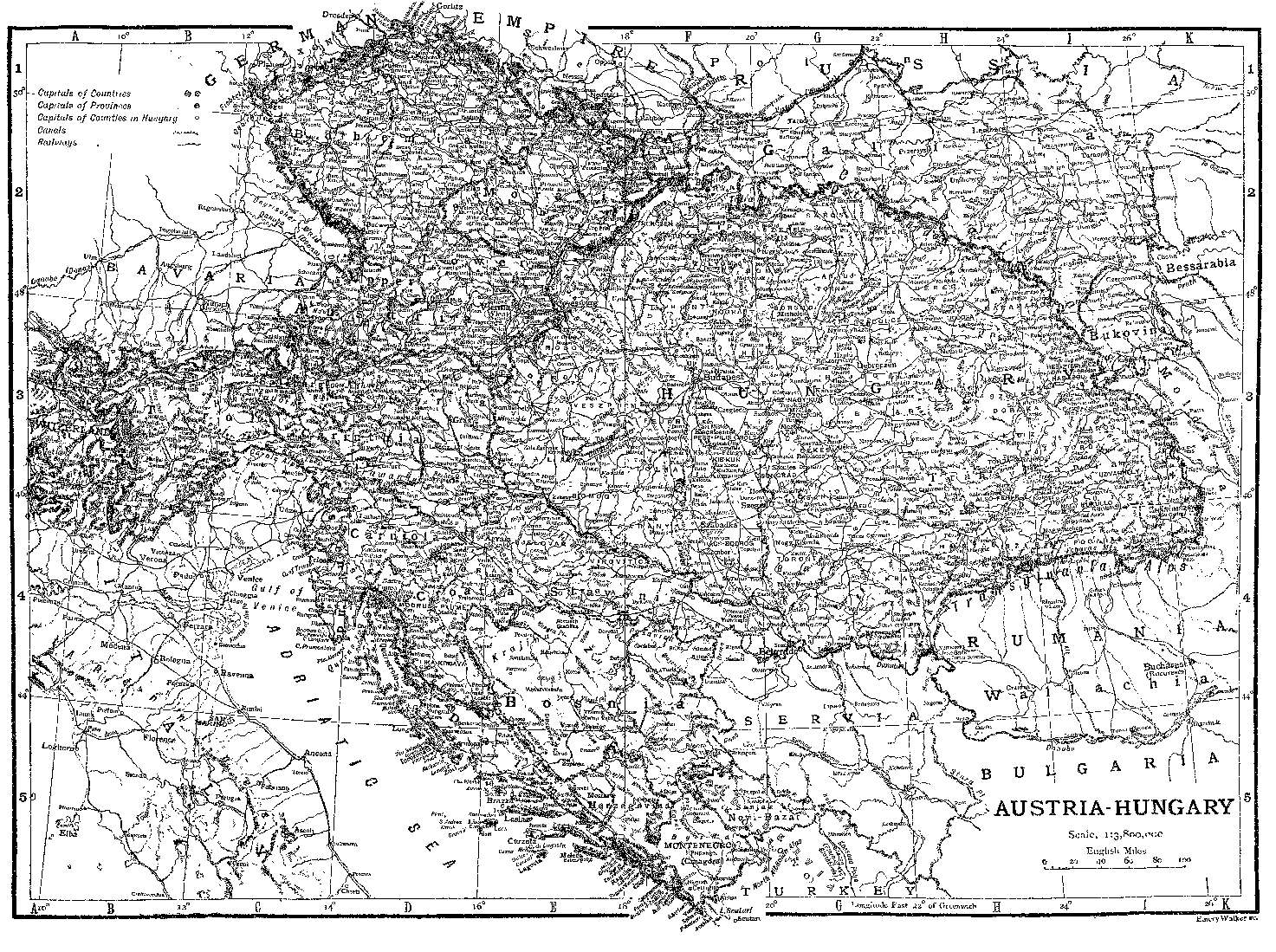
AUSTRIA-HUNGARY, or the Austro-Hungarian
Monarchy (Ger. Österreichisch-ungarische Monarchie or
Österreichisch-ungarisches Reich), the official name of a country
situated in central Europe, bounded E. by Russia and Rumania, S. by
Rumania, Servia, Turkey and Montenegro, W. by the Adriatic Sea, Italy,
Switzerland, Liechtenstein, and the German Empire, and N. by the German
Empire and Russia. It occupies about the sixteenth part of the total area
of Europe, with an area (1905) of 239,977 sq. m. The monarchy consists of
two independent states: the kingdoms and lands represented in the council
of the empire (Reichsrat), unofficially called Austria
(q.v.) or Cisleithania; and the "lands of St Stephen's Crown,"
unofficially called Hungary (q.v.) or Transleithania. It received
its actual name by the diploma of the emperor Francis Joseph I. of the
14th of November 1868, replacing the name of the Austrian Empire under
which the dominions under his sceptre were formerly known. The
Austro-Hungarian monarchy is very often called unofficially the Dual
Monarchy. It had in 1901 a population of 45,405,267 inhabitants,
comprising therefore within its borders, about one-eighth of the total
population of Europe. By the Berlin Treaty of 1878 the principalities of
Bosnia and Herzegovina with an area of 19,702 sq. m., and a population
(1895) of 1,591,036 inhabitants, owning Turkey as suzerain, were placed
under the administration of Austria-Hungary, and their annexation in 1908
was recognized by the Powers in 1909, so that they became part of the
dominions of the monarchy.
Government.—The present constitution of the
Austro-Hungarian monarchy (see Austria) is based
on the Pragmatic Sanction of the emperor Charles VI., first promulgated
on the 19th of April 1713, whereby the succession to the throne is
settled in the dynasty of Habsburg-Lorraine, descending by right of
primogeniture and lineal succession to male heirs, and, in case of their
extinction, to the female line, and whereby the indissolubility and
indivisibility of the monarchy are determined; is based, further, on the
diploma of the emperor Francis Joseph I. of the 20th of October 1860,
whereby the constitutional form of government is introduced; and, lastly,
on the so-called Ausgleich or "Compromise," concluded on the 8th
of February 1867, whereby the relations between Austria and Hungary were
regulated.
The two separate states—Austria and Hungary—are completely
independent of each other, and each has its own parliament and its own
government. The unity of the monarchy is expressed in the common head of
the state, who bears the title Emperor of Austria and Apostolic King of
Hungary, and in the common administration of a series of affairs, which
affect both halves of the Dual Monarchy. These are: (1) foreign affairs,
including diplomatic and consular representation abroad; (2) the army,
including the navy, but excluding the annual voting of recruits, and the
special army of each state; (3) finance in so far as it concerns joint
expenditure.
For the administration of these common affairs there are three joint
ministries: the ministry of foreign affairs and of the imperial and royal
house, the ministry of war, and the ministry of finance. It must be noted
that the authority of the joint ministers is restricted to common
affairs, and that they are not allowed to direct or exercise any
influence on affairs of government affecting separately one of the halves
of the monarchy. The minister of foreign affairs
conducts the international relations of the Dual Monarchy, and can
conclude international treaties. But commercial treaties, and such state
treaties as impose burdens on the state, or parts of the state, or
involve a change of territory, require the parliamentary assent of both
states. The minister of war is the head for the administration of all
military affairs, except those of the Austrian Landwehr and of the
Hungarian Honveds, which are committed to the ministries for
national defence of the two respective states. But the supreme command of
the army is vested in the monarch, who has the power to take all measures
regarding the whole army. It follows, therefore, that the total armed
power of the Dual Monarchy forms a whole under the supreme command of the
sovereign. The minister of finance has charge of the finances of common
affairs, prepares the joint budget, and administers the joint state debt.
(Till 1909 the provinces of Bosnia and Herzegovina were also administered
by the joint minister of finance, excepting matters exclusively dependent
on the minister of war.) For the control of the common finances, there is
appointed a joint supreme court of accounts, which audits the accounts of
the joint ministries.
Budget.—Side by side with the budget of each state of the
Dual Monarchy, there is a common budget, which comprises the expenditure
necessary for the common affairs, namely for the conduct of foreign
affairs, for the army, and for the ministry of finance. The revenues of
the joint budget consist of the revenues of the joint ministries, the net
proceeds of the customs, and the quota, or the proportional contributions
of the two states. This quota is fixed for a period of years, and
generally coincides with the duration of the customs and commercial
treaty. Until 1897 Austria contributed 70%, and Hungary 30% of the joint
expenditure, remaining after-deduction of the common revenue. It was then
decided that from 1897 to July 1907 the quota should be 66-46/49 for
Austria, and 33-2/49 for Hungary. In 1907 Hungary's contribution was
raised to 36.4%. Of the total charges 2% is first of all debited to
Hungary on account of the incorporation with this state of the former
military frontier.
The Budget estimates for the common administration were as follows in
1905:—
|
Revenue—
|
|
Ministry of Foreign Affairs
|
£21,167
|
|
Ministry of War
|
305,907
|
|
Ministry of Finance
|
4,870
|
|
Board of Control
|
18
|
|
The Customs
|
4,780,000
|
|
Proportional contributions
|
15,650,448
|
|
|
—————
|
|
Total
|
£20,762,410
|
|
|
—————
|
|
|
|
Expenditure—
|
|
|
Ministry of Foreign Affairs
|
£485,480
|
|
Ministry of War:—
|
|
Army
|
12,679,160
|
|
Navy
|
2,306,100
|
|
Ministry of Finance
|
177,000
|
|
Board of Control
|
13,250
|
|
Extraordinary Military Expenditure
|
4,785,500
|
|
Extraordinary Military Expenditure in Bosnia
|
315,920
|
|
|
—————
|
|
Total
|
£20,762,410
|
|
|
—————
|
The following table gives in thousands sterling the joint budget for
the years 1875-1905:—
Expenditure.
|
|
1875.
|
1885.
|
1895.
|
1900.
|
1905.
|
|
Ministry of Foreign Affairs
|
396
|
368.7
|
333
|
433.4
|
493.8
|
|
Ministry of War (Army and Navy)
|
9005.4
|
10,085
|
12,539
|
13,887.5
|
18,087.7
|
|
Ministry of Finance
|
154.2
|
167.2
|
170.4
|
175
|
177.1
|
|
Supreme Court of Accounts
|
10.5
|
10.6
|
10.7
|
12.5
|
13.3
|
|
Total
|
9566.1
|
10,631.5
|
13,053.1
|
14,508.4
|
20,430.3
|
Revenue.
|
For the above Departments
|
432
|
258.2
|
260.7
|
260.3
|
331.9
|
|
Customs
|
997.4
|
402.2
|
4476
|
5202.3
|
4799.7
|
|
Proportional Contributions
|
8136.7
|
9971.1
|
8316.4
|
9045.8
|
15,650.4
|
|
Total
|
9566.1
|
10,631.5
|
13,053.1
|
14,508.4
|
20,430.3
|
Debt.—Besides the debts of each state of the Dual
Monarchy, there is a general debt, which is borne jointly by Austria and
Hungary. The following table gives in millions sterling the amount of the
general debt for the years 1875-1905:—
|
1875.
|
1885.
|
1895.
|
1900.
|
1905.
|
|
232.41
|
231.02
|
229.67
|
226.81
|
224.31
|
Delegations.—The constitutional right of voting money
applicable to the common affairs and of its political control is
exercised by the Delegations, which consist each of sixty members, chosen
for one year, one-third of them by the Austrian Herrenhaus (Upper House)
and the Hungarian Table of Magnates (Upper House), and two-thirds of them
by the Austrian and the Hungarian Houses of Representatives. The
delegations are annually summoned by the monarch alternately to Vienna
and to Budapest. Each delegation has its separate sittings, both alike
public. Their decisions are reciprocally communicated in writing, and, in
case of non-agreement, their deliberations are renewed. Should three such
interchanges be made without agreement, a common plenary sitting is held
of an equal number of both delegations; and these collectively, without
discussion, decide the question by common vote. The common decisions of
both houses require for their validity the sanction of the monarch. Each
delegation has the right to formulate resolutions independently, and to
call to account and arraign the common ministers. In the exercise of
their office the members of both delegations are irresponsible, enjoying
constitutional immunity.
Army.—The military system of the Austro-Hungarian
monarchy is similar in both states, and rests since 1868 upon the
principle of the universal and personal obligation of the citizen to bear
arms. Its military force is composed of the common army (K. und
K.); the special armies, namely the Austrian (K.K.)
Landwehr, and the Hungarian Honveds, which are separate
national institutions, and the Landsturm or levy-in-mass. As
stated above, the common army stands under the administration of the
joint minister of war, while the special armies are under the
administration of the respective ministries of national defence. The
yearly contingent of recruits for the army is fixed by the military bills
voted by the Austrian and Hungarian parliaments, and is generally
determined on the basis of the population, according to the last census
returns. It amounted in 1905 to 103,100 men, of which Austria furnished
59,211 men, and Hungary 43,889. Besides 10,000 men are annually allotted
to the Austrian Landwehr, and 12,500 to the Hungarian Honveds. The term
of service is 2 years (3 years in the cavalry) with the colours, 7 or 8
in the reserve and 2 in the Landwehr; in the case of men not drafted to
the active army the same total period of service is spent in various
special reserves.
For the military and administrative service of the army the Dual
Monarchy is divided into 16 military territorial districts (15 of which
correspond to the 15 army corps) and 108 supplementary districts (105 for
the army, and 3 for the navy). In 1902, since which year no material
change was made in the formal organization of the army, there were 5
cavalry divisions and 31 infantry divisions, formed in 15 army corps,
which are located as follows:—I. Cracow, II. Vienna, III. Graz, IV.
Budapest, V. Pressburg, VI. Kaschau, VII. Temesvár, VIII. Prague, IX.
Josefstadt, X. Przemysl, XI. Lemberg, XII. Herrmannstadt, XIII. Agram,
XIV. Innsbruck, XV. Serajewo. In addition there is the military district
of Zara. The usual strength of the corps is, 2 infantry divisions (4
brigades, 8 or 9 regiments, 32 or 36 battalions), 1 cavalry brigade (18
squadrons), and 1 artillery brigade (16-18 batteries or 128-144
field-guns), besides technical and departmental units and in some cases
fortress artillery regiments. The infantry is organized into line
regiments, Jäger and Tirolese regiments, the cavalry into dragoons,
lancers, Uhlans and hussars, the artillery into regiments. The Austrian
Landwehr (which retains the old designation K.K., formerly
applied to the Austrian regular army) is organized in 8
divisions of varying strength, the "Royal Hungarian" Landwehr or Honveds
in 7 divisions, both Austrian and Hungarian Landwehr having in addition
cavalry (Uhlans and hussars) and artillery. It is probable that a
Landwehr or Honveds division will, in war, form part of each army corps
except in the case of the Vienna corps, which has 3 divisions in peace.
The remaining men of military age (up to 42) as usual form the
Landsturm. It is to be noted that this Landsturm comprises many
men who would elsewhere be classed as Landwehr.
The strength of the Austro-Hungarian army on a peace footing was as
follows in 1905:—
|
|
Officers.
|
Men.
|
Horses.
|
Guns.
|
|
Infantry—
|
|
|
|
|
|
Common Army
|
10,801
|
187,604
|
1,152
|
..
|
|
Austrian Landwehr
|
1,883
|
23,905
|
174
|
..
|
|
Hungarian Honveds
|
2,258
|
21,149
|
262
|
..
|
|
Cavalry—
|
|
|
|
|
|
Common Army
|
1,890
|
45,486
|
40,740
|
..
|
|
Austrian Landwehr
|
170
|
1,861
|
1,282
|
..
|
|
Hungarian Honveds
|
390
|
4,170
|
3,510
|
..
|
|
Field Artillery
|
1,630
|
27,612
|
14,520
|
1,048
|
|
Fortress Artillery
|
408
|
7,722
|
131
|
..
|
|
Technical troops (Pioneers, and
Railway and Telegraph Regiment)
|
588
|
9,935
|
19
|
..
|
|
Transport Service
|
461
|
4,312
|
3,097
|
..
|
|
Sanitary Service
|
85
|
3,062
|
..
|
..
|
|
Total
|
20,564
|
336,818
|
64,887
|
1,048
|
|
Belonging to the
|
|
|
|
|
|
Common Army
|
15,863
|
285,733
|
59,659
|
1,048
|
|
Austrian Landwehr
|
2,053
|
25,766
|
1,456
|
..
|
|
Hungarian Honveds
|
2,648
|
25,319
|
3,772
|
..
|
The troops stationed in Bosnia and Herzegovina in 1905 (376 officers
and 6372 men) are included in the total for the common army.
The peace strength of the active army in combatants is thus about
350,000 officers and men, inclusive of the two Landwehrs and of the
Austrian "K.K." guards, the Hungarian crown guards, the gendarmerie,
&c. The numbers of the Landsturm and the war strength of the whole
armed forces are not published. It is estimated that the first line army
in war would consist of 460,000 infantry, 49,000 cavalry, 78,000
artillery, 21,000 engineers, &c., beside train and non-combatant
soldiers. The Landwehr and Honved would yield 219,000 infantry and 18,000
cavalry, and other reserves 223,000 men. These figures give an
approximate total strength of 1,147,000, not inclusive of Landsturm.
Fortifications.—The principal fortifications in
Austria-Hungary are: Cracow and Przemysl in Galicia; Komárom, the centre
of the inland fortifications, Pétervárad, Ó-Arad and Temesvár in Hungary;
Serajewo, Mostar and Bilek in Bosnia-Herzegovina. The Alpine frontiers,
especially those in Tirol, have numerous fortifications, whose centre is
formed by Trent and Franzensfeste; while all the military roads leading
into Carinthia have been provided with strong defensive works, as at
Malborgeth, Predil Pass, &c. The two capitals, Vienna and Budapest,
are not fortified. On the Adriatic coast, the naval harbour of Pola is
strongly fortified with sea and land defences; then come Trieste, and
several places in Dalmatia, notably Zara and Cattaro.
Navy.—The Austro-Hungarian navy is mainly a coast defence
force, and includes also a flotilla of monitors for the Danube. It is
administered by the naval department of the ministry of war. It consisted
in 1905 of 9 modern battleships, 3 armoured cruisers, 5 cruisers, 4
torpedo gunboats, 20 destroyers and 26 torpedo boats. There was in hand
at the same time a naval programme to build 12 armourclads, 5
second-class cruisers, 6 third-class cruisers, and a number of torpedo
boats. The headquarters of the fleet are at Pola, which is the principal
naval arsenal and harbour of Austria; while another great naval station
is Trieste.
Trade.—On the basis of the customs and commercial
agreement between Austria and Hungary, concluded in 1867 and renewable
every ten years, the following affairs, in addition to the common affairs
of the monarchy, are in both states treated according to the same
principles:—Commercial affairs, including customs legislation;
legislation on the duties closely connected with industrial
production—on beer, brandy, sugar and mineral oils; determination
of legal tender and coinage, as also of the principles regulating the
Austro-Hungarian Bank; ordinances in respect of such railways as affect
the interests of both states. In conformity with the customs and
commercial compact between the two states, renewed in 1899, the monarchy
constitutes one identical customs and commercial territory, inclusive of
Bosnia and Herzegovina and the principality of Liechtenstein.
The foreign trade of the Austro-Hungarian monarchy is shown in the
following table:—
|
Year.
|
Imports.
|
Exports.
|
|
1900
|
£70,666,000
|
£80,916,000
|
|
1901
|
68,833,000
|
78,841,000
|
|
1902
|
71,666,000
|
79,708,000
|
|
1903
|
78,200,000
|
88,600,000
|
|
1904
|
85,200,000
|
86,200,000
|
|
1905
|
89,430,000
|
93,500,000
|
The following tables give the foreign trade of the Austro-Hungarian
monarchy as regards raw material and manufactured goods:—
Imports.
|
Articles.
|
Value in Millions Sterling.
|
|
1900.
|
1901.
|
1902.
|
1903.
|
1904.
|
|
Raw material (including
articles of food; raw
material for agriculture
and industry; and mining
and smelting products.
|

|
41.5
|
40.5
|
41.8
|
45.9
|
51.9
|
|
Semi-manufactured goods
|
9.6
|
9.6
|
10.3
|
10.6
|
10.8
|
|
Manufactured goods
|
19.5
|
18.7
|
19.5
|
21.6
|
22.5
|
Exports.
|
Articles.
|
Value in Millions Sterling.
|
|
1900.
|
1901.
|
1902.
|
1903.
|
1904.
|
|
Raw material (as above)
|
34.1
|
34.1
|
35.9
|
39
|
35.3
|
|
Semi-manufactured goods
|
12.6
|
11.1
|
11.1
|
12.4
|
12.6
|
|
Manufactured goods.
|
34.2
|
33.3
|
32.8
|
37.2
|
38.3
|
The most important place of derivation and of destination for the
Austro-Hungarian trade is the German empire with about 40% of the
imports, and about 60% of the exports. Next in importance comes Great
Britain, afterwards India, Italy, the United States of America, Russia,
France, Switzerland, Rumania, the Balkan states and South America in
about the order named. The principal articles of import are cotton and
cotton goods, wool and woollen goods, silk and silk goods, coffee,
tobacco and metals. The principal articles of export are wood, sugar,
cattle, glass and glassware, iron and ironware, eggs, cereals, millinery,
fancy goods, earthenware and pottery, and leather goods.
The Austro-Hungarian Bank.—Common to the two states of
the monarchy is the "Austro-Hungarian Bank," which possesses a legal
exclusive right to the issue of bank-notes. It was founded in 1816, and
had the title of the Austrian National Bank until 1878, when it received
its actual name. In virtue of the new bank statute of the year 1899 the
bank is a joint-stock company, with a stock of £8,780,000. The bank's
notes of issue must be covered to the extent of two-fifths by legal
specie (gold and current silver) in reserve; the rest of the paper
circulation, according to bank usage. The state, under certain
conditions, takes a portion of the clear profits of the bank. The
management of the bank and the supervision exercised over it by the state
are established on a footing of equality, both states having each the
same influence. The accounts of the bank at the end of 1900 were as
follows: capital, £8,750,000; reserve fund, £428,250; note circulation,
£62,251,000; cash, £50,754,000. In 1907 the reserve fund was £548,041;
note circulation, £84,501,000; cash, £60,036,625. The charter of the
bank, which expired in 1897, was renewed until the end of 1910. In the
Hungarian ministerial crisis of 1909 the question of the renewal of the
charter played a conspicuous part, the more extreme members of the
Independence party demanding the establishment of separate banks for
Austria and Hungary with, at most, common superintendence (see
History, below).
(O. Br.)
History
I. The Whole Monarchy.
The empire of Austria, as the official designation of the The title "Emperor of Austria." territories ruled
by the Habsburg monarchy, dates back only to 1804, when Francis II., the
last of the Holy Roman emperors, proclaimed himself emperor of Austria as
Francis I. His motive in doing so was to guard against the great house of
Habsburg being relegated to a position inferior to the parvenus
Bonapartes, in the event of the final collapse of the Holy Roman Empire,
or of the possible election of Napoleon as his own successor on the
throne of Charlemagne. The title emperor of Austria, then, replaced that
of "Imperator Romanorum semper Augustus" when the Holy Empire came to an
end in 1806. From the first, however, it was no more than a title, which
represented but ill the actual relation of the Habsburg sovereigns to
their several states. Magyars and Slavs never willingly
recognized a style which ignored their national rights and implied the
superiority of the German elements of the monarchy; to the Germans it was
a poor substitute for a title which had represented the political unity
of the German race under the Holy Empire. For long after the Vienna
Congress of 1814-1815 the "Kaiser" as such exercised a powerful influence
over the imaginations of the German people outside the Habsburg
dominions; but this was because the title was still surrounded with its
ancient halo and the essential change was not at once recognized. The
outcome of the long struggle with Prussia, which in 1866 finally broke
the spell, and the proclamation of the German empire in 1871 left the
title of emperor of Austria stripped of everything but a purely
territorial significance. It had, moreover, by the compact with Hungary
of 1867, ceased even fully to represent the relation of the emperor to
all his dominions; and the title which had been devised to cover the
whole of the Habsburg monarchy sank into the official style of the
sovereign of but a half; while even within the Austrian empire proper it
is resented by those peoples which, like the Bohemians, wish to obtain
the same recognition of their national independence as was conceded to
Hungary. In placing the account of the origin and development of the
Habsburg monarchy under this heading, it is merely for the sake of
convenience.
The first nucleus round which the present dominions of the Origin of the name Austria. house of Austria
gradually accumulated was the mark which lay along the south bank of the
Danube, east of the river Enns, founded about A.D. 800 as a defence for the Frankish kingdom
against the Slavs. Although its total length from east to west was only
about 60 m., it was associated in the popular mind with a large and
almost unbroken tract of land in the east of Europe. This fact, together
with the position of the mark with regard to Germany in general and to
Bavaria in particular, accounts for the name Österreich (Austria),
i.e. east empire or realm, a word first used in a charter of 996,
where the phrase in regione vulgari nomine Ostarrichi occurs. The
development of this small mark into the Austro-Hungarian monarchy was a
slow and gradual process, and falls into two main divisions, which almost
coincide with the periods during which the dynasties of Babenberg and
Habsburg have respectively ruled the land. The energies of the house of
Babenberg were chiefly spent in enlarging the area and strengthening the
position of the mark itself, and when this was done the house of Habsburg
set itself with remarkable perseverance and marvellous success to extend
its rule over neighbouring territories. The many vicissitudes which have
attended this development have not, however, altered the European
position of Austria, which has remained the same for over a thousand
years. Standing sentinel over the valley of the middle Danube, and
barring the advance of the Slavs on Germany, Austria, whether mark, duchy
or empire, has always been the meeting-place of the Teuton and the Slav.
It is this fact which gives it a unique interest and importance in the
history of Europe, and which unites the ideas of the Germans to-day with
those of Charlemagne and Otto the Great.
The southern part of the country now called Austria was Early inhabitants. inhabited before the opening
of the Christian era by the Taurisci, a Celtic tribe, who were
subsequently called the Norici, and who were conquered by the Romans
about 14 B.C. Their land was afterwards
included in the provinces of Pannonia and Noricum, and under Roman rule,
Vindobona, the modern Vienna, became a place of some importance. The part
of the country north of the Danube was peopled by the Marcomanni and the
Quadi, and both of these tribes were frequently at war with the Romans,
especially during the reign of the emperor Marcus Aurelius, who died at
Vindobona in A.D. 180 when campaigning against
them. Christianity and civilization obtained entrance into the land, but
the increasing weakness of the Roman empire opened the country to the
inroads of the barbarians, and during the period of the great migrations
it was ravaged in quick succession by a number of these tribes, prominent
among whom were the Huns. The lands on both banks of the river shared the
same fate, due probably to the fact to which Gibbon has drawn attention,
that at this period the Danube was frequently frozen over. About 590 the
district was settled by the Slovenes, or Corutanes, a Slavonic people,
who formed part of the kingdom of Samo, and were afterwards included in
the extensive kingdom of the Avars. The Franks claimed some authority
over this people, and probably some of the princes of the Slovenes had
recognized this claim, but it could not be regarded as serious while the
Avars were in possession of the land. In 791 Charlemagne, after he had
established his authority over the Bajuvarii or Bavarians, crossed
the river Enns, and moved against the Avars. This attack was followed by
campaigns on the part of his lieutenants, and in 805 the Avars were
finally subdued, and their land incorporated with the Frankish empire.
Establishment of the East Mark. This step
brought the later Austria definitely under the rule of the Franks, and
during the struggle Charlemagne erected a mark, called the East Mark, to
defend the eastern border of his empire. A series of margraves ruled this
small district from 799 to 907, but as the Frankish empire grew weaker,
the mark suffered more and more from the ravages of its eastern
neighbours. During the 9th century the Frankish supremacy vanished, and
the mark was overrun by the Moravians, and then by the Magyars, or
Hungarians, who destroyed the few remaining traces of Frankish
influence.
A new era dawned after Otto the Great was elected German The house of Babenberg. king in 936, and it is
Otto rather than Charlemagne who must be regarded as the real founder of
Austria. In August 955 he gained a great victory over the Magyars on the
Lechfeld, freed Bavaria from their presence, and refounded the East Mark
for the defence of his kingdom. In 976 his son, the emperor Otto II.,
entrusted the government of this mark, soon to be known as Austria, to
Leopold, a member of the family of Babenberg (q.v.), and its
administration was conducted with vigour and success. Leopold and his
descendants ruled Austria until the extinction of the family in 1246, and
by their skill and foresight raised the mark to an important place among
the German states. Their first care was to push its eastern frontier down
the Danube valley, by colonizing the lands on either side of the river,
and the success of this work may be seen in the removal of their capital
from Pöchlarn to Melk, then to Tulln, and finally about 1140 to Vienna.
The country as far as the Leitha was subsequently incorporated with
Austria, and in the other direction the district between the Enns and the
Inn was added to the mark in 1156, an important date in Austrian history.
Duchy of Austria created, 1156. Anxious to
restore peace to Germany in this year, the new king, Frederick I., raised
Austria to the rank of a duchy, and conferred upon it exceptional
privileges. The investiture was bestowed not only upon Duke Henry but
upon his second wife, Theodora; in case of a failure of male heirs the
duchy was to descend to females; and if the duke had no children he could
nominate his successor. Controlling all the jurisdiction of the land, the
duke's only duties towards the Empire were to appear at any diet held in
Bavaria, and to send a contingent to the imperial army for any campaigns
in the countries bordering upon Austria. In 1186 Duke Leopold I. made a
treaty with Ottakar IV., duke of Styria, an arrangement which brought
Styria and upper Austria to the Babenbergs in 1192, and in 1229 Duke
Leopold II. purchased some lands from the bishop of Freising, and took
the title of lord of Carniola. When the house of Babenberg became extinct
in 1246, Austria, stretching from Passau almost to Pressburg, had the
frontiers which it retains to-day, and this increase of territory had
been accompanied by a corresponding increase in wealth and general
prosperity. The chief reason for this prosperity was the growth of trade
along the Danube, which stimulated the foundation, or the growth, of
towns, and brought considerable riches to the ruler. Under the later
Babenbergs Vienna was regarded as one of the most important of German
cities, and it was computed that the duke was as rich as the archbishop
of Cologne, or the margrave of Brandenburg, and was surpassed in this
respect by only one German prince, the king of Bohemia.
The interests of the Austrian margraves and dukes were not confined to
the acquisition of wealth either in land or chattels. Vienna became a
centre of culture and learning, and many religious houses were founded
and endowed. Duke Leopold II. The acme of
the early prosperity of Austria was reached under Duke Leopold II.,
surnamed the Glorious, who reigned from 1194 to 1230. He gave a code of
municipal law to Vienna, and rights to other towns, welcomed the
Minnesingers to his brilliant court, and left to his subjects an enduring
memory of valour and wisdom. Leopold and his predecessors were enabled,
owing to the special position of Austria, to act practically as
independent rulers. Cherishing the privilege of 1156, they made treaties
with foreign kings, and arranged marriages with the great families of
Europe. With full control of jurisdiction and of commerce, no great
bishopric nor imperial city impeded the course of their authority, and
the emperor interfered only to settle boundary disputes.
The main lines of Austrian policy under the Babenbergs were warfare
with the Hungarians and other eastern neighbours, and a general attitude
of loyalty towards the emperors. The story of the Hungarian wars is a
monotonous record of forays, of assistance given at times to the
Babenbergs by the forces of the Empire, and ending in the gradual
eastward advance of Austria. Duke Frederick II.,
the Quarrelsome. The traditional loyalty to the emperors, which
was cemented by several marriages between the imperial house and the
Babenbergs, was, however, departed from by the margrave Leopold II., and
by Duke Frederick II. During the investiture struggle Leopold deserted
the emperor Henry IV., who deprived him of Austria and conferred it upon
Vratislav II., duke of the Bohemians. Unable to maintain his position,
Vratislav was soon driven out, and in 1083 Leopold again obtained
possession of the mark, and was soon reconciled with Henry. Very similar
was the result of the conflict between the emperor Frederick II. and Duke
Frederick II. Ignoring the the privilege of 1156, the emperor claimed
certain rights in Austria, and summoned the duke to his Italian diets.
Frederick, who was called the Quarrelsome, had irritated both his
neighbours and his subjects, and complaints of his exactions and
confiscations reached the ears of the emperor. After the duke had three
times refused to appear before the princes, Frederick placed him under
the ban, declared the duchies of Austria and Styria to be vacant, and,
aided by the king of Bohemia, the duke of Bavaria and other princes,
invaded the country in 1236. End of the House of
Babenberg. He met with very slight opposition, declared the
duchies to be immediately dependent upon the Empire, made Vienna an
imperial city, and imposed other changes upon the constitution of
Austria. After his departure, however, the duke returned, and in 1239 was
in possession of his former power, while the changes made by the emperor
were ignored. Continuing his career of violence and oppression, Duke
Frederick was killed in battle by the Hungarians in June 1246, when the
family of Babenberg became extinct.
The duchies of Austria and Styria were now claimed by the Dispute as to the Austrian succession. emperor
Frederick II. as vacant fiefs of the Empire, and their government was
entrusted to Otto II., duke of Bavaria. Frederick, however, who was in
Italy, harassed and afflicted, could do little to assert the imperial
authority, and his enemy, Pope Innocent IV., bestowed the two duchies
upon Hermann VI., margrave of Baden, whose wife, Gertrude, was a niece of
the last of the Babenbergs. Hermann was invested by the German king,
William, count of Holland, but he was unable to establish his position,
and law and order were quickly disappearing from the duchies. The deaths
of Hermann and of the emperor in 1250, however, paved the way for a
settlement. Weary of struggle and disorder, and despairing of any help
from the central authority, the estates of Austria met at Trübensee in
1251, and chose Ottakar, son of Wenceslaus I., king of Bohemia, as their
duke. Ottakar of Bohemia, duke. This step
was favoured by the pope, and Ottakar, eagerly accepting the offer,
strengthened his position by marrying Margaret, a sister of Duke
Frederick II., and in return for his investiture promised his assistance
to William of Holland. Styria appears at this time to have shared the
fortunes of Austria, but it was claimed by Bela IV., king of Hungary, who
conquered the land, and made a treaty with Ottakar in 1254 which
confirmed him in its possession. The Hungarian rule was soon resented by
the Styrians, and Ottakar, who had become king of Bohemia in 1253, took
advantage of this resentment, and interfered in the affairs of the duchy.
A war with Hungary was the result, but on this occasion victory rested
with Ottakar, and by a treaty made with Bela, in March 1261, he was
recognized as duke of Styria. In 1269 Ottakar inherited the duchy of
Carinthia on the death of Duke Ulrich III., and, his power having now
become very great, he began to aspire to the German throne. He did
something to improve the condition of the duchies by restoring order,
introducing German colonists into the eastern districts, and seeking to
benefit the inhabitants of the towns.
In 1273 Rudolph, count of Habsburg, became German king, Rudolph of Habsburg. and his attention soon
turned to Ottakar, whose power menaced the occupant of the German throne.
Finding some support in Austria, Rudolph questioned the title of the
Bohemian king to the three duchies, and sought to recover the imperial
lands which had been in the possession of the emperor Frederick II.
Ottakar was summoned twice before the diet, the imperial court declared
against him, and in July 1275 he was placed under the ban. War was the
result, and in November 1276 Ottakar submitted to Rudolph, and renounced
the duchies of Austria, Styria and Carinthia. For some time the three
duchies were administered by Rudolph in his capacity as head of the
Empire, of which they formed part. Not content with this tie, however,
which was personal to himself alone, the king planned to make them
hereditary possessions of his family, and to transfer the headquarters of
the Habsburgs from the Rhine to the Danube. The
Habsburgs established in Austria, 1282. Some opposition was
offered to this scheme; but the perseverance of the king overcame all
difficulties, and one of the most important events in European history
took place on the 27th of December 1282, when Rudolph invested his sons,
Rudolph and Albert, with the duchies of Austria and Styria. He retained
Carinthia in his own hands until 1286, when, in return for valuable
services, he bestowed it upon Meinhard IV., count of Tirol. The younger
Rudolph took no part in the government of Austria and Styria, which was
undertaken by Albert, until his election as German king in 1298. Albert
appears to have been rather an arbitrary ruler. In 1288 he suppressed a
rising of the people of Vienna, and he made the fullest use of the ducal
power in asserting his real or supposed rights. At this time the
principle of primogeniture was unknown in the house of Habsburg, and for
many years the duchies were ruled in common by two, or even three,
members of the family. After Albert became German king, his two elder
sons, Rudolph and Frederick, were successively associated with him in the
government, and after his death in 1308, his four younger sons shared at
one time or another in the administration of Austria and Styria. In 1314
Albert's son, Frederick, was chosen German king in opposition to Louis
IV., duke of Upper Bavaria, afterwards the emperor Louis IV., and Austria
was weakened by the efforts of the Habsburgs to sustain Frederick in his
contest with Louis, and also by the struggle carried on between another
brother, Leopold, and the Swiss. A series of deaths among the Habsburgs
during the first half of the 14th century left Duke Albert II. and his
four sons as the only representatives of the family. Albert ruled the
duchies alone from 1344 to 1356, and after this date his sons began to
take part in the government. Duke Rudolph
IV. The most noteworthy of these was Duke Rudolph IV., a
son-in-law of the emperor Charles IV., who showed his interest in
learning by founding the university of Vienna in 1365. Rudolph's chief
aim was to make Austria into an independent state, and he forged a series
of privileges the purport of which was to free the duchy from all its
duties towards the Empire. A sharp contest with the emperor followed this
proceeding, and the Austrian duke, annoyed that Austria was not
raised to the dignity of an electorate by the Golden Bull of 1356, did
not shrink from a contest with Charles. In 1361, however, he abandoned
his pretensions, but claimed the title of archduke (q.v.) and in
1364 declared that the possessions of the Habsburgs were indivisible.
Meanwhile the acquisition of neighbouring territories had been steadily
pressed on. In 1335 the duchy of Carinthia, and a part of Carniola, were
inherited by Dukes Albert II. and Otto, and in 1363 Rudolph IV. obtained
the county of Tirol. In 1364 Carniola was made into an hereditary duchy;
in 1374 part of Istria came under the rule of the Habsburgs; in 1382
Trieste submitted voluntarily to Austria, and at various times during the
century, other smaller districts were added to the lands of the
Habsburgs.
Rudolph IV. died childless in 1365, and in 1379 his two remaining
brothers, Leopold III. and Albert III., made a division of their lands,
by which Albert retained Austria proper and Carniola, and Leopold got
Styria, Carinthia and Tirol. Leopold was killed in 1386 at the battle of
Sempach, and Albert became guardian for his four nephews, who
subsequently ruled their lands in common. The senior line which ruled in
Austria was represented after the death of Duke Albert III. in 1395 by
his son, Duke Albert IV., and then by his grandson, Duke Albert V., who
became German king as Albert II. in 1438. Minority
of Ladislaus. Albert married Elizabeth, daughter of Sigismund,
king of Hungary and Bohemia, and on the death of his father-in-law
assumed these two crowns. He died in 1439, and just after his death a son
was born to him, who was called Ladislaus Posthumus, and succeeded to the
duchy of Austria and to the kingdoms of Hungary and Bohemia. William and
Leopold, the two eldest sons of Duke Leopold III., and, with their
younger brothers Ernest and Frederick, the joint rulers of Styria,
Carinthia and Tirol, died early in the 15th century, and in 1406 Ernest
and Frederick made a division of their lands. Ernest became duke of
Styria and Carinthia, and Frederick, count of Tirol. Ernest was succeeded
in 1424 by his sons, Frederick and Albert, and Frederick in 1439 by his
son, Sigismund, and these three princes were reigning when King Albert
II. died in 1439. Frederick, who succeeded Albert Regency of the emperor Frederick III. as German
king, and was soon crowned emperor as Frederick III., acted as guardian
for Sigismund of Tirol, who was a minor, and also became regent of
Austria in consequence of the infancy of Ladislaus. His rule was a period
of struggle and disorder, owing partly to the feebleness of his own
character, partly to the wish of his brother, Albert, to share his
dignities. The Tirolese soon grew weary of his government, and, in 1446,
Sigismund was declared of age. Popular revolt
under Ulrich Eiczing and Count Ulrich of Cilli. The estates of
Austria were equally discontented and headed an open revolt, the object
of which was to remove Ladislaus from Frederick's charge and deprive the
latter of the regency. The leading spirit in this movement was Ulrich
Eiczing (Eitzing or von Eiczinger, d. before 1463), a low-born
adventurer, ennobled by Albert II., in whose service he had accumulated
vast wealth and power. In 1451 he organized an armed league, and in
December, with the aid of the populace, made himself master of Vienna,
whither he had summoned the estates. In March 1452 he was joined by Count
Ulrich of Cilli, while the Hungarians and the powerful party of the great
house of Rosenberg in Bohemia attached themselves to the league.
Frederick, who had hurried back from Italy, was besieged in August in the
Vienna Neustadt, and was forced to deliver Ladislaus to Count Ulrich,
whose influence had meanwhile eclipsed that of Eiczing. Ladislaus now
ruled nominally himself, under the tutelage of Count Ulrich. The country
was, however, distracted by quarrels between the party of the high
aristocracy, which recognized the count of Cilli as its chief, and that
of the lesser nobles, citizens and populace, who followed Eiczing. In
September 1453 the latter, by a successful émeute, succeeded in
ousting Count Ulrich, and remained in power till February 1455, when the
count once more entered Vienna in triumph. Ulrich of Cilli was killed
before Belgrade in November 1456; a year later Ladislaus himself died
(November 1457). Meanwhile Styria and Carinthia Austria created an archduchy. were equally
unfortunate under the rule of Frederick and Albert; and the death of
Ladislaus led to still further complications. Austria, which had been
solemnly created an archduchy by the emperor Frederick in 1453, was
claimed by the three remaining Habsburg princes, and lower Austria was
secured by Frederick, while Albert obtained upper Austria. Both princes
were unpopular, and in 1462 Frederick was attacked by the inhabitants of
Vienna, and was forced to surrender lower Austria to Albert, whose
spendthrift habits soon made his rule disliked. A further struggle
between the brothers was prevented by Albert's death in 1463, when the
estates did homage to Frederick. Hungarian
conquest of Austria. The emperor was soon again at issue with the
Austrian nobles, and was attacked by Matthias Corvinus, king of Hungary,
who drove him from Vienna in 1485. Although hampered by the inroads of
the Turks, Matthias pressed on, and by 1487 was firmly in possession of
Austria, Styria and Carinthia, which seemed quite lost to the
Habsburgs.
The decline in the fortunes of the family, however, was The emperor Maximilian I. to be arrested by
Frederick's son, Maximilian, afterwards the emperor Maximilian I., who
was the second founder of the greatness of the house of Habsburg. Like
his ancestor, Rudolph, he had to conquer the lands over which his
descendants were destined to rule, and by arranging a treaty of
succession to the kingdoms of Hungary and Bohemia, he pointed the way to
power and empire in eastern Europe. Soon after his election as king of
the Romans in 1486, Maximilian attacked the Hungarians, and in 1490 he
had driven them from Austria, and recovered his hereditary lands. In the
same year he made an arrangement with his kinsman, Sigismund of Tirol, by
which he brought this county under his rule, and when the emperor
Frederick died in 1493, Maximilian united the whole of the Austrian lands
under his sway. Continuing his acquisitions of territory, he inherited
the possessions of the counts of Görz in 1500, added some districts to
Tirol by intervening in a succession war in Bavaria, and acquired
Gradisca in 1512 as the result of a struggle with Venice. He did much for
the better government of the Austrian duchies. Bodies were established
for executive, financial and judicial purposes, the Austrian lands
constituted one of the imperial circles which were established in 1512,
and in 1518 representatives of the various diets (Landtage) met at
Innsbruck, a proceeding which marks the beginning of an organic unity in
the Austrian lands. In these ways Maximilian proved himself a capable and
energetic ruler, although his plans for making Austria into a kingdom, or
an electorate, were abortive.
At the close of the middle ages the area of Austria had increased
Austria at the close of the middle ages. to
nearly 50,000 sq. m., but its internal condition does not appear to have
improved in proportion to this increase in size. The rulers of Austria
lacked the prestige which attached to the electoral office, and, although
five of them had held the position of German king, the four who preceded
Maximilian had added little or nothing to the power and dignity of this
position. The ecclesiastical organization of Austria was imperfect, so
long as there was no archbishopric within its borders, and its clergy
owed allegiance to foreign prelates. The work of unification which was so
successfully accomplished by Maximilian was aided by two events, the
progress of the Turks in south-eastern Europe, and the loss of most of
the Habsburg possessions on the Rhine. The first tended to draw the
separate states together for purposes of defence, and the second turned
the attention of the Habsburgs to the possibilities of expansion in
eastern Europe.
(A. W. H.*)
At the time of the death of the emperor Maximilian in 1519 Austria under Charles V. and Ferdinand. the
Habsburg dominions in eastern Germany included the duchies of Upper and
Lower Austria, Styria, Carinthia, Carniola and the county of Tirol.
Maximilian was succeeded as archduke of Austria as well as emperor by his
grandson Charles of Spain, known in history as the emperor Charles V. To
his brother Ferdinand Charles resigned all his Austrian lands, including
his claims on Bohemia and Hungary. Mohács and its results. Austria and Spain were
thus divided, and, in spite of the efforts of the archduke Charles in the
Spanish Succession War, were never again united, for at the battle of
Mohács, on the 28th of August 1526, Suleiman the Magnificent defeated and
killed Louis, king of Bohemia and of Hungary, whose sister Anne had
married Ferdinand. By this victory the Turks conquered and retained, till
the peace of Karlowitz in 1699, the greater part of Hungary. During most
of his life Ferdinand was engaged in combating the Turks and in
attempting to secure Hungary. In John Zápolya, who was supported by
Suleiman, Ferdinand found an active rival. The Turks besieged Vienna in
1530 and made several invasions of Hungary and Austria. At length
Ferdinand agreed to pay Suleiman an annual tribute for the small
portion—about 12,228 sq. m.—of Hungary which he held. Charles V. and Austria. During Charles V.'s
struggles with the German Protestants, Ferdinand preserved a neutral
attitude, which contributed to gain Germany a short period of internal
peace. Though Ferdinand himself did not take a leading part in German
religious or foreign politics, the period was one of intense interest to
Austria. Throughout the years from 1519 to 1648 there are, said Stubbs,
two distinct ideas in progress which "may be regarded as giving a unity
to the whole period.... The Reformation is one, the claims of the House
of Austria is the other." Austria did not benefit from the reign of
Charles V. The emperor was too much absorbed in the affairs of the rest
of his vast dominions, notably those of the Empire, rent in two by
religious differences and the secular ambitions for which those were the
excuse, to give any effective attention to its needs. The peace of
Augsburg, 1555, which recognized a dualism within the Empire in religion
as in politics, marked the failure of his plan of union (see Charles V.; Germany; Maurice of Saxony); and meanwhile he had been able to
accomplish nothing to rescue Hungary from the Turkish yoke. It was left
for his brother Ferdinand, a ruler of consummate wisdom (1556-1564) "to
establish the modern Habsburg-Austrian empire with its exclusive
territorial interests, its administrative experiments, its intricacies of
religion and of race."
Before his death Ferdinand divided the inheritance of the The policy of Ferdinand and Maximillian II.
German Habsburgs between his three sons. Austria proper was left to his
eldest son Maximilian, Tirol to the archduke Ferdinand; and Styria with
Carinthia and Carniola to the archduke Charles. Under the emperor
Maximilian II. (1564-1576), who was also king of Bohemia and Hungary, a
liberal policy preserved peace, but he was unable to free his government
from its humiliating position of a tributary to the Turk, and he could do
nothing to found religious liberty within his dominions on a permanent
basis. The whole of Austria and nearly the whole of Styria were mainly
Lutheran; in Bohemia, Silesia and Moravia, various forms of Christian
belief struggled for mastery; and Catholicism was almost confined to the
mountains of Tirol. The reign of Rudolph
II. The accession of Rudolph II.[1] (1576-1612), a fanatical Spanish
Catholic, changed the situation entirely. Under him the Jesuits were
encouraged to press on the counter-Reformation. In the early part of his
reign there was hardly any government at all. In Bohemia a state of
semi-independence existed, while Hungary preferred The family compact, 1606. the Turk to the
emperor. In both kingdoms Rudolph had failed to assert his sovereign
power except in fitful attempts to extirpate heresy. With anarchy
prevalent within the Austrian dominions some action became necessary.
Accordingly in 1606 the archdukes made a compact agreeing to acknowledge
the archduke Matthias as head of the family. This arrangement proved far
from successful. Matthias, who was emperor from 1612 to 1619, proved
unable to restore order, and when he died Bohemia was practically
independent. His successor Ferdinand II. (1619-1637) was strong of will;
and resolved to win back Germany to the Catholic faith. As archduke of
Styria he had crushed out Protestantism The Thirty
Years' War. in that duchy, and having been elected king of Bohemia
in 1618 was resolved to establish there the rule of the Jesuits. His
attempt to do so led to the outbreak of the Thirty Years' War (see Bohemia; Thirty Years' War).
Till 1630 the fortunes of Austria brightened under the active rule of
Ferdinand, who was assisted by Maximilian of Bavaria and the Catholic
League, and by Wallenstein. The Palatinate was conquered, the Danish king
was overthrown, and it seemed that Austria would establish its
predominance over the whole of Germany, and that the Baltic would become
an Austrian lake. The fortunes of Austria never seemed brighter than in
1628 when Wallenstein began the siege of Stralsund. The Swedish and French intervention. His failure,
followed by the arrival of Gustavus Adolphus in Germany in 1630, proved
the death blow of Austrian hopes. In 1632 Gustavus Adolphus was killed,
in 1634 Wallenstein was assassinated, and in 1635 France entered into the
war. The Thirty Years' War now ceased to be a religious struggle between
Catholicism and Protestantism; it resolved itself into a return to the
old political strife between France and the Habsburgs. The peace of Westphalia, 1648. Till 1648 the
Bourbon and Habsburg powers continued the war, and at the peace of
Westphalia Austria suffered severe losses. Ferdinand III. (1637-1657) was
forced to yield Alsace to France, to grant territorial supremacy,
including the right of making alliances, to the states of the Empire, and
to acknowledge the concurrent jurisdiction of the imperial chamber and
the Aulic council. The disintegration of the Holy Roman Empire was now
practically accomplished, and though the possession of the imperial
dignity continued to give the rulers of Austria prestige, the Habsburgs
henceforward devoted themselves to their Austrian interests rather than
to those of the Empire.
In 1657 Leopold I., who had already ruled the Austrian Leopold I. dominions for two years, succeeded his
father Ferdinand and was crowned emperor in the following year. His long
reign of 48 years was of great importance for Austria, as determining
both the internal character and the external policy of the monarchy. The
long struggle with France to which the ambitions of Louis XIV. gave rise,
and which culminated in the War of Spanish Succession, belongs less to
the history of Austria proper than to that of Germany and of Europe.
Wars with Turkey. Of more importance to
Austria itself was the war with Sweden (1657-60) which resulted in the
peace of Oliva, by which the independence of Poland was secured and the
frontier of Hungary safeguarded, and the campaigns against the Turks
(1662-64 and 1683-99), by which the Ottoman power was driven from
Hungary, and the Austrian attitude towards Turkey and the Slav peoples of
the Balkans determined for a century to come. The first war, due to
Ottoman aggression in Transylvania, ended with Montecuculi's victory over
the grand vizier at St Gothard on the Raab on the 1st of August 1664. The
general political situation prevented Leopold from taking full advantage
of this, and the peace of Vasvár (August 10) left the Turks in possession
of Nagyvarad (Grosswardein) and the fortress of Érsekujvár (Neuhäusel),
Transylvania being recognized as an independent principality. The next
Turkish war was the direct outcome of Leopold's policy in Hungary, where
the persecution of the Protestants and the suppression of the
constitution in 1658, led to a widespread conspiracy. This was
mercilessly suppressed; and though after a period of arbitrary government
(1672-1679), the palatinate and the constitution, with certain
concessions to the Protestants, were restored, the discontent continued.
In 1683, invited by Hungarian malcontents and spurred on by Louis XIV.,
the Turks burst into Hungary, overran the country and appeared before the
walls of Vienna. The victory of the 12th of September, gained over the
Turks by John Sobieski (see John III. Sobieski, King of
Poland) not only saved the Austrian capital, but was the first of
a series of successes which drove the Turks permanently beyond the
Danube, and established the power of Austria in the East. The victories
of Charles of Lorraine at Párkány (1683) and Esztergom (Gran) (1685) were
followed by the capture of Budapest (1686) and the defeat of the Ottomans
at Mohács (1688). In 1688 the elector took Belgrade; in 1691
Louis William I. of Baden won the battle of Slankamen, and on the 11th of
September 1697 Prince Eugene gained the crowning victory of Zenta. This
was followed, on the 26th of January 1699, by the peace of Karlowitz, by
which Slavonia, Transylvania and all Hungary, except the banat of
Temesvár, were ceded to the Austrian crown. Leopold had wisely decided to
initiate a conciliatory policy in Hungary. At the diet of Pressburg
(1687-1688) the Hungarian crown had been made hereditary in the house of
Habsburg, and the crown prince Joseph had been crowned hereditary king of
Hungary (q.v.). In 1697 Transylvania was united to the Hungarian
monarchy. A further fact of great prospective importance was the
immigration, after an abortive rising against the Turks, of some 30,000
Slav and Albanian families into Slavonia and southern Hungary, where they
were granted by the emperor Leopold a certain autonomy and the
recognition of the Orthodox religion.
By the conquest of Hungary and Transylvania Leopold completed the
edifice of the Austrian monarchy, of which the foundations had been laid
by Ferdinand I. in 1526. He had also done much for its internal
consolidation. By the death of the archduke Sigismund in 1665 he not only
gained Tirol, but a considerable sum of money, which he used to buy back
the Silesian principalities of Oppeln and Ratibor, pledged by Ferdinand
III. to the Poles. In the administration of his dominions, too, Leopold
succeeded in strengthening the authority of the central government. The
old estates, indeed, survived; but the emperor kept the effective power
in his own hands, and to his reign are traceable the first beginnings of
that system of centralized bureaucracy which was established under Maria
Theresa and survived, for better or for worse, till the revolution of
1848. It was under Leopold, also, that the Austrian standing army was
established in spite of much opposition; the regiments raised in 1672
were never disbanded. For the intellectual life of the country Leopold
did much. In spite of his intolerant attitude towards religious dissent,
he proved himself an enlightened patron of learning. He helped in the
establishment of the universities of Innsbruck and Olmütz; and under his
auspices, after the defeat of the Turks in 1683, Vienna began to develop
from a mere frontier fortress into one of the most brilliant capitals of
Europe. (See Leopold I.)
Leopold died in 1705 during the war of Spanish Succession War of Spanish Succession. (1702-13), which he
left as an evil inheritance to his sons Joseph I. (d. 1711) and Charles
VI. The result of the war was a further aggrandizement of the house of
Austria; but not to the extent that had been hoped. Apart from the fact
that British and Austrian troops had been unable to deprive Philip V. of
his throne, it was from the point of view of Europe at large by no means
desirable that Charles VI. should succeed in reviving the empire of
Charles V. By the treaty of Utrecht, accordingly, Spain was left to the
House of Bourbon, while that of Austria received the Spanish Netherlands,
Sardinia and Naples.
The treaty of Karlowitz, and the settlement of 1713-1714, Austria from 1715 to 1740. marked a new
starting-point in the history of Austria. The efforts of Turkey to regain
her ascendancy in eastern Europe at the expense of the Habsburgs had
ended in failure, and henceforward Turkish efforts were confined to
resisting the steady development of Austria in the direction of
Constantinople. The treaties of Utrecht, Rastadt and Baden had also
re-established and strengthened the position of the Austrian monarchy in
western Europe. The days of French invasions of Germany had for the time
ceased, and revenge for the attacks made by Louis XIV. was found in the
establishment of Austrian supremacy in Italy and in the substitution of
Austrian for Spanish domination in the Netherlands.
The situation, though apparently favourable, was full of difficulty,
and only a statesman of uncommon dexterity could have guided Austria with
success through the ensuing years. Composed of a congeries of
nationalities which included Czechs, Magyars, Ruthenes, Rumanians,
Germans, Italians, Flemings and other races, and with territories
separated by many miles, the Habsburg dominions required from their ruler
patience, tolerance, administrative skill and a full knowledge of the
currents of European diplomacy. Charles VI. possessed none of these
qualities; and when he died in 1740, the weakness of the scattered
Habsburg empire rendered it an object of the cupidity of the continental
powers. Yet, though the War of Spanish Succession had proved a heavy
drain on the resources of the hereditary dominions of the Austrian crown,
Charles VI. had done much to compensate for this by the successes of his
arms in eastern Europe. In 1716, in alliance with Venice, he declared war
on the Turks; Eugene's victory at Peterwardein involved the conquest of
the banat of Temesvár, and was followed in 1717 by the capture of
Belgrade. By the treaty signed at Passarowitz on the 21st of July 1718,
the banat, which rounded off Hungary and Belgrade, with the northern
districts of Servia, were annexed to the Habsburg monarchy.
Important as these gains were, the treaty none the less once more
illustrated the perpetual sacrifice of the true interests of the
hereditary dominions of the house of Habsburg to its European
entanglements. Had the war continued, Austria would undoubtedly have
extended her conquests down the Danube. But Charles was anxious about
Italy, then in danger from Spain, which under Alberoni's guidance had
occupied Sardinia and Sicily. On the 2nd of August 1718, accordingly,
Charles joined the Triple Alliance, henceforth the Quadruple Alliance.
The coercion of Spain resulted in a peace by which Charles obtained
Sicily in exchange for Sardinia. The shifting of the balance of power
that followed belongs to the history of Europe (q.v.); for Austria
the only important outcome was that in 1731 Charles found himself
isolated. The Pragmatic Sanction. Being
without a son, he was now anxious to secure the throne for his daughter
Maria Theresa, in accordance with the Pragmatic Sanction of the 19th of
April 1713, in which he had pronounced the indivisibility of the
monarchy, and had settled the succession on his daughter, in default of a
male heir. It now became his object to secure the adhesion of the powers
to this instrument. In 1731 Great Britain and Holland agreed to respect
it, in return for the cession of Parma, Piacenza and Guastalla to Don
Carlos; but the hostility of the Bourbon powers continued, resulting in
1733 in the War of Polish Succession, the outcome of which was the
acquisition of Lorraine by France, and of Naples, Sicily and the Tuscan
ports by Don Carlos, while the power of the Habsburg monarchy in northern
Italy was strengthened by the acquisition of Parma, Piacenza and
Guastalla. At the same time Spain and Sardinia adhered to the Pragmatic
Sanction. Francis, the dispossessed duke of Lorraine, was to be
compensated with Tuscany. On the 12th of February 1736 he was married to
the archduchess Maria Theresa, and on the 11th of May following he signed
the formal act ceding Lorraine to France.
The last years of Charles VI. were embittered by the disastrous Treaty of Belgrade, 1739. outcome of the war with
Turkey (1738-1739), on which he had felt compelled to embark in
accordance with the terms of a treaty of alliance with Russia signed in
1726. After a campaign of varying fortunes the Turks beat the imperial
troops at Krotzka on the 23rd of July 1739 and laid siege to Belgrade,
where on the 1st of September a treaty was signed, which, with the
exception of the banat, surrendered everything that Austria had gained by
the treaty of Passarowitz. On the 20th of October 1740, Charles died,
leaving his dominions in no condition to resist the attacks of the
powers, which, in spite of having adhered to the Pragmatic Sanction, now
sought to profit from their weakness. Yet for their internal development
Charles had done much. His religious attitude was moderate and tolerant,
and he did his best to promote the enlightenment of his subjects. He was
zealous, too, for the promotion of trade and industry, and, besides the
East India Company which he established at Ostend, he encouraged the
development of Trieste and Fiume as sea-ports and centres of trade with
the Levant.
The accession of Maria Theresa to the throne of the Habsburgs Maria Theresa. marks an important epoch in the
history of Austria. For a while, indeed, it seemed that the monarchy was
on the point of dissolution. To the diplomacy of the 18th century the
breach of a solemn compact was but lightly regarded; and Charles VI. had
neglected the advice of Prince Eugene to leave an effective army of
200,000 men as a more solid guarantee of the Pragmatic Sanction than the
signatures of the powers. As it was, the Austrian forces, disorganized in
the long confusion of the Turkish wars, were in no condition to withstand
Frederick the Great, when in 1740, at the head of the splendid army
bequeathed to him by his father, he invaded Silesia (see Austrian Succession, War of). The Prussian victory at
Mollwitz (April 10, 1741) brought into the field against Austria all the
powers which were ambitious of expansion at her expense: France, Bavaria,
Spain, Saxony and Sardinia. Nor was the peril wholly external. Apart from
the perennial discontents of Magyars and Slavs, the confusion and
corruption of the administration, and the misery caused by the ruin of
the finances, had made the Habsburg dynasty unpopular even in its German
states, and in Vienna itself a large section of public opinion was loudly
in favour of the claims of Charles of Bavaria. Yet the war, if it
revealed the weakness of the Austrian monarchy, revealed also unexpected
sources of strength. Not the least of these was the character of Maria
Theresa herself, who to the fascination of a young and beautiful woman
added a very masculine resolution and judgment. In response to her
personal appeal, and also to her wise and timely concessions, the
Hungarians had rallied to her support, and for the first time in history
awoke not only to a feeling of enthusiastic loyalty to a Habsburg
monarch, but also to the realization that their true interests were bound
up with those of Austria (see Hungary:
History). Although, then, as the result of the war, Silesia was by
the treaty of Dresden transferred from Austria to Prussia, while in Italy
by the treaty of Aix-la-Chapelle in 1748 cessions were made at the
expense of the house of Habsburg to the Spanish Don Philip and to
Sardinia, the Austrian monarchy as a whole had displayed a vitality that
had astonished the world, and was in some respects stronger than at the
beginning of the struggle, notably in the great improvement in the army
and in the possession of generals schooled by the experience of active
service.
The period from 1747 to 1756, the year of the outbreak of the Seven
Years' War, was occupied in preparations for carrying into effect the
determination of Maria Theresa to recover the lost provinces. To give any
chance of success, it was recognized that a twofold change of system was
necessary: in internal and in external affairs. To strengthen the state
internally a complete revolution of its administration was begun under
the auspices of Count F. W. Haugwitz (1700-1765); the motley system which
had survived from the middle ages was gradually replaced by an
administrative machinery uniformly organized and centralized; and the
army especially, hitherto patched together from the quotas raised and
maintained by the various diets and provincial estates, was withdrawn
from their interference. These reforms were practically confined to the
central provinces of the monarchy; for in Hungary, as well as in the
outlying territories of Lombardy and the Netherlands, it was recognized
that the conservative temper of the peoples made any revolutionary change
in the traditional system inadvisable.
Meanwhile, in foreign affairs, it had become clear that for Austrian-French alliance, and Seven Years' War.
Austria the enemy to be dreaded was no longer France, but Prussia, and
Kaunitz prepared the way for a diplomatic revolution, which took effect
when, on the 1st of May 1756, Austria and France concluded the first
treaty of Versailles. The long rivalry between Bourbons and Habsburgs was
thus ended, and France and Austria remained in alliance or at peace until
the outbreak of the French Revolution. So far as Austria was concerned,
the Seven Years' War (q.v.) in which France and Austria were
ranged against Prussia and Great Britain, was an attempt on the part of
Maria Theresa to recover Silesia. It failed; and the peace of
Hubertsburg, signed on the 15th of February 1763, left Germany divided
between Austria and Prussia, whose rivalry for the hegemony was to last
until the victory of Königgrätz (1866) definitely decided the issue in
favour of the Hohenzollern monarchy.
The loss of Silesia led Austria to look for "compensation" Austria and Bavaria. elsewhere. The most obvious
direction in which this could be sought was in Bavaria, ruled by the
decadent house of Wittelsbach, the secular rival of the house of Habsburg
in southern Germany. The question of the annexation of Bavaria by
conquest or exchange had occupied the minds of Austrian statesmen
throughout the century: it would not only have removed a perpetual menace
to the peace of Austria, but would have given to the Habsburg monarchy an
overwhelming strength in South Germany. The matter came to an issue in
1777, on the death of the elector Maximilian III. The heir was the
elector palatine Charles Theodore, but Joseph II., who had been elected
emperor in 1765, in succession to his father, and appointed co-regent
with his mother—claimed the inheritance, and prepared to assert his
claims by force. The result was the so-called War of Bavarian Succession.
As a matter of fact, however, though the armies under Frederick and
Joseph were face to face in the field, the affair was settled without
actual fighting; Maria Theresa, fearing the chances of another struggle
with Prussia, overruled her son at the last moment, and by the treaty of
Teschen agreed to be content with the cession of the Quarter of the Inn
(Innviertel) and some other districts.
Meanwhile the ambition of Catherine of Russia, and the war Russia, Austria and the Ottoman Empire. with
Turkey by which the empire of the tsars was advanced to the Black Sea and
threatened to establish itself south of the Danube, were productive of
consequences of enormous importance to Austria in the East. Russian
control of the Danube was a far more serious menace to Austria than the
neighbourhood of the decadent Ottoman power; and for a while the policy
of Austria towards the Porte underwent a change that foreshadowed her
attitude towards the Eastern Question in the 19th century. In spite of
the reluctance of Maria Theresa, Kaunitz, in July 1771, concluded a
defensive alliance with the Porte. He would have exchanged this for an
active co-operation with Turkey, could Frederick the Great have been
persuaded to promise at least neutrality in the event of a Russo-Austrian
War. But Frederick was unwilling to break with Russia, with whom he was
negotiating the partition of Poland; Austria in these circumstances dared
not take the offensive; and Maria Theresa was compelled to purchase the
modification of the extreme claims of Russia in Turkey by agreeing to,
and sharing in, the spoliation of Poland. Partition of Poland. Her own share of the spoils
was the acquisition, by the first treaty of partition (August 5, 1772),
of Galicia and Lodomeria. Turkey was left in the lurch; and Austrian
troops even occupied portions of Moldavia, in order to secure the
communication between the new Polish provinces and Transylvania. At
Constantinople, too, Austria once more supported Russian policy, and was
rewarded, in 1777, by the acquisition of Bukovina from Turkey. In Italy
the influence of the House of Austria had been strengthened by the
marriage of the archduke Ferdinand with the heiress of the d'Estes of
Modena, and the establishment of the archduke Leopold in the grand-duchy
of Tuscany.
In internal affairs Maria Theresa may be regarded as the Internal reforms under Maria Theresa. practical
founder of the unified Austrian state. The new system of centralization
has already been referred to. It only remains to add that, in carrying
out this system, Maria Theresa was too wise to fall into the errors
afterwards made by her son and successor. She was no doctrinaire, and
consistently acted on the principle once laid down by Machiavelli, that
while changing the substance, the prince should be careful to preserve
the form of old institutions. Alongside the new bureaucracy, the old
estates survived in somnolent inactivity, and even in Hungary, though the
ancient constitution was left untouched, the diet was only summoned four
times during the reign, and reforms were carried out, without protest, by
royal ordinance. It was under Maria Theresa, too, that the attempt
was first made to make German the official language of the whole
monarchy; an attempt which was partly successful even in Hungary,
especially so far as the army was concerned, though Latin remained the
official tongue of the diet, the county-assemblies and the courts.
The social, religious and educational reforms of Maria Theresa also
mark her reign as the true epoch of transition from medieval to modern
conditions in Austria. In religious matters the empress, though a devout
Catholic and herself devoted to the Holy See, was carried away by the
prevailing reaction, in which her ministers shared, against the
pretensions of the papacy. The anti-papal tendency, known as Febronianism
(q.v.), had made immense headway, not only among the laity but
among the clergy in the Austrian dominions. By a new law, papal bulls
could not be published without the consent of the crown, and the direct
intercourse of the bishops with Rome was forbidden; the privileges of the
religious orders were curtailed; and the education of the clergy was
brought under state control. It was, however, only with reluctance that
Maria Theresa agreed to carry out the papal bull suppressing the Society
of Jesus; and, while declaring herself against persecution, she could
never be persuaded to accept the views of Kaunitz and Joseph in favour of
toleration. Parallel with the assertion of the rights of the state as
against the church, was the revolution effected in the educational system
of the monarchy. This, too, was taken from the control of the church; the
universities were remodelled and modernized by the introduction of new
faculties, the study of ecclesiastical law being transferred from that of
theology to that of jurisprudence, and the elaborate system of elementary
and secondary education was established, which survived with slight
modification till 1869.
The death of Maria Theresa in 1780 left Joseph II. free to Joseph II. and "Josephinism." attempt the drastic
revolution from above, which had been restrained by the wise
statesmanship of his mother. He was himself a strange incarnation at once
of doctrinaire liberalism and the old Habsburg autocracy. Of the
essential conditions of his empire he was constitutionally unable to form
a conception. He was a disciple, not of Machiavelli, but of Rousseau; and
his scattered dominions, divided by innumerable divergences of racial and
class prejudice, and encumbered with traditional institutions to which
the people clung with passionate conservatism, he regarded as so much
vacant territory on which to build up his ideal state. He was, in fact, a
Revolutionist who happened also to be an emperor. "Reason" and
"enlightenment" were his watchwords; opposition to his wise measures he
regarded as obscurantist and unreasonable, and unreason, if it proved
stubborn, as a vice to be corrected with whips. In this spirit he at once
set to work to reconstruct the state, on lines that strangely anticipated
the principles of the Constituent Assembly of 1789. He refused to be
crowned or to take the oath of the local constitutions, and divided the
whole monarchy into thirteen departments, to be governed under a uniform
system. In ecclesiastical matters his policy was also that of "reform
from above," the complete subordination of the clergy to the state, and
the severance of all effective ties with Rome. This treatment of the
"Fakirs and Ulemas" (as he called them in his letters), who formed the
most powerful element in the monarchy, would alone have ensured the
failure of his plans, but failure was made certain by the introduction of
the conscription, which turned even the peasants, whom he had done much
to emancipate, against him. The threatened revolt of Hungary, and the
actual revolt of Tirol and of the Netherlands (see Belgium: History) together with the disasters of
the war with Turkey, forced him, before he died, to the formal reversal
of the whole policy of reform.
In his foreign policy Joseph II. had been scarcely less unhappy. In
1784 he had resumed his plan of acquiring Bavaria for Austria by
negotiating with the elector Charles Theodore its exchange for the
Netherlands, which were to be erected for his benefit into a "Kingdom of
Burgundy." The elector was not unwilling, but the scheme was wrecked by
the opposition of the heir to the Bavarian throne, the duke of
Zweibrücken, in response to whose appeal Frederick the Great formed, on
the 23rd of July 1785, a confederation of German princes
(Fürstenbund) for the purpose of opposing the threatened
preponderance of Austria. Prussia was thus for the first time formally
recognized as the protector of the German states against Austrian
ambition, and had at the same time become the centre of an anti-Austrian
alliance, which embraced Sweden, Poland and the maritime powers. In these
circumstances the war with Turkey, on which Joseph embarked, in alliance
with Russia, in 1788, would hardly have been justified by the most
brilliant success. The first campaign, however, which he conducted in
person was a dismal failure; the Turks followed the Austrian army,
disorganized by disease, across the Danube, and though the transference
of the command to the veteran marshal Loudon somewhat retrieved the
initial disasters, his successes were more than counterbalanced by the
alliance, concluded on the 31st of January 1790, between Prussia and
Turkey. Three weeks later, on the 20th of February 1790, Joseph died
broken-hearted.
The situation needed all the statesmanship of the new ruler, Leopold II. Leopold II. This was less obvious in
his domestic than in his foreign policy, though perhaps equally present.
As grand-duke of Tuscany Leopold had won the reputation of an enlightened
and liberal ruler; but meanwhile "Josephinism" had not been justified by
its results, and the progress of the Revolution in France was beginning
to scare even enlightened princes into reaction. Leopold, then, reverted
to the traditional Habsburg methods; the old supremacy of the Church,
regarded as the one effective bond of empire, was restored; and the
Einheitsstaat was once more resolved into its elements, with the
old machinery of diets and estates, and the old abuses. It was the
beginning of that policy of "stability" associated later with Metternich,
which was to last till the cataclysm of 1848. For the time, the policy
was justified by its results. The spirit of revolutionary France had not
yet touched the heart of the Habsburg empire, and national rivalries were
expressed, not so much in expansive ambitions, as in a somnolent clinging
to traditional privileges. Leopold, therefore, who made his début on the
European stage as the executor of the ban of the Empire against the
insurgent Liégeois, was free to pose as the champion of order against the
Revolution, without needing to fear the resentment of his subjects. He
played this role with consummate skill in the negotiations that led up to
the treaty of Reichenbach (August 15, 1790), which ended the quarrel with
Prussia and paved the way to the armistice of Giurgevo with Turkey
(September 10). Leopold was now free to deal with the Low Countries,
which were reduced to order before the end of the year. On the 4th of
August 1791, was signed at Sistova the definitive peace with Turkey,
which practically established the status quo.
On the 6th of October 1700, Leopold had been crowned Roman Austria and the French Revolution. emperor at
Frankfort, and it was as emperor, not as Habsburg, that he first found
himself in direct antagonism to the France of the Revolution. The fact
that Leopold's sister, Marie Antoinette, was the wife of Louis XVI. had
done little to cement the Franco-Austrian alliance, which since 1763 had
been practically non-existent; nor was it now the mainspring of his
attitude towards revolutionary France. But by the decree of the 4th of
August, which in the general abolition of feudal rights involved the
possessions of many German princes enclavés in Alsace and
Lorraine, the Constituent Assembly had made the first move in the war
against the established European system. Leopold protested as sovereign
of Germany; and the protest was soon enlarged into one made in the name
of Europe. The circular letter of Count Kaunitz, dated the 6th of July
1791, calling on the sovereigns to unite against the Revolution, was at
once the beginning of the Concert of Europe, and in a sense the last
manifesto of the Holy Roman Empire as "the centre of political unity."
But the common policy proclaimed in the famous declaration of Pillnitz
(August 27), was soon wrecked upon the particular interests of the
powers. Both Austria and Prussia were much occupied with the Polish
question, and to have plunged into a crusade against France would have
been to have left Poland, where the new constitution had been proclaimed
on the 3rd of May, to the mercy of Russia. Towards the further
development of events in France, therefore, Leopold assumed at first a
studiously moderate attitude; but his refusal to respond to the demand of
the French government for the dispersal of the corps of émigrés
assembled under the protection of the German princes on the frontier of
France, and the insistence on the rights of princes dispossessed in
Alsace and Lorraine, precipitated the crisis. On the 25th of January 1792
the French Assembly adopted the decree declaring that, in the event of no
satisfactory reply having been received from the emperor by the 1st of
March, war should be declared. On the 7th of February Austria and Prussia
signed at Berlin an offensive and defensive treaty of alliance. Thus was
ushered in the series of stupendous events which were to change the face
of Europe and profoundly to affect the destinies of Austria. Leopold
himself did not live to see the beginning of the struggle; he died on the
1st of March 1792, the day fixed by the Legislative Assembly as that on
which the question of peace or war was to be decided.
The events of the period that followed, in which Austria Effects of the Revolutionary Wars. necessarily
played a conspicuous part, are dealt with elsewhere (see Europe, French Revolutionary
Wars, Napoleon, Napoleonic Campaigns). Here it will only be necessary
to mention those which form permanent landmarks in the progressive
conformation of the Austrian monarchy. Such was the second partition of
Poland (January 23, 1793), which eliminated the "buffer state" on which
Austrian statesmanship had hitherto laid such importance, and brought the
Austrian and Russian frontiers into contact. Such, too, was the treaty of
Campo Formio (October 17, 1797) which ended the first revolutionary war.
By this treaty the loss of the Belgian provinces was confirmed, and
though Austria gained Venice, the establishment of French preponderance
in the rest of Italy made a breach in the tradition of Habsburg supremacy
in the peninsula, which was to have its full effect only in the struggles
of the next century. The rise of Napoleon, and his masterful interference
in Germany, produced a complete and permanent revolution in the relations
of Austria to the German states. The campaigns which issued in the treaty
of Lunéville (February 9, 1801) practically sealed the fate of the old
Empire. Even were the venerable name to survive, it was felt that it
would pass, by the election of the princes now tributary to France, from
the house of Habsburg to that of Bonaparte. The
"Empire of Austria." Francis II. determined to forestall the
possible indignity of the subordination of his family to an upstart
dynasty. On the 14th of May 1804, Napoleon was proclaimed emperor of the
French; on the 11th of August Francis II. assumed the style of Francis
I., hereditary emperor of Austria. End of the Holy
Roman Empire. Two years later, when the defeat of Austerlitz had
led to the treaty of Pressburg (January 1st, 1806) by which Austria lost
Venice and Tirol, and Napoleon's Confederation of the Rhine had broken
the unity of Germany, Francis formally abdicated the title and functions
of Holy Roman emperor (August 6, 1806).
Austria had to undergo further losses and humiliations, notably by the
treaty of Vienna (1809), before the outcome of Napoleon's Russian
campaign in 1812 gave her the opportunity for recuperation and revenge.
The skilful diplomacy of Metternich, who was now at the head of the
Austrian government, enabled Austria to take full advantage of the
situation created by the disaster to Napoleon's arms. His object was to
recover Austria's lost possessions and if possible to add to them, a
policy which did not necessarily involve the complete overthrow of the
French emperor. Austria, therefore, refused to join the alliance between
Russia and Prussia signed on the 17th of March 1813, but pressed on her
armaments so as to be ready in any event. Her opportunity came after the
defeats of the Allies at Lützen and Bautzen and the conclusion of an
armistice at Pleswitz. Between 200,000 and 300,000 Austrian troops were
massed in Bohemia; and Austria took up the rôle of mediator, prepared to
throw the weight of her support into the scale of whichever side should
prove most amenable to her claims. The news of the battle of Vittoria,
following on the reluctance of Napoleon to listen to demands involving
the overthrow of the whole of his political system in Central Europe,
decided Austria in favour of the Allies. By this fateful decision
Napoleon's fall was assured. By the treaty of Trachenberg (July 12, 1813)
the Grand Alliance was completed; on the 16th, 17th and 18th of October
the battle of Leipzig was fought; and the victorious advance into France
was begun, which issued, on the 11th of April 1814, in Napoleon's
abdication. (See Napoleon, Napoleonic Campaigns, Europe.)
It was a recognition of the decisive part played by Austria Congress of Vienna. in these great events that
Vienna was chosen as the scene of the great international congress
summoned (September 1814) for the purpose of re-establishing the balance
of power in Europe, which Napoleon's conquests had upset. An account of
the congress is given elsewhere (see Vienna, Congress
of). The result for Austria was a triumphant vindication of
Metternich's diplomacy. He had, it is true, been unable to prevent the
retention of the grand-duchy of Warsaw by Alexander of Russia; but with
the aid of Great Britain and France (secret treaty of January 3, 1815) he
had frustrated the efforts of Prussia to absorb the whole of Saxony,
Bavaria was forced to disgorge the territories gained for her by Napoleon
at Austria's expense, Illyria and Dalmatia were regained, and Lombardy
was added to Venetia to constitute a kingdom under the Habsburg crown;
while in the whole Italian peninsula French was replaced by Austrian
influence. In Germany the settlement was even more fateful for Austria's
future. The Holy Empire, in spite of the protests of the Holy See, was
not restored, Austria preferring the loose confederation of sovereign
states (Staatenbund) actually constituted under her presidency.
Such a body, Metternich held, "powerful for defence, powerless for
offence," would form a guarantee of the peace of central Europe—and
of the preponderance of Austria; and in its councils Austrian diplomacy,
backed by the weight of the Habsburg power beyond the borders of Germany,
would exercise a greater influence than any possible prestige derived
from a venerable title that had become a by-word for the union of
unlimited pretensions with practical impotence. Moreover, to the refusal
to revive the Empire—which shattered so many patriotic hopes in
Germany—Austria added another decision yet more fateful. By
relinquishing her claim to the Belgian provinces and other outlying
territories in western Germany, and by acquiescing in the establishment
of Prussia in the Rhine provinces, she abdicated to Prussia her position
as the bulwark of Germany against France, and hastened the process of her
own gravitation towards the Slavonic East to which the final impetus was
given in 1866.
In order to understand the foreign policy of Austria, inseparably
Internal affairs of Austria under Francis II. and
Metternich. associated with the name of Metternich, during the
period from the close of the congress of Vienna to the outbreak of the
revolutions of 1848, it is necessary to know something of the internal
conditions of the monarchy before and during this time. In 1792 Leopold
II. had been succeeded by his son Francis II. His popular designation of
"our good Kaiser Franz" this monarch owed to a certain simplicity of
address and bonhomie which pleased the Viennese, certainly not to
his serious qualities as a ruler. He shared to the full the autocratic
temper of the Habsburgs, their narrow-mindedness and their religious and
intellectual obscurantism; and the qualities which would have made him a
kindly, if somewhat tyrannical, father of a family, and an excellent head
clerk, were hardly those required by the conditions of the Austrian
monarchy during a singularly critical period of its history.
The personal character of the emperor, moreover, gained a special
importance owing to the modifications that were made in the
administrative system of the empire. This had been originally organized
in a series of departments: Aulic chanceries for Austria, for Hungary and
Transylvania, a general Aulic chamber for finance, domains, mines, trade,
post, &c., an Aulic council of war, a general directory of
accounts, and a chancery of the household, court and state. The heads of
all these departments had the rank of secretaries of state and met in
council under the royal presidency. In course of time, however, this body
became too unwieldy for an effective cabinet, and Maria Theresa
established the council of state. During the early years of the reign of
Francis, the emperor kept himself in touch with the various departments
by means of a cabinet minister; but he had a passion for detail, and
after 1805 he himself undertook the function of keeping the
administration together. At the same time he had no personal contact with
ministers, who might communicate with him only in writing, and for months
together never met for the discussion of business. The council of state
was, moreover, itself soon enlarged and subdivided; and in course of time
the emperor alone represented any synthesis of the various departments of
the administration. The jurisdiction of the heads of departments,
moreover, was strictly defined, and all that lay outside this was
reserved for the imperial decision. Whatever was covered by established
precedent could be settled by the department at once; but matters falling
outside such precedent, however insignificant, had to be referred to the
throne.[2] A
system so inelastic, and so deadening to all initiative, could have but
one result. Gradually the officials, high and low, subjected to an
elaborate system of checks, refused to take any responsibility whatever;
and the minutest administrative questions were handed up, through all the
stages of the bureaucratic hierarchy, to be shelved and forgotten in the
imperial cabinet. For Francis could not possibly himself deal with all
the questions of detail arising in his vast empire, even had he desired
to do so. In fact, his attitude towards all troublesome problems was
summed up in his favourite phrase, "Let us sleep upon it": questions
unanswered would answer themselves.
The result was the gradual atrophy of the whole administrative
machine. The Austrian government was not consciously tyrannical, even in
Italy; and Francis himself, though determined to be absolute, intended
also to be paternal. Nor would the cruelties inflicted on the bolder
spirits who dared to preach reform, which made the Austrian government a
by-word among the nations, alone have excited the passionate spirit of
revolt which carried all before it in 1848. The cause of this is to be
sought rather in the daily friction of a system which had ceased to be
efficient and only succeeded in irritating the public opinion it was
powerless to curb.
Metternich himself was fully conscious of the evil. He recognized that
the fault of the government lay in the fact that it did not govern, and
he deplored that his own function, in a decadent age, was but "to prop up
mouldering institutions." He was not constitutionally averse from change;
and he was too clear-sighted not to see that, sooner or later, change was
inevitable. But his interest was in the fascinating game of diplomacy; he
was ambitious of playing the leading part on the great stage of
international politics; and he was too consummate a courtier to risk the
loss of the imperial favour by any insistence on unpalatable reforms,
which, after all, would perhaps only reveal the necessity for the
complete revolution which he feared.
The alternative was to use the whole force of the government to keep
things as they were. The disintegrating force of the ever-simmering
racial rivalries could be kept in check by the army; Hungarian regiments
garrisoned Italy, Italian regiments guarded Galicia, Poles occupied
Austria, and Austrians Hungary. The peril from the infiltration of
"revolutionary" ideas from without was met by the erection round the
Austrian dominions of a Chinese wall of tariffs and censors, which had,
however, no more success than is usual with such expedients.[3] The peril
from the independent growth of Liberalism within was guarded against by a
rigid supervision of the press and the re-establishment of clerical
control over education. Music alone flourished, free from government
interference; but, curiously enough, the movements, in Bohemia, Croatia
and elsewhere, for the revival of the national literatures and
languages—which were to issue in the most difficult problem facing
the Austrian government at the opening of the 20th century—were
encouraged in exalted circles, as tending to divert attention from
political to purely scientific interests. Meanwhile the old system of
provincial diets and estates was continued or revived (in 1816 in Tirol
and Vorarlberg, 1817 in Galicia, 1818 in Carniola, 1828 in the circle of
Salzburg), but they were in no sense representative, clergy and nobles
alone being eligible, with a few delegates from the towns, and they had
practically no functions beyond registering the imperial decrees,
relative to recruiting or taxation, and dealing with matters of local
police.[4]
Even the ancient right of petition was seldom exercised, and then only to
meet with the imperial disfavour. And this stagnation of the
administration was accompanied, as might have been expected, by economic
stagnation. Agriculture languished, hampered, as in France before the
Revolution, by the feudal privileges of a noble caste which no longer
gave any equivalent service to the state; trade was strangled by the
system of high tariffs at the frontier and internal octrois; and
finally public credit was shaken to its foundations by lavish issues of
paper money and the neglect to publish the budget.
The maintenance within the empire of a system so artificial Metternich's policy of stability. and so unsound,
involved in foreign affairs the policy of preventing the success of any
movements by which it might be threatened. The triumph of Liberal
principles or of national aspirations in Germany, or elsewhere in Europe,
might easily, as the events of 1848 proved, shatter the whole rotten
structure of the Habsburg monarchy, which survived only owing to the
apathy of the populations it oppressed. This, then, is the explanation of
the system of "stability" which Metternich succeeded in imposing for
thirty years upon Europe. If he persuaded Frederick William III. that the
grant of a popular constitution would be fatal to the Prussian monarchy,
this was through no love of Prussia; the Carlsbad Decrees and the Vienna
Final Act were designed to keep Germany quiet, lest the sleep of Austria
should be disturbed; the lofty claims of the Troppau Protocol were but to
cover an Austrian aggression directed to purely Austrian ends: and in the
Eastern Question, the moral support given to the "legitimate" authority
of the sultan over the "rebel" Greeks was dictated solely by the interest
of Austria in maintaining the integrity of Turkey. (See Europe: History; Germany: History; Alexander
I. of Russia; Metternich, &c.)
Judged by the standard of its own aims Metternich's diplomacy was, on
the whole, completely successful. For fifteen years after the congress of
Vienna, in spite of frequent alarms, the peace of Europe was not
seriously disturbed; and even in 1830, the revolution at Paris found no
echo in the great body of the Austrian dominions. The isolated revolts in
Italy were easily suppressed; and the insurrection of Poland, though it
provoked the lively sympathy of the Magyars and Czechs, led to no actual
movement in the Habsburg states. For a moment, indeed, Metternich had
meditated taking advantage of the popular feeling to throw the weight of
Austria into the scale in favour of the Poles, and thus, by
re-establishing a Polish kingdom under Austrian influence, to restore the
barrier between the two empires which the partition of Poland had
destroyed. But cautious counsels prevailed, and by the victory of the
Russian arms the status quo was restored (see Poland).
The years that followed were not wanting in signs of the coming Ferdinand I. 1835-1848. storm. On the 2nd of
March 1835 Francis I. died, and was succeeded by his son Ferdinand I. The
new emperor was personally amiable, but so enfeebled by epilepsy as to be
incapable of ruling; a veiled regency had to be constituted to carry on
the government, and the vices of the administration were further
accentuated by weakness and divided counsels at the centre. Under these
circumstances popular discontent made rapid
headway. The earliest symptoms of political agitation were in Hungary,
where the diet began to show signs of vigorous life, and the growing Slav
separatist movements, especially in the south of the kingdom, were
rousing the old spirit of Magyar ascendancy (see Hungary: History). For everywhere the Slav
populations were growing restive under the German-Magyar domination. In
Bohemia the Czech literary movement had developed into an organized
resistance to the established order, which was attacked under the
disguise of a criticism of the English administration in Ireland.
"Repeal" became the watchword of Bohemian, as of Irish, nationalists (see
Bohemia). Among the southern Slavs the "Illyrian"
movement, voiced from 1836 onward in the Illyrian National Gazette
of Ljudevit Gaj, was directed in the first instance to a somewhat shadowy
Pan-Slav union, which, on the interference of the Austrian government in
1844, was exchanged for the more definite object of a revival of "the
Triune Kingdom" (Croatia, Slavonia, Dalmatia) independent of the
Hungarian crown (see Croatia, &c.). In the
German provinces also, in spite of Metternich's censors and police, the
national movements in Germany had gained an entrance, and, as the
revolution of 1848 in Vienna was to show, the most advanced revolutionary
views were making headway.
The most important of all the symptoms of the approaching Galician Rising, 1846. cataclysm was, however,
the growing unrest among the peasants. As had been proved in France in
1789, and was again to be shown in Russia in 1906, the success of any
political revolution depended ultimately upon the attitude of the peasant
class. In this lies the main significance of the rising in Galicia in
1846. This was in its origin a Polish nationalist movement, hatched in
the little independent republic of Cracow. As such it had little
importance; though, owing to the incompetence of the Austrian commander,
the Poles gained some initial successes. More fateful was the attitude of
the Orthodox Ruthenian peasantry, who were divided from their Catholic
Polish over-lords by centuries of religious and feudal oppression. The
Poles had sought, by lavish promises, to draw them into their ranks;
their reply was to rise in support of the Austrian government. In the
fight at Gdow (February 26th), where Benedek laid the foundations of the
military reputation that was to end so tragically at Königgrätz, flail
and scythe wrought more havoc in the rebel ranks than the Austrian
musketry. Since, in spite of this object-lesson, the Polish nobles still
continued their offers, the peasants consulted the local Austrian
authorities as to what course they should take; and the local
authorities, unaccustomed to arriving at any decision without consulting
Vienna, practically gave them carte blanche to do as they liked. A
hideous jacquerie followed for three or four days; during which
cartloads of dead were carried into Tarnow, where the peasants received a
reward for every "rebel" brought in.
This affair was not only a scandal for which the Austrian government,
through its agents, was responsible; but it placed the authorities at
Vienna in a serious dilemma. For the Ruthenians, elated by their victory,
refused to return to work, and demanded the abolition of all feudal
obligations as the reward of their loyalty. To refuse this claim would
have meant the indefinite prolongation of the crisis; to concede it would
have been to invite the peasantry of the whole empire to put forth
similar demands on pain of a general rising. On the 13th of April 1846 an
imperial decree abolished some of the more burdensome feudal obligations;
but this concession was greeted with so fierce an outcry, as an
authoritative endorsement of the atrocities, that it was again revoked,
and Count Franz von Stadion was sent to restore order in Galicia. The
result was, that the peasants saw that though their wrongs were admitted,
their sole hope of redress lay in a change of government, and added the
dead weight of their resentment to the forces making for revolution. It
was the union of the agrarian with the nationalist movements that made
the downfall of the Austrian system inevitable.
The material for the conflagration in Austria was thus all Revolutions of 1848. prepared when in February
1848 the fall of Louis Philippe fanned into a blaze the smouldering fires
of revolution throughout Europe. On the 3rd of March, Kossuth, in the
diet at Pressburg, delivered the famous speech which was the declaration
of war of Hungarian Liberalism against the Austrian system. "From the
charnel-house of the Vienna cabinet," he exclaimed, "a pestilential air
breathes on us, which dulls our nerves and paralyses the flight of our
spirit." Hungary liberated was to become the centre of freedom for all
the races under the Austrian crown, and the outcome was to be a new
"fraternization of the Austrian peoples." In the enthusiasm of the moment
the crucial question of the position to be occupied by the conflicting
nationalities in this "fraternal union" was overlooked. Germanism had so
far served as the basis of the Austrian system, not as a national ideal,
but because "it formed a sort of unnational mediating, and common element
among the contradictory and clamorous racial tendencies." But with the
growth of the idea of German unity, Germanism had established a new
ideal, of which the centre lay beyond the boundaries of the Austrian
monarchy, and which was bound to be antagonistic to the aspirations of
other races. The new doctrine of the fraternization of the Austrian races
would inevitably soon come into conflict with the traditional German
ascendancy strengthened by the new sentiment of a united Germany. It was
on this rock that, both in Austria and in Germany, the revolution
suffered shipwreck.
Meanwhile events progressed rapidly. On the 11th of March a meeting of
"young Czechs" at Prague drew up a petition embodying nationalist and
liberal demands; and on the same day the diet of Lower Austria petitioned
the crown to summon a meeting of the delegates of the diets to set the
Austrian finances in order. To this last proposal the government, next
day, gave its consent. But in the actual temper of the Viennese the
slightest concession was dangerous. The hall of the diet was invaded by a
mob of students and workmen, Kossuth's speech was read and its proposals
adopted as the popular programme, and the members of the diet were forced
to lead a tumultuous procession to the Hofburg, to force the assent of
the government to a petition based on the catch-words of the Revolution.
Fall of Metternich, March 13, 1848. The
authorities, taken by surprise, were forced to temporize and agreed to
lay the petition before the emperor. Meanwhile round the hall of the diet
a riot had broken out; the soldiers intervened and blood was shed. The
middle classes now joined the rebels; and the riots had become a
revolution. Threatened by the violence of the mob, Metternich, on the
evening of the 13th of March, escaped from the Hofburg and passed into
exile in England.
The fall of Metternich was the signal for the outburst of the storm,
not in Austria only, but throughout central Europe. In Hungary, on the
31st of March, the government was forced to consent to a new constitution
which virtually erected Hungary into an independent state. On the 8th of
April a separate constitution was promised to Bohemia; and if the
petition of the Croats for a similar concession was rejected, this was
due to the armed mob of Vienna, which was in close alliance with Kossuth
and the Magyars. The impotence of the Austrian government in this crisis
was due to the necessity of keeping the bulk of the Austrian forces in
Italy, where the news of Metternich's fall had also led to a concerted
rising against the Habsburg rule (see Italy).
Upon the fortunes of war in the peninsula depended the ultimate issue of
the revolutions so far as Austria was concerned.
The army and the prestige of the imperial tradition were, in fact, the
two sheet-anchors that enabled the Habsburg monarchy to weather the
storm. For the time the latter was the only one available; but it proved
invaluable, especially in Germany, in preventing any settlement, until
Radetzky's victory of Novara had set free the army, and thus once more
enabled Austria to back her policy by force. The Austrian government, in
no position to refuse, had consented to send delegates from its German
provinces to the parliament of united Germany, which met at Frankfort on
the 18th of May 1848. The question at once arose of
the place of the Austrian monarchy in united Germany. Were only its
German provinces to be included? Or was it to be incorporated whole? As
to the first, the Austrian government would not listen to the suggestion
of a settlement which would have split the monarchy in half and subjected
it to a double allegiance. As to the second, German patriots could not
stomach the inclusion in Germany of a vast non-German population. The
dilemma was from the first so obvious that the parliament would have done
well to have recognized at once that the only possible solution was that
arrived at, after the withdrawal of the Austrian delegates, by the
exclusion of Austria altogether and the offer of the crown of Germany to
Frederick William of Prussia. But the shadow of the Holy Empire,
immemorially associated with the house of Habsburg, still darkened the
counsels of German statesmen. The Austrian archduke John had been
appointed regent, pending the election of an emperor; and the political
leaders could neither break loose from the tradition of Austrian
hegemony, nor reconcile themselves with the idea of a mutilated Germany,
till it was too late, and Austria was once more in a position to
re-establish the system devised by her diplomacy at the congress of
Vienna. (See Germany: History.)
This fatal procrastination was perhaps not without excuse, in view of
the critical situation of the Austrian monarchy during 1848. For months
after the fall of Metternich Austria was practically without a central
government. Vienna itself, where on the 14th of March the establishment
of a National Guard was authorized by the emperor, was ruled by a
committee of students and citizens, who arrogated to themselves a voice
in imperial affairs, and imposed their will on the distracted ministry.
On the 15th of March the government proposed to summon a central
committee of local diets; but this was far from satisfying public
opinion, and on the 25th of April a constitution was proclaimed,
including the whole monarchy with the exception of Hungary and
Lombardo-Venetia. This was, however, met by vigorous protests from Czechs
and Poles, while its provisions for a partly nominated senate, and the
indirect election of deputies, excited the wrath of radical Vienna.
Committees of students and national guards were formed; on the 13th of
May a Central Committee was established; and on the 15th a fresh
insurrection broke out, as a result of which the government once more
yielded, recognizing the Central Committee, admitting the right of the
National Guard to take an active part in politics, and promising the
convocation of a National Convention on the basis of a single chamber
elected by universal suffrage. On the 17th the emperor left Vienna for
Innsbruck "for the benefit of his health," and thence, on the 20th,
issued a proclamation in which he cast himself on the loyalty of his
faithful provinces, and, while confirming the concessions of March,
ignored those of the 15th of May. The flight of the emperor had led to a
revulsion of feeling in Vienna; but the issue of the proclamation and the
attempt of the government to disperse the students by closing the
university, led to a fresh outbreak on the 26th. Once more the ministry
conceded all the demands of the insurgents, and even went so far as to
hand over the public treasury and the responsibility of keeping order to
a newly constituted Committee of Public Safety.
The tide was now, however, on the turn. The Jacobinism National movements. of the Vienna democracy was
not really representative of any widespread opinion even in the German
parts of Austria, while its loud-voiced Germanism excited the lively
opposition of the other races. Each of these had taken advantage of the
March troubles to press its claims, and everywhere the government had
shown the same yielding spirit. In Bohemia, where the attempt to hold
elections for the Frankfort parliament had broken down on the opposition
of the Czechs and the conservative German aristocracy, a separate
constitution had been proclaimed on the 8th of April; on March the 23rd
the election by the diet of Agram of Baron Joseph Jellachich as ban of
Croatia was confirmed, as a concession to the agitation among the
southern Slavs; on the 18th of March Count Stadion had proclaimed a new
constitution for Galicia. Even where, as in the case of the Serbs and
Rumans, the government had given no formal sanction to the national
claims, the emperor was regarded as the ultimate guarantee of their
success; and deputations from the various provinces poured into Innsbruck
protesting their loyalty.
To say that the government deliberately adopted the Machiavellian
policy of mastering the revolution by setting race against race would be
to pay too high a compliment to its capacity. The policy was forced upon
it; and was only pursued consciously when it became obvious. Count
Stadion began it in Galicia, where, before bombarding insurgent Cracow
into submission (April 26), he had won over the Ruthenian peasants by the
abolition of feudal dues and by forwarding a petition to the emperor for
the official recognition of their language alongside Polish. But the
great object lesson was furnished by the events in Prague, where the
quarrel between Czechs and Germans, radicals and conservatives, issued on
the 12th of June in a rising of the Czech students and populace. The
suppression of this rising, and with it of the revolution in Bohemia, on
the 16th of June, by Prince Windischgrätz, was not only the first victory
of the army, but was the signal for the outbreak of a universal race war,
in which the idea of constitutional liberty was sacrificed to the bitter
spirit of national rivalry. The parliament at Frankfort hailed
Windischgrätz as a national hero, and offered to send troops to his aid;
the German revolutionists in Vienna welcomed every success of Radetzky's
arms in Italy as a victory for Germanism. The natural result was to drive
the Slav nationalities to the side of the imperial government, since,
whether at Vienna or at Budapest, the radicals were their worst
enemies.
The 16th of June had been fatal to the idea of an independent Bohemia,
fatal also to Pan-Slav dreams. To the Czechs the most immediate peril now
seemed that from the German parliament, and in the interests of their
nationality they were willing to join the Austrian government in the
struggle against German liberalism. The Bohemian diet, summoned for the
19th, never met. Writs were issued in Bohemia for the election to the
Austrian Reichsrath; and when, on the 10th of July, this assembled, the
Slav deputies were found to be in a majority. This fact, which was to
lead to violent trouble later, was at first subordinate to other issues,
of which the most important was the question of the emancipation of the
peasants. After long debates the law abolishing feudal services—the
sole permanent outcome of the revolution—was carried on the 31st of
August, and on the 7th of September received the imperial consent. The
peasants thus received all that they desired, and their vast weight was
henceforth thrown into the scale of the government against the
revolution.
Meanwhile the alliance between the Slav nationalities and the Jellachich and "Illyrism." conservative elements
within the empire had found a powerful representative in Jellachich, the
ban of Croatia. At first, indeed, his activity had been looked at askance
at Innsbruck, as but another force making for disintegration. He had
apparently identified himself with the "Illyrian" party, had broken off
all communications with the Hungarian government, and, in spite of an
imperial edict issued in response to the urgency of Batthyáni, had
summoned a diet to Agram, which on the 9th of June decreed the separation
of the "Triune Kingdom" from Hungary. The imperial government, which
still hoped for Magyar aid against the Viennese revolutionists,
repudiated the action of the ban, accused him of disobedience and
treason, and deprived him of his military rank. But his true motives were
soon apparent; his object was to play off the nationalism of the
"Illyrians" against the radicalism of Magyars and Germans, and thus to
preserve his province for the monarchy; and the Hungarian radicals played
into his hands. The fate of the Habsburg empire depended upon the issue
of the campaign in Italy, which would have been lost by the withdrawal of
the Magyar and Croatian regiments; and the Hungarian government chose
this critical moment to tamper with the relations of the army to the
monarchy. In May a National Guard had been established; and the
soldiers of the line were invited to join this, with the promise of
higher pay; on the 1st of June the garrison of Pest took the oath to the
Constitution. On the 10th Jellachich issued a proclamation to the
Croatian regiments in Italy, bidding them remain and fight for the
emperor and the common Fatherland. His loyalty to the tradition of the
imperial army was thus announced, and the alliance was cemented between
the army and the southern Slavs.
Jellachich, who had gone to Innsbruck to lay the Slav view before the
emperor, was allowed to return to Agram, though not as yet formally
reinstated. Here the diet passed a resolution denouncing the dual system
and demanding the restoration of the union of the empire. Thus was
proclaimed the identity of the Slav and the conservative points of view;
the radical "Illyrian" assembly had done its work, and on the 9th of July
Jellachich, while declaring it "permanent," prorogued it indefinitely
"with a paternal greeting," on the ground that the safety of the
Fatherland depended now "more upon physical than upon moral force." The
diet thus prorogued never met again. Absolute master of the forces of the
banat, Jellachich now waited until the intractable politicians of Pest
should give him the occasion and the excuse for setting the imperial army
in motion against them.
The occasion was not to be long postponed. Every day the Hungary. rift between the dominant radical
element in the Hungarian parliament and imperial court was widened.
Kossuth and his followers were evidently aiming at the complete
separation of Hungary from Austria; they were in sympathy, if not in
alliance, with the German radicals in Vienna and Frankfort; they were
less than half-hearted in their support of the imperial arms in Italy.
The imperial government, pressed by the Magyar nationalists to renounce
Jellachich and all his works, equivocated and procrastinated, while
within its councils the idea of a centralized state, to replace the loose
federalism of the old empire, slowly took shape under the pressure of the
military party. It was encouraged by the news from Italy, where, on the
25th of July, Radetzky had won the battle of Custozza, and on the 6th of
August the Austrian standard once more floated over the towers of Milan.
At Custozza Magyar hussars, Croats from the Military Frontier, and
Tirolese sharpshooters had fought side by side. The possibility was
obvious of combating the radical and nationalist revolution by means of
the army, with its spirit of comradeship in arms and its imperialist
tradition.
So early as the beginning of July, Austrian officers, with the
permission of the minister of war, had joined the Serb insurgents who,
under Stratemirović, were defying the Magyar power in the banat. By
the end of August the breach between the Austrian and Hungarian
governments was open and complete; on the 4th of September Jellachich was
reinstated in all his honours, and on the 11th he crossed the Drave to
the invasion of Hungary. The die was thus cast; and, though efforts
continued to be made to arrange matters, the time for moderate counsels
was passed. The conservative leaders of the Hungarian nationalists,
Eötvös and Deák, retired from public life; and, though Batthyáni
consented to remain in office, the slender hope that this gave of peace
was ruined by the flight of the palatine (September 24) and the murder of
Count Lamberg, the newly appointed commissioner and commander-in-chief in
Hungary, by the mob at Pest (September 27). The appeal was now to arms;
and the fortunes of the Habsburg monarchy were bound up with the fate of
the war in Hungary (see Hungary:
History).
Meanwhile, renewed trouble had broken out in Vienna, where the radical
populace was in conflict alike with the government and with the Slav
majority of the Reichsrath. The German democrats appealed for aid to the
Hungarian government; but the Magyar passion for constitutional legality
led to delay, and before the Hungarian advance could be made effective,
it was too late. On the 7th of October the emperor Ferdinand had fled
from Schönbrunn to Olmütz, a Slav district, whence he issued a
proclamation inviting whoever loved "Austria and freedom" to rally round
the throne. On the 11th Windischgrätz proclaimed his intention of
marching against rebellious Vienna, and on the 16th an imperial rescript
appointed him a field-marshal and commander-in-chief of all the Austrian
armies except that of Italy. Meanwhile, of the Reichsrath, the members of
the Right and the Slav majority had left Vienna and announced a meeting
of the diet at Brünn for the 20th of October; all that remained in the
capital was a rump of German radicals, impotent in the hands of the
proletariat and the students. The defence of the city was hastily
organized under Bern, an ex-officer of Napoleon; but in the absence of
help from Hungary it was futile. On the 28th of October Windischgrätz
began his attack; on the 1st of November he was master of the city.
The fall of revolutionary Vienna practically involved that of the
revolution in Frankfort and in Pest. From Italy the congratulations of
Radetzky's victorious army came to Windischgrätz, from Russia the even
more significant commendations of the emperor Nicholas. The moral of the
victory was painted for all the world by the military execution of Robert
Blum, whose person, as a deputy of the German parliament, should have
been sacrosanct. The time had, indeed, not yet come to attempt any
conspicuous breach with the constitutional principle; but the new
ministry was such as the imperial sentiment would approve, inimical to
the German ideals of Frankfort, devoted to the traditions of the Habsburg
monarchy. At its head was Prince Felix Schwarzenberg (q.v.), the
"army-diplomat," a statesman at once strong and unscrupulous. On the 27th
of November a proclamation announced that the continuation of Austria as
a united state was necessary both for Germany and for Europe. Accession of Francis Joseph, 1848 On the 2nd of
December the emperor Ferdinand, bound by too many personal obligations to
the revolutionary parties to serve as a useful instrument for the new
policy, abdicated, and his nephew Francis Joseph ascended the throne. The
proclamation of the new emperor was a gage of defiance thrown down to
Magyars and German unionists alike: "Firmly determined to preserve
undimmed the lustre of our crown," it ran, "but prepared to share our
rights with the representatives of our peoples, we trust that with God's
aid and in common with our peoples we shall succeed in uniting all the
countries and races of the monarchy in one great body politic."
While the Reichsrath, transferred to Kremsier, was discussing
"fundamental rights" and the difficult question of how to reconcile the
theoretical unity with the actual dualism of the empire, the knot was
being cut by the sword on the plains of Hungary. The Hungarian retreat
after the bloody battle of Kapolna (February 26-27, 1849) was followed by
the dissolution of the Kremsier assembly, and a proclamation in which the
emperor announced his intention of granting a constitution to the whole
monarchy "one and indivisible." On the 4th of March the constitution was
published; but it proved all but as distasteful to Czechs and Croats as
to the Magyars, and the speedy successes of the Hungarian arms made it,
for the while, a dead letter. It needed the intervention of the emperor
Nicholas, in the loftiest spirit of the Holy Alliance, before even an
experimental unity of the Habsburg dominions could be established (see
Hungary: History).
The capitulation of Világos, which ended the Hungarian insurrection,
gave Schwarzenberg a free hand for completing the work of restoring the
status quo ante and the influence of Austria in Germany. The
account of the process by which this was accomplished belongs to the
history of Germany (q.v.). Here it will suffice to say that the
terms of the Convention of Olmütz (September 29, 1850) seemed at the time
a complete triumph for Austria over Prussia. As a matter of fact,
however, the convention was, in the words of Count Beust, "not a Prussian
humiliation, but an Austrian weakness." It was in the power of Austria to
crush Prussia and to put an end to the dual influence in the
Confederation which experience had proved to be unworkable; she preferred
to re-establish a discredited system, and to leave to Prussia time and
opportunity to gather strength for the inevitable conflict.
In 1851 Austria had apparently triumphed over all its Triumph of Austria. difficulties.
The revolutionary movements had been suppressed, the attempt of Prussia
to assume the leadership in Germany defeated, the old Federal Diet of
1815 had been restored. Vienna again became the centre of a despotic
government the objects of which were to Germanize the Magyars and Slavs,
to check all agitation for a constitution, and to suppress all attempts
to secure a free press. For some ten years the Austrian dominion groaned
under one of the worst possible forms of autocratic government. The
failure of the Habsburg emperor to perpetuate this despotic régime was
due (1) to the Crimean War, (2) to the establishment of Italian unity,
and (3) to the successful assertion by Prussia of its claim to the
leadership in Germany. The disputes which resulted in the Crimean War
revealed the fact that "gratitude" plays but a small part in
international affairs. In the minds of Austrian statesmen the question of
the free navigation of the Danube, which would have been imperilled by a
Russian occupation of the Principalities, outweighed their sense of
obligation to Russia, on which the emperor Nicholas had rashly relied.
That Austria at first took no active part in the war was due, not to any
sentimental weakness, but to the refusal of Prussia to go along with her
and to the fear of a Sardinian attack on her Italian provinces. But, on
the withdrawal of the Russian forces from the Principalities, these were
occupied by Austrian troops, and on the 2nd of December 1854, a treaty of
alliance was signed at Vienna, between Great Britain, Austria and France,
by which Austria undertook to occupy Moldavia and Walachia during the
continuance of the war and "to defend the frontier of the said
principalities against any return of the Russian forces." By Article
III., in the event of war between Russia and Austria the alliance both
offensive and defensive was to be made effective (Hertslet, No. 252).
With the progressive disasters of the Russian arms, however, Austria grew
bolder, and it was the ultimatum delivered by her to the emperor
Alexander II. in December 1855, that forced Russia to come to terms
(Treaty of Paris, March 30, 1856).
Though, however, Austria by her diplomatic attitude had secured,
without striking a blow, the settlement in her sense of the Eastern
Question, she emerged from the contest without allies and without
friends. The "Holy Alliance" of the three autocratic northern powers,
recemented at Münchengrätz in 1833, which had gained for Austria the
decisive intervention of the tsar in 1849, had been hopelessly shattered
by her attitude during the Crimean War. Russia, justly offended, drew
closer her ties with Prussia, where Bismarck was already hatching the
plans which were to mature in 1866; and, if the attitude of Napoleon in
the Polish question prevented any revival of the alliance of Tilsit, the
goodwill of Russia was assured for France in the coming struggle with
Austria in Italy. Already the isolation of Austria had been conspicuous
in the congress of Paris, where Cavour, the Sardinian plenipotentiary,
laid bare before assembled Europe the scandal of her rule in Italy. It
was emphasized during the campaign of 1859, when Sardinia, in alliance
with France, laid the foundations of united Italy. The threat of Prussian
intervention, which determined the provisions of the armistice of
Villafranca, was due, not to love of Austria, but to fear of the undue
aggrandizement of France. The campaign of 1859, and the diplomatic events
that led up to it, are dealt with elsewhere (see Italy, Italian Wars, Napoleon III., Cavour). The
results to Austria were two-fold. Externally, she lost all her Italian
possessions except Venice; internally, her failure led to the necessity
of conciliating public opinion by constitutional concessions.
The proclamation on the 26th of February 1861 of the new constitution
for the whole monarchy, elaborated by Anton von Schmerling, though far
from satisfying the national aspirations of the races within the empire,
at least gave Austria a temporary popularity in Germany; the liberalism
of the Habsburg monarchy was favourably contrasted with the "reactionary"
policy of Prussia, where Bismarck was defying the majority of the diet in
his determination to build up the military power of Prussia. The meeting
of the princes summoned to Frankfort by the emperor Francis Joseph, in
1863, revealed the ascendancy of Austria among the smaller states of the
Confederation; but it revealed also the impossibility of any
consolidation of the Confederation without the co-operation of Prussia,
which stood outside. Bismarck had long since decided that the matter
could only be settled by the exclusion of Austria altogether, and that
the means to this end were not discussion, but "Blood and Iron." The
issue was forced by the developments of the tangled Schleswig-Holstein
Question (q.v.), which led to the definitive breach between the
two great German powers, to the campaign of 1866, and the collapse of
Austria on the field of Koniggratz (July 3. See Seven
Weeks' War).
(W. A. P.; A. Hl.)
The war of 1866 began a new era in the history of the Austrian empire.
By the treaty of Prague (August 23, 1866) the emperor surrendered the
position in Germany which his ancestors had held for so many centuries;
Austria and Tirol, Bohemia and Salzburg, ceased to be German, and eight
million Germans were cut off from all political union with their
fellow-countrymen. At the Establishment of the
dual monarchy. same time the surrender of Venetia completed the
work of 1859, and the last remnant of the old-established Habsburg
domination in Italy ceased. The war was immediately followed by a
reorganization of the government. The Magyar nation, as well as the
Czechs, had refused to recognize the validity of the constitution of 1861
which had established a common parliament for the whole empire; they
demanded that the independence of the kingdom of Hungary should be
restored. Even before the war the necessity of coming to terms with the
Hungarians had been recognized. In June 1865 the emperor Francis Joseph
visited Pest and replaced the chancellors of Transylvania and Hungary,
Counts Francis Zichy and Nadásdy, supporters of the February
constitution, by Count Majláth, a leader of the old conservative
magnates. This was at once followed by the resignation of Schmerling, who
was succeeded by Count Richard Belcredi. On the 20th of September the
Reichsrath was prorogued, which was equivalent to the suspension of the
constitution; and in December the emperor opened the Hungarian diet in
person, with a speech from the throne that recognized the validity of the
laws of 1848. Before any definite arrangement as to their re-introduction
could be made, however, the war broke out; and after the defeats on the
field of battle the Hungarian diet was able to make its own terms. They
recognized no union between their country and the other parts of the
monarchy except that which was based on the Pragmatic Sanction.[5] All recent
innovations, all attempts made during the last hundred years to absorb
Hungary in a greater Austria, were revoked. An agreement was made by
which the emperor was to be crowned at Pest and take the ancient oath to
the Golden Bull; Hungary (including Transylvania and Croatia) was to have
its own parliament and its own ministry; Magyar was to be the official
language; the emperor was to rule as king; there was to be complete
separation of the finances; not even a common nationality was recognized
between the Hungarians and the other subjects of the emperor; a Hungarian
was to be a foreigner in Vienna, an Austrian a foreigner in Budapest. A
large party wished indeed that nothing should be left but a purely
personal union similar to that between England and Hanover. Deák and the
majority agreed, however, that there should be certain institutions
common to Hungary and the rest of the monarchy; these were—(1)
foreign affairs, including the diplomatic and consular service; (2) the
army and navy; (3) the control of the expenses required for these
branches of the public service.
Recognizing in a declaratory act the legal existence of these common
institutions, they also determined the method by which they should be
administered. In doing so they carried out with great exactitude the
principle of dualism, establishing in form a complete parity between
Hungary on one side and the other territories of the king on the other.
They made it a condition Delegations. that there should be constitutional government in the rest
of the monarchy as well as in Hungary, and a parliament in which all the
other territories should be represented. From both the Hungarian and the
Austrian parliament there was to be elected a Delegation,
consisting of sixty members; to these Delegations the common ministers
were to be responsible, and to them the estimates for the joint services
were to be submitted. The annual meetings were to be held alternately in
Vienna and in Pest. They were very careful that these Delegations should
not overshadow the parliaments by which they were appointed. The
Delegations were not to sit together; each was to meet separately; they
were to communicate by writing, every document being accompanied by a
translation in Magyar or German, as the case might be; only if after
three times exchanging notes they failed to agree was there to be a
common session; in that case there would be no discussion, and they were
to vote in silence; a simple majority was sufficient. There were to be
three ministers for common purposes—(1) for foreign affairs; (2)
for war; (3) for finance; these ministers were responsible to the
Delegations, but the Delegations were really given no legislative power.
The minister of war controlled the common army, but even the laws
determining the method by which the army was to be recruited had to be
voted separately in each of the parliaments. The minister of finance had
to lay before them the common budget, but they could not raise money or
vote taxes; after they had passed the budget the money required had to be
provided by the separate parliaments. Even the determination of the
proportion which each half of the monarchy was to contribute was not left
to the Delegations. It was to be fixed once every ten years by separate
committees chosen for that purpose from the Austrian Reichsrath and the
Hungarian parliament, the so-called Quota-Deputations. In addition
to these "common affairs" the Hungarians, indeed, recognized that there
were certain other matters which it was desirable should be managed on
identical principles in the two halves of the monarchy—namely,
customs and excise currency; the army and common railways. For these,
however, no common institutions were created; they must be arranged by
agreement; the ministers must confer and then introduce identical acts in
the Hungarian and the Austrian parliaments.
The main principles of this agreement were decided during Financial settlement. the spring of 1867; but
during this period the Austrians were not really consulted at all. The
negotiations on behalf of the court of Vienna were entrusted to Beust,
whom the emperor appointed chancellor of the empire and also
minister-president of Austria. He had no previous experience of Austrian
affairs, and was only anxious at once to bring about a settlement which
would enable the empire to take a strong position in international
politics. In the summer of 1867, however (the Austrian Reichsrath having
met), the two parliaments each elected a deputation of fifteen members to
arrange the financial settlement. The first matter was the debt,
amounting to over 3000 million gulden, in addition to the floating debt,
which had been contracted during recent years. The Hungarians laid down
the principle that they were in no way responsible for debts contracted
during a time when they had been deprived of their constitutional
liberties; they consented, however, to pay each year 29½ million gulden
towards the interest. The whole responsibility for the payment of the
remainder of the interest, amounting annually to over a hundred million
gulden, and the management of the debt, was left to the Austrians. The
Hungarians wished that a considerable part of it should be repudiated. It
was then agreed that the two states should form a Customs Union for the
next ten years; the customs were to be paid to the common exchequer; all
sums required in addition to this to meet the expenses were to be
provided as to 30% by Hungary and as to 70% by Austria. After the
financial question had been thus settled, the whole of these arrangements
were then, on the 21st and the 24th of December 1867, enacted by the two
parliaments, and the system of dualism was established.
The acts were accepted in Austria out of necessity; but no parties
were really satisfied. The Germans, who accepted the principle of
dualism, were indignant at the financial arrangements; for Hungary, while
gaining more than an equal share of power, paid less than one-third of
the common expenses. On the other hand, according to British ideas of
taxable capacity, Hungary paid, and still pays, more than her share. The
Germans, however, could at least hope that in the future the financial
arrangements might be revised; the complaints of the Slav races were
political, and within the constitution there was no means of remedy, for,
while the settlement gave to the Hungarians all that they demanded, it
deprived the Bohemians or Galicians of any hope that they would be able
to obtain similar independence. Politically, the principle underlying the
agreement was that the empire should be divided into two portions; in one
of these the Magyars were to rule, in the other the Germans; in either
section the Slav races—the Serbs and Croatians, the Czechs, Poles
and Slovenes—were to be placed in a position of political
inferiority.[6]
The logical consistency with which the principle of Dualism was
carried out is shown in a change of title. By a letter to Beust of the
14th of November 1868 the emperor ordered that he should henceforward be
styled, not as before "Emperor of Austria, King of Hungary, King of
Bohemia, &c.," but "Emperor of Austria, King of Bohemia, &c., and
Apostolic King of Hungary," thereby signifying the separation of the two
districts over which he rules. His shorter style is "His Majesty the
Emperor and King," and "His Imperial and Apostolic Royal Majesty"; the
lands over which he rules are called "The Austrian-Hungarian Monarchy" or
"The Austrian-Hungarian Realm." The new terminology, "Imperial and Royal"
(Kaiserlich und Königlich), has since then been applied to all
those branches of the public service which belong to the common
ministries; this was first the case with the diplomatic service; not till
1889 was it applied to the army, which for some time kept up the old
style of Kaiserlich-Königlich; in 1895 it was applied to the
ministry of the imperial house, an office always held by the minister for
foreign affairs. The minister for foreign affairs was at first called the
Reichskanzler; but in 1871, when Andrássy succeeded Beust, this
was given up in deference to Hungarian feeling, for it might be taken to
imply that there was a single state of which he was minister. The old
style Kaiserlich-Königlich, the "K.K." which has become so
familiar through long use, is still retained in the Austrian half of the
monarchy. There are, therefore, e.g., three ministries of finance:
the Kaiserlich und Königlich for joint affairs; the
Kaiserlich-Königlich for Austrian affairs; the Királyé for
Hungary.
The settlement with Hungary consisted then of three parts:—(1)
Common affairs. the political settlement,
which was to be permanent and has since remained part of the fundamental
constitution of the monarchy; (2) the periodical financial settlement,
determining the partition of the common expenses as arranged by the
Quota-Deputations and ratified by the parliaments; (3) the Customs Union
and the agreement as to currency—a voluntary and terminable
arrangement made between the two governments and parliaments. The history
of the common affairs which fall under the management of the common
ministries is, then, the history of the foreign policy of the empire and
of the army. It is with this and this alone that the Delegations are
occupied, and it is to this that we must now turn. The annual meetings
call for little notice; they have generally been the occasion on which
the foreign minister has explained and justified his policy; according to
the English custom, red books, sometimes containing important despatches,
have been laid before them; but the debates have caused less
embarrassment to the government than is generally the case in
parliamentary assemblies, and the army budget has generally been passed
with few and unimportant alterations.
For the first four years, while Beust was chancellor, the Foreign policy. foreign policy was still
influenced by the feelings left by the war of 1866. We do not know how
far there was a real intention to revenge Königgrätz and recover the
position lost in Germany. This would be at least a possible policy, and
one to which Beust by his previous history would be inclined. There were
sharp passages of arms with the Prussian government regarding the
position of the South German states; a close friendship was maintained
with France; there were meetings of the emperor and of Napoleon at
Salzburg in 1868, and the next year at Paris; the death of Maximilian in
Mexico cast a shadow over the friendship, but did not destroy it. The
opposition of the Hungarians and financial difficulties probably
prevented a warlike policy. In 1870 there were discussions preparatory to
a formal alliance with France against the North German Confederation, but
nothing was signed.[7] The war of 1870 put an end to all
ideas of this kind; the German successes were so rapid that Austria was
not exposed to the temptation of intervening, a temptation that could
hardly have been resisted had the result been doubtful or the struggle
prolonged. The absorption of South Germany in the German empire took away
the chief cause for friction; and from that time warm friendship, based
on the maintenance of the established order, has existed between the two
empires. Austria gave up all hope of regaining her position in Germany;
Germany disclaimed all intention of acquiring the German provinces of
Austria. Beust's retirement in 1871 put the finishing touch on the new
relations. His successor, Count Andrássy, a Hungarian, established a good
understanding with Bismarck; and in 1872 the visit of the emperor Francis
Joseph, accompanied by his minister, to Berlin, was the final sign of the
reconciliation with his uncle. The tsar was also present on that
occasion, and for the next six years the close friendship between the
three empires removed all danger of war. Three years later the full
reconciliation with Italy followed, when Francis Joseph consented to
visit Victor Emmanuel in Venice.
The outbreak of disturbance in the Balkans ended this period The Eastern question. of calm. The insurrection
in Bosnia and Herzegovina immediately affected Austria; refugees in large
numbers crossed the frontier and had to be maintained by the government.
The political problem presented was a very difficult one. The sympathy of
the Slav inhabitants of the empire made it impossible for the government
of Vienna to regard with indifference the sufferings of Christians in
Turkey. Active support was impossible, because the Hungarians, among whom
the events of 1848 had obliterated the remembrance of the earlier days of
Turkish conquest, were full of sympathy for the Turks. It was a cardinal
principle of Austrian policy that she could not allow the erection of new
Slav states on her southern frontier. Moreover, the disturbances were
fomented by Russian agents, and any increase of Russian influence (for
which the Pan-Slav party was working) was full of danger to Austria. For
a time the mediation of Germany preserved the good understanding between
the two eastern empires. In 1875 Andrássy drafted a note, which was
accepted by the powers, requiring Turkey to institute the reforms
necessary for the good government of the provinces. Turkey agreed to do
this, but the insurgents required a guarantee from the Powers that Turkey
would keep her engagements. This could not be given, and the rebellion
continued and spread to Bulgaria. The lead then passed to Russia, and
Austria, even after the outbreak of war, did not oppose Russian measures.
At the beginning of 1877 a secret understanding had been made between the
two powers, by which Russia undertook not to annex any territory, and in
other ways not to take steps which would be injurious to Austria. The
advance of the Russian army on Constantinople, however, was a serious
menace to Austrian influence; Andrássy therefore demanded that the terms
of peace should be submitted to a European conference, which he suggested
should meet at Vienna. The peace of San Stefano violated the engagements
made by Russia, and Andrássy was therefore compelled to ask for a credit
of 60 million gulden and to mobilize a small portion of the army; the
money was granted unanimously in the Hungarian Delegation, though the
Magyars disliked a policy the object of which appeared to be not the
defence of Turkey against Russia, but an agreement with Russia which
would give Austria compensation at the expense of Turkey; in the Austrian
Deputation it was voted only by a majority of 39 to 20, for the Germans
were alarmed at the report that it would be used for an occupation of
part of the Turkish territory.
The active share taken by Great Britain, however, relieved Bosnia and Herzegovina. Austria from the
necessity of having recourse to further measures. By an arrangement made
beforehand, Austria was requested at the congress of Berlin to undertake
the occupation and administration of Bosnia and Herzegovina—an
honourable but arduous task. The provinces could not be left to the
Turks; Austria could not allow them to fall under Russian influence. The
occupation was immediately begun, and 60,000 Austrian troops, under the
command of General Philippovich,[8] crossed the frontier on the 29th
of July. The work was, however, more difficult than had been anticipated;
the Mahommedans offered a strenuous resistance; military operations were
attended with great difficulty in the mountainous country; 200,000 men
were required, and they did not succeed in crushing the resistance till
after some months of obstinate fighting. The losses on either side were
very heavy; even after the capture of Serajevo in August, the resistance
was continued; and besides those who fell in battle, a considerable
number of the insurgents were put to death under military law. The
opposition in the Delegations, which met at the end of the year, was so
strong that the government had to be content with a credit to cover the
expenses for 1879 of less than half what they had originally asked, and
the supplementary estimate of 40,000,000 gulden for 1878 was not voted
till the next year. In 1879 the Porte, after long delay, recognized the
occupation on the distinct understanding that the sovereignty of the
sultan was acknowledged. A civil administration was then established, the
provinces not being attached to either half of the empire, but placed
under the control of the joint minister of finance. The government during
the first two years was not very successful; the Christian population
were disappointed at finding that they still had, as in the old days, to
pay rent to the Mahommedan begs. There were difficulties also between the
Roman Catholics and the members of the Greek Church. In 1881 disturbances
in Dalmatia spread over the frontier into Herzegovina, and another
expedition had to be sent to restore order. When this was done Benjamin
de Kallay was appointed minister, and under his judicious government
order and prosperity were established in the provinces. In accordance
with another clause of the treaty of Berlin, Austria was permitted to
place troops in the sanjak of Novi-Bazar, a district of great strategic
importance, which separated Servia and Montenegro, and through which the
communication between Bosnia and Salonica passed. This was done in
September 1879, an agreement with Turkey having specified the numbers and
position of the garrison. Another slight alteration of the frontier was
made in the same year, when, during the delimitation of the new frontier
of Montenegro, the district of Spizza was incorporated in the kingdom of
Dalmatia.
The congress of Berlin indirectly caused some difficulties with Italy and the Irredentists. Italy. In that
country was a large party which, under the name of the "Irredentists,"
demanded that those Italian-speaking districts, South Tirol, Istria and
Trieste, which were under Austrian rule, should be joined to Italy; there
were public meetings and riots in Italy; the Austrian flag was torn down
from the consulate in Venice and the embassy at Rome insulted. The
excitement spread across the frontier; there were riots in Trieste, and
in Tirol it was necessary to make some slight movement of troops as a
sign that the Austrian government was determined not to surrender any
territory. For a short time there was apprehension that the Italian
government might not be strong enough to resist the movement, and might
even attempt to realize these wishes by means of an alliance with Russia;
but the danger quickly passed away.
In the year 1879 the European position of the monarchy was Alliance with Germany. placed on a more
secure footing by the conclusion of a formal alliance with Germany. In
the autumn of that year Bismarck visited Vienna and arranged with
Andrássy a treaty by which Germany bound herself to support Austria
against an attack from Russia, Austria-Hungary pledging herself to help
Germany against a combined attack of France and Russia; the result of
this treaty, of which the tsar was informed, was to remove, at least for
the time, the danger of war between Austria-Hungary and Russia. It was
the last achievement of Andrássy, who had already resigned, but it was
maintained by his successor, Baron Haymerle, and after his death in 1881
by Count Kalnóky. It was strengthened in 1882 by the adhesion of Italy,
for after 1881 the Italians required support, owing to the French
occupation of Tunis, and after five years it was renewed. Since that time
it has been the foundation on which the policy of Austria-Hungary has
depended, and it has survived all dangers arising either from commercial
differences (as between 1880 and 1890) or national discord. The alliance
was naturally very popular among the German Austrians; some of them went
so far as to attempt to use it to influence internal policy, and
suggested that fidelity to this alliance required that there should be a
ministry at Vienna which supported the Germans in their internal struggle
with the Slavs; they represented it as a national alliance of the
Teutonic races, and there were some Germans in the empire who supported
them in this view. The governments on both sides could of course give no
countenance to this theory; Bismarck especially was very careful never to
let it be supposed that he desired to exercise influence over the
internal affairs of his ally. Had he done so, the strong anti-German
passions of the Czechs and Poles, always inclined to an alliance with
France, would have been aroused, and no government could have maintained
the alliance. After 1880, the exertions of Count Kalnóky again
established a fairly good understanding with Russia, as was shown by the
meetings of Francis Joseph with the tsar in 1884 and 1885, but the
outbreak of the Bulgarian question in 1885 again brought into prominence
the opposed interests of Russia and Austria-Hungary. In the December of
this year Austria-Hungary indeed decisively interfered in the war between
Bulgaria and Servia, for at this time Austrian influence predominated in
Servia, and after the battle of Slivnitza the Austro-Hungarian minister
warned Prince Alexander of Bulgaria that if he advanced farther he would
be met by Austro-Hungarian as well as Servian troops. But after the
abdication of Alexander, Count Kalnóky stated in the Delegations that
Austria-Hungary would not permit Russia to interfere with the
independence of Bulgaria. This decided step was required by Hungarian
feeling, but it was a policy in which Austria-Hungary could not depend on
the support of Germany, for—as Bismarck stated—Bulgaria was
not worth the bones of a single Pomeranian grenadier. Austria-Hungary
also differed from Russia as to the position of Prince Ferdinand of
Bulgaria, and during 1886-1887 much alarm was caused by the massing of
Russian troops on the Galician frontier. Councils of war were summoned to
consider how this exposed and distant province was to be defended, and
for some months war was considered inevitable; but the danger was averted
by the renewal of the Triple Alliance and the other decisive steps taken
at this time by the German government (see Germany).[9]
Since this time the foreign policy of Austria-Hungary has been
peaceful and unambitious; the close connexion with Germany has so far
been maintained, though during the last few years it has been
increasingly difficult to prevent the violent passions engendered by
national enmity at home from reacting on the foreign policy of the
monarchy; it would scarcely be possible to do so, were it not that
discussions on foreign policy take place not in the parliaments but in
the Delegations where the numbers are fewer and the passions cooler. In
May 1895 Count Kalnóky had to retire, owing to a difference with Bánffy,
the Hungarian premier, arising out of the struggle with Rome. He was
succeeded by Count Goluchowski, the son of a well-known Polish statesman.
In 1898 the expulsion of Austrian subjects from Prussia, in connexion
with the Anti-Polish policy of the Prussian government, caused a passing
irritation, to which Count Thun, the Austrian premier, gave expression.
The chief objects of the government in recent years have been to maintain
Austro-Hungarian trade and influence in the Balkan states by the building
of railways, by the opening of the Danube for navigation, and by
commercial treaties with Rumania, Servia and Bulgaria; since the
abdication of King Milan especially, the affairs of Servia and the growth
of Russian influence in that country have caused serious anxiety.
The disturbed state of European politics and the great increase The army. in the military establishments of other
countries made it desirable for Austria also to strengthen her military
resources. The bad condition of the finances rendered it, however,
impossible to carry out any very great measures. In 1868 there had been
introduced compulsory military service in both Austria and Hungary; the
total of the army available in war had been fixed at 800,000 men. Besides
this joint army placed under the joint ministry of war, there was in each
part of the monarchy a separate militia and a separate minister for
national defence. In Hungary this national force or honvéd was
kept quite distinct from the ordinary army; in Austria, however (except
in Dalmatia and Tirol, where there was a separate local militia), the
Landwehr, as it was called, was practically organized as part of
the standing army. At the renewal of the periodical financial and
economic settlement (Ausgleich) in 1877 no important change was
made, but in 1882 the system of compulsory service was extended to Bosnia
and Herzegovina, and a reorganization was carried out, including the
introduction of army corps and local organization on the Prussian plan.
This was useful for the purposes of speedy mobilization, though there was
some danger that the local and national spirit might penetrate into the
army. In 1886 a law was carried in either parliament creating a
Landsturm, and providing for the arming and organization of the
whole male population up to the age of forty-two in case of emergency,
and in 1889 a small increase was made in the annual number of recruits. A
further increase was made in 1892-1893. In contrast, however, with the
military history of other continental powers, that of Austria-Hungary
shows a small increase in the army establishment. Of recent years there
have been signs of an attempt to tamper with the use of German as the
common language for the whole army. This, which is now the principal
remnant of the old ascendancy of German, and the one point of unity for
the whole monarchy, is a matter on which the government and the monarch
allow no concession, but in the Hungarian parliament protests against it
have been raised, and in 1899 and 1900 it was necessary to punish
recruits from Bohemia, who answered the roll call in the Czechish
zde instead of the German hier.
In those matters which belong to the periodical and terminable The Customs Union. agreement, the most important
is the Customs Union, which was established in 1867, and it is convenient
to treat separately the commercial policy of the dual state.[10] At first
the customs tariff in Austria-Hungary, as in most other countries, was
based on a number of commercial treaties with Germany, France, Italy,
Great Britain, &c., each of which specified the maximum duties that
could be levied on certain articles, and all of which contained a "most
favoured nation" clause. The practical result was a system very nearly
approaching to the absence of any customs duties, and for the period for
which these treaties lasted a revision of the tariff could not be carried
out by means of legislation. After the year 1873, a strong movement in
favour of protective duties made itself felt among the Austrian
manufacturers who were affected by the competition of German, English and
Belgian goods, and Austria was influenced by the general movement in
economic thought which about this time caused the reaction against
the doctrines of free trade. Hungary, on the other hand, was still in
favour of free trade, for there were no important manufacturing
industries in that country, and it required a secure market for
agricultural produce. After 1875 the commercial treaties expired; Hungary
thereupon also gave notice to terminate the commercial union with
Austria, and negotiations began as to the principle on which it was to be
renewed. This was done during the year 1877, and in the new treaty, while
raw material was still imported free of duty, a low duty was placed on
textile goods as well as on corn, and the excise on sugar and brandy was
raised. All duties, moreover, were to be paid in gold—this at once
involving a considerable increase. The tariff treaties with Great Britain
and France were not renewed, and all attempts to come to some agreement
with Germany broke down, owing to the change of policy which Bismarck was
adopting at this period. The result was that the system of commercial
treaties ceased, and Austria-Hungary was free to introduce a fresh tariff
depending simply on legislation, an "autonomous tariff" as it is called.
With Great Britain, France and Germany, there was now only a "most
favoured nation" agreement; fresh commercial treaties were made with
Italy (1879), Switzerland and Servia (1881). During 1881-1882 Hungary,
desiring means of retaliation against the duties on corn and the
impediments to the importation of cattle recently introduced into
Germany, withdrew her opposition to protective duties; the tariff was
completely revised, protective duties were introduced on all articles of
home production, and high finance duties on other articles such as coffee
and petroleum. At the same time special privileges were granted to
articles imported by sea, so as to foster the trade of Trieste and Fiume;
as in Germany a subvention was granted to the great shipping companies,
the Austrian Lloyd and Adria; the area of the Customs Union was enlarged
so as to include Trieste, Istria and Dalmatia, as well as Bosnia and
Herzegovina. In 1887 a further increase of duties was laid on corn (this
was at the desire of Hungary as against Rumania, for a vigorous customs
war was being carried on at this time) and on woollen and textile goods.
Austria, therefore, during these years completely gave up the principle
of free trade, and adopted a nationalist policy similar to that which
prevailed in Germany. A peculiar feature of these treaties was that the
government was empowered to impose an additional duty
(Retorsionszoll) on goods imported from countries in which
Austria-Hungary received unfavourable treatment. In 1881 this was fixed
at 10% (5% for some articles), but in 1887 it was raised to 30 and 15%
respectively. In 1892 Austria-Hungary joined with Germany, Italy,
Belgium, and Switzerland in commercial treaties to last for twelve years,
the object being to secure to the states of central Europe a stable and
extended market; for the introduction of high tariffs in Russia and
America had crippled industry. Two years later Austria-Hungary also
arranged with Russia a treaty similar to that already made between Russia
and Germany; the reductions in the tariff secured in these treaties were
applicable also to Great Britain, with which there still was a most
favoured nation treaty. The system thus introduced gave commercial
security till the year 1903.
The result of these and other laws was an improvement in financial
Reform of the Currency. conditions, which
enabled the government at last to take in hand the long-delayed task of
reforming the currency. Hitherto the currency had been partly in silver
(gulden), the "Austrian currency" which had been introduced in 1857,
partly in paper money, which took the form of notes issued by the
Austro-Hungarian Bank. This institution had, in 1867, belonged entirely
to Austria; it had branches in Hungary, and its notes were current
throughout the monarchy, but the direction was entirely Austrian. The
Hungarians had not sufficient credit to establish a national bank of
their own, and at the settlement of 1877 they procured, as a concession
to themselves, that it should be converted into an Austro-Hungarian bank,
with a head office at Pest as well as at Vienna, and with the management
divided between the two countries. This arrangement was renewed in 1887.
In 1848 the government had been obliged to authorize the bank to suspend
cash payments, and the wars of 1859 and 1866 had rendered abortive all
attempts to renew them. The notes, therefore, formed an inconvertible
paper currency. The bank by its charter had the sole right of issuing
notes, but during the war of 1866 the government, in order to raise
money, had itself issued notes (Staatsnoten) to the value of 312
million gulden, thereby violating the charter of the bank. The operation
begun in 1892 was therefore threefold: (1) the substitution of a gold for
a silver standard; (2) the redemption of the Staatsnoten; (3) the
resumption of cash payments by the bank.
In 1867 Austria-Hungary had taken part in the monetary conference
which led to the formation of the Latin Union; it was intended to join
the Union, but this was not done. A first step, however, had been taken
in this direction by the issue of gold coins of the value of eight and
four gulden. No attempt was made, however, to regulate the relations of
these coins to the "Austrian" silver coinage; the two issues were not
brought into connexion, and every payment was made in silver, unless it
was definitely agreed that it should be paid in gold. In 1879, owing to
the continued depreciation of silver, the free coinage of silver was
suspended. In 1892 laws introducing a completely new coinage were carried
in both parliaments, in accordance with agreements made by the ministers.
The unit in the new issue was to be the krone, divided into 100 heller;
the krone being almost of the same value (24-25th) as the franc. (The
twenty-krone piece in gold weighs 6.775 gr., the twenty-franc piece
6.453.) The gold krone was equal to .42 of the gold gulden, and it was
declared equal to .5 of the silver gulden, so much allowance being made
for the depreciation of silver. The first step towards putting this act
into practice was the issue of one-krone pieces (silver), which
circulated as half gulden, and of nickel coins; all the copper coins and
other silver coins were recalled, the silver gulden alone being left in
circulation. The coinage of the gold four- and eight-gulden was
suspended. Nothing more could be done till the supply of gold had been
increased. The bank was required to buy gold (during 1892 it bought over
forty M. gulden), and was obliged to coin into twenty- or ten-krone
pieces all gold brought to it for that purpose. Then a loan of 150 M.
gulden at 4% was made, and from the gold (chiefly bar gold and
sovereigns) which Rothschild, who undertook the loan, paid in, coins of
the new issue were struck to the value of over 34 million kronen. This
was, however, not put into circulation; it was used first for paying off
the Staatsnoten. By 1894 the state was able to redeem them to the
amount of 200 million gulden, including all those for one gulden. It paid
them, however, not in gold, but in silver (one-krone pieces and gulden)
and in bank notes, the coins and notes being provided by the bank, and in
exchange the newly-coined gold was paid to the bank to be kept as a
reserve to cover the issue of notes. At the same time arrangements were
made between Austria and Hungary to pay off about 80 million of exchequer
bills which had been issued on the security of the government salt-works,
and were therefore called "salinenscheine." In 1899 the remainder
of the Staatsnoten (112 million gulden) were redeemed in a similar
manner. The bank had in this way acquired a large reserve of gold, and in
the new charter which was (after long delay) passed in 1899, a clause was
introduced requiring the resumption of cash payments, though this was not
to come into operation immediately. Then from 1st January 1900 the old
reckoning by gulden was superseded, that by krone being introduced in all
government accounts, the new silver being made a legal tender only for a
limited amount. For the time until the 1st of July 1908, however, the old
gulden were left in circulation, payments made in them, at the rate of
two kronen to one gulden, being legal up to any amount.
This important reform has thereby been brought to a satisfactory
conclusion, and at a time when the political difficulties had reached a
most acute stage. It is indeed remarkable that notwithstanding the
complicated machinery of the dual monarchy, and the numerous obstacles
which have to be overcome before a reform affecting both countries can be
carried out, the financial, the commercial, and the foreign policy has
been conducted since 1870 with success. The credit of the state has
risen, the chronic deficit has disappeared, the currency has been put on
a sound basis, and part of the unfunded debt has been paid off. Universal
military service has been introduced, and all this has been done in the
presence of difficulties greater than existed in any other civilized
country.
Each of the financial and economic reforms described above The Ausgleich with Hungary. was, of course, the
subject of a separate law, but, so far as they are determined at the
general settlement which takes place between Austria and Hungary every
ten years, they are comprised under the expression "Ausgleich" (compact
or compromise), which includes especially the determination of the Quota,
and to this extent they are all dealt with together as part of a general
settlement and bargain. In this settlement a concession on commercial
policy would be set off against a gain on the financial agreement;
e.g. in 1877 Austria gave Hungary a share in the management of the
bank, while the arrangement for paying the bonus on exported sugar was
favourable to Austria; on the other hand, since the increased duty on
coffee and petroleum would fall more heavily on Austria, the Austrians
wished to persuade the Hungarians to pay a larger quota of the common
expenses, and there was also a dispute whether Hungary was partly
responsible for a debt of 80 M. gulden to the bank. Each measure
had, therefore, to be considered not only on its own merits, but in
relation to the general balance of advantage, and an amendment in one
might bring about the rejection of all. The whole series of acts had to
be carried in two parliaments, each open to the influence of national
jealousy and race hatred in its most extreme form, so that the
negotiations have been conducted under serious difficulties, and the
periodical settlement has always been a time of great anxiety. The first
settlement occupied two full years, from 1876, when the negotiations
began, to June 1878, when at last all the bills were carried successfully
through the two parliaments; and it was necessary to prolong the previous
arrangements (which expired at the end of 1877) till the middle of 1878.
First the two ministries had to agree on the drafts of all the bills;
then the bills had to be laid before the two parliaments. Each parliament
elected a committee to consider them, and the two committees carried on
long negotiations by notes supplemented by verbal discussions. Then
followed the debates in the two parliaments; there was a ministerial
crisis in Austria, because the House refused to accept the tax on coffee
and petroleum which was recommended by the ministers; and finally a great
council of all the ministers, with the emperor presiding, determined the
compromise that was at last accepted. In 1887 things went better; there
was some difficulty about the tariff, especially about the tax on
petroleum, but Count Taaffe had a stronger position than the Austrian
ministers of 1877. Ten years later, on the third renewal, the
difficulties were still greater. They sprang from a double cause. First
the Austrians were determined to get a more favourable division of the
common expenses; that of 1867 still continued, although Hungary had grown
relatively in wealth.[11] Moreover, a proposed alteration
in the taxes on sugar would be of considerable advantage to Hungary; the
Austrians, therefore, demanded that henceforth the proportion should be
not 68.6:31.4 but 58:42. On this there was a deadlock; all through 1897
and 1898 the Quota-Deputations failed to come to an agreement. This,
however, was not the worst. Parliamentary government in Austria had
broken down; the opposition had recourse to obstruction, and no business
could be done. Their object was to drive out the Badeni government, and
for that reason the obstruction was chiefly directed against the renewal
of the Ausgleich; for, as this was the first necessity of state, no
government could remain in office which failed to carry it through. The
extreme parties of the Germans and the anti-Semites were also, for racial
reasons, opposed to the whole system. When, therefore, the government at
the end of 1897 introduced the necessary measures for prolonging the
existing arrangements provisionally till the differences with Hungary had
been settled, scenes of great disorder ensued, and at the end of the year
the financial arrangements had not been prolonged, and neither the bank
charter nor the Customs Union had been renewed. The government, therefore
(Badeni having resigned), had to proclaim the necessary measures by
imperial warrant. Next year it was even worse, for there was obstruction
in Hungary as well as in Austria; the Quota-Deputations again came to no
agreement, and the proposals for the renewal of the Bank charter, the
reform of the currency, the renewal of the Customs Union, and the new
taxes on beer and brandy, which were laid before parliament both at
Vienna and Pest, were not carried in either country; this time,
therefore, the existing arrangements had to be prolonged provisionally by
imperial and royal warrant both in Austria and Hungary. During 1899
parliamentary peace was restored in Hungary by the resignation of Bánffy;
in Austria, however, though there was again a change of ministry the only
result was that the Czechs imitated the example of the Germans and
resorted to obstruction so that still no business could be done. The
Austrian ministry, therefore, came to an agreement with the Hungarians
that the terms of the new Ausgleich should be finally proclaimed in
Austria by imperial warrant; the Hungarians only giving their assent to
this in return for considerable financial concessions.
The main points of the agreement were: (1) the Bank charter was to be
renewed till 1910, the Hungarians receiving a larger share in the
direction than they had hitherto enjoyed; (2) the Customs Union so far as
it was based on a reciprocal and binding treaty lapsed, both sides,
however, continuing it in practice, and promising to do so until the 31st
of December 1907. Not later than 1901 negotiations were to be begun for a
renewal of the alliance, and if possible it was to be renewed from the
year 1903, in which year the commercial treaties would expire. If this
were done, then the tariff would be revised before any fresh commercial
treaties were made. If it were not done, then no fresh treaties would be
made extending beyond the year 1907, so that if the Commercial Union of
Austria and Hungary were not renewed before 1907, each party would be
able to determine its own policy unshackled by any previous treaties.
These arrangements in Hungary received the sanction of the parliament;
but this could not be procured in Austria, and they were, therefore,
proclaimed by imperial warrant; first of all, on 20th July, the new
duties on beer, brandy and sugar; then on 23rd September the Bank
charter, &c. In November the Quota-Deputations at last agreed that
Hungary should henceforward pay 33-3/49, a very small increase, and this
was also in Austria proclaimed in the same way. The result was that a
working agreement was made, by which the Union was preserved.
(J. W. He.)
Since the years 1866-1871 no period of Austro-Hungarian Austro-Hungarian crisis, 1903-1907. development
has been so important as the years 1903-1907. The defeat of the old
Austria by Prussia at Sadowa in 1866, the establishment of the Dual
Monarchy in 1867 and the foundation of the new German empire in 1871,
formed the starting-point of Austro-Hungarian history properly so called;
but the Austro-Hungarian crisis of 1903-1906—a crisis temporarily
settled but not definitively solved,—and the introduction of
universal suffrage in Austria, discredited the original interpretation of
the dual system and raised the question whether it represented the
permanent form of the Austro-Hungarian polity.
At the close of the 19th century both states of the Dual Monarchy were
visited by political crises of some severity. Parliamentary life in
Austria was paralysed by the feud between Germans and Czechs that
resulted directly from the Badeni language ordinances of 1897 and
indirectly from the development of Slav influence, particularly that of
Czechs and Poles during the Taaffe era (1879-1893). Government in Austria
was carried on by cabinets of officials with the help of the emergency
clause (paragraph 14) of the constitution. Ministers, nominally
responsible to parliament, were in practice responsible only to the
emperor. Thus during the closing years of last and the opening years of
the present century, political life in Austria was at a low ebb and the
constitution was observed in the letter rather than in spirit.
Hungary was apparently better situated. Despite the campaign of
obstruction that overthrew the Bánffy and led to the formation of the
Széll cabinet in 1899, the hegemony of the Liberal party which, under
various names, had been the mainstay of dualism since 1867, appeared to
be unshaken. But clear signs of the decay of the dualist and of the
growth of an extreme nationalist Magyar spirit were already visible. The
Army bills of 1889, which involved an increase of the peace footing of
the joint Austro-Hungarian army, had been carried with difficulty,
despite the efforts of Koloman Tisza and of Count Julius Andrássy the
Elder. Demands tending towards the Magyarization of the joint army had
been advanced and had found such an echo in Magyar public opinion that
Count Andrássy was obliged solemnly to warn the country of the dangers of
nationalist Chauvinism and to remind it of its obligations under the
Compact of 1867. The struggle over the civil marriage and divorce laws
that filled the greater part of the nineties served and was perhaps
intended by the Liberal leaders to serve as a diversion in favour of the
Liberal-dualist standpoint; nevertheless, Nationalist feeling found
strong expression during the negotiations of Bánffy and Széll with
various Austrian premiers for the renewal of the economic
Ausgleich, or "Customs and Trade Alliance." At the end of 1902 the
Hungarian premier, Széll, concluded with the Austrian premier, Körber, a
new customs and trade alliance comprising a joint Austro-Hungarian
tariff as a basis for the negotiation of new commercial treaties with
Germany, Italy and other states. This arrangement, which for the sake of
brevity will henceforth be referred to as the Széll-Körber Compact, was
destined to play an important part in the history of the next few years,
though it was never fully ratified by either parliament and was
ultimately discarded. Its conclusion was prematurely greeted as the end
of a period of economic strife between the two halves of the monarchy and
as a pledge of a decade of peaceful development. Events were soon to
demonstrate the baselessness of these hopes.
In the autumn of 1902 the Austrian and the Hungarian The Army question. governments, at the instance
of the crown and in agreement with the joint minister for war and the
Austrian and Hungarian ministers for national defence, laid before their
respective parliaments bills providing for an increase of 21,000 men in
the annual contingents of recruits. 16,700 men were needed for the joint
army, and the remainder for the Austrian and Hungarian national defence
troops (Landwehr and honvéd). The total contribution of Hungary would
have been some 6500 and of Austria some 14,500 men. The military
authorities made, however, the mistake of detaining in barracks several
thousand supernumerary recruits (i.e. recruits liable to military
service but in excess of the annual 103,000 enrollable by law) pending
the adoption of the Army bills by the two parliaments. The object of this
apparently high-handed step was to avoid the expense and delay of
summoning the supernumeraries again to the colours when the bills should
have received parliamentary sanction; but it was not unnaturally resented
by the Hungarian Chamber, which has ever possessed a lively sense of its
prerogatives. The Opposition, consisting chiefly of the independence
party led by Francis Kossuth (eldest son of Louis Kossuth), made capital
out of the grievance and decided to obstruct ministerial measures until
the supernumeraries should be discharged. The estimates could not be
sanctioned, and though Kossuth granted the Széll cabinet a vote on
account for the first four months of 1903, the Government found itself at
the mercy of the Opposition. At the end of 1902 the supernumeraries were
discharged—too late to calm the ardour of the Opposition, which
proceeded to demand that the Army bills should be entirely withdrawn or
that, if adopted, they should be counterbalanced by concessions to Magyar
nationalist feeling calculated to promote the use of the Magyar language
in the Hungarian part of the army and to render the Hungarian regiments,
few of which are purely Magyar, more and more Magyar in character. Széll,
who vainly advised the crown and the military authorities to make timely
concessions, was obliged to reject these demands which enjoyed the secret
support of Count Albert Apponyi, the Liberal president of the Chamber and
of his adherents. The obstruction of the estimates continued. On the 1st
of May the Széll cabinet found itself without supply and governed for a
time "ex-lex"; Széll, who had lost the confidence of the crown,
resigned and was succeeded (June 26) by Count Khuen-Hederváry, previously
ban, or governor, of Croatia. Before taking office Khuen-Hederváry
negotiated with Kossuth and other Opposition leaders, who undertook that
obstruction should cease if the Army bills were withdrawn. Despite the
fact that the Austrian Army bill had been voted by the Reichsrath
(February 19), the crown consented to withdraw the bills and thus
compelled the Austrian parliament to repeal, at the dictation of the
Hungarian obstructionists, what it regarded as a patriotic measure.
Austrian feeling became embittered towards Hungary and the action of the
crown was openly criticized.
Meanwhile the Hungarian Opposition broke its engagement. The Magyar words of command. Obstruction was
continued by a section of the independence party; and Kossuth, seeing his
authority ignored, resigned the leadership. The obstructionists now
raised the cry that the German words of command in the joint army must be
replaced by Magyar words in the regiments recruited from Hungary—a
demand which, apart from its disintegrating influence on the army, the
crown considered to be an encroachment upon the royal military
prerogatives as defined by the Hungarian Fundamental Law XII. of 1867.
Clause 11 of the law runs:—"In pursuance of the constitutional
military prerogatives of His Majesty, everything relating to the unitary
direction, leadership and inner organization of the whole army, and thus
also of the Hungarian army as a complementary part of the whole army, is
recognized as subject to His Majesty's disposal." The cry for the Magyar
words of command on which the subsequent constitutional crisis turned,
was tantamount to a demand that the monarch should differentiate the
Hungarian from the Austrian part of the joint army, and should render it
impossible for any but Magyar officers to command Hungarian regiments,
less than half of which have a majority of Magyar recruits. The partisans
of the Magyar words of command based their claim upon clause 12 of the
Fundamental Law XII. of 1867—which runs:—"Nevertheless the
country reserves its right periodically to complete the Hungarian army
and the right of granting recruits, the fixing of the conditions on
which the recruits are granted, the fixing of the term of service and
all the dispositions concerning the stationing and the supplies of the
troops according to existing law both as regards legislation and
administration." Since Hungary reserved her right to fix the conditions
on which recruits should be granted, the partisans of the Magyar words of
command argued that the abolition of the German words of command in the
Hungarian regiments might be made such a condition, despite the
enumeration in the preceding clause 11, of everything appertaining to the
unitary leadership and inner organization of the joint Austro-Hungarian
army as belonging to the constitutional military prerogatives of the
crown. Practically, the dispute was a trial of strength between Magyar
nationalist feeling and the crown. Austrian feeling strongly supported
the monarch in his determination to defend the unity of the army, and the
conflict gradually acquired an intensity that appeared to threaten the
very existence of the dual system.
When Count Khuen-Hederváry took office and Kossuth relinquished the
leadership of the independence party, the extension of the crisis could
not be foreseen. A few extreme nationalists continued to obstruct the
estimates, and it appeared as though their energy would soon flag. An
attempt to quicken this process by bribery provoked, however, an outburst
of feeling against Khuen-Hederváry who, though personally innocent, found
his position shaken. Shortly afterwards Magyar resentment of an army
order issued from the cavalry manœuvres at Chlopy in
Galicia—in which the monarch declared that he would "hold fast to
the existing and well-tried organization of the army" and would never
"relinquish the rights and privileges guaranteed to its highest
war-lord"; and of a provocative utterance of the Austrian premier Körber
in the Reichsrath led to the overthrow of the Khuen-Hederváry cabinet
(September 30) by an immense majority. The cabinet fell on a motion of
censure brought forward by Kossuth, who had profited by the bribery
incident to resume the leadership of his party.
An interval of negotiation between the crown and many Stephen Tisza. leading Magyar Liberals followed,
until at the end of October 1903 Count Stephen Tisza, son of Koloman
Tisza, accepted a mission to form a cabinet after all others had
declined. As programme Tisza brought with him a number of concessions
from the crown to Magyar nationalist feeling in regard to military
matters, particularly in regard to military badges, penal procedure, the
transfer of officers of Hungarian origin from Austrian to Hungarian
regiments, the establishment of military scholarships for Magyar youths
and the introduction of the two years' service system. In regard to the
military language, the Tisza programme—which, having been drafted
by a committee of nine members, is known as the "programme of the
nine"—declared that the responsibility of the cabinet extends to
the military prerogatives of the crown, and that "the legal influence of
parliament exists in this respect as in respect of every constitutional
right." The programme, however, expressly excluded for "weighty political
reasons affecting great interests of the nation" the question of the
military language; and on Tisza's motion the Liberal party adopted
an addendum, sanctioned by the crown: "the party maintains the standpoint
that the king has a right to fix the language of service and command in
the Hungarian army on the basis of his constitutional prerogatives as
recognized in clause 11 of law XII. of 1867."
Notwithstanding the concessions, obstruction was continued by the
Clericals and the extreme Independents, partly in the hope of compelling
the crown to grant the Magyar words of command and partly out of
antipathy towards the person of the young calvinist premier. In March
1904, Tisza, therefore, introduced a drastic "guillotine" motion to amend
the standing orders of the House, but withdrew it in return for an
undertaking from the Opposition that obstruction would cease. This time
the Opposition kept its word. The Recruits bill and the estimates were
adopted, the Delegations were enabled to meet at Budapest—where
they voted £22,000,000 as extraordinary estimates for the army and navy
and especially for the renewal of the field artillery—and the
negotiations for new commercial treaties with Germany and Italy were
sanctioned, although parliament had never been able to ratify the
Széll-Körber compact with the tariff on the basis of which the
negotiations would have to be conducted. But, as the autumn session
approached, Tisza foresaw a new campaign of obstruction, and resolved to
revert to his drastic reform of the standing orders. The announcement of
his determination caused the Opposition to rally against him, and when on
the 18th of November the Liberal party adopted a "guillotine" motion by a
show of hands in defiance of orthodox procedure, a section of the party
seceded. On the 13th of December the Opposition, infuriated by the
formation of a special corps of parliamentary constables, invaded and
wrecked the Chamber. Tisza appealed to the country and suffered, on the
26th of January 1905, an overwhelming defeat at the hands of a coalition
composed of dissentient Liberals, Clericals, Independents and a few
Bánffyites. The Coalition gained an absolute majority and the
Independence party became the strongest political group. Nevertheless the
various adherents of the dual system retained an actual majority in the
Chamber and prevented the Independence party from attempting to realize
its programme of reducing the ties between Hungary and Austria to the
person of the joint ruler. On the 25th of January, the day before his
defeat, Count Tisza had signed on behalf of Hungary the new commercial
treaties concluded by the Austro-Hungarian foreign office with Germany
and Italy on the basis of the Széll-Körber tariff. He acted ultra
vires, but by his act saved Hungary from a severe economic crisis and
retained for her the right to benefit by economic partnership with
Austria until the expiry of the new treaties in 1917.
A deadlock, lasting from January 1905 until April 1906, Deadlock of 1905. ensued between the crown and
Hungary and, to a great extent, between Hungary and Austria. The
Coalition, though possessing the majority in the Chamber, resolved not to
take office unless the crown should grant its demands, including the
Magyar words of command and customs separation from Austria. The crown
declined to concede these points, either of which would have wrecked the
dual system as interpreted since 1867. The Tisza cabinet could not be
relieved of its functions till June 1905, when it was succeeded by a
non-parliamentary administration under the premiership of General Baron
Fejerváry, formerly minister for national defence. Seeing that the
Coalition would not take office on acceptable terms, Fejerváry obtained
the consent of the crown to a scheme, drafted by Kristóffy, minister of
the interior, that the dispute between the crown and the Coalition should
be subjected to the test of universal suffrage and that to this end the
franchise in Hungary be radically reformed. The scheme alarmed the
Coalition, which saw that universal suffrage might destroy not only the
hegemony of the Magyar nobility and gentry in whose hands political power
was concentrated, but might, by admitting the non-Magyars to political
equality with the Magyars, undermine the supremacy of the Magyar race
itself. Yet the Coalition did not yield at once. Not until the Chamber
had been dissolved by military force (February 19, 1906) and an open
breach of the constitution seemed within sight did they come to terms
with the crown and form an administration. The miserable state of public
finances and the depression of trade doubtless helped to induce them to
perform a duty which they ought to have performed from the first; but
their chief motive was the desire to escape the menace of universal
suffrage or, at least, to make sure that it would be introduced in such a
form as to safeguard Magyar supremacy over the other Hungarian races.
The pact concluded (April 8, 1906) between the Coalition and Pact of 1906. the crown is known to have
contained the following conditions:—All military questions to be
suspended until after the introduction of universal suffrage; the
estimates and the normal contingent of recruits to be voted for 1905 and
1906; the extraordinary military credits, sanctioned by the delegations
in 1904, to be voted by the Hungarian Chamber; ratification of the
commercial treaties concluded by Tisza; election of the Hungarian
Delegation and of the Quota-Deputation; introduction of a suffrage reform
at least as far reaching as the Kristóffy scheme. These "capitulations"
obliged the Coalition government to carry on a dualist policy, although
the majority of its adherents became, by the general election of May
1906, members of the Kossuth or Independence party, and, as such, pledged
to the economic and political separation of Hungary from Austria save as
regards the person of the ruler. Attempts were, however, made to
emphasize the independence of Hungary. During the deadlock (June 2, 1905)
Kossuth had obtained the adoption of a motion to authorize the
compilation of an autonomous Hungarian tariff, and on the 28th of May
1906, the Coalition cabinet was authorized by the crown to present the
Széll-Körber tariff to the Chamber in the form of a Hungarian autonomous
tariff distinct from but identical with the Austrian tariff. This
concession of form having been made to the Magyars without the knowledge
of the Austrian government, Prince Konrad Hohenlohe, the Austrian
premier, resigned office; and his successor, Baron Beck, eventually (July
6) withdrew from the table of the Reichsrath the whole Széll-Körber
compact, declaring that the only remaining economic ties between the two
countries were freedom of trade, the commercial treaties with foreign
countries, the joint state bank and the management of excise. If the
Hungarian government wished to regulate its relationship to Austria in a
more definite form, added the Austrian premier, it must conclude a new
agreement before the end of the year 1907, when the reciprocity
arrangement of 1899 would lapse. The Hungarian government replied that
any new arrangement with Austria must be concluded in the form of a
commercial treaty as between two foreign states and not in the form of a
"customs and trade alliance."
Austria ultimately consented to negotiate on this basis. Agreement of 1907. In October 1907 an agreement
was attained, thanks chiefly to the sobering of Hungarian opinion by a
severe economic crisis, which brought out with unusual clearness the fact
that separation from Austria would involve a period of distress if not of
commercial ruin for Hungary. Austria also came to see that separation
from Hungary would seriously enhance the cost of living in Cisleithania
and would deprive Austrian manufacturers of their best market. The main
features of the new "customs and commercial treaty" were: (1) Each state
to possess a separate but identical customs tariff. (2) Hungary to
facilitate the establishment of direct railway communication between
Vienna and Dalmatia, the communication to be established by the end of
1911, each state building the sections of line that passed through its
own territory. (3) Austria to facilitate railway communication between
Hungary and Prussia. (4) Hungary to reform her produce and Stock Exchange
laws so as to prevent speculation in agrarian produce. (5) A court of
arbitration to be established for the settlement of differences between
the two states, Hungary selecting four Austrian and Austria four
Hungarian judges, the presidency of the court being decided by lot, and
each government being represented before the court by its own delegates.
(6) Impediments to free trade in sugar to be
practically abolished. (7) Hungary to be entitled to redeem her share of
the old Austrian debt (originally bearing interest at 5 and now at 4.2%)
at the rate of 4.325% within the next ten years; if not redeemed within
ten years the rate of capitalization to decrease annually by 1/12% until
it reaches 4.2%. This arrangement represents a potential economy of some
£2,000,000 capital for Hungary as compared with the original Austrian
demand that the Hungarian contribution to the service of the old Austrian
debt be capitalized at 4.2%. (8) The securities of the two governments to
rank as investments for savings banks, insurance companies and similar
institutions in both countries, but not as trust fund investments. (9)
Commercial treaties with foreign countries to be negotiated, not, as
hitherto, by the joint minister for foreign affairs alone, but also by a
nominee of each government. (10) The quota of Austrian and Hungarian
contribution to joint expenditure to be 63.6 and 36.4
respectively—an increase of 2% in the Hungarian quota, equal to
some £200,000 a year.
The economic dispute between Hungary and Austria was thus settled for
ten years after negotiations lasting more than twelve years. One
important question, however, that of the future of the joint State Bank,
was left over for subsequent decision. During the negotiations for the
customs and commercial treaty, the Austrian government attempted to
conclude for a longer period than ten years, but was unable to overcome
Hungarian resistance. Therefore, at the end of 1917, the commercial
treaties with Germany, Italy and other countries, and the
Austro-Hungarian customs and commercial treaty, would all lapse. Ten
years of economic unity remained during which the Dual Monarchy might
grow together or grow asunder, increasing accordingly in strength or in
weakness.
(H. W. S.)
During this period of internal crisis the international position of
the Dual Monarchy was threatened by two external dangers. The unrest in
Macedonia threatened to reopen the Eastern Question in an acute form;
with Italy the irredentist attitude of the Zanardelli cabinet led in
1902-1903 to such strained relations that war seemed imminent. The
southern Tirol, the chief passes into Italy, strategic points on the
Istrian and Dalmatian coasts, were strongly fortified, while in the
interior the Tauern, Karawanken and Wochein railways were constructed,
partly in order to facilitate the movement of troops towards the Italian
border. The tension was relaxed with the fall of the Zanardelli
government, and comparatively cordial relations were gradually
re-established.
In the affairs of the Balkan Peninsula a temporary agreement Balkan crisis. with Russia was reached in 1903 by
the so-called "February Programme," supplemented in the following October
by the "Mürzsteg Programme" (see Macedonia; Turkey; Europe:
History). The terms of the Mürzsteg programme were observed by
Count Goluchowski, in spite of the ruin of Russian prestige in the war
with Japan, so long as he remained in office. In October 1906, however,
he retired, and it was soon clear that his successor, Baron von
Aerenthal,[12] was determined to take
advantage of the changed European situation to take up once more the
traditional policy of the Habsburg monarchy in the Balkan Peninsula. He
gradually departed from the Mürzsteg basis, and in January 1908
deliberately undermined the Austro-Russian agreement by obtaining from
the sultan a concession for a railway from the Bosnian frontier through
the sanjak of Novibazar to the Turkish terminus at Mitrovitza. This was
done in the teeth of the expressed wish of Russia; it roused the helpless
resentment of Servia, whose economic dependence upon the Dual Monarchy
was emphasized by the outcome of the war of tariffs into which she had
plunged in 1906, and who saw in this scheme another link in the chain
forged for her by the Habsburg empire; it offended several of the great
powers, who seemed to see in this railway concession the price of the
abandonment by Austria-Hungary of her interest in Macedonian reforms.
That Baron von Aerenthal was able to pursue a policy apparently so rash,
was due to the fact that he could reckon on the support of Germany. The
intimate relations between the two powers had been revealed during the
dispute between France and Germany about Morocco; in the critical
division of the 3rd of March 1906 at the Algeciras Conference
Austria-Hungary, alone of all the powers, had sided with Germany, and it
was a proposal of the Austro-Hungarian plenipotentiary that formed the
basis of the ultimate settlement between Germany and France (see Morocco: History). The cordial relations thus
emphasized encouraged Baron Aerenthal, in the autumn of 1908, to pursue a
still bolder policy. The revolution in Turkey had entirely changed the
face of the Eastern Question; the problem of Macedonian reform was
swallowed up in that of the reform of the Ottoman empire generally, there
was even a danger that a rejuvenated Turkey might in time lay claim to
the provinces occupied by Austria-Hungary under the treaty of Berlin; in
any case, the position of these provinces, governed autocratically from
Vienna, between a constitutional Turkey and a constitutional
Austria-Hungary, would have been highly anomalous. In the circumstances
Baron Aerenthal determined on a bold policy. Without consulting the
co-signatory powers of the treaty of Berlin, and in deliberate violation
of its provisions, the king-emperor issued, on the 13th of October, a
decree annexing Bosnia and Herzegovina to the Habsburg Monarchy, and at
the same time announcing the withdrawal of the Austro-Hungarian troops
from the sanjak of Novibazar. (See Europe:
History.)
Meanwhile the relations between the two halves of the Dual Internal difficulties. Monarchy had again become
critical. The agreement of 1907 had been but a truce in the battle
between two irreconcilable principles: between Magyar nationalism,
determined to maintain its ascendancy in an independent Hungary, and
Habsburg imperialism, equally determined to preserve the economic and
military unity of the Dual Monarchy. In this conflict the tactical
advantage lay with the monarchy; for the Magyars were in a minority in
Hungary, their ascendancy was based on a narrow and artificial franchise,
and it was open to the king-emperor to hold in terrorem over them
an appeal to the disfranchised majority. It was the introduction of a
Universal Suffrage Bill by Mr Joseph Kristóffy, minister of the interior
in the "unconstitutional" cabinet of Baron Fejérváry, which brought the
Opposition leaders in the Hungarian parliament to terms and made possible
the agreement of 1907. But the Wekerle ministry which succeeded that of
Fejérváry on the 9th of April 1906 contained elements which made any
lasting compromise impossible. The burning question of the "Magyar word
of command" remained unsettled, save in so far as the fixed determination
of the king-emperor had settled it; the equally important question of the
renewal of the charter of the Austro-Hungarian State Bank had also formed
no part of the agreement of 1907. On the other hand, the Wekerle ministry
was pledged to a measure of franchise reform, a pledge which they showed
no eagerness to redeem, though the granting of universal suffrage in the
Austrian half of the Monarchy had made such a change inevitable. In March
1908 Mr Hallo laid before the Hungarian parliament a formal proposal that
the charter of the Austro-Hungarian Bank, which was to expire at the end
of 1910, should not be renewed; and that, in the event of failure to
negotiate a convention between the banks of Austria and Hungary, a
separate Hungarian Bank should be established. This question, obscured
during the winter by the Balkan crisis, once more became acute in the
spring of 1909. In the Coalition cabinet itself opinion was sharply
divided, but in the end the views of the Independence party prevailed,
and Dr Wekerle laid the proposal for a separate Hungarian Bank before the
king-emperor and the Austrian government. Its reception was significant.
The emperor Francis Joseph pointed out that the question of a separate
Bank for Hungary did not figure in the act of 1867,
and could not be introduced into it, especially since the capital
article of the ministerial programme, i.e. electoral reform, was
not realized, nor near being realized. This was tantamount to an
appeal from the Magyar populus to the Hungarian plebs, the
disfranchised non-Magyar majority; an appeal all the more significant
from the fact that it ignored the suffrage bill brought in on behalf of
the Hungarian government by Count Julius Andrássy in November 1908, a
bill which, under the guise of granting the principle of universal
suffrage, was ingeniously framed so as to safeguard and even to extend
Magyar ascendancy (see Hungary: History).
In consequence of this rebuff Dr Wekerle tendered his resignation on the
27th of April. Months passed without it being possible to form a new
cabinet, and a fresh period of crisis and agitation was begun.
(W. A. P.)
II. Austria Proper since 1867.
As already explained, the name Austria is used for convenience to
designate those portions of the possessions of the house of Habsburg,
which were not included by the settlement of 1867 among the lands of the
Hungarian crown. The separation of Hungary made it necessary to determine
the method by which these territories[13] were henceforth to be governed.
It was the misfortune of the country that there was no clear legal basis
on which new institutions could be erected. Each of the territories was a
separate political unit with a separate history, and some of them had a
historic claim to a large amount of self-government; in many the old
feudal estates had survived till 1848. The
February Constitution. Since that year the empire had been the
subject of numerous experiments in government; by the last, which began
in 1860, Landtage or diets have been instituted in each of the
territories on a nearly uniform system and with nearly identical powers,
and by the constitution published in February 1861 (the February
Constitution, as it is called), which is still the ultimate basis for the
government, there was instituted a Reichsrath or parliament for
the whole empire; it consisted of a House of Lords (Herrenhaus),
in which sat the archbishops and prince bishops, members of the imperial
family, and other members appointed for life, besides some hereditary
members, and a Chamber of Deputies. The members of the latter for each
territory were not chosen by direct election, but by the diets. The diets
themselves were elected for six years; they were chosen generally (there
were slight local differences) in the following way: (a) a certain
number of bishops and rectors of universities sat in virtue of their
office; (b) the rest of the members were chosen by four electoral
bodies or curiae,—(1) the owners of estates which before
1848 had enjoyed certain feudal privileges, the so-called great
proprietors; (2) the chambers of commerce; (3) the towns; (4) the rural
districts. In the two latter classes all had the suffrage who paid at
least ten gulden in direct taxes. The districts were so arranged as to
give the towns a very large representation in proportion to their
populations. In Bohemia, e.g., the diet consisted of 241 members:
of these five were ex officio members; the feudal proprietors had
seventy; the towns and chambers of commerce together had eighty-seven;
the rural districts seventy-nine. The electors in the rural districts
were 236,000, in the towns 93,000. This arrangement seems to have been
deliberately made by Schmerling, so as to give greater power to the
German inhabitants of the towns; the votes of the proprietors would,
moreover, nearly always give the final decision to the court and the
government, for the influence exercised by the government over the
nobility would generally be strong enough to secure a majority in favour
of the government policy.
This constitution had failed; territories so different in size,
history and circumstances were not contented with similar institutions,
and a form of self-government which satisfied Lower Austria and Salzburg
did not satisfy Galicia and Bohemia. The Czechs of Bohemia, like the
Magyars, had refused to recognize the common parliament on the ground
that it violated the historic rights of the Bohemian as of the Hungarian
crown, and in 1865 the constitution of 1861 had been superseded, while
the territorial diets remained. In 1867 it was necessary once more to
summon, in some form or another, a common parliament for the whole of
Austria, by which the settlement with Hungary could be ratified.
This necessity brought to a decisive issue the struggle between Centralists and Federalists. the parties of the
Centralists and Federalists. The latter claimed that the new constitution
must be made by agreement with the territories; the former maintained
that the constitution of 1861 was still valid, and demanded that in
accordance with it the Reichsrath should be summoned and a
"constitutional" government restored. The difference between the two
parties was to a great extent, though not entirely, one of race. The
kernel of the empire was the purely German district, including Upper and
Lower Austria, Salzburg, Tirol (except the south) and Vorarlberg, all
Styria except the southern districts, and a large part of Carinthia.
There was strong local feeling, especially in Tirol, but it was local
feeling similar to that which formerly existed in the provinces of
France; among all classes and parties there was great, loyalty both to
the ruling house and to the idea of the Austrian state; but while the
Liberal party, which was dominant in Lower Austria and Styria, desired to
develop the central institutions, there was a strong Conservative and
Clerical party which supported local institutions as a protection against
the Liberal influence of a centralized parliament and bureaucracy, and
the bishops and clergy were willing to gain support in the struggle by
alliance with the Federalists.
Very different was it in the other territories where the majority
The Slavonic Lands. of the population was
not German—and where there was a lively recollection of the time
when they were not Austrian. With Palacky, they said, "We existed before
Austria; we shall continue to exist after it is gone." Especially was
this the case in Bohemia. In this great country, the richest part of the
Austrian dominions, where over three-fifths of the population were Czech,
racial feeling was supported by the appeal to historic law. A great
party, led by Palacky and Rieger, demanded the restoration of the
Bohemian monarchy in its fullest extent, including Moravia and Silesia,
and insisted that the emperor should be crowned as king of Bohemia at
Prague as his predecessors had been, and that Bohemia should have a
position in the monarchy similar to that obtained by Hungary. Not only
did the party include all the Czechs, but they were supported by many of
the great nobles who were of German descent, including Count Leo Thun,
his brother-in-law Count Heinrich Clam-Martinitz, and Prince Friedrich
von Schwarzenberg, cardinal archbishop of Prague, who hoped in a
self-governing kingdom of Bohemia to preserve that power which was
threatened by the German Liberals. The feudal nobles had great power
arising from their wealth, the great traditions of their families, and
the connexion with the court, and by the electoral law they had a large
number of representatives in the diet. On the other hand the Germans of
Bohemia, fearful of falling under the control of the Czechs, were the
most ardent advocates of centralization. The Czechs were supported also
by their fellow-countrymen in Moravia, and some of the nobles, headed by
Count Belcredi, brother of the minister; but in Brünn there was a strong
German party. In Silesia the Germans had a considerable majority, and as
there was a large Polish element which did not support the
Czechs, the diet refused to recognize the claims of the Bohemians.
The Poles of Galicia stood apart from the other Slav races. The
German-speaking population was very small, consisting chiefly of
government officials, railway servants and Jews; but there was a large
minority (some 43%) of Ruthenes. The Poles wished to gain as much
autonomy as they could for their own province, but they had no interest
in opposing the centralization of other parts; they were satisfied if
Austria would surrender the Ruthenes to them. They were little influenced
by the pan-Slav agitation; it was desirable for them that Austria, which
gave them freedom and power, should continue strong and united. Their
real interests were outside the monarchy, and they did not cease to look
forward to a restoration of the Polish kingdom. The great danger was that
they might entangle Austria in a war with Russia.
The southern Slavs had neither the unity, nor the organization, nor
the historical traditions of the Czechs and Poles; but the Slovenes, who
formed a large majority of the population in Carniola, and a considerable
minority in the adjoining territory of Carinthia and the south of Styria,
demanded that their language should be used for purposes of government
and education. Their political ideal was an "Illyrian" kingdom, including
Croatia and all the southern Slavs in the coast district, and a not very
successful movement had been started to establish a so-called Illyrian
language, which should be accepted by both Croats and Slovenes. There
was, however, another element in the southern districts, viz. the Serbs,
who, though of the same race and language as the Croats, were separated
from them by religion. Belonging to the Orthodox Church they were
attracted by Russia. They were in constant communication with Servia and
Montenegro; and their ultimate hope, the creation of a great Servian
kingdom, was less easy to reconcile with loyalty to Austria. Of late
years attempts have been made to turn the Slovenian national movement
into this direction, and to attract the Slovenes also towards the
Orthodox non-Austrian Slavs.
In the extreme south of Dalmatia is a small district which had South Dalmatia. not formed part of the older
duchy of Dalmatia, and had not been joined to the Austrian empire till
1814; in former years part of it formed the republic of Ragusa, and the
rest belonged to Albania. The inhabitants of this part, who chiefly
belonged to the Greek Church, still kept up a close connexion with
Albania and with Montenegro, and Austrian authority was maintained with
difficulty. Disturbances had already broken out once before; and in 1869
another outbreak took place. This district had hitherto been exempted
from military service; by the law of 1869, which introduced universal
military service, those who had hitherto been exempted were required to
serve, not in the regular army but in the militia. The inhabitants of the
district round the Bocche di Cattaro (the Bocchesi, as they are commonly
called) refused to obey this order, and when a military force was sent it
failed to overcome their resistance; and by an agreement made at Knezlac
in December 1869, Rodics, who had taken command, granted the insurgents
all they asked and a complete amnesty. After the conquest of Bosnia
another attempt was made to enforce military service; once more a
rebellion broke out, and spread to the contiguous districts of
Herzegovina. This time, however, the government, whose position in the
Balkans had been much strengthened by the occupation of the new
provinces, did not fear to act with decision. A considerable force was
sent under General Baron Stephan von Jovanovich (1828-1885); they were
supported from sea by the navy, and eventually the rebellion was crushed.
An amnesty was proclaimed, but the greater number of the insurgents
sought refuge in Montenegro rather than submit to military service.
The Italians of Trieste and Istria were the only people of the empire
who really desired separation from Austria; annexation to Italy was the
aim of the Italianissimi, as they were called. The feeling was
less strong in Tirol, where, except in the city of Trent, they seem
chiefly to have wished for separate local institutions, so that they
should no longer be governed from Innsbruck. The Italian-speaking
population on the coast of Dalmatia only asked that the government should
uphold them against the pressure of the Slav races in the interior, and
for this reason were ready to support the German constitutionalists.
The party of centralization was then the Liberal German German Constitutional party. party, supported by
a few Italians and the Ruthenes, and as years went by it was to become
the National German party. They hoped by a common parliament to create
the feeling of a common Austrian nationality, by German schools to spread
the use of the German language. Every grant of self-government to the
territories must diminish the influence of the Germans, and bring about a
restriction in the use of the German language; moreover, in countries
such as Bohemia, full self-government would almost certainly mean that
the Germans would become the subject race. This was a result which they
could not accept. It was intolerable to them that just at the time when
the national power of the non-Austrian Germans was so greatly increased,
and the Germans were becoming the first race in Europe, they themselves
should resign the position as rulers which they had won during the last
three hundred years. They maintained, moreover, that the ascendancy of
the Germans was the only means of preserving the unity of the monarchy;
German was the only language in which the different races could
communicate with one another; it must be the language of the army, the
civil service and the parliament. They laid much stress on the historic
task of Austria in bringing German culture to the half-civilized races of
the east. They demanded, therefore, that all higher schools and
universities should remain German, and that so far as possible the
elementary schools should be Germanized. They looked on the German
schoolmaster as the apostle of German culture, and they looked forward to
the time when the feeling of a common Austrian nationality should obscure
the national feeling of the Slavs, and the Slavonic idioms should survive
merely as the local dialects of the peasantry, the territories becoming
merely the provinces of a united and centralized state. The total German
population was not quite a third of the whole. The maintenance of their
rule was, therefore, only possible by the exercise of great political
ability, the more so, since, as we have seen, they were not united among
themselves, the clergy and Feudal party being opposed to the Liberals.
Their watchword was the constitution of 1861, which had been drawn up by
their leaders; they demanded that it should be restored, and with it
parliamentary government. They called themselves, therefore, the
Constitutional party. But the introduction of parliamentary government
really added greatly to the difficulty of the task before them. In the
old days German ascendancy had been secured by the common army, the civil
service and the court. As soon, however, as power was transferred to a
parliament, the Germans must inevitably be in a minority, unless the
method of election was deliberately arranged so as to give them a
majority. Parliamentary discussion, moreover, was sure to bring out those
racial differences which it was desirable should be forgotten, and the
elections carried into every part of the empire a political agitation
which was very harmful when each party represented a different race.
The very first events showed one of those extraordinary changes of
policy so characteristic of modern Austrian history. The decision of the
government on the constitutional question was really determined by
immediate practical necessity. The Hungarians required that the
settlement should be ratified by a parliament, therefore a parliament
must be procured which would do this. Crisis of
1867. It must be a parliament in which the Germans had a majority,
for the system of dualism was directly opposed to the ambitions of the
Slavs and the Federalists. Belcredi, who had come into power in 1865 as a
Federalist, and had suspended the constitution of 1861 on the 2nd of
January 1867, ordered new elections for the diets, which were then to
elect deputies to an extraordinary Reichsrath which should consider the
Ausgleich, or compact with Hungary. The wording of the decree
implied that the February constitution did not exist as of law; the
Germans and Liberals, strenuously objecting to a "feudal-federal"
constitution which would give the Slavs a preponderance in the empire,
maintained that the February constitution was still in force, and that
changes could only be introduced by a regular Reichsrath summoned in
accordance with it, protested against the decree, and, in some cases,
threatened not to take part in the elections. As the Federalists were all opposed to the Ausgleich, it was clear that a
Reichsrath chosen in these circumstances would refuse to ratify it, and
this was probably Belcredi's intention. As the existence of the empire
would thereby be endangered, Beust interfered; Belcredi was dismissed,
Beust himself became minister-president on the 7th of February 1867, and
a new edict was issued from Vienna ordering the diets to elect a
Reichsrath, according to the constitution, which was now said to be
completely valid. Of course, however, those diets in which there was a
Federalist majority, viz. those of Bohemia, Moravia, Carinthia and Tirol,
which were already pledged to support the January policy of the
government, did not acquiesce in the February policy; and they refused to
elect except on terms which the government could not accept. The first
three were immediately dissolved. In the elections which followed in
Bohemia the influence of the government was sufficient to secure a German
majority among the landed proprietors; the Czechs, who were therefore in
a minority, declared the elections invalid, refused to take any part in
electing deputies for the Reichsrath, and seceded altogether from the
diet. The result was that Bohemia now sent a large German majority to
Vienna, and the few Czechs who were chosen refused to take their seat in
the parliament. Beust's compact with the
Poles. Had the example of the Czechs been followed by the other
Slav races it would still have been difficult to get together a
Reichsrath to pass the Ausgleich. It was, however, easier to deal with
the Poles of Galicia, for they had no historical rights to defend; and by
sending delegates to Vienna they would not sacrifice any principle or
prejudice any legal claim; they had only to consider how they could make
the best bargain. Their position was a strong one; their votes were
essential to the government, and the government could be useful to them;
it could give them the complete control over the Ruthenes. A compact then
was easily arranged.
Beust promised them that there should be a special minister for
Galicia, a separate board for Galician education, that Polish should be
the language of instruction in all secondary schools, that Polish instead
of German should be the official language in the law courts and public
offices, Ruthenian being only used in the elementary schools under strict
limitations. On these terms the Polish deputies, led by Ziemialkowski,
agreed to go to Vienna and vote for the Ausgleich.
When the Reichsrath met, the government had a large The constitution of 1867. majority; and in the
House, in which all the races except the Czechs were represented, the
Ausgleich was ratified almost unanimously. This having been done, it was
possible to proceed to special legislation for the territories, which
were henceforward officially known as "the kingdoms and lands represented
in the Reichsrath." A series of fundamental laws were carried, which
formally established parliamentary government, with responsibility of
ministers, and complete control over the budget, and there were included
a number of clauses guaranteeing personal rights and liberties in the way
common to all modern constitutions. The influence of the Poles was still
sufficient to secure considerable concessions to the wishes of the
Federalists, since if they did not get what they wished they would leave
the House, and the Slovenes, Dalmatians and Tirolese would certainly
follow them. Hence the German Liberals were prevented from introducing
direct elections to the Reichsrath, and the functions of the Reichsrath
were slightly less extensive than they had hitherto been. Moreover, the
Delegation was to be chosen not by the House as a whole, but by the
representatives of the separate territories. This is one reason for the
comparative weakness of Austria as compared with Hungary, where the
Delegation is elected by each House as a whole; the Bohemian
representatives, e.g., meet and choose 10 delegates, the Galicians
7, those from Trieste 1; the Delegation, is, therefore, not
representative of the majority of the chamber of deputies, but includes
representatives of all the groups which may be opposing the government
there, and they can carry on their opposition even in the Delegation. So
it came about in 1869, that on the first occasion when there was a joint
sitting of the Delegations to settle a point in the budget, which Hungary
had accepted and Austria rejected, the Poles and Tirolese voted in favour
of the Hungarian proposal.
As soon as these laws had been carried (December 1867), The Bürger Ministerium. Beust retired from the
post of minister-president; and in accordance with constitutional
practice a parliamentary ministry was appointed entirely from the ranks
of the Liberal majority; a ministry generally known as the "Bürger
Ministerium" in which Giskra and Herbst—the leaders of the German
party in Moravia and Bohemia—were the most important members.
Austria now began its new life as a modern constitutional state. From
this time the maintenance of the revised constitution of 1867 has been
the watchword of what is called the Constitutional party. The first use
which the new government made of their power was to settle the finances,
and in this their best work was done. Among them were nearly all the
representatives of trade and industry, of commercial enterprise and
financial speculation; they were the men who hoped to make Austria a
great industrial state, and at this time they were much occupied with
railway enterprise. Convinced free-traders, they hoped by private energy
to build up the fortunes of the country, parliamentary
government—which meant for them the rule of the educated and
well-to-do middle class—being one of the means to this end. They
accepted the great burden of debt which the action of Hungary imposed
upon the country, and rejected the proposals for repudiation, but
notwithstanding the protest of foreign bondholders they imposed a tax of
16% on all interest on the debt. They carried out an extension of the
commercial treaty with Great Britain by which a further advance was made
in the direction of free trade.
Of equal importance was their work in freeing Austria from The Liberals and the concordat. the control of
the Church, which checked the intellectual life of the people. The
concordat of 1855 had given the Church complete freedom in the management
of all ecclesiastical affairs; there was full liberty of intercourse with
Rome, the state gave up all control over the appointment of the clergy,
and in matters of church discipline the civil courts had no
voice—the clergy being absolutely subject to the power of the
bishops, who could impose temporal as well as spiritual penalties. The
state had even resigned to the Church all authority over some departments
of civil life, and restored the authority of the canon law. This was the
case as regards marriage; all disputes were to be tried before
ecclesiastical courts, and the marriage registers were kept by the
priests. All the schools were under the control of the Church; the
bishops could forbid the use of books prejudicial to religion; in
elementary schools all teachers were subject to the inspection of the
Church, and in higher schools only Roman Catholics could be appointed. It
had been agreed that the whole education of the Roman Catholic youth, in
all schools, private as well as public, should be in accordance with the
teaching of the Roman Catholic Church. The authority of the Church
extended even to the universities. Some change in this system was
essential; the Liberal party demanded that the government should simply
state that the concordat had ceased to exist. To this, however, the
emperor would not assent, and there was a difficulty in overthrowing an
act which took the form of a treaty. The government wished to come to
some agreement by friendly discussion with Rome, but Pius IX. was not
willing to abate anything of his full claims. The ministry, therefore,
proceeded by internal legislation, and in 1868 introduced three laws: (1)
a marriage law transferred the decisions on all questions of marriage
from the ecclesiastical to the civil courts, abolished the authority of
the canon law, and introduced civil marriage in those cases where the
clergy refused to perform the ceremony; (2) the control of secular
education was taken from the Church, and the management of schools
transferred to local authorities which were to be created by the diets;
(3) complete civil equality between Catholics and non-Catholics was
established. These laws were carried through both Houses in May amid
almost unparalleled excitement, and at once received the imperial
sanction, notwithstanding the protest of all the bishops, led by Joseph
Othmar von Rauscher (1797-1875), cardinal archbishop of Vienna,
who had earned his red hat by the share he had taken in arranging the
concordat of 1855, and now attempted to use his great personal influence
with the emperor (his former pupil) to defeat the bill.
The ministry had the enthusiastic support of the German population in
the towns. They were also supported by the teaching profession, which
desired emancipation from ecclesiastical control, and hoped that German
schools and German railways were to complete the work which Joseph II.
had begun. But the hostility of the Church was dangerous. The pope, in an
allocution of 22nd June 1868, declared that these "damnable and
abominable laws" which were "contrary to the concordat, to the laws of
the Church and to the principles of Christianity," were "absolutely and
for ever null and void." The natural result was that when they were
carried into effect the bishops in many cases refused to obey. They
claimed that the laws were inconsistent with the concordat, that the
concordat still was in force, and that the laws were consequently
invalid. The argument was forcible, but the courts decided against them.
Rudigier, bishop of Linz, was summoned to a criminal court for disturbing
the public peace; he refused to appear, for by the concordat bishops were
not subject to temporal jurisdiction; and when he was condemned to
imprisonment the emperor at once telegraphed his full pardon. In the
rural districts the clergy had much influence; they were supported by the
peasants, and the diets of Tirol and Vorarlberg, where there was a
clerical majority, refused to carry out the school law.
On the proclamation of papal infallibility in 1870, the government
took the opportunity of declaring that the concordat had lapsed, on the
ground that there was a fundamental change in the character of the
papacy. Nearly all the Austrian prelates had been opposed to the new
doctrine; many of them remained to the end of the council and voted
against it, and they only declared their submission with great
reluctance. The Old Catholic movement, however, never made much progress
in Austria. Laws regulating the position of the Church were carried in
1874. (For the concordat see Laveleye, La Prusse et l'Autriche,
Paris, 1870.)
During 1868 the constitution then was open to attack on two Nationalism in Galicia and Bohemia. sides, for
the nationalist movement was gaining ground in Bohemia and Galicia. In
Galicia the extreme party, headed by Smolka, had always desired to
imitate the Czechs and not attend at Vienna; they were outvoted, but all
parties agreed on a declaration in which the final demands of the Poles
were drawn up;[14] they asked that the powers of
the Galician diet should be much increased, and that the members from
Galicia should cease to attend the Reichsrath on the discussion of those
matters with which the Galician diet should be qualified to deal. If
these demands were not granted they would leave the Reichsrath. In
Bohemia the Czechs were very active; while the Poles were parading their
hostility to Russia in such a manner as to cause the emperor to avoid
visiting Galicia, some of the Czech leaders attended a Slav demonstration
at Moscow, and in 1868 they drew up and presented to the diet at Prague a
"declaration" which has since been regarded as the official statement of
their claims. They asked for the full restoration of the Bohemian
kingdom; they contended that no foreign assembly was qualified to impose
taxes in Bohemia; that the diet was not qualified to elect
representatives to go to Vienna, and that a separate settlement must be
made with Bohemia similar to that with Hungary. This declaration was
signed by eighty-one members, including many of the feudal nobles and
bishops.[15]
The German majority declared that they had forfeited their seats, and
ordered new elections. The agitation spread over the country, serious
riots took place, and with a view to keeping order the government decreed
exceptional laws. Similar events happened in Moravia, and in Dalmatia the
revolt broke out among the Bocchesi.
Before the combination of Clericals and Federalists the Parliamentary breakdown of 1870. ministry broke
down; they were divided among themselves; Counts Taaffe and Alfred
Potocki, the minister of agriculture, wished to conciliate the Slav
races—a policy recommended by Beust, probably with the sympathy of
the emperor; the others determined to cripple the opposition by taking
away the elections for the Reichsrath from the diets. Taaffe and his
friends resigned in January 1870, but the majority did not long survive.
In March, after long delay, the new Galician demands were definitely
rejected; the whole of the Polish club, followed by the Tirolese and
Slovenes, left the House, which consequently consisted of 110
members—the Germans and German representatives from Bohemia and
Moravia. It was clearly impossible to govern with such a parliament. Not
four years had gone by, and the new constitution seemed to have failed
like the old one. The only thing to do was to attempt a reconciliation
with the Slavs. The ministry resigned, and Potocki and Taaffe formed a
government with this object. Potocki, now minister-president, then
entered on negotiations, hoping to persuade the Czechs to accept the
constitution. Rieger and Thun were summoned to Vienna; he himself went to
Prague, but after two days he had to give up the attempt in despair.
Feudals and Czechs all supported the declaration of 1868, and would
accept no compromise, and he returned to Vienna after what was the
greatest disappointment of his life. Government, however, had to be
carried on; the war between Germany and France broke out in July, and
Austria might be drawn into it; the emperor could not at such a crisis
alienate either the Germans or the Slavs. The Reichsrath and all the
diets were dissolved. This time in Bohemia the Czechs, supported by the
Feudals and the Clericals, gained a large majority; they took their seats
in the diet only to declare that they did not regard it as the legal
representative of the Bohemian kingdom, but merely an informal assembly,
and refused to elect delegates for the Reichsrath. The Germans in their
turn now left the diet, and the Czechs voted an address to the crown,
drawn up by Count Thun, demanding the restoration of the Bohemian
kingdom. When the Reichsrath met there were present only 130 out of 203
members, for the whole Bohemian contingent was absent; the government
then, under a law of 1868, ordered that as the Bohemian diet had sent no
delegates, they were to be chosen directly from the people. Twenty-four
Constitutionalists and thirty Declaranten were chosen; the latter,
of course, did not go to Vienna, but the additional twenty-four made a
working majority by which the government was carried on for the rest of
the year.
But Potocki's influence was gone, and as soon as the European The ministry of Hohenwart. crisis was over, in
February 1871, the emperor appointed a ministry chosen not from the
Liberals but from the Federalists and Clericals, led by Count Hohenwart
and A. E. F. Schäffle, a professor at the university of Vienna, chiefly
known for his writings on political economy. They attempted to solve the
problem by granting to the Federalists all their demands. So long as
parliament was sitting they were kept in check; as soon as it had voted
supplies and the Delegations had separated, they ordered new elections in
all those diets where there was a Liberal majority. By the help of the
Clericals they won enough seats to put the Liberals in a minority in the
Reichsrath, and it would be possible to revise the constitution if the
Czechs consented to come. They would only attend, however, on their own
terms, which were a complete recognition by the government of the claims
made in the Declaration. This was agreed to; and on the 12th of September
at the opening of the diet, the governor read a royal message recognizing
the separate existence of the Bohemian kingdom, and promising that the
emperor should be crowned as king at Prague. It was received with delight
throughout Bohemia, and the Czechs drew a draft constitution of
fundamental rights. On this the Germans, now that they were in a
minority, left the diet, and began preparations for resistance. In Upper
Austria, Moravia and Carinthia, where they were outvoted by the
Clericals, they seceded, and the whole work of 1867 was on the point of
being overthrown. Were the movement not stopped the constitution would be
superseded, and the union with Hungary endangered. Beust and Andrássy
warned the emperor of the danger, and the crown prince of Saxony was
summoned by Beust to remonstrate with him. A great council was
called at Vienna (October 20), at which the emperor gave his decision
that the Bohemian demands could not be accepted. The Czechs must come to
Vienna, and consider a revision of the constitution in a constitutional
manner. Hohenwart resigned, but at the same time Beust was dismissed, and
a new cabinet was chosen once more from among the German Liberals, under
the leadership of Prince Adolf Auersperg, whose brother Carlos had been
one of the chief members in the Bürger Ministerium. For the second time
in four years the policy of the government had completely changed within
a few months. On 12th September the decree had been published accepting
the Bohemian claims; before the end of the year copies of it were seized
by the police, and men were thrown into prison for circulating it.
Auersperg's ministry held office for eight years. They began Auersperg's ministry, 1871 to 1879. as had the
Bürger Ministerium, with a vigorous Liberal centralizing policy. In
Bohemia they succeeded at first in almost crushing the opposition. In
1872 the diet was dissolved; and the whole influence of the government
was used to procure a German majority. Koller, the governor, acted with
great vigour. Opposition newspapers were suppressed; cases in which Czech
journalists were concerned were transferred to the German districts, so
that they were tried by a hostile German jury. Czech manifestoes were
confiscated, and meetings stopped at the slightest appearance of
disorder; and the riots were punished by quartering soldiers upon the
inhabitants. The decision between the two races turned on the vote of the
feudal proprietors, and in order to win this a society was formed among
the German capitalists of Vienna (to which the name of Chabrus was
popularly given) to acquire by real or fictitious purchase portions of
those estates to which a vote was attached. These measures were
successful; a large German majority was secured; Jews from Vienna sat in
the place of the Thuns and the Schwarzenbergs; and as for many years the
Czechs refused to sit in the diet, the government could be carried on
without difficulty. A still greater blow to the Federalists was the
passing of a new electoral law in 1873. The measure transferred the right
of electing members of the Reichsrath from the diets to the direct vote
of the people, the result being to deprive the Federalists of their chief
weapon; it was no longer possible to take a formal vote of the legal
representatives in any territory refusing to appoint deputies, and if a
Czech or Slovene member did not take his seat the only result was that a
single constituency was unrepresented, and the opposition weakened. The
measure was strongly opposed. A petition with 250,000 names was presented
from Bohemia; and the Poles withdrew from the Reichsrath when the law was
introduced. But enough members remained to give the legal quorum, and it
was carried by 120 to 2 votes. At the same time the number of members was
increased to 353, but the proportion of representatives from the
different territories was maintained and the system of election was not
altered. The proportion of members assigned to the towns was increased,
the special representatives of the chambers of commerce and of the landed
proprietors were retained, and the suffrage was not extended. The
artificial system which gave to the Germans a parliamentary majority
continued.
At this time the Czechs were much weakened by quarrels Czech dissensions. among themselves. A new party
had arisen, calling themselves Radicals, but generally known as the Young
Czechs. They disliked the alliance with the aristocracy and the clergy;
they wished for universal suffrage, and recalled the Hussite traditions.
They desired to take their seats in the diet, and to join with the
Germans in political reform. They violently attacked Rieger, the leader
of the Old Czechs, who maintained the alliance with the Feudalists and
the policy of passive opposition. Twenty-seven members of the diet led by
Gregr and Stadkowsky, being outvoted in the Czech Club, resigned their
seats. They were completely defeated in the elections which followed, but
for the next four years the two parties among the Czechs were as much
occupied in opposing one another as in opposing the Germans. These events
might have secured the predominance of the Liberals for many years. The
election after the reform bill gave them an increased majority in the
Reichsrath. Forty-two Czechs who had won seats did not attend;
forty-three Poles stood aloof from all party combination, giving their
votes on each occasion as the interest of their country seemed to
require; the real opposition was limited to forty Clericals and
representatives of the other Slav races, who were collected on the Right
under the leadership of Hohenwart. Against them were 227
Constitutionalists, and it seemed to matter little that they were divided
into three groups; there were 105 in the Liberal Club under the
leadership of Herbst, 57 Constitutionalists, elected by the landed
proprietors, and a third body of Radicals, some of whom were more
democratic than the old Constitutional party, while others laid more
stress on nationality. They used their majority to carry a number of
important laws regarding ecclesiastical affairs. Yet within four years
the government was obliged to turn for support to the Federalists and
Clericals, and the rule of the German Liberals was overthrown. Financial crisis of 1873. Their influence was
indirectly affected by the great commercial crisis of 1873. For some
years there had been active speculations on the Stock Exchange; a great
number of companies, chiefly banks and building societies, had been
founded on a very insecure basis. The inevitable crisis began in 1872; it
was postponed for a short time, and there was some hope that the
Exhibition, fixed for 1873, would bring fresh prosperity; the hope was
not, however, fulfilled, and the final crash, which occurred in May,
brought with it the collapse of hundreds of undertakings. The loss fell
almost entirely on those who had attempted to increase their wealth by
speculative investment. Sound industrial concerns were little touched by
it, but speculation had become so general that every class of society was
affected, and in the investigation which followed it became apparent that
some of the most distinguished members of the governing Liberal party,
including at least two members of the government, were among those who
had profited by the unsound finance. It appeared also that many of the
leading newspapers of Vienna, by which the Liberal party was supported,
had received money from financiers. For the next two years political
interest was transferred from parliament to the law courts, in which
financial scandals were exposed, and the reputations of some of the
leading politicians were destroyed.[16]
This was to bring about a reaction against the economic Fall of the Liberal ministry. doctrines which had
held the field for nearly twenty years; but the full effect of the change
was not seen for some time. What ruined the government was the want of
unity in the party, and their neglect to support a ministry which had
been taken from their own ranks. In a country like Austria, in which a
mistaken foreign policy or a serious quarrel with Hungary might bring
about the disruption of the monarchy, parliamentary government was
impossible unless the party which the government helped in internal
matters were prepared to support it in foreign affairs and in the
commercial policy bound up with the settlement with Hungary. This the
constitutional parties did not do. During discussions on the economic
arrangement with Hungary in 1877 a large number voted against the duties
on coffee and petroleum, which were an essential part of the agreement;
they demanded, moreover, that the treaty of Berlin should be laid before
the House, and 112 members, led by Herbst, gave a vote hostile to some of
its provisions, and in the Delegation refused the supplies necessary for
the occupation of Bosnia. They doubtless were acting in accordance with
their principles, but the situation was such that it would have been
impossible to carry out their wishes; the only result was that the
Austrian ministers and Andrássy had to turn for help to the Poles, who
began to acquire the position of a government party, which they have kept
since then. At the beginning of 1870 Auersperg's resignation, which had
long been offered, was accepted. The constitutionalists remained in power; but in the reconstructed cabinet, though Stremayr
was president, Count Taaffe, as minister of the interior, was the most
important member.
Parliament was dissolved in the summer, and Taaffe, by private
negotiations, first of all persuaded the Bohemian feudal proprietors to
give the Feudalists, who had long been excluded, a certain number of
seats; secondly, he succeeded where Potocki had failed, and came to an
agreement with the Czechs; they had already, in 1878, taken their seats
in the diet at Prague, and now gave up the policy of "passive
resistance," and consented to take their seats also in the parliament at
Vienna.
On entering the House they took the oath without reservation, Count Taaffe. but in the speech from the throne
the emperor himself stated that they had entered without prejudice to
their convictions, and on the first day of the session Rieger read a
formal reservation of right. The Liberals had also lost many seats, so
that the House now had a completely different aspect; the
constitutionalists were reduced to 91 Liberals and 54 Radicals; but the
Right, under Hohenwart, had increased to 57, and there were 57 Poles and
54 Czechs. A combination of these three parties might govern against the
constitutionalists. Taaffe, who now became first minister, tried first of
all to govern by the help of the moderates of all parties, and he
included representatives of nearly every party in his cabinet. But the
Liberals again voted against the government on an important military
bill, an offence almost as unpardonable in Austria as in Germany, and a
great meeting of the party decided that they would not support the
government. Taaffe, therefore, was obliged to turn for support to the
Right. The German members of the government resigned, their place was
taken by Clericals, Poles and Czechs, Smolka was elected president of the
Lower House of the Reichsrath, and the German Liberals found themselves
in a minority opposed by the "iron ring" of these three parties, and
helpless in the parliament of their own creation. For fourteen years
Taaffe succeeded in maintaining the position he had thus secured. He was
not himself a party man; he had sat in a Liberal government; he had never
assented to the principles of the Federalists, nor was he an adherent of
the Clerical party. He continued to rule according to the constitution;
his watchword was "unpolitical politics," and he brought in little
contentious legislation. The great source of his strength was that he
stood between the Right and a Liberal government. There was a large
minority of constitutionalists; they might easily become a majority, and
the Right were therefore obliged to support Taaffe in order to avert
this. They continued to support him, even if they did not get from him
all that they could have wished, and the Czechs acquiesced in a foreign
policy with which they had little sympathy. Something, however, had to be
done for them, and from time to time concessions had to be made to the
Clericals and the Federalists.
The real desire of the Clericals was an alteration of the school The Clericals. law, by which the control of the
schools should be restored to the Church and the period of compulsory
education reduced. In this, however, the government did not meet them,
and in 1882 the Clericals, under Prince Alfred v. Liechtenstein,
separated from Hohenwart's party and founded their own club, so that they
could act more freely. Both the new Clerical Club and the remainder of
the Conservatives were much affected by the reaction against the
doctrines of economic Liberalism. They began to adopt the principles of
Christian Socialism expounded by Rudolf Mayer and Baron von Vogelfang,
and the economic revolt against the influence of capital was with them
joined to a half-religious attack upon the Jews. They represented that
Austria was being governed by a close ring of political financiers, many
of whom were Jews or in the pay of the Jews, who used the forms of the
constitution, under which there was no representation of the working
classes, to exploit the labour of the poor at the same time that they
ruined the people by alienating them from Christianity in "godless
schools." It was during these years that the foundation for the
democratic clericalism of the future was laid. The chief political leader
in this new tendency was Prince Aloys v. Liechtenstein, who complained of
the political influence exercised by the chambers of commerce, and
demanded the organization of working men in gilds. It was by their
influence that a law was introduced limiting the rate of interest, and
they co-operated with the government in legislation for improving the
material condition of the people, which had been neglected during the
period of Liberal government, and which was partly similar to the laws
introduced at the same time in Germany.
There seems no doubt that the condition of the workmen in the Special legislation. factories of Moravia and the
oil-mines of Galicia was peculiarly unfortunate; the hours of work were
very long, the conditions were very injurious to health, and there were
no precautions against accidents. The report of a parliamentary inquiry,
called for by the Christian Socialists, showed the necessity for
interference. In 1883 a law was carried, introducing factory inspection,
extending to mines and all industrial undertakings. The measure seems to
have been successful, and there is a general agreement that the
inspectors have done their work with skill and courage. In 1884 and 1885
important laws were passed regulating the work in mines and factories,
and introducing a maximum working day of eleven hours in factories, and
ten hours in mines. Sunday labour was forbidden, and the hours during
which women and children could be employed were limited. Great power was
given to the administrative authorities to relax the application of these
laws in special cases and special trades. This power was at first freely
used, but it was closely restricted by a further law of 1893. In
1887-1888 laws, modelled on the new German laws, introduced compulsory
insurance against accidents and sickness. These measures, though severely
criticized by the Opposition, were introduced to remedy obvious, and in
some cases terrible social evils. Other laws to restore gilds among
working men had a more direct political object. Another form of state
socialism was the acquisition of railways by the state. Originally
railways had been built by private enterprise, supported in some cases by
a state guarantee; a law of 1877 permitted the acquisition of private
lines; when Taaffe retired the state possessed nearly 5000 m. of railway,
not including those which belonged to Austria and Hungary conjointly. In
1889 a minister of railways was appointed. In this policy military
considerations as well as economic were of influence. In every department
we find the same reaction against the doctrines of laissez-faire.
In 1889 for the first time the Austrian budget showed a surplus, partly
the result of the new import duties, partly due to a reform of
taxation.
For a fuller description of these social reforms, see the Jahrbuch
fur Gesetzgebung (Leipzig, 1886, 1888 and 1894); also the annual
summary of new laws in the Zeitschrift fur Staatswissenschaft
(Stuttgart). For the Christian Socialists, see Nitti, Catholic
Socialism (London, 1895).
Meanwhile it was necessary for the government to do something The language question. for the Czechs and the
other Slavs, on whose support they depended for their majority. The
influence of the government became more favourable to them in the matter
of language, and this caused the struggle of nationalities to assume the
first place in Austrian public life—a place which it has ever since
maintained. The question of language becomes a political one, so far as
it concerns the use of different languages in the public offices and law
courts, and in the schools. There never was any general law laying down
clear and universal rules, but since the time of Joseph II. German had
been the ordinary language of the government. All laws were published in
German; German was the sole language used in the central public offices
in Vienna, and the language of the court and of the army; moreover, in
almost every part of the monarchy it had become the language of what is
called the internal service in the public offices and law courts;
all books and correspondence were kept in German, not only in the German
districts, but also in countries such as Bohemia and Galicia. The
bureaucracy and the law courts had therefore become a network of
German-speaking officialism extending over the whole country; no one had
any share in the government unless he could speak and write
German. The only exception was in the Italian districts; not only in
Italy itself (in Lombardy, and afterwards in Venetia), but in South
Tirol, Trieste, Istria and Dalmatia, Italian has always been used, even
for the internal service of the government offices, and though the actual
words of command are now given in German and the officers are obliged to
know Serbo-Croatian it remains to this day the language of the Austrian
navy. Any interference with the use of German would be a serious blow to
the cause of those who hoped to Germanize the whole empire. Since 1867
the old rules have been maintained absolutely as regards the army, and
German has also, as required by the military authorities, become the
language of the railway administration. It remains the language of the
central offices in Vienna, and is the usual, though not the only,
language used in the Reichsrath. In 1869 a great innovation was made,
when Polish was introduced throughout the whole of Galicia as the normal
language of government; and since that time the use of German has almost
entirely disappeared in that territory. Similar innovations have also
begun, as we shall see, in other parts.
Different from this is what is called the external service.
Even in the old days it was customary to use the language of the district
in communication between the government offices and private individuals,
and evidence could be given in the law courts in the language generally
spoken. This was not the result of any law, but depended on
administrative regulations of the government service; it was practically
necessary in remote districts, such as Galicia and Bukovina, where few of
the population understood German. In some places a Slav-speaking
individual would himself have to provide the interpreter, and approach
the government in German. Local authorities, e.g. town councils
and the diets, were free to use what language they wished, and in this
matter the Austrian government has shown great liberality. The
constitution of 1867 laid down a principle of much importance, by which
previous custom became established as a right. Article 19 runs: "All
races of the empire have equal rights, and every race has an inviolable
right to the preservation and use of its own nationality and language.
The equality of all customary (landesüblich) languages in school,
office and public life, is recognized by the state. In those territories
in which several races dwell, the public and educational institutions are
to be so arranged that, without applying compulsion to learn a second
Landessprache, each of the races receives the necessary means of
education in its own language." The application of this law gives great
power to the government, for everything depends on what is meant by
landesüblich, and it rests with them to determine when a language
is customary. The Germans demand the recognition of German as a customary
language in every part of the empire, so that a German may claim to have
his business attended to in his own language, even in Dalmatia and
Galicia. In Bohemia the Czechs claim that their language shall be
recognized as customary, even in those districts such as Reichenberg,
which are almost completely German; the Germans, on the other hand, claim
that the Czech language shall only be recognized in those towns and
districts where there is a considerable Czech population. What Taaffe's
Administration did was to interpret this law in a sense more favourable
to the Slavs than had hitherto been the case.
Peculiar importance is attached to the question of education. The law
of 1867 required that the education in the elementary schools in the Slav
districts should be given in Czech or Slovenian, as the case might be.
The Slavs, however, required that, even when a small minority of Slav
race settled in any town, they should not be compelled to go to the
German schools, but should have their own school provided for them; and
this demand was granted by Prazak, minister of education under Count
Taaffe. The Germans had always hoped that the people as they became
educated would cease to use their own particular language. Owing to
economic causes the Slavs, who increase more rapidly than the Germans,
tend to move westwards, and large numbers settle in the towns and
manufacturing districts. It might have been expected that they would then
cease to use their own language and become Germanized; but, on the
contrary, the movement of population is spreading their language and they
claim that special schools should be provided for them, and that men of
their own nationality should be appointed to government offices to deal
with their business. This has happened not only in many places in
Bohemia, but in Styria, and even in Vienna, where there has been a great
increase in the Czech population and a Czech school has been founded. The
introduction of Slavonic into the middle and higher schools has affected
the Germans in their most sensitive point. They have always insisted that
German is the Kultur-sprache. On one occasion Count A. Auersperg
(Anastasius Grün) entered the diet of Carniola carrying the whole of the
Slovenian literature under his arm, as evidence that the Slovenian
language could not well be substituted for German as a medium of higher
education.
The first important regulations which were issued under the law of
1867 applied to Dalmatia, and for that country between 1872 and 1876 a
series of laws and edicts were issued determining to what extent the
Slavonic idioms were to be recognized. Hitherto all business had been
done in Italian, the language of a small minority living in the seaport
towns. The effect of these laws has been to raise Croatian to equality
with Italian. It has been introduced in all schools, so that nearly all
education is given in Croatian, even though a knowledge of Italian is
quite essential for the maritime population; and it is only in one or two
towns, such as Zara, the ancient capital of the country, that Italian is
able to maintain itself. Since 1882 there has been a Slav majority in the
diet, and Italian has been disused in the proceedings of that body. In
this case the concessions to the Servo-Croatians had been made by the
Liberal ministry; they required the parliamentary support of the
Dalmatian representatives, who were more numerous than the Italian, and
it was also necessary to cultivate the loyalty of the Slav races in this
part so as to gain a support for Austria against the Russian party, which
was very active in the Balkan Peninsula. It was better to sacrifice the
Italians of Dalmatia than the Germans of Carinthia.[17]
It was not till 1879 that the Slovenes received the support of the
government. In Carniola they succeeded, in 1882, in winning a majority in
the diet, and from this time, while the diet of Styria is the centre of
the German, that of Carniola is the chief support of the Slovene
agitation. In the same year they won the majority in the town council of
Laibach, which had hitherto been German. They were able, therefore, to
introduce Illyrian as the official language, and cause the names of the
streets to be written up in Illyrian. This question of street names is,
as it were, a sign of victory. Serious riots broke out in some of the
towns of Istria when, for the first time, Illyrian was used for this
purpose as well as Italian. In Prague the victory of the Czechs has been
marked by the removal of all German street names, and the Czech town
council even passed a by-law forbidding private individuals to have
tablets put up with the name of the street in German. In consequence of a
motion by the Slovene members of the Reichsrath and a resolution of the
diet of Carniola, the government also declared Slovenian to be a
recognized language for the whole of Carniola, for the district of Cilli
in Styria, and for the Slovene and mixed districts in the south of
Carinthia, and determined that in Laibach a Slovene gymnasium should be
maintained as well as the German one.
The Germans complain that in many cases the government acted very
unfairly to them. They constantly refer to the case of Klagenfurt. This
town in Carinthia had a population of 16,491 German-speaking Austrians;
the Slovenian-speaking population numbered 568, of whom 180 were
inhabitants of the gaol or the hospital. The government, however, in 1880
declared Slovenian a customary language, so that provision had to be made
in public offices and law courts for dealing with business in Slovenian.
It must be remembered, however, that even though the town was German, the
rural population of the surrounding villages was chiefly Slovene.
It was in Bohemia and Moravia that the contest was fought out with the
greatest vehemence. The two races were nearly equal, and the victory of
Czech would mean that nearly two million Germans would be placed in
a position of subordination; but for the last twenty years there had been
a constant encroachment by Czech on German. This was partly due to the
direct action of the government. An ordinance of 1880 determined that
henceforward all business which had been brought before any government
office or law court should be dealt with, within the office, in the
language in which it was introduced; this applied to the whole of Bohemia
and Moravia, and meant that Czech would henceforward have a position
within the government service. It was another step in the same direction
when, in 1886, it was ordered that "to avoid frequent translations"
business introduced in Czech should be dealt with in the same language in
the high courts of Prague and Brünn. Then not only were a large number of
Czech elementary schools founded, but also many middle schools were given
to the Czechs, and Czech classes introduced in German schools; and, what
affected the Germans most, in 1882 classes in Czech were started in the
university of Prague—a desecration, as it seemed, of the oldest
German university.
The growth of the Slav races was, however, not merely the result of
government assistance; it had begun long before Taaffe assumed office; it
was to be seen in the census returns and in the results of elections.
Prague was no longer the German city it had been fifty years before; the
census of 1880 showed 36,000 Germans to 120,000 Czechs. It was the same
in Pilsen. In 1861 the Germans had a majority in this town; in 1880 they
were not a quarter of the population. This same phenomenon, which occurs
elsewhere, cannot be attributed to any laxity of the Germans. The
generation which was so vigorously demanding national rights had
themselves all been brought up under the old system in German schools,
but this had not implanted in them a desire to become German. It was
partly due to economic causes—the greater increase among the
Czechs, and the greater migration from the country to the towns; partly
the result of the romantic and nationalist movement which had arisen
about 1830, and partly the result of establishing popular education and
parliamentary government at the same time. As soon as these races which
had so long been ruled by the Germans received political liberty and the
means of education, they naturally used both to reassert their national
individuality.
It may be suggested that the resistance to the German language is to
some extent a result of the increased national feeling among the Germans
themselves. They have made it a matter of principle. In the old days it
was common for the children of German parents in Bohemia to learn Czech;
since 1867 this has ceased to be the case. It may almost be said that
they make it a point of honour not to do so. A result of this is that, as
educated Czechs are generally bilingual, it is easier for them to obtain
appointments in districts where a knowledge of Czech is required, and the
Germans, therefore, regard every order requiring the use of Czech as an
order which excludes Germans from a certain number of posts. This
attitude of hostility and contempt is strongest among the educated middle
class; it is not shown to the same extent by the clergy and the
nobles.
The influence of the Church is also favourable to the Slav races, not
so much from principle as owing to the fact that they supply more
candidates for ordination than the Germans. There is no doubt, however,
that the tendency among Germans has been to exalt the principle of
nationality above religion, and to give it an absolute authority in which
the Roman Catholic Church cannot acquiesce. In this, as in other ways,
the Germans in Austria have been much influenced by the course of events
in the German empire. This hostility of the Church to the German
nationalist movement led in 1898 to an agitation against the Roman
Catholic Church, and among the Germans of Styria and other territories
large numbers left the Church, going over either to Protestantism or to
Old Catholicism. This "Los von Rom" movement, which was caused by the
continued alliance of the Clerical party with the Slav parties, is more
of the nature of a political demonstration than of a religious
movement.
The Germans, so long accustomed to rule, now saw their old German hostility. ascendancy threatened, and they
defended it with an energy that increased with each defeat. In 1880 they
founded a great society, the Deutscher Schulverein, to establish
and assist German schools. It spread over the whole of the empire; in a
few years it numbered 100,000 members, and had an income of nearly
300,000 gulden; no private society in Austria had ever attained so great
a success. In the Reichsrath a motion was introduced, supported by all
the German Liberal parties, demanding that German should be declared the
language of state and regulating the conditions under which the other
idioms could be recognized; it was referred to a committee from which it
never emerged, and a bill to the same effect, introduced in 1886, met a
similar fate. In Bohemia they demanded, as a means of protecting
themselves against the effect of the language ordinances, that the
country should be divided into two parts; in one German was to be the
sole language, in the other Czech was to be recognized. A proposal to
this effect was introduced by them in the diet at the end of 1886, but
since 1882 the Germans had been in a minority. The Czechs, of course,
refused even to consider it; it would have cut away the ground on which
their whole policy was built up, namely, the indissoluble unity of the
Bohemian kingdom, in which German and Czech should throughout be
recognized as equal and parallel languages. It was rejected on a motion
of Prince Karl Schwarzenberg without discussion, and on this all the
Germans rose and left the diet, thereby imitating the action of the
Czechs in old days when they had the majority.
These events produced a great change on the character of the New German parties. German opposition. It became
more and more avowedly racial; the defence of German nationality was put
in the front of their programme. The growing national animosity added
bitterness to political life, and destroyed the possibility of a strong
homogeneous party on which a government might depend. The beginning of
this movement can be traced back to the year 1870. About that time a
party of young Germans had arisen who professed to care little for
constitutionalism and other "legal mummies," but made the preservation
and extension of their own nationality their sole object. As is so often
the case in Austria, the movement began in the university of Vienna,
where a Leseverein (reading club) of German students was formed as
a point of cohesion for Germans, which had eventually to be suppressed.
The first representative of the movement in parliament was Herr von
Schönerer, who did not scruple to declare that the Germans looked forward
to union with the German empire. They were strongly influenced by men
outside Austria. Bismarck was their national hero, the anniversary of
Sedan their political festival, and approximation to Germany was dearer
to them than the maintenance of Austria. After 1878 a heightening of
racial feeling began among the Radicals, and in 1881 all the German
parties in opposition joined together in a club called the United Left,
and in their programme put in a prominent place the defence of the
position of the Germans as the condition for the existence of the state,
and demanded that German should be expressly recognized as the official
language. The younger and more ardent spirits, however, found it
difficult to work in harmony with the older constitutional leaders. They
complained that the party leaders were not sufficiently decisive in the
measures for self-defence. In 1885 great festivities in honour of
Bismarck's eightieth birthday, which had been arranged in Graz, were
forbidden by the government, and the Germans of Styria were very
indignant that the party did not take up the matter with sufficient
energy. After the elections of 1885 the Left, therefore, broke up again
into two clubs, the "German Austrian," which included the more moderate,
and the "German," which wished to use sharper language. The German Club,
e.g., congratulated Bismarck on his measures against the Poles;
the German Austrians refused to take cognizance of events outside Austria
with which they had nothing to do. Even the German Club was not
sufficiently decided for Herr von Schönerer and his friends, who broke
off from it and founded a "National German Union." They spoke much of
Germanentum and Unverfälschtes Deutschtum, and they
advocated a political union with the German empire, and were strongly
anti-Hungarian and wished to resign all control over Galicia, if by a
closer union with Germany they could secure German supremacy in Bohemia
and the south Slav countries. They play the same part in Austria as does
the "pan-Germanic Union" in Germany. When in 1888 the two
clubs, the German Austrians and the Germans, joined once more under the
name of the "United German Left" into a new club with eighty-seven
members, so as the better to guard against the common danger and to
defeat the educational demands of the Clericals, the National Germans
remained apart with seventeen members. They were also infected by the
growing spirit of anti-Semitism. The German parties had originally been
the party of the capitalists, and comprised a large number of Jews; this
new German party committed itself to violent attacks upon the Jews, and
for this reason alone any real harmony between the different branches
would have been impossible.
Notwithstanding the concessions about language the Czechs had,
however, made no advance towards their real object—the recognition
of the Bohemian kingdom. Perhaps the leaders of the party, who were now
growing old, would have been content with the influence they had already
attained, but they were The agreement with
Bohemia. hard pressed at home by the Young Czechs, who were more
impatient. When Count Thun was appointed governor of Bohemia their hopes
ran high, for he was supposed to favour the coronation of the emperor at
Prague. In 1890, however, instead of proceeding to the coronation as was
expected, Taaffe attempted to bring about a reconciliation between the
opposing parties. The influence by which his policy was directed is not
quite clear, but the Czechs had been of recent years less easy to deal
with, and Taaffe had never really shown any wish to alter the
constitution; his policy always was to destroy the influence of
parliament by playing off one party against the other, and so to win a
clear field for the government. During the month of January conferences
were held at Vienna, with Taaffe in the chair, to which were invited
representatives of the three groups into which the Bohemian
representatives were divided, the German party, the Czechs, and the
Feudal party. After a fortnight's discussion an agreement was made on the
basis of a separation between the German and the Czech districts, and a
revision of the electoral law. A protocol enumerating the points agreed
on was signed by all who had taken part in the conference, and in May
bills were laid before the diet incorporating the chief points in the
agreement. But they were not carried; the chief reason being that the
Young Czechs had not been asked to take part in the conference, and did
not consider themselves bound by its decisions; they opposed the measures
and had recourse to obstruction, and a certain number of the Old Czechs
gradually came over to them. Their chief ground of criticizing the
proposed measures was that they would threaten the unity of the Bohemian
country.[18]
At the elections in 1891 a great struggle took place between the Old and
the Young Czechs. The latter were completely victorious; Rieger, who had
led the party for thirty years, disappeared from the Reichsrath. The
first result was that the proposed agreement with Bohemia came to an end.
But the disappearance of the Old Czechs made the parliamentary situation
very insecure. The Young Czechs could not take their place: their Radical
and anti-clerical tendencies alarmed the Feudalists and Clericalists who
formed so large a part of the Right; they attacked the alliance with
Germany; they made public demonstration of their French sympathies; they
entered into communication with other Slav races, especially the Serbs of
Hungary and Bosnia; they demanded universal suffrage, and occasionally
supported the German Radicals in their opposition to the Clerical
parties, especially in educational matters; under their influence
disorder increased in Bohemia, a secret society called the
Umladina (an imitation of the Servian society of that name) was
discovered, and stringent measures had to be taken to preserve order. The
government therefore veered round towards the German Liberals; some of
the ministers most obnoxious to the Germans resigned, and their places
were taken by Germans. For two years the government seemed to waver,
looking now to the Left, now to Hohenwart and his friends; for a time
Taaffe really had the support of all parties except the Young Czechs.
After two years he gave up his cautious policy and took a Electoral reform. bold move. In October 1893 he
introduced a reform bill. Universal suffrage had long been demanded by
the working men and the Socialists; the Young Czechs also had put it on
their programme, and many of the Christian Socialists and anti-Semites
desired an alteration of the franchise. Taaffe's bill, while keeping the
curiae of the feudal proprietors and the chambers of commerce as
they were, and making no change in the number of members, proposed to
give the franchise in both towns and rural districts to every one who
could read and write, and had resided six months in one place. This was
opposed by the Liberals, for with the growth of socialism and
anti-Semitism, they knew that the extension of the franchise would
destroy their influence. On this Taaffe had probably calculated, but he
had omitted to inquire what the other parties would do. He had not even
consulted Hohenwart, to whose assistance he owed his long tenure of
power. Not even the pleasure of ruining the Liberals was sufficient to
persuade the Conservatives to vote for a measure which would transfer the
power from the well-to-do to the indigent, and Hohenwart justly
complained that they ought to have been secure against surprises of this
kind. The Poles also were against a measure which would give more
influence to the Ruthenes. The position of the government was hopeless,
and without waiting for a division Taaffe resigned.
The event to which for fourteen years the Left had looked The coalition ministry, 1893. forward had now
happened. Once more they could have a share in the government, which they
always believed belonged to them by nature. Taught by experience and
adversity, they did not scruple to enter into an alliance with their old
enemies, and a coalition ministry was formed from the Left, the Clericals
and the Poles. The president was Prince Alfred Windisch-Grätz, grandson
of the celebrated general, one of Hohenwart's ablest lieutenants;
Hohenwart himself did not take office. Of course an administration of
this kind could not take a definite line on any controversial question,
but during 1894 they carried through the commercial treaty with Russia
and the laws for the continuance of the currency reform. The differences
of the clubs appeared, however, in the discussions on franchise reform;
the government, not strong enough to have a policy of its own, had
referred the matter to a committee; for the question having once been
raised, it was impossible not to go on with it. This would probably have
been fatal to the coalition, but the final blow was given by a matter of
very small importance arising from the disputes on nationality. The
Slovenes had asked that in the gymnasium at Cilli classes in which
instruction was given in Slovenian should be formed parallel to the
German classes. This request caused great excitement in Styria and the
neighbouring districts; the Styrian diet (from which the Slovene minority
had seceded) protested. The Slovenes were, however, members of the
Hohenwart Club, so Hohenwart and his followers supported the request,
which was adopted by the ministry. The German Left opposed it; they were
compelled to do so by the popular indignation in the German districts;
and when the vote was carried against them (12th June 1895) they made it
a question of confidence, and formally withdrew their support from the
government, which therefore at once resigned.
After a short interval the emperor appointed as minister-president
Badeni's ministry. Count Badeni, who had
earned a great reputation as governer of Galicia. He formed an
administration the merit of which, as of so many others, was that it was
to belong to no party and to have no programme. He hoped to be able to
work in harmony with the moderate elements of the Left; his mission was
to carry through the composition (Ausgleich) with Hungary; to this
everything else must be subordinated. During 1896 he succeeded in
carrying a franchise reform bill, which satisfied nearly all parties. All
the old categories of members were maintained, but a fifth curia
was added, in which almost any one might vote who had resided six months
in one place and was not in domestic service; in this way seventy-two
would be added to the existing members. This matter having been settled, parliament was dissolved. The result of the
elections of 1897 was the return of a House so constituted as to make any
strong government impossible. On both sides the anti-Semitic parties
representing the extreme demagogic elements were present in considerable
numbers. The United German Left had almost disappeared; it was
represented only by a few members chosen by the great proprietors; in its
place there were the three parties—the German Popular party, the
German Nationalists, and the German Radicals—who all put questions
of nationality first and had deserted the old standpoint of the
constitution. Then there were the fourteen Social Democrats who had won
their seats under the new franchise. The old party of the Right was,
however, also broken up; side by side with forty-one Clericals there were
twenty-eight Christian Socialists led by Dr Lueger, a man of great
oratorical power, who had won a predominant influence in Vienna, so long
the centre of Liberalism, and had quite eclipsed the more modest efforts
of Prince Liechtenstein. As among the German National party, there were
strong nationalist elements in his programme, but they were chiefly
directed against Jews and Hungarians; Lueger had already distinguished
himself by his violent attacks on Hungary, which had caused some
embarrassment to the government at a time when the negotiations for the
Ausgleich were in progress. Like anti-Semites elsewhere, the
Christian Socialists were reckless and irresponsible, appealing directly
to the passions and prejudices of the most ignorant. There were
altogether 200 German members of the Reichsrath, but they were divided
into eight parties, and nowhere did there seem to be the elements on
which a government could be built up.
The parliamentary situation is best explained by the following table
showing the parties:—
|
German Liberals—
|
1897.
|
|
1901.
|
|
|
Constitutional Landed Proprietors
|
28
|
|
28
|
|
|
German Radicals
|
49
|
|
41
|
|
|
German Popular Party
|
42
|
|
51
|
|
|
Schoenerer Group
|
5
|
|
21
|
|
|
Kronawetter
|
1
|
|
. .
|
|
|
Democrat
|
1
|
|
. .
|
|
|
|
—
|
126
|
—
|
141
|
|
Social Democrats
|
|
14
|
|
10
|
|
German Conservatives—
|
|
German Clericals
|
30
|
}
|
37
|
|
|
German Popular Party
|
15
|
|
Christian Socialists
|
28
|
|
23
|
|
|
|
—
|
73
|
—
|
60
|
|
Federalist Great Proprietors
|
|
16
|
|
16
|
|
Czechs—
|
|
Young Czechs
|
60
|
|
53
|
|
|
Radical Young Czechs
|
1
|
|
4
|
|
|
Clerical Czechs
|
1
|
|
2
|
|
|
Agrarian Czechs
|
1
|
|
6
|
|
|
|
—
|
63
|
—
|
65
|
|
Poles—
|
|
Polish Club
|
59
|
|
60
|
|
|
Stoyalovski Group
|
6
|
|
. .
|
|
|
Popular Polish Party
|
3
|
|
11
|
|
|
|
—
|
68
|
—
|
71
|
|
Slovenes—
|
|
Clerical Slovenes
|
11
|
|
. .
|
|
|
Radical "
|
5
|
|
. .
|
|
|
|
—
|
16
|
—
|
16
|
|
|
|
Italians—
|
|
Liberal Italians
|
14
|
|
. .
|
|
|
Clerical "
|
5
|
|
. .
|
|
|
|
—
|
19
|
—
|
19
|
|
Croatians
|
|
11
|
|
9
|
|
Serbs
|
|
2
|
|
2
|
|
Ruthenes—
|
|
Ruthenes
|
6
|
|
. .
|
|
|
Young Ruthenes
|
5
|
|
. .
|
|
|
|
—
|
11
|
—
|
11
|
|
Rumanians—
|
|
Rumanians
|
5
|
|
. .
|
|
|
Young Rumanians
|
1
|
|
. .
|
|
|
|
—
|
6
|
—
|
5
|
|
|
|
——
|
|
——
|
|
Total
|
|
425
|
|
425
|
The most remarkable result of the elections was the disappearance of
the Liberals in Vienna. In 1879, out of 37 members returned in Lower
Austria, 33 were Liberals, but now they were replaced to a large extent
by the Socialists. It was impossible to maintain a strong party of
moderate constitutionalists, on whom the government could depend, unless
there was a large nucleus from Lower Austria. The influence of Lueger was
very embarrassing; he had now a majority of two-thirds in the town
council, and had been elected burgomaster. The emperor had refused to
confirm the election; he had been re-elected, and then the emperor, in a
personal interview, appealed to him to withdraw. He consented to do so;
but, after the election of 1897 had given him so many followers in the
Reichsrath, Badeni advised that his election as burgomaster should be
confirmed. There was violent antipathy between the Christian Socialists
and the German Nationalists, and the transference of their quarrels from
the Viennese Council Chamber to the Reichsrath was very detrimental to
the orderly conduct of debate.
The limited suffrage had hitherto prevented socialism from Socialism. becoming a political force in Austria
as it had in Germany, and the national divisions have always impeded the
creation of a centralized socialist party. The first object of the
working classes necessarily was the attainment of political power; in
1867 there had been mass demonstrations and petitions to the government
for universal suffrage. During the next years there was the beginning of
a real socialist movement in Vienna and in Styria, where there is a
considerable industrial population; after 1879, however, the growth of
the party was interrupted by the introduction of anarchical doctrines.
Most's paper, the Freiheit, was introduced through Switzerland,
and had a large circulation. The anarchists, under the leadership of
Peukert, seem to have attained considerable numbers. In 1883-1884 there
were a number of serious strikes, collisions between the police and the
workmen, followed by assassinations; it was a peculiarity of Austrian
anarchists that in some cases they united robbery to murder. The
government, which was seriously alarmed, introduced severe repressive
measures; the leading anarchists were expelled or fled the country. In
1887, under the leadership of Dr Adler, the socialist party began to
revive (the party of violence having died away), and since then it has
steadily gained in numbers; in the forefront of the political programme
is put the demand for universal suffrage. In no country is the 1st of
May, as the festival of Labour, celebrated so generally.
Badeni after the election sent in his resignation, but the emperor
refused to accept it, and he had, therefore, to do the best he could and
turn for support to the other nationalities. The strongest of them were
the fifty-nine Poles and sixty Young Czechs; he therefore attempted, as
Taaffe had done, to come to some agreement with them. The Poles were
always ready to support the government; among the Young Czechs the more
moderate had already attempted to restrain the wilder spirits of the
party, and they were quite prepared to enter into negotiations. They did
not wish to lose the opportunity which now was open to them of winning
influence over the administration. What they required was further
concession as to the language in Bohemia. The
language ordinances of 1897. In May 1897 Badeni, therefore,
published his celebrated ordinances. They determined (1) that all
correspondence and documents regarding every matter brought before the
government officials should be conducted in the language in which it was
first introduced. This applied to the whole of Bohemia, and meant the
introduction of Czech into the government offices throughout the whole of
the kingdom; (2) after 1903 no one was to be appointed to a post under
the government in Bohemia until he had passed an examination in Czech.
These ordinances fulfilled the worst fears of the Germans. The German
Nationalists and Radicals declared that no business should be done till
they were repealed and Badeni dismissed. They resorted to obstruction.
They brought in repeated motions to impeach the ministers, and parliament
had to be prorogued in June, although no business of any kind had been
transacted. Badeni had not anticipated the effect his ordinances would
have; as a Pole he had little experience in the western part of the
empire. During the recess he tried to open negotiations, but the
Germans refused even to enter into a discussion until the ordinances had
been withdrawn. The agitation spread throughout the country; great
meetings were held at Eger and Aussig, which were attended by Germans
from across the frontier, and led to serious disturbances; the
cornflower, which had become the symbol of German nationality and union
with Germany, was freely worn, and the language used was in many cases
treasonable. The emperor insisted that the Reichsrath should again be
summoned to pass the necessary measures for the agreement with Hungary;
scenes then took place which have no parallel in parliamentary history.
To meet the obstruction it was determined to sit at night, but this was
unsuccessful. On one occasion Dr Lecher, one of the representatives of
Moravia, spoke for twelve hours, from 9 P.M.
till 9 A.M., against the Ausgleich. The
opposition was not always limited to feats of endurance of this kind. On
the 3rd of November there was a free fight in the House; it arose from a
quarrel between Dr Lueger and the Christian Socialists on the one side
(for the Christian Socialists had supported the government since the
confirmation of Lueger as burgomaster) and the German Nationalists under
Herr Wolf, a German from Bohemia, the violence of whose language had
already caused Badeni to challenge him to a duel. The Nationalists
refused to allow Lueger to speak, clapping their desks, hissing and
making other noises, till at last the Young Czechs attempted to prevent
the disorder by violence. On the 24th of November the scenes of
disturbance were renewed. The president, Herr v. Abrahamovitch, an
Armenian from Galicia, refused to call on Schönerer to speak. The
Nationalists therefore stormed the platform, and the president and
ministers had to fly into their private rooms to escape personal
violence, until the Czechs came to their rescue, and by superiority in
numbers and physical strength severely punished Herr Wolf and his
friends. The rules of the House giving the president no authority for
maintaining order, he determined, with the assent of the ministers, to
propose alterations in procedure. The next day, when the sitting began,
one of the ministers, Count Falkenhayn, a Clerical who was very
unpopular, moved "That any member who continued to disturb a sitting
after being twice called to order could be suspended—for three days
by the president, and for thirty days by the House." The din and uproar
was such that not a word could be heard, but at a pre-arranged signal
from the president all the Right rose, and he then declared that the new
order had been carried, although the procedure of the House required that
it should be submitted to a committee. The next day, at the beginning of
the sitting, the Socialists rushed on the platform, tore up and destroyed
all the papers lying there, seized the president, and held him against
the wall. After he had escaped, eighty police were introduced into the
House and carried out the fourteen Socialists. The next day Herr Wolf was
treated in the same manner. The excitement spread to the street. Serious
disorders took place in Vienna and in Graz; the German opposition had the
support of the people, and Lueger warned the ministers that as
burgomaster he would be unable to maintain order in Vienna; even the
Clerical Germans showed signs of deserting the government. Badeni resigns. The emperor, hastily summoned to
Vienna, accepted Badeni's resignation, the Germans having thus by
obstruction attained part of their wishes. The new minister, Gautsch, a
man popular with all parties, held office for three months; he proclaimed
the budget and the Ausgleich, and in February replaced the language
ordinances by others, under which Bohemia was to be divided into three
districts—one Czech, one German and one mixed. The Germans,
however, were not satisfied with this; they demanded absolute repeal. The
Czechs also were offended; they arranged riots at Prague; the professors
in the university refused to lecture unless the German students were
defended from violence; Gautsch resigned, and Thun, who had been governor
of Bohemia, was appointed minister. Martial law was proclaimed in
Bohemia, and strictly enforced. Thun then arranged with the Hungarian
ministers a compromise about the Ausgleich.
The Reichsrath was again summoned, and the meetings were Renewed conflict between Germans and Czechs. less
disturbed than in the former year, but the Germans still prevented any
business from being done. The Germans now had a new cause of complaint.
Paragraph 14 of the Constitutional law of 1867 provided that, in cases of
pressing necessity, orders for which the assent of the Reichsrath was
required might, if the Reichsrath were not in session, be proclaimed by
the emperor; they had to be signed by the whole ministry, and if they
were not laid before the Reichsrath within four months of its meeting, or
if they did not receive the approval of both Houses, they ceased to be
valid. The Germans contended that the application of this clause to the
Ausgleich was invalid, and demanded that it should be repealed. Thun had
in consequence to retire, in September 1899. His successor, Count Clary,
began by withdrawing the ordinances which had been the cause of so much
trouble, but it was now too late to restore peace. The Germans were not
sufficiently strong and united to keep in power a minister who had
brought them the relief for which they had been clamouring for two years.
The Czechs, of course, went into opposition, and used obstruction. The
extreme German party, however, took the occasion to demand that paragraph
14 should be repealed. Clary explained that this was impossible, but he
gave a formal pledge that he would not use it. The Czechs, however,
prevented him passing a law on excise which was a necessary part of the
agreements with Hungary; it was, therefore, impossible for him to carry
on the government without breaking his word; there was nothing left for
him to do but to resign, after holding office for less than three months.
The emperor then appointed a ministry of officials, who were not bound by
his pledge, and used paragraph 14 for the necessary purposes of state.
They then made way for a ministry under Herr v. Körber. During the early
months of 1900 matters were more peaceful, and Körber hoped to be able to
arrange a compromise; but the Czechs now demanded the restoration of
their language in the internal service of Bohemia, and on 8th June, by
noise and disturbance, obliged the president to suspend the sitting. The
Reichsrath was immediately dissolved, the emperor having determined to
make a final attempt to get together a parliament with which it would be
possible to govern. The new elections on which so much was to depend did
not take place till January 1901. They resulted in a great increase of
the extreme German Nationalist parties. Schönerer and the German
Radicals—the fanatical German party who in their new programme
advocated union of German Austria with the German empire—now
numbered twenty-one, who chiefly came from Bohemia. They were able for
the first time to procure the election of one of their party in the
Austrian Delegation, and threatened to introduce into the Assembly scenes
of disorder similar to those which they had made common in the
Reichsrath. All those parties which did not primarily appeal to national
feeling suffered loss; especially was this the case with the two sections
of the Clericals, the Christian Socialists and the Ultramontanes; and the
increasing enmity between the German Nationalists (who refused even the
name German to a Roman Catholic) and the Church became one of the most
conspicuous features in the political situation. The loss of seats by the
Socialists showed that even among the working men the national agitation
was gaining ground; the diminished influence of the anti-Semites was the
most encouraging sign.
Notwithstanding the result of the elections, the first months of the
new parliament passed in comparative peace. There was a truce between the
nationalities. The Germans were more occupied with their opposition to
the Clericals than with their feud with the Slavs. The Czechs refrained
from obstruction, for they did not wish to forfeit the alliance with the
Poles and Conservatives, on which their parliamentary strength depended,
and the Germans used the opportunity to pass measures for promoting the
material prosperity of the country, especially for an important system of
canals which would bring additional prosperity to the coal-fields and
manufactures of Bohemia.
(J. W. He.)
The history of Austria since the general election of 1901 is the Public works policy. history of
franchise reform as a crowning attempt to restore parliament to normal
working conditions. The premier, Dr von Körber, who had undertaken to
overcome obstruction and who hoped to effect a compromise between Germans
and Czechs, induced the Chamber to sanction the estimates, the contingent
of recruits and other "necessities of state" for 1901 and 1902, by
promising to undertake large public works in which Czechs and Germans
were alike interested. These public works were chiefly a canal from the
Danube to the Oder; a ship canal from the Danube to the Moldau near
Budweis, and the canalization of the Moldau from Budweis to Prague; a
ship canal running from the projected Danube-Oder canal near Prerau to
the Elbe near Pardubitz, and the canalization of the Elbe from Pardubitz
to Melnik; a navigable connexion between the Danube-Oder Canal and the
Vistula and the Dniester. It was estimated that the construction of these
four canals would require twenty years, the funds being furnished by a 4%
loan amortizable in ninety years. In addition to the canals, the cabinet
proposed and the Chamber sanctioned the construction of a "second railway
route to Trieste" designed to shorten the distance between South Germany,
Salzburg and the Adriatic, by means of a line passing under the Alpine
ranges of central and southern Austria. The principal sections of this
line were named after the ranges they pierced, the chief tunnels being
bored through the Tauern, Karawanken and Wochein hills. Sections were to
be thrown open to traffic as soon as completed and the whole work to be
ended during 1909. The line forms one of the most interesting railway
routes in Europe. The cost, however, greatly exceeded the estimate
sanctioned by parliament; and the contention that the parliamentary
adoption of the Budget in 1901-1902 cost the state £100,000,000 for
public works, is not entirely unfounded. True, these works were in most
cases desirable and in some cases necessary, but they were hastily
promised and often hastily begun under pressure of political expediency.
The Körber administration was for this reason subsequently exposed to
severe censure.
Despite these public works Dr von Körber found himself Körber's parliamentary difficulties. unable to
induce parliament to vote the Budgets for 1903, 1904 or 1905, and was
obliged to revert to the expedient employed by his predecessors of
sanctioning the estimates by imperial ordinance under paragraph 14 of the
constitution. His attempts in December 1902 and January 1903 to promote a
compromise between Czechs and Germans proved equally futile. Körber
proposed that Bohemia be divided into 10 districts, of which 5 would be
Czech, 3 German and 2 mixed. Of the 234 district tribunals, 133 were to
be Czech, 94 German and 7 mixed. The Czechs demanded on the contrary that
both their language and German should be placed on an equal footing
throughout Bohemia, and be used for all official purposes in the same
way. As this demand involved the recognition of Czech as a language of
internal service in Bohemia it was refused by the Germans. Thenceforward,
until his fall on the 31st of December 1904, Körber governed practically
without parliament. The Chamber was summoned at intervals rather as a
pretext for the subsequent employment of paragraph 14 than in the hope of
securing its assent to legislative measures. The Czechs blocked business
by a pile of "urgency motions" and occasionally indulged in noisy
obstruction. On one occasion a sitting lasted 57 hours without
interruption. In consequence of Czech aggressiveness, the German parties
(the German Progressists, the German Populists, the Constitutional Landed
Proprietors and the Christian Socialists) created a joint executive
committee and a supreme committee of four members to watch over German
racial interests.
By the end of 1904 it had become clear that the system of Baron Gautsch premier. government by paragraph
14, which Dr von Körber had perfected was not effective in the long run.
Loans were needed for military and other purposes, and paragraph 14
itself declares that it cannot be employed for the contraction of any
lasting burden upon the exchequer, nor for any sale of state patrimony.
As the person of the premier had become so obnoxious to the Czechs that
his removal would be regarded by them as a concession, his resignation
was suddenly accepted by the emperor, and, on the 1st of January 1905, a
former premier, Baron von Gautsch, was appointed in his stead.
Parliamentary activity was at once resumed; the Austro-Hungarian tariff
contained in the Széll-Körber compact was adopted, the estimates were
discussed and the commercial treaty with Germany ratified. In the early
autumn, however, a radical change came over the spirit of Austrian
politics. For nearly three years Austria had been watching with
bitterness and depression the course of the crisis in Hungary. Parliament
had repeatedly expressed its disapproval of the Magyar demands upon the
crown, but had succeeded only in demonstrating its own impotence. The
feeling that Austria could be compelled by imperial ordinance under
paragraph 14 to acquiesce in whatever concessions the crown might make to
Hungary galled Austrian public opinion and prepared it for coming
changes. In August 1905 the crown took into consideration and in
September sanctioned the proposal that universal suffrage be introduced
into the official programme of the Fejérváry cabinet then engaged in
combating the Coalition in Hungary. It is not to be supposed that the
king of Hungary assented to this programme without reflecting that what
he sought to further in Hungary, it would be impossible for him, as
emperor of Austria, to oppose in Cisleithania. His subsequent action
justifies, indeed, the belief that, when sanctioning the Fejérváry
programme, the monarch had already decided that universal suffrage should
be introduced in Austria; but even he can scarcely have been prepared for
the rapidity with which the movement in Austria gained ground and
accomplished its object.
On the 15th of September 1905 a huge socialist and working-class Franchise reform. demonstration in favour of
universal suffrage took place before the parliament at Budapest. The
Austrian Socialist party, encouraged by this manifestation and influenced
by the revolutionary movement in Russia, resolved to press for franchise
reform in Austria also. An initial demonstration, resulting in some
bloodshed, was organized in Vienna at the beginning of November. At
Prague, Graz and other towns, demonstrations and collisions with the
police were frequent. The premier, Baron Gautsch, who had previously
discountenanced universal suffrage while admitting the desirability of a
restricted reform, then changed attitude and permitted an enormous
Socialist demonstration, in support of universal suffrage, to take place
(November 28) in the Vienna Ringstrasse. Traffic was suspended for five
hours while an orderly procession of workmen, ten abreast, marched
silently along the Ringstrasse past the houses of parliament. The
demonstration made a deep impression upon public opinion. On the same day
the premier promised to introduce by February a large measure of
franchise reform so framed as to protect racial minorities from being
overwhelmed at the polls by majorities of other races. On the 23rd of
February 1906 he indeed brought in a series of franchise reform measures.
Their main principles were the abolition of the curia or electoral
class system and the establishment of the franchise on the basis of
universal suffrage; and the division of Austria electorally into racial
compartments within which each race would be assured against molestation
from other races. The Gautsch redistribution bill proposed to increase
the number of constituencies from 425 to 455, to allot a fixed number of
constituencies to each province and, within each province, to each race
according to its numbers and tax-paying capacity. The reform bill proper
proposed to enfranchise every male citizen above 24 years of age with one
year's residential qualification.
At first the chances of the adoption of such a measure seemed small.
It was warmly supported from outside by the Social Democrats, who held
only 11 seats in the House; inside, the Christian Socialists or Lueger
party were favourable on the whole as they hoped to gain seats at the
expense of the German Progressives and German Populists and to extend
their own organization throughout the empire. The Young Czechs, too, were
favourable, while the Poles reserved their attitude. Hostile in
principle and by instinct, they waited to ascertain the mind of the
emperor, before actively opposing the reform. With the exception of the
German Populists who felt that a German "Liberal" party could not well
oppose an extension of popular rights, all the German Liberals were
antagonistic, some bitterly, to the measure. The Constitutional Landed
Proprietors who had played so large a part in Austrian politics since the
'sixties, and had for a generation held the leadership of the German
element in parliament and in the country, saw themselves doomed and the
leadership of the Germans given to the Christian Socialists. None of the
representatives of the curia system fought so tenaciously for
their privileges as did the German nominees of the curia of large
landed proprietors. Their opposition proved unavailing. The emperor
frowned repeatedly upon their efforts.
Baron Gautsch fell in April over a difference with the Poles, and
Baron Beck premier. his successor, Prince
Konrad zu Hohenlohe-Schillingsfürst, who had taken over the reform bills,
resigned also, six weeks later, as a protest against the action of the
crown in consenting to the enactment of a customs tariff in Hungary
distinct from, though identical with, the joint Austro-Hungarian tariff
comprised in the Széll-Körber compact and enacted as a joint tariff by
the Reichsrath. A new cabinet was formed (June 2) by Baron von Beck,
permanent under secretary of state in the ministry for agriculture, an
official of considerable ability who had first acquired prominence as an
instructor of the heir apparent, Archduke Francis Ferdinand, in
constitutional and administrative law. By dint of skilful negotiation
with the various parties and races, and steadily supported by the emperor
who, on one occasion, summoned the recalcitrant party leaders to the
Hofburg ad audiendum verbum and told them the reform "must be
accomplished," Baron Beck succeeded, in October 1906, in attaining a
final agreement, and on the 1st of December in securing the adoption of
the reform. During the negotiations the number of constituencies was
raised to 516, divided, according to provinces, as follows:—
|
Bohemia
|
130
|
previously
|
110
|
|
Galicia
|
106
|
"
|
78
|
|
Lower Austria
|
64
|
"
|
46
|
|
Moravia
|
49
|
"
|
43
|
|
Styria
|
30
|
"
|
27
|
|
Tirol
|
25
|
"
|
21
|
|
Upper Austria
|
22
|
"
|
20
|
|
Austrian Silesia
|
15
|
"
|
12
|
|
Bukovina
|
14
|
"
|
11
|
|
Carniola
|
12
|
"
|
11
|
|
Dalmatia
|
11
|
"
|
11
|
|
Carinthia
|
10
|
"
|
10
|
|
Salzburg
|
7
|
"
|
7
|
|
Istria
|
6
|
"
|
5
|
|
Görz and Gradisca
|
6
|
"
|
5
|
|
Trieste and territory
|
5
|
"
|
5
|
|
Vorarlberg
|
4
|
"
|
4
|
In the allotment of the constituencies to the various races their
tax-paying capacity was taken into consideration. In mixed districts
separate constituencies and registers were established for the electors
of each race, who could only vote on their own register for a candidate
of their own race. Thus Germans were obliged to vote for Germans and
Czechs for Czechs; and, though there might be victories of Clerical over
Liberal Germans or of Czech Radicals over Young Czechs, there could be no
victories of Czechs over Germans, Poles over Ruthenes, or Slovenes over
Italians. The constituencies were divided according to race as
follows:—
|
Germans of all parties
|
233
|
previously
|
205
|
|
Czechs of all parties
|
108
|
"
|
81
|
|
Poles
|
80
|
"
|
71
|
|
Southern Slavs (Slovenes, Croats, Serbs)
|
37
|
"
|
27
|
|
Ruthenes
|
34
|
"
|
11
|
|
Italians
|
19
|
"
|
18
|
|
Rumanians
|
5
|
"
|
5
|
These allotments were slightly modified at the polls by the victory of
some Social Democratic candidates not susceptible of strict racial
classification. The chief feature of the allotment was, however, the
formal overthrow of the fiction that Austria is preponderatingly a German
country and not a country preponderatingly Slav with a German dynasty and
a German façade. The German constituencies, though allotted in a
proportion unduly favourable, left the Germans, with 233 seats, in a
permanent minority as compared with the 259 Slav seats. Even with the
addition of the "Latin" (Rumanian and Italian) seats the "German-Latin
block" amounted only to 257. This "block" no longer exists in practice,
as the Italians now tend to co-operate rather with the Slavs than with
the Germans. The greatest gainers by the redistribution were the
Ruthenes, whose representation was trebled, though it is still far from
being proportioned to their numbers. This and other anomalies will
doubtless be corrected in future revisions of the allotment, although the
German parties, foreseeing that any revision must work out to their
disadvantage, stipulated that a two-thirds majority should be necessary
for any alteration of the law.
After unsuccessful attempts by the Upper House to introduce General election 1907. plural voting, the bill
became law in January 1907, the peers insisting only upon the
establishment of a fixed maximum number or numerus clausus,
of non-hereditary peers, so as to prevent the resistance of the Upper
Chamber from being overwhelmed at any critical moment by an influx of
crown nominees appointed ad hoc. The general election which took
place amid considerable enthusiasm on the 14th of May resulted in a
sweeping victory for the Social Democrats whose number rose from 11 to
87; in a less complete triumph for the Christian Socialists who increased
from 27 to 67; and in the success of the extremer over the conservative
elements in all races. A classification of the groups in the new Chamber
presents many difficulties, but the following statement is approximately
accurate. It must be premised that, in order to render the Christian
Socialist or Lueger party the strongest group in parliament, an
amalgamation was effected between them and the conservative Catholic
party:—
|
German Conservatives—
|
Total.
|
|
Christian Socialists
|
96
|
|
German Agrarians
|
19
|
|
German Liberals—
|
|
Progressives
|
15
|
|
Populists
|
29
|
|
Pan-German radicals (Wolf group)
|
13
|
|
Unattached Pan-Germans
|
3
|
|
" Progressives
|
2
|
|
Czechs—
|
—
|
177
|
|
Czech Agrarians
|
28
|
|
Young Czechs
|
18
|
|
Czech Clericals
|
17
|
|
Old Czechs
|
7
|
|
Czech National Socialists
|
9
|
|
Realists
|
2
|
|
Unattached Czech
|
1
|
|
Social Democrats—
|
—
|
82
|
|
Of all races
|
87
|
87
|
|
Poles—
|
|
Democrats
|
26
|
|
Conservatives
|
15
|
|
Populists
|
18
|
|
Centre
|
12
|
|
Independent Socialist
|
1
|
|
Ruthenes—
|
—
|
72
|
|
National Democrats
|
25
|
|
Old or Russophil Ruthenes
|
5
|
|
Slovenes—
|
—
|
30
|
|
Clericals
|
17
|
|
Southern Slav Club—
|
|
Croats
|
|
20
|
37
|
|
Serbs
|
|
Slovene Liberals
|
|
Italians—
|
|
Clerical Populists
|
11
|
|
Liberals
|
4
|
|
|
—
|
15
|
|
Rumanians—
|
|
Rumanian Club
|
5
|
5
|
|
Jews—
|
|
Zionists
|
4
|
|
Democrats
|
1
|
5
|
|
|
—
|
|
Unclassified, vacancies, &c
|
6
|
6
|
|
|
——
|
|
|
516
|
The legislature elected by universal suffrage worked fairly smoothly
during the first year of its existence. The estimates were voted with
regularity, racial animosity was somewhat less prominent, and some large
issues were debated. The desire not to disturb the emperor's Diamond
Jubilee year by untoward scenes doubtless contributed to calm political
passion, and it was celebrated in 1908 with complete success. But it was
no sooner over than the crisis over the annexation of Bosnia and
Herzegovina, which is dealt with above, eclipsed all purely domestic
affairs in the larger European question.
(H. W. S.)
Bibliography.—1. Sources. A
collection of early authorities on Austrian history was published in 3
vols. folio by Hieronymus Pez (Leipzig, 1721-1725) under the title
Scriptores rerum Austriacarum veteres et genuini, of which a new
edition was printed at Regensburg in 1745, and again, under the title of
Rerum Austriacarum scriptores, by A. Rauch at Vienna in 1793-1794.
It was not, however, till the latter half of the 19th century that the
vast store of public and private archives began to be systematically
exploited. Apart from the material published in the Monumenta Germ.
Hist. of Pertz and his collaborators, there are several collections
devoted specially to the sources of Austrian history. Of these the most
notable is the Fontes rerum Austriacarum, published under the
auspices of the Historical Commission of the Imperial Academy of Sciences
at Vienna; the series, of which the first volume was published in 1855,
is divided into two parts: (i.) Scriptores, of which the 9th vol.
appeared in 1904; (ii.) Diplomataria et Acta, of which the 58th
vol. appeared in 1906. It covers the whole range of Austrian history,
medieval and modern. Another collection is the Quellen und Forschungen
zur Geschichte, Literatur und Sprache Österreichs und seiner
Kronländer, edited by J. Hirn and J. E. Wackernagel (Graz, 1895,
&c.), of which vol. x. appeared in 1906. Besides these there are
numerous accounts and inventories of public and private archives, for
which see Dahlmann-Waitz, Quellenkunde (ed. 1906), pp. 14-15, 43,
and suppl. vol. (1907), pp. 4-5. Of collections of treaties the most
notable is that of L. Neumann, Recueil des traités conclus par
l'Autriche avec les puissances étrangères depuis 1763 (6 vols.,
Leipzig, 1855: c.), continued by A. de Plason (18 vols., Vienna,
1877-1905). In 1907, however, the Imperial Commission for the Modern
History of Austria issued the first volume of a new series,
Österreichische Staatsverträge, which promises to be of the utmost
value. Like the Recueil des traités conclus par la Russie of T. T.
de Martens, it is compiled on the principle of devoting separate volumes
to the treaties entered into with the several states; this is obviously
convenient as enabling the student to obtain a clear review of the
relations of Austria to any particular state throughout the whole period
covered. For treaties see also J. Freiherr von Vasque von Püttlingen,
Übersicht der österreichischen Staatsverträge seit Maria Theresa bis
auf die neueste Zeit (Vienna, 1868); and L. Bittner,
Chronologisches Verzeichnis der österreichischen Staatsverträge
(Band G, 1526-1723, Vienna, 1903).
2. Works.—(a) General. Archdeacon William
Coxe's History of the House of Austria, 1218-1792 (3 vols.,
London, 1817), with its continuation by W. Kelly (London, 1853; new
edition, 1873), remains the only general history of Austria in the
English language. It has, of course, long been superseded as a result of
the research indicated above. The amount of work that has been devoted to
this subject since Coxe's time will be seen from the following list of
books, which are given in the chronological order of their
publication:—J. Majláth, Geschichte des österreichischen
Kaiserstaates (5 vols., Hamburg, 1834-1850); Count F. von Hartig,
Genesis der Revolution in Österreich im Jahre 1848 (Leipzig, 1851;
3rd edition, enlarged, ib., 1851; translated as appendix to Coxe's
House of Austria, ed. 1853), a work which created a great
sensation at the time and remains of much value; W. H. Stiles, Austria
in 1848-1849 (2 vols., New York, 1852), by an eye-witness of events;
M. Büdinger, Österreichische Gesch. bis zum Ausgange des dreizehnten
Jahrhunderts, vol. i. to A.D. 1055
(Leipzig, 1858); A. Springer, Geschichte Österreichs seit dem Wiener
Frieden, 1809 (2 vols. to 1849; Leipzig, 1863-1865); A. von Arneth,
Geschichte Maria Theresias (10 vols., Vienna, 1863-1879); the
series Österreichische Gesch. für das Volk, 17 vols., by various
authors (Vienna, 1864, &c.), for which see Dahlmann-Waitz, p. 86; H.
Bidermann, Gesch. der österreichischen Gesamtstaatsidee,
1526-1804, parts 1 and 2 to 1740 (Innsbruck, 1867, 1887); J. A. Freiherr
von Helfert, Gesch. Österreichs vom Ausgange des
Oktoberaufstandes, 1848, vols. i.-iv. (Leipzig and Prague,
1869-1889); W. Rogge, Österreich von Világos bis zur Gegenwart (3
vols., Leipzig and Vienna, 1872, 1873), and Österreich seit der
Katastrophe Hohenwart-Beust (Leipzig, 1879), written from a somewhat
violent German standpoint; Franz X. Krones (Ritter von Marchland),
Handbuch der Gesch. Österreichs (5 vols., Berlin, 1876-1879), with
copious references, Gesch. der Neuzeit Österreichs vom 18ten
Jahrhundert bis auf die Gegenwart (Berlin, 1879), from the
German-liberal point of view, and Grundriss der österreichischen
Gesch. (Vienna, 1882); Baron Henry de Worms, The Austro-Hungarian
Empire (London, 2nd ed., 1876); Louis Asseline, Histoire de
l'Autriche depuis la mort de Marie Thérèse (Paris, 1877), sides with
the Slavs against Germans and Magyars; Louis Leger, Hist. de
l'Autriche-Hongrie (Paris, 1879), also strongly Slavophil; A. Wolf,
Geschichtliche Bilder aus Österreich (2 vols., Vienna, 1878-1880),
and Österreich unter Maria Theresia, Joseph II. und Leopold I.
(Berlin, 1882); E. Wertheimer, Gesch. Österreichs und Ungarns im
ersten Jahrzehnt des 19ten Jahrhunderts (2 vols., Leipzig,
1884-1890); A. Huber, Gesch. Österreichs, vols. i. to v. up to
1648 (in Heeren's Gesch. der europ. Staaten, Gotha, 1885-1895); J.
Emmer, Kaiser Franz Joseph I., fünfzig Jahre österreichischer
Gesch. (2 vols., Vienna, 1898); F. M. Mayer, Gesch. Österreichs
mit besonderer Rücksicht auf das Kulturleben (2 vols. 2nd ed.,
Vienna, 1900-1901); A. Dopsch, Forschungen zur inneren Gesch.
Österreichs, vol. i. 1 (Innsbruck, 1903); Louis Eisenmann, Le
Compromis austro-hongrois de 1867 (Paris, 1904); H. Friedjung,
Österreich von 1848 bis 1860 (Stuttgart, 1908 seq.); Geoffrey
Drage, Austria-Hungary (London, 1909).
(b) Constitutional.—E. Werunsky,
Österreichische Reichs- und Rechtsgeschichte (Vienna, 1894,
&c.); A. Bechmann, Lehrbuch der österreichischen Reichsgesch.
(Prague, 1895-1896); A. Huber, Österreichische Reichsgesch.
(Leipzig and Vienna, 1895, 2nd ed. by A. Dopsch, ib., 1901); A.
Luschin von Ebengreuth, Österreichische Reichsgesch. (2 vols.,
Bamberg, 1895, 1896), a work of first-class importance; and Grundriss
der österreichischen Reichsgesch. (Bamberg, 1899); G. Kolmer,
Parlament und Verfassung in Österreich, vols. i. to iii. from 1848
to 1885 (Vienna, 1902-1905). For relations with Hungary see J. Andrássy,
Ungarns Ausgleich mit Österreich, 1867 (Leipzig, 1897); L.
Eisenmann, Le Compromis austro-hongrois de 1867 (Paris, 1904).
(c) Diplomatic.—A. Beer, Zehn Jahre
österreichischer Politik, 1801-1810 (Leipzig, 1877), and Die
orientalische Politik Österreichs seit 1774 (Prague and Leipzig,
1883); A. Fournier, Gentz und Cobenzl: Gesch. der öst. Politik in den
Jahren 1801-1805 (Vienna, 1880); F. von Demelitsch, Metternich und
seine auswärtige Politik, vol. i. (1809-1812, Stuttgart, 1898); H.
Übersberger, Österreich und Russland seit dem Ende des 15ten
Jahrhunderts, vol. i. 1488 to 1605 (Kommission für die neuere Gesch.
Österreichs, Vienna, 1905). See further the bibliographies to the
articles on Metternich, Gentz, &c. For the latest developments of the
"Austrian question" see André Chéradame, L'Europe et la question
d'Autriche au seuil du XXe siècle (Paris, 1901),
and L'Allemagne, la France et la question d'Autriche (76, 1902);
René Henry, Questions d'Autriche-Hongrie et question d'orient
(Paris, 1903), with preface by Anatole Leroy-Beaulieu; "Scotus Viator,"
The Future of Austria-Hungary (London, 1907).
(d) Racial Question.—There is a very extensive
literature on the question of languages and race in Austria. The best
statement of the legal questions involved is in Josef Ulbrith and Ernst
Mischler's Österr. Staatswörterbuch (3 vols., Vienna, 1894-1897;
2nd ed. 1904, &c.). See also Dummreicher, Südostdeutsche
Betrachtungen (Leipzig, 1893); Hainisch, Die Zukunft der
Deutsch-Österreicher (Vienna, 1892); Herkner, Die Zukunft der
Deutsch-Österreicher (ib. 1893); L. Leger, La Save, le
Danube et le Balkan (Paris, 1884); Bressnitz von Sydacoff, Die
panslavistische Agitation (Berlin, 1899); Bertrand Auerbach, Les
Races et les nationalités en Autriche-Hongrie (Paris, 1898).
(e) Biographical.—C. von Wurzbach,
Biographisches Lexikon des Kaisertums Österreich (60 vols.,
Vienna, 1856-1891); also the Allgemeine deutsche Biographie.
Many further authorities, whether works, memoirs or collections of
documents, are referred to in the lists appended to the articles in this
book on the various Austrian sovereigns and statesmen. For full
bibliography see Dahlmann-Waitz, Quellenkunde (ed. 1906, and
subsequent supplements); many works, covering particular periods, are
also enumerated in the bibliographies in the several volumes of the
Cambridge Modern History.
(W. A. P.)
Rudolph V. as
archduke of Austria, II. as emperor.
Thus, while the
number of recruits, though varying from year to year, could be settled by
the war department, the question of the claim of a single conscript for
exemption, on grounds not recognized by precedent, could only be settled
by imperial decree.
Forbidden books
were the only ones read, and forbidden newspapers the only ones
believed.
In Hungary the
diet was not summoned at all between 1811 and 1825, nor in Transylvania
between 1811 and 1834.
For the separate
political histories of Austria and Hungary see the section on II.
Austria Proper, below, and Hungary; the
present section deals with the history of the whole monarchy as such.
Baron H. de Worms,
The Austro-Hungarian Empire (London, 1876), and Beust's
Memoirs.
See General Le
Brun, Souvenirs militaires (1866-1870, Paris, 1895); also, Baron
de Worms, op. cit., and the article on Beust.
Josef, Freiherr
Philippović von Philippsberg (1818-1889), belonged to an old
Christian noble family of Bosnia.
Sir Charles Dilke,
The Present Position of European Politics (London, 1887).
Matlekovits,
Die Zollpolitik der österreichisch-ungarischen Monarchie (Leipzig, 1891), gives
the Hungarian point of view; Bazant, Die Handelspolitik
Österreich-Ungarns (1875-1892, Leipzig, 1894).
The only change
was that as the military frontier had been given over to Hungary, Hungary
in consequence of this addition of territory had to pay 2%, the remaining
98% being divided as before, so that the real proportion was 31.4 and
68.6.
Alois, Count
Lexa von Aerenthal, was born on the 27th of September 1854 at Gross-Skal
in Bohemia, studied at Bonn and Prague, was attaché at Paris (1877) and
afterwards at St Petersburg, envoy extraordinary at Bucharest (1895) and
ambassador at St Petersburg (1896). He was created a count on the
emperor's 79th birthday in 1909.
It is
impossible to avoid using the word "Austria" to designate these
territories, though it is probably incorrect. Officially the word
"Austria" is not found, and though the sovereign is emperor of Austria,
an Austrian empire appears not to exist; the territories are spoken of in
official documents as "the kingdoms and lands represented in the
Reichsrath." The Hungarians and the German party in Austria have
expressed their desire that the word Austria should be used, but it has
not been gratified. On the other hand, expressions such as "Austrian
citizens," "Austrian law" are found. The reason of this peculiar use is
probably twofold. On the one hand, a reluctance to confess that Hungary
is no longer in any sense a part of Austria; on the other hand, the
refusal of the Czechs to recognize that their country is part of Austria.
Sometimes the word Erbländer, which properly is applied only to
the older ancestral dominions of the house of Habsburg, is used for want
of a better word.
The documents
are printed in Baron de Worms, op. cit.
It is printed
in the Europaischer Geschichtskalender (1868).
See Wirth,
Geschichte der Handelskrisen (Frankfort, 1885); and an interesting
article by Schäffle in the Zeitschrift f. Staatswissenschaft
(Stuttgart, 1874).
For Dalmatia,
see T. G. Jackson, Dalmatia &c., (Oxford, 1889).
On this see
Menger, Der Ausgleich mit Böhmen (Vienna, 1891), where the
documents are printed.
AUSTRIAN SUCCESSION, WAR OF THE (1740-1748). This war began
with the invasion of Silesia by Frederick II. of Prussia in 1740, and was
ended by the peace of Aix-la-Chapelle (Aachen) in 1748. After 1741 nearly
all the powers of Europe were involved in the struggle, but the most
enduring interest of the war lies in the struggle of Prussia and Austria
for Silesia. Southwest Germany, the Low Countries and Italy were, as
usual, the battle-grounds of France and Austria. The constant allies of
France and Prussia were Spain and Bavaria; various other powers at
intervals joined them. The cause of Austria was supported almost as a
matter of course by England and Holland, the traditional enemies of
France. Of Austria's allies from time to time Sardinia and Saxony were
the most important.
1. Frederick's Invasion of Silesia, 1740.—Prussia in 1740
was a small, compact and thoroughly organized power, with an army 100,000
strong. The only recent war service of this army had been in the
desultory Rhine campaign of 1733-35. It was therefore regarded as one of
the minor armies of Europe, and few thought that it could rival the
forces of Austria and France. But it was drilled to a perfection not
hitherto attained, and the Prussian infantry soldier was so well trained
and equipped that he could fire five shots to the
Austrian's three, though the cavalry and artillery were less efficient.
But the initial advantage of Frederick's army was that it had,
undisturbed by wars, developed the standing army theory to full effect.
While the Austrians had to wait for drafts to complete the field forces,
Prussian regiments could take the field at once, and thus Frederick was
able to overrun Silesia almost unopposed. His army was concentrated
quietly upon the Oder, and without declaration of war, on the 16th of
December 1740, it crossed the frontier into Silesia. The Austrian
generals could do no more than garrison a few fortresses, and with the
small remnant of their available forces fell back to the mountain
frontier of Bohemia and Moravia. The Prussian army was soon able to go
into winter quarters, holding all Silesia and investing the strong places
of Glogau, Brieg and Neisse.
2. Silesian Campaign of 1741.—In February 1741, the
Austrians collected a field army under Count Neipperg (1684-1774) and
made preparations to reconquer Silesia. The Austrians in Neisse and Brieg
still held out. Glogau, however, was stormed on the night of the 9th of
March, the Prussians, under Prince Leopold (the younger) of
Anhalt-Dessau, executing their task in one hour with a mathematical
precision which excited universal admiration. But the Austrian army in
Moravia was now in the field, and Frederick's cantonments were dispersed
over all Upper Silesia. It was a work of the greatest difficulty to
collect the army, for the ground was deep in snow, and before it was
completed Neisse was relieved and the Prussians cut off from their own
country by the march of Neipperg from Neisse on Brieg; a few days of slow
manœuvring between these places ended in the battle of Mollwitz
(10th April 1741), the first pitched battle fought by Frederick and his
army. The Prussian right wing of cavalry was speedily routed, but the day
was retrieved by the magnificent discipline and tenacity of the infantry.
The Austrian cavalry was shattered in repeated attempts to ride them
down, and before the Prussian volleys the Austrian infantry, in spite of
all that Neipperg and his officers could do, gradually melted away. After
a stubborn contest the Prussians remained masters of the field. Frederick
himself was far away. He had fought in the cavalry mêlée, but after this,
when the battle seemed lost, he had been persuaded by Field Marshal
Schwerin to ride away. Schwerin thus, like Marshal Saxe at Fontenoy,
remained behind to win the victory, and the king narrowly escaped being
captured by wandering Austrian hussars. The immediate result of the
battle was that the king secured Brieg, and Neipperg fell back to Neisse,
where he maintained himself and engaged in a war of manœuvre during
the summer. But Europe realized suddenly that a new military power had
arisen, and France sent Marshal Belleisle to Frederick's camp to
negotiate an alliance. Thenceforward the "Silesian adventure" became the
War of the Austrian Succession. The elector of Bavaria's candidature for
the imperial dignity was to be supported by a French "auxiliary" army,
and other French forces were sent to observe Hanover. Saxony was already
watched by a Prussian army under Prince Leopold of Anhalt-Dessau, the
"old Dessauer," who had trained the Prussian army to its present
perfection. The task of Sweden was to prevent Russia from attacking
Prussia, but her troops were defeated, on the 3rd of September 1741, at
Wilmanstrand by a greatly superior Russian army, and in 1742 another
great reverse was sustained in the capitulation of Helsingfors. In
central Italy an army of Neapolitans and Spaniards was collected for the
conquest of the Milanese.
3. The Allies in Bohemia.—The French duly joined the
elector's forces on the Danube and advanced on Vienna; but the objective
was suddenly changed, and after many countermarches the allies advanced,
in three widely-separated corps, on Prague. A French corps moved via
Amberg and Pilsen. The elector marched on Budweis, and the Saxons (who
had now joined the allies) invaded Bohemia by the Elbe valley. The
Austrians could at first offer little resistance, but before long a
considerable force intervened at Tabor between the Danube and the allies,
and Neipperg was now on the march from Neisse to join in the campaign. He
had made with Frederick the curious agreement of Klein Schnellendorf (9th
October 1741), by which Neisse was surrendered after a mock siege, and
the Austrians undertook to leave Frederick unmolested in return for his
releasing Neipperg's army for service elsewhere. At the same time the
Hungarians, moved to enthusiasm by the personal appeal of Maria Theresa,
had put into the field a levée en masse, or "insurrection," which
furnished the regular army with an invaluable force of light troops. A
fresh army was collected under Field Marshal Khevenhüller at Vienna, and
the Austrians planned an offensive winter campaign against the
Franco-Bavarian forces in Bohemia and the small Bavarian army that
remained on the Danube to defend the electorate. The French in the
meantime had stormed Prague on the 26th of November, the grand-duke
Francis, consort of Maria Theresa, who commanded the Austrians in
Bohemia, moving too slowly to save the fortress. The elector of Bavaria,
who now styled himself archduke of Austria, was crowned king of Bohemia
(19th December 1741) and elected to the imperial throne as Charles VII.
(24th January 1742), but no active measures were undertaken. In Bohemia
the month of December was occupied in mere skirmishes. On the Danube,
Khevenhüller, the best general in the Austrian service, advanced on the
27th of December, swiftly drove back the allies, shut them up in Linz,
and pressed on into Bavaria. Munich itself surrendered to the Austrians
on the coronation day of Charles VII. At the close of this first act of
the campaign the French, under the old Marshal de Broglie, maintained a
precarious foothold in central Bohemia, menaced by the main army of the
Austrians, and Khevenhüller was ranging unopposed in Bavaria, while
Frederick, in pursuance of his secret obligations, lay inactive in
Silesia. In Italy the allied Neapolitans and Spaniards had advanced
towards Modena, the duke of which state had allied himself with them, but
the vigilant Austrian commander Count Traun had outmarched them, captured
Modena, and forced the duke to make a separate peace.
4. Campaign of 1742.—Frederick had hoped by the truce to
secure Silesia, for which alone he was fighting. But with the successes
of Khevenhüller and the enthusiastic "insurrection" of Hungary, Maria
Theresa's opposition became firmer, and she divulged the provisions of
the truce, in order to compromise Frederick with his allies. The war
recommenced. Frederick had not rested on his laurels; in the uneventful
summer campaign of 1741 he had found time to begin that reorganization of
his cavalry which was before long to make it even more efficient than his
infantry. Charles VII., whose territories were overrun by the Austrians,
asked him to create a diversion by invading Moravia. In December 1741,
therefore, Schwerin had crossed the border and captured Olmütz. Glatz
also was invested, and the Prussian army was concentrated about Olmütz in
January 1742. A combined plan of operations was made by the French,
Saxons and Prussians for the rescue of Linz. But Linz soon fell; Broglie
on the Moldau, weakened by the departure of the Bavarians to oppose
Khevenhüller, and of the Saxons to join forces with Frederick, was in no
condition to take the offensive, and large forces under Prince Charles of
Lorraine lay in his front from Budweis to Iglau. Frederick's march was
made towards Iglau in the first place. Brünn was invested about the same
time (February), but the direction of the march was changed, and instead
of moving against Prince Charles, Frederick pushed on southwards by Znaim
and Nikolsburg. The extreme outposts of the Prussians appeared before
Vienna. But Frederick's advance was a mere foray, and Prince Charles,
leaving a screen of troops in front of Broglie, marched to cut off the
Prussians from Silesia, while the Hungarian levies poured into Upper
Silesia by the Jablunka Pass. The Saxons, discontented and demoralized,
soon marched off to their own country, and Frederick with his Prussians
fell back by Zwittau and Leutomischl to Kuttenberg in Bohemia, where he
was in touch with Broglie on the one hand and (Glatz having now
surrendered) with Silesia on the other. No defence of Olmütz was
attempted, and the small Prussian corps remaining in Moravia fell back
towards Upper Silesia. Prince Charles, in pursuit of the king marched by Iglau and Teutsch (Deutsch) Brod on Kuttenberg,
and on the 17th of May was fought the battle of Chotusitz or Czaslau, in
which after a severe struggle the king was victorious. His cavalry on
this occasion retrieved its previous failure, and its conduct gave an
earnest of its future glory not only by its charges on the battlefield,
but its vigorous pursuit of the defeated Austrians. Almost at the same
time Broglie fell upon a part of the Austrians left on the Moldau and won
a small, but morally and politically important, success in the action of
Sahay, near Budweis (May 24, 1742). Frederick did not propose another
combined movement. His victory and that of Broglie disposed Maria Theresa
to cede Silesia in order to make good her position elsewhere, and the
separate peace between Prussia and Austria, signed at Breslau on the 11th
of June, closed the First Silesian War. The War of the Austrian
Succession continued.
5. The French at Prague.—The return of Prince Charles,
released by the peace of Breslau, put an end to Broglie's offensive. The
prince pushed back the French posts everywhere, and his army converged
upon Prague, where, towards the end of June 1742, the French were to all
intents and purposes surrounded. Broglie had made the best resistance
possible with his inferior forces, and still displayed great activity,
but his position was one of great peril. The French government realized
at last that it had given its general inadequate forces. The French army
on the lower Rhine, hitherto in observation of Hanover and other possibly
hostile states, was hurried into Franconia. Prince Charles at once raised
the siege of Prague (September 14), called up Khevenhüller with the
greater part of the Austrian army on the Danube, and marched towards
Amberg to meet the new opponent. Marshal Maillebois (1682-1762), its
commander, then manœuvred from Amberg towards the Eger valley, to
gain touch with Broglie. Marshal Belleisle, the political head of French
affairs in Germany and a very capable general, had accompanied Broglie
throughout, and it seems that Belleisle and Broglie believed that
Maillebois' mission was to regain a permanent foothold for the army in
Bohemia; Maillebois, on the contrary, conceived that his work was simply
to disengage the army of Broglie from its dangerous position, and to
cover its retreat. His operations were no more than a demonstration, and
had so little effect that Broglie was sent for in haste to take over the
command from him, Belleisle at the same time taking over charge of the
army at Prague. Broglie's command was now on the Danube, east of
Regensburg, and the imperial (chiefly Bavarian) army of Charles VII.
under Seckendorf aided him to clear Bavaria of the Austrians. This was
effected with ease, for Khevenhüller and most of his troops had gone to
Bohemia. Prince Charles and Khevenhüller now took post between Linz and
Passau, leaving a strong force to deal with Belleisle in Prague. This,
under Prince Lobkowitz, was little superior in numbers or quality to the
troops under Belleisle, under whom served Saxe and the best of the
younger French generals, but its light cavalry swept the country clear of
provisions. The French were quickly on the verge of starvation, winter
had come, and the marshal resolved to retreat. On the night of the 16th
of December 1742, the army left Prague to be defended by a small garrison
under Chevert, and took the route of Eger. The retreat (December 16-26)
was accounted a triumph of generalship, but the weather made it painful
and costly. The brave Chevert displayed such confidence that the
Austrians were glad to allow him freedom to join the main army. The cause
of the new emperor was now sustained only in the valley of the Danube,
where Broglie and Seckendorf opposed Prince Charles and Khevenhüller, who
were soon joined by the force lately opposing Belleisle.
In Italy, Traun held his own with ease against the Spaniards and
Neapolitans. Naples was forced by a British squadron to withdraw her
troops for home defence, and Spain, now too weak to advance in the Po
valley, sent a second army to Italy via France. Sardinia had allied
herself with Austria, and at the same time neither state was at war with
France, and this led to curious complications, combats being fought in
the Isère valley between the troops of Sardinia and of Spain, in which
the French took no part.
6. The Campaign of 1743 opened disastrously for the emperor.
The French and Bavarian armies were not working well together, and
Broglie and Seckendorf had actually quarrelled. No connected resistance
was offered to the converging march of Prince Charles's army along the
Danube, Khevenhüller from Salzburg towards southern Bavaria, and Prince
Lobkowitz (1685-1755) from Bohemia towards the Naab. The Bavarians
suffered a severe reverse near Braunau (May 9, 1743), and now an
Anglo-allied army commanded by King George II., which had been formed on
the lower Rhine on the withdrawal of Maillebois, was advancing southward
to the Main and Neckar country. A French army, under Marshal Noailles,
was being collected on the middle Rhine to deal with this new force. But
Broglie was now in full retreat, and the strong places of Bavaria
surrendered one after the other to Prince Charles. The French and
Bavarians had been driven almost to the Rhine when Noailles and the king
came to battle. George, completely outmanœuvred by his veteran
antagonist, was in a position of the greatest danger between
Aschaffenburg and Hanau in the defile formed by the Spessart Hills and
the river Main. Noailles blocked the outlet and had posts all around, but
the allied troops forced their way through and inflicted heavy losses on
the French, and the battle of Dettingen is justly reckoned as a notable
victory of the British arms (June 27). Both Broglie, who, worn out by age
and exertions, was soon replaced by Marshal Coigny (1670-1759), and
Noailles were now on the strict defensive behind the Rhine. Not a single
French soldier remained in Germany, and Prince Charles prepared to force
the passage of the great river in the Breisgau while the king of England
moved forward via Mainz to co-operate by drawing upon himself the
attention of both the French marshals. The Anglo-allied army took Worms,
but after several unsuccessful attempts to cross, Prince Charles went
into winter quarters. The king followed his example, drawing in his
troops to the northward, to deal, if necessary, with the army which the
French were collecting on the frontier of Flanders. Austria, England,
Holland and Sardinia were now allied. Saxony changed sides, and Sweden
and Russia neutralized each other (peace of Abo, August 1743). Frederick
was still quiescent; France, Spain and Bavaria alone continued actively
the struggle against Maria Theresa.
In Italy, the Spaniards on the Panaro had achieved a Pyrrhic victory
over Traun at Campo Santo (February 8, 1743), but the next six months
were wasted in inaction, and Lobkowitz, joining Traun with reinforcements
from Germany, drove back the enemy to Rimini. The Spanish-Piedmontese war
in the Alps continued without much result, the only incident of note
being a combat at Casteldelfino won by the king of Sardinia in
person.
7. Campaign of 1744.—With 1744 began the Second Silesian
War. Frederick, disquieted by the universal success of the Austrian
cause, secretly concluded a fresh alliance with Louis XV. France had
posed hitherto as an auxiliary, her officers in Germany had worn the
Bavarian cockade, and only with England was she officially at war. She
now declared war direct upon Austria and Sardinia (April 1744). A corps
was assembled at Dunkirk to support the cause of the Pretender in Great
Britain, and Louis in person, with 90,000 men, prepared to invade the
Austrian Netherlands, and took Menin and Ypres. His presumed opponent was
the allied army previously under King George and now composed of English,
Dutch, Germans and Austrians. On the Rhine, Coigny was to make head
against Prince Charles, and a fresh army under the prince de Conti was to
assist the Spaniards in Piedmont and Lombardy. This plan was, however, at
once dislocated by the advance of Charles, who, assisted by the veteran
Traun, skilfully manœuvred his army over the Rhine near Philipsburg
(July 1), captured the lines of Weissenburg, and cut off the French
marshal from Alsace. Coigny, however, cut his way through the enemy at
Weissenburg and posted himself near Strassburg. Louis XV. now abandoned
the invasion of Flanders, and his army moved down to take a decisive part
in the war in Alsace and Lorraine. At the same time
Frederick crossed the Austrian frontier (August).
The attention and resources of Austria were fully occupied, and the
Prussians were almost unopposed. One column passed through Saxony,
another through Lusatia, while a third advanced from Silesia. Prague, the
objective, was reached on the 2nd of September. Six days later the
Austrian garrison was compelled to surrender, and the Prussians advanced
to Budweis. Maria Theresa once again rose to the emergency, a new
"insurrection" took the field in Hungary, and a corps of regulars was
assembled to cover Vienna, while the diplomatists won over Saxony to the
Austrian side. Prince Charles withdrew from Alsace, unmolested by the
French, who had been thrown into confusion by the sudden and dangerous
illness of Louis XV. at Metz. Only Seckendorf with the Bavarians pursued
him. No move was made by the French, and Frederick thus found himself
after all isolated and exposed to the combined attack of the Austrians
and Saxons. Marshal Traun, summoned from the Rhine, held the king in
check in Bohemia, the Hungarian irregulars inflicted numerous minor
reverses on the Prussians, and finally Prince Charles arrived with the
main army. The campaign resembled that of 1742; the Prussian retreat was
closely watched, and the rearguard pressed hard. Prague fell, and
Frederick, completely outmanœuvred by the united forces of Prince
Charles and Traun, regained Silesia with heavy losses. At the same time,
the Austrians gained no foothold in Silesia itself. On the Rhine, Louis,
now recovered, had besieged and taken Freiburg, after which the forces
left in the north were reinforced and besieged the strong places of
Flanders. There was also a slight war of manœuvre on the middle
Rhine.
In 1744 the Italian war became for the first time serious. A grandiose
plan of campaign was formed, and as usual the French and Spanish generals
at the front were hampered by the orders of their respective governments.
The object was to unite the army in Dauphiné with that on the lower Po.
The adhesion of Genoa was secured, and a road thereby obtained into
central Italy. But Lobkowitz had already taken the offensive and driven
back the Spanish army of Count de Gages towards the Neapolitan frontier.
The king of Naples at this juncture was compelled to assist the Spaniards
at all hazards. A combined army was formed at Velletri, and defeated
Lobkowitz there on the 11th of August. The crisis past, Lobkowitz then
went to Piedmont to assist the king against Conti, the king of Naples
returned home, and de Gages followed the Austrians with a weak force. The
war in the Alps and the Apennines was keenly contested. Villefranche and
Montalban were stormed by Conti on the 20th of April, a desperate fight
took place at Peyre-Longue on the 18th of July, and the king of Sardinia
was defeated in a great battle at Madonna del Olmo (September 30) near
Coni (Cuneo). Conti did not, however, succeed in taking this fortress,
and had to retire into Dauphiné for his winter quarters. The two armies
had, therefore, failed in their attempt to combine, and the
Austro-Sardinians still lay between them.
8. Campaign of 1745.—The interest of the next campaign
centres in the three greatest battles of the war—Hohenfriedberg,
Kesselsdorf and Fontenoy. The first event of the year was the Quadruple
Alliance of England, Austria, Holland and Saxony, concluded at Warsaw on
the 8th of January. Twelve days previously, the death of Charles VII.
submitted the imperial title to a new election, and his successor in
Bavaria was not a candidate. The Bavarian army was again unfortunate;
caught in its scattered winter quarters (action of Amberg, January 7), it
was driven from point to point, and the young elector had to abandon
Munich once more. The peace of Füssen followed on the 22nd of April, by
which he secured his hereditary states on condition of supporting the
candidature of the grand-duke Francis, consort of Maria Theresa. The
"imperial" army ceased ipso facto to exist, and Frederick was
again isolated. No help was to be expected from France, whose efforts
this year were centred on the Flanders campaign. In effect, on the 10th
of May, before Frederick took the field, Louis XV. and Saxe had besieged
Tournay, and inflicted upon the relieving army of the duke of Cumberland
the great defeat of Fontenoy (q.v.). In Silesia the customary
small war had been going on for some time, and the concentration of the
Prussian army was not effected without severe fighting. At the end of
May, Frederick, with about 65,000 men, lay in the camp of Frankenstein,
between Glatz and Neisse, while behind the Riesengebirge about Landshut
Prince Charles had 85,000 Austrians and Saxons. On the 4th of June was
fought the battle of Hohenfriedberg (q.v.) or Striegau, the
greatest victory as yet of Frederick's career, and, of all his battles,
excelled perhaps by Leuthen and Rossbach only. Prince Charles suffered a
complete defeat and withdrew through the mountains as he had come.
Frederick's pursuit was methodical, for the country was difficult and
barren, and he did not know the extent to which the enemy was
demoralized. The manœuvres of both leaders on the upper Elbe
occupied all the summer, while the political questions of the imperial
election and of an understanding between Prussia and England were
pending. The chief efforts of Austria were directed towards the valleys
of the Main and Lahn and Frankfort, where the French and Austrian armies
manœuvred for a position from which to overawe the electoral body.
Marshal Traun was successful, and the grand-duke became the emperor
Francis I. on the 13th of September. Frederick agreed with England to
recognize the election a few days later, but Maria Theresa would not
conform to the treaty of Breslau without a further appeal to the fortune
of war. Saxony joined in this last attempt. A new advance of Prince
Charles quickly brought on the battle of Soor, fought on ground destined
to be famous in the war of 1866. Frederick was at first in a position of
great peril, but his army changed front in the face of the advancing
enemy and by its boldness and tenacity won a remarkable victory
(September 30). But the campaign was not ended. An Austrian contingent
from the Main joined the Saxons under Marshal Rutowski, and a combined
movement was made in the direction of Berlin by Rutowski from Saxony and
Prince Charles from Bohemia. The danger was very great. Frederick hurried
up his forces from Silesia and marched as rapidly as possible on Dresden,
winning the actions of Katholisch-Hennersdorf (November 24) and Görlitz
(November 25). Prince Charles was thereby forced back, and now a second
Prussian army under the old Dessauer advanced up the Elbe from Magdeburg
to meet Rutowski. The latter took up a strong position at Kesselsdorf
between Meissen and Dresden, but the veteran Leopold attacked him
directly and without hesitation (December 14). The Saxons and their
allies were completely routed after a hard struggle, and Maria Theresa at
last gave way. In the peace of Dresden (December 25) Frederick recognized
the imperial election, and retained Silesia, as at the peace of
Breslau.
9. Operations in Italy, 1745-1747.—The campaign in Italy
this year was also no mere war of posts. In March 1745 a secret treaty
allied the Genoese republic with France, Spain and Naples. A change in
the command of the Austrians favoured the first move of the allies, De
Gages moved from Modena towards Lucca, the French and Spaniards in the
Alps under Marshal Maillebois advanced through the Riviera to the Tanaro,
and in the middle of July the two armies were at last concentrated
between the Scrivia and the Tanaro, to the unusually large number of 80,000. A
swift march on Piacenza drew the Austrian commander thither, and in his
absence the allies fell upon and completely defeated the Sardinians at
Bassignano (September 27), a victory which was quickly followed by the
capture of Alessandria, Valenza and Casale. Jomini calls the
concentration of forces which effected the victory "le plus remarquable
de toute la guerre." But the complicated politics of Italy brought it
about that Maillebois was ultimately unable to turn his victory to
account. Indeed, early in 1746, Austrian troops, freed by the peace with
Frederick, passed through Tirol into Italy; the Franco-Spanish winter
quarters were brusquely attacked, and a French garrison of 6000 men at
Asti was forced to capitulate. At the same time Count Browne with an
Austrian corps struck at the allies on the lower Po, and cut off their
communication with the main body in Piedmont. A series of minor
actions thus completely destroyed the great concentration. The allies
separated, Maillebois covering Liguria, the Spaniards marching against
Browne. The latter was promptly and heavily reinforced, and all that the
Spaniards could do was to entrench themselves at Piacenza; the Spanish
Infant as supreme commander calling up Maillebois to his aid. The French,
skilfully conducted and marching rapidly, joined forces once more, but
their situation was critical, for only two marches behind them the army
of the king of Sardinia was in pursuit, and before them lay the principal
army of the Austrians. The pitched battle of Piacenza (June 16) was hard
fought, and Maillebois had nearly achieved a victory when orders from the
Infant compelled him to retire. That the army escaped at all was in the
highest degree creditable to Maillebois and to his son and chief of
staff, under whose leadership it eluded both the Austrians and the
Sardinians, defeated an Austrian corps in the battle of Rottofreddo
(August 12), and made good its retreat on Genoa. It was, however, a mere
remnant of the allied army which returned, and the Austrians were soon
masters of north Italy, including Genoa (September). But they met with no
success in their forays towards the Alps. Soon Genoa revolted from the
oppressive rule of the victors, rose and drove out the Austrians
(December 5-11), and the French, now commanded by Belleisle, took the
offensive (1747). Genoa held out against a second Austrian siege, and
after the plan of campaign had as usual been referred to Paris and
Madrid, it was relieved, though a picked corps of the French army under
the chevalier de Belleisle, brother of the marshal, was defeated in the
almost impossible attempt (July 19) to storm the entrenched pass of
Exiles (Col di Assietta), the chevalier, and with him the élite of
the French nobility, being killed at the barricades. Before the steady
advance of Marshal Belleisle the Austrians retired into Lombardy, and a
desultory campaign was waged up to the conclusion of peace.
In North America the most remarkable incident of what has been called
"King George's War" was the capture of the French Canadian fortress of
Louisburg by a British expedition (April 20-June 16, 1745), of which the
military portion was furnished by the colonial militia under Colonel
(afterwards Lieutenant-General Sir William) Pepperell (1696-1759) of
Maine. Louisburg was then regarded merely as a nest of privateers, and at
the peace it was given up, but in the Seven Years' War it came within the
domain of grand strategy, and its second capture was the preliminary step
to the British conquest of Canada. For the war in India, see India: History.
10. Later Campaigns.—The last three campaigns of the war
in the Netherlands were illustrated by the now fully developed genius of
Marshal Saxe. After Fontenoy the French carried all before them. The
withdrawal of most of the English to aid in suppressing the 'Forty-Five
rebellion at home left their allies in a helpless position. In 1746 the
Dutch and the Austrians were driven back towards the line of the Meuse,
and most of the important fortresses were taken by the French. The battle
of Roucoux (or Raucourt) near Liége, fought on the 11th of October
between the allies under Prince Charles of Lorraine and the French under
Saxe, resulted in a victory for the latter. Holland itself was now in
danger, and when in April 1747 Saxe's army, which had now conquered the
Austrian Netherlands up to the Meuse, turned its attention to the United
Provinces, the old fortresses on the frontier offered but slight
resistance. The prince of Orange and the duke of Cumberland underwent a
severe defeat at Lauffeld (Lawfeld, &c., also called Val) on the 2nd
of July 1747, and Saxe, after his victory, promptly and secretly
despatched a corps under (Marshal) Löwendahl to besiege Bergen-op-Zoom.
On the 18th of September Bergen-op-Zoom was stormed by the French, and in
the last year of the war Maestricht, attacked by the entire forces of
Saxe and Löwendahl, surrendered on the 7th of May 1748. A large Russian
army arrived on the Meuse to join the allies, but too late to be of use.
The quarrel of Russia and Sweden had been settled by the peace of Abo in
1743, and in 1746 Russia had allied herself with Austria. Eventually a
large army marched from Moscow to the Rhine, an event which was not
without military significance, and in a manner preluded the great
invasions of 1813-1814 and 1815. The general peace of Aix-la-Chapelle
(Aachen) was signed on the 18th of October 1748.
11. General Character of the War.—Little need be said of
the military features of the war. The intervention of Prussia as a
military power was indeed a striking phenomenon, but her triumph was in a
great measure due to her fuller application of principles of tactics and
discipline universally recognized though less universally enforced. The
other powers reorganized their forces after the war, not so much on the
Prussian model as on the basis of a stricter application of known general
principles. Prussia, moreover, was far ahead of all the other continental
powers in administration, and over Austria, in particular, her advantage
in this matter was almost decisive of the struggle. Added to this was the
personal ascendancy of Frederick, not yet a great general, but energetic
and resolute, and, further, opposed to generals who were responsible for
their men to their individual sovereigns. These advantages have been
decisive in many wars, almost in all. The special feature of the war of
1740 to 1748, and of other wars of the time, is the extraordinary
disparity between the end and the means. The political schemes to be
executed by the French and other armies were as grandiose as any of
modern times; their execution, under the then conditions of time and
space, invariably fell short of expectation, and the history of the war
proves, as that of the Seven Years' War was to prove, that the small
standing army of the 18th century could conquer by degrees, but could not
deliver a decisive blow. Frederick alone, with a definite end and
proportionate means wherewith to achieve it, succeeded completely. The
French, in spite of their later victories, obtained so little of what
they fought for that Parisians could say to each other, when they met in
the streets, "You are as stupid as the Peace." And if, when fighting for
their own hand, the governments of Europe could so fail of their purpose,
even less was to be expected when the armies were composed of allied
contingents, sent to the war each for a different object. The allied
national armies of 1813 co-operated loyally, for they had much at stake
and worked for a common object; those of 1741 represented the divergent
private interests of the several dynasties, and achieved nothing.
Bibliography.—Besides general works on
Frederick's life and reign, of which Carlyle, Preuss and v. Taysen are of
particular importance, and Frederick's own works, see the Prussian
official Die I. und II. schlesischen Kriege (Berlin, 1890-1895);
Austrian official Kriege der Kaiserin Maria Theresia; Gesch. des
österr. Erbfolgekrieges (Vienna, from 1895); Jomini, Traité des
grandes opérations militaires, introduction to vol. i. (Paris, 4th
edition, 1851); C. von B.-K., Geist und Stoff im Kriege (Vienna,
1895); v. Arneth, Maria Teresias ersten Regierungsjahre (1863); v.
Schöning, Die 5 erste Jahre der Regierung Friedrichs des Grossen;
Bernhardi, Friedrich der Grosse als Feldherr (Berlin, 1881); v.
Canitz, Nachrichten, &c., über die Taten und Schicksale der
Reiterei, &c. (Berlin, 1861); Grünhagen, Gesch. des I.
schlesischen Krieges (Gotha, 1881-1882); Orlich, Gesch. der
schlesischen Kriege; Deroy, Beiträge zur Gesch. des österr.
Erbfolgekrieges (Munich, 1883); Crousse, La Guerre de la
succession dans les provinces belgiques (Paris, 1885); Duncker,
Militärische, &c., Aktenstücke zur Gesch. des I. schles.
Krieges; Militär-Wochenblatt supplements 1875, 1877, 1878,
1883, 1891, 1901, &c. (Berlin); Mitteilungen des k.k.
Kriegsarchivs, from 1887 (Vienna); Baumgart, Die Litteratur,
&c., über Friedrich d. Gr. (Berlin, 1886); Fortescue, History
of the British Army, vol. ii.; F. H. Skrine, Fontenoy and the War
of the Austrian Succession (London, 1906); Francis Parkman, A
Half-Century of Conflict (1892).
(C. F. A.)
Naval Operations.
The naval operations of this war were languid and confused. They are
complicated by the fact that they were entangled with the Spanish war,
which broke out in 1739 in consequence of the long disputes between
England and Spain over their conflicting claims in America. Until the
closing years they were conducted with small intelligence or spirit. The
Spanish government was nerveless, and sacrificed its true interest to the
family ambition of the king Philip V., who wished to establish his
younger sons as ruling princes in Italy. French administration was
corrupt, and the government was chiefly concerned in its political
interests in Germany. The British navy was at its lowest point of energy
and efficiency after the long administration of Sir Robert
Walpole. Therefore, although the war contained passages of vigour, it was
neither interesting nor decisive on the sea.
War on Spain was declared by Great Britain on the 23rd of October
1739. It was universally believed that the Spanish colonies would fall at
once before attack. A plan was laid for combined operations against them
from east and west. One force, military and naval, was to assault them
from the West Indies under Admiral Edward Vernon. Another, to be
commanded by Commodore George Anson, afterwards Lord Anson, was to round
Cape Horn and to fall upon the Pacific coast. Delays, bad preparations,
dockyard corruption, and the unpatriotic squabbles of the naval and
military officers concerned caused the failure of a hopeful scheme. On
the 21st of November 1739 Admiral Vernon did indeed succeed in capturing
the ill-defended Spanish harbour of Porto Bello (in the present republic
of Panama)—a trifling success to boast of. But he did nothing to
prevent the Spanish convoys from reaching Europe. The Spanish privateers
cruised with destructive effect against British trade, both in the West
Indies and in European waters. When Vernon had been joined by Sir
Chaloner Ogle with naval reinforcements and a strong body of troops, an
attack was made on Cartagena in what is now Colombia (March 9-April 24,
1741). The delay had given the Spanish admiral, Don Bias de Leso, time to
prepare, and the siege failed with a dreadful loss of life to the
assailants. Want of success was largely due to the incompetence of the
military officers and the brutal insolence of the admiral. The war in the
West Indies, after two other unsuccessful attacks had been made on
Spanish territory, died down and did not revive till 1748. The expedition
under Anson sailed late, was very ill provided, and less strong than had
been intended. It consisted of six ships and left England on the 18th of
September 1740. Anson returned alone with his flagship the "Centurion" on
the 15th of June 1744. The other vessels had either failed to round the
Horn or had been lost. But Anson had harried the coast of Chile and Peru
and had captured a Spanish galleon of immense value near the Philippines.
His cruise was a great feat of resolution and endurance.
While Anson was pursuing his voyage round the world, Spain was mainly
intent on the Italian policy of the king. A squadron was fitted out at
Cadiz to convey troops to Italy. It was watched by the British admiral
Nicholas Haddock. When the blockading squadron was forced off by want of
provisions, the Spanish admiral Don José Navarro put to sea. He was
followed, but when the British force came in sight of him Navarro had
been joined by a French squadron under M. de Court (December 1741). The
French admiral announced that he would support the Spaniards if they were
attacked and Haddock retired. France and Great Britain were not yet
openly at war, but both were engaged in the struggle in
Germany—Great Britain as the ally of the queen of Hungary, Maria
Theresa; France as the supporter of the Bavarian claimant of the empire.
Navarro and M. de Court went on to Toulon, where they remained till
February 1744. A British fleet watched them, under the command of admiral
Richard Lestock, till Sir Thomas Mathews was sent out as
commander-in-chief, and as minister to the court of Turin. Partial
manifestations of hostility between the French and British took place in
different seas, but avowed war did not begin till the French government
issued its declaration of the 30th of March, to which Great Britain
replied on the 31st. This formality had been preceded by French
preparations for the invasion of England, and by a collision between the
allies and Mathews in the Mediterranean (see Toulon,
Battle of). On the 11th of February a most confused battle was
fought, in which the van and centre of the British fleet was engaged with
the rear and centre of the allies. Lestock, who was on the worst possible
terms with his superior, took no part in the action. He endeavoured to
excuse himself by alleging that the orders of Mathews were contradictory.
Mathews, a puzzle-headed and hot-tempered man, fought with spirit but in
a disorderly way, breaking the formation of his fleet, and showing no
power of direction. The mismanagement of the British fleet in the battle,
by arousing deep anger among the people, led to a drastic reform of the
British navy which bore its first fruits before the war ended.
The French invasion scheme was arranged in combination with the
Jacobite leaders, and soldiers were to be transported from Dunkirk. But
though the British government showed itself wholly wanting in foresight,
the plan broke down. In February 1744, a French fleet of twenty sail of
the line entered the Channel under Jacques Aymar, comte de Roquefeuil,
before the British force under admiral John Norris was ready to oppose
him. But the French force was ill equipped, the admiral was nervous, his
mind dwelt on all the misfortunes which might possibly happen, and the
weather was bad. M. de Roquefeuil came up almost as far as the Downs,
where he learnt that Sir John Norris was at hand with twenty-five sail of
the line, and thereupon precipitately retreated. The military expedition
prepared at Dunkirk to cross under cover of Roquefeuil's fleet naturally
did not start. The utter weakness of the French at sea, due to long
neglect of the fleet and the bankrupt state of the treasury, was shown
during the Jacobite rising of 1745, when France made no attempt to profit
by the distress of the British government. The Dutch having by this time
joined Great Britain, made a serious addition to the naval power opposed
to France, though Holland was compelled by the necessity for maintaining
an army in Flanders to play a very subordinate part at sea. Not being
stimulated by formidable attack, and having immediate interests both at
home and in Germany, the British government was slow to make use of its
latest naval strength. Spain, which could do nothing of an offensive
character, was almost neglected. During 1745 the New England expedition
which took Louisburg (April 30-June 16) was covered by a British naval
force, but the operations were in a general way sporadic, subordinated to
the supply of convoy, or to unimportant particular ends. In the East
Indies, Mahé de la Bourdonnais made a vigorous use of a small squadron to
which no effectual resistance was offered by the British naval forces. He
captured Madras (July 24-September 9, 1746), a set-off for Louisburg, for
which it was exchanged at the close of the war. In the same year a
British combined naval and military expedition to the coast of
France—the first of a long series of similar ventures which in the
end were derided as "breaking windows with guineas"—was carried out
during August and October. The aim was the capture of the French East
India company's dockyard at L'Orient, but it was not attained.
From 1747 till the close of the war in October 1748 the naval policy
of the British government, without reaching a high level, was yet more
energetic and coherent. A closer watch was kept on the French coast, and
effectual means were taken to intercept communication between France and
her American possessions. In the spring information was obtained that an
important convoy for the East and West Indies was to sail from L'Orient.
In the previous year the British government had allowed a French
expedition under M. d'Anville to fail mainly by its own weakness. In 1747
a more creditable line was taken. An overwhelming force was employed
under the command of Anson to intercept the convoy in the Channel. It was
met, crushed and captured, or driven back, on the 3rd of May. On the 14th
of October another French convoy, protected by a strong squadron, was
intercepted by a well-appointed and well-directed squadron of superior
numbers—the squadrons were respectively eight French and fourteen
British—in the Bay of Biscay. The French admiral Desherbiers de
l'Étenduère made a very gallant resistance, and the fine quality of his
ships enabled him to counteract to some extent the superior numbers of
Sir Edward Hawke, the British admiral. While the war-ships were engaged,
the merchant vessels, with the small protection which Desherbiers could
spare them, continued on their way to the West Indies. Most of them were,
however, intercepted and captured in those waters. This disaster
convinced the French government of its helplessness at sea, and it made
no further effort.
The last naval operations took place in the West Indies, where the
Spaniards, who had for a time been treated as a negligible quantity, were
attacked on the coast of Cuba by a British squadron under
Sir Charles Knowles. They had a naval force under Admiral Regio at
Havana. Each side was at once anxious to cover its own trade, and to
intercept that of the other. Capture was rendered particularly desirable
to the British by the fact that the Spanish homeward-bound convoy would
be laden with the bullion sent from the American mines. In the course of
the movement of each to protect its trade, the two squadrons met on the
1st of October 1748 in the Bahama Channel. The action was indecisive when
compared with the successes of British fleets in later days, but the
advantage lay with Sir Charles Knowles. He was prevented from following
it up by the speedy receipt of the news that peace had been made in
Europe by the powers, who were all in various degrees exhausted. That it
was arranged on the terms of a mutual restoration of conquests shows that
none of the combatants could claim to have established a final
superiority. The conquests of the French in the Bay of Bengal, and their
military successes in Flanders, enabled them to treat on equal terms, and
nothing had been taken from Spain.
The war was remarkable for the prominence of privateering on both
sides. It was carried on by the Spaniards in the West Indies with great
success, and actively at home. The French were no less active in all
seas. Mahé de la Bourdonnais's attack on Madras partook largely of the
nature of a privateering venture. The British retaliated with vigour. The
total number of captures by French and Spanish corsairs was in all
probability larger than the list of British—partly for the reason
given by Voltaire, namely, that more British merchants were taken because
there were many more British merchant ships to take, but partly also
because the British government had not yet begun to enforce the use of
convoy so strictly as it did in later times.
See Beatson's Naval and Military Memoirs (London, 1804); La
Marine militaire de la France sous le règne de Louis XV, by G.
Lacour-Gayet (Paris, 1902); The Royal Navy, by Sir W. L. Clowes
and others (London, 1891, &c.).
(D. H.)
AUTHENTIC (from Gr. αὐθέντης, one who
does a thing himself), genuine, as opposed to counterfeit, true or
original. In music it is one of the terms used for the ecclesiastical
modes. The title of Authentics was also used for Justinian's
Novells.
AUTOCEPHALOUS (from Gr. αὐτός, self, and κεφαλή head), of
independent headship, a term used of certain ecclesiastical functionaries
and organizations.
AUTOCHTHONES (Gr. αὐτός, and χθών, earth, i.e. people sprung from
earth itself; Lat. terrigenae; see also under Aborigines), the original inhabitants of a country as
opposed to settlers, and those of their descendants who kept themselves
free from an admixture of foreign peoples. The practice in ancient Greece
of describing legendary heroes and men of ancient lineage as "earthborn"
greatly strengthened the doctrine of autochthony; for instance, the
Athenians wore golden grasshoppers in their hair in token that they were
born from the soil and had always lived in Attica (Thucydides i. 6;
Plato, Menexenus, 245). In Thebes, the race of Sparti were
believed to have sprung from a field sown with dragons' teeth. The
Phrygian Corybantes had been forced out of the hill-side like trees by
Rhea, the great mother, and hence were called δενδροφυεῖς.
It is clear from Aeschylus (Prometheus, 447) that primitive men
were supposed to have at first lived like animals in caves and woods,
till by the help of the gods and heroes they were raised to a stage of
civilization.
AUTOCLAVE, a strong closed vessel of metal in which liquids can
be heated above their boiling points under pressure. Etymologically the
word indicates a self-closing vessel (αὐτός, self, and clavis,
key, or clavus, nail), in which the tightness of the joints is
maintained by the internal pressure, but this characteristic is
frequently wanting in the actual apparatus to which the name is applied.
The prototype of the autoclave was the digester of Denis Papin, invented
in 1681, which is still used in cooking, but the appliance finds a much
wider range of employment in chemical industry, where it is utilized in
various forms in the manufacture of candles, coal-tar colours, &c.
Frequently an agitator, passing through a stuffing-box, is fitted so that
the contents may be stirred, and renewable linings are provided in cases
where the substances under treatment exert a corrosive action on
metal.
AUTOCRACY (Gr. αὐτοκράτεια,
absolute power), a term applied to that form of government which is
absolute or irresponsible, and vested in one single person. It is a type
of government usually found amongst eastern peoples; amongst more
civilized nations the only example is that of Russia, where the sovereign
assumes as a title "the autocrat of all the Russias."
AUTO-DA-FÉ, more correctly Auto-de-fé
(act of faith), the name of the ceremony during the course of which the
sentences of the Spanish inquisition were read and executed. The
auto-da-fe was almost identical with the sermo generalis of the
medieval inquisition. It never took place on a feast day of the church,
but on some famous anniversary: the accession of a Spanish monarch, his
marriage, the birth of an infant, &c. It was public: the king, the
royal family, the grand councils of the kingdom, the court and the people
being present. The ceremony comprised a procession in which the members
of the Holy Office, with its familiars and agents, the condemned persons
and the penitents took part; a solemn mass; an oath of obedience to the
inquisition, taken by the king and all the lay functionaries; a sermon by
the Grand Inquisitor; and the reading of the sentences, either of
condemnation or acquittal, delivered by the Holy Office. The handing over
of impenitent persons, and those who had relapsed, to the secular power,
and their punishment, did not usually take place on the occasion of an
auto-da-fé, properly so called. Sometimes those who were condemned to the
flames were burned on the night following the ceremony. The first great
auto-da-fés were celebrated when Thomas de Torquemada, was at the head of
the Spanish inquisition (Seville 1482, Toledo 1486, &c.). The last,
subsequent to the time of Charles III., were held in secret; moreover,
they dealt with only a very small number of sentences, of which hardly
any were capital. The isolated cases of the torturing of a revolutionary
priest in Mexico in 1816, and of a relapsed Jew and of a Quaker in Spain
during 1826, cannot really be considered as auto-da-fés.
(P. A.)
AUTOGAMY (from Gr. αὐτός, self, and γαμία,
marriage), a botanical term for self-fertilization. (See Angiosperms.)
AUTOGENY, AUTOGENOUS (Gr. αὐτογενής),
spontaneous generation, self-produced. Haeckel distinguished
autogeny and plasmogeny, applying the former term when the
formative fluid in which the first living matter was supposed to arise
was inorganic and the latter when it was organic, i.e. contained
the requisite fundamental substances dissolved in the form of complicated
and fluid combinations of carbon. In "autogenous soldering" two pieces of
metal are united by the melting of the opposing surfaces, without the use
of a separate fusible alloy or solder as a cementing material.
AUTOGRAPHS. Autograph (Gr. αὐτός, self, γράφειν, to write) is a term
applied by common usage either to a document signed by the person from
whom it emanates, or to one written entirely by the hand of such person
(which, however, is also more technically described as holograph,
from ὅλος, entire, γράφειν, to write), or
simply to an independent signature.
The existence of autographs must necessarily have been coeval with the
invention of letters. Documents in the handwriting of their composers may
possibly exist among the early papyri of Egypt and the clay tablets of
Babylonia and Assyria, and among the early examples of writing in the
East. But the oriental practice of employing professional scribes in
writing the body of documents and of using seals for the purpose of
"signing" (the "signum" originally meaning the impression of the seal)
almost precludes the idea. When we are told (1 Kings xxi. 8) that Jezebel
wrote letters in Ahab's name and sealed them with his seal, we are, of
course, to understand that the letters were written by the professional
scribes and that the impression of the king's seal was the
authentication, equivalent to the signature of western nations; and
again, when King Darius "signed" the writing and the decree (Dan. vi. 9),
he did so with his seal. To find documents which we can recognize with certainty to be autographs, we must descend
to the Ptolemaic and Roman periods of Egyptian history, which are
represented by an abundance of papyrus documents of all kinds, chiefly in
Greek. Among them are not a few original letters and personal documents,
in which we may see the handwriting of many lettered and unlettered
individuals who lived during the 3rd century B.C. and in succeeding times, and which prove how
very widespread was the practice of writing in those days. We owe it to
the dry and even atmosphere of Egypt that these written documents have
been preserved in such numbers. On the other hand, in Italy and Greece
ancient writings have perished, save the few charred papyrus rolls and
waxen tablets which have been recovered from the ruins of Herculaneum and
Pompeii. These tablets, however, have a special value, for many of them
contain autograph signatures of principals and witnesses to legal deeds
to which they were attached, together with impressions of seals, in
compliance with the Roman law which required the actual subscriptions, or
attested marks, of the persons concerned.
But, when we now speak of autographs and autograph collections, we use
such terms in a restricted sense and imply documents or signatures
written by persons of some degree of eminence or notoriety in the various
ranks and professions of life; and naturally the only early autographs in
this sense which could be expected to survive are the subscriptions and
signatures of royal personages and great officials attached to important
public deeds, which from their nature have been more jealously cared for
than mere private documents.
Following the Roman practice, subscriptions and signatures were
required in legal documents in the early centuries of our era. Hence we
find them in the few Latin deeds on papyrus which have come to light in
Egypt; we find them on the well-known Dacian waxen tablets of the 2nd
century; and we find them in the series of papyrus deeds from Ravenna and
other places in Italy between the 5th and 10th centuries. The same
practice obtained in the Frankish empire. The Merovingian kings, or at
least those of them who knew how to write, subscribed their diplomas and
great charters with their own hands; and their great officers of state,
chancellors and others, countersigned in autograph. The unlettered
Merovingian kings made use of monograms composed of the letters of their
names; and, curiously, the illiterate monogram was destined to supersede
the literate subscriptions. For the monogram was adopted by Charlemagne
and his successors as a recognized symbol of their subscription. It was
their signum manuale, their sign manual. In courtly imitation of
the royal practice, monograms and other marks were adopted by official
personages, even though they could write. The notarial marks of modern
times are a survival of the practice. By the illiterate other signs,
besides the monogram, came to be employed, such as the cross, &c., as
signs manual. The monogram was used by French monarchs from the reign of
Charlemagne to that of Philip the Fair, who died in 1314. It is very
doubtful, however, whether in any instance this sign manual was actually
traced by the monarch's own hand. At the most, the earlier sovereigns
appear to have drawn one or two strokes in their monograms, which, so
far, may be called their autographs. But in the later period not even
this was done; the monogram was entirely the work of the scribe. (See
Diplomatic.)
The employment of marks or signs manual went out of general use after
the 12th century, in the course of which the affixing or appending of
seals became the common method of executing deeds. But, as education
became more general and the practice of writing more widely diffused, the
usage grew up in the course of the 14th century of signing the
name-signature as well as of affixing the seal; and by the 15th century
it had become established, and it remains to the present time. Thus the
signum manuale had disappeared, except among notaries; but the
term survived, and by a natural process it was transferred to the
signature. In the present day it is used to designate the "sign manual"
or autograph signature of the sovereign.
The Anglo-Saxon kings of England did not sign their charters, their
names being invariably written by the official scribes. After the Norman
conquest, the sign manual, usually a cross, which sometimes accompanied
the name of the sovereign, may in some instances be autograph; but no
royal signature is to be found earlier than the reign of Richard II. Of
the signatures of this king there are two examples, of the years 1386 and
1389, in the Public Record Office; and there is one, of 1397, in the
British Museum. Of his father, the Black Prince, there is in the Record
Office a motto-signature, De par Homont (high courage), Ich
dene, subscribed to a writ of privy seal of 1370. The kings of the
Lancastrian line were apparently ready writers. Of the handwriting of
both Henry IV. and Henry V. there are specimens both in the Record Office
and in the British Museum. But by their time writing had become an
ordinary accomplishment.
Apart from the autographs of sovereigns, those of famous men of the
early middle ages can hardly be said to exist, or, if they do exist, they
are difficult to identify. For example, there is a charter at Canterbury
bearing the statement that it was written by Dunstan; but, as there is a
duplicate in the British Museum with the same statement, it is probable
that both the one and the other are copies. The autograph MSS. of the
chronicles of Ordericus Vitalis, of Robert de Monte, and of Sigebert of
Gembloux are in existence; and among the Cottonian MSS. there are
undoubtedly autograph writings of Matthew of Paris, the English
chronicler of Henry III.'s reign. There are certain documents in the
British Museum in the hand of William of Wykeham; and among French
archives there are autograph writings of the historian Joinville. These
are a few instances. When we come to such a collection as the famous
Paston Letters, the correspondence of the Norfolk family of Paston of the
15th century, we find therein numerous autographs of historical
personages of the time.
From the 16th century onward, we enter the period of modern history,
and autograph documents of all kinds become plentiful. And yet in the
midst of this plenty, by a perverse fate, there is in certain instances a
remarkable dearth. The instance of Shakespeare is the most famous. But
for three signatures to the three sheets of his will, and two signatures
to the conveyances of property in Blackfriars, we should be without a
vestige of his handwriting. For certain other signatures, professing to
be his, inscribed in books, may be dismissed as imitations. Such
forgeries come up from time to time, as might be expected, and are placed
upon the market. The Shakespearean forgeries, however, of W. H. Ireland
were perpetrated rather with a literary intent than as an autographic
venture.
Had autograph collecting been the fashion in Shakespeare's days, we
should not have had to deplore the loss of his and of other great
writers' autographs. But the taste had not then come into vogue, at least
not in England. The series of autograph documents which were gathered in
such a library as that of Sir Robert Cotton, now in the British Museum,
found their way thither on account of their literary or historic
interest, and not merely as specimens of the handwriting of distinguished
men. Such a series also as that formed by Philippe de Béthune, Comte de
Selles et Charost, and his son, in the reign of Louis XIV., consisting
for the most part of original letters and papers, now in the Bibliothèque
Nationale, might have been regarded as the result of autograph collecting
did we not know that it was brought together for historical purposes. It
was in Germany and the Low Countries that the practice appears to have
originated, chiefly among students and other members of the universities,
of collecting autograph inscriptions and signatures of one's friends in
albums, alba amicorum, little oblong pocket volumes of which a
considerable number have survived, a very fair collection being in the
British Museum. The earliest album in the latter series is the Egerton
MS. 1178, beginning with an entry of the year 1554. Once the taste was
established, the collecting of autographs of living persons was naturally
extended to those of former times; and many collections, famous in their
day, have been formed, but in most instances only to be dispersed again
as the owners tired of their fancy or as their heirs failed to inherit
their tastes along with their possessions. The most celebrated
collection formed in England in recent years is that of the late Mr
Alfred Morrison, which still remains intact, and which is well known by
means of the sumptuous catalogue, with its many facsimiles, compiled by
the owner.
The rivalry of collectors and the high prices which rare or favourite
autographs realize have naturally given encouragement to the forger.
False letters of popular heroes and of popular authors, of Nelson, of
Burns, of Thackeray, and of others, appear from time to time in the
market: in some instances clever imitations, but more generally too
palpably spurious to deceive any one with experience. Like the
Shakespearean forgeries of Ireland, referred to above, the forgeries of
Chatterton were literary inventions; and both were poor performances. One
of the cleverest frauds of this nature in modern times was the
fabrication, in the middle of the 19th century, of a series of letters of
Byron and Shelley, with postmarks and seals complete, which were even
published as bona fide documents (Brit. Mus., Add. MS.
19,377).
There are many published collections of facsimiles of autographs of
different nations. Among those published in England the following may be
named:—British Autography, by J. Thane (1788-1793, with
supplement by Daniell, 1854); Autographs of Royal, Noble, Learned and
Remarkable Personages in English History, by J. G. Nichols (1829);
Facsimiles of Original Documents of Eminent Literary Characters,
by C. J. Smith (1852); Autographs of the Kings and Queens and Eminent
Men of Great Britain, by J. Netherclift (1835); One Hundred
Characteristic Autograph Letters, by J. Netherclift and Son (1849);
The Autograph Miscellany, by F. Netherclift (1855); The
Autograph Souvenir, by F. G. Netherclift and R. Sims (1865); The
Autographic Mirror (1864-1866); The Handbook of Autographs, by
F. G. Netherclift (1862); The Autograph Album, by L. B. Phillips
(1866); Facsimiles of Autographs (British Museum publication),
five series (1896-1900). Facsimiles of autographs also appear in the
official publications, Facsimiles of National MSS., from William the
Conqueror to Queen Anne (Master of the Rolls), 1865-1868;
Facsimiles of National MSS. of Scotland (Lord Clerk Register),
1867-1871; and Facsimiles of National MSS. of Ireland (Public
Record Office, Ireland), 1874-1884.
(E. M. T.)
AUTOLYCUS, in Greek mythology, the son of Hermes and father of
Anticleia, mother of Odysseus. He lived at the foot of Mount Parnassus,
and was famous as a thief and swindler. On one occasion he met his match.
Sisyphus, who had lost some cattle, suspected Autolycus of being the
thief, but was unable to bring it home to him, since he possessed the
power of changing everything that was touched by his hands. Sisyphus
accordingly burnt his name into the hoofs of his cattle, and, during a
visit to Autolycus, recognized his property. It is said that on this
occasion Sisyphus seduced Autolycus's daughter Anticleia, and that
Odysseus was really the son of Sisyphus, not of Laertes, whom Anticleia
afterwards married. The object of the story is to establish the close
connexion between Hermes, the god of theft and cunning, and the three
persons—Sisyphus, Odysseus, Autolycus—who are the incarnate
representations of these practices. Autolycus is also said to have
instructed Heracles in the art of wrestling, and to have taken part in
the Argonautic expedition.
Iliad, x. 267; Odyssey, xix. 395; Ovid, Metam.
xi. 313; Apollodorus i. 9; Hyginus, Fab. 201.
AUTOLYCUS OF PITANE, Greek mathematician and astronomer,
probably flourished in the second half of the 4th century B.C., since he is said to have instructed Arcesilaus.
His extant works consist of two treatises; the one, Περὶ
κινουμένης
σφαίρας, contains some
simple propositions on the motion of the sphere, the other, Περὶ
ἐπιτολῶν
καὶ δύσεων,
in two books, discusses the rising and setting of the fixed stars. The
former treatise is historically interesting for the light it throws on
the development which the geometry of the sphere had already reached even
before Autolycus and Euclid (see Theodosius of
Tripolis).
There are several Latin versions of Autolycus, a French translation by
Forcadel (1572), and an admirable edition of the Greek text with Latin
translation by F. Hultsch (Leipzig, 1885).
AUTOMATIC WRITING, the name given by students of psychical
research to writing performed without the volition of the agent. The
writing may also take place without any consciousness of the words
written; but some automatists are aware of the word which they are
actually writing, and perhaps of two or three words on either side,
though there is rarely any clear perception of the meaning of the whole.
Automatic writing may take place when the agent is in a state of trance,
spontaneous or induced, in hystero-epilepsy or other morbid states; or in
a condition not distinguishable from normal wakefulness. Automatic
writing has played an important part in the history of modern
spiritualism. The phenomenon first appeared on a large scale in the early
days (c. 1850-1860) of the movement in America. Numerous writings
are reported at that period, many of considerable length, which purported
for the most part to have been produced under spirit guidance. Some of
these were written in "unknown tongues." Of those which were published
the most notable are Andrew J. Davis's Great Harmonia, Charles
Linton's The Healing of the Nations, and J. Murray Spear's
Messages from the Spirit Life.
In England also the early spiritualist newspapers were filled with
"inspirational" writing,—Pages of Ike Paraclete, &c. The
most notable series of English automatic writings are the Spirit
Teachings of the Rev. W. Stainton Moses. The phenomenon, of course,
lends itself to deception, but there seems no reason to doubt that in the
great majority of the cases recorded the writing was in reality produced
without deliberate volition. In the earlier years of the spiritualist
movement, a "planchette," a little heart-shaped board running on wheels,
was employed to facilitate the process of writing.
Of late years, whilst the theory of external inspiration as the cause
of the phenomenon has been generally discredited, automatic writing has
been largely employed as a method of experimentally investigating
subconscious mental processes. Knowledge which had lapsed from the
primary consciousness is frequently revealed by this means; e.g.
forgotten fragments of poetry or foreign languages are occasionally
given. An experimental parallel to this reproduction of forgotten
knowledge was devised by Edmund Gurney. He showed that information
communicated to a subject in the hypnotic trance could be subsequently
reproduced through the handwriting, whilst the attention of the subject
was fully employed in conversing or reading aloud; or an arithmetical
problem which had been set during the trance could be worked out under
similar conditions without the apparent consciousness of the subject.
Automatic writing for the most part, no doubt, brings to the surface
only the debris of lapsed memories and half-formed impressions which have
never reached the focus of consciousness—the stuff that dreams are
made of. But there are indications in some cases of something more than
this. In some spontaneous instances the writing produces anagrams, puns,
nonsense verses and occasional blasphemies or obscenities; and otherwise
exhibits characteristics markedly divergent from those of the normal
consciousness. In the well-known case recorded by Th. Flournoy (Des
Indes à la planète Mars) the automatist produced writing in an
unknown character, which purported to be the Martian language. The
writing generally resembles the ordinary handwriting of the agent, but
there are sometimes marked differences, and the same automatist may
employ two or three distinct handwritings. Occasionally imitations are
produced of the handwriting of other persons, living or dead. Not
infrequently the writing is reversed, so that it can be read only in a
looking-glass (Spiegelschrift); the ability to produce such
writing is often associated with the liability to spontaneous
somnambulism. The hand and arm are often insensible in the act of
writing. There are some cases on record in which the automatist has
seemed to guide his hand not by sight, but by some special extension of
the muscular sense (Carpenter, Mental Physiology, § 128; W. James,
Proceedings American S.P.R. p. 554).
Automatic writing frequently exhibits indications of telepathy. The
most remarkable series of automatic writings recorded in this connexion
are those executed by the American medium, Mrs Piper, in a state of
trance (Proceedings S.P.R.). These writings appear to exhibit
remarkable telepathic powers, and are thought by some to indicate
communication with the spirits of the dead.
The opportunities afforded by automatic writing for communicating with
subconscious strata of the personality have been made use of by Pierre
Janet and others in cases of hystero-epilepsy, and other forms of
dissociation of consciousness. A patient in an attack of hysterical
convulsions, to whom oral appeals are made in vain, can sometimes be
induced to answer in writing questions addressed to the hand, and thus to
reveal the secret of the malady or to accept therapeutic suggestions.
See Edmonds and Dexter, Spiritualism (New York, 1853); Epes
Sargent, Planchette, the Despair of Science (Boston, U.S.A.,
1869); Mrs de Morgan, From Matter to Spirit (London, 1863); W.
Stainton Moses, Spirit Teachings (London, 1883); Proceedings
S.P R. passim; Th. Flournoy, Des Indes à la planète Mars
(Geneva, 1900); F. Podmore, Modern Spiritualism (London, 1902);
F. W. H. Myers, Human Personality (London, 1903); Pierre Janet,
L'Automatisme psychologique (2nd ed., Paris, 1894); Morton Prince,
The Dissociation of a Personality (London, 1906).
(F. P.)
AUTOMATISM. In philosophical terminology this word is used in
two main senses: (1) in ethics, for the view that man is not responsible
for his actions, which have, therefore, no moral value; (2) in
psychology, for all actions which are not the result of conation or
conscious endeavour. Certain actions being admittedly automatic,
Descartes maintained that, in regard of the lower animals, all action is
purely mechanical. The same theory has since been applied to man, with
this difference that, accompanying the mechanical phenomena of action,
and entirely disconnected with it, are the phenomena of consciousness.
Thus certain physical changes in the brain result in a given action; the
concomitant mental desire or volition is in no sense causally connected
with, or prior to, the physical change. This theory, which has been
maintained by T. Huxley (Science and Culture) and Shadworth
Hodgson (Metaphysic of Experience and Theory of Practice), must be
distinguished from that of the psychophysical parallelism, or the "double
aspect theory" according to which both the mental state and the physical
phenomena result from a so-called "mind stuff," or single substance, the
material or cause of both.
Automatic acts are of two main kinds. Where the action goes on while
the attention is focused on entirely different subjects (e.g. in
cycling), it is purely automatic. On the other hand, if the attention is
fixed on the end or on any particular part of a given action, and the
other component parts of the action are performed unconsciously, the
automatism may be called relative.
See G. F. Stout, Anal. Psych, i. 258 foll.; Win. James,
Princ. of Psych. i. chap. 5; also the articles Psychology, Suggestion,
&c.
Sensory Automatism is the term given by students of psychical
research to a centrally initiated hallucination. Such hallucinations are
commonly provoked by crystal-gazing (q.v.), but auditory
hallucinations may be caused by the use of a shell (shell-hearing), and
the other senses are occasionally affected.
Motor Automatism, on the other hand, is a non-reflex movement
of a voluntary muscle, executed in the waking state but not controlled by
the ordinary waking consciousness. Phenomena of this kind play a large
part in primitive ceremonies of divination (q.v.) and in our own
day furnish much of the material of Psychical Research. At the lowest
level we have vague movements of large groups of muscles, as in
"bier-divination," where the murderer or his residence is inferred from
the actions of the bearers; of a similar character but combined with more
specialized action are many kinds of witch seeking. These more
specialized actions are most typically seen in the Divining Rod
(q.v.; see also Table-Turning), which
indicates the presence of water and is used among the uncivilized to
trace criminals. At a higher stage still we have the delicate movements
necessary for Automatic Writing (q.v.) or Drawing. A parallel case
to Automatic Writing is the action of the speech centres, resulting in
the production of all kinds of utterances from trance speeches in the
ordinary language of the speaker to mere unintelligible babblings. An
interesting form of speech automatism is known as Glossolalia; in the
typical case of Helène Smith, Th. Flournoy has shown that these
utterances may reach a higher plane and form a real language, which is,
however, based on one already known to the speaker.
See Man (1904), No. 68; Folklore, xiii. 134; Myers in
Proc. S.P.R. ix. 26, xii. 277, xv. 403; Flournoy, Des Indes à
la planète Mars and in Arch. de Psychologie; Myers, Human
Personality.
(N. W. T.)
AUTOMATON (from αὐτός, self, and μάω, to seize), a self-moving machine, or one in
which the principle of motion is contained within the mechanism itself.
According to this description, clocks, watches and all machines of a
similar kind, are automata, but the word is generally applied to
contrivances which simulate for a time the motions of animal life. If the
human figure and actions be represented, the automaton has sometimes been
called specially an androides. We have very early notices of the
construction of automata, e.g. the tripods of Vulcan, and the
moving figures of Daedalus. In 400 B.C.,
Archytas of Tarentum is said to have made a wooden pigeon that could fly,
and during the middle ages numerous instances of the construction of
automata are recorded. Regiomontanus is said to have made of iron a fly,
which would flutter round the room and return to his hand, and also an
eagle, which flew before the emperor Maximilian when he was entering
Nuremberg. Roger Bacon is said to have forged a brazen head which spoke,
and Albertus Magnus to have had an androides, which acted as doorkeeper,
and was broken to pieces by Aquinas. Of these, as of some later
instances, e.g. the figure constructed by Descartes and the
automata exhibited by Dr Camus, not much is accurately known. But in the
18th century, Jacques de Vaucanson, the celebrated mechanician, exhibited
three admirable figures,—the flute-player, the tambourine-player,
and the duck, which was capable of eating, drinking, and imitating
exactly the natural voice of that fowl. The means by which these results
had been produced were clearly seen, and a great impulse was given to the
construction of similar figures. Knauss exhibited at Vienna an automaton
which wrote; a father and son named Droz constructed several ingenious
mechanical figures which wrote and played music; Frederick Kaufmann and
Leonard Maelzel made automatic trumpeters who could play several marches.
The Swiss have always been celebrated for their mechanical ingenuity, and
they construct most of the curious toys, such as flying and singing
birds, which are frequently met with in industrial exhibitions. The
greatest difficulty has generally been experienced in devising any
mechanism which shall successfully simulate the human voice (not to be
compared with the gramophone, which reproduces mechanically a real
voice). No attempt has been thoroughly successful, though many have been
made. A figure exhibited by Fabermann of Vienna remains the best.
Kempelen's famous chess-player for many years astonished and puzzled
Europe. This figure, however, was no true automaton, although the
mechanical contrivances for concealing the real performer and giving
effect to his desired movements were exceedingly ingenious. J. N.
Maskelyne, in more recent times (1875-1880), has been prominent in
exhibiting his automata, Psycho (who played cards) and Zoe (who drew
pictures), at the Egyptian Hall, London, but the secret of these
contrivances was well kept. (See Conjuring.)
AUTOMORPHISM (from Gr. αὐτός, self, and μορφή, form),
the conception and interpretation of other people's habits and ideas on
the analogy of one's own.
AUTONOMY (Gr. αὐτός, self, and νόμος, law),
in general, freedom from external restraint, self-government. The term is
usually coupled with a qualifying adjective. Thus, political autonomy is
self-government in its widest sense, independence of all control from
without. Local autonomy is a freedom of self-government within a sphere
marked out by some superior authority; e.g. municipal corporations
in England have their administrative powers marked out for them by acts
of parliament, and in so far as they govern themselves within these
limits exercise local autonomy. Administrative or constitutional
autonomy, such as exists in the British colonies, implies an extent of
self-government which falls short only of complete independence. The term
is used loosely even in the case of e.g. religious bodies,
individual churches and other communities which enjoy a
measure of self-government in certain specified respects.
In philosophy, the term (with its antithesis "heteronomy") was applied
by Kant to that aspect of the rational will in which, qua
rational, it is a law to itself, independently alike of any external
authority, of the results of experience and of the impulses of pleasure
and pain. In the sphere of morals, the ultimate and only authority which
the mind can recognize is the law which emerges from the pure moral
consciousness. This is the only sense in which moral freedom can be
understood. (See Ethics; Kant.) Though the term "autonomy" in its fullest sense
implies entire freedom from causal necessity, it can also be used even in
determinist theories for relative independence of particular conditions,
theological or conventional.
AUTOPSY (Gr. αὐτός, self, and ὄψις, sight,
investigation), a personal examination, specifically a post-mortem
("after death") examination of a dead body, to ascertain the cause of
death, &c. The term "necropsy" (Gr. νεκρός, corpse) is sometimes
used in this sense. (See Coroner and Medical Jurisprudence.)
AUTRAN, JOSEPH (1813-1877), French poet, was born at Marseilles
on the 20th of June 1813. In 1832 he addressed an ode to Lamartine, who
was then at Marseilles on his way to the East. The elder poet persuaded
the young man's father to allow him to follow his poetic bent, and Autran
remained from that time a faithful disciple of Lamartine. His best known
work is La Mer (1835), remodelled in 1852 as Les Poèmes de la
mer. Ludibria ventis (1838) followed, and the success of these two
volumes gained for Autran the librarianship of his native town. His other
most important work is his Vie rurale (1856), a series of pictures
of peasant life. The Algerian campaigns inspired him with verses in
honour of the common soldier. Milianah (1842) describes the heroic
defence of that town, and in the same vein is his Laboureurs et
soldats (1854). Among his other works are the Paroles de
Salomon (1868), Épîtres rustiques (1861), Sonnets
capricieux, and a tragedy played with great success at the Odéon in
1848, La Fille d'Eschyle. A definitive edition of his works was
brought out between 1875 and 1881. He became a member of the French
Academy in 1868, and died at Marseilles on the 6th of March 1877.
AUTUN, a town of east-central France, capital of an
arrondissement in the department of Saône-et-Loire, 62 m. S.W. of Dijon
on the Paris-Lyon railway to Nevers. Pop. (1906) 11,927. Autun is
pleasantly situated on the slope of a hill at the foot of which runs the
Arroux. Its former greatness is attested by many Roman remains, the chief
of which are two well-preserved stone gateways, the Porte d' Arroux and
the Porte St André, both pierced with four archways and surmounted by
arcades. There are also remains of the old ramparts and aqueducts, of a
square tower called the Temple of Janus, of a theatre and of an
amphitheatre. A pyramid in the neighbouring village of Couhard was
probably a sepulchral monument. The chapel of St Nicolas (12th century)
contains many of the remains discovered at Autun. The cathedral of St
Lazare, once the chapel attached to the residence of the dukes of
Burgundy, is in the highest part of the town. It belongs mainly to the
12th century, but the Gothic central tower and the chapels were added in
the 15th century by Nicolas Rolin, chancellor of Burgundy, born at Autun.
The chief artistic features of the church are the group of the Last
Judgment sculptured on the tympanum above the west door, and the painting
by Ingres representing the martyrdom of St Symphorien, which took place
at Autun in 179. In the cathedral square stands the fountain of St
Lazare, a work of the Renaissance. The hôtel Rolin, a house of the 15th
century, contains the collections of the "Aeduan literary and scientific
society." The hôtel de ville, containing a museum of paintings, the
law-court and the theatre are modern buildings. Autun is the seat of a
bishopric, of tribunals of first instance and of commerce, and has an
ecclesiastical seminary, a communal college and a cavalry school. Among
the industries of the town are the extraction of oil from the bituminous
schist obtained in the neighbourhood, leather manufacture,
metal-founding, marble-working, and the manufacture of machinery and
furniture. Autun is the commercial centre for a large part of the Morvan,
and has considerable trade in timber and cattle.
Autun (Augustodunum) succeeded Bibracte as capital of the Aedui
when Gaul was reorganized by Augustus. Under the Romans, it was a
flourishing town, covering double its present extent and renowned for its
schools of rhetoric. In the succeeding centuries its prosperity drew upon
it the attacks of the barbarians, the Saracens and the Normans. The
counts of Autun in 880 became dukes of Burgundy, and the town was the
residence of the latter till 1276. It was ravaged by the English in 1379,
and, in 1591, owing to its support of the League, had to sustain a siege
conducted by Marshal Jean d'Aumont, general of Henry IV.
See H. de Fontenay, Autun et ses monuments (Autun, 1889).
AUTUNITE, or Calco-uranite, a mineral
which is one of the "uranium micas," differing from the more commonly
occurring torbernite (q.v.) or cupro-uranite in containing calcium
in place of copper. It is a hydrous uranium and calcium phosphate,
Ca(UO2)2(PO4)2 + 8(or
12)H2O. Though closely resembling the tetragonal torbernite in
form, it crystallizes in the orthorhombic system and is optically
biaxial. The crystals have the shape of thin plates with very nearly
square outline (89° 17′ instead of 90°). An important character is
the perfect micaceous cleavage parallel to the basal plane, on which
plane the lustre is pearly. The colour is sulphur-yellow, and this
enables the mineral to be distinguished at a glance from the
emerald-green torbernite. Hardness 2-2½; specific gravity 3.05-3.19.
Autunite is usually found with pitchblende and other uranium minerals, or
with ores of silver, tin and iron; it sometimes coats joint-planes in
gneiss and pegmatite. Falkenstein in Saxony, St Symphorien near Autun
(hence the name of the species), and St Day in Cornwall are well-known
localities for this mineral.
(L. J. S.)
AUVERGNE, formerly a province of France, corresponding to the
departments of Cantal and Puy-de-Dôme, with the arrondissement of Brioude
in Haute-Loire. It contains many mountains volcanic in origin (Plomb du
Cantal, Puy de Dôme, Mont Dore), fertile valleys such as that of Limagne,
vast pasture-lands, and numerous medicinal springs. Up to the present day
the population retains strongly-marked Celtic characteristics. In the
time of Caesar the Arverni were a powerful confederation, the
Arvernian Vercingetorix being the most famous of the Gallic chieftains
who fought against the Romans. Under the empire Arvernia formed
part of Prima Aquitania, and the district shared in the fortunes
of Aquitaine during the Merovingian and Carolingian periods. Auvergne was
the seat of a separate countship before the end of the 8th century; the
first hereditary count was William the Pious (886). By the marriage of
Eleanor of Aquitaine with Henry Plantagenet, the countship passed under
the suzerainty of the kings of England, but at the same time it was
divided, William VII., called the Young (1145-1168), having been
despoiled of a portion of his domain by his uncle William VIII., called
the Old, who was supported by Henry II. of England, so that he only
retained the region bounded by the Allier and the Coux. It is this
district that from the end of the 13th century was called the Dauphiné
d'Auvergne. This family quarrel occasioned the intervention of Philip
Augustus, king of France, who succeeded in possessing himself of a large
part of the country, which was annexed to the royal domains under the
name of Terre d'Auvergne. As the price of his concurrence with the
king in this matter, the bishop of Clermont, Robert I. (1195-1227), was
granted the lordship of the town of Clermont, which subsequently became a
countship. Such was the origin of the four great historic lordships of
Auvergne. The Terre d'Auvergne was first an appanage of Count
Alphonse of Poitiers (1241-1271), and in 1360 was erected into a duchy in
the peerage of France (duché-pairie) by King John II. in favour of his
son John, through whose daughter the new title passed in 1416 to the
house of Bourbon. The last duke, the celebrated constable Charles of
Bourbon, united the domains of the Dauphiné to those of the duchy, but all were confiscated by the crown in consequence
of the sentence which punished the constable's treason in 1527. The
countship, however, had passed in 1422 to the house of La Tour, and was
not annexed to the domain until 1615. The administration of the royal
province of Auvergne was organized under Louis XIV. At the time of the
revolution it formed what was called a "government," with two divisions:
Upper Auvergne (Aurillac), and Lower Auvergne (Clermont).
Bibliography.—Baluze, Histoire
généalogique de la maison d'Auvergne (1708); André Imberdis,
Histoire générale de l'Auvergne (1867); J. B. M. Bielawski,
Histoire de la comté d'Auvergne et de sa capitale Vic-le-Comte
(1868); B. Gonot, Catalogue des ouvrages imprimés et manuscrits
concernant l'Auvergne (1849). See further Chevalier, Répertoire
des sources hist., Topobibliographie, s.v.
AUXANOMETER (Gr. αὐξάνειν, to increase,
μέτρον, measure), an apparatus for
measuring increase or rate of growth in plants.
AUXENTIUS (fl. c. 370), of Cappadocia, an Arian
theologian of some eminence (see Arius). When
Constantine deposed the orthodox bishops who resisted, Auxentius was
installed into the seat of Dionysius, bishop of Milan, and came to be
regarded as the great opponent of the Nicene doctrine in the West. So
prominent did he become, that he was specially mentioned by name in the
condemnatory decree of the synod which Damasus, bishop of Rome, urged by
Athanasius, convened in defence of the Nicene doctrine (A.D. 369). When the orthodox emperor Valentinian
ascended the throne, Auxentius was left undisturbed in his diocese, but
his theological doctrines were publicly attacked by Hilary of
Poitiers.
The chief source of information about him is the Liber contra
Auxentium in the Benedictine edition of the works of Hilary.
AUXERRE, a town of central France, capital of the department of
Yonne, 38 m. S.S.E. of Sens on the Paris-Lyon railway, between Laroche
and Nevers. Pop. (1906) 16,971. It is situated on the slopes and the
summit of an eminence on the left bank of the Yonne, which is crossed by
two bridges leading to suburbs on the right bank. The town is irregularly
built and its streets are steep and narrow, but it is surrounded by wide
tree-lined boulevards, which have replaced the ancient fortifications,
and has some fine churches. That of St Étienne, formerly the cathedral,
is a majestic Gothic building of the 13th to the 16th centuries. It is
entered by three richly sculptured portals, over the middle and largest
of which is a rose window; over the north portal rises a massive tower,
but that which should surmount the south portal is unfinished. The
lateral entrances are sheltered by tympana and arches profusely decorated
with statuettes. The plan consists of a nave, with aisles and lateral
chapels, transept and choir, with a deambulatory at a slightly lower
level. Beneath the choir, which is a fine example of early Gothic
architecture, extends a crypt of the 11th century with mural paintings of
the 12th century. The church has some fine stained glass and many
pictures and other works of art. The ancient episcopal palace, now used
as prefecture, stands behind the cathedral; it preserves a Romanesque
gallery of the 12th century. The church of St Eusèbe belongs to the 12th,
13th and 16th centuries. Of the abbey church of St Germain, built in the
13th and 14th centuries, most of the nave has disappeared, so that its
imposing Romanesque tower stands apart from it; crypts of the 9th century
contain the tombs of bishops of Auxerre. The abbey was once fortified and
a high wall and cylindrical tower remain. The buildings (18th century)
are partly occupied by a hospital and a training college. The church of
St Pierre, in the Renaissance style of the 16th and 17th centuries, is
conspicuous for the elaborate ornamentation of its west façade. The old
law-court contains the museum, with a collection of antiquities and
paintings, and a library. In the middle of the town is a gateway
surmounted by a belfry, dating from the 15th century. Auxerre has statues
of Marshal Davout, J. B. J. Fourier and Paul Bert, the two latter natives
of the town. The town is the seat of a court of assizes and has tribunals
of first instance and of commerce, and a branch of the Bank of France. A
lycée for girls, a communal college and training colleges are among its
educational establishments. Manufactures of ochre, of which there are
quarries in the vicinity, and of iron goods are carried on. The canal of
Nivernais reaches as far as Auxerre, which has a busy port and carries on
boat-building. Trade is principally in the choice wine of the surrounding
vineyards, and in timber and coal.
Auxerre (Autessiodurum) became the seat of a bishop and a
civitas in the 3rd century. Under the Merovingian kings the abbey of St
Germain, named after the 6th bishop, was founded, and in the 9th century
its schools had made the town a seat of learning. The bishopric was
suppressed in 1790.
The countship of Auxerre was granted by King Robert I. to his
son-in-law Renaud, count of Nevers. It remained in the house of Nevers
until 1184, when it passed by marriage to that of Courtenay. Other
alliances transferred it successively to the families of Donzy,
Châtillon, Bourbon and Burgundy. Alice of Burgundy, countess of Auxerre,
married John of Châlons (d. 1309), and several counts of Auxerre
belonging to the house of Châlons distinguished themselves in the wars
against the English during the 14th century. John II., count of Auxerre,
was killed at the battle of Crécy (1346), and his grandson, John IV.,
sold his countship to King Charles V. in 1370.
AUXILIARY (from Lat. auxilium, help), that which gives
aid or support; the term is used in grammar of a verb which completes the
tense, mood or voice of another verb; in engineering, e.g. of the
low steam power used to supplement the sail-power in sailing ships, still
occasionally used in yachts, sealers or whalers; and in military use, of
foreign or allied troops, more properly of any troops not permanently
maintained under arms. In the British army the term "Auxiliary Forces"
was employed formerly to include the Militia, the Imperial Yeomanry and
the Volunteers.
AUXIMUM (mod. Osimo), an ancient town in Picenum,
situated on an isolated hill 8 m. from the Adriatic, on the road from
Ancona to Nuceria. It was selected by the Romans as a fortress to protect
their settlements in northern Picenum, and strongly fortified in 174
B.C. The walls erected at that period, of large
rectangular blocks of stone, still exist in great part. Auximum became a
colony at latest in 157 B.C. It often appears
in the history of the civil wars, owing to its strong position. Pompey
was its patron, and intended that Caesar should find resistance here in
49 B.C. It appears to have been a place of some
importance in imperial times, as inscriptions and the monuments of its
forum (the present piazza) show. In the 6th century it is called by
Procopius the chief town of Picenum, Ancona being spoken of as its
harbour.
(T. As.)
AUXONNE, a town of eastern France, in the department of Côte
d'Or, 19 m. E.S.E. of Dijon on the Paris-Lyon railway to Belfort. Pop.
(1906) 2766 (town); 6307 (commune). Auxonne is a quiet town situated in a
wide plain on the left bank of the Saône. It preserves remains of
ramparts, a stronghold of the 16th century flanked by cylindrical towers,
and a sculptured gateway of the 15th century. Vauban restored these works
in the latter half of the 17th century, and built the arsenal now used as
a market. The church of Notre-Dame dates from the 14th century. Of the
two towers surmounting its triple porch only that to the south is
finished. A lofty spire rises above a third tower over the crossing. The
hôtel de ville (15th century) and some houses of the Renaissance period
are also of architectural interest. A statue of Napoleon I. as a
sub-lieutenant commemorates his sojourns in the town from 1788 to 1791.
Auxonne has a tribunal of commerce and a communal college. Its industries
are unimportant, but it has a large trade in the vegetables produced by
the numerous market gardens in the vicinity.
Auxonne, the name of which is derived from its position on the Saône
(ad Sonam), was in the middle ages chief place of a countship,
which in the first half of the 13th century passed to the dukes of
Burgundy. The town received a charter in 1229 and derived some importance
from the mint which the dukes of Burgundy founded in it. It was invested
by the allies in 1814, and surrendered to an Austrian force in the
following year.
AVA, the ancient capital of the Burman empire, now a
subdivision of the Sagaing district in the Sagaing division of Upper
Burma. It is situated on the Irrawaddy on the opposite bank to
Sagaing, with which it was amalgamated in 1889. Amarapura, another
ancient capital, lies 5 m. to the north-east of Ava, and Mandalay, the
present capital, 6 m. to the north. The classical name of Ava is
Yadanapura, "the city of precious gems." It was founded by Thadomin
Payā in A.D. 1364 as successor to Pagan,
and the religious buildings of Pagan were to a certain extent reproduced
here, although on nothing like the same scale as regards either size or
splendour. It remained the seat of government for about four centuries
with a succession of thirty kings. In 1782 a new capital, Amarapura, was
founded by Bodaw Payā, but was deserted again in favour of Ava by
King Baggidaw in 1823. On his deposition by King Tharawaddi in 1837, the
capital reverted to Amarapura; but finally in 1860 the last capital of
Mandalay was occupied by King Mindōn. For picturesque beauty Ava is
unequalled in Burma, but it is now more like a park than the site of an
old capital. Traces of the great council chamber and various portions of
the royal palace are still visible, but otherwise the secular buildings
are completely destroyed; and most of the religious edifices are also
dilapidated.
AVADĀNA, the name given to a type of Buddhist romance
literature represented by a large number of Sanskrit (Nepalese)
collections, of which the chief are the Avadānasataka (Century of
Legends), and the Divyāvadāna (The Heavenly Legend). Though
of later date than most of the canonical Buddhist books, they are held in
veneration by the orthodox, and occupy much the same position with regard
to Buddhism that the Purānas do towards Brahminism.
AVAHI, the native name of a Malagasy lemur (Avahis
laniger) nearly allied to the indri (q.v.), and the smallest
representative of the subfamily Indrisinae, characterized by its
woolly coat, and measuring about 28 in. in length, of which rather more
than half is accounted for by the tail. Unlike the other members of the
group, the avahi is nocturnal, and does not associate in small troops,
but is met with either alone or in pairs. Very slow in its movements, it
rarely descends to the ground, but, when it does, walks upright like the
other members of the group. It is found throughout the forests which
clothe the mountains on the east coast of Madagascar, and also in a
limited district on the northwest coast, the specimens from the latter
locality being of smaller size and rather different in colour. The
eastern phase is generally rusty red above, with the inner sides of the
limbs white; while the predominant hue in the western form is usually
yellowish brown. (See Primates.)
(R. L.*)
AVALANCHE (adopted from a French dialectic form,
avalance, descent), a mass of snow and ice mingled with earth and
stones, which rushes down a mountain side, carrying everything before it,
and producing a strong wind which uproots trees on each side of its
course. Where the supply of snow exceeds the loss by evaporation the
surplus descends the mountain sides, slowly in the form of glaciers, or
suddenly in ice-falls or in avalanches. A mass of snow may accumulate
upon a steep slope and become compacted into ice by pressure, or remain
loosely aggregated. When the foundation gives way, owing to the loosening
effect of spring rains or from any other cause, the whole mass slides
downward. A very small cause will sometimes set a mass of overloaded snow
in motion. Thunder or even a loud shout is said to produce this effect
when the mass is just poised, and Swiss guides often enjoin absolute
silence when crossing dangerous spots.
AVALLON, a town of central France, capital of an arrondissement
in the department of Yonne, 34 m. S.S.E. of Auxerre on a branch of the
Paris-Lyon railway. Pop. (1906) 5197. The town, with wide streets and
picturesque promenades, is finely situated on a promontory, the base of
which is washed on the south by the Cousin, on the east and west by small
streams. Its chief building, the church of St Lazare, dates from the 12th
century. The two western portals are adorned with sculpture in the ornate
Romanesque style; the tower on the left of the façade was rebuilt in the
17th century. The Tour de L'Horloge, pierced by a gateway through which
passes the Grande Rue, is a 15th century structure containing a museum on
its second floor. Remains of the ancient fortifications, including seven
of the flanking towers, are still to be seen. Avallon has a statue of
Vauban, the military engineer. The public institutions include the
subprefecture, a tribunal of first instance, and a communal college. The
manufacture of biscuits and gingerbread, and of leather and farm
implements is carried on, and there is considerable traffic in wood,
wine, and the live-stock and agricultural produce of the surrounding
country.
Avallon (Aballo) was in the middle ages the seat of a viscounty
dependent on the duchy of Burgundy, and on the death of Charles the Bold
passed under the royal authority.
AVALON (also written Avallon, Avollon,
Avilion and Avelion), in Welsh mythology
the kingdom of the dead, afterwards an earthly paradise in the western
seas, and finally, in the Arthurian romances, the abode of heroes to
which King Arthur was conveyed after his last battle. In Welsh the name
is Ynys yr Afallon, usually interpreted "Isle of Apples," but possibly
connected with the Celtic tradition of a king over the dead named Avalloc
(in Welsh Afallach). If the traditional derivation is correct, the name
is derived from the Welsh afal, an apple, and, as no other large
fruit was well known to the races of northern Europe, is probably
intended to symbolize the feasting and enjoyments of elysium. Other forms
of the name are Ynysvitrin and Ynysgutrin, "Isle of Glass"—which
appear to be identical with Glasberg, the Teutonic kingdom of the dead.
Perhaps owing to a confusion between Glasberg or Ynysvitrin and the
Anglo-Saxon Glaestinga-burh, Glastonbury, the name "Isle of Avalon" was
given to the low ridge in central Somersetshire which culminates in
Glastonbury Tor, while Glastonbury itself came to be called Avalon.
Attempts have also been made to identify Avalon with other places in
England and Wales.
See Studies in the Arthurian Legend, by J. Rhys (Oxford, 1891);
also Arthur (King); Atlantis.
AVARAY, a French territorial title belonging to a family some
of whose members have been conspicuous in history. The Béarnaise family
named Bésiade moved into the province of Orléanais in the 17th century,
and there acquired the estate of Avaray. In 1667 Théophile de Bésiade,
marquis d'Avaray, obtained the office of grand bailiff of Orleans, which
was held by several of his descendants after him. Claude Antoine de
Bésiade, marquis d'Avaray, was deputy for the bailliage of Orleans in the
states-general of 1789, and proposed a Declaration of the Duties of
Man as a pendant to the Declaration of the Rights of Man; he
subsequently became a lieutenant-general in 1814, a peer of France in
1815, and duc d'Avaray in 1818. Antoine Louis François, comte d'Avaray,
son of the above, distinguished himself during the Revolution by his
devotion to the comte de Provence, afterwards Louis XVIII., whose
emigration he assisted. Having nominally become king in 1799, that prince
created the estate of Ile-Jourdain a duchy, under the title of Avaray, in
favour of the comte d'Avaray, whom he termed his "liberator."
(M. P.*)
AVARS, or Avari, an East Caucasian
people, the most renowned of the Lesghian tribes, inhabiting central
Daghestan (see Lesghians). They are the only
Lesghian tribe who possess a written language, for which they make use of
the Arabic characters. They are often confused with the Avars whose
empire on the Danube was broken by Charlemagne; but Komarov asserts that
they are of more recent origin as a tribe, their name being Lowland Turki
for "vagrant" or "refugee."
AVATAR, a Sanskrit word meaning "descent," specially used in
Hindu mythology (and so in English) to express the incarnation of a deity
visiting the earth for any purpose. The ten Avatars of Vishnu are the
most famous. The Hindus believe he has appeared (1) as a fish, (2) as a
tortoise, (3) as a hog, (4) as a monster, half man half lion, to destroy
the giant Iranian, (5) as a dwarf, (6) as Rāma, (7) again as
Rāma for the purpose of killing the thousand-armed giant
Cartasuciriargunan, (8) as Krishna, (9) as Buddha. They allege that the
tenth Avatar has yet to occur and will be in the form of a white-winged
horse (Kalki) who will destroy the earth.
AVEBURY, JOHN LUBBOCK, 1st Baron (1834-
), English banker, politician and naturalist, was born in London on the 30th of April 1834, the son of Sir John William
Lubbock, 3rd baronet, himself a highly distinguished man of science. John
Lubbock was sent to Eton in 1845; but three years later was taken into
his father's bank, and became a partner at twenty-two. In 1865 he
succeeded to the baronetcy. His love of science kept pace with his
increasing participation in public affairs. He served on commissions upon
coinage and other financial questions; and at the same time acted as
president of the Entomological Society and of the Anthropological
Institute. Early in his career several banking reforms of great
importance were due to his initiative, while such works as Prehistoric
Times (1865) and The Origin of Civilization (1870) were
proceeding from his pen. In 1870, and again in 1874, he was elected a
member of parliament for Maidstone. He lost the seat at the election of
1880; but was at once elected member for London University, of which he
had been vice-chancellor since 1872. He carried numerous enactments in
parliament, including the Bank Holidays Act 1871, and bills dealing with
absconding debtors, shop hours regulations, public libraries, open
spaces, and the preservation of ancient monuments, and he proved himself
an indefatigable and influential member of the Unionist party. A
prominent supporter of the Statistical Society, he took an active part in
criticizing the encroachment of municipal trading and the increase of the
municipal debt. He was elected the first president of the Institute of
Bankers in 1879; in 1881 he was president of the British Association, and
from 1881 to 1886 president of the Linnaean Society. He received honorary
degrees from the universities of Oxford, Cambridge (where he was Rede
lecturer in 1886), Edinburgh, Dublin and Würzburg; and in 1878 was
appointed a trustee of the British Museum. From 1888 to 1892 he was
president of the London Chamber of Commerce; from 1889 to 1890
vice-chairman and from 1890 to 1892 chairman of the London County
Council. During the same period he served on royal commissions on
education and on gold and silver. In 1890 he was appointed a privy
councillor; and was chairman of the committee of design on the new
coinage in 1891. In 1900 he was raised to the peerage, under the title of
Baron Avebury, and he continued to play a leading part in public life,
not only by the weight of his authority on many subjects, but by the
readiness with which he lent his support to movements for the public
benefit. Among other matters he was a prominent advocate of proportional
representation. As an original author and a thoughtful popularizer of
natural history and philosophy he had few rivals in his day, as is
evidenced by the number of editions issued of many of his writings, among
which the most widely-read have been: The Origin and Metamorphoses of
Insects (1873), British Wild Flowers (1875), Ants, Bees and
Wasps (1882), Flowers, Fruit and Leaves (1886), The
Pleasures of Life (1887), The Senses, Instincts and Intelligence
of Animals (1888), The Beauties of Nature (1892), The Use
of Life (1894).
AVEBURY, a village in the Devizes parliamentary division of
Wiltshire, England, on the river Kennet, 8 m. by road from Marlborough.
The fine church of St James contains an early font with Norman carving, a
rich Norman doorway, a painted reredos, and a beautiful old roodstone in
good preservation. Avebury House is Elizabethan, with a curious stone
dovecot. The village has encroached upon the remains of a huge stone
circle (not quite circular), surrounded by a ditch and rampart of earth,
and once approached by two avenues of monoliths. Within the larger circle
were two smaller ones, placed not in the axis of the great one but on its
north-eastern side, each of which consisted of a double concentric ring
of stones; the centre being in one case a menhir or pillar, in the other
a dolmen or tablestone resting on two uprights. Few traces remain, as the
monoliths have been largely broken up for building purposes. The circle
is the largest specimen of primitive stone monuments in Britain,
measuring on the average 1200 ft. in diameter. The stones are all the
native Sarsens which occur everywhere in the district, and show no
evidence of having been hewn. Those still remaining vary in size from 5
to 20 ft. in height above ground, and from 3 to 12 ft. in breadth. As in
the case of Stonehenge, the purpose for which the Avebury monument was
erected has been the source of much difference of opinion among
antiquaries, Dr Stukely (Stonehenge a Temple restored to the British
Druids, 1740) regarding it as a Druidical temple, while Fergusson
(Rude Stone Monuments, 1872) believed that it, as well as Silbury
Hill, marks the site of the graves of those who fell in the last
Arthurian battle at Badon Hill (A.D. 520). The
majority of antiquaries, however, see no reason for dissociating its
chronological horizon from that of the numerous other analogous monuments
found in Great Britain, many of which have been shown to be burial places
of the Bronze Age. Excavations were carried out here in 1908, but without
throwing any important new light on the monument.
There are many barrows on the neighbouring downs, besides traces of a
double oval of monoliths on Hackpen hill, and the huge mound of Silbury
Hill. Waden Hill, to the south, has been, like Badbury, identified with
Badon Hill, which was the traditional scene of the twelfth and last great
battle of King Arthur in 520. The Roman road from Winchester to Bath
skirts the south side of Silbury Hill.
At the time of the Domesday Survey, the church of Avebury (Avreberie,
Abury), with two hides attached, was held in chief by Rainbold, a priest,
and was bestowed by Henry III. on the abbot and monks of Cirencester, who
continued to hold it until the reign of Henry VIII. The manor of Avebury
was granted in the reign of Henry I. to the Benedictine monks of St
George of Boucherville in Normandy, and a cell from that abbey was
subsequently established here. In consequence of the war with France in
the reign of Edward III., this manor was annexed by the crown, and was
conferred on the newly founded college of New College, Oxford, together
with all the possessions, spiritual and temporal, of the priory.
AVEIA, an ancient town of the Vestini, on the Via Claudia Nova,
6 m. S.E. of Aquila, N.E. of the modern village of Fossa. Some remains of
ancient buildings still exist, and the name Aveia still clings to the
place. The identification was first made by V. M. Giovenazzi, Della
Città di Aveia ne' Vestini (Rome, 1773). Paintings in the church of
S. Maria ad Cryptas, of the 12th to 15th centuries, are important in the
history of art. An inscription of a stationarius of the 3rd
century, sent here on special duty (no doubt for the suppression of
brigandage), was found here in 1902 (A. von Domaszewski, Röm.
Mitt., 1902, 330).
AVEIRO, a seaport, episcopal see, and the capital of an
administrative district, formerly included in the province of Beira,
Portugal; on the river Vouga, and the Lisbon-Oporto railway. Pop. (1900)
9979. Aveiro is built on the southern shore of a marshy lagoon,
containing many small islands, and measuring about 15 m. from north to
south, with an average breadth of about 1 m. The Barra Nova, an
artificial canal about 33 ft. deep, was constructed between 1801 and
1808, and gives access to the Atlantic ocean. The local industries
include the preparation of sea-salt, the catching and curing of fish,
especially sardines and oysters, and the gathering of aquatic plants
(moliço). There is also a brisk trade in wine, oil and fruit;
while the Aveiro district contains copper and lead mines, besides much
good pasture-land.
Aveiro is probably the Roman Talabriga. In the 16th century it was the
birthplace of João Affonso, one of the first navigators to visit the
fishing-grounds of Newfoundland; and it soon became famous for its fleet
of more than sixty vessels, which sailed yearly to that country, and
returned laden with dried codfish. During the same century the cathedral
was built, and the city was made a duchy. The title "duke of Aveiro"
became extinct when its last holder, Dom José Mascarenhas e Lancaster,
was burned alive for high treason, in 1759. The administrative district
of Aveiro coincides with the north-western part of the province of Beira;
pop. (1900) 303,169; area, 1065 sq. m.
AVELLA (anc. Abella), a city of Campania, Italy, in the
province of Avellino, 23 m. N.E. of Naples by rail. Pop. (1901) 4107. It
is finely situated in fertile territory and its nuts (nuces
Abellanae) and fruit were renowned in Roman days. About 2 m. to the
north-east lies Avella Vecchia, the ancient Abella, regarded by the
ancients as a Chalcidian colony. An important Oscan inscription relates
to a treaty with Nola, regarding a joint temple of Hercules, attributable
to the 2nd century B.C. Under the early empire
it had already become a colony and had perhaps been one since the time of
Sulla. It has remains of the walls of the citadel and of an amphitheatre,
and lay on the road from Nola to Abellinum, which was here perhaps joined
by a branch from Suessula.
See J. Beloch, Campanien (2nd ed., Breslau, 1890), 411 seq.
(T. As.)
AVELLINO, a city and episcopal see of Campania, Italy, the
capital of the province of Avellino, 1150 ft. above sea-level, 28 m.
direct and 59 m. by rail E.N.E. of Naples, at the foot of Monte Vergine.
Pop. (1901) 23,760. There are ruins of the castle constructed in the 9th
or 10th century, in which the antipope Anacletus II. crowned Count Roger
II. king of Sicily and Apulia. Avellino is the junction of lines to
Benevento and Rocchetta S. Antonio. The name is derived from the ancient
Abellinum, the ruins of which lie 2½ m. north-east, close to the village
of Atripalda, and consist of remains of city walls and an amphitheatre in
opus reticulatum, i.e. of the early imperial period, when
Abellinum appears to have been the chief place of a tribe, to which
belonged also the independent communities of the Abellinates cognomine
Protropi among the Hirpini, and the Abellinates cognominati
Marsi among the Apulians (Nissen, Italische Landeskunde, ii.
822). It lay on the boundary of Campania and the territory of the
Hirpini, at the junction of the roads from Nola (and perhaps also from
Suessula) and Salernum to Beneventum.
The Monte Vergine (4165 ft.) lies 4 m. to the N.W. of Avellino; upon
the summit is a sanctuary of the Virgin, founded in 1119, which contains
a miraculous picture attributed to S. Luke (the greatest festival is on
the 8th of September). The present church is baroque in style, but
contains some works of art of earlier periods. The important archives
have been transported to Naples.
(T. As.)
AVEMPACE [Abu Bakr Muḥammad ibn Yaḥya, known as Ibn
Bājja or Ibn
Ṣa‛igh, i.e. son of the goldsmith, the name
being corrupted by the Latins into Avempace, Avenpace or Aben Pace], the
earliest and one of the most distinguished of the Arab philosophers of
Spain. Little is known of the details of his life. He was born probably
at Saragossa towards the close of the 11th century. According to Ibn
Khāqān, a contemporary writer, he became a student of the
exact sciences and was also a musician and a poet. But he was a
philosopher as well, and apparently a sceptic. He is said to have
rejected the Koran, to have denied the return to God, and to have
regarded death as the end of existence. But even in that orthodox age he
became vizier to the amir of Murcia. Afterwards he went to Valencia, then
to Saragossa. After the fall of Saragossa (1119) he went to Seville, then
to Xativa, where he is said to have returned to Islam to save his life.
Finally he retired to the Almoravid court at Fez, where he was poisoned
in 1138. Ibn ‛Usaibi‛a gives a list of twenty-five of his
works, but few of these remain. He had a distinct influence upon Averroes
(see Arabian Philosophy).
For his life see McG. de Slane's trans. of Ibn
Khallikān's Biographical Dictionary (Paris and London,
1842), vol. iii. pp. 130 ff., and Ibn ‛Usaibi‛a's biography
translated in P. de Gayangos' edition of the History of the Mohammedan
Dynasties in Spain, by al-Maqqari (London, 1840), vol. ii., appendix,
p. xii. List of extant works in C. Brockelmann's Geschichte der
arabischen Litteratur, vol. i. p. 460. For his philosophy cf. T. J.
de Boer's The History of Philosophy in Islām (London, 1903),
ch. vi.
(G. W. T.)
AVENARIUS, RICHARD HEINRICH LUDWIG (1843-1896), German
philosopher, was born in Paris on the 19th of November 1843. His
education, begun in Zürich and Berlin, was completed at the university of
Leipzig, where he graduated in 1876. In 1877 he became professor of
philosophy in Zürich, where he died on the 18th of August 1896. At
Leipzig he was one of the founders of the Akademisch-philosophische
Verein, and was the first editor of the Vierteljahrsschrift für
wissenschaftliche Philosophie. In 1868 he published an essay on the
Pantheism of Spinoza. His chief works are Philosophie als Denken der
Welt gemäss dem Princip des kleinsten Kraftmasses (1876) and the
Kritik der reinen Erfahrung (1888-1890). In these works he made an
attempt to co-ordinate thought and action. Like Mach, he started from the
principle of economy of thinking, and in the Kritik endeavoured to
explain pure experience in relation to knowledge and environment. He
discovers that statements dependent upon environment constitute pure
experience. This philosophy, called Empirio-criticism, is not, however, a
realistic but an idealistic dualism, nor can it be called
materialism.
See Wundt, Philos. Stud. xiii. (1897); Carstanjen and Willy in
Zeitsch. f. wiss. Philos. xx. (1896), 361 ff.; xx. 57 ff.; xxii.
53 ff.; J. Petzoldt's Einführung in d. Philos. d. reinen Erfahrung
(1900).
AVENGER OF BLOOD, the person, usually the nearest kinsman of
the murdered man, whose duty it was to avenge his death by killing the
murderer. In primitive societies, before the evolution of settled
government, or the uprise of a systematized criminal law, crimes of
violence were regarded as injuries of a personal character to be punished
by the sufferer or his kinsfolk. This right of vengeance was common to
most countries, and in many was the subject of strict regulations and
limitations. It was prevented from running into excesses by the law of
sanctuary (q.v.) and in many lands the institution of blood-money,
and the wergild offered the wrong-doer a mode of escaping from his
enemies' revenge. The Mosaic law recognized the right of vengeance, but
not the money-compensation. The Koran, on the contrary, while sanctioning
the vengeance, also permits pecuniary commutation for murder.
AVENGERS, or Vendicatori, a secret
society formed about 1186 in Sicily to avenge popular wrongs. The society
was finally suppressed by King William II., the Norman, who hanged the
grand master and branded the members with hot irons.
AVENTAIL, or Avantaille (O. Fr.
esventail, presumably from a Latin word exventaculum,
air-hole), the mouthpiece of an old-fashioned helmet, movable to admit
the air.
AVENTINUS (1477-1534), the name taken by Johann Turmair, author of the Annales Boiorum,
or Annals of Bavaria, from Aventinum, the Latin name of the town
of Abensberg, where he was born on the 4th of July 1477. Having studied
at Ingolstadt, Vienna, Cracow and Paris, he returned to Ingolstadt in
1507, and in 1509 was appointed tutor to Louis and Ernest, the two
younger sons of Albert the Wise, the late duke of Bavaria-Munich. He
retained this position until 1517, wrote a Latin grammar, and other
manuals for the use of his pupils, and in 1515 travelled in Italy with
Ernest. Encouraged by William IV., duke of Bavaria, he began to write the
Annales Boiorum, about 1517, and finishing this book in 1521,
undertook a German version of it, entitled Bayersche Chronik,
which he completed some years later. He assisted to found the
Sodalitas litteraria Angilostadensis, under the auspices of which
several old manuscripts were brought to light. Although Aventinus did not
definitely adopt the reformed faith, he sympathized with the reformers
and their teaching, and showed a strong dislike for the monks. On this
account he.was imprisoned in 1528, but his friends soon effected his
release. The remainder of his life was somewhat unsettled, and he died at
Regensburg on the 9th of January 1534. The Annales, which are in
seven books, deal with the history of Bavaria in conjunction with general
history from the earliest times to 1460, and the author shows a strong
sympathy for the Empire in its struggle with the Papacy. He took immense
pains with his work, and to some degree anticipated the modern scientific
method of writing history. The Annales were first published in
1554, but many important passages were omitted in this edition, as they
reflected on the Roman Catholics. A more complete edition was published
at Basel in 1580 by Nicholas Cisner. Aventinus, who has been called the
"Bavarian Herodotus," wrote other books of minor importance, and a
complete edition of his works was published at Munich (1881-1886). More
recently a new edition (six vols.) has appeared.
See T. Wiedemann, Johann Turmair gen. Aventinus (Freising,
1858); W. Dittmar, Aventin (Nördlingen, 1862); J. von Döllinger,
Aventin und seine Zeit (Munich, 1877); S. Riezler, Zum Schutze
der neuesten Edition von Aventins Annalen (Munich, 1886); F. X. von
Wegele, Aventin (Bamberg, 1890).
AVENTURINE, or Avanturine, a variety of
quartz containing spangles of mica or scales of iron-oxide, which confer
brilliancy on the stone. It is found chiefly in the Ural Mountains, and
is cut for ornamental purposes at Ekaterinburg. Some of the Siberian
aventurine, like that of the vase given by Nicholas I. to Sir R.
Murchison, in 1843, is a micaceous iron-stained quartz, of but little
beauty. Most aventurine is of reddish brown or yellow colour, but a green
variety, containing scales of fuchsite or chrome-mica, is also known.
This green aventurine, highly valued by the Chinese, is said to occur in
the Bellary district in India.
Aventurine felspar, known also as Sun-stone (q.v.) is found
principally at Tvedestrand in south Norway, and is a variety of
oligoclase enclosing micaceous scales of haematite. Other kinds of
felspar, even orthoclase, may however also show the aventurine
appearance. Both plagioclastic and orthoclastic aventurine occur at
several localities in the United States.
The mineral aventurine takes its name from the well-known
aventurine-glass of Venice. This is a reddish brown glass with gold-like
spangles, more brilliant than most of the natural stone. The story runs
that this kind of glass was originally made accidentally at Murano by a
workman, who let some copper filings fall into the molten "metal," whence
the product was called avventurino. From the Murano glass the name
passed to the mineral, which displayed a rather similar appearance.
(F. W. R.*)
AVENUE (the past participle feminine of Fr. avenir, to
come to), a way of approach; more particularly, the chief entrance-road
to a country house, with rows of trees on each side; the trees themselves
are said to form the avenue. In modern times the word has been much used
as a name for streets in towns, whether with or without trees, such as
Fifth Avenue in New York, or Shaftesbury Avenue in London.
AVENZOAR, or Abumeron [Abū
Merwān ‛Abdal-Malik ibn Zuhr], Arabian physician, who
flourished at the beginning of the 12th century, was born at Seville,
where he exercised his profession with great reputation. His ancestors
had been celebrated as physicians for several generations, and his son
was afterwards held by the Arabians to be even more eminent in his
profession than Avenzoar himself. He was a contemporary of Averroes, who,
according to Leo Africanus, heard his lectures, and learned physic of
him. He belonged, in many respects, to the Dogmatists or
Rational School, rather than to the Empirics. He was a
great admirer of Galen; and in his writings he protests emphatically
against quackery and the superstitious remedies of the astrologers. He
shows no inconsiderable knowledge of anatomy in his remarkable
description of inflammation and abscess of the mediastinum in his own
person, and its diagnosis from common pleuritis as well as from abscess
and dropsy of the pericardium. In cases of obstruction or of palsy of the
gullet, his three modes of treatment are ingenious. He proposes to
support the strength by placing the patient in a tepid bath of nutritious
liquids, that might enter by cutaneous imbibition, but does not recommend
this. He speaks more favourably of the introduction of food into the
stomach by a silver tube; and he strongly recommends the use of nutritive
enemata. From his writings it would appear that the offices of physician,
surgeon and apothecary were already considered as distinct professions.
He wrote a book entitled The Method of Preparing Medicines and
Diet, which was translated into Hebrew in the year 1280, and thence
into Latin by Paravicius, whose version, first printed at Venice, 1490,
has passed through several editions.
AVERAGE, a term found in two main senses. (1) The first, which
occurs in old law, is from a Law-Latin averagium, and is connected
with the Domesday Book avera, the "day's work which the king's
tenants gave to the sheriff"; it is supposed to be a form of the O. Fr.
ovre (œuvre), work, affected by aver, the O.
Eng. word for cattle or property, but the etymology is uncertain. As
meaning some form of feudal service rendered by tenants to their
superiors, it survived for a long time in the Scottish phrase "arriage
and carriage," this form of the word being due to a contraction into
"arage." (2) The second word, which represents the modern usages, is also
uncertain in its derivation, but corresponded with the Fr. avarie,
and was early spelt "averays," recurring also as "avaria," "averia," and
meaning a certain tax on goods, and then more precisely in maritime law
any charge additional to "freight" (see Affreightment), payable by the owner of goods sent by
ship. Hence the modern employment of the term for particular and
general average (see below) in marine insurance. The essential of
equitable distribution, involved in this sense, was transferred to give
the word "average" its more colloquial meaning of an equalization of
amount, or medium among various quantities, or nearest common rate or
figure. (For a discussion of the etymology, see the New English
Dictionary, especially the concluding note with reference to
authorities.)
In Shipping.—Average, in modern law, is the term used in
maritime commerce to signify damages or expenses resulting from the
accidents of navigation. Average is either general or
particular. General average arises when sacrifices have been made,
or expenditures incurred, for the preservation of the ship, cargo and
freight, from some peril of the sea or from its effects. It implies a
subsequent contribution, from all the parties concerned, rateably to the
values of their respective interests, to make good the loss thus
occasioned. Particular average signifies the damage or partial loss
happening to the ship, goods, or freight by some fortuitous or
unavoidable accident. It is borne by the parties to whose property the
misfortune happens or by their insurers. The term average originally
meant what is now distinguished as general average; and the expression
"particular average," although not strictly accurate, came to be
afterwards used for the convenience of distinguishing those damages or
partial losses for which no general contribution could be claimed.
Although nothing can be more simple than the fundamental principle of
general average, that a loss incurred for the advantage of all the
coadventurers should be made good by them all in equitable proportion to
their stakes in the adventure, the application of this principle to the
varied and complicated cases which occur in the course of maritime
commerce has given rise to many diversities of usage at different periods
and in different countries. It is soon discovered that the principle
cannot be applied in any settled or consistent manner unless by the aid
of rules of a technical and sometimes of a seemingly arbitrary character.
The difficulty, which at one time seemed nearly insuperable, of bringing
together the rules in force in the several maritime countries, has been
to a large extent overcome—not by legislation but by framing a set
of rules covering the principal points of difference in such a manner as
to satisfy, on the whole, those who are practically concerned, and to
lead them to adopt these History of the
York-Antwerp rules. rules in their contracts of affreightment and
contracts of insurance (see Insurance:
Marine). The honour of the achievement belongs to a small number
of men who recognized the need of uniformity. The work began in May 1860
at the congress held at Glasgow, under the presidency of Lord Brougham,
assisted by Lord Neaves. Further congresses were held in London (1862),
and at York (1864), when a body of rules known as the "York Rules" was
agreed to. There the matter stood, until it was taken up by the
"Association for the Reform and Codification of the Law of Nations" at
conferences held at the Hague (1875), Bremen (1876) and Antwerp (1877).
Some changes were made in the "York Rules"; and so altered, the body of
rules was adopted at the last-named conference, and was styled the "York
and Antwerp (or York-Antwerp) Rules." The value of these rules was
quickly perceived, and practical use of them followed. But they proved to
be insufficient, or unsatisfactory, on some points; and again, in the
autumn of 1890, a conference on the subject was held, this time at
Liverpool, by the same Association, under the able presidency of Dr F.
Sieveking, president of the Hanseatic High Court of Appeal at Hamburg.
Important changes were then made, carrying further certain departures
from English law, already apparent in the earlier rules, in favour of
views prevailing upon the continent of Europe and in the United States.
The new rules were styled the York-Antwerp Rules 1890. In
practice they quickly displaced those of 1877; and in 1892, at a
conference of the same Association held at Genoa, it was formally
declared that the only international rules of general average having the
sanction and authority of the association were the York-Antwerp Rules as
revised in 1890, and that the original rules were rescinded. It is this
later body of rules which is now known as the York-Antwerp Rules.
Reference is now to be found in most English contracts of carriage and
contracts of insurance, to these rules, as intended to govern the
adjustment of G.A. between the parties; with the result that (so far as
the rules cover the ground) adjustments do not depend upon the law of the
place of destination, and so do not vary according to the destination, or
the place at which the voyage may happen to be broken up, as used
formerly to be the case.
The rules are as follows:—
Rule I.—Jettison of Deck Cargo
No jettison of deck cargo shall be made good as G.A.
Every structure not built in with the frame of the vessel shall be
considered to be a part of the deck of the vessel.
Rule II.—Damage by Jettison and Sacrifice for the Common Safety
Damage done to a ship and cargo, or either of them, by or in
consequence of a sacrifice made for the common safety, and by water which
goes down a ship's hatches opened, or other opening made for the purpose
of making a jettison for the common safety, shall be made good as
G.A.
Rule III.—Extinguishing Fire on Shipboard
Damage done to a ship and cargo, or either of them, by water or
otherwise, including damage by beaching or scuttling a burning ship, in
extinguishing a fire on board the ship, shall be made good as G.A.;
except that no compensation shall be made for damage to such portions of
the ship and bulk cargo, or to such separate packages of cargo, as have
been on fire.
Rule IV.—Cutting away Wreck
Loss or damage caused by cutting away the wreck or remains of spars,
or of other things which have previously been carried away by sea-peril,
shall not be made good as G.A.
Rule V.—Voluntary Stranding
When a ship is intentionally run on shore, and the circumstances are
such that if that course were not adopted she would inevitably sink, or
drive on shore or on rocks, no loss or damage caused to the ship, cargo
and freight, or any of them, by such intentional running on shore, shall
be made good as G.A. But in all other cases where a ship is intentionally
run on shore for the common safety, the consequent loss or damage shall
be allowed as G.A.
Rule VI.—Carrying Press of Sail—Damage to or Loss of Sails
Damage to or loss of sails and spars, or either of them, caused by
forcing a ship off the ground or by driving her higher up the ground, for
the common safety, shall be made good as G.A.; but where a ship is
afloat, no loss or damage caused to the ship, cargo and freight, or any
of them, by carrying a press of sail, shall be made good as G.A.
Rule VII.—Damage to Engines in Refloating a Ship
Damage caused to machinery and boilers of a ship which is ashore and
in a position of peril, in endeavouring to refloat, shall be allowed in
G.A., when shown to have arisen from an actual intention to float the
ship for the common safety at the risk of such damage.
Rule VIII.—Expenses of Lightening a Ship when Ashore, and Consequent Damage
When a ship is ashore, and, in order to float her, cargo, bunker coals
and ship's stores, or any of them, are discharged, the extra cost of
lightening, lighter hire, and reshipping (if incurred), and the loss or
damage sustained thereby, shall be admitted as G.A.
Rule IX.—Cargo, Ship's Materials, and Stores Burnt for Fuel
Cargo, ship's materials and stores, or any of them, necessarily burnt
for fuel for the common safety at a time of peril, shall be admitted as
G.A., when and only when an ample supply of fuel had been provided; but
the estimated quantity of coals that would have been consumed, calculated
at the price current at the ship's last port of departure at the date of
her leaving, shall be charged to the shipowner and credited to the
G.A.
Rule X.—Expenses at Port of Refuge, &c.
(a) When a ship shall have entered a port or place of refuge,
or shall have returned to her port or place of loading, in consequence of
accident, sacrifice, or other extraordinary circumstances, which render
that necessary for the common safety, the expenses of entering such port
or place shall be admitted as G.A.; and when she shall have sailed thence
with her original cargo, or a part of it, the corresponding expenses of
leaving such port or place, consequent upon such entry or return, shall
likewise be admitted as G.A.
(b) The cost of discharging cargo from a ship, whether at a
port or place of loading, call or refuge, shall be admitted as G.A., when
the discharge was necessary for the common safety or to enable damage to
the ship, caused by sacrifice or accident during the voyage, to be
repaired, if the repairs were necessary for the safe prosecution of the
voyage.
(c) Whenever the cost of discharging cargo from a ship is
admissible as G.A., the cost of reloading and storing such cargo on board
the said ship, together with all storage charges on such cargo, shall
likewise be so admitted. But when the ship is condemned or does not
proceed on her original voyage, no storage expenses incurred after the
date of the ship's condemnation or of the abandonment of the voyage shall
be admitted as G.A.
(d) If a ship under average be in a port or place at which it
is practicable to repair her, so as to enable her to carry on the whole
cargo, and if, in order to save expenses, either she is towed thence to
some other port or place of repair or to her destination, or the cargo or
a portion of it is transhipped by another ship, or otherwise forwarded,
then the extra cost of such towage, transhipment and forwarding, or any
of them (up to the amount of the extra expense saved), shall be payable
by the several parties to the adventure in proportion to the
extraordinary expense saved.
Rule XI.—Wages and Maintenance of Crew in Port of Refuge, &c.
When a ship shall have entered or shall have been detained in any port
or place under the circumstances, or for the purposes of the repairs,
mentioned in Rule X., the wages payable to the master, officers and crew,
together with the cost of maintenance of the same, during the extra
period of detention in such port or place until the ship shall or should
have been made ready to proceed upon her voyage, shall be admitted as
G.A. But when this ship is condemned or does not proceed on her original
voyage, the wages and maintenance of the master, officers and crew,
incurred after the date of the ship's condemnation or of the abandonment
of the voyage, shall not be admitted as G.A.
Rule XII.—Damage to Cargo in Discharging, &c.
Damage done to or loss of cargo necessarily caused in the act of
discharging, storing, reloading and stowing shall be made good as G.A.
when and only when the cost of those measures respectively is admitted as
G.A.
Rule XIII.—Deductions from Cost of Repairs
In adjusting claims for G.A., repairs to be allowed in G.A. shall be
subject to the following deductions in respect of "new for old,"
viz.:—
In the case of iron or steel ships, from date of original
register to the date of accident:—
Up to 1 year old (A.)
All repairs to be allowed in full, except painting or coating of
bottom, from which one-third is to be deducted.
Between 1 and 3 years (B.)
One-third to be deducted off repairs to and renewal of woodwork of
hull, masts and spars, furniture, upholstery, crockery, metal and
glassware, also sails, rigging, ropes, sheets and hawsers (other than
wire and chain), awnings, covers and painting.
One-sixth to be deducted off wire rigging, wire ropes and wire
hawsers, chain cables and chains, donkey engines, steam winches and
connexions, steam cranes and connexions; other repairs in full.
Between 3 and 6 years (C.)
Deductions as above under clause B, except that one-sixth be deducted
off ironwork of masts and spars, and machinery (inclusive of boilers and
their mountings).
Between 6 and 10 years (D.)
Deductions as above under clause C, except that one-third be deducted
off ironwork of masts and spars, repairs to and renewal of all machinery
(inclusive of boilers and their mountings), and all hawsers, ropes,
sheets and rigging.
Between 10 & 15 years (E.)
One-third to be deducted off all repairs and renewals, except ironwork
of hull and cementing and chain cables, from which one-sixth to be
deducted. Anchors to be allowed in full.
Over 15 years (F.)
One-third to be deducted off all repairs and renewals. Anchors to be
allowed in full. One-sixth to be deducted off chain cables.
Generally (G.)
The deductions (except as to provisions and stores, machinery and
boilers) to be regulated by the age of the ship, and not the age of the
particular part of her to which they apply. No painting bottom to be
allowed if the bottom has not been painted within six months previous to
the date of accident. No deduction to be made in respect of old material
which is repaired without being replaced by new, and provisions and
stores which have not been in use.
In the case of wooden or composite ships:—
When a ship is under one year old from date of original register, at
the time of accident, no deduction "new for old" shall be made. After
that period a deduction of one-third shall be made, with the following
exceptions:—
Anchors shall be allowed in full. Chain cables shall be subject to a
deduction of one-sixth only.
No deduction shall be made in respect of provisions and stores which
had not been in use.
Metal sheathing shall be dealt with, by allowing in full the cost of a
weight equal to the gross weight of metal sheathing stripped off, minus
the proceeds of the old metal. Nails, felt and labour metalling are
subject to a deduction of one-third.
In the case of ships generally:—
In the case of all ships, the expense of straightening bent ironwork,
including labour of taking out and replacing it, shall be allowed in
full.
Graving dock dues, including expenses of removals, cartages, use of
shears, stages and graving dock materials, shall be allowed in full.
Rule XIV.—Temporary Repairs
No deductions "new for old" shall be made from the cost of temporary
repairs of damage allowable as G.A.
Rule XV.—Loss of Freight
Loss of freight arising from damage to or loss of cargo shall be made
good as G.A., either when caused by a G.A. act or when the damage to or
loss of cargo is so made good.
Rule XVI.—Amount to be made good for Cargo Lost or Damaged by Sacrifice
The amount to be made good as G.A. for damage or loss of goods
sacrificed shall be the loss which the owner of the goods has sustained
thereby, based on the market values at the date of the arrival of the
vessel or at the termination of the adventure.
Rule XVII.—Contributory Values
The contribution to a G.A. shall be made upon the actual values of the
property at the termination of the adventure, to which shall be added the
amount made good as G.A. for property sacrificed; deduction being made
from the shipowner's freight and passage-money at risk, of such port
charges and crew's wages as would not have been incurred had the ship and
cargo been totally lost at the date of the G.A. act or sacrifice, and
have not been allowed as G.A.; deduction being also made from the value
of the property of all charges incurred in respect thereof subsequently
to the G.A. act, except such charges as are allowed in G.A.
Passengers' luggage and personal effects, not shipped under bill of
lading, shall not contribute to G.A.
Rule XVIII.—Adjustment
Except as provided in the foregoing rules, the adjustment shall be
drawn up in accordance with the law and practice that would have governed
the adjustment had the contract of affreightment not contained a clause
to pay G.A. according to these rules.
The above rules differ in some important respects from English common
law, and from former English practice. They follow ideas upon the subject
of G.A. which have prevailed in practice in foreign countries (though
often in apparent opposition to the language of the codes), in preference
to the more strict principle of the common law applied by English courts.
That principle requires that, in order to have the character of G.A. a
sacrifice or expenditure must be made for the common safety of the
several interests in the adventure and under the pressure of a common
risk. It is not enough that the sacrifice or expenditure is prudent, or
even necessary to enable the common adventure to be completed. G.A., on
the English view, only arises where the safety of the several
interests is at stake. "The idea of a common commercial adventure, as
distinguished from the common safety from the sea," is not recognized. It
is not sufficient "that an expenditure should have been made to benefit
both cargo owner and shipowner."[1]
Thus expenses incurred after ship and cargo are in safety, say at
Port of refuge expenses. a port of refuge,
are not generally, by English law, to be treated as G.A.; although the
putting into port may have been for safety, and therefore a G.A. act. If
the putting into port has been necessitated by a G.A. sacrifice, as by
cutting away the ship's masts, the case is different; the port expenses,
the expenses of repairing the G.A. damage, and the incidental expenses of
unloading, storing and reloading the cargo are, in such a case, treated
as consequences of the original sacrifice, and therefore subjects for
contribution. But where the reason for putting in is to avoid some
danger, such as a storm or hostile cruiser, or to effect repairs
necessitated by some accidental damage to the ship, the G.A.
sacrifice is considered to be at an end when the port has been reached,
if the ship and cargo are then in physical safety. The subsequent
expenditure in the port is said not to flow from that sacrifice, but from
the necessity of completing the voyage, and is incurred in performance of
the shipowner's obligation under his contract. The practice of English
average adjusters has indeed modified this strict view by treating the
expense of unloading as G.A.; but it may well be doubted whether
that practice can be legally supported. Moreover, expenditure in the port
which is incurred in protecting the cargo as in warehousing it, is by
English practice treated as a charge to be borne by the cargo for whose
benefit it was incurred.
If we turn now to York-Antwerp Rule X., it will be seen that a much
broader view is adopted. Whatever the reason for putting into the port of
refuge, provided it was necessary for the common safety, the expenses of
going in, and the consequent expenses of getting out (if she sails again
with all or part of her original cargo), are allowed as G.A., Rule X.
(a). Further, the cost of discharging the cargo to enable damage
to the ship to be repaired, whether caused by sacrifice or by accident
during the voyage, is to be allowed as G.A., "if the repairs were
necessary for the safe prosecution of the voyage," Rule X. (b).
And that is to be so even where such repairs are done at a port of
call, as well as where done at a port of refuge. Again,
when the cost of discharging is treated as G.A., so also are to be the
expenses of storing the cargo on shore, and of reloading and stowing it
on board, after the repairs have been done (Rule X. (c)), together
with any damage or loss incidental to those operations (Rule XII.).
Further, by Rule XI. the wages of the master, officers and crew, and
the cost of their maintenance, during the detention of a ship under the
circumstances, or for the purpose of the repairs mentioned in Rule X.,
are to be allowed in G.A. It is questionable whether English law allows
the wages and maintenance of the crew at a port of refuge in any case.
Where the detention is to repair accidental damage it seems clear
that they are not allowed. And in practice under common law, the
allowance is never made; so that Rule XI. is an important concession to
the shipowner. Like the changes introduced by Rule X., it is a change
towards the practice in foreign countries.
It may be noted that the rules do not afford equal protection to a
shipper in the comparatively infrequent case of his being put to expense
by the delay at a port of refuge. Thus a shipper of cattle is not
entitled to have the extra wages and provisions of his cattlemen on
board, nor the extra fodder consumed by the cattle during the stay at a
repairing port, made as good as G.A. under Rules XI. and X.
(Anglo-Argentine &c. Agency v. Temperley Shipping Co.,
1899, 2 Q.B. 403).
As to the acts which amount to G.A. sacrifices, as distinguished General average sacrifices. from expenditures,
the York-Antwerp Rules do not much alter English common law. They do,
however, make definite provisions upon some points on which authority was
scanty or doubtful. (See Rules I.-IX.) And in Rule I., as to jettison of
deck cargo, a change is made from the common law rule, for the jettison
is not allowed as G.A. even though the cargo be carried on deck in
accordance with an established custom of the particular trade.
Rule III. deals with damage done in extinguishing fire on board a
ship. Modern decisions have cleared away the old doubts whether such
damage to ship or cargo should, at law, be allowed in G.A. But recent
cases in the United States have raised the question whether the allowance
should be made where the fire occurs in port, and is extinguished, not by
the master, but by a public authority acting in the interests of the
public. The Supreme Court of the United States decided against the
allowance in 1894 in a case of Ralli v. Troup (157 U.S.
386). The ship had there been scuttled to put out a fire on board, by the
port authority, acting upon their own judgment, but with the assent of
the master. It was held that the damage suffered by ship and cargo ought
not to be made good by G.A. contributions; for the sacrifice had not been
made "by some one specially charged with the control and safety of that
adventure," but was the compulsory act of a public authority. On the
other hand, in the English case of Papayanni v. Grampian S.S.
Co. (I. Com. Ca. 448), Mathew, J., held that the scuttling of a ship
at a port of refuge in Algeria, by orders of the captain of the port, was
a G.A. act. It had been done in the interest of ship and cargo, and there
was no evidence of any other motive.
Rule V. deals with the question whether, and under what conditions, a
voluntary stranding of the ship is a G.A. act, in a manner which will
probably be held to express the law in England when the matter comes up
for decision.
Rules VI. and VII. deal with the damage sustained by the ship, or her
appliances, in efforts to force her off the ground when she has stranded.
Such efforts involve an abnormal use which is likely to cause damage to
sails and spars, or to engines and boilers; and they are treated as acts
of sacrifice. The case of "The Bona," 1895 (P. 125) shows that the rules
are in accord with English law upon the point. The court of appeal held
that both the damage sustained by the engines while worked to get the
ship off, and the coal and stores consumed, were subjects for G.A.
contribution at common law.
Rule VIII. allows as G.A. any damage sustained by cargo when
discharged and, say, lightered for the purpose of getting the ship off a
strand. And the corresponding damage in the case of cargo discharged at a
port of refuge to enable repairs to be done to the ship is allowed by
Rule XII. But in the latter case the allowance does not expressly extend
to damage sustained while stored on land. Whether the law would require
contribution to a loss of goods, say, by thieves or by fire, while landed
for repairs, is not clear. Where the landing has been necessitated by a
G.A. act, as cutting away masts, it would seem that the loss ought to be
made good, as being a result of the special risks to which those goods
have thereby been exposed. The risks which they would have run if they
had remained on board throughout are taken into account, as will
presently appear, in estimating how much of the damage is to be
made good.
Where cattle were taken into a port of refuge in Brazil, owing to
accidental damage to the ship, with the result that they could not
legally be landed at their destination (Deptford), and had to be taken to
another port (Antwerp), at which they were of much less value, this loss
of value was allowed in G.A. (Anglo-Argentine &c. Agency v.
Temperley Shipping Co., 1899, 2 Q.B. 403).
The case of a stranded ship and cargo often gives rise to difficulty
as to whether the cost of operations to lighten the ship, and afterwards
to get her floated, should be treated as G.A. expenditure, or as expenses
separately incurred in saving the separate interests. The true conclusion
seems to be that either the whole operation should be treated as one for
the common safety, and the whole expense be contributed to by all the
interests saved, or else the several parts of the operation should be
kept distinct, debiting the cost of each to the interests thereby saved.
Which of these two views should be adopted in any case seems to depend
upon the motives with which the earlier operations (usually the discharge
of the cargo) were presumably undertaken. It may, however, happen that
this test cannot be applied once for all. Take the case of a stranded
ship carrying a bulky cargo of hemp and grain, but carrying also some
bullion. Suppose this last to be rescued and taken to a place of safety
at small expense in comparison with its value. It may well be that that
operation must be regarded as done in the interest simply of the bullion
itself, but that the subsequent operations of lightening the ship and
floating her can only be properly regarded as undertaken in the common
interest of ship, hemp, grain and freight. In such a case there will be a
G.A. contribution towards those later operations by those interests. But
the bullion will not contribute; it will merely bear the expense of its
own rescue (Royal Mail S. P. Co. v. English Bank of Rio de
Janeiro, 1887, 19 Q.B.D. 362).
The York-Antwerp Rules have not only had the valuable result of
introducing uniformity where there had been great variety, and
corresponding certainty as to the principles which will be acted upon in
adjusting any G.A. loss, but also they have introduced greater clearness
and definiteness on points where there had been a want of definition.
Thus Rule XIII. has laid down a careful and definite scale to regulate
the deductions from the cost of repairs, in respect of "new for old," in
place of the former somewhat uncertain customary rules which varied
according to the place of adjustment; while at the same time the
opportunity has been taken of adapting the scale of deductions to modern
conditions of shipbuilding. And Rule XVII. lays down a rule as to
contributory values in place of the widely varying rules of different
countries as to the amounts upon which ship and freight shall contribute
(cf. Gow, Marine Insurance, 305).
It may be of interest to refer briefly to one or two main principles
which govern the adjustment (q.v.) of general average,
i.e. the calculation of the amounts to be made good and paid by
the several interests, which is a complicated matter. The fundamental
idea is that the several interests at risk shall contribute in proportion
to the benefits they have severally received by the completion of the
adventure. Contributions are not made in proportion to the amounts at
stake when the sacrifice was made, but in proportion to the results when
the adventure has come to an end. An interest which has become lost after
the sacrifice, during the subsequent course of the voyage, will pay
nothing; an interest which has become depreciated will pay in proportion
to the diminished value. The liability to contribute is inchoate only
when the sacrifice has been made. It becomes complete when the adventure
has come to an end, either by arrival at the destination, or by having
been broken up at some intermediate point, while the interest in question
still survives. To this there is one exception, in the case of G.A.
expenditure. Where such expenditure has been incurred by the owner
of one interest, generally by the shipowner, the repayment to him by the
other interests ought not to be wholly dependent upon the subsequent
safety of those interests at the ultimate destination. If those other
interests or some of them arrive, or are realized, as by being landed at
an intermediate port, the rule (as in the case of G.A. sacrifices) is
that the contributions are to be in proportion to the arrived or realized
values. But if all are lost the burden of the expenditure ought not to
remain upon the interest which at first bore it; and the proper rule
seems to be that contributions must be made by all the interests which
were at stake when it was made, in proportion to their then
values.
Again, the object of the law of G.A. is to put one whose property is
sacrificed upon an equal footing with the rest, not upon a better
footing. Thus, if goods to the value of £100 have been thrown overboard
for the general safety, the owner of those goods must not receive the
full £100 in contribution. He himself must bear a part of it, for those
goods formed part of the adventure for whose safety the jettison was
made; and it is owing to the partial safety of the adventure that any
contribution at all is received by him. He, therefore, is made to
contribute with the other saved interests towards his own loss, in
respect of the amount "made good" to him for that. The full £100 is
treated as the amount to be made good, but the owner of the goods is made
to contribute towards that upon the sum of £100 thus saved to him.
The same principle has a further consequence. The amount to be made
good will not necessarily be the value of the goods or other property in
their condition at the time they were sacrificed; so to calculate it
would in effect be to withdraw those goods from the subsequent risks of
the voyage, and thus to put them in a better position than those which
were not sacrificed. Hence, in estimating the amount to be made good, the
value of the goods or property sacrificed must be estimated as on
arrival, with reference to the condition in which they would probably
have arrived had they remained on board throughout the voyage.
The liability to pay G.A. contributions falls primarily upon the owner
of the contributing interest, ship, goods or freight. But in practice the
contributions are paid by the insurers of the several interests.
Merchants seldom have to concern themselves with the subject. And yet in
an ordinary policy of insurance there is no express provision requiring
the underwriter to indemnify the assured against this liability. The
policy commonly contains clauses which recognize such an obligation,
e.g. a warranty against average "unless general," or an agreement
that G.A. shall be payable "as per foreign statement," or "according to
York-Antwerp Rules"; but it does not directly state the obligation. It
assumes that. The explanation seems to be that the practice of the
underwriter to pay the contribution has been so uniform, and his
liability has been so fully recognized, that express provisions were
needless. But one result has been that very differing views of the ground
of the obligation have been held. One view has been that it is covered by
the sue and labour clause of an ordinary policy, by which the insurer
agrees to bear his proportion of expenses voluntarily incurred "in and
about the defence, safeguard and recovery" of the insured subject. But
that has been held to be mistaken by the House of Lords (Aitchison
v. Lohre, 1879, 4 A.C. 755). Another view is that the underwriter
impliedly undertakes to repay sums which the law may require the assured
to pay towards averting losses which would, by the contract, fall upon
the underwriter. Expenses voluntarily incurred by the assured with that
object are expressly made repayable by the sue and labour clause of the
policy. It might well be implied that payments compulsorily required from
the assured by law for contributions to G.A., or as salvage for services
by salvors, will be undertaken or repaid by the underwriter, the service
being for his benefit. But the decision in Aitchison v.
Lohre negatives this ground also. The claim was against
underwriters on a ship which had been so damaged that the cost of repairs
had exceeded her insured value. A claim for the ship's contribution to
certain salvage and G.A. expenses which had been incurred, over and above
the cost of repairs, was disallowed. The view seems to have been that the
insurer is liable for salvage and G.A. payments as losses of the subject
insured, and therefore included in the sum insured, not as collateral
payments made on his behalf. This bases the claim against the insurer
upon a fiction, for there has been no loss of the subject
insured; in fact, the payment has been for averting such a loss. And it
suggests that the insurer is not liable for salvage where the policy is
free of particular average, which does not accord with practice.
An important question as to an insurer's liability for G.A. arose in
the case of the Brigella (1893, P. 189), where a shipowner had
incurred expenses which would have been the subject of G.A.
contributions, but that he alone was interested in the voyage. There were
no contributories. He claimed from the insurers of the ship what would
have been the ship's G.A. contribution had there been other persons to
contribute in respect of freight or cargo. The claim was disallowed on
the ground that there could be no G.A. in such circumstances, and
therefore no basis for a claim against the insurer. The liability of the
insurer was thus made to depend, not upon the character of the loss, but
upon the fact or possibility of contribution. But this was not followed
in Montgomery v. Indemnity Mutual M. I. Co. (1901, 1 K.B.
147). There ship, freight and cargo all belonged to the same person. He
had insured the cargo but not the ship. The cargo underwriters were held
liable to pay a contribution to damage done to the ship by cutting away
masts for the general safety. The loss was in theory spread over all the
interests at risk, and they had undertaken to bear the cargo's share of
such losses. Their liability did not depend upon the accident of whether
the interests all belonged to one person or not. This agrees with the
view taken in the United States.
As to Particular Average, see under Insurance: Marine.
Authorities.—Lowndes on General
Average (4th ed., London, 1888); Abbott's Merchant Ships and
Seamen (14th ed., London, 1901); Arnould's Marine Insurance
(7th ed., London, 1901); Carver's Carriage by Sea (4th ed.,
London, 1905).
(T. G. C.)
Per Bowen, L.J.,
in Svensden v. Wallace, 1883, 13 Q.B.D. at p. 84.
AVERNUS, a lake of Campania, Italy, about 1½ m. N. of Baiae. It
is an old volcanic crater, nearly 2 m. in circumference, now, as in Roman
times, filled with water. Its depth is 213 ft., and its height above
sea-level 3½ ft.; it has no natural outlet. In ancient times it was
surrounded by dense forests, and was the centre of many legends. It was
represented as the entrance by which both Odysseus and Aeneas descended
to the infernal regions, and as the abode of the Cimmerii. Its Greek
name, Ἄορνος, was explained to
mean that no bird could fly across it. Hannibal made a pilgrimage to it
in 214 B.C. Agrippa in 37 B.C. converted it into a naval harbour, the Portus
Iulius; joining it to the Lacus Lucrinus by a canal, and connecting
the latter with the sea, he reduced the distance to Cumae by boring a
tunnel over ½ m. in length, now called Grotta della Pace, through the
hill on the north-west side of Lake Avernus. After Sextus Pompeius had
been subdued, the chief naval harbour was transferred to Misenum. Nero's
works for his proposed canal from Baiae to the Tiber (A.D. 64) seem to have begun near Lake Avernus;
indeed, according to one theory, the Grotta della Pace would be a portion
of this canal. On the east side of the lake are remains of baths,
including a great octagonal hall known as the Temple of Apollo, built of
brickwork, and belonging to the 1st century. The so-called Grotto of the
Cumaean Sibyl, on the south side, is a rock-cut passage, ventilated by
vertical apertures, possibly a part of the works connected with the naval
harbour. To the south-east of the lake is the Monte Nuovo, a volcanic
hill upheaved in 1538, with a deep extinct crater in the centre. To the
south is the Lacus Lucrinus.
See J. Beloch, Campanien (2nd ed., Breslau, 1890), pp. 168
seq.
(T. As.)
AVERROES [Abūl-Walīd Muḥammad ibn-Aḥmad
Ibn-Muḥammad ibn-Rushd] (1126-1198), Arabian philosopher,
was born at Cordova. His early life was occupied in mastering the
curriculum of theology, jurisprudence, mathematics, medicine and
philosophy, under the approved teachers of the time. The years of his
prime fell during the last period of Mahommedan rule in Spain under the
Almohades (q.v.). It was Ibn-Tufail (Abubacer), the philosophic
vizier of Yusef, who introduced Averroes to that prince, and Avenzoar
(Ibn-Zuhr), the greatest of Moslem physicians, was his friend. Averroes,
who was versed in the Malekite system of law, was made cadi of Seville
(1169), and in similar appointments the next twenty-five years of his
life were passed. We find him at different periods in Seville, Cordova
and Morocco, probably as physician to Yusef al-Mansur, who took pleasure
in engaging him in discussions on the theories of philosophy and their
bearings on the faith of Islam. But science and free thought then, as
now, in Islam, depended almost solely on the tastes of the wealthy and
the favour of the monarch. The ignorant fanaticism of the multitude
viewed speculative studies with deep dislike and distrust, and deemed any
one a Zendik (infidel) who did not rest content with the natural science
of the Koran. These smouldering hatreds burst into open flame about the
year 1195. Averroes was accused of heretical opinions and pursuits,
stripped of his honours, and banished to a place near Cordova, where his
actions were closely watched. At the same time efforts were made to stamp
out all liberal culture in Andalusia, so far as it went beyond the little
medicine, arithmetic and astronomy required for practical life. But the
storm soon passed. Averroes was recalled to Morocco when the transient
passion of the people had been satisfied, and for a brief period survived
his restoration to honour. He died in the year before his patron,
al-Mansur, with whom (in 1199) the political power of the Moslems came to
an end, as did the culture of liberal science with Averroes. The
philosopher left several sons, some of whom became jurists like his own
grandfather. One of them has left an essay, expounding his father's
theory of the intellect. The personal character of Averroes is known to
us only in a general way, and as we can gather it from his writings. His
clear, exhaustive and dignified style of treatment evidences the
rectitude and nobility of the man. In the histories of his own nation he
has little place; the renown which spread in his lifetime to the East
ceased with his death, and he left no school. Yet, from a note in a
manuscript, we know that he had intelligent readers in Spain more than a
century afterwards. His historic fame came from the Christian Schoolmen,
whom he almost initiated into the system of Aristotle, and who, but
vaguely discerning the expositors who preceded, admired in his
commentaries the accumulated results of two centuries of labours.
The literary works of Averroes include treatises on jurisprudence,
grammar, astronomy, medicine and philosophy. In 1859 a work of Averroes
was for the first time published in Arabic by the Bavarian Academy, and a
German translation appeared in 1873 by the editor, J. Müller. It is a
treatise entitled Philosophy and Theology, and, with the exception
of a German version of the essay on the conjunction of the intellect with
man, is the first translation which enables the non-Semitic scholar to
form any adequate idea of Averroes. The Latin translations of most of his
works are barbarous and obscure. A great part of his writings,
particularly on jurisprudence and astronomy, as well as essays on special
logical subjects, prolegomena to philosophy, criticisms on Avicenna and
Alfarabius (Fārābī), remain in manuscript in the
Escorial and other libraries. The Latin editions of his medical works
include the Colliget (i.e. Kulliyyat, or summary), a
résumé of medical science, and a commentary on Avicenna's poem on
medicine; but Averroes, in medical renown, always stood far below
Avicenna. The Latin editions of his philosophical works comprise the
Commentaries on Aristotle, the Destructio Destructionis
(against Ghazāli), the De Substantia Orbis and a double
treatise De Animae Beatitudine. The Commentaries of Averroes fall
under three heads:—the larger commentaries, in which a paragraph is
quoted at large, and its clauses expounded one by one; the medium
commentaries, which cite only the first words of a section; and the
paraphrases or analyses, treatises on the subjects of the Aristotelian
books. The larger commentary was an innovation of Averroes; for Avicenna,
copied by Albertus Magnus, gave under the rubrics furnished by Aristotle
works in which, though the materials were borrowed, the grouping was his
own. The great commentaries exist only for the Posterior
Analytics, Physics, De Caelo, De Anima and
Metaphysics. On the History of Animals no commentary at all
exists, and Plato's Republic is substituted for the then
inaccessible Politics. The Latin editions of these works between
1480 and 1580 number about 100. The first appeared at
Padua (1472); about fifty were published at Venice, the best-known being
that by the Juntas (1552-1553) in ten volumes folio.
See E. Renan, Averroès et l'Averroïsme (2nd ed., Paris, 1861);
S. Munk, Mélanges, 418-458; G. Stöckl, Phil. d.
Mittelalters, ii. 67-124; Averroes (Vater und Sohn), Drei Abhandl.
über d. Conjunction d. separaten Intellects mit d. Menschen, trans.
into German from the Arabic version of Sam. Ben-Tibbon, by Dr J. Hercz
(Berlin, 1869); T. J. de Boer, History of Philosophy in Islam
(London, 1903), ch. vi.; A. F. M. Mehren in Muséon, vii. 613-627;
viii. 1-20; Carl Brockelmann, Geschichte der arabischen Litteratur
(Weimar, 1898), vol. i. pp. 461 f. See also Arabian
Philosophy.
(W. W.; G. W. T.)
AVERRUNCATOR, a form of long shears used in arboriculture for
"averruncating" or pruning off the higher branches of trees, &c. The
word "averruncate" (from Lat. averruncare, to ward off, remove
mischief) glided into meaning to "weed the ground," "prune vines,"
&c., by a supposed derivation from the Lat. ab, off, and
eruncare, to weed out, and it was spelt "aberuncate" to suit this;
but the New English Dictionary regards such a derivation as
impossible.
AVERSA, a town and episcopal see of Campania, Italy, in the
province of Caserta, 15½ m. S.S.W. by rail from Caserta, and 12½ m. N. by
rail from Naples, from which there is also an electric tramway. Pop.
(1901) 23,477. Aversa was the first place in which the Normans settled,
it being granted to them in 1027 for the help which they had given to
Duke Sergius of Naples against Pandulf IV. of Capua. The Benedictine
abbey of S. Lorenzo preserves a portal of the 11th century. There is also
a large lunatic asylum, founded by Joachim Murat in 1813.
AVESNES, a town of northern France, capital of an
arrondissement in the department of Nord, on the Helpe, 28 m. S.E. of
Valenciennes by rail. Pop. (1906) 5076. The town is the seat of a
sub-prefect, and has a tribunal of first instance, a chamber of commerce
and a communal college. Its church of St Nicholas (16th century) has a
tower 200 ft. high, with a fine chime of bells. The chief industry of the
town is wool-spinning, and there is trade in wood. Avesnes was founded in
the 11th century, and formed a countship which in the 15th century passed
to the house of Burgundy and afterwards to that of Habsburg. In 1477 it
was destroyed by Louis XI. By the treaty of the Pyrenees (1659) it came
into the possession of the French, and was fortified by Vauban. It was
captured by the Prussians in 1815.
AVEYRON, a department of southern France, bounded N. by Cantal,
E. by Lozère and Card, S.W. by Tarn and W. by Tarn-et-Garonne and Lot.
Area, 3386 sq. m. Pop. (1906) 377,299. It corresponds nearly to the old
district of Rouergue, which gave its name to a countship established
early in the 9th century, and united with that of Toulouse towards the
end of the 11th century. The earliest known natives of this region were
the Celtic Rutheni, to whom the numerous megalithic monuments found in
the department are attributed. Aveyron lies on the southern border of the
central plateau of France. Its chief rivers are the Lot in the north, the
Aveyron in the centre and the Tarn in the south, all tributaries of the
Garonne. They flow from east to west, following the general slope of the
department, and divide it into four zones. In the north-east, between the
Lot and its tributary the Truyère, lies the lonely pastoral plateau of
the Viadène, dominated by the volcanic mountains of Aubrac, which form
the north-eastern limit of the department and include its highest summit
(4760 ft.). Entraygues, at the confluence of the Lot and the Truyère, is
one of the many picturesque towns of the department. Between the Lot and
the Aveyron is a belt of causses or monotonous limestone
table-lands, broken here and there by profound and beautiful
gorges—a type of scenery characteristic of Aveyron. This zone is
also watered by the Dourdou du Nord, a tributary of the Lot. The salient
feature of the region between the Tarn and the Aveyron is the plateau of
the Ségala, bordered on the east by the heights of Lévezou and Palanges
and traversed from east to west by the deep valley of the Viaur, a
tributary of the Aveyron. The country south of the Tarn is occupied in
great part by the huge plateau of Larzac, which lies between the Causse
Noir and the Causse St Affrique, the three forming the south-western
termination of the Cévennes. On the Causse Noir is found the fantastic
chaos of rocks and precipices known as Montpellier-le-Vieux, resembling
the ruins of a huge city. The climate of Aveyron varies from extreme
rigour in the mountains to mildness in the sheltered valleys; the south
wind is sometimes of great violence. Wheat, rye and oats are the chief
cereals cultivated, the soil of Aveyron being naturally poor. Other crops
are potatoes, colza, hemp and flax. The mainstay of the agriculture of
the department is the raising of live-stock, especially of cattle of the
Aubrac breed, for which Laguiole is an important market. The wines of
Entraygues, St Georges, Bouillac and Najac have some reputation; in the
Ségala chestnuts form an important element in the food of the peasants,
and the walnut, cider-apple, mulberry (for the silk-worm industry), and
plum are among the fruit trees grown. The production of Roquefort cheeses
is prominent among the agricultural industries. They are made from the
milk of the large flocks of the plateau of Larzac, and the choicest are
ripened in the even temperature of the caves in the cliff which overhangs
Roquefort. The minerals found in the department include the coal of the
basins of Aubin and Rodez as well as iron, zinc and lead. Quarries of
various kinds of stone are also worked. The chief industrial centres are
Decazeville, which has metallurgical works, and Millau, where
leather-dressing and the manufacture of gloves have attained considerable
importance. Wool-weaving and the manufacture of woollen goods, machinery,
chemicals and bricks are among the other industries.
There are five arrondissements, of which the chief towns are Rodez,
capital of the department, Espalion, Millau, St Affrique and
Villefranche, with 43 cantons and 304 communes. Rodez is the seat of a
bishopric, the diocese of which comprises the department. Aveyron belongs
to the 16th military region, and to the académie or educational
circumscription of Toulouse. Its court of appeal is at Montpellier. The
department is traversed by the lines both of the Orléans and Southern
railways. The more important towns are Rodez, Millau, St Affrique,
Villefranche-de-Rouergue and Decazeville. The following are also of
interest:—Sauveterre, founded in 1281, a striking example of the
bastide (q.v.) of that period; Conques, which has a remarkable
abbey-church of the 11th century like St Sernin of Toulouse in plan and
possessing a rich treasury of reliquaries, &c.; Espalion, where
amongst other old buildings there are the remains of a feudal stronghold
and a church of the Romanesque period; Najac, which has the ruins of a
magnificent château of the 13th century; and Sylvanès, with a church of
the 12th century, once attached to a Cistercian abbey.
AVEZZANO, a town of the Abruzzi, Italy, in the province of
Aquila, 67 m. E. of Rome by rail and 38 m. S. of Aquila by road. Pop.
(1901) 9442. It has a fine and well-preserved castle, built in 1490 by
Gentile Virginio Orsini; it is square, with round towers at the angles.
Avezzano is on the main line from Rome to Castellammare Adriatico; a
branch railway diverges to Roccasecca, on the line from Naples to Rome.
The Lago Fucino lies 1½ m. to the east.
AVIANUS, a Latin writer of fables, placed by some critics in
the age of the Antonines, by others as late as the 6th century A.D. He appears to have lived at Rome and to have
been a heathen. The 42 fables which bear his name are dedicated to a
certain Theodosius, whose learning is spoken of in most flattering terms.
He may possibly be Macrobius Theodosius, the author of the
Saturnalia; some think he may be the emperor of that name. Nearly
all the fables are to be found in Babrius, who was probably Avianus's
source of inspiration, but as Babrius wrote in Greek, and Avianus speaks
of having made an elegiac version from a rough Latin copy, probably a
prose paraphrase, he was not indebted to the original. The language and
metre are on the whole correct, in spite of deviations from classical
usage, chiefly in the management of the pentameter. The fables soon
became popular as a school-book. Promythia and epimythia (introductions
and morals) and paraphrases, and imitations were frequent, such as the
Novus Avianus of Alexander Neckam (12th century).
Editions.—Cannegieter (1731), Lachmann
(1845), Fröhner (1862), Bahrens in Poetae Latini
Minores, Ellis (1887). See Müller, De Phaedri et Aviani
Fabulis (1875); Unrein, De Aviani Aetate (1885); Hervieux,
Les Fabulistes latins (1894); The Fables of Avian translated
into Englyshe ... by William Caxton at Westmynstre (1483).
AVIARY (from Lat. avis, a bird), called by older writers
"volary," a structure in which birds are kept in a state of captivity.
While the habit of keeping birds in cages dates from a very remote
period, it is probable that structures worthy of being termed aviaries
were first used by the ancient Romans, chiefly for the process of
fattening birds for the table. In Varro's time, 116-127 B.C., aviaries or "ornithones" (from Gr. ὄρνις,
ὄρνιθος, bird) were
common. These consisted of two kinds, those constructed for pleasure, in
which were kept nightingales and other song-birds, and those used
entirely for keeping and fattening birds for market or for the tables of
their owners. Varro himself had an aviary for song-birds exclusively,
while Lucullus combined the two classes, keeping birds both for pleasure
and as delicacies for his table. The keeping of birds for pleasure,
however, was very rarely indulged in, while it was a common practice with
poulterers and others to have large ornithones either in the city or at
Sabinum for the fattening of thrushes and other birds for food.
Ornithones consisted merely of four high walls and a roof, and were
lighted with a few very small windows, as the birds were considered to
pine less if they could not see their free companions outside. Water was
introduced by means of pipes, and conducted in narrow channels, and the
birds were fed chiefly upon dried figs, carefully peeled, and chewed into
a pulp by persons hired to perform this operation.
Turtle-doves were fattened in large numbers for the market on wheat
and millet, the latter being moistened with sweet wine; but thrushes were
chiefly in request, and Varro mentions one ornithon from which no less
than five thousand of these birds were sold for the table in one
season.
The habit of keeping birds in aviaries, as we understand the term, for
the sake of the pleasure they afford their owners and for studying their
habits is, however, of comparatively recent date. The beginning of
geographical research in the 15th century brought with it the desire to
keep and study at home some of the beautiful forms of bird-life which the
explorers came across, and hence it became the custom to erect aviaries
for the reception of these creatures. In the 16th century, in the early
part of which the canary-bird was introduced into Europe, aviaries were
not uncommon features of the gardens of the wealthy, and Bacon refers to
them in his essay on gardening (1597). Elizabeth of Bohemia, the daughter
of James I. of England, when a child, had an outdoor aviary at Coombe
Abbey near Coventry, the back and roof of which were formed of natural
rock, in which were kept birds of many species from many countries.
Within recent years the method of keeping birds in large aviaries has
received considerable attention, and it is fully recognized that by so
doing, not only do we derive great pleasure, but our knowledge of avian
habits and mode of living can thereby be very considerably increased.
An aviary may be of almost any size, from the large cage known, on
account of its shape, as the "Crystal Palace aviary," to a structure as
large as a church; and the term is sometimes applied to the room of a
house with the windows covered with wire-netting; but as a rule it is
used for outdoor structures, composed principally of wire-netting
supported on a framework of either iron or woodwork. For quite hardy
birds little more than this is necessary, providing that protection is
given in the form of growing trees and shrubs, rock-work or rough wooden
shelters. For many of the delicate species, however, which hail from
tropical countries, warmth must be provided during the inclement months
of the year, and thus a part at least of an aviary designed for these
birds must be in the form of a wooden or brick house which can be shut up
in cold weather and artificially warmed.
The ideal aviary, probably, is that which is constructed in two parts,
viz. a well-built house for the winter, opening out into a large wire
enclosure for use in the summer months. The doors between the two
portions may be of wood or glazed. The part intended as the winter home
of the birds is best built in brick or stone, as these materials are
practically vermin-proof and the temperature in such a building is less
variable than that in a thin wooden structure. The floor should be of
concrete or brick, and the house should be fitted with an efficient
heating apparatus from which the heat is distributed by means of
hot-water pipes. Any arrangement which would permit the escape into the
aviary of smoke or noxious fumes is to be strongly condemned. Such a
house must be well lighted, preferably by means of skylights; but it is a
mistake to have the whole roof glazed, at least half of it should be of
wood, covered with slates or tiles. Perches consisting of branches of
trees with the bark adhering should be fixed up, and, if small birds are
to be kept, bundles of bushy twigs should be securely fixed up in corners
under the roofs.
The outer part, which will principally be used during the summer,
though it will do most birds good to be let out for a few hours on mild
winter days also, should be as large as possible, and constructed
entirely of wire-netting stretched on a framework of wood or iron. If the
latter material is selected, stout gas-piping is both stronger and more
easily fitted together than solid iron rods.
If the framework be of wood, this should be creosoted, preferably
under pressure, or painted with three coats of good lead paint, the
latter preservative also being used if iron is the material selected.
 Fig.
Fig. 1.
The wire-netting used may be of almost any sized mesh, according to
the sized birds to be kept, but as a general rule the smallest mesh, such
as half or five-eighths of an inch, should be used, as it is practically
vermin-proof, and allows of birds of any size being kept. Wire-netting
for aviaries should be of the best quality, and well galvanized. The new
interlinked type is less durable than the old mesh type, though perhaps
it looks somewhat neater when fixed.
Provision must be made for the entire exclusion of such vermin as
rats, stoats and weasels, which, if they were to gain access, would
commit great havoc amongst the birds. The simplest and most effectual
method of doing this is by sinking the wire-netting some 2 ft. into the
ground all round the aviary, and then turning it outwards for a distance
of another foot as shown in the annexed cut (fig. 1).
The outer part of the aviary should be turfed and planted with
evergreen and deciduous shrubs, and be provided with some means of
supplying an abundance of pure water for the birds to drink and bathe in;
a gravel path should not be forgotten.
Perhaps the most useful type of aviary is that built as above
described, but with several compartments, and a passage at the back by
which any compartment may be visited without the necessity of passing
through and disturbing the birds in other compartments. Fig. 2 represents
a ground plan of an aviary of this type divided into four compartments,
each with an inner house 10 ft. square, and an outer flight of double
that area. The outer flights are intended to be turfed, and planted with
shrubs, and the gravel path has a glazed roof above it by which it is
kept dry in wet weather. Shallow water-basins are shown, which should be
supplied by means of an underground pipe and a cock which can be turned
on from outside the aviary; and they must be connected with a properly
laid drain by means of a waste plug and an overflow pipe.
 Fig.
Fig. 2.—Plan of 4-compartment Aviary for
Foreign Birds.
An aviary should always be built with a southern or southeastern
aspect, and, where possible, should be sheltered from the north,
north-east and north-west by a belt of fir-trees, high wall or bank, to
protect the birds from the biting winds from these quarters.
When parrots of any kind are to be kept it is useless to try to
grow any kind of vegetation except grass, and even this will be
demolished unless the aviary is of considerable size. The larger parrots
will, in fact, bite to pieces not only living trees but also the woodwork
of their abode, and the only really suitable materials for the
construction of an aviary for these birds are brick or stone and iron;
and the wire-netting used must be of the stoutest gauge or it will be
torn to pieces by their strong bills.
The feeding of birds in aviaries is, obviously, a matter of the utmost
importance, and, in order that they may have what is most suitable, the
aviculturist should find out as much as possible of the wild life of the
species he wishes to keep, or if little or nothing is known about their
mode of living, as is often the case with rare forms, of nearly related
species whose habits and food are probably much the same, and he should
endeavour to provide food as nearly as possible resembling that which
would be obtained by the birds when wild. It is often, however,
impossible to supply precisely the same food as would be obtained by the
birds had they their liberty, but a substitute which suits them well can
generally be obtained. The majority of the parrot tribe subsist
principally upon various nuts, seed and fruit, while some of the smaller
parrakeets or paroquets appear to feed almost exclusively upon the seeds
of various grasses. Almost all of these are comparatively easy to treat
in captivity, the larger ones being fed on maize, sunflower-seed, hemp,
dari, oats, canary-seed, nuts and various ripe fruits, while the
grass-parrakeets thrive remarkably well on little besides canary-seed and
green food, the most suitable of which is grass in flower, chickweed,
groundsel and various seed-bearing weeds. But there is another large
group of parrots, the Loriidae or brush-tongued parrots, some of
the most interesting and brightly coloured of the tribe, which, when
wild, subsist principally upon the pollen and nectar of flowers, notably
the various species of Eucalyptus, the filamented tongues of these
parrots being peculiarly adapted for obtaining this. In captivity these
birds have been found to live well upon sweetened milk-sop, which is made
by pouring boiling milk upon crumbled bread or biscuit. They frequently
learn to eat seed like other parrots, but, if fed exclusively upon this,
are apt, especially if deprived of abundance of exercise, to suffer from
fits which are usually fatal. Fruit is also readily eaten by the lories
and lorikeets, and should always be supplied.
The foreign doves and pigeons form a numerous and beautiful group
which are mostly hardy and easily kept and bred in captivity. They are
for the most part grain-feeders and require only small corn and seeds,
though a certain group, known as the fruit-pigeons, are fed in captivity
upon soft fruits, berries, boiled potato and soaked grain.
The various finches and finch-like birds form an exceedingly large
group and comprise perhaps the most popular of foreign aviary birds. The
weaver-birds of Africa are mostly quite hardy and very easily kept, their
food consisting, for the most part, of canary-seed. The males of these
birds are, as a rule, gorgeously attired in brilliant colours, some
having long flowing tail-feathers during the nuptial season, while in the
winter their showy dress is replaced by one of sparrow-like sombreness.
The grass-finches of Australasia contain some of the most brilliantly
coloured birds, the beautiful grass-finch (Poëphila mirabilis)
being resplendent in crimson, green, mauve, blue and yellow. Most of
these birds build their nests, and many rear their young, successfully in
outdoor aviaries, their food consisting of canary and millet seeds, while
flowering grasses provide them with an endless source of pleasure and
wholesome food. The same treatment suits the African waxbills, many of
which are extremely beautiful, the crimson-eared waxbill or "cordon-bleu"
being one of the most lovely and frequently imported. These little birds
are somewhat delicate, especially when first imported, and during the
winter months require artificial warmth.
There is a very large group of insectivorous and fruit-eating birds
very suitable for aviculture, but their mode of living necessarily
involves considerable care on the part of the aviculturist in the
preparation of their food. Many birds are partially insectivorous,
feeding upon insects when these are plentiful, and upon various seeds at
other times. Numbers of species again which, when adult, feed almost
entirely upon grain, feed their young, especially during the early stages
of their existence, upon insects; while others are exclusively
insect-eaters at all times of their lives. All of these points must be
considered by those who would succeed in keeping and breeding birds in
aviaries.
It would be almost an impossibility to keep the purely insectivorous
species, were it not for the fact that they can be gradually accustomed
to feed on what is known as "insectivorous" or "insectile" food, a
composition of which the principal ingredients generally consist of dried
ants' cocoons, dried flies, dried powdered meat, preserved yolk of egg,[1] and crumb of
bread or biscuit. This is moistened with water or mixed with mashed
boiled potato, and forms a diet upon which most of the insectivorous
birds thrive. The various ingredients, or the food ready made, can be
obtained at almost any bird-fancier's shop. Although it is a good staple
diet for these birds, the addition of mealworms, caterpillars, grubs,
spiders and so forth is often a necessity, especially for purely
insectivorous species.
The fruit-eating species, such as the tanagers and sugar-birds of the
New World, require ripe fruit in abundance in addition to a staple diet
such as that above described, while for such birds as feed largely upon
earth-worms, shredded raw meat is added with advantage.
Many of the waders make very interesting aviary birds, and require a
diet similar to that above recommended, with the addition of chopped raw
meat, mealworms and any insects that can be obtained.
Birds of prey naturally require a meat diet, which is best given in
the form of small, freshly killed mammals and birds, the fur or feathers
of which should not be removed, as they aid digestion.
The majority of wild birds, from whatever part of the world they may
come, will breed successfully in suitable aviaries providing proper
nesting sites are available. Large bundles of brushwood, fixed up in
sheltered spots, will afford accommodation for many kinds of birds, while
some will readily build in evergreen shrubs if these are grown in their
enclosure. Small boxes and baskets, securely fastened to the wall or roof
of the sheltered part of an aviary, will be appropriated by such
species as naturally build in holes and crevices. Parrots, when wild, lay
their eggs in hollow trees, and occasionally in holes in rocks, making no
nest,[2] but
merely scraping out a slight hollow in which to deposit the eggs. For
these birds hollow logs, with small entrance holes near the top, or
boxes, varying in size according to the size of the parrots which they
are intended for, should be supplied. In providing nesting accommodation
for his birds the aviculturist must endeavour to imitate their natural
surroundings and supply sites as nearly as possible similar to those
which the birds, to whatever order they may belong, would naturally
select.
Aviculture is a delightful pastime, but it is also far more than this;
it is of considerable scientific importance, for it admits of the living
birds being studied in a way that would be quite impossible otherwise.
There are hundreds of species of birds, from all parts of the world, the
habits of which are almost unknown, but which may be kept without
difficulty in suitable aviaries. Many of these birds cannot be studied
satisfactorily in a wild state by reason of their shy nature and retiring
habits, not to mention their rarity and the impossibility, so far as most
people are concerned, of visiting their native haunts. In suitable large
aviaries, however, their nesting habits, courtship, display, incubation,
moult and so forth can be accurately observed and recorded. The keeping
of birds in aviaries is therefore a practice worthy of every
encouragement, so long as the aviaries are of sufficient size and
suitable design to allow of the birds exhibiting their natural habits;
for in a large aviary they will reveal the secrets of their nature as
they never would do in a cage or small aviary.
(D. S.-S.)
It has recently
been stated by certain medical men that egg-food in any form is an
undesirable diet for birds, owing to its being peculiarly adapted to the
multiplication of the bacillus of septicaemia, a disease which is
responsible for the death of many newly imported birds. It is a
significant fact, however, that insectivorous species, which are those
principally fed upon this substance, are not nearly so susceptible to
this disease as seed-eating birds which rarely taste egg; and in spite of
what has been written concerning its harmfulness, the large majority of
aviculturists use it, in both the fresh and the preserved state, with no
apparent ill effects, but rather the reverse.
There is, however,
one true nest-building parrot, the grey-breasted parrakeet
(Myopsittacus monachus), which constructs a huge nest of twigs.
The true love-birds (Agapornis) may also be said to build nests,
for they line their nest-hole with strips of pliant bark.
AVICENNA [Abū ‛Alī al-Husain ibn
‛Abdallāh ibn Sīnā] (980-1037), Arabian
philosopher, was born at Afshena in the district of Bokhara. His mother
was a native of the place; his father, a Persian from Balkh, filled the
post of tax-collector in the neighbouring town of Harmaitin, under
Nūh II. ibn Mansur, the Samanid amir of Bokhara. On the birth of
Avicenna's younger brother the family migrated to Bokhara, then one of
the chief cities of the Moslem world, and famous for a culture which was
older than its conquest by the Saracens. Avicenna was put in charge of a
tutor, and his precocity soon made him the marvel of his
neighbours,—as a boy of ten who knew by rote the Koran and much
Arabic poetry besides. From a greengrocer he learnt arithmetic; and
higher branches were begun under one of those wandering scholars who
gained a livelihood by cures for the sick and lessons for the young.
Under him Avicenna read the Isagoge of Porphyry and the first
propositions of Euclid. But the pupil soon found his teacher to be but a
charlatan, and betook himself, aided by commentaries, to master logic,
geometry and the Almagest. Before he was sixteen he not merely knew
medical theory, but by gratuitous attendance on the sick had, according
to his own account, discovered new methods of treatment. For the next
year and a half he worked at the higher philosophy, in which he
encountered greater obstacles. In such moments of baffled inquiry he
would leave his books, perform the requisite ablutions, then hie to the
mosque, and continue in prayer till light broke on his difficulties. Deep
into the night he would continue his studies, stimulating his senses by
occasional cups of wine, and even in his dreams problems would pursue him
and work out their solution. Forty times, it is said, he read through the
Metaphysics of Aristotle, till the words were imprinted on his
memory; but their meaning was hopelessly obscure, until one day they
found illumination from the little commentary by Fārābī
(q.v.), which he bought at a bookstall for the small sum of three
dirhems. So great was his joy at the discovery, thus made by help of a
work from which he had expected only mystery, that he hastened to return
thanks to God, and bestowed an alms upon the poor. Thus, by the end of
his seventeenth year his apprenticeship of study was concluded, and he
went forth to find a market for his accomplishments.
His first appointment was that of physician to the amir, who owed him
his recovery from a dangerous illness (997). Avicenna's chief reward for
this service was access to the royal library of the Samanids
(q.v.), well-known patrons of scholarship and scholars. When the
library was destroyed by fire not long after, the enemies of Avicenna
accused him of burning it, in order for ever to conceal the sources of
his knowledge. Meanwhile, he assisted his father in his financial
labours, but still found time to write some of his earliest works.
At the age of twenty-two Avicenna lost his father. The Samanid dynasty
came to its end in December 1004. Avicenna seems to have declined the
offers of Mahmūd the Ghaznevid, and proceeded westwards to Urjensh
in the modern Khiva, where the vizier, regarded as a friend of scholars,
gave him a small monthly stipend. But the pay was small, and Avicenna
wandered from place to place through the districts of Nishapur and Merv
to the borders of Khorasan, seeking an opening for his talents. Shams
al-Ma‛ālī Qābūs, the generous ruler of
Dailam, himself a poet and a scholar, with whom he had expected to find
an asylum, was about that date (1012) starved to death by his own
revolted soldiery. Avicenna himself was at this season stricken down by a
severe illness. Finally, at Jorjān, near the Caspian, he met with a
friend, who bought near his own house a dwelling in which Avicenna
lectured on logic and astronomy. For this patron several of his treatises
were written; and the commencement of his Canon of Medicine also
dates from his stay in Hyrcania.
He subsequently settled at Rai, in the vicinity of the modern Teheran,
where a son of the last amir, Majd Addaula, was nominal ruler, under the
regency of his mother. At Rai about thirty of his shorter works are said
to have been composed. But the constant feuds which raged between the
regent and her second son, Shams Addaula, compelled the scholar to quit
the place, and after a brief sojourn at Kazwīn, he passed
southwards to Hamadān, where that prince had established himself.
At first he entered into the service of a high-born lady; but ere long
the amir, hearing of his arrival, called him in as medical attendant, and
sent him back with presents to his dwelling. Avicenna was even raised to
the office of vizier; but the turbulent soldiery, composed of Kurds and
Turks, mutinied against their nominal sovereign, and demanded that the
new vizier should be put to death. Shams Addaula consented that he should
be banished from the country. Avicenna, however, remained hidden for
forty days in a sheik's house, till a fresh attack of illness induced the
amir to restore him to his post. Even during this perturbed time he
prosecuted his studies and teaching. Every evening extracts from his
great works, the Canon and the Sanatio, were dictated and
explained to his pupils; among whom, when the lesson was over, he spent
the rest of the night in festive enjoyment with a band of singers and
players. On the death of the amir Avicenna ceased to be vizier, and hid
himself in the house of an apothecary, where, with intense assiduity, he
continued the composition of his works. Meanwhile, he had written to Abu
Ya‛far, the prefect of Isfahan, offering his services; but the new
amir of Hamadān getting to hear of this correspondence, and
discovering the place of Avicenna's concealment, incarcerated him in a
fortress. War meanwhile continued between the rulers of Isfahan and
Hamadān; in 1024 the former captured Hamadān and its towns,
and expelled the Turkish mercenaries. When the storm had passed Avicenna
returned with the amir to Hamadān, and carried on his literary
labours; but at length, accompanied by his brother, a favourite pupil,
and two slaves, made his escape out of the city in the dress of a Sufite
ascetic. After a perilous journey they reached Isfahan, and received an
honourable welcome from the prince. The remaining ten or twelve years of
Avicenna's life were spent in the service of Abu Ya‛far
‛Alā Addaula, whom he accompanied as physician and general
literary and scientific adviser, even in his numerous campaigns. During
these years he began to study literary matters and philology, instigated,
it is asserted, by criticisms on his style. But amid
his restless study Avicenna never forgot his love of enjoyment. Unusual
bodily vigour enabled him to combine severe devotion to work with facile
indulgence in sensual pleasures. His passion for wine and women was
almost as well known as his learning. Versatile, light-hearted, boastful
and pleasure-loving, he contrasts with the nobler and more intellectual
character of Averroes. His bouts of pleasure gradually weakened his
constitution; a severe colic, which seized him on the march of the army
against Hamadān, was checked by remedies so violent that Avicenna
could scarcely stand. On a similar occasion the disease returned; with
difficulty he reached Hamadān, where, finding the disease gaining
ground, he refused to keep up the regimen imposed, and resigned himself
to his fate. On his deathbed remorse seized him; he bestowed his goods on
the poor, restored unjust gains, freed his slaves, and every third day
till his death listened to the reading of the Koran. He died in June
1037, in his fifty-eighth year, and was buried in Hamadān.
It was mainly accident which determined that from the 12th to the 17th
century Avicenna should be the guide of medical study in European
universities, and eclipse the names of Rhazes, Ali ibn al-Abbas and
Avenzoar. His work is not essentially different from that of his
predecessors Rhazes and Ali; all present the doctrine of Galen, and
through Galen the doctrine of Hippocrates, modified by the system of
Aristotle. But the Canon of Avicenna is distinguished from the
Al-Hawi (Continens) or Summary of Rhazes by its
greater method, due perhaps to the logical studies of the former, and
entitling him to his surname of Prince of the Physicians. The work has
been variously appreciated in subsequent ages, some regarding it as a
treasury of wisdom, and others, like Avenzoar, holding it useful only as
waste paper. In modern times it has been more criticized than read. The
vice of the book is excessive classification of bodily faculties, and
over-subtlety in the discrimination of diseases. It includes five books;
of which the first and second treat of physiology, pathology and hygiene,
the third and fourth deal with the methods of treating disease, and the
fifth describes the composition and preparation of remedies. This last
part contains some contingent of personal observation. He is, like all
his countrymen, ample in the enumeration of symptoms, and is said to be
inferior to Ali in practical medicine and surgery. He introduced into
medical theory the four causes of the Peripatetic system. Of natural
history and botany he pretends to no special knowledge. Up to the year
1650, or thereabouts, the Canon was still used as a text-book in
the universities of Louvain and Montpellier.
About 100 treatises are ascribed to Avicenna. Some of them are tracts
of a few pages, others are works extending through several volumes. The
best-known amongst them, and that to which Avicenna owed his European
reputation, is the Canon of Medicine; an Arabic edition of it
appeared at Rome in 1593, and a Hebrew version at Naples in 1491. Of the
Latin version there were about thirty editions, founded on the original
translation by Gerard of Cremona. The 15th century has the honour of
composing the great commentary on the text of the Canon, grouping
around it all that theory had imagined, and all that practice had
observed. Other medical works translated into Latin are the
Medicamenta Cordialia, Canticum de Medicina, Tractatus
de Syrupo Acetoso. Scarcely any member of the Arabian circle of the
sciences, including theology, philology, mathematics, astronomy, physics
and music, was left untouched by the treatises of Avicenna, many of which
probably varied little, except in being commissioned by a different
patron and having a different form or extent. He wrote at least one
treatise on alchemy, but several others have been falsely attributed to
him. His book on animals was translated by Michael Scot. His
Logic, Metaphysics, Physics, De Caelo, are
treatises giving a synoptic view of Aristotelian doctrine. The
Logic and Metaphysics have been printed more than once, the
latter, e.g., at Venice in 1493, 1495 and 1546. Some of his
shorter essays on medicine, logic, &c., take a poetical form (the
poem on logic was published by Schmoelders in 1836). Two encyclopaedic
treatises, dealing with philosophy, are often mentioned. The larger,
Al-Shifā’ (Sanatio), exists nearly complete in
manuscript in the Bodleian library and elsewhere; part of it on the De
Anima appeared at Pavia (1490) as the Liber Sextus Naturalium,
and the long account of Avicenna's philosophy given by Shahrastani seems
to be mainly an analysis, and in many places a reproduction, of the
Al-Shifā', A shorter form of the work is known as the
An-najāt (Liberatio). The Latin editions of part of
these works have been modified by the corrections which the monkish
editors confess that they applied. There is also a Philosophia
Orientalis, mentioned by Roger Bacon, and now lost, which according
to Averroes was pantheistic in tone.
For Avicenna's life, see Ibn Khallikan's Biographical
Dictionary, translated by McG. de Slane (1842); F. Wüstenfeld's
Geschichte der arabischen Aerzte und Naturforscher (Göttingen,
1840). For his medicine, see Sprengel, Histoire de la Médecine;
and for his philosophy, see Shahrastani, German trans. vol. ii. 213-332;
K. Prantl, Geschichte der Logik, ii. 318-361; A. Stöckl, Phil.
d. Mittelalters, ii. 23-58; S. Munk, Mélanges, 352-366; B.
Haneberg in the Abhandlungen der philos.-philolog. Class. der
bayerischen Academie (1867); and Carra de Vaux, Avicenne
(Paris, 1900). For list of extant works see C. Brockelmann's
Geschichte der arabischen Litteratur (Weimar, 1898), vol. i. pp.
452-458.
(W. W.; G. W. T.)
AVIENUS, RUFIUS FESTUS, a Roman aristocrat and poet, of
Vulsinii in Etruria, who flourished during the second half of the 4th
century A.D. He was probably proconsul of
Africa (366) and of Achaia (372). Avienus was a pagan and a staunch
supporter of the old religion. He translated the Φαινόμενα of Aratus
and paraphrased the Περιήγησις
of Dionysius under the title of Descriptio Orbis Terrarum, both in
hexameters. He also compiled a description, in iambic trimeters, of the
coasts of the Mediterranean, Caspian and Black Seas in several books, of
which only a fragment of the first is extant. He also epitomized Livy and
Virgil's Aeneid in the same metre, but these works are lost. Some
minor poems are found under his name in anthologies, e.g. a
humorous request to one Favianus for some pomegranates for medicinal
purposes.
AVIGLIANA, a town of Piedmont, Italy, in the province of Turin,
14 m. W. by rail from the town of Turin. Pop. (1901) 4629. It has
medieval buildings of some interest, but is mainly remarkable for its
large dynamite factory, employing over 500 workman.
AVIGNON, a city of south-eastern France, capital of the
department of Vaucluse, 143 m. S. of Lyons on the railway between that
city and Marseilles. Pop. (1906) 35,356. Avignon, which lies on the left
bank of the Rhone, a few miles above its confluence with the Durance,
occupies a large oval-shaped area not fully populated, and covered in
great part by parks and gardens. A suspension bridge leads over the river
to Villeneuve-lès-Avignon (q.v.), and a little higher up, a
picturesque ruined bridge of the 12th century, the Pont Saint-Bénézet,
projects into the stream. Only four of the eighteen piles are left; on
one of them stands the chapel of Saint-Bénézet, a small Romanesque
building. Avignon is still encircled by the ramparts built by the popes
in the 14th century, which offer one of the finest examples of medieval
fortification in existence. The walls, which are of great strength, are
surmounted by machicolated battlements, flanked at intervals by
thirty-nine massive towers and pierced by several gateways, three of
which date from the 14th century. The whole is surrounded by a line of
pleasant boulevards. The life of the town is almost confined to the Place
de l'Hôtel de Ville and the Cours de la République, which leads out of it
and extends to the ramparts. Elsewhere the streets are narrow, quiet,
and, for the most part, badly paved. At the northern extremity of the
town a precipitous rock, the Rocher des Doms, rises from the river's edge
and forms a plateau stretching southwards nearly to the Place de l'Hôtel
de Ville. Its summit is occupied by a public garden and, to the south of
this, by the cathedral of Notre-Dame des Doms and the Palace of the
Popes. The cathedral is a Romanesque building, mainly of the 12th
century, the most prominent feature of which is the gilded statue of the
Virgin which surmounts the western tower. Among the many works of art in
the interior, the most beautiful is the mausoleum of Pope John XXII., a
masterpiece of Gothic carving of the 14th century. The
cathedral is almost dwarfed by the Palace of the Popes, a sombre
assemblage of buildings, which rises at its side and covers a space of
more than 1¼ acres. Begun in 1316 by John XXII., it was continued by
succeeding popes until 1370, and is in the Gothic style; in its
construction everything has been sacrificed to strength, and though the
effect is imposing, the place has the aspect rather of a fortress than of
a palace. It was for long used as a barracks and prison, to the
exigencies of which the fine apartments were ruthlessly adapted, but it
is now municipal property. Among the minor churches of the town are St
Pierre, which has a graceful façade and richly carved doors, St Didier
and St Agricol, all three of Gothic architecture. The most notable of the
civil buildings are the hôtel de ville, a modern building with a belfry
of the 14th century, and the old Hôtel des Monnaies, the papal mint which
was built in 1610 and is now used as a music-school. The Calvet Museum,
so named after F. Calvet, physician, who in 1810 left his collections to
the town, is rich in inscriptions, bronzes, glass and other antiquities,
and in sculptures and paintings. The library has over 140,000 volumes.
The town has a statue of a Persian, Jean Althen, who in 1765 introduced
the culture of the madder plant, which long formed the staple and is
still an important branch of local trade. In 1873 John Stuart Mill died
at Avignon, and is buried in the cemetery. For the connexion of Petrarch
with the town see Petrarch.
Avignon is subject to violent winds, of which the most disastrous is
the mistral. The popular proverb is, however, somewhat
exaggerated, Avenio ventosa, sine vento venenosa, cum vento
fastidiosa (windy Avignon, pest-ridden when there is no wind,
wind-pestered when there is).
Avignon is the seat of an archbishop and has tribunals of first
instance and of commerce, a council of trade-arbitrators, a lycée, and
training college, a chamber of commerce and a branch of the Bank of
France. It is in the midst of a fertile district, in the products of
which it has a large trade, and has flour-mills, distilleries, oil-works
and leather-works, manufactures soap, chemicals and liquorice, and is
well known for its sarsanet and other fabrics.
Avignon (Avenio) was an important town of the Gallic tribe of
the Cavares, and under the Romans one of the leading cities of Gallia
Narbonensis. Severely harassed during the barbarian invasions and by the
Saracens, it was, in later times, attached successively to the kingdoms
of Burgundy and of Arles and to the domains of the counts of Provence and
of Toulouse and of Forcalquier. At the end of the 12th century it became
a republic, but in 1226 was taken and dismantled by Louis VIII. as
punishment for its support of the Albigenses, and in 1251 was forced to
submit to the counts of Toulouse and Provence. In 1309 the city was
chosen by Clement V. as his residence, and from that time till 1377 was
the papal seat. In 1348 the city was sold by Joanna, countess of
Provence, to Clement VI. After Gregory XI. had migrated to Rome, two
antipopes, Clement VII. and Benedict XIII., resided at Avignon, from
which the latter was expelled in 1408. The town remained in the
possession of the popes, who governed it by means of legates, till its
annexation by the National Assembly in 1791, though during this interval
several kings of France made efforts to unite it with their dominions. In
1791 conflicts between the adherents of the Papacy and the Republicans
led to much bloodshed. In 1815 Marshal Brune was assassinated in the town
by the adherents of the royalist party. The bishopric, founded in the 3rd
century, became an archbishopric in 1475.
See Fantoni Castrucci, Istoria della città d'Avignone e del Contado
Venesino (Venice, 1678); J. B. Joudou, Histoire des souverains
pontifes qui ont siégé à Avignon (Avignon, 1855); A. Canron, Guide
de l'étranger dans la ville d'Avignon et ses environs (Avignon,
1858); J. F. André, Histoire de la Papauté à Avignon (Avignon,
1887).
ÁVILA, GIL GONZALEZ DE (c. 1577-1658), Spanish
biographer and antiquary, was born and died at Ávila. He was made
historiographer of Castile in 1612, and of the Indies in 1641. Of his
numerous works, the most valuable are his Teatro de las Grandezas des
Madrid (Madrid, 1623, sqq.), and his Teatro Eclesiastico,
descriptive of the metropolitan churches and cathedrals of Castile, with
lives of the prelates (Madrid, 1645-1653, 4 vols. 4to).
ÁVILA, a province of central Spain, one of the modern divisions
of the kingdom of Old Castile; bounded on the N. by Valladolid, E. by
Segovia and Madrid, S. by Toledo and Cáceres, and W. by Salamanca. Pop.
(1900) 200,457; area, 2570 sq. m. Ávila is naturally divided into two
sections, differing completely in soil, climate, productions and social
economy. The northern portion is generally level; the soil is of
indifferent quality, strong and marly in a few places, but rocky in all
the valleys of the Sierra de Ávila; and the climate alternates from
severe cold in winter to extreme heat in summer. The population of this
part is mainly agricultural. The southern division is one mass of rugged
granitic sierras, interspersed, however, with sheltered and well-watered
valleys, abounding with rich vegetation. The winter here, especially in
the elevated region of the Paramera and the waste lands of Ávila, is long
and severe, but the climate is not unhealthy. In this region
stock-breeding is an important industry. The principal mountain chains
are the Guadarrama, separating this province from Madrid; the Paramera
and Sierra de Ávila, west of the Guadarrama; and the vast wall of the
Sierra de Gredos along the southern frontier, where its outstanding peaks
rise to 6000 or even 8000 ft. The ridges which ramify from the Paramera
are covered with valuable forests of beeches, oaks and firs, presenting a
striking contrast to the bare peaks of the Sierra de Gredos. The
principal rivers are the Alberche and Tietar, belonging to the basin of
the Tagus, and the Tórmes, Trabáncos and Adaja, belonging to that of the
Douro. The mountains contain silver, copper, iron, lead and coal, but
their mineral wealth has been exaggerated, and at the beginning of the
20th century mining had practically been abandoned. Quarries of fine
marble and jasper exist in the district of Arenas. The province declined
in wealth and population during the 18th and 19th centuries, a result due
less to the want of activity on the part of the inhabitants than to the
oppressive manorial and feudal rights and the strict laws of entail and
mortmain, which acted as barriers to progress.
Towards the close of this period many improvements were introduced,
although the want of irrigation is still keenly felt. Wide tracts of
waste land were planted with pinewoods by the ducal house of Medina
Sidonia. The main roads are fairly good; and Ávila, the capital, is
connected by rail with Salamanca, Valladolid and Madrid; but in many
parts of the province the means of communication are defective. Except
Ávila there are no important towns. The principal production is the wool
of the merino sheep, which at one time yielded an immense revenue. Game
is plentiful, and the rivers abound in fish, specially trout. Olives,
chestnuts and grapes are grown, and silk-worms are kept. There is little
trade, and the manufactures are few, consisting chiefly of copper
utensils, lime, soap, cloth, paper and combs. The state of elementary
education is comparatively good, rather more than two-thirds of the
population being able to read and write, and the ratio of crime is
proportionately low.
ÁVILA (anc. Abula or Avela), the capital of the
province described above; on the right bank of the river Adaja, 54 m. W.
by N. of Madrid, by the Madrid-Valladolid railway. Pop. (1900) 11,885.
The city is built on the flat summit of a rocky hill, which rises
abruptly in the midst of a veritable wilderness; a brown, arid, treeless
table-land, strewn with immense grey boulders, and shut in by lofty
mountains. The ancient walls of Ávila, constructed of brown granite, and
surmounted by a breastwork, with eighty-six towers and nine gateways, are
still in excellent repair; but a large part of the city lies beyond their
circuit. Ávila is the seat of a bishop, and contains several
ecclesiastical buildings of high interest. The Gothic cathedral, said by
tradition to date from 1107, but probably of 13th or 14th century
workmanship, has the appearance of a fortress, with embattled walls and
two solid towers. It contains many interesting sculptures and paintings,
besides one especially fine silver pyx, the work of Juan de Arphe, dating
from 1571. The churches of San Vicente, San Pedro, Santo Tomás and San
Segundo are, in their main features, Romanesque of the 15th
century, although parts of the beautiful San Vicente, and of San Pedro,
may be as old as the 12th century. Especially noteworthy is the marble
monument in Santo Tomás, carved by the 15th-century Florentine sculptor
Domenico Fancelli, over the tomb of Prince John (d. 1497), the only son
of Ferdinand and Isabella. The convent and church of Santa Teresa mark
the supposed birthplace of the saint whose name they bear (c.
1515-1582) Ávila also possesses an old Moorish castle (alcázar)
used as barracks, a foundling hospital, infirmary, military academy, and
training schools for teachers of both sexes. From 1482 to 1807 it was
also the seat of a university. It has a considerable trade in
agricultural products, leather, pottery, hats, linen and cotton
goods.
For the local history see V. Picatoste, Tradiciones de Ávila
(Madrid, 1888); and L. Ariz, Historia de las grandezas de ...
Ávila (Alcalá de Henares, 1607).
AVILA Y ZUNIGA, LUIS DE (c. 1490-c. 1560),
Spanish historian, was born at Placentia. He was probably of low origin,
but married a wealthy heiress of the family of Zuniga, whose name he
added to his own. He rose rapidly in the favour of the emperor Charles
V., served as ambassador to Rome, and was made grand commander of the
order of the Knights of Alcantara. He accompanied the emperor to Africa
in 1541, and having served during the war of the league of Schmalkalden,
wrote a history of this war entitled Commentarios de la guerra de
Alemaña, hecha de Carlos V en el año de 1546 y 1547. This was first
printed in 1548, and becoming very popular was translated into French,
Dutch, German, Italian and Latin. As may be expected from the author's
intimacy with Charles, the book is very partial to the emperor, and its
misrepresentations have been severely criticized.
AVILÉS, PEDRO MENÉNDEZ DE (1519-1574), Spanish seaman, founder
of St Augustine, Florida, was born at Avilés in Asturias on the 15th of
February 1519. His family were gentry, and he was one of nineteen
brothers and sisters. At the age of fourteen he ran away to sea, and was
engaged till he was thirty in a life of adventure as a corsair. In 1549
during peace between France and Spain he was commissioned by the emperor
Charles V. to clear the north coast of Spain and the Canaries of French
pirates. In 1554 he was appointed captain-general of the "flota" or
convoy which carried the trade between Spain and America. The appointment
was made by the emperor over the head and against the will of the Casa de
Contratacion, or governing board of the American trade. In this year, and
before he sailed to America, Avilés accompanied the prince of Spain,
afterwards Philip II., to England, where he had gone to marry Queen Mary.
As commander of the flota he displayed a diligence, and achieved a degree
of success in bringing back treasure, which earned him the hearty
approval of the emperor. But his devotion to the imperial service, and
his steady refusal to receive bribes as the reward for permitting
breaches of the regulations, made him unpopular with the merchants, while
his high-handed ways offended the Casa de Contratacion. Reappointed
commander in 1557, and knowing the hostility of the Casa, he applied for
service elsewhere. The war with France in which Spain and England were
allies was then in progress, and until the close of 1559 ample occupation
was found for Avilés in bringing money and recruits from Spain to
Flanders. When peace was restored he commanded the fleet which brought
Philip II. back from the Low Countries to Spain. In 1560 he was again
appointed to command the flota, and he made a most successful voyage to
America and back, in that and the following year. His relations with the
Casa de Contratacion were, however, as strained as ever. On his return
from another voyage in 1563 he was arrested by order of the Casa, and was
detained in prison for twenty months. What the charges brought against
him were is not known. Avilés in a letter to the king avows his
innocence, and he was finally discharged by the judges, but not until
they had received two peremptory orders from the king to come to a
decision.
On his release he prepared to sail to the Bermudas to seek for his son
Juan, who had been shipwrecked in the previous year. At that time the
French Huguenots were engaged in endeavouring to plant a colony in
Florida. As the country had been explored by the Spaniards they claimed
it as theirs, and its position on the track of the home-coming trade of
Mexico rendered its possession by any other power highly dangerous.
Philip II. endeavoured to avert the peril by making an "asiento"
or contract with Avilés, by which he advanced 15,000 ducats to the
seaman, and constituted him proprietor of any colony which he could
establish in Florida, on condition that the money was repaid. The
contract was signed on the 20th of March 1565. Avilés sailed on the 28th
of July of the same year with one vessel of 600 tons, ten sloops and 1500
men. On the 28th of August he entered and named the Bay of St Augustine,
and began a fort there. He took the French post of Fort Caroline on the
20th of September 1565, and in October exterminated a body of Frenchmen
who, under the Huguenot Jean Ribault, had arrived on the coast of Florida
to relieve their colony. The Spanish commander, after slaying nearly all
his prisoners, hung their bodies on trees, with the inscription, "Not as
Frenchmen but as Lutherans." A French sea-captain named Dominique de
Gourgues revenged the massacre by capturing in 1568 Fort San Mateo (as
the Spanish had renamed Fort Caroline), and hanging the garrison, with
the inscription, "Not as Spaniards but as murderers." Till 1567 Avilés
remained in Florida, busy with his colony. In that year he returned to
Spain. He made one more voyage to Florida, and died on the 17th of
September 1574. Avilés married Maria de Solis, when very young, and left
three daughters. His letters prove him to have been a pious and
high-minded officer, who never imagined that he could be supposed by any
honest man to have gone too far in massacring the Frenchmen, whom he
regarded as pirates and heretics.
See The Spanish Settlements within the Present Limits of the United
States, Florida, 1562-1574, by Woodbury Lowery (New York, 1905).
(D. H.)
AVILÉS, or San Nicolás de Avilés (the
Roman Flavionavia), a seaport of northern Spain, in the province
of Oviedo; on the Bay of Avilés, a winding inlet of the Bay of Biscay, 24
m. by rail W. of Gijón. Pop. (1900) 12,763. Avilés is a picturesque and
old-fashioned town, containing several ancient palaces and Gothic
churches. The bay, which is crossed by a fine bridge at its narrow
landward extremity, is the headquarters of a fishing fleet, and a port of
call for many coasting vessels. Coal from the Oviedo mines is exported
coastwise, and in 1904 the shipments from Avilés for the first time
exceeded those from Gijón, reaching a total of more than 290,000 tons.
Glass and coarse linen and woollen stuffs are manufactured; and there are
valuable stone quarries in the neighbourhood.
AVIZANDUM (from Late Lat. avizare, to consider), a Scots
law term; the judge "makes avizandum with a cause," i.e. takes
time to consider his judgment.
AVLONA (anc. Aulon; Ital. Valona; Alb.
Vliona), a town and seaport of Albania, Turkey, in the vilayet of
Iannina. Pop. (1900) about 6000. Avlona occupies an eminence near the
Gulf of Avlona, an inlet of the Adriatic, almost surrounded by mountains.
The port is the best on the Albanian coast, and the nearest to Italy. It
is protected by the island of Saseno, the ancient Saso, and by Cape
Glossa, the northernmost headland of the Acroceraunian mountains. It is
regularly visited by steamers from Trieste, Fiume, Brindisi, and other
Austro-Hungarian and Italian ports, as well as by many small Greek and
Turkish coasters. The cable and telegraph line from Otranto, in Italy, to
Constantinople, has an important station here. The town is about 1½ m.
from the sea, and has rather a pleasant appearance with its minarets and
its palace, surrounded with gardens and olive-groves. Valonia, a material
largely used by tanners, is the pericarp of an acorn obtained in the
neighbouring oak-woods, and derives its name from Valona. The surrounding
district is mainly agricultural and pastoral, producing oats, maize,
cotton, olive oil, cattle, sheep, skins, hides and butter. All these
commodities are exported in considerable quantities, besides bitumen,
which is obtained from a mine worked by a French company. The
imports are woollen and cotton piece-goods, metals and petroleum.
Avlona played an important part in the wars between the Normans and
the Byzantines, during the 11th and 12th centuries. In 1464 it was taken
by the Ottomans; and after being in Venetian possession in 1690, was
restored to them in 1691. In 1851 it suffered severely from an
earthquake.
AVOCA, or Ovoca, VALE OF, a
mountain glen of county Wicklow, Ireland, in the south-eastern part of
the county, formed by the junction of the small rivers Avonmore and
Avonbeg, which, rising in the central highlands of the county, form with
their united waters the Ovoca river, flowing south and south-east to the
Irish Sea at Arklow. The vale would doubtless rank only as one among the
many beautiful glens of the district, but that it has obtained a lasting
celebrity through one of the Irish Melodies of the poet Thomas
Moore, in which its praises are sung. It is through this song that the
form "Avoca" is most familiar, although the name is locally spelt
"Ovoca." The glen is narrow and densely wooded. Its beauty is somewhat
marred by the presence of lead and copper mines, and by the main line of
the Dublin & South Eastern railway, on which Ovoca station, midway in
the vale, is 42¾ m. south of Dublin. Of the two "meetings of the waters"
(the upper, of the Avonmore and Avonbeg, and the lower, of the Aughrim
with the Ovoca) the upper, near the fine seat of Castle Howard, is that
which inspired the poet. At Avondale, above the upper "meeting," by the
Avonmore, Charles Stewart Parnell was born.
AVOCADO PEAR, the fruit of the tree Persea gratissima,
which grows in the West Indies and elsewhere; the flesh is of a soft and
buttery consistency and highly esteemed. The name avocado, the
Spanish for "advocate," is a sound-substitute for the Aztec
ahuacatl; it is also corrupted into "alligator-pear."
Avocato, avigato, abbogada are variants.
AVOGADRO, AMEDEO, CONTE DI QUAREGNA (1776-1856), Italian
physicist, was born at Turin on the 9th of June 1776, and died there on
the 9th of July 1856. He was for many years professor of higher physics
in Turin University. He published many physical memoirs on electricity,
the dilatation of liquids by heat, specific heats, capillary attraction,
atomic volumes &c. as well as a treatise in 4 volumes on Fisica di
corpi ponderabili (1837-1841). But he is chiefly remembered for his
"Essai d'une manière de déterminer les masses relatives des molécules
élémentaires des corps, et les proportions selon lesquelles elles entrent
dans les combinaisons" (Journ. de Phys., 1811), in which he
enunciated the hypothesis known by his name (Avogadro's rule) that under
the same conditions of temperature and pressure equal volumes of all
gases contain the same number of smallest particles or molecules, whether
those particles consist of single atoms or are composed of two or more
atoms of the same or different kinds.
AVOIDANCE (from "avoid," properly to make empty or void, in
current usage, to keep away from, to shun; the word "avoid" is adapted
from the O. Fr. esvuidier or évider, to empty out,
voide, modern vide, empty, connected with Lat.
vacuus), the action of making empty, void or null, hence, in law,
invalidation, annulment (see Confession and
Avoidance); also the becoming void or vacant, hence in
ecclesiastical law a term signifying the vacancy of a benefice—that
it is void of an incumbent. In general use, the word means the
action of keeping away from anything, shunning or avoiding.
AVOIRDUPOIS, or Averdupois (from the
French avoir de pois, goods of weight), the name of a system of
weights used in Great Britain and America for all commodities except the
precious metals, gems and medicines. The foundation of the system is the
grain. A cubic inch of water weighs 252.458 grains. Of this grain 7000
now (see Weights and Measures) make a pound
avoirdupois. This pound is divided into 16 oz., and these ounces into 16
drachms.
Avoirdupois Weight.
|
Drachm,
|
16=ounce,
|
16=pound,
|
14=stone
|
2=quarter,
|
4=hundred,
|
20=ton.
|
|
27.3 grains
|
437.5
|
7000
|
98,000
|
196,000 grs
|
112 lb
|
2240 lb.
|
AVON, the name of several rivers in England and elsewhere. The
word is Celtic, appearing in Welsh (very frequently) as afon, in
Manx as aon, and in Gaelic as abhuinn (pronounced
avain), and is radically identical with the Sanskrit ap,
water, and the Lat. aqua and amnis. The root appears more
or less disguised in a vast number of river names all over the Celtic
area in Europe. Thus, besides such forms as Evan, Aune,
Anne, Ive, Auney, Inney, &c., in the
British Islands, Aff, Aven, Avon, Aune appear
in Brittany and elsewhere in France, Avenza and Avens in
Italy, Avia in Portugal, and Avono in Spain; while the
terminal syllable of a large proportion of the Latinized names of French
rivers, such as the Sequana, the Matrona and the
Garumna, seems originally to have been the same word. The names
Punjab, Doab, &c., show the root in a clearer
shape.
In England the following are the principal rivers of this name.
1. The East or Hampshire
Avon rises in Wiltshire south of Marlborough, and watering the
Vale of Pewsey collects feeders from the high downs between Marlborough
and Devizes. Breaching the high ground of Salisbury Plain, it passes
Amesbury, and following a very sinuous course reaches Salisbury. Here it
receives on the east bank the waters of the Bourne, and on the west those
of the Wylye. With a more direct course, and in a widening, fertile
valley it continues past Downton, Fordingbridge and Ringwood, skirting
the New Forest on the west, to Christchurch, where it receives the Stour
from the west, and 2½ m. lower enters the English Channel through the
broad but narrow-mouthed Christchurch harbour. The length, excluding
lesser sinuosities, is about 60 m., Salisbury being 35 m. above the
mouth. The total fall is rather over 500 ft., and that from Salisbury
about 140 ft. The river is of no commercial value for navigation. It
abounds in loach, and there are valuable salmon fisheries. The drainage
area is 1132 sq. m.
2. The Lower or Bristol
Avon rises on the eastern slope of the Cotteswold Hills in
Gloucestershire, collecting the waters of several streams south of
Tetbury and east of Malmesbury. It flows east and south in a wide curve,
through a broad upper valley past Chippenham and Melksham, after which it
turns abruptly west to Bradford-on-Avon, receives the waters of the Frome
from the south, and enters the beautiful narrow valley in which lie Bath
and Bristol. Below Bristol the valley becomes the Clifton Gorge, famous
for its wooded cliffs and for the Clifton (q.v.) suspension bridge
which bestrides it. The cliffs and woods have been so far disfigured by
quarries that public feeling was aroused, and in 1904 an "Avon Gorge
Committee" was appointed to report to the corporation of Bristol on the
possibility of preserving the beauties of the locality. The Avon finally
enters the estuary of the Severn at Avonmouth, though it can hardly be
reckoned as a tributary of that river. From Bristol downward the river is
one of the most important commercial waterways in England, as giving
access to that great port. The Kennet and Avon Canal, between Reading and
the Avon, follows the river closely from Bradford down to Bath, where it
enters it by a descent of seven locks. The length of the river, excluding
minor sinuosities, is about 75 m., the distance from Bradford to Bath
being 10 m., thence to Bristol 12 m., and thence to the mouth 8 m. The
total fall is between 500 and 600 ft., but it is only 235 ft. from
Malmesbury. The drainage area is 891 sq. miles.
3. The Upper Avon, also called the
Warwickshire, and sometimes the "Shakespeare" Avon from its associations
with the poet's town of Stratford on its banks, is an eastern tributary
of the Severn. It rises near Naseby in Northamptonshire, and, with a
course of about 100 m. joins the Severn immediately below Tewkesbury in
Gloucestershire. Its early course is south-westerly to Rugby, thereafter
it runs west and south-west to Warwick, receiving the Leam on the east.
Its general direction thereafter remains south-westerly, and it flows
past Stratford-on-Avon, receives the Stour on the south and the Arrow on
the north and thence past Evesham and Pershore to Tewkesbury. The valley
is always broad, and especially from Warwick downward, through the Vale
of Evesham, the scenery is very beautiful, the rich valley being flanked
by the bold Cotteswold Hills on the south and by the wooded slopes
of the Arden district of Warwickshire on the north. The view of Warwick
Castle, rising from the wooded banks of the river, is unsurpassed, and
the positions of Stratford and Evesham are admirable. The river is
locked, and carries a small trade up to Evesham, 28 m. from Tewkesbury;
the locks from Evesham upward to Stratford (17 m.) are decayed, but the
weirs, and mill-dams still higher, afford many navigable reaches to
pleasure boats. The total fall of the river is about 500 ft.; from Rugby
about 230 ft., and from Warwick 120 ft. The river abounds in coarse
fish.
Among other occurrences of the name of Avon in Great Britain there may
be noted—in England, a stream flowing south-east from Dartmoor in
Devonshire to the English Channel; in South Wales, the stream which has
its mouth at Aberavon in Glamorganshire; in Scotland, tributaries of the
Clyde, the Spey and the Forth.
AVONIAN, in geology, the name proposed by Dr A. Vaughan in 1905
(Q.J.G.S. vol. lxi. p. 264) for the rocks of Lower Carboniferous
age in the Avon gorge at Bristol. The Avonian stage appears to embrace
precisely the same rocks and fossil-zones as the earlier designation
"Dinantien" (see Carboniferous System); but its
substages, being founded upon different local conditions and a different
interpretation of the zonal fossils, do not correspond exactly with those
of the French and Belgian geologists.
|
|
|
Substages.
|
|
Zones.
|
|
Substages.
|
|
Avonian
|

|
Kidwellian
|
|
Dibunophyllum
|
|
Viséen
|
|
Dinantien
|
|
Seminula
|
|
|
|
Clevedonian
|
|
Syringothyris
|
|
Zaphrentis
|
|
Tournaisien
|
|
Cleistopora
|
The upper Avonian (Kidwellian) is well developed about Kidwelly in
Carmarthenshire. The lower substage (Clevedonian) is well displayed near
Clevedon in Somerset.
See A. Vaughan, "The Carboniferous Limestone Series (Avonian) of the
Avon Gorge," Proc. Bristol Naturalists' Soc., 4th series, vol. i.
pt. 2, 1906, pp. 74-168 (many plates); and T. F. Sibley, "On the
Carboniferous Limestone (Avonian) of the Mendip area (Somerset),"
Q.J.G.S. vol. lxii., 1906, pp. 324-380 (plates).
(J. A. H.)
AVONMORE, BARRY YELVERTON, 1st Viscount
(1736-1805), Irish judge, was born in 1736. He was the eldest son of
Frank Yelverton of Blackwater, Co. Cork. Educated at Trinity College,
Dublin, he was for some years an assistant master under Andrew Buck in
the Hibernian Academy. In 1761 he married Miss Mary Nugent, a lady of
some fortune, and was then enabled to read for the bar. He was called in
1764, his success was rapid, and he took silk eight years afterwards. He
sat in the Irish parliament as member successively for the boroughs of
Donegal and Carrickfergus, becoming attorney-general in 1782, but was
elevated to the bench as chief baron of the exchequer in 1783. He was
created (Irish) Baron Avonmore in 1795, and in 1800 (Irish) viscount.
Among his colleagues at the Irish bar Yelverton was a popular and
charming companion. Of insignificant appearance, he owed his early
successes to his remarkable eloquence, which made a great impression on
his contemporaries; as a judge, he was inclined to take the view of the
advocate rather than that of the impartial lawyer. He gave his support to
Grattan and the Whigs during the greater part of his parliamentary
career, but in his latter days became identified with the court party and
voted for the union, for which his viscounty was a reward. He had three
sons and one daughter, and the title has descended in the family.
AVRANCHES, a town of north-western France, capital of an
arrondissement in the department of Manche, 87 m. S. of Cherbourg on the
Western railway. Pop. (1906) 7186. It stands on a wooded hill, its
botanical gardens commanding a fine view westward of the bay and rock of
St Michel. At the foot of the hill flows the river Sée, which at high
tide is navigable from the sea. The town is surrounded by avenues, which
occupy the site of the ancient ramparts, remains of which are to be seen
on the north side. Avranches was from 511 to 1790 a bishop's see, held at
the end of the 17th century by the scholar Daniel Huet; and its
cathedral, destroyed as insecure in the time of the first French
Revolution, was the finest in Normandy. Its site is now occupied by an
open square, one stone remaining to mark the spot where Henry II. of
England received absolution for the murder of Thomas Becket. The churches
of Notre-Dame des Champs and St Saturnin are modern buildings in the
Gothic style. The ancient episcopal palace is now used as a court of
justice; a public library is kept in the hôtel de ville. In the public
gardens there is a statue of General Jean Marie Valhubert, killed at
Austerlitz. Avranches is seat of a sub-prefect and has a tribunal of
first instance and a communal college. Leather-dressing is the chief
industry; steam-sawing, brewing and dyeing are also carried on, and
horticulture flourishes in the environs. Trade is in cider, cattle,
butter, flowers and fruit, and there are salmon and other fisheries.
Avranches, an important military station of the Romans, was in the
middle ages chief place of a county of the duchy of Normandy. It
sustained several sieges, the most noteworthy of which, in 1591, was the
result of its opposition to Henry IV. In 1639 Avranches was the focus of
the peasant revolt against the salt-tax, known as the revolt of the
Nu-pieds.
AWADIA and FADNIA, two small nomad tribes of pure Arab
blood living in the Bayuda desert, Anglo-Egyptian Sudan, between the
wells of Jakdul and Metemma. They are often incorrectly classed as
Ja’alin. They own numbers of horses and cattle, the former of the
black Dongola breed. At the battle of Abu Klea (17th of January 1885)
they were conspicuous for their courage in riding against the British
square.
See Anglo-Egyptian Sudan, edited by Count Gleichen (London,
1905).
AWAJI, an island belonging to Japan, situated at the eastern
entrance of the Inland Sea, having a length of 32 m., an extreme breadth
of 16 m., and an area of 218 sq. m., with a population of about 190,000.
It is separated on the south from the island of Shikoku by the Naruto
channel, through which, in certain conditions of the tide, a remarkable
torrential current is set up. The island is celebrated for its exquisite
scenery, and also for the fact that it is traditionally reputed to have
been the first of the Japanese islands created by the deities Izanagi and
Izanami. The loftiest peak is Yuruuba-yama (1998 ft.), the most
picturesque Sen-zan (1519 ft.). Awaji is noted for a peculiar manufacture
of pottery.
AWARD (from O. Fr. ewart, or esguart, cf.
"reward"), the decision of an arbitrator. (See Arbitration.)
AWE, LOCH, the longest freshwater lake in Scotland, situated in
mid-Argyllshire, 116 ft. above the sea, with an area of nearly 16 sq. m.
It has a N.E. to S.W. direction and is fully 23 m. long from Kilchurn
Castle to Ford, its breadth varying from ⅓ of a mile to 3 m. at
its upper end, where it takes the shape of a crescent, one arm of which
runs towards Glen Orchy, the other to the point where the river Awe
leaves the lake. The two ends of the loch are wholly dissimilar in
character, the scenery of the upper extremity being majestic, while that
of the lower half is pastoral and tame. Of its numerous islands the
best-known is Inishail, containing ruins of a church and convent, which
was suppressed at the Reformation. At the extreme north-eastern end of
the lake, on an islet which, when the water is low, becomes part of the
mainland, stand the imposing ruins of Kilchurn Castle. Its romantic
surroundings have made this castle a favourite subject of the landscape
painter. Dalmally, about 2 m. from the loch, is one of the pleasantest
villages in the Highlands and has a great vogue in midsummer. The river
Awe, issuing from the north-western horn of the loch, affords excellent
trout and salmon fishing.
AWL (O. Eng. ael; at one time spelt nawl by a
confusion with the indefinite article before it), a small hand-tool for
piercing holes.
AXE (O. Eng. aex; a word common, in different forms, in
the Teutonic languages, and akin to the Greek ἀξίνη; the New English Dictionary
prefers the spelling "ax"), a tool or weapon, taking various shapes, but,
when not compounded with some distinguishing word (e.g. in
"pick-axe"), generally formed by an edged head fixed upon a
handle for striking. A "hatchet" is a small sort of axe.
AXHOLME, an island in the north-west part of Lincolnshire,
England, lying between the rivers Trent, Idle and Don, and isolated by
drainage channels connected with these rivers. It consists mainly of a
plateau of slight elevation, rarely exceeding 100 ft., and comprises the
parishes of Althorpe, Belton, Epworth, Haxey, Luddington, Owston and
Crowle; the total area being about 47,000 acres. At a very early period
it would appear to have been covered with forest; but this having been in
great measure destroyed, it became in great part a swamp. In 1627 King
Charles I., who was lord of the island, entered into a contract with
Cornelius Vermuyden, a Dutchman, for reclaiming the meres and marshes,
and rendering them fit for tillage. This undertaking led to the
introduction of a large number of Flemish workmen, who settled in the
district, and, in spite of the violent measures adopted by the English
peasantry to expel them, retained their ground in sufficient numbers to
affect the physical appearance and the accent of the inhabitants to this
day. The principal towns in the isle are Crowle (pop. 2769) and Epworth.
The Axholme joint light railway runs north and south through the isle,
connecting Goole with Haxey junction; and the Great Northern, Great
Eastern and Great Central lines also afford communications. The land is
extremely fertile. The name, properly Axeyholm (cf. Haxey), is hybrid,
Ax being the Celtic uisg, water; ey the Anglo-Saxon
for island; and holm the Norse word with the same
signification.
AXILE, or Axial, a term (= related to
the axis) used technically in science; in botany an embryo is called
axile when it has the same direction as the axis of the seed.
AXINITE, a mineral consisting of a complex aluminium and
calcium boro-silicate with a small amount of basic hydrogen; the calcium
is partly replaced in varying amounts by ferrous iron and manganese, and
the aluminium by ferric iron: the formula is
HCa3BAl2(SiO4)4. The mineral
was named (from ἀξίνη, an axe) by R. J. Haüy in 1799, on
account of the characteristic thin wedge-like form of its anorthic
crystals. The colour is usually clove-brown, but rarely it has a violet
tinge (on this account the mineral was named yanolite, meaning violet
stone, by J. C. Delamétherie in 1792). The best specimens are afforded by
the beautifully developed transparent glassy crystals, found with albite,
prehnite and quartz, in a zone of amphibolite and chlorite-schists at Le
Bourg d'Oisans in Dauphiné. It is found in the greenstone and
hornblende-schists of Batallack Head near St Just in Cornwall, and in
diabase in the Harz; and small ones in Maine and in Northampton county,
Pennsylvania, U.S.A. Large crystals have also been found in Japan. In its
occurrence in basic rather than in acid eruptive rocks, axinite differs
from the boro-silicate tourmaline, which is usually found in granite. The
specific gravity is 3.28. The hardness of 6½-7, combined with the colour
and transparency, renders axinite applicable for use as a gemstone, the
Dauphiné crystals being occasionally cut for this purpose.
(L. J. S.)
AXIOM (Gr. ἀξίωμα), a general proposition or
principle accepted as self-evident, either absolutely or within a
particular sphere of thought. Each special science has its own axioms
(cf. the Aristotelian ἀρχαί, "first principles") which,
however, are sometimes susceptible of proof in another wider science. The
Greek word was probably confined by Plato to mathematical axioms, but
Aristotle (Anal. Post. i. 2) gave it also the wider significance
of the ultimate principles of thought which are behind all special
sciences (e.g. the principle of contradiction). These are
apprehended solely by the mind, which may, however, be led to them by an
inductive process. After Aristotle, the term was used by the Stoics and
the school of Ramus for a proposition simply, and Bacon (Nov.
Organ. i. 7) used it of any general proposition. The word was
reintroduced in modern philosophy probably by René Descartes (or by his
followers) who, in the search for a definite self-evident principle as
the basis of a new philosophy, naturally turned to the familiar science
of mathematics. The axiom of Cartesianism is, therefore, the Cogito
ergo sum. Kant still further narrowed the meaning to include only
self-evident (intuitive) synthetic propositions, i.e. of space and
time. The nature of axiomatic certainty is part of the fundamental
problem of logic and metaphysics. Those who deny the possibility of all
non-empirical knowledge naturally hold that every axiom is ultimately
based on observation. For the Euclidian axioms see Geometry.
AXIS (Lat. for "axle"), a word having the same meaning as axle,
and also used with many extensions of this primary meaning. It denotes
the imaginary line about which a body or system of bodies rotates, or a
line about which a body or action is symmetrically disposed. In geometry,
and in geometrical crystallography, the term denotes a line which serves
to aid the orientation of a figure. In anatomy, it is, among other uses,
applied to the second cervical vertebra, and in botany it means the
stem.
AXLE (in Mid. Eng. axel-tre, from O. Norweg.
öxull-tre, cognate with the O. Eng. æxe or eaxe, and
connected with Sansk. áksha, Gr. ἄξων, and Lat. axis), the pin or
spindle on which a wheel turns. In carriages the axle-tree is the bar on
which the wheels are mounted, the axles being strictly its thinner
rounded prolongations on which they actually turn. The pins which pass
through the ends of the axles and keep the wheels from slipping off are
known as axle-pins or "linch-pins," "linch" being a corruption, due to
confusion with "link," of the Old English word for "axle," lynis,
cf. Ger. Lünse.
AX-LES-THERMES, a watering place of south-western France, in
the department of Ariège, at the confluence of the Ariège with three
tributaries, 26 m. S.S.E. of Foix by rail. Pop. (1906) 1179. Ax (Aquae),
situated at a height of 2300 ft., is well known for its warm sulphur
springs (77°-172° F.), of which there are about sixty. The waters, which
were used by the Romans, are efficacious in the treatment of rheumatism,
skin diseases and other maladies.
AXMINSTER, a market-town in the Honiton parliamentary division
of Devonshire, England, on the river Axe, 27 m. E. by N. of Exeter by the
London & South-Western railway. Pop. (1901) 2906. The minster,
dedicated to St Mary the Virgin, illustrates every style of architecture
from Norman to Perpendicular. There are in the chancel two freestone
effigies, perhaps of the 14th century, besides three sedilia, and a
piscina under arches. Axminster was long celebrated for the admirable
quality of its carpets, which were woven by hand, like tapestry. Their
manufacture was established in 1755. Their name is preserved, but since
the seat of this industry was removed to Wilton near Salisbury, the
inhabitants of Axminster have found employment in brush factories, corn
mills, timber yards and an iron foundry. Cloth, drugget, cotton, leather,
gloves and tapes are also made. Coaxdon House, the birthplace in 1602 of
Sir Symonds d'Ewes, the Puritan historian, is about 2 m. distant, and was
formerly known as St Calyst.
Axminster (Axemystre) derives its name from the river Axe and from the
old abbey church or minster said to have been built by King Æthelstan.
The situation of Axminster at the intersection of the two great ancient
roads, Iknield Street and the Fosse Way, and also the numerous earthworks
and hill-fortresses in the neighbourhood indicate a very early
settlement. There is a tradition that the battle of Brunanburh was fought
in the valley of the Axe, and that the bodies of the Danish princes who
perished in action were buried in Axminster church. According to
Domesday, Axminster was held by the king. In 1246 Reginald de Mohun, then
lord of the manor, founded a Cistercian abbey at Newenham within the
parish of Axminster, granting it a Saturday market and a fair on
Midsummer day, and the next year made over to the monks from Beaulieu the
manor and hundred of Axminster. The abbey was dissolved in 1539. The
midsummer fair established by Reginald de Mohun is still held.
See Victoria County History—Devon; James Davidson,
British and Roman Remains in the Vicinity of Axminster (London,
1833).
AXOLOTL, the Mexican name given to larvae salamanders of the
genus Amblystoma. It required the extraordinary acumen of the
great Cuvier at once to recognize, when the first specimens of the
Gyrinus edulis or Axolotl of Mexico were brought to him by
Humboldt in the beginning of the 19th century, that these Batrachians
were not really related to the Perennibranchiates, such as Siren
and Proteus, with which he was well acquainted, but represented
the larval form of some air-breathing salamander. Little heed was paid to
his opinion by most systematists, and when, more than half a century
later, the axolotl was found to breed in its branchiferous condition, the
question seemed to be settled once for all against him, and the genus
Siredon, as it was called by J. Wagler, was unanimously maintained
and placed among the permanent gill-breathers.
It seemed impossible to admit that an animal which lives for years
without losing its gills, and is able to propagate in that state, could
be anything but a perfect form. And yet subsequent discoveries, which
followed in rapid succession, have established that Siredon is but
the larval form of the salamander Amblystoma, a genus long known
from various parts of North America; and Cuvier's conclusions now read
much better than they did half a century after they were published.
Before reviewing the history of these discoveries, it is desirable to say
a few words of the characters of the axolotl (larval form) and of the
Amblystoma (perfect or imago form).
The axolotl has been known to the Mexicans from the remotest times, as
an article of food regularly brought from neighbouring lakes to the
Mexico market, its flesh being agreeable and wholesome. Francisco
Hernandez (1514-1578) has alluded to it as Gyrinus edulis or
atolocatl, and as lusus aquarum, piscis ludicrus, or
axolotl, which latter name has remained in use, in Mexico and
elsewhere, to the present day. But for its large size—it grows to a
length of eleven inches—it is a nearly exact image of the British
newt larvae. It has the same moderately long, plump body, with a low
dorsal crest, the continuation of the membrane bordering the strongly
compressed tail; a large thick head with small eyes without lids and with
a large pendent upper lip; two pairs of well-developed limbs, with free
digits; and above all, as the most characteristic feature, three large
appendages on each side of the back of the head, fringed with filaments
which, in their fullest development, remind one of black ostrich
feathers. These are the external gills, through which the animal breathes
the oxygen dissolved in the water. The jaws are provided with small teeth
in several rows, and there is an elongate patch of further teeth on each
side of the front of the palate (inserted on the vomerine and palatine
bones). The colour is blackish, or of a dark olive-grey or brownish grey
with round black spots or dots.
The genus Amblystoma was established by J. J. Tschudi in 1838
for various salamanders from North America, which had previously been
described as Lacerta or Salamandra, and which, so far as
general appearance is concerned, differ little from the European
salamanders. The body is smooth and shiny, with vertical grooves on the
sides, the tail is but feebly compressed, the eye is moderately large and
provided with movable lids, and the upper lip is nearly straight. But the
dentition of the palate is very different; the small teeth, which are in
a single row, as in the jaws, form a long transverse, continuous or
interrupted series behind the inner nares or choanae. The animal leaves
the water after completing its metamorphosis, the last stage of which is
marked by the loss of the gills. One of the largest and most widely
distributed species of this genus, which includes about twenty, is the
Amblystoma tigrinum, an inhabitant of both the east and west of
the United States and of a considerable part of the cooler parts of
Mexico. It varies much in colour, but it may be described as usually
brown or blackish, with more or less numerous yellow spots, sometimes
arranged in transverse bands. It rarely exceeds a length of nine inches.
This is the Amblystoma into which the axolotl has been ascertained
to transform. It is generally admitted that the axolotls which were kept
alive in Europe and were particularly abundant between 1870 and 1880 are
all the descendants of a stock bred in Paris and distributed chiefly by
dealers, originally, we believe, by the late P. Carbonnier. Close
in-breeding without the infusion of new blood is probably the cause of
the decrease in their numbers at the present day, specimens being more
difficult to procure and fetching much higher prices than they did
formerly, at least in England and in France.
The original axolotls, from the vicinity of Mexico City, it is
believed, arrived at the Jardin d'Acclimatation, Paris, late in 1863.
They were thirty-four in number, among which was an albino, and had been
sent to that institution, together with a few other animals, by order of
Marshal Forey, who was appointed commander-in-chief of the French
expeditionary force to Mexico after the defeat of General Lorencez at
Puebla (May 5th, 1862), and returned to France at the end of 1863, after
having handed over the command to Marshal (then General) Bazaine. Six
specimens (five males and one female) were given by the Société
d'Acclimatation to Professor A. Duméril, the administrator of the reptile
collection of the Jardin des Plantes, the living specimens of which were
at that time housed in a very miserable structure, situated at a short
distance from the comparatively sumptuous building which was erected some
years later and opened to the public in 1874. Soon after their arrival at
the Jardin d'Acclimatation, some of the axolotls spawned, but the eggs,
not having been removed from the aquarium, were devoured by its
occupants. At the same time, in the Jardin des Plantes, the single female
axolotl also spawned, twice in succession, and a large number of young
were successfully reared. This, it then seemed, solved the
often-discussed question of the perennibranchiate nature of these
Batrachians. But a year later, the second generation having reached
sexual maturity, new broods were produced, and out of these some
individuals lost their gills and dorsal crest, developed movable eyelids,
changed their dentition, and assumed yellow spots,—in fact, took on
all the characters of Amblystoma tigrinum. However, these
transformed salamanders, of which twenty-nine were obtained from 1865 to
1870, did not breed, although their branchiate brethren continued to do
so very freely. It was not until 1876 that the axolotl in its
Amblystoma state, offspring of several generations of
perennibranchiates, was first observed to spawn, and this again took
place in the reptile house of the Jardin des Plantes, as reported by
Professor E. Blanchard.
The original six specimens received in 1864 at the Jardin des Plantes,
which had been carefully kept apart from their progeny, remained in the
branchiate condition, and bred eleven times from 1865 to 1868, and, after
a period of two years' rest, again in 1870. According to the report of
Aug. Duméril, they and their offspring gave birth to 9000 or 10,000
larvae during that period. So numerous were the axolotls that the Paris
Museum was able to distribute to other institutions, as well as to
dealers and private individuals, over a thousand examples, which found
their way to all parts of Europe, and numberless specimens have been kept
in England from 1866 to the present day. The first specimens exhibited in
the London Zoological Gardens, in August 1864, were probably part of the
original stock received from Mexico by the Société d'Acclimatation but do
not appear to have bred.
"White" axolotls, albinos of a pale flesh colour, with beautiful red
gills, have also been kept in great numbers in England and on the
continent. They are said to be all descendants of one albino male
specimen received in the Paris Museum menagerie in 1866, which, paired
with normal specimens in 1867 and 1868, produced numerous white
offspring, which by selection have been fixed as a permanent race,
without, according to L. Vaillant, showing any tendency to reversion. We
are not aware of any but two of these albinos having ever turned into the
perfect Amblystoma form, as happened in Paris in 1870, the
albinism being retained.
Thus we see that in our aquariums most of the axolotls remain in the
branchiate condition, transformed individuals being on the whole very
exceptional. Now it has been stated that in the lakes near Mexico City,
where it was first discovered, the axolotl never transforms into
an Amblystoma. This the present writer is inclined to doubt,
considering that he has received examples of the normal Amblystoma
tigrinum from various parts of Mexico, and that Alfred Dugès has
described an Amblystoma from mountains near Mexico City; at the
same time he feels very suspicious of the various
statements to that effect which have appeared in so many works, and
rather disposed to make light of the ingenious theories launched by
biological speculators who have never set foot in Mexico, especially
Weismann's picture of the dismal condition of the salt-incrusted
surroundings which were supposed to have hemmed in the axolotl—the
brackish Lago de Texcoco, the largest of the lakes near Mexico, being
evidently in the philosopher's mind.
Thanks to the enthusiasm of H. Gadow during his visit to Mexico in the
summer of 1902, we are now better informed on the conditions under which
the axolotl lives near Mexico City. First, he ascertained that there are
no axolotls at all in the Lago de Texcoco, thus disposing at once of the
Weismannian explanation; secondly, he confirmed A. Dugès's statement that
there is a second species of Amblystoma, which is normal in its
metamorphosis, near Mexico but at a higher altitude, which may explain
Velasco's observation that regularly transforming Amblystomas
occur near that city; and thirdly, he made a careful examination of the
two lakes, Chalco and Xochimilco, where the axolotls occur in abundance
and are procured for the market. The following is an abstract of Gadow's
very interesting account. "Lakes Chalco and Xochimilco are a paradise,
situated about 10 ft. higher than the Texcoco Lake and separated from it
by several hills. High mountains slope down to the southern shores, with
a belt of fertile pastures, with shrubs and trees and little streams,
here and there with rocks and ravines. In fact, there are thousands of
inviting opportunities for newts to leave the lake if they wanted to do
so. Lake Xochimilco contains powerful springs, but away from them the
water appears dark and muddy, full of suspended fresh and decomposing
vegetable matter, teeming with fish, larvae of insects, Daphniae,
worms and axolotl. These breed in the beginning of February. The native
fishermen know all about them; how the eggs are fastened to the water
plants, how soon after the little larvae swarm about in thousands, how
fast they grow, until by the month of June they are all grown into big,
fat creatures ready for the market; later in the summer the axolotls are
said to take to the rushes, in the autumn they become scarce, but none
have ever been known to leave the water or to metamorphose, nor are any
perfect Amblystomas found in the vicinity of the two lakes."
In Gadow's opinion, the reason why there are only perennibranchiate
axolotls in these lakes is obvious. The constant abundance of food,
stable amount of water, innumerable hiding-places in the mud, under the
banks, amongst the reeds and roots of the floating islands which are
scattered all over them,—all these points are inducements or
attractions so great that the creatures remain in their paradise and
consequently retain all those larval features which are not directly
connected with sexual maturity. There is nothing whatever to prevent them
from leaving these lakes, but there is also nothing to induce them to do
so. The same applies occasionally to European larvae, as in the case
observed in the Italian Alps by F. de Filippi. Nevertheless, in the
axolotl the latent tendency can still be revived, as we have seen above
and as is proved by the experiments of Marie von Chauvin. When once
sexually ripe the axolotl are apparently incapable of changing, but their
ancestral course of evolution is still latent in them, and will, if
favoured by circumstances, reappear in following generations.
Bibliography.—G. Cuvier, Mém. Instit.
Nation. (1807), p. 149, and in A. Humboldt and A. Bompland,
Observ. zool. i. (1811), p. 93; L. Calori, Mem. Acc.
Bologna, iii. (1851), p. 269; A. Duméril, Comptes rendus, lx.
(1865), p. 765, and N. Arch. Mus. ii. (1866), p. 265; E.
Blanchard, Comptes rendus, lxxxii. (1876), p. 716; A. Weismann,
Z. wiss. Zool. xxv. (Suppl. 1875), p. 297; M. von Chauvin, Z.
wiss. Zool. xxvii. (1876), p. 522; F. de Filippi, Arch. p. la
zool. i. (1862), p. 206; G. Hahn, Rev. Quest. Sci. Brussels
(2), i. (1892), p. 178; H. Gadow, Nature, lxvii. (1903), p.
330.
(G. A. B.)
AXUM, or Aksum, an ancient city in the
province of Tigré, Abyssinia (14° 7′ 52″ N., 38° 31′
10″ E.; altitude, 7226 ft), 12 m. W. by S. of Adowa. Many European
travellers have given descriptions of its monuments, though none of them
has stayed there more than a few days. The name, written Aksm and Aksum
in the Sabaean and Ethiopic inscriptions in the place, is found in
classical and early Christian writers in the forms of Auxome, Axumis,
Axume, &c., the first mention being in the Periplus Maris
Erythraei (c. A.D. 67), where it is said to
be the seat of a kingdom, and the emporium for the ivory brought from the
west. For the history of this kingdom see Ethiopia. J. T. Bent conjectured that the seat of
government was transferred to Axum from Jeha, which he identified with
the ancient Ava; and according to a document quoted by Achille Raffray
the third Christian monarch transferred it from Axum to Lalibela. This
second transference probably took place very much later; in spite of it,
the custom of crowning Abyssinian kings at Axum continued, and King John
was crowned there as late as 1871 or 1872. A. B. Wylde conjectures that
it had become unsuitable for a royal seat by having acquired the status
of a sacred city, and thus affording sanctuary to criminals and political
offenders within the chief church and a considerable area round it, where
there are various houses in which such persons can be lodged and
entertained. This same sanctity makes it serve as a depository for goods
of all sorts in times of danger, the chief church forming a sort of bank.
The present town, containing less than a thousand houses, is supposed to
occupy only a small portion of the area covered by the ancient city; it
lies in a kloof or valley, but the old town must have been built on the
western ridge rather than in the valley, as the traces of well-dressed
stones are more numerous there than elsewhere.
Most of the antiquities of Axum still await excavation; those that
have been described consist mainly of obelisks, of which about fifty are
still standing, while many more are fallen. They form a consecutive
series from rude unhewn stones to highly finished obelisks, of which the
tallest still erect is 60 ft. in height, with 8 ft. 7 in. extreme front
width; others that are fallen may have been taller. The highly finished
monoliths are all representations of a many-storeyed castle, with an
altar at the base of each. They appear to be connected with Semitic
sun-worship, and are assigned by Bent to the same period as the temple at
Baalbek, though some antiquarians would place them much earlier; the
representation of a castle in a single stone seems to bear some relation
to the idea worked out in the monolith churches of Lalibela described by
Raffray. The fall of many of the monuments, according to Bent, was caused
by the washing away of the foundations by the stream called Mai Shum, and
indeed the native tradition states that "Gudert, queen of the Amhara,"
when she visited Axum, destroyed the chief obelisk in this way by digging
a trench from the river to its foundation. Others attribute it to
religious fanaticism, or to the result of some barbaric invasion, such as
Axum may have repeatedly endured before it was sacked by Mahommed Gran,
sultan of Harrar, about 1535.
Literature.—Classical references to Axum
are collected by Pietschmann in Pauly's Realencyclopädie (2nd
ed.); for the history as derived from the inscriptions see D. H. Müller,
Appendix to J. T. Bent's Sacred City of the Ethiopians (London,
1893), and E. Glaser, Die Abessinier in Arabien (Munich, 1895).
For the antiquities, Bruce's Travels (1790); Salt, in the
Travels of Viscount Valentia (London, 1809), iii. 87-97 and
178-200; J. T. Bent, l.c.; and A. B. Wylde, Modern
Abyssinia (London, 1901). For geology, Schimper, in the
Zeitschrift der Gesellschaft für Erdkunde (Berlin, 1869).
(D. S. M.*)
AY, AYE. The word "aye," meaning always (and pronounced
as in "day"; connected with Gr. ἀεί, always, and Lat. aevum, an
age), is often spelt "ay," and the New English Dictionary prefers
this. "Aye," meaning Yes (and pronounced almost like the word "eye"),
though sometimes identified with "yea," is probably the same word
etymologically, though differentiated by usage; the form "ay" for this is
also common, but inconvenient; at one time it was spelt simply I
(e.g. in Michael Drayton's Idea, 57; published in
1593).
AYACUCHO, a city and department of central Peru, formerly known
as Guamanga or Huamanga, renamed from the small plain of Ayacucho
(Quichua, "corner of death"). This lies near the village of
Quinua, in an elevated valley 11,600 ft. above sea-level, where a
decisive battle was fought between General Sucré and the Spanish viceroy
La Serna in 1824, which resulted in the defeat of the latter and the
independence of Peru. The city of Ayacucho, capital of the department of
that name and of the province of Guamanga, is
situated on an elevated plateau, 8911 ft. above sea-level, between the
western and central Cordilleras, and on the main road between Lima and
Cuzco, 394 m. from the former by way of Jauja. Pop. (1896) 20,000. It has
an agreeable, temperate climate, is regularly built, and has considerable
commercial importance. It is the seat of a bishopric and of a superior
court of justice. It is distinguished for the number of its churches and
conventual establishments, although the latter have been closed. The city
was founded by Pizarro in 1539 and was known as Guamanga down to 1825. It
has been the scene of many notable events in the history of Peru.
The department of Ayacucho extends across the
great plateau of central Peru, between the departments of Huancavelica
and Apurimac, with Cuzco on the E. and Ica on the W. Area, 18,185 sq. m.;
pop. (1896) 302,469. It is divided into six provinces, and covers a
broken, mountainous region, partially barren in its higher elevations but
traversed by deep, warm, fertile valleys. It formed a part of the
original home of the Incas and once sustained a large population. It
produces Indian corn and other cereals and potatoes in the colder
regions, and tropical fruits, sweet potatoes and mandioca (Jatropha
manihot, L.) in the low tropical valleys. It is also an important
mining region, having a large number of silver mines in operation. Its
name was changed from Guamanga to Ayacucho by a decree of 1825.
AYAH, a Spanish word (aya) for children's nurse or maid,
introduced by the Portuguese into India and adopted by the English to
denote their native nurses.
AYALA, DON PEDRO LOPEZ DE (1332-1407), Spanish statesman,
historian and poet, was born at Vittoria in 1332. He first came into
prominence at the court of Peter the Cruel, whose cause he finally
deserted; he greatly distinguished himself in subsequent campaigns,
during which he was twice made prisoner, by the Black Prince at Nájera
(1367) and by the Portuguese at Aljubarrota (1385). A favourite of Henry
II. and John I. of Castile, he was made grand chancellor of the realm by
Henry III. in 1398. A brave officer and an able diplomat, Ayala was one
of the most cultivated Spaniards of his time, at once historian,
translator and poet. Of his many works the most important are his
chronicles of the four kings of Castile during whose reigns he lived;
they give a generally accurate account of scenes and events, most of
which he had witnessed; he also wrote a long satirical and didactic poem,
interesting as a picture of his personal experiences and of contemporary
morality. The first part of his chronicle, covering only the reign of
Peter the Cruel, was printed at Seville in 1495; the first complete
edition was printed in 1779-1780 in the collection of Crónicas
Españolas, under the auspices of the Spanish Royal Academy of
History. Ayala died at Calahorra in 1407.
See Rafael Floranes, "Vida literaria de Pedro Lopez de Ayala," in the
Documentos inéditos para la historia de España, vols. xix. and
xx.; F. W. Schirrmacher, "Über die Glaubwurdigkeit der Chronik Ayalas,"
in Geschichte von Spanien (Berlin, 1902), vol. v. pp. 510-532.
AYALA Y HERRERA, ADELARDO LOPEZ DE (1828-1879), Spanish writer
and politician, was born at Guadalcanal on the 1st of May 1828, and at a
very early age began writing for the theatre of his native town. The
titles of these juvenile performances, which were played by amateurs,
were Salga por donde saliere, Me voy á Sevilla and La
Corona y el Puñal. As travelling companies never visited Guadalcanal,
and as ladies took no part in the representations, these three plays were
written for men only. Ayala persuaded his sister to appear as the heroine
of his comedy, La primera Dama, and the innovation, if it
scandalized some of his townsmen, permitted him to develop his talent
more freely. In his twentieth year he matriculated at the university of
Seville, but his career as a student was undistinguished. In Seville he
made acquaintance with Garcia Gutierrez, who is reported to have
encouraged his dramatic ambitions and to have given him the benefit of
his own experience as a playwright. Early in 1850 Ayala removed his name
from the university books, and settled in Madrid with the purpose of
becoming a professional dramatist. Though he had no friends and no
influence, he speedily found an opening. A four-act play in verse, Un
Hombre de Estado, was accepted by the managers of the Teatro Español,
was given on the 25th of January 1851, and proved a remarkable success.
Henceforward Ayala's position and popularity were secure. Within a
twelvemonth he became more widely known by his Castigo y Perdón,
and by a more humorous effort, Los dos Guzmanes; and shortly
afterwards he was appointed by the Moderado government to a post
in the home office, which he lost in 1854 on the accession to power of
the Liberal party. In 1854 he produced Rioja, perhaps the most
admired and the most admirable of all his works, and from 1854 to 1856 he
took an active part in the political campaign carried on in the journal
El Padre Cobos. A zarzuela, entitled Guerta a
muerte, for which Emilio Arrieta composed the music, belongs to 1855,
and to the same collaboration is due El Agente de Matrimonios. At
about this date Ayala passed over from the Moderates to the Progressives,
and this political manœuvre had its effect upon the fate of his
plays. The performances of Los Comuneros were attended by members
of the different parties; the utterances of the different characters were
taken to represent the author's personal opinions, and every speech which
could be brought into connexion with current politics was applauded by
one half of the house and derided by the other half. A zarzuela,
named El Conde de Castralla, was given amid much uproar on the
20th of February 1856, and, as the piece seemed likely to cause serious
disorder in the theatre, it was suppressed by the government after the
third performance. Ayala's rupture with the Moderates was now complete,
and in 1857, through the interest of O'Donnell, he was elected as Liberal
deputy for Badajoz. His political changes are difficult to follow, or to
explain, and they have been unsparingly censured. So far as can be
judged, Ayala had no strong political views, and drifted with the current
of the moment. He took part in the revolution of 1868, wrote the
"Manifesto of Cadiz," took office as colonial minister, favoured the
candidature of the duc de Montpensier, resigned in 1871, returned to his
early Conservative principles, and was a member of Alfonso XII.'s first
cabinet. Meanwhile, however divided in opinion as to his political
conduct, his countrymen were practically unanimous in admiring his
dramatic work; and his reputation, if it gained little by El Nuevo Don
Juan, was greatly increased by El Tanto por Ciento and El
Tejado de Vidrio. His last play, Consuelo, was given on the
30th of March 1878. Ayala was nominated to the post of president of
congress shortly before his death, which occurred unexpectedly on the
30th of January 1879. The best of his lyrical work, excellent for finish
and intense sincerity, is his Epístola to Emilio Arrieta, and had
he chosen to dedicate himself to lyric poetry, he might possibly have
ranked with the best of Spain's modern singers; as it is, he is a very
considerable poet who affects the dramatic form. In his later writings he
deals with modern society, its vices, ideals and perils; yet in many
essentials he is a manifest disciple of Calderon. He has the familiar
Calderonian limitations; the substitution of types for characters, of
eloquence for vital dialogue. Nor can he equal the sublime lyrism of his
model; but he is little inferior in poetic conception, in dignified
idealization, and in picturesque imagery. And it may be fairly claimed
for him that in El Tejado de Vidrio and El Tanto par Ciento
he displays a very exceptional combination of satiric intention with
romantic inspiration. By these plays and by Rioja and
Consuelo he is entitled to be judged. They will at least ensure
for him an honourable place in the history of the modern Spanish
theatre.
A complete edition of his dramatic works, edited by his friend and
rival Tamayo y Baus, has been published in seven volumes (Madrid,
1881-1885).
(J. F.-K.)
AYE-AYE, a word of uncertain signification (perhaps only an
exclamation), but universally accepted as the designation of the most
remarkable and aberrant of all the Malagasy lemurs (see Primates). The aye-aye, Chiromys (or
Daubentonia) madagascariensis, is an animal with a
superficial resemblance to a long-haired and dusky-coloured cat with
unusually large eyes. It has a broad rounded head, short face, large
naked eyes, large hands, and long thin fingers with pointed claws, of
which the third is remarkable for its extreme
slenderness. The foot resembles that of the other lemurs in its large
opposable great toe with a flat nail; but all the other toes have pointed
compressed claws. Tail long and bushy. General colour dark brown, the
outer fur being long and rather loose, with a woolly under-coat. Teats
two, inguinal in position. The aye-aye was discovered by Pierre Sonnerat
in 1780, the specimen brought to Paris by that traveller being the only
one known until 1860. Since then many others have been obtained, and one
lived for several years in the gardens of the Zoological Society of
London. Like so many lemurs, it is completely nocturnal in its habits,
living either alone or in pairs, chiefly in the bamboo forests.
Observations upon captive specimens have led to the conclusion that it
feeds principally on juices, especially of the sugar-cane, which it
obtains by tearing open the hard woody circumference of the stalk with
its strong incisor teeth; but it is said also to devour certain species
of wood-boring caterpillars, which it obtains by first cutting down with
its teeth upon their burrows, and then picking them out of their retreat
with the claw of its attenuated middle finger. It constructs large
ball-like nests of dried leaves, lodged in a fork of the branches of a
large tree, and with the opening on one side.
Till recently the aye-aye was regarded as representing a family by
itself—the Chiromyidae; but the discovery that it resembles
the other lemurs of Madagascar in the structure of the inner ear, and
thus differs from all other members of the group, has led to the
conclusion that it is best classed as a subfamily (Chiromyinae) of
the Lemuridae.
(R. L.*)
AYLESBURY, a market-town in the Aylesbury parliamentary
division of Buckinghamshire, England, 38 m. N.W. by W. of London; served
by the Great Central, Metropolitan and Great Western railways (which use
a common station) and by a branch of the London & North-Western
railway. Pop. of urban district (1901) 9243. It has connexion by a branch
with the Grand Junction canal. It lies on a slight eminence in a fertile
tract called the Vale of Aylesbury, which extends northward from the foot
of the Chiltern Hills. Its streets are mostly narrow and irregular, but
picturesque. The church of St Mary, a large cruciform building, is
primarily Early English, but has numerous additions of later dates. The
font is transitional Norman, a good example; and a small pre-Norman crypt
remains beneath part of the church. There are some Decorated canopied
tombs, and the chancel stalls are of the 15th century. The central tower
is surmounted by an ornate clock-turret dating from the second half of
the 17th century. The county-hall and town-hall, overlooking a broad
market-place, are the principal public buildings. The grammar school was
founded in 1611. Aylesbury is the assize town for the county, though
Buckingham is the county town. There is a large agricultural trade, the
locality being especially noted for the rearing of ducks; straw-plaiting
and the manufacture of condensed milk are carried on, and there are
printing works. The Jacobean mansion of Hartwell in the neighbourhood of
Aylesbury was the residence of the French king Louis XVIII. during his
exile (1810-1814).
Aylesbury (Æylesburge, Eilesberia, Aillesbir) was famous in Saxon
times as the supposed burial-place of St Osith. In A.D. 571 it was one of the towns captured by
Cuthwulf, brother of Ceawlin, king of the Saxons. At the time of the
Domesday survey the king owned the manor. In 1554, by a charter from
Queen Mary, bestowed as a reward for fidelity during the rebellion of the
duke of Northumberland, Aylesbury was constituted a free borough
corporate, with a common council consisting of a bailiff, 10 aldermen and
12 chief burgesses. The borough returned two members to parliament from
this date until the Redistribution Act of 1885, but the other privileges
appear to have lapsed in the reign of Elizabeth. Aylesbury evidently had
a considerable market from very early times, the tolls being assessed at
the time of Edward the Confessor at £25 and at the time of the Domesday
survey at £10. In 1239 Henry III. made a grant to John, son of Geoffrey
FitzPeter of an annual fair at the feast of St Osith (June 3rd), which
was confirmed by Henry VI. in 1440. Queen Mary's charter instituted a
Wednesday market and fairs at the feasts of the Annunciation and the
Invention of the Holy Cross. In 1579 John Pakington obtained a grant of
two annual fairs to be held on the day before Palm Sunday and on the
feast of the Invention of the Holy Cross, and a Monday market for the
sale of horses and other animals, grain and merchandise.
AYLESFORD, HENEAGE FINCH, 1st Earl of
(c. 1640-1719), 2nd son of Heneage Finch, 1st earl of Nottingham,
was educated at Westminster school and at Christ Church, Oxford, where he
matriculated on the 18th of November 1664. In 1673 he became a barrister
of the Inner Temple; king's counsel and bencher in 1677; and in 1679,
during the chancellorship of his father, was appointed solicitor-general,
being returned to parliament for Oxford University, and in 1685 for
Guildford. In 1682 he represented the crown in the attack upon the
corporation of London, and next year in the prosecution of Lord Russell,
when, according to Burnet, "and in several other trials afterwards, he
showed more of a vicious eloquence in turning matters with some subtlety
against the prisoners than of strict or sincere reasoning."[1] He does not,
however, appear to have exceeded the duties of prosecutor for the crown
as they were then understood. In 1684, in the trial of Algernon Sidney,
he argued that the unpublished treatise of the accused was an overt act,
and supported the opinion of Jeffreys that scribere est agere.[2] The same year
he was counsel for James in his successful action against Titus Oates for
libel, and in 1685 prosecuted Oates for the crown for perjury. Finch,
however, though a Tory and a crown lawyer, was a staunch churchman, and
on his refusal in 1686 to defend the royal dispensing power he was
summarily dismissed by James, He was the leading counsel in June 1688 for
the seven bishops, when he "strangely exposed and very boldly ran down"[3] the
dispensing power, but his mistaken tactics were nearly the cause of his
clients losing their case.[4] He sat again for Oxford
University in the convention parliament, which constituency he
represented in all the following assemblies except that of 1698, till his
elevation to the peerage. He was, however, no supporter of the House of
Orange, advocated a regency in James's name, and was one of the few who
in the House of Commons opposed the famous vote that James had broken the
contract between king and people and left the throne vacant. He held no
office during William's reign, and is described by Macky as "always a
great opposer" of the administration. In 1689 he joined in voting for the
reversal of Lord Russell's attainder, and endeavoured to defend his
conduct in the trial, but was refused a hearing by the House. He opposed
the Triennial Bill of 1692, but in 1696 spoke against the bill of
association and test, which was voted for the king's protection, on the
ground that though William was to be obeyed as sovereign he could not be
acknowledged "rightful and lawful king." In 1694 he argued against the
crown in the bankers' case. In 1703 he was created baron of Guernsey and
a privy councillor, and after the accession of George I. on the 19th of
October 1714, earl of Aylesford, being reappointed a privy councillor and
made chancellor of the duchy of Lancaster, which office he retained till
February 1716. He died on the 22nd of July 1719. According to John Macky
(Memoirs, p. 71; published by Roxburghe Club, 1895) he was
accounted "one of the greatest orators in England and a good common
lawyer; a firm asserter of the prerogative of the crown and jurisdiction
of the church; a tall, thin, black man, splenatick." He married
Elizabeth, daughter and co-heiress of Sir John Banks of Aylesford, by
whom, besides six daughters, he had three sons, of whom the eldest,
Heneage, succeeded him as 2nd earl of Aylesford. The 2nd earl died in
1757, and since this date the earldom has been held by his direct
descendants, six of whom in succession have borne the Christian name of
Heneage.
Many of his legal arguments are printed in State Trials (see
esp. viii. 694, 1087, ix. 625, 880, 996, x. 126, 319, 405, 1199, xii.
183, 353, 365). Wood attributes to him on the faith of common rumour the
authorship of An Antidote against Poison ... Remarks upon a Paper
printed by Lady (Rachel) Russel (1683), ascribed in State
Trials (ix. 710) to Sir Bartholomew Shower; but see the latter's
allusion to it on p. 753.
Hist. of His
Own Times, i. 556. Swift has appended a note, "an arrant rascal," but
Finch's great offence with the dean was probably his advancement by
George I. rather than his conduct of state trials as here described.
Ibid. 572,
and Speaker Onslow's note.
N. Luttrell's
Relation, i. 447.
State
Trials, xii. 353.
AYLESFORD, a town in the Medway parliamentary division of Kent,
England, 3½ m. N.W. of Maidstone on the South-Eastern & Chatham
railway. Pop. (1901) 2678. It stands at the base of a hill on the right
bank of the Medway. The ancient church of St. Peter (restored in 1878) is
principally Perpendicular, but contains some Norman and Decorated
portions. It has interesting brasses of the 15th and 16th centuries and
an early embattled tower. At a short distance west, a residence occupying
part of the site, are remains of a Carmelite friary, founded here in
1240. It is claimed for this foundation (but not with certainty) that it
was the first house of Carmelites established in England, and the first
general chapter of the order was held here in 1245. Several remains of
antiquity exist in the neighbourhood, among them a cromlech called Kit's
Coty House, about a mile north-east from the village. (See Stone Monuments, Plate, fig. 2.) In accordance with
tradition this has been thought to mark the burial-place of Catigern, who
was slain here in a battle between the Britons and Saxons in A.D. 455; the name has also been derived from Celtic
Ked-coit, that is, the tomb in the wood. The name of the larger
group of monuments close by, called the Countless Stones, is due to the
popular belief, which occurs elsewhere, that they are not to be counted.
Large numbers of British coins have been found in the neighbourhood. The
supposed tomb of Horsa, who fell in the same battle, is situated at
Horsted, about 2 m. to the north.
AYLLON, LUCAS VASQUEZ DE (c. 1475-1526), Spanish
adventurer and colonizer in America, was born probably in Toledo, Spain,
about 1475. He accompanied Nicolas Ovando to Hispaniola (Santo Domingo)
in 1502, and there became a magistrate of La Concepcion and other towns,
and a member of the superior court of Hispaniola. He engaged with great
profit in various commercial enterprises, became interested in a plan for
the extension of the Spanish settlements to the North American mainland,
and in 1521 sent Francisco Gordillo on an exploring expedition which
touched on the coast of the Florida peninsula and coasted for some
distance northward. Gordillo's report of the region was so favourable
that Ayllon in 1523 obtained from Charles V. a rather indefinite charter
giving him the right to plant colonies. He sent another reconnoitring
expedition in 1525, and early in 1526 he himself set out with 500
colonists and about 100 African slaves. He touched at several places
along the coast, at one time stopping long enough to replace a wrecked
ship with a new one, this being considered the first instance of
shipbuilding on the North American continent. Sailing northward to about
latitude 33° 40′, he began the construction of a town which he
called San Miguel. The exact location of this town is in dispute, some
writers holding that it was on the exact spot upon which Jamestown, Va.,
was later built; more probably, however, as Lowery contends, it was near
the mouth of the Pedee river. The employment of negro slaves here was
undoubtedly the first instance of the sort in what later became the
United States. The spot was unhealthy and fever carried off many of the
colonists, including Ayllon himself, who died on the 18th of October
1526. After the death of their leader dissensions broke out among the
colonists, some of the slaves rebelled and escaped into the forest, and
in December the town was abandoned and the remnant of the colonists
embarked for Hispaniola, less than 150 arriving in safety.
See Woodbury Lowery, Spanish Settlements within the Present Limits
of the United States (2 vols., New York, 1903-1905).
AYLMER, JOHN (1521-1594), English divine, was born in the year
1521 at Aylmer Hall, Tivetshall St Mary, Norfolk. While still a boy, his
precocity was noticed by Henry Grey, marquis of Dorset, afterwards duke
of Suffolk, who sent him to Cambridge, where he seems to have become a
fellow of Queens' College. About 1541 he was made chaplain to the duke,
and tutor to his daughter, Lady Jane Grey. His first preferment was to
the archdeaconry of Stow, in the diocese of Lincoln, but his opposition
in convocation to the doctrine of transubstantiation led to his
deprivation and to his flight into Switzerland. While there he wrote a
reply to John Knox's famous Blast against the Monstrous Regiment of
Women, under the title of An Harborowe for Faithfull and Trewe
Subjects, &c., and assisted John Foxe in translating the Acts
of the Martyrs into Latin. On the accession of Elizabeth he returned
to England. In 1559 he resumed the Stow archdeaconry, and in 1562 he
obtained that of Lincoln. He was a member of the famous convocation of
1562, which reformed and settled the doctrine and discipline of the
Church of England. In 1576 he was consecrated bishop of London, and while
in that position made himself notorious by his harsh treatment of all who
differed from him on ecclesiastical questions, whether Puritan or Papist.
Various efforts were made to remove him to another see. He is frequently
assailed in the famous Marprelate Tracts, and is characterized as
"Morrell," the bad shepherd, in Spenser's Shepheard's Calendar
(July). His reputation as a scholar hardly balances his inadequacy as a
bishop in the transition time in which he lived. He died in June 1594.
His Life was written by John Strype (1701).
AYMARA (anc. Colla), a tribe of South American Indians,
formerly inhabiting the country around Lake Titicaca and the neighbouring
valleys of the Andes. They form now the chief ethnical element in
Bolivia, but are of very mixed blood. In early days the home of the
Aymaras by Lake Titicaca was a "holy land" for the Incas themselves,
whose national legends attributed the origin of all Quichua (Inca)
civilization to that region. The Aymaras, indeed, seem to have possessed
a very considerable culture before their conquest by the Incas in the
13th and 14th centuries, evidence of which remains in the megalithic
ruins of Tiahuanaco. When the Spaniards arrived the Aymaras had been long
under the Inca domination, and were in a decadent state. They, however,
retained certain privileges, such as the use of their own language; and
their treatment by their conquerors generally suggested that the latter
believed themselves of Aymara blood. Physically, the pure Aymara is short
and thick-set, with a great chest development, and with the same reddish
complexion, broad face, black eyes and rounded forehead which distinguish
the Quichuas. Like the latter, too, the Aymaras are sullen and apathetic
in disposition. They number now, including half-breeds, about half a
million in Bolivia. Some few are also found in southern Peru.
See Journal Ethnol. Society (1870), "The Aymara Indians of
Bolivia and Peru."
AYMER, or Æthelmar, OF VALENCE
(d. 1260), bishop of Winchester, was a half-brother of Henry III. His
mother was Isabelle of Angoulême, the second wife of King John, his
father was Hugo of Lusignan, the count of La Marche, whom Isabelle
married in 1220. The children of this marriage came to England in 1247 in
the hope of obtaining court preferment. In 1250 the king, by putting
strong pressure upon the electors, succeeded in obtaining the see of
Winchester for Aymer. The appointment was in every way unsuitable. Aymer
was illiterate, ignorant of the English language, and wholly secular in
his mode of life. Upon his head was concentrated the whole of the popular
indignation against the foreign favourites; and he seems to have deserved
this unenviable distinction. At the parliament of Oxford (1258) he and
his brothers repudiated the new constitution prepared by the barons. He
was pursued to Winchester, besieged in Wolvesey castle, and finally
compelled to surrender and leave the kingdom. He had never been
consecrated; accordingly in 1259 the chapter of Winchester proceeded to a
new election. Aymer, however, gained the support of the pope; he was on
his way back to England when he was overtaken by a fatal illness at
Paris.
See W. Stubbs' Constitutional History, vol. ii. (1896); G. W.
Prothero's Simon de Montfort (1877); W. H. Blaauw's Barons'
War (1871).
AYMESTRY LIMESTONE, an inconstant limestone which occurs
locally in the Ludlow series of Silurian rocks, between the Upper and
Lower Ludlow shales. It derives its name from Aymestry in Herefordshire,
where it may be seen on both sides of the river Lugg. It is well
developed in the neighbourhood of Ludlow (it is sometimes called the
Ludlow limestone) and occupies a similar position in the Ludlow shales at
Woolhope, the Abberley Hills, May Hill and
the Malvern Hills. In lithological character it varies greatly; in one
place it is a dark grey, somewhat crystalline limestone, elsewhere it
passes into a flaggy, earthy or shaly condition, or even into a mere
layer of nodules. When well developed it may reach 50 ft. in thickness in
beds of from 1 to 5 ft.; in this condition it naturally forms a
conspicuous feature in the landscape because it stands out by its
superior hardness from the soft shales above and below.
The most common fossil is Pentamerus Knightii, which is
extremely abundant in places. Other brachiopods, corals and trilobites
are present, and are similar to those found in the Wenlock limestone.
(See Silurian.)
AYR, a royal, municipal and police burgh and seaport, and
county town of Ayrshire, Scotland, at the mouth of the river Ayr, 41½ m.
S.S.W. of Glasgow by the Glasgow & South-Western railway. Pop. (1891)
24,944; (1901) 29,101. It is situated on a fine bay and its beautiful
sands attract thousands of summer visitors. Ayr proper lies on the south
bank of the river, which is crossed by three bridges, besides the railway
viaduct—the Victoria Bridge (erected in 1898) and the famous "Twa
Brigs" of Burns. The Auld Brig is said to date from the reign of
Alexander III. (d. 1286). The New Brig was built in 1788, mainly owing to
the efforts of Provost Ballantyne. The prophecy which Burns put into the
mouth of the venerable structure came true in 1877, when the newer bridge
yielded to floods and had to be rebuilt (1879); and the older structure
itself was closed for public safety in 1904. The town has extended
greatly on the southern side of the stream, where, in the direction of
the racecourse, there are now numerous fine villas. The county buildings,
designed after the temple of Isis in Rome, accommodate the circuit and
provincial courts and various local authorities. The handsome town
buildings, surmounted by a fine spire 226 ft. high, contain assembly and
reading rooms. Of the schools the most notable is the Academy (rebuilt in
1880), which in 1764 superseded the grammar school of the burgh, which
existed in the 13th century. The Gothic Wallace Tower in High Street
stands on the site of an old building of the same name taken down in
1835, from which were transferred the clock and bells of the Dungeon
steeple. A niche in front is filled by a statue of the Scottish hero by
James Thorn (1802-1850), a self-taught sculptor. There are statues of
Burns, the 13th earl of Eglinton, General Smith Neill and Sir William
Wallace. The Carnegie free library was established in 1893. The
charitable institutions include the county hospital, district asylum, a
deaf and dumb home, the Kyle combination poor-house, St John's refuge and
industrial schools for boys and girls. The Ayr Advertiser first
appeared on 5th of August 1803, and was the earliest newspaper published
in Ayrshire. In the suburbs is a racecourse where the Western Meeting is
held in September of every year. The principal manufactures include
leather, carpets, woollen goods, flannels, blankets, lace, boots and
shoes; and fisheries and shipbuilding are also carried on. There are
several foundries, engineering establishments and saw mills. Large
quantities of timber are imported from Canada and Norway; coal, iron,
manufactured goods and agricultural produce are the chief exports. The
harbour, with wet and slip dock, occupies both sides of the river from
the New Bridge to the sea, and is protected on the south by a pier
projecting some distance into the sea, and on the north by a breakwater
with a commodious dry dock. There are esplanades to the south and north
of the harbour. The town is governed by a provost and council, and unites
with Irvine, Inveraray, Campbeltown and Oban in returning one member to
parliament.
In 1873 the municipal boundary was extended northwards beyond the
river so as to include Newton-upon-Ayr and Wallace Town, formerly
separate. Newton is a burgh or barony of very ancient creation, the
charter of which is traditionally said to have been granted by Robert
Bruce in favour of forty-eight of the inhabitants who had distinguished
themselves at Bannockburn. The suburb is now almost wholly occupied with
manufactures, the chief of which are chemicals, boots and shoes, carpets
and lace. It is on the Glasgow & South-Western railway, and has a
harbour and dock from which coal and goods are the main exports. About 3
m. north of Ayr is Prestwick, a popular watering-place and the
headquarters of one of the most flourishing golf clubs in Scotland. The
outstanding attraction of Ayr, however, is the pleasant suburb of
Alloway, 2½ m. to the south, with which there is frequent communication
by electric cars. The "auld clay biggin" in which Robert Burns was born
on the 25th of January 1759, has been completely repaired and is now the
property of the Ayr Burns's Monument trustees. In the kitchen is the box
bed in which the poet was born, and many of the articles of furniture
belonged to his family. Adjoining the cottage is a museum of Burnsiana.
The "auld haunted kirk," though roofless, is otherwise in a fair state of
preservation, despite relic-hunters who have removed all the woodwork. In
the churchyard is the grave of William Burness, the poet's father. Not
far distant, on a conspicuous position close by the banks of the Doon,
stands the Grecian monument to Burns, in the grounds of which is the
grotto containing Thorn's figures of Tam o' Shanter and Souter
Johnnie.
Nothing is known of the history of Ayr till the close of the 12th
century, when it was made a royal residence, and soon afterwards a royal
burgh, by William the Lion. During the wars of Scottish independence the
possession of Ayr and its castle was an object of importance to both the
contending parties, and the town was the scene of many of Wallace's
exploits. In 1315 the Scottish parliament met in the church of St John to
confirm the succession of Edward Bruce to the throne. Early in the 16th
century it was a place of considerable influence and trade. The
liberality of William the Lion had bestowed upon the corporation an
extensive grant of lands; while in addition to the well-endowed church of
St John, it had two monasteries, each possessed of a fair revenue. When
Scotland was overrun by Cromwell, Ayr was selected as the site of one of
the forts which he built to command the country. This fortification,
termed the citadel, enclosed an area of ten or twelve acres, and included
within its limits the church of St John, which was converted into a
storehouse, the Protector partly indemnifying the inhabitants by
contributing £150 towards the erection of a new place of worship, now
known as the Old Church. A portion of the tower of St John's church
remains, but has been completely modernized. The site of the fort is now
nearly covered with houses, the barracks being in Fort Green.
AYRER, JAKOB (?-1605), German dramatist, of whose life little
is known. He seems to have come to Nuremberg as a boy and worked his way
up to the position of imperial notary. He died at Nuremberg on the 26th
of March 1605. Besides a rhymed Chronik der Stadt Bamberg (edited
by J. Heller, Bamberg, 1838), and an unpublished translation of the
Psalms, Ayrer has left a large number of dramas which were printed at
Nuremberg under the title Opus Theatricum in 1618. This collection
contains thirty tragedies and comedies and thirty-six
Fastnachtsspiele (Shrovetide plays) and Singspiele. As a
dramatist, Ayrer is virtually the successor of Hans Sachs (q.v.),
but he came under the influence of the so-called Englische
Komödianten, that is, troupes of English actors, who, at the close of
the 16th century and during the 17th, repeatedly visited the continent,
bringing with them the repertory of the Elizabethan theatre. From those
actors Ayrer learned how to enliven his dramas with sensational incidents
and spectacular effects, and from them he borrowed the character of the
clown. His plays, however, are in spite of his foreign models, hardly
more dramatic, in the true sense of the word, than those of Hans Sachs,
and they are inferior to the latter in poetic qualities. The plots of two
of his comedies, Von der schönen Phoenicia and Von der schönen
Sidea, were evidently drawn from the same sources as those of
Shakespeare's Much Ado about Nothing and Tempest.
Ayrers Dramen, edited by A. von Keller, have been published by
the Stuttgart Lit. Verein (1864-1865). See also L. Tieck, Deutsches
Theater (1817); A. Cohn, Shakespeare in Germany (1885), which
contains a translation of the two plays mentioned above; J. Tittmann,
Schauspiele des sechzehnten Jahrhunderts (1888).
AYRSHIRE, a south-western county of Scotland, bounded N. by
Renfrewshire, E. by Lanarkshire and Dumfriesshire, S.E. by Kirkcudbrightshire, S. by Wigtownshire and W. by the Firth
of Clyde. It includes off its coast the conspicuous rock of Ailsa Craig,
10 m. W. of Girvan, Lady Island, 3 m. S.W. of Troon, and Horse Island,
off Ardrossan. Its area is 724,523 acres or 1142 sq. m., its coast-line
being 70 m. long. In former times the shire was divided into the
districts of Cunninghame (N. of the Irvine), Kyle (between the Irvine and
the Boon), and Carrick (S. of the Doon), and these terms are still
occasionally used. Kyle was further divided by the Ayr into King's Kyle
on the north and Kyle Stewart. Robert Bruce was earl of Carrick, a title
now borne by the prince of Wales. The county is politically divided into
North and South Ayrshire, the former comprising Cunninghame and the
latter Kyle and Carrick. The surface is generally undulating with a small
mountainous tract in the north and a larger one in the south and
south-east. The principal hills are Black Craig (2298 ft.), 5 m.
south-east of New Cumnock; Enoch (1865 ft.), 5 m. east of Dalmellington;
Polmaddie (1750 ft.) 2 m. south-east of Barr; Stake on the confines of
Ayrshire and Renfrewshire, and Corsancone (1547 ft.), 3 m. north-east of
New Cumnock. None of the rivers is navigable, but their varied and
tranquil beauty has made them better known than many more important
streams. The six most noted are the Stinchar (c soft), Girvan,
Doon, Ayr, Irvine and Garnock. Of these the Ayr is the longest. It rises
at Glenbuck, on the border of Lanarkshire, and after a course of some 38
m. falls into the Firth of Clyde at the county town which, with the
county, is named from it. The scenery along its banks from Sorn
downwards—passing Catrine, Ballochmyle, Barskimming, Sundrum,
Auchencruive and Craigie—is remarkably picturesque. The lesser
streams are numerous, but Burns's verse has given preeminence to the
Afton, the Cessnock and the Lugar. There are many lochs, the largest of
which is Loch Doon, 5½ m. long, the source of the river of the same name.
From Loch Finlas, about 20 m. south-east of Ayr, the town derives its
water-supply. The Nith rises in Ayrshire and a few miles of its early
course belong to the county.
Geology.—The greater portion of the hilly region in the
south of the county forms part of the Silurian tableland of the south of
Scotland. Along its north margin there is a belt of elevated ground
consisting mainly of Old Red Sandstone strata, while the tract of fertile
low ground is chiefly occupied by younger Palaeozoic rocks. The Silurian
belt stretching eastwards from the mouth of Loch Ryan to the Merrick
range is composed of grits, greywackes and shales with thin leaves of
black shales, containing graptolites of Upper Llandeilo age which are
repeated by folding and cover a broad area. Near their northern limit
Radiolarian cherts, mudstones and lavas of Arenig age rise from
underneath the former along anticlines striking north-east and
south-west. In the Ballantrae region there is a remarkable development of
volcanic rocks—lavas, tuffs and agglomerates—of Arenig age,
their horizon being defined by graptolites occurring in cherty mudstones
and black shales interleaved in lavas and agglomerates. These volcanic
materials are pierced by serpentine, gabbro and granite. The serpentine
forms two belts running inland from near Bennane Head and from Burnfoot,
being typically developed on Balhamie Hill near Colmonell. Gabbro appears
on the shore north of Lendalfoot, while on the Byne and Grey Hills south
of Girvan there are patches of granite and quartz-diorite which seem to
pass into more basic varieties. These volcanic and plutonic rocks and
Radiolarian cherts are covered unconformably by conglomerates (Bennan
Hill near Straiton and Kennedy's Pass) which are associated with
limestones of Upper Llandeilo age that have been wrought in the Stinchar
valley and at Craighead. South of the river Girvan there is a sequence
from Llandeilo—Caradoc to Llandovery—Tarannon strata,
excellent sections of which are seen on the shore north of Kennedy's Pass
and in Penwhapple Glen near Girvan. Llandovery strata again appear north
of the Girvan at Dailly, where they form an inlier surrounded by the Old
Red Sandstone and Carboniferous formations. Representatives of Wenlock
rocks form a narrow belt near the village of Straiton. Some of the
Silurian sediments of the Girvan province are highly fossiliferous, but
the order of succession is determined by the graptolites. Near Muirkirk
and in the Douglas Water there are inliers of Wenlock, Ludlow and
Downtonian rocks, coming to the surface along anticlines truncated by
faults and surrounded by Old Red Sandstone and Carboniferous strata. In
the south-east of the county there is a part of the large granite mass
that stretches from Loch Doon south to Loch Dee, giving rise to wild
scenery and bounded by the high ground near the head of the Girvan Water,
boulders of which have been distributed over a wide area during the
glacial period. Along the northern margin of the uplands the Lower Old
Red Sandstone is usually faulted against the Silurian strata, but on
Hadyard Hill south of the Girvan valley they rest on the folded and
denuded members of the latter system. The three divisions of this
formation are well represented. The lower group of conglomerates and
sandstones are well displayed on Hadyard Hill and on the tract near
Maybole; the middle volcanic series on the shore south of the Heads of
Ayr and from the Stinchar valley along the Old Red belt towards
Dalmellington and New Cumnock; while the upper group, comprising
conglomerates and sandstones, form a well-marked synclinal ford at
Corsancone north-east of New Cumnock. The Upper Old Red Sandstone appears
as a fringe round the south-west margin of the Carboniferous rocks of the
county, and it rises from beneath them on the shore of the Firth of Clyde
south of Wemyss Bay. The Carboniferous strata of the central low ground
form a great basin traversed by faults, all the subdivisions of the
system being represented save the Millstone Grit. Round the north and
north-east margin there is a great development of volcanic
rocks—lavas, tuffs and agglomerates—belonging to the
Calciferous Sandstone series, and passing upwards into the Carboniferous
Limestone. The lower limestones of the latter division are typically
represented near Dalry and Beith, where in one instance they reach a
thickness of over 100 ft. They are followed by the coal-bearing group
(Edge coals of Midlothian) which have been wrought in the Dalry and Patna
districts and at Dailly. The position of the Millstone Grit is occupied
by lavas and tuffs, extending almost continually as a narrow fringe round
the northern margin of the Coal Measures from Saltcoats by Kilmaurs to
the Crawfordland Water. The workable coals of the true Coal Measures have
a wide distribution from Kilwinning by Kilmarnock to Galston and again in
the districts of Coylton, Dalmellington, Lugar and Cumnock. These members
are overlaid by a set of upper barren red sandstones, probably the
equivalents of the red beds of Uddingston, Dalkeith and Wemyss in Fife,
visible in the ravines of Lugar near Ochiltree and of Ayr at Catrine. In
various parts of the Ayrshire coalfield the coal-seams are rendered
useless by intrusive sheets of dolerite as near Kilmarnock and
Dalmellington. In the central part of the field there is an oval-shaped
area of red sandstones now grouped with the Trias, extending from near
Tarbolton to Mauchline, where they are largely worked for building stone.
They are underlaid by a volcanic series which forms a continuous belt
between the underlying red sandstones of the Coal Measures and the
overlying Trias. In the north part of the county, as near Wemyss Bay, the
strata are traversed by dykes of dolerite and basalt trending in a
north-west direction and probably of Tertiary age.
Agriculture.—There has been no lack of agricultural
enterprise. With a moist climate, and, generally, a rather heavy soil,
drainage was necessary for the successful growth of green crops. Up to
about 1840, a green crop in the rotation was seldom seen, except on
porous river-side land, or on the lighter farms of the lower districts.
In the early part of the 19th century lime was a powerful auxiliary in
the inland districts, but with repeated applications it gradually became
of little avail. Thorough draining gave the next great impetus. Enough
had been done to test its efficacy before the announcement of Sir Robert
Peel's drainage loan, after which it was rapidly extended throughout the
county. Green-crop husbandry, and the liberal use of guano and other
manures, made a wonderful change in the county, and immensely increased
the amount of produce. Potatoes are now extensively grown, the
coast-lands supplying the markets of Scotland and the north of England.
Of roots, turnips, carrots and mangolds are widely cultivated, heavy
crops being obtained by early sowing and rich manuring. Oats form the
bulk of the cereal crop, but wheat and barley are also grown. High
farming has developed the land enormously. Dairying has received
particular attention. Dunlop cheese was once a well-known product. Part
of it was very good; but it was unequal in its general character, and
unsaleable in English markets. Dissatisfied with the inferior commercial
value of their cheese in comparison with some English varieties, the
Ayrshire Agricultural Association brought a Somerset farmer and his wife
in 1855 to teach the Cheddar method, and their effort was most
successful. Cheddar cheese of first-rate quality is now made in Ayrshire,
and the annual cheese show at Kilmarnock is the most important in
Scotland. The Ayrshire breed of cows are famous for the quantity and
excellence of their milk. Great numbers of cattle, sheep and pigs are
raised for the market, and the Ayrshire horse is in high repute.
Other Industries.—Ayrshire is the principal mining county
in Scotland and has the second largest coalfield. There is a heavy annual
output also of iron ore, pig iron and fire-clay. The chief coal districts
are Ayr, Dalmellington, Patna, Maybole, Drongan, Irvine, Coylton,
Stevenston, Beith, Kilwinning, Dalry, Kilbirnie, Dreghorn,
Kilmarnock, Galston, Hurlford, Muirkirk, Cumnock and New Cumnock.
Ironstone occurs chiefly at Patna, Coylton, Dalry, Kilbirnie, Dreghorn
and Cumnock, and there are blast furnaces at most of these towns. A
valuable whetstone is quarried at Bridge of Stair on the Ayr—the
Water-of-Ayr stone. The leading manufactures are important. At Catrine
are cotton factories and bleachfields, and at Ayr and Kilmarnock
extensive engineering works, and carpet, blanket and woollens, boot and
shoe factories. Cotton, woollens, and other fabrics and hosiery are also
manufactured at Dalry, Kilbirnie, Kilmaurs, Beith and Stewarton. An
extensive trade in chemicals is carried on at Irvine. Near Stevenston
works have been erected in the sandhills for the making of dynamite and
other explosives. There are large lace curtain factories at Galston,
Newmilns and Darvel, and at Beith cabinet-making is a considerable
industry. Shipbuilding is conducted at Troon, Ayr, Irvine and Fairlie,
which is famous for its yachts. The leading ports are Ardrossan, Ayr,
Girvan, Irvine and Troon. Fishing is carried on in the harbours and
creeks, which are divided between the fishery districts of Greenock and
Ballantrae.
Communications.—The Glasgow & South-Western railway
owns most of the lines within the shire, its system serving all the
industrial towns, ports and seaside resorts. Its trunk line via Girvan to
Stranraer commands the shortest sea passage to Belfast and the north of
Ireland, and its main line via Kilmarnock communicates with Dumfries and
Carlisle and so with England. The Lanarkshire & Ayrshire branch of
the Caledonian railway company also serves a part of the county. For
passenger steamer traffic Ardrossan is the principal port, there being
services to Arran and Belfast and, during the season, to Douglas in the
Isle of Man. Millport, on Great Cumbrae, is reached by steamer from
Fairlie.
Population and Administration.—The population of Ayrshire
in 1891 was 226,386, and in 1901, 254,468, or 223 to the sq. m. In 1901
the number of persons speaking Gaelic only was 17. The chief towns, with
populations in 1901 are: Ardrossan (6077), Auchinleck (2168), Ayr
(29,101), Beith (4963), Cumnock (3088), Dalry (5316), Darvel (3070),
Galston (4876), Girvan (4024), Hurlford (4601), Irvine (9618), Kilbirnie
(4571), Kilmarnock (35,091), Kilwinning (4440), Largs (3246), Maybole
(5892), Muirkirk (3892), Newmilns (4467), Saltcoats (8120), Stevenston
(6554), Stewarton (2858), Troon (4764). The county returns two members to
parliament, who represent North and South Ayrshire respectively. Ayr (the
county town) and Irvine are royal burghs and belong to the Ayr group of
parliamentary burghs, and Kilmarnock is a parliamentary burgh of the
Kilmarnock group. Under the county council special water districts,
drainage districts, and lighting and scavenging districts have been
formed. The county forms a sheriffdom, and there are resident
sheriffs-substitute at Ayr and Kilmarnock, who sit also at Irvine, Beith,
Cumnock and Girvan. The shire is under school-board jurisdiction, but
there are a considerable number of voluntary schools, besides secondary
schools at Ayr, Irvine, Kilmarnock and Beith, while Kilmarnock Dairy
School is a part of the West of Scotland Agricultural College established
in 1899. In addition to grants earned by the schools, the county and
borough councils expend a good deal of money upon secondary and technical
education, towards which contributions are also made by the Glasgow and
West of Scotland Technical College and the Kilmarnock Dairy School. The
technical classes, subsidized at various local centres, embrace
instruction in agriculture, mining, engineering, plumbing, gardening, and
various science and art subjects.
History.—Traces of Roman occupation are found in
Ayrshire. At the time of Agricola's campaigns the country was held by the
Damnonii, and their town of Vandogara has been identified with a site at
Loudoun Hill near Darvel, where a serious encounter with the Scots took
place. On the withdrawal of the Romans, Ayrshire formed part of the
kingdom of Strathclyde and ultimately passed under the sway of the
Northumbrian kings. Save for occasional intertribal troubles, as that in
which the Scottish king Alpin was slain at Dalmellington in the 9th
century, the annals are silent until the battle of Largs in 1263, when
the pretensions of Haakon of Norway to the sovereignty of the Isles were
crushed by the Scots under Alexander III. A generation later William
Wallace conducted a vigorous campaign in the shire. He surprised the
English garrison at Ardrossan, and burned the barns of Ayr in which the
forces of Edward I were lodged. Robert Bruce is alleged to have been born
at Turnberry Castle, some 12 m. S.W. of Ayr. In 1307 he defeated the
English at Loudoun Hill. Cromwell paid the county a hurried visit, during
which he demolished the castle of Ardrossan and is said to have utilized
the stones in rearing a fort at Ayr. Between 1660 and 1688 the sympathies
of the county were almost wholly with the Covenanters, who suffered one
of their heaviest reverses at Airds Moss—a morass between the Ayr
and Lugar,—their leader, Richard Cameron, being killed (20th of
July 1680). The county was dragooned and the Highland host ravaged
wherever it went. The Hanoverian succession excited no active hostility
if it evoked no enthusiasm. Antiquarian remains include cairns in
Galston, Sorn and other localities; a road supposed to be a work of the
Romans, which extended from Ayr, through Dalrymple and Dalmellington,
towards the Solway; camps attributed to the Norwegians or Danes on the
hills of Knockgeorgan and Dundonald; and the castles of Loch Doon,
Turnberry, Dundonald, Portencross, Ardrossan and Dunure. There are ruins
of celebrated abbeys at Kilwinning and Crossraguel, and of Alloway's
haunted church, famous from their associations.
See James Paterson, "History of the County of Ayr." Transactions of
Ayrshire and Galloway Archaeological Associations, Edinburgh,
1879-1900; John Smith, Prehistoric Man in Ayrshire (London, 1895);
William Robertson, History of Ayrshire (Edinburgh, 1894);
Archibald Sturrock, "On the Agriculture of Ayrshire," Transactions of
Highland and Agricultural Society; D. Landsborough, Contributions
to Local History (Kilmarnock, 1878).
AYRTON, WILLIAM EDWARD (1847-1908), English physicist, was born
in London on the 14th of September 1847. He was educated at University
College, London, and in 1868 went out to Bengal in the service of the
Indian Government Telegraph department. In 1873 he was appointed
professor of physics and telegraphy at the Imperial College of
Engineering, Tokio. On his return to London six years later he became
professor of applied physics at the Finsbury College of the City and
Guilds of London Technical Institute, and in 1884 he was chosen professor
of electrical engineering at the Central Technical College, South
Kensington. He published, both alone and jointly with others, a large
number of papers on physical, and in particular electrical, subjects, and
his name was especially associated, together with that of Professor John
Perry, with the invention of a long series of electrical measuring
instruments. He died in London on the 8th of November 1908. His wife, Mrs
Hertha Ayrton, whom he married in 1885, assisted him in his researches,
and became known for her scientific work on the electric arc and other
subjects. The Royal Society awarded her one of its Royal medals in
1906.
AYSCOUGH, SAMUEL (1745-1804), English librarian and
index-maker, was born at Nottingham in 1745. His father, a printer and
stationer, having ruined himself by speculation, Samuel Ayscough left
Nottingham for London, where he obtained an engagement in the cataloguing
department of the British Museum. In 1782 he published a two-volume
catalogue of the then undescribed manuscripts in the museum. About 1785
he was appointed assistant librarian at the museum, and soon afterwards
took holy orders. In 1786 he published an index to the first seventy
volumes of the Monthly Review, and in 1796 indexed the remaining
volumes. Both this index and his catalogue of the undescribed manuscripts
in the museum were private ventures. His first official work was a third
share in the British Museum catalogue of 1787, and he subsequently
catalogued the ancient rolls and charters, 16,000 in all. In 1789 he
produced the first two volumes of the index to the Gentleman's
Magazine, and in 1790 the first index-concordance to Shakespeare. He
was a Fellow of the Society of Antiquaries, and has been called "The
Prince of Indexers." He died at the British Museum on the 30th of October
1804.
AYSCUE (erroneously Askew or Ayscough), SIR GEORGE (d. 1671), British
admiral, came of an old Lincolnshire family. Beyond the fact that he was
knighted by Charles I., nothing is known of his career until in 1646 he
received a naval command. Through the latter years of the first civil
war, Ayscue seems to have acted as one of the senior officers of the
fleet. In 1648, when Sir William Batten went over to Holland with a
portion of his squadron, Ayscue's influence kept a large part of the
fleet loyal to the Parliament, and in reward for this service he was
appointed the following year admiral of the Irish Seas. For his conduct
at the relief of Dublin he received the thanks of Parliament, and in 1651
he was employed under Blake in the operations for the reduction of
Scilly. He was next sent to the West Indies in charge of a squadron
destined for the Conquest of Barbadoes and the other islands still under
royalist control. This task successfully accomplished, he returned to
take part in the first Dutch War. In this he played a prominent part, but
the indecisive battle off Plymouth (August 16th, 1652) cost him his
command, though an annuity was assigned him. For some years Sir George
Ayscue lived in retirement, but the later years of the Commonwealth he
spent in Sweden, Cromwell having despatched him thither as naval adviser.
At the Restoration he returned, and became one of the commissioners of
the navy, but on the outbreak of the second Dutch War in 1664 he once
more hoisted his flag as rear-admiral of the Blue, and took part in the
battle of Lowestoft (June 3rd, 1665). In the great Four Days' Battle
(June 11th-14th, 1666) he served with Monck as admiral of the White. His
flagship, the "Prince Royal," was taken on the third day, and he himself
remained a prisoner in Holland till the peace. It seems doubtful whether
he ever again flew his flag at sea, and the date of his death is supposed
to be 1671. Lely's portrait of Sir George Ayscue is in the Painted Hall
at Greenwich.
AYTOUN, or Ayton, SIR ROBERT
(1570-1638), Scottish poet, son of Andrew Aytoun of Kinaldie, Fifeshire,
was born in 1570. He was educated at the university of St Andrews, where
he was incorporated as a student of St Leonard's College in 1584 and
graduated M.A. in 1588. He lived for some years in France, and on the
accession of James VI. to the English throne he wrote in Paris a Latin
panegyric, which brought him into immediate favour at court. He was
knighted in 1612. He held various lucrative offices, and was private
secretary to the queens of James I. and Charles I. He died in London and
was buried in Westminster Abbey on the 28th of February 1638. His
reputation with his contemporaries was high, both personally and as a
writer, though he had no ambition to be known as the latter.
Aytoun's remains are in Latin and English. In respect of the latter he
is one of the earliest Scots to use the southern standard as a literary
medium. The Latin poems include the panegyric already referred to, an
Epicedium in obitum Thoma Rhodi; Basia, sive Strena ad Jacobum
Hayum; Lessus in funere Raphaelis Thorei; Carina Caro;
and minor pieces, occasional and epitaphic. His first English poem was
Diophantus and Charidora (to which he refers in his Latin
panegyric to James). He has left a number of pieces on amatory subjects,
including songs and sonnets.
Aytoun's Latin poems are printed in Delitiae Poetarum Scotorum
(Amsterdam, 1637), i. pp. 40-75. His English poems are preserved in a MS.
in the British Museum (Add. MSS. 10,308), which was prepared by
his nephew, Sir John Aytoun. Both were collected by Charles Rogers in
The Poems of Sir Robert Aytoun (London, privately printed, 1871).
This edition is unsatisfactory, though it is better than the first issue
by the same editor in 1844. Additional poems are included which cannot be
ascribed to Aytoun, and which in some cases have been identified as the
work of others. The poem "I do confess thou'rt smooth and fair" may be
suspected, and the old version of "Auld Lang Syne" and "Sweet Empress"
are certainly not Aytoun's. Some of the English poems are printed in
Watson's Collection (1706-1711) and in the Bannatyne
Miscellany, i. p. 299 (1827). There is a memoir of Aytoun in Rogers's
edition, and another by Grosart in the Dict. of Nat. Biog.
Particulars of his public career will be found in the printed
Calendars of State Papers and Register of the Privy Council
of the period.
AYTOUN, WILLIAM EDMONSTOUNE (1813-1865), Scottish poet,
humorist and miscellaneous writer, was born at Edinburgh on the 21st of
June 1813. He was the only son of Roger Aytoun, a writer to the signet,
and the family was of the same stock as Sir Robert Aytoun noticed above.
From his mother, a woman of marked originality of character and
considerable culture, he derived his distinctive qualities, his early
tastes in literature, and his political sympathies, his love for ballad
poetry, and his admiration for the Stuarts. At the age of eleven he was
sent to the Edinburgh Academy, passing in due time to the university. In
1833 he spent a few months in London for the purpose of studying law; but
in September of that year he went to study German at Aschaffenburg, where
he remained till April 1834. He then resumed his legal pursuits in his
father's chambers, was admitted a writer to the signet in 1835, and five
years later was called to the Scottish bar. But, by his own confession,
though he "followed the law, he never could overtake it." His first
publication—a volume entitled Poland, Homer, and other
Poems, in which he gave expression to his eager interest in the state
of Poland—had appeared in 1832. While in Germany he made a
translation in blank verse of the first part of Faust; but,
forestalled by other translations, it was never published. In 1836 he
made his earliest contributions to Blackwood's Magazine, in
translations from Uhland; and from 1839 till his death he remained on the
staff of Blackwood. About 1841 he became acquainted with Mr
(afterwards Sir) Theodore Martin, and in association with him wrote a
series of light humorous papers on the tastes and follies of the day, in
which were interspersed the verses which afterwards became popular as the
Ban Gaultier Ballads (1855). The work on which his reputation as a
poet chiefly rests is the Lays of the Scottish Cavaliers (1848;
29th ed. 1883). In 1845 he was appointed professor of rhetoric and
belles lettres at Edinburgh University. His lectures were very
attractive, and the number of students increased correspondingly. His
services in support of the Tory party, especially during the
Anti-Corn-Law struggle, received official recognition in his appointment
(1852) as sheriff of Orkney and Zetland. In 1854 appeared Firmilian, a
Spasmodic Tragedy, in which he attacked and parodied the writings of
Philip James Bailey, Sydney Dobell and Alexander Smith; and two years
later he published his Bothwell, a Poem. Among his other literary
works are a Collection of the Ballads of Scotland (1858), a
translation of the Poems and Ballads of Goethe, executed in
co-operation with his friend Theodore Martin (1858), a small volume on
the Life and Times of Richard I. (1840), written for the Family
Library, and a novel entitled Norman Sinclair (1861), many of
the details in which are taken from incidents in his own experience. In
1860 Aytoun was elected honorary president of the Associated Societies of
Edinburgh University. In 1859 he lost his first wife, a daughter of John
Wilson (Christopher North), to whom he was married in 1849, and this was
a great blow to him. His mother died in November 1861, and his own health
began to fail. In December 1863 he married Miss Kinnear. He died at
Blackhills, near Elgin, on the 4th of August 1865.
See Memoir of W. E. Aytoun (1867), by Sir Theodore Martin, with
an appendix containing some of his prose essays.
AYUB KHAN (1855- ), Afghan prince, son of Shere Ali (formerly
amir of Afghanistan), and cousin of the amir Abdur Rahman, was born about
1855. During his father's reign little is recorded of him, but after
Shere Ali's expulsion from Kabul by the English, and his death in January
1879, Ayub took possession of Herat, and maintained himself there until
June 1881, when he invaded Afghanistan with the view of asserting his
claims to the sovereignty, and in particular of gaining possession of
Kandahar, still in the occupation of the British. He encountered the
British force commanded by General Burrows at Maiwand on the 27th of
July, and was able to gain one of the very few pitched battles that have
been won by Asiatic leaders over an army under European direction. His
triumph, however, was short-lived; while he hesitated to assault Kandahar
he was attacked by Sir Frederick (afterwards Lord) Roberts, at the close
of the latter's memorable march from Kabul, and utterly discomfited, 20th of September 1880. He made his way back to Herat,
where he remained for some time unmolested. In the summer of 1881 he
again invaded Afghanistan, and on the anniversary of the battle of
Maiwand obtained a signal victory over Abdur Rahman's lieutenants, mainly
through the defection of a Durani regiment. Kandahar fell into his hands,
but Abdur Rahman now took the field in person, totally defeated Ayub, and
expelled him from Herat. He took refuge in Persia, and for some time
lived quietly in receipt of an allowance from the Persian government. In
1887 internal troubles in Afghanistan tempted him to make another
endeavour to seize the throne. Defeated and driven into exile, he
wandered for some time about Persia, and in November gave himself up to
the British agent at Meshed. He was sent to India to live as a state
prisoner.
AYUNTAMIENTO, the Spanish name for the district over which a
town council has administrative authority; it is used also for a town
council, and for the town-hall. The word is derived from the Latin
adjungere, and originally meant "meeting." In some parts of Spain
and in Spanish America the town council was called the cabildo or
chapter, from the Latin capitulum. The ayuntamiento consisted of
the official members, and of regidores or regulators, who
were chosen in varying proportions from the "hidalgos" or nobles
(hijos de algo, sons of somebody) and the "pecheros," or
commoners, who paid the pecho, or personal tax; pecho (Lat.
pectus) is in Spanish the breast, and then by extension the
person. The regidores of the ayuntamientos, or lay cabildos, were checked
by the royal judge or corregidor, who was in fact the permanent
chairman or president. The distinction between hidalgo and pechero has
been abolished in modern Spain, but the powers and the constitution of
ayuntamientos have been subject to many modifications.
AYUTHIA, a city of Siam, now known to the Siamese as Krung
Kao or "the Old Capital," situated in 100° 32′ E., 14°
21′ N. Pop. about 10,000. The river Me Nam, broken up into a
network of creeks, here surrounds a large island upon which stand the
ruins of the famous city which was for more than four centuries the
capital of Siam. The bulk of the inhabitants live in the floating houses
characteristic of lower Siam, using as thoroughfares the creeks to the
edges of which the houses are moored. The ruins of the old city are of
great archaeological interest, as are the relics, of which a large
collection is housed in the local museum. Outside the town is an ancient
masonry enclosure for the capture of elephants, which is still
periodically used. Ayuthia is on the northern main line of the state
railways, 42 m. from Bangkok. Great quantities of paddi are annually sent
by river and rail to Bangkok, in return for which cloth and other goods
are imported to supply the wants of the agriculturist peasantry. There is
no other trade. Ayuthia is the chief town of one of the richest
agricultural provincial divisions of Siam and is the headquarters of a
high commissioner. The government offices occupy spacious buildings, once
a royal summer retreat; the government is that of an ordinary provincial
division (Monton).
Historically Ayuthia is the most interesting spot in Siam. Among the
innumerable ruins may be seen those of palaces, pagodas, churches and
fortifications, the departed glories of which are recorded in the
writings of the early European travellers who first brought Siam within
the knowledge of the West, and laid the foundations of the present
foreign intercourse and trade. The town was twice destroyed by the
Burmese, once in 1555 and again in 1767, and from the date of the second
destruction it ceased to be the capital of the country.
AZAÏS, PIERRE HYACINTHE (1766-1845), French philosopher, was
born at Sorèze and died at Paris. He spent his early years as a teacher
and a village organist. At the outbreak of the Revolution he viewed it
with favour, but was soon disgusted at the violence of its methods. A
critical pamphlet drew upon him the hatred of the revolutionists, and it
was not until 1806 that he was able to settle in Paris. In 1809 he
published his great work, Des Compensations dans les destinées
humaines (5th ed. 1846), which pleased Napoleon so much that he made
its author professor at St Cyr. In 1811 he became inspector of the public
library at Avignon, and from 1812 to 1815 he held the same position at
Nancy. The Restoration government at first suspected him as a
Bonapartist, but at length granted him a pension. From that time he
occupied himself in lecturing and the publication of philosophical works.
In the Compensations he sought to prove that, on the whole,
happiness and misery are equally balanced, and therefore that men should
accept the government which is given them rather than risk the horrors of
revolution. "Le principe de l'inégalité naturelle et essentielle dans les
destinées humaines conduit inévitablement au fanatisme révolutionnaire ou
au fanatisme religieux." The principles of compensation and equilibrium
are found also in the physical universe, the product of matter and force,
whose cause is God. Force, naturally expansive and operating on the
homogeneous atoms which constitute elemental matter, is subject to the
law of equilibrium, or equivalence of action and reaction. The
development of phenomena under this law may be divided into three
stages—the physical, the physiological, the intellectual and moral.
The immaterial in man is the expansive force inherent in him. Moral and
political phenomena are the result of the opposing forces of progress and
preservation, and their perfection lies in the fulfilment of the law of
equilibrium or universal harmony. This may be achieved in seven thousand
years, when man will vanish from the world. In an additional five
thousand, a similar equilibrium will obtain in the physical sphere, which
will then itself pass away. In addition to his philosophical work, Azaïs
studied music under his father, Pierre Hyacinthe Azaïs (1743-1796),
professor of music at Sorèze and Toulouse, and composer of sacred music
in the style of Gossec. He wrote for the Revue musicale a series
of articles entitled Acoustique fondamentale (1831), containing an
ingenious, but now exploded, theory of the vibration of the air. His
other works are: Système universel (8 vols., 1812); Du Sort de
l'homme (3 vols., 1820); Cours de philosophie (8 vols., 1824),
reproduced as Explication universelle (3 vols., 1826-1828);
Jeunesse, maturité, religion, philosophie (1837), De la
phrénologie, du magnétisme, et de la folie (1843).
AZALEA, a genus of popular hardy or greenhouse plants,
belonging to the heath order (Ericaceae), and scarcely separable
botanically from Rhododendron. The beautiful varieties now in
cultivation have been bred from a few originals, natives of the hilly
regions of China and Japan, Asia Minor, and the United States. They are
perhaps unequalled as indoor decorative plants. They are usually
increased by grafting the half-ripened shoots on the stronger-growing
kinds, the shoots of the stock and the grafts being in a similarly
half-ripened condition, and the plants being placed in a moist heat of
65°. Large plants of inferior kinds, if healthy, may be grafted all over
with the choicer sorts, so as to obtain a large specimen in a short time.
They require a rich and fibrous peat soil, with a mixture of sand to
prevent its getting water-logged. The best time to pot azaleas is three
or four weeks after the blooming is over. The soil should be made quite
solid to prevent its retaining too much water. To produce handsome
plants, they must while young be stopped as required. Specimens that have
got leggy may be cut back just before growth commences. The lowest
temperature for them during the winter is about 35°, and during their
season of growth from 55° to 65° at night, and 75° by day, the atmosphere
being at the same time well charged with moisture. They are liable to the
attacks of thrips and red spider, which do great mischief if not promptly
destroyed.
The following are some well-known species:—A. arborescens
(Pennsylvania), a deciduous shrub 10-20 ft. high; A. calendulacea
(Carolina to Pennsylvania), a beautiful deciduous shrub 2-6 ft. high,
with yellow, red, orange and copper-coloured flowers; A. hispida,
a North American shrub, 10-15 ft. high, flowers white edged with red;
A. indica (China), the so-called Indian azalea, a shrub 3-6 ft. or
more high, the original of numerous single and double varieties, many of
the more vigorous of which are hardy in southern England and Ireland;
A. nudiflora, a North American shrub, 3-4 ft. high, which
hybridizes freely with A. calendulacea, A. pontica and
others, to produce single and double forms of a great variety of
shades; A. pontica (Levant, Caucasus, &c.), 4-6 ft. high, with
numerous varieties differing in the colour of the flowers and the tint of
the leaves; A. sinensis (China and Japan), a beautiful shrub, 3-4
ft. high, with orange-red or yellow bell-shaped flowers, hardy in the
southern half of England, large numbers of varieties being in cultivation
under the name of Japanese azaleas.
AZAMGARH, or Azimgarh, a city and
district of British India, in the Gorakhpur division of the United
Provinces. The town is situated on the river Tons, and has a railway
station. It is said to have been founded about 1665 by a powerful
landholder named Azim Khan, who owned large estates in this part of the
country. Pop. (1901) 18,835.
The area of the district is 2207 sq. m. It is bounded on the N. by the
river Gogra, separating it from Gorakhpur district; on the E. by Ghazipur
district and the river Ganges; on the S. by the districts of Jaunpur and
Ghazipur; and on the W. by Jaunpur and Fyzabad. The portion of the
district lying along the banks of the Gogra is a low-lying tract, varying
considerably in width; south of this, however, the ground takes a slight
rise. The slope of the land is from north-west to south-east, but the
general drainage is very inadequate. Roughly speaking, the district
consists of a series of parallel ridges, whose summits are depressed into
beds or hollows, along which the rivers flow; while between the ridges
are low-lying rice lands, interspersed with numerous natural reservoirs.
The soil is fertile, and very highly cultivated, bearing magnificent
crops of rice, sugar-cane and indigo. There are several indigo factories.
A branch of the Bengal & North-Western railway to Azamgarh town was
opened in 1898. In 1901 the population was 1,529,785, showing a decrease
of 11% in the decade. The district was ceded to the Company in 1801 by
the wazirs of Lucknow. In 1857 it became a centre of mutiny. On the 3rd
of June 1857 the 17th Regiment of Native Infantry mutinied at Azamgarh,
murdered some of their officers, and carried off the government treasure
to Fyzabad. The district became a centre of the fighting between the
Gurkhas and the rebels, and was not finally cleared until October 1858 by
Colonel Kelly.
AẒĀN
(Arabic for "announcement"), the call or summons to public prayers
proclaimed by the Muezzin (crier) from the mosque twice daily in all
Mahommedan countries. In small mosques the Muezzin at Aẓān stands at the door
or at the side of the building; in large ones he takes up his position in
the minaret. The call translated runs: "God is most great!" (four times),
"I testify there is no God but God!" (twice), "I testify that Mahomet is
the apostle of God!" (twice), "Come to prayer!" (twice), "Come to
salvation!" (twice), "God is most great!" (twice), "There is no God but
God!" To the morning Aẓān are added the words, "Prayer is
better than sleep!" (twice). The devout Moslem has to make a set response
to each phrase of the Muezzin. At first these are mere repetitions of
Aẓān, but to the
cry "Come to prayer!" the listener must answer, "I have no power nor
strength but from God the most High and Great." To that of "Come to
salvation!" the formal response is, "What God willeth will be: what He
willeth not will not be." The recital of the Aẓān must be listened to with the utmost
reverence. The passers in the streets must stand still, all those at work
must cease from their labours, and those in bed must sit up.
The Muezzin, who is a paid servant of the mosque, must stand with his
face towards Mecca and with the points of his forefingers in his ears
while reciting Aẓān. He is specially chosen for good
character, and Aẓān must not be recited by any one
unclean, by a drunkard, by the insane, or by a woman. The summons to
prayers was at first simply "Come to prayer!" Mahomet, anxious to invest
the call with the dignity of a ceremony, took counsel of his followers.
Some suggested the Jewish trumpet, others the Christian bell, but
according to legend the matter was finally settled by a
dream:—"While the matter was under discussion, Abdallah, a
Khazrajite, dreamed that he met a man clad in green raiment, carrying a
bell. Abdallah sought to buy it, saying that it would do well for
bringing together the assembly of the faithful. 'I will show thee a
better way,' replied the stranger; 'let a crier cry aloud "God is most
great, &c."' On awaking, Abdallah went to Mahomet and told him his
dream," and Aẓān
was thereupon instituted.
AZARA, DON JOSE NICHOLAS DE (1731-1804), Spanish diplomatist,
was born in 1731 at Barbunales, Aragon, and was appointed in 1765 Spanish
agent and procurator-general, and in 1785 ambassador at Rome. During his
long residence there he distinguished himself as a collector of Italian
antiquities and as a patron of art. He was also an able and active
diplomatist, took a leading share in the difficult and hazardous task of
the expulsion of the Jesuits from Spain, and was instrumental in securing
the election of Pius VI. He withdrew to Florence when the French took
possession of Rome in 1798, but acted on behalf of the pope during his
exile and after his death at Valence in 1799. He was afterwards Spanish
ambassador in Paris. In that post it was his misfortune to be forced by
his government to conduct the negotiations which led to the treaty of San
Ildefonso, by which Spain was wholly subjected to Napoleon. Azara was
friendly to a French alliance, but his experience showed him that his
country was being sacrificed to Napoleon. The First Consul liked him
personally, and found him easy to influence. Azara died, worn out, in
Paris in 1804. His end was undoubtedly embittered by his discovery of the
ills which the French alliance must produce for Spain.
Several sympathetic notices of Azara will be found in Thiers,
Consulat et Empire. See also Reinado de Carlos IV, by Gen.
J. Gomez de Arteche, in the Historia General de España, published
by the R. Acad. de la Historia, Madrid, 1892, &c. There is a
Notice historique sur le Chevalier d'Azara by Bourgoing
(1804).
His younger brother, Don Felix de Azara
(1746-1811), spent twenty years in South America as a commissioner for
delimiting the boundary between the Spanish and Portuguese territories.
He made many observations on the natural history of the country, which,
together with an account of the discovery and history of Paraguay and Rio
de la Plata, were incorporated in his principal work, Voyage dans
l'Amérique méridionale depuis 1781 jusqu'en 1801, published at Paris
in 1809 in French from his MS. by C. A. Walckenaer.
AZARIAH, the name of several persons mentioned in the Old
Testament. (1) One of Solomon's "princes," son of Zadok the priest (1
Kings iv. 2), was one of several Azariahs among the descendants of Levi
(1 Chron. vi. 9, 10, 13, 36; 2 Chron. xxvi. 17). (2) The son of Nathan, a
high official under King Solomon (1 Kings iv. 5). (3) King of Judah, son
of Amaziah by his wife Jecholiah (2 Kings xv. 1, 2), also called Uzziah
(2 Chron. xxvi. 1). (4) Son of Ethan and great-grandson of Judah (1
Chron. ii. 8). (5) Son of Jehu, of the posterity of Judah (1 Chron. ii.
38). (6) A prophet in the reign of Asa, king of Judah (2 Chron. xv. 1).
(7) Two sons of Jehoshaphat, king of Judah (2 Chron. xxi. 2). (8) King of
Judah, also called Ahaziah and Jehoahaz, son of Jehoram (2 Chron. xxi.
17; xxii. 1, 6). (9) The son of Jeroham, and (10) the son of Obed, were
made "captains of hundreds" by Jehoiada the priest (2 Chron. xxiii. 1).
(11) Son of Hilkiah and grandfather of Ezra the Scribe (Ezra vii. 1; Neh.
vii. 7, viii. 7, x. 2). (12) Son of Maaseiah, one of those who under the
commission of Artaxerxes restored the wall of Jerusalem (Neh. iii. 23).
(13) Son of Hoshaiah, an opponent of the prophet Jeremiah (Jer. xliii.
2). (14) One of the companions in captivity of the prophet Daniel, called
Abednego by Nebuchadrezzar, by whom with two companions he was cast into
a "burning fiery furnace" for refusing to worship the golden image set up
by that monarch (Dan. i. 6, iii. 8-30).
AZAY-LE-RIDEAU, a town of western France, in the department of
Indre-et-Loire, on the Indre, 16 m. S.W. of Tours by rail. Pop. (1906)
1453. The town has a fine Renaissance chateau, well restored in modern
times, with good collections of furniture and pictures.
AZEGLIO, MASSIMO TAPARELLI, Marquis d'
(1798-1866), Italian statesman and author, was born at Turin in October
1798, descended from an ancient and noble Piedmontese family. His father,
Cesare d'Azeglio, was an officer in the Piedmontese army and held a high
position at court; on the return of Pope Pius VII. to
Rome after the fall of Napoleon, Cesare d'Azeglio was sent as special
envoy to the Vatican, and he took his son, then sixteen years of age,
with him as an extra attaché. Young Massimo was given a commission in a
cavalry regiment, which he soon relinquished on account of his health.
During his residence in Rome he had acquired a love for art and music,
and he now determined to become a painter, to the horror of his family,
who belonged to the stiff and narrow Piedmontese aristocracy. His father
reluctantly consented, and Massimo settled in Rome, devoting himself to
art. He led an abstemious life, maintaining himself by his painting for
several years. But he was constantly meditating on the political state of
Italy. In 1830 he returned to Turin, and after his father's death in 1831
removed to Milan. There he remained for twelve years, moving in the
literary and artistic circles of the city. He became the intimate of
Alessandro Manzoni the novelist, whose daughter he married; thenceforth
literature became his chief occupation instead of art, and he produced
two historical novels, Niccolò dei Lapi and Ettore
Fieramosca, in imitation of Manzoni, and with pronounced political
tendencies, his object being to point out the evils of foreign domination
in Italy and to reawaken national feeling. In 1845 he visited Romagna as
an unauthorized political envoy, to report on its conditions and the
troubles which he foresaw would break out on the death of Pope Gregory
XVI. The following year he published his famous pamphlet Degli ultimi
casi di Romagna at Florence, in consequence of which he was expelled
from Tuscany. He spent the next few months in Rome, sharing the general
enthusiasm over the supposed liberalism of the new pope, Pius IX.; like
V. Gioberti and Balbo he believed in an Italian confederation under papal
auspices, and was opposed to the Radical wing of the Liberal party. His
political activity increased, and he wrote various other pamphlets, among
which was I lutti di Lombardia (1848).
On the outbreak of the first war of independence, d'Azeglio donned the
papal uniform and took part under General Durando in the defence of
Vicenza, where he was severely wounded. He retired to Florence to
recover, but as he opposed the democrats who ruled in Tuscany, he was
expelled from that country for the second time. He was now a famous man,
and early in 1849 Charles Albert, king of Sardinia, invited him to form a
cabinet. But realizing how impossible it was to renew the campaign, and
"not having the heart to sign, in such wretched internal and external
conditions, a treaty of peace with Austria" (Correspondance
politique, by E. Rendu), he refused. After the defeat of Novara (23rd
of March 1849), Charles Albert abdicated and was succeeded by Victor
Emmanuel II. D'Azeglio was again called on to form a cabinet, and this
time, although the situation was even more difficult, he accepted,
concluded a treaty of peace, dissolved the Chamber, and summoned a new
one to ratify it. The treaty was accepted, and d'Azeglio continued in
office for the next three years. While all the rest of Italy was a prey
to despotism, in Piedmont the king maintained the constitution intact in
the face of the general wave of reaction. D'Azeglio conducted the affairs
of the country with tact and ability, improving its diplomatic relations,
and opposing the claims of the Roman Curia. He invited Count Cavour, then
a rising young politician, to enter the ministry in 1850. Cavour and
Farini, also a member of the cabinet, made certain declarations in the
Chamber (May 1852) which led the ministry in the direction of an alliance
with Rattazzi and the Left. Of this d'Azeglio disapproved, and therefore
resigned office, but on the king's request he formed a new ministry,
excluding both Cavour and Farini. In October, however, owing to
ill-health and dissatisfaction with some of his colleagues, as well as
for other reasons not quite clear, he resigned once more and retired into
private life, suggesting Cavour to the king as his successor.
For the next four years he lived modestly at Turin, devoting himself
once more to art, although he also continued to take an active interest
in politics, Cavour always consulting him on matters of moment. In 1855
he was appointed director of the Turin art gallery. In 1859 he was given
various political missions, including one to Paris and London to prepare
the basis for a general congress of the powers on the Italian question.
When war between Piedmont and Austria appeared inevitable he returned to
Italy, and was sent as royal commissioner by Cavour to Romagna, whence
the papal troops had been expelled. After the peace of Villafranca,
d'Azeglio was recalled with orders to withdraw the Piedmontese garrisons;
but he saw the danger of allowing the papal troops to reoccupy the
province, and after a severe inner struggle left Bologna without the
troops, and interviewed the king. The latter approved of his action, and
said that his orders had not been accurately expressed; thus Romagna was
saved. That same year he published a pamphlet in French entitled De la
Politique et du droit chrétien au point de vue de la question
italienne, with the object of inducing Napoleon III. to continue his
pro-Italian policy. Early in 1860 Cavour appointed him governor of Milan,
evacuated by the Austrians after the battle of Magenta, a position which
he held with great ability. But, disapproving of the government's policy
with regard to Garibaldi's Sicilian expedition and the occupation by
Piedmont of the kingdom of Naples as inopportune, he resigned office.
The death of his two brothers in 1862 and of Cavour in 1861 caused
Massimo great grief, and he subsequently led a comparatively retired
life. But he took part in politics, both as a deputy and a writer, his
two chief subjects of interest being the Roman question and the relations
of Piedmont (now the kingdom of Italy) with Mazzini and the other
revolutionists. In his opinion Italy must be unified by means of the
Franco-Piedmontese army alone, all connexion with the conspirators being
eschewed, while the pope should enjoy nominal sovereignty over Rome, with
full spiritual independence, the capital of Italy being established
elsewhere, but the Romans being Italian citizens (see his letters to E.
Rendu and his pamphlet Le questioni urgenti). He strongly
disapproved of the convention of 1864 between the Italian government and
the pope. The last few years of d'Azeglio's life were spent chiefly at
his villa of Cannero, where he set to work to write his own memoirs. He
died of fever on the 15th of January 1866.
Massimo d'Azeglio was a very attractive personality, as well as an
absolutely honest patriot, and a characteristic example of the best type
of Piedmontese aristocrat. He was cautious and conservative; in his
general ideas on the liberation of Italy he was wrong, and to some extent
he was an amateur in politics, but of his sincerity there is no doubt. As
an author his political writings are trenchant and clear, but his novels
are somewhat heavy and old-fashioned, and are interesting only if one
reads the political allusions between the lines.
Besides a variety of newspaper articles and pamphlets, d'Azeglio's
chief works are the two novels Ettore Fieramosca (1833) and
Niccolò dei Lapi (1841), and a volume of autobiographical memoirs
entitled I Miei Ricordi, a most charming work published after his
death, in 1866, but unfortunately incomplete. See in addition to the
Ricordi, L. Carpi's Il Risorgimento Italiano, vol. i. pp.
288 sq. and the Souvenirs historiques of Constance d'Azeglio,
Massimo's niece (Turin, 1884).
(L. V.*)
AZERBĀÏJĀN (also spelt Aderbijan; the Azerbādegān of
medieval writers, the Athropatakan and Atropatene of the
ancients), the north-western and most important province of Persia. It is
separated from Russian territory on the N. by the river Aras (Araxes),
while it has the Caspian Sea, Gilan and Khamseh (Zenjān) on the E.,
Kurdistan on the S., and Asiatic Turkey on the W. Its area is estimated
at 32,000 sq. m.; its population at 1½ to 2 millions, comprising various
races, as Persians proper, Turks, Kurds, Syrians, Armenians, &c. The
country is superior in fertility to most provinces of Persia, and
consists of a regular succession of undulating eminences, partially
cultivated and opening into extensive plains. Near the centre of the
province the mountains of Sahand rise in an accumulated mass to the
height of 12,000 ft. above the sea. The highest mountain of the province
is in its eastern part, Mount Savelan, with an elevation of 15,792 ft.,
and the Talish Mountains, which run from north to south, parallel to and
at no great distance from the Caspian, have an altitude of 9000 ft. The
principal rivers are the Aras and Kizil Uzain, both receiving numerous
tributaries and flowing into the Caspian, and the Jaghatu, Tatava, Murdi,
Aji and others, which drain into the Urmia lake. The
country to the west of the lake, with the districts of Selmas and Urmia,
is the most prosperous part of Azerbāïjān, yet even here the
intelligent traveller laments the want of enterprise among the
inhabitants. Azerbāïjān is one of the most productive
provinces of Persia. The orchards and gardens in which many villages are
embosomed yield delicious fruits of almost every description, and great
quantities, dried, are exported, principally to Russia. Provisions are
cheap and abundant, but there is a lack of forests and timber trees.
Lead, copper, sulphur, orpiment, also lignite, have been found within the
confines of the province; also a kind of beautiful, variegated,
translucent marble, which takes a high polish, is used in the
construction of palatial buildings, tanks, baths, &c., and is known
as Maragha, or Tabriz marble. The climate is healthy, not hot in summer,
and cold in winter. The cold sometimes is severely felt by the poor
classes owing to want of proper fuel, for which a great part of the
population has no substitute except dried cow-dung. Snow lies on the
mountains for about eight months in the year, and water is everywhere
abundant. The best soils when abundantly irrigated yield from 50- to
60-fold, and the water for this purpose is supplied by the innumerable
streams which intersect the province. The natives of
Azerbāïjān make excellent soldiers, and about a third of the
Persian army is composed of them. The province is divided into a number
of administrative sub-provinces or districts, each with a
hākim, governor or sub-governor, under the governor-general,
who under the Kajar dynasty has always been the heir-apparent to the
throne of Persia, assisted by a responsible minister appointed by the
shah. The administrative divisions are as follows:—Tabriz and
environs; Uskuh; Deh-Kharegan; Maragha; Miandoab; Saūjbulagh;
Sulduz; Urmia; Selmas; Khoi; Maku; Gerger; Merend; Karadagh; Arvanek;
Talish; Ardebil; Mishkin; Khalkhāl; Hashtrud; Garmrud; Afshar; Sain
Kaleh; Ujan; Sarab. The revenue amounts to about £200,000 per annum in
cash and kind, and nearly all of it is expended in the province for the
maintenance of the court of the heir-apparent, the salaries and pay to
government officials, troops, pensions, &c.
(A. H.-S.)
AZIMUTH (from the Arabic), in astronomy, the angular distance
from the north or south point of the horizon to the foot of the vertical
circle through a heavenly body. In the case of a horizontal line the
azimuth is its deviation from the north or south direction.
AZO (c. 1150-1230), Italian jurist. This Azo, whose name
is sometimes written Azzo and Azzolenus, and who is occasionally
described as Azo Soldanus, from the surname of his father, is to be
distinguished from two other famous Italians of the same name, viz. Azo
Lambertaccius, a canonist of the 13th century, professor of canon law at
the university of Bologna, author of Questiones in jus canonicum,
and Azo de Ramenghis, a canonist of the 14th century, also a professor of
canon law at Bologna, and author of Repetitiones super libro
Decretorum. Few particulars are known as to the life of Azo, further
than that he was born at Bologna about the middle of the 12th century,
and was a pupil of Joannes Bassianus, and afterwards became professor of
civil law in the university of his native town. He also took an active
part in municipal life, Bologna, with the other Lombard republics, having
gained its municipal independence. Azo occupied a very important position
amongst the glossators, and his Readings on the Code, which were
collected by his pupil, Alessandro de Santo Aegidio, and completed by the
additions of Hugolinus and Odofredus, form a methodical exposition of
Roman law, and were of such weight before the tribunals that it used to
be said, "Chi non ha Azzo, non vada a palazzo." Azo gained a great
reputation as a professor, and numbered amongst his pupils Accursius and
Jacobus Balduinus. He died about 1230.
AZO COMPOUNDS, organic substances of the type R·N:N·R′
(where R = an aryl radical and R′ = a substituted alkyl, or aryl
radical). They may be prepared by the reduction of nitro compounds in
alkaline solution (using zinc dust and alkali, or a solution of an
alkaline stannite as a reducing agent); by oxidation of hydrazo
compounds; or by the coupling of a diazotized amine and any compound of a
phenolic or aminic type, provided that there is a free para position in
the amine or phenol. They may also be obtained by the molecular
rearrangement of the diazoamines, when these are warmed with the parent
base and its hydrochloride. This latter method of formation has been
studied by H. Goldschmidt and R. U. Reinders (Ber., 1896, 29, p.
1369), who found that the reaction is monomolecular, and that the
velocity constant of the reaction is proportional to the amount of the
hydrochloride of the base present and also to the temperature, but is
independent of the concentration of the diazoamine. The azo compounds are
intensely coloured, but are not capable of being used as dyestuffs unless
they contain salt-forming, acid or basic groups (see Dyeing). By oxidizing agents they are converted into
azoxy compounds, and by reducing agents into hydrazo compounds or
amines.
Azo-benzene,
C6H5N:NC6H5, discovered by E.
Mitscherlich in 1834, may be prepared by reducing nitrobenzene in
alcoholic solution with zinc dust and caustic soda; by the condensation
of nitrosobenzene with aniline in hot glacial acetic acid solution; or by
the oxidation of aniline with sodium hypobromite. It crystallizes from
alcohol in orange red plates which melt at 68° C. and boil at 293° C. It
does not react with acids or alkalis, but on reduction with zinc dust in
acetic acid solution yields aniline.
Amino-azo Compounds may be prepared as shown above. They are
usually yellowish brown or red in colour, the presence of more amino
groups leading to browner shades, whilst the introduction of alkylated
amino groups gives redder shades. They usually crystallize well and are
readily reduced. When heated with aniline and aniline hydrochloride they
yield indulines (q.v.). Amino-azo-benzene,
C6H5·N2·C6H4NH2,
crystallizes in yellow plates or needles and melts at 126° C. Its
constitution is determined by the facts that it may be prepared by
reducing nitro-azo-benzene by ammonium sulphide and that by reduction
with stannous chloride it yields aniline and meta-phenylene diamine.
Diamino-azo-benzene (chrysoidine),
C6H5·N2·C6H3(NH2)2,
first prepared by O. Witt (Ber., 1877, 10, p. 656), is obtained by
coupling phenyl diazonium chloride with meta-phenylene diamine. It
crystallizes in red octahedra and dyes silk and wool yellow.
Triamino-azo-benzene (meta-aminobenzene-azo-meta-phenylene diamine or
Bismarck brown, phenylene brown, vesuvine, Manchester brown),
NH2·C6H4·N2·C6H3(NH2)2,
is prepared by the action of nitrous acid on meta-phenylene diamine. It
forms brown crystals which are readily soluble in hot water, and it dyes
mordanted cotton a dark brown. On the composition of the commercial
Bismarck brown see E. Tauber and F. Walder (Ber., 1897, 30, pp.
2111, 2899; 1900, 33, p. 2116). Alkylated amino-azo-benzenes are also
known, and are formed by the coupling of diazonium salts with alkylated
amines, provided they contain a free para position with respect to the
amino group. In these cases it has been shown by H. Goldschmidt and A.
Merz (Ber., 1897, 30, p. 670) that the velocity of formation of
the amino-azo compound depends only on the nature of the reagents and not
on the concentration, and that in coupling the hydrochloride of a
tertiary amine with diazobenzene sulphonic acid the reaction takes place
between the acid and the base set free by the hydrolytic dissociation of
its salt, for the formation of the amino-azo compound, when carried out
in the presence of different acids, takes place most rapidly with the
weakest acid (H. Goldschmidt and F. Buss, Ber., 1897, 30, p.
2075).
Methyl orange (helianthin, gold orange, Mandarin orange),
(CH3)2N·C6H4·N2·C6H4SO3Na,
is the sodium salt of para-dimethylaminobenzene-azo-benzene sulphonic
acid. It is an orange crystalline powder which is soluble in water,
forming a yellow solution. The free acid is intensely red in colour.
Methyl orange is used largely as an indicator. The constitution of methyl
orange follows from the fact that on reduction by stannous chloride in
hydrochloric acid solution it yields sulphanilic acid and
para-aminodimethyl aniline.
Oxyazo Compounds.—The oxyazo compounds are prepared by
adding a solution of a diazonium salt to a cold slightly alkaline
solution of a phenol. The diazo group takes up the para position with regard to the hydroxyl group, and if this be prevented
it then goes into the ortho position. It never goes directly into the
meta position.
The constitution of the oxyazo compounds has attracted much attention,
some chemists holding that they are true azophenols of the type
R·N2·R1·OH, while others look upon them as having a
quinonoid structure, i.e. as being quinone hydrazones, type
R·NH·N:R1:O. The first to attack the purely chemical side were
Th. Zincke (Ber., 1883,16, p. 2929; 1884, 17, p. 3026; 1887, 20,
p. 3171) and R. Meldola (Jour. Chem. Soc., 1889, 55, pp. 114,
603). Th. Zincke found that the products obtained by coupling a diazonium
salt with α-naphthol, and by condensing
phenyl-hydrazine with α-naphthoquinone,
were identical; whilst Meldola acetylated the azophenols, and split the
acetyl products by reduction in acid solution, but obtained no
satisfactory results. K. Auwers (Zeit. f. phys. Chem., 1896, 21,
p. 355; Ber., 1900, 33, p. 1302) examined the question from the
physico-chemical standpoint by determining the freezing-point
depressions, the result being that the para-oxyazo compounds give
abnormal depressions and the ortho-oxyazo compounds give normal
depressions; Auwers then concluded that the para compounds are phenolic
and the ortho compounds are quinone hydrazones or act as such. A.
Hantzsch (Ber., 1899, 32, pp. 590, 3089) considers that the oxyazo
compounds are to be classed as pseudo-acids, possessing in the free
condition the configuration of quinone hydrazones, their salts, however,
being of the normal phenolic type. J. T. Hewitt (Jour. Chem. Soc.,
1900, 77, pp. 99 et seq.) nitrated para-oxyazobenzene with dilute nitric
acid and found that it gave a benzene azo-ortho-nitrophenol, whereas
quinones are not attacked by dilute nitric acid. Hewitt has also attacked
the problem by brominating the oxyazobenzenes, and has shown that when
the hydrobromic acid produced in the reaction is allowed to remain in the
system, a brombenzene-azo-phenol is formed, whilst if it be removed (by
the addition of sodium acetate) bromination takes place in the phenolic
nucleus; consequently the presence of the mineral acid gives the azo
compound a pseudo-quinonoid character, which it does not possess if the
mineral acid be removed from the sphere of the reaction.
Para-oxyazobenzene (benzene-azo-phenol),
C6H5N:N(1)·C6H4·OH(4), is
prepared by coupling diazotized aniline with phenol in alkaline solution.
It is an orange-red crystalline compound which melts at 154° C.
Ortho-oxyazobenzene,
C6H5N:N(1)C6H4·OH(2), was
obtained in small quantity by E. Bamberger (Ber., 1900, 33, p.
3189) simultaneously with the para compound, from which it may be
separated by distillation in a current of steam, the ortho compound
passing over with the steam. It crystallizes in orange-red needles which
melt at 82.5-83° C. On reduction with zinc dust in dilute sal-ammoniac
solution, it yields ortho-aminophenol and aniline. Meta-oxyazobenzene,
C6H5N:N(1)C6H4·OH(3), was
obtained in 1903 by P. Jacobson (Ber., 1903, 36, p. 4093) by
condensing ortho-anisidine with diazo benzene, the resulting compound
being then diazotized and reduced by alcohol to benzene-azo-meta-anisole,
from which meta-oxyazobenzene was obtained by hydrolysis with aluminium
chloride. It melts at 112-114° C. and is easily reduced to the
corresponding hydrazo compound.
Diazo-Amines.—The diazo-amines, R·N:N·NHR1,
are obtained by the action of primary amines on diazonium salts; by the
action of nitrous acid on a free primary amine, an iso-diazohydroxide
being formed as an intermediate product which then condenses with the
amine; and by the action of nitrosamines on primary amines. They are
crystalline solids, usually of a yellow colour, which do not unite with
acids; they are readily converted into amino-azo compounds (see above)
and are decomposed by the concentrated halogen acids, yielding haloid
benzenes, nitrogen and an amine. Acid anhydrides replace the
imino-hydrogen atom by acidyl radicals, and boiling with water converts
them into phenols. They combine with phenyl isocyanate to form urea
derivatives (H. Goldschmidt, Ber., 1888, 21, p. 2578), and on
reduction with zinc dust (preferably in alcoholic acetic acid solution)
they yield usually a hydrazine and an amine. Diazoamino benzene,
C6H5·N:N·NHC6H5, was first
obtained by P. Griess (Ann., 1862, 121, p. 258). It crystallizes
in yellow laminae, which melt at 96° C. and explode at slightly higher
temperatures. It is readily soluble in alcohol, ether and benzene.
Diazoimino benzene, C6H5N3, is
also known. It may be prepared by the action of ammonia on diazobenzene
perbromide; by the action of hydroxylamine on a diazonium sulphate (K.
Heumann and L. Oeconomides, Ber., 1887, 20, p. 372); and by the
action of phenylhydrazine on a diazonium sulphate. It is a yellow oil
which boils at 59° C. (12 mm.), and possesses a stupefying odour. It
explodes when heated. Hydrochloric acid converts it into chloraniline,
nitrogen being eliminated; whilst boiling sulphuric acid converts it into
aminophenol.
Azoxy Compounds, R·N·O·N·R′,
are usually yellow or red crystalline solids which result from the
reduction of nitro or nitroso compounds by heating them with alcoholic
potash (preferably using methyl alcohol). They may also be obtained by
the oxidation of azo compounds. When reduced (in acid solution) they
yield amines; distillation with reduced iron gives azo compounds, and
warming with ammonium sulphide gives hydrazo compounds. Concentrated
sulphuric acid converts azoxybenzene into oxyazobenzene (O. Wallach,
Ber., 1880, 13, p. 525). Azoxybenzene,
(C6H5N)2O, crystallizes from alcohol in
yellow needles, which melt at 36° C. On distillation, it yields aniline
and azobenzene. Azoxybenzene is also found among the electro-reduction
products of nitrobenzene, when the reduction is carried out in
alcoholic-alkaline solution.
The mixed azo compounds are those in which the azo group ·N:N· is
united with an aromatic radical on the one hand, and with a radical of
the aliphatic series on the other. The most easily obtained mixed azo
compounds are those formed by the union of a diazonium salt with the
potassium or sodium salt of a nitroparaffin (V. Meyer, Ber., 1876,
9, p. 384):
C6H5N2·NO3 + CH3·CH(NO2)K = KNO3 + C6H5N2·CH(NO2)CH3.
Benzene-azo-nitro-ethane.
Those not containing a nitro group may be prepared by the oxidation of
the corresponding mixed hydrazo compounds with mercuric oxide. E.
Bamberger (Ber., 1898, 31, p. 455) has shown that the nitro-alkyl
derivatives behave as though they possess the constitution of hydrazones,
for on heating with dilute alkalies they split more or less readily into
an alkaline nitrite and an acid hydrazide:
C6H5NH·N:C(NO2)CH3 + NaOH = NaNO2 + C6H5NH·NH·CO·CH3.
Benzene-azo-methane,
C6H5·N2·CH3, is a yellow oil
which boils at 150° C. and is readily volatile in steam.
Benzene-azo-ethane,
C6H5·N2·C2H5, is a
yellow oil which boils at about 180° C. with more or less decomposition.
On standing with 60% sulphuric acid for some time, it is converted into
the isomeric acetaldehyde-phenylhydrazone,
C6H5NH·N:CH·CH3 (Ber., 1896, 29,
p. 794).
The diazo cyanides, C6H5N2·CN, and
carboxylic acids, C6H5·N2·COOH, may also
be considered as mixed azo derivatives. Diazobenzenecyanide,
C6H5N2·CN, is an unstable oil, formed
when potassium cyanide is added to a solution of a diazonium salt.
Phenyl-azo-carboxylic acid,
C6H5·N2·COOH, is obtained in the form of
its potassium salt when phenylsemicarbazide is oxidized with potassium
permanganate in alkaline solution (J. Thiele, Ber., 1895, 28, p.
2600). It crystallizes in orange-red needles and is decomposed by water.
The corresponding amide, phenyl-azo-carbonamide,
C6H5N2·CONH2, also results
from the oxidation of phenylsemicarbazide (Thiele, loc. cit.), and
forms reddish-yellow needles which melt at 114° C. When heated with
benzaldehyde to 120° C. it yields diphenyloxytriazole,
(C6H5)2CN3C(OH).
AZOIMIDE, or Hydrazoic Acid,
N3H, a compound of nitrogen and hydrogen, first isolated in
1890 by Th. Curtius (Berichte, 1890, 23, p. 3023). It is the
hydrogen compound corresponding to P. Greiss' diazoimino benzene,
C6H5N3, which is prepared by the
addition of ammonia to diazobenzene perbromide.
Curtius found that benzoyl glycollic acid gave benzoyl hydrazine with
hydrazine hydrate:
C6H5OCO·CH2COOH + 2N2H4·H2O = H2O + C6H5CONH·NH2 + NH2·NH·CH2·COOH.
(Ethyl benzoate may be employed instead of benzoyl glycollic acid for
this reaction.) This compound gave a nitroso compound with nitrous acid,
which changed spontaneously into benzoylazoimide by loss of water:
C6H5CO·NH·NH2 + HONO = H2O + C6H5CO·N(NO)·NH2.
C6H5CO·N(NO)·NH2 = H2O + C6H5CO·N3.
The resulting benzoylazoimide is easily hydrolysed by boiling with
alcoholic solutions of caustic alkalis, a benzoate of the alkali metal
and an alkali salt of the new acid being obtained; the latter is
precipitated in crystalline condition on standing.
An improved method of preparation was found in the use of hippuric
acid, which reacts with hydrazine hydrate to form hippuryl hydrazine,
C6H5CONH·CH2CONH·NH2, and
this substance is converted by nitrous acid into diazo-hippuramide,
C6H5CONH·CH2·CO·NH·N2·OH,
which is hydrolysed by the action of caustic alkalis with the production
of salts of hydrazoic acid. To obtain the free acid it is best to
dissolve the diazo-hippuramide in dilute soda, warm the solution to
ensure the formation of the sodium salt, and distil the resulting liquid
with dilute sulphuric acid. The pure acid may be obtained by fractional
distillation as a colourless liquid of very unpleasant smell, boiling at
30° C., and extremely explosive. It is soluble in water, and the solution
dissolves many metals (zinc, iron, &c.) with liberation of hydrogen
and formation of salts (azoimides, azides or hydrazoates). All the salts
are explosive and readily interact with the alkyl iodides. In its
properties it shows some analogy to the halogen acids, since it forms
difficultly soluble lead, silver and mercurous salts. The metallic salts
all crystallize in the anhydrous condition and decompose on heating,
leaving a residue of the pure metal. The acid is a "weak" acid, being
ionized only to a very slight extent in dilute aqueous solution.
E. Noelting and E. Grandmougin (Berichte, 1891, 24, p. 2546)
obtained azoimide from dinitraniline,
C6H3(NO2)2·NH2, by
diazotization and conversion of the diazo compound into the perbromide,
(NO2)2C6H3·N2·Br3.
This compound is then decomposed by ammonia, dinitrophenylhydrazoate
being formed, which on hydrolysis with alcoholic potash gives potassium
hydrazoate (azide) and dinitrophenol. The solution is then acidified and
distilled, when azoimide passes over. Somewhat later, they found that it
could be prepared from diazobenzene imide, provided a nitro group were
present in the ortho or para position to the diazo group. The para-nitro
compound is dropped slowly into a cold solution of one part of caustic
potash in ten parts of absolute alcohol; the solution becomes dark red in
colour and is then warmed for two days on the water bath. After the
greater portion of the alcohol has distilled off, the solution is
acidified with sulphuric acid and the azoimide distilled over. The yield
obtained is only about 40% of that required by theory, on account of
secondary reactions taking place. Ortho-nitro-diazobenzene imide only
yields 30%.
W. Wislicenus (Berichte, 1892, 25, p. 2084) has prepared the
sodium salt by passing nitrous oxide over sodamide at high temperatures.
The acid can also be obtained by the action of nitrous acid on hydrazine
sulphate; by the oxidation of hydrazine by hydrogen peroxide and
sulphuric acid (A. W. Browne, J. Amer. Chem. Soc., 1905, 25, p.
251), or by ammonium metavanadate (A. W. Browne and F. F. Shetterly,
Abst. J.C.S., 1907, ii. p. 863).
Ammonium azoimide, N3·NH4, may be
prepared by boiling diazohippuramide with alcoholic ammonia, until no
more ammonia escapes, the following reaction taking place:
C6H5CO·NHCH2CONH·N2·OH + 2NH3 = N3·NH4 + H2O + C6H5CO·NH·CH2·CO·NH2.
The liquid is then allowed to stand for twelve hours, and the clear
alcoholic solution is decanted from the precipitated hippuramide. To the
alcoholic solution, four times its volume of ether is added, when the
ammonium salt is precipitated. It is then filtered, washed with ether,
and air-dried. The salt is readily soluble in water, and is only feebly
alkaline. It is extremely explosive. Hydrazine azoimide,
N5H5, is also known.
Chloroazoimide, Cl·N3, the chloride corresponding to
azoimide, was obtained by F. Raschig (Ber., 1908, 41, p. 4194) as
a highly explosive colourless gas on acidifying a mixture of sodium azide
and hypochlorite with acetic or boric acid.
AZORES (Açores), or Western
Islands, an archipelago in the Atlantic Ocean, belonging to the
kingdom of Portugal. Pop. (1900) 256,291; area, 922 sq. m. The Azores
extend in an oblique line from N.W. to S.E., between 36° 55′ and
39° 55′ N., and between 25° and 31° 16′ W. They are divided
into three widely severed groups, rising from a depth of more than 2½ m.
The south-eastern group consists of St Michael's (São Miguel) and St Mary
(Santa Maria), with Formigas; the central, of Fayal (Faial), Pico, St
George (São Jorge), Terceira and Graciosa; the north-western, of Flores
and Corvo.
The nearest continental land is Cape da Roca on the Portuguese coast,
which lies 830 m. E. of St Michael's; while Cape Cantin, the nearest
point on the African mainland, is more than 900 m. distant, and Cape Race
in Newfoundland, the nearest American headland, is more than 1000 m. Thus
the Azores are the farthest from any continent of all the island groups
in the Atlantic; but they are usually regarded as belonging to Europe, as
their climate and flora are European in character.
Physical Description.—The aspect of all the islands is
very similar in general characteristics, presenting an elevated and undulating outline, with little or no tableland, and rising
into peaks, of which the lowest, that of Corvo, is 350 ft., and the
highest that of Pico, 7612 ft. above sea-level. The lines of sea-coast
are, with few exceptions, high and precipitous, with bases of accumulated
masses of fallen rock, in which open bays, or scarcely more enclosed
inlets, form the harbours of the trading towns. The volcanic character of
the whole archipelago is obvious, and has been abundantly confirmed by
the numerous earthquakes and eruptions which have taken place since its
discovery. Basalt and scoria are the chief erupted materials. Hitherto
Flores, Corvo and Graciosa have been quite exempt, and Fayal has only
suffered from one eruption (1672). The centre of activity has for the
most part been St Michael's, while the neighbouring island of St Mary has
altogether escaped. In 1444-1445 there was a great eruption at St
Michael's, of which, however, the accounts that have been preserved
exaggerate the importance. In 1522 the town of Villa Franca, at that time
the capital of the island, was buried, with all its 6000 inhabitants,
during a violent convulsion. In 1572 an eruption took place in Pico; in
1580 St George was the scene of numerous outbursts; and in 1614 a little
town in Terceira was destroyed. In 1630, 1652, 1656, 1755, 1852, &c.,
St Michael's was visited with successive eruptions and earthquakes,
several of them of great violence. On various occasions, as in 1638,
1720, 1811 and 1867, subterranean eruptions have taken place, which have
sometimes been accompanied by the appearance of temporary islands. Of
these the most remarkable was thrown up in June 1811, about half a league
from the western extremity of St Michael's. It was called Sabrina by the
commander of the British man-of-war of that name, who witnessed the
phenomenon.
Climate.—The climate is particularly temperate, but the
extremes of sensible heat and cold are increased by the humidity. The
range of the thermometer is from 45° Fahr., the lowest known extreme, or
48°, the ordinary lowest extreme of January, to 82°, the ordinary, or
86°, the highest known extreme of July, near the level of the sea.
Between these two points (both taken in the shade) there is from month to
month a pretty regular gradation of increase or decrease, amounting to
somewhat less than four degrees. In winter the prevailing winds are from
the north-west, west and south; in summer the most frequent are the
north, north-east and east. The weather is often extremely stormy, and
the winds from the west and south-west render the navigation of the
coasts very dangerous.
Fauna.—The mammalia of the Azores are limited to the
rabbit, weasel, ferret, rat (brown and black), mouse and bat, in addition
to domestic animals. The game includes the woodcock, red partridge
(introduced in the 16th century), quail and snipe. Owing to the damage
inflicted on the crops by the multitude of blackbirds, bullfinches,
chaffinches and green canaries, a reward was formerly paid for the
destruction of birds in St Michael's, and it is said that over 400,000
were destroyed in several successive years between 1875 and 1885. There
are valuable fisheries of tunny, mullet and bonito. The porpoise, dolphin
and whale are also common. Whale-fishing is a profitable industry, with
its headquarters at Fayal, whence the sperm-oil is exported. Eels are
found in the rivers. The only indigenous reptile is the lizard.
Fresh-water molluscs are unknown, and near the coast the marine fauna is
not rich; but terrestrial molluscs abound, several species being peculiar
to the Azores.
Flora.—The general character of the flora is decidedly
European, no fewer than 400 out of the 478 species generally considered
as indigenous belonging likewise to that continent, while only four are
found in America, and forty are peculiar to the archipelago. Vegetation
in most of the islands is remarkably rich, especially in grasses, mosses,
and ferns, heath, juniper, and a variety of shrubs. Of tall-growing trees
there was, till the 19th century, an almost total lack; but the Bordeaux
pine, European poplar, African palm-tree, Australian eucalyptus,
chestnut, tulip-tree, elm, oak, and many others, were then successfully
introduced. The orange, apricot, banana, lemon, citron, Japanese medlar,
and pomegranate are the common fruits, and various other varieties are
more or less cultivated. At one time much attention was given to the
growing of sugar-cane, but it has now for the most part been abandoned.
The culture of indigo, introduced in the 16th century, also belongs to
the past. A kind of fern (Dicksonia culcita), called by the
natives cabellinho, furnishes a silky material for the stuffing of
mattresses and is exported to Brazil and Portugal.
Population.—The inhabitants of the islands are mostly of
Portuguese origin, with a well-marked strain of Moorish and Flemish
blood. There is a high birth-rate and a low average of infant mortality.
A large proportion of the poorer classes, especially among the older men
and women, are totally illiterate, but education tends to spread more
rapidly than in Portugal itself, owing to the custom of sending children
to the United States, where they are taught in the state schools.
Negroes, mulattoes, English, Scottish and Irish immigrants are present in
considerable numbers, especially in Fayal and St Michael's. The total
number of resident foreigners in 1900 was 1490.
Government.—The Azores are subdivided into three
administrative districts named after their chief towns, i.e. Ponta
Delgada, the capital of St Michael's; Angra, or Angra do Heroismo, the
capital of Terceira; and Horta, the capital of Fayal. St Michael's and St
Mary are included in the district of Ponta Delgada; Terceira, St George
and Graciosa, in that of Angra; Pico, Fayal, Flores and Corvo, in that of
Horta. Four members are returned by Ponta Delgada to the parliament in
Lisbon, while each of the other districts returns two members. Roman
Catholicism is the creed of the majority, and Angra is an episcopal see.
For purposes of military administration the islands form two commands,
with their respective headquarters at Angra and Ponta Delgada. Besides
the frequent and regular services of mails which connect the Azores with
Portugal and other countries, there is a cable from Lisbon to Villa
Franca do Campo, in St Michael's, and thence to Pico, Fayal, St George
and Graciosa. Fayal is connected with Waterville, in Ireland, by a cable
laid in 1901. At Angra and Ponta Delgada there are meteorological
stations. The principal seaports are Angra (pop. 1900, 10,788), Ponta
Delgada (17,620), and Horta (6574).
Trade.—The trade of the Azores, long a Portuguese
monopoly, is now to a great extent shared by the United Kingdom and
Germany, and is chiefly carried in British vessels. Textiles are imported
from Portugal; coal from Great Britain; sugar from Germany, Madeira and
the United States; stationery, hardware, chemicals, paints, oils,
&c., from the United Kingdom and Germany. The exports consist chiefly
of fruit, wine, natural mineral waters and provisions. The trade in
pineapples is especially important. No fewer than 940,000 pineapples were
exported in 1902 and 1903, going in almost equal quantities to London and
Hamburg. The fruit is raised under glass. Pottery, cotton fabrics,
spirits, straw hats and tea are produced in the district of Ponta
Delgada; linen and woollen goods, cheese, butter, soap, bricks and tiles,
in that of Angra; baskets, mats, and various ornamental articles made
from straw, osier, and the pith of dried fig-wood, in that of Horta.
The largest and most populous of the Azores is St Michael's, which has
an area of 297 sq. m., and in 1900 had 121,340 inhabitants. Graciosa
(pop. 8385; area, 17 sq. m.) and St George (16,177; 40 sq. m.) form part
of the central group. Graciosa is noteworthy for the beauty of its
scenery. Its chief towns are Santa Cruz de Graciosa (2185) and Guadalupe
(2717). The chief towns of St George are Ribeira Seca (2817) and Velas
(2009).
History.—It does not appear that the ancient Greeks and
Romans had any knowledge of the Azores, but from the number of
Carthaginian coins discovered in Corvo it has been supposed that the
islands must have been visited by that adventurous people. The Arabian
geographers, Edrisi in the 12th century, and Ibn-al-Wardi in the 14th,
describe, after the Canaries, nine other islands in the Western Ocean,
which are in all probability the Azores. This identification is supported
by various considerations. The number of islands is the same; the climate
under which they are placed by the Arabians makes them north of the
Canaries; and special mention is made of the hawks or buzzards, which
were sufficiently numerous at a later period to give rise to the
present name (Port. Açor, a hawk). The Arabian writers represent
them as having been populous, and as having contained cities of some
magnitude; but they state that the inhabitants had been greatly reduced
by intestine warfare. The Azores are first found distinctly marked in a
map of 1351, the southern group being named the Goat Islands
(Cabreras); the middle group, the Wind or Dove Islands (De
Ventura sive de Columbis); and the western, the Brazil Island (De
Brazi)—the word Brazil at that time being employed for any red
dye-stuff. In a Catalan map of the year 1375 Corvo is found as Corvi
Marini, and Flores as Li Conigi; while St George is already
designated San Zorze. It has been conjectured that the discoverers
were Genoese, but of this there is not sufficient evidence. It is plain,
however, that the so-called Flemish discovery by van der Berg is only
worthy of the name in a very secondary sense. According to the usual
account, he was driven on the islands in 1432, and the news excited
considerable interest at the court of Lisbon. The navigator, Gonzalo
Velho Cabral—not to be confounded with his greater namesake, Pedro
Alvarez Cabral—was sent to prosecute the discovery. Another version
relates that Prince Henry the Navigator of Portugal had in his possession
a map in which the islands were laid down, and that he sent out Cabral
through confidence in its accuracy. The map had been presented to him by
his brother, Dom Pedro, who had travelled as far as Babylon. Be this as
it may, Cabral reached the island, which he named Santa Maria, in
1432, and in 1444 took possession of St Michael's. The other islands were
all discovered by 1457. Colonization had meanwhile been going on
prosperously; and in 1466 Fayal was presented by Alphonso V. to his aunt,
Isabella, the duchess of Burgundy. An influx of Flemish settlers
followed, and the islands became known for a time as the Flemish Islands.
From 1580 to 1640 they were subject, like the rest of the Portuguese
kingdom, to Spain. At that time the Azores were the grand rendezvous for
the fleets on their voyage home from the Indies; and hence they became a
theatre of that maritime warfare which was carried on by the English
under Queen Elizabeth against the Peninsular powers. One such expedition,
which took place in 1591, led to the famous sea-fight off Flores, between
the English ship "Revenge," commanded by Sir Richard Grenville, and a
Spanish fleet of fifty-three vessels. Under the active administration of
the marquis de Pombal (1690-1782), considerable efforts were made for the
improvement of the Azores, but the stupid and bigoted government which
followed rather tended to destroy these benefits. Towards the beginning
of the 19th century, the possession of the islands, was contested by the
claimants for the crown of Portugal. The adherents of the constitution,
who supported against Miguel the rights of Maria (II.) da Gloria,
obtained possession of Terceira in 1829, where they succeeded in
maintaining themselves, and after various struggles, Queen Maria's
authority was established over all the islands. She resided at Angra from
1830 to 1833.
For a general account of the islands, see The Azores, by W. F.
Walker (London, 1886), and Madeira and the Canary Islands, with the
Azores, by A. S. Brown (London, 1901). On the fauna and flora of the
islands, the following books by H. Drouet are useful:—Eléments
de la faune açoréenne (Paris, 1861); Mollusques marins des îles
Açores (1858), Lettres açoréennes (1862), and Catalogue de
la flore des îles Açores, précédé de l'itinéraire d'une voyage dans cet
archipel (1866). The progress of Azorian commerce is best shown in
the British and American consular reports. For history, see La
Conquista de las Azores en 1583, by C. Fernandez Duro (Madrid, 1886),
and Histoire de la découverte des îles Azores et de l'origine de leur
dénomination d'îles flamandes, by J. Mees (Ghent, 1901).
AZOTH, the name given by the alchemists to mercury, and by
Paracelsus to his universal remedy.
AZOTUS, the name given by Greek and Roman writers to Ashdod, an
ancient city of Palestine, now represented by a few remains in the little
village of ‛Esdud, in the governmental district of Acre. It
was situated about 3 m. inland from the Mediterranean, on the famous
military route between Syria and Egypt, about equidistant (18 m.) from
Joppa and Gaza. As one of the five chief cities of the Philistines and
the seat of the worship of Dagon (1 Sam. v.; cf. 1 Macc. x. 83), it
maintained, down even to the days of the Maccabees, a vigorous though
somewhat intermittent independence against the power of the Israelites,
by whom it was nominally assigned to the territory of Judah. In 711 B.C. it was captured by the Assyrians (Is. xx. 1),
but soon regained its power, and was strong enough in the next century to
resist the assaults of Psammetichus, king of Egypt, for twenty-nine years
(Herod. ii. 157). Restored by the Roman Gabinius from the ruins to which
it had been reduced by the Jewish wars (1 Macc. v. 68, x. 77, xvi. 10),
it was presented by Augustus to Salome, the sister of Herod. The only New
Testament reference is in Acts viii. 40. Ashdod became the seat of a
bishop early in the Christian era, but seems never to have attained any
importance as a town. The Mount Azotus of 1 Macc. ix. 15, where Judas
Maccabeus fell, is possibly the rising ground on which the village
stands. A fine Saracenic khān is the principal relic of antiquity
at ‛Esdud.
AZOV, or Asov (in Turkish, Asak), a town of Russia, in
the government of the Don Cossacks, on the left bank of the southern arm
of the Don, about 20 m. from its mouth. The ancient Tanais lay some 10 m.
to the north. In the 13th century the Genoese had a factory here which
they called Tana. Azov was long a place of great military and commercial
importance. Peter the Great obtained possession of it after a protracted
siege in 1696, but in 1711 restored it to the Turks; in 1739 it was
finally united to the Russian empire. Since then it has greatly declined,
owing to the silting up of its harbour and the competition of Taganrog.
Its population, principally engaged in the fisheries, numbered 25,124 in
1900.
AZOV, SEA OF an inland sea of southern Europe, communicating
with the Black Sea by the Strait of Yenikale, or Kerch, the ancient
Bosporus Cimmerius. To the Romans it was known as the Palus
Maeotis, from the name of the neighbouring people, who called it in
their native language Temarenda, or Mother of Waters. It was long
supposed to possess direct communication with the Northern Ocean. In
prehistoric times a connexion with the Caspian Sea existed; but since the
earliest historical times no great change has taken place in regard to
the character or relations of the Sea of Azov. It lies between 45°
20′ and 47° 18′ N. lat, and between 35° and 39° E. long., its
length from south-west to north-east being 230 m., and its greatest
breadth 110. The area runs to 14,515 sq. m. It generally freezes from
November to the middle of April. The Don is its largest and, indeed, its
only very important affluent. Near the mouth of that river the depth of
the sea varies from 3 to 10 ft., and the greatest depth does not exceed
45 ft. Of recent years, too, the level has been constantly dropping, for
the surface lies 4¾ ft. higher than the surface of the Black Sea. Fierce
and continuous winds from the east prevail during July and August, and in
the latter part of the year those from the north-east and south-east are
not unusual; a great variety of currents is thus produced. The water is
for the most part comparatively fresh, but differs considerably in this
respect according to locality and current. Fish are so abundant that the
Turks describe it as Baluk-deniz, or Fish Sea. To the west,
separated from the main basin by the long narrow sand-spit of Arabat, lie
the remarkable lagoons and marshes known as the Sivash, or Putrid Sea;
here the water is intensely salt. The Sea of Azov is of great importance
to Russian commerce; along its shores stand the cities of Taganrog,
Berdyansk, Mariupol and Yenikale.
AZOXIMES (furo [a.b.] diazoles), a class of organic compounds
which contain the ring system
They may be prepared by converting nitriles into amidoximes by the
action of hydroxylamine, the amidoximes so formed being then acylated by
acid chlorides or anhydrides. From these acyl derivatives the elements of
water are removed, either by simple heating or by boiling their aqueous
solution; this elimination is accompanied by the formation of the azoxime
ring. Thus
| C6H5CN | NH2OH
———>
| C6H5·C | //
\ | N·OH
NH2 | boil with
———>
propionic anhydride | | [ | | C6H5C | //
\ | N·O·COC2H5
NH2 | | ] | | ——> C6H5·C | //
\ | N·O
N | \
// | C·C2H5 |
Azoximes can also be produced from α-benzil dioxime by the "Beckmann" change. Most
of the azoximes are very volatile substances, sublime readily, and are
easily soluble in water, alcohol and benzene.
For detailed descriptions, see F. Tiemann (Ber., 1885, 18, p.
1059), O. Schulz (Ber., 1885, 18, pp. 1084, 2459), and G. Müller
(Ber., 1886, 19, p. 1492); also Annual Reports of the
Chemical Society).
AZTECS (from the Nahuatl word aztlan, "place of the
Heron," or "Heron" people), the native name of one of the tribes that
occupied the tableland of Mexico on the arrival of the Spaniards in
America. It has been very frequently employed as equivalent to the
collective national title of Nahuatlecas or Mexicans. The Aztecs came,
according to native tradition, from a country to which they gave the name
of Aztlan, usually supposed to lie towards the north-west, but the
satisfactory localization of it is one of the greatest difficulties in
Mexican history. The date of the exodus from Aztlan is equally
undetermined, being fixed by various authorities in the 11th and by
others in the 12th century. One Mexican manuscript gives a date
equivalent to A.D. 1164. They gradually
increased their influence among other tribes, until, by union with the
Toltecs, who occupied the tableland before them, they extended their
empire to an area of from 18,000 to 20,000 square leagues. The researches
of Humboldt gave the first clear insight into the early periods of their
history. See Mexico; Nahuatlan
Stock.
AZUAGA, a town of western Spain, in the province of Badajoz, on
the Belmez-Fuente del Arco railway. Pop. (1900) 14,192. Azuaga is the
central market for the live-stock of the broad upland pastures watered by
the Matachel, a left-hand tributary of the Guadiana, and by the Bembézar,
a right-hand tributary of the Guadalquivir. Coarse woollen goods and
pottery are manufactured in the town.
AZUAY (sometimes written Assuay), a
province of Ecuador, bounded N. by the province of Cañar, E. by Oriente,
S. by Loja, and W. by El Oro. It was formerly called Cuenca, and formed
part of the department of Azuay, which also included the province of
Loja. Azuay is an elevated mountainous district with a great variety of
climates and products; among the latter are silver, quicksilver, wheat,
Indian corn, barley, cattle, wool, cinchona and straw hats. The capital
is Cuenca.
AZUNI, DOMENICO ALBERTO (1749-1827), Italian jurist, was born
at Sassar, in Sardinia, in 1749. He studied law at Sassari and Turin, and
in 1782 was made judge of the consulate at Nice. In 1786-1788 he
published his Dizionario Universale Ragionato della Giurisprudenza
Mercantile. In 1795 appeared his systematic work on the maritime law
of Europe, Sistema Universale dei Principii del Diritto Maritimo dell'
Europa, which he afterwards recast and translated into French. In
1806 he was appointed one of the French commission engaged in drawing up
a general code of commercial law, and in the following year he proceeded
to Genoa as president of the court of appeal. After the fall of Napoleon
in 1814, Azuni lived for a time in retirement at Genoa, till he was
invited to Sardinia by Victor Emmanuel I., and appointed judge of the
consulate at Cagliari, and director of the university library. He died at
Cagliari in 1827. Azuni also wrote numerous pamphlets and minor works,
chiefly on maritime law, an important treatise on the origin and progress
of maritime law (Paris, 1810), and an historical, geographical and
political account of Sardinia (1799, enlarged 1802).
AZURARA, GOMES EANNES DE (?-1474), the second notable
Portuguese chronicler in order of date. He adopted the career of letters
in middle life. He probably entered the royal library as assistant to
Fernão Lopes (q.v.) during the reign of King Duarte (1433-1438),
and he had sole charge of it in 1452. His Chronicle of the Siege and
Capture of Ceuta, a supplement to the Chronicle of King John
I., by Lopes, dates from 1450, and three years later he completed the
first draft of the Chronicle of the Discovery and Conquest of
Guinea, our authority for the early Portuguese voyages of discovery
down the African coast and in the ocean, more especially for those
undertaken under the auspices of Prince Henry the Navigator. It contains
some account of the life work of that prince, and has a biographical as
well as a geographical interest. On the 6th of June 1454 Azurara became
chief keeper of the archives and royal chronicler in succession to Fernão
Lopes. In 1456 King Alphonso V. commissioned him to write the history of
Ceuta, "the land-gate of the East," under the governorship of D. Pedro de
Menezes, from its capture in 1415 until 1437, and he had it ready in
1463. A year afterwards the king charged him with a history of the deeds
of D. Duarte de Menezes, captain of Alcacer, and, proceeding to Africa,
he spent a twelvemonth in the town collecting materials and studying the
scenes of the events he was to describe, and in 1468 he completed the
chronicle. Alphonso corresponded with Azurara on terms of affectionate
intimacy, and no less than three commendas of the order of Christ
rewarded his literary services. He has little of the picturesque
ingenuousness of Lopes, and loved to display his erudition by quotations
and philosophical reflections, showing that he wrote under the influence
of the first Renaissance. Nearly all the leading classical, early
Christian and medieval writers figure in his pages, and he was acquainted
with the notable chronicles and romances of Europe and had studied the
best Italian and Spanish authors. In addition, he had mastered the
geographical system of the ancients and their astrology. As an historian
he is laborious, accurate and conscientious, though his position did not
allow him to tell the whole truth about his hero, Prince Henry.
His works include: (1) Chronica del Rei D. Joam I. Terceira parte
em que se contem a tomada de Ceuta (Lisbon, 1644); (2) Chronica do
Descobrimento e Conquista de Guiné (Paris, 1841; Eng. version in 2
vols. issued by the Hakluyt Society, London, 1896-1899); (3) Chronica
do Conde D. Pedro (de Menezes), printed in the Ineditos de
Historia Portugueza, vol. ii. (Lisbon, 1792); (4) Chronica do
Conde D. Duarte de Menezes, printed in the Ineditos, vol. iii.
(Lisbon, 1793). The preface to the English version of the Chronicle of
Guinea contains a full account of the life and writings of Azurara
and cites all the authorities.
(E. Pr.)
AZURE (derived, through the Romance languages, from the Arabic
al-lazward, for the precious stone lapis lazuli, the
initial l having dropped), the lapis lazuli; and so its colour,
blue.
AZURITE, or Chessylite, a mineral which
is a basic copper carbonate, 2CuCO3·Cu(OH)2. In its
vivid blue colour it contrasts strikingly with the emerald-green
malachite, also a basic copper carbonate, but containing rather more
water and less carbon dioxide. It was known to Pliny under the name
caeruleum, and the modern name azurite (given by F. S. Beudant in
1824) also has reference to the azure-blue colour; the name chessylite,
also in common use, is of later date (1852), and is from the locality,
Chessy near Lyons, which has supplied the best crystallized specimens of
the mineral. Crystals of azurite belong to the monoclinic system; they
have a vitreous lustre and are translucent. The streak is blue, but
lighter than the colour of the mineral in mass. Hardness 3½—4; sp.
gr. 3.8.
Azurite occurs with malachite in the upper portions of deposits of
copper ore, and owes its origin to the alteration of the sulphide or of
native copper by water containing carbon dioxide and oxygen. It is thus a
common mineral in all copper mines, and sometimes occurs in large masses,
as in Arizona and in South Australia, where it has been worked as an ore
of copper, of which element it contains 55%. Being less hydrated than
malachite it is itself liable to alteration into this mineral, and
pseudomorphs of malachite after azurite are not uncommon. Occasionally
the massive material is cut and polished for decorative purposes, though
the application in this direction is far less extensive than that of
malachite.
(L. J. S.)
AZYMITES (Gr. ἀ-,
without; ζύμη,
leaven), a name given by the Orthodox Eastern to the Western or Latin
Church, because of the latter's use of unleavened bread in the Eucharist,
a practice which arose in the 9th century and is also observed by
Armenians and Maronites following the Jewish passover custom. The
Orthodox Church strenuously maintains its point, arguing that the very
name bread, the holiness of the mystery, and the example of Jesus and the
early church alike, testify against the use of unleavened bread in this
connexion.
B This letter corresponds to the
second symbol in the Phoenician alphabet, and appears in the same
position in all the European alphabets, except those derived, like the
Russian, from medieval Greek, in which the pronunciation of this symbol
had changed from b to v. A new form had therefore to be
invented for the genuine b in Slavonic, to which there was, at the
period when the alphabet was adopted, no corresponding sound in Greek.
The new symbol, which occupies the second position, was made by removing
the upper loop of B, thus producing a symbol somewhat resembling an
ordinary lowercase b. The old B retained the numerical value of the Greek
β as 2, and no numerical value was given to
the new symbol. In the Phoenician alphabet the earliest forms are  or more rounded
  . The rounded form
appears also in the earliest Aramaic (see Alphabet). Like some other alphabetic symbols it was
not borrowed by Greek in its original form. In the very early rock
inscriptions of Thera (700-600 B.C.), written
from right to left; it appears in a form resembling the ordinary Greek
λ; this form apparently arose from
writing the Semitic symbol upside down. Its form in inscriptions of
Melos, Selinus, Syracuse and elsewhere in the 6th and 5th centuries
suggests the influence of Aramaic forms in which the head of the letter
is opened,
. The rounded form
appears also in the earliest Aramaic (see Alphabet). Like some other alphabetic symbols it was
not borrowed by Greek in its original form. In the very early rock
inscriptions of Thera (700-600 B.C.), written
from right to left; it appears in a form resembling the ordinary Greek
λ; this form apparently arose from
writing the Semitic symbol upside down. Its form in inscriptions of
Melos, Selinus, Syracuse and elsewhere in the 6th and 5th centuries
suggests the influence of Aramaic forms in which the head of the letter
is opened,  . The Corinthian
  ,
,  and
and  (also at Corcyra) and
the
(also at Corcyra) and
the  of Byzantine coins
are other adaptations of the same symbol. The form
of Byzantine coins
are other adaptations of the same symbol. The form  which it takes in the
alphabets of Naxos, Delos and other Ionic islands at the same period is
difficult to explain. Otherwise its only variation is between pointed and
rounded loops (
which it takes in the
alphabets of Naxos, Delos and other Ionic islands at the same period is
difficult to explain. Otherwise its only variation is between pointed and
rounded loops ( and
and  ). The sound which the symbol represents is the voiced stop made by
closing the lips and vibrating the vocal chords (see Phonetics). It differs from p by the presence of
vibration of the vocal chords and from m because the nasal passage
as well as the lips is closed. When an audible emission of breath attends
its production the aspirate bh is formed. This sound was frequent
in the pro-ethnic period of the Indo-European languages and survived into
the Indo-Aryan languages. According to the system of phonetic changes
generally known as "Grimm's law," an original b appears in English
as p, an original bh as b. An original medial
p preceding the chief accent of the word also appears as b
in English and the other members of the same group. It is not certain
that any English word is descended from an original word beginning with
b, though it has been suggested that peg is of the same
origin as the Latin baculum and the Greek βάκτρον. When the lips are
not tightly closed the sound produced is not a stop, but a spirant like
the English w. In Late Latin there was a tendency to this spirant
pronunciation which appears as early as the beginning of the 2nd century
A.D.; by the 3rd century b and
consonantal u are inextricably confused. When this consonantal
u (English w as seen in words borrowed very early from
Latin like wall and wine) passed into the sound of English
v (labio-dental) is not certain, but Germanic words borrowed into
Latin in the 5th century A.D. have in their
Latin representation gu- for Germanic w-, guisa
corresponding to English wise and reborrowed indirectly as
guise.
). The sound which the symbol represents is the voiced stop made by
closing the lips and vibrating the vocal chords (see Phonetics). It differs from p by the presence of
vibration of the vocal chords and from m because the nasal passage
as well as the lips is closed. When an audible emission of breath attends
its production the aspirate bh is formed. This sound was frequent
in the pro-ethnic period of the Indo-European languages and survived into
the Indo-Aryan languages. According to the system of phonetic changes
generally known as "Grimm's law," an original b appears in English
as p, an original bh as b. An original medial
p preceding the chief accent of the word also appears as b
in English and the other members of the same group. It is not certain
that any English word is descended from an original word beginning with
b, though it has been suggested that peg is of the same
origin as the Latin baculum and the Greek βάκτρον. When the lips are
not tightly closed the sound produced is not a stop, but a spirant like
the English w. In Late Latin there was a tendency to this spirant
pronunciation which appears as early as the beginning of the 2nd century
A.D.; by the 3rd century b and
consonantal u are inextricably confused. When this consonantal
u (English w as seen in words borrowed very early from
Latin like wall and wine) passed into the sound of English
v (labio-dental) is not certain, but Germanic words borrowed into
Latin in the 5th century A.D. have in their
Latin representation gu- for Germanic w-, guisa
corresponding to English wise and reborrowed indirectly as
guise.
The earliest form of the name of the symbol which we can reach is the
Hebrew beth, to which the Phoenician must have been closely akin,
as is shown by the Greek βῆτα, which is borrowed from it with a
vowel affixed.
(P. Gi.)
BAADER, FRANZ XAVER VON (1765-1841), German philosopher and
theologian, born on the 27th of March 1765 at Munich, was the third son
of F. P. Baader, court physician to the elector of Bavaria. His brothers
were both distinguished—the elder, Clemens, as an author; the
second, Joseph (1763-1835), as an engineer. Franz studied medicine at
Ingolstadt and Vienna, and for a short time assisted his father in his
practice. This life he soon found uncongenial, and decided on becoming a
mining engineer. He studied under Abraham Gottlob Werner at Freiberg,
travelled through several of the mining districts in north Germany, and
for four years, 1792-1796, resided in England. There he became acquainted
with the works of Jakob Boehme, and with the ideas of Hume, Hartley and
Godwin, which were extremely distasteful to him. The mystical
speculations of Meister Eckhart, Saint Martin, and above all those of
Boehme, were more in harmony with his mode of thought. In 1796 he
returned from England, and in Hamburg became acquainted with F. H.
Jacobi, with whom he was for years on terms of friendship. He now learned
something of Schelling, and the works he published during this period
were manifestly influenced by that philosopher. Yet Baader is no disciple
of Schelling, and probably gave out more than he received. Their
friendship continued till about the year 1822, when Baader's denunciation
of modern philosophy in his letter to the emperor Alexander I. of Russia
entirely alienated Schelling.
All this time Baader continued to apply himself to his profession of
engineer. He gained a prize of 12,000 gulden (about £1000) for his new
method of employing Glauber's salts instead of potash in the making of
glass. From 1817 to 1820 he held the post of superintendent of mines, and
was raised to the rank of nobility for his services. He retired in 1820,
and soon after published one of the best of his works, Fermenta
Cognitionis, 6 parts, 1822-1825, in which he combats modern
philosophy and recommends the study of Boehme. In 1826, when the new
university was opened at Munich, he was appointed professor of philosophy
and speculative theology. Some of the lectures delivered there he
published under the title, Spekulative Dogmatik, 4 parts,
1827-1836. In 1838 he opposed the interference in civil matters of the
Roman Catholic Church, to which he belonged, and in consequence was,
during the last three years of his life, interdicted from lecturing on
the philosophy of religion. He died on the 23rd of May 1841.
It is difficult to summarize Baader's philosophy, for he himself
generally gave expression to his deepest thoughts in obscure aphorisms,
or mystical symbols and analogies (see Ed. Zeller's Ges. d. deut.
Phil. 732, 736). Further, he has no systematic works; his doctrines
exist for the most part in short detached essays, in comments on the
writings of Boehme and Saint Martin, or in his extensive correspondence
and journals. At the same time there are salient points which mark the
outline of his thought. Baader starts from the position that human reason
by itself can never reach the end it aims at, and maintains that we
cannot throw aside the presuppositions of faith, church and tradition.
His point of view may be described as Scholasticism; for, like the
scholastic doctors, he believes that theology and philosophy are not
opposed sciences, but that reason has to make clear the truths given by
authority and revelation. But in his attempt to draw still closer the
realms of faith and knowledge he approaches more nearly to the mysticism
of Eckhart, Paracelsus and Boehme. Our existence depends on the fact that
we are cognized by God (cogitor ergo cogito et sum). All
self-consciousness is at the same time God-consciousness; our knowledge
is never mere scientia, it is invariably
con-scientia—a knowing with, consciousness of, or
participation in God. Baader's philosophy is thus essentially a
theosophy. God is not to be conceived as mere abstract Being
(substantia), but as everlasting process, activity (actus).
Of this process, this self-generation of God, we may distinguish two
aspects—the immanent or esoteric, and the emanent or exoteric. God
has reality only in so far as He is absolute spirit, and only in so far
as the primitive will is conscious of itself can it become spirit at all.
But in this very cognition of self is involved the distinction of knower
and known, from which proceeds the power to become spirit. This immanent
process of self-consciousness, wherein indeed a trinity of persons is not
given but only rendered possible, is mirrored in, and takes place
through, the eternal and impersonal idea or wisdom of God, which exists
beside, though not distinct from, the primitive will. Concrete reality or
personality is given to this divine Ternar, as Baader calls it,
through nature, the principle of self-hood, of individual being,
which is eternally and necessarily produced by God. Only in nature is the
trinity of persons attained. These processes, it must be noticed,
are not to be conceived as successive, or as taking place in time; they
are to be looked at sub specie aeternitatis, as the necessary
elements or moments in the self-evolution of the divine Being. Nor is
nature to be confounded with created substance, or with matter as
it exists in space and time; it is pure non-being, the mere otherness
(alteritas) of God-his shadow, desire, want, or desiderium
sui, as it is called by mystical writers. Creation, itself a free and
non-temporal act of God's love and will, cannot be speculatively deduced,
but must be accepted as an historic fact. Created
beings were originally of three orders—the intelligent or angels;
the non-intelligent natural existences; and man, who mediated between
these two orders. Intelligent beings are endowed with freedom; it is
possible, but not necessary, that they should fall. Hence the fact of the
fall is not a speculative but an historic truth. The angels fell through
pride—through desire to raise themselves to equality with God; man
fell by lowering himself to the level of nature. Only after the fall of
man begins the creation of space, time and matter, or of the world as we
now know it; and the motive of this creation was the desire to afford man
an opportunity for taking advantage of the scheme of redemption, for
bringing forth in purity the image of God according to which he has been
fashioned. The physical philosophy and anthropology which Baader, in
connexion with this, unfolds in various works, is but little instructive,
and coincides in the main with the utterances of Boehme. In nature and in
man he finds traces of the dire effects of sin, which has corrupted both
and has destroyed their natural harmony. As regards ethics, Baader
rejects the Kantian or any autonomic system of morals. Not obedience to a
moral law, but realization in ourselves of the divine life is the true
ethical end. But man has lost the power to effect this by himself; he has
alienated himself from God, and therefore no ethical theory which
neglects the facts of sin and redemption is satisfactory or even
possible. The history of man and of humanity is the history of the
redeeming love of God. The means whereby we put ourselves so in relation
with Christ as to receive from Him his healing virtue are chiefly prayer
and the sacraments of the church; mere works are never sufficient. Man in
his social relations is under two great institutions. One is temporal,
natural and limited—the state; the other is eternal, cosmopolitan
and universal—the church. In the state two things are requisite:
first, common submission to the ruler, which can be secured or given only
when the state is Christian, for God alone is the true ruler of men; and,
secondly, inequality of rank, without which there can be no organization.
A despotism of mere power and liberalism, which naturally produces
socialism, are equally objectionable. The ideal state is a civil
community ruled by a universal or Catholic church, the principles of
which are equally distinct from mere passive pietism, or faith which will
know nothing, and from the Protestant doctrine, which is the very
radicalism of reason.
Baader is, without doubt, among the greatest speculative theologians
of modern Catholicism, and his influence has extended itself even beyond
the precincts of his own church. Among those whom he influenced were R.
Rothe, Julius Müller and Hans L. Markensen.
His works were collected and published by a number of his
adherents—F. Hoffman, J. Hamberger, E. v. Schaden, Lutterbeck, von
Osten-Sacken and Schlüter—Baader's sämmtliche Werke (16
vols., 1851-1860). Valuable introductions by the editors are prefixed to
the several volumes. Vol. xv. contains a full biography; vol. xvi. an
index, and an able sketch of the whole system by Lutterbeck. See F.
Hoffmann, Vorhalle zur spekulativen Lehre Baader's (1836);
Grundzüge der Societäts-Philosophie Franz Baader's (1837);
Philosophische Schriften (3 vols., 1868-1872); Die
Weltalter (1868); Biographie und Briefwechsel (Leipzig, 1887);
J. Hamberger, Cardinalpunkte der Baaderschen Philosophie (1855);
Fundamentalbegriffe von F. B.'s Ethik, Politik, u.
Religions-Philosophie (1858); J. A. B. Lutterbeck, Philosophische
Standpunkte Baaders (1854); Baaders Lehre vom Weltgebäude
(1866). The most satisfactory surveys are those given by Erdmann,
Versuch einer Gesch. d. neuern Phil. iii. 2, pp. 583-636; J.
Claassen, Franz von Baaders Leben und theosophische Werke
(Stuttgart, 1886-1887), and Franz von Baaders Gedanken über Staat und
Gesellschaft (Gütersloh, 1890); Otto Pfleiderer, Philosophy of
Religion (vol. ii., Eng. trans. 1887); R. Falckenberg, History of
Philosophy, pp. 472-475 (trans. A. C. Armstrong, New York, 1893);
Reichel, Die Sozietätsphilosophie Franz v. Baaders (Tübingen,
1901); Kuno Fischer, Zur hundertjährigen Geburtstagfeier Baaders
(Erlangen, 1865).
BAAL, a Semitic word, which primarily signifies lord, owner or
inhabitant,[1]
and then, in accordance with the Semitic way of looking at family and
religious relations, is specially appropriated to express the relation of
a husband to his wife and of the deity to his worshipper. In the latter
usage it indicated not that the god was the lord of the worshipper, but
rather the possessor of, or ruler in, some place or district. In the Old
Testament it is regularly written with the article, i.e.
"the Baal"; and the baals of different tribes or sanctuaries were
not necessarily conceived as identical, so that we find frequent mention
of Baalim, or rather "the Baalim" in the plural. That the
Israelites even applied the title of Baal to Yahweh himself is proved by
the occurrence of such names as Jerubbaal (Gideon), Eshbaal (one of
Saul's sons) and Beeliada (a son of David, 1 Chron. xiv. 7). The last
name appears in 2 Sam. v. 16 as Eliada, showing that El (God) was
regarded as equivalent to Baal; cf. also the name Be‛aliah,
"Yahweh is baal or lord," which survives in 1 Chron. xii. 5.
However, when the name Baal was exclusively appropriated to idolatrous
worship (cf. Hos. ii. 16 seq.), abhorrence for the unholy word was marked
by writing bōsheth (shameful thing) for baal in
compound proper names, and thus we get the usual forms Ishbosheth,
Mephibosheth.
The great difficulty which has been felt by investigators in
determining the character and attributes of the god Baal mainly arises
from the original appellative sense of the word, and many obscure points
become clear if we remember that when a title becomes a proper name it
may be appropriated by different peoples to quite distinct deities. Baal
being originally a title, and not a proper name, the innumerable baals
could be distinguished by the addition of the name of a place or of some
special attribute.[2] Accordingly, the baals are not to
be regarded necessarily as local variations of one and the same god, like
the many Virgins or Madonnas of Catholic lands, but as distinct
numina. Each community could speak of its own baal, although a
collection of allied communities might share the same cult, and
naturally, since the attributes ascribed to the individual baals were
very similar, subsequent syncretism was facilitated.
The Baal, as the head of each worshipping group, is the source of all
the gifts of nature (cf. Hos. ii. 8 seq., Ezek. xvi. 19); as the god of
fertility all the produce of the soil is his, and his adherents bring to
him their tribute of first-fruits. He is the patron of all growth and
fertility, and, by the "uncontrolled use of analogy characteristic of
early thought," the Baal is the god of the productive element in its
widest sense. Originating probably, in the observation of the fertilizing
effect of rains and streams upon the receptive and reproductive soil,
baalism becomes identical with the grossest nature-worship. Joined with
the baals there are naturally found corresponding female figures known as
Ashtārōth, embodiments of Ashtōreth (see Astarte; Ishtar). In accordance
with primitive notions of analogy,[3] which assume that it is possible
to control or aid the powers of nature by the practice of "sympathetic
magic" (see Magic), the cult of the baals and
Ashtārōth was characterized by gross sensuality and
licentiousness.
The fragmentary allusions to the cult of Baal Peor (Num. xxv., Hos.
ix. 10, Ps. cvi. 28 seq.) exemplify the typical species of Dionysiac
orgies that prevailed.[4] On the summits of hills and
mountains flourished the cult of the givers of increase, and "under every
green tree" was practised the licentiousness which in primitive thought
was held to secure abundance of crops (see Frazer, Golden Bough,
2nd ed. vol. ii. pp. 204 sqq.). Human sacrifice (Jer. xix. 5), the
burning of incense (Jer. vii. 9), violent and ecstatic exercises,
ceremonial acts of bowing and kissing, the preparing of sacred mystic
cakes, appear among the offences denounced by the Israelite prophets, and
show that the cult of Baal (and Astarte) included the characteristic
features of heathen worship which recur in various parts of the Semitic
world, although attached to other names.[5]
By an easy transition the local gods of the streams and springs which
fertilized the increase of the fields became identified with the
common source of all streams, and proceeding along this line it was
possible for the numerous baals to be regarded eventually as mere forms
of one absolute deity. Consequently, the Baal could be identified with
some supreme power of nature, e.g. the heavens, the sun, the
weather or some planet. The particular line of development would vary in
different places, but the change from an association of the Baal with
earthly objects to heavenly is characteristic of a higher type of belief
and appears to be relatively later. The idea which has long prevailed
that Baal was properly a sky-god affords no explanation of the local
character of the many baals; on the other hand, on the theory of a higher
development where the gods become heavenly or astral beings, the fact
that ruder conceptions of nature were still retained (often in the
unofficial but more popular forms of cult) is more intelligible.
A specific Baal of the heavens appears to have been known among the
Hittites in the time of Rameses II., and considerably later, at the
beginning of the 7th century, it was the title of one of the gods of
Phoenicia. In Babylonia, from a very early period, Baal became a definite
individual deity, and was identified with the planet Jupiter. This
development is a mark of superior culture and may have been spread
through Babylonian influence. Both Baal and Astarte were venerated in
Egypt at Thebes and Memphis in the XIXth Dynasty, and the former, through
the influence of the Aramaeans who borrowed the Babylonian spelling Bel,
ultimately became known as the Greek Belos who was identified with
Zeus.
Of the worship of the Tyrian Baal, who is also called Melkart (king of
the city), and is often identified with the Greek Heracles, but sometimes
with the Olympian Zeus, we have many accounts in ancient writers, from
Herodotus downwards. He had a magnificent temple in insular Tyre, founded
by Hiram, to which gifts streamed from all countries, especially at the
great feasts. The solar character of this deity appears especially in the
annual feast of his awakening shortly after the winter solstice (Joseph.
C. Apion. i. 18). At Tyre, as among the Hebrews, Baal had his
symbolical pillars, one of gold and one of smaragdus, which, transported
by phantasy to the farthest west, are still familiar to us as the Pillars
of Hercules. The worship of the Tyrian Baal was carried to all the
Phoenician colonies.[6] His name occurs as an element in
Carthaginian proper names (Hannibal, Hasdrubal, &c.),
and a tablet found at Marseilles still survives to inform us of the
charges made by the priests of the temple of Baal for offering
sacrifices.
The history of Baalism among the Hebrews is obscured by the difficulty
of determining whether the false worship which the prophets stigmatize is
the heathen worship of Yahweh under a conception, and often with rites,
which treated him as a local nature god; or whether Baalism was
consciously recognized to be distinct from Yahwism from the first. Later
religious practice was undoubtedly opposed to that of earlier times, and
attempts were made to correct narratives containing views which had come
to be regarded as contrary to the true worship of Yahweh. The Old
Testament depicts the history of the people as a series of acts of
apostasy alternating with subsequent penitence and return to Yahweh, and
the question whether this gives effect to actual conditions depends upon
the precise character of the elements of Yahweh worship brought by the
Israelites into Palestine. This is still under dispute. There is strong
evidence at all events that many of the conceptions are contrary to
historical fact, and the points of similarity between native Canaanite
cult and Israelite worship are so striking that only the persistent
traditions of Israel's origin and of the work of Moses compel the
conclusion that the germs of specific Yahweh worship existed from his
day. The earliest certain reaction against Baalism is ascribed to the
reign of Ahab, whose marriage with Jezebel gave the impulse to the
introduction of a particular form of the cult. In honour of his wife's
god, the king, following the example of Solomon, erected a temple to the
Tyrian Baal (see above). This, however, did not prevent him from
remaining a follower of Yahweh, whose prophets he still consulted, and
whose protection he still cherished when he named his sons Ahaziah and
Jehoram ("Yah[weh] holds," "Y. is high"). The antagonism of Elijah was
not against Baalism in general, but against the introduction of a rival
deity. But by the time of Hosea (ii. 16 seq.) a further advance was
marked, and the use of the term "Baal" was felt to be dangerous to true
religion. Thus there gradually grew up a tendency to avoid the term, and
in accordance with the idea of Ex. xxiii. 13, it was replaced by the
contemptuous bōsheth, "shame" (see above). However, the
books of Deuteronomy and Jeremiah (cf. also Zeph. i. 4) afford complete
testimony for the prevalence of Baalism as late as the exile, but prove
that the clearest distinction was then drawn between the pure worship of
Yahweh the god of Israel and the inveterate and debased cults of the gods
of the land. (See further Hebrew Religion; Prophet.)
Bibliography.—W. Robertson Smith,
Relig. Semites, 2nd ed. pp. 93-113 (against his theory of the
introduction of Baal among the Arabs see M. J. Lagrange, Études d.
relig. sem. pp. 83-98). For the reading "Baal" in the Amarna tablets
(Palestine, about 1400 B.C.) see Knudtzon,
Beitr. z. Assyriol. (1901), pp. 320 seq., 415; other cuneiform
evidence in E. Schrader's Keilinsch. u. Alte Test. 3rd ed. p. 357
(by H. Zimmern; see also his Index, sub voce). On
Baal-Shamem (B. of the heavens) M. Lidzbarski's monograph
(Ephemeris, i. 243-260, ii. 120) is invaluable, and this work,
with his Handbuch d. nordsemit. Epigraphik, contains full account
of the epigraphical material. See Baethgen, Beitr. z. semit.
Religionsgesch. pp. 17-32; also the articles on Baal by E. Meyer in
Roscher's Lexikon, and G. F. Moore in Ency. Bib. (On
Beltane fires and other apparent points of connexion with Baal it
may suffice to refer to Aug. Fick, Vergleich. Worterbuch, who
derives the element bel from an old Celtic root meaning shining,
&c.)
(W. R. S.; S. A. C.)
Cf. its use as a
noun of relation e.g. a ba‛al of hair, "a hairy man"
(2 Kings i. 8), b. of wings, "a winged creature," and in the
plural, b. of arrows, "archers" (Gen. xlix. 23), b. of
oath, "conspirators" (Neh. vi. 18).
Compounds with
geographical terms (towns, mountains), e.g. Baal of Tyre, of
Lebanon, &c., are frequent; see G. B. Gray, Heb. Proper Names,
pp. 124-126. Baal-berith or El-berith of Shechem (Judg. ix. 4, 46) is
usually interpreted to be the Baal or God of the covenant, but whether of
covenants in general or of a particular covenant concluded at Shechem is
disputed. The Βαλμαρκως (near
Beirut) apparently presided over dancing; another compound (in Cyprus)
seems to represent a Baal of healing. On the "Baal of flies" see Beelzebub.
The general
analogy shows itself further in the idea of the deity as the husband
(ba‛al) of his worshippers or of the land in which they
dwell. The Astarte of Gabal (Byblus) was regularly known as the
ba‛alath (fem. of baal), her real name not being
pronounced (perhaps out of reverence).
See further
Clermont-Ganneau, Pal. Explor. Fund Quart. Stat., 1901, pp. 239,
369 sqq.; Büchler, Rev. d'études juives, 1901, pp. 125 seq.
The extent to
which elements of heathen cult entered into purer types of religion is
illustrated in the worship of Yahweh. The sacred cakes of Astarte and old
holy wells associated with her cult were later even transferred to the
worship of the Virgin (Ency. Bib. col. 3993; Rouvier, in Bull.
Archéol., 1900, p. 170).
The sanctuary of
Heracles at Daphne near Antioch was properly that of the Semitic Baal,
and at Amathus Jupiter Hospes takes the place of Heracles or Malika, in
which the Tyrian Melkart is to be recognized (W. R. Smith, Rel.
Sem. 2nd ed. pp. 178, 376). See further Phoenicia.
BAALBEK (anc. Heliopolis), a town of the Buka‛a
(Coelesyria), altitude 3850 ft., situated E. of the Litani and near the
parting between its waters and those of the Asi. Pop. about 5000,
including 2000 Metawali and 1000 Christians (Maronite and Orthodox).
Since 1902 Baalbek has been connected by railway with Rayak (Rejak) on
the Beirut-Damascus line, and since 1907 with Aleppo. It is famous for
its temple ruins of the Roman period, before which we have no record of
it, certain though it be that Heliopolis is a translation of an earlier
native name, in which Baal was an element. It has been suggested, but
without good reason, that this name was the Baalgad of Josh. xi. 17.
Heliopolis was made a colonia probably by Octavian (coins of
1st century A.D.), and there must have been a
Baal temple there in which Trajan consulted the oracle. The foundation of
the present buildings, however, dates from Antoninus Pius, and their
dedication from Septimius Severus, whose coins first show the two
temples. The great courts of approach were not finished before the reigns
of Caracalla and Philip. In commemoration, no doubt, of the dedication of
the new sanctuaries, Severus conferred the jus Italicum on the
city. The greater of the two temples was sacred to Jupiter (Baal),
identified with the Sun, with whom were associated Venus and Mercury as
σύμβωμοι
θεοί. The lesser temple was built in
honour of Bacchus (not the Sun, as formerly believed). Jupiter-Baal was
represented locally as a beardless god in long scaly drapery, holding a
whip in his right hand and lightning and ears of corn in his left. Two
bulls supported him. In this guise he passed into European worship in the
3rd and 4th centuries A.D. The extreme licence
of the Heliopolitan worship is often animadverted upon by early Christian
writers, and Constantine, making an effort to curb the Venus cult, built
a basilica. Theodosius erected another, with western apse, in the main
court of the Jupiter temple.
When Abu Ubaida (or Obaida) attacked the place after the Moslem
capture of Damascus (A.D. 635), it was still an
opulent city and yielded a rich booty. It became a bone of contention
between the various Syrian dynasties and the caliphs first of Damascus,
then of Egypt, and in 748 was sacked with great slaughter. In 1090 it
passed to the Seljuks, and in 1134 to Jenghiz Khan; but after 1145 it
remained attached to Damascus and was captured by Saladin in 1175. The
Crusaders raided its valley more than once, but never took the city.
Three times shaken by earthquake in the 12th century, it was dismantled
by Hulagu in 1260. But it revived, and most of its fine Moslem mosque and
fortress architecture, still extant, belongs to the reign of Sultan
Kalaūn (1282) and the succeeding century, during which Abulfeda
describes it as a very strong place. In 1400 Timur pillaged it, and in
1517 it passed, with the rest of Syria, to the Ottoman dominion. But
Ottoman jurisdiction was merely nominal in the Lebanon district, and
Baalbek was really in the hands of the Metawali (see Lebanon), who retained it against other Lebanon tribes,
until "Jezzar" Pasha, the rebel governor of the Acre province, broke
their power in the last half of the 18th century. The anarchy which
succeeded his death in 1804 was only ended by the Egyptian occupation
(1832). With the treaty of London (1840) Baalbek became really Ottoman,
and since the settlement of the Lebanon (1864) has attracted great
numbers of tourists.
The ruins were brought to European notice by Pierre Belon in 1555,
though previously visited, in 1507, by Martin von Baumgarten. Much
damaged by the earthquake of 1759, they remained a wilderness of fallen
blocks till 1901, when their clearance was undertaken by the German
Archaeological Institute and entrusted to the direction of Prof. O.
Puchstein. They lie mainly on the ancient Acropolis, which has been
shored up with huge walls to form a terrace raised on vaults and
measuring about 1100 ft. from E. to W. The Propylaea lie at the E.
end, and were approached by a flight of steps now quarried away. These
propylaea formed a covered hall, or vestibule, about 35 ft. deep, flanked
with towers richly decorated within and without (much damaged by Arab
reconstruction). Columns stood in front, whose bases still exist and bear
the names of Antoninus Pius and Julia Domna. Hence, through a triple
gateway in a richly ornamented screen, access is gained to the first or
Hexagonal Court, which measures about 250 ft. from angle to angle. It is
now razed almost to foundation level; but it can be seen that it was
flanked with halls each having four columns in front. A portal on the W.,
50 ft. wide, flanked by lesser ones 10 ft. wide (that on the N. is alone
preserved), admitted to the Main Court, in whose centre was the High
Altar of Burnt Sacrifice. This altar and a great tank on the N. were
covered by the foundations of Theodosius' basilica and not seen till the
recent German clearance. The Main Court measures about 440 ft. from E. to
W. and 370 ft. from N. to S., thus covering about 3½ acres. It had a
continuous fringe of covered halls of various dimensions and shapes, once
richly adorned with statues and columnar screens. Some of these halls are
in fair preservation. Stairs on the W. led up to the temple of
Jupiter-Baal, now much ruined, having only 6 of the 54 columns of its
peristyle erect. Three fell in the earthquake of 1759. Those still
standing are Nos. 11 to 16 in the southern rank. Their bases and shafts
are not finished, though the capitals and rich entablature seem
completely worked. They have a height of 60 ft. and diameter of 7½ ft.,
and are mostly formed of three blocks. The architrave is threefold and
bears a frieze with lion-heads, on which rest a moulding and cornice.
The temple of Bacchus stood on a platform of its own formed by a
southern projection of the Acropolis. It was much smaller than the
Jupiter temple, but is better preserved. The steps of the E. approach
were intact up to 1688. The temple was peripteral with 46 columns in its
peristyle. These were over 52 ft. in height and of the Corinthian order,
and supported an entablature 7 ft. high with double frieze, connected
with the cella walls by a coffered ceiling, which contained slabs with
heads of gods and emperors. Richard Burton, when consul-general at
Damascus in 1870, cleared an Arab screen out of the vestibule, and in
consequence the exquisite doorway leading into the cella can now be well
seen. On either side of it staircases constructed within columns lead to
the roof. The cracked door-lintel, which shows an eagle on the soffit,
was propped up first by Burton, and lately, more securely, by the
Germans. The cella, now ruinous, had inner wall-reliefs and engaged
columns, which supported rich entablatures.
The vaults below the Great Court of the Jupiter Temple, together with
the supporting walls of the terrace, are noticeable. In the W. wall of
the latter occur the three famous megaliths, which gave the name
Trilithon to the Jupiter temple in Byzantine times. These measure
from 63 to 64 ft. in length and 13 ft. in height and breadth, and have
been raised 20 ft. above the ground. They are the largest blocks known to
have been used in actual construction, but are excelled by another block
still attached to its bed in the quarries half a mile S.W. This is 68 ft.
long by 14 ft. high and weighs about 1500 tons. For long these blocks
were supposed, even by European visitors, to be relics of a primeval race
of giant builders.
In the town, below the Acropolis, on the S.E. is a small temple of the
late imperial age, consisting of a semicircular cella with a peristyle of
eight Corinthian columns, supporting a projecting entablature. The cella
is decorated without with a frieze, and within with pillars and arcading.
This temple owes its preservation to its use as a church of St Barbara, a
local martyr, also claimed by the Egyptian Heliopolis. Hence the building
is known as Barbarat al-atika. Considerable remains of the N. gate of the
city have also been exposed.
Bibliography.—These vast ruins, more
imposing from their immensity than pleasing in detail, have been
described by scores of travellers and tourists; but it will be sufficient
here to refer to the following works:—(First discoverers) M. von
Baumgarten, Peregrinatio in ... Syriam (1594); P. Belon, De
admirabili operum antiquorum praestantia (1553); and
Observations, &c. (1555). (Before earthquake of 1759) R. Wood,
Ruins of Baalbec (1757). (Before excavation) H. Frauberger, Die
Akropolis von Baalbek (1892). (After excavation) O. Puchstein,
Führer durch die Ruinen v. Baalbek (1905), (with Th. v. Lüpke)
Ansichten, &c. (1905). See also R. Phené Spiers, Quart.
Stat. Pal. Exp. Fund, 1904, pp. 58-64, and the Builder, 11
Feb. 1905.
(D. G. H.)
BAARN, a small town in the province of Utrecht, Holland, 5 m.
by rail E. of Hilversum, at the junction of a branch line to Utrecht.
Like Hilversum it is situated in the midst of picturesque and wooded
surroundings, and is a favourite summer resort of people from Amsterdam.
The Baarnsche Bosch, or wood, stretches southward to Soestdyk, where
there is a royal country-seat, originally acquired
by the state in 1795. Louis Bonaparte, king of Holland, who was very fond
of the spot, formed a zoological collection here which was removed to
Amsterdam in 1809. In 1816 the estate was presented by the nation to the
prince of Orange (afterwards King William II.) in recognition of his
services at the battle of Quatre Bras. Since then the palace and grounds
have been considerably enlarged and beautified. Close to Baarn in the
south-west were formerly situated the ancient castles of Drakenburg and
Drakenstein, and at Vuursche there is a remarkable dolmen.
BABADAG, or Babatag, a town in the
department of Tulcea, Rumania; situated on a small lake formed by the
river Taitza among the densely wooded highlands of the northern Dobrudja.
Pop. (1900) about 3500. The Taitza lake is divided only by a strip of
marshland from Lake Razim, a broad landlocked sheet of water which opens
on the Black Sea. Babadag is a market for the wool and mutton of the
Dobrudja. It was founded by Bayezid I., sultan of the Turks from 1389 to
1403. It occasionally served as the winter headquarters of the Turks in
their wars with Russia, and was bombarded by the Russians in 1854.
BABBAGE, CHARLES (1792-1871), English mathematician and
mechanician, was born on the 26th of December 1792 at Teignmouth in
Devonshire. He was educated at a private school, and afterwards entered
St Peter's College, Cambridge, where he graduated in 1814. Though he did
not compete in the mathematical tripos, he acquired a great reputation at
the university. In the years 1815-1817 he contributed three papers on the
"Calculus of Functions" to the Philosophical Transactions, and in
1816 was made a fellow of the Royal Society. Along with Sir John Herschel
and George Peacock he laboured to raise the standard of mathematical
instruction in England, and especially endeavoured to supersede the
Newtonian by the Leibnitzian notation in the infinitesimal calculus.
Babbage's attention seems to have been very early drawn to the number and
importance of the errors introduced into astronomical and other
calculations through inaccuracies in the computation of tables. He
contributed to the Royal Society some notices on the relation between
notation and mechanism; and in 1822, in a letter to Sir H. Davy on the
application of machinery to the calculation and printing of mathematical
tables, he discussed the principles of a calculating engine, to the
construction of which he devoted many years of his life. Government was
induced to grant its aid, and the inventor himself spent a portion of his
private fortune in the prosecution of his undertaking. He travelled
through several of the countries of Europe, examining different systems
of machinery; and some of the results of his investigations were
published in the admirable little work, Economy of Machines and
Manufactures (1834). The great calculating engine was never
completed; the constructor apparently desired to adopt a new principle
when the first specimen was nearly complete, to make it not a difference
but an analytical engine, and the government declined to accept the
further risk (see Calculating Machines). From
1828 to 1839 Babbage was Lucasian professor of mathematics at Cambridge.
He contributed largely to several scientific periodicals, and was
instrumental in founding the Astronomical (1820) and Statistical (1834)
Societies. He only once endeavoured to enter public life, when, in 1832,
he stood unsuccessfully for the borough of Finsbury. During the later
years of his life he resided in London, devoting himself to the
construction of machines capable of performing arithmetical and even
algebraical calculations. He died at London on the 18th of October 1871.
He gives a few biographical details in his Passages from the Life of a
Philosopher (1864), a work which throws considerable light upon his
somewhat peculiar character. His works, pamphlets and papers were very
numerous; in the Passages he enumerates eighty separate writings.
Of these the most important, besides the few already mentioned, are
Tables of Logarithms (1826); Comparative View of the Various
Institutions for the Assurance of Lives (1826); Decline of Science
in England (1830); Ninth Bridgewater Treatise (1837); The
Exposition of 1851 (1851).
See Monthly Notices, Royal Astronomical Society, vol. 32.
BABEL, the native name of the city called Babylon (q.v.)
by the Greeks, the modern Hillah. It means "gate of the god," not
"gate of the gods," corresponding to the Assyrian Bāb-ili.
According to Gen. xi 1-9 (J), mankind, after the deluge, travelled from
the mountain of the East, where the ark had rested, and settled in
Shinar. Here they attempted to build a city and a tower whose top might
reach unto heaven, but were miraculously prevented by their language
being confounded. In this way the diversity of human speech and the
dispersion of mankind were accounted for; and in Gen. xi. 9 (J) an
etymology was found for the name of Babylon in the Hebrew verb
bālal, "to confuse or confound," Babel being regarded as a
contraction of Balbel. In Gen. x. 10 it is said to have formed part of
the kingdom of Nimrod.
The origin of the story has not been found in Babylonia. The tower was
no doubt suggested by one of the temple towers of Babylon. W. A. Bennet
(Genesis, p. 169; cf. Hommel in Hastings' Dictionary of the
Bible) suggests E-Saggila, the great temple of Merodach (Marduk). The
variety of languages and the dispersion of mankind were regarded as a
curse, and it is probable that, as Prof. Cheyne (Encyclopaedia
Biblica, col. 411) says, there was an ancient North Semitic myth to
explain it. The event was afterwards localized in Babylon. The myth, as
it appears in Genesis, is quite polytheistic and anthropomorphic.
According to Cornelius Alexander (frag. 10) and Abydenus (frags. 5 and 6)
the tower was overthrown by the winds; according to Yaqut (i. 448 f.) and
the Lisan el-‛Arab (xiii. 72) mankind were swept together by winds
into the plain afterwards called "Babil," and were scattered again in the
same way (see further D. B. Macdonald in the Jewish
Encyclopaedia). A tradition similar to that of the tower of Babel is
found in Central America. Xelhua, one of the seven giants rescued from
the deluge, built the great pyramid of Cholula in order to storm heaven.
The gods, however, destroyed it with fire and confounded the language of
the builders. Traces of a somewhat similar story have also been met with
among the Mongolian Tharus in northern India (Report of the Census of
Bengal, 1872, p. 160), and, according to Dr Livingstone, among the
Africans of Lake Ngami. The Esthonian myth of "the Cooking of Languages"
(Kohl, Reisen in die Ostseeprovinzen, ii. 251-255) may also be
compared, as well as the Australian legend of the origin of the diversity
of speech (Gerstäcker, Reisen, vol. iv. pp. 381 seq.).
BAB-EL-MANDEB (Arab, for "The Gate of Tears"), the strait
between Arabia and Africa which connects the Red Sea (q.v.) with
the Indian Ocean. It derives its name from the dangers attending its
navigation, or, according to an Arabic legend, from the numbers who were
drowned by the earthquake which separated Asia and Africa. The distance
across is about 20 m. from Ras Menheli on the Arabian coast to Ras Siyan
on the African. The island of Perim (q.v.), a British possession,
divides the strait into two channels, of which the eastern, known as the
Bab Iskender (Alexander's Strait), is 2 m. wide and 16 fathoms deep,
while the western, or Dact-el-Mayun, has a width of about 16 m. and a
depth of 170 fathoms. Near the African coast lies a group of smaller
islands known as the "Seven Brothers." There is a surface current inwards
in the eastern channel, but a strong under-current outwards in the
western channel.
BABENBERG, the name of a Franconian family which held the duchy
of Austria before the rise of the house of Habsburg. Its earliest known
ancestor was one Poppo, who early in the 9th century was count in
Grapfeld. One of his sons, Henry, called margrave and duke in Franconia,
fell fighting against the Normans in 886; another, Poppo, was margrave in
Thuringia from 880 to 892, when he was deposed by the German king Arnulf.
The family had been favoured by the emperor Charles the Fat, but Arnulf
reversed this policy in favour of the rival family of the Conradines. The
leaders of the Babenbergs were the three sons of Duke Henry, who called
themselves after their castle of Babenberg on the upper Main, round which
their possessions centred. The rivalry between the two families was
intensified by their efforts to extend their authority in the region of
the middle Main, and this quarrel, known as the "Babenberg feud," came to
a head at the beginning of the 10th century during the troubled reign of the German king, Louis the Child. Two of
the Babenberg brothers were killed, and the survivor Adalbert was
summoned before the imperial court by the regent Hatto I., archbishop of
Mainz, a partisan of the Conradines. He refused to appear, held his own
for a time in his castle at Theres against the king's forces, but
surrendered in 906, and in spite of a promise of safe-conduct was
beheaded. From this time the Babenbergs lost their influence in
Franconia; but in 976 Leopold, a member of the family who was a count in
the Donnegau, is described as margrave of the East Mark, a district not
more than 60 m. in breadth on the eastern frontier of Bavaria which grew
into the duchy of Austria. Leopold, who probably received the mark as a
reward for his fidelity to the emperor Otto II. during the Bavarian
rising in 976, extended its area at the expense of the Hungarians, and
was succeeded in 994 by his son Henry I. Henry, who continued his
father's policy, was followed in 1018 by his brother Adalbert and in 1055
by his nephew Ernest, whose marked loyalty to the emperors Henry III. and
Henry IV. was rewarded by many tokens of favour. The succeeding margrave,
Leopold II., quarrelled with Henry IV., who was unable to oust him from
the mark or to prevent the succession of his son Leopold III. in 1096.
Leopold supported Henry, son of Henry IV., in his rising against his
father, but was soon drawn over to the emperor's side, and in 1106
married his daughter Agnes, widow of Frederick I., duke of Swabia. He
declined the imperial crown in 1125. His zeal in founding monasteries
earned for him his surname "the Pious," and canonization by Pope Innocent
VIII. in 1485. He is regarded as the patron saint of Austria. One of
Leopold's sons was Otto, bishop of Freising (q.v.). His eldest
son, Leopold IV., became margrave in 1136, and in 1139 received from the
German king Conrad III. the duchy of Bavaria, which had been forfeited by
Duke Henry the Proud. Leopold's brother Henry (surnamed Jasomirgott from
his favourite oath, "So help me God!") was made count palatine of the
Rhine in 1140, and became margrave of Austria on Leopold's death in 1141.
Having married Gertrude, the widow of Henry the Proud, he was invested in
1143 with the duchy of Bavaria, and resigned his office as count
palatine. In 1147 he went on crusade, and after his return renounced
Bavaria at the instance of the new king Frederick I. As compensation for
this, Austria, the capital of which had been transferred to Vienna in
1146, was erected into a duchy. The second duke was Henry's son Leopold
I., who succeeded him in 1177 and took part in the crusades of 1182 and
1190. In Palestine he quarrelled with Richard I., king of England,
captured him on his homeward journey and handed him over to the emperor
Henry VI. Leopold increased the territories of the Babenbergs by
acquiring Styria in 1192 under the will of his kinsman Duke Ottakar IV.
He died in 1194, and Austria fell to one son, Frederick, and Styria to
another, Leopold; but on Frederick's death in 1198 they were again united
by Duke Leopold II., surnamed "the Glorious." The new duke fought against
the infidel in Spain, Egypt and Palestine, but is more celebrated as a
lawgiver, a patron of letters and a founder of towns. Under him Vienna
became the centre of culture in Germany and the great school of
Minnesingers (q.v.). His later years were spent in strife with his
son Frederick, and he died in 1230 at San Germano, whither he had gone to
arrange the peace between the emperor Frederick II. and Pope Gregory IX.
His son Frederick II. followed as duke, and earned the name of
"Quarrelsome" by constant struggles with the kings of Hungary and Bohemia
and with the emperor. He deprived his mother and sisters of their
possessions, was hated by his subjects on account of his oppressions, and
in 1236 was placed under the imperial ban and driven from Austria.
Restored when the emperor was excommunicated, he treated in vain with
Frederick for the erection of Austria into a kingdom. He was killed in
battle in 1246, when the male line of the Babenbergs became extinct. The
city of Bamberg grew up around the ancestral castle of the family.
See G. Juritsch, Geschichte der Babenberger und ihrer Länder
(Innsbruck, 1894); M. Schmitz, Oesterreichs Scheyern-Wittelsbacher
oder die Dynastie der Babenberger (Munich, 1880).
BABER, or Babar (1483-1530), a famous
conqueror of India and founder of the so-called Mogul dynasty. His name
was Zahir ud-din-Mahomet, and he was given the surname of Baber, meaning
the tiger. Born on the 14th of February 1483, he was a descendant of
Timur, and his father, Omar Sheik, was king of Ferghana, a district of
what is now Russian Turkestan. Omar died in 1495, and Baber, though only
twelve years of age, succeeded to the throne. An attempt made by his
uncles to dislodge him proved unsuccessful, and no sooner was the young
sovereign firmly settled than he began to meditate an extension of his
own dominions. In 1497 he attacked and gained possession of Samarkand, to
which he always seems to have thought he had a natural and hereditary
right. A rebellion among his nobles robbed him of his native kingdom, and
while marching to recover it his troops deserted him, and he lost
Samarkand also. After some reverses he regained both these places, but in
1501 his most formidable enemy, Shaibani (Sheibani) Khan, ruler of the
Uzbegs, defeated him in a great engagement and drove him from Samarkand.
For three years he wandered about trying in vain to recover his lost
possessions; at last, in 1504, he gathered some troops, and crossing the
snowy Hindu Kush besieged and captured the strong city of Kabul. By this
dexterous stroke he gained a new and wealthy kingdom, and completely
re-established his fortunes. In the following year he united with Hussain
Mirza of Herat against Shaibani. The death of Hussain put a stop to this
expedition, but Baber spent a year at Herat, enjoying the pleasures of
that capital. He returned to Kabul in time to quell a formidable
rebellion, but two years later a revolt among some of the leading Moguls
drove him from his city. He was compelled to take to flight with very few
companions, but his great personal courage and daring struck the army of
his opponents with such dismay that they again returned to their
allegiance and Baber regained his kingdom. Once again, in 1510, after the
death of Shaibani, he endeavoured to obtain possession of his native
country. He received considerable aid from Shah Ismael of Persia, and in
1511 made a triumphal entry into Samarkand. But in 1514 he was utterly
defeated by the Uzbegs and with difficulty reached Kabul. He seems now to
have resigned all hopes of recovering Ferghana, and as he at the same
time dreaded an invasion of the Uzbegs from the west, his attention was
more and more drawn towards India. Several preliminary incursions had
been already made, when in 1521 an opportunity presented itself for a
more extended expedition. Ibrahim, emperor of Delhi, had made himself
detested, even by his Afghan nobles, several of whom called upon Baber
for assistance. He at once assembled his forces, 12,000 strong, with some
pieces of artillery and marched into India. Ibrahim, with 100,000
soldiers and numerous elephants, advanced against him. The great battle
was fought at Panipat on the 21st of April 1526, when Ibrahim was slain
and his army routed. Baber at once took possession of Agra. A still more
formidable enemy awaited him; the Rana Sanga of Mewar collected the
enormous force of 210,000 men, with which he moved against the invaders.
On all sides there was danger and revolt, even Baber's own soldiers, worn
out with the heat of this new climate, longed for Kabul. By vigorous
measures and inspiriting speeches he restored their courage, though his
own heart was nearly failing him, and in his distress he abjured the use
of wine, to which he had been addicted. At Kanwaha, on the 10th of March
1527, he won a great victory and made himself absolute master of northern
India. The remaining years of his life he spent in arranging the affairs
and revenues of his new empire and in improving his capital, Agra. He
died on the 26th of December 1530 in his forty-eighth year. Baber was
above the middle height, of great strength and an admirable archer and
swordsman. His mind was as well cultivated as his bodily powers; he wrote
well, and his observations are generally acute and accurate; he was
brave, kindly and generous.
Full materials for his life are found in his Memoirs, written
by himself (translated into English by Leyden and Erskine (London, 1826);
abridged in Caldecott, Life of Baber (London, 1844). See also
Lane-Poole, Baber (Rulers of India Series), 1899.
BABEUF, FRANÇOIS NOEL (1760-1797), known as Gracchus Babeuf, French political agitator and
journalist, was born at Saint Quentin on the 23rd of November 1760. His
father, Claude Babeuf, had deserted the French army in 1738 and taken
service under Maria Theresa, rising, it is said, to the rank of major.
Amnestied in 1755 he returned to France, but soon sank into dire poverty,
being forced to earn a pittance for his wife and family as a day
labourer. The hardships endured by Babeuf during early years do much to
explain his later opinions. He had received from his father the
smatterings of a liberal education, but until the outbreak of the
Revolution he was a domestic servant, and from 1785 occupied the
invidious office of commissaire à terrier, his function being to
assist the nobles and priests in the assertion of their feudal rights as
against the unfortunate peasants. On the eve of the Revolution Babeuf was
in the employ of a land surveyor at Roye. His father had died in 1780,
and he was now the sole support, not only of his wife and two children,
but of his mother, brothers and sisters. In the circumstances it is not
surprising that he was the life and soul of the malcontents of the place.
He was an indefatigable writer, and the first germ of his future
socialism is contained in a letter of the 21st of March 1787, one of a
series—mainly on literature—addressed to the secretary of the
Academy of Arras. In 1789 he drew up the first article of the
cahier of the electors of the bailliage of Roye, demanding
the abolition of feudal rights. Then, from July to October, he was in
Paris superintending the publication of his first work: Cadastre
perpétuel, dédié à l'assemblée nationale, l'an 1789 et le premier de la
liberté française, which was written in 1787 and issued in 1790. The
same year he published a pamphlet against feudal aids and the
gabelle, for which he was denounced and arrested, but
provisionally released. In October, on his return to Roye, he founded the
Correspondant picard, the violent character of which cost him
another arrest. In November he was elected a member of the municipality
of Roye, but was expelled. In March 1791 he was appointed commissioner to
report on the national property (biens nationaux) in the town, and
in September 1792 was elected a member of the council-general of the
department of the Somme. Here, as everywhere, the violence of his
attitude made his position intolerable to himself and others, and he was
soon transferred to the post of administrator of the district of
Montdidier. Here he was accused of fraud for having substituted one name
for another in a deed of transfer of national lands. It is probable that
his fault was one of negligence only; but, distrusting the impartiality
of the judges of the Somme, he fled to Paris, and on the 23rd of August
1793 was condemned in contumaciam to twenty years' imprisonment.
Meanwhile he had been appointed secretary to the relief committee
(comité des subsistances) of the commune of Paris. The judges of
Amiens, however, pursued him with a warrant for his arrest, which took
place in Brumaire of the year II. (1794). The court of cassation quashed
the sentence, through defect of form, but sent Babeuf for a new trial
before the Aisne tribunal, by which he was acquitted on the 18th of
July.
Babeuf now returned to Paris, and on the 3rd of September 1794
published the first number of his Journal de la liberté de la
presse, the title of which was altered on the 5th of October to Le
Tribun du peuple. The execution of Robespierre on the 28th of July
had ended the Terror, and Babeuf—now self-styled "Gracchus"
Babeuf—defended the men of Thermidor and attacked the fallen
terrorists with his usual violence. But he also attacked, from the point
of view of his own socialistic theories, the economic outcome of the
Revolution. This was an attitude which had few supporters, even in the
Jacobin club, and in October Babeuf was arrested and sent to prison at
Arras. Here he came under the influence of certain terrorist prisoners,
notably of Lebois, editor of the Journal de l'égalité, afterwards
of the Ami du peuple, papers which carried on the traditions of
Marat. He emerged from prison a confirmed terrorist and convinced that
his Utopia, fully proclaimed to the world in No. 33 of his Tribun,
could only be realized through the restoration of the constitution of
1793. He was now in open conflict with the whole trend of public opinion.
In February 1795 he was again arrested, and the Tribun du peuple
was solemnly burnt in the Théâtre des Bergères by the jeunesse
dorée, the young men whose mission it was to bludgeon Jacobinism out
of the streets and cafés. But for the appalling economic conditions
produced by the fall in the value of assignats, Babeuf might have
shared the fate of other agitators who were whipped into obscurity.
It was the attempts of the Directory to deal with this economic crisis
that gave Babeuf his real historic importance. The new government was
pledged to abolish the vicious system by which Paris was fed at the
expense of all France, and the cessation of the distribution of bread and
meat at nominal prices was fixed for the 20th of February 1796. The
announcement caused the most wide-spread consternation. Not only the
workmen and the large class of idlers attracted to Paris by the system,
but rentiers and government officials, whose incomes were paid in
assignats on a scale arbitrarily fixed by the government, saw
themselves threatened with actual starvation. The government yielded to
the outcry that arose; but the expedients by which it sought to mitigate
the evil, notably the division of those entitled to relief into classes,
only increased the alarm and the discontent. The universal misery gave
point to the virulent attacks of Babeuf on the existing order, and at
last gained him a hearing. He gathered round him a small circle of his
immediate followers known as the Société des Égaux, soon merged
with the rump of the Jacobins, who met at the Pantheon; and in November
1795 he was reported by the police to be openly preaching "insurrection,
revolt and the constitution of 1793."
For a time the government, while keeping itself informed of his
activities, left him alone; for it suited the Directory to let the
socialist agitation continue, in order to frighten the people from
joining in any royalist movement for the overthrow of the existing
regime. Moreover the mass of the ouvriers, even of extreme views,
were repelled by Babeuf's bloodthirstiness; and the police agents
reported that his agitation was making many converts—for the
government. The Jacobin club of the Faubourg Saint-Antoine refused to
admit Babeuf and Lebois, on the ground that they were "égorgeurs."
With the development of the economic crisis, however, Babeuf's influence
increased. After the club of the Pantheon was closed by Bonaparte, on the
27th of February 1796, his aggressive activity redoubled. In Ventôse and
Germinal he published, under the nom de plume of "Lalande, soldat
de la patrie," a new paper, the Éclaireur du peuple, ou le défenseur
de vingt-cinq millions d'opprimés, which was hawked clandestinely
from group to group in the streets of Paris. At the same time No. 40 of
the Tribun excited an immense sensation. In this he praised the
authors of the September massacres as "deserving well of their country,"
and declared that a more complete "September 2nd" was needed to
annihilate the actual government, which consisted of "starvers,
bloodsuckers, tyrants, hangmen, rogues and mountebanks." The distress
among all classes continued to be appalling; and in March the attempt of
the Directory to replace the assignats (q.v.) by a new
issue of mandats created fresh dissatisfaction after the breakdown
of the hopes first raised. A cry went up that national bankruptcy had
been declared, and thousands of the lower class of ouvrier began
to rally to Babeuf's flag. On the 4th of April it was reported to the
government that 500,000 people in Paris were in need of relief. From the
11th Paris was placarded with posters headed Analyse de la doctrine de
Babœuf (sic), tribun du peuple, of which the opening
sentence ran: "Nature has given to every man the right to the enjoyment
of an equal share in all property," and which ended with a call to
restore the constitution of 1793. Babeuf's song Mourant de faim,
mourant de froid (Dying of hunger, dying of cold), set to a popular
air, began to be sung in the cafés, with immense applause; and reports
were current that the disaffected troops in the camp of Grenelle were
ready to join an émeute against the government. The Directory
thought it time to act; the bureau central had accumulated through
its agents, notably the ex-captain Georges Grisel, who had
been initiated into Babeuf's society, complete evidence of a conspiracy
for an armed rising fixed for Floréal 22, year IV. (11th of May 1796), in
which Jacobins and socialists were combined. On the 10th of May Babeuf
was arrested with many of his associates, among whom were A. Darthé and
P. M. Buonarroti, the ex-members of the Convention, Robert Lindet,
J. A. B. Amar, M. G. A. Vadier and Jean Baptiste Drouet, famous as the
postmaster of Saint-Menehould who had arrested Louis XVI., and now a
member of the Council of Five Hundred.
The coup was perfectly successful. The last number of the
Tribun appeared on the 24th of April, but Lebois in the Ami du
peuple tried to incite the soldiers to revolt, and for a while there
were rumours of a military rising. The trial of Babeuf and his
accomplices was fixed to take place before the newly constituted high
court of justice at Vendôme. On Fructidor 10 and 11 (27th and 28th of
August), when the prisoners were removed from Paris, there were tentative
efforts at a riot with a view to rescue, but these were easily
suppressed. The attempt of five or six hundred Jacobins (7th of
September) to rouse the soldiers at Grenelle met with no better success.
The trial of Babeuf and the others, begun at Vendôme on the 20th of
February 1797, lasted two months. The government for reasons of their own
made the socialist Babeuf the leader of the conspiracy, though more
important people than he were implicated; and his own vanity played
admirably into their hands. On Prairial 7 (26th of April 1797) Babeuf and
Darthé were condemned to death; some of the prisoners, including
Buonarroti, were exiled; the rest, including Vadier and his
fellow-conventionals, were acquitted. Drouet had succeeded in making his
escape, according to Barras, with the connivance of the Directory. Babeuf
and Darthé were executed at Vendôme on Prairial 8 (1797).
Babeuf's character has perhaps been sufficiently indicated above. He
was a type of the French revolutionists, excitable, warm-hearted,
half-educated, who lost their mental and moral balance in the chaos of
the revolutionary period. Historically, his importance lies in the fact
that he was the first to propound socialism as a practical policy, and
the father of the movements which played so conspicuous a part in the
revolutions of 1848 and 1871.
See V. Advielle, Hist. de Gracchus Babeuf et de Babouvisme (2
vols., Paris, 1884); P. M. Buonarroti, Conspiration pour l'égalité,
dite de Babeuf (2 vols., Brussels, 1828; later editions, 1850 and
1869), English translation by Bronterre O'Brien (London, 1836);
Cambridge Modern History, vol. viii.; Adolf Schmidt, Pariser
Zustände wahrend der Revolutionszeit von 1789-1800 (Jena, 1874).
French trans. by P. Viollet, Paris pendant la Révolution d'après les
rapports de la police secrète, 1789-1800 (4 vols., 1880-1894); A.
Schmidt, Tableaux de la Révolution française, &c. (Leipzig,
1867-1870), a collection of reports of the secret police on which the
above work is based. A full report of the trial at Vendôme was published
in four volumes at Paris in 1797, Débats du procès, &c.
(W. A. P.)
BÁBÍISM, the religion founded in Persia in A.D. 1844-1845 by Mírzá ‛Alí Muhammad of
Shíráz, a young Sayyid who was at that time not twenty-five years of age.
Before his "manifestation" (zuhúr), of which he gives in the
Persian Bayán a date corresponding to 23rd May 1844, he was a
disciple of Sayyid Kázim of Rasht, the leader of the Shaykhís, a sect of
extreme Shí‛ites characterized by the doctrine (called by them
Rukn-i-rábi‛, "the fourth support") that at all times there
must exist an intermediary between the twelfth Imám and his faithful
followers. This intermediary they called "the perfect Shí‛ite,"
and his prototype is to be found in the four successive Bábs or
"gates" through whom alone the twelfth Imám, during the period of his
"minor occultation" (Ghaybat-i-sughrá, A.D. 874-940), held communication with his partisans.
It was in this sense, and not, as has been often asserted, in the sense
of "Gate of God" or "Gate of Religion," that the title Báb was
understood and assumed by Mírzá ‛Alí Muhammad; but, though still
generally thus styled by non-Bábís, he soon assumed the higher title of
Nuqta ("Point"), and the title Báb, thus left vacant, was
conferred on his ardent disciple, Mullá Husayn of Bushrawayh.
The history of the Bábís, though covering a comparatively short
period, is so full of incident and the particulars now available are so
numerous, that the following account purports to be only the briefest
sketch. The Báb himself was in captivity first at Shíráz, then at Mákú,
and lastly at Chihríq, during the greater part of the six years (May 1844
until July 1850) of his brief career, but an active propaganda was
carried on by his disciples, which resulted in several serious revolts
against the government, especially after the death of Muhammad Sháh in
September 1848. Of these risings the first (December 1848-July 1849) took
place in Mázandarán, at the ruined shrine of Shaykh Tabarsí, near
Bárfurúsh, where the Bábís, led by Mullá Muhammad ‛Alí of
Bárfurúsh and Mullá Husayn of Bushrawayh ("the first who believed"),
defied the shah's troops for seven months before they were finally
subdued and put to death. The revolt at Zanján in the north-west of
Persia, headed by Mullá Muhammad ‛Ali Zanjání, also lasted seven
or eight months (May-December 1850), while a serious but less protracted
struggle was waged against the government at Níríz in Fárs by Agá Sayyid
Yahyá of Níríz. Both revolts were in progress when the Báb, with one of
his devoted disciples, was brought from his prison at Chihríq to Tabríz
and publicly shot in front of the arg or citadel. The body, after
being exposed for some days, was recovered by the Bábís and conveyed to a
shrine near Tehrán, whence it was ultimately removed to Acre in Syria,
where it is now buried. For the next two years comparatively little was
heard of the Bábís, but on the 15th of August 1852 three of them, acting
on their own initiative, attempted to assassinate Násiru'd-Dín Sháh as he
was returning from the chase to his palace at Niyávarán. The attempt
failed, but was the cause of a fresh persecution, and on the 31st of
August 1852 some thirty Bábís, including the beautiful and talented
poetess Qurratu'l-'Ayn, were put to death in Tehrán with atrocious
cruelty. Another of the victims of that day was Hájji Mírzá Jání of
Káshán, the author of the oldest history of the movement from the Bábí
point of view. Only one complete MS. of his invaluable work (obtained by
Count Gobineau in Persia) exists in any public library, the Bibliothèque
Nationale at Paris. The so-called "New History" (of which an English
translation was published at Cambridge in 1893 by E. G. Browne) is based
on Mírzá Jání's work, but many important passages which did not accord
with later Bábí doctrine or policy have been suppressed or modified,
while some additions have been made. The Báb was succeeded on his death
by Mírzá Yahyá of Núr (at that time only about twenty years of age), who
escaped to Bagdad, and, under the title of Subh-i-Ezel ("the
Morning of Eternity"), became the pontiff of the sect. He lived, however,
in great seclusion, leaving the direction of affairs almost entirely in
the hands of his elder half-brother (born 12th November 1817), Mírzá
Husayn ‛Alí, entitled Bahá' u'lláh ("the Splendour of
God"), who thus gradually became the most conspicuous and most
influential member of the sect, though in the Iqán, one of the
most important polemical works of the Bábís, composed in 1858-1859, he
still implicitly recognized the supremacy of Subh-i-Ezel. In 1863,
however, Bahá declared himself to be "He whom God shall manifest" (Man
Yuz-hiruhu'lláh, with prophecies of whose advent the works of the Báb
are filled), and called on all the Bábís to recognize his claim. The
majority responded, but Subh-i-Ezel and some of his faithful
adherents refused. After that date the Bábís divided into two sects,
Ezelís and Bahá'ís, of which the former steadily lost and the latter
gained ground, so that in 1908 there were probably from half a million to
a million of the latter, and at most only a hundred or two of the former.
In 1863 the Bábís were, at the instance of the Persian government,
removed from Bagdad to Constantinople, whence they were shortly
afterwards transferred to Adrianople. In 1868 Bahá and his followers were
exiled to Acre in Syria, and Subh-i-Ezel with his few adherents to
Famagusta in Cyprus, where he was still living in 1908. Bahá'u'lláh died
at Acre on the 16th of May 1892. His son ‛Abbás Efendí (also
called ‛Abdu'l-Bahá, "the servant of Bahá") was generally
recognized as his successor, but another of his four sons, Muhammad
‛Alí, put forward a rival claim. This caused a fresh and bitter
schism, but ‛Abbás Efendí steadily gained ground, and there could
be little doubt as to his eventual triumph. The
controversial literature connected with this latest schism is abundant,
not only in Persian, but in English, for since 1900 many Americans have
adopted the religion of Bahá. The original apostle of America was Ibráhím
George Khayru'lláh, who began his propaganda at the Chicago Exhibition
and later supported the claims of Muhammad ‛Alí. Several Persian
missionaries, including the aged and learned Mírzá Abu'l-Fazl of
Gulpáyagán, were thereupon despatched to America by ‛Abbás Efendí,
who was generally accepted by the American Bahá'ís as "the Master." The
American press contained many notices of the propaganda and its success.
An interesting article on the subject, by Stoyan Krstoff Vatralsky of
Boston, Mass., entitled "Mohammedan Gnosticism in America," appeared in
the American Journal of Theology for January 1902, pp. 57-58.
A correct understanding of the doctrines of the early Bábís (now
represented by the Ezelís) is hardly possible save to one who is
conversant with the theology of Islám and its developments, and
especially the tenets of the Shí‛a. The Bábís are Muhammadans only
in the sense that the Muhammadans are Christians or the Christians Jews;
that is to say, they recognize Muhammad (Mahomet) as a true prophet and
the Qur'án (Koran) as a revelation, but deny their finality. Revelation,
according to their view, is progressive, and no revelation is final, for,
as the human race progresses, a fuller measure of truth, and ordinances
more suitable to the age, are vouchsafed. The Divine Unity is
incomprehensible, and can be known only through its Manifestations; to
recognize the Manifestation of the cycle in which he lives is the supreme
duty of man. Owing to the enormous volume and unsystematic character of
the Bábí scriptures, and the absence of anything resembling church
councils, the doctrine on many important points (such as the future life)
is undetermined and vague. The resurrection of the body is denied, but
some form of personal immortality is generally, though not universally,
accepted. Great importance was attached to the mystical values of letters
and numbers, especially the numbers 18 and 19 ("the number of the unity")
and 19² = 361 ("the number of all things"). In general, the Báb's
doctrines most closely resembled those of the Isma‛ílís and
Hurúfís. In the hands of Bahá the aims of the sect became much more
practical and ethical, and the wilder pantheistic tendencies and
metaphysical hair-splittings of the early Bábís almost disappeared. The
intelligence, integrity and morality of the Bábís are high, but their
efforts to improve the social position of woman have been much
exaggerated. They were in no way concerned (as was at the time falsely
alleged) in the assassination of Násiru'd-Dín Sháh in May 1896. Of recent
persecutions of the sect the two most notable took place at Yazd, one in
May 1891, and another of greater ferocity in June 1903. Some account of
the latter is given by Napier Malcolm in his book Five Years in a
Persian Town (London, 1905), pp. 87-89 and 186. In the constitutional
movement in Persia (1907) the Bábís, though their sympathies are
undoubtedly with the reformers, wisely refrained from outwardly
identifying themselves with that party, to whom their open support, by
alienating the orthodox mujtahids and mullás, would have
proved fatal. Here, as in all their actions, they clearly obeyed orders
issued from headquarters.
Literature.—The literature of the sect
is very voluminous, but mostly in manuscript. The most valuable public
collections in Europe are at St Petersburg, London (British Museum) and
Paris (Bibliothèque Nationale), where two or three very rare MSS.
collected by Gobineau, including the precious history of the Báb's
contemporary, Hájji Mírzá Jání of Káshán, are preserved. For the
bibliography up to 1889, see vol. ii. pp. 173-211 of the Traveller's
Narrative, written to illustrate the Episode of the Báb, a Persian
work composed by Bahá's son, ‛Abbás Efendí, edited, translated and
annotated by E. G. Browne (Cambridge, 1891). More recent works
are:—Browne, The New History of the Báb (Cambridge, 1893);
and "Catalogue and Description of the 27 Bábí Manuscripts," Journal of
R. Asiat. Soc. (July and October 1892); Andreas, Die Bábí's in
Persien (1896); Baron Victor Rosen, Collections scientifiques de
l'Institut des Langues orientales, vol. i. (1877), pp. 179-212; vol.
iii. (1886), pp. 1-51; vol. vi. (1891), pp. 141-255; "Manuscrits Bâbys";
and other important articles in Russian by the same scholar; and by
Captain A. G. Toumansky in the Zapiski vostochnava otdyèleniya
Imperatorskava Russkava Archeologicheskava Obshchestva (vols.
iv.-xii., St Petersburg, 1890-1900); also an excellent edition by
Toumansky, with Russian translation, notes and introduction, of the
Kitáb-i-Aqdas (the most important of Bahá's works), &c. (St
Petersburg, 1899). Mention should also be made of an Arabic history of
the Bábís (unsympathetic but well-informed) written by a Persian, Mírzá
Muhammad Mahdí Khan, Za‛imu'd-Duwla, printed in Cairo in
A.H. 1321 (= A.D.
1903-1904). Of the works composed in English for the American converts
the most important are:—Bahá'u'lláh (The Glory of God), by
Ibráhím Khayru'lláh, assisted by Howard MacNutt (Chicago, 1900); The
Three Questions (n.d.) and Facts for Baháists (1901), by the
same; Life and Teachings of ‛Abbás Efendí, by Myron H.
Phelps, with preface by E. G. Browne (New York, 1903); Isabella
Brittingham, The Revelations of Bahá'u'lláh, in a Sequence of Four
Lessons (1902); Laura Clifford Burney, Some Answered Questions
Collected [in Acre, 1904-1906] and Translated from the Persian of
‛Abdu'l-Bahá [i.e. ‛Abbás Efendí] (London,
1908). In French, A. L. M. Nicolas (first dragoman at the French legation
at Tehrán) has published several important translations, viz. Le Livre
des sept preuves de la mission du Báb (Paris, 1902); Le Livre de
la certitude (1904); and Le Beyân arabe (1905); and there are
other notable works by H. Dreyfus, an adherent of the Bábí faith. Lastly,
mention should be made of a remarkable but scarce little tract by Gabriel
Sacy, printed at Cairo in June 1902, and entitled Du règne de Dieu et
de l'Agneau, connu sous le nom de Babysme.
(E. G. B.)
BABINGTON, ANTHONY (1561-1586), English conspirator, son of
Henry Babington of Dethick in Derbyshire, and of Mary, daughter of
George, Lord Darcy, was born in October 1561, and was brought up secretly
a Roman Catholic. As a youth he served at Sheffield as page to Mary queen
of Scots, for whom he early felt an ardent devotion. In 1580 he came to
London, attended the court of Elizabeth, and joined the secret society
formed that year supporting the Jesuit missionaries. In 1582 after the
execution of Father Campion he withdrew to Dethick, and attaining his
majority occupied himself for a short time with the management of his
estates. Later he went abroad and became associated at Paris with Mary's
supporters who were planning her release with the help of Spain, and on
his return he was entrusted with letters for her. In April 1586 he
became, with the priest John Ballard, leader of a plot to murder
Elizabeth and her ministers, and organize a general Roman Catholic rising
in England and liberate Mary. The conspiracy was regarded by Mendoza, the
Spanish ambassador, one of its chief instigators, and also by Walsingham,
as the most dangerous of recent years; it included, in its general
purpose of destroying the government, a large number of Roman Catholics,
and had ramifications all over the country. Philip II. of Spain, who
ardently desired the success of an enterprise "so Christian, just and
advantageous to the holy Catholic faith,"[1] promised to assist with an
expedition directly the assassination of the queen was effected.
Babington's conduct was marked by open folly and vanity. Desirous of some
token of appreciation from Mary for his services, he entered into a long
correspondence with her, which was intercepted by the spies of
Walsingham. On the 4th of August Ballard was seized and betrayed his
comrades, probably under torture. Babington then applied for a passport
abroad, for the ostensible purpose of spying upon the refugees, but in
reality to organize the foreign expedition and secure his own safety. The
passport being delayed, he offered to reveal to Walsingham a dangerous
conspiracy, but the latter sent no reply, and meanwhile the ports were
closed and none allowed to leave the kingdom for some days. He was still
allowed his liberty, but one night while supping with Walsingham's
servant he observed a memorandum of the minister's concerning himself,
fled to St John's Wood, where he was joined by some of his companions,
and after disguising himself succeeded in reaching Harrow, where he was
sheltered by a recent convert to Romanism. Towards the end of August he
was discovered and imprisoned in the Tower. On the 13th and 14th of
September he was tried with Ballard and five others by a special
commission, when he confessed his guilt, but strove to place all the
blame upon Ballard. All were condemned to death for high treason. On the
19th he wrote to Elizabeth praying for mercy, and the same day offered
£1000 for procuring his pardon; and on the 20th, having disclosed the
cipher used in the correspondence between himself and Mary, he was
executed with the usual barbarities in Lincoln's Inn Fields. The
detection of the plot led to Mary's own destruction. There is no positive
documentary proof in Mary's own hand that she had knowledge of the
intended assassination of Elizabeth, but her circumstances, together with
the tenour of her correspondence with Babington, place her complicity
beyond all reasonable doubt.
Cata. of State
Papers Simancas, iii. 606, Mendoza to Philip.
BABINGTON, CHURCHILL (1821-1889), English classical scholar and
archaeologist, was born at Roecliffe, in Leicestershire, on the 11th of
March 1821. He was educated by his father till he was seventeen, when he
was placed under the tuition of Charles Wycliffe Goodwin, the orientalist
and archaeologist. He entered St John's College, Cambridge, in 1839, and
graduated B.A. in 1843, being seventh in the first class of the classical
tripos and a senior optime. In 1845 he obtained the Hulsean Prize for his
essay The Influence of Christianity in promoting the Abolition of
Slavery in Europe. In 1846 he was elected to a fellowship and took
orders. He proceeded to the degree of M.A. in 1846 and D.D. in 1879. From
1848 to 1861 he was vicar of Horningsea, near Cambridge, and from 1866 to
his death on the 12th of January 1889, vicar of Cockfield in Suffolk.
From 1865 to 1880 he held the Disney professorship of archaeology at
Cambridge. In his lectures, illustrated from his own collections of coins
and vases, he dealt chiefly with Greek and Roman pottery and
numismatics.
Dr Babington was a many-sided man and wrote on a variety of subjects.
His early familiarity with country life gave him a taste for natural
history, especially botany and ornithology. He was also an authority on
conchology. He was the author of the appendices on botany (in part) and
ornithology in Potter's History and Antiquities of Charnwood
Forest (1842); Mr Macaulay's Character of the Clergy ...
considered (1849), a defence of the clergy of the 17th century, which
received the approval of Mr Gladstone, against the strictures of
Macaulay. He also brought out the editio princeps of the speeches
of Hypereides Against Demosthenes (1850), On Behalf of
Lycophron and Euxenippus (1853), and his Funeral Oration
(1858). It was by his edition of these speeches from the papyri
discovered at Thebes (Egypt) in 1847 and 1856 that Babington's fame as a
Greek scholar was made. In 1855 he published an edition of Benefizio
della Morte di Cristo, a remarkable book of the Reformation period,
attributed to Paleario, of which nearly all the copies had been destroyed
by the Inquisition. Babington's edition was a facsimile of the editio
princeps published at Venice in 1543, with Introduction and French
and English versions. He also edited the first two volumes of Higden's
Polychronicon (1858) and Bishop Pecock's Repressor of Overmuch
Blaming of the Clergy (1860), undertaken at the request of the Master
of the Rolls; Introductory Lecture on Archaeology (1865); Roman
Antiquities found at Rougham [1872]; Catalogue of Birds of
Suffolk (1884-1886); Flora of Suffolk (with W. M. Hind, 1889),
and (1855, 1865) some inscriptions found in Crete by T. A. B. Spratt, the
explorer of the island. In addition to contributing to various classical
and scientific journals, he catalogued the classical MSS. in the
University Library and the Greek and English coins in the Fitzwilliam
museum.
Old Male Babirusa (
Babirusa alfurus).
BABIRUSA ("pig-deer"), the Malay name of the wild swine of
Celebes and Buru, which has been adopted in zoology as the scientific
designation of this remarkable animal (the only representative of its
genus), in the form of Babirusa alfurus. The skin is nearly naked,
and very rough and rugged. The total number of teeth is 34, with the
formula i.2/3. c.1/1. p.2/3. m.3/3. The molars, and more
especially the last, are smaller and simpler than in the pigs of the
genus Sus, but the peculiarity of this genus is the extraordinary
development of the canines, or tusks, of the male. These teeth are
ever-growing, long, slender and curved, and without enamel. Those of the
upper jaw are directed upwards from their bases, so that they never enter
the mouth, but pierce the skin of the face, thus resembling horns rather
than teeth; they curve backwards, downwards, and finally often forwards
again, almost or quite touching the forehead. Dr A. R. Wallace remarks
that "it is difficult to understand what can be the use of these
horn-like teeth. Some of the old writers supposed that they served as
hooks by which the creature could rest its head on a branch. But the way
in which they usually diverge just over and in front of the eye has
suggested the more probable idea, that they serve to guard these organs
from thorns and spines while hunting for fallen fruits among the tangled
thickets of rattans and other spiny plants. Even this, however, is not
satisfactory, for the female, who must seek her food in the same way,
does not possess them. I should be inclined to believe rather that these
tusks were once useful, and were then worn down as fast as they grew, but
that changed conditions of life have rendered them unnecessary, and they
now develop into a monstrous form, just as the incisors of the beaver and
rabbit will go on growing if the opposite teeth do not wear them away. In
old animals they reach an enormous size, and are generally broken off as
if by fighting." On this latter view we may regard the tusks of the male
babirusa as examples of redundant development, analogous to that of the
single pair of lower teeth in some of the beaked whales. Unlike ordinary
wild pigs, the babirusa produces uniformly coloured young. (See Swine.)
(R. L.*)
BABOON (from the Fr. babuin, which is itself derived
from Babon, the Egyptian deity to whom it was sacred), properly
the designation of the long-muzzled, medium-tailed Egyptian monkey,
scientifically known as Papio anubis; in a wider sense applied to
all the members of the genus Papio (formerly known as
Cynocephalus) now confined to Africa and Arabia, although in past
times extending into India. Baboons are for the most part large
terrestrial monkeys with short or medium-sized tails, and long naked
dog-like muzzles, in the truncated extremity of which are pierced the
nostrils. As a rule, they frequent barren rocky districts in large
droves, and are exceedingly fierce and dangerous to approach. They have
large cheek-pouches, large naked callosities, often brightly coloured, on
the buttocks, and short thick limbs, adapted rather to walking than to
climbing. Their diet includes practically everything eatable they can
capture or kill. The typical representative of the genus is the yellow
baboon (P. cynocephalus, or babuin), distinguished by its
small size and grooved muzzle, and ranging from Abyssinia to the Zambezi.
The above-mentioned anubis baboon, P. anubis (with the subspecies
neumanni, pruinosus, heuglini and doguera),
ranging from Egypt all through tropical Africa, together with P.
sphinx, P. olivaceus, the Abyssinian P. lydekkeri, and
the chacma, P. porcarius of the Cape, represent the subgenus
Choeropithecus. The named Arabian baboon, P. hamadryas of
North Africa and Arabia, dedicated by the ancient Egyptians to the god
Thoth, and the South Arabian P. arabicus, typify Hamadryas;
while the drill and mandrill of the west coast, P. leucophaeus and
P. maimon, constitute the subgenus Maimon. The anubis
baboons, as shown by the frescoes, were tamed by the ancient Egyptians
and trained to pluck sycamore-figs from the trees. (See Primates; Chacma; Drill; Gelada and Mandrill).
(R. L.*)
BABRIUS, author of a collection of fables written in Greek.
Practically nothing is known of him. He is supposed to have been a Roman,
whose gentile name was possibly Valerius, living in the East, probably in
Syria, where the fables seem first to have gained
popularity. The address to "a son of King Alexander" has caused much
speculation, with the result that dates varying between the 3rd century
B.C. and the 3rd century A.D. have been assigned to Babrius. The Alexander
referred to may have been Alexander Severus (A.D. 222-235), who was fond of having literary men of
all kinds about his court. "The son of Alexander" has further been
identified with a certain Branchus mentioned in the fables, and it is
suggested that Babrius may have been his tutor; probably, however,
Branchus is a purely fictitious name. There is no mention of Babrius in
ancient writers before the beginning of the 3rd century A.D., and his language and style seem to show that he
belonged to that period. The first critic who made Babrius more than a
mere name was Richard Bentley, in his Dissertation on the Fables of
Aesop. In a careful examination of these prose Aesopian fables, which
had been handed down in various collections from the time of Maximus
Planudes, Bentley discovered traces of versification, and was able to
extract a number of verses which he assigned to Babrius. Tyrwhitt (De
Babrio, 1776) followed up the researches of Bentley, and for some
time the efforts of scholars were directed towards reconstructing the
metrical original of the prose fables. In 1842 M. Minas, a Greek, the
discoverer of the Philosophoumena of Hippolytus, came upon a MS.
of Babrius in the convent of St Laura on Mount Athos, now in the British
Museum. This MS. contained 123 fables out of the supposed original
number, 160. They are arranged alphabetically, but break off at the
letter O. The fables are written in choliambic, i.e. limping or
imperfect iambic verse, having a spondee as the last foot, a metre
originally appropriated to satire. The style is extremely good, the
expression being terse and pointed, the versification correct and
elegant, and the construction of the stories is fully equal to that in
the prose versions. The genuineness of this collection of the fables was
generally admitted by scholars. In 1857 Minas professed to have
discovered at Mount Athos another MS. containing 94 fables and a preface.
As the monks refused to sell this MS., he made a copy of it, which was
sold to the British Museum, and was published in 1859 by Sir G. Cornewall
Lewis. This, however, was soon proved to be a forgery. Six more fables
were brought to light by P. Knöll from a Vatican MS. (edited by A.
Eberhard, Analecta Babriana, 1879).
Editions.—Boissonade (1844); Lachmann
(1845); Schneider (1853); Eberhard (1876); Gitlbauer (1882); Rutherford
(1883); Knöll, Fabularum Babrianarum Paraphrasis Bodleiana (1877);
Feuillet (1890); Desrousseaux (1890); Passerat (1892); Croiset (1892);
Crusius (1897). See also Mantels, Über die Fabeln des B. (1840);
Crusius, De Babrii Aetate (1879); Ficus, De Babrii Vita
(1889); J. Weiner, Quaestiones Babrianae (1891); Conington,
Miscellaneous Writings, ii. 460-491; Marchiano, Babrio
(1899); Fusci, Babrio (1901); Christoffersson, Studia de
Fabulis Babrianis (1901). There are translations in English by Davies
(1860) and in French by Levèque (1890), and in many other languages.
BABU, a native Indian clerk. The word is really a term of
respect attached to a proper name, like "master" or "Mr," and
Babu-ji is still used in many parts of India, meaning "sir"; but
without the suffix the word itself is now generally used contemptuously
as signifying a semi-literate native, with a mere veneer of modern
education.
BABY-FARMING,[1] a term meaning generally the
taking in of infants to nurse for payment, but usually with an
implication of improper treatment. Previous to the year 1871 the abuse of
the practice of baby-farming in England had grown to an alarming extent,
while the trials of Margaret Waters and Mary Hall called attention to the
infamous relations between the lying-in houses and the baby-farming
houses of London. The evil was, no doubt, largely connected with the
question of illegitimacy, for there was a wide-spread existence of
baby-farms where children were received without question on payment of a
lump sum. Such children were nearly all illegitimate, and in these cases
it was to the pecuniary advantage of the baby-farmer to hasten the death
of the child. It had become also the practice for factory operatives and
mill-hands to place out their children by the day, and since in many
cases the children were looked upon as a burden and a drain on their
parents' resources, too particular inquiry was not always made as to the
mode in which the children were cared for. The form was gone through too
of paying a ridiculously insufficient sum for the maintenance of the
child. In 1871 the House of Commons found it necessary to appoint a
select committee "to inquire as to the best means of preventing the
destruction of the lives of infants put out to nurse for hire by their
parents." "Improper and insufficient food," said the committee, "opiates,
drugs, crowded rooms, bad air, want of cleanliness, and wilful neglect
are sure to be followed in a few months by diarrhoea, convulsions and
wasting away." These unfortunate children were nearly all illegitimate,
and the mere fact of their being hand-nursed, and not breast-nursed, goes
some way (according to the experience of the Foundling hospital and the
Magdalene home) to explain the great mortality among them. Such children,
when nursed by their mothers in the workhouse, generally live. The
practical result of the committee of 1871 was the act of 1872, which
provided for the compulsory registration of all houses in which more than
one child under the age of one year were received for a longer period
than twenty-four hours. No licence was granted by the justices of the
peace, unless the house was suitable for the purpose, and its owner a
person of good character and able to maintain the children. Offences
against the act, including wilful neglect of the children even in a
suitable house, were punishable by a fine of £5 or six months'
imprisonment with or without hard labour. In 1896 a select committee of
the House of Lords sat and reported on the working of this act. In
consequence of this report the act of 1872 was repealed and superseded by
the Infant Life Protection Act 1897, which did away with the system of
registration and substituted for it one of notice to a supervening
authority. By the act all persons retaining or receiving for hire more
than one infant under the age of five had to give written notice
of the fact to the local authority. The local authorities were empowered
to appoint inspectors, and required to arrange for the periodical
inspection of infants so taken in, while they could also fix the number
of infants which might be retained. By a special clause any person
receiving an infant under the age of two years for a sum of money not
exceeding twenty pounds had to give notice of the fact to the local
authority. If any infants were improperly kept, the inspector might
obtain an order for their removal to a work-house or place of safety
until restored to their parents or guardians, or otherwise legally
disposed of. The act of 1897 was repealed and amended by the Children Act
1908, which codified the law relating to children, and added many new
provisions. This act is dealt with in the article Children, Law relating to.
In the United States the law is noticeably strict in most states. In
Massachusetts, a law of 1891 directs that "every person who receives for
board, or for the purpose of procuring adoption, an infant under the age
of three years shall use diligence to ascertain whether or not such
infant is illegitimate, and if he knows or has reason to believe it to be
illegitimate shall forthwith notify the State Board of Charity of the
fact of such reception; and said board and its officers or agents may
enter and inspect any building where they may have reason to believe that
any such illegitimate infant is boarded, and remove such infant when, in
their judgment, such removal is necessary by reason of neglect, abuse or
other causes, in order to preserve the infant's life, and such infant so
removed shall be in the custody of said Board of Charity, which shall
make provision therefor according to law." The penal code of the state of
New York requires a licence for baby-farming to be issued by the board of
health of the city or town where such children are boarded or kept, and
"every person so licensed must keep a register wherein he shall enter the
names and ages of all such children, and of all children born on such
premises, and the names and residences of their parents, as far as known,
the time of reception and the discharge of such children, and the reasons
therefor, and also a correct register of every child under five years of
age who is given out, adopted, taken away, or indentured from such place
to or by any one, together with the name and residence of
the person so adopting" (Pen. Code, § 288, subsec. 4).
Persons neglecting children may be prosecuted under § 289 of the N.Y.
penal code, which provides that any person who "wilfully causes or
permits the life or limb of any child, actually or apparently under the
age of sixteen years, to be endangered, or its health to be injured, or
its morals to become depraved ... is guilty of a misdemeanour."
In Australia particular care has been taken by most of the states to
prevent the evils of baby-farming. In South Australia there is a State
Children's Council, which, under the State Children Act of 1895, has
large powers with respect to the oversight of infants under two years
boarded out by their mother. "Foster-mothers," as the women who take in
infants as boarders are called, must be licensed, while the number of
children authorized to be kept by the foster-mother is fixed by licence;
every licensed foster-mother must keep a register containing the name,
age and place of birth of every child received by her, the names,
addresses and description of the parents, or of any person other than the
parents from or to whom the child was received or delivered over, the
date of receipt or delivery over, particulars of any accident to or
illness of the child, and the name of the medical practitioner (if any)
by whom attended. In New South Wales the Children's Protection Act of
1892, with the amendments of 1902, requires the same state supervision
over the homes in which children are boarded out, with licensing of
foster-mothers. In Victoria an act was passed in 1890 for "making better
provision for the protection of infant life." In New Zealand, there is
legislation to the same effect by the "Adoption of Children Act 1895" and
the "Infant Life Protection Act 1896."
Baby is a
diminutive or pet form of "babe," now chiefly used in poetry or
scriptural language. "Babe" is probably a form of the earlier
baban, a reduplicated form of the infant sound ba.
BABYLON (mod. Hillah), an ancient city on the left bank
of the Euphrates, about 70 m. S. of Bagdad. "Babylon" is the Greek form
of Babel or Bab-ili, "the gate of the god" (sometimes incorrectly written
"of the gods"), which again is the Semitic translation of the original
Sumerian name Ka-dimirra. The god was probably Merodach or Marduk
(q.v.), the divine patron of the city. In an inscription of the
Kassite conqueror Gaddas the name appears as Ba-ba-lam, as if from the
Assyrian babalu, "to bring"; another foreign
Volksetymologie is found in Genesis xi. 9, from balbal, "to
confound." A second name of the city, which perhaps originally denoted a
separate village or quarter, was Su-anna, and in later inscriptions it is
often represented ideographically by E-ki, the pronunciation and meaning
of which are uncertain. One of its oldest names, however, was Din-tir, of
which the poets were especially fond; Din-tir signifies in Sumerian "the
life of the forest," though a native lexicon translates it "seat of
life." Uru-azagga, "the holy city," was also a title sometimes applied to
Babylon as to other cities in Babylonia. Ka-dimirra, the Semitic Bab-ili,
probably denoted at first E-Saggila, "the house of the lofty head," the
temple dedicated to Bel-Merodach, along with its immediate surroundings.
Like the other great sanctuaries of Babylonia the temple had been founded
in pre-Semitic times, and the future Babylon grew up around it. Since
Merodach was the son of Ea, the culture god of Eridu near Ur on the
Persian Gulf, it is possible that Babylon was a colony of Eridu.
Adjoining Babylon was a town called Borsippa (q.v.).
The earliest mention of Babylon is in a dated tablet of the reign of
Sargon of Akkad (3800 B.C.), who is stated to
have built sanctuaries there to Anunit and Aē (or Ea), and H.
Winckler may be right in restoring a mutilated passage in the annals of
this king so as to make it mean that Babylon owed its name to Sargon, who
made it the capital of his empire. If so, it fell back afterwards into
the position of a mere provincial town and remained so for centuries,
until it became the capital of "the first dynasty of Babylon" and then of
Khammurabi's empire (2250 B.C.). From this time
onward it continued to be the capital of Babylonia and the holy city of
western Asia. The claim to supremacy in Asia, however real in fact, was
not admitted de jure until the claimant had "taken the hands" of
Bel-Merodach at Babylon, and thereby been accepted as his adopted son and
the inheritor of the old Babylonian empire. It was this which made
Tiglath-pileser III. and other Assyrian kings so anxious to possess
themselves of Babylon and so to legitimize their power. Sennacherib alone
seems to have failed in securing the support of the Babylonian
priesthood; at all events he never underwent the ceremony, and Babylonia
throughout his reign was in a constant state of revolt which was finally
suppressed only by the complete destruction of the capital. In 689 B.C. its walls, temples and palaces were razed to the
ground and the rubbish thrown into the Arakhtu, the canal which bordered
the earlier Babylon on the south. The act shocked the religious
conscience of western Asia; the subsequent murder of Sennacherib was held
to be an expiation of it, and his successor Esar-haddon hastened to
rebuild the old city, to receive there his crown, and make it his
residence during part of the year. On his death Babylonia was left to his
elder son Samas-sum-yukin, who eventually headed a revolt against his
brother Assur-bani-pal of Assyria. Once more Babylon was besieged by the
Assyrians and starved into surrender. Assur-bani-pal purified the city
and celebrated a "service of reconciliation," but did not venture to
"take the hands" of Bel. In the subsequent overthrow of the Assyrian
empire the Babylonians saw another example of divine vengeance.
With the recovery of Babylonian independence under Nabopolassar a new
era of architectural activity set in, and his son Nebuchadrezzar made
Babylon one of the wonders of the ancient world. It surrendered without a
struggle to Cyrus, but two sieges in the reign of Darius Hystaspis, and
one in the reign of Xerxes, brought about the destruction of the
defences, while the monotheistic rule of Persia allowed the temples to
fall into decay. Indeed part of the temple of E-Saggila, which like other
ancient temples served as a fortress, was intentionally pulled down by
Xerxes after his capture of the city. Alexander was murdered in the
palace of Nebuchadrezzar, which must therefore have been still standing,
and cuneiform texts show that, even under the Seleucids, E-Saggila was
not wholly a ruin. The foundation of Seleucia in its neighbourhood,
however, drew away the population of the old city and hastened its
material decay. A tablet dated 275 B.C. states
that on the 12th of Nisan the inhabitants of Babylon were transported to
the new town, where a palace was built as well as a temple to which the
ancient name of E-Saggila was given. With this event the history of
Babylon comes practically to an end, though more than a century later we
find sacrifices being still performed in its old sanctuary.
Our knowledge of its topography is derived from the classical writers,
the inscriptions of Nebuchadrezzar, and the excavations of the
Deutsche Orientgesellschaft, which were begun in 1899. The
topography is necessarily that of the Babylon of Nebuchadrezzar; the
older Babylon which was destroyed by Sennacherib having left few, if any,
traces behind. Most of the existing remains lie on the E. bank of the
Euphrates, the principal being three vast mounds, the Babil to the
north, the Qasr or "Palace" (also known as the Mujelliba)
in the centre, and the Ishān ‛Amran ibn ‛Ali, with
the outlying spur of the Jumjuma, to the south. Eastward of these come
the Ishān el-Aswad or "Black Mound" and three lines of rampart, one
of which encloses the Babil mound on the N. and E. sides, while a
third forms a triangle with the S.E. angle of the other two. W. of the
Euphrates are other ramparts and the remains of the ancient Borsippa.
We learn from Herodotus and Ctesias that the city was built on both
sides of the river in the form of a square, and enclosed within a double
row of lofty walls to which Ctesias adds a third. Ctesias makes the
outermost wall 360 stades (42 m.) in circumference, while according to
Herodotus it measured 480 stades (56 m.), which would include an area of
about 200 sq. m. The estimate of Ctesias is essentially the same as that
of Q. Curtius (v. 1. 26), 368 stades, and Clitarchus (ap. Diod.
Sic. ii. 7), 365 stades; Strabo (xvi. 1. 5) makes it 385 stades. But even
the estimate of Ctesias, assuming the stade to be its usual length, would
imply an area of about 100 sq. m. According to Herodotus the height of
the walls was about 335 ft. and their width 85 ft; according to
Ctesias the height was about 300 ft. The measurements seem exaggerated,
but we must remember that even in Xenophon's time (Anab. iii. 4.
10) the ruined wall of Nineveh was still 150 ft high, and that the spaces
between the 250 towers of the wall of Babylon (Ctes. 417, ap.
Diod. ii. 7) were broad enough to let a four-horse chariot turn (Herod.
i. 179). The clay dug from the moat served to make the bricks of the
wall, which had 100 gates, all of bronze, with bronze lintels and posts.
The two inner enclosures were faced with enamelled tiles and represented
hunting-scenes. Two other walls ran along the banks of the Euphrates and
the quays with which it was lined, each containing 25 gates which
answered to the number of streets they led into. Ferry-boats plied
between the landing-places of the gates, and a movable drawbridge (30 ft.
broad), supported on stone piers, joined the two parts of the city
together.
The account thus given of the walls must be grossly exaggerated and
cannot have been that of an eye-witness. Moreover, the two
walls—Imgur-Bel, the inner wall, and Nimitti-Bel, the
outer—which enclosed the city proper on the site of the older
Babylon have been confused with the outer ramparts (enclosing the whole
of Nebuchadrezzar's city), the remains of which can still be traced to
the east. According to Nebuchadrezzar, Imgur-Bel was built in the form of
a square, each side of which measured "30 aslu by the great
cubit"; this would be equivalent, if Professor F. Hommel is right, to
2400 metres. Four thousand cubits to the east the great rampart was built
"mountain high," which surrounded both the old and the new town; it was
provided with a moat, and a reservoir was excavated in the triangle on
the inner side of its south-east corner, the western wall of which is
still visible. The Imgur-Bel of Sargon's time has been discovered by the
German excavators running south of the Qasr from the Euphrates to
the Gate of Ishtar.
The German excavations have shown that the Qasr mound
represents both the old palace of Nabopolassar, and the new palace
adjoining it built by Nebuchadrezzar, the wall of which he boasts of
having completed in 15 days. They have also laid bare the site of the
"Gate of Ishtar" on the east side of the mound and the little temple of
Nin-Makh (Beltis) beyond it, as well as the raised road for solemn
processions (A-ibur-sabu) which led from the Gate of Ishtar to
E-Saggila and skirted the east side of the palace. The road was paved
with stone and its walls on either side lined with enamelled tiles, on
which a procession of lions is represented. North of the mound was a
canal, which seems to have been the Libilkhegal of the inscriptions,
while on the south side was the Arakhtu, "the river of Babylon," the
brick quays of which were built by Nabopolassar.
The site of E-Saggila is still uncertain. The German excavators assign
it to the ‛Amrān mound, its tower having stood in a
depression immediately to the north of this, and so place it south of the
Qasr; but E. Lindl and F. Hommel have put forward strong reasons
for considering it to have been north of the latter, on a part of the
site which has not yet been explored. A tablet copied by George Smith
gives us interesting details as to the plan and dimensions of this famous
temple of Bel; a plan based on these will be found in Hommel's
Grundriss der Geographie und Geschichte des alten Orients, p. 321.
There were three courts, the outer or great court, the middle court of
Ishtar and Zamama, and the inner court on the east side of which was the
tower of seven stages (known as the House of the Foundation of Heaven and
Earth), 90 metres high according to Hommel's calculation of the
measurements in the tablet; while on the west side was the temple proper
of Merodach and his wife Sarpanit or Zarpanit, as well as chapels of Anu,
Ea and Bel on either side of it. A winding ascent led to the summit of
the tower, where there was a chapel, containing, according to Herodotus,
a couch and golden table (for the showbread) but no image. The golden
image of Merodach 40 ft. high, stood in the temple below, in the
sanctuary called E-Kua or "House of the Oracle," together with a table, a
mercy-seat and an altar—all of gold. The deities whose chapels were
erected within the precincts of the temple enclosure were regarded as
forming his court. Fifty-five of these chapels existed altogether in
Babylon, but some of them stood independently in other parts of the
city.
There are numerous gates in the walls both of E-Saggila and of the
city, the names of many of which are now known. Nebuchadrezzar says that
he covered the walls of some of them with blue enamelled tiles "on which
bulls and dragons were pourtrayed," and that he set up large bulls and
serpents of bronze on their thresholds.
The Babil mound probably represents the site of a palace built
by Nebuchadrezzar at the northern extremity of the city walls and
attached to a defensive outwork 60 cubits in length. Since H. Rassam
found remains of irrigation works here it might well be the site of the
Hanging Gardens. These consisted, we are told, of a garden of trees and
flowers, built on the topmost of a series of arches some 75 ft. high, and
in the form of a square, each side of which measured 400 Greek ft. Water
was raised from the Euphrates by means of a screw (Strabo xvi. 1. 5;
Diod. ii. 10. 6). In the Jumjuma mound at the southern extremity of the
old city the contract and other business tablets of the Egibi firm were
found.
See C. J. Rich, Memoir on the Ruins of Babylon (1816), and
Collected Memoirs (1839); A. H. Layard, Nineveh and Babylon
(1853); C. P. Tiele, De Hoofdtempel van Babel (1886); A. H. Sayce,
Religion of the Ancient Babylonians, App. ii. (1887); C. J. Ball
in Records of the Past (new ser. iii. 1890); Mittheilungen der
deutschen Orientgesellschaft (1899-1906); F. Delitzsch, Im Lande
des einstigen Paradieses (1903); F. H. Weissbach, Das Stadtbild
von Babylon (1904); F. Hommel, Grundriss der Geographie und
Geschichte des alten Orients (1904).
(A. H. S.)
BABYLONIA AND ASSYRIA. I.
Geography.—Geographically as well as ethnologically and
historically, the whole district enclosed between the two great rivers of
western Asia, the Tigris and Euphrates, forms but one country. The
writers of antiquity clearly recognized this fact, speaking of the whole
under the general name of Assyria, though Babylonia, as will be seen,
would have been a more accurate designation. It naturally falls into two
divisions, the northern being more or less mountainous, while the
southern is flat and marshy; the near approach of the two rivers to one
another, at a spot where the undulating plateau of the north sinks
suddenly into the Babylonian alluvium, tends to separate them still more
completely. In the earliest times of which we have any record, the
northern portion was included in Mesopotamia; it was definitely marked
off as Assyria only after the rise of the Assyrian monarchy. With the
exception of Assur, the original capital, the chief cities of the
country, Nineveh, Calah and Arbela, were all on the left bank of the
Tigris. The reason of this preference for the eastern bank of the Tigris
was due to its abundant supply of water, whereas the great Mesopotamian
plain on the western side had to depend upon the streams which flowed
into the Euphrates. This vast flat, the modern El-Jezireh, is about 250
miles in length, interrupted only by a single limestone range, rising
abruptly out of the plain, and branching off from the Zagros mountains
under the names of Sarazūr, Hamrin and Sinjar.
The numerous remains of old habitations show how thickly this level tract
must once have been peopled, though now for the most part a wilderness.
North of the plateau rises a well-watered and undulating belt of country,
into which run low ranges of limestone hills, sometimes arid, sometimes
covered with dwarf-oak, and often shutting in, between their northern and
north-eastern flank and the main mountain-line from which they detach
themselves, rich plains and fertile valleys. Behind them tower the
massive ridges of the Niphates and Zagros ranges, where the Tigris and
Euphrates take their rise, and which cut off Assyria from Armenia and
Kurdistan.
The name Assyria itself was derived from that of the city of Assur
(q.v.) or Asur, now Qal`at Sherqat (Kaleh Shergat), which stood on
the right bank of the Tigris, midway between the Greater and the Lesser
Zab. It remained the capital long after the Assyrians had become the
dominant power in western Asia, but was finally supplanted by Calah
(Nimrūd), Nineveh (Nebi Yunus and Kuyunjik),
and Dur-Sargina (Khorsabad), some 60 m. farther north (see Nineveh).
In contrast with the arid plateau of Mesopotamia, stretched the rich alluvial plain of Chaldaea, formed by the deposits of
the two great rivers by which it was enclosed. The soil was extremely
fertile, and teemed with an industrious population. Eastward rose the
mountains of Elam, southward were the sea-marshes and the Kaldā or
Chaldaeans and other Aramaic tribes, while on the west the civilization
of Babylonia encroached beyond the banks of the Euphrates, upon the
territory of the Semitic nomads (or Suti). Here stood Ur (Mugheir,
more correctly Muqayyar) the earliest capital of the country; and
Babylon, with its suburb, Borsippa (Birs Nimrūd), as well as
the two Sipparas (the Sepharvaim of Scripture, now Abu Habba),
occupied both the Arabian and Chaldaean sides of the river (see Babylon). The Arakhtu, or "river of Babylon," flowed
past the southern side of the city, and to the south-west of it on the
Arabian bank lay the great inland freshwater sea of Nejef,
surrounded by red sandstone cliffs of considerable height, 40 m. in
length and 35 in breadth in the widest part. Above and below this sea,
from Borsippa to Kufa, extend the famous Chaldaean marshes, where
Alexander was nearly lost (Arrian, Exp. Al. vii. 22; Strab. xvi.
1, § 12); but these depend upon the state of the Hindiya canal,
disappearing altogether when it is closed.
Eastward of the Euphrates and southward of Sippara, Kutha and Babylon
were Kis (Uhaimir, 9 m. E. of Hillah), Nippur
(Niffer)—where stood the great sanctuary of El-lil, the
older Bel—Uruk or Erech (Warka) and Larsa (Senkera)
with its temple of the sun-god, while eastward of the Shatt el-Hai,
probably the ancient channel of the Tigris, was Lagash (Tello),
which played an important part in early Babylonian history. The primitive
seaport of the country, Eridu, the seat of the worship of Ea the
culture-god, was a little south of Ur (at Abu Shahrain or
Nowāwis on the west side of the Euphrates). It is now about
130 m. distant from the sea; as about 46 m. of land have been formed by
the silting up of the shore since the foundation of Spasinus Charax
(Muhamrah) in the time of Alexander the Great, or some 115 ft. a
year, the city would have been in existence at least 6000 years ago. The
marshes in the south like the adjoining desert were frequented by Aramaic
tribes; of these the most famous were the Kaldā or Chaldaeans who
under Merodach-baladan made themselves masters of Babylon and gave their
name in later days to the whole population of the country. The combined
stream of the Euphrates and Tigris as it flowed through the marshes was
known to the Babylonians as the nār marrati, "the salt
river" (cp. Jer. l. 21), a name originally applied to the Persian
Gulf.
The alluvial plain of Babylonia was called Edin, the Eden of Gen. ii.,
though the name was properly restricted to "the plain" on the western
bank of the river where the Bedouins pastured the flocks of their
Babylonian masters. This "bank" or kisad, together with the
corresponding western bank of the Tigris (according to Hommel the modern
Shatt el-Hai), gave its name to the land of Chesed, whence the
Kasdim of the Old Testament. In the early inscriptions of Lagash
the whole district is known as Gu-Edinna, the Sumerian equivalent of the
Semitic Kisad Edini. The coast-land was similarly known as
Gu-ābba (Semitic Kisad tamtim), the "bank of the sea." A
more comprehensive name of southern Babylonia was Kengi, "the land," or
Kengi Sumer, "the land of Sumer," for which Sumer alone came afterwards
to be used. Sumer has been supposed to be the original of the Biblical
Shinar; but Shinar represented northern rather than southern Babylonia,
and was probably the Sankhar of the Tell el-Amarna tablets (but see Sumer). Opposed to Kengi and Sumer were Urra (Uri) and
Akkad or northern Babylonia. The original meaning of Urra was
perhaps "clayey soil," but it came to signify "the upper country" or
"highlands," kengi being "the lowlands." In Semitic times
Urra was pronounced Uri and confounded with uru,
"city"; as a geographical term, however, it was replaced by Akkadu
(Akkad), the Semitic form of Agadē—written Akkattim in the
Elamite inscriptions—the name of the elder Sargon's capital, which
must have stood close to Sippara, if indeed it was not a quarter of
Sippara itself. The rise of Sargon's empire was doubtless the cause of
this extension of the name of Akkad; from henceforward, in the imperial
title, "Sumer and Akkad" denoted the whole of Babylonia. After the
Kassite conquest of the country, northern Babylonia came to be known as
Kar-Duniyas, "the wall of the god Duniyas," from a line of fortification
similar to that built by Nebuchadrezzar between Sippara and Opis, so as
to defend his kingdom from attacks from the north. As this last was "the
Wall of Semiramis" mentioned by Strabo (xi. 14. 8), Kar-Duniyas may have
represented the Median Wall of Xenophon (Anab. ii. 4. 12), traces
of which were found by F. R. Chesney extending from Faluja to Jibbar.
The country was thickly studded with towns, the sites of which are
still represented by mounds, though the identification of most of them is
still doubtful. The latest to be identified are Bismya, between Nippur
and Erech, which recent American excavations have proved to be the site
of Udab (also called Adab and Usab) and the neighbouring Fāra, the
site of the ancient Kisurra. The dense population was due to the
elaborate irrigation of the Babylonian plain which had originally
reclaimed it from a pestiferous and uninhabitable swamp and had made it
the most fertile country in the world. The science of irrigation and
engineering seems to have been first created in Babylonia, which was
covered by a network of canals, all skilfully planned and regulated. The
three chief of them carried off the waters of the Euphrates to the Tigris
above Babylon,—the Zabzallat canal (or Nahr Sarsar) running
from Faluja to Ctesiphon, the Kutha canal from Sippara to Madain, passing
Tell Ibrahim or Kutha on the way, and the King's canal or Ar-Malcha
between the other two. This last, which perhaps owed its name to
Khammurabi, was conducted from the Euphrates towards Upi or Opis, which
has been shown by H. Winckler (Altorientalische Forschungen, ii.
pp. 509 seq.) to have been close to Seleucia on the western side of the
Tigris. The Pallacopas, called Pallukkatu in the Neo-Babylonian texts,
started from Pallukkatu or Faluja, and running parallel to the western
bank of the Euphrates as far as Iddaratu or Teredon (?) watered an
immense tract of land and supplied a large lake near Borsippa. B.
Meissner may be right in identifying it with "the Canal of the Sun-god"
of the early texts. Thanks to this system of irrigation the cultivation
of the soil was highly advanced in Babylonia. According to Herodotus (i.
193) wheat commonly returned two hundred-fold to the sower, and
occasionally three hundred-fold. Pliny (H. N. xviii. 17) states
that it was cut twice, and afterwards was good keep for sheep, and
Berossus remarked that wheat, sesame, barley, ochrys, palms, apples and
many kinds of shelled fruit grew wild, as wheat still does in the
neighbourhood of Anah. A Persian poem celebrated the 360 uses of the palm
(Strabo xvi. 1. 14), and Ammianus Marcellinus (xxiv. 3) says that from
the point reached by Julian's army to the shores of the Persian Gulf was
one continuous forest of verdure.
II. Classical Authorities.—Such a country was naturally
fitted to be a pioneer of civilization. Before the decipherment of the
cuneiform texts our knowledge of its history, however, was scanty and
questionable. Had the native history of Berossus survived, this would not
have been the case; all that is known of the Chaldaean historian's work,
however, is derived from quotations in Josephus, Ptolemy, Eusebius and
the Syncellus. The authenticity of his list of 10 antediluvian kings who
reigned for 120 sari or 432,000 years, has been partially
confirmed by the inscriptions; but his 8 postdiluvian dynasties are
difficult to reconcile with the monuments, and the numbers attached to
them are probably corrupt. It is different with the 7th and 8th dynasties
as given by Ptolemy in the Almagest, which prove to have been
faithfully recorded:—
|
1. Nabonassar (747 B.C.)
|
14 years
|
|
2. Nadios
|
2 "
|
|
3. Khinziros and Poros (Pul)
|
5 "
|
|
4. Ilulaeos
|
5 "
|
|
5. Mardokempados (Merodach-Baladan)
|
12 "
|
|
6. Arkeanos (Sargon)
|
5 "
|
|
7. Interregnum
|
2 "
|
|
8. Hagisa
|
1 month
|
|
9. Belibos (702 B.C.)
|
3 years
|
|
10. Assaranadios (Assur-nadin-sum)
|
6 "
|
|
11. Rēgebelos
|
1 year
|
|
12. Mesēsimordakos
|
4 years
|
|
13. Interregnum
|
8 "
|
|
14. Asaridinos (Esar-haddon)
|
13 "
|
|
15. Saosdukhinos (Savul-sum-yukin)
|
20 "
|
|
16. Sinēladanos (Assur-bani-pal)
|
22 "
|
The account of Babylon given by Herodotus is not that of an
eye-witness, and his historical notices are meagre and untrustworthy. He
was controverted by Ctesias, who, however, has mistaken mythology for
history, and Greek romance owed to him its Ninus and Semiramis, its
Ninyas and Sardanapalus. The only ancient authority of value on
Babylonian and Assyrian history is the Old Testament.
III. Modern Discovery.—The excavations of P. E. Botta and
A. H. Layard at Nineveh opened up a new world, coinciding as they did
with the successful decipherment of the cuneiform system of writing.
Layard's discovery of the library of Assur-bani-pal put the materials for
reconstructing the ancient life and history of Assyria and Babylonia into
the hands of scholars. He also was the first to excavate in Babylonia,
where C. J. Rich had already done useful topographical work. Layard's
excavations in this latter country were continued by W. K. Loftus, who
also opened trenches at Susa, as well as by J. Oppert on behalf of the
French government. But it was only in the last quarter of the 19th
century that anything like systematic exploration was attempted. After
the death of George Smith at Aleppo in 1876, an expedition was sent by
the British Museum (1877-1879), under the conduct of Hormuzd Rassam, to
continue his work at Nineveh and its neighbourhood. Excavations in the
mounds of Balawāt, called Imgur-Bel by the Assyrians, 15 m. east of
Mosul, resulted in the discovery of a small temple dedicated to the god
of dreams by Assur-nazir-pal III. (883 B.C.),
containing a stone coffer or ark in which were two inscribed tables of
alabaster of rectangular shape, as well as of a palace which had been
destroyed by the Babylonians but restored by Shalmaneser II. (858 B.C.). From the latter came the bronze gates with
hammered reliefs, which are now in the British Museum. The remains of a
palace of Assur-nazir-pal III. at Nimrūd (Calah) were also
excavated, and hundreds of enamelled tiles were disinterred. Two years
later (1880-1881) Rassam was sent to Babylonia, where he discovered the
site of the temple of the sun-god of Sippara at Abu-Habba, and so fixed
the position of the two Sipparas or Sepharvaim. Abu-Habba lies south-west
of Bagdad, midway between the Euphrates and Tigris, on the south side of
a canal, which may once have represented the main stream of the
Euphrates, Sippara of the goddess Anunit, now Dēr, being on
its opposite bank.
Meanwhile (1877-1881) the French consul, de Sarzec, had been
excavating at Tello, the ancient Lagash, and bringing to light monuments
of the pre-Semitic age, which included the diorite statues of Gudea now
in the Louvre, the stone of which, according to the inscriptions upon
them, had been brought from Magan, the Sinaitic peninsula. The subsequent
excavations of de Sarzec in Tello and its neighbourhood carried the
history of the city back to at least 4000 B.C.,
and a collection of more than 30,000 tablets has been found, which were
arranged on shelves in the time of Gudea (c. 2700 B.C.). In 1886-1887 a German expedition under Dr
Koldewey explored the cemetery of El Hibba (immediately to the south of
Tello), and for the first time made us acquainted with the burial customs
of ancient Babylonia. Another German expedition, on a large scale, was
despatched by the Orientgesellschaft in 1899 with the object of
exploring the ruins of Babylon; the palace of Nebuchadrezzar and the
great processional road were laid bare, and Dr W. Andrae subsequently
conducted excavations at Qal`at Sherqat, the site of Assur. Even the
Turkish government has not held aloof from the work of exploration, and
the Museum at Constantinople is filled with the tablets discovered by Dr
V. Scheil in 1897 on the site of Sippara. J. de Morgan's exceptionally
important work at Susa lies outside the limits of Babylonia; not so,
however, the American excavations (1903-1904) under E. J. Banks at Bismya
(Udab), and those of the university of Pennsylvania at Niffer (see Nippur) first begun in 1889, where Mr J. H. Haynes has
systematically and patiently uncovered the remains of the great temple of
El-lil, removing layer after layer of débris and cutting sections in the
ruins down to the virgin soil. Midway in the mound is a platform of large
bricks stamped with the names of Sargon of Akkad and his son Naram-Sin
(3800 B.C.); as the débris above them is 34 ft.
thick, the topmost stratum being not later than the Parthian era (H. V.
Hilprecht, The Babylonian Expedition, i. 2, p. 23), it is
calculated that the débris underneath the pavement, 30 ft. thick, must
represent a period of about 3000 years, more especially as older
constructions had to be levelled before the pavement was laid. In the
deepest part of the excavations, however, inscribed clay tablets and
fragments of stone vases are still found, though the cuneiform characters
upon them are of a very archaic type, and sometimes even retain their
primitive pictorial forms.
IV. Chronology.[1] The later chronology of Assyria
has long been fixed, thanks to the lists of limmi, or archons, who
gave their names in succession to their years of office. Several copies
of these lists from the library of Nineveh are in existence, the earliest
of which goes back to 911 B.C., while the
latest comes down to the middle of the reign of Assur-bani-pal. The
beginning of a king's reign is noted in the lists, and in some of them
the chief events of the year are added to the name of its archon.
Assyrian chronology is, therefore, certain from 911 B.C. to 666, and an eclipse of the sun which is
stated to have been visible in the month Sivan, 763 B.C., is one that has been calculated to have taken
place on the 15th of June of that year. The system of reckoning time by
limmi was of Assyrian origin, and recent discoveries have made it
clear that it went back to the first days of the monarchy. Even in the
distant colony at Kara Euyuk near Kaisariyeh (Caesarea) in Cappadocia
cuneiform tablets show that the Assyrian settlers used it in the 15th
century B.C. In Babylonia a different system
was adopted. Here the years were dated by the chief events that
distinguished them, as was also the case in Egypt in the epoch of the Old
Empire. What the event should be was determined by the government and
notified to all its officials; one of these notices, sent to the
Babylonian officials in Canaan in the reign of Samsu-iluna, the son of
Khammurabi, has been found in the Lebanon. A careful register of the
dates was kept, divided into reigns, from which dynastic lists were
afterwards compiled, giving the duration of each king's reign as well as
that of the several dynasties. Two of these dynastic compilations have
been discovered, unfortunately in an imperfect state.[2] In addition
to the chronological tables, works of a more ambitious and literary
character were also attempted of the nature of chronicles. One of these
is the so-called "Synchronous History of Assyria and Babylonia,"
consisting of brief notices, written by an Assyrian, of the occasions on
which the kings of the two countries had entered into relation, hostile
or otherwise, with one another; a second is the Babylonian
Chronicle discovered by Dr Th. G. Pinches, which gave a synopsis of
Babylonian history from a Babylonian point of view, and was compiled in
the reign of Darius. It is interesting to note that its author says of
the battle of Khalulē, which we know from the Assyrian inscriptions
to have taken place in 691 or 690 B.C., that he
does "not know the year" when it was fought: the records of Assyria had
been already lost, even in Babylonia. The early existence of an accurate
system of dating is not surprising; it was necessitated by the fact that
Babylonia was a great trading community, in which it was not only needful
that commercial and legal documents should be dated, but also that it
should be possible to refer easily to the dates of former business
transactions. The Babylonian and Assyrian kings had consequently no
difficulty in determining the age of their
predecessors or of past events. Nabonidus (Nabunaid), who was more of an
antiquarian than a politician, and spent his time in excavating the older
temples of his country and ascertaining the names of their builders,
tells us that Naram-Sin, the son of Sargon of Akkad, lived 3200 years
before himself (i.e. 3750 B.C.), and
Sagarakti-suryas 800 years; and we learn from Sennacherib that
Shalmaneser I. reigned 600 years earlier, and that Tiglath-pileser I.
fought with Merodach-nadin-akhi (Marduk-nadin-akhē) of Babylon 418
years before the campaign of 689 B.C.; while,
according to Tiglath-pileser I., the high-priest Samas-Hadad, son of
Isme-Dagon, built the temple of Anu and Hadad at Assur 701 years before
his own time. Shalmaneser I. in his turn states that the high-priest
Samas-Hadad, the son of Bel-kabi, governed Assur 580 years previously,
and that 159 years before this the high-priest Erisum was reigning there.
The raid of the Elamite king Kutur-Nakhkhuntē is placed by
Assur-bani-pal 1635 years before his own conquest of Susa, and Khammurabi
is said by Nabonidus to have preceded Burna-buryas by 700 years.
V. History.—In the earliest period of which we have any
Early Sumerian period. knowledge Babylonia
was divided into several independent states, the limits of which were
defined by canals and boundary stones. Its culture may be traced back to
two main centres, Eridu in the south and Nippur in the north. But the
streams of civilization which flowed from them were in strong contrast.
El-lil, around whose sanctuary Nippur had grown up, was lord of the
ghost-land, and his gifts to mankind were the spells and incantations
which the spirits of good or evil were compelled to obey. The world which
he governed was a mountain; the creatures whom he had made lived
underground. Eridu, on the other hand, was the home of the culture-god
Ea, the god of light and beneficence, who employed his divine wisdom in
healing the sick and restoring the dead to life. Rising each morning from
his palace in the deep, he had given man the arts and sciences, the
industries and manners of civilization. To him was due the invention of
writing, and the first law-book was his creation. Eridu had once been a
seaport, and it was doubtless its foreign trade and intercourse with
other lands which influenced the development of its culture. Its
cosmology was the result of its geographical position: the earth, it was
believed, had grown out of the waters of the deep, like the ever-widening
coast at the mouth of the Euphrates. Long before history begins, however,
the cultures of Eridu and Nippur had coalesced. While Babylon seems to
have been a colony of Eridu, Ur, the immediate neighbour of Eridu, must
have been colonized from Nippur, since its moon-god was the son of El-lil
of Nippur. But in the admixture of the two cultures the influence of
Eridu was predominant.
We may call the early civilization of Babylonia Sumerian. The race who
first developed it spoke an agglutinative language, and to them was due
the invention of the pictorial hieroglyphs which became the running-hand
or cuneiform characters of later days, as well as the foundation of the
chief cities of the country and the elements of its civilization. The
great engineering works by means of which the marshes were drained and
the overflow of the rivers regulated by canals went back to Sumerian
times, like a considerable part of later Babylonian religion and the
beginnings of Babylonian law. Indeed Sumerian continued to be the
language of religion and law long after the Semites had become the ruling
race.
Arrival of the Semites.—When the Semites first entered
the Semitic Influence. Edin or plain of
Babylonia is uncertain, but it must have been at a remote period. The
cuneiform system of writing was still in process of growth when it was
borrowed and adapted by the new comers, and the Semitic Babylonian
language was profoundly influenced by the older language of the country,
borrowing its words and even its grammatical usages. Sumerian in its turn
borrowed from Semitic Babylonian, and traces of Semitic influence in some
of the earliest Sumerian texts indicate that the Semite was already on
the Babylonian border. His native home was probably Arabia; hence Eridu
("the good city") and Ur ("the city") would have been built in Semitic
territory, and their population may have included Semitic elements from
the first. It was in the north, however, that the Semites first appear on
the monuments. Here in Akkad the first Semitic empire was founded,
Semitic conquerors or settlers spread from Sippara to Susa, Khana to the
east of the Tigris was occupied by "West Semitic" tribes, and "out of"
Babylonia "went forth the Assyrian." As in Assyria, so too in the states
of Babylonia the patesi or high-priest of the god preceded the
king. The state had grown up around a sanctuary, the god of which was
nominally its ruler, the human patesi being his viceregent. In
course of time many of the high-priests assumed the functions and title
of king; while retaining their priestly office they claimed at the same
time to be supreme in the state in all secular concerns. The god remained
nominally at its head; but even this position was lost to him when
Babylonia was unified under Semitic princes, and the earthly king became
an incarnate god. A recollection of his former power survived, however,
at Babylon, where Bel-Merodach adopted the king before his right to rule
was allowed.
Early Princes.—The earliest monuments that can be
approximately Ur-ninā dynasty. dated
come from Lagash (Tello). Here we hear of a "king of Kengi," as well as
of a certain Me-silim, king of Kis, who had dealings with Lugal-suggur,
high-priest of Lagash, and the high-priest of a neighbouring town, the
name of which is provisionally transcribed Gis-ukh (formerly written
Gis-ban and confounded with the name of Opis). According to Scheil,
Gis-ukh is represented by Jokha, south of Fāra and west of the
Shatt el-Hai, and since two of its rulers are called kings of Tē on
a seal-cylinder, this may have been the pronunciation of the name.[3] At a later
date the high-priests of Lagash made themselves kings, and a dynasty was
founded there by Ur-Ninā. In the ruins of a building, attached by
him to the temple of Ninā, terra-cotta bas-reliefs of the king and
his sons have been found, as well as the heads of lions in onyx, which
remind us of Egyptian work and onyx plates. These were "booty" dedicated
to the goddess Bau. E-anna-du, the grandson of Ur-Ninā, made
himself master of the whole of southern Babylonia, including "the
district of Sumer" together with the cities of Erech, Ur and Larsa (?).
He also annexed the kingdom of Kis, which, however, recovered its
independence after his death. Gis-ukh was made tributary, a certain
amount of grain being levied upon each person in it, which had to be paid
into the treasury of the goddess Ninā and the god Ingurisa. The
so-called "Stele of the Vultures," now in the Louvre, was erected as a
monument of the victory. On this various incidents in the war are
represented. In one scene the king stands in his chariot with a curved
weapon in his right hand formed of three bars of metal bound together by
rings (similar, as M. L. Heuzey has pointed out, to one carried by the
chief of an Asiatic tribe in a tomb of the 12th dynasty at Beni-Hasan in
Egypt), while his kilted followers with helmets on their heads and lances
in their hands march behind him. In another a flock of vultures is
feeding on the bodies of the fallen enemy; in a third a tumulus is being
heaped up over those who had been slain on the side of Lagash. Elsewhere
we see the victorious prince beating down a vanquished enemy, and
superintending the execution of other prisoners who are being sacrificed
to the gods, while in one curious scene he is striking with his mace a
sort of wicker-work cage filled with naked men. In his hand he holds the
crest of Lagash and its god—a lion-headed eagle with outstretched
wings, supported by two lions which are set heraldically back to back.
The sculptures belong to a primitive period of art.
E-anna-du's campaigns extended beyond the confines of Babylonia. He
overran a part of Elam and took the city of Az on the Persian Gulf.
Temples and palaces were repaired or erected at Lagash and elsewhere, the
town of Ninā—which probably gave its name to the
later Ninā or Nineveh—was rebuilt, and canals and reservoirs
were excavated. He was succeeded by his brother En-anna-tum I., under
whom Gis-ukh once more became the dominant power. As En-anna-tum has the
title only of high-priest, it is probable that he acknowledged Ur-lumma
of Gis-ukh as his suzerain. His son and successor Entemena restored the
prestige of Lagash. Gis-ukh was subdued and a priest named Illi was made
its governor. A tripod of silver dedicated by Entemena to his god is now
in the Louvre. A frieze of lions devouring ibexes and deer, and incised
with great artistic skill, runs round the neck, while the eagle crest of
Lagash adorns the globular part. The vase is a proof of the high degree
of excellence to which the goldsmith's art had already attained. A vase
of calcite, also dedicated by Entemena, has been found at Nippur.
The eighth successor of Ur-Ninā was Uru-duggina, who was
overthrown and his city captured by Lugal-zaggisi, the high-priest of
Gis-ukh. Lugal-zaggisi was the founder of the first empire in Asia of
which we know. He made Erech his capital and calls himself king of Kengi.
In a long inscription which he caused to be engraved on hundreds of stone
vases dedicated to El-lil of Nippur, he declares that his kingdom
extended "from the Lower Sea of the Tigris and Euphrates," or Persian
Gulf, to "the Upper Sea" or Mediterranean. It was at this time that Erech
received the name of "the City," which it continued to bear when written
ideographically.
Semitic Empire of Sargon of Akkad.—The next empire
founded Sargon. in western Asia was
Semitic. Semitic princes had already established themselves at Kis, and a
long inscription has been discovered at Susa by J. de Morgan, belonging
to one of them, Manistusu, who like Lugal-zaggisi was a contemporary of
Uru-duggina. Another Semitic ruler of Kis of the same period was
Alusarsid (or Urumus) who "subdued Elam and Barahsē." But the fame
of these early establishers of Semitic supremacy was far eclipsed by that
of Sargon of Akkad and his son, Naram-Sin. The date of Sargon is placed
by Nabonidus at 3800 B.C. He was the son of
Itti-Bel, and a legend related how he had been born in concealment and
sent adrift in an ark of bulrushes on the waters of the Euphrates. Here
he had been rescued and brought up by "Akki the husbandman"; but the day
arrived at length when his true origin became known, the crown of
Babylonia was set upon his head and he entered upon a career of foreign
conquest. Four times he invaded Syria and Palestine, and spent three
years in thoroughly subduing the countries of "the west," and in uniting
them with Babylonia "into a single empire." Images of himself were
erected on the shores of the Mediterranean in token of his victories, and
cities and palaces were built at home out of the spoils of the conquered
lands. Elam and the northern part of Mesopotamia were also subjugated,
and rebellions were put down both in Kazalla and in Babylonia itself.
Contract tablets have been found dated in the years of the campaigns
against Palestine and Sarlak, king of Gutium or Kurdistan, and copper is
mentioned as being brought from Magan or the Sinaitic peninsula.
Sargon's son and successor, Naram-Sin, followed up the Naram-Sin. successes of his father by marching
into Magan, whose king he took captive. He assumed the imperial title of
"king of the four zones," and, like his father, was addressed as a god.
He is even called "the god of Agadē" (Akkad), reminding us of the
divine honours claimed by the Pharaohs of Egypt, whose territory now
adjoined that of Babylonia. A finely executed bas-relief, representing
Naram-Sin, and bearing a striking resemblance to early Egyptian art in
many of its features, has been found at Diarbekr. Babylonian art,
however, had already attained a high degree of excellence; two seal
cylinders of the time of Sargon are among the most beautiful specimens of
the gem-cutter's art ever discovered. The empire was bound together by
roads, along which there was a regular postal service; and clay seals,
which took the place of stamps, are now in the Louvre bearing the names
of Sargon and his son. A cadastral survey seems also to have been
instituted, and one of the documents relating to it states that a certain
Uru-Malik, whose name appears to indicate his Canaanitish origin, was
governor of the land of the Amorites, as Syria and Palestine were called
by the Babylonians. It is probable that the first collection of
astronomical observations and terrestrial omens was made for a library
established by Sargon.
Bingani-sar-ali was the son of Naram-Sin, but we do not yet Ur dynasty. know whether he followed his father
on the throne. Another son was high-priest of the city of Tutu, and in
the name of his daughter, Lipus-Eaum, a priestess of Sin, some scholars
have seen that of the Hebrew deity Yahweh. The Babylonian god Ea,
however, is more likely to be meant. The fall of Sargon's empire seems to
have been as sudden as its rise. The seat of supreme power in Babylonia
was shifted southwards to Isin and Ur. It is generally assumed that two
dynasties reigned at Ur and claimed suzerainty over the other Babylonian
states, though there is as yet no clear proof that there was more than
one. It was probably Gungunu who succeeded in transferring the capital of
Babylonia from Isin to Ur, but his place in the dynasty (or dynasties) is
still uncertain. One of his successors was Ur-Gur, a great builder, who
built or restored the temples of the Moon-god at Ur, of the Sun-god at
Larsa, of Ishtar at Erech and of Bel at Nippur. His son and successor was
Dungi, whose reign lasted more than 51 years, and among whose vassals was
Gudea, the patesi or high-priest of Lagash. Gudea was also a great
builder, and the materials for his buildings and statues were brought
from all parts of western Asia, cedar wood from the Amanus mountains,
quarried stones from Lebanon, copper from northern Arabia, gold and
precious stones from the desert between Palestine and Egypt, dolerite
from Magan (the Sinaitic peninsula) and timber from Dilmun in the Persian
Gulf. Some of his statues, now in the Louvre, are carved out of Sinaitic
dolerite, and on the lap of one of them (statue E) is the plan of his
palace, with the scale of measurement attached. Six of the statues bore
special names, and offerings were made to them as to the statues of the
gods. Gudea claims to have conquered Anshan in Elam, and was succeeded by
his son Ur-Ningirsu. His date may be provisionally fixed at 2700 B.C.
This dynasty of Ur was Semitic, not Sumerian, notwithstanding the name
of Dungi. Dungi was followed by Bur-Sin, Gimil-Sin, and Ibi-Sin. Their
power extended to the Mediterranean, and we possess a large number of
contemporaneous monuments in the shape of contracts and similar business
documents, as well as chronological tables, which belong to their
reigns.
After the fall of the dynasty, Babylonia passed under foreign Khammurabi. influence. Sumuabi ("Shem is my
father"), from southern Arabia (or perhaps Canaan), made himself master
of northern Babylonia, while Elamite invaders occupied the south. After a
reign of 14 years Sumuabi was succeeded by his son Sumu-la-ilu, in the
fifth year of whose reign the fortress of Babylon was built, and the city
became for the first time a capital. Rival kings, Pungun-ila and Immerum,
are mentioned in the contract tablets as reigning at the same time as
Sumu-la-ilu (or Samu-la-ilu); and under Sin-muballidh, the great-grandson
of Sumu-la-ilu, the Elamites laid the whole of the country under tribute,
and made Eri-Aku or Arioch, called Rim-Sin by his Semitic subjects, king
of Larsa. Eri-Aku was the son of Kudur-Mabug, who was prince of Yamutbal,
on the eastern border of Babylonia, and also "governor of Syria." The
Elamite supremacy was at last shaken off by the son and successor of
Sin-muballidh, Khammurabi, whose name is also written Ammurapi and
Khammuram, and who was the Amraphel of Gen. xiv. 1. The Elamites, under
their king Kudur-Lagamar or Chedor-laomer, seem to have taken Babylon and
destroyed the temple of Bel-Merodach; but Khammurabi retrieved his
fortunes, and in the thirtieth year of his reign (in 2340 B.C.) he overthrew the Elamite forces in a decisive
battle and drove them out of Babylonia. The next two years were occupied
in adding Larsa and Yamutbal to his dominion, and in forming Babylonia
into a single monarchy, the head of which was Babylon. A great literary
revival followed the recovery of Babylonian independence, and the rule of
Babylon was obeyed as far as the shores of the Mediterranean. Vast
numbers of contract tablets, dated in the reigns of Khammurabi and other
kings of the dynasty, have been discovered, as well as
autograph letters of the kings themselves, more especially of Khammurabi.
Among the latter is one ordering the despatch of 240 soldiers from
Assyria and Situllum, a proof that Assyria was at the time a Babylonian
dependency. Constant intercourse was kept up between Babylonia and the
west, Babylonian officials and troops passing to Syria and Canaan, while
"Amorite" colonists were established in Babylonia for the purposes of
trade. One of these Amorites, Abi-ramu or Abram by name, is the father of
a witness to a deed dated in the reign of Khammurabi's grandfather.
Ammi-ditana, the great-grandson of Khammurabi, still entitles himself
"king of the land of the Amorites," and both his father and son bear the
Canaanitish (and south Arabian) names of Abesukh or Abishua and
Ammi-zadok.
One of the most important works of this "First Dynasty of Babylon," as
it was called by the native historians, was the compilation of a code of
laws (see Babylonian Law). This was made by order
of Khammurabi after the expulsion of the Elamites and the settlement of
his kingdom. A copy of the Code has been found at Susa by J. de Morgan
and is now in the Louvre, The last king of the dynasty was Samsu-ditana
the son of Ammi-zadok. He was followed by a dynasty of 11 Sumerian kings,
who are said to have reigned for 368 years, a number which must be much
exaggerated. As yet the name of only one of them has been found in a
contemporaneous document. They were overthrown and Babylonia was
conquered by Kassites or Kossaeans from the mountains of Elam, with whom
Samsu-iluna had already come into conflict in his 9th year. The Kassite
dynasty was founded by Kandis, Gandis or Gaddas (about 1780 B.C.), and lasted for 576¾ years. Under this foreign
dominion, which offers a striking analogy to the contemporary rule of the
Hyksos in Egypt, Babylonia lost its empire over western Asia, Syria and
Palestine became independent, and the high-priests of Assur made
themselves kings of Assyria. The divine attributes with which the Semitic
kings of Babylonia had been invested disappeared at the same time; the
title of "god" is never given to a Kassite sovereign. Babylon, however,
remained the capital of the kingdom and the holy city of western Asia,
where the priests were all-powerful, and the right to the inheritance of
the old Babylonian empire could alone be conferred.
Rise of Assyria.—Under Khammurabi a Samsi-Hadad (or
Samsi-Raman) seems to have been vassal-prince at Assur, and the names of
several of the high-priests of Assur who succeeded him have been made
known to us by the recent German excavations. The foundation of the
monarchy was ascribed to Zulilu, who is described as living after
Bel-kapkapi or Belkabi (1900 B.C.), the
ancestor of Shalmaneser I. Assyria grew in power at the expense of
Babylonia, and a time came when the Kassite king of Babylonia was glad to
marry the daughter of Assur-yuballidh of Assyria, whose letters to
Amenophis (Amon-hotep) IV. of Egypt have been found at Tell el-Amarna.
The marriage, however, led to disastrous results, as the Kassite faction
at court murdered the king and placed a pretender on the throne.
Assur-yuballidh promptly marched into Babylonia and avenged his
son-in-law, making Burna-buryas of the royal line king in his stead.
Burna-buryas, who reigned 22 years, carried on a correspondence with
Amenophis IV. of Egypt. Shalmaneser I.
After his death, the Assyrians, who were still nominally the vassals of
Babylonia, threw off all disguise, and Shalmaneser I. (1300 B.C.), the great-great-grandson of Assur-yuballidh,
openly claimed the supremacy in western Asia. Shalmaneser was the founder
of Calah, and his annals, which have recently been discovered at Assur,
show how widely extended the Assyrian empire already was. Campaign after
campaign was carried on against the Hittites and the wild tribes of the
north-west, and Assyrian colonists were settled in Cappadocia. His son
Tukulti-In-aristi conquered Babylon, putting its king Bitilyasu to death,
and thereby made Assyria the mistress of the oriental world. Assyria had
taken the place of Babylonia.
For 7 years Tukulti-In-aristi ruled at Babylon with the old imperial
title of "king of Sumer and Akkad." Then the Babylonians revolted. The
Assyrian king was murdered by his son, Assur-nazir-pal I., and
Hadad-nadin-akhi made king of Babylonia. But it was not until several
years later, in the reign of the Assyrian king Tukulti-Assur, that a
reconciliation was effected between the two rival kingdoms. The next
Assyrian monarch, Bel-kudur-uzur, was the last of the old royal line. He
seems to have been slain fighting against the Babylonians, who were still
under the rule of Hadad-nadin-akhi, and a new dynasty was established at
Assur by In-aristi-pileser, who claimed to be a descendant of the ancient
prince Erba-Raman. Tiglath-pileser I. His
fourth successor was Tiglath-pileser I., one of the great conquerors of
Assyria, who carried his arms towards Armenia on the north and Cappadocia
on the west; he hunted wild bulls in the Lebanon and was presented with a
crocodile by the Egyptian king. In 1107 B.C.,
however, he sustained a temporary defeat at the hands of
Merodach-nadin-akhi (Marduk-nadin-akhē) of Babylonia, where the
Kassite dynasty had finally succumbed to Elamite attacks and a new line
of kings was on the throne.
Of the immediate successors of Tiglath-pileser I. we know Assur-nazir-pal III. little, and it is with
Assur-nazir-pal III. (883-858 B.C.) that our
knowledge of Assyrian history begins once more to be fairly full. The
empire of Assyria was again extended in all directions, and the palaces,
temples and other buildings raised by him bear witness to a considerable
development of wealth and art. Calah became the favourite residence of a
monarch who was distinguished even among Assyrian conquerors for his
revolting cruelties. Shalmaneser II. His
son Shalmaneser II. had a long reign of 35 years, during which the
Assyrian capital was converted into a sort of armed camp. Each year the
Assyrian armies marched out of it to plunder and destroy. Babylon was
occupied and the country reduced to vassalage. In the west the
confederacy of Syrian princes headed by Benhadad of Damascus and
including Ahab of Israel (see Jews, § 10) was
shattered in 853 B.C., and twelve years later
the forces of Hazael were annihilated and the ambassadors of Jehu of
Samaria brought tribute to "the great king." The last few years of his
life, however, were disturbed by the rebellion of his eldest son, which
well-nigh proved fatal. Assur, Arbela and other places joined the
pretender, and the revolt was with difficulty put down by Samsi-Raman (or
Samsi-Hadad), Shalmaneser's second son, who soon afterwards succeeded him
(824 B.C.). In 804 B.C. Damascus was captured by his successor
Hadad-nirari IV., to whom tribute was paid by Samaria.
With Nabu-nazir, the Nabonassar of classical writers, the so-called
Nabu-nazir. Canon of Ptolemy begins. When
he ascended the throne of Babylon in 747 B.C.
Assyria was in the throes of a revolution. Civil war and pestilence were
devastating the country, and its northern provinces had been wrested from
it by Ararat. In 746 B.C. Calah joined the
rebels, and on the 13th of Iyyar in the following year, Pulu or Pul, who
took the name of Tiglath-pileser III., seized the crown and inaugurated a
new and vigorous policy.
Second Assyrian Empire.—Under Tiglath-pileser III. arose
the Tiglath-pileser III. second Assyrian
empire, which differed from the first in its greater consolidation. For
the first time in history the idea of centralization was introduced into
politics; the conquered provinces were organized under an elaborate
bureaucracy at the head of which was the king, each district paying a
fixed tribute and providing a military contingent. The Assyrian forces
became a standing army, which, by successive improvements and careful
discipline, was moulded into an irresistible fighting machine, and
Assyrian policy was directed towards the definite object of reducing the
whole civilized world into a single empire and thereby throwing its trade
and wealth into Assyrian hands. With this object, after terrorizing
Armenia and the Medes and breaking the power of the Hittites,
Tiglath-pileser III. secured the high-roads of commerce to the
Mediterranean together with the Phoenician seaports and then made himself
master of Babylonia. In 729 B.C. the summit of
his ambition was attained, and he was invested with the sovereignty of
Asia in the holy city of Babylon. Two years later, in Tebet 727
B.C., he died, but his successor Ululā,
who took the name of Shalmaneser IV., continued the policy he had begun.
Shalmaneser died suddenly in Tebet 722 B.C.,
while pressing the siege of Samaria, and the seizure of the throne by
another general, Sargon, on the 12th of the month, gave the Babylonians
an opportunity to revolt. Merodach-baladan.
In Nisan the Kaldā prince, Merodach (Marduk)-baladan, entered
Babylon and was there crowned legitimate king. For twelve years he
successfully resisted the Assyrians; but the failure of his allies in the
west to act in concert with him, and the overthrow of the Elamites,
eventually compelled him to fly to his ancestral domains in the marshes
of southern Babylonia. Sargon, who meanwhile had crushed the confederacy
of the northern nations, had taken (717 B.C.)
the Hittite stronghold of Carchemish and had annexed the future kingdom
of Ecbatana, was now accepted as king by the Babylonian priests and his
claim to be the successor of Sargon of Akkad acknowledged up to the time
of his murder in 705 B.C. Sennacherib. His son Sennacherib, who succeeded
him on the 12th of Ab, did not possess the military or administrative
abilities of his father, and the success of his reign was not
commensurate with the vanity of the ruler. He was never crowned at
Babylon, which was in a perpetual state of revolt until, in 691 B.C., he shocked the religious and political
conscience of Asia by razing the holy city of Babylon to the ground. His
campaign against Hezekiah of Judah was as much a failure as his policy in
Babylonia, and in his murder by his sons on the 20th of Tebet 681 B.C. both Babylonians and Jews saw the judgment of
heaven.
Esar-haddon, who succeeded him, was of different calibre from Esar-haddon. his father. He was commanding the
army in a campaign against Ararat at the time of the murder; forty-two
days later the murderers fled from Nineveh and took refuge at the court
of Ararat. But the Armenian army was utterly defeated near Malatia on the
12th of Iyyar, and at the end of the day Esar-haddon was saluted by his
soldiers as king. He thereupon returned to Nineveh and on the 8th of
Sivan formally ascended the throne.
One of his first acts was to restore Babylon, to send back the image
of Bel-Merodach (Bel-Marduk) to its old home, and to re-people the city
with such of the priests and the former population as had survived
massacre. Then he was solemnly declared king in the temple of
Bel-Merodach, which had again risen from its ruins, and Babylon became
the second capital of the empire. Esar-haddon's policy was successful and
Babylonia remained contentedly quiet throughout his reign. In February
(674 B.C.) the Assyrians entered upon their
invasion of Egypt (see also Egypt:
History), and in Nisan (or March) 670 B.C. an expedition on an unusually large scale set
out from Nineveh. The Egyptian frontier was crossed on the 3rd of Tammuz
(June), and Tirhaka, at the head of the Egyptian forces, was driven to
Memphis after fifteen days of continuous fighting, during which the
Egyptians were thrice defeated with heavy loss and Tirhaka himself was
wounded. On the 22nd of the month Memphis was entered by the victorious
army and Tirhaka fled to the south. A stele, commemorating the victory
and representing Tirhaka with the features of a negro, was set up at
Sinjirli (north of the Gulf of Antioch) and is now in the Berlin Museum.
Two years later (668 B.C.) Egypt revolted, and
while on the march to reduce it, Esar-haddon fell ill and died (on the
10th of Marchesvan or October). Assur-bani-pal. Assur-bani-pal succeeded him as
king of Assyria and its empire, while his brother, Samas-sum-yukin, was
made viceroy of Babylonia. The arrangement was evidently intended to
flatter the Babylonians by giving them once more the semblance of
independence. But it failed to work. Samas-sum-yukin became more
Babylonian than his subjects; the viceroy claimed to be the successor of
the monarchs whose empire had once stretched to the Mediterranean; even
the Sumerian language was revived as the official tongue, and a revolt
broke out which shook the Assyrian empire to its foundations. After
several years of struggle, during which Egypt recovered its independence,
Babylon was starved into surrender, and the rebel viceroy and his
supporters were put to death.
Egypt had already recovered its independence (660 B.C.) with the help of mercenaries sent by Gyges of
Lydia, who had vainly solicited aid from Assyria against his Cimmerian
enemies. Next followed the contest with Elam, in spite of the efforts of
Assur-bani-pal to ward it off. Assyria, however, was aided by civil war
in Elam itself; the country was wasted with fire and sword, and its
capital Susa or Shushan levelled with the ground. But the long struggle
left Assyria maimed and exhausted. It had been drained of both wealth and
fighting population; the devastated provinces of Elam and Babylonia could
yield nothing with which to supply the needs of the imperial exchequer,
and it was difficult to find sufficient troops even to garrison the
conquered populations. Assyria, therefore, was ill prepared to face the
hordes of Scythians—or Manda, as they were called by the
Babylonians—who now began to harass the frontiers. A Scythian power
had grown up in the old kingdom of Ellip, to the east of Assyria, where
Ecbatana was built by a "Manda" prince; Asia Minor was infested by the
Scythian tribe of Cimmerians, and the death of the Scythian leader
Dugdammē (the Lygdamis of Strabo i. 3. 16) was regarded by
Assur-bani-pal as a special mark of divine favour.
When Assur-bani-pal died, his empire was fast breaking up. Scythian influence. Under his successor,
Assur-etil-ilani, the Scythians penetrated into Assyria and made their
way as far as the borders of Egypt. Calah was burned, though the strong
walls of Nineveh protected the relics of the Assyrian army which had
taken refuge behind them; and when the raiders had passed on to other
fields of booty, a new palace was erected among the ruins of the
neighbouring city. But its architectural poverty and small size show that
the resources of Assyria were at a low ebb. A contract has been found at
Sippara, dated in the fourth year of Assur-etil-ilani, though it is
possible that his rule in Babylonia was disputed by his Rab-shakeh
(vizier), Assur-sum-lisir, whose accession year as king of Assyria occurs
on a contract from Nippur (Niffer). The last king of Assyria was probably
the brother of Assur-etil-ilani, Sin-sar-iskun (Sin-sarra-uzur), who
seems to have been the Sarakos (Saracus) of Berossus. He was still
reigning in Babylonia in his seventh year, as a contract dated in that
year has been discovered at Erech, and an inscription of his, in which he
speaks of restoring the ruined temples and their priests, couples
Merodach of Babylon with Assur of Nineveh. Babylonia, however, was again
restless. After the over throw of Samas-sum-yukin, Kandalanu, the
Chineladanos of Ptolemy's canon, had been appointed viceroy. Nabopolassar. His successor was Nabopolassar,
between whom and the last king of Assyria war broke out. The Scythian
king of Ecbatana, the Cyaxares of the Greeks, came to the help of the
Babylonians. Nineveh was captured and destroyed by the Scythian army,
along with those cities of northern Babylonia which had sided with
Babylonia, and the Assyrian empire was at an end.
The seat of empire was now transferred to Babylonia. Nabopolassar
Nabonidus. was followed by his son
Nebuchadrezzar II., whose reign of 43 years made Babylon once more the
mistress of the civilized world. Only a small fragment of his annals has
been discovered relating to his invasion of Egypt in 567 B.C., and referring to "Phut of the Ionians." Of the
reign of the last Babylonian king, Nabonidus, however, and the conquest
of Babylonia by Cyrus, we now have a fair amount of information.[4] This is
chiefly derived from a chronological tablet containing the annals of
Nabonidus, which is supplemented by an inscription of Nabonidus, in which
he recounts his restoration of the temple of the Moon-god at Harran, as
well as by a proclamation of Cyrus issued shortly after his formal
recognition as king of Babylonia. It was in the sixth year of Nabonidus
(549 B.C.)—or perhaps in 553—that
Cyrus, "king of Anshan" in Elam, revolted against his suzerain Astyages,
king of "the Manda" or Scythians, at Ecbatana. The army of Astyages
betrayed him to his enemy, and Cyrus (q.v.) established himself at
Ecbatana, thus putting an end to the empire of the Scythians, which the Greek writers called that of the Medes, through a
confusion of Madā or "Medes" with Manda. Invasion by Cyrus. Three years later we find that
Cyrus has become king of Persia and is engaged in a campaign in the north
of Mesopotamia. Meanwhile Nabonidus has established a camp at Sippara,
near the northern frontier of his kingdom, his son—probably the
Belshazzar of other inscriptions—being in command of the army. In
538 B.C. Cyrus invaded Babylonia. A battle was
fought at Opis in the month of June, in which the Babylonians were
defeated, and immediately afterwards Sippara surrendered to the invader.
Nabonidus fled to Babylon, whither he was pursued by Gobryas, the
governor of Kurdistan, and on the 16th of Tammuz, two days after the
capture of Sippara, "the soldiers of Cyrus entered Babylon without
fighting." Nabonidus was dragged out of his hiding-place, and Kurdish
guards were placed at the gates of the great temple of Bel, where the
services continued without intermission. Cyrus did not arrive till the
3rd of Marchesvan (October), Gobryas having acted for him in his absence.
Gobryas was now made governor of the province of Babylon, and a few days
afterwards the son of Nabonidus, according to the most probable reading,
died. A public mourning followed, which lasted six days, and Cambyses
accompanied the corpse to the tomb. Cyrus now claimed to be the
legitimate successor of the ancient Babylonian kings and the avenger of
Bel-Merodach, who was wrathful at the impiety of Nabonidus in removing
the images of the local gods from their ancestral shrines to his capital
Babylon. Nabonidus, in fact, had excited a strong feeling against himself
by attempting to centralize the religion of Babylonia in the temple of
Merodach (Marduk) at Babylon, and while he had thus alienated the local
priesthoods the military party despised him on account of his antiquarian
tastes. He seems to have left the defence of his kingdom to others,
occupying himself with the more congenial work of excavating the
foundation records of the temples and determining the dates of their
builders. The invasion of Babylonia by Cyrus was doubtless facilitated by
the existence of a disaffected party in the state, as well as by the
presence of foreign exiles like the Jews, who had been planted in the
midst of the country. One of the first acts of Cyrus accordingly was to
allow these exiles to return to their own homes, carrying with them the
images of their gods and their sacred vessels. The permission to do so
was embodied in a proclamation, in which the conqueror endeavoured to
justify his claim to the Babylonian throne. The feeling was still strong
that none had a right to rule over western Asia until he had been
consecrated to the office by Bel and his priests; and from henceforth,
accordingly, Cyrus assumed the imperial title of "king of Babylon." A
year before his death, in 529 B.C., he
associated his son Cambyses (q.v.) in the government, making him
king of Babylon, while he reserved for himself the fuller title of "king
of the (other) provinces" of the empire. It was only when Darius
Hystaspis, the representative of the Aryan race and the Zoroastrian
religion, had re-conquered the empire of Cyrus, that the old tradition
was broken and the claim of Babylon to confer legitimacy on the rulers of
western Asia ceased to be acknowledged (see Darius). Darius, in fact, entered Babylon as a
conqueror; after the murder of the Magian it had recovered its
independence under Nidinta-Bel, who took the name of Nebuchadrezzar III.,
and reigned from October 521 B.C. to August 520
B.C., when the Persians took it by storm. A few
years later, probably 514 B.C., Babylon again
revolted under the Armenian Arakha; on this occasion, after its capture
by the Persians, the walls were partly destroyed. E-Saggila, the great
temple of Bel, however, still continued to be kept in repair and to be a
centre of Babylonian patriotism, until at last the foundation of Seleucia
diverted the population to the new capital of Babylonia and the ruins of
the old city became a quarry for the builders of the new seat of
government.[5]
VI. Assyria and Babylonia contrasted.—The sister-states
of Babylonia and Assyria differed essentially in character. Babylonia was
a land of merchants and agriculturists; Assyria was an organized camp.
The Assyrian dynasties were founded by successful
generals; in Babylonia it was the priests whom a revolution raised to the
throne. The Babylonian king remained a priest to the last, under the
control of a powerful hierarchy; the Assyrian king was the autocratic
general of an army, at whose side stood in early days a feudal nobility,
and from the reign of Tiglath-pileser III. onwards an elaborate
bureaucracy. His palace was more sumptuous than the temples of the gods,
from which it was quite separate. The people were soldiers and little
else; even the sailor belonged to Babylonia. Hence the sudden collapse of
Assyria when drained of its fighting population in the age of
Assur-bani-pal.
VII. Assyro-Babylonian Culture.—Assyrian culture came
from Babylonia, but even here there was a difference between the two
countries. There was little in Assyrian literature that was original, and
education, which was general in Babylonia, was in the northern kingdom
confined for the most part to a single class. In Babylonia it was of very
old standing. There were libraries in most of the towns and temples; an
old Sumerian proverb averred that "he who would excel in the school of
the scribes must rise with the dawn." Women as well as men learned to
read and write, and in Semitic times this involved a knowledge of the
extinct Sumerian as well as of a most complicated and extensive
syllabary. A considerable amount of Semitic Babylonian literature was
translated from Sumerian originals, and the language of religion and law
long continued to be the old agglutinative language of Chaldaea.
Vocabularies, grammars and interlinear translations were compiled for the
use of students as well as commentaries on the older texts and
explanations of obscure words and phrases. The characters of the
syllabary were all arranged and named, and elaborate lists of them were
drawn up. The literature was for the most part inscribed with a metal
stylus on tablets of clay, called laterculae coctiles by Pliny;
the papyrus which seems to have been also employed has perished. Under
the second Assyrian empire, when Nineveh had become a great centre of
trade, Aramaic—the language of commerce and diplomacy—was
added to the number of subjects which the educated class was required to
learn. Under the Seleucids Greek was introduced into Babylon, and
fragments of tablets have been found with Sumerian and Assyrian
(i.e. Semitic Babylonian) words transcribed in Greek letters.
Babylonian Literature and Science.—There were many
literary works the titles of which have come down to us. One of the most
famous of these was the Epic of Gilgamesh, in twelve books,
composed by a certain Sin-liqi-unninni, and arranged upon an astronomical
principle. Each division contains the story of a single adventure in the
career of Gilgamesh. The whole story is a composite product, and it is
possible that some of the stories are artificially attached to the
central figure. (See Gilgamesh, Epic of.)
Another epic was that of the Creation, the object of which was to
glorify Bel-Merodach by describing his contest with Tiamat, the dragon of
chaos. In the first book an account is given of the creation of the world
out of the primeval deep and the birth of the gods of light. Then comes
the story of the struggle between the gods of light and the powers of
darkness, and the final victory of Merodach, who clove Tiamat asunder,
forming the heaven out of one half of her body and the earth out of the
other. Merodach next arranged the stars in order, along with the sun and
moon, and gave them laws which they were never to transgress. After this
the plants and animals were created, and finally man. Merodach here takes
the place of Ea, who appears as the creator in the older legends, and is
said to have fashioned man out of the clay.
The legend of Adapa, the first man, a portion of which was found in
the record-office of the Egyptian king Amenophis IV. (Akhenaton) at
Tell-el-Amarna, explains the origin of death. Adapa while fishing had
broken the wings of the south wind, and was accordingly summoned before
the tribunal of Anu in heaven. Ea counselled him not to eat or drink
there. He followed the advice, and thus refused the food which would have
made him and his descendants immortal.
Among the other legends of Babylonia may be mentioned those of Namtar,
the plague-demon, of Urra, the pestilence, of Etanna and of Zu. Hades,
the abode of Nin-erisgal or Allat, had been entered by Nergal, who,
angered by a message sent to her by the gods of the upper world, ordered
Namtar to strike off her head. She, however, declared that she would
submit to any conditions imposed on her and would give Nergal the
sovereignty of the earth. Nergal accordingly relented, and Allatu became
the queen of the infernal world. Etanna conspired with the eagle to fly
to the highest heaven. The first gate, that of Anu, was successfully
reached; but in ascending still farther to the gate of Ishtar the
strength of the eagle gave way, and Etanna was dashed to the ground. As
for the storm-god Zu, we are told that he stole the tablets of destiny,
and therewith the prerogatives of Bel. God after god was ordered to
pursue him and recover them, but it would seem that it was only by a
stratagem that they were finally regained.
Besides the purely literary works there were others of the most varied
nature, including collections of letters, partly official, partly
private. Among them the most interesting are the letters of Khammurabi,
which have been edited by L. W. King. Astronomy and astrology, moreover,
occupy a conspicuous place. Astronomy was of old standing in Babylonia,
and the standard work on the subject, written from an astrological point
of view, which was translated into Greek by Berossus, was believed to go
back to the age of Sargon of Akkad. The zodiac was a Babylonian invention
of great antiquity; and eclipses of the sun as well as of the moon could
be foretold. Observatories were attached to the temples, and reports were
regularly sent by the astronomers to the king. The stars had been
numbered and named at an early date, and we possess tables of lunar
longitudes and observations of the phases of Venus. In Seleucid and
Parthian times the astronomical reports were of a thoroughly scientific
character; how far the advanced knowledge and method they display may
reach back we do not yet know. Great attention was naturally paid to the
calendar, and we find a week of seven and another of five days in use.
The development of astronomy implies considerable progress in
mathematics; it is not surprising, therefore, that the Babylonians should
have invented an extremely simple method of ciphering or have discovered
the convenience of the duodecimal system. The ner of 600 and the
sar of 3600 were formed from the soss or unit of 60, which
corresponded with a degree of the equator. Tablets of squares and
cubes, calculated from 1 to 60, have been found at Senkera, and a people
who were acquainted with the sun-dial, the clepsydra, the lever and the
pulley, must have had no mean knowledge of mechanics. A crystal lens,
turned on the lathe, was discovered by Layard at Nimrud along with glass
vases bearing the name of Sargon; this will explain the excessive
minuteness of some of the writing on the Assyrian tablets, and a lens may
also have been used in the observation of the heavens.
Art and Architecture.—The culture of Assyria, and still
more of Babylonia, was essentially literary; we miss in it the artistic
spirit of Egypt or Greece. In Babylonia the abundance of clay and want of
stone led to the employment of brick; the Babylonian temples are massive
but shapeless structures of crude brick, supported by buttresses, the
rain being carried off by drains, one of which at Ur was of lead. The use
of brick led to the early development of the pilaster and column, as well
as of frescoes and enamelled tiles. The walls were brilliantly coloured,
and sometimes plated with bronze or gold as well as with tiles. Painted
terra-cotta cones were also embedded in the plaster. Assyria in this, as
in other matters, the servile pupil of Babylonia, built its palaces and
temples of brick, though stone was the natural building material of the
country, even preserving the brick platform, so necessary in the marshy
soil of Babylonia, but little needed in the north. As time went on,
however, the later Assyrian architect began to shake himself free from
Babylonian influences and to employ stone as well as brick. The walls of
the Assyrian palaces were lined with sculptured and coloured slabs of
stone, instead of being painted as in Chaldaea. We can. trace three
periods in the art of these bas-reliefs; it is vigorous but simple under
Assur-nazir-pal III., careful and realistic under Sargon, refined but
wanting in boldness under Assur-bani-pal. In Babylonia, in place of the
bas-relief we have the figure in the round, the earliest examples being
the statues from Tello which are realistic but somewhat clumsy. The want
of stone in Babylonia made every pebble precious and led to a high
perfection in the art of gem-cutting. Nothing can be better than two
seal-cylinders that have come down to us from the age of Sargon of Akkad.
No remarkable specimens of the metallurgic art of an early period have
been found, apart perhaps from the silver vase of Entemena, but at a
later epoch great excellence was attained in the manufacture of such
jewellery as ear-rings and bracelets of gold. Copper, too, was worked
with skill; indeed, it is possible that Babylonia was the original home
of copper-working, which spread westward with the civilization to which
it belonged. At any rate the people were famous from an early date for
their embroideries and rugs. The ceramic history of Babylonia and Assyria
has unfortunately not yet been traced; at Susa alone has the care
demanded by the modern methods of archaeology been as yet expended on
examining and separating the pottery found in the excavations, and Susa
is not Babylonia. We do not even know the date of the spirited
terra-cotta reliefs discovered by Loftus and Rawlinson. The forms of
Assyrian pottery, however, are graceful; the porcelain, like the glass
discovered in the palaces of Nineveh, was derived from Egyptian
originals. Transparent glass seems to have been first introduced in the
reign of Sargon. Stone as well as clay and glass were employed in the
manufacture of vases, and vases of hard stone have been disinterred at
Tello similar to those of the early dynastic period of Egypt.
Social Life.—Castes were unknown in both Babylonia and
Assyria, but the priesthood of Babylonia found its counterpart in the
military aristocracy of Assyria. The priesthood was divided into a great
number of classes, among which that of the doctors may be reckoned. The
army was raised, at all events in part, by conscription; a standing army
seems to have been first organized in Assyria. Successive improvements
were introduced into it by the kings of the second Assyrian empire;
chariots were superseded by cavalry; Tiglath-pileser III. gave the riders
saddles and high boots, and Sennacherib created a corps of slingers.
Tents, baggage-carts and battering-rams were carried on the march, and
the tartan or commander-in-chief ranked next to the king. In both
countries there was a large body of slaves; above them came the
agriculturists and commercial classes, who were, however, comparatively
little numerous in Assyria. The scribes, on the other hand, formed a more
important class in Assyria than in Babylonia. Both countries had their
artisans, money-lenders, poets and musicians.
The houses of the people contained but little furniture; chairs,
tables and couches, however, were used, and Assur-bani-pal is represented
as reclining on his couch at a meal while his wife sits on a chair beside
him. After death the body was usually partially cremated along with the
objects that had been buried with it. The cemetery adjoined the city of
the living and was laid out in streets through which ran rivulets of
"pure" water. Many of the tombs, which were built of crude brick, were
provided with gardens, and there were shelves or altars on which were
placed the offerings to the dead. As the older tombs decayed a fresh city
of tombs arose on their ruins. It is remarkable that thus far no cemetery
older than the Seleucid or Parthian period has been found in Assyria.
Authorities.—See A. H. Layard,
Nineveh and Babylon (1853); E. de Sarzec and L. Heuzey,
Découvertes en Chaldée (1884 foll.); H. V. Hilprecht, The
Babylonian Expedition of the University of Pennsylvania (1893 foll.);
J. P. Peters, Nippur (1897); E. Schrader, Keilinschriftliche
Bibliothek (1889-1900); Records of the Past (new series,
1888-1892); Th. G. Pinches, "The Babylonian Chronicle," in Journ.
R. A. S. (1887); H. Winckler, Altorientalische Forschungen
(1893 foll.), and The Tell-el-Amarna, Letters (1896); G. Maspero,
Dawn of Civilization (1896), Struggle of the Nations
(1897), and Passing of the Empires (1900); L. W. King, Letters
of Khammurabi (1898-1900); H. Radau, Early Babylonian History
(1900); R. W. Rogers, History of Babylonia and Assyria (1900); F.
Hommel, Grundriss der Geographie und Geschichte des alten Orients
(1904); Mitteilungen der deutschen Orientgesellschaft (1899).
(A. H. S.)
VIII. Chronological Systems.—The extreme divergence in
the chronological schemes employed by different writers on the history of
Babylonia and Assyria has frequently caused no small perplexity to
readers who have no special knowledge of the subject. In this section an
attempt is made to indicate briefly the causes which have led to so great
a diversity of opinion, and to describe in outline the principles
underlying the chief schemes of chronology that have been suggested; a
short account will then be given of the latest discoveries in this branch
of research, and of the manner in which they affect the problems at
issue. It will be convenient to begin with the later historical periods,
and then to push our inquiry back into the earlier periods of Babylonian
and Sumerian history.
Up to certain points no difference of opinion exists upon the dates to
be assigned to the later kings who ruled in Babylon and in Assyria. The
Ptolemaic Canon (see sect. II.) gives a list of the Babylonian, Assyrian
and Persian kings who ruled in Babylon, together with the number of years
each of them reigned, from the accession of Nabonassar in 747 B.C. to the conquest of Babylon by Alexander the
Great in 331 B.C. The accuracy of this list is
confirmed by the larger List of Kings and by the principal Babylonian
Chronicle; the latter, like the Canon, begins with the reign of
Nabonassar, who, it has been suggested, may have revised the calendar and
have inaugurated a new epoch for the later chronology. The Ptolemaic
Canon is further controlled and its accuracy confirmed by the Assyrian
Eponym Lists, or lists of limmi (see sect. II.), by means of which
Assyrian chronology is fixed from 911 B.C. to
666 B.C., the solar eclipse of June 15th, 763
B.C., which is recorded in the eponymy of
Pur-Sagale, placing the dead reckoning for these later periods upon an
absolutely certain basis.
Thus all historians are agreed with regard to the Babylonian
chronology back to the year 747 B.C., and with
regard to that of Assyria back to the year 911 B.C. It is in respect of the periods anterior to
these two dates that different writers have propounded differing systems
of chronology, and, as might be imagined, the earlier the period we
examine the greater becomes the discrepancy between the systems proposed.
This variety of opinion is due to the fact that the data available for
settling the chronology often conflict with one another, or are capable
of more than one interpretation.
Since its publication in 1884 the Babylonian List of Kings has
furnished the framework for every chronological system that has been proposed. In its original form this document gave a
list, arranged in dynasties, of the Babylonian kings, from the First
Dynasty of Babylon down to the Neo-Babylonian period. If the text were
complete we should probably be in possession of the system of Babylonian
chronology current in the Neo-Babylonian period from which our principal
classical authorities (see sect. II.) derived their information. The
principal points of uncertainty, due to gaps in the text, concern the
length of Dynasties IV. and VIII.; for the reading of the figure giving
the length of the former is disputed, and the summary at the close of the
latter omits to state its length. This omission is much to be regretted,
since Nabonassar was the last king but two of this dynasty, and, had we
known its duration, we could have combined the information on the earlier
periods furnished by the Kings' List with the evidence of the Ptolemaic
Canon. In addition to the Kings' List, other important chronological data
consist of references in the classical authorities to the chronological
system of Berossus (q.v.); chronological references to earlier
kings occurring in the later native inscriptions, such as Nabonidus's
estimate of the period of Khammurabi (or Hammuribi); synchronisms, also
furnished by the inscriptions, between kings of Babylon and of Assyria;
and the early Babylonian date-lists.
|
|
Dyn. I.
|
Dyn. II.
|
Dyn. III.
|
|
|
B.C.
|
B.C.
|
B.C.
|
|
Oppert (1888)
|
2506-2202
|
2202-1834
|
1834-1257
|
|
Sayce (1899)
|
2478-(2174)
|
2174-(1806)
|
1806-(1229)
|
|
" (1902)
|
2460-(2174)
|
2174-(1806)
|
1806-(1229)
|
|
Rogers (1900)
|
2454-2451
|
2150-1783
|
1782-1207
|
|
Winckler (1894)
|
(2425-2120)
|
2120-1752
|
1752-1177
|
|
" (1892)
|
2403-2098
|
2098-1730
|
1729-1150
|
|
" (1905)
|
c. 1400-2100
|
c. 2100-1700
|
c. 1700-1150
|
|
Delitzsch (1907)
|
c. 2420-2120
|
c. 2120-(1752)
|
(1752-1176)
|
|
" (1891)
|
2399-2094
|
2094-1726
|
1726-1150
|
|
Maspero (1897)
|
2416-2082
|
2082-1714
|
1714-(1137)
|
|
Lehmann-Haupt (1898)
|
2360-2057
|
2056-1689
|
1688-1113
|
|
" " (1903)
|
2296-2009/8
|
2008/7-1691
|
1690-1115
|
|
Marquart (1899)
|
2335-2051
|
2051/0-1694/3
|
1693/2-1118/7
|
|
Peiser (1891)
|
2051-1947
|
1947-1579
|
1579-1180
|
|
Rost (1897)
|
2232-1928
|
1928-1560
|
1560-1224
|
|
" (1900)
|
2231-1941
|
1940-1573
|
1572-1179
|
|
Hommel (1901)
|
|
2223-1923
|
(1923-1752)
|
|
1752-1175
|
|
or 2050-1752
|
|
|
|
" (1895)
|
2058-1754
|
|
1753-1178
|
|
" (1886)
|
2035-1731
|
2403-2035
|
1731-1154
|
|
" (1898)
|
1884-1580
|
|
1580-1180
|
|
Niebuhr (1896)
|
2193-1889
|
2114-1746
|
1746-1169
|
In view of the uncertainty regarding the length of Dynasties IV. and
VIII. of the Kings' List, attempts have been made to ascertain the dates
of the earlier dynasties by independent means. The majority of writers,
after fixing the date at which Dynasty III. closed by means of the
synchronisms and certain of the later chronological references, have
accepted the figures of the Kings' List for the earlier dynasties,
ignoring their apparent inconsistencies with the system of Berossus and
with the chronology of Nabonidus. Others have attempted to reconcile the
conflicting data by emendations of the figures and other ingenious
devices. This will explain the fact that while the difference between the
earliest and latest dates suggested for the close of Dynasty III. is only
144 years, the difference between the earliest and latest dates suggested
for the beginning of Dynasty I. is no less than 622 years. A comparison
of the principal schemes of chronology that have been propounded may be
made by means of the preceding table. The first column gives the names of
the writers and the dates at which their schemes were published, while
the remaining columns give the dates they have suggested for Dynasties
I., II. and III. of the Kings' List.[6] The systems with the highest
dates are placed first in the list; where a writer has produced more than
one system, these are grouped together, the highest dates proposed by him
determining his place in the series.
Omitting that of Oppert, which to some extent stands in a category by
itself, the systems fall into three groups. The first group, comprising
the second to the sixth names, obtains its results by selecting the data
on which it relies and ignoring others. The second group, comprising the
next four names, attempts to reconcile the conflicting data by emending
the figures. The third group, consisting of the last two names, is
differentiated by its proposals with regard to Dynasty II. It will be
noted that the first group has obtained higher dates than the second, and
the second group higher dates on the whole than the third.
Oppert's system[7] represents the earliest dates
that have been suggested. He accepted the figures of the Kings' List and
claimed that he reconciled them with the figures of Berossus, though he
ignored the later chronological notices. But there is no evidence for his
"cyclic date" of 2517 B.C., on which his system
depended, and there is little doubt that the beginning of the historical
period of Berossus is to be set, not in 2506 B.C., but in 2232 B.C. The
two systems of Sayce,[8] that of Rogers,[9] the three
systems of Winckler,[10] both those of Delitzsch,[11] and that
of Maspero,[12] may be grouped together, for
they are based on the same principle. Having first fixed the date of the
close of Dynasty III., they employed the figures of the Kings' List
unemended for defining the earlier periods, and did not attempt to
reconcile their results with other conflicting data. The difference of
eighteen years in Sayce's two dates for the rise of Dynasty I. was due to
his employing in 1902 the figures assigned to the first seven kings of
the dynasty upon the larger of the two contemporary date-lists, which had
meanwhile been published, in place of those given by the List of Kings.
It should be noted that Winckler (1905) and Delitzsch (1907) gives the
dates only in round numbers.
A second group of systems may be said to consist of those proposed by
Lehmann-Haupt, Marquart, Peiser, and Rost, for these writers attempted to
get over the discrepancies in the data by emending some of the figures
furnished by the inscriptions. In 1891, with the object of getting the
total duration of the dynasties to agree with the chronological system of
Berossus and with the statement of Nabonidus concerning Khammurabi's
date, Peiser proposed to emend the figure given by the Kings' List for
the length of Dynasty III. The reading of "9 soss and 36 years," which
gives the total 576 years, he suggested was a scribal error for "6 soss
and 39 years"; he thus reduced the length of Dynasty III. by 177 years
and effected a corresponding reduction in the dates assigned to Dynasties
I. and II.[13] In 1897 Rost followed up
Peiser's suggestion by reducing the figure still further, but he
counteracted to some extent the effects of this additional reduction by
emending Sennacherib's date for Marduk-nadin-akhē's defeat of
Tiglath-pileser I. as engraved on the rock at Bavian, holding that the
figure "418," as engraved upon the rock, was a mistake for "478."[14]
Lehmann-Haupt's first system (1898) resembled those of Oppert, Sayce,
Rogers, Winckler, Delitzsch and Maspero in that he accepted the figures
of the Kings' List, and did not attempt to emend them. But he obtained
his low date for the close of Dynasty III. by emending Sennacherib's figure in the Bavian inscription; this he
reduced by a hundred years,[15] instead of increasing it by
sixty as Rost had suggested. Lehmann-Haupt's influence is visible in
Marquart's system, published in the following year;[16] it may be
noted that his slightly reduced figure for the beginning of Dynasty I.
was arrived at by incorporating the new information supplied by the first
date-list to be published. When revising his scheme of chronology in
1900, Rost abandoned his suggested emendation of Sennacherib's figure,
but by decreasing his reduction of the length of Dynasty III., he only
altered his date for the beginning of Dynasty I. by one year.[17] In his
revised scheme of chronology, published in 1903,[18] Lehmann-Haupt retained his
emendation of Sennacherib's figure, and was in his turn influenced by
Marquart's method of reconciling the dynasties of Berossus with the
Kings' List. He continued to accept the figure of the Kings' List for
Dynasty III., but he reduced the length of Dynasty II. by fifty years,
arguing that the figures assigned to some of the reigns were improbably
high. His slight reduction in the length of Dynasty I. was obtained from
the recently published date-lists, though his proposed reduction of
Ammizaduga's reign to ten years has since been disproved.
A third group of systems comprises those proposed by Hommel and
Niebuhr, for their reductions in the date assigned to Dynasty I. were
effected chiefly by their treatment of Dynasty II. In his first system,
published in 1886,[19] Hommel, mainly with the object
of reducing Khammurabi's date, reversed the order of the first two
dynasties of the Kings' List, placing Dynasty II. before Dynasty I. In
his second and third systems (1895 and 1898),[20] and in his second alternative
scheme of 1901 (see below), he abandoned this proposal and adopted a
suggestion of Halévy that Dynasty III. followed immediately after Dynasty
I.; Dynasty II., he suggested, had either synchronized with Dynasty I.,
or was mainly apocryphal (eine spätere Geschichtskonstruction).
Niebuhr's system was a modification of Hommel's second theory, for,
instead of entirely ignoring Dynasty II., he reduced its independent
existence to 143 years, making it overlap Dynasty I. by 225 years.[21] The
extremely low dates proposed by Hommel in 1898 were due to his adoption
of Peiser's emendation for the length of Dynasty III., in addition to his
own elimination of Dynasty II. In 1901 Hommel abandoned Peiser's
emendation and suggested two alternative schemes.[22] According to one of these he
attempted to reconcile Berossus with the Kings' List by assigning to
Dynasty II. an independent existence of some 171 years, while as a
possible alternative he put forward what was practically his theory of
1895.
Such are the principles underlying the various chronological schemes
which had, until recently, been propounded. The balance of opinion was in
favour of those of the first group of writers, who avoided emendations of
the figures and were content to follow the Kings' List and to ignore its
apparent discrepancies with other chronological data; but it is now
admitted that the general principle underlying the third group of
theories was actually nearer the truth. The publication of fresh
chronological material in 1906 and 1907 placed a new complexion on the
problems at issue, and enabled us to correct several preconceptions, and
to reconcile or explain the apparently conflicting data.
From a Babylonian chronicle in the British Museum[23] we now
know that Dynasty II. of the Kings' List never occupied the throne of
Babylon, but ruled only in the extreme south of Babylonia on the shores
of the Persian Gulf; that its kings were contemporaneous with the later
kings of Dynasty I. and with the earlier kings of Dynasty III. of the
Kings' List; that in the reign of Samsu-ditana, the last king of Dynasty
I., Hittites from Cappadocia raided and captured Babylon, which in her
weakened state soon fell a prey to the Kassites (Dynasty III.); and that
later on southern Babylonia, till then held by Dynasty II. of the Kings'
List, was in its turn captured by the Kassites, who from that time onward
occupied the whole of the Babylonian plain. The same chronicle informs us
that Ilu-shūma, an early Assyrian patesi, was the contemporary of
Su-abu, the founder of Dynasty I. of the Kings' List, thus enabling us to
trace the history of Assyria back beyond the rise of Babylon.
Without going into details, the more important results of this new
information may be summarized: the elimination of Dynasty II. from the
throne of Babylon points to a date not much earlier than 2000 or 2050
B.C. for the rise of Dynasty I., a date which
harmonizes with the chronological notices of Shalmaneser I.; Nabonidus's
estimate of the period of Khammurabi, so far from being centuries too
low, is now seen to have been exaggerated, as the context of the passage
in his inscription suggests; and finally the beginning of the historical
period of Berossus is not to be synchronized with Dynasty I. of the
Kings' List, but, assuming that his figures had an historical basis and
that they have come down to us in their original form, with some earlier
dynasty which may possibly have had its capital in one of the other great
cities of Babylonia (such as the Dynasty of Isin).
New data have also been discovered bearing upon the period before the
rise of Babylon. A fragment of an early dynastic chronicle from Nippur[24] gives a
list of the kings of the dynasties of Ur and Isin. From this text we
learn that the Dynasty of Ur consisted of five kings and lasted for 117
years, and was succeeded by the Dynasty of Isin, which consisted of
sixteen kings and lasted for 225½ years. Now the capture of the city of
Isin by Rīm-Sin, which took place in the seventeenth year of
Sin-muballit, the father of Khammurabi, formed an epoch for dating
tablets in certain parts of Babylonia,[25] and it is probable that we may
identify the fall of the Dynasty of Isin with this capture of the city.
In that case the later rulers of the Dynasty of Isin would have been
contemporaneous with the earlier rulers of Dynasty I. of the Kings' List,
and we obtain for the rise of the Dynasty of Ur a date not much earlier
than 2300 B.C.
These considerable reductions in the dates of the earlier dynasties of
Babylonia necessarily react upon our estimate of the age of Babylonian
civilization. The very high dates of 5000 or 6000 B.C., formerly assigned by many writers to the
earliest remains of the Sumerians and the Babylonian Semites,[26] depended
to a great extent on the statement of Nabonidus that 3200 years separated
his own age from that of Narām-Sin, the son of Sargon of Agade; for
to Sargon, on this statement alone, a date of 3800 B.C. has usually been assigned. But even by
postulating the highest possible dates for the Dynasties of Babylon and
Ur, enormous gaps occurred in the scheme of chronology, which were
unrepresented by any royal name or record. In his valiant attempt to fill
these gaps Radau was obliged to invent kings and even dynasties,[27] the
existence of which is now definitely disproved. The statement of
Nabonidus has not, however, been universally accepted. Lehmann-Haupt
suggested an emendation of the text, reducing the number by a thousand
years;[28]
while Winckler has regarded the statement of Nabonidus as an uncritical
exaggeration.[29] Obviously the scribes of
Nabonidus were not anxious to diminish the antiquity of the
foundation-inscription of Narām-Sin, which their royal master had
unearthed; and another reason for their
calculations resulting in so high a figure is suggested by the recent
discoveries: they may in all good faith have reckoned as consecutive a
number of early dynasties which were as a matter of fact contemporaneous.
But, though we may refuse to accept the accuracy of this figure of
Nabonidus, it is not possible at present to fix a definite date for the
early kings of Agade. All that can be said is that both archaeological
and epigraphic evidence indicates that no very long interval separated
the empire of the Semitic kings of Agade from that of the kings of Sumer
and Akkad, whose rule was inaugurated by the founding of the Dynasty of
Ur.[30]
To use caution in accepting the chronological notices of the later
kings is very far removed from suggesting emendations of their figures.
The emenders postulate mechanical errors in the writing of the figures,
but, equally with those who accept them, regard the calculations of the
native scribes as above reproach. But that scribes could make mistakes in
their reckoning is definitely proved by the discovery at Shergat of two
totally conflicting accounts of the age and history of the great temple
of Assur.[31] This discovery in itself
suggests that all chronological data are not to be treated as of equal
value and arranged mechanically like the pieces of a Chinese puzzle; and
further, that no more than a provisional acceptance should be accorded
any statement of the later native chronologists, until confirmed by
contemporary records. On the other hand, the death-blow has been given to
the principle of emendation of the figures, which for so long has found
favour among a considerable body of German writers.
(L. W. K.)
IX. Proper Names.—In the early days of the decipherment
of the cuneiform inscriptions, the reading of the proper names borne by
Babylonians and Assyrians occasioned great difficulties; and though most
of these difficulties have been overcome and there is general agreement
among scholars as to the principles underlying both the formation and the
pronunciation of the thousands of names that we encounter in historical
records, business documents, votive inscriptions and literary
productions, differences, though mostly of a minor character, still
remain. Some time must elapse before absolute uniformity in the
transliteration of these proper names is to be expected; and since
different scholars still adopt varying spellings of Babylonian and
Assyrian proper names, it has been considered undesirable in this work to
ignore the fact in individual articles contributed by them. The better
course seems to be to explain here the nature of these variations.
The main difficulty in the reading of Babylonian and Assyrian proper
names arises from the preference given to the "ideographic" method of
writing them. According to the developed cuneiform system of writing,
words may be written by means of a sign (or combination of signs)
expressive of the entire word, or they may be spelled out phonetically in
syllables. So, for example, the word for "name" may be written by a sign
MU, or it may be written cut by two signs shu-mu, the one sign MU
representing the "Sumerian" word for "name," which, however, in the case
of a Babylonian or Assyrian text must be read as shumu—the
Semitic equivalent of the Sumerian MU. Similarly the word for "clothing"
may be written SIG-BA, which represents again the "Sumerian" word,
whereas, the Babylonian-Assyrian equivalent being lubushtu it is
so to be read in Semitic texts, and may therefore be also phonetically
written lu-bu-ush-tu. This double method of writing words arises
from the circumstance that the cuneiform syllabary is of non-Semitic
origin, the system being derived from the non-Semitic settlers of the
Euphrates valley, commonly termed Sumerians (or Sumero-Akkadians), to
whom, as the earlier settlers, the origin of the cuneiform script is due.
This script, together with the general Sumerian culture, was taken over
by the Babylonians upon their settlement in the Euphrates valley and
adapted to their language, which belonged to the Semitic group. In this
transfer the Sumerian words—largely monosyllabic—were
reproduced, but read as Semitic, and at the same time the advance step
was taken of utilizing the Sumerian words as means of writing the
Babylonian words phonetically. In this case the signs representing
Sumerian words were treated merely as syllables, and, without reference
to their meaning, utilized for spelling Babylonian words. The Babylonian
syllabary which thus arose, and which, as the culture passed on to the
north—known as Assyria—became the Babylonian Assyrian
syllabary,[32] was enlarged and modified in
the course of time, the Semitic equivalents for many of the signs being
distorted or abbreviated to form the basis of new "phonetic" values that
were thus of "Semitic" origin; but, on the whole, the "non-Semitic"
character of the signs used as syllables in the phonetic method of
writing Semitic words was preserved; and, furthermore, down to the latest
days of the Babylonian and Assyrian empires the mixed method of writing
continued, though there were periods when "purism" was the fashion, and
there was a more marked tendency to spell out the words laboriously in
preference to using signs with a phonetic complement as an aid in
suggesting the reading desired in any given instance. Yet, even in those
days, the Babylonian syllabary continued to be a mixture of ideographic
and phonetic writing. Besides the conventional use of certain signs as
the indications of names of gods, countries, cities, vessels, birds,
trees, &c., which, known as "determinants," are the Sumerian signs of
the terms in question and were added as a guide for the reader, proper
names more particularly continued to be written to a large extent in
purely "ideographic" fashion. The conservatism which is a feature of
proper names everywhere, in consequence of which the archaic traits of a
language are frequently preserved in them, just as they are preserved in
terms used in the ritual and in poetic diction, is sufficient to account
for the interesting fact that the Semitic settlers of the Euphrates
valley in handing down their names from one generation to another
retained the custom of writing them in "Sumerian" fashion, or, as we
might also put it, in "ideographic" form. Thus the name of the deity,
which enters as an element in a large proportion of the proper names,[33] was almost
invariably written with the sign or signs representing this deity, and it
is only exceptionally that the name is spelled phonetically. Thus the
name of the chief god of the Babylonian pantheon, Marduk, is written by
two signs to be pronounced AMAR-UD, which describe the god as the "young
bullock of the day"—an allusion to the solar character of the god
in question. The moon-god Sin is written by a sign which has the force of
"thirty," and is a distinct reference to the monthly course of the
planet; or the name is written by two signs to be pronounced EN-ZU, which
describe the god as the "lord of wisdom." The god Nebo appears as
PA—the sign of the stylus, which is associated with this deity as
the originator and patron of writing and of knowledge in
general,—or it is written with a sign AK, which describes the god
as a "creator."
Until, therefore, through parallel passages or through explanatory
lists prepared by the Babylonian and Assyrian scribes in large numbers as
an aid for the study of the language,[34] the exact phonetic reading of
these divine names was determined, scholars remained in doubt or had
recourse to conjectural or provisional readings. Even at the present time
there are many names of deities, as, e.g. Ninib, the phonetic
reading of which is still unknown or uncertain. In most cases, however,
these belong to the category of minor deities or represent old local gods
assimilated to some more powerful god, who absorbed, as it were, the
attributes and prerogatives of these minor ones. In many cases they will
probably turn out to be descriptive epithets of gods already known rather than genuine proper names. A peculiar
difficulty arises in the case of the god of storms, who, written IM, was
generally known in Babylonia as Ramman, "the thunderer," whereas in
Assyria he also had the designation Adad. In many cases, therefore, we
may be in doubt how the sign IM is to be read, more particularly since
this same god appears to have had other designations besides Ramman and
Adad.
Besides the divine element, proper names as a rule in the
Babylonian-Assyrian periods had a verbal form attached and a third
element representing an object. Even when the sign indicative of the verb
is clearly recognised there still remains to be determined the form of
the verb intended. Thus in the case of the sign KUR, which is the
equivalent of naṣāru, "protect," there is the
possibility of reading it as the active participle nāṣir, or as an imperative uṣṣur, or even
the third person perfect iṣṣur. Similarly in the case of
the sign MU, which, besides signifying "name" as above pointed out, is
also the Sumerian word for "give," and therefore may be read
iddin, "he gave," from nadānu, or may be read
nādin, "giver"; and when, as actually happens, a name occurs
in which the first element is the name of a deity followed by MU-MU, a
new element of doubt is introduced through the uncertainty whether the
first MU is to be taken as a form of the verb nadānu and the
second as the noun shumu, "name," or vice versa.
Fortunately, in the case of a large number of names occurring on
business documents as the interested parties or as scribes or as
witnesses—and it is through these documents that we obtain the
majority of the Babylonian-Assyrian proper names—we have variant
readings, the same name being written phonetically in whole or part in
one instance and ideographically in another. Certain classes of names
being explained in this way, legitimate and fairly reliable conclusions
can be drawn for many others belonging to the same class or group. The
proper names of the numerous business documents of the Khammurabi period,
when phonetic writing was the fashion, have been of special value in
resolving doubts as to the correct reading of names written
ideographically. Thus names like Sin-na-di-in-shu-mi and
Bel-na-di-in-shu-mi, i.e. "Sin is the giver of a name"
(i.e. offspring), and "Bel is the giver of a name," form the model
for names with deities as the first element followed by MU-MU, even
though the model may not be consistently followed in all cases. In
historical texts also variant readings occur in considerable number.
Thus, to take a classic example, the name of the famous king
Nebuchadrezzar occurs written in the following different
manners:—(a) Na-bi-um-ku-du-ur-ri-u-ṣu-ur,
(b) AK-DU-u-ṣu-ur, (c)
AK-ku-dur-ri-SHES, and (d) PA-GAR-DU-SHES, from which we
are permitted to conclude that PA or AK (with the determinative for deity
AN) = Na-bi-um or Nebo, that GAR-DU or DU alone = kudurri,
and that SHES = uṣṣur. The second element
signifies "boundary" or "territory"; the third element is the imperative
of nasaru, "protect"; so that the whole name signifies, "O, Nebo!
protect my boundary" (or "my territory").
It is not the purpose of this note to set forth the principles
underlying the formation of proper names among the Babylonians and
Assyrians, but it may not be out of place to indicate that by the side of
such full names, containing three elements (or even more), we have
already at an early period the reduction of these elements to two through
the combination of the name of a deity with a verbal form merely, or
through the omission of the name of the deity. From such names it is only
a step to names of one element, a characteristic feature of which is the
frequent addition of an ending -tum (feminine), ān,
ā, um, atum, atija, sha,
&c., most of these being "hypocoristic affixes," corresponding in a
measure to modern pet-names.
Lastly, a word about genuine or pseudo-Sumerian names. In the case of
texts from the oldest historical periods we encounter hundreds of names
that are genuinely Sumerian, and here in view of the multiplicity of the
phonetic values attaching to the signs used it is frequently difficult
definitely to determine the reading of the names. Our knowledge of the
ancient Sumerian language is still quite imperfect, despite the
considerable progress made, more particularly during recent years. It is
therefore not surprising that scholars should differ considerably in the
reading of Sumerian names, where we have not helps at our command as for
Babylonian and Assyrian names. Changes in the manner of reading the
Sumerian names are frequent. Thus the name of a king of Ur, generally
read Ur-Bau until quite recently, is now read Ur-Engur; for
Lugal-zaggisi, a king of Erech, some scholars still prefer to read
Ungal-zaggisi; the name of a famous political and religious centre
generally read Shir-pur-la is more probably to be read Shir-gul-la; and
so forth. There is reason, however, to believe that the uncertainty in
regard to many of these names will eventually be resolved into reasonable
certainty. A doubt also still exists in regard to a number of names of
the older period because of the uncertainty whether their bearers were
Sumerians or Semites. If the former, then their names are surely to be
read as Sumerian, while, if they were Semites, the signs with which the
names are written are probably to be read according to their Semitic
equivalents, though we may also expect to encounter Semites bearing
genuine Sumerian names. At times too a doubt may exist in regard to a
name whose bearer was a Semite, whether the signs composing his name
represent a phonetic reading or an ideographic compound. Thus,
e.g. when inscriptions of a Semitic ruler of Kish, whose name was
written Uru-mu-ush, were first deciphered, there was a disposition to
regard this as an ideographic form and to read phonetically Alu-usharshid
("he founded a city," with the omission of the name of the deity), but
scholarly opinion finally accepted Uru-mu-ush (Urumush) as the correct
designation.
For further details regarding the formation of Sumerian and
Babylonian-Assyrian proper names, as well as for an indication of the
problems involved and the difficulties still existing, especially in the
case of Sumerian names,[35] see the three excellent works
now at our disposal for the Sumerian, the old Babylonian, and the
neo-Babylonian period respectively, by Huber, Die Personennamen in den
Keilschrifturkunden aus der Zeit der Könige von Ur und Nisin
(Leipzig, 1907); Ranke, Early Babylonian Proper Names
(Philadelphia, 1905); and Tallqvist, Neu-Babylonisches Namenbuch
(Helsingfors, 1905).
(M. Ja.)
[Plate I.] [Plate II.]
For a survey of
the chronological systems adopted by different modern scholars, see
below, section viii. "Chronological Systems."
The compiler of
the more complete one seems to have allowed himself liberties. At all
events he gives 30 years of reign to Sin-muballidh instead of the 20
assigned to him in a list of dates drawn up at the time of Ammi-zadok's
accession, 55 years to Khammurabi instead of 43, and 35 years to
Samsu-iluna instead of 38, while he omits altogether the seven years'
reign of the Assyrian king Tukulti-In-aristi at Babylon.
They are also
called high-priests of Gunammidē and a contract-tablet speaks of
"Tē in Babylon," but this was probably not the Tē of the
seal. It must be remembered that the reading of most of the early
Sumerian proper names is merely provisional, as we do not know how the
ideographs of which they are composed were pronounced in either Sumerian
or Assyrian.
For the events
leading up to the conquests of Cyrus, see Persia:
Ancient History, § v. The chronology is not absolutely
certain.
The following is a
list of the later dynasties and kings of Babylonia and Assyria so far as
they are known at present. For the views of other writers on the
chronology, see § viii., Chronological Systems.
The Babylonian Dynasties from cir. 2500 B.C.
Dynasty of Ur.
|
Gungunu, cir. 2500 B.C.
|
|
Ur-Gur.
|
|
Dungi, more than 51 years.
|
|
Bur-Sin, more than 12 years.
|
|
Gimil-Sin, more than 9 years.
|
|
Ibi-Sin.
|
|
Idin-Dagan.
|
|
Sumu-ilu.
|
First Dynasty of Babylon. 2350 B.C.
|
Sumu-abi, 14 years.
|
|
Sumu-la-ilu, 36 years.
|
|
Zabium, 14 years.
|
|
Abil-Sin, 18 years.
|
|
Sin-muballidh, 20 years.
|
|
Khammurabi, 43 years.
|
|
Samsu-iluna, 38 years.
|
|
Abesukh, 25 years.
|
|
Ammi-ditana, 25 years.
|
|
Ammi-zadoq, 21 years.
|
|
Samsu-ditana, 31 years.
|
Dynasty of Sisku (?) for 368 years. 2160 B.C.
|
Anman, 60 years.
|
|
Ki-Nigas, 56 years.
|
|
Damki-ilisu, 26 years.
|
|
Iskipal, 15 years.
|
|
Sussi, 27 years.
|
|
Gul-ki[sar], 55 years.
|
|
Kirgal-daramas, 50 years.
|
|
Ā-dara-kalama, 28 years.
|
|
Akur-duana, 26 years.
|
|
Melamma-kurkura, 8 years.
|
|
Ea-ga(mil), 9 years.
|
Kassite Dynasty of 36 kings for 576 years 9 months. 1780 B.C.
|
Gandis, 16 years.
|
|
Agum-sipak, 22 years.
|
|
Bitilyasu I., 22 years.
|
|
Ussi (?), 9 years.
|
|
Adu-metas.
|
|
Tazzi-gurumas.
|
|
Agum-kakrime.
|
|
. . . .
|
|
Kara-indas.
|
|
Kadasman-Bel, his son, corresponded with
|
|
Amon-hotep (Amenophis) III. of Egypt, 1400 B.C.
|
|
Kuri-galzu II.
|
|
Burna-buryas, his son, 22 years.
|
|
Kuri-galzu III., his son, 26 years.
|
|
Nazi-Maruttas, his son, 17 years.
|
|
Kadasman-Turgu, his son, 13 years.
|
|
Kudur-bel, 6 years.
|
|
Sagarakti-suryas, his son, 13 years.
|
|
Bitilyasu II., 8 years.
|
|
Tukulti-In-aristi of Assyria (1272 B.C.)
|
|
for 7 years, native vassal kings being—
|
|
Bel-sum-iddin, 1½ years.
|
|
Kadasman-Bel II., 1½ years.
|
|
Hadad-sum-iddin, 6 years.
|
|
Hadad-sum-uzur, 30 years.
|
|
Meli-sipak, 15 years.
|
|
Merodach-baladan I., his son, 13 years.
|
|
Zamama-sum-iddin, 1 year.
|
|
Bel-sum-iddin, 3 years.
|
Dynasty of Isin of 11 kings for 132½ years. 1203 B.C.
|
Merodach-... 18 years.
|
|
. . . .
|
|
Nebuchadrezzar I.
|
|
Bel-nadin-pal.
|
|
Merodach-nadin-akhi, 22 years.
|
|
Merodach-... 1½ years.
|
|
Hadad-baladan, an usurper.
|
|
Merodach-sapik-zer-mati, 12 years.
|
|
Nabu-nadin, 8 years.
|
Dynasty of the Sea-coast. 1070 B.C.
|
Simbar-sipak, 18 years.
|
|
Ea-mukin-zeri, 5 months.
|
|
Kassu-nadin-akhi, 3 years.
|
Dynasty of Bit-Bazi. 1050 B.C.
|
Ē-Ulmas-sakin-sumi, 17 years.
|
|
Ninip-kudur-uzur I., 3 years.
|
|
Silanim-Suqamuna, 3 months.
|
Dynasty of Elam. 1030 B.C.
Second Dynasty of Babylon. 1025 B.C.
|
Nebo-kin-abli, 36 years.
|
|
Ninip-kudur-uzur II. (?) 8 months 12 days.
|
|
Probably 5 names missing.
|
B.C.
|
|
Samas-mudammiq
|
cir. 920
|
|
Nebo-sum-iskun
|
cir. 900
|
|
Nebo-baladan
|
cir. 880
|
|
Merodach-nadin-sumi
|
cir. 860
|
|
Merodach-baladhsu-iqbi
|
cir. 830
|
|
Bau-akhi-iddin
|
cir. 810
|
|
Probably 2 names missing.
|
|
Nebo-sum-iskun, son of Dakuri
|
cir. 760
|
|
Nabonassar, 14 years
|
747
|
|
Nebo-nadin-suma, his son, 2 years
|
733
|
|
Nebo-sum-yukin, his son, 1 month 12 days
|
731
|
|
End of "the 22nd dynasty."
|
Dynasty of Sape.
|
B.C.
|
|
Yukin-zera or Chinziros, 3 years.
|
730
|
|
Pulu (Pul or Poros), called
|
|
Tiglath-pileser III. in Assyria, 2 years
|
727
|
|
Ululā, called Shalmaneser IV. in Assyria
|
725
|
|
Merodach-baladan II. the Chaldaean
|
721
|
|
Sargon of Assyria
|
709
|
|
Sennacherib, his son
|
705
|
|
Merodach-zakir-sumi, 1 month
|
702
|
|
Merodach-baladan III., 6 months
|
702
|
|
Bel-ebus of Babylon
|
702
|
|
Assur-nadin-sumi, son of Sennacherib
|
700
|
|
Nergal-yusezib
|
694
|
|
Musezib-Merodach
|
693
|
|
Sennacherib destroys Babylon
|
689
|
|
Esar-haddon, his son
|
681
|
|
Samas-sum-yukin, his son
|
668
|
|
Kandalanu (Kineladanos)
|
648
|
|
Nabopolassar
|
626
|
|
Nabu-kudur-uzur (Nebuchadrezzar II.)
|
605
|
|
Amil-Marduk (Evil-Merodach), his son
|
562
|
|
Nergal-sarra-uzur (Nergal-sharezer)
|
560
|
|
Labasi-Marduk, his son, 3 months
|
556
|
|
Nabu-nahid (Nabonidus)
|
556
|
|
Cyrus conquers Babylon
|
538
|
|
Cambyses, his son
|
529
|
|
Gomates, the Magian, 7 months
|
521
|
|
Nebuchadrezzar III., native king
|
521
|
|
Darius, son of Hystaspes
|
520
|
|
Nebuchadrezzar IV., rebel king
|
514
|
|
Darius restored
|
513
|
Kings of Assyria.
|
Zulilu "founder of the monarchy."
|
|
. . . .
|
|
Assur-rabi.
|
|
Assur-nirari, his son.
|
|
Assur-rim-nisesu, his son.
|
|
. . . .
|
|
Erba-Hadad,
|
|
Assur-nadin-akhi I., his son.
|
|
Assur-yuballidh I., his son.
|
|
B.C.
|
|
Assur-bil-nisi-su
|
cir. 1450
|
|
Buzur-Assur
|
1440
|
|
Assur-nadin-akhi II.
|
1410
|
|
Assur-yuballidh, his son
|
1390
|
|
Bel-nirari, his son
|
1370
|
|
Arik-den-ilu, his son
|
1350
|
|
Hadad-nirari I., his son
|
1330
|
|
Shalmaneser I., his son (built Calah)
|
1310
|
|
Tiglath-In-aristi I., his son,
|
1280
|
|
conquers Babylon
|
cir. 1270
|
|
Assur-nazir-pal I., his son
|
1260
|
|
Assur-narara and his son Nebo-dan
|
1250
|
|
Assur-sum-lisir
|
1235
|
|
In-aristi-tukulti-Assur
|
1225
|
|
Bel-kudur-uzur
|
1215
|
|
In-aristi-pileser, descendant of Erba-Hadad
|
1200
|
|
Assur-dan I., his son
|
1185
|
|
Mutaggil-Nebo, his son
|
1160
|
|
Assur-ris-isi, his son
|
1140
|
|
Tiglath-pileser I., his son
|
1120
|
|
Assur-bil-kala, his son
|
1090
|
|
Samsi-Hadad I., his brother
|
1070
|
|
Assur-nazir-pal II., his son
|
1060
|
|
Assur-irbi
|
—
|
|
Hadad-nirari II.
|
cir. 960
|
|
Tiglath-pileser II., his son
|
950
|
|
Assur-dan II., his son
|
930
|
|
Hadad-nirari III., his son
|
911
|
|
Tukulti-In-aristi, his son
|
889
|
|
Assur-nazir-pal III., his son
|
883
|
|
Shalmaneser II., his son
|
858
|
|
Assur-danin-pal (Sardanapallos), rebel king
|
825
|
|
Samsi-Hadad II., his brother
|
823
|
|
Hadad-nirari IV., his son
|
810
|
|
Shalmaneser III.
|
781
|
|
Assur-dan III.
|
771
|
|
Assur-nirari
|
753
|
|
Pulu, usurper, takes the name of Tiglath-pileser III.
|
745
|
|
Ululā, usurper, takes the name of Shalmaneser IV.
|
727
|
|
Sargon, usurper
|
722
|
|
Sennacherib, his son
|
705
|
|
Esar-haddon, his son
|
681
|
|
Assur-bani-pal, his son
|
668
|
|
Assur-etil-ilani-yukin, his son
|
?
|
|
Assur-sum-lisir
|
?
|
|
Sin-sarra-uzur (Sarakos)
|
?
|
|
Destruction of Nineveh
|
606
|
These three
dynasties are usually known as the First Dynasty of Babylon, the Dynasty
of Sisku or Uruku, and the Kassite Dynasty; see sect. v.
See Oppert,
Comptes rendus de l'Acad. des Inscr. et Belles-Lettres (1888),
xvi. pp. 218 ff., and Bab. and Or. Rec. ii. pp. 107 ff.
See Sayce,
Early Israel, pp. 281 ff., and Encyc. Brit., 10th ed., vol.
xxvi. p. 45 (also his account above).
See Rogers
History of Babylonia and Assyria (1900).
See Winckler,
Geschichte Babyloniens und Assyriens (1892), Altorientalische
Forschungen, i. Hft. 2 (1894), and Auszug aus der
Vorderasiatischen Geschichte (1905).
See Delitzsch
and Mürdter, Geschichte Babyloniens und Assyriens (1891), and
Delitzsch, Mehr Licht (1907).
See Maspero,
Histoire ancienne des peuples de l'Orient classique, tome ii.
See Peiser,
Zeits. für Assyr. vi. pp. 264 ff.
See Rost,
Mitteil. der vorderas. Gesellschaft (1897), ii.
See
Lehmann-Haupt, Zwei Hauptprobleme (1898).
See Marquart,
Philologus, Supplbd. vii. (1899), pp. 637 ff.
See Rost,
Orient. Lit.-Zeit., iii. (1900), No. 6.
See
Lehmann-Haupt, Beiträge zur alten Geschichte (Klio), Bd. iii. Heft
1 (1903).
See Hommel,
Geschichte Babyloniens und Assyriens.
See Ancient
Hebrew Tradition, p. 125, and Hastings' Dictionary of the
Bible, i. pp. 226 f.
See Niebuhr,
Chronologie (1896).
See Hommel,
"Sitzungsberichte der königl. böhmischen Gesellschaft der
Wissenschaften," Phil.-hist. Classe (1901), v.
Published and
discussed by L. W. King, "Chronicles concerning early Babylonian Kings"
(Studies in Eastern History, vols. ii. and iii., 1907), and
History of Egypt, vol. xiii. (published by the Grolier Society,
New York, in the spring of 1906), pp. 244 ff.
Published and
discussed by Hilprecht, "Mathematical, Metrological and Chronological
Texts" (Bab. Exped., Ser. A, xx. 1, dated 1906, published 1907),
pp. 46 ff.
See L. W. King,
Letters and Inscriptions of Khammurabi, vol. iii. pp. 228 ff.
Cf.,
e.g., Hilprecht, Old Babylonian Inscriptions, pt. ii. p.
24.
See Radau,
Early Babylonian History (1900).
See
Lehmann-Haupt, Zwei Hauptprobleme, pp. 172 ff.
See Winckler in
Schrader's Keilinschriften und das Alte-Testament (3rd ed.), i.
pp. 17 f., and cf. Mitteil. der vorderas. Gesellschaft (1906), i.
p. 12, n.l.
Cf. L. W. King,
Chronicles, i. pp. 15 ff., 61 f.
See
Mitteilungen der deutschen Orientgesellschaft, Nos. 21 and 22, and
cf. L. W. King, Chronicles, i. pp. 114 ff.
The Assyrian
language is practically identical with the Babylonian, just as the
Assyrians are the same people as the Babylonians with some foreign
admixtures.
In many names
the divine element is lopped off, but was originally present.
Aramaic
endorsements on business documents repeating in Aramaic transliteration
the names of parties mentioned in the texts have also been of service in
fixing the phonetic readings of names. See e.g. Clay's valuable
article, "Aramaic Endorsements on the Documents of Murashū Sons"
(Persian period) in Old Testament and Semitic Studies in Memory of
William Rainey Harper (Chicago, 1908, vol. i.), pp. 285-322.
Even in the
case of the "Semitic" name of the famous Sargon I. (q.v.), whose
full name is generally read Sharru-kenu-sha-ali, and interpreted as "the
legitimate king of the city," the question has recently been raised
whether we ought not to read "Sharru-kenu-shar-ri" and interpret as "the
legitimate king rules"—an illustration of the vacillation still
prevailing in this difficult domain of research.
BABYLONIAN AND ASSYRIAN RELIGION. The development of the
religion of Babylonia, so far as it can be traced with the material at
hand, follows closely along the lines of the periods to be distinguished
in the history of the Euphrates valley. Leaving aside the primitive
phases of the religion as lying beyond the ken of historical
investigation, we may note the sharp distinction to be made between the
pre-Khammurabic age and the post-Khammurabic age. While the political
movement represented by Khammurabi may have been proceeding for some time
prior to the appearance of the great conqueror, the period of c.
2250 B.C., when the union of the Euphratean
states was effected by Khammurabi, marks the beginning of a new epoch in
the religion as well as in the political history of the Euphrates valley.
Corresponding to the states into which we find the country divided before
2250 B.C., we have a various number of
religious centres such as Nippur, Erech, Kutha (Cuthah), Ur, Sippara
(Sippar), Shirgulla (Lagash), Eridu and Agade, in each of which some god
was looked upon as the chief deity around whom there were gathered a
number of minor deities and with whom there was invariably associated a
female consort. The jurisdiction of this chief god was, however, limited
to the political extent or control of the district in which the main seat
of the cult of the deity in question lay. Mild attempts, to be sure, to
group the chief deities associated with the most important religious and
political centres into a regular pantheon were made—notably in
Nippur and later in Ur—but such attempts lacked the enduring
quality which attaches to Khammurabi's avowed policy to raise
Marduk—the patron deity of the future capital, Babylon—to the
head of the entire Babylonian pantheon, as Babylon itself
came to be recognized as the real centre of the entire Euphrates
valley.
Associated with Marduk was his consort Sarpanit, and grouped around
the pair as princes around a throne were the chief deities of the older
centres, like Ea and Damkina of Eridu, Nebo and Tashmit of Borsippa,
Nergal and Allatu of Kutha, Shamash and Ā of Sippar, Sin and Ningal
of Ur, as well as pairs like Ramman (or Adad) and Shala whose central
seat is unknown to us. In this process of accommodating ancient
prerogatives to new conditions, it was inevitable that attributes
belonging specifically to the one or the other of these gods should have
been transferred to Marduk, who thus from being, originally, a solar
deity becomes an eclectic power, taking on the traits of Bel, Ea,
Shamash, Nergal, Adad and even Sin (the moon-god)—a kind of
composite residuum of all the chief gods.
In the religious literature this process can be traced with perfect
definiteness. The older incantations, associated with Ea, were re-edited
so as to give to Marduk the supreme power over demons, witches and
sorcerers: the hymns and lamentations composed for the cult of Bel,
Shamash and of Adad were transformed into paeans and appeals to Marduk,
while the ancient myths arising in the various religious and political
centres underwent a similar process of adaptation to changed conditions,
and as a consequence their original meaning was obscured by the endeavour
to assign all mighty deeds and acts, originally symbolical of the change
of seasons or of occurrences in nature, to the patron deity of
Babylon—the supreme head of the entire Babylonian pantheon. Besides
the chief deities and their consorts, various minor ones, representing
likewise patron gods of less important localities and in most cases of a
solar character were added at one time or the other to the court of
Marduk, though there is also to be noted a tendency on the part of the
chief solar deity, Shamash of Sippara, and for the chief moon-god to
absorb the solar and lunar deities of less important sites, leading in
the case of the solar gods to the differentiation of the functions of
Shamash during the various seasons of the year and the various times of
the day among these minor deities. In this way Ninib, whose chief seat
appears to have been at Shirgulla (Lagash), became the sun-god of the
springtime and of the morning, bringing joy and new life to the earth,
while Nergal of Kutha was regarded as the sun of the summer solstice and
of the noonday heat—the harbinger of suffering and death.
There were, however, two deities who appear to have retained an
independent existence—Anu (q.v.), the god of heaven, and
Ishtar (q.v.), the great mother-goddess, who symbolized fertility
and vitality in general. There are some reasons for believing that the
oldest seat, and possibly the original seat, of the Anu cult was in
Erech, as it is there where the Ishtar cult that subsequently spread
throughout Babylonia and Assyria took its rise. While Anu, with whom
there was associated as a pale reflection a consort Antum, assigned to
him under the influence of the widely prevalent view among the early
Semites which conceived of gods always in pairs, remained more or less of
an abstraction during the various periods of the Babylonian-Assyrian
religion and taking little part in the active cult of the temples, his
unique position as the chief god of the highest heavens was always
recognized in the theological system developed by the priests, which
found an expression in making him the first figure of a triad, consisting
of Anu, Bel and Ea, among whom the priests divided the three divisions of
the universe, the heavens, the earth with the atmosphere above it, and
the watery expanse respectively.
Postponing the discussion of this triad, it is to be noted that the
systematization of the pantheon after the days of Khammurabi did not
seriously interfere with the independence of the goddess Ishtar. While
frequently associated with Marduk, and still more closely with the chief
god of Assyria, the god Assur (who occupies in the north the position
accorded to Marduk in the south), so much so as to be sometimes spoken of
as Assur's consort—the lady or Belit par
excellence—the belief that as the source of all life she stands
apart never lost its hold upon the people and found an expression also in
the system devised by the priests. By the side of the first triad,
consisting of Anu, Bel and Ea—disconnected in this form entirely
from all local associations—we encounter a second triad composed of
Shamash, Sin and Ishtar. As the first triad symbolized the three
divisions of the universe—the heavens, earth and the watery
element—so the second represented the three great forces of
nature—the sun, the moon and the life-giving power. According as
the one or the other aspect of such a power is brought into the
foreground, Ishtar becomes the mother of mankind, the fertile earth, the
goddess of sexual love, and the creative force among animals, while at
times she appears in hymns and myths as the general personification of
nature.
We thus find in the post-Khammurabic period the pantheon assuming
distinct shapes. The strong tendency towards concentrating in one
deity—Marduk—the attributes of all others was offset by the
natural desire to make the position of Marduk accord with the rank
acquired by the secular rulers. As these emphasized their supremacy by
grouping around them a court of loyal attendants dependent in rank and
ready to do their master's bidding, so the gods of the chief centres and
those of the minor local cults formed a group around Marduk; and the
larger the group the greater was the reflected glory of the chief figure.
Hence throughout the subsequent periods of Babylonian history, and
despite a decided progress towards a monotheistic conception of divine
government of the universe, the recognition of a large number of gods and
their consorts by the side of Marduk remained a firmly embedded doctrine
in the Babylonian religion as it did in the Assyrian religion, with the
important variation, however, of transferring the rôle of the head of the
pantheon from Marduk to Assur. Originally the patron god of the city of
Assur (q.v.), when this city became the centre of a growing and
independent district, Assur was naturally advanced to the same position
in the north that Marduk occupied in the south. The religious
predominance of the city of Babylon served to maintain for Marduk
recognition even on the part of the Assyrian rulers, who, on the
political side likewise, conceded to Babylonia the form at least of an
independent district even when, as kings of Assyria, they exercised
absolute control over it. They appointed their sons or brothers governors
of Babylonia, and in the long array of titles that the kings gave
themselves, a special phrase was always set aside to indicate their
mastery over Babylonia. "To take the hand of Bel-Marduk" was the ceremony
of installation which Assyrian rulers recognized equally with Babylonians
as an essential preliminary to exercising authority in the Euphrates
valley. Marduk and Assur became rivals only when Babylonia gave the
Assyrians trouble; and when in 689 B.C.
Sennacherib, whose patience had been exhausted by the difficulties
encountered in maintaining peace in the south, actually besieged and
destroyed the city of Babylon, he removed the statue of Marduk to Nineveh
as a symbol that the god's rule had come to an end. His grandson
Assur-bani-pal, with a view of re-establishing amicable relations,
restored the statue to the temple E-Saggila in Babylon and performed the
time-honoured ceremony of "taking the hand of Bel" as a symbol of his
homage to the ancient head of the Babylonian pantheon.
But for the substitution of Assur for Marduk, the Assyrian pantheon
was the same as that set up in the south, though some of the gods were
endowed with attributes which differ slightly from those which mark the
same gods in the south. The warlike nature of the Assyrians was reflected
in their conceptions of the gods, who thus became little Assurs by the
side of the great protector of arms, the big Assur. The cult and ritual
in the north likewise followed the models set up in the south. The hymns
composed for the temples of Babylonia were transferred to Assur, Calah,
Harran, Arbela and Nineveh in the north; and the myths and legends also
wandered to Assyria, where, to be sure, they underwent certain
modifications. To all practical purposes, however, the religion of
Assyria was identical with that practised in the south.
We thus obtain four periods in the development of the
Babylonian-Assyrian religion: (1) the oldest period from c. 3500 B.C. to the time
of Khammurabi (c. 2250 B.C.); (2) the
post-Khammurabic period in Babylonia; (3) the Assyrian period (c.
2000 B.C.) to the destruction of Nineveh in 606
B.C.; (4) the neo-Babylonian period beginning
with Nabopolassar (625-604 B.C.), the first
independent ruler under whom Babylonia inaugurates a new though
short-lived era of power and prosperity, which ends with Cyrus's conquest
of Babylon and Babylonia in 539 B.C., though
since the religion proceeds on its undisturbed course for several
centuries after the end of the political independence, we might
legitimately carry this period to the Greek conquest of the Euphrates
valley (331 B.C.), when new influences began to
make themselves felt which gradually led to the extinction of the old
cults.
In this long period of c. 3500 to c. 300 B.C., the changes introduced after the adjustment to
the new conditions produced by Khammurabi's union of the Euphratean
states are of a minor character. As already indicated, the local cults in
the important centres of the south and north maintained themselves
despite the tendency towards centralization, and while the cults
themselves varied according to the character of the gods worshipped in
each centre, the general principles were the same and the rites differed
in minor details rather than in essential variations. An important factor
which thus served to maintain the rites in a more or less stable
condition was the predominance of what may be called the astral theology
as the theoretical substratum of the Babylonian religion, and which is
equally pronounced in the religious system of Assyria. The essential
feature of this astral theology is the assumption of a close link between
the movements going on in the heavens and occurrences on earth, which led
to identifying the gods and goddesses with heavenly bodies—planets
and stars, besides sun and moon—and to assigning the seats of all
the deities in the heavens. The personification of the two great
luminaries—the sun and the moon—was the first step in the
unfolding of this system, and this was followed by placing the other
deities where Shamash and Sin had their seats. This process, which
reached its culmination in the post-Khammurabic period, led to
identifying the planet Jupiter with Marduk, Venus with Ishtar, Mars with
Nergal, Mercury with Nebo, and Saturn with Ninib. The system represents a
harmonious combination of two factors, one of popular origin, the other
the outcome of speculation in the schools attached to the temples of
Babylonia. The popular factor is the belief in the influence exerted by
the movements of the heavenly bodies on occurrences on earth—a
belief naturally suggested by the dependence of life, vegetation and
guidance upon the two great luminaries. Starting with this belief the
priests built up the theory of the close correspondence between
occurrences on earth and phenomena in the heavens. The heavens presenting
a constant change even to the superficial observer, the conclusion was
drawn of a connexion between the changes and the ever-changing movement
in the fate of individuals and of nature as well as in the appearance of
nature.
To read the signs of the heavens was therefore to understand the
meaning of occurrences on earth, and with this accomplished it was also
possible to foretell what events were portended by the position and
relationship to one another of sun, moon, planets and certain stars.
Myths that symbolized changes in season or occurrences in nature were
projected on the heavens, which were mapped out to correspond to the
divisions of the earth. All the gods, great and small, had their places
assigned to them in the heavens, and facts, including such as fell within
the domain of political history, were interpreted in terms of astral
theology. So completely did this system in the course of time sway men's
minds that the cult, from being an expression of animistic beliefs, took
on the colour derived from the "astral" interpretation of occurrences and
doctrines. It left its trace in incantations, omens and hymns, and it
gave birth to astronomy, which was assiduously cultivated because a
knowledge of the heavens was the very foundation of the system of belief
unfolded by the priests of Babylonia and Assyria. "Chaldaean wisdom"
became in the classical world the synonym of this science, which in its
character was so essentially religious. The persistent prominence which
astrology (q.v.) continued to enjoy down to the border line of the
scientific movement of our own days, and which is directly traceable to
the divination methods perfected in the Euphrates valley, is a tribute to
the scope and influence attained by the astral theology of the Babylonian
and Assyrian priests.
As an illustration of the manner in which the doctrines of the
religion were made to conform to the all-pervading astral theory, it will
be sufficient to refer to the modification undergone in this process of
the view developed in a very early period which apportioned the control
of the universe among the three gods Anu, Bel and Ea. Disassociating
these gods from all local connexions, Anu became the power presiding over
the heavens, to Bel was assigned the earth and the atmosphere immediately
above it, while Ea ruled over the deep. With the transfer of all the gods
to the heavens, and under the influence of the doctrine of the
correspondence between the heavens and the earth, Anu, Bel and Ea became
the three "ways" (as they are called) on the heavens. The "ways" appear
in this instance to have been the designation of the ecliptic circle,
which was divided into three sections or zones—a northern, a middle
and a southern zone, Anu being assigned to the first, Bel to the second,
and Ea to the third zone. The astral theology of the Babylonian-Assyrian
religion, while thus bearing the ear-marks of a system devised by the
priests, succeeded in assimilating the beliefs which represented the
earlier attempts to systematize the more popular aspects of the religion,
and in this way a unification of diverse elements was secured that led to
interpreting the contents and the form of the religion in terms of the
astral-theological system.
The most noteworthy outcome of this system in the realm of religious
practice was, as already intimated, the growth of an elaborate and
complicated method of divining the future by the observation of the
phenomena in the heavens. It is significant that in the royal collection
of cuneiform literature made by King Assur-bani-pal of Assyria (668-626
B.C.) and deposited in his palace at Nineveh,
the omen collections connected with the astral theology of Babylonia and
Assyria form the largest class. There are also indications that the
extensive texts dealing with divination through the liver of sacrificial
animals, which represents a more popular origin than divination through
the observations of the heavens, based as it is on the primitive view
which regarded the liver as the seat of life and of the soul, were
brought into connexion with astral divination. Less influenced by the
astral-theological system are the old incantation texts which were
gathered together into series. In these series we can trace the attempt
to gather the incantation formulae and prayers produced in different
centres, and to make them conform to the tendency to centralize the cult
in the worship of Marduk and his consort in the south, and of Assur and
Ishtar in the north. Incantations originally addressed to Ea of Eridu, as
the god of the watery element, and to Nusku, as the god of fire, were
transferred to Marduk. This was done by making Ea confer on Marduk as his
son the powers of the father, and by making Nusku a messenger between Ea
and Marduk. At the same time, since the invoking of the divine powers was
the essential element in the incantations, in order to make the magic
formulae as effective as possible, a large number of the old local
deities are introduced to add their power to the chief ones; and it is
here that the astral system comes into play through the introduction of
names of stars, as well as through assigning attributes to the gods which
clearly reflect the conception that they have their seats in the heavens.
The incantations pass over naturally into hymns and prayers. The
connexion between the two is illustrated by the application of the term
shiptu, "incantation," to the direct appeals to the gods, as well
as by the introduction, on the one hand, of genuine prayers into the
incantations and by the addition, on the other hand, of incantations to
prayers and hymns, pure and simple. In another division of the religious
literature of Babylonia which is largely represented in Assur-bani-pal's
collection—the myths and legends—tales which originally
symbolized the change of seasons, or in which historical occurrences are
overcast with more or less copious admixture of
legend and myth, were transferred to the heavens, and so it happens that
creation myths, and the accounts of wanderings and adventures of heroes
of the past, are referred to movements among the planets and stars as
well as to occurrences or supposed occurrences on earth.
The ritual alone which accompanied divination practices and
incantation formulae and was a chief factor in the celebration of
festival days and of days set aside for one reason or the other to the
worship of some god or goddess or group of deities, is free from traces
of the astral theology. The more or less elaborate ceremonies prescribed
for the occasions when the gods were approached are directly connected
with the popular elements of the religion. Animal sacrifice, libations,
ritualistic purification, sprinkling of water, and symbolical rites of
all kinds accompanied by short prayers, represent a religious practice
which in the Babylonian-Assyrian religion, as in all religions, is older
than any theology and survives the changes which the theoretical
substratum of the religion undergoes.
On the ethical side, the religion of Babylonia more particularly, and
to a less extent that of Assyria, advances to noticeable conceptions of
the qualities associated with the gods and goddesses and of the duties
imposed on man. Shamash the sun-god was invested with justice as his
chief trait, Marduk is portrayed as full of mercy and kindness, Ea is the
protector of mankind who is grieved when, through a deception practised
upon Adapa, humanity is deprived of immortality. The gods, to be sure,
are easily aroused to anger, and in some of them the dire aspects
predominated, but the view becomes more and more pronounced that there is
some cause always for the divine wrath. Though, in accounting for the
anger of the gods, no sharp distinction is made between moral offences
and a ritualistic oversight or neglect, yet the stress laid in the hymns
and prayers, as well as in the elaborate atonement ritual prescribed in
order to appease the anger of the gods, on the need of being clean and
pure in the sight of the higher powers, the inculcation of a proper
aspect of humility, and above all the need of confessing one's guilt and
sins without any reserve—all this bears testimony to the strength
which the ethical factor acquired in the domain of the religion.
This factor appears to less advantage in the unfolding of the views
concerning life after death. Throughout all periods of
Babylonian-Assyrian history, the conception prevailed of a large dark
cavern below the earth, not far from the Apsu—the ocean encircling
and flowing underneath the earth—in which all the dead were
gathered and where they led a miserable existence of inactivity amid
gloom and dust. Occasionally a favoured individual was permitted to
escape from this general fate and placed in a pleasant island. It would
appear also that the rulers were always singled out for divine grace, and
in the earlier periods of the history, owing to the prevailing view that
the rulers stood nearer to the gods than other mortals, the kings were
deified after death, and in some instances divine honours were paid to
them even during their lifetime.
The influence exerted by the Babylonian-Assyrian religion was
particularly profound on the Semites, while the astral theology affected
the ancient world in general, including the Greeks and Romans. The
impetus to the purification of the old Semite religion to which the
Hebrews for a long time clung in common with their fellows—the
various branches of nomadic Arabs—was largely furnished by the
remarkable civilization unfolded in the Euphrates valley and in many of
the traditions, myths and legends embodied in the Old Testament; traces
of direct borrowing from Babylonia may be discerned, while the indirect
influences in the domain of the prophetical books, as also in the Psalms
and in the so-called "Wisdom Literature," are even more noteworthy. Even
when we reach the New Testament period, we have not passed entirely
beyond the sphere of Babylonian-Assyrian influences. In such a movement
as early Christian gnosticism, Babylonian elements—modified, to be
sure, and transformed—are largely present, while the growth of an
apocalyptic literature is ascribed with apparent justice by many scholars
to the recrudescence of views the ultimate source of which is to be found
in the astral-theology of the Babylonian and Assyrian priests.
Bibliography.—Morris Jastrow, jun.,
Religion Babyloniens und Assyriens (Giessen, 1904), enlarged and
re-written form of the author's smaller Religion of Babylonia and
Assyria (Boston, 1898); A. H. Sayce, The Religion of the Ancient
Babylonians (Hibbert Lectures, London, 1887), now superseded by the
same author's Religions of Ancient Egypt and Babylonia (Gifford
Lectures, Edinburgh, 1902); Friedrich Jeremias, Die Babylonier und
Assyrer, in de la Saussaye's Lehrbuch der Religionsgeschichte
(3rd ed., Tübingen, 1905), vol. i.; L. W. King, Babylonian Religion
and Mythology (London, 1899); T. G. Pinches, Religion of Babylonia
and Assyria (London, 1906). Of special texts and monographs bearing
on the religion may be mentioned various volumes in the new series of
cuneiform texts from Babylonian tablets, &c., in the British Museum
(London, 1901- ), especially parts v., xii., xv., xvii., xviii., xx. and
xxi. and vol. iv. of the earlier series of Selections from the
Miscellaneous Inscriptions of Western Asia, ed. by H. C. Rawlinson
(2nd ed., London, 1891); H. Zimmern, Beiträge zur Kenntniss der
babylonischen Religion (Leipzig, 1901); J. A. Craig, Assyrian and
Babylonian Religious Texts (Leipzig, 1895-1897); L. W. King, The
Seven Tablets of Creation (London, 1902); R. C. Thompson, The
Reports of the Magicians and Astrologers of Nineveh and Babylon
(London, 1900); A. Boissier, Documents assyriens relatifs aux
présages (Paris, 1894-1897); and his Choix de textes relatifs à la
divination assyro-babylonienne (Geneva, 1905-1906); Ch. Fossey, La
Magie assyrienne (Paris, 1902); G. A. Reisner,
Sumerisch-babylonische Hymnen (Berlin, 1896); L. W. King,
Babylonian Magic and Sorcery (London, 1896); R. C. Thompson,
Devils and Evil Spirits of Babylonia (London, 1903-1904); K. L.
Tallqvist, Die assyrische Beschwörungsserie Maqlū (Leipzig,
1895); J. A. Knudtzon, Assyrische Gebete an den Sonnengott
(Leipzig, 1893); Virolleaud, L'Astrologie chaldéenne (Paris, 1906-
); Craig, Astrological-Astronomical Texts (Leipzig, 1892); Martin,
Textes religieux assyriens et babyloniens (Paris, 1900 and 1903);
Paul Haupt, Das babylonische Nimrodepos (Leipzig, 1891); Friedrich
Delitzsch, Das babylonische Weltschöpfungsepos (Leipzig, 1896); P.
Jensen, "Assyrisch-babylonische Mythen und Epen," in Schrader's
Keilinschriftliche Bibliothek, vol. vi. part 1 (Berlin, 1900);
also his Das Nationalepos der Babylonier, &c. (Strassburg,
1906); H. Zimmern in vol. ii. of 3rd ed. of Schrader's Keilinschriften
und das Alte Testament (Berlin, 1903); Alfred Jeremias, Die
babylonisch-assyrischen Vorstellungen von Leben nach dem Tode
(Leipzig, 1887); and his Das Alte Testament im Lichte des Alten
Orients (2nd ed., Leipzig, 1906-1907); and Babylonisches im Neuen
Testament (Leipzig, 1905). On the religious literature of Babylonia
and Assyria, see also chapters xv. to xxiv. in Jastrow's work (German and
English edition), Carl Bezold's Ninive and Babylon (Bielefeld,
1905), chapters vi. to xii., and the same author's monumental catalogue
of the cuneiform tablets in the Kuyunjik collection of the British Museum
(5 vols., London, 1889-1899).
(M. Ja.)
BABYLONIAN CAPTIVITY, the name generally given to the
deportation of the Jews to Babylon by Nebuchadrezzar. Three separate
occasions are mentioned (Jer. lii. 28-30). The first was in the time of
Jehoiachin in 597 B.C., when the temple of
Jerusalem was partially despoiled and a number of the leading citizens
removed. After eleven years (in the reign of Zedekiah) a fresh rising of
the Judaeans occurred; the city was razed to the ground, and a further
deportation ensued. Finally, five years later, Jeremiah (loc.
cit.) records a third captivity. After the overthrow of Babylonia by
the Persians, Cyrus gave the Jews permission to return to their native
land (537 B.C.), and more then forty thousand
are said to have availed themselves of the privilege. (See Jehoiakim; Jehoiachin; Zedekiah; Ezra-Nehemiah and
Jews: History.)
BABYLONIAN LAW. The material for the study of Babylonian law is
singularly extensive without being exhaustive. The so-called "contracts,"
including a great variety of deeds, conveyances, bonds, receipts,
accounts and, most important of all, the actual legal decisions given by
the judges in the law courts, exist in thousands. Historical
inscriptions, royal charters and rescripts, despatches, private letters
and the general literature afford welcome supplementary information. Even
grammatical and lexicographical works, intended solely to facilitate the
study of ancient literature, contain many extracts or short sentences
bearing on law and custom. The so-called "Sumerian Family Laws" are thus
preserved. The discovery of the now celebrated Code of Khammurabi
(Hammurabi)[1]
(hereinafter simply termed "the Code") has, however, made a
more systematic study possible than could have resulted from the
classification and interpretation of the other material. Some fragments
of a later code exist and have been published; but there still remain
many points upon which we have no evidence.
This material dates from the earliest times down to the commencement
of our era. The evidence upon a particular point may be very full at one
period and almost entirely lacking at another. The Code forms the
backbone of the skeleton sketch which is here reconstructed. The
fragments of it which have been recovered from Assur-bani-pal's library
at Nineveh and later Babylonian copies show that it was studied, divided
into chapters entitled Ninu ilu ṣirum from its opening words, and recopied
for fifteen hundred years or more. The greater part of it remained in
force, even through the Persian, Greek and Parthian conquests, which
affected private life in Babylonia very little, and it survived to
influence Syro-Roman and later Mahommedan law in Mesopotamia. The law and
custom which preceded the Code we shall call "early," that of the New
Babylonian empire (as well as the Persian, Greek, &c.) "late." The
law in Assyria was derived from Babylonia but conserved early features
long after they had disappeared elsewhere.
When the Semitic tribes settled in the cities of Babylonia, their
tribal custom passed over into city law. The early history of the country
is the story of a struggle for supremacy between the cities. A metropolis
demanded tribute and military support from its subject cities but left
their local cults and customs unaffected. The city rights and usages were
respected by kings and conquerors alike.
As late as the accession of Assur-bani-pal and Samas-sum-yukin we find
the Babylonians appealing to their city laws that groups of aliens to the
number of twenty at a time were free to enter the city, that foreign
women once married to Babylonian husbands could not be enslaved and that
not even a dog that entered the city could be put to death untried.
The population of Babylonia was of many races from early times and
intercommunication between the cities was incessant. Every city had a
large number of resident aliens. This freedom of intercourse must have
tended to assimilate custom. It was, however, reserved for the genius of
Khammurabi to make Babylon his metropolis and weld together his vast
empire by a uniform system of law.
Almost all trace of tribal custom has already disappeared Code of Khammurabi. from the law of the Code. It
is state-law; alike self-help, blood-feud, marriage by capture, are
absent; though family solidarity, district responsibility, ordeal, the
lex talionis, are primitive features that remain. The king is a
benevolent autocrat, easily accessible to all his subjects, both able and
willing to protect the weak against the highest-placed oppressor. The
royal power, however, can only pardon when private resentment is
appeased. The judges are strictly supervised and appeal is allowed. The
whole land is covered with feudal holdings, masters of the levy, police,
&c. There is a regular postal system. The pax Babylonica is so
assured that private individuals do not hesitate to ride in their
carriage from Babylon to the coast of the Mediterranean. The position of
women is free and dignified.
The Code did not merely embody contemporary custom or conserve ancient
law. It is true that centuries of law-abiding and litigious habitude had
accumulated in the temple archives of each city vast stores of precedent
in ancient deeds and the records of judicial decisions, and that
intercourse had assimilated city custom. The universal habit of writing
and perpetual recourse to written contract even more modified primitive
custom and ancient precedent. Provided the parties could agree, the Code
left them free to contract as a rule. Their deed of agreement was drawn
up in the temple by a notary public, and confirmed by an oath "by god and
the king." It was publicly sealed and witnessed by professional
witnesses, as well as by collaterally interested parties. The manner in
which it was thus executed may have been sufficient security that its
stipulations were not impious or illegal. Custom or public opinion
doubtless secured that the parties would not agree to wrong. In case of
dispute the judges dealt first with the contract. They might not sustain
it, but if the parties did not dispute it, they were free to observe it.
The judges' decision might, however, be appealed against. Many contracts
contain the proviso that in case of future dispute the parties would
abide by "the decision of the king." The Code made known, in a vast
number of cases, what that decision would be, and many cases of appeal to
the king were sent back to the judges with orders to decide in accordance
with it. The Code itself was carefully and logically arranged and the
order of its sections was conditioned by their subject-matter.
Nevertheless the order is not that of modern scientific treatises, and a
somewhat different order from both is most convenient for our
purpose.
The Code contemplates the whole population as falling into three
classes, the amelu, the muskinu and the ardu. The
amelu was a patrician, the man of family, whose birth, marriage
and death were registered, of ancestral estates and full civil rights. He
had aristocratic privileges and responsibilities, the right to exact
retaliation for corporal injuries, and liability to heavier punishment
for crimes and misdemeanours, higher fees and fines to pay. To this class
belonged the king and court, the higher officials, the professions and
craftsmen. The term became in time a mere courtesy title but originally
carried with it standing. Already in the Code, when status is not
concerned, it is used to denote "any one." There was no property
qualification nor does the term appear to be racial. It is most difficult
to characterize the muskinu exactly. The term came in time to mean
"a beggar" and with that meaning has passed through Aramaic and Hebrew
into many modern languages; but though the Code does not regard him as
necessarily poor, he may have been landless. He was free, but had to
accept monetary compensation for corporal injuries, paid smaller fees and
fines, even paid less offerings to the gods. He inhabited a separate
quarter of the city. There is no reason to regard him as specially
connected with the court, as a royal pensioner, nor as forming the bulk
of the population. The rarity of any reference to him in contemporary
documents makes further specification conjectural. The ardu was a
slave, his master's chattel, and formed a very numerous class. He could
acquire property and even hold other slaves. His master clothed and fed
him, paid his doctor's fees, but took all compensation paid for injury
done to him. His master usually found him a slave-girl as wife (the
children were then born slaves), often set him up in a house (with farm
or business) and simply took an annual rent of him. Otherwise he might
marry a freewoman (the children were then free), who might bring him a
dower which his master could not touch, and at his death one-half of his
property passed to his master as his heir. He could acquire his freedom
by purchase from his master, or might be freed and dedicated to a temple,
or even adopted, when he became an amelu and not a muskinu.
Slaves were recruited by purchase abroad, from captives taken in war and
by freemen degraded for debt or crime. A slave often ran away; if caught,
the captor was bound to restore him to his master, and the Code fixes a
reward of two shekels which the owner must pay the captor. It was about
one-tenth of the average value. To detain, harbour, &c., a slave was
punished by death. So was an attempt to get him to leave the city. A
slave bore an identification mark, which could only be removed by a
surgical operation and which later consisted of his owner's name tattoed
or branded on the arm. On the great estates in Assyria and its subject
provinces were many serfs, mostly of subject race, settled captives, or
quondam slaves, tied to the soil they cultivated and sold with the estate
but capable of possessing land and property of their own. There is little
trace of serfs in Babylonia, unless the muskinu be really a
serf.
The god of a city was originally owner of its land, which encircled it
with an inner ring of irrigable arable land and an outer fringe of
pasture, and the citizens were his tenants. The god and his viceregent,
the king, had long ceased to disturb tenancy, and were content with fixed
dues in naturalia, stock, money or
service. One of the earliest monuments records the purchase by a king of
a large estate for his son, paying a fair market price and adding a
handsome honorarium to the many owners in costly garments, plate, and
precious articles of furniture. The Code recognizes complete private
ownership in land, but apparently extends the right to hold land to
votaries, merchants (and resident aliens?). But all land was sold subject
to its fixed charges. The king, however, could free land from these
charges by charter, which was a frequent way of rewarding those who
deserved well of the state. It is from these charters that we learn
nearly all we know of the obligations that lay upon land. The state
demanded men for the army and the corvée as well as dues in kind. A
definite area was bound to find a bowman together with his linked pikeman
(who bore the shield for both) and to furnish them with supplies for the
campaign. This area was termed "a bow" as early as the 8th century B.C., but the usage was much earlier. Later, a
horseman was due from certain areas. A man was only bound to serve so
many (six?) times, but the land had to find a man annually. The service
was usually discharged by slaves and serfs, but the amelu (and
perhaps the muskinu) went to war. The "bows" were grouped in tens
and hundreds. The corvée was less regular. The letters of Khammurabi
often deal with claims to exemption. Religious officials and shepherds in
charge of flocks were exempt. Special liabilities lay upon riparian
owners to repair canals, bridges, quays, &c. The state claimed
certain proportions of all crops, stock, &c. The king's messengers
could commandeer any subject's property, giving a receipt. Further, every
city had its own octroi duties, customs, ferry dues, highway and water
rates. The king had long ceased to be, if he ever was, owner of the land.
He had his own royal estates, his private property and dues from all his
subjects. The higher officials had endowments and official residences.
The Code regulates the feudal position of certain classes. They held an
estate from the king consisting of house, garden, field, stock and a
salary, on condition of personal service on the king's errand. They could
not delegate the service on pain of death. When ordered abroad they could
nominate a son, if capable, to hold the benefice and carry on the duty.
If there was no son capable, the state put in a locum tenens, but
granted one-third to the wife to maintain herself and children. The
benefice was inalienable, could not be sold, pledged, exchanged, sublet,
devised or diminished. Other land was held of the state for rent.
Ancestral estate was strictly tied to the family. If a holder would sell,
the family had the right of redemption and there seems to have been no
time-limit to its exercise.
The temple occupied a most important position. It received from its
estates, from tithes and other fixed dues, as well as from the sacrifices
(a customary share) and other offerings of the faithful, vast amounts of
all sorts of naturalia; besides money and permanent gifts. The
larger temples had many officials and servants. Originally, perhaps, each
town clustered round one temple, and each head of a family had a right to
minister there and share its receipts. As the city grew, the right to so
many days a year at one or other shrine (or its "gate") descended in
certain families and became a species of property which could be pledged,
rented or shared within the family, but not alienated. In spite of all
these demands, however, the temples became great granaries and
store-houses; as they also were the city archives. The temple had its
responsibilities. If a citizen was captured by the enemy and could not
ransom himself the temple of his city must do so. To the temple came the
poor farmer to borrow seed corn or supplies for harvesters,
&c.—advances which he repaid without interest. The king's power
over the temple was not proprietary but administrative. He might borrow
from it but repaid like other borrowers. The tithe seems to have been the
composition for the rent due to the god for his land. It is not clear
that all lands paid tithe, perhaps only such as once had a special
connexion with the temple.
The Code deals with a class of persons devoted to the service of a
god, as vestals or hierodules. The vestals were vowed to chastity, lived
together in a great nunnery, were forbidden to open or enter a tavern,
and together with other votaries had many privileges.
The Code recognizes many ways of disposing of property—sale,
lease, barter, gift, dedication, deposit, loan, pledge, all of which were
matters of contract. Sale was the delivery of the purchase (in the case
of real estate symbolized by a staff, a key, or deed of conveyance) in
return for the purchase money, receipts being given for both. Credit, if
given, was treated as a debt, and secured as a loan by the seller to be
repaid by the buyer, for which he gave a bond. The Code admits no claim
unsubstantiated by documents or the oath of witnesses. A buyer had to
convince himself of the seller's title. If he bought (or received on
deposit) from a minor or a slave without power of attorney, he would be
executed as a thief. If the goods were stolen and the rightful owner
reclaimed them, he had to prove his purchase by producing the seller and
the deed of sale or witnesses to it. Otherwise he would be adjudged a
thief and die. If he proved his purchase, he had to give up the property
but had his remedy against the seller or, if he had died, could reclaim
five-fold from his estate. A man who bought a slave abroad, might find
that he had been stolen or captured from Babylonia, and he had to restore
him to his former owner without profit. If he bought property belonging
to a feudal holding, or to a ward in chancery, he had to return it and
forfeit what he gave for it as well. He could repudiate the purchase of a
slave attacked by the bennu sickness within the month (later, a
hundred days), and had a female slave three days on approval. A defect of
title or undisclosed liability would invalidate the sale at any time.
Landowners frequently cultivated their land themselves but might
employ a husbandman or let it. The husbandman was bound to carry out the
proper cultivation, raise an average crop and leave the field in good
tilth. In case the crop failed the Code fixed a statutory return. Land
might be let at a fixed rent when the Code enacted that accidental loss
fell on the tenant. If let on share-profit, the landlord and tenant
shared the loss proportionately to their stipulated share of profit. If
the tenant paid his rent and left the land in good tilth, the landlord
could not interfere nor forbid subletting. Waste land was let to reclaim,
the tenant being rent free for three years and paying a stipulated rent
in the fourth year. If the tenant neglected to reclaim the land the Code
enacted that he must hand it over in good faith and fixed a statutory
rent. Gardens or plantations were let in the same ways and under the same
conditions; but for date-groves four years' free tenure was allowed. The
metayer system was in vogue, especially on temple lands. The landlord
found land, labour, oxen for ploughing and working the watering-machines,
carting, threshing or other implements, seed corn, rations for the
workmen and fodder for the cattle. The tenant, or steward, usually had
other land of his own. If he stole the seed, rations or fodder, the Code
enacted that his fingers should be cut off. If he appropriated or sold
the implements, impoverished or sublet the cattle, he was heavily fined
and in default of payment might be condemned to be torn to pieces by the
cattle on the field. Rent was as contracted.
Irrigation was indispensable. If the irrigator neglected to repair his
dyke, or left his runnel open and caused a flood, he had to make good the
damage done to his neighbours' crops, or be sold with his family to pay
the cost. The theft of a watering-machine, water-bucket or other
agricultural implement was heavily fined.
Houses were let usually for the year, but also for longer terms, rent
being paid in advance, half-yearly. The contract generally specified that
the house was in good repair, and the tenant was bound to keep it so. The
woodwork, including doors and door frames, was removable, and the tenant
might bring and take away his own. The Code enacted that if the landlord
would re-enter before the term was up, he must remit a fair proportion of
the rent. Land was leased for houses or other buildings to be built upon
it, the tenant being rent-free for eight or ten years; after which the
building came into the landlord's possession.
Despite the multitude of slaves, hired labour was often needed,
especially at harvest. This was matter of contract, and the hirer, who usually paid in advance, might demand a guarantee to
fulfil the engagement. Cattle were hired for ploughing, working the
watering-machines, carting, threshing, etc. The Code fixed a statutory
wage for sowers, ox-drivers, field-labourers, and hire for oxen, asses,
&c.
There were many herds and flocks. The flocks were committed to a
shepherd who gave receipt for them and took them out to pasture. The Code
fixed him a wage. He was responsible for all care, must restore ox for
ox, sheep for sheep, must breed them satisfactorily. Any dishonest use of
the flock had to be repaid ten-fold, but loss by disease or wild beasts
fell on the owner. The shepherd made good all loss due to his neglect. If
he let the flock feed on a field of corn he had to pay damages four-fold;
if he turned them into standing corn when they ought to have been folded
he paid twelve-fold.
In commercial matters, payment in kind was still common, though the
contracts usually stipulate for cash, naming the standard expected, that
of Babylon, Larsa, Assyria, Carchemish, &c. The Code enacted,
however, that a debtor must be allowed to pay in produce according to
statutory scale. If a debtor had neither money nor crop, the creditor
must not refuse goods.
Debt was secured on the person of the debtor. Distraint on a debtor's
corn was forbidden by the Code; not only must the creditor give it back,
but his illegal action forfeited his claim altogether. An unwarranted
seizure for debt was fined, as was the distraint of a working ox. The
debtor being seized for debt could nominate as mancipium or hostage to
work off the debt, his wife, a child, or slave. The creditor could only
hold a wife or child three years as mancipium. If the mancipium died a
natural death while in the creditor's possession no claim could lie
against the latter; but if he was the cause of death by cruelty, he had
to give son for son, or pay for a slave. He could sell a slave-hostage,
unless she were a slave-girl who had borne her master children. She had
to be redeemed by her owner.
The debtor could also pledge his property, and in contracts often
pledged a field, house or crop. The Code enacted, however, that the
debtor should always take the crop himself and pay the creditor from it.
If the crop failed, payment was deferred and no interest could be charged
for that year. If the debtor did not cultivate the field himself he had
to pay for the cultivation, but if the cultivation was already finished
he must harvest it himself and pay his debt from the crop. If the
cultivator did not get a crop this would not cancel his contract. Pledges
were often made where the intrinsic value of the article was equivalent
to the amount of the debt; but antichretic pledge was more common, where
the profit of the pledge was a set-off against the interest of the debt.
The whole property of the debtor might be pledged as security for the
payment of the debt, without any of it coming into the enjoyment of the
creditor. Personal guarantees were often given that the debtor would
repay or the guarantor become liable himself.
Trade was very extensive. A common way of doing business was for a
merchant to entrust goods or money to a travelling agent, who sought a
market for his goods. The caravans travelled far beyond the limits of the
empire. The Code insisted that the agent should inventory and give a
receipt for all that he received. No claim could be made for anything not
so entered. Even if the agent made no profit he was bound to return
double what he had received, if he made poor profit he had to make up the
deficiency; but he was not responsible for loss by robbery or extortion
on his travels. On his return, the principal must give a receipt for what
was handed over to him. Any false entry or claim on the agent's part was
penalised three-fold, on the principal's part six-fold. In normal cases
profits were divided according to contract, usually equally.
A considerable amount of forwarding was done by the caravans. The
carrier gave a receipt for the consignment, took all responsibility and
exacted a receipt on delivery. If he defaulted he paid five-fold. He was
usually paid in advance. Deposit, especially warehousing of grain, was
charged for at one-sixtieth. The warehouseman took all risks, paid double
for all shortage, but no claim could be made unless he had given a
properly witnessed receipt. Water traffic on the Euphrates and canals was
early very considerable. Ships, whose tonnage was estimated at the amount
of grain they could carry, were continually hired for the transport of
all kinds of goods. The Code fixes the price for building and insists on
the builder's giving a year's guarantee of seaworthiness. It fixes the
hire of ship and of crew. The captain was responsible for the freight and
the ship; he had to replace all loss. Even if he refloated the ship he
had to pay a fine of half its value for sinking it. In the case of
collision the boat under way was responsible for damages to the boat at
anchor. The Code also regulated the liquor traffic, fixing a fair price
for beer and forbidding the connivance of the tavern-keeper (a female!)
at disorderly conduct or treasonable assembly, under pain of death. She
was to hale the offenders to the palace, which implied an efficient and
accessible police system.
Payment through a banker or by written draft against deposit was
frequent. Bonds to pay were treated as negotiable. Interest was rarely
charged on advances by the temple or wealthy landowners for pressing
needs, but this may have been part of the metayer system. The borrowers
may have been tenants. Interest was charged at very high rates for
overdue loans of this kind. Merchants (and even temples in some cases)
made ordinary business loans, charging from 20 to 30%.
Marriage retained the form of purchase, but was essentially a contract
to be man and wife together. The marriage of young people was usually
arranged between the relatives, the bridegroom's father providing the
bride-price, which with other presents the suitor ceremonially presented
to the bride's father. This bride-price was usually handed over by her
father to the bride on her marriage, and so came back into the
bridegroom's possession, along with her dowry, which was her portion as a
daughter. The bride-price varied much, according to the position of the
parties, but was in excess of that paid for a slave. The Code enacted
that if the father does not, after accepting a man's presents, give him
his daughter, he must return the presents doubled. Even if his decision
was brought about by libel on the part of the suitor's friend this was
done, and the Code enacted that the faithless friend should not marry the
girl. If a suitor changed his mind, he forfeited the presents. The dowry
might include real estate, but generally consisted of personal effects
and household furniture. It remained the wife's for life, descending to
her children, if any; otherwise returning to her family, when the husband
could deduct the bride-price if it had not been given to her, or return
it, if it had. The marriage ceremony included joining of hands and the
utterance of some formula of acceptance on the part of the bridegroom, as
"I am the son of nobles, silver and gold shall fill thy lap, thou shall
be my wife, I will be thy husband. Like the fruit of a garden I will give
thee offspring." It must be performed by a freeman.
The marriage contract, without which the Code ruled that the woman was
no wife, usually stated the consequences to which each party was liable
for repudiating the other. These by no means necessarily agree with the
Code. Many conditions might be inserted: as that the wife should act as
maidservant to her mother-in-law, or to a first wife. The married couple
formed a unit as to external responsibility, especially for debt. The man
was responsible for debts contracted by his wife, even before her
marriage, as well as for his own; but he could use her as a mancipium.
Hence the Code allowed a proviso to be inserted in the marriage contract,
that the wife should not be seized for her husband's pre-nuptial debts;
but enacted that then he was not responsible for her pre-nuptial debts,
and, in any case, that both together were responsible for all debts
contracted after marriage. A man might make his wife a settlement by deed
of gift, which gave her a life interest in part of his property, and he
might reserve to her the right to bequeath it to a favourite child, but
she could in no case leave it to her family. Although married she always
remained a member of her father's house—she is rarely named wife of
A, usually daughter of B, or mother of C.
Divorce was optional with the man, but he had to restore the dowry
and, if the wife had borne him children, she had the custody of them. He had then to assign her the income of
field, or garden, as well as goods, to maintain herself and children
until they grew up. She then shared equally with them in the allowance
(and apparently in his estate at his death) and was free to marry again.
If she had no children, he returned her the dowry and paid her a sum
equivalent to the bride-price, or a mina of silver, if there had been
none. The latter is the forfeit usually named in the contract for his
repudiation of her.
If she had been a bad wife, the Code allowed him to send her away,
while he kept the children and her dowry; or he could degrade her to the
position of a slave in his own house, where she would have food and
clothing. She might bring an action against him for cruelty and neglect
and, if she proved her case, obtain a judicial separation, taking with
her her dowry. No other punishment fell on the man. If she did not prove
her case, but was proved to be a bad wife, she was drowned. If she were
left without maintenance during her husband's involuntary absence, she
could cohabit with another man, but must return to her husband if he came
back, the children of the second union remaining with their own father.
If she had maintenance, a breach of the marriage tie was adultery. Wilful
desertion by, or exile of, the husband dissolved the marriage, and if he
came back he had no claim on her property; possibly not on his own.
As a widow, the wife took her husband's place in the family, living on
in his house and bringing up the children. She could only remarry with
judicial consent, when the judge was bound to inventory the deceased's
estate and hand it over to her and her new husband in trust for the
children. They could not alienate a single utensil. If she did not
remarry, she lived on in her husband's house and took a child's share on
the division of his estate, when the children had grown up. She still
retained her dowry and any settlement deeded to her by her husband. This
property came to her children. If she had remarried, all her children
shared equally in her dowry, but the first husband's gift fell to his
children or to her selection among them, if so empowered.
Monogamy was the rule, and a childless wife might give her husband a
maid (who was no wife) to bear him children, who were reckoned hers. She
remained mistress of her maid and might degrade her to slavery again for
insolence, but could not sell her if she had borne her husband children.
If the wife did this, the Code did not allow the husband to take a
concubine. If she would not, he could do so. The concubine was a wife,
though not of the same rank; the first wife had no power over her. A
concubine was a free woman, was often dowered for marriage and her
children were legitimate. She could only be divorced on the same
conditions as a wife. If a wife became a chronic invalid, the husband was
bound to maintain her in the home they had made together, unless she
preferred to take her dowry and go back to her father's house; but he was
free to remarry. In all these cases the children were legitimate and
legal heirs.
There was, of course, no hindrance to a man having children by a slave
girl. These children were free, in any case, and their mother could not
be sold, though she might be pledged, and she was free on her master's
death. These children could be legitimized by their father's
acknowledgment before witnesses, and were often adopted. They then ranked
equally in sharing their father's estate, but if not adopted, the wife's
children divided and took first choice.
Vestal virgins were not supposed to have children, yet they could and
often did marry. The Code contemplated that such a wife would give a
husband a maid as above. Free women might marry slaves and be dowered for
the marriage. The children were free, and at the slave's death the wife
took her dowry and half what she and her husband had acquired in wedlock
for self and children; the master taking the other half as his slave's
heir.
A father had control over his children till their marriage. He had a
right to their labour in return for their keep. He might hire them out
and receive their wages, pledge them for debt, even sell them outright.
Mothers had the same rights in the absence of the father; even elder
brothers when both parents were dead. A father had no claim on his
married children for support, but they retained a right to inherit on his
death.
The daughter was not only in her father's power to be given in
marriage, but he might dedicate her to the service of some god as a
vestal or a hierodule; or give her as a concubine. She had no choice in
these matters, which were often decided in her childhood. A grown-up
daughter might wish to become a votary, perhaps in preference to an
uncongenial marriage, and it seems that her father could not refuse her
wish. In all these cases the father might dower her. If he did not, on
his death the brothers were bound to do so, giving her a full child's
share if a wife, a concubine or a vestal, but one-third of a child's
share if she were a hierodule or a Marduk priestess. The latter had the
privilege of exemption from state dues and absolute disposal of her
property. All other daughters had only a life interest in their dowry,
which reverted to their family, if childless, or went to their children
if they had any. A father might, however, execute a deed granting a
daughter power to leave her property to a favourite brother or sister. A
daughter's estate was usually managed for her by her brothers, but if
they did not satisfy her, she could appoint a steward. If she married,
her husband managed it.
The son also appears to have received his share on marriage, but did
not always then leave his father's house; he might bring his wife there.
This was usual in child marriages.
Adoption was very common, especially where the father (or mother) was
childless or had seen all his children grow up and marry away. The child
was then adopted to care for the parents' old age. This was done by
contract, which usually specified what the parent had to leave and what
maintenance was expected. The real children, if any, were usually
consenting parties to an arrangement which cut off their expectations.
They even, in some cases, found the estate for the adopted child who was
to relieve them of a care. If the adopted child failed to carry out the
filial duty the contract was annulled in the law courts. Slaves were
often adopted and if they proved unfilial were reduced to slavery
again.
A craftsman often adopted a son to learn the craft. He profited by the
son's labour. If he failed to teach his son the craft, that son could
prosecute him and get the contract annulled. This was a form of
apprenticeship, and it is not clear that the apprentice had any filial
relation.
A man who adopted a son, and afterwards married and had a family of
his own, could dissolve the contract but must give the adopted child
one-third of a child's share in goods, but no real estate. That could
only descend in the family to which he had ceased to belong. Vestals
frequently adopted daughters, usually other vestals, to care for their
old age.
Adoption had to be with consent of the real parents, who usually
executed a deed making over the child, who thus ceased to have any claim
upon them. But vestals, hierodules, certain palace officials and slaves
had no rights over their children and could raise no obstacle. Foundlings
and illegitimate children had no parents to object. If the adopted child
discovered his true parents and wanted to return to them, his eye or
tongue was torn out. An adopted child was a full heir, the contract might
even assign him the position of eldest son. Usually he was residuary
legatee.
All legitimate children shared equally in the father's estate at his
death, reservation being made of a bride-price for an unmarried son,
dower for a daughter or property deeded to favourite children by the
father. There was no birthright attaching to the position of eldest son,
but he usually acted as executor and after considering what each had
already received equalized the shares. He even made grants in excess to
the others from his own share. When there were two mothers, the two
families shared equally in the father's estate until later times when the
first family took two-thirds. Daughters, in the absence of sons, had
sons' rights. Children also shared their own mother's property, but had
no share in that of a stepmother.
A father could disinherit a son in early times without restriction,
but the Code insisted upon judicial consent and that only for repeated
unfilial conduct. In early times the son who denied his father had his
front hair shorn, a slave-mark put on him, and could be sold
as a slave; while if he denied his mother he had his front hair shorn,
was driven round the city as an example and expelled his home, but not
degraded to slavery.
Adultery was punished with the death of both parties by drowning, but
if the husband was willing to pardon his wife, the king might intervene
to pardon the paramour. For incest with his own mother, both were burned
to death; with a stepmother, the man was disinherited; with a daughter,
the man was exiled; with a daughter-in-law, he was drowned; with a son's
betrothed, he was fined. A wife who for her lover's sake procured her
husband's death was gibbeted. A betrothed girl, seduced by her
prospective father-in-law, took her dowry and returned to her family, and
was free to marry as she chose.
In the criminal law the ruling principle was the lex talionis.
Eye for eye, tooth for tooth, limb for limb was the penalty for assault
upon an amelu. A sort of symbolic retaliation was the punishment
of the offending member, seen in the cutting off the hand that struck a
father or stole a trust; in cutting off the breast of a wet-nurse who
substituted a changeling for the child entrusted to her; in the loss of
the tongue that denied father or mother (in the Elamite contracts the
same penalty was inflicted for perjury); in the loss of the eye that
pried into forbidden secrets. The loss of the surgeon's hand that caused
loss of life or limb; or the brander's hand that obliterated a slave's
identification mark, are very similar. The slave, who struck a freeman or
denied his master, lost an ear, the organ of hearing and symbol of
obedience. To bring another into danger of death by false accusation was
punished by death. To cause loss of liberty or property by false witness
was punished by the penalty the perjurer sought to bring upon
another.
The death penalty was freely awarded for theft and other crimes
regarded as coming under that head; for theft involving entrance of
palace or temple treasury, for illegal purchase from minor or slave, for
selling stolen goods or receiving the same, for common theft in the open
(in default of multiple restoration) or receiving the same, for false
claim to goods, for kidnapping, for assisting or harbouring fugitive
slaves, for detaining or appropriating same, for brigandage, for
fraudulent sale of drink, for disorderly conduct of tavern, for
delegation of personal service, for misappropriating the levy, for
oppression of feudal holders, for causing death of a householder by bad
building. The manner of death is not specified in these cases. This death
penalty was also fixed for such conduct as placed another in danger of
death. A specified form of death penalty occurs in the following cases:
gibbeting (on the spot where crime was committed) for burglary, later
also for encroaching on the king's highway, for getting a slave-brand
obliterated, for procuring husband's death; burning for incest with own
mother, for vestal entering or opening tavern, for theft at fire (on the
spot); drowning for adultery, rape of betrothed maiden, bigamy, bad
conduct as wife, seduction of daughter-in-law.
A curious extension of the talio is the death of creditor's son
for his father's having caused the death of debtor's son as mancipium; of
builder's son for his father's causing the death of house-owner's son by
building the house badly; the death of a man's daughter because her
father caused the death of another man's daughter.
The contracts naturally do not concern such criminal cases as the
above, as a rule, but marriage contracts do specify death by strangling,
drowning, precipitation from a tower or pinnacle of the temple or by the
iron sword for a wife's repudiation of her husband. We are quite without
evidence as to the executive in all these cases.
Exile was inflicted for incest with a daughter; disinheritance for
incest with a stepmother or for repeated unfilial conduct. Sixty strokes
of an ox-hide scourge were awarded for a brutal assault on a superior,
both being amelu. Branding (perhaps the equivalent of degradation
to slavery) was the penalty for slander of a married woman or vestal.
Deprivation of office in perpetuity fell upon the corrupt judge.
Enslavement befell the extravagant wife and unfilial children.
Imprisonment was common, but is not recognized by the Code.
The commonest of all penalties was a fine. This is awarded by the Code
for corporal injuries to a muskinu or slave (paid to his master);
for damages done to property, for breach of contract. The restoration of
goods appropriated, illegally bought, or damaged by neglect, was usually
accompanied by a fine, giving it the form of multiple restoration. This
might be double, treble, fourfold, fivefold, sixfold, tenfold,
twelvefold, even thirtyfold, according to the enormity of the
offence.
The Code recognized the importance of intention. A man who killed
another in a quarrel must swear he did not do so intentionally, and was
then only fined according to the rank of the deceased. The Code does not
say what would be the penalty of murder, but death is so often awarded
where death is caused that we can hardly doubt that the murderer was put
to death. If the assault only led to injury and was unintentional, the
assailant in a quarrel had to pay the doctor's fees. A brander, induced
to remove a slave's identification mark, could swear to his ignorance and
was free. The owner of an ox which gored a man on the street was only
responsible for damages if the ox was known by him to be vicious, even if
it caused death. If the mancipium died a natural death under the
creditor's hand, the creditor was scot free. In ordinary cases
responsibility was not demanded for accident or for more than proper
care. Poverty excused bigamy on the part of a deserted wife.
On the other hand carelessness and neglect were severely punished, as
in the case of the unskilful physician, if it led to loss of life or limb
his hands were cut off, a slave had to be replaced, the loss of his eye
paid for to half his value; a veterinary surgeon who caused the death of
an ox or ass paid quarter value; a builder, whose careless workmanship
caused death, lost his life or paid for it by the death of his child,
replaced slave or goods, and in any case had to rebuild the house or make
good any damages due to defective building and repair the defect as well.
The boat-builder had to make good any defect of construction or damage
due to it for a year's warranty.
Throughout the Code respect is paid to status.
Suspicion was not enough. The criminal must be taken in the act,
e.g. the adulterer, ravisher, &c. A man could not be convicted
of theft unless the goods were found in his possession.
In the case of a lawsuit the plaintiff preferred his own plea. There
is no trace of professional advocates, but the plea had to be in writing
and the notary doubtless assisted in the drafting of it. The judge saw
the plea, called the other parties before him and sent for the witnesses.
If these were not at hand he might adjourn the case for their production,
specifying a time up to six months. Guarantees might be entered into to
produce the witnesses on a fixed day. The more important cases,
especially those involving life and death, were tried by a bench of
judges. With the judges were associated a body of elders, who shared in
the decision, but whose exact function is not yet clear. Agreements,
declarations and non-contentious cases are usually witnessed by one judge
and twelve elders.
Parties and witnesses were put on oath. The penalty for false witness
was usually that which would have been awarded the convicted criminal. In
matters beyond the knowledge of men, as the guilt or innocence of an
alleged wizard or a suspected wife, the ordeal by water was used. The
accused jumped into the sacred river, and the innocent swam while the
guilty drowned. The accused could clear himself by oath where his own
knowledge was alone available. The plaintiff could swear to his loss by
brigands, as to goods claimed, the price paid for a slave purchased
abroad or the sum due to him. But great stress was laid on the production
of written evidence. It was a serious thing to lose a document. The
judges might be satisfied of its existence and terms by the evidence of
the witnesses to it, and then issue an order that whenever found it
should be given up. Contracts annulled were ordered to be broken. The
court might go a journey to view the property and even take with them the
sacred symbols on which oath was made.
The decision given was embodied in writing, sealed and witnessed by
the judges, the elders, witnesses and a scribe. Women might act in all
these capacities. The parties swore an oath, embodied
in the document, to observe its stipulations. Each took a copy and one
was held by the scribe to be stored in the archives.
Appeal to the king was allowed and is well attested. The judges at
Babylon seem to have formed a superior court to those of provincial
towns, but a defendant might elect to answer the charge before the local
court and refuse to plead at Babylon.
Finally, it may be noted that many immoral acts, such as the use of
false weights, lying, &c., which could not be brought into court, are
severely denounced in the Omen Tablets as likely to bring the offender
into "the hand of God" as opposed to "the hand of the king."
Bibliography.—Contracts in general:
Oppert and Menant, Documents juridiques de l'Assyrie et de la
Chaldée (Paris, 1877); J. Kohler and F. E. Peiser, Aus dem
babylonischen Rechtsleben (Leipzig, 1890 ff.); F. E. Peiser,
Babylonische Vertrage (Berlin, 1890), Keilinschriftliche
Actenstücke (Berlin, 1889); Br. Meissner, Beiträge zur
altbabylonischen Privatrecht (Leipzig, 1893); F. E. Peiser, "Texte
juristischen und geschäftlichen Inhalts," vol. iv. of Schrader's
Keilinschriftliche Bibliothek (Berlin, 1896); C. H. W. Johns,
Assyrian Deeds and Documents relating to the Transfer of Property
(3 vols., Cambridge, 1898); H. Radau, Early Babylonian History
(New York, 1900); C. H. W. Johns, Babylonian and Assyrian Laws,
Contracts and Letters (Edinburgh, 1904). For editions of texts and
the innumerable articles in scientific journals see the bibliographies
and references in the above works. "The Code of Hammurabi," Editio
princeps, by V. Scheil in tome iv. of the Textes
Elamites-Semitiques of the Mémoires de la délégation en Perse
(Paris, 1902); H. Winckler, "Die Gesetze Hammurabis Königs von Babylon um
2250 v. Chr." Der alte Orient, iv. Jahrgang, Heft 4; D. H. Müller,
Die Gesetze Hammurabis (Vienna, 1903); J. Kohler and F. E. Peiser,
Hammurabis Gesetz (Leipzig, 1904); R. F. Harper, The Code of
Hammurabi, King of Babylon about 2250 B.C.
(Chicago, 1904); S. A. Cook, The Laws of Moses and the Code of
Hammurabi (London, 1903).
(C. H. W. J.)
For the
transliteration of Babylonian and Assyrian names generally, see Babylonia and Assyria, section ix., Proper
Names.
BACAU, the capital of the department of Bacau, Rumania;
situated among the foothills of the Carpathian Mountains, and on the
river Bistritza, which enters the river Sereth 5 m. S. Pop. (1900)
16,187, including 7850 Jews. Although of modern growth, Bacau is one of
the chief commercial centres in Moldavia, possessing many large timber
yards. It is on the main railway from Czernovitz, in Bukovina, to Galatz;
and on two branch lines, one of which enters Transylvania through the
Ghimesh Pass, while both give access to the salt mines, petroleum wells
and forests of the Carpathians.
BACCARAT, a gambling card-game (origin of name unknown),
supposed to have been introduced into France from Italy during the reign
of Charles VIII. There are two accepted varieties of the
game—baccarat chemin de fer (railway) and baccarat
banque (or à deux tableaux). In baccarat chemin de fer
six full packs of cards are used. These are shuffled by a croupier and
then by any of the players who wish to do so. From three to eleven
persons may play. Counters are generally used and are sold by the banker
who afterwards redeems them. The croupier takes a number of cards from
the top of the pack and passes them to the player on his right (sometimes
left) who becomes banker, a position which he holds until he loses, when
the deal passes to the player next in order. The other players are called
punters. The banker places before him the sum he wishes to stake
and the punters do likewise, unless a punter desires to go bank,
signifying his intention by saying, Banco! In this case he plays
against the entire stake of the banker. After the stakes have been made
the dealer deals a card to his right for the punters, then one to
himself, then a third to his left for the punters and, finally, another
to himself, all face downwards. Court cards and tens count nothing; all
others the number of their pips. Each punter looks at his cards, and any
one having 8 or 9 turns his card up and announces it, the hand then being
at an end. The player having the highest stake plays for both punters,
and if the card turned is better than that of the banker, the latter pays
each punter the amount of his stake. If not, the banker wins all stakes
and the game proceeds as before. If no announcement is made, meaning that
neither player holds 8 or 9, the banker deals another card to the player
on his right, who, if his first card is 6 or 7, will refuse it, fearing
to overrun. The second card is turned face upwards on the table. If his
card is 5 he may, or may not, accept the second card, according to his
judgment. In case of his refusal the card is offered to the second
punter. If the first card is baccarat (i.e. amounts to 0)
or 1, 2, 3 or 4, a punter always accepts the second card. The banker then
decides whether he will draw another card himself or expose his original
ones, and when he has made his play pays or receives according as he wins
or loses. Ties neither win nor lose but go over to the next deal. A
player who has lost on going bank may go bank again, but no player
may go bank more than twice in succession. In the variation baccarat
banque (or à deux tableaux), three packs of cards are used and
the banker is permanent; the player who offers to risk the largest amount
occupying the position. A line is drawn across the table and any one
wishing to do so may place his stake à cheval, i.e. on the
line. Stakes so placed neither win nor lose if one side wins and the
other loses, but win if both sides win and are lost if both sides lose.
The laws of baccarat are complicated and no one code is accepted as
authoritative, the different clubs making their own rules.
See Badoureau, Étude mathématique sur le jeu de baccarat
(Paris, 1881); L. Billard, Bréviaire du baccara expérimental
(Paris, 1883).
BACCHANALIA, the Lat. name for the wild and mystic festivals of
Bacchus (Dionysus). They were introduced into Rome from lower Italy by
way of Etruria, and held in secret, attended by women only, on three days
in the year in the grove of Simila (Stimula, Semele; Ovid,
Fasti, vi. 503), near the Aventine hill. Subsequently, admission
to the rites were extended to men and celebrations took place five times
a month. The evil reputation of these festivals, at which the grossest
debaucheries took place, and all kinds of crimes and political
conspiracies were supposed to be planned, led in 186 B.C. to a decree of the senate—the so-called
Senatus consultum de Bacchanalibus, inscribed on a bronze tablet
discovered in Calabria (1640), now at Vienna—by which the
Bacchanalia were prohibited throughout the whole of Italy, except in
certain special cases, in which the senate reserved the right of allowing
them, subject to certain restrictions. But, in spite of the severe
punishment inflicted upon those who were found to be implicated in the
criminal practices disclosed by state investigation, the Bacchanalia were
not stamped out, at any rate in the south of Italy, for a very long time
(Livy xxxix. 8-19, 41; xl. 19).
BACCHYLIDES, Greek lyric poet, was born at Iulis, in the island
of Ceos. His father's name was probably Meidon; his mother was a sister
of Simonides, himself a native of Iulis. Eusebius says that Bacchylides
"flourished" (ἤκμαζεν) in Ol. 78. 2 (467
B.C.). As the term ἤκμαζεν refers to the
physical prime, and was commonly placed at about the fortieth year, we
may suppose that Bacchylides was born circa 507 B.C. Among his Odes the earliest that can be
approximately dated is xii.,[1] which may belong to 481 or 479
B.C.; the latest is vi., of which the date is
fixed by the recently found fragment of the Olympic register to Ol. 82. 1
(452 B.C.). He would thus have been some
forty-nine years younger than his uncle Simonides, and some fifteen years
younger than Pindar. Elsewhere Eusebius states that Bacchylides "was of
repute" (ἐγνωρίζετο)
in Ol. 87. 2 (431 B.C.); and Georgius
Syncellus, using the same word, gives Ol. 88 (428-425 B.C.). The phrase would mean that he was then in the
fulness of years and of fame. There is nothing improbable in the
supposition that he survived the beginning of the Peloponnesian war.
Bacchylides, like Simonides and Pindar, visited the court of Hiero I.
of Syracuse (478-467). In his fifth Ode (476 B.C.), the word ξένος (v. 11) has been taken to mean
that he had already been the guest of the prince; and, as Simonides went
to Sicily in or about 477 B.C., that is not
unlikely. Ode iii. (468 B.C.) was possibly
written at Syracuse, as verses 15 and 16 suggest. He there pays a high
compliment to Hiero's taste in poetry (ver. 3 ff.). A scholium on
Pyth. ii. 90 (166) avers that Hiero preferred the Odes of
Bacchylides to those of Pindar. The Alexandrian scholars interpreted a
number of passages in Pindar as hostile allusions to Bacchylides or
Simonides. If the scholiasts are right, it would appear that
Pindar regarded the younger of the two Cean poets as a jealous rival, who
disparaged him to their common patron (schol. Pyth. ii. 52 f.),
and as one whose poetical skill was due to study rather than to genius
(Ol. ii. 91-110). In Olymp. ii. 96 the dual γαρύετον, if it
does not refer to the uncle and nephew, remains mysterious; nor does it
admit of probable emendation.[2] One would gladly reject this
tradition, to which the scholia so frequently refer; yet it would be rash
to assume that it rested merely on surmise. The Alexandrians may have
possessed evidence on the subject which is now lost. It is tolerably
certain that the three poets were visitors at Hiero's court at about the
same time: Pindar and Bacchylides wrote odes of the same kind in his
honour; and there was a tradition that he preferred the younger poet.
There is thus no intrinsic improbability in the hypothesis that Pindar's
haughty spirit had suffered, or imagined, some mortification. It is
noteworthy that, whereas in 476 and 470 both he and Bacchylides
celebrated Hiero's victories, in 468 (the most important occasion of all)
Bacchylides alone was commissioned to do so; although in that year Pindar
composed an ode (Olymp. vi.) for another Syracusan victor at the
same festival. Nor is it difficult to conceive that a despot such as
Hiero, whose constitutional position was ill-defined, and who was perhaps
all the more exigent of deference on that account, may have found the
genial Ionian a more agreeable courtier than Pindar, an aristocrat of the
Boeoto-Aeolic type, not unmindful of "his fathers the Aegidae," and
rather prone to link the praises of his patron with a lofty intimation of
his own claims (see, e.g., Olymp. i. ad fin.). But,
whatever may have been the true bearing of Pindar's occasional
innuendoes, it is at any rate pleasant to find that in the extant work of
Bacchylides there is not the faintest semblance of hostile allusion to
any rival. Nay, one might almost imagine a compliment to Pindar, when, in
mentioning Hesiod, he calls him Βοιωτὸς
ἀνήρ.
Plutarch (de Exilio, p. 605 c) names Bacchylides in a list of
writers, who after they had been banished from their native cities, were
active and successful in literature. It was Peloponnesus that afforded a
new home to the exiled poet. The passage gives no clue to date or
circumstance; but it implies that Peloponnesus was the region where the
poet's genius ripened and where he did the work which established his
fame. This points to a residence of considerable length; and it may be
noted that some of the poems illustrate their author's intimate knowledge
of Peloponnesus. Thus in Ode viii., for Automedes of Phlius, he draws on
the legends connected with the Phliasian river Asopus. In Ode x.,
starting from the Argive legend of Proetus and Acrisius, he tells how the
Arcadian cult of Artemis Ἡμέρα was founded. In one of his
dithyrambs (xix.) he treated the legend of Idas (a Messenian hero) and
Marpessa in the form of a hymenaeus sung by maidens of Sparta.
The Alexandrian scholars, who drew up select lists of the best writers
in each kind, included Bacchylides in their "canon" of the nine lyric
poets, along with Alcman, Sappho, Alcaeus, Stesichorus, Ibycus, Anacreon,
Simonides and Pindar. The Alexandrian grammarian Didymus (circ. 30
B.C.) wrote a commentary on the epinikian odes
of Bacchylides. Horace, a poet in some respects of kindred genius, was a
student of his works, and imitated him (according to Porphyrion) in
Odes, i. 15, where Nereus predicts the destruction of Troy.
Quotations from Bacchylides, or references to him, occur in Dionysius of
Halicarnassus, Strabo, Plutarch, Stobaeus, Athenaeus, Aulus Gellius,
Zenobius, Hephaestion, Clement of Alexandria, and various grammarians or
scholiasts. Ammianus Marcellinus (xxv. 4) says that the emperor Julian
enjoyed reading Bacchylides. It is clear, then, that this poet continued
to be popular during at least the first four centuries of our era. No
inference adverse to his repute can fairly be drawn from the fact that no
mention of him occurs in the extant work of any Attic writer. The only
definite estimate of him by an ancient critic occurs in the treatise
Περὶ
Ὕψους commonly translated "On
the Sublime," but meaning rather, "On the Sources of Elevation in Style";
a work ambiguously ascribed to Cassius Longinus (circ. A.D. 260), but more probably due to some writer of
the first century of our era. In chapter xxxiii. of that treatise, the
author asks whether we ought to prefer "greatness" in literature, with
some attendant faults, to flawless merit on a lower level, and of course
replies in the affirmative. In tragedy, he asks, who would be Ion of
Chios rather than Sophocles; or in lyric poetry, Bacchylides rather than
Pindar? Yet Bacchylides and Ion are "faultless, with a style of perfect
elegance and finish." In short, the essayist regards Bacchylides as a
thoroughly finished poet of the second class, who never commits glaring
faults, but never reaches the loftier heights.
The first and most general quality of style in Bacchylides is his
perfect simplicity and clearness. Where the text is not corrupt, there
are few sentences which are not lucid in meaning and simple in structure.
This lucidity is partly due, no doubt, to the fact that he seldom
attempts imagery of the bolder kind, and never has thoughts of a subtle
or complex order. Yet it would be very unjust to regard such clearness as
merely a compensatory merit of lyric mediocrity, or to ignore its
intimate connexion with the man's native grace of mind, with the artist's
feeling for expression, with the poet's delicate skill. How many readers,
who could enjoy and appreciate Pindar if he were less difficult, are
stopped on the threshold by the aspect of his style, and are fain to save
their self-esteem by concluding that he is at once turgid and shallow! A
pellucid style must always have been a source of wide, though modest,
popularity for Bacchylides. If it be true that Hiero preferred him to
Pindar, and that he was a favourite with Julian, those instances suggest
the charm which he must always have had for cultivated readers to whom
affairs did not leave much leisure for study, and who rejoiced in a poet
with whom they could live on such easy terms.
Another prominent trait in the style of Bacchylides is his love of
picturesque detail. This characteristic marks the fragment by which,
before the discovery of the 1896 MS., he was best known—a passage,
from one of his paeans, on the blessings of peace (fr. 13, Bergk, 3,
Jebb); and it frequently appears in the Odes, especially in the mythical
narratives. Greater poets can make an image flash upon the mind, as
Pindar sometimes does, by a magic phrase, or by throwing one or two
salient points into strong relief. The method of Bacchylides is usually
quieter; he paints cabinet pictures. Observation and elegance do more for
him than grasp or piercing insight; but his work is often of very high
excellence in its own kind. His treatment of simile is only a special
phase of this general tendency. It is exemplified by the touches with
which he elaborates the simile of the eagle in Ode v., and that of the
storm-tossed mariners in Ode xii. This full development of simile is
Homeric in manner, but not Homeric in motive: Homer's aim is vividness;
Bacchylides is rather intent on the decorative value of the details
themselves. There are occasional flashes of brilliancy in his imagery,
when it is lit up by his keen sense of beauty or splendour in external
nature. A radiance, "as of fire," streams from the forms of the Nereids
(xvi. 103 ff.). An athlete shines out among his fellows like "the bright
moon of the mid-month night" among the stars (viii. 27 ff.). The sudden
gleam of hope which comes to the Trojans by the withdrawal of Achilles is
like a ray of sunshine "from beneath the edge of a storm-cloud" (xii. 105
ff.). The shades of the departed, as seen by Heracles on the banks of the
Cocytus, are compared to the countless leaves fluttering in the wind on
"the gleaming headlands of Ida" (v. 65 ff.)—an image not unworthy
of Dante or of Milton.
Among the minor features of this poet's style the most remarkable is
his use of epithets. A god or goddess nearly always receives some
ornamental epithet; sometimes, indeed, two or even three (e.g.
καλυκοστεφάνου
σεμνᾶς ...
Ἀρτεμίδος
λευκωλένου,
v. 98 f.). Such a trait is in unison with the epic manner, the
straightforward narrative, which we find in some of the larger poems (as
in v., x., and xvi.). On the other hand, the copious use of such ornament
has the disadvantage that it sometimes gives a tinge of conventionality
to his work. This impression is somewhat strengthened by the fact that
many of the epithets are long compound words, not found
elsewhere and (in some cases at least) probably invented by the poet;
words which suggest a deliberate effort to vary the stock repertory.
The poems contained in the MS. of Bacchylides found (see below) in
1896 are of two classes: I. Odes of Victory; II.
Dithyrambs. The Ode of Victory, ἐπινίκιον
(μέλος) or ἐπίνικος
(ὕμνος), is a form derived from the
ὕμνος, which was properly a song in
praise of a deity. Stesichorus (c. 610 B.C.) seems to have been the first who composed hymns
in honour, not of gods, but of heroes; the next step was to write hymns
in celebration of victories by living men. This custom arose in the
second half of the 6th century B.C., the age in
which the games at the four great Greek festivals reached the fulness of
their popularity. Simonides (b. c. 556 B.C.) was the earliest recorded writer of
epinikia. His odes of this class are now represented only by a few
very small fragments, some twenty lines in all. Two of these fragments,
belonging to the description of a chariot-race, warrant the belief that
Simonides, in his epinikia, differed from Pindar in dwelling more on the
incidents of the particular victory. The same characteristic is found in
the epinikia of Bacchylides. His fifth ode, and Pindar's first
Olympian, alike celebrate the victory of the horse Pherenicus;
but, while Pindar's reference to the race itself is slight and general
(vv. 20-22), Bacchylides describes the running of the winner much more
vividly and fully (vv. 37-49).
The MS. contains fourteen epinikia, or thirteen if Blass be right in
supposing that Odes vi. and vii., as numbered by Kenyon in the editio
princeps, are parts of a single ode (for Lachon of Ceos). Four (or on
the view just stated, three) of the odes relate to the Olympian festival;
two to the Pythian; three to the Isthmian; three to the Nemean; and one
to a Thessalian festival called the Πετραῖα. This comes last.
The order in which the MS. arranges the other epinikia seems to be
casual; at least it does not follow (1) the alphabetical sequence of the
victors' names, or of the names of their cities; nor (2) chronological
sequence; nor (3) classification by contests; nor (4) classification by
festivals—except that the four great festivals precede the
Petraea. The first ode, celebrating a victory of the Cean Argeios
at the Isthmus, may possibly have been placed there for a biographical
reason, viz., because the poet treated in it the early legends of his
native island.
A mythical narrative, connected in some way with the victor or his
city, usually occupies the central part of the Pindaric ode. It serves to
lift the poem into an ideal region, and to invest it with more than a
local or temporary significance. The method of Bacchylides in this
department of the epinikion is best illustrated by the myth of Croesus in
Ode iii., that of Heracles and Meleager in Ode v., and that of the
Proetides in Ode x. Pindar's habit is to select certain moments or scenes
of a legend, which he depicts with great force and vividness.
Bacchylides, on the other hand, has a gentle flow of simple epic
narrative; he relies on the interest of the story as a whole, rather than
on his power of presenting situations. Another element, always present in
the longer odes of victory, is that which may be called the "gnomic."
Here, again, there is a contrast between the two poets. Pindar packs his
γνῶμαι, his maxims or moral
sentiments, into terse and sometimes obscure epigrams; he utters them in
a didactic tone, as of one who can speak with the commanding voice of
Delphic wisdom. The moralizing of Bacchylides is rather an utterance of
quiet meditation, sometimes recalling the strain of Ionian gnomic
elegy.
The epinikia of Bacchylides are followed in the MS. by six
compositions which the Alexandrians classed under the general name of
διθύραμβοι,
and which we, too, must be content to describe collectively as
Dithyrambs. The derivation of δι-θύραμβος
is uncertain: δι may be
the root seen in δῖος (cp. διπόλια, and θύραμβος another
form of θρίαμβος, a word by
which Cratinus (c. 448 B.C.) denotes
some kind of hymn to the wine-god. The "dithyramb," first mentioned by
Archilochus (c. 670 B.C.), received a
finished and choral form from Arion of Lesbos (c. 600 B.C.). His dithyrambs, produced at Corinth, belonged
to the cult of Dionysus, and the members of his chorus (τραγικὸς
χορός) personated satyrs. Originally
concerned with the birth of the god, the dithyramb came to deal with all
his fortunes: then its scope became still larger; it might celebrate, not
Dionysus alone, but any god or hero. This last development had taken
place before the close of the 6th century B.C.
Simonides wrote a dithyramb on Memnon and Tithonus; Pindar, on Orion and
on Heracles. Hence the Alexandrian scholars used διθύραμβος
in a wide sense, as denoting simply a lyric poem occupied with a mythical
narrative. Thus Ode xvii. of Bacchylides (relating the voyage of Theseus
to Crete), though it was clearly a παιάν for the Delian Apollo, was classed
by the Alexandrians among his "dithyrambs"—as appears not only from
its place in our MS., but also from the allusion of Servius (on
Aen. vi. 21). The six dithyrambs of Bacchylides are arranged in
(approximately) alphabetical order: Ἀντηνορίδαι,
Ἡρακλῆς,
Ἠΐθεοι ἢ
Θησεύς,
Θησεύς, Ἰώ,
Ἴδας. The principal feature, best
exemplified by the first and third, is necessarily epic
narrative,—often adorned with touches of picturesque detail, and
animated by short speeches in the epic manner.
Several other classes of composition are represented by those
fragments of Bacchylides, preserved in ancient literature, which were
known before the discovery of the new MS. (1) ὕμνοι. Among these we hear of the ἀποπεμπτικοί,
hymns of pious farewell, speeding some god on his way at the season when
he passed from one haunt to another. (2) παιᾶνες, represented by
the well-known fragment on the blessings of peace. (3) προσόδια, choral
odes sung during processions to temples. (4) ὑπορχήματα,
lively dance-songs for religious festivals. (5) ἐρωτικά, represented by
five fragments of a class akin to σκόλια, drinking-songs.
Under this head come some lively and humorous verses on the power of
wine, imitated by Horace (Odes, iii. 21. 13-20). It may be
conjectured that the facile grace and bright fancy of Bacchylides were
seen to especial advantage in light compositions of this kind. (6) The
elegiacs of Bacchylides are represented by two ἐπιγράμματα
ἀναθηματικά,
each of four lines, in the Palatine Anthology. The first (Anth.
vi. 313) is an inscription for an offering commemorative of a victory
gained by a chorus with a poem written by Bacchylides. The second
(Anth. vi. 53) is an inscription for a shrine dedicated to
Zephyrus. Its authenticity has been questioned, but not disproved.
The papyrus containing the odes of Bacchylides was found in Egypt by
natives, and reached the British Museum in the autumn of 1896. It was
then in about 200 pieces. By the skill and industry of Mr F. G. Kenyon,
the editor of the editio princeps (1897), the MS. was
reconstructed from these lacerated members. As now arranged, the MS.
consists of three sections, (1) The first section contains 22 columns of
writing. It breaks off after the 8 opening verses of Ode xii. (2) The
second section contains columns 23-29. Of these, column 23 is represented
only by the last letters of two words. This section comprises what
remains of Odes xiii. and xiv. It breaks off before the end of xiv.,
which is the last of the epinikia. (3) The third section comprises
columns 30-39. It begins with the mutilated opening verses of Ode xv.
(Ἀντηνορίδαι,
the first of the dithyrambs), and breaks off after verse 11 of the last
dithyramb,Ἴδας. The number of lines in a column
varies from 32 to 36, the usual number being 35, or (though less often)
34.
It is impossible to say how much has been lost between the end of
column 29 and the beginning of column 30. Probably, however, Ode xiv., if
not the last, was nearly the last of the epinikia. It concerns a festival
of a merely local character, the Thessalian Πετραῖα, and was therefore
placed after the thirteen other epinikia, which are connected with the
four great festivals. The same lacuna leaves it doubtful whether any
collective title was prefixed to the διθύραμβοι.
After the last column (39) of the MS., a good deal has probably been
lost. Bacchylides seems to have written at least three other poems of
this class (on Cassandra, Laocoon and Philoctetes); and these would have
come, in alphabetical order, after the last of the extant six (Idas).
The writing of the MS. is a fine uncial. It presents some traits of a
distinctly Ptolemaic type, though it lacks some features found in the
earlier Ptolemaic MSS. (those of the 3rd or 2nd century B.C.). Among the characteristic forms of letters is
the  , with a shallow curve on the top of the
upright; a form found in MSS. ascribed to the 1st century B.C., and different from the more fully formed
upsilon of the Roman period. Another very significant letter is the Ξ, written as
, with a shallow curve on the top of the
upright; a form found in MSS. ascribed to the 1st century B.C., and different from the more fully formed
upsilon of the Roman period. Another very significant letter is the Ξ, written as  , a form which
begins to go out after c. 50 B.C.,
giving place to one in which the middle stroke is connected with the
other two. From these and other indications it is probable that the MS.
is not later than the middle of the 1st century B.C.
, a form which
begins to go out after c. 50 B.C.,
giving place to one in which the middle stroke is connected with the
other two. From these and other indications it is probable that the MS.
is not later than the middle of the 1st century B.C.
The scribe, though he sometimes corrected his own mistakes, was, on
the whole, careless of the sense, as of the metre; he seems to have been
a mechanical copyist, excellent in penmanship, but intent only on
the letters. The MS. has received corrections or small supplements from
at least two different persons. One of them (Kenyon's A²) was
contemporary, or nearly so, with the scribe. The other (A³) was
considerably later; he wrote a Roman cursive which might belong to the
end of the 1st century A.D., or to the early
part of the 2nd. The correctors seem to be generally trustworthy; though,
like the scribe, they were inattentive to metre, passing over many
metrical faults which could easily have been removed. They appear to have
compared their MS. with another, or others; but they sometimes made a bad
use of such aid, intruding a false reading where their text had the true
one.
Breathings are generally added, especially rough breathings; the form
is usually square, but sometimes partially rounded. Accents are added,
not to all words, but only, as a rule, to those which might cause doubt
or difficulty to the reader. This was the Alexandrian practice, accents
being regarded as aids to correct reading, and more liberally used when
the dialect was not Attic. In accordance with the older system, the
accent is not written on the last syllable of a word; when the accent
falls there, a grave accent is written on the preceding syllable, or on
two such syllables (e.g. βλὴχρας,
πὰυθὰλης).
As Kenyon observes, no MS. of equal antiquity is so well supplied with
accents. The MS. which comes nearest to it in this respect is the Alcman
fragment in the Louvre, which is of similar or slightly higher age,
belonging perhaps to the early part of the 1st century A.D.; and in that MS. the comparatively frequent
accents were doubtless designed to aid readers unfamiliar with Alcman's
Laconian Doric. With regard to other grammatical or metrical signs (προσῳδίαι)
used in the Bacchylides MS., there is not much that calls for special
remark. The punctuation, whether by the scribe or by correctors, is very
sparse, and certainly cannot always be regarded as authoritative. The
signs denoting the end of a strophe or antistrophe (paragraphus),
of an epode (coronis), or of an ode (asterisk), are often
omitted by the scribe, and, when employed, are sometimes placed
incorrectly, or employed in an irregular manner.
Editions.—F. G. Kenyon, Ed.
princeps (1897); F. Blass, 3rd ed. (1904); H. Jurenka (1898); N.
Festa, text, translation and notes (1898). [The latest edition is by Sir
Richard Jebb (1905), with introduction, notes, translation, and
bibliography; text only (1906). See also T. Zanghieri, Studi su
Bacchilide, Bibliografia Bacchilidea, 1897-1905 (1905)].
(R. C. J.)
The references are
given according to the numbering in Jebb's edition.
For other
explanations suggested, see Jebb's edition, Introd. p. 18.
BACCIO D'AGNOLO (c. 1460-1543), Florentine wood-carver,
sculptor and architect, had the family name of Baglioni, but was always
known by the abbreviation of Bartolommeo into Baccio and the use of
d'Agnolo as meaning the son of Angelo, his father's name. He started as a
wood-carver, and between 1491 and 1502 did much of the decorative carving
in the church of Santa Maria Novella and the Palazzo Vecchio in Florence.
Having made his reputation as a sculptor he appears to have turned his
attention to architecture, and to have studied at Rome, though at what
precise date is uncertain; but quite at the beginning of the 16th century
he was engaged with Simon Pollajuolo in restoring the Palazzo Vecchio,
and in 1506 he was commissioned to complete the drum of the cupola of the
metropolitan church of Santa Maria del Fiore. The latter work, however,
was interrupted on account of adverse criticisms from Michelangelo, and
it remained unexecuted. Baccio d' Agnolo also planned the Villa Borghese
and the Bartolini palace, with other fine palaces and villas. The
Bartolini palace was the first house to be given frontispieces of columns
to the door and windows, previously confined to churches; and he was
ridiculed by the Florentines for his innovation. Another much-admired
work by him was the campanile of the church of Santo Spirito. His studio
was the resort of the most celebrated artists of the day, Michelangelo,
Sansovino, the brothers Sangallo and the young Raphael. He died in 1543,
leaving three sons, all architects, the best-known being Giuliano.
BACH, JOHANN SEBASTIAN (1685-1750), German musical
composer.
The Bach family was of importance in the history of music for nearly
two hundred years. Four branches of it were known at the beginning of the
16th century, and in 1561 we hear of Hans Bach of Wechmar who is believed
to be the father Family. of Veit Bach (born
about 1555). The family genealogy, drawn up by J. Sebastian Bach himself
and completed by his son Philipp Emanuel, describes Veit Bach as the
founder of the family, a baker and a miller, "whose zither must have
sounded very pretty among the clattering of the mill-wheels." His son,
Hans Bach, "der Spielmann," is the first professional musician of
the family. Of Hans's large family the second son, Christoph, was the
grandfather of Sebastian Bach. Another son, Heinrich, of Arnstadt, had
two sons, Johann Michael and Johann Christoph, who are among the greatest
of J. S. Bach's forerunners, Johann Christoph being now supposed
(although this is still disputed) to be the author of the splendid motet,
Ich lasse dich nicht ("I wrestle and pray"), formerly ascribed to
Sebastian Bach. Another descendant of Veit Bach, Johann Ludwig, was
admired more than any other ancestor by Sebastian, who copied twelve of
his church cantatas and sometimes added work of his own to them.
The Bach family never left Thuringia until the sons of Sebastian went
into a more modern world. Through all the misery of the peasantry at the
period of the Thirty Years' War this clan maintained its position and
produced musicians who, however local their fame, were among the greatest
in Europe. So numerous and so eminent were they that in Erfurt musicians
were known as "Bachs," even when there were no longer any members of the
family in the town. Sebastian Bach thus inherited the artistic tradition
of a united family whose circumstances had deprived them of the
distractions of the century of musical fermentation which in the rest of
Europe had destroyed polyphonic music.
Johann Sebastian Bach was baptized at Eisenach on the 23rd Biography. of March 1685. His parents died in his
tenth year, and his elder brother, Johann Christoph, organist at Ohrdruf,
took charge of him and taught him music. The elder brother is said to
have been jealous of Sebastian's talent, and to have forbidden him access
to a manuscript volume of works by Froberger, Buxtehude and other great
organists. Every night for six months Sebastian got up, put his hand
through the lattice of the bookcase, and copied the volume out by
moonlight, to the permanent ruin of his eyesight (as is shown by all the
extant portraits of him at a later age and by the blindness of his last
years). When he had finished, his brother discovered the copy and took it
away from him. In 1700 Sebastian, now fifteen and thrown on his own
resources by the death of his brother, went to Lüneburg, where his
beautiful soprano voice obtained him an appointment at the school of St
Michael as chorister. He seems, however, to have worked more at
instrumental than at vocal music. Apart from the choristers' routine, his
position provided only for his general education, and we know little
about his definite musical instructors. In any case he owed his musical
development mainly to his own incessant study of classical and
contemporary composers, such as Frescobaldi (c. 1587), Caspar Kerl
(1628-1693), Buxtehude, Froberger, Muffat the elder, Pachelbel and
probably Johann Joseph Fux (1660-1741), the author of the Gradus ad
Parnassum on which all later classical composers were trained. A
prettier and no less authentic story than that of his brother's forbidden
organ-volume tells how, on his return from one of the many holiday
expeditions which Bach made to Hamburg on foot to hear the great Dutch
organist Reinken, he sat outside an inn longing for the dinner he could
not afford, when two herring-heads were flung out of the window, and he
found in each of them a ducat with which he promptly paid his way, not
home, but back to Hamburg. At Hamburg, also, Keiser was laying the
foundations of German opera on a splendid scale which must have fired
Bach's imagination though it never directly influenced his style. On the
other hand Keiser's church music was of immense importance in his
development. In Celle the famous Hofkapelle brought the influence
of French music to bear upon Bach's art, an influence which inspired
nearly all his works in suite-form and to which his many autograph copies
of Couperin's music bear testimony. Indeed, there is no branch of music,
from Palestrina onwards, conceivably accessible in Bach's time, of which
we do not find specimens carefully copied in his own handwriting. On the
other hand, when Bach, at the age of nineteen, became organist at
Arnstadt, he found Lübeck within easy distance, and there, in October
1705, he went to hear Buxtehude, whose organ works show so close an
affinity to Bach's style that only their lack of coherence as wholes
reveals to the attentive listener that with all their nobility they are
not by Bach himself. Bach's enthusiasm for Buxtehude caused him to
outstay his leave by three months, and this, together with his habit of astonishing the congregation by the way he
harmonized the chorales got him into trouble. But he was already too
great an ornament to be lightly dismissed; and though his answers to the
complaints of the authorities (every word of which makes amusing reading
in the archives of the church) were spirited rather than satisfactory,
and the consistorium had to add to their complaints the grave
scandal of his allowing a "strange maiden" to sing in the church,[1] Bach was able
to maintain his position at Arnstadt until he obtained the organistship
of St Blasius in Mühlhausen in 1707. Here he married his cousin, easily
identified with the "strange maiden" of Arnstadt; and here he wrote his
first great church cantatas, Aus der Tiefe, Gott ist mein
König and Gottes Zeit.
Bach's mastery of the keyboard attracted universal attention, and
prevented his ever being unemployed. In 1708 he went to Weimar where his
successes were crowned by his appointment, in 1714, at the age of
twenty-nine, as Hofkonzertmeister to the duke of Weimar. Here the
composition of sacred music was one of his most congenial duties, and the
great cantata, Ich hatte viel Bekümmerniss, was probably the first
work of his new office. In 1717 Bach visited Dresden in the course of a
concert tour, and was induced to challenge the arrogant French organist,
J. Louis Marchand, who was making himself thoroughly disliked by the
German musicians who could not deny his powers. Bach was first given an
opportunity of listening secretly to Marchand's playing, then a
competition on the organ was proposed, and a day was fixed for the
tournament at which all the court and all the musical celebrities of the
town were to be present, to see nothing less than the issue between
French and German music. Marchand took up the challenge contemptuously,
but it would appear that he also was allowed to listen secretly to Bach's
playing, for on the day of the tournament the only news of him was that
he had left Dresden by the earliest coach.
This triumph was followed by Bach's appointment as
Kapellmeister to the duke of Cöthen, a post which he held from
1717 to 1723. The Cöthen period is that of Bach's central instrumental
works, such as the first book of the Wohltemperirtes Klavier, the
solo violin and violoncello sonatas, the Brandenburg concertos, and the
French and English suites.
In 1723, finding his position at Cöthen uninspiring for choral music,
he removed to Leipzig, where he became cantor of the Thomasschule, being
still able to retain his post as visiting Kapellmeister at Cöthen,
besides a similar position at Weissenfels. His wife had died in 1720,
leaving seven children, of whom Friedermann and Philipp Emanuel had a
great future before them. (For his sons see Bach,
K. P. E., below.) In December 1721 Bach married again, and for the
beautiful soprano voice of his second wife he wrote many of his most
inspired arias. She was a great help to him with all his work, and her
musical handwriting soon became so like his own that her copies are
difficult to distinguish from his autographs. In 1729 Bach heard that
Handel was for a second time visiting Halle on his way back to London
from Italy. A former attempt of Bach's to meet Handel had failed, and now
he was too ill to travel, so he sent his son to Halle to invite Handel to
Leipzig; but the errand was not successful, and much to Bach's
disappointment he never met his only compeer. Bach so admired Handel that
he made a manuscript copy of his Passion nach Brockes. This work,
though almost unknown in England then as now, was, next to the oratorios
of Keiser, incomparably the finest Passion then accessible, as Graun's
beautiful masterpiece, Der Tod Jesu, was not composed until four
years after Bach's death. The disgusting poem of Brockes (which was set
by every German composer of the time) was transformed by Bach with real
literary skill as the groundwork of the non-scriptural numbers in his
Passion according to St John.
All Bach's most colossal achievements, such as the Passion
according to St Matthew and the B Minor Mass (for discussion
of which see Oratorio and Mass), date from his cantorship at Leipzig. But,
important and congenial as was his position there, and smooth as the
course of his life seems to have been until his death in 1750, he must
have had quite as much experience as can have been good for him. He was
often ruffled by the town councillors of Leipzig, who (like his earlier
employers at Arnstadt) were shocked by the "unecclesiastical style" of
his compositions and by his independent bearing. But he had more serious
troubles. Of his seven children by his first wife only three survived
him. By his second wife he had thirteen children, of whom he lost four of
the six sons. For the head of so large a family his post was dignified
rather than lucrative, and few documents tell a prouder tale of
uncomplaining thrift than the inventory of his possessions made after his
death. One can only be thankful that he did not live to see anything but
the wonderful promise of his son Friedermann, who, in the words of the
brilliantly successful K. Philipp Emanuel Bach, was more nearly capable
of replacing his father than all the rest of the family together. The
prospect of complete loss of the tradition of his own polyphonic art he
faced with equanimity, saying of the new style, which in the hands of his
own son, Philipp Emanuel, was soon to eclipse it for the next hundred
years, "The art has advanced to great heights: the old style of music no
longer pleases our modern ears." But it would have broken his heart if he
had forseen that Friedermann Bach was to attain a disreputable old age
after a dissolute and unproductive life.
The brilliant successes of Philipp Emanuel led to his appointment as
court-composer to the king of Prussia and hence, in 1747, to Sebastian's
being summoned to visit Frederick the Great at Potsdam, an incident which
Bach always regarded as the culmination of his career, much as Dr Johnson
regarded his interview with George III. Bach had to play on the numerous
newly invented pianofortes of Silbermann which the king had bought, and
also to try the organs of the churches of Potsdam. Frederick, whose
musical reputation rested on a genuine if narrow basis, gave him a
splendid theme on which to extemporize; and on that theme Bach afterwards
wrote Das musikalische Opfer. Two years after this event his sight
began to fail, and before long he shared the fate of Handel in becoming
perfectly blind.[2]
Bach died of apoplexy on the 28th of July 1750. His loss was deplored
as that of one of the greatest organists and clavier players of his time.
Of his compositions comparatively little was known. At his death his MS.
works were divided amongst his sons, and many of them have been lost;
only a small fraction of his greater works was recovered when, after the
lapse of nearly a century, the verdict of his neglectful posterity was
reversed by the modern upholders of polyphonic art. Even now some
important works are still apparently irrecoverable.
The rediscovery of Bach is closely connected with the name Work and influence. of Mendelssohn, who was
amongst the first to proclaim by word and deed the powers of a genius too
gigantic to be grasped by three generations. By the enthusiastic
endeavours of Mendelssohn, Schumann and others, and in England still
earlier by the performances and publications of Wesley and Crotch, the
circle of Bach's worshippers rapidly increased. In 1850, a century after
his death, a society was started for the correct publication of all
Bach's remaining works. Robert Franz, the great song-writer, did good
service in arranging some of Bach's finest works for modern performance,
until the experience of a purer scholarship could prove not only the
possibility but the incomparably greater beauty of a strict adherence to
Bach's own scoring. The Porson of Bach-scholarship, however, is Wilhelm
Rust (grandson of the interesting composer of that name who wrote
polyphonic suites and fantasias early in the 19th century). During the
fourteen years of his editorship of the Bach-Gesellschaft he
displayed a steadily increasing insight into Bach's style which has never
since been rivalled. In more than one case he has restored harmonies of
priceless value from incomplete texts, by means of research and reasoning
which he sums up in a modest footnote that reads as something
self-evident. His prefaces to the Bach-Gesellschaft volumes are
perhaps the most valuable contributions to the criticism of 18th-century
music ever written, Spitta's great biography not excepted.
Bach's importance in the history of music cannot be exaggerated. His
art, neglected as old-fashioned and crabbed by his younger
contemporaries, survived only in certain limited aspects as the subject
of a desultory and unintelligent academic study, until its re-discovery
by Mendelssohn. And yet, whatever disguise may have been foisted on it by
corrupt traditions and ignorance of its idioms, whenever any fragment of
it gained the inner ear of a true composer the effect on the history of
music was immediate and profound. Indeed his influence is by no means
chiefly manifested in the time when his work became known in its larger
aspects, though the Bach-revival is very obviously connected with certain
tendencies in the "Romantic" movement in music. But, however clear we may
consider Bach's claim to the title of "the first of Romanticists," the
full influence of his whole work has hardly yet begun to show itself.
Schumann died before even such enthusiasts as the editors of the
Bach-Gesellschaft began to find more beauty than extravagance in
Bach's ordinary musical language (see, for example, Hauptmann's letters
passim, The Letters of a Leipzig Cantor, trans. by A. D.
Coleridge, London, Novello, Ewer, 1892), or, indeed, to grasp the main
features of his designs.[3] The labours of the
Bach-Gesellschaft have occupied more than fifty years, during
which about four-fifths of Bach's choral works have been published for
the first time; and it would be surprising if another fifty years
sufficed to make these adequately known to the world at large. It is
difficult to make an anthology of such bulky works as church-cantatas,
nor does an anthology meet the purpose where the whole work so constantly
attains that excellence for which the anthologist seeks. Except for
practical difficulties (as when Bach writes for obsolete instruments) the
only reason why some cantatas are better known than others is that a
beginning must be made somewhere. Indeed, a cantata was recently
selected, on the ground of its popularity, for a choral competition in a
small English country town the year before it was performed as a novelty
in Berlin!
It is clear, then, that the influence of Bach's art as an understood
whole is still undeveloped. In the past history of music his part was
hardly suspected except by the great composers themselves; and, to any
one contemplating the art of the generation after him, it might have
seemed that both he and Handel had worked in vain. Yet his was the most
subtle and universal force in the development of music, even when his
musical language seemed hopelessly forgotten. Mozart, when rapidly
advancing to the height of his mastery, had but to read the Baron von
Swieten's manuscript copies of the motets and of the Wohltemperirtes
Klavier, and his style, quite apart from his immediate essays in the
old art-forms, and apart also from the influence of his study of Handel,
developed a new polyphonic richness and depth of harmony which steadily
increased until his untimely death. Beethoven studied all the accessible
works of Bach profoundly, and frequently quoted them in his sketch-books,
often with a direct bearing on his own works. His rendering of the
Wohltemperirtes Klavier is said to be recorded in the marks of
expression and tempo given in Czerny's edition; and if that record
is true, Beethoven must have been completely in the dark as to Bach's
meaning in many important respects; but art is full of such illustrations
of the way in which great minds influence each other in spite of every
barrier which diversity of language and time can set. Beethoven's great
Thirty-three Variations on a Waltz by Diabelli were actually described in
the publisher's puff as worthy of their kinship with the "Goldberg
Variations" of Bach; and that kinship is revealed in its truest light by
a comparison between Beethoven's 31st variation and Bach's 25th; for
here, just where the resemblance is most obvious, each composer utters
his most intimate expression of feeling.
In the same way, Chopin is nowhere more characteristic than where he
shows his love of the Wohltemperirtes Klavier in his Études and
Preludes; and so subtle is the influence of polyphonic style even over a
writer so little apt to make direct use of it as Chopin, that one of
Schumann's few plagiarisms occurs in his use of a phrase from Chopin's F
minor Étude (written for the Méthode des méthodes) as the subject
of a fugue (Op. 72, No. 3). And, apart from fugues, which Schumann
cultivated assiduously at a late stage in his career, the influence of
Bach pervades the texture and rhythm of his work in more ways than can
easily be followed.
In a more external, but not less significant way, the Passion
according to St Matthew made its mark on Mendelssohn from the time
when he discovered it at the age of twelve, and suggested to him many
features in the general design of oratorios, by means of which he rescued
that branch of art from the operatic influences that ruined Beethoven's
Mount of Olives. Without the example of Bach, Wagner's schemes of
Leitmotif would never in his lifetime have become woven into that
close polyphonic texture which secures for his music a flow as continuous
as that of drama itself:—and intimately connected with this is the
whole subject of Wagner's harmonization, which in many of its boldest
characteristics was foreshadowed by Bach. A close study of the texture of
Brahms's work shows that he develops Bach's and Beethoven's artistic
devices pari passu, and that the result is a complete unification
of that opposition between polyphony and form which in the infancy of the
sonata (as in every transitional stage in musical history) threatened to
wreck the art as a false antithesis wrecks a philosophy. Perhaps the only
great composers who escaped the direct influence of Bach are Gluck and
Berlioz. Even Gluck reproduced in every detail of harmony and figure the
first twelve bars of the Gigue of Bach's B flat Clavier-Partita in
the aria "Je t'implore et je tremble" in Iphigénie en Tauride. But
plagiarism, however unconscious, is a very different thing from that
profound indebtedness which makes a great man attain his truest
originality; and Gluck's training practically deprived him of Bach's
direct influence, useful as that would have been to the attainment of his
aims in harmonic and choral expression. The indirect influence no one
could escape, for whatever in modern music is not traceable to Sebastian
Bach is traceable to his sons, who were encouraged by their father in the
cultivation of those infant art-forms which were so soon to dazzle the
world into the belief that his own work was obsolete.
Bach's place in music is thus far higher than that of a reformer, or
even of an inventor of new forms. He is a spectator of all musical time
and existence, to whom it is not of the smallest importance whether a
thing be new or old, so long as it is true. It is doubtful whether even
the forms most peculiar to him (such as the arpeggio-prelude) are of his
invention. Yet he left no form as he found it,—not even that most
conventional of all, the Da Capo Aria, which he did not outwardly alter
in the least. On the other hand, with every form he touched he said the
last word. All the material that could be assimilated into a mature art
he vitalized in his own way, and he had no imitators. The language of
music changed at his death, and his influence became all-pervading just
because he was not the prophet of the new art, but an unbiassed seeker of
truth. Whether so great a man becomes "progressive" or "reactionary"
depends on the artistic resources of his time. He will always work at the
kind of art that is most complete and consistent in all its aspects. The
same spirit of truthfulness that makes Sebastian Bach hold himself aloof
from the progressive art which he encourages in his sons, drives
Beethoven to invent new forms and new means of expression with every work
he writes. Gluck abolished the Da Capo Aria, because it was unfit for
dramatic music. Bach did not abolish it, because he did not intend to
write dramatic music in the strict sense of the term. Mature musical art
in Bach's time could not be dramatic, except in the loose sense in which
the term may be applied to an epic poem. Dramatic expression, properly so
called, can only be attained in music by the full development of
resources that do not blend with those of Bach's art at all. Meanwhile
there are many things unsuitable for the stage which are nevertheless
valuable on purely musical grounds; and the Da Capo Aria was one. Bach
developed it in a great variety of ways, while retaining
even the minor details of what in other hands had long before become its
conventional form; but the one thing he did not do was to abuse it
according to time-honoured custom as the staple form for opera. For that
he had too much dramatic insight. His treatment of other important
art-forms is illustrated in the articles on Contrapuntal
Forms; Concerto and Instrumentation. Here we may attempt to illustrate his
methods by such forms and characteristics as cannot be classified under
those headings.
1. The toccatas of Buxtehude and his predecessors show how Illustrations of Bach's method. an effective
musical scheme may be suggested by running over the keyboard of an organ
as if to try (toccare) the touch, then bursting out into sustained
and full harmony, and at last settling down to a fugue. But before Bach
no one seemed able to keep the fugue in motion long enough to make a
convincing climax. Very soon it collapsed and the process of
quasi-extemporization began again, to culminate in a new fugue which
often gave the whole work a happy but deceptive suggestion of organic
unity by being founded on an ingenious variation of the subject of the
first fugue. But in Bach's hands the toccata becomes one of the noblest
and most plastic of forms. The introductory runs may be disjointed and
exaggerated to grotesqueness, until the gaps between them gradually fill
out, and they build themselves up into grand piles of musical
architecture, as in the organ toccata in C; or they may be worked out on
an enormous scale in long and smooth canonic passages with a definite
theme, as in the greatest of all toccatas, that in F for organ, which is
most artistically followed by a fugue unusually quiet for its size. In
one instance, the toccata at the beginning of the E minor
clavier-partita, the introductory runs, though retaining much of the
extempore character from which the form derives its name, take shape in a
highly organized and rounded-off group of contrasted themes. The fugue
follows without change of time, and is developed in so leisurely a manner
that it is fully as long as a normal fugue on a large scale by the time
it reaches what sounds like its central episode. At this point some of
the introductory matter quietly enters, and leads to a recapitulation of
the whole introduction in the key now reached. The obvious sequel would
be a counter-development of the fugue, at least as long as what has gone
before, as in the clavier-toccata in C minor; but Bach does not choose to
weary the hearer and weaken the impression of breadth he has already made
here. Instead, he expands this restatement of the introduction, and makes
its harmonies deliberately return to the fundamental key, and thus in an
astonishingly short time the toccata is brought to a close with the
utmost effect of climax and finality. The same grasp of all the possible
meanings of an artistic device shows itself in his treatment of the other
features of toccata form. With his variety of proportion and flow he has
no need to break off the fugue like earlier composers: but all the old
devices by which the division into sections was managed are turned to
account by him, and almost every toccata has its own scheme of contrasted
movements, always based on the old natural idea of the growth of an
organized music from a chaos of extemporization.
If this is Bach's treatment of a comparatively small and specialized
art-form, it is obviously impossible to reduce the scantiest account of
the rest of his work into practical limits here, nor is there as yet a
sufficient body of accepted criticism of Bach for such an account to
carry further conviction than an expression of individual opinion.
Fortunately, however, Bach was constantly re-arranging his own
compositions; indeed he evidently regards adaptability to fresh
environment as the test of his finest work: and we cannot do better than
review the evidence thus given to us,—evidence which only
Beethoven's sketch-books surpass in significance.
2. The successful transplanting of a work of art to a fresh
environment is obviously a convincing test of our definitions of the
art-forms concerned, if only we take care to distinguish between the
alterations produced by the change of environment and those that imply
the composer's dissatisfaction with the original version. In Bach's case
this seldom causes much difficulty; his methods of adaptation are so
logical and so varied as to form a scheme of musical morphology with all
the interest and none of the imperfections of the geological record; and
the few cases in which a work owes its changes to the need for
improvement as well as adaptation cause no confusion, but rather form a
link between the pure adaptations and the numerous revisions of his
favourite works without change of medium. There is, for example, no
difficulty in separating the element of corrective criticism from that of
the impulse to give an already successful composition a larger or more
permanent form, in such cases as the transformations undergone by the
movements of the birthday cantata, Was mir behagt ist nur die muntre
Jagd, during their distribution among the church cantatas, Also
hat Gott die Welt geliebt and Man singet mit Freuden vom Sieg.
The fine bass aria, "Ein Fürst ist seines Landes Pan," was obviously
ill-proportioned, with its breakneck return to the tonic and its
perfunctory close; and Bach's chief concern in adapting it for its place
as the aria, "Du bist geboren mir zu Gute," in Also hat Gott, was
to remedy this defect. On the other hand, the use of the delightful
ritornello for violoncello from the little aria, "Weil die wollenreichen
Heerden," in the birthday cantata, and the restoration of the rejected
long instrumental fugato that was to follow, were obviously
brought about by the conception of the entirely new material for the
voice in the famous aria, "Mein gläubiges Herze." And when the last
chorus of Was mir behagt became the first chorus of Man singet
mit Freuden, it was expanded to the proportions necessary for a
triumphant opening (as distinguished from a cheerful finale) by the
adroit insertion of new material between every joint in the design. This
material, being new, could not produce the effect of diffuseness that
would result from the expansion of the old material already complete in
its simplest form, and thus this instance does not imply criticism.
A highly interesting example of pure self-criticism is the Passion
according to St John, which was twice revised, and each time reduced
to a smaller scale by the omission of some of its finest numbers. The
final result was a work of perfect proportions, and of the rejected
numbers one (a magnificent aria with chorale) remained unused, two were
replaced by finer substitutes, others took shape as one of the most
complete and remarkable of the church cantatas, Du wahrer Gott,
while the greatest of the figured chorales was transferred to the
Passion according to St Matthew, of which it now crowns the first
part.
3. Such instances of self-criticism might be paralleled in the works
of other composers; but there is no parallel in music to Bach's power of
reproducing already perfect works in different media. Here Bach reveals
to us identities in difference which we should otherwise never have
suspected. Of course it is possible to arrange works in different ways
without illustrating any profound identities at all. Handel, for
instance, collected several of his favourite choruses in an enormous
instrumental concerto (see vol. 46 of the Händel-Gesellschaft),
and the result in the case of a chorus like "Lift up your Heads" was
ridiculous. Bach, however, does not arrange old work merely to please a
court where it was already admired. He never leaves it in a state of mere
make-shift, though he cannot always attain his evident aim of a new
originality. His methods of orchestration and the profoundly significant
identity of certain forms of chorus with certain concerto forms may
better be described under their proper headings (see articles Instrumentation and Concerto).
Here we will attempt first to show, by illustrations of Bach's power of
adding parts to already complete harmonic and contrapuntal schemes, what
was his conception of the nature of an art-form, and secondly, by means
of a short analysis of cases in which he adapts the same music to
different words, to define his range of expression.
Bach arranged all his violin concertos for clavier, including two that
are lost in the original version. Here his power of providing new and
apparently necessary material for the left hand of the cembalist (or, in
the double concertos, two left hands) without disturbing the
already complete score, is astonishing; and it fails only in the slow
movements, which he prefers to leave obviously in the condition of an
arrangement rather than to spoil their broad cantabile style by a too
polyphonic bass.
But these cases are insignificant compared with such transformations
as that of the prelude of the E major partita for unaccompanied violin
into the sinfonia for organ obligato accompanied by full orchestra
(including three trumpets and a pair of drums) at the beginning of the
church cantata, Wir danken dir, Gott. The original version is
perhaps the most complete and natural of the violin solos, for its
arpeggios produce full harmony without recourse to that constant attempt
to play on all four strings at once, which makes the performance of the
polyphonic movements a tour de force in which steady rhythm is
nearly impossible. Yet in the sinfonia its proportions seem to reveal
themselves for the first time. Not a bar is displaced and not a note of
the new accompaniment is unnecessary. The whole is almost entirely
without themes; for even this, the largest of all arpeggio-preludes,
consists essentially of the gradual unfolding of a scheme of harmony in
which rhythmic and melodic organization is reduced to a minimum. Only in
the first line does the incisive initial figure persist a little longer
in the new accompaniment than in the original solo, but on the last page
it reappears and pervades the whole orchestra, even the drums thundering
out its rhythm at the climax where the holding-notes of the trumpet span
the torrent of harmony like a rainbow.
Deeper still is the thought that underlies the transformation of two
movements of the great violin-concerto in D minor (unfortunately lost
except in its splendid arrangement for clavier) into parts of the church
cantata, Wir müssen durch viel Trübsal in das Reich Gottes
eingehen. In both movements the violin is replaced by the organ an
octave lower, the orchestral accompaniment remaining where it was. This
treatment, with the addition of new and plaintive parts for wind
instruments, turns the already very long and sombre first movement into
an impressive idealization of the "much tribulation" that lies between us
and the kingdom of heaven. The slow movement is still more solemn, and is
arranged in the same way as regards the instruments; but from the first
note to the last a four-part chorus sings, to the words of the title, a
mass of quite new material (except for the bass and for numerous
imitations of the solo-part), treated with every variety of vocal
colouring and a grandeur of conception which is not dwarfed even by the
Passion according to St Matthew.
4. The four short masses, the Christmas oratorio and the B minor mass,
contain every variety of adaptation from earlier work. The four short
masses are indeed obviously compiled for use in a church where the
orchestra was small. Only four movements in the whole collection are not
traceable to other extant works; all the rest comes from church cantatas.
The adaptations are not always significant; no attempt, for example, is
made in the G minor mass to conceal how unfit for a Kyrie eleison
is the tremendous denunciatory chorus, Herr, deine Augen sehen nach
dem Glauben. But the F major and G major masses are very instructive;
and the A major mass, except for the damage done to the instrumentation,
is a work that no one would conceive to be not original. The Kyrie is one
of Bach's most individual utterances and could surely never have fitted
any other text, but we should say the same of the Gloria if we did not
possess the church cantata, Halt im Gedächtniss. The Gloria begins
with a triumphant polyphonic chorus accompanied by a spirited symphony
for strings. At the words "et in terra pax" the time changes, and two
flutes softly accompany a single solemn melody in the altos. At the
"laudamus te" the material of the beginning returns, and is interrupted
again by the calm slow movement, this time in another key and for another
voice, at the words "adoramus te." Twice the "laudamus" and "adoramus"
alternate in a finely proportioned design; at last the words "gratias
agimus tibi propter magnam gloriam tuam" are set for the full chorus to
the music of the slow movement, the strings join with the flutes, and
this most appropriate setting of those words is finished. And yet it is
quite impossible to regard this as superseding the last chorus of Halt
im Gedächtniss. Not one bar or harmony of the framework differs; yet
the two versions are two independent works of art. In the cantata the
beginning is for instruments only; when the slow movement (here
adequately scored for a flute and two oboe d' amore) begins, the
basses, permanently separated from the rest of the chorus, sing "Peace be
unto you." The other voices then sing the triumph of the faithful helped
by the Saviour in their battle against the world. The slow movement is,
of course, set for bass alone throughout, and at the last recurrence of
the allegro the bass continues to sing "Friede sei mit euch"
through the rest of the chorus, as if leading the chorus of humanity
through strife to the kingdom of heaven, and then the single voice of
peace remains to the end. Hardly a bar of the chorus-material is on the
same themes in the two versions.
The study of the sources of the Christmas oratorio will complete the
evidence on which we support our estimate of Bach's methods and range of
expression. It is certain that the occasional cantatas, from which all
except the chorale-tune numbers and those set to words from the Bible
were taken, date from shortly before the oratorio; and that Bach, being
incapable of putting inferior work even into birthday odes, rescued it
from oblivion by having the verses for the oratorio numbers built on the
same rhythms as those of the odes in order that he might use those
occasional works as a sketch (see B.-G., Jahr. xxxiv.
preface). Be this as it may, the alterations are confined to details even
where an aria is transposed a fourth or fifth; but the effect of them is
startling. Pleasure (Wollust) sings a lovely soprano aria to allure
Hercules from the paths of Virtue, to which Hercules replies indignantly
with an aria in a spirited staccato style. It is no doubt a shock to our
feelings to find that Wollust's aria became the Virgin's cradle-song,
while Hercules's reply became the alto aria in which Zion is bidden to
"prepare for the Bridegroom." But it does not warrant the inference that
Bach's music lacks definite characterization: on the contrary, these two
arias are the best demonstration of his profound insight into the
possibilities of musical expression within his range. It is no part of
his conception of art that Wollust should be represented by a Wagnerian
Venusberg-music; the obvious way to represent Pleasure was by writing
pleasant music, and with Bach's ideas of pleasance the step from this to
the solemn beauty of the sacred cradle-song was a mere matter of change
of colour and tempo. The key is lowered from B flat to G, the
strings are veiled with the tender reed tone of a group of oboe d'
amore, the soprano becomes an alto whose notes are, as it were,
surrounded with a nimbus by being doubled in the upper octave by a flute;
and the aria becomes worthy of its new purpose, not by losing a grossness
which it never possessed, but by gaining the richness which distinguishes
the perfect work from the boldly executed draft.
As to the aria of Hercules the change is in manner, while the
character, in the human sense of the term, is quite rightly the same.
Both Hercules and the faithful Christian of the oratorio are renouncing
pomps and vanities for the claims of a higher life; in the one case
indignantly, in the other case inspired "mit zärtlichem Triebe." A change
to a legato style, the substitution of a single oboe d'
amore for tutti violins, the addition of delicate ornaments
indicative of a slower pace, and the noble stream of melody preserve its
identity while changing its aspect. Bach's larger designs react on their
changing contents as a cathedral reacts on the impressiveness of the
rites performed within it, or as nature reacts on a poet's thoughts; and
in the same way Bach's melody is greater than any possible mood of the
moment, not because of that vague and negative pseudo-classical quality
misnamed "reserve," but because of its vital individuality. In their
proper directions its changes are limitless; elsewhere change is
inconceivable. No amount of "Umarbeitung" could, for instance, turn the
aria of Hercules into the Virgin's cradle-song, or Wollust's aria into
the exhortation of Zion to prepare for the Bridegroom. In short, Bach's
melodies are characteristic, not like a mask with a set expression, but
like a living face that is the more individual for the mobility of its
features.
Within these limits, that is, short of dramatic expression in just so
far as "the end of drama is not character but action," there is nothing
good that Bach's art does not express. He has plenty of humour, if the
term may be applied to art which is, so to speak, always
literal,—art in which a jest is a jest and serious things are
treated with familiar directness, and all, whether in jest or earnest, is
primarily beautiful. In Der Streit zwischen Phoebus und Pan Bach
answers the critics who censured him for his pedantry and provincial
ignorance of the grand Italian operatic style, by making effective use of
that style in Pan's prize-aria ("Zum Tanze, zum Sprunge, so
wack-ack-ack-ackelt das Herz"), nobly representing his own style in
Phoebus's aria, and promptly caricaturing it in the second part of Pan's
("Wenn der Ton zu mühsam klingt"). Midas votes for Pan—"denn nach
meinen beiden Ohren singt er unvergleichlich schön." At the word "Ohren"
the violins give a pianissimo "hee-haw" which is fully as witty in its
musical aptness as Mendelssohn's clown-theme in the Overture to the
Midsummer Night's Dream; and in the ensuing dialogue their
prophecy is verified. As with many other great artists, Bach's
playfulness occasionally showed itself inconveniently where little things
shock little minds. The hilarious aria, "Ermuntre dich," in the church
cantata, Schmücke dich, o liebe Seele, is one instance, and the
quaint representation of the words "dimisit inanes" in the
Magnificat is another. This great work, one of the most terse and
profound things Bach ever wrote, contains, among many other subtle
inspirations, one conception with which we may fitly end our survey, for
it strongly suggests Bach himself and the destiny of all that work which
he finished so lovingly, with no prospect of its becoming more than a
family heirloom and a salutary tradition in his Leipzig choir-school. In
the Magnificat he sets the words "quia respexit humilitatem
ancillae suae" to a touchingly appropriate soprano solo accompanied by
his favourite oboe d'amore. With the next sentence "ecce enim
beatam me dicent" the tone brightens to a quiet joy, but Bach takes
advantage of the syntax of the Latin in a way that defies translation,
and the sentence is finished by the chorus. "Omnes generationes" seem
indeed to pass before us in the crowded fugue which rises in perpetual
stretto, the incessant entries of its subject now mounting the whole
scale, each part a step higher than the last, and now collecting in
unison with a climax of closeness and volume overwhelming in its
impression of time and multitude.
SUMMARY OF BACH'S WORKS
No attempt is here made at chronological sequence. The changes in
Bach's style, though clear and important, are almost impossible to
describe in untechnical language; nor are they of such general interest
as to make it worth while to expand this summary by an attempt to
apportion its contents among the Arnstadt-Mühlhausen period, the Weimar
period, the Cöthen period (chiefly remarkable for instrumental music and
comparatively uninteresting in its easy-going choral music), and the last
period (1733-1750) in which, while the choral works became at once more
numerous and more terse (e.g. Jesu, der du meine Seele) the
instrumental music, though never diffuse, shows an increasing preference
for designs on a large scale. (Compare, for example, the second book of
the Wohltemperirtes Klavier, 1744, with the first, 1722.)
I.—Church Music
A. With Orchestra
190 church cantatas: besides several which are only known from
fragmentary sets of parts. Of the 190, 40 are for solo voices, about 60
(including some solo cantatas) are more or less founded on chorales, and
the rest, though almost invariably containing a chorale (for
congregational singing), are practically short oratorios and frequently
so entitled by Bach himself.
3 wedding cantatas: the Easter oratorio (exactly like the
above-mentioned oratorio-cantatas; and the Christmas oratorio (six
similar cantatas forming a connected design for performance on six
separate days).
The Passions according to St Matthew and St John.
Funeral ode for the Duchess Eberhardine (now known to be arranged from
portions of the lost Passion according to St Mark).
4 short masses (i.e. Kyrie and Gloria only) mainly compiled
from church cantatas.
Mass in B minor. Magnificat in D. A few other ecclesiastical Latin
choruses.
B. Without Orchestra
5 motets a capella (but there is reason to believe that these,
except Komm Jesu komm, were intended to be partly supported by the
organ). A sixth motet has an obligato figured-bass accompaniment.
A few early choruses, mostly turned to account in later works.
A large collection of plain chorales, including several original
melodies.
II.—Secular Vocal Music
Der Streit zwischen Phoebus und Pan and Der zufrieden
gestellte Aeolus; both entitled Dramma per Musica, but showing
no more essential connexion with the stage than Handel's Acis and
Galatea.
7 solo and 7 choral cantatas, of which latter three were almost
entirely absorbed into the Christmas oratorio and the B minor mass. Of
the solo cantatas two are Italian (one of these being Bach's only
developed work for voice and clavier) and two are burlesque.
Several tunes with clavier bass, almost foreshadowing the modern
song.
III.—Instrumental Music
A. Orchestral
7 clavier concertos arranged from violin concertos and other
sources.
3 concertos for two claviers (two being arranged from concertos for
two violins).
2 concertos for three claviers.
The 6 Brandenburg concertos, for various combinations.
2 violin concertos, and a colossal torso of a concerted
violin-movement forming the prelude to a lost church cantata.
1 concerto for two violins.
4 orchestral suites. (The symphony in F in the same volume of the
B. G. is only an earlier version of the first Brandenburg
concerto.)
B. Chamber Music
3 sonatas for clavier and flute; a suite and 6 sonatas for clavier and
violin, 3 for clavier and viola da gamba; 2 trios with figured bass; 2
flute-sonatas and a violin suite with figured bass; 6 sonatas
(i.e. 3 sonatas and 3 partitas) for violin alone; 6 suites for
violoncello alone.
C. Clavier and Organ Music
Bach's own collections are:—
1. Das wohltemperirte Klavier for clavichord: two books each
containing 24 preludes and fugues, one in each major and minor key; with
the object of stimulating tuning by "equal temperament" instead of
sacrificing the euphony of remoter keys to that of the more usual
ones.
2. Klavier-Übung (chiefly for harpsichord) in four books
comprising: (i.) 15 two-part inventions and 15 three-part symphonies,
(ii.) 6 partitas, (iii.) The "Goldberg" variations. 4 duets, and an
important collection of organ choral-preludes, with the "St Anne" prelude
and fugue in E flat, (iv.) The Italian concerto and French overture.
3. The 6 "French" and 6 "English" suites.
The other clavier works fill two Jahrgänge of the
B.-G.
Bach's collections of organ music are (besides that included in the
third part of the Klavier-Übung):—(1) 6 sonatas. (2) 4
groups of 6 organ preludes and fugues. (3) Das Orgelbüchlein, a
collection of short choral-preludes carefully planned—all the blank
pages of the autograph being headed with the titles of the chorales
intended for them—but not half executed. (The projected whole would
have been a larger volume than the Wohltemperirtes Klavier). (4)
18 larger chorale-preludes, including Bach's last composition. (5) The 6
"Schübler" chorales, all arranged from movements of cantatas.
Besides these there are the three great independent toccatas and the
Passacaglia. The remaining choral-preludes fill one Jahrgang, and
the other organ works two more.
D. Unclassified
Two important instrumental works cannot be classified, viz. Das
musikalische Opfer, the volume of compositions (two great fugues,
various puzzle-canons, and a splendid trio for flute, violin and figured
bass) on the theme given to Bach by Frederick the Great; and Die Kunst
der Fuge, a progressive series of fugues on one and the same subject,
written in open score as if entirely abstract studies, but all (except
the extreme contrapuntal tours de force) in admirable clavier
style and of great musical value.
IV.—Lost Works
A. Choral
J. N. Forkel's statement that Bach wrote 5 Jahrgange of church
cantatas (i.e. enough to provide one for each Sunday and holy day
for five years) would indicate that some 80 are lost, but there is reason
to believe that this is a great exaggeration. Not more than six or seven
cantatas are known to be lost, by the evidence of fragments, text-books,
&c.
Forkel also says that Bach wrote five Passions. Besides the great
Matthew and John Passions there is in an indisputable Bach autograph one
according to St Luke; but it is so worthless that the best plea for its
authenticity offered by responsible critics is that only a personal
interest could have induced Bach to make a copy of it.
The lost Passion according to St Mark must, judging by the movements
preserved in the Trauer-Ode, have been larger than that according
to St John.
Was there a genuine Lucas-Passion? If so, Forkel's report of
five Passions would be explained. Several lost secular works are partly
preserved in those portions of the Christmas oratorio of which the
sources are not definitely known, but which, like the other duplicated
numbers, are fair copies in the autograph.
B. Instrumental
Three violin concertos and one for two violins; known only from the
wonderful clavier versions.
Most of the first movement of the A major sonata for clavier and flute
which was written in the spare staves at the bottom of a larger score.
Some of these have been cut off.
V.—Arrangements of Works by other Composers
Arrangements for harpsichord alone of 16 concertos, generally
described as by Vivaldi, but including several by other composers.
4 Vivaldi concertos arranged for organ.
Many of these arrangements contain much original matter, such as
entirely new slow movements, large cadenzas, &c.
Concerto in A minor for 4 claviers and orchestra, from Vivaldi's B
minor concerto for 4 violins. This, though the most faithful to its
original, is the richest and most Bach-like of all these arrangements,
and is well worth performing in public.
2 sonatas from the Hortus Musicus of Reinken, arranged for
clavier. (The ends of the slow movements are Bach.)
Finishing touches to cantatas by his uncle Johann Ludwig Bach. Also a
very characteristic complete "Christe eleison" inserted in Kyrie of
Johann Ludwig's.
VI.—Doubtful and Spurious Works
Bach's autographs give the name of the composer on the outside sheet
only. He was constantly making copies of all that interested him; and
where the outside sheet is lost, only the music itself can tell us
whether it is his or not. The above-mentioned Passion according to St
Luke is the chief case in point. The little music-books he and his
second wife wrote for their children are full of pieces in the most
various styles, and the editors of the Bach-Gesellschaft have not
completely identified them, even Couperin's well-known "Les Bergeries"
escaping their scrutiny. A sonata for two claviers by Bach's eldest son,
Wilhelm Friedermann, was detected by the editors after its inclusion in
Jahrgang xliv. The second of the 3 sonatas for clavier and flute
is extremely suggestive of Bach's sons, but Philipp Emanuel ascribes it
to his father. However, he might easily have docketed it wrongly while
arranging copies of his father's works. It has a twin brother
(B.-G. ix. Anhang ii.) for which he has not vouched.
Four absurd church cantatas are printed for conscience' sake in
Jahrgang xliii. More important than these, because by no means too
obviously ridiculous to deceive a careless listener, is the well-known
8-part motet, Lob, Ehr' und Weisheit (blessing and glory and
wisdom). A closer acquaintance shows that it is really very poor stuff;
and it was finally crowned with absurdity by the discovery that its
composer was a contemporary of Bach,—and that his name was
Wagner.
The beautiful motet, Ich lasse dich nicht, has long been known
to be by one of Bach's uncles (Johann Christoph).
Editions
Almost the only works of Bach published during his lifetime were the
instrumental collections, most of which he engraved himself. Of the
church cantatas only one, Gott ist mein König (written when he was
nineteen, but a very great work), was published in his lifetime.
Of modern editions that of the Bach-Gesellschaft is, of course,
the only complete one. It is, inevitably, of very unequal merit. Its
first editors could not realize their own ignorance of Bach's language;
their immediate admiration of his larger choruses seemed to them proof of
their competence to retain or dismiss details of ornamentation, figured
bass, variants between score and parts, &c., without always stopping
to see what light these might shed on questions of tempo and
style—especially in the arias and recitatives, which they regarded
as archaic almost in direct proportion to the depth of thought really
displayed in them. In the 9th Jahrgang Wilhelm Rust introduced
scholarly methods, with the happiest results. The Wohltemperirtes
Klavier (Jahrgang xiv.) was edited by Kroll, who also made his text
accessible in the Edition Peters (which till then had only
Czerny's—an amazing result of corrupt tradition, still widely
accepted). Kroll's and Rust's volumes are far the best in the
B. G. On Rust's death the standard deteriorated; his immediate
successor seems more interested in reprinting in full an early version of
a work of which Rust had given only the variants, than in digesting his
own materials (Jahrgang xxix.); and in his next volume
(Jahrgang xxx. p. 109) the bass and violin are a bar apart for a
whole line. The last ten volumes, however, are again satisfactory, and in
Jahrgang xliv. the French and English suites are re-edited. Part
of the B minor mass was also worked over again; and Kroll's text of the
Wohltemperirtes Klavier was supplemented by the evidence of the
British Museum autograph. The Steingräber edition of the clavier works,
edited by Dr Hans Bischoff, is incomparably the best, giving all the
variants in footnotes and clearly distinguishing the extremely
intelligent nuances and phrasing signs of the editor from the rare but
significant indications of Bach himself. Nor does this wealth of
scholarship interfere with the presentation of a straightforward, single
text; though in addition there is every necessary explanation of the
ornaments and kindred matters.
We have seen no other editions that distinguish Bach's text from the
editor's taste—the disappointing publications of the Neue
Bachgesellschaft[4] by no means excepted. We may
remark that the older vocal scores of cantatas in the Edition
Peters are, though unfortunately but a selection, far better than the
complete series issued by Breitkopf and Härtel in conformity with the
Bach Gesellschaft, and therefore accepted as authoritative (see
Instrumentation). The English vocal scores
published by Novello are generally very good though covering but small
ground. The Novello score of the Christmas oratorio contains a fine
analytic preface by Sir George Macfarren.
Bibliography.—J. N. Forkel, Über
Bach's Leben, Kunst und Kunstwerke, translated (London, 1820); C. H.
Bitter, John Sebastian Bach (Berlin, 1865); Ernest David, La
Vie et les œuvres de Bach (Paris, 1882); P. Spitta, Johann
Sebastian Bach (Leipzig, 1873 and 1880); E. Heinrich, Sebastian
Bach's Leben (Berlin, 1885); A. Pirro, L'Esthétique de Jean
Sebastian Bach (Paris, 1907); and L'Orgue de Jean Sebastian
Bach (Paris, 1907); A. Schweitzer, J. S. Bach: Le Musicien
poète. Spitta's biography superseded everything written before it and
has not since been approached. With corrections in the light of Rust's
B. G. prefaces it contains everything worth knowing about Bach,
except the music itself.
(D. F. T.)
Spitta points out
that this cannot mean singing in the choir at a service, but making music
in church privately.
The same surgeon
operated unsuccessfully on both composers.
See the wild
conjectures of the editor of the Four Short Masses as to the "displacing"
of structure in the kyrie of the G minor Mass (B.-G., Jahr.
viii. preface, with Rust's answer in the preface to Jahr.
xxiii.).
The object of the
Neue Bachgesellschaft is to render the completed results of the
first Bachgesellschaft generally accessible by holding frequent
Bach festivals and issuing cheap and practical editions. The activities
of this society, together with the new movement to restore Bach's vocal
music to its place in the Lutheran Church, cannot fail to have a salutary
effect on the future of music.
BACH, KARL PHILIPP EMANUEL (1714-1788), German musician and
composer, the third son of Johann Sebastian Bach, was born at Weimar on
the 14th of March 1714. When he was ten years old he entered the
Thomasschule at Leipzig, of which in 1723 his father had become cantor,
and continued his education as a student of jurisprudence at the
universities of Leipzig (1731) and of Frankfort on the Oder (1735). In
1738 he took his degree, but at once abandoned all prospects of a legal
career and determined to devote himself to music. A few months later he
obtained an appointment in the service of the crown prince of Prussia, on
whose accession in 1740 he became a member of the royal household. He was
by this time one of the first clavier-players in Europe, and his
compositions, which date from 1731, included about thirty sonatas and
concerted pieces for his favourite instrument. His reputation was
established by the two sets of sonatas which he dedicated respectively to
Frederick the Great (1742) and to the grand duke of Württemberg (1744);
in 1746 he was promoted to the post of Kammermusikus, and for
twenty-two years shared with Karl Heinrich, Graun, Johann Joachim, Quantz
and Johann Gottlieb Naumann the continued favour of the king. During his
residence at Berlin he wrote a fine setting of the Magnificat
(1749), in which he shows more traces than usual of his father's
influence, an Easter cantata (1756), several symphonies and concerted
works, at least three volumes of songs,—Geistliche Oden und
Lieder, to words by Gellert (1758), Oden mit Melodien (1762)
and Sing-Oden (1766), and a few secular cantatas and other
pièces d'occasion. But his main work was concentrated on the
clavier, for which he composed, at this time, nearly two hundred sonatas
and other solos, including the set mit veränderten Reprisen
(1760-1768) and a few of those für Kenner und Liebhaber. Meanwhile
he placed himself in the forefront of European critics by his Versuch
über die wahre Art das Clavier zu spielen (first part 1753, second,
with the first reprinted, 1762), a systematic and masterly treatise which
by 1780 had reached its third edition, and which laid the foundation for
the methods of Clementi and Cramer. In 1768 Bach succeeded Georg Philipp
Telemann as Kapellmeister at Hamburg, and in consequence of his
new office began to turn his attention more towards church music. Next
year he produced his oratorio Die Israeliten in der Wüste, a
composition remarkable not only for its great beauty but for the
resemblance of its plan to that of Mendelssohn's Elijah, and
between 1769 and 1788 added over twenty settings of the Passion, a second
oratorio Der Auferstehung und Himmelfahrt Jesu (1777),
and some seventy cantatas, litanies, motets and other liturgical pieces.
At the same time his genius for instrumental composition was further
stimulated by the career of Haydn, to whom he sent a letter of high
appreciation, and the climax of his art was reached in the six volumes of
sonatas für Kenner und Liebhaber, to which he devoted the best
work of his last ten years. He died at Hamburg on the 14th of December
1788.
Through the latter half of the 18th century the reputation of K. P. E.
Bach stood very high. Mozart said of him, "He is the father, we are the
children"; the best part of Haydn's training was derived from a study of
his work; Beethoven expressed for his genius the most cordial admiration
and regard. This position he owes mainly to his clavier sonatas, which
mark an important epoch in the history of musical form. Lucid in style,
delicate and tender in expression, they are even more notable for the
freedom and variety of their structural design; they break away
altogether from the exact formal antithesis which, with the composers of
the Italian school, had hardened into a convention, and substitute the
wider and more flexible outline which the great Viennese masters showed
to be capable of almost infinite development. The content of his work,
though full of invention, lies within a somewhat narrow emotional range,
but it is not less sincere in thought than polished and felicitous in
phrase. Again he was probably the first composer of eminence who made
free use of harmonic colour for its own sake, apart from the movement of
contrapuntal parts, and in this way also he takes rank among the most
important pioneers of the school of Vienna. His name has now fallen into
undue neglect, but no student of music can afford to disregard his
Sonaten für Kenner und Liebhaber, his oratorio Die Israeliten
in der Wüste, and the two concertos (in G major and D major) which
have been republished by Dr Hugo Riemann.
A list of his voluminous compositions may be found in Eitner's
Quellen Lexikon, and a critical account of them is given in
Bitter's C. P. E. und W. F. Bach und deren Bruder (2 vols.,
Berlin, 1868), a mine of valuable though ill-arranged information.
Four more of Johann Sebastian Bach's sons grew to manhood and became
musicians. The eldest of them, Wilhelm Friedermann
Bach (1710-1784) was by common repute the most gifted; a famous
organist, a famous improvisor and a complete master of counterpoint. But,
unlike the rest of the family, he was a man of idle and dissolute habits,
whose career was little more than a series of wasted opportunities.
Educated at Leipzig, he was appointed in 1733 organist of the
Sophienkirche at Dresden, and in 1747 became musical director of the
Liebfrauenkirche at Halle. The latter office he was compelled to resign
in 1764, and thenceforward he led a wandering life until, on the 1st of
July 1784, he died in great poverty at Berlin. His compositions, very few
of which were printed, include many church cantatas and instrumental
works, of which the most notable are the fugues, polonaises and fantasias
for clavier, and an interesting sestet for strings, clarinet and horns.
Several of his manuscripts are preserved in the Royal library at Berlin;
and a complete list of his works, so far as they are known, may be found
in Eitner's Quellen Lexikon.
The fourth son, Johann Gottfried Bernhard Bach
(1715-1739) was, like his elder brothers, born at Weimar and educated at
Leipzig. From 1735 to 1738 he held successively the organistships at
Mühlhausen and Sangerhausen; in 1738 he threw up his appointment and went
to study law at Jena; in 1739 he died, aged 24.
Johann Christoph Friedrich Bach (1732-1795),
the ninth son, was born at Leipzig, studied at the Thomasschule and the
university, and in 1750 was appointed Kapellmeister at Bückeburg.
He was an industrious composer, especially of church-music and opera,
whose work reflects no discredit on the family name.
Johann Christian Bach (1735-1782), the
eleventh son, was born at Leipzig, and on the death of his father in 1750
became the pupil of his brother Emanuel at Berlin. In 1754 he went to
Italy where he studied under Padre Martini, and from 1760 to 1762 held
the post of organist at Milan cathedral, for which he wrote two Masses, a
Requiem, a Te Deum and other works. Having also gained some
reputation as a composer of opera, he was in 1762 invited to London and
there spent the rest of his life. For twenty years he was the most
popular musician in England, his dramatic works, produced at the King's
theatre, were received with great cordiality, he was appointed
music-master to the queen, and his concerts, given in partnership with
Abel at the Hanover Square rooms, soon became the most fashionable of
public entertainments. He is of some historical interest as the first
composer who preferred the pianoforte to the older keyed-instruments; but
his works, though elegant and pleasing, were ephemeral in character and
have been deservedly forgotten.
A full account of J. C. Bach's career is given in the fourth volume of
Burney's History of Music, and a catalogue of his compositions in
an article by Max Schwarz, published in the Sammelbände of the
Internationale Musik-Gesellschaft, Jhrg. ii. p. 401.
(W. H. Ha.)
BACHARACH, YAIR (1639-1702), German rabbi, was the author of
Ḥawwoth
Yaīr (a collection of Responsa) and other works.
Bacharach was a man of wide culture, and holds an honourable place among
the pioneers of the Jewish Renaissance which was inaugurated towards the
end of the 18th century.
BACHARACH, a town of Germany, in the Prussian Rhine Province,
romantically situated on the left bank of the Rhine, 30 m. above Coblenz
on the railway to Mainz. Pop. 2000. There is an interesting church, a
basilica, dating from the beginning of the 13th century. There are also
ruins of a Gothic church of the 13th and 15th centuries. The ruined
castle of Stahleck, crowning the heights above the town, is celebrated in
history as the scene of the marriage between Henry, eldest son of Henry
the Lion (shortly before the latter's death in 1195) and Agnes of
Hohenstaufen, which effected a temporary reconciliation between the
houses of Welf and Hohenstaufen. Other ruined castles are those of
Fürstenberg and Stahlberg. All three belonged to the counts palatine. The
wines of Bacharach were once held in the greatest esteem, and it is still
one of the chief markets of the Rhenish wine trade.
BACHAUMONT, LOUIS PETIT DE (1690-1771), French littérateur, was
of noble family and was brought up at the court of Versailles. He passed
his whole life in Paris as the centre of the salon of Madame
Doublet de Persan (1677-1771), where criticism of art and literature took
the form of malicious gossip. A sort of register of news was kept in a
journal of the salon, which dealt largely in scandals and
contained accounts of books suppressed by the censor. Bachaumont's name
is commonly connected with the first volumes of this register, which was
published anonymously under the title Mémoires secrets pour servir à
l'histoire de la République des Lettres, but his exact share in the
authorship is a matter of controversy. It was continued by Pidansat de
Mairobert (1707-1779) and others, until it reached 36 volumes
(1774-1779). It is of some value as a historical source, especially for
prohibited literature. Extracts were published by P. Lacroix in one
volume, 1859. An incomplete edition (4 vols.) was undertaken in 1830 by
Ravenal.
See, in addition to the memoirs of the time, especially the
Correspondance littéraire of Grimm, Diderot, d'Alembert and others
(new ed., Paris, 1878, 17 vols.); Ch. Aubertin, L'Esprit public au
XVIIIe siècle (Paris, 1872).
BACHE, ALEXANDER DALLAS (1806-1867), American physicist,
great-grandson of Benjamin Franklin, was born at Philadelphia on the 19th
of July 1806. After graduating at the United States Military Academy at
West Point in 1825, he acted as assistant professor there for some time,
and as a lieutenant in the corps of engineers he was engaged for a year
or two in the erection of coast fortifications. He occupied the post of
professor of natural philosophy and chemistry in the University of
Pennsylvania in 1828-1841 and in 1842-1843. For the trustees of what in
1848 was to become Girard College, but had not yet been opened, he spent
the years 1836-1838 in Europe, examining European systems of education,
and on his return published a very valuable report. In 1843, on the death
of Professor F. R. Hassler (1770-1843), he was appointed superintendent of the United States coast survey. He
succeeded in impressing Congress with a sense of the great value of this
work, and by means of the liberal aid it granted, he carried out a
singularly comprehensive plan with great ability and most satisfactory
results. By a skilful division of labour, and by the erection of numerous
observing stations, the mapping out of the whole coast proceeded
simultaneously under the eye of the general director, and in addition a
vast mass of magnetic and meteorological observations was collected. He
died at Newport, Rhode Island, on the 17th of February 1867.
BACHE, FRANCIS EDWARD (1833-1858), English musical composer,
was born in Birmingham on the 14th of September 1833. The pupil of Alfred
Mellon for violin and Sterndale Bennett for composition, he afterwards
went to Leipzig in 1853 and studied with Hauptmann and Plaidy.
Considering the early age at which he died, his compositions are fairly
numerous, and the best, a trio for piano and strings, is still held in
high esteem. Two operettas, a piano concerto and a number of published
pianoforte pieces and songs do little more than show how great was his
promise. He died at Birmingham of consumption on the 24th of August 1858.
His younger brother, Walter Bache (1842-1888),
was born in Birmingham on the 19th of June 1842, and followed him to the
Leipzig Conservatorium, where he became an excellent pianist. From 1862
to 1865 he studied with Liszt in Rome, and for many years devoted himself
to the task of winning popularity for his master's works in England. At
his annual concerts in London nearly all Liszt's larger works were heard
for the first time in England, and on the occasion of Liszt's last visit
to England in 1886, he was entertained by Bache at a memorable reception
at the Grosvenor Gallery. Walter Bache was professor of the pianoforte at
the Royal Academy of Music for some years before his death, and the
foundation of the Liszt scholarship at that institution was mainly due to
his efforts. He died in London on the 26th of March 1888.
An interesting memoir of the two brothers, by Miss Constance Bache,
appeared in 1901 under the title Brother Musicians.
BACHELOR (from Med. Lat. baccalarius, with its late and
rare variant baccalaris—cf. Ital.
baccalare—through O. Fr. bacheler), in the most
general sense of the word, a young man. The word, however, as it
possesses several widely distinct applications, has passed through many
meanings, and its ultimate origin is still involved in a certain amount
of obscurity. The derivation from Welsh bach, little, is mentioned
as "possible" by Skeat (Etymological Dictionary), but is
"definitely discarded" by the New English Dictionary, and that
given here is suggested as probable. The word baccalarius was
applied to the tenant of a baccalaria (from baccalia, a
herd of cows, bacca being a Low Latin variant of vacca),
which was presumably at first a grazing farm and was practically the same
as a vaselleria, i.e. the fief of a sub-vassal. Just,
however, as the character and the size of the baccalaria varied in
different ages, so the word baccalarius changed its significance;
thus in the 8th century it was applied to the rustici, whether men
or women (baccalariae), who worked for the tenant of a
mansus. Throughout all its meanings the word has retained the idea
of subordination suggested in this origin. Thus it came to be applied to
various categories of persons as follows.—(1) Ecclesiastics of an
inferior grade, e.g. young monks or even recently appointed canons
(Severtius, de episcopis Lugdunensibus, p. 377, in du Cange). (2)
Those belonging to the lowest stage of knighthood. Knights bachelors were
either poor vassals who could not afford to take the field under their
own banner, or knights too young to support the responsibility and
dignity of knights bannerets (see Knighthood and
Chivalry). (3) Those holding the preliminary degree of a
university, enabling them to proceed to that of master (magister)
which alone entitled them to teach. In this sense the word
baccalarius or baccalaureus first appears at the university
of Paris in the 13th century in the system of degrees established under
the auspices of Pope Gregory IX., as applied to scholars still in
statu pupillari. Thus there were two classes of baccalarii:
the baccalarii cursores, i.e. theological candidates passed
for admission to the divinity course, and the baccalarii
dispositi, who, having completed this course, were entitled to
proceed to the higher degrees. In modern universities the significance of
the degree of bachelor, in relation to the others, varies; e.g. at
Oxford and Cambridge the bachelor can proceed to his mastership by simply
retaining his name on the books and paying certain fees; at other
universities a further examination is still necessary. But in no case is
the bachelor a full member of the university. The degree of bachelor (of
arts, &c.) is borne by women also. (4) The younger or inferior
members of a trade gild or city company, otherwise known as "yeomen" (now
obsolete). (5) Unmarried men, since these presumably have their fortunes
yet to make and are not full citizens. The word bachelor, now confined to
men in this connotation, was formerly sometimes used of women also.
Bachelors, in the sense of unmarried men, have in many countries been
subjected to penal laws. At Sparta, citizens who remained unmarried after
a certain age suffered various penalties. They were not allowed to
witness the gymnastic exercises of the maidens; and during winter they
were compelled to march naked round the market-place, singing a song
composed against themselves and expressing the justice of their
punishment. The usual respect of the young to the old was not paid to
bachelors (Plut. Lyc. 15). At Athens there was no definite
legislation on this matter; but certain minor laws are evidently dictated
by a spirit akin to the Spartan doctrine (see Schömann, Gr.
Alterth. i. 548). At Rome, though there appear traces of some earlier
legislation in the matter, the first clearly known law is that called the
Lex Julia, passed about 18 B.C. It does not
appear to have ever come into full operation; and in A.D. 9 it was incorporated with the Lex Papia et
Poppaea, the two laws being frequently cited as one, Lex Julia et Papia
Poppaea. This law, while restricting marriages between the several
classes of the people, laid heavy penalties on unmarried persons, gave
certain privileges to those citizens who had several children, and
finally imposed lighter penalties on married persons who were childless.
Isolated instances of such penalties occur during the middle ages,
e.g. by a charter of liberties granted by Matilda I., countess of
Nevers, to Auxerre in 1223, an annual tax of five solidi is
imposed on any man qui non habet uxorem et est bachelarius. In
Britain there has been no direct legislation bearing on bachelors; but,
occasionally, taxes have been made to bear more heavily on them than on
others. Instances of this are the act (6 and 7 Will. III.) passed in
1695; the tax on servants, 1785; and the income tax, 1798.
BACHIAN (Dutch Batjan), one of the Molucca Islands, in
the residency of Ternate, Dutch East Indies, in the Molucca Sea, in
0°13′-0°55′ S. and 127°22′-128° E. With its subordinate
islands, Mandioli, Tawali and others, it lies west of the southern
peninsula of the island of Halmahera or Jilolo, and has an area of 914
sq. m. It is of irregular form, consisting of two distinct mountainous
parts, united by a low isthmus, which a slight subsidence would submerge.
The island is in part of volcanic formation, and the existence of hot
springs points to volcanic activity. There are, however, especially in
the southern portion, ancient and non-volcanic rocks. The highest
elevation occurs at the south of the island, the mountain of Labua
reaching 6950 ft. Coal and other minerals have been discovered. A large
portion of the island is richly wooded, and sago, cocoa-nuts and cloves
(which are indigenous) are abundantly produced. Bachian is remarkable as
the most eastern point on the globe inhabited by any of the
Quadrumana, a black ape occurring here as in Celebes. The island
is very rich in birds and insects. The interior of the island is
uninhabited and none of the dwellers on the coast are indigenous. They
consist of the Sirani or Christian descendants of the Portuguese, of
Malays, with a Papuan element, Galela men from the north of Halmahera,
immigrants from Celebes, with some Chinese and Arabs. The total number of
inhabitants is about 13,000. The chief village, called Amasing by the
inhabitants, but also called Bachian, is situated on the west side of the
isthmus. Bachian is the most important island of a group formerly
governed by a sultan, but since 1889 by a committee of chiefs under the
control of a Dutch contrôleur. From 1882 onwards a Batjan company
attempted to exploit the island, but unsuccessfully,
owing to a deficient knowledge of the soil and its capabilities and a
lack of labourers.
BACK-BOND, or Back-Letter, in Scots
law, a deed qualifying the terms of another deed, or declaratory of the
purposes for which another deed has been granted. Thus an ex facie
absolute disposition, qualified by a back-bond expressing the limited
nature of the right actually held by the person to whom the disposition
is made, would constitute what in England is termed a deed of trust.
BACK-CHOIR, Retro-Choir, a space behind
the high altar in the choir of a church, in which there is, or was, a
small altar standing back to back with the other.
BACKERGUNJE, or Bakarganj, a district
of British India in the Dacca division of Eastern Bengal and Assam. It
forms part of the joint delta of the Ganges and the Brahmaputra, and its
area is 4542 sq. m. The general aspect of the district is that of a flat
even country, dotted with clusters of bamboos and betel-nut trees, and
intersected by a perfect network of dark-coloured and sluggish streams.
There is not a hill or hillock in the whole district, but it derives a
certain picturesque beauty from its wide expanses of cultivation, and the
greenness and freshness of the vegetation. This is especially conspicuous
in the rains, but at no time of the year does the district present a
dried or burnt-up appearance. The villages, which are always walled round
by groves of bamboos and betel-nut palms, have often a very striking
appearance; and Backergunje has many beauties of detail which strike a
traveller in passing through the country. The level of the country is
low, forming as it does a part of the great Gangetic delta; and the
rivers, streams and water-courses are so numerous that it is very
difficult to travel except by boat at any season of the year. Every
natural hollow is full of water, around the margin of which long grasses,
reeds and other aquatic plants grow in the greatest profusion, often
making it difficult to say where the land ends and the water begins.
Towards the north-west the country is very marshy and nothing is to be
seen for miles but tracts of unreclaimed swamps and rice lands, with a
few huts scattered here and there and raised on mounds of earth. In the
south of the district, along the coast of the Bay of Bengal, lie the
forest tracts of the Sundarbans, the habitation of tigers, leopards and
other wild beasts.
The principal rivers of the district are the Meghna, the Arial Khan
and the Haringhata or Baleswar, with their numerous offshoots. The Meghna
represents the accumulated waters of the Brahmaputra and Ganges. It flows
along the eastern boundary of the district in a southerly direction for
about 100 m. till it debouches into the Bay of Bengal. During the latter
part of its course this noble river expands into a large estuary
containing many islands, the principal of which is that of Dakshin
Shahbazpur. The islands on the sea-front are exposed to devastation by
cyclonic storm-waves. The Arial Khan, a branch of the Ganges, enters the
district from the north, and flows generally in a south-easterly
direction till it falls into the estuary of the Meghna. The main channel
of the Arial Khan is about 1700 yds. in width in the dry season, and from
2000 to 3000 yds. in the rains. It receives a number of tributaries,
sends off several offshoots, and is navigable throughout the year by
native cargo boats of the largest size. The Haringhata, Baleswar,
Madhumati and Garai are various local names for the same river in
different parts of its course and represent another great offshoot of the
Ganges. It enters Backergunje near the north-west corner of the district,
whence it forms its western boundary, and runs south, but with great
windings in its upper reaches, till it crosses the Sundarbans, and
finally falls into the Bay of Bengal by a large and deep estuary, capable
of receiving ships of considerable burden. In the whole of its course
through the district the river is navigable by native boats of large
tonnage, and by large sea-going ships as high up as Morrellganj, in the
neighbouring district of Jessore. Among its many tributaries in
Backergunje the most important is the Kacha, itself a considerable stream
and navigable by large boats all the year round, which flows in a
southerly direction for 20 m., when it falls into the Baleswar. Other
rivers of minor importance are the Barisal, Bishkhali, Nihalganj,
Khairabad, Ghagar, Kumar, &c. All the rivers in the district are
subject to tidal action from the Meghna on the north, and from the Bay of
Bengal on the south, and nearly all of them are navigable at high tide by
country boats of all sizes. The rise of the tide is very considerable in
the estuary of the Meghna, and many of the creeks and water-courses in
the island of Dakshin Shahbazpur, which are almost dry at ebb tide,
contain 18 or 19 ft. of water at the flood. A very strong "bore" or tidal
wave runs up the estuary of the Meghna at spring tides, and a singular
sound like thunder, known as the "Barisal guns," is often heard far out
at sea about the time it is coming in. There are numerous marshes in the
district, of great size and depth, and abounding in fish.
The Mussulmans of Backergunje are among the worst of their creed,
steeped in ignorance and prejudice, easily excited to violence and
murder, very litigious and grossly immoral. On account of an epidemic of
murders disarmament had to be enforced in the district. The Faraizis or
Puritan sect of Mahommedans are exceedingly numerous in the district. The
Buddhist population consists of Maghs or the people of Arakan, who first
settled in Backergunje about 1800, and have made themselves very useful
in the clearing of the Sundarbans. A gipsy-like tribe called the Bebajias
are rather numerous in this district. They live principally in boats,
travelling from place to place, profess Mahommedanism, and gain their
subsistence by wood-cutting in the Sundarbans, fishing, fortune-telling
and trading in trinkets. In 1901 the population was 2,291,752, showing an
increase of 6% in the decade.
A number of small trading villages exist throughout the district, and
each locality has its periodical fairs for purposes of traffic. The
material condition of the people is good. Every inhabitant is a small
landholder and cultivates sufficient rice and other necessaries for the
support of his family. Owing to this reason, hired labour is very scarce.
Rice is the great crop of the district, and three harvests are obtained
annually—the aman, or winter rice; aus, or autumn
crop; and boro, or spring rice. The climate of Backergunje is one
of the healthiest in Eastern Bengal, owing to the strong south-west
monsoon, which comes up directly from the Bay of Bengal, and keeps the
atmosphere cool; but the heavy rainfall and consequent humidity of the
atmosphere, combined with the use of bad water, are fruitful sources of
disease. The average annual temperature varies from 78° to 85° F. The
thermometer ranges from 62° to 98°.
Barisal, the headquarters station, situated on the west bank of the
Barisal river, had a population in 1901 of 18,978. The next largest town
is Pirojpur (14,119).
BACKGAMMON, a game played with draughtsmen and a special board,
depending on the throw of dice. It is said to have been invented about
the 10th century (Strutt). A similar game (Ludus duodecim
scriptorum, the "twelve-line game") was known to the Romans, and
Plato (Republic, bk. x.) alludes to a game in which dice were
thrown and men were placed after due consideration. The etymology of the
word "backgammon" is disputed; it is probably Saxon—baec,
back, gamen, game; i.e. a game in which the players are
liable to be sent back. Other derivations are, Dan. bakke, tray,
gammen, game (Wedgwood); and Welsh bach, little,
cammaun, battle (Henry). Chaucer alludes to a game of "tables,"
played with three dice, in which "men" were moved from the opponent's
"tables," the game (ludus Anglicorum) being described in the
Harleian MSS. (1527). The French name for backgammon is trictrac,
imitative of the rattle of the dice.
Backgammon is played by two persons. The "board" (see diagram) is
divided into four "tables," each table being marked with six "points"
coloured differently. The inner and outer tables are separated from each
other by a projecting bar. The board (in the ordinary form of the
game) is furnished with fifteen white and fifteen black men, "set" or
arranged as in the diagram. It is usual to make the inner table the one
nearest to the light. Two dice-boxes are required, one for each player,
and a pair of dice, which are used by both players. The dice are marked
with numbers on their six sides, from one to six, number one being
called, "ace"; two, "deuce": three, "trey." Formerly the four
was called "quatre" (pronounced "cater"); the five, "cinque" (pronounced
either "sank" or "sink"); and the six, "six" (size).
For the right to start each player throws one or two dice; the one who
throws the higher number has the right of playing first; and he may
either adopt the numbers thrown or he may throw again, using both
dice.
The men are moved on from point to point, according to the throws of
the dice made by the players alternately. White moves from black's inner
table to black's outer, and from this to white's outer table, and so on
to white's inner table; and all black's moves must be in the contrary
direction. A player may move any of his men a number of points
corresponding to the numbers thrown by him, provided the point to which
the move would bring him is not blocked by two or more of his
adversary's men being on it. The whole throw may be taken with one man,
or two men maybe moved, one the exact number of points on one die, the
other the number on the other die. If doublets are thrown (e.g.
two sixes), four moves of that number (e.g. four moves of six
points) may be made, either all by one man or separately by more. Thus,
suppose white throws five, six, he may move one of his men from the
left-hand corner of the black's inner table to the left-hand corner of
black's outer table for six; he may, again, move the same man five points
farther on, when his move is completed; or he may move any other man five
points. But white cannot move a man for five from the black's ace-point,
because the six-point in that table is blocked. Any part of the throw
which cannot be moved is of no effect, but it is compulsory for a player
to move the whole throw unless blocked. Thus if the men were differently
placed, and white could move a six, and having done so could not move a
five, his move is completed. If, however, by moving the five first, he
can afterwards move a six, he must make the move in that manner.
When a player so moves as to place two men on the same point, he is
said to "make a point."
When there is only a single man on a point, it is called a "blot."
When a blot is left, the man there may be taken up (technically the blot
may be "hit") by the adversary if he throws a number which will enable
him to place a man on that point. The man hit is placed on the bar, and
has to begin again by entering the adversary's home table again at the
next throw should it result in a number that corresponds to an unblocked
point. The points in the home tables count for this purpose as 1, 2, 3,
4, 5, 6, beginning from the ace-point. A player is not allowed to move
any other man while he has one to enter. It is, therefore, an advantage
to have made all the points in your own board, so that your adversary, if
you take a man up, cannot enter; and you can then continue throwing until
a point is opened.
The game proceeds until one of the players gets all his men into his
inner table or home. Then he begins to take his men off the board,
or to bear them, i.e. to remove a man from any point that
corresponds in number with his throw. If such a point is unoccupied, a
move must be made, if there is room for it, and a move may be taken,
instead of bearing a man, at any time; but when six is empty, if six is
thrown a man may be borne from five and so on. If, after a player has
commenced throwing off his men, he should be hit on a blot, he must enter
on his adversary's inner table and must bring the man taken up into his
own inner table before he can bear further.
Whoever first takes off all his men wins the game:—a single game
(a "hit") if his adversary has begun bearing; a double game (a "gammon")
if the adversary has not borne a man; and a triple game (a "backgammon")
if, at the time the winner bears his last man, his adversary, not having
borne a man, has one in the winner's inner table, or has a man up. When a
series of games is played, the winner of a hit has the first throw in the
succeeding game; but if a gammon is won, the players each throw a single
die to determine the first move of the next game.
In order to play backgammon well, it is necessary to know all the
chances on two dice and to apply them in various ways. The number of
different throws that can be made is thirty-six. By taking all the
combinations of these throws which include given numbers, it is easily
discovered where blots may be left with the least probability of being
hit. For example, to find the chance of being hit where a blot can only
be taken up by an ace, the adversary may throw two aces, or ace in
combination with any other number up to six, and he may throw each of
these in two different ways, so that there are in all eleven ways in
which an ace may be thrown. This, deducted from thirty-six (the total
number of throws), leaves twenty-five; so that it is 25 to 11 against
being hit on an ace. It is very important to bear in mind the chance of
being hit on any number. The following table gives the odds against being
hit on any number within the reach of one or two dice: -
|
It is
|
25
|
to
|
11,
|
or about
|
9
|
to
|
4,
|
against being hit on
|
1
|
|
"
|
24
|
"
|
12,
|
or
|
2
|
"
|
1,
|
"
|
2
|
|
"
|
22
|
"
|
14,
|
or about
|
3
|
"
|
2,
|
"
|
3
|
|
"
|
21
|
"
|
15,
|
or
|
7
|
"
|
5,
|
"
|
4
|
|
"
|
21
|
"
|
15,
|
"
|
7
|
"
|
5,
|
"
|
5
|
|
"
|
19
|
"
|
17,
|
"
|
9½
|
"
|
8½,
|
"
|
6
|
|
"
|
30
|
"
|
6,
|
"
|
5
|
"
|
1,
|
"
|
7
|
|
"
|
30
|
"
|
6,
|
"
|
5
|
"
|
1,
|
"
|
8
|
|
"
|
31
|
"
|
5,
|
or about
|
6
|
"
|
1,
|
"
|
9
|
|
"
|
33
|
"
|
3,
|
or
|
11
|
"
|
1,
|
"
|
10
|
|
"
|
34
|
"
|
2,
|
"
|
17
|
"
|
1,
|
"
|
11
|
|
"
|
33
|
"
|
3,
|
"
|
11
|
"
|
1,
|
"
|
12
|
The table shows that if a blot must be left within the reach of one
die, the nearer it is left to the adversary's man the less probability
there is of its being hit. Also, that it is long odds against being hit
on a blot which is only to be reached with double dice, and that, in that
case (on any number from 7 to 11), the farther off the blot is, the less
chance there is of its being hit.
The table assumes that the board is open for every possible throw. If
part of the throw is blocked by an intervening point being held by
adverse men, the chance of being hit is less.
Two principles, then, have to be considered in moving the men:—
(1) To make points where there is the best chance of obstructing the
opponent. (2) When obliged to leave blots, to choose the position in
which they are least likely to be hit.
The best points to secure are the five-point in your own inner table
and the five-point in your adversary's inner table. The next best is your
own bar-point; and the next best the four in your own inner table.
The best move for some throws at the commencement of a game is as
follows:—Aces (the best of all throws), move two on your bar-point
and two on your five-point. This throw is often given to inferior players
by way of odds.
Ace, trey: make the five-point in your inner table.
Ace, six: make your bar-point.
Deuces: move two on the four-point in your inner table, and two on the
trey-point in your opponent's inner table.
Deuce, four: make the four-point in your own table.
Threes: play two on the five-point in your inner table, and two on the
four-point of your adversary's inner table, or make your bar-point.
Trey, five: make the trey-point in your own table.
Trey, six: bring a man from your adversary's ace-point as far as he
will go.
Fours: move on two on the five-point in your adversary's inner table,
and two from the five in his outer table.
Four, five and four, six: carry a man from your adversary's ace-point
as far as he will go.
Fives: move two men from the five in your adversary's outer table to
the trey-point in your inner table.
Five, six: move a man from your adversary's ace-point as far as he
will go.
Sixes (the second-best throw): move two on your adversary's bar-point
and two on your own bar-point.
In carrying the men home carry the most distant man to your
adversary's bar-point, to the six-point in your outer table, and then to
the six-point in your inner table. By following this rule as nearly as the throws admit, you will carry the men to your inner
table in the fewest number of throws.
Avoid carrying many men upon the trey or deuce-point in your own
tables, as these men are out of play.
Whenever you have taken up two of your adversary's men, and two or
more points made in your inner table, spread your other men in the hope
of making another point in your tables, and of hitting the man your
adversary enters.
Always take up a man if the blot you leave in making the move can only
be hit with double dice, but if you already have two of your opponent's
men in your tables it is unwise to take up a third.
In entering a man which it is to your adversary's advantage to hit,
leave the blot upon the lowest point you can, e.g. ace-point in
preference to deuce-point.
When your adversary is bearing his men, and you have two men in his
table, say, on his ace-point, and several men in the outer table, it is
to your advantage to leave one man on the ace-point, because it prevents
his bearing his men to the greatest advantage, and gives you the chance
of his leaving a blot. But if you find that you can probably save the
gammon by bringing both your men out of his table, do not wait for a
blot. Eight points is the average throw.
The laws of backgammon (as given by Hoyle) are as follows:—
1. When a man is touched by the caster it must be played if possible;
if impossible no penalty. 2. A man is not played till it is placed upon a
point and quitted. 3. If a player omits a man from the board there is no
penalty. 4. If he bears any number of men before he has entered a man
taken up, men so borne must be entered again. 5. If he has mistaken his
throw and played it, and his adversary has thrown, it is not in the
choice of either of the players to alter it, unless they both agree to do
so. 6. If one or both dice are "cocked," i.e. do not lie fairly
and squarely on the table, a fresh throw is imperative.
Russian Backgammon varies from the above game in that the men,
instead of being set as in the diagram, are entered in the same table by
throws of the dice, and both players move in the same direction round to
the opposite table. There are various rules for this game. By some a
player is not obliged to enter all his men before he moves any; he can
take up blots at any time on entering, but while he has a man up, he must
enter it before entering any more or moving any of those already entered.
If he cannot enter the man that is up, he loses the benefit of the
throw.
A player who throws doublets must play or enter not only the number
thrown, but also doublets of the number corresponding to the opposite
side of the dice; thus, if he throws sixes, he must first enter or move
the sixes, as the case may be, and then aces, and he also has another
throw. Some rules allow him to play either doublets first, but he must
always complete one set before playing the other. If a player cannot play
the whole of his throw, his adversary is sometimes allowed to play the
unplayed portion, in which cases the caster is sometimes allowed to come
in and complete his moves, if he can, and in the event of his having
thrown deuce-ace or doublets to throw again. If he throws doublets a
second time, he moves and throws again, and so on. The privilege is
sometimes restricted by not allowing this advantage to the first doublets
thrown by each player. It is sometimes extended by allowing the thrower
of the deuce-ace to choose any doublets he likes on the opposite side of
the dice, and to throw again. The restriction with regard to the first
doublets thrown does not apply to deuce-ace, nor does throwing it remove
the restriction with regard to first doublets. A player must first be
able to complete the doublets thrown. If the player cannot move the whole
throw he cannot take the corresponding doublets, and he is not allowed
another throw if he cannot move all the points to which he is
entitled.
BACKHUYSEN, or Bakhuisen, LUDOLF
(1631-1708), Dutch painter, was born at Emden, in Hanover. He was brought
up as a merchant at Amsterdam, but early discovered so strong a genius
for painting that he relinquished business and devoted himself to art. He
studied first under Allart van Everdingen and then under Hendrik Dubbels,
two eminent masters of the time, and soon became celebrated for his
sea-pieces. He was an ardent student of nature, and frequently exposed
himself on the sea in an open boat in order to study the effects of
tempests. His compositions, which are very numerous, are nearly all
variations of one subject, and in a style peculiarly his own, marked by
intense realism or faithful imitation of nature. In his later years
Backhuysen employed his time in etching and calligraphy. He died in
Amsterdam on the 17th of November 1708.
BACKNANG, a town of Germany, in the kingdom of Württemberg, 19
m. by rail N.E. from Stuttgart. Pop. (1900) 7650. It has an interesting
church, dating from the 12th century, and notable tanneries and leather
factories, woollen and cloth mills. In 1325 Backnang was ceded to
Württemberg by Baden. In the vicinity is the Wilhelmsheim sanatorium for
consumptives.
BACKSCRATCHER, a long slender rod of wood, whalebone,
tortoiseshell, horn or cane, with a carved human hand, usually of ivory,
mounted at the extremity. Its name suggests the primary use of the
implement, but little is known of its history, and it was unquestionably
also employed as a kind of rake to keep in order the huge "heads" of
powdered hair worn by ladies during a considerable portion of the 18th
and the early part of the 19th centuries. The backscratcher varies in
length from 12 to 20 in., and the more elaborate examples, which were
occasionally hung from the waist, are silver-mounted, and in rare
instances the ivory fingers bear carved rings. The hand is sometimes
outstretched, and sometimes the fingers are flexed; the modelling is
frequently good, the fingers delicately formed and the nails well
defined. As a rule the rod is finished off with a knob. The hand was now
and again replaced by a rake or a bird's claw. The hand was indifferently
dexter or sinister, but the Chinese variety usually bears a right hand.
Like most of the obsolete appliances of daily life, the backscratcher, or
scratch-back, as it is sometimes called, has become scarce, and it is one
of the innumerable objects which attract the attention of the modern
collector.
BACK'S RIVER (Thlewechodyeth, or "Great Fish"), a river
in Mackenzie and Keewatin districts, Canada, rising in Sussex lake, a
small body of water in 108° 20′ W. and 64° 25′ N., and
flowing with a very tortuous course N.E. to an inlet of the Arctic Ocean,
passing through several large lake-expansions—Pelly, Carry,
MacDougall and Franklin. Like the Coppermine, the only other large river
of this part of Canada, it is rendered unnavigable by a succession of
rapids and rocks. It was discovered and explored by Sir George Back in
1834. Its total length is 560 m.
BACKWARDATION, or, as it is more often called for brevity,
Back, a technical term employed on the London
Stock Exchange to express the amount charged for the loan of stock from
one account to the other, and paid to the purchaser by the seller on a
bear account (see Account) in order to allow the
seller to defer the delivery of the stock. The seller, having sold for
delivery on a certain date, stocks or shares which probably he does not
possess, in the hope that he may be able, before the day fixed for
delivery, to buy them at a cheaper price and so earn a profit, finds on
settling-day that the prices have not gone down according to his
expectation, and therefore pays the purchaser an agreed amount of
interest (backwardation) for the privilege of deferring the
delivery, either in order to procure the stock, or else in the hope that
there will be a shrinkage in the price which will enable him to gain a
profit. (See also Stock Exchange).
BACON, FRANCIS (Baron Verulam, Viscount St
Albans) (1561-1626), English philosopher, statesman and essayist,
was born at York House in the Strand, London, on the 22nd of January
1560/1. He was the youngest son of Sir Nicholas Bacon (q.v.). His
mother, the second wife of Sir Nicholas, was a daughter of Sir Anthony
Cooke, formerly tutor to Edward VI. She was a woman of considerable
culture, well skilled in the classical studies of the period, and a warm
adherent of the Reformed or Puritan Church. Very little is known of
Bacon's early life and education. His health being then, as always,
extremely delicate, he probably received much of his instruction at home.
In April 1573 he was entered at Trinity College, Cambridge, where for
three years he resided with his brother Anthony. At Cambridge he applied
himself diligently to the several sciences as then taught, and came to
the conclusion that the methods employed and the results attained were
alike erroneous. Although he preserved a reverence for Aristotle (of
whom, however, he seems to have known but little), he learned to despise
the current Aristotelian philosophy. It yielded no fruit, was serviceable
only for disputation, and the end it proposed to itself was a mistaken
one. Philosophy must be taught its true purpose, and for this purpose a
new method must be devised. With the first germs of
this great conception in his mind, Bacon left the university.
On the 27th of June 1576 he and his brother Anthony were entered de
societate magistrorum at Gray's Inn, and a few months later he was
sent abroad with Sir Amyas Paulet, the English ambassador at Paris. The
disturbed state of government and society in France at that time afforded
him valuable political instruction. It was formerly supposed that certain
Notes on the State of Christendom, usually printed in his works,
contain the results of his observations, but Spedding has shown that
there is no reason for ascribing these Notes to him, and that they
may be attributed with more probability to one of his brother Anthony's
correspondents.
The sudden death of his father in February 1578/9 necessitated Bacon's
return to England, and exercised a very serious influence on his
fortunes. A considerable sum of money had been laid up by Sir Nicholas
for the purchase of an estate for his youngest son, the only one
otherwise unprovided for. Owing to his sudden death, this intention was
not carried out, and a fifth only of the money descended to Francis. This
was one of the gravest misfortunes of his life; he started with
insufficient means, acquired a habit of borrowing and was never
afterwards out of debt. As it had become necessary that he should adopt
some profession, he selected that of law, and took up his residence at
Gray's Inn in 1579.
In the fragment De Interpretation Naturae Prooemium (written
probably about 1603) Bacon analyses his own mental character and lays
before us the objects he had in view when he entered on public life. If
his opening sentence, "Ego cum me ad utilitates humanas natum
existimarem" ("since I thought myself born to be of advantage to
mankind"), seems at first sight a little arrogant, it must be remembered
that it is the arrogance of Aristotle's μεγαλόψυχος,[1] who thinks
himself worthy of great things, and is worthy. The ideal of production of
good to the human race through the discovery of truth, was combined in
him with the practical desire to be of service to his country. He
purposed, therefore, to obtain, if possible, some honourable post in the
state which would give him the means of realizing these projects, and
would enable him to do somewhat for the church, the third of the objects
whose good he had at heart. The constant striving after these three ends
is the key to Bacon's life. His qualifications for accomplishing the task
were not small. His intellect was far-seeing and acute, quick and yet
cautious, meditative, methodical and free from prejudice. If we add to
this account that he seems to have been of an unusually amiable
disposition we have a fairly complete picture of his mental character at
this critical period of his life.
In 1580 he appears to have taken the first step in his career by
applying, through his uncle, Burghley, the lord treasurer, for some post
at court. His suit, though well received by the queen, was unsuccessful;
the particulars are totally unknown. For two years after this
disappointment he worked quietly at Gray's Inn, and in 1582 was admitted
an outer barrister. In 1584 he took his seat in parliament for Melcombe
in Dorsetshire, but the notes for the session do not disclose what
reputation he gained. About the same time he made another application to
Burghley, apparently with a view to expediting his progress at the bar.
His uncle, who appears to have "taken his zeal for ambition," wrote him a
severe letter, taking him to task for arrogance and pride, qualities
which Bacon vehemently disclaimed. As his advancement at the bar was
unusually rapid, his uncle's influence may have been exerted in his
behalf. In 1589 he received the first substantial piece of patronage from
his powerful kinsman, the reversion of the clerkship of the Star Chamber.
The office was worth about £1600 a year; but it did not become vacant for
nearly twenty years. A considerable period of his life thus slipped away,
and his affairs had not prospered. He had written on the condition of
parties in the church; he had set down his thoughts on philosophical
reform in the lost tract, Temporis Partus Maximus; but he had
failed in obtaining the position which he looked upon as an indispensable
condition of success. A long and eloquent letter to Burghley[2] throws
additional light upon his character, and gives a hint as to the cause of
his uncle's slackness in promoting him.
Some time before this, perhaps as early as 1588, Bacon appears to have
become acquainted with the earl of Essex, Elizabeth's favourite. At the
close of 1591 he was acting as the earl's confidential adviser, and
exerted himself, together with his brother Anthony, diligently in the
earl's service. In February 1593 parliament was called, and Bacon took
his seat for Middlesex. The special occasion for which the House had been
summoned was the discovery of one of the numerous popish plots that
distracted Elizabeth's reign.
As Bacon's conduct in this emergency seriously affected his fortunes
and has been much misunderstood, it is necessary to state, as briefly as
possible, the whole facts of the case. The House having been duly
informed of the state necessities, assented to a double subsidy and
appointed a committee to draw up the requisite articles. Before this was
completed, a message arrived from the House of Lords requesting a
conference, which was granted. The committee of the Commons were then
informed that the crisis demanded a triple subsidy to be collected in a
shorter time than usual, that the Lords could not assent to less than
this, and that they desired to confer on the matter. This proposal of the
Lords to discuss supply infringed upon the privileges of the Commons;
accordingly, when the report of committee was read to the Lower House,
Bacon spoke against the proposed conference, pointing out at the same
time that a communication from the Lords might be received, but that the
actual deliberation on it must be taken by themselves alone. His motion,
after some delay, was carried and the conference was rejected. The Lords
upon this lowered their demands, and desired merely to make a
communication, which, being legitimate, was at once assented to. The
House had then before them the proposal for a triple subsidy, to be
collected in three, or, as the motion ultimately was shaped, in four
years, instead of in six, as the ordinary custom would have been. Bacon,
who approved of the increased subsidy, was opposed to the short period in
which it was proposed to raise it. He suggested that it would be
difficult or impossible for the people to meet such heavy demands, that
discontent and trouble would arise, and that the better method of
procedure was to raise money by levy or imposition. His motion appears to
have received no support, and the four years' subsidy was passed
unanimously. Bacon, as it turned out, had been mistaken in thinking that
the country would be unable to meet the increased taxation, and his
conduct, though prompted by a pure desire to be of service to the queen,
gave deep and well-nigh ineradicable offence. He was accused of
seeking popularity, and was for a time excluded from the court. His
letter to Burghley,[3] who had told him of the queen's
displeasure with his speech, offers no apology for what he had said, but
expresses regret that his motives should have been misunderstood. He soon
felt that the queen's anger was not to be appeased by such a
justification. The attorney-generalship had fallen vacant and Bacon
became a candidate for the office, his most formidable rival being his
life-long antagonist, Edward Coke, who was then solicitor. Essex warmly
espoused Bacon's cause and earnestly pressed his claims upon the queen;
but his impetuous, pettish pleading tended to retard the cause. Burghley,
on the other hand, in no way promoted his nephew's interest; he would
recommend him for the solicitorship, but not for the
attorney-generalship; and it is not improbable that Sir Robert Cecil
secretly used his influence against his cousin. The queen delayed the
appointment, and Bacon's fortunes, as they then stood, could ill brook
delay. He was harassed with debt and at times so disheartened that he
contemplated retirement from public life. In March 1594 it was at last
understood that Coke was to be attorney-general. Essex, though bitterly
mortified, at once threw all his energies into the endeavour to procure
for Bacon the solicitorship; but in this case also, his method of
dealing, which was wholly opposed to Bacon's advice,[4] seemed to
irritate the queen. The old offence was not yet forgiven, and after a
tedious delay, the office was given, in October 1595, to Serjeant Thomas
Fleming. Burghley and Sir John Puckering seem to have assisted Bacon
honestly, if not over-warmly, in this second application; but the conduct
of Cecil had roused suspicions which were not perhaps without foundation.
Essex, to compensate in some degree for Bacon's disappointment, insisted
on presenting him with a piece of land, worth about £1800, and situated
probably near Twickenham Park. Nor did his kindness cease there; before
sailing on the expedition to Cadiz, in the beginning of 1596, he
addressed letters to Buckhurst, Fortescue and Egerton, earnestly
requesting them to use their influence towards procuring for Bacon the
vacant office of master of the rolls. Before anything came of this
application, the Cadiz expedition had resulted in a brilliant success,
and Essex became the idol of the army and the people. Bacon saw clearly
that such a reputation would assuredly alienate the affections of the
queen, who loved not to have a subject too powerful or too popular. He
therefore addressed an eloquent and imploring letter to the earl,
pointing out the dangers of his position and urging upon him what he
judged to be the only safe course of action, to seek and secure the
favour of the queen alone; above all things dissuading him from the
appearance of military popularity. His advice, however, was unpalatable
and proved ineffectual. The earl still continued his usual course of
dealing with the queen, depending solely upon her supposed affection for
him, and insanely jealous of any other whom she might seem to favour. His
unskilful and unlucky management of the sea expedition to Ferrol and the
Azores in no way lowered his popularity with the people, but undoubtedly
weakened his influence with the queen.
Bacon's affairs in the meantime had not been prospering. He had
increased his reputation by the publication in 1597 of his Essays,
along with which were the Colours of Good and Evil and the
Meditationes Sacrae; but his private fortunes were in a bad
condition. No public office apparently could be found for him; a scheme
for retrieving his position by a marriage with the wealthy widow, Lady
Elizabeth Hatton, failed, and in 1598 he was arrested for debt. He seems,
however, to have been growing in favour with the queen. Some years
previously (perhaps about 1594), he had begun to be employed by her in
crown affairs, and he gradually acquired the standing of one of the
learned counsel, though he had no commission or warrant, and received no
salary. At the same time he was no longer on the former friendly terms
with Essex, a certain estrangement having sprung up between them, caused
no doubt by the earl's dislike of his friend's advice. The earl's affairs
were then at a somewhat critical stage, and as our judgment upon a most
important episode in Bacon's life depends upon our knowledge of the
events of the ensuing year, it will be requisite to enter somewhat
minutely into proceedings with which Bacon himself had nothing to do.
Ireland was then in a rebellious and discontented condition, and it
was difficult for the English government to decide either on a definite
course of policy with regard to it, or on a leader by whom that policy
might be carried out. A violent quarrel took place between the queen and
Essex, who for some months retired from court and refused to be
reconciled. At last he came forth from his seclusion, and it was soon
understood that he was in person to undertake the subjugation of the
rebels in Ireland, with a larger force than had ever before been sent
into that country. Into the obscure details of this unhappy campaign it
is unnecessary to enter; one fact stands out clearly, that Essex
endeavoured to carry out a treasonable design. His jealousy and
ill-temper had been so roused that the only course open to him seemed to
be the obtaining a powerful military force, the possession of which would
compel the queen to reinstate him in her favour. Whether or not this plan
was in contemplation before he undertook the Irish expedition is not
evident, though even outsiders at that time entertained some suspicions,
but there can be no doubt of the treasonable character of the
negotiations carried on in Ireland. His plans, probably not very
definite, were disturbed by an imperative message from the queen,
ordering him not to return to England without her permission. He at once
set off, and, trusting apparently to her affection for him, presented
himself suddenly before her. He was, for the moment, received kindly, but
was soon afterwards ordered to keep his chamber, and was then given into
the custody of the lord keeper at York House, where he remained till
March 1600. His great popularity, and the general ignorance of the
reasons for his imprisonment, stirred up a strong feeling against the
queen, who was reported to be influenced by Bacon, and such indignation
was raised against the latter that his friends feared his life would be
in danger. It was at last felt necessary that the queen should in some
way vindicate her proceedings, and this she at first did, contrary to
Bacon's advice, by a declaration from the Star Chamber. This, however,
gave little or no satisfaction, and it was found expedient to do what
Bacon had always recommended, to have a fair trial, yet not one in which
the sentence must needs be damaging to the earl. The trial accordingly
took place before a body of her majesty's councillors, and Bacon had a
subordinate and unimportant part in the accusation. Essex does not seem
to have been at all hurt by his action in this matter, and shortly after
his release they were again on friendly terms, Bacon drawing up letters
as if to or from the earl with the design of having them brought before
the queen. But Bacon did not know the true character of the transactions
in which Essex had been engaged. The latter had been released from all
custody in August, but in the meantime he had been busily engaged in
treasonable correspondence with James of Scotland, and was counting on
the Irish army under his ally, Charles Blount, Baron Mountjoy (afterwards
earl of Devonshire), the new deputy. But Mountjoy had apparently come to
see how useless the attempt would be to force upon the queen a settlement
of the succession and declined to go farther in the matter. Essex was
thus thrown upon his own resources, and his anger against the queen being
roused afresh by the refusal to renew his monopoly of sweet wines, he
formed the desperate project of seizing her person and compelling her to
dismiss from her council his enemies Raleigh, Cobham, and Cecil. As some
pretext, he intended to affirm that his life was in danger from these
men, who were in league with the Spaniards. The plot was forced on
prematurely by the suspicions excited at court, and the rash attempt to
rouse the city of London (8th of February 1601), proved a complete
fiasco. The leaders were arrested that night and thrown into
prison. Although the actual rising might have appeared a mere outburst of
frantic passion, the private examinations of the most prominent conspirators disclosed to the government a plot so widely
spread, and involving so many of the highest in the land, that it would
have been perilous to have pressed home accusations against all who might
be implicated. Essex was tried along with the young earl of Southampton,
and Bacon, as one of her majesty's counsel, was present on the occasion.
Coke, who was principal spokesman, managed the case with great want of
skill, incessantly allowing the thread of the evidence to escape, and
giving the prisoners opportunity to indulge in irrelevant justifications
and protestations which were not ineffectual in distracting attention
from the real question at issue. On the first opportunity Bacon rose and
briefly pointed out that the earl's plea of having done nothing save what
was absolutely necessary to defend his life from the machinations of his
enemies was weak and worthless, inasmuch as these enemies were purely
imaginary; and he compared his case to that of Peisistratus, who had made
use of a somewhat similar stratagem to cloak his real designs upon the
city of Athens. He was thereupon interrupted by the earl, who proceeded
to defend himself, by declaring that in one of the letters drawn up by
Bacon, and purporting to be from the earl to Anthony Bacon, the existence
of these rumours, and the dangers to be apprehended from them, had been
admitted; and he continued, "If these reasons were then just and true,
not counterfeit, how can it be that now my pretences are false and
injurious?" To this Bacon replied, that "the letters, if they were there,
would not blush to be seen for anything contained in them, and that he
had spent more time in vain in studying how to make the earl a good
servant to the queen than he had done in any thing else." It seems to be
forgotten in the general accounts of this matter, not only that Bacon's
letters bear out what he said, but that the earl's excuses were false. A
second time Bacon was compelled to interfere in the course of the trial,
and to recall to the minds of those present the real question at issue.
He animadverted strongly upon the puerile nature of the defence, and in
answer to a remark by Essex, that if he had wished to stir up a rebellion
he would have had a larger company with him, pointed out that his
dependence was upon the people of London, and compared his attempt to
that of the duke of Guise at Paris. To this the earl made little or no
reply. Bacon's use of this illustration and of the former one of
Peisistratus, has been much commented on, and in general it seems to have
been thought that had it not been for his speeches Essex might have
escaped, or, at all events, have been afterwards pardoned. But this view
of the matter depends on the supposition that Essex was guilty only of a
rash outbreak.[5] That this was not the case was
well known to the queen and her council. Unfortunately, prudential
motives hindered the publication of the whole evidence; the people,
consequently, were still ignorant of the magnitude of the crime, and,
till recently, biographers of Bacon have been in a like ignorance.[6] The earl
himself, before execution, confessed his guilt and the thorough justice
of his sentence, while, with singular lack of magnanimity, he
incriminated several against whom accusations had not been brought, among
others his sister Lady Rich. After his execution it was thought necessary
that some account of the facts should be drawn up and circulated, in
order to remove the prejudice against the queen's action in the matter.
This was entrusted to Bacon, who drew up a Declaration of the
Practices and Treasons attempted and committed by Robert, late Earl of
Essex, his first draft being extensively altered and corrected by the
queen and council. Nothing is known with certainty of the reception given
to this official explanation, but the ill-feeling against Bacon was not
wholly removed, and some years later, in 1604, he published, in the form
of a letter to Mountjoy, an Apology for his action in the case.
This Apology gives a most fair and temperate history of the
relations between Bacon and Essex, shows how the prudent counsel of the
one had been rejected by the other, and brings out very clearly what we
conceive to be the true explanation of the matter. Everything that Bacon
could do was done by him, until the real nature of Essex's design was
made apparent, and then, as he had repeatedly told the earl, his devotion
and respect were for the queen and state, not for any subject; friendship
could never take rank above loyalty. Those who blame Bacon must acquit
Essex of all wrong-doing.
Bacon's private fortunes, during the period after the death of Essex,
were not in a flourishing condition. He had obtained a grant of £1200
from the fines imposed on Catesby, one of the conspirators, but his debts
were sufficient to swallow up this and much more. And, though he was
trusted by Elizabeth, and on good terms with her, he seems to have seen
that he had no chance of advancement. But her death in 1603, followed by
the undisputed succession of James, gave him new hopes. He used every
means in his power to bring himself under James's notice, writing to all
his friends at the Scottish court and to the king himself. He managed to
obtain a personal interview with the king, but does not seem to have been
much satisfied with it. In fact, while the king confirmed in their
situations those who had held crown offices under Elizabeth, Bacon, not
holding his post by warrant, was practically omitted. He was, however,
continued, by special order of the king, as learned counsel
extraordinary, but little or no law business appears to have been
entrusted to him. He procured, through his cousin Cecil, the dignity of
knighthood, which, contrary to his inclination, he received along with
about 300 others, on the 23rd of July 1603. Between this time and the
opening of James's first parliament he was engaged in literary work, and
sent to the king two pamphlets—one on the Union, the other on
measures for the pacification of the church. Shortly after he published
his Apology. In March 1604 parliament met, and during their short
session Bacon's hands seem to have been full of work. It was a busy and
stirring time, and events occurred during it which carried within them
the seeds of much future dissension. Prerogative and privilege came more
than once into collision, the abuses of purveyance and wardship were made
matters of conference, though the thorough discussion of them was
deferred to a succeeding session; while James's temper was irritated by
the objections brought against his favourite scheme of the Union, and by
the attitude taken up by the House with regard to religious affairs. The
records are barely full enough to enable us to judge of the share taken
by Bacon in these discussions; his name generally appears as the reporter
of the committees on special subjects. We can occasionally, however,
discern traces of his tact and remarkable prudence; and, on the whole,
his attitude, particularly with regard to the Union question, recommended
him to James. He was shortly afterwards formally installed as learned
counsel, receiving the salary of £40, and at the same time a pension of
£60 yearly. He was also appointed one of the commission to treat of the
conditions necessary for the Union; and the admirable manner in which the
duties of that body were discharged must be attributed mainly to his
influence and his complete mastery of the subject. During the recess he
published his Advancement of Learning, dedicated to the king.
He was now brought into relations with James, and his prospects began
to improve. It is important for us to know what were his ideas upon
government, upon parliaments, prerogative, and so forth, since a
knowledge of this will clear up much that would seem inexplicable in his
life. It seems quite evident[7] that Bacon, from position, early
training and, one might almost think, natural inclination, held as his
ideal of government the Elizabethan system. The king was the supreme
power, the centre of law and justice, and his prerogative must not be
infringed. Parliament was merely a body called to consult with the king
on emergencies (circa ardua regni) and to grant supplies. King and
parliament together make up the state, but the former is first in nature
and importance. The duty of a statesman was, therefore, to carry out the
royal will in as prudent a manner as possible; he was the servant of the
king, and stood or fell according to his pleasure. He was not singular in
his opinions and he was undoubtedly sincere; and it is only by
keeping them constantly in mind that we can understand his after
relations with the king.
In the second parliament there was not so much scope for the exercise
of his powers. The Gunpowder Plot had aroused in the Commons warmer
feelings towards the king; they passed severe laws against recusants, and
granted a triple subsidy. At the same time they continued the collection
of the grievances concerning which they were to move. In the course of
this session Bacon married Alice Barnham "the alderman's daughter, an
handsome maiden, to my liking," of whom he had written some years before
to his cousin Cecil. Little or nothing is known of their married
life.
The third parliament was chiefly occupied with the commercial and
legal questions rising out of the proposed Union, in particular, with the
dispute as to the naturalization of the Post Nati. Bacon argued
ably in favour of this measure, but the general feeling was against it.
The House would only pass a bill abolishing hostile laws between the
kingdoms; but the case of the Post Nati, being brought before the
law courts, was settled as the king wished. Bacon's services were
rewarded in June 1607 by the office of solicitor.[8] Several years passed before he
gained another step. Meantime, though circumstances had thrown him too
much into active life, he had not forgotten his cherished project of
reorganizing natural science. A survey of the ground had been made in the
Advancement, and some short pieces not published at the time were
probably written in the subsequent two or three years. Towards the close
of 1607 he sent to his friends a small tract, entitled Cogitata et
Visa, probably the first draft of what we have under that title. In
1609 he wrote the noble panegyric, In felicem memoriam
Elizabethae, and the curiously learned and ingenious work, De
Sapientia Veterum; and completed what seems to have been the
Redargutio Philosophiarum, or treatise on the "idols of the
theatre."
In 1610 the famous fourth parliament of James met. Prerogative,
despite Bacon's advice and efforts, clashed more than once with liberty;
Salisbury's bold schemes for relieving the embarrassment caused by the
reckless extravagance of the king proved abortive, and the House was
dissolved in February 1611. Bacon took a considerable share in the
debates, consistently upheld the prerogative, and seemed yet to possess
the confidence of the Commons. The death of Salisbury, occurring soon
after, opened a position in which Bacon thought his great political skill
and sagacity might be made more immediately available for the king's
service. How far he directly offered himself for the post of secretary is
uncertain, but we know that his hopes were disappointed, the king himself
undertaking the duties of the office. About the same time he made two
ineffectual applications for the mastership of the wards; the first, on
Salisbury's death, when it was given to Sir George Carey; the second, on
the death of Carey. It is somewhat hard to understand why so little
favour was shown by the king to one who had proved himself able and
willing to do good service, and who, in spite of his disappointments,
still continued zealously to offer advice and assistance. At last in
1613, a fair opportunity for promotion occurred. The death of Sir Thomas
Fleming made a vacancy in the chief justiceship of the king's bench, and
Bacon, after some deliberation, proposed to the king that Coke should be
removed from his place in the court of common pleas and transferred to
the king's bench. He gives several reasons for this in his letter to the
king, but in all probability his chief motive was that pointed out by
Spedding, that in the court of king's bench there would be less danger of
Coke coming into collision with the king on questions of prerogative, in
handling which Bacon was always very circumspect and tender. The vacancy
caused by Coke's promotion was then filled up by Hobart, and Bacon,
finally, stepped into the place of attorney-general. The fact of this
advice being offered and followed in all essentials, illustrates very
clearly the close relations between the king and Bacon, who had become a
confidential adviser on most occasions of difficulty. That his adherence
to the royal party was already noticed and commented on appears from the
significant remark of Chamberlain, who, after mentioning the recent
changes among the law officials, says, "There is a strong apprehension
that ... Bacon may prove a dangerous instrument."
Further light is thrown upon Bacon's relations with James, and upon
his political sympathies, by the letter to the king advocating the
calling of a parliament,[9] and by the two papers of notes on
which his letter was founded.[10] These documents, even after due
weight is given to all considerations urged in their favour,[11] seem to
confirm the view already taken of Bacon's theory of government, and at
the same time show that his sympathies with the royal party tended to
blind him to the true character of certain courses of action, which can
only be justified by a straining of political ethics. The advice he
offered, in all sincerity, was most prudent and sagacious, and
might have been successfully carried out by a man of Bacon's tact
and skill; but it was intensely one-sided, and exhibited a curious want
of appreciation of what was even then beginning to be looked on as the
true relation of king, parliament and people. Unfortunately for James, he
could neither adopt nor carry out Bacon's policy. The parliament which
met in April 1614, in which Bacon sat for Cambridge University, and was
dissolved in June, after a stormy session, was by no means in a frame of
mind suitable for the king's purposes. The House was enraged at the
supposed project (then much misunderstood) of the "Undertakers";
objection was taken to Bacon being elected or serving as a member while
holding office as attorney-general; and, though an exception was made in
his favour, it was resolved that no attorney-general should in future be
eligible for a seat in parliament. No supply was granted, and the king's
necessities were increased instead of diminished. The emergency suggested
to some of the bishops the idea of a voluntary contribution, which was
eagerly taken up by the noblemen and crown officials. The scheme was
afterwards extended so as to take in the whole kingdom, but lost
something of its voluntary character, and the means taken to raise the
money, which were not what Bacon would have recommended,[12] were
calculated to stir up discontent. The general dissatisfaction received a
somewhat unguarded and intemperate expression in a letter sent to the
justices of Marlborough by a gentleman of the neighbourhood, named Oliver
St John,[13]
in which he denounced the attempt to raise funds in this way as contrary
to law, reason and religion, as constituting in the king personally an
act of perjury, involving in the same crime those who contributed, and
thereby subjecting all parties to the curses levelled by the church at
such offences. St John was summoned before the Star Chamber for slander
and treasonable language; and Bacon, ex officio, acted as public
prosecutor. The sentence pronounced (a fine of £5000 and imprisonment for
life) was severe, but it was not actually inflicted, and probably was not
intended to be carried out, the success of the prosecution being all that
was desired. St John remained a short time in prison, and was then
released, after making a full apology and submission. The fine was
remitted. It seems incredible that Bacon's conduct on this occasion
should have been censured by his biographers. The offence was clear; the
law was undoubted; no particular sympathy was excited for the culprit;
the sentence was not carried out; and Bacon did only what any one in his
place would naturally and necessarily have done. The nature of his office
involved him in several trials for treason occurring about the same time,
and one of these is of interest sufficient to require a somewhat longer
examination. Edmund Peacham[14] had been committed to
custody for a libel on his superior, James Montagu (1568?-1618), bishop
of Bath and Wells. In searching his house for certain papers, the
officers came upon some loose sheets stitched together in the form of a
sermon, the contents of which were of such a nature that it was judged
right to lay them before the council. As it was at first suspected that
the writing of this book had been prompted by some disaffected persons,
Peacham was interrogated, and after he had declined to give any
information, was subjected to torture. Bacon, as one of the learned
counsel, was ordered by the council to take part in this examination,
which was undoubtedly warranted by precedent, whatever may now be thought
of it. Nothing, however, was extracted from Peacham in this way, and it
was resolved to proceed against him for treason. Now, in the excited
state of popular feeling at that period, the failure of government to
substantiate an accusation of treason would have been a serious matter.
The king, with whom the council agreed, seems therefore to have thought
it desirable to obtain beforehand the opinions of the four chief judges
as to whether the alleged offence amounted to treason. In this there was
nothing unusual or illegal, and no objection would at that time have been
made to it, but James introduced a certain innovation; he proposed that
the opinions of the four judges should be given separately and in
private. It may be reasonably inferred that his motive for this was the
suspicion, or it may be the knowledge, that Coke did not consider the
matter treasonable. At all events when Coke, who as a councillor already
knew the facts of the case, was consulted regarding the new proposal of
the king, he at once objected to it, saying that "this particular and
auricular taking of opinions" was "new and dangerous," and "not according
to the custom of the realm." He at last reluctantly assented, and
proposed that Bacon should consult with him, while the other law officers
addressed themselves to the three puisne judges. By Bacon's directions
the proposal to the three judges to give their opinions separately was
made suddenly and confidently, and any scruples they might have felt were
easily overcome. The first step was thus gained, and it was hoped that if
"infusion" could be avoided, if the papers bearing on the case were
presented to the judges quickly, and before their minds could be swayed
by extraneous influence, their decision on the case would be the same as
that of the king. It is clear that the extraneous influence to be feared
was Coke, who, on being addressed by Bacon, again objected to giving his
opinion separately, and even seemed to hope that his brother judges after
they had seen the papers would withdraw their assent to giving their
decisions privately. Even after the discussion of the case with Bacon, he
would not give his opinion until the others had handed in theirs. What
the other judges thought is not definitely known, but Bacon appears to
have been unable to put in operation the plan he had devised for swaying
Coke's judgment,[15] or if he did attempt it, he was
unsuccessful, for Coke finally gave an opinion consistent with what he
seems to have held at first, that the book was not treasonable, as it did
not disable the king's title. Although the opinions of the judges were
not made public, yet as we learn, not only from Bacon, but from a
sentence in one of Carleton's letters,[16] a rumour had got about that
there was doubt as to the book being treasonable. Under these
circumstances, Bacon, who feared that such a report might incite other
people to attempt a similar offence, proposed to the king that a second
rumour should be circulated in order to destroy the impression caused by
the first. "I do think it necessary," he says, "that because we live in
an age in which no counsel is kept, and that it is true there is some
bruit abroad that the judges of the king's bench do doubt of the case
that it should not be treason, that it be given out constantly, and yet
as it were in secret, and so a fame to slide, that the doubt was only
upon the publication, in that it was never published. For that (if your
majesty marketh it) taketh away or at least qualifieth the danger of the
example; for that will be no man's case."[17] Bacon's conduct in this matter
has been curiously misrepresented. He has been accused of torturing the
prisoner, and of tampering with the judges[18] by consulting them before the
trial; nay, he is even represented as selecting this poor clergyman to
serve for an example to terrify the disaffected, as breaking into his
study and finding there a sermon never intended to be preached, which
merely encouraged the people to resist tyranny.[19] All this lavish condemnation
rests on a complete misconception of the case. If any blame attaches to
him, it must arise either from his endeavour to force Coke to a
favourable decision, in which he was in all probability prompted by a
feeling, not uncommon with him, that a matter of state policy was in
danger of being sacrificed to some senseless legal quibble or precedent,
or from his advice to the king that a rumour should be set afloat which
was not strictly true.
Bacon's share in another great trial which came on shortly afterwards,
the Overbury and Somerset case, is not of such a nature as to render it
necessary to enter upon it in detail.[20] It may be noted, however, that
his letters about this time show that he had become acquainted with the
king's new favourite, the brilliant Sir George Villiers, and that he
stood high in the king's good graces. In the early part of 1616, when
Thomas Egerton, Baron Ellesmere (c. 1540-1617), the lord
chancellor, was dangerously ill, Bacon wrote a long and careful letter to
the king, proposing himself for the office, should it fall vacant, and
stating as frankly as possible of what value he considered his services
would be. In answer, he appears to have received a distinct promise of
the reversion of the office; but, as Ellesmere recovered, the matter
stood over for a time. He proposed, however, that he should be made a
privy councillor, in order to give him more weight in his almost
recognized position of adviser to the king, and on the 9th of June 1616
he took the oaths and his seat at the council board.
Meanwhile, his great rival Coke, whose constant tendency to limit the
prerogative by law and precedent had made him an object of particular
dislike to James, had on two points come into open collision with the
king's rights. The first case was an action of praemunire against
the court of chancery, evidently instigated by him, but brought at the
instance of certain parties whose adversaries had obtained redress in the
chancellor's court after the cause had been tried in the court of king's
bench. With all his learning and ingenuity Coke failed in inducing or
even forcing the jury to bring in a bill against the court of chancery,
and it seems fairly certain that on the technical point of law involved
he was wrong. Although his motive was, in great measure, a feeling of
personal dislike towards Ellesmere, yet it is not improbable that he was
influenced by the desire to restrict in every possible way the
jurisdiction of a court which was the direct exponent of the king's
wishes. The other case, that of the commendams, was more important
in itself and in the circumstances connected with it. The general
question involved in a special instance was whether or not the king's
prerogative included the right of granting at pleasure livings in
commendam, i.e. to be enjoyed by one who was not the
incumbent. Bacon, as attorney-general, delivered a speech, which has not
been reported; but the king was informed that the arguments on the other
side had not been limited to the special case, but had directly impugned
the general prerogative right of granting livings. It was necessary for
James, as a party interested, at once to take measures to see that the
decision of the judges should not be given on the general question
without due consultation. He accordingly wrote to Bacon, directing him to
intimate to the judges his pleasure that they should delay judgment until
after discussion of the matter with himself. Bacon communicated first
with Coke, who in reply desired that similar notice should be given to
the other judges. This was done by Bacon, though he seems to hint that in
so doing he was going a little beyond his
instructions. The judges took no notice of the intimation, proceeded at
once to give judgment, and sent a letter in their united names to the
king announcing what they had done, and declaring that it was contrary to
law and to their oath for them to pay any attention to a request that
their decision should be delayed. The king was indignant at this
encroachment, and acting partly on the advice of Bacon, held a council on
the 6th of June 1616, at which the judges attended. James then entered at
great length into the case, censuring the judges for the offensive form
of their letter, and for not having delayed judgment upon his demand,
which had been made solely because he was himself a party concerned. The
judges, at the conclusion of his speech, fell on their knees, and
implored pardon for the manner of their letter; but Coke attempted to
justify the matter contained in it, saying that the delay required by his
majesty was contrary to law. The point of law was argued by Bacon, and
decided by the chancellor in favour of the king, who put the question to
the judges individually, "Whether, if at any time, in a case depending
before the judges, which his majesty conceived to concern him either in
power or profit, and thereupon required to consult with them, and that
they should stay proceedings in the meantime, they ought not to stay
accordingly?" To this all gave assent except Coke, who said that "when
the case should be, he would do that should be fit for a judge to do." No
notice was taken by the king of this famous, though somewhat evasive,
reply, But the judges were again asked what course they would take in the
special case now before them. They all declared that they would not
decide the matter upon general grounds affecting the prerogative, but
upon special circumstances incident to the case; and with this answer
they were dismissed. Bacon's conduct throughout the affair has been
blamed, but apparently on wrong grounds. As attorney he was merely
fulfilling his duty in obeying the command of the king; and in laying
down the law on the disputed point, he was, we may be sure, speaking his
own convictions. Censure might more reasonably be bestowed on him because
he deliberately advised a course of action than which nothing can be
conceived better calculated to strengthen the hands of an absolute
monarch.[21]
This appeared to Bacon justifiable and right, because the prerogative
would be defended and preserved intact. Coke certainly stands out in a
better light, not so much for his answer, which was rather indefinite,
and the force of which is much weakened by his assent to the second
question of the king, but for the general spirit of resistance to
encroachment exhibited by him. He was undeniably troublesome to the king,
and it is no matter for wonder that James resolved to remove him from a
position where he could do so much harm. On the 26th June he was called
before the council to answer certain charges, one of which was his
conduct in the praemunire question. He acknowledged his error on
that head, and made little defence. On the 30th he was suspended from
council and bench, and ordered to employ his leisure in revising certain
obnoxious opinions in his reports. He did not perform the task to the
king's satisfaction, and a few months later he was dismissed from
office.
Bacon's services to the king's cause had been most important; and as
he had, at the same time, acquired great favour with Villiers, his
prospects looked brighter than before. According to his custom, he strove
earnestly to guide by his advice the conduct of the young favourite. His
letters, in which he analyses the various relations in which such a man
must stand, and prescribes the course of action suitable for each, are
valuable and deserving of attention.[22] Very striking, in view of
future events, are the words[23] in which he gives him counsel
as to his dealing with judges: "By no means be you persuaded to interpose
yourself by word or letter in any cause depending, or like to be
depending, in any court of justice, nor suffer any man to do it where you
can hinder it; and by all means dissuade the king himself from it, upon
the importunity of any, either for their friends or themselves. If it
should prevail, it perverts justice; but if the judge be so just, and of
so undaunted a courage (as he ought to be) as not to be inclined thereby,
yet it always leaves a taint of suspicions and prejudice behind it." It
is probable that Villiers at this time had really a sense of the duties
attaching to his position[24] and was willing to be guided by
a man of approved wisdom. It was not long before an opportunity occurred
for showing his gratitude and favour. Ellesmere resigned the
chancellorship on the 5th of March 1616/7, and on the 7th the great seal
was bestowed upon Bacon, with the title of lord keeper. Two months later
he took his seat with great pomp in the chancery court, and delivered a
weighty and impressive opening discourse. He entered with great vigour on
his new labours, and in less than a month he was able to report to
Buckingham that he had cleared off all outstanding chancery cases. He
seemed now to have reached the height of his ambition; he was the first
law officer in the kingdom, the accredited minister of his sovereign, and
on the best terms with the king and his favourite. His course seemed
perfectly prosperous and secure, when a slight storm arising opened his
eyes to the frailty of the tenure by which he held his position.
Coke was in disgrace but not in despair; there seemed to be a way
whereby he could reconcile himself to Buckingham, through the marriage of
his daughter, who had an ample fortune, to Sir John Villiers, brother of
the marquess, who was penniless or nearly so. The match was distasteful
to Lady Hatton and to her daughter; a violent quarrel was the
consequence, and Bacon, who thought the proposed marriage most
unsuitable, took Lady Hatton's part. His reasons for disapproval he
explained to the king and Buckingham, but found to his surprise that
their indignation was strongly roused against him. He received from both
bitter letters of reproof; it was rumoured that he would be disgraced,
and Buckingham was said to have compared his present conduct to his
previous unfaithfulness to Essex. Bacon, who seems to have acted from a
simple desire to do the best for Buckingham's own interests, at once
changed his course, advanced the match by every means in his power, and
by a humble apology appeased the indignation that had been excited
against him. It had been a sharp lesson, but things seemed to go on
smoothly after it, and Bacon's affairs prospered.
On the 4th of January 1617/8 he received the higher title of lord
chancellor; in July of the same year he was made Baron Verulam and in
January 1620/1 he was created Viscount St Albans. His fame, too, had been
increased by the publication in 1620 of his most celebrated work, the
Novum Organum. He seemed at length to have made satisfactory
progress towards the realization of his cherished aims; the method
essential for his Instauration was partially completed; and he had
attained as high a rank in the state as he had ever contemplated. But his
actions in that position were not calculated to promote the good of his
country.
Connected with the years during which he held office is one of the
weightiest charges against his character. Buckingham, notwithstanding the
advice he had received from Bacon himself, was in the habit of addressing
letters to him recommending the causes of suitors. In many cases these
seem nothing more than letters of courtesy, and, from the general tone,
it might fairly be concluded that there was no intention to sway the
opinion of the judge illegally, and that Bacon did not understand the
letters in that sense. This view is supported by consideration of the few
answers to them which are extant.[25] One outstanding case, however,
that of Dr Steward,[26] casts some suspicion on all the
others. The terms of Buckingham's note[27] concerning it might easily have
aroused doubts; and we find that the further course of the action was to
all appearances exactly accommodated to Dr Steward, who had
been so strongly recommended. It is, of course, dangerous to form an
extreme judgment on an isolated and partially understood case, of which
also we have no explanation from Bacon himself, but if the interpretation
advanced by Heath be the true one, Bacon certainly suffered his first,
and, so far as we can see, just judgment on the case to be set aside, and
the whole matter to be reopened in obedience to a request from
Buckingham.
It is somewhat hard to understand Bacon's position with regard to the
king during these years. He was the first officer of the crown, the most
able man in the kingdom, prudent, sagacious and devoted to the royal
party. Yet his advice was followed only when it chimed in with James's
own will; his influence was of a merely secondary kind; and his great
practical skill was employed simply in carrying out the measures of the
king in the best mode possible. We know indeed that he sympathized
cordially with the home policy of the government; he had no objection to
such monopolies or patents as seemed advantageous to the country, and for
this he is certainly not to be blamed.[28] The opinion was common at the
time, and the error was merely ignorance of the true principles of
political economy. But we know also that the patents were so numerous as
to be oppressive, and we can scarcely avoid inferring that Bacon more
readily saw the advantages to the government than the disadvantages to
the people. In November 1620, when a new parliament was summoned to meet
on January following, he earnestly pressed that the most obnoxious
patents, those of alehouses and inns, and the monopoly of gold and silver
thread, should be given up, and wrote to Buckingham, whose brothers were
interested, advising him to withdraw them from the impending storm. This
prudent advice was unfortunately rejected. But while he went cordially
with the king in domestic affairs, he was not quite in harmony with him
on questions of foreign policy. Not only was he personally in favour of a
war with Spain for the recovery of the Palatinate, but he foresaw in such
a course of action the means of drawing together more closely the king
and his parliament. He believed that the royal difficulties would be
removed if a policy were adopted with which the people could heartily
sympathize, and if the king placed himself at the head of his parliament
and led them on. But his advice was neglected by the vacillating and
peace-loving monarch, his proffered proclamation was put aside, and a
weak, featureless production substituted in its place. Nevertheless the
new parliament seemed at first more responsive than might have been
looked for. A double subsidy was granted, which was expressly stated to
be "not on any consideration or condition for or concerning the
Palatinate." The session, however, was not far advanced when the question
of patents was brought up; a determined attack was made upon the very
ones of which Bacon had been in dread, and it was even proposed to
proceed against the referees (Bacon and Montagu) who had certified that
there was no objection to them in point of law. This proposal, though
pressed by Coke, was allowed to drop; while the king and Buckingham,
acting under the advice of Williams, afterwards lord keeper, agreed to
give up the monopolies. It was evident, however, that a determined attack
was about to be made upon Bacon, and that the proceeding against the
referees was really directed against him. It is probable that this charge
was dropped because a more powerful weapon had in the meantime been
placed in his enemies' hands. This was the accusation of bribery and
corrupt dealings in chancery suits, an accusation apparently wholly
unexpected by Bacon, and the possibility of which he seems never to have
contemplated until it was actually brought against him. At the beginning
of the session a committee had been appointed for inquiring into abuses
in the courts of justice. Some illegal practices of certain chancery
officials had been detected and punished by the court itself, and
generally there was a disposition to overhaul its affairs, while Coke and
Lionel Cranfield, earl of Middlesex (1575-1645) directly attacked some
parts of the chancellor's administration. But on the 14th of March one
Christopher Aubrey appeared at the bar of the House, and charged Bacon
with having received from him a sum of money while his suit was going on,
and with having afterwards decided against him. Bacon's letter[29] on this
occasion is worthy of serious attention; he evidently thought the charge
was but part of the deliberate scheme to ruin him which had already been
in progress. A second accusation (Edward Egerton's case) followed
immediately after, and was investigated by the House, who, satisfied that
they had just matter for reprehension, appointed the 19th for a
conference with the Lords. On that day Bacon, as he had feared, was too
ill to attend. He wrote[30] to the Lords excusing his
absence, requesting them to appoint a convenient time for his defence and
cross-examination of witnesses, and imploring them not to allow their
minds to be prejudiced against him, at the same time declaring that he
would not "trick up an innocency with cavillations, but plainly and
ingenuously declare what he knew or remembered." The charges rapidly
accumulated, but Bacon still looked upon them as party moves, and was in
hopes of defending himself.[31] Nor did he seem to have lost
his courage, if we are to believe the common reports of the day,[32] though
certainly they do not appear worthy of very much credit.
The notes[33] bearing upon the interview
which he obtained with the king show that he had begun to see more
clearly the nature and extent of the offences with which he was charged,
that he now felt it impossible altogether to exculpate himself, and that
his hopes were directed towards obtaining some mitigation of his
sentence. The long roll of charges made upon the 19th of April finally
decided him; he gave up all idea of defence, and wrote to the king
begging him to show him favour in this emergency.[34] The next day he sent in a
general confession to the Lords,[35] trusting that this would be
considered satisfactory. The Lords, however, decided that it was not
sufficient as a ground for their censure, and demanded a detailed and
particular confession. A list of twenty-eight charges was then sent him,
to which an answer by letter was required. On the 30th of April his
"confession and humble submission"[36] was handed in. In it, after
going over the several instances, he says, "I do again confess, that on
the points charged upon me, although they should be taken as myself have
declared them, there is a great deal of corruption and neglect; for which
I am heartily and penitently sorry, and submit myself to the judgment,
grace, and mercy of the court."[37] On the 3rd of May, after
considerable discussion, the Lords decided upon the sentence, which
was,[38]
That he should undergo fine and ransom of £40,000; that he should be
imprisoned in the Tower during the king's pleasure; that he should be for
ever incapable of any office, place or employment in the state or
commonwealth; that he should never sit in parliament, or come within the
verge of the court. This heavy sentence was only partially
executed. The fine was in effect remitted by the king; imprisonment in
the Tower lasted for about four days; a general pardon (not of course
covering the parliamentary censure) was made out, and though delayed at
the seal for a time by Lord Keeper Williams, was passed probably in
November 1621. The cause of the delay seems to have lain with Buckingham,
whose friendship had cooled, and who had taken offence at the fallen
chancellor's unwillingness to part with York House. This difference was
finally smoothed over, and it was probably through his influence that
Bacon received the much-desired permission to come within the verge of
the court. He never again sat in parliament.
So ends this painful episode, which has given rise to the most severe
condemnation of Bacon, and which still presents great and perhaps
insuperable difficulties. On the whole, the tendency of the most recent
and thorough researches has been towards the opinion that Bacon's own
account of the matter (from which, indeed, our knowledge of it is chiefly
drawn) is substantially correct. He distinguishes three ways in which
bribes may be given,[39] and ingenuously confesses that
his own acts amounted to corruption and were worthy of condemnation. Now,
corruption strictly interpreted would imply the deliberate sale of
justice, and this Bacon explicitly denies, affirming that he never "had
bribe or reward in his eye or thought when he pronounced any sentence or
order." When we analyse the specific charges against him, with his
answers to them, we find many that are really of little weight. The
twenty-eighth and last, that of negligence in looking after his servants,
though it did him much harm, may fairly be said to imply no moral blame.
The majority of the others are instances of gratuities given after the
decision, and it is to be regretted that the judgment of the peers gives
us no means of determining how such gifts were looked upon, whether or
not the acceptance of them was regarded as a "corrupt" practice. In four
cases specifically, and in some others by implication, Bacon confesses
that he had received bribes from suitors pendente lite. Yet he
affirms, as we said before, that his intention was never swayed by a
bribe; and so far as any of these cases can be traced, his decisions,
often given in conjunction with some other official, are to all
appearance thoroughly just. In several cases his judgment appears to have
been given against the party bestowing the bribe, and in at least one
instance, that of Lady Wharton, it seems impossible to doubt that he must
have known when accepting the present that his opinion would be adverse
to her cause. Although, then, he felt that these practices were really
corrupt, and even rejoiced that his own fall would tend to purify the
courts from them,[40] he did not feel that he was
guilty of perverting justice for the sake of reward. How far, then, is
such defence or explanation admissible and satisfactory? It is clear that
two things are to be considered: the one the guilt of taking bribes or
presents on any consideration, the other the moral guilt depending upon
the wilful perversion of justice. The attempt has sometimes been made to
defend the whole of Bacon's conduct on the ground that he did nothing
that was not done by many of his contemporaries. Bacon himself disclaims
a defence of this nature, and we really have no direct evidence which
shows to what extent the offering and receiving of such bribes then
prevailed. That the practice was common is indeed implied by the terms in
which Bacon speaks of it, and it is not improbable that the fact of these
gifts being taken by officials was a thing fairly well known, although
all were aware of their illegal character, and it was plain that any
public exposure of such dealings would be fatal to the individual against
whom the charge was made out.[41] Bacon knew all this; he was
well aware that the practice was in itself indefensible,[42] and that
his conduct was therefore corrupt and deserving of censure. So far, then,
as the mere taking of bribes is concerned, he would permit no defence,
and his own confession and judgment on his action contain as severe a
condemnation as has ever been passed upon him. Yet in the face of this he
does not hesitate to call himself "the justest chancellor that hath been
in the five changes since Sir Nicholas Bacon's time";[43] and this
on the plea that his intentions had always been pure, and had never been
affected by the presents he received. His justification has been set
aside by modern critics, not on the ground that the evidence demonstrates
its falsity,[44] but because it is inconceivable
or unnatural that any man should receive a present from another, and not
suffer his judgment to be swayed thereby. It need hardly be said that
such an a priori conviction is not a sufficient basis on which to
found a sweeping condemnation of Bacon's integrity as an administrator of
justice. On the other hand, even if it be admitted to be possible and
conceivable that a present should be given by a suitor simply as seeking
favourable consideration of his cause, and not as desirous of obtaining
an unjust decree, and should be accepted by the judge on the same
understanding, this would not entitle one absolutely to accept Bacon's
statement. Further evidence is necessary in order to give foundation to a
definite judgment either way; and it is extremely improbable, nay, almost
impossible, that such can ever be produced. In these circumstances, due
weight should be given to Bacon's own assertions of his perfect innocence
and purity of intention; they ought not to be put out of court unless
found in actual contradiction to the facts, and the reverse of this is
the case, so far as has yet appeared.[45]
The remaining five years of his life, though he was still harassed by
want of means, for James was not liberal, were spent in work far more
valuable to the world than anything he had accomplished in his high
office. In March 1622 he presented to Prince Charles his History of
Henry VII.; and immediately, with unwearied industry, set to work to
complete some portions of his great work. In November 1622 appeared the
Historia Ventorum; in January 1622/3, the Historia Vitae et
Mortis; and in October of the same year, the De Augmentis
Scientiarum, a Latin translation, with many additions, of the
Advancement. Finally, in December 1624, he published his
Apophthegms, and Translations of some of the Psalms,
dedicated to George Herbert; and, in 1625, a third and enlarged edition
of the Essays.
Busily occupied with these labours, his life now drew rapidly to a
close. In March 1626 he came to London, and when driving one day near
Highgate, was taken with a desire to discover whether snow would act as
an antiseptic. He stopped his carriage, got out at a cottage, purchased a
fowl, and with his own hands assisted to stuff it with snow. He was
seized with a sudden chill, and became so seriously unwell that he had to
be conveyed to Lord Arundel's house, which was near at hand. Here his
illness increased, the cold and chill brought on bronchitis and he died,
after a few days' suffering, on the 9th of April 1626.
Bacon's Works and Philosophy.
A complete survey of Bacon's works and an estimate of his place in
literature and philosophy are matters for a volume. It is here proposed
merely to classify the works, to indicate their general character and to
enter somewhat more in detail upon what he himself regarded as his great
achievement,—the reorganization of the sciences and the exposition
of a new method by which the human mind might proceed with security and
certainty towards the true end of all human thought and action.
Putting aside the letters and occasional writings, we may conveniently
distribute the other works into three classes, Professional, Literary,
Philosophical. The Professional works include the Reading on the
Statute of Uses, the Maxims of Law and the treatise (possibly
spurious) on the Use of the Law. "I am in good hope," said Bacon
himself, "that when Sir Edward Coke's reports and my rules and decisions
shall come to posterity, there will be (whatsoever is now thought)
question who was the greater lawyer." If Coke's reports show completer
mastery of technical details, greater knowledge of precedent, and more of
the dogged grasp of the letter than do Bacon's legal writings, there can
be no dispute that the latter exhibit an infinitely more comprehensive
intelligence of the abstract principles of jurisprudence, with a richness
and ethical fulness that more than compensate for their lack of dry legal
detail. Bacon seems indeed to have been a lawyer of the first order, with
a keen scientific insight into the bearings of isolated facts and a power
of generalization which admirably fitted him for the self-imposed task,
unfortunately never completed, of digesting or codifying the chaotic mass
of the English law.
Among the literary works are included all that he himself designated
moral and historical pieces, and to these may be added some theological
and minor writings, such as the Apophthegms. Of the moral works
the most valuable are the Essays, which have been so widely read
and universally admired. The matter is of the familiar, practical kind,
that "comes home to men's bosoms." The thoughts are weighty, and even
when not original have acquired a peculiar and unique tone or cast by
passing through the crucible of Bacon's mind. A sentence from the
Essays can rarely be mistaken for the production of any other
writer. The short, pithy sayings have become popular mottoes and
household words. The style is quaint, original, abounding in allusions
and witticisms, and rich, even to gorgeousness, with piled-up analogies
and metaphors.[46] The first edition contained
only ten essays, but the number was increased in 1612 to thirty-eight,
and in 1625 to fifty-eight. The short tract, Colours of Good and
Evil, which with the Meditationes Sacrae originally
accompanied the Essays, was afterwards incorporated with the De
Augmentis. Along with these works may be classed the curiously
learned piece, De Sapientia Veterum, in which he works out a
favourite idea, that the mythological fables of the Greeks were
allegorical and concealed the deepest truths of their philosophy. As a
scientific explanation of the myths the theory is of no value, but it
affords fine scope for the exercise of Bacon's unrivalled power of
detecting analogies in things apparently most dissimilar. The
Apophthegms, though hardly deserving Macaulay's praise of being
the best collection of jests in the world, contain a number of those
significant anecdotes which Bacon used with such effect in his other
writings. Of the historical works, besides a few fragments of the
projected history of Britain there remains the History of Henry
VII., a valuable work, giving a clear and animated narrative of the
reign, and characterizing Henry with great skill. The style is in harmony
with the matter, vigorous and flowing, but naturally with less of the
quaintness and richness suitable to more thoughtful and original
writings. The series of the literary works is completed by the minor
treatises on theological or ecclesiastical questions. Some of the latter,
included among the occasional works, are sagacious and prudent and
deserve careful study. Of the former, the principal specimens are the
Meditationes Sacrae and the Confession of Faith. The
Paradoxes (Characters of a believing Christian in paradoxes, and
seeming contradictions), which was often and justly suspected, has been
conclusively proved by Grosart to be the work of another author.
Philosophical Works.—The great mass of Bacon's writings
consists of treatises or fragments, which either formed integral parts of
his grand comprehensive scheme, or were closely connected with it. More
exactly they may be classified under three heads: (A) Writings originally
intended to form parts of the Instauratio, but which were
afterwards superseded or thrown aside; (B) Works connected with the
Instauratio, but not directly included in its plan; (C) Writings
which actually formed part of the Instauratio Magna.
(A) This class contains some important tracts, which certainly contain
little, if anything, that is not afterwards taken up and expanded in the
more elaborate works, but are not undeserving of attention, from the
difference in the point of view and method of treatment. The most
valuable of them are: (1) The Advancement of Learning, of which no
detailed account need be given, as it is completely worked up into the
De Augmentis, and takes its place as the first part of the
Instauratio. (2) Valerius Terminus, a very remarkable
piece, composed probably about 1603, though perhaps retouched at a later
period. It contains a brief and somewhat obscure outline of the first two
parts in the Instauratio, and is of importance as affording us
some insight into the gradual development of the system in Bacon's own
mind. (3) Temporis Partus Masculus, another curious fragment,
remarkable not only from its contents, but from its style, which is
arrogant and offensive, in this respect unlike any other writing of
Bacon's. The adjective masculus points to the power of bringing
forth fruit possessed by the new philosophy, and perhaps indicates that
all previous births of time were to be looked upon as feminine or
imperfect; it is used in a somewhat similar sense in Letters and
Life, vi. 183, "In verbis masculis, no flourishing or painted
words, but such words as are fit to go before deeds." (4) Redargutio
Philosophiarum, a highly finished piece in the form of an oration,
composed probably about 1608 or 1609, and containing in pretty full
detail much of what afterwards appears in connexion with the Idola
Theatri in book i. of the Novum Organum. (5) Cogitata et
Visa, perhaps the most important of the minor philosophical writings,
dating from 1607 (though possibly the tract in its present form may have
been to some extent altered), and containing in weighty and sonorous
Latin the substance of the first book of the Organum. (6) The
Descriptio Globi Intellectualis, which is to some extent
intermediate between the Advancement and the De Augmentis,
goes over in detail the general classification of the sciences, and
enters particularly on some points of minor interest. (7) The brief tract
De Interpretatione Naturae Sententiae Duodecim is evidently a
first sketch of part of the Novum Organum, and in phraseology is
almost identical with it. (8) A few smaller pieces, such as the
Inquisitio de Motu, the Calor et Frigus, the Historia
Soni et Auditus and the Phaenomena Universi, are early
specimens of his Natural History, and exhibit the first tentative
applications of the new method.
(B) The second group consists of treatises on subjects connected with
the Instauratio, but not forming part of it. The most interesting,
and in many respects the most remarkable, is the philosophic romance, the
New Atlantis, a description of an ideal state in which the
principles of the new philosophy are carried out by political machinery
and under state guidance, and where many of the results contemplated by
Bacon are in imagination attained. The work was to have been completed by
the addition of a second part, treating of the laws of a model
commonwealth, which was never written. Another important tract is the
De Principiis atque Originibus secundum Fabulas Cupidinis et
Caeli, where, under the disguise of two old mythological stories, he
(in the manner of the Sapientia Veterum) finds the deepest truths
concealed. The tract is unusually interesting, for in it he
discusses at some length the limits of science, the origin of things and
the nature of primitive matter, giving at the same time full notices of
Democritus among the ancient philosophers and of Telesio among the
modern. Deserving of attention are also the Cogitationes de Natura
Rerum, probably written early, perhaps in 1605, and the treatise on
the theory of the tides, De Fluxu et Refluxu Maris, written
probably about 1616.
(C) The philosophical works which form part of the Instauratio
must of course be classed according to the positions which they
respectively hold in that scheme of the sciences.
The great work, the reorganization of the sciences, and the
restoration of man to that command over nature which he had lost by the
fall, consisted in its final form of six divisions.
I. Partitiones Scientiarum, a survey of the sciences, either
such as then existed or such as required to be constructed
afresh—in fact, an inventory of all the possessions of the human
mind. The famous classification[47] on which this survey proceeds
is based upon an analysis of the faculties and objects of human
knowledge. This division is represented by the De Augmentis
Scientiarum.
II. Interpretatio Naturae.—After the survey of all that
has yet been done in the way of discovery or invention, comes the new
method, by which the mind of man is to be trained and directed in its
progress towards the renovation of science. This division is represented,
though only imperfectly, by the Novum Organum, particularly book
ii.
III. Historia Naturalis et Experimentalis.—The new method
is valueless, because inapplicable, unless it be supplied with materials
duly collected and presented—in fact, unless there be formed a
competent natural history of the Phaenomena Universi. A short
introductory sketch of the requisites of such a natural history, which,
according to Bacon, is essential, necessary, the basis totius
negotii, is given in the tract Parasceve, appended to the
Novum Organum. The principal works intended to form portions of
the history, and either published by himself or left in manuscript, are
Historia Ventorum, Historia Vitae et Mortis, Historia
Densi et Rari, and the extensive collection of facts and observations
entitled Sylva Sylvarum.
IV. Scala Intellectus.—It might have been supposed that
the new philosophy could now be inaugurated. Materials had been supplied,
along with a new method by which they were to be treated, and naturally
the next step would be the finished result. But for practical purposes
Bacon interposed two divisions between the preliminaries and the
philosophy itself. The first was intended to consist of types or examples
of investigations conducted by the new method, serviceable for keeping
the whole process vividly before the mind, or, as the title indicates,
such that the mind could run rapidly up and down the several steps or
grades in the process. Of this division there seems to be only one small
fragment, the Filum Labyrinthi, consisting of but two or three
pages.
V. Prodromi, forerunners of the new philosophy. This part,
strictly speaking, is quite extraneous to the general design. According
to the Distributio Operis,[48] it was to contain certain
speculations of Bacon's own, not formed by the new method, but by the
unassisted use of his understanding. These, therefore, form temporary or
uncertain anticipations of the new philosophy. There is extant a short
preface to this division of the work, and according to Spedding some of
the miscellaneous treatises, such as De Principiis, De Fluxu et
Refluxu, Cogitationes de Natura Rerum, may probably have been
intended to be included under this head. This supposition receives some
support from the manner in which the fifth part is spoken of in the
Novum Organum, i. 116.
VI. The new philosophy, which is the work of future ages, and the
result of the new method.
Bacon's grand motive in his attempt to found the sciences anew was the
intense conviction that the knowledge man possessed was of little service
to him. "The knowledge whereof the world is now possessed, especially
that of nature, extendeth not to magnitude and certainty of works."[49] Man's
sovereignty over nature, which is founded on knowledge alone, had been
lost, and instead of the free relation between things and the human mind,
there was nothing but vain notions and blind experiments. To restore the
original commerce between man and nature, and to recover the imperium
hominis, is the grand object of all science. The want of success
which had hitherto attended efforts in the same direction had been due to
many causes, but chiefly to the want of appreciation of the nature of
philosophy and its real aim. Philosophy is not the science of things
divine and human; it is not the search after truth. "I find that even
those that have sought knowledge for itself, and not for benefit or
ostentation, or any practical enablement in the course of their life,
have nevertheless propounded to themselves a wrong mark, namely,
satisfaction (which men call Truth) and not operation."[50] "Is there
any such happiness as for a man's mind to be raised above the confusion
of things, where he may have the prospect of the order of nature and
error of man? But is this a view of delight only and not of discovery? of
contentment and not of benefit? Shall he not as well discern the riches
of nature's warehouse as the beauty of her shop? Is truth ever barren?
Shall he not be able thereby to produce worthy effects, and to endow the
life of man with infinite commodities?"[51] Philosophy is altogether
practical; it is of little matter to the fortunes of humanity what
abstract notions one may entertain concerning the nature and the
principles of things.[52] This truth, however, has never
yet been recognized;[53] it has not yet been seen that
the true aim of all science is "to endow the condition and life of man
with new powers or works,"[54] or "to extend more widely the
limits of the power and greatness of man."[55] Nevertheless, it is not to be
imagined that by this being proposed as the great object of search there
is thereby excluded all that has hitherto been looked upon as the higher
aims of human life, such as the contemplation of truth. Not so, but by
following the new aim we shall also arrive at a true knowledge of
the universe in which we are, for without knowledge there is no power;
truth and utility are in ultimate aspect the same; "works themselves are
of greater value as pledges of truth than as contributing to the comforts
of life."[56] Such was the conception of
philosophy with which Bacon started, and in which he felt himself to be
thoroughly original. As his object was new and hitherto unproposed, so
the method he intended to employ was different from all modes of
investigation hitherto attempted. "It would be," as he says, "an unsound
fancy and self-contradictory, to expect that things which have never yet
been done can be done except by means which have never yet been tried."[57] There were
many obstacles in his way, and he seems always to have felt that the
first part of the new scheme must be a pars destruens, a
destructive criticism of all other methods. Opposition was to be
expected, not only from previous philosophies, but especially from the
human mind itself. In the first place, natural antagonism might be looked
for from the two opposed sects, the one of whom, in despair of knowledge,
maintained that all science was impossible; while the other, resting on
authority and on the learning that had been handed down from the Greeks,
declared that science was already completely known, and consequently
devoted their energies to methodizing and elaborating it. Secondly,
within the domain of science itself, properly so called, there were two
"kind of rovers" who must be dismissed. The first were the speculative or
logical philosophers, who construe the universe ex analogia
hominis, and not ex analogia mundi, who fashion nature
according to preconceived ideas, and who employ in their investigations
syllogism and abstract reasoning. The second class, who were equally
offensive, consisted of those who practised blind experience, which is
mere groping in the dark (vaga experientia mera palpatio
est), who occasionally hit upon good works or inventions, which, like
Atalanta's apples, distracted them from further steady and gradual
progress towards universal truth. In place of these straggling efforts of
the unassisted human mind, a graduated system of helps was to be
supplied, by the use of which the mind, when placed on the right road,
would proceed with unerring and mechanical certainty to the invention of
new arts and sciences.
Such were to be the peculiar functions of the new method, though it
has not definitely appeared what that method was, or to what objects it
could be applied. But, before proceeding to unfold his method, Bacon
found it necessary to enter in considerable detail upon the general
subject of the obstacles to progress, and devoted nearly the whole of the
first book of the Organum to the examination of them. This
discussion, though strictly speaking extraneous to the scheme, has always
been looked upon as a most important part of his philosophy, and his name
is perhaps as much associated with the doctrine of Idols (Idola)
as with the theory of induction or the classification of the
sciences.
The doctrine of the kinds of fallacies or general classes of errors
into which the human mind is prone to fall, appears in many of the works
written before the Novum Organum, and the treatment of them varies
in some respects. The classification in the Organum, however, not
only has the author's sanction, but has received the stamp of historical
acceptation; and comparison of the earlier notices, though a point of
literary interest, has no important philosophic bearing. The Idola
(Nov. Org. i. 39)[58] false notions of things, or
erroneous ways of looking at nature, are of four kinds: the first two
innate, pertaining to the very nature of the mind and not to be
eradicated; the third creeping insensibly into men's minds, and hence in
a sense innate and inseparable; the fourth imposed from without. The
first kind are the Idola Tribus, idols of the tribe, fallacies
incident to humanity or the race in general. Of these, the most prominent
are—the proneness to suppose in nature greater order and regularity
than there actually is; the tendency to support a preconceived opinion by
affirmative instances, neglecting all negative or opposed cases; and the
tendency to generalize from few observations, or to give reality to mere
abstractions, figments of the mind. Manifold errors also result from the
weakness of the senses, which affords scope for mere conjecture; from the
influence exercised over the understanding by the will and passions; from
the restless desire of the mind to penetrate to the ultimate principles
of things; and from the belief that "man is the measure of the universe,"
whereas, in truth, the world is received by us in a distorted and
erroneous manner. The second kind are the Idola Specus, idols of
the cave, or errors incident to the peculiar mental or bodily
constitution of each individual, for according to the state of the
individual's mind is his view of things. Errors of this class are
innumerable, because there are numberless varieties of disposition; but
some very prominent specimens can be indicated. Such are the tendency to
make all things subservient to, or take the colour of some favourite
subject, the extreme fondness and reverence either for what is ancient or
for what is modern, and excess in noting either differences or
resemblances amongst things. A practical rule for avoiding these is also
given: "In general let every student of nature take this as a rule, that
whatever his mind seizes and dwells upon with particular satisfaction is
to be held in suspicion."[59] The third class are the
Idola Fori, idols of the market-place, errors arising from the
influence exercised over the mind by mere words. This, according to
Bacon, is the most troublesome kind of error, and has been especially
fatal in philosophy. For words introduce a fallacious mode of looking at
things in two ways: first, there are some words that are really merely
names for non-existent things, which are yet supposed to exist simply
because they have received a name; secondly, there are names hastily and
unskilfully abstracted from a few objects and applied recklessly to all
that has the faintest analogy with these objects, thus causing the
grossest confusion. The fourth and last class are the Idola
Theatri, idols of the theatre, i.e. fallacious modes of
thinking resulting from received systems of philosophy and from erroneous
methods of demonstration. The criticism of the demonstrations is
introduced later in close connexion with Bacon's new method; they are the
rival modes of procedure, to which his own is definitely opposed. The
philosophies which are "redargued" are divided into three classes, the
sophistical, of which the best example is Aristotle, who, according to
Bacon, forces nature into his abstract schemata and thinks to explain by
definitions; the empirical, which from few and limited experiments leaps
at once to general conclusions; and the superstitious, which corrupts
philosophy by the introduction of poetical and theological notions.
Such are the general causes of the errors that infest the human mind;
by their exposure the way is cleared for the introduction of the new
method. The nature of this method cannot be understood until it is
exactly seen to what it is to be applied. What idea had Bacon of science,
and how is his method connected with it? Now, the science[60] which was
specially and invariably contemplated by him was natural philosophy, the
great mother of all the sciences; it was to him the type of scientific
knowledge, and its method was the method of all true science. To discover
exactly the characteristics and the object of natural philosophy it is
necessary to examine the place it holds in the general scheme furnished
in the Advancement or De Augmentis. All human knowledge, it
is there laid down, may be referred to man's memory or imagination or
reason. In the first, the bare facts presented to sense are collected and
stored up; the exposition of them is history, which is either
natural or civil. In the second, the materials of sense are separated or
divided in ways not corresponding to nature but after the mind's own
pleasure, and the result is poesy or feigned history. In the
third, the materials are worked up after the model or pattern of nature,
though we are prone to err in the progress from sense to reason; the
result is philosophy, which is concerned either with God, with
nature or with man, the second being the most important. Natural
philosophy is again divided into speculative or theoretical and operative
or practical, according as the end is contemplation or works. Speculative
or theoretical natural philosophy has to deal with natural substances and
qualities and is subdivided into physics and metaphysics. Physics
inquires into the efficient and material causes of things; metaphysics,
into the formal and final causes. The principal objects of physics are
concrete substances, or abstract though physical qualities. The research
into abstract qualities, the fundamental problem of physics, comes near
to the metaphysical study of forms, which indeed differs from the
first only in being more general, and in having as its results a
form strictly so called, i.e. a nature or quality which is
a limitation or specific manifestation of some higher and better-known
genus.[61]
Natural philosophy is, therefore, in ultimate resort the study of
forms, and, consequently, the fundamental problem of philosophy in
general is the discovery of these forms.
"On a given body to generate or superinduce a new nature or natures,
is the work and aim of human power.... Of a given nature to discover the
form or true specific difference, or nature-engendering nature (natura
naturans) or source of emanation (for these are the terms which are
nearest to a description of the thing), is the work and aim of human
knowledge."[62]
The questions, then, whose answers give the key to the whole Baconian
philosophy, may be put briefly thus—What are forms? and how
is it that knowledge of them solves both the theoretical and the
practical problem of science? Bacon himself, as may be seen from the
passage quoted above, finds great difficulty in giving an adequate and
exact definition of what he means by a form. As a general description,
the following passage from the Novum Organum, ii. 4, may be
cited:—
"The form of a nature is such that given the form the nature
infallibly follows.... Again, the form is such that if it be taken away
the nature infallibly vanishes.... Lastly, the true form is such that it
deduces the given nature from some source of being which is inherent in
more natures, and which is better known in the natural order of things
than the form itself."[63]
From this it would appear that, since by a nature is meant some
sensible quality, superinduced upon, or possessed by, a body, so by a
form we are to understand the cause of that nature, which cause is itself
a determinate case or manifestation of some general or abstract quality
inherent in a greater number of objects. But all these are mostly marks
by which a form may be recognized, and do not explain what the form
really is. A further definition is accordingly attempted in Aph.
13:—
"The form of a thing is the very thing itself, and the thing differs
from the form no otherwise than as the apparent differs from the real, or
the external from the internal, or the thing in reference to the man from
the thing in reference to the universe."
This throws a new light on the question, and from it the inference at
once follows, that the forms are the permanent causes or substances
underlying all visible phenomena, which are merely manifestations of
their activity. Are the forms, then, forces? At times it seems as if
Bacon had approximated to this view of the nature of things, for in
several passages he identifies forms with laws of activity. Thus, he
says—
"When I speak of forms I mean nothing more than those laws and
determinations of absolute actuality which govern and constitute any
simple nature, as heat, light, weight, in every kind of matter and
subject that is susceptible of them. Thus the form of heat or the form of
light is the same thing as the law of heat or the law of light."[64] "Matter
rather than forms should be the object of our attention, its
configurations and changes of configuration, and simple action, and law
of action or motion; for forms are figments of the human mind, unless you
will call those laws of action forms."[65] "Forms or true differences of
things, which are in fact laws of pure act."[66] "For though in nature nothing
really exists besides individual bodies, performing pure individual acts
according to a fixed law, yet in philosophy this very law, and the
investigation, discovery and explanation of it, is the foundation as well
of knowledge as of operation. And it is this law, with its clauses, that
I mean when I speak of forms."[67]
Several important conclusions may be drawn from these passages. In the
first place, it is evident that Bacon, like the Atomical school, of whom
he highly approved, had a clear perception and a firm grasp of the
physical character of natural principles; his forms are no
ideas or abstractions, but highly general physical properties. Further,
it is hinted that these general qualities may be looked upon as the modes
of action of simple bodies. This fruitful conception, however, Bacon does
not work out; and though he uses the word cause, and identifies
form with formal cause, yet it is perfectly apparent that
the modern notions of cause as dynamical, and of nature as in a process
of flow or development, are foreign to him, and that in his view of the
ultimate problem of science, cause meant causa immanens, or
underlying substance, effects were not consequents but manifestations,
and nature was regarded in a purely statical aspect. That this is so
appears even more clearly when we examine his general conception of the
unity, gradation and function of the sciences. That the sciences are
organically connected is a thought common to him and to his distinguished
predecessor Roger Bacon. "I that hold it for a great impediment towards
the advancement and further invention of knowledge, that particular arts
and sciences have been disincorporated from general knowledge, do not
understand one and the same thing which Cicero's discourse and the note
and conceit of the Grecians in their word circle learning do
intend. For I mean not that use which one science hath of another for
ornament or help in practice; but I mean it directly of that use by way
of supply of light and information, which the particulars and instances
of one science do yield and present for the framing or correcting of the
axioms of another science in their very truth and notion."[68] In
accordance with this, Bacon placed at the basis of the particular
sciences which treat of God, nature and man, one fundamental doctrine,
the Prima Philosophia, or first philosophy, the function of which
was to display the unity of nature by connecting into one body of truth
such of the highest axioms of the subordinate sciences as were not
special to one science, but common to several.[69] This first philosophy had also
to investigate what are called the adventitious or transcendental
conditions of essences, such as Much, Little, Like, Unlike, Possible,
Impossible, Being, Nothing, the logical discussion of which certainly
belonged rather to the laws of reasoning than to the existence of things,
but the physical or real treatment of which might be expected to yield
answers to such questions as, why certain substances are numerous, others
scarce; or why, if like attracts like, iron does not attract iron.
Following this summary philosophy come the sciences proper, rising like a
pyramid in successive stages, the lowest floor being occupied by natural
history or experience, the second by physics, the third, which is next
the peak of unity, by metaphysics.[70] The knowledge of the peak, or
of the one law which binds nature together, is perhaps denied to man. Of
the sciences, physics, as has been already seen, deals with the efficient
and material, i.e. with the variable and transient, causes of
things. But its inquiries may be directed either towards concrete bodies
or towards abstract qualities. The first kind of investigation rises
little above mere natural history; but the other is more important and
paves the way for metaphysics. It handles the configurations and the
appetites or motions of matter. The configurations, or inner structure of
bodies, include dense, rare, heavy, light, hot, cold, &c.,—in
fact, what are elsewhere called simple natures. Motions[71] are either
simple or compound, the latter being the sum of a number of the former.
In physics, however, these matters are treated only as regards their
material or efficient causes, and the result of inquiry into any one case
gives no general rule, but only facilitates invention in some similar
instance. Metaphysics, on the other hand, treats of the formal or final
cause of[72]
these same substances and qualities, and results in a general rule. With
regard to forms, the investigation may be directed either towards
concrete bodies or towards qualities. But the forms of substances "are so
perplexed and complicated, that it is either vain to inquire into them at
all, or such inquiry as is possible should be put off for a time, and not
entered upon till forms of a more simple nature have been rightly
investigated and discussed."[73] "To inquire into the form of a
lion, of an oak, or gold, nay, even of water or air, is a vain pursuit;
but to inquire the form of dense, rare, hot, cold, &c., as
well configurations as motions, which in treating of physic I have in
great part enumerated (I call them forms of the first
class), and which (like the letters of the alphabet) are not many, and
yet make up and sustain the essences and forms of all
substances—this, I say, it is which I am attempting, and which
constitutes and defines that part of metaphysic of which we are now
inquiring." Physics inquires into the same qualities, but does not push
its investigations into ultimate reality or reach the more general
causes. We thus at last attain a definite conclusion with regard to
forms, and it appears clear that in Bacon's belief the true function of
science was the search for a few fundamental physical qualities, highly
abstract and general, the combinations of which give rise to the simple
natures and complex phenomena around us. His general conception of the
universe may therefore be called mechanical or statical; the cause of
each phenomenon is supposed to be actually contained in the phenomenon
itself, and by a sufficiently accurate process could be sifted out and
brought to light. As soon as the causes are known man regains his power
over nature, for "whosoever knows any form, knows also the utmost
possibility of superinducing that nature upon every variety of matter,
and so is less restrained and tied in operation either to the basis of
the matter or to the condition of the efficients."[74]
Nature thus presented itself to Bacon's mind as a huge congeries of
phenomena, the manifestations of some simple and primitive qualities,
which were hid from us by the complexity of the things themselves. The
world was a vast labyrinth, amid the windings of which we require some
clue or thread whereby we may track our way to knowledge and thence to
power. This thread, the filum labyrinthi, is the new method of
induction. But, as has been frequently pointed out, the new method
could not be applied until facts had been observed and collected. This is
an indispensable preliminary. "Man, the servant and interpreter of
nature, can do and understand so much, and so much only, as he has
observed in fact or in thought of the course of nature; beyond this he
neither knows anything nor can do anything." The proposition that our
knowledge of nature necessarily begins with observation and experience,
is common to Bacon and many contemporary reformers of science, but he
laid peculiar stress upon it, and gave it a new meaning. What he really
meant by observation was a competent natural history or collection of
facts. "The firm foundations of a purer natural philosophy are laid in
natural history."[75] "First of all we must prepare a
natural and experimental history, sufficient and good; and this is
the foundation of all."[76] The senses and the memory,
which collect and store up facts, must be assisted; there must be a
ministration of the senses and another of the memory. For not only
are instances required, but these must be arranged in such a manner as
not to distract or confuse the mind, i.e. tables and arrangements
of instances must be constructed. In the preliminary collection the
greatest care must be taken that the mind be absolutely free from
preconceived ideas; nature is only to be conquered by obedience; man must
be merely receptive. "All depends on keeping the eye steadily fixed upon
the facts of nature, and so receiving their images simply as they are;
for God forbid that we should give out a dream of our own imagination for
a pattern of the world; rather may He graciously grant to us to write an
apocalypse or true vision of the footsteps of the Creator imprinted on
his creatures."[77] Concealed among the facts
presented to sense are the causes or forms, and the problem therefore is
so to analyse experience[78], so to break it up into pieces,
that we shall with certainty and mechanical ease arrive at a true
conclusion. This process, which forms the essence of the new method, may
in its entirety, as a ministration to the reason, be called a logic; but
it differs widely from the ordinary or school logic in end, method and
form. Its aim is to acquire command over nature by knowledge, and to
invent new arts, whereas the old logic strove only after dialectic
victories and the discovery of new arguments. In method the difference is
even more fundamental. Hitherto the mode of demonstration had been by the
syllogism; but the syllogism is, in many respects, an incompetent weapon.
It is compelled to accept its first principles on trust from the science
in which it is employed; it cannot cope with the subtlety of nature; and
it is radically vitiated by being founded on hastily and inaccurately
abstracted notions of things. For a syllogism consists of propositions,
propositions of words, and words are the symbols of notions. Now the
first step in accurate progress from sense to reason, or true philosophy,
is to frame a bona notio or accurate conception of the thing; but
the received logic never does this. It flies off at once from experience
and particulars to the highest and most general propositions, and from
these descends, by the use of middle terms, to axioms of lower
generality. Such a mode of procedure may be called anticipatio
naturae (for in it reason is allowed to prescribe to things), and is
opposed to the true method, the interpretatio naturae, in which
reason follows and obeys nature, discovering her secrets by obedience and
submission to rule. Lastly, the very form of induction that has been used
by logicians in the collection of their instances is a weak and useless
thing. It is a mere enumeration of a few known facts, makes no use of
exclusions or rejections, concludes precariously, and is always liable to
be overthrown by a negative instance.[79] In radical opposition to this
method the Baconian induction begins by supplying helps and guides to the
senses, whose unassisted information could not be relied on. Notions were
formed carefully, and not till after a certain process of induction was
completed.[80] The formation of axioms was to
be carried on by a gradually ascending scale. "Then and only then may we
hope well of the sciences, when in a just scale of ascent and by
successive steps, not interrupted or broken, we rise from particulars to
lesser axioms; and then to middle axioms, one above the other; and last
of all to the most general."[81] Finally the very form of
induction itself must be new. "The induction which is to be available for
the discovery and demonstration of sciences and arts must analyse nature
by proper rejections and exclusions; and then, after a sufficient number
of negatives, come to a conclusion on the affirmative instances, which
has not yet been done, or even attempted, save only by Plato.[82] ... And
this induction must be used not only to discover axioms, but also in the
formation of notions."[83] This view of the function of
exclusion is closely connected with Bacon's doctrine of forms, and is in fact dependent upon that theory. But induction is
neither the whole of the new method, nor is it applicable to forms only.
There are two other grand objects of inquiry: the one, the transformation
of concrete bodies; the other, the investigation of the latent powers and
the latent schematism or configuration. With regard to the first, in
ultimate result it depends upon the theory of forms; for whenever the
compound body can be regarded as the sum of certain simple natures, then
our knowledge of the forms of these natures gives us the power of
superinducing a new nature on the concrete body. As regards the latent
process (latens processus) which goes on in all cases of
generation and continuous development or motion, we examine carefully,
and by quantitative measurements, the gradual growth and change from the
first elements to the completed thing. The same kind of investigation may
be extended to many cases of natural motion, such as voluntary action or
nutrition; and though inquiry is here directed towards concrete bodies,
and does not therefore penetrate so deeply into reality as in research
for forms, yet great results may be looked for with more confidence. It
is to be regretted that Bacon did not complete this portion of his work,
in which for the first time he approaches modern conceptions of change.
The latent configuration (latens schematismus) or inward structure
of the parts of a body must be known before we can hope to superinduce a
new nature upon it. This can only be discovered by analysis, which will
disclose the ultimate constituents (natural particles, not atoms) of
bodies, and lead back the discussion to forms or simple natures, whereby
alone can true light be thrown on these obscure questions. Thus, in all
cases, scientific explanation depends upon knowledge of forms; all
phenomena or secondary qualities are accounted for by being referred to
the primary qualities of matter.
The several steps in the inductive investigation of the form of any
nature flow readily from the definition of the form itself. For that is
always and necessarily present when the nature is present, absent when it
is absent, decreases and increases according as the nature decreases and
increases. It is therefore requisite for the inquiry to have before us
instances in which the nature is present. The list of these is called the
table of Essence and Presence. Secondly, we must have instances in
which the nature is absent; only as such cases might be infinite,
attention should be limited to such of them as are most akin to the
instances of presence.[84] The list in this case is called
table of Absence in Proximity. Thirdly, we must have a number of
instances in which the nature is present in different degrees, either
increasing or decreasing in the same subject, or variously present in
different subjects. This is the table of Degrees, or
Comparison. After the formation of these tables, we proceed to
apply what is perhaps the most valuable part of the Baconian method, and
that in which the author took most pride, the process of exclusion or
rejection. This elimination of the non-essential, grounded on the
fundamental propositions with regard to forms, is the most important of
Bacon's contributions to the logic of induction, and that in which, as he
repeatedly says, his method differs from all previous philosophies. It is
evident that if the tables were complete, and our notions of the
respective phenomena clear, the process of exclusion would be a merely
mechanical counting out, and would infallibly lead to the
detection of the cause or form. But it is just as evident that these
conditions can never be adequately fulfilled. Bacon saw that his method
was impracticable (though he seems to have thought the difficulties not
insuperable), and therefore set to work to devise new helps,
adminicula. These he enumerates in ii., Aph.
21:—Prerogative Instances, Supports of Induction, Rectification
of Induction, Varying the Investigation according to the Nature of the
Subject, Prerogative Natures, Limits of Investigation, Application to
Practice, Preparations for Investigation, the Ascending and Descending
Scale of Axioms. The remainder of the Organum is devoted to a
consideration of the twenty-seven classes of Prerogative Instances, and
though it contains much that is both luminous and helpful, it adds little
to our knowledge of what constitutes the Baconian method. On the other
heads we have but a few scattered hints. But although the rigorous
requirements of science could only be fulfilled by the employment of all
these means, yet in their absence it was permissible to draw from the
tables and the exclusion a hypothetical conclusion, the truth of which
might be verified by the use of the other processes; such an hypothesis
is called fantastically the First Vintage (Vindemiatio). The
inductive method, so far as exhibited in the Organum, is
exemplified by an investigation into the nature of heat.
Such was the method devised by Bacon, and to which he ascribed the
qualities of absolute certainty and mechanical simplicity. But even
supposing that this method were accurate and completely unfolded, it is
evident that it could only be made applicable and produce fruit when the
phenomena of the universe have been very completely tabulated and
arranged. In this demand for a complete natural history, Bacon also felt
that he was original, and he was deeply impressed with the necessity for
it;[85] in
fact, he seems occasionally to place an even higher value upon it than
upon his Organum. Thus, in the preface to his series of works
forming the third part of the Instauratio, he says: "It comes,
therefore, to this, that my Organum, even if it were completed,
would not without the Natural History much advance the
Instauration of the Sciences, whereas the Natural History
without the Organum would advance it not a little."[86] But a
complete natural history is evidently a thing impossible, and in fact a
history can only be collected by attending to the requirements of the
Organum. This was seen by Bacon, and what may be regarded as his
final opinion on the question is given in the important letter to Jean
Antoine Baranzano[87] ("Redemptus":
1590-1622):—"With regard to the multitude of instances by which men
may be deterred from the attempt, here is my answer. First, what need to
dissemble? Either store of instances must be procured, or the business
must be given up. All other ways, however enticing, are impassable.
Secondly, the prerogatives of instances, and the mode of experimenting
upon experiments of light (which I shall hereafter explain), will
diminish the multitude of them very much. Thirdly, what matter, I ask, if
the description of the instances should fill six times as many volumes as
Pliny's History? ... For the true natural history is to take
nothing except instances, connections, observations and canons."[88] The
Organum and the History are thus correlative, and form the
two equally necessary sides of a true philosophy; by their union the new
philosophy is produced.
Summary.—Two questions may be put to any doctrine which
professes to effect a radical change in philosophy or science. Is it
original? Is it valuable? With regard to the first, it has been already
pointed out that Bacon's induction or inductive method is distinctly his
own, though it cannot and need not be maintained that the general spirit
of his philosophy was entirely new.[89]
The value of the method is the separate and more difficult question.
It has been assailed on the most opposite grounds. Macaulay, while
admitting the accuracy of the process, denied its efficiency, on the
ground that an operation performed naturally was not rendered more easy
or efficacious by being subjected to analysis.[90] This objection is curious when
confronted with Bacon's reiterated assertion that the natural
method pursued by the unassisted human reason is distinctly opposed to
his; and it is besides an argument that tells so strongly against many
sciences, as to be comparatively worthless when applied to any one. There
are, however, more formidable objections against the method. It has been
pointed out,[91] and with perfect justice, that science in its progress has not followed the Baconian
method, that no one discovery can be pointed to which can be definitely
ascribed to the use of his rules, and that men the most celebrated for
their scientific acquirements, while paying homage to the name of Bacon,
practically set at naught his most cherished precepts. The reason of this
is not far to seek, and has been pointed out by logicians of the most
diametrically opposed schools. The mechanical character both of the
natural history and of the logical method applied to it resulted
necessarily from Bacon's radically false conception of the nature of
cause and of the causal relation. The whole logical or scientific problem
is treated as if it were one of co-existence, to which in truth the
method of exclusion is scarcely applicable, and the assumption is
constantly made that each phenomenon has one and only one cause.[92] The
inductive formation of axioms by a gradually ascending scale is a route
which no science has ever followed, and by which no science could ever
make progress. The true scientific procedure is by hypothesis followed up
and tested by verification; the most powerful instrument is the deductive
method, which Bacon can hardly be said to have recognized. The power of
framing hypothesis points to another want in the Baconian doctrine. If
that power form part of the true method, then the mind is not wholly
passive or recipient; it anticipates nature, and moulds the experience
received by it in accordance with its own constructive ideas or
conceptions; and yet further, the minds of various investigators can
never be reduced to the same dead mechanical level.[93] There will
still be room for the scientific use of the imagination and for the
creative flashes of genius.[94]
If, then, Bacon himself made no contributions to science, if no
discovery can be shown to be due to the use of his rules, if his method
be logically defective, and the problem to which it was applied one from
its nature incapable of adequate solution, it may not unreasonably be
asked, How has he come to be looked upon as the great leader in the
reformation of modern science? How is it that he shares with Descartes
the honour of inaugurating modern philosophy? To this the true answer
seems to be that Bacon owes his position not only to the general spirit
of his philosophy, but to the manner in which he worked into a connected
system the new mode of thinking, and to the incomparable power and
eloquence with which he expounded and enforced it. Like all epoch-making
works, the Novum Organum gave expression to ideas which were
already beginning to be in the air. The time was ripe for a great change;
scholasticism, long decaying, had begun to fall; the authority not only
of school doctrines but of the church had been discarded; while here and
there a few devoted experimenters were turning with fresh zeal to the
unwithered face of nature. The fruitful thoughts which lay under and gave
rise to these scattered efforts of the human mind, were gathered up into
unity, and reduced to system in the new philosophy of Bacon.[95] It is
assuredly little matter for wonder that this philosophy should contain
much that is now inapplicable, and that in many respects it should be
vitiated by radical errors. The details of the logical method on which
its author laid the greatest stress have not been found of practical
service;[96]
yet the fundamental ideas on which the theory rested, the need for
rejecting rash generalization, and the necessity for a critical analysis
of experience, are as true and valuable now as they were then. Progress
in scientific discovery is made mainly, if not solely, by the employment
of hypothesis, and for that no code of rules can be laid down such as
Bacon had devised. Yet the framing of hypothesis is no mere random
guesswork; it is left not to the imagination alone, but to the
scientific imagination. There is required in the process not
merely a preliminary critical induction, but a subsequent experimental
comparison, verification or proof, the canons of which can be laid down
with precision. To formulate and show grounds for these laws is to
construct a philosophy of induction, and it must not be forgotten that
the first step towards the accomplishment of the task was made by Bacon
when he introduced and gave prominence to the powerful logical instrument
of exclusion or elimination.
It is curious and significant that in the domain of the moral and
metaphysical sciences his influence has been perhaps more powerful, and
his authority has been more frequently appealed to, than in that of the
physical. This is due, not so much to his expressed opinion that the
inductive method was applicable to all the sciences,[97] as to the
generally practical, or, one may say, positive
spirit of his system. Theological questions, which had tortured the minds
of generations, are by him relegated from the province of reason to that
of faith. Even reason must be restrained from striving after ultimate
truth; it is one of the errors of the human intellect that it will not
rest in general principles, but must push its investigations deeper.
Experience and observation are the only remedies against prejudice and
error. Into questions of metaphysics, as commonly understood, Bacon can
hardly be said to have entered, but a long line of thinkers have drawn
inspiration from him, and it is not without justice that he has been
looked upon as the originator and guiding spirit of what is known as the
empirical school.
Bacon's Influence.—It is impossible within our limits to
do more than indicate the influence which Bacon's views have had on
subsequent thinkers. The most valuable and complete discussion of the
subject is contained in T. Fowler's edition of the Novum Organum
(introd. § 14). It is there argued that, both in philosophy and in
natural science, Bacon's influence was immediate and lasting. Under the
former head it is pointed out (i.) that the fundamental principle of
Locke's Essay, that all our ideas are product of sensation and
reflection, is briefly stated in the first aphorism of the Novum
Organum, and (ii.) that the whole atmosphere of that treatise is
characteristic of the Essay. Bacon is, therefore, regarded by many
as the father of what is most characteristic in English psychological
speculation. As he himself said, he "rang the bell which called the wits
together." In the sphere of ethics he is similarly regarded as a
forerunner of the empirical method. The spirit of the De Augmentis
(bk. vii.) and the inductive method which is discussed in the Novum
Organum are at the root of all theories which have constructed a
moral code by an inductive examination of human consciousness and the
results of actions. Among such theories utilitarianism especially is the
natural result of the application to the phenomenon of conduct of the
Baconian experimental method. In this connexion, however, it is important
to notice that Hobbes, who had been Bacon's secretary, makes no mention
of Baconian induction, nor does he in any of his works make any critical
reference to Bacon himself. It would, therefore, appear that Bacon's
influence was not immediate.
In the sphere of natural science, Bacon's importance is attested by
references to his work in the writings of the principal scientists, not
only English, but French, German and Italian. Fowler (op. cit.)
has collected from Descartes, Gassendi, S. Sorbière, Jean Baptiste du
Hamel, quotations which show how highly Bacon was regarded by the leaders
of the new scientific movement. Sorbière, who was by no means partial to
things English, definitely speaks of him as "celuy qui a le plus
puissamment solicité les interests de la physique, et excité le monde à
faire des expériences" (Relation d'un voyage en Angleterre,
Cologne, 1666, pp. 63-64). It was, however, Voltaire and the
encyclopaedists who raised Bacon to the pinnacle of his fame in France,
and hailed him as "le père de la philosophie expérimentale" (Lettres
sur les Anglois). Condillac, in the same spirit, says of him,
"personne n'a mieux connu que lui la cause de nos erreurs." So the
Encyclopédie, besides giving a eulogistic article "Baconisme,"
speaks of him (in d'Alembert's preliminary discourse) as "le plus grand,
le plus universel, et le plus éloquent des philosophes." Among other
writers, Leibnitz and Huygens give testimony which is the more valuable
as being critical. Leibnitz speaks of Bacon as "divini ingenii vir," and,
like several other German authors, classes him with Campanella; Huygens
refers to his "bonnes méthodes." If, however, we are to attach weight to
English writers of the latter half of the 17th century, we shall find
that one of Bacon's greatest achievements was the impetus given by his
New Atlantis to the foundation of the Royal Society (q.v.).
Dr Thomas Sprat (1635-1713), bishop of Rochester and first historian of
the society, says that Bacon of all others "had the true imagination of
the whole extent" of the enterprise, and that in his works are to be
found the best arguments for the experimental method of natural
philosophy (Hist. of the Royal Society, pp. 35-36, and Thomas
Tenison's Baconiana, pp. 264-266). In this connexion reference
should be made also to Cowley's Ode to the Royal Society, and to
Dr John Wallis's remarks in Hearne's Preface to P. Langtoft's
Chronicle (appendix, num. xi.). Joseph Glanvill, in his Scepsis
Scientifica (dedication) says, "Solomon's house in the New
Atlantis was a prophetic scheme of the Royal Society"; and Henry
Oldenburg (c. 1615-1677), one of the first secretaries of the
society, speaks of the new eagerness to obtain scientific data as "a work
begun by the single care and conduct of the excellent Lord Verulam."
Boyle, in whose works there are frequent eulogistic references to Bacon,
regarded himself as a disciple and was indeed known as a second Bacon.
The predominating influence of Bacon's philosophy is thus clearly
established in the generation which succeeded his own. There is abundant
evidence to show that in the universities of Oxford and Cambridge
(especially the latter) the new spirit had already modified the old
curricula. Bacon has frequently been disparaged on the ground that his
name is not mentioned by Sir Isaac Newton. It can be shown, however, that
Newton was not ignorant of Bacon's works, and Dr Fowler explains his
silence with regard to them on three grounds: (1) that Bacon's reputation
was so well established that any definite mention was unnecessary, (2)
that it was not customary at the time to acknowledge indebtedness to
contemporary and recent writers, and (3) that Newton's genius was so
strongly mathematical (whereas Bacon's great weakness was in mathematics)
that he had no special reason to refer to Bacon's experimental
principles.
If the foregoing examples are held sufficient to establish the
influence of Bacon on the intellectual development of his immediate
successors, it follows that the whole trend of typically English thought,
not only in natural science, but also in mental, moral and political
philosophy, is the logical fulfilment of Baconian principles. He argued
against the tyranny of authority, the vagaries of unfettered imagination
and the academic aims of unpractical dialectic; the vital energy and the
reasoned optimism of his language entirely outweigh the fact that his
contributions to the stock of actual scientific knowledge were
practically inconsiderable. It may be freely admitted that in the domain
of logic there is nothing in the Organum that has not been more
instructively analysed either by Aristotle himself or in modern works; at
the same time, there is probably no work which is a better and more
stimulating introduction to logical study. Its terse, epigrammatic
phrases sink into the fibre of the mind, and are a healthy warning
against crude, immature generalization.
While, therefore, it is a profound mistake to regard Bacon as a great
constructive philosopher, or even as a lonely pioneer of modern thought,
it is quite unfair to speak of him as a trifler. His great work consists
in the fact that he summed up the faults which the widening of knowledge
had disclosed in medieval thought, and in this sense he stands high among
those who were in many parts of 16th-century Europe striving towards a
new intellectual activity.
Bibliography. Editions.—The
classical edition is that of R. L. Ellis, J. Spedding and D. D. Heath,
1st ed., 1857; 2nd ed., 1870 (vols. i.-iii., philosophical writings;
iv.-v., translations; vi.-vii., literary and professional works). B.
Montagu's edition (17 vols., 1825-1834) is full but unscholarly. An
extremely useful reprint (in one volume) of the philosophical works (with
a few not strictly philosophical), based on the first Ellis-Spedding
edition, was published by J. M. Robertson (London, 1905); besides the
original introductions, it contains a useful summary by the editor of the
various problems of Bacon's life and thought. Numerous cheap editions
have lately been published, e.g. in the "World's Classics" (1901),
and "New Universal Library" series (1905); Sidney Lee, English Works
of Francis Bacon (London, 1905).
Of particular works there are numerous editions in all the chief
languages. The following are the most important:—T. Fowler,
Novum Organum (Oxford, 1878; ed. 1889), with notes, full
introduction on Bacon's philosophy in all its relations, and a most
valuable bibliography. This superseded the edition of G. W. Kitchin
(Oxford, 1855). The Essays have been edited more than twenty times
since 1870; the following editions may be mentioned:—Archbishop
Whately (6th ed., 1864); W. Aldis Wright (Lond., 1862); F. Storr and
Gibson (Lond., 1886); E. A. Abbott (Lond., 1879); John Buchan (Lond.,
1879); A. S. West (Cambridge, 1897); W. Evans (Edinburgh, 1897). A
facsimile reprint of the 1st edition was published in New York (1904).
Advancement of Learning:—W. Aldis Wright (Camb.,
1866; 5th ed., 1900); F. G. Selby (1892-1895); H. Morley (1905); and,
with the New Atlantis, in the "World's Classics" series
(introduction by Prof. T. Case, Lond., 1906). Wisdom of the Ancients
and New Atlantis, in "Cassell's National Library" (1886 and 1903).
G. C. M. Smith, New Atlantis (1900). J. Fürstenhagen, Kleinere
Schriften (Leipzig, 1884).
Biography.—J. Spedding, The Life and Letters of Lord
Bacon (1861), Life and Times of Francis Bacon (1878); also Dr
Rawley's Life in the Ellis-Spedding editions, and J. M.
Robertson's reprint (above); W. Hepworth Dixon, Personal History of
Lord Bacon (Lond., 1861), and Story of Lord Bacon's Life (ib.
1862); John Campbell, Lives of the Chancellors (Lond., 1845), ii.
51; P. Woodward, Early Life of Lord Bacon (1902); T. Fowler,
Francis Bacon in "English Philos." series (Lond., 1881); R. W.
Church's Bacon, in "Men of Letters" series (1884).
Philosophy.—Beside the introductions in the
Ellis-Spedding and T. Fowler editions, and general histories of
philosophy, see:—Kuno Fischer, Fr. Bacon (1856, 2nd ed.,
1875, Eng. trans. by John Oxenford, Lond., 1857); Ch. de Rémusat,
Bacon, sa vie ... et son influence (1857, ed. 1858 and 1877);
G. L. Craik, Lord Bacon, his Writings and his Philosophy (3 vols.,
1846-1847, ed. 1860); A. Dorner, De Baconis Philosophia (Berlin,
1867; London, 1886); J. v. Liebig, Über F. B. v. Verulam
(Mannheim, 1863); Ad. Lasson, Über B. v. Verulam's wissenschaftliche
Principien (Berl., 1860); E. H. Böhmer, Über F. B. v. Verulam
(Erlangen, 1864); Ch. Adam, Philos. de Francis Bacon (Paris,
1890); Barthélemy St Hilaire, Étude sur Francis Bacon (Paris,
1890); R. W. Church, op. cit.; H. Heussler, F. Bacon und seine
geschichtliche Stellung (Breslau, 1889); H. Höffding, History of
Modern Philosophy (Eng. trans., 1900); J. M. Robertson, Short
History of Freethought (Lond., 1906); Sidney Lee, Great Englishmen
of the 16th century (Lond., 1904). For the relations between Bacon
and Ben Jonson see The Tale of the Shakespeare Epitaphs by Francis
Bacon (New York, 1888); for Bacon's poetical gifts see an article in
the Fortnightly Review (March 1905).
For the Bacon-Shakespeare controversy see Shakespeare.
(R. Ad.; J. M. M.)
See Nic.
Eth. iv. 3. 3. 1123b.
"I wax now
somewhat ancient; one-and-thirty years is a great deal of sand in the
hour-glass.... I ever bare a mind (in some middle place that I could
discharge) to serve her majesty; not as a man born under Sol, that loveth
honour; nor under Jupiter, that loveth business (for the contemplative
planet carrieth me away wholly); but as a man born under an excellent
sovereign, that deserveth the dedication of all men's abilities.... Again
the meanness of my estate doth somewhat move me; for though I cannot
accuse myself that I am either prodigal or slothful, yet my health is not
to spend, nor my course to get. Lastly, I confess that I have as vast
contemplative ends as I have moderate civil ends; for I have taken all
knowledge to be my province; and if I could purge it of two sorts of
rovers, whereof the one with frivolous disputations, confutations and
verbosities, the other with blind experiments and auricular traditions
and impostures, hath committed so many spoils, I hope I should bring in
industrious observations, grounded conclusions and profitable inventions
and discoveries—the best state of that province. This, whether it
be curiosity, or vain-glory, or nature, or (if one take it favourably)
philanthropia, is so fixed in my mind as it cannot be removed. And
I do easily see, that place of any reasonable commandment doth bring
commandment of more wits than of a man's own.
And if your lordship shall find now, or at any time, that I do seek or
affect any place whereunto any that is nearer to your lordship shall be
convenient, say then that I am a most dishonest man. And if your lordship
will not carry me on,... this I will do, I will sell the inheritance that
I have, and purchase some lease of quick revenue, or some office of gain
that shall be executed by deputy, and so give over all care of service,
and become some sorry bookmaker, or a true pioneer in that mine of
truth."—Spedding, Letters and Life, i. 108-109.
Spedding,
Letters and Life, i. 234-235, cf. i. 362. This letter, with those
to Puckering or Essex and the queen, i. 240-241, should be compared with
what is said of them by Macaulay in his Essay on Bacon, and by
Campbell, Lives, ii. 287.
See Letters and
Life, i. 289, ii. 34.
See Macaulay's
Essay on Bacon.
The whole story of
Essex is given in Spedding's Letters and Life. It is vigorously
told by J. Bruce in the introduction to his Correspondence of James
VI. with Sir Robert Cecil (Camden Society, 1861).
See Letters and
Life, iv. 177, vi. 38, vii. 116, 117.
In October 1608 he
became treasurer of Gray's Inn. The tercentenary was celebrated in
1908.
Letters and
Life, iv. 380.
Ibid.
iv. 365-373.
Ibid.
iv. 375-378.
Ibid. v.
81-83.
Not to be
confounded with any of those of the same name who held the title of Baron
St John of Bletsho (see Dict. of Nat. Biog. vol. 1. p. 150 ad
fin.).
Circa
1554-1616; educated at Cambridge; ordained priest 1581; vicar of Ridge,
Herts, 1581; rector of Hinton St George, Somerset, 1587; eventually
condemned to death at the Taunton Assizes (7th August 1615). The sentence
was not carried out, and Peacham is said to have died in gaol (March
1616). See Gardiner's Hist. of England, ii. 272-283; State
Trials, ii. 869; Calendar of State Papers (1603-1606);
Hallam's Constitutional Hist. i. 343; T. P. Taswell-Langmead,
English Constitutional History (5th ed., 1896), p. 425. Nearly all
works on constitutional law and history discuss the case.
Letters and
Life, v. 101
Ibid. v. 121,
n.
Ibid. v.
124.
Macaulay's
Essay.
Campbell,
Lives, ii. 344.
The mysterious
crimes supposed to be concealed under the obscure details of this case
have cast a shadow of vague suspicion on all who were concerned in it.
The minute examination of the facts by Spedding (Letters and Life,
v. 208-347) seems to show that these secret crimes exist nowhere but in
the heated imaginations of romantic biographers and historians.
A somewhat
similar case is that of the writ De Rege inconsulto brought
forward by Bacon. See Letters and Life, v. 233-236.
Ibid.
vi. 6, 7, 13-26, 27-56.
Ibid. vi.
33.
A position
which Bacon in some respects approved. See Essays, "Of Ambition."
"It is counted by some a weakness in princes to have favourites; but it
is of all others the best remedy against ambitious great ones; for when
the way of pleasuring and displeasuring lieth by the favourite, it is
impossible any other should be over great."
Letters and
Life, vi. 278, 294-296, 313.
Ibid.
vii. 579-588, analysis of the case by D. D. Heath, who expresses a strong
opinion against Bacon's action in the matter.
Ibid.
vi. 444.
For a full
discussion of Bacon's connexion with the monopolies, see Gardiner,
Prince Charles, &c. ii. 355-373. For his opinion of monopolies
in general, see Letters and Life, vi. 49.
Letters and
Life, vii. 213: "I know I have clean hands and a clean heart, and I
hope a clean house for friends or servants. But Job himself, or whosoever
was the justest judge, by such hunting for matters against him as hath
been used against me, may for a time seem foul, specially in a time when
greatness is the mark and accusation is the game."
Ibid.
vii. 215-216.
Ibid.
vii. 225-226. From the letter to the king (March 25, 1621)—"When I
enter into myself, I find not the materials of such a tempest as is comen
upon me. I have been (as your majesty knoweth best) never author of any
immoderate counsel, but always desired to have things carried suavibus
modis. I have been no avaricious oppressor of the people. I have been
no haughty or intolerable or hateful man in my conversation or carriage.
I have inherited no hatred from my father, but am a good patriot born.
Whence should this be? For these are the things that use to raise
dislikes abroad.... And for the briberies and gifts wherewith I am
charged, when the book of hearts shall be opened, I hope I shall not be
found to have the troubled fountain of a corrupt heart in a depraved
habit of taking rewards to pervert justice, howsoever I may be frail, and
partake of the abuse of the times."
Ibid.
vii. 227, and Gardiner, Prince Charles, &c. i. 450.
Letters and
Life, vii. 236, 238.
Ibid.
vii. 241.
Ibid.
vii. 242-244; "It resteth therefore that, without fig-leaves, I do
ingenuously confess and acknowledge, that having understood the
particulars of the charge, not formally from the House but enough to
inform my conscience and memory, I find matter sufficient and full, both
to move me to desert the defence, and to move your lordships to condemn
and censure me."
Ibid.
vii. 252-262.
Ibid.
vii. 261.
Ibid.
vii. 270.
Letters and
Life, vii. 235-236: "The first, of bargain and contract for reward to
pervert justice, pendente lite. The second, where the judge
conceives the cause to be at an end, by the information of the party or
otherwise, and useth not such diligence as he ought to inquire of it. And
the third, where the cause is really ended, and it is sine fraude
without relation to any precedent promise.... For the first of them I
take myself to be as innocent as any born upon St Innocent's Day, in my
heart. For the second, I doubt on some particulars I may be faulty. And
for the last, I conceived it to be no fault, but therein I desire to be
better informed, that I may be twice penitent, once for the fact and
again for the error."
Ibid.
vii. 242.
Ibid.
vii. 244: "Neither will your lordships forget that there are vitia
temporis as well as vitia hominis, and that the beginning of
reformations hath the contrary power to the pool of Bethesda, for that
had strength to cure only him that was first cast in, and this hath
commonly strength to hurt him only that is first cast in."
See, among many
other passages, Essays, "Of Great Place ": "For corruptions do not
only bind thine own hands or thy servant's hands from taking, but bind
the hands of suitors also from offering; for integrity used doth the one;
but integrity professed, and with a manifest detestation of bribery, doth
the other; and avoid not only the fault but the suspicion."
Cf. Letters
and Life, vii. 560: "I was the justest judge that was in England
these fifty years; but it was the justest censure in Parliament that was
these two hundred years."
Or on the
ground that there was a distinct rule forbidding chancellors and the like
officials to take presents. This does not seem to have been the case, if
we may judge from what Bacon says Letters and Life, vii. 233.
Not only do the
cases, so far as they are known, support Bacon's plea of innocence, but
it is remarkable that no attempt at a reversal of any of his numerous
decrees appears to have been successful. Had his decrees been wilful
perversions of justice, it is scarcely conceivable that some of them
should not have been overturned. See Letters and Life, vii.
555-562.
The
peculiarities of Bacon's style were noticed very early by his
contemporaries. (See Letters and Life, i. 268.) Raleigh and Jonson
have both recorded their opinions of it, but no one has characterized it
more happily than his friend, Sir Tobie Matthews, "A man so rare in
knowledge, of so many several kinds, endued with the facility and
felicity of expressing it all in so elegant, significant, so abundant,
and yet so choice and ravishing a way of words, of metaphors, of
allusions, as perhaps the world hath not seen since it was a
world."—"Address to the Reader" prefixed to Collection of
English Letters (1660).
The division of
the sciences adopted in the great French Encyclopédie was founded
upon this classification of Bacon's. See Diderot's Prospectus
(Œuvres, iii.) and d'Alembert's Discours (Œuvres,
i.) The scheme should be compared with later attempts of the same nature
by Ampère, Cournot, Comte and Herbert Spencer.
See also
"Letter to Fulgentio," Letters and Life, vii. 533.
Fil.
Lab.; Cog. et Visa. i.; cf. Pref. to Ins. Mag.
Val.
Ter. 232; cf. N. O. i. 124.
Letters,
i. 123.
N. O. i.
116.
Fil.
Lab. 5; cf. N. O. i. 81; Val. Ter. (Works, iii.
235); Advancement, bk. i. (Works, iii. 294).
Fil.
Lab. 5; cf. N. O. i. 81; Val. Ter. (Works, iii.
222-233); New Atlantis (Works, iii. 156).
N. O. i.
116.
Ibid. i.
124.
Ibid. i.
6.
The word
Idola is manifestly borrowed from Plato. It is used twice in
connexion with the Platonic Ideas (N. O. i. 23, 124) and is
contrasted with them as the false appearance. The εἴδολον with Plato
is the fleeting, transient image of the real thing, and the passage
evidently referred to by Bacon is that in the Rep. vii. 516 A,
καὶ πρῶτον
μὲν τὰς
σκιὰς ἂν
ῥᾷστα
καθορῴη, καὶ
μετὰ τοῦτο
ἐν τοῖς
ὕδασι τά τε
τῶν ἀνθρώπων
καὶ τὰ τῶν
ἄλλων
εἴδωλα,
ὕστερον δὲ
αὐτά. It is explained well in the
Advancement, bk. i. (Works, iii. 287). (For valuable notes
on the Idola, see T. Fowler's Nov. Org. i. 38 notes;
especially for a comparison of the Idola with Roger Bacon's
Offendicula.)
N. O. i.
58.
N. O. i.
79, 80, 98, 108.
On the meaning
of the word form in Bacon's theory see also Fowler's N. O.
introd. § 8.
N. O.
ii. 1.
This better
known in the order of nature is nowhere satisfactorily explained by
Bacon. Like his classification of causes, and in some degree his notion
of form itself, it comes from Aristotle. See An. Post. 71 b 33;
Topic, 141 b 5; Eth. Nic. 1095 a 30. It should be observed
that many writers maintain that the phrase should be notiora
natura; others, notiora naturae. See Fowler's N. O. p.
199 note.
N. O.
ii. 17.
Ibid. i.
51.
Ibid. i.
75.
Ibid.
ii. 2.
Valerius
Terminus, iii. 228-229.
Cf.
N. O. ii. 27. Bacon nowhere enters upon the questions of how such
a science is to be constructed, and how it can be expected to possess an
independent method while it remains the mere receptacle for the
generalizations of the several sciences, and consequently has a content
which varies with their progress. His whole conception of Prima
Philosophia should be compared with such a modern work as the
First Principles of Herbert Spencer.
It is to be
noticed that this scale of nature corresponds with the scale of ascending
axioms.
Cf. also for
motions, N. O. ii. 48.
The knowledge
of final causes does not lead to works, and the consideration of them
must be rigidly excluded from physics. Yet there is no opposition between
the physical and final causes; in ultimate resort the mind is compelled
to think the universe as the work of reason, to refer facts to God and
Providence. The idea of final cause is also fruitful in sciences which
have to do with human action. (Cf. De Aug. iii. cc. 4, 5; Nov.
Org. i. 48, ii. 2.)
De Aug.
iii. 4. In the Advancement (Works, iii. 355) it is distinctly said
that they are not to be inquired into. One can hardly see how the
Baconian method could have applied to concrete substances.
Thus the last
step in the theoretical analysis gives the first means for the practical
operation. Cf. Aristotle, Eth. Nic. iii. 3. 12, τὸ ἔσχατον ἐν
τῇ ἀναλύσει
πρῶτον εἶναι
ἐν τῇ
γενέσει. Cf. also
Nov. Org. i. 103.
Cogitationes (Works, iii. 187).
N. O.
ii. 10.
Pref. to
Instaur. Cf. Valerius Term. (Works, iii. 224), and
N. O. i. 68, 124.
Pref. to
Inst.
Bacon's summary
is valuable. "In the whole of the process which leads from the senses and
objects to axioms and conclusions, the demonstrations which we use are
deceptive and incompetent. The process consists of four parts, and has as
many faults. In the first place, the impressions of the sense itself are
faulty, for the sense both fails us and deceives us. But its shortcomings
are to be supplied and its deceptions to be corrected. Secondly, notions
are all drawn from the impressions of the sense, and are indefinite and
confused, whereas they should be definite and distinctly bounded.
Thirdly, the induction is amiss which infers the principles of sciences
by simple enumeration, and does not, as it ought, employ exclusions and
solutions (or separations) of nature. Lastly, that method of discovery
and proof according to which the most general principles are first
established, and then intermediate axioms are tried and proved by them,
is the parent of error and the curse of all science."—N. O.
i. 69.
N. O. i.
105.
Ibid.,
i. 104; cf. i. 19-26.
This extract
gives an answer to the objection sometimes raised that Bacon is not
original in his theory of induction. He certainly admits that Plato has
used a method somewhat akin to his own; but it has frequently been
contended that his induction is nothing more than the ἐπάγωγη of Aristotle (see
Rémusat's Bacon, &c., pp. 310-315, and for a criticism,
Waddington, Essais de Logique, p. 261. sqq.) This seems a mistake.
Bacon did not understand by induction the argument from particulars to a
general proposition; he looked upon the exclusion and rejection, or upon
elimination, as the essence of induction. To this process he was
led by his doctrine of forms, of which it is the necessary consequence;
it is the infallible result of his view of science and its problem, and
is as original as that is. Whoever accepts Bacon's doctrine of cause must
accept at the same time his theory of the way in which the cause may be
sifted out from among the phenomena. It is evident that the Socratic
search for the essence by an analysis of instances—an induction
ending in a definition—has a strong resemblance to the Baconian
inductive method.
N. O. i.
105.
That is to say,
differing in nothing save the absence of the nature under
investigation.
Distrib.
Op. (Works, iv. 28); Parasceve (ibid. 251, 252,
255-256); Descrip. Glob. Intel. ch. 3.
Works,
ii. 16; cf. N. O. i. 130.
A Barnabite
monk, professor of mathematics and philosophy at Annecy.
Letters and
Life, vii. 377.
For a full
discussion of Bacon's relation to his predecessors and contemporaries,
see Fowler's N. O. introd. § 13.
Cf. what Bacon
says, N. O. i. 130.
Brewster,
Life of Newton (1855) (see particularly vol. ii. 403, 405);
Lasson, Über Bacon von Verulam's wissenschaftliche Principien
(1860); Liebig, Über Francis Bacon von Verulam, &c. (1863).
Although Liebig points out how little science proceeds according to
Bacon's rules, yet his other criticisms seem of extremely little value.
In a very offensive and quite unjustifiable tone, which is severely
commented on by Sigwart and Fischer, he attacks the Baconian methods and
its results. These results he claims to find in the Sylva
Sylvarum, entirely ignoring what Bacon himself has said of the nature
of that work (N. O. i. 117; cf. Rawley's Pref. to the
S. S.), and thus putting a false interpretation on the experiments
there noted. It is not surprising that he should detect many flaws, but
he never fails to exaggerate an error, and seems sometimes completely to
miss the point of what Bacon says. (See particularly his remarks on
S. S. 33, 336.) The method he explains in such a way as to show he
has not a glimpse of its true nature. He brings against Bacon, of all
men, the accusations of making induction start from the undetermined
perceptions of the senses, of using imagination, and of putting a quite
arbitrary interpretation on phenomena. He crowns his criticism by
expounding what he considers to be the true scientific method, which, as
has been pointed put by Fischer, is simply that Baconian doctrine against
which his attack ought to have been directed. (See his account of the
method, Über Bacon, 47-49; K. Fischer, Bacon, pp. 499-502.)
Mill,
Logic, ii. pp. 115, 116, 329, 330.
Whewell,
Phil. of Ind. Sc. ii. 399, 402-403; Ellis, Int. to Bacon's
Works, i. 39, 61; Brewster, Newton, ii. 404; Jevons, Princ.
of Science ii. 220. A severe judgment on Bacon's method is given in
Dühring's able but one-sided Kritische Gesch. d. Phil., in which
the merits of Roger Bacon are brought prominently forward.
Although it
must be admitted that the Baconian method is fairly open to the
above-mentioned objections, it is curious and significant that Bacon was
not thoroughly ignorant of them, but with deliberate consciousness
preferred his own method. We do not think, indeed, that the
notiones of which he speaks in any way correspond to what Whewell
and Ellis would call "conceptions or ideas furnished by the mind of the
thinker"; nor do we imagine that Bacon would have admitted these as
necessary elements in the inductive process. But he was certainly not
ignorant of what may be called a deductive method, and of a kind of
hypothesis. This is clear from the use he makes of the
Vindemiatio, from certain hints as to the testing of axioms, from
his admission of the syllogism into physical reasoning, and from what he
calls Experientia Literata. The function of the Vindemiatio
has been already pointed out; with regard to axioms, he says
(N. O. i. 106), "In establishing axioms by this kind of induction,
we must also examine and try whether the axiom so established be framed
to the measure of these particulars, from which it is derived, or whether
it be larger or wider. And if it be larger and wider, we must observe
whether, by indicating to us new particulars, it confirm that wideness
and largeness as by a collateral security, that we may not either stick
fast in things already known, or loosely grasp at shadows and abstract
forms, not at things solid and realized in matter." (Cf. also the passage
from Valerius Terminus, quoted in Ellis's note on the above
aphorism.) Of the syllogism he says, "I do not propose to give up the
syllogism altogether. S. is incompetent for the principal things rather
than useless for the generality. In the mathematics there is no reason
why it should not be employed. It is the flux of matter and the
inconstancy of the physical body which requires induction, that thereby
it may be fixed as it were, and allow the formation of notions well
defined. In physics you wisely note, and therein I agree with you, that
after the notions of the first class and the axioms concerning them have
been by induction well made out and defined, syllogism may be applied
safely; only it must be restrained from leaping at once to the most
general notions, and progress must be made through a fit succession of
steps."—("Letter to Baranzano," Letters and Life, vii. 377).
And with this may be compared what he says of mathematics (Nov.
Org. ii. 8; Parasceve, vii.). In his account of Experientia
Literata (De Aug. v. 2) he comes very near to the modern mode
of experimental research. It is, he says, the procedure from one
experiment to another, and it is not a science but an art or learned
sagacity (resembling in this Aristotle's ἀγχίνοια), which
may, however, be enlightened by the precepts of the Interpretatio.
Eight varieties of such experiments are enumerated, and a comparison is
drawn between this and the inductive method; "though the rational method
of inquiry by the Organon promises far greater things in the end, yet
this sagacity, proceeding by learned experience, will in the meantime
present mankind with a number of inventions which lie near at hand." (Cf.
N. O. i. 103.)
See the
vigorous passage in Herschel, Discourse on the Study of Natural
Philosophy, § 105; cf. § 96 of the same work.
Bacon himself
seems to anticipate that the progress of science would of itself render
his method antiquated (Nov. Org. i. 130).
Nov.
Org. i. 127.
BACON, JOHN (1740-1799), British sculptor, was born in
Southwark on the 24th of November 1740, the son of Thomas Bacon, a
cloth-worker, whose forefathers possessed a considerable estate in
Somersetshire. At the age of fourteen he was bound apprentice in Mr
Crispe's manufactory of porcelain at Lambeth, where he was at first
employed in painting the small ornamental pieces of china, but by his
great skill in moulding he soon attained the distinction of being
modeller to the work. While engaged in the porcelain works his
observation of the models executed by different sculptors of eminence,
which were sent to be burned at an adjoining pottery, determined the
direction of his genius; he devoted himself to the imitation of them with
so much success that in 1758 a small figure of Peace sent by him to the
Society for the Encouragement of Arts received a prize, and the highest
premiums given by that society were adjudged to him nine times between
the years 1763 and 1776. During his apprenticeship he also improved the
method of working statues in artificial stone, an art which he afterwards
carried to perfection. Bacon first attempted working in marble about the
year 1763, and during the course of his early efforts in this art was led
to improve the method of transferring the form of the model to the marble
(technically "getting out the points") by the invention of a more perfect
instrument for the purpose. This instrument possessed many advantages
above those formerly employed; it was more exact, took a correct
measurement in every direction, was contained in a small compass, and
could be used upon either the model or the marble. In the year 1769 he
was adjudged the first gold medal for sculpture given by the Royal
Academy, his work being a bas-relief representing the escape of Aeneas
from Troy. In 1770 he exhibited a figure of Mars, which gained him the
gold medal of the Society of Arts and his election as A.R.A. As a
consequence of this success he was engaged to execute a bust of George
III., intended for Christ Church, Oxford. He secured the king's favour
and retained it throughout life. Considerable jealousy was entertained
against him by other sculptors, and he was commonly charged with
ignorance of classic style. This charge he repelled by the execution of a
noble head of Jupiter Tonans, and many of his emblematical figures are in
perfect classical taste. He died on the 4th of August 1799 and was buried
in Whitfield's Tabernacle. His various productions which may be studied
in St Paul's cathedral, London, Christ Church and Pembroke College,
Oxford, the Abbey church, Bath, and Bristol cathedral, give ample
testimony to his powers. Perhaps his best works are to be found among the
monuments in Westminster Abbey.
See Richard Cecil, Memoirs of John Bacon, R.A. (London. 1801);
and also vol. i. of R. Cecil's works, ed. J. Pratt (1811).
BACON, LEONARD (1802-1881), American Congregational preacher
and writer, was born in Detroit, Michigan, on the 19th of February 1802,
the son of David Bacon (1771-1817), missionary among the Indians in
Michigan and founder of the town of Tallmadge, Ohio. The son prepared for
college at the Hartford (Conn.) grammar school, graduated at Yale in 1820
and at the Andover Theological Seminary in 1823, and from 1825 until his
death on the 24th of December 1881 was pastor of the First Church
(Congregational) in New Haven, Connecticut, occupying a pulpit which was
one of the most conspicuous in New England, and which had been rendered
famous by his predecessors, Moses Stuart and Nathaniel W. Taylor. In
1866, however, though he was never dismissed by a council from his
connexion with that church, he gave up the active pastorate. He was, from
1826 to 1838, an editor of the Christian Spectator (New Haven);
was one of the founders (1843) of the New Englander (later the
Yale Review); founded in 1848 with Dr R. S. Storrs, Joshua
Leavitt, Dr Joseph P. Thompson and Henry C. Bowen, primarily to combat
slavery extension, the Independent, of which he was an editor
until 1863; and was acting professor of didactic theology in the
theological department of Yale University from 1866 to 1871, and lecturer
on church polity and American church history from 1871 until his death.
Gradually, after taking up his pastorate, he gained greater and greater
influence in his denomination, until he came to be regarded as perhaps
the most prominent Congregationalist of his time, and was sometimes
popularly referred to as "The Congregational Pope of New England." In all
the heated theological controversies of the day, particularly the long
and bitter one concerning the views put forward by Dr Horace Bushnell, he
was conspicuous, using his influence to bring about harmony, and in the
councils of the Congregational churches, over two of which, the Brooklyn
councils of 1874 and 1876, he presided as moderator, he manifested great
ability both as a debater and as a parliamentarian. In his own
theological views he was broad-minded and an advocate of liberal
orthodoxy. In all matters concerning the welfare of his community or the
nation, moreover, he took a deep and constant interest, and was
particularly identified with the temperance and anti-slavery movements,
his services to the latter constituting probably the most important work
of his life. In this, as in most other controversies, he took a moderate
course, condemning the apologists and defenders of slavery on the one
hand and the Garrisonian extremists on the other. His Slavery
Discussed in Occasional Essays from 1833 to 1846 (1846) exercised
considerable influence upon Abraham Lincoln, and in this book appears the
sentence, which, as rephrased by Lincoln, was widely quoted: "If that
form of government, that system of social order is not wrong—if
those laws of the Southern States, by virtue of which slavery exists
there, and is what it is, are not wrong—nothing is wrong." He was
early attracted to the study of the ecclesiastical history of New England
and was frequently called upon to deliver commemorative addresses, some
of which were published in book and pamphlet form. Of these, his
Thirteen Historical Discourses (1839), dealing with the history of
New Haven, and his Four Commemorative Discourses (1866) may be
especially mentioned. The most important of his historical works,
however, is his Genesis of the New England Churches (1874). He
published A Manual for Young Church Members (1833); edited, with a
biography, the Select Practical Writings of Richard Baxter (1831);
and was the author of a number of hymns, the best-known of which is the
one beginning,
"O God, beneath Thy guiding hand
Our exiled fathers crossed the sea."
There is no good biography, but there is much biographical material in
the commemorative volume issued by his congregation, Leonard Bacon,
Pastor of the First Church in New Haven (New Haven, 1882), and there
is a good sketch in Williston Walker's Ten New England Leaders
(New York, 1901).
Leonard Bacon's sister Delia Bacon
(1811-1859), born in Tallmadge, Ohio, on the 2nd of February 1811, was a
teacher in schools in Connecticut, New Jersey and New York, and then,
until about 1852, conducted in various eastern cities, by methods devised
by herself, classes for women in history and literature. She wrote
Tales of the Puritans (1831), The Bride of Fort Edward
(1839), based on the story of Jane McCrea, partly in blank
verse, and The Philosophy of the Plays of Shakespeare Unfolded
(1857), for which alone she is remembered. This book, in the preparation
of which she spent several years in study in England, where she was
befriended by Thomas Carlyle and especially by Nathaniel Hawthorne, was
intended to prove that the plays attributed to Shakespeare were written
by a coterie of men, including Francis Bacon, Sir Walter Raleigh and
Edmund Spenser, for the purpose of inculcating a philosophic system, for
which they felt that they themselves could not afford to assume the
responsibility. This system she professed to discover beneath the
superficial text of the plays. Her devotion to this one idea, as
Hawthorne says, "had thrown her off her balance," and while she was in
England she lost her mind entirely. She died in Hartford, Connecticut, on
the 2nd of September 1859.
There is a biography by her nephew, Theodore Bacon, Delia Bacon: A
Sketch (Boston, 1888), and an appreciative chapter, "Recollections of
a Gifted Woman," in Nathaniel Hawthorne's Our Old Home (Boston,
1863).
Leonard Bacon's son Leonard Woolsey Bacon
(1830-1907), graduated at Yale in 1850, was pastor of various
Congregational and Presbyterian churches, and published Church
Papers (1876); A Life Worth Living: Life of Emily Bliss Gould
(1878); Irenics and Polemics and Sundry Essays in Church History
(1895); History of American Christianity (1898); and The
Congregationalists (1904).
(W. Wr.)
BACON, SIR NICHOLAS (1509-1579), lord keeper of the great seal
of England during the reign of Queen Elizabeth, was the second son of
Robert Bacon of Drinkstone, Suffolk, and was born at Chislehurst. He was
educated at Corpus Christi College, Cambridge, graduating B.A. in 1527,
and afterwards spent some time in Paris. Having returned to England and
entered Gray's Inn, he was called to the bar in 1533, and four years
later began his public life as solicitor of the court of augmentations.
Quickly becoming a person of importance he obtained a number of estates,
principally in the eastern counties, after the dissolution of the
monasteries, and in 1545 became member of parliament for Dartmouth. In
1546 he was made attorney of the court of wards and liveries, an office
of both honour and profit; in 1550 became a bencher and in 1552 treasurer
of Gray's Inn. Although his sympathies were with the Protestants, he
retained his office in the court of wards during Mary's reign, but an
order was issued to prevent him from leaving England. The important
period in Bacon's life began with the accession of Elizabeth in 1558.
Owing largely to his long and close friendship with Sir William Cecil,
afterwards Lord Burghley, his brother-in-law, he was appointed lord
keeper of the great seal in December of this year, and was soon
afterwards made a privy councillor and a knight. He was instrumental in
securing the archbishopric of Canterbury for his friend Matthew Parker,
and in his official capacity presided over the House of Lords when
Elizabeth opened her first parliament. In opposition to Cecil, he
objected to the policy of making war on France in the interests of the
enemies of Mary queen of Scots, on the ground of the poverty of England;
but afterwards favoured a closer union with foreign Protestants, and
seemed quite alive to the danger to his country from the allied and
aggressive religious policy of France and Scotland. In 1559 he was
authorized to exercise the full jurisdiction of lord chancellor. In 1564
he fell temporarily into the royal disfavour and was dismissed from
court, because Elizabeth suspected he was concerned in the publication of
a pamphlet, "A Declaration of the Succession of the Crowne Imperiall of
Ingland," written by John Hales (q.v.), and favouring the claim of
Lady Catherine Grey to the English throne. Bacon's innocence having been
admitted he was restored to favour, and replied to a writing by Sir
Anthony Browne, who had again asserted the rights of the house of Suffolk
to which Lady Catherine belonged. He thoroughly distrusted Mary queen of
Scots; objected to the proposal to marry her to the duke of Norfolk; and
warned Elizabeth that serious consequences for England would follow her
restoration. He seems to have disliked the proposed marriage between the
English queen and Francis, duke of Anjou, and his distrust of the Roman
Catholics and the French was increased by the massacre of St Bartholomew.
As a loyal English churchman he was ceaselessly interested in
ecclesiastical matters, and made suggestions for the better observation
of doctrine and discipline in the church. He died in London on the 20th
of February 1579 and was buried in St Paul's cathedral, his death calling
forth many tributes to his memory. He was an eloquent speaker, a learned
lawyer, a generous friend; and his interest in education led him to make
several gifts and bequests for educational purposes, including the
foundation of a free grammar school at Redgrave. His figure was very
corpulent and ungainly. Elizabeth visited him several times at
Gorhambury, and had previously visited him at Redgrave. He was twice
married and by his first wife, Jane, had three sons and three daughters.
His second wife was Anne (d. 1610), daughter of Sir Anthony Cooke, by
whom he had two sons. Bacon's eldest son, Nicholas (c. 1540-1624),
was member of parliament for the county of Suffolk and in 1611 was
created premier baronet of England. This baronetcy is still held by his
descendants. His second and third sons, Nathaniel (c. 1550-1622)
and Edward (c. 1550-1618), also took some part in public life, and
through his daughter, Anne, Nathaniel was an ancestor of the marquesses
Townshend. His sons by his second wife were Anthony (1558-1601), a
diplomatist of some repute, and the illustrious Francis Bacon
(q.v.).
See G. Whetstone, "Remembraunce of the life of Sir N. Bacon," in the
Frondes Caducae (London, 1816); J. A. Froude, History of
England, passim (London, 1881 f.).
BACON, ROGER (c. 1214-c. 1294), English
philosopher and man of science, was born near Ilchester in Somerset. His
family appears to have been in good circumstances, but in the stormy
reign of Henry III. their property was despoiled and several members of
the family were driven into exile. Roger completed his studies at Oxford,
though not, as current traditions assert, at Merton or at Brasenose,
neither of which had then been founded. His abilities were speedily
recognized by his contemporaries, and he enjoyed the friendship of such
eminent men as Adam de Marisco and Robert Grosseteste, bishop of
Lincoln.
Very little is known of Bacon's life at Oxford; it is said he took
orders in 1233, and this is not improbable. In the following year, or
perhaps later, he crossed over to France and studied at the university of
Paris, then the centre of intellectual life in Europe. The two great
orders, Franciscans and Dominicans, were in the vigour of youth, and had
already begun to take the lead in theological discussion. Alexander of
Hales was the oracle of the Franciscans, while the rival order rejoiced
in Albertus Magnus and Thomas Aquinas.
The scientific training which Bacon had received, mainly from the
study of the Arab writers, showed him the manifold defects in the systems
reared by these doctors. Aristotle was known but in part, and that part
was rendered well-nigh unintelligible through the vileness of the
translations; yet not one of those professors would learn Greek. The
Scriptures read, if at all, in the erroneous versions were being deserted
for the Sentences of Peter Lombard. Physical science, if there was
anything deserving that name, was cultivated, not by experiment in the
Aristotelian way, but by arguments deduced from premises resting on
authority or custom. Everywhere there was a show of knowledge concealing
fundamental ignorance. Bacon, accordingly, withdrew from the scholastic
routine and devoted himself to languages and experimental research. The
only teacher whom he respected was a certain Petrus de Maharncuria
Picardus, or of Picardy, probably identical with a certain mathematician,
Petrus Peregrinus of Picardy, who is perhaps the author of a MS.
treatise, De Magnete, contained in the Bibliothèque Impériale at
Paris. The contrast between the obscurity of such a man and the
fame enjoyed by the fluent young doctors roused Bacon's indignation. In
the Opus Minus and Opus Tertium he pours forth a violent
tirade against Alexander of Hales, and another professor, not mentioned
by name, but spoken of as alive, and blamed even more severely than
Alexander. This anonymous writer,[1] he says, acquired his learning by
teaching others, and adopted a dogmatic tone, which has caused him to be
received at Paris with applause as the equal of Aristotle, Avicenna, or
Averroes.
Bacon, during his stay in Paris, acquired considerable renown. He took
the degree of doctor of theology, and seems to have received the
complimentary title of doctor mirabilis. In 1250 he was again at
Oxford, and probably about this time entered the Franciscan order. His
fame spread at Oxford, though it was mingled with suspicions of his
dealings in the black arts and with some doubts of his orthodoxy. About
1257, Bonaventura, general of the order, interdicted his lectures at
Oxford, and commanded him to place himself under the superintendence of
the body at Paris. Here for ten years he remained under supervision,
suffering great privations and strictly prohibited from writing anything
for publication. But his fame had reached the ears of the papal legate in
England, Guy de Foulques, who in 1265 became pope as Clement IV. In the
following year he wrote to Bacon, ordering him notwithstanding any
injunctions from his superiors, to write out and send to him a treatise
on the sciences which he had already asked of him when papal legate.
Bacon, whose previous writings had been mostly scattered tracts,
capitula quaedam, took fresh courage from this command of the
pope. He set at naught the jealousy of his superiors and brother friars,
and despite the want of funds, instruments, materials for copying and
skilled copyists, completed in about eighteen months three large
treatises, the Opus Majus, Opus Minus and Opus
Tertium, which, with some other tracts, were despatched to the pope.
We do not know what opinion Clement formed of them, but before his death
he seems to have bestirred himself on Bacon's behalf, for in 1268 the
latter was permitted to return to Oxford. Here he continued his labours
in experimental science and also in the composition of complete
treatises. The works sent to Clement he regarded as preliminaries, laying
down principles which were afterwards to be applied to the sciences. The
first part of an encyclopaedic work probably remains to us in the
Compendium Studii Philosophiae (1271). In this work Bacon makes a
vehement attack upon the ignorance and vices of the clergy and monks, and
generally upon the insufficiency of the existing studies. In 1278 his
books were condemned by Jerome de Ascoli, general of the Franciscans,
afterwards Pope Nicholas IV., and he himself was thrown into prison for
fourteen years. During this time, it is said, he wrote the small tract
De Retardandis Senectutis Accidentibus, but this is merely a
tradition. In 1292, as appears from what is probably his latest
composition, the Compendium Studii Theologiae, he was again at
liberty. The exact time of his death cannot be determined; 1294 is
probably as accurate a date as can be fixed upon.
Works and Editions.—Leland said that it is easier to
collect the leaves of the Sibyl than the titles of the works written by
Roger Bacon; and though the labour has been somewhat lightened by the
publications of Brewer and Charles, referred to below, it is no easy
matter even now to form an accurate idea of his actual productions. An
enormous number of MSS. are known to exist in British and French
libraries, and probably not all have yet been discovered. Many are
transcripts of works or portions of works already published and,
therefore, require no notice.[2]
The works hitherto printed (neglecting reprints) are the
following:—(1) Speculum Alchimiae (1541)—translated
into English (1597); French, A Poisson (1890); (2) De Mirabili
Potestate Artis et Naturae (1542)—English translation (1659);
(3) Libellus de Retardandis Senectutis Accidentibus
(1590)—translated as the "Cure of Old Age," by Richard Brown
(London, 1683); (4) Sanioris Medicinae Magistri D. Rogeri Baconis
Anglici de Arte Chymiae Scripta (Frankfort, 1603)—a collection
of small tracts containing Excerpta de Libra Avicennae de Anima,
Breve Breviarium, Verbum Abbreviatum,[3] Secretum Secretorum,
Tractatus Trium Verborum, and Speculum Secretorum; (5)
Perspectiva (1614), which is the fifth part of the Opus
Majus; (6) Specula Mathematica, which is the fourth part of
the same; (7) Opus Majus ad Clementem IV., edited by S. Jebb
(1733) and J. H. Bridges (London, 1897); (8) Opera hactenus
Inedita, by J. S. Brewer (1859), containing the Opus Tertium,
Opus Minus, Compendium Studii Philosophiae and the De
Secretis Operibus Naturae; (9) De Morali Philosophia (Dublin,
1860, see below); (10) The Greek Grammar of R. Bacon and a Fragment of
his Hebrew Grammar, edited with introduction and notes by E. S. Nolan
and S. A. Hirsch (1902); (11) Metaphysica Fratris Rogeri, edited
by R. Steele, with a preface (1905); (12) Opera hactenus inedita,
by Robert Steele (1905).
How these works stand related to one another can only be determined by
internal evidence. The smaller works, chiefly on alchemy, are
unimportant, and the dates of their composition cannot be ascertained. It
is known that before the Opus Majus Bacon had already written some
tracts, among which an unpublished work, Computus Naturalium, on
chronology, belongs probably to the year 1263; while, if the dedication
of the De Secretis Operibus be authentic, that short treatise must
have been composed before 1249.
It is, however, with the Opus Majus that Bacon's real activity
begins. It has been called by Whewell at once the Encyclopaedia and the
Organum of the 13th century.
Part I. (pp. 1-22), which is sometimes designated De Utililate
Scientiarum, treats of the four offendicula, or causes of
error. These are, authority, custom, the opinion of the unskilled many,
and the concealment of real ignorance with pretence of knowledge. The
last error is the most dangerous, and is, in a sense, the cause of all
the others. The offendicula have sometimes been looked upon as an
anticipation of Francis Bacon's Idola, but the two classifications
have little in common. In the summary of this part, contained in the
Opus Tertium, Bacon shows very clearly his perception of the unity
of science and the necessity of encyclopaedic treatment.
Part II. (pp. 23-43) treats of the relation between philosophy and
theology. All true wisdom is contained in the Scriptures, at least
implicitly; and the true end of philosophy is to rise from the imperfect
knowledge of created things to a knowledge of the Creator. Ancient
philosophers, who had not the Scriptures, received direct illumination
from God, and only thus can the brilliant results attained by them be
accounted for.
Part III. (pp. 44-57) treats of the utility of grammar, and the
necessity of a true linguistic science for the adequate comprehension
either of the Scriptures or of books on philosophy. The
necessity of accurate acquaintance with any foreign language and of
obtaining good texts, is a subject Bacon is never weary of descanting
upon. A translator should know thoroughly the language he is translating
from, the language into which he is translating, and the subject of which
the book treats.
Part IV. (pp. 57-255) contains an elaborate treatise on mathematics,
"the alphabet of philosophy," maintaining that all the sciences rest
ultimately on mathematics, and progress only when their facts can be
subsumed under mathematical principles. This fruitful thought he
illustrates by showing how geometry is applied to the action of natural
bodies, and demonstrating by geometrical figures certain laws of physical
forces. He also shows how his method may be used to determine some
curious and long-discussed problems, such as the light of the stars, the
ebb and flow of the tide, the motion of the balance. He then proceeds to
adduce elaborate and sometimes slightly grotesque reasons tending to
prove that mathematical knowledge is essential in theology, and closes
this section of his work with two comprehensive sketches of geography and
astronomy. That on geography is particularly good, and is interesting as
having been read by Columbus, who lighted on it in Petrus de Alliaco's
Imago Mundi, and was strongly influenced by its reasoning.
Part V. (pp. 256-357) treats of perspective. This was the part of his
work on which Bacon most prided himself, and in it, we may add, he seems
to owe most to the Arab writers Kindi and Alhazen. The treatise opens
with an able sketch of psychology, founded upon, but in some important
respects varying from, Aristotle's De Anima. The anatomy of the
eye is next described; this is done well and evidently at first hand,
though the functions of the parts are not given with complete accuracy.
Many other points of physiological optics are touched on, in general
erroneously. Bacon then discusses vision in a right line, the laws of
reflection and refraction, and the construction of mirrors and lenses. In
this part of the work, as in the preceding, his reasoning depends
essentially upon his peculiar view of natural agents and their
activities. His fundamental physical maxims are matter and force; the
latter he calls virtus, species, imago agentis, and
by numberless other names. Change, or any natural phenomenon, is produced
by the impression of a virtus or species on matter—the result being
the thing known. Physical action is, therefore, impression, or
transmission of force in lines, and must accordingly be explained
geometrically. This view of nature Bacon considered fundamental, and it
lies, indeed, at the root of his whole philosophy. To the short notices
of it given in the 4th and 5th parts of the Opus Majus, he
subjoined two, or perhaps three, extended accounts of it. We possess at
least one of these in the tract De Multiplicatione Specierum,
printed as part of the Opus Majus by Jebb (pp. 358-444). We cannot
do more than refer to Charles for discussions as to how this theory of
nature is connected with the metaphysical problems of force and matter,
with the logical doctrine of universals, and in general with Bacon's
theory of knowledge.
Part VI. (pp. 445-477) treats of experimental science, domina
omnium scientiarum. There are two methods of knowledge: the one by
argument, the other by experience. Mere argument is never sufficient; it
may decide a question, but gives no satisfaction or certainty to the
mind, which can only be convinced by immediate inspection or intuition.
Now this is what experience gives. But experience is of two sorts,
external and internal; the first is that usually called experiment, but
it can give no complete knowledge even of corporeal things, much less of
spiritual. On the other hand, in inner experience the mind is illuminated
by the divine truth, and of this supernatural enlightenment there are
seven grades.
Experimental science, which in the Opus Tertium (p. 46) is
distinguished from the speculative sciences and the operative arts in a
way that forcibly reminds us of Francis Bacon, is said to have three
great prerogatives over all other sciences:—(1) It verifies their
conclusions by direct experiment; (2) It discovers truths which they
could never reach; (3) It investigates the secrets of nature, and opens
to us a knowledge of past and future. As an instance of his method, Bacon
gives an investigation into the nature and cause of the rainbow, which is
really a very fine specimen of inductive research.
The seventh part of the Opus Majus (De Morali
Philosophia), not given in Jebb's edition, is noticed at considerable
length in the Opus Tertium (cap. xiv.). Extracts from it are given
by Charles (pp. 339-348).
As has been seen, Bacon had no sooner finished this elaborate work
than he began to prepare a summary to be sent along with it. Of this
summary, or Opus Minus, part has come down and is published in
Brewer's Op. Ined. (313-389), from what appears to be the only MS.
The work was intended to contain an abstract of the Opus Majus, an
account of the principal vices of theology, and treatises on speculative
and practical alchemy. At the same time, or immediately after, Bacon
began a third work as a preamble to the other two, giving their general
scope and aim, but supplementing them in many points. The part of this
work, generally called Opus Tertium, is printed by Brewer (pp.
1-310), who considers it to be a complete treatise. Charles, however, has
given good grounds for supposing that it is merely a preface, and that
the work went on to discuss grammar, logic (which Bacon thought of little
service, as reasoning was innate), mathematics, general physics,
metaphysics and moral philosophy. He founds his argument mainly on
passages in the Communia Naturalium, which indeed prove distinctly
that it was sent to Clement, and cannot, therefore, form part of the
Compendium, as Brewer seems to think. It must be confessed,
however, that nothing can well be more confusing than the references in
Bacon's works, and it seems well-nigh hopeless to attempt a complete
arrangement of them until the texts have been collated and carefully
printed.
All these large works Bacon appears to have looked on as
preliminaries, introductions, leading to a great work which should
embrace the principles of all the sciences. This great work, which is
perhaps the frequently-referred-to Liber Sex Scientiarum, he
began, and a few fragments still indicate its outline. First appears to
have come the treatise now called Compendium Studii Philosophiae
(Brewer pp. 393-519), containing an account of the causes of error, and
then entering at length upon grammar. After that, apparently, logic was
to be treated; then, possibly, mathematics and physics; then speculative
alchemy and experimental science. It is, however, very difficult, in the
present state of our knowledge of the MSS., to hazard even conjectures as
to the contents and nature of this last and most comprehensive work.
Bacon's fame in popular estimation has always rested on his mechanical
discoveries. Careful research has shown that very little can with
accuracy be ascribed to him. He certainly describes a method of
constructing a telescope, but not so as to lead one to conclude that he
was in possession of that instrument. Burning-glasses were in common use,
and spectacles it does not appear he made, although he was probably
acquainted with the principle of their construction. His wonderful
predictions (in the De Secretis) must be taken cum grano
salis; he believed in astrology, in the doctrine of signatures, and
in the philosopher's stone, and knew that the circle had been
squared. For his work in connexion with gunpowder, the invention of which
has been claimed for him on the ground of a passage in his De mirabili
potestate artis et naturae, see Gunpowder.
Summary.—The 13th century, an age peculiarly rich in
great men, produced few, if any, who can take higher rank than Roger
Bacon. He is in every way worthy to be placed beside Albertus Magnus,
Bonaventura, and Thomas Aquinas. These had an infinitely wider renown in
their day, but modern criticism has restored the balance in his favour,
and is even in danger of erring in the opposite direction. Bacon, it is
now said, was not appreciated by his age because he was in advance of it;
he is no schoolman, but a modern thinker, whose conceptions of science
are more just and clear than are even those of his more celebrated
namesake.[4]
In this view there is certainly some truth, but it is much exaggerated.
As a general rule, no man can be completely dissevered from his national
antecedents and surroundings, and Bacon is not an
exception. Those who take up such an extreme position regarding his
merits have known too little of the state of contemporary science, and
have limited their comparison to the works of the scholastic theologians.
We never find in Bacon himself any consciousness of originality; he is
rather a keen and systematic thinker, working in a well-beaten track,
from which his contemporaries were being drawn by theology and
metaphysics.
Bibliography.—The best work on Roger
Bacon is perhaps that of E. Charles, Roger Bacon, sa vie, ses
ouvrages, ses doctrines d'après des textes inédits (1861). Against
the somewhat enthusiastic estimate and modern interpretation given in
this work, are Schneider in his Roger Bacon, Eine Monographie
(Augsburg, 1873); K. Werner, Die Psychol. ... des Roger Bacon and
Die Kosmologie ... des Roger Bacon (Vienna, 1879); S. A. Hirsch,
Early English Hebraists (1899); Book of Essays (London,
1905), deals with Bacon as a Hebraist. The new matter contained in the
publications of Charles and Brewer was summarized by H. Siebert, Roger
Bacon: Inaugural Dissertation (Marburg, 1861). Cf. also J. K. Ingram,
On the Opus Majus of Bacon (Dublin, 1858); Cousin, "Fragments
phil. du moyen âge" (reprinted from Journal des savans, 1848); E.
Saisset, "Précurseurs et disciples de Descartes," pp. 1-58 (reprinted
from Revue de deux mondes, 1861); K. Prantl, Gesch. der
Logik, iii. 120-129 (a severe criticism of Bacon's logical
doctrines); Held, Roger Bacon's praktische Philosophie (Jena,
1881); Karl Pohl, Das Verhältniss d. Philos. zur Theol. bei Roger
Bacon (Neustrelitz, 1893); articles in Westminster Review,
lxxxi. 1 and 512; A. Parrot, Roger Bacon et ses contemporains
(1894); E. Fluegel, Roger Bacons Stellung in d. Gesch. d. Philos.
(1902); S. Vogl, Die Physik Roger Bacos (1906). For the popular
legend see Famous Historie of Fryer Bacon (London, 1615;
reproduced in Thoms, Early Prose Romances, iii.); R. Greene's
Friar Bacon and Friar Bungay (1587 or 1588), and in publication of
the Percy Society, vol. xv. 1844, A Piece of Friar Bacon's Brazen
Heade's Prophesie (1604). For Bacon as a classical scholar see J. E.
Sandys, Hist. of Class. Schol. (2nd ed., 1906), cxxxi.
(R. Ad.; X.)
Brewer thinks this
unknown professor is Richard of Cornwall, but the little we know of
Richard is not in harmony with the terms in which he is elsewhere spoken
of by Bacon. Erdmann conjectures Thomas Aquinas, which is extremely
improbable, as Thomas was unquestionably not the first of his order to
study philosophy. Cousin and Charles think that Albertus Magnus is aimed
at, and certainly much of what is said applies with peculiar force to
him. But some things do not at all cohere with what is otherwise known of
Albert. It is worth pointing out that Brewer, in transcribing the passage
bearing on this (Op. Ined. p. 327), has the words fratrum
puerulus, which in his marginal note he interprets as applying to the
Franciscan order. In this case, of course, Albert could not be the person
referred to, as he was a Dominican. But Charles, in his transcription,
entirely omits the important word fratrum.
The more important
MSS. are:—(1) The extensive work on the fundamental notions of
physics, called Communia Naturalium, which is found in the Mazarin
library at Paris, in the British Museum, and in the Bodleian and
University College libraries at Oxford; (2) on the fundamental notions of
mathematics, De Communibus Mathematicae, part of which is in the
Sloane collection, part in the Bodleian; (3) Baconis Physica,
contained among the additional MSS. in the British Museum; (4) the
fragment called Quinta Pars Compendii Theologiae, in the British
Museum; (5) the Compendium Studii Theologiae, in the British
Museum; (6) the logical fragments, such as the Summulae
Dialectices, in the Bodleian, and the glosses upon Aristotle's
physics and metaphysics in the library at Amiens. See Little, The Grey
Friars in Oxford (1892).
At the close of
the Verb. Abbrev. is a curious note, concluding with the words,
"ipse Rogerus fuit discipulus fratris Alberti!"
See Dühring,
Kritische Ges. d. Phil. 192, 249-251.
BACON (through the O. Fr. bacon, Low Lat. baco,
from a Teutonic word cognate with "back," e.g. O. H. Ger.
pacho, M. H. Ger. backe, buttock, flitch of bacon), the
flesh of the sides and back of the pig, cured by salting, drying,
pickling and smoking.
Photos, Mansell & Co.
STELE OF VICTORY OF NARAM-SIN, KING OF AGADE. Louvre.
COPPER VOTIVE FIGURE OF ARADSIN, KING OF LARSA.
STATUE OF ASSUR-NAZIR-PAL, KING OF ASSYRIA.
FIGURE OF GUDEA, PATESI OF LAGASH. Louvre.
BOUNDARY-STONE SCULPTURED WITH EMBLEMS OF THE GODS; REIGN OF
NEBUCHADREZZAR I.
RELIEF REPRESENTING ASSUR-BANI-PAL SPEARING A LION.
FIGURE OF A DYING LION, FROM THE LION-HUNT RELIEFS OF ASSUR-BANI-PAL.
FROM STELE ENGRAVED WITH KHAMMURABI CODE OF LAWS.
COLOSSAL WINGED AND HUMAN-HEADED LION FROM THE PALACE OF
ASSUR-NAZIR-PAL.
STATUE OF THE GOD NEBO: REIGN OF ADAD-NIRARI III.
SCULPTURED RELIEF OF THE REIGN OF ASSUR-NAZIR-PAL.
IVORY PANELS WITH LINE ENGRAVING; FROM NIMRUD.
ARCHITECTURAL ORNAMENTS OF PATINTED TERRA-COTTA; FROM NIMRUD.
SECTION OF BRONZE SHEATHING FROM GATES OF SHALMANESER II.
BRONZE LION WEIGHT.
SCULPTURED RELIEF OF THE REIGN OF ASSUR-BANI-PAL.
PORTION OF SCULPTURED PAVING SLAB FROM A DOORWAY IN ASSUR-BANI-PAL'S
PALACE AT KUYUNJIK (NINEVEH).
SPECIMENS OF BABYLONIAN AND ASSYRIAN WRITING.
STAMPED BRICK INSCRIPTION OF PŪR-SIN, KING OF UR.
LETTER FROM TUSHRATTA, KING OF MITANI, TO AMENOPHIS III.
PRISM OF SENNACHERIB.
TABLET FROM ASSUR-BANI-PAL'S LIBRARY.


