“Hupa mula! Que família!”
The command was right enough,
for the beast barely moved, and any one who
ever had to do with mules may very likely
have cried out, with Andrés, “What a
family!” But no one but Andrés, I am sure,
would have said it here. By the time you
get up to 16,000 feet in the Andes, if you
are not dead altogether, you certainly have
no breath to spare—not even so much as to
say, “This mouth is mine.” As for exhorting
a pack-mule to “get up” or trying to
make it ashamed of its blood relations, why,
you couldn’t if you would. If some one
were to stand at the head of the pass offering
you a dollar a word for remarks, the
chances are a hundred to one that you would
find yourself without either the ambition or
the lungs to earn a nickel. It is a very
strange thing, as well as a very frightful
one, how these great altitudes clutch you
by the windpipe, and turn your heart’s
strong beat to the last flutter of a wounded
bird, and fill your eyes with strange red
threads and your ears with a dull tap! tap!
tap! so that you can count your pulse simply
by listening. Worse still, how there seems
to have been turned somewhere a sly faucet
which has let the last drop of strength drip
away before you knew it. But very lucky
indeed are you if that is all. Many more
than escape with these unpleasant symptoms
have worse. There is a horrible
nausea, as much beyond seasickness as
that is beyond a plain stomach-ache, and
nearly every one gets it above a certain
height. Then come sudden hemorrhages
from nose, mouth, ears, eyes, finger-tips,
and so on to the last. These symptoms
and any of them mean, “Get down stairs
instanter.” If you cannot get down fast
enough you will be carried down—too late
to do you any good. I have seen great,
powerful men fall there as an ox falls when
the ax is laid to its head, and never rise
again nor again be conscious. At less elevations
I have seen robust men go dead in
twenty-four hours with no disease on earth
but the altitude. Only recently an acquaintance
of mine visiting a town but 12,500 feet
above the sea went to bed in perfect health
and—“woke up dead in the morning,” as a
Celtic mutual friend related in all sincerity.
Still, the only certain thing about it is
that if you go high enough you will pay the
penalty; but no one can tell you how high
that is, nor can you yourself learn finally,
even by experiment. You may start out
with a party from one of the inland towns
of Peru, say at an elevation of 7,000 to 8,000
feet—and even there many are greatly
affected by the altitude. One of the party,
and perhaps the most robust looking, may
become so dangerously sick at 10,000 feet
that he will have to be sent back at once.
The rest may go on safely to 12,000 feet,
and there another succumb, and so on.
And you may (though it is very unlikely)
toil on even up to 17,000 or 18,000 feet without
serious symptoms, and then a few days
later be so terribly affected at 10,000 feet
that only the most rapid removal to lower
levels will save your life. Myself, I have
never felt the mountain sickness. But then,
my constitution is a most extraordinarily
pig-headed one, which seems to butt against
almost any wall with impunity. I have
climbed and worked hard at considerably
over 19,000 feet, and for a long time lived
from 12,000 to 15,000 feet above the sea, and
never felt anything worse than room for an
extra pair of lungs, there where is really
precious little air to breathe. But warning
was all around, so that I never felt quite
sure my turn would not come next.
There is much in habit, of course. You
all remember the Irishman’s horse which
learned to live on shavings—though unfortunately
it died just as it was becoming
accustomed to this economical diet.
And lungs, too, can get used to living on
such shavings as the upper air—that is, if
there are lungs enough and you give them
long enough. Many die in the learning, but
in centuries a type is fixed. So with Andrés.
His fathers for a thousand years had
breathed no heavier air than that of the
great Bolivian plateau. He had been born
on one of the “little hills” beside Lake
Titi-caca, and brought up there. Leadville
is the highest considerable town in North
America, and it is too elevated for a great
many people; but Andrés had never in his
life got so low as 11,000 feet. If he were
suddenly set down in New York his lungs
would be almost as much embarrassed
as would yours if you were so suddenly
snatched up to his skyward home. He
might almost call for an ax to break that
thick air up into breathing chunks! And
you, sitting with bloodshot eyes and open
mouth, would be wondering what skim-milk
atmosphere was this, that in ten minutes’
gasping you could not get as fair a fill
to your lungs as you now get with every
breath you draw.
The mule was a well-seasoned mule, born
in Puno and never any nearer sea level than
that 12,500-foot town. True, it was now
some 4,000 feet nearer the sky, and barely
crawling up the pass. At every half-dozen
or dozen paces it paused to groan despairingly,
panting full five minutes before it
could go another step. But that was a good
mule. If you wished to see what an ordinary
mule did in the pass, you had only to
look at either side of the trail almost anywhere.
There were hundreds of bleached
skeletons lying just where they had fallen,
but white as the snows upon the peaks above.
Here and there were even the bones of the
llama[27]—the highest-dwelling quadruped on
earth. As for horses, their usefulness
ceases long before reaching such altitudes
as that of the Quimca-chata. I have seen
people who had an air of feeling that the
mule ought always to be begging pardon
for being alive, and that nature was in
pretty small business when she made him.
But that, of course, is a notion of very uninformed
folk. In fact, as all know who have
stirred out a little, the mule is the most
broadly useful animal in the service of man.
The horse can run faster, the elephant
carry heavier loads, the llama climb higher
above the clouds; but no other beast can
carry so much so far, so fast, so low and so
high as this unpretentious and maligned
big-ears; and wherever civilized man has
had to conquer the wilderness this has been
his best friend.
Something of this was in the thought of
the traveler sprawled beside the apacheta
at the head of the pass—watching now the
gasping saddle-mule near him, and now
the rest of his small caravan as it crept
upward. He was breathing with open
mouth, but otherwise showed no traces of
the hour’s climb since he left Andrés and
the pack-beast, and tramped on, driving
his own mule ahead rather than ride the
distressed beast.
“Yes,” he was saying (but to himself,
which called for no expenditure of breath),
“old Tom Moore, Crook’s chief packer, was
right when he used to say, ‘God made mules
a-purpose!’ How they have been the right
hand of the pioneer in both Americas. Bien,
Andrés—so you got him up at last.”
Andrés took off his frowsy hat, leaving
upon his head the long-peaked knit cap of
vicuña[28] wool, removed from his mouth the
quid of coca leaves he had been chewing,
and flung the wad against the rough, upright
stone, which was already pimpled all
over with similar offerings. No mountain
Indian of Bolivia would any more think
of passing such a monument at the crest of
a pass without making this sacrifice than
you would think of going into church with
your hat on.
“Si, viracocha,” he answered, with a slow,
good-natured smile; and went on in his
stumbling mixture of Spanish and Aymará.
“You ought to bite the coca, ps, viracocha,
that the sorojchi catch you not. For so do
we of the mountains, and by it we get our
strength. Take”—and he drew from his
left-hand pouch a pinch of the dried leaves
and a bit of lime.
The American shook his head, with a
smile, as much as to say: “Thanks, but I
need it not.” Then he rose, with a significant
glance at the clouds, and made a gesture
of haste, pointing to the trail which
from their feet dipped far downward to the
east.
Andrés cinched up the sagging chipas on
the pack-mule, setting his bare foot against
its ribs and hauling at the hair rope with
main strength. The traveler likewise
tightened his saddle-girth and swung up.
Half an hour more, and they were some
miles down the slope, descending at a gait
which was decidedly smart compared with
the snail’s pace of the last few hours.
Through gaps in the foothills ahead came
now and then wondrous outlooks across the
upper Bolivian plateau. Off to the left was
the glorious blue of Titi-caca, highest great
lake in the world; behind it, and stretching
far to the right, the still more glorious
white of the great Andes of Bolivia.
“There, mps, is Mururata, the Beheaded,”
said the arriero, pointing to a flat-topped
peak far lower than the rest, but still tall
enough to wear eternal snow. “The gods
cut off its head long ago, to punish pride,
and set it over yonder, where you will soon
see it smoke—for now it is a fire mountain.”
Andrés trotted along, pointing,
chattering, smiling, as if breath were quite
the cheapest thing on earth.
Just then the traveler found a little, too—but
not for the lost head of Mururata. He
was staring across a saddle in the hills with
very much such a face of incredulity and
bewilderment as one might wear at sight
of a ghost.
“Seest thou?” he demanded of the arriero.
“Confuse me, but I thought there
was no such thing as a wheel in the country,
except the Chililaya stage.”
“Oh, si, viracocha—in La Paz are five
or six carriages! And yonder will be the
Jaúregui going to their chacra.”[29]
A top buggy of most ancient pattern was
creeping up around the turn at the heels of
four tired mules. In a few moments the
travelers were not far apart; and now Andrés’s
employer broke out afresh, but in a
lower tone:
“Oyez! But where is the feast to which
these maromeros go?”
They did look clown-like enough, to be
sure. The driver was clearly an Aymará
Indian, and showed nothing more peculiar
than the quaint garb of his people. But at
his left sat two tall and surprising figures
in long linen dusters and white peaked
caps. The latter were shaped something
like fools’ caps; but instead of ending at
the ears came down upon the shoulders,
over the whole head. Eye and mouth holes
and a woven nose gave them a finish as
uncanny as it was strange.
“Á Diós, caballero!” cried a muffled voice
in clearly well-bred Spanish; and the Indian
driver pulled the willing mules to a halt.
One of the masks leaned from the carriage,
and from behind the white yarn a pair of
keen, black eyes stared first at the pack-mule
and then at the American.
“Pardon the molesting, but you carry a
machine of the photograph, is it not?”
The tripod stretching along the pack-beast
from ears to tail, and the square,
leather boxes in the chipas were clear
enough, and the traveler replied politely:
“As you see, sir.”
“Good! And how much is worth a picture?
Come, we will occupy you.”
“Infinite thanks, cavaliers, but I do not
sell. And pardon, for I am in haste.”
“How not?” There was an incredulous
flash in the ambushed eyes, and the voice
had lost the edge of its courtesy. “We
have money in hand, and we wish to take
out our pictures.”
“I lament it, sirs; but you ask the impossible.
The government of Bolivia has
entered my materials free of duty, seeing
that I come on a scientific mission; and in
return, that your native artists shall not
have whereof to complain, I am pledged to
sell no pictures. It often pains me, knowing
how one feels for a picture here where
artists are few. But in any event, I make
vistas only for the one purpose, and need all
the plates we brought.”
The maskers evidently did not credit any
such absurd story. The gringo—he was
a gringo, of course, in spite of his comfortable
Spanish—pues, he knew them for rich
and was holding off for a big offer.
“Well, we will give fifty bolivianos.[30] Get
in and we will carry you to the chacra.
There is your home. You shall stay so
much as you will; and there is much hunting
and such views of Illimani as you have
not seen. Also, there are strange monuments
of the ancients. Eh? Then one
hundred bolivianos!”
“I give you the most expressive thanks,
gentlemen, and would willingly see your
chacra. But I am bound for Tiahuanaco.
And, in any event, you must know that I
talk not lumber, but truth. I cannot make
your pictures.”
“Listen, then,” muttered the Bolivian
angrily, turning to his fellow-mask, “how
hard-headed are these gringos! Come,”
addressing the traveler again, “you are
too dear. But we will say two hundred
bolivianos,” and he held up a huge roll of
small red bank bills.
By now there was a considerable wrinkle
in the traveler’s brow. “God give you
good evening, cavaliers,” he said, curtly.
“I am of one yes and one no. If you want
retratos I know no place nearer than La Paz
where you can get them. Adios.”
He set spurs to his mule and rode off
down hill. The two maskers looked blankly
at one another a moment, and then their
mules began to plod up the slope amid a
volley of Spanish expletives. Andrés had
prodded the pack-beast to a lurching trot,
and ran easily at its heels.
“Mps, viracocha,” he said, in a loud
whisper, taking off his hat again as he drew
alongside the traveler. “But those are the
Jaúregui, and it would be better to please
them. They are most powerful, and very
hard-headed, too.”
“Then let them butt against a harder
head. I can’t—hola! Vicuñas, no?”
The frown had smoothed out, and he was
snatching the rifle from its holster strapped
along the saddle. Away over on an opposite
slope a little brown cloud was drifting.
“Si! But they go!” cried Andrés.
The cloud was, indeed, breaking up in a
score of wee brown dots that scudded like
so many shadows.
“Too far! And I wanted some pelts for
a little girl I know. To try, anyhow!” The
traveler jerked the rifle to his shoulder and
fired. “Nothing,” he sighed. “Of course
not—it was a shot thrown away.” But
Andrés cried: “You touched! See yonder,
how he makes lame!”
“Your eyes for it—mine don’t reach so
far. But one does look to have fallen behind.
Too bad! Now it is to run him down—a
man even in a hurry can’t leave the poor
wounded brute to be gouged piecemeal by
the condors. Go on thy best with the pack-beast,
Andrés, and I’ll catch thee at the
tambo, or sooner.”
The arriero ambled on, with now and then
a reminding cudgel to his charge. A funny
man, this—no? But then, no doubt all
gringos were a little wrong in the head.
To refuse two hundred bolivianos for a picture,
and then go ramping off to kill a
wounded vicuña! Smart are the Yanquis,
yes—but of reason, not much. As if the
condors were to blame if they could catch
a thing injured! And it can be that they
will have mule as well as vicuña for supper.
The viracocha evidently forgets that he is
on the ground of the mountain sickness.
Pity if it should catch him—since he is
very good, unbrained though he be.
But at a turn in the trail Andrés found
other matters to be thought of than the
general follies and occasional virtues of the
Yanquis. Other ears than his had heard
the rifle, and other eyes noted the traveler’s
tangent; and now the young Indian gave a
start very like one of fear at the rattle of
wheels behind him and an imperious call of
“Alto!”
Andrés glanced over his shoulder and
faced about in his tracks. It was only for
an instant that he thought of running. He
might make a break down the rough hillside,
where the carriage could not follow,
yes. But the pack-mule, sagging under
those boxes, of which the viracocha was so
tender! The boy’s thick lips drew tight
across his large, white teeth. He would
stay. The instant he ceased to beset its
heels the fagged beast stopped too, and
there they stood like two shabby statues,
while the carriage drew alongside.
“So the gringo hunts, eh?” spoke one
of the maskers, briskly, stepping down
from the buggy. “But he is very high
priced, it seems—as much as unamiable.
Come, tell us how much he does get—for
in truth I thought we offered enough.”
“Who knows, your excellency?” stammered
Andrés. “It is a month that I am
with him as arriero, and until now he pictures
only the monuments. And even of
those I have not yet seen the retratos, for
he says he is to finish them when we shall
reach La Paz. Of people he always refuses—as
your excellency saw. Except that
once, in Copacabana, he pictured an ancient
beggar at the gate, taking no money.”
“Ay, but these gringos are many sorts of
fools—and this one all sorts. Come, then,
these vistas he has made, they will be in the
chipas. To see them!”
The speaker’s air and tone were plainly
those of one who has no dream of not being
obeyed, and he fairly stiffened with astonishment
when the arriero, rather pale and
very much embarrassed, stammered:
“P-pero, excellency, I—I—cannot!”
“Mira! Another who ‘cannot!’ It is
contagious, then, this ‘no puedo!’ Oyez!”
and now the command was sharp and stern,
“Open me those boxes!”
Andrés backed off a step. His brown
cheeks were unmistakably gray, and his
voice faltered as he replied, humbly, but
stolidly: “Do not shame me, Excellency.
This viracocha hires me, treating me
kindly. For arriero, yes—but even more,
he has me to guard the machine when he is
not beside it. For so many wish to peep
in, and he has things in little flat boxes
which he opens only at night in a room
without candles, and not even smoking his
cigarro. He says that to let in a so-little
of light would destroy all. For that I am
promised, that no one shall open them nor
touch them. Do not ask me, then, excellency.”
“Ask thee, cannibal! A Jaúregui asking
thee? Vaya! I order thee. And between
winks, too, lest thou taste the quirt!” He
snatched from his driver the short, leaden-butted
bull whip.
Andrés backed away still farther, till he
ran up against the pack of his dejected
mule, which stood as if petrified there.
“No puedo, taita!” he repeated, with an
appealing glance. Then, as the man
reached forth to pluck the knot of the cinch
rope, Andrés extended his arm as a barrier,
crying, “Haniwa! Your excellency
must not!”
At this actual obstruction the personage
in the white hood clearly lost an already
ruffled temper. He drew the quirt whistling
around those sturdy, bare calves, and
a blue welt stood up there. Another cut,
and another. The stolid face changed little,
but the legs shifted uneasily.
“Haniwa, is it?” The ambushed eyes
seemed fairly outside the mask now, so
angrily they shone. “Then we will see!
To beat a little more manners into that
thick skull.” He shifted the quirt in his
hand, clubbing the loaded end over Andrés’s
head. The arriero flung up his
hands. He was a sinewy young man, very
probably much more powerful than his tall
assailant. Nor was he thinking of the odds
of those two more in the carriage. It was
tradition, not cowardice, that stayed his
hands—how could this arriero and son of
arrieros think to strike a don? For he was
born and bred in a country where there is
still such a thing as respect—sometimes
misapplied, as now; but broadly so honorable
that I wish some reciprocity treaty
might enable us to import some of it for
northern use.
The leaden butt fell across his guard,
and one hand dropped to his side. The
other he drew before his eyes.
“Come! Will thou open, or shall I crack
that foolish squash-head?”
Andrés did not move. “Haniwa!” he
muttered in the same slow, stupid way,
shutting his eyes as the club rose again.
But just then a voice called from the
carriage:
“To what use, brother? They are no
more than clods. Beat one to death, and
you shall not change him. Let Pepe tie
him and then we can verify the boxes.”
The one with the quirt hesitated a moment.
His blood was hot, and the brute in
him ached to beat away at this maddening
stupid. His hand dropped reluctantly, and
he growled:
“As thou wilt. Rope him then, Pepe.”
But if the arriero had stood dumb under
the lash of his superior, it was another page
in the almanac when a brown fellow of his
own blood and station caught him by the
arms and started to pass a reata around
him. Andrés doubled forward at the waist,
clumsily but resistlessly. His tousled head
struck Pepe on the mouth, and that too-ready
henchman rolled heavily in the road.
Andrés sprang upon him and flung fistfuls
of dust in his face, shaking him as a terrier
does a rat.
“Pig! Who lent thee a candle in this
funeral? Thy master I could not fight.
But thou, barbarian——”
“Socorro!” bawled Pepe, quite helpless
in the clutch of his exasperated rider.
“Take him off!”
“I’ll take him off!” growled the master,
and he ran forward, swinging the club about
his head. Woe is me for thy skull, Andresito,
if that ounce of lead befall it squarely
from behind!
When the “gringo” and his laboring
mule pitched down the side of a very
considerable barranca, their quarry was
plainly visible four or five hundred yards
up the opposite hill. The rest of the flock
had long ago disappeared, and by now was
miles away—for they run almost like antelope,
these airy beauties of the Andes, the
tiniest camels in the world, and the only
graceful ones. But when mule and rider
struggled up the farther bank, the wounded
vicuña was nowhere to be seen.
“Plague! But I must not kill thee, in
trying to be merciful to him,” muttered the
rider, and he sprang to the ground. It was
high time. The mule stood gasping in his
tracks, head down, chin hanging and knees
quaking violently. The traveler looked up
and down him, remorsefully but critically.
“With a rest, thou’rt all right. But I
ought to beg thy pardon for giving thee a
fool for a rider! Now, my legs for it—and
rest thou here.”
The involuntary object of all this trouble
was certainly inconsiderate. Having been
so foolish as to go and get wounded, he
should have waited at least for the Samaritan
to come up and give him the blow of
mercy. But, instead, he hobbled bleating
on in pursuit of his fellows, even long after
they had vanished. It was astonishing how
this delicate, fawn-like creature could run
so far with a broken leg, and his well-meaning
pursuer began to find it more than astonishing.
Plague take the little imbecile—he
was bound to make it as hard as possible
to do him a good turn! It is odd how
our minds can contradict themselves—how
we sometimes start out on a thoroughly
praiseworthy errand, and fall into very unamiable
moods by the way.
The pursuer was by now decidedly
angry—which is a very unwise luxury to
be indulged in, at least among the Andes.
His temper was by no means calculated to
soothe the stampeding gallop of his heart;
and to see him gasping up yonder cumbre,
with a purpling face and protruding tongue,
and a scowl on his brow, probably no stranger
would have dreamed that he was really
on a generous errand.
“Belike the condors will have to have
thee!” he groaned inwardly—since not for
his life, now, could he have articulated the
words: “I’m done up! This one more
ridge and it must end.”
But as he reached the top of that last
ridge, there was a tremendous swoosh of
wings past him, and then, from the hollow
beyond, a scream almost human in its
agony. At that he plucked new vigor, and
went racing down the slope in a surprising
spurt. The truth was that, once started,
he had no longer the strength to stop on
that stiff pitch, and must keep on till he
should fall or fetch up against some obstacle.
His sight was blurred, his head roaring,
his legs numb, and where his heart
should be, a strange, suffocating emptiness
seemed to have come—and still he spun on.
Then, in a reeling way, he swung the six-shooter
thrice, firing as fast as finger could
pull the trigger; in the same second, sprawling
headlong in a confusion of bleats and
silken fur and beating wings. A tremendous
blow from one of the latter cut his
scalp clear across the occiput. The revolver
blazed again, and, after a wild thrashing,
all was still.
It was some minutes before the hunter
sat up, gazing about him in a dazed way.
The rest and the chilly air and the loss of
blood were beginning to counteract the
effects of his imprudent chase.
“Well! The next time I shoot before I
think, I won’t shoot!” he informed himself
without expense of breath, and with the
ghost of a smile. “Wonder I hadn’t killed
myself with such a race, up here. But if
you start, finish!” and he looked complacently
down at the little dead vicuña against
which he leaned; and not a rod away the
huge vulture sprawled upon its back, its
wings outstretched a full dozen feet, its feet
clenched in the empty air.
“He got only one swipe at thee, it seems.
It’s all right, so that I came in time to give
thee a more merciful death. So we won’t
grudge the breath it cost me. But the least
thanks thou canst give me is that precious
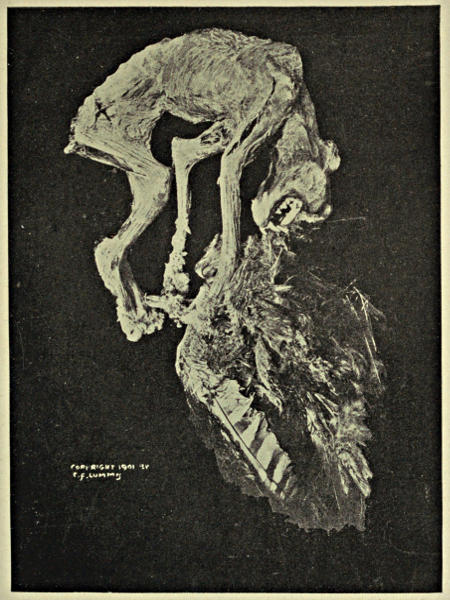
pelt.” Drawing his knife, the hunter soon
removed that very softest and most exquisite
of all furs. Then with an uneasy
glance at the clouds he turned away, walking
as briskly as his protesting lungs would
allow.
Good! There was the mule all right. It
had not budged a foot; and now, though still
in an attitude of utter dejection, was clearly
out of danger. Directly, master and mule
were jogging off toward the trail at a most
doleful gait—which doubtless would have
been mended, if they could have seen
through the rounded hill just ahead. But
the hill was opaque, as hills and circumstances
ahead are so prone to be; and they
pottered along lazily, until, at a turn over
the ridge, the spurs went drumming such
an unexpected tattoo upon his echoing ribs
that the mule quite forgot himself, and went
pitching down the hill at a pace he had not
taken in a month.
Away down yonder, a superannuated
buggy and its team stood in the trail. A
few rods ahead of it, and just at the heels
of a wilted pack-mule, two men were scuffling
in the dust; and over them a hooded
figure was bringing down a heavy club.
At that instant the pack beast wakened
enough to turn his head interrogatively,
cocking one ear forward and the other back.
Even as he did so, his nigh hind leg could
be seen to gather itself and suddenly lunge
out behind. A long, linen-shrouded form,
white capped at one end, thereupon doubled
in half, and rose in the air and went whirling
like a boomerang. It fell a full rod
away and did not rise. Then a similar
figure sprang from the buggy and rushed
at the wrestlers; but midway went down all
at once in a loose heap, as if struck by a
bullet. No wonder the stranger up yonder
drummed with his heels, and jockeyed, and
whooped; and, finding his charger still too
slow, leaped from its back and came bounding
down the hillside like a loosened rock.
Andrés was sitting placidly astride his
prostrate foe, breathing rather hard, but
looking stupidly good-natured as ever. One
of his fingers was broken, and blood from a
gash on his forehead trickled down his
nose.
“Mps, viracocha,” he answered to the
breathless traveler’s glance of inquiry,
“the caballeros were set to see the inside of
your boxes, and because I refused they
went to beat me. But when this cannibal
here came upon me, then it was to fight.
The blows of a gentleman, yes—but not of
a chuncho.[31] So I measured him, thus. And
when the gentleman went to crack me the
squash with his quirt, then did Big-Ears
here, forgetting respect to the powerful,
set heel to his stomach and lift him until
over yonder.”
“And this? I saw him fall as he ran at
you,” the viracocha mustered breath to say.
“He? Mps, but it will be the sorojchi—see
you not how the blood falls from his
mouth? And you see, viracocha, how
strong is the coca! Because I sacrificed at
the apacheta, as one should, to the spirits of
the high places, it has all come as the mouth
would ask. Without that, then, the gentlemen
would have left me here, of no more
use to your grace, and the magic boxes
would be emptied in the light.”
When night came down on the Quimca-chata,
a gusty snowstorm, with howling
intervals of hail, beset the pass. It roared
at the hills, it swooped down the cañons as
if in search of some living thing it might
turn to ice before morning. But inside the
low, dirty tambo, they only laughed at its
rage. The bald stone hut in a little nook
under the shoulder of a hill had neither
window nor chimney; and a heavy poncho
of llama hair was the temporary door. It
was a fair type of the tambos of the Andes—those
tenantless, cheerless wayside shelters
that save the traveler in those bleak
lands from perishing. On the sooty hearth
a faint blaze of taqui wavered, and the smoke
wandered out as best it could or made itself
at home in the bare room. Upon the rough
stone bench along the walls sat five men,
and in the farther corner six mules nosed
wistfully in a rubbish heap for casual
straws. Of the men two were Indians, and
both wore bandaged heads. The third
guest of this inn without a landlord appeared
to be an American, and he also had
a handkerchief bound about his skull. The
two others were handsome, swarthy men in
costly vicuña ponchos. They sat on linen
dusters, from the pockets of which peeped
the tasseled ends of two white caps.
One member of the party cast now and
then a sly glance at these. So, instead of
clowns going to some feast, these were two
wealthy Bolivians. And those astonishing
head masks which had so mystified him
were merely to save their faces from that
trying mountain air—so Andrés had informed
him, with an evident effort not to
pity his ignorance. And looking at those
coffee complexions he had serious work to
keep from smiling at the thought of trying
to keep them from sunburn.
“Pues, it is as well the tambo was near,
for none of us were in shape to go much
farther to-night, even forgetting the storm.
Ea! But how it howls, as if disappointed!”
It was the American who broke the silence,
though he spoke, of course, in Spanish—the
only common possession of the five
tongues.
“You have reason, caballero,” answered
the taller of the two dons, courteously.
“And even more am I glad that we make
ourselves pardoned. Of a truth, we were
most ignorant that to open your cases would
spoil all; nor could we have thought to take
the liberty, but that we believed you a—a
seller baiting us for higher pay. But we
were well answered. Your so obstinate
arriero made me forget myself, and I give
you a caballero’s apology. But that mule—ay
de mi! I thought Illampu itself had
tumbled upon me!”
“Verily, señor! I saw it from the hill,
and it was so prettily done as I never could
have believed. Why, señor, he shut you at
the waist like a knife with a strong spring!”
The cavalier smiled a trifle weakly at the
description, but he said frankly:
“He did but justice. I have shame to
think how I lost a gentleman’s temper.
And so little more and I could have broken
your man’s head. But since you have the
fineness to hold no malice, it is well.”
“Oh, I know curiosity and temper both.
Only that it is Andrés’s head and not mine.
But his need not be too sore—for you have
caused me to double his wages from to-day.
An arriero that will stand a broken head to
guard the amo’s load—well, I haven’t found
him very abundant in Bolivia, nor anywhere
else.”
“You have reason always. And—er—understood
that—pues, you know that Don
Juan de Jaúregui cannot say to an arriero,
‘pardon’! But in purity of truth, he is
faithful, and I would be glad to give him a
well paid position on the chacra.”
“Eh, Andrés? The cavalier offers justly.
What sayest thou?”
Andrés’s face beamed simply, and he
twisted his skull cap as he rose with a
clumsy bow.
“I shall be glad,” he stammered. “But
only if—until—when that the viracocha
shall have no more need of an arriero. For
while the magic boxes have to ride on the
ribs of a mule, it is safer that I be driver—since
the viracocha has shown me, and I
know how they must be treated. ‘Gently!
Gently! And for the life of you, let no light
come into them!’”