Tacitus has given us a spirited picture of life in the
Imperial palace during the months which followed
the execution of Messalina. Claudius himself had
sunk into a state of drowsy indifference when the storm
excited by his discovery had spent itself. “Where is the
Empress?” he asked, as he sat at supper the night after
her death, and noticed the empty place on the couch.
Narcissus told him that she was dead, and he asked no
more. But the palace about his slumbering figure soon
began to hum with conflicting intrigues for the succession
to her chamber. Ladies who had visited the Palatine with
nervous prudence while Messalina lived now came to display
their charms, and express their tenderness, to the
doting Emperor. From the sombre night of the tragedy
Rome passed with relief to the light enjoyment of the new
comedy. The freedmen, who surrounded and controlled
Claudius, selected their candidates.
Claudius had inserted one sentiment of his own in the
speech which Narcissus had induced him to make to the
Prætorian Guards. He had sworn that he would not
marry again. There were ladies in his household, such as
Calpurnia and Cleopatra, who would encourage the resolution;
but the freedmen decided that he was bound to
capitulate under so fair a siege, and it would be better
to have some share in the making of the new Empress.
Each of the Greeks chose a different lady. Narcissus, who
had been promoted to high public service for his zeal,
favoured the suit of Ælia Pætina, whom Claudius had
lightly divorced twenty-one years before. Callistus took
up the cause of Lollia Paulina, the wealthy and beautiful
woman whom Caligula had torn from her husband and
used so unjustly. The steward, Pallas, was more fortunate
in his choice. He advocated marriage with Agrippina;
and, as the mind of Agrippina coincided more decisively
with that of her champion than seems to have happened
in the case of her rivals, his campaign succeeded. She
discovered a most tender and considerate affection for
her uncle, visited him assiduously, and persuaded him to
betroth his daughter Octavia to her son Lucius Domitius
(later Nero).
Octavia was already betrothed, and Agrippina is said
to have removed the first obstacle to her designs by a cruel
and unscrupulous act. We are told that she induced,
and it is at least clear that she permitted, the sycophantic
courtier Vitellius, who favoured her suit, to accuse the
young man, to whom Octavia was betrothed, of incest
with his daughter-in-law. Tacitus has so mean an estimate
of the young people and their generation that he does
not regard the charge as a serious libel. He insists,
however, that Agrippina had the case against them forged,
and thus opened her dark Imperial career with a crime.
We are now approaching the generation in which the
great historian lived, and we are considering the very
woman whose memoirs furnished him with his more
serious charges against her rivals and predecessors. It
may therefore seem strange that, if we are to follow our
authorities with docility, we must ascribe a very vicious
and unscrupulous character to Agrippina herself. We have
rejected the rumour that she poisoned her second husband,
but that is by no means the only charge that is brought
against her before she married Claudius. The authorities
uniformly assert that she had had incestuous relations
with Caligula in her early teens, had been notorious for her
amours during the life of Messalina, and now very flagrantly
placed such honour as she had at the disposal of Claudius.
These charges we cannot control. We shall find even
more serious accusations against her later, and shall have
to regard them with reserve or frank incredulity. It
was the literary fashion to make a consort of the Cæsars
imperial in her vices. On the whole, however, we are
compelled to think that the eldest daughter of Agrippina
and Germanicus had the taint of her stock. She inherited
the virile ambition of her mother, and she had even less
scruple in pursuing it. The best that can be said for her
is that she aimed rather at making the future of her son
than her own. And when that son proves to be the
Emperor Nero, the murderer of his mother, we are disposed
to read her record with the lenient eye of pity.
When the elder Agrippina had been banished by
Tiberius, as we saw, in the year 12 A.D., her children
were brought up in the house of their grandmother
Antonia. In this plain home of old Roman virtue
Caligula is said to have infected and corrupted all his
sisters. Agrippina left it, in her thirteenth year, to
marry Cn. Domitius Ahenobarbus. As the authorities
are sharply divided in regard to his character, we cannot
trace his influence in the development of her character.
He died in the year 40, leaving her with a three-year-old
boy, Lucius Domitius. Agrippina was still a young and
beautiful woman, and is said to have availed herself of
the loose morals of Roman society until, as we saw, the
attitude of Messalina forced her to marry. She was soon
a widow for the second time, with considerable wealth. Her
ambition revived at the death of Messalina, and she paid
the most winning and flagrant attentions to Claudius. We
should go beyond the letter of the chronicles if we suggested
that she bribed Vitellius and Pallas to promote her
suit. It is enough to say that they overcame the reluctance
of Claudius, and they profited materially by her accession
to the throne.
Claudius professed that he had a scruple about marrying
his niece, and proposed to adopt her as his daughter.
That empty honour was hardly recompense enough for
the daily contemplation of his senility and sensuality.
Vitellius induced him to submit his delicate feeling to
the Senate and the people, and then artfully represented
to the Senators that, if Claudius married Agrippina, she
might rid them of the hated influence of the freedmen.
Tacitus, whose disdain for the obsequious Senate of the
early Empire always aggravates his comments on their
conduct, describes how they raced each other to the palace
to inform Claudius of their decision, and how the people
not improbably incited by Vitellius, assembled below the
Palatine Hill and clamoured for the marriage. The obtuse
and weak-willed Claudius assented, and a few days later,
in the year 49, Agrippina became the sixth Empress of
Rome. Little did she dream that she was entering upon
the last decade of her eventful life, and that it would close
with the most ghastly horror.
She was in her thirty-third year, Claudius in his fifty-eighth.
Years of sensual indulgence had not improved
his character or his intelligence, and no one in Rome
can have expected him to live more than the few years
which remained for him. Agrippina was looking to the
time when she would be sole mistress of the Empire.
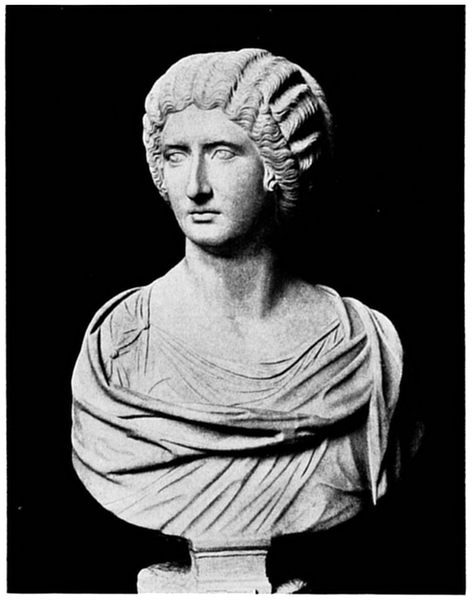
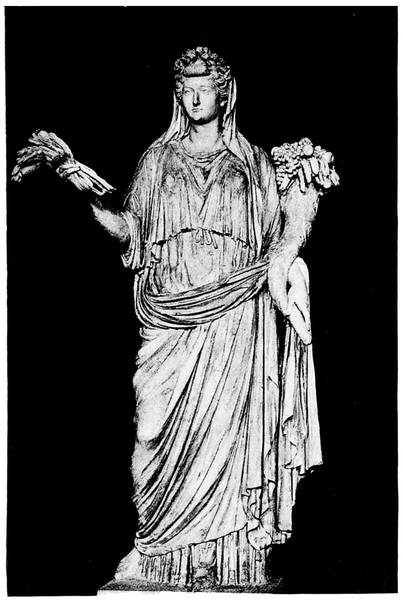
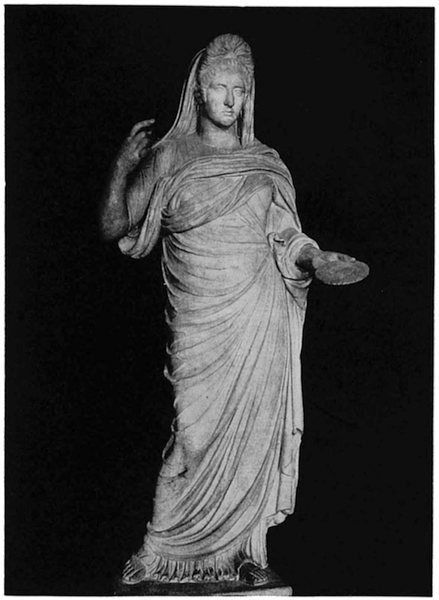
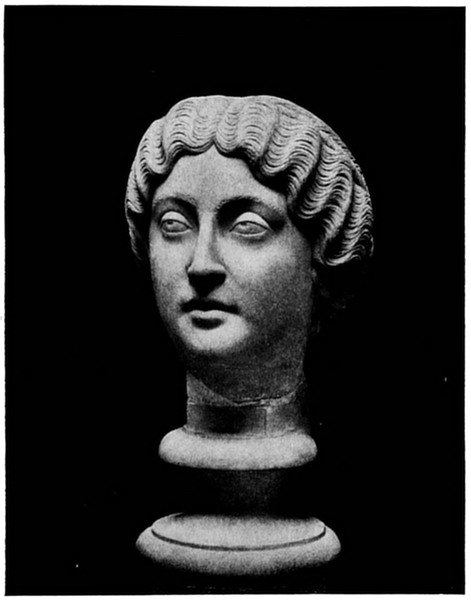
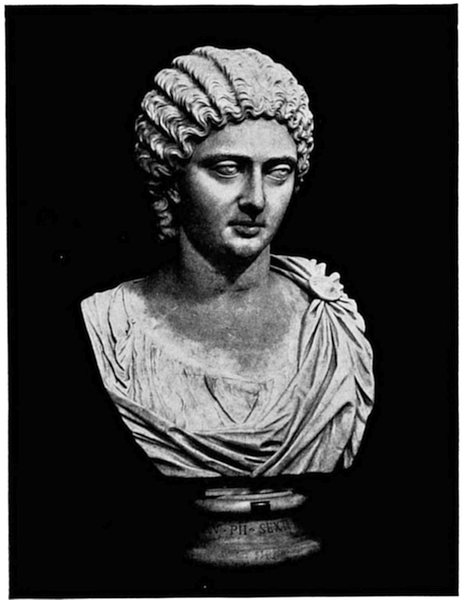
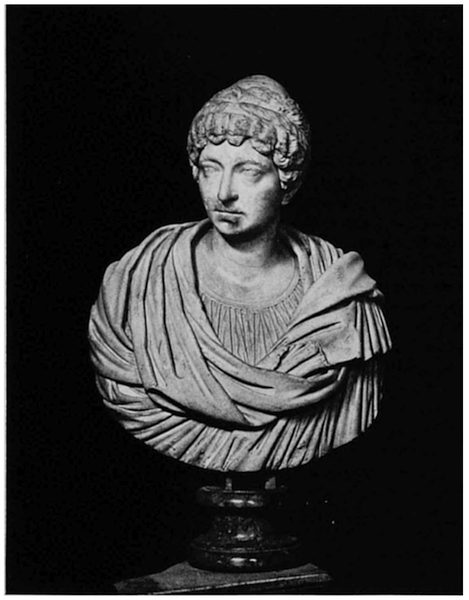
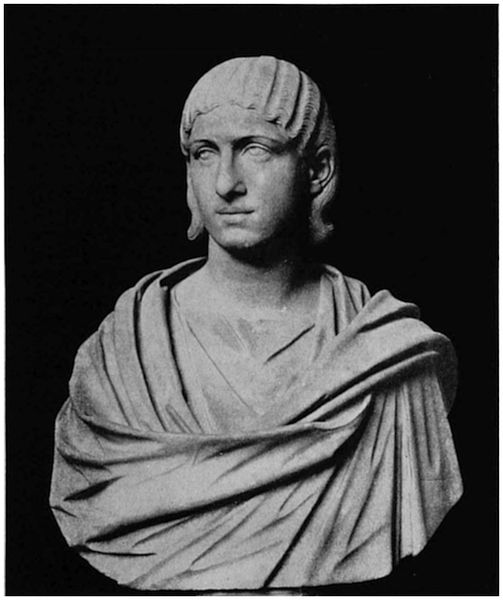
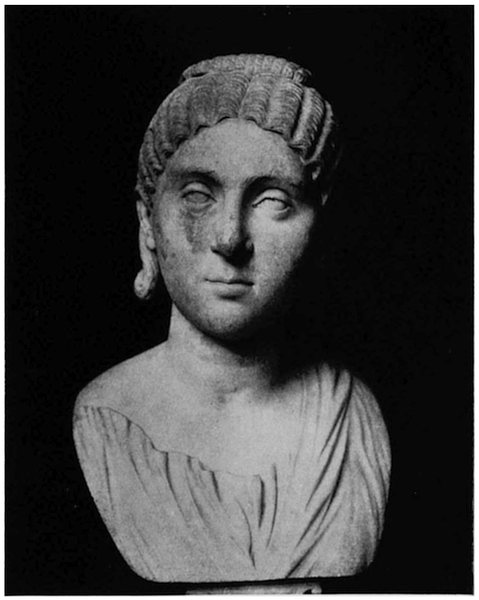
The fine statue of her which is exhibited in the Lateran
Museum has a moral physiognomy so concordant with
the authentic record of her career that we picture her
to ourselves with confidence. In face and figure she is
all that the word imperial suggests to the imagination.
Haughty, strong, and reposeful in her self-reliance, she
has lost the last shade of apprehension with the passing of
Messalina, and has the majestic air of a mistress of the
world. Her low brow and large, finely-carved oval face
are said by some physiognomists to have every mark
of purity and refinement, but the close observer will discover
in her features only such a refinement of passion
as her ambition would lead us to expect. In a word, it
is the face of a woman who will not stoop to vice or crime
to gratify a sensual impulse, but may have recourse to
either when her ambition lends it a certain expediency.
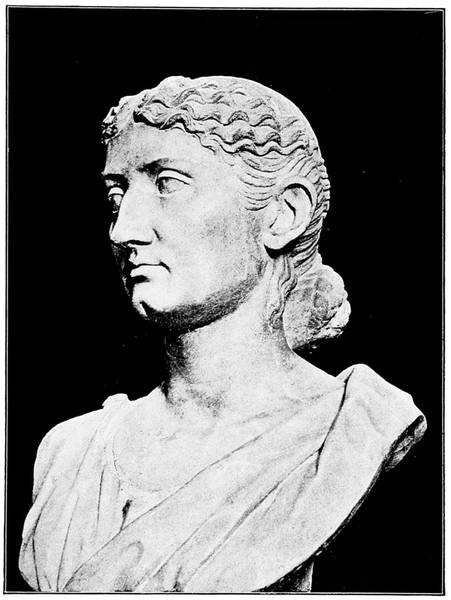
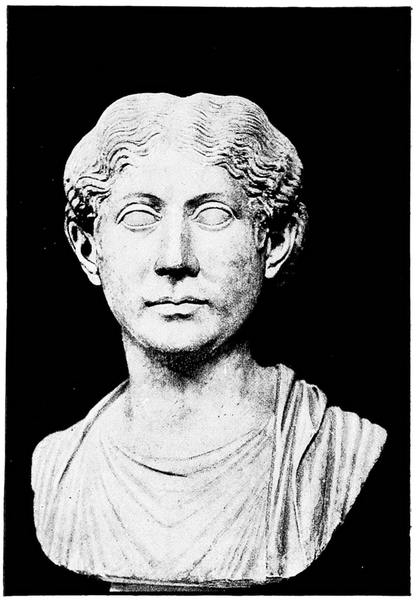
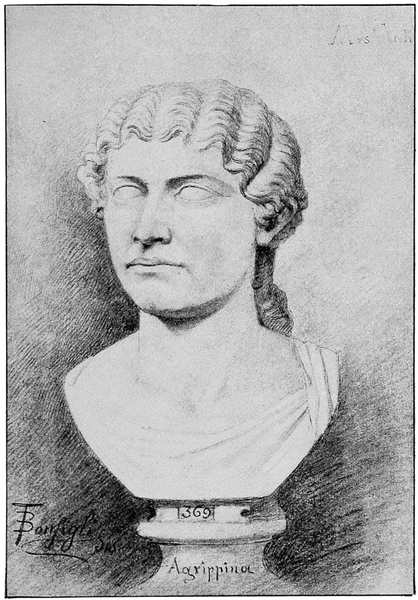
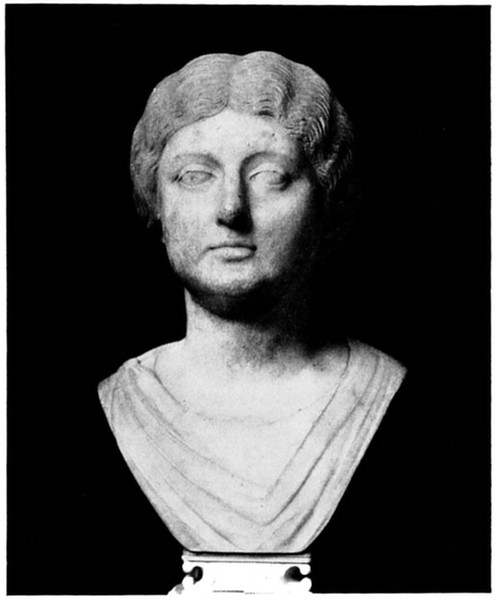
AGRIPPINA THE YOUNGER
BUST, MUS. NAZ., NAPLES
The career of Agrippina shows that she really was a
moral opportunist of this character. We need not pass
any censure on her ambition. Unhappy would be the
State in which men and women were not at times fired
by the impulse to exert their powers more energetically
than their fellows. But it is impossible to ignore the
persistent and harmonious statements of the Latin historians
in regard to the way in which Agrippina pursued her
ambition. We may overlook the amorous adventures of
her earlier years; we may reject, as a light and implausible
rumour, eagerly caught up by prurient diarists, the charge
that she made any dishonourable advances to Claudius
before her marriage, or to the steward Pallas or her son
Nero at later dates; and we may hesitate to admit that she
was concerned in the murder of Claudius. But we cannot
find any other motive than a not too nice ambition in her
marrying the aged and repulsive Emperor, and we have
strong reason to suspect her of conduct that is little short
of criminal in many of the events that follow.
The most formidable of her rivals for the throne had
been Lollia Paulina. Beautiful, wealthy, and popular, the
former wife of Caligula seemed to threaten Agrippina’s
security. In their eagerness to avoid the rock of hereditary
power the Romans had steered their vessel into the
Charybdis of intrigue, and any prominent man or woman
was regarded with concern by the one who wore the
purple, or aspired to wear it. Agrippina had a strong and
legitimate hope, but no guarantee, that her son would
succeed. Messalina’s son, young Britannicus, was ailing
and epileptic, and was generally ignored in the speculations
as to the succession. It was, therefore, quite natural that
Roman gossip should accuse Agrippina of destroying
Paulina, and Tacitus is not less generous in recording the
charges against her than in admitting her slanders against
Livia. He affirms positively that it was the Empress who
persuaded Claudius to have Paulina prosecuted on the
charge of consulting oracles and astrologers as to the
duration of his marriage, and that, when her property was
confiscated and she was sent into exile, Agrippina sent a
soldier to compel her to commit suicide. Dio, as usual,
improves upon the narrative. He describes Agrippina
gloating over the bleeding head of her rival, as Fulvia had
rejoiced over the head of Cicero, and opening the mouth
to see certain peculiarities of the teeth by which it might
be identified.
The fatal defect of Dio’s more vivid account is that, as
we know from Pliny, the double canine teeth, of which he
speaks, belonged to Agrippina herself, not to Paulina, and
were regarded as a sure presage of good fortune. The
substance of the story, however, we cannot lightly reject.
A beautiful and happy woman was driven to death for no
graver cause than, at the most, an idle patronage of the
Oriental charlatans who then abounded in Rome; and, since
this consultation of oracles was common, there must have
been a special reason for the selection of Paulina. The
motive suggested by Tacitus is only too probable. He
adds that Agrippina also banished a lady named Calpurnia.
If we may identify this lady with the Calpurnia whose
services to Claudius were so amiable as to embolden her
to disclose to him the crimes of his beloved Messalina, she
would hardly remain long in the palace of Agrippina.
Apart from such episodes as these, in which jealousy
or avarice led her to make an unworthy use of her power,
she ruled judiciously and serviceably. Claudius was in his
sixtieth year. His poor mind was in complete decay, and
it was both fitting and useful that Agrippina should rule
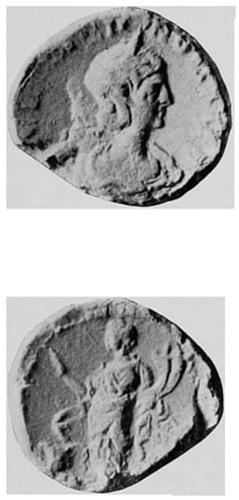
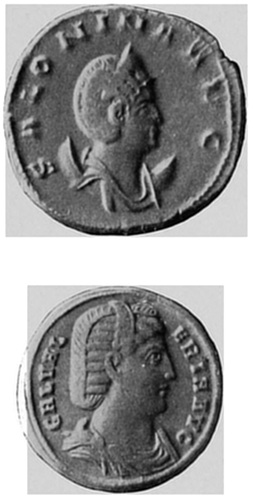
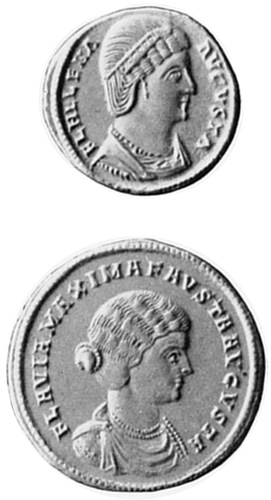
in his name. The coinage of the time bears witness of her
activity. There is, in fact, a living memorial of her rule
in the city of Cologne, which, under the title of Colonia
Agrippina, she established as an outpost of civilization on
the farthest confines of the Empire. She gave dignity and
etiquette to the easy-going court of Claudius, had the right
to enter the precincts of the Capitol and to ride in the
gilded imperial chariot of ceremony, and, when the famous
British prince Caractacus was brought to Rome, her throne
was raised by the side of that of the Emperor. The older
Roman idea of woman’s sphere was now discredited by
the philosophers and contemptuously ignored by the
women themselves, but the citizens moved slowly, and
there was much discontent and consulting of astrologers.
They were expelled from the city, but in the guarded
chambers of patrician families they continued, in imposing
Chaldæan dress, to scan horoscopes and wave preternatural
wands over their symbolical tripods—much as they do in
Bond Street to-day. The more enlightened reader, who
is disposed to regard the superstition with leniency, must
reflect that the prophets might at times, for the vindication
of their art, be tempted to lend a little human aid when
nature tarried in bringing about the deaths which the
planets had so plainly foretold.
Within the palace the whole care of Agrippina was
centred in the education of her son for the purple. To the
delight of Rome, she recalled the philosopher Seneca from
exile, and gave him charge of her son’s studies. When
the real character of Nero was revealed in later years, it
was said that Seneca had always disliked his task, and had
even predicted that the boy would become a savage monster.
Seneca himself merely says that the boy was spoiled, and
his training thwarted, by his mother. Nero would fly to
Agrippina when Seneca had made some attempt to check
his wayward impulses, and the whole lesson would be
lost in her injudicious caresses. Apart from this not
unnatural weakness, Agrippina made the most commendable
efforts to prepare her son for the throne. The corrupt
tutor whom Messalina had brought to the palace was
dismissed—Dio says that he was executed for attempting
the life of Lucius Domitius—to make way for the most
distinguished moralist of the time, and the military instruction
was entrusted to Burrus, whose integrity we shall
learn presently. Pallas was rewarded with such honours
as no freedmen had ever borne before, and Vitellius was
rescued from some obscure charge of conspiracy and
restored to his rank.
Agrippina was now in a position of very great wealth
and power. She drove about Rome in a superb chariot,
flaunted the stored jewels of the Imperial house, and
received presents from the ends of the earth. A white
nightingale, which had cost 6,000 sesterces, and a talking
thrush were amongst the rare presents sent to conciliate
her. The lingering of Claudius must have been irksome
to her, but it was necessary to secure the succession of
her son before the Emperor died. The one apparent
obstacle was the boy Britannicus, who, as the son of
Claudius and Messalina, had a juster title to be chosen.
He was, however, subject to epileptic fits, delicate in
health, and peevish in temper. Agrippina had little difficulty
in thrusting him aside in favour of her own handsome
and engaging boy. The toga virilis, or garment of the
man, was usually donned by the Roman youth in his
seventeenth year, but the age was anticipated in the case
of princes, and Domitius was to receive it at the end of
the year 50. During the year, however, the convulsions
of nature so plainly portended some momentous event,
probably the passage of Claudius to join his divine forerunners,
that Agrippina pressed for the immediate performance
of the rite. Three suns were seen in the sky, an
earthquake shook the solid earth, and birds of evil omen
rested on the temple. Claudius assented, and manhood
and other high distinctions were prematurely conferred
on the future Emperor, whose name was changed to Nero.
He joined the priestly college, received the authority of
a proconsul, marched at the head of the guards, and drew
the attention of all at the games by the insignia of his
manly dignities, while Britannicus sat in the prætexta and
bulla of the boy. It was Nero who pleaded in the Senate
for distressed cities, Nero who was made prætor when
Claudius was absent from Rome. In the year 52 he was
married to Octavia, and all Rome regarded him as the
virtual heir to the throne.
There can be no serious doubt that Agrippina had no
affection for Claudius, and must have waited impatiently
for his removal when the succession was secured for her
son. Certainly Rome held that view, and interpreted the
events of the succeeding years in accordance with it.
We must therefore be prepared to find much libellous
conjecture in the chronicles about this time. Serviez, who
can never resist the fascination of scandal, gives us a
lively picture of Agrippina stooping to any expedient
course of vice or crime in the furtherance of her ambition.
We may have to tell a less romantic story, but it will be
romantic enough.
It is clear that the Empress now entered into a conflict
with Narcissus, the freedman who had ruined Messalina,
and had then favoured the suit of Ælia Pætina in opposition
to her own. Her critics suggest that she wished to
remove this faithful servant in order to attempt the life of
the Emperor more easily, but the suggestion is superfluous.
Narcissus had found the rival freedman Pallas raised to
such high honours, and felt that his own service in exposing
Messalina had been so soon forgotten, that he clearly
intrigued against Agrippina. Tacitus says that it was
he who spread the rumour, which reached the ears of
Claudius, that Agrippina was too intimate with Pallas.
We are quite unable to examine the truth or untruth of
this charge, and may dismiss it. Agrippina took an early
occasion to attack and discredit the Greek. In the centre
of the Italian hills was a sheet of water, the Fucine Lake,
which had no regular outlet, and often caused disastrous
floods. Claudius ordered that a channel should be made
to conduct its superfluous water to the river, and celebrated
the opening of it, in the year 52, with a naval battle on
the lake. Three thrones were erected: one for the nodding,
heavy-paunched Emperor, who had somehow been squeezed
into glittering armour, one for Agrippina, in her robes of
gold cloth, and one for Nero.
The play did not run smoothly, and Agrippina did not
spare Narcissus, who controlled it. The great ships drew
up before the Emperor, and the men who were about to
risk or lose their lives to entertain him rang out the
usual salutation. Forgetting that if he returned the salute
he absolved them from their dangerous duty, Claudius
hailed them, and they claimed the right to abstain. The
Emperor is described by Suetonius as running alongside the
lake, angrily urging them to fight. The battle proceeded,
but at the close it was found that the water could not
be released, and Narcissus was bitterly assailed. The
performance was repeated later, when the works were
pronounced complete, but a number of people were
drowned, and the quarrel was renewed with spirit. Agrippina
suggested that the funds for the undertaking had been
diverted; Narcissus foiled the attack with a charge of
ambition against the Empress.
The Emperor was visibly failing, and there was great
excitement at Rome when, at the beginning of the year 54,
nature announced once more that some stirring chapter
was to run from the reel of the fates. The standards and
tents of the soldiers were enveloped in mysterious flames;
a rain of blood, in which a modern naturalist would doubtless
discover an innocent microbe, spread terror over one
part of the Empire, and the birth of a pig with claws like
those of a hawk caused equal consternation in another;
while Rome heard, with reiterated shocks, that the doors
of the temple of Jupiter had been opened by unseen hands,
and a horrible comet, followed by the customary pestilence,
had appeared in its skies. More significant still to prudent
people, perhaps, was the report that Claudius, returning
to dine at the palace after presiding at the trial of an
adultress, gloomily observed that he had been unfortunate
in his marriages; he had punished one unfaithful wife, and
would know how to deal with another.
In this observation of Claudius we need see no more
than an echo of the whispers of Narcissus, but one can
imagine how Rome must have throbbed with expectation
and abounded in gossip at the beginning of the year 54.
Nor was this faith in natural oracles disappointed. Two
tragedies were added to the sombre chronicle of the city
in that year, and in both of them our Empress is accused
of having acted criminally.
The first was the condemnation to death of one of the
greatest ladies of Rome, Domitia Lepida, sister-in-law of
the Empress; and in this case there is every reason to
suspect a guilty action on the part of Agrippina. When
Agrippina had been exiled by Caligula, her boy had lived
for a few years with his father’s sister, Domitia Lepida,
the mother of Messalina. Lepida was far more indulgent
even than Agrippina to the pretty and wayward child,
and, when the mother returned to Rome and he was
restored to her, there was an acrimonious struggle between
the two women for his affection. As it became clear that
he would inherit the purple, the struggle became more
passionate. Narcissus saw in it an opportunity to escape
the ruin which would befall him if Agrippina obtained
full power, and, on the ground of his charge of inconstancy
against the Empress, he urged Claudius to make
Lepida guardian of Nero. It is very probable that this
intrigue of Narcissus is the only source of the charge
of license brought against the Empress in her mature
years.
Angry and anxious, in view of the expected death of
Claudius, she took a bold step, and impeached Lepida
of criminal conduct. How far Lepida was guilty we cannot
say, but as she was charged only with assailing the
Emperor’s marriage with imprecations, and exercising so
little control over her Calabrian slaves as to endanger
the public peace, the prudent reader will acquit Agrippina
of anything more than an exaggeration of the facts. That
exaggeration sufficed, however, to ruin her distinguished
rival. Nero, schooled by his mother, gave witness that
his aunt had tried to alienate his affection; her very
natural comments on the Emperor’s marriage were made
to assume the dark form of magical imprecations; she
was condemned to death.
But those lively convulsions of nature had portended
something more momentous than the death of a noble
matron, and Rome continued to wait for the great tragedy.
Before long it was announced that Narcissus had retired
to Sinuessa for the treatment of his gout.9 The Emperor
was now entirely surrounded by adherents of Agrippina,
and we can quite understand the conviction of Rome
when Claudius was taken seriously ill at a banquet, and
died within twenty-four hours. Tacitus emphatically
attributes his death to his wife. Suetonius alone says
that, while it was certain that Claudius was poisoned, it
was not certain who was guilty; a feeble reserve, since
Agrippina was so predominantly interested in his death.
It is not surprising that recent historians have generally
followed Tacitus. Roergas de Serviez, who rarely has
such ample authority for the crimes he loves to attribute,
fastens the murder on Agrippina without the least hesitation.
Merivale sees no ground to question it, though he
points out several inconsistencies in the pages of Tacitus.
Mr. Henderson follows the traditional story in his recent
and discriminating study of the reign of Nero.10 But Mr.
Baring-Gould insists that the death of Claudius was quite
natural, and any candid student of the evidence must
admit that it is inconclusive.
The facts are that on October 12th, A.D. 54, Claudius
attended a banquet of the priestly college with Agrippina.
After eating some mushrooms (or figs, according to others)
from a dish that was served, he became violently ill and
vomited. He was taken back to the palace, attended by
his (and Agrippina’s) physician, but gradually sank, and
died on the morning of the 13th. The theory of the
opponents of Agrippina is that she employed a notorious
poisoner, Locusta—a Gaulish woman, who was certainly
in Rome at the time, and was afterwards employed by
Nero—to concoct a slow poison (“a drug that would
disturb his mind and inflict a slow death,” says Tacitus).
This is supposed to have been inserted in a fine mushroom
(or fig), which was taken by Claudius when Agrippina
had eaten one from the dish to encourage him. He fell
back and began to vomit, and the theory runs that Agrippina,
fearing that he might recover and suspect her, called
in the physician Xenophon, a dependent of hers, who
tickled the Emperor’s throat with a poisoned feather and
made an end of him.
Mr. Baring-Gould points out that, since Tacitus expressly
describes the poison as “slow,” Agrippina could
hardly be surprised and alarmed when it did not take
immediate effect. He concludes that Claudius contracted
a violent indigestion from eating too many figs. This is
no more convincing than the opposite theory. An attack
of vomiting, whether from a natural cause or as an unintended
effect of poison, might easily alarm Claudius,
who was very suspicious, and so induce Agrippina to act.
An attack of indigestion, on the other hand, would hardly
have so violent and immediate an effect. The circumstance
of tickling his throat with a feather to cause a vomit, and
at the same time introducing poison, is puzzling; but it
was an age of skill in poisoning, and the feat may have
been possible. The question must remain open. The
discrepancies in the narrative are not fatal to it, but the
story itself is no more than a retailing of Roman gossip,
which was at all times more prurient than scrupulous.
The problem really turns on the character of Agrippina,
and this is ambiguous enough to make us hesitate. One
may scan the record of her career with the most penetrating
charity without discovering any plain indication
of high character, while the ruin of Lollia Paulina, Domitia
Lepida, and others, may be confidently traced to her. We
can only conclude that she was quite capable of accelerating
the death of her husband, and would have no light interest
in doing so; but the circumstances of his death are quite
consistent with the kindlier view that it was due to his
own intemperance. We have not yet, however, reached
the close of her career, and it may be felt that her conduct
after the death of Claudius confirms the darker estimate
of her character.
The malcontents of Rome would be sure to agitate in
favour of Britannicus unless the succession was secured
for Nero before the death of Claudius was known. The
art with which Agrippina averted this danger may excite
our admiration of her virility and astuteness, but must
inevitably lessen our appreciation of her sensibility. She
announced that Claudius was dangerously ill, and called
an assembly of the Senate. Conscious that the servants
of a palace commonly draw their pay from some one
without, she put guards at every approach to the chamber
of the dead man, and devised and carried out a tragi-comedy
of the most extraordinary character. The clothes
were drawn over the lifeless body, bandages and poultices
were ostentatiously applied to it by her servants, and even
the mimes, who had been wont to dance and ring their
bells and crack their jokes before the Emperor, were
brought in to perpetrate their follies in the chamber of
death. In a neighbouring room Agrippina joined her
conjugal sobs with the laments of the youthful Britannicus.
We are asked to believe, and we have little difficulty
in believing, that while she clung in tears to the
weeping youth, she was merely, with cold calculation,
preventing him from leaving the palace, lest he should
fall in the way of the Guards, or some ambitious partisan,
and be proclaimed Emperor.
By noon the preparations of her agents were completed.
The gates of the palace were thrown open, and Nero was
sent out, under the care of his military tutor Burrus, the
commander of the Guards. A few voices were heard to
mutter the name of Britannicus, but the cry was feeble,
and the response insignificant. The Guards were long
accustomed to see the superiority of Nero over the
sickly young prince, and their support was secured by
a liberal promise of money. They conducted Nero to
the Senate, and bade that helpless body accept him.
The same evening a courier from Agrippina brought
word to Sinuessa that Nero was Emperor. Narcissus
had lost, and his figure passes from the scene—with the
inevitable rumour that he was imprisoned or poisoned
by Agrippina.
When the Guards came to Nero that night for the
watchword he gave them “The best of mothers,” and
Agrippina looked confidently from her supreme height
into the future. Within five years her son would put her
to death with horrible brutality, and jeer at her naked
body. No one of the hundreds of thousands who hailed
him with the wildest delight, and smiled at his amiable
irregularities, can have foreseen so rapid and portentous
a degradation. He was then a youth of seventeen, strikingly
handsome both in face and figure, with blue-grey
eyes and light curly hair and finely proportioned limbs.
His tutor in arms pronounced him “a young Apollo.”
But his moral and intellectual trainer had failed as signally
as his physical trainer had succeeded. Seneca had vainly
endeavoured to implant in his mind the germs of the
noble Stoic philosophy. Men have disputed from all time
whether it was the teacher or the doctrine that was at
fault, while the eugenic school of our time would relieve
both from censure, and regard Nero’s mind as an incurably
corrupt soil. One may venture to differ from both,
and wonder if circumstances had not the greater share
in his demoralization. However that may be, his accession
to irresponsible power at such an age, in such surroundings
as we shall discover about him, was a tragedy.
His real advisers were young men, slightly older than
himself, and better versed in the ways of luxury and vice;
and the first use he made of his Imperial power was to
toss aside the treatises of the moralists, and give his
whole attention to art, to chariot-racing, and to dissipation.
What sinister use he made of the later hours, or earlier
hours, of the day, and in what melancholy condition his
girl-wife must have been, we shall see in the next chapter.
Here we have to consider only his relations with his
mother.
For a few years after Nero’s accession his mother
willingly and profitably ruled in his name. It must not
be imagined that she had, with the astuteness of a Marie
de’ Medici, educated him in an indifference to politics so
that she might indulge her own ambition. The appointment
of Seneca as his tutor is the most creditable, though
unhappily the most futile, act of her career. When, however,
the young Emperor refused to be interested in any
problem graver than the art of driving a chariot or playing
the flute, she undertook his Imperial duties, or continued
to have that share in the ruling of the Empire which she
had had under Claudius. She received embassies, was
surrounded by a special German guard when she went
abroad, and was associated with Nero on the coinage. It
would be difficult to measure with any precision the influence
which she had on Roman affairs during this period,
since Seneca and Burrus had an equal, if not greater, part
in the government; but it may be recalled, with some
honour to her, that the first four years of Nero’s reign were
amongst the happiest and most prosperous that Rome
witnessed during the first century.
The first thing to trouble her prosperous and happy
use of power was a certain discontent arising from the old
prejudice against women in politics. The Senators were
annoyed because she injudiciously listened to their debates.
They met at this time in the Imperial library, and the
Empress had a door pierced into it from the palace, and
sat listening behind a curtain. The Senators are said to
have punished her indiscretion by making unflattering
remarks in the course of the debates, though it is difficult
to believe that they were still capable of so courageous a
protest. On one occasion an important embassy came to
Rome from Armenia, and Agrippina declared that she
would sit by the side of Nero when he received it. This
seems to have been a startling innovation, and Seneca had
to avert trouble by advising Nero to descend from his
throne, when his mother entered, and lead her affectionately
from the room.
An incident that shortly occurred gave a nucleus for the
crystallization of this diffused annoyance. A distinguished
noble, Junius Silanus, died, and the familiar whisper of
foul play went once more through all classes of the citizens.
His brother Lucius Silanus was the young noble who had
been betrothed to Octavia, and had so cruelly been
separated from her by Agrippina. Was it not natural
that Junius Silanus should wish to avenge his younger
brother, and that Agrippina should detect his plot and
have him removed? Tacitus and Dio fully believed this.
As in so many of these cases, however, the only ground
for the charge, as far as we know, is the fact that Silanus
undoubtedly died, and we will not waste time in discussing
it. The Senator had so little of the conspirator in him
that even Caligula used to call him “the golden sheep.”
But Rome was convinced that the Empress was guilty, and
the story spread, and is fully accepted by Tacitus, that she
meditated a long series of executions of the men who had
opposed her progress, and that Seneca and Burrus had to
restrain her bloody vindictiveness.
One may decline to accept this charge on such poor
and disputable evidence; but Agrippina now incurred the
anger of her son, and descended rapidly from the height
of her power. The young Emperor had, as I said, used
his Imperial license to ignore his tutors and indulge his
low and sensual tastes. He attracted to his side a band of
the most dissipated youths in the city, and his nightly
exploits were the talk of Rome. One of the less hurtful
of his indulgences was his passion for Acte, a beautiful
freed slave from the Eastern market, whom Dumas has
made familiar. Agrippina resented the liaison—apparently
from a sense of justice to Octavia—and rebuked Nero. He
turned on her with violence the moment she tried to check
his licentious ways, and threatened to discharge her
favourite Pallas. Agrippina was alarmed. She saw a
powerful party, deeply hostile to herself, growing up about
her son, and she felt that the support of Seneca and Burrus
was being withdrawn. She ceased to speak of Acte, and
regarded with silent distress the coarse ways that her son
was exhibiting on the streets every night. A reconciliation
at this heavy price could not last. Shortly afterwards
Nero sent her some rich jewels and robes from the Imperial
treasures. She chose to regard this as a reminder that
the Imperial wardrobe was no longer at her disposal, and
angrily refused the gifts.
Pallas was at once impeached for treason. The charge
was so clumsy, and Seneca defended him so ably, that he
had to be acquitted; but Agrippina forgot discretion in
her victory. In the course of a quarrel with Nero, she
threatened to retire to the camp of the Prætorian Guard
with Britannicus and have him proclaimed Emperor. The
only effect of this was to open Nero’s long career of crime.
The few months—we are still at the beginning of the
year 55—of unrestrained license and flattery had destroyed
the little moral restraint that Seneca had taught him, and
he determined to murder Britannicus. In the Roman
prison was the skilled poisoner, Locusta, whom Agrippina
was believed to have employed in the murder of her
husband. Nero ordered her to prepare a deadly poison,
and, when the first preparation failed, he had her brought
to the palace. With blows and oaths he forced her to
prepare a more deadly drug under his eyes, and it was
used the same evening. Britannicus sat with his friends
on one of the couches in the dining-hall at the palace, and
asked for a drink. It was winter-time, and the wine (not
soup, as Serviez says) was heated. He complained that it
was too hot, and the poison was administered with the
cooling water, so that the taster would not need to take
a second sip.
A great horror fell upon the room as Britannicus, writhing
with pain, sank to the floor. Octavia sat in silent terror
by the side of her husband, who carelessly observed that
Britannicus had one of his usual epileptic fits. Agrippina
openly betrayed her horror and disgust, and from that date
was regarded by her son with bitter hostility. Whether
or no it be true that Nero whitened with chalk the spots
which broke out on the body, the substance of the story
cannot be discredited. It is true that Nero was yet in his
eighteenth year only, but his conduct had been vicious and
unbridled to a criminal extent. Within a very short time
we shall find him sinking to the lowest depths of brutality.
The fact that he is praised in the treatise “On Clemency,”
which Seneca wrote about that time, can only show either
that the too indulgent tutor refused to believe the crime, or
that, as we have too many reasons to know, the distinguished
Stoic came perilously close to that art of casuistry in which
moralists of many schools have been apt to excel.
In her abhorrence of the foul deed Agrippina drew
closer to the tender and virtuous Octavia, and confronted
Nero with a sternness that had been too long delayed.
The breach between them widened. One day Nero ordered
that two and a half million denarii should be given to his
favourite secretary. Agrippina had the mass of coin brought
under the eyes of the Emperor, to make him realize his
extravagance. He laughingly observed that he did not
think the sum was so small, and ordered it to be doubled.
The more lavishly he squandered, the more carefully
Agrippina saved, until the frivolous or malicious companions
of his revels suggested that she was gathering funds for the
purpose of dethroning him. He at once withdrew the guard
he had given her, and ordered her to leave his palace.
Agrippina had enjoyed only for one year the power
which she had sought so long. She was yet only in her
fortieth year. The envoys of kings had sued humbly at
her feet, and her litter and guard had flashed through the
streets of Rome with an impression of greatness that no
other woman then known had ever possessed. But the
reins passed from her hands to her brutal son and his
despicable courtiers. From the palace she passed, with a
few devoted followers, to the small mansion of her grandmother
Antonia, and the sycophantic courtiers deserted
her. Graver citizens, watching the rapid degradation of
the Imperial house, followed her with sympathy, but few
dared to visit her in the lonely mansion. Unfortunately,
she quarrelled with one of these few, and came near to
losing her life.
Her old friend Julia Silana, a woman of great wealth
but very faded beauty, proposed to marry a handsome
young Roman knight. Agrippina imprudently advised
him not to marry a woman of such advanced years and so
adventurous a record. Her words were repeated to Julia,
and friendship was exchanged for the most bitter animosity.
Julia Silana was childless, and it is conjectured that Agrippina
hoped to inherit her wealth if she died unmarried.
Whether she believed this or no, Julia conceived a deep
hatred, and induced two of her clients to accuse Agrippina
of high treason. Nero seems to have been in an uncertain
mood, and an ingenious plot was devised to win him.
One night when he lay, flushed with wine, after the
banquet, his favourite comedian Paris came to amuse him.
Nero noticed that the man was agitated and less merry
than usual, and asked the reason. Paris, who was acting
in the service of the plotters, confessed with artistic tears
that there was a conspiracy afoot to dethrone his noble
master; that Agrippina was about to marry Rubellius
Plautus, a Senator of Imperial descent, and seize the throne.
The inebriated Emperor at once demanded their heads, but
Seneca and Burrus restrained him, and compelled him to
hear Agrippina on the morrow. In her speech, which
Tacitus has preserved, she refuted and routed her assailants
with such vigour that she was, apparently, reconciled to
Nero and restored to some authority. Julia Silana was
banished, Domitia’s chamberlain (who had instructed the
actor) was executed, and Agrippina’s own followers were
rewarded.
The two years that followed this reconciliation are
obscure, and we can only dimly conjecture that Agrippina
had some peace and prestige, but no longer shared the
Imperial rule. Then, in the year 58, another and unexpected
woman came into the field, and Agrippina sank rapidly
toward an abyss of tragedy.
In an earlier chapter we saw that Messalina drove to
death a very wealthy and beautiful Roman lady named
Poppæa Sabina. It was her daughter, who had inherited
her wealth and her beauty, that now attracted the amorous
regard of the Emperor. She had married one of Nero’s
favourite companions, who babbled in his cups of her
dazzling beauty, and inflamed the desire of Nero. In the
next chapter we shall read of her natural charms, of the
singular art with which she cultivated them and the coquetry
with which she employed them, and of the superb and
fabulous splendour of her equipage. It is enough to say
here that Nero visited her, learned that she was willing to
be an Empress, but not the mistress of an Emperor, and
resolved to make any sacrifice to secure so unique a treasure.
The first victim to be sacrificed to the new passion was
Octavia, and the delicate and timid girl would make little
resistance. But Agrippina had espoused her cause with
a spirit that redeems much of her irregular conduct, and
she now saw that her own interest, as well as that of
Octavia, required that she should oppose Poppæa with all
her strength. In that resolution she wrote her death-sentence,
not ignobly.
Even if we refuse to admit some of the incredible
statements that are made regarding it in the chronicles,
it is clear that an extraordinary struggle now took place
about the person of the Emperor. The antagonists were
Poppæa and Agrippina. Octavia was one of those frail,
lily-like Roman women who never struggled; Poppæa’s
husband was easily set aside. Poppæa affected coyness,
and refused to have any other than conjugal relations
with Nero, while she employed all her charms to inflame
him. Agrippina fought so desperately that Roman gossip,
and Roman historians, ascribed the most infamous devices
to her. In spite of his expression of doubt, it is plain
that Tacitus shares the popular belief, which he relates,
that Agrippina used to sit with her son in loose robes
when he was heated with wine, and to ride in the same
litter with him. Against this charge, however, Dio defends
her (lxi, 11). He says that one of Nero’s courtesans
resembled his mother, and that a light remark of his on
that circumstance gave birth to the libel. Poppæa would
not be indisposed to encourage the story. On the other
hand, Mr. Baring-Gould attempts an untenable defence
when he speaks of Agrippina as “the poor old lady.”
She was only in her forty-second year, and was a woman
of great beauty and little scruple.
Whatever arts Agrippina employed in the struggle,
she rapidly lost ground before so formidable a rival, and
Poppæa incited Nero against her. He harassed her with
lawsuits when she was in Rome, and sent men to insult
her when she withdrew to her villa in the country. Before
long Agrippina became sensible that her struggle for power
had passed into the appalling experience of a struggle for
life against her own son. Nero made several attempts to
poison her, but she was on her guard against this familiar
weapon. It is said that she had an antidote compounded
of walnuts, figs, rue, and salt. Then a freedman in Nero’s
suite suggested a more insidious scheme. Her country
house was in repair, and Anicetus directed the workmen
to saw through the heavy timber over her bed, so that
the room would collapse when she went to rest. Agrippina
was warned, however, and the plot was defeated.
By the early spring of the year 59 Nero had fallen into
a mood of the most sombre and bitter dejection. Poppæa
continued to taunt him with his dependence on his mother,
and to display her maddening charms just beyond the
range of his eager arms. The better citizens of Rome,
on the other hand, now perceived his horrible design,
and watched the struggle with anxiety. As he sat at
the theatre one day in this mood, his attention was caught
by one of the elaborate mechanical spectacles which were
often put on the stage at the time. A ship sailed into
view of the spectators, fell into pieces, and disgorged a
number of wild beasts upon the stage. Nero asked
Anicetus, who was a skilful mechanic, whether he could
build a ship that would thus fall to pieces on the water
at a given moment. The man promised to do so, and Nero
went down to the coast in more cheerful temper.
It was the month of March, when wealthy Romans
were wont to forsake the city for the marble villas
which shone in the spring sun on the flowered hills about
the northern corner of the Bay of Naples. The season
began with the festival of Minerva on March 19th. With
some surprise and suspicion, Agrippina, who had gone
down to her villa, received an affectionate invitation to
join her son at Baiæ for the celebration; and she heard
from other quarters that he had announced a desire to
be reconciled with her. She went on board the Liburnian
galley which lay off the gardens of her villa at Antium,
and sailed to Baiæ. Nero met her in the Imperial galley,
kissed her affectionately, and invited her to a banquet
which his friend Otho, the husband of Poppæa, would
give that night in honour of their reconciliation. She
consented, but it is clear that she wavered between her
consciousness of the utter unscrupulousness of her son
and the bright vision of a return to happiness which he
held before her.
When the hour came for going, she was told that her
galley had met with an accident, but that a superb gilded
galley, with sails of silk and a military guard on board, had
been sent as a love-gift from her son in commemoration of
their restored affection. She gazed with suspicion on the
beautiful object, as it lay mirrored in the waters of the little
haven, and decided to go overland, on a litter, to Otho’s
villa. But the amiable behaviour of Nero at the banquet
dispelled the last shade of her suspicion. In the joy which
his caresses and his well-feigned affection gave her, she
did not notice the passing of the hours until midnight,
when she rose to go. The beautiful ship with the gilded
flanks and the silken sails awaited her once more, and this
time she embarked on it. Nero kissed her eyes and her
hands, put his arms about her and pressed her to his
bosom, held her while he gave a last long look into her
eyes, and then—abandoned her to the murderer Anicetus.
The galley shot out over the smooth scented waters
under a canopy of brilliant stars. Agrippina sat in her
cabin, in the soft spring air, and talked about the happy
future with her one male attendant, Crepereius Gallus, and
her one maid, Acerronia Pollia. And suddenly, as they
reached the deep water, there was an ugly crack, and the
roof of the cabin fell on them. Gallus was killed outright,
but the two women were saved, as the stout walls failed to
collapse, and there was some misunderstanding among the
crew in the dark. The maid rushed to the deck calling for
aid for the Empress—others say that she represented herself
as the Empress—and was slain. Agrippina listened
with terror to the crash of timber and the rush of armed
men, and realized the treachery of her son. Still she did
not court death. She dropped quietly over the side, and
swam toward the distant shore. Her strength gradually
failed, and she was about to abandon the awful struggle,
when some men who were fishing by night picked her up
and took her ashore.
Wounded by the falling timbers, exhausted by the
struggle, stricken to the heart by the brutality of her son,
she nevertheless rallied at once, and devised a fresh plan.
She calmly sent a message to Nero that, by the favour of
the gods, she had survived the wreck of the galley which
he had given her, but requested that he would not come to
visit her until her wound was healed. Without a word to
her attendants about the horrible plot, she ordered the
remedies for her condition, and trusted that Nero would
repent. Through the remaining hours of the night she lay
on her couch, with one maid in attendance, her room feebly
lit by a single light. The whole country without was alive
with men. The shore was lit up with their torches, and
they gathered about the house to express their joy that
Agrippina had escaped shipwreck on the very night of so
auspicious a reconciliation. As the first light of dawn
broke on the encircling hills, Anicetus and his men entered
the house with Nero’s reply. She read something of its
tenor in their faces, and said to their leader: “Hast thou
come to visit me? Then tell my son that I have recovered.
Hast thou come to slay me? Then I say it is not my son
who sent thee.” A sailor struck her over the head with a
stick, and she saw that the end had come. Tearing aside
her loose robe, and baring her white body to the men, she
said sadly: “Strike here, Anicetus, for it was here that
Nero was born.” She fell dead under a shower of blows.
Nero had heard that his mother had escaped. Dreading
that she might stir into flame the resentment of Rome, he
called a council of his friends. Seneca is said to have been
silent, Burrus indignant. At that moment Agrippina’s
chamberlain entered with her message. In a flash of
cunning Anicetus threw a sword at his feet, and pretended
that he had been sent by Agrippina to kill Nero. The
Emperor accepted the sordid pretext, and, as Burrus
bluntly refused to send his soldiers to execute her, Anicetus
gladly charged himself with the task. He was appointed
admiral of one of the fleets for his services. It is even
recorded, though details like this must always be regarded
with reserve, that when the servants bore their mistress’s
body to the garden, and stripped it for the pile, Nero stood
by and said, jeeringly: “I had no idea she was so handsome.”
A report was issued, and a formal announcement made
to the Senate, that Agrippina had attempted the Emperor’s
life, and that, when Nero sent men to arrest her, she took
her own life. And the Senate licked the feet of Nero,
decreed games and festivals in gratitude for his preservation,
and led the enthusiasm of the people. So well known
was the murder that an actor referred mockingly to it in
the theatre. “Farewell, my father,” he said, eating a mushroom—“Farewell,
mother,” he added, imitating the action
of a swimmer. The common folk repeated numbers of
these grim jokes. But they enjoyed the games of thanksgiving,
and Senators and nobles took part in them on the
stage and in the arena, and Rome sank swiftly into the
terrible degradation of Nero’s later reign, which will
occupy us in the next chapter.
It is hardly necessary to add a summary estimate of
Agrippina’s character. In the view of Stahr and Baring-Gould
and a few other recent writers, she was “queenly,
honourable, and pure,” and had only the doubtful vices
of ambition and pride. For Tacitus and the other Latin
writers she was capable of any enormity, and guilty of
most. It will be seen that I hold an intermediate view.
She was a woman of great distinction, ability, and strength.
Had she lived in an age when virtue was not inexpedient,
she would have been an illustrious and virtuous queen.
But she had to struggle to obtain and retain power in an
age when a new and more intellectual moral standard was
replacing an older and more instinctive standard, and,
where it seemed profitable, she availed herself of the moral
scepticism which such a change always engenders. She
was queenly, but she was not entirely honourable, and she
was almost certainly not pure. But she served Rome well,
and left it happy and prosperous; and her unselfish passion
for the advancement of her son, her chivalrous and fatal
defence of his injured wife, and the bravery with which
she met his unspeakable brutality, do much to outweigh
her evil deeds in the scale of Osiris.