The long and prosperous reign of Basil II.
(976–1025) has no further interest for us, since
we find in the chronicles no reference to a wife
of that hardy and brilliant soldier. His younger brother,
Constantine, was more like their mother: a man of
passion and greed, though with no higher ambition than
that of an imperial enjoyment of wine and women, and
in that enjoyment he was quite willing to await the
natural death of his more sober and more distinguished
brother. Although he approached his seventieth year
when the undivided rule fell to him, his ways were still
those of an aged and jaded, and not very refined,
Sybarite, and the three years of his reign interest us only
because they show us the earlier environment of his two
daughters, Zoe and Theodora, who are the next to
occupy—alternately or simultaneously, according to the
course of the romance—the gynæceum, or women’s
quarters, of the palace.
Constantine’s wife, Helena, daughter of the patrician
Alypius, is a mere cipher in the imperial records, and
seems to have died much earlier, leaving three daughters—Eudocia,
Zoe and Theodora—to grow up as they might
in the palace of her voluptuous husband. Eudocia, the
eldest, lost during an attack of smallpox whatever comeliness
she may have had, and retired to hide her disfigured
countenance under the veil of a nun. There
remained Zoe and Theodora, and Constantine determined
to marry one of the two to some important noble and
leave the crown to him. The elder of the two was nearly
fifty years old, and Theodora cannot have been much
younger. It is not very clear why they had not married
earlier. Their father, who could hardly be induced to
take the least interest in his Empire, had wholly
neglected his daughters until he held the sceptre in his
hands, and felt that the time was at hand when he must
relinquish it to another. He was a very large and robust
man, absorbed in hunting, gambling and other less
reputable pleasures, and, even when he was sole
Emperor, he left the cares of state to his eunuchs and
retained his imperial attention for the theatre, the
banquet and the dance. In his home the sisters had,
says the chronicler, “lived as they listed,” and the
further course of the story will make it probable that
Zoe had not failed to enjoy her liberty. Theodora was
less sensual, but we shall have to include both sisters in
the list of Empresses who were little embarrassed by
moral scruples.
In approaching their careers we have the rare advantage
of an excellent guide. Michael Psellus, one of the
leading philosophers and literary men of Byzantine
history, not only lived at their Court, and knew them
intimately, but he had a genial taste for the tattle and
scandal of a court and not the least reluctance to entrust
it to his graceful pen. He has been called the Voltaire
of Byzantine letters on account of his brilliant, caustic
and very candid way of writing the story of his times.
We shall find his “Chronography” of inestimable
value, provided we make due allowance for the prejudices
of the politician and the amiable unscrupulousness of the
anecdotist.
Zoe and Theodora were very different types of women.
Zoe, who will interest us most, was a woman of fine
complexion, very graceful figure and ardent passions.
She had large sensuous eyes under heavy eyebrows, a
mass of blonde hair, and a skin of remarkable whiteness.
She was of middle height, and preferred to dress in
simple robes, which exhibited her figure, rather than in
the heavy and gorgeous draperies and massive jewellery
of an Empress; though this simplicity of taste was
limited, on one side, by a passion for perfumes and
cosmetics, of which she gathered the material from all
parts of the world and compounded, either with her own
hands or by her maids, so industriously that her room
“looked like a workshop.” She took such care of her
smooth and clear skin and blonde hair that even in her
seventieth year she had no wrinkle or other mark of age.
She retained youth also in her blood, and we shall find
her remarkably amorous in her sixth decade of life.
Such a woman we shall hardly expect to find richly
endowed with intellect or greatly restrained by moral
sentiments, yet I think that M. Diehl follows too literally
the facile witticism of Psellus when he speaks of Zoe as
“childish” and “silly,” and I will prefer to let the story
of her life tell us the limitations of her intelligence and
character.
Theodora will interest us much less than Zoe, and it
will suffice to say that she was in all respects different
from her sister. Her tall and graceless figure and her
very plain features were compensated by a stronger
intelligence and greater force of character. She could
be coldly stern, even cruel, on occasions, while cruelty
only came to Zoe in the impulsive anger of her thwarted
passions. We shall see that, when the occasion came to
her, she cherished a very high ideal of public duty and
used her power with an intelligence and beneficence that
Psellus greatly underrates.
Such were the two daughters who, in middle age, were
warned by their father that one of them must marry and
inherit the Empire. The choice of Constantine first fell
upon a distinguished noble named Constantine Delassenus,
and a eunuch was sent to bring him from Armenia,
where duty had taken him, to the Court. Much tragedy
might have been prevented if that eunuch had reached
his destination in time, but he was recalled by a second
courier and told that the Emperor had changed his mind.
It appears that the commander of the palace guards had
felt that he would not have much influence on a noble
like Delassenus, and he had brought to the notice of the
Emperor a less young and less vigorous candidate,
Romanus Argyrus, who was related to Constantine.
Romanus was sixty years old, and had little to recommend
him except his incompetency, which would suit
the designs of the officers of the Court. He had, however,
a wife living in Constantinople at the time, and it
seems to have been supposed that he might not be willing
to abandon her. The petty schemers of the Court were
accordingly directed to bring about a separation, and,
as Polyeuctes was dead, and a more accommodating
patriarch held the see, no opposition was expected from
the Church.
A file of soldiers entered the mansion of Romanus and
told him that he had incurred the anger of the Emperor.
They were, they said, to lead him to the palace for
execution, and his wife was to enter a monastery. Many
eyes had been put out, on slight grounds, during the
three years’ licentious reign of Constantine, and the
threat was serious. The wife fled at once to a monastery,
and Romanus was brought, in some trepidation, to the
royal presence—to learn that, since his wife was now a
nun, he was free to marry the Emperor’s daughter and
thus secure the purple. Instead of retiring to thrust a
dagger in his heart, as an older Roman would probably
have done, the sixty-year-old noble graciously submitted
his person to the princesses. Theodora, the favourite of
her father, had the first choice, but she turned away in
disgust. Possibly Romanus did not regret that this
gave him the hand of the more charming Zoe, who, in
her forty-ninth year, fully preserved the fresh and
brilliant complexion and the warm passions of a young
woman. He had set out from home prepared for death,
and must have been bewildered by his fortune. The
clergy obligingly disentangled the somewhat complicated
relation in which they stood to each other, in the eyes of
the Church; they were married and crowned on 19th
November 1028; and, as Constantine died three or four
days afterwards, the duty, or pleasure, of governing the
Empire fell on them during the first week of their
singular honeymoon.
After this inauspicious beginning we shall hardly
expect the reign of Romanus III. and Zoe to be one of
brilliant and inspiring deeds; indeed, we may say briefly
that it was merely an inglorious effort to retain the
crowns they had obtained. They adopted the easy device
of emptying the treasury on the common folk, the clergy
and the monks. The private debts of citizens were paid
by them, more churches were built or richly decorated,
the clergy were relieved from taxation, and the monks—it
was the very culmination of their golden age—were
lodged in luxurious mansions which made their calling
one of the most attractive in the Empire. The graver
nobles frowned, plotted and were savagely punished,
but we are interested in these conspiracies only in so
far as they involve the imperial sisters.
Theodora, a spirited and intelligent woman, naturally
despised the marriage which she had refused, and was
regarded with suspicion and hatred by her sister. By
some means Zoe put at the head of Theodora’s household
a Paphlagonian eunuch in her own pay, a very
crafty and unscrupulous man named John, who was
enjoined to watch Theodora’s conduct. This very
interesting person will be better known to us presently,
as he was destined to be the most powerful man in Zoe’s
Court. For the moment it is enough to say that, about
a year after the coronation, Theodora was discovered to
have some share in a conspiracy which was set afoot by
Constantine, a relative of the Emperor. It is curious
that John also was found guilty, though whether this
was merely a trick to conceal his spying, or he had really
been gained by Theodora, it would be difficult to say.
Theodora was expelled from the palace and confined in a
building at Petrion, on the Golden Horn, which seems to
have had the mixed characters of a monastery, a state
prison and a fort. It was the building to which Nicephorus
had consigned Theophano for a few weeks before
their marriage, and would have comfortable apartments.
A year later Romanus was ignominiously beaten by the
Saracens and the conspiracy revived. There is no proof
that Theodora took part in it, but its aim would be, no
doubt, to place her on the throne. In one of those
moments of energy which passion occasionally gave her,
Zoe went to Petrion, and forced her royal sister to take
the vows and adopt the dress of a nun.
As a number of other malcontents lost their eyes or
their liberty at the same time, the throne of Zoe and
Romanus seemed to be firmly established. Unfortunately,
a very grave breach now took place between the
imperial pair, and, as a handsome official entered the
service of the palace, there happened what so commonly
happens in Byzantine history under the circumstances:
Zoe fell in love with the handsome servant, and Romanus
died, of a mysterious complaint.
Delicacy compels me to refer the inquisitive reader to
the Greek text of Psellus, or to the chronicle of the monk
Zonaras, for a full explanation of the rift in the sacred
palace. Briefly, Romanus had been assured by one of
those soothsayers who were in such high repute at Constantinople
that he would have a son, and he zealously
studied and employed the whole known range of
aphrodisiacs and other contrivances that might help to
ensure the fulfilment of the prophecy. After two or three
years of this peculiar activity he retired in despair from
the struggle, leaving Zoe untouched and indignant. As
she had now certainly entered her sixth decade of life,
the modern reader will have but a slender sympathy with
her, and will recognize a very low quality of character in
her conduct. Her husband became ill, and his favourite
chamberlain, Michael, was often summoned to attend him,
even when Zoe shared his bed. This chamberlain was a tall,
handsome, fresh-faced young man, whose form pleased the
Empress, but there was a deeper intrigue in the affair; the
chamberlain was a brother of the Paphlagonian eunuch
John, whom we saw in charge of Theodora’s mansion,
and it is now necessary to present him more intelligibly.
John was a very shrewd, ambitious, vulpine provincial
of mean family; he had been converted into a eunuch
in early years, had held office in the employment of the
Emperor Basil, and had then retired to a monastery.
His character is so far removed from religious ideals
that one is disposed to imagine him as having been
compelled to take the black robe for some indiscretion,
but it is quite possible that he adopted it voluntarily, as
at this time many of the monasteries were merely
luxurious colonies of bachelors living on a swollen
stream of legacies. Romanus, who knew his ability,
brought him from his monastery to supervise Theodora
and her affairs. In spite of the curious statement that
he was himself involved in the conspiracy, he was soon
back at Court, and in great favour. He had five brothers
and a sister, and the general character of the family may
be deduced from the fact that three of the six brothers
were moneylenders, two (John and Simeon) were monks,
while the sister, Maria, had married a ship-caulker at
the quays. John used his influence to introduce these
brothers into the very lucrative service of the State.
Within a few years the beau of the family became
Emperor, the son of the ship-caulker also became
Emperor, the ship-caulker himself became High Admiral
of the Fleet, two other brothers had the rank of generals,
and John became the virtual ruler of the Empire.
It was chiefly through his young and attractive-looking
brother that John pushed their fortunes. Michael was
a young man of large and well-proportioned figure, with
that freshness of complexion which we often find in
nerve-diseased or epileptic subjects. He became a
favourite chamberlain of Romanus, and John presently
noticed that Zoe was interested in him. Romanus was
visibly failing, and Michael was at times called in to
chafe his feet as he lay in bed with Zoe. “Who will
believe,” the monk Zonaras asks, “that he did not take
the opportunity to rub Zoe’s feet also?” Zoe expressed
to John a lively interest in his brother, and John took
care that their movements should not be hampered by
any of the restrictions that normally curtailed the liberty
of a Byzantine Empress. The pale Paphlagonian, in the
black dress of a monk, was already the supreme master
of the palace, but the most piquant feature of his position
is to find him chiding the nervous hesitation of his brother
and feeding the improper admiration of the Empress.
Psellus dilates, almost gloats, for pages over the
development of this singular love story, in a way that
hardly becomes a great exponent of Plato and Aristotle.
Before long the relation of the two was known to the
whole Court. Michael was loaded with jewels and other
presents, and not infrequently courtiers would find him
sitting, still rather nervously, on the same couch with
the infatuated Empress. One day a servant entered the
throne-room for some purpose, and almost fell to the
ground in astonishment. Zoe had made Michael sit on
the throne, had put the crown on his head and the sceptre
in his hand, and was admiringly murmuring: “My
darling, my flower of beauty, joy of my eyes, consoler
of my soul,” etc. Instead of bursting into passion at the
entrance of the official, she bade him do homage to the
man who would one day be his Emperor. So says, at
least, the philosophic Psellus, whom many believe. It
is quite certain that Zoe made flagrant love to the
chamberlain, and that the Emperor knew it. His sister,
Pulcheria, angrily spoke to him of the notorious scandal,
but he professed to be ignorant of it and was content to
exact from Michael an oath that there was no truth in
the rumour. Other writers say that he overlooked the
liaison because it preserved his middle-aged spouse from
promiscuous irregularity.
Romanus forgot that such love affairs were apt to
entail tragic consequences for the superfluous man. As
Zoe’s passion increased, he found himself suffering from
an alarming and mysterious illness. His hair fell out
in patches, his breathing was laboured, his face—a more
significant symptom in an old man like Romanus—became
livid and puffy. Whether this illness was really
due to a slow poison, and whether the poison was administered
by John or Zoe, are points which we must
leave as we find them in the chronicles—uncertain. Since
there is very little doubt that Romanus was murdered in
the end, the theory of poison is not reckless; but
Romanus was aged and worn, and the illness may have
been natural. However that may be, Romanus lingered
in a frightful condition until Holy Thursday of the year
1041. On that sacred day Romanus distributed to the
Senators the ceremonious gifts prescribed in the ritual,
and retired to the bath. From the bath he was presently
removed in a dying condition to his bed. However
possible it may be that he had had a serious attack of his
illness in the bath, we cannot easily ignore the persistent
statement that men entered the bathroom, and either
strangled the Emperor or held his head under the water.
Psellus gives this as a rumour, but even he seems to
believe it. Both Michael and John are accused of the
murder, and it is left uncertain whether Zoe was privy
to the plot. Her immediate conduct will not dispose us
to be eager to clear her memory of the suspicion, but we
may be sure that the monk John was the soul of the plot.
Zoe came, with ostentatious (the chronicler says
feigned) tears, to see that her husband was really dead
or dying, though she did not await the end, which
occurred soon afterwards. When we learn that she
announced her intention of marrying Michael the same
evening we are disposed to see in her an element of
cold-blooded calculation which does not very well assort
with the character we have given her. It would probably
be much more correct to conceive her as nervous
and confused, and simply yielding to the dictation of
the monk John. Her father’s eunuchs, who had remained
in her service, begged her to wait some time,
but John bullied and threatened, and Michael was forthwith
decked in the dead man’s robes and placed beside
Zoe in the gold-roofed hall. The patriarch was summoned
to the palace and curtly ordered to crown Michael
and marry him at once to the very recent widow, in the
presence of the assembled Senators. The whole scene
is so repulsive that we need not hesitate to accept the
last touch given to it in the chronicles. The archbishop
hesitated, but a present of a hundred pounds in gold
from John removed his scruples, and he invoked the
blessing of God on the new imperial marriage.
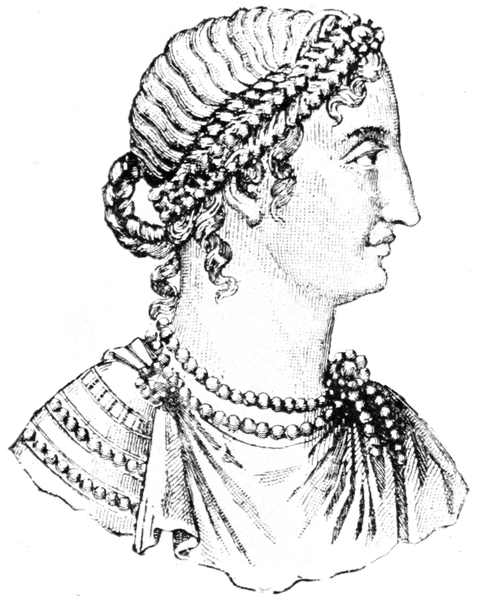
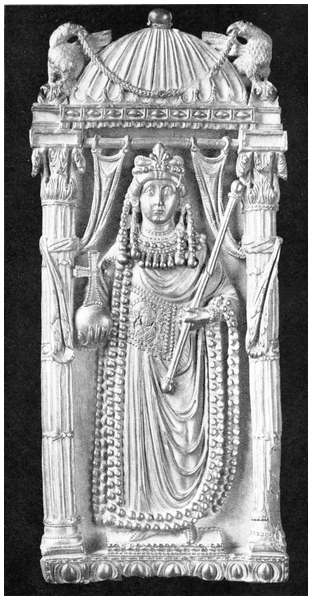
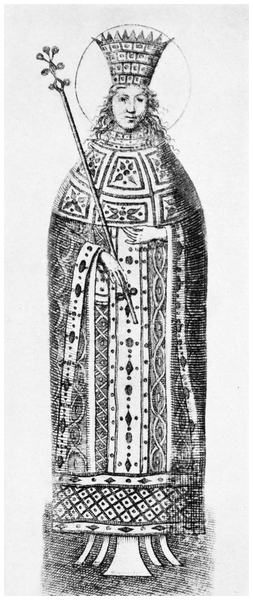
THE EMPRESS ZÖE
FROM ‘CONSTANTINOPLE’ BY E. A. GROSVENOR
After this authentic episode it is superfluous to seek
to determine the share of Zoe in the illness and death of
her first husband. The monk-eunuch was capable of
any crime, and it is, perhaps, not likely that he would
take others into his confidence in perpetrating them.
His brother Michael was a feeble-minded man, of no
criminal instincts, whom we shall presently find smitten
with the deepest remorse for the part he had played.
Zoe also was little more than a tool in the hands of John.
Had he communicated his criminal design to them, they
would probably have consented, but there is no evidence
that he did so. The marriage, however, is a sordid fact
that no casuistry can excuse. It would, no doubt, be
represented to Zoe that delay would give an opportunity
for a revolution, and there were always at Constantinople
nobles who were ready to aspire to the throne when so
excellent a pretext was afforded. These considerations
may explain, but cannot excuse, Zoe’s action. She was
almost, if not quite, devoid of moral feeling. The utmost
we can say for her is that it was not merely her passion
for Michael that gave such indecent precipitancy to a
woman of fifty-four years. But she had no children to
protect, and she lent herself to this disgraceful procedure
merely in order to retain her royal position.
We read, therefore, without the least sympathy that,
while the change made the fortune of the astute John
and his brethren, it brought great disappointment and
chagrin to Zoe. She had, the chronicler says, imagined
that the lowly chamberlain, grateful for his elevation to
the throne, would be her slave, and she at once gathered
about her the former servants of her father and began to
rule. But the monk had no intention of handing to her
the power he had purchased so heavily. His official
position was merely that of “orphanotrophos,” or
director of charitable institutions; his real position was
that of Emperor. Most of the brothers were able men,
but Michael was, as John probably took into account
from the first, epileptic and incapable of self-assertion.
John, therefore, took the reins in his own hands. He
summarily dismissed Zoe’s eunuchs and maids and put
about her an army of servants in his own employment,
so that she could not even go to the bath without the
permission and knowledge of the eunuch. To the
Empire and its affairs, it may be said, he devoted the
most careful and intelligent attention. Even in the
midst of a solitary carouse—for the monk was fond of
wine—he would turn with alacrity to any pressing business.
It was only in the dishonest enrichment of himself
and his brothers, whom he at once promoted to the
highest commands, that he overreached himself.
One noble only, the Constantine Delassenus who had
so narrowly missed the Empire and the hand of Zoe,
rebelled against this division of the Empire among a
family of low-born eunuchs and money-changers, and
the punishment of Delassenus so well illustrates the
world in which Zoe now found herself that it may be
briefly recounted. John secured the loyalty of the
Senators by a generous distribution of money, and then
sent a eunuch to assure Delassenus, who was in
Armenia, that his conduct would be overlooked if he
disarmed at once. Delassenus required some tremendous
security of such a promise on the part of John, and it
was left to the clergy to devise a new and particularly
ponderous oath. The evolution of the oath in Byzantine
life is one of the many ways in which we may trace the
degradation of its character; no one had any longer the
faintest confidence in oaths on the true cross or the
Sacrament. A group of clerics were therefore sent with
the most sacred objects in the reliquaries of Constantinople,
and they marshalled before the eyes of Delassenus
the cross, the napkin bearing a miraculous image of
Christ, the original letter of Christ to King Abgar, and
the portrait of Mary painted by St Luke. On these
portentous relics an oath was taken that no punishment
would be inflicted on him. He submitted; and a few
months later, when the people of Antioch rose against
their oppressive tax-gatherers, the revolt was subtly
traced to the distant noble, and he was exiled and ruined.
Zoe tolerated the domination of the odious monk for a
few years impatiently, and at length made an attempt on
his life. She won one of the eunuchs whom John had
placed about her, and directed him to offer John’s medical
attendant a vast sum of money if he would poison his
master. But, by one of those convenient accidents which
commonly happen in novels and in Byzantine history,
the doctor’s boy discovered the plot and denounced it
to John. Her eunuch was drastically punished, and
Zoe was treated worse than ever.
At the same time her condition became more unpleasant,
because Michael’s illness became worse. The
popular belief in Constantinople was that a devil had
invaded the Emperor, to punish him for his mendacious
denial, to Romanus, of intimacy with Zoe. Men told of
the suddenness with which the quiet, rosy-cheeked
Emperor would be, at any moment, converted into a
frothing maniac, and it was noticed that, on the rare
occasions on which he appeared on the throne, purple
curtains were looped in readiness about it, and servants
stood to draw them round the throne if the devil should
choose that moment to indulge his frolics. Even the
Byzantine writers take this theory seriously; though
some of them offer the alternative theory of insanity.
We recognize the symptoms of epilepsy, and see that
Zoe’s choice had failed. Between the attacks Michael,
who seems to have believed in the devil, was gloomy
and penitent. He and his brothers walked barefoot
through the city, at the head of processions, bearing the
swaddling-clothes of the infant Christ and all the other
priceless relics I have mentioned; but the only answer of
the heavens was a storm of such hail that the stones
crashed through the tiled roofs. He visited shrines,
built churches and monasteries, showered gold on the
clergy, and even gave a baptism-fee to every new-born
babe; and famine, pestilence and earthquake vexed the
over-burdened Empire, and men cursed Michael and his
brothers.
At length dropsy was added to epilepsy, and Michael
determined to resign and enter a monastery. Zoe seems
by this time to have been completely cowed by the
arrogant monk, and she made little opposition when he
went on to provide a new and strange aspirant to the
throne. His sister Maria was, as I said, married to a
ship-caulker named Stephen, who had been put in command
of the fleet. They had a boy named Michael, a
vicious youth, but young enough to submit to his uncle’s
rule if he obtained the crown, and the Emperor and Zoe
were persuaded or coerced to adopt this child and clothe
him with the dignity of Cæsar. One of the chroniclers
tells that they deceived Zoe by representing the boy as
the son of a noble matron. Some such fiction may have
been served to the populace, but Zoe could hardly be
deceived on the point; and even the people were not
long deceived, if at all, since he has passed into history
as Michael the Caulker. In the chapel at Blachernæ
the boy was accepted into the imperial family, after
swearing the customary ponderous oaths to respect Zoe
as his mother and mistress. It is not impossible that
Zoe felt that this adoption of a son who was to wear the
crown made her own position more secure.
Some time afterwards Michael IV. retired to a
monastery, and Michael V. began to look forward to his
imperial opportunities of indulgence. The next course
of events is not quite clear, but it seems that the retiring
Emperor felt some scruple about his action and had
relegated the boy to a house without the walls. He
died, refusing to see Zoe, soon afterwards (10th December
1041), and John forged a letter in his name, bidding
the guards deliver the young Cæsar, and brought him
to the palace. We are then told that Zoe asserted her
power, bestowed the crown on the youth only on the
strictest promise of obedience to her, and expelled the
three brothers—John, George and Constantine—from the
palace. It seems more likely that the brothers quarrelled
with each other. John, promising the most absolute
power to Zoe, had his younger brothers exiled, and then
Constantine intrigued with the young Emperor and displaced
his brother.
These details are of little moment for our purpose.
By the spring of 1042, three months after the death of
her husband, we find Zoe sharing the power with her
adopted son and his uncle Constantine, and a fresh
chapter of romance opens in her story.
Constantine, apparently, urged the youth to get rid
of Zoe and rule alone. A vicious and conceited youth,
he was little troubled by the oaths he had taken a few
months before, but he felt it necessary to proceed
cautiously. He began to slight Zoe, then to treat her
with disdain and harshness. He confined her to her
palace, and refused to let her control the treasury. One
day he announced one of those imperial processions
through the city which the people regarded as opportunities
to express their feelings, and rode out alone.
To his delight he was received with the liveliest rejoicing.
The citizens hung their choicest silks and tapestries
before their houses, and displayed their silver and other
treasures on their balconies, as they were wont to do on
the most festive occasions. Elated with his apparent
popularity, Michael consulted his unofficial council of
fast-living young sportsmen, as soon as he returned to
the palace, and they decided to dismiss Zoe at once. It
is said that Michael himself brutally told her of his
decision, and even slapped the fair face of his adopted
mother. The charge he put forward was that she was
preparing a poison for him. It would not be difficult
to believe, if there were any serious evidence, but it was
probably only a pretext to get rid of her. That night
she was put on ship at the quay, rowed to the islands
and consecrated a nun.
On the following day, however, the laments of Zoe
were cut short in a very unexpected manner. A boat
came at its highest speed from the palace, and a royal
official bade her at once return to her dignity. The
people had resented the flagrant conduct of her adopted
son, and he had hastily summoned her to her palace.
A herald had been sent into the public square to
announce that the most pious Emperor had deposed his
mother and the patriarch for conspiring against his
throne and would himself care for their interests in the
future. From the sullen crowd a voice protested angrily
that they “wanted their mother Zoe, not the son of the
caulker”; it was repeated fervently on every side, and
the prefect had to fly under a shower of stones. Then
the crowd poured into the cathedral, from which the
patriarch had not yet departed, and a noisy debate took
place. A council of the clergy and Senators was then
held in the church, the singular resolution was taken
to bring Theodora from her convent and clothe her with
the purple.
The younger sister of Zoe had, it will be recalled,
been compelled by her to take the monastic vows at
Petrion eleven years before, and this sudden recall to life—a
recall without precedent, since she was not summoned
for the purpose of marrying—gave a remarkable
turn to her career. She had passed from the luxury and
dissipation of her father’s palace, with a brief interval
of independent life, to the shade of the monastery, and
now she was to spend the last fifteen years of her life
on the imperial throne. She was of sterner stuff than
Zoe, and the Senators must have concluded that she
alone could check the audacity of the low-born Paphlagonians.
This does not in itself argue any great strength
of character in Theodora. We must remember that there
was always a party of ambitious eunuchs or statesmen
behind each of the names that is put forward by the
historian.
When the news of this decision reached Michael, and
the crowd stormed angrily at the gates of the palace, he
sent an officer on a swift vessel to the Princes’ Islands
for Zoe. In the palace she was quickly stripped of her
nun’s robe, and clothed in her former garments. It is
clear that Michael’s uncle, Constantine, who was not
without ability, directed the campaign in the palace.
Michael was advised to take Zoe with him into the
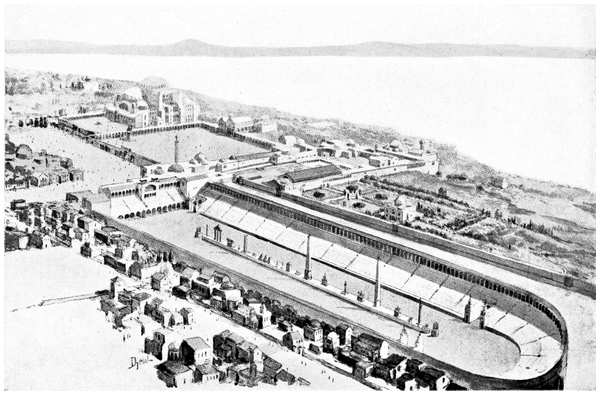
imperial lodge overlooking the Hippodrome and show
the citizens, who had gathered in the enclosure, that all
was well. The only reply he got was a shower of stones,
arrows and epithets, and, as the chroniclers remark, the
young lion became at once a timid hare, and proposed
to run for shelter to the monastery at Studion, on the
Asiatic side. His uncle prevented him, however, and
marshalled the guards in the fore part of the palace.
The battle which followed ended in a complete victory
for the people. Constantine and Michael fled across the
water to Studion, in the early morning of Wednesday
in Holy Week, and the new Empress Theodora was conducted
into the palace over the corpses of some three
thousand of the combatants.
The royal sisters, it will be understood, did not fly into
each other’s arms. Theodora had to thank Zoe for
eleven years’ confinement, and Zoe herself was very
reluctant to share her power with her younger sister.
However, a formal reconciliation was arranged by the
Senators, and the two Empresses sat side by side to
receive the homage of the leading citizens and decide
what was to be done with the late Emperor and his uncle.
If there were any who wondered in what spirit Theodora
would wield her power after a decade of religious life,
they were not left long in doubt. Zoe asked what the
will of her advisers was in regard to the fugitives, and
such cries as “Out with their eyes!” and “Crucify
them!” rang furiously through the chamber. Zoe recoiled
and pleaded for leniency, but Theodora, a much
better speaker than her sister, sternly ordered the prefect
to see that their eyes were put out. A great crowd
crossed the sea with the officers, and saw Michael, who
had hidden under the altar, and his more stoical uncle
dragged from the chapel. The same crowd had applauded
Michael in his procession hardly a week before;
now they stood by with wild delight to see the brutal
sentence carried out. It was 21st April: Michael the
Caulker had reigned for four months.
For a few weeks the imperial sisters ruled their kingdom
in complete harmony and with exemplary zeal.
M. Diehl, too lightly following the censorious Psellus,
rates the intelligence and character of both at a very low
level, but that estimate is hardly supported by the facts.
Few Emperors had dared to attack the administrative
corruption of the Empire as Zoe and Theodora attacked
it in the first freshness of their power, and as we have
every reason to believe that they would have continued
to attack it. For centuries the State had been the easy
prey of ambitious eunuchs at Court and corrupt officials
in the provinces. Zoe and Theodora issued decrees to
the effect that all injustice must cease and that the law
must be administered with equity. They themselves sat
on the highest tribunal of the city to hear cases, and the
sale of offices was strictly prohibited. The accounts of
the late chief minister were examined, and Constantine,
eyeless and shaven, was brought from his monastery
to explain the enormous deficiency. The power of his
family was broken for ever, and the miserable man
disclosed that 5300 pounds of gold (nearly a quarter of
a million sterling) was hidden in a cistern in his house.
Legates and petitions were heard with dignity by the
royal sisters, and it must have seemed to many that the
Empire had, by this singular adventure, obtained juster
and finer rulers than it had known for many a century.
We cannot discriminate in the joint public action of the
sisters, but it is clear that the strong will and intelligence
of Theodora were the chief power of the administration.
How drastically the Empire needed such a purification
may be gathered from the fact that, when the patriarch
Alexis died in the following year, a secret and dishonest
hoard of gold, amounting to more than £100,000, was
discovered in his palace.
This brilliant example of feminine rule might have
been expected to disarm the old Byzantine prejudice
against women, but prejudices of that nature are too
deeply rooted to be displaced by facts. The cry was
raised that an Emperor was needed, and Zoe once more
expressed her willingness to marry. The careful chronicler
tells us that her conduct was not necessarily inspired
by a carnal feeling—she was now sixty-two years old—but
that she may have feared that Theodora and her
ministers wished to dislodge her. Her age, no less than
the remarkable conditions of her third and last marriage,
will easily persuade us that the motive was political.
There were those who said that, as Theodora had been
the chief agent in expelling Michael, the throne belonged
to her alone, and Zoe sought an ally. The first noble
chosen by her was Constantine Delassenus, who had
almost obtained her hand and the throne fourteen years
before. But Constantine, when he was invited to the
Court for inspection, proved so brusque and independent
that he was again dismissed. Her next choice was
Constantine Catepano, a handsome officer of the palace,
with whom, in spite of her age, the gossips of the Court
already connected Zoe somewhat too intimately. Constantine,
however, had a wife living, and this lady is
said to have poisoned him as soon as she heard of the
proposal to divorce her.
If we may believe the gossipy chronicles, Zoe met the
disappointment with tranquillity, as she had another
lover among the officials of the palace. Constantine
Monomachos, a very handsome and distinguished and
dissolute noble, had been exiled from Court to Mitylene
by Michael IV. on the suspicion of intimacy with Zoe,
and had for some years gilded the hours of his distant
exile with the enjoyment of letters, the pleasures of the
table and the affection of a pretty and devoted cousin.
When his second wife had died, he had obeyed the
injunction of the Church to refrain from a third marriage
and had been content with the free companionship of
the beautiful Sclerena, a sister of the distinguished noble
Romanus Sclerus—a member, that is to say, of one of
the proudest Byzantine families. She had followed her
lover to Lesbos, used her fortune to mitigate the harshness
of his exile, and was living with him at the time
when Zoe recalled him to Court. “Handsome as
Achilles,” uniting a prodigious strength with a singular
delicacy and elegance of appearance, equally devoted to
the robust pleasures of the chase and the enervating
delights of love, Constantine Monomachos at once returned
to his place in the heart of the ageing Empress,
and was invited to wed her. He is said to have stipulated
beforehand that the fair Sclerena should be allowed to
come to Constantinople, and Zoe genially consented.
They were married, and Zoe entered upon the last and
strangest part of her strange career.
While the sexless Theodora continued to rule the
Empire and put out the eyes of her enemies, while
Constantine revelled in the new and more exquisite
luxuries of his position, Zoe seems quietly to have
enjoyed the secure and restful days which her marriage
obtained for her. She still, with her maids, compounded
and distilled the perfumes which were almost her one
luxury, but she now paid a scrupulous attention to her
devotions and burned much incense before the icons.
Sclerena at first dwelt apart, and Constantine set about
building a magnificent palace for her, thinly veiling his
liaison with the pretence of going daily to see the progress
of the works. As the citizens smiled at the connexion,
and Zoe seemed to be piously indifferent to it,
he became bolder and asked Zoe to allow him to bring
Sclerena to live in the palace. Again Zoe consented, and
the ménage à trois was maintained in the most pleasant
harmony. She gave Sclerena the title of Empress, embraced
her, when they met, with entire goodwill, and
showed her such consideration that she never visited
her husband without first ascertaining if he was disengaged.
Constantine occupied the central part of the
palace, and his wife and mistress had apartments on
each side.
Although Zoe now approached her seventieth year,
she still retained the freshness of her complexion and
had no wrinkles. Psellus says that a stranger would
have been sure that she was still a young woman. She
shared the pleasures of the gay Court, and made no
protest against the frivolous Constantine emptying the
treasury on his mistress. If we may believe implicitly
all the details given by Psellus, there was little delicacy
in the fun which enlivened the gardens or halls—for
Zoe disliked the open air—of the sacred domain. Music
and skilful dancing were too fine for his appreciation.
He liked the broader merriment of mimes, and took
especial pleasure in imitations of stammering. His chief
entertainers would go so far as to represent, pantomimically,
the chaste Theodora lying abed in child-birth,
and Theodora herself joined in the loud laughter of
Constantine as the man imitated the shrieks which
befitted such an occasion. The months passed very
merrily, and the treasury emptied.
And as the treasury emptied, and the citizens saw
their funds passing into the marvellous palace which
Constantine was building for Sclerena, clouds began to
gather over the life of the epicure. One day, in the
year 1044, as he rode with his guards at the head of a
religious procession, a cry broke from the crowd: “We
don’t want Sclerena as Empress, nor to see our lawful
mistresses, Zoe and Theodora, perish on her account.”
The cry was a spark to the spreading discontent, and the
small troop of guards were surrounded by a threatening
mob. Fortunately for the Emperor, the Empresses were
watching the procession from the balcony, and they
sent troops to rescue him. Later, a discontented noble
led some Macedonian troops against the city, and encamped
opposite the Blachernæ gate. Constantine disdainfully
ordered a chair to be placed for him outside
the gate, in order that he might see, and be seen by, the
rebels. For a time they were content to sing comic songs
about him—of which there must have been a good supply
in the city—then they made a dash and scattered his
guards, and could have penetrated into the city, possibly
taken it, if they had not foolishly retired. On such
slender threads did crowns hang in that singular Empire.
Sclerena relieved the growing discontent by a premature
death, apparently about the year 1045, and the
superb palace which had been intended for Constantine’s
mistress was turned into a monastery. Five years later
Zoe closed her long and romantic career, at the age of
seventy. Constantine mourned for her as if she had
been a beloved child, and even pressed the Church to
put her on the list of the canonized; he may have read
how St Theodora had won the aureole largely by her
freedom from jealousy. When it was found, after a
time, that some curious fungi had grown about her
monument, he insisted that they were heaven-sent
assurances that Zoe had been admitted at once into the
company of the saints. The Greek Church, however,
was not persuaded to add Zoe to its quaint list of the
blessed, and few will reflect on the many events which
reveal her personality to us without admitting that,
whether or no she was guilty of the positive crimes
attributed to her, she had little or no moral feeling.
Constantine found consolation in the charms of a
young Alan princess who was detained as a hostage at
Constantinople. The milk-white skin and fine eyes of the
unknown so fascinated him that he gave her the imperial
title and emptied the remainder of the treasury upon her
and the relatives who flocked to share her fortune. He
was by this time a miserable wreck of his former magnificent
person, and could not sit unaided on a horse,
but the Court still rang with laughter and buffoonery.
His favourite, a man who had been raised from the
position of street buffoon to that of Court jester, became
so infatuated with his wealth and privileges that he
dreamed of possessing the pretty Alan princess and the
purple. He was caught in Constantine’s bedroom with
a drawn sword. The Emperor asked why he had
attempted assassination, and, when the man said that
he had an irresistible passion to see himself in the crown
and imperial robes, burst into laughter and ordered the
attendants to put them on him. He returned to his
position, and, to the amusement of Constantine, made
more open love than before to the fair Circassian
mistress. But the Emperor died in 1054, and his mistress
returned to her previous obscurity.
When it was seen that Constantine was failing, a
number of the nobles and officials conspired to put on
the throne Nicephorus Bryennius, but Theodora’s supporters
forestalled the plot. They sent a swift vessel
for her and lodged her in the sacred palace before their
opponents could bring Bryennius from Bulgaria, which
he governed. She seems to have been forced out of
affairs during the later years of Constantine, and the
sending of a boat implies, apparently, that she had
retired to the suburbs. She was still, in her seventh
decade of life, erect of form and clear in mind, and
drastic punishment was inflicted on the conspirators.
She then began again to control the affairs of the Empire
as she had done in conjunction with Zoe. She personally
received ambassadors and heard trials, and resumed her
war on corrupt officials. Psellus is disdainful of her
rule, and unjust to her. The only grave defect we can
recognize is that she put the higher offices and commands
at the disposal of men who were less distinguished
for ability than for devotion to her. A very strong
provincial aristocracy had by this time arisen in the
Empire, and from their vast estates a number of able
nobles and officers kept a discontented eye on the hierarchy
of eunuchs at Constantinople.
Theodora, conscious of her vigour, and sustained by
the prophetical assurance of a monk that she would
wear the crown for a long time, maintained her power for
three further years, and then became seriously ill. It is
said that she chose an aged and feeble noble of the city,
Michael Stratioticus, to don the purple, but one is rather
disposed to see in the choice of Stratioticus the action of
the Court party, whose influence was threatened by the
provincial nobles. Theodora still confided in the monk’s
prophecy; she had the aged soldier brought to her sickbed
and bound him by the direst oaths to promise obedience
to herself. She died a few days later, however, on
30th August 1057, leaving the crown to the frail charge
of Michael VI. The historian must regret that Theodora
had not a larger opportunity to prove her value as a ruler
and exhibit her personality. She was a woman of great
vigour and generally high political ideals, and she incurs
the reproach only of stooping at times to the common
Byzantine level in securing her power. It was not she,
but the contemptible Constantine, who emptied the
treasury for frivolous purposes, and, in spite of the light
disdain of Psellus, her rule compares most favourably
with that of most of the Emperors.