BY
Edith Harley was called upon to play a rather difficult part.
But her patience and her obedience to the call of duty brought their own
reward.
"A letter from Rachel! Is it possible she can have relented at last?"
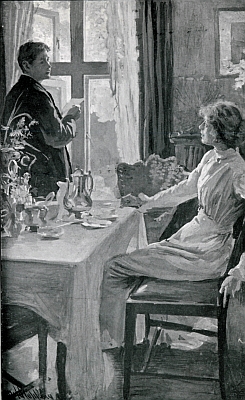
Dr. Harley looked across the breakfast-table at his wife as he spoke;
and the children, of all ages and sizes, who were busy with their bowls
of porridge, stopped the clatter of tongues and spoons to listen.
"Read it, dear," said Mrs. Harley, in her slow, gentle voice. "It must
be ten years since Rachel wrote that last dreadful letter. Surely she
must have learnt to forgive and forget by this time!"
"Send some of these children away, then. Maude and Jessie can stay; but
it is time the others were getting ready for lessons."
There was a hurried, scrambling finish of the simple breakfast; then a
little troop of boys and girls filed out of the rather shabby
dining-room, and Dr. and Mrs. Harley were alone with their elder
daughters.
"'My dear Brother,'" began the
doctor,—"'I am growing an old woman now, and in
spite of the good reasons I had for ceasing to
write, or to communicate with you in any way, I do
not feel that I can keep up the estrangement from
my own flesh and blood any longer.
"'If you like to let bygones be bygones, I, on my
side, am quite willing to do the same. I am
writing, too, because I have heard a good deal, in
one way or another, about your large and expensive
family, and the difficulty you have in making both
ends meet. It has been more than hinted to me that
I ought to render, or at least offer, you some
assistance. I have thought perhaps the best thing
would be to take one of your girls for a six
months' visit; to stay longer, or, indeed, always,
if I should, after such a trial, continue to be
pleased with her.
"'I don't want a young child, but one old enough
to be companionable. Of course I would provide for
education, and everything, so long as she stayed
with me. It would surely be a relief to have even
one of such a number taken off your hands, and it
would be the girl's own fault if the relief were
not made permanent. If this should meet your
views, write at once, and fix a date for one of
your daughters to come to me. Your affectionate
sister,
"'Rachel Harley.'"
"Oh, papa!" exclaimed Maude and Jessie in a breath, "how could we ever
leave you, and dear mamma too! We should be miserable away from home."
"From Aunt Rachel's letter, I should think she must be a dreadfully
stiff sort of person," added audacious Jessie. "Please don't say that we
shall have to go."
"Not so fast, my dear," returned her father. "Only one of you all can
go, and I do not think either you or Maude could possibly be spared. But
what does mamma say?"
"You know my wretched health, Henry," said Mrs. Harley. "I never could
do without Maude to look after the housekeeping; and Jessie saves both
school and governess for the younger ones. But then there is Edith. Why
should not Edith go?"
Edith Harley
"Why, indeed?" repeated the doctor. "Edith does nothing but mischief—at
least, so far as the account of her doings reaches my ears. She is quite
too big for Jessie to teach, and we cannot afford to send her to a good
school at present, which is the thing that ought to be done. It really
seems to me a providential opening for Edith."
"Poor Edie!" sighed the mother again. "It would be a hard life for her,
I am afraid."
"Oh, nonsense, Maria! You were always unjust to Rachel. You think,
because she took such deep offence, that there can be nothing good in
her. Surely I ought to know my own sister's character! Rachel would do
her duty by any inmate of her home—of that I am quite certain."
"Well, Henry, it would be a help in many ways. Edith is growing such a
great girl, nearly fifteen now, and if it would lighten your cares to
have her provided for, I ought not to resist. But at least it would be
well to let her know what you think of doing, and hear what she says."
"I don't know that what she says need affect the question much. The fact
is, Maria, something will have to be done. We are exceeding what we can
afford even now, and the children will be growing more expensive instead
of less so. For my own part, I can only feel glad of Rachel's offer. I
must go now; but you can tell Edith, if you like; and tell her, too, to
hold herself in readiness, for the sooner the matter is settled the
better."
Edith Harley, called indifferently by her brothers and sisters the
Middle One and the Odd One, was the third daughter and the fifth child
of this family of nine. She was a rather tall, awkward girl, who grew
out of her frocks, and tumbled her hair, and scandalised her elder
sisters, in their pretty prim young ladyhood, by playing with the boys
and clinging obstinately, in spite of her fifteen years, to her hoop and
skipping-rope. An unfortunate child was this chosen one, always getting
into scrapes, and being credited with more mischief than she ever really
did.
It was Edith who had caught the whooping-cough through playing with some
of the village children, and had brought it home, to be the plague of
all the nine for a whole winter and spring.
It was Edith who took Johnnie and Francie down to the pondside to play,
and let them both tumble in. True, she went bravely in herself and
rescued them, but that did not count for very much. They were terribly
wet, and if they had been drowned it would have been all her fault.
It was Edith who let Tom's chickens out for a run, and the cat came and
killed two of them; that was just before she forgot to shut the
paddock-gate, when the donkey got into mamma's flower-garden and spoilt
all the best plants.
So poor Edith went on from day to day, thankful if she could only lay
her head upon her pillow at night without being blamed for some fresh
escapade, yet thoroughly happy in the freedom of her country life, in
the enjoyment of long summer-day rambles, and endless games with the
little brothers, who thought her "the jolliest girl that ever was," and
followed her lead without scruple, sure that whatever mischief she might
get them into she would bravely shield them from the consequences.
A country doctor, with a not very lucrative practice, Dr. Harley had,
when Edith was about ten years old, sustained a severe pecuniary loss
which greatly reduced his income. It was then that the governess had to
be given up, and the twin boys who came next to Maude and Jessie were
sent to a cheaper school. These boys were leaving now, one to go to the
university, through the kindness of a distant relative, the other to
pass a few weeks with the London coach who would prepare him for a Civil
Service examination.
Jessie, a nice, clever girl, with a decided taste for music, could teach
the four younger ones very well—had done so, indeed, ever since Miss
Phipps left; but in this, as in everything, Edith was the family
problem. She could not, or would not, learn much from Jessie; she hated
the piano and needlework, and even professed not to care for books.
"Would it help Papa?"
Yet she astonished the entire family sometimes by knowing all sorts of
odd out-of-the-way facts; she could find an apt quotation from some
favourite poet for almost any occasion, and did a kind of queer
miscellaneous reading in "a hole-and-corner way," as her brother Tom
said, that almost drove the sister-governess to distraction.
And now the choice of a companion for Miss Rachel Harley, the stern,
middle-aged aunt, whom even the elder girls could scarcely remember to
have seen, had fallen upon Edith.
The news came to her first as a great blow. There could not be very much
sympathy between the gentle, ailing, slightly querulous mother and the
vigorous, active girl; yet Edith had very strong, if half-concealed,
home affections, and it hurt her more than she cared to show that even
her mother seemed to feel a sort of relief in the prospect of her going
away for so long.
"Don't you mind my going, mamma?" she said at last, with a little
accent of surprise.
"Well, Edith dear, papa and I think it will be such a good thing for you
and for us all. You have been too young, of course, to be told about
money matters, but perhaps I may tell you now, for I am sure you are old
enough to understand, that papa has a great many expenses, and is often
very much worried. There are so many of you," added the poor mother,
thinking with a sigh of her own powerlessness to do much towards lifting
the burden which pressed so heavily upon her husband's shoulders.
"Do you think it would help papa, then, if I went?" asked the girl
slowly.
"Indeed I do. You would have a good home for a time, at all events; and
if your Aunt Rachel should take to you, as we may hope she will if you
earnestly try to please her, she may be a friend to you always."
"Very well, then; I shall try my best to do as you and papa wish."
That was all Edith said, and Mrs. Harley was quite surprised. She had
expected tears and protests, stormy and passionate remonstrances—not
this quiet submission so unlike Edith.
Perhaps no one understood the girl less than her own mother. It might
have helped Mrs. Harley to know something of her daughter's inner nature
if she could have seen her, after their talk together, steal quietly up
to the nursery, where there were only the little ones at play, and,
throwing her arms round little Francie, burst into a fit of quiet
sobbing that fairly frightened the child.
"What is it, Edie? Don't cry, Edie! Francie'll give you a kiss, twenty
kisses, if you won't cry," said the pretty baby voice.
"Your poor Edie's going away, and it will break her heart to leave you,
my pet," said the girl through her tears, straining the child in a
passionate embrace. Presently she grew calmer, and put the wondering
little one down.
"There, Francie, I've done crying now, and you needn't mind. You'll
always love Edie, won't you, if she does go away?"
"Yes, always, always love Edie," said the child; and Johnnie chimed in
too, "And me—me always love Edie."
But there were the boys to be told after that—Alfred and Claude, the
two bright boys of ten and eight years, who had been her own especial
playmates; and loud was their outcry when they heard that Edith was
going.
"We might as well have no sisters," said the ungrateful young rascals.
"Maude and Jessie don't care for us. They only think we're in the way.
They're always telling us to wipe our feet, and not make such a noise;
and Francie's too little for anything. We'd only got Edith, and now
she's to go. It's too bad, that it is!"
But their protest availed nothing. The very same night Dr. Harley wrote
to his sister, thanking her for her kind offer, and adding that, if
convenient, he would bring his daughter Edith, fifteen years of age, to
her aunt's home at Silchester in a week's time.
There was much to do in that short week in getting Edith's wardrobe into
something like order. Each of the elder sisters sacrificed one of their
limited number of dresses to be cut down and altered for the younger
one.
The May sunshine of a rather late spring was beginning to grow warm and
genial at last, and the girl really must have a new hat and gloves and
shoes, and one or two print frocks, before she could possibly put in an
appearance at Aunt Rachel's.
Almost anything had done for running about the lanes at Winchcomb, where
every one knew the Harleys, and respected them far more for not going
beyond their means, than they would have done for any quantity of fine
apparel.
Goodbye!
But the preparations were finished at last, the goodbyes were said, and
Edith, leaving home for the first time in her life, sat gravely by her
father's side in the train that was timed to reach Silchester by six in
the evening.
She had been up very early that morning, before any of the others were
astir; and when she was dressed, went out into the garden, where she
could be alone, to think her last thoughts of the wonderful change in
her life.
She had gone on always so carelessly and happily, that the new turn of
affairs sobered and startled her. She seemed to herself to say goodbye,
not only to her home, but to the long, bright, happy childhood that had
been spent there. And her thoughts were full of the few words Mrs.
Harley had spoken about her papa's expenses and worries.
"If I had only known," she said to herself; "if I had only thought about
things, I would have tried to learn more, and be some help while I was
here. But it is no use grieving about that now; it seems to me I am come
to what our rector calls a 'turning point.' I can begin from to-day to
act in a different way, and I will. I will just think in everything how
I can help them all at home. I will try to please Aunt Rachel, and get
her to like me, and then perhaps I shall grow in time to bear the
thought of staying with her for a long, long while. Only, my poor boys
and my dear little Johnnie and Francie—I did think I should have had
you always. But it will be good for you, too, if I get on well at
Silchester."
When she had gone so far, Nancy, the housemaid, came out with broom and
bucket, and the mingled sounds of laughing and crying, and babel of many
voices that floated out through the opened windows, told Edith that the
family were rising for the last breakfast together.
It was a good thing when all the farewells were over, and for the first
few miles of the journey she was thankful to sit in silence in the
stuffy second-class carriage, and use all her strength of will to keep
back the tears that would try to come.
"Papa," she said shyly, as her father laid down his newspaper, and woke
up to the fact that the two ladies who had begun the journey with them
had got out at the last station—"papa, I want you to promise me
something, please."
"Well, Edith, what is it?"
"I want you to promise not to tell Aunt Rachel about all the things that
I have done—while I was at home, I mean."
"You have never done anything very dreadful, child," said the doctor
with a smile. "Your Aunt Rachel has not been accustomed to little girls,
it is true; but I suppose she won't expect you to be quite like an old
woman."
"I will do my very best"
"No; but if she knew about Johnnie and Francie falling into the water,
and about the chickens, and how Alfred and I let Farmer Smith's cow into
the potato-field, and the other things, she might not understand that I
am going to be different; and I shall be different—I shall indeed,
papa."
"Yes, Edith, it is time you began to be more thoughtful, and to remember
that there are things in the world, even for boys and girls, far more
important than play. If it will be any comfort to you, I will readily
promise not to mention the cow, or the chickens, or even that famous
water escapade. But I shall trust to your own good sense and knowledge
of what is right, and shall expect you to make for yourself a good
character with your aunt. You may be sure she will, from the first, be
influenced much more by your behaviour than by anything I can say."
"Yes, I know," murmured Edith. "I will do my very best."
She would have liked to say something about helping her father in his
difficulties, but the shyness that generally overcame her when she
talked to him prevented any further words on the subject; and Dr. Harley
began to draw her attention to the objects of interest they were
passing, and to remark that in another twenty minutes they would be
half-way to Silchester.
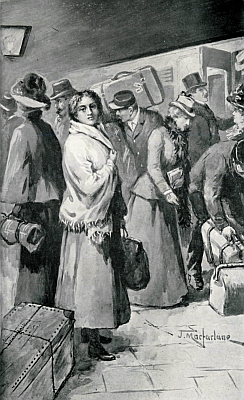
It seemed a long while to Edith before the train drew up in the large,
glass-roofed station, so different from the little platform at
Winchcomb, with the station-master's white cottage and fragrant
flower-borders. Silchester is not a very large town, but to the
country-bred girl the noise and bustle of the station, and of the first
two or three streets through which they were driven in the cab Dr.
Harley had called, seemed almost bewildering.
Very soon, however, they began to leave shops and busy pavements behind,
and to pass pretty, fancifully-built villas, with very high-sounding
names, and trim flower-gardens in front. Even these ceased after a
while, and there were first some extensive nursery grounds, and then
green open fields on each hand.
"It will be quite the country after all, papa!" exclaimed Edith,
surprised.
"Not quite, Edith. You will only be two or three miles out of
Silchester, instead of twenty miles from everywhere, as we are at
Winchcomb. Look! that is Aunt Rachel's house, just where the old Milford
Lane turns out of the road—that house at the corner, I mean."
"Where?" said Edith, half-bewildered. Her unaccustomed eyes could see
nothing but greenery and flowers at first, for Miss Harley's long, low,
two-storey cottage was entirely overgrown with dense masses of ivy and
other creeping plants. It stood well back from the road, in a grassy,
old-fashioned garden, shaded by some fine elms; and one magnificent
pear-tree, just now glorious in a robe of white blossoms, grew beside
the entrance-gate.
"Oh, papa, what a lovely old house!" cried the girl involuntarily. "Did
you know it was like this?"
Dr. Harley smiled.
"I suppose you think it lovely, Edith. I have often wondered, for my own
part, why your aunt should bury herself here. But come—jump out; there
she is at the door. The King's Majesty would not draw her to the garden
gate, I think."
Edith got out of the cab, feeling like a girl in a dream, and followed
her father up the gravel walk, noting mechanically the gorgeous
colouring of tulips and hyacinths that filled the flower-beds on either
hand.
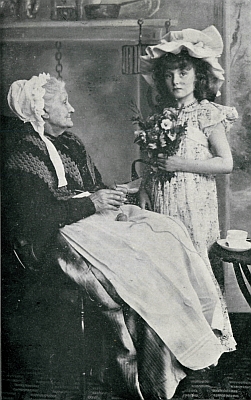
A tall, grey-haired lady, well advanced in life, came slowly forward,
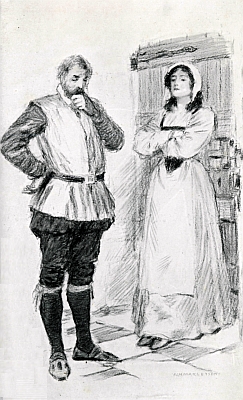
holding out a thin, cold hand, and saying in a frigid tone, "Well,
brother, so we meet again after these ten years. I hope you are well,
and have left your wife and family well also."
A Doubtful Welcome
"Quite well, thank you, Rachel, excepting Maria, who is never very well,
you know," said the doctor heartily, taking the half-proffered hand in
both his. "And how are you, after all this long time? You don't look a
day older than when we parted."
"I am sorry I cannot return the compliment," remarked the lady, with a
grim smile. "I suppose it is all the care and worry of your great family
of children that have aged you so. And Maria was always such a poor,
shiftless creature. I daresay, now, with all that your boys and girls
cost you, you have two or three servants to keep, instead of making the
girls work, and saving the wages and the endless waste that the best of
servants make."
"We have but two," said the doctor, in a slightly irritated tone of
voice. "My girls and their mother are ladies, Rachel, if they are poor.
I can't let them do the rough work. For the rest, they have their hands
pretty full, I can assure you. You have little idea, living here as you
do, how much there is to be done for a family of nine children."
"No, I am thankful to say I have not. But you had better come in, and
bring the girl with you."
With these ungracious words Aunt Rachel cast her eyes for the first time
upon Edith, who had stood a silent and uncomfortable listener while her
father and aunt were talking.
"Humph!" ejaculated Miss Harley, after looking her niece over from top
to toe with a piercing, scrutinising gaze, that seemed to take in every
detail of figure, face, and toilette, and to disapprove of all; "humph!
The child looks healthy, and that is all I can say for her. But bring
her in, Henry—Stimson and the boy can see to her box. I suppose you
will stay yourself for to-night?"
"I should not be able to go home to-night, as you know," replied Dr.
Harley. "But if my staying would be at all inconvenient, I can go to one
of the Silchester hotels."
His sister Rachel proved to be the same irritating, cross-grained woman
he had quarrelled with and parted from so long before, and he was a
little disappointed, for it is wonderful how time softens our thoughts
of one another, and how true it is that—
| "No distance breaks the tie of blood, |
| Brothers are brothers evermore." |
Although Miss Rachel ruffled and annoyed him at every second
word—"rubbed him up the wrong way," as her maid Stimson would have
said—the doctor had a real regard for her in his heart, and respected
her as a woman of sterling principle, and one whose worst faults were
all upon the surface.
"There is no need to talk about hotels," and Miss Harley drew herself
up, half-offended in her turn. "It's a pity if I can't find houseroom
for my own brother, let him stay as long as he will. Now, Edith, if that
is your name, go along with Stimson, and she will show you your room,
where you can take off your hat and things. And be sure, mind you brush
your hair, child, and tie it up, or something. Don't come down with it
hanging all wild about your shoulders like that."
Poor Edith's heart sank. She was rather proud of her luxuriant brown
tresses, which her mother had always allowed her to wear in all their
length and beauty, and she did not even know how to tie them up herself.
"This way, miss," said the prim, elderly servant. "I knew as soon as I
saw you that your hair would never do for Miss Harley. I'll fix it
neatly for you."
"Oh, thank you!" said Edith, much relieved; and in a few minutes all the
flowing locks were gathered into one stiff braid, and tied at the end
with a piece of black ribbon.
"There, now you look more like a young lady should!" cried Stimson,
surveying her handiwork with pleasure. "You'll always find me ready to
oblige you, miss, if you'll only try to please Miss Harley; and you
won't mind my saying that I hope you'll be comfortable here, and manage
to stay, for it's frightful lonely in the house sometimes, and some one
young about the place would do the mistress and me good, I'm sure."
A Great Improvement
"Oh, thank you!" said Edith again. She could not trust herself to say
more, for the words, that she felt were kindly meant, almost made her
cry.
"Now you had better go down to the parlour," Stimson went on. "Miss
Harley and your papa won't expect you to be long, and the tea is ready,
I know."
With a beating heart Edith stepped down the wide, old-fashioned
staircase, and went shyly in at the door which Stimson opened for her.
She found herself in a large, handsomely-furnished room, where the table
was laid for tea; and Miss Harley sat before the tray, already busy with
cups and saucers.
"Come here, Edith, and sit where I can see you. Yes, that is a great
improvement. Your hair looks tidy and respectable now."
After this greeting, to Edith's great relief, she was left to take her
tea in peace and silence, the doctor and his sister being occupied in
conversation about their early days, and continually mentioning the
names of persons and places of whom she knew little or nothing.
Only once the girl started to hear her aunt say, "I always told you,
Henry, that it was a great mistake. With your talents you might have
done almost anything; and here you are, a man still in middle life,
saddled and encumbered with a helpless invalid wife and half a score of
children, to take all you earn faster than you can get it. It is a mere
wasted existence, and if you had listened to me it might all have been
different."
"How cruel!" exclaimed Edith to herself indignantly. "Does Aunt Rachel
think I am a stock or a stone, to sit and hear my mother—all of
us—spoken about like that? I shall never, never be able to bear it!"
Even the doctor was roused. "Once for all, Rachel," he said in a
peremptory tone, "you must understand that I cannot allow my wife and
children to be spoken of in this manner. No doubt I have had to make
sacrifices, but my family have been a source of much happiness to me;
and Maria, who cannot help her health, poor thing! has done her best
under circumstances that would have crushed a great many women. As for
the children, of course they have their faults, but altogether they are
good children, and I often feel proud of them. You have been kind enough
to ask Edith to stay here, but if I thought you would make her life
unhappy with such speeches as you made just now, I would take her back
with me to-morrow."
"Well, well," said Miss Harley, a little frightened at the indignation
she had raised. "You need not take me up so, Henry. Of course I shall
not be so foolish as to talk to the child just as I would to you. I have
her interest and yours truly at heart; and since I don't want to quarrel
with you again, we will say no more of your wife and family. If you have
quite finished, perhaps we might take a turn in the garden."
The rest of the evening passed quietly away. Edith was glad when the
time came to go to her room, only she so dreaded the morrow, that would
have to be passed in Aunt Rachel's company, without her father's
protecting presence.
Soon after breakfast in the morning the doctor had to say goodbye. It
was a hard parting for both father and daughter. Edith had never known
how dearly she loved that busy and often-anxious father till she was
called to let him go. As for the doctor, he was scarcely less moved, and
Miss Rachel had to hurry him away at last, or he would have lost the
train it was so important he should catch.
Somehow the doctor never could be spared from Winchcomb. There was no
other medical man for miles round, and people seemed to expect Dr.
Harley to work on from year's end to year's end, without ever needing
rest or recreation himself.
A Close Examination
As soon as they were left alone, Miss Rachel called Edith into the
parlour, and bidding her sit down, began a rigorous inquiry as to her
capabilities and accomplishments—whether she had been to school, or had
had a governess; whether she was well grounded in music, and had studied
drawing and languages; what she knew of plain and fancy needlework; if
her mother had made her begin to learn cookery—"as all young women
should," added Miss Rachel, sensibly enough.
Poor Edith's answers were very far from satisfying Miss Harley.
"You say you have had no teacher but your sister since Miss Phelps, or
Phipps, or whatever her name was, left. And how old is your sister, may
I ask?"
"Jessie is eighteen," answered Edith. "And she is very clever—every one
says so, especially at music."
"Why didn't she teach you, then, and make you practise regularly? You
tell me you have had no regular practice, and cannot play more than two
or three pieces."
"It is not Jessie's fault," said Edith, colouring up. "Papa and mamma
liked us all to learn, but I am afraid, aunt, I have no natural talent
for music. I get on better with some other things."
Aunt Rachel opened a French book that lay on the table.
"Read that," she said shortly, pointing to the open page.
Edith was at home here; her pronunciation was rather original, it is
true, but she read with ease and fluency, and translated the page
afterwards without any awkward pauses.
"That is better," said her aunt, more graciously. "You shall have some
lessons. As for the music, I don't believe in making girls, who can't
tell the National Anthem from the Old Hundredth, strum on the piano
whether they like it or not. You may learn drawing instead. And then I
shall expect you to read with me—good solid authors, you know, not
poetry and romances, which are all the girls of the present day seem to
care for."
"Thank you, aunt," said Edith. "I should like to learn drawing very
much."
"Wait a while," continued Miss Harley. "Perhaps you won't thank me when
you have heard all. I shall insist upon your learning plain needlework
in all its branches, and getting a thorough insight into cookery and
housekeeping. With your mother's delicate health there ought to be at
least one of the daughters able to take her place whenever it is
needful. Your sisters don't know much about the house, I daresay."
"Maude does," answered Edith, proud of her sister's ability. "Maude can
keep house well—even papa says so."
"And Jessie?"
"Jessie says her tastes are not domestic, and she has always had enough
to do teaching us, and looking after the little ones."
"And what did you do?" demanded Aunt Rachel. "You can't play; you can't
sew. By your own confession, you don't know the least thing about
household matters. It couldn't have taken you all your time to learn a
little French and read a few books. What did you do?"
Edith blushed again.
"I—I went out, Aunt Rachel," she said at last.
"Went out, child?"
"Yes. Winchcomb is a beautiful country place, you know, and Alfred and
Claude and I were nearly always out when it was fine. We did learn
something, even in that way, about the flowers and plants and birds and
live creatures. Papa always said plenty of fresh air would make us
strong and healthy, and, indeed, we are well. As for me, I have never
been ill that I remember since I was quite a little thing."
We will Change all that!
"My patience, child! And did Maria—did your mother allow you to run
about with two boys from morning till night?"
"It is such a quiet place, aunt, no one thought it strange. We knew all
the people, and they were always glad to see us—nearly always," added
truthful Edith, with a sudden remembrance of Mr. Smith's anger when he
found his cow in the potato field, and one or two other little matters
of a like nature.
"Well, I can only say that you have been most strangely brought up. But
we will change all that. You will now find every day full of regular
employments, and when I cannot walk out with you I shall send Stimson.
You must not expect to run wild any more, but give yourself to the
improvement of your mind, and to fitting yourself for the duties of
life. Now I have letters to write, and you may leave me till I send for
you again. For this one day you will have to be idle, I suppose."
Edith escaped into the garden, thankful that the interview was over, and
that, for the time at least, she was free.
The very next day she was introduced to Monsieur Delorme, who undertook
to come from Silchester three times a week to give her lessons in
French, and to Mr. Sumner, who was to do the same on the three alternate
days, for drawing. It seemed a terrible thing to Edith at first to have
to learn from strangers; but Monsieur Delorme was a charming old
gentleman, with all the politeness of his nation; and, as Edith proved a
very apt pupil, they soon got on together beautifully.
Mr. Sumner was not so easy to please. A disappointed artist, who hated
teaching, and only gave lessons from absolute necessity, this gentleman
had but little patience with the natural inexperience of an untrained
girl.
But Edith had made up her mind to overcome all difficulties, and it was
not very long before she began to make progress with the pencil too, and
to enjoy the drawing-lesson almost as well as the pleasant hours with
Monsieur Delorme.
These were almost the only things she did enjoy, however. It was hard
work to read for two hours every morning with Miss Rachel, who made her
plod wearily through dreary histories and works of science that are
reduced to compendiums and abridgements for the favoured students of the
present day.
But even that was better than the needlework, the hemming and stitching
and darning, over which Stimson presided, and which, good and useful as
it is, is apt to become terribly irksome when it is compulsory, and a
poor girl must get through her allotted task before she can turn to any
other pursuit.
Every day, too, Edith went into the kitchen and learned pastry-making
and other mysteries from the good-natured cook, who, with Stimson, and
the boy who came daily to look after the garden and pony made up Aunt
Rachel's household.
What with these occupations, and the daily walk or drive, the girl found
her time pretty well taken up, and had little to spare for the rambles
in the garden she loved so much, and for writing letters home.
To write and to receive letters from home were her greatest pleasures,
for the separation tried her terribly.
It was difficult, too, for one who had lived a free, careless life, to
have to do everything by rule, and submit to restraint in even the
smallest matters.
In spite of her efforts to be cheerful and to keep from all complaining,
Edith grew paler and thinner, and so quiet, that Aunt Rachel was quite
pleased with what she called her niece's "becoming demeanour."
The girl was growing fast; she was undoubtedly learning much that was
useful and good, but no one knew what it cost her to go quietly on from
day to day and never send one passionate word to the distant home,
imploring her father to let her return to the beloved circle again.
A Welcome Letter
But the six months, though they had seemed such a long time to look
forward to, flew quickly by when there were so many things to be done
and learned in them. Edith began to wonder very much in the last few
weeks whether she had really been able to please her aunt or not.
It was not Miss Harley's way to praise or commend her niece at all.
Young people required setting down and keeping in their proper places,
she thought, rather than having their vanity flattered. Yet she could
not be blind to Edith's honest and earnest efforts to please and to
learn, and at the end of the six months a letter went to Winchcomb,
which made both Dr. and Mrs. Harley proud of their child.
"Edith has her faults, as all girls have," wrote Miss Rachel; "but I may
tell you that ever since she came I have been pleased with her conduct.
She makes the best use of the advantages I am able to give her, and I
think you will find her much improved both in knowledge and deportment.
You had better have her home for a week or two, to see you and her
brothers and sisters, and then she can return, and consider my house her
home always. I make no doubt that you will be glad to yield her to me
permanently, but be good enough not to tell her how much I have said in
her favour. I don't want the child's head turned."
"It is very kind of Rachel," said Mrs. Harley, after reading this letter
for the third or fourth time. "I must say I never expected Edith to get
to the end of her six months, still less that she should gain so much
approval. She was always such a wild, harem-scarem girl at home."
"She only wanted looking after, my dear, and putting in a right way,"
said the doctor, in a true masculine spirit; and Mrs. Harley answered,
with her usual gentle little sigh:
"I don't think that was quite all. Maude and Jessie, who have been
brought up at home, have done well, you must admit. But I sometimes
think there is more in Edith—more strength of character and real
patience than we ever gave her credit for. You must excuse my saying so,
but she could never have borne with your sister so long if she had not
made a very great effort."
"And now she is to go back to this tyrant of a maiden aunt," laughed the
doctor. "But by all means let her come home first, as Rachel suggests,
and then we shall see for ourselves, and hear how she likes the prospect
too."
That week or two at home seemed like a delightful dream to Edith. It is
true the fields and woods had lost all their sweet summer beauty; but
the mild late autumn, which lasted far into November that year, had a
charm of its own; and then it was so pleasant to be back again in the
dear old room which she had always shared with Jessie, to have the boys
and Francie laughing and clinging about her, and to find that they had
not forgotten her "one bit," as Johnnie said, and that to have their
dear Edith back was the most charming thing that could possibly have
happened to them.
"You must make much of your sister while she is here," said the doctor.
"It will not be long before you have to say 'Goodbye' again."
"Oh, papa, can't she stay till Christmas?" cried a chorus of voices.
"No, no, children. We must do as Aunt Rachel says, and she wants Edith
back in a fortnight at the outside."
Both father and mother, though they would not repeat Miss Harley's
words, could not help telling their daughter how pleased they were with
her.
"You have been a real help to your father, Edith," said Mrs. Harley.
"Now you have done so well with Aunt Rachel, we may feel that you are
provided for, and I am sure you will be glad to think that your little
brothers and sisters will have many things they must have gone without
if you had had to be considered too."
A Trying Time
Edith felt rewarded then for all it had cost her to please her aunt and
work quietly on at Silchester, and she went back to Ivy House with all
her good resolutions strengthened, and her love for the dear ones at
home stronger than ever.
For a while things went on without much change. The wild, country girl
was fast growing into a graceful accomplished young woman, when two
events happened which caused her a great deal of thought and anxiety.
First, Aunt Rachel, who had all her life enjoyed excellent health, fell
rather seriously ill. She had a sharp attack of bronchitis, and instead
of terminating in two or three weeks, as she confidently expected, the
disease lingered about her, and at last settled into a chronic form, and
made her quite an invalid.
Both Edith and Stimson had a hard time while Miss Harley was at the
worst. Unaccustomed to illness, she proved a very difficult patient, and
kept niece and maid continually running up and downstairs, and
ministering to her real and fancied wants.
The warm, shut-up room where she now spent so many hours tried Edith
greatly, and she longed inexpressibly sometimes for the free air of her
dear Winchcomb fields, and the open doors and windows of the old house
at home. Life at Silchester had always been trying to her; it became
much more so when she had to devote herself constantly to an exacting
invalid, who never seemed to think that young minds and eyes and hands
needed rest and recreation—something over and above continued work and
study.
Even when she was almost too ill to listen, Aunt Rachel insisted on the
hours of daily reading; she made Edith get through long tasks of
household needlework, and, to use her own expression, "kept her niece to
her duties" quite as rigidly in sickness as in health.
Then, when it seemed to Edith that she really must give up, and
petition for at least a few weeks at home, came a letter from her
father, containing some very surprising news. A distant relative had
died, and quite unexpectedly had left Dr. Harley a considerable legacy.
"I am very glad to tell you," wrote her father, "that I shall now be
relieved from all the pecuniary anxieties that have pressed upon me so
heavily for the last few years. Your mother and I would now be very glad
to have you home again, unless you feel that you are better and happier
where you are. We owe your Aunt Rachel very many thanks for all her
kindness, but we think she will agree that, now the chief reason for
your absence from home is removed, your right place is with your
brothers and sisters."
To go home! How delightful it would be! That was Edith's first thought;
but others quickly followed. What would Aunt Rachel say? Would she
really be sorry to lose her niece, or would she perhaps feel relieved of
a troublesome charge, and glad to be left alone with her faithful
Stimson, as she had been before?
"I must speak to my aunt about it at once," thought Edith. "And no doubt
papa will write to her too."
But when she went into the garden, where her aunt was venturing to court
the sunshine, she found her actually in tears.
"Your father has written me a most unfeeling letter," said the poor
lady, sitting on a seat, and before Edith could utter a word. "Because
he is better off he wants to take you away. He seems not to think in the
least of my lonely state, or that I may have grown attached to you, but
suggests that you should return home as soon as we can arrange it,
without the least regard for my feelings."
"Papa would never think you cared so much, Aunt Rachel. Would you really
rather I should stay, then?"
"Child, I could never go back to my old solitary life again. I did not
mean to tell you, and perhaps I am not wise to do so now, but I will say
it, Edith—I have grown to love you, my dear, and if you love me, you
will not think of going away and leaving me to illness and solitude.
Your father and mother have all their other children—I have nothing and
no one but you. Promise that you will stay with me?"
"I have Grown to Love you!"
"I must think about it, aunt," said Edith, much moved by her aunt's
words. "Oh, do not think me ungrateful, but it will be very hard for me
to decide; and perhaps papa will not let me decide for myself."
But when Edith, in her own room, came to consider all her aunt's claim,
it really seemed that she had no right, at least if her parents would
consent to her remaining, to abandon one who had done so much for her.
It was, indeed, as she had said, a very difficult choice; there was the
old, happy, tempting life at Winchcomb, the pleasant home where she
might now return, and live with the dear brothers and sisters without
feeling herself a burden upon her father's strained resources; and there
was the quiet monotonous daily round at Ivy House, the exacting invalid,
the uncongenial work, the lack of all young companionship, that already
seemed so hard to bear.
And yet, Edith thought, she really ought to stay. Wonderful as it
seemed, Aunt Rachel had grown to love her. How could she say to the
lonely, stricken woman, "I will go, and leave you alone"?
"Well, Edith?" said Miss Harley eagerly, when her niece came in again
after a prolonged absence.
"I will stay, Aunt Rachel, if my father will let me. I feel that I
cannot—ought not—to leave you after all that you have done for me."
So it was settled, after some demur on Dr. Harley's part, and the quiet
humdrum days went on again, and Edith found out how, as the poet says—
| "Tasks, in hours of insight willed, |
| May be in hours of gloom fulfilled." |
For Miss Harley, after that involuntary betrayal of her feelings,
relapsed into her own hard, irritable ways, and often made her niece's
life a very uncomfortable one.
Patiently and tenderly Edith nursed her aunt through the lingering
illness that went on from months to years; very rarely she found time
for a brief visit to the home where the little ones were fast growing
taller and wiser, the home which Jessie had now exchanged for one of her
own, and where careful Maude was still her mother's right hand.
Often it seemed to the girl that her lot in life had been rather harshly
determined, and she still found it a struggle to be patient and cheerful
through all.
And yet through this patient waiting there came to Edith the great joy
and blessing of her life.
Mr. Finch, the elderly medical man who had attended Miss Harley
throughout her illness, grew feeble and failing in health himself. He
engaged a partner to help him in his heavy, extensive practice, and this
young man, Edward Hallett by name, had not been many times to Ivy House
before he became keenly alive to the fact that Miss Harley's niece was
not only a pretty, but a good and very charming girl. It was strange how
soon the young doctor's visits began to make a brightness in Edith's
rather dreary days, how soon they both grew to look forward to the two
or three minutes together which they might hope to spend every alternate
morning.
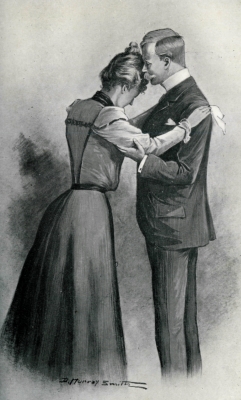
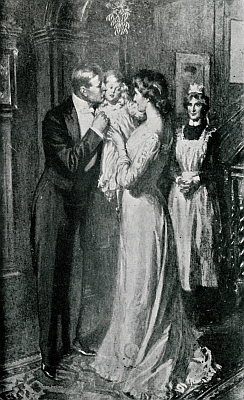 "AS HE KISSED THEIR FIRSTBORN UNDER THE MISTLETOE."
Before very long, Edith, with the full approval of her parents and her
aunt, became Edward Hallett's promised wife.
They would have to wait a long while, for the young doctor was a poor
man, and Dr. Harley could not, even now, afford to give his daughter a
marriage portion.
But, while they waited, Edith's long trial came to a sudden, unexpected
end.
Poor Miss Harley was found one morning, when Stimson, who had been
sleeping more heavily than usual, arose from the bed she occupied in
her mistress's room, lying very calmly and quietly, as though asleep,
with her hands tightly clasped over a folded paper, which she must have
taken, after her maid had left her for the night, from the box which
always stood at her bedside. The sleep proved to be that last long
slumber which knows no waking on earth, and the paper, when the dead
fingers were gently unclasped, was found to contain the poor lady's last
will and testament, dated a year previously, and duly signed and
witnessed.
Miss Harley's Will
In it she left the Ivy House and the whole of her, property to her "dear
niece, Edith Harley, who," said the grateful testatrix, "has borne with
me, a lonely and difficult old woman; has lived my narrow life for my
sake, and, as I have reason to believe, at a great sacrifice of her own
inclinations and without a thought of gain, and who richly deserves the
reward herein bequeathed to her."
There could be no happier home found than that of Edith Hallett and her
husband in the Ivy House at Silchester. Nor did they forget how that
happiness came about.
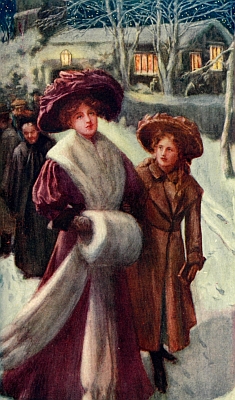
"We owe all to your patience," said Dr. Hallett to Edith, as he kissed
their firstborn under the mistletoe at the second Christmastide of their
wedded life.


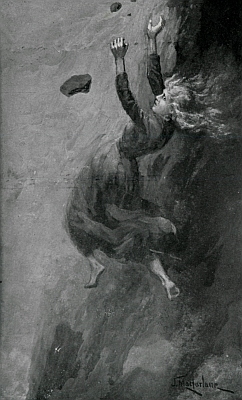
 RACE FOR LIFE. See page 72