The cover image was created by the transcriber and is placed in the public domain.
BY
T. F. TOUT, M.A., D.Litt.
PROFESSOR OF HISTORY AND DIRECTOR OF ADVANCED STUDY IN HISTORY IN THE UNIVERSITY OF MANCHESTER FELLOW OF THE BRITISH ACADEMY
PERIOD II
NINTH EDITION
RIVINGTONS
34 KING STREET, COVENT GARDEN
LONDON
1921
All rights reserved
PREFACE
iii
The absence of any existing text-book, narrating with
any approach to fulness the history of the period with
which this work is concerned, induced the writer to
think that the most useful course that he could pursue
would be to cover as much of the whole ground as
his space allowed. Finding that there was not room
to treat all the aspects of European history with
the same fulness, the author resolved to limit himself
to the central struggle between the Papacy and the
Empire, and to the events directly connected with
it. He has therefore only busied himself with the
affairs of Scandinavia, the Baltic lands, and the
Slavonic kingdoms of the East so far as they stand
in direct relation to the main currents of European
history. The history of the Mohammedan Powers
has been treated in the same way, and even Christian
Spain has only been allowed a very small number
of pages. This necessary limitation has afforded
more room for the main purpose of the writer,
which has been to narrate, with some amount of
detail, the political and ecclesiastical history of the
chief states of Southern and Western Europe, and
in particular of Germany, Italy, France, and the
Eastern Empire. The expansion of the Latin and
Catholic world at the expense of both the Orthodox
Greeks and the Mohammedans, stands so much in
ivthe forefront of the history of the period that it
could not be neglected, though the writer has
avoided treating the Crusades in much detail. Some
account of the general movements of thought and
of the development of the ecclesiastical system and
of the religious orders seemed to him necessary for
the understanding even of the political history of a
time when everything was subordinated to the authority
of the Church. He has, however, endeavoured to
bring this into some sort of connection with the
political history of the period, and has not felt it in
his power to enlarge upon the general history of
civilisation in the way adopted by the very valuable
Histoire Générale de l’Europe, edited by MM. Lavisse
and Rambaud. He has, however, frequently availed
himself of the help of that book in his selection and
arrangement of his facts, and would like to refer his
readers to it for such parts of the history as do
not fall within his scheme. He has indicated in
notes at the beginning of the various chapters some
useful authorities in which readers will find a more
detailed account of various aspects of the time.
In conclusion, the writer must express his thanks to
his wife, who has helped him materially in nearly
every part of the book, and has taken the chief share
in preparing the maps, tables, and index.
In preparing for fresh impressions such errors have
been corrected as the author has been able to find.
To the general modern authorities for French history for this
period must now be added the valuable new Histoire de France
edited by M. Ernest Lavisse (Hachette), of which the three half-volumes
covering this period are now published. They are:
Les Premiers Capétiens (987–1137), by Achille Luchaire, II. ii.;
Louis VII., Philippe Auguste, Louis VIII., by Achille Luchaire,
III. i.; and Saint Louis, Philippe le Bel, les derniers Capétiens
directs, by Ch. V. Langlois, III. ii. A large collection of facts
covering the whole subject of this book will soon be available in
the relevant volumes of the Cambridge Mediæval History. The
maps in R. L. Poole’s Oxford Historical Atlas are very valuable
for the elucidation of the historical geography of the period.
CHAPTER I INTRODUCTION
1
General Characteristics of the Period—The End of the Dark Ages—The
Triumph of Feudalism—The Revival of the Roman Empire and Papacy—The
Struggles of Papacy and Empire—The Spread of Religion and
Civilisation—The Crusades and the Latin East—The Growth of National
Monarchies.
The general characteristics of the period.
It is a trite thing to say that all long periods of European
history are ages of transition. The old order is ever
passing gradually away, and a new society is
ever springing up from amidst the ruins of the
dying system that has done its work. But the
period with which this book is concerned is
transitional in no merely conventional sense. We take up
the story in the early years of the tenth century, when the
Dark Ages had not yet run their course. We end it in the
closing years of the thirteenth century, when the choicest
flowers of mediæval civilisation were already in full bloom.
Starting at the end of a period of deep depression and
degradation, we have to note how feudalism got rid of
the barbarian invaders, and restored the military efficiency
of Europe at the expense of its order and civilisation.
We learn how the revival of the Roman Empire again
set up an effective and orderly political power, and led to
the revival of the Church and religion, and the subsequent
renewal of intellectual life. But the Empire was never
more than a half-realised theory; and while the world had
theoretically one master, it was in reality ruled by a multitude
of petty feudal chieftains. Thus was brought about
2the universal monarchy of the Papacy, the Crusades,
the monastic revivals, the strong but limited intellectual renascence
of the twelfth century, and the marvellous development
of art, letters, and material civilisation that flowed
from it. The conflict of Papacy and Empire impaired the
efficiency of both, and made possible the growth of the great
national states of the thirteenth century, from which the
ultimate salvation of Europe was to come. Turbulent as
was the period during which these great revolutions were
worked out, it was one of many-sided activity, and of
general, but by no means unbroken, progress. It was the
time of the development and perfection of all the most
essential features of that type of civilisation which is called
mediæval. It was the age of feudalism, of the Papacy and
Empire, of the Crusades, of chivalry, of scholasticism and the
early universities, of monasticism in its noblest types, of
mediæval art in its highest aspects, and of national monarchy
in its earliest form. Before our period ends, the best characteristics
of the Middle Ages had already manifested themselves.
Fertile as were the fourteenth and fifteenth centuries in their
promise of later developments, they bore witness only to the
decline of what was most characteristic of the period that we
now have to consider.
Let us dwell for a moment on some of the leading features
of this period in a little more detail.
The Dark Ages.
We begin in a time of gloom and sorrow. The Carolingian
Empire, which had united the vigour of the barbarians with
the civilisation of the Roman world, had broken
up. The sacred name of Emperor had been
assumed so constantly by weaklings that it had ceased to have
much hold upon the minds of men. The great kingdoms, into
which the Carolingian Empire had resolved itself, seemed
destined to undergo the process that had destroyed the parent
state. The East Frankish realm—the later Germany—was
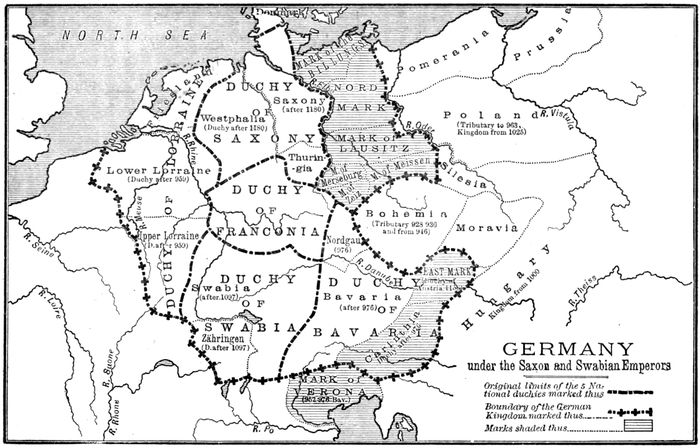
breaking up into its four national duchies of Saxony, Franconia,
Bavaria, and Swabia. The West Frankish realm was
3the prey of the rivalry of the Carolings and the Robertians.
The Middle Kingdom was in still worse plight. Italy had
fallen away under a line of nominal Italian or Lombard kings,
but the south was Greek or Saracen, and the north was in
hopeless confusion. The northern parts of the Middle Kingdom,
to which alone the name Lotharingia clung, were tending
towards their ultimate destiny of becoming a fifth national
duchy of the German realm, though their loyalty for the
Carolingian house brought them more than once back to
the West Frankish kingdom. The lands between this restricted
Lotharingia and the Mediterranean had become the
kingdom of Arles or Burgundy by the union, in 932, of
the two Burgundian states that had grown up in the days of
chaos. But of the six kingdoms which now represented the
ancient Empire, not one was effectively governed. The
administrative system of the Carolingians had altogether disappeared.
The kings were powerless, the Church was corrupt,
the people miserable and oppressed, the nobles self-seeking
and brutal. The barbarian invader had profited by the
weakness of civilisation. The restored Rome of Charlemagne,
like the old Rome of Constantine and Theodosius, was
threatened with annihilation by pagan hordes. The Norsemen
threatened the coasts of the west; the Saracens dominated
the Mediterranean, captured the islands, and established
outposts in southern Gaul and Italy. The Slavs overran
Germany. The Magyars threatened alike Germany and Italy.
Everywhere civilisation and Christianity were on the wane.
Yet the darkest hour was already past when the tenth
century had begun. The feudal system had saved Europe
from its external enemies. The feudal cavalry and the feudal
castle had proved too strong for the barbarians. The Norse
plunderers had gone home beaten, or had settled with Rolf
in Neustria, or with Guthrum in eastern England.
|The end of the Dark Ages.|
The Saracens had been driven from Italy, and
were soon to be chased out of Provence. The
Wends and the Magyars were soon to feel the might of
4Henry the Fowler. The Saxon dukes were restoring the
East Frankish realm. The Robertians were getting the
upper hand in France. Even the consolidation of the two
Burgundies made for unity. In the east the Macedonian
dynasty was ruling over the Greek Empire in uneventful
peace, and extending its sway to the farthest limits of
Asia Minor. In Spain the Christians had definitely got
the better of the Moors. The break-up of the Caliphate
robbed Islam both of its political and religious unity,
and destroyed for the time its capacity for aggression.
|Feudalism.| The
first gleams of a religious revival began with
the foundation of Cluny. But despite all these
glimpses of hope, the state of western Europe was still deplorable.
The feudal nobles were the masters of the situation.
Their benefices were rapidly becoming hereditary, their
authority more recognised and systematic. But no salvation
was to be expected from a system that was the very abnegation
of all central and national authority. It was but little more
than organised anarchy when the west had to depend upon
a polity that made every great landholder a petty tyrant over
his neighbours. The military strength of feudalism had given
it authority. Its political weakness was revealed when the
feudal baron had to govern as well as fight.
The Holy Roman Empire.
Feudalism was not long in undisputed possession of the
field. From the revival of the German kingdom by the
Saxon kings sprang the Holy Roman Empire of
the German nation, beginning with the coronation
of Otto the Great in 962. Less universal, less
ecclesiastical, less truly Roman than the Carolingian Empire,
the Empire of the Saxons and Franks was based essentially
upon the German kingship, yet was ever trying to outgrow its
limitations, and to claim in its completeness the Carolingian
heritage. Within a century of the coronation of Otto, the
revived Empire included in its sphere the German, Italian,
Burgundian, and Lotharingian realms—in short, all the Empire
of Charles the Great, save the West Frankish states, ruled since
5987 by Hugh Capet and his descendants. Moreover, the Empire
had pushed forward the limits of Christianity and civilisation
in the barbarous north and east. It had extended its direct
rule over a wide stretch of marchlands. The Scandinavians,
Wends, Poles, Bohemians, and Hungarians all received the
Christian faith from missionaries profoundly impressed with the
imperial idea, and their conversion involved at least temporary
dependence upon the power that again aspired to be lord of the
world. At home the Emperors checked and restrained, though
recognising and utilising, the feudal principle. In their fear
of the lay aristocracy, no less than in their zeal for religion
and order, they associated themselves closely with the work
of reforming the Church. But the restoration of religion
soon involved the restoration of Papacy and hierarchy, and
thus they raised up the power before which Emperors were
finally to succumb. Yet the Empire did not fall until it had
kept central Europe together for nearly three centuries, at
a time when no other power could possibly have accomplished
the task. From the coronation of the Saxon to the fall of
the Hohenstaufen, the Holy Roman Empire had no small
claim to the lordship of the world.
The Hildebrandine Reformation and the Papacy.
The darkest hour of the State was the darkest hour of the
Church. The last faint traces of the Carolingian revival of
religion disappeared amid the horrors of Danish,
Saracen, and Hungarian invasions. The feudalism
that saved Europe from the barbarians now
began to infect what remained of Christian life
with its own ferocity, greed, and lust. The spiritual offices of
the Church were becoming heritable property, dissociated
from all effective spiritual duties. But amidst the turmoil
of feudal times, a few nobler spirits sought salvation from
the wickedness that lay thick around them in the solitude
of the cloister. Before the end of the tenth century, the
Cluniac revival presented to Europe an ideal of life very
different from feudal militarism. In alliance with the Empire,
the Cluniacs restored religion in central Europe, and
6missionaries, working in their spirit, spread the Gospel beyond
the bounds of the Empire among the barbarians of the north
and east. But from Cluny also came new theories of the
province of the Church, which soon brought religion into
sharp conflict with the temporal authority. When the power
of the State lay almost in abeyance, it was natural that the
Church should encroach upon the sphere it left vacant.
From Cluny came the Hildebrandine Reformation, and
from the theories of Hildebrand sprang two centuries of
conflict between Papacy and Empire.
|The struggles of Papacy and Empire.|
The great
struggle of Popes and Emperors (the highest expression
of the universal struggle of the spiritual
and temporal swords), was the central event of
the Middle Ages. It first took the form of the Investiture
Contest, but when the Investiture Contest had been ended
by the substantial victory of the Church, the eternal strife
was soon renewed under other pretexts. It inspired the
contest of Alexander III. with Frederick Barbarossa, of
Thomas of Canterbury with Henry of Anjou, of Innocent III.
with half the princes of Europe, and the final great conflict
between the successors of Innocent and Frederick II.
At last the Empire succumbed before the superior strength of
the Papacy. But the Hohenstaufen were soon revenged;
and, within two generations of the death of Frederick II., the
victorious Papacy was degraded from its pride of place by
its ancient ally.
Religious and monastic revivals.
From the triumphs of Hildebrand and his successors
sprang the religious revivals that enriched the Middle Ages
with all that was fairest and most poetical in the
life of those times. The Cistercians and the
Carthusians revived the ideals of St. Benedict,
with special precautions against the dangers before which
the old Benedictine houses had succumbed. The orders
of Canons Regular sought to unite the life of the monk
with the work of the clerk. They paved the way for the
more complete realisation of their ideal in the thirteenth
7century, when the mendicant orders of Friars arose under
Francis and Dominic. From the monastic movement sprang
a revival of spiritual religion and a renewed interest in
the world of thought and art.
|Art.|
The artistic
impulses of the time found their highest expression
in the vast and stern Romanesque minsters of the
older orders, and in the epic literature of the chansons de
geste. The transition during the twelfth century from
Romanesque to Gothic architecture, and the parallel change
in vernacular literature from the epic to the romance, mark
a new development in the European spirit. Side by side
with them went the great intellectual renascence of the same
momentous century. While an Anselm sought to enlist philosophy
in the service of the Church, an Abelard began to
question the very sources of authority. In Abelard the intellectual
movement outgrew its monastic parentage, and in his
conflict with Bernard the dictator of Christendom,
the old and the new spirit came into the
sharpest antagonism.
|Revival of speculative activity.|
The systematic schoolmen
of later ages had neither the independence of Abelard nor the
limitation of Bernard. Learning passed from monastic to
secular hands, but the scholastic philosophy was already
enlisted on the side of the Church, and active as was its
intelligence, it henceforth worked within self-appointed limits.
Side by side with the revival of philosophy, came the work
of Irnerius and Gratian, the revival of the systematic
study of Civil Law, and the building up
of the great structure of ecclesiastical jurisprudence.
|Law.|
From
the multiplication of students and studies sprang the organisation
of teachers and learners into the universities.
|The Universities.|
From the ignorance and barbarism of the tenth
century, there is a record of continuous progress until the end
of our period. Yet the thirteenth century does not only illustrate
the crowning glories of the Middle Ages: it suggests new
modes of thought that indicate that the Middle Ages themselves
are passing away. The triumph of the Church bore
8with it the seeds of its own ruin, in the world of thought as
well as in the world of action.
The Crusades and the Latin rule in the East.
From the Hildebrandine revival sprang also the Crusades,
and the combination of the military and religious ideals of
the Latin world in the pursuit of a holy war
for the recovery of Christ’s Sepulchre. The
Turkish advance was checked; the Eastern
Empire was saved from imminent destruction;
and a series of Latin states in Syria and Greece extended
the scope of western influence at the expense of Orthodox
and Mohammedan alike. But the diversion of the Fourth
Crusade to overthrow the Empire of Constantinople indicates
the high-water mark of the Latin Christian power in the
East; and the change in the current of western ideas made
the Crusades of the thirteenth century but vain attempts to
restore a vanished dream. Before the end of our period,
the Christian domination in the East had shrunk to the
lordship of a few Greek islands. The Palæologi brought
back Byzantine rule to the Byzantine capital; and the
strongest kings of the West could not save the remnants of
the Latin states in Syria. The Mongol invasions threatened
Christian and Saracen alike. While the western prospects
were so fair, in the East barbarism was on the highway to
ascendency.
The Feudal Age.
The failure of the Empire to rule the world led to a feudal
reaction, that was not least felt in the lands directly governed
by the Emperors. Our period witnesses both the
triumph and the decay of feudalism. It is the
time when feudal ideas prevailed all over the western world,
following the Crusaders into the burning deserts of Syria,
and the lands of the Eastern Emperors. The Normans
took feudalism to southern Italy and Sicily, and developed
the feudalism that they already found in England. Even
Scandinavia evolved a feudalism of its own, and the sons
and grandsons of the followers of William the Conqueror
planted feudal states side by side with the Celtic tribalism of
9Wales and Ireland. For nearly four centuries the mail-clad
feudal horseman was invincible in battle, and the stone-built
feudal castle, ever becoming more complex and elaborate in
structure, was impregnable except to famine. The better
side of feudal social ideals—chivalry, knighthood, honour,
and courtesy—did something to temper the brutality and
pride of the average baron, and found powerful expression
in the vernacular literatures, written to amuse nobles and
gentry. But before our period ends, the days of feudal
ascendency were over. Hopeful of triumph in Germany,
where the German state suffered by its kings’ pursuit of the
imperial vision, feudalism found in Italy a powerful rival in
strong municipalities closely allied with the Church. In
western Europe it was beginning to give ground. The greater
feudatories crushed their lesser neighbours, and built up states
that were powerful enough to stand by themselves. The
Church, though fitting itself into the feudal organisation of
society, could never repose simply on brute force.
|The Towns.|
The
towns, whose separate organisation was, in some
parts of Europe at least, as much the result of
military, as of economic necessities, became the centres of
expanding trade and increasing wealth. Within their strong
walls they were able to hold their own, and claim for themselves
a part in the social system as well as baron or bishop.
But feudalism had at last met its master. With its decline
before the national spirit, we are on the threshold of modern
times.
The growth of national monarchies.
The division of the Empire into local kingdoms, begun
at the treaty of Verdun, paved the way for the modern idea
of a national state. The Empire stifled the early
possibilities of a German nation, and Empire and
Papacy combined to make impossible an Italian
nation. But in France other prospects arose. Through its
virtual exclusion from the Empire, France had been delivered
from some very real dangers. The early Capetians were
shadows round which a mighty system revolved; but they had
10a lofty theory and a noble tradition at their back, and the time
at last came when they could convert their theory into practice.
Philip Augustus made France a great state and nation.
|Power passes from Germany to France.|
Under St. Louis the leadership of Europe passed
definitely from the Germans to the French—from
the people ruled by the visionary world-Empire
to the people ruled by a popular and effective
national monarchy. The alliance between France and the
Church, the preponderance of French effort in the Crusades,
the spread of the French tongue and literature as the common
expression of European chivalry, had made the French nation
famous, long before a large proportion of the French nation
had been organised into a French state. The Spanish peoples
acquired strong local attachments; the English became
conscious of their national life. Alfonso the Wise of Castile
and Edward I. of England rank with St. Louis and Philip the
Fair. Even Frederick II. owed his strength to his national
position in Germany and Naples, rather than to his imperial
aspirations. Before our period ends, the national principle
had clearly asserted itself. Trade, art, literature, religion
began to desert cosmopolitan for national channels, and
the beginnings of the system of estates and representative
institutions show that the great organised classes of mediæval
society aspired to share with their kings the direction of the
national destinies. The Empire had fallen; the Papacy was
soon to be overthrown; feudalism was decayed; the cosmopolitan
culture of the universities had seen its best days. It
is in the juxtaposition of what was best in the old, and what
was most fertile in the new, that gives its unique charm to
the thirteenth century. The transition from the Dark Ages
to the Middle Ages had been worked out. There were
signs that the transition was beginning that culminates in the
Renascence and the Reformation.
11
CHAPTER II THE SAXON KINGS OF THE GERMANS, AND REVIVAL OF THE ROMAN EMPIRE BY OTTO I. (919–973) [1] — THE CRESCENTII.
12
The Transference of the German Kingship from the Franks to the Saxons—The
Reign of Henry the Fowler—The Defence of the Frontiers and the
Beginnings of the Marks—Otto I.’s Rule as German King—The Feudal
Opposition and its Failure—The First and Second Civil Wars—The
Reorganisation of the Duchies—The Marks established—Battle on the
Lechfeld—Otto’s Ecclesiastical Policy—His Intervention in Italy and its
Causes—Italy in the Tenth Century—Degradation of the Papacy—Theodora
and Marozia—Alberic and John XII.—Otto’s Second Intervention
in Italy—His Coronation as Emperor—His later Italian Policy—His
Imperial Position and Death.
Election of Henry the Fowler, 919.
The death of Conrad I., in December 918 (see Period I.
pp. 475–7), ended the Franconian dynasty. In April 919 the
Franconian and Saxon magnates met at Fritzlar
to elect a new king. On the proposal of Eberhard,
Duke of Franconia, and brother of the dead
king Conrad, Henry, Duke of the Saxons, called Henry the
13Fowler, was elevated to the vacant throne. Henry had been
already marked out for this dignity, both by the great position
of his house and nation, and by the wish of the last king.
Yet the voluntary abdication of the Franconian and the
transference of the monarchy to the Saxon forms one of the
great turning-points in the history of the German nation.
The existence of a separate German state had been already
secured by the work of Louis the German and Arnulf of
Carinthia. Yet so long as the sceptre remained in the Carolingian
hands, the traditions of a mighty past overpowered
the necessities of the present. Down to the death of Conrad,
the Franks were still the ruling nation, and the German realm
was East Frankish rather than German. The accession of
the Saxon gave the best chance for a more general
development on national lines.
|The Saxon nation.|
For of all the five
nations of Germany, the Saxons were the least affected by the
Carolingian tradition. Christianity was still less than a century
old with them, and formal heathenism still lingered on in the
wilder moors and marshes of the north. Roman civilisation
was still but a sickly exotic; and, free from its enervating
influences, the Saxons still retained the fierce barbaric prowess
of the old Teutonic stock, while the primitive Teutonic institutions,
which were fast disappearing in the south before
the march of feudalism, still retained a strong hold amidst
the rude inhabitants of northern Germany. In the south the
mass of the peasantry were settling down as spiritless and
peaceful farmers, leaving the fighting to be done by a limited
number of half-professional soldiers. But among the Saxons
every freeman was still a warrior, and the constant incursions
of heathen Danes and Wends gave constant opportunities
for the practice of martial habits. The old blood nobility
still took the leadership of the race. Not only were the
Saxons the strongest, the most energetic, and most martial
of the Germans, but the mighty deeds of their Ludolfing
dukes showed that their princes were worthy of them. It
was only the strong arm of a mighty warrior that could
14save Germany from the manifold evils that beset it from
within and without. The Ludolfings had already proved on
many a hard-fought field that they were the natural leaders
of the German people. The dying Conrad simply recognised
accomplished facts, when he urged that the Saxon duke should
be his successor. The exhausted Franconians merely accepted
the inevitable, when they voluntarily passed over the hegemony
of Germany to their northern neighbours.
Henry’s German policy.
There were, however, insuperable limitations to the power
of the first Saxon king of the Germans. Henry the Fowler
was little more influential as king than as duke.
There was no idea whatever of German unity or
nationality. The five nations were realities, but
beyond them the only ties that could bind German to
German were the theoretical unities of Rome—the unity of
the Empire and the unity of the Church. From the circumstances
of his election and antecedents, Henry could draw
no assistance from the great ideals of the past, by which he
was probably but little influenced. He feared rather than
courted the support of the churchmen. When the Church
offered to consecrate the choice of the magnates by crowning
and anointing the new king, Henry protested his unworthiness
to receive such sacred symbols.
Thus Germany became a federation of great duchies, the
duke of the strongest nation taking precedence over the others
with the title of king. Even this result was obtained only
through Henry’s strenuous exertions. His power rested
almost entirely on the temporary union of the Saxons and
Franconians. The southern and western nations of Germany
were almost outside the sphere of his influence. Lotharingia
fell away altogether, still cleaving to the Carolings, and recognising
the West Frankish king, Charles the Simple, rather
than the Saxon intruder. Henry was conscious of the weakness
of his position, and discreetly accepted the withdrawal
of Lotharingia from his obedience, receiving in return an
acknowledgment of his own royal position from Charles the
15Simple. Swabia and Bavaria were almost as hard to deal
with as Lotharingia. They had taken no practical share in
Henry’s election, and were by no means disposed to acknowledge
the nominee of the Saxons and Franconians. It was
not until 921 that Henry obtained the formal recognition of
the Bavarians, and this step was only procured by his
renouncing in favour of Duke Arnulf every regalian right,
including the much-cherished power of nominating the
bishops. Henry was no more a real king of all the Germans
than Egbert or Alfred were real kings over all England. His
mission was to convert a nominal overlordship into an actual
sovereignty. But he saw that he could only obtain the formal
recognition necessary for this process by accepting accomplished
facts, and giving full autonomy to the nations. His
ideal seems, in fact, to have been that of the great West
Saxon lords of Britain. He strove to do for Germany what
Edward the Elder and Athelstan were doing for England.
It is, from this point of view, of some political significance
that Henry married his eldest son Otto, afterwards the famous
Emperor, to Edith, daughter of Edward, and sister of Athelstan.
Yet, like England, Germany could hope for national
unity only when foreign invasion had been successfully warded
off. The first condition of internal unity was the cessation
of the desolating barbarian invasions which, since the break-up
of the Carolingian Empire, had threatened to blot out
all remnants of civilisation. Saxony had already suffered
terribly from the Danes and Wends. To these was added
in 924 a great invasion of the Magyars or Hungarians, the
Mongolian stock newly settled in the Danube plains, and
still heathen and incredibly fierce and barbarous. The
Magyars now found that the Bavarians had learnt how to
resist them successfully, so that they turned their
arms northwards, hoping to find an easier foe in
the Saxons.
|Invasion of barbarians checked.|
Henry, with his Franks and Saxons,
had to bear the full brunt of the invasion, and no help
came either from Swabia or Bavaria. Henry had the good
16luck to take prisoner one of the Hungarian leaders, and by
restoring his captive and promising a considerable tribute, he
was able to procure a nine years’ truce for Saxony. Two
years later the Magyars again swarmed up the Danube into
Bavaria, but Henry made no effort to assist the nation which
had refused to aid him in his necessity.
Thus freed from the Magyars, Henry turned his arms against
the Danes and the Wends. In 934 he established a strong
mark against the Danes, and forced the mighty Danish king,
Gorm the Old, to pay him tribute. He was even more successful
against the Slavs. In 928 Brennabor (the modern Brandenburg),
the chief stronghold of the Havellers, fell
into his hands, and with it the broad lands
between the Havel and the Spree, the nucleus of
the later East Mark. |The defence of the frontiers and the beginnings of the Marks.|
But more important than
Henry’s victories were his plans for the defence
of the frontiers. He planted German colonists in the lands
won from the barbarian. He built a series of new towns,
that were to serve as central strongholds, in the marchland
districts. The Saxon monk Widukind tells us how Henry
ordered that, of every nine of his soldier-farmers, one
should live within the walls of the new town, and there
build houses in which his eight comrades might take shelter
in times of invasion, and in which a third part of all their
crops was to be preserved for their support, should necessity
compel them to take refuge within the walls. In return,
the dwellers in the country were to till the fields and harvest
the crops of their brother in the town. Moreover, Henry
ordered that all markets, meetings, and feasts should be held
within the walled towns, so as to make them, as far as possible,
the centres of the local life. Some of the most ancient
towns of eastern Saxony, including Quedlinburg, Meissen, and
Merseburg, owe their origin to this policy. Henry also
improved the quality of the Saxon cavalry levies, teaching his
rude warriors to rely on combined evolutions rather than
the prowess of the individual horseman. So anxious was
17he to utilise all the available forces against the enemy, that
he settled a legion of able-bodied robbers at Merseburg,
giving them pardon and means of subsistence, on the condition
of their waging war against the Wends.
The effect of these wise measures was soon felt. Henry
had laid the foundation of the great ring of marks, whose
organisation was completed by his son. He had also inspired
his subjects with a new courage to resist the barbarian,
and a new faith in their king. When the nine
years’ truce with the Hungarians was over, the Saxons resolved
to fight rather than continue to pay them a humiliating tribute.
|Henry’s triumph and death, 936.|
A long series of victories crowned the
end of Henry’s martial career. He was no longer
forced to strictly limit himself to the defence of
his own duchy of Saxony, and the southern nations of Germany
could honour and obey the defender of the German race
from the heathen foe, though they paid but scanty reverence
to the duke of the Saxons. Lotharingia reverted to her
allegiance after the sceptre of the western kingdom had
passed, on the death of Charles the Simple, from her
beloved Carolings. Yet Henry never sought to depart from
his earlier policy, and still gave the fullest autonomy to
Saxon, Bavarian, and Lotharingian. He still lived simply
after the old Saxon way, wandering from palace to palace
among his domain-lands on the slopes of the Harz, and
seldom troubling the rest of the country with his presence.
Yet visions of a coming glory flitted before the mind of the
old sovereign. He dreamed of a journey to Rome to wrest
the imperial crown from the nerveless hands of the pretenders,
whose faction fights were reducing Italy to anarchy.
But his end was approaching, and the more immediate
task of providing for the succession occupied his thoughts.
His eldest son, Thankmar, was the offspring of a marriage
unsanctioned by the Church, and was, therefore, passed
over as illegitimate. By his pious wife Matilda, the pattern
of German housewives, he had several children. Of these
18Otto was the eldest, but the next son, Henry, as the first
born after his father had become a king, was looked upon
by many as possessing an equally strong title to election.
The king, however, urged on his nobles to choose Otto as
his successor. He died soon after, on 2nd July 936, and was
buried in his own town of Quedlinburg, where the pious care
of his widow and son erected over his remains a great church
and abbey for nuns, which became one of the most famous
monastic foundations of northern Germany. ‘He was,’ says
the historian of his house, ‘the greatest of the kings of Europe,
and inferior to none of them in power of mind and body.’
But Henry’s best claim to fame is that he laid the solid
foundations on which his son built the strongest of early
mediæval states.
Coronation of Otto I., 936.
Otto I. was a little over twenty years of age when he
ascended the throne. While his father had shunned the
consecration of the Church, his first care was
to procure a pompous coronation at Aachen. As
strong a statesman and as bold a warrior as his father,
the new king was so fully penetrated with the sense of
his divine mission, and so filled with high ideals of kingcraft,
that it was impossible for him to endure the limitations
to his sway, in which Henry had quietly acquiesced.
Duke Eberhard of Franconia was the first to resent the
pretensions of the young king. He felt that he was the
author of the sway of the Saxon house, and resolved to
exercise over his nation the same authority that he had
wielded without question in the days of King Henry. Meanwhile,
the death of Duke Arnulf of Bavaria gave Otto an opportunity of manifesting his power to the south. |The attack on the dukedoms, and the First Civil War, 938–941.|
He roughly deposed Arnulf’s eldest son, Eberhard, who had refused to perform him homage, and made his younger brother Berthold duke, but only on condition that the right of nominating to the Bavarian bishoprics, which had been wrung from the weakness of Henry, should now be restored to the crown. Moreover,19 he set up another brother, Arnulf, as Count Palatine, to
act as a sort of overseer over the new duke. But while
Franconia and Bavaria were thus deeply offended, Otto’s
own Saxons were filled with discontent at his policy. They
resented Otto’s desire to reign as king over all Germany, as
likely to impair the dominant claims of the ruling Saxon
race. They complained that he had favoured the Franks
more than the Saxons, and the sluggish nobles of the
interior parts of Saxony were disgusted that Otto had overlooked
their claims on his attention in favour of Hermann
Billung and Gero, to whom he had intrusted the care of
his old duchy along with the government of the Wendish
marches. Thankmar, the bastard elder brother, Henry,
the younger brother who boasted that he was the son of a
reigning king, were both angry at being passed over, and put
themselves at the head of the Saxon malcontents. In 938, a
revolt broke out in the north. The faithfulness of Hermann
Billung limited its extent, and the death of Thankmar seemed
likely to put an end to the trouble. But Henry now allied
himself with Duke Eberhard of Franconia; and Duke
Giselbert of Lotharingia, Otto’s brother-in-law, joined the
combination. A bloody civil war was now fought in Westphalia
and the Lower Rhineland. The army of Otto was taken
at a disadvantage at Birthen, near Xanten; but the pious
king threw himself on his knees, and begged God to protect
his followers, and a victory little short of miraculous followed
his prayer. However, the rebels soon won back a strong
position, and the bishops, headed by Archbishop Frederick of
Mainz, intrigued with them in the belief that Otto’s term
of power was at an end. But the king won a second unexpected
triumph at Andernach, and the Dukes of Franconia
and Lotharingia perished in the pursuit. Henry fled to
Louis, king of the West Franks, whose only concern, however,
was to win back Lotharingia from the eastern kingdom.
At last Henry returned and made his submission to
his brother; but before long he joined with the Archbishop
20of Mainz in a plot to murder the king. This nefarious
design was equally unsuccessful, and Henry, under the
influence of his pious mother, sought for the forgiveness of
his injured brother. At the Christmas feast of 941 a reconciliation
was effected. The troubles for the season were
over.
The reorganisation of the duchies.
Otto now sought to establish his power over the nations
by setting up members of his own family in the vacant
duchies. Franconia he kept henceforth in his
own hands, wearing the Frankish dress and
ostentatiously following the Frankish fashions.
Over Lotharingia he finally set a great Frankish noble,
Conrad the Red, whom he married to his own daughter,
Liutgarde. The reconciled Henry was made Duke of
Bavaria, and married to Judith, the daughter of the old
Duke Arnulf. Swabia was intrusted to Otto’s eldest son,
Ludolf, who in the same way was secured a local position
by a match with the daughter of the last duke. But the
new dukes had not the power of their predecessors. Otto
carefully retained the highest prerogatives in his own hands,
and, by the systematic appointment of Counts Palatine to
watch over the interests of the crown, revived under another
name that central control of the local administration which
had, at an earlier period, been secured by the Carolingian
missi dominici.
Its failure. The Second Civil War, 953.
The new dukes soon fell into the ways of their predecessors.
They rapidly identified themselves with the local
traditions of their respective nations, and quickly
forgot the ties of blood and duty that bound
them to King Otto. Henry of Bavaria and
Ludolf of Swabia soon took up diametrically
different Italian policies, and their intervention on different
sides in the struggle between the phantom Emperors, that
claimed to rule south of the Alps, practically forced upon
Otto a policy of active interference in Italy. Ludolf was
intensely disgusted that his father backed up the Italian
21policy of Henry, and began to intrigue with Frederick of
Mainz, Otto’s old enemy. Conrad of Lotharingia joined the
combination. Even in Saxony, the enemies of Hermann
Billung welcomed the attack on Otto. At last in 953 a
new civil war broke out which, like the troubles of 938, was
in essence an attempt of the ‘nations’ to resist the growing
preponderance of the central power. But the rebels were
divided among each other, and partisans of local separatism
found it doubly hard to bring about an effective combination.
The restless and turbulent Frederick of Mainz died during
the struggle. Conrad and Ludolf made their submission.
A terrible Hungarian inroad forced even the most reluctant
to make common cause with Otto against the barbarians.
But the falling away of the dukes of the royal house had
taught Otto that some further means were necessary, if he
desired to continue his policy of restraining the ‘nations’ in
the interest of monarchy and nation as a whole. That fresh
support Otto found in the Church, the only living unity outside
and beyond the local unities of the five nations.
The organisation of the Marks.
Even King Henry had found it necessary, before the end
of his reign, to rely upon ecclesiastical support, especially in
his efforts to civilise the marks. There the fortified
churches and monasteries became, like the new
walled towns, centres of defence, besides being
the only homes of civilisation and culture in those wild
regions. But King Henry had not removed the danger of
Wendish invasion, and the civil wars of Otto’s early years
gave a new opportunity for the heathen to ravage the German
frontiers. In the midst of Otto’s worst distress, Hermann
Billung kept the Wends at bay, and taught the Abotrites and
Wagrians, of the lands between the lower Elbe and the Baltic,
to feel the might of the German arms. His efforts were ably
seconded by the doughty margrave, Gero, of the southern
Wendish mark. By their strenuous exertions the Slavs were
for the time driven away from German territory, and German
rule was extended as far as the Oder, so that a whole ring
22of organised marchlands protected the northern and eastern
frontiers. These marks became vigorous military states, possessing
more energy and martial prowess than the purely
Teutonic lands west of the Elbe, and destined on that
account to play a part of extreme prominence in the future
history of Germany. Owing their existence to the goodwill
and protection of the king, and having at their command
a large force of experienced warriors, the new margraves
or counts of the marches, who ruled these regions, gradually
became almost as powerful as the old dukes, and, for the
time at least, their influence was thrown on the side of the
king and kingdom. Under their guidance, the Slav peasantry
were gradually Christianised, Germanised, and civilised,
though it took many centuries to complete the process. Even
to this day the place-names in marks like Brandenburg and
Meissen show their Slavonic origin, and a Wendish-speaking
district still remains in the midst of the wholly Germanised
mark of Lausitz. To these regions Otto applied King
Henry’s former methods on a larger scale. Walled towns
became centres of trade, and refuges in times of invasion.
Monasteries arose, such as Quedlinburg, and that of St.
Maurice, Otto’s favourite saint, at Magdeburg. A whole
series of new bishoprics—Brandenburg and Havelberg, in the
Wendish mark; Aarhus, Ripen, and Schleswig, in the Danish
mark—became the starting-points of the great missionary
enterprise that in time won over the whole frontier districts
to Christianity. Hamburg became the centre of the first
missions to Scandinavia. Never since the days of Charles the
Great had the north seen so great an extension of religion
and culture. There was many a reaction towards heathenism
and barbarism before the twelfth century finally witnessed the
completion of this side of Otto’s work.
The Hungarians were still untamed, and, profiting by
the civil war of 953, they now poured in overwhelming
numbers into south Germany. But the common danger was
met by common action. On 10th August 955, Otto won
23a decisive victory on the Lechfeld, near Augsburg, at the
head of an army drawn equally from all parts of Germany,
and including among its leaders Conrad the Red,
the former Duke of Lorraine, who died in the
fight.
|The battle on the Lechfeld, 955.|
This crushing defeat damped the waning
energies of the Magyars, and the carrying out of the same
policy against them that had been so successful against their
northern neighbours resulted in the setting up of an east
mark (the later Austria), which carried German civilisation
far down the Danube, and effectually bridled the Magyars.
In these regions Henry of Bavaria did the work that Hermann
Billung and Gero were doing in the north. The final defeat
of the barbarian marauders, and the wide extension of German
territory through the marks, are among Otto’s greatest titles
to fame. Moreover, Otto forced the rulers of more distant
lands to acknowledge his sovereignty. In 950 he invaded
Bohemia, and forced its duke, Boleslav, to do him homage.
Nor did he neglect the affairs of the more settled regions
of the west. Already in 946 he had marched through north
France as far as the frontiers of Normandy, striking vigorous
blows in favour of the Carolingian Louis IV.—who had
married his sister Gerberga, Duke Giselbert’s widow—against
his other son-in-law, Hugh the Great, the head of the
rival Robertian house [see page 69]. He also took under his
protection Conrad the Pacific, the young king of the Arelate.
24
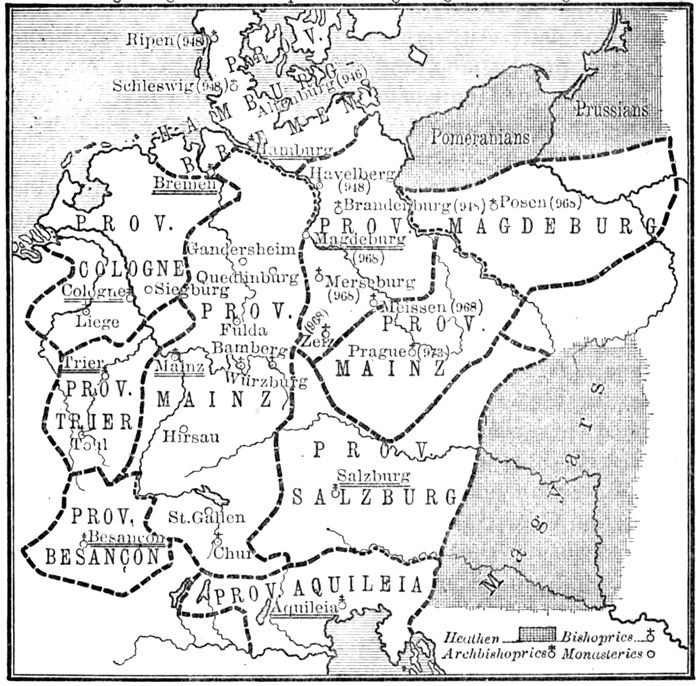
ECCLESIASTICAL DIVISIONS of GERMANY showing the growth of the provinces Magdeburg and Hamburg-Bremen.
In civilising the marks Otto had striven hard to use
the Church to secure the extension of the royal power.
|Otto’s ecclesiastical policy.|
But the lay nobles were not slow to see that Otto’s
trust in bishops and abbots meant a lessening
of their influence, and resented any material
extension of ecclesiastical power. The Saxon
chieftains—half-heathens themselves at heart—did their
very best to prevent the Christianisation of the Wends,
knowing that it would infallibly result in a close alliance
between the crown and the new Christians against their
old oppressors. Even the churchmen of central Germany
watched Otto’s policy with a suspicious eye. Typical of
this class is Archbishop Frederick of Mainz, the centre of
every conspiracy, and the would-be assassin of his sovereign.
If his policy had prevailed, the Church would have
become a disruptive force of still greater potency than
the dukedoms. But a new school of churchmen was
growing up willing to co-operate with Otto. His youngest
brother, Bruno, presided over his chancery, and made
the royal palace as in Carolingian times the centre of the
intellectual life of Germany. Bruno ‘restored’ as we are
25told, ‘the long-ruined fabric of the seven liberal arts,’ and,
like our Alfred, was at the same time the scholar and the
statesman. From his efforts sprang that beginning of the
general improvement of the German clergy that made possible
the imperial reformation of the Papacy. Moreover, Bruno
carried out a reform of discipline and of monastic life that soon
made Germany a field ripe to receive the doctrines that were
now beginning to radiate from Cluny to the remotest parts of the
Christian world. Side by side with the religious revival came
the intellectual revival that Bruno had fostered. Widukind of
Corvey wrote the annals of the Saxons; the abbess Hrotswitha
of Gandersheim sang Otto’s praises in Latin verse, and wrote
Latin comedies, in which she strove to adopt the methods of
Terence to subjects chosen in order to enhance the glories
of religious virginity. The literary spirit touched Otto himself
so far that he learnt to read Latin, though he never succeeded
in talking it. Under Bruno’s care grew up a race of clerical
statesmen, far better fitted to act as Otto’s ministers than the
lay aristocracy with its insatiable greed, ruthless cruelty, and
insufferable arrogance. It now became Otto’s policy, since
he had failed to wrest the national duchies to subserve his
policy, to fill up the great sees with ministerial ecclesiastics
of the new school. The highest posts were reserved to
his own family. His faithful brother, Bruno, became Archbishop
of Cologne, and was furthermore intrusted with the
administration of Lotharingia. Otto’s bastard son, William,
succeeded the perfidious Frederick as Archbishop of Mainz.
Otto now stood forth as the protector of the clergy against the
lay nobles, who, out of pure greed, were in many cases aiming
at a piecemeal secularisation of ecclesiastical property. The
incapacity of a spiritual lord to take part in trials affecting life
and limbs had already led to each bishop and abbot, who
possessed feudal jurisdiction, being represented by a lay
‘Vogt’ (advocatus) in those matters with which he was himself
incompetent to deal. The lay nobles sought to make their
‘advocacy’ the pretext of a gradual extension of their power
26until the bishop or abbot became their mere dependant. But
this course was not to the interest of the crown. If the
domains of the crown were to be administered by the local
magnates or to be alienated outright, if the jurisdiction of the
crown was to be cut into by grants of immunities to feudal
chieftains, it was much better that these should be put into
spiritual rather than into secular hands. Otto therefore posed
as the protector and patron of the Church. Vast grants of
lands and immunities were made to the bishops and abbots,
and the appointment to these high posts, or at least the investiture
of the prelates with the symbols of their office,
was carefully kept for the king. The clergy, who in the
days of Henry had feared lest the king should lay hands on
their estates, joyfully welcomed Otto’s change of front. It
was not clear to them as it was to Otto, that the royal favour
to the Church was conditional on the Church acting as the
chief servant of the State. Otto would brook no assertion of
ecclesiastical independence, such as had of old so often set
bounds to the empire of the Carolings. He desired to attach
the Church to the State by chains of steel; but he carefully
gilded the chains, and the German clergy, who were neither
strong theologians nor sticklers for ecclesiastical propriety,
entered as a body into that dependence on the throne which
was to last for the best part of a century, and which was in
fact the indispensable condition of the power of the Saxon
kings in Germany. The unity of the Church became as in
England the pattern of the unity of the State, and in a land
which had no sense of civil unity, Saxon and Frank, Lorrainer
and Bavarian were made to feel that they had common ties
as citizens of the Christian commonwealth.
Resistance of William of Mainz.
The first efforts of Otto towards the conciliation and subjection
of the clergy were surprisingly successful. He next
formed a scheme of withdrawing eastern Saxony
and the Wendish march from obedience to the
Archbishop of Mainz, and setting up a new Archbishop
of Magdeburg as metropolitan of these regions. It
27was a well-designed device to give further unity to those
warlike and loyal regions upon which Otto’s power was
ultimately based. But his own son, Archbishop William,
violently opposed a scheme which deprived the see of Mainz
of the obedience of many of its suffragans. William’s representations
to Rome induced the Pope to take no steps to
carry out Otto’s plan. The king was deeply incensed, but
the check taught him a lesson. He learnt that after all, the
German Church was not self-contained or self-sufficing. Over
the German Church ruled the Roman Pope. He could only
ensure the obedience of the German Church by securing the
submission or the co-operation of the head of the Christian
world. So long as the Pope was outside his power, Otto’s
dream of dominating Germany through churchmen seemed
likely to end in a rude awakening. To complete this aspect
of his policy required vigorous intervention in Italy.
The condition of Italy had long been one of deplorable
anarchy. After the death of the Emperor Berengar in 924
had put an end to the best chance of setting up a national
Italian kingdom, things went from bad to worse. The
Saracens, having plundered its coasts, settled down in its
southern regions side by side with the scanty remnants of the
Byzantine power. Thus all southern Italy was withdrawn
altogether from the sphere of western influence. But in
the centre and north things were far worse. The inroads of
the barbarians were but recently over, and had left their
mark behind in poverty, famine, pestilence and disorder.
Great monasteries like Subiaco and Farfa were in ruins.
The Hungarians had penetrated to the heart of central Italy.
The Saracens from their stronghold of Freinet, amidst the
‘mountains of the Moors’ of the western Riviera, had
devastated Provence, and had held possession of the passes
of the Alps.
|State of Italy, 924–950.|
If the growth of feudalism, with
its permanent military system and its strong
castles, had already repelled the barbarians, the
price paid for deliverance was the cutting up of sovereignty
28among a multitude of petty territorial lords. The rising tide
of feudal anarchy had almost overwhelmed the city civilisation
which had been, since Roman times, the special feature of
Italian life. A swarm of greedy feudal counts and marquises
struggled against each other for power, and a series of phantom
Emperors reduced to an absurdity the once all-powerful name
of Cæsar. There was still a nominal Italian or Lombard
king, who claimed the suzerainty over all northern and central
Italy. But in their zeal for local freedom, the Italians had encouraged
quarrels for the supreme power. ‘The Italians,’ said
Liutprand of Cremona, ‘always wish to have two masters, in
order to keep the one in check by the other.’ After the death
of the Emperor Berengar, in 924 [see Period I. pp. 463–7],
Rudolf of Burgundy reigned for nearly three years. On his
fall in 926, Hugh of Provence was chosen his successor, and
held the name at least of king till his death in 946. There
then arose two claimants to the Italian crown—Lothair, son
of Hugh of Provence, and Berengar, Marquis of Ivrea, the
grandson of the Emperor Berengar. Neither was strong
enough to defeat the other, and both looked for help from
the warlike Germans. It is however significant that they
sought support, not from the distant Saxon king, but
from the neighbouring dukes of Swabia and Bavaria, whose
dominions extended to the crest of the Alps. Lothair begged
the help of Ludolf of Swabia, while Berengar called in Henry
of Bavaria. The latter gave the most efficient assistance, and
Lothair in despair was negotiating for help from Constantinople
when he was cut off by death (950), leaving his young and
beautiful widow, Adelaide of Burgundy, to make what resistance
she might to Berengar of Ivrea. But there was no
chance of a woman holding her own in these stormy times,
and Adelaide was soon a prisoner in the hands of the victorious
marquis. She naturally looked over the Alps to her German
friends and kinsfolk, and both Ludolf and Henry, already on
the verge of war on account of their former differences as to
Italian policies, were equally willing to come to her assistance.
29Henry now raised pretensions to the great city of Aquileia and
the north-eastern corner of the Italian peninsula. He now
aspired, as the protector of Adelaide, his former foe, to unite
the Bavarian duchy with the Italian kingdom. Ludolf, more
active than his uncle, appeared in the valley of the Po intent
on a similar mission. Otto, ever on the watch to prevent the
extension of the ducal powers, saw with dismay the prospect
of his brother’s or son’s aggrandisement. He resolved by
prompt personal intervention to secure the prize for himself.
Otto, King of Italy, 951.
In 951, Otto successfully carried out his first expedition to
Italy. He met with no serious resistance, and on 23rd September
entered in triumph into Pavia, the old capital of
the Lombard kings. Adelaide was released from
her captivity, and appeared in Pavia. Otto, who
was now a widower, forthwith married her, assumed the
crown of Italy, and fruitlessly negotiated with the Pope
to bring about his coronation as Emperor. But Otto soon
crossed the Alps, leaving Conrad of Lorraine to carry on
war against Berengar. Next year, however, a peace was
patched up. Berengar was recognised as vassal king of Italy,
with Otto as his overlord, and the lands between the Adige
and Istria—the mark of Verona and Aquileia—were confirmed
to Duke Henry, who thus drew substantial advantage from
his brother’s intervention. The revolt of Ludolf and Conrad
in 953 was largely due to their disgust at Otto’s vigorous and
successful defeat of their schemes.
Position of the Papacy, 914–960.
Nine years elapsed before Otto again appeared in Italy.
Though he needed the help of the Papacy more than ever,
its condition was not one that could inspire much
hope. It was the period of the worst degradation
into which the Roman See ever fell. For more
than a generation the Popes had almost ceased to exercise
any spiritual influence. The elections to the Papacy had
been controlled by a ring of greedy and corrupt Roman
nobles, conspicuous among whom was the fair but dissolute
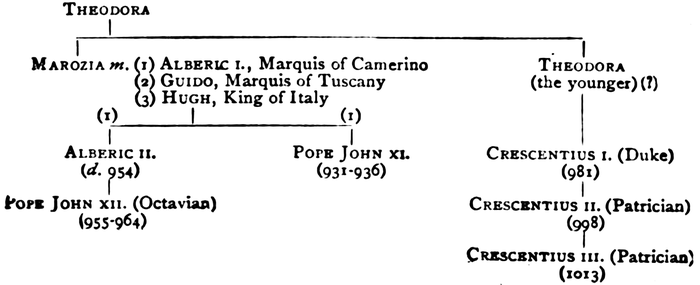
Theodora and her daughters Marozia, wife of the Marquis
30Alberic I. of Camerino, and the less important Theodora the
younger. Imperialist partisans like Liutprand of Cremona
have drawn the character of these ladies in the darkest and
most lurid colours; but, allowing for monastic exaggeration,
it is hard to see how the main outlines of the picture can be
untrue. With all their vices, they did not lack energy. Pope
John X. (914–928), an old lover and partisan of Theodora,
was not destitute of statecraft, and did much to incite the
Italians to drive away the Saracens of the south; but,
quarrelling with Marozia, he had to succumb to her second
husband, Guido, Marquis of Tuscany. After John’s death
in prison in 928, Marozia became mistress of Rome, and
made and unmade Popes at her pleasure. She married as
her third husband, Hugh of Provence, the nominal king of
the Italians, and procured the election of her second son, a
youth of twenty, to the Papacy, under the name of John XI.
About 932 her elder son, Alberic II., a strong, unscrupulous
but efficient tyrant, whose character found many parallels in
later Italian history, drove his father-in-law out of Rome,
and reduced the city to some sort of order under his
own rule. His policy seems to have been to turn the patrimony
of St. Peter into an aristocratic republic, controlled by
his house, and leaving to the Pope no functions that were not
purely spiritual. He took the title of ‘Prince and Senator
of all the Romans.’ He kept his brother, Pope John XI.
(931–936), and the subsequent Popes, in strict leading
strings, and retained his power until his death in 954. His
dreams of hereditary power seemed established when his
young son Octavian succeeded him as a ruler of Rome,
and in 955 also ascended the papal throne as John XII.|John XII., 955–964.|
But the new Pope, who thus united the ecclesiastical
with the temporal lordship of Rome,
looked upon things purely with the eye of a skilful but
unscrupulous statesman. His great ambition was to make
his house supreme throughout middle Italy, and he soon
found that King Berengar whose claims grew greater now
31that Otto was back beyond the Alps, was the chief obstacle
in the way of carrying out his designs. He therefore appealed
to Otto for aid against Berengar. In 957 Ludolf of Swabia
was sent by his father to wage war against Berengar, but,
after capturing Pavia, Ludolf was carried off by fever, and
Berengar then resumed his successes. In 960 John sent an
urgent appeal to Otto to come to his assistance.
Otto had, as we have seen, long felt the need of the
support of the Papacy in carrying out his schemes over the
German Church. The wished-for opportunity of effecting a
close alliance with the head of the Church was now offered by
the Pope himself, and the monastic reformers, disciples of
Bruno, or of the new congregation of Cluny, urged him to
restore peace and order to the distracted Italian Church.
|Otto crowned Emperor, 962.|
In 961 Otto procured the election and coronation
of Otto, his young son by Adelaide, as king of the
Germans. In August he marched over the Brenner at the
head of a stately host. On 31st January 962 he entered
Rome. On 2nd February he was crowned Emperor by
John XII.
Consequences of the revival of the Roman Empire.
The coronation of Otto had hardly among contemporaries
the extreme importance which has been ascribed to it by later
writers. Since the fall of the Carolingians there
had been so many nominal emperors that the title
in itself could not much affect Otto’s position.
Neither was the assumption of the imperial
title the starting-point so much as the result of Otto’s
intervention in Italy. But the name of Roman Emperor, when
assumed by a strong prince, gave unity and legitimacy to
Otto’s power both over Germany and Italy. And in Germany
no less than in Italy there was no unity outside that which
adhered to the Roman tradition. Yet the imperial title made
very little difference in the character and policy of Otto. He
never sought, like Charles the Great, to build up an imperial
administrative system or an imperial jurisprudence. Even in
Germany there was still no law but the local laws of the five
32nations. And there was no effort whatever made to extend
into Italy the rude system on which Otto based his power in
Germany. Still the combination of the legitimacy of the
imperial position with the strength of the Teutonic kingship
did gradually bring about a very great change, both in Germany
and Italy, though it was rather under Otto’s successors than
under Otto himself that the full consequences of this were
felt. Yet Otto was the founder of the mediæval ‘Holy Roman
Empire of the German Nation,’ and the originator of that
close connection of Germany with Italy on which both the
strength and the weakness of that Empire reposed. Modern
Germans have reproached him for neglecting the true
development of his German realm in the pursuit of the
shadow of an unattainable Empire. The criticism is hardly
just to Otto, who was irresistibly led into his Italian policy
by the necessities of his German position, and who could
hardly be expected to look, beyond the immediate work
before him, to far-off ideals of national unity and national
monarchy that were utterly strange to him and to his age.
Otto came into Italy to win over the Pope to his side. He
looked upon his Roman coronation as mainly important,
because it enabled him to complete his subjection of the
German Church with the help of his new ally Pope John.
The first result of the alliance of Pope and Emperor was
the completion of the reorganisation of the German Church
for which Otto had been striving so long. The Pope held
a synod at St. Peter’s, in which Otto’s new archbishopric of
Magdeburg was at last sanctioned.
|Otto’s motives.|
But Otto, who looked
upon the Pope as the chief ecclesiastic of his Empire, was as
anxious to limit Roman pretensions as he had been
to curb the power of the see of Mainz. He issued
a charter which, while confirming the ancient claims of the
Papacy to the whole region in middle Italy that had been
termed so long the patrimony of St. Peter, reserved strictly
the imperial supremacy over it. He provided that no Pope
should be consecrated until he had taken an oath of fealty
33to the Emperor. The Pope was thus reduced, like the
German bishops, to a condition of subjection to the state.
Otto’s later Italian policy 962–973.
Otto now left Rome to carry on his campaign against
Berengar, who had fled for refuge to his Alpine castles.
John XII. now took the alarm, and quickly allied
himself with his old foe against his new friend.
Otto marched back to Rome, and in 963 held a
synod, mostly of Italian bishops, in which John was deposed
for murder, sacrilege, perjury, and other gross offences, and a
new Pope set up, who took the name of Leo VIII., and who
was frankly a dependant of the Emperor. John escaped
to his strongholds, ‘hiding himself like a wild beast in the
woods and hills,’ and refusing to recognise the sentence passed
upon him. The need of fighting Berengar again forced Otto
to withdraw from Rome. During his absence the fickle
citizens repudiated his authority, and called back John. But
hardly was the youthful Pope restored to authority than he
suddenly died in May 964. His partisans chose at once as his
successor Benedict V.
Otto now hurried back to Rome, and attended a synod,
held by Leo VIII., which condemned Benedict and reaffirmed
the claims of Leo. There was no use in opposing the mighty
Emperor, and Benedict made an abject submission. Sinking on
his knees before Otto, he cried, ‘If I have in anywise sinned,
have mercy upon me.’ He was banished beyond the Alps,
and died soon afterwards. His fall made patent the
dependence of the Papacy on Otto. A last revolt of the
Romans was now sternly suppressed. When Otto, flushed
with triumph, marched northwards against Berengar, Leo’s
successor, John XIII., humbly followed in his train. The
young king Otto now crossed the Alps, and accompanied
his father on a fresh visit to Rome, where, on Christmas day
967, John XIII. crowned him as Emperor. Henceforth
father and son were joint rulers. Otto had done his best
to make both German kingdom and Roman Empire
hereditary.
Otto’s imperial position, 962–973.
34The last years of Otto’s reign were full of triumph. Secure
in the obedience of the Church, he ruled both Germany
and Italy with an ever-increasing authority. The
Magdeburg archbishopric received new suffragans
in the sees of Zeiz, Meissen, and Merseburg. A
new era of peace and prosperity dawned. The
German dukes were afraid to resist so mighty a power. The
division of Lotharingia into the two duchies of Upper and
Lower Lorraine which now took place was the first step in the
gradual process that soon began to undermine the unity of the
traditional ‘nations’ of the German people. Beyond his
Teutonic kingdom the kings of the barbarous north and
east paid Otto an increasing obedience. The marauding
heathens of an earlier generation were now becoming
settled cultivators of the soil, Christian and civilised. Their
dukes looked up to Otto as an exemplar of the policy
which they themselves aspired to realise. The dukes of
Poland and Bohemia performed homage to Otto as Emperor.
Ambassadors from distant lands, France, Denmark, Hungary,
Russia, and Bulgaria, flocked around his throne. He
intervened with powerful effect in the West Frankish kingdom.
He aspired to the domination of southern Italy,
and, having won over to his side the powerful Pandulf,
prince of Capua and Benevento, he enlarged that prince’s
dominions and erected them into a mark to withstand the
assaults of the Arabs and Greeks of southern Italy. But
while waging war against the Mohammedans, Otto was
anxious to be on good terms with the Romans of the East.
The accession of John Zimisces to the Eastern Empire [see
pages 161–162] gave Otto his opportunity. The new lord of
Constantinople offered the hand of Theophano, daughter of
his predecessor Romanus II., as the bride of the
young Otto II., with Greek Italy as her marriage
portion. |Marriage of the young Otto and Theophano, 972.|
The Emperor welcomed the opportunity
to win peacefully what he had sought in
vain to acquire by war. Early in 972 Theophano was
35crowned by John XIII. at Rome, and immediately afterwards
married to the young Emperor. The gorgeous festivities
that attended this union of East and West brought clearly
before the world the reality of Otto’s power.
Otto was now growing old, and had outlived most of his
fellow-workers. His brother Henry had died soon after the
battle on the Lechfeld. His bastard son William had already
sunk into a premature grave. Now came the news of the
death of the faithful Hermann Billung.
|Death of Otto I., 973.|
In the spring of 973
Otto went on progress for the last time through
his ancestral domains on the slopes of the Harz.
Death came upon him suddenly as he was celebrating
the Whitsuntide feast in his palace at Memleben.
He was buried beside his first wife, the English Edith, in his
favourite sanctuary of St. Maurice of Magdeburg, raised by
his care to metropolitan dignity. His long and busy life
had not only restored some sort of peace and prosperity to
two distracted nations, but his policy had begun a new
development of western history that was to last nearly three
centuries, and was to determine its general direction up to
the Reformation. He had built up a mighty state in an age
of anarchy. He had made Germany strong and peaceful,
and the leading power of Europe. He had subjected the
Church and pacified Italy. Under him the Roman Empire
had again acquired in some real sense the lordship of the
civilised world.
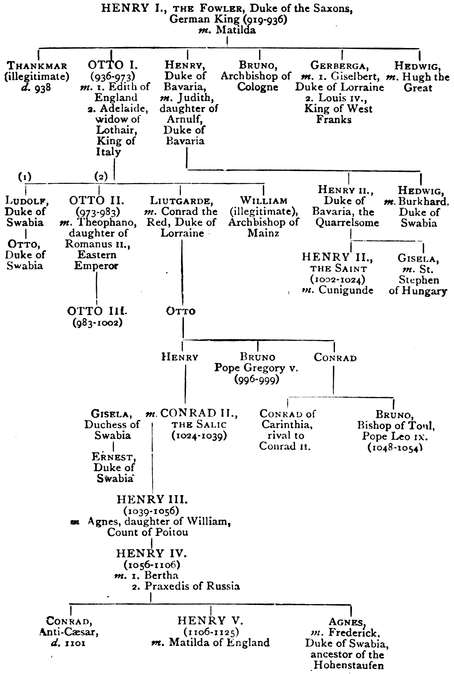
CHAPTER III THE GERMAN EMPIRE AT THE HEIGHT OF ITS POWER; THE LATER SAXON AND EARLY SALIAN EMPERORS (973–1056) [2] — GENEALOGY OF THE SAXON AND SALIAN EMPERORS
36
The reign of Otto II.—Break-up of Bavaria—Projects of Crusade—War and
Alliance with Greek Empire—The Reign of Otto III.—Regency of
Theophano and Bavarian Revolt—Otto and the Bishops—Gerbert of
Aurillac—Visionary Schemes of Otto—His failure—Reign of Henry II.—The
two Conrads—Reign of Conrad II.—His Italian and Slavonic Policy—Union
of Arelate and Empire—Fiefs declared Hereditary—Aribert—Reign
of Henry III.—His Policy in the East, France, Germany, and Italy—Synod
of Sutri—Death of Henry III.
Otto II., 973–983.
Otto II. was eighteen years of age when the death of his
father made him sole ruler. His education and surroundings
gave his policy a very different direction from
that of Otto I. The elder prince was purely
German, and even in winning the imperial crown sought
to subserve a Teutonic object. His son, born and reared
in the purple, Burgundian or Italian on his mother’s side,
and married to a Byzantine Emperor’s daughter, took wider
views. To Otto II. Italy was as important as Germany, and
his ambition was to weld the two realms together in a solid
imperial unity, while constantly keeping his eyes even beyond
these two kingdoms. To him the Emperor’s lordship of the
world was a reality, and he strove with all the force of an ardent,
impetuous, and impulsive nature to give effect to his ideal.
But while Otto II.’s short reign witnessed the Empire assuming
a more universal character, it also saw the first signs of that
essential incompatibility between the position of German
37king and Roman Emperor which, in after ages, was to bear
such bitter fruit.
Despite the quietness of Otto I.’s last years, the difficulties
against which the old Emperor had struggled still remained.
The separatist spirit of the national dukedoms still lived on
in Bavaria, and had only been temporarily glossed over by
the good understanding between Otto I. and Duke Henry.
Judith, the widow of Duke Henry, now ruled Bavaria in the
name of her son Henry II., surnamed the Quarrelsome, while
she controlled Swabia through her influence on her daughter
Hedwig, and Hedwig’s aged husband, the Swabian Duke
Burkhard. Otto II. saw the danger of a close union between
the two southern duchies, and, on Burkhard’s death, invested
his nephew Otto, Duke Ludolf’s son, with Swabia. Judith and
her partisans were instantly aroused. A new civil war was
threatened, in which the Bavarians did not scruple to call in
the help of the Bohemians and Poles. But the young Emperor’s
vigorous measures proved fatal to the attempted rebellion,
and Otto took the opportunity of his triumph to
lessen the influence of the Bavarian dukes by
intrusting, to separate margraves, the east mark,
on the Danube (the later Austria), and the north mark between
the Danube and the Bohemian Forest.
|Break-up of the Bavarian Duchy, 976–8.|
The great
highland marchland of Carinthia and Carniola, with which still
went the Italian March of Verona, or Friuli, was constituted
a seventh duchy. The rest of the Bavarian duchy was consigned
to the care of the faithful Otto of Swabia. Judith
was shut up in a convent. Henry the Quarrelsome fled to
Bohemia, whence he made subsequent unsuccessful attempts
to recover his position. Thus the Emperor triumphed, but
he had simply to do over again the work of his father. It
was a thankless business, and showed how insecure were the
very foundations of the German kingdom. But for the rest
of his short reign Germany gave Otto but little trouble. The
extension of Christianity among Wends, Poles, and Bohemians
gave Magdeburg and Mainz new suffragans in the Bishops
38of Gnesen and Prague, though renewed attacks on the
marches soon taught Otto that the Christianised Slavs were
scarcely less formidable enemies than their heathen fathers
had been.
War with France, 978.
In 978 Otto marched with a great army almost to the walls
of Paris to avenge on the Carolingian king, Lothair, his
attempt to withdraw Lorraine from the imperial
obedience [see page 70]. Few of his acts bring
out more clearly his imperial position than this long progress
through hostile territory. But Italy was the scene of Otto II.’s
most famous actions, and best illustrates his high conception
of the imperial dignity. Rome was, as usual, a constant
source of trouble. A series of insignificant Pontiffs succeeded
John XIII.; but above them towered the noble Roman,
Crescentius, Duke of the Romans, perhaps the son of the younger Theodora, Marozia’s sister, who aspired to renew the great part played by Alberic II.|Crescentius at Rome, 980.|
In 980 Otto crossed the Alps for Italy, and on his approach the opposition was shattered. In 981 he restored the Pope to Rome, whence he had fled from fear of Crescentius, and forced Crescentius himself to withdraw into the seclusion of a monastery, where a few years later he died. The need of protection still kept the Papacy faithful to the imperial alliance.
Otto now assumed new responsibilities directly flowing
from his position as Emperor. The Mohammedan lords of
Sicily had re-established themselves in southern Italy, and
threatened the march of Benevento. Otto marched to the
help of the Lombard Duke of Benevento.
|Campaigns against Greeks and Saracens, 981–982.|
At the
same time he sought to make a reality of the
cession of Greek Italy, the promised portion of
Theophano, but which, owing to the unwillingness
of the Byzantines, had never actually come into his
hands. In 981 and 982 Otto carried on successful war in
southern Italy. A whole series of Greek towns—Salerno,
Bari, Taranto—fell into his hands. In the summer of 982
39Otto traversed the old road of Pyrrhus, along the Gulf
of Taranto, and defeated the Arabs at Cotrone (the ancient
Croton), slaying Abul Cassim, the Ameer of Sicily, in the
fight. A few days later Otto fell into a Saracen ambush
as he pursued his route along the narrow road between
the Calabrian mountains and the sea. His army was almost
destroyed, though he himself, after a series of remarkable
adventures, succeeded in eluding his enemies.
Diet of Verona and projected Crusade, 983.
Germans and Italians vied with each other in their
efforts to restore the Emperor’s preponderance. In 983 a
remarkable Diet assembled at Verona, in which the
magnates of Germany and Italy sat side by side,
to show that the two realms constituted but one
Empire. The spirit that a century later inspired
the Crusades first appeared in this remarkable assembly.
It was resolved to follow the Emperor on a holy war against
the Mussulmans. That the succession might be peacefully
secured during his absence the magnates chose as their
future ruler the little Otto, his three-years-old son by
Theophano. Preparations were then made for the war
against Islam. But the rising commercial city of Venice,
jealous of the imperial policy, and already enriching itself
by trade with the enemies of the Christian faith, refused to
supply the necessary ships for an expedition against Sicily,
the centre of the infidel power. Otto sought to block up
the land approaches to the recalcitrant town, but, secure
in her impregnable lagoons, Venice was able to defy the
Emperor. The news of a Wendish invasion now came from
Germany; and the disturbed condition of Rome again demanded
Otto’s personal presence. There he laboured with
feverish earnestness to prepare for his mighty task; but there
he was smitten with a sudden and deadly disease,
that carried him off on 7th December 983. He
was only twenty-eight years old. His body was
buried, as became a Roman Emperor, in the Church of St.
Peter’s. The difficulties which had proved almost too much
40for the strong and capable grown man, were now to be faced,
as best they might be, by his young widow Theophano, the
regent of the new lord of the world, a child scarcely four
years of age.
The German Empire rested almost entirely on the warlike
character of its head, and any failure of the central military
power involved the gravest evils. A wave of heathen reaction
burst from the Wendish and Danish lands into the
very heart of the Saxon Empire. In the south, Islam, excited
by the threatened Crusade, menaced the centre of the Christian
world. It seemed as if the Empire of the Ottos was on the
verge of dissolution, when Henry the Quarrelsome, the deposed
Duke of Bavaria, came back, and, by claiming the
regency from Theophano, added the terrors of
internal discord to those of barbarian invasion.
|Revolt of Henry of Bavaria, 984.|
At first Henry made good progress, and, advancing in his
claims, began to covet the crown itself. The Dukes of Poland
and Bohemia paid him homage, and Lothair of France eagerly
supported him. It was more important that Henry had
won over many of the bishops, who, as the natural result of
Otto I.’s policy, had the balance of power in their hands.
He also secured the person of the young Otto III. But, as
the Archbishop of Magdeburg favoured Henry, the lay nobles
of the Wendish mark, who hated their clerical supplanters,
and Archbishop Willegis of Mainz, who still looked with
detestation on the mushroom primacy on the Elbe, declared
for Theophano. The adhesion of the mass of the Saxon
nation at last secured the victory of the Greek. Henry was
forced to submit, and was pacified by being restored to his
duchy of Bavaria.
Regency of Theophano, 983–991.
Otto III. owed his throne to the clergy. The influence of
the bishops kept Germany quiet during the regency of
Theophano. The fall of the last of the West
Frankish Carolingians, and the accession of
Hugh Capet in 987, prevented any further
danger from the French side, while on the east, the Margrave
41Eckhard of Meissen hurled back the Slavonic invaders, and
cleverly set the Bohemians and the Poles by the ears.
Adelaide, Otto’s grandmother, ruled Italy from the old
Lombard capital of Pavia. She was less fortunate than her
daughter-in-law, with whom, moreover, her relations were not
cordial. Rome fell away almost altogether, so that a French
synod at Reims (995) was able, with good reason, to denounce
the scandals that degraded the Papacy, and to threaten that
France, like the east, might be provoked into breaking off
all connections with the See of Peter. John Crescentius,
son of the man driven by Otto II. into a cloister, renewed
the policy of his father, and, taking the name of Patrician,
ruled over Rome with little opposition.
Rule of the bishops and education of Otto, 991–996.
Theophano died in 991. No new regent was appointed,
but a council of regency set up, prominent among its members
being the Empress Adelaide, Willegis of Mainz,
Eckhard of Meissen, and Henry, Duke of
Bavaria, son and successor of Henry the Quarrelsome.
The composition of this body was a
further proof of the extension of ecclesiastical influence. But
an even more significant indication of this was the fact that
the young king was brought up almost entirely under the
direction of highly-placed churchmen. Willegis of Mainz,
and Bernward, Bishop of Hildesheim, the future saint, were
the two prelates most directly responsible for his education.
The result was that, though the young king spent his early
years amidst his fierce and half-barbarous Saxon subjects, he
became still less of a German than Otto II., and was possessed
by ideals that stand in the strongest contrast with
those of his predecessors. Bernward caused him to be
schooled in the best culture of his time, and gave him an abiding
love of letters and learned men. He also strongly inspired
the quick-witted and sympathetic youth with the ascetic views
and the sacerdotal sympathies of the Cluniacs. Thus Otto
became enthusiastically religious, and ever remained a devout
pilgrim to holy places and seeker out of inspired anchorites
42and saints. Moreover, Otto inherited from Theophano all
the high Byzantine notions of the sacredness of the Empire,
and, seeking to combine the two aspects of his education, his
mind was soon filled with glowing visions of a kingdom of
God on earth, in which Pope and Emperor ruled in harmony
over a world that enjoyed perfect peace and idyllic
happiness. Otto’s ideals were generous, noble, and unselfish;
but in the iron age in which he lived they were hopelessly
unpractical. The young king lived to become the ‘wonder
of the world’ and the ‘renewer of the Empire.’ But his early
death came none too soon to hide the vanity of his ambitions.
At best, he was the first of that long line of brilliant and
attractive failures which it was the special mission of the
mediæval Empire to produce.
Otto’s coronation at Rome, 996.
In 996 Otto attained his legal majority, and crossed the
Alps to seek his coronation at Rome as Emperor. The king
and his army marched as though bound on a
pilgrimage, or like the crusading hosts of a century
later. As they entered the Lombard plain,
the news came that the Papacy was vacant, and a deputation
of Romans, tired of the tyranny of Crescentius, begged Otto
to nominate a new Pope. The young king at once appointed
his cousin, Bruno, grandson of Conrad the Red and Liutgarde,
daughter of Otto I., a youth of four-and-twenty,
and a zealous champion of the Cluniacs,
who took the name of Gregory V.|Gregory V., 996–999.|
On 25th May 996, Otto
was crowned by Gregory at Rome.
Pope and Emperor strove at once to embody their theories
in acts. The proceedings of the anti-papal synod of Reims
were annulled; its nominee to the see of Reims, Gerbert of
Aurillac, was forced to yield up his post to the worldly
Arnulf that the synod strove in vain to depose. The whole
French episcopate bowed in submission before the new Pope,
and Gerbert soon repudiated his earlier teachings. The
French king, Robert, was visited with the severest censures
of the Church for contracting a marriage within the prohibited
43degrees. The holy Adalbert, the apostle of Bohemia, but
driven from his see of Prague by a pagan reaction, was
sternly ordered to return to his bishopric, or, if that were
impossible, to engage in a new mission to the heathen.
Adalbert chose the latter alternative, and his early death
at the hands of the heathen Prussians made him the protomartyr
of the new order that Otto and Gregory were striving
to introduce. But while the two enthusiasts were busy in the
regeneration of the universe, they were unable to maintain
themselves in the very centre of their power. A new Roman
rebellion brought back Crescentius.
|Fall of Crescentius, 998.|
Only through
the help of the iron soldiery of the Saxon borders,
headed by the valiant Eckhard of Meissen, could
Otto win back the Eternal City to his obedience. In 998
Rome surrendered, and Crescentius atoned for his rebellion
on the scaffold.
Gerbert of Aurillac.
An early death now cut off Gregory V., and Otto raised
Gerbert of Aurillac[3] to the papal throne. Gerbert was quite
the most remarkable man of his age. A poor
Frenchman of obscure birth from the uplands
of the centre, he received his first schooling in a cloister at
his native Aurillac, where he took the monastic vows.
Borrel, a pious Count of Barcelona, made his acquaintance
while visiting Aurillac on a pilgrimage, and took him back
with him to the Spanish march. There Gerbert abode some
years, and there he acquired that profound knowledge of
mathematics which had perhaps filtered into the march from
the Mussulman schools of Cordova, and which gave him in
the unlearned north a reputation for extraordinary learning,
if not for magical skill. Ever eager for knowledge, he accompanied
his patron to Italy, and attracted the notice of Otto I.
Finally he settled down at Reims, attracted by the fame of
44a certain archdeacon who taught in the cathedral school.
The good Archbishop Adalbero made Gerbert ‘scholasticus’
of the school at Reims. Accompanying the archbishop
to Italy, Gerbert received from Otto II. the headship of
Columban’s old abbey of Bobbio, and speedily reformed its
lax discipline. On Otto II.’s death, the angry monks drove
him away, and he went back to Reims and resumed his
teaching as ‘scholasticus.’ He dominated the policy of the
archbishop in the critical years that saw the accession of
Hugh Capet to the French throne [see pages 70–71], but on
Adalbero’s death was ungratefully passed over by Hugh,
whose interests procured the election of Arnulf, an unlearned
but high-born Carolingian, to the great see. A few years
later, Arnulf was deposed by the synod of 995, and Gerbert
put in his place. But Arnulf still claimed to be archbishop,
and Gerbert went to Italy to plead his cause with Gregory V.
Finding his chances hopeless, he closely attached himself to
Otto III., with whom he had strong affinities in character.
Gerbert loved pomp and splendour, was attracted by Otto’s
high ideals, and was of a pliant, complaisant, and courtier-like
disposition. He was made Archbishop of Ravenna to compensate
him for the loss of Reims. When elevated to the
Papacy, he chose to call himself Sylvester II. As Sylvester I.
had stood to the first Christian Emperor, so would Sylvester II.
stand to the new Constantine. Under him the close alliance
of Pope and Emperor was continued as fervently as during
the lifetime of Gregory V.
Visionary schemes of Otto and Sylvester II., 999–1003.
Otto’s plans grew more mystical and visionary. Rome,
and Rome alone, could be the seat of the renewed Empire,
and Otto began the building of an imperial palace
on the Aventine on the site of the abode of the
early Cæsars. He abandoned the simple life of a
Saxon etheling, which had been good enough for
his father and grandfather, and secluded his sacred person
from a prying world by all the devices of Byzantine court-etiquette
and Oriental exclusiveness. His court officials
45dropped their old-fashioned Teutonic titles, and were renamed
after the manner of Constantinople. The chamberlain became
the Protovestiarius, the counsellor the logothetes, the generals
were comites imperialis militiæ, and their subordinates protospatharii.
The close union of the Pope and Emperor in
a theocratic polity was still better illustrated by the institution
of the judices palatii ordinarii. They were of the mystic
number of seven, ecclesiastics by profession, and were to act
as supreme judges in ordinary times, but were also to ordain
the Emperor (a new ceremony to be substituted for coronation)
and to elect the Pope. But apart from its fantastic character,
the whole policy of Otto depended upon a personal harmony
between Pope and Emperor. Even under Otto himself this
result could only be secured by the Emperor’s utter subordination
of his real interests to the pursuit of his brilliant
but illusive fancies.
Opposition to Otto III. in Germany.
Otto’s cosmopolitan imperialism soon brought him in collision
with Germany, and especially with the German Church.
He set up a new archbishopric at Gnesen in
Poland, where reposed the relics of the martyred
Adalbert, and surrounded it with the mystical
number of seven suffragans. In the same way, Sylvester, in recognising
Stephen, the first Christian Duke of Hungary, as a
king, established a Hungarian archbishopric at Gran. These
acts involved a recognition of the national independence
of Poland and Hungary. Wise as they were, they were
resented in Germany as being directly counter to the
traditional Saxon policy of extending German influence eastwards,
by making the bishops subject to the German
metropolitans at Magdeburg and Salzburg. The practical
German bishops saw with disgust the Emperor giving
up the very corner-stone of the policy of Henry and Otto I.
The deep differences of sentiment came to a head in a petty
dispute as to whether a new church for the nuns of Gandersheim
should be consecrated by Bernward of Hildesheim, the
diocesan, who favoured Otto’s fancies, or by the metropolitan
46Willegis of Mainz, who bitterly lamented the outlandish ideas
of his old pupil. Sylvester upheld Bernward, but the German
bishops declared for Willegis, and paid no heed to the papal
censures that followed quickly on their contumacy. They
refused even to be present at the Councils in which Sylvester
professed to condemn the Archbishop of Mainz. The German
clergy were thus in open revolt from Rome, and they were,
as we have seen, the leaders of the German nation.
Breakdown of Otto’s system in Italy.
While the outlook was thus gloomy in Germany, the march
of events in Italy gave but little encouragement to Pope and
Emperor, and demanded the personal presence of
Otto, who had been forced to return to Germany
in the vain hope of appeasing the general opposition
to his policy. Before he crossed the Alps
for the last time, Otto went to Aachen, and, if we can believe
one of his followers’ statement, visited the vaults beneath
the venerable palace-chapel to gaze upon the corpse of
Charles the Great, sitting as in life upon a throne, with
crown on head and sceptre in hand. When he reached the
south, he found to his dismay that lower Italy had fallen
altogether from his obedience, and that even Tivoli, in the
immediate neighbourhood of Rome, had rebelled against
him. Otto made feverish efforts to restore his authority.
He clamoured for Byzantine help, and begged for a Byzantine
wife. He paid a flying visit to the Venetian lagoons, seeking
for a fleet from the great Doge Peter Orseolo. But worse
news now reached him. Rome itself now rose in revolt, and
Otto, postponing in despair his warlike operations, could only
find consolation in visits to the holy Romuald in his inaccessible
island hermitage amidst the swamps of Ravenna, and
in the practice of penances, mortifications, and scourgings.
Recovering his energy, he now sought to obtain an army from
Germany to procure, as in the old days, the subjection of
Italy; but it was the very moment of the crisis of the
Gandersheim struggle, and no German help was forthcoming.
A sharp fever now attacked Otto at the very moment of
47the collapse of all his plans. He died on 23rd January
1002, at Paterno, near Rome, when only twenty-two years
old.
|Death of Otto III., 1002.|
With him perished his lofty ambitions.
He had made himself the wonder of the world;
but all that he had accomplished was to play the
game of the high ecclesiastical party. The tendency of his
policy, like the latter Carolings, was to subordinate the
visionary Empire to the practical Papacy, thus exactly
reversing the ideas of the great Saxons, and bringing out in
its most glaring contrast the incompatibility of the union of the
German kingship with the imperial claims to universal domination.
Within a year Sylvester II. followed him to the tomb.
Henry II., 1002–1024.
For eighty years the Saxon kings and emperors had succeeded
from father to son, and even a minority had not
broken down the tendency towards heredity which
seemed rapidly divesting the German kingdom of
the elective character which it had shared with the Empire
itself. Otto III.’s death without direct heirs now reminded
the German magnates that they still could choose their king,
and, in the absence of any strong claimant, there was a whole
swarm of aspirants after the vacant dignity. The friends of
the Saxon traditions, which Otto III. had so violently set at
naught, hoped for the election of the brave and experienced
Eckhard of Meissen; but as Eckhard was travelling to the
south to pursue his candidature, he was murdered to satisfy
a private revenge. His removal secured the appointment of
Henry, Duke of Bavaria, the son of Henry the Quarrelsome,
and the nearest kinsman of competent age and position to
the dead ruler. Thus the throne was retained in the hands
of the Saxon house, though it now was held by a branch that
had long attached itself to the traditions of its southern duchy.
Bavarians, Lorrainers, and Franks accepted Henry at once;
the Saxons and Swabians only after a short hesitation.
It was a great thing that the succession had been peaceably
settled. Yet the new king had neither the power nor the
energy of the Ottos. Raised to the throne by the great
48magnates, Henry II. never aspired to carry on the despotic
traditions of the earlier Saxon kings, but thought to rule with
the help of frequent Diets and Councils. He had more
authority over the Church, and his personal piety and zeal
for good works, in which he was well supported by his wife
Cunigunde, procured for him in after times the name and reputation
of a saint, and in his own day kept him on good terms
with the clergy, though he was never their slave. He used
his bishops and abbots as instruments of his temporal rule,
and systematically developed Otto III.’s system of making the
bishops and abbots the local representatives of the imperial
power by granting them the position of Count over the
neighbouring Gau. On one great matter he gave much
offence to the German bishops.
|Henry II. and the Church.|
He set up a new bishopric
at Bamberg in Franconia, laying in 1004
the foundations of its new cathedral, and conferring
on it such extensive privileges that
every bishop in Germany was annoyed at the new prelate
holding a position next after the archbishops, while the
Archbishop of Mainz resented the merely nominal ties of
obedience that bound the Bishop of Bamberg to him as his
metropolitan. Henry was a friend of the Cluniac monks,
and it was through his efforts that these zealous Church
reformers first got a strong position in Germany.
Henry II. and the Slavs.
Henry had no trouble with the Hungarians, whose great
king, St. Stephen, the founder of the settled Magyar state,
was his brother-in-law and friend. But it was
among his chief cares to uphold the old Saxon
supremacy over the Slavs, which Otto III. had
generously or fantastically neglected. Poland was now a formidable
state, and its Duke Boleslav, who had become a terror
to the marks before the death of Otto, aspired to build up
a strong Slavonic power, and drive back the Germans over
the Elbe. It was no longer the frontier warfare of the days
after Otto the Great’s victories. It was rather a stern fight
between two vigorous nations, in which Henry only won the
49upper hand after long and costly efforts. Even at the last
he was forced to hand over the mark of Lausitz to the Poles,
to be held as a fief of the German kingdom. Henry’s laborious
policy, his shrinking from great efforts, and his fixed resolve
to concentrate himself on little objects within his reach, stand
in the strongest contrast to the vast ambitions of his predecessor.
Yet, in his slow and determined way, Henry brought
back the German kingdom to a more national policy, and
did much to restore the havoc wrought by Otto’s vain
pursuits of impossible ideals. As a German king, he was in
no wise a failure, though he raised the monarchy to no new
heights of power.
Henry’s success in Germany was closely connected with
his failure in Italy. Under his cautious rule the plans of
Otto III. were quickly lost sight of. On the death of Sylvester
II., the Papacy fell back into its old dependence on
the local nobles. At first a third Crescentius, son of Otto III.’s
victim, assumed his father’s title of Patrician, ruled Rome at
his pleasure, and nominated two puppet Popes in succession.
But a stronger power arose, that of the Counts of Tusculum.
Before long a series of Tusculan Popes, set up by the goodwill
of these powerful lords, again degraded the Papacy, and
threatened to deprive it of the obedience and respect of
Europe.
|Henry II. and Italy.|
It was the same in the secular as
in the spiritual sphere. Before the German succession
had been settled, Ardoin, Marquis of Ivrea, had
got himself elected King of Italy, and held his own
for many years against the partisans of Henry reinforced
by German armies. In 1004 Henry went over the Alps,
and submitted to be elected and crowned king at Pavia,
though the Ottos had borne the Italian crown without condescending
to go through such formalities. Despite this
Ardoin long maintained himself. At last, in 1013, Henry
went down to Italy again, and on 14th February 1014 received
the imperial diadem from Pope Benedict VIII. But no
striking result followed this renewal of the Empire. Benedict,
50who was a zealous partisan of the Count of Tusculum,
now sought, by advocacy of the Cluniac ideas, to maintain
himself against an Antipope of the faction of Crescentius.
In 1020 Benedict visited Germany to consecrate the cathedral
of Bamberg, and signalised his visit by taking Henry’s
foundation under his immediate care. It seemed as if the
old alliance of Papacy and Empire were renewed. Next
year Henry crossed the Brenner at the head of a strong
German army, which traversed all Italy, in three divisions,
commanded respectively by Henry himself, the Patriarch of
Aquileia, and the Archbishop of Cologne. But by the time
the Lombard dukes of Capua and Salerno had made their
submission, and Henry was marching through Apulia, a
deadly sickness raged in his host and compelled its immediate
retreat. Next year Henry was back in Germany.
It is significant that the office of Count Palatine of Italy
ceased to exist during his reign. The Emperor was no longer
an effective ruler of the peninsula.
In the latter years of his life Henry attached himself still
more strongly to the Cluniac party, and, as with Otto III., his
friendship for foreign priests brought him into renewed conflict
with the German bishops. Aribo, Archbishop of Mainz,
led the opposition to Henry and Benedict. But just as the
conflict was coming to a head, Benedict VIII. died (1024).
He was quickly followed to the grave by Henry himself.
With him perished the last king of the male stock of the
Ludolfing dukes of Saxony. His dull and featureless reign
was but a tame conclusion to the brilliant period of the
Ottos.
The two Conrads, 1024.
The ecclesiastical differences that had troubled Germany
during Henry II.’s lifetime lay at the root of the party struggles
that now raged round the appointment of his
successor. As in Henry’s case, there was no
specific candidate marked out by birth and
special fitness for the choice of the German nation. The
bishops, led by Aribo of Mainz and Burkhard of Worms,
51resolved to take full advantage of this freedom of election
to prevent the accession of any prince inclined, like the
late Emperor, to favour the spread of Cluniac ideas. They
therefore urged the claims of Conrad of Swabia. Conrad
was the great-grandson of Conrad the Red and his wife Liutgarde,
Otto the Great’s daughter, and consequently nephew
of Pope Gregory V., and descended from the Ludolfings on
the female side. Though only the possessor of part of his
rich family estates in the Rhineland, Conrad had made a
lucky marriage with the widowed Gisela, Duchess of Swabia,
the granddaughter of Conrad, king of Arles, and a descendant
of the Carolingians. This gave him the guardianship
of the young Duke Ernest of Swabia, Gisela’s son by her
former husband, and secured for him a leading position
among the German magnates. Conrad was a valiant and
experienced warrior, and an intelligent statesman, possessing
a clear head and a strong will, resolutely bent on
securing practical objects immediately within reach. He
had persistently held aloof from the ecclesiastical policy of
his predecessor, with whom he had been more than once
in open feud. He was still more hostile to his cousin, Conrad,
Duke of Carinthia, the son of another Conrad, a younger
brother of his father Henry, who, through the caprice of their
grandfather, had inherited the mass of the Rhenish estates
of Conrad the Red, usurping the position of the elder line.
This second Conrad was now the candidate of the Cluniac
party against Conrad of Swabia. But the great prelates
were still all-powerful; despite the opposition of the
Lorrainers, among whom Cluniac ideas had gained a firm
hold, Conrad of Swabia was elected king. His path to the
throne was made smooth by the generosity of his rival,
who, at the last moment, abandoned his candidature,
and voted for his cousin.
|Conrad II., 1024–1039.|
Aribo of Mainz
crowned Conrad in his own cathedral, regardless
of the claims of the rival Archbishop of Cologne, the
diocesan of Aachen, the proper place for the coronation.
52But Aribo refused to confer the crown on Gisela, since the
Church regarded her marriage with Conrad as irregular by
reason of their affinity. Pilgrim of Cologne now saw his
opportunity for making terms with the victor. He gave
Gisela the crown which Aribo had denied her. Thus Conrad
entered upon his reign with the support of all the leaders
of the German nation. The younger Conrad remained
faithful to his old rival; while his younger brother Bruno,
who became Bishop of Toul, soon became one of the
greatest supports of the new dynasty.
Italian policy.
When Conrad II. became king, he found everything in
confusion: but within two years of his accession he had infused
a new spirit and energy into every part of
his dominions. His first difficulty was with
Lorraine, whose two dukes had opposed his election, and now
refused to acknowledge its validity. They sought the help
of King Robert of France, whose weak support availed them
but little. Conrad soon put down their rebellion, and with
almost equal ease quelled the revolt of his ambitious and
unruly step-son, Ernest of Swabia. Germany was thus
appeased, but Italy, where the imperial power had become
very feeble in the later part of the reign of Henry II., was
still practically outside Conrad’s influence. His authority
was only saved from complete ruin by the policy of the
Lombard bishops, who saw in the Emperor their best protection
against the proud and powerful lay aristocracy, and
especially against the warlike margraves, who now aspired to
renew the part played by Ardoin of Ivrea. But conscious
that they did not possess sufficient strength to continue
successfully a policy in which even Ardoin had failed, the
leaders of the north Italian nobility looked elsewhere abroad
for help to counterbalance the German soldiery of the
Emperor. When King Robert of France rejected their
advances, they found what they sought in William V., the
Duke of Aquitaine and Count of Poitou, an aged and experienced
warrior, and a strong friend of the Cluniacs, who
53hoped to find in Italy a suitable endowment for his young
son William. This was the first occasion in which the policy
of calling in the French to drive out the Germans was adopted
by the Italians. But the times were not yet ripe for the intervention
of a French prince in Italy. William crossed the
Alps, but found that he could make but little progress against
the vigorous opposition of the Lombard bishops, headed by
Aribert of Milan, and tried to make up for his weakness
in Italy by uniting himself with the Lorraine rebels, and
by stirring up an anti-German party in the kingdom of Arles.
But nothing came of his elaborate schemes, and in 1025 he
went home in disgust.
Conrad’s imperial coronation, 1027.
Early in 1026 Conrad crossed the Brenner, and in March
received the Lombard crown from Aribert in the cathedral
of Milan. Pavia, the old Lombard capital, shut
its gates on the Emperor, who was thus unable to
be hallowed in the usual place. For a whole year
Conrad remained in northern Italy, and gradually
forced his enemies to make their submission. In the spring
of 1027 the way to Rome at last lay open, and on Easter
Sunday Conrad was crowned Emperor by Pope John XIX.
The function was one of the most striking and memorable
ceremonies in the whole history of the mediæval Empire. It
was witnessed by two kings—Rudolf III., the last of the kings
of Arles, and Canute of Denmark, the conqueror of England
and Norway, then at Rome on a pilgrimage. But the
clear head of Conrad was not in the least turned by the
mystic rite. Content that his twofold coronation gave him
a firm hold over Italy, he quickly recrossed the Alps and
resumed his proper work as a German king, taking good
care that there should be no clashing between his German
and Italian interests. Before his return he visited southern
Italy, and ensured the obedience of the Lombard dukes,
who still guarded the frontier against the Greeks of Calabria.
On his return to Germany, Conrad felt that his power was
sufficiently secure to take steps towards retaining the Empire
54in his own family. In 1028, he persuaded the magnates to
elect, and Pilgrim of Cologne to crown, as his successor his
eldest son, Henry, who was but ten years of
age.
|Fall of Ernest of Swabia, 1030.|
This act roused the jealousy of the greater
nobles, who found in Conrad’s son-in-law, Ernest
of Swabia, an eager champion of their views. Ernest again
plunged into revolt; and when pardoned, at the instance
of his mother the Empress, still kept up his close friendship
with the open rebel, Werner of Kyburg, Count of the Thurgau,
a district including the north-eastern parts of the modern
Switzerland. In 1030 Conrad ordered Ernest to break off
from all dealings with his friend, and, as a sign of his
repentance, to carry out in person the sentence of outlawry
and deprivation pronounced against him. Ernest refused to
give up Werner, whereupon Conrad deprived him of his
duchy. Bitterly incensed with his father-in-law, the young
duke left the palace, and wandered from court to court, seeking
help to excite a new rebellion. But Conrad was so strong
that neither foreign prince nor discontented German noble
would make common cause with Ernest. In despair he took
to a wild robber life of adventure, lurking with a few faithful
vassals amidst the ravines and woods of the Black Forest.
Before the summer was out Ernest was overpowered and
slain. His commonplace treason and brigandage were in
after ages glorified in popular tales, that make his friend
Werner a model of romantic fidelity, and he himself a gallant
and chivalrous warrior. After his fall, Conrad reigned in
peace over Germany.
Hungary and Poland, 1030–1032.
The inroads of the Hungarians and Poles now forced fresh
wars on Conrad. In 1030 he waged a doubtful contest against
Stephen of Hungary. In the succeeding years he
obtained great successes against the Poles, winning
back in 1031 Lausitz and the other mark districts
that Henry II. had been forced to surrender to their king
Boleslav, and compelling his successor Miecislav, in 1032, to
do homage to him for the whole of his kingdom. But great
55as were Conrad’s successes in the east, they were surpassed by
his brilliant acquisition of a new kingdom in the west, where
in 1032 he obtained the possession of the kingdom of Arles.
Union of the Arelate with the Empire, 1032.
The kingdom of Arles or Burgundy had fallen into evil
days. During the long reigns of Conrad the Pacific (937–993)
and Rudolf III. (993–1032) all power had fallen
into the hands of the territorial magnates, and
now the threatened extinction of the royal house
seemed likely to plunge the Arelate into worse
confusion. Rudolf III. was old and childless, and had long
sought to make arrangements to prevent the dissolution of his
kingdom with his death. In 1007 he had concluded with
Henry II., his nephew, an agreement by which Burgundy was
to fall on his death to the German monarch, but the Burgundian
nobles had more than once forced him to renounce
his treaty. An increasing sense of his powerlessness drew
Rudolf, who was Gisela’s uncle, more closely to Conrad II.
He hurried to Rome to be present at his coronation, and he
trusted entirely to him for protection against his turbulent
nobility. The contract of succession was renewed, and on
Rudolf’s death, in 1032, Conrad entered into possession of
the Arelate. Count Odo of Champagne set himself up as
a rival and national king, but the German portions of the
Arelate favoured Conrad from the beginning. In 1033 he
was chosen king, and crowned at Ueberlingen, near Constance;
and in 1034 Odo was forced into submission, while
Conrad triumphantly wore his crown at Geneva and received
the homage of the lords of Burgundy. Henceforward the
kingdom of Arles was indissolubly united with the Empire.
Despite the small amount of power which even the strongest
Emperors could exercise in the Arelate, the acquisition was
one of no small importance. The Arelate was for the most
part a Romance land, and its union with the Empire made the
Empire less German, and, for some generations at least, prevented
the natural tendency to union between France and the
Burgundian lands from being carried out. Moreover, the
56acquisition of the Arelate, by virtue of a contract of succession,
increased the already strong tendency towards hereditary
monarchy in Germany and Italy. Again, Burgundy was the
chief home of the Cluniacs, and one very important consequence
of its absorption by Conrad was a gradual increase
of Cluniac influence all over the Empire. And most of all, the
new-won kingdom was useful to the Emperors as acting as a
sort of buffer-state to protect Italy from French interference.
The attempt of William of Poitou had taught Conrad the
necessity of thus guarding the Italian frontier. For the next
few generations the acquisition of the Arelate made such
projects more difficult. Supplementing the final adhesion of
Lotharingia to the Eastern Kingdom, the lapse of the Arelate
completed the absorption of the ‘Middle Kingdom’ in the
German Empire. Of the threefold partition of Europe by
the Treaty of Verdun in 843, only the ancient dominions
of Charles the Bald—France, in the narrower sense—were
outside the powers of the Emperor. Henceforth Conrad
ruled not only all the lands that had gone in 843 to Louis
the German, but also over the districts that had then fallen to
the share of the Emperor Lothair. Two-thirds of the Carolingian
Empire were thus concentrated under Conrad.
Feudal benifices declared hereditary.
Ten years of Conrad’s rule had now brought the Holy
Empire to a point of solid prosperity that was seldom
surpassed. But Conrad saw that there were still
great dangers inherent in his position, and foremost
among these was the smallness of the number
of the feudal dignitaries with whom he had
direct legal dealings. There were no longer indeed the five
national dukedoms in their old united strength and dignity.
There were no longer dukes of Franconia; Lorraine was
already divided into two distinct duchies, of Upper and
Lower Lorraine. Swabia was showing signs of a similar
tendency to bifurcation; Bavaria, after the rearrangement of
976, was in a much less imposing position than under the
Saxon Emperors, and even in Saxony the margraves
57were a strong counterpoise to the more imposing but
not more powerful dukes. In the last generations the
more vigorous of the counts and margraves had shaken
off their dependence on the dukes, and aspired to stand
in immediate relations with the Emperor. Yet the whole
drift of the time was towards feudalism, and towards
making a limited number of tenants-in-chief, whether dukes,
margraves or counts, the sole persons with whom the Emperor
had any direct relations. Secure in their own hereditary
tenure of their fiefs and allodial properties, the great lords of
Germany claimed an absolute control over all their vassals.
The old tie of national allegiance that bound every subject to
his sovereign had fallen into neglect as compared with the
new link of feudal dependence of vassal on lord. The leading
tenants-in-chief considered that their powers over their vassals
were so absolute that it was the bounden duty of a tenant to
follow his lord to the field, even against his overlord. With
the same object of strengthening their own position, the
great lords strove to prevent the fiefs of their vassals from
assuming that hereditary character which they had already
acquired in practice, if not in theory, for their own vast
estates.
Conrad showed a shrewd sense of self-interest in posing as
the friend of the lesser tenants against the great vassals of
the crown. Whether he also secured the best interests of
Germany is not quite so clear. The great vassals were strong
enough to maintain order; the lesser feudalists had neither
their resources nor their traditions of statecraft. It was too
late to revive with any real effect the national tie of allegiance,
and the scanty means of an early mediæval king had always
made somewhat illusory great schemes of national unity.
Conrad did his best for the protection of the under-tenants by
establishing for them also that hereditary possession of their
benefices which gave them some sort of permanent position
over against their overlords. This was secured in Germany
by a mere recognition of the growing custom of heredity,
58though in Italy a formal law was necessary to attain the same
end. Another advantage won by Conrad by this action was
that in securing the recognition of the principle of heredity in
every fief, he made a long step towards securing the heredity
of the crown. For Conrad, much more distinctly than his
Saxon predecessors, sought definitely to make both the royal
and imperial crown hereditary in his house. As a further
step towards breaking down the greater nobility, he strove
to get rid of the national duchies altogether. He persuaded
the Bavarians to elect the young King Henry as their duke,
and, on the death of his last step-son, gave Swabia also to
his destined successor. On the death of his old rival, Conrad
of Carinthia, the great Carinthian mark was also handed over
to Henry. At the end of Conrad’s reign, Saxony and Lorraine
were the only duchies still held by independent princes.
Like his predecessors, Conrad used the bishops as the means
of carrying on the government and checking the growth of
the lay aristocracy. Following the example of the chief
ecclesiastics, he encouraged the development of a new class
of hereditary ministeriales, who devoted their lives to the
service of the crown, and soon built up a new official body
that enabled his successors to largely dispense with the
interested help of the episcopate in carrying on the daily task
of the administration of the kingdom.
Conrad was so successful with this policy in Germany and
Burgundy that he desired to extend it to Italy. But the spirit
of independence was already deeply rooted south of the Alps,
and the very prelates who had called Conrad to help them
against their lay rivals, now looked with suspicion on a policy
that deprived churchman and lay noble alike of their cherished
immunities.
|Conrad’s strife with Aribert, 1036–1039.|
Aribert of Milan had long aspired
to a position of almost complete independence.
His dream was to make the see of St. Ambrose
a sort of North Italian patriarchate, and at the
same time he wished to combine with ecclesiastical ascendency
an organised temporal power. His twofold ambition
59was exactly that of the Papacy at a later period, and for
the moment Milan seemed stronger than Rome. The citizens
of Milan, more obedient to their bishops than the turbulent
Romans, were zealous partisans of Aribert; but the smaller
nobles, who saw in the fulfilment of his plans the destruction
of their own independence, rose as one man against him.
Civil war broke out in Lombardy between the friends and
foes of Aribert. So dangerous was the outlook that in 1036
Conrad again crossed the Alps in the hope of restoring peace
in North Italy.
Aribert was summoned to a Diet at Pavia; but he loftily
declared that he would surrender no single right of the church
of St. Ambrose, and was soon in open war against the
Emperor. Conrad saw his only chance of overcoming the
archbishop in winning over the smaller nobility to his side.
In 1037 he issued the famous edict which made fiefs hereditary
in Italy, thus doing for the south by a single stroke what
gradual custom and policy had slowly procured for the north.
He also promised to exact from his vassals no greater burdens
than those already usually paid to him. But these measures,
though increasing the party of Conrad in Italy, were not
enough at once to overcome Aribert, who, secure in the
hearty support of the Milanese citizens, defied not only the
threats of Conrad but also the condemnation of Rome,
which the Count of Tusculum, who then occupied the papal
throne, willingly put at the service of the Emperor. In
1038 Conrad was forced by urgent business to recross the
Alps, leaving Aribert unsubdued. Next year he died suddenly
at Utrecht. ‘No man,’ says a Saxon annalist, ‘regretted his
death.’ Yet if Conrad was unpopular, he was singularly successful.
Though he had failed to get the better of Aribert,
he had obtained his object in everything else that he undertook.
He left the royal authority established on such a
solid basis that his son, King Henry, already crowned King
of Germany and Burgundy, and already Duke of Bavaria
and Swabia, now stepped into the complete possession of his
60father’s power, as if he were already the heir of an hereditary
state. Henry III. was the first German king to succeed
without opposition or rebellion.
Henry III., 1039–1056.
Henry III. was now two-and-twenty years of age, and had
been carefully educated for his great position. Gisela had
procured for him the best of literary teachers,
while Conrad himself had taken care that he
should excel in all knightly exercises, and go through a
sound drilling in war, law, and statecraft. He had already
won martial glory against the Poles and Hungarians, while
he had acquired political experience as virtual, if not
formal, co-regent with his father. He was now able to take
up his father’s work, and while carrying it on essentially in
the old lines, to infuse it with a new spirit. For the gifted
young king, though inheriting to the full the practical wisdom
of his father, soared far above the cold self-seeking and
hard selfishness of the least attractive of the great German
Emperors. Under his strong and genial rule, the Holy
Empire again became a great ideal, though it was now an
ideal that had little that was visionary or fantastic about it.
The seventeen years of his reign witnessed the culminating
point of the power of the mediæval Empire. Under him
Germany effectively ruled the destinies of the world. The
early troubles that had attended the building up of the
kingdom were over. The later troubles that sprang from the
struggle of the ecclesiastical and temporal power had not yet
begun.
A series of signal triumphs in the east first proclaimed to
the world the greatness of the new king. Poland, Bohemia,
and Hungary were all alike matters of concern to Henry.
|Poland, Bohemia, and Hungary made fiefs of the Empire.|
But Poland, so mighty a few years before, was
distracted by civil strife, and attacked by the
rising power of Bohemia, now the strongest
Slavonic state. It was a light matter for Henry to
retain Poland as a feudatory of the Empire. But it involved
a long struggle before Bohemia, under its warlike Duke
61Bretislav, could be forced to accept the same position. It
was Bretislav’s ambition to make himself a king, and to secure
for the Bohemian bishopric at Prague the position of an archbishopric,
so that a great Slavonic kingdom, independent
both in Church and State, might centre round the Bohemian
table-land. But Henry forced his way through the mountains
of the border and threatened Prague itself. In despair
Bretislav did homage to him for Bohemia and Moravia, and
even for the outlying district of Silesia, which he had conquered
from the weak Polish monarchy and made an integral
part of the Bohemian kingdom. Even greater difficulties
beset Henry in Hungary, where a heathen reaction had set
Aba, a member of the hero race of Arpad, on the throne. In
1042 Henry invaded Hungary and dethroned Aba, but the
Hungarian king was soon restored, and it was not until a
third expedition in 1044 that Henry finally succeeded in
destroying his power. Aba’s defeat secured the complete
triumph of the German king. Peter, the new king of
Hungary, performed homage to Henry, thus making Hungary,
like Poland and Bohemia, a fief of the Empire. In
1045 Henry visited Hungary, and received the submission of
the Magyar magnates. In pious gratitude for his victory
Henry sent the gilded lance, which Peter had given to him as
an emblem of his dependence, as a votive offering to the
Papacy. A few years later another Arpad, Andrew, dethroned
the weak Peter, and gave a more national direction to
the fierce Magyar nation, though he was too conscious of
Henry’s power to break openly with him. With a row of
vassal kingdoms extending to the extremest eastward limits
of Roman civilisation, the Holy Empire was fast becoming in
a very real sense the mistress of the world.
Henry III. and France.
With all his power, Henry could not hope to obtain from
the princes of the west the same formal acknowledgment of
his supremacy that he had wrested from the lords
of the east. The France of Henry I. was indeed
feeble and helpless, but the early Capetian monarchy was
62still the centre of a great system, and its feudatories, though
constantly at war with their king and with each other, would
be likely to make common cause against a German pretender
to universal rule. Henry III. was content to keep on friendly
terms with his neighbours beyond the Rhine, and, as a good
means of securing French friendship, he chose a wife from
among the greater vassals of the Capetian throne. In 1043
he married Agnes of Poitou, the youngest daughter of that
Count William of Poitou who, in his youth, had competed
with Conrad the Salic for the crown of Italy. Agnes exercised
henceforth strong influence over her husband, and in
particular upon his ecclesiastical policy.
With the eastern kings paying him tribute and the monarch
of the west seeking his friendship, Henry had now leisure to
improve the internal condition of his dominions. Despite all
that his predecessors had done, Germany and Italy were still
in the utmost disorder.
|Henry III. and Germany.|
Conrad II.’s policy of encouraging
the smaller nobility had tended to increase the
private wars and local feuds that made existence
so difficult and dreary for the simple freeman, and so dangerous
even to the great lord. Henry now made strenuous efforts
to restore peace to Germany. At a diet at Constance Henry
solemnly forgave all his enemies, and craved their forgiveness
in turn, calling upon the magnates to follow his example
and lay aside their feuds with each other. Some degree of
success followed this appeal, especially as Henry had partly
abandoned his father’s policy of concentrating the national
duchies in his own hands. Germany was so vast that it
could hardly be effectively ruled from a single centre, and
Henry hoped that henceforth the dukes whom he set up
would be faithful ministers, and not champions of local independence.
Italy demanded Henry’s utmost care, and the critical
position of the Papacy closely connected his policy with
his attitude towards the Church. Since his marriage
with Agnes, Henry had become more attentive to the
63teachings of Cluny, and was keenly alive to the scandals
which still disgraced the Roman Church. No ecclesiastical
reformation could be complete which did not begin with
the head of the Church, and it was only by a great
manifestation of his power that Henry could purify
the Papacy.
|Henry III. and Italy.|
The Counts of Tusculum still kept
their tight hold over the Roman Church, which had almost
become their hereditary possession. After two brothers—the
reforming Benedict VIII. (1012–1024) and the reactionary
John XIX. (1024–1033)—had held in turn St. Peter’s chair,
a third member of the Tusculan house, their nephew, Benedict
IX., succeeded, despite his extreme youth, to the papal
throne (1033). His excesses soon gave occasion to universal
scandal, and in 1044 the Romans set up an Antipope in
Sylvester III. Family influence still upheld Benedict, but next
year new troubles arising, he sold the Papacy in a panic to
a new pretender, who called himself Gregory VI., and who,
despite his simoniacal election, soon attracted the reformers
around him by his zeal in putting an end to abuses. But
Benedict soon repented of his bargain, and sought to regain
his position as Pope. The result was that three rival claimants
to the Papacy distracted Rome with their brawls, and none
of them had sufficient power to get rid of the others.
A synod assembled at Rome, and called on Henry III.
to put an end to the crisis. In 1046 he crossed the Alps,
and held a Church Council at Pavia, in which he issued an
edict condemning simony.
|Synod of Sutri, 1046.|
In December 1046 he held
another synod at Sutri, near Rome, where two
of the three claimants to the Papacy were deposed.
The third claimant was deposed in a third synod
held in Rome itself. Suidgar, Bishop of Bamberg, was chosen
Pope through Henry’s influence, and enthroned on Christmas
Day as Clement II., conferring on the same day the imperial
crown on Henry and Agnes. Accompanied by Clement,
the Emperor made a progress through southern Italy,
which he reduced to submission. Grave troubles on the
64Lower Rhine now brought Henry back to Germany; yet
even in his absence his influence remained supreme in Italy.
Clement II. died in 1048; but a whole succession of German
Popes, the nominees of the Emperor, were now accepted by
the Romans with hardly a murmur. The first of these—Damasus
II., formerly Poppo, Bishop of Brixen, died after a
few weeks’ reign. His successor, the Emperor’s kinsman,
Bruno of Toul, took the name of Leo IX. (1048–1054). Short
as was his pontificate, the result of his work was epoch-making
in several directions. During the reign of his successor,
Victor II. (1054–1057), Henry III. paid his second and
last visit to Italy, the results of which we will speak of later.
No sooner was he over the Alps than a rebellion broke out
in Bavaria that necessitated his immediate return. The presence
of the Emperor soon extinguished the revolt, but the
rising taught Henry the insecurity of his position, and he
now sought to conciliate his foes.
Death of Henry III., 1056.
In the summer of 1056 Henry held his court at Goslar,
where he was visited by Victor II.; but in September he fell
sick, and had only time to take further measures
to secure his son’s succession, when death overtook
him, on 5th October, in the thirty-ninth
year of his age. Under him the mediæval Empire attained
its apogee. Germany was now almost a nation; Italy a
submissive dependency; the Papacy had been reformed, and
the Church purified. A child of six years old was now
called to the throne, whose burden had been almost too
heavy for his father. With the accession of Henry IV. the
decline of the Empire begins.
65
CHAPTER IV FRANCE AND ITS VASSAL STATES UNDER THE LAST CAROLINGIANS AND THE EARLY CAPETIANS, 929–1108 [4] — GENEALOGY OF THE CAPETIAN KINGS OF FRANCE.
66
The last Carolingians—Hugh the Great—Election of Hugh Capet, and its
results—The first four Capetians, Hugh, Robert II., Henry I., Philip I.—The
great Fiefs under the early Capetians—Normandy—Brittany—Flanders—Vermandois—Champagne
and Blois—Anjou—Burgundy—Aquitaine
and Poitou—Toulouse—Beginnings of French influence.
The last Carolingian Kings of the West Franks.
While the first great Saxon kings were reviving the power
of their eastern kingdom, the expiring Carolingian house
still carried on an unavailing struggle for the
possession of the old realm of the West Franks.
Charles the Simple was the last Carolingian
to exercise any real authority in France. He
had obtained a powerful ally by his concession of Normandy
to Rolf and his vikings. He had witnessed the revolt
of the Lotharingians from Germany to France, and had
attained many successes through their support.
|Charles the Simple, 896–929.|
Yet the concluding years of his reign were
troubled in the extreme, until he succumbed before
the formidable coalition of Robert, Count of Paris, the
brother of the dead King Odo, and the chief representative
67of the new order, with his two mighty sons-in-law, Herbert,
Count of Vermandois, and Rudolf, Duke of Burgundy.
|Robert, 922–923.|
Robert got himself crowned king in 922, but was
slain in battle in 923, leaving his famous son,
Hugh the Great, too young to succeed to his disputed kingdom.
This left Rudolf of Burgundy as king of the Franks,
or, rather, of those who still resisted Charles the
Simple [see Period I., pp. 503–5].
|Rudolf, 923–936.|
When Charles
died in prison in 929, Rudolf had no longer a nominal rival.
He reigned until his death in 936. But his power was miserably
weak, and real authority still resided with the great
feudatories, whose possessions had now become hereditary
for so long a time that they were now associated by close
ties to the districts which they ruled.
Hugh the Great was a man of very different calibre from
his fierce ancestors. Robert the Strong, the founder of
the house, had been a warrior pure and simple. His
sons, Odo and Robert, the two dukes who had in turn
grasped the sceptre, had faithfully followed in his footsteps.
Wanting in policy and statecraft, they had been less powerful
as kings than as dukes. Hugh the Great, the first statesman
of the Robertian house, was a shrewd tactician,
who saw that his fortunes could best be established
by playing a waiting game.
|Policy of Hugh the Great.|
He heaped
up treasure, and accumulated fresh fiefs, but on the death of
his Burgundian brother-in-law he declined the royal dignity,
preferring to exercise an unseen influence over a king of his
own choice to exposing himself to the certainty of exciting
the jealousy of every great lord in France, by raising himself
above them as their king.
Louis IV., 936–954.
There was only one sacred family which every lord admitted
to be above himself. Even in its humiliation the Carolingian
name was still one to conjure with. As Hugh
would not be king himself, he wisely fell back on
the legitimate stock of the West Frankish royal house. He
turned his eyes over the Channel, where Louis, son of Charles
68the Simple, and his West Saxon queen, Eadgifu, daughter of
Edward the Elder, was living quietly at the court of his uncle
Athelstan. Louis was only fifteen years old, and was likely
to be grateful to his powerful protector. He was elected
king by the Frankish lords, and duly crowned at Reims.
In memory of his exile he was called ‘Louis from beyond
sea’ (Ultramarinus, Outremer). In the list of French kings
he is reckoned as Louis IV.
Hugh the Great was rewarded by the renewal in his favour
of the title ‘Duke of the French,’ which had already been
borne by his father Robert in the days of Charles the Simple.
This title suggested a power, half military and half national,
analogous to that held by the dukes of the nations
in Germany.
|The Duke of the French.|
But if this were the case, Hugh’s
power as duke would have probably been restricted to
‘Francia,’ a region which, in common speech, was now
limited to the Gaulish regions north of the Seine. It is not
clear, however, that the power of the Duke of the French had
any territorial limitation other than that of the limits of the
West Frankish kingdom as prescribed by the treaty of Verdun.
Wherever Louis ruled as ‘king,’ Hugh wielded authority as
‘duke.’ He was a permanent prime minister, a mayor of the
palace, a justiciar of the Anglo-Norman type, rather than a
territorial duke. Indeed, Hugh’s chief domains were not in
‘Francia’ at all. Despite his possession of Paris, his chief
fiefs were still in the cradle of his house, the district between
the Seine and Loire, to which the term Neustria was now
commonly applied. Here his authority stretched as far westwards
as the county of Maine, which he had obtained in his
youth from the weakness of Rudolf of Burgundy. Moreover,
in the lack of all central royal authority, half the chief vassals
of the north had thought it prudent to commend themselves to
the mighty lord of Neustria, and, with the Duke of Normandy
at their head, had become his feudal dependants. Hugh was
no longer simply a great feudatory. Even in name, he was
the second man in Gaul. In fact, he was a long way the first.
69The last Carolingians were in no wise puppets and do-nothings
like the last Merovingians. Louis IV. proved a
strenuous warrior, with a full sense of his royal dignity. He
ruled directly over little more than the hill-town of Laon and
its neighbourhood, but he did wonders with his scanty resources.
He married a sister of Otto the Great, and with
German help was able to press severely his former patron.
But Otto soon withdrew beyond the Rhine, and Louis,
deprived of his help, and ever planning schemes too vast
for his resources, was soon altogether at Hugh’s mercy.
In 946 he was driven out of Laon: ‘the only town,’
as he complained, ‘where I could shut myself up with my
wife and children, the town that I prefer to my life.’ In his
despair he laid his wrongs before King Otto and a council of
bishops at Ingelheim. Hugh prudently yielded before the
threatened thunders of the Church. He renewed his homage
to King Louis, and restored Laon to him. ‘Henceforth,’
says the chronicler, ‘their friendship was as firm as their
struggles had formerly been violent.’ When Louis died
suddenly in 954, his thirteen-year-old son, Lothair, was
chosen king through Hugh’s influence. Two years later the
great duke died.
Hugh the Great’s son and successor was also named Hugh.
He is famous in history by the surname of ‘Capet,’ which he
obtained from bearing the cope of the abbot of St. Martin’s
at Tours, but which, like most famous surnames, has no
contemporary authority. Brought up in his father’s school,
he was clear-headed, cunning, resourceful, and
cold-blooded.
|Hugh Capet and King Lothair, 954–986.|
He soon extended the power of
his house, establishing one of his brothers in
Burgundy, and marrying Adelaide, the heiress of
Poitou, so as to be able to push forward claims in the
lands beyond the Loire. Both in policy and resources he
overmatched the young king Lothair, who tried as he grew
up to play his father’s part; but his means were too small,
and he embarked on contradictory policies which destroyed
70each other. His father had relied upon the support of Otto I.,
but Lothair, tempted by the long tradition of loyalty which
bound Lotharingia to the Carolingian house, sought to find
a substitute for his dwindling patrimony in northern France
by winning domains for himself in that region. The
strong Saxon kings would not tolerate the falling away of
Lorraine from their Empire. Otto II. invaded France [see
page 38] and vigorously punished the presumptuous Carolingian.
Henceforth Lothair had no support against the subtle
policy of the new Duke of the French. He even alienated
Adalbero, the famous Archbishop of Reims, and the last
prominent ecclesiastical upholder of the tottering dynasty,
so that he repudiated the traditional policy of his see, and
allied himself with the duke and the Emperor. Gerbert, the
‘scholasticus’ of Adalbero’s cathedral school, and the author
of his policy, established an alliance between Hugh Capet
and Otto III., and was soon able to boast that Lothair was but
king in name, and that the real king was Duke Hugh. After
losing the support of the Germans and of the Church, the
Carolingians had absolutely nothing left but their own paltry
resources. Yet Lothair gallantly struggled on till his death,
in 986, after a nominal reign of thirty-two years.
|Louis V., 986–987.|
His son, Louis V., who had reigned jointly with
him since 979, succeeded to his phantom kingship, and contrived
to win over Duke Hugh, at whose instigation he led
an expedition into Poitou. But Louis also quarrelled with
Archbishop Adalbero, and alienated the Church. Adalbero
intrigued against him, and the prelate’s triumph was hastened
by Louis’ premature death in the hunting-field (987). He
was the last of the Carolingian kings.
Election of Hugh Capet, 987.
For a century the Robertian house had struggled with
the house of Charles the Great. Its premature triumph
under Odo and Robert had put off the final day
of success. But the patient and shrewd policy
of Hugh the Great and Hugh Capet was at last
rewarded with victory. Louis V. left no son. His uncle
71Charles, Duke of Lower Lorraine, was his nearest heir,
but was in no position to push forward his pretensions.
The pear was at last ripe, and Hugh Capet had no longer
any motive for avoiding the semblance of the power, of
which he had long enjoyed the reality. Adalbero and
Gerbert now showed great activity. Adalbero harangued the
barons and bishops on the duty that lay before them. ‘We
know,’ he said, ‘that Charles of Lorraine has his partisans
who pretend that the throne belongs to him by hereditary
right. But we believe that kingship is not acquired by
hereditary right, but that we ought only to raise to that
dignity the man who is marked out, not only by nobleness
of birth, but by wisdom, loyalty, and magnanimity.’ The
magnates took the cue, and elected Hugh king of the
French. The Church ratified the choice of the nobles by
the solemn coronation of the new king at Noyon. The Duke
of the Normans and the Count of Anjou lent him the support
of their arms. The Emperor recognised Hugh, on condition
that he waived all claims over Lotharingia.
The revolution of 987 was easily accomplished, because the
old order was so nearly dead. It involved no striking change
in form. The Capetian kings posed as the lawful successors
of the Carolingians: they had the same conceptions of sovereignty,
and followed the same principles of
government.
|Its results.|
Yet those are not far wrong who
regard the accession of Hugh as the starting-point of all
later French history. It is easy to exaggerate the nature of
the change. It is unsafe to make the change of dynasty a
triumph of one race over another. It has been the fashion to
say that, with the last of the Carolingians, disappear the last
of the Teutonic conquerors of Gaul, and that their power had
passed on to the Romanised Celts whom they had ruled so
long. But there is no scrap of evidence to prove that the
later Carolings were different in tongue, ideas, or policy from
the Robertian house. There was no real national feeling in
the tenth century, and, if there were, no proof that the one
72house was more national than the other. Nevertheless, the
passing away of the line of Charles the Great does complete
the process which the Treaty of Verdun had begun. The
Capetian king had a limited localised power, a power that in
due course could become national; and if he looked back, like
the Carolings, to the traditions of imperial monarchy and
order, he had no temptation to look back, as the Carolings
were bound to look back, to the imperial ideas of universal
dominion. He had no claim to rule beyond the
limits ascribed to the West Frankish kingdom in the Treaty
of Verdun. He was king of the French, the new Romance
people that had grown up as the result of the amalgamation
of conquering Frank and conquered Roman. He spoke the
infant French tongue; his ambitions were limited to French
soil; he represented the new nationality that soon began to
take a foremost place amidst all the nations of Europe. But
the triumph of the Capetian was not even in anticipation a
simple national triumph. It was only in after ages, when France
had become great, that she could look back and see in his
accession the beginnings of her separate national monarchy.
Personally, Hugh Capet was doubtless, like Harold of England
some two generations later, an embodiment of the
new national character and energy. But, less fortunate than
Harold, he had time enough to live to show how powerless
was a national hero, amidst an order of society in which
the national ideal could have no place. He was rather the
mighty feudatory, raised by his own order to a position of
pre-eminence to represent the predominance of feudal ideas.
The Carolings had fallen, not because of their own weakness,
and still less by reason of any want of sympathy between
them and the French nation. They were pushed out of power
because France had become so fully feudalised that there was
no room for an authority that had no solid basis of feudal
support. France had become divided among a series of great
fiefs. None of these fiefs fell to the ruling family, which
was thus, as the result of the preponderance of the feudal
73principle, deprived of revenue, army, lands, and reputation.
Hugh Capet inherited all that had kept the Carolingian power
alive so long; but in addition to that he could supplement
the theoretical claims of monarchy by right divine, by the
practical arguments drawn from the possession of one of the
strongest fiefs. Thus the new dynasty saved the monarchy
by strengthening it with a great fief. No doubt the feudatories
acted unwisely in having a king at all. But a nominal
monarchy was part of the feudal system, and the barons could
console themselves by believing that in becoming king of
the French, Hugh still remained one of themselves. He
was not surrounded with the mystic reverence due to the
descendants of Charlemagne. As Harold, in becoming king
of the English, did not cease to be earl of the West Saxons,
so Hugh, in ascending the French throne, was still in all
essentials the duke of the French. Harold and Hugh alike
found but a questioning obedience in the great earls and
counts, who looked upon the upstart kings as their equals.
The Norman Conquest destroyed Harold before it could
be early demonstrated what a long step in the direction of
feudalism was made by his accession. Hugh Capet and his
successors had time to bear the full brunt of the feudal
shock. The most powerful of dukes proved the weakest of
kings. It was only gradually that the ceremonial centre,
round which the cumbrous fabric of French feudalism
revolved, became the real heart of French national life.
Yet, even in the feeble reigns of the first four Capetian
kings, it is plain that France had begun a new existence. The
history of the Carolingians is a history of decline. The
history of the Capetians is a story of progress. While beyond
the Rhine and Alps the continuance of the imperial theory
choked the growth of German and Italian national life,
the disappearance of these remnants of the past proved
a blessing to Gaul. The history of modern Europe is the
history of the development of nationalities. That history
may be said in a sense to begin with the establishment of
74the first of an unbroken dynasty of national kings over what
was destined to become one of the greatest of modern
nations.
It is only with these limitations that the election of Hugh
can be regarded as a triumph either of feudalism or of
nationality. But it is entirely true that Hugh’s accession was
the triumph of the Church. Adalbero, and Gerbert working
through Adalbero, really gave Hugh the throne. Gerbert could
truly boast that the Church had revived the royal name after
it had long been almost dead among the French. Amidst
the horrors of feudal anarchy, the sounder part of the Church
still upheld in monarchy the Roman tradition of orderly rule,
and taught that the king governed by God’s grace, because
without a strong king the thousand petty tyrants of feudalism
would have no restraint upon their lust and greed. But even
this was an ideal far beyond the vision of the tenth century;
though in later generations it was to bear fruit. The immediate
results of Hugh Capet’s election were far different
from its ultimate results. The conditions upon which his
brother magnates had elected him king meant in practice
that they should enjoy in their territories the same power
that he enjoyed on his own domain. Save his theoretical
pre-eminence, Hugh got very little from his royal title.
The only resources on which he could depend implicitly
were those which he derived from his own lands and vassals.
There was no national organisation, no royal revenue, and
practically no royal army, as the term of feudal service was
too short to carry on a real campaign, even if the king
could have trusted his vassals’ levies. The royal title
involved responsibilities, but brought with it little corresponding
power.
Struck by the contrast between their weakness and the commanding
position of later French kings, historians have dwelt
with almost exaggerated emphasis on the powerlessness of
Hugh Capet and his first three successors. Yet the early
Capetians were not so feeble as they are sometimes described.
75The French king was still the centre round which the feudal
system revolved. He had a store of legal claims and traditions
of authority, which at any favourable moment he could put
into force. He was the only ruler whose authority extended
even in name all over France. He inherited the traditions of
the Carolingians and Merovingians, and, rightly or wrongly,
was regarded as their successor. Moreover, the lay fiefs
were, luckily for the monarchy, cut up by the great
ecclesiastical territories, over which the king stood in
a better position. Though feudal in a certain sense, the
great Church dignitary was never a mere feudalist. His
power was not hereditary. On his death the custody of
the temporalities of his see passed into the royal hands,
and it was the settled royal policy to keep churches
vacant as long as possible. Only in a few favoured fiefs,
like Normandy, Brittany, and Aquitaine, did the regale slip
altogether into the hands of the local dukes. Moreover, the
disputes and the weakness of the chapters gave the king the
preponderating voice in elections. Even stronger was the
royal position in relation to the monasteries. The greatest
abbeys throughout France were ‘royal abbeys,’ over which
the king possessed the same right as over bishoprics.
Weaker than the bishops, the abbots looked up even more
than the secular prelates to the royal support against the
grasping and simoniacal lay-lords. The king favoured the
Cluniac reformers, knowing that the more earnest the Churchmen,
the more they would be opposed to feudal influence.
Thus it was that every great Church fief was a centre of royal
influence. Over the Church lands of central France—the
provinces of Sens, Reims, Tours, and Bourges—the early
Capetian was a real king. Even from the point of view of
material resources, the king was in every whit as favourable
a position as any one of his chief vassals. His own domains
were large, rich, and centrally situated. Though lavish
grants to the chief monasteries, and the need of paying for
each step of their upward progress by conciliating the
76feudal magnates, had eaten away much of the old Robertian
domain; though the great Counts of Anjou and Blois had
established themselves in virtual independence within the
limits of the domain of Hugh the Great, Hugh Capet still
held the country between the Seine and the Loire, including
the county of Paris, Orléans and its district, Senlis, Etampes,
and Melun, with scattered possessions in more distant places,
Picardy, Champagne, Berri, Touraine, and Auvergne. Paris
was not as yet so important a place as it afterwards became,
and it is an exaggeration to make it the centre of his
power. Hugh could only conciliate his chief adviser and
supporter, Bouchard the Venerable, the greatest lord of the
royal domain, and count already of Vendôme, Corbeil,
and Melun, by granting him his own county of Paris.
The title of ‘royal count’ of Paris suggested that Bouchard
was a royal officer rather than a simple feudatory, and
after Bouchard had retired into a monastery, the county
of Paris was henceforth kept strictly in the king’s hands.
The second Capetian acquired with Montreuil-sur-Mer a
seaport near the English Channel. For a time the
Capetians held the duchy of Burgundy. Moreover, they
were men of energy and vigour who made the best of
their limited resources. But their lot was a hard one. Even
in their own domains, between the Seine and Loire, the leading
mesne lords, lay and secular, exercised such extensive
jurisdiction that there was little room left for the authority
of the suzerain. Besides the task—as yet hopeless—of
reducing the great vassals of the crown to order, the
Capetian kings had the preliminary task of establishing
their authority within their own domains. Even this smaller
work was not accomplished for more than a century. But,
luckily for the kings, each one of the great feudatories
was similarly occupied. The barons of Normandy and Aquitaine
gave more trouble to their respective dukes than the
barons of the Isle of France gave to the lord of Paris.
Power was in reality distributed among hundreds of feudal
77chieftains. It was so divided that no one was strong enough
to really rule at all. France suffered all the miseries of
feudal anarchy, when every petty lord of a castle ruled
like a little king over his own domain. Yet it was something
that her contests were now between Frenchmen and Frenchmen.
Something was gained in the passing away of the
barbarian invasions of the tenth century.
The first four Capetians. Hugh, 987–996.
The details of the political history of the first four Capetian
reigns are insignificant, and need not be told at length.
Hugh Capet reigned from 987 to 996. He had
little difficulty in obtaining general recognition,
even from the lords of the distant south. But
he had some trouble in upholding his claims
against the Carolingian claimant, Charles, Duke of Lower
Lorraine, who received the powerful support of the church
of Reims, after Adalbero’s death, and continued for some
time to maintain himself in the old Carolingian fortress
of Laon. Hugh continued with wise policy to maintain
his hold over the church of Reims, and so to destroy the
last possible stronghold of the Carolingians. He did not
even scruple to sacrifice the trusty Gerbert to serve his
dynastic ambitions. Within modest limits, the reign of the
founder of the new dynasty was a successful one.
Robert II., the Pious, 996–1031.
In the very year of his accession, Hugh provided for the
hereditary transmission of his power by associating his son
Robert in the kingship. On Hugh’s death
Robert, already with nine years’ experience as a
crowned king, became sole monarch. He had
been a pupil of Gerbert’s, and was sufficiently learned to be
able to compose hymns and argue on points of theology with
bishops. His character was amiable, his charity abundant;
he was of soft and ready speech, and amiable manners. He
showed such fervent devotion that he was surnamed Robert
the Pious, and contributed more than any other Capetian
king to identify the Church and the dynasty. He was not the
weak uxorious prince that his enemies describe him, but a
78mighty hunter, a vigorous warrior, and an active statesman.
He made constant efforts, both to enlarge his domain and
establish his authority over the great vassals. He kept up
friendly relations with Normandy. He married Bertha, widow
of Odo I., Count of Chartres, Tours, and Blois, his father’s
worst enemy, in the hope of regaining the three rich counties
that had slipped away from the heritage of Hugh the Great.
But Bertha was within the prohibited degrees; and the Pope
insisting upon the unlawfulness of the union, Robert was
excommunicated, and after a long struggle gave her up. But
in 1019, the establishment of Odo II. of Blois, the son of
Bertha by her former marriage, in the county of Troyes, did
something to avenge the lady’s memory. Robert’s third
marriage with Constance of Arles, the daughter of a Provençal
lord, led to several royal visits to his wife’s native regions
which was a step towards establishing Capetian influence in
the south. But the men of Robert’s own territories disliked
the hard, greedy queen, and the clergy in particular resented
her introduction, into the court of Paris, of the refined
but lax southern manners. Robert’s most important exploit
was the conquest of Burgundy. His uncle, Duke Henry, had
died without an heir, and after a struggle of fourteen years’
duration, Robert got possession of the great fief; but he soon
granted it to his eldest surviving son Henry, whom, faithful
to his father’s policy, he had crowned king in 1027. He
twice went on pilgrimage to Rome, and was offered the throne
of Italy by the Lombard lords, who were opposed to Conrad
the Salic; yet he found much difficulty in chastising any
petty lord of the Orléanais or the Beauce, who chose to defy
him.
Henry I., 1031–1060.
During the declining years of Robert II., Queen Constance
exercised an increasing influence. She wished to set aside
the young king, Henry of Burgundy, the natural
heir, in favour of his younger brother Robert.
But the old king insisted on the rights of the first-born, and
civil war broke out between the brothers, though before long
79they united their arms against their father. When King
Robert died, the contest was renewed; but finally Henry
secured the throne for himself, and pacified his younger
brother by the grant of Burgundy, which thus went permanently
back to a separate line of rulers. Henry I.’s
inauspicious beginning lost some ground to the monarchy,
which under him perhaps attained its lowest point of power.
But Henry, if not very wise, was brave and active. Though
his resources prevented any great expeditions, he strove by a
series of petty fights and sieges to protect his frontiers against
two of the strongest and most disloyal of his vassals—the
Count of Blois, and the Duke of Normandy. In neither case
was he successful. Odo II., after a long struggle, was able
to establish his power on a firm basis, both in Champagne
and Blois. But after Odo’s death in 1037, Henry managed
to absorb some of his fiefs in the royal domain, and scored a
considerable triumph by transferring Touraine from the overpowerful
house of Blois to Geoffrey Martel, Count of Anjou.
The young duke, William of Normandy, who owed his throne
to the support of Henry, which had secured the defeat of the
rebel barons at Val-ès-Dunes, soon grew so powerful as to
excite the apprehensions of his overlord. In an unlucky
hour, Henry broke the tradition of friendship that had so
long united Rouen and Paris. He twice invaded Normandy,
but on both occasions the future conqueror of England proved
more than a match for him. In 1054 Henry was defeated
at Mortemer, and again, in 1058, at Varaville. Another
difficulty in the way of the monarchy was the fact that Henry
married late, and his health was already breaking up when the
eldest son, borne to him by his wife Anne of Russia, was still
a child. Nevertheless, in 1059, Henry procured the coronation
of his seven-year-old son Philip at Reims, and the
great gathering of magnates from all parts of France that
attended the ceremony showed that the succession to the
throne was still an event of national interest. Yet with all
his weakness, Henry I. held firm to the ancient traditions of the
80Frankish monarchy. When the reforming Pope Leo IX. held
his synod of Reims to denounce simony, Henry was so jealous
of the Pope that he prevented the French prelates from attending
it. He watched with alarm the results of the absorption
of Lorraine and the kingdom of Arles in the Empire, and
boldly wrote to Henry III., claiming by hereditary right the
palace at Aachen, possessed by his ancestors, and all the
Lotharingian kingdom kept from its rightful owners by the
tyranny of the German king. It is significant that the weakest
of the early Capetians should thus pose against the strongest
of the Emperors as the inheritor of the Carolingian tradition.
Philip I., 1060–1108.
In 1060 Henry died, and the little Philip I. was acknowledged
as his successor without a murmur. During his
minority, Count Baldwin V. of Flanders held the
regency, paying perhaps more regard to his
interests as a great feudatory, than to his duty to his ward.
It was possibly owing to this attitude that Baldwin allowed
his son-in-law, William the Bastard, to fit out the famous
expedition which led to the conquest of England, and thus
gave one of the chief vassals of France a stronger position
than his overlord. The year after the battle of Hastings
Baldwin of Flanders died, and henceforward Philip ruled
in his own name. As he grew up, he gained a bad reputation
for greed, debauchery, idleness, and sloth. Before
he attained old age he had become extraordinarily fat
and unwieldy, while ill-health still further diminished his
activity. Yet Philip was a shrewd man, of sharp and
biting speech, and clear political vision. His quarrel with
the Church was the result of his private vices rather than
his public policy. As early as 1073 he was bitterly
denounced by Gregory VII. as the most simoniac, adulterous,
and sacrilegious of kings. But he gave most offence to
the Church when, in 1092, he repudiated his wife, Bertha
of Holland (with whom he had lived for more than twenty
years), in favour of Bertrada of Montfort, the wife of Fulk
Réchin, Count of Anjou, whom he married after a complaisant
81bishop had declared her former union null. This bold step
brought on Philip’s head not only the arms of the injured
Fulk, and of Bertha’s kinsfolk, but a sentence of excommunication
from Urban II. (1094). Though a way to reconciliation
was soon opened up by the death of Bertha, the Pope nevertheless
persisted in requiring Philip to repudiate his adulterous
consort. Philip never gave up Bertrada, and never received
the full absolution of the Church. Nevertheless, the war
which he carried on against the Papacy did not cost him the
allegiance of his subjects, though to it was added a long
conflict with Gregory VII.’s ally, William the Conqueror. So
weak was he that he dared not prevent the holding of
councils on French soil at which he was excommunicated,
and the great crusading movement proclaimed. But Philip
was more active and more shrewd than his ecclesiastical
enemies thought. He turned his attention with single-minded
energy towards the increase of the royal domain, preferring
the inglorious gain of a castle or a petty lordship to indulging
in those vague and futile claims by which his three predecessors
had sought in vain to hide their powerlessness.
He took possession of the lapsed fief of Vermandois, and,
not being strong enough to hold the district in his own
hands, established there his brother Hugh the Great, the
famous crusading hero and the father of a long line of
Capetian counts of Vermandois, who were all through the next
century among the surest supports of the Capetian throne.
Philip also absorbed the Vexin and the Valois, thus securing
important outworks to protect his city of Paris from Normandy
and Champagne. By his politic purchase of Bourges, Philip
for the first time established the royal power on a solid basis
south of the Loire. But the weak point of Philip’s acquisitions
was that he had not force sufficient to hold them firmly
against opposition. Hampered by the constant unfriendliness
of the Church, broken in health and troubled in conscience,
he ended his life miserably enough. Formally reconciled to
the Pope before the end of his days, he died in the habit
82of a monk, declaring that his sins made him unworthy to
be laid beside his ancestors and St. Denis, and humbly
consigning himself to the protection of St. Benedict. When
the vault at Fleury closed over his remains, French history
began a new starting-point. Philip I. was the last of the early
Capetians who were content to go on reigning without governing,
after the fashion of the later Carolingians. It was reserved
for his successors to convert formal claims into actual possessions.
Nevertheless, the work of Philip set them on the right
track. In his shrewd limitation of policy to matters of practical
moment, and his keen insight into the drift of affairs, the gross,
profligate, mocking Philip prepared the way for the truer
expansion of France under his son and grandson. His reign
is the bridge between the period of the early Capetians and
the more fruitful and progressive period that begins with
Louis VI.
The great fiefs under the early Capetians.
The history of the struggles of the Capetians and Carolingians,
and of the first faint efforts of the former house to
realise some of the high pretensions of the old
Frankish monarchy, is only one side of the history
of France during the tenth and eleventh centuries.
Divided as was all the western world, there was
no part of it more utterly divided in feeling and interest than
the kingdom of the West Franks. When the early Capetians
were carrying on their petty warfare in the regions between
Seine and Loire, or making their vain progresses and emphasising
their barren claims over more distant regions, half a
score of feudal potentates as able, as wealthy, and as vigorous
as themselves were building up a series of local states with
foundations as strong, and patriotism as intense, as those of
the lords of Paris. The tenth and eleventh centuries saw
the consolidation of the provincial nationalities of France, the
growing up of those strong local states which play so conspicuous
a part in later mediæval French history, and which,
centuries after their absorption into the royal domain, continued
to be centres of keen local feeling, and are not
83crushed out of existence even by modern patriotism and the
levelling-up of the Revolution. Equally important with their
political influence was their influence on arts, language, and
literature. Into the details of this history it is impossible to
go; but without a general survey of the process, we should
lose the key to the subsequent history of France.
Normandy.
The first among the great fiefs of France to acquire a
distinct character of its own was Normandy, which since the
treaty of Clair-on-Epte in 911 had been handed
over by Charles the Simple to Rolf the Ganger
and his Viking followers. The pirates gave up their wandering
life of plunder, became Christians, and tillers of the soil.
Rollo divided the lands of his duchy among his kinsfolk and
followers. In one or two generations, the descendants of the
pirate chieftains became the turbulent feudal aristocracy that
held even their fierce dukes in check, and found the little
duchy too small a field for their ambition and enterprise.
For a time they retained their Norse character. In some
districts, especially in the Bessin and the Côtentin, the great
mass of the population had become Scandinavian in tongue
and manners. Constant relations with Norwegian and
Danish kings kept alive the memory of their old home.
Harold Blue Tooth protected Duke Richard against
Louis IV. Swegen sought the help of the lord of Rouen
in avenging the massacre of St. Brice on the English. But
the ready wit and quick adaptability of the Scandinavian
races could not long withstand the French influences surrounding
them. The constant friendly relations between the
Norman dukes and both the Carolingian and Capetian kings
precipitated the change. The dukes and barons of Normandy
became French in tongue and manners. But they became
French with a difference. The French of Caen and Rouen
were more restless, more enterprising, more ambitious, and
more daring than the French of Paris and Orleans. The contemporary
chroniclers saw the importance of the distinction.
‘O France,’ says Dudo of Saint-Quentin, ‘thou wert crushed
84to the earth. Behold, there comes to thee a new race from
Denmark. Peace is made between her and thee. That race
will raise thy name and thy power to the heavens.’ Nor was
this prophecy a false one. Despite its constant turbulence,
Normandy became filled with a vigorous local life that soon
flowed over its own borders. What the Normans could not
teach themselves, they learnt from wandering Italians or
Burgundians. The Normans stood in the forefront of all the
great movements of the time. They upheld the Capetians
against the Carolingians. They became the disciples of Cluny,
and from the Norman abbey of Le Bec soon flowed a stream
of culture and civilisation that bade fair to rival Cluny itself.
They covered their land with great minsters, and wrote stirring
chansons de geste in their Norman dialect of the French
tongue. Yet they kept themselves so free of their suzerain’s
influence, that not even through the Church could the Capetian
kings exercise any authority in Normandy. Throughout the
whole province of Rouen, the Church depended either upon
the local seigneur or upon the Norman duke. They were the
champions of the Hildebrandine Papacy. They were foremost
in the Crusades. Their duke, William the Bastard, conquered
England, and in the next generation his Norman followers
swarmed over Scotland, Wales, and Ireland. Private Norman
adventurers attempted to found a kingdom in Spain, and
set up a monarchy in southern Italy strong enough to wrest
Sicily from Islam [see pages 104–118]. Throughout the length
and breadth of Europe, Norman warriors, priests, and poets
made the French name famous. With the activity of the
Normans first begins the preponderance of French ideas,
customs, and language throughout the western world.
Brittany.
The old Celtic tribal state of Brittany had been almost
overwhelmed by the Norman invasions, and had lost all its
former prosperity. The most sacred shrines of
the vast crowd of the Breton saints were pillaged
and destroyed. At the best, the holy relics were transferred
to Paris, to Orléans, or some other safe spot, far away from
85the marauding pagan. When Rolf got from Charles the
Simple the duchy of Normandy, it is said that he asked for
fresh land to plunder, while his followers learnt the arts of
peace in their new home. In some vague way Charles
granted him rights of suzerainty over Brittany. The Normans
harried the land for another generation, and, as later in
Wales and Ireland, many Norman chieftains settled down in
the more fertile eastern districts of Upper Brittany. But a
Celtic reaction followed. Led by Alan of the Twisted Beard
(barbe torte), the native Bretons rose against their oppressors
and made common cause with the Gallo-Roman peasantry
against them. Alan became the founder of the county
(afterwards duchy) of Brittany, a state half French and
half Celtic, including besides ‘la Bretagne bretonnante’
of the western peninsula of Lower Brittany, the French-speaking
lands of the Lower Loire and the Vilaine, with the
purely French town of Rennes for its capital, and the equally
French Nantes for its chief seaport. But despite the differences
of tongue and custom, there was an essential unity
of feeling in the new duchy, based on the disappearance
both of the Celtic tribal system and the Gallo-Roman provincial
system in favour of a feudalism that was common to
Celt and Frenchman alike. Brittany, despite its composite
origin, retained and still retains a marked type of local nationality,
less active and energetic than the Norman, but more
dogged, persevering, and enduring. When Alan Barbe-torte
died in 952, Brittany had become an organised feudal state.
Flanders.
The county of Flanders grew up in the flat country
between the Scheldt and the sea. Like Brittany, it had
suffered terribly from Norman invasions. Like
Brittany, it was not homogeneous in language and
custom. In all the northern and eastern districts the Low
Dutch tongue prevailed, but in the south-east, round Lille and
Douai, French was spoken. Baldwin of the Iron Arm, a
Carolingian official who became the son-in-law of Charles
the Bald, distinguished himself by leading the Flemings to
86victory against the Normans, and obtained from his father-in-law
an hereditary supremacy over the whole district bounded
by the Scheldt, the North Sea, and the Canche, and therefore
including the modern Artois with the homage of great barons
like the counts of Boulogne and Saint-Pol. Four other
Counts Baldwin continued their ancestor’s exploits. Of these
the most famous was Baldwin V., the uncle and guardian of
Philip I., and the father-in-law of William the Conqueror. It
was under Baldwin V. that the Flemish towns, whose strong
walls had served to shelter previous generations from the
Viking marauders, first enter upon their long career of political
liberty and industrial prosperity. When Baldwin V. died
in 1067, the year after his son-in-law’s establishment in
England, mediæval Flanders had well begun its glorious
but tumultuous and blood-stained career.
|Vermandois.|
To the south of
Flanders lay the Vermandois, round its chief town
of Saint Quentin, and including the northern parts
of the restricted ‘Francia’ of the tenth century. We have
seen the importance of its counts in the days of the struggle
of Carolingians and Capetians, and the establishment of a
Capetian line of counts of Vermandois in the person of Hugh
the Great, the brother of Philip I.
Champagne and Blois.
Champagne became the chief fief of north-eastern France.
A special feature in this district was the power of the bishops,
and in consequence the influence of the crown.
The metropolitans of Reims played a great local
as well as a great national part. The bishops of Châlons
became counts of their cathedral city; the bishops of
Troyes, the local capital, only just failed in attaining the
same end. ‘Everywhere,’ we are told, ‘the mighty oppressed
the feeble, and men, like fishes, swallowed each other up.’
In the course of the tenth century a strong lay power arose in
this district under the counts of Troyes. During the tenth
century the country was held by a branch of the house of
Vermandois. In 1019 it passed, as we have seen, to the
house of Blois. However, the power of the family was soon
87endangered by the separation of Champagne and Blois under
the two elder sons of Odo II., after his death in 1037.
The county of Blois, itself the original seat of the Capetians
but carved out of their dwindling domain in favour of a
hostile house, had already been united with that of Chartres.
The establishment of the same house in Troyes created
a state which pressed upon Paris both from the west,
south, and east, and was frequently hostile to it. Before
long, this powerful line began to absorb the lesser feudatories
of the eastern marchland, and to make its influence felt
even over the great ecclesiastical dignitaries. After the
county of Vitry was transferred from the obedience of
the Archbishop of Reims to the authority of the counts of
Troyes, the lords of the amalgamated fiefs assumed the
wider title of counts of Champagne, and became one of the
greatest powers in France. Against these gains the loss of
Touraine was but a small one. Odo’s grandson, Stephen,
Count of Blois and Chartres (1089–1102), was one of the
heroes of the First Crusade, and the father, by his wife Adela,
daughter of William the Conqueror, of a numerous family in
whose time the house of Blois attained its highest prosperity.
His second son, Theobald (II. of Champagne and IV. of
Blois, called Theobald the Great, died 1152) reigned over both
Blois and Champagne. His third son, Stephen, acquired not
only the counties of Mortain and Boulogne but the throne of
England. His fourth son, Henry, was the famous Bishop of
Winchester. Though Blois and Champagne again separated
under different lines of the house of Blois after Theobald’s
death, their policy remained united, and their influence was
still formidable.
Anjou.
Like Blois, Anjou grew up out of the original domains of
Robert the Strong. Fulk the Red, who died in 941, and
was rewarded with Anjou for his prowess in
resisting the Normans, was the first hereditary
Count of Anjou of whom history has any knowledge, though
legends tell of earlier mythical heroes and a witch ancestress,
88whose taint twisted into evil the strong passions and high
courage of the later representatives of the race. Though their
exploits are told in a somewhat romantic form, there remains
enough to enable us to form more individual impressions of
the fierce, wayward Angevin lords than of most of the shadowy
heroes of early feudalism. With Geoffrey Martel, great-grandson
of Fulk the Red, who died in 1060, the first line
of the Counts of Anjou became extinct; but his sister’s son
Geoffrey the Bearded got possession of the county, and became
the ancestor of the famous line that later ages than their own
celebrated as the house of Plantagenet. His descendants
grew in dominions and influence. Touraine they had possessed
since Henry I. had transferred that county from the
house of Blois to Geoffrey Martel. They now turned their
eyes on Maine, the border district that separated them
from the Normans. This brought about a long struggle
between the Norman dukes and the Angevin counts, which
was not finally ended until Henry I. of Normandy and
England married his daughter, the widowed Empress Matilda,
to Geoffrey the Fair, from which marriage sprang the greatest
of the Angevins, Henry II. of England, Normandy and Anjou.
Burgundy.
The duchy of Burgundy was the last remaining great fief of
the Capetians in northern and central France. While various
kingdoms, duchies, and counties of Burgundy grew
up, as we have seen, in the imperial lands beyond
the Saône and the Rhone, one Richard the Justiciar, famous
like all the founders of fiefs as a successful foe of the Norman
marauders, became, in 877, the first duke or marquis
of that Burgundy which became a French vassal state. His
brother was Boso, founder of the kingdom of Provence, his
brother-in-law was Rudolf, king of Transjurane Burgundy, and
his son was Rudolf, king of the French. His sons succeeded
him in his rule, though for more than a century each successive
duke received a fresh formal appointment; and it
was not until a junior branch of the Capetian house began
with Robert the Old (1032–1073), the younger brother of
89King Henry I., that the hereditary duchy of Burgundy can be
said to have been definitively established.
Aquitaine.
South of the Loire the development of feudal states took
even a more decided form than in the north. In these regions
feudal separation had the freest field to run riot.
There was still a nominal duke of Aquitaine, who
might be regarded as having some sort of vague authority
over the old Aquitania that was substantially synonymous
with south-western France; but neither in Gascony, nor
Auvergne, nor in La Marche, nor in the Limousin was any
recognition paid to this shadowy potentate. The duchy of
Aquitaine seemed on the verge of sharing the fate of the
kingdom of France and disappearing altogether because it
stood outside the newly grown feudal system, when, like the
kingdom of France, it procured a new lease of life by being
granted to a house that, like the Robertians of Paris, possessed
with great fiefs a firm position in the new system.
|Poitou.|
In 928 Ebles, Count of Poitou, received a grant
of the duchy of Aquitaine, and in 951 William
Tow-head, his son by a daughter of Edward the Elder of
Wessex, was confirmed in his father’s possession by Louis
d’Outremer. The county that took its name from Poitiers
was a substantial inheritance. It was the marchland that
divided north and south, but its main characteristics were those
of the north. Its uplands seldom permit the cultivation of the
vine, and its manners, like its climate and tongue, were northern.
As the dialects of Romance became differentiated, Poitou
spoke, as it still speaks, a dialect of the north French tongue,
the langue d’oil. Aquitaine proper spoke the southern langue
d’oc, and differed in a thousand ways from the colder, fiercer,
ruder, more martial lands of the north. But the infusion of
fresh blood from Poitou saved the Aquitaine duchy from
extinction. Eight dukes of Aquitaine and counts of Poitou
reigned in succession to William Tow-head, seven of whom
were named William. Under this line county after county was
gradually added to the original fief of Poitou. At last all the
90Limousin, Auvergne, and parts of Berri owned them as at
least nominal lords. Gascony, in the lands beyond the
Garonne, had since 872 been ruled by a hereditary line of
dukes, whose favourite name was Sancho.
|Gascony.|
On the
extinction of this family, Gascony, with its dependencies,
passed in 1062 to William VIII. of Poitiers, whose
grandson William X., the last of the male stock of the house
of the Guilhems, died in 1137, leaving the nominal overlordship
over the swarm of seigneurs that ruled the district
between the Loire, the Pyrenees, and the Cevennes to his
daughter Eleanor, whose vast inheritance made Louis VII. of
France and Henry II. of England in succession successful
suitors for her hand. Under the fostering care of the
Williams, Aquitaine had prospered in civilisation and the
arts; and their court at Poitiers, whose magnificent series of
Romanesque basilicas still attests the splendour of their
capital, became the centre of the earliest literary efforts of
the troubadours, the poets and minstrels of the langue d’oc,
though the southern tongue of the court was not the Poitevins’
native speech.
Toulouse.
To the east of Aquitaine the county of Toulouse became the
nucleus of a sort of monarchical centralisation that, by the
beginning of the twelfth century, had brought the
French lands beyond the Aquitanian border, the
imperial lands between the Alps and the Rhone, and the old
Spanish march between the Pyrenees and the Ebro, to look to
Toulouse as the source of its intellectual and almost of its
political life. The lands dependent on the counts of Toulouse
became emphatically the Languedoc, the region where the
Romance vernacular of southern Gaul was spoken with the
greatest purity and force. While the subjects of the dukes of
Aquitaine had the purity of their Gascon contaminated by the
Basque of the Pyrenean valleys, and the northern idiom of the
lands beyond the Gironde and Dordogne, the followers of the
counts of Toulouse spoke the same tongue as the Burgundian
vassals of the count of Provence, or the fierce marchers
91ruled by the counts of Barcelona. The tongue of Oc has
as much claim to be regarded as a language distinct from
northern French, as northern French has to be considered
separate from Italian or Spanish. It was the first Romance
tongue that boasted of a strong vernacular literature, and those
who spoke it were the first Romance people to attain either the
luxuries or corruptions of an advanced civilisation. Its spread
over southern Gaul drew a deep dividing line between northern
and southern France that has not yet been blotted out. It
gave the subjects of the southern feudalists, like the counts
of Toulouse and the dukes of Aquitaine, a solidarity that
made them almost separate nations, like the Flemings or the
Bretons. Its vast expansion between the Alps and the Ebro
bade fair to overleap the boundaries set by the Treaty of
Verdun, and set up in those regions a well-defined nationality
strong and compact enough to be a makeweight against the
growing concentration of the northern French under the
Capetian kings. But the civilisation of Languedoc flowered
too early to produce mature fruit. We shall see how in the
thirteenth century it succumbed to the ruder spirit of the north.
Raymond I., the first hereditary count of Toulouse, died
in 864. His successors, with whom Raymond was ever the
favourite name, continued to grow in power until they had
united all Languedoc early in the twelfth century. Their
hereditary hostility to the dukes of Aquitaine, no less than
the centrifugal tendencies of southern feudalism, which they
could at best but partially counteract, prevented their authority
from attaining wider limits.
Such was the France of the tenth and eleventh centuries—divided,
chaotic, anarchic, and turbulent, yet full of vigorous
life and many-sided activity. Its growth was slower, its
exploits less dazzling than those of contemporary Germany,
though perhaps it was developing on more solid and permanent
lines. Even when Germany was still the chief political
centre of the west, the fame of the French warrior had extended
over all Europe. The alliance with the Church did
92much, the prevalence of the Cluniac idea did more to bring this
about. The wanderings of the Normans first spread abroad
the terror of the Frankish name. The Crusades became
an essentially Frankish movement, and made the Frankish
knight the type of the feudal warrior. But the concentration
of France into a great state followed very slowly on the
growth of the reputation of the individual Frenchman.
93
94
95
CHAPTER V THE CLUNIAC REFORMATION (910–1073) AND ITALY IN THE ELEVENTH CENTURY [5] — GENEALOGY OF THE HOUSE OF TANCRED OF HAUTEVILLE.
96
End of the Dark Ages—Beginnings of the Cluniac Reformation—The Congregation
of Cluny—Cluniac ideals—Camaldoli and Vallombrosa—Henry
III. joins the Reformers—The German reforming Popes—Leo IX.—South
Italy and Sicily in the Eleventh Century—The first coming of the
Normans—Aversa—The sons of Tancred and the Conquest of Apulia—Robert
Guiscard—Leo IX. and the Normans—Battle of Civitate—Early
Career of Hildebrand—Nicholas II.—The Reform of Papal Elections—The
Normans become Papal Vassals—Milan submits to Rome—Roger’s
Conquest of Sicily—Feudalism in Southern Italy.
End of the Dark Ages.
The Dark Ages were well over by the middle of the eleventh
century, and after a century of anarchy, even feudalism had
become a comparatively tolerable form of government.
The stronger military states had absorbed
their weaker neighbours, and, beyond the Alps at least, the
disintegrating tendency of feudal doctrine had received a
decided check, not only in the strong monarchy of the
Germans, but even in the growth of vigorous feudal potentates
such as the margraves of the eastern frontier of the
Empire, the dukes of the Normans, and the counts of
Flanders or of Toulouse. There were again forces making
97towards order, law, and peace. The state had been saved
from absolute annihilation.
The Church was not yet in so sound a position. She had
outlived the worst brutalities of the tenth century, but the
fierce, lawless, grasping baron, who feared neither God nor
man, was still an element to be reckoned with. The revived
lay-power tended of itself to correct the worst abuses. The
Empire had, as we have seen, reformed the Papacy. But if
the Church was to live, it could not owe its life to the
patronage or goodwill of outside reformers. The Church
must reform itself.
Signs of such a purification of the Church from within had
long been manifest, but the little band of innovators found it
no easy task to preach to a world that knew no law but the
law of the stronger. As ever in the Middle Ages, a new
monastic movement heralded in the work of reformation. As
the Carolingian reformation is associated with Benedict of
Aniane, so is the reformation of the eleventh century
associated with the monks of Cluny.
The early history of Cluny.
In 910 Duke William the Pious of Aquitaine founded a
new monastery at Cluny, in French Burgundy, a few miles
from the bishop’s town of Macon. He appointed
Berno, a noble Burgundian, as its head, and procured
for it absolute immunity from all external
ecclesiastical jurisdiction save that of the Roman See. Berno
strove to establish a complete and loyal observance of the
rule of St. Benedict, and the piety and earnestness of his monks
soon attracted attention, wealth, followers. Corrupt old communities
or new foundations sought the guidance or the protection
of the abbots of Cluny. But the Benedictine system
was limited to a single house, and afforded no room for the
crowd of disciples who wished to attach themselves to the
model monastery. Odo, the second abbot (927–941), started
the memorable monastic reformation which, in a few
years, was embodied in the ‘Consuetudines Cluniacenses,’
and the ‘Congregation of Cluny.’ By it a plan was found for
98combining formal adherence to the strict rule of St. Benedict
with the practical necessity of maintaining the rule of Cluny
over its dependent communities. If under the old system
a new house were formed under the direction of a famous
monastery, the new establishment, when it had received
its constitution, parted company from its parent stock,
and, like a Greek colony, became independent and self-governing.
The Cluniacs prevented this by regarding the
daughter communities as parts of themselves. In whatsoever
part of Christendom a monastery on Cluniac lines
was established, it was still in law a part of
the great Burgundian convent.
|The Congregation of Cluny.|
Its head was
the arch-abbot, the abbot of Cluny. What local
self-government was necessary was delegated to a prior, who
was appointed by the abbot of Cluny, to whom he was
responsible. From time to time the dependent communities
sent representatives to the periodical chapters that met at
Cluny, under the presidency of the abbot. By this means a
unity of organisation, a military discipline, a control over
weak brethren, and a security was procured, which was impossible
under the Benedictine rule. When each monastery
was as independent for all practical purposes as a modern
Congregational chapel, it was impossible, in an age when
public opinion hardly existed, to reform a lax community, and
it was difficult for an isolated flock of unwarlike men to
protect themselves from feudal violence or the equally fierce
hostility of the secular clergy. Besides unity of organisation,
the control exercised over the whole order of Cluny gave
the brethren unity of purpose, doctrine, and policy.
Brought under the immediate jurisdiction of Rome, at
a time when monastic immunities from episcopal authority
had not become common, the Cluniacs taught from
the beginning a high doctrine as to the power of the
apostolic see. They saw that the great danger to religion
was in the feudalisation of the Church. Bishops were in
danger of becoming barons in mitres. Kings looked upon
99prelates as officials bound to do them service, and patrons
sold benefices to the highest bidder. Monasteries were
often in danger of absolute secularisation. So corrupt and
lax were even the better sort of regulars that the Saxon monk
Widukind, the historian of his people, naïvely complains
of the ‘grave persecution’ which beset the poor religious of
his time, and laments the erroneous doctrines of some bishops
who maintained that it was better that there should be a few
ascetic regulars than houses filled with negligent monks,
forgetting, as he innocently adds, that the tares and the
wheat were ordered to grow up together until the harvest
time. The chief dangers of the Church were simony and the
marriage of clerks. To keep the Church apart from the
world seemed to the Cluniac leaders the only possible way
of securing a better state of things. Their ideal was the
separation of the Church from the State, and the reorganisation
of the Church under discipline such as could only be
exercised by the Pope, who was to stand to the whole Church
as the abbot of Cluny stood to each scattered Cluniac
priory—the one ultimate source of jurisdiction, the universal
bishop, appointing and degrading the diocesan bishops as
the abbot made and unmade the Cluniac priors. The bishop,
the secular priest, even the monk, had no rights of his
own that were not ultimately derivative from
the unique source of ecclesiastical authority,
the chair of St. Peter.
|Hierarchical and Papal ideals of Cluny.|
The Forged Decretals
supplied convenient arguments for such a system.
The necessities of the times supplied a sort of justification
for it. Feudal anarchy made it natural for good men
to identify the secular power with the works of darkness,
and regard the ecclesiastical power as alone emanating
from God. After-ages were to show that the remedy was
almost as bad as the disease, and that there was as much
danger of secular motives, greed for domination, for wealth
and influence in the uncontrolled exercise of ecclesiastical
authority, as in the lay power that they dreaded. But the
100early Cluniacs had faith in their principles, and sought in
realising them to promote the kingdom of God on earth.
They lived holy and self-denying lives in an age of brutal
violence and lust. A moral and an intellectual reformation
preceded and prepared the way for the ecclesiastical reformation
that was preached from Cluny with the fervour of
a new gospel.
Under the influence of the reformed clergy, study and
learning again became possible to a large class. The monastic
and cathedral schools beyond the Alps became the
centres of ardent study of philosophy, theology, and science.
In Italy grammarians expounded the classics, and civilians
commented upon the Roman law. The career of Gerbert is
but typical of that of a large number of others. The Lombard
Lanfranc, and the Burgundian Anselm, took the new culture
over the Alps to the Norman monastery of Le Bec, and
prepared the way for the new birth of learning in the
twelfth century. Nor did the monastic reformation stop with
the Congregation of Cluny.
|New orders In Italy.|
In Italy in particular,
where a swarm of new orders arose, extreme asceticism
and utter self-renunciation stood in strange contrast to
the violence, greed, and profligacy that marked Italian life as
a whole.
|Camaldoli.|
Romuald of Ravenna, the spiritual director of
Otto III., lived the life of a hermit, and gathered round himself
great bands of solitaries from whom sprang the
order of Camaldoli, so called from an inaccessible
spot in the Apennines, near Arezzo, where one of Romuald’s
troops of followers had settled. A monk of this order, Peter
Damiani, soon took a very foremost part in the religious
reformation of Italy, and first made the enthusiastic anchorites
minister to the spread of the new hierarchical ideal. Not far
from the hermits of Camaldoli, John Gualbert, a Tuscan
lord, established the strict cœnobitic order of
Vallombrosa.
|Vallombrosa.|
The same influence spread all over
Europe, and penetrated into even the most conservative
cloisters of the followers of St. Benedict. The faith, zeal, and
101enthusiasm of the champions of the new order carried everything
before it. Under Henry III. the reformers had won
over the Emperor himself to their cause.
|Henry III. won over by the reforming party.|
The
strong arm of the king had purified the Papacy
and handed over its direction to men of
the new school. But though willing to use
the help of the secular arm to carry out their forward
policy, the Cluniac reformers never swerved from their conviction
that lay interference with the spiritual power lay at the
very root of the worst disorders of the time. Even when
accepting the favours of the great Emperor, they never lost
sight of the need of emphasising the independence of the
spirituality. However needful was the imperial sword to free
the Papacy from the Tusculan tradition, and to put down
the lazy monk and the feudalist bishop, they saw clearly that
it stood in the way of the full realisation of their dreams.
The German reforming Popes.
After the synod of Sutri, a whole series of German Popes
was nominated by the Emperor, and received by the Church
with hardly a murmur, though the young deacon
Hildebrand, soon to become the soul of the new
movement, attached himself to the deposed
Gregory VI. and accompanied him on his exile. But to most
of the reformers the rude justice of Sutri seemed a just if
irregular solution of an intolerable situation. The puritan
zeal of the German Popes seemed the best result of the
alliance of the Emperor and the reforming party. The first
two reigned too short a time to be able to effect much, leaving
it to Leo IX., the third German Pope, to permanently identify
the papal throne with the spirit of Cluny.
Leo IX., 1048–1054.
On the death of Damasus, the Romans called upon
Henry III., who was then at Worms, to give them another Pope.
The Emperor chose for this post his cousin
Bruno, the brother of Conrad of Carinthia, the
sometime rival of Conrad the Salic, and the son of the elder
Conrad, uncle of the first of the Salian emperors. Despite
his high birth, Bruno had long turned from politics to the
102service of the Church, and had become the ardent disciple
of the school of Cluny. As bishop of Toul, he had governed
his diocese with admirable care and prudence, and his great
influence had enabled him to confer many weighty services,
both on Henry and his father in Lorraine. When offered the
Papacy by his kinsman, Bruno accepted the post only on the
condition that he should be canonically elected by the clergy
and people of Rome. Early in 1049 he travelled over the
Alps in the humble guise of a pilgrim. He visited Cluny on
his way to receive spiritual encouragement from his old
teachers for the great task that lay before him. He there
added to his scanty following the young monk Hildebrand,
whose return to the city in the new Pope’s train proclaimed
that strict hierarchical ideas would now have the ascendency
at the Curia. Joyfully accepted by the Romans, Bruno
assumed the title of Leo IX. For the short five years of
his pontificate, he threw himself with all his heart into a
policy of reformation. In an Easter Synod in Rome (1049),
stern decrees were fulminated against simony and clerical
marriage. But the times were not yet ripe for radical cure,
and Leo was compelled to depart somewhat from his original
severity. He soon saw that the cause he had at heart would
not be best furthered by his remaining at Rome, and the special
characteristic of his pontificate was his constant journeying
through all Italy, France, and Germany. During these
travels Leo was indefatigable in holding synods, attending
ecclesiastical ceremonies, the consecration of churches, the
translation of the relics of martyrs. His ubiquitous energy
made the chief countries in Europe realise that the Papacy
was no mere abstraction, and largely furthered the centralisation
of the whole Church system under the direction of the
Pope. Wherever he went, decrees against simony and the
marriage of priests were drawn up. In Germany, Henry III.
gave him active support. In France he excited the jealousy
of King Henry I. Invited to Reims by the archbishop for
the consecration of a church, he summoned a French
103synod to that city. Alarmed at this exercise of jurisdiction
within French dominions, Henry I. strove to prevent
his bishops’ attendance by summoning them to follow him
to the field. Only a few bishops ventured to disobey their
king, but a swarm of abbots, penetrated by the ideals of
Cluny, gave number and dignity to the Synod of Reims,
and did not hesitate to join the Pope in excommunicating
the absent bishops. The restless Leo sought to revive the
feeble remnants of North African Christianity, and began the
renewed troubles with the Eastern Church, which soon led
to the final breach with the Patriarch Cærularius [see page
167]. The all-embracing activity of Leo led to his active
interference in southern Italy, where the advent of a swarm
of Norman adventurers had already changed the whole complexion
of affairs.
104
Early in the eleventh century, southern Italy and Sicily
were still cut off from the rest of Europe, and, as in
the days of Charlemagne, were still outposts both of the
Orthodox and Mohammedan East.
|Southern Italy and Sicily in the Eleventh Century.|
Sicily had
been entirely Saracen since the capture of Syracuse
in 877 [see Period I. pp. 460–461]. Though
the predatory hordes, which landed from time to
time on the mainland of Italy, had failed to establish permanent
settlements, the various attempts of the Eastern Emperors
to win back their former island possession had proved
disastrous failures. In southern Italy the Catapan or governor
of the Greek Emperors still ruled over the ‘theme of Lombardy’
from his capital of Bari, but in the tenth century, the
Lombard Dukes of Benevento, Salerno, and Capua won back
much of the ground that had been lost by their ancestors.
The transient successes of Otto II. (981–2), had done something
to discourage Greeks and Saracens alike, despite the ignominious
failure that ultimately led to his flight [see pages 38–39].
In the early years of the eleventh century, southern Italy was
still divided between Greeks and Lombards, and the growing
spirit of Catholic enthusiasm made the Orthodox yoke harder
to bear by those subjects of the theme of Lombardy who
were Italian rather than Greek in their sympathy. Between
1011 and 1013 Meles, a citizen of Bari, a Catholic of
Lombard origin, took advantage of a Saracen inroad to
revolt against the Eastern Emperor. Driven into exile by
the failure of his attempt, he sought all over southern Italy
for allies to recommence the struggle.
|The first coming of the Normans, 1017.|
The fame of the
Normans as soldiers was already known in the
south of Italy, and chance now threw Meles in
the way of some Norman warrior-pilgrims, whom
devotion to the Archangel had taken to the
sanctuary of St. Michael, in Monte Gargano, in imitation of
which a Neustrian bishop had some generations before set up
the famous monastery of St. Michael in Peril of the Sea.
105Meles proposed to the pilgrim leader, Ralph de Toeny,
that he should join with him against the Greeks. Pope
Benedict VIII. encouraged the enterprise, and the adventurous
Normans greedily welcomed the opportunity. In 1017, Meles
and his northern allies won a victory over the Greeks at
Civitate in the Capitanata. ‘This victory,’ sang the Norman
rhyming chronicler, William of Apulia, ‘mightily increased the
courage of the Normans. They saw that the Greeks were
cowards, and that, instead of meeting the enemy face to face,
they only knew how to take refuge in flight.’
|Meles and Ralph of Toeny.|
Other Normans flocked from their distant home
on the report of rich booty and fair lands to be
won on easy terms in Apulia. But they despised their enemy
too much, and in 1019 a battle fought on the historic field
of Cannæ annihilated the little Norman band. Meles and
Ralph hastened over the Alps, in the hopes of interesting
Henry II. in their cause. Even the death of Meles was
not fatal to the fortune of his allies. Some survivors
from Cannæ took service with the princes of Capua and
Salerno, and the abbot of Monte Casino. They were mere
mercenaries, and willingly sold their swords to the highest
bidder. When Henry II. made his transient appearance in
southern Italy in 1022 [see page 50], he found his chief
obstacle in the new Greek fortress of Troja, obstinately defended
by some valiant Normans in the pay of their old foe
the Catapan.
Other Normans now flocked to the land of promise. Among
these was a chieftain named Ranulf, who joined Sergius,
Prince of Naples, a vassal of the Greeks, in his war against
the Lombard prince Pandulf of Capua. In reward for his
services Ranulf received one of the richest districts of the
Terra di Lavoro, where he built in 1030 a town named
Aversa, the first Norman settlement in Italy.
|Foundation of Aversa, 1030.|
This foundation makes a new departure in Norman
policy. The Normans no longer came to
Italy as isolated adventurers willing to sell their swords to the
106highest bidder. By much the same arts as those by which
their brethren later got hold of the fairest parts of Wales
and Ireland, the adventurers strove to carve feudal states
for themselves out of the chaos of southern Italy. Whilst
cleverly utilising the feuds that raged around them, they
pursued their interests with such dexterity, courage, and
clear-headed selfishness, that brilliant success soon crowned
their efforts. Conrad II. sojourned at Capua in 1038, deposed
Pandulf and confirmed Ranulf in the possession of
Aversa, which he erected into a county owing homage to the
Western Emperor. Three of the twelve sons of the Norman
lord, Tancred of Hauteville, now left their scanty patrimony in
the Côtentin and joined the Normans in Italy. Their names
were William of the Iron Arm, Drogo, and Humphrey.
|The sons of Tancred of Hauteville.|
In 1038 they joined the Greeks under
George Maniaces in an attempt to expel the
Mohammedans from Sicily. Messina and Syracuse were
captured, but an affront to their companion-in-arms Ardouin
drove the Normans back to the mainland in the moment of
victory, and led them to wreak their vengeance on the Greeks
by a strange compound of violence and treachery. Ardouin
their friend took the Greek pay and became governor of
Melfi, the key of Apulia. He proposed to the Normans that
he should deliver Melfi to them, and make that a starting-point
for the conquest of Apulia, which he proposed to
divide between them and himself. The northerners accepted
his proposals.
|Conquest of Apulia, 1041–2.|
In 1041 Melfi was delivered into
their hands, and a long war broke out between
them and their former allies. By shrewdly putting Adenulfus,
the Lombard Duke of Benevento at the head of their armies,
the Normans got allies that were probably necessary in the
early years of the struggle. But they were soon strong
enough to repudiate their associate. The divisions of the
Greeks further facilitated their task. In 1042 William of the
Iron Arm was proclaimed lord of the Normans of Apulia,
with Melfi as the centre of his power.
107In 1046 William of Apulia died, and Drogo, his brother,
succeeded him. Henry III., then in Italy, recognised Drogo
as Count of Apulia, while renewing the grant of Aversa
to another Ranulf. He also urged the Normans to drive out
of Benevento the Lombards, who after the spread of the
Norman power were making common cause with the Greeks.
|Robert Guiscard.|
About this time a fourth son of Tancred of Hauteville
came to Italy, where he soon made himself the
hero of the Norman conquerors. Anna Comnena, the literary
daughter of the Emperor Alexius, describes Robert Guiscard
as he appeared to his enemies. ‘His high stature excelled
that of the most mighty warriors. His complexion was ruddy,
his hair fair, his shoulders broad, his eyes flashed fire. It is
said that his voice was like the voice of a whole multitude, and
could put to flight an army of sixty thousand men.’ A poor
gentleman’s son, Robert was consumed by ambition to do
great deeds, and joined to great bravery and strength an
extraordinary subtlety of spirit. His surname of Guiscard is
thought to testify to his ability and craft. Badly received by
his brothers in Apulia, he was reduced to taking service with
the Prince of Capua against his rival of Salerno. Events
soon gave him an opportunity of striking a blow for himself.
Meanwhile, a formidable combination was forming against
the Normans. Argyrus, son of Meles, had deserted his father’s
policy and came from Constantinople, as Patrician and Catapan
(Governor), with special commissions from the
Emperor.
|Leo IX. turns against the Normans.|
Unable to persuade the Normans to
take service with the Emperor against the Persians,
he soon waged war openly against them, and procured the
murder of Count Drogo in 1051, but was soon driven to take
refuge in Bari. Meanwhile Leo IX. had become Pope, and
his all-absorbing curiosity had led him to two journeys into
southern Italy, where he persuaded the inhabitants of Benevento
to accept the protection of the Holy See against the
dreaded Northmen. It looked as if the Eastern and Western
Empires were likely to combine with the Papacy and the
108Lombards to get rid of the restless adventurers. In 1052
Henry III. granted the duchy of Benevento to the Roman
Church, and Leo hurried from Hungary to southern Italy to
enforce his claims on his new possession.
Battle of Civitate, 1053.
In May 1053 Leo IX. reached Monte Casino. There soon
flocked round him a motley army, drawn together from every
district of central and southern Italy and eager
to uphold the Holy Father against the Norman
usurpers; but the few hundred Germans, who had
followed the Pope over the Alps, were probably more serviceable
in the field than the mixed multitude of Italians. The
Normans, abandoned by their allies, united all their scanty
forces for a decisive struggle. The armies met on 18th
June near Civitate (Civitella) on the banks of the Fortore,
the place of the first Norman victory in Italy. The longhaired
and gigantic Germans affected to despise their
diminutive Norman foes, and the fiercest fight was fought
between the Pope’s fellow-countrymen and Humphrey
of Hauteville, the new Count of Apulia, who commanded
the Norman right. There the Norman horse long sought
in vain to break up the serried phalanx of the German
infantry. But the left and centre of the Normans, led respectively
by Richard, the new Count of Aversa, and Robert
Guiscard, easily scattered the enemies before them, and,
returning in good time from the pursuit, enabled Humphrey
to win a final victory over the Germans. Leo IX. barely
escaped with his liberty from the fatal field. Peter Damiani
and the zealots denounced him for his unseemly participation
in acts of violence, and the object which had induced him to
depart from his sacred calling had been altogether unfulfilled.
|Peace between the Normans and the Pope.|
He retired to Benevento, where he soon came to an
understanding with the Normans, giving them his
apostolic blessing and absolving them from their
blood-guiltiness. Even in the moment of victory
the Normans had shown every respect to the head of the
Church, and self-interest now combined with enthusiasm to
109make them his friends. But Leo entered into no formal
treaty with them. He remained at Benevento, carefully
watching their movements and corresponding with Constantine
Monomachus in the hope of renewing the league against
them. But his dealings with the Greek Empire soon broke
down owing to the theological differences which the acute
hostility of Leo and Michael Cærularius now brought to
a head. Leo gave up all hope of western help when he
fulminated the excommunication against Cærularius, which
led at once to the final split of Catholic and Orthodox. In
the spring of 1054 he returned to Rome and died. His
exploits and holy life had given him a great reputation
for holiness, and he was canonised as a saint. Even the
disaster of Civitate and the eastern schism did little to
diminish his glory.
Victor II., 1054–1057.
Leo IX.’s successor as Pope was another German, Gebhard,
bishop of Eichstädt, who took the name of Victor II. (1054–1057).
He continued to work on the lines of
Pope Leo, though more in the spirit of a politician.
During Victor’s pontificate, Henry III. made his
second and last visit to Italy (1055). His presence was highly
necessary.
|Henry III.’s last visit to Italy, 1055.|
His strongest Italian enemy, the
powerful Marquis Boniface of Tuscany, was dead,
leaving an only daughter Matilda heiress of his
great inheritance. Boniface’s widow Beatrice soon found a
second husband in Godfrey the Bearded, Duke of Lower
Lorraine, the chief enemy of Henry in Germany. In this
union there was a danger of the German and Italian opposition
to the Empire being combined. But the formidable
league dissolved at once on Henry’s appearance. Godfrey fled
from Italy, and Beatrice and her daughter were led into honourable
captivity in Germany. Godfrey’s brother Frederick,
hitherto a scheming ecclesiastic, renounced the world, and became
one of the most zealous of the monks of Monte Casino.
But the death of the Emperor and the long minority that
followed, soon restored the power of the heiress of Boniface.
110The Countess Matilda, powerful alike in Tuscany and north of
the Apennines, became the most zealous of the allies of the
Papacy.
|Position of the Countess Matilda.|
Her support gave that material assistance
without which the purely spiritual aims of
the Papacy could hardly prevail. At the moment
when the Papacy had permanently absorbed the teachings of
Cluny, it was a matter of no small moment that the greatest
temporal power of middle Italy was on its side. It was a
solid compensation for Leo’s failure against the Normans.
111
Hildebrand’s early career and character.
We have now come to one of the real crises of history.
The new spirit had gained ascendency at Rome, and the
great man had arisen who was to present the
papal ideal with all the authority of genius.
Hildebrand of Soana[6] was the son of a well-to-do
Tuscan peasant; he had been brought up by his uncle,
abbot of the strict convent of St. Mary’s on the Aventine,
which was the centre of the Cluniac ideas in Rome, and
where he made his profession as monk. He became the
chaplain of Gregory VI. who, though he bought the Papacy
with gold, had striven his best to carry out the work
of reformation. When deprived of his office at Sutri,
Gregory VI. had been compelled to retire to Germany with
the Emperor. Hildebrand, now about twenty-five years old,
accompanied his master in his exile. In 1048 the deposed
Pope died, and his chaplain betook himself to Cluny, where
he remained for a full year, and where, he tells us, he would
have gladly spent the rest of his life. But in 1049 Leo IX.
passed through Cluny on his way to Rome, and Hildebrand
was commanded to accompany him. With his return to
Rome his active career began. As papal sub-deacon he
reorganised the crippled finances of the Holy See, and
strengthened the hold of the Pope over the unruly citizens.
As papal legate he was sent to France in 1054 to put down
the heresy of Berengar of Tours. But the death of Leo
recalled him to Italy, whence he went to the Emperor at the
112head of the deputation that successfully requested the appointment
of Victor II. With this Pope he was as powerful
as with Leo. But Victor II. died in 1057, and Frederick of
Lorraine left his newly-won abbot’s chair at Monte Casino to
ascend the throne of St. Peter as Stephen IX.|Stephen IX., 1057–1058.|
Though a zealot for the ideas of Cluny, Stephen,
as the head of the house of Lorraine, was the natural leader
of the political opposition to the imperial house both in
Germany and Italy. He made Peter Damiani a cardinal,
and zealously pushed forward the warfare against simony in
Germany. Stephen’s early death in 1058, when Hildebrand
was away in Germany, brought about a new crisis. The
Counts of Tusculum thought the moment opportune to make
a desperate effort to win back their old influence. They
terrorised Rome with their troops, and brought about the
irregular election of one of the Crescentii, who called himself
Benedict X. The prompt action of Hildebrand preserved
the Papacy for the reforming party. He hurried back to
Florence, and formed a close alliance with Duke Godfrey of
Lorraine, Stephen’s brother, against the nominee of Tusculum.
The stricter cardinals met at Siena and chose Gerhard, Bishop
of Florence, a Burgundian by birth, as orthodox Pope. Gerhard
held another synod at Sutri, where the Antipope
was formally deposed.
|Nicholas II., 1058–1061.|
Early in 1059 he entered
Rome in triumph. By assuming the name of Nicholas II.,
he proclaimed himself the successor of the most successful
and aggressive of Popes. As Archdeacon of Rome, Hildebrand
acted as chief minister to the Pope whom he had made.
Henceforth till his death he dominated the papal policy.
While previous reformers had sought salvation by calling
the Emperor over the Alps, Hildebrand had found in Duke
Godfrey and his wife champions as effective for his purpose
on Italian soil. With the establishment of Pope Nicholas,
through the arms of Godfrey and Matilda, the imperial alliance
ceases to become a physical necessity to the reforming party
in Italy. Hildebrand had won for the Church her freedom.
Before long he began to aim at domination.
113Nicholas II. ruled as Pope from 1058 to 1061. Within
those few years, three events were brought about which
enormously strengthened the position of the Papacy, already
possessed of a great moral force by its permanent identification
with the reforming party, and the final abasement of the unworthy
local factions, that had so long aspired to wield its
resources. These events were the settlement of the method
of papal elections, the establishment of a close alliance between
the Papacy and the Normans of southern Italy, and the
subjection of Lombardy to the papal authority.
Lateran Synod and reform in Papal elections, 1059.
In 1059 Nicholas held a synod in the Lateran which
drew up the famous decree that set aside the vague ancient
rights of the Roman clergy and people to choose
their bishop, in favour of the close corporation
of the College of Cardinals. The decree was
drawn up in studiously vague language, but put
the prerogative voice into the very limited circle of the seven
cardinal bishops of the suburbicarian dioceses. These were
to add to themselves the cardinal priests and deacons,
whose assent was regarded as including that of clergy and
people at large. A Roman clerk was to be preferred if
worthy, and Rome was to be the ordinary place of election;
but, if difficulties intervened, any person could be chosen,
and any place made the seat of election. The due rights
of King Henry and his successors to confirm their choice
were reserved, but in terms that suggested a special personal
favour granted of his own goodwill by the Pope to a crowned
Emperor, rather than the recognition of an immemorial legal
right. The decree did not, as was hoped, save the Church
from schisms like those of Benedict X. Neither was the
pre-eminence of the suburbicarian bishops permanently maintained.
But henceforth the legal right of the cardinals to be
the electors of future Popes became substantially uncontested.
It is not likely that this involved any real change of practice.
But in embodying custom in a formal shape it gave
subsequent efforts to set up Antipopes the condemnation
114of illegality, and so stood the Papacy in good stead in the
troubles that were soon to ensue. The council also witnessed
the abject degradation of the Antipope and the recantation of
the heretic Berengar of Tours.
The Normans become the vassals of the Pope, 1059.
In the years that followed the battle of Civitate, the Normans
had steadily extended their power over Apulia and
Calabria. But the south of Italy is so rugged and
mountainous that even the bravest of warriors
could only win their way slowly. In 1057 the
valiant Count Humphrey died, leaving his sons
so young that he had been constrained to beg his brother
Robert to act as their protector. But the barons of Apulia
insisted that Robert should be their count in full succession
to Humphrey. Soon after Roger of Hauteville, the youngest
of the twelve sons of Tancred, left the paternal roof to share
the fortune of his brothers. ‘He was,’ says Geoffrey of
Malaterra, ‘a fine young man, of lofty stature and elegant
proportions. Very eloquent in speech, wise in counsel, and
gifted with extraordinary foresight, he was gay and affable
to all, and so strong and valiant that he soon gained the good
graces of every one.’
|Roger of Hauteville.|
Robert Guiscard received
Roger in a more brotherly spirit than had been
shown on his own first arrival by Drogo and Humphrey.
He gave him a sufficient following of troops and sent him
to Calabria, where he soon established himself as lord
of half the district, though under his brother’s overlordship.
Meanwhile, Richard of Aversa had driven out the Lombards
from Capua and added it to his dominions. The Normans
were still, however, not free from danger from the Popes.
Victor II. had disapproved of Leo IX.’s policy, yet before his
death he had become their enemy. Stephen IX. formed
various projects against them. But Hildebrand now turned
Nicholas II. to wiser counsels. In 1059 Hildebrand went in
person to Capua and concluded a treaty with Count Richard,
who, as the ally of the monks of Monte Casino, was the
most friendly of the Norman chieftains to the Church.
115Almost immediately the archdeacon returned to Rome with
a strong Norman escort, and soon after a Norman army spread
terror among the partisans of the Antipope.
|Synod of Melfi.|
In the summer
of 1059 Nicholas himself held a synod in Melfi,
the Apulian capital, where he passed canons condemning
married priests. After the formal session was over,
the Pope made Robert Guiscard Duke of Apulia and Calabria,
and ‘future Duke’ of Sicily, if he should ever have
the good luck to drive out the infidels.
|Robert, Duke of Apulia; and Richard, Duke of Capua.|
In return
Robert, ‘Duke by the grace of God and of St.
Peter,’ agreed to hold his lands as the Pope’s
vassal, paying an annual rent of twelve pence for each ploughland.
Richard of Capua, either then or earlier, took the same
oath. Thus the famous alliance between the Normans and
the Papacy was consummated, which by uniting the strongest
military power in Italy to the papal policy, enabled the
Holy See to wield the temporal with almost as much effect
as the spiritual sword. Thus the Papacy assumed a feudal
suzerainty over southern Italy which outlasted the Middle
Ages. Within seven years of the Synod of Melfi, the establishment
of the Norman duke William the Bastard in
England, as the ally of the Pope, still further bound the
most restless, active, and enterprising race in Europe to the
apostolic see.
The Patarini in Lombardy.
The Pope now intervened decisively in the long struggle
between the traditional and the strict parties in Lombardy,
where the ancient independence of the archbishops
of Milan had long been assailed by the
Patarini or rag-pickers, as the reformers were contemptuously
called. Lovers of old ways in the north, with the Archbishop
Guido of Milan at their head, had long upheld clerical marriage
as the ancient custom of the Church of St. Ambrose. Peter
Damiani was now sent as papal legate to Milan to uphold the
‘rag-bags’ in their struggle. At a synod held in Milan, the
zealous monk made short work of the married clerks and of
the immemorial rights of the archbishop. Guido proffered an
116abject submission and received a contemptuous restitution of
his archbishopric. The continuance of the friendship of Godfrey
and Matilda secured middle Italy, as the
alliance with Normans and Patarini had secured
the south and the north.
|Milan submits to Rome.|
The strongest princes of
Gaul and Burgundy were on the zealots’ side. The imperialist
prelates of Germany, headed by Anno of Cologne, made a
faint effort to stem the tide, but the decrees fulminated by
German synods against Nicholas and his work were unknown
or disregarded in Italy.
Alexander II. 1061–1073.
The untimely death of Nicholas in no wise altered the
course of events. The next Pope, Alexander II., was
Anselm, Bishop of Lucca, who had shared with
Peter Damiani in the victory over the simoniacs
and married clerks in Lombardy. His appointment by the
cardinals without the least reference to King Henry IV. gave
the greatest offence in Germany, and brought to a head
the growing tension between Empire and Papacy. A synod
at Basel declared Pope Alexander’s election invalid, and set
up an Antipope, Cadalus, Bishop of Parma, who had been the
real soul of the opposition to the Patarini in Lombardy.
Honorius II. (this was the name he assumed) hurried over the
Alps, and in 1062 was strong enough, with the help of the Counts
of Tusculum, to fight an even battle with Alexander’s partisans,
and for a time to get possession of St. Peter’s. But the
factions that controlled the government of the young Henry IV.
could not unite even in upholding an Antipope, while the
religious enthusiasm, which the reforming movement had
evoked, was ardently on the side of Alexander. Condemned
by Anno of Cologne and his party in Germany,
Honorius was rejected in 1064 by a council at Mantua.
Nevertheless, he managed to live unmolested and with some
supporters until his own death in 1072. His successful rival
Alexander only outlived him a year. It was then time for
the archdeacon himself to assume the responsible leadership
of the movement which he had so long controlled. In 1073
Hildebrand became Pope Gregory VII.
Later triumphs of Robert Guiscard, 1068–1085.
117The reconciliation with the Papacy stood the Normans in
good stead. Henceforth they posed as the champions of
Western Catholicism against Eastern Orthodoxy
and Islam. Though the Norman chieftains still
wrangled hotly with each other, the tide in
south Italy had definitely turned in their favour.
In 1071 the capture of Bari, after a three years’ siege, finally
expelled the Greeks from Italy. The Lombard principality
of Salerno was also absorbed, and the greater part of the
territories of the dukes of Benevento, save the city and its
neighbourhood, which Robert Guiscard, much to his own
disgust, was forced to yield to his papal suzerain. We shall
see in other chapters how Robert crossed the Straits of
Otranto and aspired to conquer the Greek Empire, how he
came to the help of Gregory VII. in his greatest need, and how
his son Bohemund took part in the first Crusade and founded
the principality of Antioch. When Robert died in 1085, all
southern Italy acknowledged him as its lord, save the rival
Norman principality of Capua, the half-Greek republics of
Amalfi and Naples, and the papal possession of Benevento.
While Robert Guiscard was thus consolidating his power
in the peninsula, an even harder task was being accomplished
by his younger brother Roger, sometimes in alliance, and
sometimes in fierce hostility with the Duke of Apulia. The
grant of Nicholas II. had contemplated the extension of the
Norman rule to Sicily. The divisions of the Mohammedan
world had cut off the island from the Caliphate of the Fatimites,
and its independent Ameers were hardly equal to the
task of ruling the island and keeping in order a timid but
refractory population of Christian serfs.
|Roger’s conquest of Sicily, 1060–1101.|
The
increasing power of Robert was fatal to the independence
of Roger in Calabria, and he gladly
accepted the invitation of the discontented Christians
of Messina to deliver them from the bondage of the
infidel. In 1060 Roger led his first expedition to Sicily, which
was unsuccessful. But early next year he came again, and
118this time the dissensions of the Mohammedans in Sicily
enabled him to have friends among Saracens as well as
Christians. In the summer of 1061 Robert came to his help.
Messina was easily captured, and proved invaluable as the
starting-point of later expeditions. The infidels were badly
beaten at the battle of Castrogiovanni, and before the end of
the year the standards of Roger had waved as far west as
Girgenti. The first successes were not quite followed up. In
1064 the Normans were forced to raise the siege of Palermo.
The compact Mussulman population of Western Sicily
opposed a very different sort of resistance to the invaders
from that which they had experienced in the Christian East.
But the process of conquest was resumed after the capture of
Bari had given Robert leisure to come to his brother’s help.
In 1072 Palermo was taken by the two brothers jointly.
Robert claimed the lion’s share of the spoil. Roger,
forced to yield him the suzerainty of the whole island, and a
great domain under his direct rule, including Palermo and
Messina, threw himself with untiring zeal into the conquest of
the parts of the island that still adhered to Islam. Thirty
years after his first expedition, the last Saracens were expelled
from the rocky fastnesses of the western coasts,
and the inaccessible uplands of the interior.
|The feudalisation of Naples and Sicily.|
The
Normans took with them to Italy their language,
their manners, their art, and above all, their polity.
On the ruins of the Greek, Lombard and Saracen power, the
Normans feudalised southern Italy so thoroughly that the
feudalism of Naples and Sicily long outlasted the more indigenous
feudalism of Tuscany or Romagna. Freed from his
grasping brother’s tutelage after 1085, Roger ruled over Sicily
as count till his death in 1101. We shall see how his son
united Sicily with Apulia in a single sovereignty, which has
in various shapes endured as the kingdom of Naples or Sicily,
until the establishment of a united Italy in our own days.
119
CHAPTER VI THE INVESTITURE CONTEST (1056–1125)
120
Minority of Henry IV.—Regency of Agnes—Rivalry of Adalbert and Anno—The
Saxon Revolt—Election of Gregory VII.—Beginnings of the Investiture
Contest—Canossa and its results—Rudolf of Swabia and Guibert of
Ravenna—The Normans and Gregory VII.—Victor III. and Urban II.—Last
years of Henry IV.—Henry V. and Pascal II.—Calixtus II. and the
Concordat of Worms—Death of Henry V.
While the Cluniac movement had at last attained ascendency
over the best minds of Europe, and a swarm of monastic
reformers had prepared the way for the great revival of
spiritual religion and hierarchical pretensions; while in Italy
strong papalist powers, like the Countess Matilda and the
Normans of the south, had arisen to menace the imperial
authority, the long minority of Henry IV. sapped
the personal influence of Cæsar over Italy and
brought about a lengthened period of faction and
weak rule in Germany.
|The minority of Henry IV., 1056–1072.|
On Henry III.’s death, his son,
Henry IV., was a boy of six. The great Emperor’s power
secured the child’s undisputed succession, but was too
personal, too military in its character to prove any safeguard
against the dangers of a long minority. Nor did
the choice of ruler during Henry IV.’s nonage improve the
state of affairs. Henry III.’s widow, Agnes of Poitou, a
pious well-meaning lady, acted as regent for her son, but
her weakness of will and inconsistency of conduct
gave full scope to discontented nobles ready to
take advantage of a woman’s sway.
|Regency of the Empress Agnes, 1056–1062.|
The lay
nobles availed themselves of her helplessness to
plunder and despoil the prelates, while they complained that
Agnes neglected their counsels for those of low-born courtiers
121and personal favourites. After six years of confusion the
Empress was driven from power. Anno, Archbishop of Cologne,
a vigorous, experienced, and zealous prelate, full of ambition
and violence, joined himself with Otto of Nordheim, the newly
appointed Duke of Bavaria, Count Egbert of Brunswick, and
some of the bishops, in a well-contrived plot to get possession of
the young king.
|Abduction of Henry by Anno of Cologne, 1062.|
In May 1062 the three chief conspirators
visited the king at his palace of Saint
Suitbert’s, situated on an island in the Rhine,
some miles below Düsseldorf, now called Kaiserswerth.
One day after dinner Anno persuaded the boy
king to inspect an elaborately-fitted-up barge. As soon as
Henry had entered the boat, the oarsmen put off and rowed
away. Henry was soon frightened and plunged into the
water, but Count Egbert leapt in and rescued him. The
king was pacified by flattery and taken to Cologne. The
crowd cried shame on the treachery of the bishop, but
Henry remained in his custody, and Agnes made no serious
attempt to regain her authority, but reconciled herself with
Anno and retired into a monastery. Anno proposed to the
magnates that the regency should be exercised by the
bishop of the diocese in which the king happened to be
staying. By carefully selecting the king’s places of abode, he
thus secured the reality of power without its odium. By
throwing over the Antipope he procured the support of the
Hildebrandine party, and was likened by Peter Damiani to
another Jehoiada. But his pride and arrogance soon raised
him up enemies; and young Henry, who never forgave his
abduction, bitterly resented his tutelage.
Rivalry of Adalbert of Bremen and Anno of Cologne, 1065–1070.
Adalbert, Archbishop of Bremen, took the lead among
Anno’s enemies. He was a man of high birth,
great experience, and unbounded ambition, an old
confidant of Henry III., and filled with a great
scheme for making his archbishopric a permanent
patriarchate over the infant churches of Scandinavia.
He made himself personally attractive to the king,
122who contrasted his kindness and indulgence with the
austerity of Anno. By Adalbert’s influence Henry was
declared of age to govern on attaining his fifteenth year in
1065. Henceforth Adalbert disposed of all the high offices
in Church and State, and growing more greedy as he became
more successful, excited much ill-will among the religious by
plundering the monasteries right and left. He appropriated
to himself the two great abbeys of Lorsch and Corvey, and
sought in vain to propitiate his enemies by allowing other
magnates, including even his rival Anno, to similarly despoil
other monasteries. The king was made so poor that he
hardly had enough to live on. But Adalbert at least sought
to continue the great traditions of statecraft of Henry III.,
and showed more policy and skill than the crowd of bishops
who had previously shared power with Anno. At last, in
1066, the nobles combined against Adalbert at a Diet at
Tribur, and Henry was roundly told that he must either
dismiss Adalbert or resign his throne. Adalbert retired to
his diocese, and Anno and Otto of Nordheim again had the
chief control of affairs. But neither party could rule with
energy or spirit, and Henry, now nearly grown up, showed no
decided capacity to make things better. The young king was
tall, dignified, and handsome. He was affable and kindly to
men of low rank, with whom he was ever popular, though he
could be stern and haughty to the magnates, whose power he
feared. He had plenty of spirit and fair ability. But he
had been brought up so laxly by Archbishop Adalbert that
he was headstrong, irresolute, profligate, and utterly deficient
in self-control. He never formulated a policy, and if
he championed great causes, he did so blindly and in
ignorance. Married to Bertha, daughter of the Marquis
Odo of Turin, in 1065, he gave offence both to her powerful
kinsfolk and to the strict churchmen by refusing to
live with her, and talking of a divorce. He had now to
put down open rebellions. In 1069 the Margrave Dedi strove
to rouse the Thuringians to revolt, and in 1070 Otto of
123Bavaria, the most important of the dukes surviving, after the
death of Duke Godfrey of Lorraine in the previous year, was
driven into rebellion. So divided were the German nobles,
so helpless the German king, that instead of ruling the Italians,
there seemed every prospect of the Italians ruling them. In
1069 Peter Damiani went to Germany as legate, and compelled
Henry to reconcile himself with Bertha. Peter was horrified
at the unblushing simony of the German bishops, and, on his
report, Anno of Cologne and several other of the greatest
prelates of Germany were summoned to Rome and thoroughly
humiliated. Anno atoned for his laxity by his edifying discharge
of the meanest monastic duties in his own great
foundation at Siegburg, but his influence was gone and his
political career was at an end. His fall brought Adalbert
back to some of his ancient influence. The death of the
Archbishop of Bremen in 1072 unloosed the last link that
connected the new reign with the old traditions.
The Saxon Revolt, 1073–1075.
Henry IV.’s reign now really began. A thorough Swabian,
his favourite ministers were Swabians of no high degree, and
he had no faith in the goodwill or loyalty of the
men of the north. He had kept vacant the Saxon
dukedom. On every hill-top of Saxony and
Thuringia he built strong castles, whose lawless garrisons
plundered and outraged the peasantry. There was ever
fierce ill-will between northern and southern Germany during
the Middle Ages. The policy of the southern Emperor soon
filled the north with anger, and the Saxon nobles prepared for
armed resistance. In 1073 Henry fitted out an expedition,
whose professed destination was against the Poles. It was
believed in Saxony that his real object was to subdue the
Saxons and hand them over to the Swabians. Accordingly in
the summer of 1073 a general Saxon revolt broke out, headed
by the natural leaders of Saxony both in Church and State,
including the Archbishop of Magdeburg, the deposed Duke
Otto of Bavaria, and the fierce Margrave Dedi, already an
unsuccessful rebel. The insurgents demanded the instant
124demolition of the castles, the dismissal of Henry’s evil counsellors,
and the restitution of their lands that he had violently
seized. On receiving no answer they shut up Henry in the
strong castle of Harzburg, whence he escaped with the utmost
difficulty to the friendly cloister of Hersfeld. In the course of
the summer the rebels destroyed many of the new castles.
The levies summoned for the Polish campaign refused to
turn their arms against the Saxons, and Henry saw himself
powerless amidst the general falling away. A meeting at
Gerstungen, where Henry’s friends strove to mediate with
the rebels, led to a suggestion that the king should be
deposed. Only at Worms and in the Swabian cities did
Henry receive any real support. He gathered together a
small army and strove to fight a winter campaign against
the Saxons, but failed so completely that he was forced to
accept their terms. However, hostilities were renewed in
1075, when Henry won a considerable victory at Hohenburg
on the Unstrut, and forced the Saxons to make an unconditional
submission. Otto of Nordheim, the Archbishop of
Magdeburg, and the other leaders were imprisoned. On
the ruins of Saxon liberty Henry now aspired to build up a
despotism.
Election of Gregory VII. 1073.
Hildebrand was now Pope. During the funeral service of
Alexander II. at St. John’s in the Lateran, a great shout arose
from the multitude in the church that Hildebrand
should be their bishop. The cardinal, Hugh
the White, addressed the assembly. ‘You know,
brethren,’ he said, ‘how, since the time of Leo IX., Hildebrand
has exalted the Roman Church, and freed our city.
We cannot find a better Pope than he. Indeed, we cannot
find his equal. Let us then elect him, who, having been
ordained in our church, is known to us all, and thoroughly
approved by us.’ There was the great shout in answer:
‘Saint Peter has chosen Hildebrand to be Pope!’ Despite
his resistance, Hildebrand was dragged to the church of
St. Peter ad Vincula, and immediately enthroned. The
125cardinals had no mind to upset this irregular election,
strangely contrary though it was to the provisions of
Nicholas II. The German bishops, alarmed at Hildebrand’s
reputation for severity, urged the king to quash the appointment,
but Henry contented himself with sending to Rome to
inquire into the circumstances of the election. Hildebrand
showed great moderation, and actually postponed his consecration
until Henry’s consent had been obtained. This
Henry had no wish to withhold. On 29th June 1073
Hildebrand was hallowed bishop. By assuming the name
of Gregory VII., he proclaimed to the world the invalidity of
the deposition of his old master at the Synod of Sutri.
His character and policy.
The wonderful self-control which the new Pope had shown
so long did not desert him in his new position. Physically,
there was little to denote the mighty mind within
his puny body. He was of low stature, shortlegged
and corpulent. He spoke with a stammer,
and his dull complexion was only lighted up by his glittering
eyes. He was not a man of much learning or originality, and
contributed little towards the theory of the papal or sacerdotal
power. But he was one of the greatest practical men
of the Middle Ages; and his single-minded wish to do what
was right betokened a dignity of moral nature that was rare
indeed in the eleventh century. His power over men’s minds
was enormous, even to their own despite. The fierce and
fanatical Peter Damiani called him his ‘holy Satan.’ ‘Thy
will,’ said he, ‘has ever been a command to me—evil but
lawful. Would that I had always served God and St. Peter
as faithfully as I have served thee.’ Even as archdeacon he
assumed so great a state, and lived in such constant intercourse
with the world, that monastic zealots like Damiani
were scandalised, and some moderns have questioned
(though groundlessly) whether he was ever a professed
monk at all. Profoundly convinced of the truth of the
Cluniac doctrines, he showed a fierce and almost unscrupulous
statecraft in realising them that filled even Cluny
126with alarm. His ideal was to reform the world by establishing
a sort of universal monarchy for the Papacy. He
saw all round him that kings and princes were powerless
for good, but mighty for evil. He saw churchmen living
greedy and corrupt lives for want of higher direction and
control. Looking at a world distraught by feudal anarchy,
his ambition was to restore the ‘peace of God,’ civilisation,
and order, by submitting the Church to the Papacy, and the
world to the Church. ‘Human pride,’ he wrote, ‘has created
the power of kings; God’s mercy has created the power of
bishops. The Pope is the master of Emperors. He is
rendered holy by the merits of his predecessor, St. Peter.
The Roman Church has never erred, and Holy Scripture
proves that it never can err. To resist it is to resist God.’
For the next twelve years he strove with all his might to
make his power felt throughout Christendom. Sometimes
his enthusiasm caused him to advance claims that even his
best friends would not admit, as when William the Conqueror
was constrained to repudiate the Holy See’s claims of feudal
sovereignty over England, which, after similar pretensions
had been recognised by the Normans in Sicily, Gregory and
his successors were prone to assert whenever opportunity
offered. The remotest parts of Europe felt the weight of his
influence. But the intense conviction of the righteousness
of his aims, that made compromise seem to him treason to
the truth, did something to detract from the success of his
statecraft. He was too absolute, too rigid, too obstinate, too
extreme to play his part with entire advantage to himself and
his cause. Yet with all his defects there is no grander figure
in history.
Gregory realised the magnitude of his task, but he never
shrank from it. ‘I would that you knew,’ wrote he to the
Abbot of Cluny, ‘the anguish that assails my soul. The
Church of the East has gone astray from the Catholic faith.
If I look to the west, the north, or the south, I find but few
bishops whose appointments and whose lives are in accordance
127with the laws of the Church, or who govern God’s people
through love and not through worldly ambition. Among
princes I know not one who sets the honour of God
before his own, or justice before gain. If I did not hope
that I could be of use to the Church, I would not
remain at Rome a day.’ From the very first he was beset
on every side with difficulties. Even the alliance with
the Normans was uncertain. Robert Guiscard, with his
brother Roger, waged war against Gregory’s faithful vassal,
Richard of Capua; and Robert, who threatened the papal
possession of Benevento, went so far that he incurred excommunication.
Philip of France, ‘the worst of the tyrants who
enslaved the Church,’ had to be threatened with interdict.
A project to unite the Eastern with the Western Church
broke down lamentably. A contest with Henry IV. soon
became inevitable. But Gregory abated nothing of his high
claims. In February 1075 he held a synod at Rome, at which
severe decrees against simony and the marriage
of clerks were issued.
|The Synod of 1075, and the attack on Simony and Lay Investiture.|
The practice of lay investiture,
by which secular princes were wont to
grant bishoprics and abbeys by the conferring of
spiritual symbols such as the ring and staff, had
long been regarded by the Cluniacs as the most glaring of
temporal aggressions against the spiritual power. This practice
was now sternly forbidden. ‘If any one,’ declared the
synod, ‘henceforth receive from the hand of any lay person
a bishopric or abbey, let him not be considered as abbot or
bishop, and let the favour of St. Peter and the gate of the
Church be forbidden to him. If an emperor, a king, a
duke, a count, or any other lay person presume to give
investiture of any ecclesiastical dignity, let him be excommunicated.’
This decree gave the signal for the great
Investiture Contest, and for the greater struggle of Papacy
and Empire that convulsed Europe, save during occasional
breaks, for the next two centuries.
Up to the issue of the decree as to investitures, the relation
128between Gregory and Henry IV. had not been unfriendly.
Henry had admitted that he had not always respected the
rights of the Church, but had promised amendment
for the future.
|The beginnings of the Investiture Contest, 1075.|
But to give up investitures
would have been to change the whole imperial
system of government. He was now freed,
by his victory at Hohenburg, from the Saxon revolt. The
German bishops, afraid of the Pope’s strictness, encouraged
his resistance, and even in Italy he had many partisans.
The Patarini were driven out of Milan, and Henry scrupled
not to invest a new archbishop with the see of St. Ambrose.
Even at Rome, Gregory barely escaped assassination while
celebrating mass. In January 1076 Henry summoned a
German council to Worms.
|Council at Worms, 1076.|
Strange and incredible
crimes were freely attributed to the Pope,
and the majority of the German bishops pronounced him
deposed. Henry himself wrote in strange terms to the Pope:
‘Henry, king not by usurpation but by God’s grace, to Hildebrand,
henceforth no pope but false monk,—Christ has called
us to our kingdom, while He has never called thee to the
priesthood. Thou hast attacked me, a consecrated king, who
cannot be judged but by God Himself. Condemned by our
bishops and by ourselves, come down from the place that
thou hast usurped. Let the see of St. Peter be held by
another, who will not seek to cover violence under the cloak
of religion, and who will teach the wholesome doctrine of
St. Peter. I, Henry, king by the grace of God, with all of
my bishops, say unto thee—“Come down, come down.”’
Vatican Synod, 1076.
In February 1076 Gregory held a great synod in the
Vatican, at which the Empress Agnes was present, with a
great multitude of Italian and French bishops.
A clerk from Parma named Roland delivered
the king’s letter to the Pope before the council. There
was a great tumult, and Roland would have atoned for his
boldness with his life but for the Pope’s personal intervention.
Henry was now formally excommunicated and
129deposed. ‘Blessed Peter,’ declared Gregory, ‘thou and the
Mother of God and all the saints are witness that the Roman
Church has called upon me to govern it in my own despite.
As thy representative I have received from God the power to
bind and to loose in Heaven and on earth. For the honour
and security of thy Church, in the Name of God Almighty,
I prohibit Henry the king, son of Henry the Emperor, who
has risen with unheard-of pride against thy Church, from
ruling Germany and Italy. I release all Christians from the
oaths of fealty they may have taken to him, and I order that
no one shall obey him.’
Weakness of Henry’s position in Germany.
War was thus declared between Pope and king. Though
the position of both parties was sufficiently precarious, Henry
was at the moment in the worst position for
carrying on an internecine combat. He could
count very little on the support of his German
subjects. Those who most feared the Pope were
the self-seekers and the simoniacs, whose energy was small
and whose loyalty less. The saints and the zealots were all
against him. The Saxons profited by his embarrassments
to renew their revolt, and soon chased his garrisons out of
their land. The secular nobles, who saw in his policy
the beginnings of an attempt at despotism, held aloof from
his court. It was to no purpose that Henry answered
the anathemas of Gregory with denunciations equally unmeasured,
and complained that Gregory had striven to unite
in his hands both the spiritual and the temporal swords,
that God had kept asunder. Hermann, Bishop of Metz, the
Pope’s legate in Germany, ably united the forces against him.
At last, the nobles and bishops of Germany gathered together
on 16th October 1076 at Tribur, where the papal legates were
treated with marked deference, though Henry took up his
quarters at Oppenheim, on the other bank of the
Rhine, afraid to trust himself amidst his disaffected
subjects.
|Diet of Tribur, 1076.|
Henry soon saw that he had no alternative
but submission. The magnates were so suspicious of him that
130it needed the personal intercession of Hugh, Abbot of Cluny,
to prevail upon them to make terms with him at all. Finally
a provisional agreement was patched up, upon conditions
excessively humiliating to Henry.
|Humiliation of Henry.|
The
barons refused to obey him until he had obtained absolution
from the Pope, who, moreover, had promised to go to Germany
in person and hold a council in the succeeding February.
Pending this, Henry was to remain at Speyer without kingly
revenue, power, or dignity, and still shut off by his excommunication
from the offices of the Church. If Henry could
not satisfy the Pope in February, he was to be regarded as
deposed.
Abandoned by Germany, Henry abode some two months
at Speyer, gloomily anticipating the certain ruin to his cause
that would follow the Pope’s appearance in a German council.
He realised that he could do nothing unless he reconciled
himself to Gregory; and, hearing good news of his prospects
in northern Italy, thought that his best course was to betake
himself over the Alps, where the Pope might well prove less
rigorous, if he found him at the head of a formidable band of
Italian partisans. It was a winter of extraordinary severity,
but any risks were better than inglorious inaction at Speyer.
|Henry’s winter journey through Burgundy and Lombardy, 1076–77.|
Accordingly Henry broke his compact with his
nobles, and towards the end of December secretly
set out on his journey southward. He was
accompanied by Bertha and his little son, but only
one German noble was included among his scanty
following. He traversed Burgundy, and kept his
miserable Christmas feast at Besançon. Thence crossing
the Mont Cenis at the risk of his life, he appeared early in
the new year amidst his Lombard partisans at Pavia. But
though urged to take up arms, Henry feared the risks of a new
and doubtful struggle. Germany could only be won back by
submission. He resolved to seek out the Pope and throw
himself on his mercy.
Gregory was then some fifteen miles south of Reggio, at an
131impregnable mountain stronghold belonging to the Countess
Matilda, called Canossa, which crowned one of the northern
spurs of the Apennines, and overlooked the
great plain.
|Canossa, Jan. 1077.|
He had sought the protection of
its walls as a safe refuge against the threatened Lombard
attack which Henry, it was believed, had come over the Alps
to arrange. The Countess Matilda and Hugh of Cluny,
Henry’s godfather, were with the Pope, and many of the
simoniac bishops of Germany had already gone to Canossa
and won absolution by submission. On 21st January 1077
Henry left his wife and followers at Reggio, and climbed
the steep snow-clad road that led to the mountain fastness.
Gregory refused to receive him, but he had interviews with
Matilda and his godfather in a chapel at the foot of the
castle-rock, and induced them to intercede with the Pope
on his behalf. Gregory would hear of nothing but complete
and unconditional submission. ‘If he be truly penitent, let
him surrender his crown and insignia of royalty into our
hands, and confess himself unworthy of the name and honour
of king.’ But the pressure of the countess and abbot at
last prevailed upon him to be content with abject contrition
without actual abandonment of his royal state. For three days
Henry waited in the snow outside the inner gate of the castle-yard,
barefoot, fasting, and in the garb of a penitent. On
the fourth day the Pope consented to admit him into his
presence. With the cry ‘Holy father, spare me!’ the king
threw himself at the Pope’s feet. Gregory raised him up,
absolved him, entertained him at his table, and sent him
away with much good advice and his blessing. But the
terms of Henry’s reconciliation were sufficiently hard. He
was to promise to submit himself to the judgment of the
German magnates, presided over by the Pope, with respect
to the long catalogue of charges brought against him. Until
that was done he was to abstain from the royal insignia and
the royal functions. He was to be prepared to accept or
retain his crown according to the judgment of the Pope as
132to his guilt or innocence. He was, if proved innocent, to
obey the Pope in all things pertaining to the Church. If
he broke any of these conditions, another king was to be
forthwith elected.
Results of Canossa.
The humiliation of Henry at Canossa is so dramatic and so
famous an event that it is hard to realise that it was but an
incident in the midst of a long struggle. It settled
nothing, and profited neither Henry nor Gregory.
Gregory found that his harshness had to some extent alienated
that public opinion on which the Papacy depended almost
entirely for its influence. Henry found that his submission
had not won over his German enemies, but had thoroughly
disgusted the anti-papal party in northern Italy, upon which
alone he could count for armed support. The Lombards
now talked of deposing the cowardly monarch in favour
of his little son. But the future course of events rested
after all upon the action of the German nobles, who
held their Diet at Forchheim in March 1077.
|Diet of Forchheim, March 1077.|
To this
assembly Henry was not even invited; and for the
present he preferred remaining in Italy. The
Pope also did not appear in person, but was
represented by two legates. The old charges against Henry
were brought up once more, and the legates expressed their
wonder that the patient Germans had submitted so long to be
ruled by such a monster. Without giving Henry the least
opportunity of refuting the accusations, it was determined to
proceed at once to the choice of a new king. The suffrages
of the magnates fell on Duke Rudolf of Swabia.
|Rudolf of Swabia, Anti-Cæsar.|
Before his
appointment, Rudolf was compelled to renounce
all hereditary claim to the throne on behalf of his
heirs, and to allow freedom of election to all
bishoprics. He was then crowned at Mainz by Archbishop
Siegfried.
The news of Rudolf’s election at once brought Henry back
over the Alps. He soon found that he now had devoted
partisans in the land that had rejected him when he was under
133the ban of the Pope. He was warmly welcomed in Bavaria,
in Burgundy, and especially in the great towns of the Rhineland,
always faithful to the imperial cause.
|Civil war between Rudolf and Henry, 1077–1080.|
Rudolf’s own duchy of Swabia rejected its duke
in favour of the prince who had ever loved the
Swabians. Rebel Saxony was alone strongly
on Rudolf’s side. Even the Pope could not make up his
mind to ratify the action of his legates and accept Rudolf
as king. For more than two years civil war raged between
Rudolf and Henry. It was substantially a continuation of the
Saxon revolt. At last, in January 1080, a decisive battle was
fought at Flarchheim on the banks of the
Unstrut, in which Henry was utterly defeated.
|Battle of Flarchheim, 1080.|
During all this time Gregory had contented
himself with offers of arbitration. Though Henry practised
lay investiture as freely as ever, it was not until after his
defeat that the Pope once more declared himself against him.
Yielding to the indignant remonstrances of Rudolf and the
Saxons, he convoked a synod at Rome in March 1080, where
he renewed Henry’s excommunication, and again
deprived him of his kingdoms of Germany and
Italy.
|Renewed excommunication and deposition of Henry, March 1080.|
‘Act so,’ said Gregory to the assembled
prelates, ‘that the world shall know that ye who
have power to bind and to loose in heaven, can
grant or withhold kingdoms, principalities, and other possessions
according to each man’s merits. And if you are fit to judge
in things spiritual, ought ye not to be deemed competent to
judge in things temporal?’ Rudolf was now recognised as
king, and another universal prohibition of lay investitures was
issued.
Gregory boasted that, before the next feast of SS. Peter
and Paul, Henry would have lost his throne and his life.
But each fresh aggression of the Pope increased his rival’s
power. Henry now showed an energy and vigour that contrasted
strangely with his spiritless action three years before.
Both in Germany and Italy he found himself supported
134by partisans as enthusiastic as those of the Pope. The
bishops of Germany declared for him, and the old foes
of the Pope in Italy took courage to continue
the contest.
|Guibert of Ravenna elected Antipope, June 1080.|
In June Henry met at Brixen the
German and Italian bishops who adhered to his
side. This assembly declared Gregory deposed
and excommunicate, and elected Guibert, Archbishop of
Ravenna as his successor.
The new Antipope had in his youth served Henry III.,
and, as chancellor of Italy, had striven to uphold the
imperial authority during Henry IV.’s minority. He had
once been on friendly terms with Gregory, but had quarrelled
with him, and had for some time been the soul of the
imperialist party in north Italy. He was of high birth, unblemished
character, great abilities, and long experience. He
assumed the title of Clement III., and at once returned to
Ravenna to push matters to extremities against Gregory.
The rash violence of the Pope had been answered with
equal violence by his enemies. There were two Popes
and two Emperors. The sword alone could decide between
them.
Battle on the Elster, and death of Rudolf, 15th October 1080.
Fortune favoured Henry and Clement both in Germany
and Italy. On 15th October 1080 a great battle was fought
on the banks of the Elster, not far from the
later battlefields of Lützen. The fierce assault of
Otto of Nordheim changed what threatened
to be a Saxon defeat into a brilliant victory for
the northern army. But Rudolf of Swabia was
slain, and the victorious Saxons wasted their opportunity
while they quarrelled as to his successor. It was nearly a
year before they could agree upon Hermann of
Luxemburg as their new king.
|Hermann of Luxemburg, Anti-Cæsar.|
Before this the
back of the revolt had been broken, and Henry,
secure of Germany, had once more gone to Italy.
Crossing the Brenner in March 1081, he went on progress
through the Lombard cities, and abode with Pope Clement at
135Ravenna. Thence he set out for Rome, meeting little resistance
on his way save from the Countess Matilda.
|Henry’s visit to Italy, 1081.|
The Normans of Naples, on whose help Gregory
had counted, made no effort to protect their
suzerain. In May Henry celebrated the Whitsun feast
outside the walls of Rome.
Gregory did not lose his courage even with the enemy
at his gate. The Romans were faithful to him, and Henry,
who saw no chance of besieging the great city successfully,
was forced to retreat northwards by the feverish heat of
summer.
|War between Henry and Gregory, 1081–1084.|
He retired to Lombardy, where his
position was unassailable. Next year he was back
again before the walls of Rome, but the occupation
of Tivoli was his greatest success. In 1083
a third attack gave him possession of the Leonine city, but
even in this extremity Gregory would listen to no talk of
conciliation. ‘Let the king lay down his crown and make
atonement to the Church,’ was his answer to those who
besought him to come to terms. In the early months of
1084 Henry invaded Apulia and kept in check the Normans,
who at last were making a show of helping the Pope. In
March he appeared for the fourth time before Rome. This
time the Romans opened their gates, and Gregory
was closely besieged in the castle of St. Angelo.
|Coronation of Henry by Guibert, 1084.|
A synod was hastily summoned, which renewed
his deposition and excommunication. On Palm
Sunday, 1084, Guibert was enthroned, and on Easter Day
he crowned Henry Emperor at St. Peter’s.
The Normans come to Gregory’s help, 1084.
Gregory sent from the castle of St. Angelo an urgent
appeal for help to Robert Guiscard. During the troubles
of the last few years, Robert’s obligations to his
suzerain had weighed very lightly upon him, but
Henry’s invasion of Apulia and the certain ruin
of the Normans in Naples if the Pope succumbed,
at last brought him to decided action. Hastily abandoning
his Greek campaign, Robert crossed over to Italy, and in May
136advanced to the walls of Rome with a large and motley army,
in which the Saracens of Sicily were a prominent element.
Henry, who had no force sufficient to resist, quitted Rome, and
soon crossed the Alps. The Romans tried in vain to defend
their city from the Normans. After a four days’ siege treason
opened the gates.
|Sack of Rome.|
Rome was ruthlessly sacked,
whole quarters were burned down, hideous massacres
and outrages were perpetrated, and thousands of
Romans were sold as slaves. The Normans then marched
home. Gregory could not remain in the desolate city, and
followed them to Salerno. The Antipope kept his Christmas
amid the ruins of Rome, but soon abandoned the city for his
old home at Ravenna. Gregory now fell sick at Salerno. The
few faithful cardinals strove to console him by dwelling on the
great work which he had accomplished.
|Death of Gregory in exile, 1085.|
‘I set no
store by what I have done,’ was his answer. ‘One
thing only fills me with hope. I have always loved
the law of God and hated iniquity. Therefore I die in exile.’
He passed away on 25th May 1085. Less than two months
afterwards, Robert Guiscard died at Corfu.
For a year after Gregory’s death, the Papacy remained
vacant. At last, in May 1086, the cardinals, profiting by the
Antipope’s return to Ravenna, met at Rome and forced the
Papacy on the unwilling Desiderius, Abbot of Monte Casino.
The new Pope (who assumed the name of Victor III.), was a
close friend of Gregory’s and strongly attached to
his ideals.
|Victor III., 1086–1087.|
But he was too old and too weak to
take up Hildebrand’s task, and three days after his election
he strove to avoid the troublesome dignity by flight to Monte
Casino. Next year he was with difficulty prevailed upon to
return to Rome to receive the tiara. But the partisans of
the Emperor and of the Countess Matilda fought fiercely for
the possession of Rome, and Victor again retreated to his
monastery, where death ended his troubles three days after
his return (16th September 1087). Next time the cardinals
fixed upon a Pope of sterner stuff. Driven from Rome
137by the Antipope, they made their election at Terracina on
12th March 1088. Their choice fell upon the son of a baron
of Champagne named Odo, who had lived long at Cluny as
monk and sub-prior, and then served the Roman Court as
cardinal-bishop of Ostia.
|Urban II., 1088–1099.|
Urban II. (this was
the title he took) was a man of ability and force
of character, as ardent as Hildebrand for the Cluniac ideals,
but more careful of his means of enforcing them than the
uncompromising Gregory. He made closer his alliance
with the Normans, and, thanks to the help of Duke Roger,
Robert Guiscard’s son and successor, was able to return to
Rome and remain there for some months. But the troops of
the Antipope still held the castle of St. Angelo, and Urban soon
found it prudent to retire. He mainly spent the first years of
his pontificate in southern Italy under Roger’s protection.
Meanwhile, papalists and imperialists fought hard in
northern Italy. Germany was now tolerably quiet, and
Henry could now devote his chief energies to
Italy, which he revisited in 1090.
|Henry revisits Italy, 1090.|
But Urban
united the German with the Italian opposition to
the Emperor by bringing about a politic marriage between the
Countess Matilda and the young son of Welf or Guelf, Duke of
Bavaria, the Emperor’s most powerful adversary in Germany.
Despite this combination, Henry’s Italian campaigns between
1090 and 1092 were extraordinarily successful. Matilda’s
dominions in the plain country were overrun, and her towns
and castles captured. But she held her own in her strongholds
in the Apennines, rejected all compromise, and prepared
to fight to the last. Henry met his first check when he was
driven back in disgrace from an attempted siege of Canossa.
Conrad of Franconia, Anti-Cæsar, 1093.
The papalists were much encouraged by Henry’s defeat.
Soon after they persuaded his son Conrad, a weak
and headstrong youth, to rise in revolt against
his father. Half Lombardy fell away from father
to son. Before the year was out, Conrad received
the Iron Crown at Milan, and Urban ventured back to
138Rome. Worse was to follow. Henry’s second wife, Praxedis of
Russia (Bertha had died in 1087), escaped from the prison
to which her husband had consigned her, and taking
refuge with the Countess Matilda, gave to the world a
story of wrongs and outrages that destroyed the last shreds
of the Emperor’s reputation. In high glee at the progress
of his cause, Urban set out on a lengthened
progress that reminds us of the memorable tours
of Leo IX.|Urban’s Councils at Piacenza and Clermont, 1095.|
After a long stay in Tuscany, he
crossed the Apennines early in 1095, and held a
great synod at Piacenza, at which the laws against simony and
married clerks were renewed, while the Empress publicly declared
her charges against Henry, and ambassadors from the
Eastern Emperor pleaded for help, against the growing power of
the Seljukian Turks. In the summer Urban crossed the Alps,
and remained for more than a year in France and Burgundy,
being everywhere received with extraordinary reverence.
In November 1095 he held a largely attended synod at
Clermont in Auvergne. Not content with his quarrel with
the Emperor, he here fulminated excommunication against
Philip I. of France, on account of his adultery with Bertrada,
Countess of Anjou. But the famous work of the Council
of Clermont was the proclamation of the First
Crusade.
|The proclamation of the First Crusade, 1095.|
Nothing shows more clearly the strength
and nature of the papal power than that this
greatest result of the universal monarchy of the
Church should have been brought about at a time when all
the chief kings of Europe were open enemies of the Papacy.
Henry IV. was an old foe, Philip of France had been deliberately
attacked, and William Rufus of England was indifferent
or hostile. But in the eleventh century the power of even the
strongest kings counted for very little. What made the success
of Urban’s endeavour was the appeal to the swarm of small
feudal chieftains, who really governed Europe, and to the
fierce and undisciplined enthusiasm of the common people,
with whom the ultimate strength of the Church really lay.
Urban’s return to Italy, 1096.
139Flushed with his success at Clermont, Urban recrossed the
Alps in September 1096. Bands of Crusaders, hastening to
the East, mingled with the papal train as he
again traversed northern Italy. Rome itself now
opened its gates to the homeless lord of the
Church. In 1097 Henry IV. abandoned Italy in despair.
|Henry abandons Italy, 1097.|
He restored the elder Welf to the Bavarian duchy,
and easily persuaded the younger Welf to quit
his elderly bride, and resume his allegiance to
the Emperor. Conrad was deprived of the succession, and
his younger brother Henry crowned king at Aachen on taking
an oath that he would not presume to exercise royal power
while his father was alive.
Urban II. in southern Italy, 1098.
Urban was now triumphant, save that his Norman allies were
once more giving him trouble, and the castle of St. Angelo
was still held for the Antipope. He accordingly
again visited southern Italy, and won over Count
Roger of Sicily, by conceding the famous privilege
to Roger and his heirs that no papal legate should be
sent into their lands without their consent, but that the lords of
Sicily should themselves act as legates within their dominions.
|Synod at Bari.|
In October 1098 the Pope held a synod at Bari,
restored to Catholicism by the Norman conquest
in 1071. There, with a view to facilitating the Crusade,
the great point of difference between the Eastern and
Western Churches—the Procession of the Holy Ghost—was
debated at length. Among the prelates attending the council
was Anselm of Canterbury, exiled for upholding against
William Rufus the principles which Urban had asserted against
the Emperor and the King of France. Urban, who had
been politic enough not to raise up a third great king against
him by supporting Anselm, atoned for past neglect by the
deference he now showed to the ‘Pope of the second
world.’ As the council broke up, the good news came
that the castle of St. Angelo had at last been captured.
Urban returned to Rome and devoted himself to the work
140of the Crusade. On 29th July 1099 he died suddenly.
It was his glory that the struggle of Pope and Emperor,
which had absorbed all the energies of Gregory VII.,
sank during his pontificate into a second place.
|Death of Urban II., 1099.|
Though he abandoned no claim that Gregory
had made, he had the good fortune to be able to put himself
at the head of crusading Europe, while his opponent shrank
into powerless contempt. Next year the Antipope followed
Urban to the grave. With Clement, the schism as a real force
died. Three short-lived Antipopes pretended to carry on his
succession until the death of the Emperor, but no one
took them seriously. With the flight of the last pretender in
1106, formal ecclesiastical unity was again restored.
Driven out of Italy by his rebel son, Henry IV. found
Germany equally indisposed to obey him. Both north and
south of the Alps, the real gainers in the long struggle had
been the feudal chieftains, and Germany, like Italy, was
ceasing to be a single state at all.
|Death of Conrad, 1101.|
In 1101 the
rebellious Conrad died at Florence, bitterly regretting
his treason. Henry’s main object now was to restore
peace to Germany, and to effect a reconciliation with the
Church.
|Paschal II., 1099–1118.|
But the new Pope, Paschal II. (Rainerius
of Bieda, near Viterbo, elected August 1099),
renewed his excommunication, and was as unbending as his
predecessors. Before long Paschal was able to extend his
intrigues into Germany, and in 1104 the young
King Henry raised the Saxons in revolt against
his father, and was recognised as king by the
Pope.
|Revolt of the young King Henry, 1104.|
But the Emperor had no spirit left for a fresh contest.
At Coblenz he threw himself at his son’s feet, begging only
that his own child should not be the instrument of God’s
vengeance on his sins. The young king asked for forgiveness,
and promised to give up his claims when his father was
reconciled with the Church. The Emperor trustfully disbanded
his soldiers, and was promptly shut up in prison by
his twice-perjured son. On 31st December 1105 he formally
141abdicated at Ingelheim, and abjectly confessed his offences
against the Church. He was told that absolution could only
come from the Pope in person, and that it was a boon that
he was allowed his personal freedom. He fled from Ingelheim
to Cologne, where the goodwill of the citizens showed
him that he still had friends. From Cologne he went to
Aachen, and from thence to Liége, whose bishop, Otbert,
supported him. The Duke of Lorraine declared himself for
him, and help was expected from Philip of France and
Robert of Flanders. Henry now declared that his abdication
was forced on him, but offered any terms, compatible
with the possession of the throne, to get absolution from
the Pope.
|Death of Henry IV. 1106.|
But on 7th August 1106 he died at
Liége, before the real struggle between him and
his son was renewed. The enmity of the Church
grudged rest even to his dead body. The Bishop of Speyer
refused to allow the corpse of the excommunicate to repose
beside his ancestors in the stately church which he himself
had built, and for five years it lay in an unconsecrated chapel.
Henry V., 1106–1125.
On 5th January 1106 Henry V. was crowned for the second
time at Mainz. The first months of his reign were disturbed
by his father’s attempt to regain power. When
he was at last undisputed King of Germany, he
found that his cold-blooded treachery had profited him very
little. The Investiture Contest was still unsettled. Between
1103 and 1107 Anselm of Canterbury, restored to his see by
William Rufus’ death, had been carrying on a counterpart of
the contest with Henry I. of England. But the personal
animosities which had embittered the continental struggle
were absent, and the dispute did not, as abroad, involve
the larger questions of the whole relations of Church and
State. It was easy, therefore, to settle it by a satisfactory
compromise. Yet at the very moment when Henry had
agreed to lay aside investiture with ring and staff, the envoys
of Henry V. were informing Paschal that their master proposed
to insist upon his traditional rights in the matter.
142The result was that the continental strife was renewed with
all its old bitterness.
For two years Henry was engaged in wars against Hungary
and Bohemia. In 1110 he resolved to visit Italy to receive
the imperial crown, and to re-establish the old rights of the
Empire. Besides a numerous army, he took with him ‘men
of letters able to give reasons to all comers’ for his acts,
among whom was an Irish or Welsh monk named David,
who wrote, at his command, a popular account of how the
king had gone to Rome to extract a blessing from the
Pope, as Jacob had extorted the angel’s blessing.[7] He
found Italy too divided to offer effectual resistance. The
Countess Matilda was old, and Paschal was no great statesman
like Gregory or Urban.
|Henry’s Roman journey. Paschal renounces the Temporalities of the Church, 1111.|
Early in 1111 the king’s
army approached Rome. The Pope, finding that
neither the Romans nor the Normans would help
him, sent to Sutri to make terms. Even in his
supreme distress he would not give up freedom
of elections or abate his hostility to lay investitures;
but he offered that if the king would
accept those cardinal conditions he would renounce for
the Church all its feudal and secular property. It was a
bold or rash attempt to save the spiritual rights of the Church
by abandoning its temporalities, lands, and jurisdictions.
Henry naturally accepted an offer which put the whole landed
estates of the Church at his disposal, and reduced churchmen
to live on tithes and offerings—their spiritual sources of
revenue. Only the temporalities of the Roman see were to
be excepted from this sweeping surrender.
Tumult at Henry’s Coronation.
On Sunday, 12th February, St. Peter’s church was crowded
to witness the hallowing of the Emperor by the Pope. Before
the ceremony began the compact was read, and
the Pope renounced in the plainest language all
intervention in secular affairs, as incompatible
with the spiritual character of the clergy. A violent tumult at
143once arose. German and Italian bishops united to protest
vigorously against the light-heartedness with which the Pope
gave away their property and jurisdictions, while carefully
safeguarding his own. The congregation dissolved into a
brawling throng. The clergy were maltreated, and the sacred
vessels stolen. The coronation was impossible. The king
laid violent hands on Pope and cardinals, and the mob in the
streets murdered any Germans whom they happened to come
across. After three days of wild turmoil, Henry quitted the city,
taking his prisoners with him. After a short captivity, Paschal
stooped to obtain his liberty by allowing Henry to exercise
investitures and appoint bishops at his will. ‘For the peace
and liberty of the Church,’ was his halting excuse, ‘I am compelled
to do what I would never have done to save my own life.’
In return Henry promised to be a faithful son of the Church.
On 13th April Paschal crowned Henry with maimed rites and
little ceremony at St. Peter’s. Canossa was at last revenged.
Henry returned in triumph over the Alps, and solemnly
interred his father’s remains in holy ground at Speyer.
Triumph of Henry over Paschal.
Henry’s triumph made a deep impression on Europe. The
blundering Pope had betrayed the temporal possessions
of the clergy, and the necessary bulwarks of
the freedom of the spiritual power. The event
showed that there were practical limits even to
papal infallibility. Paschal was as powerless to retreat from
the position of Hildebrand, as he had been to renounce the
lands of all prelates but himself. The clergy would not accept
the papal decision. In France a movement to declare the
Pope a heretic was only stayed by the canonist Ivo of Chartres
declaring that the Pope, having acted under compulsion, was
not bound to keep his promise. The Italians gladly accepted
this way out of the difficulty.
|Paschal repudiates his concessions.|
Paschal solemnly
repudiated his compact. ‘I accept,’ he declared,
‘the decrees of my master, Pope Gregory, and of
Urban of blessed memory; that which they have
applauded I applaud, that which they have granted I grant,
that which they have condemned I condemn.’
144Even in Germany Henry found that he had gained nothing
by his degradation of the Pope. The air was thick with
plots and conspiracies. His most trusted councillors became
leaders of treason.
|Conspiracies against Henry in Germany.|
Adalbert, Archbishop of Mainz,
his chief minister, formed a plot against him and
was imprisoned. The Saxons rose once more in
revolt under their new Duke Lothair of Supplinburg.
Friesland refused to pay tribute. Cologne rose under
its Archbishop, and Henry found that he was quite unable
to besiege it successfully. The nobles who attended his
wedding with Matilda of England at Mainz, profited by
the meeting to weave new plots. Next year the citizens of
Mainz shut up the Emperor in his palace while he was
holding a Diet, and forced him to release their Archbishop.
Death of the Countess Matilda, 1115, and of Paschal II., 1118.
Affairs in Italy were even more gloomy. In 1115 the
Countess Matilda died, leaving all her vast possessions to the
Holy See. If this will had been carried out,
Paschal would have become the greatest temporal
power in Italy. Henry therefore crossed the Alps
in 1116, anxious, if not to save Matilda’s allodial
lands, to take possession of the fiefs of the Empire
which she had held. In 1117 Henry occupied Rome and
crowned his young English wife Matilda. Even in his
exile Paschal had not learnt the lesson of firmness. He
died early in 1118, before he had even definitely made up his
mind to excommunicate Henry.
Gelasius II. (1118–1119).
The new Pope, John of Gaeta, a monk of Monte Casino,
who took the name of Gelasius II., was forced to flee from
Rome as the Emperor was entering it. Henry
now took the decisive step of appointing a Pope
of his own. Burdinus, Archbishop of Braga, was in some
fashion chosen by a few cardinals, and took the name of
Gregory VIII.|The Antipope Burdinus.|
Gelasius at once excommunicated
both Antipope and Emperor. He soon managed to
get back to Rome, whence, however, he was again
expelled by the malignity of local faction rather than the
145influence of the Emperor. He now betook himself to Marseilles
by sea, and, after a triumphant progress through Provence and
Burgundy, held a synod at Vienne. On his way thence to
Cluny he was smitten with pleurisy, reaching the monastery
with difficulty, and dying there on 18th January 1119.
Guy, the high-born Archbishop of Vienne, was chosen
somewhat irregularly by the cardinals who had followed
Gelasius to Cluny. He had long been conspicuous as one of
the ablest upholders of Hildebrandine ideas in the dark days
of Paschal II.|Calixtus II. (1119–1124).|
The son of William the Great,
Count of imperial Burgundy (Franche-Comté),
he was the kinsman of half the sovereigns of Europe.
He was, moreover, a secular (the first Pope not a monk
since Alexander II.), and accustomed to diplomacy and
statecraft. He resolved to make an effort to heal the
investiture strife, and with that object summoned a
council to meet at Reims.
|Negotiations for a settlement.|
Henry himself was
tired of the struggle. He practically dropped his
Antipope, and gave a patient hearing to the agents
of the Pope, who came to meet him at Strasburg. These
were Hugh, Abbot of Cluny, and the famous theologian,
William of Champeaux, now Bishop of Châlons. The two
divines pointed out to Henry that the King of France, who
did not employ investiture, had as complete a hold over
his bishops as the Emperor, and that his father-in-law, Henry
of England, who had yielded the point, was still lord over
his feudal vassals, whether clerks or laymen. For the first
time perhaps, the subject was discussed between the two
parties in a reasonable and conciliatory spirit. Before the
king and the divines parted, it was clear that a compromise
on the lines of the English settlement was quite practicable.
Council of Reims, 1119.
On 20th October 1119, Calixtus II. opened his council at
Reims. Louis VI. of France, who had married the Pope’s
niece, was present, and the gathering of prelates
was much more representative than usual. Next
day the Pope went to Mouzon, a castle of the Archbishop
146of Reims, hoping to meet the Emperor. But their agents
haggled about details, and mutual suspicion threatened to
break off all chance of agreement.
|Breakdown of the negotiations.|
Deeply mortified, and
without having seen the Emperor, Calixtus
went back to the council, where the old decrees
against simoniacs and married clerks were renewed,
and where a canon forbidding laymen to invest
a clerk with a bishopric or abbey was passed. But this
canon marked a limitation of the Pope’s claim. While
Hildebrand had absolutely forbidden all lay investiture,
Calixtus was content to limit the prohibition to the investiture
with the spiritual office. Yet, before the council
separated, the excommunication of Emperor and Antipope
was solemnly renewed. An agreement seemed to be further
off than ever.
Triumph of Calixtus in Italy, 1120.
No Pope ever stood in a stronger position than Calixtus
when in February 1120 he at last crossed the Alps. He was
received with open arms by the Romans, and with
more than ordinary loyalty by the Normans of
the south. The Antipope fled before him, and
was soon reduced to pitiful straits in his last refuge at Sutri.
At last he was captured, contemptuously paraded through
the Roman streets, and conveyed to prison, until, after peace
had been restored to the Church, he was released to end his
life obscurely in a monastery.
Negotiations renewed, 1121.
The Emperor saw that he had been too suspicious at
Mouzon, and again wished to retire with dignity from a conflict
in which his prospects of complete triumph
had long utterly vanished. Things were now
going better in Germany. In 1121 a Diet was
held at Würzburg, at which Henry made peace with Adalbert
of Mainz and the Saxon rebels. It was agreed to
refer the investiture question to a German council under
the Pope’s presidency, and direct negotiations with Rome
were renewed. The Pope’s words were now exceedingly
conciliatory. ‘The Church,’ he said, ‘is not covetous of
147royal splendour. Let her enjoy what belonged to Christ, and
let the Emperor enjoy what belonged to the Empire.’
Concordat of Worms, 1122.
On 8th September 1122 the council met at Worms. Calixtus,
after some hesitation, did not attend himself, but sent
Lambert, Bishop of Ostia, as his legate. Lambert
was a citizen of Bologna, who had been archdeacon
of his native town, and had learnt from its rival schools
of Canonists and Civilians [see pp. 217–220] the principles
involved in both sides of the controversy. He soon turned his
knowledge and skill to good account. The council lasted little
more than a week. The Emperor at first stood out for his rights,
but was soon persuaded to accept a compromise such as had
been suggested previously at Strasburg. On 23rd September
the final Concordat of Worms was ratified, which put an end
to the investiture strife. Two short documents, of three
weighty sentences each, embodied the simple conditions
that it had cost fifty years of contest to arrive at. ‘I,
Henry,’ thus ran the imperial diploma, ‘for the love of God,
the holy Roman Church, and of the lord Pope Calixtus, and
for the salvation of my soul, abandon to God, the holy
Apostles Peter and Paul, and to the holy Catholic Church all
investiture by the ring and the staff, and I grant that in all
the churches of my Empire there be freedom of election and
free consecration. I will restore all the possessions and
jurisdictions of St. Peter, which have been taken away since
the beginning of this quarrel. I will give true peace to the
lord Pope Calixtus and to the holy Roman Church, and I
will faithfully help the holy Roman Church, whenever she
invokes my aid.’ The papal diploma was even shorter. ‘I,
Calixtus, the bishop,’ said the Pope, ‘grant to Henry, Emperor
of the Romans, that the elections of bishops and abbots in
the kingdom of Germany shall take place in thy presence
without simony or violence, so that if any discord arise, thou
mayst grant thy approbation and support to the most worthy
candidate, after the counsel of the metropolitan and his
suffragans. Let the prelate-elect receive from thee by thy
148sceptre the property and the immunities of his office, and let
him fulfil the obligations to thee arising from these. In other
parts of the Empire let the prelate receive his regalia six
months after his consecration, and fulfil the duties arising
from them. I grant true peace to thee and all who have
been of thy party during the times of discord.’[8]
Character of the compromise.
Less clear in its conditions than the English settlement,
the Concordat of Worms led to substantially the same result.
The Emperor gave up the form of investiture,
and public opinion approved of the temporal lord
no longer trenching on the domain of the spirituality
by conferring symbols of spiritual jurisdiction. But the
Emperor might maintain that, if he gave up the shadow, he retained
the substance. The Henries had not consciously striven
for mere forms, but because they saw no other method of retaining
their hold over the prelates than through these forms.
The Pope’s concessions pointed out a way to attain this end in
a way less offensive to the current sentiment of the time. As
bishops and abbots, spiritual men could not be dependent
on a secular ruler. As holder of fiefs and immunities, the
clerical lord had no more right to withdraw himself from his
lord’s authority than the lay baron. By distinguishing between
these two aspects of the prelate’s position, the Concordat
strove to give Cæsar what was Cæsar’s and God what was
God’s. The investiture question was never raised again. But
in its broader aspect the investiture question was only the
pretext by reason of which Pope and Emperor contended for
the lordship of the world, and sought respectively to trench
upon the sphere of the other. The Concordat of Worms
afforded but a short breathing-space in that controversy
between the world-Church and the world-State—between the
highest embodiments of the spiritual and secular swords—that
149was still to endure for the rest of the Middle Ages. Contemporary
opinion, unapt to distinguish between shadow and
substance, ascribed to the Papacy a victory even
more complete than that which it really won.
|Practical triumph of the Church.|
After all, it was the Emperor who had to yield
in the obvious question in dispute. The Pope’s concessions
were less clear, and less definite. The age looked upon the
Concordat as a signal triumph for the Roman Church.
Henceforth the ideals of Hildebrand became part of the
commonplaces of European thought.
Death of Calixtus II., 1124.
Neither Henry nor Calixtus long survived the Concordat
of Worms. Calixtus died at Rome in December 1124, having
previously held a council in the Lateran, where
the Concordat was confirmed, and a vast series
of canons drawn up to facilitate the establishment
of the new order of things. He strove also to restore peace
and prosperity in Rome, which had long lain desolate and
ruinous as the result of constant tumults. Short as was his
reign, it could yet be said of him that in his days there was
such peace in Rome that neither citizen nor sojourner
had need to carry arms for his protection. He had not only
made the Papacy dominate the western world; it even ruled,
if but for a time, the turbulent city that so often rejected
and maltreated the priest whom all the rest of the world
revered.
Last failures and death of Henry V., 1125.
Henry V.’s end was less happy. The war had taught him
that the real ruler of Germany was not himself but the
feudal aristocracy. He planned, in conjunction
with his English father-in-law, an aggressive attack
on Louis VI. of France, but he utterly failed to
persuade his barons to abandon their domestic
feuds for foreign warfare. He fought one purposeless campaign
as the ally of England. In May 1125 he died on his
way back, at Utrecht, saddened, disappointed, and worn out
before his time. He is one of the most unattractive of
mediæval Emperors. Cold-blooded, greedy, treacherous,
150violent, ambitious, and despotic, he reaped no reward from
his treasons, and failed in every great enterprise he undertook.
Yet despite his constant misfortunes, the strong, hard character
of the last Salian Emperor did something to keep up the
waning fortunes of the Empire, and the unity of the German
kingdom.
CHAPTER VII THE EASTERN EMPIRE AND THE SELJUKIAN TURKS (912–1095) [9] — GENEALOGY OF THE MACEDONIAN DYNASTY.
151
The Macedonian Dynasty—Constantine VII. and his Co-regents—Condition
of the Eastern Empire in the Tenth Century—The Conversion of the
Slavs—Break-up of the Mohammedan East—Period of Conquest and
Glory—Nicephorus Phocas and John Zimisces—The Russian War—Basil
II. and the Bulgarian War—Decline of the Macedonian House—Zoe
and Theodora—Cærularius and the Schism of East and West—Rise
of the Seljukians—Contrast of Turks and Arabs—Decline of the Eastern
Empire—Manzikert—Alexius Comnenus and his House—The last phase
of the Eastern Empire.
Situated on the borderland that divided two civilisations,
the unchanging Eastern Empire represented the East to the
Latins and the West to the Arabs and Turks. During the
first half of the tenth century there was a strange
contrast between the East Roman state and the
rest of the world.
|Contrast between the Eastern Empire and the rest of the world.|
In the West the Empire of
Charles the Great had fallen, and few could yet
see that a new order was gradually evolving out
of the chaos into which the world seemed plunged. In the
East the Caliphate had ceased to represent the political
unity of Islam. A process of strife and disintegration had
broken up the Mohammedan no less than the Latin world.
Between these two seething and troubled regions, the
152Empire of Constantinople lived on its quiet, self-contained,
stationary, orderly life. No vital dangers from without
threatened its existence. Catholics and Mohammedans were
alike too busy with their own affairs to make serious attacks
upon its boundaries. The long-lived dynasty of the Macedonians
continued to rule over a state that had little history.
The inglorious calm bore witness to a standard of civilisation,
order, and prosperity that, with all its faults, could
be found nowhere else in the world.
The Macedonian dynasty.
Basil the Macedonian had founded, in 867, the ruling
house, which was to reign at Constantinople for a hundred
and ninety years. The long reign of his weak
and pedantic son, Leo VI., the Philosopher (886–912),
had attested the care and stability with
which Basil had laid the foundations of the new dynasty.
Under Leo’s son Constantine VII., Porphyrogenitus (912–959),
the same quietude that had marked Leo’s
time continued with hardly a break.
|Constantine VII., 912–959.|
A boy of
seven when he was called to the throne, Constantine VII.
showed, as he grew up, such lack of firmness and practical
wisdom that his whole reign has been described as a long
minority. Co-regents did most of the work of governing.
For the first year his uncle, Alexander, Leo VI.’s brother,
acted as joint-emperor. For seven years after his death (913–919)
a commission of regency ruled, not too successfully, in
the name of the little Emperor. Severe defeats from Simeon,
king of the Bulgarians, made this rule unpopular. The grand
admiral Romanus Lecapenus now became successively the
prime minister, the father-in-law, the colleague, the master of
Constantine.
|Romanus I., 919–945.|
In December 919 Romanus, already
Cæsar, was crowned joint-emperor with his son-in-law,
and for twenty-five years he practically ruled the state as
he would. Though aged, weak, and incompetent, Romanus
managed to protect himself from numerous court conspiracies,
and hoped to secure the permanence of his influence by
associating three of his sons as colleagues in the Empire, and
procuring for another the patriarchate of Constantinople.
But the quarrels of sons and father gave the friends of
Constantine a chance of removing them all. The sons of
Romanus drove their father into a monastery. The outraged
public opinion of the capital involved the sons in the same fate.
In 945, when already nearly forty years old, Constantine VII.
became Emperor in fact as well as in name.
153
Sole rule of Constantine VII., 945–959.
154Constantine was a shy, nervous, studious man, who had
amused himself, during his long exclusion from power, by
dabbling in nearly every science and art. He
painted pictures, composed music, designed
churches, and wrote books on such different
subjects as agriculture, veterinary science, history, geography,
tactics, politics, and court etiquette. Weak and hesitating
though he was, his good nature, amiability, love of justice
and moderation made him a respectable ruler
for quiet times.
|Condition of the Empire in the tenth century.|
Under him the consolidation
of the imperial despotism, under the hereditary
rule of the Basilian house, was completed. The
suppression of the legislative power of the senate, and the
destruction of the old municipal system by Leo the Philosopher,
had removed the last barriers to the autocracy of the Emperor.
This despotism the well-drilled administrators carried out so
well on the traditional lines, that it was no great matter that
the Emperor himself was a bookish recluse. The Basilica, the
revised code of law in Greek, now assumed its final form,
and with the change which its introduction involved in the
language of the law courts and statutes, the Latin tongue
ceased to have any practical utility to the East Romans.
The works of Constantine give us a picture of the Empire of
his time. In his longest book he dwells with loving care on
the elaborate and pompous court etiquette which environed
the majesty of the Emperor, and struck awe into the hearts of
the barbarians. In a more summary manner he wrote ‘On
the administration of the Empire,’ and ‘On the Themes’ into
which it was divided. In the latter book he described not
155merely the actual Empire, but districts like Sicily and Crete,
which had long fallen into the hands of the Saracen, or, like
the interior provinces of the Balkan peninsula, had been
absorbed by Slavs and Bulgarians.
Asia Minor.
Asia Minor was now the chief stronghold of the Eastern
Empire. The population had been recruited by Christian
refugees from the Mohammedan lands farther
east, and had therefore become more decidedly
Oriental, but it was strenuous, industrious, and warlike. The
whole of the peninsula was included in the Empire, save the
south-eastern district of Cilicia between the Taurus and the
sea. But the loss of Tarsus was more than compensated for by
the inclusion of a larger portion of western Armenia within the
Empire, by reason of the Armenians, despite their obstinate
adherence to the Monophysite heresy, seeing in incorporation
with the Empire their only chance of salvation from
Islam.
|The Balkan Peninsula.|
In the Balkan peninsula the districts
actually ruled by the Emperor were much less
extensive. The western and central parts were still ‘Slavonia,’
and even the Peloponnesus was largely peopled by Slavonic
tribes, at best tributary, and often practically independent.
But the settlement of the Magyars in Pannonia (895) had
pushed the Bulgarians more to the south, and now not only
were the lands between Danube and Rhodope
Bulgarian, but this nation encroached largely
on the Slavs in the lands south of the Balkans.
|The Bulgarians.|
The result
left little for the Romans save long strips of coast territory.
Nowhere in Europe did their power penetrate far inland.
Adrianople was at best the border town of the Greeks. A
few miles inland from Thessalonica the Bulgarian rule began.
The Bulgarians separated the theme of Hellas, which included
Thessaly and the lands south down to Attica, from the themes
of Nicopolis and Dyrrhachium that crept along the coast of
Epirus. Scattered scraps of islands and coastlands in Dalmatia
almost connected the Empire with its Venetian dependency.
The theme of Cherson included the south coast of the
156Crimea, but this outpost of Greek civilisation was hardly more
directly ruled from Constantinople than Venice itself. The
lesser islands were still Greek, but Cyprus alone of the great
islands remained under the Empire, and that was soon lost.
|Italy.|
In south Italy there only remained the misnamed
theme of Lombardy, including the heel of the
boot, of which the capital was Bari, and the theme of Calabria,
cut off from its neighbour province by the Lombard princes
of Salerno, who held the low-lying grounds at the head of
the Gulf of Taranto. Such a widely scattered dominion was
hard to rule and harder to defend. But each theme was
under the government of a strategos, who subordinated the
civil to the military administration. A large standing army
of mercenaries—largely Norsemen—well drilled and equipped,
enabled the Greeks to cultivate their fields and carry on their
commerce in peace. The trade between east and west was
still entirely in Greek hands. Even an exhaustive fiscal system
could not cut off these sources of wealth. But if the Greek
Emperors taxed unwisely and unmercifully, they helped commerce
by upholding the integrity of the coinage. The gold
Byzants of the Emperors were the common medium of exchange
among merchants, and, amidst all the vicissitudes of
palace revolutions, were never seriously depreciated in value.
The manufactures of Greece still commanded the markets.
|Constantinople.|
Constantinople was still the greatest city in the
world, and excited the astonishment of all the barbarians
who visited it. Its administration, poor-law system, and
philanthropic organisations anticipated much that we are apt
to regard as exclusively modern. Liutprand, the Lombard
bishop, has left a record of the profound impression made on
him by its wonders. Even in the twelfth century, when its
splendours were somewhat decayed, it was still unique. The
Franks of the Fourth Crusade could not believe that there
was so rich a city, until they saw its high walls and strong
towers, gorgeous palaces, lofty churches, and vast extent.
Though Thessalonica was also a famous place of trade, the
157interests of the capital were becoming so great as to absorb
unduly those of the provinces. This was partly counteracted
by the growth of a great landholding aristocracy, which
approached the character of the feudal noblesse of the west,
save that it never attained any political influence over the centralised
despotism of the Basileus.
|Letters and Arts.|
Nor were the
arts and literature forgotten. Constantine VII.’s
example was followed by a crowd of men of letters, and
the labour of compilers like Suidas have preserved for us
much of what we know of more ancient times. A new school
of romance writers showed more original genius. Painting,
architecture, and all the arts wonderfully revived.
The Conversion of the Slavs.
Constantinople now became again a source of civilisation
to ruder peoples. The Servians and other Slavs called upon
its help to protect them from the terrible Simeon
of Bulgaria. In the ninth century, Methodius
and Cyril had converted the Southern Slavs to
Orthodox Christianity. In the tenth, Greek missions, radiating
from the great monasteries on Mount Athos, secured the
Christianising of Bulgaria. In the next century, the distant
Russians received their faith from the same source. Thus
Slavonic Europe became for the most part Orthodox rather
than Catholic. Never was the influence of Constantinople
more widely felt than in carrying out this great work.
The restful if inglorious age of Leo the Philosopher and
Constantine Porphyrogenitus gave the Greek Empire time to
recruit its energies for the more stirring times of their successors.
From 959 to 1025 a period of conquest and military
glory followed upon the quiet times that we have described.
Before the change came over the spirit of the Eastern Empire,
the best chances of aggression in west and north had slipped
unnoticed away. During the reigns of Leo and Constantine,
the Saxon kings of the Germans were building up a great
state in Germany and Italy, and before long the growing
material prosperity of Italy was to raise up commercial rivals
who ultimately tapped the very springs of Byzantine trading
158supremacy. The consolidated and Christianised states of the
barbarians on the north were less likely to send out bands of
conquerors and marauders, but were harder to conquer than
their heathen and savage fathers. But the east was sinking
into worse confusion than ever. The old political and religious
unity of Islam was a thing of the past. What spirit now remained
to the Mohammedan world was to be found
in North Africa under the Fatimite Caliphs of
Cairoan, or in Spain under the Ommeyad Caliphs
of Cordova.
|Changes in the Mohammedan East.|
While these rebels and schismatics still showed
some remnants of the old conquering energy of Islam, the
orthodox Abbasside Caliphs of Bagdad were sunk in indolence
and decay. Their provinces successively revolted. The
Bowides, sons of a Persian fisherman, captured Bagdad in
945, and ruled Persia and lower Mesopotamia for more than
a century as the Emirs-ul-Omra of the puppets that they still
allowed to pretend to act as successors of the Prophet. In
Egypt and southern Syria, the Ikshidites, a Turkish dynasty,
now established themselves. But the only Mohammedan
power that now actually met the Eastern Empire on its south-eastern
frontier was that of the Hamdanides, who about 930
occupied northern Mesopotamia and afterwards conquered
northern Syria and Cilicia. This dynasty split into two and
was represented by the Ameers of Aleppo and Mosul. The
new Mohammedan states were all the precarious creations of
adventurers’ swords, and were generally at war with each other.
Romanus II., 959–963.
The divisions of the east gave the Emperors at Constantinople
the opportunity which their predecessors had neglected
in the west. Under the son and successor of
Constantine VII., Romanus II. (959–963), the work
of reconquest began. Crete since the ninth century had been
occupied by Spanish Moors, and had been the centre of
piratical attacks on Greek commerce, that had threatened the
prosperity of the islands of the Ægean and the
regularity of the food-supply of the capital.
|Conquest of Crete.|
Even
Leo and Constantine had made feeble efforts to subdue the
159corsairs, but their expeditions against Crete had been utter
failures. In 960 Romanus II. sent Nicephorus Phocas with
a strong force to atone for the blunders of his predecessors.
Within a year the capture of the Saracen stronghold of
Chandax brought about the complete conquest of the island.
The Saracens were enslaved or expelled, and missionary monks
soon succeeded in winning back the Greek population to the
faith of their fathers, which many had been forced to reject for
the religion of their conquerors. Nicephorus followed up this
great triumph by attacking the Hamdanid Ameer of Aleppo.
He crossed the Taurus into Cilicia, and in another spirited
campaign restored many strong places to the Empire.
Basil II., 963–1025, and Constantine VIII., 963–1028.
In 963 Romanus II. was cut off prematurely, leaving his young
widow Theophano to act as regent for the two infant sons,
Basil II. (963–1025) and Constantine VIII. (963–1028)
who now became joint-emperors. But the
triumphs of Nicephorus Phocas had won him such
a position that in a few months he associated
himself with them in the Empire and married their
mother Theophano. By this ingenious combination of
hereditary succession with the rule of the successful soldier,
the quiet transmission of power was combined
with the government of the fittest.
|Nicephorus Phocas, 963–969.|
For six years
Nicephorus Phocas (963–969) ruled the Empire in
the name of his two step-sons and soon procured for them
new triumphs. His first measure was to improve the condition
of the army, and with this object he piled up new taxes,
and, almost alone among Greek Emperors, stooped to debase
the coinage. A fierce soldier in a nation of monks and merchants,
Nicephorus soon got into conflict with the Church, as
well as the trading class. He issued a sort of law of mortmain
to check the foundation of new monasteries, and
kept important sees vacant to enjoy their revenues.
|Nicephorus’ military reforms and quarrel with the Church.|
At last in his zeal for war against Islam, Nicephorus
wished the Church to declare that all Christians
who died in war against the infidel were martyrs to the
160Christian religion. The Patriarch replied that all war was
unchristian, and that a Christian who killed even an infidel
enemy in war, deserved to be denied the sacraments. The
Emperor made himself hated by the mob of the capital by
suppressing the costly shows and amusements which the
court had hitherto provided for their diversion, while the
officials were scandalised at his disgust for the childish ceremonies
that hedged about his domestic life. Conscious of his
unpopularity, he fortified his palace and lived as much as he
could in the camp, where he enjoyed unbounded popularity
with the soldiers.
His conquests.
In a series of vigorous campaigns against the Ameer of
Aleppo, the Emperor sought to consolidate his former efforts
as general by winning back all Cilicia and
north Syria to the Empire. In 964 and 965 he
completed the conquest of Cilicia, sending the brazen gates
of Tarsus and Mopsuestia to adorn the imperial palace at
Constantinople. In 965 Nicetas, one of his generals, reconquered
Cyprus. In 968 Nicephorus again took the field
and overran northern Syria. Aleppo, the residence of the
Ameer, was easily captured; the Ikshidite realm, now on the
verge of dissolution, was overrun; Damascus paid tribute to
avoid destruction; and Antioch was captured by assault on
a snowy night in winter.
His western policy.
While thus occupied with the east, Nicephorus did not
neglect the west. He projected the famous marriage between
the future Emperor, Otto II. and Theophano, the
daughter of Romanus II. and his own step-daughter
[see page 34], hoping thus to strengthen the Byzantine
power in south Italy. But the terms of the alliance were hard
to settle, and no agreement could be arrived at during Nicephorus’
lifetime. Liutprand, Bishop of Cremona, sent to
negotiate the match, left Constantinople in disgust, and vented
his spleen in the famous, but not very flattering, account
of Constantinople and its court to which we have already referred.
Soon hostilities broke out between Otto the Great
161and Nicephorus in southern Italy, without any very permanent
results. Nicetas, the conqueror of Cyprus, failed signally
in an attempt to win Sicily from the Saracens. There were
wars with the northern barbarians that produced equally little
effect.
Nicephorus was a brave soldier, sprung from a stock of
warlike Cappadocian landowners, who changed few of his
habits even on the throne. He was cultured enough to
write a book on the art of war, but he had neither the
policy or pliancy for the intrigues of a despotic Oriental
court. The uprightness he showed in preserving intact his
step-sons’ position as Emperors met with an evil requital
from their mother. Theophano hated and feared her stern,
uncouth, unsympathetic husband. She conspired with her
lover, John Zimisces, nephew of Nicephorus, a dashing
cavalry soldier and the most capable of his captains. On the
night of 10th December 969 the Empress’s woman admitted
Zimisces and a select band of confederates into
the castle.
|Conspiracy of Theophano.|
They found the Emperor sleeping on
the floor after his soldier’s fashion, and promptly stabbed him
to death. The murderers at once proclaimed John Zimisces
Emperor, and court and city alike accepted the results of the
despicable intrigue that had robbed the Empire of its strongest
man.
|John I. Zimisces, 969–976.|
John I. Zimisces reigned from 969 to 976.
The brutal treachery which gained him the throne
was somewhat atoned for by the energy and vigour
he displayed in the possession of power. He was mean enough
to make Theophano the scapegoat of his crime, and, instead
of marrying her, shut her up in a monastery. After this he
did little that was not commendable. By way of penance
he devoted half his private fortune to the poor peasantry
round Constantinople, and to building a great hospital for
lepers. Like Nicephorus, he studiously respected the rights
of his young colleagues, the sons of Romanus II., and legitimatised
his rule by wedding their sister Theodora. The
negotiations for the marriage of the other sister, Theophano,
162with Otto the Saxon were now resumed and completed
in 972, Theophano taking with her to Germany Byzantine
art and the temporary friendship of east and west.
|The Russian war.|
John
abandoned the civil administration to the dexterous
chamberlain Basilius, and soon found in the
Russian war an opportunity to revive the exploits of his uncle.
The valour of Rurik and his Vikings had, before this, united
the Slavs of the east into a single Russian state, of which the
centre was Kiev, and which, though constantly threatening
the Byzantine frontiers, had since the conversion of Olga,
baptized at Constantinople in the days of Constantine VII.,
began slowly to assimilate Byzantine Christianity and civilisation.
But Olga’s son Sviatoslav (964–972) had refused to incur
the ridicule of his soldiers by accepting his mother’s religion.
He was a mighty warrior who, in alliance with the Hungarians,
overran and conquered Bulgaria, and in 970 crossed the
Balkans and threatened Adrianople. In 971 John Zimisces
took the field against him, and a desperate campaign was
fought in the lands between the Danube and the Balkans.
Like true sons of the Vikings, the Russians fought on foot in
columns, clad in mail shirts and armed with axe and spear.
John’s army was largely composed of heavy cavalry, and its
most efficient footmen were slingers and bowmen. In two
great battles at Presthlava and Dorystolum (Silistria), Russians
and Greeks fought under conditions that almost anticipate the
battle of Hastings, and in both cases the result was the same.
After long resisting the fierce charges of the Greek horsemen,
the close array of the Russians was broken up by a hail of
arrows and stones, and the lancers, returning to the charge,
rushed in and completed the discomfiture of the enemy.
After the second battle, Sviatoslav and the remnants of his
host stood a siege within Silistria, until a treaty was drawn up
by which they promised to go home, on being supplied with
enough corn to prevent them plundering by the way. For
the future, they were to renew the old commercial treaties
and leave the Empire in peace. Intercourse between Russia
163and Constantinople was quickly renewed, and henceforth
Russian or Norse mercenaries, the famous Varangians, began
to form an important part of the imperial armies. Thus the
Empire was relieved from the pressure of her most dangerous
foe in the north, and again acquired the command of the
interior of the Balkan peninsula. Bulgaria, already conquered
by Sviatoslav, was reduced to obedience, while its titular king
lived as a pensioner at Constantinople. Flushed with these
brilliant successes, John again turned his arms against the
Saracens of Syria, who had won back many of Nicephoros’ conquests,
including Antioch. He reconquered Antioch, though
only with great difficulty; his capture of Edessa prepared the
way for the occupation of the upper valley of the Euphrates;
and many holy relics passed from Moslem to Orthodox custody.
In the midst of his triumphs John died suddenly in 976,
poisoned, it was said, by the crafty eunuch Basilius, who feared
that his wealth had excited the Emperor’s jealousy.
Basil II.’s personal rule, 976–1025.
Basil II. (976–1025), the elder of Constantine VII.’s sons, was
now twenty years of age when, under the guidance of Basilius
he proceeded, after his brother-in-law’s death,
to govern as well as reign. But the over-wealthy
minister soon fell from power. Basil
soon showed the same austere Roman type of character as
Nicephorus Phocas, and became a brave soldier, a skilful
general, and a capable administrator. His chief object of
internal policy was the repression of the great landholding
families of Asia, which were the only barrier left against the
imperial despotism; and, after a long struggle, he succeeded
in accomplishing their ruin. Under the legitimate Basilian
Emperor, the military glories of the fortunate adventurers were
fully continued.
|The Bulgarian War.|
The great event of his long
reign is the Bulgarian war. The occupation
of Bulgaria by John I. was too rapid to be permanent, and,
except in the lands between the Danube and Balkans, had
been merely nominal. Under a new Bulgarian king, named
Samuel, the unconquered regions of the west made a long
164and determined effort for freedom. Even the Slavs—the
chief inhabitants of these regions—followed Samuel to the
field; and by fixing his capital first at Prespa and afterwards
at Ochrida, in the highlands bordering on Albania and
Macedonia, he threatened alike Dyrrhachium and Thessalonica.
Year after year, Samuel’s motley following plundered and
devastated the rich plains of Thessaly and Macedonia. Even
in the north all the Greeks could do was to hold Silistria,
and a few fortresses, and keep a tight hold of the Balkan
passes. In 981 Basil first took the field in person, but
his early campaigns were but little successful. Samuel at last
invaded southern Greece; but though he devastated the
Peloponnesus from end to end, he failed to capture any of the
larger cities (996). On his way back, he was surprised by
the Greek general Uranus, and escaped with infinite difficulty
and the complete destruction of his army. Basil now
took the offensive. In 1002 he captured Vidin, a triumph
that resulted in the gradual reconquest of Bulgaria proper.
But Samuel still held out long in the fastnesses of Mount
Pindus. Bit by bit Basil won back the hill castles that
were the centres of the Slavo-Bulgarian power. At last, in
1014, Basil gained a decisive victory, taking prisoner some
15,000 Bulgarians. The grim Emperor put out the eyes of
all his captives, save that he spared one eye to every
hundredth man, and sent the mutilated wretches back to
their king at Ochrida under the guidance of their one-eyed
leaders. Samuel, on seeing his subjects’ plight, fell senseless
to the ground, and died two days later. His brave son
Gabriel continued the contest, but was soon murdered by his
cousin Ladislas, who usurped the throne. In despair Ladislas
took the bold step of besieging Dyrrhachium, hoping thus to
open communications with Basil’s enemies beyond sea; but
he perished in the siege, and with him fell the last hopes
of the kingdom of Ochrida. In 1018 the work of conquest
was completed, and Basil celebrated his victory by a splendid
triumph at Constantinople. The populace greeted the
165relentless conqueror with the surname of ‘Slayer of the Bulgarians’
[βουλγαροκτόνος]. Basil then turned his arms against
the Armenians, but his success in pushing forward his eastern
frontier at the expense of a Christian kingdom did not atone
for the impolicy of weakening a natural ally against the
Mohammedans. Conscious perhaps of this, he prepared to
divert his arms against the infidel by a new expedition to
Sicily. Death overtook him in the midst of his preparations,
when he was sixty-eight years old, and had reigned for sixty-two
years. No Emperor since Justinian had succeeded so well in
enlarging the bounds of the Empire. But with him expired
all the glories of the Macedonian dynasty.
Sole rule of Constantine VIII., 1025–1028.
Basil II. left no son, and his brother Constantine VIII.
(1025–1028) therefore became sole Emperor. Though
nominal Emperor since 963, Constantine had
never taken any real part in political affairs, and
he was now too old and careless to change his
habits. He lived like an Oriental despot, secluded
in his palace, amusing himself with musicians and dancing-girls,
while six favourite eunuchs of the household relieved
him from all cares of state. Great indignation was excited
among the nobles, but Basil II. had humbled them too
thoroughly for them to take any effective action. However,
Constantine died in 1028, before he could do much harm.
He was the last man of the Macedonian house, and his only
heirs were his daughters Zoe and Theodora, under whose
weak and contemptible rule the Basilian dynasty came to an
end.
Zoe and her husbands. Romanus III., 1028–1034.
From 1028 to 1054 the husbands and dependants of Zoe
governed the Byzantine Empire. First came Romanus III.
(1028–1034), to whom she had been married
at her father’s death-bed. But Zoe was hard,
greedy, and self-seeking, and allowed her husband
little real share of power. On his death
she married a handsome young courtier, Michael IV. the
Paphlagonian (1034–1041), who, though an epileptic invalid,
166did good work against the Saracens before his early death
in 1041.
|Michael IV., 1034–1041.|
His brother John the Orphanotrophos [minister
of charitable institutions], a monk and a eunuch,
who had procured Michael’s marriage, conducted
the internal government with great dexterity and cunning,
but the time of his rule marks an epoch of deterioration
in Byzantine finance. By constantly increasing the taxes, and
devising more arbitrary and oppressive methods for their
collection, he did much to sap the foundations of the industrial
supremacy of the Empire.
Michael V., 1041–1042.
It was thought necessary always to have a male Emperor.
When Michael IV. died, Zoe, already more than sixty years of
age, took three days to decide whether she
should wed a third husband or adopt a son.
She chose the latter course; but Michael V. (1041–1042),
nephew of Michael IV., whom she raised to this great position,
speedily proved ungrateful and unworthy, and was
deposed, blinded, and shut up in a monastery.
|Constantine IX., 1042–1054.|
Having
failed with her son, Zoe chose as her third husband
Constantine Monomachus (an hereditary surname),
who was soon crowned as Constantine IX. (1042–1054).
The new Emperor was an elderly profligate, who had only
consented to wed Zoe on condition that his mistress should
be associated with her in the Empire. Their rule was
most disastrous. It saw the expulsion of the Greeks from
Italy by the Norman conquest of Apulia and Calabria. It
saw the consummation of the fatal policy of weakening
Armenia, at a moment when the rise of the Seljukian Turks
was again making Islam aggressive. It witnessed the
impolitic imposition of taxes on the eastern subjects and
vassals, who had hitherto defended the frontiers with their
swords, but who henceforth were discontented or mutinous.
It saw the final consummation of the schism of Eastern and
Western Churches.
The Synod of Constantinople in 867 [see Period I., pp.
453–4], following upon the quarrel of Pope Nicholas I. and
167the Patriarch Photius, had already brought about the open
breach of the Orthodox East and the Catholic West.
|The Schism of the Eastern and Western Churches.|
Despite
new rivalries between the Greek and Latin missions
to the Slavs and Bulgarians, efforts had been
made from time to time to heal the schism, and
Basil II. negotiated with Rome, hoping to
persuade the Pope to allow ‘that the Church of Constantinople
was œcumenical within its own sphere, just as the
Church of Rome was œcumenical throughout Christendom.’
But in 1053 Michael Cærularius, the Patriarch of Constantinople,
foolishly shut up the Latin churches and convents and
wrote to the Latin bishops, bitterly reproaching them with
their schismatic practices, and taking new offence in the Latin
use of unleavened bread in the Eucharist. Mutual excommunications
followed, and, at the very moment when Christendom
had most need of union, the schism of East and West
became inveterate.
Theodora, 1054–1057.
Zoe died in 1050, and Constantine IX. in 1054. On his
death, Zoe’s sister Theodora, the last of the Macedonians,
became Empress. Though old, she was strong
and vigorous, and her long incarceration in a
cloister gave her monastic virtues that contrasted strangely
with the dissolute habits of Zoe. During her reign of three
years the Empire enjoyed at least peace and repose. Her
death in 1057 ended not ingloriously the famous dynasty
that had since the days of Basil I. held the imperial throne.
A new period of trouble now sprang from disputed successions
and weak Emperors, at a time when the growth of the
Seljukian power threatened the very existence of the Empire.
Rise of the Seljukian Turks.
The Turkish or Mongol tribes of Central Asia had long
troubled from time to time the tranquillity of Europe. Among
them were Attila and his Huns, but these fierce
marauders passed away without leaving any
permanent traces of their influence. Of the
same stock were the Magyars, who, in 895, finally settled in
Pannonia, and the Bulgarians, who, as we have seen, had
168even earlier taken possession of a large part of the Balkan
peninsula. But the Magyars and Bulgarians by accepting
Christianity made themselves permanent members of the
European commonwealth. While Mongolian invasions such
as these disturbed from time to time the peace of eastern
Europe, similar invasions had terrified all the civilised nations
of Asia as far as the Chinese frontier. But it was the
Caliphate in its decline that began to stand in the most
intimate relations with the Turks. The growing anarchy of the
Arab Empire offered to the Turks a career as mercenaries,
and a field for plunder and devastation. As the reward
of their services, the Caliphs gave them what they could
conquer from the Christians on the eastern frontiers of
the Empire. A large Turkish immigration soon peopled the
marches of the Caliphate with the fierce warriors from the
north. As the Caliphs declined in power, the Turkish condottieri
chieftains grew discontented with their pay, and set up
military despotisms on their own account. Many of the
petty states that grew out of the dissolution of the Caliphate
had, like the Ikshidites in Syria, Turkish lords, and were kept
together by Turkish arms. Early in the eleventh century
the period of transition was over. The Turks became
converts to Islam, and religious enthusiasm bound together
their scattered tribes and directed their aims. A great
Turkish invasion plunged all Asia in terror. In the extreme
east Turks or Tartars established at Peking a Manchurian
kingdom for northern China (1004). In the very same
year, Mahmoud of Ghazni set up a great Turkish state in
Afghanistan and India. A generation later, the Turks of the
house of Seljuk began to threaten the thrones of western Asia.
The fame of Seljuk, the founder of a united Turkish
state in Central Asia, is almost mythical. Under his son,
the Seljukian house became great by crossing the Oxus
and effecting the conquest of Khorassan. Under his
grandson Togrul Beg, the Seljukians became the greatest
power in Asia. Togrul first broke up the power of the
169descendants of Mahmoud of Ghazni, and then attacked the
Bowides, and conquered Persia. In 1055 he crowned his
career by the occupation of Bagdad, where he was welcomed
as the deliverer of the phantom Caliphs from the tyranny
of their Bowide Ameers, and was solemnly invested by them
with their temporal power. Henceforth Togrul, the Sultan of
East and West, posed as the defender of the faith, and the
protector of the successor of Mohammed.
After the conquest of Bagdad, Togrul Beg attacked Armenia
and threatened the Byzantine frontiers. He died in 1063,
and in the very next year Alp Arslan, his nephew and successor
(1063–1072), completed, by the capture of Ani, the
capital, the subjugation of the unhappy Armenians. The
Georgians were next enslaved; and, master of the Christian
outposts of the East Roman realm, Alp Arslan turned his
arms against the Empire itself.
The occupation of the rich plains of Asia in no wise
changed the character of the Turks. They remained as they
had ever been, soldiers and nothing more. Their old religions
had died away as they came into contact with Islam, and in
embracing the Mohammedan faith they obtained religious
sanction for their ferocity and greed. But they never, like
the Arabs, entered into the spiritual side of the faith. They
rather received and retained the new religion, as a faithful
soldier keeps the word of command of his general. They
had no eyes for the brilliant fascination of Arab civilisation,
such as was at that very time attaining its highest perfection in
Mohammedan Spain. They appropriated what had gone before,
but they never assimilated it or added anything of their
own. The statecraft of the Arabs had no more attraction for
them than the poetry, the romance, the lawgiving, the architecture,
or the busy commercial life of Semitic
Asia.
|Contrast between Turks and Arabs.|
When they had conquered they carelessly
stood aside, and contemptuously allowed their
vassals to live on their old life, save when, in occasional
fits of fury, they taught that they were masters by hideous
170violence or promiscuous massacres. But their hardiness won
an easy triumph over the soft and effeminate Arabs, and was
soon to win fresh laurels at the expense of the lax and corrupt
Christians of the East. It was a day of ill omen for East and
West alike when the capture of Bagdad made the Turkish
soldier the type of Mohammedan conquest. In the centuries
when the Arab was the typical representative of
Islam, the desolation of Africa and Syria showed how
great were the evils that followed in the wake of Mohammedan
conquest of Christian lands. But in East and West
alike the triumphs of the Turk were unmixed evils, and the
strife of East and West assumed a new aspect when a barbarous
and unteachable soldier, mighty only in destruction,
became the chief agent of Eastern advance. It was no
longer the continuance of the struggle between Eastern and
Western civilisation that was as old as Marathon. Henceforth
it was a strife between the only possible civilisation and
the most brutal and hopeless barbarism. Yet the superior
military efficiency of the Turk put an irresistible weapon into
his hands. Since the days of Leo the Isaurian and Charles
Martel, the relations of the Eastern and Western worlds had
been almost stationary. A new wave of Eastern aggression
now set in, to be followed in its turn by a period of Western
retaliation. The Seljukian attacks on Armenia and the
Empire brought about the Nemesis of the Crusades and the
Latin kingdoms of the East.
Decline of the Eastern Empire.
The period of revolution and confusion that had followed
the extinction of the Basilian dynasty made the Empire little
able to resist the Turkish assault. It is as wearisome
as unprofitable to tell in any detail of the
purposeless palace intrigues and provincial revolts,
that set up and pulled down Emperors in the dreary years
that followed the death of Theodora. The first successor of
the last of the Macedonians was of her own
designation.
|Michael VI., 1057.|
Michael VI., surnamed Stratioticus
(1057), was an aged and incompetent soldier, who within a
171year succumbed to a revolt of the Asiatic nobles, who seated
on the throne one of the most powerful of their
number, Isaac I., Comnenus (1057–1059), but the
hopes excited by him were rudely dispelled by
a disease that drove him into a monastery to die.
|Isaac I., Comnenus, 1057–1059.|
Another
great Cappadocian magnate, Constantine X.,
Ducas (1059–1067), was now made Emperor.
|Constantine X., Ducas, 1059–1067.|
He was a pettifogging financier, who disbanded
part of his troops and disheartened the rest by
miserable and disastrous economies. In his reign the
Seljukian assaults first became formidable. On his death in
1067, his widow Eudocia acted as regent for their
son, the boy Emperor Michael VII. (1067–1078).
|Michael VII., 1067–1078.|
Eudocia chose a second husband and co-regent in Romanus
Diogenes (1068–1071), a Cappadocian noble, who
had won a high reputation for brilliancy as
a soldier, but lacked the prudence and policy
necessary to a general.
|Romanus IV., Diogenes, 1068–1071.|
Romanus at once took the field
against the Seljukian hordes, who were now devastating
Cappadocia with fiendish cruelty, and had just captured
Cæsarea and plundered the shrine of St. Basil. But the
heavy Greek cavalry, with their formal drill and slow traditional
tactics, were only a poor match for the daring valour
and rapid movements of the swift light horse that constituted
the chief strength of the Turkish army. At first Romanus
won easy triumphs as the scattered bands of marauders
retreated before his troops, without risking a battle. Alp
Arslan changed his plans and lured Romanus into the
Armenian mountains, where he was suddenly attacked by
the whole Seljukian power.
Battle of Manzikert, 1071.
The decisive battle was fought in 1071 at Manzikert, an
Armenian town, to the north of Lake Van, which the Sultan
had captured in 1070, and which Romanus now
sought to reconquer. The Emperor had already
many difficulties from the mixed army of mercenaries,
that had no heart for the cause and a strong dislike to
172discipline. With great impolicy he divided his army, and
marched with but a fraction of it against Manzikert. The
city was soon retaken, but by this time the whole force of
the Seljuks had drawn near. It was the first pitched battle
between Turks and Greeks, and, having misgivings of the result,
Alp Arslan showed some willingness to treat. But Romanus
impatiently prepared for battle. The fight was long and
fierce, until at last the bad tactics of the Emperor and the
treachery of some of his generals gave the Turks a hardly
won victory. The Greek army was destroyed, and Romanus
was wounded and made prisoner. The defeat is the turning-point
of Byzantine history. The hardy mountaineers of
Cappadocia were unable to hold out much longer. With the
loss of the land which had given birth to Nicephorus and
Zimisces, to the Comneni, the Ducasii, and to Romanus
himself, the best part of the Empire surrendered to barbarism.
Within a few years all the interior of Asia Minor had become
Turkish. In the very year of Manzikert, the capture of
Bari by the Normans cut off the last town that had been
faithful to the East Romans in Italy.
Alp Arslan magnanimously allowed Romanus Diogenes to
ransom himself from captivity, but the discredited soldier
only returned to Constantinople to be dethroned and imprisoned
by John Ducas, uncle of Michael VII. His eyes
were put out so roughly that he died a few days later. With
him perished the last of the heroes of the Eastern Empire.
Confusion and weak rule at Constantinople facilitated the
Turkish advance. Many provinces revolted, and famine
followed in the train of war. What revenue still flowed in was
spent upon court luxuries and popular games. The Turks burnt
the Asiatic suburbs of the capital, and in 1074 Michael VII.
made a treaty with Suleiman, the general of Malek Shah,
who had now succeeded Alp Arslan, by which he conferred
on him the government of all the imperial provinces which
were actually in his possession. Suleiman established himself
at Nicæa, the most westerly of his conquests, and soon
173assumed the state of an independent prince. In 1078 Michael
was dethroned, and meekly abandoned the Empire for the
bishopric of Ephesus.
|Nicephorus III., 1078–1081.|
His supplanter, Nicephorus
III. (1078–1081), was the most brutal,
lustful, and helpless of all the Emperors of this miserable
time. Rebellions burst out on every side. At last Alexius
Comnenus, a shrewd and wily soldier, whose sword had long
protected the Emperor from other rebels, became a rebel
himself. The army declared for him and chose him Emperor,
and the treachery of some German mercenaries admitted him
and his troops into the capital, which was brutally sacked.
Nicephorus was driven into a monastery, and Alexius reigned
in his stead.
Alexius Comnenus, 1081–1118.
With the new Emperor the worst troubles were over.
Some sort of hereditary succession reappeared, and the Comnenian
dynasty long occupied the throne of the
Eastern Empire. But the Empire was reformed
on a narrower and less heroic mould. The ability
of Alexius was partly seen in his energy; but subtlety and
deceit, which often took the shape of self-defeating cunning,
were his favourite weapons, and in his dexterous
pursuit of personal and family aims, he often lost
sight of broader issues.
|The Comnenian dynasty and the transition to the last phase of the East Roman Empire.|
It was characteristic of
the later age of the Byzantine Empire that the
founder of the new house should have the dissimilar
characteristics of courage and craft, and
that Alexius’ literary daughter, Anna Comnena, in
eulogising her father’s exploits, regards his courage and craft
as equally laudable. With him we enter that latest stage of
East Roman history to which the term ‘Byzantine’ may not
unreasonably be applied as a term of reproach, and which
perhaps justifies the contempt with which Gibbon and the
older writers regarded all stages of East Roman history. The
Empire became more ‘Greek’ in the narrower sense, and
with its restricted limits became in a sense stronger by
being more national and less cosmopolitan. But it lived a
174smaller, meaner life. Henceforth it stood on the defensive,
equally afraid of the Turk in the east and the Frank in
the west. Its territory gradually fell away, its civilisation
became as stereotyped as that of China, its Church more
superstitious and ignorant, its people more slavish and degraded.
It is no small praise to Alexius and his successors
that they had the skill to keep some sluggish life in the inert
mass, and, amidst the greatest difficulties, offer a brave and
constant resistance for two more centuries to the greatest foes
of civilisation that the world has seen in modern days.
Alexius and the East.
At home, the first years of Alexius’ reign were occupied in
putting down the nobles and restoring the centralised despotism
of the Macedonians. A whole series of rebellions
was successfully suppressed, and order was restored
even to the finances, though at the price of an
unwonted depreciation of the currency that further imperilled
the declining trade of the Greeks. Another trouble was found
in the growth of the fantastic heresies of the Paulicians and
Bogomilians, which Alexius stamped out with the rigour of a
monk. Meanwhile, Alexius fought hard against the Seljukian
Turks, and for the time prevented their further advance. But
the death of Malek Shah in 1092, and the struggles of his
children for the succession, did more to remove the terror of
Turkish conquest than the arms and diplomacy of Alexius.
Alexius had also to fight against the Slavs, and the Patzinaks
of the north, and to face grave trouble from the west. With
the conquest of Bari in 1071, Robert Guiscard and his
Normans had absorbed the last of the Byzantine
dominions in Italy.
|Alexius and Robert Guiscard.|
Robert now resolved to cross
the Straits of Otranto and win fresh booty and
dominions from a foe that, since Manzikert and Bari, seemed
predestined to speedy destruction. Only fifteen years before,
William the Norman had crossed the English Channel and
won a great kingdom from a warlike usurper. In 1081
another Norman duke crossed another narrow strait, and
sought to win the crown and kingdom of another successful
175soldier-prince. Robert laid siege to Dyrrhachium [Durazzo],
the chief centre of the Byzantine power on the Adriatic,
and Alexius hastened to its succour. The bad generalship
of the Greeks made easy the victory of the invaders. The
Varangian heavy-armed infantry of the imperial guard vigorously
withstood for a time the charge of the feudal cavalry
from the west. But as at Hastings the Norman archers broke
up the enemy’s ranks, so that the best troops of Alexius were
defeated before the rest of the Greek army could take the
field. These latter were soon put to flight, and Alexius rode
off from the scene of his defeat. Dyrrhachium surrendered,
and the Normans crossed the mountains into Macedonia
and Thessaly. Italian politics [see pages 135–136] took Robert
back to Italy, but his son Bohemund efficiently filled his
place. Alexius now called upon his cunning to remedy the
disasters that had arisen from his courage. By avoiding
general engagements and carrying on a destructive petty
warfare, he managed to wear out the Normans. In 1084 he
brilliantly raised the siege of Larissa, and Bohemund returned
to Italy. In 1085 the death of Robert Guiscard relieved
Alexius of any immediate fear of Norman aggression.
The appeal for Western help.
The war with the Normans had taught the Eastern Empire
to know and to fear the warriors of the West. Within ten
years of the end of the struggle with the Guiscards,
Alexius sent envoys to the West imploring Latin
help against the Turks, and in 1095 his ambassadors
appeared before Urban II. Before long, East and
West seemed likely to unite to urge a holy war against the
Turks. With the preaching of the First Crusade a new epoch
set in for the Byzantine Empire.
176
CHAPTER VIII THE EARLY CRUSADES AND THE LATIN KINGDOM OF JERUSALEM (1095–1187) [10] — GENEALOGY OF THE EARLY KINGS OF JERUSALEM.
177
Early Pilgrimages to Palestine—The Turkish Conquest—Causes of the
Crusades—Urban II. and the Council of Clermont—Leaders of the First
Crusade—Alexius and the Crusaders—Results of the Crusade—Organisation
of the Kingdom of Jerusalem and its dependent States—The
Military Orders—Rise of the Atabeks—Fall of Edessa—The Second
Crusade—Decline of the Kingdom of Jerusalem—Power of Saladin—Fall
of Jerusalem.
Early Pilgrimages to Palestine.
The piety of the Middle Ages, ever wont to express its spiritual
emotions in concrete shape, had long found in pilgrimages
to holy places a favourite method of kindling its
religious zeal and atoning for past misdeeds. Of
all pilgrimages, the most meritorious was that to the
sacred spots where Christ had lived His earthly life and where
the Christian faith first arose. From the days of St. Jerome,
Jerusalem was the chief centre of holy travel; and from the
days of Helena, the mother of Constantine, faithful Christians
had sought to identify and consecrate the exact places of the
Lord’s birth, suffering, and resurrection. A great Christian
178Basilica, built by Helena’s pious care, marked the site of the
Holy Sepulchre, and men believed that divine agency had led
to the discovery of the True Cross on which Jesus had suffered.
As long as the Roman Empire remained in its integrity, pilgrimages
to the Holy Land were safe and easy. Even the conquest
of Syria by the Caliph Omar did not make them impossible.
A noble mosque—the mosque of Omar—was built on the site
of the Jewish Temple, but the custody of the Holy Sepulchre
and the other sacred spots remained in Christian hands, and
the places themselves were treated with respect and reverence
by the tolerant Arabs, to whom Jerusalem was a city as venerable
as to the Jew or Christian. All through the early Middle
Ages the swarm of pilgrims continued. The risks of the
journey through the lands of Islam increased the merit of
the act. But with the break-up of the great Caliphate, the
holy places became for the first time dangerous to the
Christian wayfarer. In the second third of the tenth century
Jerusalem was ruled by the fanatical Ikshidites (934–969),
but in 969 the Fatimite Caliphs of Cairoan conquered
Egypt and Syria, and for a time pilgrimages again became
easy. The Fatimites were Shiites, and their dissensions from
the orthodox Sunnites made them perforce tolerant of other
creeds. Only the mad Caliph El Hakim (996–1021), who
contemplated the destruction of the Holy Sepulchre, stayed
for a time the influx of the faithful. The religious revival that
flowed from Cluny, and the greater peacefulness of western
Europe, led to a vast throng of pilgrims during the seventy
years that succeeded El Hakim’s death. The fierce Fulk
the Black of Anjou thrice visited the holy places. Robert,
Duke of Normandy, abandoned his son William to go on
pilgrimage in 1035. In 1064 Archbishop Siegfried of Mainz
headed a band of 7000 penitents to Jerusalem. The conversion
of the Hungarians under St. Stephen again opened up
the land route through the Danube valley and the Greek Empire,
which men preferred to the stormy sea swarming with
Saracen pirates.
The Turkish Conquest of Palestine.
179The growth of the Seljukian power again stopped the flow
of Christian pilgrims to Jerusalem. Here as elsewhere the
Turkish period of conquest marked the beginning
of the worst of evils for the once Christian lands
of the East. Asia Minor, the centre of the East
Roman Empire, became a desolate waste ruled by Turkish
plunderers. In 1076 the expulsion of the Fatimites from
Jerusalem left the custody of the holy city to the Turks. The
legend of Peter the Hermit expresses the indignation of western
Europe when the few wanderers who got back told terrible
tales of wrongs suffered and blasphemies witnessed from the
infidel lords of the Sepulchre of Christ.
|Causes of the First Crusade.|
But the
stories of pilgrims, though they did much to kindle
the indignation of Europe against Turkish rule in
Palestine, did not of themselves account for the movement to
redeem it. The preaching of Peter the Hermit, fruitful
though it was, is not in authentic history the cause of the First
Crusade. The Crusades were the work of the Popes at the
instigation of the Eastern Emperor.
The East and the West at the end of the eleventh century.
Though, after the death of Malek Shah, the Seljukian
monarchy split up into many rival powers, the danger of
Turkish advance was still great. The direct rule
of the Seljuks was henceforth limited to Persia,
while Sultans of Seljukian blood established themselves
lords of Kerman, Syria, and Roum. The
Seljuks of Syria now ruled the Holy Sepulchre. The descendants
of Suleiman, the conqueror of Nicæa, carved out a
separate power in the inland parts of Asia Minor, called the
kingdom of Roum [i.e. Rome], whose capital Nicæa was not
one hundred miles from Constantinople, and whose limits
extended to the waters of the Sea of Marmora. Some fragments
of the Armenian race profited by this break-up to
re-establish their freedom in the mountains of the Taurus.
But Kilidj Arslan, the Sultan of Roum, was almost as threatening
to Alexius as Alp Arslan had been to earlier Emperors.
Fear of the lords of Nicæa, rather than a zeal for the holy
180places, led Alexius to apply for help to the West, and rouse
the Westerns to defend the Greek Empire, by dwelling on
the desolation of Jerusalem.
There was no strong political power in western Europe to
which Alexius could appeal. The Empire was drifting asunder
under the rule of Henry IV., and France was hopelessly
broken up into a mass of feudal states, hardly recognising
the authority of Philip I. The Roman Church alone
was sufficiently vigorous and representative to help him.
Already Michael VII. had sent similar requests to Gregory
VII., who had caught eagerly at the prospects of a holy
war against the Turks, but the expulsion of Islam was
so united in his mind with the necessity of ending the
Greek and Armenian schisms, that it was not an unmixed
evil to the Eastern Empire that the Pope was too much
occupied at home to embark seriously upon the undertaking.
Yet it is a fact of no small significance that Gregory,
who created the mediæval Papacy, was also the first Western
to whom a Crusade seemed a practicable thing. His ally,
Robert Guiscard, shared his eastern projects, but the campaign
at Durazzo showed how little the fierce Norman distinguished
between the schismatic and the infidel.
Urban II. and the Council of Clermont, 1095.
Alexius’ envoys appeared before Urban II. at the Council of
Piacenza, and at Clermont a few months later the active French
Pope preached with extraordinary force and
fervour a holy war against the infidel. The vast
crowd received the Pope with unmeasured enthusiasm.
‘It is the will of God,’ resounded from
churchman and layman alike the answer to Urban’s appeal.
Thousands pledged themselves to fight against Islam, and
Urban himself distributed the crosses which the armed pilgrims
were to bear as their special badge, and which gave the holy
wars the name of Crusades. Preachers, like Peter the Hermit,
stirred up the passion of the multitude, and before the
lords and knights were ready, huge swarms of poor pilgrims
gathered together in northern France and the Rhineland,
181under the leadership of Peter himself and of a French knight
called Walter the Penniless. These disorganised hordes
either perished on the long land journey through Hungary
and Greece, or fell easy victims to the first encounter with the
Turks of Roum, but their misordered zeal showed how the
movement had touched the heart of Europe.
The leaders of the First Crusade.
The great kings of the West took no part in the First
Crusade. The Emperor and the King of France had incurred
the papal anathema, the King of England was a
profligate blasphemer, and the Kings of Spain had
enough crusading work at their own gates. The
highest class that was affected by the Pope’s preaching was that
of the feudal magnates of the second rank, and especially the
barons of France and the adjacent French-speaking Lotharingia
and Burgundy. These were the lands which had been
the chief home of the Cluniac movement, and this was the
class to which the Pope looked for allies in his struggle against
the mighty kings of the earth. The most dignified potentate to
take the cross was Raymond of Saint-Gilles, Count of Toulouse
and Marquis of Provence, the greatest of the lords of southern
France. Of the north French magnates, Hugh, Count of
Vermandois, King Philip’s brother, was the highest in rank
and position. After him came Stephen, Count of Blois
and Chartres, the son-in-law of William the Conqueror, and
the father of an English king and of a line of Counts of
Champagne and Blois. Robert, Duke of Normandy, left the
care of his dominions to his more astute brother, and accompanied
his brother-in-law. His cousin, Count Robert II. of
Flanders, the son of an old pilgrim to Jerusalem, followed in
his father’s footsteps. Of the princes of the Empire the
most important was Godfrey, Duke of Lower Lorraine, the
son of the Count of Boulogne, and Ida, sister of the Duke
Godfrey of Lower Lorraine who had so zealously supported
the cause of Henry IV. In 1089 the Emperor had granted
Godfrey his uncle’s duchy, yet he is better known as Godfrey
of Boulogne, and still oftener, through a curious misnomer, as
182Godfrey of Bouillon. His brothers Eustace and Baldwin,
and his nephew Baldwin the younger, followed him to the
Crusade. But the strongest of the Crusaders was Bohemund,
the Italian Norman, the old enemy of Alexius Comnenus,
who, after his father Robert Guiscard’s death, being only
possessed of the little lordship of Otranto, hoped to win eastern
lands for himself. Other Crusaders besides Bohemund had
an eye on possible principalities to be conquered from the infidel.
But with him went his nephew Tancred, a more chivalrous
character. No great number of the higher clergy went on
the Crusade. Conspicuous among them was the Pope’s legate,
Adhemar of Monteil, Bishop of Le Puy en Velay.
Alexius Comnenus and the Crusaders.
The Crusaders levied their followers in their own way,
and went at different times and in different directions to
Constantinople, which Bishop Adhemar had indicated
as their meeting-place. As swarm after
swarm of mail-clad warriors marched through his
dominions to his capital, Alexius Comnenus became
very anxious as to their attitude to the Greek Empire. His
hope had been to get an auxiliary Western force of knights,
but the vast throng of Frankish chivalry, that had obeyed
Pope Urban, alarmed him excessively, especially when he
found his old enemy Bohemund among them. There was
real danger lest the Crusaders should turn their arms against
Constantinople instead of Nicæa and Antioch, and realise
by force Hildebrand’s ideal of a union of the churches, before
the attack was made on the infidel. Greed and religious zeal
combined to inspire them to turn against the opulent and
schismatic capital. But the craft and ingenuity of Alexius
served him in good stead, and in the end he persuaded all
the leaders to take oaths of fealty to him, hoping thus to
retain the overlordship of any districts they might conquer
from the Turks. He then gave them facilities for crossing
into Asia.
The Crusaders now entered into infidel ground. Nicæa,
the capital of Kilidj Arslan, was taken in June 1097, and
183next month the army of the Sultan was defeated at Dorylæum.
These successes secured Asia Minor. After a long
and painful march the Taurus was crossed, and
in June 1098 Antioch was forced to surrender.
|The march through Asia, and the conquest of Jerusalem, 1097–1099.|
Even after that the Christians were in a sorry
plight from famine, and were almost blockaded in
their new conquest by the army of Corbogha,
Ameer of Mosul. The Bishop of Le Puy died, and after his
moderating influence was removed, disputes broke out,
especially between the Normans and the south French.
Many of the Crusaders, chief among whom was Stephen of
Blois, went home in despair. But the fancied discovery of
the Holy Lance, with which the Roman soldier had pierced
the side of Christ, revived the fainting energies of the
Crusaders, though at first the Normans declared that the
‘invention’ was a fraud of a chaplain of Raymond of
Toulouse. Corbogha was defeated in a great battle, and at
last the Christians entered the Holy Land. The divisions of
Islam facilitated their progress. A month after the capture
of Antioch, the Fatimites of Egypt had conquered Jerusalem,
which nevertheless resisted vigorously. Finally, on 15th July
1099, Jerusalem was stormed and, amidst hideous scenes of
carnage, the remnant of the crusading army attained its goal.
A new victory at Ascalon in August secured southern Palestine
from Egyptian assault.
Results of the Crusade.
The whole fate of the East seemed changed by the First
Crusade. The Sultanate of Roum was hemmed up in the
central and eastern parts of Asia Minor, while
Nicæa and perhaps a third of Asia Minor went
back to the rule of Alexius. The little Armenian lordships of
the Taurus grew into a new Armenian kingdom in Cilicia,
strong enough to keep Turks and Saracens at bay. The Christians
predominated in Syria, whence they soon threatened both
the Fatimites of Egypt and the Seljukian dynasty in Persia.
The Latin lordship of Edessa crossed the Euphrates, and
formed in the upper valley of that river a permanent check
184to the lords of Mosul. Despite national jealousies, and the
still deeper ill-will of Catholic and Orthodox, Christianity
had acted with wonderful unity of purpose, while Islam could
not forget its petty feuds even in the face of the enemy.
The exploits of Leo the Isaurian and Nicephorus Phocas
were more than outdone by Alexius and his Western allies.
Never since the days of Heraclius had the old limits of
Rome’s power in the East been so nearly maintained.
The early difficulties of the Frankish conquerors.
It remained to provide for the government of the conquered
provinces. All Syria was portioned among the victorious
Latins. Godfrey of Boulogne accepted the
government of Jerusalem; but he refused to wear
a crown of gold in the city where Christ had
worn a crown of thorns, and contented himself
with the modest title of Baron and Advocate of the Holy
Sepulchre. Bohemund, the Norman, ruled northern Syria
as Prince of Antioch, and Baldwin, brother of Godfrey,
became Count of Edessa. But these chieftains had at first
so few followers that they held little more than the cities
and castles that they garrisoned. Up to Godfrey’s death
in 1100, the hold of the Christians on southern Syria was
very slight. Jaffa was their only port, and the road from
Jaffa to Jerusalem was beset with Saracen brigands, and
marked by ruined villages and unburied bodies. At
Antioch, Bohemund was in even worse straits. In 1100
he was taken prisoner by the Turks, who next year besieged
Antioch, where Tancred with difficulty defended the Christian
cause. Meanwhile a new crusade, mostly from Aquitaine,
Germany, and Italy, had been almost annihilated in Asia
Minor by long marches, thirst, hunger, and the arms of the
Turks. With the remnants, Raymond of Toulouse conquered
Tripoli, and established himself in middle Syria.
Meanwhile Bohemund was released, on an Armenian prince
paying his ransom. He then joined with Baldwin of Edessa on
a distant expedition against Harran, but was badly beaten and
forced in despair to return to Europe, where he again attacked
185his old enemy the Greek Emperor. Failing at a new siege of
Durazzo, Bohemund was forced to become the vassal of the
Eastern Basileus for Antioch. Baldwin of Edessa, a prisoner
since the battle of Harran, made terms with the Ameer of
Mosul, and joined with him in waging war against the
Normans of Antioch. Yet, if the Crusaders were divided,
the infidels were equally at cross-purposes. A constant
stream of fresh pilgrims reinforced the scanty armies of the
Latins, and their military superiority, both in pitched battles
and in building and defending castles, stood them in good
stead. Financial help came from the keen-witted Italian
traders of Pisa, Genoa, and Venice, who found in the Latin
conquests new outlets for their commerce, and who were now
winning the trade of the Levant from the Greeks. Baldwin
of Edessa, called after Godfrey’s death to succeed him at
Jerusalem, did not share his scruple against bearing the title of
king, and showed such skill, both as warrior and statesman, that
he became in a very real sense the founder of the kingdom of
Jerusalem. Bit by bit the Saracens were expelled from the
open country, and within the generation succeeding the First
Crusade, an ordered political system was set up among the
Latin principalities of Syria.
Under Baldwin I. (1100–1118) the crusading state attained
its limits and its organisation. His nephew and successor,
Baldwin II. (1118–1130), called like his uncle from Edessa to
Jerusalem, was also a man of courage and character. Dying
without sons, his daughter Millicent’s husband, Fulk, Count of
Anjou (1130–1143), became the next king. Under him the
Latin state reached its zenith, and gave him no reason to
repent his preference for his Eastern kingdom rather than his
Western county. After him, his son by his first wife, Geoffrey
(the father of our Henry II.), became Count of Anjou, while,
unluckily for Jerusalem, his two sons by Millicent, Baldwin
and Amalric, were mere children. With them the decline
begins.
The crusading lords, accustomed only to the forms of
186government that prevailed at home, reproduced in the Latin
states of Syria the strict feudalism of western Europe. Feudalism
required a nominal head, and the King of Jerusalem
stood to the Latin princes as the King of
early Capetian France stood to his vassals, having
outside his own dominions nothing more than a
vague supremacy over three great feudatories
ruling over substantially independent states.
|Organisation of the kingdom of Jerusalem and its dependent states.|
The
Prince of Antioch and the Counts of Tripoli and
Edessa thought they had made a great concession in
acknowledging his superiority at all, and were constantly at
war with each other and with their suzerain. But each of
the four Frankish princes had, like their Western counterparts,
by no means unrestricted authority, even within their
own peculiar territories. All four states were divided into
fiefs, whose holders exercised the regalian rights that seemed
proper to a baron. Within the kingdom of Jerusalem proper
there were twelve such lordships, four of which were the
‘great baronies’ of Jaffa-Ascalon, Kerak-Montreal, Galilee,
and Sidon. These in turn had their feudatories, and the
powerful lordship of Ibelin, though but a mesne tenancy,
overshadowed the double county of Jaffa and Ascalon.
Beyond the royal domain, which centred round the capital
and the towns of Tyre and Acre, the Kings of Jerusalem had
little real authority. For the administration of their realm
a customary code grew up, which, in days when the Latin
lordships had waned almost to nothing, was embodied in
the Assizes of Jerusalem, more valuable as an ideal picture of
a perfect feudal state than as a description of what really
prevailed at any one time in Syria. Being an artificial creation,
the Latin state was more fully feudal than the kingdoms of
the West, where the system had grown up naturally, and
where there were still survivals of older forms of polity.
Each lord held by the tenure of constant military service,
and every effort was made to prevent the accumulation of
fiefs in the same hands lest it should diminish the military
188forces of the kingdom. There were the usual feudal officers
of state, seneschal, constable, marshal, chamberlain, chancellor,
and the rest. There were the great feudal Council
of the Realm, and local courts presided over by hereditary
viscounts. But the Franks were ever a small minority of
warriors, rulers, priests, and, in the towns, traders. The
priests and barons were practically all French or French-speaking,
and the tongue of northern France became the
ordinary language of the Latin East, while ‘Frank’ became
the commonest name by which Greeks and Arabs, Turks and
Armenians, alike designated the Western settlers. It was a
proof of the commercial importance of the land that customs
duties became from the beginning a chief source of revenue.
The only non-French element was the Italian commercial
colony, which lived in separate quarters in the towns under
governors and laws of its own. Venetians settled largely
in the kingdom of Jerusalem, where the Marseilles merchants
had exceptionally an enclosed factory of their own
in the capital. Genoese mainly occupied the fiefs of
Antioch and Tripoli. Pisa was already rather crowded out
by her younger rivals. Through Italian hands the commerce
between West and East almost exclusively passed. In the
country, Syrian peasants, mainly of the Orthodox faith, tilled
the lands of their Latin and Catholic masters, and like the
Mohammedans and Jews, paid taxes from which the Franks
were exempt. The paucity of numbers of the Franks led to
extreme care being devoted to building castles and fortifying
towns. The feudal stronghold became bigger, harder to take,
and more elaborate than ever it had been in the West, and to
this day there remain ruins of eastern castles that rival in dignity
and strength Coucy, Carnarvon, or Caerphilly. Even in the
desert beyond Jordan, the remnants of a vast fortress like
Kerak shows how real and solid was the crusading state. Side
by side with the Latin state went the Latin Church. Catholic
bishops and priests were brought in everywhere, and the
various sects of Oriental Christians—Greeks, Armenians,
189Nestorians, and the rest—shared in a common condemnation
as schismatics, though at first common interests and common
enemies kept the churches better together than might
have been expected. Churches and monasteries grew up
beside the new castles. The Holy Sepulchre was soon
enclosed in a newer and grander sanctuary. The mediæval
ideal—half martial, half ascetic—never had so fair a chance of
development as in this land of Christians, forced to fight for
their lives against Islam. It found its most characteristic
expression in the martial monasticism of the military orders.
For the present all looked well. Besides the constant crowd
of pilgrims, there was a permanent population growing attached
to its new home, which with strange quickness of sympathy,
was adopting the conditions of Eastern life, and not seldom
intermarrying with Syrians, Armenians, and Greeks. ‘God
has poured the West into the East,’ boasted the chronicler
Fulcher of Chartres. ‘We who were Westerns are now
Easterns. We have forgotten our native land.’
The Military Orders.
When the Latin kingdom was still young, a knight from
Burgundy, named Hugh de Payens, made the journey to
Jerusalem. Seeing that poor pilgrims were still
exposed to great hardships and dangers, he formed
a society, with eight knights like-minded with himself, devoted
to the protection of distressed wayfarers.
|The Templars.|
The grant of a house
near Solomon’s Temple led to the brethren
being called the Knights of the Temple, and so
successful did the new movement become that St. Bernard,
then omnipotent in the Latin world, interested himself in it,
and drew up a rule for it, which, in 1128, was authorised by
Honorius II. It was a new departure in the history both
of war and of religion. The knights took the threefold
monastic vow of poverty, chastity, and obedience; and in
time of peace ruled their life after the fashion of the canons
regular, that were becoming so popular in the West [see
pp. 204–207]. Their main business of protecting pilgrims soon
grew into a general duty of war against the infidel. Ascetic,
190austere, living the lives of monks, taught to regard hunting,
games, and personal adornment as frivolous and worldly, they
were, as their panegyrist says, ‘lions in war, lambs in the house.’
To Christians they were monks, to Islam they were soldiers.
‘They bear before them a banner, half-white, half-black: this
they call Beauséant, because they are fair and friendly to the
friends of Christ, to His enemies stern and black.’
The Knights of St. John.
The needs of poor pilgrims had led the citizens of Amalfi
to set up a hospital at Jerusalem for their refreshment, in the
days when Palestine was still ruled by the Fatimite
Caliphs. This institution, dedicated to St. John
the Baptist, was revived and reorganised by its master Gerard
after the Latin conquest. Gerards successor, Raymond of Le
Puy, struck by the success of the Templars, obtained about
1130 the Pope’s permission to convert this charitable foundation
into a military brotherhood like that of Hugh de Payens.
Before long the Hospitallers, or Knights of St. John, vied with
the Templars in their numbers, wealth, and importance. At
later times other military orders were founded, such as the
Teutonic Order [founded in 1197], the struggling little
English community of the Knights of St. Thomas of Acre
[1231], and the three famous military orders of Spain. But
in the Holy Land no other order ever took the position
that was soon attained by the Templars and the Knights of
St. John. Enormous estates gradually accrued to them in
every country in Europe, and their houses in the West became
recruiting stations, whence a regular supply of knights and
servitors, vowed to a perpetual crusade, kept alive the forces
of the Latin kingdom. A papal grant of 1162 exempted the
Templars from all ecclesiastical jurisdiction, save that of the
Grand Master and the Pope. Like Cluny or Cîteaux, each
order formed an organised unity, ruled in the last instance
by General Chapters, whose power controlled even that of the
Master of each order. In the East each order formed a new
little state, with castles, soldiers, revenues, and government
of its own. Often in conflict with the kings and each other,
191the two chief orders nevertheless formed the most permanent
and indestructible element in the Latin kingdom. It was due
to their well-drilled enthusiasm that the Latin East could still
hold its own against the Saracen and Turk.
Rise of the Atabeks.
The organisation of the Latin East was hardly completed
when the period of decline set in. Much of the success of
the First Crusade had been due to the antagonism
of Turk and Arab, and the break-up of the
Seljukian kingdom. In the generation following, a new
danger arose in the growth of a consolidated Mohammedan
state in Syria. Imad-ed-din Zangi was a Turk whose father
had been a trusted follower of Malek Shah, and who, after a
stormy youth, had been, in 1127, made governor, or Atabek,
of Mosul. In the course of the next fifteen years Zangi
destroyed all the rival Mohammedan powers in northern Syria
and Mesopotamia, and then turned his arms against Edessa,
the remote crusading county that encroached upon his
territories and threatened his capital. Jocelin of Courtenay,
who ruled Edessa after Baldwin became King of Jerusalem,
opposed him by a vigorous resistance, but Jocelin’s son,
Jocelin II., was a cowardly voluptuary, who left Edessa almost
undefended.
|Fall of Edessa, 1144.|
In 1144 Zangi conquered Edessa,
and put the Frankish garrison to the sword. The
whole county was speedily overrun, and the Latin East experienced
its first great disaster.
St. Bernard and the Second Crusade.
The fall of Edessa filled Europe with alarm, and St. Bernard,
then in the plenitude of his influence, preached a new crusade
with extraordinary fervour, and won over the two
foremost princes in Christendom. Louis VII.,
King of France, had already taken the Crusader’s
vow to expiate an early crime of violence [see
page 284], but his barons, and his minister Suger, urgently
dissuaded him. At Easter, 1146, St. Bernard appeared before
a great gathering at Vézelai, and amidst scenes that recalled
the first enthusiasm at Clermont, all ranks took the cross from
the hands of the great Cistercian. After preaching the crusade
192over northern France, Bernard went to Germany, and at
Christmas, in the cathedral at Speyer, overcame by his
eloquence the hesitation of Conrad III.
Crusade of Conrad III.
Two large armies were now equipped. Conrad and his
Germans were first on the march, and travelling by way of
Hungary and Bulgaria, were well received by the
Greek Emperor, Manuel Comnenus, whose wife,
Bertha of Sulzbach, was Conrad’s sister-in-law. Unwilling to
wait for the arrival of the French, Conrad started at once
to march by way of Nicæa and Iconium to Syria, a route
that led him through the heart of the kingdom of Roum,
where the light-armed Turkish horsemen perpetually assailed
his ill-disciplined and unwieldy squadrons, who were overwhelmed
by the same fate that befel the Crusaders of 1101
[September 1147]. A mere remnant escaped with Conrad to
Nicæa, where the French, under Louis VII., had
at last assembled.
|Crusade of Louis VII.|
To avoid the dangers of the
upland plateau, the French proceeded southward along the
coast of Asia Minor as far as Ephesus, whence they ascended
the valley of the Maeander into the interior, in order to avoid
the rugged shores of Caria and Lycia. They were at once exposed
to constant Turkish attacks. Conrad, who started
with them on a second attempt, soon lost heart, and returned to
Constantinople. When the wearied army at last reached the
little port of Attalia in Pamphylia [February 1148], the leaders
resolved to borrow ships from the Greeks, and effect the rest
of their journey by sea. But so small a number of ships was
forthcoming, that only the knights were enabled to embark.
The rest of the army was forced to resume its dangerous land
march, and few indeed ever reached their destination.
In March 1148 Louis VII. and his wife, Eleanor of
Aquitaine, landed at Antioch with the little band of knights,
that now alone represented the two greatest military powers of
Christendom. He hurried at once to the south, where he
was joined by Conrad III., who had now reached Acre by sea.
It was unwisely resolved to march against Damascus, though
193its ruler was the chief enemy of Noureddin, Zangi’s son and
successor, and would have willingly stood aside had the attack
been concentrated on the conquerors of Edessa. As it was,
Mosul and Damascus made common cause, and the attack
on the latter city proved an utter failure. Conrad at once
went home, and Louis followed him a year later. The result
of the Second Crusade was to promote the unity of Islam,
and to divert the enemy from the north to Jerusalem, where
the Christian position was weakest.
The thirty years succeeding the Second Crusade were a
period of fair but somewhat stationary prosperity for the Latin
East. The long minority of Baldwin III. (1143–1163) was a
great calamity in itself, but his mother, Millicent, was a
capable regent, and Baldwin, when he grew up, proved a
vigorous warrior both against the Egyptians and Noureddin,
while his affability, generosity, and bright ready wit made him
the most popular of all his line. By his marriage with Theodora,
daughter of the Emperor Manuel, Baldwin III. did something
to promote active co-operation between the Greeks and
the Latins against Islam, and his death in 1163 was
a great loss to the Latin kingdom.
|The Kingdom of Jerusalem between the Second and the Third Crusades.|
Amalric I.,
his brother (1163–1174), also married a Byzantine
wife, and even visited Constantinople. But with
all his policy he failed to unite effectively the
Christian forces, or to check seriously the growth of the
power of Noureddin, and with his death the decline of the
kingdom rapidly set in. His son and successor, Baldwin IV.
(1174–1185), began to reign as a boy of twelve, and as he
grew up proved a hopeless leper. On his death another child,
Baldwin V. (1185–1186), his sister Sibyl’s son by her first
husband, succeeded, but he died the next year. The crown
was now disputed between Guy of Lusignan, Sibyl’s second
husband, and Raymond, Count of Tripoli, who had acted as
regent for the leper king. In the short but sharp civil war
that followed, the last hopes of the kingdom perished.
A state ruled in turn by a leper, a child, and an intriguing
194woman was in no fit state to carry on a perpetual struggle
for existence, and the disorders of the royal house were only
typical of the disorganisation of the realm. There was
always a corrupt element among the Crusaders. A momentary
religious enthusiasm could not change the nature of the
criminals and desperadoes, who had sought a refuge in the
East from the errors they had committed in the West. But
even the descendants of the warrior saints lamentably degenerated
under the fierce sun of Syria, and the luxury and moral
corruption of Oriental life. The best and bravest perished in
the ceaseless wars against the infidel, and the crusading lordships
were constantly diminishing in numbers, and too often
a single heiress, an imbecile or a minor, represented a great
aggregation of fiefs, formerly owned by many warriors able to
make head personally against the Turks. Things were
almost worse with the Franks in the towns, whose frequent
intermarriage with native women led to a mixed race called
‘Pullani,’ with Eastern habits and ways of thought. Under
these circumstances the military orders became indispensable.
Their castles were always commanded by grown men accustomed
to affairs, and from their numerous commanderies
throughout Christendom came a succession of warriors, whose
strength had not been sapped by an almost tropical climate.
The physical and moral decline of the Latins was made
more fatal by their divisions. The princes of Antioch and
their Armenian neighbours stood apart from the states of
southern Syria, and the Greek Empire was increasingly
hostile. While Roger of Sicily repeated the policy of Robert
Guiscard and Bohemund, and the Italian allies of the
Crusaders robbed the Empire of its trade, real co-operation
against Islam was impossible. Within the crusading realm
there was constant strife. The Templars quarrelled with the
Hospitallers, the French with the Provençals, English, and
Germans, and the Genoese with the Pisans and Venetians.
The new-comers from the West quarrelled with the older
settlers. Among the baronial houses hereditary feuds arose,
195as in every feudal country. The purely feudal organisation
of the kingdom made a strong central power impossible, and
nothing but a vigorous despotism, like that of Henry II. in
England, could have long kept the motley state together. As
time went on, the relations between the Franks and their
Eastern subjects grew worse, and neither the unwarlike
Armenian nor the slavish Syrian was of any avail to supplement
their armies. It speaks well for the energy of such parts
of the polity as remained sound, that a century was still to
elapse before the crusading kingdoms entirely disappeared.
The growth of a great Moslem monarchy in Syria was the
last and worst of the many misfortunes of the Latin Christians.
After Zangi’s death in 1146, Noureddin had carried the power
of the Atabeks to much loftier heights.
|Growth of the power of Saladin.|
He
captured Damascus, and pushed his dominions to
the sea-coast, thus isolating Antioch from Tripoli
and Jerusalem. In 1171 his general, Saladin, conquered
Egypt, and practically put an end to the schismatic Caliphate
of the Fatimites. Noureddin died in 1174, recognised even
by the Christians as a ‘just man, wise and religious, so far as
the traditions of his race allowed.’ His sons were quite
unable to hold their own against Saladin. Hence in a few
years the lord of Cairo and Alexandria soon became also
the lord of Aleppo and Damascus. The Latins were enclosed
by a single united Moslem state, ruled by a generous soldier
and a crafty statesman.
After Guy’s coronation, most of the Frankish barons accepted
him as king, though Raymond of Tripoli, indignant at
his usurpation, intrigued with Saladin. Next year the pillage
of a Mussulman convoy by the lord of Kerak gave Saladin a
pretext for proclaiming a holy war against the
Christians, and invading the kingdom of Jerusalem.
|The Battle of Hattin and the fall of Jerusalem, 1187.|
On 4th July 1187 a great battle was fought at
Hattin, in which Saladin won a complete victory,
King Guy was taken prisoner, and the True Cross
fell into the infidels’ hands. On 2nd October Jerusalem
196fell, and Tyre, Tripoli, and Antioch alone succeeded in
driving Saladin from their walls. Thus the great kingdom of
the Franks of Syria was reduced to a few towns near the sea-coast,
and a few sorely beleaguered castles. ‘The Latins of
the East,’ said William of Tyre, ‘had forsaken God, and God
now forsook them.’ Unless Europe made another such
effort as Urban II. had made, the crusading state would soon
disappear altogether.
197
CHAPTER IX THE MONASTIC MOVEMENT AND THE TWELFTH CENTURY RENASCENCE [11]
198
Aspects of the Hildebrandine Movement—The new Religious Orders—Bruno
and the Carthusians—The Beginnings of the Cistercians and Robert of
Molême—The Charter of Charity—The Canons Regular—Norbert and
Prémontré—The Military Orders—Influence of St. Bernard—The Speculative
Revival—Beginnings of Scholasticism—Abelard and his influence—Abelard
and Bernard—Popular Heresies—Peter de Bruys—The Poor
Men of Lyons—The Albigenses—The Legal Revival—Irnerius and the
Civil Law—Gratian and the Canon Law.
Various aspects of the Hildebrandine movement.
With all their importance, the Crusades were only one aspect
of the great religious and intellectual movement that heralded
the twelfth century throughout the length and
breadth of Western Europe, and was as directly
a result of the triumph of the Hildebrandine
ideal as the new theories themselves were an
emanation from the Cluniac revival. Beginning with the
strenuous careers of Gregory VII. and Urban II., this new spirit
199at once began to work powerfully on Europe, and reached
its height in the days of peace that succeeded the end of the
Investiture Contest.
The monastic revival.
A monastic revival succeeded, as it preceded, the reformation
of the Papacy. At first the movement was on the old
lines, and Cluny still maintained its reputation,
and increased its number of offshoots. But the
‘Congregation of Cluny’ was too unelastic to be
capable of indefinite expansion, and its influence was perhaps
widest felt in those houses which adopted its ideal without
giving up their ancient Benedictine independence.
|Hirschau.|
Conspicuous
among such was Hirschau, a convent
situated on the north-eastern slopes of the Black
Forest, in Swabia, where Abbot William introduced the rule
of Cluny in 1077, and which immediately became a centre
of monastic reformation in southern Germany, though the
congregation of Hirschau never attained the organisation or
permanence of that of Cluny.
Cluny.
The weak point of the Cluniac system was that everything
depended upon the abbot. Under the unworthy Pontius
(1109–1125), whom kinship to Paschal II. had
brought to the headship of Cluny at an exceedingly
early age, discipline declined, the old simplicity disappeared,
and the abbot, whose virtues were those of a feudal
noble rather than a true monk, wasted his energies in
conflicts with the Bishop of Macon, who, in spite of papal
exemptions, strove to reform the declining house as diocesan.
But under the famous abbot, Peter the Venerable, Cluny
again became a power in Europe, though its old influence
was never restored. Younger houses, organised on newer
lines, divided among themselves the reverence once felt for
it, and even Peter of Cluny was overshadowed by Bernard of
Clairvaux.
The times were still so stormy, and secular life so rough,
that the impulse which drove pious minds into the cloister
was as strong as ever. The feudal anarchy that still
200prevailed in France, perhaps continued to give that country
the leading part, both in spreading hierarchical ideas and in
bringing about further monastic revivals.
|Further development of the congregational idea.|
The
great question for the new race of monastic reformers
was how to keep up the spirit of the
older rule while avoiding its dangers. Cluny had
not quite solved the problem, though the congregational
idea, the more disciplined austerity, and the admission of
conversi or lay brothers, were steps capable of wider development.
How to avoid the wealth, pride, and idleness that
came from success was a still harder problem. The importance
of the new orders that arose in the end of the eleventh
and the early years of the twelfth century depended upon
the skill with which the founders answered these fundamental
questions.
Order of Grammont.
The first new order was the order of Grammont. Its
founder, St. Stephen, an Auvergnat noble, settled in 1076
with a few companions at Muret, north of
Limoges, though after his death the house was
removed to the bleak granitic plateau of the neighbouring
Grammont. A large number of daughter houses grew up
in Aquitaine, Anjou, and Normandy, all of which, after
the Cluniac fashion, were subject to the prior of Grammont.
St. Stephen’s wish was to follow no fixed definite system, but
to be content with the Gospel rules of poverty, humility, and
long-suffering, and his successors embodied this aspiration
in a form of life which forbade the order to possess land,
cattle, or churches, to exclude seculars from its services,
and allowed it, if no alms came, to beg for sustenance. This
was a remarkable anticipation of the chief characteristic of
the mendicant orders of the thirteenth century, but it
did not prevent the early decay of these disorderly
idealists. A stern fixed rule was necessary to a mediæval
monastery.
A happier fate attended St. Bruno, the founder of the
Carthusians. A German from Cologne, Bruno, became
201scholasticus of the famous chapter school at Reims, where
he numbered Urban II. among his disciples.
|The Carthusian Order and St. Bruno.|
Driven with
disgust from Reims by the violence of Archbishop
Manasses, he hid himself in a wild mountain
valley near Grenoble in Dauphiny, the site of the
still famous Grande Chartreuse, where he gathered
round him a band of hermits living in separate cells. Bruno
was called to Rome by his old pupil Urban II.; but the love
of retirement soon took him to Calabria, where he founded
another Charterhouse, and died in 1101. Charterhouses
now grew up, though not very rapidly, all over Europe,
and the order took its final shape in the statutes of 1258.
The possession of land, forbidden by Bruno, was strictly
limited, as were all other sources of wealth. Ruled by a
general chapter, the order followed up still further the idea
of the congregation. But the special characteristic of the
Carthusians was the union of the hitherto separated cœnobitic
and eremitic ideals. The Carthusian belonged to an order
and convent, with its common church and other buildings;
but instead of living without privacy in common dormitory
and refectory, he lived in a separate cell a life of meditation,
study, and silence, while the conversi practised agriculture.
The Carthusian life was novel; but the magnificent
churches and buildings of the order show that it took a deep
root. Better than many of the purely cœnobitic orders, the
Carthusians maintained their purity with few traces of the
inevitable decay that beset most monastic types when the
enthusiasm of the founders had abated. Another order, that
of Fontevrault, founded by the Breton, Robert of Arbrissel
(1100), was distinguished by combining monasteries for
men and women in one establishment after the primitive
plan, and by making the abbess superior of the whole community,
since Robert reverenced in her the representative
of the Virgin. Outside France this order had no great
importance.
The most important influence among the new orders
202undoubtedly fell to the Cistercians, who rose rapidly from
humble beginnings to a unique position. In 1075 a monk
named Robert founded a small convent at Molême
in northern Burgundy, where he strove to carry out
with absolute literalness and fidelity the rule of
St. Benedict.
|The Cistercian Order and Robert of Molême.|
The monks found the austerities of
their abbot so painful that they rebelled, and in 1098 Robert
left Molême in despair, accompanied by the few zealots,
conspicuous among whom was the Englishman Stephen or
Harding. The little band settled down at Cîteaux, between
Dijon and Châlon, a desolate spot which derived its name
from the surrounding pools of standing water. There was
founded the famous abbey, which was to give its name to a
new departure in monastic history. At first the brethren lived in
excessive poverty and isolation. But the fame of their holiness
gradually brought them adherents, and from 1113, when the
young Burgundian nobleman, Bernard of Fontaines, applied
for admission with thirty of his kinsmen, the growth of Cîteaux
was rapid. The monastery overflowed, and swarm after swarm
of monks established daughter houses elsewhere. In 1115
Bernard himself, whose strong will and saintly character had
won for him in two years a leading position, led one of these
migrations to Clairvaux, of which house he became abbot.
Stephen the Englishman was now abbot of Cîteaux, and
showed a capacity for organisation which soon made the
single poor monastery that he ruled the mother of a great
order. In 1119 he obtained Calixtus II.’s approval for the
famous ‘Charter of Charity,’ the constitution
which he had devised for Cîteaux and its daughter
houses.
|Carta Caritatis, 1119.|
The movement soon spread like wildfire,
and hundreds of Cistercian monasteries were founded
throughout Christendom.
The leading characteristics of the Cistercians marked the
new order clearly off from its fellows. Starting from their
first principle of absolute asceticism, they pushed the doctrine
of self-renunciation as far as human capacity allowed. They
203rejected soft and costly garments, lived on the plainest and
simplest food, and would not tolerate splendour even in their
churches, where, instead of gold and silver crosses, they contented
themselves with painted wood. The very vestments
of their priests were of coarse stuff without gold, or silver,
or costly embroidery. Their churches and monasteries were
built as simply as was possible. Towers and belfries were
rejected as useless luxuries. Choosing for their abode remote
valleys and wildernesses far from the haunts of men, they
carefully avoided the proximity to town-life, which was a
stumbling-block in the way of the older orders. Even the
cure of souls was prohibited as likely to lead the monks into
the world and its sins, and to celebrate Masses for money
was denounced as simony. Thus the old Benedictine rule
was upheld, and the monk reminded that he was no clerk
but a pious recluse, whose business was to save his own
soul. For the occupation of the brethren labour was enjoined;
and a large number of conversi carried on the hard agricultural
work that soon made the wilderness blossom like a garden,
and filled with sheep the downs and deserts. It thus resulted
that the Cistercians, despite their principles, had considerable
influence in promoting the civilisation of the regions in which
they settled. The interconnection of their houses made it
easy for them to spread a tendency or an idea from land to
land, as when they transmitted the first rudiments of Gothic
architecture from its north French home to Italy.[12] While
wealth and idleness were thus kept at bay, elaborate efforts
were made to keep watch over backsliders. While the
example of Cluny had led all the great monasteries to strive
to get from the Pope exemption from episcopal authority,
Cîteaux ostentatiously professed canonical obedience to the
Bishop of Châlon, and every daughter house was founded with
the consent of the diocesan, to whom its abbot submitted
himself as a subject. Moreover, the constitution sketched in
204the ‘Carta Caritatis’ provided within the order itself means for
perpetual visitation and reproof of weaker brethren, that was
far more effective than episcopal control. Like the Cluniacs,
the Cistercians formed a congregation over which the Abbot
of Cîteaux exercised the powers of a king. But an elaborate
series of checks on the abbot’s power imparted an aristocratic
or popular element to the government of the new order.
The abbots of the four first daughters of Cîteaux [La
Ferté (founded 1113), Pontigny (1114), Clairvaux (1115),
and Morimond (1115)], and the General Chapter of the abbots
of the order, while liable to be visited and corrected by their
superior, had the power of correcting, administering, and
depriving the head of the order himself. The monasteries
were to be visited yearly. Each new house was affiliated to
the earlier one from which it had sprung, and the motherhouse
exercised a special watchfulness over it. So different
did the Cistercians feel themselves from other regulars that
they significantly discarded the black garment of the Benedictines
in favour of a coarse white dress, from which they got the
name of the white monks. Their elaborate organisation gave
them a corporate feeling and unity of purpose to which
few other orders could aspire. They represent the last and
most complete effort to give real effect to the ideal of
St. Benedict, by enjoining an austerity even beyond that of
Benedict, and by an elaborate organisation to which his rule
for a single house was quite a stranger.
Other new orders started on a different purpose. Various
hospital orders, which laid special stress on the care of the
sick and suffering, were set up for those who sought salvation
in good works for the world, rather than in isolation from
human intercourse. But the great contribution of the twelfth
century towards bridging over the great gulf between clerk
and monk was the institution of the so-called Austin Canons,
or Canons Regular.
|The Canons Regular.|
It was agreed that the higher
life was the monastic life, and that the secular
priest, possessing private property, living in his own house
205and immersed in worldly affairs, stood on a lower plane than
the regular, but the cure of souls was left to the secular
clergy, and it was no part of the Hildebrandine ideal to
neglect the pastoral work of the Church. Hence came a
movement for reforming the secular clergy by making them
live the life of a monk, while they carried on the duties of a
clerk. It was impossible to enforce monastic life on the
isolated and ignorant parish clergy, among whom it was hard
work enough to enforce the new obligation of celibacy. The
great colleges and cathedrals, served by many priests, offered
an easier and more fruitful field for reform.
In the fifth century St. Augustine of Hippo had sought to
establish a ‘monastery of clerks in the bishop’s household.’
In the days of the Carolingian reformation, Bishop Chrodegang
of Metz had, in the spirit of the great African father, set up a
rule of life, by which canons of a cathedral should live in
common along with their bishops. In Hildebrand’s days
Peter Damiani appealed to the example of St. Augustine as
the ideal pattern for the cathedral clergy. Many chapters were
reformed, and from the twelfth century onwards a sharp distinction
was drawn between ‘regular canons,’ subject to a
rule of life, and ‘secular canons’ of the old-fashioned sort.
The great property and the political influence of the cathedral
chapters made it hard to keep out of them members of the
great territorial families, who looked on their prebends as
sources of income, and who soon found a regular life too
austere, so that few cathedrals became permanently served
by them. But new churches of Regular Canons, where
there were no secular traditions to interfere with the strictness
of their rule, began to rise up all over Christendom.
The general name of ‘Austin Canons’ suggested that
the whole of the class strove to realise the old ideal of
St. Augustine.
Various congregations of Regular Canons were now set up,
conspicuous among which was that of the Victorines, whose
abbey of St. Victor in Paris became, as we shall see, a prominent
206centre of conservative theology. But it was the establishment
of the Premonstratensian congregation by Norbert of Xanten
which gave the Austin Canons so great a position in Christendom
that they almost rivalled the Cistercians in
popularity.
|Norbert and the Premonstratensians.|
Norbert was a man of high family, who,
after having held canonries of the old-fashioned
sort at his native town and at Cologne, gave up the world
and wandered as a preacher of penitence throughout Gaul,
carefully avoiding intercourse with clerks or monks. In 1120
he settled in a desert place in the forest of Coucy, not far
from Laon, where the bishop was his friend, and established
there a house of Canons Regular, calling the spot Prémontré
[Pratum Monstratum], in the belief that the site had been
pointed out to him by an angel. The rule of Prémontré soon
became famous, and its canons, clad in the white garment of
the Cistercians, showed, by their energy and zeal, that clerks
bound by a rule could live lives as holy as monks and do as
much pastoral work as seculars. As an ‘order of clerks’ they
exercised cure of souls, preached, taught, and heard confessions,
and where possible made their churches parochial. In
1126 Norbert became Archbishop of Magdeburg. Finding
the secular chapter utterly opposed to his policy, he planted a
new colony of Premonstratensians hard by in the collegiate
church of St. Mary (1129). Through his influence the Premonstratensians
took the leading share in the civilising and
Christianising of the Slavonic lands beyond the Elbe. In a
later chapter we shall see how Norbert soon became the
Emperor Lothair’s chief adviser and helper. Before his death
his order had spread throughout Western Christendom. While
Cîteaux had for its ambition the perfection of an ancient
system, Prémontré made a new departure in religious history.
Later regular orders have in nearly all cases striven to carry
out the ideal of Norbert, of combining the religious life with
that pastoral care, which to the older type of monasticism was
but a subtle and attractive form of that worldliness which
they were pledged to avoid. Within Norbert’s own lifetime
207the rule of the Austin Canons received a very great accession
to its strength.
|The Military Orders.|
The military orders of the Latin East all
lived when at peace the life, and took the vows
of Austin Canons, while the older military orders
of Spain [Calatrava, 1158, Alcantara, 1152] stood in close
connection with the Cistercians. [See chapter xx.]
Influence of the new orders on the life of the twelfth century.
The great development of new orders had a many-sided
influence on the character of the twelfth century. The monks
and the Regular Canons were everywhere the best
servants of the Papacy, while their international
organisation was a new link between the national
churches. The local jealousy of Roman influence,
the aspirations of the bishops to an independent
position, were energetically withstood by the enthusiasm of
the young orders. Their asceticism and zeal for good works
won for them the passionate attachment of the laity, and
stimulated the sluggish seculars to greater activity and holiness.
Their influence over public opinion was enormous.
Not Louis of France or Conrad of Germany, but Norbert
of Magdeburg and Bernard of Clairvaux, were the real leaders
of European thought towards the middle of the twelfth
century.
St. Bernard.
The practical authority of Norbert was mainly limited to
Germany, but the influence of Bernard, confined to no class or
country, proved something almost unique in the
whole of Christian history. While Bernard lived
the simple and self-denying life of a Cistercian in his
Burgundian monastery, his activity took in the whole of
Christendom. His correspondence was enormous, his works
numerous and varied, and his authority hardly questioned.
Through his influence the white robe of the Cistercians became
familiar in the remotest valleys of Christendom, and
the simple and struggling order, which he had joined but a
few years before, attained a world-wide celebrity. Every sort
of dispute and difference was brought before his tribunal.
The rulers of Church and State flocked to the rude huts of
208Clairvaux as to an oracle. In his frequent journeys throughout
France, the Rhineland and Italy, he was welcomed as Pope or
Emperor was never welcomed. It was Bernard who drew up
the rule for the Knights Templars, who ended the papal schism
of 1130, and procured the recognition of Innocent II. as Pope.
Innocent II. set the example of deference to his authority
which subsequent Popes obsequiously continued, till at last
a simple Cistercian became Pope Eugenius III., merely
because he was the friend of Bernard. Bernard joined with
Norbert in reprobating the rationalism that sprang from the
teaching of an Abelard or Gilbert de la Porrée or Arnold of
Brescia, and strove with sublime unreasonableness to put
down the new questioning spirit. More open heresy, like that
of Peter de Bruys, found in him an equally implacable foe.
He upheld every doctrine of hierarchical power, and scrupled
not to rebuke kings and emperors if they gainsaid him. He
rekindled the crusading spirit when it seemed growing cool,
and persuaded the two greatest princes of Christendom to
set forth on the ill-fated Second Crusade. Stern, unyielding,
rigid, dogmatic, blind to all things which in his view did not
immediately promote the kingdom of God, Bernard represents
the very triumph of the older monastic spirit with its completeness
of self-renunciation, its terrible asceticism, its strange
and almost inhuman virtues. Even in his own day, his spirit
was not that of the whole Church, and bold voices were found
to lament his obstinacy, his narrowness, his obscurantist
hatred of secular learning. But with all his faults he is a
great and noble figure, and as the supreme representative of
a dying type, his career marks a transition to a newer, brighter
and more progressive world, than the gloomy realm over which
he had reigned so long as unquestioned sovereign. Yet it
shows that the days of brute force were over, when a simple
monk, whose singleness of purpose and zeal for righteousness
were never so much as questioned, could rule with such
astounding power over the minds of men. Even more than
the authority of the great Popes, the power of Bernard supplies
209a striking justification of the universal monarchy of the Church
of the twelfth century.
The literary and speculative revival.
From the religious revival there sprang a revived interest
in literature and speculation. Monastic life was strictly
conservative, and the old doctrine of Gregory
the Great, that secular literature was unworthy
the attention of a good Christian, was the position
of St. Bernard himself. But the monks were at least interested
in theology; and not even Bernard’s influence could prevent
pious souls from seeking in nature and literature the justification
of the ways of God to man. As the necessary preliminary
of theological study, the ‘seven arts’ of the old-fashioned
‘Trivium’ and ‘Quadrivium’ had again to be cultivated.
|Its relation to the monastic movement.|
Monastic schools once more stimulated the intellectual
interest of Europe. Many of the greater
houses became centres of education. So far back
as the tenth century monks like St. Bruno of
Cologne and Gerbert of Aurillac had restored the Carolingian
educational discipline, which had fallen into ruin in the dark
days of barbarian invasion and internal anarchy. German
cloisters, like St. Gallen and Reichenau, became famous for
their learning. Cluny forged the theories that Hildebrand
wielded. Lanfranc of Bec made the Norman monastery one
of the great centres of dialectical and theological study in
northern Europe. Side by side with the cloister schools were
the schools of the great cathedrals, such as that of Reims,
where Gerbert taught. In these the teachers were partly
seculars, and there was perhaps more freedom and breadth of
interests than in the purely monastic academies. When the
revival of speculation brought out differences of opinion,
Berengar, the scholasticus of the cathedral school of Tours,
used the weapon of logic to attack the newly formulated
doctrine of transubstantiation. It was Lanfranc, the monk of
Bec, that employed all the resources of his skill to demolish
the arguments of the hardy heretic. But though Berengar
was first condemned by Leo IX. in 1050, it was not until
2101078 that Gregory VII. practically settled the controversy by
insisting upon his complete retractation. So slow were the
methods against heresy in times when its danger was hardly
realised.
The transition to the scholastic philosophy.
In the next generation two distinct tendencies present
themselves. Anselm of Aosta, Lanfranc’s successor alike at
Bec and Canterbury, defended the traditional
position of the Church with a wider learning and
deeper insight than his predecessor. Anselm has
been called both the last of the fathers and the
first of the schoolmen. But while his motive was the same
as that of the later schoolmen, his methods were somewhat
different, and his enduring fame is not for the acuteness of
his dialectic, so much as for his broad insight into
the deeper problems of philosophy and his anticipation
of positions that were not fully taken up until the
reign of scholasticism was over.
|Anselm and Roscelin.|
The Realism of which he
was the upholder was part of the earlier tradition of the
ecclesiastical schools. Much more epoch-making, though
not in itself altogether original, was the Nominalism of
Roscelin, the true parent of scholastic philosophy. While
Anselm only saw in philosophy the way of justifying the
Church’s teaching, Roscelin’s logical nominalism led him
to deny the possibility of the Trinity in Unity and teach
undisguised Tritheism. But he argued as a logician and not
as a divine, and in 1092 acquiesced in the recantation which
was presented to him by a council at Soissons. From the
controversies of Anselm and Roscelin all the later intellectual
activity sprang.
Early in the twelfth century there were many schools and
masters scattered through central Europe and particularly in
northern Gaul.
|Activity of the schools.|
Of one of the least of these schools and
scholars it could be said that ‘clerks flocked from divers
countries to hear him daily; so that if thou
shouldst walk about the public places of the city
and behold the crowds of disputants, thou wouldst say that the
211citizens had left off their other labours and given themselves
to philosophy.’[13] There was no order or method in study.
Any one could teach who had learnt under an accredited
master and had received the Church’s licence. The students
followed the masters, and the centres of study fluctuated as
reputations were made and destroyed. But at this period
there were three chief schools in northern France, all closely
connected with the cathedrals of the respective towns. The
teaching of Anselm of Laon (a scholar of St. Anselm) made
that city a great centre of theological lore. The dialectical
renown of William of Champeaux brought crowds of students
to the cathedral schools of Paris. The literary enthusiasm of
the Breton Platonist, Bernard Sylvester, and of his successor,
William of Conches, made the cathedral school of Chartres
‘the most abundant spring of letters in Gaul.’[14]
Peter Abelard (1079–1142), a Breton from Palais, near
Nantes, was the most striking manifestation of the new spirit.
He was the eldest son of a gentleman of good estate, but he
early renounced his inheritance, and devoted himself with
extraordinary enthusiasm to study. He first learnt dialectic
under Roscelin at Loches, near Tours, and afterwards under
William of Champeaux at Paris.
|Abelard and his influence.|
But his sublime self-confidence
and acute sceptical intellect speedily brought
him into conflict, both with the novel Nominalism
of Roscelin and with the old-fashioned extreme Realism of
William of Champeaux. He soon despised and strove to
supplant his masters. While William of Champeaux taught
with declining authority at the cathedral school, and afterwards
in the Abbey of St. Victor, his audacious disciple
gathered an opposition band of pupils round him in neighbouring
towns, and finally on the hill of Ste. Geneviève, where
he became so famous, that William retired in disgust to his
212bishopric of Châlons. Abelard’s acuteness, rhetorical skill,
and attractive personality, soon drew to Paris crowds of
students, who gave the city a unique position among the
schools of Europe. The Conceptualism, which he perhaps
learnt from Aristotle, seemed more scientific than Realism, and
less revolutionary than Nominalism. But it is not so much
what he taught, as the spirit in which he taught, that gave
Abelard his position in history. His method was essentially
rationalistic. He based his orthodoxy on its reasonableness.
‘A doctrine is not to be believed,’ he is reported to have said,
‘because God has said it, but because we are convinced by
reason that it is so.’ Moved by religious zeal as well as greed
for applause, he went to Laon to study theology under
Anselm, but very soon came to despise his teacher, whom
he denounced as a phrase-monger. ‘Anselm kindled a fire,’
he said, ‘not to give light but to fill the house with smoke.’
He forsook the pretender’s school, and at once proceeded to
prove the audacious thesis that a man could learn theology
without a master. He was soon back at Paris, where his
teaching attracted greater crowds than ever, until the tragic
conclusion of his relations with Heloisa drove him to take
the monastic vows at Saint-Denis. Even in the cloister he
was restless and insubordinate. He published a treatise on
the Trinity, which was denounced by the aged Roscelin as
savouring of Sabellianism, and burnt at a Council at Soissons
in 1121. He left Saint-Denis after rousing the fury of his
fellow-monks by demonstrating the unhistorical character of
the accredited legend of St. Dionysius the Areopagite, their
imaginary founder. After some years spent in his new
monastery of the Paraclete in Champagne, Abelard sought
absolute retirement as abbot of St. Gildas de Rhuys, in the
wildest part of his native Brittany.
|Abelard and St. Bernard.|
But he fled at
last from the savage monks of St. Gildas, and again
appeared as a teacher in Paris. As the incarnation of the
new critical spirit, he had long been obnoxious to the stout
upholders of ecclesiastical tradition like Norbert and Bernard.
213Bernard now denounced him, and induced the bishops, who
registered his will, to assemble in council at Sens to condemn
his heresies (1141). Despairing of justice from such a body,
Abelard appealed to the Pope. But Innocent II. was as much
under Bernard’s influence as the French bishops, and condemned
him to lifelong confinement in a monastery. Abelard
fell sick at Cluny while on his way to Rome, and obtained
from Peter the Venerable a sympathy and kindness that stood
in strong contrast to Bernard’s inveterate hostility. He was
received into the Cluniac fold, and made some sort of recantation
of his heresies. In 1142 he died at Châlon. The spirit of
his teaching did not die with him.
|The Schools of Paris.|
The schools
of Paris retained the fame with which he had first
invested them. While the Regular Canons of St. Victor made
their abbey the home of traditional theology tempered by
mysticism, the secular school of the cathedral retained the
spirit of inquiry and criticism which secured for it a permanence
of influence that not even the patronage of St.
Bernard could give to the school of St. Victor. If the stigma
of heresy was attached to some of Abelard’s disciples, others
became lights of orthodoxy without any great departure from
Abelard’s doctrines. Arnold of Brescia, denounced by St.
Bernard as the armour-bearer of the Goliath of misbelief his
master, incurred by his rash entrance into politics the fate
of a heretic who was also a rebel [pages 239–243 and 250].
|Change in the character of Scholasticism after Abelard.|
But Peter the Lombard (died 1160), was not only
Abelard’s pupil, but a pillar of orthodoxy, bishop
of Paris, and author of that Book of Sentences
which was the accredited text-book of all later
scholasticism. Gilbert de la Porrée (died 1154), a
disciple of the humanistic school of Chartres, and bishop of
Poitiers, was denounced by St. Bernard as a heretic. In
1148 Pope Eugenius, a creature of Bernard’s, presided at a
council at Reims to deal with Gilbert’s errors. But the very
cardinals refused any longer to follow Bernard’s leading.
When Gilbert escaped uncondemned, the new theology had
214won its way to a recognised position in the Church. With its
wider diffusion, the new learning lost the character of revolt
which in Abelard’s time was associated with it. It became
more systematic, more specialised, less original. The discovery
of the whole of Aristotle’s Organon, in the latter part
of the century, crushed the critical spirit by the weight of
its authority. The conflict of studies drove out the liberal
pursuit of literature in favour of specialised dialectic and
theology, while the majority showed most favour to bread-winning
studies like the canon and civil laws. The dialectic
of Paris prevailed over the humanism of Chartres. But if
some of the first freshness of the new birth was thus lost, the
end of the century saw the scholar class a recognised element
in the European commonwealth. So numerous were the
‘masters’ who taught in the Paris schools that they formed
themselves into guilds or corporations, from which the
germ of the University of Paris and of all other transalpine
universities grew.
Monasticism and philosophy combined to strengthen the
Church, but the spirit of revolt that had been conquered in
the schools now took more popular shapes. All through the
eleventh century there were found wandering teachers of
strange doctrines. From the beginning of the twelfth century
definitively heretical sects were crystallising round
different principles of innovation.
|Popular heresies.|
For more than
twenty years an unfrocked priest, Peter de Bruys, taught with
powerful effect in Dauphiny and Provence.
|Peter de Bruys.|
He
was an enthusiast like the old Montanists, rejecting
all forms, discipline, and tradition, in favour of the living
spirit, and denouncing the sacerdotal system and many of
the most treasured dogmas of the Church. In 1137 or
1138, Peter was burnt alive at Saint-Gilles by the mob,
whose fury he had excited by making a bonfire of crosses
and pious emblems. But his followers kept together after
his death, under the guidance of Henry, an outcast monk of
Cluny. Peter the Venerable wrote against the Petrobrusians,
215and St. Bernard saw in the popularity of the young sect
the malign influence of the spirit of Abelard. ‘The Catholic
faith,’ he lamented, ‘is discussed in the streets and marketplaces.
We have fallen upon evil times.’ His energy
secured the conversion of many of the Petrobrusians. The
remnant joined themselves to the new sect of the Waldenses
or Vaudois.
Peter Valdez and the ‘Poor Men of Lyons.’
Peter Valdez, a rich merchant of Lyons, gave up all his
property, and began about 1177 to wander about the country
preaching repentance and the imitation of the
Apostles. He procured the translation of the Bible
into the vulgar tongue, and soon began to gather
followers. After a few years of toleration he
was excommunicated in 1184 by Pope Lucius III. Thus
cut off from the orthodox, Peter joined the Petrobrusians and
became more frankly heretical. Before his death in 1197,
his followers were to be found in Bohemia, in Lorraine, in
southern France, in Aragon, and in northern Italy. These
‘Poor Men of Lyons,’ as they were called, rejected all priestly
ministration, and included in one sweeping denunciation prayer
for the dead, six of the seven sacraments, military service,
and property. But grave differences soon broke them up
into hostile sects. The Lombards sought to organise themselves
separately from the Church, while the French were
content to remain a school within the Church. The wise
policy of later Popes allowed the more moderate to combine
their own way of thinking with acceptance of the Church’s
authority, and they remained for the most part humble-minded
quietists, whose highest aspiration was to live in
peace.
Other sects assumed a more dangerous complexion than the
Poor Men of Lyons. From the eleventh century onwards,
obscure bodies of heretics appear under the names of
Manicheans, Paulicians, Cathari, Bulgarians, Patarini, and
Publicani. Their strength was at first in the Rhineland,
whence they infected the north of France. Finally they
216found a more sympathetic field in southern France, where
heresy had long flourished in various forms. The origin
of these sects is obscure.
|The Manichean sect.|
The ancient opinion
that they were direct descendants of the
ancient Gnostics and Manichees cannot be upheld, and it is
difficult even to prove their affiliation with the Paulicians and
Bogomili of the Balkan peninsula, whose heresy had troubled
the Eastern Empire in the days of the Macedonian and
Comnenian dynasties. Their doctrines are as hard to define
as their origin, and we have for the most part to rely upon
the statements of their enemies. But it is clear that they
represent neither a definite sect nor an organised body of
heretical doctrine. Like the early Gnostics, they indicate a
vague general tendency rather than any precise teaching, and
differed widely among each other. The more thoroughgoing
of them were dualists like the Manichees, believing that
there existed two equal and co-eternal deities, the one evil
and the other good. The rest seem to have held the modified
dualism of the Bogomili, admitting the good principle to be
the only God, and the author of the New Testament, and
regarding the evil principle as a fallen spirit, the creator of the
world, the source of the Old Testament revelation, essentially
the Demiurgus of the Gnostics. The practical teaching of
these heretics was as various as their doctrine. They utterly
despised all things of the flesh, and from this contempt
flowed moral doctrines both ascetic and antinomian. They
distinguished sharply between the elect and the reprobate.
They rejected the authority both of the Church and of the
State. Instead of the ordinary offices of the Church, they had
a sort of spiritual baptism called Consolamentum, which was
reserved to the perfect believers. Apart from their religious
heresies, they were frankly hostile to the whole order of society.
The Albigenses.
The south of France soon swarmed with these innovators,
who took the name of Albigenses, Albigeois, from
one of their strongholds, the town of Albi on the
Tarn. Besides the avowed heresies, a general spirit of revolt
217against the Church seized alike upon lords and people. Before
the end of the century, the Albigenses had obtained a firm hold
over the county of Toulouse and its dependencies, and defied
the efforts of the Church to root them out. Elsewhere the
speculations of the twelfth century had no very prolonged
vitality. A few burnings of leaders, a crusade of energetic
preaching, and a dexterous effort to turn the undisciplined zeal
of the heretic into more orthodox channels, were generally
enough to prevent their further progress. The offspring of
vague discontent, twelfth century heresy took as a rule such
vague and fantastic shapes that it almost condemned itself.
After all, the spirit of Henry of Cluny or Peter Valdez was
not very different from that of Norbert or Robert of Arbrissel.
But however ill-regulated, it was another sign that the human
mind had awakened from the sleep of the Dark Ages. If
the popular heretics could not reason, they could at least
feel.
The revival of the study of law.
We have still to deal with one of the great intellectual
forces of the twelfth century. The revival of the scientific
study of law, which grew up alongside the new
birth of dialectic and philosophy, had almost as
powerful an influence as these studies in stimulating
intellectual interests, and had practical results of an even
more direct and palpable kind. The study of Roman Law had
never been quite forgotten, especially in Italy. The revival
of the Roman Empire by the Ottos, the development of the
power of the secular state all over Europe, the growth of
ordered municipal government in southern Europe, and
particularly in Italy, all contributed to make this study more
popular, more necessary, and more universal. But side by
side with the development of the civil power the even greater
growth of the ecclesiastical authority set up a law of the
Church in rivalry with the law of the State. The legal revival
was thus two-sided. There was a fresh interest in both the
Civil Law, which Rome had handed down, and in the Canon
Law, which had slowly grown up in the ecclesiastical courts
218The same age that witnessed the work of Irnerius saw the
publication of the Decretum of Gratian.
Irnerius and the revival of Civil Law.
The early Middle Ages had an almost superstitious reverence
for the written law of Rome. Its decisions were still looked
upon as eternal and universally binding, even when
practically it had been superseded by a mass of
fluctuating feudal custom. In Italy the elementary
texts of the Roman Law had always been studied, and
its principles always upheld in the courts. The eleventh
century battle of Papacy and Empire became before long
a conflict of political principles and theories. Both sides
sought weapons in the legal treasures of ancient Rome.
Accordingly the eleventh century saw flourishing schools of
law at Pavia, at Ravenna, and perhaps at Rome. Early in
the twelfth century the fame of Irnerius led to the establishment
of a still greater school of law at Bologna, already
the seat of flourishing schools of dialectic and literature, and
where the teaching of law had already been begun by Pepo.
Irnerius was a jurist in the service of the Countess Matilda,
who, at her request, lectured on the laws of Justinian, and
particularly the Pandects, at Bologna. The fact that he was
afterwards in the service of Henry V. shows that both the
papal and imperial powers agreed in welcoming his work.
But with the appearance of Irnerius upholding the election of
a schismatic Pope in 1118, the new school of Civil Lawyers
became frankly imperialist, looking upon the law as
furnishing an armoury of texts, from which the divine rights
and universal claims of the Roman Emperor could be
deduced, though also treating it as an intellectual discipline,
and almost as a literary exercise. Wealth, honour, and
political importance were showered on men, who possessed
at once the key to theoretical knowledge and to success in
practical life. Even earlier than at Paris, the law schools
of Bologna became organised and permanent. Before the
end of the century, the crowds of mature foreign students
who flocked to hear the famous successors of Irnerius had
219set up the student-university of Bologna, whose establishment
is as much of an epoch in the history of European thought
as that of the university of masters at Paris.
The ‘Decretum’ of Gratian, and the growth of Canon Law.
The Church had long had its own courts and its own
law; but the victory of the Hildebrandine system gave a new
importance to the Courts Christian and to the
Canon Law which they upheld. It was the aim
of the Church reformers to draw a hard and fast
line between Church and State, and to bind
together the scattered and often antagonistic
corporations, out of which the Church was constituted,
into a single self-governing, self-sufficing, independent body,
of which the Pope was the absolute monarch. All through
the eleventh century efforts were made by leading ecclesiastical
lawyers to do for the law of the Church what was
already being done for the law of the State. Italy witnessed
most of these attempts, but the canonists of Germany and
Gaul were not behindhand, and the most famous of the early
compilations, which appeared in 1115, was the work of a north-French
churchman, Ivo, Bishop of Chartres, a pupil of Lanfranc
of Bec. But these preliminary efforts were superseded by
the Decretum, or more accurately the Concordantia discordantium
Canonum, of Gratian, which probably appeared in 1142.
Gratian was a monk of the new order of Camaldoli, living in a
convent at Bologna. The book which he published was a
text-book, the effort of a private student, with no other
authority than what it could command from its own merits.
But its merits were such that it swept all its predecessors
out of the field, and soon won something of the authority
that belonged to a definite codification of previous ecclesiastical
jurisprudence. It appeared at the right place and
at the right moment. From that time onwards the study
of Canon Law stood side by side with that of the Civil Law
at Bologna, and the town of Irnerius and Gratian became
the intellectual centre of the great controversies of Church and
State, which then distracted Europe. Before long the Canon
220Law became as elaborate and comprehensive a system as that
Civil Law, which it copied, developed and sometimes reacted
against. The canonists became a band of specialists, separated
from the civilians on the one hand and the theologians on the
other. Just as the practical advantages of the study of Civil
Law called away the votaries of the unprofitable secular study
of literature, so did the practical uses of Canon Law divert
active and ambitious churchmen from the academic study
of theology. Law became the attractive science as well for
ardent ecclesiastics as for men of the world. If it involved
less speculative activity than the studies it superseded, it had
the advantage of helping to bridge over the gulf between
the little world of isolated students and the broad world of
everyday life. As the revival of dialectic renewed men’s
interests in abstract science, so did the revival of law
broaden men’s practical interests. If in the long-run it
gave weapons to Empire as well as to Papacy, the first result
was to complete the equipment of the hierarchy for the
business of ruling the world. While the civilian’s Empire
was a theory, the canonist’s Papacy was a fact. As living
head of a living system, the Pope became a constant fountain
of new legislation for the Canon Law, while the Civil Law
remained as it had been in Justinian’s time, with little
power of adaptation to the needs of a changing state of society.
|The new movements strengthen the Church.|
Stimulated by the religious revival and the monastic
movement, victorious over nascent heresy,
yet invigorated by the new activity of human
thought, protected by the enthusiasm which had
brought about the Crusades, a state within the state, with her
own law, her own officers, and her own wonderful organisation,
the Church of the twelfth century stood at the very height of
her power, and drew fresh strength, even from the sources that
might well have brought about her ruin.
CHAPTER X GERMANY AND ITALY, 1125–1152 [15] — THE GUELFS AND THE HOHENSTAUFEN.
221
Origin of the Hohenstaufen—Election of Lothair II. and consequent rivalry of
Welf and Weiblingen—The reign of the Priests’ Emperor—Norbert and
Albert the Bear—Lothair and Italy—Roger unites Sicily and Naples—Honorius
II.—Schism of Innocent II. and Anacletus—Lothair’s privilege
to the Church—Election of Conrad III.—His contest with the Guelfs—The
Eastward march of German civilisation—Final triumph of Innocent
II.—Roger’s organisation of the Norman kingdom—Growth of municipal
autonomy in northern and central Italy.
Origin of the Hohenstaufen.
Two thousand feet above the sea, on the very summit of one
of the northern outliers of the rugged Swabian Alp that
separates the valley of the upper Neckar from
that of the upper Danube, stood the castle of
Hohenstaufen, that gave its name to the most
gifted house that ever ruled over the mediæval Empire. The
hereditary land of the family lay around, and a few miles east,
nearer the Neckar valley, lies the village of Weiblingen from
which came the even more famous name of Ghibelline. The
lords of this upland region were true Swabian magnates, who
were gradually brought into greatness by their energy and zeal
in supporting the Empire. In the darkest days of his struggle
with the Church, Henry IV. had no more active or loyal partisan
than Frederick of Büren or Hohenstaufen, whom he married
to his daughter Agnes, and upon whom he conferred the
duchy of Swabia. It was after the ancient fashion that the
222new Duke of Swabia should find his chief enemy in the Duke
of Bavaria. But besides many a bitter feud with the papalist
house of Welf or Guelf, Frederick had to deal with no less
formidable enemies within his own duchy. The same disintegrating
influences that were affecting all Germany were
at work in Swabia. Berthold of Zähringen, a mighty man
in the upper Rhineland, sought to attain the Swabian duchy
by zealous championship of the papal cause. After long
fighting with the Staufer, the lord of Zähringen was able to
effect a practical division of the duchy. In 1097 he was
allowed all ducal rights in those Swabian lands between
Rhine and Alps, which in a later age became the centre of
the Swiss confederation. He did not lose even the title of
duke, so that with the Dukes of Zähringen as effective rulers
of Upper Swabia, the Hohenstaufen influence was limited to
the north. The first Hohenstaufen Duke of Swabia had,
by the Emperor’s daughter, two sons, whose names were
Frederick and Conrad.
|Frederick and Conrad.|
These nephews of
Henry V. were always marked out by their uncle
as his successors. They inherited as a matter of course the
private possessions of the Salian house. They had already
given proof that they were worthy of a high destiny.
Frederick, the elder, succeeded to his father’s duchy of Lower
Swabia. He was now thirty-five years old, strong, courageous,
ambitious, and well conducted. He had further strengthened
his position by marrying Judith, daughter of Henry the Black,
the Guelfic Duke of Bavaria (died 1126), a match which
seemed likely to bridge over the natural antagonism of the
two great southern ‘nations’ of Germany. Conrad, the
younger brother, had obtained from his uncle the duchy of
Franconia. All south Germany might well seem united in
support of Frederick’s succession to the Empire. But the
hierarchical party feared lest the traditional attitude of the
Staufer might imperil the triumph of the Church. The
feudal nobles were alarmed lest too vigorous a ruler might
limit their independence. The Saxons as ever were opposed
223to a southern Emperor, likely to renew the Salian attack upon
their national liberties.
The Saxon Duchy and Lothair of Supplinburg.
Saxony was still almost as vividly contrasted to the rest of
Germany as in the days when it gave Henry the Fowler and
Otto the Great to save the kingdom, that the last
degenerate Frankish rulers had brought to the
verge of ruin. Despite many defeats and constant
attacks, it was as free, restless, strong and warlike
as ever. In the later years of Henry V.’s reign a new and
vigorous duke had restored and reorganised its fighting power.
Lothair of Supplinburg was the son of that Count Gerhard who
had fallen in battle against Henry IV. on the banks of the
Unstrut. By his marriage with Richenza, niece of Egbert of
Meissen, and granddaughter of Otto of Nordheim, he had
acquired the Saxon duchy, which under his hands had lost
nothing of its ancient character. While the Dukes of Swabia
had yielded the jurisdiction of the south to the Dukes of
Zähringen, while Franconia was hopelessly split between rival
houses, Lorraine divided between upper and lower Lorraine,
and the Margraves of the East Mark, who had already the
power and were soon to have the title of Dukes of Austria, had
cut deep into the integrity of the Bavarian duchy, while in all
the duchies alike a swarm of counts and barons had absorbed
most of the effective attributes of sovereignty, Saxony alone
maintained its unity and independence. Whatever the
encroachments of the feudal principle, the Saxon duke still
headed and represented a nation proudly conscious of its greatness
and fiercely resentful of all southern influence. Lothair
had grown old in long and doubtful struggles against Henry V.,
and the Emperor had never ventured to deprive his unruly
subject of his duchy. The Duke had found his position
much strengthened, since the setting-up of a Danish archbishopric
at Lund in 1104 had barred the prospects of the
Archbishop of Bremen obtaining that northern patriarchate
that Adalbert had of old desired, and had in consequence destroyed
the importance of the chief ecclesiastical makeweight
224to his authority. He was no servile friend of the hierarchy,
but, after the Saxon fashion, he wished well to the Church,
as the best check upon the power of the imperialistic south.
Long experience had made him cautious, moderate, and
politic. He was the strongest noble in Germany.
Election of Lothair II., 1125.
In August 1125 the German magnates met together
at Mainz to chose their new king. The antagonism of
the nations was so fierce that, while Saxons and
Bavarians encamped on the right bank of the
Rhine, Swabians and Franks took up their quarters
on the opposite side of the stream. A committee of forty
princes, ten chosen from each of the four nations, was set up
to conduct the preliminary negotiations, and if possible, to
agree upon a candidate. Frederick of Swabia, Lothair of
Saxony, and Leopold of Austria were all proposed as candidates.
The craft of Adalbert of Mainz, as ever the foe
of Henry V. and his house, prevented the election of the
Staufer, by representing to the princes that Frederick’s choice
would be interpreted as a recognition of an hereditary claim.
For the first time since the election of Conrad II., the magnates
had a free hand, and they could not resist the temptation
to use it. Adalbert isolated Frederick by breaking up his new
alliance with the Guelfs. Conrad of Franconia was away on
Crusade. The alliance of Saxons and Bavarians, backed up
by the skill of Adalbert, the zeal of the Papalists and the
enthusiasm of the Rhineland, led to the election of Lothair.
The reign of Lothair II., 1125–1138.
Lothair II. reigned from 1125 to 1138. He was already
sixty years old, at his accession, but he ruled with energy and
vigour. By marrying his only daughter, Gertrude,
to Henry the Proud, son of Duke Henry the
Black, he united his fortunes with those of the
house of Guelf, and prepared the way for that union of Saxony
and Bavaria which had long been the Guelfs’
dream.
|The Hohenstaufen subdued.|
In these days the struggle of the rival
families of Welf and Weiblingen, of Guelf and
Ghibelline, first brought out the famous antagonism that in
225later times was extended over the Alps, and grew from a strife
of hostile houses to a warfare of contending principles, and
finally degenerated into the most meaningless faction fight that
history has ever witnessed.
Lothair deprived Frederick of Swabia of part of the Salian
lands inherited from Henry V. This was the signal of war
between Swabian and Saxon, Weiblingen and Welf. In 1127
Conrad, the younger Hohenstaufen brother, was set up as
anti-king, and in 1128 crossed the Alps in quest of the
imperial crown and the heritage of the Countess Matilda.
Milan welcomed him, and crowned him with the Iron Crown.
But the Pope, Honorius II., excommunicated him, and he
could make no way south of the Apennines. Meanwhile
King Lothair and his son-in-law, Henry the Proud, took possession
of the Rhenish towns that were the Hohenstaufen
strongholds, and devastated Swabia with fire and sword. In
1134 Frederick gave up the contest, and next year Conrad
also made his submission. Lothair showed politic magnanimity
and left them their hereditary possessions.
Lothair and German Civilisation.
In a Diet at Bamberg in 1135 Lothair proclaimed a
general peace for Germany. To Saxons and churchmen his
reign was a golden age. ‘It is with right,’ wrote a
contemporary annalist, ‘that we call Lothair the
father of his country, for he upheld it strenuously
and was always ready to risk his life for justice’s sake.’ ‘He
left behind him,’ said another, ‘such a memory that he will
be blessed until the end of time: for in his days the Church
rejoiced in peace, the service of God increased, and there
was plenty in all things.’ He has been accused of sacrificing
the greatness of the Empire for the sake of immediate
advantages. But there is little evidence that he was ever
false to the Concordat of Worms, and it is hard to condemn
a prince who, by accepting the ideas of the rights of the
Church that found favour at the time, was able to put down
domestic strife, and allow his people to advance in civilisation
and power.
The Slavs and the Danes.
226As the true heir of the Ottos, Lothair occupied himself with
extending German political supremacy and culture into Scandinavian
and Slavonic lands. His earlier efforts
against the Bohemians were not successful, but
even before peace was restored in Germany, he
forced King Niel of Denmark and his son Magnus to do
homage and pay tribute. He turned his arms against the
neighbouring Slavs, and brought back to his obedience the
chiefs of the Wagrians and the Abotrites. Duke Boleslav
of Poland recognised him as his lord, and agreed to hold
Pomerania and Rügen as fiefs of the Empire. Duke Sobeslav
of Bohemia and King Bela II. of Hungary referred their disputes
to his arbitration. At his court were seen the envoys of
the Eastern Emperor and of the Venetians. Everywhere his
influence was recognised.
Norbert and Albert the Bear.
Lothair busied himself greatly with the revival of religion in
his rude Saxon duchy, and with the extension of Christianity
and German political influence amidst the
heathens and half-heathens beyond the limits of
his Empire. Side by side with the soldiers of
Albert the Bear, Margrave of the North Mark, went the
Christian missionaries and revivalists. At the bidding of the
Emperor, Norbert left Prémontré, and became Archbishop of
Magdeburg, and founded there a new house that became the
second great centre of Premonstratensian ideas. Through
his influence secular canons were removed from most of
the cathedrals of eastern Saxony and the Marches, and
replaced by Premonstratensians. Norbert wished to make
Magdeburg the centre of missions to the East and a patriarchate
over Polish and Wendish Christianity. New bishoprics were
founded in Poland and half-heathen Pomerania, and the
Polish Archbishop of Gnesen lost for a time his metropolitical
power. For a time the ideas of Adalbert of Bremen were
again in the ascendant, and the Pope restored the rights of
Bremen over Lund and the churches of Scandinavia. From
Bremen Vicelin brought Christianity to the conquered Wagrians
227and Abotrites. The fortress of Siegburg, built by Lothair on
the Trave, both assured his supremacy and protected the
famous monastery that grew up at its walls.
Lothair and Italy.
The alliance between Lothair and the Papacy did not involve
the abdication of any imperial rights in Italy, but the
pressure of German affairs put Italy somewhat in
the background. A great series of changes was
now being brought about in Italy. In the north and centre
the communal revolution was, as we shall soon see, in full progress.
In the south the Norman power was being consolidated,
while a fresh schism soon distracted the Papacy.
Union of Sicily and Apulia by Roger, Roger II., 1127.
Since the conquest of Sicily from the Mohammedans by
Roger, the youngest brother of Robert Guiscard, the chief
Norman lordship of southern Italy had been
divided between the two branches of the house of
Tancred. Roger ruled Sicily as its count until
his death in 1101, when he was succeeded by
his son and namesake, Roger II., a child of four. Meanwhile
the stock of Robert Guiscard bore rule in Calabria
and Apulia. Roger, son of Robert, was Duke of Apulia
from his father’s death in 1085 to his own decease in 1111.
His son and successor, William, was a weakling, and upon
his death without issue in 1127, the direct line of Robert
became extinct. Roger of Sicily had now long attained
man’s estate, and had shown his ability and energy in the
administration of his county. After his cousin’s death, he at
once got himself accepted as Duke of Apulia and Calabria
by the mass of the Norman barons, and then directed his
resources towards conquering the states of southern Italy
that were still outside the power of his house. With
the subjugation of the rival Norman principality of Capua,
and of the republics of Amalfi and Naples, the unity of
the later kingdom of Naples and Sicily was substantially
established.
Since 1124 Lambert, Bishop of Ostia, the Bolognese lawyer
who had ended the Investiture Contest, had held the papal
228throne, with the title of Honorius II., but he failed to show the
decision of character necessary to dominate the unruly local
factions of Rome, or to resist the usurpations of
the Count of Sicily.
|Honorius II., 1124–1130.|
The union of Apulia and
Sicily threatened the Italian balance, but Honorius strove in
vain to form a league of Italian princes against Roger. In
1128 he was forced to accept Roger as lord of Apulia. The
Norman soon scorned the titles of count and duke, which had
contented his predecessors, and soon had an opportunity of
gratifying his ambition to become a king.
Schism of Innocent II. and Anacletus, 1130.
On the death of Honorius II., the cardinals with due observance
of all proper forms, chose as their Pope Peter Pierleone,
a former monk of Cluny, who took the
name of Anacletus II. But nothing could be less
Cluniac than this Cluniac Pope, the son of a Jewish
banker who had turned Christian, and made a
great fortune at Rome during the Investiture Contest. The
house of Pierleone had taken a considerable place among
the great families of Rome, and one of the worst troubles of
Honorius II. had been its violent opposition to his rule.
Peter had shamelessly used his father’s money to buy over the
majority, and the worst and best motives led to the questioning
of his election. The houses of Corsi and Frangipani,
who had had the ear of the last Pope, were dismayed at
the triumph of the head of the rival faction. The strong
hierarchical party had no faith in the Jewish usurer’s son.
Accordingly, five cardinals offered the Papacy to Gregory,
Cardinal-deacon of St. Angelo, who took the name of Innocent
II., and was at once hailed as the candidate of the stronger
churchmen. But in Rome he found himself powerless. He
fled to Pisa, and thence to Genoa, Provence, Burgundy, and
France. Anacletus meanwhile reigned in Rome and Italy,
where, by granting the title of king to Roger of Sicily, he
secured the support of the Normans.
Anacletus and Innocent both appealed to Lothair. But the
real decision of their claims rested with Bernard of Clairvaux.
229Bernard had no faith in the splendour and pride of Cluny,
and showed little respect for the forms of a papal election.
He quickly perceived that the interests of the hierarchy were
involved in recognising Innocent, and with characteristic
enthusiasm declared for his cause, and soon won over France
and its king. Like Urban II., Innocent II. traversed France,
crowned Louis VII. at Reims, and presided over a synod at
Clermont. England, Castile, Aragon followed France in
recognising him. Norbert accepted eagerly the guidance of
St. Bernard, and prevailed upon Lothair to recognise Innocent.
Lothair in Italy.
Italy alone resisted, and Lothair crossed the Alps to win
Italy for Innocent, and receive from him the imperial crown.
Germany took little interest in his expedition, and
the scanty band that followed him was almost
exclusively Saxon. Innocent availed himself of his coming
to return to Italy, and enter into the possession of the long-contested
inheritance of the Countess Matilda. In April
1133, Lothair and Innocent entered Rome. But Anacletus
held the Leonine city and the castle of St. Angelo, and
Innocent could only get possession of the Lateran, where
he crowned the Emperor on 4th June.
|His coronation and issue of privileges to the Church, 1133.|
Four
days later Innocent II. issued a diploma of privilege
to Lothair, in which the Pope, ‘not wishing
to diminish but increase the majesty of the Empire,
granted the Emperor all his due and canonical
rights, and forbade the prelates of Germany laying
hands on the temporalities [regalia] of their offices, except
from the Emperor’s grant.’ An agreement was also arrived at
with regard to the inheritance of the Countess Matilda.
Lothair consented to receive Matilda’s fiefs from the Pope,
and to pay tribute for them. At his death they were to go to
Henry of Bavaria, his son-in-law. By thus appearing before
the world as receiving from the Pope rights which he could
well claim as his own, Lothair secured for his family estates
that might otherwise have gone to the Hohenstaufen. But
the Papalists were much exalted at the submission of the
230Emperor. A German chronicler tells how Innocent caused a
picture to be painted, in which the Pope was represented
sitting on a throne, and the Emperor humbly receiving the
crown from his hands. Two insolent verses inscribed beneath
it told how the king had come to the gates of Rome, and
had sworn to protect the privileges of the city, and how he
became the man of the Pope who gave him the crown.[16]
Lothair and the Normans of Sicily, 1136–7.
Innocent had still much trouble with the Antipope, and
his chief supporter, Roger of Sicily. He soon withdrew from
Rome to Pisa, where, in 1134, he held a synod,
which Bernard left Clairvaux to attend. But not
even the animating presence of the saint could
make Anacletus and Roger submit. Innocent
was forced to continue at Pisa until, in 1136, Lothair crossed
the Alps a second time to help him. On this occasion the
Emperor came with an army, and St. Bernard’s fervid denunciations
of the Norman tyrant, who alone upheld to any purpose
the schismatic cause, gave the expedition the character of
a crusade. Lothair performed exploits, said Otto of Freising,
in Calabria and Apulia such as no Frankish king had done
since the days of Charles the Great. He captured some of the
chief Norman towns, such as Bari and Salerno, while the fleets
of Pisa made precarious the communication between Calabria
and Sicily. Roger, after striving in vain to bribe the Emperor
into retreat, did not scruple to arm his Saracens against the
two lords of the Christian world. He retreated into the
mountains of Calabria, while the Pope and Emperor united
in deposing him and conferring Apulia on Reginald, a prominent
Norman baron of that region. But at the moment of
victory Innocent and Lothair quarrelled. Both claimed to be
the suzerains of Apulia, and both claimed the sole right of
investing the new duke with his office. After a hot dispute,
231they agreed to hand over jointly to Reginald the banner,
which was the symbol of his dignity; but before long Lothair
hurried home, disgusted with his Papal ally, and leaving
Anacletus again in possession of Rome. The fatigues of war
and travel told upon him, and he died at a Tyrolese village on
4th December 1137, saved only by death from entering upon
the footsteps of the Salian enemies of the Church.
Election of Conrad III., 1138.
Henry the Proud, Duke of Bavaria, aspired to succeed his
father-in-law, having, besides large hereditary possessions,
the duchies of Bavaria and Saxony, while his
enjoyment of the heritage of Matilda gave
him an equally important position in northern
Italy and Tuscany. He boasted that his authority stretched
from the North Sea to the Mediterranean. But the arrogance
which gave him his nickname deprived him of
personal popularity, and his extraordinary resources made
his accession disliked by all who feared a strong monarchy,
while the Church party, that had procured the election of
Lothair, was now alienated from him. The result of all
this was that the same circumstances that had led to
Lothair’s being made king in 1125, resulted, in 1138, in the
rejection of his son-in-law. Adalbero, Archbishop of Trier, a
creature of Innocent II., played, in the vacancy of both Mainz
and Cologne, the part which Adalbert of Mainz had so cleverly
filled on the previous occasion. He summoned the electoral
diet to meet in his own town of Coblenz. Though Saxony and
Bavaria sent no representatives, the magnates of Swabia and
Franconia gathered together at the appointed spot. Frederick,
Duke of Swabia, was no longer a candidate, but, on 7th
March, his younger brother, Conrad, the old enemy of Lothair,
was chosen king.
Contest of Conrad with the Guelfs.
The struggle of Welf and Weiblingen soon broke out anew.
Henry delivered up the imperial insignia, and
offered to acknowledge Conrad, if confirmed in
his possessions; but the new king would not
accept these terms, and before long deprived Henry of both
232his duchies. The margrave, Albert the Bear, who, like Henry
the Proud, claimed descent from the Billung stock, was made
Duke of Saxony, and Leopold of Austria, Conrad’s half-brother,
received Bavaria. Civil war inevitably followed. All Saxony
rallied round the Guelfs, and Albert was driven from his new
duchy. But in October 1139, Henry the Proud was carried
off by a sudden attack of fever, and a child ten years old
succeeded. With the help of his brother Frederick and the
faithful Rhineland, Conrad invaded Saxony in 1140, and won
a victory at Weinsberg that secured him his throne, but did
not ensure the reduction of the Saxons. Next year the death
of the Austrian Duke of Bavaria made compromise more easy.
In February 1142 a treaty was signed at Frankfurt, by which
the Saxons recognised Conrad as king, and Conrad admitted
the young Henry the Guelf to the duchy of Saxony. Before
long Gertrude, his mother, married Henry, the Count Palatine,
brother of Leopold of Austria, and another half-brother of
Conrad, who next year received his brother’s duchy of Bavaria.
Thus the great struggle ended in a compromise, in which, if
Conrad retained the throne, Saxony and Bavaria still remained
under the influence of the house of Guelf.
The Second Crusade, 1147.
Conrad was a gallant knight, liberal, attractive, and popular,
but he had little statecraft, and no idea how best to
establish his position. The preaching of the
Second Crusade soon called him from the dull and
ungrateful work of ruling the Germans to adventures
more attractive to his spirit of knight-errantry. At
Christmas 1146 he took the cross from Bernard of Clairvaux
in the cathedral of Speyer. Next spring he proclaimed a
general peace, and procured the coronation of his little son
Henry as joint king. Between 1147 and 1149 he was away
from Germany on Crusade. With him went his gifted nephew
Frederick, who, in 1147, had succeeded on the death of his
father, the elder Frederick, to the Duchy of Swabia. The
Crusade was a failure, and the long absence of the monarch
still further increased the troubles of Germany.
The eastward advance of the German kingdom.
233The crusading spirit rose so high under Bernard’s preaching
that those who could not follow Conrad to the Holy Land
organised fresh Crusades against the heathen who,
despite the work of Norbert and Lothair, still
closely fringed the Empire on the east. The
Saxons naturally took a prominent share in this
Crusade. But the rivalry of Albert the Bear and Henry
of Saxony, whom men now began to style Henry the Lion,
prevented any very immediate results flowing from these
movements. Yet the definitive conversion of Pomerania, and
the acquisition by Albert of Brandenburg, were important
steps forward in the Germanisation of the lands between Elbe
and Oder. From the victories of Albert the Bear begins the
history of that Mark of Brandenburg, which in nearly every
after-age was to take so prominent a part in German history.
In later years, when the strong rule of Frederick Barbarossa
kept local feuds within bounds, Albert the Bear and Henry
the Lion vied with each other as pioneers of German civilisation
in the north-east. At the moment it was enough
for Henry the Lion to consolidate his power in Saxony.
When Conrad came back from Syria he found that Count
Welf, a kinsman of Henry the Lion who had returned early
from the Crusade, had raised a rebellion. When this was
suppressed, Henry the Lion again claimed Bavaria and
prepared for revolt. The young King Henry, in whose name
the country had been ruled during his father’s absence, now
died prematurely, and on 15th February 1152 Conrad followed
him to the tomb.
Never did the affairs of Papacy and Empire run in more
separate courses than during the reign of Conrad III. While
Europe as a whole paid unquestioning obedience to the Papal
power, the last period of the Pontificate of Innocent II., and
nearly the whole of the reigns of his immediate successors,
were occupied in sordid struggles with the Roman nobility,
with disobedient neighbours, and with rebellious vassals.
After the retreat of Lothair over the Alps, Innocent II.234was again left, in 1137, to contend against the Antipope
and his partisans. His position was, however, stronger
than it had been, and he was able to maintain himself in
Rome, despite Anacletus’ continued presence in the castle
of St. Angelo. But the loss of the imperial presence was soon
far more than balanced by the arrival of a man whose support
outweighed that of kings and princes. In the spring of 1137
Bernard crossed the Alps, resolved to make a last desperate
effort to root out the remnants of the schism that he had
laboured against for seven years. He reached Rome, and
instead of falling back on his usual methods of violent and
indiscriminate denunciation, he prudently had recourse to
private conferences with the few despairing partisans of the
schismatic Peter. There is perhaps no more convincing testimony
to Bernard’s powers of persuasion than his victory
over the rude Roman barons and greedy self-seeking priests,
who upheld the Antipope through family tradition or through
fear of losing their revenues. He had talked many of them
over when the opportune death of the Antipope in January
1138 precipitated his inevitable triumph. The schismatics
chose a new Antipope, who took the name of Victor IV.,
but his policy was to negotiate terms of surrender, not to
prolong the division. In a few weeks Bernard persuaded
him to surrender his dignity to Innocent. Bernard at once
returned to Clairvaux, the crowning work of his life successfully
accomplished.
The Second General Lateran Council, 1139.
In April 1139 Innocent II. consummated his triumph by
holding a General Council in the Lateran, which was attended
by a thousand bishops. This second Lateran
Council was reckoned by the Westerns as the
Tenth General Council. It removed the last
traces of the schism, and re-enacted more formally
the canons already drawn up in the Pope’s presence at
the Council of Reims of 1131. It is significant of the
future that the Council condemned the errors of Arnold of
Brescia.
Innocent II. and Roger II. of Sicily.
235Innocent thus restored the Papacy to its old position in
things spiritual, but not even St. Bernard could give him much
help against Roger of Sicily. After the quarrel of
Pope and Emperor, the Norman king speedily won
back his position in Apulia and Calabria, and even
at the very end of the schism his influence had forced Monte
Casino, the mother of all Western monasticism, to acknowledge
Anacletus. Spiritual weapons were useless against Roger.
No sooner, therefore, was the council over than Innocent took
the field in person against his rebellious vassal. The fate of
Leo IX. was speedily repeated. The papal army was no match
against Roger’s veterans, and Innocent, shut up in San
Germano, was forced to yield himself prisoner. Roger showed
the head of the Church the same respect which Robert had
shown his predecessor. But the Pope could only win back
his liberty by confirming to the Norman all the advantages
which he had formerly wrested from the weakness of Anacletus.
The treaty of Mignano again restored the old alliance between
the Papacy and the Italian Normans. Roger did homage to
Innocent for Sicily, Apulia, and Capua. A great south Italian
kingdom was thus definitely legalised which, in the varied
changes of subsequent history, obstinately maintained its unity
with itself and its separateness from the rest of the peninsula.
The organisation of the kingdom of Sicily under Roger II., 1127–1154.
Roger governed the state which he had founded with rare
ability and energy. He was a true Norman, and many features
of his character suggest a comparison between
him and William the Conqueror. He now showed
as much capacity in statecraft as he had previously
shown as a warrior. Fierce, relentless, and unforgiving,
he ruthlessly crushed the barons that
had profited by the period of struggle to consolidate their
independence, and built up a well-ordered centralised despotism,
that was able to give examples in the art of government
to Henry of Anjou. With rare sympathy and skill, he permitted
the motley population of his new kingdom to live their
old lives under their old laws. The Saracens of Sicily that
236had faithfully supported him in the days of his adversity,
continued in their former abodes, occupying separate districts
in the cities, worshipping without hindrance in their mosques,
and still governed in the petty matters of everyday life by
their own judges after the laws of Islam. The Byzantine
Greeks, still numerous in the towns of Calabria, enjoyed
similar immunities for their schismatic worship, and still
followed the Roman law. Arabic and Greek were equally
recognised with Latin as official languages in the public acts,
and Roger’s coins bore Arabic devices. The court of the
king took a character of Eastern pomp and luxury that
anticipated the times of Frederick II. A Greek general led
Roger’s armies, and a Greek churchman, who wrote a book
against the Roman primacy, shared with Arab physicians,
geographers, and astronomers the patronage of the Norman
king. The very monuments of art show the same strange juxtaposition
of the stern romanesque of Neustria with the mosaics
of the Byzantines, and the brilliant decorations of Arabic
architects. Roger made Naples and Sicily one of the best-governed
states in Europe, and with the happy quickness of
sympathy and readiness to learn and borrow, which was the best
mark of the Norman genius, combined elements the most
diverse and unpromising into a happy and contented whole.
Roger’s later wars.
Despite his energy at home, Roger pursued an active external
policy. He remained a faithful but an unruly ally of the Papacy.
Like Robert Guiscard he turned his ambition
against Constantinople, and Europe saw the strange
spectacle of Manuel Comnenus allied with Conrad III. in
withstanding the aggressions. But Roger’s most important
wars were those against the Saracens, whom he pursued
into Africa. His first and most permanent conquest was
Malta, which remained until the sixteenth century a part of
the Sicilian realm.
|Conquest of North Africa.|
The Mohammedan princes of
North Africa recognised him as their lord and
opened their ports to his merchants. In 1146 his
admiral conquered Tripoli, and in 1148 Roger himself led a
237large expedition to Africa. After the capture of Tunis, the
whole coast line from Cape Bon to Tripoli was subject to
the Norman king, who boasted that the African obeyed him
as well as the Apulian, the Calabrian, and the Sicilian. After
a long reign, he died in 1154, with the reputation of one of
the greatest kings of his time.
Growth of municipal autonomy in Lombardy.
While southern Italy settled down into a well-ordered state,
a very different process was at work in the north, where the
feudal nobility had never been strong, and the
towns had always been important. As the contest
between Papacy and Empire became chronic,
the general tendency was for the feudal nobility
to uphold the Empire, and the townsmen the cause of the
Church. As in the days of the early Church, each Italian
town of any importance was the seat of a bishop, who became
the natural leader of the citizens in their struggle against
the rustic nobility. This tendency was particularly strong in
Lombardy, where the logic of facts and lavish grants of
imperial privilege had conferred on the bishops the power of
the ancient counts, or had subordinated the imperial officers
under the episcopal authority. In Lombardy therefore the
municipal revolution broke out, though it soon spread to all
northern and central Italy.
The municipal government of Lombardy grew up gradually
and almost imperceptibly under the shade of the episcopal
power. The townsfolk became more numerous and more
wealthy. The inland cities became great seats of manufacturing
industry, important market centres, or, like Bologna and
Padua, famous for their schools. The towns on or near the sea
found even greater prosperity through foreign trade. The necessity
of common action in business, no less than juxtaposition
in common residence behind strong walls, brought together the
citizens in a common unity of feeling. The very subordinate
agents of the bishops’ power supply the rudiments of a
common organisation. The eleventh century very commonly
saw the citizens in revolt against their episcopal protectors.
238Milan, when on the side of its archbishop, had been strong
enough to enable Aribert to wage war against the Emperor
himself [see pages 58, 59]. In the next generation Milan and
its archbishops were generally at war. The quarrel of Pope
and Emperor made it easy for the dexterous townsmen to
play the ecclesiastical and the temporal authority against each
other, and Popes and Emperors alike were prepared to bid
heavily for its support. Thus the ‘regalia,’ which the bishops
had usurped from the counts, passed in some way from them
to the citizens. By the beginning of the twelfth century the
great towns of the north had become self-governing municipalities.
At the head of the municipal organisation stood the
consuls, the chief magistrates of the town, varying widely in
numbers, authority, and method of appointment, but everywhere
the recognised heads of the city state. The consulate,
which began in Italy towards the end of the twelfth century,
was in its origin a sworn union of the citizens of a town bent
upon obtaining for themselves the benefits of local autonomy.
Private, and often, like the North French Commune,
rebellious in its early history, the consulate in the end
obtained the control of the municipal authority. With its
erection or recognition begins the independent municipal
organisation of the Italian cities.[17] Besides the ruling consuls
was a council, or credentia, of the ‘wise men’ of the city,
acting as a senate. Beyond these governing bodies was
the communitas, meeting on grave occasions in a common
parlamentum or conference. The local life of the municipalities
was intensely active, but there were fierce jealousies
and perpetual faction fights between the different orders of
the population. The even more violent local hatred of
239neighbouring cities made common action almost impossible,
and led to constant bloody wars. But despite these troubles,
the Lombard cities grew in wealth, trade, numbers, and
reputation.
The Tuscan cities.
The Tuscan cities followed at a distance the example of
their northern neighbours. It was their chief concern to
wrest municipal privileges from the feudal marquises,
who had up to this point ruled town
and country alike. Even more conspicuously than the inland
towns, the maritime cities attained wealth and freedom.
Pisa, Genoa, and Venice obtained, as we have seen, a great
position in the East from the time of the First Crusade.
While Venice stood apart, proud of its dependence on the
Eastern Emperor, the life of the other maritime cities was
much the same as that of the inland towns, save that it was
more bustling, tumultuous, and varied. Before the end of
eleventh century, Pisa and Genoa had driven the Saracens
out of Corsica and Sardinia, and set up their own authority
in their stead.
The free, restless life of the Italian commune offered a
splendid field for the intellectual revival which we have
traced in the preceding chapter. Side by side with the
development of Italian municipalities, went the growth of the
famous schools of Italy. The Italian scholars were for the
most part townsmen, laymen, and lawyers. While the students
north of the Alps became a little cosmopolitan aristocracy of
talent, living in a world of their own, and scarcely influenced
by the political life around them, the Italian students easily
became politicians and leaders of men. Abelard led no revolt
save against the tyranny of authority and teachers of obsolete
doctrine. His chief Italian disciple became the first educated
popular leader known to the mediæval world. With the
influence of Arnold of Brescia the gulf between the new
life of action and the new life of speculation was bridged
over.
Arnold of Brescia was born in the town from which he
240took his name. At Paris he became an ardent disciple and
personal friend of Abelard. Returning to his native city,
he became provost of a foundation of Canons
Regular, and a conspicuous influence both in the
spiritual and political life of the town.
|Early life of Arnold of Brescia.|
He had the
love of novelty, the restless vanity, the acute sceptical intellect
of his brilliant teacher. He preached that priests were to live
on the tithes and free offerings of the faithful, that bishops
were to renounce their ‘regalia,’ and monks their lands,
and the laity only were to rule the state. Under his
leadership, Brescia, like the other Lombard cities, cast off
the bishop’s rule, but Innocent II. took up the bishop’s
cause, and, as we have seen, the Lateran Council of 1139
deprived Arnold of his benefice and banished him from Italy.
He again crossed the Alps, stood by the side of Abelard
at the Council of Sens, and returned to Paris, and taught
at Abelard’s old school on Mont Ste. Geneviève. But his
doctrine of apostolic poverty was too extreme to please the
ambitious clerks who thronged the Paris schools, and he was
pursued by the inveterate malice of Bernard, who persuaded
Louis VII. to drive the heretic from France. Arnold retired
to Zürich, whence he soon wandered, preaching, through the
valleys of upper Swabia, protected against Bernard’s anger by
the papal legate Cardinal Guido, his old Paris comrade.
The abbot of Clairvaux was furious with the cardinal.
‘Arnold of Brescia,’ he wrote, ‘whose speech is honey, whose
doctrine poison, the man whom Brescia has vomited forth,
whom Rome abhors, whom France drives to exile, whom
Germany curses, whom Italy refuses to receive, obtains thy
support. To be his friend is to be the foe of the Pope and
God.’ In 1145 Arnold returned to Italy with Guido, and
was reconciled to the Church. With his arrival in Rome
to work out his penance, the last and greatest period of his
career begins.
The end of the Pontificate of Innocent II. was marked by
the beginning of a fierce fight between the Pope and the city
241of Rome. The old Roman spirit of opposition to the Pope
had been revived by the long struggle of the typically Roman
Anacletus, and what had been accomplished in
Milan and Brescia seemed no impossible ideal
for the Romans.
|The last years of Innocent II.|
In 1143 the Romans, enraged
at the refusal of Innocent to destroy the rival city of Tivoli,
set up a Commune, at the head of which was a
popular Senate, to exercise the power hitherto in
the hands of the noble consuls or the Pope himself.
|The Roman revolution.|
Before
long they chose as ‘Patrician’ Giordano Pierleone, a kinsman
of Anacletus. Innocent II. died at the very beginning of the
struggle.
|Celestine II., 1143–4, Lucius II., 1144–5, and Eugenius III., 1145–1154.|
His successor, Celestine II., reigned
only from September 1143 to March 1144, and
was powerless to withstand the Commune. The
next Pope, Lucius II., put himself at the head
of the nobles, went to war against it, but was
slain while attempting to storm the Capitol (February 1145).
This time the timid cardinals went outside their own number,
and chose Eugenius III., the abbot of the Cistercian convent
of Tre Fontane in the Campagna, a man whose chief recommendation
was the ostentatious patronage of St. Bernard, and
who was a simple and timid monk quite unversed in statecraft.
Immediately after his election Eugenius fled from Rome, and
after some temporising he crossed the Alps in 1147, leaving
the Roman republic triumphant. He remained absent till
1148, mainly engaged in furthering the work of Bernard.
Arnold of Brescia and Rome.
Arnold of Brescia now abandoned his spiritual exercises
and put himself at the head of the Roman revolution. All
Rome listened spellbound to his eloquence while
he preached against the pride and greed of the
cardinals, and denounced the Pope as no shepherd
of souls, but a man of blood and the torturer of the
Church. His hope was now to free Rome permanently from
all priestly rule, to reduce the clergy to apostolic poverty,
and to limit them to their purely spiritual functions. Rome
was to be a free municipality subject only to the Emperor,
242who was to make the city the centre and source of his power,
like the great Emperors of old. ‘We wish,’ wrote the
Romans to Conrad III., ‘to exalt and glorify the Roman
Empire, of which God has given you the rule. We would
restore it as it was in the days of Constantine and Justinian.
We have restored the Senate. We strive with all our might
that Cæsar may enjoy his own. Come over and help us,
for you will find in Rome all that you wish. Settle yourself
firmly in the City that is the head of the world, and, freed
from the fetters of the clergy, rule better than your predecessors
over Germany and Italy.’ But Conrad, intent on his
crusading projects, paid no heed to the Roman summons.
Arnold of Brescia and St. Bernard.
Bernard saw as keenly as Arnold of Brescia how the
political influence and wealth of the Church were in danger
of overshadowing its religious work. ‘Who will
permit me to see before I die,’ he wrote to
Eugenius, ‘the Church of God so ordered as it
was in the old days, when the Apostles cast their nets to fish
for souls and not for gold and silver?’ But he recognised in
Arnold’s policy an attack on the influence of the Church, not
merely an assault on its worldly possessions and dignities.
He carried on the war against Arnold with more acerbity than
ever. Eugenius again passed over into Italy to measure
swords with the Roman republic. When personal intercourse
ceased, Bernard sent to the Pope his book De Consideratione,
in which he warned the Papacy to follow the Apostles and
not Constantine, and lamented the danger lest the avarice
of lordship and apostolate should prove fatal to it. It is
strange how nearly the arch-enemies Arnold of Brescia and
Bernard approached each other, both in their ideas and in
their way of life. Both lived like ascetics. Both hated the
pomp and show of priestly dignity, and wished to keep the
Church apart from the world. Yet the pupil of Abelard was
the apostle of the lay spirit; and the last of the fathers was
the greatest pillar of that sacerdotal autocracy, whose dangers
to spiritual life he so fully realised.
243Eugenius now accepted the new constitution of the City,
and was content to act as the spiritual chief of his diocese.
But even on these conditions a prolonged stay in Rome was
impossible. In 1150 the conflict was renewed. But the
death of King Conrad, two years later, put an end to the
state of things that had prevailed since the end of the Investiture
Contest. Conscious that under his hands the imperial
power had suffered some diminution, Conrad on his death-bed
bade his friends pay no regard to the claims of his infant son,
but secure the succession to his well-tried nephew Frederick.
The year after, Bernard of Clairvaux, the wielder of the
Church’s might, followed the king to the tomb. We now enter
into a new period, when the changed relations of Church and
State correspond to a mighty development of the economical
and industrial powers of the people of western Europe.
The imperial power was to be renewed, and, as in the days of
the Saxon Emperors, was to save the Papacy from its Roman
enemies, only to enter again into fierce conflict with it for the
rule of the world. The quiet period, during which each
country was free to work out its own development, and
during which, in the absence of great rulers, the dominating
influences were those of the leaders and opponents of the new
religious movement, is succeeded by another period, when the
chief interest again shifts back to politics. The age of
Bernard and Abelard is succeeded by the age of Frederick
Barbarossa and Henry of Anjou.
244
CHAPTER XI FREDERICK BARBAROSSA AND ALEXANDER III. THE RENEWED CONFLICT OF PAPACY AND EMPIRE (1152–1190). [18]
245
Election and Policy of Frederick I.—Frederick and Adrian IV.—Fall of
Arnold of Brescia—Frederick’s early German Policy—The Burgundian
Marriage and the Diet of Besançon—Breach with the Papacy—Frederick’s
Second Italian Journey—Diet of Roncaglia and Destruction of Milan—Alexander
III. and the Antipopes—The Lombard League—Battle of
Legnano—Peace of Constance—Frederick and Germany—Fall of Henry
the Lion—Division of the Saxon Duchy—Union of Sicily with the
Empire—The Lateran Council and the last days of Alexander III.—His
Successors—Urban III. and Frederick—The Crusade and Death of
Frederick—His Personality and Character.
Election of Frederick I., 1152.
‘It is the cardinal principle of the law of the Roman
Empire,’ wrote Otto of Freising, ‘that the succession depends
not upon hereditary right, but on the election
of the princes.’ According to this precept the
magnates of Germany met in March 1152 at
Frankfurt to appoint a successor to Conrad III. Some of the
barons of Italy attended the assembly. ‘There were,’ wrote
Otto, ‘two mighty houses in the Roman Empire, one that
of the Henrys of Weiblingen, the other that of the Welfs of
246Altorf. The one was wont to furnish mighty emperors, the
other puissant dukes. These families, jealous of each other,
had been long accustomed to disturb the tranquillity of the
commonwealth by their feuds, but in the days of Henry V.
Frederick, the duke, representative of the royal stock, had
married the daughter of Henry, Duke of the Bavarians, the
representative of the ducal family. The offspring of this
union was Duke Frederick, and the princes, regarding not
only the energy and valour of the young duke, but considering
that he shared the blood of both houses, and like a
corner-stone could bind the two together, chose him as their
king that thus with God’s blessing he might end their ancient
quarrel.’
Frederick’s policy.
The new king was well worthy of the general confidence
which he inspired. Already thirty years of age, he had
abundantly displayed rare gifts both as a statesman
and as a general. He had administered his
duchy of Swabia with energy and success. He had combined
loyalty to his uncle Conrad with friendship for his cousin
Henry the Lion, and his mediation had saved Duke Welf VI.
in the time of his greatest disaster. His exploits on the
Crusade had spread abroad his fame, and the few survivors
who had reached home in safety recognised that they owed
their lives to his courage and policy. He was admired for
his kingly bearing and fair proportions, for the chivalry and
generosity of his character, for his independent attitude towards
the Church, for the subtle policy so rarely combined with the
simple virtues of the hero of romance.
Frederick threw himself, with all the passionate ardour
of his character, into the difficult task of restoring the
waning glories of the Empire. For the thirty-seven years of
life that remained to him, he never faltered in his task. To
him Germany and Italy were but two sections of that Holy
Roman Empire whose rights and dignities he strove with all
his might to uphold. ‘During all his reign,’ wrote a chronicler,
‘nothing was nearer his heart than re-establishing the
247Empire of Rome on its ancient basis.’ To him every right
that had been exercised by Justinian or Constantine, by
Charlemagne or Otto the Great, was literally his right as
the lawful successor of these mighty rulers. He has been
very truly described as an ‘imperialist Hildebrand,’ and
Hildebrand himself had not a more lofty consciousness
of his high purpose and divine mission to establish God’s
kingdom on earth. But he was no dreamer like Otto, ‘the
wonder of the world.’ He strove to realise his lofty ideals
with shrewd practical wisdom and businesslike command of
details. The great jurists of Bologna, who constantly stood
round his throne, not only taught him that the Emperor was
lord of the world, and that the will of the prince had the
force of law, but illustrated to the most minute detail the
individual prerogatives of his office. His German subjects
re-echoed these sentiments, and his uncle, Bishop Otto of
Freising, taught that to the Emperor belonged the protection
of the whole world. When bitter experience showed him that
all his strength and all his faith were of little avail in setting
up again a polity which the age had outlived, he had perforce
to distinguish between his position as German King
and Roman Emperor, and apply one method in breaking down
the turbulent feudalism of his northern kingdom and another
in checking the growing spirit of municipal independence in
the lands beyond the Alps. In Italy his path seemed strewn
with disasters, and even in Germany he obtained no very
brilliant success. But if he failed, his was one of the most
magnificent failures in history, a failure which did not prevent
him from handing on his power almost unimpaired to his son.
With all his faults, Frederick remains the noblest embodiment
of mediæval kingship, the most imposing, the most heroic,
and the most brilliant of the long line of German princes,
who strove to realise the impracticable but glorious political
ideal of the Middle Ages.
Frederick from the first directed his attention to Italy, and in
March 1153 concluded a treaty with the fugitive Eugenius III.248at Constance. By this he agreed to make no peace with
Roger of Sicily without the approval of the Curia, and to reduce
the rebellious City to obedience to the Pope, in
return for the promise of the imperial crown and
papal support against his enemies.
|The settlement of Germany, 1152–1154.|
But Frederick
was too wise to hurry across the Alps before he was
assured of the obedience of Germany, where from the moment
of his coronation he went on progress, receiving the homage
of his vassals and seeking to appease ancient feuds. The
loyalty of Henry the Lion was rewarded by the formal grant
of the duchy of Bavaria, while Frederick’s own duchy of
Swabia was granted to his cousin Frederick of Rothenburg.
Berthold of Zähringen, a possible rival for this position, was
conciliated by his appointment as rector or viceroy in Burgundy.
Henry, Archbishop of Mainz, paid the penalty of his
solitary opposition to Frederick’s election by his deposition
from his archbishopric on a charge of wasting the lands of his
see. Even beyond the limits of Germany, the Scandinavian and
Slavonic princes were taught that there was again an Emperor,
and the disputed succession to Denmark was settled by
Frederick’s mediation, and the king, Svend, who owed his
throne to Frederick’s action, submitted to become his feudal
dependant. But after two years the outlook in Italy became
so threatening that Frederick was compelled to leave his
German work half undone and hurry across the
Alps with a small force hastily collected.
|Frederick’s first Italian visit, 1154–55.|
Accompanied
by Henry the Lion, and the Bavarian
palatine, Otto of Wittelsbach, and only 1800 knights, he
crossed the Brenner in October 1154 and appeared in the
plain of Lombardy. He held his Diet at Roncaglia near
Piacenza, and received the homage of the barons and cities of
Italy. Milan held sullenly aloof, but small as was Frederick’s
following, the destruction of Tortona (Easter, 1155), an ally of
Milan, taught the Italians that the Emperor was to be feared.
After receiving the Lombard crown at Pavia, Frederick
marched through Tuscany to Rome.
249The condition of the Papacy was still critical, though the
persistence of Eugenius III. had broken the back of the
Roman opposition, and Arnold of Brescia had already begun
to lose influence among the fickle Romans. But Eugenius III.
had died on 8th July 1153, and his successor, the mild
Anastasius IV., dwelt continuously in Rome until his death,
after a reign of less than a year and a half, on 3rd December
1154. The next Pope, Adrian IV., was the only Englishman
who ever occupied the throne of St. Peter. The son of a poor
man, Nicholas Breakspear had adopted the life of a wandering
scholar, and had worked his way up to the headship
of the house of Canons Regular of St. Rufus,
near Valence on the Rhone.
|Adrian IV., 1154–1159.|
His stern rule excited the
hostility of the canons whose complaints to Eugenius III. first
attracted the Pope’s notice to him. In 1146 he was made
cardinal-bishop of Albano, and was soon afterwards sent on
an important legation to Scandinavia, in the course of which
he freed the northern churches from their dependency on
Germany, by setting up the new archbishopric of Trondhjem.
Soon after his return he was elected to the Papacy. Adrian IV.
was a man of high character, sound learning, and kindly disposition.
He fully felt the responsibility of his great office,
declaring that ‘the Pope’s tiara was splendid because it burnt
like fire.’ His pontificate began amidst street-fights in which
a cardinal was slain; but Adrian took the strong measure of
laying Rome under interdict, and the inconstant citizens,
whose gains were decreased by the refusal of pilgrims to visit
a city under the Pope’s ban, made their submission to him
and drove out Arnold of Brescia, who spent the short remainder
of his life as a wandering fugitive. But William, the
new King of Sicily, devastated Campania, and threatened
to march on Rome. In his despair, Adrian renewed with
Frederick the Treaty of Constance, and went out to Nepi to
meet him. The good understanding was almost destroyed
when Frederick refused to hold the bridle of the Pope’s horse
and assist him to dismount, and the alliance was only renewed
250by Frederick’s submission, which was rendered necessary by
the sullen hostility of the Romans to Frederick and Adrian
alike.
|Coronation of Frederick, 18th June 1155.|
On 18th June Adrian crowned Frederick
Emperor in St. Peter’s, hastily and almost secretly,
for fear of the Romans, who, on hearing of it,
rushed to arms. Frederick could only hold
his ground by hard fighting, and soon lack of provisions
forced him to flee from Rome, taking the Pope with
him. The fierce heat of the Italian summer had already
decimated Frederick’s little army, and he now resolved to recross
the Alps, leaving Adrian to his fate.
|Death of Arnold of Brescia.|
The only act of
power that had followed the reconciliation of Pope
and Emperor was the execution of Arnold of
Brescia, who had been taken prisoner in Tuscany
by the Emperor, and having been handed over to the cardinals,
was condemned and executed as a heretic. His
dead body was burnt at the stake. ‘His ashes,’ says Otto
of Freising, ‘were thrown into the Tiber, that his relics
might not be worshipped by the obstinate populace.’ Arnold’s
work, the Roman Commune, lived after him, and Adrian,
after the Emperor’s departure, was forced to make terms
with it.
Troubles in Germany.
On recrossing the Brenner, Frederick began anew the task
of reconciling Germany, which had been interrupted by his
Italian journey. Fierce feuds had burst out all over
Germany, and in particular the quarrels of Arnold,
the new Archbishop of Mainz, with Hermann, Count Palatine
of the Rhine, had laid waste the Rhineland. The establishment
of Henry the Lion as Duke of Bavaria had been bitterly
resented by Frederick’s uncle, Henry of Austria, called, from
his favourite oath, ‘Henry Jasomirgott,’ who still waged
fierce war against his rival for the possession of his former
duchy. But the return of the Emperor was soon marked by
good results, and from the measures taken to appease the
aggrieved feudatories sprang a new departure in the territorial
history of Germany. In September 1156 he ended the
251rivalry of Henry the Lion and Henry of Austria by investing
the latter with Austria, erected into a new duchy absolutely
independent of Bavaria, and itself indivisible,
hereditary in the house of Babenberg even in the
female line, and exempt from many of the burdens
usually imposed on the great fiefs.
|The Duchy of Austria established, 1156.|
In the creation
of the duchy of Austria, Frederick prepared the way for the
more sweeping changes in the same direction which followed
the fall of Henry the Lion in 1180. Leaving the control of
northern and eastern Germany to Albert the Bear and the two
Henrys, Frederick attempted to consolidate his own dynastic
power in the south-west. He punished the disorderly Count
Palatine Hermann for his attacks on Mainz, by depriving him
of his possessions. These he granted to his half-brother
Conrad, his father’s son by his second marriage, and already
possessor of the hereditary Salic estates round Worms, the
Palatinate of the Rhine. Conrad united these two districts
to form a new territorial power, that had for its centre the
recently-founded castle and town of Heidelberg, and was the
starting-point of the later Palatinate. In 1156 Frederick
married Beatrice, the heiress of Renaud of Macon, Count of
Burgundy.[19]|Frederick’s marriage and Burgundian policy.|
This match immensely strengthened
the imperial power in that Middle Kingdom
where it was always weak, and moreover materially
extended the domains of Frederick in that region
where his influence was already strongest. His direct sway
now stretched from the Swabian uplands across the middle
Rhine to the Vosges, and thence south to the neighbourhood
of Lyons. Such an accession of power necessarily brought
about the end of the nominal Zähringen rectorate, but
Frederick bought off Duke Berthold by lands and privileges
beyond the Jura. It was only by freely sacrificing his sovereign
rights that Frederick was able to persuade the magnates
of Germany to promise him such adequate support in his
252projected expedition into Italy as would enable him to cross the
Alps as a conqueror and not as a suppliant. For the moment
his policy seemed extremely successful. Besides conciliating
Germany, he had won back Burgundy. He had conciliated
Duke Vratislav of Bohemia, who had refused him homage,
by allowing him to crown himself king. He had forced King
Boleslav IV. of Poland to recognise his overlordship by a
brilliant invasion that got as far into Poland as Gnesen.
Svend of Denmark was still his obedient vassal. Henry II.
of England wrote acknowledging in general terms the supremacy
of the Emperor over all his dominions. In his chancellor
Rainald of Dassel, he found a zealous and able chief minister.
‘In Germany,’ wrote Ragewin, the continuator of Otto of
Freising, ‘there was now such an unwonted peace that men
seemed changed, the land a different one, the very heaven had
become milder and softer.’
|Diet of Besançon, 1157.|
Frederick’s early glory culminated
in the brilliant Diet at Besançon, the chief town
of his wife’s inheritance, in October 1157, where
‘all the earth,’ exclaimed Ragewin, ‘filled with
admiration for the clemency and justice of the Emperor, and
moved both by love and fear, strove to overwhelm him with
novel praises and new honours.’ This Diet witnessed a hot
dispute between Frederick and the Papacy.
Alliance of Adrian IV. and the Normans.
Ever since Frederick’s sudden withdrawal from Rome, his
relations with Adrian IV. had been exceedingly strained. Both
claimed to be lord of the world, and neither could
agree as to the respective limits of their power.
For a moment the common fear of the Italian
communes and alarm at the revolutionary heresy
of Arnold might unite them in a temporary truce. The
pressing danger once over, they fell back into their natural
relations of watchful hostility. When Frederick withdrew from
Italy, he had neither reduced Rome to the obedience of the
Pope, nor had chastised the forays of the new King William
of Sicily. Adrian soon found that he would have to fight for
his own hand. He cleverly formed a league with the feudal
253barons of Apulia, who were ripe for revolt against their overpowerful
sovereign. He negotiated with the Greek Emperor,
Manuel I., who was willing to fight William, if the Pope would
grant him three Neapolitan seaports. Alarmed at such a formidable
coalition, William became the Pope’s vassal, and received
in return the investiture of Apulia and Sicily. Adrian IV.
thus renewed the policy of Leo IX. and Innocent II., and
now further strengthened himself by an agreement with the
Romans. By accepting the Roman Commune, he was allowed
again to take up his residence in the City. Without the least
help from Frederick, Adrian had turned the chief enemies of
the Holy See into allies.
Quarrel of Frederick and Adrian.
Frederick bitterly resented the Pope’s alliances with William
and the Romans, which he regarded as breaches of faith.
Adrian feared the increased power of Frederick,
and had a more tangible grievance in Frederick’s
imprisonment of the Swedish Archbishop of Lund,
an old friend of Adrian’s in the days of his northern mission.
He accordingly sent the most trusted of his advisers, Roland
Bandinelli of Siena, Cardinal and Chancellor of the Roman
Church, to state his grievances to the Emperor at the Diet of
Besançon.
|The Cardinal Roland at Besançon.|
Roland’s first salutation of the Emperor
was threatening. ‘The Pope,’ he said, ‘greets you
as a father and the cardinals greet you as brothers.’
Frederick was irritated at the new and unheard-of claim of the
cardinals to rank as the equals of Cæsar. But he was still
more annoyed at the recitation of a papal letter, which boasted
that the Pope had conferred many benefits on the Emperor.[20]
The Latin phrase (conferre beneficia) used by Adrian might
bear the technical sense of granting a feudal benefice from a
lord to a vassal, and Rainald the Chancellor took care to
254translate it in that sense to the illiterate magnates. The
fiercest indignation burst out, which rose to fever heat when
Cardinal Roland answered the objectors by inquiring, ‘From
whom then does the Emperor hold the Empire if not from
the Pope?’ In answer to the Pope’s implied claim of feudal
supremacy, the Emperor circulated a declaration of his rights
throughout the Empire. ‘The Empire is held by us,’ he
declared, ‘through the election of the princes from God
alone, who gave the world to be ruled by the two necessary
swords, and taught through St. Peter that men should fear
God and honour the king. Whosoever says that we received
the imperial crown from the lord Pope as a benefice goes
against the Divine command and the teaching of Peter, and
is guilty of falsehood.’ Early next year Adrian was forced
to explain that he had used ‘beneficium’ in its general sense
of ‘benefit’ and not in its feudal sense of ‘fief.’ A complete
breach was thus prevented, but the ill-will still smouldered
on and soon found a chance of bursting out again
into flame.
Frederick’s Second Italian Journey, 1158–1162.
In July 1158 Frederick, at the head of a great army, crossed
the Alps for the second time. ‘The arrogance of the Milanese,’
he declared, ‘has long caused them to raise their
heads against the Roman Empire, and is now
disturbing all Italy. We have therefore resolved
to turn against them all the forces of the Empire.’
Lombardy was divided into two rival leagues, which bitterly
hated each other. While Brescia, Crema, Parma, Piacenza,
and Modena followed the league of Milan, Pavia headed a
second confederacy, which included Lodi, Como,
and Cremona, which fearing the power of Milan,
gave its support to the Emperor.
|Submission of the Lombard Towns.|
After a fierce
resistance Milan also made its submission, and
promised to submit to the Emperor the ratification of the
appointment of their consuls.
Flushed with his easy triumph, Frederick held in November
a second Diet at Roncaglia. The most famous civilians of
255Bologna attended and declared the imperial rights so vigorously
that Frederick took their order under his special protection,
and gave doctors of laws the privileges of knights.
|Diet at Roncaglia.|
It was announced that the Emperor had resolved
to take all his royal rights back into his own hands. The
pleasure of the prince had the force of law, and no length of
prescription could justify usurpation. But the Emperor was
willing to reinvest both the lay and ecclesiastical lords and
the towns with rights to which they had a lawful title. Nevertheless,
the supreme magistrates of the towns were to be in all
cases appointed by the king with the assent of the citizens.
Instead of the aristocratic consulate, it was henceforth a main
object of Frederick’s policy to establish a podestà as the
supreme governor of each town. This representative of the
imperial power was generally a stranger, with no interest or
sympathy in the town that he ruled, and universally detested
as an intruder and a despot. Immediately after the dissolution
of the Diet, Rainald of Dassel and Otto of Wittelsbach went
round to the various Lombard cities to set up podestàs. Milan,
disgusted at the Emperor’s ignoring the terms of their former
capitulation, refused to receive its podestà, and broke into
revolt. Other cities followed its example—one of which,
Crema, was carried by assault by Frederick after a terrible
siege. Milan held out for three years, and had to face the
whole of Frederick’s power, until at last famine forced it to
open its gates. Frederick hardened his heart to the prayers
of the Milanese, and made a great favour of allowing
them their lives.
|Revolt and destruction of Milan.|
The chief men of the city
were kept as hostages; the walls and defences
were destroyed; and the ancient inhabitants were forbidden to
dwell in the open village that now represented the city of St.
Ambrose, where a few ancient churches, conspicuous among
which was the Basilica of the patron saint, alone arose amidst
the ruins. The relics of the three Magi of the East were
secured by Rainald of Dassel for his own church at Cologne,
of which they have ever since remained the chief glory. The
256municipal independence of Italy seemed extinct. The Emperor
was king as well as overlord.
The Church witnessed with extreme alarm the growing fortunes
of the Emperor. Adrian IV. showed his ill-will by putting
obstacles in the way of the appointment of imperial nominees
to vacant bishoprics, and Frederick retaliated by reverting in
his correspondence with the Pope to a more ancient but less
respectful form of address. In great disgust Adrian encouraged
Milan to resist, and got ready for an open breach. He hoped
to form an Italian league against the Emperor, and did not
scruple to invoke the aid of the schismatic Manuel against the
orthodox Frederick. But, on 1st September 1159, he was cut
off by a sudden illness in the midst of his preparations. The
next Pope was that Cardinal Roland whose zeal at Besançon
had even outrun the zeal of Adrian himself.
|Alexander III. 1159–1181.|
Roland assumed
the significant name of Alexander III.; and during
his unusually long pontificate of nearly twenty-two
years, he continued his predecessor’s policy with such energy
that the strife of Pope and Emperor was soon renewed with all
its old intensity.
Frederick’s friends among the cardinals, finding themselves
powerless to oppose Alexander’s election, fell back on the old
weapon of schism. On the same day (7th September 1159)
that the majority of the cardinals elected Alexander, the
imperialist minority of the Sacred College, stirred up by the
indefatigable Otto of Wittelsbach, declared that
their choice had fallen on the Cardinal Octavian,
who assumed the name of Victor IV.|The Antipope Victor IV.|
Frederick
returned from the reduction of the Lombard cities to hold a
council at Pavia to decide between the rival claims, and
boasted that he was following the examples of Constantine,
Charles, and Otto. Alexander utterly refused to submit
his claims to a body convoked under the sanction of the
temporal sword. ‘No one,’ he declared, ‘has the right to
judge me, since I am the supreme judge of all the world.’
Though the synod of Pavia declared that Victor was the
257canonical Pope, Alexander, driven out of Rome within a few
days of his election, was nevertheless looked up to as rightful
Bishop by the greater part of the Christian world. In 1160 a
synod of bishops subject to Louis VII. and Henry II. met at
Toulouse and declared for Alexander. But the lawful Pope
upheld his position with great difficulty in Italy.
|Alexander in France.|
During the first three years of his pontificate he
maintained his court at Anagni and Terracina. In January
1162 he took ship to Genoa, whence after the fall of Milan, a
few weeks later, he fled to France. Secure of the friendship
of the two chief kings of the West, Alexander now quietly
waited until the time was ripe for his return to Italy. In 1163
he held a council at Tours, within the dominions of Henry of
Anjou, in which he excommunicated the Antipope and his
supporters, among whom Rainald of Dassel, now Archbishop-elect
of Cologne, was specially mentioned.
In 1162 Frederick returned to Germany; but not even the
presence of the Emperor could keep the German prelates firm
in their adhesion to the Antipope. Many of the clergy and
most monks were on Alexander’s side, or at least strove to
avoid open hostility to Frederick by demanding a General
Council to heal the schism. The whole Cistercian and
Carthusian orders worked hard for Alexander’s interest, and
many of their leaders joined the growing band of Italian and
German fugitives that swelled the court of the exiled Pontiff
in Gaul. The death of the Antipope during Frederick’s third
visit to Italy, in 1164, did not end the breach. Rainald of
Dassel procured the election of a new Antipope in the Cardinal
Guy of Crema, who styled himself Paschal III.|The Antipope Paschal III.|
In 1165
Frederick held a Diet at Würzburg, where he promulgated
the severest laws against the champions
of Alexander, while the Emperor and his barons
bound themselves by oath never to recognise Alexander or
any of his followers as Pope. Rainald of Dassel strove hard
to bring over Henry of England to support the schismatic Pope;
but Henry, already involved in his struggle with Thomas of
258Canterbury, was too prudent to confuse his local quarrel with
his primate with the general conflict of Pope and Emperor.
The new Antipope formally announced the canonisation of
Charles the Great, and Frederick went in great state to Aachen,
where the bones of the great Emperor were solemnly translated
to a golden shrine, while Frederick adorned the round
Carolingian chapel with the magnificent candelabrum that is
still one of its chief ornaments. But in the same year
(1165), Alexander III. was encouraged, by the hostile attitude
of the Lombards to Frederick, to venture back into Italy, and
by November was again in possession of Rome, whence he
fulminated excommunication against the Emperor.
Renewal of the Town-leagues in Lombardy, 1164.
Even after the fall of Milan, the north Italian cities still
gave Frederick trouble. In 1164 the towns of the March
of Verona, among them Verona, Vicenza, Padua,
and Treviso, rose in revolt against their new
podestàs, and formed a league for the preservation
of their liberties. By holding in force the narrow
gorge of the Adige to the north of Verona (La Chiusa di
Verona), they hoped to prevent the return of Frederick to
Italy by his usual route. Venice, already the open enemy
of Frederick, actively supported the league of Verona. On
the news of Frederick’s excommunication, the Lombard cities
began to revive. Milan was rebuilt and re-fortified, and the
schismatic bishops were chased away. It was high time for
the return of the Emperor, and in November 1166 Frederick
entered upon his fourth Italian expedition. Fearing to fight
the Veronese league at Chiusa, he descended into Lombardy
by the Val Camonica. Open resistance seemed stifled by the
enormous German host that followed the Emperor; and
Frederick, hurrying through the disaffected district,
marched straight on Rome.
|Frederick’s fourth Italian journey, 1167–1168.|
After a fierce
siege Frederick captured Rome, and was again
crowned by the Antipope Paschal (1st August
1167), while Alexander fled, disguised as a pilgrim, to seek
shelter with the friendly Normans at Gaeta. A terrible
259plague now swept away the victorious army of Frederick, and
the Lombard cities, profiting by his misfortunes, formally
renewed their league. Among the victims of the pestilence
were Rainald of Cologne, the indefatigable chancellor, and the
Emperor’s two cousins, Frederick of Rothenburg, Duke of
Swabia, and the warlike young Welf VII., son of Welf VI. of
Bavaria. Frederick, with the remnants of his army, had the
utmost difficulty in effecting his retreat to Lombardy. The
Papalists boasted that God had cut off the host of Frederick
as of old He had destroyed the army of Sennacherib before
the walls of Jerusalem.
The Lombard League, 1168.
The Lombard league took its final shape in the beginning
of 1168, when Frederick was refreshing his exhausted forces
at Pavia. The members pledged themselves to
aid each other against all those who would make
war against them, or would exact anything more from them than
had been customary. They also appointed rectors, chosen from
among the consuls of the several cities, for the management
of federal affairs. Fear of the Emperor had now destroyed
even the jealousies of neighbouring and rival cities, and
the league now included all the towns of the northern
plain, from Milan to Venice, and from Bergamo to Bologna.
Lodi itself now made common cause with its old enemy
Milan, and even the obstinate imperialists of Pavia grudged
to the beaten Emperor the protection of its walls. All the
approaches to the northern Alpine passes were blocked
by the confederate cities, and the Emperor could only get
home by a long detour through the uplands of Montferrat and
Piedmont. In the spring of 1168 Frederick made his way to
Susa, and thence over the Mont Cenis. After his departure, new
accessions increased the Lombard league, and Alexander III.
sent it his blessing.
|Foundation of Alessandria, 1168.|
In the spring of 1168
the league founded a new city in a marshy district,
on the banks of the Tanaro, and called it
Alessandria in honour of its patron. Vast earthworks and a
strong castle made their creation an impregnable fortress,
260calculated to hold out as long as provisions remained. The
town soon prospered: the Pope erected it into a bishopric, and
settlers from all sides made it a busy centre of trade. The
foundation of Alessandria pushed the league’s territory more
to the westwards, into the region where the feudal potentates
were still strong, and where cities like Asti, Vercelli, Novara,
were now emboldened to join it. Moreover, the city protected
the high road from Milan to Genoa which gave
Lombardy access to the sea, and blocked the descent of
German armies from the Burgundian passes as effectively as
the league had already blocked the northern valleys of the
Alps.
The Antipope Calixtus III.
For the next six years the Lombard league was suffered to
live in peace. On the death of the Antipope Paschal in 1168,
a new pretender was set up, called Calixtus III.
But for all practical purposes Italy was independent
of the Emperor. Frederick’s last partisans in north
Italy, the citizens of Pavia, and the Counts of Montferrat and
Biandrate, were constrained to submit to the league. In
Germany the ecclesiastical opposition grew under the guidance
of the Archbishop of Salzburg, and Alexander became more
and more generally recognised. Renewed efforts to win over
Henry of Anjou to support the Antipope were unsuccessful,
and the humiliation of the English king after Becket’s
murder was a lesson to Frederick of the abiding might
of the Church to control princes. The growing power
of Henry the Lion excited the fears of the smaller
barons and the jealousy of the Emperor.
|Frederick’s fifth Italian journey, 1174–1177.|
But
Frederick sought to avert the inevitable conflict
in order that he might revenge himself on the
revolted Lombards. Meanwhile his agents strove to gain
friends for him in central Italy, where the removal of all
external control had fiercely divided the towns of Tuscany
and Romagna. In 1174 Frederick made his fifth expedition
to Italy. But the small army which he led in September
over Mont Cenis was mainly composed of his personal
261vassals, the stronger princes remaining at home. Nevertheless,
a revival of the imperial party followed the reappearance of
the Emperor in Italy. After destroying Susa and capturing
Asti, Frederick vigorously besieged the new city of
Alessandria—the city of straw, as the imperialists called it.
Meanwhile Christian, Archbishop of Mainz, won important
successes for the Emperor in Tuscany and Romagna, but
failed at the siege of Ancona. The siege of Alessandria
lasted till April 1175, when the rectors of the league came
to its relief. Both armies prepared for battle at Montebello,
but at the very moment of the conflict negotiations were
entered upon, at the instance of the Cremonese. Yet Frederick
would not accept the hard conditions of the Lombards—the
recognition of their liberties, acknowledgment of Alexander as
lawful Pope, and the incorporation of Alessandria as a member
of the league. The ‘Peace of Montebello’ was accordingly
broken, and both sides prepared to fight to the end.
The battle of Legnano, 1176.
Frederick drew fresh reinforcements from Germany for
the campaign of 1176; but Henry the Lion refused to come,
and a personal interview between him and
Frederick at Chiavenna did not induce him
to change his purpose. Nevertheless, with the
help of his Italian friends, Frederick was still at the head of
a gallant army, while the warlike Christian of Mainz kept the
Normans in check by invading Apulia. The northern campaign
opened when Frederick left Pavia and joined the force, which
was now brought from Germany, at Como. His object now
was to return with his new troops to Pavia. But Milan
blocked the direct road, and forced the Emperor to make a
circuit to the west. The Milanese anticipated this movement
by marching out of the city with their caroccio, hoping to cut off
the German host before it could reach Pavia. On 29th May
the confederates encountered the imperial army near Legnano,
about seventeen miles north-west of Milan, in the plain that
stretches from the river Olona westwards to the Ticino. The
caroccio was put in the centre of the army, and protected by
262a select band styled the ‘Company of Death,’ who had sworn
either to conquer or never return. The fierce charge of the
mail-clad German knights put to flight the knights of Lombardy,
and Frederick, who here commanded in person, fiercely
assailed the infantry grouped round the caroccio. For a moment
the cause of the league seemed undone. But the Emperor
was unhorsed in the struggle, and the rumour soon spread
that he had fallen. The infantry in close array held their
own manfully, until the fugitive cavalry rallied and assailed
the Germans in flank. Before nightfall Frederick’s army
was hopelessly broken, and the Emperor gained Pavia,
almost unattended, with the utmost difficulty. But the
citizen-soldiers went home, and did not follow up their
victory, and Cremona with other towns became so jealous of
the success of Milan that they prepared to make separate
terms with the Emperor. Frederick himself had grown
weary of the struggle; and the Archbishops of Cologne and
Magdeburg, who had brought the last army from Germany,
declared that they would no longer support the Emperor, and
urged him to reconcile himself with Alexander. In October
Frederick reluctantly broke the ill-fated oath of Würzburg, and
sent Christian of Mainz and other German prelates to Anagni
to conclude peace with the Pope. He still hoped to detach
Alexander from the Lombard cities, and resume hostilities
against them after he had been reconciled to the Church.
Alexander refused to betray either the cities or his older ally,
William of Sicily, and Frederick reluctantly brought himself
to accept the hard terms of the victors. In March 1177
Alexander and his cardinals journeyed to Venice
to be near the negotiations.
|The Peace of Venice, 1177.|
It seemed as if all
Italy were banded together against the Emperor, and as if
instead of resisting lawful authority, the papal alliance represented
an Italian national party banded together against
foreign invaders from beyond the Alps. Frederick yielded on
all substantial points. He was restored to the communion of
the Church, and on 24th July 1177 was suffered to enter
263Venice to make his submission to Alexander. Frederick was
conducted in great state to the Piazza, where the Pope,
surrounded by cardinals and prelates, waited for him in the
portico of St. Mark’s. ‘Then,’ says a contemporary, ‘he was
touched by the spirit of God, and, abandoning his imperial
dignity, threw himself humbly at the feet of the Pope.’
Alexander, with tears in his eyes, raised his fallen enemy, and
gave him the kiss of peace. It was exactly a hundred years
since Henry IV. had gone to Canossa.
In August the Peace of Venice settled the details of
Frederick’s reconciliation with the Papacy. All the lands
usurped from the patrimony of St. Peter were to be restored.
The Pope and Emperor promised mutual aid against each
other’s enemies, and were lavish in vows of future friendship.
A truce was secured for the Lombards, the Normans, and even
for Manuel Comnenus, while the detailed conditions of a final
settlement were slowly adjusted under the mediation of the
papal legate.
|End of the schism in the Papacy, 1178.|
In August 1178 the Antipope
Calixtus renounced his pretensions, and, though
a few obstinate schismatics sought still to carry
on the line of Antipopes, their nominee was
soon forced into a monastery. The permanent treaty with
the Lombards was finally signed on June 1183 at Constance.
|Peace of Constance, 1183.|
By it the Emperor granted to the cities of the
Lombard league all the royal rights (regalia) which
they ever had, or at that moment enjoyed. The
cities were allowed to build fortifications, to continue their
league, and make such other combinations as they wished. They
had complete jurisdiction over their own members, could levy
troops, coin money, and exercise practically all regalian rights.
The imperial podestàs disappeared, and henceforth the podestâ
was but a foreign judge called in by the citizens, in the hope
that his strangeness to local factions would make him an
impartial magistrate. The only clauses which upheld the
supremacy of the Emperor stipulated that the consuls should
receive imperial confirmation, that a right of appeal should
264lie to the imperial court, and that the Emperor should
still have a claim to receive the fodrum as a contribution to
his military expenses. Such rights as thus remained to the
Emperor were henceforth exercised by legates and vicars, very
careless of their absent master. For all practical purposes,
the Treaty of Constance made the Lombard republics self-governing
city-states. The barest overlordship henceforth
alone remained to him who in past generations had aspired
to be their effective master. The Empire was by no means
destroyed by this great blow, but henceforth Italy and Germany
have each their independent development.
Frederick and Germany.
After the peace, Frederick’s main occupation lay in Germany.
During the Emperor’s Italian troubles the power of
Henry the Lion had gone on increasing. In
the north in particular, Henry had renewed
the ancient policy of extending the German race at the
expense of the Slavs. Using his Saxon duchy as the basis
of his operations, he completed the Germanisation of the lands
between the Elbe, Baltic, and Oder, that, despite the work
of the Ottos, and Lothair and Albert the Bear, were still
largely Slavonic and heathen. So solid was his power, that
disasters in Italy, such as in the days of the Ottos, had led to
a Slavonic reaction in the north-east, had no influence in
retarding the march of German conquest. Before long, the
vastness of Henry’s resources and the stability of his policy
threw the exploits of Albert the Bear into the shade. In
alliance with the young Valdemar I. of Denmark, Henry
carried to a completion the long process of the conquest of
the half-heathen tribes beyond the Elbe, and grudged his
reluctant ally a share in the spoils of war. The warlike
Abotrites were at last subdued and forced to profess Christianity,
and the fortress and bishopric of Schwerin was established
by Henry in their midst, along with
numerous colonies of Saxons and Flemish settlers.
|Henry the Lion and the Marks.|
Henry was as great a founder of towns as Otto
the Great. Lübeck, founded in 1143 by his dependant,
265Count Adolf of Holstein, and the first German town on the
Baltic, owed its existence to his energy. The bishoprics of
Mecklenburg and Pomerania claim him as their founder.
Cistercian and Premonstratensian missionaries crushed out
the last remnants of heathenism, and trade followed strong
rule. In 1168 Henry married Matilda, the daughter of
Henry of Anjou, an alliance that established a warm and
permanent connection between the Guelfic house and the
English throne.
Henry the Lion and his duchies.
Henry the Lion sought to rule within his duchies with the
same autocratic power with which he governed his border
conquests. The local nobles and prelates saw
in his policy a design against their franchises, and
combined to offer him a vigorous resistance.
Albert the Bear, who had never lost hope of regaining Saxony,
opposed him even in the Marks. In 1166 the princes of
Saxony, headed by Rainald of Dassel and the Archbishop of
Bremen, went to open war against Henry, but the personal
intervention of the Emperor restored peace in the Diet of
Würzburg. The Lion’s northern allies were equally alarmed
at his triumphs; and Valdemar of Denmark, irritated by his
requiring a share in the recent Danish conquest of Rügen,
became his enemy, but was soon obliged to crave his forgiveness,
and Valdemar’s son and successor, Canute VI., married
Henry’s daughter Gertrude. In 1170 the death of the restless
Margrave Albert relieved Henry from the most dangerous of his
opponents. His position was now so strong that he was able,
between 1170 and 1172, to go on pilgrimage to the Holy
Land, where he was received with great honour, and whence
he brought back many relics, which he enshrined in the
stately churches at Brunswick of which he was the founder.
Though shorn of the East Mark by the creation of the new
duchy of Austria, Henry was still able to exercise almost as
great an influence on the Germanisation of the south-west as
on the same process in the north-east. It was the age of
German colonisation, when, from the overpeopled lands of
266the Netherlands and old Saxony, adventurers sought a fresh
home in the lands newly won to civilisation. German
colonists in Meissen and in the lands ruled by Czech and
Magyar, owed their position to Henry. In Bavaria itself he
was the founder of the city of Munich.
It was inevitable that Frederick should look with suspicion
upon so powerful and restless a vassal, especially as, even
before the Chiavenna interview, Henry had ceased to take
part in promoting the imperial designs on Italy. But as long
as Frederick’s main object was the subjection of the Church
and the Lombards, the support of Henry was indispensable to
him. However, after the Peace of Venice the condition of
affairs was altered. Henceforth the Emperor’s best hopes of
success, both in Germany and Italy, lay in the support of the
great ecclesiastics who had so long opposed Henry in Saxony.
It was now Frederick’s policy to strengthen his position in
North Germany by alliances with the local magnates, both
ecclesiastical and lay, who were eager to join with the Emperor
in breaking down the power of their autocratic duke.
After the peace with the Church, Bishop Ulrich of Halberstadt,
who had been expelled as a partisan of Alexander, came
back to his see. Henry, who, during his absence, had
administered the possessions of the bishopric, refused to
surrender them to him. Philip of Heinsberg, Archbishop of
Cologne, formed a close alliance with Bishop Ulrich. The
allies excommunicated the duke, and devastated his lands in
Westphalia. Meanwhile Frederick left Italy in the summer
of 1178, and after receiving the crown of the Middle Kingdom
at Arles, reached Speyer in October, where Henry the
Lion visited him and complained bitterly of the
treatment he had received from the confederated
bishops.
|Fall of Henry the Lion, 1180.|
A Diet was summoned to meet at
Worms in January 1179, to consider the feud, but Henry did
not appear, and the elaborate complaints of his vassals
remained unanswered. In the summer the Emperor visited
Saxony, but Henry again refused an interview at Magdeburg,
267where new complaints were laid before the Emperor. A
little later, a private interview between king and duke led to
no result. Henry neglected the third and last opportunity of
formally appearing before Frederick, and despairing of the
Emperor’s justice, devastated the Saxon bishoprics with fire
and sword, and called in his old enemies the Slavs to invade
German territory. In January 1180 a Diet was held at Würzburg.
For the fourth time Henry refused to appear, and the
sentence of banishment and the loss of his fiefs was given
against him. Henry declared that as a Swabian he had a
right to be tried by the magnates of Swabia alone, and strove
to fight for his inheritance, but had little success. He hoped
great things from his foreign friends, but no help came
either from his father-in-law, Henry of England, his old ally,
Valdemar of Denmark, or his more recent associate, the
young Philip II. of France. In the summer of 1181 the
Emperor easily conquered Saxony. In November the once
mighty duke was forced to crave pardon at Erfurt. Frederick
treated him kindly, and restored to him Brunswick, Lüneburg,
and most of his allodial possessions. But at the prayer of
the assembled magnates he reaffirmed his sentence of banishment,
and of the deprivation of his duchies. The exiled
duke retired to Normandy and England, where his father-in-law,
Henry II., treated him with marked consideration. By
a pilgrimage to St. James of Compostella, he sought to do
penance for his violence to the churches. His political career
seemed at an end.
Division of the Saxon duchy.
268The vacant duchies of the Guelfs were disposed of on conditions
that mark an epoch in the territorial development
of Germany. Saxony, the last stronghold of
the sentiment of the ancient four peoples of
Germany, now underwent the same fate that
had fallen to Bavaria earlier in Frederick’s reign. The
western parts, including the vast dioceses of Cologne and
Paderborn, were erected into the new duchy of Westphalia,
and granted to the Archbishop of Cologne, Frederick’s ally.
The lands between the Weser and the Elbe went to the
chief of the lay enemies of the Guelfic house. Bernard of
Anhalt, the son of Albert the Bear, received this district, along
with the ducal title, but only on condition that the counties
and bishoprics that in Henry the Lion’s days had been
directly dependent on the Saxon duke, should henceforward
hold immediately of the Empire. In the south the aged
Welf VI. had quite withdrawn from politics, and Otto of Wittelsbach,
Count-Palatine of Bavaria, the strenuous upholder of
Frederick’s policy in Italy, was before long invested with the
duchy of Bavaria, over which his descendants still bear rule.
The fall of the Guelfs, the one family strong enough to rival
the throne, compensated in some measure for Frederick’s
failures in Italy. By the partition of Saxony and Bavaria, the
last danger to the monarchy from the national
duchies was removed.
|Diet of Mainz, 1184.|
In the great Diet of
Mainz, held in 1184, the glories of the Diet of Besançon were
269renewed, after which the Emperor went over the Alps for his
sixth and last visit to Italy. So strong did Frederick still
feel himself, that he yielded to the importunities of Henry of
England, and allowed Henry the Lion to return to Germany.
Union of Sicily with the Empire.
Misfortunes followed Frederick’s fresh intervention in
Italy. On his way he concluded, at Augsburg, a treaty
(October 1184), which ranks as the greatest
of his diplomatic triumphs. In 1169 his eldest
son, Henry, had been crowned King of the
Romans at Aachen, when still a child. He was now becoming
his father’s active fellow-worker. By the Treaty of
Augsburg it was arranged that the young king should marry
Constance of Sicily, the daughter of King Roger, and the
aunt and heiress of the childless William II. From this
sprang the ultimate union of the Hohenstaufen with the
Sicilian royal house, and the conversion of southern Italy,
hitherto the chiefest strength of the papal power, into the
strongest bulwark of the Swabian Empire. Nor was this
Frederick’s only success in Italy.
|Revival of Frederick’s power in Italy.|
The league of
northern cities had broken asunder after the fear
of his strong hand was removed. In 1181 the
former imperialist towns—Cremona, Pavia, Lodi,
Bergamo, Como—separated themselves from the confederation,
and formed a league, bitterly opposed to Milan and her
allies. Frederick also took advantage of the feuds of Tuscany
and Bologna to build up a party there, and by lavish grants to
Pisa and Lucca he secured, though at vast cost, powerful
friends in middle Italy.
The Lateran Council, 1179. Death of Alexander III., 1181.
The Papacy had lost the great man who had so long
upheld its fortunes. Alexander III.’s last important act
was the assembling, in March 1179, of the third
General Council of the Lateran, where the law
was promulgated that a valid election to the
Papacy required the votes of two-thirds of the
cardinals present in the conclave. He died on 30th August
1181, full of years and honours. His five immediate
270successors did not reign long enough to make any real
mark, and were much hampered by their strife with the
Romans. Lucius III. (1181–1185) the first of the series,
was still Pope when Frederick paid his sixth
visit to Italy.
|Lucius III., 1181–1185.|
In November 1184 Pope and
Emperor met at Verona, where Lucius refused to consent to
Frederick’s proposal that his son, the young King Henry,
should be crowned Emperor during his own lifetime. Under
Urban III. (1185–1187), Lucius’ successor, a new quarrel
between Pope and Emperor seemed imminent.
|Urban III., 1185–1187.|
The immediate pretext of this was a double
election to the Archbishopric of Trier, where the imperialist
choice of Rudolf of Wied had been opposed by the appointment
of the ambitious Archdeacon Folmar by the hierarchical
party. Urban III. consecrated Folmar archbishop, and a
powerful coalition against Frederick was formed, including
besides Folmar, Philip, Archbishop of Cologne,
and Henry the Lion, but recently back to his
German estates, whose father-in-law, Henry of
England, and son-in-law, Canute VI. of Denmark,
promised their assistance.
|Threatened renewal of quarrel between Empire and Papacy.|
But Frederick had
still the upper hand, and his ancient enemies in Italy and
Germany were now foremost in supporting him. While
Cremona joined the Pope, Milan concluded a close alliance
with the Emperor, and the marriage of King Henry and
Constance was celebrated within the walls of the once
rebellious city. After the marriage, a threefold coronation
ceremony took place, in which Frederick received the crown
of Burgundy, Henry that of Italy, and Constance the queen’s
crown of Germany. Henceforth the ancient title of Cæsar
was revived in Henry’s favour, in the same sense as that
in which Diocletian had designated the Cæsar to be the
assistant and successor of the imperial Augustus. In Italy
the young Henry devastated the lands of the Papalists. In
Germany, where the bishops supported Frederick, Philip
of Cologne, abandoned by his English allies, was utterly
271defeated. Urban persisted in his opposition, and was preparing
to excommunicate the Emperor, when the fatal news
of the collapse of the Christian power in the East came as a
thunderclap.
|Gregory VIII., 1187.|
A few days later Urban died (20th October
1187), and his successor Gregory VIII. (October-December
1187) strove to unite Europe in a new Crusade,
and dying after a few weeks, the next Pope,
Clement III. (1187–1191) removed the chief cause of the dispute
by depriving Folmar of his archbishopric,
and by promising to crown Henry.
|Clement III., 1187–1191.|
Henry the
Lion atoned for his new treason by a new exile. The
younger son of Frederick, Frederick, now received the duchy
of Swabia, in succession to Frederick of Rothenburg. Peace
was thoroughly restored, and the power of the Emperor
established on a firmer basis than ever. In Italy order was
again secured. Since the death of Alexander III., the Popes
had mainly lived in northern Italy, but in 1188 Clement III.
was restored to Rome. His successor Celestine III. (1191–1198)
lived peacefully in the capital, but the Senate still
ruled Rome and not the Pope.
Crusade and death of Frederick, 1190.
Once more master of Germany and Italy, the old Emperor
showed his imperial position in its most ideal aspect by
putting himself at the head of a great European
movement. In 1187 Saladin conquered Jerusalem
from the Christians, and a mighty crusading
impulse ran for a third time throughout Europe.
At Easter 1188, Frederick once more took the Cross, and
leaving the Cæsar Henry as regent, left Germany in May 1189.
In June 1190 he perished in Cilicia, without having ever
reached his goal.
Frederick’s character.
Ragewin, the biographer of Frederick, minutely describes
his person and character. His stature was not above the
middle height, but his frame was elegant and
well proportioned. Flowing yellow hair curled
over his brow and almost concealed his ears, and his close-cropped
reddish beard gave him his familiar surname of
272Barbarossa. His eyes were clear and bright, his nose well
shaped, and his whole countenance joyous and merry. His
throat and neck were somewhat thick. His milk-white skin
easily reddened, not through anger but from modesty. His
gait was firm and regular, and his habit of body vigorous.
His voice was clear and full. He enjoyed excellent health
but for chronic attacks of fever. He was chaste, honourable,
just and religious. He was assiduous at divine worship,
devout in his behaviour in church, and very respectful to the
clergy, regularly putting aside a tenth of his income for pious
and charitable objects. A mighty warrior, he only rejoiced
in battle because victory was the best means of assuring peace.
He was zealous in his attention to public business, and kept
in his hands the whole strings of his policy. He delighted in
hunting, and was able to lay aside his royal state in hours of
recreation without loss of dignity. He was fond of reading
history, especially the story of his great predecessors in the
Empire. Speaking eloquently in German, he could understand
Latin better than he could talk it. Simple but never
negligent in his personal habits, he wore the ordinary German
dress. He spent much money on buildings, especially in
restoring ancient palaces in Germany and Italy. His greatest
ambition was to restore the Roman Empire to its pristine
glory. During his reign both Germany and Italy enjoyed a
prosperity and peace to which they had long been strangers.
Agriculture flourished: commerce took a mighty impetus: the
towns became wealthy and self-governing, and secured for
themselves as strong a position as the barons and bishops
within the political system of feudalism. A German national
literature attested the growth of German national consciousness.
The Niebelungenlied took its modern form, and its
heroes, by their strange medley of chivalry and violence, well
represent the ideals of the age. The Minnesinger began
their songs, and the rhymed Kaisercronik brought home to all
the mighty deeds of former Emperors. In later times, when
the seeds of disunion sown by the great Emperor’s policy
273had brought forth their fruits, men looked back to the age
of Barbarossa with admiration and longing. A strange legend
ultimately grew that Frederick was not dead but sleeping, and
that in due time he would again appear to restore peace and
justice, and again realise in his own person the Kingdom of
God on earth.
CHAPTER XII FRANCE, NORMANDY, AND ANJOU, AND THE BEGINNINGS OF THE GREATNESS OF THE CAPETIAN MONARCHY (1108–1189) [21] — GENEALOGY OF THE HOUSE OF BLOIS.
274
Contrast between French and German History—Character and Policy of
Louis VI.—Suger—The Conquest of the Royal Domain—Louis VI.’s
relations with Normandy, England, Blois, and Aquitaine—Louis VI.’s
dealings with the Church and the Towns: Character of Louis VII.—The
first ten years of his reign—Divorce from Eleanor of Aquitaine—Rise of
Blois and Anjou—The Rivalry of Louis VII. and Henry II.—Progress of
the Monarchy under Louis VII.—The early years of Philip Augustus—Death
and defeat of Henry II.
Contrast between the course of French and German History.
While the imperial rulers of Germany lavished their resources
on the pursuit of impossible ideals, the kings of France
worked up their way from small beginnings to the
possession of great power. In the beginning of
the twelfth century there could be no effective
comparison between the insignificance of Philip I.
and the grandeur of Henry IV. even in the
moments of his worst difficulties. Before the century was
out, the power of Philip Augustus was worthy to rival that
of Henry VI., and a few years later triumphed in the field
over all the forces of the German Empire.
Character and policy of Louis VI.
275The reign of Louis VI. (1108–1137) marks the first and
most important stage in this development. The only son of
Philip I. and Bertha of Holland, Louis was born
in 1081 and brought up in the abbey of Saint-Denis,
which he left in 1092, on receiving from
his father the investiture of the Vexin, where he learnt his
first experience in war and statecraft while defending his
appanage against William Rufus. About the end of the
century he was associated with his father as king-designate,
and for the next eight years the premature infirmities of
Philip I. gave Louis a large share of power. On Philip’s
death in July 1108, he was at once crowned king at Orléans.
In person Louis was very like his father, with his great
height, pale face, and the excessive corpulence that neither
constant activity in the field nor unwearied labours in the
chase could subdue, and which gave him his almost contemporary
surname of the Fat. Like his father also, he was
greedy and sensual. But with all his faults, he had acquired
at Saint-Denis the softness and mildness of disposition which
was his most essential characteristic. He was, moreover, just,
loyal, and upright, ever preferring to reach his aims by simple
and direct means rather than by craft and treachery. ‘A
mighty athlete and an eminent gladiator,’ as his biographer
calls him, he was constantly engaged fighting from youth
upwards, and never abandoned his military habits, though
at the age of forty-six he was too bulky to be able to mount
on horseback. His nobles disliked him, as the Normans
disliked Henry I., for his love of men of low condition. He
was no knight-errant, but a shrewd practical warrior, ever
bent on maintaining or increasing his power, and making the
chief object of his activity the abasement of the barons of the
royal domain and the protection of the poor and the weak
from their high-handed violence. He also carefully watched
the overgrown power of the great feudatories. Unlike his
father, Louis kept on good terms with the Church, posing as
the protector of churchmen from the brutality and greed of
276the lay baronage. He was ever mindful of the monks, and
never lost his love for the home of his youth.
|Suger.|
His famous
minister Suger became, in 1122, Abbot of Saint-Denis,
and the relations of king and minister
went back to the days when Louis abode within the great abbey
where Suger, a boy like himself, was being prepared for the
religious vocation. A man of humble origin, small and
mean appearance, and with wretched health, but restless, indefatigable,
clear-sighted and politic, Suger’s brain suggested a
subtle policy such as the rough soldier-king delighted to follow.
Suger accompanied his master in all his travels, and kept so
constantly at court that the zealots reproached him with neglecting
the administration of his abbey. In Louis’ later years the
influence of St. Bernard induced the statesman-monk to make
the reform of the discipline of Saint-Denis one of his main
objects of attention. But he never lost his influence over
Louis, and to his interest in the strong Church party must
be largely attributed the direction of Louis’ ecclesiastical
policy. After the king’s death, Suger wrote his biography,
and gave us the clearest notion of the life and work of the
first Capetian king who approached greatness.[22]
The conquest of the royal domain.
There was a real danger of the hereditary domain of the
Capetians slipping away as completely from the control of
the house of Capet as the more remote regions
which only acknowledged the king as suzerain.
The proprietor of the strong tower of Montlhéry
could block the road between Paris and Orléans,
and the bishops and abbots of the Isle de France, the most
faithful supporters of the crown, had to witness the constant
aggressions of a swarm of petty tyrants. It was an everyday
thing for the local lord to take up his quarters in a monastery,
with his greedy following, steal the wine, corn, and
cattle of the hosts, and pollute the cloister with orgies and
bloodshed. Conspicuous among these high-born brigands
277were Hugh of Le Puiset, the tyrant of the rich plains of La
Beauce, and Thomas of Marle, a member of the house of
Coucy, and the cruellest and most able of the barons of the
royal domains. Louis VI. ever gladly responded to the complaints
of a bishop or abbot against a baronial oppressor.
He led countless expeditions against the barons of the Isle
de France; expeditions which were individually unimportant,
but which in the aggregate completely revolutionised the
position of the monarchy within its domain. He was as a
rule successful, though his task was complicated by his insignificant
enemies rallying to their support more formidable
foes, such as the King of England or the Count of Blois, the
most rebellious representatives of the great feudatories.
Confident of the support of the clerks, the townsfolk, and
the lesser people, the king was able, by his vigour and
persistence, to crush the most formidable of his enemies.
Hugh du Puiset, after repeated defeats, was forced to betake
himself to the Holy Land. Thomas de Marle died a defiant
captive of the prince that he had so often disobeyed. Louis’
numerous campaigns kept clear the roads that united the
royal towns, such as Paris, Orléans, Bourges, Sens, Beauvais,
Mantes, Etampes, Senlis, Noyon, Montreuil. Before his
death the baronage of the domain had learnt that the king
was no mere suzerain, but an effective ruler. Moreover,
Louis’ triumphs in war enabled him largely to dispense with
the disloyal assemblies of magnates who had claimed to direct
his policy. The power of the state fell into hands that Louis
could trust, like Suger and the bishops. Among laymen the
barons were superseded by warriors and men of business,
whose whole occupation was in the royal household. Three
brothers of the family of Garlande had among the knights
of the court the same pre-eminence that Suger had among
the clerks; and the fourth Garlande, Stephen, though tonsured,
succeeded two of his brothers as royal seneschal, and was
the only cleric who ever held that knightly office.
The establishment of the royal authority over the royal
278domain was but analogous to the process which was going
on all over France, and making the chief feudatories of the
crown centres of stronger and better organised
patrimonies.
|Louis VI. and the great feudatories.|
Each of the leading states of France
had become more self-centred, more concentrated
within its own resources. As a natural consequence their
relations with each other and with the crown assumed a
different character. Each fief lived its own life apart,
and followed a different course of development. Of all
the French kings Louis VI. had the least frequent dealings
with the great vassals of the crown. What relations he
had remind us rather of international than of domestic
relations.
Louis VI. and Henry I.
In 1106 Henry I. of England became Duke of Normandy
by the defeat of his brother Robert at Tinchebrai, and
Louis VI. had to contend for the greater part of
his reign against him. Before long, two strong
coalitions were formed under Louis and Henry. Louis
supported the rebellious barons of Normandy, who hoped to
make Robert’s son, William Clito, their duke, and ultimately
found more powerful allies in Baldwin VII. of Flanders and in
Bertrada’s son by Fulk le Réchin, Fulk V., Count of Anjou.
After Baldwin’s death, Louis VI. secured the succession to
Flanders for Charles of Denmark, whose brief reign of
peace, justice, and benevolence secured for him the title
of Charles the Good. Charles’s murder in 1127 filled Europe
with horror. Louis prevailed on the Flemings to accept
William Clito as their next count, and to him Thierry of
Alsace became a rival claimant. The Clito died in 1128
after destroying his prospects by his folly, and Louis was
now forced to recognise Thierry. All through his reign
he thus exercised a real influence over the course of Flemish
affairs.
279
280Henry of England was equally active on his side. Besides
his Breton vassals, he could rely upon the special
enemies of Louis, the barons of the Isle de France. He
became a warm partisan of Thierry of Alsace, and intrigued
with the Flemish townsfolk, who were seldom on good terms
with their counts.
|Louis VI. and the House of Blois.|
Above all he had the powerful
support of his nephews, Theobald IV., Count
of Blois, surnamed the Great, and of his
younger brother Stephen, who through his wife
had become Count of Boulogne, and was later to become
King of England. Theobald the Great was a much abler
man than his brother, and the most rancorous and persistent
of Louis VI.’s foes among the leading feudatories. In 1125
he once more united the counties of Blois and Champagne,
so that he could attack his suzerain both from the south
and from the east. But the most powerful combinations
of twelfth century diplomacy proved singularly weak when
brought into action. Almost ceaseless war was waged
between Louis and Theobald, and the struggles of Louis and
Henry were only less constant. The desolating, unending,
purposeless, and unskilful warfare of the twelfth century was
utterly fruitless in results. It was enough for Louis that,
despite some defeats, he held his own fairly well.
Louis VI. and Aquitaine.
Before the end of Louis’ reign new complications ensued.
In 1128, finding the hostility of Anjou a chief obstacle in the
way of his plans, Henry I. married his widowed
daughter and heiress, the Empress Matilda, to
Geoffrey, the son and heir of his old enemy Fulk
of Anjou. The way was thus prepared for the Angevin
Empire of Henry II., though the refusal of England to accept
Matilda as Henry’s successor in 1135 seemed for the moment
to remove any imminent danger. While England received
Stephen, Geoffrey of Anjou established himself a few years
later as duke of Normandy. Soon after, Stephen’s brother,
Theobald of Blois, made his peace with Louis. Moreover,
two years later Louis negotiated another alliance that
seemed to offer even greater prospects to the heir to the
French throne. On Good Friday 1137 William X., Count of
Poitou and Duke of Aquitaine, died on pilgrimage. He was
281the last male of his house, and his daughter Eleanor succeeded
peaceably to his great inheritance. William had
wished that his daughter should marry Louis the Young,
the eldest surviving son of his suzerain. In a few months
the marriage was effected. The vast domains of Eleanor
in Poitou, Saintonge, and Guienne at once doubled the
domain of the crown, and made the young Louis immediate
lord of most of the great barons between the Loire and the
Pyrenees. But so long as the interests and feelings of south
and north were so absolutely different, it was no great gain
to a king, who had only just secured the overthrow of the
feudal castles of the Seine and Oise, to begin in his old age
a similar but more hopeless struggle on the Charente and the
Dordogne.
Louis VI. and the Church.
While Philip I. kept both Rome and Cluny in check, his
son became the stalwart champion of the rights of the Church.
It was his friendship for the Church that conquered
the Isle de France and made it possible
for Suger to serve two such different masters as
Louis VI. and St. Bernard. Louis VI. restored the strong
alliance with the Papacy that prepared the way for the time
when the French king could boast that he was ‘the eldest son
of the Church.’ He ardently supported Innocent II. against
Anacletus, welcomed Innocent to his dominions, and attended
the Council of Sens in 1131. Nevertheless he did not
scruple to show priests and monks that he meant to be
master in his own kingdom, making bishops as well as barons
respect the royal justice, and never relaxing his rights over
ecclesiastical appointments. Even when Suger was chosen
abbot by the over-zealous monks of Saint-Denis, who had
neglected to wait for the King’s authorisation to elect, Louis,
though he confirmed the election, put in prison the monks
who brought him the news of their brethren’s unconstitutional
haste. Louis quarrelled with leading bishops like Ivo of
Chartres and Henry of Sens. Indignation at Louis’ treatment
of his bishops drew Bernard from his retreat to denounce a
282king who ‘persecuted not so much bishops, as the zeal for
justice, and the habit of religion which he finds in them.’
But these examples of friction were exceptional. If the clergy
would but accept his authority, they could have no better
friend than Louis VI. And besides his alliance with the
Church, Louis VI. drifted gradually into an alliance with the
lesser people, which reminds us of the constant championship
by the Norman kings of England of the popular
as against the feudal party. The better peace that now
prevailed throughout France made town life, trade and commerce,
possible on a larger scale than in the rough times
of absolute feudal anarchy.
|The communal movement.|
The communal
movement was now beginning in northern
France, and though the king was far from
being, as the older historians make him, the ‘enfranchiser
of the communes,’ he was at least not fiercely hostile to the
less revolutionary sides of the new movement.[23] He issued
a large number of charters to towns and villages under
ecclesiastical control, which, though meant to help the
Church, also tended to help forward the municipal movement.
Even more than this, his zeal to uphold sound justice
was an incalculable boon to his people. The simple peasants
saw in the good king a wonder-worker and a thaumaturgist,
and were ready to give almost divine honours to the prince
whom they celebrated as ‘the Justiciar.’
Ill health and anxiety wore out the health and spirits of
Louis. His last days were full of trouble. He desired to
retire to the home of his youth clad in the Benedictine garb,
but he was too ill to be able to realise his wish. He died at
Paris almost in the odour of sanctity, lamenting with his
last breath that it was not the lot of man to combine the
energy of youth with the experience of age.
Louis VII., surnamed the Young, the eldest of the five sons
that Adelaide of Maurienne bore to her husband, had already,
283when a child nine years old, been crowned at Reims by
Innocent II. He was still in his new Aquitanian domains
when his father’s death gave him the exclusive
rule over France.
|Character of Louis VII.|
Suger and the other ministers of
the old king did their best to carry on still further the policy
which had so much improved the position of the French
monarchy. But Louis VII. was very unworthy to continue the
work of his strong and vigorous father. He is praised by the
chroniclers for his honesty, simplicity, and benevolence. He
was a fair soldier, but his love of peace made him reluctant
to assume the sword, and his weakness and indecision of
character often led him into deceit and double-dealing. The
chief positive trait in his disposition was a rigid and monastic
piety, which kept his private life pure, but led to scruples of
conscience and hesitation in conduct that not a little unfitted
him for the rude tasks of kingship. The feudal party soon
realised his weakness, and Suger found that the work of Louis
the Fat had to be done over again. If the petty lords of the
Isle de France were still kept in check, the independent great
vassals soon began to enlarge their pretensions. It was a
time of feudal reaction all over Europe. The weak Stephen
had succeeded Henry I., ‘the lion of righteousness,’ in
England. Conrad III., the slave of the Church, had replaced
the capable but limited Lothair of Supplinburg. Under
Louis VII. the same tendencies manifested themselves in
France. It speaks well for Louis VI. and Suger that it was a
period of stagnation rather than of positive reaction in the
fortunes of the French monarchy.
The first ten years of Louis VII., 1137–1147.
The first ten years of Louis VII.’s reign were filled with
petty and purposeless wars. In his zeal to assert the rights
of his wife, Louis spent much time south of
the Loire to the neglect of his more immediate
interests in northern France. Besides useful but
not very fruitful efforts to carry out in Eleanor’s
domains the policy of his father in the Isle de France, Louis
led, in 1141, an expedition against the Count of Toulouse,
284Alphonse Jordan, who had refused the homage claimed from
him to the Duke of Aquitaine. The city of Toulouse offered
him a vigorous and successful resistance, and the first direct
action of a descendant of Hugh Capet in Languedoc did not
increase the prestige of the royal power. Nor were affairs in
the north much more favourable. All his monastic virtues did
not prevent him quarrelling with Innocent II., who had consecrated
Peter de la Châtre to the archbishopric of Bourges
despite the strenuous efforts of the king to prevent his
election (1141). As Louis would not yield, Innocent excommunicated
him, declaring that he was a child who had to be
taught the lesson of not resisting the authority of the Church.
Bernard re-echoed the thunders of the Pope, though Suger
remained true to his master. Graver danger set in when
Theobald of Champagne, who up to this point had remained
on good terms with Louis, took up the cause of Peter de la
Châtre, and gave him a refuge within his dominions. Louis
indignantly went to war against Theobald and invaded Champagne.
In the course of the campaign that ensued the king
captured Vitry by assault. In the midst of the tumult the
church, packed with fugitive townspeople, was set on fire, and
more than a thousand men, women, and children were believed
to have perished in the flames. Louis, terribly shocked at the
sacrilege and slaughter, soon sought peace both with the
Church and with Theobald, and allowed Peter de la Châtre to
take possession of his see. Vitry was restored to Theobald,
and Celestine II., who had now succeeded the truculent
Innocent, made no difficulty in absolving Louis (1144). But
the massacre at Vitry still weighed on the king’s conscience,
and led him to seek expiation by taking the crusader’s vow.
In 1147 Louis and Eleanor set out for the Second Crusade.
The disasters and miseries of that fatal expedition have
been already chronicled [see pages 191–193].
|The Second Crusade, 1147–1150.|
In
1150, Louis came back humiliated and defeated.
During his absence the aged Suger had striven
with all his might to uphold the royal authority, though he
285had disapproved of the king’s crusading project, and never
ceased to urge upon him the necessity of a speedy return.
His fears were more than justified, for all the spirits of disorder
took advantage of Louis’ absence to disturb the realm.
It was proposed to depose Louis in favour of his brother
Robert, Count of Dreux. The return of the discredited king
was quickly followed by the death of Suger (1152). With
him expired the last hope of carrying on the work of national
development at which he had so long laboured. To the first
great error of the Crusade Louis now added his second mistake
of repudiating his wife. In both cases the king put his
personal feeling above the interest of his house and realm.
As his absence on crusade led to a new wave of feudal anarchy,
so his divorce helped on the growth of the great Angevin
power, which was, for the rest of his life, to put an insurmountable
obstacle in the way of the development of the French
monarchy.
Divorce of Louis VII. and Eleanor of Aquitaine, 1152.
The relations between Louis and Eleanor had long been
strained. After many years of barrenness, the two children
which, as it was believed, came to the pair as the
result of the prayers of St. Bernard, were both girls,
and Louis ardently desired a son and successor.
There was, moreover, a strange contrast of character
between the weak, pious, and shifty king and the fierce,
imperious, and ambitious queen. New grounds of dispute
arose during the Crusade, when Eleanor strove to divert the
French host from their projected march to Jerusalem in order
that its presence might support her uncle Raymond of Antioch
in his schemes for the aggrandisement of his principality.
The relations of husband and wife became so bad that Suger
wrote imploring the king to conceal his anger against the
queen. After their return to France nothing but the influence
of Suger prevented a breach. Soon after his death, the
question of divorce was formally raised. St. Bernard, still
omnipotent over Louis’ mind, approved the step. In March
1152 a church council held at Beaugency annulled the marriage
286on the ground of consanguinity. Eleanor withdrew to her
own dominions, which were now again separated from the
French crown. Anxious to do all in her power to spite her
former husband, she offered herself in marriage to young
Henry of Anjou. At Whitsuntide their marriage at Poitiers
exposed the French monarchy to the gravest danger.
|The rise of the House of Blois.|
So
long as the chief fiefs were held by separate and
rival houses it was not impossible for the crown
to hold its own against them, but an aggregation
of several great fiefs into the same hands might easily set up a
rival power whose forces could overbalance the scanty strength
of the king. The union of Chartres, Blois, and Champagne
under Theobald the Great had been the gravest obstacle to
the plans of Louis VI. The establishment of Theobald’s
younger brother in Boulogne, Normandy, and England would
have been even more dangerous but for the incompetence of
Stephen. Side by side with the union of several fiefs under the
house of Blois, was the union of Anjou, Maine, and Normandy,
brought about by the policy of Henry I. in marrying his
daughter, the Empress Matilda, to Geoffrey, the son of Fulk
of Anjou. These two amalgamations neutralised each
other, when the accession of Stephen to England and Normandy
brought the old interests of Blois and Anjou into
fierce antagonism, and for a time neither side won a preponderating
position over the other. Though Matilda the
Empress failed to conquer England, her husband established
himself in Normandy, and in 1144 received from Louis VII.
the formal investiture of the duchy. In 1149 Geoffrey and
Matilda handed over their Norman claims to their
son Henry, now sixteen years old.
|The growth of Anjou.|
In September
1151 the death of Geoffrey made Henry Fitz-Empress (so the
young prince was commonly described) sole lord of Normandy,
Anjou, Maine, and Touraine. Anjou now rapidly prevailed
over Blois. Young as he was, Henry had already a character
and a policy. After his marriage with Eleanor he had
a position in France far stronger than that of King Louis
287himself; from the Somme to the Pyrenees, from the Bay
of Biscay to the mountains of Auvergne, Henry and Eleanor
ruled directly or indirectly over the fairest half
of France.
|The Empire of Henry II.|
Two years later, the death of Stephen
made Henry King of England. In 1158 Henry added
to his possession the county of Nantes and re-enforced
the old Norman claims of overlordship over Duke Conan of
Brittany. Later he secured the hand of Constance, Conan’s
daughter and heiress, for his second son Geoffrey, who in 1171
peacefully succeeded his father-in-law as Duke of Brittany.
Henry was equally successful in realising the many pretensions
of Eleanor over the lands of south-western France. In 1158
Eleanor’s claims to overlordship over the county of Toulouse
led Henry to lead an expedition against Count Raymond V.,
who had succeeded his father Alphonse in 1148, and by his
marriage with Constance, sister of Louis VII., and widow of
Eustace of Boulogne, King Stephen’s son, had united himself
against the Angevin with the houses of France and Blois. The
personal intervention of King Louis saved Raymond from absolute
submission, though the peace transferred Cahors and the
Quercy from Toulouse to the duchy of Aquitaine. In 1173
Henry accomplished his purpose. Henceforth the county of
Toulouse, with its dependencies the Rouergue and the Albigeois,
became, by Raymond’s submission, recognised dependencies
of Aquitaine. With equal energy Henry pressed his
claims to overlordship over Berri, where his aggressions were
particularly unwelcome by reason of the large strip of royal
domain which ran from Bourges southward. Henry also
revived successfully the old Aquitanian claim to the overlordship
of Auvergne, while his alliance with the rising house
of Maurienne, now Counts of Savoy, gave him some command
of the upper Rhone valley and the chief passes over
the Alps. The extraordinary ability of Henry made his commanding
position the more formidable. He was no mere
feudal chief like the Counts of Blois, but a statesman capable
of building up a mighty empire.
Rivalry of Louis VII. and Henry II.
288After the consolidation of the Angevin Empire, Louis had
to watch narrowly the actions of a vassal more powerful
than himself. Before long war became almost
chronic between him and Henry. It was not
that constant efforts were not made to secure peace
and alliance. Henry married his eldest son to
Louis’ daughter, Margaret, receiving as her marriage portion
the long-coveted possession of the Vexin. In 1162 Louis VII.
and Henry again made common cause in favour of Alexander
III. against the Antipope [see page 257]. During
his exile in France Alexander frequented the dominions of
Henry as much as he did those of Louis. It was in Henry’s
town of Tours that the council assembled that excommunicated
the Antipope. Henry seemed too strong to make direct
resistance of much avail.
Before long Henry II. fell into his quarrel with Archbishop
Thomas of Canterbury, which gave Louis an opportunity of
adding to his rival’s difficulties, by giving as much support as
he could to his enemies. After Thomas’s death Louis found
an even better way of effecting this purpose by forcing Henry
to divide his dominions among his sons, and then fomenting
the discord that soon burst out between Henry and his wife
and children. In 1170 the young Henry, Louis’ son-in-law,
was crowned joint king with his father, after the French fashion.
Geoffrey was already Duke of Brittany, and in 1172 Richard,
the third son, was enthroned Duke of Aquitaine, and betrothed
to Alice, Louis VII.’s younger daughter. Louis soon
persuaded the vain and weak Henry III.—so he was often styled—to
make common cause with him against his father. In
1173 a well-devised conspiracy burst forth against
the power of Henry II.|The War of 1173 and 1174.|
The feudal party in
England and Normandy, the King of Scots, and Henry’s
discontented vassals in Britain, made common cause with
Louis VII. and the younger King Henry against the archenemy
of the Capetian house. The vassals of France, who
feared Henry more than Louis, joined the confederacy,
289and at their head were Geoffrey of Brittany and Richard
of Aquitaine, and even Queen Eleanor herself. Among
Louis’ greater vassals Philip of Alsace (son of Thierry of
Alsace), Count of Flanders, entered into the league. So
did the sons of Theobald the Great—Henry the Liberal, Count
of Champagne, and Theobald V., the Good, Count of Blois,
both married to Louis VII.’s daughters. The representative
of the younger branch of Blois, the Count of Flanders’
brother, who ruled Boulogne as the husband of King
Stephen’s daughter Mary, also took up the hereditary policy
of his house. The good luck and the genius of Henry prevailed
over Louis and his associates, and in 1174 peace
was patched up on conditions that left matters much as
they had been before the war. Eleanor of Aquitaine, captured
as she was endeavouring to escape to her divorced
husband’s court, was the chief sufferer. She was immured in
a prison, from which she hardly escaped during the rest of
Henry II.’s life.
Progress of the Monarchy under Louis VII.
In the last seven years of his life Louis VII. made no
sensible advance against Henry II., but though beaten in the
field, he had broken up the unity of the Angevin
power, and could still count upon the support of
the sons of his enemy. His reign ended as
ingloriously as it had begun. Nevertheless, the
constant interest of the king in the policy of the remotest
parts of the monarchy was a step forward in the royal operations.
The intervention of Louis in Toulouse, in Auvergne,
in Burgundy, though not always successful, marked an
advance over the incuriousness and indifference of his father’s
reign in matters not directly concerning the domain. He
even looked beyond his kingdom into the Arelate, where
Barbarossa’s coronation in 1178 was a source of inquietude
to him. Moreover, Louis VII.’s constant friendship for the
Church stood him in good stead in his dealings with his
remoter vassals. His pilgrimages to distant shrines, to St.
James of Compostella, to the Grande Chartreuse, and to the
290new shrine of St. Thomas at Canterbury, spread his fame.
The younger monastic orders, especially the Cistercians and
the Carthusians, were his enthusiastic friends, and the
unostentatious and timid support of a crowd of bishops
and abbots gave Louis VII.’s reign its peculiar position in
history. The chronicler tells us how, in Louis VII.’s days,
war was rare, and the realm ruled peacefully and strenuously;
many new towns established, and ancient ones increased;
many forests were cut down; and divers orders of religion
marvellously multiplied in various parts of the land.
Family, old age, and death of Louis VII.
Louis VII. was thrice married. His first two wives brought
him daughters only. Eleanor of Aquitaine’s children, Mary
and Alice, became the wives of the two brothers,
Henry of Champagne and Theobald of Blois.
Constance of Castile, Louis’ second wife, was the
mother of Margaret, afterwards wife of the young
king, Henry III., and of another Alice, long betrothed to his
brother, Richard of Aquitaine. Fourteen days after Constance’s
death, Louis VII. married his third wife, Alice or Adela of
Champagne, sister of his sons-in-law, Henry the Liberal
and Theobald the Good. For five years they had no
children, and Louis, fearing the division of his kingdom
between his daughters, longed earnestly for a son. He
visited Citeaux, and threw himself on his knees before the
General Chapter that was in session, and only rose when he
had been assured that God would soon answer his prayers.
In August 1165 the long-wished-for son was born at Paris,
amidst heartfelt rejoicings, and was christened Philip, but soon
became known by the surnames ‘Godgiven’ and ‘Augustus.’
When Philip was only fourteen years old, Louis VII. was
stricken with paralysis. On All Saints’ Day 1179, he was
crowned joint-king at Reims by his mother’s brother, Archbishop
William of Blois. In September 1180 the old king
died, and Philip Augustus became sole King of France.
In the first ten years of the reign of Philip II., the fierce
factions that had raged round the death-bed of Louis VII.291were continued. The chief influences to which the boy-king
was exposed were those of Philip of Flanders, and of the
house of Blois. Philip of Alsace had shown more than the
usual energy and skill of a feudal prince in his administration
of Flanders. He is celebrated in Flemish history as
the founder of ports and cities, the granter of charters of
liberties, the maker of canals, the cultivator of sandy heaths
and barren marshes, the strong administrator, the vigilant
upholder of law, the friend and patron of poets and
romancers. He also laboriously built up a great family
connection, from which he hoped to establish a power such
as might rival the aggregated fiefs of Blois or
Anjou, and might well have anticipated the later
unions of the Netherlands under the Bavarian and
Burgundian houses.
|The early years of Philip Augustus, 1180–1189.|
Himself lord of Flanders and
Artois, Philip became, by his marriage with Isabella of Vermandois,
the descendant of Hugh the Great the Crusader,
Count of Amiens and Vermandois. His nephew Baldwin
was Count of Hainault. His brother Matthew and his niece
Ida were in succession Count and Countess of Boulogne.
Moreover, Philip was the most trusted counsellor of the old
age of Louis VII., and the godfather of Philip Augustus. Just
before Louis’ death his influence was confirmed by the
marriage of his niece, Isabella of Hainault, to the young king.
Being childless, he promised that after his death Artois should
go to his niece and her husband.
The house of Blois had hoped much from the accession
of a king whose mother was a Champenoise. But Philip
of Flanders chased Adela of Champagne from the court,
and showed a fierce hostility to her brothers. Theobald of
Blois and Henry of Champagne were forced to make alliance
with their old enemy, Henry of Anjou. William of Reims, disgusted
that the Archbishop of Sens was called upon to crown
the new queen, strove to act once again the part played
by Thomas of Canterbury when the younger Henry was
crowned by Roger of York. War seemed imminent between
292the two Philips, and a strong coalition that included the houses
of Blois and Anjou, and a vast swarm of smaller feudatories,
who rejoiced that the reign of a boy of fifteen bade fair to
give them a chance of striking an effective blow against the
power of their suzerain. But Philip of Flanders pressed his
advantages too far. A natural reaction from the overbearing
Count of Flanders soon drove King Philip towards his mother
and her family. Henry of Anjou’s mediation patched up
peace between Philip II. and his mother’s kinsfolk, and
enabled him to shake off his dependence on Philip of
Flanders.
Peace did not last very long. For a short time Henry II.
was on good terms with the French king, and strove to persuade
him to associate himself with the declining fortunes of
Henry the Lion, and swell the coalition against Frederick
Barbarossa. But Philip II. gave the deposed Saxon no
effective help, and before long the old relations were restored.
In 1183 Philip was again backing up the rebellious sons of
Henry II. against their father, though the sudden death of
Henry, the young king, quickly brought this struggle to an end.
In the next year, 1184, Philip went to war against Philip of
Flanders, who on the death of his wife, Isabella of Vermandois,
in 1183, had kept possession of her lands, which Philip II. had
declared forfeited. So fierce a struggle seemed imminent that
the Count of Flanders was glad to get the support of the house
of Blois, which had now again drifted into opposition to the
king. At the same time he called in the Emperor as a counterpoise
against his other suzerain. But Philip of Flanders was
afraid to face the great host which the French king now
turned against him. He sought the intervention of Henry II.,
who, in November 1185, personally negotiated the peace of
Aumâle, by which the Vermandois was added to the royal
domain, and the promise of Artois and the Somme towns at
the Count’s death was renewed. It was the first real triumph
of the young king’s reign.
293
Flushed by his success against Flanders, Philip II. soon
fell again into hostilities against Henry II. He clamoured
for the restoration of the Vexin, the marriage portion of his
sister Margaret, widow of Henry the younger, but finally
allowed it to remain in the English king’s hands as the
future portion for his other sister Alice, the promised bride of
Richard of Aquitaine. But he still intrigued actively with
Henry’s disloyal sons. In 1186 Geoffrey of Brittany went to
294Paris to plot new designs against his father, but was cut off by
fever when still the French king’s guest. Projects of crusade
delayed for a time the weaving of the network of intrigue.
But in 1189 Philip again found Richard at war against his
father.
|Defeat and death of Henry II., 1189.|
A sharp campaign was fought, which
resulted in the complete defeat of Henry II.,
who on 4th July 1189 was forced to make a
complete submission at Colombières, and died
two days afterwards. It was the second great triumph of
Philip’s reign. Though the Angevin heritage passed unimpaired
to Richard, the new king was not statesman long enough
to keep together so precarious an inheritance. Henceforth
the advantage was increasingly on Philip’s
side.
|The call to the Third Crusade, 1187–1189.|
The call to the Third Crusade postponed
the inevitable struggle between them. But the
historian of France may well pause at the death
of Henry II. The period of struggling and waiting was
now almost over. In the later and more brilliant portion of
his reign, the conqueror of Philip of Alsace and Henry of
Anjou had to gather in the fruits of his victories. Yet the
future position of France was already assured in the year that
saw the death of the most resourceful of her enemies.
CHAPTER XIII THE THIRD CRUSADE AND THE REIGN OF HENRY VI. [24] (1187–1197)
295
Europe in 1187—Preparations for the Third Crusade—Crusade and Death of
Frederick Barbarossa—Destruction of the German Army—Crusade of
Philip II. and Richard I.—Truce with Saladin—The Reign of Henry VI.—Henry’s
Coronation and first Italian journey—First attack on Apulia—German
troubles—Captivity of Richard I.—Conquest of Apulia and
Sicily—The Hereditary Empire and the Conquest of the East—Death of
Henry.
The state of Europe after the fall of Jerusalem.
In the second half of the twelfth century limits had already
been set to the worst forms of feudal anarchy, and strong
and well-ordered states ruled by powerful kings
had replaced the chaos of the Dark Ages.
Frederick Barbarossa, if no effective lord of the
world, exercised a very real authority over
Germany, and even over Italy. Louis VI. and Louis VII. had
put the resources of the French monarchy on a solid basis,
and Philip Augustus was now preparing the way for still
greater triumphs. Henry II. had bound together his vast but
heterogeneous empire so firmly that the power of Anjou was
able to survive the blind knight-errantry of his successor.
Even in the remoter parts of Europe the same tendency
296manifested itself towards the growth of strong monarchies.
The kingdoms of the east and north, barely redeemed from
barbarism, saw rulers like Valdemar of Denmark and Ottocar
of Bohemia. The kingdoms of divided Spain, the Norman
dominion of Sicily, show the universal drift of the tide.
Even the greater feudatories of the larger kingdoms were
making themselves centres of an authority that was not far
from being national. States like Toulouse and Provence,
representing the growing national feeling of the south French
nation; opulent and manufacturing Flanders, cutting itself
apart from France and Germany alike, and even mere dynastic
powers, like the house of Champagne and Blois, show how
authority was becoming concentrated into few hands. If
the unity of the German kingdom was still rather illusory,
the dukes, counts, and margraves, who ruled over its larger
subdivisions, were making themselves, like the great French
feudatories, centres of a local feeling and of a local order,
which, in days when the strongest king’s arm did not reach
very far, were real securities for peace and prosperity.
When the terrible news that Jerusalem was once more in
the hands of the infidel spread throughout Europe, the
result of this development was seen in the shape taken by
the movement to re-establish the Christian power in the East.
In the eleventh century the Popes had preached, organised,
and directed the Crusades. A hundred years later the Papacy
had certainly not declined in influence. But it was no longer
the only strong power in Europe. Absolutely it was what it
had been in the days of Gregory and Urban. Relatively it
was much less, since instead of a Henry IV., or Philip I., or
a William Rufus, it had to deal with a Barbarossa, a Philip
Augustus, a Henry of Anjou. Even the leadership of the
Church, as St. Bernard’s career shows, was not necessarily
given to the reigning Pope. While the First Crusade was the
work of Urban II., and the Second Crusade sprang from the
efforts of St. Bernard, the Third Crusade was due to the
prompt action of the great kings of Europe, and above all
297to Frederick Barbarossa. In the First Crusade the leadership
of the Christian host fell to the lesser feudal princes, like the
Count of Toulouse or the Count of Flanders. In the Second
Crusade the Emperor and the King of France took the lead,
but they went with insufficient resources, and left their
dominions in disorder and anarchy. In the Third Crusade
the three chief monarchs of Europe appeared at the head of
well-equipped and fairly disciplined armies. However little
successful they were, their failure was as much due to their
taking with them on their pilgrimage their Western rivalries,
as to their military insufficiency for their task. In each case
they left their dominions well cared for and well governed, and
in no case did their long absence from their homes stop the
orderly development of their states.
The absorption of the Western monarchs on their own
territorial aggrandisement seemed for a time to lessen the force
of the crusading impulse, and certainly during the thirteenth
century led to the gradual decay of the crusading ideal. Europe
was now breaking up slowly but surely into the great nations
of modern times, and was inevitably losing a good deal of
her consciousness of unity in the process. Even Frederick
Barbarossa, filled as he was with his dreams of reviving the
power of Rome, had been, as we saw, obliged to adopt a
different policy in Germany and Italy, and had attained his
greatest successes in proportion as he acted most fully as a
German national king. To kings like Philip Augustus and
Henry of Anjou, the Empire was a mere name, and they
were conscious of no lord over them save God Himself.
Such unity of feeling as remained in Europe was rather
the result of common chivalrous and martial ideals, and the
steady and persistent international influence of the Catholic
Church, than of any ideal unity of the Christian state under
the Roman Emperor. The kings of the West had too much
work at home to give them much leisure to look abroad. If
ambition, restlessness, or principle compelled them to take
interest in the affairs of their neighbours, they had not yet
298attained sufficient strength to make their intervention a
reality.
Preparations for the Third Crusade, 1187–1189.
It was harder to bring about a combined European
movement in the days of Barbarossa than it had been in the
days of Urban II. But the news that the infidel
was once more lording it over the Holy Sepulchre
so profoundly stirred up the mind of Europe
that all difficulties in the way of continued action
were rapidly surmounted, and within three years of the fall of
Jerusalem the best organised of the Crusades was already
started. The Papacy proved true to its noblest traditions.
It was universally believed that the fall, or the prospect of
the fall, of the Holy City had proved Urban III.’s death-blow.
His successors, the enthusiastic Gregory VIII. and the conciliatory
Clement III., strove, at great sacrifices, to heal the
feuds of Pope and Emperor, and to assuage the rivalries
of the monarchs of Europe, so that all might turn their
resources to the Holy War. Within a few weeks of the
receipt of the fatal news, orders were issued from Rome,
calling on the faithful to unite to free Jerusalem from the
infidel, enjoining public fasts and prayers, and offering ample
indulgences and spiritual encouragements to such as would
take the cross. The Cardinals talked of living on alms,
and devoting their property to the Crusade, while they
wandered through Europe, preaching the Holy War.
Italy, so little moved as a rule by the crusading impulse,
and so accustomed to make a heavy profit from the
necessities of Northern and Western pilgrims, was all aglow
with enthusiasm. The first succour sent to the East came
from a Norman fleet from Naples and Sicily, which took up
the work of Bohemund. William of Sicily turned to the
succour of Antioch and Tyre the army which he had
collected to attack Constantinople. Not much behind the
Sicilians were the Scandinavian peoples, who were now for
the first time brought within the range of the crusading
movement. If Norway, torn asunder by civil war, contributed
299but few Crusaders, thousands took the cross in Sweden and
Denmark. But the individual efforts of the smaller states
soon subordinated themselves to the action of the three
greatest princes of Europe. Richard of Aquitaine was the
first of Western rulers to take the cross in 1187. His
father and Philip of France received the cross from the Archbishop
of Tyre in the early part of 1188. But though
England and France could agree to levy a ‘Saladin tithe,’
to equip the crusading host, the hostility of their sovereigns
postponed the Crusade until after Henry II.’s death. When,
in 1189, Philip Augustus and Richard Cœur de Lion made
themselves the leaders of the Third Crusade in the West,
Frederick Barbarossa, with his German host, was already
on his march for the East. Round these three monarchs
groups the history of the Crusade.
Crusade and death of Frederick Barbarossa, 1089–1191.
Frederick Barbarossa was the first to start. In the spring
of 1189, the German Crusaders gathered together at Ratisbon.
Great pains were taken to provide money and
equipment as well as men, and every precaution
to avoid the swarm of unarmed pilgrims and
penniless fanatics, who had destroyed the discipline
and military efficiency of earlier crusading armies. In
May the German host started on the dangerous land route
through Hungary, Greece, and Asia Minor. The friendship
of Bela III. of Hungary made the first part of the journey
easy. Much time was wasted through the treachery of the
Eastern Emperor, Isaac Angelus, yet Isaac dared not face
the open hostility of the Germans, and at last made his
submission. Winter was now at hand, and Frederick thought
it prudent to rest at Adrianople. In March 1190 the Germans
resumed their march. April saw them in Asia, on the borders
of the kingdom of Roum, where Kilidj Arslan proved as
plausible and as treacherous as Isaac. But, like Isaac, the
Sultan feared provoking their direct hostility, and after many
delays and difficulties, the Christian army was allowed to
proceed. By June the Crusaders were descending the passes
300of the Taurus into Cilicia, then part of the Christian kingdom
of Armenia. On reaching the banks of the Salef, the old
Emperor, against the advice of his followers, sought refreshment
and the shortening of his journey by swimming over the
river. But the swift current swept him away, and the sorrowful
warriors could only rescue his lifeless body from the
stream.
Up to this point the German expedition had been decidedly
successful. But the utter consternation that fell upon it
after the Emperor’s death did more for Islam than the
tricks of Kilidj Arslan and the deserts and defiles of Asia
Minor. Many knights hastened to the coast and took ship
home. Duke Frederick of Swabia, Barbarossa’s second son,
assumed the command of the dispirited remnant, which, after
resting a while in the friendly land of the Armenians,
entered Syria.
|Destruction of the German Army.|
The reins of discipline were
now hopelessly relaxed. The army broke up into
various bands, and the disconnected fragments
were so severely handled by the Saracens that German slaves
were cheap for many a day in every market of Syria. Duke
Frederick at last reached Antioch, where he buried the perishable
parts of his father’s body in the church of St. Peter.
The plague now decimated the much tried host, and only a
miserable remnant followed Duke Frederick to join in the
siege of Acre. Before long the Duke of Swabia died, and the
Germans were now so utterly demoralised that they lost the
sacred bones of their Emperor, which they had preserved in
the hope of giving them a worthy tomb in the Church of the
Holy Sepulchre. The great German army was of less account
in Palestine than the scattered bands that came from Lower
Germany by sea and finally got to Acre after doing good
service against the Moors in Spain, or the little host that
had sailed from Brindisi under the Landgrave Louis of
Thuringia, and also reached Syria in safety.
The German Crusade had already been undone when the
kings of France and England met at Vézelai and marched
301thence to Marseilles. A gallant army accompanied them,
conspicuous among the leaders of which were Hugh, Duke
of Burgundy, Theobald V. of Blois (the son and
successor of Theobald the Great), Henry II.,
Count of Champagne (the Count of Blois’ nephew),
and Philip of Alsace, the aged Count of Flanders.
|Crusade of Philip Augustus and Richard I., 1190–1192.|
In September 1190 both kings had reached
Sicily, where they passed the winter, detained by the critical
state of the island. William the Good had died in November
1189, and his throne should have passed to his aunt Constance’s
husband, the new king of the Romans, Henry VI.
But the rule of the northerners was not popular in Sicily.
|Tancred of Sicily and Isaac of Cyprus, 1189–1191.|
Despite the efforts of Walter Archbishop of Palermo to keep the
Sicilian grandees true to their oaths, the national
party, headed by the chancellor Matthew, passed
over Constance, and gave the throne to Tancred,
Count of Lecce, a young, vigorous, warlike, and
popular prince. Tancred was a bastard son of Duke Roger,
King Roger’s eldest son, who had died before his father. As the
determined foe of the Hohenstaufen, Richard bore no ill-will
to Tancred, and, with a little more statecraft, would have seen
the wisdom of gaining his friendship. But Richard often neglected
policy for adventure, and was perhaps seized by a wild
desire to conquer Sicily. Tancred had rashly imprisoned King
William’s widow, Joanna, who was Richard I.’s sister, and
had deprived her of her dowry. On Richard’s arrival, King
Tancred released the lady, but still kept her lands. But
Richard took Messina by storm, ‘quicker than a priest could
chant matins,’ and forced Tancred to surrender his sister’s
portion. He stayed in Sicily all the winter, and at the
time of the spring passage, Richard and Philip set sail for
the Holy Land. On the way Richard conquered Cyprus,
then ruled by the Comnenian prince Isaac, who was called
Emperor of Cyprus, and had won an ill name for his ill-concealed
alliance with Saladin and his bad treatment of
Frankish pilgrims.
Capture of Acre, 1191.
302The affairs of the Christians in Palestine seemed utterly
desperate. Guy of Lusignan [see pp. 193–195], who had
been released by Saladin on promising to relinquish
the crown, had been absolved from his oath
by the clergy, and now again called himself King of Jerusalem,
though Conrad of Montferrat held Tyre against him,
and the Christians were hopelessly divided. Nevertheless
Guy, with the help of the first Crusaders, had undertaken
the siege of Acre, the most important of the Saracen
conquests after Jerusalem itself. But the Saracens, who came
to the relief of Acre, were themselves strong enough to
besiege the besiegers, who were soon in a terrible plight.
The constant arrival of fresh Crusaders, and the need of
dividing Saladin’s army to deal with Barbarossa, enabled
Guy to hold his own until the spring of 1191, when Saladin
renewed his blockade. In despair Guy hurried to Cyprus and
begged for Richard’s help. Philip reached the camp in
April, and Richard early in June. Saladin now retired, and
the siege of Acre was renewed. In July the standard of the
Cross again floated over its walls.
The Western army had taken with them to Palestine
their national jealousies, and the quarrels of the rival
claimants for the throne of Jerusalem brought these animosities
to a crisis. Philip looked upon Richard with deadly hatred
as his most formidable rival, and Richard’s insulting repudiation
of his long-plighted faith to Alice, Philip’s sister, and
his marriage with Berengaria of Navarre at Cyprus, would
have irritated a colder man than the French king. Conrad
of Montferrat was urged by the great nobles of
Palestine to claim the throne, since Sibyl and her
children were already dead, and Guy’s title to
the throne had entirely disappeared.
|Rivalry of Guy of Lusignan and Conrad of Montferrat.|
Isabella,
Sibyl’s younger sister, now repudiated her husband,
Henfrid of Toron, married Conrad, and transferred to
him her claims to the succession. While these disputes were
raging the army remained inactive, but at last a compromise
303was patched up by which Guy kept the royal title but shared
his power with Conrad, who was appointed his successor.
No sooner was this done than Philip Augustus started home.
Freed from his presence Richard marched against the infidel,
and performed prodigies of valour. But his army was breaking
up through sickness, death, and desertion. Many of the
French had gone back with Philip. The plague had carried
off Theobald of Blois and Philip of Alsace. Hugh of Burgundy,
who died in Palestine in 1193, and Henry of Champagne,
were now the chief French Crusaders. Despite the
arrangement between Guy and Conrad their rivalry burst out
afresh, and Conrad became so strong that Richard acknowledged
him king. Soon after, Conrad’s murder by the
emissaries of the ‘Old Man of the Mountain’ renewed the
troubles, though they were for a time satisfactorily settled
when Isabella, Conrad’s widow, married Henry of Champagne,
who was now accepted as king, both by
the Crusaders and the Syrian Franks. |Henry of Champagne King of Jerusalem, 1192.|
Richard
magnanimously compensated Guy by handing
over Cyprus, where the house of Lusignan reigned
as kings until the latter part of the fifteenth century. At
length the war with Saladin was renewed. But the Crusaders
were decimated with sickness and weary of their enterprise,
while the elaborate courtesies, now exchanged between the
Christian and Mohammedan armies, showed that the long
intercourse of Frank and Saracen had destroyed the bigotry
and acerbity that had marked the earlier dealings
of the two hosts. |Truce with Saladin, and end of the Third Crusade, 1192.|
In September 1192 a truce
was made by which Jaffa was left in Christian
hands and free access to Jerusalem was allowed
to pilgrims, though the Holy City remained ruled
by the Mohammedans. In October Richard left Palestine,
and next year Saladin died. With the passing away of the
two mighty antagonists the great epoch of the Crusades ended.
Even before this the Third Crusade had shown that a Europe,
broken up into rival states, whose kings carried their animosities
304with them even when they fought as soldiers of the Cross,
was less capable of upholding the Frankish power in the
East than even the tumultuous throngs of feudal chieftains
and adventurers, who had first established it. Yet the Third
Crusade had given a new lease to the Christian power in Syria.
Acre now became what Jerusalem had been in the twelfth
century, and the Latin kingdom of Cyprus afforded a good
basis for future operations against the infidel, and bound the
East and West together as they had never been bound before.
If the Third Crusade marked the end of the heroic period, it
made easy the regular flow of bands of armed pilgrims, every
spring and autumn passage, on which the future destinies of
the Latin East depended.
Henry VI., 1190–1197.
The short but most important reign of Henry VI. brings out
clearly that intimate interconnection of all Western
and Eastern politics which the Crusade had already
strikingly illustrated. The puny frame and delicate constitution
of the young king stood in marked contrast to the physical
strength and vigour of his father. But his strong features
expressed sternness and determination, and his mental gifts
and character were in no wise inferior to those of Barbarossa.
He was as good a general, as active and strenuous a politician,
as the old king. His policy shows a daring originality to
which his father could make no claim. But the broader,
nobler sides of Barbarossa’s character were but little represented
in that of his son. He carried out ambitious schemes
with cold-blooded selfishness, ruthless cruelty, and greedy
treachery. Yet his general objects were far-reaching, and not
wanting in nobility, and he ever showed a rare self-restraint.
The inheritor of his father’s great work, the husband of the
heiress of Sicily, Henry had visions of a power which was not
limited to Germany and northern Italy. He dreamt of an
Empire as universal as the Empire imagined by Otto III.
Like Otto, he strove to make Italy rather than Germany the
centre of his power. Like Otto also, he reigned too short a
time to carry out his ideals. But, unlike Otto, he strove to
305realise his ambitions in a thoroughly practical and masterly
way. In his reign of eight years he had only one failure.
Return of Henry the Lion, 1190.
From the moment that the departure of Barbarossa had
left King Henry the virtual ruler of Germany, grave difficulties
encompassed his administration. Henry
the Lion returned, Lübeck opened its doors to
its founder, and was soon in a position to dispute
the supremacy of Saxony with the bishops and barons who
had divided his ancient powers. In the summer of 1190,
the mediation of the Archbishops of Cologne and Mainz
concluded the Treaty of Fulda, by which the king allowed
Henry the Lion’s restoration, and gave him half the revenues
of Lübeck. It was worth while to buy off opposition when
the news of the recognition of Tancred by the Pope required
Henry’s immediate presence in Italy to vindicate the claims of
his wife Constance to the Sicilian throne. Hardly less alarming
was the news of the long sojourn of Richard of England in
Messina, and of his treaty with the usurper Tancred. It
seemed as if Richard, the brother-in-law of Henry the Lion,
and the strenuous supporter of the Guelfs, was becoming the
bond of union between the enemies of the Hohenstaufen
in northern Germany and southern Italy. The news of
Barbarossa’s death now further complicated the position.
Henry VI.’s Coronation and first Italian journey, 1191.
Early in 1191 Henry VI. crossed the Alps to Italy. The
mutual rivalries of the Lombard cities made it improbable
that he would have much difficulty with the
north. He prudently sought the friendship
of both the rival leagues, whose feuds were now
distracting Lombardy. He won the support of
Pisa and Genoa, which alone had fleets strong
enough to convey him to Sicily. In his anxiety to isolate
Tancred, he strove to conciliate Clement III., who had been
allowed to live in Rome on the condition of recognising the
autonomy of the city.
|Celestine III., 1191–1198.|
But in March 1191 the
pacific Clement died, and his successor, the
Roman Cardinal Hyacinth, who took the name of Celestine III.,
306was a weak and petulant old man of more than eighty years
of age, who feared both the union of the Empire and Sicily,
and an open breach with Henry.
Henry demanded his coronation as Emperor, and Celestine
strove to defer it by postponing his own consecration
as Pope. Henry now marched to the neighbourhood
of Rome, and took possession of Tusculum, which, in its
bitter hatred of the Romans, had implored for an imperial
garrison. He resolved to hasten his coronation by winning
over the Romans, and with that object he treacherously
handed over Tusculum to them. The Romans wreaked a
hideous vengeance on their hated enemy. Tusculum was
so absolutely demolished that no later attempt was ever made
to repeople it. In later times Frascati, lower down the hill,
became a populous town; but the ruins of Tusculum still testify
to the completeness of the Romans’ vengeance. Henry’s
stroke of policy met with immediate success. On April 14th
Celestine was consecrated, and next day he crowned Henry
and Constance.
Failure of the attack on Apulia, 1191.
Triumphant over the Papacy, Henry now marched against
Tancred. At first he was conspicuously successful, and
Naples alone still held out for Tancred. It was
besieged by Henry on the land side, while the
galleys of Pisa and Genoa blocked all access to it
by sea. The strenuous resistance of Naples soon
shattered the Emperor’s hopes. The Sicilian admiral, Margarito,
drove away the Pisans, and re-opened communication
between Naples and Sicily. The south Italian summer
brought plague and fever into the German host. A fierce
national reaction against the Northerners swept through
southern Italy. Baffled and beaten, Henry raised the siege
and returned to Germany.
Henry of Brunswick, the eldest son of Henry the Lion,
who had accompanied the Emperor to Italy as a hostage,
escaped from the imperial camp, and established an alliance
between Tancred and the Guelfs. During the king’s absence
307in Italy, Henry the Lion had broken the Peace of Fulda,
and was waging war against his Saxon enemies. On the
king’s return to Germany, a struggle between
the Guelfs and the Hohenstaufen seemed inevitable.
|Renewed German troubles, 1191–1194.|
However Henry VI. still made it his main
object to conquer Naples and Sicily, and Henry
the Lion was too old and too fearful of fresh banishment
to risk everything once more. Accordingly, negotiations
were entered into between the two, and a reconciliation
seemed likely to ensue. But the German magnates were
more afraid of the Guelfs than the Emperor,
and pressed him to go to war against Henry
the Lion. |The Saxon troubles and the Liége succession, 1192.|
At last, in 1192, Henry took the
field against the Guelfs. A new complication
followed. There had been a disputed succession to the see of
Liége, which had given Henry a chance to annul the two rival
elections, and appoint Lothair of Hochstaden as bishop. It
was a glaring violation of the Concordat of Worms, and a
direct defiance of the spiritual power. The stronger of the
wronged claimants, Albert of Brabant, appealed to the Pope,
and obtained his recognition. Unable to get hallowed as bishop
by his own metropolitan at Cologne, Albert went to Reims,
to seek consecration from a foreign prelate. Three knights,
vassals of Liége and servants of the Emperor, followed Albert
to Reims, and murdered him, in November 1192. A great
sensation was created by the dastardly deed, which in many
ways recalled the murder of St. Thomas of Canterbury twenty-two
years before. But Henry managed to escape direct
ecclesiastical censure, though the murderers afterwards received
fiefs from him in Italy. |The revolt of the Rhineland, 1193.|
However, the
barons of the Rhineland, already disaffected at
Henry’s masterful policy, and resenting his
neglect of the magnates for his faithful officials,
took the opportunity to revolt, and, joining the rebellious
Guelfs, raised up a formidable opposition to the Emperor,
and talked of transferring the crown to their leader, the Duke
308of Brabant. But fortune was on Henry’s side. At the same
time as the news of the rebellion came the joyful tidings that
Richard of England, returning in disguise from
the Holy Land, had been captured by Leopold,
Duke of Austria, who brought a series of charges
against him, and handed him over to the
Emperor. |Captivity and ransom of Richard I., 1192–1194.|
Philip of France, and John, Richard’s brother,
pressed the Emperor to keep the captive as long as he could,
and Richard remained more than two years in prison, but
the delay was due to his unwillingness to accept the hard
conditions imposed upon him. At last Richard was forced
to agree to the Emperor’s terms, and in June 1193 purchased
his release in the Treaty of Worms. Richard was forced to
pay a vast ransom and to renounce his alliance with Tancred.
But the hardest condition was the surrender of the English
crown to the Emperor, which in February 1194 Henry
formally handed back to Richard as a fief of the Empire.
Some compensation was given to Richard’s wounded feelings
by a grant to him of the kingdom of Arles, which
had some importance as a fresh declaration of hostility
against Philip of France. Moreover, Henry cleverly used
Richard to procure peace in Germany. Henry the Lion
yielded to his brother-in-law’s pleadings, and again made
his submission. Even the barons of the lower Rhine
were not unmoved by his appeals. Richard’s departure
left Germany at peace with the Emperor, and his ransom
made easy a fresh expedition against Tancred.[25] Henry of
Brunswick, Henry the Lion’s eldest son, was married to a
cousin of the Emperor, Agnes, daughter of Conrad, Count
Palatine of the Rhine, and the Emperor’s uncle. The Emperor
promised him the succession to the Palatinate, and
309Henry promised to join in the Sicilian expedition. In 1195
Henry the Lion ended his long and turbulent career. The
Emperor was now free to turn his attention to Italy. His
self-restraint and his good luck had carried him over his difficulties
in Germany. His greatest merit was that, however
proud he was of his mighty position, he never left out of
sight the necessity of subordinating all minor aims to his
desire to win Naples and Sicily. His moderation against
Henry the Lion, his reconciliation with Richard, his rejection
of the tempting offers of France, and his vast concessions to
the German nobles, now attained their object.
Henry’s Italian policy, 1191–1194.
During Henry’s absence in Germany, the imperial cause
in Italy had declined. Nevertheless Henry had kept up constant
communications with his Italian partisans,
and had observed a very careful policy with
regard to the Lombards. He has often been
accused of striving to restore his father’s schemes
of supremacy in Italy by violating the Treaty of Constance
and seeking again the abasement of the Lombards. But the
charge is no more just than the one of extravagant hostility
against the Guelfs. As a matter of fact, Henry strove to
postpone all other troubles in order to get his hands free
to secure his wife’s inheritance. He saw that Lombardy,
after Constance, had fallen back into her ancient feuds,
and that two leagues, one headed by Milan, the other by
Cremona, had arisen, both equally indifferent to the Empire,
and both equally willing to invoke its aid to crush the local
enemy. Henry strove to make treaties with both confederacies,
while he cheerfully replenished his coffers from the treasuries
of both Milan and Cremona, and did his best to end the war.
He established his brother Philip in Tuscany. Genoa and
Pisa again provided him with ships. The Norman kingdom,
isolated from its wonted allies, had to meet him single-handed,
save for the timid support of Celestine III.
Tancred prepared manfully for the struggle. He obtained
in 1192 the formal investiture of Apulia and Sicily from
310Celestine III. He procured the coronation of his young son
Roger as joint-king, and negotiated a marriage for him
with Irene, daughter of the Greek Emperor
Isaac Angelus. |Conquest of Apulia and Sicily, 1194.|
He strenuously and successfully
held his own against the Emperor’s lieutenants.
But all his hopes were destroyed by the young King
Roger’s death, and soon after Tancred himself died.
The national party set up his eldest surviving son as King
William III., but in May 1194 Henry again reached Italy,
and invaded the defenceless south. There was a mere show
of resistance. By November Palermo was in the hands of
the Emperor, and on Christmas Day he received the Sicilian
crown in the cathedral. The young King William was
sent, blinded and mutilated, to die obscurely in a German
convent. The last upholders of the national power, including
the Admiral Margarito, soon perished in gloomy dungeons.
The very family of Tancred now secured its patrimonial
possessions by a timely recognition of the rival. At Easter
1195 Henry was able to return to Germany, leaving Constance
as regent, with the tried court official, Conrad of Urslingen,
now Duke of Spoleto, as her chief adviser. The officials
from the lower German nobility, who had served Henry so
well in Germany, were intrusted with the administration of his
new inheritance, and soon abased the great Norman houses.
Henry’s triumph and further projects, 1194–1197.
Never was an Emperor stronger since the days of Charlemagne.
All Italy was directly under his rule. The Pisan and
Genoese fleets conquered Corsica and Sardinia in
his name. His troops occupied the patrimony of
St. Peter, and his officer Markwald of Anweiler
was lord of Ancona and Romagna. His alliance
with the Roman Senate kept Celestine III. from doing any
mischief. Germany was obedient. The King of England was
his vassal, and the heir of the Guelfs his follower and supporter.
To add to his triumph, Constance, the day after his coronation
at Palermo, bore him the long-prayed-for heir, the future
Frederick II., called Frederick and Roger after his two famous
311grandfathers. Before long the kings of the East sought
his friendship and support. The Lusignan King of Cyprus
boasted that he was the vassal of the Latin Empire. The
King of Armenia received his ambassadors. Henry’s brother,
Philip of Swabia, now made Marquis of Tuscany and lord
of the inheritance of the Countess Matilda, married young
Roger’s widow Irene, an alliance that made Isaac Angelus the
close connection of his Western rival. Three great ambitions
henceforth possessed Henry’s soul. He would make the
Empire hereditary in his own house, and unite for ever the
German and the Sicilian thrones. He would rule Europe
from Italy as a centre. He would make himself lord of the
East, setting on foot a Crusade that would conquer the
schismatic Greeks, and establish the Latin power in the whole
East under his control. Wild as his schemes seemed, his
extraordinary successes made them not altogether visionary.
The hereditary Empire.
On returning to Germany, Henry sought to persuade the
princes to agree that the Empire, like the French monarchy,
should henceforth descend from father to son.
At the Diet of Würzburg, in April 1196, more than
fifty of the princes agreed to his proposals. But the strenuous
opposition of Adolf, Archbishop of Cologne, and the conservative
magnates of Saxony taught Henry that it was no time
to persevere in an unpopular request. He contented himself
for the moment with procuring the election of the two-year-old
Frederick Roger as German king at Frankfurt, and in winning
over many of the German nobles to his Eastern projects.
Before the end of 1196 Henry was again in southern Italy.
The very Pope was now on his side. Celestine, delighted at
the prospect of a new Crusade, forbore to press Henry to
discharge the long-deferred homage which every Sicilian king
had paid to the Papacy. During his absence the tyranny
of the German officials had proved too grievous to be borne,
and a formidable Sicilian conspiracy had been formed against
them. Henry now stamped out all opposition with incredible
brutality and harshness. Fresh from the hideous tortures of
312his victims, Henry now threw himself with all his might into
his schemes of Eastern conquest. The new Greek Emperor,
Alexius III., was summoned to surrender all provinces east of
Thessalonica as part of the Sicilian inheritance, and cheerfully
agreed to pay a heavy tribute to avert the threatened attack.
Meanwhile a vast swarm of German warriors had collected in
Sicily and Apulia under the pretence of the new
Crusade. |The Conquest of the East.|
In September the first ships sailed
from Messina to Acre. But in the moment of the
realisation of his ambitions a sudden fever cut down the great
Emperor. |Death of Henry VI., 1197.|
On 28th September Henry VI. died at
Messina when he was only thirty-two years of age.
Before his ashes were laid beside his Sicilian
ancestors in the cathedral at Palermo, his brilliant schemes
were hopelessly shattered.
CHAPTER XIV EUROPE IN THE DAYS OF INNOCENT III. (1198–1216) [26]
313
Character and theories of Innocent III.—The Sicilian Succession and the
Minority of Frederick II.—The Subjection of Rome and the Patrimony
of St. Peter—Innocent and Germany—Rivalry of Philip of Swabia and
Otto of Brunswick—Innocent and Philip Augustus—The Pope as Feudal
Lord—Otto IV. and Frederick II.—The Crusades—Innocent’s Religious
Position—The Lateran Council.
Election of Innocent III., 1198.
After the great Emperors came the great Pope. Within four
months of the death of Henry VI., Celestine III. had been
succeeded by Innocent III., under whom the
visions of Gregory VII. and Alexander III. at last
became accomplished facts, the papal authority
attained its highest point of influence, and the Empire, raised
to such heights by Frederick Barbarossa and Henry VI., was
reduced to a condition of dependence upon it.
The new Pope had been Lothaire of Segni, a member of
the noble Roman house of Conti, who had studied law and
theology at Paris and Bologna, and had at an early age won
for himself a many-sided reputation as a jurist, a politician, and
as a writer. The favour of his uncle, Clement III., had made
him Cardinal before he was thirty, but under Celestine III.
he kept in the background, disliked by the Pope, and
314himself suspicious of the timid and temporising old man. But
on Celestine’s death on 8th January 1198, Lothaire, though still
only thirty-seven years of age, was at once hailed as his most
fitting successor, as the strong man who could win for the
Church all the advantages that she might hope to gain from
the death of Henry VI. Nor did Innocent’s Pontificate belie
the promise of his early career.
Character and theories of Innocent III.
Innocent III. possessed a majestic and noble appearance,
an unblemished private character, popular manners, a disposition
prone to sudden fits of anger and melancholy,
and a fierce and indomitable will. He
brought to his exalted position the clearly formulated
theories of the canonist as to the nature of the papal
power, as well as the overweening ambition, the high courage,
the keen intelligence and the perseverance and energy necessary
to turn the theories of the schools into matters of everyday
practice. His enunciations of the Papal doctrine put claims
that Hildebrand himself had hardly ventured to advance in
the clearest and most definite light. The Pope was no mere
successor of Peter, the vicegerent of man. ‘The Roman
pontiff,’ he wrote, ‘is the vicar, not of man, but of God
Himself.’ ‘The Lord gave Peter the rule not only of the
Universal Church but also the rule of the whole world.’
‘The Lord Jesus Christ has set up one ruler over all things
as His universal vicar, and as all things in heaven, earth
and hell bow the knee to Christ, so should all obey Christ’s
vicar, that there be one flock and one shepherd.’ ‘No king
can reign rightly unless he devoutly serve Christ’s vicar.’
‘Princes have power in earth, priests have also power in
heaven. Princes reign over the body, priests over the soul.
As much as the soul is worthier than the body, so much
worthier is the priesthood than the monarchy.’ ‘The Sacerdotium
is the sun, the Regnum the moon. Kings rule over
their respective kingdoms, but Peter rules over the whole
earth. The Sacerdotium came by divine creation, the Regnum
by man’s cunning.’ In these unrestricted claims to rule over
315Church and State alike we seem to be back again in the
anarchy of the eleventh century. And it was not against the
feeble feudal princes of the days of Hildebrand that Innocent
III. had to contend, but against strong national kings,
like Philip of France and John of England. It is significant
of the change of the times, that Innocent sees his chief
antagonist, not so much in the Empire as in the limited
localised power of the national kings. When Richard of
England had yielded before Henry VI., the national state
gave way before the universal authority of the lord of the
world. But Innocent claimed that he alone was lord of the
world. The Empire was but a German or Italian kingdom,
ruling over its limited sphere. Only in the Papacy was the
old Roman tradition of universal monarchy rightly upheld.
Filled with these ambitions of universal monarchy,
Innocent III.’s survey took in both the smallest and the
greatest of European affairs. Primarily Innocent’s work was
that of an ecclesiastical statesman, and entrenched far upon
the authority of the state. We shall see him restoring the
papal authority in Rome and in the Patrimony, building up
the machinery of papal absolutism, protecting the infant
King of Sicily, cherishing the municipal freedom of Italy,
making and unmaking kings and emperors at his will,
forcing the fiercest of the Western sovereigns to acknowledge
his feudal supremacy, and the greatest of the Kings
of France to reform his private life at his commands,
giving his orders to the petty monarchs of Spain and
Hungary, and promulgating the law of the Church Universal
before the assembled prelates of Christendom in the
Lateran Council. Nevertheless, the many-sided Pontiff had
not less near to his heart the spiritual and intellectual
than the political direction of the universe. He had the
utmost zeal for the extension of the Kingdom of Christ. The
affair of the Crusade was, as we shall see, ever his most
pressing care, and it was his bitterest grief that all his efforts
to rouse the Christian world for the recovery of Jerusalem fell
316on deaf ears. He was strenuous in upholding orthodoxy
against the daring heretics of Southern France. He was
sympathetic and considerate to great religious teachers, like
Francis and Dominic, from whose work he had the wisdom
to anticipate the revival of the inner life of the Church. As
many-sided as strong, and successful as he was strong,
Innocent III. represents the culmination of the papal ideal of
the Middle Ages, and represents it worthily and adequately.
Innocent III. and Italy.
Even before Innocent had attained the Chair of Peter, the
worst dangers that had so long beset the successors of
Alexander III. were over. After the death of
Henry VI. the Sicilian and the German crowns
were separated, and the strong anti-imperial reaction that
burst out all over Italy against the oppressive ministers of
Henry VI. was allowed to run its full course. The danger was
now not so much of despotism as of anarchy, and Innocent,
like Hildebrand, knew how to turn confusion to the advantage
of the hierarchy.
The Sicilian Succession and the minority of Frederick.
No real effort was made to obtain for the little Frederick
the crowns of both Germany and Sicily. Constance, freed
from her husband’s control, sensibly changed her
policy. Her keen sympathies with her father’s
inheritance had made her an unwilling spectator
of the harshness and cruelty of his German soldiers
and ministers. While Philip of Swabia, her brother-in-law,
hurried to Germany to maintain, if he could, the unity of the
Hohenstaufen Empire, Constance was quite content to secure
her son’s succession in Naples and Sicily by renewing the
homage due to the Pope, by renouncing the ecclesiastical
privileges which Urban II. had once granted to Count Roger
[see page 139], and promising a yearly tribute. Having thus
obtained the indispensable papal confirmation, Constance
ruled in Naples as a national queen in the name of the little
Frederick. She drove away the German bandits who had made
the name of her husband a terror to her subjects. Markwald
of Anweiler left his Apulian fiefs for Romagna. But the Pope
317joined with Constance in his hostility to the Germans. Without
Innocent III.’s strong and constant support she could hardly
have carried out her policy. Recognising in the renewal of
the old papal protection the best hopes for the independence
of Sicily, Constance, on her death in 1198, called on
Innocent III. to act as the guardian of her son.
|Death of Constance, 1198.|
Innocent loyally took up her work, and struggled
with all his might to preserve the kingdom of
Frederick against his many enemies. But the contest was
a long and a fierce one. No sooner was Constance dead
than the Germans came back to their prey. The fierce
Markwald, driven from Romagna by the papal
triumph, claimed the regency and the custody
of the king. |Innocent’s guardianship and the expulsion of the Germans.|
The Saracens and Greeks of
Sicily, still numerous and active, joined the
Germans. Walter, Bishop of Troja, chancellor of Sicily,
weaved deep plots against his master and his overlord. But
the general support of the Church gave Innocent a strong
weapon. Roffrid, Abbot of Monte Casino, a tried friend of
Henry VI., declared for Innocent against Markwald, who in
revenge besieged the great monastery, until a summer storm
drove him baffled from its walls. But the purchased support
of Pisa gave Markwald the command of the sea, and Innocent
had too many schemes on foot and too little military power
at his command to be able to make easy headway against
him. |Markwald and Walter of Brienne.|
At last Innocent had reluctant recourse to
Count Walter of Brienne, the French husband of
Tancred’s daughter Albina, and now a claimant
for the hereditary fiefs of Tancred, Lecce and Taranto, from
which, despite Henry VI.’s promise, he had long been driven.
For almost the first time in Italian history, Frenchmen were
thus called in to drive out Germans. But it was then as
afterwards a dangerous experiment. Walter of Brienne and
his small French following invaded Apulia, and fought hard
against Diepold of Acerra, another of King Henry’s Germans.
Meanwhile Markwald, now in open alliance with the Bishop
318of Troja, made himself master of Sicily, and regent of the
young king. His death in 1202 removed the most dangerous
enemy of both Innocent and Frederick. But the war dragged
on for years in Apulia, especially after Diepold had slain
Walter of Brienne. The turbulent feudal barons of Apulia
and Sicily profited by this long reign of anarchy to establish
themselves on a permanent basis. At last Innocent sent his
own brother, Richard, Count of Segni, to root out the last of
the Germans. So successful was he that, in 1208, the Pope
himself visited the kingdom of his ward, and arranged for its
future government by native lords, helped by his brother,
who now received a rich Apulian fief. It was Innocent’s
glory that he had secured for Frederick the whole Norman
inheritance. It was amidst such storms and troubles that
the young Frederick grew up to manhood.
Innocent and the inheritance of Matilda.
In central and northern Italy, Innocent III. was more
speedily successful than in the south. On Philip of Swabia’s
return to Germany, Tuscany and the domains of
the Countess Matilda fell away from their foreign
lord, and invoked the protection of the Church.
The Tuscan cities formed themselves into a new
league under papal protection. Only Pisa, proud of her sea
power, wealth, and trade, held aloof from the combination.
It seemed as if, after a century of delays, the Papacy was going
to enjoy the inheritance of Matilda, and Innocent eagerly set
himself to work to provide for its administration. In the
north the Pope maintained friendly relations with the rival
communities of the Lombard plain. But his most immediate
and brilliant triumph was in establishing his authority over
Rome and the Patrimony of St. Peter. On his accession he
found his lands just throwing off the yoke of the German
garrisons that had kept them in subjection during
Henry VI.’s lifetime.
|The subjection of Rome and of the Patrimony of St. Peter.|
He saw within the city
power divided between the Præfectus Urbis, the
delegate of the Emperor, and the Summus Senator,
the mouthpiece of the Roman commune. Within a month
319the Prefect ceased to be an imperial officer, and became the
servant of the Papacy, bound to it by fealty oaths, and receiving
from it his office. Within a year the Senator also had become
the papal nominee, and the whole municipality controlled by
the Pope. No less complete was Innocent’s triumph over the
nobility of the Campagna. He drove Conrad of Urslingen
back to Germany, and restored Spoleto to papal rule. He
chased Markwald from Romagna and the march of Ancona
to Apulia, and exercised sovereign rights even in the
most remote regions that acknowledged him as lord.
If it was no very real sway that Innocent wielded, it at
least allowed the town leagues and the rustic nobility to go
on in their own way, and made it possible for Italy to work
out its own destinies. More powerful and more feared in
Italy than any of his predecessors, Innocent could contentedly
watch the anti-imperial reaction extending over the Alps, and
desolating Germany by civil war.
Innocent III. and Germany.
Despite the precautions taken by Henry VI. , it was soon
clear that the German princes would not accept the hereditary
rule of a child of three. Philip of Swabia abandoned
his Italian domains and hurried to
Germany, anxious to do his best for his nephew.
But he soon perceived that Frederick’s chances were hopeless,
and that it was all that he could do to prevent the undisputed
election of a Guelf. He was favoured by the
absence of the two elder sons of Henry the Lion. Henry of
Brunswick, the eldest, the Count Palatine of the Rhine, was
away on a Crusade, and was loyal to the Hohenstaufen,
since his happy marriage with Agnes. The next son Otto,
born at Argenton during his father’s first exile, had never
seen much of Germany. Brought up at his uncle Richard of
Anjou’s court, Otto had received many marks of Richard’s
favour, and looked up to the chivalrous, adventurous king as
the ideal of a warrior prince. Richard had made him Earl of
Yorkshire, and had invested him in 1196 with the county of
Poitou, that he might learn war and statecraft in the same
320rude school in which Richard had first acquainted himself
with arms and politics. Even now Otto was not more
than seventeen years of age. |Election of Philip of Swabia, March 1198.|
Richard himself, as the new
vassal of the Empire for Arles and England, was
duly summoned to the electoral Diet, but his
representatives impolitically urged the claims of
Count Henry, who was ruled ineligible on account
of his absence. Thus it was that when the German magnates
at last met for the election, on 8th March 1198, at Mühlhausen,
their choice fell on Philip of Swabia, who, mindful of the
third century Emperor, Philip the Arabian, took the title of
Philip II.
Counter-election of Otto of Brunswick, June 1198.
Many of the magnates had absented themselves from the
Diet at Mühlhausen, and an irreconcilable band of partisans
refused to be bound by its decisions. Richard
of England now worked actively for Otto, his
favourite nephew, and found support both in the
old allies of the Angevins in the lower Rhineland
and the ancient supporters of the house of Guelf.
Germany was thus divided into two parties, who completely
ignored each other’s acts. Three months after the Diet of
Mühlhausen, another Diet met at Cologne and chose Otto of
Brunswick as King of the Romans. Three days afterwards
the young prince was crowned at Aachen.
A ten years’ civil war between Philip II. and Otto IV. now
devastated the Germany that Barbarossa and Henry VI. had left
so prosperous. The majority of the princes remained firm to
Philip, who also had the support of the strong and homogeneous
official class of ministeriales that had been the best helpers
of his father and brother. Nevertheless, Otto had enough of
a party to carry on the struggle. On his side was Cologne, the
great mart of lower Germany, so important from its close
trading relations in England, and now gradually shaking itself
free of its archbishops. The friendship of Canute of Denmark
and the old Guelf tradition combined to give him his earliest
and greatest success in the north. It was the interest of the
321baronage to prolong a struggle which secured their own independence
at the expense of the central authority. Both
parties looked for outside help. Otto, besides his Danish
friends, relied on his uncle Richard, and, after his death, on
his uncle John. Philip formed a league with his namesake
Philip of France. But distant princes could do but little
to determine the result of the contest. It was of more
moment that both appealed to Innocent III., and that the
Pope willingly accepted the position of arbiter. ‘The
settlement of this matter,’ he declared, ‘belongs to the
Apostolic See, mainly because it was the Apostolic See that
transferred the Empire from the East to the West, and ultimately
because the same See confers the imperial crown.’ In
March 1201 Innocent issued his decision. ‘We pronounce,’
he declared, ‘Philip unworthy of Empire, and absolve all who
have taken oaths of fealty to him as king. Inasmuch as our
dearest son in Christ, Otto, is industrious, provident, discreet,
strong and constant, himself devoted to the Church and
descended on each side from a devout stock, we by the
authority of St. Peter receive him as king, and will in due
course bestow upon him the imperial crown.’ The grateful
Otto promised in return to maintain all the possessions
and privileges of the Roman Church, including the inheritance
of the Countess Matilda.
Philip of Swabia still held his own, and the extravagance
of the papal claim led to many of the bishops as well as the
lay magnates of Germany joining in a declaration that no
former Pope had ever presumed to interfere in an imperial
election. But the swords of his German followers were a
stronger argument in favour of Philip’s claims than the protests
of his supporters against papal assumptions. As time went
on, the Hohenstaufen slowly got the better of the Guelfs. With
the falling away of the north, Otto’s cause became distinctly
the losing one. In 1206 Otto was defeated outside the walls
of Cologne, and the great trading city was forced to transfer
its obedience to his rival. In 1207 Philip became so strong
322that Innocent was constrained to reconsider his position, and
suggested to Otto the propriety of renouncing his claims.
But in June 1208 Philip was treacherously murdered at
Bamberg by his faithless vassal, Otto of Wittelsbach, to whom
he had refused his daughter’s hand. It was no political
crime but a deed of private vengeance. It secured, however,
the position of Otto, for the ministeriales now transferred
their allegiance to him, and there was no Hohenstaufen candidate
ready to oppose him. Otto, moreover, did not scruple
to undergo a fresh election which secured for him universal
recognition in Germany. By marrying Beatrice, Philip of
Swabia’s daughter, he sought to unite the rival houses, while
he conciliated Innocent by describing himself as king ‘by the
grace of God and the Pope.’ Next year he crossed the Alps
to Italy, and bound himself by oath, not only to allow the
Papacy the privileges that he had already granted, but to
grant complete freedom of ecclesiastical elections, and to
support the Pope in his struggle against heresy. In October
1209 he was crowned Emperor at Rome. After ten years of
waiting, Innocent, already master of Italy, had procured for
his dependant both the German Kingdom and the Roman
Empire.
Innocent III. and Philip Augustus.
Despite his preoccupation with Italy and Germany, the
early years of Innocent’s pontificate saw him busily engaged in
upholding the papal authority and the moral
order of the Church in every country in Europe.
No consideration of the immediate interests of
the Roman see ever prevented him from maintaining his principles
even against powerful sovereigns who could do much
to help forward his general plans. The most conspicuous
instance of this was Innocent’s famous quarrel with Philip
Augustus of France, when to vindicate a simple principle of
Christian morals he did not hesitate to abandon the alliance
of the ‘eldest son of the Church’ at a time when the fortunes
of the Papacy were everywhere doubtful. Philip’s first wife,
Isabella of Hainault, the mother of the future Louis VIII.,
323had died in 1190, just before her husband had started on
his Crusade. |Ingeborg of Denmark.|
In 1193 Philip negotiated a second marriage
with Ingeborg, the sister of Canute VI., the powerful
King of Denmark, hoping to obtain from his
Danish brother-in-law substantial help against England and
the Empire. Philip did not get the expected political
advantages from the new connection, and at once took a
strong dislike to the lady. On the day after the marriage
Philip refused to have anything more to do with his bride.
Within three months, he persuaded a synod of complaisant
French bishops at Compiègne to pronounce the marriage void
by reason of a remote kinship that existed between the two
parties. Ingeborg was young, timid, friendless, helpless,
and utterly ignorant of the French tongue, but King Canute
took up her cause, and, from her retreat in a French convent,
she appealed to Rome against the wickedness of the
French king and clergy. Celestine III. proved her friend,
and finding protestations of no avail, he finally quashed
the sentence of the French bishops and declared her the
lawful wife of the French king. But Philip persisted in
his repudiation of Ingeborg, and Celestine contented himself
with remonstrances and warnings that were utterly disregarded.
|Agnes of Meran.|
In 1196 Philip found a fresh wife in
Agnes, a lady of the powerful house of Andechs-Meran,
whose authority was great in Thuringia, and whose
Alpine lordships soon developed into the county of Tyrol.
Innocent at once proved a stronger champion of Ingeborg
than the weak and aged Celestine. He forthwith warned
Philip and the French bishops that they had no right to
put asunder those whom God had joined together. ‘Recall
your lawful wife,’ he wrote to Philip, ‘and then we will hear all
that you can righteously urge. If you do not do this, no power
shall move us to right or left, till justice be done.’ A papal
legate was now sent to France, threatening excommunication
and interdict, were Ingeborg not immediately reinstated in
her place. For a few months the Pope hesitated, moved no
324doubt by his Italian and German troubles, and fearful lest his
action against a Christian prince should delay the hoped-for
Crusade. But he gradually turned the leaders of the French
clergy from their support of Philip, and at last, in February
1200, an interdict was pronounced forbidding the public celebration
of the rites of the Church in the whole lands that
owed obedience to the King of France.
The Interdict over France, 1200–1201.
Philip Augustus held out fiercely for a time, declaring that
he would rather lose half his lands than be separated from
Agnes. Meanwhile he used pressure on his
bishops to make them disregard the interdict, and
vigorously intrigued with the Cardinals, seeking
to build up a French party in the papal curia.
Innocent so far showed complacency that the legate he
sent to France was the king’s kinsman, Octavian, Cardinal-bishop
of Ostia, who was anxious to make Philip’s humiliation
as light as possible. His labours were eased by the
partial submission of Philip, who in September visited
Ingeborg, and promised to take her again as his wife, and so
gave an excuse to end the interdict. Philip still claimed
that his marriage should be dissolved; though here again he
suddenly abandoned a suit which he probably
saw was hopeless.
|Partial submission of Philip, 1201.|
The death of Agnes of Meran
in July 1201 made a complete reconciliation less
difficult. Next year the Pope legitimated the
children of Agnes and Philip, on the ground that the sentence
of divorce, pronounced by the French bishops, gave the king
reasonable grounds for entering in good faith on his union
with her. Ingeborg was still refused the rights of a queen,
and constantly besought the Pope to have pity on her
forlorn condition. The Pope was now forced to content
himself with remonstrances. Philip declared that a baleful
charm separated him from Ingeborg, and again begged the
Pope to divorce him from a union, based on sorcery and witchcraft.
The growing need of the French alliance now somewhat
slackened the early zeal of Innocent for the cause of the
325queen. But no real cordiality was possible as long as the
strained relations of Ingeborg and Philip continued. |Restitution of Ingeborg, 1213.|
At
last in 1213, in the very crisis of his fortunes,
Philip completed his tardy reconciliation with
his wife, after they had been separated for twenty
years. Henceforth Philip was the most active ally of the
Papacy.
The feudal overlordship of the Papacy over Portugal, Aragon, and England.
While thus dealing with Philip of France, Innocent enjoyed
easier triumphs over the lesser kings of Europe. It was
his ambition to break through the traditional
limits that separated the Church from the State,
and to bind as many as he could of the kings
of Europe to the Papacy by ties of political
vassalage. The time-honoured feudal superiority
of the Popes over the Norman kingdom of Sicily
had been the first precedent for this most unecclesiastical
of all papal aggressions. Already others of the smaller kingdoms
of Europe, conspicuous among which was Portugal,
had followed the example of the Normans in becoming
vassals of the Holy See. Under Innocent at least three
states supplemented ecclesiastical by political dependence
on the Papacy. Sancho, King of Portugal, who had striven
to repudiate the former submission of Affonso I., was in
the end forced to accept the papal suzerainty. Peter, King
of Aragon, went in 1204 to Rome and was solemnly crowned
king by Innocent. Afterwards Peter deposited his crown on
the high altar of St. Peter’s and condescended to receive
the investiture of his kingdom from the Pope, holding it as a
perpetual fief of the Holy See, and promising tribute to
Innocent and his successors. In 1213 a greater monarch
than the struggling Christian kings of the Iberian peninsula
was forced, after a long struggle, to make an even more abject
submission. The long strife of Innocent with John of Anjou,
about the disputed election to the see of Canterbury, was
fought with the same weapons which the Pope had already
employed against the King of France. But John held out
326longer. Interdict was followed by excommunication and
threatened deposition. At last the English king surrendered
his crown to the papal agent Pandulf, and, like Peter of
Aragon, received it back as a vassal of the Papacy, bound
by an annual tribute. Nor were these the only kings that
sought the support of the great Pope. The schismatic
princes of the East vied in ardour with the Catholic princes
of the West in their quest of Innocent’s favour. King
Leo of Armenia begged for his protection.
|Innocent and the lesser monarchs of Europe.|
The
Bulgarian Prince John besought the Pope to
grant him a royal crown. Innocent posed as a
mediator in Hungary between the two brothers,
Emeric and Andrew, who were struggling for the crown.
Canute of Denmark, zealous for his sister’s honour, was his
humble suppliant. Poland was equally obedient. The Duke
of Bohemia accepted the papal reproof for allying himself
with Philip of Swabia.
Despite his vigour and his authority, Innocent’s constant
interference with the internal concerns of every country in
Europe did not pass unchallenged. Even the kings who
invoked his intercession were constantly in conflict with him.
Beside his great quarrels in Germany, France, and England,
Innocent had many minor wars to wage against the princes of
Europe. For five years the kingdom of Leon lay under interdict
because its king Alfonso had married his cousin, Berengaria
of Castile, in the hope of securing the peace between the
two realms. It was only after the lady had borne five children
to Alfonso that she voluntarily terminated the obnoxious
union, and Innocent found it prudent, as in France, to legitimise
the offspring of a marriage which he had denounced as
incestuous. Not one of the princes of the Peninsula was
spared. Sancho of Navarre incurred interdict by reason of
his suspected dealings with the Saracens, while the marriage
of his sister with Peter of Aragon, the vassal of the Pope,
involved both kings in a contest with Innocent. Not only
did the monarchs of Europe resent, so far as they were
327able, the Pope’s haughty policy. For the first time the
peoples of their realms began to make common cause with
them against the political aggressions of the Papacy.
|The Papacy and the people. Dangers of Innocent’s policy.|
The nobles of Aragon protested against King
Peter’s submission to the Papacy, declared that
his surrender of their kingdom was invalid, and
prevented the payment of the promised tribute.
When John of England procured his Roman overlord’s condemnation
of Magna Carta, the support of Rome was of no
avail to prevent his indignant subjects combining to drive
him from the throne, and did not even hinder Louis of
France, the son of the papalist Philip II., from accepting
their invitation to become English king in his stead. It was
only by a repudiation of this policy, and by an acceptance of
the Great Charter, that the Papacy could secure the English
throne for John’s young son, Henry III., and thus continue
for a time its precarious overlordship over England. For
the moment Innocent’s iron policy crushed opposition, but
in adding the new hostility of the national kings and the
rising nations of Europe to the old hostility of the declining
Empire, Innocent was entering into a perilous course of
conduct, which, within a century, was to prove fatal to one of
the strongest of his successors. The more political the papal
authority became, the more difficult it was to uphold its
prestige as the source of law, of morality, of religion. Innocent
himself did not lose sight of the higher ideal because
he strove so firmly after more earthly aims. His successors
were not always so able or so high-minded. And it was as
the protectors of the people, not as the enemies of their
political rights, that the great Popes of the eleventh and
twelfth centuries had obtained their wonderful ascendency
over the best minds of Europe.
The coronation of Otto IV. did not end Innocent’s troubles
with the Empire. It was soon followed by an open breach
between the Pope and his nominee, from which ultimately
developed something like a general European war, between
328a league of partisans of the Pope and a league of partisans
of Otto. It was inevitable that Otto, as a crowned Emperor,
should look upon the papal power in a way very
different from that in which he had regarded it,
when a faction leader struggling for the crown.
|Quarrel of Innocent with Otto IV., 1210.|
Then the support of the Pope was indispensable.
Now the autocracy of the Pope was to be feared. The
Hohenstaufen ministeriales, who now surrounded the Guelfic
Emperor, raised his ideals and modified his policy. Henry
of Kalden, the old minister of Henry VI., was now his closest
confidant, and, under his direction, it soon became Otto’s
ambition to continue the policy of the Hohenstaufen. The
great object of Henry VI. had been the union of Sicily with the
Empire. To the alarm and disgust of Innocent, his ancient
dependant now strove to continue Henry VI.’s policy by
driving out Henry VI.’s son from his Sicilian inheritance.
Otto now established relations with Diepold and the other
German adventurers, who still defied Frederick II. and the
Pope in Apulia. He soon claimed the inheritance of Matilda
as well as the Sicilian monarchy. In August 1210 he occupied
Matilda’s Tuscan lands, and in November invaded
Apulia, and prepared to despatch a Pisan fleet against Sicily.
Innocent was moved to terrible wrath. On hearing of the
capture of Capua, and the revolt of Salerno and Naples, he
excommunicated the Emperor and freed his subjects from
their oaths of fealty to him. But, despite the threats of the
Church, Otto conquered most of Apulia and was equally
successful in reviving the imperial authority in northern Italy.
Election of Frederick II., 1212.
Innocent saw the power that he had built up so carefully
in Italy crumbling rapidly away. In his despair he
turned to France and Germany for help against
the audacious Guelf. Philip Augustus, though
still in bad odour at Rome through his persistent
hostility to Ingeborg, was now an indispensable ally.
He actively threw himself into the Pope’s policy, and French
and Papal agents combined to stir up disaffection against
329Otto in Germany. The haughty manners and the love of
the young king for Englishmen and Saxons had already
excited disaffection. It was believed that Otto wished to set
up a centralised despotism of court officials, levying huge
taxes, on the model of the Angevin administrative system of
his grandfather and uncles. The bishops now took the lead
in organising a general defection from the absent Emperor.
In September 1211 a gathering of disaffected magnates, among
whom were the newly made King Ottocar of Bohemia and the
Dukes of Austria and Bavaria, assembled at Nürnberg. They
treated the papal sentence as the deposition of Otto, and
pledged themselves to elect as their new king Frederick of
Sicily, the sometime ward of the Pope. It was not altogether
good news to the Pope that the German nobles had, in
choosing the son of Henry VI., renewed the union of Germany
and Sicily. But Innocent felt that the need of setting up an
effective opposition to Otto was so pressing that he put out
of sight the general in favour of the immediate interests of the
Roman see. He accepted Frederick as Emperor, only stipulating
that he should renew his homage for the Sicilian crown,
and consequently renounce an inalienable union between
Sicily and the Empire. Frederick now left Sicily, repeated his
submission to Innocent at Rome, and crossed the Alps for
Germany.
Otto had already abandoned Italy to meet the threatened
danger in the north. Misfortunes soon showered thick
upon him. His Hohenstaufen wife, Beatrice, died, and
her loss lessened his hold on southern Germany. When
Frederick appeared, Swabia and Bavaria were already
ready to welcome the heir of the mighty southern line,
and aid him against the audacious Saxon. The spiritual
magnates flocked to the side of the friend and pupil of the
Pope. In December 1212 followed Frederick’s formal
election and his coronation at Mainz by the Archbishop
Siegfried. Early in 1213 Henry of Kalden first appeared
at his court. Henceforward the important class of the
330‘ministeriales’ was divided. While some remained true to
Otto, others gradually went back to the personal representative
of Hohenstaufen.
The papal and imperial leagues, 1213.
Otto was now thrown back on Saxony and the lower Rhineland.
He again took up his quarters with the faithful citizens
of Cologne, whence he appealed for help to his
uncle, John of England, still under the papal ban.
With English help he united the princes of the
Netherlands in a party of opposition to the Pope and the
Hohenstaufen. Frederick answered by a closer and more
effective league with France. Even before his coronation he
had met Louis, the son of Philip Augustus, at Vaucouleurs.
All Europe seemed arming at the bidding of the Pope and
Emperor.
John of England now hastily reconciled himself to
Innocent, at the price of the independence of his kingdom.
He thus became in a better position to aid his excommunicated
nephew, and revenge the loss of Normandy and
Anjou on Philip Augustus. His plan was now a twofold
one. He himself summoned the barons of England to
follow him in an attempt to recover his ancient lands on
the Loire. Meanwhile, Otto and the Netherlandish lords
were encouraged, by substantial English help, to carry out a
combined attack on France from the north. The opposition of
the English barons reduced to comparative insignificance the
expedition to Poitou, but a very considerable army gathered
together under Otto, and took up its position in the
neighbourhood of Tournai. Among the French King’s
vassals, Ferrand, Count of Flanders, long hostile to his
overlord Philip, and the Count of Boulogne, fought
strenuously on Otto’s side; while, of the imperial vassals,
the Count of Holland and the Duke of Brabant [Lower
Lorraine] were among Otto’s most active supporters. A
considerable English contingent came also, headed by
Otto’s bastard uncle, William Longsword, Earl of Salisbury.
Philip himself commanded the chivalry of France, leaving his
331son Louis to fight against John in Poitou. On 27th July
the decisive battle was fought at Bouvines, a few miles south-west
of Tournai. |Battle of Bouvines, 1214.|
The army of France and the
Church gained an overwhelming victory over the
league which had incurred the papal ban, and
Otto’s fortunes were utterly shattered. He soon lost all his
hold over the Rhineland, and was forced to retreat to the
ancient domains of his house in Saxony. His remaining
friends made their peace with Philip and Frederick. The
defection of the Wittelsbachers lost his last hold in the south
of Germany, and the desertion of Valdemar of Denmark
deprived him of a strong friend in the north. John withdrew
from continental politics to be beaten more decisively
by his barons than he had been beaten in Poitou or at
Bouvines. By the summer of 1215, Aachen and Cologne
had opened their gates to Frederick, who repeated his
coronation in the old chapel of Charlemagne. Before Otto’s
death in 1218 his power was confined to Brunswick and the
region of the Harz. |The fall of the Guelfs and the triumph of Innocent.|
His brother Henry delivered
up the imperial insignia to the conqueror, and
received a confirmation of his hereditary estates.
In 1235 the establishment of the Duchy of
Brunswick-Lüneburg, in favour of the Guelfic house, secured
for it a permanent position among the territorial powers of
northern Germany. The higher aspirations of the descendants
of Henry the Lion perished for ever on the fatal field
of Bouvines.
Frederick II. was now undisputed King of the Romans, and
Innocent III. had won another great triumph. By the
Golden Bull of Eger (July 1213) Frederick had already renewed
the concessions made by Otto to the Church, and
promised obedience to the Holy See. In 1216 he pledged
himself to separate Sicily from the Empire, and establish his
son Henry there as king, under the supremacy of the Church.
But like his other triumphs, Innocent’s victory over the
Empire was purchased at no small cost. For the first time,
332a German national irritation at the aggressions of the Papacy
began to be distinctly felt. It found an adequate expression
in the indignant verses of Walter von der Vogelweide, protesting
against the priests who strove to upset the rights of the
laity, and denouncing the greed and pride of the foreigners
who profited by the humiliation of Germany.
Innocent III. and the Crusades.
Amidst all the distractions of Western politics, Innocent III.
ardently strove to revive the crusading spirit. He never
succeeded in raising all Europe, as several of his
predecessors had done. But after great efforts,
the eloquent preaching of Fulk of Neuilly stirred
up a fair amount of enthusiasm for the crusading cause, and,
in 1204, a considerable crusading army, mainly French,
mustered at Venice. It was the bitterest disappointment of
Innocent’s life that the Fourth Crusade [see chapter xv.]
never reached Palestine, but was diverted to the conquest of
the Greek Empire. Yet the establishment of a Catholic
Latin Empire at Constantinople, at the expense of the Greek
schismatics, was no small triumph. Not disheartened by
his first failure, Innocent still urged upon Europe the
need of the holy war. If no expedition against the Saracens
of Syria marked the result of his efforts, his pontificate
saw the extension of the crusading movement to other
lands. Innocent preached the Crusade against the Moors
of Spain, and rejoiced in the news of the momentous victory
of the Christians at Navas de Tolosa [see chapter xx.].
He saw the beginnings of a fresh Crusade against the
obstinate heathen on the eastern shores of the Baltic. But
all these Crusades were against pagans and
infidels.
|Extension of the crusading idea.|
Innocent made a much greater new
departure when he proclaimed the first Crusade
directed against a Christian land. The Albigensian Crusade,
which can more profitably be described when we deal with
the development of the French monarchy [see chapter xvii.],
succeeded in destroying the most dangerous and widespread
popular heresy that Christianity had witnessed since the fall
333of the Roman Empire, and Innocent rejoiced that his times
saw the Church purged of its worst blemish. But in extending
the benefits of a Crusade to Christians fighting against
Christians, he handed on a precedent which was soon fatally
abused by his successors. In crushing out the young
national life of southern France the Papacy again set a
people against itself. The denunciations of the German
Minnesinger were re-echoed in the complaints of the last of
the Troubadours. Rome had ceased to do harm to Turks
and Saracens, but had stirred up Christians to war against
fellow-Christians. God and His Saints abandon the greedy,
the strife-loving, the unjust, worldly Church. The picture is
darkly coloured by a partisan, but in every triumph of
Innocent there lay the shadow of future trouble.
Innocent III.’s religious position.
Crusades, even against heretics and infidels, are the work
of earthly force rather than of spiritual influence. It was to
build up the great outward corporation of the
Church that all these labours of Innocent
mainly tended. Even his additions to the
Canon Law, his reforms of ecclesiastical jurisdiction, dealt
with the external rather than the internal life of the Church.
The criticism of James of Vitry, that the Roman Curia was
so busy in secular affairs that it hardly turned a thought
to spiritual things, is clearly applicable to much of Innocent’s
activity. But the many-sided Pope did not ignore the
religious wants of the Church. His Crusade against heresy
was no mere war against enemies of the wealth and power of
the Church. The new tendencies that were to transform
the spiritual life of the thirteenth century were not strange
to him. He favoured the early work of Dominic: he had
personal dealings with Francis, and showed his sympathy
with the early work of the poor man of Assisi [see chapter
xviii.]. But it is as the conqueror and organiser rather than
the priest or prophet that Innocent made his mark in the
Church. It is significant that, with all his greatness, he
never attained the honours of sanctity.
The Fourth General Lateran Council, 1215.
334Towards the end of his life, Innocent held a General
Council in the basilica of St. John Lateran. A vast gathering
of bishops, heads of orders, and secular
dignitaries gave brilliancy to the gathering and
enhanced the glory of the Pontiff. Enthroned
over more than four hundred bishops, the Pope
proudly declared the law to the world. ‘Two things we have
specially to heart,’ wrote Innocent, in summoning the
assembly, ‘the deliverance of the Holy Land and the reform
of the Church Universal.’ In its vast collection of seventy
canons, the Lateran Council strove hard to carry out the
Pope’s programme. It condemned the dying heresies of
the Albigeois and the Cathari, and prescribed the methods
and punishments of the unrepentant heretic. It strove to
rekindle zeal for the Crusade. It drew up a drastic scheme
for reforming the internal life and discipline of the Church.
It strove to elevate the morals and the learning of the
clergy, to check their worldliness and covetousness, and to
restrain them from abusing the authority of the Church
through excess of zeal or more corrupt motives. It invited
bishops to set up free schools to teach poor scholars
grammar and theology. It forbade trial by battle and
trial by ordeal. It subjected the existing monastic orders
to stricter superintendence, and forbade the establishment
of new monastic rules. It forbade superstitious practices
and the worship of spurious or unauthorised relics. The
whole series of canons sought to regulate and ameliorate
the influence of the Church on society. If many of the
abuses aimed at were too deeply rooted to be overthrown
by mere legislation, the attempt speaks well for the character
and intelligence of Pope and Council. All mediæval lawmaking,
civil and ecclesiastical alike, was but the promulgation
of an ideal, rather than the issuing of precepts meant
to be literally executed. But no more serious attempt at
rooting out inveterate evils was ever made in the Middle
Ages than in this Council.
335The formal enunciation of this lofty programme of reform
brought Innocent’s pontificate to a glorious end. The Pontiff
devoted what little remained of his life to hurrying on the
preparations for the projected Crusade, which was
to set out in 1217.
|Death of Innocent III., 16th July 1216.|
But in the summer of 1216
Innocent died at Perugia, when only fifty-six years
old. If not the greatest, he was the most powerful of all the
Popes. For nearly twenty years the whole history of Europe
groups itself round his doings.
CHAPTER XV THE BYZANTINE EMPIRE IN THE TWELFTH CENTURY, THE FOURTH CRUSADE, AND THE LATIN EMPIRE IN THE EAST (1095–1261) [27] — GENEALOGY OF THE COMNENI AND ANGELI. — GENEALOGY OF THE LATIN EMPERORS OF CONSTANTINOPLE.
336
The Comnenian dynasty and Alexius I.—Decay of the Empire—The end of
the Comneni—The Angeli—The mustering of the Fourth Crusade—The
Conquest of Zara—The First and Second Captures of Constantinople—The
Partition and Organisation of the Latin Empire—The Greek Revival—Rivalry
of Constantinople and Thessalonica—The Latin Emperors—Michael
Palæologus and the Fall of the Latin Empire—The Franks in
the Peloponnesus.
The Comnenian dynasty.
The Comnenian dynasty, finally established by Alexius I.
[see chapter vii.], ruled for more than a century over the
Roman Empire in the East. We have already
noticed the most stirring episodes of its external
history, in tracing the dealings of the Comnenian
Emperors with the Seljukian Turks, with the passing
Crusaders, with the permanent Latin garrison in Syria, and
with the Norman rulers of Apulia and Sicily, who strove
to make southern Italy the starting-point for a Norman
conquest of the Balkan Peninsula. It remains now to
describe briefly the internal history of the Eastern Empire
during the twelfth century, as a necessary preliminary to the
understanding of the collapse of the Greek power in 1204.
Alexius I., 1081–1118.
The combination of strength and duplicity, which constituted
the practical ability of Alexius Comnenus, had saved
the Byzantine state from the ruin with which it
had been threatened. But the rescue of the
Empire had been accomplished at no small cost. The
337Crusaders had allowed Alexius to resume possession of a
large share of Asia Minor, but the constant presence of Latins
in the East was a permanent danger to him, both from their
superior military capacity and their fierce Catholicism. The
Eastern Empire sank into the condition of stagnation, which
it was to retain for the rest of its existence. The low cunning
and trickery of Alexius are glorified by his literary daughter
Anna as the highest resources of civilisation when face
to face with the barbarian Franks. Such methods might
save the state, but they could hardly adapt it to meet the
new conditions which Western activity in the East had
brought about.
Internal decay of the Eastern Empire.
The military danger of the Frankish powers was not the
worst result of the Crusades on the Byzantine Empire.
Even more important was the sapping of its
sources of wealth and the decay of its commercial
prosperity, as the consequence of the development
of the trade of the Italian republics, like Pisa,
Genoa, and Venice, who really reaped nearly the whole
material advantages of the Crusades. Acre and other
Syrian ports began to supersede Constantinople as the
great meeting-places of Eastern and Western trade. The
skill and energy of the Italian merchants transferred the
commerce of the Levant from Greek to Western hands.
Since the loss of the rich agricultural districts of Asia Minor,
the commerce of Constantinople was the one really solid
source of Byzantine prosperity. The revenue of the imperial
exchequer now began to fall off, and the disastrous expedients
of Alexius to restore it made permanent ruin more certain.
In the hope of making the Bosporus and Golden Horn as
attractive to the Italian traders as the waters of the Levant,
Alexius sought to entice the Venetians back to his ports by
giving them exemption from customs dues (1082). The
Venetians were established in a special quarter of Constantinople,
exempt from the jurisdiction of the Greek authorities,
with its Catholic church, its walls, and its magistrates. The
338Pisans had privileges less extensive but still considerable.
Such concessions made the Italians easily able to undersell
the native merchants and to establish their factories on an
almost independent basis. But it was unlikely that the
shrewd Venetians would be content with what they had got.
Their settlement within the Empire as traders only paved
the way to the time when they aspired to establish themselves
as rulers. It was a strange turn to make arbiters of the
destiny of the Empire those Venetians who had in former
times protected themselves from Western Cæsars by parading
their dependence on the Emperor at Constantinople, and
whose city bears to this day the abiding impress of Byzantine
art. The strong Comnenian Emperors postponed the danger
for a time, but when the Empire was again divided between
rival claimants, it was as natural to the Venetians as it was to
the English and French in India to take advantage of the
decay of an ancient but stagnant civilisation to turn from
their factories and counting-houses to play the part of conquerors
and rulers.
It is one of the innumerable proofs of the vitality of the
East Roman system that this result came so slowly and succeeded
so imperfectly. The latter part of the reign of Alexius
seemed to revive the former glories of the Eastern Empire.
The dynasty was firmly settled on the throne; the foreign
enemies driven away or reduced to insignificance; the internal
decay was too gradual to be readily perceived. On his death
in 1118 Alexius handed on to his son an empire
enlarged and peaceful.
|John II., 1118–1143.|
John II. Comnenus (1118–1143),
called John the Good, was one of the best of Byzantine
rulers. As vigorous a ruler and a better soldier than his
father, his private character, stainless in its morals, was marked
by qualities, such as frankness, generosity, and mercy, which
rarely adorned the throne of the Eastern Cæsars. He reigned
undisturbed by revolts or conspiracies, save those of his sister
Anna, the historian, and his brother Isaac, and these foes
within his household received from him a generous forgiveness
339that they did nothing to deserve. John was mostly occupied
in his constant campaigns on the frontiers, fighting the Patzinaks
of the lower Danube, the Hungarians and the Servians
in Europe, and the Seljukian Turks and the Armenians in
Asia. Master of Cilicia, he forced Raymond of Antioch
to acknowledge his supremacy. Only his death in Cilicia,
due to an accident in the hunting field, prevented his invasion
of the Latin kingdom of Syria. Had he seriously
grappled with the reform of administration and the finances,
he might have inaugurated a new period of prosperity. But
his effort to shake off the commercial supremacy of Venice
involved him in a long and unsuccessful war with the rulers of
the sea, which he was glad to end by restoring the Venetians
to their former privileges, and by recognising them as lords of
some of the Greek islands. Even as it was, John the Good
did much to arrest decay.
Manuel I., 1143–1180.
Manuel I. Comnenus (1143–1180), John’s son and successor,
was a worthy heir to the military talents of his father.
But his violent passions sullied his private life,
and his extravagance, ostentation, and vanity took
away from the lustre of his domestic administration. He was
one of the most Western in temperament of all the Greek
sovereigns. He was proud of his prodigious personal strength,
of his handsome person, and of his skill in all chivalrous exercises.
He was the only Greek Emperor who could surpass
the most famous knights of the West in the mimic war of
the tournament. He had the spirit of a knight-errant,
suggesting Richard Cœur de Lion rather than the sly and
demure Oriental. When he had safely extricated himself
from the perils of the Second Crusade [see page 192], he
plunged into a series of wars in which he sought personal
glory rather than the welfare of his Empire. There were
strange tales of his wonderful personal adventures and hairbreadth
escapes from Patzinaks and Turks. He introduced
Western tournaments into Constantinople, had a truly Frankish
ardour for crusading, re-armed his troops after the Western
340fashion with ponderous shields and heavy lances, and eagerly
sought to connect himself by marriage with the great royal
houses of the West. His first wife Bertha—called Irene to
satisfy Greek susceptibilities—was a sister-in-law of the Emperor
Conrad III., and his second wife was a princess of Antioch.
His daughter married in succession the brother of the King
of Hungary and the son of the Marquis of Montferrat. His
son, Alexius, was wedded to the daughter of Louis VII. of
France. His influence extended over all the Danubian states
as far as the German frontier. His wars, if not always politic,
were often successful. He defeated the strenuous attempts
of King Roger of Sicily and his son William the Bad [see
page 236] to invade his Empire. He waged a long and
not inglorious war with Venice, and even when unable to
destroy her privileges did something to counterbalance them
by calling in rival Italian traders, such as the Genoese. When
beaten by the Seljuks, he was able to negotiate an honourable
peace. But his wastefulness brought the financial disorders
to a crisis, and his utter neglect of routine threw the
obsolete administrative system into confusion. Yet with all
his faults he was a brilliant personality, and with his death the
good fortune of the Comnenian dynasty came to an end.
Alexius II., 1180–1183.
Alexius II. (1180–1183), the son of Manuel, was a boy twelve
years old, and his mother, Mary of Antioch, strove to carry on
the government in his name. Her incapacity gave
an opening for intrigues of the members of the
royal house, and, two years later, Andronicus Comnenus, cousin
of Manuel, displaced the Empress and became the guardian
of Alexius with the title of Cæsar.
|Usurpation of Andronicus, 1183–1185.|
As soon as he
was secure of power, Andronicus murdered his
ward, married his widow, Agnes of France, and
made himself sole Basileus. Andronicus was a strong and
brave soldier, but overweeningly ambitious, wantonly cruel,
and already infamous by a long career of brutality and treachery.
His success in gaining power was greater than his success in
retaining it. Rebellions broke out in the provinces. Cyprus
341shook itself free from his rule under the local Emperor Isaac
Comnenus, who finally succumbed to Richard of England
[see page 301]. Even the reign of terror which marked his
rule did not check the plots of the angry nobles. The
Normans again invaded Macedonia, and captured Thessalonica.
So hateful did Andronicus become that a very small
incident sufficed to bring his power to an end. During his
absence from Constantinople, one of his ministers ordered
the arrest of an incapable and cowardly noble named Isaac
Angelus. Driven to despair at the prospect of the torments
meted out for Andronicus’ victims, Isaac plucked up courage
to resist, and took refuge in St. Sophia’s. The mob of Constantinople
arose in revolt, declaring that it would have ‘no more
old men or men with forked beards as Emperors.’
|End of the Comneni.|
Andronicus hurried back, but all classes deserted
him. He was tortured to death by the mob, and Isaac
Angelus was declared his successor. With him the glorious
house of Comnenus ingloriously expired (1185).
Isaac II., 1185–1195.
The reign of Isaac Angelus ushered in a worse period of
degradation. Even the brutality of Andronicus had been
in some measure redeemed by its strength, but
under his weak and contemptible successor the
Empire suffered from the worst results of incompetence. The
Emperor lavished his revenues in building churches and
palaces, in collecting relics and sacred icons, in ministering to
the luxury and vanity of a crowd of parasites and dependants.
He put the administrative offices up for sale, and allowed
their purchasers to recoup themselves by oppressing the provincials.
His ten years’ rule was full of military disasters.
The imposition of a new tax was followed by the revolt of
the Bulgarians, who had lived as peaceful subjects of the
Empire since their conquest, two hundred years previously,
by Basil II. [see pages 163–165]. In a short time the whole of
Bulgaria had shaken off the yoke of Constantinople, and the
mercenary arms of Conrad of Montferrat. The efforts of
Isaac, who took the field in person against the rebels, were
342powerless to win back a warlike and united people. The
loss of Bulgaria was not the only humiliation of Isaac’s reign.
We have already seen how the Third Crusade dealt roughly
with his power, how Frederick Barbarossa, provoked by his
treachery, forced him to make an abject submission, and how
Richard of England permanently turned Cyprus into a feudal
Frankish kingdom, utterly unconnected with the Empire.
Isaac had also to buy off the attacks of the Sultan of Roum
by the payment of tribute. In the midst of all these disasters
his wretched government was abruptly ended by a palace
conspiracy, formed against him by his elder brother Alexius,
while he was absent engaged in the Bulgarian war. Isaac
hurried back to Constantinople, only to be deposed, blinded,
and immured in a monastery (1195).
Alexius III., 1195–1203.
Alexius III. Angelus (1195–1203), was as wasteful, as profligate,
and as incompetent as his brother, pillaging his subjects
to reward the conspirators who had helped
him to the throne. Rebellions broke out in the
provinces, and the Venetians and Pisans fought out their
feuds in the streets of the capital. The efforts to reconquer
Bulgaria proved abortive, and the Turks of Roum again
threatened the heart of the Empire. The utter feebleness of
the Byzantine power tempted the Emperor Henry VI. to
re-enact the part of Robert Guiscard and Roger. His death
postponed, without averting, the danger of Western conquest.
Philip of Swabia was the brother-in-law of the deposed
Isaac, and welcomed his son Alexius, when he escaped in a
Pisan ship from his ill-guarded prison. The Venetians,
though loaded with privileges, clamoured for more. It was
just at the moment when the anarchy of Constantinople had
reached its height that the army of Crusaders, collected
from all Europe by the zeal of Innocent III. and the preaching
of Fulk of Neuilly, appeared at Venice, waiting to take ship
thence in the vessels of the republic for the Holy Land.
The golden age of the Crusades was now over. The
difficulties that limited the success of the Third Crusade
343now prevented even the undertaking of a new one on the same
grand lines. The long efforts of Celestine III. to start a new
Crusade had borne little fruit. |The mustering of the Fourth Crusade, 1198–1202.|
Fulk of Neuilly
began his preaching very soon after Innocent III.’s
accession to the Papacy, and the new Pope warmly
supported him. But none of the great princes
of Europe responded to his call. It was not until 1201 that the
beginnings of a crusading army was gathered together under
leaders more of the status of the heroes of the First Crusade
than of those of the Second or Third. Theobald III., Count
of Champagne, was not deterred by his brother Henry’s death
from striving to redeem his brother’s lost kingdom. Among
the lords of Champagne that attended him was his marshal,
Geoffrey of Villehardouin, who has left us a famous account
of the expedition. Among Theobald’s companions of high
rank were his kinsman Louis, Count of Blois, and his sister
Mary, who accompanied her husband, Baldwin IX., Count of
Flanders, Baldwin’s brothers Eustace and Henry, and Simon
of Montfort, soon to become famous as the leader of the
Albigensian Crusade. Theobald of Champagne was appointed
general-in-chief, and it was resolved to attack
Egypt, as the real centre of the Ayoubite power. Early in
1201, ambassadors of the Crusaders, conspicuous among
whom was Villehardouin, appeared at Venice to negotiate
with the Republic as to their means of transport. After
lengthened negotiations a treaty was concluded between them
and Henry Dandolo, the blind and aged, but still ardent,
subtle, and active Doge. It was agreed that the Venetians
should provide the necessary transports, with provisions for a
year, and a convoy of fifty galleys. But in return, the
Frankish Crusaders agreed to pay Venice the vast sum of
85,000 marks of silver, and to divide all conquests and
booty equally between themselves and the Venetians. It was
characteristic of the Italian seafaring republics to drive hard
bargains with the Crusaders, and Dandolo had little concern
for the Holy War, though he had infinite zeal for the interests
344of Venice. As soon as the Crusaders began to collect by
the lagoons to embark for Egypt, he aspired to use them as
soldiers of the Republic rather than of the Church. The
appearance of the fugitive Alexius in Italy already suggested
the idea of diverting the expedition against Constantinople.
There were still long delays. The death of the Count of
Champagne left vacant the supreme command, and, after several
attempts to fill it up, the Crusaders appointed as their chief
the North Italian Boniface of Montferrat, brother of Conrad
of Montferrat, and a scheming and unscrupulous adventurer.
He was soon approached by King Philip of Swabia, who
urged upon him the claims of the young Alexius, his kinsman.
The Hohenstaufen monarch and the Doge of Venice now
combined to recommend the Crusaders to undertake the
restoration of Isaac Comnenus, as a preliminary to their
attack on the infidels. Even at this early stage it is more
than likely that the Venetians had formed a deliberate design
to divert the Crusade, and had perhaps even an understanding
with the Saracens to that effect.
The capture of Zara, 1202.
When the spring of 1202 came, the passage from Venice
was still unaccountably delayed. Many of the Crusaders
had spent all their resources during their long
stay, and the leaders were quite unable to
pay the Venetians the huge sum they had promised.
Dandolo now proposed that they should acquit themselves
of part of their debt by helping Venice to conquer the
maritime town of Zara, an old enemy of the Republic,
and the haunt of pirates that preyed on its trade. Zara
belonged to the King of Hungary, who had also taken
the cross. But the spirit of adventure and love of booty was
stronger among the Franks than zeal for the Holy War.
Despite the protests of Simon of Montfort against the turning
aside of a crusading army to fight a Catholic and
crusading prince, it was agreed to accept Dandolo’s suggestion.
In October, the Crusaders at last left the Lido. In
November Zara fell, after a short siege, into the hands of
345the united Venetian and Frankish host. The Pope vigorously
denounced the forsworn soldiers of the Cross. But the
Venetians paid no heed, and the Franks very little, to his
fulminations. The season was now too late to make a start,
and the army took up winter quarters in Dalmatia. Alexius
now appeared in person in the crusading camp,
and his glittering offers were greedily accepted.
|The Crusade turned against Constantinople, 1203.|
Boniface of Montferrat thought more of his
own advantage than of the sacred cause. The
pious scruples of the Count of Flanders were finally
allayed. In the early summer of 1203, the Crusaders
made sail for the Ægean. The fatal results of the decay
of the Greek marine now made themselves clearly manifest.
Alexius III. was the first ruler of Constantinople who had
to defend his capital, without having the command of
the sea. With next to no resistance, the Venetians and
Franks passed through the Dardanelles, and encamped at
Scutari. The land-attack on Constantinople was beaten off,
but the Venetians, headed by the blind old Doge, stormed
the sea-wall, and burnt the adjacent ports of the city. The
incapable and cowardly Emperor fled in alarm to Thrace,
whereupon the army took the blind Isaac out of prison, and
restored him to his throne, but invited his son Alexius to
share it with him (July 1203).
First capture of Constantinople. Restoration of Isaac Angelus and Alexius IV., July 1203.
The Crusaders had made an easy conquest, but their main
feeling was one of disgust that the premature surrender of
the city had deprived them of a chance of a
richer plunder than their imaginations had ever
conceived before they saw the wonders of the
New Rome. They settled down for the next
winter in the suburbs of the capital, while
Isaac and Alexius IV. left no stone unturned
to satisfy their clamour for their pay. When
the Emperors were reduced, in their efforts to appease the
Latins, to plunder the churches of their jewels and reliquaries,
and impose odious taxes on their subjects, the mob of
346Constantinople, taught by the success of recent revolutions
to regard itself as all-powerful, rose in revolt against them,
and murdered all the Latins within reach. Isaac, unnerved
by captivity, died suddenly, it was said, of
fright. |Revolution in Constantinople. Alexius V., Feb. 1204.|
Alexius IV. was strangled. A strong
and daring adventurer, Alexius Ducas, surnamed
Murzuphlus from his shaggy eyebrows, was proclaimed
the Emperor Alexius V. (February 1204). The house
of Angelus thus quitted history even less gloriously than the
house of Comnenus.
Second capture and sack of Constantinople, April 1204.
It was but a revolution in the capital, and the provinces
hardly recognised the usurper. But Alexius V. threw a
new energy into the defences of Constantinople,
and the Crusaders found that they must either
retire discomfited, or capture the city for a second
time. After two months of preparations, they
advanced in April to the final assault. This time they
limited their attack to the sea-wall. The first effort was
a failure, but a few days later a second onslaught admitted
them into a corner of the city. There was still a chance
for the Greeks, if they had had courage to stubbornly
defend the city street by street. But the mercenary soldiers
would not fight, and Alexius V., despairing of further resistance,
fled from the capital, though he soon fell into the
hands of the Crusaders, who put him to death. Constantinople
now belonged to the Franks, and a hideous three days
of plunder, murder, lust, and sacrilege, at last satisfied them
for the moderation they had been forced to show upon the
occasion of the first conquest. The priceless relics of ancient
art were barbarously destroyed: the very churches were
ruthlessly pillaged, and the city of Constantine was robbed
for ever of that unique splendour that had made it for ages
the wonder of the world.
347
The cry of indignation, that had already broken out when
the Crusaders turned aside to besiege Zara, was renewed on
their abandoning their campaign against the infidel to
conquer a Christian city. But the feebleness of the opposition
showed that the crusading spirit was dying, and even
Innocent III., who was bitterly grieved at the
failure of the Crusade, found consolation in the
hoped-for collapse of the Greek schism, and
made his peace with the Latin conquerors of
Constantinople. |The partition and organisation of the Latin Empire, 1204–1261.|
The victorious Westerns now
proceeded to the division of the spoil. The Venetians and
the Franks still stood apart, jealously watching over their respective
interests. There was no longer any talk of appointing
a new Greek Emperor. It was agreed to elect from the
crusading host a Latin Emperor and Patriarch, and it was
further determined that the party that furnished the Emperor
should yield to the other the choice of the Patriarch. A
college of six French prelates and six Venetian nobles was
set up to elect the Emperor. There was keen rivalry for the
post. Boniface of Montferrat, as general, seemed to have an
348obvious claim, but the Venetians were unwilling to support
the candidature of an Italian prince, an ally of the Hohenstaufen.
Refusing the dangerous honour for their own duke,
the Venetians declared for Count Baldwin of Flanders, who
was duly elected Emperor in May. The papal legate
crowned him in St. Sophia’s, and he was invested with
the purple buskins and all the other trappings of the
Basileus of the Romans. Thomas Morosini, a Venetian,
was chosen Patriarch. But the election of the heads of the
Church and State was an easier business than the division of
the spoils amidst a whole swarm of greedy claimants.
Like the conquerors of Jerusalem after the First Crusade,
the conquerors of Constantinople set up a feudal state on the
ruins of the Oriental system that they had destroyed. The
Emperor Baldwin was to be overlord of all the Crusading
chieftains, and was moreover to have as his domains the
capital, saving the Venetian quarter, the greater part of Thrace
with Adrianople, and the eastern islands of the Ægean,
Samothrace, Cos, Lesbos, Samos and Chios. Boniface of
Montferrat was consoled for his disappointment with the title
of King of Thessalonica. He was still strong enough to reject
the offer of a patrimony in Asia which the Latins had still to
conquer, and to profess that he held Thessalonica in his own
right, independently of the Emperor of Romania. He established
himself in Macedonia and Thessaly. The Venetians
had the lion’s share of the plunder. They had henceforth a
large slice of Constantinople with the practical monopoly of
the trade of the Empire. They also were recognised as
lords of most of the islands and coast lands, including
the Ionian islands, Eubœa, most of the Cyclades and some
of the Sporades, numerous settlements on the coasts of
the Peloponnesus, and a large domain north of the Corinthian
Gulf, along Acarnania, Ætolia, Epirus and Albania, where,
however, they were not strong enough to penetrate far into
the interior. Crete they purchased from Boniface of Montferrat.
Dandolo, who assumed the title of Despotes, now
349styled himself ‘lord of a quarter and half-a-quarter’ of the
Empire. The minor Frankish chiefs also received great fiefs.
Louis of Blois became Duke of Nicæa and of Nicomedia:
Villehardouin became Prince of Achaia: Odo of La Roche
Lord of Athens, and there were counts of Thebes, dukes of
Philippopolis, and marquises of Corinth. Each feudatory
had still his fief to conquer as best he could, and the lords, to
whom lands in Asia were assigned, never obtained effective
possession of their territories. The more fortunate European
barons could only enjoy their grants by calling in the help of
vassal chieftains, whose immunities left them little more than
a show of power outside their own domains. No feudal
state was ever strong, but no feudal state was ever so
weak as the Latin Empire in the East. It had to contend
against all the characteristic evils of feudalism, the infinite
multiplication of the sovereign power, the constant feuds of
rival chieftains, the permanent jealousy of every vassal of the
power of his overlord. But it had special difficulties of its
own of a kind impossible to be got over. The magnates of
the expedition had cleverly manipulated the division of the
spoils to their own advantage, and the poorer Crusaders were
bitterly discontented. A comparison of the famous history
of Villehardouin with the less well known account of the
Crusade by the simple Picard knight, Robert of Clari, shows
how bitterly the ‘poor knights’ resented the overbearing conduct
of the ‘great men,’ whose standpoint is represented by
the Marshal of Champagne. Moreover, Germans fought with
Champenois and Burgundians, North Italians with Flemings,
and all with the Venetians. Even if the Crusaders had
been united, they were a mere handful of adventurers. The
Venetians, who had got for themselves the richest and most
accessible parts of the Empire, thought little of colonisation
and much of trade. Yet even the Venetians drew wealth
from the richly cultivated islands which now became the
appanage, and were soon a chief source of wealth, to the
noblest houses of the island city. The Ionian islands and
350Crete remained Venetian for many centuries; the interior
uplands were hardly Latin for two generations. It speaks
well for the prowess of the Frankish lords that they held
their position so long as this.
There was no attempt at mixing between Latins and Greeks.
The quick sympathy that had made the Normans Italians in
Sicily, English in England, and Irish in Ireland, no longer
remained with the Frankish hosts. Their civilisation was too
stereotyped, their ideas too stiff, their contempt for their conquered
subjects too profound. It was even less possible for
the Greeks to assimilate themselves with their conquerors.
The old-world civilisation of the Byzantine realm was infinitely
more hide-bound than the feudal system of the Franks. It
was impossible to combine French feudalism with Byzantine
officialism. The Greek despised the rude and uncultivated
‘barbarians’ who now ruled the heritage of Rome. The
Latin scorned the cunning and effeminate Eastern who had
succumbed so readily to his sword. It had been hard enough
for the Comneni to keep together the decaying fortunes of the
Eastern Empire. It was quite impossible for the French and
Flemings to succeed where they had failed.
The Greek revival.
The barrier of religion would have kept the Latins and
Greeks asunder, even if differences of nationality and civilisation
had not proved effective causes of separation.
Despite the rejoicings of Innocent III., Orthodox
and Catholic were more divided than ever, when the Filioque
was chanted by azymites in the choir of St. Sophia, and
beardless Latins, who regarded the Pope as the source of all
ecclesiastical power, took into their hands every Church
dignity and possession, and branded their rightful owners as
schismatics. Orthodoxy and the pressure of the Latin
invaders united Greek national feeling as it had never been
united before. In the mountains of Albania and Epirus,
the bolder Greeks fled from the yoke of the conqueror, and
maintained their independence against any force that the
Latins could bring to bear against them. A bastard of the
351house of Angelus became Despot of Epirus. Even in Thrace
and in the Peloponnesus there were independent Greek States.
Into Asia the Crusaders hardly penetrated at all. Two brothers
of the house of Comnenus established the independence of distant
Trebizond, and dignified themselves, like Isaac in Cyprus,
with the title of Emperor. |Theodore I. Lascaris, 1204–1222.|
Theodore Lascaris,
a brave soldier who escaped from the sack of
Constantinople, proclaimed himself Emperor at
Nicæa, and ruled over the western parts of Asia Minor. It
was well for Greeks and Latins alike that the dissension and
decay of the Seljukians of Roum, and the pressure of Tartar
invasion, deprived Islam of its power of aggression. In Europe
the Wallachio-Bulgarian kingdom easily maintained its independence
and enlarged its boundaries at the expense of the
crusading state. Nothing but the secure possession of the
great military position of Constantinople, and the command
of the sea, which the Venetian galleys still kept open for them,
allowed the Latin Empire to keep up a feeble existence for
nearly sixty years.
Rivalry of Constantinople and Thessalonica.
From the very beginning the Latin settlers had to contend
against dissension within and invasion from without. Boniface
of Thessalonica married the widow of Isaac
Angelus, Margaret of Hungary (called by the
Greeks Irene), and posed as an independent
prince and the protector of the Greek population.
He refused homage to the Emperor, and war broke out
between the Flemings of Constantinople and the Lombards
of Thessalonica. No sooner were his pretensions rudely
shattered than the Emperor was called away to meet the
danger of Bulgarian invasion. Johanitsa, the tsar of the
Bulgarians, turned his arms against the Crusaders, and invaded
Thrace. In April 1205, a decisive battle was fought at
Adrianople, when the simulated flight of the wild Bulgar
hordes drew the chivalry of the West to break up
their solid ranks. |Baldwin I., 1204–1205.|
Thereupon the Bulgarians
rallied, and took advantage of the enemy’s disorder to inflict
352on them a complete defeat. Louis of Blois was among the
slain. Baldwin was taken prisoner and murdered. The
Marshal of Champagne, and Henry of Flanders, Baldwin’s
brother, almost alone survived of the Latin chieftains.
Henry, 1206–1216.
Henry of Flanders had already made some progress in the
conquest of Greek Asia, when the news of the Bulgarian invasion
called him to defend his brother’s throne.
He was now recognised as Emperor. He was
politic as well as brave, and the Greeks themselves admitted
that he ‘treated the Romans as if they were his own people.’
But he could neither conquer Asia, defeat the Bulgarians, nor
even permanently conciliate his Greek subjects; though his
zeal for shielding them from Catholic persecution drew upon
him the thunders of the Vatican. He made a treaty with
Theodore Lascaris, which gave him at least a little corner of
Asia. He was the strongest of the Latin Emperors. But he
profited by the even greater weakness of the kingdom of
Thessalonica. In 1207, Boniface of Montferrat perished, like
Baldwin, at the hands of the Bulgarians. The Despot of Epirus
took advantage of the minority of his infant son, Demetrius,
to extend his conquests. The Frankish lords of the kingdom
called in the Emperor Henry, who found some consolation
for his disappointments in the North, when he gave the law to
the Peloponnesus and the islands in a great Diet held in 1210,
compelled the regent of the young king to do him homage, and
received the submission even of the Venetian lords of the Archipelago,
conferring on the great house of Sanudo the Duchy of
the Archipelago or the Cyclades. Even the Despot of Epirus
formally acknowledged his sovereignty. Henry died in 1216,
and with him perished the best hopes of the Latins in Greece.
Peter of Courtenay, 1216–1219.
Peter of Courtenay, Count of Auxerre, a grandson of
Louis VI. of France, and the husband of Iolande, sister of
Baldwin and Henry, was now chosen Emperor.
He was in Europe at the time of his election,
and hastened to Constantinople to take possession
of the Empire. He rashly chose to disembark at Durazzo and
353follow the ancient Via Egnatia over the hills to Macedonia
and Thrace. When amongst the mountains, his little army
was overwhelmed by the Despot of Epirus, and he himself was
captured, and died in captivity. His wife, who had more
prudently proceeded to Constantinople by sea, now acted as
regent for her young son Robert, the next Emperor.
Robert, 1219–1228.
The reign of Robert of Courtenay marked the rapid decline
of the Eastern Empire. It witnessed the complete destruction
of the Kingdom of Thessalonica. In 1223,
when King Demetrius was abroad, seeking in
vain Western help, Theodore Angelus took possession of his
capital, and henceforth ruled without a rival from the
Adriatic to the Ægean; and, like the lords of
Nicæa and Trebizond, assumed the pompous
style of Emperor of the Romans.
|Fall of Thessalonica, 1223.|
John
Vatatzes, the successor of Theodore Lascaris at Nicæa,
renewed the war with the Latins of Constantinople. It
seemed almost a race between the two Theodores, as to
which should first drive out the Latins. The domain of
Robert was reduced to Constantinople and its suburbs. He
went to implore help from the West, and died during his
journey in 1228.
Baldwin II., 1228–1261.
Baldwin II. (1228–1261), the youngest of Peter of Courtenay’s
sons, a boy of eleven, was now proclaimed Emperor.
John de Brienne, the ex-king of Jerusalem
[see chapter xix], was soon called in to hold the
regency. He married his daughter to Baldwin, was crowned
joint-Emperor, and saved his ward’s throne from the Greeks
and Bulgarians. On John’s death in 1237, new perils beset the
young Baldwin. The Latin state had had a few years of
breathing time through the rivalry of the Angeli of Thessalonica
and the house of Ducas, to which, after the death
of Theodore Lascaris, had passed the Empire
of Nicæa. |Union of Thessalonica and Nicæa.|
John III. Ducas ended the strife
in his own favour by the conquest of Thessalonica
in 1241. Henceforth, the Angeli had to be contented with
354the title of Despot of Epirus, and were confined to the uplands
of the west. A single strong Greek power now threatened
Constantinople, both from the side of Asia and
the side of Europe. |John III. Ducas, 1222–1254.|
Moreover, John III. was a
competent administrator, a good warrior, and an
able financier. Nothing but the mighty walls of Constantinople,
which the Greeks had vainly attempted to assault,
and the Venetian command of the sea, now saved the Latin
Empire from immediate extinction. Baldwin II. spent most
of his long reign in the vain quest of Frankish assistance.
He left his son as a pledge to Western bankers, and sold
the most precious relics of Constantinople to St. Louis.
He had to sell the lead of his palace-roof to buy food, and
warm himself by burning the wood of his outhouses. But
the death of John III. in 1254 prolonged the long agony of
the Latin Empire. Michael Palæologus, an ambitious and
unscrupulous soldier, became regent for the infant grandson
of John III., and soon associated himself with his ward as
joint ruler. |Michael VIII. Palæologus, 1259–1282.|
In 1259 Michael was crowned
Emperor at Nicæa, and the rights of his little
colleague were soon forgotten. But Michael VIII.
showed vigour and military capacity which went some way to
justify his usurpation. In 1261, he profited by the absence
of the Venetian fleet to make a sudden attack on
Constantinople. |Conquest of Constantinople, 1261.|
The unlucky Baldwin could
offer no effective resistance. On 15th August,
Michael entered in triumph the ancient capital, and the
Latin Empire perished, unwept and unhonoured.
The revived Greek Empire, 1261–1453.
The Venetians, alarmed to find that Michael had transferred
their privileges to their Genoese rivals, joined with the Franks
of the Peloponnesus in raising a cry for a Crusade
against the victorious Greeks, which was further
preached by Pope Urban IV. Charles of Anjou,
who became King of Naples and Sicily in 1265,
was willing, and seemed eminently fitted, to carry out the old
aggressive policy of the Guiscards. But, though the proposal
355that he should lead a new Crusade against the Orthodox
frightened Michael into insincere proposals to buy off Western
opposition by ending the Greek schism, his submission had
no permanent result when the fear of a Crusade was removed.
Michael never ruled with the authority of the Macedonians
or the Comneni, but his careful measures of reforms, and his
warlike capacity, started the Greek Empire on the last stage of
its career, which gave it nearly two centuries more of existence
before it succumbed to the Ottoman Turks.
The Latins in Peloponnesus.
The Latin power still partly continued in the islands and
in the Peloponnesus. Not only did the Venetians retain
their grip on the Archipelago and the coast,
but the proximity of the sea enabled some
of the Franks of Southern Greece to continue to rule their
principalities, after Baldwin II. had been driven from his throne.
They had as their code of law the Assizes of Romania, a free
adaptation of the famous Assizes of Jerusalem. They even
effected some sort of partial amalgamation with their native
subjects. Their churches and fortresses long remained, as in
Cyprus and Syria, the strongest witnesses of their power.
It was not till 1310 that the Dukes of Athens, of the house of
Brienne, succumbed, not to the Greeks, but to their own
Catalan mercenaries. The Princes of Achaia reigned even
longer. The Venetians saved both the Ionian islands and
Crete alike from the Greeks and from the Turks. To the end
of the Middle Ages, titular dukes, princes, and emperors of
the Eastern world kept up the memory of one of the strangest
and most daring of Western conquests, but one which was
useless to the West, and only weakened the Christian East,
at a time when the rise of the Ottoman Turks required every
effort to be made to stem the tide of that barbarian conquest
which was soon to prove fatal to Latin and Greek alike.
356
357
CHAPTER XVI FREDERICK II. AND THE PAPACY [28] (1216–1250)
358
Character and Policy of Frederick II.—His Work in Naples and Sicily—Frederick
and Honorius III.—The Early Struggles of Frederick and
Gregory IX.—Frederick’s Crusade and its Consequences—Peace of San
Germano—Germany under Frederick—St. Engelbert and Henry VII.—German
Civilisation under the Later Hohenstaufen—The Eastward Expansion
of Germany—Livonia and Prussia—Frederick and the Lombard
League—Battle of Cortenuova—Renewed Struggle with Gregory IX.—The
Tartars—Innocent IV. and the Council of Lyons—Henry Raspe and
William of Holland—The Italian Struggle—Frederick’s Plans for
Ecclesiastical Revolution—Frederick’s Death.
Character of Frederick II.
Frederick II. was nearly twenty-two years old when the death of
Innocent III. allowed him to govern as well as to reign. He was
of middle height, and well proportioned, though
becoming somewhat corpulent as he advanced in
age. He had good features and a pleasant appearance. His
light hair, like that of his father and grandfather, inclined
359towards redness, but he ultimately became very bald. Despite
his troubled childhood, passed in solitude and gloom at the
palace of Palermo, he had been carefully educated. He
became familiar with many tongues, and versed in many
literatures. The half-Greek, half-Arabic cultivation of Sicily
had thoroughly permeated a spirit in which keen rationalism
and dreamy mysticism were curiously interwoven. He had a
true mediæval love for dialectic. He delighted in geometry
and in astronomy. He regulated his public and private life
by the predictions of his astrologers, among whom Michael
Scot held the first place. He was curious in natural history,
collecting a great menagerie of strange animals and studying
their habits and structure. The camels and dromedaries,
employed in carrying his baggage train, excited the wonder
of the Italians, and his elephant, a present from the Sultan of
Egypt, was almost as famous as the elephant of Charlemagne.
In his concern for his own health he busied himself with
surgery and medicine, while his care for his animals turned
his interests towards veterinary science. He enjoyed hunting
and hawking, not only as a sportsman, but as a naturalist.
He wrote a treatise on falconry that attests his zoological
and anatomical knowledge. Yet with all his love of fresh air
and exercise, he was a valetudinarian who depended upon his
physicians almost as much as upon his astrologers, regulating
his life and diet very carefully, and indulging so frequently
in baths that his enemies reproached him with bathing on
Sundays.
With advancing life Frederick’s personal habits grew more
and more oriental. He secluded his wives from the public
gaze, keeping them under the custody of eunuchs after the
Eastern fashion, and maintaining at Lucera a regular harem
of concubines, the expenses of which were duly entered in
the public accounts of the realm. Though a respectable
strategist, Frederick was no warrior, taking small delight in
feats of physical skill, and having little of the rough vigour
and determination of his chivalrous contemporaries. But he
360was a subtle and almost a great statesman, who sought to gain
his ends by craft, duplicity, and dexterity. Courteous, polished,
and seductive in manner, he seemed to belong to a different
race from that of his rude Swabian and Norman ancestors.
His many-sided character, so full of contradictions, has
nothing of the homogeneity and simplicity of the warriors and
statesmen of the Middle Ages, but at one time reflects the
astute and effeminate oriental, and at another anticipates the
accomplished and brilliant despots of the Italian Renascence.
His want of sympathy for the ideals of his time comes out
strongly in his dealings with the Church. He was believed
to have imbibed from his Arab and Jewish masters an utter
scepticism as to all religion. Moses, Mohammed, and Christ,
he is reported to have said, were three impostors who had
deluded the world in turn; and he is also alleged to have
maintained that the soul perished with the body. But if
Frederick upheld these views before a select circle, he was
careful to submit himself to all the obligations of the Church,
and to prove his orthodoxy not only by the most formal and
positive denials of these charges, but also by a most sanguinary
persecution of heresy.
Frederick’s policy in Naples and Sicily.
Frederick’s character and policy can best be studied in his
favourite Sicilian and South Italian homes. Despite the protection
of Innocent III., he had had, as we have
seen, the greatest difficulties in maintaining his
position both against the untamed descendants of
the old Arab lords of Sicily, and against the fierce
and turbulent feudal aristocracy that had come in with the
Normans. The first years after Innocent’s death were taken
up with renewed struggles against the Saracens in Sicily. It
was not till after an almost constant fight between 1221–1225
that Frederick succeeded in entirely effecting their subjection.
He then strove to divide his Arab subjects by transporting
a large number of them to the desolate town of Lucera
on the mainland. The ruined city was rebuilt on a
magnificent scale for its infidel inhabitants. Workers in steel
361and weavers of silk made Lucera wealthy and prosperous,
and the grateful Arabs showed unwavering fidelity to their
sympathetic conqueror. Frederick frequently visited Lucera,
where he delighted to live the very life of his oriental subjects.
Frederick looked upon the Arabs as most kings looked on
the Jews. They were his personal slaves and dependants,
whom he protected the more since, besides the commercial
gifts, which they shared with the Hebrews, they were doughty
warriors, who were ever willing to fight for him in his Italian
wars. Moreover, their loyalty was superior to the terrors of the
papal ban, and their arms proved an admirable counterpoise
to the fierce Norman aristocracy, which, allying itself with
the Papacy, sought to break down the fabric of centralisation
which the Sicilian kings had established at its expense,
and which Frederick now strove to elaborate into a strong
despotism. The constant feudal revolts were suppressed with
firm deliberation and cold-blooded cruelty. Hardly less formidable
to Frederick than the feudalists were the great cities
such as Messina, Syracuse, and Catania, whose liberties were
also menaced by a policy that concentrated all power in
the monarch, and whose frequent rebellions were another
continued source of trouble. The same firm hand that
checked the nobles ultimately managed to triumph over the
disaffection of the citizens.
Victorious over Saracens, nobles, and townsmen alike,
Frederick skilfully played off one class or race against the
others, and banished from his court the turbulent leaders of
the lay and spiritual aristocracy. With the help of a handful
of faithful prelates and barons, and of a wider circle of lawyers,
notaries, and royal dependants, Frederick issued a series of
laws for the government of Sicily and Naples that frankly
strove to abolish the feudal state in the interests of autocracy.
He resumed possession of the estates that had been carved
from the royal domain in the days of confusion. Like
another Henry of Anjou, he either destroyed the unauthorised
castles, erected by the feudal lords, or at least garrisoned them
362with royal troops under trusty commanders. Private wars
were forbidden under pain of death, and even the judicial
duel was only allowed in specified cases and under careful
precautions. Criminal jurisdiction was withdrawn from the
nobles’ courts and put in the hands of royal judges. Frederick
even made it a merit that he suffered the feudal tribunals to
continue to exercise civil justice. The towns were deprived of
the right of choosing their magistrates, and put under the rule
of royal officials, while councils of notables, chosen by the
inhabitants, gave the magistrates some insight into public
opinion, or at least proved a convenient channel for receiving
the royal commands. The feudal prelates shared in the ruin
of their lay colleagues, and every churchman was forced to
pay taxes, and to abandon civil office. The Church courts
saw their jurisdiction limited and their privileges curtailed.
The further growth of ecclesiastical property was prevented by
a severe law of mortmain.
A great administrative system grew up on the ruins of
seignorial, ecclesiastical, and municipal independence. All
laws emanated directly from the monarch. The Magna Curia,
sitting at Capua, took supreme cognisance of all judicial
business, while the Magna Curia Rationum occupied the
position of the Angevin Exchequer. Chamberlains looked
after the finance and the administration of the provinces,
while Justices, strangers to the districts in which they bore
rule, tried criminals and upheld peace and good order. Local
bailiffs cared for the royal interests in the villages, and acted
as judges in the first instance, while the Grand Justiciar, the
head of the Court of Capua, made yearly perambulations of
the provinces to control the local machinery. Representative
General Courts anticipated by a generation or more the
system of estates of Northern Europe, and brought the
autocrat in touch with the needs of the chief orders of the
community.
The arts and sciences flourished at the court of the brilliant
and enlightened young despot. In 1224 Frederick established
363the University of Naples, and provided it with every
faculty, ‘in order that those who have hunger for knowledge
may find within the kingdom the food for which they are
yearning, and may not be forced to go into exile and beg the
bread of learning in strange lands.’ It was the first university
in Europe established by royal charter, and, all through its
history, the rigid dependence of its teachers and students on
the State deprived it of that freedom which was necessary to
play a real part in the history of thought, though the fostering
care of its master, which prohibited his subjects from studying
elsewhere, made it an efficient educational instrument, and it
had the honour of numbering among its earliest disciples
Thomas of Aquino. The more ancient school of medicine
at Salerno was revived through Frederick’s bounty, and no one
was allowed to practise the physician’s art within the realm without
the licence of the Salerno doctors. At Frederick’s accession,
we are told, there were few men of letters in Sicily.
His largesse soon attracted to his court doctors from every
part of the world. The palace itself became a centre of
intellectual activity. Michael Scot translated for Frederick
many of the works of Aristotle. The famous mathematician,
Leonard of Pisa, who introduced Arabic numerals and Arabic
algebra into the West, enjoyed the sovereign’s patronage.
Learned Jews and Arabs were as sure of Frederick’s favour
as the best of Catholics. Nor were the lighter and more
elegant arts forgotten. It is possible that Frederick himself
wrote Latin poetry. It is certain that his compositions in the
vulgar tongue mark the starting-point of the vernacular literature
of Italy, and for the first time gave a currency among
the great and learned to the songs of the Sicilian dialect that
had hitherto only enjoyed the favour of the poor and humble.
Dante regarded Frederick as the father of Italian poetry, and
the example of the king and his court gave such vogue to the
Sicilian idiom that it was nearly a century before the vernacular
poets forsook it for the Tuscan. Frederick also loved
the poets of Provence, even if he did not also write verses in
364the tongue of the Troubadours. He also favoured the speech
of Northern France, and recognised its general prevalence as
the common language of knights and soldiers. His ministers,
headed by the famous Peter della Vigna, emulated his activity,
and his children, especially the bastard Manfred, strove,
amidst great difficulties, to continue his work. Frederick
loved art so well that he rifled Ravenna to adorn his palace
at Palermo, and collected jewels, plate, and costly furniture
as well as manuscripts. He was a great builder, and his
summer palace at Foggia, where he loved to dwell by reason
of its proximity to the great forest of the Incoronata, which
was reserved for the royal hunting, was, with the still existing
castle of Castel del Monte, a striking example of the severe
yet elegant style which he had adopted.
Frederick and Honorius III., 1216–1227.
The successor of Innocent III. was Honorius III., a member
of the noble Roman house of Savelli. He was a gentle,
earnest, mild-mannered man, who had grown grey
while discharging a monotonous round of financial
business in the papal Curia. He was neither a
statesman nor a zealot, yet he was a high-minded
and religious prelate, and intent above all things upon renewing
the Crusades. He had been tutor of Frederick, and
wished him well. But though Honorius’ conciliatory temper
gave the young king ample opportunities for working out
his Sicilian policy, there were grave matters outstanding that
could not but give rise to difficulties between the Papacy and
its former ward. Frederick had promised Innocent III. to
prevent the permanent union of the Empire and Sicily by
investing his young son Henry with his Italian kingdom, to
be held as a fief of the Papacy. He had also pledged himself
to embark personally upon a Crusade. As success strengthened
his love of power and impatience of external control,
Frederick became unwilling to fulfil either of these obligations.
Honorius urged him repeatedly to depart for the East to uphold
the declining cause of the Cross. Frederick exhausted his
ingenuity in piling up excuses for delay, and the meek Pope was
365content to accept them. At last, in April 1220, Frederick
allowed his son Henry to be elected King of the Romans,
and therefore his successor in the Empire as well as in Sicily.
This was an impudent violation of his plighted word and an
open defiance of the Pope. He had the effrontery to pretend
to Honorius that the election had been made without
his knowledge, and in September he returned from Germany
to Italy, professing the utmost deference to the papal authority,
and offering a settlement of the long-outstanding dispute
about the inheritance of the Countess Matilda. He was
now profuse in promises to the Pope and clergy. In
November 1220 the long-suffering Honorius crowned him
Emperor at Rome. The Pope, moreover, allowed him to
keep Sicily for his lifetime, on condition that he maintained
therein a separate administration from that of the Empire. In
return for all this, Frederick again solemnly took the Cross,
and lavished concessions on the Church. He annulled all
laws hostile to the privileges of the clergy. He declared the
Church exempt from all taxes, and conferred on all ecclesiastical
persons absolute immunity from lay jurisdiction. He
sacrificed the rights of the municipalities in favour of the
prelates, and he promised to lend the whole force of
the secular power to supplement the Church’s efforts for
the extirpation of heresy. If he hoped to shift on the
towns and the heretics some of the worst disabilities that he
had imposed upon himself, he had nevertheless seriously
limited his authority and hampered his Sicilian policy. It
was not sound statecraft that promised freely in the hope of
being able to repudiate the concession when he had obtained
the end for which he affected to pay the price.
Frederick seemed at first in earnest about the Crusade,
but he again piled up delay upon delay. In 1221 Damietta
was lost to the Christians (see chapter xix.), and the Pope, who
felt that Frederick was responsible for this severe blow, mildly
threatened him with excommunication; but Frederick soon
talked him over, and it was agreed to postpone his Crusade
366until 1225. Though that term soon passed away, Frederick
now contracted his second marriage, with Iolande or Isabella,
daughter of John de Brienne, and the heiress of the kingdom
of Jerusalem. This match gave him a new and a more
personal motive to undertake the promised adventure. Meanwhile
papal legates had stirred up Germany with some
purpose, and Hermann of Salza, Grand Master of the Teutonic
Order, won over many of the princes. The eager Pope at
last thought that Europe was again on the verge of making a
real effort to redeem the recent failures. But the organisation
of Sicily lay nearer the Emperor’s heart than the delivery
of the Holy Sepulchre from the infidel. The establishment
of the Saracens at Lucera was a curious comment on his
crusading zeal, and directly threatened the neighbouring
papal territories with infidel invasion at the very moment
when Frederick was calling on the inhabitants of Spoleto, a
fief of the Holy See, to render him military service. The
new laws promulgated for his Southern dominions afflicted
the clergy with severe disabilities, and gave the lie direct to
the promises made after Frederick’s coronation. Moreover,
in 1226 Frederick held a great diet at Cremona, where he
renewed the ancient imperial claims over Lombardy. In
their alarm the Lombard cities renewed their league, and
blocked the roads by which the imperial troops could cross
over the Alps from Germany. Frederick put the guilty cities
under the imperial ban, and a German prelate declared an
interdict over their lands. Honorius at last lost all patience.
He pronounced the interdict invalid, and prepared to renew
the ancient league between the Papacy and the Lombard
cities. Despite the incredible forbearance of the Pope, the
lying and chicanery of the Emperor had wantonly provoked a
rupture. The death of Honorius in March 1227 precipitated
the inevitable renewal of the old contest of Papacy and
Empire.
The next Pope was Ugolino, cardinal bishop of Ostia, a
kinsman of Innocent III., a man of the highest character, and
367an ardent upholder of the great Pope’s ideas. He had long
been known as the special patron of St. Francis and St. Dominic
(see chapter xviii.), and the most strenuous
foe of all sorts of heretics. |The first struggle between Frederick and Gregory IX., 1227–1230.|
Gregory IX. (this was
the name he assumed) was already a very old man.
But the fire of youthful enthusiasm still glowed
within him, and his strong will and restless energy
at once brushed aside the specious excuses that had so long
deceived his predecessor. For the moment it seemed as if
Frederick was at last in earnest for the Crusade. Bands
of German, Italian, and French warriors gathered together in
Apulia during the summer, and on 8th September Frederick
himself took ship at Brindisi for the Holy Land. But pestilence
had already decimated the crusading army, and after a
few days Frederick put back at Otranto, alleging that a sharp
attack of fever had necessitated his return. The Emperor
soon recovered, but the Landgrave of Thuringia, the commander
of his army, now died, and many of the survivors
of the expedition went back to their homes. Frederick’s
excuses availed him little with Gregory IX. On 29th September
the Pope pronounced him excommunicate, and laid
under interdict every spot wherein he might chance to tarry.
This was the signal for a violent renewal of the ancient strife
between Papacy and Empire. Gregory denounced the
Emperor in threatening manifestos, and swarms of Mendicant
Friars wandered throughout Italy, seeking to turn Frederick’s
subjects from their allegiance to the forsworn, grasping, and
profligate Emperor. Frederick did not shrink from the conflict.
‘No Roman Emperor,’ he declared, ‘has ever been so
badly treated by a Pope. The Roman Church is so swollen
with avarice that the goods of the Church will not suffice to
satisfy it, and it is not ashamed to disinherit and make tributary
emperors, kings and princes.’ For the moment Frederick
was in the stronger position. The Pope’s emissaries failed
to turn either Italy or Germany from its allegiance. The
partisans of the Emperor stirred up a tumult in Rome,
368and at Easter 1228 Gregory was forced to take flight to
Viterbo.
Frederick’s Crusade, 1228–1229.
In June Frederick again took ship at Brindisi, and landed
in September in Acre. His wife, Isabella of Brienne, died
before his embarkation, on the birth of their son
Conrad, but Frederick still claimed the crown of
Jerusalem. Gregory now forbade the excommunicate
Emperor from presumptuously undertaking the holy
work, and commanded the faithful to withdraw from his
armies. As Frederick still persisted, the sentence of excommunication
passed because of his refusal to become a Crusader
was renewed because he went to the Holy Land without reconciling
himself to the Church. The Patriarch of Jerusalem and
the Orders of the Temple and the Hospital obeyed the papal
command. But the rash violence of the Pope overreached
itself, and many Crusaders, conspicuous among whom was the
young Teutonic Order and its famous master, Hermann of
Salza, did not scruple to follow Frederick to battle. Public
opinion blamed the Pope for his rigour, and a contemporary
said that Frederick was the victim of Gregory, as Christ was
the victim of Caiaphas. Though not unprepared for battle,
Frederick trusted more to negotiation than to his arms.
Long before his departure for Palestine, he had been conducting
friendly negotiations with El-Kamil, the Sultan of
Egypt. In February 1229 he concluded a ten years’ truce
with the Sultan, by which Bethlehem, Nazareth, and Jerusalem
were restored to the Christians, on condition only that
the Mosque of Omar remained in Saracen hands. On Mid-Lent
Sunday Frederick took the crown of Jerusalem from the
high altar of the Church of the Holy Sepulchre, and placed it
on his own head. But the Patriarch cast an interdict over
the Holy Places, and no priest could be found to hallow the
coronation by celebrating the offices of the Church. Frederick
gave fresh cause for scandal by visiting the Mosque of Omar.
He soon returned to Acre, and in June was back in Italy.
Despite the thunders of the Church, the excommunicate
369Emperor had done more for the Christian cause than a
generation of orthodox pilgrims. Hermann of Salza declared
with good reason that Frederick could have obtained still
better terms for the Christians had it not been for the
hostility of Pope and clergy.
During Frederick’s absence, Gregory had devastated Apulia
with fire and sword. His dead wife’s father, John de Brienne,
the ex-king of Jerusalem, acted as captain of the papal mercenaries
against him. On Frederick’s sudden reappearance,
the papal troops were driven over the frontier and the Patrimony
of St. Peter itself threatened by the victorious Emperor.
Gregory found that his rashness had brought him into an
impossible position, and was glad to accept the mediation
which Hermann of Salza and Duke Leopold of Austria now
proffered. |The Peace of San Germano, 1230.|
On July 23, 1230, peace was made
between Pope and Emperor at San Germano.
In return for a promise to protect the Pope’s
dominions and a confirmation of the papal rights over Sicily,
Frederick was released from his excommunication. Soon
after, Pope and Emperor met at Anagni with Hermann of
Salza as the only witness of their conference. ‘The Pope,’
wrote Frederick, ‘has opened to me his heart, and has calmed
my spirit. I will remember the past no longer.’ ‘The
Emperor,’ wrote Gregory, ‘has come to seek me with the zeal
of a devoted son, and has shown to me that he is ready to
accomplish all my desires.’ Yet, despite these mutual protestations,
the Treaty of San Germano so little went to the root of
the matter that it was little more than a hollow truce. Both
sides still watched each other with jealous suspicion. However,
the truce was kept for several years, since neither Pope
nor Emperor was ready to strike the decisive blow for power.
Frederick devoted the period succeeding the Treaty of San
Germano to the building up of his Southern despotism. His
policy now became more exclusively Italian. With the hope
of getting help from the German princes in carrying out his
Southern schemes, he recklessly played into their hands, and
370wantonly destroyed the well-ordered authority over his Northern
kingdom that he had inherited from his father and grandfather.
|Contrast between Frederick’s Italian and German policy.|
His German and Sicilian policies stand in
the strongest contrast. While he trampled down
all feudal communities in the Norman kingdom
in favour of a centralised bureaucracy dependent
upon himself, he threw to the winds every monarchical
and national tradition in Germany. There was something
of the wilfulness that is so characteristic of him in this
strangely twofold and contradictory action. It strikes at the
very root of Frederick’s claims to the higher statesmanship.
Their only reconciliation is the fact that the Emperor’s policy
was but the policy of the moment. So long as he could crush
his papal enemy, he was utterly careless of the general tendency
of his work. The ruin of the Hohenstaufen was already prepared
for when Frederick bartered his German kingship for an
immediate triumph over his hated foe. It was all the more
certain, since the elaborate edifice that he imagined he was
building up in Italy was but a house erected on the sand.
Government of St. Engelbert, 1220–1225.
The long civil war between Frederick and Otto of Saxony
had done much to shake the authority of the German king
and stimulate the development of the feudal principle.
A partial recovery was effected during the
years succeeding the collapse of the Guelf, when
the wise rule of Engelbert, archbishop of Cologne,
contributed powerfully towards restoring the prestige of the
absentee sovereign. Like Barbarossa, Frederick sought to
rule by means of the German episcopate, but the bishops of
his time were no longer in the commanding position which
the warlike prelates of the twelfth century had held. The
episcopal towns which they had once ruled through their
officials had become great centres of commerce and wealth,
and were rapidly advancing on the road to autonomy. The
lay princes were more independent, and even the ministeriales,
who had played so decisive a part in earlier struggles, were
attaining an independent and permanent position of their own
371as a lower aristocracy whose imperial offices were becoming
hereditary fiefs. There was not time enough for Engelbert’s
attempts at reformation to succeed. It was not until 1219
that the last partisans of the Guelfs tendered their submission.
But even before that, in 1216, Frederick had conferred on his
four-year-old son Henry the duchy of Swabia, and in 1220
he had procured, as we have seen, his election as King of the
Romans. He smoothed the way to this by a formal alliance
with the ecclesiastical princes, conferring upon them a series of
privileges that extended to them complete jurisdiction over
their fiefs.[29] In 1222 Henry was crowned king at Aachen by
Engelbert, who ‘cherished him as a son and honoured him as
a master.’ Henceforth the administration was carried on in
the name of the young king.
Engelbert watched with a jealous eye the power of Valdemar
II. of Denmark, who had been allowed by Frederick to
retain possession of Nordalbingia and the extensive German
districts which he had occupied, when fighting as a partisan
of Otto IV. But the German lords of the conquered districts
were averse to foreign domination, and, headed by Count
Henry of Schwerin, sought to restore their estates to their
fatherland.
|Defeat of Valdemar of Denmark, 1223–1227.|
In 1223 Henry of Schwerin had the
good luck to take the King of Denmark prisoner,
and in 1225 Valdemar only obtained his release
at the price of renouncing Schwerin, Holstein, and
his other German acquisitions. Afterwards Valdemar sought
to regain his losses, but in 1227 he was defeated at the bloody
battle of Bernhöved in Holstein, and was glad to renew the
conditions which he had accepted two years before. Henceforth
the Danes were confined to their own territories, and the
chief hindrance was removed to the expansion of the German
power in the Baltic lands.
Engelbert’s war against Denmark was the greatest evidence
of his energy and success. Before the struggle was over he
372was assassinated in 1225 by a band of robber knights, who
resented his strenuous maintenance of public order. The
Church honoured him as a martyr, and he was soon added
to the catalogue of saints. |Henry VII., King of the Romans, 1222–1235.|
He left no competent successor,
and the land fell into such anarchy that a chronicler
complained that Germany had become as
bad as Israel under the Judges, when there was
no king, and every man did what was right in
his own eyes. The young Henry VII.—so Frederick’s son
was generally called—attained man’s estate in the midst of
these disturbances. He was a dissolute, capricious, feather-headed
youth, quite unable to uphold order or frame a clear
and consistent policy. Complaints of the disorders arising
from his neglect soon crossed the Alps to his father, but
Frederick’s exhortations and remonstrances only irritated his
son against him without turning him from his evil ways.
Before long the growing differences between Frederick and
Henry added a new element of difficulty to the Emperor’s
position. The King of the Romans sought, so far as he could,
to maintain a diametrically different policy from that approved
of by the Emperor. The last generation of the ‘ministeriales,’
utterly alienated from his father, abetted his designs and gave
them some coherence.
Frederick’s Privileges to the Princes, 1231–1232.
In 1231 Frederick forced Henry to promulgate at Worms
a Statutum in favorem principum, which in 1232 he personally
confirmed at a diet at Civitate in Friuli.[30] It was
the elaboration and the generalisation of his alliance
twelve years earlier with the prelates. ‘Let
every prince,’ declared the Emperor, ‘enjoy in
peace, according to the approved custom of his land, his immunities,
jurisdictions, counties and hundreds, both those which
belong to him in full right, and those which have been granted
out to him in fief.’ It was a complete recognition of the
territorial supremacy of the great nobles, whether churchmen
or laymen. No new castle or city was to be set up
373within their dominions, even by the Emperor. The hundreds
men [centumgravii] were to act in their name, and no new
money was to be struck in any prince’s land that could reduce
the currency of his local mintage. The towns and the lesser
estates were to be depressed in their favour. The cities were
not to exercise jurisdiction outside the circuit of their walls,
were not to entertain Pfahlbürger, or harbour fugitives or the
vassals of any prince. It was a complete renunciation of the
earlier policy of the Hohenstaufen. But though powerful in
securing the territorial supremacy of the princes, Frederick’s
law had little effect in checking the growth of municipal
autonomy. The greater cities were already getting rid of
their episcopal or baronial lords, and Frederick was quite
unable to check the flowing tide.
Persecution of Heresy.
In his shiftless way Henry tried to pose as the champion
of the towns and the lesser nobility, that was gradually evolving
out of the ancient official class, against the
great feudalists whom his father so obstinately
favoured. Since Frederick wished to remain for the moment
on good terms with the Church, Henry ostentatiously took up
an anti-clerical attitude. He had favoured the savage persecutions
of heresy which Frederick had allowed Franciscan and
Dominican inquisitors to carry out in Germany as well as in
Italy (see also chapter xviii.). Conspicuous among them was the
Franciscan, Conrad of Marburg, who wandered ‘preaching and
teaching’ all over Germany until 1233, when he was assassinated.
Henry now sought to end the persecution which he had once
favoured. But in 1234 a regular crusade was fought against
the Stedinger of the mouths of the Weser, who had refused
to pay their tithes. They were easily defeated, and those
who escaped massacre abandoned their homes and took shelter
in Friesland.
Henry’s relations with Frederick had long been strained.
In 1232 he visited his father in Friuli, and was forced to
renew his oaths of obedience. But his blunders and follies
crowned all his enterprises with failure, and, after his father
374had been forced to disavow all responsibility for his rash deeds,
the young king strove to unite the towns and the lesser
nobles in revolt against the Emperor (1234). |Revolt and Ruin of Henry, 1335.|
In
1235 Frederick was compelled to appear in Germany,
where he easily put down his son’s rebellion.
The cities adhered for the most part to the Emperor, and the
‘ministeriales’ and lesser nobles were not strong enough to
stand alone. On the advice of the peace-loving Hermann of
Salza, the young king made his submission to his father.
His punishment was perpetual imprisonment in Apulia. In
1242, wearied with the restraint, he rode his horse over a
precipice, and perished.
The Diet of Mainz and the English marriage, 1235.
Never was Frederick’s power so strongly manifested as during
his visit to Germany in 1235. In the summer he celebrated
at Worms his third marriage, with Isabella of
England, the sister of Henry III., and soon
afterwards held a numerously attended Diet
at Mainz, where he published a series of famous
constitutions, in some of which he sought to extend to
Germany some of the principles that had for so long inspired
his Sicilian policy. He established a court justiciar
[justiciarius curiæ], who was to hold sessions of his court on
all lawful days, hearing all causes save the high matters
which the Emperor reserved for himself. This class included
all the questions of dispute that might arise between the
great vassals. Frederick strove to limit private war to cases
where justice should be denied, and to raise up beside the
courts of the princes the imperial court which he had thus
reorganised. But at the same time he renewed the former
privileges granted to the princes, and thus made his reforms of
no effect. The feudal magnates were still to exercise every
regalian right, the bishops were still to keep a tight hold
over their see towns, and the free municipalities were still to
renounce the protection of their ‘Pfahlbürger,’ and see their
independence circumscribed by the local grandees. The
lesser nobility soon succumbed before these blows, and the
375future of Germany was thus intrusted to the great feudatories.
A good illustration of this is the circumstance that the ancient
power of electing the kings passed away from the general
assembly of the barons to the limited circle of magnates, who
were later known as the seven electors. In the same conciliatory
spirit, those who had a hand in the revolt of King
Henry were fully pardoned, and special concessions to the
more powerful princes bound them individually to the imperial
cause. Among these may be specially mentioned the recognition
of Otto of Lüneburg, the heir of the Guelfs, as Duke
of the new duchy of Brunswick (see also page 331). Frederick’s
friendship with the Guelfs, following closely upon his alliance
with England, clearly marks his departure from his ancestors’
policy. Even the towns were conciliated by the renewal of
their privileges. Only the Duke of Austria, the brother-in-law
of Henry VII., still remained unappeased. He was proscribed
in the diet of 1236 and his territories invaded. But the Duke
resisted so vigorously that Frederick, who had before this
returned to Italy, was forced once more to cross the Alps.
Early in 1237 the Emperor entered Vienna in triumph, though
even after this the stubborn duke held his own, and when
peace was at last made in 1239, he secured the full restitution
of his estates.
Conrad, King of the Romans, 1237.
Frederick took with him to Vienna Conrad, his son by
Isabella of Brienne, then a boy of nine. The assembled
princes declared that the little Conrad was to be
preferred to Henry, as David had been put in
the place of Saul. He was elected King of the
Romans, and on Frederick’s speedy return to
Italy, the government of Germany was, for a second time,
carried on in the name of a boy-king. The troubles
that had disturbed the reign of Henry were now quickly
renewed.
Notwithstanding the rapid diminution of the royal power,
the age of Frederick II. is one of no small moment in the
development of German civilisation, though little of the credit
376for it can be set down to the absentee and incurious Emperor.
But in truth the removal of the imperial authority was not
all loss. |German Civilisation under Frederick II.|
It had never been sufficient of a reality
to secure for all Germany permanent peace, and
even in the days of the strongest of German
kings much of the merit of upholding order and
civilisation had belonged to the local potentates. Their complete
recognition and the full legalisation of their power now
substituted a large number of small local centres of authority
for the one unifying power of the old German king. German
unity suffered, but national unity was a far-off ideal in Northern
Europe in the thirteenth century. The great development of
trade, wealth, law, literature, and civilisation showed that
Germany was far from being an absolute loser by the change
of system. Unluckily the power of these lesser rulers did not,
as in France, prepare the way for a strong monarchy when
the time grew ripe for a single government. Germany paid
the penalty for her premature unity under her early kings by
her inability to set up a national authority when national states
became possible.
Commerce and the Towns.
Despite the hostility of emperor and princes, the towns
more than held their own. Great changes were coming over
the commercial relations of Europe. The volume
of trade was much greater, and now flowed in
channels which gave Germany a larger share
of the world’s traffic. The rich products of the East now
came from Venice over the Brenner, and either went down
the Lech to Augsburg and Nürnberg or descended the Rhine
to marts like Cologne, where the traders of the north and
south met together, and the cloth of Flanders or the wool of
England, and the wood, iron, and coarse products of the
Baltic were bartered for the more costly articles of luxury
that had come over the Alps. Safe behind their strong walls,
the citizens could hold their own against prince or emperor,
while their interest in the maintenance of the public peace
and the safety of the roads and waterways attracted them to
377the side of any powerful and peace-loving ruler. A few strong
princes could keep better order than a mass of robber-nobles
levying endless tolls and exactions on all goods passing
through their territories. Even before the fall of the Hohenstaufen
the towns had not only escaped the direct rule of the
Emperor, but had gradually withdrawn themselves from the
authority of the neighbouring lords. The extension of the
German race and power to the East opened up for them new
avenues for trade.
Law.
The development of local authorities was marked by the
growth of local codes of laws. The earliest code of German
customary law, the Sachsenspiegel, was drawn up
before the fall of Henry VII., and prepared the
way for a series of similar collections of customs in the
second half of the thirteenth century. The towns followed
the same process, and it became the ideal of each community
to attain the laws which a more ancient and better established
community already enjoyed. For the East the customs of
Magdeburg, for the North the laws of Lübeck, which themselves
were derived from those of Soest in Westphalia,
became the model on which the newer towns based their
constitutions.
Literature.
Literature followed the direction of politics and law. The
use of the vernacular tongue spread as, side by side with the
Latinised culture of the clergy and the popular
epics that had flourished at least since Barbarossa’s
days, the lay nobles and knights developed a literary medium
of their own. |The Minnesinger and the Romancers.|
The early part of the thirteenth century was
the great period of the Minnesinger, the knightly
poets of love, whose polished and spontaneous
lyrics, inspired by the Troubadours of the Langue
d’oc, celebrated chivalrous devotion to beauty and
romantic affection in terms that showed how far society had
outgrown the rudeness of the Dark Ages. Side by side with
them was the great school of romancers, influenced by North-French
models, who told to German ears the romances of
378Charlemagne and Arthur. Lyrists like the Tyroler Walter
von der Vogelweide, and epic poets like Wolfram of Eschenbach
and Gottfried of Strassburg, found their best welcome
at the courts of the more cultured princes, such as Frederick
of Austria and, above all, Hermann of Thuringia, whose
castle of the Wartburg, dominating his town of Eisenach, has
an almost legendary celebrity in their history. Little as he
was in their land, Frederick himself did not neglect to show
his favour to the German poets. But the fact that the impulse
that inspired so much of their work came from France
showed that the Germany of the later Hohenstaufen was not
only losing its primacy in politics, but failed even to gain
the headship in thought and art. The German builders of
Frederick’s age continued to construct their churches on
Romanesque lines, and the ‘French style’ of Gothic only
came in very slowly and partially. The fact that Germany possessed
no university indicated her subordinate position in the
world of thought. Though one of the strongest of the thirteenth
century scholastics, Albert the Great, was a German,
more of his work was accomplished at Paris than at Cologne.
The Expansion of Germany in the North and East.
The extension of German influence over the North and
East showed that the spirit of the great Saxon and Frankish
Emperors continued to inspire the Germans
of the thirteenth century. The triumph of
St. Engelbert over Valdemar of Denmark had
restored German hegemony over the Baltic lands.
From it followed the commercial supremacy of Lübeck, the
domination of the Margraves of Brandenburg over the
Slavonic Dukes of Pomerania, and the extension
of German influence beyond the Oder. |Decay of the Slavonic States.|
The
ancient strength of the Polish monarchy declined,
and the Russian monarchy, which had been so powerful
under Saint Vladimir and Iaroslav the Great, split up even
more hopelessly than the more western Slavonic state. The
only strong Slavonic power was Bohemia, which all through
the thirteenth century increased greatly in importance under
379Ottocar I. (1197–1230), Wenceslas III. (1230–1253), and
Ottocar II. (1253–1278). But the Czech monarchs became
so powerfully attracted by German civilisation that they
welcomed German merchants, minstrels, priests, and knights,
and were soon to profit by the growing weakness of the
German power to put themselves among the mightiest of
Teutonic states.
The Livonian and Prussian Crusades.
The decline of the Slavonic world left to itself the heathenism
of the East Baltic lands. From the Gulf of Finland
to the borders of Germany the savage and pagan
Livonians, Esthonians, Lithuanians, and Prussians
still lived their old fierce lives, and it was
not till early in the thirteenth century that a pious
missionary, named Christian, took up in earnest the long-interrupted
work of St. Adalbert, and became the first bishop
of the Prussians. A little before this Albert of Buxhöwden,
a canon of Bremen, set up the bishopric of Riga, which
became the centre of missionary effort among the heathen
of Livonia. The result was that Germany had the credit
of bringing religion and civilisation to the race that had
escaped the nearer influence of Poles and Russians. In
1200 Bishop Albert of Riga established the order of Knights
of the Sword, a military brotherhood of the crusading type,
specially destined to subdue the heathens of the Livonian
lands. More than twenty years later the Prussians pressed
Poland so severely that the latter country had to call in
German help. |The Knights of the Sword and the Teutonic Knights.|
The Teutonic Order, engaged for
nearly a hundred years in the Holy Land, had
never obtained in that region the importance or
the wealth of the Temple or the Hospital. Hermann
of Salza, the friend of Frederick II., had convinced
himself that the affairs of the Christians in Syria were
desperate, and even before Frederick’s crusade had shown
his willingness to transfer his main activity against the
Prussians. Frederick II. himself confirmed and enlarged the
offers of the Polish duke, and from 1230 onwards the
380Teutonic Knights were busily engaged waging war in
Prussia. Bit by bit the military monks overcame the
obstinate resistance of the heathen. Even more arduous
was the struggle of the Knights of the Sword in Livonia.
But in both lands the discipline of the few finally prevailed
over the disorderly heroism of the undisciplined barbarians.
The two orders formed a close alliance, and before the end of
the century Livonia, Curland, and Prussia were altogether in
their power, leaving Lithuania alone as the last resting-place
of heathenism in Central Europe. Thus was effected the last
great expansion of Germany to the east. While the Knights
of the Sword remained a limited conquering class, powerless
to prevent the continuance of the native idiom and manners
of their newly Christianised subjects, Prussia gradually became
almost as much Germanised as Pomerania or Silesia. German
traders followed the Teutonic warriors, and in both lands a
German burgher class supplemented the work of the ruling
aristocracy. Even in Poland German towns grew up everywhere.
The Baltic bade fair to become a German lake, and
the Scandinavian powers shrank back into insignificance and
isolation.
Breach between Frederick and the Lombard Cities, 1235.
While the German race was working its way to fresh
destinies with little guidance from its nominal king, Frederick
himself was again becoming embroiled in
the troubles of Italian and ecclesiastical politics.
Even in the quiet times that followed the Treaty of
San Germano, the Lombard cities had watched
with alarm the despotic and anti-municipal policy
of the Emperor. So early as 1232 delegates from Lombardy
renewed their league, which was soon to be extended
by the inclusion of the chief towns of Romagna and the
March. Other leagues grew up in Tuscany and Umbria.
Soon Frederick’s suspicions were excited, and his anger
passed all bounds when the North-Italian cities formed a
close alliance with the revolted King Henry, who found
south of the Alps the civic support that he had sought in
381vain to procure in Germany. Frederick at once strove to set
up some power antagonistic to the League. Faithful in North
Italy to his German policy, he saw in the feudal aristocracy
his best immediate support. Even under the shadows of the
Alps the Italian barons had not the strength and commanding
position of the Teutonic feudalists. But some of the more
capable barons were able to extend their authority by exercising
influence over the cities, and chief among these was the
ancient house of Romano, German in its origin, and now
represented by the two brothers Eccelin and Alberic, who
had established themselves in Verona and Vicenza respectively.
It was upon this bastard feudalism of Italy, that
owed half its importance to its capacity for establishing civic
tyranny, that Frederick henceforth chiefly relied. It was a
policy even more fatal to him than his alliance with the
princes in Germany. But for the moment it attained an equal
success. After all, feudal ruffians like Eccelin were better
fighters than the ill-trained militia of the Lombard cities.
In 1236 Frederick was back in Italy, and found a ready
welcome from Eccelin da Romano, who now aspired to
appropriate the whole region between the Alps and the
Adige, and soon made himself lord of Padua and Treviso.
Recalled over the mountains by the Austrian troubles,
Frederick again appeared in Italy in 1237. But a small
portion of his army came from Germany. He relied
for the most part on the Ghibelline barons of Italy, on
Eccelin and his following, and on his trusty Saracens
from Lucera. The Lombard League sought in vain to withstand
his progress. Frederick’s clever strategy soon out-generalled
the civic host, and on 27th November
1237 the whole army of the League was signally
defeated at Cortenuova, half-way between Brescia
and Milan. |Battle of Cortenuova, 27th Nov. 1237.|
Taken at a disadvantage, the valour
of the citizens was powerless to withstand the skill and
discipline of the imperial army. The Milanese abandoned
their carroccio in their flight, and their Podestà, the Venetian
382Tiepolo, fell into the victor’s hands. Frederick celebrated his
success by a sort of Roman triumph through the streets of
Cremona, where his famous elephant, with its Saracen drivers
on its back, dragged the captured carroccio of Milan through
the town, with the Podestà Tiepolo tightly bound to its
standard-pole. Soon after, Frederick married his daughter to
Eccelin, and granted the dominion of Sardinia to his bastard
son Enzio, who had wedded the heiress of the island. The
majority of the cities desisted from the hopeless struggle
and made peace with the victor. Only a few irreconcilable
Guelfic strongholds, including Milan, Alessandria, Brescia,
Piacenza, and Bologna, persisted in withstanding the Emperor.
They could again hope for the support of the Pope, who now
thought the time was ripe for breaking with the Emperor.
Gregory IX. as legislator and religious leader.
During the years of peace Gregory IX. had busied
himself with the suppression of heresy, the organisation
of the Inquisition, the encouragement of the
new orders of Mendicant Friars [see chapter
xviii.], the rekindling of the religious zeal of
Europe, and his great work of ecclesiastical
legislation. In his war against the heretics he had, as we
have seen, the Emperor no less than the Mendicants as his
allies. He firmly identified the Papacy with the new religious
movement when he canonised Francis and Dominic and the
Emperor’s kinswoman, St. Elizabeth of Thuringia, the devoted
disciple of Conrad of Marburg. With the help of his penitentiary,
Raymond of Pennaforte, he collected the constitutions
and decretals of earlier Popes in an official code of
five books, which was invested with exclusive authority in the
courts and the law-schools. Henceforth the Decretals of
Gregory IX. stood side by side with the Decretum of Gratian
itself among the authoritative texts of the Canon Law. It was,
in a measure, an answer to the antagonistic legislation of
Frederick in Sicily. But all Gregory’s efforts could do little
to stop the progress of the Emperor, and he was further
hampered by the constant turbulence of the Romans, who
383more than once drove him from their city. After the triumph
at Cremona, Frederick significantly sent the Milanese carroccio
to the Roman enemies of the Pope. |Renewed breach between Gregory and Frederick, 1239.|
Gregory’s
turn would come when the last of the Lombard
cities had been reduced. Frederick was already
boasting of his intention to restore Middle Italy
to its obedience to the Empire. Accordingly
Gregory openly declared himself on the side of the Lombard
League. Hermann of Salza made his last efforts on behalf
of peace, but his death soon removed the one man whom both
Pope and Emperor implicitly trusted. In March 1239 Gregory
for a second time launched a bull of excommunication against
Frederick, and absolved his subjects from their allegiance.
The new contest between Pope and Emperor was waged
with extraordinary and almost unprecedented bitterness and
violence. The Emperor reproached the Pope for standing in
the way of the repression of heresy in Lombardy, and called
upon all kings and princes to unite against the greedy and
self-seeking priest who sought to make the humiliation of the
Roman Cæsar the first step towards the abasement of all
temporal authority. The Pope answered by accusing Frederick
of the most outspoken blasphemy, of utter incredulity,
and the most shameless profligacy. It was significant that
both Frederick and Gregory strove hard to get public opinion
on their side, and that neither failed to win over a body
of ardent supporters.
Collapse of the German opposition.
Gregory did his best to stir up a revolt in Germany.
His legate proposed the election of the King of Denmark,
as King of the Romans in place of
Conrad; but, despite the adherence of the
Duke of Austria and of other discontented magnates,
the scheme was shattered through the steady devotion
of the German episcopate to the young king. It was equally
in vain when Gregory offered the crown to Robert of Artois,
St. Louis’ brother. The French nobles roundly told the
Pope that even if the Emperor deserved deposition, his
384deprivation could only be effected by a General Council.
Headed by the regent, Siegfried, Archbishop of Mainz, the
German clergy rejected the alliance of the Papacy, so that
Frederick was able to carry on his war against Gregory in
Italy without the distraction of a German revolt. Even the
Mendicant preachers of the papal sentence did little to turn
German opinion away from the Emperor.
Frederick’s successes in Italy.
Frederick answered Gregory’s attacks by declaring the
incorporation of the March of Ancona and the Duchy of
Spoleto with the imperial dominions, and by
absolving the inhabitants of those regions from
their fealty to the Pope. He turned from his
Lombard enemies to invade the papal territory, and made
himself master of Ravenna and Faenza, and before long of
towns so near Rome as Foligno and Viterbo. Nothing but
a strange freak of fidelity on the part of the Romans to
Gregory saved the holy city from the Emperor’s advance.
Secure for the moment in his capital, Gregory strove to
emphasise the solemnity of his ecclesiastical censures by
summoning a Council to Rome, to join with him in the condemnation
of the Emperor. But the Pope’s violence had
alienated even clerical opinion, and a mere handful of prelates
answered his summons. Frederick derided the packed
Council, and refused safe-conducts to those wishful to
take part in it. Nevertheless a certain number of North-Italian,
French, and Spanish bishops and abbots collected
together in the spring of 1241 at Genoa, and the Pope, by
lavish payments, prevailed on the Genoese to provide a fleet
to take them to Rome. However, the seafaring towns, with
Pisa at their head, were all on the Emperor’s side, and
an imperial fleet, superior in numbers and fighting capacity,
bore down upon the densely packed Genoese galleys near the
island of Giglio. After a show of resistance, the mass of the
Genoese fleet was captured. Most of the Spanish prelates
escaped, but a crowd of French and North-Italian ecclesiastics,
including three archbishops and the abbots of Cluny,
385Cîteaux, and Clairvaux fell, with the delegates of the Lombard
towns, into the hands of the imperialists. |The capture of a General Council, 1241.|
The prisoners
were taken by Enzio to Naples, ‘crowded together
in oppression and bonds, and tormented by hunger
and thirst,’ until the prison wherein they were
cast, ‘heaped together like pigs,’ seemed a ‘welcome place
of rest.’[31] Flushed with this signal triumph, Frederick once
more advanced upon Rome. This time Gregory could not
resist his progress. The enemy were at the gates when, on
21st August, the aged Pontiff suddenly ended his long and
stormy career.
The Danger from the Tartars.
When the rival heads of Christendom were thus fiercely
contending for supremacy, Europe was, for the first time
since the tenth century, menaced with the horrors
of barbarian invasion. The great Tartar Empire,
which had already conquered China and threatened
the whole Eastern world, now found an easy victim in
the divided principalities of Russia, and poured its hordes
of fierce warriors over the plains of Poland and Hungary.
Germany itself was now threatened by their advance, but
Pope and Emperor, though they reproached each other
with indifference to the danger, were unable to make even
a truce to resist the common enemy. In 1240 the sack of
Kiev by the Mongol chieftain Baty, grandson of Genghiz
Khan, led directly to the invasion of the West. The young
King Conrad armed Germany to meet the savage hosts of
Baty. Luckily for Europe the death of the Khan of All the
Tartars called Baty back to Asia, and the alarm of the
Mongol fury passed away as quickly as it arose.
The triumph of Frederick was further assured by Gregory’s
death. With affected moderation Frederick withdrew for the
moment to Naples, but a mere handful of cardinals ventured
to assemble in conclave. Their choice fell upon Celestine IV.,
386who died in a few weeks, before there was time to consecrate
him. For more than eighteen months the Holy See now
remained vacant, but finally, in June 1243, the cardinals
agreed to elect Sinobaldo Fiesco, a Genoese cardinal, who
had been professor of law at Bologna, and was
reputed to be Ghibelline in his sympathies. |Innocent IV. and the continuation of the struggle, 1243–1250.|
But
as Pope Innocent IV., the imperialist lawyer
showed from the first a stern determination to
continue the policy of Gregory IX. The saying
attributed to Frederick, ‘I have lost a good friend, for no
Pope can be a Ghibelline,’ though probably never uttered,
expressed the facts of the case. Some hollow negotiations
for a pacification were entered upon, but soon broke
down. Within a year of Innocent’s election, Frederick’s
Saracen hordes were again ravaging the Campagna. In June
1244 Innocent fled from Rome to Genoa, whence he crossed
the Alps and took up his abode in the free imperial city of
Lyons. It shows the weakness of Frederick in the Arelate
that Innocent was able to live in a town nominally subject to
the Emperor as long as he chose. So safe did the Pope feel
himself that he summoned to Lyons the General Council which,
as Gregory IX. had already designed, should strengthen the
papal condemnation of the Emperor by the ratification of the
prelates of Christendom.
The Council of Lyons and the deposition of Frederick, 1245.
In June 1245 the Council assembled at Lyons. It was
reckoned the thirteenth General Council, according to the
Roman computation, but even the French refused
to acknowledge it as such, and very few German
prelates ventured to attend its sessions. However,
a fair attendance of prelates was ensured,
though the presence of a bishop like Grosseteste,
who, five years later, remonstrated before the Pope’s face
against the exactions of his agents and his abuse of his
patronage, showed that there was some spirit left among the
fathers of the Council. Five troubles, declared Innocent,
grieved his spirit, and the calling of the assembly was destined
387to relieve Christendom from them. Its business was the protection
of Christianity from the Tartars, the ending of the schism
between the Eastern and Western Churches, the extirpation of
heresy, the revival of the Crusades, and the condemnation of
the Emperor. In practice the last item absorbed all the
energy of the Council, though the presence of the fugitive
Latin Emperor, Baldwin II., did something to make the
fathers realise the sorry plight of Eastern Catholicism and
the need of uniting all sorts of Oriental Christians against the
Tartars and Turks. Frederick condescended to send as his
representative to the Council his chief justiciary, Thaddæus of
Suessa, but his condemnation was a foregone conclusion, and
Thaddæus had difficulty in obtaining a brief adjournment
while he returned to Italy to acquaint his master with the
state of affairs at Lyons. Without waiting for the arrival of
Peter della Vigna, whom Frederick now despatched to represent
him, Innocent on 17th July pronounced in the name
of the Council the deposition of his enemy, both as regards
the Empire and his two kingdoms. ‘We order,’ added he,
‘those who have the right of election within the Empire to
proceed at once to a fresh election. As regards Sicily, we ourselves
will do all that is fitting, after taking the advice of our
brethren the cardinals.’
Henry Raspe and William of Holland, anti-kings.
The last hope of Christendom lay in the mediation of
Louis IX., who saw that the continued contest of Pope and
Emperor was fatal to the prospects of a great
Crusade. The French king met Innocent at Cluny,
and Frederick offered to allow the archbishop of
Palermo to thoroughly investigate his orthodoxy.
But nothing came of these projects, and the blame of rejecting
all compromise lay mainly at the door of the Pope. The
spiritual benefits first awarded to those who had assumed the
Cross to free the Holy Sepulchre were now offered to all who
would take up arms to carry out the Lyons sentence against
the Emperor. In 1246 the papal intrigues so far prevailed
in Germany that four archbishops, a considerable number of
388bishops, and a few temporal princes met together and elected
as King of the Romans Henry Raspe, Landgrave of Thuringia,
the brother-in-law and persecutor of St. Elizabeth.
The majority of the Germans remained true to Frederick,
though enough Crusaders flocked to Henry’s standard to
enable him to win a victory over his rival King Conrad, near
Frankfurt. ‘He shows us his back and not his face,’ boasted
Henry over his defeated enemy. ‘He fled as men are wont
to fly who fight with the Holy Empire.’ But next year
Conrad turned the tables on Henry, who fled home and
died soon afterwards in the Wartburg. The imperial crown
now went begging for a time. ‘I will willingly fight the
enemies of the Church,’ declared King Haco of Norway,
to whom it was offered, ‘but I will not fight against the
foes of the Pope.’ At last the young William, Count of
Holland, was persuaded to accept election by the papalists.
But only one lay prince, the Duke of Brabant, William’s uncle,
associated himself with the bishops who assembled for the
choosing of the new monarch. For the rest of Frederick’s life
a fierce fight was fought between William and Conrad. Neither
of the two could succeed in crushing the other, and Germany
gradually drifted into all the worst horrors of feudal anarchy.
Frederick’s visions of a lay Papacy and of an Ecclesiastical Revolution.
Frederick remained in Italy, struggling with all his might
against the papal partisans, and holding his own so far that
Innocent found it wise to remain at Lyons. Now
that all possibility of reconciliation with the
Church was cut off, Frederick threw prudence to
the winds. He no longer scrupled against soliciting
the help of the heretical Cathari that still
swarmed all over Lombardy. Visions of power
such as he had never imagined in the days of his success now
began to flit before his mind. The apocalyptic visions of the
Neapolitan seer, the abbot Joachim, began to weigh upon
his mystical temperament. Despite the canonisation of
Francis of Assisi and the enrolment of his followers
under the banners of the Papacy, there was still an undercurrent
389of revolutionary religious feeling in Italy of the sort
that afterwards found expression in the risings of the Fraticelli.
Of this opinion Frederick now began to make himself
the mouthpiece, hoping thus to be revenged upon his enemies,
and to win for himself that first position in the world to
which he conceived he was divinely called. He had long
used the Franciscan doctrine of Poverty as a weapon against
the greedy political Popes. ‘It is upon poverty and simplicity,’
he wrote in 1227, ‘that the Primitive Church was
built, in those days when she was the fruitful mother of
saints. No one may presume to lay other foundations for
her than those appointed by the Lord Jesus.’ He now
worked out the same idea in a manifesto addressed to all
Christian princes. ‘God is our witness,’ he declared, ‘that
our intention has always been to force churchmen to follow
in the footsteps of the Primitive Church, to live an apostolic
life, and to be humble like Jesus Christ. In our days the
Church has become worldly. We therefore propose to do
a work of charity in taking away from such men the treasures
with which they are filled for their eternal damnation.’ ‘Help
us,’ he wrote later, ‘to put down these proud prelates, that
we may give mother Church more worthy guides to direct
her.’ But his only conception of ecclesiastical reform was
the absorption of the Church in the State. Even in their
affliction the Orthodox princes of the East seemed to him
fortunate, since they had no Pope or independent patriarchs
to contend against. He now strove to exclude all papal
authority from Naples by condemning to the flames the
introducers of papal bulls and all who, under pretext of
religion, spoke or acted against his authority. He anticipated
Henry VIII. in his effort to abolish the papal power, and, like
the great Tudor, condemned as traitors or heretics all who
denied his absolute supremacy over the Church. More than
that, Frederick proclaimed himself as worthy of the adoration
of his subjects, like the pagan Emperors of old. He claimed
to be a vicar of Christ, a lay pope, a Christian caliph—nay,
390an emanation of the Divinity. Jesi, his birth-place, was the
blessed Bethlehem where Cæsar first saw the light, and Peter
della Vigna was the apostle of the imperial Messiah, the Peter
who would never betray his master.
The Italian struggle, 1245–1250.
The contest was fought out fiercely with sword and fire.
The Guelf and Ghibelline towns were pillaging, burning and
destroying each other. Enzio, the son, and Eccelin,
the son-in-law of Cæsar, strove to stamp out in
blood all Guelfic resistance in Northern Italy.
Frederick of Antioch, another bastard of Frederick’s, worked a
similar reign of terror in Tuscany. So well did Frederick’s fortunes
go, that he dreamt of crossing the Alps and marching to
Lyons. In 1247 he was turned from his bold purpose by the
unexpected revolt of Parma. He hurried back from Turin
eager for revenge. Before long the dispersed partisans of
Pope and Emperor flocked to Parma, eager to
defend or attack the city. |The Revolt of Parma.|
With all his energy,
Frederick could only blockade it on one side, and neither
dearth of provisions nor the hideous cruelty of the Emperor
moved the Parmesans to think of surrender. At last in
despair Frederick built over against Parma a new city called
Vittoria, devastating the whole Parmesan territory to supply
it with building materials and fortifications. But in 1248 the
Parmesans made a great sally, won an unexpected victory,
slaying the faithful Thaddæus of Suessa, destroying utterly
Frederick’s new city, and leading home spoil the carroccio of
imperialist Cremona and the whole harem of the Emperor,
that had been unable to keep up with his rapid flight.
Fall of Peter della Vigna and captivity of Enzio, 1247.
Everything now went against Frederick. Despite the reign
of terror exercised in the South, plots and conspiracies multiplied,
and the Apulian barons rose in revolt.
The blind rage of the suspicious despot now fell
on Peter della Vigna, his trusted confidant, who
had long kept, as Dante says, the two keys of
Frederick’s heart. He was arrested on charges of
conspiring with the Pope to murder his master. His eyes
391were cruelly torn out, and he sought his own death to avoid
further torture. In 1249 Frederick’s favourite son Enzio
was defeated and taken prisoner by the Bolognese at Fossalta,
and spent the rest of his life in hopeless captivity. But
Frederick was not yet at the end of his resources. In 1250
fortune smiled once more on his cause. The Ghibellines of
Lombardy at last won the upper hand. Good news came
from beyond the Alps of Conrad’s triumphs over William of
Holland. Frederick himself spent most of the year at Foggia,
surrounded by his faithful Saracens, in whom he still placed
his chief trust. |Death of Frederick, 1250.|
Towards the end of the year he
started once more for the north, but he was seized
with a mortal illness before he had traversed many
stages. He took to his bed at Fiorentino, a hunting lodge a
few miles short of Lucera. An ancient prediction of his
astrologers that he would die near iron gates at a town called
Flora further troubled his spirit. ‘This is the spot,’ he said,
‘long ago foretold to me where I must die. The will of God
be done.’ He calmly drew up a will, bequeathing to Conrad
both the Empire and the kingdom, while his favourite bastard,
Manfred, who carefully ministered to his last hours, was to
act as his regent in his brother’s absence. On 19th December
he died, either, as his friends believed, calmly and religiously,
clad in the white robe of the Cistercians and reconciled to
the Church by the Archbishop of Palermo, or a prey to
hideous despair and misery, as the Friars his enemies loved
to imagine. He was buried beside his Norman ancestors at
Palermo, where his tomb may still be seen. With him expired
the Roman Empire as a real claimant to any share of the rule
of the world, though for another generation faction raged
more fiercely than ever as to the disposal of its heritage. The
Papacy had at last triumphed over the Empire. The sacerdotium
had laid low the regnum, and all that remains of the
history of the world-strife of Pope and Emperor is to write its
epilogue. But the mystic followers of the abbot Joachim
could not believe that their hero, the all-powerful Emperor,
392was removed from the world. ‘He shall resound,’ they
cried, ‘among the people; he is alive, and yet is not alive.’
But though many impostors arose in his name, Frederick
came not back to his disciples, nor did he leave behind him
any successor. The last of the great Emperors and the first
of great modern Kings, Frederick, with all his brilliant gifts,
was but the most dazzling of the long line of imperial failures.
Though he filled so large a part in the history of his own
day, he left singularly little behind him. Yet as we survey
the horrors through which the generations that succeeded
him travelled slowly to the realisation of a brighter future, we
shall not think Dante wrong when he puts the golden age of
Italy in the time ere Frederick had been hounded to death
by his remorseless enemies.
CHAPTER XVII FRANCE UNDER PHILIP AUGUSTUS AND ST. LOUIS (1180–1270) [32]
393
Home Policy of Philip Augustus—The Fall of the Angevins and the Conquest
of Normandy and Anjou—The Albigensian Crusade—The establishment
of Simon of Montfort in Toulouse, and the Reaction under Raymond VII.—The
Relations of Philip and his People—Paris—Administrative Reforms—Death
and Character of Philip—Reign of Louis VIII.—The Conquest
of Poitou and the Renewal of the Albigensian Crusade—The Regency of
Blanche of Castille and the Feudal Reaction—The Treaty of Meaux—Character
of St. Louis—His Personal Government—The Settlement of
the South and West—Battle of Saintes and Treaty of Lorris—Alfonse
in Poitou and Toulouse—Charles in Anjou and Provence—Foreign Policy
of St. Louis—His Relations to Pope and Emperor—France the Chief
Power of Europe—Home Policy of St. Louis—The Administrative System—Baillages
and Sénéchaussées—Enquesteurs—The Parliament of Paris—Finance,
Coinage, Trade, Towns—Last Years and Death of St. Louis—The
Position of France.
We have already dealt with the external history of France up
to the time of the battle of Bouvines. We have witnessed
Philip Augustus’ early struggles with Henry of Anjou, his
participation in the Third Crusade, his matrimonial difficulties,
the struggle they involved him in with Innocent III., and
394the subsequent league between himself and the great Pope
which contributed so powerfully towards the abasement of
the Guelfs. It remains now to speak of Philip Augustus’
reign as affecting France itself, and to show how, by the defeat
and disruption of the Angevin monarchy, the royal domain
was enormously extended, how by the identification of the
monarchical cause with the orthodox Crusade against the
Albigensian heretics the way was paved for the subjection of
the Langue d’oc to the Langue d’oil, and how the
beginnings of the centralised administration of
the monarchy, and the establishment of the first
modern capital, increased the power of the French
state, even more than Philip’s conquests increased the extent
of its dominions. |Home policy of Philip Augustus, 1180–1223.|
Under Philip’s son, Louis VIII., and
his grandson, Louis IX., the same principles of external growth
and internal organisation were still further worked out, so
that when the collapse of Frederick II. left vacant the hegemony
of Europe, the France of St. Louis was more than ready to
step into the place left empty by the fall of the Hohenstaufen.
The Fall of the Angevins.
With the return of Philip II. from the Crusade, the interrupted
struggle between France and the Angevin monarchy
was at once resumed. Despite the advantages
which the blundering knight-errantry of Richard I.
offered to his more politic antagonist, Philip was
not yet in a sufficiently strong position to reap much fruit
from his enemy’s mistakes. Richard’s new castle of Chateau
Gaillard blocked the way to the invasion of Normandy, and
the South was still a strange region to the King of Paris. In
3951199 Richard perished in an obscure contest with a petty
lord of the Limousin, and Philip at once swooped down
on Evreux and conquered it with little difficulty. But very
soon Philip’s quarrel with Innocent III. made him glad to
accept the proposals of John’s mother, the aged Eleanor of
Aquitaine, to revert to his ancient alliance with John. A
treaty was signed by which Philip’s son Louis was married
to Blanche of Castile, the daughter of King Alfonso VIII.
and John’s sister Eleanor. Evreux, with Philip’s other
Norman conquests, were made over to the bridegroom as
the lady’s marriage portion. Before long, however, the
wilful and capricious tyranny of John created a widespread
discontent in his French dominions, of which Philip was
skilful enough to avail himself to the full. No sooner had the
French monarch made a partial peace with the Pope than
he listened to the complaints of the barons of Poitou,
headed by the indignant Hugh of Lusignan, Count of La
Marche, whose betrothed, Isabella, the heiress of Angoulême,
had been carried off from him and wedded to the English King.
In 1202 Philip summoned John to answer before his suzerain’s
court at Paris the complaints of the Poitevin lords. The
English King refused to appear, and was sentenced in default
to lose all his French fiefs. The murder of Arthur of Brittany
still further increased the ill-will felt against John, and the
death of Eleanor of Aquitaine soon afterwards deprived him
of his wisest counsellor. In the course of 1203–4 Philip
gradually conquered all Normandy, and the Norman barons,
disgusted at John’s inactivity in defending them, were gradually
alienated from his side. Anjou, Touraine, and Maine were
won with even less difficulty. |The conquest of Normandy, Anjou, and Poitou.|
After Arthur’s
death, Brittany passed over from the Angevin to
the Capetian obedience, and, after a brief period of
French occupation, a new line of Breton began in
1213 with Peter Mauclerc, which, if not very faithful to France,
at least acknowledged no other overlord. After Eleanor’s
death the personal loyalty of Aquitaine to the house of the
396Guilhems was greatly relaxed, and before 1213 most of Poitou
had passed over to Philip Augustus. It was John’s wish to win
back Poitou that led him to interfere actively in the general
European struggle that centred round the contest between his
nephew Otto and Frederick of Sicily. The victory of Bouvines
assured for Philip the permanent domination over Normandy,
Maine, Anjou, Touraine, and Poitou. Only the south
of Aquitaine remained in the hands of John and his successors.
These enormous additions to the monarchy were, for the most
part, kept within the royal domain. Their acquisition was
the more significant because of the rapidity with which the
barons and people of the Angevin dominions accepted the rule
of the King of France. Even in England Philip’s triumph
produced so little irritation that the opposition to John cheerfully
called in his son Louis to be their king in the place
of the hated tyrant.[33] Though, after John’s death, Louis was
forced in 1217 to return to France and renounce his English
throne in favour of the little Henry III., his presence
in England, and the long war that preceded
and attended it, made impossible any real efforts
to win back the Angevin inheritance. |Louis in England. 1215–1217.|
The fall of the
English power in France first made possible a real French
nation united in common obedience to the Capetian monarchs.
It was no less vital in fostering a similar national life beyond
the Channel. Henceforth England and France were separate
and antagonistic though closely inter-related nationalities.
Their common destiny, which had begun with the Norman
Conquest, was now rudely shattered. The fragments of the
Aquitanian heritage that still remained faithful to its English
dukes belonged to the feudal and anti-monarchical South. All
that England’s kings had once ruled in the Langue d’oil was now
transferred to Philip, who became henceforward not only the
supreme monarch, but the direct feudal lord of the most vigorous
and most patriotic regions that constituted his kingdom.
Philip II. and the South.
397While Philip was thus conquering the Angevin North, a
North-French Crusade was indirectly preparing the way for the
direct rule of the Capetian kings over the South.
There had long been three chief political and intellectual
centres of South French nationality. Two
of these, the duchy of Aquitaine and the county of Toulouse
[see pp. 90–91], were within the limits of the French kingdom.
The third, the county of Provence, was beyond the Rhone,
and, as a part of the ancient Arelate, subject to none save
the Emperor. It was, however, a sufficiently representative
stronghold of Southern ideas for the term Provençal to
be used as an equivalent to the tongue and literature of Oc.
At these three courts chiefly flourished the subtle and exquisite
literature of the Troubadours, whose delicate lyrics first showed
the literary capacity of the vernacular Romance tongues,
despite the limitations of their subjects, and the rigid fetters
of their metric forms. |The Albigensian Heresy and the Troubadours.|
The end of the twelfth century, the
age of Richard the Lion Heart, of Bertrand of
Born, and of Bernard of Ventadour, was the
palmiest time in the history of the Troubadours,
and the most flourishing period of the brilliant,
corrupt, stormy, attractive civilisation of the Languedoc. The
heresy, at once social and religious, of the Albigenses [see
pp. 216–217], took a deep hold in these wild regions, where
the fiercest acts of feudal violence and the hot-house growth
of a premature culture stood over-against each other in the
strangest contrast. While elsewhere the wild misbelief of the
twelfth century easily melted away before the steady influence
of the Church, in Languedoc and Provence alone it bade fair
to become the faith of a whole people. Toulouse and its
neighbourhood were full of open foes of Church and clergy;
the barons of the land were either heretics themselves, or
favourers of heresy. The clergy were so unpopular that when
they went abroad they carefully concealed their tonsure. ‘I
had rather be a chaplain,’ became a popular form of speech
in cases where a good Christian had been wont to say, ‘I had
398rather be a Jew.’ ‘If Black Monks,’ wrote the poet Peire
Cardinal, ‘may win salvation of God by much eating and by
the keeping of women, White Monks by fraud, Templars and
Hospitallers by pride, Canons by lending money on usury,
then for fools I hold St. Peter and St. Andrew, who suffered
for God such grievous torments. Kings, emperors, counts,
and knights were wont to rule the world, but now I see clerks
holding dominion over it by robbery, deceit, hypocrisy, force,
and exhortation.’[34] The freebooting barons took this state of
feeling as an excuse for laying violent hands on the property
of the Church. Moral excesses, wilder than the ordinary
immorality of a brutal age, became widespread. The whole
land was filled with the tumult and licence of a premature
revolution.
Raymond VI. of Toulouse.
Since the absorption of Aquitaine within the Angevin
dominions, the court of Toulouse had become more important
than ever as a centre of Languedocian life.
Raymond VI., the great-grandson of Raymond IV.,
of Saint Gilles, the hero of the First Crusade, was then Count
of Toulouse. He was a prince of wide connections, extensive
dominions, and considerable personal capacity. Through his
mother, Constance, daughter of Louis VI., he was the first
cousin of Philip Augustus. His marriage with Joan of Anjou,
the sister of Richard I. and John, had secured him peace with
his hereditary foe. He ruled not only over Toulouse and its
dependencies; as Duke of Narbonne he was lord of the
Rouergue and the great coast region that extended from the
frontiers of Roussillon to the right bank of the Rhone; as
Marquis of Provence, he ruled over a fertile portion of the
Arelate on the left bank of the Rhone, extending farther north
than Valence, and including the important town of Avignon.
He was a notorious enemy of the clergy, and abettor of
heretics, and only less conspicuous in the same policy was
399his vassal Raymond Roger, Viscount of Béziers. Feeble
efforts had long been made by the Church to grapple with
the growing heresy, but the only response in Languedoc was
fresh murders of priests, and expulsions of bishops from their
dioceses, and of abbots from their monasteries. So far back as
1184 Lucius III. had ordered all bishops to make inquiries as
to the presence of heretics within their jurisdictions, a step
from which the earlier or Episcopal Inquisition first arose. But
little was actually effected until the accession of Innocent III.
marked the beginning of a more vigorous line of action. In
1198 two Cistercian monks were sent with the position of
apostolic legates to win back the Toulousan heretics to the
Church. For years they laboured incessantly, wandering and
preaching throughout the land, and their unwearied zeal soon
led a small band of enthusiasts to join them in their work.
Innocent gave further powers to Peter of Castelnau, and
Amaury, abbot of Cîteaux. In 1206 accident further associated
with them the Spanish canon Dominic (see chapter xviii.),
who for ten long years preached with infinite perseverance,
but little success, and carefully kept himself free from share
in the violent measures that ere long supplemented the
legitimate propaganda of orthodoxy.
Murder of Peter of Castelnau, 1208.
Peaceful means had availed little to win over the Albigenses.
Accident rather than design led Innocent III. to fall
back on force as well as persuasion. In 1207
Peter of Castelnau excommunicated Raymond VI.
for refusing to restore certain churches on which
he had laid violent hands. Like his father-in-law
against Becket, Raymond spoke sharp words against the
meddlesome priest, and one of his knights, taking him at
his word, went to Saint-Gilles and murdered the legate
in January 1208. This deed of blood was soon amply
avenged. Innocent III. deposed Raymond and preached
a Crusade against him and his heretic subjects, whom
he pronounced worse than Saracens. A twenty years’
struggle then began in the South, which did not end until
400Languedoc lay ruined and helpless at the mercy of the
North.
The Albigensian Crusade and Simon de Montfort.
A swarm of North French warriors took the cross in obedience
to the papal appeal, though Philip Augustus prudently withheld
from the whole movement. Some of the
greatest of his feudatories, including the Duke of
Burgundy, were there, while among the lesser
lords, the unbending will and fierce religious zeal
of Simon, Count of Montfort, soon gave him the claim for the
first position among the leaders of the holy war, though Abbot
Amaury of Cîteaux, the Pope’s legate, directed the policy of
the whole expedition. Raymond quailed before the storm.
He submitted himself absolutely to the legate, paid a severe
penance for his crime before the abbey church of Saint-Gilles,
surrendered his castles, and promised to chastise
the heretics that he had favoured. In June 1209 he was
absolved, and suffered to take the cross against his own
subjects.
Raymond Roger of Béziers scorned to share in his overlord’s
submission. The full fury of the Crusaders was turned
against him, and after fearful bloodshed his dominions were
overrun. After two refusals from greater lords, the legate
prevailed upon Simon of Montfort to accept the territory of
the heretic viscount, which the Pope had pronounced forfeited.
The Crusaders now went home, and the second act of the
long struggle began when Montfort began to govern the
dominions which his good sword and papal favour had
won for him.
After the return of the Northern armies, the cowed Southerners
again plucked up courage, and Montfort soon found
that he had to hold Béziers and Carcassonne against the
hostility of a whole people. The war now assumed a political
as well as a religious character, for Simon was resisted not
only by reason of his orthodoxy, but as a Northern interloper
who had made religious zeal a pretext for personal aggrandisement.
Before long Raymond VI. forgot his humiliation, and
401gain took arms. As the result, a second Crusade was proclaimed
in 1211, and once more the South was deluged in
blood. |Peter of Aragon and the battle of Muret, 1213.|
Peter II. of Aragon, a famous Crusader
beyond the Pyrenees, at last proposed his mediation,
but so strongly did the lust for Southern
estates sharpen the religious zeal of the army of
the Church that, though Innocent III. was willing to accept
his offers, the French themselves insisted on continuing the
Crusade. Irritated at the rejection of his offer, Peter himself
intervened on behalf of the Count of Toulouse, but in
1213 he lost his army and his life at the battle of Muret,
where Montfort’s clever tactics won a decided victory. This
settled the fate of the South. Raymond VI. abandoned
Toulouse, and was glad to save his life by another abject
submission. |Simon de Montfort, Count of Toulouse.|
Simon de Montfort became Count
of Toulouse and Duke of Narbonne. He divided
his new territories amongst Northern lords who
stipulated to follow the ‘customs of France,’ that
is, of their own homes. It was even a favour that some of
the less guilty vassals, such as the Counts of Foix and Comminges,
were allowed, at the price of a complete humiliation,
to receive back their lands as his subjects. As a still greater
favour a mere fragment of Toulouse and the imperial marquisate
of Provence were conferred on Raymond VII., the son
of the deposed Count, who was glad to abdicate in his favour.
In the midst of the storms of war, the heresy of the Albigenses
was slowly stamped out, and with it perished all that was
most distinctive of Languedocian civilisation. The stern,
brutal, effective rule of the Northern Count prepared the way
for direct royal government. The dependence of the South
on the North had begun.
As the struggle proceeded, Philip Augustus gradually departed
from his careful policy of non-intervention. In 1213
he allowed his son Louis to take the cross, and helped
Montfort to destroy the feudal castles of the South. Philip
himself willingly invested Simon with the fief which his sword
402had won. But in a very few years Raymond VII. strove to
win back for the house of Saint-Gilles its ancient position,
and the Languedoc rose enthusiastically in his favour. The
younger Raymond was as orthodox as Montfort, and under
his influence the struggle became a mere political contest. As
such it waged with varying fortunes for more than
thirteen years. |The Languedocian reaction, Amaury de Montfort, and Raymond VII.|
Simon was slain in 1218 as he
strove to storm revolted Toulouse, and his eldest
son, Amaury, who had few of his great gifts, was
soon hard pressed by the triumphant Raymond.
In 1219 Louis of France again led a Crusade in his favour.
The death of the suspected Raymond VI. in 1222 was a
further advantage to the Southern cause. Amaury soon saw
that his chances were hopeless. When the French king
died in 1223, Amaury had already offered to resign his
claims in favour of his suzerain.
Thus Philip Augustus by force and cunning made France
a great State. There was no longer any vassal of the crown
whose power overshadowed that of his sovereign, and the
strongest feudatories of the monarchy now found it prudent to
be on good terms with their mighty overlord. To them
Philip was courteous and friendly. He had so much work
to do in absorbing his conquests that he might well leave
his vassals a good deal to themselves. |Philip II.’s dealings with barons, clergy, and towns.|
Yet he
never neglected an opportunity for extending
his power, and systematically strove to establish
direct relations with all the tenants of his vassals
whom he could draw within his reach. Over his own tenants
he exercised a constant and watchful superintendence. By
the perfection of the administration of his domains, and by
the gradual extension of the sphere of the royal courts, he
was able to pose as the protector of peace, the friend of the
poor, and the champion of the independence and integrity of
the nation. The humiliated feudalists took his pay and
fought his battles. The conciliated clergy glorified his
liberality and piety. Yet all his friendship with Pope and
403prelates did not prevent Philip from keeping a tight hand
over the great dignitaries of the Church. He forced the
prelates to pay their full share of suit and service. He strove
to minimise the constant interference of the papal authority,
even when his interests and his principles forbade him
to openly set himself against it. He was a good friend
to the townsmen. He felt himself so strong that he could
abandon the feeble and tentative policy of his predecessors,
and boldly strike an alliance with the communes, though still
discouraging the more revolutionary aspects of the communal
movement. He was thus able to put even cities
outside his domain under the royal protection. Nor
did he content himself with giving towns charters of
liberties. He loved to strengthen their fortifications, rebuild
their walls, encourage their industries, and protect
their commerce. He encouraged foreign merchants to
attend French markets and purchase French goods.
|Growth of Paris.|
Under his fostering care Paris, already a great
city, became the first modern capital of a centralised
national state. He built a strong wall, taking in the
schools of the south bank of the Seine, the royal residence
and the cathedral in the island city, and the busy town of
merchants and manufactures that was soon to make the
north bank of the Seine the largest district of the capital.
He ordered that the whole city should be paved with hard
and firm stones. In his days the University of Paris received
its first royal charters of privilege. Under him a crowd of
fair buildings, conspicuous among them the cathedral of the
capital, grew up in that new Gothic style that was soon
to spread from the Isle of France all over the Western
world. As the seat of the most famous schools north of
the Alps, as the centre of the only centralised continental
monarchy, and as the special haunt of the traders of
Northern Gaul, Paris now took a unique place, not only
among French towns, but among the cities of Western
Europe.
Philip’s administrative reforms.
404Philip was a soldier and diplomatist rather than an administrator
or a legislator. His mission was to endow the
monarchy with adequate force rather than to
organise it or to govern it after new fashions.
Yet the circumstances of his position compelled
him to make new departures in the administrative history of
France, and thus to lay the foundation of the system which
was perfected by his famous grandson. The burdens thrown
upon the royal court were now such that they could no
longer be adequately discharged by casual assemblies of
ignorant feudalists. The delicate functions of the chief
officers of state could no longer be put into the hands of
the baron in whose hands happened to lie the hereditary
sergeanty. Hence, under Philip, we observe a further
specialisation of an official class of knights and clerks whose
skill and training could supplement the haphazard and uncertain
services of the great barons. The system of administration
that was enough for the scanty domains of his
predecessors would have broken down under the responsibilities
involved by the conquest of Normandy and Anjou,
had not Philip, before his departure for the Crusade, constituted
a new class of royal officials called baillis, who were
to act as supervisors and directors of the feudal provosts who
had hitherto administered the royal domain. Each bailli
took charge of a large area of territory, within which he
held monthly assizes to render justice in the king’s name to
all his subjects. From time to time he appeared at
Paris, where he handed in an account of their administration,
and paid into the exchequer the sums levied by him in
his provinces. But the growth of the royal revenue was
hardly commensurate with the increased strain on it, and
Philip found that success rather added to than
diminished his difficulties. |Character of Philip Augustus.|
He was a hot-tempered,
strong, and active man, ‘easy to anger
and easy to appease,’ whose boisterous joviality, free living,
and robust, vigorous temperament did something to make
405him popular, but whose complete personal impression it is
hard to grasp, even in the scanty measure in which it is
safe to individualise the shadowy statesmen of the Middle
Ages. In his sudden gusts of passion he could be pitilessly
cruel, but he was more commonly to be condemned for
his violence, his cunning, and his unscrupulous way of
overreaching his enemies. Yet his panegyrist could say
of him that he ‘loved justice as his own mother, strove
to exact mercy above judgment; was ever a follower of the
truth, and surpassed all kings in conjugal chastity.’ Such
statements show that the contemporary standard was not
very high. But even after time had soured Philip’s temper
and brutalised his passions, he still laboured manfully to the
last. He was the first French king whose power was so
firmly established that there was no need for him to crown
his son king in his own lifetime. He was almost the only
king of his age whose son worked faithfully and ungrudgingly
in his service, and was content to bide the time when
nature should call him to his father’s kingdom.
Louis VIII., 1223–1226.
Philip II.’s successor was already six-and-thirty years of age,
a tried soldier, a successful statesman, and a man whose
private virtues far outshone those of his father,
though he was much less able. Louis VIII.’s weak
health and cold disposition made him the very opposite
of Philip. His piety, his chastity, his love of truth and
justice, were certain. Despite his poor physique, his personal
prowess gave him the surname of the Lion. He had been
long schooled in the execution of his father’s policy, and as
king he had no wish but to carry it out still further. Louis’
short reign of three years is therefore but a continuation
of the reign of Philip Augustus. His simple mission
was to gather the fruits of his predecessor’s labours. His
whole reign was occupied in turning to the profit of the
crown the results of the collapse of the Angevin power and
of the triumph of the Albigensian Crusade.
Despite the earlier conquests of Philip and Louis, the
406authority of the crown was still but partially established over
Poitou. Hugh of Lusignan, though now step-father of the
little Henry III., still played a treacherous and ambiguous
game, and for the moment again declared himself on the
French side. |The Conquest of Poitou.|
Louis assembled a great army at
Tours and led it on a triumphant progress from
the Loire to the Dordogne. The regents of the
English king did little but enter into ineffective negotiations.
Louis meanwhile took Niort, Saint Jean d’Angely, and La
Rochelle, after which the barons of the Limousin, Saintonge,
and Périgord made their submission to him. ‘Save the
Gascons, who dwell beyond the Garonne,’ boasted a French
chronicler, ‘all the princes of Aquitaine now promised fealty
to King Louis, and then he went back to France.’
The renewal of the Albigensian Crusade now called Louis
to the South. Amaury de Montfort had already fled from his
heritage, and had vainly implored the help of Philip Augustus.
Louis VIII. now showed the fugitive greater consideration
than his father had done. He had already fought as a
Crusader against the Southern heretics. His piety was kindled
by the renewed appeals of the legate of Honorius III., while
the helplessness of Amaury indicated that the results of
success were bound to fall to the crown. Early in 1226
Louis again took the cross, and Raymond VII. was again
excommunicated and deposed. Amaury abdicated his rights
in favour of the king. The clergy provided funds, and the
Catholic chivalry of the North soon flocked to the crusading
banners.
The revival of the Albigensian Crusade.
In the early summer of 1226, Louis with his Crusaders
marched southwards down the Rhone valley, overrunning the
marquisate of Provence. He met no opposition
until he approached Avignon, a city long known
to be a hotbed of heresy. The townsmen refused
him a passage over the Rhone, and it was therefore
necessary to conquer the city before Languedoc could be entered.
After an obstinate struggle Avignon was captured, and Louis
407continued his triumphal march up to the gates of Toulouse.
But the crusading army broke up before the capital of Raymond
had surrendered. The barons were tired of the long and
weary marches, and sickness had devastated the host. Louis
himself was prostrated by sickness, and after providing for
the administration of his conquests hurried back to the North.
He had only reached Auvergne when he was carried off by a
deadly fever. He had done enough for the monarchy by the
great march which had first brought home to the Languedoc
the majesty of the Capetian king.
The Regency of Blanche of Castile and the feudal reaction, 1226–1235.
A severe feudal reaction followed the unexpected death of
Louis VIII. He had left a numerous family by Blanche of
Castile, but the eldest child, who was crowned
Louis IX. within three weeks of his father’s death,
was only twelve years of age, and it required all
the skill and courage of his mother to preserve
for him even the semblance of authority. The
dispositions of her husband’s will did not make matters any
better. Breaking with the tradition of the early Capetians,
Louis VIII. assigned by his testament a large territorial appanage
to each of his younger children. Great slices were to be cut
out of the royal domain that Robert the second son might
be Count of Artois, Alfonse the third Count of Poitou, and
Charles the youngest Count of Anjou and Maine. A new race
of feudal potentates was thus supplied from the bosom of the
royal house itself. The error involved in such a policy is one
of the commonplaces of history, and for the next two centuries
the hostility to the crown of younger branches of the
Capetian family was often to prove almost as formidable as
that of the ancient separatist seigneurs. But the fault of
Louis has perhaps been unduly censured. Neither the
resources of a mediæval monarch, nor the conditions of the
time, made it possible for the king to permanently appropriate
to himself an indefinite extent of domain, nor to deprive his
kinsmen of the state due to their exalted birth. If the policy
of Louis lost Artois to France for many centuries, it made it
408possible for Alfonse and Charles to act as the most efficient
pioneers of the Capetian monarchy in the South. The rule of
a royal prince over his appanage was often the best transition
from pure independence towards complete incorporation with
the monarchy.
A great feudal coalition soon formed against Blanche of
Castile. She was a foreigner, haughty and unsympathetic,
and strong enough to excite fierce personal antipathy. ‘A
woman in sex she was,’ says Matthew Paris, ‘a man in counsel,
worthy to be compared with Semiramis.’ The younger
members of the royal house, headed by Philip Hurepel,
Count of Boulogne, the legitimised son of Philip II. and Agnes
of Meran, joined with his kinsman Peter Mauclerc of Brittany,
whose skill and courage soon made him the head of the
league. The persecuted Raymond of Toulouse plucked up
courage to unite himself with the coalition. Hugh of La
Marche deserted the falling cause of royalty, and again
became friendly with his step-son, Henry of England, who
saw in the distress of the young king a chance of winning
back his lost territories in France. Theobald IV. of Champagne,
alone of the great feudatories, remained faithful to the
royal cause.
The barons demanded the reversal of the policy of the
last two reigns, and the restitution of their ancient rights.
What power they were willing to leave the crown was to be
placed in the hands of Philip of Boulogne, and the Spanish
queen was to be sent back to her native country. Blanche
did not quail before the storm. She appealed from the
barons to the clergy and people. She secured the neutrality
of Frederick II., and the open support of Honorius III. By the
rapidity and unity of her movements she sought to break up
the unwieldy and disorganised levies of her opponents.
When she could no longer hold her own in the Isle of France,
she went with her young son to Troyes, and threw herself
on the protection of the Count of Champagne. Having
failed in the first great blow, the feudal coalition slowly
409dissolved. It kept France in a state of anarchy for several
years, but it was not strong enough to do more. Peter of
Brittany strove hard to get English support, but it was not
until 1230 that the young Henry III. came to France, and
then, after an abortive march through Poitou, the English
went home again, and the feudalists were as far from success
as ever. Next year Peter failed in an intrigue to win over
Theobald of Champagne to his side. He finally strove to stir
up a revolt against Theobald in favour of Alice, queen of
Cyprus, the daughter of Theobald’s uncle, Henry, king of
Jerusalem. But this also failed, and the queen of Cyprus
renounced her claims. In 1234 Theobald attained the climax
of his power by succeeding to the kingdom of Navarre as the
heir of his uncle Sancho. Philip of Boulogne was dead.
Peter of Brittany sullenly made his peace with the triumphant
Castilian. The monarchy of Philip Augustus had proved
strong enough to survive a minority and the rule of a foreign
woman.
The Treaty of Meaux and the extension of the royal domain to the Mediterranean, 1229.
A notable result of the triumph of the crown was the
settlement of the question of Toulouse by a compromise
that was all in favour of the monarchy. The
Albigensian Crusade had died away amid the
storms of civil war, and against so orthodox a
prince as Raymond VII. it had never been more
than a sorry pretext for aggression. In 1229
Raymond concluded the Treaty of Meaux with
the regent, by which he retained, though on
humiliating conditions, a portion of his sovereignty. He
yielded up to the crown the duchy of Narbonne, the eastern
part of his dominions, from the Rhone to beyond Carcassonne,
and was confirmed in his possession of the county
of Toulouse. He was, however, to rase the walls of his
capital and thirty other towns, to admit a royal garrison
into the castle of Toulouse, to wage war against the heretics,
to provide orthodox doctors to teach the true faith at
Toulouse, and go on pilgrimage to Palestine. He was to
410marry his daughter and heiress to Blanche’s younger son
Alfonse, and so secure to the Capetians the ultimate succession
to all his dominions. Another result of the treaty
was the organisation of a systematic effort to stamp out the
last remnants of the Albigensian heresy. |The Inquisition.|
Immediately after
the treaty a systematic Episcopal Inquisition,
such as Lucius III. had contemplated in
1184, was set up in every diocese of Languedoc. In
1233 it was supplemented by a Papal Inquisition, established
by Gregory IX. This latter gave unity to persecution
by overstepping the rigid diocesan limits. Its direction was
given to the followers of the same Dominic who had preached
so long in vain in Toulouse. But Gregory did not put his
whole trust in the fires of the inquisitors. At the same time
that he created their grim tribunal, he established the University
of Toulouse, the first studium generale set up by papal
bull, and thus gave wider currency to the orthodox teaching
which the care of Honorius had already established there.
The faculty of theology passed at once into Dominican hands,
and the orthodox dialectic of the schoolmen soon replaced the
lay and lax culture of the troubadours. Only in the county
of Provence did the troubadours still continue their songs.
The independence of the South was at an end, and the royal
domain for the first time touched the Mediterranean. But the
greater sympathy now shown for the Southern people came
out in the reversal of Montfort’s rude efforts to introduce the
customs of the North.
Character of St. Louis.
Louis IX.’s personal government began in 1235, when his
mother laid down the regency in his favour. Though nurtured
amidst the storms of rebellion, and exposed
to all the temptations of one who was a king from
early boyhood, Blanche had so carefully provided for his
education that his simple, just, and straightforward disposition
was allowed full scope for its development. He early
became an example of piety to all his realm. He regularly
frequented the canonical hours of the Church, rising from
411his bed, like a monk, to attend matins at midnight, and again
in the early morning for prime. His fasts, his discipline, his
rigid self-denial, were beyond all ordinary measure. The
length of his private devotions exhausted the patience of his
nobles, and even wearied his confessor; but he told the
barons that they wasted more time every day in gambling and
hunting, and shame compelled them to be silent. His
devotion was not merely one of outward forms. His fervent
and exalted piety shone through every action of his
simple and well-ordered life. He was the soul of honour
and chastity. He ate and drank very sparingly, always
mixing his wine with water, and consuming whatever meats
happened to be set before him. Though on solemn occasions
he was clad in gold and rich stuffs, his ordinary garments
were of simple cut and sober colour. He detested oaths,
violent and impure speech, idle gossip, lies, and tale-bearing.
His patience was unending, and his good temper unruffled.
His humility was extreme and quite without ostentation.
His charity was immense and unbounded. He was not
only a great giver of alms and founder of churches, monasteries,
and hospitals. He daily fed the poor at his table,
and visited the sick and wretched at their own abodes.
He washed the feet of repulsive beggars and cripples. He
did not shrink from contact with the lepers. His simple
enthusiasm for good works powerfully affected the rough
barons with whom he was brought into contact. ‘To see or
hear him,’ we are told, ‘brought comfort and calm to the
most troubled spirit.’
With all his piety and simplicity, there was nothing weak
or puerile in Louis’ character. His extreme asceticism had no
touch of the gloomy moroseness or inhumanity of the baser
type of mediæval devotees. His habits were as robust, as manly,
as they were simple. He enjoyed vigorous health. His tall,
well-knit frame, bright, keen eye, fair flowing hair, and good-humoured
blonde face, made him the model of a high-born
knight. Not, perhaps, endowed with any high measure of
412intellectual capacity, he had a firm will, a sane judgment, a
shrewd sense of his own limitations, and the strong common-sense
that makes a good man of affairs. He was pleasant
and easy of access, delighting in unrestrained intercourse
with his friends, and reckless of the etiquette and ceremony
that were beginning to hedge even a feudal court. With all
his ambition to live a ‘regular’ life, he did not scorn the
married state nor neglect the softer domestic virtues, and his
love for his children caused him early to abandon a hope
he at one time entertained of entering a monastery. As a
young man he delighted in the chase, in well-trained hawks
and high-mettled horses, and could entertain his barons with
sumptuous and regal hospitality. He was one of the bravest
of soldiers, preserving a rare coolness in the fierce hand-to-hand
struggle of a mediæval battle, and never losing hope or
cheerfulness. He was as good a king as he was a man,
tenacious of all royal rights that had been handed down from
his forefathers, and constantly striving to uphold his authority
as the best guarantee of the peace and prosperity of his
people. He made his own the policy of his grandfather,
though in his hands it lost its original taint of fraud and
violence. He was the friend of the clerk, the friar, the
monk, the simple knight, and the burgess. He depressed the
great feudalists the more completely since he was scrupulous
to allow them every power that law or custom recognised to
be theirs. He enlarged his dominions the more securely
since his scrupulous conscience forbade him taking unfair
advantage even of his enemy. He could withstand the
aggressions of a greedy pope or a self-seeking bishop the
more effectively since his devotion to the Church and his zeal
for her just rights were patent to all men. He could build up
a new administrative system adequate for the government
of his vast realm since it was common fame that his motive
was not self-aggrandisement, but the well-being of his whole
people. As a Christian and as a man, as a statesman and as
a warrior, he was the exemplar of all that was best in his age.
413After his death he was raised to the honours of sanctity, and
subsequent ages have revered in St. Louis the very ideal of a
loyal knight and Christian king.
The settlement of the South-west.
The first care for the young king was the completion of the
conquest of the South-west. His way had already been made
smooth for him. Raymond of Toulouse, curbed
by the Dominicans and the French garrison, was
no longer dangerous, and the greater part of his
old dominions were ruled by the royal seneschals of Beaucaire
and Carcassonne. In 1237 his heiress Joan was married to
Louis’s brother, Alfonse, who, on his father-in-law’s death,
was thus destined to become Count of Toulouse.
Though Alfonse was thus nobly provided for, Louis’
strict fidelity to his father’s will conferred upon him and his
brothers the rich appanages which the previous king had bequeathed
to them in their cradles. In 1241 he held a great
court at Saumur, where, clad in blue satin and red mantle
lined with ermine, he royally feasted with the chief barons of
France in the noble hall built by Henry of Anjou.
|Alfonse, Count of Poitou and Auvergne, 1241.|
There he made Alfonse a knight, and afterwards,
taking him to Poitiers, invested him with
the counties of Poitiers and Auvergne. For the
moment all was well. Hugh of Lusignan had banqueted at
Saumur, and had sworn fealty to Alfonse at Poitiers. But before
long his wife, the former queen of England, stirred him up to
resist his liege lord and fall back upon his ancient alliance with
his step-son. The Poitevin barons met at Parthenay, eager to
oppose the crown. ‘The French,’ they declared, ‘have always
hated the Poitevins, and will always continue to do so. They
would fain trample us under their feet, and use us more contemptuously
than the Normans or the Albigeois. In Champagne
and Burgundy the king’s servants carry all before them,
and the nobles dare do nothing without their leave. We had
better die than live such a slavish life.’ A league was soon
formed; the English seneschal of Bordeaux sent immediate
help. Even Raymond of Toulouse ventured to revolt, and
414his subjects murdered inquisitors and chased away the
Dominican theologians of the University. All the old spirits
of disorder were aroused, and in 1242 Henry of England
landed in Saintonge with a considerable army, joyfully profiting
by the opportunity to vindicate his ancient claims to
Poitou.
Battle of Saintes, and final defeat of the English and Poitevins, 1242.
Louis IX. was now forced to appear at the head of an
army in the South. In a short, one-sided campaign he carried
all before him. He secured the passage of the
Charente by driving the Anglo-Poitevin host
from the bridge of Taillebourg, and on 22nd
July won a decisive victory outside the walls of
Saintes. He pressed on to Blaye on the Gironde,
where a sudden sickness alone prevented him from crossing
over to the siege of Bordeaux. But he had gained all
that he sought. Hugh of La Marche made a humiliating
submission, and his sons sought a freer and more adventurous
career with their half-brother in England. The Count of
Toulouse yielded before the seneschal of Carcassonne
in time to avert a new Crusade. |The Treaty of Lorris, and the final humiliation of Raymond VII., 1243.|
In 1243
the Peace of Lorris renewed the humiliating conditions
of the Treaty of Meaux. ‘Henceforth,’
says William of Nangis, ‘the barons no longer
attempt to do anything against their king, the Lord’s anointed,
seeing clearly that the hand of the Lord was with him.’
Alfonse of Poitiers, Count of Toulouse, 1249.
Nothing now remained but to gather up the spoils. The
careful administration of Alfonse at Poitiers prepared the way
for the direct absorption of the lands between
Loire and Garonne within the royal domain.
In 1249 the beaten Raymond VII. died, and
his son-in-law quietly succeeded to his heritage.
Northern laws and manners gradually permeated the South.
The improvements of administration which St. Louis had
established in his domain were adopted by his intelligent
brother. A single parliament or high law court was
created for all Alfonse’s fiefs, and the South for the first
415time felt the advantages of law and order. The Langue d’oc
receded before the new court tongue of the Langue d’oil.
‘Bastides’ and ‘Villeneuves’ were set up as new centres of
trade and to diminish the importance and prosperity of the
older separatist towns.[35] Vast castles of the northern type kept
down the disobedient. Gothic minsters, like the cathedral
of Limoges and the choir of Toulouse, were reared by North
French workmen side by side with the indigenous Romanesque
that had lingered as long in the South as in the Rhineland.
When Alfonse died without heirs in 1271, his counties of
Toulouse and Poitiers and his land of Auvergne quietly
devolved on his nephew Philip III.
There still remained the danger of the English dukes of
Gascony, but Henry III. was now Louis’ good friend and
brother-in-law, and too occupied in quarrels with his
subjects to concern himself overmuch with the affairs of
Aquitaine. Henry remained, however, tenacious of his rights,
and the vigorous rule of his brother-in-law, Simon of Montfort,
the younger,[36] showed what a source of strength Aquitaine
might become in competent hands. Here
St. Louis’ moderation and sense of justice stood
him in good stead, and led him to make one of
the greatest sacrifices ever made by a strong king
in the interests of peace. |The Treaty of Paris and the settlement with Henry III., 1259.|
He persuaded the
English king to yield up his vain claims on Normandy and
Anjou in return for the cession of considerable districts
in the South, long conquered and quietly ruled by Louis’
seneschals. He yielded at the moment ‘all the rights which
he had in the three bishoprics of Limoges, Cahors, and
Périgueux, in fiefs and in domains,’ that is to say, the
homages of the barons of those regions, for Louis’ domains
416there were insignificant. He also promised on the death
of Alfonse, to yield to Henry Saintonge south of the
Charente, the Agenais, and lower Quercy. The treaty
was drawn up at Abbeville in 1258 and finally sealed at
Paris in the following year. It was the last act in the long
struggle for Normandy and Poitou, the legal limitation of
the English kings’ land in France to a small fragment of
their Aquitanian heritage. The good faith of St. Louis
was not strictly followed by his successor, and Edward I.
found some difficulty in obtaining the cessions promised on
Alfonse’s death. At last, in the treaty of Amiens, 1279,
matters were compromised by the cession of the Agenais.[37]
Future disputes between the French kings and the Aquitanian
dukes were in due course to arise, but they turned on
fresh questions. The loyalty of St. Louis had entirely ended
the ancient grounds of dispute between overlord and vassal.
The King and the northern feudalists. Appanages of the royal house.
No overwhelming growth of the royal domain in Northern
France marked the reign of Louis, but the vast acquisitions
of Philip II. were quietly absorbed, and their inhabitants
became good Frenchmen. Four fiefs
of the first order now alone remained in the
north, and only two of these—Flanders and
Brittany—retained a separatist character.
Despite their extension of power over the
Pyrenees, the house of Blois-Champagne was ever friendly
to Louis, and his purchase of Macon had kept Burgundy
in check. No great harm to the central power followed,
when in 1237 Louis made his brother Robert Count of Artois,
and in 1245 his youngest brother Charles became Count of
Anjou and Maine, especially as, in the latter case, Touraine,
the ancient dependency of Anjou, was retained within
the royal domain. At the later date Louis also granted
appanages to his younger sons, Peter becoming Count of
Alençon, and Robert Count of Clermont-en-Beauvaisis.
But the subsequent marriage of Robert to the heir of
417Bourbon brought another great fief under the control of
the royal house. Charles’s early government of Anjou was
vigorous and successful, and did something to reconcile
the ancient county to its practical loss of independence. But
Charles soon found a better sphere for his energies in the
imperial lands adjacent to the French kingdom. He strove
for a time to establish himself in the county of Hainault, as
the ally of Margaret of Flanders. He finally found a more
fruitful field in the Arelate, where he proved a worthy brother
to Alfonse of Poitiers, as the precursor of Northern influence
over the South.
Provence under Raymond Berengar V.
The fall of Toulouse left the county of Provence the one
great centre of the South French national spirit. Though
technically no part of the French kingdom, it was
one in language, manners, and sympathies with
the county of Toulouse, whose princes had indeed
acquired possession of the so-called March of
Provence, between the Durance and the Isère. So long as
the Languedocian civilisation was strong, the hereditary animosities
of the Counts of Provence and the Counts of Toulouse
did much to weaken the political cohesion of two kindred
peoples. In the face of the wave of Northern aggression,
signs were not wanting that the ancient feuds of the courts
of Aix and Toulouse were abating. Raymond Berengar V.
had been Count of Provence since 1209. By his marriage
with Beatrix, daughter of Thomas, Count of Savoy,
he had established a close union with the active and aggressive
house that was beginning to make itself a formidable
power in the upper region of the ancient Arelate. But four
daughters only were the offspring of the union, and were not
some special precautions taken there was the danger lest
Raymond Berengar should be the last of his race
to rule in Provence. |Marriages of his daughters.|
The astute Provençal looked
out early for wealthy husbands for his daughters.
The eldest, Margaret, became the wife of St. Louis himself
in 1234. Two years later Eleanor, the second, was wedded
418to Henry III. of England. The third, Sanchia, was espoused
in 1244 to Richard earl of Cornwall, the future King of the
Romans. The youngest, Beatrice, was the destined heiress
of Provence, and everything depended upon her choice of a
husband. During the crisis of the struggle in the south-west,
Raymond VII. repudiated his Spanish wife and became a
suitor for the hand of Beatrice. Had such a union been
accomplished, it would have been easy to cheat Alfonse of
Poitiers of the Toulouse succession, and a brilliant prospect
was opened out of a great national state in southern Gaul,
formed by the union of Toulouse and Provence, which
would have surrounded the royal Sénéchaussées of Beaucaire
and Carcassonne, and might well have proved strong
enough to ward off the aggressions of the northerners.
But with the collapse of the English power at Saintes and
the submission of Raymond at Lorris, this glowing vision
vanished for ever. It was too late in the day to stem the
tide that had already overflowed. Raymond Berengar died
in 1245, and soon after the marriage of Beatrice to Charles
of Anjou established a Northern court at Aix as well as at
Poitiers.
Charles of Anjou, Count of Provence, 1245–1265.
For the next twenty years (1245–1265) Charles of Anjou
carried on in Provence the same work that Alfonse had long
been doing at Poitiers and was soon to begin at
Toulouse. The ablest, strongest, fiercest, and
most unscrupulous of the sons of Louis VIII., the
new Count of Provence thoroughly established
Northern methods of government and Northern ideals of
life in the last home of the civilisation of the Troubadours.
Charles’s success was brilliant and lasting. The great churchmen,
like the archbishop of Arles, ceased to be temporal
sovereigns. The feudal nobles lost their independence when
their leader, Barral des Baux, despairing of holding his rock-built
stronghold against his suzerain, gave up his pursuit of
feudal freedom and became one of Charles’s most trusted
ministers. The cities, which had hitherto vied with their
419Italian neighbours in their love of absolute autonomy, saw
their municipal franchises destroyed when revolted Marseilles
was starved into submission, while the care Charles showed
for its commercial interests soon did something to reconcile
the wealthy citizens to the loss of their liberties. Master
of every order of his subjects, Charles welded all Provence
together by the skilful execution of good laws. As a result
of his careful policy, he was gradually able to dispense with
his Northern followers and intrust administration and arms
to his Provençal subjects. The last of the Troubadours
fled to the more congenial courts of Aragon and northern
Italy. The successes of Charles began that long series of
French aggressions on the Arelate, which only ceased when
Savoy itself became French less than forty years ago. This
was the natural and inevitable result of the development
of the idea of nationality and the decay of the imperial
principle. As the Provençal lands could not form a national
state of their own, they ultimately found their salvation in
incorporation with the more vigorous nationality of the
Langue d’oil.
Foreign Policy of St. Louis.
The foreign policy of St. Louis was inspired by the same
spirit of justice and peace that regulated his dealings with
his feudatories. We have seen his watchful care
of the just rights of the English king. His
Treaty of Corbeil of 1258, with James I., king of Aragon,
was based on the same principles as the Treaty of Paris
with Henry III.|His relations to Spain.|
By it Louis renounced all rights over
the county of Barcelona, in return for James’s
abandonment of his claims over Foix and all
lands north of Roussillon. By an almost nominal concession,
Louis thus broke the close tie between the kindred
civilisations north and south of the Pyrenees which, in the
days of the Albigensian Wars, had threatened to counterbalance
the growing influence of the French crown over the
south. By the marriage of Louis’s eldest son, Philip, to
James’s daughter, Isabella of Aragon, the personal tie between
420the two realms was made the stronger. Two daughters of
Louis were wedded to Spanish princes, one to the son of the
king of Castile, another to Theobald the Young, king of
Navarre and count of Champagne. Even the establishment
of the most faithful of the great feudatories in the little kingdom
of Navarre helped, rather than hindered, the progress
of the French monarchy. The Champenois Joinville became
the most attached follower, the most enthusiastic biographer
of St. Louis.
Louis and the Empire.
The long quarrel of Papacy and Empire gave ample opportunities
for an ambitious prince to draw profit to France from
their dissensions. The anti-clerical policy of
Frederick II. afforded plenty of pretexts to so
pious a king as Louis for putting himself on the papal side and
making what annexations he could at the expense of Frederick’s
weakness. But though troubled by the Emperor’s ecclesiastical
attitude, Louis did not forget Frederick’s forbearance in
the days when Blanche of Castile was struggling single-handed
against the feudal party, and he was by no means satisfied
with the rancorous attitude of the Papacy. He therefore
strove to take up a strict neutrality between Pope and Emperor.
He rejected the offer of the imperial crown which
Gregory IX. made to Robert of Artois. He refused to receive
Innocent IV. when he fled from Italy, and disregarded
the deposition of the Emperor at Lyons. He strove hard at
Cluny to reconcile Innocent and Frederick. The only occasion
when he prepared to uphold the Pope was when it was
believed that Frederick was crossing Mont Cenis with a great
army in full march for Lyons. This judicious policy was
especially pursued by him since he realised that the essential
condition of a new Crusade was the friendship of Cæsar
and the Pope. When the last chances of reconciliation
were ended, he went, in 1248, to Egypt, to fight single-handed
for the cause which he had at heart. On his return
in 1254, he found Frederick dead and the Empire as good
as destroyed. Yet during the weary years of the Great
421Interregnum, he never, as we shall see, departed from the
ancient strictness of his policy. He had no wish that his
brother-in-law, Richard of Cornwall, should revive the ancient
alliance of England and Germany. He preferred to recognise
Alfonso of Castile, but he took no direct action to sustain his
preference. The position of Richard in Germany removed
his last scruples about the Sicilian inheritance. He allowed
Charles of Anjou to accept in 1265 the Sicilian throne, and
marred his later policy by his undue deference to his unscrupulous
brother. The deviation of the Crusade of 1270
to Tunis was the result of Charles’s wish to strengthen his
Italian position. Louis’s death was thus in a measure due to
the influence of the prince who had become the evil spirit of
the French royal house.
France the chief Power of Europe.
Towards the end of his reign Louis was incontestably
the first prince of Europe. The collapse of the Hohenstaufen,
the weakness of his English brother-in-law,
the position of his own brethren in the
South and in Italy; the degradation of the feudatories,
all contributed to make the power of Louis great, but
the unique position which the French monarch now held was
due not so much to his authority and resources as to the
ascendency won by his personal character and virtues. His
reputation for impartiality and his recognised love of peace
and justice made him the natural arbiter in every delicate
question, the general peace-maker in every European quarrel.
Louis’s arbitration between Henry III. and his barons, if the
least successful of his interventions, was but one example of
his activity in this direction, both with regard to foreign
princes and his own feudatories. It was too much to expect
that even the best of kings would decide otherwise than in
favour of a brother monarch against an aristocracy whose
avowed object was the transference of the royal authority to
a committee of barons. It speaks strongly for Louis that
the English barons should ever have consented to submit to
his decision.
Home Policy of St. Louis.
422The internal government of Louis IX. must now be considered.
His attitude towards the feudal barons has been
already illustrated. The narrowness of his vision
and the justness of his character combined to
make it impossible for him to adopt an anti-feudal policy like
that of his grandson, Philip the Fair. He was the defender
of all existing lawful authority, but if he intervened to protect
the oppressed barons from the zeal of his too active
officials, he more often used his influence to make the barons
exercise towards their dependants the same rigid justice he was
ever willing to manifest to them. His forbidding of private
war, the judicial duel, and the tournaments which were often
little better than thinly disguised war, were the result of his
love of peace and order; but they cut at the root of feudal
ideas, with which indeed any real measure of peace and order
were almost incompatible.
Louis and the Church.
Louis’s relations to the Church bring out strongly the best
sides of his character. No king was ever so anxious to give
the Church its due, and to protect churchmen
from grasping barons or greedy crown officials.
He regarded his rights of patronage and his custody of the
temporalities of vacant sees as sacred trusts, and he strove,
so far as he could, to prevail upon his barons to follow in his
footsteps. Guided by the wise counsels of William of Auvergne,
bishop of Paris for the first twenty years of his reign,
he safeguarded the interests of the monarchy as well as the
interests of the Church. It was in his reign that the married
clerks engaged in commerce were, at Louis’s instance, abandoned
to the jurisdiction of the lay tribunals, and yet Louis
more than once associated himself with his barons in protesting
against the growing aggressions of the ecclesiastical courts.
It was under Louis that the French clergy first felt the weight
of regular and systematic taxation. The extraordinary favour
which he showed to the Mendicants cost him something of
the good wishes of the secular clergy and of the older
orders. Franciscans and Dominicans were his chaplains and
423confessors, his habitual companions, and the instruments even
of his secular policy. Their influence over him contributed
towards the establishment of the Mendicants in a strong
position in the University of Paris, despite violent secular
opposition. Through the Mendicants Louis was ever inclined
to ally himself with the Pope against the secular clergy. Yet
that alliance had, as we have seen, its limits. The champions
of Gallican liberties in the fifteenth century were not altogether
at fault in regarding St. Louis as the first upholder of the
national freedom of the French Church. The so-called ‘Pragmatic
Sanction of St. Louis’ is indeed a forgery of the
fifteenth century, but the hostility it expresses to simony, to
papal taxation, to the temporal claims of Rome and the
abuses of ecclesiastical elections, do not go far beyond his
practice. It was, however, quite impossible for a pious
churchman of the thirteenth century to formulate the doctrines
of national independence that were afterwards upheld
by the fathers of Constance and Basel.
Louis’s Administrative System.
The greatest result of St. Louis’s home government was the
enlargement and definition of the administrative system
which first sprang up as the result of the expansion
of the monarchy under Philip II. This
arose from the same necessities as the Anglo-Norman
system, which had been perfected by Henry of Anjou,
and in many details presents remarkable analogies to the
polity already established beyond the Channel. The king
was the centre of the whole system. His advisers were no
longer the hereditary functionaries of the primitive monarchy.
The royal household (l’hôtel du roi) now consisted of a band
of clerks and knights, the chaplains, the scribes, the advisers
and defenders of the king, and of the subordinate servants,
who discharged purely menial and domestic functions. From
the powerful body of clerks and knights of the household
sprang the official class which represented the monarchy
throughout the kingdom. Though many of the clerks were
doubtless trained lawyers, the ministers of St. Louis were far
424from showing that pettifogging and litigious spirit that inspired
king and household alike in the days of Philip the
Fair.
Baillages and Sénéchaussées.
All France was divided into great provinces, and at the head
of each was placed a royal official, called a bailli in the north
and a sénéchal in the south, who roughly corresponded
to, though they governed a greater extent
of territory than, the sheriffs of the English crown.
They nominated the provosts and inferior officers; they
administered justice; collected the royal revenue; and were
charged with the superintendence of the royal relations to the
neighbouring feudatories as well as with the administration
of their own districts. |Enquesteurs.|
Their annual visits to the Exchequer
connected them with the central government, and a further
link between the central and local administration was found in
the regular institution by St. Louis of enquesteurs,
the missi dominici, or the itinerant justices of the
Capetian monarchy, who, though casually employed by
earlier kings, were now made a permanent element in the
administrative system.
The Differentiation of the Royal Council.
Under St. Louis a process of differentiation similar to that
which had evolved the Exchequer, Curia Regis, and other
courts from the great councils of the Anglo-Norman
kings, divided into three bodies the
royal court of the Capetian kings. The Grand
Conseil became the administrative and political
assembly; the Parlement grew into the judicial mouthpiece of
the crown; and Maîtres des Comptes received and regulated the
royal revenue. While the political Council still followed
the king in the ceaseless wanderings of a mediæval sovereign,
the Parliament gradually settled down permanently at
Paris. With the elaboration of its organisation came an
extension of its competence. Churchmen and lawyers agreed
in believing that the king was the sole source of justice.
Appeals to the king’s court became, under St. Louis, the
substitute for the trial by combat, which he abolished. Not
425only were the inferior courts of the baillage or prévôté subordinate
to the king’s court. It became usual for appeals to
be taken to Paris from the highest courts of the greatest
feudatories of the realm. The doctrine of the cas royal, the
plea reserved exclusively for the cognisance of the crown,
materially aided the extension of the Parliament
of Paris. |The Parliament of Paris and the Extension of the Royal Jurisdiction.|
Alfonse of Poitiers, as we have seen,
imitated in his own fief the example of his sovereign
and brother. The financial reforms of St.
Louis, though important, were not so radical as
his judicial changes. The Gens des Comptes in session at the
Temple in Paris prepared the way for the organisation of the
Chambre des Comptes under Philip the Fair. But almost alone
of mediæval sovereigns, St. Louis was well able ‘to live of his
own,’ and the ordinary revenue of the crown left
a surplus for his religious and charitable foundations.
|Finance and the Coinage.|
Only the rare great wars, and the two Crusades
of the king, necessitated recourse to exceptional taxation.
Yet Louis was able to carry out a thoroughgoing reform of
the coinage, and carefully upheld the value and purity of
the circulating medium. In 1263 he issued an ordinance by
which he gained for the royal mints the monopoly of supplying
the monetary needs of the royal domain. Wherever
no seignorial money was coined, there the royal money
was to circulate exclusively. All that was allowed to the
seignorial currency was that it should be accepted concurrently
with the king’s money in those fiefs where the lord
had an established right of mintage. It was, however, to be
so struck that every one might see that it plainly differed
from the products of the mints of the crown. This reform in
itself was a great encouragement to trade. The protection of
the communes by the king, the sound peace which enabled
merchants to buy and sell without molestation,
and the establishment of new towns, especially in
the south, all furthered the growth of commerce. |The Towns and Trade.|
The ville
of Carcassonne, whose plan to this day preserves the right lines
426and measured regularity of an American city, and which, with
its Gothic churches and its busy industries stands to this day in
such vivid contrast to the desolate cité on the height, the witness
of departed military glories, is an example of the numerous class
of Villeneuves and Villefranches founded by St. Louis in his newly
won domains in the Languedoc. Louis’s Christian zeal, no
less than his hatred of usury, caused him to deal
with excessive rigour with the Jews. |Jews and Cahorsins.|
He was almost
as intolerant of the Lombard and Cahorsin usurers, who had
now begun to rival with the Israelites in finance. One of the
least pleasing sides of the saint’s character was his cruel
severity to blasphemers, heretics, and unbelievers. The same
zeal led St. Louis twice to abandon France while he went on
crusade. [See chapter xix.] But neither his long sojourn in
Egypt and Syria nor his death at Tunis destroyed the effect
of his work for his kingdom. Queen Blanche resumed her
vigorous rule of France as regent during Louis’s absence
from 1248 to her death in 1253, the year before his return.
|The Pastoureaux.|
The chief trouble Blanche had was with the strange popular
gathering of the Pastoureaux, which, assembled
under the pretext that shepherds and workmen
were to supply the remissness of lords and knights and
rescue St. Louis from the Egyptians, soon became a wild
carnival of brigandage, which the regent had considerable
difficulty in suppressing (1251). In 1270 Philip the Bold,
the saint’s dull, but pious, docile, hard-fighting, and well-meaning
son, succeeded as easily in the camp at Tunis as
he could have done in Paris itself. The work of St. Louis
was quietly and unostentatiously continued during the first
years of Philip III.’s reign. In his later years the baleful
influence of Charles of Anjou turned the heir of St. Louis
to a more active and greedy policy that prepared the way for
the extraordinary success of Philip the Fair, whose triumphant
reign marks the end of the process that had begun with the
early Capetians.
CHAPTER XVIII THE UNIVERSITIES AND THE FRIARS [38]
428
The Regnum, the Sacerdotium, and the Studium—The Beginnings of the
Universities—Their Organisation and their Spirit—Their Relations to the
Church—The Introduction of Aristotle—Intellectual and Popular Heresy—St.
Francis and the Minorites—St. Dominic and the Order of Preachers—Other
Mendicant Orders—The Work of the Mendicants—Preaching
and Pastoral Care—The Religious Revival—The Mendicants and the
Universities—The Triumph of the Mendicants—The Great Scholastics
of the Thirteenth Century and the Results of their Influence.
Regnum, Sacerdotium, and Studium.
From the unorganised schools of the twelfth century proceeded
the corporate universities of the thirteenth century.
The same age that witnessed the culmination of
the idea of the ‘regnum’ under Barbarossa and
Henry VI. and the triumph of the ‘sacerdotium’
under Innocent III., saw the establishment of the
‘studium’ as a new bond of unity and authority, worthy to
be set up side by side with the Empire and the Papacy
themselves. The strong instinct for association that about
the same period led to the organisation of the Lombard
429League and the French Communes, that united England under
the Angevins and South Italy under Frederick II., that set
up merchant guilds in every urban centre and gave fresh
life to both the old and the new ecclesiastical societies,
brought about the organisation of the masters and scholars
into the universities which still remain as the most abiding
product of the genius of the Middle Ages. Just as the
institution of knighthood had set up a new cosmopolitan
principle of union that bound together men of different
lands, wealth, and social station, in a common brotherhood of
arms, so did the establishment of the corporations of doctors
and scholars unite the subtlest brains of diverse countries and
ranks in a common professional and social life.
The earliest universities.
The earliest universities were, like Paris, associations of
teachers, or, like Bologna, clubs of foreign students. They
had no founders, and based their rights on no
charters of king or pope, but grew up gradually
as a natural outcome of the wide spread of intellectual pursuits
that had followed upon the twelfth-century Renascence.
The accident of the abiding presence of a series of great
teachers had made Paris the centre of theological and philosophical
study north of the Alps, and had given the schools of
Bologna a prestige that attracted to them students
of the civil and canon laws from every country in
Europe. |Paris and Bologna.|
It was inevitable that sooner or later the accidental
and spasmodic character of the earlier schools should give
way to systematic organisation. The numerous teachers of
arts and theology at Paris gradually became a definite college
or guild of doctors and masters, with power to admit and
to exclude new members of their profession, and with an
increasingly strong corporate spirit and tradition. Before
the death of Louis VII. a university, that is to say a corporation,
of masters, had replaced the individual schools of the age
of Abelard. Before the century was out Philip Augustus had
given the infant university its earliest privileges of exemption
from the ordinary municipal organisation. Before the middle
430of the thirteenth century, the Faculties had been organised,
the Four Nations and the Rectorate set up, the authority
of the Episcopal Chancellor reduced to a minimum, and the
universal acceptation of the teaching rights of the masters
secured. Kings and popes vied with each other in showering
privileges on a society that controlled with such absolute
authority educated public opinion. Moreover, the simple
expedient of suspension of lectures or of secession wrung by
force the privileges not to be obtained by favour, while a more
permanent result of these academic secessions was the creation
of other universities, whose rivalry wholesomely stimulated
the energies of the teachers of the ancient centre. Bologna
did for Italy almost all that Paris did for the North, though
the difference of the circumstances of a free municipality
and those of a great capital of a national state affected both
the organisation of the institution and the character of the
studies. Not the teaching masters but the well-to-do and
mature students themselves formed the corporations that
were the earliest form of the university of Bologna. The
supreme importance of legal studies was the
outcome of the social, political, and intellectual
condition of Italy. |The multiplication of universities.|
The constant secessions that
set up flourishing schools at Padua and Pisa, and covered
Italy with smaller universities, were helped by the centrifugal
tendency that had already become a marked feature of Italian
politics. Yet no mediæval university was in any sense a
purely national institution. It was the home of the Latinised,
cosmopolitan, clerkly culture that made the wandering scholar
as much at home in a distant city of a foreign land as in the
schools of his native town. The Studium, like the Regnum
and the Sacerdotium, belonged to the old cosmopolitan Roman
order that knew nothing of the modern ideas of national life
and local states. Yet no local state that aspired to civilised
life could dispense with a ‘studium generale’ or university.
The great position of Angevin England made the English
school at Oxford the chief northern rival of Paris, from which
431perhaps it was the most important secession. Thirteenth-century
Spain celebrated its deliverance from the Moor and
its entrance into the Christian commonwealth by the setting
up of new learned corporations. It was a sign of the dethronement
of Germany from her ancient predominance that she had
no university till long after our period was over. So great were
the benefits of an organised general school that kings and
popes began to institute, deliberately, imitations of what had
earlier grown up spontaneously. Gregory IX. established
the first university of papal foundation at Toulouse, and
Frederick II. the first university of royal foundation at Naples.
Alfonso VIII. of Castile not only conquered at Las Navas
de Tolosa, but strove, though to little purpose, to found the
first Spanish university at Palencia.
The spirit of the universities.
From the remotest parts of Europe eager students of every
rank and condition, from highest to lowest, from wealthiest to
poorest, flocked to the universities of repute. If
many were chiefly eager for a career and professional
advancement, there were not wanting a few
touched with a higher spirit. The free life, the democratic
equality of the teachers, the unrestrained licence of the taught,
if leading to constant disorders, brought about a spirit of
independence within the academic band such as Europe had
not witnessed since the fall of the Roman Empire. This was
the more important since the universities of the thirteenth
century were no mere abodes of recluse scholars, but exercised
a profound influence on every side of human activity. They
affected politics and statecraft nearly as much as they affected
thought and religion. It is with their influence on the State
and the Church that we are mainly concerned now.
Relation of the universities to the Church.
It was an all-important question what would be the relations
of the Studium to the Sacerdotium. The universities
were in the long-run bound to be either
the friends or the foes of the existing order,
which was so intimately bound up with the ascendency
of the Church. At first there seemed to be little danger
432of rivalry. The reconciliation of orthodoxy and free speculation,
which had put the limited but safe activity of a Peter
Lombard in the place of the antagonistic ideas of a Bernard
or an Abelard, still continued during the period that saw the
crystallisation of the European schools into systematic corporations.
If the Civilians upheld a Barbarossa, the Canonists
were equally strenuous in upholding the universal bishopric
of the Roman pontiff. North of the Alps every scholar was
a clerk with the privileges of clergy, and the Church alone
provided both the materials of thought and the worldly careers
that were open to scholars. If the Italian scholars were commonly
laymen, the spirit of the Italian schools was too averse
to abstract speculation to be likely to lead to formal heresy,
and law was still, even in Italy, the study through which
churchmen rose to greatness. Yet it was by no means clear,
at the beginning of the century, that the intellectual ferment
which the universities had perpetuated would permit the
reconciliation of philosophy with theology, and of law with
the ecclesiastical order. |The introduction of Aristotle.|
The tradition of Greek thought
had been revived before the twelfth century was
over, and the full knowledge of the ethical, physical
and metaphysical teachings of Aristotle did not
come in a more Christian shape when it was filtered through
the imperfect translations and free paraphrases through which
Arabs and Jews had kept alive a perverted yet
stimulating version of the doctrines of the great
Greek philosopher. |Arab and Jewish influence.|
The glories of the Arab and
the Jewish schools of Spain had already culminated in
Averroes (d. 1198), and Moses Maimonides (d. 1204), when
they were made public to the Latin world by scholars like the
translators employed by Archbishop Raymond of Toledo, and
Frederick II.’s protégé, Michael Scot. The increased intercourse
between East and West, which resulted in the Latin
conquest of Constantinople, led before long to a better
acquaintance with Aristotelian texts and to Latin versions
based upon the Greek itself.
Intellectual and popular heresy.
433The Moorish and Jewish doctors of Spain had endured
persecution from the orthodox Mohammedans for the boldness
and freedom of their speculations. The
materialistic pantheism of Averroes was as famous
as his commentaries on Aristotle, and the introduction
of the latter was soon followed by the spread of
the former. The doctrines of the Averroists stimulated
anew the popular heresies of the Cathari, who were now
fighting desperately against orthodoxy in Languedoc, and
who still filled Lombardy with enemies of the Church.
The union of the popular with the scientific heretics might
well have led to a violent revolution, especially since the
changes involved in the rapid progress of the age threatened
social and economic disturbances that imperilled the whole
order of society. The ever-increasing wealth and political
power of the Church were blighting the best interests of
religion. The new orders of the twelfth century had lost
their early fervour, and proved almost as susceptible of corruption
as their older brethren. The dangers of an earlier
age were renewed, and the schools that had long been
‘secular’ in the mediæval sense bade fair to become secular
in a more modern signification of the term. A famous Paris
master, Simon of Tournai, boasted to those who had applauded
his vindication of the orthodox faith that he could demolish
it with equal ease and plausibility. In the early years of
the thirteenth century Amalric of Bena taught undisguised
pantheism at Paris, and had a following of enthusiastic and
outspoken heretics, whose views were as wild and revolutionary
as those of any of the Albigenses. The false teaching
of Amalric was attributed to the influence of Aristotle and
Averroes, and in 1215 the papal legate Courçon drew up a
body of statutes for the Paris masters which prohibited the
study of the physics and metaphysics of Aristotle—a prohibition
renewed later by Gregory IX.—‘until they have
been examined and purged from all heresy.’ In Italy, if
there were less speculative theology than in Paris, there was
434more popular heresy, and more political opposition to the
church that was also a state. The dangerous mysticism
of the abbot Joachim might well become a new source of
danger to the hierarchy. Despite all that Innocent III. had
done his successors still saw themselves face to face with
imminent danger. But the source from which salvation was
to arise had already been revealed. From the obscure
labours of Francis and Dominic was soon to come not only
the reconciliation of the new philosophy with the old orthodoxy,
but a revival of spiritual religion, from which asceticism
became mighty to do good works, and in which the Church
of the Middle Ages attained its loftiest and purest ideals.
In 1182 was born at Assisi John Bernardone, more often
known by the nickname Francis, that is the Frenchman, which
was given him by his father, a wandering cloth merchant,
who had travelled much in France and loved its
people. |St. Francis of Assisi, 1182–1226.|
The father was well-to-do, and ambitious
that his gifted and attractive son should play a
great part in the world. But an overmastering religious
enthusiasm soon drew Francis from the revels and sports of
the wealthy youth of Perugia. He renounced friends, fortune,
kinsfolk, and declared that he had wedded the Lady Poverty,
the fairest, richest, and purest of brides. His glowing imagination
and earnest spiritual longings saw all things through the
medium of a divine and ecstatic love. His single-minded
devotion to the poor and afflicted, his loving care for the
despised and neglected lepers, his holiness, pureness, and
goodness soon attracted round him a little band of followers.
One day he took them into a church, opened the gospels on
the altar and read them the words in which Christ bade His
disciples sell all that they have and give to the
poor, and take no care of staff nor scrip, nor gold
or silver, nor bread nor clothes, but leave all and
follow Him. |Beginnings of the Ordo Minorum.|
In these words, he told his followers, lay all
their life and rule. His one endeavour now became the literal
imitation of Christ’s life on earth. The doings of Francis
435and his penitents excited lively opposition as well as unbounded
admiration. But in 1210 Francis and eleven companions
travelled on foot to Rome, where Innocent III.,
stranger though he was to their spirit, received them kindly
and permitted them to continue to uphold their simple rule
of absolute poverty and devotion to good works. The
brotherhood grew in numbers, and soon spread beyond the
limits of Assisi and central Italy. Francis himself went on
missions to the heathen, and pleaded for Christianity before
the Sultan of Egypt. Francis called himself and followers
the Poor Men of Assisi, or the Order of Lesser Brethren
(Ordo Minorum); but the rope-girt grey frock that they wore
caused the people to call them the Grey Friars, while the
prestige of the founder frequently gave them the name of
Franciscans. For years the fraternity in no wise departed
from its primitive simplicity. The simple mysticism of
Francis, his frank joyousness and cheerfulness, despite his
constant perils and rigid asceticism, his strange and forcible
preaching, and his utter indifference to all worldly power and
influence, won an absolute mastery over men’s hearts. He
was not a man of learning: he was a simple deacon, who
never aspired to the priesthood: he was no organiser, and
had an absolute horror of the political forces that kept the
Church so absorbed in worldly cares. |The Rule of 1223.|
The growing
support of great churchmen, the powerful
favour of the zealous Cardinal Ugolino, the future Gregory IX.,
the establishment of a fixed rule for the order by Honorius III.
in 1223, were evidence of the spread of the founder’s ideas.
Yet they gave Francis as much anxiety as satisfaction. They
involved the danger lest the simple gospel of love should be
overshadowed by formalism and officialism, lest
the doctrine of absolute poverty should be interpreted
so as to become a snare to the brethren
as it had been to the older orders of monks.
|Antagonistic tendencies within the Franciscan Order.|
The gentle saint retired to his favourite chapels
and shrines near Assisi, leaving to the energetic and strenuous
436Elias of Cortona the uncongenial but necessary task of
organising the new society. Francis died in 1226, full of
trouble as to the future, and solemnly warning the brethren
to add no glosses or amplifications to the absolute simplicity
of the rule which he had prescribed for them. Two years
later Gregory IX. made him a saint, and laid the foundation
of the great church at Assisi, where the art of Giotto was
later to commemorate his glories. But the absorption of
the Franciscan spirit to the service of the hierarchy had
robbed it of much that was most beautiful and characteristic.
Later divisions within the order long bore witness
that the literal doctrines of the Testament of St. Francis were
still cherished by his more faithful followers. But a great
world-wide order could not be controlled by a few pious
aspirations and general exhortations to poverty. The work
of Gregory and of Elias was as necessary as the life and
character of the founder himself, if the Franciscan order were
to maintain the place which it had begun to fill in the life of
the thirteenth century.
St. Dominic, 1170–1221.
Even before Francis had begun to preach poverty and good
works to the scattered towns and villages of central Italy,
Dominic de Guzman had begun his parallel but
yet strangely different career. The son of a mighty
Castilian house, a man of learning, zeal, and fiery orthodoxy,
Dominic had become a regular canon of the cathedral chapter
of Osma, near which town he was born in 1170. The Premonstratensian
ideal of living like a monk and working like a
clerk was never more fully realised than by this young
Spanish canon. Called almost by accident to Languedoc, he
resolved to devote his life to the winning over of the Albigensian
heretics to orthodoxy. Protected by the bishop of
Toulouse, he settled down in a house in that city, where he
soon gathered around himself a band of like-minded followers.
He remained there during all the storms of the Albigensian
wars, and his little society flourished so much that he sought
to obtain for himself and his sixteen companions recognition
437from the Pope as a new religious order specially devoted to
the conversion of heretics. But the decision of the Lateran
Council of 1215 against the establishment of new orders
stood in their way, and Innocent III., though sympathetic,
was contented to recommend them to affiliate themselves
to one of the recognised regular fraternities.
|The Preaching Brothers of Toulouse, 1216.|
Of these, Dominic’s own ‘rule of St. Austin’ best
expressed his ideals, and in 1216 Honorius III.
confirmed the adoption by the ‘Preaching Brothers
of St. Romanus of Toulouse’ of a modification of the Premonstratensian
rule. The first four years of the young brotherhood
were full of success. Affiliated communities sprang up
in Spain, in Italy, and in northern France, where the famous
convent of the Jacobins was set up at Paris on the south of the
Seine, hard by the Orleans gate. In Rome Dominic found a
warm welcome and an establishment within the papal palace,
along with the pastoral care of the numerous courtiers and
domestics of the pontiff. Cardinal Ugolino was as zealous for
Dominic as for the Poor Man of Assisi, and was perhaps the
means through which the Spanish canon made the personal
acquaintance of St. Francis. The result of this intercourse
was that Dominic was strongly impressed with the holiness
and beauty of the Franciscan cult of poverty, and resolved
that his order also should tread in the footsteps of Christ and
the Apostles after the method set forth by the
Franciscans. |The Order of Preachers becomes a Mendicant Order, 1220.|
In 1220 the Order of Preachers,
as it was now called, took its final form by adopting
the doctrine of absolute corporate poverty as
well as the life of mendicancy which had become
usual with the Franciscans. Dominic then went to Bologna,
to seek from the doctors there new support against the
heretics. In 1221 he died, and was buried at the house of
his order in that city. In 1234 Gregory raised him to the
list of saints. Long before this his followers were spread all
over Europe, rivalling in zeal and energy the Franciscans
themselves. The Preaching Friars were called Dominicans
438from their founder, while their plain but effective garb of a
short black cape, over a long white frock, led to their popular
name of the Black Friars.
The Mendicant Ideal.
The ideals of Francis and Dominic were widely different,
but the methods they adopted to secure them were almost
identical. The man of inspiration and love had
won over the man of authority and order to his
ideal of absolute poverty; and Franciscans and Dominicans
alike agreed so to interpret the monastic vow of poverty that
corporate as well as individual possessions were utterly
renounced. The early Franciscans had neither houses nor
churches. The Dominicans, faithful to their Augustinian traditions,
did not push the principles of St. Francis so far as this,
but contented themselves with ordaining that the houses of
the order should be simple, modest, and of lowly dimensions,
and that all ornaments should be reserved for their churches.
Gradually, as the spirit of Elias prevailed over the spirit of
Francis, the Minorites also had houses and churches of their
own, and with the establishment of a systematic conventual
life, the isolated brother, working with his hands for his bread,
or depending, in his pious wanderings, on passing charity,
was replaced by an ordered band of Mendicant Friars, members
of a world wide order, controlled by an almost military discipline
that found its expression in the autocracy of the
General of the order, and in the annual assembling of a
General Chapter, such as the Lateran Council had imposed on
all conditions of religious. Thus the Mendicants pushed
to further results the great principles of monastic reformation
which had already been worked out in the twelfth century.
The world-wide organisation and simplicity of life came from
the Cistercians, and the vindication of the freedom of the
individual as against the excesses of the cœnobitic ideal
had belonged to the Carthusians. The combination of the
‘religious’ life and the work of the ministry characterised
the Regular Canons. But the doctrine of absolute Poverty
was all their own, and calculated to save them from the
439dangers before which the new orders had succumbed. The
mysticism and love of the poor which had characterised
Francis left an enduring impression on his followers. No
less strong was the spirit of reasoned orthodoxy and the zeal
for popular preaching against heresy which adhered to the
Order of Preachers long after its founder had passed away.
Francis aimed at the heart, while Dominic appealed to the
intellect, but the work of both communities was social and
evangelistic, and even when they most differed in spirit they
constantly overlapped each other in their labours. Their
convents were soon established in every part of Christendom,
and exercised the profoundest influence on every section of
the community.
So striking was the attraction of the Mendicant ideal that
many other attempts were made, besides those of Francis
and Dominic, to embody its principles. Even in the lifetime
of the Poor Man of Assisi, his influence had gone beyond
his own immediate band of followers. |Other Mendicant Orders.|
So far back as 1212
the spirit of Francis had driven Clara Scifi, a
knight’s daughter in Assisi, to settle down by
the little chapel of St. Damian with a band of
followers, pledged to a poverty as absolute and a self-renunciation
as complete as that of the Minorites themselves. |St. Clare and the Claresses.|
If
Cardinal Ugolino for a time imposed on these
‘poor ladies’ a rigid form of the rule of Benedictine
nuns, the earnest wish of Francis himself procured
from Honorius III., in 1224, the approval of a plan of life by
which the community was to adopt the principle of absolute
poverty (save in respect to cloister and garden), depend for
support upon freewill offerings, and promise special obedience
to the Pope, brother Francis, and their successors. The
‘Claresses’ or ‘Poor Clares’ soon became numerous and did
for the religious life of women what St. Francis did for regular
communities of men. A more sweeping innovation was
the establishment by St. Francis himself of lay brotherhoods
of penitents, affiliated to the Mendicant orders, and living
440ordered and religious lives, yet untrammelled by vows and,
unlike the conversi of earlier reforms, continuing in
the exercise of their worldly professions. |The Tertiaries.|
In 1230
Gregory IX. formally founded these communities as ‘brethren
of the third order of St. Francis.’ Similar societies of ‘Tertiaries’
were also affiliated to the Dominicans. By their means
the Mendicant ideal was still further spread, and the great
framework of affiliated societies established which so closely
connected the new orders with the religious life of the time,
and broke down the ancient breach between ‘religion’ and
the ‘world.’ |The Carmelites.|
Moreover, after the triumph of the
Franciscans and Dominicans, other Mendicant
Orders were set up, and some older brotherhoods brought into
the Mendicant fold. Among the latter were the communities
of hermits on Mount Carmel, which in 1219 were constituted
by the Patriarch of Jerusalem as the Hermit Friars of Mount
Carmel, and received from Innocent IV. the stamp of a Mendicant
order. The white garb of the Carmelites gave them
the popular name of the White Friars. |The Austin Friars.|
In 1250 Alexander IV.
created the Austin Friars out of several societies
of Italian hermits, to whom he prescribed a
common rule and the Mendicant ideal. Carmelites and
Austin Friars took up a strong position all over Europe,
almost vying with Minorites and Preachers, and constituting
with them the Four Orders of Friars. Other mendicant
societies, such as that of the Friars of the Sack, were also
set up, but in 1274 the second Council of Lyons abolished
all but the four recognised orders and forbade
the formation of new ones. |The Servites.|
Nevertheless, the
Servite Friars, an offshoot of the rule of St. Augustine, received
a separate establishment before the end of the century.
The Work of the Mendicants.
The Mendicants of the thirteenth century worked out to
the fullest result the ideal of St. Augustine of combining
the life of a monk with the work of a clerk,
and thus stand in the strongest contrast to the
older contemplative orders, who sought seclusion from the
441world and eschewed even the care of souls as a worldly
occupation. If, despite this self-imposed limitation, the earlier
orders had been enabled to play so large a part in the religious
life of the times of their foundation and early fervour, it is easy
to see how much more complete and permanent was the influence
of bodies of self-devoted men pledged to redeem their
own souls by working out the salvation of others. Through
their labours the ascetic and hierarchic ideals of the Church
penetrated, as they had never penetrated before, into every
rank and every region of the Christian commonwealth.
|Preaching.|
Popular preaching assumed a new importance now that
specialists trained to devote their lives to pulpit
oratory supplemented the rude and occasional
efforts of the ill-educated parish priests, and the still more
occasional appearances of the dignified clergy as teachers of
the people. Preaching was naturally the first care of the
followers of Dominic, whose official name was the Order of
Preachers, and among whose doctors one at least maintained
that preaching was more important for the people than the
Mass itself. But, even from the beginning, the Minorites
were almost as much devoted to this work as
the Black Friars themselves. |Contrast between Franciscan and Dominican Preaching.|
While Dominican
preaching tended to be grave, learned, and
argumentative, the Grey Friars rather affected
the simple, straightforward, emotional methods
of address, through which St. Francis himself had gone
straight to the hearts of his hearers. These qualities were
strongly illustrated by the career of St. Anthony of Padua
(d. 1231), a native of Lisbon and an Austin canon, who,
like St. Dominic, preached with great effect in Languedoc,
and, attaching himself to St. Francis and Poverty, became the
most popular of the early Minorite orators, and died in
1231 at Padua, in the enjoyment of a unique reputation for
his eloquence and miraculous powers. The best side of the
Mendicant gospel was impressed on Germany and the East
by the wonderful preaching of another Minorite, Berthold of
442Ratisbon (d. 1272), whose still surviving German sermons
are striking illustrations of the depth and force of the new
teaching. Nor did the Order of Preachers neglect the more
popular side of its special work. Its greatest intellect, St.
Thomas of Aquino, was not only the famous doctor of the
schools but a practical preacher to the people in the Italian
vernacular. |Religious Poetry.|
Not less effective and more permanent
than their sermons was the religious poetry
inspired by the Mendicants, and especially by the Franciscans,
both in the vulgar tongues and in Latin. St. Francis’ own
famous Song of the Sun struck a chord that was re-echoed in
the hearts of his followers. To his biographer, Thomas of
Celano, is commonly ascribed the most majestic of mediæval
Latin hymns, the Dies Iræ. The pathetic Stabat Mater
Dolorosa is, with less certainty, attributed to Jacopone da
Todi, a Grey Friar of the latter part of the century, whose
vernacular poems express not only the mystic piety of St.
Francis but the fierce glow of indignation of the Fraticelli
against the worldliness of the hierarchy.
Pastoral care.
The pastoral work of the Mendicants among the people
was the chief means by which they established that profound
hold over the mind of Europe that, despite many
corruptions, they retained until the Reformation.
The parish clergy were ignorant and lax, and tended in too
many cases to limit themselves to the perfunctory discharge
of the routine duties of their office. A new state of things
began when the zeal of Gregory IX. assured for both Franciscans
and Dominicans the right to preach and hear confessions
over all Christendom. Despite the natural but violent
opposition which both the seculars and the older orders
offered to their pushing rivals, the Friars soon won by their
devotion, their skill, and their sympathy a unique place
among the religious teachers of Europe. They chose as their
favourite abodes the noisome suburbs where the poorest were
huddled together outside the bounds of municipal authority
or care. They lived among the sick, the suffering, and the
443lepers. Poorer than the poorest, they inspired no envy, but
shared the lot of those among whom they lived and worked.
They set no rigid limits to their activity. Their care for the
sick led them to the study of medicine, while their sympathy
with the oppressed made them the natural spokesmen of the
cause of popular rights. A nameless Franciscan formulated
the English baronial policy in the Song of Lewes. Yet kings
like St. Louis or Edward I. chose Friars as their confessors,
and their power was as great among the highest as the lowest.
Great churches grew up in every city of Europe for each of
the four orders of Friars, and were thronged by earnest and
zealous congregations. It became a cherished privilege to
be allowed burial within their precincts. The extraordinary
popularity of the Mendicants soon brought dangers in its
train. Their churches became more splendid and adorned
with the fairest works of art. |The extent of Mendicant influence.|
Wealth flowed
towards them, and this, though at first they held
it in trust for the poor, they soon began to
regard as virtually their own, with the result that, particularly
among the Franciscans, there was a continued feud as
to whether the rule of absolute poverty was to be rigidly
or laxly interpreted. Long before the danger of wealth had
begun, the more subtle temptations of power had exercised
their sway. In direct contradiction to the teachings of St.
Francis, Mendicants accepted high places in the Church,
and became bishops, archbishops, cardinals, and popes.
Flushed with the pride of their devotion, they laid their
hands on all that they could reach. They called the Benedictines
proud epicureans, the Canons little better than
laymen, and the Cistercians rude rustics. ‘None of the
faithful,’ lamented the Benedictine Matthew Paris, ‘now
believe that they can be saved unless they are under the
direction of the Preachers or the Minorites.’ Innocent IV.
sought to withstand their growing influence by refusing to
allow them to exercise the cure of souls in parishes without
the permission of the parish priest, and directed that they
444should hand over to the same authority a share of the gifts
made to them by the faithful who had bought the right of
burial in the friars’ churches. But on Innocent’s death—hastened,
as it was believed, by the prayers of the Mendicants—Alexander
IV. reversed his legislation and left the new
orders triumphant. With all their feverish grasping after
power, they used it with more sense of responsibility than
most of their rivals. A real revival of religion followed everywhere
upon their work, and was manifested not only in formal
acts, in heaping wealth upon ecclesiastics, and in an extension
of the power of the Church, but in works of piety and justice,
generosity and mercy, that were all too few in the rude
Middle Ages.
The Mendicants and the Inquisition.
The Mendicant Orders were everywhere the champions of
papal authority, rigid hierarchical pretensions, and uncompromising
orthodoxy. Both Franciscans and
Dominicans were intrusted with the administration
of the Papal Inquisition which Gregory IX. had
established, and did not scruple to hand over to
the secular arm the relapsed or unrepentant heretic. But they
were not merely persecutors. They were unwearied in their
missions to the heretic as well as in those to the heathen and
the infidel, and it was now an easier task to deal with popular
heresy, since it yielded even more readily to the preaching of
the Friars than to the terrors of the Inquisition. The intellectual
heresies of the schools, and the vaguer unrestfulness
that saw no permanent satisfaction in the traditional teachings,
were harder to deal with. Yet even against these the Mendicants
waged a long contest, which did not end until they had
wrested scholastic philosophy and the new Aristotle to serve
as chief buttresses to the authority of the Church.
The Friars and the Universities.
The special mission of the Order of Preachers made it
from the first a great centre of theological study.
St. Dominic settled down in Bologna because
of its schools, and his death and burial there
gave the place an enduring sanctity to his faithful followers.
445In 1221, the year of the founders death, the Dominican
Convent of St. James was established at Paris, and very soon
made itself a separate and exclusive school of rigidly orthodox
theology, without any great care being taken to co-ordinate
its teaching and system with those of the public regents of
the university. Doctors of great reputation attached themselves
to the order, and before long a regular succession of
friar-doctors, trained within the convent, set up a definite type
of Mendicant theological teaching. The Franciscans were
not slow in following the example of the Preachers. Though
Francis himself had no learning and few speculative interests,
his teaching had never been more effective than among the
proud doctors of Bologna, and the spirit of Elias and Ugolino,
no less than the necessities of the time and the desire to
rival the Preachers, turned even the earlier followers of the
saint to theological study. With the establishment of St.
Anthony, Francis’ close friend, at Padua, where a great
university was just being formed by a secession from Bologna,
the Minorites enter eagerly on the course marked out by St.
Dominic. If Francis inspired Dominic with the worship of
poverty, Dominic supplied the followers of Francis with his
zeal for theology. Within a year of the foundation of the
Jacobin convent, four years before St. Francis’ death, the
English theologian, Alexander of Hales, who was then teaching
with great applause at Paris, entered the Minorite fold,
and was celebrated as the ‘first Paris doctor of the Franciscan
religion.’ Before long he resumed his teaching, and henceforth
the Parisian convent of the Franciscans was only second
to the Dominican cloister in its intellectual
activity. |The struggle between Mendicants and Seculars at Paris.|
Within thirty years the Mendicant
schools of theology had taken up so overwhelming
a position in Paris, and so ostentatiously kept
aloof from all the ordinary regulations and traditions
of the university, that a vigorous attack was made upon
them by the secular masters. In 1252 the university required
the Friars to take an oath of obedience to its statutes,
446and, on their refusal, expelled them from its fellowship. A
fierce and long struggle followed, in which the chief secular
champion, William of Saint-Amour, wrote a book called The
Perils of the Last Times, which violently attacked the Mendicants
and their ideals. The seculars availed themselves of
the notorious splits within their enemies’ ranks, and regarding
the orders as a whole as responsible for the extremer members
of one society, signalled out for attack as heretical an ‘Introduction
to the Eternal Gospel,’ in which an Italian Franciscan
gave currency to the apocalyptic ideas of the abbot Joachim.
The disfavour of Innocent IV. to the Friars increased their
difficulties, though they had strong supporters in St. Louis
and his brothers. At last Alexander IV. cleared the way for
their return, and condemned William’s book as scandalous
though not heretical. Restored to their chairs in 1255, the
Mendicant doctors were contented to abate some of their
extreme pretensions. Finally, they decided to accept the oath
to the statutes and recognise their responsibilities as members
of the corporation of masters. Their doctors were now in so
commanding a position that they had no longer reason to
desire such exceptional privileges as in the days
of their weakness. |The Mendicants’ victory.|
South of the Alps the Mendicant
theologians acquired what there was no
chance of their ever getting in the northern universities, a
practical monopoly of the teaching of theology. Everywhere
the tone of the theological schools was attuned to their
teaching. Philosophy was made orthodox, and the most
brilliant and fruitful period of scholasticism followed when
the ranks of the Friars produced the greatest of the mediæval
philosophers and theologians.
The Great Mendicant Scholastics.
Alexander of Hales (d. 1245), the first Franciscan doctor
at Paris, began in his Summa Theologiæ, which weighed, said
an enemy, as much as a horse, the series of the
systematic Mendicant scholastics, and was celebrated
as the monarch of theologians and the
irrefragable doctor. The first of the great Dominicans was
447Albertus Magnus (d. 1280), a German, who as doctor at
Paris, chief of the Dominican school at Cologne,
Provincial of his order in Germany, and bishop
of Ratisbon, exercised a profound influence and became
known as the universal doctor. |Albertus Magnus.|
Albert’s pupil, Thomas of
Aquino (1225–1274), represents the culminating
point of scholastic theology. |Thomas Aquinas.|
A son of an illustrious
Neapolitan house, Thomas renounced the brilliant worldly
career promised by his influence and abilities, and entered
a Dominican convent. He studied under Albert at Paris,
where he acquired a unique reputation. Called back to
Italy by Urban IV., he gave a momentary lustre to the
struggling university at Naples, which Charles of Anjou had
restored. He died in 1274, on his way to the Council of
Lyons. Short as was his life, he was not only the most
authoritative but the most voluminous of the schoolmen.
His Summa Theologiæ represents the most complete accommodation
of Aristotelian doctrine with Catholic orthodoxy,
and has profoundly influenced all later ecclesiastical teaching.
His political and ethical writings no less faithfully represent
the Peripatetic tradition. |Bonaventura.|
His friend, the Italian Franciscan
Bonaventura (d. 1274), a pupil of Alexander of
Hales, gave a scholarly form to the mysticism
of the Minorites. Other paths of learning were trodden by
writers such as Hugh of Saint-Cher, the chief of the mediæval
expositors of Scripture, while the physical speculations and
the advocacy of experimental methods by the English Franciscan,
Roger Bacon (d. 1294), were the most
promising results of that contact with nature to
which the pursuit of medicine had led the Minorite order.
|Roger Bacon.|
Even in their studies the distinct individual impression of
the two rival communities was preserved, but they so far
worked in common that they had won for the Church the
absolute command of the whole field of learning. With the
death of Thomas Aquinas and Bonaventura in 1274 the most
fruitful period of their activity came to an end.
The triumph of the Schoolmen.
448Thus the Studium, which might have rivalled the Sacerdotium,
became its most strenuous ally, and the little band of
mediæval scholars, who had enough faith and
character to tear themselves away from bread-winning
studies and all-engrossing professions
found their highest satisfaction in justifying the ways of the
Church. Before the end of the century the Empire had
fallen from its ancient dignity, and within a generation the
Papacy itself succumbed to the rough measures of a royal
conqueror. But though the Empire might decline and the
Papacy itself wane, the command which the Church had
acquired of the world of thought and learning remained but
little broken until the dawn of the Renascence, and kept alive
the papal idea when the popes were captive in a foreign land,
and when, through a still more lamentable decline, rival pontiffs
at Rome and Avignon disputed the allegiance of Europe and
prostituted their dignity by the violence of their brawls. The
Studium survived the Regnum, and sustained with its authority
the declining might of the Sacerdotium, thus allowing mediæval
ideas to remain longer in currency, even when the political
and hierarchical system which had engendered them was no
longer supreme and triumphant. It is significant that the
chief seat of this newly-won power of the mind was at Paris,
the one great national capital of the strongest of the national
states that had arisen on the ruins of Feudalism and the
Empire. But the national principles of the king and his
knights and clerks in the Cité were in strange contrast to the
fundamental ideas of the cosmopolitan doctors of the university.
|Paris and France.|
Yet both the physical forces which kings can
wield and the intellectual influence of teachers and
thinkers united to show that France had become the centre of
all the chief European movements. In her vernacular literature,
more strenuous, copious, robust and varied than that of
any other nation, France was showing how in due course a
new national culture might supersede the international universal
culture of the mediæval schools. No less permanent
449was her influence on social ideas, on manners, on art, on
knightly action and on civic life. It is significant that
Brunetto Latini, the master of Dante, wrote his chief work in
French, because ‘the French tongue is the most delectable
and the most common to all peoples.’ Even in a land like
England, at a time when the national sentiment was becoming
strongly anti-French, the French tongue, art, manners and
ideals became more profoundly influential than at the time
when the island was the province of a French duke. So
thorough an Englishman as Matthew Paris called the French
monarch the king of earthly kings.[39]
CHAPTER XIX THE LAST CRUSADES AND THE EAST IN THE THIRTEENTH CENTURY. [40]
450
Characteristics of the Thirteenth-Century Crusades—Innocent III. and the
Crusades—The Children’s Crusade—The State of the Latin Kingdom—The
Fifth Crusade—Andrew of Hungary—John of Brienne and the Siege
of Damietta—Crusade of Frederick II. and the Recovery of Jerusalem—Crusades
of Theobald of Navarre and Richard of Cornwall—The Charismians
conquer Jerusalem—The Tartar Crisis—The Sixth Crusade—St.
Louis in Egypt—Divisions of the Latin Kingdom—The Mamelukes and
Bibars—Fall of Antioch—The Seventh Crusade—Death of St. Louis at
Tunis—Crusade of Edward I.—The Fall of Acre and the end of the
Crusades.
The terrible disappointment of the Fourth Crusade showed
that the great age of the Holy Wars was over. Yet the
century that began with that colossal failure has a place of
its own in the history of the Crusades. In no age was the
need of new expeditions to the Holy Land more
constantly discussed or more commonly recognised.
|The place of the Thirteenth Century in the History of the Crusades.|
Numerous great Crusades were planned;
many leading kings and princes took the Cross;
and never was Europe more systematically or
regularly taxed to defray the expenses of the projected
movements. But very little positive results flowed from
all the talk and preparation. The very Crusaders were not in
451earnest with their work, and few of those magnates who signed
themselves with the Cross put their whole energy into the
redemption of their vows. There were no longer the prospects
of rich estates or principalities to attract Crusaders of the baser
sort. To most the Crusade was a pious aspiration, or at best
an incidental pilgrimage. The great expeditions never came
off. St. Louis alone represented the ancient ardour, but the
most successful Crusader was the sceptical and self-willed
Frederick II. There was no thirteenth-century St. Bernard
to direct the enthusiasm of Christendom. It was characteristic
that St. Francis went to Egypt not to fight the Sultan
but to reason with him, and that his disciple Roger Bacon
questioned altogether the utility of the movement. The
holy war against the Moors of Spain brought results that no
longer flowed from the struggle in Palestine. Hermann of
Salza showed a true instinct when he transferred the
operations of his order from Syria to Prussia. Even the
Popes began to divert the crusading zeal of Europe to the
so-called crusades against heretics, and finally also against the
political enemies of the Holy See. Yet to all earnest minds
of the century, to fight, pay, or pray for the maintenance of
the Latin East remained a Christian duty, while a constant
stream of pilgrims and frequent small crusading expeditions
kept alive for nearly the whole of the century the poor
remnants of the Catholic kingdom of Jerusalem.
Innocent III. and the Crusades.
Despite the failure of the Fourth Crusade, Innocent III.
never lost sight of the need of a more devoted and better-directed
expedition that would save the declining
fortunes of Latin Syria. Yet he did but a doubtful
service for the crusading cause when he forced
princes so careless as John of England and Frederick of Sicily
to pledge themselves to the holy work. The enthusiasm
for the Crusades was dying among the mighty, but it still
452lived on in the hearts of the poor, and the strange episodes
known as the Crusade of the Children showed
that the ignorant and disordered zeal that had
preceded the march of Godfrey of Boulogne had
still its representatives in the early thirteenth century. |The Children’s Crusade, 1212.|
A
shepherd lad from the neighbourhood of Vendôme, named
Stephen, assembled a crowd of boys, peasants, workmen
and women, who made their way to Marseilles, and prevailed
upon two merchants to provide them with a passage to Syria;
but once embarked on the sea, the merchants sold them as
slaves in Egypt. Another swarm of German youths from the
Lower Rhine made their way to Brindisi, where the bishop
wisely prevented them taking ship, though very few ever
managed to make their way back to their distant homes.[41]
The useless devotion of these swarms of children is said to
have provoked from Innocent III. the remark, ‘These children
shame us. While we are asleep, they march forth joyously
to conquer the Holy Land.’ He had good reason for his
bitterness. Despite all his efforts, no Crusade had been
actually started at the moment of his death. Three kings,
however, had taken the Cross, and the Lateran Council
fixed June 1217 as the moment of their departure for the
East.
Fifth Crusade, 1217.
The death of John and the calculated delays of Frederick II.
left Andrew of Hungary the only reigning king
who started in 1217 for what is generally called
the Fifth Crusade. Andrew was a hot-headed and chivalrous
prince, who, abandoning the administration of his kingdom to
the great lords who were breaking down the
central power, sought in foreign adventures the
career that was denied him at home. |Andrew of Hungary.|
Embarking with a
453small army, mainly German and Hungarian, at Spalato, he
took ship for Acre, where he found the Latin East in an
exceptional state of confusion. The northern principality
of Antioch had been wasting its resources in a long and
devastating war with the Christian kings of Armenia, while
famine, pestilence, and earthquake complicated the difficulties
in which a rapid succession of weak rulers had plunged the
kingdom of Jerusalem. |State of the Latin Kingdom, 1197–1210.|
Luckily the division of
the dominions of Saladin among his sons and
other kinsmen broke up the unity of Islam and
saved the Latins from any real disaster, while
the constant flow of small expeditions, the scanty outcome
of the great efforts of Henry VI. and Innocent III., still enabled
the Latins to carry on the struggle. Henry of Champagne,
whom Richard of England had left King of Jerusalem, was
accidentally slain in 1197. His widow Isabella, through
whom he held his right to rule, chose a new husband in
Amalric of Lusignan, the representative of the rival house
that Richard had established in Cyprus, who was now
crowned as King Amalric II., and reigned vigorously and successfully
until his death in 1205. His infant son, who thus
became Amalric III., died, as did his mother Isabella,
before the year was out. Hugh, Amalric II.’s son by a
former wife, now became King of Cyprus, while Isabella’s
eldest daughter by Conrad of Montferrat succeeded as
Queen Mary of Jerusalem. Both princes were children,
but a regent and husband was soon found for Mary by
Philip Augustus. This was John of Brienne, a warrior of
great experience and energy, though of slender resources.
He reached Acre in 1210, and was then crowned together
with Mary. Too weak to embark on an adventurous policy,
John made a truce with the Saracens, and patiently waited
until the expected Crusaders came. But the arrival of
Andrew did not afford the hoped-for relief. Though
a considerable army was collected, and the King of Armenia
joined the Western Crusaders at Acre, the Christians
454were not able to force the Saracens to engage in battle,
and the kings of Hungary and Armenia soon went home
disgusted.
John of Brienne and the Siege of Damietta, 1218–1219.
The autumn passage brought many new Crusaders to Acre,
and in 1218 John of Brienne prevailed upon his Western allies
to take ship for Damietta, hoping thus to attack
the Sultan of Egypt near the very centre of his
power. At first fortune smiled upon their arms.
Damietta was closely besieged, and a strong tower
commanding the passage of the Nile was occupied, though
the city still held out. The siege was carried on vigorously
all through the winter, and many additional Crusaders joined
the besieging army, conspicuous among them being the papal
legate, Pelagius, who took the supreme command, and a band
of English warriors, including Robert Fitzwalter and the Earls
of Winchester, Arundel, and Chester. The Christians suffered
severely from flood, pestilence, and famine, but at last, on 5th
November 1219, Damietta was taken by a sudden assault.
The fall of Damietta spread joy throughout Christendom and
consternation all over the Mohammedan world. But the
Christians quarrelled fiercely over the partition of the spoils,
and John de Brienne, indignant at the assumption of Pelagius,
withdrew to Syria. Saladin’s nephew, El-Kamil, who now
became Sultan of Egypt, profited by their slowness to build a
new fortress, Mansourah, to block their invasion of the interior
of Egypt. Nevertheless, the fear of the Christians was so great
that the Sultan offered to yield up Jerusalem itself, if the
Crusaders would but restore Damietta. But the Latins
expected great things from the projected Crusade of Frederick
II., and rejected his proposals. At last, in the summer of
1221, Pelagius advanced against Cairo, having persuaded John
de Brienne to come back to his assistance. The expedition
was a disastrous failure. The Egyptians flooded the country,
and the invaders were soon prevented either from advancing
or retreating, and were, moreover, threatened with starvation.
John de Brienne prevailed upon the Sultan to allow the
455army to retire unmolested, on condition of Damietta being
restored and a long truce granted. Thus the enterprise,
from which so much had been hoped, ended in disastrous
failure, and the Latin East remained in a worse plight than
ever.
Crusade of Frederick II., 1227–1229.
John de Brienne wandered through Europe imploring help
for his kingdom. By his marriage of his daughter Iolande to
Frederick II., he gave the hesitating Emperor a
new motive for fulfilling his vow; but a rupture
soon broke out between them, and, though
Frederick claimed the kingdom on his wife’s account, his
father-in-law disappeared from the history of Syria, finding
fresh fields for adventure in commanding the papal troops
in Apulia, and dying in 1237 as regent of the Latin Emperor
of Constantinople (see pages 353 and 369). At last
Frederick II. went, as we have seen, on his long-deferred
Crusade (see page 368). Despite the ban of the Church
he obtained a large measure of success, and the treaty of
1229 restored Jerusalem to the Christians, after it had been
for more than forty years in the hands of the Infidel. It was
the last real triumph of the Crusades.
Frederick had done a great service to Christendom in
recovering Jerusalem, but his attempt to govern the Latin
kingdom of Syria as a non-resident sovereign involved the
land in fresh disasters. The Syrian lords revolted against the
governors of the Emperor, and the continued disfavour of the
Church extended with disastrous results the strife of Papacy
and Empire into a region where the absolute union of all the
Westerns was the essential condition of the maintenance of
the Christian cause. |Decline of the Ayoubite Power.|
Fortunately, the divisions of
Islam saved the Syrian monarchy from any immediate
danger, especially after El-Kamil’s death
in 1238, when there was again a general scramble for power
among the numerous Ayoubite chieftains. Moreover, a
constant stream of Crusaders still flowed to the East, and
occasionally regular expeditions were successfully organised.
456Conspicuous among these latter was the Crusade of 1239,
which Gregory IX. had proclaimed, and then
sought to divert, because of his renewed quarrel
with the Emperor. |Crusades of Theobald of Navarre (1239) and Richard of Cornwall (1240).|
Regardless of the Pope’s
advice, a numerous band of French nobles, headed
by Theobald the Great, Count of Champagne and
King of Navarre, and including Amalric of Montfort,
the former Count of Toulouse, set sail for Acre. In 1240
an English Crusade appeared in Palestine, commanded by
Richard, Earl of Cornwall, the future King of the Romans,
who was joined by his brother-in-law, Amalric’s famous brother,
Simon, Earl of Leicester. But the King of Navarre had been
beaten and had gone home disgusted before the Englishmen
had arrived, and Richard, whose name and the fame of his
uncle King Richard had excited the liveliest expectations,
was able to do little more than make a treaty which secured
the freedom of the captives. The fierce feuds of Templars
and Hospitallers, and the renewed quarrel of Pope and
Emperor, further increased the difficulties of the English
prince. The rival attractions of an alliance either with
Damascus or Egypt caused violent partisanships among
those pledged to general war against the Infidel, while
Richard was looked upon with much suspicion by the hierarchical
party because he persisted in regarding Frederick
II. or his son Conrad as lawful King of Jerusalem.
The Charismians and the Tartars.
The great Mongol power was already disturbing all Asia.
About 1220 the Charismians, a Turkish race that had established
itself to the south of the sea of Aral, and
had finally reduced all Persia to subjection, were
overwhelmed by the hosts of Genghiz Khan. The
survivors of the disaster were driven into exile, and forced
to earn their bread as the mercenaries of any Eastern prince
who could pay for them. Es-Saleh Ayoub, El-Kamil’s eldest
son, the lord of Damascus, had been so hard pressed by his
Christian and Mohammedan enemies that he took some of
these fierce hordes into his service. In 1244 they suddenly
457swooped down on Jerusalem, and captured it, brutally
murdering all its inhabitants. |The Charismian Conquest of Jerusalem, 1244.|
Christians and
Mohammedans united against the savage Charismians,
and provoked them to battle at Gaza.
But the Saracens fled early in the fight, leaving
the Christians to struggle alone against a superior enemy.
The result was the annihilation of the crusading host and
the practical end of the Latin Kingdom. Henceforth the
Christians were reduced, as after 1187, to a few sea-coast
cities. But the fall of Jerusalem now stirred up no such
general ferment throughout Christendom as did its first
reconquest by the Saracens. The news arrived when
Innocent IV. was fulminating his final deposition against
Frederick. The Crusade against the Emperor seemed to all
followers of the papal teaching a more pressing necessity
than the Crusade against Islam. Under such circumstances,
the proclamation of a new Crusade at the Council of Lyons
could lead to no real result. It was not by talk only that
Jerusalem could be restored to the Cross.
The spirit of a former age was not quite extinct, but the
only great prince who was still under its influence was the
King of France. St. Louis had long desired to go upon
Crusade, and would gladly have accompanied the King of
Navarre in 1239. The state of his dominions was now so
satisfactory that he at last felt able to embark
upon the undertaking. |Sixth Crusade, 1248–1254.|
After striving in vain to
make the Crusade general by uniting Pope and
Emperor, he saw that the effort would have to be made by
himself alone. In the summer of 1248 he embarked from
Aigues Mortes and took ship to Cyprus, where during the
winter a large but almost exclusively French army of pilgrims
gathered together. Among the adventurers was the lord of
Joinville, who has in his Life of St. Louis left an imperishable
account of the expedition.
Egypt was still the chief seat of Ayoub’s power, and, as
in 1218, it was thought more profitable to attack Egypt
458than Palestine. Thus the Sixth Crusade became almost a
repetition of the Fifth. |St Louis in Egypt, 1249–1251.|
In the spring of 1249,
the Christian host sailed from Cyprus and landed
near Damietta. They were luckier than John
de Brienne and Pelagius, for their arrival threw the Mussulman
garrison into such alarm that it withdrew in the night, and
Damietta was occupied without any difficulty. Precious time
was now wasted waiting for Alfonse of Poitiers, who at last
arrived with reinforcements. The army was also joined by
William Longsword, Earl of Salisbury, and a band of Englishmen.
Hot disputes arose as to the method of carrying on the
campaign. The prudent were in favour of a gradual conquest
of the sea-coast, and advised a march on Alexandria. But
Robert of Artois urged a direct march on Cairo, and his
opinion prevailed. In November 1249 the Crusaders made
their way inwards through the Delta, untaught by the disasters
of thirty years before. The result was a further repetition of
the blunders and ill-luck of Pelagius. The vast host marched
from Damietta and invested Mansourah, but their progress was
made excessively slow by the difficult nature of the country,
cut up by broad canals and arms of the Nile. The fatal rashness
of Robert of Artois led a part of the army to a premature
attack, in which Robert was slain. Before long the besiegers
were themselves almost besieged. Wasted by heat and lack
of food, the Crusaders lost all heart, and finally a terrible
epidemic devastated the camp and completed their demoralisation.
Louis at last ordered a retirement on Damietta,
but the Saracens threw themselves on the retreating host.
Louis fought valiantly at the post of danger in the rear. He
was before long taken prisoner, whereupon the whole army
laid down its arms. The mass of the captives was put to the
sword, but Louis and the great lords were ransomed, in
consideration of an enormous payment and the surrender of
Damietta. The King on his release went on pilgrimage to
Palestine. He sent his brothers Alfonse and Charles back to
France, but himself abode for more than three years in the
459Holy Land, labouring strenuously at restoring the Christian
fortresses, and atoning for his failure in Egypt
by works of piety and self-sacrifice. |St. Louis in Palestine, 1251–1254.|
The Sultan
of Damascus offered him a safe-conduct to
Jerusalem, but he refused to see the Holy City since he
could not rescue it from the hands of the enemies of the faith.
At last the death of his mother necessitated his return to
France (June 1254). He was the last Western king who led
a great army to the East.
In the years after the return of Louis the Crusading State
managed to hold its own. The Tartars still pressed on Islam
on the east, and it was no time for the Saracens to make fresh
conquests when their very existence was in danger. Moreover,
constant changes in the Mohammedan world
further limited its power of aggression. |The Rise of the Mamelukes.|
Es-Saleh
died while St. Louis was in Egypt, whereupon in
1254 the Mameluke mercenaries finally destroyed the Ayoubite
power, and, inspired by their leader Bibars, the soul of
the resistance to St. Louis, set up sultans at their discretion
and murdered them when they were weary of them.
Vicissitudes of the Latin Kingdom.
It was small praise to the Franks themselves that the
Crusading State still continued. The fierce factions of the
Latins grew worse than ever. A line of bailiffs of
the house of Ibelin ruled in the name of the
absentee Hohenstaufen, Henry, Conrad and Conradin.
With the execution of the latter, the house of Hohenstaufen
became extinct, and the King of Cyprus, Hugh III. of
Lusignan, was crowned in 1269 as King of Jerusalem, though
his title was contested by his aunt, Mary of Antioch. His
rule was not strong enough to keep order, so that Templars
and Hospitallers, Pullani and emigrants, Venetians and
Genoese, carried out their feuds with little hindrance. Acre,
the crusading capital, remained, despite the disorder, a considerable
commercial centre, and the trading rivalries of the
Italian cities were the most fruitful of all sources of disorder.
In 1258 a pitched battle between great fleets of Venetians
460and Genoese was fought off the coast of Acre, in which the
Genoese were so severely beaten that they were obliged to
abandon their quarter in the capital and establish their factory
at Tyre.
The Tartar Crisis, 1258–1260.
While this was going on, the contest of Saracen and Tartar
reached its height. In 1258 the Tartars took Bagdad and
ended the nominal Caliphate. Next year they
appeared in Syria and captured Damascus. The
Western Christians hoped that the Tartars would
root out Islam and then turn Christian, but the Syrian
Franks knew better. Though the Prince of Antioch appeared
as a suppliant in the Tartar camp, the barbarians soon turned
their arms against Acre. All that the Christians could hope
for was from the dissensions of their enemies. Even this
did not avail them long. In 1260 the Sultan Kutuz of
Egypt defeated the Tartars at Ain Talut. It was the Eastern
counterpart of the victories of Conrad, and equally decisive.
The barbarians withdrew to the East, leaving Islam again
triumphant.
The Sultan Bibars, 1260.
Kutuz went back to Egypt, and was murdered by his
Mameluke soldiers. The time was now ripe for Bibars to
mount his throne, and the former Turkman slave
and Mameluke captain soon proved himself the
most dangerous enemy that the Eastern Christians had seen
since the death of Saladin. A stern but just ruler of his own
subjects, and a pious and ascetic Mussulman, he was willingly
obeyed by the Mohammedans of the Levant. A strenuous
warrior against the Christians, he was also statesman enough
to seek allies among the Christian states of Europe, whose
friendship soon proved as useful to him as the valour of his
soldiers. In 1262 Bibars began his attacks on the Latin
Kingdom. Though town after town fell into his hands, the
Franks could not end their quarrels even in the face of the
enemy. In 1267 the Genoese waged war against Acre, now
wholly given over to the commerce of Venice. At that
very time Bibars, having already conquered the Templars’
461stronghold of Safed, was devastating the country about Acre.
In the spring of 1268 he conquered Jaffa, and then,
turning his arms northwards, overran the principality
of Antioch. |Fall of Jaffa and Antioch, 1268.|
Before the end of the year
Antioch had surrendered, after a disgracefully short resistance.
The northern crusading state was thus brought to an end, and
once more Europe was confronted with the imminent danger
of the few remaining towns, like Acre and Tripoli, that still
resisted Bibars.
Seventh Crusade, 1270.
St. Louis again took the Cross, but even in France the
crusading fever was dying out, and Joinville himself refused
to accompany the king on his second adventure
against Islam. Other sovereigns promised to
follow Louis’s example. James of Aragon actually
embarked, but a tempest shattered his ships, and he piously
withdrew from an enterprise of which, he argued, God had
shown His disapproval. Edward of England did not hesitate
to leave his aged father to follow his uncle, the French king, but
his following was small, and his departure was delayed. |St. Louis again takes the Cross.|
But the
worst was that the host of St. Louis was no longer
an army of pilgrims or enthusiasts, but of highly
paid mercenaries or of reluctant barons, whom
duty to the king alone withdrew from their homes. Even more
fatal was the presence of Charles of Anjou, established in Sicily
since 1266, with whom Bibars had established friendly relations,
and who had striven hard to divert his
brother’s army from Egypt or Syria to a place
where it would more directly play the game of
the house of Anjou. |The Crusade diverted to Tunis.|
His craft proved only too successful.
He persuaded Louis to direct his forces against Tunis, an
ancient dependency of the Norman kings of Sicily, whose
sultans had always continued to pay tribute to the Hohenstaufen,
though they had refused it to their Angevin supplanter.
Accordingly St. Louis disembarked at Tunis, and
took up his quarters amidst the ruins of Carthage. He had
hoped that the presence of his army would frighten the enemy
462into yielding and accepting Christianity, but he soon found
himself blockaded in his camp. |Its Failure. Death of St. Louis.|
Plague followed
the heats of summer, and on 25th August St.
Louis died. The new king, Philip the Bold,
who was in the camp, was almost forced by his barons to
conclude a truce by which the ancient tribute to the King
of Sicily was promised henceforth in double measure. The
remnants of the host then went sadly home, reverently conveying
with them the remains of their dead monarch.
Crusade of Edward of England, 1270–1272.
Edward of England appeared off Tunis after the truce had
been signed. He indignantly refused to be bound by the
disgraceful accommodation, and sailed with his
little fleet of thirteen ships to Acre, where his
energy infused a little life into the resistance of
the Latins. Even there the subtle influence of
Charles of Anjou made itself felt. He offered his mediation
with Bibars, and the dispirited Syrian Franks could not refuse
the chance of enjoying a short period of rest. As at Carthage,
Edward contemptuously held aloof, but the truce was signed,
and the Sultan sought to assassinate the last champion of
resistance. The attempt failed, and as soon as his wounds
were cured, Edward went home to claim his kingdom. A
companion of his pilgrimage to Acre, Theobald of Liége, now
became Pope Gregory X., and strove once more to preach a
great Crusade. |The Second Council of Lyons and the failure to revive the Crusades, 1274.|
At the Council of Lyons of 1274,
which saw the temporary union of the Greek and
Latin Churches, the whole Western Church was
called upon to contribute a tenth of its revenues
for six years to equip the new Crusade. The
Holy War was preached all over Christendom,
but the appeal fell on deaf ears. Gregory soon died, and his
successors allowed the kings of Europe to lay hands on the
sacred treasure, a power which Edward I. himself did not
scruple to exercise. The hopes of a new rising of Christendom
became fainter and fainter as years rolled on and nothing
was done. The hollow union of Orthodox and Catholic soon
463came to an end. The death of Bibars rather than the arms
of the Westerns still kept alive the remnants of the Latin East.
|End of the Latin Kingdom, 1291.|
At last Islam descended upon its prey. In 1289
Tripoli fell, and in 1291 Acre itself surrendered.
Henceforth the Latin East was only represented
by the power of the Lusignans in Cyprus, and by the Hospitallers’
stronghold of Rhodes. The crusading impulse still
survived among a few enthusiasts: but with its decay as a
real force over the minds of men the noblest period of the
Middle Ages was at an end. Yet the Crusaders had not died
in vain. With all their violence and fanaticism, they had
afforded Europe the most striking embodiment of the universal
monarchy of the Church. They had made a long and
valiant effort to stem the tide of Eastern fury, and their long
resistance lessened and lightened the shock of its impact.
Had they succeeded permanently the Eastern Mediterranean
would have been saved from the horrors of Turkish rule, and
the Cross might never have yielded to the Crescent on the
shores of the Bosporus.
CHAPTER XX THE GROWTH OF CHRISTIAN SPAIN [42]
464
Characteristics of Spanish History—The Caliphate of Cordova and its decline—The
Christian States—Navarre under Sancho the Great—Beginning of
the Christian advance—Alfonso VI. and the Conquest of Toledo—The
Cid—The Almoravides and the Battle of Zallaca—The Divisions of
Islam—Rivalry of Almoravides and Almohades—Alfonso I. and the Rise
of Aragon—Affonso Henriquez and the Capture of Lisbon—Triumph of
the Almohades—Innocent III. and the Spanish Crusades—Las Navas de
Tolosa—James I. of Aragon and St. Ferdinand of Castile—Completion of
the Reconquest—Organisation of Christian Spain—Peter of Aragon and
Alfonso the Wise of Castile.
Characteristics of Spanish History.
The period covered by this volume is marked by the gradual
re-entry of the Spanish peninsula into the Christian Commonwealth.
At the beginning of the tenth century
the Christian states of Spain were still confined to
the extreme north, while nearly all the land worth
having was subject to the sway of the Caliphs
of Cordova. Before the end of the thirteenth century Islam
had been driven back into the hills of southern Andalusia.
Four strong Christian kingdoms ruled the greater part of the
peninsula, and acquired, as a result of the continued Crusade
that gave them existence, a character intensely warlike, turbulent,
religious, and enthusiastic. On the ruins of the civilisation
of Islam arose one of the most characteristic types of
mediæval Christianity.
465It is impossible to follow in detail either the unending
revolutions of the Spanish Mohammedans, or the constant
fluctuations of victory and defeat between them and their
Christian rivals, or the intricate domestic history and perpetual
unions and divisions of the Spanish states themselves.
Yet the history of Europe, and of the great contest of Christianity
and Islam round which so much of our history turns,
would be very incompletely narrated were all reference to
the Spanish struggle omitted. In the present chapter this
can only be told in the baldest and briefest outline.
The Caliphate of Cordova.
Among the first signs of the dissolution of Islam had been
the establishment by a branch of the Ommiades of a schismatic
Caliphate at Cordova. Yet so long as
the divisions of the Mohammedan world were not
too inveterate, the followers of the Prophet, if no
longer active or aggressive, still upheld great and flourishing
states. Nowhere did Mohammedan civilisation attain a
greater glory than under the Caliphs of Cordova. The wealth,
the luxury, the trade, the science and the arts of the East
never shone more brilliantly than in the days when Cordova
rivalled in splendour, luxury, and culture both the Fatimite
Court at Cairo and the orthodox Abbasside Caliphs of Bagdad.
Both the Jews and Christians enjoyed tolerable prosperity
under the Ommiad yoke, and the schools of Cordova preserved
a tradition of Greek culture which made them famous
even in the Christian world. The Caliphs ruled over all
Spain south of the lower Douro and the mountains of the
Guadarrama, restricting the kings of Leon and Navarre and
the counts of Castile within the rugged region of the north,
while a series of half-independent Moorish states ran like a
wedge from the Ebro to the Pyrenees, and utterly separated
the kingdom of Navarre from the county of Barcelona or
Catalonia, which in its weakness remained dependent upon
the West-Frankish kings, as it had been since Charlemagne
first organised the Spanish March between Pyrenees and
Ebro. Wars of aggression seemed over; religious wars even
466were almost dead. The Christian warriors of the north held
frequent intercourse with their infidel neighbours, and did
not scruple to avail themselves of their aid in their ceaseless
feuds with one another.
The Decline of Cordova.
The decline of the Caliphate of Cordova destroyed these fair
prospects. The dismemberment of Moorish Spain amongst
a series of rival Ameers increased the opportunities
of Christian aggression, while it destroyed
the peace and prosperity of Islam. In 1002 the death of the
great minister Almansor ended the prosperity of the Caliphate.
In 1028 the fall of the Ommiades was completed. Yet
Moorish culture died very slowly, and it was not until the
next century was nearly over that the glory of Arab science
attained its culmination in the career of Averroes (1126–1198),
the greatest of the Cordovan doctors, and the teacher
of the schoolmen of Christendom. But political supremacy
had long passed away from the Moors. The disunion of
Islam was the opportunity of the Christians, and, despite
several Mohammedan revivals, the fortunes of Christian
Spain were now assured, though for a long time the advance
was fitful and exceedingly slow. The divided Moors fell
back upon the support of their brethren in Africa, without
whose help their decline would have been much more rapid.
The Christian States.
At the time of the fall of the Calipate there were four
Christian states in Spain, the kingdoms of Leon and Navarre,
and the counties of Barcelona and Castile.
Under the rule of Sancho the Great (970–1035)
the little upland kingdom of Navarre held for the
moment the first place among them. But Sancho turned his
main energies towards conquering his Christian neighbours,
and before his death he dominated, with the title
of Emperor, all Christian Spain, save the Spanish
March. |Supremacy of Navarre under Sancho the Great.|
On his death his dominions were
divided among his children. Among these was
Castile, already erected into a kingdom in favour of his
second son Ferdinand. Another son, Ramiro, had received
467the little knot of mountain land which subsequently grew
into the kingdom of Aragon, and which under Alfonso I.
extended its territories towards the Ebro valley,
at the expense of the Ameers of Saragossa. |Union of Castile and Leon and beginning of the Christian advance.|
Meanwhile
the preponderance formerly enjoyed by
Sancho the Great was transferred to central Spain
by the union of the ancient kingdom of Leon with
the great monarchy of Castile, under Ferdinand I. Before
this prince’s death in 1065 the conquest of the valley of the
Douro began the period of definitive expansion. In the
lower Douro valley Ferdinand set up the vassal county of
Oporto, and, between that stream and the Mondego, another
tributary county of Coimbra. Under Alfonso VI. the time
of the great conquests began. The Castilians crossed the
high mountains of Guadarrama, and penetrated into the valley
of the Tagus. For a long time Alfonso feared to break
openly with the Ameer of Toledo, the lord of that region,
but he found an ally in the rival Ameer of Seville, whose
daughter he now took as his concubine. |Alfonso VI. conquers Toledo.|
While the
Moors of Toledo fought against their co-religionists
at Seville, Alfonso conquered the upper valley of
the Tagus, and became lord of Madrid, the modern capital
of Spain. In vain the Ameer offered to become the vassal
of the triumphant Castilian for the rest of his dominions.
Alfonso swept, steadily down the course of the great river. In
1085 he entered in triumph into Toledo itself.
The history of Alfonso’s alliances shows how little of
religious fanaticism entered into the wars of the two races.
Even his crowning conquest of Toledo was due not so much
to his prowess as to a treacherous league with some of its
disloyal defenders. |The Cid.|
Alfonso’s famous subject,
Ruy Diaz, the Cid Campeador, the most famous
legendary hero of early Spain, though figuring in romance
as a Christian hero, was in history a brave and self-seeking
condottiere, who sold his sword to the Moors, or took
the pay of the rival King of Aragon almost as cheerfully
468as he fought for his native Castile. But the fall of the
ancient Gothic capital created a terrible panic in the Mohammedan
world, and something like a Crusade was started by
Islam to win back the ground that it had lost. The
frightened Ameers of Spain met together, and agreed to
seek foreign help against the overbearing foe. |The Almoravides.|
A sect of
Mohammedan enthusiasts, called the Almoravides,
and mainly composed of the Berbers of the Sahara,
had recently overrun all northern Africa, displacing the ancient
Arab dynasts, and rekindling the ancient zeal of the followers
of the Prophet. The Spanish Moors now turned to Yussuf,
the Almoravides’ leader, and begged him to come to their
assistance. After some hesitation Yussuf accepted the challenge.
In 1086 he crossed the Straits of Gibraltar. His
army of fierce and barbarous nomads of the desert soon
wrought infinitely greater havoc on the Christians than the
lax and effeminate Arabs of the Peninsula had been wont
to do. Alfonso VI., who was besieging Saragossa when he
heard of Yussuf’s arrival, turned south to resist the new foe,
and the kings of Aragon and Navarre sent reinforcements to
the strongest representative of the Christian cause. |Battle of Zallaca.|
But on
23rd October 1086 the host of Alfonso was
utterly destroyed at the battle of Zallaca, near
Badajoz, and the victorious African was proclaimed Ameer
of Andalous or Moorish Spain.
Divisions of Islam.
Spanish Christianity was now saved by the dissensions that
broke out between the Spanish Arabs and their African champion.
The petty Ameers of Spain were disgusted
at Yussuf remaining behind in the Peninsula and
striving to be its effective ruler. Hostilities soon broke out
between them and Yussuf, who, finding allies in the fanatic
party in Andalous itself, diverted his arms from the Christians
against the subordinate lords of Islam. Within the next few
years he had conquered every Ameer save the ruler of Saragossa,
who was suffered to hold his northern marchland against
the aggressive Aragonese. During this period Alfonso VI.469resumed his conquests. He devastated the lower valley of the
Tagus from Toledo to the sea, and for the time
made himself master of Lisbon. |Alfonso VI. takes Lisbon.|
Meanwhile the
Cid profited by the dissensions of Islam to pursue a bolder
career. He deserted his paymaster, the Ameer of Saragossa,
and at the head of his trusty mercenaries sought to carve a
state for himself out of the ruins of the power of Islam
in eastern Spain. |Conquest of Valencia by the Cid.|
In 1094 he made himself
master of Valencia, after performing prodigies
of valour. But a disastrous failure cost him the
lives of the best of his troops, and in 1099 the Cid died
of grief at the loss of his faithful followers. His widow strove
in vain to hold Valencia against the Moors, but her only
possible helper was the king of Castile, and he was too far
off to give effective assistance. Three years later she abandoned
the smoking ruins of Valencia to the Moorish hosts,
and retired with the bones of her husband to a safe refuge in
Castile. Before this Yussuf had become master of Mohammedan
Spain. He again turned his arms against Alfonso,
and easily drove the Castilians from Lisbon and their other
recent conquests. It was all that Alfonso could do to
maintain himself in Toledo. His death in 1108 saved him
from further disasters.
The rivalry of Almoravides and Almohades.
Yussuf had already died in 1106, but the dissensions of
Castile and Leon that followed the death of Alfonso VI.
made it easy for his successors to hold their own.
Before long, however, the short term of activity
of an Oriental dynasty had ended; and the
Almoravides saw their African possessions taken
away from them by the newer and fiercer power of the Almohades,
the Berbers of the Atlas, who had long resented the rule
of their brethren of the desert. Meanwhile the Almoravides’
hold over Spain was becoming weakened. The Berber
soldiers still ruled over the Moslem as conquered subjects,
and their fanatic zeal still more disgusted the Mozarabic
Christians (i.e. the Christians subject to the Arab yoke) who
470had borne with equanimity the tolerant yoke of the Spanish
Arabs. |Alfonso I. and the Rise of Aragon.|
A new saviour of the Christians now
arose in Alfonso I. of Aragon, the true founder
of the Aragonese power. In 1118 he had won
for Aragon its natural capital in Saragossa. He led destructive
forays into the heart of Andalusia, and brought
home with him numerous Mozarabic families, to whom he
afforded a new home in the north. By the time of his death
before the walls of Valencia, Aragon had become second only
to Castile among the kingdoms of Christian Spain. Nor
were the successes of the Cross only in Aragon. Count Raymond
Berengar IV. of Barcelona united for a time his county
with Aragon and conquered Tortosa in 1148. In the extreme
west the little counties of Oporto and Coimbra had long been
united to form the county of Portugal, now ruled by Affonso
Henriquez, the founder of Portuguese greatness.
|Affonso Henriquez and the Capture of Lisbon.|
In 1139 Affonso penetrated far into the heart of
the Moorish country beyond the Tagus and won
the famous battle of Ourique. Next year he assumed
the title of King of Portugal. In 1147, with the help
of a fleet of English and German warriors on their way
to join the Second Crusade, Affonso drove the Moors out
of Lisbon, which now became the capital of the infant
kingdom. The Crusaders to the East now joined hands
with the Crusaders of the West. While the Northern
pilgrims helped to conquer Lisbon, French Crusaders fought
for Raymond Berengar of Barcelona and Provence, and the
Knights of the Temple and the Hospital stationed themselves
in the valley of the Ebro as well as in Syria. Spain
soon had Military Orders of her own. In 1149 Sancho IX.
of Castile captured Calatrava, on the upper Guadiana,
from the Moors, and made it over to the
Cistercians, who, inspired by St. Bernard, were
already establishing themselves in Spain and
proclaiming the Crusade against the infidel. |The Spanish Military Orders.|
In 1158
the knightly order of Calatrava was set up to defend the
471Cistercian possession. The order was the ‘holy soldiery
of Cîteaux,’ a sort of martial section of the White Monks,
and in close dependence upon them. In an equally close
relation to the Cistercians stood the order of St. Julian,
founded even earlier, in 1152, by the king of Leon, which
became, in 1218, the order of Alcantara, when that stronghold
on the lower Tagus was won from the Moors and
handed over to the knights to defend it. Both orders took
the full monastic vows, but a less ascetic regimen prevailed
with the order of Evora in Portugal, set up in 1162 as a sort
of ‘conversi’ or lay brethren of the Cistercians, and allowed
marriage and the enjoyment of property. On the same lines
was formed, under the patronage of Alexander III. and Innocent
III., the most famous of the Spanish orders, that of Santiago,
which, alone of its class, was quite independent of Cîteaux.
|The Crusades in Spain.|
Under the Cistercian guidance the Spanish struggle
took more and more the character of a religious
war. Instead of local wars between neighbouring
chieftains, the contest now became part of the general struggle
between the two civilisations and religions that had so long
divided the world.
Triumph of the Almohades.
The deepening feud of the Almoravides and Almohades
allowed the Christians, despite their own divisions, to win fresh
ground. In 1146 Morocco was captured by the
Almohades, who immediately afterwards crossed
the Straits to extend their rule from Africa to
Andalous. The fierce sectarian conflict of the rival Mohammedans
had for its natural result the almost simultaneous captures
of Tortosa, Lisbon, and Calatrava. But the Almohades
soon made themselves masters of infidel Spain, and turned
fiercely against the Christians. In 1185 they won the battle of
Alarcos over Alfonso VIII. of Castile. Their victory stayed for
the time the progress of the Cross, and restored Calatrava
to the rule of the Crescent. For the rest of the century
the constant wars between Leon, Castile, Navarre, and
Aragon played the game of the infidel.
Innocent III. and the Spanish Crusade.
472Innocent III. revived the Crusading ardour of Spain, and
inspired great bands of Northern warriors to cross the Pyrenees
and join in the struggle against Islam. Alfonso
VIII. sought to atone for the disasters of his youth
by victories in his old age. A vast Crusading host
collected at Toledo, and showed its ardour by
mercilessly butchering the Jews of that city. The threats
and entreaties of the great Pope inspired King Peter of
Aragon and the king of Navarre to join the army of Alfonso
of Castile. The local military orders were well to the fore,
and only the king of Leon held aloof from the greatest
combined effort that had as yet ever been made
against Spanish Islam. |Battle of Las Navas de Tolosa.|
The crusading host
crossed the mountains of Toledo and restored the
rule of Castile in the upper valley of the Guadiana, where
Calatrava was now restored to its Cistercian lords. It was
with much difficulty that the Christians could be persuaded to
advance farther south, but a shepherd showed them a path
which enabled them to avoid the Moorish host that was
waiting for them in the defiles of the Sierra Morena, and
they successfully crossed the mountains to Las Navas de
Tolosa, an upland valley watered by a tributary of the Guadalquivir.
There, on 16th July 1212, was fought the famous
battle of Las Navas de Tolosa, which secured for ever the
preponderance of Christianity in Spain. Within fifty years
of the victory the Moors had all they could do to hold their
own in the little kingdom of Granada that alone represented
the ancient Andalous.
James I. of Aragon.
James I. (1213–1276) of Aragon and Ferdinand III. (the
Saint) completed the work which Alfonso VIII. had thus successfully
begun. The son of that Peter of Aragon
who had fought so well at Las Navas de Tolosa,
James was called to his kingdom as a child by his father’s
death on the fatal field of Muret. He was a true hero of
chivalry, one of the greatest warriors of the Middle Ages,
ardent, pious, merciful, and ignorant of the very name of fear.
473Though a soldier of the Cross, his matrimonial irregularities
did not escape papal censure. While first of all a warrior,
he did not shun the arts of peace, writing in his native
Catalan tongue an autobiographical chronicle which is one of
the most precious records of the thirteenth century.[43] His first
exploit was the conquest of the Balearic Islands between
1229 and 1232. He then turned against Valencia, anxious
to do over again the work of the Cid. In 1238 Valencia
opened her gates to him, and Aragon thus established her
limits such as they remained so long as she remained an
independent kingdom.
St. Ferdinand of Castile.
Saint Ferdinand (Ferdinand III.) of Castile reigned from 1214–1252,
and was enabled in 1230 to effect the definitive union
of Leon with his original inheritance. He fought
with great brilliancy and courage with the Moors
in the valley of the Guadalquivir, and before his
death succeeded in utterly expelling them from the most
famous of their haunts. In 1236 he conquered the ancient
seat of the Caliphs at Cordova, and turned the famous
mosque of many columns into a Christian cathedral, while in
1246 his triumphs in this region were completed by his
capture of Jaen. Before that, in 1244, he had entered Seville,
and in 1250 the capture of Xeres and Cadiz gave him access
to the Atlantic. His successor, Alfonso X., completed the
conquest of Murcia in conjunction with James of Aragon.
Meanwhile Portugal had acquired her modern limits by 1262,
by the conquest of Algarve, Spanish Algarve being also won
by Alfonso X. When Islam was thus nearly overthrown the
tide of conquest was stayed, and for more than two hundred
years longer Granada, but Granada alone, remained in Moorish
hands.
After the land had been won back from the Moors,
the Spanish kings had to deal with the organisation and
474government of their conquests. The withdrawal of the
Mohammedans left great tracts of territory open to
the settlement of the hardy northerners, among
whom the land was divided out, like a new country
for the first time opened up to civilisation.
|The Organisation and Government of Christian Spain.|
Foreign countries, especially the south of France, contributed
to these emigrations. The Mozarabs soon amalgamated with
the settlers, and even after constant expulsions a strong
Moorish and a considerable Jewish element remained, especially
in the south, for the central provinces of Old and New
Castile were cleared of the Moors. The whole of Spanish
institutions bore a deep impress of the character of the
conquest. The military orders, who had fought so well, had
enormous territories in the reconquered lands. The clergy
were invested with higher authority than in any other
Christian country. The kings were proud to obtain from the
Papacy a confirmation of their right to govern their realms.
But the nobility was also very powerful, and the division
of interests between the greater and the lesser barons was so
marked that in Aragon they formed separate Estates of the
realm. In Castile the monarchical authority was the strongest,
but the grants of privileges to the king’s partners in the
conquest had even here given the institutions a markedly
aristocratic character, and no country was fuller of hereditary
feuds and local dissensions. Aragon was a thoroughly
feudalised country, where the maintenance of public rights
was intrusted to a supreme magistrate called the Justicia, before
whose tribunal all disputes between the king and his subjects
might be carried, and whose influence overshadowed that of
the monarch. The Justicia was always chosen from the lesser
nobility, a class that the Aragonese kings favoured as their
best supporters against the feudal magnates. Even the towns
of Spain bore the military and ecclesiastical impress that the
Moorish wars had given to the whole nation. They were an
important element of the Cortes, or Estates-General, that
grew up very early in the Peninsula. Their associations or
475hermandads were almost as formidable to the crown as the
leagues of the nobility.
The New Spain.
After the reconquest from the Moors was over, Spanish
history takes a new character. Under Alfonso X. of Castile
(1252–1284), Peter III. of Aragon (1276–1285),
and Affonso III. of Portugal (1245–1279) the internal
development of the three chief Spanish kingdoms falls
into line with that of the rest of Europe.
Alfonso X. of Castile.
Alfonso X., surnamed the Wise, of Castile, was one of the
most remarkable sovereigns of the thirteenth century, and is
well worthy to be classed with St. Louis, with Frederick
II., or with his brother-in-law, Edward I. of
England. His rare gifts gave him fame as a man of learning,
a poet, a historian, and a legislator, but his violent and
unmeasured ambition paid but too little regard to the
narrowness of his resources, and he had not the iron will and
strong, resolute character without which no mediæval king
could be a successful ruler. Thus it was that Alfonso failed
in his early struggles with his neighbour Affonso III. of
Portugal, whose more limited ambitions better
enabled him to carry out his ideas. |Affonso III. of Portugal.|
While
the Castilian strove to play a great part in Europe, the
Portuguese built cities, encouraged trade and agriculture,
and struggled successfully even with the Papacy. While
Portugal secured its rights over the Algarves, Alfonso plunged
into a long contest with his Castilian nobles, in which he was
by no means triumphant. The marriage of Alfonso’s sister
with his Portuguese rival at last secured peace between the
two realms. Alfonso X. was a theorist even in his famous
legislation, called the Siete Partidas, in which he laid down a
high theory of monarchy, though he could not live up
to his pretensions. His contest with Richard of Cornwall
for the Holy Roman Empire was the extreme example of
his desire to cut a great figure in the world, but his subjects
would not allow him to take any real steps to assert
his claims. His quarrel with his son Sancho led to bloody
476civil wars that were continued after his death, and made it
impossible for Castile to play a great part in Europe; but
with all his errors Alfonso the Wise had first made her a
European power. Even greater difficulties beset Alfonso’s
contemporary Peter III. in Aragon. |Peter III. of Aragon.|
Like James I.,
Peter III. had to yield before the nobles and the
confederate cities, while his intervention in the affairs of Italy
involved him in a fierce contest with the Papacy, and
seemed for long to be utterly futile. But, like Alfonso X.,
Peter prepared for others the way that he was unable to
traverse himself. More than two hundred years were still
to elapse before the rulers of the Peninsula were able to
realise the monarchical theories of Alfonso, and push to a
successful result the Italian policy of Peter.
477
CHAPTER XXI THE FALL OF THE HOHENSTAUFEN AND THE GREAT INTERREGNUM [1250–1273]. [44]
478
The Reign of Conrad IV.—Innocent IV. and Manfred—Alexander IV. and
Edmund of England—Manfred King of Sicily—Fall of Eccelin da
Romano—Ghibelline triumph in Tuscany—Urban IV.—Clement IV.—Coronation
of Charles of Anjou—Battle of Grandella and Death of Manfred—Charles
conquers Sicily—Guelfic Revolution in Tuscany—Conradin’s
Expedition to Italy—Battle of Tagliacozzo—The Papal Vacancy and the
Restoration of Peace by Gregory IX.—the Great Interregnum in Germany—Rivalry
of Richard of Cornwall and Alfonso of Castile—Destruction of
the German Kingdom—The Triumph of the Princes and the Town
Leagues—The Election of Rudolf of Hapsburg.
The Reign of Conrad IV., 1250–1254.
According to his father’s testament, King Conrad succeeded
on Frederick II.’s death-bed to the Empire and the kingdom of
Sicily. Conrad remained in Germany. Manfred,
Frederick’s bastard son, acted as lieutenant for
his brother in Sicily, and received as his share
in the inheritance the principality of Taranto. To Henry,
Frederick’s son by Isabella of England, was assigned either
Jerusalem or Burgundy, at Conrad’s discretion, while to
Frederick, son of the dead Henry VII., Austria and Styria,
479his mother’s heritage, were allotted. But the hostility of the
Church was not abated by the death of the chief offender.
‘Root out the name of the Babylonian, and what remains of
him, his succession and his seed,’ was now the cry of Innocent
IV. The careful precautions taken by the dead Emperor
to maintain the union of the Empire and Sicily showed that
the long struggle was still far from its end.
Conrad IV., finding that he made no way against his rival,
William of Holland, left his wife with her father, Duke Otto
of Bavaria, his chief supporter, and abandoned Germany.
Early in 1252 he appeared in Italy. |Conrad in Italy, 1252–1254.|
After rallying
his partisans in Upper Italy, he took ship at
Venice for Siponto, where Manfred and the Apulian
barons gave him a hearty welcome. His appearance
within his kingdom was followed by a strong reaction in his
favour. The magnates generally recognised him, and Naples
and Capua were forced to open their gates. But misfortunes
still dogged the house of Hohenstaufen. Conrad’s position
in southern Germany was now shattered by the death
of his father-in-law, the Duke of Bavaria, which was rapidly
followed by that of Conrad’s nephew, the young Duke
Frederick of Austria and Styria. Early in 1254 Henry,
Conrad’s half-brother, also died, and his removal destroyed
the last ties which bound the Hohenstaufen to England.
Worse than all, Conrad and Manfred began to disagree,
and their dispute gave the Papacy an opportunity
to intervene with effect in Apulia. |Innocent IV.’s hostility to him.|
So
early as 1250 Innocent had sought to set up
candidates of his own for the Sicilian throne. He had
sounded Richard, Earl of Cornwall, brother of Henry III.,
as to his willingness to accept it, and in 1252 he had renewed
his offer. But neither Richard nor his brother, the
King of England, were willing to break from the Hohenstaufen,
though, after the death of Isabella’s son, in 1253,
their scruples were removed, and in the same year Henry III.
accepted another offer of the Sicilian throne on behalf of his
480younger son Edmund. Meanwhile Innocent had returned
in 1251 from Lyons to Italy, and had, after a progress
through the north-Italian cities, taken up his residence at
Perugia. Before the end of 1253 he was strong enough to
return to Rome. Active hostilities were now threatened.
Mendicant Friars vigorously proclaimed the Crusade against
Conrad, and in the spring of 1254 Innocent renewed his
excommunication. |Death of Conrad, 1254.|
But in May 1254 Conrad
died suddenly, when only twenty-six years old,
leaving Conradin, a child of two, as his heir, and, in his distrust
of Manfred, intrusting the regency to the Margrave Berthold of
Hohenburg. The body of the deceased king had hardly
been laid in its tomb at Messina when the ancient hatred of
the Germans and South Italians burst out as violently as of
old. Berthold found himself so powerless that he cheerfully
gave up the regency, and Manfred was put in his
place. |Innocent IV. and Manfred, 1254.|
Meanwhile Innocent’s troops had invaded
the kingdom, and took possession of the important
border stronghold of San Germano. The barons of the neighbourhood
sent in their submission, and the Margrave Berthold
made overtures to the Pope. Manfred was forced to negotiate
with Innocent, and in September 1254 a peace was signed,
in which Innocent recognised Manfred as Prince of Taranto
and reconciled him to the Church. Nothing was said as to
the rights of Conradin, and in October Innocent himself went
on progress through the cities of the kingdom, and took up
his quarters at Naples, where he posed as feudal lord of the
realm, the disposal of which rested entirely in his hands.
Manfred had hoped that his submission would be followed
by the recognition, if not of his nephew, at least of himself as
King of Sicily. He now saw that he had been tricked by the
Pope, and that the king whom the Pope would acknowledge
was not himself but the young Edmund of England.
|Death of Innocent, 1254.|
He rode hastily to the trusty Saracens of
Lucera, and with their help gathered together an
army to withstand the aggressions of the Pope. Before any
481decisive action could take place, Innocent died on 7th
December at Naples.
Alexander IV., 1254–1261.
The Conclave assembled at Naples and elected a nephew of
Gregory IX., who took the name of Alexander IV. The new
Pope was described by Matthew Paris as ‘kindly
and pious, assiduous in prayer and strenuously
ascetic, but easily moved by flatterers and inclined to avarice.’
He had not the inflexible will of his predecessor and (though
he continued Innocent’s policy) he was not very successful
in his efforts, despite the fact that it was easier to carry on the
war against the Hohenstaufen now that the legitimate stock
was almost extinct and Germany entirely isolated from Sicily.
He soon found it prudent to withdraw from Naples to his
own territories, but he excommunicated Manfred
and renewed Innocent’s offer of the Sicilian throne
to Edmund of England. |Edmund of England King of Sicily.|
In April 1255 the
conditions were drawn up on which Edmund
was to obtain the proffered kingship. He was to pay a
yearly tribute of two thousand ounces of pure gold, and
be responsible for all past and future expenses involved in
the prosecution of the war against Manfred, besides sending
an army and a general to assist in the conquest of his kingdom.
Edmund was still a mere child, and remained in
England while papal legates waged war against the usurper
in his name and sent in the bills to King Henry, who exhausted
his last resources in a vain effort to extract from the
clergy and laity of England the sums necessary for their
payment. Meanwhile Manfred more than held his own
against the papalists, and showed in the struggle a
daring courage and force of character that proved
that he was no unworthy son of his father. |Manfred conquers Naples and Sicily, 1255–1256.|
Before
the end of 1255 the bastard of Frederick had
established his position on the mainland. Early in 1256 he
crossed over to Sicily, and soon subjected the whole of the
island to his obedience. Alexander now found that there was
no prospect of the promised English army and subsidies. In
4821257 the Pope’s difficulties were increased by a popular revolt
in Rome, where the Senator Brancaleone drove him to take
refuge in Viterbo, while a violent and sanguinary democracy
lorded over the capital and entered into friendly relations with
Manfred, to whom the Ghibelline towns now turned as their
best protector against Pope and Clergy. By politic commercial
treaties Manfred secured the active alliance of both
Genoa and Venice. At last he grew so strong that he
scorned any longer to rule merely as the regent of his nephew.
An untrue report of Conradin’s death gave him a pretext for
accepting the offer of the throne from the Sicilian
magnates, and in August 1258 he was crowned
at Palermo. |Manfred’s Coronation, 1258.|
He soon learnt that Conradin was
still alive, but he did not lay down his crown. For a brief
space Naples and Sicily enjoyed peace and prosperity under
his rule. The early years of Frederick II. seemed revived,
and the strong national traditions of the South Italian kingdom
were never more capably expressed than in the brilliant
court of Manfred at Palermo.
The cause of the Hohenstaufen seemed once more in the
ascendant. Even in Germany, where the little Conradin had
hitherto found but scanty acknowledgment outside his hereditary
estates in Swabia, things took a turn for the better.
William of Holland died in 1256, and nearly a year elapsed
before a new election was made. Even then the papalists
disagreed, and, instead of a single strong partisan with an undoubted
title, two weak foreign claimants, neither of whom
were very zealous for Rome, disputed, as we shall see, the title
of King of the Romans. |Guelfs and Ghibellines in Northern and Central Italy.|
In Italy the success
of Manfred had led to a strong Ghibelline revival,
and the one apparent reverse which their cause
now suffered in the fall of Eccelin da Romano
did good by relieving the party from complicity in the odious
deeds of the ‘most cruel and redoubtable tyrant that ever
was among Christians.’ The cities of north-eastern Italy
began to revolt against the horrors of his rule, and the
483papal Crusade preached against him now found a welcome
even among his own subjects. |Fall of Eccelin da Romano, 1259.|
But Eccelin lacked
neither energy nor ability, and in September 1258
he signally defeated the Guelfic Crusaders at
Torricella. But his comrade in victory, the
Marquis Pallavicino, soon deserted his blood-stained cause,
and was joined by Cremona, Mantua, Ferrara, and revolted
Padua. Manfred himself expressed his goodwill to the confederates.
Eccelin’s days were now numbered. He made
a last desperate effort to regain power by allying himself
with the Milanese nobles who had been recently exiled from
their city by the popular leader, Martin della Torre. But the
attack on Milan failed, and Eccelin himself was wounded
and taken prisoner at Casciano by Pallavicino and the
Cremonese. Conscious that the game was up, he tore off
his bandages and perished (7th October 1259). The allies
now wreaked their revenge on his brother Alberic, murdering
his wife and eight children before his eyes, and then tearing
him to pieces with wild horses. The house of Romano had
fought for its own hand rather than for the Emperor, and
their fall did little towards helping forward the papal cause.
Yet Eccelin was the prototype of the swarm of Ghibelline
tyrants who in subsequent generations were the most characteristic
upholders of a once great cause in Italy.
The fall of Eccelin made Manfred the uncontested head of
the Italian Ghibellines. In 1258 the Guelfic city of Florence
had driven out the local Ghibellines, who took refuge in
Siena and appealed to Manfred for help. In 1260 the
Florentines marched out against Siena with their carroccio.
They were utterly defeated on 4th September at Montaperto,
a battle which secured the triumph of the Ghibellines
over all Tuscany save Lucca. |Battle of Montaperto and Ghibelline triumph in Tuscany, 1260.|
The victors proposed
to reduce Florence to open villages, but
the patriotism and courage of the exiled Farinata
degli Uberti dissuaded his fellow-countrymen from
this act of sacrilege. Manfred had sent a troop of German
484horsemen to help the allies at Montaperto. He now, says
Villani, ‘rose to great lordship and state, and all the imperial
party in Tuscany and in Lombardy greatly increased in power,
and the Church and its devout and faithful followers were
much abased.’ The baffled Guelfs were now reduced to the
sorry shift of sending to Conradin’s mother in Germany,
hoping to stir up her and her son to resent the power of
Manfred.
Urban IV. 1261–1264.
Alexander IV. was now so hopeless that he vainly sought to
make peace with Manfred. He died in May 1261, and a three
months’ vacancy showed even more clearly the impotence
of the cardinals and the abasement of the
Church. At last the choice of the conclave fell upon the nominal
Patriarch of Jerusalem, James of Court Palais, the son of a
cobbler of Troyes, who took the title of Urban IV. During
the three years of his pontificate, the French Pope lived mostly
at Viterbo and Orvieto, while at Rome the Ghibellines again
won the upper hand, and talked of making Manfred their
Senator. But Urban was a hot-tempered, strong and active
partisan, who brought back the Papacy to the policy of
Innocent IV., and struggled with all his might to lay low the
power of Manfred, and strove, though in vain, to end the
schism of rival kings in Germany. He was clear-sighted
enough to see that it was no use fighting Manfred in the name
of a nominal king like Edmund of England, especially since,
after 1258, the Provisions of Oxford had effectually deprived
his father of money and power. |Charles of Anjou offered Sicily.|
Urban therefore
prudently threw over the creature of Innocent
and Alexander, and offered the Sicilian throne to
Charles of Anjou, the brother of St. Louis, whose
successful rule of Provence had shown his fitness for the
difficult task of withstanding the son of Frederick. St. Louis
shrank from countenancing the aggression of his brother, but
Charles was ambitious, and brushing aside all objections,
gladly accepted the offer. Manfred meanwhile grew more
powerful than ever, and was steadily extending his authority
485over the States of the Church. Before the Angevin could
come to his assistance, Urban IV. died on 2nd October 1264.
There was no delay in electing the next Pope. Guy
Foulquois, a native of Saint Gilles, and a born subject of
the King of France, who had attained the cardinal bishopric
of Sabina, and was at the moment striving as papal legate to
uphold Henry III. against his barons, was chosen in his
absence by the cardinals, and assumed the name
of Clement IV.|Clement IV., 1264–1268.|
A capable man and a strong partisan,
Clement at once entered into the enjoyment of the results
of the labours of his predecessors. He proclaimed a Crusade
against Manfred, and in May 1265 Charles of Anjou himself
appeared in Rome, where the fickle Romans, among whom
the Pope never ventured to risk himself, received him with
enthusiasm and named him their Senator. Next month a commission
of cardinals conferred upon him the investiture of Sicily,
and received his acceptance of the onerous conditions
on which he was permitted to occupy the
papal fief. |Charles of Anjou crowned King of Sicily, 1266.|
He was to pay 8000 ounces of gold as
tribute, to surrender Benevento to the Apostolic
See, and to renounce the office of Roman Senator as soon as
he had conquered Manfred’s dominions. Charles returned to
Provence to raise an adequate army. Before the end of the
year he was back in Rome, where on 6th January 1266 he
and his wife Beatrice were crowned King and Queen of Sicily.
Within a few weeks of his hallowing, Charles invaded
Manfred’s dominions with an army of Provençals, North-French
adventurers, and Italian Guelfs. The Neapolitans
were unprepared to fight a winter campaign, and many towns
and castles opened their gates to the French. Manfred
retreated from Capua to Benevento, where he resolved to
strike his great blow. |Battle of Grandella and Death of Manfred 1266.|
On 26th February the
decisive battle was fought in the plain of Grandella,
north-westward of Benevento. Manfred’s
Saracens easily scattered the Provençal foot, but
were in their turn overwhelmed by the mail-clad mounted
486knights. The German cavalry, that were still faithful to the
Hohenstaufen, sought to redress the fortunes of the day.
Charles hastily directed the flower of his army against the
Germans, who after a short sharp fight were outnumbered
and defeated. The chivalry of Apulia took fright at the
discomfiture of the Germans, and rode off the field without
striking a blow. |Charles conquers Sicily.|
Manfred saw the hopelessness
of the situation, spurred his horse into the
thick of the fight, and valiantly met his fate. His
wife and children fell into the victor’s hands, and on that one
day Charles gained his new kingdom, which he now sought
to tame by stern and systematic cruelty. He was soon able
to give material help to the struggling Guelfs of Tuscany.
On the news of Charles’s victory reaching Florence, the
Ghibellines were expelled, and the Guelfs availed themselves
of their triumph to reorganise the constitution. It was the
first faint beginning of Florentine democracy, and
the turning-point in the whole history of the city.
|Guelfic Revolution in Tuscany, 1266–1267.|
Fearing for the permanence of their power, the
Florentines called upon Charles to aid them. On
Easter Day 1267, Count Guy of Montfort, the fiercest and
wildest of the banished sons of Leicester, marched into the
city at the head of a band of French horse. Charles was
made lord of Florence for ten years. The Guelfs were almost
as triumphant in Tuscany as in Naples.
Conradin’s Italian Expedition, 1267–1268.
Conradin was in his fifteenth year when the death of his
uncle made him the sole surviving representative of the house
of Hohenstaufen. He was a precocious and gallant
youth, conscious that there was no prospect of
his playing a great part in Germany, and greedily
listening to the stories which Ghibelline exiles told
of the wrongs of Italy and the violence of the Angevin usurper.
The triumph of Charles had been too rapid to be permanent,
and a strong reaction set in both in Apulia and Tuscany
against the brutal violence of his partisans. A revolt
broke out in Calabria. The Pope himself trembled at the
487completeness of his ally’s success, and Rome chose Henry of
Castile, brother of Alfonso X. and an old enemy of Charles,
as her Senator. Pisa raised the Ghibelline standard in Tuscany,
and the northern feudalists vied with the Ghibelline cities
in stemming the Guelfic tide. Conradin judged the moment
opportune to try his fortunes in Italy. At the head of a small
army, and accompanied by his uncle, Duke Louis of Bavaria,
and by his closest friend, Frederick, the nominal Duke of
Austria, the young prince crossed the Brenner, and in October
1267 entered Verona. But he was not strong enough to
act at once, and Charles profited by the delay to prepare
thoroughly for the struggle. At the approach of danger the
jealousies of the Guelfs vanished, and Clement was as eager
as Charles to destroy the ‘basilisk sprung from the seed of the
dragon.’
Battle of Tagliacozzo and Death of Conradin, 1268.
Early in 1268 Conradin began to move. Welcomed in
January in Ghibelline Pavia, in April he was nobly received
in Pisa, where he long tarried, hoping to make
head against the Guelfic reaction which, thanks to
Charles’s energy, was already apparent in Tuscany.
In July he entered Rome, where the Senator Henry
of Castile joined his forces with the Ghibelline host. He
pressed on into Apulia, hoping to join hands with the revolted
Saracens of Lucera. But Charles hurried to meet him,
and on 23rd August annihilated his army at the battle of
Tagliacozzo. Conradin fled from the ruin of his hopes, but
was betrayed to Charles, and was beheaded at Naples along
with his comrade Frederick of Austria. He was the last of
his race, and his death ensured the Guelfic triumph in Italy,
which was henceforth to be utterly separate from Germany, and
was to go through long generations of anguish before she
could work out her destinies for herself. Clement IV. only
just outlived the success of his policy. After his death, in
November 1268, a three years’ vacancy in the Papacy completed
the victory of Charles of Anjou by depriving him of
the only control that could be set over his actions. It was
488during this period that he attained that fatal ascendency over
Louis IX. that led to the expedition to Tunis, where even
the sacred crusading cause was made subservient to the
ambition of the lord of Naples. Yet, fierce and violent
as he was, Charles’s power alone kept Italy from absolute
anarchy.
While Italy was distracted by the contest between Guelfs
and Ghibellines, Germany was equally divided by the troubles
of the Great Interregnum which followed the death of William
of Holland in 1256. |Germany, 1254–1273.|
After Conrad IV.’s departure to Italy,
William had begun to make way in Germany, and
his marriage with the daughter of Duke Otto of
Brunswick connected him closely with the traditional leaders
of the German Guelfs. After Conrad’s death many of the
partisans of the Hohenstaufen, including the Rhenish cities,
recognised his claim, and no attempt was made to set up the
infant Conradin as his rival. |King William of Holland, 1254–1256.|
But if he thus
gained formal recognition, William never aspired
to be more than a king in name. The chief
event of his reign was the union in 1254 of the Rhenish cities
in a league which extended beyond its original limits as far
as Ratisbon, and gave a precedent for other and even more
memorable unions of German towns. The local alliance
between Lübeck and Hamburg, established as far back as
1241, proved the nucleus of the famous Hanseatic League.
William’s death was only important because of the troubles
that a contested election evoked. The friends of the Hohenstaufen
found it useless to pursue the candidature of Conradin,
and were anxious to effect a compromise. They sought to
find some prince who, while friendly to the Swabian traditions,
was acceptable to the Pope and his partisans. Even the
Rhenish archbishops, who had procured the elections of Henry
and William, felt the need for peace. Thus both the Bavarian
kinsfolk of Conradin, and Conrad of Hochstaden, the Guelfic
archbishop of Cologne, agreed in the sort of candidate that
they would welcome. They soon found no one in Germany
489who answered their requirements. |The Double Election of 1257.|
Ottocar, King of Bohemia,
possessed a power that far outshadowed that of
any native prince, and his recent acquisition of
Austria and Styria gave him a sort of claim to be
considered a German. But all parties viewed with alarm
the aggrandisement of so powerful and dangerous a neighbour,
and looked further afield, hoping to find a candidate who, though
not strong enough to overwhelm their independence, was rich
and energetic enough to save them from the ambitious Czech.
Conrad of Hochstaden, already well acquainted with England,
declared himself in favour of Richard, Earl of Cornwall, whose
wealth and reputation were great, and whose rejection of the
Sicilian throne, afterwards bestowed by the Pope on his nephew
Edmund, showed that he would keep clear from the complications
of Italian politics. Henry III., delighted that his
brother and son should divide the Hohenstaufen inheritance
between them, backed up his candidature. Richard was a
good friend of the Pope, and yet had been the brother-in-law
and ally of Frederick II. He scattered his money freely, and
the Jews, his faithful dependants in England, actively furthered
his candidature. But France took the alarm at the extension
of the power of her English enemies, and the inveterate Ghibelline
partisans of the Italian cities would hear of no Emperor
indifferent to their ancient feuds. The citizens of Pisa
suggested that Alfonso X. of Castile would be a better candidate
than the Earl of Cornwall, and the French party eagerly
took up his claims. The ancient rights of all the German
nobles to choose their king had fallen into disuse during the
recent troubles, and the right of election had gradually passed
to seven of their leaders, who on this occasion first definitely
exercised the power that belonged to the Seven Electors of
later times.
In January 1257 the Archbishop of Cologne appeared with
the Count Palatine Otto of Bavaria and the proxy of the
captive Archbishop of Mainz before the walls of Frankfurt.
On being refused admission to the city, they formally elected
490Richard as King of the Romans before the gates. The
Archbishop of Trier, who had held the town against them,
was soon joined by the Duke of Saxony and the Margrave of
Brandenburg, and on 1st April these three elected Alfonso of
Castile. Ottocar of Bohemia, the remaining elector, for some
time hesitated between the two, but his declaration
in favour of Richard gave the English earl a
majority of the votes of the electoral college. |The Great Interregnum, 1257–1273.|
In
May Richard crossed over the North Sea, and was crowned at
Aachen by Archbishop Conrad. He remained nearly two
years in Germany, and succeeded in getting himself generally
recognised by the estates of the Rhineland. But the rest of
Germany took little interest in his movements, and as soon as
his money was exhausted, even his Rhenish friends grew
lukewarm in his cause. More hopeful was the support of
Alexander IV. and the alliance of Milan and other Italian
cities. The Castilians refused to allow Alfonso to prosecute
his candidature in person, and an absentee competitor might
safely be neglected. Richard now hoped to be able to seek
the Imperial crown at Rome. But his absorption in English
politics required his return to his native land, and the death
of Alexander IV. deprived him of his best chance of formal
recognition.
Richard paid three subsequent visits to Germany, but never
obtained any greater power. Neither his character nor his
resources were adequate to the difficult task that he had
undertaken, and his divided allegiance to his old and new
country made real success quite impossible. His simple
policy was to obtain formal recognition from the princes by
making them lavish grants of privileges. A striking example
of this was when in 1262 he secured the permanent friendship
of Ottocar by confirming his acquisitions of Austria and Styria.
For all practical purposes Germany had no king at all. The
abeyance of the central power forced the princes to exercise
all sovereign rights, and their feuds and factions reduced the
realm to a deplorable state of anarchy. Richard’s gold had
491broken up the league of the Rhenish cities, and for the time the
feudal party seemed to have it all their own way. Richard,
despairing of general recognition, at last agreed to submit his
claims to the judgment of Clement IV., though he had refused
similar proffers from Urban IV. Clement died in 1268 before
anything could be decided, and three years’ vacancy of the
Papacy between 1268 and 1271 left the world without either
a spiritual or a temporal head. The great days of Papacy
and Empire were plainly over.
Henceforth the Empire was little more than an unrealised
theory, but the Papacy was still a practical necessity for
the age, however much the furious Guelfic partisanship of
recent pontiffs had deprived the Apostolic See of its former
position as spiritual director of Europe. Only a good and
a strong Pope could restore peace to Italy and Germany, and
in September 1271 the election of the holy Theobald of
Piacenza, Archdeacon of Liége, then actually on
pilgrimage in the Holy Land, secured for Europe
a high-minded spiritual leader. |Gregory X. and the restoration of peace 1271–1276.|
The short pontificate
of Theobald, who took the name of Gregory X.
(1271–1276), stands in noble contrast to the reigns of a
Gregory IX., an Innocent IV., or a Clement IV. With the wise
and peace-loving pontiff, who sought to win back Europe to
better ways, the highest spirit of the Roman Church was
restored. We have seen how Gregory laboured in the second
Council of Lyons for the organisation of the Mendicant Orders,
for the union of East and West, and for the renewal of the
Crusades. He devoted himself with equal energy to ending the
long anarchy in Germany. Richard of Cornwall submitted to
his decision, but died in 1272 before it could be pronounced.
In 1273 the Electors chose Rudolf, Count of Hapsburg, in his
stead. Gregory smoothed over the difficulties which might
have attended his candidature, and established friendly
relations with him. But the peace that the Pope loved was
but of short duration. The Papacy again succumbed to the
spirit of intrigue and violence, and before long fell at the
492hands of the grandson of St. Louis, the great-nephew of
Charles of Anjou. The glory of the Papacy only outlasted
the glory of the Empire for two generations: but while the
Empire had become little more than a mere name, the Papacy,
even in the days of the Captivity, continued, though with
diminished lustre, to command the spiritual allegiance of
Europe. Germany and Italy, the chief names of the Imperial
idea, had hopelessly lost any prospect of national unity, while
losing the wider unity of the Roman State. The real future
thus remained with the localised national states, which were
best represented by France, England, and the Spanish kingdoms.
With their establishment on the ruins of the older
system, the age of the Papacy and Empire came to an end.
APPENDIX TABLES OF SOVEREIGNS — (1) Popes. — (2) Emperors and Kings of the Romans. — (3) Eastern Emperors. — (4) Latin Emperors of the East. — (5) Kings of Jerusalem. — (6) Kings of France.
493
John X., 914–928.
Leo VI., 928–929.
Stephen VII., 929–931.
John XI., 931–936.
Leo VII., 936–939.
Stephen VIII., 939–942.
Martin III. or Marinus II., 942–946.
Agapet II., 946–955.
John XII., 955–963.
Leo VIII., 963–964.
Benedict V., 964–965.
John XIII., 965–972.
Benedict VI., 972–974.
Benedict VII., 974–983.
John XIV., 983–984.
Boniface VII., Antipope, 974–984;
recognised, 984–985.
John XV., 985–996.
Gregory V., 996–999.
John XVI., 997–998 (partisan of Crescentius).
Sylvester II., 999–1003.
John XVII., 1003.
John XVIII., 1003–1009.
Sergius IV., 1009–1012.
Benedict VIII., 1012–1024.
John XIX., 1024–1033.
Benedict IX., 1033–1046. } deposed in 1046.
[Antipope, Sylvester III., 1044–1046.] } deposed in 1046.
Gregory VI., 1044–1046. } deposed in 1046.
Clement II., 1046–1047.
Damasus II., 1048.
Leo IX., 1048–1054.
Victor II., 1055–1057.
Stephen IX., 1057–1058.
[Antipope, Benedict X., 1058–1059.]
Nicholas II., 1058–1061.
Alexander II., 1061–1073.
[Antipope, Honorius, 1061–1062.]
Gregory VII., 1073–1085.
[Antipope, Clement III., 1080–1100.]
Victor III., 1086–1087.
Urban II., 1088–1099.
Paschal II., 1099–1118.
[Antipopes, Albert, Theodoric, and Sylvester IV.]
Gelasius II., 1118–1119.
[Antipope, Gregory VIII., 1118–1121.]
494Calixtus II., 1119–1124.
Honorius II., 1124–1130.
Innocent II., 1130–1143.
[Antipopes, Anacletus, 1130–1138.
Victor, 1138 (abdicated).]
Celestine II., 1143–1144.
Lucius II., 1144–1145.
Eugenius III., 1145–1153.
Anastasius IV., 1153–1154.
Adrian IV., 1154–1159.
Alexander III., 1159–1181.
[Antipopes, Victor, 1159–1164.
Paschal III., 1164–1168.
Calixtus III., 1168–1178.
Lando, 1178–1180.]
Lucius III., 1181–1185.
Urban III., 1185–1187.
Gregory VIII., 1187.
Clement III., 1187–1191.
Celestine III., 1191–1198.
Innocent III., 1198–1216.
Honorius III., 1216–1227.
Gregory IX., 1227–1241.
Celestine IV., 1241.
Innocent IV., 1243–1254.
Alexander IV., 1254–1261.
Urban IV., 1261–1264.
Clement IV., 1265–1268.
Gregory X., 1271–1276.
Henry I. (the Fowler), 918–936.
*Otto I. (the Great), 936–973.
*Otto II., 973–983.
*Otto III., 983–1002.
*Henry II. (the Saint), 1002–1024.
*Conrad II. (the Salic), 1024–1039.
*Henry III. (the Black), 1039–1056.
*Henry IV., 1056–1106.
[Rivals—Rudolf of Swabia, 1077–1080.
Hermann of Luxemburg, 1082–1093.
Conrad of Franconia, 1093–1101.]
*Henry V., 1106–1125.
*Lothair II., 1125–1138.
Conrad III., 1138–1152.
*Frederick I. (Barbarossa), 1152–1190.
*Henry VI., 1190–1197.
*Otto IV., 1197–1212, } Rivals.
Philip II., 1197–1208, } Rivals.
*Frederick II., 1212–1250.
[Rivals—Henry Raspe, 1246–1247;
William of Holland, 1247–1256.]
Conrad IV., 1250–1254.
The Great Interregnum, 1254–1273.
Richard, Earl of Cornwall, } Rivals, 1257–1272.
Alfonso X., King of Castile, } Rivals, 1257–1272.
* An asterisk is affixed to these Kings who were crowned Emperors by the Pope.
495
Constantine VII. (Porphyrogenitus), 912–959.
[Joint-rulers—Alexander, 912–913.
Romanus I. (Lecapenus), 919–945.]
Romanus II., 959–963.
Basil II. (Bulgaroctonus), 963–1025.
[Joint-rulers—Nicephorus II. (Phocas), 963–969.
John I. (Zimisces), 969–976.]
Constantine VIII., 1025–1028.
Romanus III. (Argyrus), 1028–1034.
Michael IV. (the Paphlagonian), 1034–1041.
Michael V., 1041–1042.
Constantine IX. (Monomachus), 1042–1054.
Theodora, 1054–1057.
Michael VI. (Stratioticus), 1057.
Isaac I. (Comnenus), 1057–1059.
Constantine X. (Ducas), 1059–1067.
Michael VII. (Ducas), 1067–1078.
[Joint-ruler—Romanus IV. (Diogenes), 1068–1071.]
Nicephorus III. (Botaniates), 1078–1081.
Alexius I. (Comnenus), 1081–1118.
John II. (Comnenus), 1118–1143.
Manuel I. (Comnenus), 1143–1180.
Alexius II. (Comnenus), 1180–1183.
Andronicus I. (Comnenus), 1183–1185.
Isaac II. (Angelus), 1185–1195.
Alexius III. (Angelus), 1195–1203.
Isaac II. (restored) } Joint-rulers 1203–1204.
Alexius IV. (Angelus) } Joint-rulers 1203–1204.
Alexius V. (Ducas), 1204.
Baldwin I., 1204–1205.
Henry of Flanders, 1205–1216.
Peter of Courtenay, 1216–1219.
Robert, 1219–1228.
Baldwin II., 1228–1261.
Godfrey of Boulogne, 1099–1100 [refused the title].
1. Giesebrecht’s Geschichte der deutschen Kaiserzeit gives a full account
of German and Italian history from 919 to the latter part of the reign of
Frederick I. Richter and Kohl’s Annalen des deutschen Reichs im
Zeitalter der Ottonen und der Salier, includes an excellent series of
extracts from the original sources. Prutz’s Staatengeschichte des Abendlands
im Mittelalter (vol. i. Oncken’s Series) is a popular working-up of
the whole period. A French account is in Zeller’s Histoire de l’Allemagne;
while Lavisse and Rambaud’s Histoire générale du ive Siècle à
nos jours, vols. i. and ii., is certainly the best presentation of the general
history of the early Middle Ages. Bryce’s remarkable essay on The Holy
Roman Empire, and Fisher’s detailed Medieval Empire are the best books
in English. The facts are related in Henderson’s History of Germany
during the Middle Ages, and in Milman’s History of Latin Christianity.
Gregorovius’ Geschichte der Stadt Rom im Mittelalter is now translated.
3. Havet’s Lettres de Gerbert (Picard’s ‘Collection de Textes’), with the
editor’s introduction, are a chief authority for Gerbert’s history and policy.
See also an article on Gerbert by Mr. R. Allen, in the English Historical
Review, vol. vii. pp. 625-668.
4. Luchaire’s Institutions Monarchiques de la France sous les Premiers
Capétiens (987-1180) includes, besides its detailed studies of institutions,
an admirable summary of the political history. Special works include
Lot’s Les Derniers Carolingiens, Monod’s Études sur l’Histoire de
Hugues Capet, and Pfister’s Étude sur le Règne de Robert le Pieux.
5. Moeller’s Church History (translated from the German), gives a bald
but full and learned summary of the ecclesiastical history of the whole
period. Gieseler’s Church History (also translated), is valuable for its
numerous citations of original texts. Besides Gibbon’s famous fifty-sixth
chapter on the Normans in Italy, Delarc’s Les Normands en Italie
(1016-1073) gives an elaborate and careful account of the Norman history
in Italy up to the accession of Gregory VII.
6. Stephen’s Hildebrand and his Times (‘Epochs of Church History’),
gives a useful summary of the life and work of the future Gregory VII.;
see also Stephen’s essay on Hildebrand in his Essays on Ecclesiastical
Biography. Bowden’s Life and Pontificate of Gregory VII., and Villemain’s
Histoire de Gregoire VII. give fuller accounts.
7. See the life of David [d. (?) 1139], Bishop of Bangor, by the present
writer, in the Dictionary of National Biography, vol. xiv. pp. 115-117.
8. The text of the Concordat of Worms, and many other German
constitutional documents, can be studied in Altmann and Bernheim’s
useful Ausgewählte Urkunden zur Verfassungsgeschichte Deutschlands im
Mittelalter.
9. The best English book on later Byzantine history is Finlay’s History
of Greece, which covers the whole period. Oman’s Byzantine Empire
(‘Story of the Nations’) is a readable summary. Gibbon’s Decline
and Fall must always be consulted. Schlumberger’s Un Empereur
byzantin au Xe siècle, Nicéphore Phocas, and L’Epopée byzantine à la fin
du Xe siècle, present attractive aspects of the subject in a recent light.
10. The best short book on the Crusades in English is Archer and
Kingsford’s The Crusades (‘Story of the Nations’). Kugler, Geschichte
der Kreuzzüge (Oncken’s Series), is a fuller but dry survey of the whole
subject. H. von Sybel’s History and Literature of the Crusades (translated
from the German) is one of the earliest of modern critical works. Mr.
Archer’s article in the English Hist. Review, iv. 89-105, determines some
points. Gibbon’s Chapters LVIII. and LIX. should always be read. Röhricht’s
Geschichte des Königreichs Jerusalem is invaluable for the internal history.
11. Besides the dry pages of Möller and Gieseler, reference can be made
to Montalembert’s picturesque Monks of the West, and Maitland’s Dark
Ages, while J. H. Newman’s Lives of English Saints tells the story of
some of the monastic heroes with rare sympathy and power. An idea of
the monastic life can be got from good biographies, such as Church’s Life
of St. Anselm, or Morison’s Life of St. Bernard. Poole’s Illustrations of
the History of Mediæval Thought, and Rashdall’s Universities of the
Middle Ages (chap. ii. ‘Abelard and the Renaissance of the Twelfth
Century,’ and chap. iv. §§ 1 and 2) give admirable accounts of the intellectual
movements of the time. Hardwick’s History of the Christian
Church in the Middle Ages is a succinct one-volume summary of general
Church history.
12. See on this subject Enlart’s Origines de l’Architecture gothique en
Italie (Bibliothéque de l’Ecole française de Rome).
13. Poole, Illustrations of the History of Mediæval Thought, p. 106,
quotes the local chronicle’s account of the teaching of Odo of Cambrai
at the Abbey of St. Martin’s, Tournai.
14. See on this subject Clerval, Les écoles de Chartres au moyen âge.
15. To the books enumerated in chapter i. may now be added, Busk’s
discursive but detailed Mediæval Popes, Kings, Emperors and Crusaders,
from 1125 to 1268. Bernhardi’s Lothar von Supplinburg and Konrad III.
deal specially with the two reigns covered in this chapter.
‘Rex venit ante fores, jurans prius Urbis honores,
Post homo fit papæ, sumit quo dante coronam.’
Ann. Colon. Max. s.a. 1133, Pertz, Mon. Hist. Germ. SS. vol. xvii.;
Ragewinus, Gesta Fred. Imp. ib. xx. 422.
17. On the whole subject of the constitution of the Italian towns see
Hegel, Geschichte der Städteverfassung von Italien (1847), Heinemann,
Zur Entstehung der Städteverfassung in Italien (1896), whose views
Hegel contests; or for their more general history, Lanzi, Storia dei
communi italiani (1881-1884), and Sismondi’s old-fashioned Histoire des
Républiques Italiennes.
18. Among the modern authorities for this period may be quoted Prutz’s
Kaiser Friedrich I., Reuter’s Geschichte Alexanders des Dritten und der
Kirche seiner Zeit, and Ficker’s Forschungen zur Reichs- und Rechtsgeschichte
in Italien. Giesebrecht’s great work, unluckily, ends with the
fall of Henry the Lion. Raumer’s Geschichte der Hohenstaufen is quite
antiquated. A full account of Frederick’s Italian struggle is to be found in
English in Testa’s History of the War of Frederick I. against the Communes
of Lombardy (1877). Otto of Freising is a first-rate original chronicler.
19. On Frederick’s relations to the Middle Kingdom, see Fournier’s
Royaume d’Arles et de Vienne, 1138-1378.
20. ‘Debes enim ante oculos mentis reducere ... qualiter imperialis
insigne coronae libentissime conferens, benignissimo gremio suo tuae
sublimitatis apicem studuerit confovere ... sed si majora beneficia de
manu nostra excellentia tua suscepisset ... non immerito gauderemus.’
Ragewinus, Gesta Frederici Imperatoris, in Pertz, Scriptores, xx. 421.
21. Besides M. Luchaire’s Institutions Monarchiques, his Louis VI. le
Gros, Annales de sa vie et de son règne and his Etudes sur les actes de
Louis VII., are of capital importance for this period. Hirsch’s Studien zur
Geschichte Ludwigs VII. von Frankreich, and Delisle’s Catalogue des Actes
de Philippe Auguste, well illustrate the latter part of the chapter. Hutton’s
short Philip Augustus (‘Foreign Statesmen Series’) is a readable
summary, while W. Walker’s On the Increase of the Royal Power in France
under Philip Augustus is also useful. Miss Norgate’s England under
the Angevin Kings is fullest for the struggle of France and Anjou.
22. Vie de Louis le Gros, par Suger. Ed. Molinier in Picard’s Collection de
textes pour servir à l’étude et à l’enseignement de l’histoire.
23. See on this subject Luchaire’s Les Communes françaises à l’époque des
Capétiens directs.
24. To the authorities mentioned in chapter viii., may be added for the
Third Crusade, the Itinerarium Regis Ricardi (Rolls Series), with
Dr. Stubbs’ Introductions, Ambroise’s Estoire de la guerre sainte, ed. G.
Paris, and Archer’s useful, though popular, Crusade of Richard I. Toeche’s
Kaiser Heinrich VI. is the standard modern authority for Henry VI.’s reign;
some of its results are usefully criticised in Bloch’s Forschungen zur Politik
Kaiser Heinrichs VI. in den Jahren 1191-1194.
25. Among the numerous treatises written in Germany on the political
significance of Richard I.’s captivity may be mentioned, besides Toeche
and Bloch, Kindt’s Gründe der Gefangenschaft Richards I. von England,
and Kneller’s Des Richards Löwenherz deutsche Gefangenschaft. Compare
English Historical Review, viii. 334-336, and ix. 746.
26. The late M. Luchaire has recently published studies of the chief
aspects of Innocent III.’s career in four little volumes, popular in form, but
solid in substance. Milman’s Latin Christianity, vol. v., will be found
useful as far as it goes. The imperial history is treated in detail by
Winkelmann, Philipp von Schwaben und Otto IV. von Braunschweig.
27. To the authorities mentioned under Chapter VII. may now be added
Pears’ Fall of Constantinople, being the Story of the Fourth Crusade.
28. Huillard-Bréholles’ Historia Diplomatica Friderici Secundi contains a
magnificent collection of Frederick’s acts, and a whole volume of introduction,
which is the best general commentary on his reign. The same
writer’s Pierre de la Vigne should also be studied. T. L. Kington’s
History of Frederick II. (2 vols.) is a sound and elaborate English
version of the Emperor’s career. For Frederick’s religious ideas, see also
Gebhart’s L’Italie Mystique. There is a good essay on Frederick II. in
Freeman’s Historical Essays, First Series. Freeman’s over-emphasis of
the continuity of imperial tradition may be usefully contrasted with the
view held by Mr. E. Jenks, in his interesting Law and Politics in the
Middle Ages, ‘that the Frank Empire in both its stages was a sham
Empire.’ The magnificent editions of the registers of the thirteenth
century Popes, now being published, mainly by the French school at
Rome, will afford a solid basis for the detailed history of the Papacy.
29. It is printed in Altmann and Bernheim, Ausgewählte Urkunden,
pp. 18-20.
30. Altmann and Bernheim, Ausgewählte Urkunden, pp. 20-22.
31. A good account of this ‘Capture of a General Council’ is given by
Mr. G. C. Macaulay in the English Historical Review, vol. vi. (1891),
pp. 1-17.
32. Delisle’s Catalogue des Actes de Philippe Auguste and Hutton’s Philip
Augustus cover the early part of this period. For the fall of John, see
Bémont’s Condamnation de Jean Sans Terre, in Revue Historique, xxxii.,
33-74, 290-311. For the Albigensian Crusade, see Peyrat’s Histoire des
Albigeois, and Douai’s Les Albigeois, and Lea’s History of the Inquisition
in the Middle Ages. For the reign of Louis VIII., the best work is Petit-Dutaillis’
Règne de Louis VIII., in the Bibliothèque de l’école des
hautes Études. For St. Louis, Wallon’s Histoire de Saint Louis is
a useful but not an original summary. Joinville’s contemporary Vie de
Saint Louis should above all be studied. Boutaric’s Saint Louis et
Alfonse de Poitiers, the essay in vol. vii. of the Nouvelle histoire de
Languedoc, and Sternfeld’s Karl von Anjou als Graf von Provence show well
the process of the Southward expansion of France. For Louis’ relations
to the Papacy consult Berger’s Saint-Louis et Innocent IV. See also Lecoy
de la Marche’s Saint Louis sa famille et sa cour in Revue des questions
historiques, t. xxiv., and Beugnot’s Essai sur les constitutions de Saint
Louis. Ch. V. Langlois’ Règne de Philippe le Hardi gives an admirable
summary of the state of France as it was left at St. Louis’ death.
33. Petit-Dutaillis’ Louis VIII., pp. 30-183, gives by far the best
account of this expedition.
34. Miss Farnell’s Lives of the Troubadours, with Specimens of their
Poetry, gives this (p. 222) and other illustrations of Provençal feeling.
Luchaire’s Innocent III. et la Croisade des Albigeois is useful for the
whole subject.
35. See Curie Seimbres’ Essai sur les villes fondées dans le sud-ouest de la
France aux xiiie et xive siècles sous le nom de bastides [Toulouse, 1880].
36. See on this subject M. Bémont’s Simon de Montfort. On the
general position of the English Dukes of Guienne, see the Rôles Gascons,
now being published in the Documents inédits sur l’histoire de France,
with M. Bémont’s invaluable introductory sketch.
37. See Tout’s Edward I. (Twelve English Statesmen), pp. 86-92.
38. Denifle’s Universitäten des Mittelalters (vol. i.), and Rashdall’s Universities
of Europe in the Middle Ages supply full information as to the
organisation and studies of the universities. Hauréau’s De la philosophie
scholastique (2 vols.) summarises clearly the activity and teaching of the
schoolmen. For the Franciscans, Hase’s Franz von Assisi and Sabatier’s
brilliant Saint François d’Assise, and Müller’s Anfänge des Minoritenordens
und der Bussbruderschaften. Brewer’s Monumenta Franciscana
and Little’s Grey Friars at Oxford illustrate their activity in England.
For the Dominicans, Lacordaire’s Vie de Saint Dominique, Caro’s Saint
Dominique et les Dominicains, and Lecoy de la Marche’s La Chaire
française au moyen âge. For the heretics and their repression, besides
Lea’s History of the Inquisition, J. Havet’s L’hérésie et le bras séculier
au moyen âge. The extracts from original authorities in Gieseler, and
Möller’s careful summary, remain very useful.
39. Rex Francorum qui terrestrium rex regum est tum propter ejus
cœlestem inunctionem tum propter suam potestatem et militiæ eminentiam.—Hist.
Major, V. 480.
40. Besides the general authorities referred to in an earlier chapter,
special reference may be made to important recent monographs such as
Röhricht’s Die Kreuzzugsbewegung im Jahre 1217 (Forschungen zur
deutschen Geschichte, 1876), Die Belagerung von Damiette (Raumer’s
Historisches Taschenbuch, 1876), and Riant’s article on Edward I.’s Crusade
in the Archives de l’Orient Latin. Joinville is indispensable for St.
Louis’s Egyptian Crusade.
41. The authenticity of the story of the Children’s Crusade, challenged by
Winkelmann, Geschichte Friedrichs des Zweiten, is upheld by the great
authority of Röhricht in his article on Der Kinderkreuzzug in the
Historische Zeitschrift, vol. 36.
42. Ulick R. Burke’s History of Spain, 2 vols. (1895), S. Lane-Poole’s
Moors in Spain, Watts’ Spain, and Professor Morse Stephens’ Portugal
(these three in ‘The Story of the Nations’); Southey’s Chronicle of the
Cid, H. B. Clarke’s The Cid (‘Heroes of the Nations’). Fuller accounts
in Dozy, Histoire des Mussulmans d’Espagne, and Schäfer and Schirrmacher’s
Geschichte von Spanien.
43. The Chronicle of James I. of Aragon, translated by John Foster, with
an introduction by Pascual de Gayangos.
44. To the authorities earlier given may be added Schirrmacher’s Die
letzten Hohenstaufen and Kempf’s Geschichte des deutschen Reichs während
des grossen Interregnum. A considerable literature of monographs and
dissertations has been written in Germany as to the Interregnum. References
to it will be found in the present writer’s article on Richard of
Cornwall in the Dictionary of National Biography, vol. xlviii. pp.
165-175.
In Eight Volumes. Crown 8vo. With Maps, etc. Eight Shillings and Sixpence net each Volume.
PERIODS OF EUROPEAN HISTORY
General Editor—ARTHUR HASSALL, M.A.
Student of Christ Church, Oxford.
Period I.—The Dark Ages.A.D. 476-918.
By Sir C. W. C. Oman, K.B.E., M.A., LL.D., F.B.A., M.P. Chichele
Professor of Modern History in the University of Oxford.
‘No better exponent of this era, so full of difficulties and complications, could have been
chosen.’—Journal of Education.
Period II.—The Empire and the Papacy.A.D. 918-1273.
By T. F. Tout, M.A., D.Litt., F.B.A. Professor of History in the
University of Manchester.
‘A more trustworthy historical treatise on the period and subject has not hitherto
appeared.’—Morning Post.
Period III.—The Close of the Middle Ages.A.D. 1273-1494.
By Sir R. Lodge, M.A., LL.D., Professor of History in the University
of Edinburgh.
‘The book must be regarded as quite indispensable to all English students of the late
Middle Ages.’—University Correspondent.
Period IV.—Europe in the 16th Century.A.D. 1494-1598.
By A. H. Johnson, M.A., Historical Lecturer to Merton, Trinity, and
University Colleges, Oxford.
‘May be accepted as one of the best extant handbooks to a period as complex as it is
important.’—Times.
Period V.—The Ascendancy of France.A.D. 1598-1715.
By H. O. Wakeman, M.A., late Fellow of All Souls’ College, Oxford.
‘His story is no dry compendium, but a drama, each act and scene of which has its
individual interest.’—Guardian.
Period VI.—The Balance of Power.A.D. 1715-1789.
By A. Hassall, M.A., General Editor of the Series.
‘Treated with much accuracy, patience, and vigour.’—Educational Times.
Period VII.—Revolutionary Europe.A.D. 1789-1815.
By H. Morse Stephens, M.A., late Professor of History at the
University of California, Berkeley, California, U.S.A.
‘The volume contains one of the clearest accounts of the French Revolution and the
rise of the First Napoleon ever written. In fact, it is the work of a real historian. The
style of the book is strong and picturesque.’—Western Morning News.
Period VIII.—Modern Europe.A.D. 1815-1899.
By W. Alison Phillips, M.A., Lecky Professor of Modern History
in the University of Dublin.
‘Remains the most readable general introduction to the history of the nineteenth
Century, and may be recommended for the period 1815-1876.’—Times, August 6, 1914.
LONDON: RIVINGTONS
TRANSCRIBER’S NOTES
P. 171, changed “He was a pettifogging financier, who disbanded part of his
troops and disheartened the rest miserable and disastrous economies.” to “He was a
pettifogging financier, who disbanded part of his troops and disheartened the rest by
miserable and disastrous economies.” There was a two character gap.
Silently corrected typographical errors and variations in spelling.
Anachronistic, non-standard, and uncertain spellings retained as printed.
Footnotes have been re-indexed using numbers and collected together at the end of the
last chapter.