The following somewhat disjointed narrative, written at the
solicitation of numerous friends, follows the general course of my
experience as a member of the Machine Gun Section of the Twenty-first
Canadian Infantry Battalion. Compiled from letters written from the
front, supplemented by notes and maps and an occasional short
dissertation covering some phase of present-day warfare and its
weapons and methods, it is offered in the hope that, despite its utter
lack of literary merit, it may prove of interest to those who are
about to engage in the "great adventure" or who have relatives and
friends "over there." The only virtue claimed for the story is that it
is all literally true: every place, name and date being authentic. The
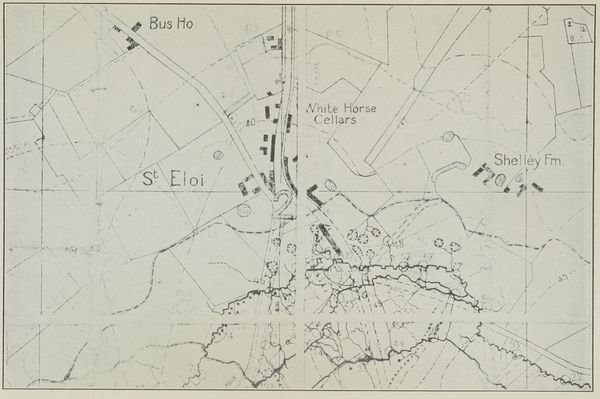
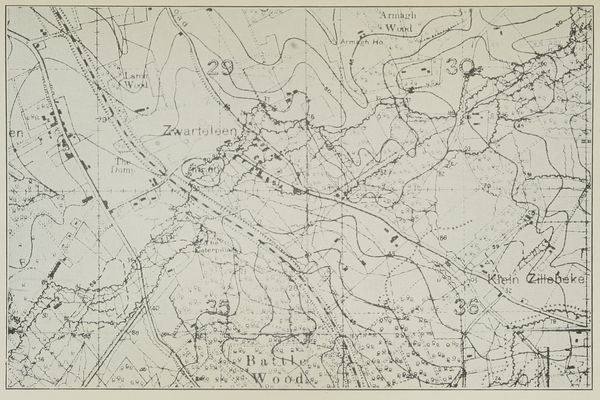
maps shown are exact reproductions of
front-line trench maps
made from airplane photographs. They have never before been published
in this country.
I am sorry I can not truthfully say that the early reports of German
atrocities, or the news of Belgium's wanton invasion impelled me to
fly to Canada to enlist and offer my life in the cause of humanity.
No, it was simply that I wanted to find out what a "regular war" was
like. It looked as though there was going to be a good scrap on and I
didn't want to miss it. I had been a conscientious student of the
"war-game" for a good many years and was anxious to get some real
first-hand information. I got what I was looking for, all right.
The preliminaries can be briefly summarized. The battalion mobilized
at Kingston, Ontario, October 19th, 1914, and spent the winter
training at that place. The training was of the general character
established by long custom but included more target practise and more
and longer route marches than usual. The two things we really learned
were how to march and how to shoot, both of
which
accomplishments stood us in good stead at a later date.
Leaving Kingston May 5th, 1915, we sailed from Montreal the following
morning on the Metagama, a splendid ship of about twelve thousand
tons. We had as company on board, several hospital units, including
about one hundred and fifty Nursing Sisters, all togged up in their
natty blue uniforms and wearing the two stars of First "Leftenant,"
which rank they hold. And, believe me, they deserve it, too. Of course
they were immediately nicknamed the "Bluebirds." Many's the man in
that crowd who has since had cause to bless those same bluebirds in
the hospitals of France and England.
We ran into ice at the mouth of the St. Lawrence and for two days were
constantly in sight of bergs. It was a beautiful spectacle but I'm
afraid we did not properly appreciate it. We remembered the Titanic.
Then we got word by wireless that the Lusitania had been torpedoed.
I think an effort was made to suppress this news but it soon ran
throughout
the ship. Personally, I did not believe it. I had
had plenty of experience of "soldier stories," which start from
nowhere and amount to nothing, and besides, I could not believe that
any nation that laid any claims to civilization would permit or commit
such an outrage. I began to believe it however when, next day, we
received orders to go down in the hold and get out all our guns and
mount them on deck. We had six guns; two more than the usual allotment
for a battalion; two having been presented to our Commanding Officer,
Lieutenant-Colonel (now Brigadier-General) W. St. Pierre Hughes, by
old associates in Canada, just a few days before our departure.
Two of the guns were mounted on the forward deck, two on the flying
bridge and two on the aft bridge. I'm not sure, to this day, just what
we expected to do against a submarine with those machine guns, but at
any rate they seemed to give an additional feeling of security to the
others on board and of course we machine gunners put up an awful bluff
to persuade them that we could sink any U-boat without the least
difficulty. Of one thing
we were sure. Being a troop ship we
could expect no mercy from an enemy and we were at least prepared to
make it hot for any of them who came fooling around within range
provided they came to the surface. I was with the forward guns and, as
we had several days of pretty rough weather, it was a wet job. Our
wireless was continually cracking and sputtering so I suppose the
skipper was getting his sailing orders from the Admiralty as we
changed direction several times a day. We had no convoying war-ships
and sighted but few boats, mostly Norwegian sailing vessels, until,
one night about nine o'clock, several dark slim shadows came slipping
up out of the blackness and established themselves in front, on both
flanks and behind us. We gunners had been warned by the captain to
look out for something of the kind, but I can assure any one who has
not been through the experience that the sigh of relief which went up
from those gun crews was sincere and deep. We were running without
lights, of course, and none but the crew was allowed on deck. The
destroyers (for such they were), were also
perfectly dark
and we could barely discern their outlines as they glided silently
along, accommodating their pace to ours.
Just before sunrise we dropped anchor inside Plymouth breakwater. This
was a surprise, as we had expected to land at Liverpool or Bristol.
But you may depend on it, no one made any complaint; any port in
England looked good to us. A few hours later we moved into the harbor
and tied up at Devonport Dock where we lay all day, unloading cargo.
Right next to us was a big transport just about to sail for the
Dardanelles. The Dublin Fusiliers were aboard her and they gave us a
cheer as we came in. Poor devils, they had a rough time of it down
there; but I guess by this time they think the same about us; so we'll
call it square.
It rained all day, but we finally got everything off the ship and on
the trains and pulled out about dark. No one knew where we were going.
The only training camp we had heard of in England was Salisbury Plain
and what we had heard of that place did not make any of us anxious to
see it.
The First Canadian Division had been there and the
reports they sent home were anything but encouraging. Our men were
nearly all native-born Canadians and "Yankees," and they cracked many
a joke about the little English "carriages," but they soon learned to
respect the pulling power of the engines. We made ourselves as
comfortable as possible with eight in a compartment, each man with his
full kit, and soon after daylight the train stopped and we were told
to get out. The name of the station was Westerhanger but that did not
tell us anything. The native Britishers we had in our crowd were
mostly from "north of the Tweed" so what could they be expected to
know about Kent. For Kent it was, sure enough, and after a march of
some two or three miles we found ourselves "at home" in West Sandling
Camp. And how proudly we marched up the long hill and past the Brigade
Headquarters, our pipers skirling their heartiest and the drummers
beating as never before. For we were on exhibition and we knew it. The
roads were lined with soldiers and they cheered and cheered as we came
marching
in. We were tired, our loads were heavy and the mud
was deep, but never a man in that column would have traded his place
for the most luxurious comforts at home.
There came a time when we hated that hill and that camp as the devil
hates holy water, but that Sunday morning, marching into a British
camp, with British soldiers, eager to keep right on across the channel
and clean up Kaiser Bill and feeling as though we were able to do it,
single-handed--why, the meanest private in the Twenty-first Canadians
considered himself just a little bit better than any one else on
earth.
Thus we came to our home in England, where we worked and sweated and
swore for four solid months before we were considered fit to take our
place in the firing-line. All that time, from the top of Tolsford
Hill, just at the edge of our camp, we could see France, "the promised
land"; we could hear the big guns nearly every night, and we, in our
ignorance, could not understand why we were not allowed to go over and
settle the whole business. We marched all over Southern England. I
know I have slept under every hedge-row in Kent. We dug
trenches one day and filled them up the next. We made bombs and
learned to throw them. We mastered every kind of signaling from
semaphore to wireless, and we nearly wore out the old Roman stone
roads hiking all the way from Hythe to Canterbury. We carried those
old Colt guns and heavy tripods far enough to have taken us to Bagdad
and back.
But, oh, man! what a tough lot of soldiers it made of us. Without just
that seasoning we would never have been able to make even the first
two days' marches when we finally did go across. The weaklings fell by
the wayside and were replaced until, when the "great day" came and we
embarked for France, I verily believe that that battalion, and
especially the "Emma Gees," was about the toughest lot of soldiers who
ever went to war.
(Emma Gee is signaler's lingo for M. G., meaning machine gunner.)
It must not be inferred that our four months in England were all work
and worry. Personally, I derived
great pleasure from them.
We were right in the midst of a lot of old and interesting places
which figure largely in the early history of England. Within a mile of
our camp was Saltwood Castle, built in 499 by the Romans and enlarged
by the Normans. It was here that the conspirators met to plan the
assassination of Thomas à Becket at Canterbury, only sixteen miles
away, and which we had ample opportunities to visit. Hythe, one of the
ancient "Cinque Ports," was but a mile or so distant, with its old
church dating from the time of Ethelbert, King of Kent. In its crypt
are the bones of several hundred persons which have been there since
the time of the Crusaders, and in the church, proper, are arms and
armor of some of the old timers who went on those same Crusades. Among
numerous tablets on the walls is one "To the memory of Captain Robert
Furnis, Commanding H. M. S. Queen Charlotte: killed at the Battle of
Lake Erie: 1813"--Perry's victory. About three miles away was "Monk's
Horton, Horton Park and Horton Priory," the latter church dating from
the twelfth
century and remaining just about as it was when
it was built. Then there was Lympne Castle, another Roman stronghold;
Cæsar's Plain and Cæsar's Camp, where Julius is said to have spent
some time on his memorable expedition to England; and, within easy
reach by bicycle, Hastings and Battle Abbey where William the Norman
defeated Harold and conquered England. The very roads over which we
marched were, many of them, built by the Romans. Every little town and
hamlet through which we passed has a history running back for hundreds
of years. We took our noon rest one day in the yard of the famous
"Chequers Inn," on the road to Canterbury. We camped one night in
Hatch Park, where the deer scampered about in great droves. On Sundays
we could charter one of the big "rubber-neck" autos and make the round
trip to Margate, Ramsgate, Broadstairs, Deal and Dover.
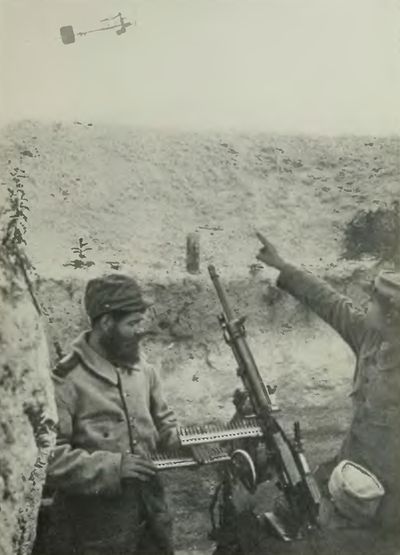
Photo by Western Newspaper Union
French Hotchkiss Gun Firing at Aeroplane
But, just the same, when we were told, positively, that we were going
to leave, there were no tears shed. We had gone over there to fight
and nothing else would satisfy us.
The Machine Gun Section, having its own transport, traveled via
Southampton, as there were better facilities for loading horses and
wagons there than at the ports from which the remainder of the troops
embarked. After we had everything aboard ship it was an even bet among
the crowd as to whether we were going to France, the Dardanelles or
Mesopotamia. There were other ships there, loading just as we were,
some of which were known to be destined for the eastern theater; so
how could we know? As a matter of fact, our officers did not know any
more about it than the men.
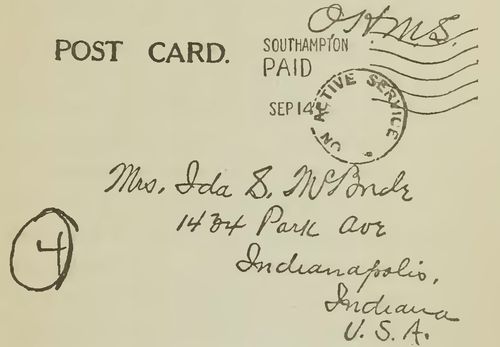
On the dock I discovered a box containing blank post-cards given out
by "The Missions to Seamen." I wrote one to my mother and stuck it in
a mail-box, on the chance that it might go through. I had no stamps
and didn't really expect it to be taken up, but some one
"with a heart" inscribed on it "O. H. M. S.," and, sure enough, On His
Majesty's Service it went, straight to Indianapolis.
After having everything nicely stowed in the hold, Sandy McNab and I
had to go down and dig out a couple of guns to mount on deck. It
required quite a lot of acrobatic stunts to get down in the first
place and then to get the guns and ammunition up, but we managed to
finish the job just before dark and got the guns mounted, mine on the
starboard and Sandy's on the port side, before we steamed out. It was
a black drizzly night
and the cold wind cut like a knife,
but we "stood to" until dawn, expecting anything or nothing. After an
hour or so we didn't care much what happened.
Everything was dark, not a light showing aboard ship or elsewhere
until, about midnight, I saw a glow on the horizon, nearly dead ahead.
As the ship's lookouts said nothing, I did likewise, but I assure you
I was mightily puzzled. I knew we could not be near enough to shore to
see a lighthouse and, anyway, there was too much light for any
ordinary shore signal. I finally concluded that it must be a ship
burning and wondered what we would do about it, but the thing
gradually took on the appearance of a gigantic Christmas tree and then
I felt sure that I was going "plumb nutty." I sneaked over to McNab's
side and found him in about the same frame of mind. We were both too
proud to ask questions, so we simply stood there and watched--what do
you suppose?--a hospital ship! lighted from water line to truck with
hundreds of electric lights; strings of them running from mast-head to
mast-head and
dozens along the sides, fitted with reflectors
to throw the light down so as to show the broad green stripe which is
prescribed by the Geneva Convention. Then we both laughed. Little did
we think then that we would both be coming back to "Blighty" on just
such a ship; Sandy within a few weeks and I more than a year later.
Before daylight we picked up a string of beacons, red and white, and
dropped anchor. As soon as it was light we could see the harbor of Le
Havre. I had been there before and recognized it quickly enough. Then
we knew that France was our destination.
After waiting for the proper stage of the tide, the anchor was
weighed, and with a lot of fussy little tugs buzzing about, now
pushing at one end and then scurrying around to give a pull at the
other, we finally tied up to the dock at our appointed place and
prepared to disembark. The docks were thronged with men, mostly in
some sort of uniform and all busy. Many of the French soldiers were
wearing the old uniforms of blue and red, while others were clothed in
corduroy. The new
"horizon blue" had not yet been adopted.
There were many English soldiers, mostly elderly men of the so-called
"Navvie's Battalions," but among all the others, was quite a number
whose uniform was the subject for much speculation until some one
happened to notice that they were always working in groups and were,
invariably, accompanied by a poilu carrying a rifle with bayonet
fixed. It was our first sight of German prisoners and it gave us a
genuine thrill. The war was coming closer to us every minute.
Disembarking was nothing more than common, every-day, hard labor,
relieved, occasionally, by the antics of some of the horses that did
not want to go down the steep narrow gangway. It was the devil's own
job to get them aboard in the first place and equally difficult to
persuade them to go ashore. Such perversity, I have noticed, is not
confined to horses: the average soldier can give exhibitions of it
that would shame the wildest mustang.
We had been living, since leaving Sandling, on "bully beef" and
biscuits, but here on the dock we found
one of those
wonderful little coffee canteens, maintained and operated by one of
the many thousands of noble English women who, from the beginning of
the war, have managed, God knows how, always to be at the right place
at the right time, to cheer the soldier on his way; working,
apparently, night and day, to hand out a cup of hot coffee or tea or
chocolate to any tired and dirty Tommy who happened to come along. If
you have any money, you pay a penny; if you are broke, it doesn't make
the least bit of difference; you get your coffee just the same, and
the smile that always accompanies the service is as cheerful and
genuine in the one case as in the other. Many women of the oldest and
most aristocratic families of England have given, and are still
giving, not only their money but their personal labor to this work;
making sandwiches, boiling tea, yes, and washing the dishes, too, day
after day and month after month. You do not often hear of them; they
are too busy to advertise. But Tommy knows and I venture the assertion
that no single sentence or "slogan" has been as often used among
the soldiers in France as "God bless the women."
So we finally got everything off, wagons loaded and teams hitched up,
and about mid-afternoon made our way through the quaint old city to a
"rest camp" on the outskirts where we had time to wash and shave and
eat another biscuit before we received orders that we were to march,
at midnight, and entrain at Station No.--. It commenced to rain about
this time and never let up until we had entrained the next morning.
That was a night of horrors. Sloshing through the mud, over unknown
roads and streets, soaked to the skin. Oh! well, it was a very good
initiation for what was to follow, all right, all right.
Polite language is not adequate to describe the loading of our train:
getting all the wagons on the dinky little flat-cars and the horses
aboard. The horses fared better than the men for, while they were only
eight to a car, we were forty or more; and in the same kind of cars,
too. They look like our ordinary cattle cars but are only about
one-half as big. Forty men, with full equipment, have
some
difficulty to crowd into one, let alone to sit or lie down. And, of
course, everything we had was soaked through. When I come to think of
it, the strangest thing about the whole business was that there were
no genuine complaints. The usual "grousing," of course, without which
no soldier could remain healthy, but I never heard a word that could
have been taken to indicate that any one was really unhappy. While we
were loading, our cooks had managed to make up a good lot of hot tea
and that helped some. We also got an issue of cheese and more bully
and biscuits and, after filling up on these, everybody joined in a
"sing-song" which continued for hours.
This subject of soldier's songs would make an interesting study for a
psychologist. Not being versed in this science I can only note some of
the peculiarities which impressed me from time to time.
The first thing that one notices is the fact that the so-called
soldier's songs, written by our multitudinous army of "popular"
song-smiths to catch the
fleeting-fancy of the patriotically
aroused populace, are conspicuous by their absence. No matter how
great a popularity they may achieve among the home-folk and even the
embryo soldiers, during the early days of their training, they seldom
survive long enough to become popular with the soldiers in the field.
When in training, far away from the field of battle, soldiers appear
very fond of all the "Go get the Kaiser" and "On to Berlin" stuff and
are not at all averse to complimenting themselves on their heroism and
invincibility, with specific declarations of what they are going to
do. Sort of "Oh, what a brave boy I am," you know. But as they come
closer to the real business of war, while their enthusiasm and
determination may be not a whit less, they become more reserved and
less prone to self-advertisements; so, as they must sing something,
they fall back on the old-timers, such as Annie Laurie or My Old
Kentucky Home when they feel particularly sentimental, and for
marching songs, any nonsensical music-hall jingle with a "swing" to it
will serve.
Our
crowd was what might be called "a regular singing bunch"
and had a large and varied repertoire, including everything from
religious hymns to many of that class of peculiar soldier's songs
which although vividly expressive and appropriate to the occasion are,
unfortunately, not for publication. Among the most popular were The
Tulip and the Rose, Michigan and There's a Long, Long Trail
Awinding, together with several local compositions set to such airs
as John Brown's Body and British Grenadiers. You might hear
Onward, Christian Soldier sandwiched between some of the worst of
the "bad ones" or Calvary followed by The Buccaneers. You never
heard that last one, and never will, unless you "go for a soldier."
I've heard men singing doleful songs, such as I Want to Go Home,
when everything was bright and cheerful with no sign of war, and I
have heard them, in the midst of the most deadly combat, shouting one
of Harry Lauder's favorites, as I Love a Lassie. I once saw a long
line "going over the top" in the gray of the morning, and when
they had got lined up, outside the wire, and started on their
plodding journey which is the "charge" of now-a-days, one waved to his
neighbor who happened to be on a slight ridge above him and sang out:
"You tak the High Road an' I'll tak the Low Road." And immediately the
song spread up and down the line; even above the tremendous roar of
the guns you could hear that battalion going into action to the tune
of Loch Lomond.
So, you see, there is a difference between "songs about soldiers" and
"soldier's songs," the latter being the ones he sings because they
appeal to his fancy and the former including the long and constantly
growing list of cheaply-sentimental airs intended for home
consumption. The difference between the two classes is as great as
that between war as it really is and war as the people at home think
it is. This is a difference which will never be understood by any
excepting those who have been over there. Those so unfortunate as to
be unable to learn it at first hand will be forever ignorant of the
real meaning of war. There
is no language which can
adequately describe it; no artist can paint it; no imagination can
conceive it. It is just short of the knowledge of one who has died and
returned to life. So, by all means, let us have songs if they serve to
cheer or amuse any one, whether at home or abroad.
It will probably do the soldier no harm to have people think he is a
"little tin god on wheels" any more than it will hurt him to be
belittled by the sickly mollycoddling name of "Sammie," no matter how
deeply he resents it. It is astonishing to me that our newspapers
persist in the use of this appellation in the face of the fact, which
they should know, that it is obnoxious to the American soldier
himself. Would they call a Canadian or Australian or Scotch soldier a
"Tommy"? If they do, I advise them to hide out and do it by telephone.
Such sobriquets, to be of any real value, must come spontaneously;
perhaps by accident; possibly conferred by an enemy. They can never be
"invented."
But, to get back to our story. This country through
which we
passed is an historical pageant,--from the very port of Harfleur,
which figures largely in the stories of both Norman and English
invasion, all the way up the valley of the Seine. Who could see Rouen,
for the first time, without experiencing a thrill of sentiment as the
memories of Jeanne d'Arc, Rollo the Norman, Duke William, Harold and
many others come forth from their hiding-places in the back of one's
brain? Although we passed through without a stop, we could see the
wonderful cathedral and the hospice on the hill and, crossing the
river, we had a fleeting glimpse of the delightful little village of
St. Adrien, with its curious church, cut out of the face of the chalk
cliff; where the maidens come to pray the good Saint Bonaventure to
send them a husband within the year.
On, past the field of Crécy, across the Somme which was to us only a
name at that time but to become "an experience" at a later date, we
made our slow progress across northern France. At a certain junction
we were joined by the rest of the battalion which had traveled from
England by a different and shorter route.
In
the early hours of the morning we came to our stopping
place, St. Omer, which was then the headquarters of the British
Expeditionary Force in France. We did not tarry, however, but before
daylight were on the march--eastward. We stopped for a couple of
hours, near some little town, long enough to make tea, and then went
on again. This was the hardest day we had had. Every one was
overloaded, as a new soldier always is, and, moreover, our packs and
clothing had not dried and we were carrying forty or fifty pounds of
water in addition to the regulation sixty-one-pound equipment. Then,
too, the roads were of the kind called pavé; that is, paved with
what we know as cobble-stones or Belgian blocks. On the smooth stone
or macadamized roads of England we would not have minded it so much,
but this kind of going was new to us: ankles were continually turning,
our iron-shod soles eternally slipping on the knobbed surface of the
cobbles and, take it all in all, I consider it the hardest march I
have ever done, and I have made forty-eight miles in one day over the
snow in the Northwest, too.
About
dark we were halted at a farm and told that we were to
go into bivouac and would probably remain there for a week or more.
Now, one characteristic of the good machine gunner is that he is
always about two jumps ahead of the other fellow, so, there being a
big barn with lots of clean straw in it, we just naturally took
possession while the rest of the troops were patiently waiting for the
Quartermaster to assign them to billets. Of course we had a fight on
our hands a little later but, by a compromise which let the signalers
and scouts come in with us, we were enabled to hang on to the best
part of the place. From names inscribed on the beams we learned that
the Princess Pat's had once occupied the same place, and from the
people who lived there we heard tales of how the Germans had carried
off all their stock when they made their first great advance. All this
was the next day, however, as we were too tired even to eat that
night; we simply dropped on the straw and slept.
Next morning was bright and fair and everybody got busy, drying kits,
overhauling and cleaning the
guns and ammunition and fixing
up our quarters for the promised week's rest. About four o'clock in
the afternoon we were ordered to form up and march to a place about
two miles distant, where, we were told, General Alderson,
Commander-in-Chief of the Canadians, was to give us a little talk.
We arrived at the appointed place ahead of time, and while we were
lying about waiting we had our first glimpse of real war. It was a
long way off and high up in the air but it was a thrilling sight for
us. A couple of German airplanes were being shelled by some of our
anti-aircraft guns, and as we watched the numerous shell-bursts,
apparently close to the planes, we expected, every moment, to see the
flyers come tumbling down. However, none was hit and they went on
their way. It was only later we learned that it is the rarest thing in
the world for an airplane to be brought down by guns from the ground.
I suppose I have seen several hundred thousand shots fired at them and
have yet to see one hit by a shell from an "Archie" and only
one by machine-gun fire from the ground. The majority of planes
destroyed are shot down by machine guns in combat with other flyers.
When the General finally came, he looked us over and told us what a
fine body of troops we appeared to be, and just for that, he was going
to let us go right into the front line, instead of putting us through
the usual preliminary stages in reserve and support. Of course we felt
properly "swelled up" about it and considered it a great compliment.
We did not know, what we now know, that they were about to start the
big offensive which is known as the Battle of Loos and that the
British had not enough troops in France to be able to afford such
luxuries as reserves. It was a case of everybody get in and "get your
feet wet."
As we were to march at daybreak, we had a busy night getting our
scattered belongings together and repacked. This was our first
experience of what shortly became a common occurrence and we soon
learned that, in the field, a soldier never knows one day where he
will be the next, and
thus he is always "expecting the
unexpected."
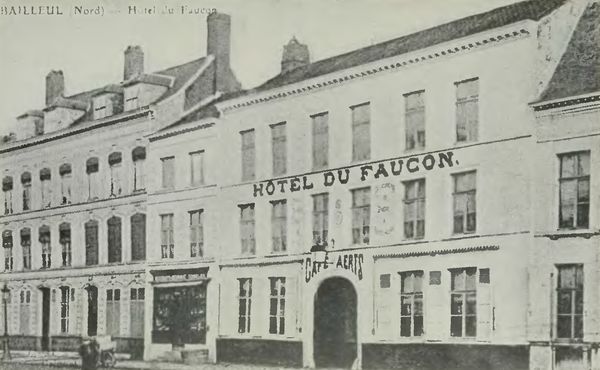
Hotel Du Faucon
We moved out at dawn and had another heart-breaking march as the
weather had turned very warm. Through Hazebrouck and numerous small
towns we continued our eastward way to Bailleul, stopping there for an
hour's rest. Our section happened to be right in the market square so
had a good opportunity to see some of the principal points of interest
in this famous and ancient city. The Hotel de Ville with its curious
weather-vane of twelfth-century vintage and the Hotel Fauçon
particularly interested me: the former because I had read of it and
the latter because it had real beer on ice. This is the place which
Bairnsfather speaks of as the hotel at which one could live and go to
war every day and I afterward did that very thing, for one day;
leaving the front-line trenches in the morning, having a good dinner
at the Fauçon and being back in the front line at night. That happened
to be Thanksgiving Day; November 25, 1915.
After our rest we continued on our way and arrived
at the
little town of Dranoutre, in Flanders, about five o'clock in the
evening and went into bivouac. On this day's march we saw more
evidence of war. Here and there a grave beside the road; occasionally
a house that showed the effect of shell or rifle fire and, almost
continually, firing at airplanes, both Allied and German.
At our camp we found detachments of the East Kents (The Buffs), and
the Second East Surrey Regiment, from whom we were to take over a
sector of the line. They said that it was comparatively quiet at that
point but had been pretty rough a few months earlier.
The Machine Gun Section went in the next morning, two days ahead of
the infantry, and the East Surreys remained during the two days to
show us the ropes. They were a splendid lot of soldiers and I am sorry
to say that when they left us it was to go to Loos, where they were
badly cut up at the Hohenzollern redoubt. We never connected up with
them again.
It was a bright warm Sunday morning, that nineteenth day of September,
when we made our first trip to the front-line trenches. Only the
Number Ones, lance corporals, of each gun went in ahead, the guns and
remainder of the section to come up after dark. I was a "lance-jack"
at that time, in charge of No. 6 gun; and had a crew of the youngest
boys in the section, two of whom were under seventeen when they
enlisted and not one of whom was twenty at that time. Subsequent
events proved them to be the equals of any in the whole section; a
section of which a general officer afterward wrote: "I consider it the
best in France." They were strong and healthy, keen observers, always
ready for any duty and during all the time I was with them I never saw
one of them weaken. They played the game right up to the finish, in
fair weather and
foul, during the easy times and the
"rough," each until his appointed time came to "go West." One, in
particular, named Bouchard, a boy who enlisted when but sixteen,
developed into the brightest and most efficient machine gunner I have
ever known. His zeal and eagerness to learn so impressed me that it
became my greatest pleasure to give him all the assistance in my
power, and, despite the difference in our ages, there grew up between
us such a friendship as can only be achieved between kindred spirits
sharing the vicissitudes of war. Small of stature and slight of frame,
it was only by sheer grit and determination that he was able to endure
the terrible strain of that first winter. At times, when the mud was
nearly waist deep, he would throw away his overcoat, blanket and other
personal effects, but never would he give up his beloved gun. When
trenches were absolutely impassable he would climb up on top, scorning
bullets and shells, intent on the one job in hand--to get to his
appointed station without delay. He was a constant source of
inspiration to all of us, often inciting the older heads to
undertake and achieve the apparently impossible by daring them to
follow his lead.
Our sector was made up of what were then known as the "C" trenches,
running north from the Neuve Eglise-Messines road and directly between
Wulverghem and Messines. To the south of the road was the Douve River
and just beyond that "Plugstreet" (Ploegstert). There had been some
very hard fighting all along the Messines Ridge during the preceding
year, but for several months things had been quiet. Now, by "quiet" I
do not mean that there was any cessation of hostilities for there is
always artillery firing and sniping going on, with a fair amount of
rifle grenade and trench-mortar activity. It simply means that there
is no attempt being made, by either side, to attack in force and to
capture and hold captured ground.
Our route, that first morning, was rather a roundabout one, by way of
Lindhoek, taken, as explained by our guide, because it was less
exposed to enemy observation than a much shorter road which we used
when moving at night. When a
short distance out from town,
we passed in front of one of our howitzer batteries which decided that
then was just the proper time to cut loose with a salvo, right over
our heads. We were not more than fifty yards from the guns and the
result was that we were all "scared stiff," to say nothing of being
almost deafened. This appears to be a characteristic and never-ending
joke with artillerymen and so we soon learned to "spot" their
emplacements and go behind them, when possible.
At all cross-roads ("Kruisstraat," in Flemish), sentries were
stationed who acted as guides and also gave warning of the approach of
enemy aircraft. At a long blast of the whistle every person was
supposed to stop and not make a move until the signal "all clear,"
indicated by two blasts, was given. It appears that, while the airmen
have no difficulty in seeing moving objects on the ground it is next
to impossible for them to locate stationary ones.
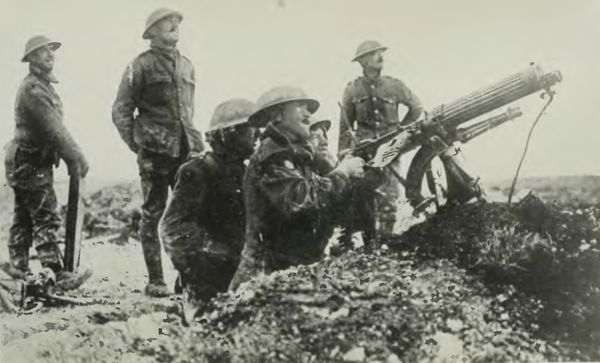
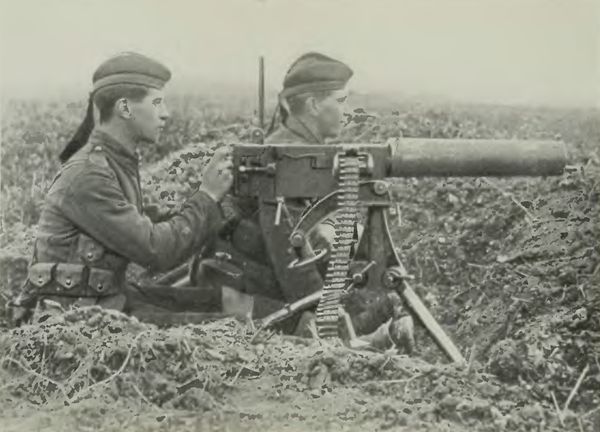
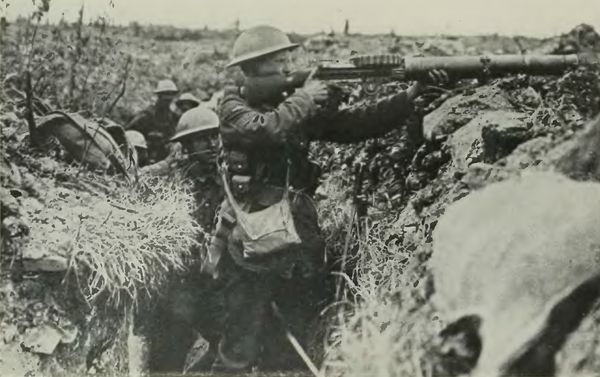
Light Vickers Gun in Action Against Aircraft.
As we progressed, the signs of war were multiplied. Numerous graves
along the road, each marked
by a cross, houses and barns
torn by shells, a bridge and railroad track blown up and trees
shattered and rent, until, finally, everything was desolation. When we
arrived at Wulverghem, we had our first sight of a really "ruined"
town. Of course we saw many worse ones later, but at that time, we
could not conceive more complete destruction than had been wrought
here by the German shells. Every building had been hit, perhaps
several times; some had one or more walls standing, while many were
totally destroyed and were nothing but piles of broken brick and
mortar. Part of the church tower remained and one hand of the clock
still hung to the side facing the German lines. This seemed to
aggravate the boche as, every day, he would send from a dozen to forty
or fifty shells over, all seemingly directed at the church tower.
As Messines Ridge is now "ours" I think there can be no objection to
my going into details about our dispositions. Our Battalion
Headquarters was located in the St. Quentin Cabaret, about two hundred
yards south of Wulverghem and we had
a supporting gun, with
infantry, at Souvenir Farm and also at a redoubt near by, called
"S-5." Our front-line guns were distributed from the Neuve Eglise road
to the northern end of our battalion frontage, about "C-3."
These numbers refer to certain locations on the map, and the cabarets
are not exactly such as one is accustomed to seeing in American
cities. They are, or were, inns, such as in England would be called
public houses and in America, road houses. In Flemish they are
herbergs, but these happened to bear French names, hence were called
cabarets. One can not help wondering at the indiscriminate manner in
which French and Flemish names are used in this corner of the world.
Neuve Eglise, Bailleul, Dranoutre and Locre are all mixed up with
Wolverghem, Ploegstert, Wytschaete and Lindhoek: Ypres and Dickebusch
are neighbors; while St. Julian and Langemarck lie side by side, as do
Groot Vierstraat and LaClytte. Look at a map of West Flanders and the
adjoining parts of France and you will see what I mean.
Just
as we arrived at the Battalion Headquarters the signal
was sounded, "German up," which is the short way of saying that an
enemy airplane is approaching, so we were obliged to take cover and
remain quiet for some time. We were near a group of farm buildings
and, going inside, found that former occupants had left elaborate
records of their visits. Among other mural decorations were some rough
sketches drawn by Captain Bairnsfather, which afterward became famous
as "Fragments from France."
This suggests another interesting field for speculation. Why is it
that all men, regardless of race, creed or color, have an inborn
craving to inscribe their names on walls and trees and rocks,
especially on walls other than those of their own home? Wherever you
go, all over the world, you will find the carved or written record
stating that, at such and such a date, John Doe, of Oskaloosa, Iowa,
honored the place with his presence. The buildings of Flanders and
France are storehouses of historical records. From them the historian
could almost reconstruct the campaigns
of the war. Would it
not be an interesting task to make a thorough search of all the old
buildings and dug-outs, just as the archeologists have been doing in
Egypt and all the ancient habitations of mankind? The prehistoric
caves of Spain or the cliff dwellings of the Colorado could not be
more interesting than a compilation of these records, including the
drawings and sketches, some of which are real works of art. Regimental
crests and badges are often shown with the utmost attention to detail
and, in one place which we afterward occupied, one of the walls bore
an elaborately carved tablet enumerating the campaigns and battles of
one of the oldest British line regiments, together with a list of the
honors, V. C's. and so on, won by members thereof. On one of the walls
at Captain's Post one of my boys, Charlie Wendt, carved a large maple
leaf upon which he inscribed the names of all our squad. He was killed
a few days later and others at various times and of that whole list, I
am the sole survivor. I would give a great deal to have that bit of
wall here in my own home.
Meantime,
the Allemand has gone away and we are free to
continue our journey to the front line.
In an orchard behind the house we entered a communication trench and
after a few final words of advice from the guide as to the necessity
of keeping our heads down wherever the walls were low, started on the
mile-long trip. We learned that the trench by which we were going in
was named Surrey Lane, in honor of the West Surreys who constructed
it. At various points we came upon intersecting trenches, most of
which were marked with the name of the point to which they led. One, I
remember, was "Wipers Road"; not that it ran all the way to Ypres but
led in the direction of that place.
Except for an occasional large shell, whispering overhead, consigned
from Kemmel to Warneton or vice versa, and the distant muttering of
the French guns away to the south, everything was quiet and peaceful,
and had it not been for the ruined buildings and torn-up roads it
would have been difficult to imagine that we were in the midst of a
battle-field.
Passing through all the maze of cross trenches, we
finally
reached the front line which we found to be what we afterward called a
"half-and-half" trench; that is, it was dug down to a depth of perhaps
four feet and built up about the same with sand-bags, making it
possibly eight feet from the bottom of trench to top of parapet. It
was quite dry and clean and comfortable and proved that the Buffs and
Surreys had not been loafing during the summer. I'm afraid we did not
properly appreciate it at that time, but as I look back over all the
time that has passed since, I am compelled to admit that it was the
finest bit of trench we ever occupied.
We had no more than arrived in the line than the cook of the first gun
crew we struck brought out a "dixie" of tea and an unlimited supply of
bread and butter and jam and invited us to fill up. ("Dixie" is the
soldier's name for the camp kettle used in the British army.) Now if
you have been paying attention to the story of our movements since
leaving England, I think you can readily imagine that we were hungry.
These soldiers had been out, some of them, since the
beginning of the war and had become inured to all the hardships which
are a necessary part of the game, and, splendid fellows that they
were, the first thing they thought of was our comfort. From that time
on I never met up with any body of British Imperial soldiers who did
not show this same consideration and solicitude for the stranger. And
they do it so unostentatiously and naturally that they challenge the
admiration of all, especially of Colonials such as we, who were, I
fear, very apt to forget the little niceties of manner which are
inbred in the native Briton. While we afterward became the best of
friends there was never any danger of our becoming "alike." We
secretly admired their perfect and unalterable observance of all
orders even though we were, at the same time, scheming to evade a lot
of those same restrictions which appeared to us to be unnecessary.
They, on their part, could not help admitting that the dash and
"devil-may-care" spirit shown by our men often accomplished results
not otherwise attainable but from the emulation of which they were
barred by "traditions." The
discipline of the one and the
discipline of the other are based on two entirely different modes of
life; the former carefully trained to rely on and obey implicitly the
orders of any superior officer, while the latter looks only for
initial direction, depending upon his own initiative and ingenuity to
see him through any trouble that might arise.
From this line we could see the whole valley which separated us from
the famous Messines Ridge. The enemy was firmly established on its
crest, with his advance lines in the valley and even, at some places,
on the sides of the slope below us. The town of Messines, directly
opposite, was in plain sight but nearly a mile away, the church and
hospice, or infirmary, being conspicuous landmarks on the sky-line.
Our front lines were from about one hundred and fifty to three hundred
yards apart. Numerous ruined farms and cabarets were scattered along
the line, sometimes in our territory and sometimes belonging to the
enemy. These were, as a rule, converted into
redoubts or
"strong-points," and defended by both infantry and machine guns. To
the northward, within the German lines, was the town of Wytschaete,
while we had Mont Kemmel, a prominent hill which gave our artillery
good observation all the way from Ypres to "Plugstreet."
Several of the prominent roads within the German lines were in plain
sight from our position and, while the artillery devoted considerable
attention to harassing the enemy, we were not sufficiently supplied
with ammunition at that time to strafe them as was desirable. This was
especially true of several "dumps," which is the colloquial word
designating the points where the wagons and motor transports deposit
ammunition, food and other trench stores and whence they are carried
up to the front line by the men. Thus an ammunition dump means a point
where ammunition is stored, while a ration dump is a place where the
ration carrying parties repair at night to procure the rations for
the following day. At some points the field cookers or
"rolling kitchens" come up at night and the cooked food is carried
from there to the front. One such place at Messines, we called
"Cooker's Halt."
The machine gun officer of the outgoing Surreys had begun to develop
some ideas of his own as to the feasibility of strafing enemy
transports and dumps at night and had selected a tentative position
behind a slight crest, about one hundred and fifty yards N. E. of "In
den Kraatenberg Cabaret" and immediately adjacent to a disused
communication trench called "Plum Avenue." Now I had been a crank on
long range, indirect fire in England, so I had no difficulty in
persuading our M. G. officer to turn this job over to me. We improved
the position and also established another one, about one hundred yards
down the trench for daylight work against aircraft. In those days the
planes would come over at altitudes of two thousand feet and less and
we had some splendid opportunities to practise on them. We succeeded
in bringing one down with his petrol tank
on fire, and we
turned back a good many more until they began to fly so high that we
could not reach them. At night, by using information obtained from our
artillery and our own forward observers, we were able to cut up a lot
of their transports. At first they would drive down to a place called
the Barricade, but after we caught them there two or three times they
came only to the top of the hill, to "Cooker's Halt." We soon chased
them out of that, however, and then I guess poor Fritz had to carry
his stuff all the way from behind the Ridge. On two occasions we
caught large working parties, in broad daylight, and cut them up and
dispersed them. Our position in front of the group of buildings (In
den Kraatenberg) naturally led the enemy to believe that we were using
the building for cover, so he shelled the poor inoffensive houses and
barns most industriously but never put anything close enough to our
real position to do any damage. This taught me a lesson which I put
into operation, later on, at Sniper's Barn, with the best of results.
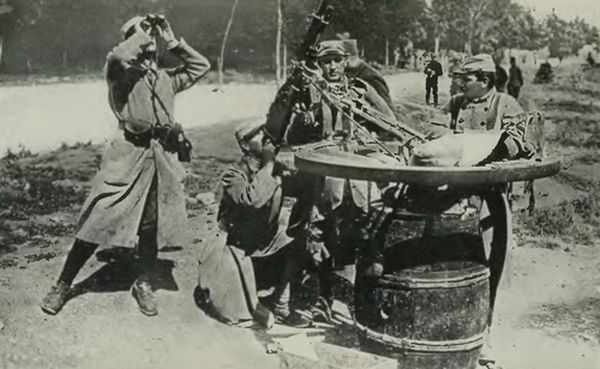
French Using an Ordinary Wine Barrel on which a Wagon
Wheel Is Mounted to Facilitate the Revolving Movement to Any Desired
Direction.
From
that time on, strafing was an important part of machine
gunnery until, now, together with barrage fire, it comprises about all
there is to machine-gun work, proper, for the automatic rifle has
taken over the greater part of the front-line offensive work.
As the subject of machine guns is one of great interest at this time,
it may not be amiss to devote a little space to explaining some of the
salient features of the most commonly used types.
All automatic arms are divided into classes, as determined by the
following characteristics:
1st. Method of applying the power necessary to operate: (gas or
recoil).
2nd. Method of supplying ammunition: (belt, magazine or clip).
3rd. Method of cooling: (water or air).
Another well-defined distinction is made between the true machine gun
and the automatic rifle; the former being so heavy that it must be
mounted on a substantial tripod or other base, while the latter is so
light that it may be carried and operated by a single man. Of the
former class,
the Colt, (35 lbs.), the Vickers, (38 lbs.)
and the Maxim, (63 lbs.) may be taken as representative. They are all
mounted, for field work, on tripods weighing fifty pounds or more. In
the latter class, the Lewis, Benet-Mercie, and Hotchkiss, running from
17 to 25 lbs., are fair examples. They are all equipped with light,
skeleton "legs" or tripods, which, by the way, are never used in the
field although they are still considered essential for training
purposes.
In the gas-operated arms, a small hole is drilled in the under side of
the barrel, six to eight inches from the muzzle, so that, when the
bullet has passed this point, and during the time it takes it to
traverse the remaining few inches to the muzzle, a certain portion of
the enclosed gas is forced through this hole, where it is "trapped,"
in a small "gas-chamber" and its force directed against a piston or
lever which, being connected with the necessary working parts of the
gun by cams, links or ratchets, performs the functions of removing and
ejecting the empty cartridge case, withdrawing a new cartridge from
the belt,
clip or magazine, and "cocking" the gun: that is,
forcing the "hammer" or striker back and compressing its spring. As
the pressure generated in the barrel by our ammunition is not less
than 50,000 lbs. to the square inch, very little gas is required to do
all this. There must also be sufficient force to compress or coil a
strong spring or springs called "main-springs" or retracting springs
which, in their turn, force the mechanism forward to its original
position, seating the new cartridge in the chamber and releasing the
striker, thus firing another shot. This action continues as long as
the "trigger" is kept pressed or until the belt or magazine is
emptied. The Colt, Benet-Mercie, Hotchkiss and Lewis are in this
class. They are all of the air-cooled type.
In the recoil operated guns, the barrel itself is forced to the rear
by the "kick," as we commonly call it, and the force applied directly
to the working parts, thus performing the same operations above
described. The Maxim, Vickers, Vickers-Maxim and Maxim-Nordenfeldt
belong to this class. They are all water-cooled, having a water-jacket
of
sheet metal entirely surrounding the barrel.
All the last-mentioned class, and also the Colt, have the ammunition
loaded in belts containing two hundred and fifty rounds each. The
Hotchkiss and Benet-Mercie use clips of from twenty to thirty rounds,
while the Lewis is fed from a round, flat, pan-shaped magazine holding
forty-seven rounds. (For aircraft guns these magazines are made
larger; about double this capacity, I think.)
During the early part of the war, before the advent of the Lewis and
other automatic rifles, the only machine guns in general use were of
the heavy, tripod-mounted type and it was necessary for them to
advance with or even ahead of attacking troops. As the guns and
tripods were very conspicuous objects they naturally became the
especial targets for enemy riflemen and snipers and the casualties
among machine gunners ran far above the average for other troops. It
was this that caused the Emma Gee sections to be named Suicide Clubs.
Now,
however, the Lewis gun, being light and inconspicuous,
can be carried by advancing troops and used effectively in the attack
without its operators suffering excessively, and at the same time it
has been demonstrated that the true machine gun, of the heavier type,
mounted on its firm base, can effectively cooperate with the artillery
in maintaining protective or other barrages and in delivering
harassing fire upon the enemy at points behind his front line. As this
fire is, necessarily, over the heads of our own troops, sometimes but
a few feet over them, it must be extremely accurate and dependable and
it has been proved that guns of the lighter, automatic-rifle type, can
not be safely used for this purpose, even when mounted on the heavy
tripods of the other guns. This is probably due to the excessive
vibration of the lighter barrels.
For the benefit of any who are not familiar with the word, I might
say, in passing, that "barrage" is a French word meaning a "barrier"
or a "dam" and when used in a military sense it means a veritable
barrier or wall of fire, where the shells
or bullets, or
both, are falling so thickly as to make it impossible for any body of
troops to go through without suffering great loss.
I know nothing of the Browning gun, as it is a new invention and has
never been used in the field. We can only hope that it will prove as
good as the Vickers and Lewis which are giving perfect satisfaction on
the battle-fields of Flanders and France. No real machine gunner
expects or requires anything better, but I can not imagine any one
type of gun that can replace both of them, any more than a single
class of artillery can combine the functions of both the light field
guns and the heavy howitzers.
The Germans evidently had good spies within our lines as they always
knew when we changed over; that is, when we took over a new line. At
first they would call out: "Hello, Canadians, how are you," sometimes
even naming the battalion. Later on, however, they used much stronger
language but they knew who we were, just the same. Their methods of
communicating information from our lines were many and very ingenious.
For
instance, at one time it was learned by our intelligence
department that spies were making use of the many windmills to signal
messages across the line. They did this by stopping the sails of the
mills at certain angles and moving them about from time to time. When
this was discovered the orders went out for all windmills to be
stopped in such a position that the arms should always be at an exact
forty-five degree angle whenever the mill was not running, with the
understanding that failure to observe this regulation would result in
our artillery in the immediate vicinity turning their guns on the
offending mill. At one place we discovered a large periscope with a
heliographic attachment by which a seemingly inoffensive Belgian
peasant kept in constant communication with the boche. This periscope
was concealed in the chimney of a partially ruined farm building
within our lines. At other places underground cables were discovered,
with telephones or field telegraph instruments concealed in cellars or
old buildings. Carrier pigeons were also much used and, without a
doubt,
many men passed back and forth between the lines,
some of them, as we learned from time to time, regularly enlisted in
our armies. At several places we had men shot down and killed by
snipers masquerading as farmers, behind our lines. Needless to say,
such affairs were promptly attended to, on the spot, "tout de suite"
as the French say.
So, although that part of the line had been very quiet for a long
time, they began at once to give us a reception. While the shelling
was as nothing compared to bombardments we went through later, still
it gave us an opportunity to make the acquaintance of the various
kinds of shells from "whizz-bangs" up to something of about eight-inch
caliber.
The first casualty in the battalion was a scout named Boyer who was
killed on his initial trip into No Man's Land the first night in the
trenches. Next day Starkey decided he could not see enough with a
periscope, so took a look over the parapet. Both men are buried in the
garden back of the St. Quentin Cabaret together with many from
the best and most famous British Line Regiments.
The Emma Gees came out pretty lucky, having but one man seriously
wounded. His name was Mangan, a Yankee, who had served in the U. S.
Army in the Philippines. He was badly wounded by shrapnel and was sent
back to England. We used to hear from him occasionally until about a
year later the letters stopped.
After eight days we were relieved by the Twentieth Battalion and went
back to Dranoutre for our first "rest." We went by way of Neuve Eglise
but, as it was night, we could see but little of that much shot-up
city. It commenced to rain before we started out and kept it up until
we went back again, four days later. At that time it was customary to
carry in and out everything, including ammunition, and we soon learned
to dread the days when we had to move. We would have preferred to stay
in the front line for a month at a time rather than carry all that
heavy stuff in and out so often. However, we managed to get a bath and
some clean clothes, which made everybody
feel better. We had
no regular billets at Dranoutre but rigged up little shelter tents,
somewhat similar to those used in the U. S. Army, by lacing two or
more rubber sheets together. Our cooking was done by gun crews,
somewhat on the order of a lot of Boy Scouts, in that no two crews had
the same ideas or used the same methods. My squad dug out a nice
little "stove" in a bank, and by covering it with flattened-out
biscuit tins and making a pipe of tin cans of various sorts, managed
to get along very well. Here we received our first pay since arriving
in France; fifteen francs each. It doesn't sound like much but,
believe me, we made those "sous" go a long way and bought lots of
little delicacies we could not otherwise have had.
While at Dranoutre we associated with the inhabitants, in the stores
and estaminets. The Germans had taken of whatever they needed in the
way of live stock and foodstuffs, but the town itself happened to be
one of the many scattered up and down the line, which had miraculously
escaped even an ordinary bombardment.
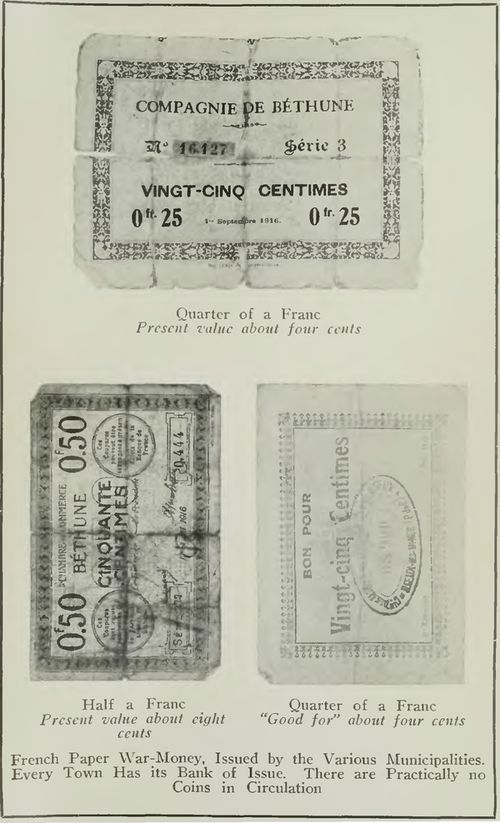
French Paper War-Money
There
were refugees, hundreds of them; from the towns and
cities farther to the eastward, whence they had fled with little or
nothing besides the clothes on their backs. There were children who
had lost their parents; wives who knew not what had become of their
husbands, and men whose wives and families were somewhere back in the
German-occupied territory. They told of enduring the direst hardships
and suffering; of cold and hunger.
Every town behind the lines that had escaped destruction was crowded
with these poor homeless people. Every habitable house sheltered all
who could find no room to lie on the floor. Those who could, worked on
the roads or in the neighboring fields. Many of the women worked in
the military laundries. They all received some assistance from the
French Government and from the many charitable societies. When talking
with them they would tell their stories in a monotonous sort of way,
seldom making any complaint; seeming to think that all these things
were to be endured as a matter of course.
I
have read all the available reports on the subject of
atrocities and have no doubt that they are true, but none ever came
under my personal observation.
In the midst of a battle many men do things which would, at other
times, fill them with horror. The excitement of combat seems to breed
a lust for killing and the sight of blood is like a red flag to a
bull. This, unfortunately, is not confined to Germans. One of our
officers who had had a brother killed a few days before deliberately
shot and killed several unarmed prisoners. He was, himself, killed the
same day. On another occasion, a wounded German, lying in a
shell-hole, stabbed and killed one of our wounded and attacked another
only to be beaten at his own game and killed with his own knife. A
soldier of the Royal Fusiliers, at St. Eloi, was detected by his
sergeant in the act of shooting an unarmed prisoner, whereupon the
sergeant immediately shot and killed the soldier. I saw this, myself.
But the deliberate shooting of wounded men and
stretcher-bearers has been, so far as I know, confined to the Hun. On
numerous occasions, some of which are mentioned elsewhere in this
story, German snipers deliberately and in cold blood shot down our
helpless wounded and the men who were endeavoring to succor them.
The Battle of Loos had opened on the twenty-fifth of September and,
although it was a considerable distance to the south of us, we had
been hearing the continuous rumble of the guns ever since we had come
up to the line. It was the first time we had heard "drum-fire," as the
French call it. It is such an incessant bombardment, with such a large
number of guns, that you can not distinguish any single reports, but
the whole makes a continual "rumble," something like the roll of heavy
thunder in the distance; never slacking, night or day. I have
forgotten just how many days they kept it up, but it was something
like two weeks.
To create a diversion, and prevent the enemy from taking troops from
other parts of the line to strengthen the attacked point, our
artillery, all along the line, was doing its best and our infantry
made feint attacks at several places. We had gone back in the
line on the first of October and, early the next morning, our brigade,
Fourth Canadian, took part in one of these attacks. Our battalion did
not go "over the top," but Bouchard and I stuck our gun up on the
parapet and helped support the advance, which was made by the
Nineteenth Battalion. It was our first experience of that kind and
was, to say the least, interesting. The enemy kept up an incessant
rifle and machine-gun fire on our position, the bullets were snapping
around our heads like a bunch of fire-crackers and the mud was flying
everywhere, but that little seventeen-year-old "kid" kept feeding in
belts and all the while whooping and laughing like a maniac. It
certainly cheered me up to have him there. The whole thing was over in
about twenty minutes but, during that short time, we had learned
something which can be learned in no other way--that it is possible
for thousands of bullets to come close to you without doing any harm.
From that time on, neither Bouchard nor I ever felt the least
hesitation about slipping over the
parapet at night to "see
what we could see."
During this tour we were subjected to considerably more shelling than
on the first occasion, and one morning Fritz made a mistake with one
of his shells intended for "our farm," as we called the buildings in
the rear, and dropped it "ker-plunk" right into one of our dug-outs.
It was a place we had fixed up for cooking, and we were all outside,
but it certainly made a mess of our "kitchen furniture." Then they
shot up our communication trench until it was positively dangerous to
go up and down it for rations and ammunition. Narrow escapes were
numerous, but our luck held, and we went out the night of the eighth
without having sustained a casualty. The battalion did not fare so
well, having quite a number of wounded, but none killed.
That was our last visit to those trenches, as we marched, that night,
away to the northward. "Eéps" was the word that went up and down the
line, that being the Flemish pronunciation of Ypres, (in French
pronounced "Eé-pr" and in
Tommy's English, "Wipers"). We had
a hard march; in the rain, as usual; and, about daylight, stopped at
the town of LaClytte, which was to be the battalion's billeting place
for several months. The rest of the battalion remained there a few
days, resting, but the Emma Gees went on ahead and took over some
support positions at Groot Vierstraat and along the Ypres-Neuve Eglise
road. We relieved the King Edward Horse who were acting, as was all
the cavalry, as infantry.
My crew, together with Sandy McNab's, was assigned to an old Belgian
farm called Captain's Post. The place was pretty well shot up but we
managed to clear out enough room to give us very good quarters; by far
the best we had had since leaving England. We were some 1,250 yards
from the enemy lines but in plain sight of them, hence it was
necessary to be very careful not to allow any one to move about
outside the buildings in daytime, nor to make any smoke.
No doubt some one got careless, for about noon the next day we heard
the long-drawn-out "who-o-o-o-i-s-s-s-h" of
a big shell
coming. It struck about twenty-five yards behind our building and
failed to explode; in soldier's parlance, it was a "dud." We were
eating dinner and refused to be disturbed. Then came a steady stream
of the big fellows; to the right, to the left, in front of the
building and, finally, "smack," right into the house. Altogether, they
put thirty-two "five-point-nine" (150 mm.) shells into that one old
building and all the damage they did was to ruin our dinner by filling
the "dixie" with mud. How in the world we escaped has always been a
mystery to me, but later on, after other and worse affairs, the men
called it "McBride's luck." They shelled us pretty regularly, after
that, sometimes just two or three shells, but on at least one
occasion, they evidently had made up their minds to put the place out
of business entirely, for they kept up a continuous bombardment, with
guns of at least three calibers, for more than an hour. At that time I
was a corporal and had twelve men, with two guns at this place, yet,
although nearly every one
was hit by pieces of brick and
mud and covered with dust, not a man was hurt nor a gun injured.
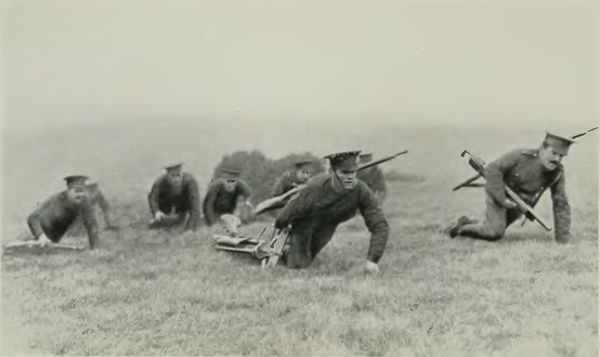
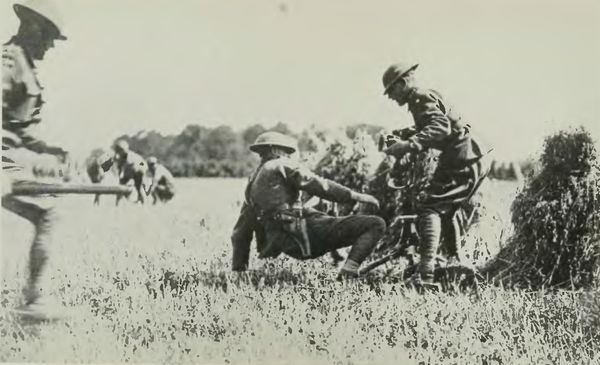
Canadians with Machine Gun Taking Up New Positions.
One morning, just after daylight and during a fog, I was up in an old
hay-loft where we had a gun, when I heard a cock pheasant "squawking"
(that's the only word that describes it), out in front. Looking from
the gun position I saw him, standing on the parapet of an abandoned
French trench across the road. I could not resist the temptation, so
took a shot at him, with the result that we had pheasant stew for
dinner that day.
It was a source of never-ceasing wonder to me that the birds and other
forms of wild life seemed to be so little affected by the continual
noise of guns and shells. So far as I could notice they did not pay
the slightest attention to it. Pheasants, partridges and rabbits were
numerous at one point in and behind our lines and I have seen them
running about, feeding or playing where shells were falling and
bursting all about them, without showing any sign of fear. Indeed
they
were sometimes killed by the shells, especially
shrapnel, but those unhit would "carry on" with the business in hand,
indifferent to the fate of their companions.
The little robin redbreasts (the English robin and the French
rouge-gorge) were abundant, as were the ubiquitous English sparrows,
which, sitting out in front on the barbed wire, were often used as
targets by men firing experimental shots.
A pair of swallows reared a family of young in a dug-out which I once
occupied, the nest being within a few feet of my head when I was in my
bunk. They would come in and go out through a small hole which we left
in the burlap curtain and the old bird would sit on the nest and look
at me in such a confidential, unafraid sort of way that she made a
friend for life and I would have fought any one who had attempted to
disturb or injure her. But, of course, no such thing was possible. All
the men seemed to take a kindly interest in the birds and, except for
the occasional shot at the English sparrows (which
never hit
them, anyhow), they rarely, if ever, molested any of them unless it
was for the purpose of getting a meal of pheasant or partridge, which
was considered perfectly legitimate although forbidden by "orders." It
was all right if you could "get away with it," as the saying is. One
morning, after an unusually intense bombardment of a wood called the
Bois Carré, I found many dead birds; killed either by direct hits or
by the concussion of the heavy shells. This same morning I watched a
pair of magpies who were building a nest in a tree near our station. A
shell had struck the tree, below the nest, and had cut it in half
while a large branch had lodged just above the nest. The whole thing
was swaying dangerously in the light breeze and a strong wind would
surely bring it down, but that pair of chattering magpies appeared to
be debating whether to continue their work or move elsewhere. One
would hop down to the place where the shell had hit and, cocking his
head this way and that, would let loose a flow of magpie talk that
would bring his mate to him and
then they would both
investigate, flying to the shattered place, clinging to the bark and
picking out splinters and pieces of wood. Then they would go up aloft
and consult about the nest itself. I watched them for the better part
of an hour when the verdict appeared to be to "take a chance" and go
ahead with the building. We left that place soon after and I never
learned the final outcome.
At one point, where our lines were about one hundred yards from the
enemy, there was a small pond in No Man's Land just outside our wire,
and a pair of ducks, teal, I think, made it their home during the
entire winter of 1915-16. In spite of the fact that shells were
continually falling all around and sometimes bursting squarely in the
pond itself, they never showed the least inclination to abandon the
place. As this pond was surrounded by a fringe of small willows we
often made use of the cover they afforded to make night
reconnoissances, but soon learned that it was impossible to approach
the pool without alarming the ducks and drawing from
them a
low scolding note of protest, accompanied by a splashing of water.
This was carefully noted and, thereafter, all sentries at that point
were especially warned to listen intently for these noises as it would
probably mean that an enemy patrol was exploring in the vicinity. The
abandoning of so many of the farms and villages left a great many cats
without homes. Nearly every ruined barn or house sheltered one or more
of them and they were, as a rule, quite wild. Some, however, had been
caught and tamed by the soldiers who made great pets of them.
Frequently a soldier would be seen going in or out of the front line
with a kitten perched contentedly on top of his pack. There was one
big brindle "madame" cat who adopted our machine gun outfit when we
first went in. She traveled up and down the line but never stayed
anywhere except in one of the machine gun emplacements. On bright days
she would hop up on top of the parapet and sit there, making her
toilet, and then stretch out on the sand-bags for a nap. At this point
it was not possible to show a hand or a periscope or
any
other small object without drawing the fire of some alert boche, but
they never shot at the cat I don't know why, superstition, perhaps.
This old cat had two litters of kittens while she was a "member" of
our section and they were all grabbed up as soon as weaned, by both
officers and men alike. It is simply human nature to want to have a
pet of some kind and, as it was forbidden to take dogs into the lines,
the soldiers turned to the cats. Of course they were of some use in
killing mice, but the real scourge of the trenches, the giant rats,
were too big and strong for any cat to tackle. There were literally
millions of these rats. At night they appeared to be everywhere. They
would eat up any rations that were left within reach and, boldly
entering the dug-outs, would run about all over the sleeping men. It
is decidedly unpleasant to be awakened to find one of these fellows
perched on your chest and "sniff-sniff-sniffing" in your face. The men
killed them in all sorts of ways, one of the most popular of which was
to stick a bit
of cheese on the end of the bayonet and,
holding it down along the bottom of the trench, wait until Mr. Rat
went after the cheese and then fire the rifle. Needless to say that
rat was "na-poo," which is soldier-French, meaning "finis."
At Captain's Post a cat had a family of kittens, just learning to
walk, hidden in a haymow, when we were shelled unmercifully. After the
bombardment ceased, upon going up into the mow to inspect the damage,
I found them. They were all covered with brick-dust but unhurt. By
actual count, no less than five shells had burst within ten feet of
the nest in which they were hidden; in fact, the whole place was an
utter ruin, yet they came through it untouched. Then, at Sniper's Barn
there was a big black cat, wild as a fox, which had a hiding-place
somewhere among the ruins of the upper story. I had a sniping nest,
burrowed under a lot of tobacco which had been stored there, and was
occupying it one day when the Germans shelled the place. They put
several shells into that part of the building, cutting the legs
off the tripod of my telescope and burying the whole works,
including myself. But what interested and amused me most was when a
shell rooted out that cat and sent it flying down into my quarters,
unhurt but so plastered with dust from the bricks and mortar that no
one would have ever suspected it of being black. It was an entirely
new variety--a red cat. It sat and looked at me for a long time.
Disgust, just plain, every-day disgust, was written all over that
animal's face. I don't know what would have happened had I not
laughed. I simply could not help it, the sight was so funny. With my
first shout the cat seemed to "come to" and, with a terrified yowl,
sped through a narrow opening and took to the woods.
To change the subject: Many of our men will, doubtless, be comforted
to know that in one respect Flanders is like Ireland--there are no
snakes.
One of our guns on this line was in the upper story of an old brewery
at Vierstraat, about seven hundred yards from my position, and we
occasionally exchanged
visits. One day, I was down there
talking with the boys when a five-inch (sixty pounder) shrapnel shell
burst in front of the building, the case coming right on through, into
the room where we were. It "scooted," glanced, ricochetted, or
whatever you want to call it, all around that room and you never saw
such a scampering to get out. It finally stopped, however, and one of
the boys dragged it out into the light for an examination. On the side
it was branded "BEARDMORE, SCOTLAND." Now, how do you suppose Heinie
got that?
On October twelfth there was a general attack along our front, to try
out some new "smoke bombs" and shells. It was the first time the smoke
barrage was used. We took our guns down about half-way to the front
line and set them up in hedge-rows and other places where we could
sweep the front in case the enemy made a counter-attack and got into
our lines. However, we were not needed, so remained spectators of
about as pretty a show as I have ever seen. At a given signal, every
gun behind our lines dropped smoke shells in a continuous row along
the line, just in front of the enemy's parapet. As each shell struck,
it burst, sending out great streamers of white smoke that soon became
a dense wall through which no one could see. Under cover of this, our
bombers advanced, threw hand grenades into the enemy trenches and then
retired.
No attempt was made to take any part of the line;
it was more in the nature of a try-out for the new shells and also for
the purpose of harassing the enemy.
Naturally, the boche, expecting a general attack, commenced to shell
everything in that part of the country and also opened up a heavy
machine-gun and rifle fire, a good deal of which came our way, but no
one was hit. On the way back to the barn, Bouchard and I were walking
side by side, perhaps three or four feet apart, when a "whizz-bang"
came right between us and struck the ground not more than ten feet in
front. In nine hundred and ninety-nine cases out of a thousand that
would have spelled our finish, but the shell struck on the edge of a
little hump, at the side of a ditch, turned sidewise and spun round
like a top. We stood there, speechless, fascinated by the peculiar
antics of the thing, until it stopped. It was a pretty toy, a 105 mm.,
painted red and with a beautiful brass fuse-cap. I picked it up but as
it was too hot to handle I put on my asbestos gloves, used for
changing barrels
of machine guns, and carried it "home"
where I put it away, intending to get some artilleryman to remove the
fuse and explosive so that I might keep it as a souvenir; but a bunch
of boys from the Eighteenth Battalion found it, and taking it back to
their dug-out at Ridgewood, tried to unload it themselves. Some were
killed and several wounded when the thing exploded. I afterward saw
one of those who had been wounded and he told me about it.
At this stage of the soldier's career he is always a "souvenir
hunter," picking up and carrying around with him all sorts of things,
from German bullets to big shells. I was a fiend of the first
magnitude and collected enough stuff to stock a museum, only to have
to abandon it whenever we moved. I had French rifles, bayonets and
other equipment; German ditto and about every size and type of shell
and fuse that was used on our front. Whenever we moved I would bury or
cache the whole lot, in the hope that I could get back for it some
day. But the fever finally wore off, and I got so that I
would not even pick up a German helmet. Now, of course, I wish I had
some of that stuff to show the folks.
On the fifteenth of October we went into the front line; a line which
we, alternating with the Twentieth Battalion, were destined to hold
until the following April. About this time the rains set in "for
keeps" and we were seldom dry or warm or clean for nearly six months.
Mud, mud, nothing but mud--mud without any bottom. We had no trenches,
proper; they were simply sand-bag barricades between us and the enemy
and it was a continual struggle to keep them built up. They would ooze
away like melting butter.
When the deadlock came, in the fall of 1914, and the opposing armies
lay entrenched, from the North Sea to Switzerland, it found the
Germans occupying the dominating heights, with our forces hanging on,
as best they could, to positions on the lower ground.
This was the case at the point where we were located. Our sector
(about eleven hundred yards for
the battalion frontage)
extended from the Voormezeele-Wytschaete road, northward to the bottom
of the hill at the top of which was the village of St. Eloi. Directly
opposite our left was Piccadilly Farm, located on a hill about ten
meters higher than our lines. From there toward the right, the enemy
line gradually descended until, at the right of our line, it was only
about two meters higher. The distance between the front lines varied
from about seventy yards, at the right, to about two hundred and fifty
yards at the left. The net result of this situation was that the
Germans could dig trenches of considerable depth, draining the water
out under their parapets or into two small streams which ran from
their lines to ours. They had a playful habit of damming up these
streams until an unusually hard rain would come, when they would open
the gates and give us the benefit of the whole dose. I have seen the
water in these streams rise seven feet within less than an hour and
there were times when in one of our communication trenches it was over
a man's head. A soldier of the West York's
regiment was
drowned in this trench one night.
Under such conditions, it was impossible for us to dig. All we could
do was to construct sand-bag parapets or barricades, while our
so-called "dug-outs" consisted of huts constructed of sand-bags,
roofed with corrugated iron and covered with more sand-bags. They
afforded protection from shrapnel and small shell fragments, but, of
course, not against direct hits from any kind of shells. Even a little
"whizz-bang" would go through them as though they were egg-shells. All
the earth thereabouts was of the consistency of thick soup and our
parapet had a habit of sloughing away just about as fast as we could
build it up. As a matter of fact, our communication trenches did
become completely obliterated and we had no recourse but to go in and
out of the trenches "overland." At night this was not so bad, although
we were continually losing men from stray bullets. But when it was
necessary, as it sometimes was, to go in or out in daylight why, it
was a cinch
that some one was going to get hit, as the enemy
had many good snipers watching for just such opportunities. At one
time, for over two weeks more than two hundred yards of our parapet
were down, and if you went from one end of the line to the other you
must expose yourself to the full view of enemy snipers. My duties
required me to cover this stretch of trench at least twice a day.
Our conduct in taking short cuts across the fields when the trenches
were knee-deep with mud, was scandalous in the eyes of our neighbors
of the Imperial army, as the troops from the British Isles are known.
Quite frequently we were subjected to the most scathing tongue-lashing
from officers of the old school, but we won the astonished admiration
of the Tommies by our disregard of instructions and advice. I well
remember one day when a party of us were going out through the P. & O.
communication trench and, finding the mud too deep, we climbed out and
walked across the open, whereat an old Colonel of some Highland
regiment gave us a "beautiful
calling." His discourse was a
masterpiece of fluent soldier talk and, as a Scot usually does when
excited, he lapsed into the "twa-talk" of his native Hielans. I can
remember his last words, which were to the effect that: "Ye daft
Cany-deens think ye're awfu' brave but I tell ye the noo it's no
bravery; it's sheer stupidity." Of course he was right, but we could
not allow the small matter of a bullet or two to stand in the way of
our getting out in time for tea, and finally they gave it up in
disgust and allowed us to "go to hell in our own cheerful fashion," as
they said.
With the assistance of the engineers, we finally succeeded in
constructing a new line, slightly in the rear of the old one which was
abandoned except for a couple of machine-gun positions and a listening
post. We also managed to get out a fairly good barbed-wire
entanglement along most of the front. Fritz appeared to be having his
troubles, too, so did not bother us much at night. We always got a few
shells every day and usually quite a number of rifle grenades and
"fish-tail"
aerial torpedoes, but they did very little
damage. Here was where the mud was our friend, for, unless a shell
dropped squarely on the top of you, it would do no harm.
Just as streets and roads must have their names, so must all trenches
have official designations. This applies also to localities, farms,
cross-roads, woods and such places which have no "regular" names or
which possess Flemish or French names difficult of pronunciation by
the soldiers.
Front-line trenches are usually designated by letters or numbers,
running in regular order, from right to left in each sector. Certain
important points may have special names. Communication trenches are
always given distinctive names. Probably the majority of these names
are those of prominent streets and roads in England, especially in
London. At Messines we had "Surrey Lane," "Stanley Road" and "Plum
Avenue" for communication trenches, while our front line embraced the
whole series of "C" trenches. During the
winter we occupied
the "N" and "O" front-line trenches, while our communication trenches
bore such names as "Poppy Lane," "Bois Carré" (afterward called
"Chicory Trench" because it ran through a chicory field), and the
"P. & O." so named because it entered the front line at the junction
of the "O" and "P" trenches and P. & O. is so much easier to say than
O. & P. At St. Eloi, "Convent Lane" and "Queen Victoria Street" were
examples of the communication trenches, while the front-line positions
were designated by numbers, as elsewhere explained. Originally, they
were called the "O" and "R" trenches. Opposite Hill 60 (so named
because it is sixty meters above sea level), the numbering method was
continued in the front line, while the communication trenches included
"Petticoat Lane," "Fleet Street" and "Rat Alley." At various places
along the lines you would find "Marble Arch," "Highgate," "Piccadilly
Circus," and so on.
Supporting points were generally designated as "S. P. 7" (or other
number), or as "Redoubts" with identifying names. In one place we had
the "Southern, Eastern and Western" redoubts along the edges
of a certain wood.
WYTSCHAETE MAP.
The reproduction on the opposite page is a section from the map known
as Wytschaete. Here are Shelley Farm, White Horse Cellars and St.
Eloi, with the British front line shown by faint dashes, crossing the
road that runs through White Horse Cellars, at figure 2. The German
trenches, indicated by irregular black lines, are close to the British
front at this point, but run sharply away down to Piccadilly Farm and
beyond on the left. The trenches on this map are corrected to February
20th, 1916. Sniper's Barn that figures so thrillingly in Captain
McBride's experiences is shown at the extreme left of the map, only
the word Barn appearing.
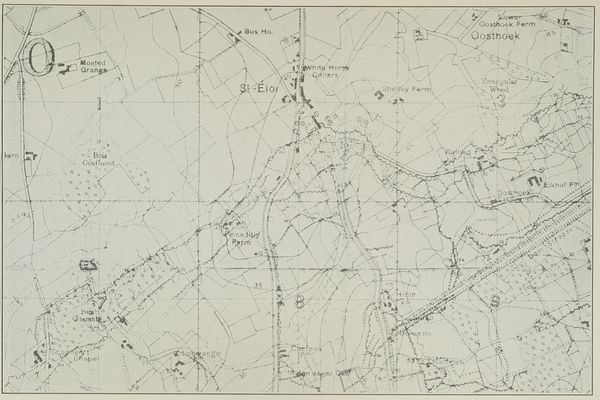
Sometimes the original Flemish names were retained for the farms,
châteaux and cross-roads, but more often they would be Anglicized by
our map makers. Thus we had "Moated Grange," "Bus House," "Shelley
Farm," "Beggar's Rest," "Dead Dog Farm," "Sniper's Barn," "Captain's
Post," "Maple Copse," the "White Château" and the "Red Château," "Dead
Horse Corner," "White Horse Cellars" and so on, indefinitely.
"Scottish Wood" was so named for the London Scottish who made a famous
charge there in the early part of the war. Hallebast Corner was
changed by the soldier to "Hell-blast" Corner, just as Ypres became
"Wipers" and Ploegstert was translated into "Plugstreet." As to the
estaminets, (drinking places), while many retained their original
names, such as "Pomme d'Or," "Repos aux Voyageurs" or "Herberg in der
Kruisstraat," such names as "The Pig & Whistle" and "Cheshire Cheese"
were not uncommon.
"Shrapnel
Corners" and "Suicide Corners" were numerous and
had merely a local significance. The names are self-explanatory.
"Gordon Farm," where the Gordon Highlanders had stopped for a time,
and "School Farm," where we had a bombing and machine-gun school, were
other examples. "Hyde Park Corner," afterward changed to "Canada
Corner," was an important junction point of the roads back of our
lines. "Bedford House" was a name given to a château which the
Bedfords once occupied. It would require a large book to enumerate
them all.
Our line was at the exact spot where the Princess Pat's first went
into action and several of them were buried in our trenches, together
with many others, both French and English. In fact, it was difficult
to dig anywhere for earth to fill sand-bags without uncovering bodies.
The whole place was nothing more nor less than one continuous grave.
There were a great many crosses, put up by comrades, giving name, date
and organization, but hundreds had no mark other than
the
cross, sometimes inscribed "an unknown soldier," but more often
unmarked. Here one of our sergeants found the grave of his brother,
who had been serving in the King's Royal Rifles and I noticed another
cross near by marked with the name of Meyers, Indianapolis, Indiana,
said to have been the first man of the Princess Pat's killed in
action. There was a maze of old French and English trenches, some in
front of our line and some behind it and all more or less filled with
bodies that had never been buried. Some of the Indian troops had
fought here and had left many of their number behind. Whenever it was
possible, we buried the bodies, but often they were in such positions
that this was impossible and any attempt to do so would only have
resulted in further losses. I nearly forgot to mention it; but there
were plenty of Germans mixed up with the lot; in one small area, just
in front of a farm building, some five hundred yards in our rear, I
found eight of them. Inside the building was a dead French soldier
who, as we figured it out, had accounted for the eight boches
before they got him. This place was called Sniper's Barn.
While our artillery had been considerably increased, it was still far
below that of the enemy in number or size of guns, and the ammunition
supply was so short that each gun was limited to a very few rounds a
day. It was only during the following summer that the English caught
up with the Germans in artillery. This, naturally, did not tend to
cheer up the men. It was aggravating, to say the least, to have the
other fellow sending over "crumps" without limit, and be able to send
back nothing but six or eight "whizz-bangs." ("Crump" is the general
name for high-explosive shells of from 4.1 up, but the commonest size
is the 5.9 or 150 mm.)
Having been so successful at the strafing at Messines, our Colonel was
anxious that we continue the game here and I was delegated to locate a
good position and "go to it." After going over all the ground back of
our lines, I decided to try the experiment of placing the gun in a
small hedge which ran across the lower end of an old garden or
orchard, in front of Sniper's Barn; that
is, on the side
toward the enemy. It looked rather foolhardy, at first glance, for the
place was in plain sight from the German lines and only about five
hundred yards away at the nearest point; but I remembered our
experience at our first strafing place and depended on Heinie to jump
to the conclusion that we were in the farm buildings, and devote his
attention to them. It worked; he "ran true to form," as a race horse
man would say, and while we maintained a gun, and sometimes two, in
that place for six months, and the boche shot up the barn regularly
during all that time, there was never a shell, apparently, directed at
our position, and except for an occasional "short," none burst near
us.
From there we would shoot, day and night, often, at the first, having
our targets where we could "see 'em fall," a very unusual occurrence
for a machine gunner, save during a general engagement. Of course we
would have to get into the position before daylight and remain until
dark as the way to and from it was exposed to view from "across the
way."
Here we worked out many of the constantly recurring
problems
which confront the machine gunner in the field, and which are, as a
rule, overlooked or neglected during the preliminary training. As our
own soldiers will have to contend with the same conditions, I may
mention some of them.
One of the first things we discovered was that while all the
small-arms ammunition issued was made pursuant to uniform
specifications, furnished by the War Office, a large percentage of it
was manufactured in new, hastily equipped factories, by partially
trained workmen, and while it was apparently near enough to the
standard to pass the tests exacted by the inspectors, only an
extremely small proportion would function properly in machine guns or
other automatic arms. A few of the old standard brands, made in
government arsenals or by the prominent, long-established private
manufacturers, could be depended upon at all times, but,
unfortunately, these brands were comparatively scarce and hard to get.
At least seventy-five per cent. of what we received was the product of
the small, new
and ill-equipped factories, established under
the press of war demands, and, while it appeared to work
satisfactorily in the ordinary rifles, both Enfield and Ross, it was
utterly useless for machine guns. The difference of a minute fraction
of an inch in the thickness of the "rim" would break extractors as
fast as they could be replaced, while various other irregularities, so
small as to be undiscoverable without the most accurate measurements
by delicate micrometers, would cause stoppages and the breaking of
different small parts. And, at that time, spare parts were almost
unknown, so it required the utmost ingenuity on the part of the
gunners to improvise, with what materials could be found on the spot,
and with the very few tools at hand, many of the small but
all-important parts that go to make up the interior economy of the
guns.
All automatically operated firearms are, of necessity, very delicately
balanced mechanisms. Whether gas or recoil operated, there must be
just sufficient power obtained from the firing of one shot to overcome
the normal friction of the working
parts, eject the empty
cartridge case, withdraw a new cartridge from the belt or magazine,
load it properly in the chamber and fire it; continuing this action as
long as the trigger, or other firing device, is kept pressed or until
the belt or magazine is emptied. Ammunition which does not give the
proper amount of pressure or cartridges which, through faulty
manufacture, cause an undue amount of friction, either in seating them
in the chamber, withdrawing them from the belt or in removing the
fired case, will not operate the gun properly and will cause "jams."
On the other hand, ammunition which develops too much pressure or
creates too little friction, will cause breakages because of the
excess jar and hammering of the moving parts.
We utilized parts of cream separators, sewing machines, baby
carriages, bicycles and various agricultural implements, found in and
around the old Belgian farms, and it soon became common talk that we
could make every part of a machine gun excepting the barrel. We
learned that there was a certain bolt, a part of the rifle carrier on
the French
bicycle, which was an exact duplicate of an
important part of our guns, so, whenever we found one of those old,
broken and abandoned cycles, we would take time to remove this
particular part and carry it along for emergencies. This is but one
instance of many.
Then, there was the matter of concealing the flash, when firing at
night. As the position we occupied was in plain view of the enemy
lines, to have fired without some device to prevent the flash being
seen would, inevitably, have resulted in a concentration of fire upon
us which would have rendered the position untenable. We tried many
schemes, from the crude "sand-bag" screen to the most elaborate
devices made in the armorer's shops, while back in billets, and
finally perfected one which was thoroughly satisfactory. I can not
describe it here, as I hope to see it used by our soldiers in France,
but I can say that, out of probably fifty different contrivances made
for the same purpose, this was the only one that "filled the bill"
from every standpoint.
As most of our firing was done at night, it was necessary
to
improve the manner of mounting and "laying" the guns as we soon found
that the methods taught at the training schools and the lamps and
other mechanical devices furnished by the authorities were of no use
under actual service conditions.
The various schemes and devices which we originated and elaborated are
at the disposal of the proper military authorities in this country
but, obviously, can not be described here.
The foreign officers, British and French, who are now in this country
acting as instructors and advisers are doing everything in their power
to impress upon our officers and men the necessity for keeping up to
date in all the various and complicated departments of military
training, even to the exclusion of many of the pet ideas of some of
the most accomplished instructors in our service schools. The trouble
with us is that we have not, and never have had, any machine gunners
in the United States Army. By this I mean men skilled in machine
gunnery as applied to present-day warfare. The evolution of
machine-gun tactics is, perhaps,
the most outstanding
feature of the whole war. From being, as it was considered four years
ago, merely an emergency weapon or, as the text-book writers were
pleased to call it, "a weapon of opportunity," it has become the most
important single weapon in use in any army, not even excepting the
artillery. A properly directed machine-gun barrage is far more
difficult to traverse than anything the artillery can put down and the
combination of artillery and machine guns, working together, whether
on the offensive or defensive, represents the highest point ever
attained in the effective use of fire in battle.
Our instructors have been technical theorists of the very highest
order, basing their theories and working out their problems on the
experience furnished by previous wars and of course it is difficult
for them to realize that nearly every hypothesis which they have
assumed in working out their theories has been proved false. They can
not believe that "fire control" of infantry, as taught in the school
of fire, has no place in modern trench warfare. It will break the
hearts
of some of them to learn that the ability to read a
map and use a prismatic compass is of far more value than knowledge of
the "mil-scale" or "fire-control rule." They will probably be
scandalized by the statement, which I make seriously and with full
knowledge whereof I speak, that one common shovel and an armful of
sand-bags are worth more than all the range-finders that have been or
ever will be bought for the use of machine gunners.
Every foot of ground in France, Belgium and Germany has been so
thoroughly and accurately mapped that there need be no such thing as
estimating ranges. You know the range; you do not have to depend on
mental or mechanical estimates. And, as machine-gun fire is almost
entirely indirect fire, the guns must be laid by using map, compass,
protractor and clinometer (quadrant), in exactly the same manner as
artillery fire is directed. The average machine gunner will probably
go through the whole war without ever seeing a live enemy--excepting
prisoners. The various methods of controlling indirect
fire
by resection, base lines and observation from two or more points are,
like the use of an auxiliary aiming point, useless in trench warfare.
They are fine in theory and afford much interesting diversion on the
training ranges, but when you go to war, why, it can't be done, that's
all.
Highlanders with a Maxim Gun
This is a common, plain, hard-headed business proposition: where the
only idea is to kill as many of the enemy as possible before he kills
you, it has been found that the oldest, crudest and most primitive
methods have, in many cases, proved the most effective for the
attainment of this end.
Never before has it been of such vital importance to train the
individual soldier, whether he be rifleman, bomber, machine gunner or
any other specialist, so that he can "carry on" without the direction
of an officer. The officer must plan everything in advance; he must
look after the health and comfort of his men, see that they are
properly equipped and supplied, must station them in their appointed
positions, make frequent personal
inspections and, finally,
lead them in the advance. But in every engagement there comes a time
when every man is "on his own," when it is impossible for the officer,
if he be still living, to direct the action. The idea that an officer
can exercise "fire control" as taught in our service schools, or can
personally direct the fire of a number of machine guns, once the
action has started, is ridiculous. The limits of one man's sphere of
action, at such a time, are extremely small. If the men have been
properly instructed, beforehand, and then given a good start, they
will do the rest. It is just this ability to assimilate individual
instruction that has made the Canadian superior to the native-born
Briton. He is better educated, as a rule, has lived a freer and more
varied life and, as a result, possesses that initiative and individual
ingenuity which are so often necessary at the critical stages of a
fight. We have every reason to expect that the American soldier, for
these same reasons, will prove to be at least the equal of the
Canadian--the finest type of fighting man yet developed by this war.
We soon fell into the routine of moving; from front line to support;
from support to the front line and back to reserve. For some time
these movements were uncertain but we finally settled down to a
regular schedule, which was maintained, with few breaks, throughout
the winter. When the time came to go into the reserve, the rest of the
battalion would go back to LaClytte but the Emma Gees went only to the
Vierstraat-Brasserie line before described. From there detachments
would alternate in going back to the battalion billets for a bath and
clean clothing. Some of us rigged up our own bath house in Captain's
Post, so found it unnecessary to go any farther. Personally, there was
only one day in three months when I was out of sight of the German
lines. We had comfortable quarters where we were and the towns of
Dickebusch and LaClytte had no attractions for me; and as to the
battalion billets, they were abominable. They consisted of
so-called huts which were simply floors with roofs over them: no walls
at all; just a sloping, tent-like roof on top of a rough board floor.
Outside, they were partly banked up and plentifully smeared with mud,
camouflaged, as it were. The British made it a practise at that time
to keep their troops out of the inhabited towns that were within range
of the enemy's guns, so as not to give any excuse for shelling them.
LaClytte was a very small town of but a few hundred native
inhabitants, but Dickebusch, situated about midway between the lines
and LaClytte, was a city of several thousands. In both places were
hundreds of refugees from the ruined towns to the eastward.
However, it seemed to make little difference to the boche; he shelled
both towns, intermittently, killing a number of civilians but very
rarely hitting a soldier. Later, in the spring of 1916, they started
in to wipe out Dickebusch, and, for all practical purposes, they
succeeded. I will speak of this in a later chapter.
Where
opposing lines are so close together, say less than one
hundred yards apart, and the ground is level and star shells are going
up almost continuously, it would seem to be nearly an impossibility
for any man or number of men to venture out into No Man's Land without
being seen and fired upon by the enemy. But with certain members of
each organization it is merely a part of the daily routine. Every
night they slip over the parapet and, in small groups, patrol up and
down the line, constantly on the alert to prevent any surprise attack
by the enemy. But this is not all. There are times, at all points,
when it is necessary to put out new barbed wire or repair the old;
when large parties of men must go out there and work for hours, within
a stone's throw of a vigilant and merciless enemy. Occasionally they
are discovered and have trouble, but in the great majority of cases
the work is done and every one gets back unhurt.
How is it done? Simply a matter of training and careful preparation.
Every man is rehearsed in his work until he can do it perfectly,
quickly and
without noise. Materials are carefully checked
up and distributed and, each man having a certain specified task and
no other, there is no confusion or blundering. They all know that,
when a flare goes up near by, they must "freeze" in whatever position
they may be. Movements of any kind would be sure to discover them to
the enemy lookout, but lacking that movement it is a hundred-to-one
shot they will be undetected.
There have been a good many instances where a flag has been planted by
the enemy, on his parapets or inside his wire, with a challenge to any
one to come over and get it. There was one such opposite our position.
Many stories had been told about that flag: The Brandenburgers had it
first, then the French got it and passed it along to the English, who
relieved them; then the Prussians took it away from the British and
had held it ever since; for about a year, in fact. We could see it,
plainly enough; a dark blue affair with some sort of a device in
yellow in the center. I often noticed it from our position back at
Sniper's Barn
and had some rather hazy ideas about going
over after it.
One dark rainy night in November, a man in the section named Lucky
announced that he was going over to Fritz's line to try to locate a
new machine-gun emplacement which we had reason to believe had been
recently constructed. He slipped over the parapet where a road ran
through our lines and those of the enemy. It was only about seventy
yards across at this point.
Working his way through our wire, he crawled along the side of the old
disused road, there being a shallow ditch there which afforded a
little concealment. The flares were going up frequently and progress
was, of course, very slow. At one place the body of a soldier was
lying in the ditch and, in trying to roll it out of the way, he pulled
off one of the feet. By creeping along, inch by inch, he finally
reached the enemy's wire and spent about an hour working through it.
Then crawling along the outside of the parapet, stopping often to
listen, he soon found the loophole of the new gun emplacement. Taking
a sheet of paper
which he had brought for the purpose, he
fastened it directly below the loophole where it would be in plain
sight from our lines but invisible to the occupants of the place. His
work done, he was about to start back when he happened to think of
that flag and concluded to have a try for it. It was probably a
hundred yards or more down the trench from where he then was and it
required the utmost care to avoid making a noise as the front of the
parapet, as is always the case, was thickly strewn with tin cans and
rubbish of all sorts. Lucky had been a big game hunter in Canada,
however, and had even stalked the wily moose which is about the last
word in "still hunting," so he managed to negotiate the distance
without detection and finally reached the flag.
Carefully feeling up along the staff, he discovered that it was
anchored with wires which ran into the ground and then he remembered
the tales that had been told of how it was attached to a bomb or small
mine which would be exploded if the flagstaff were disturbed. That was
a common
German trick and not at all unlikely in this case,
but, after thinking the matter over, he decided to make an attempt to
unfasten the wires. This did not take long, after which all that
remained was to pull out the staff and "beat it." Taking his pistol in
his right hand, to be ready for emergencies, and reaching up with the
left, he gave the pole a sharp jerk. Well, there must have been
another wire, somewhere, connected up with two "fixed rifles," aimed
directly at the stick for, when he pulled on it, two rifle reports
rang out and two bullets hit the flagstaff, cutting it off just below
his hand which was also slightly cut. Quickly rolling down into a
slight depression he hugged the flag to him and lay quiet, while the
Germans, aroused by the shots, immediately opened fire with rifles,
which were soon joined by; a machine gun. They could not hit him where
he was so he just lay still and waited. Suddenly, without warning,
they fired a flare light directly over his head. He told me afterward
that was the only time he was really scared. He thought it was a bomb.
However that soon passed and the firing having
died down, he
made his way back to our lines with the flag which he gave to the
Colonel the next morning. "And they gave him a medal for that."
On another occasion, one of our scouts made his way through the German
line and having located a battery in the rear, started back, only to
discover that the place where he had come over was now occupied by
several soldiers, and, being unable to find another opening, was
obliged to hide out and remain inside the enemy's lines all day. The
next night he managed to slip back, none the worse for his adventure.
Such things are being done every night and some men consider it the
greatest sport in the world to go out alone and spend hours under the
lee of a German parapet listening to the Heinies talk. Soon after
that, orders were issued in our brigade that no one was to go out
alone so when we wanted to prowl around we had to start in pairs. As
soon as we were over the parapet we would split and each go his way,
to meet later at an appointed place. One man, alone, can get away
with a lot of things that would be impossible for two, but we
observed the letter, if not the spirit, of the order.
We had cleared out one of the compartments of the big barn at
Captain's Post, carefully plugging up all the shell-holes with
sand-bags and other materials so that no light could filter through,
and there, at night, would build a great fire in the middle of the
stone floor and proceed to enjoy ourselves. Usually one or two guns
would do a little strafing every night: simply going out into the
field in front of the building and setting up the gun in a convenient
shell-hole. After a while, from our own observations and from
information supplied by the artillery, we occasionally located an
enemy battery within range of our guns. Then we would have a regular
"strafing party." Laying all the guns so as to deliver a converging
fire on the battery position, we would, as soon as it was dark, open
up on them, knowing that they would be moving about in the open and
exposed to fire. We could always tell when we had "stung" them, for
they would invariably come
back at us with a tremendous
fire, shooting wildly at everything within our lines in the vain
endeavor to locate us. I'll bet we caused them to expend a hundred
thousand rounds of perfectly good ammunition in this way, but we never
had a man hit while at the game. The German is not much of a hand for
night artillery work unless you stir him up, but we could always get a
rise out of him, and often did it, just for amusement. This is what is
called "getting his wind up." The same thing can be done in the front
line by a few men opening up with five or ten rounds, rapid fire,
directed just over Heinie's parapet. In nearly every case, he will
commence shooting blindly toward our lines: the contagion will spread
and, the first thing you know, he will have wasted about a million
rounds.
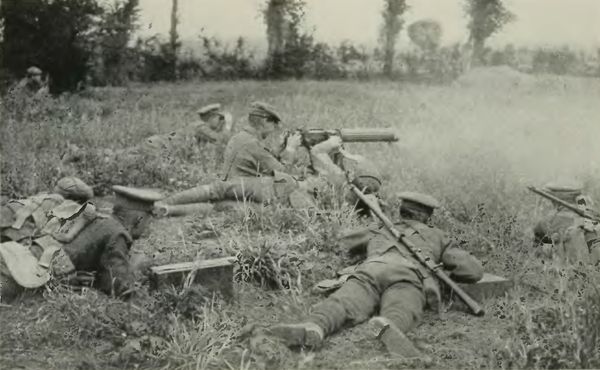
A Light Vickers Gun in Action
Here, as in most parts of the line, except during an engagement,
cooking was done right in the front trenches. The method is to use a
brazier made from an old iron bucket, punched full of holes, in which
charcoal or coke is burned. As we seldom had charcoal, it was
necessary to start
the fire before daylight, using wood to
ignite the coke which made no smoke but, with careful nursing, could
be made to burn all day. The presence of smoke always drew the fire of
rifle grenades, trench-mortar shells and even artillery. It was one of
our favorite forms of amusement to locate a cook house and shoot it
up; and when a shell made a direct hit, if, among the pots and pans
flying through the air, we could distinguish a German cap or something
that looked like a part of a boche, there was much rejoicing in our
lines. Of course it was a game at which two could play and we were not
immune by any means.
These little things helped to keep up the interest and break the
monotony of the work. About this time the famous Lahore Battery, from
the Indian city of that name, was added to the artillery behind our
sector; and they appeared not to be restricted in the number of rounds
per day which they were permitted to fire. I remember the first time
they did any shooting over our heads. It was the day after they had
"registered in"
that a large working party was discovered on
Piccadilly Farm, directly opposite our left. When the F. O. O. (forward
observing officer) was informed of it, he had a good look through his
periscope binoculars and then called up the Lahore Battery and,
without any preliminary ranging shots, ordered "forty rounds per gun."
As they had six guns, they poured in the shells at the rate of about
one hundred a minute and they certainly did make things fly in and
about that farm.
During October the casualties in the Machine Gun Section were only
three wounded, McNab, Redpath and Jack Lee all getting hit on the same
day. They were sent back to England. At that time it was not
considered the proper thing for a man to go back if he could, by any
means, "carry on" and these three were all bitterly disappointed when
they found that they would have to leave the section. There came a
time, all too soon, when a "Blighty" was the finest present a man
could get; the loss of a few fingers or even a hand or foot being
considered not too high a price to pay to get out of hell for a few
months.
When the weather was very bad there was but little sniping-going on,
so we often went in and out of the lines "overland" in broad daylight.
Sunday, November fourteenth, was one such occasion. We had not been
relieved until
noon by the Twentieth Battalion who had taken
a very roundabout way to get in, so I put it up to all my crowd to
choose whether we should spend several hours going around or take a
chance down the open road. They unanimously decided on the road, so I
started out ahead, with instructions for them to follow at about
fifty-yard intervals, and in this fashion we walked down at least four
hundred yards of open road, every foot of which was in plain sight of
the German lines, and got under cover of a small hill without a single
shot being fired. From this point it was necessary to cross another
small open space but, as it was partly screened by bushes and trees,
we did not consider it dangerous.
We had a redoubt concealed in the small hill mentioned and I stopped
to arrange about the relief of the gun crew stationed there. The
remainder of the party, except Charlie Wendt, continued on their way
and soon disappeared in the woods. Charlie stayed a few minutes and
then said: "I'll go on ahead, Mac, and wait for you at the Eastern
Redoubt." He started out across
the field and I continued my
talk with Endersby, who was in charge of the local gun, when, all at
once, I heard some one call out: "Oh, Mac," and looked to see Wendt on
the ground about one hundred yards away waving his hand to me.
Endersby immediately ran to him and I followed as soon as I could drop
part of the heavy load I was carrying. On reaching him I found that he
had been shot through the abdomen. Just then another bullet snapped
beside us, so I told Endersby to get back to the redoubt and telephone
for stretcher-bearers, while I bandaged the wound. Charlie remarked:
"Well, they got me, but I hope you get about ten of them for me." I
assured him that we would and told him to keep his nerve and he would
come through all right. He was a very strong, clean-living young man
and I really thought he had a chance. He did not think so, saying he
was afraid the doctors would have some difficulty in patching up such
a hole. He did not cry out nor make the slightest complaint but kept
assuring me that "everything is all right."
Meantime,
the sniper was keeping up a continuous fire,
hitting everything in the neighborhood but me, at whom he was
shooting. It was such a miserable exhibition of marksmanship--only
about five hundred yards distant and a bright clear day--that I told
Charlie I would be ashamed to have such a poor shot in our outfit. Any
American soldier who could qualify as a marksman would scarcely miss
such a target and a sharpshooter or expert rifleman would be forever
disgraced if he made less than the highest possible score. However, I
forgave that fellow; being a German he could not be expected to know
how to shoot straight at any range beyond three hundred meters. The
shot that hit Charlie was just a "luck shot," but that did not help
much.
I tried to drag him along toward a slight depression, but it hurt him
so I desisted and waited for the stretcher-bearers. When I saw them
approaching I called a warning and had one of them crawl to us with
the small trench stretcher, on which we managed to get Charlie into a
sheltered place,
where they shifted him to a long litter and
started out with him. The last thing he said was: "It's all right,
Mac; everything is all right; don't you worry."
They did all they could for him while I had to go back and get the
machine gun that he had dropped. The fellow across the way showed
perseverance, at any rate, and kept up his "schutzenfest" as long as I
was in sight but without result.
Next day we learned that Charlie had died and was buried at Bailleul.
He was not only one of the most popular men in the section, but was
the first we had had killed and we all felt very much depressed. I got
a permit to go to Bailleul to see whether or not he had been properly
buried and there made my first acquaintance with the G. R. C. We had
often seen those letters, followed by a number, on the crosses, in
trenches, in cemeteries or along the roads, but none knew what they
meant. At Bailleul I found the head office of the "Graves Registration
Commission" and, within five minutes, knew where Wendt was buried and
the
number of his grave. This wonderful organization
undertakes to furnish a complete record of the burial place of every
soldier. Where suitable crosses have not been provided, they furnish
one, bearing an aluminum plate showing the name, number, regiment and
date of death wherever this information is available. Now they have
gone even further and are compiling a photographic record of all known
graves so that relatives, writing to the Commission, can secure not
only a verbal description but an actual photograph of the loved one's
grave.
I went back and began to plan ways and means of "getting" Charlie's
ten boches, but a day or two later something happened to alter my
scheme to a certain extent.
At that time, our ration parties were going out just before daylight,
as we had no communication trench and had to cross the open and
exposed ground behind our line. The two, who went from one of the
guns, however, Dupuis and Lanning, were a little bit late, so that it
was light when they started out. About fifty yards down the road was
a bend, afterward called the Devil's Elbow. From this point,
they were in plain sight from the enemy line and, no sooner had they
reached the Elbow than a sniper fired and got Lanning through the
lungs. As he fell, Dupuis knelt down to assist, when he received a
bullet through the head, killing him instantly. One of our detachment
of stretcher-bearers (composed of the members of our pipe band) was
located but a few yards away and, without hesitation, one of the
"Scotties" dashed out to help the fallen men. He was instantly shot
down, as were three others in succession, who attempted to get to the
spot. By this time an officer arrived and prevented more of the men
from running out. This officer, by crawling carefully down a shallow
ditch alongside the road, managed with the assistance of a sergeant to
recover all the bodies. Four were dead and two wounded, one of whom
died a few hours later. These stretcher-bearers were unarmed and wore
the broad white brassard with the red cross conspicuously displayed on
their sleeves. The sniper was only about one hundred yards distant
and could not possibly have failed to see this mark.
Then and there I registered a silent vow that these men, to paraphrase
Kipling:
". . . should go to their God in state:
With fifty file of Germans, to open them Heaven's
gate."
Later, I was to see other and worse happenings along that same road,
but, at that time, I considered this as about the limit.
The officer who had done such splendid work in recovering the wounded
men was himself killed about an hour later, together with one of his
sergeants and two men, by a shrapnel shell. He was the first officer
we had lost in the battalion, Lieutenant Wilgress, and had been very
popular, with officers and men alike.
It was a sad day for us, that twenty-seventh of November, 1915, and
yet it was one of those days when "there is nothing to report from the
Ypres salient."
Canadian Machine Gun Section Getting Their Guns Into
Action.
Next day I asked and received permission to go back a few miles to a
sniper's school, where I got
a specially targeted rifle,
equipped with the finest kind of a telescopic sight. I only remained
long enough to sight it in and get it "zeroed" and was back again in
front that same night.
"Zeroing" a rifle is the process of testing it out on a range at known
distances and setting the sights to suit one's individual
peculiarities of aiming. Having once established the "zero" the
marksman can always figure the necessary alterations for other ranges
or changed conditions of wind and light.
From that time on, I "lived" in Sniper's Barn. It made no difference
whether the battalion was in the front line or in billets, I was there
for a purpose and I accomplished it. When the guns were in the front
or in support, we had one mounted in the hedge and kept the rifle
handy. Bouchard, with a large telescope, and I with my binoculars,
scanned everything along the enemy's front and behind his lines. We
knew the ranges, to an inch. If one or two men showed, I used the
rifle; if a larger number, the machine gun.
Prior to this time, during all the very bad weather,
we had
ample opportunities to shoot individual Germans from our Sniper's Barn
position but had refrained because our own men were also necessarily
exposing themselves daily, and to have started a sniping campaign
would have done us no particular good and would certainly have
resulted in additional deaths on our side. It seems that the troops
opposed to us up to this time had been Saxons who were quite well
satisfied to leave us alone provided we would do the same by them. Of
course we did shoot them occasionally when they became too careless
and exposed themselves in groups, but that was perfectly legitimate
machine-gun work and taught them a well-needed lesson. Now, however, a
different breed of Huns had come in and they had started the dirty
work. They were Bavarians alternating with Marines, and we soon
learned that for genuine low-down cussedness the Marine had them all
beaten, although the Bavarians and Prussians were pretty bad.
When we first began on them it was no unusual occurrence to have from
ten to twenty good open shots a day. The ranges averaged about six
hundred
yards and as I was using a specially targeted Ross
rifle, equipped with the latest Warner & Swazey sight, and as I had
spent many years in learning the finer points of military rifle
shooting, I am very much afraid that some of them got hurt. For about
a month we kept it up, the "hunting" getting poorer every day until
finally the few German snipers working along the front were safely
ensconced in carefully prepared dug-outs. A boche cap above the
parapet was a rare sight, but we had our hundred, all right; and then
some; for, as Bouchard said: "We'd better get a little pay, in advance
before they 'bump us off.'"
Several times in later days similar events occurred and in each case
swift and terrible retribution was meted out to the criminal enemy.
They shot down our stretcher-bearers, engaged in their noble work of
trying to save the wounded, but we took bloody toll from them whenever
this occurred, using unusual methods and taking desperate chances,
sometimes, to drive the lesson home.
On one occasion our observers had reported a
large gathering
of the enemy at a place called Hiele Farm, about eight hundred yards
from our position and I had laid two guns on them when, through our
telescope, I discovered that it was a burial party assembled in a
little cemetery just behind the farm buildings and telephoned to the
officer in charge that I did not intend to shoot up any funeral.
Within a few minutes came word than an enemy sniper had shot and
killed one of our most popular stretcher-bearers and had also fired
several shots into the wounded man whom he was bringing in, killing
him also. Then, without hesitation, I ordered both guns to open up and
we maintained an intermittent fire on that place until long after
dark. We could see numbers of Germans lying about on the ground. I
have never regretted it.
Then, the day before Christmas, 1915, while the Twentieth Battalion
was occupying the front line and we were back in the redoubts of the
supporting line, I was up in the gun position at "S-P-7," the redoubt
just in rear of the point where the slaughter of November
twenty-seventh had
taken place, when a boche shell dropped
directly in the dug-out which was my home when in the front line. It
killed two men, one I remember was named Galloway, and wounded several
others. I was so close that I could see everything that happened. One
of the wounded was in such bad shape that the only possible chance to
save his life was to get him back to a dressing station without delay.
The communication trenches were washed out and the only way was down
that ill-fated Devil's Elbow road. The officer in command called for
volunteers to carry the man out, remarking that, as it was Christmas
Eve, he did not think even a German would shoot at a wounded man or
unarmed stretcher-bearers. All hands offered to go and two were
chosen. The officer went with them and they started down the road. The
minute they reached the fatal bend, where they came in sight of the
German lines, a shot rang out and down went the first man. Another
shot and the second was down, while a third dropped the officer, who
was trying to assist the fallen.
I could see each shot
strike in the water alongside the road and could tell just about the
spot from whence they came so, although we had absolute orders never
to fire from that position unless attacked, I immediately swung the
gun around and commenced to "fan" that particular spot, at the same
time calling to our signaler to get the Sixteenth Battery on the wire
and call for S. O. S. fire. (Each yard of enemy line is covered by the
guns of some one of our batteries which, when not firing, are kept
"laid" on their particular section of parapet.) Within a few moments
the battery opened up but not before at least a half dozen machine
guns in our front line had been hoisted upon the parapets and were
ripping Heinie's sand-bags across the way. During this proceeding the
wounded men were recovered from the road, but, unfortunately, both the
volunteer carriers and the man originally wounded had died. The
officer, although painfully injured, recovered.
In retaliation for this trick, our heavy guns wiped out at least five
hundred yards of German trench.
It was the most artistic job
of work I have ever seen. From a point approximately two hundred and
fifty yards on either side of this murderer's nest we utterly
destroyed every vestige of a parapet. How many of the assassins we
killed will never be known, but our hearts were filled with unholy joy
when we could distinguish bodies or parts of enemy's bodies among the
debris thrown up by one of the big 9.2 shells.
"Say, kid, want to go sniping?" called out a lank individual as he
came over the bridge at "S-P-7" one morning in December, 1915.
The person addressed, a swarthy little boy wearing the uniform and
stripe of a lance-corporal of the Twenty-first Canadian Machine Gun
Section, took a long careful look around the sky, hastily swallowed a
strip of bacon he had in his fingers and as he darted into a little
"rabbit-burrow" sort of tunnel, flung back the words; "Hell, yes; this
looks like a fine day for a murder." In a few moments he reappeared
with a water-bottle and a large chunk of bread. Hastily filling the
former from a convenient petrol tin and cramming the latter into his
pockets, he walked over to the older man and divested him of some of
the paraphernalia with which he was festooned. He took a long case
containing a telescope, another
carrier holding the tripod,
two bandoliers of ammunition and a large haversack.
"How we going in?"
"Straight across," said the sniper.
"Ver-re-well, young-fella-me-lad, if you can stand it I can," said the
youngster, for he knew full well that to go from there to Sniper's
Barn in broad daylight meant to expose himself to observation from
"Germany," only about five hundred yards away, and with a fat chance
of playing the part of "the sniper sniped."
Without another word they departed. The sentry on guard at the
crossing of the creek volunteered the cheerful hope that they'd get
pinked before they got across the field, upon which the boy assured
him that he would be drinking real beer in London when the pessimistic
sentry was "pushing up the daisies" in Flanders. Crossing the open
field to a hedge, they slipped into a shallow remnant of an old French
trench, just in time to escape a snapping bullet which was aimed about
one second too late. From here they crawled carefully along the hedge,
bullets cutting intermittently
through the bare branches
above them and, at last, came to a small opening that gave entrance to
a garden, about one hundred yards from a group of demolished farm
buildings. Here they rested for a few minutes, while the bullets
continued to "fan" the hedge up which they had come and which led to
the buildings.
The boy--"Bou" the other called him--worked his way along the ground
to an old cherry tree and was about to lift up a sort of trap-door at
its roots when the other stopped him.
"Never mind the gun," he said, "we'll just wait here until they do
their morning strafe and then go into the buildings. I want to try for
a few of them over on Piccadilly to-day and you can't use a machine
gun for that. You'll simply have to be the observer, that's all."
Bou came back, lit a cigarette which the other promptly extinguished
and then subsided.
"What you think you're going to do; shoot from the farm?" Bou couldn't
possibly keep quiet any longer.
"Sure, Mike; why not?"
Canadian Soldiers in Action with Colt Machine Guns
"Oh,
nothing; but do you think we can get away with it?"
"Well, you've been here as long as I have and if you have not figured
out the way the boches do things around this place I'm afraid I can't
tell you; but I'll try. Now, they saw us come over here, didn't they?
And they naturally think we are in the farm buildings. Just as soon as
that fellow who was shooting at us can get word to their batteries
they will proceed to shoot up the place. After about a dozen direct
hits they will feel pretty well satisfied that they have either driven
us out or 'na-pooed' us, so that will be our time to get inside and
take a shot at this brilliant young Bavarian who will, without a
doubt, be looking over the parapet in the hope that he may get a crack
at us trying to 'beat it.' I've been wanting to get that guinea for a
long time and have a hunch that this is our day. See?"
Before the boy could answer there came a swift "whit; whit; whit;" and
three "bang; bang; bangs" in and above the main building of the farm.
Followed several more salvos, finally crashing
through the
walls and throwing up fountains of brick-dust and earth. After waiting
several minutes they worked their way carefully along the hedge and
around behind the buildings. Entering the one nearest the road, which
was a mere shell with the roof and two walls entirely gone, they crept
cautiously across the floor, and dodging the carcass of a cow that lay
with its head in an old fireplace, they finally found themselves in a
back room. Many bales of tobacco lay piled up on the floor, covered
with the litter and wreckage from the upper story. Here the older man
uncovered an opening under the tobacco, through which they entered a
small chamber, perhaps eight feet square, comparatively clean. At one
side of this narrow space lay a figure covered with the well-known
blue overcoat of the French soldier.
"Who's your friend?" inquired the youngster.
"I don't know; he was here when I first came; but I think he was the
original sniper of Sniper's Barn. Look at that pile of shells beside
him."
Near
the dead soldier was his rifle and a great pile of empty
cartridge cases.
"We'll have to bury him some day: I think he earned it. He's got a
hole right through the heart. Must have been here a year: he's all
dried up, like a mummy."
While delivering this discourse the sniper had been carefully removing
straw and tobacco leaves from an irregular hole in the brick wall.
Here he set up the telescope and settled himself to scrutinize that
part of the German line which lay directly opposite. After a few
minutes' observation he began to clear away another and smaller
opening, to the right of and below that where the telescope was set.
"He's there, all right: look just about four o'clock in the 'scope as
it stands. See him, right beside that leaning tree? Keep your eye on
him while I get my sight set."
In a few seconds, everything ready for action, the tall man sprawled
himself on the floor, sling adjusted, piece loaded and cocked, while
Bou,
now behind the telescope, whispered excitedly: "He's
still there and looking right at me. I can see his cap badge. He's one
of those damned Marines. Get him, Mac, for God's sake, get him,
quick."
"I'll get him, all right," muttered the other as he gingerly poked the
muzzle of his rifle through the few remaining straws. "Now watch and
see if his hands come up and whether he falls forward or just drops;"
with which he slowly pressed the trigger and the shot roared in the
small chamber.
"You got him!" shrieked Bou; "I saw his hands come up to his face and
he pitched right forward into the trench. Hooray! that's another one
for Charlie Wendt."
All the bandsmen (we had both bagpipe and bugle bands) go into the
front line with the other troops. They are unarmed, but equipped with
first-aid kits and stretchers. It is their task to administer first
aid to all wounded and then to carry or otherwise assist them back to
the dressing stations which may be anywhere from a few hundred yards
to a mile or more, depending on the ground. When a man is hit while in
an exposed place, whether in No Man's Land or behind our lines, it is
up to the stretcher-bearers to get to him at the earliest possible
moment. I have seen these men, time after time, rush to the assistance
of a stricken soldier, knowing full well that they would immediately
become the target for snipers' bullets. Personal considerations never
appeared to enter their heads. Never, in all my experience, have I
seen one of them backward in
going to the aid of a wounded
man. Often they would spend hours in the effort to bring back to the
lines some soldier too badly injured to help himself; and the pity of
it was that, on many occasions, after all their self-sacrificing
labor, they would be shot down just as they were about to come over
the parapet and into the trench.
And all without hope of reward other than the love and admiration of
their comrades. There was a time, before this war, when such exploits
were considered worth the Victoria Cross. Now, however, they are
merely a matter of daily routine. Thousands of men are, every day,
performing deeds of valor, which in any other war would have brought
the highest decorations, without receiving even so much as an
honorable mention. Exposure to fire such as theorists had told us
would demoralize any army is merely a part of the day's work. Troops
go in and out of the trenches, often under artillery fire that,
according to our books, ought to annihilate them, and they do it
without thinking it anything unusual or
worthy of comment
other than perhaps, in answer to a question, to remark: "Oh, yes, they
shot us up a bit in the P. & O." or "They handed us a few 'crumps' and
'woolly bears' coming through Ridgewood." ("Woolly bear" is the name
given to a large, high explosive shell, with time fuse, which bursts
overhead, giving out a dense black smoke, which expands and rolls
about in such a manner as to suggest the animal for which it is
named.) In fact, nearly all the names invented by the soldier to
describe the various projectiles are so apt and expressive as to be
self-explanatory. The "Silent Lizzies," "Sighing Susans" and
"Whispering Willies" belong to the class of large caliber, long range
naval gun shells which pass over the front line so high that only a
sort of whispering sound is heard. The "middle heavies" with
percussion fuses, which burst on impact and give out a dense black
smoke, have been called "Jack Johnsons" and "coal boxes," but are now
usually grouped under the general designation of "crumps," because of
the peculiar sound of their explosion. They run all
the way
from 4.1 inch to 9.2 inch calibers. Some of the very large shells are
called "Grandmothers" or "railroad trains." The French call them
"marmites," meaning a large cooking pot or kettle. The "whizz-bang" is
just exactly what the name would suggest: a small shell of very high
velocity, which arrives and bursts with such suddenness as to give no
time for taking cover. Its moral effect exceeds the material in the
trenches, but it is deadly along roads or in the open. Gas shells have
a peculiar sound, all their own, difficult to describe but never
forgotten when once heard. It has been described as a "rumbling"
noise, but I think "gurgling" is better. (It's a pity some one can not
take a phonograph into the lines and "can" some of these things.) When
gas shells land they do not make much noise, having a very small
bursting charge; merely sufficient to break the case which contains
the gas in liquid form. They are often mistaken, by new troops, for
"duds" or "blinds," as we call shells which fail to explode. As soon
as the liquid gas is liberated, however, it vaporizes and quickly
spreads over a considerable area. There are many kinds, but
they can generally be distinguished by the smell. Some are merely
lachrymatory or "tear" shells; the gas affecting the eyes in such a
manner as to produce constant "weeping" and consequent inability to
see clearly. Others, however, are deadly and one good breath will put
a man out of action and a couple of "lungfuls" will usually kill him.
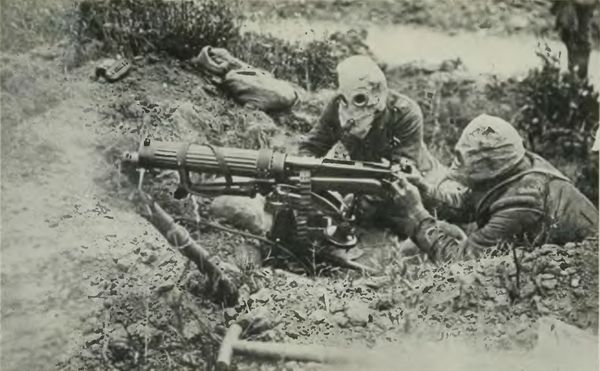
British Machine Gun Squad Using Gas Masks
About this time, I think it was December 19th, 1915, we had our first
experience with chlorine gas or "cloud gas" as distinguished from
"shell gas." The troops on our immediate left got a pretty bad dose,
but, owing to the peculiar formation of the lines and varying air
currents, we did not suffer severely from it. The lines in the Ypres
salient were so crooked that the enemy rarely attempted to use this
form of gas after the first big attack in April, 1915, as it would
frequently roll back upon his own troops. Shell gas was constantly
used, generally being fired against our positions in the rear;
artillery emplacements and such. Being well equipped with
gas masks or respirators, we suffered little harm from it.
Christmas, 1915, was a quiet day on our front, both sides being
apparently willing to "lay off" for a day. There was no firing of any
kind and both our men and the enemy exposed themselves with impunity.
Aside from this, however, it was the same as any other day. There was
none of the visiting and fraternizing of which we heard so much on the
previous Christmas. The Germans opposite us had a number of musical
instruments and on that night and on New Year's Eve they almost sang
their Teutonic heads off.
January passed quietly. By this time we had become so accustomed to
the mud and rain that I doubt if we would have been happy without
them. In spite of all the difficulties, we managed to get our rations
and mail every day. The regular shelling had become a part of our
daily life, and the constantly growing list of killed and wounded we
accepted without comment. The Machine Gun Section was gradually losing
its original members and replacing them by drafts from the infantry
companies. It was simply a case of "Conditions continue
normal in the Ypres salient," to quote the official reports. We now
maintained two strafing guns, shifting about from one position to
another whenever an opportunity offered to harass the boche.
That winter, 1915-16, was what they call a "wet winter," that is, it
rained continually and rarely got cold enough to freeze. With the
exception of a light flurry in late November and a fairly heavy snow
about the first of March, we never saw any of the "beautiful." A few
times there was frost enough to make thin ice, but never enough to
enable us to walk on top of the mud which was from six inches deep in
the best parts of the trench to thigh deep in the worst. We had no
rubber boots at the start but got some late in the winter.
A peculiar affliction, first noticed during this war, is what is known
as "trench feet." Where men are required to remain for long periods
standing in cold water and unable to move about to any great extent,
the circulation of blood in the lower
limbs becomes sluggish
and, eventually, stops. The result appears to be exactly the same as
that caused by severe frost-bite; in fact it is freezing without
frost, (I don't know why not, if you can cook with a fireless cooker),
and, in severe cases, amputation is necessary.
While the Imperial troops on our flank suffered considerably from this
dreaded affliction, we had but few cases, although our position was
infinitely worse than theirs, we being in lower ground. Probably the
average Canadian is better able to stand the cold and wet than the
native-born Briton. We had but one case in the Machine Gun Section and
that was not severe.
As a preventive measure, whale oil was issued with positive orders
that every man must, at some time during each twenty-four hours,
remove his shoes and socks and rub his feet with this oil. I never did
think the oil was anything but just an excuse to make the men rub as
that in itself would be sufficient to restore the circulation. At any
rate, when the oil gave out, we still kept up the rubbing game and
there was no noticeable change in the result.
Another
hitherto unknown disease which developed during that
season was what is commonly known as "trench fever." The victim's
temperature runs up around one hundred and three and he is affected
with lassitude and general debility and it requires from three weeks
to a month in hospital to put him in shape for duty. The medical
officers use a Greek name for this fever, which, translated, means, "a
fever of unknown origin" but the colloquial designation is "G. O. K.,"
(God only knows). It is rarely, if ever, fatal. I never heard of any
one dying of it.
Then there is a sort of skin affection; a "rash," which is said to be
caused by eating so much meat, especially fats, without taking
sufficient exercise. A few sulphur baths at specially prepared places
behind the lines soon eradicate this trouble.
Really dangerous diseases are extremely rare. Typhoid fever is almost
unknown, pneumonia is seldom heard of and even rheumatism, which one
would naturally expect to be prevalent, is by no means common. The
ratio of sickness, from all causes, was far below that in any of the
training camps
in this country although never, in Canada,
England, Flanders or France, did we have as comfortable quarters as
are furnished for all the troops here. But we did have at all times,
plenty of good warm woolen clothing and an abundance of substantial
food. Cotton uniforms, underwear or socks are unknown in any army
except that of the United States. Perhaps you can find the answer in
that statement.
During February an almost continuous fight was waged for a small
length of trench on our left, known as the International Trench,
because it changed hands so often. It culminated, March second, with
the Battle of the Bluff, by which British troops took and held this
line. We were in support, as usual, and suffered rather heavily from
shell fire. This was the beginning of the spring offensive, and from
that time on we caught it, hot and heavy, for four solid months.
From the time we first caught sight of our guns shelling the German
airplanes there was rarely a day that we did not see many of them,
scouting, bombarding or fighting. At first, as mentioned elsewhere,
they flew very low; within easy range of machine-gun fire, but soon
began to climb to higher altitudes until, at the time of my departure,
most of their work was done from a height of about twelve thousand
feet.
There was one of our planes, piloted by a major. I never heard his
name but he was known all up and down the line as "The Mad Major." He
was a pioneer in all the marvelous evolutions which now form an
important part of the airman's training. Side slips, spinning dives,
tail slides; all were alike to him. He would go over the enemy lines
and circle about, directing the fire of a battery, scorning to notice
the fire of the "Archies,"
(flyers' name for anti-aircraft
guns) and when that job was finished, would come home in a series of
somersaults, loops and spins which made one dizzy to watch. He was a
great joker and frequently, when the shell-bursts were unusually thick
around him, would come tumbling down from the sky like a shot pigeon,
only to recover at a height of several hundred feet and shoot off in a
bee line for the air dome. I've no doubt that the enemy often thought
they had "got him," but at last reports he was still there.
I watched the planes for months without seeing one hit and had about
concluded that, to make an Irish bull, the only safe place on earth
was up in the air, when, one morning, hearing the now familiar
"put-put-put" of machine guns up above, we looked up to see one of our
large observing biplanes engaged with a very small but fast enemy
plane. The boche had all the best of it and soon our plane was seen to
slip and stagger and begin to descend. The little "wasp" came swooping
down after it, firing all the while until, when a few hundred feet
from the ground, our
machine turned its nose straight
downward and crashed to earth, well behind our lines, both occupants
being instantly killed, or perhaps they had already been killed by the
bullets. The German thereupon turned and was soon back over his own
territory. That same afternoon, another of our machines was shot down,
apparently by the same man, just opposite our position, inside the
German lines.
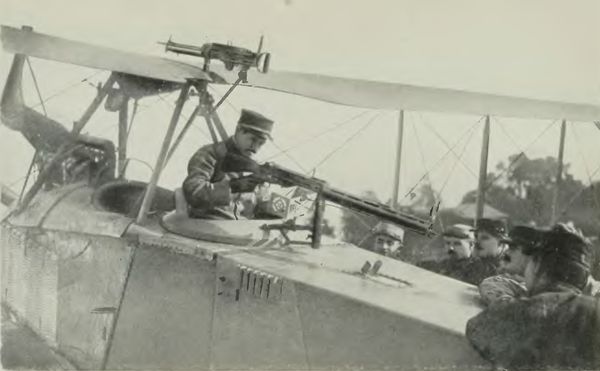
German Aeroplane Trophy--Jules Vedrine Examining the
Machine Gun
Shortly after this, when back in reserve, we watched another fight
directly over our heads. This was a pitiful tragedy. One of England's
best and most famous flyers, Captain Saunders, had been over the
German lines and had engaged and brought down an enemy and then,
having exhausted his ammunition, started back "home" for more, but
encountered a fast-flying boche who immediately attacked him. Being
unable to return the fire, he tried every trick known to the birdman
to escape but without avail. He came lower and lower in his evolutions
and finally settled into a wide and sweeping spiral. The boche did not
come very low as several machine
guns and "Archies" opened
on him. The other plane came slowly down in its perfect spiral course
and, noticing that the engine was not running, we thought the aviator
was intending to make a landing in a large open field toward which he
was descending, but when the spiral continued until the tip of one
wing touched the ground and crumpled up we knew there was something
wrong and ran to the spot, not more than one hundred yards from where
we were standing. We got the Captain out and found that he had been
shot in the head but was still conscious. He died within a short time.
Other of our aviators who had witnessed his first fight furnished the
beginning of the story and we could see that in the second engagement
he never fired a shot, and every one of his magazines was empty. I
examined them myself.
The large, sausage-shaped observation balloons sometimes afford a
little diversion. When we were at Dranoutre one of them used to hang
over our billeting place. One day an enterprising Hun came flying
across and endeavored to
attack it but was driven off by two
of our planes.
Again, one of our balloons broke away in a strong wind and started
toward Germany. Both the occupants of the basket made safe parachute
descents with all their instruments and papers, but the balloon sailed
swiftly away. Then the Germans opened on it with every gun in that
sector. I feel sure that they fired at least two thousand shots at it.
The air around was so filled with the smoke of shell-bursts that it
was sometimes difficult to discern the balloon itself. It was late in
the evening and the last we saw of the "sausage" it was still
traveling eastward, apparently unhit. The joke of the whole thing is
that the balloon was never hit and, the wind veering during the night,
it returned and came down inside our lines within a few miles of its
starting place.
On two occasions Zeppelins came over our lines, evidently returning
from raids across the Channel. One time it was night and we could only
hear, but not see the air-ship. The other time, during the St. Eloi
fight, I saw one, just at
daybreak. It was in plain sight
but well over the German lines and headed east. No attempt was made to
do any bombing of our positions by the Zeppelins although we
occasionally received visits from bombing airplanes. The night before
I left France, the last time, they dropped several bombs on the
village of Ecoviers where I was staying. The only result was the
killing of two civilians, the wounding of several others and the
wrecking of one of the few whole houses in the town which had often
been a victim of shells. Not a soldier was injured.
You have, no doubt, read of cases where bombs have been dropped on or
near hospitals, ambulances and so on, and possibly you think that this
was intentional on the part of the boche. If so you flatter him. This
bomb dropping is, at best, very uncertain business and it would be
well-nigh impossible for the most expert flyer to aim at and hit any
single building. The fact is that, in nearly every town and city
behind the lines, hospitals, ammunition stores and billets are located
in close proximity to one another, with probably a
railway
running near by, so that any attempt to bomb the really important
"military" points will necessarily jeopardize the homes of
non-combatants--including hospitals. Even the Zeppelins, which are
much more stable than an airplane, have never been able to place their
bombs with any degree of accuracy.
No one realizes better than I the utter futility of attempting to
describe a modern battle so that the reader can really understand or
visualize it. There are no words in any vocabulary that convey the
emotions and thoughts of persons during the long days and nights of
horror--of the continual crash of the shells, the melting away or
total annihilation of parapets and dug-outs; being buried and
spattered with mud and blood; with dead and wounded everywhere and,
worst of all, the pitiful ravings of those whose nerves have suddenly
given way from shell shock. No imagination can grasp it; no picture
can more than suggest a small part of it. None who has not had the
actual experience can ever understand it. The hospital and ambulance
people back at the rear see some of the results, but even they can
have no conception of what it is like to be actually in the torment
and hell-fire at the front.
I
could not, if I so desired, give an accurate description of
the operations in general. I have not the necessary data as to the
various troops engaged or local results accomplished. Historians will
record all that. My field of description is limited to my field of
personal observation, which was not very extensive. I suppose,
however, that I saw as much as it was possible for any one person to
see, so I shall try to describe that part of the battle of St. Eloi in
which it was my fortune to participate.
At the point at the southern end of the Ypres salient, where the line
turns sharply to the eastward, stood the village of St. Eloi. It
consisted of perhaps fifteen or twenty buildings of the substantial
brick and iron construction characteristic of all Flemish towns and
was situated at the intersection of the two main roads paved with
granite blocks, one running to Ypres and the other through
Voormezeele. The village itself, except for two or three outlying
buildings, was inside our lines. The portion held by the enemy,
however, included a prominent eminence, called the "Mound," which
dominated
our whole line for a mile or more. This mound had
been a bone of contention for more than a year and several desperate
attempts had been made to take it; notably in February and in March,
1915, when the Princess Pat's were so terribly cut up and lost their
first Commanding Officer, Colonel Farquhar. All these attempts having
failed, our engineers proceeded to drive tunnels and lay mines, six in
number, so as to cut off the point of the German salient for a
distance of about six hundred yards.
All was completed; mines loaded and ready, and the time for the attack
was fixed for daybreak of the twenty-seventh of March. The mines were
to be fired simultaneously, followed immediately by an attack, in
force, by the Royal Fusiliers, the Northumberland Fusiliers and a
battalion of the West Yorkshires. Our brigade (Fourth Canadian) was
immediately to the right of the point of attack, but, as the Imperial
troops had changed their machine guns for the lighter Lewis automatic
rifles to be used with the advancing troops, it was deemed advisable
to bring up all available
machine guns of the heavier types
to support the advance and to resist the inevitable counter-attacks.
These guns, twelve in number, were placed at advantageous positions on
the flanks of the attacking troops. I was only a sergeant at that
time, but, having been an officer, and having had more actual
experience in machine-gun work than the others, the direct supervision
of these guns was entrusted to me.
ST. ELOI MAP
The map on the opposite page is known as St. Eloi map. It is
particularly interesting as showing, very faintly, a great group
of mine craters within the British lines. No. 1 can be seen in
the lower left section just above the horizontal fold in the map
and to the left of the perpendicular. Here the British line comes
in at the lower left corner, where it almost immediately
branches, passing through figures 44 and 77, joining the main
line again at the left and below Shelley Farm. Within this loop
are the six enormous mine craters. No. 2 is immediately to the
right of figure 96, while 3, 4 and 5 are in a line with it just
to the right of the perpendicular fold. The faint dotted line
that comes to an apex just below St. Eloi is the British trench
known as Queen Victoria Street. This map is made from air
photographs dated March 5th, 1916.
We got all the guns up and in place during the night of the
twenty-sixth. In addition, our people brought up a great many trench
mortars of different calibers, with enormous quantities of ammunition.
We then sat down to wait for the "zero" hour, meaning the time for the
show to begin. I took my position at our extreme left, as I wanted to
be where I could see everything.
Promptly at the appointed time, the mines were fired and then ensued
the most appallingly magnificent sight I have ever witnessed. There
was little noise but the very earth appeared to writhe and tremble in
agony. Then, slowly, it seemed in the dim light, the ground heaved up
and up until,
finally, bursting all bonds, earth, trees,
buildings, trenches and men went skyward. Immediately followed great
clouds of flaming gas, expanding and growing like gigantic red roses
suddenly bursting into full bloom. It was an earthquake, followed by a
volcanic eruption.
Before the flying debris had reached the ground the Fusiliers were
over the top, fighting their way through the jungles of wire and shell
craters. The occupation of the mine craters themselves was, of course,
unopposed as there was no one there to offer opposition. They kept on,
however, meeting the German reinforcements coming up from the rear,
fighting them to a standstill and establishing themselves beyond the
Mound.
Then all hell broke loose. From the beginning our artillery, machine
guns and trench mortars had been maintaining a continuous fire, but
the Germans, taken by surprise, were several minutes getting started.
When they did open up, however, they gave us the greatest
demonstration of accurate and unlimited artillery fire which I, or any
of us, for that matter, had ever seen. The air
seemed to be
literally full of shells bursting like a million fire-flies. Our
parapets were blown down in a hundred places and the air was filled
with flying sand-bags, iron beams and timbers. A shell struck under
the gun by which I was standing and flung gun, tripod, ammunition-box
and all, high into the air. Even under such conditions I could not
help laughing at the ridiculous sight of that gun as it spun around in
the air, with the legs of the tripod sticking stiffly out and the belt
of ammunition coiling and uncoiling around it, like a serpent. The
lance-corporal in charge of it looked on, spell-bound, and when it
finally came down back of a dug-out, he looked at me with a most
peculiar expression and said: "Well, what do you think of that?" Then
he jumped up and went after the wreckage and, strange to relate, not a
thing was broken. After about twenty minutes of stripping and cleaning
he had the gun back on the parapet, shooting away as though nothing
had happened. He was an Irishman, named Meeks.
I walked down the trench to get a spare barrel for
a gun
when a shell struck about ten feet in front, killing a man. I started
on and another lit exactly where I had been standing. During that
little trip of perhaps fifty yards and back I was knocked down and
partly buried no less than four times.
Then the prisoners commenced to come back. They appeared to be glad to
get out of it and I don't blame them. When they found that they had to
go through the Canadian's lines, however, they held back. They had
been told that the Canadians killed all prisoners. (We had heard
something of the same kind about the Germans, too.) However, when our
cooks came out with "dixies" full of steaming tea, with bread and
marmalade sandwiches, they soon became reconciled. Our men made no
distinction that morning between captor and captive, serving all alike
with everything we had to eat or drink. At one time, however, owing to
the congestion in the trench, we were compelled to "shoo" a lot of the
prisoners back "overland," to the next support trench. As their
artillery was raising merry
hell all over that section, they
were a bit backward about starting and it required threats and a
display of bayonets to get them out of the trench and on their way. It
was a funny sight to see them beat it. There was little in the way of
obstacles to impede their progress and I think that several of them
came near to establishing new world's records for the distance. When
they arrived at the second line they wasted no time in climbing down
into it; they went in head-first, like divers going into the water. I
don't think any of them was hit during this maneuver, at least I did
not see any of them fall.
Now, it has come to be an axiom that "any one can take a trench but
few can hold one." It is another way of expressing the idea that "it
isn't the original cost--it's the upkeep."
It was no trick at all, with the assistance of the mines, to advance
our lines to what had been the German third line, but, right there,
some one had made a miscalculation. It's a cinch our "higher-ups" did
not know how much artillery the Germans had that they could turn on
that
salient. Our own artillery had been greatly increased
and they evidently thought we were at least equal to the enemy in this
respect, but, say: the stuff he turned loose on us made our artillery
look like pikers. For every "whizz-bang" we sent over he returned
about a dozen 5.9's. By that night, nearly all the original attackers
were gone and Fritz was back in at least two of the craters.
During the day a good many of us, including all our stretcher-bearers,
made many trips through the devastated German trenches, getting out
wounded and collecting arms and other plunder. I went up where the
Fusiliers were trying to consolidate their position, intending to
bring up a few guns if it appeared to be practicable, but abandoned
the idea as, in my opinion, they were due to be shelled out within a
short time, which proved to be correct. We did dig out and mount a
German gun which was used for a while, but I then had it taken, with
several others, back to our line. We could do so much more good from
our original position by maintaining a continuous barrage
to
hamper the enemy in getting up supports. From prisoners taken later we
learned that our machine-gun barrage was much more effective than that
of our artillery. However, as we were obliged to fire from temporary
positions, on the parapet and without cover of any kind, it was
impossible to prevent the loss of some guns by direct hits from
shells. During that night and the next day a Highland brigade came up
to relieve the Fusiliers. They included battalions of the Royal Scots
and the Gordons.
By this time the Germans had brought up more guns and were keeping up
such a terrific fire on our position that it did not seem humanly
possible to hold it, but that night a bombing attack by the Fourth
Canadian Brigade bombers, reinforced by about two hundred volunteers,
retook the craters and reestablished our line in a more advanced
position than that occupied by the original attackers. This line was
thereafter called the Canadian trench to distinguish it from the
other, which was called the British trench.
Early
next morning we had a chance to see some of the
"Kilties" in action with the bayonet, during a counter-attack, which
they repulsed. As I remember it, they did very little shooting but
jumped out of their trench to meet the attackers with the cold steel.
I never saw any lot of soldiers who seemed so utterly determined to
wipe out all opposition. They were like wild men; savage and
blood-thirsty in the onslaught and, although the Germans must have
outnumbered them at least three to one, they never had a chance
against those brawny Scots. But few of the boches got back to their
own line and no prisoners were taken. We then appreciated the nickname
given by the Germans (first applied to Canadian Highlanders at
Langemarck, but afterward used to designate all "Kilties"), "The
Ladies from Hell."
From that time the Canadians were alone in the fight. The Fusiliers,
having started it, faded away, and the Scots, after a few brief days,
likewise vanished and for two months or more St. Eloi was a continuous
struggle between the Second Canadian
Division and at least
four German Divisions, including some of the infamous Prussian Guards.
During the next twelve days the righting was almost uninterrupted.
Troops came in and troops went out, but the Emma Gees held on,
forever, as it seemed to us. But few remained of the original gun
crews who started the engagement. Not all had been killed or wounded,
but it had been necessary to relieve some who were utterly exhausted.
How I kept going is a mystery to me as it was to others at the time.
One thing which probably helped was the fact that I never, for one
minute, permitted myself to think of anything except the matter of
keeping those guns going. Sentiment I absolutely cast out. I was
nothing but a cold-blooded machine. Good friends were killed but I
gave them no thought other than to get the bodies out of the trench so
that we need not step on them. To tie up and assist wounded was a mere
matter of routine. In no other way could I have withstood the awful
strain. I was hit, slightly, on several occasions but
never
severely enough to necessitate my going out. A dug-out in which I had
a table where I wrote reports and figured firing data was hit no less
than three times while I was in it, finally becoming a total wreck.
The fact that I was not killed a hundred times was due to just that
many miracles--nothing less. My leather jacket and my tunic were cut
to shreds by bits of shell, a bullet went through my cap and another
grazed my head so close as to raise a red welt, but that same old
"luck" which had become proverbial in the battalion, still held and I
was not seriously injured.
Our troubles were not all caused by artillery fire by any means. Fritz
had a large and varied assortment of "Minenwerfer" with which to
entertain us at all hours, day and night. A good many people, even
among the soldiers themselves, think that Minenwerfer or "Minnie" for
short, is the name of the projectile or torpedo, while, as a matter of
fact, it is the instrument which throws it; a literal translation
being "mine-thrower." In the same way they often speak of the
shells thrown by trench mortars as "trench mortars" themselves.
Now the family of "Minnies" is a large one and includes every device,
from the ancient types used by the Greeks and Romans, with springs of
wood, to the latest and most modern contraption in which the
propelling power may be steel springs, compressed air or a small
charge of powder. In its smallest form it is simply a "rifle grenade,"
somewhat similar to a hand grenade or ordinary "bomb," to which is
attached a rod of brass or iron which slips down into the bore of the
regular service rifle and is fired with a blank cartridge. Other and
newer types are without this rod but have vanes or rudders affixed to
the rear end which serve to guide the projectile in its flight. These
usually have a hole through the center through which the bullet passes
and can thus be used with the regular service ammunition. This whole
class, embracing everything from the small "pineapples," fired from
the rifle, to the monstrous "aerial torpedoes," are commonly spoken of
as "fish-tails."
The shells from the trench mortars proper, and
most of the
"fish-tail" family, are somewhat similar to ordinary artillery shells
in that they are made of steel or iron and designed to burst into
small fragments, each of which constitutes a deadly missile. On the
other hand, the "mines" thrown by the Minenwerfer, are merely light
sheet-metal containers for heavy charges of high explosives (T. N. T. or
tri-nitro-toluol as a rule), and depend for their effectiveness on the
shock and blasting effect of the detonation. They have been increasing
in size continually. At first we called them "sausages," then
"rum-jars" (they resembled the ordinary one-gallon rum jar in size and
shape), then they became "flying pigs" and by this time, I have no
doubt, new and still more expressive names have been applied to them.
The havoc created in a trench by one of the large ones passes belief.
The strongest dug-out is wiped out in a twinkle; whole sections of
parapet are obliterated, and where was a strong, well-built wall eight
feet or more in height there remains a hole or "crater" fifteen or
twenty feet in diameter and several feet deep. Any man who happens
to be within this area is, of course, blown to atoms, while
frequently men in the near vicinity, but not exposed to the direct
blast, are killed instantaneously by the shock. Medical men say that
the effect is identical to that known as "caisson sickness," and is
caused by the formation of bubbles of carbonic acid gas in the blood
vessels. Not being a "medico" I can not vouch for this, but you can
take it for what it is worth.
In daylight it is not difficult to dodge these devilish things and
even at night, if they come one at a time, it is possible to escape
the most of them, but when they come over in flocks, as they sometimes
do, it is more a matter of luck than anything else.
Lewis Gun in Action in Front-Line Trench.
By this time there was no doubt of the enemy's superiority in
artillery, and to make matters worse, the craters were changing hands
daily or even hourly. We never knew, for sure, whether our troops or
those of the enemy held any certain crater, except the ones on each
end, numbers one and six (we held them throughout the entire two
months of fighting), but numbers two, three, four and five were
debatable ground for several weeks. On two occasions I made the
complete circuit of all the craters at night, going through the
Canadian trench and coming back via what had been our original front
line. On one of these trips I was accompanied by Captain Congreve,
afterward Major Congreve, V. C., (now dead) who was the only staff
officer I saw in that sector during all the time we were in the line.
Sometimes we met individual German
sentries and quick,
quiet and accurate work was necessary to avoid detection and probable
capture. I found that a French bayonet, the rapier shape, was a very
satisfactory weapon at such times. Trench knives have been invented
since and may be an improvement. After leaving me that night Captain
Congreve came upon a party of eighty-two Germans, commanded by an
officer, who had been cut off in one of the craters for several days,
without food or ammunition, and captured them all, single-handed. For
this feat he received the Distinguished Service Order and promotion to
Major. Later, on the Somme, he continued his brilliant work and won
the award of the Victoria Cross, but was killed at Mametz Wood before
receiving the decoration, which was given to his widow. He was only
twenty-five at the time of his death but had proved himself one of the
most enterprising officers in the British army.
What had been left of the village of St. Eloi when the fight commenced
was rapidly disappearing under the hail of shells. Where our original
front
line had been there remained but few detached
fragments of parapet. For perhaps six hundred yards we were holding on
with scattered and isolated groups. At one place, on our immediate
left, was a hole in the line at least two hundred yards wide. Time
after time the Canadians attacked and retook the craters, only to be
literally blown out of them by the ensuing hurricane of shells.
The task of getting out the wounded was heart-breaking. Our own
stretcher-bearers worked night and day, but they had suffered many
casualties and were unequal to the task. The Border Regiment and the
Durham Light Infantry, who occupied our old trenches and were not
under heavy fire, sent volunteer carrying parties to assist in the
work, so that all were taken out with a minimum of delay. It was
impossible to remove the dead and they were buried in shell-holes,
where they fell. During the succeeding days many were disinterred by
other shells.
Then, the matter of maintaining communication with
our
supports and the headquarters in the rear was of the utmost importance
and our signalers waged a continuous fight, against heavy odds, to
keep the wires connected up. It would not be fair to others to specify
any particular branch as being better. All who serve in the front line
at a time like this are equally entitled to credit. At times, when it
is necessary to go out and search for breaks and repair them, the work
of the signalers is "extra hazardous," just as is that of the
stretcher-bearers when obliged to expose themselves to succor the
wounded, or the machine gunner when it is necessary to mount his gun
on top of the parapet, within plain sight of the enemy, or the
riflemen, bombers and scouts in advancing to the attack. There can be
no fair distinction--they all, taken as a unit, are in a class
separated by a wide gulf from those back in supporting or reserve or
artillery positions, who, in turn, are separated from the transport
and ambulance drivers, who, while occasionally under shell fire, are
in the zone of comparative safety, where "people" still live and farm
and run stores and estaminets. I would not have you think
that I am minimizing the value of the services of these men. Their
work is of vital importance to the success of the fighting forces and
must be done; and I can truly say that in all my experience I have
never known them to fail in the performance of their duties.
In this war, as in most others, it is the infantryman who stands the
brunt of the fighting. True, he is disguised under many other names,
such as rifleman, bomber, automatic rifleman, rifle-grenadier, scout,
signaler, sniper, runner or machine gunner but, when you get right
down to the bottom of the whole business, he is the fellow who travels
on his two feet and actually "goes over and gets 'em." Trenches can be
battered to pieces by artillery but they can not be actually "taken"
and held by any one but the plodding, patient, long-suffering
"doughboy" or "web-foot" as he is called by the men of the other
branches.
At one time, during this period, Sergeant H. Norton-Taylor and four
men from our section, held
one of the craters for five days,
against numerous attacks, and even captured prisoners. They had no
food, water or ammunition other than that which they could get from
the bodies of dead soldiers in the immediate vicinity. We sent many
detachments to relieve them but were unable to locate their position
and it was only by accident that they were discovered and relieved by
a scouting party of the Nineteenth Battalion which was over on our
left. But for this, they might be there now, as they were not the
quitting kind.
Norton-Taylor was commissioned and commanded the section at
Courcellette, where he was killed, September 15, 1916. He came of a
long line of distinguished British officers, his father having been a
Colonel in the Royal Field Artillery. A brother and a brother-in-law
were in the service, one of them losing both feet by a shell. A sister
was working in the hospitals in France and another in England. He was
a true friend and a gallant officer--every inch a gentleman.
On the night of April tenth we were relieved by the Twentieth
Battalion and went out for a rest.
I had not laid down to
sleep for fourteen days, snatching what rest I could, for fifteen or
twenty minutes at a time, leaning against a parapet or propped up in
the corner of a traverse. We were only able to get as far as
Voormezeele, where we stopped in the ruins of the convent school, and
dropping on the stone floor slept like the dead for twenty-four hours.
The place was being shelled all this time but none knew or cared. The
next night we made our way to where the battalion was in billets, near
Renninghelst, where I immediately "flopped" for a straight forty-eight
hours' continuous sleep. After that a bath, a shave and general
clean-up, supplemented by a good hot "feed," made me as good as new.
During that two weeks up in front we had had no warm food, nothing but
"bully and biscuits" and, occasionally, a can of "Maconochie," a
ration of prepared meat and vegetables, which is excellent when served
hot but not very palatable when eaten cold.
We now had the longest rest we had enjoyed since coming over, as we
did not go back to the front
line until April twentieth. Our
Sixth and Fifth Brigades had been in during the time we were out and
both had suffered severely in the many counter-attacks, but held on,
like true British bull-dogs, to what had been our original front line.
The craters were lost as it was impossible for any troops to hold them
under the devastating fire of the German guns. Nearly every battalion
of the Second Canadian Division had retaken one or more of them but,
as it only resulted in additional loss of life, it was decided by the
higher command to give it up and endeavor to reestablish our front
along its original line.
We went in via Voormezeele, a town of several thousand inhabitants
before the war, now a pile of ruins. From here a pavé road ran
directly to St. Eloi and there had been two good communication
trenches leading up to the front line. We soon discovered however that
several things had happened during our absence. On the road to St.
Eloi and about five hundred yards behind our front line, had been a
Belgian farm called Bus House. (A London omnibus was lying, smashed,
in
front of it.) This place was now but a pile of brick and
timbers. To the left, another group of farm buildings, called Shelley
Farm, was in about the same condition, and where St. Eloi had been was
nothing but a barren waste. Not a sign of a house or any part of a
house was visible; not a brick remained and even the roads, the fine
stone-paved roads, had been obliterated. Where had been hedges or
trees there was nothing but a desolate expanse of mud which, from a
distance, appeared to be a smooth level plain. For a good six hundred
yards back of our front line there was not a shrub or bush or tree nor
any landmark of any kind. Every inch of this ground had been churned
over and over again by shells. Literally, it was not possible to set
foot on a spot which had not been upturned. The whole area was simply
a continuation of shell craters, joined and interlocked without a
break. Where our communication and support trenches had been it was
just the same. No man could have gone over that ground and said: "Here
was a house," or "There was a field," or "That was once a
road," because house, turnip field and road looked exactly alike. The
great granite blocks of the road had been pulverized to dust, and the
bricks of the houses had shared a like fate. Even the contour of the
ground was changed--ditches, depressions and ridges having been
hammered to a uniform elevation.
And every hole was full of water. To traverse this desert one must
wade and flounder through liquid mud waist deep and sometimes deeper.
Yet it had to be done. We had nine positions up there at each of which
a handful of men must be relieved daily; or rather nightly, as it was,
obviously, impossible to move about over that open expanse in
daylight. Every yard of it was under scrutiny from the German lines
and, even at night, owing to the lavish use of star-shells by the
enemy, it was a long and slow journey as it was necessary to stop and
remain absolutely quiet when a light came near.
The hardest thing about the whole business was to find the men who
were to be relieved. There was no path nor road nor landmark of any
kind. During the time we were in, it rained continuously and
at no time was a star visible. The positions where they were stationed
were exactly like the rest of the surrounding country--merely enlarged
shell-holes with, perhaps, a fragment of a sand-bag parapet. No lights
could be shown, they did not even dare use "Very lights," as our
"star-lights" are known. They were not in any regular formation but at
irregular intervals along what had been a very crooked line.
Fortunately, we had a "natural born" guide on our first trip in and we
found them all. After that we managed to "carry on" but not without
many slips. It was nothing unusual for a relief party suddenly to find
themselves in the German lines and have to work their way out as best
they could. If caught out after dawn one had to lie low in a
shell-hole all day, probably under heavy artillery fire, until
darkness came and made it possible to return unseen. This trouble was
not confined to our side and it was by no means an uncommon occurrence
for parties of the enemy to get lost in the same way. Sometimes
these
adventures resulted in rather sharp bombing
engagements. One night a whole platoon of about forty Germans went
through a gap in our line and bumped into a strong supporting party of
ours at Shelley Farm where they were all captured. They had been
looking for one of the craters whose garrison they were to relieve.
Individual prisoners were taken nearly every night.
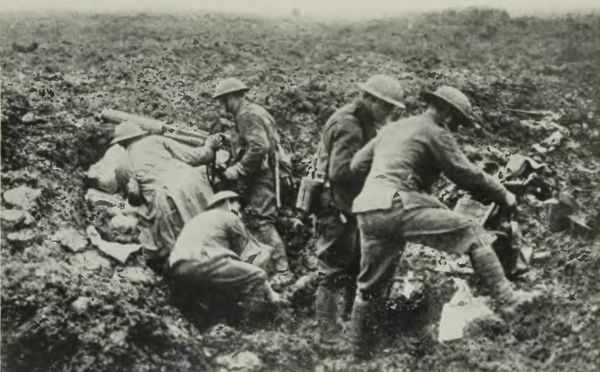
Canadian Machine Gunners Digging Themselves Into
Shell-Holes
Under the prevailing conditions, it was impossible to take machine
guns up, so we depended entirely upon Lewis guns. Fortunately no
determined attack was made on us during this time as it is extremely
doubtful if we could have held them there. We would, of course, have
stopped them a few hundred yards back, at our support line, and I must
confess that I had at times a sneaking desire to see them come over
and get into that mud so we could move back to comparatively
comfortable quarters.
As we no longer had any trenches, we abandoned the old letter method
of designation and simply numbered the various positions. On the
first morning in, the gun and crew at No. 14 were blown up by a
shell. This was an unlucky position as the same thing had happened
there to a crew from the Twentieth Battalion. We then moved that
position some fifty yards to one side and had no further trouble.
We alternated with other battalions of the division, going in and out,
holding that line and gradually improving it, until, on the
twenty-second day of May, while we were back in billets, I was "warned
for leave" (a week in England), and little Bouchard, my particular
protégé and warmest friend, was to go along.
You people who have stayed at home can never realize what "leave"
means to a soldier after eight months in the trenches and I, for one,
will not attempt the impossible by trying to describe the sensation.
We packed our kits and hiked to Poperinghe, where, after sitting up
all night, we took train at four o'clock A.M., arriving at Boulogne
about noon and were in "Blighty" by four in the afternoon.
"Oh, ain't it a grand and glorious feeling!"
In London we found things running along about as usual and proceeded
to enjoy ourselves. Oh, the luxury of having clean clothes and being
able to keep them clean: to sleep in real beds and eat from regular
dishes and at white-clothed tables. It seemed almost worth the price
we had paid to be able to get so much downright enjoyment out of the
merest "necessities" of ordinary civilian life. The theaters were all
running and we took in some show every night, but I derived the most
satisfaction from taking my young companion around to see the museums
and many old historical places in and about London. He was a stranger
and I was fairly well acquainted.
But, when the time drew near for us to go back, I began to experience
a feeling of depression. While I had not noticed it before, I suppose
the cumulative
effect of the experiences of the last eight
months was beginning to tell on me. I noticed that Bouchard appeared
to be in about the same condition. He would sometimes sit for an hour
or more, in our room at the Cecil, gazing into space, never uttering a
word. Poor boy, while of course he could not know that this was to
be his last trip, I believe he had a presentiment that such was the
case.
I found myself now and then "checking up" my own physical and mental
condition. I had been slightly injured several times--two scratches
from bullets on my left hand, a bullet in my right elbow, two pieces
of shell in my shoulder, a knee-cap knocked loose and a fractured
cheek-bone from the fuse-cap of a "whizz-bang." None of these had put
me out of action for more than a few hours and I had managed to keep
out of the hospital. (I had an instinctive dread of hospitals.) But I
knew, right down in my heart, that my nerve was weakening. Thinking
over some of the things we had done, I believed I could never do them
again. I do not think the
man ever lived who would not,
eventually, get into this condition. Some men "break" at the first
shell that strikes near them, while others will go for months under
the heaviest shell fire but, as I have said, it will certainly get
them in the end. Of course I did not express any of these feelings to
Bouchard, but tried to keep things moving all the time so as to give
him little opportunity to worry. But, to tell the truth, I guess I
needed the diversion more than he did, for he was the bravest and
"gamest" youngster I ever knew.
Before we left France for our week in London I was told by my Colonel
that I had been recommended for a commission and something or other in
the way of a decoration and he suggested that I call upon General
Carson, Canadian General in London, and find out about it. I did call
at the General's office several times but was unable to see him. It
afterward developed that the commission had already been gazetted and
I was really and truly a First "Leftenant." I did not hear of it for
nearly a month and, during the interval,
went through, as a
sergeant, one of the hottest times in my whole career.
When our leave was up we, together with hundreds of others, left
Victoria Station early one morning for Folkestone and Boulogne and so
on, back to Poperinghe, where we arrived just at daybreak the
following morning and were welcomed by an early rising boche airman,
who dropped about half a dozen bombs, evidently aimed at the railroad
station. Fortunately, no one was hit. Then we trudged down the road,
kilometer after kilometer, every one gloomy and grouchy, looking for
our several units. Ours had moved and we spent the whole day before we
located it.
We found the battalion in camp near the town of Dickebusch and soon
settled down to the same old routine. They had not been back in the
line since we left but had been engaged in some special work in and
around this town, about which there is an interesting story.
Dickebusch was a town of several thousand inhabitants and considerable
commercial importance, located
on the Ypres-Bailleul road,
about three and one-half miles directly west of St. Eloi. All troops
going into the line anywhere from Wytschaete to Hill 60 were obliged
to pass through or very close to it. Just east of the town was a
shallow lake or pond, about a mile long and half as broad, called
Dickebusch Etang, to cross which it was necessary to follow a narrow
causeway, constructed by our engineers. While we continually passed
and repassed through the place, we never had any troops actually
billeted there, as it was within easy range of the German guns and was
still occupied by the native population.
About the time of the St. Eloi affair, however, one of our Brigade
Headquarters had been located in a group of buildings at the edge of
the town, perfectly camouflaged and concealed from aircraft
observation. It had long been suspected that there were spies among
the people of this place and that they had effective means of
communicating with the enemy, so when Fritz turned his guns on that
headquarters, no
one was very much surprised, but a
determined effort was made to discover the guilty parties. Just what
means were used I do not know, but it was learned that several of the
prominent citizens, including the mayor or burgomaster, were in on it
and they were summarily dealt with.
Following this, German airmen dropped notices into the town, warning
all the civilians to get out as they were going to raze it to the
ground. Not many would have gone, however, had not our authorities
ordered the evacuation. As soon as the people had moved out, our
troops proceeded to prepare the buildings for use as billets,
reinforcing lower rooms and cellars with iron beams and protecting
them with sand-bags. This was the work with which our battalion, and
others, had been occupied and was just about completed when, true to
their word, the Heinies started in, systematically, to write "finis"
for Dickebusch. The church had already been pretty well shot up, as
well as the surrounding graveyard where many of the tombs and
monuments were smashed and the dead thrown from their graves. This
blowing
up of the dead seems to be a favorite pastime with
the gentle Hun. They, the Germans, were now engaged in the demolition
of the buildings along the principal streets and were doing it in a
very thorough manner. We had here many demonstrations of a matter
about which I have been questioned, times without number, by both
military men and civilians, and that is, "What is the effective radius
of a shell of a certain caliber?" It is one of the things which our
theorists in general, and artillerymen in particular, delight in. Many
hours of learned discourse have been devoted to proving,
theoretically, that an area of a given size can be made impassable by
dropping a certain number of shells on it, at stated intervals. This
is all rot. Common sense should teach us better. The plain fact is
that it depends entirely upon what the shell strikes. If it falls on
soft earth, the effect is merely local and a man within a few feet
would be uninjured; while, should it fall on a hard, stone-paved road,
pieces might be effective at a distance of half a mile or more.
In
the bombing schools we are told that the Mills hand
grenade has an effective radius of ten yards, yet one will quite
frequently escape unhurt from a dozen of them bursting within this
radius and yet may be hit by a fragment from a distance of two hundred
yards or more. All these theories are based on the assumption that the
ground on a battle-field is level, free from obstructions and of a
uniform degree of hardness; not one of which conditions ever exists. A
small ditch, a log or stump or a water-filled shell-hole will make so
much difference in the effect of the explosion of a shell or bomb that
all efforts to prove anything by mathematics is a waste of time. If
one is unlucky he will probably get hurt, otherwise not.
We had been "home" but a few days when we received rush orders to pack
up and march toward Ypres. There had been an intense bombardment going
on up that way and we soon learned the cause from straggling wounded
whom we met coming along the road. It was the second of June, 1916,
and the Germans had launched their great surprise attack against the
Canadians at Hooge. It was the beginning of what has been called the
Third Battle of Ypres, but will probably be recorded in history as the
Battle of Sanctuary Wood.
The enemy had gradually increased his customary bombardment and then,
assisted by some mines, had swept forward, in broad daylight,
overwhelming the defenders of the first and second lines by sheer
force of numbers and had only been checked after he had driven through
our lines
to a depth of at least seven hundred yards over a
front of nearly a mile, including the village of Hooge, and was firmly
established in a large forest called Sanctuary Wood and in other woods
to the south. By the time we had arrived at our reserve lines (called
the G. H. Q. or General Headquarters Line), we were diverted and
directed to a position on the line just south of the center of the
disturbance where we "dug ourselves in" and held on for four days.
Shell fire was about all we got here, but there was plenty of that.
The rifle and machine-gun bullets that came our way were not numerous
enough to cause any concern although we did lose a few men in that
way.
Here the news of the fight filtered through to us. It seemed that the
Princess Pat's (unfortunate beggars), had got another cutting-up,
together with some of the Mounted Rifles, and Major-General Mercer and
Brigadier-General Victor Williams, who had been up in the front line
on a tour of inspection, had both been wounded and captured. General
Mercer afterward died,
in German hands, but General
Williams recovered and remains a prisoner. It was said that less than
one hundred from each the Pat's and the Fourth C. M. R. came out of the
fight.
A Shell Exploding in Front of a Dug-in Machine Gun.
At this place several of our gun positions were in the grounds of what
had been one of the most beautiful châteaux in Flanders--the Château
Segard, hundreds of years old but kept up in the most modern style
until the war came. Now the buildings were but a mass of ruins. Not
only this but the grounds had been wonderfully laid out in groves,
gardens, moats and fish-ponds with carefully planned walks and drives
throughout the whole estate which comprised at least forty acres.
There were trees and plants from all over the world; beautiful borders
and hedges of sweet-smelling, flowering shrubs and cunningly planned
paths through the thickets, ending at some old wondrously carved stone
bench with perhaps an arbor covered with climbing rose bushes.
All had felt the blighting touch of the vandal shells. The trees were
shattered, the roads and paths
torn up, the ponds filled
with debris and the beautiful lawn pitted with craters, but in spite
of all this devastation, the flowers and trees were making a brave
fight to live. I could not but think, as I wandered through this
place, how well the little flowers and the mighty oaks typified the
spirit of France and Belgium. Sorely stricken they were--wounded unto
death; but with that sublime courage and determination which have been
the admiration of the world they were resolved that they should not
die.
Along the main road leading up to the château was a charming little
chapel, handsomely decorated and appointed. It was the only structure
on the estate that had not been struck by a shell. We used it as
sleeping quarters for two crews whose guns were located in the
immediate vicinity. One night a big shell struck so close as to jar
all the saints and apostles from their niches and send them crashing
to the floor, but did no other damage.
This same thing happened to us once when we were sleeping in the
convent school at Voormezeele, when
all the statues on the
walls were hurled down upon us by a large shell which struck the
building.
The boys used to take these sacred effigies and place them on graves
of their dead friends. We were not a very religious bunch but I
suppose they thought it might help some--at any rate it proved their
good intentions and I never interfered to stop it.
For several days the fighting continued furiously, the Canadians
recovering some of the lost ground, including most of Sanctuary Wood,
and then things settled down to the old "siege operation." During this
time we had many opportunities to watch the splendid work of the men
of the ammunition columns taking shells up to the batteries in broad
daylight and within plain view of the enemy lines. It was one of the
most inspiring sights I have ever witnessed and brought back memories
of pictures I had seen of artillery going into action in the old days.
Down the road they would come, on the dead gallop, drivers standing in
their stirrups, waving their
whips and shouting at the
horses, while the limbers bounded crazily over the shell-torn road,
the men holding on for dear life and the shells bursting with a
continuous roar all about them. It was the sight of a lifetime, and
whenever they came past our men would spring out of the trenches and
cheer as though mad. Time after time they made the trip and the
escapes of some were miraculous. A few were hit, wagons smashed and
horses and men killed or wounded, but not many, considering the number
of chances they took.
The stories of heroism during that first day's fighting equal anything
in history. Batteries were shot down to a man but continued working
the guns to the last. One artilleryman, the last of his gun squad,
after having one arm shot off at the elbow, continued to load and
fire. Then a shell blew off about a foot of the muzzle of the gun but
he still kept it going. He was found, lying dead across his gun and a
trail of clotted blood showed where he had gone back and forth to the
ammunition recess, bringing up shells. One member
of the
crew remained alive long enough to tell the story.
In another place, in Sanctuary Wood, were two guns known as "sacrifice
guns," as they were intended to cover a certain exposed approach in
case of an attack and to fight to the finish. How well they carried
out their orders may be judged from the fact that every man was killed
at the guns, by German bayonets, after having shot down many times
their own number of the enemy.
Our old friends of the Lahore Battery lost so many men that they were
having difficulty in maintaining an effective fire until two of our
machine-gun squads volunteered to act as ammunition carriers, which
they did for several hours, suffering heavy casualties.
Here occurred the only case of which I have ever heard where one of
our medical officers was apparently "murdered." Captain Haight, M. O.
of one of our western battalions was reported, on excellent authority,
to have been bayoneted and killed while attending the wounded.
While we were here, Major-General Turner, V. C.,
who was in
command of the entire Canadian Corps, paid us a visit. He came up
unannounced and accompanied by a lone Staff Captain. I was instructed
to act as his guide over our sector. During one trip along an exposed
road we found ourselves in the midst of a furious hail of shells. I
looked at the General to see if he wanted to take cover (I'm sure the
rest of us did); he never "batted an eye" but continued at an even
pace, talking, asking questions and stopping here and there to observe
some particular point. I overheard one of our men say: "General
Turner? General Hell! he ain't no general; he's a reg'lar
soldier."
On the night of the sixth we were relieved and, next day, took up our
quarters in Dickebusch. The Emma Gees had taken possession of a bank
building, about the best in town, and had strengthened it, inside and
out, with steel and sand-bags until it looked as though it would
withstand any bombardment. Fortunately it was not hit while we were
there, although many large shells fell very near; but when I again
passed that way,
just a week later, I noticed that a big
shell had gone through our carefully prepared "bombproof" and
completely wrecked it. We only remained a few days and then received
orders to go into the front line at Hill 60 (south of Hooge), as an
attack was to be made to recover the trenches lost on the second.
HOLLEBEKE TRENCH MAP
The map on the opposite page is a reproduction of what is known
as "Hollebeke Trench Map--Part of Sheet 28." Famous Hill 60 is
shown encircled by a contour line, just below Zwarteleen. The
road running off at top and left of map leads to Ypres. The black
and white line immediately to the right of this army road is the
railroad from Ypres to Comines. The fine irregular lines
represent the perfect network of main and communication German
trenches. Various signs indicate supply dumps, dug-outs, mine
craters, observation posts, earthworks, mine craters fortified,
hedges, fences or ditches, churches, mills, roads, footpaths,
entanglements, ground cut up by artillery fire, etc., etc. The
British front-line trench is shown very faintly on this
reproduction but can be picked up as it passes through the first
"e" in Zwarteleen and traced up past the figure 30. At the left
of Zwarteleen it can be seen crossing the railroad and army road.
This map, as were the others, was carried by Captain McBride and
the section shown represents about one-sixth of the total size.
It was made from photographs taken by Allied aviators. The
blurred line bisecting the map just below figures 35 and 36 is
one of the well worn folds in the map.
As we had never been in the sector it was necessary for the
non-commissioned officers to go in a day ahead to locate the gun
positions and be able to guide the section in. We went in in daylight
(the non-coms.) and found it to be the longest trip we had ever
undertaken on such a mission. From Bedford House, on the reserve line,
it is at least two miles to the front line, all the way exposed to
observation and fire. There had been a little trench tramway but it
had been wrecked by shells. By breaking our party up into twos we
escaped any severe shelling and the rifle fire was at such long range
that we ignored it. Beyond three hundred yards the German's shooting
is a joke.
We went over the position which extends from what
was known
as the Ravine, to a point exactly opposite Hill 60. At some places the
lines were less than forty yards apart and it was possible to throw
hand grenades back and forth. It required the entire day to
familiarize ourselves with the wonderful maze of communication and
support trenches at this place, as we had never seen anything like it
before. We had become so accustomed to doing without communication
trenches that they were a distinct novelty. They, together with the
many support trenches, made a perfect labyrinth: like a spider's web,
only not quite so regular in form.
The next night we moved in. As the battalion was crossing the long
open stretch we came under fire from an enemy machine gun and some men
were hit. There's no use talking, no other weapon used in the war is
as deadly as a machine gun. Where you can walk through an artillery
barrage with a few casualties, the well-directed fire of only one
machine gun will pile men up as fast as they come along. When one of
them catches you in the open the only thing to do is to drop into
the nearest hole and stay there until the firing ceases.
We went in on the night of the twelfth and the attack was scheduled
for the night of the thirteenth, or rather the morning of the
fourteenth, as the preliminary bombardment was to commence at
twelve-forty-five and "zero" was one-thirty A.M.
This was the greatest place I have ever seen for rifle grenades and
"Minnies." They came over in flocks or shoals and one must be
everlastingly on the lookout to dodge them. But we had as many as they
and also a lot of Stokes guns which seemed to "put the fear of God"
into the boche. They sprung a new "Minnie" here, much larger than any
we had seen. It hurled a whale of a shell; not less than one hundred
and sixty pounds of pure T. N. T., and what it did to our trenches and
dug-outs was a sin. And the worst of it was, they had it in a hole in
a deep railroad cutting at the bottom of Hill 60, where our artillery
could not reach it.
At this time we had both the regular machine guns
and also a
lot of Lewis automatic rifles. Shortly after, the latter were turned
over to the infantry companies, while the former were taken into the
newly-organized machine gun corps, an entirely separate branch of the
service, which was under the direct command of the Brigade Commander.
The guns were distributed along the line in favorable locations for
either defense or offense but, as there were no prepared emplacements,
the men had but little protection.
Here our work, as at St. Eloi, was to support the advance; in fact,
that is the normal function of machine guns in an attack, although the
lighter automatic rifles of the Lewis type are usually with the
assaulting troops.
Our "Higher Command" had learned a lesson from the St. Eloi experience
and had brought up many new batteries, including a fair sprinkling of
the "super-heavies" of twelve and fifteen-inch calibers. It has been
said, on good authority, that we had more than one thousand guns
concentrated on about a thousand yards of trench, or a gun to every
yard, and I am perfectly willing to
believe it after hearing
them all at work. It was our first experience of that delightful
situation where we had "superiority of fire" and it made everybody
happy. Afterward, on the Somme and Ancre, it had become a permanent
condition; but to us, who had been "carrying on" under the
overwhelming odds of the German guns, it was a welcome change. It did
our hearts good to hear those monster thirteen hundred and fifty pound
"babies" coming over our heads with a "woosh" and landing in the lines
across the way, on Hill 60, where they left marks like mine craters.
We could put up with quite a lot just to see that, and although we
were suffering considerably from the rifle grenades and the "Minnies,"
every one appeared to be in a good humor.
With everything ready we waited for the "zero" hour. Exactly at the
designated time the artillery opened. It was as though all the hounds
of hell were let loose. Such a wailing and screeching and hissing as
filled the air, from the eighteen-pounders ("whizz-bangs"), which
seemed to just shave our own parapet, to the gigantic missiles
from the "How-guns," as the Howitzers are affectionately called,
each with its own peculiar noise. The explosions became merged into a
continual roaring crash, without pause or break. Then our Stokes guns
joined in, and, if there ever was an infernal machine, that is it.
Vomiting out shells as fast as they can be fed into its hungry maw; so
fast, indeed, that it is possible for seven of them to be in the air
at one time, from one gun, at a range of less than four hundred yards,
it is the last word in rapid-fire artillery.
Of course the Emma Gees started at the head of the procession and kept
up a continuous fire.
Fritz soon began to do the best he could but, what with the noise of
our own guns and the bursting shells, we were unable to hear his
unless they struck very close. He did give us trouble, though, with
that devilish Minenwerfer which sent over a wheel-barrow load of high
explosive at each shot. He blew the left end of our line "off the map"
for a distance of a hundred yards
or more and made it
untenable--for any one but a machine gunner. The infantry was ordered
to evacuate that part and did so, but not the Emma Gees; they stuck
until one of the big "terrors," striking alongside, killed and wounded
all the crew but one and then he still stuck it, loading and firing
until I was able to get a reserve crew up to relieve him. He was a
Scot, one of the kind that doesn't know what it means to quit. Here's
to you, "Wullie" Shepherd, wherever you are!
The attack was carried off with absolute precision. At one-thirty the
barrage lifted and over the boys went, sweeping everything before
them, back to the original position and then a little farther for good
measure. By daylight they had the new line so well consolidated that
Fritz was never able to make a dent in it and the Canadian prestige
was once more established.
At the left end of our line, where the Minenwerfer had done so much
damage, was a mine shaft; one of many in that vicinity which our
engineers were driving under Hill 60 (they afterward
blew it
up), and it seemed as though the boche knew of it and was endeavoring
to cave it in with the "Minnies." In fact, they did succeed in partly
destroying it, but the sheltering roof at the month of the shaft
remained in fair condition, and as it was the only protective covering
in that neighborhood, Bouchard and I were sitting inside, with our
feet hanging down the shaft, holding down that end of the line. We had
relieved the other crew, or rather I had sent them back about two
hundred yards along the trench as a precautionary measure and then,
feeling that some one must remain to keep lookout, decided to take
care of the job myself. The boy, of course, insisted upon staying with
me. The big fellows were coming over with regularity (I nearly said
monotonous, but those things never get monotonous), and were bursting
too close for comfort. Bou had just made a proposition that we sneak
over after dark and try to locate the devil-machine and blow it up,
when we heard something moving below us in the mine-shaft, and a
moment later a mud-encrusted face came
up into the light.
With an unusually fluent flow of "language," which sounded strangely
familiar to me, two men came up the ladder, and as the first one
emerged into the daylight he took a look at me and said: "Hello, Mac;
it's a long way to Ft. George, isn't it?" When he had removed some of
the dirt from his face I recognized a miner, named McLeod, who had
once helped rescue me from the Giscome Rapids and afterward worked for
me up in British Columbia. He and his partner had been caught in the
shaft and had been a day digging themselves out. After a rest of a few
minutes they went their way, down the trench, and I never saw or heard
of them again.
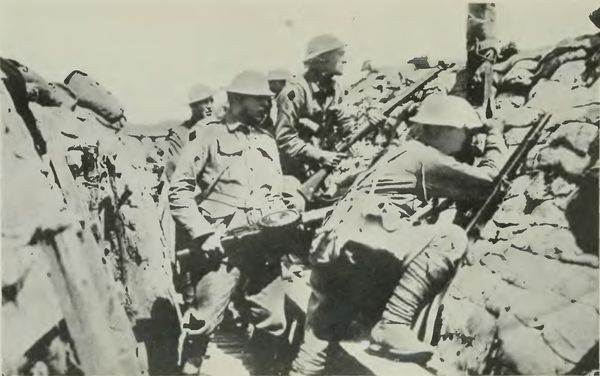
Lewis Machine Gun Squad Observing with Periscope at
Hill 60
During the next hour or two I managed to work around through the
wreckage of this part of our line, searching for wounded and making a
list of the dead. I found none of the former, all having been removed
by their companions when they were ordered to evacuate, but I did find
a number of bodies which I examined for identification disks or other
marks and made a complete record
which I afterward turned in
to our Headquarters. This is a custom that is always followed, if
possible, so that, in the event that your own troops do not return to
that spot, a record will be preserved and relatives notified. If this
were not done, many would be reported as "missing" which is, to
relatives, far more terrible than the knowledge that death has been
swift and sure. This is work in which many chaplains have especially
distinguished themselves, often working close behind the advancing
lines during a battle; writing last messages for the dying and
compiling lists of the dead who may or may not be buried at a later
date.
In burying dead on the field, every effort is made so to mark the
grave that it may afterward be identified and a proper record obtained
for the archives of the Graves Registration Commission. The best way
is to write all the data, name, regiment and number together with the
date, on a piece of paper, place it in a bottle and stick the bottle,
neck down, in the top of the grave. If no bottle is available, the
next best way
is to write the record on a smooth piece of
wood with an ordinary lead pencil which will withstand the action of
water far better than ink or indelible pencil.
Here I had my last talk with Bouchard. He was very anxious to go to
college and take an engineering course. I suggested Purdue, but he
thought he would find it necessary to spend a year or two at some
preparatory school. He had heard me speak of Culver and was very much
interested in that place, and when I left it was definitely decided
that, should he survive the war, he would spend at least four years at
any educational institution I might recommend.
As soon as darkness came our infantry returned, and by working hard
all night managed to restore the damaged part of the parapet. I went
back to my dug-out for a little sleep and had just made myself
comfortable when a six-inch shell struck the place and drove me out,
together with a companion, George Paudash, a Chippeway Indian and
corporal of our section. We had several Indians, there being two pairs
of brothers, all
from the same reservation and all of them
splendid soldiers.
We had several men hit that night by rifle grenades. I particularly
remember two: Flanagan and McFarland. The former was hit in numerous
places, some of them really serious, but was most concerned over a
little scratch on his face which he was afraid would injure his
good-looks. McFarland, just a boy, about eighteen, had his left hand
terribly mangled and nearly twenty pieces of metal in other parts of
his body, but he laughed and called out: "I've got my Blighty; I've
got my Blighty." His brother had been shot through both eyes and
totally blinded a short time before. By the merest chance I saw
McFarland a few days later, as he was being taken aboard a hospital
ship at Boulogne and he then gave me his wrist watch, which had been
shattered and driven into the flesh, asking that I send it to his
father in Canada: I sent it by registered post, from London, but never
heard from it.
The artillery fighting continued for several days and on the night of
the eighteenth we were relieved
and moved back to Bedford
House, in reserve.
Next morning I was summoned to Battalion Headquarters and informed
that I had been commissioned and was ordered back to England to act as
an instructor in one of the training divisions. Our Colonel at this
time also received his promotion to Brigadier-General and he promised,
as soon as he was assigned to a brigade, that he would request I be
transferred to his command as brigade machine gun officer. He did,
afterward, make an effort to have this done, but it was too late. I
had finally got my "long Blighty," and was out.
It was hard to part from that old crowd. I did not know when I would
get back, but we all knew, without question, that there would be other
faces gone from the ranks before we met again. When I did return,
during the Somme campaign, I was attached to another battalion and did
not often see the Twenty-first and when I did, I recognized but few of
them. They had taken part in the
great advance of September
fifteenth, which captured Courcellette and numerous other towns--the
greatest gain ever made in one day on the Western Front until the
recent one at Cambrai--and had helped to add another glorious page to
Canada's brilliant record. But the cost was great. Many, oh, so many
of the bravest and the best fell that day and among them was "my
little boy," Bouchard, killed at the age of eighteen, after two years
of service.
Yes; a boy in years, but he worked like a man, fought like a man and,
thank God he died like a man--out in front, fighting.
While the following has no direct connection with the machine guns,
and is, really, a part of "another story," I think it fitting that I
take this opportunity to render my humble tribute of gratitude and
admiration for the splendid work of the British Red Cross Society; and
that the reader may fully understand, it is necessary to relate the
occurrences which led up to my first hospital experience.
Upon returning to England, I was assigned to a Training Battalion at
our old camp--Sandling--but found the work so tedious and monotonous
that I requested a transfer to other and more active duties, and soon
after was engaged first, in conducting troops to France; then, as a
messenger to and from the various headquarters; later, on
court-martial work at Rouen and Le Havre; and finally reassigned to
the Fourth Canadian
Brigade and ordered to the front, during
the latter part of the Somme Battle. I was with a party of officers of
the Gloucestershire and the "Ox and Bucks" (Oxford and
Buckinghamshire) Regiments and through an error on the part of the
R. T. O. (railway transportation officer) my transportation order was
made out the same as theirs, and the first thing I knew I was away
over on the right of our line, opposite Combles, where we joined the
French. As there was a fight on, I went in with the "Glosters," and
after the fall of Combles made my way up the line until I located my
own command, near Courcellette.
Here I heard of the great advance of September fifteenth and also of
the death of many of my old friends. Among them, it seemed, Bouchard
and his crew had been wiped out by a big shell, but no one had been
able to get back to look for them or bury them. I was very busy, but
getting all available information as to the spot where they were seen
to fall, I managed, at night, to make several trips over the ground,
but without result. The
spot was near the famous "Sugar
Refinery," just outside the village, and as this had been one of the
hottest places in the fight, there were many bodies lying around but
none that I could recognize.
I had a cross made, bearing the names of all the crew and decided
that, at the first opportunity, I would plant it at that spot; and
when our whole division was ordered out, on October tenth, I took the
cross and made my way up the Bapaume road and across the shell-torn
field to the place. The enemy was shelling the road, dropping several
heavies near me, so I hastily gathered into a shell-hole the remains
of all the dead in the immediate vicinity and covered them up as best
I could, then placed the cross firmly in the ground and turned to
leave. I had not gone far when a "crump" struck so close as to stun
and partly bury me. When I regained my senses I found that I could not
see. My eyes, especially the left, had been giving me a great deal of
trouble ever since I had been hit on the side of the face by a piece
of shell at the time of the Bluff fight, but
now they
appeared to be entirely out of commission, and were very painful.
I lay there for some time, trying to figure some way out of it, all
the time hearing the shells coming over. This gave me an idea. Knowing
the direction from which the shells came with relation to the location
of the road, I started out to make my way there. Troops were
continually passing at night and I would be sure to find assistance.
From that time on my remembrance of things is not clear. I have hazy
recollections of falling into a trench, crawling out and getting
tangled up in some wire and then, I think I fell into another hole. I
do remember, distinctly, talking aloud to myself, as though to another
person, and telling him to "get down on your knees and crawl, you damn
fool: first thing you know you'll fall into one of those deep holes
and break your neck."
Whatever I did after that must have been done instinctively. (Was
afterward told that I was found, lying stretched out across the
Bapaume road.)
Removing the German Wounded from Mont St. Eloi
The
next thing I knew I suddenly discovered that I was trying
to think of something. I believe I was conscious. I felt as though I
could move if I wanted to, but didn't want to. I could see nothing,
but that also was of no importance. It was something else that was
wrong and it worried me in a vague, half-interested sort of way. One
thing was sure--I was dead, all right, and it wasn't half bad. Even if
I couldn't see or move or think, I was not suffering any pain or
inconvenience, which was a great relief from "soldiering." Nothing
seemed to matter, anyway, and I guess I went to sleep.
I felt, or rather sensed, the presence of others moving about from
time to time, but took no interest in the matter until, suddenly, back
came the old feeling that something was not right--that there had been
a big change in all the affairs of the world--and then, after what
seemed hours of struggling with the problem, it came to me like a
flash--it was the "quiet" that was bothering me. That was it; there
was no noise; and then, my brain becoming clearer all the time, I
began to wonder whether I was deaf or whether the
war was
over. It occurred to me that I might clap my hands or make some
movement to find out whether or not I could hear, but the idea was
dismissed as involving too much exertion; just as it was too much work
to open my eyes to try to see.
Then I heard some one come close to me, heard voices, faint and far
away they seemed, so I shouted to them (I thought I shouted but it was
only a mumbling whisper), and then a voice, low and close at hand,
asked me: "Are you awake?"
"Course; what's matter?"
"Nothing is the matter; you're all right now. Don't you think you
could eat something?"
I pondered that for some time, but as I was quite comfortable and
could not see the sense of dead folks eating, anyhow, I declined and
fell asleep again. It was too much trouble to talk, especially to
answer questions.
When next I awoke it was different. I actually opened my eyes, or at
least one of them, the other being bandaged, and I could see a face
looking
down at me--a face and a white expanse of something
with a brilliant red cross in the center, and when the face asked me
how I felt now and did I think I could eat a little, I grunted
something which was intended to assure her that I was feeling all
right and was hungry. At any rate, she understood, and disappearing,
soon returned with a tray, loaded with things. She first helped me
hold up my head while she gave me a tumblerful of hot milk with brandy
in it, but that was no good--it would not stay down; so, after a
little trouble on that account, she vanished again and came back with
a pint bottle of champagne which she opened and fed to me; first a
spoonful at a time and then a full glass. That paved the way all right
and I was able to eat something, I don't remember just what, but it
was good.
By this time I had discovered that I still had all my hands and feet
and could move them about. Satisfied on that point, I asked where I
was.
"Hospital; but you mustn't talk."
"What hospital; why can't I talk?"
"Number
Twelve; but I think you should keep quiet and rest."
"Had plenty rest; where's Number Twelve?"
"St. Pol; but, really, you must go to sleep now."
I went to sleep, wondering how the dickens I happened to be in St.
Paul, which was what I understood her to say. (The French spell it
differently but pronounce it about the same.)
From that time on, scarcely an hour passed that one of the kindly
nurses or sisters did not come in and look to see if I was awake, and
if so, could they get me something to eat or drink. It was heaven, all
right; or at least, my idea of what heaven should be.
I learned that, although I was disabled on the night of the tenth, I
was not picked up until the twelfth and then had been relayed through
several dressing stations and hospitals until I landed in Number
Twelve General Hospital, at the town of St. Pol. It was a B. R. C.
(British Red Cross) institution and was altogether different from my
preconceived ideas of hospitals. The day when I first
"woke
up" was the fifteenth of October, my birthday.
After several days I was put aboard a hospital train and taken to
LeTreport, where I was assigned to Lady Murray's Hospital, another
B. R. C. place. It had been, before the war, The Golf Hotel, one of the
many splendid seaside hotels that have been converted into hospitals.
Here, again, I was royally treated. Every wish appeared to be
anticipated by the indefatigable and ever-cheerful women and girls,
many of them volunteers, members of prominent and even titled
families. Lady Murray personally visited every patient at least once a
day.
All these ambulances at LeTreport are driven by girls belonging to the
V. A. D. I'm not sure whether it means Volunteer Ambulance Department or
Volunteer Aid Department, but that is immaterial; they are wonders,
whatever name they sail under.
They work all hours, day or night, transferring patients to and from
trains and hospitals. They
furnished their own uniforms and
paid all their own expenses, and for a long time served without any
compensation, but I have heard that a small allowance has been made
them recently.
The girl who took us down to the train told me that she had been over
there two years. I asked her if it was not pretty hard work and she
replied: "Oh, sometimes it is hard, when the weather is bad, but we
know it is nothing to what the men are doing up in front, so we are
glad to be able to do our little bit, wherever we can."
Going down the hill, we passed a big ambulance, filled with wounded,
standing alongside the road. A little slip of a girl, who looked as
though she weighed about ninety pounds, was changing a tire and I
honestly believe that that tire and rim weighed as much as she did.
Our driver stopped and proffered assistance but the little one
declined, remarking that we'd better hurry or she would beat us to the
train. As a matter of fact, she was not five minutes after us.
I was in pretty bad shape; could see very little and had an attack of
trench fever. As soon as I was
able to travel I was sent,
with several others, by hospital train to Le Havre, where we went
aboard the hospital ship Carisbrook Castle, landing at Southampton,
and so on to London, where I was lucky enough to draw an assignment to
another B. R. C. hospital--Mrs. Pollock's, at 50 Weymouth Street. And
here I remained until, passed on by numerous "boards" and subjected to
many examinations, I found myself again on the way to France, where I
reported the fifth of December--still able to "carry on."