OF THE CAUSES OF GEOLOGICAL PHENOMENA.
An exhibition of the composition and structure of the earth,
together with an account, as far as there is reliable evidence, of
the modifications which they have undergone, has been the object
of the preceding chapters. They are mainly a collection and classification
of observed facts. No reference has been made to
causes or modes of operation, except in a few cases where it was
necessary in order that a statement or description, might be
intelligible.
If the facts have been given with sufficient clearness and detail
to convey a correct general idea of the crust of the earth, we are
prepared to inquire what are the agencies employed, and how they
have operated in producing it. It is the province of the geologist
to question every known power in nature, and to ascertain what
geological effects each one is now producing; and, observing what
effects are produced by given causes, he is to judge of the causes
which have produced like effects in past geological periods.
Some of these causes are in their nature limited, and effects can
be referred to them only within those limits. Thus, the congelation
of water expands it by a certain proportion of its volume, and
beyond that it can have no effect. But the expansive power of
steam varies with the temperature; and hence the effects referred
to it may be equally varied. Thus, we are not to expect exact
uniformity of results in all past times, but the results will vary
only as the circumstances vary upon which the operation of these
causes depends.
Geological causes, in most instances, operate with extreme slowness;
and therefore it will require a series of observations, continued
for a long time, to ascertain what are the capabilities of these
causes. But a single instance of their effects proves their capabilities
thus far. Hence, one instance of the deposition of a
stratum of salt in a salt lake; of the filling of a fracture with fluid
lava; of a volcanic eruption, like that of Iceland in 1783; of the
subsidence of a volcanic mountain, as that of Papandayang in
Java; or of the rising of a large area of land, as in Sweden, as
fully proves that natural causes exist capable of producing these
effects, as if the effects were produced daily. As these effects
increase in number, and careful observations are made and authentic
accounts preserved, the means of correctly explaining geological
phenomena will increase. The causes thus far known are
Atmospheric Causes, Chemical Action, Organic Agency, and
Aqueous, Aqueo-glacial and Igneous Action.
SECTION I.—ATMOSPHERIC CAUSES.
The oxygen of the atmosphere is capable of uniting with some
of the constituents of rocks, by which their cohesion is weakened or
destroyed. This is the cause of the rapid disintegration of some
varieties of granite. The protoxide of iron which they contain is
converted, by contact with the atmosphere, into the peroxide. Its
volume is thus increased, and portions of the rock are separated
from the mass. When granite or limestone contains sulphuret of
iron, the oxygen of the atmosphere, in connection with moisture,
combines with the sulphur, forming sulphuric acid, by which limestone
and the felspar of granite are rapidly decomposed. Hence,
a rock which contains an oxide or sulphuret of iron should not be
used for architectural purposes.
Carbonic acid is another constituent of the atmosphere which
operates as a decomposing agent. The water that falls from the
atmosphere is charged with it, and thus becomes capable of dissolving
calcareous rocks. Carbonic acid is thus indirectly the
means of the rapid destruction of rocks of this class. It is also
believed that carbonic acid enters into direct combination with
some of the constituents of rocks, and particularly felspar; for it is
found that in those countries where carbonic acid issues in great
quantities from the earth, the rocks, especially those which contain
felspar, disintegrate rapidly. Masses of many tons’ weight, which
appear to be solid granite, after being broken are found to be in
such a state of decay that fragments may be reduced to sand
between the fingers.
The moisture of the atmosphere has some effect as a decomposing
agent. Rocks which are exposed to frequent alternations of
moisture and dryness soon crumble into fragments. Rain, falling
upon the surface of rock, produces, mechanically, a destroying
effect, which is not to be overlooked.
Variations of temperature, especially those alternations above
and below the freezing point, have greater influence than any
other cause in the destruction of rocks. When the water with
which a rock is saturated congeals, the resulting expansion tends
to enlarge the interstices, and thus to separate the particles of the
rock. When the ice melts, the particles fail to resume the closeness
of arrangement with which they were before packed. By
frequent repetition of this action, the superficial portion loses its
cohesion, and disintegrates. It is also found that in the region of
perpetual snow the surface of the mountain masses is covered with
rock in a disintegrated or fragmentary state, in greater abundance
than below the snow line; but no explanation of this fact has yet
been found.
In mountainous regions, electrical discharges and violent storms
have some destroying effect. Winds have considerable power
in changing the place of earthy matter in a disintegrated state.
In deserts, the sands are carried in great quantities to great
distances.
The causes now enumerated, when considered separately, and as
acting for only limited periods of time, seem hardly worthy of
notice; but when considered as operating conjointly, and for indefinite
periods of time, they must have produced important changes
on the surface of the earth.
From these causes, the surface and ornaments of castles and
other ancient edifices, and of boulders, and all insulated rocks,
are found to be decayed, and often to a considerable depth. It is
from these causes that a soil is produced on every surface of rock
which is not so exposed to the action of currents that the debris is
removed as fast as it is formed. Hence it is, also, that a slope of
detritus is formed at the base of every declivity, so that the ledge
appears only at the highest points.
It is from a combination of these atmospheric causes that a large
part of the sediment is furnished which brooks and rivers carry
away. And when cohesion is not entirely overcome, it is so far
weakened that other causes are much more effectual than they
would otherwise be, in effecting the disintegration of rocks.
SECTION II.—CHEMICAL ACTION.
All those changes in which the action is molecular,—that is, between
the molecules as such, and not between the masses,—including
the effects of the imponderable substances, we regard as resulting
from chemical agency.
Under the control of these molecular forces the crystalline rocks
have taken their form; and if the crust of the earth could have
remained in a fixed condition, in which these forces would have
been in equilibrium, no further chemical action could have taken
place. But, instead of being in a fixed condition, the present system
is one of perpetual change. Various disturbances of this
equilibrium of forces,—such, for instance, as the diurnal and annual
changes of temperature at the surface, and the still greater secular
changes of temperature at great depths,—will bring the chemical
forces into operation. The mechanical disintegration of the crystalline
rocks, and the deposition of them in strata independently of
the chemical affinity of their particles, will give occasion for
chemical changes,—that is, for a rearrangement of the particles in
accordance with their affinities,—whenever any movement of the
particles among themselves can take place. These movements take
place, to a very great extent, under the influence of electrical currents,
and of change of temperature, even while the masses retain
their solid form.
Chemical affinity has exhibited itself on the largest scale in the
formation of the various mineral species of which the crust of the
earth is composed; but we may also refer to the same cause the
formation of divisional planes in rocks, the concretionary arrangement,
and mineral veins.
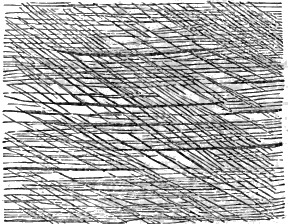
1. Divisional Planes.—It has before been stated, that the older
rocks, in many cases, cleave freely in planes not parallel with the
stratification. (See Fig. 48.) In some instances, in beds of lava,
a similar cleavage exists, sufficiently perfect to allow of its use as
a roofing material. In these cases, there must have been a rearrangement
of the particles, so that their axes of greatest attraction
would lie in parallel planes; the same arrangement which exists in
mica and other crystalline substances, which have one and but one
free cleavage.
A similar arrangement has sometimes taken place under such
circumstances as to submit the process to more careful scrutiny.
In the gold mines of Chili, the powder from which the gold has
been washed is “thrown into a common heap. A great deal of
chemical action then commences; salts of various kinds effloresce
on the surface, and the mass becomes hard, and divides into fragments
which possess an even and well-defined slaty structure.”
When a portion of clay, worked into a paste with a very weak
acid, is submitted to a weak voltaic action for several months, and
then dried, it is found to have acquired a distinct though imperfect
cleavage structure.
It appears, then, that both electrical currents and ordinary
chemical action are capable of arranging the particles of an earthy
mass into separable layers. We may then regard this change in the
older rocks as an imperfect crystallization, and probably induced
by electro-chemical agency.
It is also found that all rocks are divided into huge blocks by
seams not parallel with the cleavage, and too regular to be considered
as fractures. These seams bear an analogy to the secondary
faces of crystals, which are never parallel to the cleavage.
2. Concretionary Formations.—There exist in many rocks
concretions which differ from the mass of the rocks. In most of
the tertiary clays there are small concretionary nodules, which
contain more calcareous matter than the mass of clay around them.
In the coal formation, the nodular iron ore consists of concretionary
masses. In the chalk formation, nodules of flint abound, and generally
in layers. In many of these cases, particularly in the
clays and coal, the nodules have an organic nucleus, and, although
concretionary, they retain the marks of stratification of the adjacent
rocks. Hence they could not have been deposited in the form
of nodules. There must therefore have been in the rock, though
in the solid state, such motion among the molecules that particles
of a particular mineral have separated from the mass and rearranged
themselves in concretionary layers, yet so gradually as not
to disturb the lines of original stratification.
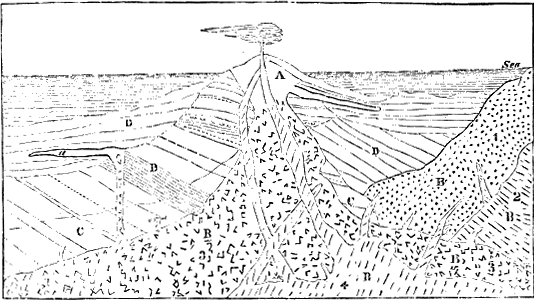
Fig. 70.
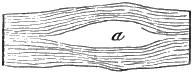
There are other instances, similar to the last in all respects,
except that the segregated portion does not take the concretionary
form. When gypsum is distributed in small proportion through
a formation, there seems very little reason to doubt but that it is,
by a molecular action, segregated from the strata in lenticular
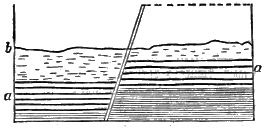
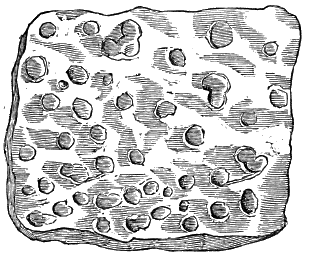
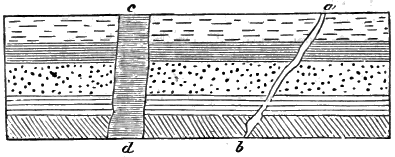
masses, as at a (Fig. 70). Many
of the limestone strata contain
irregular aggregations of quartz.
It is presumed that the siliceous
and calcareous matter was deposited
together as sediment, and that the aggregation has resulted from
a movement among the particles similar to that by which the concretionary
structure is produced.
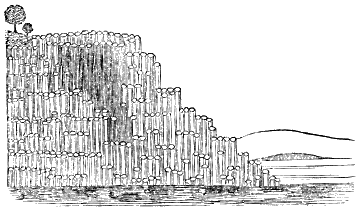
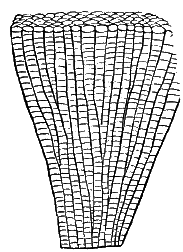
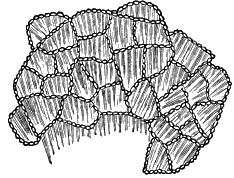
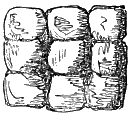
The columnar structure of basalt seems to have resulted from
a peculiar molecular action, at first resembling a concretionary
arrangement, while the mass was cooling from a state of fusion. In
experimenting to ascertain the cause of this structure, Mr. Watt
fused in a furnace seven hundred pounds of basalt. When cooled,
he found that “numerous spheroids had been
formed, and that when two of them came
in contact, they did not penetrate each other,
but were mutually compressed and separated
by a well-defined plane, invested with a
rusty coating. When several met, they
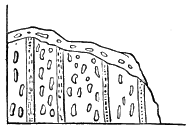
formed prisms.” (Fig. 71.
Fig. 71.
3. Mineral Veins.—The phenomena of veins are such that
they cannot all be referred to the same cause. In some, the vein-stuff
has been protruded as a dike, differing from ordinary dikes
only in the accidental circumstance that it contains a metal or
a metallic ore.
Mineral veins are not, however, generally filled by injection from
below. It is found that those veins only are productive which have
an east and west direction. But injected dikes run in all directions.
The ore often varies in richness at different depths in the vein,
or passes into ore of some other metal. The ore also varies in
kind and quality, according to the character of the rock through
which the vein passes. These phenomena are best explained by
supposing that the sediment of which the strata were formed contained
the mineral substances of these veins in small proportion.
After they were solidified, and fractures had been formed, the mineral
substance was transferred by molecular action to the fissures,
and deposited.
It was shown by the early experiments of Davy, that voltaic
currents are capable of taking up mineral substances from their
solutions, and removing them from one cup to another. It has
been ascertained that in most mineral veins a proper apparatus
will detect the existence of electric currents. It may be regarded
as certain, that the unequal heating of different parts of the surface
at the same time, by the sun, causes a vast current of feeble
intensity to circulate around the earth once in twenty-four hours.
The unequal distribution of heat below the surface may also produce
currents subject to other laws. We should expect that these
currents would take up the mineral substances diffused through
rocks, and deposit them by themselves. It seems probable, therefore,
that the molecular action, from which the segregation of
metallic veins has resulted, was that of voltaic currents.
SECTION III.—ORGANIC CAUSES.
The effects of all organic causes in producing geological changes
are inconsiderable, compared with those of inorganic causes. With
the exception of the coral formation, the most important of these
effects are those produced by human agency. We find examples
of this agency in the distribution of animals and plants beyond the
regions where they are indigenous; in the increased numbers of
certain species, and in the diminution, if not extinction, of others;
in the modifications of climate, dependent on the destruction of
the forests and the cultivation of the soil; in controlling the course
of rivers; in arresting by embankments the encroachments of the
sea; in breaking up and changing the place of great quantities of
rock by mining and engineering operations; and in the increased
quantity of sediment furnished to streams by cultivating the surface,
and thus preventing the protecting influence which the matted
roots of trees and the smaller vegetables would otherwise have.
Such effects, though attributable mainly to man, are produced in
some degree by all other animals.
Besides these general effects, it is the existence of organic forms
that has conferred on all the sedimentary rocks their fossiliferous
character. The records of the climate of each geological period,
of the physical geography, of the vegetable productions, and of
the animal forms by which the earth was peopled, consist in the
remains of the living beings of these several periods, imbedded in
the contemporaneous rock formations. But in the sediment
deposited since the human era there must have been furnished
both the remains of human beings and works of art, such as
implements of labor and war, pottery, coins, fragments of ships, &c.
Moreover, the quantity of material which has been furnished by
organic causes is by no means small. The coal-beds are the product
of vegetable growth exclusively. We not unfrequently find
strata of great extent consisting almost entirely of the shells of
molluscous animals, of the stems of encrinites, or of the shields
of microscopic animalcules.
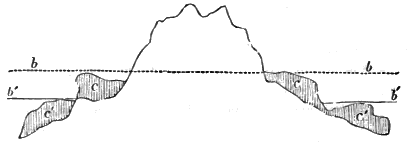
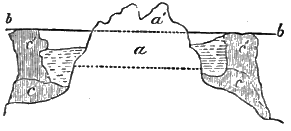
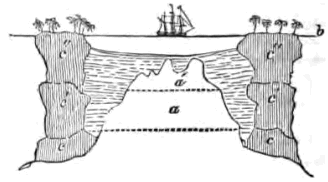
But the most abundant rock which can be regarded as the product
of animal organization is the coral formation. It consists of
immense walls of coral limestone, separating either an atoll or the
land of an island or continent from the open sea. The base of
this wall has a width varying from a hundred feet to a mile or
more, and the outer edge of it is at such a distance from the shore
as to give a depth not much exceeding a hundred feet. Over
this area of the bed of the sea, which forms the base of the wall,
the coral polyp commenced its work. Attaching itself in immense
numbers over this area, it deposits calcareous matter from
its under surface, and thus, by degrees, elevates itself towards the
surface of the water, till it reaches a level a little above low-water
mark. The height of the wall would not, with these conditions,
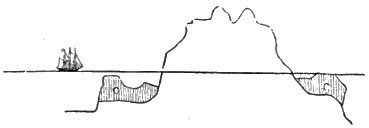
exceed one hundred feet; but some hundreds of the islands surrounded
by coral walls are gradually subsiding. The depositions
of the polyps keep pace with the subsidence, so that this wall has
reached an elevation from its base of a thousand feet, and in one
instance of two thousand feet. (See Figs. 61, 62, 63, 64.)
Most of the islands of the torrid zone are thus surrounded with
coral reefs, except a few where the cold polar currents reduce the
temperature too low to admit of their growth. In one instance,
along the north-east coast of New Holland, there is a coral reef,
some twenty-five miles from the land, which has a continuous extension,
excepting occasional inlets of no great depth, of a thousand
miles. The reef along the island of New Caledonia is four hundred
miles long. A large number of other reefs have a nearly
equal extension. There is thus an area of several thousands
of square miles covered to a great depth with this coralline limestone.
Some limestone formations of great extent among the older
rocks were the work of similar animals. These lower forms of
organization have, therefore, always been important geological
agents, both in collecting the carbonate of lime from its solution
in the waters of the ocean, and in depositing it as solid rock.
SECTION IV.—AQUEOUS CAUSES.
Water is, next to heat, the most important geological agent.
All the stratified rocks are aqueous deposits, and their total
amount is in some respects a measure of the influence which this
agent has exerted. The materials have been obtained from the
destruction of preëxisting rocks, transported by water, and deposited
in layers.
When the first strata were formed, the sediment must have
been obtained entirely from igneous rocks, because only those
rocks existed; but now it is obtained from every kind of rock
which is exposed to abrading or decomposing agencies. Hence,
many of the later formations contain fragments, and sometimes
within the fragments well-characterized fossils, of earlier formations.
The sediment which is ultimately to become stratified rock is
deposited on the beds of the ocean, and other great reservoirs of
water. The formation of most of the aqueous rocks, therefore, as
well as of the igneous rocks, is deep below the surface; and neither
of these operations, on the large scale, is directly exposed to our
observation. We may, however, learn by observation, how the
sediment is furnished to the waters and transported by them, and
we can form some correct ideas of the manner in which it will be
laid down on the bed of the ocean, and solidified.
I. The Furnishing of Sediment.
1. Almost all the minerals which occur in the geological formations
are, to some slight extent, soluble in water. Hence, rain
water, by passing through a stratum of earth or rock and reäppearing
as a spring, loses the insipidity which it had as pure
water, and becomes palatable. It is then found to hold in
solution some small proportion of earthy substances, upon which
this change of taste depends. Although the proportion of dissolved
matter is very small, yet the surface of earth upon which this distilled
water is shed is one-fourth of the surface of the globe, and
solution below all that surface is constantly taking place. No
inconsiderable amount must thus have been furnished, from the
existing rocks of each period, towards the formation of the strata
of a later period.
There are some substances which are soluble in water, in large
quantities. Rock-salt is an example. It is not found in any
very large proportion in rocks generally, but a very large aggregate
amount has been taken up by the waters which have filtered
through the strata. The ocean gathers into itself, by degrees, all
the soluble substances which are thus taken up. It receives supplies
of water charged with these substances from springs, rivers
and lakes. It returns as much water as it receives; but it is
always in the form of vapor, and is therefore pure water. Hence
the saline properties of the ocean, and of those inland seas which
have no outlets. There is thus gathered the materials for the
rock-salt deposits.
But many substances which are not considered soluble in water
become so by some modification of the water. Water of a high
temperature is capable of dissolving silex. In Iceland and other
volcanic regions, the hot springs are charged with silex, which is
deposited as the water cools. Thus, siliceous formations accumulate
around springs of this kind. The various agates may have been
deposited from such solutions.
In the decomposition of mica, felspar and volcanic rocks, a considerable
amount of potassa is set free. Potassa or soda renders
the water in which it is dissolved capable of dissolving silex in
large quantity. In these ways water removes, with some degree
of rapidity, one of the most insoluble minerals which rocks contain.
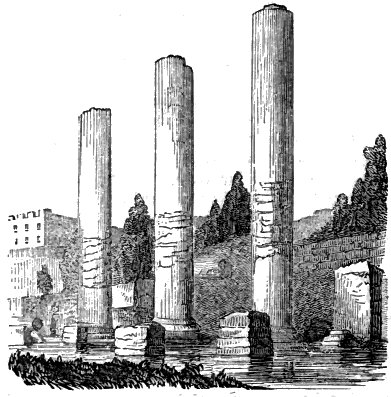
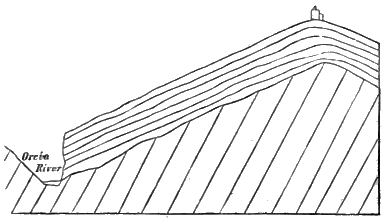
In volcanic countries, and in coal districts, carbonic acid is
abundant, both in spring-water and in the gaseous form. Water
charged with this gas becomes capable of dissolving limestone.
Where the water is exposed to the air, the gas gradually escapes,
and the calcareous matter is deposited. Many accumulations of
this kind are now taking place. Some have already extended
several miles in length, and they are often of great thickness,
in one instance, in Italy, two hundred feet (Fig. 72). It is also
probable that many calcareous springs issue below the surface of
lakes and seas, and thus, both fresh-water and marine deposits
would now be forming. These formations are distinctly stratified,
and are white and crystalline, and become solid at the time of
deposition.
Fig. 72.
These dissolved materials are less observed than others, because
they do not render the water turbid; but there is reason to believe
that several of the aqueous formations, particularly the limestones,
have been built up chiefly from them.
2. The abrading action of rivers furnishes considerable detrital
matter. The general form of the river courses is determined by
other causes than the agency of the river itself, yet a river which
has a rapid current is continually deepening its channel. We have
proof of this by observing, when the water is low, that irregularity
of surface which running water always produces, by wearing away
the softer parts of the rock, and leaving the harder in relief.
Hence, a river will have its rapids either where the hardest strata
occur, and which therefore wear down least rapidly, or where the
rock has been hardened by the intrusion or near proximity of
dikes.
The abrading power of rivers occasionally becomes greatly
increased by waterfalls. The force which the water acquires in
its descent is such as to excavate a deep cavity at the foot of the
fall, reaching back under the ledge from which the water descends.
The ledge is therefore constantly being undermined. The cataract
of Niagara is peculiar, in having the rock at its base of a soft and
friable texture, so that it is rapidly worn away, while the upper
rock is a compact siliceous limestone. If the order of superposition
had been the reverse, the falls would have been converted
into a series of rapids. It is now preserved as a single fall, and
as such it has probably cut the gorge, about two hundred feet
deep and seven miles in length, through which its waters now
reach Lake Ontario. A few years since, a large mass, perhaps
half an acre in area, fell from the centre of the horse-shoe fall.
Another mass of equal size has recently fallen from the western
extremity of the ledge. Thus the fall is gradually receding.
But the foreign substances, such as drift-wood, ice, sand and
gravel, with which the waters of a river are occasionally charged,
contribute more than everything else to its abrading power. At
such times its volume is generally greatest, and its current the
most rapid. Its bed is then sometimes perceptibly deepened and
widened in a few hours.
Much the greater part, however, of the earthy matter which
rivers convey in such quantity to the ocean, is furnished by other
means than the eroding action of the river itself. It is the loose
material, the soil and alluvium, to which the solid rocks have been
reduced by the imperceptible but incessantly operating atmospheric
agencies, from which most of the sediment of rivers is
obtained. After a rain, every tributary rivulet is turbid with
suspended earthy matter, and it is from these sources that the
larger streams receive the most of their sediment.
Some observations have been made for the purpose of ascertaining
the quantity of sediment which rivers annually carry into
the sea. The Kennebec furnishes materials which, if spread
evenly on an area of one mile square, and consolidated into rock
of the specific gravity of granite, would have a thickness of six
inches. The Merrimac furnishes about two-thirds as much, the
Ganges about two hundred and fifty times as much, and the Mississippi
two thousand times as much.
Thus, the tendency is, to reduce the highest parts of the land,
and to fill up the depressions of the sea; and though we have not
data enough to form any reliable estimate of the total annual discharge
of sediment into the ocean by rivers, yet they are sufficient
to show that the effects of this kind are on a large scale, and
to relieve us from any impression that existing agencies are inadequate
to the production of the stratified rocks.
3. The action of waves is another means by which detrital
matter is furnished. Wherever the shore consists of loose materials,
and is favorably situated to be acted upon by the waves, there
is annually a sensible encroachment of the sea. Such encroachments
are rapidly making in many places; and thus a large
amount of sediment is delivered to the waters of the ocean.
The waves also encroach upon the coast when it consists of
rocks, even of the most indestructible kinds. They continually
beat upon it, undermine the cliffs, and precipitate them into the
sea. The tides increase the power of the waves, by varying the
place of their action, so as to present the same surface of rock
alternately to the action of water and of the air, frost and sun.
During storms, the waves have sufficient force to break off fragments
of rock from the escarpment, sometimes in masses weighing
twenty tons or more, and remove them many rods inland.
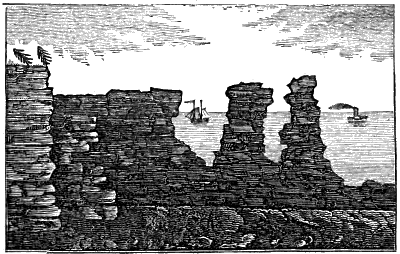
A bold, rocky coast always exhibits evidence of a great amount
of erosion. The steep escarpments and the high rugged shafts of
rock (Fig. 73) against which the waves now beat are the remnants
of masses of rock which once extended further into the sea,
but have been worn away by the waves. It is by such agency
that the deep inlets and harbors of the coast of New England and
Nova Scotia have been excavated.
Fig. 73.
This more violent action of the waves is only occasional; but
when of less power, they are incessantly rolling the loosened fragments
of rock upon each other, and thus wearing them down to
particles small enough to be carried away by the water.
4. The action of waves is confined to the coast, and never
extends to great depths. But marine currents act principally on
the bed of the sea. The temperature of the mass of the ocean
is much higher in the equatorial than in the polar regions.
At the surface, the difference amounts to sixty degrees. The
waters of the torrid zone are thus expanded, and flow over the
colder waters of the north and south; while these colder waters
of the polar seas flow back, in an under current, towards the
equator.
For the same reason,—a difference of temperature,—there will
be, in the higher regions of the atmosphere, a current of warm and
moist air flowing from the equator north and south, while the cold
and dry air conies in from the polar regions towards the equator.
In this way the equatorial waters are carried, in a state of vapor,
towards the poles, where they are condensed, and go to increase
the currents of water moving towards the equator.
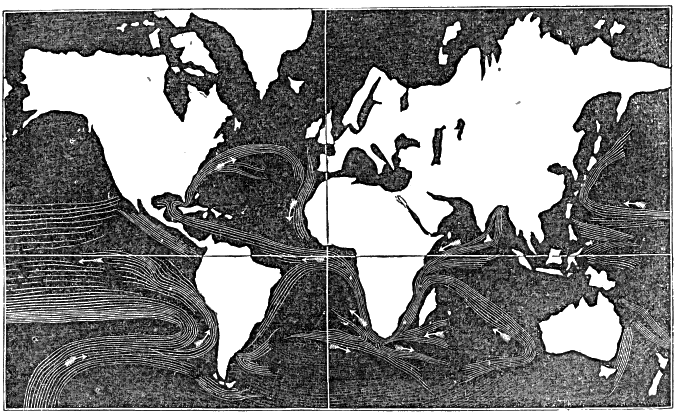
Such are the general causes of the oceanic movements in a
north and south direction; but these currents at once become
deflected westward, by the diurnal revolution of the earth, as the
trade winds do. Hence there results a Pacific equatorial current,
which has a motion of about thirty miles a day, and an Atlantic
equatorial current, moving from sixty to seventy miles a day. The
principal marine currents are shown in Fig. 74.
The currents moving towards the poles are superficial, and
therefore do not produce any marked geological effects. But the
polar currents, and those which are produced from them, are of
great depth, and there is no reason to suppose that they do not
move, from their commencement, along the bed of the ocean.
There is also reason to suppose that they exist at great depths,
where the opposing superficial currents entirely conceal them.
Wherever these currents come to the surface, their motion is
undoubtedly greater than it is at the bottom, where it is retarded
by the friction which the moving waters encounter, and by the
irregularities of the bed of the ocean. It should, however, be
remembered, that they move with the weight of the whole superior
body of water; and therefore, though the motion be very slow, it
will still possess great power.
Any irregularities in the bed of the ocean beneath such a
current must be subject to very rapid abrasion. We shall sea
hereafter, that earthquake vibrations often shiver the rocks at the
solid surface; and if any of these ridges at the bottom of the
ocean were thus acted upon, the loosened portions would be swept
away by the current and deposited at lower levels, or where the
current subsides. If, in any instance during an earthquake convulsion,
a fault should be produced across one of these marine currents,
like the great fault of over five hundred feet in England,
the abutment thus thrown up would soon be worn down; and if it
consisted of unconsolidated matter, it would be swept away almost
bodily.
Fig. 74.
The effect of such currents will be greatest where they are
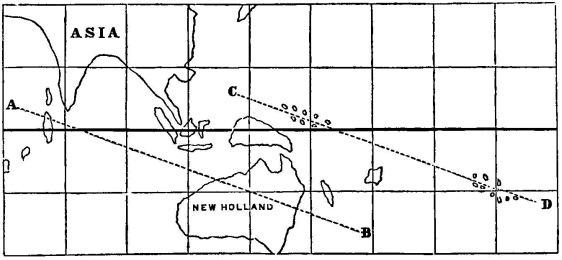
deflected by a continent or island. Thus, a marine current sets
from near New Holland in a direct line to the north of the island
of Madagascar, where it is arrested by the African coast, and
deflected into the narrow Mozambique channel, and there acquires
a velocity of four or five miles an hour. It is impossible that any
kind of rock should receive the constant force of such a body of
water without being rapidly worn away; and, if there should be
any difference of texture in this rocky barrier, the softer portions
would yield the most rapidly, and thus valleys might be formed.
It is not improbable that the deep indentation on the western
coast of Africa may have been due, in a great measure, to the coast
current from the Cape of Good Hope; and that the Caribbean Sea
and the Gulf of Mexico may have been excavated by the force of
the Atlantic equatorial current being thrown into this angle.
We may regard these currents as oceanic rivers; and it is obvious
that the volume of the terrestrial rivers would bear no comparison
with that of these currents, and their effects would be
equally small in the comparison. The Gulf Stream, and the
Mozambique and other similar currents, must be wearing down the
valleys through which they flow, to such an extent as to furnish
an immense amount of detrital matter for the formation of new
rocks.
It is principally to the agency of these deep marine currents
that we are to refer those extensive denudations, so abundant on
the present continents, such as the wearing out of the intermediate
masses of rock between the hills already referred to
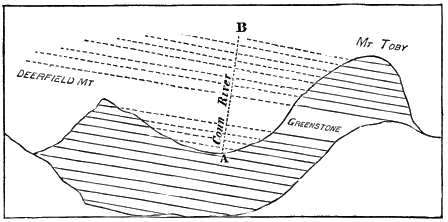
(Fig. 66), the denudation of the Connecticut river sandstone, and,
perhaps, the excavations which have formed Lake Erie and Lake
Ontario.
II. The Transportation of Sediment.
The detrital matter obtained in these several ways is swept
away by running water. The specific gravity of rocks does not,
in general, exceed two and a half. Hence, to keep them suspended
in water, will require a force of only three-fifths of what would be
necessary to suspend them in the atmosphere. In the case of river
currents, the velocity and irregularity of motion are generally
sufficient to keep all the finer sediment equally distributed.
There will, however, be a division of the sediment according to
the strength of the current. Hence, the bed of a mountain
stream, if there is any loose material, always consists of pebbles.
As it approaches the alluvial region, the bed is sandy; and when
the current becomes very sluggish, it consists of a fine mud.
Rivers never deposit all their sediment, some of them none of it,
along their course. Large rivers continue partially distinct from
the ocean water to a considerable distance beyond their mouths.
The waters of the Amazon have been recognized at a distance of
three hundred miles. This depends in part upon the volume and
velocity of the river; more, however, upon the fact that river water
is lighter than sea water. This extension of a river will, in most
cases, be sufficient to deliver a part of its sediment into a marine
current. When such a current sweeps very near the mouth of a
river, as it does to that of the Niger, the Amazon, or the Mississippi,
it is probable that most of its sediment is carried away by it.
The transporting power of a marine current is greater than
that of a river, in consequence of the greater specific gravity of its
water; but it has scarcely any of that irregular motion of rapid
rivers, upon which their transporting power in a great degree
depends. The force of the current alone, when it reaches the
bottom, is, however, sufficient to remove every form of loose earthy
matter. Thus it may be presumed that the Gulf Stream sweeps
all the sediment from its bed until it reaches the latitude of Cape
Hatteras, where the cold waters from the north begin to underlie
it, and it takes the character of a surface stream.
But the transporting power of marine currents depends mostly
upon the depth of water. It is found, by experiment, that ordinary
river sediment will sink in water about one foot in an hour. A
current, therefore, of a thousand feet in depth, which moves a mile
in an hour, would carry its sediment a thousand miles. It is obvious,
then, that there is no part of the bed of the sea which may not
be receiving sediment.
III. The Deposition of Sediment.
From what has been said of the weight of sediment, it follows
that it will be deposited whenever the water in which it is
suspended is at rest. Hence, when a river increases in breadth so
as to form a lake, the waters at the outlet are seldom turbid. The
earthy matters with which the principal and tributary streams
were charged all settle to the bottom, and go to lessen the capacity
of the reservoir. Thus lakes are continually diminishing in depth
and area. In many instances, they are already filled with sediment,
and are thus converted into alluvial plains, through which the
river flows in a narrow channel.
It is frequently the case that a river, as it approaches the sea,
has so slow a motion that its sediment is deposited on the bed of
the stream. Thus the bed will be raised, and the banks will also
be raised, by the deposition of sediment upon them at periods of
overflow. The river will then be raised above the adjacent country.
The river Po, for the last part of its course, is from ten to
twenty feet above the adjacent lands. The same is true of the
Mississippi, and many other rivers. The streets of New Orleans
are several feet below the surface of the river. In an uninhabited
country, such a river would soon seek a new and lower channel; but
in a populous country, it becomes a matter of interest and safety to
confine the river in its old channel, by artificial embankments.
But the principal part of the sediment of rivers is conveyed to
the sea. It here mingles with the debris which the waves have
furnished, and a part of it is deposited to form deltas. The
remaining part is taken up by marine currents, mingled with the
debris which they have furnished, and is spread out on the bed of
the ocean.
Of the extent of these deposits we can form no estimate. Those
of rivers and lakes are comparatively unimportant, as they are in
the older formations. Some of the delta deposits are already of
great extent. That of the Ganges contains an area of twenty-six
thousand square miles, that of the Niger twenty-five thousand, and
that of the Nile twelve thousand. The delta of the Rhone has
increased its area by three hundred square miles in the last thousand
years. The Po has encroached upon the Adriatic two thousand
square miles in the last two thousand years, and the Mississippi
has enlarged its delta by one hundred square miles in the last
hundred years. In the deep valleys of the ocean accumulations
may be taking place on as large a scale as they ever have been in
former times.
IV. Character of the Formations thus produced.
Sedimentary matter thus deposited would take the form of
strata. Thus, a delta deposit may receive at one time from a
river a layer of coarse gravel and pebbles, and in the course of a
few hours the current may be so reduced that it will convey to
the same place only fine sand and silt. Or, if a depositing current
receive its sediment only at intervals, the heaviest particles would
be thrown down first, and the more finely levigated particles would
continue to fall, till the water became transparent. Another supply
would furnish another similar stratum, and so on. The same
arrangement might result from the sediment being furnished by
different rivers. Thus, if sediment were furnished to the Gulf
Stream by the Merrimac river, and the streams emptying into the
Bay of Fundy, the freshets would occur earlier in the season in
the Merrimac, and it would furnish a supply of sediment from a
region of primary rocks. A later supply would come from the red
sandstone region of Nova Scotia, and the stratification would be
indicated by the different kinds of rock produced. Thus stratification
will result from difference in the color, composition, or size of
the particles of which rocks consist. A great variety of causes,
both general and local, may therefore give to a deposit this character.
Hence, as stratified rocks are produced by the sediment now
laid down from water, we may conclude that the older stratified
rocks are the sediment deposited in like manner, in former times.
The occurrence of layers of different composition, as one way in
which the stratification is indicated, is produced by local and frequently
recurring causes. There are, however, other alternations
of much greater extent; those, for example, nearly twenty in number,
distinguished by striking differences in lithological character,
into which the New York system of rocks is divided. These
alternations have resulted from more general causes. The physical
geography of a wide region must have been so different, at the
different periods during which these several formations were
deposited, as to change, at each period, the kind of sediment furnished
to the forming currents, and modify the types of animal life.
We have seen that the same causes that determined the stratified
arrangement will determine the alternations of strata of coarse
and fine materials.
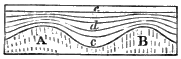
It is obvious that the stratification of the marine deposits will be
nearly horizontal. If the surface were very irregular upon which
the deposition commenced, the irregularity would constantly diminish;
for the movement of the water over this surface, however slow,
would tend to remove the accumulations from the highest points,
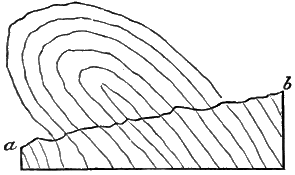
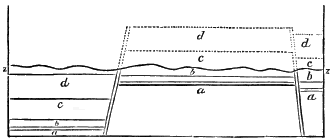
and leave them at the lowest (Fig. 75). Delta and lake deposits
will, however, dip somewhat, though
never at a high angle, towards the
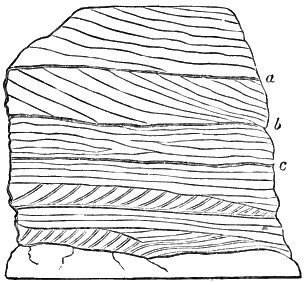
deep water. In certain situations,
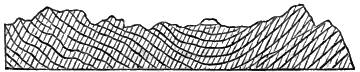
where a river and a tidal wave, coming
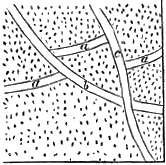
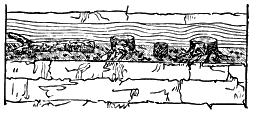
in conflict, cause, in succession, eddies and currents in opposite
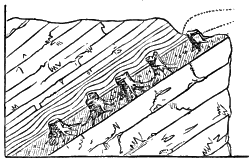
directions, we should expect to find the stratification very irregular
(Fig. 76); sometimes false stratifications (a b), sometimes the strata
cut off abruptly, and at other times contorted or dipping in opposite
directions within short distances.
Fig. 75.
Wherever sediment is deposited, it will entomb whatever of the
remains of animal or vegetable life may be mingled with it. They
will be at once protected against the influence of all the ordinary
decomposing agencies, and will continue for ages to retain their
peculiar markings, and even their colors. They will thus constitute,
in all future time, a record of the present condition of the organic
world. The lacustrine deposits can contain only fresh-water species
of animals, marine deposits only marine animals, while deltas may
contain the remains of marine life mingled with those which have
been washed down by rivers. The remains of birds, insects, and
terrestrial animals, may occasionally occur, in every kind of deposit.
Sediment deposited in deep water will never contain fossils in
abundance, the deep parts of the ocean being almost wholly destitute
of animal or vegetable life. It is only in water of a few
fathoms that the greater number of species and of individuals
occur. In all these particulars the deposits now forming sustain a
close resemblance to the older formations.
Fig. 76.
There are certain formations, as that of the coal, which required
conditions for their formation different from those of ordinary
sedimentary deposits. Coal consists of mineralized vegetable matter.
Its vegetable origin is proved by the uniform occurrence of
vegetable fossils almost exclusively in the coal measures. When
reduced to thin slices and examined under a high magnifying
power, a structure very similar to the ligneous tissue of existing
coniferæ is sometimes found to exist. There are probably vegetable
deposits now taking place not altogether unlike those which
produced the coal measures.
We know that many rivers—the Mississippi, for example—now
carry into the sea great quantities of ligneous matter. Before the
country was inhabited by man, the quantity was undoubtedly much
greater than it now is. It floats for a time; but the ligneous tissue
itself is heavier than water, and as soon as the air is excluded from
the pores, and they are filled with water, it will sink. The woody
and earthy matters are swept into the sea together; but, as they
sink under different circumstances, they will be deposited separately.
Thus wood may continue to accumulate in particular places in
the sea for long periods, with but little intermixture of earthy
substances.
It is, however, to be expected that, in the progress of geological
changes, the places which at one time receive deposits of wood will
at another receive detrital matter, and thus the wood will become
deeply buried beneath sedimentary strata.
Wood thus situated will become converted into coal. Trees
which had been covered to considerable depth with earth have
been found near the Mississippi river changed to lignite, a substance
resembling charcoal. In this case, the wood had been
exposed to no greater heat than is common to the crust of the
earth at the depth where it was found; and yet it had undergone
this change since the country has been known to Europeans,
as it retained the marks of the axe when it was discovered. It
has also been found by experiment that vegetable matter, by long
submersion in water, passes into the state of lignite. This is the
first step in the conversion of wood into mineral coal.
When lignite is exposed to moderate heat and great pressure, it
loses the characters of lignite, and becomes mineral coal. This
is shown by facts observed in Germany, Ireland and Iceland, where
beds of lignite have been overspread by basalt. The upper portions
of the lignite are changed to mineral coal. The lower portions,
which the heat did not reach, retain the characters of
lignite.
Beds of vegetable matter, with a great thickness of rock deposited
above them, would therefore be subject to all the conditions
necessary to convert them into coal, namely, pressure from the
superincumbent mass, and the heat which the strata uniformly
assume at great depths.
It is not improbable, therefore, that coal-beds are now forming,
and that they have been formed at every geological period since
an abundant terrestrial vegetation commenced. Accordingly, there
occurs in Virginia an extensive coal-field in the oölite formation.
Coal-fields also occur in England, of less extent, in the same formation.
In France, and other parts of Europe, there are extensive
beds of lignite in the tertiary formation.
We have therefore no difficulty in accounting, in a general way,
for the formations of the carboniferous period. The vegetables
were probably less woody than those of the present time of equal
size, and were therefore more easily prostrated and committed to
the waters. They grew rapidly in moist ground, and perhaps in
shoal-water, and required an atmosphere charged with moisture
and of a high temperature. Thus much is inferred from the conditions
most favorable for the growth of recent species analogous to
the coal-plants. These recent species are tropical plants, and grow
in moist insular situations, conditions which would have existed
at the carboniferous period, if the present coal-fields were then an
archipelago dotted with low islands.
Such being regarded as the origin of the coal-beds, the alternations
of the earthy and carbonaceous strata may be referred, provisionally,
to those great changes in physical geography upon which
the other alternations of strata on a large scale depend. But the
regularity with which the coal-seams and sandstone succeed each
other presents some difficulties which, in the present state of knowledge,
we cannot satisfactorily account for.
Beds of salt occur, interstratified with other rocks, in nearly all
countries. Still, it is not a sedimentary deposit, and its formation
must depend upon peculiar circumstances. In New York, saline,
together with earthy matter, constitutes the Onondaga limestone,
one of the formations of the New York system. In Kentucky, the
strata of rock-salt are in the coal formation; in England, they are
in the new red sandstone; in Spain, they are in the greensand, and
in Poland they are in tertiary strata. The conditions of its formation
have therefore existed in connection with the deposition of
every fossiliferous rock.
It has been shown that the ocean is the principal reservoir of
the saline matters which are taken up whenever water percolates
through rocks. It must happen not unfrequently, in the course of
submarine elevations, that a basin of sea-water will be cut off from
its communication with the sea; and from this basin the evaporation
might be more rapid than the supply of water. The great
salt-lake of Utah is undoubtedly a basin of this kind. The Mediterranean
Sea is another such basin, not yet wholly separated from
the ocean. The evaporation exceeds the supply of water from the
rivers, and a powerful stream is therefore continually thrown in
from the ocean, through the Strait of Gibraltar. The waters of the
Mediterranean are already more highly charged with salt than
ordinary sea-water. This sea may ultimately become a saturated
solution, and begin to deposit salt. But whether it does, or not, it
indicates the way in which salt-beds may be formed.
V. Solidification of Aqueous Deposits.
Sediment is generally deposited as a soft mud, but in nearly all
the older formations it has become solidified. When rocks are
deposited from a chemical solution, they take at once the solid
form. Such is the case with rock-salt and with limestone, when
the material has been held in solution. Solidification takes place
in nearly the same way when water which holds carbonate of lime
or oxide of iron in solution filters through beds of sand or gravel.
The substance held in solution is deposited in the interstices till
they become filled, and the whole is changed to solid rock.
Some rocks are composed of such materials that they set, like
hydraulic cement, when they are deposited. Other rocks become
solid simply by drying. Thus a deposit now forming in Lake
Superior becomes, by drying, nearly as hard as granite. Such a
deposit will therefore become solid whenever it shall be elevated
above the water.
The pressure to which all but the upper layers are subjected is
probably sufficient to reduce most rocks to the solid state. Dry
and pulverized clay is reduced by artificial pressure, for a moment,
almost to stone. The pressure upon the deep-seated rocks is constant,
and greater than any artificial pressure can be.
In addition to these causes, all the older rocks have been subjected
to a high temperature, some of them nearly to that of
fusion. By this means the solidification of every kind of rock
would be promoted, and probably some may have been reduced by
it to the solid state, which would otherwise have remained as an
incoherent mass.
SECTION V.—AQUEO-GLACIAL ACTION.
1. Glaciers.—A glacier is a mass of ice occupying the bed
of a mountain valley, having a slow progressive motion, and
reaching somewhat lower in the valley than the line of constant
snow. (Fig. 77. The Glacier des Bois, which may be regarded
as a specimen of the Alpine glaciers, covers an area of about seventeen
square miles. In its lowest portion, when all its branches
have become united into one stream, it has an average width of
half a mile, and is five miles long. It is estimated that the glaciers
of the Alps cover an area of fourteen hundred square miles.
These have been the most carefully studied, though glaciers are
found in the valleys of various other ranges of mountains.
In the higher valleys, the snow, which falls at all seasons of the
year, accumulates in immense quantities, and the steep mountain
sides contribute, by frequent avalanches, to this accumulation. The
snow, when thus increased, does not become a compact, adhesive
mass; but, changing into particles of solid ice, it resembles sand
rather than snow. It is this névé which constitutes the upper part
of every glacier, and which, in a modified form, constitutes the
lower part.
The valleys descend rapidly towards the base of the mountains;
and this snow-ice, having no cohesion between its particles, moves
slowly down the slope of the valley, like a very imperfect liquid.
After descending below the line of perpetual snow, the surface
will melt during the day; and the water, sinking into the porous
mass, becomes frozen, and converts the whole into more or less
compact ice, yet never into a rigid mass. Influenced by its own
weight, and by the pressure of the snow-ice behind, it still continues
its motion, and conforms itself to the shape and curves of the
valley through which it passes. The average movement per annum
may be stated at about five hundred feet.
The temperature of the rocky bed of the valley will be a little,
and but a little, higher than thirty-two degrees. There will therefore
be but little melting at the bed of this river of ice. As it
receives continual accessions from the atmosphere, it will therefore
increase in volume till it descends to the level of perpetual
snow. Below this line the waste exceeds the addition; and as it
approaches the lower and cultivated portions of the valley, it rapidly
diminishes, till it finally loses the solid form, and becomes a
rivulet. The terminus of the glacier is determined principally by
the general climate of the country. Any considerable variation
of climate will cause it to recede, or descend lower down the valley.
The terminus varies, however, somewhat with the seasons,
being lower in winter than in summer, though the motion is much
less in the cold season than in the warm; and it descends many
rods further some seasons than it does others.
The glacier consists principally of snow, more or less modified in
structure; but it also contains whatever else may have been thrown
upon its surface, or into the snows by which it is fed. Tributary
glaciers extend up through all the gorges into which the irregular
surface of the mountain-top is divided. On these rough peaks
there are always fragments of rock, varying in size from fine sand
to masses weighing many tons; some of them loosened when the
mountain was upheaved, some by subsequent earthquake vibrations,
and others still by tempests, lightnings, and changes of
temperature. When the snow has accumulated to a certain
extent on the steep slopes, it falls in avalanches into the valleys,
carrying with it loosened masses of rock, and often breaking off
large fragments from the rocky escarpments against which it
strikes. These avalanches are almost constantly descending, and
hence a glacier always contains considerable earthy matter distributed
through it.
Fig. 77.
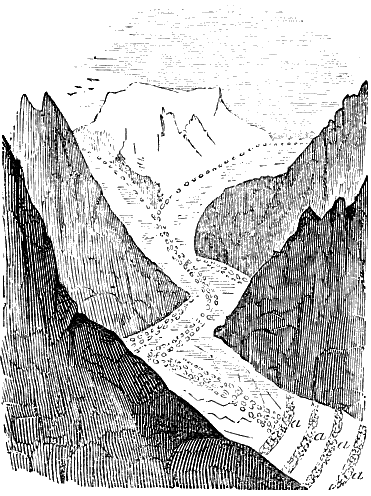
The friction of the glacier, at its edges and along its bed, separates
more or less of the rock over which it moves; and hence
there is always a layer of mud and pebbles under the glacier, and
a line of loose fragments, called a lateral moraine, at the sides.
When two glaciers unite, the two lateral moraines, thus brought
together, come to the surface, forming a medial moraine, and show
the line of junction sometimes for miles.
The friction of the glacier on the bed of rock, assisted by the
layer of pebbles, will wear down the prominent portions, and
everywhere polish the surface. Fragments of rocks may be frozen
into the glacier at all depths. Those which lie near the lower surface
of the glacier would, by slight melting of that surface, project
downward so as to act as a graver’s tool on the rock over which it
passes. Hence, when the extremity of the glacier has receded
beyond its ordinary limit, the surface of rock exposed is found,
upon examination, to be polished, striated, and occasionally grooved
an inch or two deep.
Since the waste is almost wholly superficial, earthy matter, which
was at first concealed in the mass of the glacier, is continually coming
to view, as the surface melts and runs off. Thus, none of the
freight of the glacier is left along its course, but all is carried to
its terminus and discharged there. Hence, at the lower extremity
of the glacier there is always an embankment of earth, pebbles,
and boulders. If the glacier recedes a few yards at one season of
the year, and leaves its earthy fragments scattered over this surface,
they will be pushed forward into a ridge, as the glacier again
advances. This ridge is called a terminal moraine, and consists
wholly of substances which have been separated from the mountain
mass, often at the highest beginnings of the glacier. At the terminus
of all the Alpine glaciers, there is a series of these moraines
(a a a, Fig. 77) marking the successive limits of the glacier in
former times.
There is a ridge of boulders on the north side of the Swiss valley,
near the base of the Jura Mountains, resembling a terminal
moraine. These boulders consist of several groups, distinguished
by peculiarities of structure and composition; and each group lies
opposite to the particular Alpine valley which now furnishes the
same kind of fragments. It has been thought that, at a former
period of more severe climate, the Swiss valley was filled in part
with ice, and that the present glaciers extended across it to the
Jura Mountains.
It is found that the polished and striated surfaces of the rocks
in the Alpine valleys are precisely like the surface of the rock,
which has not been exposed to atmospheric influences, in the
north of Europe and America. It has been proposed to extend
the glacier theory, and account for these phenomena by supposing
that the north polar regions were, at the ice period, capped with
a glacier-mass, extending as far south as the drift phenomena
appear.
It is not to be doubted that the phenomena of polished surfaces
and transported materials in the immediate vicinity of the Alps,
and near other high mountains, are correctly referred to glacial
action. This theory has therefore solved, in part, one of the most
difficult problems in geology; but there is great difficulty in
extending it so as to account for the drift phenomena in general.
If the motion depends upon gravitation only, the origin must have
a much greater elevation than the terminus, which would not be
the case in the great glacier supposed to extend southward from
the Arctic regions. Elevation of temperature, it has been thought,
might account for the movement of the mass southward.
2. Icebergs.—In very high latitudes, the ice, which makes out
from the land into the sea during the cold season, suffers but little
waste at any time. This sheet of ice continues to increase in
breadth and thickness, by congelation, from year to year. The
spray and the snows of each succeeding year will also add to the
mass. It thus accumulates to the height of several hundred
yards. It will also reach down a good many feet below the surface
of the sea, and will extend back on the land, or lie heaped up
against a precipitous escarpment, and firmly frozen to it.
After a certain amount of extension over the sea, the accumulated
weight of the ice and snow would tend to depress it, and
break it loose from the shore. The waves would tend to the same
result, and would act at greater mechanical advantage, as its extension
from the shore becomes greater. Hence, it would ultimately
become separated from the shore, and float in the water.
At its commencement, the earth, pebbles and rocks, which may
lie along the shore, and as far down into the sea as the congelation
extends, are frozen into it. In many situations its mass would
be increased by avalanches while it remained attached to the land,
and these would supply also masses of earth and rocks, as they do to
glaciers. When it becomes loosened from the shore, it will break
off, and carry with it some of the earthy portions of the coast, or
the less firmly fixed masses of rock from the escarpment against
which it formed. Thus every iceberg becomes freighted, more
or less, with earth and rocks. This has almost uniformly been
found to be the case, when they have been landed upon by ships’
crews and examined.
We have seen that the general tendency of the waters of the
ocean, and of the lower stratum of the atmosphere, is to a motion
from the poles towards the equator. However irregular, therefore,
the course of an iceberg may be, its general movement, influenced
both by the prevailing winds and by ocean currents, will be
towards the equator.
Fig. 78.
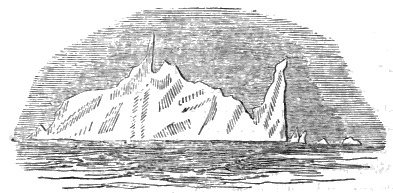
These floating ice-mountains (Fig. 78) are formed in great numbers,
and of vast size. The relative specific gravity of ice and
water are such that nine cubic feet of ice, below the surface of
water, will support one cubic foot above it. As icebergs are often
one or two hundred feet high, their vertical depth must be a thousand
feet at least; and their area is equal to a square mile, and
sometimes it is much greater. In 1840, the United States Exploring
Expedition, in the extreme southern ocean, coasted for eighty
miles along a single iceberg. They are never absent from the
polar seas; and at certain seasons they are so abundant along the
usual course of vessels from New York to Liverpool, as greatly
to obstruct and endanger navigation.
An iceberg may continue for some time to increase in size, while
floating in the polar seas, but will at length reach a latitude where
the waste will exceed the additions, in consequence of the temperature
both of the air and of the water. It will, therefore, drop
gradually the earthy matters which it contains, upon the bed of
the ocean.
It is not improbable that icebergs may often reach down so far
as to strike the highest points of the bed of the sea. The ice
would be lifted, and glide over the elevation, without suffering any
perceptible deviation from its general course. It would thus affect
the surface of rocks exactly like a glacier. If, however, the iceberg
becomes permanently stranded, and melts in one place, its
earthy matters will be thrown down upon the elevation which first
arrested it.
If the bed of the sea, between the fortieth and sixtieth degrees
of latitude, could be exposed for examination, the rocky surface
would be found to be polished and striated by the icebergs which
have passed over it, and the whole surface would be strewed with
boulders and drifted materials brought from Arctic and Antarctic
lands. Sometimes it would be accumulated in heaps, and sometimes
spread nearly over the surface.
We have seen that very recently, probably about the close of the
tertiary period, the portion of Europe and America over which the
northern drift is found, has been depressed several hundred feet.
It may be presumed that at that time icebergs floated over it, polished
the surface of the rocks, and distributed the boulders and
other drift which is now found upon it.
SECTION VI.—IGNEOUS CAUSES.
I. Of the Temperature of the Mass of the Earth.—Heat has
been the most efficient agent in determining and modifying the
structure of the earth; and, in order that the explanations of the
phenomena referable to this cause may be intelligible, some idea
must be formed of the actual present condition of the mass of the
earth with respect to heat.
At any point of the surface there are variations of temperature,
depending on external causes. But these variations are found to
extend only a little way below the surface,—never more than a
hundred feet. At greater depths, it is found that the temperature
invariably increases with the depth. Deep mines have always a
temperature above the mean annual temperature at the surface.
The water obtained by deep boring is always tepid when it comes
to the surface. The thermal springs, so abundant in this country
and in Europe, are so situated as to justify the impression that
their waters come from great depths. To make these general
observations of any value, we must determine the law by which
the temperature increases. The result of all the observations yet
made, in mines and upon wells and springs, is that, below the first
hundred feet, the temperature increases by one degree of Fahrenheit’s
scale for every forty-five feet.
Regarding this law of increment as applicable to all depths, at
ten miles below the surface we should have a temperature above
that produced by the combustion of wood; and at twenty-five
miles, a temperature of three thousand degrees, by which nearly
all mineral substances would be reduced to a state of fusion.
The general conclusion of a temperature sufficient to melt the
mineral substances of which rocks are composed, at no considerable
distance below the surface, is confirmed by the fact that portions of
the interior of the earth—at least, at the volcanic centres—are in
a melted state. The intimate connection between some volcanoes
situated a hundred miles or more apart, so that they are alternately
in a state of activity and rest, indicates that these centres are connected,—that
subterranean melted lava extends from one to the
other, so that when one is active, the elastic force is relieved at
the other. These deep-seated lakes of lava must therefore underlie
large areas.
We are justified, then, in concluding that the mass of the earth,
with the exception of a comparatively thin superficial layer, has a
very high temperature.
By way of accounting for this temperature, it is now generally
assumed that the earth was originally in a state of fusion; that it
was a mass of liquid lava (if, indeed, it had not a temperature sufficient
to reduce it to the aëriform state). Starting with this
assumption, there must necessarily be a gradual reduction of temperature
by radiation, and a time must arrive when the surface
would be crusted over with solidified lava; and this crust would
increase in thickness as the cooling advanced, the interior still
retaining its heat and liquidity. The present condition of the crust
of the earth, its form, that of an oblate spheroid, with the exact
difference of the equatorial and polar diameters which is found to
exist, as well as the phenomena of volcanic eruptions, will all
admit of explanation on this hypothesis.
It has, however, been rejected by some; and, to account for the
heat of the interior of the earth, it is suggested that, if the bases
of the earths and alkalies, particularly potassium, sodium and calcium,
exist in their metallic state beneath the surface, the rapid
oxidation of them by the access of water would generate heat of
sufficient intensity to melt the oxidized materials, and thus account
for the phenomena attributable to heat.
Either of these hypotheses may be adopted; but it is not necessary
to account at all for the existence of this temperature. The
fact is susceptible of proof; and, though we may not be able to
frame any hypothesis to account for its existence, we may yet
employ the fact in the explanation of other phenomena.
II. The Action of Internal Heat in producing Volcanoes.
The phenomena of volcanoes and earthquakes are evidently produced
by some force operating from below. The effect of heat
alone would be to reduce the rock to a liquid state. There is no
reason to suppose that it is ever sufficient to reduce them to the
aëriform state. The elastic force must therefore depend upon
some other substance associated with the lava, and this substance
is water.
This will be shown by an examination of lavas. At the time
of their ejection, they are in a fluid or semi-fluid state; but it is not
a complete fusion. Even the most fluid lavas contain particles of
minerals in a solid state. The liquidity depends upon the fusion
of the more fusible portions, and upon the steam of water at a
high temperature, which fills the interstices between the solid particles.
The porous character of cooled lavas is produced by the
steam which filled the cavities previous to solidification. Steam
always escapes from the surface of a lava current while it is cooling,
and it is always discharged in immense volumes from the
orifice of eruption, in connection with the lava, and especially at
the close of an eruption.
The geographical position of volcanoes, also, leads to the conclusion
that water is essential to their activity. There are five
principal lines of volcanic activity. One, commencing at the
southern extremity of South America, extends northward along
the Andes and Cordilleras to California or Oregon. The second
has a north-east and south-west direction, from the Aleutian
Islands through the Kurule, Japanese, and Philippine islands,
till it meets the third line, lying in a nearly east and west direction,
embracing Sumatra, Java, and most of the Pacific volcanic islands.
A fourth band commences in the Grecian islands, and extends
westward so as to include the volcanoes of Italy and the adjacent
islands, and the Azores. The fifth band embraces the volcanic
islands of the West Indies, crosses Mexico in about the latitude
of the city of Mexico, and extends into the Pacific. There are
also some isolated centres of volcanic activity, such as Iceland.
These volcanic bands embrace about three hundred volcanoes. It
will be seen that they must nearly all be in close proximity to the
ocean, or to large seas. About two-thirds of them are on islands.
Moreover, the volcanic vents which are wholly submarine are
probably very numerous.
This circumstance of the position of volcanoes establishes a presumption
that they cannot exist at a distance from some large
body of water; and, taking it in connection with the constant
presence of aqueous vapor in lava, we are justified in the conclusion
that the presence of water is an essential condition of volcanic
activity.
Knowing that heat and water exist at the volcanic centres, it is
not difficult to form an idea of their mode of operation. The
water, diffused through the interstices of the lava, and subjected to
a temperature sufficient to melt the lava, would possess an elastic
power, which, though never computed, we may well suppose capable
of overcoming any resistance which the crust of the earth
might present. The repressing force will be the tenacity and
weight of the superincumbent strata. Whenever the elasticity is
superior to this repressing force, it will manifest itself in the fracture
of the strata, and often in the ejection or lava to the surface.
This fracturing of the strata, produced by an uplifting subterranean
force, is believed to be the cause of the noise and the vibratory
motion which are the chief phenomena of earthquakes. The
elastic force may raise lava to the surface, and thus the fracture
would become a volcano. But the force may expend itself by the
discharge of vapor into the fissure, or by merely filling it with
lava. In either case, the only evidence of the existence of the
volcanic force would be the noise and the wave-like motion experienced
at the surface. The cause of the volcano and earthquake
is therefore the same, though the phenomena which characterize
them are different.
When the strata are is thus fractured, lava may for a time be
discharged along the whole line. By the cooling of lava in the
fracture, it would become partially reunited. Still, this would
be the line of least resistance. It would therefore be again burst
through in certain places, which would long continue to be orifices
of discharge, and thus the original fracture would determine a line
of volcanic activity.
The repressing force may become greater at an orifice of eruption
than at some other point, either by the great accumulation of
ejected materials around the opening, or by the dormancy of the
volcano long enough for the complete solidification of the lava
with which the channel was filled. The least resistance may then
be far from any previous vent, when a new orifice of discharge
will be opened, and a new volcano make its appearance. It
seems probable, also, that volcanoes may become extinct by the
reduction of temperature at the volcanic centre, and that new volcanic
centres may be formed; but the cause of this change of temperature
is not yet well understood. New volcanoes have broken
out in the sea, near Iceland, in several instances; others in the
volcanic line east of Asia. Graham Island, situated between Sicily
and Africa, was formed by an eruption which broke out in the
bed of the sea where the soundings were more than one hundred
fathoms. The island was at one time two hundred feet above the
sea, and three miles in circumference. It was, however, gradually
destroyed by the action of the waves, and now remains a dangerous
reef, covered by less than two fathoms water. The volcano
of Jorullo, in Mexico, was formed in this way. Previous to the
formation of the mountain, the region where it now is was a cultivated
table-land. During the year 1759 volcanic action commenced
and continued, until, at the expiration of twelve months, a
cone had been formed having an elevation of sixteen hundred feet
above the adjacent plain.
An orifice of eruption is at first but little elevated above the
general surface; but, by the accumulation of ejected matter, a cone
is at length formed around the vent. The upper portion of a cone
always consists of these materials, but there may also be in progress
a general elevation of that part of the earth’s crust, and the
cone will partake of that general elevation. The cones of the
Andes owe their height, in a great measure, to a general movement
of elevation; those of Ætna and Vesuvius, in a greater degree, to
accumulation of ejected matter.
In either way, the height may become so great that the force
necessary to raise a column of lava to the top would be greater
than the sides of the cone, weakened as they always are by fractures
in all directions, can sustain. Hence, the highest craters of
Ætna and South America have long been closed, and the lava
escapes through fissures at a lower level, and lateral cones are
produced.
Fig. 79.
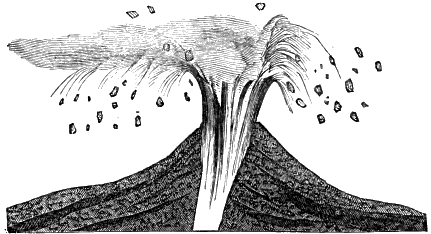
The form which the materials have, when ejected from volcanoes,
depends mainly upon the degree of liquidity of the lavas at
the volcanic foci. If the liquidity is very perfect, the aqueous
vapor will readily rise through the lava. The steam thus separated
will drive before it whatever rocks, or previous lavas, may
obstruct it. In their progress they would be reduced to sand and
powder, and ejected as volcanic cinders. (Fig. 79. If the lava
possess considerable viscidity, the aqueous vapor will separate with
more difficulty, and the lava and vapor will ascend the channel
together. Large bubbles of vapor will, however, collect with
more or less of frequency; and, as they rise through the lava,
will drive forward a portion of it, and cause the overflow to take
place by pulsations. As the bubbles reach the surface, their bursting
causes the loud reports, which are compared to the discharge
of heavy artillery. With each explosion some of the lava will be
projected violently into the air, and, cooling, will fall to the surface
as scoriæ,—or, if the lava be highly vitreous, it will be
drawn out into fibres, and descend as volcanic glass.
III. Geological Phenomena referable to Volcanic Action.
Volcanic agency has probably never been less than it is now, and
we ought therefore to find its effects very general and important.
1. The most obvious of these effects are the fractures with
which the crust of the earth is everywhere intersected. The
uplifting force upon which all volcanic phenomena depend would
necessarily fracture the crust, and the wave-like motion resulting
from the fracture would cause numerous secondary fractures, having
a parallel direction. They are often of such extent, during
earthquakes, as to endanger life. During the great earthquake at
Lisbon, in 1755, a fracture opened of sufficient width to swallow
up the quay, and several thousands of persons who had fled there
for safety. The chasm remained permanently open to the depth
of six hundred feet. The earthquakes with which the valley of
the Mississippi was visited in 1811 so often fissured the surface,
that the inhabitants protected themselves by clinging to the trunks
of trees, which they felled transversely to the direction of the
fissures.
Fig. 80.
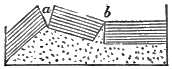
The first fracture which is produced by the upheaving force will
open upwards, and scarcely reach down to the seat of the force.
But there will be other parallel fractures, dependent upon the first,
and opening downward. Thus, the primary fracture at a (Fig. 80)
will be at once followed by the fracture
b, opening toward the lava, which will
be injected into it, and which, on cooling,
will form a dike. Their formation
is mostly concealed from observation,
but not always. During the eruption of Ætna, in 1669,
numerous fissures opened, one of which was six feet wide and
twelve miles in length; and the light emitted from it indicated
that it was filled with lava to near the surface. The process was
as perfectly seen as from the nature of the case it could be.
2. The conversion of the lower sedimentary strata into metamorphic
rocks has been effected by volcanic heat. The material
of which dikes consist has been injected in a highly-heated state;
and, by observing the effect which they have had upon the adjacent
rocks, we may judge of the effect which subterranean heat must
have upon the lower mechanical strata. Wherever the dikes are
of considerable thickness, they have converted the adjacent shales
into primary slate, the sandstones into quartz rock, and the dark
and friable limestones into granular marble, and destroyed the
organic impressions. In the southern extremity of Norway there
is a district in which granite protrudes in a large mass through
fossiliferous strata. These strata are invariably altered to a distance
of from fifty to four hundred yards from the granite. The
shales have become flinty, and resemble jasper; and near the
granite they contain hornblende. The siliceous matter of the
shales has become quartz rock, which sometimes contains hornblende
and mica, and therefore constitutes a kind of granite. The
limestone, which at points remote from the injected rock is an
earthy, blue, coralline limestone, has become a white, granular
marble, near the granite, and the corals are obliterated. The
altered shales and limestones in many places contain garnets, ores
of iron, lead, &c. The annexed (Fig. 81) is a plan of this granite
and altered rock.
Fig. 81.
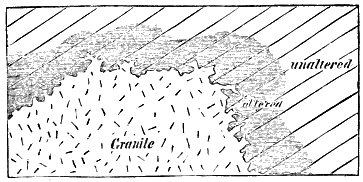
One of the most instructive examples of metamorphic action in
this country is found in the White Mountains of New Hampshire.
These mountains have, till recently, been thought to consist principally
of granite; but it is now ascertained that this supposed
granite is an altered rock of the silurian period. It is represented
as “intersected by veins of felspathic granite; and the general
mass is itself in many parts converted into a near approximation
to a binary granite, composed of distinctly developed quartz and
white felspar, with a few sparsely scattered specks of mica. In
its weathered surfaces it wears a close resemblance to some fine-grained
granites; but, upon inspecting a fresh fracture with a
magnifier, we instantly perceive many rounded grains of quartzose
sand, and the felspar is imperfectly formed, though the mica has
more nearly reached the condition which it has in granite. In
some of the coarse varieties of this white rock, small rounded pebbles
of quartz are to be seen, giving unequivocal evidence, even to
the naked eye, of its being an altered sandstone. We feel no hesitation
in deciding it to have been a silico-argillaceous white sandstone,
now almost granitized by extensive metamorphic action.”
Similar illustrations, on a small scale, may be seen in every
country where the strata have been cut through by intrusive dikes.
Sir James Hall has shown the same by actual experiment. He
exposed pulverized chalk to heat sufficient to melt it, and under
sufficient pressure to prevent the escape of the carbonic acid.
After cooling, the chalk was found to have taken the form of crystallized
limestone. But instances enough have been given to show
what changes should be looked for wherever the sedimentary rocks
have been exposed to a high temperature.
The lower strata must have been exposed, for long periods of
time, to such a temperature. We do not know at what depth
below the surface of the earth the rocks become liquid; but above
the line of actual fusion there must be a mass of rock not melted,
yet scarcely retaining the solid form. For a great thickness, perhaps
for several miles, it would be in a more or less yielding state.
As there is not actual fusion, the stratification is not destroyed,
but such a degree of mobility among the particles exists, that some
degree of crystallization takes place, and the elastic forces below
easily bend, throw into folds, compress, and in every way contort
these strata. At the same time, any organic matters which they
may contain are decomposed, and the impressions of them are
obliterated. And such is the condition in which the metamorphic
strata are actually found.
3. Denudation is, in a great measure, dependent on volcanic
action. It results from the billowy motion peculiar to the earthquake.
This is not simply a violent horizontal motion, but an
equally violent vertical one. It is a series of waves,—a succession
of alternate elevations and depressions of the solid crust.
The height of these waves can only be judged of by their effects;
but it is difficult to account for some of these effects, without supposing
the waves to have been several yards in height, and their
velocity, in the few instances in which the time has been accurately
determined, was twenty miles a minute.
That such earthquake waves actually exist there can be no doubt.
During the earthquake in Calabria, in 1783, the flagstones in
many of the towns were lifted from their places and thrown down
inverted, and trees bent so that their tops touched the ground.
During the great earthquake in Chili, in 1835, the walls of houses,
which were parallel to the line of oscillation, were thrown down,
while those that were at right angles to it, though greatly fractured,
were often left standing. Wherever careful observations
have been made, during and after severe earthquakes, analogous
facts have been noticed. Persons are generally affected with
sea-sickness. The sea is violently agitated. It often retires to
an unusual distance, and then returns upon the shore with most
destructive waves. Incredible, therefore, as it may seem, that the
solid crust of the earth should be thrown into such wave-like undulations,
the fact is well established.
With a velocity of twenty miles an hour, the successive waves
may be some miles apart, and yet be sufficient to account for all
the phenomena. It is evident, therefore, that the curvature of the
wave will be very slight, and yet enough to break into fragments
all the rocks thus curved. During the earthquake in Chili,
before referred to, “the ground was fissured, in many parts, in
north and south lines. Some of the fissures near the cliffs were a
yard wide. Many enormous masses had fallen on the beach. The
effect of the vibrations on the hard primary slates was still more
curious. The superficial parts of some narrow ridges were as
completely shivered as if they had been blasted by gunpowder.”
Similar phenomena seem everywhere to be exhibited by earthquakes.
It may be presumed that almost all parts of the earth have, at
different periods, been subject to these earthquake waves. Accordingly,
we find that the crust of the earth is nowhere in an entire
state, but is divided by irregular lines into comparatively small
fragments. By this means, the deep fissures produced by fractures
opening upwards would be filled with fragments of rock shattered
from the uplifted edges. In this way the boulder masses were
originally loosened from their parent beds, and exposed to the
action of ice, or any other transporting agencies. In the same
way the rocky bed of the ocean is, to a considerable depth, reduced
to a disintegrated mass. In this condition it will be rapidly
removed by marine currents, more or less broken, worn and comminuted,
by the movement, and deposited elsewhere. The materials
have thus been furnished for a very large proportion of the
sedimentary rocks, and especially of those which are composed of
distinct fragments of other rocks. By this means, also, wherever
the rock formations come to the surface, they are so broken that
limestone, sandstone or granite, suitable for architectural purposes,
is seldom found, except at considerable depths. This fragmentary
condition of the surface rock is such as exposes it to be acted upon
readily by any powerfully abrading causes, or to be more rapidly
disintegrated by atmospheric and aqueous causes.
4. We have already assumed that one principal division of rocks—the
unstratified—is of igneous origin. We have the proof
of actual observation, that lavas, and the accompanying tufas and
grits, are volcanic products. The peculiarities of these products,
in situation, structure, and form, and in the imbedded minerals,
are so great, that whenever we find these peculiarities in the rocks
of a country not now volcanic, we still regard these rocks as of
volcanic origin. We thus have lavas, as well as stratified rocks,
of different ages. There has probably been no time in the earth’s
history when they have not been forming.
The trappean rocks are also of igneous origin. It is evident,
from their occurring in the form of dikes, that they have been in
a melted state. As they rest upon rocks of a sedimentary origin,
they must have been thrown up by volcanic forces. Yet they differ
from ordinary lavas. They are not vesicular in their structure,
are more crystalline, and there is in no case evidence that
they have flowed from craters. If we regard them as the lavas of
submarine volcanoes, we shall have conditions which will account
for all their peculiarities. At a certain depth the pressure of the
water would be sufficient to prevent the formation and escape of
vapor, and therefore the lavas thus ejected would not be vesicular.
As the rapid cooling of lavas depends, in a great degree, upon the
escape of watery vapor, submarine lavas would cool slowly, in consequence
of the pressure. The liquidity depending in part upon
the retention of the heat, and in part upon the retention of the
aqueous vapor, they would consequently remain in a liquid state
much longer than the lavas of sub-aërial volcanoes. They would
therefore take a more highly crystalline form. All the loose
materials thrown out during the eruption would be removed by
oceanic currents, and hence no cone would be built up around the
orifice of eruption. We may therefore regard the trappean rocks
as the lavas of submarine volcanoes. The present volcanoes of
this kind are necessarily producing the same kind of rocks, though
there will be no other proof that they exist, except the existence
of the volcano, till the bed of the sea becomes dry land.
The granitic rocks are also the product of igneous causes.
Granite is the most abundant of these crystalline rocks; and the
others, such as crystalline limestone, are so intimately associated
with granite that they must have had the same origin. Granite
is everywhere found to send off dikes into the overlying rocks,
and must therefore have been in a state of fusion; that is, it must
have existed as lava beneath the surface. It is obvious that fluid
lava always exists in great quantity beneath areas of energetic
volcanic activity.
Portions of this lava must in succession take the solid form.
Wherever the surface is elevated along a line of fracture, the lava
which is accumulated beneath rises above the level of the general
reservoir of lava, and will therefore part with its heat more rapidly.
On cooling, it becomes the granitic nucleus of the mountain. We
ought also to suppose that, by the extremely slow process of the
transmission of heat to the surface, the crust of the earth is everywhere
increasing in thickness; that is, the upper portion of the
great lava mass is solidifying.
Sir James Hall has shown, by experiment, that earthy substances,
reduced to a state of fusion, become more highly crystalline
as they are allowed to cool more slowly, and are subjected to
greater pressure. It is difficult to conceive of these conditions
existing in a higher degree than they do in the cooling masses of
lava below the stratified rocks. These lavas must therefore take the
highly crystalline form which the granitic rocks are found to have.
All the igneous rocks have therefore existed as subterranean
lavas. The volcanic rocks have become vitreous, the granitic are
crystalline, and the trappean are intermediate in structure, coinciding
with the circumstances of pressure and rate of cooling
under which they have severally been formed.
5. The Elevation of Mountains is another result of volcanic
action. The height of mountains depends, in part, upon general
elevation. Yet there is a different action, upon which the existence
of the mountain, as such, depends. Whenever igneous action
becomes intense under any portion of the earth’s surface, and the
elastic force greater than the repressive, the solid crust will be
broken and raised up, and along this line of fracture the lava will
rise above its general level elsewhere. This lava, thus lifted out of
the general mass, in time solidifies, and forms the nucleus of a
mountain. At successive periods the elevating force is renewed,
and adds somewhat to the mountain mass before supplied. In this
way the mountain is ultimately formed.
So far as observations have been made, the elevation of mountains
seems not to be gradual, but spasmodic; and yet the elevating
force probably accumulates constantly and uniformly. The repressing
force consists of the weight of the strata above, which may be
regarded as constant, and their strength, which is variable. When
the elevating force becomes greater than both the repressing forces,
the crust is fractured. The strength of the strata then becomes
nothing, and the repressing force is the weight alone. The elastic
mass below at once expands, and the requisite space is furnished by
the uplifting of the strata along the line of fracture. As the ridge
of lava which fills this additional space cools, it recloses, in part,
the original fracture, and the repressing force again consists of the
two elements,—weight and strength. There will therefore be no
further elevation till the elevating force is again superior to these
two forces. Thus the elevating force, though it may accumulate
at a uniform rate, will manifest itself only at considerable intervals.
As the accumulation of lava along the line of fracture is the
cause of the upheaval, every mountain must have a central granitic
axis. Sometimes this granitic mass is pushed up through the
fissure, as in the case of Mont Blanc. At other times, the stratified
rock, which formed the original surface, is carried up so as to form
the surface rock nearly to the top. In either case, the strata are
lifted along the line of fracture, and left in an inclined position.
In this position the older rocks are always found, wherever there
has been any considerable amount of igneous disturbance.
In some instances, the additional space required by the expansion
of the igneous mass below is furnished, not by the uplifting
of the strata, but by their compression into folds between two lines
of upheaval. The igneous rock is elevated but little above the
stratified through which it had burst; but the stratified rocks have
taken the undulatory form, and the widening of the igneous mass
along the lines of fracture has compressed the undulations, until
the planes of the strata have become vertical. Fig. 82 will give
an idea of the successive changes by which the vertical position of
the strata has been produced.
Fig. 82.
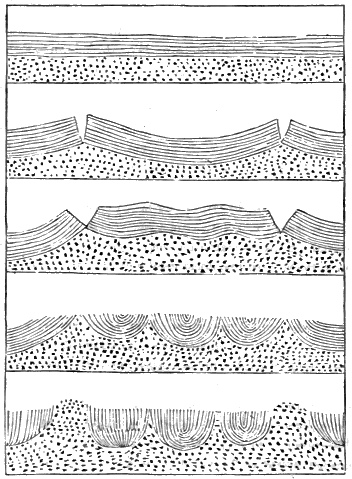
The force by which mountains are elevated being the elasticity of
the vapor diffused through the subjacent lava, it may happen, if the
lava have a high degree of fluidity, that this vapor will collect in large
masses, and rise as far as the lava is in a fluid state. The irregular
flow of lava from craters during an eruption is undoubtedly due
to the rapid ascent of such steam bubbles through the lava. Such
an accumulation of vapor under a mountain mass, if it cannot
escape, would support it as long as the temperature remained
unchanged. But, upon a reduction of temperature, the mass which
had been upheaved by it would be unsupported, and liable at any
time to sink. Instances of subsidence on a comparatively small
scale will admit of explanation in this way. Papandayang, one
of the loftiest volcanic mountains of Java, sunk down four thousand
feet in the year 1772. The area engulfed was sixteen miles long
and six broad. The crater of Kilauea, in one of the Sandwich
Islands, was evidently formed in this way. It is situated on the
side of a mountain, and consists of a chasm eight miles in circumference
and a thousand feet in depth. Liquid lava can always
be seen boiling in the small craters at the bottom; and at times it
rises so as to overflow them, and fill the chasm to within four hundred
feet of the top, when lateral subterranean passages are opened, by
which it is discharged. The same explanation—a depression of
the central portion—may be given of the formation of the large
craters in the Canary and Grecian islands. It is also probable that
Lake Avernus and others, in Italy, and some in Germany, have
had a similar origin.
The subsidence of Papandayang is of importance as a historical
fact; and it is not at all unreasonable to suppose that larger chasms
of great depth were also sudden subsidences of a similar character.
Lake Superior has a depth considerably greater than the elevation
of its surface above the level of the sea. The bottom of the Dead
Sea is two thousand six hundred feet below the surface of the
Mediterranean. And at one place in the Atlantic Ocean a sounding
was attempted with more than six miles of line, without reaching
bottom. These sunken areas, however, though of great extent,
occupy only an insignificant portion of the entire surface of the
earth.
6. The Elevation of Continents.—The causes of change of
level which have been given will not explain those slow vertical
movements which are now taking place in Greenland and the north
of Europe, or those by which the present continents have been
elevated and the bed of the sea depressed. Any cause which will
account for these movements must be one operating for long
periods, under large areas, and with great uniformity.
The cause which fulfils all these conditions most satisfactorily is
a variation of temperature in the mass of rock underlying the
portion of the surface whose level is changing. It has before been
shown that the temperature increases as we descend below the surface;
but there is also reason to suppose that it undergoes great
variations. The volcanic grits interstratified with the silurian
rocks of England show that at the silurian period volcanic fires
were active below that portion of the surface. When the early
fossiliferous rocks of this country were deposited, the Alleghany
Mountains had not been elevated; but before the tertiary period
they had taken nearly their present form. Some portion of the
intermediate period was therefore one of volcanic upheaval. The
trappean rocks are also evidence of intense volcanic action existing
here. France, during the tertiary period, was a highly volcanic
country; but all volcanic activity has now subsided. The Andes
have been mostly elevated since the tertiary period, and are still
rising. It is evident, then, that at different periods volcanic heat
may vary from its highest to its least degree of activity, below
any portion of the earth’s surface.
This variation of temperature must be followed by variation of
volume of the earth’s crust; that is, it must produce expansion or
contraction. Experiments have been made, under the direction of
the United States government, to determine the expansion of the
several kinds of rock used in our public works. It was found that
granite expands nearly one two hundred thousandth of its length
for every degree of increased temperature, limestone somewhat
more than that, and sandstone about twice as much. Taking the
expansion of the granite as the basis of calculation, and supposing
the crust for a hundred miles in thickness to be undergoing change
of temperature, there would be a resulting difference of level
exceeding two and a half feet for each degree of change in temperature,
or more than two thousand five hundred feet for a change of
one thousand degrees.
This calculation is made upon the supposition that the law of
expansion is the same for all temperatures, and that no new conditions
are introduced at high temperatures by the presence of
aqueous particles. We know, however, that solids expand more
rapidly at high temperatures than at low, and the elasticity of
aqueous vapor at high temperatures must increase the rate of
expansion of the rock through which it is diffused. Although we
are not able to introduce, numerically, the effect of these two circumstances,
yet it is obvious that they must be considerable.
The mean elevation of land above the level of the sea is about
nine hundred feet, the mountain masses above that level not being
included; and the estimated mean depth of the ocean, not including
its chasms, does not exceed two thousand six hundred feet.
The total elevation of the continental masses, for which it is necessary
to account, does not therefore exceed three thousand five hundred
feet. This amount of vertical movement may evidently be
produced by the expansion and contraction resulting from changes
of temperature.
These changes of level must, however, be very gradual. Any
diminution of temperature must result from the transfer of heat to
the surface; and the conducting power of rocks is very imperfect.
The lava in a crater is often so cooled on the surface that it can be
walked on, while but a few feet below it is still liquid. Lava currents
continue in gradual motion long after the surface is nearly
cold. This was the case with one of the currents from Ætna for
more than nine months after its eruption, and with another for
ten years. Humboldt visited Jorullo forty years after it was
thrown up, when the lava around the mountain was still in a
heated state, the temperature in the fissures being on the decrease
from year to year; but twenty years after its ejection the heat
was still sufficient to light a cigar at the depth of a few inches.
If so long a period is insufficient to solidify a comparatively small
quantity of melted rock when the circumstances for cooling are
most favorable, we may well suppose that centuries would be
required to abstract sufficient heat from the earth’s crust to produce
any material change in the areas of continents.
If this account of the elevation and subsidence of continents is
correct, it would seem that they ought to be constantly undergoing
change of level. And their apparent stability may be regarded
as an objection to it. If in any place there is absolutely no vertical
movement, then those conditions must exist in which, for the
time being, there is no change of temperature.
But it is doubtful whether there ever is absolute stability of
any portion of the surface for long periods of time. Of the minor
vertical movements of the interior of continents, there can, from
the nature of the case, be no evidence whatever. Changes of
level, where they are known to be taking place, are so slow, that
they are hardly perceptible in the period of a human life. Such
changes had been going on for centuries in Sweden before they were
suspected. As accurate observations have increased in number,
and historical records become available, it is becoming known that
a very large amount of the seaboard is undergoing change of level.
It becomes probable, then, that these extremely slow changes of
level are constantly and everywhere taking place.
That portion of the crust of the earth constituting the present
continents, being further removed from the centre, would part with
its heat more rapidly, and receive heat from the central mass more
slowly, than that portion which at present constitutes the bed of
the sea. The continents are therefore in a situation to undergo
contraction and depression, and the bed of the sea is most favorably
situated for rising. If the distribution of water through the mass
has any influence in promoting its expansion, then the bed of the
sea would receive this supply most abundantly, and the continents
the least so. We see, then, in nature, those provisions for an
alteration of level, which, from the character of the several rock
formations, we know to have taken place. When any portion of
the earth’s surface is covered with the sea, the conditions exist
which will at length elevate it. When it becomes dry land, the
conditions exist which will in time depress it below the level of the
ocean. Hence, those impressions in regard to the land, as stable
beyond the possibility of change, we ought to abandon; and those
vertical movements, which, when proved, we are accustomed to
regard as extraordinary, we shall, at length, consider as only particular
instances of one of the most general laws of nature.
7. Variations of Climate.—The only sources of heat by which
climate can be affected are the sun and the heated interior of the
earth.
If the former melted condition of the entire mass of the earth
be assumed, the temperature of the surface must have been increased,
by conduction of heat from within, for long periods after
the superficial stratum had become solid. It is, however, susceptible
of proof, that the present climates are not sensibly affected by
interior heat, though at a little more than a mile below the surface
the temperature is equal to that of boiling water. At any time,
therefore, after the waters had become condensed, collected into
oceans, and become sufficiently cool to support the animal life of
which the remains are now found, it is not probable that the climate
was, to any considerable extent, influenced by the heat conducted
from the interior.
Still, there have been great changes of climate since those early
organic forms existed; and, since we have no ground for supposing
that the temperature of the sun’s rays has suffered any reduction,
we have to inquire whether the means of retaining the heat from
the sun could at any time have been different. The relative position
of land and water depends, as we have seen, upon igneous
causes, and has been very different at different times. We shall
find that climate must have been greatly modified by these changes;
for the land radiates and absorbs heat freely, and water possesses
this power in a very low degree.
Let us suppose the zone comprised between the tropics to be
occupied by land, and the portions without these limits to be
covered with water. Under these conditions, the land, having a
nearly vertical sun the whole time, would accumulate heat to a
degree scarcely compatible with the existence of animal life. This
is sufficiently proved by the oppressive tropical climates of the
present time, influenced as they are by polar lands and contiguous
seas.
Under the same conditions, the sea would be heated by contact
with the land, and the heat would be distributed by marine currents
to the polar regions. But the water thus distributed would
not part with its heat, because it has but little radiating power,
and nowhere comes in contact with polar land. It follows, then,
that both land and water would be subjected to a very high
temperature.
But, if we suppose the land confined to the polar regions, and
the sea to the equatorial, the opposite results would follow. The
equatorial sea would absorb but a small proportion of the solar heat
which would be thrown upon it. The land would receive the sun’s
rays too obliquely to receive much elevation of temperature, as the
present polar climates show. Hence, the temperature of the earth
would differ but little from that of the planetary spaces, which is
fifty-eight degrees below zero, a temperature too low to allow of
any considerable development of organic life.
These are the conclusions to which we are led by considering
the different powers of land and water to absorb and radiate heat,
and we shall find that the existing climates are in accordance with
these conclusions. America has a lower temperature than Europe
in the same latitudes. It has also a smaller proportion of land in
the equatorial regions, and a greater proportion in the north polar
regions. The eastern continent is colder in Asia than in Europe
in the same latitudes. It has also less equatorial and more polar
land. The southern is colder than the northern hemisphere at
equal distances from the equator. There is also less land near the
equator on the south side, and probably as much land around the
south as the north pole.
Hence, we see that there may have been such a relation of land
and water as to account for all the variations of temperature which
are known to have existed. We cannot say that such actually has
been the case. We can tell, with some degree of accuracy, what
portions of the present continents were land at the several geological
periods; but three-fourths of the surface of the earth is covered
with water, and of the condition of this portion during those
periods we have no means even of conjecturing. We can only
say, that, by the operation of known causes, the relative position of
land and water may have been such as to produce the climates
known to have existed at former periods of the history of the
earth.