THE ELECTRONIC SIEGE
By John W. Campbell, Jr.
[Transcriber's Note: This etext was produced from
Wonder Stories April 1932.
Extensive research did not uncover any evidence that
the U.S. copyright on this publication was renewed.]
JOHN W. CAMPBELL, JR.
Mr. Campbell's humorous story, "The Derelicts of Ganymede," was a huge success. He shows now that he can do more serious work, with just as much skill and power as the humorous efforts. This story has many unusual aspects: it has strange adventures on another world, and a scientific theme that is audacious and yet convincing. There is a mystery to be settled on an inhabited asteroid: strange kidnapings and disappearances in space; a colony of scientific experimenters who defy the rest of humanity.
That is the background of this unusual story, which shows vividly some of the queer tricks that nature might play to upset the best laid plans of mice and men.
The dock-guard looked sourly down the long, bare customs landing. A stream of famous scientists had been coming aboard the space liner Vega all afternoon. They were the greatest scientists of Earth and Venus, taking passage on the chartered liner to Mars for the Interplanetary Society for the Advancement of Science Meeting for 2374, held once each Earth year. Pale faces identified the Venusian colonist-scientists, and the lightly tanned Earth scientists, but the figure coming toward the guard now was obviously neither.
He was a short man, perhaps five feet seven, but he seemed shorter because of the amazing girth he displayed. He must have weighed easily two hundred and seventy-five pounds, his round body mounted on chunky, blocky legs was topped by a neck so thick it was almost missing. He was equipped with a pair of stubby arms on the general plan of the legs. He waddled up on his blocky legs in a most amazing manner, puffing and blowing as ludicrously as an old steam engine of four centuries ago.
But more amazing than his own person was the moving rainbow he represented. Pale green, silken trousers, a deep red shirt, lavender suspenders, and a deep green sash matching his shoes completed his costume. No ancient oriental potentate, even Solomon in all his glory, was not arrayed such as this.
"Must be color-blind to like that," grunted the guard. Then he stared. Behind the man, following on a series of little self-propelled porter trucks, faithfully following the lead-set in the fat man's hand, was a pile of luggage as even this space liner guard seldom saw.
The weighty individual was grunting something to himself as he waddled hastily along, a curious expression of indignation, worry and annoyance intermingled on his puffy-cheeked face.
"Stupidity—rank stupidity of these public officials," he muttered. "Stupidity and red-tape. Will they never realize that it is business that supports them—yes and science too! Refusing Earth's greatest business man passage!
"More officialdom! Pass?" he barked at the dock-guard. "Yes, I've got a pass, and the very devil of a time I had getting it from that idiot, Commander Morrison. Interplanetary Lane Patrol Commander he is—and doesn't recognize the rights of business above science! Yes—Ezra Markham is right. You ought to recognize me—my pictures appear over the visonews frequently enough—and you're a passport guard!"
The grumbling multi-billionaire went toiling up the inclined gangway, the luggage trucks trailing behind like so many pet dogs.
"Steward!" he roared as he stepped off the gangplank.
A steward appeared immediately, dressed in his neat white uniform. He was soon followed by others, rushing to the scene of the emergency the roar seemed to indicate.
"My suite!" demanded Markham, turning over the lead-set and his pass to the handiest one. The startled steward accepted them dumbly, looked down at them, then seemed to remember his duties.
"Yes sir—right this way."
"What—this tiny cubbyhole my room? My closet you mean! Here—show me a suite. Taken? Who—scientists I suppose, scientists that never had brains enough to make a nickel for themselves. Come along—Ah—this will do. Who's in here? Edgar A. Freeman—he's on my engineering staff, I believe. Well—move out his bags and put my cases in. I'm going to the lounge."
The white-coated steward looked in blank surprise at the expansive back of the retreating Mr. Ezra Markham, scratched his head in puzzlement, and went to look up Dr. Edgar A. Freeman, inventor of half a dozen devices which had made space navigation possible on a large scale.
Mr. Ezra Markham seated himself in the largest chair in the main lounge (the only one that would comfortably contain his bulk) and began a very expensive cigar, made of the finest imported Venusian tobacco.
He then spent the next half hour assuring distracted stewards that the rigid "No Smoking" rules didn't apply to Mr. Ezra Markham in the least degree, and in filling the carefully filtered air of the space ship with a variety of noxious odors.
Presently they took off. The slim, graceful ship rose smoothly into the atmosphere, angling slightly up, then driving forward as the gentle hum of mighty Farrel Atomics poured their millions of horsepower into the McKinley space-drive discs.
Markham looked at his jewel-studded wrist-watch and grumbled. They were a few minutes late on the take-off. One of the stewards remarked (under his breath) that that watch must have been made so thick that more jewels might be crowded on.
Shortly after their take-off, a slim, powerfully built man in the white and blue dress uniform of the Interplanetary Lane Patrol came over to Mr. Markham and very definitely pointed out that "No Smoking" meant a complete absence of smoking, whether it be smoke hallowed by the said Mr. Markham, or the second apprentice oiler's assistant.
Mr. Markham put out the stub of his cigar. "I thought," said he testily, "that you men had ships of your own to go in. Since when have Lane Patrolmen been riding passenger liners?"
The Lane Patrolman, not unnaturally proud of the reputation of the Service, replied a bit hotly. "This is a special occasion, as you should know, Mr. Markham. Two years ago a group of scientists calling themselves the Eugenics Research Colony set up an experimental colony on some undiscovered planetoid and have been experimenting on human genetics with captured subjects. Such fine men and women as are aboard this liner would be an obvious prize capture for them, and we are guarding it heavily."
"Humpf. And why has it been going on two years, may I ask?" retorted the disgruntled plutocrat.
"Because there are more than five thousand known asteroids that might house that colony, and because their ships have a weapon we have not been able to duplicate—the protolectric gun," replied the officer, turning smartly and walking away. Markham chuckled. The Lane Patrolman had retired in poor order.
The E.R.C. was a sore spot on the Lane Patrol's otherwise spotless record. Thanks to a mechanism capable of projecting twin beams of highly dangerous electrons and protons from a "gun", their ships had beaten off patrol cruisers time and again. Secret service men of the Patrol had indeed been able to get into the "Colony"—only to become unwilling subjects to this experiment with human lives. Picked men all, these men of the service, and desirable material for the Research men. Four men so far had been released after six months' imprisonment of the most heartily detested nature to return with a tale of absolute failure.
Markham rose, and walked back to the aft-walk, a narrow corridor lined on one side with the heavy armour plate of the inner hull, and on the other by six-inch, metal-ribbed unbreakable glass. Here, where only the dimmest lights glowed, the stars and planets shone with the cold, unwinking glory of space, and the sun of space poured down its bluish light in blinding glory.
Behind them now the greater and lesser globes of Earth and Moon were circling in slow majesty, yet from this million mile distance they seemed, and the whole solar system seemed, more as some marvelously ingenious planetarium where unseen supports and unseen wheels drove these visible models of worlds. It seemed impossible they could be real, that Earth with its billions and Moon with its millions of inhabitants were real worlds.
Silently the stocky man watched out into the night. Dimly his eyes made out the dark, torpedo shape of another ship, a Lane Cruiser, some fifty miles astern, and another off to the side. Fifty-man cruisers each one, equipped with the latest devices of offense and defense—but would they be able to drive off the E.R.C. ships?
The dim figure started as he observed the slow blotting out of stars in the Milky Way. Another ship!
Simultaneously there came the soft hum of an alarm signal from within the ship. A moment later the swift tramp of steps, and then a start—a surge of power, and the acceleration that had been held at a comfortable 32 feet per second, Earth normal, was drawn swiftly up to three normal, the highest acceleration a passenger ship could safely stand.
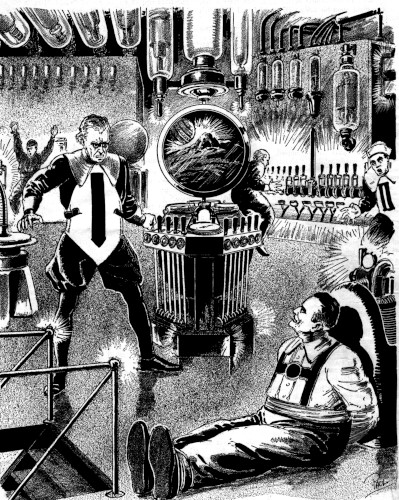
The stocky man, now under a weight of fully eight hundred and twenty-five pounds, should by all rights have lain down at once. Instead his frame seemed to stiffen, the outlines of his body subtly changed, and he glanced along the deserted companion-way hurriedly assuring himself no other was in sight. Then—instead of the infinitely laborious crawl to be expected under nearly half a ton of weight, he walked easily with firm, lithe strides to a sheltered nook behind a great beam. He waited there quietly on his feet! Now there was an amused smile on his face, and the puffiness seemed somehow gone, more an appearance of swelling prevailed. His grey eyes seemed flashing with interest, his shoulders had lost their slough, and had come back squarely.
The Patrol cruisers were dropping swiftly astern, turning to meet the rapidly approaching sphere ship that was swimming nearer in space. It was maneuvering that the line of the enemy's approach would not bring him directly between them.
Faint halos began to form about the cruisers, and now about the passenger liner. They were the faint halos of magnetic and induction screens that would stop any shell, or any induction ray before it reached the ship. But unfortunately not the twin beams!
Eyes alert, the man watched the sphere come sharply near the two cruisers—a sudden flash, and it was bathed in flaring, shimmering light, warring energy as its powerful screen battled the rays of the Patrol ships.
Two streams of nearly invisible fire reached out in lines as straight as a linear equation toward the two Patrol cruisers. Each was in reality a twin beam, and each was potentially deadly. They snapped out in absolute lines—till they hit the magnetic fields about the patrol ships, then they bent sharply as their electric charges were deflected by the field. Presently they moved swiftly, shifting till the deflection of the field no longer carried them past the ships. Then—a single flash of livid flame, a bursting puff of enveloping fire—and one Patrol ship was punctured, its atmosphere glowing brilliantly under the terrific electronic bombardment.
The Patrol ship, perforce, veered off and soon the second ship came in for a like dose. Again—again they were driven off. It was obvious that the sphere ship did not want to destroy them, merely to cripple them.
Finally each beam split in two, and they wavered and waved weirdly as the ships strove valiantly with their magnetic fields, attempting to divert them sufficiently. Meanwhile a constant terrific bombardment of induction rays was driving at the sphere, its screen flaring vividly.
The two separate beams found their mark, the Patrol ship seemed to glow all over its surface, and instantly every ray, every screen went dead. A moment later, the second Patrol ship went dead.
The stocky man cursed softly. He turned, and as the ship lurched slightly to a still greater acceleration, nearly three and a half gravities, in its hopeless attempt to flee, he ran lightly down the companion-way, slowing to a walk as he reached the bulkhead door. Then his body seemed to slump, once more his powerful shoulders sagged, and he crawled heavily into the lounge. The other passengers were struggling on hands and knees, or flat on their stomachs, slowly moving along. Finally he fell forward and lay motionless.
Through a great, curving port he could still see the sphere climbing up behind them, rapidly overhauling them. Suddenly two beams of fire were reaching out for their ship—two great beams that bent sharply as they struck the Vega's magnetic meteor-shield. Careful manipulation—and Ezra Markham started violently, his muscles contracting, while every sharp bit of metal in the room gave off fans of blue electric fire.
At that same instant every man on the ship fell senseless under the powerful shock transmitted to them. Like the Patrol cruisers, the lifeless, defenseless ship careened on through space, her acceleration dropping immediately to Earth normal as automatic machines took up the unconscious pilot's duties.
A dozen men in silver-grey uniforms were standing about the room when Markham regained consciousness. One of them was bending over him, peering with surprised interest at his magnificent display of coal-tar dyes.
"Who," demanded the E.R.C. man with interest, "are you?"
"Ezra Markham," answered the prostrate man sitting up, "Who are you?"
The lean, tanned face split in a grin. "Tod Morley, not that it makes any difference. And so you're Ezra Markham. Well, well. From the looks of you I should say your type wasn't wanted on our colony. But—it is an experiment for the benefit of the human race, and we feel sure that a man as you would want to contribute to its success—say a million or two. In the meantime—just move over to that corner." A ray pistol in his hand swung on Markham, and the twin rays leaped out. The animate rainbow gave a yell of surprise and pain, and scrambled to his feet with an activity surprising in one so stout. With the inducement of the pistol he was herded hurriedly to the indicated corner.