This new edition of “The Eighteen Nineties” has been revised and
corrected. Here and there notes and sentences have been added for
purposes of clarity. In all other respects it resembles the 1913
edition. Through the courtesy of the Proprietors of “Punch” it has
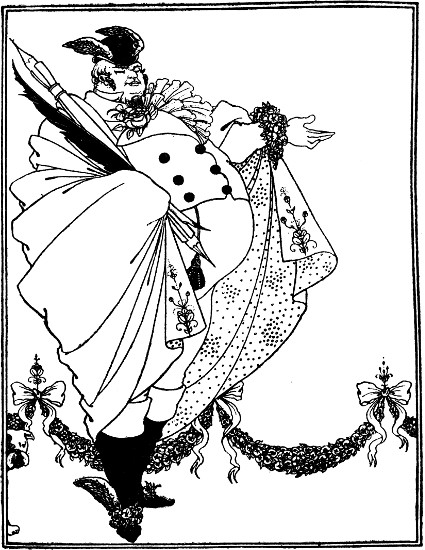
been possible to add to the illustrations Mr E. T. Reed’s admirable
caricature, “Britannia à la Beardsley.”
H. J.
London, 1922
INTRODUCTION
There is little to say by way of introduction to this study, as the
title, I imagine, explains the subject, with the possible exception
that it does not, for reasons of space, indicate that I have reviewed
only certain tendencies in art and ideas in this country. I have had,
of course, to refer, incidentally, to the work of foreign writers
and painters, but only as part of the process of tracing origins and
lines of development. This is said not as excuse but in explanation
of omissions which might otherwise be questioned. The movement which
I have described in the British Islands was, to be sure, but one
phase of a literary and artistic awakening which had its counterparts
in many countries, particularly in France and Germany, and to some
extent in Italy and Russia. Mr Arthur Symons, in the Symbolist
Movement in Literature, has given us a valuable interpretation of
one of its important phases in France, and Mr W. G. Blaikie Murdoch,
in The Renaissance of the Nineties, has dealt eloquently, but
all too briefly, with certain manifestations of the awakening in
our own country, whilst Mr J. M. Kennedy in English Literature,
1880–1905, has made the literary history of the quarter century
he reviews the basis of an argument in defence of the classical as
against the romantic idea. My intention has been to co-ordinate the
various movements of the period, and avoiding sectional or specialised
argument, to interpret them not only in relation to one another, but in
relation to their foreign influences and the main trend of our national
art and life. Thus my aim may be described as interpretative rather
than critical, although criticism is not easily avoided by one who
engages to select examples and instances from a great body of work.
No excuse need be made by me for confining my review to so limited a
period as the last decade of the nineteenth century, for once having
decided to write about the art and ideas of the closing years of that
century, the final ten years insisted upon definite recognition by
the coincidence of position in time and appropriate happenings in
literature, painting, and other arts and crafts. But, as a matter of
fact, I have not confined myself strictly to a single decade, for it
will be seen that my Nineties trespass upon the adjoining territory of
the Eighties and the Nineteen Hundreds, and, to protect myself as far
as possible against extraneous argument, I have adopted in the initial
chapter the dates “1890–1900” as a kind of symbol for the period. The
compromise is defensible, as I have not wilfully singled out a decade
for review; that decade had singled itself out, the Eighteen Nineties
having already become a distinctive epoch in the minds of those who
concern themselves with art and ideas.
Anybody who studies the moods and thoughts of the Eighteen Nineties
cannot fail to observe their central characteristic in a widespread
concern for the correct—that is, the most effective, the most
powerful, the most righteous—mode of living. For myself, however,
the awakening of the Nineties does not appear to be the realisation
of a purpose, but the realisation of a possibility. Life aroused
curiosity. People became enthusiastic about the way it should be used.
And in proof of sincerity there were opinionated battles—most of them
inconclusive. But they were not wasteful on that account, for the
very circumstance of idea pitting itself against idea, vision against
vision, mood against mood, and, indeed, whim against whim, cleared the
way for more definite action when the time ripened. It was an epoch of
experiment, with some achievement and some remorse. The former is to
be seen in certain lasting works of art and in the acceptance of new,
and sometimes revolutionary, social ideas; the latter in the repentant
attitude of so many poets and other artists of the time who, after
tasting more life than was good for them, reluctantly sought peace in
an escape from material concerns. The decade began with a dash for
life and ended with a retreat—but not defeat. It was the old battle
between heterodoxy and orthodoxy, materialist and mystic, Christian
and Pagan, but fought from a great variety of positions. Arthur
Symons summed up the situation very effectively in the conclusion to
Studies in Prose and Verse, where he discusses the conversion
of Huysmans. “He has realised,” Mr Symons wrote, “the great choice
between the world and something which is not the visible world, but
out of which the visible world has been made, does not lie in the mere
contrast of the subtler and grosser senses. He has come to realise what
the choice really is, and he has chosen. Yet the choice is not quite so
narrow as Barbey D’Aurevilly thought; perhaps it is a choice between
actualising this dream or actualising that dream. In his escape from
the world, one man chooses religion, and seems to find himself; another
choosing love may seem also to find himself; and may not another,
coming to art as to a religion and as to a woman, seem to find himself
not less effectively? The one certainty is that society is the enemy
of man, and that formal art is the enemy of the artist. We shall not
find ourselves in drawing-rooms or in museums. A man who goes through
a day without some fine emotion has wasted his day, whatever he has
gained by it. And it is so easy to go through day after day, busily
and agreeably, without ever really living for a single instant. Art
begins when a man wishes to immortalise the most vivid moment he has
ever lived. Life has already, to one not an artist, become art in that
moment. And the making of one’s life into art is after all the first
duty and privilege of every man. It is to escape from material reality
into whatever form of ecstasy is our own form of spiritual existence.”
There we have the attitude of the Eighteen Nineties from which most
pilgrimages into life began. In the following pages I have endeavoured
to expound the attitude and to indicate its victories and defeats.
Finally, I have to thank all those who have so willingly given me
their aid by permitting me to quote from their works and to use the
illustrations written and pictorial which add so much to the grace
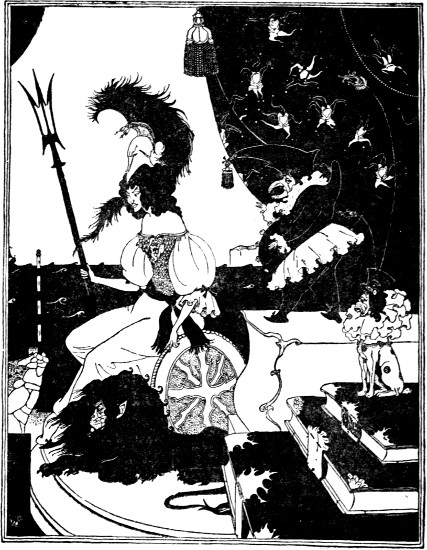
and value of this book. Particularly I must thank Mr John Lane for
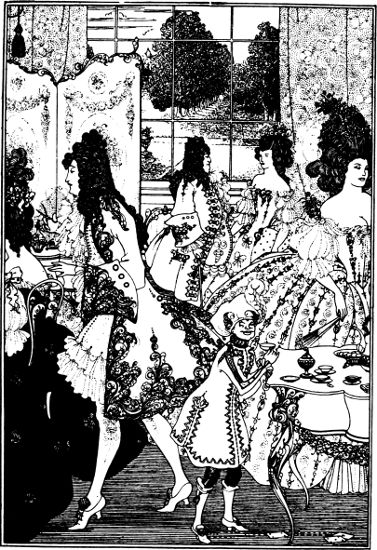
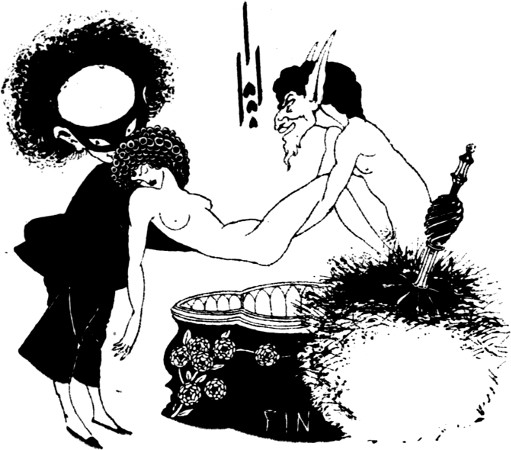
permission to use the following designs by Aubrey Beardsley:—“The Rape
of the Lock,” “Tail-piece from Salomé,” and the cover designs
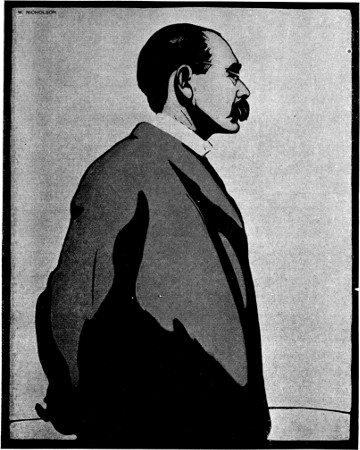
from The Yellow Book and The Savoy; Mr William Heinemann,
for the study of Rudyard Kipling from Twelve Portraits
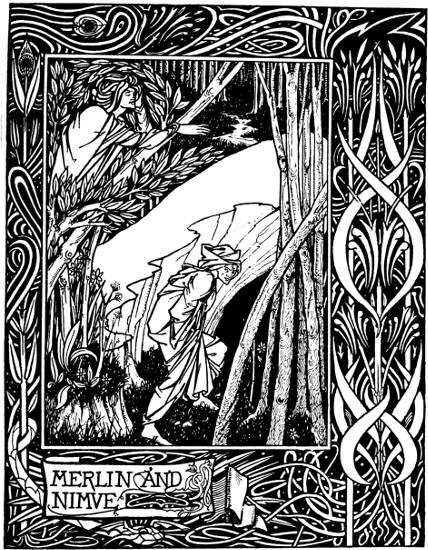
by William Nicholson; Messrs J. M. Dent & Sons Ltd., for Aubrey
Beardsley’s page decoration from the Morte d’Arthur; Messrs
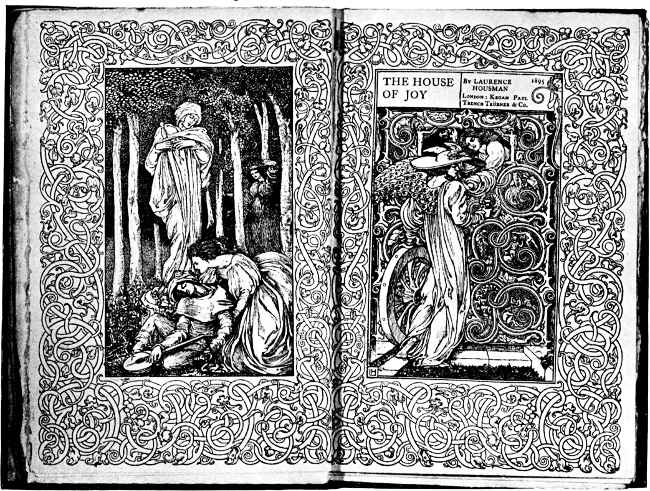
George Routledge & Sons Ltd., for the frontispiece and title-page
of The House of Joy, by Laurence Housman; the proprietors of
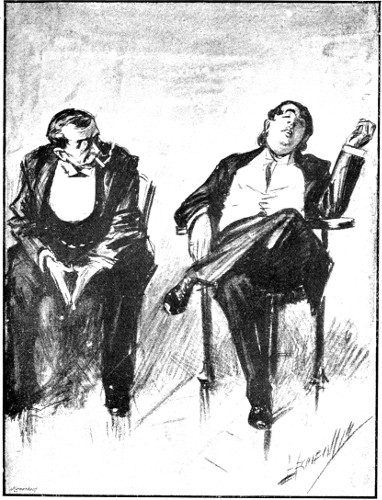
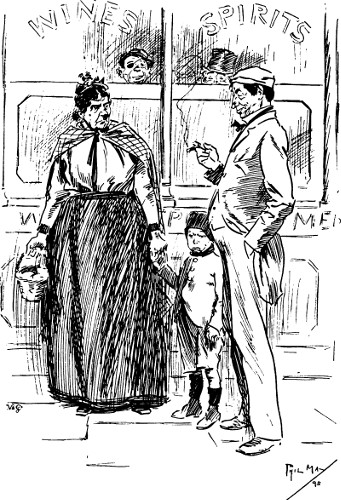
Punch, for “A Lecture in Store,” by Phil May; the editor of
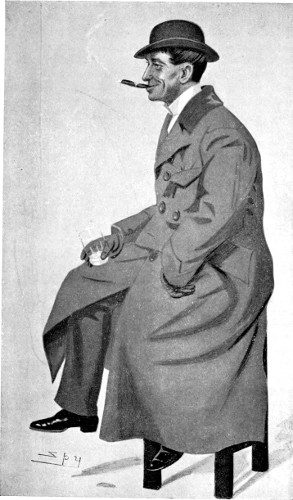
Vanity Fair, for the caricature of Phil May by Spy; the editor
of The Saturday Review, for William Rothenstein’s cover design
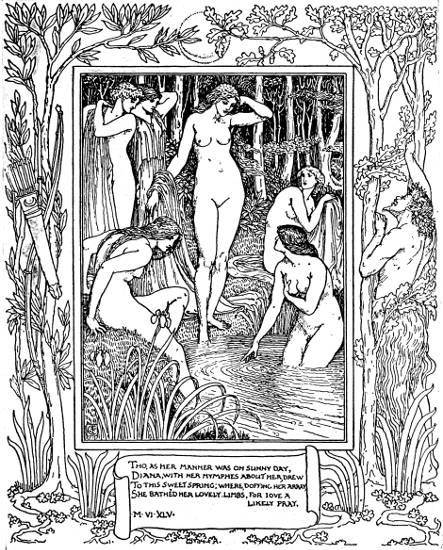
of the Christmas Supplement, 1896; Mr Walter Crane and Messrs George
Allen & Co. Ltd., for the illustration from the decorated edition of
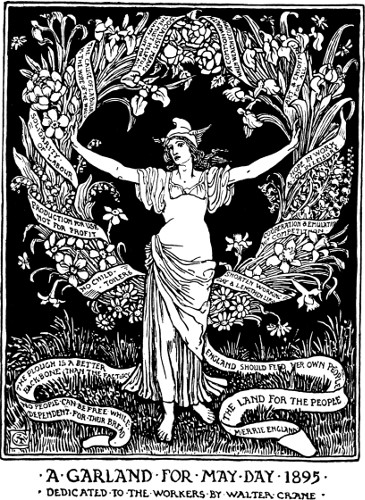
the Faerie Queene; Mr Walter Crane, for the Socialist cartoon,
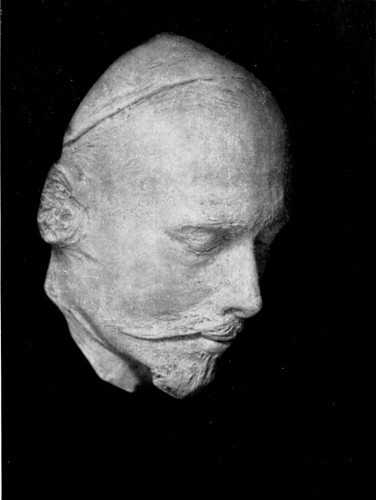
“A Garland for May Day”; Mr Francis Meynell, for the photograph of
the life mask of Francis Thompson; Mr Raven Hill, for “A Voluptuary,”
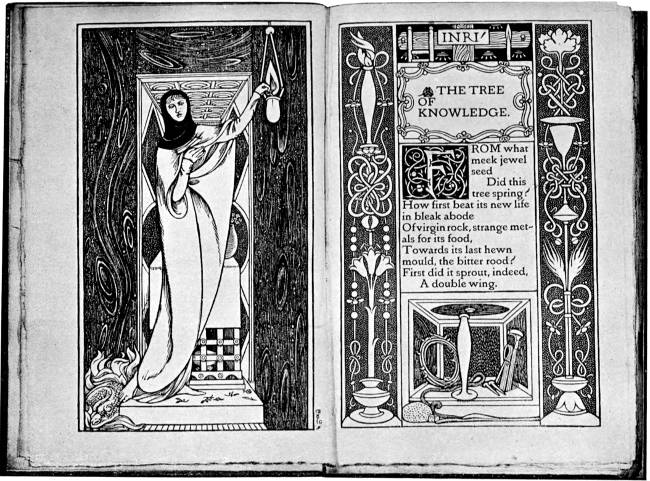
from Pick-me-up; Mr Charles Ricketts, for the decorated pages
from the Vale Press edition of John Gray’s Spiritual Poems;
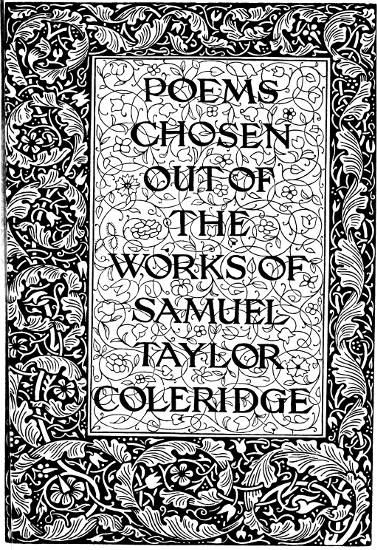
the executors of William Morris, for the page from the Kelmscott
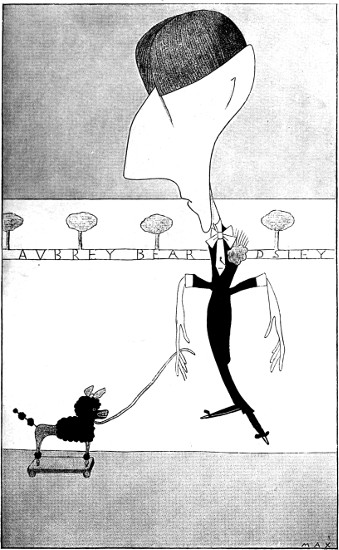
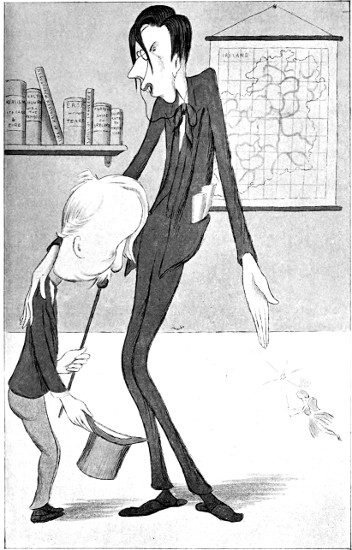
Coleridge; Mr Max Beerbohm, for his caricature of Aubrey
Beardsley and “Mr W. B. Yeats introducing Mr George Moore to the
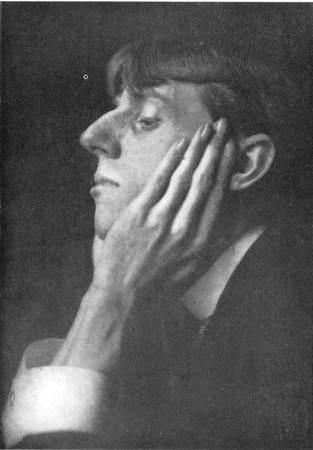
Queen of the Fairies”; and my friends, Mr Frederick H. Evans, for his
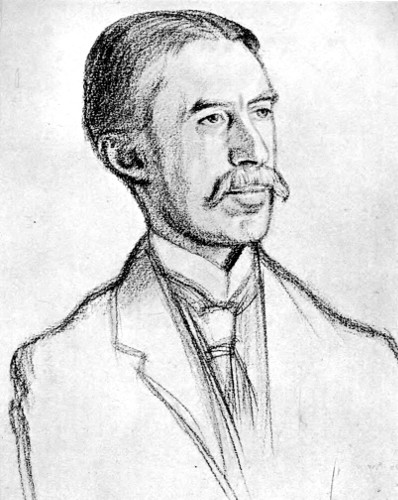
portrait study of Beardsley; Mr William Rothenstein, for his drawing
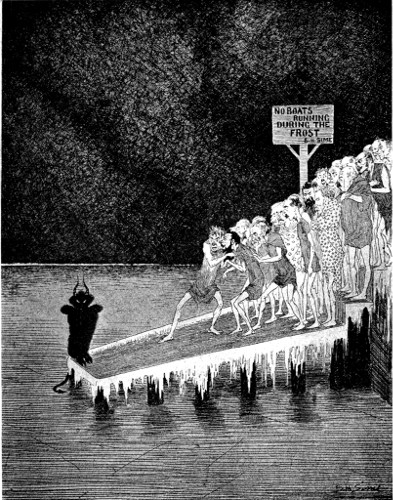
of A. E. Housman; Mr S. H. Sime, for “The Banks of the Styx”; Mr Grant
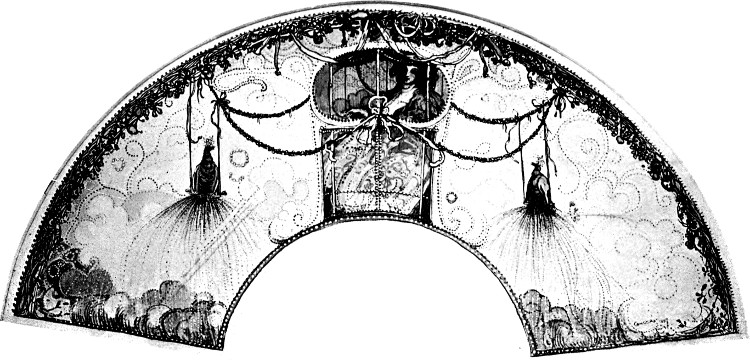
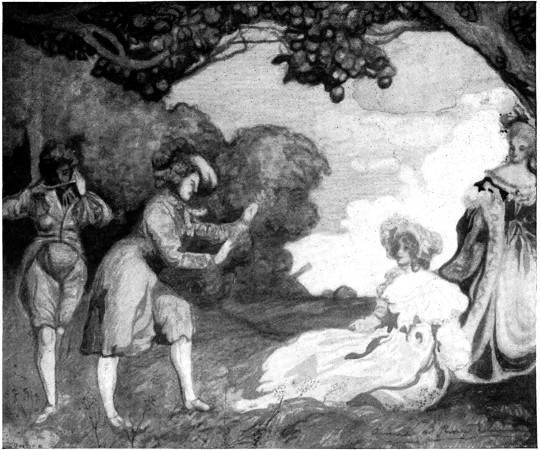
Richards, for the “Arrival of Prince Charming,” and “The Peacock Fan,”
by Charles Conder; and Mr Frederick Richardson, for untiring help and
many suggestions during the making of the book in all its stages.
Holbrook Jackson.
London, October, 1913.
CHAPTER I FIN DE SIÈCLE—1890–1900
In the year 1895 Max Beerbohm announced, how whimsically and how
ironically it is not necessary to consider, that he felt himself a
trifle outmoded. “I belong to the Beardsley period,” he said. The
Eighteen Nineties were then at their meridian; but it was already the
afternoon of the Beardsley period. That very year Aubrey Beardsley’s
strange black and white masses and strong delicate lines disappeared
from The Yellow Book, and he only contributed to the first few
numbers of The Savoy, which began in 1896. Fatal disease was
overtaking him, and remorse. Aubrey Beardsley actually abandoned his
period in the evening of its brief day, and when he died, in 1898, the
Beardsley period had almost become a memory. But, after all, Aubrey
Beardsley was but an incident of the Eighteen Nineties, and only
relatively a significant incident. He was but one expression of fin
de siècle daring, of a bizarre and often exotic courage, prevalent
at the time and connected but indirectly, and often negatively, with
some of the most vital movements of a decade which was singularly rich
in ideas, personal genius and social will. Aubrey Beardsley crowded
the vision of the period by the peculiarity of his art rather than by
any need there was of that art to make the period complete. He was,
therefore, not a necessity of the Eighteen Nineties, although his
appearance in the decade was inevitable; indeed he was so essentially
fin de siècle that one can say of him with more confidence than
of any other artist of the decade that his appearance at any other time
would have been inopportune.
The Eighteen Nineties were so tolerant of novelty in art and ideas that
it would seem as though the declining century wished to make amends
for several decades of intellectual and artistic monotony. It may
indeed be something more than coincidence that placed this decade at
the close of a century, and fin de siècle may have been at one
and the same time a swan song and a deathbed repentance. As a matter
of fact, a quickening of life during the last years of a century is
not without parallel. The preceding century closed with the French
Revolution and the First Consulate of Napoleon, and the sixteenth
century closed with the destruction of the Armada and the appearance
of Shakespeare, Ben Jonson, Spenser, Christopher Marlowe and Francis
Bacon; whilst the close of the fifteenth century saw the Revival of
Learning, and the discovery of America by Columbus and of Newfoundland
by Cabot. One cannot avoid the temptation to speculate on the meaning
of such fin de siècle occurrences, for we are actually made more
conscious of our standing towards time by the approaching demise of
a century, just as we are made conscious of our own ages on birthday
anniversaries and New Year’s Eve. And it is at least thinkable that as
we are certainly moved in the latter circumstances to pull ourselves
together, as it were, even if the effort be only an instinctive attempt
to find in action forgetfulness of the flight of time; so it is equally
thinkable that a similar but racial instinct towards unique activity
may come about at so impressive a period as the close of a century.
But, whatever the cause, the last decade of the last century was, in
spite of its many extravagances, a renascent period, characterised by
much mental activity and a quickening of the imagination, combined with
pride of material prosperity, conquest and imperial expansion, as well
as the desire for social service and a fuller communal and personal
life.
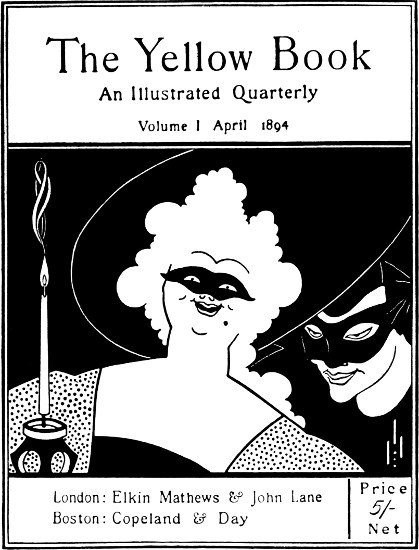
The Yellow Book
An Illustrated Quarterly
Volume 1 April 1894
London: Elkin Mathews & John Lane
Boston: Copeland & Day
Price 5/- Net
Cover Design of The Yellow Book, Volume I
By Aubrey Beardsley
Max Nordau, the Jeremiah of the period, linked up his famous attack
on what were called “fin de siècle tendencies” with certain
traditional beliefs in the evil destiny of the closure of centuries.
“The disposition of the times is curiously confused,” he said; “a
compound of feverish restlessness and blunted discouragement, of
fearful presage and hang-dog renunciation. The prevalent feeling is
that of imminent perdition and extinction. Fin de siècle is
at once a confession and a complaint. The old northern faith contained
the fearsome doctrine of the Dusk of the Gods. In our days there have
arisen in more highly developed minds vague qualms of the Dusk of the
Nations, in which all suns and all stars are gradually waning, and
mankind with all its institutions and creations is perishing in the
midst of a dying world.” All of which sounds very hectic and hysterical
now, nearly twenty years after it was first written, when many of the
writers and artists he condemned have become harmless classics, and
some almost forgotten. But it is interesting to remember Nordau’s
words, because they are an example of the very liveliness of a period
which was equally lively in making or marring itself. The Eighteen
Nineties, however, were not entirely decadent and hopeless; and even
their decadence was often decadence only in name, for much of the
genius denounced by Max Nordau as degeneration was a sane and healthy
expression of a vitality which, as it is not difficult to show, would
have been better named regeneration.
At the same time the fact must not be overlooked that much of the
vitality of the period, much even of its effective vitality, was
destructive of ideas and conventions which we had come to look upon
as more or less permanent; and one cannot help feeling, at this
distance, that not a little of fin de siècle attractiveness
was the result of abandonment due to internal chaos. But this is no
cause for condemnation on our part, still less for self-complacency;
for, as we have been told by Friedrich Nietzsche, himself a half-felt
motive force, in this country at least, behind the tendencies of
the times: “Unless you have chaos within you cannot give birth to a
dancing star.” More than one dancing star swam into our ken in the last
decade of the nineteenth century, and the proof of the regenerative
powers of the period are to be found most obviously, but perhaps even
more certainly, if not quite so plainly, in the fact that those who
were most allied with its moods and whims were not only conscious
of the fact, but in some cases capable of looking at themselves and
laughing. Fin de siècle was a pose as well as a fact, a point
not realised by Nordau. John Davidson, among others, was able to smile
at its extravagances, and in Earl Lavender, his burlesque novel
of the decadence, one of the characters, a garrulous Cockney dame with
a smattering of French, reveals the existence of power to cast what
Meredith would have called “the oblique ray” upon the doings of the
time. “It’s fang-de-seeaycle that does it, my dear,” says this
lady, “and education, and reading French.”
It is obvious, then, that people felt they were living amid changes and
struggles, intellectual, social and spiritual, and the interpreters of
the hour—the publicists, journalists and popular purveyors of ideas of
all kinds—did not fail to make a sort of traffic in the spirit of the
times. Anything strange or uncanny, anything which savoured of freak
and perversity, was swiftly labelled fin de siècle, and given a
certain topical prominence. The term became a fashion, and writers vied
one with another as to which should apply it most aptly. At least one
writer emphasised the phrase in an attempt to stigmatise it. “Observe,”
wrote Max Beerbohm, “that I write no fool’s prattle about le fin
de siècle.” And Max Nordau gives a useful list illustrating the
manner in which the term was used in the country of its birth. A king
who abdicates but retains by agreement certain political rights, which
he afterwards sells to his country to provide means for the liquidation
of debts contracted by play in Paris, is a fin de siècle king.
The police official who removes a piece of the skin of the murderer
Pranzini after execution and has it tanned and made into a cigar-case,
is a fin de siècle official. An American wedding ceremony held
in a gasworks and the subsequent honeymoon in a balloon is a fin
de siècle wedding. A schoolboy who, on passing the gaol where his
father is imprisoned for embezzlement, remarks to a chum: “Look, that’s
the governor’s school,” is a fin de siècle son. These are only a
few from among innumerable examples illustrating the liveliness of the
people of the Nineties to their hour and its characteristics. A further
indication of the way in which the phrase permeated the mind of the
period is found in its frequent occurrence in the books and essays of
the day. It appears fittingly enough in Oscar Wilde’s The Picture
of Dorian Gray, that typical book of the period, as a reflection
upon an epigram afterwards used in A Woman of No Importance.
Lady Narborough is saying:
“‘If we women did not love you for your defects, where would you
all be? Not one of you would ever be married. You would be a set
of unfortunate bachelors. Not, however, that that would alter
you much. Nowadays all the married men live like bachelors and
all the bachelors like married men!’
“‘Fin de siècle,’ murmured Sir Henry.
“‘Fin du globe,’ answered his hostess.
“‘I wish it were fin du globe,’ said Dorian, with a sigh.
‘Life is a great disappointment.’”
A reviewer of the novel, in The Speaker of 5th July 1890,
describes Lord Henry Wotton as “an extremely fin-de-siècle
gentleman.” And another book of the period, Baron Verdigris: A
Romance of the Reversed Direction, by Jocelyn Quilp, issued in
1894, with a frontispiece by Beardsley, is prefaced by the following
inscription:—
This Book is Dedicated equally to Fin-de-Siècleism, the
Sensational Novel, and the Conventional Drawing-Room Ballad.
But side by side with the prevailing use of the phrase, and running
its popularity very close, came the adjective “new”; it was applied
in much the same way to indicate extreme modernity. Like fin de
siècle, it hailed from France, and, after its original application
in the phrase l’art nouveau had done considerable service in
this country as a prefix to modern pictures, dresses and designs,
our publicists discovered that other things were equally worthy of
the useful adjective. Grant Allen wrote of “The New Hedonism”; H.
D. Traill, of “The New Fiction,” opening his essay with the words:
“Not to be new is, in these days, to be nothing.” In August
1892 William Sharp designed and produced one number, and one only, of
The Pagan Review, which was written entirely by himself under
various pseudonyms, to promote the “New Paganism,” described as “a
potent leaven in the yeast of the ‘younger generation,’ and which
was concerned only with the new presentment of things.” And
again, in the famous attack on The Picture of Dorian Gray, in
the St James’s Gazette, on the first appearance of the novel
in the pages of Lippincott’s Monthly Magazine for July 1890,
reference is made to “The New Voluptuousness” which “always leads up
to bloodshedding.” Oscar Wilde himself wrote on “The New Remorse,” in
The Spirit Lamp, in 1892. The range of the adjective gradually
spread until it embraced the ideas of the whole period, and we find
innumerable references to the “New Spirit,” the “New Humour,” the “New
Realism,” the “New Hedonism,” the “New Drama,” the “New Unionism,” the
“New Party,” and the “New Woman.” The popular, and what we should now
call “significant,” adjective was adopted by publishers of periodicals,
and during the decade there was The New Age, a penny weekly with
a humanitarian and radical objective, which, after many vicissitudes
and various editorial changes, still survives; while William Ernest
Henley, coming under the spell of fashion and carrying his modernism
from the eighties, translated The National Observer into The
New Review.
A decade which was so conscious of its own novelty and originality
must have had some characteristics at least which distinguished it
from the immediately preceding decade, if not from all preceding
decades. The former is certainly true: the Eighteen Nineties possessed
characteristics which were at once distinctive and arresting, but I
doubt whether its sense of its own novelty was based in changes which
lacked their counterparts in most of the decades of the nineteenth
century—pre-eminently a century of change. The period was as certainly
a period of decadence as it was a period of renaissance. The decadence
was to be seen in a perverse and finicking glorification of the fine
arts and mere artistic virtuosity on the one hand, and a militant
commercial movement on the other. The one produced The Yellow
Book and the literature and art of “fine shades,” with their
persistent search for the “unique word” and the “brilliant” expression;
the other produced the “Yellow Press,” the boom in “Kaffirs,” the
Jameson Raid, the Boer War and the enthronement of the South African
plutocrat in Park Lane. But this decadent side of the Nineties must
not be looked upon as wholly evil. Its separation from a movement
obviously ascendant in spirit is not altogether admissible. The two
tendencies worked together, and it is only for the sake of historical
analysis that I adopt the method of segregation. Taken thus the
decadence reveals qualities which, even if nothing more than “the soul
of goodness in things evil,” are at times surprisingly excellent. The
decadent vision of an Aubrey Beardsley introduced a new sense of rhythm
into black and white art, just as the, on the whole, trivial masters of
“fine shades,” with their peacock phrases, helped us towards a newer,
more sensitive and more elastic prose form. The “Yellow Press,” with
all its extravagances, was at least alive to the desires of the crowd,
and the reverse of dull in the presentment of its views; and if it
gave Demos the superficial ideas he liked, it was equally prepared to
supply a better article when the demand arose. And, withal, a wider
publicity was given to thought-provoking ideas and imaginative themes,
although adjusted, and often very much adjusted, to the average taste,
than had hitherto been possible. As for the “New Park Lane” and the
“New” aristocracy, they in their garish abandonment helped us to apply
the abstract science of economics to life, thus probably preparing the
path for the Super-tax and other so-called “Socialistic” legislation
of to-day. But apologies for the decadent side of the period do not
complete the story of the renaissance of the Nineties. This latter
was more real than the much-advertised decadence, and as time goes on
it will prove itself to have been more enduring. The atmosphere of
the Eighteen Nineties was alert with new ideas which sought to find
expression in the average national life. If luxury had its art and
its traffic, so had a saner and more balanced social consciousness. If
the one demanded freedom for an individual expression tending towards
degeneration and perversion, the other demanded a freedom which should
give the common man opportunities for the redemption of himself and his
kind. Side by side with the poseur worked the reformer, urged
on by the revolutionist. There were demands for culture and social
redemption. A wave of transcendentalism swept the country, drawing
with it the brighter intelligences of all classes; but it was not
remote, it was of the earth and of the common life and hour, seeking
the immediate regeneration of society by the abolition of such social
evils as poverty and overwork, and the meanness, ugliness, ill-health
and commercial rapacity which characterised so much of modern life.
The vitality of this awakening of the social consciousness is proved
by its extravagances. In the main it worked persistently, cheerfully
and with that spirit of compromise dear to the English temperament, as
can be seen by a reference to the pages of The Daily Chronicle,
under the editorship of A. E. Fletcher; The Star, under T.
P. O’Connor; The New Age of the period; Robert Blatchford’s
Clarion, and W. T. Stead’s Review of Reviews. But now and
then the cup of social zeal was too full; it overflowed, and one heard
of the bomb of over-zealous anarchist; of the revolt of righteously
impatient starvelings among the newly awakened proletariat, and of
the purely negative militancy of the “Nonconformist conscience,”
which used the newborn and enthusiastic London County Council and Mrs
Ormiston Chant as the instruments of a moral crusade among West End
music halls, then only just discovered as more or less harmless and
instructive places of entertainment by those guardians of British
respectability—the lower middle classes.
In all these things the Eighteen Nineties were unique only in method
and in the emphasis they gave to certain circumstances and ideas. The
Eighteen Eighties and the late Seventies had been even more “artistic”
than the Nineties, and the preceding decade had also its riots and
revolutionary organisations. Max Beerbohm, in a delightful essay
which could only have been written in the Nineties and could only have
appeared in The Yellow Book, has given us with subtle humour
and satire a little history, not entirely free from caricature, of the
Eighties. In the essay called “1880” he opens, as it were, a window in
the house of the Nineties through which we get a fair glimpse of the
immediate past. He says:
“Beauty had existed long before 1880. It was Mr Oscar Wilde
who managed her début. To study the period is to admit that
to him was due no small part of the social vogue that Beauty
began to enjoy. Fired by his fervid words, men and women hurled
their mahogany into the streets and ransacked the curio-shops
for the furniture of Annish days. Dados arose upon every wall,
sunflowers and the feathers of peacocks curved in every corner,
tea grew quite cold while the guests were praising the Willow
Pattern of its cup. A few fashionable women even dressed
themselves in sinuous draperies and unheard-of greens. Into
whatsoever ballroom you went, you would surely find, among the
women in tiaras and the fops and the distinguished foreigners,
half a score of comely ragamuffins in velveteen, murmuring
sonnets, posturing, waving their hands. Beauty was sought in
the most unlikely places. Young painters found her robed in the
fogs, and bank clerks, versed in the writings of Mr Hawmerton,
were heard to declare, as they sped home from the City, that
the underground railway was beautiful from London Bridge to
Westminster, but not from Sloane Square to Notting Hill Gate.
Æstheticism (for so they named the movement) did indeed permeate
in a manner all classes. But it was to the haut monde
that its primary appeal was made. The sacred emblems of
Chelsea were sold in the fashionable toy-shops, its reverently
chanted creeds became the patter of the boudoirs. The
old Grosvenor Gallery, that stronghold of the few, was verily
invaded. Never was such a fusion of delighted folk as at its
private views. There was Robert Browning, the philosopher,
doffing his hat with a courtly sweep to more than one duchess.
There, too, was Theo Marzials, poet and eccentric, and Charles
Colnaghi, the hero of a hundred teafights, and young Brookfield,
the comedian, and many another good fellow. My Lord of Dudley,
the virtuoso, came there, leaning for support upon the arm of
his fair young wife. Disraeli, with the lustreless eyes and face
like some seamed Hebraic parchment, came also, and whispered
behind his hand to the faithful Corry. And Walter Sickert spread
the latest mot of ‘the Master,’ who, with monocle, cane
and tilted hat, flashed through the gay mob anon.”
There is also ample evidence of the social earnestness of the preceding
decade in memories of the dock strike of 1889, which brought John
Burns and Tom Mann to the front as the “new” labour leaders, and of
the riots of 1886, which culminated in a free speech demonstration in
Trafalgar Square on Sunday, 13th November 1887, when the Life Guards
were called out, and during the clearing of the Square a young man
lost his life. The first British Socialist organisation of any note,
the Social Democratic Federation, later called the Social Democratic
Party, and more recently merged in the British Socialist Party, was
formed by Henry Mayers Hyndman, who had for chief supporter William
Morris, in 1881. Two years later the Fabian Society was founded, and
this organisation drew to its ranks the middle-class “intellectuals,”
who were beginning to interest themselves in Socialism. These included
Sidney Webb, Bernard Shaw, Sydney Olivier, Graham Wallas, Annie
Besant, Hubert Bland, Frank Podmore, Stewart Headlam and others who
had made, or were about to make, their mark in various branches of the
intellectual life. It was these various Socialist activities which made
the formation of the Independent Labour Party a possibility in 1892,
and the return of Keir Hardie, its first representative, to Parliament,
in the same year.
But the chief characteristics of the Eighteen Nineties proper,
although dovetailed into the preceding decade, may be indicated
roughly under three heads. These were the so-called Decadence; the
introduction of a Sense of Fact into literature and art; and the
development of a Transcendental View of Social Life. But again, it
must not be assumed that these characteristics were always separate.
To a very considerable extent they overlapped, even where they were
not necessarily interdependent. Oscar Wilde, for instance, bridged the
chasm between the self-contained individualism of the decadents and
the communal aspirations of the more advanced social revolutionaries.
His essay, The Soul of Man under Socialism, has been acclaimed
by recognised upholders of Socialism. And even his earlier æstheticism
(which belonged to the Eighties) was an attempt to apply the idea of
art to mundane affairs. Bernard Shaw, rationalist and anti-romantic
apostle of the sense of fact, openly used art to provoke thought and
to give it a social, as distinct from an individualist, aim; just as
other and more direct literary realists, such as Emile Zola and Henrik
Ibsen, had done before him, either avowedly or by implication. The more
typical realists of the Nineties, George Gissing and George Moore,
seem to be devoid of deliberate social purpose, but the prevalent
didacticism of the period is strikingly pronounced in the work of H.
G. Wells, who has contrived better than any other writer of his time
to introduce reality into his novels without jeopardising romance, to
hammer home a theory of morality without delimiting his art. But apart
from such obvious resemblances between types of fin de siècle
genius, the popular idea of the period looked upon one phase of its
thought as no less characteristic than another. The adjective “new” as
an indicator of popular consciousness of what was happening, was, as we
have seen, applied indifferently to all kinds of human activity, from
art and morals to humour and Trade Unionism.
There is no clearer example of the intimate relationship between
what might have been called the degenerate notions of the period
and those which are admittedly regenerate, than a comparison of the
Epicurean ideas in such strikingly different works as Oscar Wilde’s
The Picture of Dorian Gray and Grant Allen’s essay on “The New
Hedonism,” which appeared in The Fortnightly Review of March
1894. Oscar Wilde says:
“Yes: there was to be, as Lord Henry had prophesied, a new
Hedonism that was to recreate life, and to save it from that
harsh, uncomely Puritanism that is having, in our own day, its
curious revival. It was to have its service of the intellect,
certainly; yet it was never to accept any theory or system
that would involve the sacrifice of any mode of passionate
experience. Its aim, indeed, was to be experience itself, and
not the fruits of experience, sweet or bitter as they might be.
Of the asceticism that deadens the senses, as of the vulgar
profligacy that dulls them, it was to know nothing. But it was
to teach man to concentrate himself upon the moments of a life
that is itself but a moment.”
Here we have a kind of self-culture by the constant variation of
experiences, mostly passionate, with little if any reference to the
rest of humanity. In a sense it is not a new Hedonism at all, but a
Hedonism which had existed from time immemorial, although it found
its way into Oscar Wilde’s novel by the aid of two modern books. One
of these, the À Rebours of Joris Karl Huysmans, may be said to
contain the apotheosis of the fin de siècle spirit; the other,
The Renaissance, by Walter Pater, containing a famous passage
which became the precious gospel of the Æsthetic Movement of the
Seventies and Eighties. It was new, however, in so far as it reacted
against the “Nonconformist conscience” of the moment. But that it was
not the only “New” Hedonism may be realised by reference to Grant
Allen’s essay, which is little more than a veiled piece of Socialist
propaganda. The central idea of this sociological Hedonism is shown in
the following extract:—
“Self-development, on the contrary, is an aim for all—an
aim which will make all stronger, and saner, and wiser, and
better. To be sound in wind and limb; to be healthy of body
and mind; to be educated, to be emancipated, to be free, to
be beautiful—these things are ends towards which all should
strain, and by attaining which all are happier in themselves,
and more useful to others. That is the central idea of the new
hedonism. We see clearly that it is good for every man among us
that he and every other man should be as tall, as strong, as
well knit, as supple, as wholesome, as effective, as free from
vice or defect as possible. We see clearly that it is his first
duty to make his own muscles, his own organs, his own bodily
functions, as perfect as he can make them, and to transmit
them in like perfection, unspoiled, to his descendants. We see
clearly that it is good for every woman among us that she and
every other woman should be as physically developed and as
finely equipped for her place as mother as it is possible to
make herself. We see that is good for every woman that there
should be such men, and for every man that there should be such
women. We see it is good for every child that it should be born
of such a father and such a mother. We see that to prepare
ourselves for the duties of paternity and maternity, by making
ourselves as vigorous and healthful as we can be, is a duty
we all owe to our children unborn and to one another. We see
that to sacrifice ourselves, and inferentially them, is not a
thing good in itself, but rather a thing to be avoided where
practicable, and only to be recommended in the last resort as an
unsatisfactory means of escape from graver evils. We see that
each man and each woman holds his virility and her femininity in
trust for humanity, and that to play fast and loose with either,
at the bidding of priests or the behest of Puritans, is a bad
thing in itself, and is fraught with danger for the State and
for future generations.”
The intellectual, imaginative and spiritual activities of the Eighteen
Nineties are concerned mainly with the idea of social life or, if you
will, of culture; and the individual and social phases of that culture
are broadly represented by the above quotations. For that reason alone
the period is interesting apart from any achievements in art or science
or statecraft. It is interesting because it was a time when people
went about frankly and cheerfully endeavouring to solve the question
“How to Live.” From one point of view such an employment suggests the
bewilderment of a degenerate world, and it would seem entirely to
justify the lamentations of Max Nordau; but those who lived through
the Nineties as young men and women will remember that this search
for a new mode of life was anything but melancholy or diseased. The
very pursuit was a mode of life sufficiently joyful to make life worth
living. But in addition there was the feeling of expectancy, born
not alone of a mere toying with novel ideas, but born equally of a
determination to taste new sensation, even at some personal risk, for
the sake of life and growth.
“A great creative period is at hand,” wrote William Sharp, in his
preface to Vistas; “probably a great dramatic epoch. But what
will for one thing differentiate it from any predecessor is the new
complexity, the new subtlety, in apprehension, in formative conception,
in imaginative rendering.”
It was an era of hope and action. People thought anything might
happen; and, for the young, any happening sufficiently new was good.
Little of the older sentimentalism survived among the modernists;
those who were of the period desired to be in the movement, and not
mere spectators. It was a time of experiment. Dissatisfied with the
long ages of convention and action which arose out of precedent,
many set about testing life for themselves. The new man wished to be
himself, the new woman threatened to live her own life. The snapping of
apron-strings caused consternation in many a decent household, as young
men and maidens were suddenly inspired to develop their own souls and
personalities. Never, indeed, was there a time when the young were so
young or the old so old. No family, were its record for solid British
respectability established on no matter how secure a basis, was immune
from new ideas; and if the bourgeoisie of the Eighteen Eighties were
inspired to throw their mahogany into the streets, as we have been
assured they were by Max Beerbohm, their successors of the Eighteen
Nineties were barely constrained from doing the same with their most
cherished principles. Decadent minor poets sprang up in the most
unexpected places. The staidest of Nonconformist circles begot strange,
pale youths with abundant hair, whose abandoned thoughts expressed
themselves in “purple patches” of prose, and whose sole aim in life
was to live “passionately” in a succession of “scarlet moments.”
Life-tasting was the fashion, and the rising generation felt as though
it were stepping out of the cages of convention and custom into a
freedom full of tremendous possibilities.
There were misgivings in more directions than one, but these had
small effect upon the spirit of the first half of the decade. The
experimental life went on in a swirl of song and dialectics. Ideas were
in the air. Things were not what they seemed, and there were visions
about. The Eighteen Nineties was the decade of a thousand “movements.”
People said it was a “period of transition,” and they were convinced
that they were passing not only from one social system to another, but
from one morality to another, from one culture to another, and from
one religion to a dozen or none! But as a matter of fact there was no
concerted action. Everybody, mentally and emotionally, was running
about in a hundred different directions. There was so much to think
about, so much to discuss, so much to see. “A New Spirit of Pleasure is
abroad amongst us,” observed Richard Le Gallienne, “and one that blows
from no mere coteries of hedonistic philosophers, but comes on the four
winds.” The old sobriety of mind had left our shores, and we changed
from a stolid into a volatile nation. At this time the provinces saw
the birth of a new type of music hall, the “Palace of Varieties,” with
two performances a night, and we began to amuse ourselves.
Our new-found freedom seemed to find just the expression it needed
in the abandoned nonsense chorus of Ta-ra-ra-boom-de-ay![1]
which, lit at the red skirts of Lottie Collins, spread like a dancing
flame through the land, obsessing the minds of young and old, gay
and sedate, until it became a veritable song-pest, provoking satires
even upon itself in the music halls of its origin. No song ever took a
people in quite the same way; from 1892 to 1896 it affected the country
like an epidemic; and during those years it would seem to have been the
absurd ça ira of a generation bent upon kicking over the traces.
Even to this day one can hear the song in the streets of Boulogne and
Dieppe, where the urchins croak it for the benefit of the English
visitor, under the firm conviction that it is the British National
Anthem, and in hopes that the patriotic Britishers will reward their
efforts with petit sous.[2]
The old dim and dowdy chop-houses and taverns also changed with our new
mood, and they were replaced by larger and brighter restaurants and
“tea shops,” daintier food and orchestras, and we extended the habit of
dining out, and mixing afternoon tea with shopping.
The “safety” bicycle was invented, and it took its place as an
instrument of the “new” freedom as we glided forth in our thousands
into the country, accompanied by our sisters and sweethearts and wives,
who sometimes abandoned skirts for neat knickerbocker suits. “The
world is divided into two classes,” said a wit of the period, “those
who ride bicycles and those who don’t.” But the great novelty was the
woman cyclist, the New Woman rampant, but she was sometimes very
charming also, and we immortalised her in our Palaces of Varieties:
“Daisy, Daisy, give me your answer do,
I’m half crazy all for the love of you!
It won’t be a stylish marriage,
I can’t afford a carriage,
But you’ll look neat,
Upon the seat
Of a bicycle made for two.”
CHAPTER II PERSONALITIES AND TENDENCIES
Such manifestations of liveliness may seem to be of no very great
importance to-day, but many minor freedoms now enjoyed by all without
question were then the subjects of battle. It is difficult to realise
even now how many changes in taste, ideas and habits were crammed into
the fin de siècle decade. For it has been too readily assumed
that the achievement of the Eighteen Nineties is confined to that
literary and artistic renaissance described by W. G. Blaikie Murdoch
in The Renaissance of the Nineties. But such a conclusion is
unjust to the period. The fine arts did flourish during the decade,
and although many of the results were as ephemeral as they were
extraordinary, others represent permanent additions to our store of
artistic expression. Still, this habit of looking upon the renaissance
as an affair of books and pictures has led too many into the belief
that the main current of the artistic movement was solely an extension
of the art-for-art’s-sake principle; when, as a matter of fact, the
renaissance of the Nineties was far more concerned with art for the
sake of life than with art for the sake of art. The men with the larger
prodigality of genius were not engaged chiefly with art as art; for
good or ill they were engaged equally with ideas and life. Popular
taste also was attracted by the artist-philosopher, as may be seen
by its readiness to appreciate the older and more didactic painters
and writers—just as in other years it had enjoyed the didacticism
of Charles Dickens. Thus George Frederick Watts, Holman Hunt, Ford
Madox Brown, Burne-Jones, for instance, though not of the period,
received their nearest approach to popularity then; and the same may
be said of William Morris, Walter Crane, and the craftsmen generally
who had evolved out of the Ruskinian gospel of “joy and work” and the
Pre-Raphaelite movement.
This obvious taste on the part of the thoughtful public of the fin
de siècle for art served with ideas found much to its liking in the
writers who came into prominence during the time. Oscar Wilde I have
already indicated as bridging the Eighties and Nineties, just as his
art united the uncompromising artistic sufficiency upheld by Whistler
and the art-culture of Pater. But there were in literature, besides,
Bernard Shaw and H. G. Wells, using plays and novels for criticising
morality and teaching newer modes of social life; Rudyard Kipling and
William Ernest Henley using verse to stimulate patriotism; Francis
Adams singing revolt; Edward Carpenter, democracy; William Watson,
justice; and these were as characteristic of the Eighteen Nineties as
the self-centred poets and critics and storytellers who clustered about
The Yellow Book and The Savoy. Even painters, Charles
Ricketts and James Pryde and William Nicholson, typical products of
the period, turned their genius for a time into the realm of applied
art; the first, like William Morris, in the making of beautiful books,
and the two latter by becoming, under the pseudonym of the Beggarstaff
Brothers, the founders of our modern school of poster designers. And
apart from all of these instances of art applied to life, or used to
stimulate life, the abundant practical genius of an age which strove
always to express itself in the reordering of social conditions, in
innumerable activities called “progressive,” embracing besides social,
commercial, scientific and imperial affairs, supplies sufficient
evidence of the breadth and variety of a renaissance which strove to
triumph over what was merely artistic.
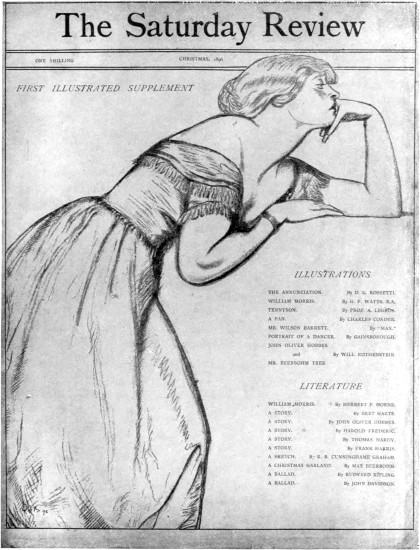
Cover Design of The Saturday Review Christmas
Supplement (1896)
By William Rothenstein
The movement of the Eighteen Nineties, however, which has most
engaged the attention of writers, the movement called “Decadent,”
or by the names of Oscar Wilde or Aubrey Beardsley, the movement
Max Nordau denounced in Europe generally, and recently summed up by
The Times under the epithet “The Yellow Nineties,” does even
now dominate the vision as we look backwards. And, indeed, though
only a part of the renaissance, it was sufficiently “brilliant,” to
use one of its own cliches, to dazzle those capable of being
dazzled by the achievements of art and letters for many years to
come. For a renaissance of art and ideas which in literature had
for exemplars Oscar Wilde (his best books were all published in the
Nineties), Bernard Shaw, H. G. Wells, Rudyard Kipling, John Davidson,
Hubert Crackenthorpe, W. B. Yeats, J. M. Barrie, Alice Meynell, George
Moore, Israel Zangwill, Henry Harland, George Gissing, “John Oliver
Hobbes,” Grant Allen, Quiller Couch, Max Beerbohm, Cunninghame Graham,
Fiona Macleod (William Sharp), Richard Le Gallienne, Ernest Dowson,
Arthur Symons, Lionel Johnson, and A. B. Walkley; and in pictorial
art, James Pryde, William Nicholson, Phil May, William Orpen, Aubrey
Beardsley, E. E. Hornel, Wilson Steer, Charles Ricketts, J. J. Shannon,
Charles Shannon, John Lavery, John Duncan Fergusson, J. T. Peploe,
Charles Conder and William Rothenstein could not have been other than
arresting, could not, indeed, be other than important in the history of
the arts. For, whatever may be the ultimate place of these workers in
literature and painting in the national memory, and whatever value we
set upon them then and now, few will deny that even the least of them
did not contribute something of lasting or of temporary worth to the
sensations and ideas of their age, or its vision of life, and to its
conception of spiritual or mental power.
As to what individuals among these writers and painters were the
peculiar products of the Eighteen Nineties—that is, those who could
not, or might not, have been produced by any other decade—it is not
always easy to say. In dealing with the writers the book-lists of
John Lane, Elkin Mathews and Leonard Smithers are useful guides in
any process of narrowing-down; and further guidance may be found by a
perusal of the files of The Yellow Book and The Savoy,
for these two publications were the favourite lamps around which the
most bizarre moths of the Nineties clustered. There were few essential
writers of the Nineties who did not contribute to one or the other, and
the very fact that Henry Harland, who edited the former, and Arthur
Symons, who edited the latter, were able to gather together so many
writers and artists who were at once novel and notable, emphasises the
distinction of the artistic activities of the time. But that emphasis
should not be taken as indicating merely an awakening of virtuosity
during the Nineties; the many definite artistic movements, embracing
both writers and painters and craftsmen, could not have occurred had
there not been a considerable receptivity among the people of the
time. A renaissance of art depends equally upon artist and public: the
one is the complement of the other. The Eighteen Nineties would have
been unworthy of special notice had there not been a public capable of
responding to its awakening of taste and intelligence.
But doubt is set at rest when we remember how numerous were the
excellent periodicals issued with fair evidence of success. No other
decade in English history has produced so many distinctive and
ambitious publications; for, apart from The Yellow Book and
The Savoy, there were The Parade, The Pageant,
The Evergreen, The Chameleon, The Hobby Horse,
The Rose Leaf and, later on, The Quarto, The Dome,
and that able magazine’s musical brother, The Chord. These
periodicals were, of course, the journals which represented the unique
qualities in the literature and art of the decade; they were bone of
its bone and flesh of its flesh. But, important as they are, they do
not by any means complete the typical and characteristic journalism of
the period, for many less exclusive journals, journals making a wider
public appeal, must be named—such notable examples of periodical
literature and art, for example, as The Studio, The
Butterfly, The Poster, To-Morrow, Eureka, and
more popular still, but excellent also in their way, The Idler,
To-Day and Pick-me-up. The last, during its best days,
and these covered several years, had among its contributors many of
the best black-and-white artists of the decade; Phil May, Raven Hill,
A. S. Hartrick, W. T. Manuel, S. H. Sime and Edgar Wilson regularly
sent drawings to this sportive publication, which for genius and
humour have not been excelled, even by Punch. But although
these publications must be named to the credit of the period, many
of them, like many of the distinguished writers I have named, might
conceivably have been produced at any time during the past forty
years. Pick-me-up, for example, presented no new point of
view; it was sprightly and humorous in the popular sense—that is to
say, it expressed the inconsequent outlook of the bon viveur
of fiction—and persistently assumed that cosmopolitan Piccadilly
Circus-cum-Leicester Square, and the Anglo-American Boulevards
des Italiens-cum-Montmartre (after midnight) were the last words
in “life.” In short, Pick-me-up represented the false and
altogether absurd “Gay Paree” view of things—and to that extent it
was not of a day but of all time. Such an attitude, however, is not
inconsistent with a genius for art, and Pick-me-up possessed
a staff of black-and-white draughtsmen of unequalled ability, and
sometimes of rare genius; and in addition to its native talent it
also introduced to this country the work of good foreign draughtsmen,
including that of the great French artist Steinlen. Still, an able
group of black-and-white artists is by no means a peculiarity of the
Nineties. The Sixties had Once a Week—and Punch has
reigned supreme from the Forties till to-day. Phil May and Raven Hill
belonged to the artistic eminence of the Nineties, but, individual as
they are, they might have happened in any other decade since Charles
Keene and John Leech created the modern humorous pen drawing. One
Pick-me-up artist, and only one, had anything approaching fin
de siècle tendencies; that artist was (and is) S. H. Sime: he is
an art product of the Nineties, along with Aubrey Beardsley, Charles
Conder, Charles Ricketts and Laurence Housman.
The literary movement of the Eighteen Nineties has had full opportunity
of insisting upon itself, but had no such opportunity existed the books
of the period would have stood out with a certain distinction. In the
year 1890 the literary field was so dominated by men whose reputations
had long since been established, either with the inner circle of
bookish people or the larger public, that any new-comers, especially
in poetry, were apt to be labelled “minor.” Tennyson was still alive,
and Robert Browning had died only in the previous year; Philip James
Bailey was living, though forgotten, and Martin Tupper, like Browning,
had passed away in 1889. William Morris and Algernon Charles Swinburne,
although fully recognised as major poets, had still some good work to
do, and there were a select few who admired the poetry of Coventry
Patmore, and many who thought well of the works of Lewis Morris. And
among women singers Jane Ingelow was still living, and Christina
Rossetti was yet to publish two more volumes.
John Ruskin and Walter Pater were not only alive, but their
æsthetic-social messages were finding ever wider fields of acceptance.
“The acute but honourable minority,” which hitherto had been George
Meredith’s way of referring to his own small following, was rapidly
becoming a respectable body of supporters, aided not a little by the
discerning but whole-hearted trumpeting of a young man from Liverpool,
Richard Le Gallienne, who was to become a notability of the Nineties.
Thomas Hardy, also, was established, and like Meredith winning to a
wider, though not so tardy, popularity; and he also was heralded by
a young poet of the period, Lionel Johnson, in a fine study called
The Art of Thomas Hardy (1894). John Henry Newman ended his
ardent life in 1890, but Cardinal Manning was still living; so also
were the popular Church of England divines, Archdeacon Farrar and Canon
Liddon, the equally popular Nonconformist, Charles Spurgeon, and at the
antipodes of their faith, James Martineau. In science the great names
of Thomas Henry Huxley, John Tyndall, Herbert Spencer, Francis Galton
were honoured among living geniuses; and so was that of Alfred Russel
Wallace, who survived until the eve of the Great War. The historian,
James Anthony Froude, died in 1894, and W. E. H. Lecky lived through
the decade.
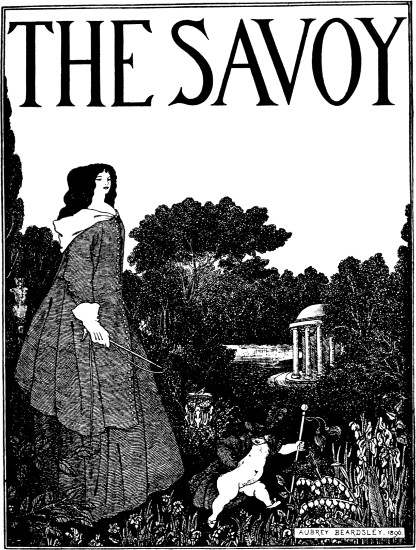
Cover Design of The Savoy, Volume I
By Aubrey Beardsley
Literary reputations beginning in the Seventies and Eighties, and only
in a few cases awaiting further buttressing in the Nineties, were
numerous; these, besides those already named, included W. H. Mallock,
Edmund Gosse, Andrew Lang, Robert Louis Stevenson, Frederic Harrison,
William Ernest Henley, John Addington Symonds, Arthur Pinero,
Sidney Colvin, Austin Dobson, Edward Dowden, H. D. Traill, Theodore
Watts-Dunton, Stopford Brooke, James Payn, Leslie Stephen, Henry
James, Grant Allen, William Black, Robert Bridges, Frederick Wedmore,
and among more popular writers, Marie Corelli, Rider Haggard, and
Hall Caine. Mrs Humphry Ward had become famous on the publication of
Robert Elsmere, in 1888, but the importance of her work during
the succeeding decade places her, as it does also George Moore, Rudyard
Kipling and George Gissing, each of whom did good work before 1890, in
the newer movement. This latter was not, however, to have its effect
on the younger generation alone, it was so irresistible as to inspire
even those whose life-work was more or less done to new and modern
activities. Thus Thomas Hardy began a new phase of his art in 1891 with
Tess of the D’Urbervilles, following it with the masterly, and
ultra-modern, Jude the Obscure, in 1895. He also published his
first volume of poems, Wessex Poems, in 1898. William Morris
published most of his prose romances in the Nineties, including News
from Nowhere, in 1891, and in quick succession The Roots of the
Mountains, The Story of the Glittering Plain, The Wood
Beyond the World, and The Well at the World’s End. The
Water of the Wondrous Isles and The Story of the Sundering
Flood were left in manuscript and published after his death. John
Addington Symonds, whose chief work, The History of the Italian
Renaissance, was completed between the years 1875–1886, published
In the Key of Blue, a book so typical in some ways of the
Nineties that it might well have been written by one of the younger
generation. Frederick Wedmore, without being fin de siècle,
published Renunciations (a very Eighteen-Ninety title!) in 1893,
and English Episodes, in 1894, both of these have a freshness of
vision quite of the period. Theodore Watts-Danton published his gipsy
novel, Aylwin (1898). The great veteran of black-and-white art,
George du Maurier, suddenly became a popular novelist with the famous
Trilby in 1894, which had been preceded by Peter Ibbetson
(1891) and succeeded by The Martian (1896); and another
veteran artist of great eminence also reasserted himself as a writer
of first-rate power during the period, for it was not until 1890 that
James McNeill Whistler collected and published in a delightful volume
his “Ten O’Clock” lecture, and his various letters to the newspapers,
with other Press cuttings, under the appropriate title of The Gentle
Art of Making Enemies. Grant Allen, besides becoming a journalistic
champion of the new school, himself joined the younger generation by
the publication of The Woman Who Did, in 1895, and Arthur W.
Pinero, like Thomas Hardy with his novels, began a new phase as a
playwright with the production of The Second Mrs Tanqueray, in
1893; for, doubtless, both Tess of the D’Urbervilles and The
Second Mrs Tanqueray would have been premature in the Eighties.
And, finally, Richard Whiteing, veteran journalist, but unknown to
the public by name, suddenly became something like famous by the
publication of No. 5 John Street, in the last year of the decade.
Further evidence of the stimulating atmosphere of the period is to
be found in the number of writers who sprang into existence out of
the Zeitgeist of the decade, as people in this country were
beginning to call the spirit of the times. I do not mean those who
were of the period in the narrower sense, but those who, taking that
which every writer takes from his time, were sufficiently general
in attitude not to have been peculiar to any movement. Among such
writers may be named J. M. Barrie, Conan Doyle, Maurice Hewlett, Owen
Seaman, Barry Pain, Pett Ridge, Israel Zangwill, Anthony Hope, W. H.
Hudson, Joseph Conrad, Jerome K. Jerome, Stanley Weyman, H. A. Vachell,
Stephen Phillips, Henry Newbolt, A. E. Housman, Arthur Christopher
Benson, William Watson, Allen Upward, and the late G. W. Steevens,
all of whom published their first notable work in the Nineties, and
in many instances their best work. A qualification is necessary in
the case of W. H. Hudson, whose earliest work, The Purple Land
that England Lost, was born “out of its due time” in 1885, and
consequently neglected by critics and public. Had this remarkable
book been published ten years later, under its abridged title, The
Purple Land, such a fate might not have befallen it; the Nineties
almost certainly would have accorded it that recognition for which it
had to await twice ten years. Robert Hichens should also appear in the
above list, but the fact that he wrote in The Green Carnation
(1894) the most notable satire of the period brings him into the more
exclusive movement.
The writers most imbued with the spirit of the time, direct outcome of
circumstances peculiar to the fin de siècle, will be more fully
considered in other chapters of this book. Suffice it to say here that
they fall roughly into groups which express ideas and tendencies then
prevalent and, if not always taking the form of designed movements,
indicating the existence of very definite though subconscious movements
in the psychology of the age. Delightful among fin de siècle
writers were those masters of a new urbanity, which, although in the
direct tradition of Addison and Steele, of Dr Johnson and Charles
Lamb, possessed a flair of its own, a whimsical perversity, a
“brilliance,” quite new to English letters. First and most eminent
of these urbane essayists, for like their earlier prototypes they
practised mainly the essayist’s art, comes Max Beerbohm, who considered
himself outmoded at the age of twenty-four and celebrated the discovery
by collecting his essays in a slim, red volume with paper label and
uncut edges, and publishing them at the sign of The Bodley Head, in
1896, under the title of The Works of Max Beerbohm. From the
same publishing house came fascinating volumes by G. S. Street, who
satirised suburbans, talked charmingly of books, art and persons, and
in The Autobiography of a Boy revealed the irony of the youth
who wanted to be himself, and to live his own scarlet life, without
having any particular self to become or any definite life to live, save
that of matching his silk dressing-gown with the furniture of his room.
There were also Charles Whibley, who wrote able studies of scoundrels
and dandies; Richard Le Gallienne, who made a fine art of praise and,
besides reviving the picaresque novel of flirtation in The Quest of
the Golden Girl, became a sort of fin de siècle Leigh Hunt;
John Davidson, who wrote the Fleet Street Eclogues and some
curiously urbane novels, but who was more poet than essayist, and,
latterly, was so much interested in ideas that he became a philosopher
using literature as his medium; and Arthur Symons, poet of the music
hall, the café and the demi-monde, literary impressionist of
towns, and penetrating critic of the writers and ideas of the decadence
in France and England.
Another group of writers distinctly associated with the period
received its inspiration from the Celtic revival. Its chief figure was
William Butler Yeats, the Irish poet and dramatist, whose earliest
volumes of distinction, The Countess Kathleen and The Celtic
Twilight, were published in 1892 and 1893. With him were Dr Douglas
Hyde, George Russell (A.E.), John Eglinton, Lady Gregory, and others,
who together made up the Irish Literary Movement which eventually
established the Irish National Theatre in Abbey Street, Dublin, and
produced the greatest of modern Irish dramatists, John Millington
Synge. Wales also had its movement, with Ernest Rhys as its chief
figure; and in Scotland there was a more effective revival, which
clustered about Professor Patrick Geddes in Edinburgh and produced four
numbers of a handsome quarterly magazine, called The Evergreen,
in 1895, among its contributors being both “Fiona Macleod” and William
Sharp (then supposed to be two separate persons). This Scottish
movement was not entirely artistic in aim, but, like so many activities
of the Nineties, it sought to link art and ideas with life, and so
became actually a social movement with a Socialistic tendency. Next to
W. B. Yeats the most prominent figure of the Celtic revival was Fiona
Macleod, whose first book, Pharais, A Romance of the Isles,
appeared in 1894. There was also another Scottish movement, very widely
appreciated on this side of the border. It was called the “Kail Yard
School,” and included the popular dialect fiction of J. M. Barrie, S.
R. Crockett and “Ian Maclaren.”
The importation of realism from France began in the preceding decade,
with translations of the novels of Emile Zola, for which the translator
and publisher, Ernest Vizetelly, suffered imprisonment, and with the
realistic novels of George Moore during the same period. That writer’s
vivid piece of realism, Esther Waters (1894), made history
also by being the first notable novel to be banned by the libraries
and placed on the Index Expurgatorius of Messrs W. H. Smith &
Son. In the same year a new realist arrived, in the person of Arthur
Morrison, with Tales of Mean Streets, which was followed by A
Child of the Jago, in 1896. These striking sketches of slum life
were new in so far as they depicted slum life as a thing in itself at
a time when people still looked upon the slums, much as they had done
in the time of Dickens, as a subject for romantic philanthropy. W.
Somerset Maugham published a slum novel, Liza of Lambeth, in
1897, which had some considerable vogue, and in 1899 Richard Whiteing’s
No. 5 John Street joined the same class. But there never could
be more than a passing fancy for such sectional realism; slums were
rapidly becoming the affair of the sociologist. Readers of books, and
also those people who rarely read books, turned to the more stimulating
realism, which by the way was not free of romance, of Rudyard Kipling,
who had hitherto appeared in the blue-grey, paper-backed pamphlets
issued, for Anglo-Indian consumption, by Wheeler of Allahabad. In 1890
their growing fame forced them upon the home booksellers, and when they
were published in this country they aroused so great an interest that
instead of remaining curiosities of Anglo-Indian publishing they became
the chief modern literature of the English-speaking world. There were
realists, too, like Cunninghame Graham, who savoured also of the new
romance, whose first book appeared in 1895, and in the same year Frank
Harris published his first volume of short stories, Elder Conklin
and Other Stories. But neither of them achieved popularity. Cold
also was the reception given to the personal experience of poverty
which George Gissing put into his novels; although The New Grub
Street (1891) was at least the first of this unfortunate author’s
works to receive anything like popular recognition.
I have pointed out more than once that the renaissance of the Nineties
was largely social, and much of its literature reveals this spirit.
There were many writers who made literature of their social zeal,
more particularly among Socialists. Some of the realists, indeed, were
avowed Socialists. Richard Whiteing, Cunninghame Graham, Frank Harris
and Grant Allen were all of that faith. George Bernard Shaw and Robert
Blatchford persistently used their literary skill in the propagation of
social theories, and only less directly was the same thing done at that
time by H. G. Wells, who has since passed through a phase of deliberate
Socialist propaganda. George Bernard Shaw’s first really characteristic
book, The Quintessence of Ibsenism, appeared in 1891, his first
play, Widowers’ Houses, in 1892, and his earliest collected
plays, Plays Pleasant and Unpleasant, in 1898. Throughout the
Nineties he was a busy journalist, criticising music, art, drama, life,
anything in fact that anybody would print, for he had views to express,
and determination to express them, on all phases of our social life.
Robert Blatchford published Merrie England, a remarkable essay
in Socialist special pleading, written for the man-in-the-street in a
strong, simple and picturesque manner. The book attracted wide notice,
and did much towards consolidating the Socialist movement of the time.
Over a million copies were sold, and it has been translated into Welsh,
Danish, German, Dutch, Swedish, French, Spanish, Hebrew and Norwegian.
Edward Carpenter belongs to this class, for although Towards
Democracy was published, with several of his other books, in the
Eighties, he wrote and lectured much during the Nineties. He was also
one of the earliest of English writers to consider problems of sex. And
finally, Sidney Webb, the social historian and sociologist, published
his first works in the late Eighties and the Nineties: Socialism
in England (1889), The London Programme (1892) and with
his wife, Beatrice Webb, The History of Trades Unionism and
Industrial Democracy in 1894 and 1898. The Nineties also saw
the beginning of that careful sociological investigation of poverty
and industrial conditions which has been the basis of so many recent
reforms—the monumental inquiry of Charles Booth into the conditions of
the labouring classes of London. This great work was begun in 1892 and
finished in 1908, and is recorded in seventeen volumes, entitled The
Life and Labour of the London People.
But there is no doubt that the most remarkable phase of the literary
movement of the Eighteen Nineties was that which found expression
in the work of those writers associated with the high journalism of
The Yellow Book and The Savoy: poets, essayists and
storytellers whose books were in most instances published either by
Mr John Lane, at the Bodley Head, or by Mr Elkin Mathews, both of
whom were established in Vigo Street. At the beginning of the decade
they were partners, under the title of Elkin Mathews & John Lane; but
the partnership was dissolved, and afterwards the partners carried on
separate businesses almost opposite each other in the same street.
Other publishers associated with the new literary movement were Henry &
Co., Laurence & Bullen and, more intimately, Leonard Smithers, himself
a decadent and the friend and associate of many of the leaders of the
group. Nearer the new century the Unicorn Press continued some of the
traditions of the early Nineties, when the other publishers of the
movement had become normal. These last-named publishers, as in the case
of so many of the British decadents, passed away with the Nineties
or thereabouts. Mr William Heinemann was a notable publisher of the
period and in sympathy with the younger generation; so was Mr Fisher
Unwin, who showed his modernism by advertising his books by means of
posters designed by Aubrey Beardsley; and Mr Grant Richards issued
several important works of the time, notably Bernard Shaw’s Plays
Pleasant and Unpleasant, and A. E. Housman’s A Shropshire
Lad. The lists of any of these publishers issued during the decade
prove interesting reading even to-day, and they reveal sometimes a
type of publisher as fin de siècle as their literary wares. No
one will deny, however, that The Bodley Head was the chief home of
the new movement, for not only did The Yellow Book issue from
that house, but books by Oscar Wilde, John Davidson, Francis Thompson,
Max Beerbohm, Richard Le Gallienne, George Egerton, Laurence Binyon,
Michael Field, Norman Gale, Kenneth Grahame, Lionel Johnson, Alice
Meynell, William Watson, and G. S. Street. Leonard Smithers made a
unique place for himself as a fin de siècle publisher, and when
The Savoy (1896) was published by him he stood courageously
for the ideas and art of the decadence at its darkest hour. With the
passing of that excellent but short-lived quarterly the decadence in
England may be said to have passed away.
The list of contributors to those two periodicals constitute
practically the dramatis personæ of the movement—with the
notable exception of Oscar Wilde, not any of whose work appeared
in either. The Yellow Book had Henry Harland for literary
editor, and for art editor, Aubrey Beardsley. Its first four numbers
(1894–1895) afford us a clear and comprehensive view of the literary
movement of the Nineties; but after the withdrawal of Aubrey Beardsley,
who transferred his work to The Savoy in January 1896, the
policy of The Yellow Book seemed to change, and this change
proceeded always more away from the characteristics of the early days,
and, save for its yellow covers, The Yellow Book eventually
was hardly to be distinguished from any high-class magazine in book
form. The first number was in the nature of a bombshell thrown into
the world of letters. It had not hitherto occurred to a publisher to
give a periodical the dignity of book form; and, although literature
had before then been treated as journalism, it was quite a new thing
in this country for a group of lesser-known writers and artists
to be glorified in the regal format of a five-shilling quarterly.
But the experiment was a success even in the commercial sense, a
circumstance aided no doubt by its flaming cover of yellow, out of
which the Aubrey Beardsley woman smirked at the public for the first
time. Nothing like The Yellow Book had been seen before. It was
newness in excelsis: novelty naked and unashamed. People were
puzzled and shocked and delighted, and yellow became the colour of
the hour, the symbol of the time-spirit. It was associated with all
that was bizarre and queer in art and life, with all that was
outrageously modern. Richard Le Gallienne wrote a prose fancy
on “The Boom in Yellow,” in which he pointed out many applications
of the colour with that fin de siècle flippancy which was one
of his characteristics, without, however, tracing the decorative use
of yellow to Whistler, as he should have done. Nevertheless his essay
recalls very amusingly the fashion of the moment. “Bill-posters,”
he says, “are beginning to discover the attractive qualities of the
colour. Who can ever forget meeting for the first time upon a hoarding
Mr Dudley Hardy’s wonderful Yellow Girl, the pretty advance-guard of
To-Day? But I suppose the honour of the discovery of the colour
for advertising purposes rests with Mr Colman; though its recent
boom comes from publishers, and particularly from The Bodley Head.
The Yellow Book with any other colour would hardly have sold as
well—the first private edition of Mr Arthur Benson’s poems, by the
way, came caparisoned in yellow, and with the identical name, Le
Cahier Jaune; and no doubt it was largely its title that made the
success of The Yellow Aster.”
The first number of The Yellow Book, published in April 1894,
contained contributions by Richard Le Gallienne, Max Beerbohm,
Ella D’Arcy, Arthur Symons, Henry Harland, George Egerton, Hubert
Crackenthorpe, John Davidson, John Oliver Hobbes and George Moore, all
of whom were in the vanguard of the new movement, and among the newer
artists, besides Aubrey Beardsley, who contributed four full drawings,
the cover decorations and title-page, there were Walter Sickert, Joseph
Pennell, Laurence Housman, Will Rothenstein, and R. Anning Bell. But
although The Yellow Book was mainly fin de siècle it
was not exclusively so, for it included contributions by Henry James,
Arthur Christopher Benson, William Watson, Arthur Waugh, Richard
Garnett and Edmund Gosse, and illustrations by J. T. Nettleship and
Charles W. Furse, and, above all, as though to reassure its readers
and the British public after the Beardsley cover, and certain contents
to match, and to assert its fundamental respectability, it contained a
frontispiece by Sir Frederick Leighton, P.R.A. Volume II. had Norman
Gale, Alfred Hayes, Dolly Radford and Kenneth Grahame among its new
contributors, and P. Wilson Steer, E. J. Sullivan, A. S. Hartrick
and Walter Crane among its illustrators. Volume III. was more modern
than Volume II., for in addition to many of the younger generation
who contributed to the earlier volumes it introduced into its company
Ernest Dowson, Lionel Johnson, Olive Custance, Theodore Wratislaw
and Charles Dalmon, whilst Max Beerbohm was represented among the
illustrators by his caricature of George IV. The most notable addition
to the contributors of Volume IV. was Charles Conder, who sent a design
for a fan; and Volume V. is interesting as it contains an article by
G. S. Street, the first English essay on Anatole France, by the Hon.
Maurice Baring, and the first article by that distinguished French
writer and savant ever published in England.
In spite, however, of its novelty, and the excellence of the contents
of its early numbers, The Yellow Book was always inclined not
only to compromise in matters of editorial policy, but its contents
were not always chosen according to the high standard such a work
demanded, and this became more pronounced after the retirement of
Beardsley. The Savoy pursued a different policy. Edited by
Arthur Symons, it stood boldly for the modern note without fear and
without any wavering of purpose. Hence it represents the most ambitious
and, if not the most comprehensive, the most satisfying achievement
of fin de siècle journalism in this country. Such a result was
inevitable with an editor of rare critical genius and one who had
been profoundly influenced by the French decadents. If his choice was
not always decadent it was always modern, even when it selected a
drawing of a distant time. This can be seen also among the literary
contributors to The Savoy, among whom were Arthur Symons, W.
B. Yeats, Theodore Wratislaw, Ernest Rhys, Fiona Macleod, George
Moore, Edward Carpenter, Ford Madox Hueffer and Lionel Johnson. All
are fin de siècle writers, though differing in type and aim,
and such writers could hardly do otherwise than give the periodical a
decidedly modern expression, in spite of a challenging Editorial Note
prefaced to No. 1 (dictated, it would seem, by dissatisfaction with
the uneven editing, fin de siècle pose with apparent readiness
to compromise of The Yellow Book), which disavowed a definite
modernist intent:
“It is hoped that The Savoy will be a periodical of an
exclusively literary and artistic kind. To present Literature
in the shape of its letterpress, Art in the form of its
illustrations, will be its aim. For the attainment of that aim
we can but rely on our best endeavours and on the logic of our
belief that good writers and artists will care to see their work
in company with the work of good writers and artists. Readers
who look to a new periodical for only very well-known or only
very obscure names must permit themselves to be disappointed. We
have no objection to a celebrity who deserves to be celebrated,
or to an unknown person who has not been seen often enough to be
recognised in passing. All we ask from our contributors is good
work, and good work is all we offer our readers. This we offer
with some confidence. We have no formulas, and we desire no
false unity of form or matter. We have not invented a new point
of view. We are not Realists, or Romanticists, or Decadents.
For us, all art is good which is good art. We hope to appeal
to the tastes of the intelligent by not being original for
originality’s sake, or audacious for the sake of advertisement,
or timid for the convenience of the elderly-minded. We intend
to print no verse which has not some close relationship with
poetry, no fiction which has not a certain sense of what
is finest in living fact, no criticism which has not some
knowledge, discernment and sincerity in its judgment. We could
scarcely say more, and we are content to think we can scarcely
say less.”
The Savoy lived for twelve months, and during that time it went
far towards realising its editor’s ideal. It did realise that ideal
to the extent of not admitting anything to its pages which could not
be recommended alone on artistic grounds, and it never for a moment
stepped beneath its high intent for the sake of financial gain or any
of the other snares and pitfalls of even well-meaning editors. Among
contributors who were modern without being decadent were Bernard
Shaw, who is represented in the first number by his most essay-like
essay, “On Going to Church”; Havelock Ellis, who contributed one of the
earliest articles in English on Friedrich Nietzsche; Frederick Wedmore,
Edmund Gosse, Selwyn Image, Mathilde Blind and Joseph Conrad. Besides
these The Savoy contained translations from Paul Verlaine, Emil
Verhaeren and Cesare Lombroso. The illustrations were always modern,
and always distinguished, and included, in addition to the last and, in
many instances, best of Aubrey Beardsley’s drawings, examples of the
work of Charles Conder, Will Rothenstein, C. H. Shannon, Max Beerbohm,
Joseph Pennell, William T. Horton, Walter Sickert and Phil May. It also
reveals Aubrey Beardsley as a writer in both prose and poetry, the
former taking the shape of his aggressively modern romance, Under
the Hill. The Savoy was admittedly an art-for-art’s-sake
publication, and its failure in twelve months through lack of support
proves that there was at the time no public for such a publication,
even though the half-a-crown charged for each issue was not only half
the price of The Yellow Book, but well within the reach of a
fairly numerous cultured class. That class proved unequal to the demand
of a decadent periodical of a fine type. Neither did the fact of a
number being banned by Messrs W. H. Smith & Son, because it contained a
reproduction of one of William Blake’s pictures, have any appreciable
effect on its circulation; and, finally, funds reached so low an ebb
that Arthur Symons was forced to write the whole of the last number
himself, and in his epilogue to his readers on the last page of that
number he confessed to the pessimistic belief that “Comparatively few
people care for art at all, and most of these care for it because
they mistake it for something else,” which in a way is true, but
not necessarily unwise on the part of the majority, for art, as the
Nineties were beginning to learn, was less important than life. But
that does not invalidate the excellence of The Savoy.
A final attempt was made to produce a good periodical by the
publication of The Dome, described as “A Quarterly containing
examples of all the Arts,” at the price of one shilling, in 1898, two
years after the death of The Savoy. But this quarterly never
attempted to do more than represent the various arts; it had no guiding
theory save excellence, with the result that it was less definite than
either of its forerunners. It admitted good work of the past as well
as the present, and reprinted many fine examples of ancient and modern
wood-engraving. Notable among its modern illustrators were Gordon
Craig and Althea Giles; and among its writers, Laurence Binyon, W.
B. Yeats, C. J. Holmes, Laurence Housman, T. W. H. Crosland, Stephen
Phillips, Fiona Macleod, John F. Runciman, T. Sturge Moore, Francis
Thompson, Wilfrid Wilson Gibson, Gordon Bottomley, Arthur Symons, Roger
Fry, “Israfel,” and there was also a translation of one of Maurice
Maeterlinck’s earliest stories, The Massacre of the Innocents.
It will be seen from the foregoing that the art movement of the
Eighteen Nineties found one of its most characteristic expressions
in belles lettres. It was largely a literary renaissance,
exemplifying itself in poetry, drama, fiction and the essay. Books
became once again respected for their own sakes; publishers, led by
John Lane, Elkin Mathews and, later, by J. M. Dent, competed as much
in beauty and daintiness of production as in names and contents, and
this bookish reverence reached its highest expression in a veritable
apotheosis of the book at the hands of William Morris of the Kelmscott
Press and Hacon & Ricketts of the Vale Press. But this branch of the
fine arts, although still remote from the average national life, was no
longer remote in the old sense; it did not desire academic honours, and
those who promoted the renaissance had no idea of establishing a corner
in culture. An air of freedom surrounded the movement; old ideals were
not the only things that suffered at the hands of the iconoclasts,
but, as we have seen, old barriers and boundaries were broken down and
pitched aside; a new right-of-way was proclaimed, and invitations to
take to it were scattered broadcast. It was not entirely a democratic
movement, however, and in some of its more intense moments it was not
at all democratic. What really happened in the Nineties was that doors
were thrown open and people might enter and pass through into whatever
lay beyond if they would or could, and whether they were invited or
not. To that extent the period was democratic. Such an attitude was
a more or less intuitive recognition of a very obvious awakening of
intelligence which represented the first mental crop of the movement
towards popular education. The Board Schools were bearing fruit;
Secondary Education and University Extension culture were producing a
new inquisitiveness. Ibsen’s younger generation was knocking at the
door. The growing demand for culture was partially satisfied, in the
case of those who could expect no further aid from the educational
system, by popular reprints of the classics, as could be seen by the
ever-growing demand for the volumes of The Scott Library, The
Canterbury Poets and The Temple Classics. The mental and
imaginative stimulus thus obtained created a hunger in many for still
newer sensations, and many of these passed through the doors of the
decadents or the realists into stranger realms. The remainder, unable
to appreciate the bizarre atmosphere of The Yellow Book, turned
with avidity to the new romantic literature of the Yellow Press.
The Eighteen Nineties were to no small extent the battleground of these
two types of culture—the one represented by The Yellow Book,
the other by the Yellow Press. The one was unique, individual, a little
weird, often exotic, demanding the right to be—in its own way
even to waywardness; but this was really an abnormal minority, and in
no sense national. The other was broad, general popular; it was the
majority, the man-in-the-street awaiting a new medium of expression. In
the great fight the latter won. The Yellow Book, with all its
“new” hopes and hectic aspirations, has passed away, and The Daily
Mail, established two years later, flourishes. In a deeper sense,
also, these two publications represent the two phases of the times. The
characteristic excitability and hunger for sensation are exemplified in
the one as much as the other, for what after all was the “brilliance”
of Vigo Street but the “sensationalism” of Fleet Street seen from the
cultured side? Both were the outcome of a society which had absorbed a
bigger idea of life than it knew how to put into practice, and it is
not surprising to those who look back upon the period to find that both
tendencies, in so far as they were divorced from the social revolution
of the Nineties, were nihilistic, the one finding its Moscow at the Old
Bailey, in 1895, the other in South Africa, in 1899.
I use both terms and dates symbolically, for I am neither blind to
the element of injustice in the condemnation of Oscar Wilde nor to
the soul of goodness in the South African War. But at the moment I am
dealing with main tendencies, and trying to give an idea-picture of a
period, which was self-contained even in its disasters. The first half
was remarkable for a literary and artistic renaissance, degenerating
into decadence; the second for a new sense of patriotism degenerating
into jingoism. The former was in the ascendant during the first five
years. In 1895 the literary outlook in England had never been brighter;
an engaging and promising novelty full of high vitality pervaded the
Press and the publishers’ lists, and it was even commencing to invade
the stage, when with the arrest of Oscar Wilde the whole renaissance
suffered a sudden collapse as if it had been no more than a gaily
coloured balloon. “The crash of the fall certainly affected the whole
spirit of this year,” says R. H. Gretton, in his Modern History of
the English People. “There were few great houses in London where
he was not known; fewer still where there was not among the younger
generation an aggressive, irresponsible intolerance which had some
relation, however vague, to his brilliant figure. Even athleticism
rejoiced at this date to dissociate itself from anything that might
have been in danger of easy approval from an older generation, by being
too æsthetic; captains of university football teams had been seen
with long hair. There was too much of real revolt in the movement to
allow the fate of one man to hold it lastingly in check; but a certain
silence, almost, if not quite, shamefaced, settled for the moment on
much of the social life of the country.” Two of Oscar Wilde’s plays
were being performed at the time, and they were immediately suppressed.
Outside of the smoking-room that writer’s name was scarcely whispered;
it was suppressed entirely in the newspapers. His books were allowed
to go out of print, and unauthorised publishers pirated them, and
were allowed for a time to thrive upon the succès de scandale
attained by the books because of the misfortune of their author.
With the arresting of the art movement of the Nineties came the chance
of the man-in-the-street, whose new intellectual needs found a new
caterer in Alfred Harmsworth. The political prejudices of the average
man and his need for romance by proxy were exploited with phenomenal
success by the audacious genius of the great newspaper administrator
who has since won a world-wide reputation as Lord Northcliffe. The
Daily Mail openly fanned the Jingo flame, already beginning to leap
aloft under the inspiration of Joseph Chamberlain and Cecil Rhodes,
and the melodramatic Jameson Raid of December 1895. Then came the
Jubilee of 1897, when pride of race reached so unseemly a pitch that
Rudyard Kipling even, the acknowledged poet of Imperialism, as the new
patriotism was called, was moved to rebuke his compatriots:
“If, drunk with sight of power, we loose
Wild tongues that have not Thee in awe,
Such boastings as the Gentiles use,
Of lesser breeds without the Law.
Lord God of Hosts, be with us yet,
Lest we forget—lest we forget!”
But there was no turning back. Bitten by an unseeing pride, expressing
itself in a strangely inorganic patriotism, the nation forgot art
and letters and social regeneration, in the indulgence of blatant
aspirations which reached their apotheosis in the orgy of Mafeking
Night.
CHAPTER III THE DECADENCE
No English writer has a better claim to recognition as an interpreter
of the decadence in recent English literature than Arthur Symons. He
of all the critics in the Eighteen Nineties was sufficiently intimate
with the modern movement to hold, and sufficiently removed from it
in his later attitude to express, an opinion which should be at once
sympathetic and reasonably balanced without pretending to colourless
impartiality. But during the earlier phase his vision of the decadent
idea was certainly clearer than it was some years later, when he strove
to differentiate decadence and symbolism.
“The most representative literature of the day,” he wrote in 1893,
“the writing which appeals to, which has done so much to form, the
younger generation, is certainly not classic, nor has it any relation
to that old antithesis of the classic, the romantic. After a fashion
it is no doubt a decadence; it has all the qualities that mark the end
of great periods, the qualities that we find in the Greek, the Latin,
decadence; an intense self-consciousness, a restless curiosity in
research, an over-subtilising refinement upon refinement, a spiritual
and moral perversity. If what we call the classic is indeed the supreme
art—those qualities of perfect simplicity, perfect sanity, perfect
proportion, the supreme qualities—then this representative literature
of to-day, interesting, beautiful, novel as it is, is really a new and
beautiful and interesting disease.”[3]
Six years later Arthur Symons, like so many of the writers of the
period, was beginning to turn his eyes from the “new and beautiful and
interesting disease,” and to look inwardly for spiritual consolation.
In the “Dedication” to The Symbolist Movement in Literature he
told W. B. Yeats that he was “uncertainly but inevitably” finding his
way towards that mystical acceptation of reality which had always been
the attitude of the Irish poet. And further on in the same book, as
though forgetting the very definite interpretation of decadence given
by him in the article of 1893, he writes of it as “something which is
vaguely called Decadence,” a term, he said, used as a reproach or a
defiance:
“It pleased some young men in various countries to call
themselves Decadents, with all the thrill of unsatisfied
virtue masquerading as uncomprehended vice. As a matter of
fact, the term is in its place only when applied to style, to
that ingenious deformation of the language, in Mallarmé, for
instance, which can be compared with what we are accustomed to
call the Greek and Latin of the Decadence. No doubt perversity
of form and perversity of matter are often found together, and,
among the lesser men especially, experiment was carried far, not
only in the direction of style. But a movement which in this
sense might be called Decadent could but have been a straying
aside from the main road of literature.... The interlude, half
a mock-interlude, of Decadence, diverted the attention of the
critics while something more serious was in preparation. That
something more serious has crystallised, for the time, under
the form of Symbolism, in which art returns to the one pathway,
leading through beautiful things to the eternal beauty.”
In the earlier essay he certainly saw more in decadence than mere
novelty of style, and rightly so, for style can no more be separated
from idea than from personality. The truth of the matter, however,
lies probably between the two views. What was really decadent in the
Eighteen Nineties did seem to weed itself out into mere tricks of style
and idiosyncrasies of sensation; and whilst doing so it was pleased to
adopt the term decadence, originally used as a term of reproach, as a
badge. But with the passing of time the term has come to stand for a
definite phase of artistic consciousness, and that phase is precisely
what Arthur Symons described it to be in his earlier article, an
endeavour “to fix the last fine shade, the quintessence of things; to
fix it fleetingly; to be a disembodied voice, and yet the voice of a
human soul; that is the ideal of Decadence.”
The decadent movement in English art was the final outcome of the
romantic movement which began near the dawn of the nineteenth century.
It was the mortal ripening of that flower which blossomed upon the
ruins of the French Revolution, heralding not only the rights of man,
which was an abstraction savouring more of the classic ideal, but
the rights of personality, of unique, varied and varying men. The
French romanticists, led by Victor Hugo, recognised this in their
glorification of Napoleon; but fear and hatred of the great Emperor
generated in the hearts of the ruling classes in this country and
propagated among the people prevented the idea from gaining acceptance
here. At the same time decadence was neither romantic nor classic;
its existence in so far as it was dependent upon either of those art
traditions was dependent upon both. The decadents were romantic in
their antagonism to current forms, but they were classic in their
insistence upon new. And it must not be forgotten that far from being
nihilistic in aim they always clung, at times with desperation, to
one already established art-form or another. The French artists of
the first revolutionary period depended as much upon the traditions
of republican Greece and Rome as those of the revolution of July, and
the poets of Britain, led by Walter Scott and Byron, depended upon
the traditions of mediæval feudalism. Romanticism was a reshuffling
of ideals and ideas and a recreation of forms; it was renascent and
novel. It could be both degenerate and regenerate, and contain at the
same time many more contradictions, because at bottom it was a revolt
of the spirit against formal subservience to mere reason. It is true
that there is ultimately an explanation for all things, a reason for
everything, but it was left for romance to discover a reason for
unreason. It was the romantic spirit in the art of Sir Walter Scott
which saw no inconsistency between the folk-soul and the ideals of
chivalry and nobility; that taught Wordsworth to reveal simplicity as,
in Oscar Wilde’s words, “the last refuge of complexity”; that inspired
John Keats with a new classicism in Endymion brighter than
anything since A Midsummer Night’s Dream, and Comus,
and a new mediævalism in The Eve of St Agnes fairer than
“all Olympus’ faded hierarchy.” It taught Shelley that the most
strenuous and the most exalted individual emphasis was not necessarily
antagonistic to a balanced communal feeling, and that the heart of
Dionysos could throb and burn in the form of Apollo; and above all it
taught Samuel Taylor Coleridge that mystery lurked in common things and
that mysticism was not merely a cloistral property.
Though all of these tendencies of thought and expression went to the
making of the decadence in England, the influence, with the exception
of that of Keats, was indirect and foreign. In that it was native the
impulsion came directly from the Pre-Raphaelites, and more particularly
from the poetry of Dante Gabriel Rossetti and Swinburne. But the chief
influences came from France, and partially for that reason the English
decadents always remained spiritual foreigners in our midst; they were
not a product of England but of cosmopolitan London. It is certain
Oscar Wilde (hounded out of England to die in Paris), Aubrey Beardsley
(admittedly more at home in the brasserie of the Café Royale
than elsewhere in London) and Ernest Dowson (who spent so much of his
time in Soho) would each have felt more at home in Paris or Dieppe
than, say, in Leeds or Margate. The modern decadence in England was an
echo of the French movement which began with Théophile Gautier (who was
really the bridge between the romanticists of the Victor Hugo school
and the decadents who received their inspiration from Edmond and Jules
de Goncourt), Paul Verlaine and Joris Karl Huysmans. In short, Gautier,
favourite disciple of Victor Hugo, represented the consummation
of the old romanticism, and he did this by inaugurating that new
romanticism, which had for apostles the Parnassiens, Symbolists and
Decadents. French romanticism begins with Hernani, and ends
with Mademoiselle de Maupin. Decadence properly begins with
Mademoiselle de Maupin and closes with À Rebours. In
England it began by accident with Walter Pater’s Studies in Art and
Poetry, The Renaissance, which was not entirely decadent, and
it ended with Oscar Wilde’s Picture of Dorian Gray and Aubrey
Beardsley’s romance, Under the Hill, which were nothing if not
decadent.
The accident by which Pater became a decadent influence in English
literature was due to a misapprehension of the precise meaning of the
famous “Conclusion” to the first edition of the volume originally
issued in 1873, which led the author to omit the chapter from the
second edition (1877). “I conceived it might possibly mislead some of
those young men into whose hands it might fall,” he wrote, when he
reintroduced it with some slight modifications, bringing it closer to
his original meaning, into the third edition of the book, in 1888.
Nevertheless there was sufficient material in the revised version to
stimulate certain minds in a direction only very remotely connected
with that austere philosophy of sensations briefly referred to in The
Renaissance and afterwards developed by Walter Pater under the
idea of a “New Cyrenaicism” in Marius the Epicurean (1885). To
those seeking a native sanction for their decadence, passages even
in Marius read like invitations. “With the Cyrenaics of all
ages, he would at least fill up the measure of that present with vivid
sensations, and such intellectual apprehensions as, in strength and
directness and their immediately realised values at the bar of an
actual experience, are most like sensations.” Such passages seemed in
the eyes of the decadents to give a perverse twist to the æsthetic
Puritanism of the intellectual evolution of Marius, and to fill with a
new naughtiness that high discipline of exquisite taste to which the
young pagan subjected himself. It is not surprising then to find even
the revised version of the famous “Conclusion” acting as a spark to the
tinder of the new acceptance of life.
“The service of philosophy, of speculative culture, towards the
human spirit is to rouse, to startle it into sharp and eager
observation. Every moment some form grows perfect in hand or
face; some tone on the hills or the sea is choicer than the
rest; some mood of passion or insight or intellectual excitement
is irresistibly real and attractive for us,—for that moment
only. Not the fruit of experience, but experience itself, is
the end. A counted number of pulses only is given to us of a
variegated, dramatic life. How may we see in them all that is
to be seen in them by the finest senses? How shall we pass
most swiftly from point to point, and be present always at the
focus where the greatest number of vital forces unite in their
purest energy? To burn always with this hard, gemlike flame, to
maintain this ecstasy, is success in life. In a sense it might
even be said that our failure is to form habits; for, after
all, habit is relative to a stereotyped world, and meantime it
is only the roughness of the eye that makes any two persons,
things, situations, seem alike. While all melts under our feet,
we may well catch at any exquisite passion, or any contribution
to knowledge that seems by a lifted horizon to set the spirit
free for a moment, or any stirring of the senses, strange dyes,
strange colours and curious odours, or work of the artist’s
hands, or the face of one’s friend. Not to discriminate every
moment some passionate attitude in those about us, and in
the brilliancy of their gifts some tragic dividing of forces
on their ways, is, on this short day of frost and sun, to
sleep before evening. With this sense of the splendour of our
experience and of its awful brevity, gathering all we are into
one desperate effort to see and touch, we shall hardly have
time to make theories about the things we see and touch. What
we have to do is to be for ever curiously testing new opinions
and courting new impressions, never acquiescing in a facile
orthodoxy of Comte, or of Hegel, or of our own. Philosophical
theories or ideas, as points of view, instruments of criticism,
may help us to gather up what might otherwise pass unregarded
by us. ‘Philosophy is the microscope of thought.’ The theory or
idea or system which requires of us the sacrifice of any part
of this experience, in consideration of some interest into which
we cannot enter, or some abstract theory we have not identified
with ourselves, or what is only conventional, has no real claim
upon us.”
But misappropriation of the teaching of Walter Pater was only an
incident in the progress of decadence in England. By the dawn of the
last decade of the century susceptible thought had reverted to the
original French path of decadent evolution which manifested itself from
Théophile Gautier and Charles Baudelaire through the brothers Goncourt,
Paul Verlaine, Arthur Rimbaud, Stéphane Mallarmé, to Huysmans, with a
growing tendency towards little secret raids over the German frontier
where the aristocratic philosophy of Friedrich Nietzsche was looted and
made to flash approval of intentions and ideas which that philosopher,
like Pater, had lived and worked to supersede. The publication of
The Picture of Dorian Gray in 1891 revealed the main influence
quite definitely, for, apart from the fact that Wilde’s novel bears
many obvious echoes of the most remarkable of French decadent novels,
the À Rebours of J. K. Huysmans, which Arthur Symons has called
“the breviary of the decadence,” it contains the following passage
which, although À Rebours is not named, is generally understood
to refer to that book, even if the fact were not otherwise obvious:—
“His eyes fell on the yellow book that Lord Henry had sent
him. What was it, he wondered. He went towards the little
pearl-coloured octagonal stand, that had always looked to
him like the work of some strange Egyptian bees that wrought
in silver, and taking up the volume, flung himself into an
arm-chair, and began to turn over the leaves. After a few
minutes he became absorbed.
“It was the strangest book he had ever read. It seemed to him
that in exquisite raiment, and to the delicate sound of flutes,
the sins of the world were passing in dumb show before him.
Things that he had dimly dreamed of were suddenly made real
to him. Things of which he had never dreamed were gradually
revealed.
“It was a novel without a plot, and with only one character,
being, indeed, simply a psychological study of a certain young
Parisian who spent his life trying to realise in the nineteenth
century all the passions and modes of thought that belonged
to every century except his own, and to sum up, as it were,
in himself the various moods through which the world-spirit
had ever passed, loving for their mere artificiality those
renunciations that men have unwisely called virtue as much as
those natural rebellions that wise men still call sin. The style
in which it was written was that curious jewelled style, vivid
and obscure at once, full of argot and of archaisms,
of technical expressions and of elaborate paraphrases, that
characterises the work of some of the finest artists of the
French school of symbolists. There were in it metaphors as
monstrous as orchids and as evil in colour. The life of the
senses was described in the terms of mystical philosophy. One
hardly knew at times whether one was reading the spiritual
ecstasies of some mediæval saint or the morbid confessions of
a modern sinner. It was a poisonous book. The heavy odour of
incense seemed to cling about its pages and to trouble the
brain. The mere cadence of the sentences, the subtle monotony of
their music, so full as it was of complex refrains and movements
elaborately repeated, produced in the mind of the lad, as he
passed from chapter to chapter, a form of reverie, a malady of
dreaming, that made him unconscious of the falling day and the
creeping shadows.”
This book so revealed Dorian Gray to himself that he became frankly the
Duc Jean des Esseintes of English literature. There are differences, to
be sure, and the sensations and ideas of Dorian Gray are not elaborated
so scientifically as those of des Esseintes, but there is something
more than coincidence in the resemblance of their attitudes towards
life.
Jean des Esseintes and Dorian Gray are the authentic decadent types.
Extreme they are, as a matter of course, but their prototypes did exist
in real life, and minus those incidents wherein extreme decadence
expresses itself in serious crime, such as murder or incitement to
murder, those prototypes had recognisable corporeal being.
In the Eighteen Nineties two such types were Oscar Wilde and Aubrey
Beardsley, each of whom approximated, if not in action, then in mind
and idea to des Esseintes and Dorian Gray. There was in both a typical
perversity of thought, which in Wilde’s case led to a contravention
of morality evoking the revenge of society and a tragic ending to a
radiant career. Both preferred the artificial to the natural. “The
first duty in life is to be as artificial as possible,” said Oscar
Wilde, adding, “what the second duty is no one has as yet discovered.”
The business of art as he understood it was to put Nature in her proper
place. To be natural was to be obvious, and to be obvious was to be
inartistic. Aubrey Beardsley invented a new artificiality in black and
white art, and in his romance, Under the Hill, only a carefully
expurgated edition of which has been made generally accessible to the
public, he created an À Rebours of sexuality. And both possessed
an exaggerated curiosity as to emotional and other experiences combined
with that precocity which is characteristic of all decadents. The
curiosity and precocity of the decadence were revealed in an English
writer before the Eighteen Nineties by the publication, in 1886, of
the Confessions of a Young Man, by George Moore; but apart from
the fact that the author who shocked the moral susceptibilities of
the people who control lending libraries, with Esther Waters,
loved the limelight and passed through enthusiasms for all modern
art movements, he was as far removed from the typical decadent as
the latter is removed from the average smoking-room citizen who
satisfies an age-long taste for forbidden fruit with a risqué
story. George Moore played at decadence for a little while, but the
real influences of his life were Flaubert and the naturalists on the
one side, and their corollaries in the graphic arts, Manet and the
impressionists, on the other. For the rest he insisted upon England
accepting the impressionists; abandoned realism; introduced into this
country the work of Verlaine and Rimbaud, and the autobiography of
indiscretion; flirted with the Irish Literary Movement, and its vague
mysticism—and remained George Moore.
The chief characteristics of the decadence were (1) Perversity, (2)
Artificiality, (3) Egoism and (4) Curiosity, and these characteristics
are not at all inconsistent with a sincere desire “to find the last
fine shade, the quintessence of things; to fix it fleetingly; to be a
disembodied voice, and yet the voice of a human soul.” Indeed, when
wrought into the metal of a soul impelled to adventure at whatever
hazard, for sheer love of expanding the boundaries of human experience
and knowledge and power, these characteristics become, as it were, the
senses by which the soul may test the flavour and determine the quality
of its progress. In that light they are not decadent at all, they are
at one with all great endeavour since the dawn of human consciousness.
What, after all, is human consciousness when compared with Nature but a
perversity—the self turning from Nature to contemplate itself? And is
not civilisation artifice’s conspiracy against what is uncivilised and
natural? As for egoism, we ought to have learnt by this time that it is
not sufficient for a being to say “I am.” He is not a factor in life
until he can add to that primal affirmation a consummating “I will.”
“To be” and “to will” exercised together necessitate action, which in
turn involves experience, and experience, not innocence, is the mother
of curiosity. Not even a child has curiosity until it has experienced
something; all inquisitiveness is in the nature of life asking for
more, and all so-called decadence is civilisation rejecting, through
certain specialised persons, the accumulated experiences and sensations
of the race. It is a demand for wider ranges, newer emotional and
spiritual territories, fresh woods and pastures new for the soul.
If you will, it is a form of imperialism of the spirit, ambitious,
arrogant, aggressive, waving the flag of human power over an ever wider
and wider territory. And it is interesting to recollect that decadent
art periods have often coincided with such waves of imperial patriotism
as passed over the British Empire and various European countries during
the Eighteen Nineties.
It is, of course, permissible to say that such outbreaks of curiosity
and expansion are the result of decay, a sign of a world grown
blasé, tired, played-out; but it should not be forgotten that
the effort demanded by even the most ill-directed phases of decadent
action suggests a liveliness of energy which is quite contrary to
the traditions of senile decay. During the Eighteen Nineties such
liveliness was obvious to all, and even in its decadent phases the
period possessed tonic qualities. But the common-sense of the matter
is that where the so-called decadence made for a fuller and brighter
life, demanding ever more and more power and keener sensibilities from
its units, it was not decadent. The decadence was decadent only when
it removed energy from the common life and set its eyes in the ends
of the earth whether those ends were pictures, blue and white china,
or colonies. True decadence was therefore degeneration arising not
out of senility, for there is nothing old under the sun, but out of
surfeit, out of the ease with which life was maintained and desires
satisfied. To kill a desire, as you can, by satisfying it, is to
create a new desire. The decadents always did that, with the result
that they demanded of life not repetition of old but opportunities for
new experiences. The whole attitude of the decadence is contained in
Ernest Dowson’s best-known poem: “Non sum qualis eram bonæ sub regno
Cynaræ,” with that insatiate demand of a soul surfeited with the food
that nourishes not, and finding what relief it can in a rapture of
desolation:
“I cried for madder music and for stronger wine,
But when the feast is finished, and the lamps expire,
Then falls thy shadow, Cynara! the night is thine;
And I am desolate and sick of an old passion,
Yea, hungry for the lips of my desire:
I have been faithful to thee, Cynara! in my fashion!”
In that poem we have a sort of parable of the decadent soul. Cynara is
a symbol of the unattained and perhaps unattainable joy and peace which
is the eternal dream of man. The decadents of the Nineties, to do them
justice, were not so degenerate as either to have lost hope in future
joy or to have had full faith in their attainment of it. Coming late in
a century of material pressure and scientific attainment they embodied
a tired mood, rejected hope, beyond the moment, and took a subtle joy
in playing with fire and calling it sin; in scourging themselves for
an unholy delight, in tasting the bitter-sweet of actions potent with
remorse. They loved the cleanliness in unclean things, the sweetness
in unsavoury alliances; they did not actually kiss Cynara, they kissed
her by the proxy of some “bought red mouth.” It was as though they had
grown tired of being good, in the old accepted way, they wanted to
experience the piquancy of being good after a debauch. They realised
that a merited kiss was not half so sweet as a kiss of forgiveness,
and this subtle voluptuousness eventually taught them that the road
called decadence also led to Rome. The old romanticism began by being
Catholic; Théophile Gautier strove to make it pagan, and succeeded for
a time, but with Huysmans romanticism in the form of decadence reverted
to Rome. In England the artists who represented the renaissance of the
Nineties were either Catholics like Francis Thompson and Henry Harland
or prospective converts to Rome, like Oscar Wilde, Aubrey Beardsley,
Lionel Johnson and Ernest Dowson. If Catholicism did not claim them
some other form of mysticism did, and W. B. Yeats and George Russell
(A.E.) became Theosophists. The one who persistently hardened himself
against the mystical influences of his period, John Davidson, committed
suicide.
The general public first realised the existence of the decadence
with the arrest and trial of Oscar Wilde, and, collecting its wits
and its memories of The Yellow Book, the drawings of Aubrey
Beardsley, and the wilful and perverse epigrams of A Woman of No
Importance, it shook its head knowingly and intimated that this
sort of thing must be stopped. And the suddenness with which the
decadent movement in English literature and art ceased, from that time,
proves, if it proves nothing else, the tremendous power of outraged
public opinion in this country. But it also proves that English
thought and English morality, however superficial on the one hand
and however hypocritical on the other, would neither understand nor
tolerate the curious exotic growth which had flowered in its midst.
The passing of the decadence in England had been prepared by
the satires of Robert Hichens and G. S. Street, in The Green
Carnation and The Autobiography of a Boy, just as its
earlier phase, the Æsthetic Movement, had been laughed out of
any popularity it might have won by W. H. Mallock in The New
Republic, W. S. Gilbert in Patience, and by George du
Maurier in a famous series of humorous drawings in Punch.
The weakness of The Green Carnation is that satire sails so
perilously near reality as, at times, to lose itself in a wave of fact.
At times the book reads more like an indiscretion than a satire, but no
other writer has realised so well the fatuous side of the “exquisite”
and “brilliant” corner in decadence which Oscar Wilde made his own:
“‘Oh! he has not changed,’ said Mr Amarinth. ‘That is so
wonderful. He never develops at all. He alone understands the
beauty of rigidity, the exquisite severity of the statuesque
nature. Men always fall into the absurdity of endeavouring to
develop the mind, to push it violently forward in this direction
or in that. The mind should be receptive, a harp waiting to
catch the winds, a pool ready to be ruffled, not a bustling
busybody, for ever trotting about on the pavement looking for a
new bun shop. It should not deliberately run to seek sensations,
but it should never avoid one; it should never be afraid of one;
it should never put one aside from an absurd sense of right and
wrong. Every sensation is valuable. Sensations are the details
that build up the stories of our lives.’
“‘But if we do not choose our sensations carefully, the stories
may be sad, may even end tragically,’ said Lady Locke.
“‘Oh! I don’t think that matters at all, do you, Mrs Windsor?’
said Reggie. ‘If we choose carefully, we become deliberate at
once; and nothing is so fatal to personality as deliberation.
When I am good, it is my mood to be good; when I am what is
called wicked, it is my mood to be evil. I never know what I
shall be at a particular moment. Sometimes I like to sit at home
after dinner and read The Dream of Gerontius. I love
lentils and cold water. At other times I must drink absinthe,
and hang the night hours with scarlet embroideries. I must have
music, and the sins that march to music. There are moments
when I desire squalor, sinister, mean surroundings, dreariness
and misery. The great unwashed mood is upon me. Then I go out
from luxury. The mind has its West End and its Whitechapel.
The thoughts sit in the park sometimes, but sometimes they go
slumming. They enter narrow courts and rookeries. They rest in
unimaginable dens seeking contrast, and they like the ruffians
whom they meet there, and they hate the notion of policemen
keeping order. The mind governs the body. I never know how I
shall spend an evening till the evening has come. I wait for my
mood.’”
There is satire so guarded, and lacking just so very dainty a touch of
humour, that the uninitiated might miss the point. But that cannot be
said of the more humorous touch of the author of The Autobiography
of a Boy. Esmé Amarinth and Lord Reginald Hastings are cold,
satirical echoes of Lord Henry Wotton and Dorian Gray, or such
prototypes as they may have had in actuality; but the delightful Tubby
of the autobiography is an unforgettably comic exaggeration which might
laugh the veriest and most convinced of decadents back to sanity. The
introduction to the reader is masterly in its sly humour.
“He was expelled from two private and one public school; but
his private tutor gave him an excellent character, proving that
the rough and ready methods of schoolmasters’ appreciation were
unsuited to the fineness of his nature. As a young boy he was
not remarkable for distinction of the ordinary sort—at his
prescribed studies and at games involving muscular strength and
activity. But in very early life the infinite indulgence of his
smile was famous, and as in after years was often misunderstood;
it was even thought by his schoolfellows that its effect at a
crisis in his career was largely responsible for the rigour
with which he was treated by the authorities; ‘they were not
men of the world,’ was the harshest comment he himself was ever
known to make on them. He spoke with invariable kindness also
of the dons at Oxford (who sent him down in his third year),
complaining only that they had not absorbed the true atmosphere
of the place, which he loved. He was thought eccentric there,
and was well known only in a small and very exclusive set. But
a certain amount of general popularity was secured to him by
the disfavour of the powers, his reputation for wickedness, and
the supposed magnitude of his debts. His theory of life also
compelled him to be sometimes drunk. In his first year he was a
severe ritualist, in his second an anarchist and an atheist, in
his third wearily indifferent to all things, in which attitude
he remained for the two years since he left the university until
now when he is gone from us. His humour of being carried in a
sedan chair, swathed in blankets and reading a Latin poet, from
his rooms to the Turkish bath, is still remembered in college.”
The Autobiography of a Boy is not, like The Green
Carnation, a satire upon the leaders of the decadence; it is a
satire upon the innumerable hangers-on to the movement—who were
perhaps the only real degenerates. Perhaps the Tubby type will be
always with us, and so long as we have our dominions beyond the seas,
to which irate fathers may pack them, all may be well, especially if
they depart with such superbly futile resolves as this Tubby made on
the eve of his emigration to Canada. “My father,” he writes towards
the close of his autobiography, “spoke of an agent whom I was to see
on my arrival: I think he wants me to go into a bank out there. But
I shall make straight for the forests, or the mountains, or whatever
they are, and try to forget. I believe people shoot one another there;
I have never killed a man, and it may be an experience—the lust for
slaughter. They dress picturesquely; probably a red sash will be the
keynote of my scheme.”
The decadence proper, in this country, was only one of the expressions
of the liveliness of the times. It was the mood of a minority, and of
a minority, perhaps, that was concerned more about its own moods than
about the meaning of life and the use of life. At its worst it was
degenerate in the literal sense—that is to say, weak, invalid, hectic,
trotting with rather sad joy into the cul de sac of conventional
wickedness and peacocking itself with fine phrases and professions of
whimsical daring. As such it was open to satire; as such it would have
suppressed itself sooner or later without the intervention of public
opinion. At its best, even when that best was most artificial and most
exotic, it realised much, if it accomplished little. True it was a
movement of elderly youths who wrote themselves out in a slender volume
or so of hot verse or ornate prose, and slipped away to die in taverns
or gutters—but some of those verses and that prose are woven into the
fabric of English literature. And if it was a movement always being
converted, or on the point of being converted, to the most permanent
form of Christianity, even though its reasons were æsthetic, or due
entirely to a yearning soul-weariness, it succeeded in checking a
brazen rationalism which was beginning to haunt art and life with the
cold shadow of logic. Ernest Dowson’s cry for “Madder music and for
stronger wine,” Arthur Symons’ assertion that “there is no necessary
difference in artistic value between a good poem about a flower in the
hedge and a good poem about the scent in a sachet,” and Oscar Wilde’s
re-assertion of Gautier’s l’art pour l’art (with possibilities
undreamt of by Gautier) are all something more than mere protests
against a stupid philistinism; fundamentally they are expressions not
so much of art as of vision, and as such nothing less than a demand
for that uniting ecstasy which is the essence of human and every other
phase of life. All the cynicisms and petulances and flippancies of
the decadence, the febrile self-assertion, the voluptuousness, the
perversity were, consciously or unconsciously, efforts towards the
rehabilitation of spiritual power. “I see, indeed,” wrote W. B. Yeats,
“in the arts of every country those faint lights and faint colours and
faint outlines and faint energies which many call ‘the decadence,’
and which I, because I believe that the arts lie dreaming of things
to come, prefer to call the autumn of the body. An Irish poet, whose
rhythms are like the cry of a sea-bird in autumn twilight, has told
its meaning in the line, ‘the very sunlight’s weary, and it’s time to
quit the plough.’ Its importance is great because it comes to us at
the moment when we are beginning to be interested in many things which
positive science, the interpreter of exterior law, has always denied:
communion of mind with mind in thought and without words, foreknowledge
in dreams and in visions, and the coming among us of the dead, and of
much else. We are, it may be, at a crowning crisis of the world, at
the moment when man is about to ascend, with the wealth he has been so
long gathering upon his shoulders, the stairway he has been descending
from the first days.” So it may be that this movement, which accepted
as a badge the reproach of decadence, is the first hot flush of the
only ascendant movement of our times; and that the strange and bizarre
artists who lived tragic lives and made tragic end of their lives, are
the mad priests of that new romanticism whose aim was the transmutation
of vision into personal power.
CHAPTER IV OSCAR WILDE: THE LAST PHASE
The singularity of Oscar Wilde has puzzled writers since his death
quite as much as it puzzled the public during the startled years of his
wonderful visit to these glimpses of Philistia; for after all that has
been written about him we are no nearer a convincing interpretation of
his character than we were during the great silence which immediately
followed his trial and imprisonment. Robert H. Sherard’s Oscar
Wilde: The Story of an Unhappy Friendship, throws the clear light
of sincerity and eloquence upon his own and his subject’s capacity
for friendship, but little more than that; André Gide has created a
delightful, literary miniature which must always hang on the line in
any gallery of studies of Oscar Wilde, but his work is portraiture
rather than interpretation. For the rest, we have to be content with
such indications of character as may be obtained from the numerous
critical essays which have been published during the last few years,
notable among them being Arthur Ransome’s fine study, and the always
wise commentations of Wilde’s literary executor and editor, Robert
Ross, and the notes and collectanea of Stuart Mason. But whatever
ultimate definition his character may assume in future biography, and
however difficult such definition may be, it is not so hard to define
Oscar Wilde’s position and influence during the last decade of the
nineteenth century, and what proved to be as well the last decade of
his own life.
Oscar Wilde (1895)
From the Photograph by Ellis & Walery
In the year 1889 Oscar Wilde might have passed away without creating
any further comment than that which is accorded an eccentric poet
who has succeeded in drawing attention to himself and his work by
certain audacities of costume and opinion. His first phase was over,
and he had become an outmoded apostle of an æstheticism which had
already taken the place of a whimsically remembered fad, a fad which,
even then, almost retained its only significance through the medium
of Gilbert and Sullivan’s satirical opera, Patience. He was
the man who had evoked merriment by announcing a desire to live up to
his blue-and-white china; he was the man who had created a sort of
good-humoured indignation by expressing displeasure with the Atlantic
Ocean: “I am not exactly pleased with the Atlantic,” he had confessed.
“It is not so majestic as I expected”; and whose later dissatisfaction
with Niagara Falls convinced the United States of America of his
flippancy: “I was disappointed with Niagara. Most people must be
disappointed with Niagara. Every American bride is taken there, and the
sight of the stupendous waterfall must be one of the earliest if not
the keenest disappointments in American married life.” These sayings
were beginning to be remembered dimly, along with the picturesque
memories of a plum-coloured velveteen knickerbocker suit and a famous
stroll down Bond Street as a form of æsthetic propaganda by example.
This memory also was aided by W. S. Gilbert:
“If you walk down Piccadilly
With a poppy or a lily
In your mediæval hand....”
But certain encounters with Whistler, in which Oscar Wilde felt the
sting of the Butterfly, were remembered more distinctly and with
more satisfaction, with the result that, besides being outmoded, he
became soiled by the charge of plagiarism. “I wish I had said that,”
he remarked once, approving of one of Whistler’s witticisms. “You
will, Oscar; you will!” was the reply. And still more emphatic, the
great painter had said on another occasion: “Oscar has the courage of
the opinions ... of others!” The fact was that the brilliant Oxford
graduate had not yet fulfilled the promise of his youth, of his
first book, and of his own witty audacity. He had achieved notoriety
without fame, and literary reputation without a sufficient means of
livelihood, and so small was his position in letters that, from 1887
to 1889, we find him eking out a living by editing The Woman’s
World for Messrs Cassell & Co.
His successes during this period were chiefly in the realms of
friendship, and of this the public knew nothing. Publicly he was
treated with amiable contempt: he was a social jester, an intellectual
buffoon, a poseur; food for the self-righteous laughter of the
Philistines; fair quarry for the wits of Punch, who did not miss
their chance. Yet during the very years he was controlling editorial
destinies which were more than foreign to his genius, he was taking the
final preparatory steps towards the attractive and sometimes splendid
literary outburst of his last decade. During 1885 and 1890 his unripe
genius was feeling its way ever surer and surer towards that mastery
of technique and increasing thoughtfulness which afterwards displayed
themselves. This was a period of transition and co-ordination. Oscar
Wilde was evolving out of one bizarrerie and passing into
another. And in this evolution he was not only shedding plumes borrowed
from Walter Pater, Swinburne and Whistler, he was retaining such of
them as suited his needs and making them definitely his own. But,
further than that, he was shedding his purely British masters and
allowing himself to fall more directly under the influence of a new
set of masters in France, where he was always at home, and where he
had played the “sedulous ape” to Balzac some years earlier. From time
to time during these years he had polished and engraved and added to
the luxuriant imagery of that masterpiece of baroque poetry, The
Sphinx, which was published in 1894 in a beautiful format with
decorations by Charles Ricketts. Essays like “The Truth of Masks”
and “Shakespeare and Stage Costume” appeared in the pages of The
Nineteenth Century in 1885; in other publications appeared such
stories as “The Sphinx without a Secret,” “The Canterville Ghost”
and “Lord Arthur Savile’s Crime,” and in 1888 he issued The Happy
Prince and Other Tales. “Pen, Pencil and Poison” appeared in The
Fortnightly Review in 1889, and in the same year The Nineteenth
Century published the first of his two great colloquies, The
Decay of Lying. In all of these stories and essays his style was
conquering its weaknesses and achieving the undeniable distinction
which made him the chief force of the renaissance of the early
Nineties. In 1890 his finest colloquy, “The Critic as Artist,” appeared
in The Nineteenth Century. Several of the above-named essays and
tales went to the making of two of his most important books, The
House of Pomegranates and Intentions, both of which appeared
in the first year of the Nineties, and in the same year he published in
book form the complete version of The Picture of Dorian Gray,
thirteen chapters of which had appeared serially in Lippincott’s
Monthly Magazine in the previous year.
Thus, with the dawn of the Eighteen Nineties, Oscar Wilde came into his
own. The House of Pomegranates alone was sufficient to establish
his reputation as an artist, but the insouciant attitude of the
paradoxical philosopher revealed in The Picture of Dorian Gray
and Intentions stung waning interest in the whilom apostle of
beauty to renewed activity. Shaking off the astonishing reputation
which had won him early notoriety as the posturing advertiser of
himself by virtue of the ideas of others, he arose co-ordinate and
resplendent, an individual and an influence. He translated himself out
of a subject for anecdote into a subject for discussion. And whilst
not entirely abandoning that art of personality which had brought
him notoriety as a conversationalist and dandy in salon and
drawing-room and at the dinner-table, he transmuted the personality
thus cultivated into the more enduring art of literature, and that
brought him fame of which notoriety is but the base metal. For many
years he had looked to the theatre as a further means of expression
and financial gain, and he had tried his ’prentice hand on the drama
with Vera: or the Nihilists in 1882, which was produced
unsuccessfully in America in 1883, and with The Duchess of
Padua, written for Mary Anderson and rejected by her about the same
time, and produced without encouraging results in New York in 1891.
There were also two other early plays, A Florentine Tragedy,
a fragment only of which remains, and The Woman Covered with
Jewels, which seems to have been entirely lost. The failure of
these works to make any sort of impression involves no reflection on
the public, as they are the veriest stuff of the beginner and imitator;
echoes of Sardou and Scribe; romantic costume plays inspired by the
theatre rather than by life, and possessing none of the signs of that
skilled craftsmanship upon which the merely stage-carpentered play
must necessarily depend. But with that change in the whole trend of
his genius which heralded the first year of the Nineties came a change
also in his skill as a playwright. In 1891 he wrote Salomé in
French, afterwards translated into English by Lord Alfred Douglas and
published by the Bodley Head, with illustrations by Aubrey Beardsley,
in 1894. This play would have been produced at the Palace Theatre
in 1892 with Madame Sarah Bernhardt in the cast, had not the censor
intervened. Oscar Wilde achieved his first dramatic success with
Lady Windermere’s Fan, produced by George Alexander at the St
James’s Theatre, on 20th February 1892. The success was immediate. Next
year Herbert Beerbohm Tree produced A Woman of No Importance at
the Haymarket Theatre before even more enthusiastic audiences. In 1895
An Ideal Husband was produced at the same theatre in January,
and, in February, The Importance of Being Earnest was produced
at the St James’s.
Oscar Wilde had now reached the age of forty-one and the height of
his fame and power. “The man who can dominate a London dinner-table
can dominate the world,” he had said. He had dominated many a London
dinner-table; he now dominated the London stage. He was a monarch
in his own sphere, rich, famous, popular; looked up to as a master
by the younger generation, courted by the fashionable world, loaded
with commissions by theatrical managers, interviewed, paragraphed and
pictured by the Press, and envied by the envious and the incompetent.
All the flattery and luxury of success were his, and his luxuriant
and applause-loving nature appeared to revel in the glittering surf
of conquest like a joyous bather in a sunny sea. But it was only a
partial victory. The apparent capitulation of the upper and middle
classes was illusory, and even the man in the street who heard about
him and wondered was moved by an uneasy suspicion that all was
not well. For, in spite of the flattery and the amusement, Oscar
Wilde never succeeded in winning popular respect. His intellectual
playfulness destroyed popular faith in his sincerity, and the British
people have still to learn that one can be as serious in one’s play
with ideas as in one’s play with a football. The danger of his position
was all the more serious because those who were ready to laugh with
him were never tired of laughing at him. This showed that lack of
confidence which is the most fertile ground of suspicion, and Wilde
was always suspected in this country even before the rumours which
culminated in his trial and imprisonment began to filter through the
higher strata of society to the lower. It sufficed that he was strange
and clever and seemingly happy and indifferent to public opinion.
This popular suspicion is summarised clearly, and with the sort of
disrespect from which he never escaped even in his hour of triumph,
in an article in Pearson’s Weekly for 27th May 1893, written
immediately after the success of Lady Windermere’s Fan and A
Woman of No Importance:
“Where he does excel is in affectation. His mode of life, his
manner of speech, his dress, his views, his work, are all masses
of affectation. Affectation has become a second nature to him,
and it would probably now be utterly impossible for him to
revert to the original Oscar that lies beneath it all. In fact,
probably none of his friends have ever had an opportunity of
finding out what manner of man the real Oscar is.... So long as
he remains an amiable eccentricity and the producer of amusing
trifles, however, one cannot be seriously angry with him. So
far, it has never occurred to any reasonable person to take him
seriously, and the storms of ridicule to which he has exposed
himself have prevented his becoming a real nuisance. For the
present, however, we may content ourselves with the reflection
that there is no serious danger to be apprehended to the State
from the vagaries of a butterfly.”
The above may be taken as a fair example of the attitude of the popular
Press towards Oscar Wilde, and the same sentiments were expressed,
varying only in degrees of literary polish, in many directions, even at
a time when the new spirit of comedy he had introduced into the British
theatre was giving unbounded delight to a vast throng of fashionable
playgoers; for these plays had not to create audiences for themselves,
like the plays of Bernard Shaw; they were immediately acclaimed, and
Wilde at once took rank with popular playwrights like Sydney Grundy and
Pinero.
There were of course many who admired him; and he always inspired
friendship among his intimates. All who have written of him during his
earlier period and during the early days of his triumph refer to his
joyous and resplendent personality, his fine scholarship, his splendid
manners and conversational gifts, his good humour and his lavish
generosity. André Gide gives us many glimpses of Wilde both before and
after his downfall, one of which reveals him as table-talker:
“I had heard him talked about at Stéphane Mallarmé’s house,
where he was described as a brilliant conversationalist, and
I expressed a wish to know him, little hoping that I should
ever do so. A happy chance, or rather a friend, gave me the
opportunity, and to him I made known my desire. Wilde was
invited to dinner. It was at a restaurant. We were a party
of four, but three of us were content to listen. Wilde did
not converse—he told tales. During the whole meal he hardly
stopped. He spoke in a slow, musical tone, and his very voice
was wonderful. He knew French almost perfectly, but pretended,
now and then, to hesitate for a word to which he wanted to call
our attention. He had scarcely any accent, at least only what
it pleased him to affect when it might give a somewhat new or
strange appearance to a word—for instance, he used purposely
to pronounce scepticisme as skepticisme. The
stories he told us without a break that evening were not of his
best. Uncertain of his audience, he was testing us, for, in
his wisdom, or perhaps in his folly, he never betrayed himself
into saying anything which he thought would not be to the taste
of his hearers; so he doled out food to each according to his
appetite. Those who expected nothing from him got nothing, or
only a little light froth, and as at first he used to give
himself up to the task of amusing, many of those who thought
they knew him will have known him only as the amuser.”
With the progress of his triumph as a successful playwright, his
friends observed a coarsening of his appearance and character, and
he lost his powers of conversation. Robert H. Sherard met him during
the Christmas season of 1894 and described his appearance as bloated.
His face seemed to have lost its spiritual beauty, and he was oozing
with material prosperity. At this time serious rumours about his
private life and habits became more persistent in both London and
Paris, and countenance was lent to them by the publication of The
Green Carnation, which, although making no direct charge, hinted
at strange sins. Oscar Wilde knew that his conduct must lead to
catastrophe, although many of his friends believed in his innocence
to the end. André Gide met him in Algiers just before the catastrophe
happened. Wilde explained that he was fleeing from art:
“He spoke of returning to London, as a well-known peer was
insulting him, challenging him, and taunting him with running
away.
“‘But if you go back what will happen?’ I asked him. ‘Do you
know the risk you are running?’
“‘It is best never to know,’ he answered. ‘My friends are
extraordinary—they beg me to be careful. Careful? But how can I
be careful? That would be a backward step. I must go on as far
as possible. I cannot go much further. Something is bound to
happen ... something else.’
“Here he broke off, and the next day he left for England.”
Almost immediately after his arrival he brought an action for criminal
libel against the Marquis of Queensberry and, upon losing the case,
was arrested, and charged under the 11th Section of the Criminal Law
Amendment Act, and sentenced to two years’ penal servitude. During
his imprisonment he wrote De Profundis, in the form of a long
letter, addressed but not delivered, to Lord Alfred Douglas, a part
of which was published in 1905, and after his release he wrote The
Ballad of Reading Gaol, published, under a pseudonym, “C. 3. 3.”
(his prison number), by Leonard Smithers, and he contributed two
letters on the conditions of prison life, “The Cruelties of Prison
Life,” and “Don’t Read this if you Want to be Happy To-day,” to The
Daily Chronicle in 1897 and 1898. These were his last writings.
After leaving prison he lived for a while, under the assumed name of
“Sebastian Melmoth,” at the Hôtel de la Plage, and later at the Villa
Bourget, Berneval-sur-Mer, near Dieppe, where he wrote The Ballad
of Reading Gaol, and the prison letters, and where he contemplated
writing a play called Ahab and Jezebel. This play he hoped
would be his passport to the world again. But a new restlessness
overcame him, and all his good resolutions turned to dust. For a while
he travelled, visiting Italy, the south of France and Switzerland,
eventually settling in Paris, where he died, in poverty and a penitent
Catholic, on 30th November 1900. He was buried in the Bagneux Cemetery,
but on 20th July 1909 his remains were removed to Père Lachaise.
It is too soon, perhaps, even now, to set a final value upon the work
of Oscar Wilde. Time, although not an infallible critic, is already
winnowing the chaff from the grain, and almost with the passing of
each year we are better able to recognise the more permanent essences
of his literary remains. It is inevitable in his case, where the
glamour of personality added so significantly to the character of his
work, that Time should insist upon being something more than a casual
arbiter. In proof of this the recollection of so much futile criticism
of Wilde cannot be overlooked. Both the man and his work have suffered
depreciations which amount to defamation, and appraisals which can only
be described as silly. But finally he would seem in many instances
to have suffered more at the hands of his friends than his enemies.
There have been, to be sure, several wise estimations of his genius,
even in this country, notably those of Arthur Ransome and the not
altogether unprovocative essay of Arthur Symons, entitled “An Artist in
Attitudes”; and the various prefaces and notes contributed by Robert
Ross to certain of the volumes in the complete edition of the works
are, of course, of great value. But, as the incidents associated with
the life and times of Wilde recede further into the background of the
mental picture which inevitably forms itself about any judgment of his
work, we shall be able to obtain a less biased view. Even then, our
perspective may be wrong, for this difficulty of personality is not
only dominant, but it may be essential.
The personality of Oscar Wilde, luxuriant, piquant and insolent as
it was, is sufficiently emphatic to compel attention so long as
interest in his ideas or his works survives. Indeed, it may never be
quite possible to separate such a man from such work. It is certainly
impossible to do so now. With many writers, perhaps the majority, it
requires no effort to forget the author in the book, because literature
has effectually absorbed personality, or all that was distinctive
of the author’s personality. With Oscar Wilde it is otherwise. His
books can never be the abstract and brief chronicles of himself; for,
admittedly on his part, and recognisably on the part of others, he
put even more distinction into his life than he did into his art. Not
always the worthier part of himself; for that often, and more often
in his last phase, was reserved for his books. But there is little
doubt that the complete Oscar Wilde was the living and bewildering
personality which rounded itself off and blotted itself out in a
tragedy which was all the more nihilistic because of its abortive
attempt at recuperation—an attempt which immortalised itself in the
repentant sincerity of De Profundis, but almost immediately fell
forward into an anti-climax of tragedy more pitiful than the first.
So far as we are able to judge, and with the aid of winnowing Time, it
is already possible to single out the small contribution made by Oscar
Wilde to poetry. The bulk of his poetry is negligible. It represents
little more than the ardent outpourings of a young man still deeply
indebted to his masters. One or two lyrics will certainly survive in
the anthologies of the future, but if Wilde were dependent upon his
verses for future acceptance his place would be among the minor poets.
There is, however, a reservation to be made even here, as there is in
almost every generalisation about this elusive personality; he wrote
three poems, two towards the close of his earlier period, The
Harlot’s House and The Sphinx, and one near the close of his
life, The Ballad of Reading Gaol, which bear every indication of
permanence. The two former will appeal to those who respond to strange
and exotic emotions, the latter to those who are moved by the broader
current of average human feeling. His last poem, and last work, does
not reveal merely Oscar Wilde’s acceptance of a realistic attitude,
it reveals what might have been, had he lived to pursue the matter
further, conversion to a natural and human acceptation of life. The
sense of simplicity in art which previously he had been content to
use as a refuge for the deliberately complex, as a sort of intensive
culture for modern bewilderment, is now used with even greater effect
in the cause of the most obvious of human emotions—pity:
“I never saw a man who looked
With such a wistful eye
Upon that little tent of blue
Which prisoners call the sky,
And at every drifting cloud that went
With sails of silver by.
I walked, with other souls in pain,
Within another ring,
And was wondering if the man had done
A great or little thing,
When a voice behind me whispered low,
‘That fellow’s got to swing.’”
There is none of the old earnest insincerity in this poem, and only
occasionally does the poet fall back into the old bizarrerie.
Had The Ballad of Reading Gaol been written a hundred years ago,
it would have been printed as a broadside and sold in the streets by
the balladmongers; it is so common as that, and so great as that. But
there is nothing common, and nothing great, in the universal sense,
about the two earlier poems. These are distinguished only as the
expressions of unusual vision and unusual mood; they are decadent in
so far as they express emotions that are sterile and perverse. They
are decadent in the sense that Baudelaire was decadent, from whom they
inherit almost everything save the English in which they are framed.
But few will doubt their claim to a place in a curious artistic niche.
The Sphinx, a masterly fantasy of bemused artificiality, is
really a poetic design, an arabesque depending for effect upon hidden
rhymes and upon strange fancies, expressing sensations which have
hitherto been enshrined in art rather than in life:
“Your eyes are like fantastic moons that shiver in some stagnant lake,
Your tongue is like some scarlet snake that dances to fantastic tunes,
Your pulse makes poisonous melodies, and your black throat is like the hole
Left by some torch or burning coal on Saracenic tapestries.”
Similarly, The Harlot’s House interprets a mood that is so
sinister and impish and unusual as to express disease rather than
health:
“Sometimes a horrible marionette
Came out, and smoked its cigarette
Upon the steps like a live thing.
Then turning to my love, I said,
‘The dead are dancing with the dead,
The dust is whirling with the dust.’
But she—she heard the violin,
And left my side, and entered in:
Love passed into the house of lust.”
Wilde developed this abnormal attitude towards life in The Picture
of Dorian Gray and in Salomé, and in each of these prose
works he endeavours, often with success, to stimulate feelings that
are usually suppressed, by means of what is strange and rare in art
and luxury. It is not the plot that you think about whilst reading
Salomé, but the obvious desire of the author to tune the senses
and the mind to a preposterous key:
“I have jewels hidden in this place—jewels that your mother
even has never seen; jewels that are marvellous. I have a collar
of pearls, set in four rows. They are like unto moons chained
with rays of silver. They are like fifty moons caught in a
golden net. On the ivory of her breast a queen has worn it.
Thou shalt be as fair as a queen when thou wearest it. I have
amethysts of two kinds, one that is black like wine, and one
that is red like wine which has been coloured with water. I have
topazes yellow as are the eyes of tigers, and topazes that are
pink as the eyes of a wood-pigeon, and green topazes that are as
the eyes of cats. I have opals that burn always, with an icelike
flame, opals that make sad men’s minds, and are fearful of the
shadows. I have onyxes like the eyeballs of a dead woman. I have
moonstones that change when the moon changes, and are wan when
they see the sun. I have sapphires big like eggs, and as blue
as blue flowers. The sea wanders within them and the moon comes
never to trouble the blue of their waves. I have chrysolites
and beryls and chrysoprases and rubies. I have sardonyx and
hyacinth stones, and stones of chalcedony, and I will give them
all to you, all, and other things will I add to them. The King
of the Indies has but even now sent me four fans fashioned from
the feathers of parrots, and the King of Numidia a garment of
ostrich feathers. I have a crystal, into which it is not lawful
for a woman to look, nor may young men behold it until they
have been beaten with rods. In a coffer of nacre I have three
wondrous turquoises. He who wears them on his forehead can
imagine things which are not, and he who carries them in his
hand can make women sterile. These are great treasures above
all price. They are treasures without price. But this is not
all. In an ebony coffer I have two cups of amber, that are like
apples of gold. If an enemy pour poison into these cups they
become like an apple of silver. In a coffer encrusted with amber
I have sandals encrusted with glass. I have mantles that have
been brought from the land of the Seres, and bracelets decked
about with carbuncles and with jade that came from the city of
Euphrates.... What desirest thou more than this, Salomé? Tell me
the thing that thou desirest, and I will give it thee. All that
thou askest I will give thee, save one thing. I will give thee
all that is mine, save one life. I will give the mantle of the
High Priest. I will give thee the veil of the sanctuary.”
The mere naming of jewels and treasures in a highly wrought prose-poem
might in itself be as innocent as one of Walt Whitman’s catalogues
of implements, but even removed from its context there is something
unusual and even sinister about Herod’s offerings to Salomé. The whole
work is coloured by a hunger for sensation that has all the sterility
of an excessive civilisation.
In the essays collected in the book called Intentions, Oscar
Wilde has let us into the secret which produced these works. That
secret is an attempt to push Gautier’s idea of art for art’s sake,
and Whistler’s idea of art as Nature’s exemplar, to their logical
conclusions. He outdoes his masters with the obvious intention of
going one better. Throughout the whole of his life he was filled with
a boyish enthusiasm which took the form of self-delight. “His attitude
was dramatic,” says Arthur Symons, “and the whole man was not so much
a personality as an attitude. Without being a sage, he maintained the
attitude of a sage; without being a poet, he maintained the attitude
of a poet; without being an artist he maintained the attitude of an
artist.” It is certainly true that his intellect was dramatic, and it
is equally true that he was fond of adopting attitudes, but it is far
from true to name three of his favourite attitudes and to say that
these began and ended in the mere posture. For Oscar Wilde was both
poet and sage and artist. He may not have been a great poet, he may not
have been a great sage, he may not, which is more doubtful, have been
a great artist, but the fact remains that the attitudes representing
those faculties and adopted by him were the symbols of demonstrable
phases of his genius. Whilst always longing to express himself in
literary forms, and knowing himself to be capable of doing so, he found
it easier to express himself through the living personality. Writing
bored him, and those who knew him are agreed that he did not put the
best of himself into his work. “It is personalities,” he said, “not
principles, that move the age.”
Throughout the whole of his life he tried to live up, not to his
blue-and-white china, but to an idea of personality; and the whole of
his philosophy is concerned with an attempt to prove that personality,
even though it destroy itself, should be the final work of art. Indeed,
in his opinion, art itself was nothing but the medium of personality.
His attitudes thus become details in the art of personality. If they
had no basis in fact, Oscar Wilde would have been no more than an actor
playing a part in a work of art, but although he played, played at
intellectual dandy, much as a boy will play at pirates, he was playing
a part in the drama of life; and he adopted the attitude of dandy in
response to as real an emotion at least as that which inspires a boy
to adopt the attitude of pirate. What he seemed to be doing all the
time was translating life into art through himself. His books were
but incidents in this process. He always valued life more than art,
and only appreciated the latter when its reflex action contributed
something to his sensations; but because he had thought himself into
the position of one who transmutes life into art, he fell into the
error of imagining art to be more important than life. And art for him
was not only those formal and plastic things which we call the fine
arts; it embraced all luxurious artificialities. “All art is quite
useless,” he said. Such an attitude was in itself artificial; but with
Oscar Wilde this artificialism lacked any progressive element: it was
sufficient in itself; in short, it ended in itself, and not in any
addition to personal power. Oscar Wilde never, for instance, dreamt of
evolving into a god; he dreamt of evolving into a master of sensation,
a harp responding luxuriously to every impression. This he became, or
rather, this he always was, and it explained the many quite consistent
charges of plagiarism that were always being brought against him, and
it may explain his insensate plunge into forbidden sin, his conversion
and his relapse. He lived for the mood, but whatever that mood brought
him, whether it was the ideas of others or the perversities of what
is impish in life, he made them his own. What he stole from Whistler,
Pater, Balzac, Gautier and Baudelaire, whilst remaining recognisably
derivative, had added unto them something which their originals did
not possess. He mixed pure wines, as it were, and created a new
complex beverage, not perhaps for quaffing, but a sort of liqueur, or,
rather, a cocktail, with a piquant and original flavour not ashamed of
acknowledging the flavours of its constituents.
This, then, was in reality an attitude towards life, and not an
empty pose. I do not think that Oscar Wilde had any hope of finding
anything absolute; he was born far too late in the nineteenth century
for that. He had no purpose in life save play. He was the playboy of
the Nineties; and, like the hero of John Millington Synge’s drama,
he was subject to the intimidation of flattery. Naturally inclined
to go one better than his master, he was also inclined to please his
admirers and astonish his enemies by going one better than himself,
and as this one better generally meant in his later life one more
extravagance, one further abandonment, it resulted, from the point
of view of convention, in his going always one worse. Repetition of
this whim turned perversity into a habit, and the growing taunt of
those who knew or suspected his serious perversions drove him into
the final perversion of deliberately courting tragedy, much as the
mouse is charmed back into the clutches of the cat after it has
apparently been given a loophole of retreat. It would not have been
cowardice if Oscar Wilde had escaped while he had the chance, and it
was not bravery that made him blind to that chance; he was bemused
by his own attitude. Afterwards, he learnt the meaning of pain, and
he arrived at a conclusion similar to that of Nietzsche. But it was
not until afterwards. And although he found consolation in Christian
mysticism whilst in prison, and again on his deathbed, we shall never
know with what subtle joy he permitted his own destruction during the
intervening period. Looked at from such a point of view, his books help
in explaining the man. The best of them, Intentions, The
House of Pomegranates, The Importance of Being Earnest,
The Soul of Man, The Ballad of Reading Gaol, De
Profundis, and a handful of epigrams and short parables which he
called Prose Poems, must, it seems to me, take a definite place
in English literature as the expression and explanation of the type
Wilde represented.
This type was not created by Oscar Wilde: it was very general
throughout Europe at the close of the last century, and he represented
only one version of it. Probably to himself he imagined himself to
approximate somewhat to the cynical idlers of his plays: Lord Goring
in An Ideal Husband, Lord Darlington in Lady Windermere’s
Fan, Lord Illingworth in A Woman of No Importance and
Algernon Moncrieff in The Importance of Being Earnest may be
partial portraits of the sort of personal impression their author
imagined he was creating in the fashionable world. But he drew fuller
portraits of himself in his novel. Lord Henry Wotton and Dorian Gray
represent two sides of Oscar Wilde; they are both experimenters in
life, both epicureans and both seeking salvation by testing life even
to destruction. The Picture of Dorian Gray is really a moral
tale, and that also is characteristic of the genius of Oscar Wilde,
for at no period of his life had he the courage of his amorality. He
was always haunted by the still small voice which broke bounds and
expressed itself freely in De Profundis. And whilst reading his
books, or listening to his plays, one cannot help feeling that their
very playfulness is but the cloak of tragedy. The decadent, weary with
known joys and yearning for new sensations, perpetually being rebuked
by the clammy hand of exhausted desire, must needs laugh. Oscar Wilde
laughed, and made us laugh, not by his wit so much as by his humour,
that humour which dances over his plays and epigrams with the flutter
of sheet lightning, compelling response where response is possible,
but always inconsequent and always defying analysis. It reached its
height in The Importance of Being Earnest, a comedy so novel,
so irresistibly amusing and so perfect in its way that discussion of
it ends in futility, like an attempt to explain the bouquet of old
Cognac or the iridescence of opals. It is the moonshine of genius. The
still small voice in him, of which his lambent humour is the mask,
is stronger in The Soul of Man and The Ballad of Reading
Gaol, and it is quite possible that had he lived the even life
that he began to live on the bleak coast of Normandy after his release
from prison, this underlying strain in his character would have turned
him into a social reformer. His harrowing letters on prison conditions
point to some such destiny especially when associated with his
philosophic dash into the realm of Socialism. As it was, such humane
zeal as he possessed ended on the one side in sublime pity and on the
other in the dream of a Utopia for dandies.
Dandy of intellect, dandy of manners, dandy of dress, Oscar Wilde
strutted through the first half of the Nineties and staggered through
the last. So pleased was he with himself, so interested was he in the
pageant of life, that he devoted his genius, in so far as it could be
public, to telling people all about it. His genius expressed itself
best in stories and conversation, and he was always the centre of each.
The best things in his plays are the conversations: the flippancies
of dandies and the garrulities of delightful shameless dowagers. His
best essays are colloquies; those that are not depend for effect
upon epigrams and aphorisms, originally dropped by himself in the
dining-rooms and salons of London and Paris. When he was not
conversing he was telling stories, and these stories, perhaps, the
Prose Poems, The House of Pomegranates and The Happy
Prince, will outlive even his wittiest paradox. Salomé is
more a story, a “prose-poem,” than a play, and it is more, to use for
once the method of inversion in which he delighted, an epigram than a
story. One can imagine the glee with which Oscar Wilde worked up to the
anti-climax, to the moment after Salomé has kissed the dead mouth of
Jokanaan, and Herod has turned round and said: “Kill that woman.” One
can taste his own delight whilst writing the final stage instruction:
“The soldiers run forward and crush beneath their shields Salomé,
daughter of Herodias, Princess of Judæa.” But more easily still can one
imagine this remarkable man for ever telling himself an eternal tale in
which he himself is hero.
CHAPTER V AUBREY BEARDSLEY
The appearance of Aubrey Beardsley in 1893 was the most extraordinary
event in English art since the appearance of William Blake a little
more than a hundred years earlier. With that, however, or almost so,
the resemblance ends. Blake was born “out of his due time,” not alone
because he baffled the understanding of his age, but because his age
scarcely knew of his existence. Beardsley, on the other hand, was
born into an age of easy publicity; and that circumstance, combined
with the fact that he was so peculiarly of his period, instantly made
him a centre of discussion, a subject for regard and reprehension.
Temporally he was so appropriate that an earlier appearance would have
been as premature as a later would have been tardy. It was inevitable
that he should have come with The Yellow Book and gone with
The Savoy. The times demanded his presence. He was as necessary
a corner-stone of the Temple of the Perverse as Oscar Wilde, but,
unlike that great literary figure of the decadence in England, his
singularity makes him a prisoner for ever in those Eighteen Nineties
of which he was so inevitable an expression. He alone of all the
interesting figures of those years is almost as sterile in art as he
is local in point of time. Oscar Wilde added delicate raillery and
novel lightness to drama, and a new accent to conversation; Francis
Thompson reintroduced Christian mysticism into English poetry; Ernest
Dowson linked an eternal and bitter anguish of the soul with modern
emotion; and Arthur Symons, Max Beerbohm, John Davidson, G. S. Street
and Richard Le Gallienne reasserted the significance of urbane things;
all revealed something that was universal—if only the universality of
taverns and courtesans. But Aubrey Beardsley is the unique expression
of the most unique mood of the Nineties, a mood which was so limited
that his art would have been untrue had it been either imitable or
universal. As a matter of fact, it is neither; all who have called
Beardsley master have destroyed themselves, and his work was archaic
even before he died.
As a man, or rather as a boy—for although Beardsley reached manhood
in years he hardly lost a certain boyish attitude towards life—he
was admired for his gaiety of heart, unabashed joy in his work, and
good-fellowship. He was born at Brighton on 21st August 1872, and
died of tuberculosis in 1898. From his seventh year his health was
delicate, and pulmonary troubles began to be feared as early as 1881.
He had passed through the first stages of education before this, first
at a kindergarten at Brighton, and then at a preparatory school at
Hurstpierpoint. But with the appearance of lung trouble he was removed
to Epsom. The first artistic influence of his early life was music,
and so proficient did he become as an executant that, in 1883, he
joined his family in London, and appeared on the concert platform with
his sister (Miss Mabel Beardsley, who became an actress) as an infant
prodigy. His real tastes, however, were literary, and, although as a
child almost he could talk with something like authority upon music,
he preferred to read books and dream in words and phrases. In 1884 he
and his sister were living in Brighton again, and he began to attend
the Brighton Grammar School as a day boy. Although his tastes ran in
the direction of books, he had innate skill with the pencil, and was
influenced by the drawings of Kate Greenaway. When quite young he made
a little money by decorating menu and invitation cards, but his drawing
first attracted particular attention at the Grammar School, where the
masters were interested and amused by his caricatures of themselves,
and his earliest work thus came to appear in Past and Present,
the magazine of that school. In 1888 he entered an architect’s office
in London, but apparently remained there for no great length of time,
for in 1889 he was employed as a clerk in the Guardian Life & Fire
Assurance Company. Whilst in that office he devoted his spare time to
reading and drawing, and his passion for books led him, as it has led
many another city clerk of literary tastes, to the well-known bookshop
of Messrs Jones & Evans, in Queen Street, Cheapside, and here he made
the acquaintance of Mr Frederick H. Evans, whose enthusiasm for his
drawings was the herald of Beardsley’s fame. Thus with the dawn of the
Nineties came whispers of the appearance of a new and remarkable artist.
Aubrey Beardsley
By Max Beerbohm
Through the intervention of Mr Evans, Aubrey Beardsley came into
contact with the publishing world, and Mr J. M. Dent commissioned
him to illustrate the now famous two-volume edition of the Morte
d’Arthur, the publication of which in monthly parts, beginning June
1893, was Beardsley’s debut as a book illustrator. About this time he
met Joseph Pennell, who introduced him to the public in an enthusiastic
article, illustrated by several characteristic drawings, in the first
number of The Studio (April 1893), the cover of which was also
designed by Beardsley. Interest in the new artist was immediate and
clamorous; and his work began to appear in many books. Messrs Dent &
Company, Messrs Elkin Mathews & John Lane, Messrs Longmans & Company
and Mr David Nutt, all published books decorated by him. In 1894 he was
appointed art editor of The Yellow Book, and then the “Beardsley
Craze” began in earnest. Beardsley posters appeared on the hoardings,
and the man-in-the-street became further acquainted with the work of
this marvellous boy through the columns of the popular newspapers and
magazines. The “Beardsley Woman” was an absorbing topic; and the young
artist was belauded and belittled to exasperation.
Never before did an artist achieve such immediate fame. He himself
appreciated it all with unabashed delight, and worked harder and
harder to meet the increasing demands upon his genius. Conscious, as
John Keats had been, that “mortality weighed heavy upon him,” he yet
clung to life with the fatal hopefulness of the consumptive. He is
said also to have worked feverishly, as though conscious of pending
doom, but, although fully aware of his fatal disease, it was not until
the last year of his life that he realised the nearness of death. As
late as September 1897, when he had actually got as far as France on
what proved to be his funeral journey to the south, he was buoyed up
by the hope of a complete recovery. “Dr P. has just put me through a
very careful examination,” he wrote to the Rev. John Gray. “He thinks I
have made quite a marvellous improvement since he saw me at the Windsor
Hotel, and that if I continue to take care I shall get quite well and
have a new life before me.”
A little more than seven months before, Aubrey Beardsley had been
received into the Church of Rome, and his published letters, covering
the period of preparation before his conversion, and closing a little
less than three weeks before his death, are full of a sweetness which
is heroic in so passionate a lover of life. In the introduction to
The Last Letters of Aubrey Beardsley, those “noted letters” in
which, as Arthur Symons has said, “we see a man die,” Father Gray says:
“Aubrey Beardsley might, had he lived, have risen, whether through his
art or otherwise, spiritually to a height from which he could command
the horizon he was created to scan. As it was, the long anguish, the
increasing bodily helplessness, the extreme necessity in which someone
else raises one’s hand, turns one’s head, showed the slowly dying
man things he had not seen before. He came face to face with the old
riddle of life and death; the accustomed supports and resources of his
being were removed; his soul, thus denuded, discovered needs unstable
desires had hitherto obscured; he submitted, like Watteau his master,
to the Catholic Church.” He was buried after a Mass at the cathedral at
Mentone, in the hillside Catholic cemetery of that town; his grave on
the edge of the hill is hewn out of the rock; “a true sepulchre, with
an arched opening and a stone closing it.”
It is recorded that Aubrey Beardsley was greatly impressed by the
wordless play, L’Enfant Prodigue, which delighted the playgoers
of the Nineties, and one can well imagine how the youthful artist
found in the spacious silences of that novel production an echo of
himself. Doubtless he saw in it something of his own vision of life
translated into another form, but doubtless he felt also, but this
time subconsciously, a response to that Pierrot note in his own soul
which has been indicated by Arthur Symons. But Beardsley was something
more than that, something more purposeful, although his early death
left his purpose unrealised. His youth made him the infant prodigy
of the decadence; and the Pierrot in him was an attitude, and even
then it was a bigger attitude than that of its namesake. Innocence
always frustrated the desires of Pierrot and left him desolate, but
Aubrey Beardsley introduced into art the desolation of experience, the
ennui of sin. It required the intensity of youth to express such
an attitude, although the attitude savours not of the conventional idea
of youth, but of the conventional idea of experienced age. Perhaps it
is only the young who are ever really morbid, for youth more than age
regrets that “spring should vanish with the rose.” But youth that has
heard the beatings of the wings of death, as Beardsley must have done,
grows so hungry for the joys and beauties of spring that it becomes
aged by the very intensity of desire. Keats, like Aubrey Beardsley,
suffered such hunger, because, like Beardsley, whom he resembles so
much temperamentally, he loved as he said “the mighty abstract idea of
Beauty in all things.” And with both poet and artist there was acute
consciousness of the evanescence of Beauty:
“Beauty that must die;
And Joy, whose hand is ever at his lips
Bidding adieu, and aching Pleasure nigh,
Turning to poison while the bee-mouth sips.”
But that reality is not only the attitude of hypersensitive youth
towards life; it is the attitude of self-conscious civilisation. And
how like modern civilisation is Max Beerbohm’s summary of Aubrey
Beardsley’s temperament? “He knew that life was short, and so he
loved every hour of it with a kind of jealous intensity. He had that
absolute power of ‘living in the moment’ which is given only to the
doomed man—that kind of self-conscious happiness, the delight in
still clinging to the thing whose worth you have only realised through
the knowledge that it will soon be taken from you. For him, as for
the schoolboy whose holidays are near their close, every hour—every
minute, even—had its value. His drawing, his compositions in prose
and in verse, his reading—these things were not enough to satisfy his
strenuous demands on life. He was himself an accomplished musician, he
was a great frequenter of concerts, and seldom, when he was in London,
did he miss a ‘Wagner night’ at Covent Garden. He loved dining out,
and, in fact, gaiety of any kind. His restlessness was, I suppose, one
of the symptoms of his malady. He was always most content where there
was the greatest noise and bustle, the largest number of people, and
the most brilliant light.” That is a picture of the age as well as of
its epitome, Aubrey Beardsley.
In spite, however, of this hunger for life, this restless desire for
more and more vitality, he contrived to retain a natural sweetness in
his dealings with his fellow-men which has left many happy memories,
some of which have been recorded. When Robert Ross first met Beardsley
in 1892 he was so overcome by his “strange and fascinating originality”
that he neglected the portfolio of drawings which the young artist
had with him. “He was an intellectual Marcellus suddenly matured,”
says this chronicler. “His rather long brown hair, instead of being
ébouriffé, as the ordinary genius is expected to wear it, was
brushed smoothly and flatly on his head and over part of his immensely
high and narrow brow. His face even then was terribly drawn and
emaciated. Except in his manner, I do not think his general appearance
altered very much in spite of his ill-health and suffering, borne with
such unparalleled resignation and fortitude; he always had a most
delightful smile, both for friends and strangers.”
Arthur Symons suggests that any eccentricities or difficulties of
character possessed by Beardsley were easily forgotten in his personal
charm: “He seemed to have read everything, and had his preferences
as adroitly in order, as wittily in evidence, as almost any man of
letters; indeed, he seemed to know more, and was a sounder critic,
of books than of pictures; with perhaps a deeper feeling for music
than for either. His conversation had a peculiar kind of brilliance,
different in order but scarcely inferior in quality to that of any
other contemporary master of that art; a salt, whimsical dogmatism,
equally full of convinced egoism and of imperturbable keen-sightedness.
Generally choosing to be paradoxical and vehement on behalf of any
enthusiasm of the mind, he was the dupe of none of his own statements,
or indeed of his own enthusiasms, and, really, very coldly impartial.
I scarcely accept even his own judgment of himself, in spite of his
petulant, amusing self-assertion, so full of the childishness of
genius. He thought, and was right in thinking, very highly of himself;
he admired himself enormously; but his intellect would never allow
itself to be deceived even about his own accomplishments.” “I remember
that when I first saw him,” says Max Beerbohm, “I thought I had never
seen so utterly frail a creature—he looked more like a ghost than
a living man. He was then, I believe, already in an advanced stage
of pulmonary consumption. When I came to know him better, I realised
that it was only by sheer force of nerves that he contrived to sustain
himself. He was always, whenever one saw him, in the highest spirits,
full of fun and of fresh theories about life and art. But one could not
help feeling that as soon as he were alone he would sink down, fatigued
and listless, with all the spirit gone out of him. One felt that his
gaiety resulted from a kind of pride, and was only assumed, as one
should say in company.” Another friend of the artist, H. C. Marillier,
writes: “Poor Beardsley! His death has removed a quaint and amiable
personality from among us; a butterfly who played at being serious, and
yet a busy worker who played at being a butterfly. Outwardly, he lived
in the sunshine, airing bright wings. Inwardly no one can tell how he
suffered or strove. It is well to avoid self-righteousness in judging
him. As the wise pastrycook says in Cyrano,
“‘fourmi n’insulte pas ces divines cigales.’”
But there is little doubt that Aubrey Beardsley did take his work very
seriously, boyish as he was, dandy as he was, butterfly as he was. He
loved praise and approbation as all men do; but when he won the frank
appreciation of an acknowledged master, such as Whistler, as eventually
he did, Beardsley showed his own sincerity and earnestness by tears.
The story is told very simply and very beautifully by Elizabeth and
Joseph Pennell in The Life of James McNeill Whistler:
“Whistler met Beardsley and got to like not only him, as
everybody did, but his work. One night when Whistler was with
us, Beardsley turned up, as always when he went to see anyone,
with his portfolio of his latest work under his arm. This time
it held the illustrations for The Rape of the Lock,
which he had just made. Whistler, who always saw everything
that was being done, had seen The Yellow Book, started
in 1894, and he disliked it as much as he then disliked
Beardsley, who was the art editor; but he had also seen the
illustrations to Salomé, disliking them too, probably
because of Oscar Wilde; he knew many of the other drawings, one
of which, whether intentionally or unintentionally, was more
or less a reminiscence of Mrs Whistler, and he no doubt knew
that Beardsley had made a caricature of him which a follower
carefully left in a cab. When Beardsley opened the portfolio,
and began to show us The Rape of the Lock, Whistler
looked at them first indifferently, then with interest, then
with delight. And then he said slowly: ‘Aubrey, I have made a
very great mistake—you are a very great artist.’ And the boy
burst out crying. All Whistler could say, when he could say
anything, was ‘I mean it—I mean it—I mean it.’”
The Rape of the Lock
By Aubrey Beardsley
Leaving aside the prodigious elements in the life and work of Aubrey
Beardsley, his youth and early death, the sudden ripening of
uninstructed genius, and the brilliant productiveness of those last
six disease-ridden years, his best drawings stand out from the general
level of British art with such sheer audacity as to compel attention.
It may be true that more than half of this distinction is comprised
of the insolence of originality or of mere difference, but even then
his novelties and differences are so remarkable as to be things in
themselves. Most artists are generally normal in their work, departing
only into the margin of the page of art by means of a mannerism
or so upon which neither they nor their admirers insist overmuch.
Aubrey Beardsley was all mannerism; his genius all whim. That is the
explanation of its suddenness; its surprise. But it does not explain
the extraordinary vision of humanity associated with his work.
An interviewer once asked him whether he used models. “All humanity
inspires me. Every passer-by is my unconscious sitter,” Beardsley
replied, “and,” he added, “strange as it may seem, I really draw folk
as I see them. Surely it is not my fault that they fall into certain
lines and angles.” Contradictions of actuality as each of these
statements may be, they yet throw light on Beardsley’s attitude. Those
who know his work, eclectic as it is, know that “all humanity” did not
inspire it; that “every passer-by” was not an “unconscious sitter”;
that his confession of drawing folk as he saw them was merely the art
cant of the hour, which he tacitly admits by the suggestion that such
a confession is strange, in the light of his own drawings and what he
and the interviewer knew to be actually true. It was not, of course,
his fault that these folk under his pencil fell into “certain lines
and angles,” it was the natural outcome of his genius. But that genius
was never pictorial in the realistic sense. Beardsley was not an
Impressionist, like Manet or Renoir, drawing the thing as he saw
it; he was not a visionary, like William Blake, drawing the thing as
he dreamt it; he was an intellectual, like George Frederick
Watts, drawing the thing as he thought it. Aubrey Beardsley is
the most literary of all modern artists; his drawings are rarely the
outcome of pure observation—they are largely the outcome of thought;
they are thoughts become pictures. And even then they are rarely if
ever the blossoming of thought derived from experience; they are the
hot-house growths of thought derived from books, pictures and music.
Beardsley always worked indoors, without models and by artificial,
generally candle, light. On those rare occasions when he did go to
life for inspiration he went to life in its more artificial form—to
theatres and salons, to the Domino Room at the Café Royal, to
the Pavilion at Brighton and the Casino at Dieppe.
The rococo in art and life appealed to him and influenced him in
his finest creative moments. Other influences are certainly obvious
in much of his work; something of the Japanese, but not so much as
some critics have imagined, much of Watteau, and a great deal of
Burne-Jones, who early expressed approval of the new artist—perchance,
as Tennyson said of Prince Albert and King Arthur in The Idylls of
the King, “Perchance in finding there, unconsciously, some image
of himself,” although the “Beardsley woman,” that sardonic creature,
who looks as if she were always hungering for the sensation after
next, might well have been, as she probably was, at her inception,
a caricature of the wraith-like women of Burne-Jones. The wan and
saintly amorousness of the figures in the Romaunt of the Rose
become cadaverous with sin, and fat with luxury in the figures of
Aubrey Beardsley. But wherever the influence of Japanese or English
æstheticism asserts itself in Beardsley’s drawings, it does so to their
detriment, as in the case of the illustrations and decorations of the
Morte d’Arthur and the “Procession of Joan of Arc,” although
the influence behind the decorations in the former work is obviously
more that of William Morris than of Burne-Jones. The only pictorial
influence which had a creative effect upon the work of Beardsley was
that of Watteau, under whose spell, born of deep sympathy with the old
master’s sophisticated period, Beardsley produced some of his most
satisfying pictures.
Page Decoration from the Morte d’Arthur
By Aubrey Beardsley
Save for two months in an art school, Beardsley had no art training.
He was self-taught, and the so-called influences require another name
to describe them precisely. They were studies in technique; he used
them much as the average art student uses his models—to teach himself
the use of his materials, and they were dropped with the development
of mastery. Throughout his short and astonishing art life, Beardsley
was thus shedding those artistic influences which appeared to dominate
him. But all the time he added himself to his masters: he was never
dominated. The rapt and languorous spirituality of Burne-Jones was
translated into grotesque and leering fleshliness—if languorous at
all, languorous with sin. The frozen realities of Japan became torrid
reflections of occidental passion expressed in crisp shadows and
sweeps of line in black and white, suggesting colours undreamt of even
in the rainbow East. But apart from all this, and during the earlier
transition period, Aubrey Beardsley had actually discovered himself. At
a time when he had barely ceased turning out poor echoes of Burne-Jones
for his friends, he was drawing such daringly original things as “The
Wagnerians,” “The Fat Woman,” “The Kiss of Judas,” and “Of a Neophyte,
and how the Black Art was revealed unto him by the Fiend Asomuel.” From
such work he passed on to the decorations for Salomé, which
consummate magnificently his first period, and to those of The Rape
of the Lock, which gave formal art a new meaning and Beardsley
immortality.
The only real and lasting influence in the art of Aubrey Beardsley
was literature. All who have written about him concur as to his
amazing booklore. He himself admitted to having been influenced by
the writers of the eighteenth century. “Works like Congreve’s plays
appeal far more vividly to my imagination than do those belonging
to the age of Pericles,” he said, in the interview already quoted.
He was well versed in the literature of the decadence, and was fond
of adventuring in strange and forbidden bookish realms of any and
every age. The romance, Under the Hill, especially in its
unexpurgated form, suggests deep knowledge of that literature generally
classed under facetiæ and erotica by the booksellers,
and there are passages which read like romanticised excerpts from the
Psychopathia Sexualis of Krafft-Ebing. The Last Letters
of Aubrey Beardsley reveal on almost every page an extraordinary
interest in books, equalled only by the keenness of his insight into
literature. They reveal also how he was gradually being drawn from the
literature of time to that of eternity. “Heine,” he writes, “certainly
cuts a poor figure beside Pascal. If Heine is the great warning, Pascal
is the great example to all artists and thinkers. He understood that to
become a Christian the man of letters must sacrifice his gifts, just
as Magdalen must sacrifice her beauty.” And in the last letter in the
volume, less than three weeks before his death, he wrote: “I have been
reading a good deal of S. Alphonsus Liguori; no one dispels depression
more than he. Reading his loving exclamations, so lovingly reiterated,
it is impossible to remain dull and sullen.”
In his literary predilections, more even than in his art, you can
see the mind of Aubrey Beardsley. All the restlessness, all the
changefulness of modernity were there. His art was constantly changing,
as Oscar Wilde’s was, not necessarily progressing, for, properly
understood, Beardsley said his say in “The Fat Woman,” just as the
essence of Wilde is in The Harlot’s House. All afterwards
was repetition, restatement, intensification and elaboration. As
with all the work of the decadence, Aubrey Beardsley’s represented
a consistent search after new and more satisfying experiences: the
soul-ship seeking harbourage. But unlike so many decadents he possessed
humour. You hear the laugh, often enough satyric, behind his most
sinister design; and there is something in Max Beerbohm’s belief that
many of his earlier drawings, which seemed morbid and horrible, were
the outcome of a very natural boyish desire to shock conventional
folk. But that does not explain away his undeniable interest in all
phases of sexual experience. In normal youth, this tendency generally
satisfies itself by absorbing the current and colloquial variants of,
say, the stories of the Decameron. But Beardsley loved the
abnormal and he invented a sort of phallic symbolism to express his
interest in passionate perversities. His prose work, Under the
Hill, is an uncompleted study in the art of aberration. He is
seldom frankly ribald, after the manner of youth, although, strangely
enough, the most masterly of all his drawings, the illustrations to
the Lysistrata, if it were not for their impish cynicism,
are sufficiently Rabelaisian to satiate the crudest appetite for
indecencies. It has been urged that Beardsley was engaged with such
matters as a satirist, that his designs had the ultimate moral
objective of all satire. Such apologies would make of him an English
Felicien Rops. But there is little genuine evidence to support the
contention, and what there is fades away in the light of an unpublished
letter, written after his conversation during his very last days,
imploring his friends in a few tragic, repentant words to destroy all
indecent drawings. “I implore you,” he wrote, “to destroy all
copies of Lysistrata and bawdy drawings. Show this to ——
and conjure him to do same. By all that is holy all obscene
drawings.” And the words, “In my death agony,” were added after the
signature.
Aubrey Beardsley, although he died a saint, represents a diabolonian
incident in British art. He was essentially a decorator; but with
the perversity of one phase of his generation he made decoration a
thing in itself. None of the books he illustrated are illustrated
or decorated in the best sense. His designs overpower the text—not
because they are greater but because they are inappropriate, sometimes
even impertinent. The diabolical thumb-nail notes in the “Bon Mot”
series have nothing whatever to do with the texts. Where the designs
for the Morte d’Arthur approximate to the work of William Morris
and Burne-Jones they serve their purpose, but where they reveal the
true Beardsley they miss the point; the Salomé drawings seem to
sneer at Oscar Wilde rather than interpret the play. The Rape of
the Lock is eclipsed, not explained, by Beardsley. But, outrageous
as his decorative comments on the Lysistrata may be, they are
at least logical commentations on the text of the play; as are also
the illustrations to his own Under the Hill. “No book ever gets
well illustrated once it becomes a classic,” wrote Beardsley, but
that does not explain his own failure as an illustrator. He failed
as an illustrator because his art was decoration in the abstract: it
lacked the rhythm of relationship—just as he himself lacked obvious
relationship with the decades that preceded and followed him. He is
entombed in his period as his own design is absorbed in its own firm
lines.
But Beardsley as a fact is the significant thing, not Beardsley as
an artist. It does not matter how or where he stands in art, for he
represents not art so much as an idea, not an accomplishment so much as
a mood. The restless, inquisitive, impudent mood of the Nineties called
him forth, and he obeyed and served and repented.
Tail-piece from Salome
By Aubrey Beardsley
CHAPTER VI THE NEW DANDYISM
“The future belongs to the dandy. It is the exquisites who are
going to rule.”—Oscar Wilde.
Love of town is a human passion which may not be suppressed by
advocates of the Simple Life and the Return to Nature, even though
they bedeck their propaganda with words of flame. Such enthusiasts can
never be more than apostles of a marginal gospel, attracting the few
and, perhaps, the ill-starred. To the average man they will be nothing
but curious folk, a little unbalanced—what are called cranks. For
human life gravitates townwards; even when it emigrates, and settles
in lands of prairie and forest, cities spring up about it; nothing,
indeed, is more certain than the fact that, at the touch of humanity,
the wilderness blossoms with the town. Normal man has, however, always
loved to toy with the idea of the country, with its whispers of romance
and health. But during the Eighteen Nineties, as in one or two other
periods in history, art threw a glamour over the town, and all the
artificial things conjured up by that word. Poets, it is true, did not
abandon the pastoral mood, but they added to it an enthusiasm for what
was urban. Where, in the past, they found romance only in wild and
remote places, among what are called natural things, they now found
romance in streets and theatres, in taverns and restaurants, in bricks
and mortar and the creations of artificers. Poets no longer sought
inspiration in solitude, they invoked the Muses in Fleet Street and the
Strand. And whilst not entirely abandoning, as I say, the old themes
which they have always and will always sing, they discovered a fresh
delight in more sophisticated matters. These poets sang not only to
“Corinna’s going a-maying,” but they found a subtle joy in acclaiming
“Nora of the Pavement.” It were unkind to say that they ceased hearing
the morning stars singing together, but they certainly heard also,
and with equal delight, the “Stars” of the music halls. Richard Le
Gallienne, for instance, ceased for a while his consideration of the
lilies of the field to consider “the Iron Lilies of the Strand”; John
Davidson, with his Eclogues, became the Virgil of Fleet Street;
and Arthur Symons became the Herrick of the Theatre of Varieties.
In all this awakening interest in urban things, it is not surprising to
learn that London inspired a renaissance of wonder, one phase of which
found sympathetic expression in Richard Le Gallienne’s
“London, London, our delight,
Great flower that opens but at night,
Great city of the midnight sun,
Whose day begins when day is done.
Lamp after lamp against the sky
Opens a sudden beaming eye,
Leaping a light on either hand,
The iron lilies of the Strand.”
Not that the wonder of London was in any sense a new thing, even in
literature. The capital city had inspired many a song, and many a
purple patch of prose. But the men of the Nineties certainly added
a new meaning to their worship of the great town. They reasserted
the romance of London as an incident in their new-found love of the
artificial. This adoration extended from streets as abstract and
adorable things separately to the houses of the streets, and even,
with a characteristically delicious thrill of wickedness, to the women
of the streets, and, with the remorseless logic of the period, to the
patchouli, the rouge and the peroxide of hydrogen which are among the
media of the craft of that ancient sisterhood. In short, it was a
characteristic of the decadence not to sing the bloom of Nature but the
bloom of cosmetics, and, likewise, town was adored for its artificial
rather than its natural characteristics.
This new sophistication of the artistic temperament was again no sudden
thing; it was linked by many correspondences with the urbane spirit
of all times, although it favoured such remote forbears as Catullus
and Petronius rather than the nearer and more domesticated ancestors,
Charles Lamb, Samuel Johnson and Charles Dickens. It was Whistler who
taught the modern world how to appreciate the beauty and wizardry of
cities. He taught them by pictures and he taught them by magical and
unforgettable words: “And when the evening mist clothes the riverside
with poetry, as with a veil, the poor buildings lose themselves in the
dim sky, and the tall chimneys become campanili, and the warehouses
are palaces in the night, and the whole city hangs in the heavens, and
fairy-land is before us....” But Whistler’s revelation was not for
the sake of the town, it was for the sake of art. It was Oscar Wilde,
taking his cue from Whistler, who turned the idea of the beauty of art
against natural beauty, into the artificial against the natural. He
learnt from Whistler that trick of thought which placed Nature under
an obligation to Art. Whistler’s whimsical sayings about “foolish”
sunsets and “Nature catching up to Art” set Oscar Wilde’s nimble wit
dancing down the corridors of paradox. “What art really reveals to
us is Nature’s lack of design,” he says; “her curious crudities, her
extraordinary monotony, her absolutely unfinished condition. Nature has
good intentions, of course, but, as Aristotle once said, she cannot
carry them out. When I look at a landscape I cannot help seeing all its
defects. It is fortunate for us, however, that Nature is so imperfect,
as otherwise we should have had no art at all. Art is our spirited
protest, our gallant attempt to teach Nature her proper place.... All
bad art comes from returning to Life and Nature, and elevating them
into ideals. Life and Nature may sometimes be used as part of Art’s
rough material, but before they are of any real service to Art they
must be translated into artistic conventions.... Life imitates Art
far more than Art imitates Life. This results not merely from Life’s
imitative instinct but from the fact that the self-conscious aim of
Life is to find expression, and that Art offers it certain beautiful
forms through which it may realise that energy.” But Wilde was not
alone in upholding such ideas: they were in the air of the time, and
found many exponents in what became a conscious if tentative revolt
against Nature. “For behold!” cried Max Beerbohm in, if not the ablest,
one of the most convincing of his satires, “the Victorian era comes to
its end and the day of sancta simplicitas is quite ended. The
old signs are here and the portents warn the seer of life that we are
ripe for a new epoch of artifice. Are not men rattling the dice-box and
ladies dipping their fingers in the rouge-pot?” And history was induced
to pay tribute to the mood by Richard Le Gallienne, who reminded his
age that the bravest of men had worn corsets.
Romance—or, at least, romance in its old obvious sense of wonder
attuned to awe—was not, then, the final essence of this new interest
in town life; although the older romance had also its exponents during
the fin de siècle renaissance. The London Voluntaries of
William Ernest Henley set an older and more virile romanticism to a
new music, and in no poem was his vigorous music more vigorous or more
inspired than in the lines beginning “Down through the ancient Strand,”
which close with a pæan of ardent appreciation, if without quite
achieving real ecstasy:
“For earth and sky and air,
Are golden everywhere,
And golden with a gold so suave and fine
The looking on it lifts the heart like wine.
Trafalgar Square
(The fountains volleying golden glaze)
Gleams like an angel market. High aloft
Over his couchant Lions in a haze
Shimmering and bland and soft,
A dust of chrysoprase,
Our Sailor takes the golden gaze
Of the saluting sun, and flames superb
As once he flamed it on his ocean round.
The dingy dreariness of the picture-place,
Turned very nearly bright,
Takes on a luminous transciency of grace,
And shows no more a scandal to the ground.
The very blind man pottering on the kerb,
Among the posies and the ostrich feathers
And the rude voices touched with all the weathers
Of the long, varying year,
Shares in the universal alms of light,
The windows, with their fleeting, flickering fires,
The height and spread of frontage shining sheer,
The quiring signs, the rejoicing roofs and spires—
’Tis El Dorado—El Dorado plain,
The Golden City! And when a girl goes by,
Look! as she turns her glancing head,
A call of gold is floated from her ear!
Golden, all golden! In a golden glory,
Long lapsing down a golden coasted sky,
The day not dies but seems
Dispersed in wafts and drifts of gold, and shed
Upon a past of golden song and story
And memories of gold and golden dreams.”
But Henley was not blind to the seamy side of London life, to the grey
and bitter tragedy of a great city, as he proved on more than one
occasion, and, especially, in the poem beginning “Out of the poisonous
East.” Among the notable poets who sang of the romance of London after
Henley came Laurence Binyon, with his London Visions, which were
inspired by a quieter and more reflective muse, but voicing none the
less the peculiar qualities of the London enthusiasm of the time:
“Hazily blue the air, heavy with dews
The wind; and before me the cries and the crowd,
And the sleepless murmur of wheels; not loud,
For a magical softness all imbrues.
The softness estranges my sense: I see and I hear,
But know ’tis a vision intangible, shapes that seem.
All is unreal; the sound of the falling of feet,
Coming figures, and far-off hum of the street;
A dream, the gliding hurry, the endless lights,
Houses and sky, a dream, a dream!”
The newer and more peculiar sense of London was less general in
its expression. It sprang more out of the intimacies of life, and
appealed less to well-explored emotions of wonder and mystery than to
more unique poetic moods of fewer but by no means rare individuals.
It was more precisely a striving after reality through the medium of
temperament. This intimate romanticism of the new urbanity tended
always towards the artificial. Perhaps it was almost too real to be
romantic, as it was too romantic to be real. It was less the artistic
expression of a phase of life than the expression of a phase of art. It
was really the art of posing, using the term intellectually to indicate
what was certainly a state of mind rather than a conceit, for there
is no reason why a pose need be other than sincere. The artificiality
of the period which thus expressed itself by means of the personal
pose was essentially a form of dandyism, not the dandyism which might
or could express itself merely in clothing, but that dandyism of the
temperament which found a true philosopher in Barbey D’Aurevilly and,
perhaps, a truer in Charles Baudelaire. The dandyism of Baudelaire
only expressed itself incidentally in the clothing of the body. It
strove tragically enough to achieve soul-sufficiency, not by tasting,
as the old mystics did, all the stars and all the heavens in a crust
of bread, but by experiencing purgatory in every sensation. He and his
followers were dandies of the spirit; but acute consciousness of sin
bade them resist not evil, in contradistinction to the older mystics
who became dandies of the spirit because they resisted evil. The desire
of Baudelaire, as of all those who are in any way akin to him, was to
discover in life that ecstasy which is eternity.
Dandyism may, and generally does, express itself in clothes; it did
in the Eighteen Nineties express itself in the apparel of many a
self-conscious “masher.” But, whether it expresses itself in the
clothing of the body or in the clothing of the mind, it is generally
the outcome of similar causes. The chief of these, as Barbey
D’Aurevilly saw, is boredom. Dandyism is thus a protest against the
lassitude of soul which follows lapse of interest in the life of
the hour. “Like those philosophers,” says D’Aurevilly, “who raised
up an obligation superior to the law, so the dandies of their own
authority make rules that shall dominate the most aristocratic, the
most conservative sets, and with the help of wit, which is an acid, and
of grace, which is a dissolvent, they manage to ensure the acceptance
of their changeable rules, though these are in fact nothing but the
outcome of their own audacious personalities. Such a result is curious,
and flows from the nature of things. In vain does society refuse to
bend, in vain do aristocracies admit only received opinions; one day
Caprice arises and makes its way through those seemingly impenetrable
grades, which were really undermined by boredom.” The revolt against
Nature in England was in reality a revolt against the ennui of
conventions which in operation acted as checks upon the free movements
of personalities and ideas. D’Aurevilly has observed that dandyism in
recent times was an English product, but also that it was introduced
into this country originally by the gallants of the Restoration who
had lived in France during the time England was under the heel of the
Puritan: it was, in fact, the Pagan’s reply to Puritanism. Dandyism has
always been in the nature of such a reply. But it is interesting to
note that the new romanticism which found expression in the decadence
was also derived from France, as was also its immediate ancestor, that
romantic movement to which D’Aurevilly belonged.
Dandyism of the intellect was as much a characteristic of Théophile
Gautier, Charles Baudelaire and Barbey D’Aurevilly as it was of
Whistler, Oscar Wilde and Aubrey Beardsley, and it is worth noting that
these three English-speaking artists were dandies also in the sartorial
sense. But the resemblance to the innate dandyism of D’Aurevilly is
even more marked when we remember his theory that dandyism always
produced the unexpected—“that which could not logically be anticipated
by those accustomed to the yoke of rules.” Unexpectedness was the
secret of half the originality of the Eighteen Nineties; it was the
salt of its philosophy, and the charm of its most characteristic art.
“To expect the unexpected shows a thoroughly modern intellect,” said
Oscar Wilde in his Phrases and Philosophies for the Use of the
Young, a little work which is a veritable philosophy of dandyism.
Literature in the Nineties ran to epigram, that poseur of syntax, and
to paradox, that dandified juggler of ideas. Habits played blind man’s
buff with convention; and so determined was the fashion of the hour to
be “out of fashion” that, with those who were dans le mouvement
heterodoxy took the sting out of its own tail by becoming a form of
orthodoxy. So remarkable was this spread of intellectual vanity that
it was quite possible to have at one and the same time such variations
as Oscar Wilde and Aubrey Beardsley surprising by their neo-paganism
and its glorification of the artificial; Max Beerbohm and G. S. Street
surprising by their satires of the former and, above all, by their
very conservatism in an age of revolt; and, at the other extreme, such
a complete and versatile revolutionary surprise packet of vanity as
Bernard Shaw, who added to the general astonishment by insisting upon
the Puritanical basis of his own theory of life. Equally surprising
and unexpected to all but the most patient observers of intellectual
revolutions, was the completion of the somersault of ideas at the very
dawn of the twentieth century, when intellectual consciousness landed
on its feet, as it were, becoming wildly English and frankly Christian
in the genius of G. K. Chesterton.
Whilst the essential dandyism of the decade lasted it needed an urban
background. Town was its natural element, pastoral dandyism being
as yet unborn, though pastoral romance was as old as the hills. The
very idyll of love literally assumed a new complexion. It was not
fashionable for poets to sing of shepherd who told
“his tale
Under the hawthorn in the dale.”
It was the fashion to sing, as Arthur Symons did, of
“The chance romances of the streets,
The Juliet of a night”;
and poets, far from protesting overmuch of eternal fidelity,
unblushingly confessed their lack of amorous concentration:
“I too have sought on many a breast
The ecstasy of love’s unrest,
I too have had my dreams and met
(Ah me!) how many a Juliet.”
Such poems are in many instances artificial to the extent that they are
obviously the result of deliberately cultivated moods; they and their
kind are the green carnations of song; and they are unnatural only to
the extent that they represent a peculiarly civilised, as distinct
from a peculiarly barbarian, form of life. These differences reveal
themselves more clearly in Arthur Symons’ defence of his own early
poems, which a reviewer had called “unwholesome” because, he said, they
had “a faint smell of patchouli about them.” The name of that scent was
used more or less symbolically, and the poet accepts it as such and
sums up an eloquent defence of his position as follows:—
“Patchouli! Well, why not Patchouli? Is there any ‘reason in nature’
why we should write exclusively about the natural blush, if the
delicately acquired blush of rouge has any attraction for us? Both
exist; both, I think, are charming in their way; and the latter as
a subject has, at all events, more novelty. If you prefer your ‘new
mown hay’ in the hayfield, and I, it may be, in a scent bottle, why
may not my individual caprice be allowed to find expression as well as
yours? Probably I enjoy the hayfield as much as you do, but I enjoy
quite other scents and sensations just as well and I take the former
for granted and write my poem, for a change, about the latter. There
is no necessary difference in artistic value between a good poem about
a flower in the hedge, and a good poem about the scent in a sachet. I
am always charmed to read beautiful poems about nature in the country.
Only, personally, I prefer town to country; and in the town we have to
find for ourselves, as best we may, the décor which is the town
equivalent of the great natural décor of fields and hills. Here
it is that artificiality comes in; and if anyone sees no beauty in the
effects of artificial light in all the variable, most human, and yet
most factitious town landscape, I can only pity him, and go on my own
way.”
The above passage does something more than defend with sound logic
the artificial attitude of the decadence: it throws a very useful
light upon the whole of that phase of the art and life of the period.
Arthur Symons in his own personality substantiates Barbey D’Aurevilly’s
theory that the dandy is the product of boredom; Symons having been
nurtured in Nonconformity represents literally a Pagan revolt against
Puritanism. His use of such words as “novelty,” “change” and “caprice”
further reveal the existence of a temperament which, having grown
restive under the constraints of custom and recognised procedure, seeks
reality in the conscious exploitation of mood and whim. It was only the
very young and the very limited in vision who imagined that novelty,
caprice and change, associated with sensation, held in themselves
any satisfying food for the soul; and, if they did imagine such a
thing, disillusion was ever waiting for the chance to offer them her
cold companionship. As for the whim of artificiality, that child of
decadent inquisitiveness, neither in life nor in art was it other than
limited and exotic. Even the hints of the existence of perversions
like homosexuality were more or less exaggerated: they would be more
appropriate to the London of to-day than to the London immediately
preceding the trial of Oscar Wilde.
Aubrey Beardsley was the supreme example of the revolt against Nature,
but it is probable that even his revolt was more artistic than actual.
In his art he realised Oscar Wilde’s dictum that “The first duty in
life is to be as artificial as possible.” His pictures are at the
antipodes of naturalism, and his unfinished romance, Under the
Hill, is a mosaic of artificiality. Life is never left to its own
unaided devices for a moment in this strange work, which seems at
times, by the very heaped-up deliberation of its artifice, to satirise
all the weaknesses of the decadence, by pressing them to their logical
conclusion in the negation of all spontaneous desire save desire for
the gratification of perverse sensations. It creates life out of
cosmetics and aberrations; and Nature never appears except in the form
of an abnormality. Could anything more artificial be imagined, outside
of a picture by Beardsley, than this description of the toilet of
Venus? “Before a toilet that shone like the altar of Notre Dame des
Victoires, Venus was seated in a little dressing-gown of black and
heliotrope. The coiffeur Cosmé was caring for her scented chevelure,
and with tiny silver tongs, warm from the caresses of the flame, made
delicious intelligent curls that fell as lightly as a breath about her
forehead, and over her eyebrows, and clustered like tendrils about her
neck. Her three favourite girls, Papplarde, Blanchemains and Loreyne,
waited immediately upon her with perfume and powder in delicate flaçons
and frail cassolettes, and held in porcelain jars the ravishing paints
prepared by Châteline for those cheeks and lips that had grown a little
pale with anguish of exile. Her three favourite boys, Claude, Clair
and Sarrasine, stood amorously about with salver, fan and napkin.
Millarmant held a slight tray of slippers, Minette some tender gloves,
La Popelinière, mistress of the robes, was ready with a frock of yellow
and yellow. La Zambinella bore the jewels, Florizel some flowers,
Amadour a box of various pins, and Vadius a box of sweets. Her doves,
ever in attendance, walked about the room that was panelled with
gallant paintings of Jean Baptiste Dorat, and some dwarfs and doubtful
creatures sat here and there, lolling out their tongues, pinching each
other, and behaving oddly enough.”
In spite of all this artificiality, the revolt against Nature was not
organised, but it was very real and very self-conscious for all that.
An artificial and half-hearted attempt was made to revive the literary
tavern, and literary discussions were actually heard once again in so
unpromising a quarter as Fleet Street, as they once had been heard
in the days of Samuel Johnson. The Rhymers’ Club foregathered at the
Cheshire Cheese, and members read their poems to one another and
discussed the great business of poetry and life. This revival of the
town did not last long; a new charmer appeared upon the scene, and
even poets fell before the seductions of suburban life. They became
victims of our national love of compromise, and the exodus began. “Who
knows but that Artifice is in truth at our gates and that soon she may
pass through our streets?” asked Max Beerbohm, in 1894. The new queen
was more than at our gates: she had entered the city; but she was never
really enthroned. On the eve of her accession fear struck the hearts of
les jeunes ecrivains; fear, or disillusion, or the birth-pangs
of middle age, and Queen Artifice was denied by her whilom courtiers
from villa retreats without the city walls. The only artifice which
actually survived was that which, like the romance in Kipling’s poem,
was already “printed and bound in little books.” The chance romances
of the streets were abandoned for the reputedly more certain realities
of home life. Bohemians cut their locks, shed their soft collars and
fell back upon Suburbia. No more songs about Nora of the Pavement, no
more rhapsodies about the glamour of the footlights, no more rhetoric
about passionate and scarlet lives; even dandyism of thought and word
disappeared; for, once you live in a suburb, there is nothing left but
to become ordinary.
The decadence suffered early from fatty degeneration of its naughtiness
and found sanctuary in the suburbs. Even Max Beerbohm, during his
“first year at Oxford,” saw it coming, as he thought of “the lurid
verses written by young men who, in real life, know no haunt more lurid
than a literary public-house.”
CHAPTER VII THE INCOMPARABLE MAX
The New Urbanity had no finer expression than that which was summed
up and set forth in the personality and art of Max Beerbohm. It was
fine because it was at once normal and unique, sane but inconsequent,
sedate without being serious, and mannered without empty severity or
formality. Max was the comic spirit of the Nineties, and he took his
elegant way without haste or fuss, dropping appropriate remarks about
himself apropos of others and vice versa; throwing upon the decadence
of his day the critical light of a half-appreciative humour. Without
being decadent, this extraordinarily modern personality managed to
represent the decadence laughing, or rather smiling, at itself.
Max Beerbohm was born in London, in August 1872, and it is interesting
to note that he entered the world three days after his famous
contemporary, Aubrey Beardsley, who was born at Brighton during the
same week. He was educated at Charterhouse, and Merton College,
Oxford, where his critical and satirical gifts revealed themselves in
caricatures of masters and dons; in a letter to The Carthusian,
over the pseudonym, “Diogenes,” complaining against the dullness
of the school journal, and in a satire in Latin elegiacs, called
Beccarius, twelve copies of which were privately printed,
at the suggestion of his form-master, in the form of a four-page
pamphlet. A rough yellow paper was used for the publication, and the
year of issue was 1890. The colour and date may be noted; and, still
more significant, the title of his first notable essay, “A Defence of
Cosmetics,” written at Oxford, and published in the first number of
The Yellow Book in 1894.
That year and the two following saw the reputation he had made at
Oxford carried to London, and Max, in the second year of manhood,
leapt into the front rank of the literary renaissance. During these
years he contributed to The Yellow Book, in addition to the
above-named essay, “A Letter to the Editor,” in July 1894, and “A
Note on George the Fourth,” in October 1894. Later he contributed
“Dandies and Dandies,” to Vanity, New York, February 1895;
“Notes on Foppery,” to The Unicorn, September 1895; “Be it
Cosiness,” to The Pageant, Christmas 1895; “A Good Prince,” to
The Savoy, January 1896; “De Natura Barbatulorum,” to The
Chap-Book, February 1896; and “Poor Romeo!” to The Yellow
Book, April 1896. These essays were collected, revised and, in
some instances, renamed, and published in a little red volume, with
white paper label, under the title of The Works of Max Beerbohm,
in 1896. During the same period he contributed caricatures to The
Sketch, The Pall Mall Budget, Pick-me-up, The
Yellow Book, The Octopus and The Savoy. Some of these
have been re-issued in volume form, but the majority are buried in the
files of those publications.
There is nothing specially remarkable in the amount of work recorded
above, but its distinctive quality for a young man still under
twenty-four years of age is characteristic of the precocity of the
period. More remarkable still, however, is the air of ancient wisdom
which pervades the essays. Max Beerbohm gives the impression of having
been born grown-up—that is to say, more or less ripe when others
would be more or less raw and green. One can well imagine such a youth
a few years earlier filling, in a more elegant way, the part of Sir
W. S. Gilbert’s immortal “Precocious Baby,” who was born, it will be
remembered, with
“A pipe in his mouth, and a glass in his eye,
A hat all awry,
An octagon tie,
And a miniature-miniature glass in his eye,”
for he assures us that at school he read Marius the Epicurean
in bed, and found the book as fascinating as Midshipman Easy.
The ripeness of maturity having established itself so early, it is not
surprising to find Max Beerbohm announcing his intention of settling
down to a cosy dotage at the great age of twenty-five, and, as a step
towards this comfortable end, publishing his collected Works,
with a Bibliography by Mr John Lane of the Bodley Head. “Once again in
the delusion that Art,” he wrote, in 1895, “loving the recluse, would
make his life happy, I wrote a little for a yellow quarterly and had
that succès de fiasco which is always given to a young writer of
talent. But the stress of creation soon overwhelmed me. Only Art with
a capital H gives any consolations to her henchman. And I, who crave
no knighthood, shall write no more. I shall write no more. Already I
feel myself to be a trifle outmoded. I belong to the Beardsley period.
Younger men, with months of activity before them, with fresher schemes
and notions, with newer enthusiasm, have pressed forward since then.
Cedo junioribus. Indeed, I stand aside with no regret. For to be
outmoded is to be a classic, if one has written well. I have acceded to
the hierarchy of good scribes and rather like my niche.”
It was an age of poses, and this was one of the most refreshing: all
the other young men were frantically striving to cram into their youth
the multiple experiences of a generation weary of experiencing anything
older than the moment before last. But Max in his undue maturity was
not old; he was merely trying the alleged unruffled calm of elderliness
on the palate of waning youth (a period when men feel older than
they are, or will be) and, in contradistinction to the hot-house
ardency of the hour, he declared it to be good. Actually, Max was that
wise thing—a ripe youth. Even now he seems to be immune from the
trespassing years, having, doubtless, forestalled them in the Nineties.
The elderly by nature do not grow old. So, having terminated his life
as a writer in 1896 by the publication of his Works, with the
whimsical conclusion, “Diminuendo,” in which he confessed that he
believed himself outmoded, and declared his intention of living a life
of meditation in some unfashionable suburban retreat, he began writing
again. His second period produced a fantastic tale, The Happy
Hypocrite, and a companion volume to the Works, entitled
More. This book, published in 1899, is a selection from among a
considerable number of essays contributed to various periodicals, all
of which, with the exception of To-Morrow, are in the normal
current of publicity. More recently he has issued a further volume of
essays, Yet Again (1909), a novel, Zuleika Dobson (1911),
a volume of parodies on modern prose styles, A Christmas Garland
(1912), several collections of caricatures, and a one-act comedy of his
has been produced at the Palace Theatre.
A notable event in his literary life was the succession to Bernard Shaw
as dramatic critic of The Saturday Review, in 1898. Just twelve
months before Max had written his own valedictory—“Be it Cosiness,”
reprinted in the Works as “Diminuendo,” Bernard Shaw joined
the staff of The Saturday Review, and when ill-health forced
him to relinquish his post he wrote an equally famous “Valedictory,”
announcing Max as his successor. “The younger generation is knocking at
the door,” wrote Shaw, in his generous announcement of the new-comer.
“The younger generation is knocking at the door; and as I open it
there steps spritely in the incomparable Max.” Max Beerbohm was not
exactly the younger generation knocking at the door of dramatic
criticism. Bernard Shaw was that younger generation. The incomparable
Max had no new axe to grind. He was neither new nor old, progressive
nor reactionary. He brought to the theatre nothing save his own
personality, and advocating no other cause, and upholding neither this
“movement” nor that, he contented himself by recording his own dramatic
likes and dislikes. And if his penetrating and creative criticism did
not always see eye to eye with the upholders of what was called the
“higher drama,” it had, in addition to its independence and insight,
the lasting charm of good writing.
“Mr. W. B. Yeats presenting Mr. George Moore to the
Queen of the Fairies”
By Max Beerbohm
There are those even among the appreciators of Max Beerbohm who seem
to take special delight in laying stress upon what they call his
cleverness and brilliance. Such obvious characteristics of his work
are not to be denied; but, when all has been said upon the point, it
is only right to admit that cleverness and brilliance, common enough
stock-in-trade even of the literary huckster, are only a phase, and
a minor phase, of the art of Max Beerbohm. First and foremost, he
represents a point of view. And, secondly, that point of view is in
no sense a novelty in a civilised society. Every age has had its
representative of a similar attitude towards life, in one a Horace,
in another a Joseph Addison and, again, a Charles Lamb. In our age
it is Max Beerbohm. He is the spirit of urbanity incarnate; he is
town. He is civilisation hugging itself with whimsical appreciation
for a conservative end. “A delicate and Tory temperament precludes me
from conversing with Radicals,” he says. That does not preclude him
from laughing at institutions and what might be called institutional
persons. But it precludes him from shouting and arguing loudly, in an
age given overmuch to that sort of thing. He talks the quiet talk of
culture, and his finely balanced essays betray conscious appreciation
of the immemorial traditions of culture on every page. When he
reproves, in either prose or pictures, he reproves with a smile. His
laughter is ever Meredith’s laughter of the mind; that laughter which
the novelist considered a corrective of civilised foibles because it
is based in a love of civilisation; the laugh that, in Meredith’s own
words, “will be of the order of the smile, finely tempered, showing
sunlight of the mind, mental richness rather than noisy enormity. Its
common aspect is one of unsolicitous observation, as if surveying a
full field and having leisure to dart on its chosen morsels, without
any fluttering eagerness. Men’s future upon earth does not attract it;
their honesty and shapeliness in the present does; and whenever they
wax out of proportion, overblown, affected, pretentious, bombastical,
hypocritical, pedantic, fantastically delicate; whenever it sees them
self-deceived or hoodwinked, given to run riot in idolatries, drifting
into vanities, congregating in absurdities, planning shortsightedly,
plotting dementedly; whenever they are at variance with their
professions, and violate the unwritten but perceptible laws binding
them in consideration one to another; whenever they offend sound
reason, fair justice; are false in humility or mined with conceit,
individually or in the bulk, the Spirit overhead will look humanely
malign and cast an oblique light on them, followed by volleys of
silvery laughter.” That benign yet critical spirit is the comic spirit,
and it fathered the urbane essays and caricatures of Max Beerbohm. But
it did not impress itself upon the genius of Max so as to overwhelm it
with social purpose. It left a fair margin for the play of personality,
for playfulness in itself, and even for that essential egotism whose
special flavour captivates by insinuation rather than by advertisement.
The attitude he adopts in his books is, of course, a pose, but he
himself would not deny the imputation. On the contrary. His pose is
as natural as anything civilised can be. Civilisation is the master
art of the human race, and Max Beerbohm insists upon his civilised
attributes, realising in his every mood and sensation that the long
years of human development have made him a detail of that master art,
just as a column is a detail of architecture, or rhythm of verse.
He is not, however, an expression of the hardness of even civilised
life; he is the expression of its delicacy and refinement, one of
the points, as it were, wherein the race in its artificial aspects
becomes self-conscious, contemplative, artistic, meet for Mayfair or
St James’s. He is a sane manifestation of dandyism. There is evidence
of this in every line of his essays—from the careful and inimitable
excellence of his prose to his delight, often satirical, in the use of
ornate and exotic words. You would deduce a dandy from such essays, but
not a D’Orsay, although Max is also an amateur in portraiture. D’Orsay
abandoned himself to personal display; he was more a fop than a dandy,
and his gorgeous clothes were flamboyant weeds rather than the nice
accentuations of a man and his works. Max is never abandoned, so you
could never deduce a fop from his essays. What you could deduce would
be a person more dignified, less theatrical, but none the less proud of
himself; and the quiet eccentricity of his clothes would serve as a
suitable background for the sly brightness of his wit. For the dandyism
of Max is intrinsic; it is a state of being rather than an assumption;
it is psychological, expressing itself in wit rather than clothes; and
wit is the dandyism of the mind.
It does not matter what he writes about: his subjects interest because
he is interesting. A good essayist justifies any subject, and Max
Beerbohm as an essayist is next in succession to Charles Lamb. His
essays, and these are his greatest works, are genial invitations to
discuss Max, and you discuss him all the more readily and with fuller
relish because they are not too explicit; indeed, he is often quite
prim. “On the banner that I wave is embroidered a device of prunes and
prisms,” he says. The author of The Works of Max Beerbohm, of
More, and of Yet Again, does not tell you all; he pays
you a delicate compliment by leaving you something to tell yourself;
the end of his ellipsis, as in all the great essayists, is yourself. He
is quite frank with you, and properly genial; but he is too fastidious
to rush into friendship with his readers. They must deserve friendship
first. He does not gush. In his earlier work he recalled the Wise Youth
in Richard Feverel, and Whistler of the Ten O’Clock.
But latterly he has grown more confiding and less artificial. His
whimseys have given place to irony—an irony with the flavour of a
fully matured wine. But he has not, as yet, achieved great distinction
in letters outside the medium in which he has proved himself a master.
His departures from the essay, in the form of a short story and a
novel, are, in a sense, extensions of his genius as an essayist. The
Happy Hypocrite is really an essay masquerading as a story, and
Zuleika Dobson, a wreath of essays (including one exquisite
gem on Oxford), aphorisms and detached reflections, hung about a
refreshingly extravagant story. The real Max Beerbohm is, I fancy, an
essayist pure and simple, the essay being the inevitable medium for
the expression of his urbane and civilised genius. There are, he has
told us, a few people in England who are interested in repose as an
art. He is, undoubtedly, one of them. But he is also interested in
the art of the essay, and his essays are exquisite contributions to
that rare art. In them you see revealed the complete Max, interpreting
deftly, by means of wit and humour, imagination and scholarship, that
“uninterrupted view of my fellow-creatures,” to use his own words,
which he admits preferable to books, and which, doubtless, he prefers
better than any other view in life.
Even his caricatures are essays, and not only in the pictorial sense,
for many of them are incomplete in themselves; they depend for their
fulness of satire upon the carefully worded descriptions added by
the artist. His earlier style of drawing was far simpler than the
elaborate pictures which are the delight of so many who love fun with
a sting in it, at the now familiar Leicester Gallery exhibitions. His
Caricatures of Twenty-five Gentlemen (1896) is a volume of
drawings in simple black and white, each in the nature of a grotesque
comment upon some contemporary personality. There is little of the
deeper satire which Max afterwards developed. It was a decade of
attitudinising, and caricatures in this early volume are portraits
of modern attitudes seen through the lens of a temperament which
distorts without malice for the sake of healthy and critical laughter.
But, with the exception of the caricature of Aubrey Beardsley,
which combines caricature of that artist’s personal appearance and
his art, plus a clever comment on his exotic and artificial point
of view in the introduction of a toy French poodle, there is very
little below the surface of these drawings; they lack depth. His
later work in caricature is broader as well as deeper, and his keen
sense of satirical fun does not hesitate to go hand-in-hand with a
sharper form of criticism when face to face with pomposity or the
self-sufficiency of our mandarins. The fulness of Max Beerbohm’s genius
as a caricaturist is to be seen in the volume of coloured drawings
called The Poet’s Corner (1904). Here we have him arousing the
laughter of amusement in such drawings as “Omar Khayyám,” “Dante in
Oxford”; the laughter which is criticism in “Robert Browning taking Tea
with the Browning Society,” and “Mr Rudyard Kipling takes a bloomin’
Day aht, on the blasted ’Eath, along with Britannia, ’is Gurl”; and
the laughter which ceases to be laughter in “Mr W. B. Yeats presenting
Mr George Moore to the Queen of the Fairies,” and the unforgettable
“Mr Tennyson reading In Memoriam to his Sovereign”—surely
among the great caricatures of all time. Max rarely knots the lash
of his satire, but his caricatures of certain aspects of Court life
prove him to be capable of inflicting criticisms which might well make
their subjects wince. In the main, however, his caricatures suggest an
amused impartiality. Most of us are in the habit of making to ourselves
sarcastic or whimsical remarks about the people we meet, see or hear
about. Max Beerbohm has put such usually silent comment into pictures;
and these pictures constitute in themselves a revival of caricature
in a country that had practically lost the art of personal satire in
pictures—and the taste for it.
CHAPTER VIII SHOCKING AS A FINE ART
“Thrice I have patted my God on the head that men might call me
brave.”—Tomlinson, by Rudyard Kipling.
Closely related to the new dandyism and the search for reality by
means of mood and sensation in their more sophisticated forms came the
gentle art of astonishing the middle class. The one was in the nature
of a by-product of the other. Young bloods of the period delighted to
épater le bourgeois, as the phrase went, and with experience a
new kind of art came into vogue: the art of shocking. In a sense the
necessity was thrust upon the younger generation by the unimaginative
opposition their demand for more life encountered at the hands of the
autocracy of elderly respectability. It was really a contest between
the stupidity of vitality and the vitality of stupidity. For if those
in authority had occasional doubts as to their own material importance
they had none about their virtue and righteousness. No one, indeed,
had ever contested their right to such views, and these views were
supported by the full weight of traditional opinion. It was hardly
surprising that they should look with suspicion upon the restiveness of
the younger generation, because that unrest was not the conventional
sowing of wild oats: a custom conventionally recognised from earliest
times as the natural safety valve of turbulent youth. It was a far more
subtle thing. To let off steam and settle down into the steady and
respectable run of life is one thing, and comprehensible to elderly
folk who have been through the process, but to let off steam and refuse
to settle down seemed serious folly, especially when arguments were
advanced in defence of what, in the elderly point of view, was nothing
less than outrageous conduct. The bewildered elders of the Nineties
were faced with that dilemma.
At the same time, the gospel of épater le bourgeois was in
the main less an actuality than an idea seeking expression in life
and using Art as its advocate. True it had its practical exponents,
but these were generally confined to the more literary and artistic
circles, and for the general public they became a part of the mythology
of the Nineties even during the decade. Rumours of strange wickedness
were heard in many directions. Names were mentioned; and certain
artists and minor poets gained repute by their alleged association
with vice. It was fashionable in “artistic” circles to drink absinthe
and to discuss its “cloudy green” suggestiveness; and other hitherto
exotic drugs were also called into the service of these dilettanti of
sin. Certain drugs seemed to gather about them an atmosphere of romance
during these years, and all sorts of stimulants and soporifics, from
incense and perfumes to opium, hashish, and various forms of alcohol,
were used as means to extend sensation beyond the range of ordinary
consciousness, along with numerous well-known and half-known physical
aids to passionate experience. The age was extraordinarily sensitive,
for instance, to the suggestiveness of sex. The subject was discussed
with a new interest and a new frankness in essays and novels and
plays; but for one person interested in the medico-legal sides of the
questions raised, a dozen must have been drawn to the subject by a
craving for forbidden fruit. Thus sex-inquisitiveness awoke slumbering
aberrations in some and suggested them to others, with the result that
definite perverse practices became associated with the “advanced”
movement.
The appearance in literature and art of this new outlook upon life
bore with it all the attractiveness of novelty and daring, and the
irritation such things arouse among a people who have lived for
many years under the impression that morals, and even ideas, were
more or less fixed. But the very spirit of the time contested such
complaisance. An imp of disquiet was abroad, scattering notes of
interrogation like confetti of fire among cherished principles and
customs. The young men enjoyed the fun as they rushed about smashing
up the intellectual and moral furniture of their parents. A generation
nourished by the high normalities of Tennyson and Browning, which
had thought Matthew Arnold (the critic) rather daring, and which had
been nearly scared out of its Swinburne and its Rossetti by Robert
Buchanan’s attack on “The Fleshly School of Poetry,” had every reason
to be horrified by the appearance of Ibsen and Nietzsche. Many shook
their heads ominously and took refuge in Locksley Hall:
“Authors—essayist, atheist, novelist, realist, rhymester, play your part,
Paint the mortal shame of nature with the living hues of Art.
Rip your brothers’ vices open, strip your own foul passions bare;
Down with Reticence, down with Reverence—forward—naked—let them stare.”
Others took the change in better humour, and either
joined the dance or became interested spectators.
Influences behind the art of shocking were not entirely French, though
the French decadents played their part. Throughout the whole of the
period English publishers were issuing excellent translations of modern
masterpieces from many European idea-centres, and in this way such
writers as Tolstoy, Ibsen, Zola, Nietzsche, D’Annunzio and Turgenev
became familiar aids to advanced thought in this country. Hitherto the
language barrier had left these writers the property of the cultured
classes, as was the case with the French decadents, the chief of whom
have not even now been given adequate representation in English. The
introduction of such writers was like the opening up of a new country
to be immediately settled by ardent colonists. Their ideas were eagerly
absorbed and, what is more interesting, used in a vigorous criticism
of life. But there is little doubt that the first foreign ethical
influence of the period was Henrik Ibsen, whose method of criticising
conventional morals by means of drama had a profound effect upon
thinking people and dramatists. Nietzsche was known only to the few
who read German at the beginning of the decade, but before the death
of the old century the first attempt at a complete edition of the
works of Friedrich Nietzsche was made by Henry & Co. The enterprise,
however, aroused so little interest that it was abandoned after the
production of four volumes. It was not until 1896 that any general
interest in Nietzsche’s ideas began in this country. In that year
Havelock Ellis contributed a study of the German philosopher to The
Savoy, and there were several other notices and criticisms in the
reviews. The earliest reference to Nietzsche in the literature of the
period is to be found in George Egerton’s Keynotes (1892), but
there are several pages devoted to his ideas in the Sentences and
Paragraphs of John Davidson (1893), who seems to have been the
only writer of the time to have come directly under the spell of the
Nietzschean philosophy. The earliest British journal avowedly upholding
an “egoistic philosophy” was started in 1898, under the title of The
Eagle and the Serpent. It bore beneath its title these words from
Zarathustra: “The proudest animal under the sun and the wisest
animal under the sun have set out to reconnoitre”; and for further
explanation the following:—
“Dedicated to the Philosophy of Life Enunciated by Nietzsche,
Stirner, Thoreau and Goethe, The Eagle and the
Serpentlabours for the Recognition of New Ideals in
Politics and Sociology, in Ethics and Philosophy, in Literature
and Art.
A Race of Altruists is necessarily a Race of Slaves.
A Race of Freemen is necessarily a Race of Egoists.
The Great are only great because we are on our knees. Let us
rise!”
This curious and entertaining little paper was published at first
bi-monthly, and then occasionally and fitfully, until the last number
appeared in 1902.
One foreign influence making for frankness of expression was that of
Emile Zola, whose books were issued in a well-translated, although
somewhat expurgated, edition, at a popular price. Thousands of these
were sold and read, thus preparing the way for the books of our native
realists like George Moore, whose Esther Waters gave one of the
most violent shocks of the period; Arthur Morrison, with his Tales
of Mean Streets and A Child of the Jago, and Somerset
Maugham’s Liza of Lambeth.
Under such influences the art of shocking rattled along merrily
enough, and claimed many devotees. These may be divided roughly into
two classes: the Individual and the Social. In the former there were
the typical men of the literary movement of the Nineties and their
followers, astonishing either from innate addiction to caprice,
irrepressibility of whim, love of experiment or, as was often the case
with the rank and file, mere cussedness. Certain demonstrations in the
art of shocking recall the story of the man who, seeing the father
of decadent poetry, remarked to a friend: “There goes Baudelaire. I
wager he is going to sleep under the bed to-night instead of
in it, just to astonish it.” Among the art products of the more
important members of this class stand the paradoxes of Oscar Wilde,
the pictures of Aubrey Beardsley, the early poems of Arthur Symons and
the satires of Max Beerbohm. But many of the writers who might have
astonished the middle classes by administering artistic shocks put
other qualities into their art and filled their lives with astonishing
incidents. Nothing is more remarkable in looking back at the Nineties
than to note how Death has gathered to himself so many of the period’s
most characteristic and most interesting figures. All of these men
“lived their own lives,” and when whim or Fate led them along perilous
paths they suffered the consequences. Most of them died young, several
were scarcely more than youths; some died of diseases which might have
been checked or prevented in more careful lives; some were condemned
to death at an early age by miserable maladies, and some were so
burdened by the malady of the soul’s unrest that they voluntarily
crossed the borderland of life. It would seem as if these restless
and tragic figures thirsted so much for life, and for the life of the
hour, that they put the cup to their lips and drained it in one deep
draught: perhaps all that was mortal of them felt so essential to the
Nineties that life beyond the decade might have been unbearable. Oscar
Wilde died in 1900 at the age of forty-four; Aubrey Beardsley died
in 1898, aged twenty-six; Ernest Dowson, in 1900, aged thirty-three;
Charles Conder, in 1909, aged forty-one; Lionel Johnson, in 1902, aged
thirty-five; Hubert Crackanthorpe, in 1896, aged thirty-one; Henry
Harland, in 1905, aged forty-four; Francis Thompson, in 1907, aged
forty-eight; and John Davidson, in 1909, aged fifty-two.
The second section of those who astonished the middle classes was
composed of revolutionists and reformers who shocked by expressing
the newly awakened social consciousness which demanded change in the
affairs of the State—wider margins of personal freedom and better
opportunities of life and comfort for all. First among these came
Bernard Shaw, who introduced a new subjective daring into dialectics
and social controversy, avowedly designed to shock, prod and irritate
the social consciousness of the bourgeoisie into practical moral
and economic zeal. Grant Allen wrote The Woman Who Did, also
in the same spirit, to draw attention to the difficulties of our
marriage customs. The direct influence behind this group, although
he did not supply it with all its ideas, was Ibsen. The Norwegian
dramatist-philosopher suggested the attitude of the moral revolt.
It was he, and not Nietzsche, who first taught the Englishman and
Englishwoman to “transvalue their values,” to examine with a critical
and restless eye the moral scaffolding of their civilisation, and to
suggest to them where they would find weaknesses. And the result was
that the middle classes were more shocked by this attack than by any
other astonishing thing of the period—save the fall of Oscar Wilde.
Different in aim and method as these two classes of artists in
astonishment may have been, they were each the outcome of the same
demand for more freedom, more experience, more sensation, more life.
What was happening in England was but the echo of what had been
happening in Western Europe for a couple of decades. The idea of
self-realisation, as old as Emerson, and older, was at the root of the
modern attitude. The younger generation became acutely conscious of
parental control. Turgenev had interpreted the attitude in its broader
aspects in Fathers and Children, which was published in Russia
as long ago as 1862. But the nihilism of Turgenev’s great creation,
Bazarov, was not at the back of the English revolt, except in a common
desire of freedom. Nor were the men of the Nineties wholly absorbed in
material experiences. Every physical excess of the time went hand in
hand with spiritual desire. The soul seemed to be trying the way of
the flesh with calamitous desperation. Long years of Puritanism and
rationalism had proved the folly of salvation by morality and salvation
by reason, so in a fit of despair the unsatisfied spirit of the age
sought respite in salvation by sin. The recognition of sin was the
beginning of the revolt against rationalism and the beginning of the
revival of mysticism. The latter revealed itself in the Theosophical
movement, in the sudden popularity of Maurice Maeterlinck, and in
numerous conversions to Rome, the first and last home of Christian
mysticism.
The decadence was a form of soul-sickness, and the only cure for the
disease was mysticism. But there was also another form of the soul’s
unrest which sprang more out of excessive vitality straining at the
leash of custom. It was the unrest of an age which had grown too big
for its boots. New conceptions of life and morality and mankind were
demanded. Generations had been brought up in the faith that there were
no ideas higher than man and God. Many were reasserting the democratic
faith that the voice of the people was the voice of God. But Max
Stirner and Henrik Ibsen were gradually insinuating the idea that the
highest of all things was not mankind but the self, the individual ego,
and thus preparing the way for Nietzsche, who foretold the supersession
of man: “Man is a bridge connecting animal and superman—a bridge
thrown across a precipice.”
But the Nietzschean idea, as I have pointed out, did not reach this
country until the later Nineties. Ibsen was the social stimulus
to revolt. His plays were being read and acted, and the idea of a
self-centred personality was generally accepted by the “intellectuals.”
“So to conduct one’s life as to realise oneself—this seems to me
the highest attainment possible to a human being,” Ibsen had written
to Björnson; and again in a letter to George Brandes he had said:
“The great thing is not to allow oneself to be frightened by the
venerableness of an institution. The state has its roots in Time: it
will have its culmination in Time. Greater things than it will fall;
all religion will fall. Neither the conceptions of morality nor those
of art are eternal. To how much are we really obliged to pin our faith?
Who will vouch for it that two and two do not make five up in Jupiter?”
Those words were written as far back as 1871, but it took twenty
years for their sense as expressed in the plays of Ibsen to be fully
appreciated. By the middle of the Nineties the attitude was so much to
the taste that many were quite ready to say, and in a way prove, that
it was not necessary to go as far as Jupiter to find two and two making
five.
In the main, however, the majority were content to prove that two and
two made four; but they insisted upon proving it for themselves; that
the proof was already established and long since taken for granted was
quite sufficient to arouse the gravest suspicions. “Whenever people
agree with me, I always feel I must be wrong,” said Cecil Graham, in
Lady Windermere’s Fan, voicing a characteristic whim. This
superior attitude was, of course, far from the general attitude of
the masses. They probably knew little of those adventures among ideas
and sensations which occupied more leisured and more cultured people.
The art of shocking the middle classes existed mainly among members
of that class. It was an internal revolt. “Nothing,” said Arthur
Symons, “not even conventional virtue, is so provincial as conventional
vice; and the desire to ‘bewilder the middle classes’ is itself
middle class”: which is perfectly true, but the tendency is not to be
belittled for all that. It showed that the bourgeoisie was capable of
producing critics of itself, however distasteful these proved to be.
The earliest critics of the middle classes had always arisen within
the pale even when they had been Socialists, as in the instances of
Ferdinand Lassalle, Karl Marx and, in our own time, William Morris,
H. M. Hyndman and Bernard Shaw. The conversion to Socialism of that
genius of bewilderment, Oscar Wilde, must not be taken too seriously
from the Socialistic point of view, as to a large extent, the famous
essay on The Soul of Man under Socialism was little more than
an elaborately shocking admission; for it must not be forgotten that
it was a much more daring thing to announce oneself a Socialist then
than now—it was almost as daring for a middle-class girl to go out
unchaperoned, and shocked almost as much.
Literature was drawn into the firing line of the times. Novels and
plays not only became more outspoken, but sentences became more
epigrammatic and thoughts more paradoxical. No one could say how the
most innocent of sentences might explode in its last word, any more
than one could prophesy what somersault one’s favourite belief might
take in its latest incarnation. Surprises lurked in the most surprising
literary places as though to reflect and keep time with the reshuffling
of habits and conventions. And just as modern literature has gained in
brightness by the experience, so the adventure has familiarised us with
the need of variety in personality and of wider margins of freedom for
its expression.
CHAPTER IX PURPLE PATCHES AND FINE PHRASES
“I am going to sit up all night with Reggie, saying mad scarlet
things, such as Walter Pater loves, and waking the night with
silver silences.... Come, Reggie, let us go to the smoking-room,
since we are left alone. I will be brilliant for you as I have
never been brilliant for my publishers. I will talk to you as no
character in my plays has ever talked. Come! The young Endymion
stirs in his dreams, and the pale-souled Selene watches him from
her pearly car.
“The shadows on the lawns are violet, and the stars wash the
spaces of the sky with primrose and with crimson. The night is
old yet. Let me be brilliant, dear boy, or I feel that I shall
weep for sheer wittiness, and die, as so many have died, with
all my epigrams still in me.”—Esmé Amarinth in The Green
Carnation.
Just as the personal revolt of the decadence ran to dandyism, so its
literature reached the same goal. There were endless discussions about
“style,” and many were of the opinion that the ultimate form of a
thought, its manner of word and syntax, was the thing in itself. Words
for words’ sake was a kind of gospel, and, following the habit of Dante
Gabriel Rossetti, poets and prose-poets would devote long hours to
word-hunting. They would search through dictionaries and ancient tomes
with the hot enthusiasm of the hunter, tracking down the “unique word,”
and hoping to capture it alive for exhibition in the gardens of modern
literature. Authors with a personal style were cultivated and upheld.
The “Purple Patches” in Ruskin, Pater, and in Edward Fitzgerald’s
Rubáiyát of Omar Khayyám, were relished with voluble delight.
Keats came in for a new admiration, and Rossetti’s poems satisfied
the call of the hour by the suggestive ardency of their “vagueness
and utterness,” to use words applied by George Moore to the poems of
Verlaine. The strong and deep wit of George Meredith, with its subtle
surprises, aroused even greater delight, and the meticulous prose of
Robert Louis Stevenson, with its almost feminine echoes of Meredith,
enraptured those who were just inheriting the newer culture. All this
concern for language as language, for the set and balance of words,
was not, however, entirely of native origin. It was, as in the case of
so much that was new and strange, partially derived from the French
decadent movement which was influencing the whole of Europe.
Many years ago Théophile Gautier described the decadent style
as “ingenious, complex, learned, full of shades of meaning and
investigation, always extending the boundaries of language, borrowing
from all the technical vocabularies, taking colours from all palettes,
notes from all keyboards, forcing literary expression of that which is
most ineffable, and in form the vaguest and most fleeting outlines;
listening, that it may translate them, to the subtle confidences of
the neuropath, to the avowals of ageing and depraved passion, and to
the singular hallucinations of fixity of idea verging to madness. This
decadent style is the last effort of language to express everything to
the last extremity.” Further, he compares this style with that of the
later Roman empire, when language became “mottled with the greenness
of decomposition,” in a word, gamy (faisandée). But in England
literary style developed hardly more than a faint flavour of that
gamy expression associated with the work of Baudelaire and
Huysmans, and it approximated more nearly to its French influences in,
as might be expected, Oscar Wilde and Aubrey Beardsley.
One recalls many a wonderful passage in Dorian Gray wherein
Oscar Wilde turned the results of his word-hunting into prose passages
entirely new to English literature:
“He would often spend a whole day settling and re-settling in
their cases the various stones that he had collected, such
as the olive-green chrysoberyl that turns red by lamplight,
the cymophane with its wire-like line of silver, the
pistachio-coloured peridot, rose-pink and wine-yellow topazes,
carbuncles of fiery scarlet with tremulous four-rayed stars,
flame-red cinnamon stones, orange and violet spinels, and
amethysts with their alternate layers of ruby and sapphire. He
loved the red-gold of the sunstone, and the moonstone’s pearly
whiteness, and the broken rainbow of the milky opal. He procured
from Amsterdam three emeralds of extraordinary size and richness
of colour, and had a turquoise de la vieille roche that
was the envy of all connoisseurs.”
Aubrey Beardsley had so keen a sense of verbal deportment that there
is conscious style in almost every sentence he wrote. So insistent is
this sense of form that the matter of his slight literary achievement,
unusual though it is, retires before his manner. So mannered was he at
times that one questions his sincerity. It is as though he adopted a
decadent prose as a prank and awoke to find the result a masterpiece.
His preciosity is so ordered and elegant, and so deliberate in aim and
intent, that it becomes something more than a freakish whim. Could
prose, for instance, have more grace than the dedicatory epistle of
Under the Hill?
“I must crave your forgiveness for addressing you in a language
other than the Roman,” he writes, “but my small freedom in
Latinity forbids me to wander beyond the idiom of my vernacular.
I would not for the world that your delicate Southern ear
should be offended by a barbarous assault of rude and Gothic
words; but methinks no language is rude that can boast polite
writers, and not a few have flourished in this country in times
past, bringing our common speech to very great perfection. In
the present age, alas! our pens are ravished by unlettered
authors and unmannered critics, that make a havoc rather than a
building, a wilderness rather than a garden. But, alack! what
boots it to drop tears upon the preterit?”
There we have the polite writer of all time, deftly using the “conceit”
of his period with a relish appropriate enough in a writer whose
literature was a by-product of a graphic art whose every line was
fraught with strutting imagery and elegantly laboured poses. “From the
point of a precise toilet,” he writes, in the opening paragraph of the
romance, “the fingers wandered, quelling the little mutinies of cravat
and ruffle.” Again he speaks of “taper-time” and the “slender voices of
the fairies,” and of Venus standing before her mirror, “in a flutter of
frilled things,” displaying neck and shoulders “so wonderfully drawn”
and “little malicious breasts” which were “full of the irritation of
loveliness that can never be entirely comprehended, or ever enjoyed to
the utmost.” Master of the Purple Patch, Beardsley knew also how to
weave gorgeous tapestries of words delighting by their very richness:
“The place where he stood waved drowsily with strange flowers
heavy with perfume, dripping with odours. Gloomy and nameless
weeds not to be found in Mentzelius. Huge moths so richly winged
they must have banqueted upon tapestries and royal stuffs,
slept on the pillars that flank either side of the gateway,
and the eyes of all the moths remained open, and were burning
and bursting with a mesh of veins. The pillars were fashioned
in some pale stone, and rose up like hymns in the praise of
Venus, for, from cap to base, each one was carved with loving
sculptures, showing such a cunning invention and such a curious
knowledge that Tannhäuser lingered not a little in reviewing
them.”
In their search for reality, and their desire to extend the boundaries
of sensation, the writers of the Eighteen Nineties sought to capture
and steep their art in what was sensuous and luscious, in all that was
coloured and perfumed. Oscar Wilde never tired of decorating his prose
with unfamiliar imagery and incongruous colour words. He mastered every
literary fashion of the time, wielding with like skill the methods
of purple patch, preciosity, epigram, paradox and conceit. Dorian
Gray is a piece of literary jewellery; peacock phrases, glowing
periods and verbal surprises embellishing every page. He speaks of the
sunlight slipping “over the polished leaves”; of “the green lacquer
leaves of the ivy”; and “the blue cloud-shadows” chasing “themselves
across the grass like swallows”; of “the stained trumpet of Tyrian
convolvulus.” “The green night of its leaves will hold its purple
stars,” he says of the clematis. An emotional change in a woman gives
him a chance of such literary efflorescence as: “A rose shook in her
blood, and shadowed her cheeks. Quick breath parted the petals of her
lips.” And the homogenic love of Michelangelo he describes as being
“carved in the coloured marbles of a sonnet-sequence.” The following
colour phrases are common throughout his works:—“nacre-coloured
air,” “apricot-coloured light,” “rose-coloured joy,” “crocus-coloured
robe,” and “sulphur-coloured roses.” “Swinging censers” are compared
with “great gilt flowers,” and he speaks of the “jade-green piles of
vegetables” in Covent Garden.
The keen colour sense of the period manifested itself in many other
directions, particularly in certain characteristic book titles, such as
The Yellow Book, Grey Roses, The Green Carnation,
A Yellow Aster, Green Fire and The Colour of Life.
It would seem as though the Impressionist painters had made the world
more conscious of the effects of light, and inspired writers with
a desire to seek out colour visions for themselves, although most
were content to look at the new prismatic sights through the eyes of
Monet and Pissarro. In an earlier chapter I referred to the fashion
of yellow, but this colour was not the only fashion. Green had still
many devotees. Oscar Wilde had referred to this taste as “that curious
love of green which in individuals is always the sign of subtle
artistic temperament, and in nations is said to denote a laxity if
not a decadence of morals.” Richard Le Gallienne, probably taking
his cue from the foregoing famous declaration, wrote, in Prose
Fancies (second series, 1896): “Green must always have a large
following among artists and art lovers; for, as has been pointed out,
an appreciation of it is a sure sign of a subtle artistic temperament.
There is something not quite good, something almost sinister, about
it—at least, in its more complex forms, though in its simple form, as
we find it in outdoor nature, it is innocent enough; and, indeed, is it
not used in colloquial metaphor as an adjective for innocence itself?
Innocence has but two colours, white or green. But Becky Sharp’s
eyes also were green, and the green of the æsthete does not suggest
innocence. There will always be wearers of the green carnation; but the
popular vogue which green has enjoyed for the last ten or fifteen years
is probably passing. Even the æsthete himself would seem to be growing
a little weary of its indefinitely divided tones, and to be anxious
for a colour sensation somewhat more positive than those to be gained
from almost imperceptible nuances of green. Jaded with over-refinements
and super-subtleties, we seem in many directions to be harking back to
the primary colours of life. Blue, crude and unsoftened, and a form
of magenta have recently had a short innings; and now the triumph of
yellow is imminent. Of course, a love for green implies some regard for
yellow, and in our so-called æsthetic renaissance the sunflower went
before the green carnation—which is, indeed, the badge of but a small
schism of æsthetes, and not worn by the great body of the more catholic
lovers of beauty.” But an examination of the belles lettres of
the period proves that neither yellow nor green predominated, but that
the average taste seemed to lead towards the sum-total and climax of
all colours—white.
White gleamed through the most scarlet desires and the most purple
ideas of the decade, just as its experimental vices went hand in hand
with virtue. In midmost rapture of abandonment the decadents adored
innocence, and the frequent use of the idea of whiteness, with its
correlatives, silver, moonlight, starlight, ivory, alabaster and
marble, was perhaps more than half-conscious symbolism. It had also a
dash of the debauchee’s love of virginity.
Walter Pater named a noble chapter in Marius the Epicurean,
“White Nights,” after the name of the house of Marius, with full
sense of the symbolic meaning of the word; and he bore out this idea
by a quotation from an old German mystic, who said: “The red rose
came first, the mystery of so-called white things,” as being
“ever an afterthought—the doubles, or seconds, of real things, and
themselves but half-real, half-material—the white queen, the white
witch, the White Mass, which, as the Black Mass is a travesty of the
true Mass turned to evil by horrible old witches, is celebrated by
young candidates for the priesthood with an unconsecrated host, by way
of rehearsal.” So the idea of whiteness had relationship in the work of
decadent writers with the “so-called mystery of white things.”
No other poet of the period expressed the idea of the mystery of white
innocence so immaculately as Alice Meynell:
“She walks—the lady of my delight—
A shepherdess of sheep.
Her flocks are thoughts. She keeps them white;
She guards them from the steep.
She feeds them on the fragrant height,
And folds them in for sleep.”
The same idea found exponents in other poets. Francis Thompson refers
to “a fair white silence.” Ernest Dowson was dominated by a sense of
whiteness. One cannot forget his “dancing to put thy pale lost lilies
out of mind,” and The Pierrot of the Minute is a veritable
symphony in white. He calls for “white music,” and the Moon Maiden
rides through the skies “drawn by a team of milk-white butterflies,”
and further on in the same poem we have a palace of many rooms:
“Within the fairest, clad in purity,
Our mother dwelt immemorially:
Moon-calm, moon-pale, with moonstones on her gown,
The floor she treads with little pearls is sown....”
And in another poem he sings:
“Mark the day white on which the Fates have smiled.”
The recognition and use of the idea of white was, of course, not always
mystical, or even symbolical; in the majority of cases it was frankly
sensuous, following in words that delight in whiteness which Whistler
had expressed in pictures. W. B. Yeats sings of the “white breast of
the dim sea,” Lionel Johnson of
“Cloisters, in moonlight
Branching dark, or touched with white:
Round old, chill aisles, where moon-smitten
Blanches the Orate, written
Under each worn, old-world face
Graven on Death’s holy place!”
Oscar Wilde refers often to white things: “She shook like a white
narcissus”; “blue petals of flame rimmed with white fire”; and “white
vultures with gilded claws.” Nor must we overlook the “milk-white”
unicorn in Aubrey Beardsley’s romance. Hubert Crackanthorpe’s purple
patches of travel, Vignettes, has a reference to some white
thing on almost every page—white towns, white houses, white roads
and white churches. One of the most charming of Arthur Symons’ more
artificial lyrics celebrates whiteness in girlhood:
“White girl, your flesh is lilies
Grown ’neath a frozen moon,
So still is
The rapture of your swoon
Of whiteness, snow or lilies.”
And one of Richard Le Gallienne’s most “precious” Prose Fancies
is dedicated, under the title, “White Soul,” to the same theme in
womanhood. It is prefaced by these lines:
“What is so white in the world, my love,
As thy maiden soul—
The dove that flies
Softly all day within thy eyes,
And nests within thine heart at night?
Nothing so white.”
In the first paragraph of this essay he demands with quaint conceit
the whole gamut of whiteness for the glorification of such innocence:
“Whitest paper, newest pen, ear sensitive, tremulous; heart pure and
mind open, broad and clear as the blue air for the most delicate
gossamer thoughts to wing through; and snow-white words, lily-white
words, words of ivory and pearl, words of silver and alabaster, words
white as hawthorn and daisy, words white as morning milk, words
‘whiter than Venus’ doves, and softer than the down beneath their
wings’—virginal, saintlike, nunnery words.”
But always the outstanding literary accessory of the Nineties was
surprise, in the form of paradox, or often little more than verbal. In
the latter surprise found expression in the use of strange words, the
result of resurrections from old books or from scientific and technical
sources, the jargon of special sections of humanity, and the slang
of the streets. French words and phrases were also in great favour.
Several of the most striking verbal effects of the time were obtained
by the transposition of words from one set of ideas to another, after
the manner of Baudelaire’s theory of correspondences. Whistler was the
earliest to use the method in this country when he named pictures after
musical terms, “Symphonies,” “Harmonies” and “Arrangements.” Henley,
imitating Whistler, took the idea a step further by naming the poems in
his London Voluntaries, “Andante con Moto,” “Scherzando,” “Largo
e Mesto” and “Allegro Maëstoso.” From such normal manifestations of the
theory it spread through all definitely fin de siècle writing
from Henry Harland’s reference to a young person who “took to rouge and
powder, and introduced falsetto notes into her toilet”; George
Egerton’s firelight which picks out “autographs past emotions have
traced” on a woman’s face; to Oscar Wilde’s already quoted “coloured
marble of a sonnet-sequence.” Aubrey Beardsley’s “décolleté spirits of
astonishing conversation,” and Richard Le Gallienne’s “London spread
out beneath us like a huge black velvet flower, and rows of ant-like
fire-flies moving in slow zigzag processions along and across its
petals.”
The use of strange words and bizarre images was but another outcome
of the prevalent desire to astonish. At no period in English history
had the obvious and the commonplace been in such disrepute. The age
felt it was complex and sought to interpret its complexities, not by
simplicity, in spite of Oscar Wilde’s statement that simplicity was the
last refuge of complexity, but by suddenness of epigram and paradox
combined with delicate nuances of expression. Literary style resembled
more than anything else a dance in quick time gradually resolving
itself into the stateliness of the minuet. So fearful were writers of
being convicted of obviousness that they often convicted themselves of
obscurity. In the same way they admired what were then considered to
be the obscurities of Meredith. Younger writers realised the need of a
suggestive note in literature. They agreed with Meredith that “the art
of the pen is to rouse the inward vision,” and instead of labouring
protracted descriptions they sought to “spring imagination with a
word or a phrase.” Literature that had been exposite became apposite.
Fine shades of meaning and niceties of observation slipped into swift
revealing sentences, and for the first time temperament was studied as
a thing in itself. The idea of Impressionism also dominated style, but
the best writers end at intensity, suggestiveness, reality and, above
all, brightness, rather than novelty, preferring to achieve this last
as a by-product. They strove to create what was called “atmosphere,”
leaving much to the intelligence of the reader, who, to do him justice,
often proved himself worthy of the compliment. Such volumes of studies
in Impressionism as George Egerton’s Keynotes, G. S. Street’s
Episodes, Hubert Crackanthorpe’s Wreckage, George
Fleming’s Women’s Tragedies, Henry Harland’s Mademoiselle
Miss and The Lady Paramount, John Oliver Hobbes’ Some
Emotions and a Moral, Vincent O’Sullivan’s and—to a lesser
degree—the studies of Ella d’Arcy and H. D. Lowry are steeped in this
new spirit. Whilst Max Beerbohm, Oscar Wilde, Richard Le Gallienne,
Alice Meynell and Vernon Lee distilled their own personality into
essays in the same key. The subtle intensity of this style may be
illustrated by a quotation from Keynotes:
“The paleness of some strong feeling tinges her face, a slight
trembling runs through her frame. Her inner soul-struggle is
acting as a strong developing fluid upon a highly sensitised
plate; anger, scorn, pity, contempt chase one another like
shadows across her face. Her eyes rest upon the empty frame,
and the plain white space becomes alive to her. Her mind’s eye
fills it with a picture it once held in its dainty embrace. A
rare head amongst the rarest heads of men, with its crest of
hair tossed back from the great brow, its proud poise and the
impress of grand confident compelling genius that reveals itself
one scarce knows how; with the brute possibility of an untamed,
natural man lurking about the mouth and powerful throat. She
feels the subduing smile of eyes that never failed to make her
weak as a child under their gaze, and tame as a hungry bird.
She stretches out her hands with a pitiful little movement,
and then, remembering, lets them drop and locks them until the
knuckles stand out whitely. She shuts her eyes, and one tear
after the other starts from beneath her lids, trickles down her
cheeks, and drops with a splash into her lap. She does not sob,
only cries quietly and she sees, as if she held the letter in
her hand, the words that decided her fate.”
Alice Meynell in her essays is equally modern with less emotional
themes as, for instance, in the opening essay of her volume The
Colour of Life:
“Red has been praised for its nobility as the colour of life.
But the true colour of life is not red. Red is the colour of
violence or of life broken, edited and published. Or if red
is indeed the colour of life, it is so only on condition that
it is not seen. Once fully visible, red is the colour of life
violated, and in the act of betrayal and of waste. Red is
the secret of life, and not the manifestation thereof. It is
one of the things the value of which is secrecy, one of the
talents that are to be hidden in a napkin. The true colour of
life is the colour of the body, the colour of the covered red,
the implicit and not explicit red of the living heart and the
pulses. It is the modest colour of the unpublished blood.”
The arts of epigram and paradox with their repeated surprises were
so commanded by the genius of Oscar Wilde that others who followed
in his steps tended to appear like imitators. There is something
preposterous and irresistibly funny about his wittiest half truth, and
the best of his statements were often no more than that. “One of those
characteristic British faces that, once seen, are never remembered,” is
a good specimen of Wilde’s method, with such sayings as: “Brute reason
is quite unbearable. There is something unfair about its use. It is
hitting below the intellect”; and “Her capacity for family affection
is extraordinary. When her third husband died, her hair turned quite
gold from grief,” and “In married life three is company and two is
none”; and “Only dull people are brilliant at breakfast”; and again
“One can resist everything except temptation.” The fun of such sayings
does not only depend upon the shock of half truth, they contain also
a wild philosophy which is irresistible because it defies immediate
refutation by sheer brightness. Wilde created a fashion in such
sayings; the word “brilliant” was appropriately used to describe them,
and their popularity created a widely practised game of intellectual
frivolity. It was not fashionable, as the saying went, “to take
yourself seriously,” and the verbal cleverness invented by Oscar Wilde
was adopted cheerfully as a mask for the seriousness of life.
One writer whose gifts of wit were at all comparable with those of
Oscar Wilde had the courage to use his brilliance to throw light on a
definite moral purpose. The attitude he adopted was in the nature of
a Puritan reply to the paganism of Wilde, and he used similar weapons
with equal skill, drama and fiction, conversation and oratory, flashing
sharp with a more solid intention. “Better see rightly on a pound a
week,” he said, “than squint on a million.” “Freedom,” he said again,
“means responsibility; that’s why most people fear it.” There was
something more than cleverness in such sayings, something more than
art. Bernard Shaw, who uttered them, brought with him an atmosphere
of conviction. That attitude insisted upon art and cleverness being
discontented with themselves; it strove to bring intellect back once
more from the contemplation of itself to the realisation of a more
orderly life.
CHAPTER X THE DISCOVERY OF THE CELT
“Strange reversals, strange fulfilments may lie on the lap of
the gods, but we have no knowledge of these, and hear neither
the high laughter nor the far voices. But we front a possible
because a spiritual destiny greater than the height of imperial
fortunes, and have that which may send our voices further than
the trumpets of east and west. Through ages of slow westering,
till now we face the sundown seas, we have learned in continual
vicissitude that there are secret ways whereon armies cannot
march. And this has been given to us, a more ardent longing, a
more rapt passion in the things of outward beauty and in the
things of spiritual beauty. Nor it seems to me is there any
sadness, or only the serene sadness of a great day’s end, that,
to others, we reveal in our best the genius of a race whose
farewell is in a tragic lighting of torches of beauty around its
grave.”
Fiona Macleod.
Ernest Renan discovered the Celt somewhere about the year 1856; but
in the year 1891 Grant Allen made the far more interesting discovery
that there was such a thing as a Celtic movement in English art. In a
vivacious article in The Fortnightly Review he made it seem as
if the Celtic influence dominated the field of artistic activity. “The
return wave of Celtic influence over Teutonic or Teutonised England has
brought with it many strange things, good, bad, and indifferent.” He
wrote:
“It has brought with it Home Rule, Land Nationalisation,
Socialism, Radicalism, the Reverend Hugh Price Hughes, the
Tithes War, the Crofter Question, the Plan of Campaign. It
has brought fresh forces into political life—the eloquent
young Irishman, the perfervid Highland Scot, the enthusiastic
Welshman, the hard-headed Cornish miner: Methodism, Catholicism,
the Eisteddfod, the parish priest, New Tipperary, the Hebrides,
the Scotland Division of Liverpool; Conybeare, Cunninghame
Graham, Michael Davitt, Holyoake; Co-operation, the Dockers,
The Star, the Fabians. Powers hitherto undreamt of surge
up in our parliamentary world in the Sextons, the Healys, the
Atherley Joneses, the McDonalds, the O’Briens, the Dillons,
the Morgans, the Abrahams; in our wider public life in the
William Morrises, the Annie Besants, the Father Humphreys,
the Archbishop Crokes, the General Booths, the Alfred Russel
Wallaces, the John Stuart Blackies, the Joseph Arches, the
Bernard Shaws, the John Burnses; the People’s Palace, the Celtic
Society of Scotland, the Democratic Federation, the Socialist
League. Anybody who looks over any great list of names in any of
the leading modern movements in England—from the London County
Council to the Lectures at South Place—will see in a moment
that the New Radicalism is essentially a Celtic product. The
Celt in Britain, like Mr Burne Jones’s enchanted princess, has
lain silent for ages in an enforced long sleep; but the spirit
of the century, pushing aside the weeds and briars of privilege
and caste, has set free the sleeper at last....”
Sufficiently matter-of-fact in his assertions, Grant Allen’s enthusiasm
was just a little premature. But he was only a year or so too early,
and if he had stayed his pen a little while he would have been able to
announce the real Celtic revival of the Nineties which received its
first strong impetus from the genius of William Butler Yeats.
The Celtic movement as expressed in the various fields of activity
named by Grant Allen was at the dawn of the Eighteen Nineties quite
free of self-consciousness. It was not really a “movement” at all;
and even where Grant Allen correctly indicates Celtic influence, that
influence is the accidental outcome of the fact that those who were
responsible for it happened to have been Celts or to have had Celtic
blood in their veins. In many of his examples it would have been of
equal pertinence to trace Teutonic or Latin influences. The real Celtic
revival, as a revival, began with the Irish Literary movement. W. B.
Yeats published his first book of poems in Dublin in 1885; but it was
not until he issued The Wanderings of Oisin, and Other Poems, in
1889, that a new voice singing a song as old as time was recognised.
With the publication of The Countess Kathleen, in 1892, and
the Celtic Twilight, in 1893, this new voice was hailed as
something more than new; it was hailed as a strong and persuasive
voice that was already attracting to itself affinities in the land of
its origin. Among these were Dr Douglas Hyde, Lady Gregory, George
Russell (A.E.), Lionel Johnson, John Eglinton and, later, and with
less certainty from the Celtic standpoint, George Moore. Dr Douglas
Hyde and Lady Gregory were devoting their attention to the ancient
legends and songs of Ireland, and their studies ultimately resulted in
the publication of books such as the Love Songs of Connacht and
Gods and Fighting Men. George Russell and W. B. Yeats linked up
the natural mysticism of the Celt with Theosophy, besides contributing
to the movement poems of rare beauty. John Eglinton worked along lines
of philosophic interpretation which he expressed in Two Essays on
the Remnant, published in 1895. George Moore introduced an equally
Celtic sense of fact into a movement which might otherwise have been a
record of dreams.
In 1891 W. B. Yeats founded the National Literary Society, which,
seven years later, brought into existence the Irish Literary Theatre
at Dublin. The object of the Irish Literary Theatre was first and
foremost to create a medium for the production of “something better
than the ordinary play of commerce,” and by so doing to augment the
chances of a native Irish dramatic renaissance. The first performances
of the society took place in 1899, when two plays, The Countess
Kathleen, by W. B. Yeats, and The Heather Field, by Edward
Martyn, were produced at the Antient Concert Rooms, Dublin. Next year
the Irish Literary Theatre produced five plays at the Gaiety Theatre,
Dublin. These were: The Bending of the Bough, by George Moore;
The Last Feast of the Fraima, by Alice Milligan; Mæeve,
by Edward Martyn. In 1901 at the same theatre were produced Diarmuid
and Grania, by W. B. Yeats and George Moore; and a Gaelic play,
The Twisting of the Rope, by Douglas Hyde. These performances
closed the first attempt in Ireland to create a national drama. During
its brief life, the Irish Literary Theatre recorded its views and
achievements in an occasional publication called Beltaine
(1899–1900), which was the forerunner of Samhain, as the Irish
Literary Theatre was of the National Theatre Society Ltd., and its
famous playhouse in Abbey Street, Dublin. The dramatic and literary
awakening in Ireland found expression in the local Press, The Daily
Express of Dublin devoting considerable space to the discussion
of literature and art, to which most of the young Irish writers
contributed.
Side by side with the development of the Celtic revival in Ireland
there were Celtic awakenings of a lesser degree in Scotland and Wales.
The chief activity of the Scottish revival was at Edinburgh, where
Patrick Geddes produced four numbers of a quarterly review called the
Evergreen in 1895 and 1896. The idea seemed to be to make each
number complete in itself and so to arrange the contents that they
should serve as comments on art and life apropos the four seasons.
Among the literary contributors are found the names of Patrick Geddes,
Sir Noel Paton, S. R. Crockett, William Sharp, “Fiona Macleod,” Sir
George Douglas, Riccardo Stephens and Gabriel Setoun. The French
communist, Élisée Reclus, was also a contributor. All the decorations
were in black and white, and the artists included Pittendrigh
Macgillivray, John Duncan, E. A. Hornel and James Cadenhead.
The most important literary product of the Celtic revival in Scotland
was the work of the mysterious personality “Fiona Macleod,” whom we
now know to have been the novelist and critic, William Sharp. “Fiona
Macleod’s” first volume, Pharais; a Romance of the Isles, was
published by Moray, of Derby, in 1894; other works from the same pen,
such as The Washer of the Ford, were published by Patrick Geddes
and Colleagues, at Edinburgh. The work of “Fiona Macleod” possessed all
the more pronounced characteristics of Celtic art, with an insistence
upon mystical aloofness so deliberate as to suggest a determination to
be Celtic at all costs; a pose carried off successfully only by rare
literary skill.
The movement in Wales was far less definite. There was a decided
quickening of social consciousness among the Celts, which expressed
itself in ardent political activities of a Radical tendency. The
extreme section was represented by the Labour leader, “Mabon,” but
the main current of the national political genius found its fullest
expression in the vigorous personality of a rising young politician,
Lloyd George, who was later to become the chief protagonist of Joseph
Chamberlain during the Jingo outbreak of the final years of the decade.
Literary activity was confined to a renewed interest in national myth
and tradition, an interest aroused by the magnificent collection of
legends made by Lady Charlotte Guest in The Mabinogian. But
there was no distinctive modern art or literary production. The Welsh
poetic renaissance, save for such hints as are to be found in the poems
of Ernest Rhys, was unborn, and Wales was still under the impression
that all things associated with the theatre were evil; a view that was
not to be altered until well into the present century.
These various expressions of the Celtic renaissance, rather than those
indicated by Grant Allen, were in the true tradition of that Celtic
spirit first interpreted by Ernest Renan in The Poetry of the Celtic
Races. Speaking of that race he says:
“Its history is itself one long lament; it still recalls its
exiles, its flights across the seas. If at times it seems to be
cheerful, a tear is not slow to glisten behind its smile; it
does not know that strange forgetfulness of human conditions
and destinies which is called gaiety. Its songs of joy end as
elegies; there is nothing to equal the delicious sadness of
its national melodies. One might call them emanations from on
high which, falling drop by drop upon the soul, pass through
it like memories of another world. Never have men feasted so
long upon these solitary delights of the spirit, these poetic
memories which simultaneously intercross all the sensation of
life, so vague, so deep, so penetrative, that one might die from
them, without being able to say whether it was from bitterness
or sweetness.... The essential element of the Celt’s poetic
life is the adventure—that is to say, the pursuit of
the unknown, an endless quest after an object ever flying from
desire. It was of this that St Brandam dreamed, that Peredur
sought with his mystic chivalry, that Knight Owen asked of his
subterranean journeyings. This race desires the infinite, it
thirsts for it, and pursues it at all costs, beyond the tomb,
beyond hell itself.”
The most profound and the most effective interpreter of that view
of life in modern British literature is W. B. Yeats. It was he who
was the chief figure of the Celtic Renaissance of the Eighteen
Nineties; the artists, writers and politicians named by Grant Allen
were Celts playing the Teutonic game, and winning. In Yeats we have
the fullest expression of the intellectual Celt—poet, mystic and
patriot—expressing himself in an imaginative propaganda which has
affected the thoughts and won the appreciation of the English-speaking
world.
He was born in Dublin in the year 1866, the son of the Irish painter
J. B. Yeats, R.H.A. Educated chiefly in the city of his birth, he
was probably helped in the ripening of his genius by frequent visits
to relatives in County Sligo, where, among a peasantry intimate with
ghosts, fairies and demons, he laid the foundations of a wide knowledge
of the more remote characteristics and traditions of his countrymen.
Ireland was his home until 1887. Later, the Yeats family went to
London, and during the Nineties he lived partly in the English capital
and partly in the Irish. His aim in promoting the Irish Literary
movement was the outcome of the idea that for Ireland “a national
drama or literature must spring from a native interest in life and
its problems, and a strong capacity for life among the people.” So by
studying and translating the Gaelic legends, rescuing and recording in
literary form the folk-tales of the countryside, and inspiring Irish
writers and artists to interpret the national individuality rather
than that of alien lands, he hoped to crystallise the scattered forces
of Gaelic energy, and thus make a literature that would stand towards
Ireland as the literature of the Shakespearean period stands towards
England. To make, in short, the literature and art of Ireland both
national and quick with a life that might be felt not merely by a
select coterie of cultured enthusiasts, but by the whole nation.
Working for this idea, Yeats gathered around him, as we have seen, all
that was most hopeful in modern Irish letters. The result to-day is
that Ireland is no longer a geographical expression with a clamorous
voice; Ireland to-day stands among the nations as a race with a
literature and drama expressing its inmost spiritual, intellectual
and social needs. In all save the fact that this literature and drama
uses a language which Ireland, with the rest of the British Empire and
America, owes to the Anglo-Saxon, it is essentially Irish in aim and
expression. And, incidentally, it has gone a long way towards exploding
the idea that the genius of Ireland found complete expression in the
Irish Melodies of Tom Moore and the melodramatic heroes of Dion
Boucicault. “Our legends,” says W. B. Yeats, “are always associated
with places, and not merely every mountain and valley, but every
strange stone and little coppice has its legend, preserved in written
or unwritten tradition. Our Irish romantic movement has arisen out
of this tradition, and should always, even when it makes new legends
about traditional people and things, be haunted by people and places.
It should make Ireland, as Ireland and all other lands were in ancient
times, a holy land to her own people.”
Yeats, with Maeterlinck, and other foreign symbolists, filled his song
and drama with the possibility of unexpected happenings. These works
are steeped in a different atmosphere from that in which we ordinarily
move. They dare to be unreasonable; to go where Caolte “tosses his
burning hair,” and Niam calls:
“Away, come away;
And brood no more where the fire is bright;
Filling thy heart with a mortal dream;
For breasts are heaving and eyes a-gleam;
Away, come away, to the dim twilight.”
In such imaginative abandon there is possibility of discovery and
adventure. America was not discovered by Columbus sailing into
uncharted seas, but by the imaginative impulse that foretold continents
over the rim of the known world. So it is that the Celtic dreaming,
made articulate by Yeats and others, contains in its suggestive
darknesses more wisdom than subservience to known things and known
experiences have contributed to men. The Celts have realised, by
intuition rather than by reason, what all people of simple imagination
have realised, that life, as Renan says of the Breton, is not a
personal adventure undertaken by each man on his own account, but a
link in a long chain, a gift received and handed on. In addition to
this idea of tradition, the British Celt has realised and reasserted
the further idea of experience by individual adventure. W. B. Yeats
is distinguished among Celtic writers because of this sense of
individuality. His work is not merely pensive and wonder-stricken
in the manner of much traditional Celtic art; it is thoughtful and
joyful, possessing a strength born of personal happiness and individual
wonder. In the retelling of the tales of his nation he has added much
of himself to that which “it has taken generations to invent,” and he
has come nearer towards stimulating the creation of a noble popular
literature than anyone in Ireland since the simple tales and legends of
Finn and Oisin were the commonplaces of the national mind.
There was a wizardry about his songs quite new to contemporary Ireland.
His choice of words was full of a vague glimmering of unknown things,
while his rhythm haunted the mind with the peculiar insistence of songs
which have stood age-long tests of familiarity. But the matter was
strange to customary hearing, it was redolent of
“The dim wisdoms old and deep
That God gives unto men in sleep.”
Celtic dependence upon the intimation of the inner consciousness,
however, did not draw him away from familiar things and more obvious
but none the less profound sensations. He was engaged quite as
often with the simpler concerns of sentiment, with the home and the
affections of the more human among human beings, with “the cry of a
child by the roadway, the creak of a lumbering cart, the heavy steps of
the ploughman, splashing the wintry mould.”
His tales, like his verses, are coloured by myth and folklore,
mysticism and magic. All the stories in The Secret Rose and
The Celtic Twilight hinge their interest upon something outside
mundane experiences. Many are little more than simple records of tales
he has been told by the country folk in the more remote districts of
Ireland. “I have written down accurately and candidly,” he says, in
the preface to The Celtic Twilight, “as much as I have heard
and seen and, except by way of commentary, nothing that I have merely
imagined. I have been at no pains to separate my own beliefs from those
of the peasantry, but have rather let my men and women, ghouls and
faeries, go their way unoffended or defended by any argument of mine.
The things a man has heard and seen are threads of life, and if he
pulled them carefully from the confused distaff of memory, any who will
can weave them into whatever garment of belief please them best.” The
garment of belief which the poet has woven about these old tales is one
of the most successful expressions of the literary renaissance of the
Nineties.
Anglo-Saxons are not usually interested in a peasant’s vague
experiences in the twilight margin of the West, but they are concerned
as to the nature of such experiences. They appreciate the unreal in the
dullest ghost story. They recognise the thrill in the shallowest yarn
of the ghost-seer, even though the cause be no more mysterious than the
desire of a domestic animal for human society, or some white-smocked
and bibulous peasant mistaking the churchyard for the king’s highway.
But to hear of the doings of Celtic peasants in the language of W.
B. Yeats is to hear something that interests beyond the limits of a
mere tale. Some of his stories deal frankly with the mysterious as it
appeals to the devotee of magic, and some of them have an imaginative
atmosphere recalling Edgar Allan Poe. Such are the stories of Michael
Robartes in The Secret Rose and The Tables of the Law.
In the plays, also, similar themes recur, expressed in the drama’s
convention of conflict between experience and idea. Here Yeats is more
akin to Maeterlinck, although there is always that national note which
is nowhere apparent in the work of the Belgian symbolist. Pelleas
and Mélisande belongs to no country and all countries, but The
Countess Kathleen belongs first to Ireland—and then to humanity.
CHAPTER XI THE MINOR POET
The term “minor poet” is inexact at best, but during the Eighteen
Nineties it was used very widely, and a little unnecessarily, to
distinguish the younger generation of poets from the generation still
represented by Tennyson, Swinburne, William Morris, George Meredith,
and from among whom Robert Browning and Dante Gabriel Rossetti were
but lately removed. The distinction, like the term “decadent,” began
as a disparagement and, despite well-meaning protests, it lived on
with a difference. Richard Le Gallienne lectured on “The Minor Poet,”
proving him of importance; and many critics were of the same mind,
including William Archer. In the preface to Poets of the Younger
Generation, a book written in 1899, but not published until 1902,
owing to the outbreak of the Boer War, he said: “Criticism has made
great play with the supercilious catchword ‘minor poet.’ No one denies,
of course, that there are greater and lesser lights in the firmament of
song; but I do most strenuously deny that the lesser lights, if they be
stars at all and not mere factitious fireworks, deserve to be spoken of
with contempt. Now a shade of contempt has certainly attached of late
years to the term ‘minor poet,’ which has given it a depressing and
sterilising effect.”
Zeal to stigmatise a calumny has here led to over-statement of its
effect. The very book in which the above words appear, with its
excellent review of the work of thirty-three poets, disproves at least
any suggestion of sterilising results; and, though the survey is
both comprehensive and catholic, one might add without much fear of
cavil the names of another twelve poets or more to William Archer’s
hierarchy. The truth of the matter is that the poets so labelled were
indifferent to the term; but less discerning members of the reading
public may have suffered by allowing it to prejudice them against
new poetry which was certainly in the tradition of the great British
bards. Indeed, it is not easy to discover another decade in which
English literature possessed so numerous and so meritorious a body of
young poets. There were splendid outbursts of song in the Elizabethan
and Caroline epochs, and another in the early years of the nineteenth
century, when such poetic planets as Wordsworth, Byron, Coleridge,
Keats and Shelley swam into human ken, but I know of no other decade
with such a variety and ebullience of song as that under review. How
much of it will survive the test of the passing years no critical
judgment can say; nor is that our concern. The future will have its
own tastes and its own criteria. It is our business to recognise that,
according to existing standards and modern predilections, the Nineties
were prodigal of poets and distinguished in poems.
Already several of the so-called minor poets of the time have won
something like the indisputableness of classics. Every survey of recent
poetry takes willing and serious account of Francis Thompson, Ernest
Dowson, Lionel Johnson and John Davidson; and for greater reasons
than that these poets are no longer living. Unhesitating also is the
recognition of William Watson, Alice Meynell, A. E. Housman, Henry
Newbolt and W. B. Yeats. There may be some who would still withhold
the bays from Rudyard Kipling, as there are others who deal niggardly
justice to Stephen Phillips, whose poetic achievement is higher than
the valuation of the moment, if lower than that of the time when he
gave us Christ in Hades, Marpessa, and Paolo and
Francesca: poems surely destined to outlive detraction and neglect.
But the natural acceptance of such poets only touches the fringe of
the fin de siècle fabric of song. The second decade of the
new century sustains a lively interest in many poets who might well
have been considered local to the last decade of the old. Some of
them, though lacking nothing in individuality, sing with an accent
so much in tune with the “divine average” of culture and experience
that some sort of permanence is assured to their work in special
fanes of poesy, if not in the broader avenues of popular acceptance.
Among such poets may be named Laurence Binyon, H. C. Beeching, F. B.
Money-Coutts, E. Nesbit, Laurence Housman, Herbert Trench, Margaret L.
Woods, “Michael Field,” Sturge Moore, Charles Dalmon, Selwyn Image,
Dollie Radford, Ernest Radford, Norman Gale, George Santayana and
Rosamund Marriott-Watson. And finally there remain those poets who give
expression to moods more attuned to end-of-the-century emotions, but
who will command a select group of admirers in most periods. In this
class are Arthur Symons, Richard Le Gallienne, John Gray, Lord Alfred
Douglas, Theodore Wratislaw and Olive Custance.
In spite, however, of what has been said, the term “minor” applied to
poetry came to be something more than a formal expression of contempt.
The contempt it expressed was associated with the prevailing, though
half-amused, antagonism of the middle classes towards the decadent
movement in art and life. Calling the new poetry “minor” was, from the
point of view of literary criticism, hitting below the belt, for the
term really conveyed a moral meaning beneath a literary demonstration
of force. Opposition to the younger poets may at times have taken the
form of genuine literary criticism, but the voice of disapproval at its
loudest lay in ethics rather than letters. Owen Seaman made exquisite
fun of the younger generation of poets, particularly of
“A precious few, the heirs of utter godlihead,
Who wear the yellow flower of blameless bodlihead!”
in The Battle of the Bays, and in a satirical
poem, “To a Boy-Poet of the Decadence,” he indicates precisely the type
of poet who came to be regarded as minor, and the sort of objection he
aroused:
“The erotic affairs that you fiddle aloud
Are as vulgar as coin of the mint;
And you merely distinguish yourself from the crowd
By the fact that you put ’em in print.
*****
For your dull little vices we don’t care a fig,
It is this that we deeply deplore:
You were cast for a common or usual pig,
But you play the invincible bore.”
Here there are direct inferences of erotic tendencies in the younger
poets, as though such things were so unusual in youthful verse as to
be startling, instead of being recognised as characteristics of all
adolescent poetry. Be that as it may, “erotic affairs” may or may
not be vulgar or dull. In the hands of a Baudelaire or a Gautier,
a Swinburne or a Rossetti, they may offend—but not necessarily by
vulgarity or dullness. Neither were the best of the minor poets
vulgar or dull. Their eroticism may have been irritating, disturbing,
offensive or disgusting, but it was often unique, and always
sufficiently juvenescent and impudent to be bright. But the younger
poets did not all err on the side of eroticism, and some of those who
had other enthusiasms were ready enough to criticise and repudiate
their fellows in song. Richard Le Gallienne, who, himself, was usually,
and unjustly, classed with the degenerates, showed small sympathy with
that type in “The Decadent to his Soul.” In the course of this poem he
defines very clearly the attitude adopted by at least one poet of the
time towards what was conventionally decadent:
“Then from that day, he used his soul
As bitters to the over dulcet sins,
As olives to the fatness of the feast—
She made those dear heart-breaking ecstasies
Of minor chords amid the Phrygian flutes,
She sauced his sins with splendid memories,
Starry regrets and infinite hopes and fears;
His holy youth and his first love
Made pearly background to strange-coloured vice.”
And Lionel Johnson, who was neither decadent nor minor, contributed
a prose satire on the same subject to the first number of The
Pageant. It is called “Incurable,” and deals rather heavily with
that phase of youthful introspection which tends to brood on love and
suicide. But his decadent poet is better represented by examples of
the work attributed to him. Here is a faithful imitation of the minor
mode with satire so well concealed that, in the Nineties, it might
easily have passed for the real thing:
“Sometimes, in very joy of shame,
Our flesh becomes one living flame:
And she and I
Are no more separate, but the same.
Ardour and agony unite;
Desire, delirium, delight:
And I and she
Faint in the fierce and fevered night.
Her body music is: and ah!
The accords of lute and viola,
When she and I
Play on live limbs love’s opera.”
There were poets, I say, who might well have been represented by
the above parody. Arthur Symons (in his earlier phase too often a
Restoration poet malgré lui) played the part of minor poet of
the minute with something like desperation:
“Her cheeks are hot, her cheeks are white;
The white girl hardly breathes to-night,
So faint the pulses come and go,
That waken to a smouldering glow
The morbid faintness of her white.
What drowsing heats of sense, desire
Longing and languorous, the fire
Of what white ashes, subtly mesh
The fascinations of her flesh
Into a breathing web of fire?
Only her eyes, only her mouth,
Live, in the agony of drouth,
Athirst for that which may not be:
The desert of virginity
Aches in the hotness of her mouth.”
And among all his earlier poems you can find innumerable manifestations
of the decadent reversion to artificiality, as in the lines:
“Divinely rosy rogued, your face
Smiles, with its painted little mouth,
Half tearfully, a quaint grimace;
The charm and pathos of your youth
Mock the mock roses of your face.”
Such variations upon love were by no means new to poetry even in this
country. Swinburne and Rossetti had been roundly trounced by Robert
Buchanan for venturing as far but no farther, and the minor poets
of the Nineties suffered similar attacks from their own outraged
contemporaries. Generally speaking, this erotic verse lacked the magic
of fine poetry, and to that extent it was minor or, rather, not poetry
at all. It was verse, and often, let it be admitted, very good verse,
but only in the work of Ernest Dowson did it possess the high-wrought
intensity and indefinable glamour of poetry.
The veritable minor note of the poetry of these years was not,
strangely enough, that sought out for denunciation and satire by the
bourgeoisie. The eroticism which became so prevalent in the verse of
the younger poets was minor because it was little more than a pose; not
because it was erotic. It was minor because it was the swan song of the
Fleshly School of the Seventies and Eighties. It did not ring true: for
one reason because it was an affectation, and for another because it
was perhaps a little too much like the life the decadents were trying
to live. Only a respectable person, like Swinburne, could write a
really profound decadent love poem.
Where the minor poets were both minor and poets was in that curious
lisping note which many of them managed to introduce into their poems.
This was a new note in poetry, corresponding with the minor key in
music. It was not polish or style, nor metrical, nor alliterative trick
or experiment. Neither was it entirely that fashionable sensitiveness,
which, in its ultimate search for unknown, unexperienced reality,
often resulted in a sterile perversity. It approximated more to that
ultra-refinement of feeling, that fastidiousness of thought which, in
its over-nice concern for fine shades and precious meanings, becomes
bleak and cheap. There was an unusual femininity about it; not the
femininity of women, nor yet the feminine primness of men; it was more
a mingling of what is effeminate in both sexes. This was the genuine
minor note, and it was abnormal—a form of hermaphroditism. But it
has left no single poem as a monument to itself. It was never so near
corporeality as that. It was a passing mood which gave the poetry of
the hour a hot-house fragrance; a perfume faint yet unmistakable and
strange. And now, as then, it lives only in stray “gillyflowers of
speech,” recording, perchance, “a bruisèd daffodil of last night’s
sin,” to borrow phrases from the early poems of Richard Le Gallienne,
who affected these mincing measures as thoroughly as he has since
followed a more virile muse.
Again, when the minor poet was most minor, he always contrived to
clothe his verse in gracious language which had full power to charm by
its ingenuity and beauty. If the minor mode forbade its devotees to
trespass far beyond the borders of fancy; if it prevented prettiness
becoming beauty, we need not complain. Fancy and Prettiness never
sought to dethrone Imagination and Beauty, but to support and serve
them like good courtiers, and so the minor poets of the Nineties served
Art and Life.
Yet so myopic was the literary vision that ephemeral verses were
classed as minor with the strong and normal lyricism of William
Watson’s:
“Let me go forth, and share
The overflowing Sun
With one wise friend, or one
Better than wise, being fair,
Where the peewit wheels and dips
On heights of bracken and ling,
And Earth, unto her finger tips,
Tingles with the Spring.”
Or with the wistful beauty of W. B. Yeats’
“When you are old and grey and full of sleep
And nodding by the fire, take down this book,
And slowly read, and dream of the soft look
Your eyes had once, and of their shadows deep;
How many loved your moments of glad grace,
And loved your beauty with love false and true;
But one man loved the pilgrim soul in you,
And loved the sorrows of your changing face.
And bending down beside the glowing bars,
Murmur, a little sadly, how love fled
And paced upon the mountains overhead,
And hid his face amid a crowd of stars.”
Or Richard Le Gallienne’s beautiful lines:
“She’s somewhere in the sunlight strong,
Her tears are in the falling rain,
She calls me in the wind’s soft song,
And with the flowers she comes again.”
Or with some such happy song as Norman Gale’s
“All the lanes are lyric
All the bushes sing,
You are at your kissing,
Spring!”
Or the more tragic theme of Francis Money-Coutts:
“Oft in the lapses of the night,
When dead things live and live things die,
I touch you with a wild affright
Lest you have ceased in sleep to sigh.”
And later even with Stephen Phillips’ Christ in Hades:
“It is the time of tender, opening things.
Above my head the fields murmur and wave,
And breezes are just moving the clear heat.
O the mid-noon is trembling on the corn,
On cattle calm, and trees in perfect sleep,
And hast thou empty come? Hast thou not brought
Even a blossom with the noise of rain
And smell of earth about it, that we all
Might gather round and whisper over it?
At one wet blossom all the dead would feel!”
And the higher and deeper simplicity of A. E. Housman:
“With rue my heart is laden
For golden friends I had,
For many a rose-lipt maiden
And many a lightfoot lad.
By brooks too broad for leaping
The lightfoot boys are laid;
The rose-lipt girls are sleeping
In fields where roses fade.”
All these were classed as lesser poems—and so they are, beside the
best of Shakespeare, Milton, Shelley, Keats and the best work of those
few other high lords of song; but with the rest they may claim kin, and
ever remain in goodly company.
A. E. Housman
From a Drawing by William Rothenstein
CHAPTER XII FRANCIS THOMPSON
The wave of Catholicism which swept over the art world of the closing
years of the nineteenth century reached its poetic fulness in the
work of Francis Thompson. Contemporary with him were Ernest Dowson,
Lionel Johnson and John Gray, and, although each was inspired by the
same spiritual forces to reassert in song their faith in traditional
Christianity, none of them had his bigness of vision. Few poets,
indeed, of any time, have surpassed his technical skill or the
prodigality of his literary inventiveness; but, beyond that, the spirit
of the hour breathed into his verse a new avowal of mysticism, and it
informed his orthodoxy with so sweet and beautiful a sense of life that
those who were old in the convention of Rome must have marvelled at the
beauty of their inheritance.
Francis Thompson, product as he is of the poetic impulsion of the
Nineties, cannot be located there, as one can locate so many of the
poets of the time. He is not estranged from neighbouring decades, like
Ernest Dowson and John Gray, by a fortuitous decadence of mood, but
rather does he partake of the endless current of the years and of the
eternal normalities. Those who care to discover obvious resemblances
among poets have compared him, fittingly enough, with Crashaw, Vaughan
and Herbert, and other seventeenth-century mystical singers, and
sometimes as though he had been influenced by them. Yet it is known
that he resembled such poets before he had made himself acquainted
with their works. Francis Thompson is, of course, just one more
manifestation of the eternal mystery of faith, and in his greatness he
is of no time and all time. Those resemblances with the past have no
more to do with the average magnificence of his genius and his work
than the minor novelties of thought and expression which may remind
us of his corporeal moment. To the latter I must refer, and with more
excuse than that demanded by the scope of this book, for there is much
in his life and art which links him with, without confining him to, his
period.
Francis Thompson (Life Mask, 1905)
From the Photograph by Sherril Schell
The son of a doctor, Francis Thompson was born at Preston on 18th
December 1859. His father and mother, and two paternal uncles,
were converts to the Roman Catholic religion; both uncles were
associated with letters, one as professor of English literature at
the Catholic University, Dublin, and later as sub-editor of The
Dublin Review, and author of several devotional tracts, and the
other as the author of a volume of poems. Francis was educated in the
Catholic faith, and sent to Ushaw College with some idea of ultimate
priesthood; but that intention must have been abandoned, for at the age
of seventeen he was a reluctant student of medicine at Owens College,
Manchester. Six years were devoted to this work when, repeated attempts
to take a degree proving abortive, a medical career was abandoned.
He expressed no desire to live by writing, although he was an ardent
student of literature, with a particular affection for Æschylus,
William Blake and De Quincey. Several unsuccessful attempts were made
by him to earn a living in various employments, but in 1885, stung by
his father’s reproaches, Thompson left Preston and walked to London.
For three years he lived unknown, generally in degrees of poverty
and destitution. He was employed variously and at odd times; once as
a bootmaker’s assistant in Leicester Square, again as a publisher’s
“collector.” In 1888 he sent two poems, “The Passion of Mary” and
“Dream Tryst,” and a prose essay, “Paganism Old and New,” copied out
on ragged scraps of paper, to Merry England. This act proved
a turning-point in his career, for the editor, Wilfrid Meynell,
recognising the extraordinary quality of the work submitted to him, not
only published it, but sought out the author, who had given the vague
address of Charing Cross Post Office; and, having found him, became
his lifelong friend and, in course of time, his literary executor and
the far-seeing guardian of his fame.
So poor was Francis Thompson during his early London days that even
writing materials were beyond his means, and some old half-used
account-books, given to him by the Leicester Square bootmaker, were a
windfall, enabling him to translate to more enduring form something
of the richness of his mind. But he was not a writer in the ordinary
sense. His desire to harvest his dreams was intermittent at best,
and, in after years, friendly editors were at great pains to extract
commissioned work from him. At the same time he did make some attempt
at publicity, as the sending of manuscripts to Mr Wilfrid Meynell
would prove. The results were not, however, always so fortunate, for
in the following year his essay on “Shelley” was rejected by The
Dublin Review. Nearly twenty years later the essay was discovered
among the poet’s papers by his literary executor, and, as we know,
The Dublin Review was enabled to make amends. During his own
life Thompson published three volumes: Poems (1893), Sister
Songs (1895) and New Poems (1897). He contributed poems and
reviews to several publications, notably to The Academy, under
the editorship of Lewis Hind, who was one of the earliest to give
practical recognition to his genius.
It was not easy to befriend such a man as Francis Thompson. For years
he had taken opium, which set up a paralysis of the social will and
made him tragically indifferent to the most elementary amenities of
life. His friends induced him, especially when he was too ill to resist
their kind offices, to leave the estranged city ways, and thus there
are oases in his sordid outer life—in hospitals; at the house of
Wilfrid and Alice Meynell; at Storrington, in Sussex, where he wrote
most of the poems in his first volume; and, later, near the Franciscan
monastery at Pantasaph, North Wales, where he wrote the greater part
of those in his last. After this he did little work of first quality.
His own soul, rather than the world, made fateful and fatal demands of
him. This strange being, with brain of wondrous imagery and cleanest
thoughts, this gentle poetic genius, voluntarily, it would seem,
chose destitution and desolation as his lot—if one dare apply such
terms to a being whose inner life was so rich with vision. But opium
and privation are exacting mistresses and eventually they wrecked his
never-too-robust body. Unfamiliar and unkempt, this wayward child of
the magical soul, this decadent Shelley who “dabbled his fingers in
the day-fall,” preferred to haunt the Embankment, the cavernous arches
of Charing Cross and the bleak and dusty colonnades of Covent Garden,
like any lonely and friendless human outcast, until disease drove him
to take shelter in a hospital at St John’s Wood, where he died, on 13th
November 1907.
Among the many eloquent and whole-hearted tributes to his memory, that
by Wilfred Whitten stands out for its vivid word portraiture of the man
in his latter days. Mr Whitten first met Francis Thompson at the office
of The Academy, Chancery Lane, in 1897, “the year in which, with
his New Poems, he took farewell of poetry and began,” he says,
“to look on life as so much dead lift, so much needless postscript to
his finished epistle. Thompson came frequently to the office to receive
books for review, and to bring in his ‘copy.’ Every visit meant a talk,
which was never curtailed by Thompson. This singer, who had soared to
themes too dazzling for all but the rarest minds; this poet of the
broken wing and the renounced lyre had not become moody or taciturn. At
his best he was a fluent talker, who talked straight from his knowledge
and convictions, yet never for victory. He weighed his words, and would
not hurt a controversial fly. On great subjects he was slow or silent;
on trifles he became grotesquely tedious. This dreamer seemed to be
surprised into a kind of exhilaration at finding himself in contact
with small realities. And then the fountains of memory would be broken
up, or some quaint corner of his amour propre would be touched.
He would explain nine times what was clear, and talk about snuff or
indigestion or the posting of a letter until the room swam round us.”
Following this comes a picture of the poet as he appeared in his
pilgrimage through the London streets: “A stranger figure than
Thompson’s was not to be seen in London. Gentle in looks, half-wild in
externals, his face worn by pain and the fierce reactions of laudanum,
his hair and straggling beard neglected, he had yet a distinction
and an aloofness of bearing that marked him in the crowd; and when
he opened his lips he spoke as a gentleman and a scholar. A cleaner
mind, a more naïvely courteous manner, were not to be found. It was
impossible and unnecessary to think always of the tragic side of his
life. He still had to live and work, in his fashion, and his entries
and exits became our most cheerful institution. His great brown cape,
which he would wear on the hottest days, his disastrous hat, and his
dozen neglects and makeshifts were only the insignia of our ‘Francis’
and of the ripest literary talent on the paper. No money (and in his
later years Thompson suffered more from the possession of money than
from the lack of it) could keep him in a decent suit of clothes for
long. Yet he was never ‘seedy.’ From a newness too dazzling to last,
and seldom achieved at that, he passed at once into a picturesque
nondescript garb that was all his own and made him resemble some weird
pedlar or packman in an etching by Ostade. This impression of him was
helped by the strange object—his fish-basket, we called it—which he
wore slung round his shoulders by a strap. It had occurred to him that
such a basket would be a convenient receptacle for the books which he
took away for review, and he added this touch to an outward appearance
which already detached him from millions.”
Stranger or more inspired being has never before slipped through the
indifferent metropolitan throng, transmuting, by his indifference to
earthly things, tragic moments into joyous conquests.
Having mentioned the difficulties of friendly intention towards such a
man, it is necessary to quote here a more recent tribute to Thompson’s
earliest friend, Wilfrid Meynell, contributed in a letter to The
Nation by Lewis Hind, in reply to a poem “To Francis Thompson,” by
William H. Davies. There were lines in this poem, such as “No window
kept a light for thee,” and “No pilot thought thee worth his pains,”
which might have led the ill-informed to imagine Thompson a friendless
and neglected genius. The contrary is made quite clear for all time:
“Now [says Lewis Hind] it is a matter of history that there
was a man who, through sheer love of great verse, and through
kindness, piloted Francis Thompson all the years of his London
life from the late eighties until his death. That man was
Wilfrid Meynell. There was a window always alight for the
poet—the window of the Meynell home. And if this is not made
very clear in the forthcoming Life of Francis Thompson,
by Everard Meynell, the reason will be the family shrinking
from making their good deeds known. I speak from knowledge.
Long ago (it must have been about 1889), on the occasion of my
first meeting with Wilfrid Meynell (my initial call at that
hospitable house, drawn thither by an essay from Mrs Meynell’s
pen that made me eager to meet the author), Mr Meynell asked
me if I had ever heard of a Francis Thompson who had submitted
to him for Merry England an astonishing poem from the
vague address of Charing Cross Post Office. Later, he tracked
the poet, and from that day until Thompson’s death Wilfrid
Meynell was pilot, friend, purse, anything, everything, to the
poet. From the material world Francis Thompson wanted nothing.
It did not interest him. It did not exist for him. His body,
that wretched structure ordained to house, as it best might,
his ardent spirit, he, shall I say, despised. Comfort, a home,
provision for the future were to him unrealities. His only
realities were spiritual; his only adventures were in the land
of visions. The Meynell household was his true parental home,
and he, a child in all worldly matters, was as incurious as a
child as to the whence and why of the necessaries of life. For a
time I was happily instrumental in relieving my friend, Wilfrid
Meynell, of the financial burden of piloting a poet. That was
during the days of my editorship of The Academy, when
for three or four years Thompson was our most valued and most
difficult contributor. I soon realised the folly of sending
him a cheque in payment of contributions. Either he would
never open the letter, or, likely enough, he would light his
obstreperous pipe with the cheque, apparently never dreaming
that it might be useful in paying his landlady. No; I sent him
no cheques after the first month. A cheque was despatched to his
landlady each week for board and lodging, and a few shillings
were placed in the poet’s hand, periodically, for pocket money,
which he accepted with detachment, his flow of conversation (it
was his wont often to talk about nothing at exasperating length)
uninterrupted. The Academy would never have received his
fine ‘Ode on the Death of Cecil Rhodes’ (a commission: completed
in fifteen hours) had he not been in want that day of pocket
money—not for collars, not for cabs—for laudanum.”
Tragedy there was in the life of Francis Thompson, but there was
nothing pitiful. It was a life too deep for pathos. He was one of those
who were marked by the quickening spirit of the times for test of
tribulation. The search for reality in the Nineties produced many such
who were impelled by the unknown forces of the moment to follow life to
the very frontier of experience. Consciously or unconsciously, as we
have seen, men were experimenting with life, and it would seem also as
if life were experimenting with men. It was a revolution precipitated
by the Time Spirit. Francis Thompson represented the revolt against
the world. He did not, as many had done, defy the world; he denied
it, and, by placing his condition beneath contempt, he conquered it.
That, at least, was the effect of his curious life, and in that he was
unique even in a period of spiritual and intellectual insurrection and
suffering. The probability that he took to poverty as he took to opium,
as a sedative for the malady of spirit, does not invalidate this view,
and the record of his pilgrimage and his faith is actually epitomised
in the most popular and most remarkable of his poems, The Hound of
Heaven, a work which well might serve as a symbol of the spiritual
unrest of the whole nineteenth century. But whilst every thinker and
dreamer of the fin de siècle decade was seeking a fuller life
through art, or experience, or sensation, or reform, or revolt, or
possessions, Francis Thompson was finding it in the negation of all
these. Whilst others acquired for themselves treasures of one kind or
another, or sought for themselves wonders and achievements of one kind
or another, he remained both poor and unmoved by his poverty. If mind
ever was kingdom to man, Francis Thompson’s mind a kingdom was to him;
nay, it was the kingdom of God.
In this great lyric the mystical idea of God as the Hound of Heaven
eternally pursuing the pilgrims of life until they return to Him is
autobiographical of a man and an age. What better epitome of the mind
of the modern world could be imagined than the opening stanza?
“I fled Him, down the nights and down the days;
I fled Him down the arches of the years;
I fled Him, down the labyrinthine ways
Of my own mind; and in the mist of tears
I hid from Him, and under running laughter.
Up vistaed hopes, I sped;
And shot, precipitated,
Adown Titanic glooms of chasmed fears,
From those strong Feet that followed, followed after.”
There we have the whole desolation of man—the seeker who findeth not,
for what he seeks seeketh him; the hunter of God hunted by God—and
as the poem proceeds we see the eternal malady of the spirit, now
satiated, now insatiable, in the age-long quest for peace and joy in
things known and seen:
“To all swift things for swiftness did I sue;
Clung to the whistling mane of every wind.
But whether they swept, smoothly fleet,
The long savannahs of the blue;
Or whether, Thunder-driven,
They clanged His chariot ’thwart a heaven
Plashy with flying lightnings round the spurn o’ their feet:—
Fear wist not to evade as Love wist to pursue.”
Francis Thompson took a delight in simple things which recalls
Wordsworth’s attitude and sometimes that poet’s accent, particularly
in the lines called “Daisy,” wherein, after the manner, also, of the
Nineties, he celebrates his meeting with Innocence in the person of a
young girl on the Sussex hills near Storrington:
“She looked a little wistfully,
Then went her sunshine way:—
The sea’s eye had a mist on it,
And the leaves fell from the day.
She went her unremembering way,
She went, and left in me
The pang of all the partings gone,
And partings yet to be.
She left me marvelling why my soul
Was sad that she was glad;
At all the sadness in the sweet,
The sweetness in the sad.”
Indeed, it would be easier to find resemblances between Francis
Thompson and poets so diverse as Wordsworth and Shelley than between
him and the mystic poets of the seventeenth century. He had the
quietism of Wordsworth and the exalted sensuousness of Shelley,
and he had the fundamental saintliness of both. A life of sordid
self-inflicted disaster could no more affect the strength and
cleanliness of his spirit than a life of passionate wilfulness could
touch the purity of the soul of Shelley. But there are definite points
of divergence between Thompson and the two earlier poets. He goes
further with Shelley than with Wordsworth: Thompson and Shelley were
more akin. The spirituality of Wordsworth was, ultimately, moral;
that of Shelley, mystic. Had the spirit of Wordsworth been reborn
in 1891 it might have been rationalistic and ethical: the pride of
Nonconformity. But the spirit of Shelley reborn at the same time might
have been—Francis Thompson. Shelley, it is true, sought an unknown God
in materialism, and some of his prose might easily have been inspired
by that Secular Society which post-dated him by half-a-century, but his
most rationalistic moment in song has all the passionate mysticism of
William Blake. The paganism of Shelley seems to span the years with
majestic courage until, weary of the endless show of things, it joins
forces with Thompson and Christianity.
The modern poet knew and understood Shelley as few have done. For him
no “bright but ineffectual angel,” this soaring creature of enraptured
song, but a child with the whole universe for toy-box: “He dabbles his
fingers in the day-fall. He is gold-dusty with tumbling amidst the
stars. He makes bright mischief with the moon. The meteors nuzzle their
noses in his hand. He teases into growling the kennelled thunder, and
laughs at the shaking of its fiery chain. He dances in and out of the
gates of heaven: its floor is littered with his broken fancies. He runs
wild over the fields of ether. He chases the rolling world. He gets
between the feet of the horses of the sun. He stands in the lap of
patient Nature, and twines her loosened tresses after a hundred wilful
fashions, to see how she will look nicest in his song.” And in this
description of Shelley, Thompson goes far towards describing himself,
but he did not stand “in the lap of patient Nature”; Francis Thompson,
childlike also, rested in the lap of God.
This kinship with Shelley in a common Pantheism is realised more than
elsewhere in Francis Thompson’s Anthem of Earth, a luxuriant
poem in which he retraces with depth and beauty, and an added richness,
the image he had summoned to his aid in the essay on his kin-poet:
“Then what wild Dionysia I, young Bacchanal,
Danced in thy lap! Ah for the gravity!
Then, O Earth, thou rang’st beneath me,
Rocked to Eastward, rocked to Westward,
Even with the shifted
Poise and footing of my thought!
I brake through thy doors of sunset,
Ran before the hooves of sunrise,
Shook thy matron tresses down in fancies
Wild and wilful
As a poet’s hand could twine them;
Caught in my fantasy’s crystal chalice
The Bow, as its cataract of colours
Plashed to thee downward;
Then when thy circuit swung to nightward,
Night the abhorrèd, night was a new dawning,
Celestial dawning
Over the ultimate marges of the soul;
Dusk grew turbulent with fire before me,
And like a windy arras waved with dreams.
Sleep I took not for my bedfellow,
Who could waken
To a revel, an inexhaustible
Wassail of orgiac imageries;
Then while I wore thy sore insignia
In a little joy, O Earth, in a little joy;
Loving thy beauty in all creatures born of thee,
Children, and the sweet-essenced body of women;
Feeling not yet upon my neck thy foot,
But breathing warm of thee as infants breathe
New from their mother’s morning bosom.”
Such earth-love is Pagan rather than Christian, yet it was not foreign
to the Christianity of Francis Thompson, whose orthodoxy did not
curtail his worship of Life in many of her manifestations—in the stars
and the winds, in the flowers and children, and in pure womanhood.
There was hardly anything abnormal about his taste, but everything
he worshipped became distinguished and strange by the wonder-maiden
imagery of his genius. The foregoing lines are richly diapered with
luxurious phrases. No other poet of his time possessed such jewelled
endowment, and few of any other time equal him in this gift. Nowhere in
English song are there poems so heavily freighted with decoration of
such magnificence; and no poems approaching, however remotely, their
regal splendour have the power of suggesting such absolute simplicity.
Sometimes his “wassail of orgiac imageries” becomes the light conceit
of his time, but never for long. Francis Thompson soared high above
literary flightiness. His very luxuriance of expression was austere; it
was not the young delight of a Keats in sheer physical beauty; it was
the transmutation of sense into spirit by the refinement of sense in
vision.
CHAPTER XIII JOHN DAVIDSON
The Eighteen Nineties had no more remarkable mind and no more
distinctive poet than John Davidson. From the beginning he was both an
expression of and a protest against the decadent movement, and in his
personality as well as in his tragic end he represented the struggle
and defeat of his day in the cause of a bigger sense of life and a
greater power over personality and destiny. At the dawn of the period
he had reached middle age, having been born at Barrhead, Renfrewshire,
on 11th April 1857. But curiously enough, as in the case of so many of
those who gained distinction in art during the period, John Davidson
did not show any distinctive fin de siècle characteristics until
he produced his novel, Perfervid, in 1890; and between that
time and 1899 he remained an artist in the approved Whistlerian sense,
content in the main to express life in the traditional artistic manner,
without any overweening desire to preach a particular doctrine. With
the close of the decade his mental attitude seems to have undergone a
revolution, which translated him from an artist pure and simple into a
philosophic missioner using literature as a means of propaganda.
He was the son of Alexander Davidson, a minister of the Evangelical
Union, and Helen, daughter of Alexander Crockett of Elgin. His
education began at the Highlanders’ Academy, Greenock, and continued
until he was thirteen years of age, when he was sent to work in the
chemical laboratory of a sugar manufacturer at Greenock, and in the
following year he became an assistant to the town analyst. In 1872 he
returned to the Highlanders’ Academy as a pupil teacher, and remained
there for four years, afterwards spending a year at Edinburgh
University. In 1877 he became a tutor at Alexander’s Charity, Glasgow,
and during the next six years he held similar scholastic posts at
Perth and Paisley. During 1884–1885 he was a clerk in a Glasgow thread
firm, but returned to the scholastic profession in the latter year,
teaching in Morrison’s Academy, Crieff, and in a private school at
Greenock. During these years he devoted much time to literary work, the
drama claiming a considerable amount of his attention, and in 1886 his
first work, Bruce: A Drama, was published in Glasgow. In 1888
he published Smith, a Tragic Farce; in 1889 An Unhistorical
Pastoral, A Romantic Farce and Scaramouch in Naxos.
All of these were issued in Scotland during his period of scholastic
employment, but this he abandoned in the year 1889, when he departed
for London with the object of earning his living as a writer.
Then began a period of literary struggle mitigated somewhat by the
rewards of artistic recognition. In the midst of much journalistic
work, which included contributions to The Glasgow Herald, The
Speaker and The Yellow Book, he produced poems and novels
and short stories; he also translated François Coppée’s play, Pour
la Couronne, which was produced by Forbes Robertson at the Lyceum
Theatre under the title of For the Crown, and Victor Hugo’s
Ruy Blas, produced at the Imperial Theatre as A Queen’s
Romance.
It was his poetry which first won for him a place among his
contemporaries. In a Music Hall and Other Poems was published
in 1891, and during the decade he issued at short intervals eight
further volumes of poetry, followed by two others in the new century.
These volumes were Fleet Street Eclogues (1893), Ballads and
Songs (1894), Fleet Street Eclogues, second series (1896),
New Ballads (1897), The Last Ballad (1899), Holiday
and Other Poems (1906), and Fleet Street and Other Poems
(1909). In this body of work Davidson is represented at his highest as
an artist, though he himself set more store by the remarkable series of
“testaments” and philosophical plays and poems which engaged his genius
during his last phase. In the period covered by his poetic activity he
published various prose works, such as Sentences and Paragraphs
(1893), an early volume revealing the scientific and philosophical
interests of his mind, and above all his early appreciation of the
teaching of Friedrich Nietzsche; A Random Itinerary (1894),
and several novels, including Baptist Lake (1894) and The
Wonderful Mission of Earl Lavender (1895), published with
Beardsley’s frontispiece illustrating one of the incidents of the book.
The books of his last phase are a designed attempt to co-ordinate and
restate his ideas upon life and art. They begin with the first three
of his four “testaments”: The Testament of a Vivisector (1901),
The Testament of a Man Forbid (1901), and The Testament of an
Empire Builder (1902). He brooded long and deeply over the views
expressed in these works, which reveal a revolutionism transcending
all familiar attacks upon institutions, secular or religious, for the
poet lashes with high and passionate seriousness the tyrannies not
of man, but those also of nature and of fate. Next in order of these
philosophical works came The Theatrocrat: A Tragic Play of Church
and State (1905). Later he devised a dramatic trilogy, further to
embody his philosophical gospel, under the title “God and Mammon”;
but only two of the projected plays were written: The Triumph of
Mammon (1907), and Mammon and his Message (1908). Finally,
he concluded his message to humanity fittingly enough with The
Testament of John Davidson (1908). His attitude towards these works
is made clear in his prefaces and other notes, and in the dedication to
the last volume he describes the books as “The Prologue to a Literature
that is to be,” a literature, he adds, “already begun in my Testaments
and Tragedies.”
Depression rather than disappointment dogged the life of John Davidson.
It is true that he did not reach fortune by his works, but even he
could hardly have expected such a reward. He did, however, and with
justice in the light of so much industry, expect to earn a living by
his pen, but this expectation had but meagre fulfilment. As in the
case of many other artists he had to pot-boil. This hurt him both
in performance and result, for regular income did not spring out of
the sacrifice. “Nine-tenths of my time,” he wrote, on his fiftieth
birthday, “and that which is more precious, have been wasted in the
endeavour to earn a livelihood. In a world of my own making I should
have been writing only what should have been written.” These words
were written in 1907, and the year before he had been awarded a Civil
List pension of one hundred pounds, but this came too late, however,
to arouse hope in a temperament which long years of struggle with
adversity had steeped in a settled gloom. In 1908 the poet left London
with his family for Penzance, and on 23rd March 1909 he left his home
never to return. Nearly six months afterwards his body was discovered
by some fishermen in Mount’s Bay, and, in accordance with his known
wishes, was buried at sea. Such a death is not a surprising end to one
who adopted or possessed Davidson’s attitude towards life. He resented
the unknown and loathed all forms of weakness. He could not accept
life as he found it, and his philosophy reflects his objection to
circumstance and fate, actuality and condition, in a passionate claim
for control over destiny and power, and over life itself. There was no
reality for him without omnipotence; he repudiated life on any other
terms. That was at the root of his depression, as it was the basis of
his philosophy.
The assumption that he took his own life is consistent with what is
known of his temperament and his ideas. In The Testament of John
Davidson, published the year before his death, he anticipates this
fate:
“None should outlive his power.... Who kills
Himself subdues the conqueror of kings:
Exempt from death is he who takes his life:
My time has come.”
And further on in the same poem he gives suicide a philosophic basis
which has, perhaps, more frankness than novelty:
“By my own will alone
The ethereal substance, which I am, attained,
And now by my own sovereign will, forgoes,
Self-consciousness; and thus are men supreme:
No other living thing can choose to die.
This franchise and this high prerogative
I show the world:—Men are the Universe
Aware at last, and must not live in fear,
Slaves of the seasons, padded, bolstered up,
Clystered and drenched and dieted and drugged;
Or hateful victims of senility,
Toothless and like an infant checked and schooled;
Or in the dungeon of a sick room drained
By some tabescent horror in their prime;
But when the tide of life begins to turn,
Before the treason of the ebbing wave
Divulges refuse and the barren shore,
Upon the very period of the flood,
Stand out to sea and bend our weathered sail,
Against the sunset, valiantly resolved
To win the heaven of eternal night.”
The poetry of John Davidson reveals on most pages a keen sense of
life in its various manifestations struggling for power of one kind
or another. His imagination is essentially dramatic, but his sense
of conflict is often philosophic, his artistic sense always showing
a tendency to give way to the imp of reflection which, through
his imagination, was ever seeking to turn drama into philosophy
and philosophy into science. Yet he was not immune from a certain
whimsicality, particularly in his early prose works, in the fantastic
novels, Perfervid, Earl Lavender, and Baptist
Lake, and still more certainly, with a surer touch of genius, in
his pantomime Scaramouch in Naxos. In the “Prologue” to this
play, spoken by Silenus, Davidson goes far towards summing up his own
peculiar attitude. The speaker alludes to a fondness for pantomimes,
and proceeds to say: “I don’t know whether I like this one so well as
those which I witnessed when I was a boy. It is too pretentious, I
think; too anxious to be more than a Pantomime—this play in which I am
about to perform. True Pantomime is a good-natured nightmare.
Our sense of humour is titillated and strummed, and kicked and oiled,
and fustigated and stroked, and exalted and bedevilled, and, on the
whole, severely handled by this self-same harmless incubus; and our
intellects are scoffed at. The audience, in fact, is, intellectually,
a pantaloon, on whom the Harlequin-pantomime has no mercy. It is
frivolity whipping its schoolmaster, common-sense; the drama on its
apex; art, unsexed, and without a conscience; the reflection of the
world in a green, knotted glass. Now, I talked to the author and
showed him that there was a certain absence from his work of this kind
of thing; but he put his thumbs in his arm-pits, and replied with
some disdain, ‘Which of the various dramatic forms of the time may
one conceive as likeliest to shoot up in the fabulous manner of the
beanstalk, bearing on its branches things of earth and heaven undreamt
of in philosophy? The sensational dramas? Perhaps from them some new
development of tragic art; but Pantomime seems to be of best hope. It
contains in crude forms, humour, poetry, and romance. It is childhood
of a new poetical comedy.’ Then I saw where he was and said, ‘God be
with you,’ and washed my hands of him.” Here we have Davidson, as
early as 1888, concerned about something new in art, something elastic
enough to contain a big expression of modernity, of that modernity
which in the Eighteen Nineties, and in John Davidson more than in any
other British writer of the time, was more than half reminiscent of the
classical Greek idea of eternal conflict.
But with Davidson and the moderns, led philosophically by Nietzsche,
Davidson’s earliest master, the eternal conflict was not regarded
with Greek resignation. It was looked upon as a thing which might be
directed by the will of man. The modern idea was to make conflict a
means of growth towards power: the stone upon which man might sharpen
the metal of his will until he could literally storm high heaven by his
own might. Such an idea, often vague and chaotic enough, inspired the
hour, making philosophers of artists and artists of philosophers, and
seekers after a new elixir of life of all who were sufficiently alive
to be modern. This idea, more than any other, informed the moods of the
moment with restless curiosity and revolt. It filled the optimist with
the conviction that he lived in a glorious period of transition which
might at any moment end in Utopia, and the pessimist with the equally
romantic notion that the times were so much out of joint that nothing
short of their evacuation for the past or the future would avail. As
Davidson sang:
“The Present is a dungeon dark
Of social problems. Break the gaol!
Get out into the splendid Past
Or bid the splendid Future hail.”
This resentment of the present was always Davidson’s weakness despite
an intellectual courage in which he had few equals in his time.
He could face with heroic fortitude the necessity of revaluing ideas,
just as he could face the necessity of revaluing his own life by
suicide. But he could not face the slings and arrows of outrageous
fortune. He never realised that a man and his age were identical,
or that tragedy was an essential of life to be courted even by the
powerful. (“Deep tragedy,” said Napoleon, “is the school of great
men.”) Instead of that he murmured against that which thwarted and
checked him, regretting the absence of might to mould the world for
his own convenience. That was his contribution to the decadence. The
bigness of him, unknown to himself, was the fact that he did fight for
the integrity of his own personality and ideas, and he did accomplish
their conservation, even to rounding off his own life-work with a final
“testament.” But when one has said all one is forced to admit that the
irregularities and incongruities of his genius were nothing less than
the expression and mark of his time.
It is as a poet that Davidson must ultimately stand or fall, although
the philosophy he expressed in his later volumes will doubtless attract
far more attention than that which greeted its inception. At first
glance his poetry suggests a limited outlook, and even a limited
technique; but on closer acquaintance this view cannot be maintained.
John Davidson is as varied as he is excellent, and as charming in
moments of light-heartedness as he is noble in his tragic moods. Time
probably will favour his ballads, but it will by no means neglect the
magic poetry of his eclogues, nor the grandeur of certain passages
in his poetic dramas. And it is not easy to believe that the delicate
lyricism of some of his shorter poems will ever pass out of the favour
of those who love great verse. Such a poem is “In Romney Marsh,” finely
balanced in phrase and image, and rising to a magnificent climax of
metaphorical description in the two last verses:
“Night sank: like flakes of silver fire
The stars in one great shower came down;
Shrill blew the wind; and shrill the wire
Rang out from Hythe to Romney town.
The darkly shining salt sea drops
Streamed as the waves clashed on the shore;
The beach, with all its organ stops
Pealing again, prolonged the roar.”
Even in his last volume of verse, when ideas rather than imaginative
inventions crowded his mind, he proved in many a poem the invincibility
of his lyrical gift. The title-poem itself, “Holiday,” equals any
of his earlier lyrics, and compares well with even the best of his
ballads. And he has wrought a solemn grandeur into the short crisp
lines of the impassioned and deeply felt poem called “The Last Song”:
“Death is but a trance:
Life, but now begun!
Welcome change and chance:
Though my days are done,
Let the planets dance
Lightly round the sun!
Morn and evening clasp
Earth with loving hands—
In a ruddy grasp
All the pleasant lands!
Now I hear the deep
Bourdon of the bee,
Like a sound asleep
Wandering o’er the lea;
While the song-birds keep
Urging nature’s plea.
Hark! The violets pray
Swooning in the sun!
Hush! the roses say
Love and death are one!”
It does not need a very wide acquaintance with Davidson’s poetry
to realise how he was affected by the natural life of his native
countryside and the country places of his residence. He saw the
phenomena of field and hedgerow and woodland with clear eye and
appreciative exactitude. But he did not immolate his personality at
the shrine of Nature after the manner of Wordsworth or Shelley. His
appreciation was in the main sensuous and æsthetic, serving to supply
the poet with some of the fanciful materials of his art, for use in the
more buoyant moments of his muse.
Throughout the whole of his poems passages abound in which Nature
has thus been made to render the sort of tribute Keats demanded of
her, as for instance in the following passage from one of the earlier
eclogues:—
“At early dawn through London you must go
Until you come where long black hedgerows grow,
With pink buds pearled, with here and there a tree,
And gates and stiles; and watch good country folk;
And scent the spicy smoke
Of withered weeds that burn where gardens be;
And in a ditch perhaps a primrose see.
The rooks shall stalk the plough, larks mount the skies,
Blackbirds and speckled thrushes sing aloud,
Hid in the warm white cloud
Mantling the thorn, and far away shall rise
The milky low of cows and farmyard cries.
From windy heavens the climbing sun shall shine,
And February greet you like a maid
In russet-cloak arrayed;
And you shall take her for your mistress fine,
And pluck a crocus for her valentine.”
This keen sense of country sights and sounds reaches its highest in “A
Runnable Stag,” a lyric which stands alone among English poems for its
musical realism and its vividly suggested but unstated sentiment:
“When the pods went pop on the broom, green broom,
And apples began to be golden-skinned,
We harboured a stag in the Priory comb,
And we feathered his trail up-wind, up-wind,
We feathered his trail up-wind—
A stag of warrant, a stag, a stag,
A runnable stag, a kingly crop,
Brow, bay and tray and three on top,
A stag, a runnable stag.”
The subject brings to mind the callous stag-hunting chapter in Richard
Jefferies’ book, Red Deer, but different are the sentiments
underlying poem and essay—in the former human feeling colours realism
with pity at the stag harried to death in the sea, when
“Three hundred gentlemen, able to ride,
Three hundred horses as gallant and free,
Beheld him escape on the evening tide,
Far out till he sank in the Severn Sea,
Till he sank in the depths of the sea—
The stag, the buoyant stag, the stag
That slept at last in a jewelled bed
Under the sheltering oceans spread,
The stag, the runnable stag.”
Davidson without comment reveals the pity of it all, but Richard
Jefferies is capable of describing a similar incident in the
passionless terms of photography.
Sympathy with pain, oftener of the spirit than of the flesh, links John
Davidson with the Humanist movement of his time and ours, but it does
not imprison him in a specific category. Labels cannot be attached to
him. He was not associated with any coterie or organisation. He was as
strange to the Rhymers’ Club as he was to the Fabian Society or the
Humanitarian League, and although circumstances brought him into the
Bodley Head group of writers, giving some of his books decorations by
Beardsley, and his portrait, by Will Rothenstein, to The Yellow
Book, the facts must be set down to Mr John Lane’s sense of what
was new and strong in literature rather than to any feeling of kinship
on Davidson’s part. Kinsman of modernity in the big sense, he was not,
then, in the brotherhood of any clique or special group of modernists,
and although his works were as modern in the smaller topical aspect as
they are part of a larger and more notable awakening of thought and
imagination, they never achieved even a small measure of the popularity
usually accorded topical writings. Davidson’s work, even in what may be
considered its most popular form, in his great ballads, was esteemed
by a few rather than accepted by many. It is conceivable that in due
time “The Ballad of a Nun,” “The Ballad of an Artist’s Wife” and “The
Ballad of Hell” will enter into the familiar poetry of the nation, as
they have taken their places in the realm of good poetry recognised by
the cultured. But that time is not yet; a higher average of culture
must come about before such verses could supplant “Christmas Day in the
Workhouse,” or even Rudyard Kipling’s ballad of “The Mary Glocester” or
“Gunga Din.”
Davidson himself eventually rejected in some measure his own lyric
verse. He came to look upon rhyme as a symptom of decadence, although
he knew that “decadence in any art is always the manure and root of
a higher manifestation of that art.” He sought therefore to discover
in the art of poetry, as he sought also in life, a newer and more apt
means of expression. This he found in English blank verse. And he
associated his discovery with the final profundity of his passionately
asserted vision of life as matter seeking ever finer and more effective
manifestations. “Matter says its will in poetry; above all, in English
blank verse, and often, as in the case of Milton, entirely against the
conscious intention of the poet.” In this verse form, “the subtlest,
most powerful, and most various organ of utterance articulate faculty
has produced,” he saw the latest emanation of what he calls the
“concrete mystery Matter,” created, “like folk, or flowers, or cholera,
or war, or lightning, or light,” by an evolutionary process involving
all activities and states of consciousness, until it produced that
powerful human race which “poured into England instinctively as into
the womb of the future, and having fought there together for centuries
... wrestling together for the mastery, and producing in the struggle
the blended breed of men we know: so tried and welded, so tempered
and damascened, this English race having thrown off the fetters of a
worn-out creed, having obtained the kingdom of the sea and begun to lay
hands as by right on the new world, burst out into blank verse without
premeditation, and earth thrilled to its centre with delight that
Matter had found a voice at last.” Poetry for him was thus no scholarly
accomplishment, no mere decoration or bauble, but the very instrument
of thought and imagination, emotion and passion, the finely tempered
weapon of a nationalism which he linked up with Nature and endowed with
her fierceness, mastery and power.
His sense of the high mission of poetry found ample expression in the
prefaces and appendices of his later books, and in his “testaments.”
But in earlier days he heard himself speaking of the meaning and object
of his own poetry in “A Ballad of Heaven,” where the musician announces
the completion of the masterpiece which “signed the sentence of the
sun” and crowned “the great eternal age”:
“The slow adagio begins;
The winding-sheets are ravelled out
That swathe the minds of men, the sins
That wrap their rotting souls about.
The dead are heralded along;
With silver trumps and golden drums,
And flutes and oboes, keen and strong.
My brave andante singing comes.
Then like a python’s sumptuous dress
The frame of things is cast away,
And out of Time’s obscure distress,
The thundering scherzo crashes Day.”
Davidson’s self-imposed mission was to thunder news of a new dawn.
He repudiated the past (“The insane past of mankind is the incubus,”
he said), and, whilst insisting upon the importance of the present,
he heralded the new day to come with an ardour equalled only by the
Futurists of Milan, who followed him, and are his nearest intellectual
kin. Had John Davidson lived to-day he must have hailed Marinetti
brother. “Undo the past!” he cried, in The Testament of a Man
Forbid:
“Undo the past!
The rainbow reaches Asgard now no more;
Olympus stands untenanted; the dead
Have their serene abode in earth itself,
Our womb, our nurture and our sepulchre.
Expel the sweet imaginings, profound
Humanities and golden legends, forms
Heroic, beauties, tripping shades, embalmed
Through hallowed ages in the fragrant hearts
And generous blood of men; the climbing thoughts
Whose roots ethereal grope among the stars,
Whose passion-flowers perfume eternity,
Weed out and tear, scatter and tread them down;
Dismantle and dilapidate high heaven.”
Being a poet, and Davidson never made any other claim, he would use
poetry to help undo the past. “The statement of the present and the
creation of the future,” he said, “are the very body and soul of
poetry.” Of his later intentions he declared, “I begin definitely in my
Testaments and Tragedies to destroy this unfit world and make it over
again in my own image.” He was never weary of asserting the novelty of
his aim and method, and although he admitted that there was no language
for what he had to say, he was convinced that what he had said was
both new in form and idea. “It is a new poetry I bring, a new poetry
for the first time in a thousand years.” He called this new poetry
“an abiding-place for man as matter-of-fact,” and his own purpose in
writing it, “to say that which is, to speak for the universe.” And the
ultimate aim of such work was, again in his own words, “to change the
mood of the world.”
Nor was he less precise, nor less frank, in stating the new mood he
would establish in the place of the old. In the fin de siècle
search for reality few possessed his diligence, fewer his intellectual
courage. The terrible and powerful poem, “A Woman and Her Son,”
recalls something of his own unrelenting criticism of life; his own
determination at all costs to face facts and re-value ideas:
“These are times
When all must to the crucible—no thought,
Practice, or use, or custom sacro-sanct
But shall be violable now.”
Early association with the ideas of Nietzsche had directed Davidson’s
innate pessimism into channels of creative inquisitiveness and
speculation. He learnt more from Nietzsche than did any other poet
of his time, but he never became a disciple. He learnt of that
philosophical courage which Nietzsche called “hardness,” and used it
Nietzsche-wise in his continual questioning and revaluing of accepted
ideas. He was imbued also with the German philosopher’s reverence
for power. But he did not accept the Superman doctrine. This he
repudiated equally with the Darwinian idea of sexual selection; both
stood condemned by him because of their anthropomorphism—what in fact
Nietzsche condemned in other directions as being “human-all-too-human.”
Against the idea of evolution by sexual selection, with the ultimates
man and then superman, he set the idea of chemical selection,
with the ultimate object of complete self-consciousness. Beyond
self-consciousness he saw nothing; that in his view was the highest
possible achievement of life. The essence of his teaching is based
in the idea of Matter as the final manifestation of ether seeking,
first, consciousness, which it has long since attained, and next,
self-consciousness, which it has attained more recently in man. This
last form of consciousness, according to Davidson, is capable of the
highest ecstasy and all knowledge. He denies the inconceivability of
eternity, the existence at any time of chaos, and the presence at any
time of spirit. All is Matter, even the ether and the lightning are
forms of Matter. And on this basis he works out a conception of sin
as courage, heaven and hell as “memories of processes of evolution
struggling into consciousness,” and God as ether, from which man came
and to which he will return.
In announcing this theory of the universe he does not ask for
scientific judgment or acceptance. He bases his claim for recognition
on imaginative grounds and on the fact that he is a poet. “The world,”
he wrote, “is in danger of a new fanaticism, of a scientific instead
of a religious tyranny. This is my protest. In the course of many ages
the mind of man may be able to grasp the world scientifically: in the
meantime we can know it only poetically; science is still a valley
of dead bones till imagination breathes upon it.” It was his desire
as a poet to fill the conceptions of science, the world of atoms and
electrons, of gases and electricity, of ether and matter, with the
light of imagination, as a substitute for the dead rationalism of
middle nineteenth-century culture. “Art knows very well that the world
comes to an end when it is purged of Imagination. Rationalism was only
a stage in the process. For the old conception of a created Universe,
with the fall of man, an atonement, and a heaven and hell, the form
and substance of the imagination of Christendom, Rationalism had no
substitute. Science was not ready, but how can poetry wait? Science
is synonymous with patience; poetry is impatience incarnate. If you
take away the symbol of the Universe in which, since the Christian
era began, poetry and all great art lived and had their being, I, for
one, decline to continue the eviscerated Life-in-Death of Rationalism.
I devour, digest, and assimilate the Universe; make for myself in my
Testaments and Tragedies a new form and substance of Imagination; and
by poetic power certify the semi-certitudes of science.”
In the Eighteen Nineties John Davidson strove always for the utterance
of such feelings and ideas as absorbed his mind during his last years;
but in the earlier period he was less conscious of definite aim, and
his best work took the form of poetry and the place of great poetry.
His ballads and eclogues, a few of his lyrics and passages in his
poetic tragedies are already graven on the scroll of immortal verse.
His “testaments” belonged to another realm as they belong also to
another period. They lack the old fine flavour of the poetry of his
less purposeful days, and they hardly fulfil his own promise of a
new poetry. They are in the main arrested poetry. The strife of the
poet for a new expression, a new poetic value, is too evident, and
you lay these later works down baffled and unconvinced, but reverent
before the courage and honesty of a mind valiantly beating itself
to destruction against the locked and barred door of an unknown and
perhaps non-existent reality.
CHAPTER XIV ENTER—G.B.S.
Most of the distinguished personalities of the Eighteen Nineties
challenged somebody or something. George Bernard Shaw challenged
everybody and everything. He began the period as one entering the
lists, and he has tilted more or less successfully ever since.
No other man of the time broke so many lances as he, and looking
backwards one is filled with amazement at his prodigality of ideas
and wit, his persistent audacity and unfailing cheerfulness. Yet
these very qualities limited his effectiveness, for it took even “the
intellectuals,” whose high priest he became, twenty years to realise
that he was in earnest and a genius. G.B.S. was Challenge incarnate—a
rampant note of interrogation, eternally asking us uncomfortable
questions about our most cherished habits. Why, for instance, we
ate meat? Why we vivisected animals? Why we owned property? Why we
tolerated such a brainless drama—such unimaginative art—such low
wages—such long hours of labour—such inconvenient houses—such
adulteration—such dirty cities—such illogical morals—such dead
religions—in short, such a chaotic civilisation? And he did not wait
for us to answer his innumerable questions; he answered them himself,
or provoking a defence by a process of irritation, he smashed our
replies with the nicest of dialectical art; tempting us in the pauses
of our bewilderment with a new vision of life.
In the year 1890 Bernard Shaw was hardly a name to those who were
outside of convinced Socialist and revolutionary circles, although his
articles on music, over the pseudonym Corno di Bassetto, in
The Star (1888–1890), afterwards continued in The World
from 1890–1894, made him the subject of discussion in musical circles.
Socialists knew him as a tireless and effective propagandist of the
collectivism upheld by the Fabian Society, of which organisation he
was one of the most able members, and as the editor of the famous
Fabian Essays in Socialism (1889), which contained two essays by
himself, one of which had been delivered before the Economic Section
at the Bath Meeting of the British Association, in the preceding year.
He was also known in the inner circles of Socialism as a persistent
enemy of the Marxian theory of value, which he attacked on every
possible occasion. He was introduced to a wider public as a result of
the first production of Ibsen’s plays in London. Rosmersholm,
Ghosts and Hedda Gabler had been performed by the Stage
Society, and the astonishment of the dramatic critics had expressed
hopeless bewilderment and surprise in a venomous Press attack. The year
before Shaw had lectured upon Henrik Ibsen before the Fabian Society at
the St James’ Restaurant, and this lecture, rewritten in the form of a
reply to the critics, was produced as a book in 1891, under the title
of The Quintessence of Ibsenism. And in 1892 he followed up
this defence of the modern drama with a play of his own, Widowers’
Houses, which was produced by Mr J. T. Grein at the Royalty Theatre
and published in book form during the same year.
Between 1879 and 1883 Bernard Shaw began his literary career by writing
five novels. The results were not encouraging from the publishing
side, four only, after many vicissitudes, achieving print, and one
only, Cashel Byron’s Profession, receiving anything approaching
recognition from Press or public. So, checked but undismayed, he
turned, like more than one unsuccessful novelist, to the sister art of
drama. The rest of the decade was devoted to laying the foundation of
that reputation which has placed him in the forefront of the modern
dramatic movement. Between 1892 and 1896 he wrote, besides Widowers’
Houses:—The Philanderer: A Topical Comedy; Mrs Warren’s
Profession: A Play; Arms and the Man: A Comedy; Candida:
A Mystery; The Man of Destiny: A Trifle; and You Never
Can Tell: A Comedy. These were afterwards collected and published
in 1898 in two volumes called Plays: Pleasant and Unpleasant,
prefaced by one of those essays which are his favourite medium for the
interpretation of himself and his ideas to a shy-witted public. Three
other plays, The Devil’s Disciple, Cæsar and Cleopatra,
and Captain Brassbound’s Conversion, followed, and were
published, in the volume called Three Plays for Puritans, in
1901. Public performances of most of the plays were given, but it was
not until the dawn of the new century and the historic Vedrenne-Barker
repertoire season at the Court Theatre (1904–1907) that the general
playgoing public was convinced of even the entertainment value of these
remarkable dramas. But lack of public appreciation sat lightly on the
shoulders of Bernard Shaw. Seemingly possessed of exhaustless energy,
and quite indifferent to neglect, he went on with his work, putting
his ideas and arguments into such essays as the Impossibilities of
Anarchism (1893); The Perfect Wagnerite (1898); Fabianism
and the Empire (1900); and into the long series of dramatic
criticisms contributed to The Saturday Review between 1895 and
1898. Whenever occasion offered he carried his warfare into current
polemics by means of letters to the Press, and one of these, attacking
Max Nordau’s Degeneration, published in the American Anarchist
paper Liberty (27th July 1895), probably forms a record of its
kind, for it fills practically the whole of that issue of the paper,
and has since been published in a volume entitled The Sanity of
Art. He also associated himself with the more typical literary
movement of the period by contributing an essay “On Going to Church” to
The Savoy.
In all this work Bernard Shaw assumed the rôle of critic. The newly
awakened social conscience found in him a willing and effective
instrument, and despite his unabashed and often self-announced
cleverness, the intellectual vice of the time, mere “brilliance,”
critical or otherwise, was rarely for him an end in itself, as was
the wit of Oscar Wilde and Max Beerbohm. His cleverness subserved
a creative end, an end which looked forward towards a new and
resplendent civilisation. It was the sharp edge of the sword of
purpose. He did not scruple to enlist the forces of art in his service,
and his plays, therefore, are invariably didactic, though relieved
from dullness by abundant wit, much humour and vivid flashes of
characterisation. Such plays, for instance, as Widowers’ Houses
and Mrs Warren’s Profession are pure sociology in the form
of drama, or rather melodrama, for Shaw is the melodramatist of the
intellect. He seeks to do for the head what Charles Reade sought to
do for the heart, and there is no fundamental difference between the
inspiration at the back of Widowers’ Houses and It’s Never
Too Late to Mend: both are dramatised tracts.
Art for art’s sake had come to its logical conclusion in decadence, and
Bernard Shaw joined issue with the ascendant spirit of the times, whose
more recent devotees have adopted the expressive phrase: art for life’s
sake. It is probable that the decadents meant much the same thing, but
they saw life as intensive and individual, whereas the later view is
universal in scope. It roams extensively over humanity, realising the
collective soul. The decadent art idea stood for individuals, and saw
humanity only as a panoramic background. The ascendant view promotes
the background to a front place; it sees life communally and sees it
whole, and refuses to allow individual encroachments. Bernard Shaw
upheld this vision of life, and strove to square it with his own inborn
and emphatic individuality. He considered it legitimate to use art to
establish and extend his ideas. “Fine art,” he said, “is the subtlest,
the most seductive, the most effective means of moral propagandism in
the world, excepting only the example of personal conduct; and I waive
even this exception in favour of the art of the stage, because it works
by exhibiting examples of personal conduct made intelligible and moving
to crowds of unobservant, unreflecting people to whom real life means
nothing.” In the epistolary essay to Liberty he emphasised and
detailed his sense of the moral value of art, revealing his divergence
from the Ruskin-Morris view of art as joyful work, as well as from the
views of Gautier and Baudelaire:
“The claim of art to our respect must stand or fall with the validity
of its pretension to cultivate and refine our senses and faculties
until seeing, hearing, feeling, smelling and tasting become highly
conscious and critical acts with us, protesting vehemently against
ugliness, noise, discordant speech, frowsy clothing and foul air,
and taking keen interest and pleasure in beauty, in music, and in
the open air, besides making us insist, as necessary for comfort and
decency, on clean, wholesome, handsome fabrics to wear, and utensils of
fine material and elegant workmanship to handle. Further, art should
refine our sense of character and conduct, of justice and sympathy,
greatly heightening our self-knowledge, self-control, precision of
action, and considerateness, and making us intolerant of baseness,
cruelty, injustice and intellectual superficiality or vulgarity. The
worthy artist or craftsman is he who responds to this cultivation
of the physical or moral senses by feeding them with pictures,
musical compositions, pleasant houses and gardens, good clothes and
fine implements, poems, fictions, essays and dramas, which call the
heightened senses and ennobled faculties into pleasurable activity.
The greatest artist is he who goes a step beyond the demand, and, by
supplying works of a higher beauty and a higher interest than have yet
been perceived, succeeds, after a brief struggle with its strangeness,
in adding this fresh extension of sense to the heritage of the race.
This is why we value art: this is why we feel that the iconoclast and
the Puritan are attacking something made holier, by solid usefulness,
than their own theories of purity; this is why art has won the
privileges of religion; so that London shopkeepers who would fiercely
resent a compulsory church rate, who do not know ‘Yankee Doodle’ from
‘God save the Queen,’ and who are more interested in the photograph of
the latest celebrity than in the Velasquez portraits in the National
Gallery, tamely allow the London County Council to spend their money
on bands, on municipal art inspectors, and on plaster casts from the
antique.”
Bernard Shaw strove to add to the heritage of the race a keener sense
of reality. He called it “the sense of fact.” And it was in pursuit
of this idea that he defended the art of the French Impressionists
and Richard Wagner and Henrik Ibsen. Much of his humour is based
on the portrayal of the incongruity between those who see things
clearly and those who don’t; between the faculty of seeing life and
experiencing life with frank individual conviction, and the habit of
seeing and living by the proxies of convention and tradition. His wit
is designedly explosive, but only apparently impudent and irreverent,
for it seeks to startle a moribund society out of its stultifying
habits, duties and ideals. In The Quintessence of Ibsenism he
upholds realism against idealism, with the plays of Ibsen as text. But
his sense of reality does not take reason for its basis. The basis
of the new realism is the will. Reason takes the subsidiary place of
defender of the will, and will and faith are treated as one. Reason
does not indicate direction to the will, it proves that wilfulness is
right—after the act. Shaw says, in effect, do what you want to do and
then prove you are right. It will thus be seen that anything in the
nature of an ideal, a formal duty or a fixed habit must necessarily
conflict with the realist attitude. “The realist ... loses patience
with ideals altogether, and sees in them only something to blind us,
something to numb us, something whereby instead of resisting death, we
can disarm it by committing suicide.” He associates his attack upon
ideals with the idea of stripping the mask from the face of reality
which is life.
Rationalism found a convinced and subtle enemy in this new master of
dialectics, for those whose minds could survive the laughter provoked
by the humorous presentation of the Shavian doctrine realised quickly
enough, and, if they were rationalists, tragically enough, that the
moral and religious system rationalism had expended so much energy
in attacking was really rationalism triumphant. Shaw announced that
civilisation was rational but wrong. Yet in the Eighteen Nineties he
had no place for mysticism in his view of life. The rationalists came
to grief by reasoning about something, and Shaw did not think it
possible to improve matters by becoming a mystic and “reasoning about
nothing.” Since then he has modified his view, but now as then his
sole aim has been the conquest of reality. This is brought out nowhere
so clearly as in the “Interlude” in Man and Superman, and in
one passage, that in which Don Juan explains his ideas of heaven and
hell, we have the quintessence of Shavianism. “Do you suppose heaven
is like earth?” Don Juan asks Ana; “where people persuade themselves
that what is done can be undone by repentance; that what is spoken can
be unspoken by withdrawing it; that what is true can be annihilated
by a general agreement to give it the lie? No: heaven is the home of
the masters of reality: that is why I am going thither.” Ana answers
that she has had quite enough reality on earth and that she is going
to heaven for happiness. Don Juan advises her to remain in hell for
“hell is the home of the unreal and of the seekers for happiness. It is
the only refuge from heaven, which is ... the home of the masters of
reality, and from earth which is the home of the slaves of reality.”
And again he says he would enjoy the contemplation of that which
interests him above all things—“namely, Life: the force that ever
strives to attain greater power of contemplating itself.” The end of
this contemplation is to be the creation of a brain capable of wielding
an imagination fine enough to help Life in its struggle upward.
With such a conception of life and its purpose Bernard Shaw entered the
lists, advocating many causes which might tend towards the realisation
of his idea. He managed to combine a firm anti-romantic attitude
with convinced humanitarian preferences. Thus he became vegetarian,
anti-vaccinationist, anti-vivisectionist and Socialist. His arguments
and advocacy were able, and therefore useful to all of these causes,
but it was as a Socialist that his genius for propaganda displayed
itself to best advantage. Long before the outer public had heard
of him, innumerable people whose minds were ripening under social
and industrial discontent came under the spell of his eloquence in
revolutionary club rooms, in Trafalgar Square and Hyde Park and other
open-air forums of the people, and at the meetings of the Fabian
Society. It was at the Fabian Society that he was heard to best
advantage, for there he was matched in debate with some of the keenest
intelligences and quickest minds in London.
To Socialism, however, he contributed no original thought. He was
in the main content to advocate and buttress with eloquence and
dialectic the collectivist opportunism of his friend, Sidney Webb.
The constitutional methods of Webb and the Fabian Society have indeed
seemed at times difficult to square with Bernard Shaw’s written views
of what ought to be the true attitude of a revolutionist. Particularly
is this obvious in such later plays as Man and Superman and
Major Barbara, where there are expressions which it is not easy
to construe otherwise than as advocacy of direct action and revolt.
Even in his Fabian utterances he has not always taken the orthodox
Fabian line, which is always uncompromisingly middle-class, as, for
instance, in his insistence on the complete acceptance of the idea of
economic equality as the only basis of the Socialist state, and it is
conceivable that, if the revolutionary philosophy of Shaw’s plays were
pushed to its logical conclusion, their author would find himself in
the ranks of those Socialists who believe less in parliamentary and
legal processes of reform than in active revolt.
Bernard Shaw’s original contribution to the intellectual awakening
of the Eighteen Nineties was not so much an idea as a new attitude
of approaching all ideas and all facts. The approach by criticism
is by no means a novel method in itself, but it is always a novelty
in the stable mental atmosphere of English and, indeed, Teutonic
culture. Anything in the nature of criticism and its correlatives,
satire and caricature, are treated by most people in this country
as mere irreverence. Shaw has always been considered irreverent,
though probably few more earnest and essentially religious men ever
existed. But the cumulative effect of his wit has moved a mountain
range of indifference, and although the majority of those who go to
his plays go to laugh and remain to laugh (often beyond reason), many
remain to laugh and pray. These plays have had a more immediate and
more intelligent success in Germany, but they have attracted little
attention in France. This is not quite so hard to explain as it might
appear at first sight. In England we could not see the seriousness
of Shaw because his critical attack being local hit us before his
humour could win home. In Germany a similar mental milieu
greeted him more readily because his irreverence, apparently the
outcome of criticism of British institutions and morals, but really
a criticism of modern civilised morality, did not hit Germany so
hard, and consequently his wit was free to carry on its subtle trade
in philosophy. But in France Shavianism was no new thing. Criticism
had been freer in that country for over a century than in any other
country in the world. Wit was no rarity; diabolonian humour no uncommon
weapon, and idea-play no novelty. France in fact was the birthplace of
modernity, and the modernity of Shaw was outmoded there before we began
to notice its existence here. Whilst England and Germany were murmuring
delightedly “brilliant”—“daring”—“clever”—at each successive Shavian
sally, the land of Voltaire and Rousseau, Baudelaire and Zola, Anatole
France and Brieux, could only say: “Vieux jeu!”—Queen Anne’s
dead!
Shaw’s success in England has not been in any way national. It is
at best a class acceptance and generally bourgeois. The mass of the
people know him only as a name frequently appearing in the papers,
and often enough in connection with some statement or idea which to
them seemed incomprehensible or freakish. The reason is not far to
seek, for Bernard Shaw is an apostle to the Middle Class, as, indeed,
he is a product of that class. He displays all its characteristics in
his personality and his art, what are called his eccentricities of
thought and expression being often little more than advertisements of
his own respectability. Puritanical, economical, methodical, deeply
conscious of responsibility and a sound man of affairs, he sums up in
his own personality all the virtues of the class satirised by Ibsen in
The Pillars of Society. An examination of his most “advanced”
ideas urges the point; for even his dialectic is bourgeois from its
nicest subtleties to its most outrageous explosions. When he shocks
the middle classes, which he does very often, he shocks them with the
sort of squibs they would let off to shock themselves for fun; and when
he argues with them he uses precisely the kind of argument they use
in defence of the things they already know and like. As a Socialist
he invariably appeals to the bourgeois instinct of self-interest;
and much of his philosophy is a modern variation of the bourgeois
ideals of self-help and self-reliance—namely, self-assertion. He
tells the bourgeoisie that they are, politically, the neglected and
abused class, and advises them to retaliate upon their oppressors by
adopting a Socialism broad-based in the Utopian dream of a nationalised
respectability. And when his interested, but by no means convinced,
hearers stumble over the horrible thought that they may have to abandon
the financial basis of their estate, Bernard Shaw produces a defence of
money which turns consternation into delight and Socialist philosophy
into self-interest.
All of which does not alter the freshness of his gospel nor the
veritability of his unique contribution to modern thought. As a critic
he has made it possible for all who desire to do so to look at life
in their own way, and in doing so to surround their egoism with a
margin of sweet tolerance; he has philosophised common-sense, and
made anti-climax a popular literary, conversational and oratorical
trick; and he has gone far towards reintroducing intelligence to the
British theatre and proving that in some circumstances an intelligent
drama is a sound commercial proposition. Above all he has demonstrated
the dramatic possibilities of discussion, and by so doing linked up
the literary drama with Platonic dialogue, and, at the same time, he
has left the theatre free to develop at the right moment its natural
emotional and imaginative tradition.
If circumstances have forced Bernard Shaw to give to the middle classes
what was meant for humanity, it is consoling to think that his teaching
is big enough and good enough for the latter. In the essence of things
there is nothing in his teaching or his ideas fundamentally opposed to
broad human needs. Rightly understood, Shaw’s gospel is universal, and
none the less so because it is eclectic and has been assimilated and
selected by one of the most able and distinguished minds our nation has
produced from the thought of the most powerful and original of modern
intelligences. Schopenhauer, Richard Wagner, Friedrich Nietzsche,
Henrik Ibsen and Samuel Butler have all contributed material to augment
that gospel of reality which Shaw has preached with so much original
eloquence and wit. The Eighteen Nineties were largely indifferent to
the high and bewildering purpose of this teaching, although it is
not easy to imagine an atmosphere better suited for its development
either on the part of its creator or of his possible followers. It was
reserved for the new century to recognise Shaw’s great gifts by wide
discussion and much protest, and it is certain that protest will die
down when the ripe sanity and easy common-sense of his purpose is seen
through the satiric diablerie of the mask he chooses to wear.
No other modern writer in this country save Samuel Butler, and none
in Europe save Tolstoy and Ibsen, have looked at life so frankly as
Bernard Shaw. Zola, generally considered an arch-realist, but really a
romantic, was so obsessed by the shibboleth of scientific accumulation
of evidence that his vision is as blurred as that of Herbert Spencer;
Schopenhauer and Nietzsche both looked at life through the distorting
glass of theory; Ruskin and Carlyle saw only parts of life. But Tolstoy
and Ibsen, Butler and Shaw possessed the faculty of looking at life
with photographic vision. Realists of this type are the outcome of
that impulsion towards frankness which produced the Impressionists.
Manet and Degas are their prototypes in the graphic arts; and just as
these artists demanded and accepted with all its consequences the full
reality and accent of light, so the artist-philosophers, working in the
same spirit, allowed light absolute freedom in the realms of observing
intellect and informing imagination.
To look at life until you see it clearly is Bernard Shaw’s avowed aim.
His concern being with humanity and the fine arts, he has made it his
business to see these manifestations of life clearly and deduce his
philosophy from them without fear of what has been said or believed or
experienced. And although he now sets a higher value on contemplation,
in the Nineties he knew that contemplation was not enough in itself.
Writing of life, in 1896, he said: “Only by intercourse with men and
women can we learn anything about it. This involves an active life,
not a contemplative one; for unless you do something in the world, you
can have no real business to transact with men; and unless you love
and are loved, you can have no intimate relations with them. And you
must transact business, wirepull politics, discuss religion, give and
receive hate, love and friendship, with all sorts of people before
you can acquire the sense of humanity. If you are to acquire the
sense sufficiently to be a philosopher, you must do all these things
unconditionally.” Facing life in suchwise himself he has hammered out
his own religion of art, activity and contemplation, and this religion
finds a voice in all his work, and is summed up in many passages, but
in none so intimately and so personally as in a passage in The
Savoy essay, “On Going to Church”: “Any place where men dwell,
village or city, is a reflection of the consciousness of every single
man. In my consciousness there is a market, a garden, a dwelling, a
workshop, a lovers’ walk—above all, a cathedral. My appeal to the
master-builder is: Mirror this cathedral for me in enduring stone; make
it with hands; let it direct its sure and clear appeal to my senses,
so that when my spirit is vaguely groping after an elusive mood my
eye shall be caught by the skyward tower, showing me where, within
the cathedral, I may find my way to the cathedral within me.” Reading
these words one might have paused, wondering whether Shaw would always
believe mysticism to be argument about nothing, and whether his work
might not bridge the rationalist gap between the old mysticism and the
new.
CHAPTER XV THE HIGHER DRAMA
“If every manager considers it due to himself to produce nothing
cheaper than The Prisoner of Zenda, not to mention the
splendours of the Lyceum, then goodbye to high dramatic art.
The managers will, perhaps, retort that, if high dramatic art
means Ibsen, then they ask for nothing better than to get rid
of it. I am too polite to reply, bluntly, that high dramatic
art does mean Ibsen; that Ibsen’s plays are at this
moment the head of the dramatic body; and that though an actor
manager can, and often does, do without a head, dramatic art
cannot.”—G.B.S. in The Saturday Review, 1897.
If it takes more than two swallows to make a summer, it certainly
takes more than two playwrights to make a dramatic renaissance. That
being admitted, no one could say that the plays of Oscar Wilde and
Bernard Shaw constituted in themselves a “new” drama. Such a definite
achievement cannot be credited to the period. But what can be credited
to the period is the creation of an atmosphere in which a new drama
might flourish at the appointed hour. This was done by the art of
criticism, and chiefly by Bernard Shaw, William Archer and J. T. Grein,
whose example and ideal was Ibsen. These three critics were more
than convinced and ardent Ibsenists; they were capable and tireless
in propagation of the cause, Bernard Shaw as critic and philosopher,
William Archer as critic and translator of the Master’s plays, and J.
T. Grein as critic, producer and founder of the Independent Theatre,
the earliest definite home of the Higher Drama. And with them, but
not of them, was A. B. Walkley, critic pure and simple, pouring oil
upon the waters of revolt with irony and intellectual banter born of
a capacity for taking an uncompromising middle attitude, and with a
common-sense which amounted in itself to genius.
These critics differed from their kind by an avowedly personal
approach, and they flaunted their apostasy in the face of those who
were content to maintain the old theatrical methods. The appeal to
personal taste might easily have been ignored by the upholders of
convention had it not been made by critics of undoubted skill and
unanswerable certainty of aim. The new critics accepted their own view
of the state of the drama with as much deliberation as the old accepted
the view of tradition and convention. They were frankly impressionist
and autobiographical. Walkley called his first collection of critical
essays Playhouse Impressions (1892), and admitted to adventuring
among masterpieces in the approved method of Anatole France. The
diaries of Marie Bashkirtseff were among the books of the hour, and
he coined the verb “to bashkirtseff,” for the purpose, emphasising
a method which had also been defended by Oscar Wilde. Shaw was even
more autobiographical, but prophecy, and purpose other than the
entertainment of a moment or an hour, lurked behind his most indiscreet
confession. He did not argue from precedent, it is true, but he sought
all the more energetically to establish new precedents, chief among
which were a drama of ideas and “a pit of philosophers”—and Ibsen,
Ibsen, Ibsen, toujours Ibsen!
The all-or-nothing seriousness of G.B.S. is happily recorded in the
following passage from Walkley’s book, which purports to describe
the author’s friend, Euthyphro, but whose identity is otherwise
obvious:—“A universal genius, a brilliant political economist, a
Fabian of the straitest sect of the Fabians, a critic (of other arts
than the dramatic), comme il y en a peu, he persists, where the
stage is concerned, in crying for the moon, and will not be satisfied,
as the rest of us have learned to be, with the only attainable
substitute, a good wholesome cheese. His standard of taste is as much
too high as Crito’s is too low. He asks from the theatre more than
the theatre can give, and quarrels with the theatre because it is
theatrical. He lumps La Tosca and A Man’s Shadow together
as ‘French machine-made plays,’ and, because he is not edified by them,
refuses to be merely amused. Because The Dead Heart is not on
the level of a Greek tragedy, he is blind to its merits as a pantomime.
He refuses to recognise the advance made by Mr Pinero, because Mr
Pinero has not yet advanced as far as Henrik Ibsen. Half a loaf, the
wise agree, is better than no bread; but because it is only half a
loaf, Euthyphro complains that they have given him a stone.”
More than twenty years have passed since the above words were written,
and what A. B. Walkley imagined to be a demand for more than the
theatre could give has actually produced a new drama, if not a new
theatre, and the succeeding generation, in the person of Gordon Craig,
is already making demands which even iconoclasts of the Nineties would
have considered impossible.
William Archer is the father of modern dramatic criticism in this
country, and he was introducing ideas and an intelligent seriousness
into this disappointing and most thankless branch of criticism as
far back as the middle eighties, with such books as About the
Theatre (1886) and Masks or Faces? (1888). He shared
the honours of being one of the earliest translators of Ibsen with
Edmond Gosse, Eleanor Marx Aveling (daughter of Karl Marx), and his
own brother, Charles Archer, who collaborated with him in several
translations now in the complete English edition.[4]
On 7th June 1889 Charles Charrington began the dramatic renaissance
by producing A Doll’s House at the Novelty Theatre, with
Janet Achurch in the part of Nora. The play had been called the
Hernani of the new dramatic movement in England, and the title
has been justified to the full. An interest was aroused such as had
not been known in artistic circles since the first performances of
Wagner’s operas, and the appearance of the Impressionist painters; and
it was increased a thousandfold by the production of Ghosts
and Hedda Gabler, in 1891, when the new manifestation of drama
turned the opposition of the older critics into indignation and reduced
their criticism to a wild display of invective and vituperation. It
was, as William Archer said at the time, “probably the most obstinate
and rancorous prejudice recorded in the history of the stage.” Bernard
Shaw’s account of Clement Scott’s criticism of Ghosts in The
Daily Telegraph, and the famous leading article in the same issue
(14th March 1891), recalls the anxiety of the older generation when
confronted with this frank drama. The leading article, he wrote,
compared the play to an open drain, a loathsome sore unbandaged, a
dirty act done publicly, or a lazar-house with all its doors and
windows open. Bestial, cynical, disgusting, poisonous, sickly,
delirious, indecent, loathsome, fetid, literary carrion, crapulous
stuff, clinical confessions: all these epithets were used in the
article as descriptions of Ibsen’s work. One passage in the same leader
said: “Realism is one thing; but the nostrils of the audience must not
be visibly held before a play can be stamped as true to nature. It is
difficult to expose in decorous words,” the writer continued, “the
gross and almost putrid indecorum of this play.” And as more than one
critic called upon the law to protect the players against such dramas,
some idea may be formed of the righteous indignation aroused at the
inception of the new drama.
After the first experiment with A Doll’s House, Charles
Charrington took his company on a world tour, and Janet Achurch played
the part of Nora over one hundred and fifty times in Australia, New
Zealand, India and Egypt. This tour took something like three years,
and when the pioneers returned to London they found Ibsen engaging the
interest of all the more thoughtful playgoers. A Doll’s House
was therefore revived at the Avenue Theatre (now the Playhouse) on
19th April 1892, and the same year saw the first stage performance of
plays by Oscar Wilde and Bernard Shaw. The following year, however, was
more memorable in the dramatic renaissance, for it saw the production
of no less than six plays by Ibsen—The Master Builder,
Rosmersholm, Hedda Gabler, Brand (Fourth Act),
An Enemy of the People, and A Doll’s House, and the
Independent Theatre produced five modern plays, one adaptation and
one translation, and, more important still, three by modern British
playwrights: The Strike at Arlingford, by George Moore (his
first play), The Black Cat, by John Todhunter, and A Question
of Memory, by “Michael Field.” Besides these came The Second Mrs
Tanqueray, by Pinero, A Woman of No Importance, by Oscar
Wilde, and The Bauble Shop, by Henry Arthur Jones, all of which
were in the modern movement and contributing to the newly awakened
intelligent interest in the theatre.
The appetite for a new drama thus created might have encouraged
managers and propagandist promoters to venture further afield, but it
did nothing of the sort. After 1893, and for practically seven years,
there was very little encouragement for those who stood for the higher
drama. It is true that plays by advanced foreigners as important as
Björnson Björnstjerne, Maurice Maeterlinck, Sudermann and Echegaray,
and a number of classical dramas managed to get produced; but Bernard
Shaw could find only occasional chances of production for his own
plays, and the younger school, since evolved out of his teaching
and criticism, was not yet born. The new drama was in the main an
occasional affair, highly experimental, and appealing only to a small
and seriously minded group of “intellectuals” in London. They very
largely belonged to the literary fringe of the Fabian Society and other
reform and revolutionary organisations, and these were practically the
sole supporters of the efforts of the Independent Theatre, the Stage
Society and the New Century Theatre.
Such a poor result from early efforts towards a new drama ought not
to have been, and, in fact, was not, unexpected. The new movement was
so radical in its demands that it had first to create conditions in
which it could exist. Everything was against rapid progress. It was
not a mere question of art, dramatic or theatrical; it was a question
also of economics, of professional interests, and of theatrical habit
and public indifference to anything that did not entertain by laughter
or tears. The new drama already existed on the Continent in the plays
of Ibsen, Hauptmann, Maeterlinck, Sudermann, Strindberg and others;
and both theatres and audiences were coming into existence in support
of it. But here, save for Bernard Shaw and Oscar Wilde, we possessed
no native plays at all comparable with these foreign ones, and until
there was a certainty of such plays being produced few authors could be
expected to go on writing them. For that reason the new movement was
forced to be mainly critical. Its chief material objects of attack were
the dominance of the actor manager and his demand for plays written
around himself, and the general theatrical custom of seeking only plays
that promised a “long run.” These two conditions stood in the way of a
new drama because the modern drama, being impressionist and realist,
did not see life as an episode dominated by an attractive personality
more or less resembling some popular actor manager; it only offered
such eminence by accident, as in the case of Dr Stockmann in An
Enemy of the People, which was produced with considerable popular
success, and the minimum of Ibsenism, by Beerbohm Tree, in 1893. And,
secondly, the only chance of promoting variety of plays of the new
type, actors in sufficient numbers to perform them, and audiences of
sufficient intelligence and sufficient interest to maintain them, was
by a return to the repertory system. Abnormal rents for theatres,
abnormal salaries for principal actors, and the absence of small
and convenient theatres were also among the first obstacles to the
realisation of these ambitions.
But these were not all the seemingly insurmountable difficulties;
the greatest stumbling block was the creation of an audience large
enough to make the newer plays a financial possibility. This was no
easy matter. At no time are there many people in this or perhaps any
country who can be relied upon to show much enthusiasm for ideas and
psychological and social problems, especially in a theatre which has
for generations been looked upon as a place of idle amusement. The
advocates of the higher drama were serious and purposeful persons. With
the exception of Bernard Shaw and Oscar Wilde, there was no laughter
in them. They and their followers could laugh, but they preferred the
mental smile. Their demand was for dramatic literature: dramas which
represented a personal point of view, expressed in impressionistic
terms revealing the play of temperament in conflict with convention,
and will in conflict with circumstance, and always indicating by
implication the ideas underlying the theme. Such plays were not only
to be playable; they were to be readable as well—they were to combine
the good stage play and the good book. As we know, the higher dramatic
movement did produce plays answering these demands. But it was not
always so easy to reveal the idea behind the play. Bernard Shaw had to
write The Quintessence of Ibsenism to show what Ibsen’s plays
meant, and long prefaces and appendices to show what his own plays
meant. Endless were the discussions as to the meaning of The Master
Builder (Israel Zangwill called it “The Master Bewilderer”); and
intellectuals of all kinds yearned for the prefaces Ibsen might have
written but didn’t. But the old Norwegian dramatist let them yearn.
With the plays of Shaw the higher drama became a drama of discussion.
It was realistic only incidentally; in inception it was problematic,
and in effect argumentative, without any definite conclusion. Ideas
were generally left very much in the air until the play was printed,
when the author told you all about his aims in a long, idea-laden and
entertaining preface. This argumentative tendency developed in his art
until the action of his later plays became entirely conversational; and
to prevent any illusions as to his intentions he called these plays
discussions.
Out of the discussion of plays and ideas the new drama ultimately
came. Translations of good foreign plays began to appear frequently,
and they were read by a select but ever-growing public. Interest
also was aroused in the older dramatists, and both Henry Irving and
Beerbohm Tree drew large audiences to their highly decorated revivals
of Shakespeare; a still more genuine enthusiasm was created by the
excellent Shakespearean Repertoire Company of F. R. Benson, in the
provinces. But with all this activity the main line of the modernist
advance was diverted by a characteristic compromise on the part of the
public. Ibsen did not pay; but it was felt that realism in a modern
setting, if the themes in themselves were likeable and capable of a
sentimental response, might be popular. Obviously, the game would be
to hearten realism with a dash of sentimentalism; in short, to water
down Ibsen; not to declare that “it is right to do something hitherto
regarded as infamous” (vide G.B.S.), but to treat seriously,
in a play with no specific purpose, something hitherto considered
as naughty and therefore only deserving of facetious comment, and
to call it a “problem play.” And if you could provoke a tear at the
naughtiness out of which a Labiche would have raised a laugh, so much
the better—you would be both modern and popular.
This actually happened. Oscar Wilde did it with A Woman of No
Importance; Henry Arthur Jones did it with The Case of
Rebellious Susan, and Arthur Wing Pinero did it with The Second
Mrs Tanqueray. It is not to be doubted that these playwrights were
pioneers of the new movement, but it should not be forgotten that they
were pioneers by compromise. Henry Arthur Jones was an upholder of
realism, but his plays of this time do not approximate to the realism
of Ibsen or Tolstoy or Strindberg; they are realistic only in so far
as realism is consistent with the conviction that the artist is an
interpreter of dreams, a translator of real life into imaginative
concepts. Quite seriously, logically and successfully, Wilde, Pinero
and Jones worked along these lines, and by so doing placed themselves
in the direct tradition of the established drama, upon which they
succeeded in doing little more than graft some new branches. Now Ibsen
possessed only the most elementary connection with traditional drama.
He was as distinct from the current trend of European drama that had
preceded him as Euripides was from the Greek drama, as Molière was
from the French drama, and as Shakespeare was from the English drama,
which had preceded them. Ibsen discovered theatrical reality, and he
made it so real that half the opposition to his drama was due to the
discomfort most people experience when brought face to face with a
new revelation of facts or ideas. Those who compromised achieved no
such effect; they were merely illusionists, using reality to further
illusion, rather than illusion to further reality.
Bernard Shaw was not deceived by this quasi-modernism. In 1895 he
wrote: “The unfortunate new dramatist has ... to write plays so
extraordinarily good that, like Mozart’s operas, they succeed in spite
of inadequate execution. This is all very well for geniuses like Ibsen;
but it is rather hard on the ordinary purveyor of the drama. The
managers do not seem to me yet to grasp this feature of the situation.
If they did, they would only meddle with the strongest specimens of
the new drama, instead of timidly going to the old firms and ordering
moderate plays cut in the new style. No doubt the success of The
Second Mrs Tanqueray and The Case of Rebellious Susan seemed
to support the view that the new style had better be tried cautiously
by an old hand. But then Mrs Tanqueray had not the faintest
touch of the new spirit in it; and recent events suggest that its
success was due to a happy cast of the dice by which the play found an
actress[5] who doubled its value and had hers doubled by it.” William
Archer took a more lenient view of the situation. He referred to the
play in 1893 as “the one play of what may be called European merit
which the modern English stage can yet boast,” and he went on to advise
Pinero’s fellow-craftsmen to follow the lead set by The Second Mrs
Tanqueray, because Pinero had “inserted the thin end of the wedge,”
and “I firmly believe,” he said, “that not only the ambition but the
material interests of our other dramatists will prompt them to follow
his lead, and that, therefore, we are indeed on the threshold of a new
epoch.”
That proved to be true. The Second Mrs Tanqueray, although it
was not of the “advanced movement,” was really a part of the movement.
It was the first effect on the English stage of the influence of Ibsen
and the propagandists of the modern drama. And even its faults as a
play are faults only in comparison with the Ibsen standard. It is a
play possessing both intelligent idea and problem, but above all it
possesses a masterly stage technique which alone makes it worthy to
be considered with the works of great modern masters. There is little
doubt again that the modernist plays of Pinero and Henry Arthur Jones,
and certain productions of R. C. Carton and Sydney Grundy, did tone up
the moribund popular stage, and so aided the revolutionists by teaching
the average playgoer to tune his brain to a higher seriousness than had
hitherto been his habit.
But the real expression of the new movement, the main tendency, did not
find an outlet during the Nineties. That was not possible until the
close of the decade, when, in the person of H. Granville Barker, the
Stage Society found the medium for the realisation of the decade-old
dreams of the leaders of the modern movement. Dramatist, actor and
producer, Granville Barker was the man whom the moment and the movement
required, and after several successes within the Stage Society he took
a daring leap on to the regular stage by engaging, with C. E. Vedrenne
as business partner, the Royal Court Theatre, Sloane Square. By doing
so he proved that the plays of Bernard Shaw had immense popular and,
as a natural outcome, financial possibilities of success; that it was
also possible, within certain limits, to run a repertory theatre, and,
perhaps most important of all, that we had a growing native school of
modern dramatists of power and distinction. This new school included
John Galsworthy, St John Hankin, John Masefield, Frederick Fenn, and
Granville Barker himself, whose play, The Voysey Inheritance,
stands among the finest products of the dramatic renaissance. These
plays have since been performed, along with others which follow in the
new tradition, at modern repertory theatres in Glasgow, Manchester and
Liverpool, and by touring companies appealing to just such audiences
as the men of the Nineties desired to create.
The development of the movement on the regular stage as patronised by
the average playgoer is not so marked. But even here the new spirit
has had its effect, for though melodrama, facetious comedy and musical
farce still maintain preposterously long “runs,” showing that their
place, as it is bound to be, is as secure as ever, it is no longer
impossible to find intelligent entertainment at any time of the year
in one or another of the London theatres. The higher dramatic activity
born in the last decade of the old century has lived thus far into the
new, justifying the energy which supported its inception.
CHAPTER XVI THE NEW FICTION
The realist movement spread among novelists and writers of fiction with
even more rapidity than it invaded the dramatic realm. With epidemic
suddenness writers of all kinds began to be realistic in their fiction.
The reading public was not unprepared for the new tendency, for, at
about the same time, a cheap edition of the novels of Zola was put upon
the market and devoured eagerly without anybody appearing to be more
than pleasantly shocked. The edition was expurgated somewhat, but even
then passages were left untouched which only a very few years earlier
would have aroused the condemnation of the Nonconformist conscience.
Still, what a Frenchman might do with impunity did not go without
question when repeated, even in a milder way, by native writers. There
was a storm-in-a-tea-cup in certain circles, for instance, when Thomas
Hardy issued Jude the Obscure, and George Moore, Esther
Waters; and the storm was heightened on the appearance of Grant
Allen’s Woman Who Did, and such realistic studies of slum life
as Arthur Morrison’s Tales of Mean Streets and A Child of
the Jago. But even this blew over when the newspapers considered
their readers had had enough of the subject, and no more serious damage
was done than a few suppressions by the autocrats of the popular
lending libraries, notably in the cases of Jude the Obscure and
Esther Waters, which prohibitions, as might have been expected,
had the result of drawing more than usual attention to these remarkable
books. The matter in the end was not settled one way or the other; it
simply lapsed, and publishers and authors proceeded to develop from
frankness to frankness without either endangering their reputations,
their readers’ morals, or, ultimately, of causing surprise or sustained
opposition from any quarter.
It is a curious fact, however, that, whilst the more daring of the
realists aroused a new interest in the art of the novel, there were
still more critics to denounce than to uphold the new method. Not only
was this the fact with reference to realism, but it was the fact also
with reference to the problem novel, what was called “the novel with
a purpose,” and also to the still more modern fiction of temperament
and psychological analysis represented by such writers as George
Egerton and Sarah Grand. Discussions were lengthy and heated, and
many good people of the time, looking backward at the large geniality
and splendid sanity of Charles Dickens, the high moral purpose of
George Eliot, and the fine culture and unimpeachable respectability
of Thackeray, had grave forebodings for their own times and serious
doubts as to the wisdom of the successors of the accepted masters. They
forgot, of course, that the realism of Oliver Twist had been
criticised in its day, and that there were even people who doubted the
wisdom of Thackeray’s mild frankness in Vanity Fair.
What the objectors did not realise, and this was perhaps the most
important circumstance of all, was that the new fiction was big enough
and attractive enough to be worth a fight, and that that in itself
was a sign of literary health and vitality. Discussion is always a
characteristic of renascent periods in art and life. “Art lives upon
discussion,” avows Henry James, “upon experiment, upon curiosity, upon
variety of attempt, upon the exchange of views, and the comparison of
standpoints; and there is a presumption that the times when no one has
anything particular to say about it, and has no reason to give for
practice or preference, though they may be times of honour, are not
times of development—are times, possibly, even, a little of dullness.”
There can be little doubt that the times under review were times of
creative development, and above all they were far from dull in any
branch of art, particularly in that of the novel.
A new impetus and a wider range of action, amounting to a new lease of
life, had been given to that literary form by the abolition of the old
three-volume method of publication, whose unwieldy size and exorbitant
price had had the effect of chaining the novel to the circulating
libraries. Many authors, notably Hall Caine, worked tirelessly for the
abolition of the outmoded three-volume novel, and finally they won a
victory more swiftly and more completely than their wildest hopes had
anticipated. After a remarkably short fight the publishers capitulated
and introduced the now familiar and, until quite recently, omnipresent
six-shilling volume. The passing of the old novel format was important
because it represented a great deal more than the passing of a mere
form of publication. Actually it was the capitulation of a type of
novel: the old sentimental lending-library novel of polite romantic
atmosphere and crudely happy endings; the novel which was guaranteed to
tax no brain by thought and to vex no code of morals by revolutionary
suggestions, but by a determined rejection of anything approaching
problem or idea, or even psychology, was calculated to produce that
drowsy state of mild peacefulness which many people believe to be
the end and aim of all good literature. There were few to regret its
demise, and even these were ironical in the hour of regret. Chief among
them was Rudyard Kipling, who gave the departed three-volume novel
poetical honours in some verses called “The Three-Decker”:
“We asked no social questions—we pumped no hidden shame—
We never talked obstetrics when the Little Stranger came:
We left the Lord in Heaven, we left the fiends in Hell.
We weren’t exactly Yussufs, but—Zuleika didn’t tell.”
The new fiction did all these things, and, to its credit be it said,
it did them within the limits of the art of the novel and with the
ultimate result of increasing the number of novel readers beyond all
bounds.
Some idea of the more reputable body of opinion aroused against the
manifestation of realistic tendencies in literature may be gathered
from an article, entitled “Reticence in Literature,” contributed
by Arthur Waugh to the first number of The Yellow Book. The
beginnings of the new frankness, particularly in its insistence upon
sex, is traced in this article to Swinburne; but the frankness of the
modern novel had descended directly from the French realists. Arthur
Waugh detected two developments of modern realism; one towards excess
promoted by effeminacy, “by the want of restraint which starts from
enervated sensations”; and the other towards “the excess which results
from a certain brutal virility, which proceeds from coarse familiarity
with indulgence.” He went on to say that, “The one whispers, the
other shouts; the one is the language of the courtesan, the other of
the bargee. What we miss in both alike,” he continued, “is that true
frankness which springs from the artistic and moral temperament; the
episodes are not part of a whole in unity with itself; the impression
they leave upon the reader is not the impression of Hogarth’s pictures;
in one form they employ all their art to render vice attractive; in the
other, with absolutely no art at all, they merely reproduce, with the
fidelity of the kodak, scenes and situations the existence of which we
all acknowledge, while taste prefers to forget them.” He then proceeded
to stigmatise the latest development of literary frankness which he
believed to be both inartistic and a danger to art. “A new school has
arisen which combines the characteristics of effeminacy and brutality.
In its effeminate aspect it plays with the subtler emotions of sensual
pleasure, on its brutal side it has developed into that class of
fiction which for want of a better word I must call chirurgical. In
poetry it deals with very much the same passions as those which we have
placed in the verses to which allusion has been made above[6]; but,
instead of leaving these refinements of lust to the haunts to which
they are fitted, it has introduced them into the domestic chamber,
and permeated marriage with the ardours of promiscuous intercourse.
In fiction it affects its heroines with acquired diseases of names
unmentionable, and has debased the beauty of maternity by analysis
of the process of gestation. Surely the inartistic temperament can
scarcely abuse literature further. I own I can conceive nothing less
beautiful.” Tennyson was quoted in a familiar couplet to buttress this
argument, and the critic concluded by advocating reticence and humility
in art as being the most necessary equipment for the production of
beauty and the achievement of immortality.
The line of defence taken by the upholders of frankness in literature
began by repudiating any precise desire for either immortality, beauty
or even morality. The modernist was not only frank, he was frankly
amoral; his one concern was to get into his work the quality of
life, the sense of reality, irrespective of the presence or absence
of moral ideas, leaving beauty and immortality to chance. At that
period there was no very particular denial of the idea or necessity
of beauty, as there is among the more “advanced” artists of to-day,
nor did the writers of the time repudiate immortality. Immortality,
they implied, should, like Whistler’s idea of art, happen, but as to
beauty, they were convinced that what they did sincerely, truthfully
and realistically, would ultimately be considered beautiful. And
Hubert Crackanthorpe, in a reply to Arthur Waugh, was so convinced of
the righteousness of the modern method in fiction that he was able to
write: “Let our artistic objector but weary the world sufficiently
with his despair concerning the permanence of the cheerlessness of
modern realism, and some day a man will arise who will give us a
study of human happiness as fine, as vital as anything we owe to
Guy de Maupassant or to Ibsen. That man will have accomplished the
infinitely difficult, and in admiration and in awe shall we bow down
our heads before him.” And this youthful and accomplished realist was
arrogant enough on the one hand to admit that fiction was a young art
“struggling desperately to reach expression, with no great past to
guide it,” and humble enough, on the other, to admit that it was matter
for wonder, not that the new school stumbled into certain pitfalls, but
that they did not fall headlong into a hundred more.
But what may be called the artistic defence was not the only bulwark
against the attack of the old school. Fresh defences were found
necessary owing to the nervousness of moralists who, weary of decrying
the artistic value of realism, attacked it on ethical and even
pathological lines. The new fiction, it was said, was calculated to
undermine morality not only because it was immoral, but because it was
“morbid,” “neurotic,” and “diseased.” Havelock Ellis defended Thomas
Hardy’s Jude the Obscure against this line of attack, in The
Savoy; and, in that article, he took the war into the enemy’s
camp by saying that, the more exact an artist’s powers of observation
became, the more vital and profound became his art as an instrument
of morality. “The fresher and more intimate his vision of Nature,
the more startling his picture of morals.” And in defence of Hardy’s
treatment of the passionate experiences of Jude and Sue against the
charge of neurosis, he says: “Jude and Sue are represented as crushed
by a civilisation to which they were not born, and though civilisation
may in some respects be regarded as a disease and unnatural, in others
it may be said to bring out those finer vibrations of Nature which are
overlaid by rough and bucolic conditions of life. The refinement of
sexual sensibility with which this book largely deals is precisely such
a vibration. To treat Jude, who wavers between two women, and Sue, who
finds the laws of marriage too mighty for her lightly poised organism,
as shocking monstrosities, reveals a curious attitude in the critics
who have committed themselves to that view. Clearly they consider human
sexual relationships to be as simple as those of the farmyard. They
are as shocked as a farmer would be to find that a hen had views of
her own concerning the lord of the harem. If, let us say, you decide
that Indian Game and Plymouth Rock make a good cross, you put your
cocks and hens together, and the matter is settled, and if you decide
that a man and a woman are in love with each other, you marry them and
the matter is likewise settled for the whole term of their natural
lives. I suppose that the farmyard view is really the view of the
ordinary wholesome-minded novelist—I mean of course in England—and
of his ordinary critic. Indeed, in Europe generally, a distinguished
German anthropologist has lately declared, sensible and experienced
men still often exhibit a knowledge of sexual matters such as we might
expect from a milkmaid. But assuredly the farmyard view corresponds
imperfectly to the facts of human life in our time. Such things as
Jude is made of are, in our time at all events, life, and life
is still worthy of her muse.”
And Vincent O’Sullivan, a modern of the moderns, in a plea which made
hash of the old sentimental library novel, wrote: “It is more easy—if
more degrading—to write a certain kind of novel. To take a fanciful
instance, it is more easy to write the history of Miss Perfect; how,
upon the death of her parents, she comes to reside in the village, and
lives there mildly and sedately; and how one day, in the course of
her walk abroad, she is noticed by the squire’s lady, who straightway
transports her to the Hall. And, of course, she soon becomes mighty
well with the family, and the squire’s son becomes enamoured of her.
Then the clouds must gather: and a villain lord comes on the scene
to bombard her virtue with clumsy artillery. Finding after months
that her virtue dwells in an impregnable citadel, he turns to, and
jibes and goads the young squire to the fighting point. And, presto!
there they are, hard at it with bare steel, on the Norman beach, of
a drizzling morning; and the squire who is just pressing hot upon
my lord, when—it’s hey! for the old love and ho! for the new—out
rushes Miss Perfect to our great amazement, and falls between the
swords down on the stinging sands in the sight of the toiling sea. Now
I maintain, that a novel woven of these meagre threads, and set out
in three volumes and a brave binding, would put up a good front at
Mudie’s; would become, it too, after a while, morality packed in a box.
For nowadays we seem to nourish our morals with the thinnest milk and
water, with a good dose of sugar added, and not a suspicion of lemon at
all.” The need of such a plea for frank record of personal impression,
even though it led writers to “go out in the black night and follow
their own sullen will-o’-the-wisps,” is all the more remarkable because
it came at a time when realism had fought the good fight and was near
upon winning.
It is not necessary at this date to defend the realism of the
Nineties, for franknesses then considered shocking are now accepted as
commonplaces of fiction. That does not mean that the merely silly novel
of shallow romance has passed away; not even the Eighteen Nineties
could bring about so complete a revolution as that. But it does
mean that, since the fin de siècle battle was fought between
reticence and frankness, the bounds of literary expression have been so
broadened as to make it possible for readers of all types, even those
who can survive a considerable demand upon their thinking powers, to
find fiction to suit their needs. The popular novel of the past, and to
some extent of the present, ended more or less happily with the sound
of wedding bells. The new novel very often began there. It was realised
by the modern school of novelists that married life provided a whole
realm of sensations and experiences hitherto neglected by their art or
but partially exploited. Into this realm they plunged with enthusiasm,
and so distinct were the results, when put into the form of fiction,
that readers who had been familiar with them in real life were so
amazed with this revelation of truth that, almost in self-defence, they
were forced to conclude that the new fiction was scandalous when it was
not morbid.
But although realistic and introspective fiction was the chief
contribution of the period to this form of literary art, all kinds
of fiction seemed to receive an impetus, which resulted in a general
improvement in style, imagination and thoughtfulness. The influence
of Meredith, Hardy and, to a lesser extent, Henry James was apparent
in much of the work of the younger writers; whilst French fiction
writers, such as Flaubert, Huysmans and Guy de Maupassant, were having
a profound effect upon other imaginations. The realistic school
produced George Moore, Hubert Crackanthorpe, Arthur Morrison, George
Gissing, as more or less acknowledged disciples, and it influenced
the birth of occasional novels from writers who were not definitely
realistic, or specifically novelists, but who were impelled by the
mood of the moment to produce works in key with the realistic mood.
Among such novels may be named The Woman Who Did, by Grant
Allen, No. 5 John Street, by Richard Whiteing, and Liza of
Lambeth, by Somerset Maugham. Another important contribution to
the fiction of the period was made by a group of women novelists who
showed remarkable powers of psychological analysis and observation,
and in several instances the faculty of expressing that modern revolt
of women which found a voice in Olive Schreiner’s Story of an
African Farm (1881). Among these writers were Sarah Grand, “George
Egerton” (Mrs Golding Bright), “John Oliver Hobbes” (Mrs Craigie),
“Iota” (Mrs Mannington Caffyn), Mrs W. K. Clifford, Menie Muriel
Dowie, Emma Frances Brooke, Beatrice Harraden and Elizabeth Robins.
Mrs Humphry Ward must also be reckoned among the women novelists of
the period, although she, as I have noted in an earlier chapter, had
an established reputation as the author of Robert Elsmere,
written in 1888. Equally characteristic of the period were the writers
of comedy-fiction. Some of the early novels of H. G. Wells, such as
The Wonderful Visit (1895), and The Wheels of Chance
(1896), are in this class, as are also the witty works of John Oliver
Hobbes, particularly The Sinner’s Comedy (1892), A Study in
Temptations (1893) and The School for Saints (1897). But the
most characteristic writers of comedy-fiction were: Henry Harland, E.
F. Benson, G. S. Street and Frederick Wedmore.
It was during the Nineties also that the use of dialect in fiction
delighted an ever-growing number of novel readers. First among writers
in this manner stands J. M. Barrie, whose studies in Scottish life were
a revelation and a delight to a vast number of people on both sides of
the Tweed, and elsewhere. The first of these, Auld Licht Idylls
and A Window in Thrums, were published respectively in 1888
and 1889. Then followed The Little Minister, in 1891, and
Sentimental Tommy and Margaret Ogilvy, in 1896. Inspired
by the success of these works, S. R. Crockett produced many Scottish
studies, beginning with The Stickit Minister, in 1893, and “Ian
Maclaren” published the phenomenally successful Beside the Bonnie
Brier Bush, in 1894. Jane Barlow did something of the same service
for Ireland in her Bogland Studies (1892); and the discovery by
novelists of the value of local colour doubtless made for the success
of Israel Zangwill’s fine studies of Jewish life, Children of the
Ghetto (1892), Ghetto Tragedies (1893), and The King
of the Schnorrers (1894); and also to the same interest must be
attributed the revival of the Cockney dialect in fiction, set to a
tragic theme by realists like Arthur Morrison and Somerset Maugham, but
given a delightfully humorous turn by Barry Pain, Pett Ridge and Edwin
Pugh.
Romantic fiction once more became distinguished during the period,
and in some of its finest results it owed its renaissance to Science
which, almost a century before, Keats had said would clip the wings of
Romance. This new romance produced two of the most gifted of modern
writers: Rudyard Kipling and H. G. Wells. The first of that series
of scientific romances which has made the name of H. G. Wells famous
throughout the world, The Time Machine, was published in 1895,
and in 1898 and 1899 he published The War of the Worlds and
When the Sleeper Wakes. But the spirit of romance not only
breathed life into the facts of science; once more taking its cue from
the realists it revivified the spirit of adventure in the modern world.
Robert Louis Stevenson had shown the way, and during the Nineties he
was writing in collaboration with his son-in-law, Lloyd Osbourne,
tales, like The Wrecker and The Ebb Tide, which made the
old feel young again and the young desire to live more adventurously.
But in the year 1895 came a new master with a book called Almayer’s
Folly. He was a sailor by profession, a Pole by birth, but he wrote
in English, a strange, strong and arresting English, and his name was
Joseph Conrad. In 1896 he published An Outcast of the Islands,
and in the two succeeding years The Nigger of the Narcissus
and Tales of Unrest. Conrad was not alone in his mastery of
the art of turning experience into romance, for with him were Louis
Becke, Frank T. Bullen, Morley Roberts, R. B. Cunninghame Graham,
Henry Seton Merriman and Frank Harris, all of whom published their
earliest books during the decade. The old romance found a new and
subtle exponent in Maurice Hewlett, for The Forest Lovers was
issued in 1898, Little Novels from Italy in 1899, and Richard
Yea and Nay in 1900, whilst in such writers as Conan Doyle, who
published The White Company in 1891, Sherlock Holmes in
1892, and Rodney Stone in 1896; Anthony Hope, who published
The Prisoner of Zenda in 1894; Stanley J. Weyman, E. W. Hornung
and Quiller Couch, popular romance found inspired representatives. Even
the romance of powerful and widespread human interest rose again into
distinction with Hall Caine, whose best works, if The Deemster,
published in 1887, be excepted, appeared during these extraordinarily
productive years. And the name of Marie Corelli became still further
associated with that species of sensationalism which she had already
made her own.
So active was the romantic spirit of the period that it did not
scruple about using many mediums for its purpose, hitherto neglected.
Thus ideas both spiritual and intellectual were pressed into its
service, the former finding striking expression in Harold Frederic’s
Illumination (1896), and in the Celtic romances of “Fiona
Macleod”; and the latter in the bookish but always charming romances of
Richard Le Gallienne. Type of his period, Le Gallienne infused into the
old form of the Picaresque romance a great deal of the buoyant gaiety
of the time as it inspired young people to prance about among books,
ideas, conventions and dreams. In The Book Bills of Narcissus
(1891) he has caught this joyous intellectuality in full flight, with
all its hopes and enthusiasms; and later, when he, greatly daring,
ventured into the realm of Laurence Sterne with a new Sentimental
Journey, called The Quest of the Golden Girl (1896). The
result was interesting, for with delicate indelicacy he translated the
emotional unrest of the hour into a fancifully impossible romance which
future generations will read for delight or for a truthful, though
not impartial, picture of a certain corner of the age. In 1895 George
du Maurier revived, in Trilby, the romance of Bohemianism as
discovered by Henri Murger, and Arthur Machen, in The Great God
Pan (1894), took romance once more into the abode of terror in a
manner as startling as it was elementally true. It is not unnatural to
find that a period so bent on discovering—or rediscovering—romance in
many things and experiences did not overlook the romance of childhood.
This enchanted land had been discovered, as we know, by Lewis Carroll
and Robert Louis Stevenson, but a new realm was explored with happy
results by Kenneth Grahame, who with The Golden Age (1896) and
Dream Days (1898) created a new delight by introducing us into a
delectable kingdom whose existence we had only imagined.
Last in this long gallery of writers of fiction, but none the less
valued on that account, came the humorists. Although H. D. Traill
was convinced that “The New Humour” turned out to be simply the Old
Buffoonery “writ small,” there was a New Humour which, in the amusing
tales of Jerome K. Jerome, W. W. Jacobs, Israel Zangwill, J. M.
Barrie, Pett Ridge and Barry Pain, was as much a characteristic of
the Nineties as the problem novel. For it certainly made a departure
from tradition, although the laughter it raised was the same as all
laughter—of Eternity rather than of Time. It probably differed from
the old humour in that it was more self-conscious and less capable of
laughing at itself. The New Humour when it was new was perhaps a
little inhuman, and it reached its highest expression not in any of the
works deliberately written with an eye on laughter, but in works like
the plays of Bernard Shaw, which provoked laughter out of more serious
business.
The novels and stories of the period, however, did not revolutionise so
much as extend established methods.
It would not be easy to point to another decade in which English
literature produced so many varieties of fiction, possessing the
attractions of novelty or artistic distinction, or both. These works
have at least one thing in common: they all represent more than
ordinary ability within their own spheres. Some of them are now
admitted to the first class of English fiction. And so balanced is
the expression of the majority that they can be said to stand for
many generations rather than for a special period. Few of these works
are peculiar to their period after the manner of much of the poetry
written in the decade. Oscar Wilde’s Dorian Gray, Richard Le
Gallienne’s Quest of the Golden Girl and Aubrey Beardsley’s
Under the Hill have each of them characteristics which would
have made their appearance irrelevant before or after the decade in
which they were published, and so, for the same reason, have the
satires upon those authors and their works: The Green Carnation,
The Autobiography of a Boy and The Quest of the Gilt-Edged
Girl. But for the rest, novelties of thought and utterance are
sufficiently balanced by normal vision to defy many trespassing years
to come. In the main, the best fiction of the decade achieved that
thoughtfulness and that freedom of expression for which the upholders
of the higher drama were still fighting. The native-born realistic play
had yet to come, and its arrival was still a matter of anticipation
and conjecture. But the realistic novel came complete with Esther
Waters and Jude the Obscure.
Nothing essentially English was added to the novel as such. What was
new was the result of outside influence. But in a less popular form of
fiction, the short story, a mastery was achieved hitherto unknown in
this country. So successful a contributor to this class of fiction as
H. G. Wells has referred[7] to the short-story harvest of the Nineties,
in comparison with a later decade, in the following terms:
“The Nineties was a good and stimulating period for a short-story
writer. Mr Kipling had made his astonishing advent with a series of
little blue-grey books, whose covers opened like window-shutters to
reveal the dusty sun-glare and blazing colours of the East; Mr Barrie
had demonstrated what could be done in a little space through the
panes of his Window in Thrums. The National Observer
was at the climax of its career of heroic insistence upon lyrical
brevity and a vivid finish, and Mr Frank Harris was not only printing
good short stories by other people, but writing still better ones
himself in the dignified pages of The Fortnightly Review.
Longmans’ Magazine, too, represented a clientèle of
appreciative short-story readers that is now scattered. Then came the
generous opportunities of The Yellow Book, and The National
Observer died only to give birth to The New Review. No short
story of the slightest distinction went for long unrecognised. The
sixpenny popular magazines had still to deaden down the conception of
what a short story might be to the imaginative limitation of the common
reader—and a maximum length of six thousand words. Short stories broke
out everywhere. Kipling was writing short stories; Barrie, Stevenson,
Frank Harris; Max Beerbohm wrote at least one perfect one, The Happy
Hypocrite; Henry James pursued his wonderful and inimitable bent;
and among other names that occur to me, like a mixed handful of jewels
drawn from a bag, are George Street, Morley Roberts, George Gissing,
Ella D’Arcy, Murray Gilchrist, E. Nesbit, Stephen Crane, Joseph Conrad,
Edwin Pugh, Jerome K. Jerome, Kenneth Grahame, Arthur Morrison,
Marriott Watson, George Moore, Grant Allen, George Egerton, Henry
Harland, Pett Ridge, W. W. Jacobs (who alone seems inexhaustible)....
I do not think the present decade can produce any parallel to this
list, or what is more remarkable, that the later achievements in this
field of any of the survivors from that time, with the sole exception
of Joseph Conrad, can compare with the work they did before 1900. It
seems to me this outburst of short stories came not only as a phase in
literary development, but also as a phase in the development of the
individual writers concerned.”
In both the novel and the short story the sane tradition of English
fiction by which a delicate balance was maintained between realism and
romance rarely broke down. Even the traditional sentimentalism of the
English novel was maintained for those who continued to desire it.
However, the modernists who were caught in the impulsion towards French
realism soon saw the insufficiency of the most carefully observed
facts unless they were clothed with the stuff of the imagination and
the soul. What happened to George Moore may be taken as symbolical
of the return to romance. In one masterpiece, Esther Waters,
he gave us reality with a frankness hitherto unknown in this country.
He wrote a novel in which he revealed the pilgrimage of a human being
as a physical entity. That was very well in its way, especially when
that way was the way of a master. But when he came to write Evelyn
Innes he wrote the epic of a soul’s pilgrimage with all his
experience as a realist ready to his hand. In that novel romanticism
and realism met, co-ordinating much that was tentative and whimsical in
the period in one finished and enduring work of art.
CHAPTER XVII RUDYARD KIPLING
In the year 1890 people in this country were beginning to tell each
other about, and to ask each other about, a young Anglo-Indian
storyteller whose works were to be found in a series of pamphlets
published by Messrs A. H. Wheeler & Co., of Allahabad, in “The Indian
Railway Library.” On inquiry also it was discovered that this same
storyteller was the son of an Anglo-Indian official, and that he
himself was engaged in the Indian Civil Service, that he had become the
laureate of Governmental circles, and that his clever verses had been
collected in a volume called Departmental Ditties. The demand
to know more about this remarkable young man grew until it was found
necessary to publish his stories in England.
It was in the year 1890 that the short stories of Rudyard Kipling
became accessible to English readers through the normal channels
of publication. Thus came to us, bringing with them the scent and
heat, the colour and passion of the East in all its splendours and
seductiveness, the now world-famous series of short stories, beginning
with Plain Tales from the Hills, in which we were introduced to
the vitriolic Mrs Hawksbee, and Soldiers Three, with Privates
Stanley Ortheris, John Learoyd and the immortal Terence Mulvaney. These
people immediately entered into our consciousness, taking their place
beside the great comic figures of fiction, those characters whom we all
know so much better than many people we meet in real life. Of a sudden
we found ourselves enjoying a largess of short stories such as the
English language had not known before. The mere recital of the titles
of the little genius-laden volumes issued during that year recalls
artistic experiences little short of thrilling—The Story of the
Gadsbys, In Black and White, Under the Deodars,
The Phantom ’Rickshaw, Wee Willie Winkie, The Courting
of Dinah Shadd and The City of Dreadful Night. Then came a
long story, The Light that Failed, and we realised that this
new writer had in him the making of a novelist as well as a great
storyteller; a promise, however, not yet achieved. But none who read
the Departmental Ditties could have foretold a poet, although
the appearance in the Press of occasional verses over the name of
Kipling was beginning to make us realise that very shortly it would be
necessary to consider some of the new author’s metrical work in the
light of poetry; and when, in 1892, a volume called Barrack Room
Ballads and Other Verses made its appearance it was as though a
bombshell had burst among the seats of literary judgment, and, amidst
stimulating shouts of approval, academic criticism was faced with the
necessity of revising its idea of poetry, and ultimately of making room
for a new poet.
The versatility of Rudyard Kipling did not end there. He proved with
such books as Many Inventions (1893), The Jungle Book
(1894), The Second Jungle Book (1895), The Seven Seas
(1896), Captains Courageous (1897), The Day’s Work
(1898), Stalky & Co. (1899), and a novel, The Naulahka
(1892), written in conjunction with Wolcott Balestier, that he could
enter into the minds of sailors and schoolboys and animals, besides
giving something very like consciousness to machines, with as much
facility as he could enter into the minds of soldiers, Hindoos, and
the members of Anglo-Indian Society. Nor did his surprising genius and
versatility stop there, for with Kim (1901) he has given us a
prose epic of Indian life, and with the Just-So Stories for Little
Children (1902) he has entered into the wonder spirit of childhood,
just as in Puck of Pook’s Hill (1906), and those remarkable
short stories “The Brushwood Boy,” “They,” and the “Finest Story in the
World,” he has proved that his genius is equally at home in the realm
of fancy and on the borderland of human experience.
Rudyard Kipling
By William Nicholson
Everybody felt that a new force in a double sense had come into
literature. It was a new voice, a new accent, in many ways a new
language, and in every way forceful even to creating an atmosphere of
physical violence. Rudyard Kipling was a realist with a difference.
He had no antecedents. The critics found it impossible to locate him,
even when they admitted that he had earned a definite place in the
hierarchy of art. They felt without admitting it, and showed without
intending it, that they were, to use that language of the street
which Kipling turned into literature, up against a new game. There
was over-praise and half-praise, as well as right-down opposition;
in short, all the phenomena of the arrival of undoubted genius. Even
those in the vanguard of the new movement were lost when they came to
consider his work, for as he had no antecedents, so he belonged to no
definite movement, neither did he frequent, even when he came to live
in England, the places where literary men congregate.
Yet, as we can see now, he was a bigger figure in the vital modernist
movement of the Nineties than many who were fonder of using labels to
define their position. His was a definite expression of the modern
movement towards the revaluation of ideas and life; and, although his
temperament was essentially conservative, his interpretation of what
finally is a traditional view of life was so fresh and personal that
it created the illusion of a revolution. He reasserted the claims of
virility and actuality, and, if you like, of vulgarity—that underlying
grossness of life which is Nature’s safeguard. In that respect Kipling
might well be considered a realist. But his realism never, as in the
case of the French realists, looked upon mere frankness as an end in
itself. He was never a realist for realism’s sake: he faced facts only
because he recognised in them the essentials of romance. When he told
a story it was not the outcome of any notion about being an artist, it
was the outcome of the oldest of literary traditions, the desire of
one man to tell another what he has seen, heard or experienced, and to
tell it in the most effective way. His stories, therefore, read like
the verbatim reports of the achievements of a gifted raconteur in club
or smoking-room, or any other place where men swap yarns; and these
stories are equally masculine. They bring the modern clubroom into
literature.
His poems sing the song of ordinary healthy manhood in much the same
way as folk-songs sang the life of the folk, or, better, as soldier
songs, student songs or sailor chanties tell the desires, whims and
gossip of men who are thrown together by common circumstances. You
feel all the while that the love of the masculine life which is the
keynote of The Light That Failed is the underlying and impelling
influence of Kipling’s attitude. Whilst Bernard Shaw was using Ibsen
to decry the fixed ideals of “the manly man” and “the womanly woman,”
Rudyard Kipling was interpreting a new vision of the manly man in some
of the most masculine poems that have ever been written, wherein every
reference to woman bears the stamp of the oldest attitude of manliness
towards womanliness. And in this respect Kipling was nearer the most
modern philosophy of the time, that of Nietzsche, than Bernard Shaw.
He was no believer in the equality of the sexes; on the contrary, the
pugnacious philosophy of Kipling, with its insistence upon clean health
and a courageous and dangerous life would make men more like men and
women more like women.
Rudyard Kipling was undeniably a protest also against the artistic
intellectualism of the time, with its tendency to enclose life in the
conservatory of culture; and he was all the more effective as he used
his protagonists’ favourite weapons. He knew what he thought and said
what he thought in his own way, with as little apology to precedent or
convention as the most ultra-realist or impressionist. Everything he
did was impressionist, and like all the great figures of his period
he did not scruple, when occasion served, to use art as a means of
teaching or preaching. He used his art to preach a new imperialistic
patriotism as deliberately as Bernard Shaw used art to preach
socialism, or John Davidson that gospel of philosophic science to which
he devoted his last energies.
As an artist, then, Kipling won his spurs at the outset by writing a
cycle of short stories unsurpassed in our literature, and finding
their only parallel for bulk of output and high achievement in
the stories of Guy de Maupassant. But he differs from the French
storyteller in that sex plays only a secondary part in his work. In a
period whose artists were over-engaged with the aspects and problems
of sex, it was a virtue to show that life had other interests than the
way of a man with a maid; and it was no small achievement at such a
time to be able to write stories on other subjects which should prove
both stimulating and interesting. It was not as though Rudyard Kipling
were not conscious of the problem of sex; he knew all about it, but
he did not treat it as a problem, he recognised it as a mystery: an
inspiration—and a warning. And into the poem called “The Vampire” he
put his idea of the tragedy of sexual abandonment:
“A fool there was and he made his prayer
(Even as you and I!)
To a rag and a bone and a hank of hair
(We called her the woman who did not care)
But the fool he called her his lady fair—
(Even as you and I!)”
And one cannot help feeling that Rudyard Kipling has finally stated,
through the medium of one of his own soldiers, the average, and perhaps
eternal, view of the sex problem, with all its cheerful fatalism, in
“The Ladies”:
“I’ve taken my fun where I’ve found it,
An’ now I must pay for my fun,
For the more you ’ave known o’ the others
The less you will settle to one;
An’ the end of it’s settin’ and thinkin’
An’ dreamin’ Hell-fires to see;
So be warned by my lot (which I know you will not)
An’ learn about women from me.”
With the concluding dictum that—
“... the Colonel’s Lady an’ Judy O’Grady
Are sisters under their skins!”
It was one of Kipling’s chief distinctions to have been able to see
and feel romance without the aid of antiquity. He had no patience
with antiquarian romanticism, and he satirised those who upheld the
old against the new in “The King,” giving the laments of Cave-men and
Lake-folk at the changes which were killing romance in their times, of
the soldier who saw the death of romance in the substitution of the gun
for the sword, and of the sailor who saw romance again disappearing
when steam took the place of sails; and he brings us down to our
own times with the modern season ticket-holder repining for the old
romantic days of the stage coach, when—
“... all unseen
Romance brought up the nine-fifteen.
His hand was on the lever laid,
His oil-can soothed the worrying cranks,
His whistle waked the snowbound grade,
His foghorn cut the reeking banks;
By dock and deep and mine and mill
The Boy-god reckless laboured still!”
And this idea of romance he wove into all his finest work. He took
things as he found them, the men who worked at manly crafts like
soldiering and sailoring and engine-driving and, later, aviation, and
showed us how fearful and wonderful were their days, turning what had
hitherto been considered a humdrum modern world into an Arabian Night’s
Entertainment. In many a tale he has made machinery speak as eloquently
as Tommy Atkins or Mowgli, or Toomai of the Elephants. He has taken
us out on to the banks of Newfoundland and shown us the hardness and
joyousness of the cod fisheries and the way they have in the making of
a man. And in the Jungle Books he has taken us into the wild, and woven
a spell of romance more fascinating than the romantic life of men, and
more natural than natural history. When he goes among the machines one
feels that he loves them as his own “Stiff-necked, Glasgow beggar,” the
engineer M’Andrews, loved them, and that the reply of the engineer to
the passenger who had asked him, “Don’t you think steam spoils romance
at sea?” would be Kipling’s own reply in the same circumstances, to
those who failed to see the romance of the modern world:
“Darned ijit! I’d been doon that morn’ to see what ailed the throws,
Manholin’, on my back—the cranks three inches off my nose.
Romance! Those first-class passengers they like it very well,
Printed an’ bound in little books; but why don’t poets tell?
I’m sick of all their quirks an’ turns—the loves an’ doves they dream.
Lord, send a man like Robbie Burns to sing the Song o’ Steam!”
Rudyard Kipling did not wait, as we have seen, for someone else to
fulfil this demand of his own creating. He stepped into the breach
himself, and if not exactly as a new Burns singing the song of steam,
as one who had vision enough to express that vision in a language
strong to compel the attention of his fellow-men.
Kipling was far from inclined to rest after discovering nought common
on the earth. He wanted to share this discovery with his fellow-men;
and he wanted his compatriots to realise their obligations to an
Empire which embraced so much of the good earth. Before him our poets
were insular; they had no consciousness of Empire, or when they had
they associated the Empire with England. Kipling took the opposite
attitude—he associated England with the Empire. “What do they know
of England who only England know?” he asked. And his question came at
a moment when circumstances had made a hitherto indifferent people
acutely conscious of the world-circling colonies their race had
founded. At the Jubilee of 1887 they had been told that Queen Victoria
reigned over an Empire upon which the sun never set. The image had
filled the popular imagination. Gladstone’s failure to settle the
Soudan, and his more recent attempt to give Ireland Home Rule, thus
creating an illusion of Imperial dismemberment, had each contributed
to the larger patriotism of Empire. So when Kitchener “avenged” the
death of Gordon, and obliterated the failures of Wolseley in Egypt,
by defeating the Mahdi at Omdurman, and retaking Khartoum, slumbering
Imperialism awoke with a strange and arrogant light in its eyes.
The spark which eventually set the country ablaze with warlike
patriotism was the Outlander question in the Transvaal, following the
gold boom and the discovery of diamonds in South Africa. The great
force in Cape Colony was Cecil Rhodes; he had gone there in the early
Seventies as a young man, consolidated the diamond interests in the De
Beers Company, worked at the early organisation of the gold industry,
settled the native unrest in Matabeleland, Bechuanaland, Basutoland and
Mashonaland, brought about unity of purpose between British and Dutch
in the south, and founded the British South Africa Company, which was
granted a royal charter in 1889, and whose vast realm is now known
as Rhodesia. Rhodes was a man of action and a dreamer, a practical
visionary, and from his early days in the colony he dreamt of a United
South Africa, with railway and telegraphic communication from the
Cape to Cairo. In 1890 he became Prime Minister of Cape Colony, and
the events which followed this appointment were the final causes of
that new patriotism of which Rudyard Kipling became the bard. Rhodes
had been hampered in his schemes in the north by the national and
non-progressive policy of Paul Kruger, President of the South African
Republic, and Cape Town politics eventually centred around the question
of the enfranchisement of British settlers in the Transvaal. Rhodes
found a sympathetic supporter of his ideals in this country in Joseph
Chamberlain, who had joined the Marquess of Salisbury’s ministry as
Secretary of State for Colonial Affairs in 1895. Weary of political
negotiations, the residents of Johannesburg were becoming restive,
and they began arming themselves against Boer rule; and a climax was
reached when, acting upon this knowledge, on the 29th December in the
same year, Dr Jameson, the Administrator of Mashonaland, invaded the
Transvaal with a small body of troops. He was defeated and captured,
but the romantic side of the Jameson Raid appealed to popular sentiment
and the new romance became the new patriotism. The sequel to the Raid
was the Boer War (1899–1902), and the realisation of Cecil Rhodes’
dream of a United South Africa under the British flag.
Never before had this country been mixed up in a great issue which
combined so inextricably the most sordid and the most exalted
motives. Violent partisanship rent asunder the British people, and
the pro-Boer campaign led by Lloyd George ended in riots. Cecil
Rhodes became an ogre in the eyes of the Peace Party, whose members
also looked upon Joseph Chamberlain as the political instrument of
the ring of cosmopolitan financiers who controlled the South African
mining industry. Even now it is impossible to separate finance from
patriotism in that fierce struggle. Two things, however, seem certain:
firstly, that Cecil Rhodes was not wholly inspired by sordid motives,
and that he used his own wealth as much as he used the Rand financiers
and British politicians, as instruments towards the realisation of
an Imperial idea; and secondly, that Rudyard Kipling as prophet and
bard of Empire was high above all pettiness, and inspired by a genuine
romantic passion far removed from that jingoism which did nothing but
add the verb “to maffick” to our language.
It was easier to mistake the gospel of Kipling, and the crowd did
mistake it, because his most popular songs were set to a banjo melody.
Before him bardic prophets had been content with the lyre; but with
fine insolence he rejected that ancient instrument, and sought to
inspire the most commonplace of all musical instruments with an exalted
message. He saw in the banjo “the war-drum of the white man round the
world.” But not all those who heard and liked his tunes realised their
underlying demand upon character. They mistook his patriotism for
jingoism, and he was forced to pray,
“Lord God of Hosts, be with us yet—
Lest we forget—lest we forget!”
They waved flags when he sang of Empire—but showed more inclination
for cricket and football than for fighting or empire-building: and the
banjo snapped out its derision of “the flannelled fools at the wicket”
and “the muddied oafs at the goal”—
“Given to strong delusion, wholly believing a lie,
Ye saw that the land lay fenceless, and ye let the months go by
Waiting some easy wonder: hoping some saving sign—
Idle—openly idle—in the lee of the forespent Line.
Idle—except for your boasting—and what is your boasting worth
If ye grudge a year of service to the lordliest life on earth?”
Obviously Kipling and the man-in-the-street, who began to become
a specially designated quantity at about this time, were at
cross-purposes. There was an austerity about his demand which did not
appeal to what he called “a poor little street-bred people.” Perhaps
his song was a little foreign—as the Empire was a little foreign; and
the masses were hardly prepared for his fierce Old Testament faith in
a God of Battles and of Hosts. The people had his confident faith in
their race. The Jews in Egypt were not more confident that they were
the Chosen People. But our democracy did not want to prove their title;
they were quite content to let others prove it for them or to take it
on faith. Kipling narrowed down the Imperial idea to ancient tribal
proportions plus conscription and the modern ideal of efficiency in
organisation:
“Keep ye the Law—be swift in all obedience—
Clear the land of evil, drive the road and bridge the ford.
Make ye sure to each his own
That he reap where he hath sown;
By the peace among Our peoples let men know we serve the Lord!”
With this love of a modern and masterful people he associated the
traditions of the race and its achievements in science and discovery
and adventure; and particularly in that restlessness which had pitted
the English against nature and barbarism in the ends of the earth:
“there’s never a wave of all her waves but marks our English dead,” he
sang. Not alone of successful enterprise of soldier or sailor does he
sing; but he is fully conscious of the pioneer who makes tracks into
the unknown without reward, favour or success; the
“... legion that never was ’listed,
That carries no colour or crest,
But split in a thousand detachments,
Is breaking the way for the rest.”
And his romanticism naturally takes under its wing the spirit of youth
in its hunger for life; he loves all who respond to the call of the
Red Gods and who dare to test their naked souls against the rough
uncivilised world:
“Who hath smelt wood-smoke at twilight? Who hath heard the birch-log burning?
Who is quick to read the noises of the night?
Let him follow with the others, for the Young Men’s feet are turning
To the camps of proved desire and known delight!”
Rudyard Kipling’s song, whatever its immediate subject, is always the
song of intrepid man. It is the revolt against book-culture and a fresh
demand for the old culture of experience. He was not always rude in
thought or form, and proved his power as a more conventional poet in
“Sussex,” “The Flowers,” and in the most orthodox of all his poems he
has come even nearer academic poetry in the expression of his own idea
of human, and his own, worthiness:
“One stone the more swings to her place
In that dread Temple of Thy Worth—
It is enough that through Thy grace
I saw nought common on Thy earth.
Take not that vision from my ken;
Oh, whatsoe’er may spoil or speed,
Help me to need no aid from men
That I may help such men as need.”
And it is only natural also that the poem in his own manner which rises
nearest to what we have come to regard as poetry is the “L’Envoi” to
the Barrack Room Ballads, in which he sings of the return to the
trail of “proved desire and known delight.” But there is little doubt
that Kipling’s most original and inevitable verse is to be found in
his soldier songs. These chanties of military life are unique, and in
them he has transcended the art of effective dialect verse by turning
slang into poetry. Such ballads as “Fuzzy-Wuzzy” and “Mandalay” are as
peculiar in their way, and as separate from the rest of English poetry,
as the designs of Aubrey Beardsley are separate things in English
pictorial art.
Another class of verse Kipling also made his own: those verses into
which he has put his more personal views upon questions of art and
conduct. But in these, as well as in some of his more recent patriotic
songs, although he has succeeded in achieving eloquent and vigorous
expression, with, in addition, that piquancy which is peculiar to all
his work, he has strayed furthest from the path of poetry. Sometimes he
has fallen into verses which are incredibly lacking even in the most
ordinary characteristics of poetry; and whatever one may find in such
compositions as “The Conundrum of the Workshops,” “In the Neolithic
Age,” “Cleared,” or “Tomlinson,” one only finds poetry by accident, as
one finds it in prose. Still, among these are works which are their own
reward, and in some of them their author has defended himself and his
method of contravening the customs of polite art:
“Here’s my wisdom for your use, as I learned it where the moose
And the reindeer roared where Paris roars to-night:—
There are nine and sixty ways of constructing tribal lays,
And—every—single—one—of—them—is—right.”
There is perhaps more in this sweeping assertion than art disputants
will be ready to admit. However, the selective processes of time would
seem to be on the side of Kipling, who has added another admission
in justification of his methods in a familiar set of quaint verses
introducing the second series of Barrack Room Ballads in “The
Seven Seas”:
“When ’Omer smote ’is bloomin’ lyre,
He’d ’eard men sing by land an’ sea;
An’ what he thought ’e might require,
’E went and took—the same as me!”
Rudyard Kipling has helped himself variedly at the tables of art
and life, and it is not surprising, therefore, that he has produced
unusual results. But strip from his output every weed, every unworthy
production, and there will remain not one masterpiece, but a dozen,
and in most branches of literature—novel, short story, ballad, lyric,
dialogue and descriptive essay. And if his teaching at times seemed
unnecessarily blatant it possessed an undercurrent of courageous wisdom
as far removed from blatant jingoism as jingoism is from the Imperial
or patriotic idea. Wonder was reborn in him; but it was not the wonder
of childhood. It was the wonder of the grown man who had known and
observed life and become illusion-proof—but wondered still and was
thankful always:
“For to admire an’ for to see,
For to be’old this world so wide—
It never done no good to me,
But I can’t drop it if I tried!”
He can forgive all faults of passion or ambition; but he has no
place in his system for the characterless nonentity who is neither
good for something nor bad for anything. He has revealed the type in
“Tomlinson,” and name and man have entered into our conception of
life. This poet and visionary, who has helped by his song to weld
a world-ring of colonies into an Empire, came into the Nineties
telling people to have done with the gods of printed books and life
by proxy—in short, to have done with anything in the nature of that
Tomlinson who was not good enough for Heaven or bad enough for Hell,
and who was finally rejected by the devil and sent back to earth with
the admonition:
“Go back to Earth with a lip unsealed—go back with an open eye,
And carry my word to the Sons of Men or ever ye come to die:
That the sin they do by two and two they must pay for one by one—
And ... the God that you took from a printed book be with you, Tomlinson!”
CHAPTER XVIII ART AND LIFE
In an earlier chapter I have pointed out that the art movements of
the period took in the main two more or less diverse paths, paths
which may be differentiated as the scientific and the traditional.
The first aimed at reality of statement based upon close observation
of life, the second depended upon the recapture of past tendencies
in art and their definite association with the life of the day. The
former was an exotic growth, having its antecedents in the work of the
French Impressionists in painting, and the Realists and Symbolists in
literature. The second was native, going back to the Middle Ages when
art was definitely allied with utility. The former had for its outcome
the development of the Fine Arts, and the latter that of what are known
as the Applied Arts. In the preceding decade the Applied Art movement
had the misfortune of becoming implicated in the æsthetic propaganda
of Oscar Wilde, and although its underlying principles were as sound
then as they are now, it suffered in repute when accumulated ridicule
finally drove out the æsthetes. The movement sprang directly from the
teaching of John Ruskin and it received considerable impetus from
the Pre-Raphaelite Brotherhood. It is doubtful, however, whether the
enthusiasm of a group of artists and enthusiasts for good craftsmanship
would have developed into anything approaching the proportions of a
national movement had it not been for the practical genius of William
Morris. He gave a fresh turn to the teaching of Ruskin, demonstrating
in things real what was at the time little more than a pious opinion in
peril of being lost in the rhetoric of an impressive prose.
·A·GARLAND·FOR·MAY·DAY·1895·
·DEDICATED·TO·THE·WORKERS·BY·WALTER·CRANE·
For years a battle had been fought between the Impressionists and
the Traditionalists, and the long series of wordy engagements had
culminated in the Law Courts when Whistler brought his famous action
against Ruskin. The result was a Pyrrhic victory for Whistler. This
did little more than throw the contending parties into more definitely
hostile camps without giving any hope of ultimate peace. William
Morris, naturally on the side of Ruskin, did not make Ruskin’s mistake
of under-estimating or decrying the realistic movement. Being a
craftsman himself, and knowing good craftsmanship when he saw it, he
realised that the Impressionists were sincere artists, equally with
himself; though, from his point of view, wrong-headed; and, after
granting so much, he was content with stating his differences. “Now it
seems to me,” he said, in the preface to Arts and Crafts Essays
(1893), “that this impulse in men of certain minds and moods towards
certain forms of art, this genuine eclecticism, is all that we can
expect under modern civilisation; that we can expect no general
impulse towards the fine arts till civilisation has been transformed
into some other condition of life, the details of which we cannot
foresee. Let us then make the best of it, and admit that those who
practise art must nowadays be conscious of that practice; conscious I
mean that they are either adding a certain amount of artistic beauty
and interest to a piece of goods which would, if produced in the
ordinary way, have no beauty or artistic interest, or that they are
producing something which has no other reason for existence than its
beauty and artistic interest. But having made the admission let us
accept the consequence of it, and understand that it is our business
as artists, since we desire to produce works of art, to supply the
lack of tradition by diligently cultivating in ourselves the sense of
beauty (pace the Impressionists), skill of hand and niceness
of observation, without which only a makeshift of art can be
got; and also, so far as we can, to call the attention of the public
to the fact that there are a few persons who are doing this, and
even earning a livelihood by so doing, and that therefore, in spite
of the destructive tradition of our immediate past, in spite of the
great revolution in the production of wares, which this century only
has seen on the road to completion, and which on the face of it, and
perhaps essentially, is hostile to art, in spite of all difficulties
which the evolution of the later days of society has thrown in the way
of that side of human pleasure which is called art, there is still a
minority with a good deal of life in it which is not content with what
is called utilitarianism, which, being interpreted, means the reckless
waste of life in the pursuit of the means of life.” Morris himself
endeavoured to put his theories into practice in a variety of ways, and
finally by the control of his own workshops at Merton Abbey and the
sale of his goods at the historic shop in Oxford Street.
The idea of bringing together art and craft possessed Morris throughout
his life, but it is a curious fact in the history of the Arts and
Crafts movement that he neither initiated the idea of the handicraft
workshop, of which he became proprietor, nor the Arts and Crafts
Society, of which he became chief figure. The former was suggested in
the first instance by Ford Madox Brown, and the latter was a chance
result of an abortive revolt on the part of a number of young artists,
chiefly members of the new English Art Club, against the methods of
the Hanging Committee of the Royal Academy Exhibition. This rising
occurred in 1886, and, upon its proving ineffective, the craftsmen and
decorative artists who had thrown in their lot with the revolutionaries
were led by Walter Crane into a new camp, which two years later became
the Arts and Crafts Exhibition Society. This was the first organisation
to give general publicity to the aims of a movement which had received
the benediction of the craftsmen who founded the Art Workers’ Guild in
1884. William Morris was one of the earliest members of the Guild, and
he eventually became a Guild Master. No one denies the supremacy of his
influence in the handicrafts movement; just as he never denied, in fact
was always ready to admit, the influence of Ruskin on his own work and
ideas. In 1892 he wrote a preface to a popular reprint of the chapter
from The Stones of Venice, called “The Nature of Gothic,” in the
course of which he said that he believed that chapter to be one of the
most important things written by Ruskin, and that in future days it
would be considered “as one of the very few necessary and inevitable
utterances of the century.” And in the same preface he upheld Ruskin’s
teaching that art was the expression of man’s joy in his work, and
laid it down as a fervent conviction that “the hallowing of labour by
art” was the one aim for artists and craftsmen of the time. More than
any other man of his day he lived for that purpose and devoted to it
an energy and a variety of gifts without equal since the days of the
Italian Renaissance.
In the Eighteen Nineties there were those, even as there are to-day,
who persisted in looking upon this unique craftsman as a poet and
belles lettrist, and upon his craftsmanship and his Socialism
as the whims of an otherwise responsible genius. The writing of poetry
was, of course, one of the many arts in which he was a master. Yet he
never placed himself on a poetical pedestal, and he had no high opinion
of those who made poetry the sole business of a lifetime. Poetry was
only one of the many incidents in his extraordinarily varied career.
He not only practised many crafts, but so wide was his vision, and so
tremendous his store of energy, that he would practise several crafts,
including the writing of poetry, literally at one and the same time.
Those who worked with him remember how he could work at a design, a
poem, an essay and a piece of tapestry, and produce good work in each
during, say, the course of a single morning. First he might be working
at his loom, and all the while he would be mumbling to himself, and
humming aloud as if he were trying a tune over in his head and testing
it by sound; then he would jump up from the loom, sit down at a table,
and scribble very rapidly the verse of a poem; immediately afterwards
he would add something to the manuscript of an essay that would
probably be delivered as a lecture, returning anon to his loom to throw
the shuttle for a while, before taking up an unfinished design for
printed fabrics, stained glass or book decoration.
In the midst of this apparently scattered activity Morris not only
finished a great amount of work, but he knew precisely what he was
doing and had constantly before his mind the ideal towards which he
aimed. “The aim of art,” he said, “is to increase the happiness of men
by giving them beauty and interest in incident to amuse their leisure,
and prevent their wearying even of rest, and by giving them hope and
bodily pleasure in their work; or, shortly, to make man’s work happy
and his rest fruitful.” He himself rested only when he went to bed.
Somebody once criticised the discomfort of a chair he had designed, and
the reply of William Morris was: “If you want to be comfortable, go to
bed.” That explains the man. He loved his work; every expression of
energy in the whole of that busy life was an expression of joy. He knew
that what he was doing was art, but he made no more fuss about it than
he fussed about his poetry; because he knew also that what he was doing
was useful work.
William Morris had the imagination to see life in the form of design
and the skill to express this sense of design in the materials of
his art. That is the keynote of his genius and of his teaching. You
can best understand his poetry, his romances, his stained glass and
tapestries and chintzes, the books of the Kelmscott Press, as well as
his Socialism, by an appeal to design—not an appeal merely to the
technical relationship of lines and spaces and colours in patterns,
or of rhymes and rhythms in a poem, but design as the relationship of
idea and action, the relationship of art and purpose. William Morris
always had at the back of his mind the dream of a Perfect State. Always
busy in the visible world, he was still busier in the Utopia of his
fancy. The beautiful things he made were imported to this world from
that Utopia, and their very importation was an act of propaganda. They
were the real News from Nowhere. And he did not bring them here
to make lovers of the fine arts content with modern civilisation; he
brought them here deliberately to lure the people of his day from their
ugly surroundings into the better land of his dreams. Everything he
created was a lure to Utopia, an invitation to follow him into a new
world.
He remarked once in a lecture: “I must remind you, though I, and
better men than I, have said it over and over again, that once every
man that made anything made it a work of art besides a useful piece of
goods, whereas now only a very few things have even the most distant
claims to be considered works of art. I beg you to consider that most
carefully and seriously, and to try to think what it means. But first,
lest any of you doubt it, let me ask you what forms the great mass of
the objects that fill our museums, setting aside positive lectures and
sculpture? Is it not just the common household goods that pass time?
True it is that some people may look upon them simply as curiosities,
but you and I have been taught most properly to look upon them as
priceless treasures that can teach us all sorts of things, and yet, I
repeat, they are for the most part common household goods wrought by
common fellows, as people say now, without any cultivation, men who
thought the sun went round the earth and that Jerusalem was exactly in
the middle of the world.” William Morris was not defending museums,
he was advocating conditions that would make it possible for the
common people of to-day to create after their own manner beautiful,
useful things, just as the common people of other times created such
things after their manner. Such treasures were for him incentives to
good artistic conduct, which for him again was nothing less than good
citizenship.
Good craftsmanship as understood by William Morris and his
fellow-craftsmen, although they talked much of beauty, was in the main
a demand for quality in material, execution and taste allied with the
idea of a change in social life, as without that these three things
would be impossible. The main tendency of the handicraft revival was
therefore social when it was not actually Socialist. It was rarely
individual and private after the manner of the old fine arts and the
new. “The decline of art,” wrote Walter Crane, “corresponds with its
conversion into portable forms of private property, or material or
commercial speculation. Its aims under such conditions become entirely
different. All really great works of art are public works—monumental,
collective, generic—expressing the ideas of a race, a community, a
united people; not the ideas of a class.” It was inevitable that
the ideas of John Ruskin should have been exploited to the full in
a movement which sought thus to bring about the communalisation of
art. But these ideas were not the only influence. The prose works of
Richard Wagner were printed during the decade, and his doctrine of
a folk-art had a sure though less definite effect in many quarters,
more especially among those who, with Mary Neal, revived the almost
lost art of folk-dance and singing games which became so important a
feature of the Esperance Girls’ Club and Social Settlement, founded
by her with Emmeline Pethick Lawrence in 1895. At the same time
the folk-art revival was being strengthened by the researches into
folk-song of Broadwood, Baring-Gould, Frank Kidson and Cecil Sharp.
The appearance also of Aylmer Maude’s translation of Tolstoy’s What
is Art? in 1899 aroused heated discussions and a wide interest
among art reformers. All prominent craftsmen agreed with the Wagnerian
conception of the artistic as distinct from the financial community,
and they looked forward to the time when, in Wagner’s own words,
“art ... would become the herald and standard of all future communal
institutions.” And it was easy for those who held this faith to
sympathise with Tolstoy’s onslaught upon decadence, and to accept the
Tolstoyan pronouncement that, “Art is not, as the meta-physicians say,
the manifestation of some mysterious Idea of beauty, or God; it is not,
as the æsthetical physiologists say, a game in which man lets off his
excess of stored-up energy; it is not the expression of man’s emotions
by external signs; it is not the production of pleasing objects; and,
above all, it is not pleasure; but it is a means of union among men,
joining them together in the same feeling, and indispensable for the
life and progress towards well-being of individuals and of humanity.”
It will be seen, then, that the two paths of the modern art movement
resolved themselves into two very definite and very different aims: the
communal and the individual, the public and the private.
But whatever theories about art dominated the intelligence of the
members of the Arts and Crafts movement, one thing is certain, their
activities produced a notable effect upon taste in all matters relating
to architecture and the decorative and useful arts, and permeated
more particularly the taste of the middle classes in Great Britain,
spreading from them to Europe and America. To a large extent propaganda
was carried on by example rather than by precept, and this was made
possible by the existence of so many craftsmen of ability and repute.
William Morris himself might have made any movement by his capacity
for mastering whatever art or craft appealed to him, and he was known
throughout the world for his skill as a designer, weaver, dyer and
printer. But all branches of craftsmanship had their masters. These
included Walter Crane, designer, painter and illustrator; Emery Walker,
printer; T. J. Cobden-Sanderson, and his pupil, Douglas Cockerell,
bookbinders; William de Morgan, tilemaker; May Morris, embroiderer;
Henry Wilson, W. A. S. Benson and Edmund Spencer, metal-workers;
Stephen Webb, wood-carver; and, perhaps most important of all, the
group of architects led by Norman Shaw, and including T. G. Jackson,
Reginald Blomfield, W. R. Lethaby, G. F. Bodley, Basil Champneys,
Bailey Scott and C. F. A. Voysey, who together revolutionised our ideas
of domestic, and opened the way to a new era in public, architecture.
Many of these art workers were recognised masters in the preceding
decade, and one or two even before that, but it remained for the
Nineties to give their work a wider and more general acceptance.
The outward effect of this search for excellence of quality and utility
in art was, however, not so profound as it might have been. This is
explained by the fact that the conditions under which Morris and his
group worked were so far removed from the conditions of the average
economic and industrial life of the time as to appear impractical for
general adoption. They demonstrated, it is true, that it was possible
to produce useful articles of fine quality and good taste even in an
age of debased industry, and scamped and counterfeit workmanship; but
their demonstration proved also that unless something like a revolution
happened among wageearners none but those of ample worldly means could
hope to become possessed of the results of such craftsmanship. The
Arts and Crafts movement was thus checked in its most highly organised
and enthusiastic period by the habit and necessity of cheapness. It
was found possible to educate taste, for even modern commerce had not
succeeded in killing the fundamental love of excellence in commodities,
but as quickly as taste was improved by exhibitions of modern
craftsmanship, commerce stepped in supplying those who could not afford
the necessarily expensive results with cheap imitations. The ogre of
shoddy stood across the path of quality, and many who were set upon
the high trail of excellence by the Arts and Crafts movement ended as
devotees of fumed oak furniture, and what began as a great movement was
in danger of ending as an empty fashion with the word “artistic” for
shibboleth.
Such negative results did not imply complete failure. The Arts and
Crafts movement never expected immediate victory, far less would it
have been capable of the illusion that passing fashion and victory
were one and the same thing. They were doing pioneer work, propaganda
by demonstration, and even if all craftsmen were not convinced of the
impossibility of making such work the rule rather than the exception
in a commercial community, they learnt their lesson very soon, and
readily admitted and advocated some other than the prevailing financial
standard of production. Still, the work of the craftsmen named
represents so high an achievement that we have to go back many years
before we can find anything in this country to equal it, and although
the Arts and Crafts as an organised movement is not so apparent to-day,
the tradition of good craftsmanship has been recaptured and its
upholders will not readily let it be lost again.
To have accomplished so much is no little achievement, but perhaps
a more important contribution to the vitality of the period was the
recognition and the interpretation of the organic relationship between
the separate arts and architecture and between architecture and the
building of towns. The immediate function of art as understood by
the Arts and Crafts movement was stated by T. J. Cobden-Sanderson in
a lecture at the Arts and Crafts Exhibition in 1896 as the power of
doing things in the spirit of an artist and in reference to the whole
of life. “Art implies a certain lofty environment,” he said, “and is
itself an adjustment to that environment, of all that can be done by
mankind within it. Art as a great function of human imagination is not
the creation of isolated objects of beauty, though isolated objects of
beauty may indeed be created by Art, and in themselves resume all that
is beautiful, orderly, restful and stable in the artist’s conception of
that environment. Still less is it, what some may seem to imagine, the
objects of beauty themselves. It is something—it is much—more.
Art is, or should be, alive, alive and a universal stimulus. It is that
spirit of order and seemliness, of dignity and sublimity, which, acting
in unison with the great perception of natural forces in their own
orderly evolution, tends to make out of the chaos of egotistic passions
a great power of disinterested social action.” And in a lecture on
“Beautiful Cities,” delivered at the same exhibition, W. R. Lethaby
took the idea further and gave it a more practical turn: “Art is not
the pride of the eye and the purse, it is a link with the child-spirit
and the child-ages of the world. The Greek drama grew up out of the
village dance; the Greek theatre was developed from the stone-paved
circles where the dances took place. If we gather the children who now
dance at the street corners into some better dancing-ground, might
we not hope for a new music, a new drama, and a new architecture?
Unless there is a ground of beauty, vain it is to expect the fruit of
beauty. Failing the spirit of Art, it is futile to attempt to leaven
this huge mass of ‘man styes’ by erecting specimens of architect’s
architecture, and dumping down statues of people in cocked hats. We
should begin on the humblest plane by sweeping the streets better,
washing and whitewashing the houses, and taking care that such railings
and lamp-posts as are required are good lamp-posts and railings, the
work of the best artists attainable.” By linking up art with the city
and with common things the Arts and Crafts movement completed the
sequence of its ideas, and if it has not as yet succeeded in creating a
new Jerusalem, it has indicated a way by pointing out the path for the
Town Planning activities of a later date. Many craftsmen-visionaries
saw afar off the Promised Land. William Morris set his own vision down
in the magical prose of News from Nowhere (1891), and there is
little doubt that his vision and their craftsmanship helped the ideas
of Ebenezer Howard as expressed in Garden Cities of To-morrow to
such practical manifestations as they have received at Letchworth and
Golders Green.
The weakness of the Arts and Crafts movement was a weakness of
circumstance rather than ability. Its members did pioneer work, and
one of the first tasks was to step back into the past towards fine
standards and sound traditions of workmanship before stepping forward
into the future with their records and examples, or even, indeed,
lauding them in the present. Thus their work, excellent though it is,
looks and is archaic. The best craftsmanship of the Eighteen Nineties
was outmoded at birth—“born out of its due time.” It was sound in
workmanship, excellent in design; at its best, beautiful; but in the
main it was ’prentice work, a lesson rather than an achievement. It
bore the stigmata of unrest and yearning instead of the easy gladness
of confident and inevitable expression which was at once true to its
moment and fit for its purpose.
CHAPTER XIX THE REVIVAL OF PRINTING
The revival of the art of printing began when Messrs Charles
Whittingham revived Caslon’s famous founts at the Chiswick Press
in 1844. The first volume of the revival was the Diary of Lady
Willoughby, printed for Messrs Longmans. Before that date, and
for a period covering something like a century and a half, a process
of degeneration had been at work in the craft of bookmaking, which,
towards the close of the eighteenth century, had reached a degree of
positive ugliness as supreme in its own way as the positive beauty
of the books by the great presses of the past. This is all the more
remarkable when it is remembered that the materials with which the
revival was begun existed so far back as the year 1720, when Caslon set
up his type foundry in London and commenced casting those “old-faced”
alphabets which had been drawn from the seventeenth-century Elzevirs
and Plantins.
But although the revival of printing began so far back as 1844 with
the work of the Chiswick Press, the revival of the personal note in
printing did not come about until a half-century later, when, during
the Eighteen Nineties, suddenly, with few obvious preliminaries, we
found ourselves in the midst of the Golden Age of what may be termed
subjective printing. The revival appeared to be extemporaneous, but,
like all such occurrences, it was founded on a succession of real if
imperceptible circumstances, not least of which were the existence
of ugliness and lack of individuality which sooner or later will, in
any age in which it occurs, provoke the finer and more impressionable
minds to protest. The protest in this instance took, in the productions
of the Vale, Kelmscott, Eragny, Essex House, and Doves presses, a
creative and positive form, as natural as the foliation and fruition
of plants. The tastes of such men as William Morris, Emery Walker and
Charles Ricketts were revolted at the vulgar, tawdry and expressionless
books of the time and, being masters of practical imagination, their
protest was creative. They wanted beautiful books, and instead of
grumbling with what existed, they set to work and made what they could
not buy. They were moved again by that vital form of atavism which,
by throwing back to an earlier period, picks up the dropped thread of
tradition, and so continues the process of evolution; their protest
therefore became, in the best sense of the word, a revolution: a
turning round to the period when craftsmanship, imagination and life
were one and indivisible.
In the making of books the first and most essential demand is for
legibility. The printing must be readable. To this end must type be
fashioned and page built. Charles Ricketts, with those two other
masters of the revival of great printing, William Morris and Emery
Walker, realised this need, and in their founts they aimed at clarity
and utility combined with personal expression. The commercial tradition
of the oblong letter, with its false utility, was abandoned, and the
dignity of the square and round types of Jenson restored, possible loss
of space by such a proceeding being obviated by greater care in the
building of the page and in the setting of the lines.
The Arts and Crafts movement had, as we have seen, set people of taste
hunting for the lost threads of good craft tradition, and the fin
de siècle revival of printing as an art-craft was one of the most
successful results of its efforts. The study of well-printed books
of the past led William Morris and Emery Walker towards what may be
called a new ethic of good printing. They set forth their ideas in a
joint essay forming one of the Arts and Crafts Essays of 1893.
“The essential point to remember,” they said, “is that the ornament,
whatever it is, whether picture or pattern-work, should form part
of the page, should be a part of the whole scheme of the book.
Simple as this proposition is, it is necessary to be stated, because
the modern practice is to disregard the relation between the printing
and the ornament altogether, so that if the two are helpful to one
another it is a mere matter of accident. The due relation of letters
to pictures and other ornaments was thoroughly understood by the old
printers; so that, even when the woodcuts are very rude indeed, the
proportions of the page still give pleasure by the sense of richness
that the cuts and letters together convey. When, as is most often the
case, there is actual beauty in the cuts, the books so ornamented are
amongst the most delightful works of art that have ever been produced.
Therefore, granted well-designed type, due spacing of the lines and
words, and proper position of the page on the paper, all books might be
at least comely and well-looking; and if to these good qualities were
added really beautiful ornament and pictures, printed books might once
again illustrate to the full position of our Society that a work of
utility might be also a work of art, if we cared to make it so.” This
passage contains the germ idea of the return to fine printing.
Still, although so much research and good work was done by William
Morris and Emery Walker, the desire to produce books of dignity and
beauty inspired more than one group of enthusiasts, and the founders
of the Kelmscott Press were not the first in practical results. The
Hobby Horse (1886–1892), edited by Herbert P. Horne and Selwyn
Image, with its carefully built pages, was an earlier intimation of
coming developments, and Hacon & Ricketts devised a new typographical
beauty by the publication of The Dial, in 1889. The revival,
however, began to find itself at the Arts and Crafts Exhibition of
1888, when Emery Walker contributed an essay on printing to the
catalogue. In the years 1889 and 1890 Morris made a definitely
practical move by superintending the printing of three books, The
House of the Wolfings, The Roots of the Mountains and the
Gunnlang Saga, at the Chiswick Press. All this time he had been
brooding upon the idea of a Press of his own, and he made his first
experiments towards the foundation of the Kelmscott Press in 1889
and 1890. “What I wanted,” he wrote in the Note on his aims in
founding the Kelmscott Press, “was letter pure in form; severe, without
needless excrescences; solid, without the thickening and thinning of
the line which is the essential fault of the ordinary modern type, and
which makes it difficult to read; and not compressed laterally, as
all later type has grown to be owing to commercial exigencies. There
was only one source from which to take examples of this perfected
Roman type—to wit, the works of the great Venetian printers of the
fifteenth century, of whom Nicholas Jenson produced the completest and
most Roman characters from 1470 to 1476. This type I studied with much
care, getting it photographed to a big scale, and drawing it over many
times before I began designing my own letters; so that though I think
I mastered the essence of it, I did not copy it servilely; in fact, my
Roman type, especially in the lower case, tends rather to the Gothic
than does Jenson’s.” The desire thus embodied in words became a living
fact. During 1890 Morris was experimenting with his types, and on the
31st January in the following year the first trial sheet was printed
on the Kelmscott Press, which had been set up in a cottage close to
Kelmscott House on the Upper Mall, Hammersmith.
Page Decoration from the Kelmscott Coleridge
By William Morris
The first book printed was Morris’s own romance, The Story of the
Glittering Plain; it was finished on 4th April, and in the same
year Poems by the Way was set up and printed. For the next five
years, and to the end of the great craftsman’s life, books were printed
at the rate of about ten each year, and in all fifty-three works
were issued during the life of the Press (1891–1897), which together
stand unique among books both for honesty of purpose and beauty of
accomplishment. The books published naturally reflect Morris’s own
literary taste. The act of printing was with him an act of reverence,
and all of the volumes issued were printed in the spirit of love of
fine literature and his own work. Three founts of type were created
by Morris. The first, called the “Golden,” was a Roman type inspired
by Jenson but having a Gothic appearance, which makes it unlike any
other type in existence. This fount has extremely beautiful letters,
solid and clear, making a page of vivid blackness combined with
absolute legibility. The next, called the “Troy,” was a large Gothic
type, beautiful in its way, and quite legible, but archaic in effect
and unsuitable for general printing. The last type to be cast was the
“Chaucer”; this was simply the “Troy” type reduced for the purpose of
printing the noble folio edition of the works of Geoffrey Chaucer. With
these three founts books of several sizes were produced with equally
good results. There were delightful 16mo’s, such as The Tale of
the Emperor Coustans, The Friendship of Amis and Amile and
Morris’s own lecture on Gothic Architecture, which was printed
by the Kelmscott Press at the Arts and Crafts Exhibition of 1893. The
octavos covered a wide field, and included some of the masterpieces
of the Press, notably the Poems of Coleridge, Tennyson’s
Maud, Hand and Soul, by Dante Gabriel Rossetti, and
The Nature of Gothic, by Ruskin. The quartos contain several of
Morris’s own works, notable examples being News from Nowhere
and The Wood Beyond the World, and Caxton’s Historyes of
Troye, The Golden Legend and George Cavendish’s Life of
Cardinal Wolsey. Nine books were issued in folio—namely, The
History of Reynard the Fox (1892), The History of Godfrey of
Bologne (1893), Sidonia the Sorceress, by William Meinhold,
translated by Lady Wilde (1893), The Story of the Glittering
Plain,[8] by William Morris (1894); Atalanta in Calydon,
by Swinburne (1894), The Tale of Beowulf (1895), The Life
and Death of Jason, by William Morris (1895), and The Works of
Geoffrey Chaucer (1896).
Many of the volumes have woodcuts, chiefly from drawings by
Burne-Jones, and Morris designed all the elaborate initial letters,
borders, title-pages and other decorations. It would not be easy in the
ordinary way to single out any book for special notice among so many
masterpieces of printing, each possessing characteristics of its own
worthy of individual praise, but one book, and as it happens the one
that Morris printed with his fullest reverence, does actually stand
out from among the rest with distinction. That book is the noble folio
containing the works of Chaucer enshrined in type cast for the purpose,
with Morris’s own superb and appropriate decorations, and eighty-six
illustrations by Burne-Jones. Never was author paid so handsome a
tribute as by this book, and when it is in its complete form, with
Cobden-Sanderson’s binding, one is surely in the presence of the most
beautiful and the best designed book the world has ever seen.
William Morris was essentially a decorator; he would have had every
one of the fine products of his amazing vitality burst into flower and
leaf, into wondrous device and every beauty of form. Yet in everything
he did the fine simplicity of his nature was a saving grace. But with
the books designed by Charles Ricketts we find the expression of an
entirely different temperament, or a temperament which was assertively
personal and essentially individual, as against the democratic and
communal sense of Morris. This individuality is seen in most of the
books of the Vale Press, and in those beautiful volumes, The
Dial and Oscar Wilde’s The Sphinx and The House of
Pomegranates, which were the immediate forerunners and first causes
of that Press.
Both William Morris and Charles Ricketts, however, were inspired in
their first founts by the classical types of Jenson, in whom the Roman
letter had its consummation, although the deep-rooted Gothic spirit
of Morris was naturally not to be tied to that particular form. The
significance of this adoption of the Roman type lies in the fact
that although the first movable types were a standardisation of the
written missal of the Middle Ages, and essentially Gothic in character,
lettering itself was of Greek and Roman origin. Indeed, where the
Teutonic designers departed most from the Roman standard, as they
did in their capital letters, they were not nearly so successful as
when they adhered more strictly to the earlier forms, as they did in
their superior “lower cases.” Morris, in spite of his intense love of
Gothic, fully realised this, and although the Kelmscott books in the
mass reveal beauties suggesting Caxton and Wenkyn de Worde, it will be
found on a more intimate acquaintance with them that the Renaissance
has contributed in no small way to their final charm.
Just as William Morris, in Charles Ricketts’s words, derived
inspiration from the “sunny pages of the Renaissance,” and finally made
books equal to, and in some cases better than, the best books of the
Gothic printers, so Ricketts took inspiration from the same source,
and although the volumes of the Vale Press never quite resemble the
Gothic books, he has admitted the value even to him of the products of
the Kelmscott Press. Speaking of the books made under his supervision
before the establishment of the Vale Press, he wrote, in his Defence
of the Revival of Printing: “I regret that I had not then seen
The House of the Wolfings or The Roots of the Mountains,
printed for Mr Morris as early as 1888[9]; these might have initiated
me at the time to a better and more severe style, and I am now puzzled
that my first impression of The Glittering Plain, 1891 (the
first Kelmscott book), was one of disappointment.”
The earliest of the Ricketts books were inspired but not printed by
the founder of the Vale Press. They were and are a standing example of
what can be done through the ordinary commercial medium when taste is
in command. The illustrations, cover designs, end-papers, and general
format of these books were the work of Ricketts; and the type was the
best that could be found in some of the more responsible printing
houses. The first example of this work is to be found in The
Dial—a sumptuously printed quarto magazine first published at
the Vale, Chelsea, in 1889; No. 2 appeared in February 1892; No. 3 in
October 1893; and No. 4, which bore the imprint, “Hacon & Ricketts,”
in 1896; the fifth and last number appearing in 1897. The Dial
was issued under the joint editorship of Charles Ricketts and Charles
H. Shannon. The first number contained an etching by Ricketts and
a lithograph in colours and gold, and twelve other designs by him.
The cover was designed by Shannon, but was discarded in subsequent
issues, its place being taken by a superior design, cut as well as
drawn by Ricketts. In the second number the latter also makes his first
appearance as an engraver on wood, one of the main features of the
volume being his series of initial letters, ornaments, head-pieces, and
culs-de-lampe. In No. 4 of The Dial appeared two specimen
pages of the Vale Press, then being formed.
Before the Press was established, however, other important books had
been issued under his supervision. One of the earliest of these,
Silverpoints, by John Gray, was published by Elkin Mathews and
John Lane in 1893. A few of the initials of this uncommon but elegant
volume are decorated, but the majority are simple Roman capitals, the
text of the volume being in italics. Earlier even than this the two
artists had collaborated in the production of Oscar Wilde’s House
of Pomegranates, published by Messrs Osgood, M’Ilvaine & Co. in
1891. The result was less a success than a curious attempt at decorated
bookmaking; the most successful parts being the vignettes by Ricketts.
Among other books of this period are the Poems of Lord de Tabley
and In the Key of Blue, by John Addington Symonds, the former
with illustrations and cover, the latter with cover only, by Ricketts.
All these books were more or less tentative. The road towards
perfection was being made; something very like perfection was
reached, however, in the Daphnis and Chloe (1893), the Hero
and Leander (1894) and The Sphinx (1894)—the two first
published by Ricketts & Shannon at the Vale Press, the last by Mr
John Lane. The Daphnis and Chloe is a quarto volume printed in
old-faced pica type and profusely and beautifully illustrated with
designs and initial letters from woodcuts. It is said to be “the first
book published in modern times with woodcuts by the artist in a page
arranged by himself.” Hero and Leander (Marlowe & Chapman’s
version) is an octavo; it is conceived in a more restrained key, and
the result is altogether more satisfying, in spite of a formal hardness
in the setting of the decorations. Theme may have something to do
with this, just as it has in Daphnis and Chloe, where the
lightness of the subject carries triumphantly the luxuriance of the
decorations. The Sphinx, by Oscar Wilde, is the most remarkable
of the books of this period. It is a small quarto in ivory-like
vellum, with a rich design in gold, printed and decorated throughout
in red, green and black. The exotic mind of Wilde is revealed in the
decorations of this volume more than in any other: the strange vision
of things, the imagination that moulds passionate ideas into figures
which are almost ascetic, and into arabesques which are in themselves
glimpses and revelations of the intricate mystery of life.
Page Decorations from John Gray’s Spiritual Poems
(Vale Press)
By Charles Ricketts
The first book printed in the Vale type was The Early Poems of John
Milton, a quarto decorated with initials and frontispiece, cut by
the artist on wood. Speaking of the frontispiece of this volume, H.
C. Marillier says: “It is interesting to compare this with one of the
Kelmscott frontispieces, in order to realise how completely individual
is each case, and how different is the design of the borders. There is
nothing in all the flowing tracery of William Morris which remotely
resembles the intricate knot-work and geometrical orderliness of the
Milton borders.” This is true, and a further glance at the Vale Press
books reveals also that the inventiveness of Charles Ricketts is much
greater than that of William Morris, though it is not so free and,
paradoxically, not so formal. But, unlike those of Morris, the Vale
designs do not convey a sense of inevitability, a feeling that the
design is the unconscious blossoming of the page.
The Kelmscott books not only look as if letter and decoration had grown
one out of the other; they look as if they could go on growing. The
Vale Press books, on the other hand, have all the supersensitiveness
of things which have been deliberately made according to a fastidious
though eclectic taste and a strict formula. It is the difference
between naturalness and refinement. Yet at the same time, although
Ricketts does not suggest organic growth in his decorated books, he
suggests growth by segregation—by a rearrangement of parts which
seem to have come together mathematically, or which are built up in
counterpoint like a theme in music. Particularly do we get this effect
from the decorations of the Vale Shakespeare and from many of the minor
decorated leaves throughout all the volumes. In the use of leaf figures
as a kind of super-punctuation, an intellectual process seems to have
taken the place of the subtle and indefinable taste which dominates
matters of art. The leaves seem to have been thought into their
places, and the result is not always happy.
The books of the Vale Press have other qualities which distinguish them
from those of other similar presses. The Kelmscott Press, in the matter
of bindings, for instance, confined itself to vellum and plain grey
boards. The Doves Press, established in the next decade, adhered to a
fine and peculiar kind of vellum. The Vale Press books made a departure
in several instances by appearing in daintily decorated paper boards
of various colours, the designs having a pleasant chintz-like effect,
more often to be met with in the end-papers of some modern books, but
an obvious development of the Italian decorated paper cover. Again
colours, red and sometimes blue and green, play a large part in the
pages of the Vale Press books, blending with the black in many cases
most satisfactorily.
Some fifty books in all were produced, and these covered a wide
literary field, including such works as Landor’s Epicurus,
Leontion and Ternissa; Spiritual Poems, by John
Gray; Fair Rosamund, by Michael Field; the poems of Sir John
Suckling; Shakespeare’s Songs and Sonnets; Nymphidia,
by Michael Drayton; Campion’s songs; Empedocles, by Matthew
Arnold; two volumes of Blake, and two of Keats; Sir Philip Sidney’s
sonnets; Dramatic Romances, by Robert Browning; the Lyrical
Poems of Shelley; The Ancient Mariner, by S. T. Coleridge;
Sonnets from the Portuguese, by Elizabeth Barrett Browning;
Hand and Soul and The Blessed Damozel, by Dante Gabriel
Rossetti. Besides these, certain volumes illustrated by Lucien Pissarro
were issued under the imprimatur of the Vale although printed on the
artist’s own private press, afterwards to be known as the Eragny Press.
The Vale Press books were not presumably the kind of books destined
for an immediate and wide popularity. Yet each issue was speedily
taken up by the limited public there is for fine examples of art-work,
and the fact that almost immediately, and sometimes before the date
of publication, the volumes were being quoted in the book markets at
a premium would indicate that the books were not above the taste of
everybody. Be this as it may, the demand for such books compared with
that of the ordinary commercial volume was, and is at any time, a small
one. At the same time, the effect of the Vale Press publications upon
the general taste in books has been more pronounced than that of any
of the other great presses of the Eighteen Nineties. This is probably
due to the fact that Charles Ricketts not only at first worked through
the ordinary publisher, but that he had his work done by a good trade
firm of printers, Messrs Ballantyne & Hanson, and did not own, as
William Morris did, his own presses. In the same way Morris himself had
a marked effect upon ordinary straightforward printing, by insisting
upon an intelligent use of Caslon’s old-faced type when supervising the
printing of his own prose works. He knew it was not safe to leave so
important a matter to the haphazard of commerce. The supreme result of
this concern is to be seen, of course, in the splendid first edition of
The Roots of the Mountains, issued by Messrs Reeves & Turner and
printed at the Chiswick Press. The influence of Charles Ricketts’ books
is to be seen in many of the early publications of Mr John Lane and
Messrs Dent & Co.; and the latter firm attempted deliberately to follow
the Kelmscott tradition with Aubrey Beardsley’s edition of the Morte
d’Arthur.
After the death of William Morris and the conclusion of the work
of the Kelmscott Press, those who acted as Morris’s assistants in
the actual work of printing joined C. R. Ashbee of the Guild of
Handicraft, who established the Essex House Press, using a fount of
type designed by himself. Several well-printed volumes were the result
of this enterprise, including the Treatises of Benvenuto Cellini
on Metal Work and Sculpture, Bunyan’s Pilgrim’s Progress,
Shakespeare’s Poems, Shelley’s Adonais, and King
Edward VII.’s Prayer Book, a noble folio printed in red and black.
Some interesting books were also printed by H. G. Webb at the Caradoc
Press; and a simple dignity and altogether pleasant result has been
achieved by Miss Elizabeth C. Yeats in the books printed on the Dun
Emer, later called the Cuala Press, at Dundrum near Dublin.
But the most notable outcome of the revival of printing since the
closing of the Kelmscott and Vale presses is the Doves Press,
established in 1900 by T. J. Cobden-Sanderson at Hammersmith. A
beautiful Roman type was designed by Emery Walker, whose genius for
fine craftsmanship in everything associated with the printing arts
made for the further success of this venture which has to its credit a
series of books of unsurpassable beauty. The Doves Press, although in
the direct line of descent from Morris, was to some extent a reaction
against decorated page, and by adhering strictly to the formal beauty
of well-designed type and a well-built page it proved that all the
requirements of good taste, good craftsmanship and utility could
be achieved. There is nothing, for instance, quite so effective as
the first page of the Doves Bible, with its great red initial “I”
dominating the left-hand margin of the opening chapter of Genesis
like a symbol of the eternal wisdom and simplicity of the wonderful
Book. Neither foliation nor arabesque could better have introduced the
first verse of the story of the Creation than this flaming, sword-like
initial. This edition of the Bible in itself represents the last
refuge of the complex in the simple, and stands beside the Kelmscott
Chaucer without loss by comparison in beauty or workmanship.
The Doves Press came nearer than the other private presses towards the
realisation of its founder’s axiom of the whole duty of typography,
which, he said, was “to communicate to the imagination, without loss
by the way, the thought or image intended to be communicated by the
author.”
Frontispiece and Title-page of The House of Joy
By Laurence Housman
CHAPTER XX BRITISH IMPRESSIONISTS
In spite of the efforts of the Arts and Crafts movement the average
man was still unmoved from his conviction that art was an affair of
pictures. He even went so far as to believe that the new art movement
was only accidentally derived from pictorial art and would eventually
end where it began—in something to hang on a wall. He was supported
in this belief by the usual predominance given to picture talk in
the discussions of the contending art factions. The Nineties were
very fruitful of such discussions, inheriting as they did the still
unsettled principles and contentions which survived from the artistic
battles of the Eighties. These battles were never more than the
British echo of French Impressionism, but they were complicated by the
so-called naturalism of the Pre-Raphaelite movement. The latter was
largely the affair of the preceding thirty years, and with the dawn of
the Nineties Pre-Raphaelitism had become an accepted art convention for
those desirous of accepting it, and a subject of indifference for the
rest.
Whistler, allied with but apart from the Impressionists, had fought the
fight of the open-air school to as conclusive an end as such contests
ever reach. And Ruskin’s ideas had been almost entirely diverted into
their more defensible channels of craftsmanship. George Moore had been
for several years holding aloft the banner of French Impressionism with
conspicuous success, in The Speaker and elsewhere, and William
Ernest Henley had fought in The Scots Observer an equally
vigorous and equally successful battle on behalf of the same ideals,
laying stress upon a realism more definitely associated with romance.
But in the midst of all this talk about paint and technique and new
methods of approaching Nature, there was a very real undercurrent of
philosophic thought which was not afraid of associating pictorial art
with social life and action. The old sanity of applied art constantly
reasserted itself in the newer movements. Whistler also, when occasion
offered, did not scorn applied art, as we know from his enthusiasm over
the decoration of the Peacock Room at Sir James Leyland’s house, and of
his own house in Chelsea. Frank Brangwyn was as much inclined towards
mural painting as George Frederick Watts, whilst William Nicholson,
James Pryde, Dudley Hardy and Aubrey Beardsley devoted time and talent
to the creation of a national school of poster decorators. And the
revival of the decorated book gave black and white art a new sphere of
expression.
Even so uncompromising an advocate of the framed picture as George
Moore was not averse from discussing the value of pictures in
relation to national life. Speaking of the practical utility of the
Impressionist pictures he said: “They would inspire not only a desire
to possess beautiful things, but I can imagine young men and women
deriving an extraordinary desire of freedom from the landscapes
of Monet and Sisley: Manet, too. Manet, perhaps, more than anyone
liberates the mind from conventions, from prejudices. He creates a
spirit of revolt against the old; he inculcates a desire of adventure.
Adam standing in Eden looking at the sun rise was no more naked and
unashamed than Manet. I believe that a gallery of Impressionist
pictures would be more likely than any other pictures to send a man
to France, and that is a great point. Everyone must go to France.
France is the source of all the arts. Let the truth be told. We go
there, every one of us, like rag-pickers, with baskets on our backs,
to pick up the things that come in our way, and out of unconsidered
trifles fortunes have often been made. We learn in France to appreciate
not only art—we learn to appreciate life, to look upon life as an
incomparable gift. In some café, in some Nouvelle Athènes, named though
it be not in any Baedeker nor marked on any traveller’s chart, the
young man’s soul will be exalted to praise life. Art is but praise
of life, and it is only through art that we can praise life.” Such an
attitude is inseparable from the modern art movement, and it survives
to-day in the development of the decorative arts among the Post
Impressionists.
The Peacock Fan
By Charles Conder
In the possession of Mr. Grant Richards
Conventional pictorial art in this country at the time of the modern
revolt had long suffered from hopeless privacy and class distinction.
Richard Muther says: “English painting is exclusively an art based
on luxury, optimism and aristocracy; in its neatness, cleanliness
and good-breeding it is exclusively designed to ingratiate itself
with English ideas of comfort. Yet the pictures have to satisfy very
different tastes—the taste of a wealthy middle class which wishes to
have substantial nourishment, and the æsthetic taste of an élite
class, which will only tolerate the quintessence of art, the most
subtle art that can be given. But all these works are not created for
galleries, but for the drawing-room of a private house, and in subject
and treatment they have all to reckon with the ascendant view that
a picture ought, in the first place, to be an attractive article of
furniture for the sitting-room. The traveller, the lover of antiquity,
is pleased by imitation of the ancient style; the sportsman, the lover
of country life, has a delight in little rustic scenes, and the women
are enchanted with feminine types. And everything must be kept within
the bounds of what is charming, temperate and prosperous, without in
any degree suggesting the struggle for existence. The pictures have
themselves the grace of that mundane refinement from the midst of which
they are beheld.” Into some such condition of pictorial art the new
men threw themselves, opening windows, as it were, and allowing the
outside world, with all its rudeness and all its unseen and unrealised
beauties, to enter.
The organised revolt took the form of protest by the New English Art
Club against the Royal Academy, and of the Glasgow School against
the conventions of the Royal Scottish Academy, and as art movements
generally begin elsewhere and end here, the battles they were fighting
represented practically the end of the fight for Impressionism. The
artistic public was gradually becoming used to pictures that were
visions of light and atmosphere rather than pictorial anecdotes, and
the leaders of the new movement were being absorbed by both academies.
Absorption by the old enemy was, however, not the fate of all the
revolutionaries, for several, including their earliest leader, Wilson
Steer, maintained an attitude of no compromise. Neither did the battle
with academic conventions end with the work of the two groups of
artists named. It was carried on into the new century and linked up
with new movements by the International Society of Painters, Sculptors
and Gravers, founded, with Whistler as President and Lavery as
Vice-President, in 1898.
The outstanding painters of the Impressionist movement in this country
represented all phases of modern art and considerable variety of
individual expression. There were Walter Sickert, Maitland and Roussel,
who received early inspiration from Whistler; the realists of the
Newlyn School led by Stanhope Forbes, and deriving their art from
Bastien Lepage; and more individual and, consequently, less easily
classified, such painters as George Clausen, John S. Sargent, Wilson
Steer, William Rothenstein, Frank Brangwyn, William Nicholson, William
Orpen and, later on, Augustus John; whilst standing apart from any
particular “movement,” but none the less modern, were Charles Conder,
Dudley Hardy, Maurice Greiffenhagen, Robert Fowler, Sidney H. Sime,
Charles Ricketts and Charles Shannon. The Glasgow School included
most of the Scottish painters who became subjects of discussion at
the Grosvenor Gallery Exhibition promoted by Sir Coutts Lindsay, on
the suggestion of Clausen, in 1890. Among the men from the north who
were either associated with the Glasgow group or in sympathy with its
bid for freedom were John Lavery, James Guthrie, Arthur Melville, E.
A. Hornel, T. Millie Dow, George Henry, James Pryde, D. Y. Cameron,
Harrington Mann, W. Y. Macgregor and, at a later date, J. T. Peploe and
John Duncan Fergusson.
Out of this wealth of artistic genius it would be idle to classify
or to associate any single painter finally with any definite group
of painters, even though he had deliberately allied himself with
one or the other schools or coteries. The really big men of the
period can only be classified in so indefinite a way as to make such
classification almost worthless. The artistic associations of the
period are interesting from another point of view. They prove the
existence not only of widespread activity in painting, but of a healthy
desire for that camaraderie which hitherto, with the exception of the
friendships of the Pre-Raphaelite brotherhood, had been almost confined
to Paris. But if classification is impossible or unnecessary it is
quite permissible to show how remarkably the artists of the time were
grouped by the prevailing modern tendency. And it is interesting to
note that, although the forward movement in pictorial art absolved
itself from all charges of literariness, its very existence was a
part of that trend of modern ideas which was affecting all the arts.
In literature the tendency was called Realism, in the graphic arts it
was called Impressionism. In this book I have called it—the search
for reality. That search was the culmination of all the activities
and changes of the nineteenth century. And in the last decade of the
century it saw the human mind fall back upon individual preference as
the surest guide to the fine arts and the bigger and more difficult art
of life.
Every painter of the Nineties who stood for modernity strove to use
his own personality and his own experience as the test of his art. He
may have said that he would paint things as they are, but in his heart
he knew that that was an impossible ideal. Those painters of genius
who had set out with the intention had ended always by painting their
own particular view of things, and modern art-philosophy sought to
prove, and succeeded in proving, that such results justified the means.
Auguste Rodin, who is the greatest, as well as the most realistic and
most personal, of modern sculptors, insisted upon the reverent and
exact copying of Nature as a means towards personal expression. And as
a further proof that naturalism may produce personal variety, one has
but to remember the Pre-Raphaelites, who were as devoted in the pursuit
of natural exactitude as any of the Impressionists; but, with the
possible exception of Ford Madox Brown, they never produced a canvas
that was not romantic and literary, and, in spite of the most devoted
attention to Nature, unnatural. The cause of this was that, whilst
talking much of Nature, they were not inspired by physical reality
at all. They were essentially a group of thinkers and visionaries,
and the whole of the movement was book-inspired. It was the result
of life approached by way of the Arthurian and the Biblical legends,
Dante and Shakespeare, and the observation of natural things always
subserved this literary interest. The Pre-Raphaelites brought with them
a fine æsthetic sense and high purpose, and some of them could draw,
and all of them paint, but, without any intention of under-estimating
their achievement, it must be admitted that they never succeeded in
doing more than represent in paint what had already been realised in
literature.
The Impressionists adopted the opposite course. They treated the art
of painting as the medium of actual sight. What could be seen rather
than what could be thought or imagined was the business of their art.
This did not mean the ultimate eradication of thought from painting,
but it did mean that thought must take second place to vision. Where
thought existed in the artist it was bound to show in his work, but
that work was primarily a view of life arranged in tones and values of
colour and light. As a matter of fact, the Impressionist paintings do
actually reveal abundance of thought, and nowadays it is quite easy to
see that the movement was even more intellectual than Pre-Raphaelitism;
but never in the literary sense. In this country Impressionism did
not reach its logical conclusion. The older English movement had its
uncompromising Holman Hunt, as Impressionism in France had its Manet,
but the modernists of the Nineties in this country recognised no
logic of progress save idiosyncrasy or circumstance. For that reason
the period produced no convention in painting. It borrowed much from
France and something from Germany, it defended its adopted ideas with
spirit, it compromised where and when it liked, and it argued about the
meaning of art, sometimes as if a definition would confirm or compel
a renaissance. For the rest, it produced many competent painters, but
fewer than might have been expected who could be said to represent the
peculiar genius of the age.
The characteristic artists of the period were drawn from no particular
school; indeed, in many instances they were quite remote from all
definable groups. Aubrey Beardsley, although deriving in some measure
from Burne-Jones, might easily have stepped out of eighteenth-century
France with Charles Conder; Charles Ricketts and Charles Shannon,
Robert Fowler and Maurice Greiffenhagen, although recalling
past influences, have each sufficient individuality to stand as
manifestations of the more definite spirit of the period without in any
single instance representing all that was modern or strikingly new.
Charles Conder represents perhaps more than any of these artists,
except Beardsley, the peculiar artificial mood of the Nineties. His
work has the indefinable hot-house atmosphere of the decadence. The
drowsiness of a replete civilisation idles through his paintings, and
to the innate luxury of his themes he added the material luxury of the
silk panels and fans which he loved to decorate. Nothing is decisive
about his vision save the voluptuousness of doing nothing. His world
is all languorous and dreamful, and there is no movement except the
occasional strolling or dancing of stately or delicate persons and
the swaying of fans; no sound save the rustle of silk or the music of
faintly touched harps or viols; no odours save those of flowers and
scented bodies; and for place and boundary there is only colour—colour
suggesting form, suggesting all corporeal things, suggesting even
itself, for Conder never more than hints at the vivid possibilities of
life, more than a hint might waken his puppets from their Laodicean
dream. “Conder’s women are not timeless,” writes Charles Ricketts,
“they have forgotten their age; but this, like beauty, is often a
mere matter of opinion! We shall find their histories on the stage
of Beaumarchais: they have passed into the realms of immortality not
in the paintings of Watteau but in the melodies of Mozart. They are
‘The Countess,’ Susanna, Donna Elvira; all are anxious to pardon—they
are peeping at the moving pageant, for Don Juan was seen but a moment
since. But what can have detained Donna Anna? It is so late, the ‘Queen
of the Night’ has sung her great aria, the air is close—there are too
many roses!” Too many roses! Charles Conder’s art is in that phrase.
It is the art of the privileged, recalling the decadent folk who were
the prey of the Morlocks in H. G. Wells’ romance. Watteau, Fragonard
and Monticelli have each contributed something towards the making of
this delicate art, but, as Ricketts points out, “the rest of his art
is modern, and was possible only at the time in which it appeared.”
If the Fêtes Galantes of Watteau became literature in Paul
Verlaine, they were translated back into painting by Charles Conder;
and both he and the poet added to them their own special sense of the
world-weariness of modernity.
The Arrival of Prince Charming
By Charles Conder
From the picture in the possession of Mr. Grant Richards
Equally characteristic of the Nineties, but of a more virile type,
were James Pryde and William Nicholson. Pryde took the life about
him as his model, the town folk and the country folk, and with
power and originality made them live again in paint. Nicholson saw
both the countryside and the town with a new vision which combined
when transferred to his canvases reticence of colour and power of
suggestion. During the period his masterly series of woodcuts in
colour were widely known and appreciated at first through the series
of portraits in The New Review, and later in such volumes as
London Types and the Almanack of Twelve Sports. It was
Pryde and Nicholson, under the title of the Beggarstaff Brothers, who
gave the poster movement, already well established in France, something
like a firm basis in this country. They were not alone in the field,
but it was their work which made British genius a factor to be reckoned
with in a peculiarly modern branch of art. Each had studied in Paris
and had doubtless come under the spell of the striking poster work of
Toulouse-Lautrec, but the designs afterwards produced by them were in
no sense imitative. Indeed, as Charles Hiatt has pointed out, their
posters were intensely English in character. “In their way,” he said,
“they are as racy of the soil as the caricatures of Rowlandson, the
paintings of Morland, or the drawings of Charles Keene.” The work of
the Beggarstaff Brothers was first seen at the Poster Exhibition held
at the Royal Aquarium, Westminster, in 1894. Their exhibit included
the masterly Hamlet, stencilled in four colours, and a number
of sketches and studies for posters of all kinds. The attractive use
of simple masses of colour without shading, in fine, the entirely
successful application of the idea of the stencil to poster work, made
the artists famous at a bound, and their posters became familiar and
altogether satisfying features of the street hoardings. It is worth
recording, however, that although the Beggarstaff Brothers won so much
appreciation, there were people who could see nothing but blotches
of paint in the new work. This may be illustrated by a story told
of an early adventure of the artists with a client. The Beggarstaff
Brothers had been commissioned to produce a poster for the Drury Lane
Pantomime, 1895–1896. The result was that classic among posters, the
Cinderella. But the work did not find favour with Sir Augustus
Harris; and the famous manager was supported in his dislike by Dan
Leno, who thought the poster looked as though someone had spilt ink
down it. The situation was saved by the fortunate arrival of Phil May,
who, realising the state of affairs, turned the position by innocently
congratulating Sir Augustus on having been so fortunate in obtaining
such an effective advertisement.
The chief characteristics of painting in the Nineties were personal
courage and adventurous technique. Years of strife with convention
had at length cleared a path for free play in both, and, although
skirmishing still continued, those who desired to be themselves in
paint had at least as much encouragement as their brothers in the
literary camp.
The works of painters who thought and dreamt about life were, of
course, as numerous as ever, but no exhibition was complete without
specimens of the work of those painters who added to thought and
imagination the revived faculty of careful observation. And even modern
artists who remained visionaries and dreamers adopted a symbolism of
form and colour which possessed a new delicacy and an approximation
to observed knowledge in keeping with the tendencies of the period
though of earlier inspiration. Ricketts and Charles Shannon achieved
rare qualities of imaginative expression with fine technique; Maurice
Greiffenhagen and Robert Fowler gave Impressionism a romantic meaning,
and symbolism found exponents in these painters and others, and in the
work of many black and white artists and pen-draughtsmen. But the final
pictorial achievement of the period is not to be found in one artist,
but in many; perhaps not in any painter or group of painters, but in
the fresh possibilities of vision thrown open by the whole artistic
effort of the decade, possibilities which led always to the most modern
of all accomplishments—the art of looking at life in one’s own way.
It is not easy to single out painters from among the large number
contributing to this movement, but a fair idea of the more normal
tendencies which have survived from the time may be acquired by a
consideration of three typical fin de siècle artists whose work
has maintained its high quality and distinction down to to-day. These
painters are John Lavery, William Rothenstein and Frank Brangwyn.
Each of them represents a compromise with Impressionism. They are
Impressionists, each in his own way, but the way of each is to add to
an essentially realistic idea some personal quality which prevents
that idea ever reaching its full logical conclusion. Lavery is in
the Velasquez-Whistler descent, and he possesses technical reserves
which might, had he been a Frenchman, have urged him into the camp
of scientific Impressionism. He preferred to use his modern skill,
and all that modernity had taught him in the way of vision, in mating
reality with sentiment. He lacks Whistler’s decorative sense, and even
when he is most realistic he never achieves the frankness of a Manet
or a Degas. But taking what he wants from reality, and adding what he
pleases from human sentiment (which is also reality), he has created a
series of paintings with some of the technical qualities of Whistler’s
portraits, but nothing of that profound sense of character which
immortalises those works.
William Rothenstein carries Impressionism further than Lavery, and
instead of sentiment he adds a remarkably keen sense of reality to
thoughtfulness and spirituality. His pictures are interpretations. In
all of them intellect plays an important part; but he is too much of an
artist ever to allow mind finally to dominate imagination or vision.
He recalls George Frederick Watts in his concern for what is lofty
in thought and inspiring in idea, although he has never illustrated
abstract ideas after the manner of Watts, nor are his pictures
didactic. His works impress by quiet profundity of theme and fine
qualities of light and colour. His test for art, as expressed in the
introductory chapter of his essay on Goya (1900), can be applied
with success to his own pictures: “For however many reasons men may
give for the admiration of masterpieces,” he said, “it is in reality
the probity and intensity with which the master has carried out his
work, by which they are dominated; and it is his method of overcoming
difficulties, not of evading them, which gives style, breadth and
becoming mystery to his execution. And this quality of intensity,
whether it be the result of curiosity for form, or of a profound
imagination for nature, which lives, as it were, upon the surface of
a drawing, or of a picture, is the best test we have for what we may
consider as art.” Rothenstein has many of the characteristics of the
Nineties—curiosity about life and thought, personality in vision and
statement, and that sincerity of aim which is originality; but he is
never decadent, if only for the reason that he never looked upon art as
a thing in itself, but as a means towards the fulfilment of life.
Impressionism and romanticism meet in the art of Frank Brangwyn,
as Impressionism and sentiment meet in that of John Lavery, and
Impressionism and intellect in Rothenstein. But more than that—a
picture by Brangwyn is a bridge between private luxury and public
splendour. His art suggests the big virile world made splendid by
the romance of action. His pictures, even his etchings, seem to have
small relationship with what are called the fine arts; they are not
to be associated with dainty things: the bric-à-brac of drawing-rooms
and the baubles of collectors and connoisseurs. Brangwyn’s work
has no connection with such things. He is as far removed from them
as Walt Whitman is from the writers of drawing-room love lyrics.
Everything about his work is large and vigorous. His vivid colours,
his heroic masses of form, his bold lighting, even apart from any
bigness of canvas, suggest the public place rather than the room.
Frank Brangwyn is, in fact, a decorative painter. Impressionism in its
less imaginative aspects hardly touched him; he learnt from it what
all artists could learn without endangering imagination or individual
genius—the use of light in relation to colour and form. And this
knowledge he applied to his own inborn sense of design in the creation
of those richly patterned mural paintings which in themselves are
little short of an artistic renaissance.
It will be seen from these three examples that the painters of the
period were wide-ranged in vision. Yet even they symbolise little more
than the broad and normal phases of painting. Such painters, to name
but three more, as Walter Sickert, James Pryde and E. A. Hornel, are as
different in every way from Lavery, Rothenstein and Brangwyn, as they
are from one another. But they also represent the period. Sickert by
his mastery over his materials and by the individuality of his outlook;
Pryde by equal mastery and equal individuality in addition to rare
insight into character; and Hornel by his unique sense of decoration
and colour. Such variety among painters was hitherto unknown in this
country, and apart from the vitality it reveals, it indicates also a
complete victory over academic convention, and the creation of such a
margin of freedom as would permit of any painter thenceforth expressing
himself in his own way. This freedom, subject of battle for several
decades, was consummated in the Nineties.
CHAPTER XXI IN BLACK AND WHITE
In no other branch of pictorial art was there so much activity during
the whole of the period, and, on the whole, so much undisputed
excellence, as in the various pen and pencil drawings which blossomed
from innumerable books and periodicals. To a considerable extent this
remarkable efflorescence of an art which had remained passive for
so many years was an offshoot of the renaissance of decorative art.
But not entirely was this so, for there were notable developments
also among those artists who were content to illustrate a theme
in the usual nineteenth-century manner without any regard for the
appearance of the printed page. These artists were not concerned with
the ultimate balance and proportion of a book as a work of art; their
business was interpretative, and their medium, pictures, and they
considered it an achievement to make drawings which, whilst serving
their immediate illustrative purpose, remained in themselves separate
and even independent pictures. The two tendencies in black and white
art had existed side by side in the past; generally, however, one was
degenerating whilst the other was developing in power. But in the
Nineties both achieved a distinction rarely, if ever, attained before,
either individually or together. The Italian Renaissance had its great
decorated books, and many years later the Victorian period produced
a group of ingenious and capable wood-engravers, who often strove
to recapture the lost decorative sense, but without much success.
Whilst the Renaissance had no illustrators as we understand them, the
Victorian period could boast such masterly comic artists in black and
white as John Leech, Charles Keene and George du Maurier. But at no
other time were there existing in this country such book decorators as
William Morris, Walter Crane, Charles Ricketts, Laurence Housman and
Aubrey Beardsley, together with such illustrators as Phil May, S. H.
Sime, Bernard Partridge, Linley Sambourne, Harry Furniss, Raven Hill
and E. J. Sullivan. It was left for the final decade of the nineteenth
century to show, in an outburst of ability as prolific as it was
varied, the full strength of our native genius for all forms of black
and white art, just as earlier in the century we exhibited a similar
facility in the art of landscape painting.
The idea of book decoration which developed to so great an extent in
the Nineties was, of course, closely related to the Arts and Crafts
movement and the revival of good printing. But with the exception
of William Morris and Charles Ricketts few designers had facilities
for that intimate association with reproductive methods which was
considered so essential. The application of photography to pictorial,
reproductive processes further aided in widening this breach between
designer and producer and helped to create a separate class of
decorative book illustrators who were personally independent of the
crafts of reproduction. The weaknesses of the decorated books of the
period are due rather to this separation of art and craft than to any
absence of capacity on either side. The aim of the book decorators,
as in the case of the best printers, was to produce designs which
should not be beautiful merely in themselves but beautiful in their
relationship to the whole of the book—both from the point of view of
appearance and idea. “I think,” wrote Walter Crane, in Decorative
Illustration (1896), “that book illustration should be something
more than a collection of accidental sketches. Since one cannot ignore
the constructive organic element in the formation—the idea of the
book itself—it is so far inartistic to leave it out of account in
designing work intended to form an essential or integral part of that
book. I do not, however, venture to assert that decorative illustration
can only be done in one way—if so, there would be an end in
that direction to originality or individual feeling. There is nothing
absolute in art, and one cannot dogmatise, but it seems to me that
in all designs certain conditions must be acknowledged, and not only
acknowledged but accepted freely, just as one would accept the rules
of a game before attempting to play it.” In short, the desire of
those illustrators who were at all conscious of any special desire as
designers was for formality within the convention and circumstances of
the printed book.
A Voluptuary
“To rise, to take a little opium, to sleep till lunch, and after again
to take a little opium, and sleep till dinner, that is a life of
pleasure.”
By L. Raven Hill
Throughout the greater part of the century the tradition of the
decorated book had been allowed to lapse. The actual renaissance
of book decoration began when the leaders of the Pre-Raphaelite
Brotherhood, Dante Gabriel Rossetti, John Everett Millais and Holman
Hunt, made their illustrations for the famous edition of Tennyson’s
Poems, published by Moxon in 1857. This book was not, however,
a decorated book in the true sense, but its illustrations were
essentially designs in spirit. The modern decorated book itself was not
born until 1861, when Rossetti designed the title-page of his Early
Italian Poets. No great enthusiasm was shown for the revived art,
and for some years the deliberate arrangement of book illustrations in
the form of design was practically confined to the admirable series
of children’s books invented by Kate Greenaway and Walter Crane and,
to some extent, those of Randolph Caldecott. During the late Eighties
and early Nineties The English Illustrated Magazine helped to
satisfy a growing taste for formal illustration, and Herbert Horne and
Selwyn Image anticipated somewhat the future glories of the Kelmscott
and Vale presses, in the handsome and dignified pages of The Hobby
Horse. Then came the books of the presses named, as recorded in
an earlier chapter, and presently publishers were competing with
one another in the production of decorated books, a remarkable and
distinguished number being issued during the years under review.
It was Walter Crane more than any other artist who consistently and
indomitably carried the torch of book decoration through the dark days
preceding the full revival. Influenced by Durer and the early German
wood-engravers, he developed mastery and individuality of his own. The
decorative sense is given freedom in his work, with the result that his
drawings are always uncompromising designs in strict relation to the
book of which they become parts. There are no illustrated books of the
Nineties which satisfy the demands of decorative art more eloquently
than Crane’s Faerie Queene, Reynard the Fox and The
Shepherd’s Calendar. In each of these the achievement is greater
because the artist succeeds in freeing himself from the convention
of the decorated manuscripts by fashioning his design to that of
the modern printed page. He thus escaped the archaic tendencies of
William Morris and Burne Jones and became more definitely associated
with the younger school of draughtsmen who were striving to put the
spirit of modernity into their work. His designs were also used in an
effective series of Socialist cartoons, notable among which is the fine
processional work “The Triumph of Labour,” designed to commemorate
the International Labour Day, 1st May 1891, and other examples of his
black and white drawings are to be found on the covers of books, and in
several notable devices for publishing and other trading concerns.
Walter Crane’s decorative drawings had a marked effect on the younger
men of the period, but the influence stimulated the general decorative
movement in regard to illustration rather than imitation of the master.
Illustration from “The Faerie Queene”
By Walter Crane
Book decoration was striving to become modern at the time the Kelmscott
Press was started just as vigorously as Morris strove to link it with
tradition. There was no set contest between the conflicting ideas
and the original Pre-Raphaelite, and Arts and Crafts influences were
too recent for the clear definition of any line of demarcation by
intrinsically contending factions. The whole of the decorative revival
was under the spell of Morris and the group of painters and poets who
in turn influenced him. Walter Crane, though so closely associated
with William Morris, came less under his influence as a book decorator
than might have been expected, and both Charles Ricketts and C. H.
Shannon worked out original ideas in design. So modern a designer as
Aubrey Beardsley came, however, under the prevailing influence; and
Laurence Housman could hardly have decorated so well had not Morris and
Ricketts preceded him. The arabesque borders of William Macdougal were
more modern in spirit, though less satisfying in effect, and the happy
pictures and head-pieces and tail-pieces of Charles Robinson, as well
as the vigorous Japonesque decorations of Edgar Wilson, were altogether
novel and appropriate, as were those also of H. Granville Fell. But
it was R. Anning Bell who caught the more fanciful decorative spirit
of the times with his drawings for A Midsummer Night’s Dream
(1895), and other books, including a volume of Keats’ Poems.
In these drawings Anning Bell departed from the luxuriant effects
of Morris, Crane, Ricketts and Beardsley, and, working in the realm
of fancy, succeeded in producing illustrations which bridged the
decorative and the pictorial methods, whilst retaining a designed
balance with the printed page.
Whilst the decoration of books was striving for modern expression in
this country, the Scottish group of artists, working with Patrick
Geddes at Edinburgh, produced many designs which were at once strong
and new, although in some instances based in curious and remote
arabesques of Runic origin. Symbolism was the aim of these artists,
and the clever head-pieces and tail-pieces of The Evergreen
were faithfully drawn “after the manner of Celtic ornament.” Excellent
and more illustrative designs were contributed to the same publication
by Charles H. Mackie, Robert Burns, Pittendrigh Macgillivray and John
Duncan. Later in the period the fantastic work of Jessie M. King came
from Scotland, revealing a novel sense of fanciful design based largely
upon the Japanese and showing also the influence of Beardsley. Ireland
produced no group of Celtic designers, but the work of Althea Giles,
with its curiously exotic symbolism, won the enthusiastic appreciation
of W. B. Yeats, and the poet’s brother, Jack Yeats, began to make those
excellent and delightful wood-blocks which have all the qualities of
designs without losing any of the characteristics of pictures. Nor had
definite symbolism in black and white decorative art many exponents
in this country. The most notable, and he comes hardly within the
definition of a decorator, was W. T. Horton, who, with extraordinary
economy of materials, the briefest of lines and the flattest masses of
black, produced startling revelations of human types in the very few
designs he published.
A notable contribution to the ornamental book decorations of the period
was made by a group of artists in the Midlands. Originally students
at the Birmingham School of Art, these young men and women, inspired
by the work and ideals of the elder group of the Arts and Crafts
movement, worked diligently within the limits of conventional design.
They discountenanced any book illustrations of a realistic type by
relegating these to the portfolio or the picture frame. Many books
of fairy tales, old romances and poetry were decorated by them, with
varying success, and their aims and aspirations were set forth in a
magazine of their own, called The Quest. William Morris thought
so highly of the Birmingham School of decorators that he engaged three
of its draughtsmen, E. H. New, C. M. Gere and Arthur Gaskin, to design
illustrations for some of the Kelmscott Press books. In the main the
artists of this school had little connection with modern life. The
bulk of their designs were deliberately archaic, being based upon
the work of the fifteenth and sixteenth century wood-engravers, and
what modern spirit they possessed was little more than an echo of the
Pre-Raphaelite movement and its associates and dependants. Among the
more notable members of the group, besides the three artists named
above, were Inigo Thomas, Henry Payne, L. Fairfax Muckley, Bernard
Sleigh, Mary Newill, Celia Levetus and Mrs Arthur Gaskin. There can
be small doubt, however, that the most satisfying and most original
draughtsman of the group was E. H. New. His studies of old streets and
buildings united the ideas of book decoration and illustration in a
successful and altogether pleasing way, and they remain something more
than the expressions of a revived method of decoration.
The revival of conventional book decoration did not pass unchallenged,
as may be imagined at a time when there were so many vigorous black
and white artists of all types striving for recognition. One of the
most authoritative and most reasonable pronouncements of the opposition
was that made by Joseph Pennell in the 1897 edition of Pen
Drawing and Pen Draughtsmen. “Decoration is appropriateness,” he
wrote, “and it really makes no difference whether it is realistic or
conventional, so long as it improves the appearance of the page. But
at the same time I consider the modern thoroughly developed realistic
work in its best form superior to that of the old men, because it shows
most plainly the advances we have made in knowledge and technique....
Nowhere for the moment will such a statement be questioned, except
in this country. But here, within the last thirty years, people have
been continuously taught to believe that book decoration, like all
other art work, to be artistic must have a spiritual, moral, social,
political, literary or sixteenth-century value, while beauty of line
and perfection of execution have been subordinated to these qualities;
as a result the many pay no attention to the real artistic merits
or defects of a drawing, but simply consider it from an entirely
inartistic standpoint. The excuse is the elevation of the masses and
the reformation of the classes. Art will never accomplish either of
these desirable ends, its only function being to give pleasure, but
this pleasure will be obtained from good work produced in any fashion.
If the work is equally well, or, as usually happens, better done in a
modern style, it will give more pleasure to a greater number simply
because it will be far more widely understood.” But the distinction
was not finally between realistic and conventional decoration; it was
between the ideas of decoration in the abstract and illustration in the
abstract. During the Nineties there were few naturalistic decorators of
books, and this was due probably to the emphasis which had been laid
upon the independence of all naturalistic art from anything but its own
materials and its own rules of excellence. The problem of filling the
space of a book-page in such a way as to produce harmony and pleasing
proportion was therefore left to the decorative reformers who, to a
man, were inspired by a mediæval idea. The results are to be seen in
the archaic but admirably illustrated books of the time, which, in
their own realm of decoration, are sufficient defences against any
criticism that has been, or may be, passed upon them.
The other branch of the art was none the less remarkable in its own
sphere, and under conditions of almost unlimited personal freedom in
choice of method it naturally encouraged originality undreamt of (and
seemingly undesired) in the purely decorative schools. Every phase of
life found its pictorial exponents, in spite of the serious limitations
imposed by the introduction of photography into press and book
illustrations. Where the camera could not operate, in for instance the
realm of character study and humour, the modern genius for pen drawing
produced surprising and masterly results. The most notable of these,
and admittedly the finest pen draughtsmanship of the time, were the
drawings of Phil May.
Phil May
By Spy
This universally appreciated artist, born at New Wortley, Leeds, in
1864, was the son of an engineer. His earliest ambition was to be
a jockey, but the wish was not gratified, for when quite a child
he was employed as timekeeper in a foundry. There were theatrical
associations in the family on his mother’s side, and these led to the
boy, whose aptitude with the pencil developed early, being employed
as an assistant scene painter and odd-job boy at a Leeds theatre.
Subsequently he became an actor, playing juvenile parts in a touring
company. At the age of fifteen he set out for London and fortune,
but hardship drove him back to Leeds, where he practically began his
association with pictorial journalism by contributing drawings to a
local paper called Yorkshire Gossip. He married at the early age
of nineteen, and again returned to try his fortune in London, where
ill luck greeted him once more. After suffering extreme poverty, a
caricature of his, depicting Bancroft, Irving and Toole leaving the
Garrick Club, which was published by a print-seller in Charing Cross
Road, attracted the attention of Lionel Brough, the actor, who bought
the original and introduced May to the editor of Society. This
led to work and opened up avenues for the further development of
his career in the pages of The St Stephen’s Review, where
some of the best of his early drawings appeared. But the artist’s
health broke down, and he was forced to leave England for Australia.
There he remained from 1885 to 1888, becoming one of the most popular
contributors to The Sydney Bulletin. On his return to Europe
he studied art for a while in Paris, and from there renewed his
connection with The St Stephen’s Review, contributing his
first popularly successful series of drawings, “The Parson and the
Painter.” This series appeared as a book in 1891. When he returned
to London in 1892 he found himself a famous humorous artist, and
started the immensely popular Winter Annuals, which were
published regularly for eleven years. He now contributed drawings to
many papers, including The Graphic, The Daily Graphic,
The Pall Mall Budget, The Sketch, Pick-me-up,
and in 1896 he joined the staff of Punch. Among his more
important separate publications were, Phil May’s Sketch Book
(1895); Guttersnipes (1896); Graphic Pictures (1897);
Fifty Hitherto Unpublished Pen and Ink Sketches and The Phil
May Album (1899). During the greater part of this time Phil May
was the undisputed king of pictorial humorists in this country. His
sketches were a characteristic of the period, and probably no other
black and white artist ever won such ungrudging appreciation from both
his brother artists and all classes of the public. So severe a critic
as Whistler said: “Modern Black and White Art could be summed up in
two words—Phil May.” His weekly contributions to Punch came
to be anticipated and discussed as a pleasurable event of the first
order. This high fame was practically achieved and concluded in the
Nineties, for Phil May died in 1903, just before entering his fortieth
year. After his death several volumes of his drawings were published,
including Sketches from Punch and A Phil May Picture Book
(1903); and a Folio of Caricature Drawings and Sketches and
Phil May in Australia (1904).
The two outstanding qualities of Phil May’s drawings are their
simplicity and their humour. No draughtsman before him had ever
succeeded in expressing so much with such apparent ease and such
economy of means. He translated the brevity of wit into black and
white art, for although he was fundamentally a humorist, and often a
humorist of a very primitive type, the most successful of his drawings
are as witty as they are funny. His capacity for wit is also revealed
in those early caricatures of his, which, if they had been continued,
would have won him fame in another direction. But it is as a humorous
artist that he will be remembered and loved. Not since Charles Keene
had the distinctive qualities of our native humour been caught with
such unerring exactitude and force. At the same time May achieved a
far greater versatility than Keene. His mind ranged over every phase
of the life of his time, and his amazing skill recorded the funniness
of Whitechapel or Mayfair with equal inevitability. The wonderful
simplicity of these drawings augmented their popular success, and it
provoked as well an equally persistent legend about his art, for it
was customary to attribute May’s simplicity of line to the belief that
whilst he was in Australia he was forced to evolve a simple method of
drawing owing to the limitations of local reproductive processes. This
illusion had no basis in fact, for the style was as much the man in
Phil May’s case as in that of any other artist of equal skill. “For
May’s view of life,” wrote his friend and fellow-artist, G. R. Halkett,
“with its sharp emphasis of character, and its expression always of the
type rather than the individual, an overloading of detail would mean,
even in its completeness, a lack of certainty and a halting expression
of his idea. In the result, May’s work was always that of the brilliant
sketcher who records only those essentials which express ‘the soul’ of
the object before him. The accessories he put behind him with no lack
of appreciation, and certainly with no lack of study, because he was
concerned with deeper things, from which, with unerring instinct, he
knew how to discard the merely superfluous.”
A Lecture in Store
“Are you comin’ ’ome?”
“I’ll do ellythikt you like in reason, M’ria—(hic)—but
I won’t come ’ome.”
By Phil May
Next to the directness of his appeal the easy familiarity of his
humour made him universally acceptable. It was fundamental, primitive
and native humour, reflecting feelings which exist in most adults
without respect to class or opinion. And above all it was easier of
acceptance because of its whole-hearted geniality and amiable tolerance
of human foibles. It never aroused superior laughter; cynicism was as
absent as attempt to score off the inferiorities of others; one could
laugh and feel comfortable with him, as one could with, say, Charles
Dickens or Dan Leno. Phil May made his appreciators feel as they
looked and laughed at one of his quaint or preposterous creations that
“there, but for the grace of God, go I.” By making you laugh with him
at something he had observed or imagined he thus forced you to laugh
good-humouredly and with amiable fatalism at yourself. But in spite
of all this undoubted geniality the subject of his humour was more
often than not fitter for tears than laughter. His “guttersnipes,”
his ragamuffins, and all the degraded and unfortunate class-less folk
he delineated with such genius in all sorts of laughable situations,
might just as easily have been the subjects of weeping or, better, of
wrath. In some of the finest of these drawings the humour miscarries
in the triumph of a tragic realism; and in most of his studies of low
life—studies of drunkards, ragged, dirty and half-starved children,
inept old men and unkempt women of all ages—the laughter provoked can
be little more than the protective covering of merriment against the
pains of impotent sympathy. How far Phil May felt this paradox of his
own, and, perhaps, all humour, we do not know; but the misfortunes of
his own life, due mainly to personal foibles, must have developed in
him that kindly and indifferent fatalism which pervades his work.
The best of the new men worked for Pick-me-up in its early
days, and also for The Butterfly and Eureka, and in
those publications realism, satire, humour, cynicism and caricature
flourished with all the spriteliness of a lively age and keen artistic
enthusiasm. In many directions one can trace the influence of Phil May
both in technique, which is chiefly the concern of the draughtsmen
themselves, and in point of view. But many artists developed a
métier of their own, and most of them had sufficient originality
of technique and subject to arouse critical interest. The renaissance
of black and white drawing was not, however, confined to the regular
artists in that medium, it gained supporters from among painters, many
of whom, such as Dudley Hardy, Walter Sickert, Maurice Greiffenhagen
and Sidney H. Sime, doing work which held its own among the best work
of the regular pen and pencil draughtsmen. And in this connection the
long series of lithographic portraits by William Rothenstein[10] must
be remembered, and the early line-drawn caricatures of Max Beerbohm.
Cecil Aldin was contributing clever animal studies in wash to the
popular illustrated journals, and etchers like Joseph Pennell and
painter-etchers like Alfonse Legros and William Strang made incursions
into the popular realms of black and white illustrations; and even so
essential a colourist as Charles Conder came under the same spell.
Variety was a marked characteristic of the black and white art of
the Nineties, and it has to be admitted that apart from the two main
schools of illustration—the decorative and the illustrative, which
correspond with the romantic and realistic schools of painting—little
of the work was other than normal, and, save for the circumstances
of the moment, possible during any recent decade. Individual talent,
of course, had its say in all directions, and every manifestation of
genius and skill found appreciators. The list of draughtsmen whose work
is distinctive after the critical winnowing of more than fifteen years,
and, in some instances, twenty, is still impressive, including, as it
does, such names as Raven Hill, C. E. Brock, F. H. Townsend, G. R.
Halkett, Frank L. Emanuel, H. R. Millar, E. J. Sullivan, R. Spence, O.
Eckhardt, A. S. Hartrick, Gilbert James, J. W. T. Manuel, Hilda Cowham,
E. T. Reed, Charles Pears, Patten Wilson and Bernard Partridge, all of
whom either published their first work during the decade or produced
such good work as to give them repute. And in addition to this varied
array of ability newer men were also coming forward. Among these may
be named Henry Ospovat, Carton Moore Park, Gordon Craig, Dion Clayton
Calthrop and Joseph Simpson, each of whom published their early work
at the close of the period, but whose main work in varied directions
belongs to succeeding decades.
The Banks of the Styx
By S. H. Sime
All the ideas and “movements” of the time had their devotees among
the black and white artists—decadence in Aubrey Beardsley, realism
in Phil May, Raven Hill and J. W. T. Manuel; romanticism in Maurice
Greiffenhagen, and that urbanity which I have dealt with under the
heading of “The New Dandyism,” in Max Beerbohm, Dion Clayton Calthrop
and others. Besides these phases there were several artists who
combined the realistic and romantic points of view in their work, and,
in the true spirit of the moment’s complex intellectualism, added to it
that cynicism and doubt of convention which characterises so much of
modern thought. Chief among these artists stands Sydney H. Sime, whose
contributions to Pick-me-up, The Butterfly, Eureka
and The Idler reveal one of the most original and most gifted
artists of the time.
All the varieties of fin de siècle black and white drawing found
a capable and prodigal exponent in this artist, who was equally at home
with pen, pencil or brush. Few artists of the time had his versatility,
and still fewer his mental range. His line drawings illustrating
“Jingle’s” theatrical notes in Pick-me-up reveal not only a
draughtsman of distinction, but an exact observer of life, and a
humorist to boot; some of his covers for Eureka, particularly
the “White-eyed Kaffir,” prove that he might have won fame as a poster
designer had he wished, whilst his little landscapes in the medium of
wash, which appeared from time to time in The Butterfly, have
all the qualities of fine pastel-work. But the phase of Sime’s work
which most nearly expresses a distinctive mood of the period is that
which reveals him as a sardonic critic of humanity and conventional
faith.
From time to time he published drawings in Pick-me-up, and
elsewhere, which represented a new type of caricature for this
country. He could, and did, caricature personality in the traditional
manner; but, interesting as these works proved to be, they were not
sufficiently distinctive to command more than passing attention. His
outstanding work in caricature was independent of personality. It did
not pass satiric or humorous comment upon this or that man of note; it
said its say about man as man, and about man’s most cherished ideas and
beliefs. Sime once described caricature as in the nature of a sarcastic
remark, and there is sarcasm enough in these irreverent drawings of
his. But neither sarcasm nor irreverence is their aim or outcome. They
are obviously the work of an artist and thinker, of one who did not
choose to mask his contempt of human weakness. His satires of Heaven
and Hell, funny as they are, do not end as jokes. He sees in these
popular conceptions of the hereafter mere substitutes for thought and
imagination and courageous living, and his attitude resembles that of
Rudyard Kipling in “Tomlinson,” which work, significantly enough, he
desired above all things to illustrate, although he never produced more
than two or three drawings towards that end.
The restless spirit of the time thus found varied expression in its
black and white art. From Phil May’s laughter at tragedy to Sime’s
laughter at humanity is a far cry; and it is still further to Aubrey
Beardsley’s decorated cynicism. Yet each point of view is typical of
the period, each in its way an expression of that thirst for reality
which characterised the whole art work of the decade.
In the work of no single artist was a final interpretation of reality
attained. The art of the time was perhaps too personal for that; just
as it was too personal for work within prescribed conventions or
formalities. The age favoured experiment and adventure, and it even
looked not unkindly upon the various whims of the inquisitive, on the
assumption doubtless that discovery was as often the result of accident
as of design. In this large tolerance the spirit of renaissance worked
through mind and imagination inspiring artists with a new confidence
in themselves and courage to take risks. The results were not always
happy; but that does not make the spirit in which the risks were taken
less admirable, for those who make great effort contribute to life as
well as those who achieve.
[1] See A Modern History of the English People, by R.
H. Gretton.
[2] This was true in 1913, but now (1922) a new generation
of urchins has arisen in Boulogne and other French towns who know not
Ta-ra-ra-boom-de-ay. This famous ditty has been declassed by
Tipperairie.
[3] “The Decadent Movement in Literature.” By Arthur Symons.
Harper’s New Monthly Magazine, November 1893.
[4] The work of bringing together the complete edition
of Ibsen in English was begun in 1888, but long before a complete
translation of the works had been dreamt of there was much interest in
Ibsen’s plays in this country, and Emperor and Galilean was the
first of the plays to be translated into English, by Catherine Ray, in
1876.