The four chums watched Boswell go down the
steps and get into a waiting auto, the maid, meanwhile,
regarding them half curiously, for she
knew them well, from frequent visits.
“Some class to him,” remarked Sid.
“Yes, he’s finding his way here all right,”
added Tom.
“Well, it’s a free country,” added Phil. “He
came to see Ruth, if I’m any judge.”
“And got turned down,” added Frank.
“I wonder if the girls are really out?” ventured
Tom.
“I’ll see if the young ladies are in,” remarked
the maid. She did not have to ask which young
ladies were meant.
She returned shortly to say that, while it was
almost too late for visitors, Miss Philock had consented
that the four chums could see their friends
for ten minutes.
“Say, what’s gotten into the old Ogress—she’s
so pleasant to us?” Sid wanted to know.
“Probably this is the calm before the storm,”
suggested Phil. “We may be turned down after
this, the same as Boswell was.”
“I wonder what he wanted?” mused Tom.
“Oh, probably to ask the best way to darn
socks without tying a string around the hole,”
suggested Frank, with delicate sarcasm.
“Here come the girls!” exclaimed Tom, and
the murmur of voices bore out his remark.
While the conversation that followed was probably
of intense and absorbing personal interest to
those who took part in it, there was not enough of
general interest to warrant me setting it down
here. Sufficient to say that all sorts of matters,
from the coming regatta to the opening of the
football season, were discussed, and commented
upon. Needless to say the Fairview girls, with
commendable loyalty, declared that their college
was going to be the champions of the gridiron and
river.
Tom found chance for a quiet word with Ruth
just before the ringing of a warning bell announced
that visiting hours were nearly over. She
explained that it was a surprise to her when Boswell
called, and she and her chums decided not to
meet him.
“I haven’t found out anything more about your
pin,” Tom said. “That is, I haven’t located it,”
for he did not want to go into details about the
missing pawnbroker and Mendez. Nothing more
had been heard of either.
“Too bad,” Ruth declared. “I suppose,
though, I might as well keep quiet about the loss
of it until some one of my folks notice that it’s
gone,” she said. “It will be time enough then
to confess, though I suppose I’ll be in for a wigging
from grandmother for keeping still about it
so long.”
“Yes, it can’t do any harm to keep quiet now,”
decided Tom, “and something may turn up at
any minute.”
“Then you really have some hope, Tom?”
“Yes—a little,” he admitted. “But I can’t
talk about it, Ruth. It involves others.”
“Oh, tell me Tom! I’ll keep it a secret!” she
pleaded.
“No, really I can’t,” he said, and though she
made it rather hard for him, he kept to his resolve.
“It is time your friends left, young ladies!”
announced the rather rasping voice of Miss
Philock, a little later. “I have been lenient with
you to the extent of ten minutes, but now I must
insist.”
“Thank you for your kindness,” exclaimed
Phil, with a low bow. “We greatly appreciate it.”
“I am glad that you do,” declared the preceptress,
not allowing a smile to change the hard contour
of her face. Poor Miss Philock! Doubtless
she did not have a happy time of it, and her
responsibilities must have weighed on her. It
is not an easy task to be the dragon, guarding a
number of pretty girls, when two colleges for
young men are not far off. And Miss Philock did
her duty, however unpleasant it was.
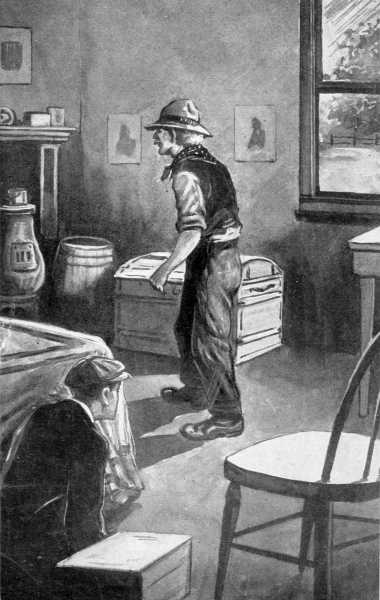
Tom was awakened that night, shortly after one
o’clock. At least he judged it to be about that
hour, for he dimly recalled hearing a distant clock
booming out twelve; then he had fallen into a
doze, and it could not have been over an hour later
when a noise and movement in the main apartment,
out of which all their rooms opened, roused
him.
“Wonder who that is?” he thought, sleepily.
“Maybe we did a little too much to-day, and some
of the boys can’t rest. I’ll take a look.”
He raised himself upon his elbow, but, though
he had a partial view of the sitting room from that
position, he could see no one. The scuffling of
feet on the carpet, however, and the faint rattle of
paper, told that someone was up and about.
Softly Tom put his legs over the edge of the
bed, so that it would not creak, for, somehow, he
had a faint suspicion that perhaps the person in
the other room might not be one of his chums,
and, in that case, he wanted to be prepared.
Gently he stepped out until he stood in the door
of his own room, and had a view of the main
apartment. Then he saw a white-robed figure
standing looking out of the window that gave a
view of the campus, over which a faint moon was
then shining.
“That looks like Sid,” thought Tom. “I wonder
if he’s getting spoony—or loony or moony?
Maybe he couldn’t sleep and got up to change the
current of his thoughts. Well, shall I go out and
keep him company, or——”
Tom reconsidered the matter a moment.
“No,” he thought, “if I go out there, and we
get to chinning, even in whispers, it will rouse
Frank and Phil, and then we’ll all be wide awake.
And the land knows we need all the sleep we
can get. I can find my way to dreamland without
being sung to, anyhow.”
For a moment he watched the figure by the window.
It was Sid, Tom felt sure of that, though
night-garments, be they pajamas or the more prosaic
shirts, do not make for identifying individuals.
There is little of character to them.
Then the figure by the window turned partly
toward Tom, but, as the face was in the shadow,
the watching lad could not see it plainly. The
figure approached the table, on which was a litter
of paper, where the lads had been doing some
studying earlier in the evening.
“By Jove!” thought Tom. “Old Sid is writing
poetry—or he has been courting the muse! This
is rich! He can’t sleep and he gets up in the night
to jot down a verse or two. That’s it! And
about a girl, too, I’ll wager! Oh, Sid!” and he
chuckled silently. “I’ll rig you for this in the
morning! Loony, spoony, moony Sid! This is
rich!” and Tom doubled up with silent mirth.
The figure continued to approach the table, and
from the other rooms the deep, regular breathing
told of sound sleepers. Then the figure began
fumbling with papers and Tom saw a pencil taken
up.
“How the mischief can he see to write in the
dark?” the watcher wondered.
But that was evidently not the intention. For,
after hesitating a few seconds over the table, the
white-clad figure turned and went out of the door
into the hall.
“Well, what do you make of that?” Tom asked
himself. “He has got ’em bad! Sneaking out to
some other room to write his slushy poetry. He’s
the limit! Wait until we get at him in the daylight—there
won’t be any loony-moon then. But
I should think he’d want to put on a bath robe.
It isn’t the warmest night of Summer,” added
Tom to himself, being aware of a distinctly chilly
feeling about his legs.
“Wait!” he counseled with himself. “I’ll find
out about this. I’ll just follow him and give him
a scare. I’ll catch him with the goods.”
Pausing to make sure that none of the others
were awake, and waiting to give Sid a chance to
get a little way down the corridor, Tom slipped
out of the door, his feet encased in a pair of bath
slippers, that lent themselves better to soft movement
than not, for they avoided the scuffling that
always goes with bare soles.
Tom reached the corridor, and, looking down
it, saw at the farther end the white-robed figure.
“He made good time all right,” Tom mused.
“Where can he be going to though, in that rig?
Oh, probably to the reading room,” and Tom recalled
the large room at the end of the hall, a sort
of library fitted up for the use of the dwellers of
the dormitory—a room seldom used by the way,
for the lads preferred the seclusion of their own
apartments.
“Maybe he’s looking for a rhyming dictionary,”
thought Tom. “That’s it. I’m on to his game
now.”
Tom thought he understood it all. Sid, who
used to care nothing for the girls—indeed having
a veritable aversion for them—had, of late, been
quite different, as Tom and all the others saw and
knew. There was one in particular—and it would
not be fair for me to mention her name—one in
particular about whom Sid, if he did not talk,
thought much.
“And he’s going to finish out some poem he
began, and got stuck with,” decided Tom. “Probably
he knows we’d rig him if we saw him writing
that Valentine stuff.
“A rhyming dictionary though. I don’t see
what he needs of that. Love, dove, above—you
true—eyes of blue. Heart—part—die, sigh—moon—soon—spoon—no,
not that. But hair—fair—ever
there—thine—mine—valentine. There
you are, done without the aid of a net, and with
nothing concealed up my sleeve,” mused Tom,
shivering slightly as a chilling breeze from the corridor
not only crept up his arm, but over other
parts of his anatomy.
The figure ahead of him glided on, and Tom
followed. Then, instead of turning into the library,
it mounted a flight of stairs that led to the
rooms above, where other students slept.
“For cats’ sake!” thought Tom. “What is
Sid up to anyhow? Is he going to snare someone
else in on this game? Or is he playing some
trick? The bell in the tower! Jove, if he dares
to ring that at this hour!”
For, when the new dormitory had been built, a
bell had been hung in an ornate corner tower,
though it pealed forth but seldom, being more of
an ornament. Still it could be rung if desired.
“That’s what old Sid is up to!” decided Tom.
“He must be going daffy. He’s sure to be caught,
for Simond has a room up there, and he’s a light
sleeper.” Simond being one of the new teachers,
who had been assigned to this dormitory as a sort
of moral-policeman. He was, however, a well-liked
instructor.
“I wonder how it would be for me to tip Sid
off not to do it?” thought Tom. “If he does
jingle the chimes they’ll say we all had a hand in
it, and it will be bad for the bunch. I guess I’ll
call him off. No use going too far for a joke.”
Tom was about to sprint forward, when, to his
surprise, the figure turned and entered one of the
student’s rooms, the door opening noiselessly and
closing again as silently.
“Well, what do you know about that?” asked
Tom of himself. “Who rooms there, I wonder?
And what is Sid going in there for? Can it be
that he isn’t up to dashing off a fervid love poem
himself, and has to get someone else, under the
cover of night, to do it for him?”
Tom came to a halt, some distance from the
door that had opened and closed, and remained
gazing down the corridor. He seldom came up
here, and did not know which students occupied
the different rooms. And, as the corridor was
long, and as Tom was looking down it on an
angle, he could not be exactly sure which door had
opened, they being all alike, and many without
numbers.
“I’ll just stay here and wait,” he decided. “He
can’t stay in there very long,” and then Tom began
to wish he had slipped on his bath robe, for he
was getting more and more chilly each minute.
“Hang it all! Why doesn’t he come out?”
he asked himself half a dozen times. “I’m not
going to stay here all night.”
But even at that, while calling himself all sorts
of a foolish person, Tom remained.
“It’s too good a joke to pass up!” he decided.
“I’ll surprise Sid when he comes out. Poetry!
Bah! We’ll write a love verse for him!”
Several minutes passed. Tom moved about, and
began to do some exercises with his arms, to bring
up his circulation. He was striking out vigorously,
feeling in quite a glow, when his elbow, as he drew
back his arm, came in sharp contact with the door
behind him. Unaware of it, he had been standing
in front of some portal while he waited.
“Oh, for cats’ sake!” thought Tom, in grim
despair as the sound boomed out with startling
distinctness in that dim and silent corridor. “Now
I have gone and done it. I guess I’d better pass
up Sid and his poem, and get back to my little
bed. I wonder if I can make it before someone
sticks out his noddle, and wants to know what I’m
doing here?”
With this thought in mind he started to glide
away, but he was too late. The door he had
banged with his elbow suddenly opened, and a
voice demanded in peremptory tones:
“Well, what is it?”
“Great Scott!” gasped Tom. “It’s Simond!”
for the countenance of the instructor was thrust
from the half-opened portal.
“Well?” went on the rather grim voice, as
Tom hesitated. “You knocked.”
“It—it was an accident,” stammered Tom.
“Oh. Then you don’t want me?”
“No, sir.”
“Is anything the matter?”
“No, Mr. Simond.”
“Then what are you doing up on this floor?
You’re Parsons, aren’t you?”
“Yes, sir.”
“And you room on the floor below?”
“Yes, sir.”
“Then what are you doing up here at this
hour of the night; knocking at my door?”
“I—er—it was an accident, you see. I was—I
was exercising.”
“Exercising?” There was a note of incredulity
in the voice.
“Yes, exercising.”
“What for?” Cold sarcasm now took the place
of surprise.
“To keep warm.”
“Look here, Parsons!” exclaimed the instructor.
“You may think this is a joke, but——”
“No, sir; it’s no joke. I was exercising to keep
warm. Arm exercising you know, and my elbow
banged your door—I didn’t know I was so close.”
“I see. Well, are you warm now?”
“Oh, yes, sir.” Indeed Tom was in a veritable
rosy glow.
“But what was the necessity of getting cold?”
went on Mr. Simond, and Tom became aware that
others were listening to the talk, for he could hear
doors down the hall cautiously opened, and faint
snickers of laughter here and there.
Tom was in a quandary. He did not want to
tell the real object of coming upstairs as he had,
for it would only make trouble for Sid.
And yet if he kept silent he would be put down
for having tried to play some prank on his own
account. Still if Sid had “gotten away” with
whatever he had attempted, and it seemed so, for
no sound came from the neighborhood of the room
he had entered—in that case Tom could not bring
him into the game.
“I guess I’ve got to take my medicine,” thought
Tom.
“Well?” demanded Mr. Simond in a cold voice.
“I—I just came up here for a—for a walk,” explained
Tom. “I—er—I couldn’t sleep, and——”
“I see. You thought if you came and waked
me up that you could sleep; is that it?”
“Oh, not at all, Mr. Simond.” He could be
funny when he wanted to, thought shivering Tom.
“I—er—I was just going back to bed,” he explained
lamely, for that was true enough.
“Very well, then you’d better go now,” concluded
Mr. Simond. “And don’t knock on any
more doors, or I shall have to look further into
the matter. Good-night!”
“Good-night!” gasped Tom, surprised to be
let off thus easily. “It was all a mistake, I assure
you,” he added, as he glided away.
“Well, don’t repeat the mistake,” was the grim
injunction of the instructor, as he closed his door,
and Tom vowed that he would not—at least that
night.
“I’m a chump!” he told himself as he hurried
back to his room. “I might better have let Sid
grind out his mushy poetry in peace, and gotten
my sleep. Now I may be in for a lecture to-morrow.”
As he entered the room he saw, grouped in the
middle of the apartment, his three chums. The
sight of Sid, with Phil and Frank, caused Tom to
halt.
“Where in thunder have you been?” demanded
Phil. “We were just going to get up a searching
party for you.”
“That’s right,” came from Sid. “What do you
mean by chasing out at this hour?”
“What do you mean, I guess it is!” exclaimed
Tom. “I’ve been chasing you, Sid.”
“Chasing me? What rot is that?”
“It’s all right. I woke up when I heard you
moving about in here, followed you out to the
corridor. You were going to write a poem, you
know.”
“Say, am I crazy or is he?” demanded Sid,
appealing to the others. “Writing poetry?”
“Yes; weren’t you?” asked Tom, beginning to
think he had more of a mystery on his hands than
he had at first suspected.
“Worse and more of it,” murmured Frank.
“Do you mean to tell me?” demanded Tom,
“that you didn’t sneak out of here a while ago, and
go to one of the rooms on the next floor?” and he
looked defiantly at Sid.
“I certainly won’t tell, or admit, anything of the
kind, because it isn’t so,” replied Sid. “Admitting
that I had, will you kindly explain how I could be
here when you came in; in that case?”
“That’s so,” admitted Tom, scratching his head
in perplexity. “Unless,” he added as an afterthought,
“unless you came down the back stairs,
when I was chinning with Simond.”
“Chinning with Simond?” demanded Phil. “Do
you mean to say you were caught by him?”
“Yes. I banged on his door.”
“Banged on his door?”
“Yes, by accident. You see I was exercising to
keep warm.”
The three paused and looked at each other.
Clearly they did not understand.
“Look here, Tom,” began Frank in a gentle,
soothing voice. “How long have you been this
way? Did it come on suddenly, or are you subject
to these fits? Have you seen a doctor? Don’t you
think we’d better wire your folks? Maybe if you
lie down it will wear off. Isn’t it sad, and him so
young, too!” and he sighed in mock distress.
“Look here, you chump!” cried Tom indignantly.
“You think I’m stalling; don’t you? But
I’m not. Here’s how it happened,” and he told
of the circumstances, and of his suspicions against
Sid.
“And while I was waiting for him—as I
thought—to come out of that room upstairs,” he
went on, “I got chilly. So I exercised. My elbow
banged on Simond’s door, and he opened the oak.
Then I had to explain.”
“That’s a rich one!” declared Phil.
“He must have thought you were crazy!” said
Frank.
“Exercising at that hour of the night!” exclaimed
Sid. “This is too good to keep!” and he
laughed outright.
“Not so loud,” cautioned Phil, “or we’ll rouse
the place. Anything else, Tom?”
“Isn’t that enough? But say, Sid, are you sure
you weren’t out?”
“Of course I am. Ask Phil and Frank. They
woke me up in bed.”
“That’s right!” chorused the two.
“I heard a noise,” explained Phil, “and woke
up. I was just in time to see you going out of the
room, Tom, and——”
“That was when I was after Sid,” Tom explained.
“You mean you thought it was me,” put in Sid.
“Well, have it that way if you like. But if it
wasn’t you I chased, who was it?” demanded
Tom, after the manner of one propounding a difficult
riddle.
“That’s up to you to find out,” spoke the Big
Californian. “Are you sure you did see and follow
someone, Tom?”
“Of course I am. Do you think I’m crazy?”
“I don’t know,” was Frank’s simple remark.
“There’s something wrong,” went on Sid, “but
we can’t get to the bottom of it now. If there was
someone in our room we want to know it.”
“Well, there was,” declared Tom, positively.
“I know it!”
“Anyhow, I saw you going out,” resumed Phil.
“I wondered what was up, but I thought maybe
you felt sick, and was going to the medicine cabinet
at the end of the corridor. So I went back
to bed, and when you didn’t return in ten minutes
I roused Sid and Frank.”
“And you found Sid in bed?” demanded Tom.
“Sleeping like a babe—the result of an innocent
conscience. Was it not?” asked Sid, with an
air of virtue.
“Yes, little one,” came from Phil, with a bow.
“Then we all speculated on what could be the
matter with you,” added Frank.
“And we were about to organize a relief expedition,
with six months’ supply of rations, and
start out,” was Sid’s contribution.
“When in you came prancing as though you had
been out for a constitutional,” concluded Phil.
“Telling us that you had been exercising,” commented
Sid, sarcastically. “Talk about following
me in a suspicious manner, I rather think the dancing
slipper is on the other foot, my friend.”
“Well, this gets me!” confessed Tom, blankly.
“Then it’s the second time you’ve been gotten
at this night,” declared Frank. “For Simond had
you first.”
“Oh, he was decent about it,” Tom said. “I
don’t believe anything will come of it. I’m going
to get to bed. It’s as cold as Greenland here,” and
he made a dive for his room.
“What time is it, anyhow?” asked Sid with a
yawn. “Did we take the toothpick out of the
alarm clock, I wonder?”
The three of them glanced toward the table
where the timepiece was wont to tick. It was the
custom to wind and set it before going to bed, the
last one to retire being charged with the duty of
removing the toothpick, which was used to silence
the ticking that annoyed the chums when they were
studying.
“Why—why—it’s gone—gone!” gasped Tom,
halting on his way to his room.
“That’s right!” chorused the others.
“Tom Parsons, is this your joke?” demanded
Sid, sternly.
“What do you mean?”
“I mean did you take that clock away for a
joke, and then, when you got caught, made up that
fake story about chasing me?”
“I—did—not!” exclaimed Tom in such a manner
that they could not help believing him.
“Then where is it?” demanded Frank.
There was silence for several seconds, while the
white-clad figures regarded one another. Then
Tom burst out with:
“I have it!”
“I thought you did,” said Sid significantly.
“No, you gump! I mean I have the solution.
It was that chap who was in here, and whom I took
for you, Sid. He has our clock. I’ll get it back!”
Tom was about to rush out into the corridor,
when Frank laid a restraining hand on his shoulder.
“Hold on, son,” he began mildly. “There’s
been enough running around for one night. It
won’t be healthy, for one thing, to do any more,
for it is beastly cold. And, for another, there is
no use in running our heads into a noose. Simond
was decent, you say, Tom, and there’s no sense
in putting it on him—rubbing it in, so to speak.
We’ll just lay low until morning and then we’ll get
our clock. You say you know where it is?”
“Well, I saw the fellow that was in here enter
some room on the floor above. I couldn’t pick it
out exactly, but I can come pretty near it.”
“That’ll be all right. Who do you think it
was?”
“Dutch Housenlager!” declared Tom.
“He doesn’t room up there,” retorted Phil.
“Well, he may have slipped in some room up
there to throw me off,” said Tom.
“More likely it was Jerry Jackson,” was Frank’s
opinion. “He was poking fun at the clock yesterday.”
“As long as he doesn’t poke anything more than
fun at it, all right,” said Phil. “We’re the only
ones licensed to use toothpicks and battle-axes on
it.”
“Poor old clock,” sighed Sid. “It does get
abused, but still it is a faithful friend. Remember
the time that duffer—what was his name—took
out some of the wheels to make some machine he
was crazy over? Remember that?”
“I should say so!” exclaimed Tom. “But this
chap wasn’t satisfied with a single wheel—he wanted
the whole works. I wonder who it could be?”
“I shouldn’t wonder but what the Snail had a
hand in this,” opined Phil. “He’s so fond of
roaming about nights.”
“He stays over in the North dormitory now,”
declared Frank. “Besides, he wouldn’t get in here
at this hour of the morning—at least I think it
must be near morning. The doors are locked
after hours, you know. No, it was someone from
here all right, who took that clock.”
“And the nerve of ’em!” exclaimed Phil.
“And to think Tom took that lad—whoever he
was—for me,” put in Sid. “Did he really look
like me?”
“He sure did.”
“Maybe it was Bean Perkins,” suggested Frank.
“No, Bean wouldn’t do a trick like that. He
couldn’t keep quiet enough,” declared Tom.
“He’d want to give a class yell or sing a song in
the middle of it, and that would give it away. Say,
but I have a scheme though.”
“Out with it, and then let’s get to bed,” yawned
Frank.
“We won’t say anything about this,” spoke
Tom, “and——”
“Not say anything about it!” cried Sid. “Well,
I guess we will! Think we’re going to let our
clock disappear, and keep mum over it? I guess
not!”
“I didn’t mean that,” explained Tom. “I
meant that we’d not come out boldly, and admit
that we didn’t know enough to keep our clock from
being taken. But to-morrow—at chapel—or whenever
we can, we’ll just sneak up back of Dutch, the
Jersey twins, or whoever else we suspect, and say
‘clock’ to them. That will make the guilty one
start, and we’ll have our man.”
“I see—a sort of detective stunt,” remarked
Frank.
“Sort of,” admitted Tom.
“How would it do to make a noise like a tick,”
suggested Phil.
“Say, I’m not joking,” exclaimed Tom.
“Neither am I,” asserted Phil. “But let’s be
real mysterious about it, and we’ll get the guilty
one so much more easily.”
“Oh, don’t be silly!” snapped Tom, who, truth
to tell, was getting a bit short-tempered.
“I’m not!”
“Yes, you are!”
“Say, let’s all get back to bed, and fight this
out in the morning,” suggested Frank, and they
took his advice, though it was but a troubled sleep
that any of the four got the rest of that night.
Talking it over by daylight they decided that
Tom’s plan might not be so bad. Accordingly,
they put it into practice.
“Clock!” suddenly exclaimed Sid, as he slid
up behind Dutch Housenlager after chapel.
“Tick-tock!”
“Tag. You’re it!” quickly responded Dutch.
“What’s the signal?”
“You’re not guilty, I see,” spoke Sid, with a
sigh.
“Of course not. What’s the answer?”
“Someone took our clock last night.”
“Oh, that battered chronometer? Say, do you
know what I thought?”
“Couldn’t guess it.”
“That you were trying to initiate me into a new
secret society, and that you were practicing the
password—tick-tock!”
“Nothing doing. Say, Dutch, if you hear of
anyone who has it, tip me off, will you?”
“I sure will,” and then, to show how much in
earnest he was, Dutch tripped Sid up and deposited
him on the grass of the campus.
Nor was Tom, or his other two chums any
more successful. Each time they tried the surprise
plan on any suspect they received an answer
that told they were on the wrong track.
And then, most unexpectedly, the clock came
back, as it had done once before. Wallops, the
messenger, brought it.
“I found it down in the furnace room,” he explained.
“It was on top of one of the boilers.”
“Well, for the love of tripe!” cried Tom.
“How in the world did it get there?”
“Our unknown visitor put it there,” declared
Frank. “Maybe he thought we were on his track,
and he took this method of getting rid of the damaging
evidence.”
And they had to let it go at that—at least for
the time being, for all their inquiries came to
naught.
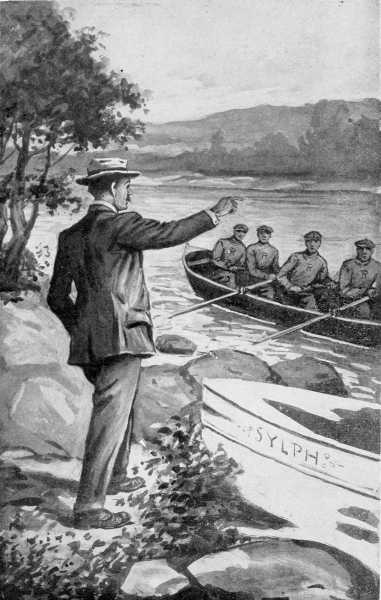
“Everyone who wants to try for the varsity
eight come down to the river this afternoon,” was
the notice Captain Simpson posted on the bulletin
board the next day. He and the coach had had
a conference, and it was decided to try and definitely
settle on the crew for the first boat. Then
the second choice could be made, and some practice
races arranged.
In order to be absolutely fair, Mr. Lighton
and Mr. Pierson shifted about those who had
been rowing together. I mean Tom and the
seven lads with whom he was more closely associated
than with any others—Sid, Phil, Bricktop
Molloy, Frank, Holly Cross, Dutch, and
Kindlings. Jerry was kept as coxswain in the new
boat, but Tom, Phil, Holly and Dutch were sent
out in the old one, with Bean Perkins for steersman,
while four lads who had not been given much
practice were imported into the new shell with
Frank, Sid, Kindlings and Bricktop Molloy.
“Now, boys, see what you can do!” urged the
coach.
It was the first time the new shell had been
tried, and it was found fully up to expectations.
But it was a little differently made from the old
one, and this made the lads a bit awkward in it.
However, they rowed fairly well, though in a short
trial race the old shell came out ahead.
“We’ll do some more shifting,” decided Mr.
Lighton, and he and Mr. Pierson tried different
combinations, but still separating the eight lads
who had rowed together from the start.
This was kept up for some days, the lads all,
meanwhile, being on training. But when a week
had passed, and the old and new boats had see-sawed
back and forth, first one winning and then
the other, Mr. Lighton shook his head in doubt.
“Something is wrong,” he said. “We’ll never
be able to pick a varsity crew of either of them.
We need a consistent winner.”
“That is right,” agreed Mr. Pierson. “Why
not try the same eight you had at first—the four
lads whom I coached this Summer, and their four
intimate friends? I fancy they would do better
together in the new boat.”
“We’ll try it,” assented the coach.
The result was an improvement at once. Even
with the awkwardness of the new shell as a handicap,
Tom and his seven friends at once opened
water between their craft and the other one. And
it was not surprising when you consider that they
had had considerable practice together, and had
played baseball and football through several college
seasons.
“I think that’s the varsity crew all right,” declared
Mr. Pierson, after watching the test.
“I agree with you—unless something unforeseen
occurs,” said Mr. Lighton. “Now we must give
some attention to the others in the fours, singles
and doubles.”
Practice in these craft had been going steadily
on, and in time the crews that were to try to make
Randall the champion were picked, subject, of
course, to change, a number of substitutes being
arranged for.
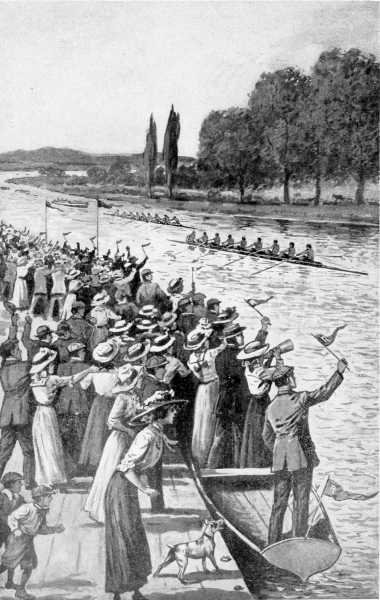
Word came that the Boxer Hall and Fairview
varsity crews in the different shells were doing
hard work. They had the advantage of not having
to pick new and somewhat green crews. But
the spirit of Randall was not affected by this.
“Now, boys!” exclaimed Mr. Lighton one
afternoon, when the two eights had gone out for
a practice race. “I want you to do your best.
Row hard! Try to imagine you’re in a race.
Row hard, everybody!”
“There may be a race if those fellows will consent
to a brush with us,” said Bricktop to Frank,
as he looked down the river and saw the Boxer
Hall eight approaching. “I wonder if we can
chance it—to see which of our boats would win.”
“I guess so,” assented Frank.
“Silence in the boat!” cried Coxswain Jackson.
“Save your breath to row with!”
“Sure he’s getting to be a regular fussing martinet!”
declared Bricktop, with a smile.
“Silence in the boat!” commanded Jerry again,
and he meant it. Meanwhile the Boxer Hall eight
came sweeping on. Would she give Randall an
impromptu race?