The An-māut(1) saith:—
I come to you, ye Great Circles of gods(2) in Heaven, upon
Earth and in the World below! I bring to you N void of offence
towards any of the gods, grant that he may be with you daily.
Glory to Osiris, Lord of Restau, and to the great gods who are
in the World below. Here is N who saith:—Hail to thee, Prince
of Amenta, Unneferu who presidest in Abydos, I come to thee with
Righteousness; without sin upon me. I am not knowingly a
speaker of wrong; I am not given to duplicity; grant me Bread,
the right of appearance at the tables of the Lords of Maāt, entering
in and going out of the Netherworld, and that my soul may not
suffer repulse in its devotion to the orb of the Sun and the vision of
the Moon-god for ever.
51The Se-meri-f saith:—
I come to you, O Circle of gods in Restau, and I bring to you N.
Grant to him Bread, Water, Air and an allotment in the Sechit-hotepu
like Horus.
Glory to Osiris, the Lord of Eternity and to the Circle of gods in
Restau. Here is N and he saith:—I come to thee, I know thy
will, and I am furnished with thine attributes of the Tuat. Grant
me an abiding place in the Netherworld by the Lords of Maāt, my
permanent allotment in the Sechit-hotepu, and the receiving of
cakes before thee.
1. Oh Thoth, who makest Osiris triumphant over his adversaries,
let N be made triumphant over his adversaries, even as thou makest
Osiris triumphant over his adversaries, before the Circle of gods
about Rā and about Osiris and the Great Circle of gods in Heliopolis,
on that Night of the Eve’s Provender(3) and the Night of Battle
when there befel the Defeat of the Sebau, and the Day of the
extinction of the adversaries of the Inviolate god.
The Great Circle of gods in Heliopolis is of Tmu, Shu and
Tefnut, and the Sebau who were defeated and extinguished were the
associates of Sut on the renewal of his assault.
2. Oh Thoth who makest Osiris triumphant over his adversaries,
let N be made triumphant over his adversaries, even as thou
makest Osiris triumphant over his adversaries before the Great Circle
of gods in Tattu, on the Night wherein the Tat is set up in Tattu.(4)
The Great Circle of gods in Tattu is of Osiris, Isis, Nephthys
and Horus the Avenger of his Father; and they who set up the Tat
are the two arms of Horus, Prince of Sechem. They are behind
Osiris as bindings of his raiment.
3. Oh Thoth who makest Osiris triumphant over his adversaries,
let N be made triumphant over his adversaries, even as thou makest
Osiris triumphant over his adversaries, before the Great Circle of
gods in Sechem on that Night of the Eve’s Provender in Sechem.
The Great Circle of gods in Sechem is of Horus in the Dark,(5)
and Thoth, who is of the Great Circle of An-arer-ef.
The Eve’s Provender is the dawn upon the Coffin of Osiris.
524. Oh Thoth, who makest Osiris triumphant over his adversaries,
let N be made triumphant over his adversaries, even as thou makest
Osiris triumphant over his adversaries, before the Great Circle of
gods in Pu and Tepu,(6) on that Night of erecting the flag-staffs
of Horus, and of establishing him as heir of his Father’s property.
The Great Circle of gods in Pu and Tepu is of Horus, Isis,
Emsta, Hapi; and the pillars of Horus are erected when Horus
saith to those who follow him “let the flag-staffs be erected there.”
5. Oh Thoth, who makest Osiris triumphant over his adversaries,
let N be made triumphant over his adversaries, even as thou makest
Osiris triumphant over his adversaries, before the Great Circle of
gods of the Two Regions[30] of Rechit, on that Night when Isis lay
watching in tears over her brother Osiris.
The Great Circle of gods on the Two Regions of Rechit is of
Isis, Nephthys, Emsta and Hapi.
6. Oh Thoth, who makest Osiris triumphant over his adversaries,
let N be made triumphant over his adversaries, even as thou makest
Osiris triumphant over his adversaries, before the Great Circle of
gods in Abydos on the night of Hakra,(7) when the evil dead are
parted off, when the glorious ones are rightly judged, and joy goeth
its round in Thinis.
The Great Circle of gods in Abydos is of Osiris, Isis and Apuat.
7. Oh Thoth, who makest Osiris triumphant over his adversaries,
let N be made triumphant over his adversaries, even as thou makest
Osiris triumphant over his adversaries, before the Great Circle of
gods on the Highway of the Damned,(8) upon the Night when
judgment is passed upon those who are no more.
The Great Circle of gods on the Highway of the Damned are
Thoth, Osiris, Anubis and Astes. And judgment is passed on the
Highway of the Damned when the suit is closed[31] against the souls
of the Children of Failure.
8. Oh Thoth, who makest Osiris triumphant over his adversaries,
53let N be made triumphant over his adversaries, even as thou makest
Osiris triumphant over his adversaries, before the Great Circle of
gods at the Great Hoeing in Tattu, on the Night of Hoeing in their
blood and effecting the triumph of Osiris over his adversaries.
The Great Circle of gods at the Great Hoeing in Tattu(9) when
the associates of Sut arrive, and take the forms of goats, slay them
before the gods there, while their blood runneth down; and this
is done according to the judgment of those gods who are in Tattu.
9. Oh Thoth, who makest Osiris triumphant over his adversaries,
let N be made triumphant over his adversaries, even as thou makest
Osiris triumphant over his adversaries, before the Great Circle of
gods in An-arer-ef on the Night of Hiding him who is Supreme in
Attributes.[32]
The Great Circle of gods in An-arer-ef is of Shu, Babai, Rā and
Osiris, and the Night of Hiding him who is Supreme of Attributes
is when there are at the Coffin, the Thigh, the Head, the Heel and
the Leg of Unneferu.
10. Oh Thoth, who makest Osiris triumphant over his adversaries,
let N be made triumphant over his adversaries, even as thou
makest Osiris triumphant over his adversaries before the Great
Circle of gods in Restau on the Night when Anubis lieth(10) with
his hands upon the objects behind Osiris, when Osiris is made to
triumph over his adversaries.
The Great Circle of gods in Restau is of Osiris, Horus, and
Isis. The heart of Horus rejoiceth, the heart of Osiris is glad and
the two Parts[33] of Heaven are satisfied when Thoth effecteth the
triumph of N before these ten Great Circles about Rā and about
Osiris and the Circles of gods attached to every god and every
goddess before the Inviolate god. All his adversaries are destroyed
and all that was wrong in him is also destroyed.
Let the person say this chapter, he will be purified and come forth
by day, after his death, and take all forms for the satisfaction of his
will, and if this chapter be recited over him, he will be prosperous upon
earth, he will come forth safe from every fire, and no evil thing will
approach him: with undeviating regularity for times infinite.(11)
The eighteenth chapter is one of those found in the earliest
copies of the Book of the Dead, on the wooden coffins of the ‘Old’
and ‘Middle’ Empires; the most complete ancient copy being on
the coffin of Queen Mentuhotep of the eleventh dynasty.
It consists of a Litany addressed to Thoth, who is invoked for
securing the triumph of the departed against his adversaries in
presence of the gods of certain localities. Each petition has
reference to some mythological event, and is supplemented by the
enumeration of the gods constituting the divine company presiding
at the locality named, and sometimes by a short comment on the
myth referred to.
The order of petitions is somewhat different in the later recensions,
and the text has suffered other alterations.
Copies of this chapter are extremely numerous, particularly in
the later periods.
The chapter really begins with the petitions to Thoth. The
preceding portion is, as far as I know, found only in the Papyrus of
Ani. But as the vignette which belongs to this portion has a place
in the great Leyden Papyrus of Kenna, the text cannot have been
confined to a single manuscript. It is particularly valuable as
illustrative of the ritual use of portions of the Book of the Dead.
1.
The deceased person is supposed to be presented to the gods
by two priests in succession, one called An-maut-ef 


 ,
and the other

 Se-meri-f. Both names are titles of
Horus, and it is the usual thing for Egyptian priests to bear divine
titles; their ritual observances being dramatic and symbolical
representations of the actions of the gods. An-maut-ef literally
signifies ‘column (support) of his mother.’ Horus is called


 ‘the An-maut-ef of the Great
Company of the gods’ (Mariette, Abydos, I, p. 34), and in Denkmäler,
III, 206 e, he is called the An-maut-ef of Osiris (cf. Abyd. II, 54).
Se-meri-f signifies ‘the Beloved Son,’ and the priest of this
name in the funereal rites personified Horus in his dutiful offices
to his father Osiris. I do not know why is always
translated ‘the son who loves him,’ instead of ‘the son he loves,’
55which is the right meaning. 
 is ‘the place which he
loves’ not ‘the place which loves him.’ And similarly
 is
‘the wife whom he loves,’ not ‘who loves him.’
2.
There is a short note (6) on chapter 1, upon the word


 , but the present seems to be the suitable place for a
more extended notice of this feminine word, which is a collective
noun, and never found in any other sense.
The ancient form 

 renders it more than probable
that
 is not phonetic in the later form, but that as in

 kai,
originally
 (whence the Coptic ⲕⲟⲧ, ⲕⲱⲧⲉ, a circle, a round
vessel, to go round), it is ideographic of roundness. This concept
is certainly to be found in the word
 , the Coptic ϫⲱϫ, a
head (or rather top of the head), as in the Latin vertex, akin to
vortex, from the same root as vertere. The sign
 , which in later
texts often appears as the determinative, has its origin in the cursive
form of
 carelessly written. Instead of
 we also find
 ,
which is certainly not phonetic but ideographic of enclosure, as in
the word
 a wall, paries, ἕρκος. This word occurs already
in the Pyramid Texts under the form . See Pepi I, 571,
which M. Maspero renders ‘la Grande Enceinte d’On.’ The evident
etymological relationship to the Coptic ϫⲱϫ has led some scholars
to translate the Egyptian word as signifying chiefs, princes. But
though the lexicons give dux and princeps as meanings of the
Coptic word, these are but secondary applications of head. We
have to enquire why ϫⲱϫ means head, or top of the head. And
the reason is its roundness, as indicated by the ideographic signs
or
 .
The old Egyptian word invariably implies an association
of persons, and this is why in consequence of its etymology
I translate it as ‘Circle of gods.’ It is synonymous (cf. chapter 41, note 8chapter 41, note 8)
with  .
3.
The Eve’s Provender. Later authorities read 


 ,
the ‘Provender of the altars,’ but this is a corruption of the ancient
56

 , which had probably ceased to be intelligible.
According to this pantheistic system the deceased through his identification
with the Sun absorbed and consumed all that came in his
way. And this is expressed in somewhat brutal style. Men and
gods disappear before Unas, he makes his breakfast at dawn


 , upon great gods, his dinner upon gods of middling
quality
 , and ‘his supper at even’

 upon the minor deities,

 .
 is the ancient dialectic
variant of , which however is really the older form. This
word which means ‘things’ has, like the Latin res, a wide application.
It frequently means property, estate, and sometimes suit.
4.
On the last day of the month of Choiak the great solemnity of
setting up the Tat  as the symbol of Osiris was observed down to
the latest periods. The tablets of Pasherenptah, high priest of Ptah
at Memphis, speak of this great dignitary as the king’s second or
deputy in ‘Raising the Tat.’ But Brugsch has published a picture
(Thesaurus, V, 1190), copied by Dr. Erman from a tomb of the
XVIIIth dynasty, in which Amenophis III himself helps to raise
the Tat, and the queen Ti and the royal princesses take part in the
ceremony. The procession is described as marching four times
round the sanctuary of Ptah-Seker-Osiris. See Plate IX.
5.
On Horus in the Dark, or Blindness, or Invisibility  , see
note, Proc. Soc. Bibl. Arch., June, 1886.
6.
Pu and Tepu are named together in the earliest texts as one
locality, which is recognised by Brugsch as the metropolis of the
northern nome called by the Greeks Φθενότης.
7.
The feast of 
 derives its name, as Goodwin supposes
with great probability, from the words


 ha-k-er-ȧ, ‘Come thou to me,’ said of a legendary incident like
that mentioned at the end of note 15 on chapter 17. The early
papyri read

 but this is no objection, the sign
being here the determinative of the entire group which gives its
name to the feast.
578.

 literally the dead, that is those who have died
‘the second death.’
9.
The vignette is given by M. Naville from the tracing taken by
Lepsius of the now lost Papyrus Busca. It represents ‘the Great
Hoeing in Tattu.’ The long text at Dendera (Mariette, tom. IV,
pl. 39) contains directions to be observed the festival commemorative
of the ancient myth. Two black cows are put under a
yoke of 
 ȧm wood, the plough is of tamarisk wood and the
share of black bronze. The plougher goes behind, with a cow led
by a halter. A little child with the lock
 attached to its head is to
scatter the seed in the field of Osiris, a piece of land of which the
dimensions were given in the text (now imperfect). Barley is sown
at one end, spelt at the other, and flax between the two. And the
Cher-heb in chief recites the Office for the Sowing of the Field.
10.
The older texts have 
 lie, the later ones
 lay.
11.
In the formula 

 , šes is “the measuring line
used by builders,”builders,” and em šes signifies ‘ad amussim,’ ‘nach der
Schnur,’ ‘au cordeau,’ ‘according to the line,’ hence ‘with the
strictest accuracy.’ Hibbert Lectures, 1879, p. 121. ‘According to
the line of Maāt’ means ‘with undeviating regularity.’
Chapter of the Crown of Triumph.
Thy Father Tmu hath prepared for thee this beautiful Crown of
Triumph, the living diadem which the gods love, that thou mayest
live for ever. Osiris, Prince of Amenta, maketh thee to triumph
over thine adversaries. Thy Father Seb hath decreed that thou
should be his heir, and be heralded as Triumphant, Horus son of
Isis and son of Osiris, upon the throne of thy Father Rā, through
the defeat of thine adversaries. He hath decreed for thee the Two
Earths, absolutely and without condition(1). And so hath Atmu
decreed, and the Cycle of the gods hath repeated the glorious act of
the triumph of Horus the son of Isis and the son of Osiris for ever
and ever.
58Osiris, the Prince of Amenta, the Two Parts of Heaven united,
all gods and all goddesses who are in heaven and upon earth join
in effecting the Triumph of Horus the son of Isis and son of
Osiris over his adversaries before the Great Circle of gods in
Heliopolis, on the Night, etc.
Horus repeateth the proclamation four times. All the adversaries
fall and are overthrown and slaughtered.
N repeateth the proclamation four times, and all his adversaries
fall and are overthrown and slaughtered.
Horus son of Isis and son of Horus repeateth an infinite number
of festivals, and all his adversaries fall down, are overthrown and
slaughtered. Their abode is transferred to the slaughtering block
of the East, their heads are cut away, their necks are crushed, their
thighs are lopped off, they are given to the great Annihilator who
resideth in the Valley(2) that they may not ever escape from under
the custody of Seb.(3)
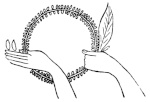
This chapter is said over a consecrated crown placed upon the face
of the person, and thou shalt put incense upon the flame, for N (the
deceased), effecting his triumph over all his adversaries, whether Dead
or Living, that he may become one of the followers of Osiris. And
there shall be given to him drink and food in presence of this god.
Thou shall say it at dawn twice; A great protection is it: with
undeviating regularity for times infinite.
The nineteenth chapter is a very recent recension of the
eighteenth. The MSS. containing it, as far as we know, are not
older than the Greek period. It derives its origin from the practice
of placing garlands or floral crowns upon the mummies. The
mummy of Aahmes I, the first king of the eighteenth dynasty, when
found “portait au cou,” M. Maspero writes, “une guirlande de jolies
fleurs roses de Delphinium orientale.” Remains of such crowns are
to be found in our Museums. For farther details I must refer to an
excellent paper entitled La Couronne de la Justification, by Dr.
Pleyte of Leyden, in the second volume of the Transactions of the
Oriental Congress held at Leyden in 1884; and see Plate VIII.
591.

 . This adverbial expression is apparently connected
with
 , and I therefore understand it in the sense of
ἀποτόμως, praecisè, absolutely, without condition.
2.

 the Valley of Darkness (Todt., 130, 6) and
Death, “whose secrets are absolutely unknown”


 (148, 2).
3.
That is they shall remain interred for ever.
The twentieth chapter is entitled Another Chapter of Crown of
Triumph, but it is simply a tabulated form of chapter 18, with
the Rubric. Let the person say this Chapter, and purify himself with
water of natron, he will come forth by day after death, and take all
forms according to his wish, and escape from the fire. With undeviating
regularity for times infinite. The earliest example of this
tabulated form of the chapter is found on the Berlin Sarcophagus
of Mentuhotep.
Dümichen; Tempelinschriften, LXXV.
60
Chapter whereby the mouth of a person is given to him in the Netherworld.
Hail to thee, Lord of Light, who art Prince of the House which
is encircled by Darkness and Obscurity. I am come to thee glorified
and purified.
My hands are behind thee; thy portion is that of those who have
gone before thee.(1)
Give me my mouth that I may speak with it; and guide(2) my
heart at its hour of Darkness and Night.
The oldest papyrus containing this chapter is that of Ani, and
the translation is based upon it. But the text differs both from
those written on the very ancient coffins of Heru and Set-Bastit,
copied by M. Maspero,[34] and from the later texts.
The second paragraph seems to be spoken by the god, the first
and third being from the deceased.
“My hands are behind thee” is a formula implying protection.
On the coffins the invocation is addressed not to “Osiris, Lord
of Light” or “Radiant One” 
 , but to the


 ,
“one whose head is clothed with radiant white, of the House of
Darkness and Obscurity.”
Instead of 

 “obscurity” the coffin has
 without a determinative, but
 shows what the word
means.
This ancient text continues—“Come thou to me, glorified and
purified; let thy hands [here the text is obliterated], shine thou with
thine head (
 ). Give me my mouth that
61I may speak with it, and guide me on the glorious roads which
are in heaven.”
The Turin text is very corrupt, and parts of it are incapable of
translation.
1.


 .
2.
“Let me guide,” according to the Ani Papyrus. But the
later (hieratic) texts have the second person  ,
which is more correct.
Another Chapter whereby the Mouth of a person is given to him in the Netherworld.
I shine forth out of the Egg which is in the unseen world.(1)
Let there be given my mouth that I may speak with it in presence
of the great god, Lord of the Tuat. Let not my hand be repulsed
by the Divine Circle of the great god.
I am Osiris, the Lord of Restau, the same who is at the head of
the Staircase.(2)
I am come to do the will of my heart, out of the Tank of
Flame, which I extinguish when I come forth.(3)
This is one of the chapters of which the text certainly belongs
to the earliest epoch. It is one of those copied by Wilkinson from
the coffin(2)(2) of Queen Mentuhotep. In the Papyrus of Ani it is
followed by chapter 21 as its conclusion, and both chapters are
appended to chapter 1, before the rubric belonging to that chapter.
1.
The Egg in the unseen world is the globe of the Sun while
yet below the horizon. It is only through a mistranslation of
chapter 54, 2 that the Indian notion of a ‘Mundane Egg’ has
been ascribed to the Egyptians.
The 17th chapter addresses “Rā in thine Egg, who risest up
in thine orb, and shinest from thine Horizon.”
622.
See the picture of Osiris at the head of the Staircase, which
is here given (see Plate XI) from the alabaster sarcophagus of Seti I
in the Soane Museum. Similar pictures are given on other
sarcophagi. The gods on the stairs are called 


 ,
‘the Divine Circle about Osiris.’
The ‘Staircase of the great god’ 


 at Abydos, is
frequently mentioned on the funeral stelae.
3.
The Tank of Flame. See chapter 1, note 15. The red
glow of the Sky disappears after the Sun has risen, he is therefore
said to “extinguish the Flame” after he has come forth. The same
notion is expressed in the myth according to which Horus strikes
off the head of his mother.
Chapter whereby the Mouth of a person is opened for him in the Netherworld.
He saith: Let my mouth be opened by Ptah, and let the
muzzles which are upon my mouth be loosed by the god of my
domain.(1)
Then let Thoth come, full and equipped with Words of Power,[35]
and let him loose the muzzles of Sutu which are upon my mouth,
and let Tmu lend a hand to fling them at the assailants.
Let my mouth be given to me. Let my mouth be opened by
Ptah with that instrument of steel(2) wherewith he openeth the
mouths of the gods.
I am Sechit(3) Uat’it who sitteth on the right side of Heaven:
I am Sahit encircled by the Spirits of Heliopolis.[36]
And all the Words of Power, and all the accusations which are
uttered against me—the gods stand firm against them: the cycles of
the gods unitedly.
1.
Osiris. On the sense of  , literally ‘the god of the
domain,’ see the articles of M. Naville and Professor Piehl, Zeitschr.,
1880, 146; 1881, 24 and 64. I hold with Dr. Piehl that the domain
meant in this formula is Abydos, and that the god is Osiris.
2.
The word here translated ‘steel’ is  , upon which
see M. Devéria’s dissertation, “Le Fer et l’Aimant” in the Mélanges
d’Archéologie Egyptienne et Assyrienne, tome I, p. 2.
A description of the Ceremonies of the Opening of the Mouth
as performed at the tomb will be found in the Introduction to this
translation.
3.
The name of this goddess is phonetically written  Sḫt
in the Pyramid texts of Unas (l. 390), where the Murray Papyrus
and other texts have the ordinary
 . The reading Sechemet
is indefensible. Cf. Proc. Soc. Bibl. Arch., XII, p. 365.
Chapter whereby the Words of Power are brought to a Person in the Netherworld.
I am Chepera, the self-produced, on his Mother’s thigh.(1)
The speed of bloodhounds is given to those who are in
Heaven,[37] and the mettle of hyaenas(2) to those who belong to the
Divine Circle.
Lo, I bring this my Word of Power, and I collect this Word of
Power from every quarter in which it is, more persistently(3) than
hounds of chase and more swiftly than the Light.
O thou who guidest the Bark of Rā, sound is thy rigging and
free from disaster as thou passest on to the Tank of Flame.
Lo, I collect[38] this my Word of Power from every quarter in
which it is, in behalf of every person whom it concerneth, more
64persistently than hounds of chase and more swiftly than Light; the
same(4) who create the gods out of Silence, or reduce them to
inactivity; the same who impart warmth to the gods.
Lo, I collect this my Word of Power from every quarter in which
it is, in behalf of every person whom it concerneth, more persistently
than hounds of chase and more swiftly than the Light.
This is another of those chapters of which the antiquity is
proved by the coffins of Horhotep and Queen Mentuhotep. And
even in the early times to which these coffins belong it must have
been extremely difficult to understand. In the translation here
given I have adhered as closely as possible to the oldest texts, but
these, as the variants show, are not entirely trustworthy.
1.
Thigh. This is the usual translation, which accords with the
frequent pictures of the goddess Nut, as the Sky, with the divine
Scarab in the position described.[39] But 
 signifies that
which runs, from
 uār, run, fugere; and the noun (the
runner) is often applied to running water. It is the geographical
name of a river or canal. M. Naville has already pointed out that
in the Book of the Dead it has for variants
 and
 ,
of which bath is a fair translation.
2.
The names of these two animals (especially of the second)
vary greatly in the texts. But if we wish rightly to understand the
sense of the chapter, we must bear in mind that it is not the animals
themselves that are meant, but the characteristics implied by the
names of the animals. And as the Sanskrit vṛkas, the Greek λύκος,
the old Slavonic vluku, the Gothic vulfs, and our own wolf, signify
the robber, so does the Egyptian  , whether signifying
wolf, wolfhound, or bloodhound, indicate speed.
The names of the second animal in the earlier texts, whether
they stand for hyænas 
 , or for other animals of the
chase (), imply either speed or ferocity. And what must
65we understand under the latter term? We must look to the context.
It is of a god speaking of himself and of his attributes. He is proud
of them, and certainly does not wish them to be taken in a bad
sense. Nor is it necessary that we should do so. We have only to
remember what we learnt at school.
Cicero (de Sen., 10, 33) contrasts the ‘ferocitas juvenum,’ the
high pluck of the young, with the ‘infirmitas puerorum,’ and the
‘gravitas’ and ‘maturitas’ of later periods of life.
Livy uses the term ferox, in the same sense as Cicero.
What we have to understand of the Egyptian expression is,
‘mettlesome, of high, unbridled spirit.’
In the later texts the Bennu bird has been substituted for the
beasts of the chase.
3.
The later texts read  , but all the earlier ones give
another word
 or
 . This is often used in a bad
sense, when spoken of the enemy; but it merely implies tenacity,
pertinacity, obstinacy, which are, of course, very bad things in
opposition, but in themselves virtues of a high order.[40]
The word is used as a name for the divine Cynocephali

 who appear at sunrise over the Tank of Flame.
4.


 ,
the same who bringeth into being the gods out of
Silence, or reduceth them to inactivity.
In addition to this interesting utterance of Egyptian theology,
we have to note the idea of Silence as the origin of the
gods, or powers of nature. The notion was also current in the
Greek world. The writer of the Philosophumena (VI, 22) speaks
of ἡ ὑμνουμένη ἐκείνη παρὰ τοῖς Ἕλλησι Ζιγή. It was from this
source that the early Gnostic Valentinus borrowed this item of his
system. St. Irenaeus (Haeres, II, 14) charges him with having
taken it from the theogony of the comic poet Antiphanes.
66
Chapter whereby a person remembereth his name in the Netherworld.
Let my name be given to me in the Great House. Let me
remember my name in the House of Flame(1) on the Night
wherein the Years are counted and the Months are reckoned, one
by one.
I am He who dwelleth in Heaven, and who sitteth on the
Eastern side of Heaven: and if there be any god who cometh not
in my train, I utter his name at once.
1.
Every Egyptian Temple being symbolical of Heaven, had its
Great House 
 and its House of Flame


 ,
as most sacred adyta at the extremity opposite to the entrance.
The former occupied the central position, like the Ladye Chapel in
our cathedrals, and the latter stood by the side of it.
Chapter whereby the Heart(1) is given to a person in the Netherworld.
He saith: Heart[41] mine to me, in the place of Hearts! Whole
Heart[42] mine to me, in the place of Whole Hearts!
Let me have my Heart that it may rest within me; but(2) I shall
feed upon the food of Osiris, on the eastern side of the mead of
amaranthine flowers.(3)
Be mine a bark for descending the stream and another for
ascending.
I go down into the bark wherein thou art.
Be there given to me my mouth wherewith to speak, and my
feet for walking; and let me have my arms wherewith to overthrow
my adversaries.
67Let two hands from the Earth open my mouth: Let Seb, the
Erpā of the gods, part my two jaws;(4) let him open my two eyes
which are closed, and give motion to my two hands which are
powerless: and let Anubis give vigour to my legs, that I may raise
myself up upon them.
And may Sechit the divine one lift me up, so that I may arise in
Heaven and issue my behest in Memphis.
I am in possession of my Heart, I am possession of my Whole
Heart, I am possession of my arms and I have possession of my
legs.(5)
[I do whatsoever my Genius willeth, and my Soul is not bound
to my body at the gates of Amenta.]
1.
The Egyptian texts have two names for the Heart,  phonetically
written
 ȧb, and
 also written
 and
 ḥatu.[43] The two words are commonly used synonymously,
but they are sometimes pointedly distinguished one from
the other. Etymologically ȧb is connected with the sense
of lively motion
 ȧb, like the Greek καρδία, κραδίη, (δία τὸ
ἀπαύστως σαλεύεσθαι) with κραδάω and κραδαίνω. Other Indo-European
names, our own heart, the Latin cor (cord-is), the Sanskrit
hṛd, and the corresponding Slavonic and Lithuanian names have
the same origin.
From the orthography of it seems to have been connected
in popular opinion with its position in the anterior part of the body.
And from various uses of the word it appears to denote not merely
the heart, but the heart with all that is attached to it, especially the
lungs which embrace it. It is for instance to the that air is
conducted according to the medical Papyri. And it is not improbable
that 
 and
 , organs of respiration, are
closely connected words.
68But perhaps the best argument may be found in the Vignettes of
chapter 28, where the two lungs are actually drawn as in the hieratic
papyrus (Pl. 2) published by Sir Charles Nicholson. In others (as
Leyden, T. 16) even the larynx is visible. (See Plate X.)
The Italian word corata is immortalised through its occurrence
in a memorable passage in Dante (Inf., XXVIII), but for want of
a better English term than the butcher’s technical word pluck[44] I use
the expression whole heart.
2.
But,  . This is the most frequent reading both in the
earliest and in the latest papyri. But some texts have simply
 ,
which is certainly a mistake, and others omit the conjunction before
the verb. The sense is not much affected by this omission.
signifies if not, unless, until, but, but surely. Cf. the Semitic
אִם־לֹא, ܐܷܠܴܐܷܠܴ, إلَّا
3.
The mead of amaranthine flowers.  ḳaiu
is the name of a plant which frequently occurs in the medical
prescriptions. It is also mentioned among the aromatic plants
(

 ) required in the sacred laboratory of Dendera.
One of the kinds is named ḳaiu of the Oasis

 . It is
identified with the Coptic ⲕⲓⲟⲱⲩ, amaranthus. In several copies
of this chapter the name of the plant is followed by the geographical
determinative
 , which is really implied in the context. Was
this mythological ‘mead of amaranth’ suggested by the Oasis and
its vegetation?
4.
This sentence is a repetition (in other words) of the preceding
one. On the title Erpā, see Trans. Soc. Bibl. Arch., XII, 359.
My chief difficulty about understanding it as compounded of
and  , and signifying keeper of the Pāt, that is of the deceased
(human beings), is that Seb is essentially the Erpā of the gods.
Erpā is one of those titles which cannot be translated without
perverting the sense of the original.
695.
This passage is a very frequent formula not only in the Book
of the Dead, as the papyri give it, but in other texts of the same
nature; see, e.g., Aelteste Texte, 34, 14. The next passage included
in [] is an addition to the original text. It occurs however in
some excellent MSS.
Chapter whereby the Heart of a person is not taken from him in the Netherworld.
O ye gods who seize upon Hearts, and who pluck out the Whole
Heart; and whose hands fashion anew the Heart of a person according
to what he hath done; lo now, let that be forgiven to him by
you.(1)
Hail to you, O ye Lords of Everlasting Time and Eternity!
Let not my Heart be torn from me by your fingers.
Let not my Heart be fashioned anew according to all the evil
things said against me.
For this Heart of mine is the Heart of the god of mighty names(2),
of the great god whose words are in his members, and who giveth
free course to his Heart which is within him.
And most keen of insight(3) is his Heart among the gods.
Ho to me! Heart of mine; I am in possession of thee, I am thy
master, and thou art by me; fall not away from me; I am the
dictator to whom thou shalt obey in the Netherworld.
1.
There is a great difference here as in so many other places
between the MSS. of different periods. I long ago translated the


 of the Todtenbuch by non ignoretur a
vobis, M. de Rougé, after me, by non renuatur a vobis. But
M. Naville pointed out the fact that in some of the oldest MSS.
the particle did not occur. It now appears that the particle is
not found in any of the older MSS., and I have also found it
omitted in hieratic papyri. The passage therefore must be translated
differently, and this is possible through a slight change in the
70interpretation of
 from ignorare to ignoscere; ignoscatur illi a
vobis. The pronoun which in the older texts follows ,
refers to ‘what he hath done’ of the last clause.
2.
The god of mighty names is Thoth, and the later texts read
“For this is the Heart of the great god who is in Hermopolis.”
3.

 ,

 . According to another reading

 new, fresh, young, vigorous.
Chapter whereby the Heart of a person is not taken from him in the Netherworld.
O Lion-god!
I am Unbu(1), and what I abominate is the block of execution.
Let not this Whole Heart of mine be torn from me by the divine
Champions(2) in Heliopolis!
O thou who clothest(3) Osiris and hast seen Sutu:
O thou who turnest back after having smitten him, and hast
accomplished the overthrow:
This Whole Heart of mine remaineth weeping over itself in
presence of Osiris.
Its strength proceedeth from him, it hath obtained it by prayer
from him.
I have had granted to it and awarded to it the glow of heart at
the hour of the god of the Broad Face, and have offered the
sacrificial cakes in Hermopolis.
Let not this Whole Heart of mine be torn from me.(4) It is
I who entrust to you its place, and vehemently stir your Whole
Hearts towards it in Sechit-hotepit and the years of triumph over all
that it abhors and taking all provisions at thine appointed time from
thine hand after thee.
71And this Whole Heart of mine is laid upon the tablets(5) of
Tmu, who guideth me to the caverns of Sutu and who giveth me
back my Whole Heart which hath accomplished its desire in presence
of the divine Circle which is in the Netherworld.
The sacrificial joint and the funereal raiment, let those who find
them bury them.(6)
1.
Unbu, 
 is one of the names of the solar god,
the offspring (Todt., 42, 19) of Nu and Nut. As a common noun
the word unbu means the Hawthorn or some other kind of flowering
bush. This god is called

 ‘the golden Unbu’
in the Pyramid Texts (Teta 39). We have no means of determining
the exact sense of this word, which as an appellative expresses an
attribute possessed both by the Sun and by the fruit, foliage, or
other parts of the tree.
2.
Divine Champions.  in the earlier
papyri,
 in the later; and sometimes both readings
occur in the same MS. Such determinatives as
 certainly do not
denote very pugnacious qualities in the divine Champions.
3.
Clothest.  is a word of many meanings, and the context
generally determines which is the right one. In the present instance
we have no such help. Some of the more recent MSS. give ,
the determinative of clothing.
4.
M. Pierret here breaks off his translation of the chapter, with
the note: “La fin de ce chapitre est absolument inintelligible; les
variantes des manuscrits hiératiques ne l’éclaircissent pas.”
Like many other portions of the book this chapter is hopelessly
corrupt, and the scribes did not understand it better than we do.
They have probably mixed up different recensions without regard to
grammatical sense. The deceased addresses gods in the plural  ,
but immediately afterwards we have the singular suffix .
725.
Tablets or records. 

 See Zeitschr., 1867,
50. The word already occurs in the Pyramid Texts, Pepi I, 364, in
the sense of memory,


 ,
‘his memory for man and his love for the gods.’
But there is another word,  (Denkm., III, 65 a),
which signifies a stand upon which objects are placed.
6.
The last words of the chapter were extremely puzzling to the
scribes of the later periods, who altered them in ever so many ways.
The older MSS. read 


 .
And this is borrowed from an ancient text, which
may be found on the sarcophagus of Horhotep, line 338. The
variants
 ,
 , of the papyri, and

 of the
sarcophagus show that it is the sacrificial joint which is meant, and
not a verb as the scribes of a later period thought. For this verb
they had to discover an object and accordingly we find


 ‘I trod their caverns.’ was in like
manner converted into a verb. See the introductory note to
chapter 29.
Chapter whereby the Heart of a person may not be taken from him in the Netherworld.
Back thou Messenger(1) of thy god! Art thou come to carry
off by violence(2) this Whole Heart of mine, of the LivingLiving
XYZZY(3) But
I shall not surrender to thee this Heart of the Living. The gods
have regards to my offerings and fall upon their faces, all together,
upon their own earth.
The two most ancient copies of this chapter are found upon the
coffins of Amamu, Plate XXX, and of Horhotep, Mission Arch.
73Française au Caire, t. 1, p. 157, lines 335-337. The papyrus of Ani
is the only one of the early period in which it occurs. None of these
texts is perfect. A part of the text of Amamu has been destroyed,
but there remains enough to show that Horhotep has omissions.
And in the text of Ani the word  has slipped in from
the 28th chapter, and is entirely out of place where it now stands.
The scribes of a later period had to exercise their ingenuity on
the subject. They changed ḫenṭu into  ḫenȧ, and this being itself a disagreeable word, they prefixed to it
a negative or
 .
1.
Messenger,  , a word used here and elsewhere in
religious texts in the same sense as מַלְאָךְ an angel, ambassador of
God. The later texts have ‘every god,’ by the change
of into .
2.
By violence,  . Cf.


 ,
Harris Papyrus, 500, verso.
3.
The Living 

 and saved, in opposition
to the Dead and damned. This plural form is a mere sign of a
common noun.
Another Chapter of the Heart; upon Carnelian.
I am the Heron, the Soul of Râ, who conduct the Glorious ones
to the Tuat.
It is granted to their Souls to come forth upon the Earth to do
whatsoever their Genius willeth.
It is granted to the soul of the Osiris N to come forth upon the
Earth to do whatsoever his Genius willeth.
Certain chapters having reference to the Heart were written
upon gems[45] and served as amulets, the 26th upon Lapis-lazuli, the
27th upon green Felspar, the 30th upon Serpentine, and the foregoing
chapter upon Carnelian.
M. Naville has called this chapter 29B, as marking its natural
place in the Book of the Dead. It is not often found in the Papyri.
M. Naville found one copy in the Berlin Papyrus of Nechtuamen,
and another traced by Lepsius in Rome from a papyrus now lost.
A third copy will be found in the papyrus of Ani[46] in the British
Museum. It differs from the two others in “conducting the gods to
the Tuat,” and by omitting some words for which there was no room
in the space provided.
Chapter whereby the Heart of a person is not kept back from him in the Netherworld.
Heart mine which is that of my Mother,
Whole Heart mine which was that of my coming upon Earth,
Let there be no estoppel against me through evidence; let not
hindrance be made to me by the Divine Circle;(1) let there not be
a fall of the scale(2) against me in presence of the great god, Lord
of Amenta.
Hail to thee, Heart mine; Hail to thee, Whole Heart mine,
Hail to thee, Liver(3) mine!
Hail to you, ye gods who are on the side lock, conspicuous by
your sceptres,(4) announce my glory to Râ and convey it to
NehebkauNehebkau.
[And lo, though he be buried in the deep deep Grave, and
bowed down to the region of annihilation, he is glorified there(5).]
75
Heart mine which is that of my Mother,
Whole Heart mine which is that of my birth,
Let there be no estoppel against me through evidence, let no
hindrance be made to me by the divine Circle; fall thou not against
me in presence of him who is at the Balance.
Thou art my Genius, who art by me, the Artist(6) who givest
soundness to my limbs.
Come forth(7) to the bliss[47] towards which we are bound;
Let not those Ministrants(8) who deal with a man according to
the course of his life(9) give a bad odour to my name.
Pleasant for us, pleasant for the listener, is the joy of the
Weighing of the Words.
Let not lies be uttered in presence of the great god, Lord of the
Amenta.
Lo! how great art thou [as the Triumphant one.(10)
This chapter is found not only on papyri but upon innumerable
scarabs. The differences of text are very great, but the principal
ones may be considered as represented by M. Naville’s 30A and 30B.
They branch off from each other after the mention of the Balance.
The oldest copy known on a scarab is that of King Sebak-em-saf
of the XIIIth dynasty. It is in the British Museum (No. 7876) and
has been described by Dr. Birch in his study[48] of the “Formulas
relating to the heart.” “This amulet,” he says, “is of unusual
shape; the body of the insect is made of a remarkably fine green
jasper carved in shape of the body and head of the insect. This is
inserted into a base of gold in shape of a tablet.... The legs of the
insect are ... of gold and carved in relief.... The hieroglyphs
are incised in outline, are coarse, and not very legible.”
1.
The Divine Circle,  . This word on the scarab of
Sebak-em-saf is written
 , which shows that (a wall
76of enclosure) is ideographic of the whole word. And this sign in
hieratic, when placed upright , has given rise to the , which
takes its place in the later texts.
2.
Fall of the scale, 
 = the Coptic ⲣⲓⲕⲓ ⲛ̀ⲟⲩⲙⲁϣⲓ
or the Greek ῥοπὴ τοῦ ζυγοῦ.
3.
Liver; This seems to be the real meaning of  .
4.
These gods are mentioned in the Pyramid Texts in a passage
closely resembling this one of the Book of the Dead. “They bring
to Unas (line 479) the four Glorious ones who are on the side lock
of Horus; who stand upon the Eastern side of Heaven, and who
are conspicuous through their sceptres 
 . They
announce to Râ the glorious name of Unas, and proclaim (
 ,
cf. ⲟⲩⲱ, ⲉⲣⲟⲩⲱ) Unas to Neheb-kau.” The text of Teta is
very imperfect in this place.
The word 
 appears to have the sense of insignire,
designare. This sense is a key to every passage in which the word
occurs.
5.
The few early copies of this paragraph are too fragmentary
and too contradictory to furnish a restoration of the text, which
must have meant something like what is expressed in this translation.
6.
The Artist,  , which is here a common noun
rather than a proper name.
7.
The deceased addresses his heart, and thereupon speaks in
the first person plural, we; that is you and I.
8.
The Ministrants. The 
 were high officials in the
Egyptian court, but here they minister to Osiris in the Netherworld.
They are apparently the same gods who are addressed in the
27th Chapter as fashioning the heart of a person according to his
deeds when living.
9.
The determinative  shows that
 is here to be taken
in the sense of the duration of human life, and the pronominal
77suffixes or show whose life is spoken of. The latter
suffix has reference to
 , which is accordingly to be
translated in the singular. The plural sign merely indicates a
common or collective noun.
10.
As the Triumphant one. So Aa, the papyrus of Nebseni.
Another authority (B.M. 7865) quoted by Dr. Birch has 

 like Râ, the Triumphant One.
The formula “How great art thou!” occurs in other primitive
texts; cf. Aelteste Texte, Pl. 5, lines 7 and 8. In line 8 it occurs
twice.
Chapter whereby the Crocodiles are repulsed who come to carry off the Words of Power from a person in the Netherworld.
Back, in retreat! Back, Crocodile Sui! Come not against me,
who live by the Words of Power.(1)
I utter(2) that Name of the great god, who granteth that two of
his Messengers[49] should come; the name of one is Batta(3), and the
name of the other is Thine Aspect is Fixed Law.(4)
Heaven determineth(5) its hour; my Word of Power determineth
all that which concerneth it; and my mouth determineth my Word
of Power. I eat, and my teeth are like flint, and my grinders are
like the Cliff of Tuf.(6)
O thou who art sitting(7) with a watchful eye against this my
Word of Power; do not thou carry it off, O Crocodile who livest by
thine own Word of Power.
This chapter is but rarely found in the more ancient collections.
It was on the coffin of Queen Mentuhotep, but M. Naville gives the
readings of only two early papyri. The later recensions add a text
which we shall find later on in chapter 69, and which has no
connection whatever with the present chapter.
781.
The Words of Power are supplied to the deceased by Thoth
in chapter 23.
2.
The Turin text and those which agree with it read “Do not
thou utter,” as if the Crocodile were about to use the Word of Power.
I read  . The was first corrupted into , and
was farther improved into
 , which in its turn necessitated
the addition of a suffix of the second person.
3.
This name was changed in the later texts to the more familiar
one of the divine Ape  Benit.
4.
Fixed Law,  or

 . The central idea of theology
in the Book of the Dead is that of Regularity, whether in permanence
or change. Those things alone are divine which abide
unceasingly or which recur in accordance with undeviating rule.
5.
Determineth. The word  here, as in other places,
has the sense of circumscribing, as in a circuit , prescribing
the limits, fixing and determining.
6.
The Cliff of Tuf 
 , literally ‘his cliff,’ namely of Anubis,
in allusion to his frequent title
 .
7.
Sitting. Here I follow Pc and the papyri generally in reading
 . The scribe of Ca seems to have been thinking of


 of a well-known magic text (Unas, 320).
Chapter whereby the Crocodiles are repulsed who come to carry off the Words of Power from the glorified in the Netherworld.
Osiris standeth up upon his feet;(1) his company of gods raise
him up.
O Son who conversest with thy father, do thou protect this Great
one from these four(2) crocodiles here who devour the dead and
live by the Words of Power.
79I know them by their names and their way of living, and it is I
who protect his own father from them.
Back, thou Crocodile of the West, who livest on the Setting
Stars.(3) What thou execratest is upon me. Thou hast devoured
the head of Osiris, but I am Rā.(4)
Back, thou Crocodile of the East, who livest upon those who
devour their own foulness. What thou execratest is upon me. I
have come, and I am Osiris.
Back, thou Crocodile of the South, who livest upon impurities.
What thou execratest is upon me. Let not the red flame be upon
thee. For I am Septu.(5)
Back, thou Crocodile of the North, who livest upon that which
lieth between the hours(6). What thou execratest is upon me.
Let not thy fiery water be inflicted upon me. [For I am Tmu.(7)]
All things which exist are in my grasp, and those depend upon
me which are not yet.
I am arrayed and equipped with thy Words of Power, O Rā;
with that which is above and with that which is below me.
I have received increase of length and depth, and fulness of
breathing within the domain of my father, the Great one.
He hath given to me that beautiful Amenta in which the living
are destroyed. But strong is its possessor though he faint in it
daily.
My face is unveiled, and my heart is in its place.
The Uræus is upon me daily.
I am Rā, who protecteth himself, and no evil things can overthrow
me.
This chapter is in even worse condition than the one which
precedes it. There are a few scraps of it on a coffin at St. Petersburg
which M. Golenischeff assigns to the earliest period. The
only early MS. which is of any use, Ba, the Berlin papyrus of
Nechtuamon, is here in a very mutilated condition, as may be seen
on referring to M. Naville’s edition.
1.
Osiris standeth up upon his feet. So Ba; but the coffin at
St. Petersburg lends its support to the text of Bekenrenef (of the]
8026th Dynasty), which opens the chapter with the name of a crocodile


 . “Let the Great one fall upon his
belly”!
2.
The ancient text had only four crocodiles, and only four are
mentioned in the text of Bekenrenef. The Turin text speaks of
eight; two for each of the cardinal points. But the Saitic text
already has two invocations instead of one for each crocodile.
3.
The sense of this myth is obvious. Every star which sets is
supposed to be swallowed by the Crocodile of the West. It was
stated in note 3 to chapter 15 that the 
 are stars.[50]
Besides the

 the stars which set and
the
 the circumpolar stars, whose navigation

 ⲥⲱⲕ is continuous, there are the


 whose name is very significant.
 and
 have the sense of
turning back,[51] and the only stars whose apparent motion is ever
retrograde are the planets.
All these stars are supposed as divinities to aid in the navigation
of the Bark of Rā. The Egyptians could not have had a correct
planetary theory (which only became possible through Kepler), but
they understood at least that the motions of the planets were regular,
and that they depended upon the Sun. Eudoxus is reported to
have derived the data for his theory from his Egyptian instructors.
4.
Instead of Rā the name of Sut is found in the later texts.
Bekenrenef has  .
815.
Septu, 
 ,
 , the ‘armed,’ one of the Solar
appellations, already found in the Pyramid texts (Unas, 281). He
appears in chapter 130, 7, in connection with the block of execution.
6.
The text is here hopelessly corrupt. M. Pierret has ‘offrande,’
which he most probably derives from  or
 , a
reading found in some papyri. But Ba, our oldest authority, has

 , and Bekenrenef has
 . The Turin copy has
 ;
and the context does not help us. Of these four readings (and there
are probably others which I do not know) that of Bekenrenef seems
to me the best; but has so many possible applications that I
will not venture to suggest one.
7.
[I am Tmu.] These words are not in Ba, but they occur in
all other copies, and the omission of the divine name which stops
the crocodile is an evident fault.
The chapter ends here, and what follows is an addition for which
our earliest authority is that of Bekenrenef. But even this text is
already corrupt, and requires to be corrected by more recent ones.
Chapter whereby all Serpents are kept back.
Oh serpent Rerek, advance not! Here are the gods Seb and
Shu!
Stop! or thou shalt eat the rat which Rā execrateth, and gnaw
the bones of a putrid she-cat.
This chapter is often found in coffins. There is a chapter much
resembling it in the tomb of Horhotep (line 364), at least as regards
the opening words. It addresses Rerek and tells him that Shu and
another deity are coming, and that the speaker is Horus. No
allusion, however, is made to the dead rat and cat. These typify
the impurities and abominations to which the damned are liable in
the world to come.
82
Chapter whereby a person is not devoured by the dweller in the shrine.(
1)
O Uræus! I am the Flame which shineth, and which openeth
out eternity,(2) the column of Tenpua(3) [otherwise said—the
column on which are blossoming plants.]
Away from me! I am the Lynx goddess.(4)
1.
It is not possible to say what is here actually meant by
ḥat. Every word almost in this tiny chapter was a
puzzle to the Egyptian scribes, who altered the text in a hundred
ways. The Turin text provides against the persons being bitten by
the Eater of the head,  , instead of
as even Bekenrenef has it.
2.
Open out Eternity 
 . This is the oldest and
most approved reading even in later times. But in Pe the flame
‘shineth on the brow of the Glorified ones.’
3.
A quite unknown deity and most probably a mere blunder.
The MS. which contains it, Ca, suggests another reading Tenpua with
, the determinative of plants. This not proving satisfactory,

 renpit was substituted. But all this was mere conjectural
emendation.
4.
The Lynx goddess, 


 Maftit. The name of
this deity is generally translated Lynx, and it is certainly applied to
an animal of the feline species closely resembling the cat. But the
notion expressed by the name is that of swift speed
 .
(See Dümichen, Rec. IV, 100, where this verb is in parallel with
others of the same sense.)
This deity is again mentioned in the 39th chapter as taking part
in the conflict with the dragon of darkness, and it is named in the
strange magic formulæ already found in the Pyramid texts. She is
83called 


 (Teta 310), and she apparently
defends the deceased (ib., l. 303) against two serpent divinities, one
of whom at least,

 T’eser-ṭepu (praeclaro capite), is
known to us as one of the forty-two assessors of Osiris (Todtenbuch,
125-33).
Chapter whereby the person is not devoured by a Serpent in the Netherworld.
Oh Shu, here is Tattu, and conversely, under the wig(1) of
Hathor. They scent(2) Osiris.
Here is the one who is to devour me. They wait apart.(3)
The serpent Seksek passeth over me.
Here are wormwood bruised(4) and reeds.
Osiris is he who prayeth that he may be buried.
The eyes of the Great One are bent down, and he doth for thee
the work of cleansing;(5) marking out what is conformable to law
and balancing the issues.(6)
The translator of this chapter cannot pretend to do more than
give an accurate meaning to each word. The true sense of the
chapter must have been lost when the earliest copies known to us
were written.
1.
Wig, 
 . The head-dress of the gods is one of the
mythical forms of representing the light cloud at sunrise or sunset,
in which the deity is pileatus.
2.
Scent, 
 . The Egyptian word is also used for
nursing, putting to sleep, probably through influencing the breathing.breathing.
The nose as a determinative is used in the different senses of the
word.
843.
They wait apart. The early MSS. do not agree here in a
single word, and they defy translation. The later MSS. are scarcely
less discordant.  is to alight, rest, and this must also
be the meaning of
 .
 is connected with
 .
ⲛⲉϩ in the sense of dispersing, separating.
4.
Bruised, or trodden. There being no rational context it is
impossible to fix the sense of a word like 

 , which may
mean either guard or bruise by beating or treading down.
5.
Cleansing 
 or
 . The result of the process
is certainly cleansing, but the operation itself is generally supposed
to be washing. This agrees with the Coptic ⲣⲁϩⲧ a fuller, of
which the old Egyptian form is . But ⲣⲁϩⲧ has also
the sense of beating, and the operation is in many countries thought
to be one of the most important duties of washerwomen. With
this sense of the word I would connect the names Rechit given to
Isis and Nephthys, as signifying ‘mourners.’ Compare the Greek
τύπτεσθαί τινα, κόπτεσθαί τινα, to mourn a person, and the Latin
plangere.
6.
Balancing the issues 

 . The first of
these words is unambiguous. signifies literally ‘standing,’
like status, or στάσις, and like those words also signifies
position, situation, condition, circumstances, and also the point at
issue, the question to be decided.
A well known passage in Cicero’s Topics (93, c. 35) may be
quoted here: “Refutatio accusationis, in quae est depositio criminis,
Graece στάσις dicitur, Latine status appelletur: in quo insistit, quasi
ad repugnandum congressa defensio.”
Perhaps the passage in chapter 30 B, in which “the divine
ministrants are said to deal with a man” according to his
may have reference to the circumstances of his life.
Chapters like this, however worthless in themselves, contain
small fragments highly illustrative of the ideas of the Egyptians at
an extremely remote period.
85
Chapter whereby the Āpshait is kept back.
Away from me, thou with parted lips! I am Chnemu, the Lord
of Shennu, who am bringing the words of the gods to Rā. And I
announce the news to Nebes.
The insect called 
 āpšai or

 āpsȧit is difficult of identification. It is certainly not a tortoise as
was formerly thought, but looks rather like the voracious Blatta
orientalis. The form in Le is peculiar, but I have met it in a later
papyrus. The last word of the chapter is doubtful. The most
recent papyri have

 ‘their Lord,’ which gives a very good
sense, but even the Turin copy has
 ‘her Lord’ which agrees
with the oldest papyrus. Bekenrenef has

 Nebes, a lion-headed
goddess.
Chapter whereby the Merta goddesses are kept back.
Hail ye Pair of goddesses Merta, Sister Pair, Merta!(1) I inform
you of my Words of Power.
It is I who rise up from the Sektit boat. I am Horus the son of
Isis, and I am come to see my father, Osiris.
1.
The Pair of goddesses consists of Isis and Nephthys 

 ,
Rehetȧ, as the word is written at Denderah.
 ,
Mertȧ signifies two eyes.
86
Chapter whereby one liveth by the breath of air in the Netherworld, and keepeth back Merta.
I am the god in Lion form; the heir of Râ and Tmu in Chemmis,(1)
the Master in their halls.
Those who are in their cells(2) accompany me as guides. I
have made my way and gone round the heavenly Ocean on the path
of the Bark of Râ, and standing on the girders[52] of the Bark of Râ.
I utter his words to the men of the present generation[53] and I
repeat his words to him who is deprived of breath.(3)
I spy out for my father Râ at sunset, compressing my mouth,(4)
and feeding upon life.
I live in Tattu, and I repeat my life after death like the Sun
daily.
There are two recensions of this chapter, and both are found in
the papyrus Lb. They are called by M. Naville, 38A and 38B. The
latter is that adopted as canonical by all the manuscripts of a later
date, and is the one here translated. The other recension is longer,
and contains passages which are also found in other chapters, to
which it accordingly furnishes important variants. It may possibly
be older than those chapters.
1.
In Chemmis. The name of the place where Isis gave birth to
Horus is in the Pyramid texts written 
 (Pepi I, 428),
and
 (Merenra I, 683), aḫ-ḫebit or ḫebit-aḫ; but simply
ḫebit in the texts of the eighteenth dynasty, as in the annals of
Thothmes III (Mariette, Karnakc pl. 16, line 47),[54] or in the divine and
87proper names


 ,
 ,
 ,
, and , , .
It is certain therefore that the sign is here only an
ideogram of , not of the ancient
 . From the
eighteenth dynasty at least, and for a time belonging to a period of
unknown length between the sixth and the eighteenth dynasties, and
for ever afterwards, the name of the place was Ḫebit,
where, as the Tablet of the Dream says,

 (Mariette, Mon. div., pl. 7).
2.
In their cells:  . Here 38A
has:

 in their shrines, followed in
some papyri by


 “I fraternize with Horus
and Sut.”
3.
Deprived of breath, ‘the dead.’ In 38A, the privation of
breath is mentioned but in a different connection. But the text of
the passage is uncertain. Here as in chapter 41, 
 ‘the Breathless one’ is Osiris.
4.
Compressing my mouth: 
 is the ancient reading,
not
 , as in the more recent texts. The same observation
applies to the name of the god in chapter 125, 15.
Chapter whereby the Serpent Rekrek is repulsed in the Netherworld.
Back! down with thee, stabber(1) from Apepi! Drown in the
lake of Heaven, in the spot wherein thy father ordered that thy
88murder should be carried out. Away from this birth-place of Râ,
the god encompassed by[55] his terrors.
I am Râ, encompassed by his terrors.
Back! the dark demon and the sword which he maketh to flash!
Râ flingeth down thy words; thy face is twisted round by the
gods; thy whole heart is torn out by the Lynx goddess; chains are
flung upon thee by the Scorpion goddess; and slaughter is dealt
upon thee by Maāt.
The gods who are on the roads overthrow thee.
Apep falleth down, the enemy of Râ.
O thou who removest the bolt from the East of Heaven at the
stormy voice of bellowings, and openest the gates of the Horizon
before Râ: he cometh forth fainting from the wounds.
I am a doer of thy will, I am a doer of thy will, O Râ.
I have done well, I have done well; I have done to the satisfaction
of Râ.
And I raise shouts of acclamation at thy success at fettering, O
Râ. Apep is fallen and is in bonds.
The gods of the South, the North, the West and the East bind
him; their bonds are upon him.
Aker(2) overthroweth him, and the lord of the ruddy sky doth
bind him.
Râ is satisfied; Râ is satisfied; Râ maketh his progress
peacefully.
Apep falleth; Apep goeth down; the enemy of Râ. And more
grave for thee is the proof(3) than that sweet proof through the
Scorpion goddess, which she practised for thee, in the pain which
she suffered...(4).
Be thou emasculate, O Apep, enemy of Râ; be thou repulsed
whom Râ hateth; look behind thee: a chopper is over thy head to
divide it into two parts, and those who are above thy head assail it.
Thy bones are broken, thy limbs are severed under the direction of
Aker, O Apep, enemy of Râ.
Thy boatmen [O Râ], succeed in measuring out thy path, and
a journey, with which thou art satisfied; a progress, a progress
89towards home; and the progress which thou hast made towards
home is a fair progress.
Let no evil hindrances come forth against me from thy mouth
in what thou doest towards me.
I am Sutu, who causeth the storms and tempests, and who goeth
round in the Horizon of Heaven, like to one whose heart is veiled.
Tmu saith: Let your countenances be raised up, ye soldiers of
Râ, and drive back Nebtu in presence of the Divine Circle.
Seb saith: establish those who are upon their thrones in the
middle of the Bark of Chepera; seize your shields and spears, and
hold them in your hands.
Hathor saith: Seize your daggers.
Nut saith: Come and drive back Nebtu, who cometh against
him who dwelleth in his shrine, and maketh his voyage in solitary
guise: the Inviolate god, the resistless one.
O ye gods in your Divine cycles, who travel round the lake of
Emerald, come and defend the Great one who is in the shrine from
which all the Divine cycle proceedeth. Let glory be ascribed to
him, and let honour be given to him. Oh then, proclaim him with
me.
Nut saith, the mother of the gods: He cometh forth and findeth
his path, and maketh captures of the gods; he hath the first place
in the two houses of Nut.
Seb standeth still, the great cycle of the gods is in terror, Hathor
is under terror, and Râ is triumphant over Apep.
The extreme uncertainty of the text is such that no translation at
present can be other than conjectural.
1.
Back, down with thee, Stabber. The first word is clear
enough; not so the two next.
Are we to read  ,
 or ? for each of
M. Naville’s authorities gives a different word. The last of these
readings has some support in a subsequent passage, but almost all
copies have . There has evidently been a confusion
between
 and , and the determinative of the latter
90word has been transferred to the first. I believe that the true word is
which is used in the ancient forms of conjuration (see the
texts of Unas, 304, 311, 542, 545, 554, etc.). It is always used in
expressions of lying down or falling down


 ,

 , and it is also found in parallelism with
.
 without a determinative is susceptible of different meanings,
and the very recent texts have it written with the determinative
of motion or
 , as significant of retreat. But the oldest determinative
in this place is , and this inclines me to identify the
word with
 , and translate it ‘stabber.’ But this is mere
conjecture. See note 5 on chapter 40.
2.
Akar. The older MSS. differ hopelessly from each other as
to the name of the god.
In order to understand the nature of the god  Akar, we have to imagine a tunnel starting from the spot where the
sun sets, and extending through the earth as far as where the sun
rises. Each end of the tunnel has a sphinx-like form. A human-headed
lion stands at the entrance and also at the terminus. It
is through the paws of this double sphinx that the galley of the
Sungod enters on the Western horizon and comes out on the
Eastern.
In the picture Plate XV, taken from the tomb of Rameses IV,

 , Fair Entrance, is written at one end of the tunnel;
 ,
Fair Exit, at the other. As the solar bark could not be represented
inside the dark tunnel, it is placed above.
3.
The proof. Lit. the taste, 
 ṭepit, with the tongue as a
determinative, in the sense of a probe. The hand of an Egyptian
hero is said to taste his enemy. In the Bremner Papyrus the
god tastes Apep four times. The same conception is found in the
Homeric poems,
ἀλλ’ ἄγε, θᾶσσον
γευσόμεθ’ ἀλλήλων χαλκήρσεσιν ἐγχείησιν.
[56]
though in Greek the taste comes generally to the patient rather than
to the agent.
914.
This passage, which would be most interesting if we could only
get it accurately, is wretchedly corrupt. It is impossible from the
variants to obtain a text grammatically intelligible. The Scorpion
goddess is Isis.
Chapter whereby the Eater of the Ass is kept back.
Back, serpent Haiu,(1) whom Osiris execrateth. May Thoth
cut off thy head, and may there accrue to me whatsoever property
proceedeth from thee [according to] what was decreed against thee
by the Company of the gods for the accomplishment of thy slaughter.
Back, thou whom Osiris execrateth, from the Neshemet galley,
which saileth towards the south with favourable breeze.
Pure are ye, all ye gods who overthrow the enemy of Osiris.
The gods upon the larboard utter loud acclamation.
Back, thou Eater of the Ass, whom the god Chas,(2) who is in
the Tuat, execrateth.
Know me! (Repeated four times).
“Who art thou?”
I am....[57]
Down upon thy face!(3) thou who art eating at my sanctuary.
I am the Season, which cometh at its own will.
“Come not against me; thou who comest without being called,
and who art unknown.”
I am the master of thine utterance, and the check upon thy
pride.(4)
O Ha-as, whose horns(5) Horus doth cut: by my children, the
cycle of gods in Pu and Tepit, thou art severed from thy fold and
thy fold is severed from thee.
And he who cutteth thee off cometh forth as the Eye of Horus;
thou art kept back and assailed, and stopped(6) by the breath of my
speech.
92O thou god who devourest all wrong, and carriest off with
violence;(7) there is no wrong in me, my tablets(8) are free from
wrong. Let me not suffer violence before the Divine Circle; let
not disaster be hurled upon me.
I am he who giveth or taketh according to thy behest.
Let not N be seized, let him not be devoured.(9)
He is Possessor of Life, and Sovereign Lord(10) on the Horizon.
The translation of this chapter is based upon the important
papyrus T 5 of Leyden, known as Lb. This is the only MS. which
contains the whole chapter. All other copies begin after the sixth
line. The usual chapter begins in Lb with a 
 , which is
the ordinary way of indicating a various reading. But the difference
of reading applies rather to a mere paragraph than to the whole
chapter. In this case we should expect
 or something equivalent.
The Eater of the Ass is a Serpent, but who is the Ass?
Here, as in each case of mythological name, the animal is not
meant, but something which is connoted by it. The name of the ass
is given to it in consequence of one of its characteristics. It is


 . But this is one of the seventy-five names of the
Sun-god in the Solar Litany.[58] And he derives this appellation from
his fructifying power.
But if the Ass is the Sun, who is the Eater of the Ass? This
must be Darkness or Eclipse of some kind.
1.
Haiu, the serpent who devours the sun, is undoubtedly the
same as Haiu, the serpent who in the Pyramid texts is
ordered to lie down (Unas, 545, &c.), and cease from his attacks.
2.
The god Chas, 
 .
3.
The usual chapter begins here. The text of Lb has generally
been followed, but in some places later authorities have been
preferred.
4.
Pride or boastings,  ānta, “glory,” cf. glorior.
The speaker addresses his adversary as being a miles gloriosus.
935.
Horns or barbed hooks,  ,

 or
 .
The horns here spoken of, as possessed by a viper, are those of the
deadly Cerastes, which are spines projecting from the arched eye-brows
of the creature. See picture in Long’s Egyptian Antiquities
of British Museum, II, p. 316, copied from the great French work.
But the Sun-god is also called in his Litany[59] 
 .
And a picture of the god[60] under the name

 exhibits him as characterized by a pair of hooked weapons,
suggested apparently by the mandibles of a beetle.
6.
Stopped. There are three important variants here  ,
 , and
 . And the last of these is possibly a corrupt
reading from

 . The first two are synonymous.
may in certain contexts mean destroy, but it only signifies ‘bring to
a limit, to an end, stop,’ like the τερ in τερ-μα, ter-min-o. It is used
in many cases, such as the staunching of blood, where no destruction
is intended.


 is stop in thy place.
7.
There is a picture in Denkm., III, 279, of the god who carrieth
off with violence 


 . But it is a mummied form
holding the T’ām sceptre.
8.
Tablets, 
 . These are the tablets on which Thoth
has written down the evidence taken at the Weighing of the Words,
the examination at the Psychostasia. They are mentioned again at
the end of Chapter 41.
9.
Here I follow the general authority of the later texts.
10.
Sovereign Lord  . This word is closely connected,
and was so from the first, with
 ‘seize.’ The best commentary
upon it may be derived from the legal terms usucapio, saisine, seisin.
The Sovereign Lord of Egypt is in our current legal phrase “seized
of the Two Earths,” that is of the whole Universe, North and South.
94
Chapter whereby one avoideth the Slaughter which is carried out in the Netherworld.
O Tmu, let me be glorified in presence of the god in Lion form,
the great god; that he may open to me the gate of Seb.
I prostrate myself to earth to the great god who is in the Netherworld.
Let me be introduced into the presence of the company of
gods who preside over those who are in Amenta.
O thou who art at the gate of Tebat; god with the Red Crown,(1)
who art in Amenta; let me feed, let me live by the breath of air and
accompany the great Cleaver,(2) and the Bark of Chepera.
Let me speak to the divine Boatman at the gloaming, let me
enter in and let me go out; that I may see who is there; that I may
raise him up and speak my words to him.
O Breathless one:(3) Let me live and be saved after death.
O thou Bearer of peace offerings, who openest thy mouth for the
presentation of the tablets,(4) for the acceptation(5) of the offerings
and for the establishment of Maāt upon her throne; let the tablets be
brought forward, and let the goddess be firmly established.
I am Osiris, the great god, the eternal king, who numbereth his
seasons and who lifted up his right arm, who judgeth the great ones
and giveth mission to the gods of the great Circle(6) which is in the
Netherworld.
The most noteworthy difference between the older recension of
this chapter and that of the Saitic and later periods is that in the
latter the god addressed at the opening is Osiris Unneferu, who is
identified with Tmu. In the older recensions the identification may
be seen in another way. Tmu is the god invoked, and in answer he
says that he is Osiris, the great god.
1.
God with the Red Crown  is
 , one of
titles of Osiris with the
 crown. See Plate XV from Lefébure,
Tombeau de Seti I, part IV, pl. 34. This title, derived from the
crown
 , is Net-tȧ or Nait-tȧ. It was borne by the high
95priest at Coptos (Brugsch, Dict. Geogr., pp. 1374, 1377), and the
King of Egypt derived his title from the Crown of the
North which he wore as representing Osiris, or rather the heir of
Osiris, Horus.
2.
The great Cleaver,  , the name of the god who
cleaves his path through the sky.
3.
Breathless one, Osiris.
4.
Thoth is the person here addressed, and the speaker is Osiris.
The tablets are those containing the evidence at the trial at the
Balance.
5.
Acceptation 
 peḳa, besides the physical sense of
comprehendere, ‘to lay hold of’ with the hands, has that of ‘taking
in, embracing with the mind,’ and perhaps ‘setting forth in words.’
6.
On the Sarcophagus of Seti (Bonomi, pl. 3. D), and the other
copies of the same text, there is a picture of these 


 .
Such is the title written over them. But the text
speaks of them as .
Chapter whereby one hindereth the slaughter which is wrought at Sutenhenen.(
1)
Land of the Rod, of the White Crown of the Image, and the
Pedestal of the gods.
I am the Babe.(2) (Said Four Times.)
O Serpent Abur!(3) Thou sayest this day, “The Block of
Execution is furnished with what thou knowest,” and thou art come
to soil(4) the Mighty One.
But I am he whose honours are abiding.
I am the Link,(5) the god within the Tamarisk,(6) who
connecteth(7) the Solar orb with Yesterday. (Four Times.)
I am Râ, whose honours are abiding.
I am the Link, the god within the Tamarisk.
96My course is the course of Râ, and the course of Râ is my
course.
My hair is that of Nu,(8)
My two eyes are those of Hathor,
My two ears those of Apuat,
My nose that of Chenti-chas,
My two lips those of Anubis,
My teeth those of Selkit,
My neck that of Isis, the Mighty,
My two hands those of the Soul most Mighty, Lord of Tattu,
My shoulders those of Neith, Mistress of Sais,
My back is that of Sut,
My phallus that of Osiris,
My liver is that of the Lords of Cher-ābat,
My knees those of the most Mighty one,
My belly and my back are those of Sechit,
My hinder parts are those of the Eye of Horus,
My legs and thighs those of Nut,
My feet those of Ptah,
My nails and bones those of the Living UræiUræi.
There is not a limb in me which is without a god. And Thoth
is a protection to my flesh.
I shall not be grasped by my arms or seized by my hands.
Not men or gods, or the glorified ones or the damned; not
generations past, present, or future, shall inflict any injury upon me.
I am he who cometh forth and proceedeth, and whose name is
unknown to man.
I am Yesterday, “Witness of Eternity” is my Name: the
persistent traveller upon the heavenly highways which I survey. I
am the Everlasting one.
I am felt and thought of as Chepera. I am the Crowned one.
I am the Dweller in the Eye and in the Egg.
It is an attribute of mine that I live within them.
I am the Dweller in the Eye, even in its closing.
I am that by which it is supported.
I come forth and I rise up: I enter and I have life.
I am the Dweller in the Eye; my seat is upon my throne, and I
sit conspicuously upon it.
I am Horus, who steppeth onwards through Eternity.
97I have instituted the throne of which I am the master.
As regards my mouth: whether in speech or in silence, I am
right and fair.
As regards my attributes: I hasten headlong, I the god Unen,[61]
with all that pertaineth to me, hour proceeding from hour, the One
proceeding from the One, in my course.
I am the Dweller in the Eye; no evil or calamitous things
befall me.
It is I who open the gates of Heaven; it is I who am master of
the throne, and who open the series of births upon this day.
I am thethe Babe, who treadeth his path of Yesterday.
I am “This Day” to generation of men after generation.
I am he who giveth you stableness for eternity, whether ye be in
heaven or upon earth; in the South or in the North, in the West or
in the East—and the fear of me is upon you.
I am he who fashioneth with his eye, and who dieth not a second
time.
A moment of mine belongeth to you, but my attributes belong to
my own domain.
I am the Unknown one, but the gods of Ruddy Countenance
belong to me.
I am the Gladsome one, and no time hath been found, but
served to create for me the Heaven and the increase of Earth, and
the increase of their offspring.
They sever and join not—they sever my name from all evil
things, according to the words which I say unto you.
It is I who rise up and shine forth; strength proceeding from
strength(9), the One proceeding from the One.
There is not a day devoid of that which belongeth to it; for ever
and for ever(10).
I am Unbu,[62] who proceedeth from Nu, and my mother is Nut.
O thou who hast set me in motion(11)! for I was motionless, a
mighty link within the close of Yesterday; my present activity is a
link within the close of my hand.
I am not known, but I am one who knoweth thee.
I am not to be grasped, but I am one who graspeth thee.
[Oh Dweller in the Egg! Oh Dweller in the Egg!]
98I am Horus, Prince of Eternity, a fire before your faces, which
inflameth your hearts towards me.
I am master of my throne and I pass onwards. The present
time is the path which I have opened, and I have set myself free
from all things evil.
I am the golden Cynocephalus, three palms in height, without
legs or arms in the Temple of Ptah(12); and my course is the
course of the golden Cynocephalus, three palms in height, without
legs or arms in the Temple of Ptah.
Let these words be said—Âbabak ṭer-ek(
13).
This chapter is in itself most interesting, and it is one of the
most important as illustrative of Egyptian mythology. It is impossible
at present to explain every detail, but the general drift of the
chapter is not to be mistaken. And the same drift is to be recognised
in the whole course of Egyptian religious literature from the
beginning.
The speaker throughout identifies himself with the divinity whose
manifestation is the Sun; he is not the Sun of this or that moment
but of Yesterday, To-day and of all eternity, the “One proceeding
from the One.”
1.
Sutenḥenen. The later texts say the “Netherworld.”
2.
The Babe  , an appellative applied to the rising Sun.
See Brugsch, Rev. II, pl. 71, 3, where this babe is compared to the Lotus
coming forth from the great stream


 .
The word signifies that which is “lifted up,” “un élève,”

 .
3.
Serpent Ab-ur  . The two important
MSS. Ca and Pb seem to imply a female personage, but as the verb
in connection with the name is masculine the final cannot be
meant for a feminine ending, and it is peculiar to those two MSS.
Ȧb-ur “the very thirsty,” as the appellative of a viper, recalls that
of the διψάς, whose bite caused intense thirst. But it may have
99originated in the fact that these reptiles are in the habit of lying in
wait by the water side for the sake of the animals who come there to
drink.
4.
To soil:  is the type of the word in the earlier
texts. The late ones have the well known

 .
5.
The Link  . Another appellative of the Sun god,
applied to Tmu and Horus in the oldest texts. The notion of
is that of concatenation, connecting, combining, fastening, binding, setting
in order together, σύνταγμα, σύνταξις, as in

 nectere coronam. Hence its occurrence in words signifying ‘the vertebral
column,’ ‘a row of teeth,’ ‘a chain of hills,’ ‘a body of troops’
(σύνταγμα ἱππέων or πέζων), or their ‘captains,’ literary ‘composition’


 (Pap. Prisse V, 6), and the seven
divine οἱ συντάσσοντες, the first authors of artistic
composition. See note to chapter 71.
6.
The god within the Tamarisk. The rising sun under his
various names is frequently represented as being in a tree or bush,
which partly conceals him. This is a mythological way of treating
the light cloud or mist which so commonly accompanies the sun’s
first appearance. Tamarisk is only a provisional translation of
 . The god Apuat, who is identical with Osiris, is said
in the Pyramid Texts (Unas 107, Teta 66) to come forth from the
 .
7.
Who connecteth. This I believe to be the sense of  if the next word is
 . But the text is quite uncertain.
 is a rope or cable (Bonomi, Sarc. II, c, 34), and like
the Latin copula or the Semitic חבל, حبل has the sense of tie,
bond, connection.[63]
100When the prince of Tennu (Berlin Pap. 1, line 31) proposed a
family alliance to Senehat, he said to him 
 lie-toi
avec moi! And he gave him his daughter to wife.
In the expression  , nefrit signifies continuously,
connectedly, and the sense of until is only completed by the addition
of the preposition .
Instead of  ‘the Solar orb,’ some MSS. read
 ,
 ,
 , or
 and in each of these cases
must be understood as an adjective raised to the comparative
degree by the preposition : “More beautiful [my] splendour
(colour, hair or veil) than Yesterday.” None of these readings seem
very attractive.
8.
Here follows the identification of the limbs of the deceased
person with those of various gods. There are many similar texts
belonging to all the periods of the Egyptian religion. For the
Pyramid Texts, see e.g. Unas, line 218 &c., ib. line 570, &c., Pepi I,
line 565, &c. Compare the Coffin of Amamu, pl. XXIV, line 11, &c.,
Naville, Litanie de Râ, p. 96, and Golenischeff, Metternichstele, lines
9-35.
9.
Strength  , literally a wall or tower, like the
מגדל־עז of Ps. XI, 4.
10.


 ‘continuously, continuously.’
11.
The interjection seems to imply that a second person
is addressed. The passage would otherwise be translated, “I have
set myself in motion,” which would be more consistent with the
doctrine contained in this chapter.
12.
All the more recent copies have 

 , the Sanctuary
of Ptah at Memphis.
13.
Âbaba-k ṭer-ek. This is only one of the readings of a formula
which had soon become utterly unintelligible to the copyists.
Hieratic copies like Louvre 3079, published by M. de Rougé, B.M.
10,257 (Rollin) and Leyden, T. 16, record several conjectural emendations,
to which modern scholars might add others, were they so
disposed.
101
Chapter whereby the head of a person is not severed from him in the Netherworld.
I am a Prince, the son of a Prince; a Flame, the Son of a
Flame, whose head is restored to him after it hath been cut off.
The head of Osiris is not taken from him, and my head shall
not be taken from me.
I raise myself up, I renew myself, and I grow young again.
I am Osiris.
An early recension of this chapter is found in the tomb of
Horhotep (Miss. Arch. II, p. 159), and an apparent reference on
the Coffin of Amamu.
Chapter whereby one dieth not a second time.
Let the Cavern of Putrata(1) be opened for me, where the dead
fall into the darkness, but the Eye of Horus supporteth me, and
Apuat reareth me up. I hide myself among you, O ye Stars that
set not. My front is that of Râ, my face is revealed, according to
the words of Thoth; my heart is in its place, my speech is intelligent.
I am Râ himself, I am not to be ignored, I am not to be
molested.
Thy father liveth for thee, O Son of Nut! I am thy son Horus,
I see thy mysteries, and am crowned as King of the gods. I die
not a second time in the Netherworld.
1.
Putrata 
 or

 . This name has
disappeared in nearly all the MSS. It is mentioned in the Pyramid
Texts (Pepi I, 332, Merirā 635) as a lake traversed by the glorified
personage.
102
Chapter whereby one escapeth corruption in the Netherworld.
Here is the Osiris N., motionless, motionless like Osiris; motionless
his limbs like Osiris—let them not remain motionless, let them
not corrupt. They move not, they stir not: be it done for me as for
Osiris. I am Osiris.
Chapter whereby he that is living is not destroyed in the Netherworld.
Oh ye recent offspring of Shu, who dawn after dawn is possessor
of his diadem at sunrise; ye future generations of men, my springing
forth[64] is the springing forth of Osiris.
This chapter is addressed to the  hammemit,
who are known from other quarters to be human beings, as the
younglings of the god Shu. But the reference is not to men who
have yet lived upon the earth. They are spoken of as men of a
future generation. Queen Hatshepsu on her obelisk when speaking
of them connects them with the period of 120 years, that is as if we
said “men of the next century.” Before their appearance upon the
earth they circle round the Sun, and the glorified dead hold converse
with them (chapter 124, 6124, 6).
The Egyptians, like many other ancient nations, held the
doctrine of the preexistence of souls. They held it not like
philosophers or poets, but as an article of their popular and traditional
creed.
Chapter whereby the Seat of a person is not taken from him in the Netherworld.
Chair and Throne of mine, which are coming to me and circling
round to me; divine ones!
103I am a noble Sāhu(1), grant that I may become one of those
who follow the great god.
I am the Son of Maāt, and wrong is what I execrate.
I am the Victorious one.
Note.
1.
Sāḥu 
 is not a mummy, as it is sometimes
rendered, but a living personality in mummied form.
are identical with X and XI respectively.
Chapter whereby one cometh not to the divine Block of Execution.
The four(1) fastenings of the hinder part of my head are
fastened.
He who is in heaven it was who made firm the fastening for him
who was fainting upon his two haunches on that day when the fleece
was shorn.
The fastenings of the hinder part of my head were fastened by
Sutu and the company of gods in his first triumph. Let there be no
disaster. Preserve me safe from him who slew my father.
I am seized of the ‘Two Earths.’
The fastenings of the hinder part of my head were fastened by
Nu, on the first time of my beholding the Law in virtue of which
the gods and their symbols(2) come into existence.
I am the Heedful one, and become the executioner for you, ye
great gods(3).
The antiquity of the chapter is proved by its occurrence on the
second coffin of Mentuhotep; but its condition there is such that
no one can read it who is not already familiar with it from other
sources. It begins, Aelteste Texte, p. 22, line 34, and goes on till
the red letters at line 50. The text, in spite of its importance, is
very inaccurate.
1041.
The four fastenings. The number four is only found in the
oldest copies. The later copies have a different text. It is impossible
to say what kind of fastening is meant.  might be a
ligament or a vertebra—though more probably the latter. But it
might be a combination of several pieces.
 is the
occiput, and this suggests the hypothesis of cervical vertebrae. But
the number of these is not four but seven. Of these three are
peculiar; the Atlas which supports the head, the Axis upon which
the head turns, and the Vertebra prominens with its long spinal
process. But see the Vignette of chapter 42 from Pd where four
vertebrae are figured.
2.
Symbols, or symbolical representations,  or
 .
3.
The Heedful one  , perhaps

 , Unas 584,
Pepi I, 199 and 667.
Chapter whereby one goeth not headlong in the Netherworld.
I execrate, I execrate, I do not eat it.
That which I execrate is dirt. I eat it not, that I may appease
my Genius.
Let me not fall into it; let me not approach it with my hands,
let me not tread upon it with my sandals.
The Chapters numbered 51 and 52 are not found in the most
ancient papyri, but the substance of them and their formulas are
met with on the ancient coffins[65] and in the Pyramid texts. See, for
instance, Unas 189, Teta 68, with M. Maspero’s note on the latter
text. I do not, however, believe, as M. Maspero does, that these
texts convey the idea “so frequent[!] among half-civilised peoples,
105of another life in which the deceased will have nothing to eat and
drink but excremental matter.” That the  which I translate
‘dirt’ and
 ‘lye’ are of this nature is quite certain, but they
are objects of abhorrence to the Sun-god, like the dead rat and the
putrid cat in chapter 33, because he is a consuming fire, and “whatsoever
he findeth upon his path he devoureth it,”


 Unas 515. It is only natural then that the
deceased who is identified with the Sun-god in these texts should
express his execration of such offensive matter. He is not afraid
of being limited to this food, his fear springs from the opposite
extreme.
Chapter whereby one eateth not dirt in the Netherworld.
I execrate, I execrate, I do not eat it.
That which I execrate is dirt. I eat it not, that I may appease
my Genius(1).
Let it not fall upon me; let me not approach it with my hands,
let me not tread upon it with my sandals.
Henceforth let me live upon corn(2) in your presence, ye gods,
and let there come one who bringeth to me that I may feed from
those seven loaves which he hath brought for Horus and upon the
loaves for Thoth.
“What willst thou eat?” say the gods to him.
Let me eat under the Sycamore of Hathor the Sovereign, and
let my turn be given to me among those who rest there.
And let me manage the fields in Tattu and prosper in Heliopolis.
And let me feed upon the bread of the white corn and upon the
beer of the red barley.
And let the forms(3) of my father and of my mother be granted
to me; the gate-keepers of the stream.
Let room be thrown open for me, let the path be made, and let
me sit in any place that I desire.
1.
Here, as in the corresponding passage in the preceding
chapter and in several other places, the later texts often read  ,
which is a serious error.
2.
The unintelligible  of the later texts should be corrected
to
 (Älteste Texte 42, lines 50, 54 and 67). The
error may be traced to a form of the word with the prothetic .
There are several words varying in their applications which may be
traced to the same origin.
 šeser ‘spica’ a point, hence an ear of corn, and
 ,
 , ‘spiculum,’ an arrow, a javelin, are very clearly
connected, and the notion in both is, as in the Hebrew אביב, that
of ‘shooting forth,’ proferre, protendere.

 , a term applied to horned animals, has surely nothing
to do with the Coptic ϣⲣⲱ of Leviticus XV, 19. It refers to the
pointed weapons presented by the beasts.
is ‘put forward’ in the way of speech, and may be
command or prayer, or simple statement.

 the builder’s line is something ‘stretched out’ prolatum,
protensum.
And with reference to walls, buildings, and the like,  may always be translated by proferre, protendere.
3.
The forms,  not
 , as the Turin
Todtenbuch. There is a most interesting text but unfortunately
imperfect on the Leyden Coffin M. 3 (M. Pl. 13). The deceased is
told that on arriving at the mysterious gate he will find his father
and his mother,


 . This is followed by
 and
then apparently by
 but the middle sign is almost entirely
effaced. This would mean ‘at the resurrection of thy body.’
107
Chapter whereby one is not made to eat dirt or to drink lye.
I am the sharp-horned Bull, who regulateth the sky, the Lord of
the risings in heaven; the great Giver of Light, who issueth from
Flame; the Bond of Time, richly supplied with years; the god in
Lion form, to whom is given a march of Glory.
I execrate, I execrate, I do not eat that which my Genius
execrateth.
Let it not enter into my stomach, let it not approach to my
hands, let me not tread upon it with my sandals.
Let me not drink lye, let me not advance headlong in the
Netherworld.
I am the possessor of bread in Heliopolis, who hath bread in
Heaven with Râ, and bread upon earth with Seb.
It is the Sektit boat which hath brought it from the house of the
great god in Heliopolis.
I am gladdened in my very entrails, and am associated with the
divine mariners, who circle round to the East of Heaven. I eat as
they eat, and I feed upon what they feed. I eat bread from the
house of the Lord of offerings.
Whereby one eateth not dirt.
I execrate, I execrate! I do not eat it.
Dirt is what I execrate; I do not eat it.
I execrate lye, I do not drink it.
Let me not approach it with my fingers, let me not tread upon it
with my sandals.
Seb, the father of Osiris, hath ordained that I should not eat dirt
or drink lye, but my father hath four times said that I should eat of
the red corn.
There are seven loaves in Heaven at Heliopolis with Râ, and
there are seven loaves upon earth with Seb, and there are seven
loaves with Osiris.
108It is the god of the Sektit galley, and of the Mââtit galley, who
hath brought them to me at Heliopolis.
I shout with joy, and my Genius shouteth with joy, because I
am in Heliopolis, and I live in excellent condition before Râ, on the
day when bread is presented in Heliopolis.
Chapter 53A is taken from the papyri of the older period, 53B
is a still older text from the Coffin of Horhotep.
Chapter whereby air is given in the Netherworld.
I am the god in Lion-form(1), the Egg in the Great Cackler,
and I watch over that great Egg which Seb hath parted from the
earth(2); my Life is the Life thereof, and the same is true of my
advance in life and of my breathing of the air.
I am the god who keepeth opposition in equipoise(3) as his Egg
circleth round. For me dawneth(4) the moment of the most
mighty one, Sut.
O ye gods who are pleasant through the alternate successions of
the Earth, who preside over sustenance and who live in the Blue(5),
do ye keep watch over him who abideth in his Nest; the Infant god
who cometh forth towards you.
The text here followed is that of Pa which is much preferable to
that of Ani. There is a far older text, that of Horhotep, line 344
and sqq., but it is too inaccurate to serve as the basis of a translation.
It is however very valuable for other purposes.
1.
The god in Lion form. These words are not in Horhotep,
the chapter beginning as in later texts “Oh Tmu let there come to
me the air which is in thy nostrils.” The word for air is written
 (lines 344 and 346) as in other places.
2.
It is a mistake to speak of a mundane egg, of which there is
no trace in Egyptian mythology. Seb, the great cackling goose,
109lays the golden egg, which is the Sun; but  does not mean
‘lay upon the earth,’ but ‘divide, separate from the earth.’ The egg
springs from the back of Seb.
3.
Who keepeth opposition in equipoise. This sense may be
inferred from Pa, but is made very clear by the 


 of Horhotep. The equilibrium of forces is maintained by the revolution
of the Sun.
4.
Dawneth,  , Horhotep; whose text breaks off
without a word on Sutu.
5.
The Blue, 
 ‘lapis lazuli.’ The French l’azur
exactly corresponds to the Egyptian, for the word azure is derived
from lazulum.
Ancients and modern differ greatly, as is well known, from each
other as to the impressions derived from colour. It seems strange to
read in the tale of the Destruction of Mankind that the ‘hair of Râ
was of real chesbet,’ that is ‘dark blue.’ But we have an exact parallel
to this in Greek. Κύανος is lapis lazuli in Theophrastus, who
even mentions the artificial lapis made in Egypt. But in the
Homeric poems the hair of Hector (Il., 22, 401), and the hair and
beard of Odysseus (Od., 16, 176), as well as the eyebrows of Zeus
(Il.,1, 528; 17, 209) are described as κυάνεαι.
Another chapter whereby air is given.
I am the Jackal of jackals, I am Shu, who convey breezes, in
presence of the Glorious one(1), to the ends of the sky, to the ends
of the earth, to the ends of the filaments of Cloud(2).
I give air to those Younglings as I open my mouth and gaze
with my two eyes.
1.
The Glorious one. This is the most usual reading. Pa has Râ.
2.
Filaments of Cloud. Cloud is the sense, not the translation of
110 , or, as it is also written,
 , which is the
name of some tree or shrub which has not been identified. The
filaments

 or , which are among its characteristics, point
in this context to the long fibrous forms presented by the cirrus
cloud.
Another chapter of breathing.
Oh Tmu! give me that delicious air which is in thine own
nostrils.
It is I who hold that great station which is in the heart of
Heracleopolis.
I watch over that egg of the Great Cackler, my strength is the
strength thereof, my life is the life thereof, and my breath is the
breath thereof.
Chapter for breathing air and command of water in the Nether world.
Let the Great One(1) be opened to Osiris; let the two folding
doors of Kabhu(2) be thrown wide to Râ.
O thou great Coverer(3) of Heaven, in thy name of Stretcher(4)
[of Heaven], grant that I may have the command of water, even as
Sut hath command of force(5) on the night of the Great Disaster:
grant that I may prevail over those who preside at the Inundation,
even as that venerable god prevaileth over them, whose name they
know not. May I prevail over them.
My nostril is opened in Tattu, and I go to rest in Heliopolis,
my dwelling, which the goddess Seshait(6) built, and which Chnum
raised on its foundation.
111If the Sky is at the North I sit at the South; if the Sky is at the
South I sit at the North; if the Sky is at the West I sit at the East;
and if the Sky is at the East I sit at the West.
And drawing up my eyebrows(7) I pierce through into every
place that I desire.
This chapter and the following are recensions and combinations
of extremely ancient texts.
The first portion of the present chapter follows the ancient text
of Horhotep. Even at that early period two recensions were in
existence, and are copied one after the other. The translation here
given is the nearest possible approach to the original text.
The second portion (beginning with My nostril) dates from the
papyri of the Theban period, though we must depend upon later
authorities for the entire Section.
1.
The Great One  urit—Heaven.
2.
Kabhu  , literally the Cool (water) is another
name for the Sky,[66] and is here in parallelism with the Great One.
3.
Coverer  , a name applied both to the Nile, as
covering the land during the inundation, and to the Sky as the
covering above us. Cf. my paper on Nile Mythology, P.S.B.A.,
November, 1890.
4.
Stretcher 
 , which I consider as a nasalised (perhaps
the original) form of
 stretch. The papyri read

 āt pet ‘Cleaver of the Sky,’ but the word āt,
without the determinative , may also mean stretch, as in the
expression
 .
5.
Force 
 ,
 , like the Latin vis, may,
but need not, be of a criminal nature. The name of the goddess
112
 in this place is a manifest blunder of the more recent
scribes.
6.
The goddess Seshait 
 commonly but erroneously called
Safch, through an error against which Lepsius (Aelt. Texte, p. 3)
and Brugsch (Zeitschr., 1872, p. 9) have both spoken. The real
name of the goddess, as I have elsewhere[67] shown by actual variants,
is
 Seshait (Teta, l. 268) or (Louvre,
A. 97). She is so called from the root
 ,

 , writing, that
being one of her occupations.
7.
Drawing up my eyebrows 

 , in
scornful pride, superciliously, like the Greek τὰς ὀφρῦς ἀνασπᾶν.
Chapter for breathing air and command of water.
Let the door be opened to me!
Who art thou? What is thy name?
I am One of You!
Who is with thee?
It is the Merta.
Turn away then(1) front to front, on entering the Meskat.(2)
He grants that I may sail to the Abode of those who have found
their faces.
Collector of Souls is the name of my Bark, Bristler of Hair is the
name of the Oars, Point[68] is the name of its Hatch, Right and
Straight the name of the Rudder.
The picture of it is the representation of my glorious journey
upon the Canal.
Give me jars of milk and cakes and flesh meat at the House
of Anubis.
If this chapter is known he entereth after having gone out.
The 58th and 122nd chapters are reproductions of the same
text, the earliest copy known being that of Ani.
1.
Turn away then. Merta as we have seen is the name given to
the goddess pair Isis and Nephthys. It is therefore not possible to
account for the masculine pronoun as having reference to
Merta.  must be taken in the sense of ideo, idcirco, then,
therefore.
2.
Meskat, or according to another reading Meschenit.
Chapter for breathing air and command of water.
Oh thou Sycomore of Nut, give me of the water and of the wind
which are within thee.
It is I who hold that abode which is in Heracleopolis, I watch
over that Egg of the Great Cackler. My strength is the strength
thereof, my life the life thereof, and my breath the breath thereof.
On the mythological tree in heaven which produces both wind
and water, that is the rain-cloud, see my Egyptian Mythology,
particularly with reference to Mist and Cloud, in Trans. Soc. Bibl.
Arch., Vol. VIII.
The same kind of imagery is still current in Europe. German
authorities tell us about the ‘Wetterbaum,’ which in some places is
called ‘Abraham’s Tree,’ in others, ‘Adam’s Tree.’ The Yggdrasill
myth is supposed to have the same origin. The Rainbow is the
heavenly Mountain Ash of a well known Swedish and Esthonian
riddle. The water from heaven was supposed in Egypt to be
especially refreshing for the dead.
Let the doors of Heaven be open to me, let the doors of Kabhu
be thrown wide to me; by Thoth and by Hapi, the great Coverer of
Heaven, at daybreak.
114Grant ye that I may have the command of water even as the
mighty Sut had the command of his enemies on the Day of Disaster
to the Earth. May I prevail over the Long-armed ones in their
corners,[69] even as that glorious and ready god prevaileth over them,
whose name they know not. May I prevail over the Long-armed
ones.
I, even I, am he who proceedeth from the Weeper(1), and
whose attribute is Overflowing.(2) I(3) have the command of it as
Hâpu.
1.
The great Weeper is primarily Heaven, and it is so in this
place. The Nile god who proceeds from it also bears the same
name.
2.
Overflowing: 
 .
3.
I. The original is in the third person; in reference to “he
who proceedeth,” &c.
Chapter whereby water is drank in the Netherworld.
Let the Great One be opened to Osiris; let the Kabhu be thrown
wide to Thoth, the Coverer, Lord of the Horizon in his name of the
Divider of the Earth.
May I have command of the water even as the might of Sutu
had over his enemies.
It is I who traverse the Heaven:
I am Râ:
I am the god in Lion form:
I am the Steer;(1)
I eat the haunch, and pierce through the joint.[70]
115I go round the Sechit-Aarru.
There hath been assigned to me Eternity, without end.
And lo! I am the Heir of Endless Time, and my attribute is
Eternity.
1.
The Steer, 
 smau, a solar title frequent in
the Pyramid texts. His mother, Heaven, is called

 or (as the name is written Teta 359)
 .
She is called the Spouse on the Mountain


 , and by a play
upon words
 Unas, 493.
The usual meaning of , like that of the Greek χλόη
or the Hebrew דֶּשֶׁא, is the light green shoot of plants in spring,
and this is the key to the sense of the proper name. The goddess
Demeter had a temple at Athens under the name of Chloe, and it is
in allusion to this that Sophocles calls her εὔχλοος (Oed. Col. 1600).
This Egyptian goddess was 
 , a principal deity at
Enchebit, she had the White Crown and the wig with two plumes.
She is described as having drooping dugs, and as suckling her son.
Cf. with this information from Unas the whole chapter beginning
with line 283 of Pepi I.
Chapter whereby one is not burnt with fire, but drinketh water in the Netherworld.
O Bull of Amenta! let me be borne to thee!
I am that Rudder of Râ, wherewith he conveyeth the Ancient(1)
ones.
I am not burnt, I am not consumed.
I am Babai, the eldest son of Osiris, who striketh the eye of
every god(2) in Heliopolis.
I am the Heir, the primary power of motion and of rest(3).
116I have made firm my name, and have preserved it that I may
have life through it.
Chapter whereby one is not boiled in water.
I am that ready Rudder wherewith Râ conveyeth the Ancient
ones, and I raise the effluxes(4) of Osiris to the Tank from flames
impassable; a wrecked one,(5) but not to be consumed.
I lie helpless as a dead person,(6) and I arrive at the lair of the
Lion who defieth slaughter, ...(7) following the road by which I
set out.
The Chapters 63A and 63B are united into one in the later MSS.
without any other division than  , indicative of a different
reading. None of the early papyri contains both chapters. The
text of 63B is extremely corrupt, and without rational interpretation.
1.
I am that Rudder of Râ, wherewith he conveyeth the Ancient
ones. This passage is twice found in Horhotep (311 and 329),
the word for Rudder being written 
 .
2.
Who striketh the eye, 
 . The peaceful determinative
may perhaps be intended to diminish the force of the very
expressive in the verb of striking. But I believe that this
passage may fairly be illustrated by the words of Lucretius IV,
324 and following:—
Splendida porro oculi fugitant vitantque tueri,
Sol etiam caecat, contra si tendere pergas.
Praeterea splendor quicumque est acer adurit
Saepe oculos ideo quod semina possidet ignis
Multa, dolorem oculis quae gignunt insinuando.
3.
The primary power of motion and of rest. These words have
a modern sound, but they express the sense of the original, 


 .
1174.
Effluxes,  , the ἰχώρ, the vital sap, as it were, of the
body of Osiris, which is the source of life both to men and to
gods,[71] and in default of which his own heart (Unas 12) would
cease to beat. It is celebrated in all the mythological texts extant
from the time of the Pyramids down to the latest inscriptions of
Denderah and Edfu, and even in Demotic documents.[72] All
moisture was supposed to proceed from it, and the Nile was
naturally identified with it.
In the Pyramid texts (Pepi 66) 
 is put in parallelism with

 .
5.
A wrecked one. So I understand  from Chapter 125, 38,
but the whole context here is so doubtful that no translator who
respects himself would warrant the sense.
6.
I lie helpless like a dead person.  , ḥefṭ is the
condition of an infant on the knees of its nurse. And I understand

 in its well known euphemistic application to the dead.
7.
 is the most probable reading here, but it is a
hapax legomenon with nothing in the context to explain it.
Chapter whereby one cometh forth by day from the Netherworld.
I am Yesterday, To-day, and To-morrow, for I am born again and
again; mine is the unseen Force,(1) which createth the gods and
giveth food to those in the Tuat(2) at the West of Heaven; I am the
Eastern Rudder,(3) the Lord of Two Faces, who seeth by his own
118light; the Lord of Resurrections, who cometh forth from the dusk
and whose birth is from the House of Death.
Ye two divine Hawks(4) upon your gables, who are giving
attentive heed to the matter; ye who accompany the bier to the
tomb, and who conduct the ship of Râ, advancing onwards from the
highest place of the Ark in heaven—the Lord of the Shrine(5)
which standeth in the centre of the Earth;
He is I, and I am He.(6)
Mine is the radiance in which Ptah floateth over his firmament.(7)
Oh Râ, who smileth cheerfully, and whose heart is delighted
with the perfect order of this day as thou enterest into Heaven and
comest forth in the East: the Ancients and those who are gone
before acclaim thee.
Let thy paths be made pleasant for me; let thy ways be made
wide for me to traverse the earth and the expanse of Heaven.
Shine thou upon me, oh gracious Power;(8) as I draw nigh to
the divine words which my ears shall hear in the Tuat; let no pollution
of my mother be upon me; deliver me, protect me from him
who closeth his eyes at twilight and bringeth to an end in darkness.
I am the Overflower, and Kam-ura(9) is my name: I bring to
its fulness(10) the Force which is hidden within me.
Oh thou Great One, who art Shoreless,(11) and callest upon
the Powers of the South, at the moment when the god is carried
forth, saying:—
“Behold the Lord of his Flood; see, the Shoulder is fastened(12)
upon his neck and the Haunch upon the head of the West”
offerings which the two goddesses of the West(13) present to me
when the weeping bursteth forth from me at what I witness, as I am
borne round on the Tenait in Abydos,(14) and the bolts made fast
on the gateways(15) above your images are in the reach of thine hand
and from within thee.
Thy face is as that of a hound whose nostril sniffeth at the covert
to which my feet convey me.
Anubis is my bearer, for he who lulleth me to rest(16) is the
god in Lion form.
Do thou save me!
I am He who cometh forth as one who breaketh through the
door; and everlasting is the Daylight which his will hath created.
119“I know the deep waters” is my name.
I satisfy the desires of the Glorified, who are by millions and
hundreds of thousands....[73] I am the guardian of their interests,
actively working at the hours of the day and adjusting the arms of
Sahu; twelve in circling round, uniting hands, each of them with
another. But the sixth of them in the Tuat is the ‘Hour of the
overthrow of the Sebau,’ which cometh here in triumph; the same
which maketh way into the Tuat; the same which is yoked with
Shu.
I shine forth as the Lord of Life and the glorious order of this
day: the blood which purifieth and the vigorous sword-strokes by
which the Earth is made one.
I sever the horns(17) from those who unite in resistance to me;
the hidden ones who rise up in opposition against me; those who go
upon their bellies.
I come as the ambassador of the Lord of lords to avenge the
cause of Osiris in this place. Let not[74] the Eye consume its tears.
I am the Guide of the house of Him who dwelleth in his
treasures.
I am come from Sechem to Heliopolis to inform the Bennu of
the matters of the Tuat.
Oh goddess Aucherit, who concealest that is within thee, but
raisest up forms, like Chepera, grant that I may come forth and see
the orb of the sun, and walk forth in the presence of the great god,
who is Shu and abideth for eternity.
I travel on high, I tread upon the firmament, I raise a flame
with the daylight which mine eye hath made, and I fly forward
towards the splendours of the Glorified in presence of Râ daily,
giving life to every man who treadeth on the lands(18) which are
upon the earth.
Oh thou who leapest forth, conductor of the Shades and
Glorified ones from the Earth, let the fair path to the Tuat be
granted to me, which is made in behalf of those who are in faint
condition and for the restoration of those who are in pain.
Who art thou, who devourest in Amenta?
I am He who presideth in Restau. “He who entereth in his
120own name, and cometh forth in quest; the Lord of the Eternity of
the Earth” is my name.
She who hath conceived hath set down her burden; which
turneth round before descending; the door is shut at the wall which
is reversed....[75]
His Eye hath been given to Horus and his face brighteneth at
the dawning of the day.
I am not exhausted: I become the Lion god and the palm
flowers of Shu are upon me.
I am not one who drowneth.
Blessed are they who see(19) the Bourne:(20) beautiful is the
god of the motionless heart who causeth the stay of the Overflowing.
Behold! there cometh forth the Lord of Life, Osiris thy support,
who abideth day after day.
I embrace the Sycomore,(21) I am united to the Sycomore.
I part the two deities of morning that I may come to hold the
Eye,(22) and cause it to rest in its place.
I am come to see Râ at his setting, and I unite with the breeze
at his coming forth: my two hands are pure for adoring him.
May I be restored! May I be restored!
I fly up to heaven and I alight upon the earth; and mine eye
turneth back there towards the traces of my footsteps.
I am the offspring of Yesterday; the tunnels(23) of the earth
have given me birth, and I am revealed at my appointed time.
May I be under shelter from the warlike handed god who
cometh behind me, may my flesh be sound and may my glories be
a protection to the limbs of one who waiteth for the purpose of
taking counsel. May the Cycle of the gods listen to what I say.
To be said on coming forth by day; that one may not be kept back
on the path of the Tuat, whether on entering or on coming forth; for
taking all the forms which one desireth; and that the soul of the person
die not a second time.
If then this chapter be known the person is made triumphant upon
earth [and in the Netherworld] and he performeth all things which
are done by the living.
This chapter was discovered on a plinth of the god of the Hennu
121Bark (24) by a master builder of the wall in the time of King Septa,
the Victorious.(25)
This composition is a secret; not to be seen or looked at.
Recite the chapter when sanctified and pure; not approaching
women, not eating goat’s flesh or fish.
This is one of the most important as it is one of the most ancient
chapters. The text of it was already doubtful at the time of the
XIth dynasty. It had been handed down in two recensions, both
of which were inscribed on the coffin of Queen Mentuhotep, the
discovery of one of these being attributed to the time of King Septa
of the 1st dynasty, and that of the second to the time of Menkaurâ,
the king of the third pyramid. These two recensions are also found
in the papyrus of Nebseni. The MSS. present innumerable various
readings, few of which are of the slightest value. These have been
collected, as far as they could be discovered, in the French and
some other Museums in 1876, in a very admirable work upon the
chapter, by M. Paul Guieysse,[76] who has translated and commented
upon it and and all the variations of it known to him at the time.
Since then the papyrus of Nebseni has been published, and M.
Naville has given all the variants found in the few existing papyri of
the best period. I have notes of the readings of the papyri in the
British Museum, and also those of a cast (now in the British
Museum) taken from a block in serpentine, belonging to the
Museum of the Hermitage in St. Petersburg.
With such light as could be derived from these extremely divergent
authorities I have done my best (taking as the basis of my
translation the texts in the papyrus of Nebseni and the rubric in which
the discovery is ascribed to the time of king Septa) towards exhibiting
the chapter in as intelligible a form as seems to me possible.
Some passages as yet defy translation in consequence of the corruption
of the text.
Some years before his untimely death M. de Rougé read his
translation of this chapter before the Académie des Sciences. It is
much to be lamented that this has never been published. I have,
in addition to the versions of other scholars, a copy of one by
122Mr. Goodwin, with whom I read this and other chapters nearly
thirty years ago. But this kind of literature is not one of those in
which his marvellous sagacity showed to advantage.
In reading this and almost every other chapter of the Book of
the Dead, it is absolutely necessary to bear in mind that different
divine names do not necessarily imply different personalities.
A name expresses but one attribute of a person or thing, and one
person having several attributes may have several names. It is not
implied in this chapter that the Sun is the Nile or the Inundation,
but that the same invisible force which is manifested in the solar
phenomena is that which produces the inundation; He is the
Inundator. But he has many other names and titles.
In this chapter, as in others before it, the speaker at one time
talks in terms identifying him with some divinity, and at another as
a simple mortal petitioning some favour.
1.
 ,

 or, at a later period

 ,
signifies one whose force is concealed or unseen. It is a theological
term, frequent at all periods of the Egyptian religion, and implies
that the deity is not to be confounded with its external manifestation.
The Sun that we see hides as truly as it reveals the Sun-god; who,
as this chapter shows, has other manifestations.
2.
Those in the Tuat 
 called in the Pyramid
Texts


 , Pepi I, 185. The more recent texts read

 “the gods of the West.”
3.
Cf. Pepi I, 174.
4.
Two divine Hawks upon your gables. They are mentioned
in the Pyramid Texts[77] as 

 , Teta, 183.
They represent the two divisions, North and South, of the kingdom
of Horus. Cf. Rochemonteix, Edfu, p. 55 and many other such
passages as that found there.
5.
The Shrine which standeth in the centre of the Earth. This
Shrine is also mentioned in the ‘Book of Hades.’ Cf. Bonomi,
Sarc. 4c.
1236.
He is I, and I am He. Cf. the Pyramid Text—“Oh Râ....
Teta is thou, and thou art Teta...., thou risest as Teta, and Teta
riseth in thee, etc.,” Teta, 337.
7.
Ptah floateth over his firmament. The meaning of the verb is
shown in early texts by the determinative, as in the parallel passage
of the 17th chapter.
8.
Oh gracious Power, 
 . The adjective is also
written . The usual determinative has its origin
in the hieratic form of , see Prisse Papyrus.
9.
Kam-urȧ  , “The“The great Extender,” a name
applied to Osiris, as the Nile. “Thy two sisters, Isis and Nephthys,
come to thee, and they convey to thee Kamit urit [the great Extent]
in thy name of Kam-urȧ [the great Extender].” Teta, 274.
10.
I bring to its fulness, etc. The yearly inundation is the
mature result of the innate force belonging to the god; the ἐνέργημα
of his ἐνεργεία. This translation remains the same whether the
reading be  or
 .
11.
Shoreless, 

 ,
 or , implies an enclosed
space, a basin or channel with fixed limits. The inundation has no
determinate banks. Its course is from south to north, hence the
reference to the deities of the South.
12.
Shoulder and Haunch. The usual sacrificial joints. This
passage was at an early date added to the paragraph which opens
the chapter.
13.
The two goddesses of the West, .
It is said of Râ at Edfu 

 . “He setteth in
the West.” The deities in question are Isis and Nephthys, who are
also the deities of the East or Sunrise under the name of ;
Unas, 461.
In the passage of the Pyramid Texts just referred to it is stated
that these “divinities in Ununait open their arms to the god as he
stands up erect on the eastern side of the firmament.”
Ununait is the place of rising, springing up.
14.
The Tenait in Abydos. This feast has already been mentioned
124in Chapter I. It was one of those commemorative and
representative of the death of Osiris, of his mutilation, mummification
and burial. Prescriptions for carrying it out are found in the
great text at Denderah, published by Dümichen and Mariette, and
translated by Brugsch, and Loret, and (in part) by Dümichen.
Tenait is also the name of certain days of the month, and (Teta,
229) of the fifth hour of the day.
15.
The bolts made fast on the gateways. The Pyramid Texts on
behalf of the deceased invoke the 


 ,
‘the bolt which closes the gateway of
Heaven,’ with a prayer that it may open to him (Teta, 235, compare
line 200).
16.
He who lulleth me, 
 . The word is
here in the dual, as corresponding to the double lion. Cf.


 , Teta 261. The
important variant


 is found at Edfu (Rochemonteix, p. 78).
17.
I sever the horns. Cf. Psalm lxxv, 11.
18.
The lands. The Egyptian word varies in the texts. The
most authorized reading  is used in different senses: one of
which (and perhaps the original one) is put, put on; ponere, locare,
induere, figere, addere. Here it would seem from the context to
mean locality, post, spot of earth. And I am inclined to identify
 in this place with the well-known
 , or
 , as an equivalent
if not as a phonetic variant.
19.
Blessed are they who see  written
in the Pyramid Texts (Unas, 584, Teta, 42,
Pepi I, 181 and 199), where it is in parallelism with

 .
20.
The Bourne,  . On the goddess , Menait,
cf. Teta 288, Pepi I, 70, 154, 163.
21.
The Sycomore of Dawn repeatedly mentioned in the Book of
the Dead. The Pyramid Texts also (Pepi I, 174) speak of the tall
125Sycomore of Sut in the Eastern Sky on which the gods congregate
and sit, in expectation of the arrival of the Glorified one.
22.
To hold the Eye, 
 . Later texts,
like the Turin copy, have . The two verbs here (like
which is also found as a variant) are synonymous in the
sense of embracing, holding,[78] enclosing, fastening, staying, propping.
According to the ancient myth Sut deprived Horus of his Eye,
which was recovered by Thoth, and by him restored to its owner.
The following passage from an inscription at Edfu (Rochemonteix,
p. 25) is in strict accordance with the oldest mythological texts.


 “Asten, who restored the
Eye of Horus to its Lord, who preserved the Eye (ut’ at) from
suffering harm, who made fast the Eye (nutrit) in its place, and who
pacified Horus with his Eye.” The different synonyms designating
the Eye are important as showing that the word
 is
here used in the sense of the daily light of the sun.
The other part of the same text as Edfu gives additional variants.


 and


 . Here the
Eye is called
 , , and
 . But in other
places the Ut’ at stands for a less frequent moment of the solar progress.
In the Pyramid Texts for instance


 “holder of the Southern Eye of Horus” might perhaps designate the
Summer Solstice. And a later text connects the Eye with the
opening of the year.
The priestly title 

 , ‘holder of the Eye,’ is like all such
titles, that of the divinity whom the priest personates. The god
126himself is hieroglyphically represented by the sign
 of an ape
holding the Eye.
23.
The tunnels, 
 ,

 , Teta, 291;


 , Horhotep, 213. See my note Proc.
Soc. Bibl. Arch., 1873, p. 385.
The Coptic ⲁⲕⲟⲣⲓ, which is generally supposed to be a serpent,
is more probably an earth-worm, like
 .
The Pyramid Texts have another word which I understand of
the tunnels through which the Sun, Moon, and Stars pass from
West to East, 
 , as opposed to

 , the paths
of the upper world. Anubis is called


 (Pepi I,
80), and these passages are
 (ib., 73),
“between the two divine forms” (a lion at each end). Cf. Teta, 319,
where it is said of the Stars


 ,
that at their triumphant course
through the tunnels the bones of the Akeru gods quake.
24.
The god of the Hennu Bark, 
 , he who
resides in the
 ship referred to in chapter I. The god
of this ship is commonly named Sekaru in the texts, but Hennu is
also one of the names of Horus. On the connection between the
two names see Teta, line 270.
25.
King Septa  of the 1st dynasty, who has been
identified with the Usaphais of Manetho.
The other account of the discovery of the chapter is thus described
in the rubric of the second recension.
This chapter was discovered at Hermopolis upon a slab of alabaster,
inscribed in blue, under the feet of this god [Osiris], at the time of King
Menkarā, the victorious, by the royal prince Hortâtâf, when he was
journeying for the purpose of inspecting the temples ...[79] and he
127carried off the slab in the royal chariot, when he saw what was
on it.
The rubric farther prescribes that a scarab of hard stone encircled
and purified with gold[80] should be placed upon the place of
the heart of the deceased, and that the ‘words of power’ contained
in the 30th chapter, “Heart mine of my mother,” etc., should be
repeated. The gold leaf or plate has been found on some scarabs,
but has disappeared from nearly all.
The ‘Ritual of Parma,’ which speaks of two metals, 
 smu, and silver (the latter for the rim), directs that the scarab should
be put at the throat of the deceased. According to this authority it
was the 30th chapter, not the 64th, which was discovered by Prince
Hortâtâf in his inspectorial tour.
Chapter whereby one cometh forth by day and prevaileth over the adversaries.
Oh thou who shinest forth from the Moon, thou who givest light
from the Moon, let me come forth at large amid thy train, let me be
revealed as one of those in glory. Let the Tuat be opened for me.
Here am I: let me come forth upon this day, and be glorified. Let
the glorified ones grant to me that I live and that mine adversaries
be brought to me in bonds before the divine Circle; may the Genius
of my mother be propitiated thereby, as I rise up upon my feet with
a sceptre of gold in my hand, and lop off the limbs. May I rise up,
a Babe [from between] the knees of Sothis, when they close
togethertogether.(1)
The first part of this chapter is nearly identical with Chapter 2.
No copy of it is found in the papyri of the older period. In place
of it M. Naville has published a chapter bearing the same title, and
which is found in five ancient papyri. These texts however are
extremely discordant and corrupt, and in the more difficult, and to
us more interesting, passages must have been quite unintelligible to
128the copyists. The second word, for instance, of line 8 is ri in Ca,
the corresponding word is .. ḥtu in Ta, ṭāi in Pb, rāu in Ia and ḥti in
Aa. A discrepancy not less violent is encountered after the next
three words. The oldest extant form of the chapter is that of Aa,
the papyrus of Nebseni; it is also the shortest, and the other forms
appear to me to exhibit signs of interpolation. But M. Naville was
quite right in taking the text of Ca as his basis for the collation of
the texts.
1.
This whole passage, as it stands, in the MSS. is extremely
obscure, and I can only make sense of it by conjecturing that a
preposition has been omitted by the copyists.
The knees of a goddess are frequently mentioned in connection
with the birth of a divinity. Here the Babe is mentioned (cf. opening
of Chapter 42), and the closing of the knees. The word ānḫ, ‘live,’
has for its primitive meaning ‘rise up,’ and it is in this sense that
I translate it here.
Chapter whereby one cometh forth by day.
I know that I have been conceived by Sechit and that I am born
of Neith.
I am Horus, who proceedeth from the Eye of Horus; I am Uat’it,
and I come forth like the Hawk which soareth aloft and resteth upon
the brow of Rā at the prow of his Bark in Heaven.
Chapter whereby the doors of the Tuat are opened and one cometh forth by day.
Let the doors be opened of the caverns of Nu, and let the feet
be loosened of those who are in glory.
Let the caverns of Shu be opened, that he may come forth at
large, and that I may issue from my funereal pit to my seat which is
at the prow of the Bark of Rā; let me issue without disaster to my
seat which is at the prow of the Bark of Rā, the all-radiant one, as
he riseth up from his lair.
129
Chapter whereby one cometh forth by day.
Let the two doors of Heaven be opened to me: let the two
doors of Earth be opened to me: let the bolts of Seb open to me,
and let the First Mansion be opened to me, that he may behold me
who hath kept guard over me: and let him unloose me who hath
wound his arms around me and hath fastened his arms upon me
into the earth.
Let the Re-hunit(1) be opened to me, let me pass into the
Re-hunit; let the Re-hunit be given to me, that I may come forth
by day whithersoever my heart desireth.
Let me have possession of my heart, let me have possession of
my Whole heart; let me have possession of my mouth, let me have
possession of my legs, let me have possession of my arms, let me
have possession of my limbs absolutely; let me have possession of
my funereal meals, let me have possession of air, let me have
possession of water, let me have possession of the stream, let me
have possession of the river, let me have possession of the banks.
Let me have possession of all things soever which were ritually
offered for me in the Netherworld. Let me have possession of the
table which was made for me upon earth—the solicitations(2) which
were uttered for me “that he may feed upon the bread of Seb.”
That which I execrate, I eat it not. Let me feed upon the bread
of the red corn of the Nile in a pure place, let me sip beer of the
red corn of the Nile in a pure place; let me sit under the branches
of the palm trees [in Heliopolis] in the train of Hathor, when the
solar orb broadeneth(3), as she proceedeth to Heliopolis with the
writings of the divine words of the Book of Thoth.
Let me have possession of my heart, let me have possession of
my Whole heart; let me have possession of my arms, let me have
possession of my legs, let me have possession of my funereal meals,
let me have possession of air, let me have possession of water, let me
have possession of the stream, let me have possession of the river,
let me have possession of the barks.
Let me have possession of all things soever which were ritually
offered for me in the Netherworld. Let me have possession of the
table which was made for me upon earth.
Let me be raised up on the left and on the right; let me be
raised up on the right and on the left.
130Let me sit down and let me stand up, and strain for the breeze
[with] my tongue and mouth like a skilled pilot.(4)
If this scripture is known, he will come forth by day and he will
travel over the earth in the midst of the living, uninjured for ever.
Copies of this chapter are found on the coffins of Mentuhotep
and Sebak-āa at Berlin, and have been published by Lepsius in his
Aelteste Texte, pl. 8, 21, 22, and 34. They are unfortunately in
very mutilated condition, and my translation follows the text of the
Theban papyri.
1.
The Re-ḥunit in this place is clearly not an Egyptian locality,
but a passage between the Netherworld and heaven or earth.
2.
Solicitations, ambire, ambitio, and in a bad
sense ambages.
3.
This passage explains what is meant in Chapter 28 by the god
of the Broad Face. One of the papyri (Ia) adds the well known epithet
of the setting sun  ‘old.’
It is Hathor who proceeds to Heliopolis, as the feminine suffix
which is used in the oldest texts, proves.
4.
M. Lefébure (Papyrus de Soutimès, p. 3, note 8) understands
the passage as meaning “I seek the direction of the wind in order to
avoid it.” But I am inclined to recognize a superstition still current
among sailors, the “whistling for a breeze.”
The oldest copies and the more recent ones have different
readings, and though the words uḫa ḫemu occur repeatedly in the
Pyramid Texts, the second word is not written ,
as in the Theban papyri, but  .
I am a Flaming One, and brother to a Flaming One.
I am Osiris, brother to Isis. He who avengeth me is my son
Horus, in company with his mother, upon mine adversaries; adversaries
who have done to me all wicked and evil things.
131Chains have been put upon their arms and hands and feet in
consequence of the evil things which they have done to me.
I am Osiris, the eldest of the great cycle of the gods(1) and heir
of his father Seb.
I am Osiris, the Lord of the heads of life; powerful before and
behind; his phallus extendeth to the limits of the human race.[81]
I am Sahu, who assigneth the bounds as he saileth round the
starry throng of Heaven, the body of my mother Nut, who conceived
me at her will and brought me forth at her desire.
I am Anubis on the day of the Rending asunder.
I am the Bull in the Field; I, even I, Osiris, who shut up his
father and his mother on the day when the great slaughter took
place. My father is Seb and my mother is Nut.
I am Horus, the eldest of Rā as he riseth.
I am Anubis on the day of Rending asunder: I am Osiris.
O great One, who enterest and speakest to him who presenteth
the tablets and guardeth the door of Osiris,(2) grant that I may
come in and be glorified, let me be appraised, and let me be made
vigorous, that I may come and avenge myself.
Let me sit at the cradle(3) of Osiris, and put an end to my
suffering and pain; let me be made strong and vigorous at the
cradle of Osiris, so that I may be born with him and renewed.
Said twice.
Let me seize that Thigh(4) which is under the place of Osiris,
with which I may open the mouth of the gods and sit by him, like
Thoth the Scribe, sound of heart,(5) with thousands of loaves, beer,
beef, and fowl upon the table of my father, and the flesh of oxen
and birds of various kinds,(6) which I offer to Horus, which I
present to Thoth, and which I sacrifice to the Lord of Heaven.
I have come to an end(7) for the Lord of Heaven. I am written
down as sound of heart, and I rest at the table of my father Osiris,
King of Tattu, and my heart is stirred by his country. I breathe
the eastern breeze by its hair(8); I grasp the north wind by its
132side lock; I grasp the south wind by the skin as I make the circuit
of heaven on its four sides; I seize the east wind by the skin, and I
give the breezes to the faithful dead amid those who eat bread.
If this scripture is known upon earth he will come forth by day,
he will walk upon earth amid the living: his name will be uninjured
for ever.
ce
Notes to Chapters LXIX and LXX.
These last two chapters are always found together, and always
appended to the ancient Chapter 68. This is the case not only in
the papyri, but in tombs like that of Bakenrenef.
1.
The later texts say “the eldest of the five gods.”
2.
Who presenteth the tablets and guardeth the door of Osiris.
See picture of Thoth in the Psychostasia.
3.
Where Osiris renews his birth.
4.
The Thigh. The iron instrument so called used in the
ceremony of ‘Opening the mouth’ of the deceased.
5.
Sound of heart implies that the conscience of the deceased
has been recognized as blameless.
6.
Oxen and birds of various kinds. These kinds are named in
the text, but we have no corresponding European names.
7.
I have come to an end. The first two words of this chapter
are evidently copied from the end of the last, but instead of menḥu,
‘sacrificial slaughter,’ the notion of menȧ or meni ‘coming to an
end,’ has been substituted. Later texts read “I do not come to an
end.”
8.
Its hair. All this paragraph sounds very strangely, and
translators are tempted to understand that the hair, side-lock, and
skin of the deceased are acted upon by the winds.[82] But the
feminine suffix shows that the converse is the case. The speaker
catches the air and distributes it, as we are afterwards told, to the
faithful departed.
Chapter whereby one cometh forth by day.(
1)
O Divine Hawk, who comest forth in Heaven, Lord of
Mehurit.(2)
133Make thou me sound,(3) even as thou hast made thyself sound,
who revealest thyself,(4) who disrobest thyself, and presentest thyself
to the Earth.
May his will towards me be done by the Lord of the Lord of the One Face(5).
I am the Hawk in the Tabernacle and I pierce through [that
which is upon] the Vail.(6)
Here is Horus, the Son of Isis: Horus the Son of Isis.
Make thou me sound, even as thou hast made thyself sound,
who revealest thyself, who disrobest thyself, and presentest thyself to
the Earth.
May his will towards me be done by the Lord of the One Face.
I am the Hawk in the Southern Heaven, and Thoth in the
Northern Heaven, who appease the Flame when raging and who
convey Law to the god who loveth it.
Here is Thoth: Thoth.
Make thou me sound, even as thou hast made thyself sound,
who revealest thyself, who disrobest thyself, and presentest thyself to
the Earth.
May his will towards me be done by the Lord of the One Face.
I am Unbu of En-areref, the Flower of the Abode of Occultation.
Here is Osiris: Osiris.
Make thou me sound, even as thou hast made thyself sound,
who revealest thyself, who disrobest thyself, and presentest thyself to
the Earth.
May his will towards me be done by the Lord of the One Face.
O thou who art upon thy two legs [or who art terrible upon thy
two legs], at thine own hour, owner of the Two Twin Souls, and who
livest in Two Twin Souls.
Make thou me sound, even as thou hast made thyself sound,
who revealest thyself, who disrobest thyself, and presentest thyself to
the Earth.
May his will towards me be done by the Lord of the One
Face.
O thou who circlest round, within thine Egg, Lord of Mehurit.
Make thou me sound, even as thou hast made thyself sound,
who revealest thyself, who disrobest thyself, and presentest thyself to
the Earth.
May his will towards me be done by the Lord of the One Face.
Sebak standeth erect, surrounded by his high places, and Neith
standeth erect in the midst of her alluvial grounds, in order to reveal
134themselves, to disrobe themselves and to present themselves to the
Earth.
May his will towards me be done by the Lord of the One Face.
Oh ye Seven Divine Masters,(7) who are the arms of the Balance
on the Night wherein the Eye is fixed; ye who strike off the heads
and cleave the necks, who seize the hearts and drag forth the whole
hearts, and accomplish the slaughter in the Tank of Flame: ye
whom I know and whose names I know, know you me as I know
your names.
I advance to you, advance ye to me: live in me and let me live
in you. Convey to me the Symbol of Life which is in your hands,
and the Sceptre which ye grasp.(8)
Award to me the life of yearly speech through countless years of
life in addition to my years of life; countless months in addition to
the months of my life; countless days in addition to the days of my
life; and countless nights in addition to the nights of my life, that I
may come forth and beam upon my own images, with breath for my
nostrils, and eyes which see, amid those who are at the Horizon, on
that day when brute Force(9) is brought to a reckoning.
If this Chapter is known there is well-being on earth with Rā
and a fair abode with Osiris, and the person is glorified in the
Netherworld. There are granted to him the sacred cakes and the
coming forth into the presence,[83] in the course of each day, undeviatingly,
for times infinite.
1.
The title as here translated is taken from the oldest known
MS., that of Nebseni. But the Papyrus Pc, which is of the same
period, has “Chapter for entering after going forth by day, and for
making transformations in all forms,” and this title or a very similar
one is found on other papyri. The most recent form is that in the
Turin copy—Chapter for coming forth by day and repelling brute
Force, so that the person may not be seized in the Netherworld, but
that his soul may be made sound in the Ta-t’ eserit.
2.
Lord of Mehurit = Lord of Heaven, that is the Sun-god. The
invocation is repeated a little farther on, “O thou who circlest within
thine Egg, Lord of Mehurit.” The god is also said to be the owner
of “the Two Twin Souls,” namely Rā and Osiris.
1353.
The verb is here in the second person, not in the first. This
is shown by those texts which give the name of the person, instead
of the pronominal suffix, as the object of the verb.
4.
Thyself = Here, in all but the later copies, the pronoun of the
third person is used, in accordance with a well known Egyptian
idiom.
5.
Lord of the One Face = μονοπρόσωπος in opposition to πολυπρόσωπος
which is an epithet of the Sky, on account of its many
changes of aspect. The Moon too has a variety of phases, whereas
the Sun is eminently the “Lord of One Face.” From another point
of view the god, at the beginning of chapter 64, is called the “Lord
of Two Faces,” the bright and the dark. The Pyramid Texts have
the parallel conception of the Two Eyes of Horus, one white and
one black, 

 (Unas 37).
6.
This passage receives illustration from the great inscription of
Piānchi, who at Heliopolis paid a visit to the great Tabernacle
( ) of the Sun-god, the doors of which he opened and
afterwards sealed up with the royal seal. Before going up the steps
to it he had to lift the Vail () or Curtains which concealed
it, and perform sprinklings and offer incense and flowers.
Two important words (of which the first has the interesting variant
 and the second is written
 in the oldest texts) are
thus made clear.
The god is said, according to the different readings, to pierce
“through, the Vail” or “through what is upon the Vail.”
It will be remembered that the Hebrew Holy of Holies was
separated from the Sanctuary by a curtain upon which the figures of
Cherubim were woven, that before the curtain of the Holy of Holies
stood the altar upon which incense was offered each morn and
evening, and that in sin-offerings the priest sprinkled blood seven
times before the Vail of the Sanctuary.
7.
The Seven Divine Masters, or  ,[84]
were the offspring of Mehurit, and assumed the form of Hawks.[85]
136They were the inventors and patrons of all the arts and sciences,
and they assisted Thoth in composition and in the measurement of
the earth. See references in Brugsch’s article, Zeits., 1872, p. 6.
They are, I believe, to be identified, like the Seven Rishis of the
later Sanskrit literature, with the seven stars of the Great Bear. In
this conception the Polar star is represented by Thoth.
8.
The SymbolSymbol of Life and the Sceptre, the and .
9.
Brute Force  , see chapter 57, note 5.
Chapter whereby one cometh forth by day and passeth through the Ammchit.(
1)
Hail to you, ye Lords of Rule,(2) devoid of Wrong, who are
living for ever, and whose secular period is Eternity.(3) I make my
way towards you. Let me be glorified through my attributes; let
me prevail through my Words of Power, and let me be rated
according to my merit.
Deliver me from the Crocodile(4) of this Land of Rule.
Let me have a mouth wherewith I may speak, and let my
oblations be placed before you; because I know you, and I know
your names: and I know the name of that great god to whose
nostrils ye present delicacies: Tekmu is his name. And whether
he maketh his way from the Eastern Horizon of Heaven, or
alighteth at the Western Horizon of Heaven, let his departure be
my departure, and his progress be my progress.
Let me not be stopped at the Meskat; let not the Sebau have
mastery over me; let me not be repulsed at your gates, let not
your doors be closed against me; for I have bread(5) in Pu and
beer in Tepu. And let me join my two hands together(6)(6) in the
divine dwelling which my father Tmu hath given me, who hath
established for me an abode above the earth wherein is wheat and
barley of untold quantity, which the son of my own body offereth
to me there as oblations upon my festivals.
Grant me the funereal gifts, beef, fowl, bindings, incense, oil,
and all things good and pure upon which a deity subsists, regularly
and eternally, in all the forms I please.
137Let me come down or go up to Sechit-aarru and arrive in
Sechit-hotep.
I am the god in Lion form.
If this book is learnt upon earth, or executed in writing upon the
coffin, he will come forth by day in all the forms he pleaseth, with
entrance into his house without repulse. And there shall be given to
him bread and beer and flesh-meat upon the table of Osiris. He will
come forth to Sechit-aarru, and there shall be given to him wheat and
barley there, for he will flourish as though he were upon earth, and he
will do all that pleaseth him, like those gods who are there: undeviatingly,
for times infinite.
This chapter is often found not only in papyri but upon coffins,
in accordance with the rubric at the end. The earliest copy is on
the coffin of Queen Mentuhotep. A very fine copy is on the alabaster
sarcophagus of Seti I, and our museums are rich in funereal
monuments inscribed with this ancient text. A very similar text is
found at the end of chapter 99.
1.
Ammehit is the name given in chapter 149 to the sixth abode
in Amenta, but here and in other places it is simply one of the
names of the Netherworld. In the inscriptions, for instance, of the
tomb of Queen Tita,[86] “passing through the two folding doors of the
Ammehit” is in parallelism with “going in and out of the divine
Netherworld.”
2.
Lords of Rule. This is the reading in most documents, but
there are others which have an equal claim to authority. The invocation
is sometimes made to the 
 “those who are possessed
of a ka,” that is the “spirits made perfect,” those who have already
passed through the requisite trials, besides the gods who have never
passed through the stage of mortality, all of whom are possessed
of a ka.
The invocation, according to another reading, which is that of
chapter 99, is addressed to the  “those who are
beautiful or perfect of ka.” Here the papyri add lords of rule, and
138the invocation, whatever the reading may be, is always addressed to
those who have in their power the laws which regulate the universe.
3.
Whose secular period is Eternity. 
 ḥentȧ is the
period of 120 years (see Proc. Soc. Bibl. Arch., XIV, 264) which
was their αἰών, aevum, corresponding in idea, not in actual time, to
our century. The secular period of the gods is eternity.
4.
The Crocodile. Are we to understand this of the crocodile-headed
monster pictured in the representationsrepresentations of the Psychostasia?
These pictures are not known to us from as early a date as the
chapter itself, but they may have existed. Perhaps, however, this
passage may have suggested them.
5.
Bread. The Egyptian word  ta, like its homonym
 ,
implies something pierced or perforated. The sacrificial cake חַלָּה
in Leviticus viii, 26 has the same meaning and, like חַלִיל a pipe, is
connected with חָלָל, perforavit, confodit, aperuit, profanavit. See
Proc. Soc. Bibl. Arch., 1893, p. 386.
 ta, a door or gate, and some other homonyms evidently
come under the same conception; cf. porta and πείρω.
is identical with Chapter IX.
Chapter whereby the legs are set in motion upon earth.
Do what thou hast to do, O Sekaru (twice); as The god who is
in his own house, and as The god who standeth on his legs in the
Netherworld.
I shine above the Leg(1) as I come forth in Heaven, but I lie
helpless with corpselike face.
Oh I faint, I faint, as I advance; I faint, I faint before the teeth
of those whose mouth raveneth in the Netherworld.
1.
The Leg. In this place, as in chapter 98 and other texts, a
constellation in the northern sky is meant, which many years ago I
identified with Cassiopeia.
139This constellation, according to chapter 98, is in the Northern
sky and in the Great Stream  , by which I understand
the “Milky Way.” This position is also in accordance with the
ancient text on the Coffin of Amamu, pl. XXVI, line 22. The Leg
is as close to the Pole as the Great Bear (called the Thigh in
Egyptian Astronomy) but in the opposite direction, and in consequence
of this position it never sets below the horizon. Hence in
the Pyramid Texts (Pepi I, 411 and Merenrā 589) it is called


 . And here, according
to these texts, as in the Book of the Dead (see chapter 86), purification
was obtained.
The god  (also named among the 42
judges) whose face looks backwards, and who is said to be gate
keeper of Osiris, must be a star (e.g. γ Cepheus) in the immediate
neighbourhood of the Polar Star which represented Osiris. On the
ancient coffins of Amamu and Sit-Bastit there is a chapter[87] for
assuming the form of a Vulture
 , in which the speaker
says “I am the Vulture god who is on the

 .”
I suspect that in the formula 

 said of Osiris on the stelæ of the twelfth dynasty, the constellation
in heaven and not a place at Abydos was meant.
Chapter whereby one cometh to Heliopolis and receiveth a seat there.
I have come out of the Tuat: I am come from the ends of the
Earth, lighting up the Tank, whither the desires of them who bring
salutation guide me. I pass through the noble dwellings of those
who are coffined. I open the dwelling of Remrem, I reach the
house of Achsesef.(1) I am led on to the noble mysteries, and I
enter into the house of Kemkem.
140[The Tet amulet(2) layeth its two hands upon me and assigneth
me to its sister, and the custody of its mother, Kehkehit, who
setteth me upon the Eastern path of Heaven upon which Rā ariseth
and mounteth on high each day.
May I too arise, and be led on, and assume the mummied form
as a god, and let them set me upon that noble path] whereon Thoth
travelleth when he appeaseth the two Combatants(3) as he goeth
to Pu and advanceth to Tepu.
1.
These gods are not often mentioned. But we are told in
the inscriptions of Rech-ma-rā (Mission Arch. du Caire, V, 127)
that Achsesef is master of the ( ) great hall of the Prince
of those in Amenta. Cf. Todt., 142, 13 and 21.
2.
The Tet amulet,  , has a chapter of its own, chapter 156.
Divinity was supposed to reside in this and the other religious
symbols, which are often represented in pictures with hands and
feet. The annexed Vignette is from the Louvre papyrus III, 93,
at ch. 93.
The part of this chapter which is within brackets is ancient, but
is omitted in late copies.
3.
The two Combatants. Sut and Horus.
Chapter whereby all forms are assumed which one pleaseth.
I have made my way into the Royal Palace, and it was the
Bird-Fly(1) who brought me hither.
Hail to thee, who fliest up to Heaven, to give light to the stars
and protect the White Crown which falleth to me.
Stable art thou, O mighty god, for ever.ever. Make thou for me a
path upon which I may pursue my course.
1.
The Bird-Fly, . On this god, see Proc.
Soc. Bibl. Arch., 1892, p. 396 and following, and also 1893, p. 135 and
following. In the papyrus of Nebseni the name has for determinative
an insect, which M. Lefébure has identified with the mantis.
This deity, according to ancient texts, was the Tiller of the Rudder
of the Neshemit ship of Osiris.
Chapter whereby one assumeth the form of the Golden Hawk.(
1)
I set myself to view: I set myself to view as the Golden Hawk,
which cometh out from its Egg; and I fly and I hover as a Hawk of
four cubits across the back. My two wings are of the green gem of
the South.(2)
I come forth from the cabin of the Sektit Bark and I raise
myself up from the Eastern Hill.
I stoop upon the Âtit Bark, that I may come and raise to me
those who are in their circles, and who bow down before me.
I display myself and gather myself together as the beautiful
Golden Hawk with the head of a Heron, to listen to whose
utterances Râ cometh every day, and I sit down in the midst of
all the great gods of Heaven.
The fields lie before me; the produce is before me; I eat of it,
I wax radiant upon it, I am saturated with it to the satisfaction of
my heart.
Nepra hath given to me my throat, and I am in possession of all
that pertaineth to my person.(3)
1.
This is the first of a series of chapters relative to the “Transformations,”
the subject of which is treated in the Introduction. It
is sufficient here to repeat that the Egyptian ‘Transformations’ have
nothing in common with Metempsychosis, as understood in the
Greek or Indian religions. The change of form in the Egyptian
idea depended upon the will of the person; it was not a penance
for sin, but a means of glorification. And all the forms assumed in
142the Book of the Dead by the deceased are well known forms of the
Sun-god.
2.
Green gem of the South 

 . This has generally been
understood as representing the green feldspar of which many objects
in our museums are made. But Dümichen (Zeitschr., 1872)
has shown that the ‘of the East’ is a synonym of Māfkait,
emerald, and M. Naville has referred to Pliny, who (Hist. Nat.,
XXXVII, 17) speaks of the Egyptian emeralds ‘qui eruuntur circa
Copton oppidum Thebaidis in collibus, ex cautibus.’ The same
author quotes Juba in reference to Ethiopic gems as being ‘alacriter
virides, sed non facile puri aut concolores.’
3.
Nepra is one of the names of Osiris, considered as giver of
corn, ὀ Πυροφόρος. By Throat is here meant the organ or power of
swallowing, deglutition.
Chapter whereby one assumeth the form of the Sacred Hawk.(
1)
Oh Horus! come thou to Tattu, make clear to me the paths,
and help me to make the round of my dwelling places.
Look thou upon me and exalt me, impart to me Terror, and
rouse in me Might, so that the gods of the Tuat may fear me, that
their battlements war in my behalf there; and that he may not assail
and slay me in the house of darkness, who enwrappeth the dead;
the god who hideth his name; or that the like be done by them.
Oh ye gods who give ear to the words; ye foremost ones, ye who
are in the train of Osiris; hush ye up, gods, that which a god
speaketh with a god who is giving ear to a case of Divine Law!
And that which I have said to him say thou, Osiris.
Grant to me that change of existence which hath issued from thy
mouth on my behalf, that I may see thine own attributes and survey
thy Powers.(2)
Grant that I may come forth and have the mastery of my two feet,
and that I may be there like the Inviolate One on high; that the
gods of the Tuat may fear me and their battlements war on my
behalf.
Grant that I may run together with thy Runners, but remain
firm upon my pedestal like the Lord of Life; let me be united with
143Isis the Mighty; may they protect me against slaughter, from him
who looked upon death.
Let me advance to the goal(3) of Heaven. I claim words from
Seb, and I pray for sustenance from the Inviolate one on high, so
that the gods of the Tuat may fear me, and that their battlements
may war on my behalf, when they see thy supplies for me.
I am one of those Bright ones in Glory: may my attributes be
fashioned like the attributes of him who cometh forth to Tattu; may
I be invested(4) with the Soul of him who telleth thee what concerneth
me.
Oh impart to me Terror and rouse in me Might that the gods of
the Tuat may fear me and their battlements war on my behalf.
I am the Bright one in Glory, whom Tmu himself hath called
into being, and my origin is from the apple of his eye,(5) who
hath made and glorified and honoured those who are to be with
him. For he is the Unique in Heaven, whom they extol as he
cometh forth from the Horizon, and the gods and glorified ones
who are with him fear him.
I am one of the worms which the eye of the Lord of Oneness
hath brought into being.
Verily, before Isis was, who gave birth to Horus, I grew up and
waxed old, and was honoured beyond those in Glory, who were with
me.
And I arose as the Sacred Hawk, whom Horus had invested
with his own Soul for the seisinseisin of his inheritance from Osiris at
the Tuat.
And the god in Lion form, who presideth over those who are
at the House of the Nemmes(6) which is in its caverns, said to
me:—
“Go back to the confines of Heaven, for thou art invested with
the attributes of Horus: for thee the Nemmes is not, but free
utterance is thine, even to the confines of Heaven.”
And I took possession of the inheritance of Horus from Osiris
at the Tuat, and Horus repeated to me that which his father Osiris
had said to him in the early time, on the Burial Day of Osiris.
“The Nemmes hath been given to me by the god in Lion form,
that thou mayest advance and go upon the path of Heaven, so that
those who are on the confines of the Horizon may see thee and that
the gods of the Tuat may fear thee, and that their battlements may
war on thy behalf.” [Aahat.(7)]
144At the divine words all they who are at the funereal shrine of
the Lord of Oneness bend low.
Oh thou who art raised above thy coffin and bereft of the
Nemmes, the god in Lion form hath reached the Nemmes to me,
and wings are given to me.
He hath given me strength through his back, through his back,
and through his most powerful might, that I fall not upon Shu.(8)
I propitiate my fair brother, the Master of the two UræiUræi.
I, even I, am he who knoweth the paths of Heaven; its breezes
are upon me, the raging Bull stoppeth me not as I advance whithersoever
there lieth a wreck in the Field of Eternity, and I pilot
myself towards the darkness and the suffering of the deceased ones
of Osiris.
I come daily through the house of the god in Lion form, and I
pass forth from it to the house of Isis the Mighty, that I may see
glorious, mysterious and hidden matters, even as she hath caused
me to see the divine offspring of the Great One.
I am invested with the soul of Horus, so that I see what is in it,
and when I speak hard by the Doors of Shu they respond to the
moment.(9)
It is I who have charge of the seisin of the inheritance of Horus
from Osiris at the Tuat.
It is I, even I, who am Horus in Glory. I am master of his
diadem, I am master of his Light, and I advance to the Goal of
Heaven. Horus is on his seat, Horus is upon his throne.
My face is that of the Sacred Hawk, my back that of the Sacred
Hawk: I am equipped as his master.
I come forth to Tattu, that I may see Osiris.
I incline myself before him, I incline myself to Nut: they behold
me, and the gods behold me; the Eye of Horus and the Flame
which is in the Two Eyes. They stretch out their arms to me.
And I stand erect and prevail in opposition to evil.
They open to me the bright paths; they open to me the bright
paths; they see my attributes, they listen to my words.
Hail to you, ye gods of the Tuat, ye of repellent face and
aggressive front, who tow along the Stars which set, and make the
bright paths of the Hematit(10) for the Lord of the Soul Most
Mighty: Horus hath ordained that ye should lift up your faces and
look upon me.
And I display myself as the Sacred Hawk whom Horus hath
145invested with his soul for taking the possession of his inheritance
from Osiris at the Tuat.
I set aside the long-haired gods and passed on through those
who had charge of their dens in my sight: I made my way and
passed on and reached those who presided over their caverns, and
those who had charge of the House of Osiris; and I speak to them,
and make them recognize the god of Mighty Terrors, who is armed
with horns against Sutu. I make them recognize who it is that hath
seized for himself the divine provisions and hath equipped himself
with the powers of Tmu.
A gracious pass grant they to me, the gods of the Tuat, as many
as there are who preside over their caverns and have charge of the
House of Osiris.
Behold me, I am come to you and have carried off and put
together my forms....(11)
I make bright the paths which are in the Horizon and the
Hematit in Heaven. I make firm the battlements on behalf of
Osiris, and I make the paths bright in his behalf.
I have done according to the command that I should come forth
to Tattu to see Osiris, and tell him of the fortunes of that great Son
of his whom he loveth, and who hath pierced the heart of Sutu. I
have seen the death.
Yea, I tell them the divine plans which Horus carried out in the
absence of his father Osiris.
O Lord of the Soul Most Mighty, behold me; I come, raise
thou me up that I may see the Tuat.
May all the paths which are in Heaven and upon earth be open
to me, and let there be no repulse for me.
Thou art exalted upon thy throne, Osiris; thine hearing is
good, Osiris; thy back is strong, Osiris; thy head, Osiris, is firmly
fastened, thy throat is made fast, thine heart is glad, thou art
confident in the strength and courage of those around thee. Thou
art established in strength as the Bull of Amenta.
Thy son Horus is seated upon thy throne, and all that liveth
is subject to him. Endless generations are at his service, endless
generations are in fear of him; the cycle of the gods is in fear of
him, the cycle of the gods is at his service. So saith Tmu, the Sole
Force of the gods; not to be altered is that which he hath spoken.
Horus is the offering and the altar of offering; twofold of aspect;
it is Horus who hath reconstituted his father and restored him.
146Horus is the father, Horus is the mother, Horus is the brother,
Horus is the kinsman. Horus proceedeth from the essence of his
father and the corruption which befell him.
He ruleth over Egypt, and the gods are in his service. He hath
carried off endless generations, and given life to endless generations
with his Eye; the sole one of its Lord, the Inviolate one.
This chapter is seldom found in the complete shape which it has
in the Turin Todtenbuch. The shortest copy of it is that in the
tomb of Horhotep (Miss. Arch. Fr., p. 158); it has but a few lines;
but they are very important, as giving the earliest form of the formula


 , which is an invocation
to the battlements. The common reading, which adds the pronominal
suffix both to the verb and to its subject, is
ungrammatical. The papyri Au, Pg, and Ij, rightly omit the suffix
after the verb, in the early part of the chapter.
The coffin of Amamu has a chapter of the same title, but with
quite a different text.
1.
Sacred Hawk. Between this and the Golden Hawk of the
last chapter the vignettes make no distinction but that of colour,
which is indicative of age rather than of kind. The typical Egyptian
Hawk may be identified with the Falco Lanarius, or with the
Peregrinus, but naturalists tell us that “the Lanier of Buffon is the
perfect state of the male Peregrinus,” and that “the Lanner of
Pennant is a young female Peregrine.”
2.
Thy powers,  baiu.
3.
The goal 
 or
 , a word we have already
met in chapter 72 (see Note 3), and which occurs later on in the
present chapter. It is apparently connected with the verb of motion,
, and seems here to correspond to the Greek βαλβῖδες, or the
Latin carceres, the two posts which were at once the starting point
and the goal.
“signum unde reverti.
Scirent, et longos ubi circumflectere cursus.”[88]
1474.
Invested  , which is connected with .
The determinative is the symbol of investiture, which is also
expressed by the sign
 . A mummied person is called Sāhu,
in virtue of his investiture.
5.
Apple of the eye, literally point, thorn; 
 .
6.
The Nemmes 
 is the royal head-dress in the form
of a wig. This chapter is the only one in the Book of the Dead in
which it is referred to, but other religious texts mention it. It is
one of the objects provided for the deceased in the pictures of
ancient coffins. (See Aelteste Texte, p. 35.)
7.
[Aahat.] In this place different MSS. introduce one or more
words followed by the sign , determinative of divinity. But the
whole text which follows is extremely unsatisfactory. The prudent
scribe who copied Pg has the words “I am the great god,” and with
them ends the chapter.
8.
Fall upon Shu, or before Shu, who represents Daylight.
9.
The passage is obscure through the absence of the right
determinative  after . The portals of Shu, the
gates of Morning, answer the summons of the god who comes as
Horus.
 has the sense of obviam ire, occurrere.
10.
Hematit  , a place near the Horizon, not
mentioned in the Book of the Dead except in this chapter. It has
disappeared in the later recensions.
11.
Here follow one or two divine names unknown to the
copyists, and by them written at random.
Chapter whereby one assumeth the form of the Chief god of the Divine Cycle.
Hail to thee, Tmu, Lord of Heaven, who givest motion to all
things which come into being; thou who comest forth from the
Earth and createst whatsoever is begotten: Lord of the things
148which are; who givest birth to the gods; great god, self-produced;
Lord of Life, who givest vigour to the men now living:
Hail to you, ye Lords of pure things, ye whose abodes are
hidden:
Hail to you, ye Lords of Eternity, ye whose attributes are concealed,
and the place where ye reside is unknown.
Hail to you, ye gods who are in the divine circuit and the
Kabhu; ye gods who are in Amenta and ye, O Divine Cycle which
is in Heaven:
Let me come to you, let me be purified and strengthened, let
me be enriched and gifted with power, let me have possession and
glory.
I bring in offering to you perfume, incense and natron. Stop ye
the outpourings of your hearts against me. I am come to put a
stop to all the wrong things which are in your hearts, and to do
away with the false charges which have been made to you.
But I bring in offering to you well-being.[89] I lift up in offering
to you Maāt.
I know you and I know your names, and I know your attributes,
though it be not known what by you may be brought to pass.
I come before you and make my appearance as that god in the
form of a man who liveth like a god, and I stand out before you in
the form of that god who is raised high upon his pedestal, to whom
the gods come with acclamation, and the female deities with jubilation,
when they see him.
I come before you and make my appearance on the seat of Rā,
and I sit upon my seat which is on the Horizon, and receive the
offerings upon their altars. I drink the sacred liquor each evening,
in the form of the Lord of all creatures, and I am exalted like that
venerable god the Lord of the Great House, whom the gods rejoice
at seeing at his beautiful comings forth from the womb of Nut, to
whom Nut each day giveth birth.
149
Chapter whereby one assumeth the form of the god who giveth Light to the Darkness.
It is I who complete the vesture of Nu, the Light which shineth
before him, lighting up the darkness. I unite with the two brother-gods
who are upon me through the mighty Words of Power of my
mouth. I raise up the fallen one who cometh after me. I fall
along with him in the vale of Abydos when I go to rest.
I have seized upon Hu from the place in which I found him.
And I have lifted off the darkness through my power. I have
rescued the Eye from its eclipse against the coming of the Fifteenth
day, and balanced Sutu in the mansions above, against the Great
one who is with him.
I have equipped Thoth [with light] in the house of the Moon.
I seize upon the Crown. Maāt is upon me, and the Emerald
and the Crystal of her months.
This field of mine is of Azure in the festival thereof.
I lighten up the darkness and overthrow the devouring
monsters.(1)
Those who are in their own darkness worship me, and they rise
up to me, covering their faces, who mourn and are prostrate: look
ye therefore upon me.
I am the Craftsman(2) of Nu, but I come not up in order that
you should hear of this.
I am the Craftsman of Nu, who lighteneth the darkness, and I
have come to dissipate the darkness, and that light should be.
1.
Devouring monsters, 
 .
2.
The later recensions have  or

 wife. The older
papyri omit the feminine ending, which is inconsistent with the rest
of the chapter. I understand
 or , in the sense of artist,
craftsman.
150
Chapter whereby one assumeth the form of the Lotus.
I am the pure Lotus which cometh forth from the glory which is
at the nostril of Rā, and I make my journey and pursue it for Horus,
the great god beloved.
I am the pure Lotus which cometh forth in the field.
This little chapter is not without its special difficulty. Are we to
read as a word implying motion, with as its
determinative, or as implying invocation, with as its determinative?
The copyists differed and some of them changed the word into

 so that there should be no ambiguity. But this
does not clear up the words which immediately follow; hence Ba
has suppressed them, whilst other copyists have given themselves no
trouble as to the sense of what they wrote.
Chapter whereby one assumeth the form of Ptah, eateth bread, drinketh beer, and sitteth in the midst of the great gods.
I fly like the Hawk, I cackle like the Smen-goose, I alight on the
right side of the Aat, on the feast of the Great One.
I execrate, I execrate: I eat it not. Dirt is what I execrate:
I eat it not. That which my Genius execrateth let it not enter
into me.
Let me therefore live upon that which is put before them; the
gods and the glorified ones. Let me live and enjoy the bread
and....[90] Let me then eat them in the presence of the gods and
glorified ones. Let me enjoy and eat them under the foliage of the
date trees of Hathor, my sovereign. Let the oblations be made, of
bread and beer in Tattu, and bendings of the head in Annu. Let
151my vesture be girt upon me by Tait. Let me sit whereverwherever it
pleaseth me.
My head is that of Rā and I am summed up as Tmu: Four
times the arm’s length of Rā: four times the width of the world.(1)
I have come forth with the tongue of Ptah and the throat of
Hathor that I may record the words of my father Tmu with my
mouth, which draweth to itself the Spouse of Seb, and the proclamation
of whose lips inspireth fear.
I repeat the acclamations at my success on being declared the
heir of the Lord of Earth, Seb, from whom I issue.
Seb purifieth me, and giveth me his Theophanies.(2) The
dwellers in Annu bow their heads to me. I am their Master. I am
their Bull. More powerful am I than the Lord of Time; I am the
author and the master of endless years.
1.
Not in length but in periphery. The  implies a quadrangular figure, and so do

 . Of this
quadrangle, North, South, East, and West, are not cardinal points or
angles, but sides.
2.
Theophanies,  . This is the true meaning of the
word, whether in reference to the Sun rising in the sky or to the
king upon his throne.
Chapter whereby one assumeth the form of the Bennu bird.
Let me wheel round in whirls, let me turn like the Turning
One, let me flourish like a flower and keep myself hidden like the
Hider.(1)
I am the Barley corn of every god.
I am the four Yesterdays of those seven UræusUræus deities who are
born in Amenta; Horus who giveth light by means of his own body;
the god who is against Sutu when Thoth is between them, as in that
dispute of the Prince of Sechem with the Spirits of Annu where
the river is between them.(2)
152I come forth by day and disclose myself at the head of the gods.
I am the god who chaseth all boastfulness.(3)
1.
There is here a play on the words pa, ḫeper, ruṭ and šet. The
Turning One is the god Chepera. The Tortoise 
 derives its name (the hider), from the habit of drawing its body within
its shell. On the flight of the Bennu see the first note of next
chapter.
2.
The Nile lies between the opposite shores of the Nomes of
Letopolis (Sechem) and Heliopolis (Annu).
3.
The later recensions have “I am Chonsu who putteth a stop
to all boastfulness.” But in the early copies Chonsu is taken in its
primitive sense the chaser and does not require the verb  to
govern ‘boastfulness.’
Chapter whereby one assumeth the form of the Hernshaw.(
1)
Thou who holdest the bound victims; ye knives over their heads
and locks and fleeces;(2) ye aged and bright ones who are armed
with the fated moment.
I come to heaven but I strike upon the earth; and conversely.
It is my power which produceth victory and raiseth the height
of heaven, and I make the lustrations which yield the extent of earth
to my feet against the sinful cities as I advance and cut in pieces(3)
those who are involved in rebellion.(4)
I leave the gods upon their paths but I strike the Wakers who
are in their coffins.
I know not Nu, I know not Tatunen, I know not the Red ones
when they bring opposition to me.
I know not a Word of Power to whose utterance I listen.
I am the Red Calf upon the tablets.
This is what the gods say when they raise their voice.
Let your countenances be without restraint towards him who
cometh to me.
153The morning dawns are independent of you, ye have not the
charge of them; but my alternations are in my own hands. I say
not the wrong instead of the right.
Day after day unswervingly turneth back upon my eye-brow.
And Evening is the beginning of my voyage to celebrate the
solemnity of the Reclining and the Embrace of the Aged one who
hath charge of the Earth.
1.
Both the Bennu and the Shenshen (which I here translate
‘Hernshaw’) are Herons. They fly to a great height in spiral
whirls.
2.
The true reading here seems to be  from

 ‘shear.’
3.
Cut in pieces. The papyrus of Ani gives the valuable reading
 .
4.
Rebellion. So I understand  , a wrongful and violent
rising, ἐπανάστασις.
Chapter whereby one assumeth the form of a Soul,(
1)
that one may not come to the dungeon. Imperishable is he who knoweth it.
I am a Soul. I am Rā who proceedeth from Nu, and my soul
is divine. I am he who produceth food, but I execrate what is
wrong and look not upon it.
I am possessor of Maāt and subsist by means of it.
I am the Food which perisheth not; in my name of the Self-originating
Force, together with Nu, in the name of Chepera, from
whom I am born daily.
I am the Lord of Daylight and I execrate Death, let me not
enter into the dungeons of the gods of the Tuat.
It is I who give glory to Osiris and propitiate the hearts of
those who are with him, my own friends.
They inspire the fear of me, and put forward my might to those
within their domains.
154And behold me, how I am raised upon my pedestal and upon
my throne.
I am Nu. They shall not overthrow me who do wrong.
I am he whose orbits are of old; my soul is divine, it is the
Eternal Force.
It is I who create the Darkness which maketh its seat at the
confines of Heaven.
My Soul hath come, far advanced in age, and I create the
Darkness at the confines of Heaven at my pleasure.
I reach the limits, and I advance upon my feet.
I take the lead and I traverse the steel firmament which maketh
a curtain.(2) I put a stop to the Darkness and the worms; I
whose name is hidden.
I drive away aggression from before the Lord of the two hands,
who is my own Soul. The UræusUræus divinities are my body. My
image is Eternal, the Lord of years, the King of Everlasting.
I am exalted as Lord of the land of Rebu: ‘the Youth in
Town, the Lad in the Country’ is my name; and my name is
imperishable.
I am the Force which createth Heaven and maketh its abode
in the Netherworld.
Not to be seen is my nest; not to be broken is my Egg.
I am the Lord on High. I have made my nest on the confines
of Heaven, and I descend to the earth of Seb and put a stop to
evil. I see my father, the Lord of the Gloaming, and I breathe.(3)
1.
Soul. The Egyptian word which in our modern languages
we translate as Soul has already been explained as meaning Force.
It is so translated in this chapter in several passages where this sense
is emphatically required.
2.
A curtain, šet, literally a skin. Cf. Ps. civ, 2, “Who
stretchest out the heavens like a curtain,” where the LXX render
‘curtain’ by δέῤῥιν and the Vulgate by pellem.
3.
Here the chapter ends in Pc. The few words which follow
in other MSS. were unintelligible to the copyists and are written
very variously.
155
Chapter whereby one assumeth the form of the Swallow.(
1)
I am the Swallow; I am the Swallow.
I am the Scorpion-bird, daughter of Rā.
O ye gods, whose perfume is delicious: Flame which proceedest
from the Horizon: O thou who art in the place whence I have
brought the keeper of his fold—let me have thine arm that I may
make my observation at the Tank of Flame, that I may advance as
an envoy and come with the report of it.
Be it opened to me, in order that I may tell what I have seen.
Horus is in command of his bark. There hath been given to
him the throne of his father, and Sutu that son of Nut is under the
grappling hooks which he made for him.
I have ascertained what is in Sechem. I have touched with my
two hands the Heart of Osiris.(2)
And that which I went in order to ascertain I am come to tell.
Come let me enter and report my mission.
And I, entering and ascertaining who cometh forth through that
gate of the Inviolate one, I purify myself at that great stream where
my ills are made to cease, and that which is wrong in me is pardoned
and the spots which were on my body upon earth are effaced.
O Keeper of the Portal, let the path be made for me, for I am
as one of you. Let me come forth by day, and walk upon my own
legs. Let me have the feet of the Glorified.
I know the mysterious paths and the gates of Aarru from whence
I come. Here am I, and I come that I may overthrow mine
adversaries upon earth, though my dead body be buried.
If this chapter be known he will re-enter after coming forth by day.
1.
The Swallow  . The objection to this meaning
is that the bird in question was eaten; and that doves or pigeons
would be less meagre food than the Swallow, and therefore more
probably intended in the Egyptian texts. But Swallows are still
eaten at Rome, where like Clive Newcome we may be regaled
not only with “wild swans and ducks” but with “robins, owls,
and οἰωνοῖσι τε πᾶσι for dinner.” And Willughby, the naturalist,
found a large quantity of swallows being sold for food at Valencia in
Spain.
156The flat head, the short legs, and the tail of the bird are characteristic
not of the pigeon but of the swallow, and on many pictures
(e.g., pl. xxi, vignette from Leyden papyrus) we are reminded of the
song—
Ἦλθ’ ἦλθε χελιδὼν ...
ἐπὶ γαστέρα λευκὰ
ἐπὶ νῶτα μέλαινα.
It is not quite plain why the name of Scorpion should be given
to the bird, but the name 
 of the insect in itself implies
nothing more than the characteristic whiteness of colour.
2.
Touched with my two hands the Heart of Osiris.
 is the origin of the Coptic ϭⲟϩ ‘touch.’ The
word Heart has dropped out of the later texts (e.g., the Turin copy),
but in the older papyri it is found in the form of or .
In Chapter 86  has unquestionably the sense of ascertaining
by inspection. The Abbot Papyrus in its account of the
enquiry respecting the spoliation of the royal coffins gives ample
evidence of this meaning. And the word there used for reporting
the result of the inspection is, as is Ch. 86, semȧu, in
Coptic ⲧⲁⲙⲉ.
But it is well to remember that has another use; which
perhaps implies the existence of two homonymous roots. In a
passage quoted in Note 21 to Ch. 64, it certainly signifies restore.
And this may possibly be its meaning in the rubric of Ch. 64. The
journey of Prince Hortâtâf may have had reference to the
restoration, not simply inspection, of the temples. In this sense it
is often written or  sȧpu. The Coptic word for
ἀποκαθιστάναι in Hosea xi, 11 and Acts i, 6 is ⲧⲫⲟ.
157
Chapter whereby one assumeth the form of Se-ta.
I am Seta—full of years.
I lay myself down [in death], and I am born daily.
I am Seta at the confines of the earth. I lay myself down [in
death], I restore myself and I renew myself daily.
Se-ta , literally Filius terrae, is a common noun
signifyingsignifying an earth-worm. It is applied to the Sun as rising out
of the earth. There are several pictures at Denderah representing
the Sun-god Hor-sam-ta in the form of the worm rising out of the
Lotus of Dawn. See pl. xxiii, from Mariette, Dend. I, 47 and 48.
Chapter whereby one assumeth the form of the Crocodile god [Sebak(1).
For I am the Crocodile god in all his terrors.
I am the Crocodile god in the form of man.(2) I am he who
carrieth off with violence. I am the almighty Fish in Kamurit.
I am the Lord to whom one bendeth down(3) in Sechem.
1.
Sebak is not always named in the papyri. The ideogram of
the crocodile was in some copies read emsuḥ and in others sebak.
2.
In the form of man  . Of the very different
readings this is the most intelligible.
3.
To whom one bendeth down, literally ‘master of bendings.’
Chapter whereby the Soul is united to the dead Body.
Oh thou who Bringest; Oh thou Runner, who dwellest in thy
Keep,(1) thou great god; grant that my Soul may come to me from
whatsoever place wherein it abideth.
158But if there be a delay in the bringing of my soul to me, thou
shalt find the Eye of Horus standing firm against thee, like those
undrowsy Watchers who lie in Annu, the land wherein are thousands
of reunions.
Let my Soul be caught, and the Chu which is with it, wheresoever
it abideth.
Track out(2) among the things in heaven and upon earth that
soul of mine, wherever it abideth.
But if there be a delay in thy causing me to see my Soul and my
Shade, thou shalt find the Eye of Horus standing firm against thee.
Oh ye gods who draw along the Bark of the Eternal one: ye
who lift up above the Tuat, and who raise up the Sky: ye who
enable the Souls to enter into the mummied forms; ye whose hands
grasp the cordage, hold firm with your ropes and stop the adversaries
that the Bark may rejoice and the god proceed in peace.
And now grant that my Soul may come forth in your train from
the Eastern horizon of Heaven for ever and ever.
The oldest papyri present a much shorter form than the later
ones. That portion which is here separated by a line from what
goes before it first appears on the sarcophagus of Seti I and in the
papyrus of Ani. The vignette is a very favourite decoration of
mummies.
1.
Keep of which the regular variant in this chapter is
not saḥ but seḫen.
2.
Track out, 
 is investigare, ἐξιχινεύειν, to follow the
traces like a dog. See Denk. II, 3, where the word occurs in the
title of “master of the trackers,” determined by a man holding a
hound in leash. It is from this notion that the sense of sight or
looking appears in , ⲛⲁⲩ.
159
Chapter whereby Memory is restored(1) to a person.
Oh thou who choppest off heads and cuttest throats, but restorest
memory in the mouth of the dead through the Words of Power which
they possess: thou seest me not with thine eyes, thou perceivest not
with thy feet;(2) thou turnest back thy face, thou seest not the
executioners of Shu, who are coming behind thee to chop off thine
own head and to cut thy throat. Let not my mouth be closed,
through the Words of Power which I possess; even as thou hast done
to the dead, through the Words of Power which they possess.
Away with the two sentences uttered by Isis when thou camest
to fling remembrance at the mouth of Osiris(3) and the heart of Sutu,
his enemy, saying:—
Of this chapter we have unfortunately but one copy in Fa, of the
Musée Borély. This is defective both at the beginning and at the
end, and the text is inaccurate. The later copies are so inaccurate
that it is impossible to reconstitute the text. It is precisely on those
points where grammatical accuracy is required for fixing a definite
sense that the manuscripts are hopelessly defective. The preceding
translation is verbally correct, I trust, but I do not pretend that it is
intelligible. It stops where the papyrus Fa stops.
1.
Restored. The reduplication in  here gives the verb this
sense.
2.
It is not only in Egyptian that verbs of sight are applied to
other perceptions. Aeschylus says κτύπον δέδορκα in Sept. c. Th. 104,
and the Hebrew writers furnish similar examples.
3.
At the mouth of Osiris and the heart of Sutu. To justify this
translation the same preposition ought to govern mouth and heart.
But I do not know any copy in which this occurs. The Turin reading
is simply absurd.
160
Chapter whereby the Soul is secured from imprisonment in the Netherworld.
Oh thou who art exalted and worshipped, all powerful, almighty
one, who grantest thy terrors to the gods, who displayest thyself upon
thy throne of grandeur,(1) let the way be made for my Soul, my Chu
and my Shade. Let me be thoroughly equipped.
I am a powerful Soul; let the way be made for me to the place
where Rā is and Hathor.
If this Chapter is known, he taketh the form of a fully equipped
Chu in the Netherworld, and does not suffer imprisonment at any door
in the Amenta, either in coming in or going out.
1.
There is no safe text here, ‘grandeur’ is only meant to indicate
the existence of  in the original. But there certainly ought to
be something different from what any of the MSS. supply.
Chapter whereby the Tomb is opened to the Soul and to the Shade of
the person, that he may come forth by day and may have mastery
of his feet.
That standeth open which thou openest, and that is closed which
thou closest, oh thou who art at rest;(1) thou openest and thou
closest to my Soul, at the bidding of the Eye of Horus: who
delivereth me, who establisheth the glory upon the brow of Rā: [the
god] of stretched out steps and rapid paces, who maketh for me a
wide path and vigorous limbs.
I am Horus, the avenger of his father, who lifteth up his father
and who lifteth up his mother with his staff.
Let the path be opened to him who hath mastery of his feet,
that he may look upon the great god within the Bark of Rā on the
day of the Soul’s Reckoning; and my Soul is then at the front
during the Reckoning of the Years.
161May the Eye of Horus deliver for me my Soul, and establish my
splendour upon the brow of Rā, and may my radiance be upon your
faces who are attached to the person of Osiris: imprison not my
Soul, put not in custody my Shade.
Let the path be open to my Soul and to my Shade that it may
see the great god within his sanctuary, on the day of the Soul’s
Reckoning, and may repeat the words of Osiris whose place is
unseen, and of those who are attached to the person of Osiris and
have the custody of Souls and Spirits, and who shut up the Shades
of the Dead who would do an injury to me.(2)
Let the path be thrown open(3) to thy Genius[91] and to thy Soul,
Glorified one, who art provided with those who conduct thee; sit
thou at the head of the Great ones in thy place; thou shalt not be
imprisoned by those who are attached to the person of Osiris and
who have the custody of Souls and Spirits and who shut up the
Shades of the Dead. It is Heaven that shall hold thee.
1.
I cannot agree with those who have hitherto translated this
chapter. The only grammatical interpretation which seems possible
for the first sentence depends upon the sense given to the suffix
tȧ. I take this as representing the second person singular.

 , the person at rest (Osiris) is the one invoked, and is here
translated by the vocative.
2.
The words which follow are evidently the words of Osiris and
those attached to him, which are addressed to the deceased and are
repeated by him. The text here, as indeed everywhere, is very
corrupt.
3.
Thrown open,  . I have explained the sense of the
verb mes (Proc. Soc. Bibl. Arch., 1882, p. 70) as stretching out,
of which notion is the determinative.
 is =
× . Mesi uat is ‘pandatur via.’
Chapter whereby one avoideth being conveyed to the East in the Netherworld.
Oh thou Phallus of Rā, who fliest from the storm, disablement
ariseth from Baba who useth against me might beyond the mighty
and power beyond the powerful.
If I am conveyed away, if I am carried off to the East; if all
evil and injurious things of a feast day of fiends are perpetrated
upon me through the waving of the Two Horns, then shall be
devoured the Phallus of Rā and the Head of Osiris.
And should I be led to the fields wherein the gods destroy him
who answereth them, then shall the horns of Chepera be twisted
back, then shall blindness(1) arise in the eyes of Tmu and destruction,(2)
through the seizure of me, and through my being carried
off to the East, through there being made over me a feast day of the
fiends, through all the murderous work perpetrated upon me.(3)
This chapter contains one of those threats (of which there are
other instances) made to the gods. The speaker is in fact so
identified with divinity that any evil which happens to him must be
conceived as involving the same calamity to the gods and to the
universe.
There is a very considerable difference between the earlier and
the later texts. There is very great confusion in the text of the
Turin Todtenbuch as compared with that of the Cadet papyrus.
1.
Blindness, 

 in the earlier and
 in the
later texts. The latter form, which has for determinative pearls
or globules of some kind, reminds one of the disease formerly called
gutta serena.
2.
Destruction, 
 . But this word is written
in different ways in the papyri. With as a suffix it would mean
‘my destroyer.’ Ca gives as a determinative, and thus creates a
god Hetmu, or at least a name punning upon that of Tmu, to which
it is united.
1633.
The more recent texts, like those of the Turin Todtenbuch,
insert a negative particle before the mention of each disaster. They
pray that the Phallus of Rā may not be devoured, that the blindness
may not come upon Tmu, and so on.
Chapter whereby one prayeth for a Palette and an Inkstand.
Oh mighty one, who seest thy father, and who hast charge of
the Book of Thoth.
Here am I, I come and am glorified and filled with Soul and
Power and provided with the writings of Thoth, which I bring in
order to purify the tunnel which is in Sutu.(1) I bring the Palette
and I bring the Inkstand as the instruments of Thoth, the secrets
of which are divine.
Here am I, as the Scribe; I bring the remains of Osiris;(2) and
the writing which I have made upon them is decreed by the great
god to be good, daily, among the good. Thou hast decreed, Horus
of the Two Horizons, that I shall be the author of Maāt and tend(3)
it daily to Rā.
1.
In Sutu; that is, in Darkness. See chapter 96.
2.
The remains,  . This word, though commonly
applied to corruption and impurity of dead matter, is taken in an
inoffensive sense when applied to the gods. Compare, e.g., Pepi I,
line 477 and following.
3.
Tend, mesi (not sebi) stretch out, pandere,
protendere.
Chapter whereby is opened the place wherein Thoth resteth.
I am the Dread one(1) in Storm, who guard the Great one(2)
against assault.
I smite like the Flint-god: I sprinkle like the Sprinkling-god.(3)
164I am the protection(4) of the Great one against assault and I
give vigour to the sword which is in the hand of Thoth(5) in the
storm.
The papyrus Ad gives this chapter the title of “assuming the
form of the Smen-goose,” and Dr. Birch published the text of this
papyrus in the Zeitschrift of 1869 (p. 25) as one of those additional
chapters which “do not occur in the Ritual of Turin.” This is of
course an error of oversight. This chapter is in the Turin Todtenbuch,
and the papyrus Ad merely gives it under an erroneous title,
which was evidently meant for another text.
1.
The Dread one, 
 . Instead of this Ad has
 , which I cannot regard otherwise than as a simple
blunder of the scribe. is a well known anaglyph in certain
scenes, but there is no evidence of its being a variant of the name
of Chnemu.
2.
Two of the ancient papyri Ca and Ad read Horus, the others
have the Great goddess, and so has Ad in the next line. The more
recent texts have (not urit, ‘the great one,’ but) urerit, ‘the crown.’
3.
The Sprinkling god Aashu. This god
is mentioned but once in the Book of the Dead, and his name is
here interpreted conjecturally in consequence of the function
assigned to him and of the not unlike word  ȧš ‘spit.’
4.
Protection. I read  instead of
 in the early papyri.
5.
Thoth. The recent texts have Chepera, an evident error.
The allusion is to the storm or distress from which Thoth rescues
the Eye of Horus.
Chapter whereby is opened [the place] where Thoth [resteth].
I am he who dwelleth in the middle of his own Eye. I have
come that I may deliver Maāt to Rā, and may propitiate Sutu with
the libations for Akar and the red victims of the Faithful of Seb.
165
Said at the Bark: Staff of Anubis, may I propitiate those four
Glorified ones who follow after the Master of [all] things.
I am the Master of the champaign at their behest, and I am the
Father of the inundation, when he who hath charge of the canals is
athirst.
Look therefore upon me, oh ye great and mighty gods, who are
foremost among the Spirits of Annu; let me be exalted in your
presence. I am a well-doer towards you. Lo I come, that I may
purify this Soul of mine in the most high degree; let not that
impediment proceeding from your mouth be issued against me
which giveth one over to ruin: let me be purified in the lake of
propitiation and of equipoise: let me plunge into the divine pool
beneath the two divine sycomores of Heaven and Earth.
Now let my Fold be fitted for me as one victorious against all
adversaries who would not that right should be done to me.
I am the Only one; just and true upon the Earth. It is I who
say it.
Chapters 96 and 97 are really but one chapter, which M. Naville
has found in only two MSS. of the early period. The end of what
Lepsius calls chapter 97 is hopelessly corrupt. On comparing the
three copies given by M. Naville (two of them being from the
papyrus of Nebseni) it will be seen how impossible it is to restore a
grammatical text out of such discordant materials. The difficulty is
not removed by having recourse to the papyri of a later period.
Chapter whereby one saileth a ship in the Netherworld.
Oh thou Leg in the Northern Sky,(1) and in that most conspicuous
but inaccessible Stream; I rise up and come to light as a
god, I am conspicuous but inaccessible.
I rise up and live, and bring myself to light as a god.
166I cackle even as the Smen-goose, but I stoop(2) like the Hawk
at the nets of the Great Fowler.
I sail across the Sky, and Shu standeth erect and the Achmiu
Stars(3) are instantly active in raising the ladder which lifts the
Setting Stars away from destruction.(4)
And I bear that which repelleth mischief as I make my voyage
over the Leg of Ptah.
I come from the Lake of Flame, from the Lake of Fire, and
from the Field of Flame, and I live....
I stand erect in the Bark which the god is piloting ... at the
head of Aarru,(5) and the Achmiu Stars open to me ... and
my fellow citizens(6) present to me the sacred cakes with flesh.
There is but one papyrus of the older period which contains any
portion of this chapter, and it does so very imperfectly.
On referring to M. Naville’s edition it will be seen that not only
the title but the greater part of the chapter is destroyed. The later
copies have texts so different from the original form, that it is unsafe
to attempt a restoration except within very strict limits.
It is absurd to attempt a translation from a mixture of divergent
and, at the same time, incorrect texts.
1.
See note to chapter 74. The Stream which is so conspicuous
but cannot be reached is the Milky Way, and the Leg is the constellation
Cassiopeia in the Northern Sky.
2.
Stoop, 
 . This comparison occurs repeatedly in the
Pyramid Texts, and others of the early periods.
3.
Achmiu Stars  so Ab, giving another
proof that the word is to be taken as a noun, and not as a negative.
4.
See chapter 30A, on “The Crocodile of the West who lives
on the Setting Stars.”
5.
So Ab, but perhaps wrongly. I dare not fill up the lacunæ of
this text.
6.
Fellow-citizens. The translation here is necessarily conjectural.
But I understand by fellow-citizens (συμπολῖται) the dwellers
of that city of which the deceased says, in chapter 17, “I arrive at
167my own city,  .”[92] And this city is explained by the ancient
scholion as being “the HorizonHorizon
 [or, as Lepsius more accurately
translates it, ‘der Sonnenberg’] of my father Tmu.” It is no earthly
city that is thought of, but an eternal one.
Chapter whereby one Saileth a Ship in the Netherworld.
Oh thou who sailest the ship of Nu over that chine which is
void,(1) let me sail the ship; let me fasten my tackle(2) in peace;
in peace! Come, come; Fleet one, Fleet one! Let me come to
see my father Osiris.
Oh thou who art veiled, let me enjoy happiness.
Oh thou who art clouded, but manful, and who sailest round
over that chine of Âpepi; thou of firm head and steadfast breast
when coming forth from the fiery blows: Oh thou who art at the
ship, let me sail the ship, let me fasten my tackle and come forth.
This place is empty, into which the starry ones fall down headlong
upon their faces,(3) and find not aught whereby they can
raise themselves up.
Narrow is the path as the tongue of Rā.(4)
[The Patrol who goeth round, and who piloteth the Double Earth;
Seb abideth stably by means of their rudders: the divine Form
which revealeth the Solar Orb: and He who presideth over the Red
ones.(5)]
Let me be brought in as a distressed mariner, and let my Soul
come to me, which is my brother, and go to that place which thou
knowest.
“Let me be told my name,” say,
1. The Mooring post. “Lord of the Double-Earth in the Shrine”
is thy name.
1682. The Blade of the Rudder. “Leg of Apis ” is thy name.
3. The Hawser. “The Side-Lock which Anubis fastens on to
the swathing work” is thy name.
4. The Stern or Stem Posts. “The two columns of the Netherworld”
is thy name.
5. The Hold. “Akar” is thy name.
6. The Mast. “Bearer“Bearer of the Great one whilst she passeth” is
thy name.
7. The Keel. “Backbone of Apuat” is thy name.
8. The Mast-head. “Throat of Emsta” is thy name.
9. The Sail. “Nut” is thy name.
10. The Leathers.(6) “Made“Made of the hide of Mnevis, which Sutu
hath scorched,” is thy name.
11. The Oars. “Fingers of the elder” is your name.
12. The Bracement. “Hand of Isis, stanching the blood of the
Eye of Horus,” is thy name.
13. The Ribs. “Emsta, Hapi, Tuamautef, Kebehsenuf, He who
taketh captive, He who taketh by force, He who seeth his Father,
and He who maketh himself,” are your names.
14. The Look-out:(7) “Master of the Grounds”(8) is thy name.
15. The Tiller:(9) “Merit”(10) is thy name.
16. The Rudder: “The Umpire, beaming forth from the water,”
is thy name.
17. The Hull: “The Leg of Hathor, which Rā wounded, on his
lifting her into the Sektit Boat,” is thy name.
18. The Boatman: “Off” is thy name.
19. The Breeze, since thou art conveyed by me: “The Northern
Breeze proceeding from Tmu to the Nose of Chent-Amenta” is thy
name.
20. The Stream, since thou sailest upon me: “Their Mirror” is
thy name.
21. The Shallow:(11) “Destroyer of the large-handed at the
place of purification” is thy name.
22. The Land, since thou walkest upon me: “The Tip of
Heaven, the Coming forth from the swathings in the Garden of
Aarru, and the Coming forth in Exultation,” is thy name.
To be said before them.
Hail to you, Fair in Form, Lord of issues, who are springing up
for ever, and whose double goal is eternity: turn to me your hands,
169give to me food and offerings for my mouth; let me eat the Bat-bread,
the Shensu-cake and the Kefen-cake: let my place be in the
great hall in presence of the mighty god.
I know that mighty god to whose nostrils ye present delicacies.
Tekmu is his name: and whether he, whose name is Tekmu,
turneth from the East or advanceth to the West, let his course be
my course.
Let me not be stopped at the Meskat; let not the Sebau have
mastery over my limbs.
I have bread in Pu and beer in Tepu. Let your largesses of
this day be granted to me; offerings of wheat and barley, offerings
of ānta and of vestments, offerings of oxen, and ducks, which are
offerings for life, health and strength, and also offerings for coming
forth by day, in all the forms in which it pleaseth me to come forth
in the Garden of Aarru.
If this chapter be known he will come forth at the Garden of
Aarru; there will be given to him the Shensu-cake, the measure of
drink and the persen-cake, and fields of wheat and barley of seven
cubits (It is the followers of Horus who reap them), for he eateth of
that wheat and barley, and he is made whole in his limbs through
that wheat and barley, and his limbs spring up even as with those
gods. And he cometh forth in the Garden of Aarru in all the forms
in which it pleaseth him to come forth.
One of the Paris papyri (Pb) contains a composition bearing the
same title as chapter 99, and M. Naville has published it as an introduction
to the usual chapter. It is no doubt of very great interest,
but it is the imperfect copy of a quite independent composition,
which really has no claim to be considered a part of our Book of the
Dead.
1.
See chapter 7, title and notes. Cf. the αἰθὴρ ἐρημος of Pindar
and the Latin expressions ‘vacuum per inane,’ ‘per inania.’
2.
Fasten my tackle,  . Cf. Unas, 508 and 639.
In the latter place the ropes are said to be made of
 ,
palm leaf (?).
3.
Comp. chapter 44 on the cavern where the dead fall into the
darkness, ‘but the Eye of Horus supporteth me, and Apuat reareth
170me up.’ There may be an allusion here, as there is elsewhere, to
shooting stars. It is worth noticing that—a group which ought, I
think, to be read 

 (Ca and Ac) has in most papyri the
wrong determinative
 instead of , which was misunderstood, and
that Ab has even .
4.
A corrupt passage, like the next.
5.
The corruption of the whole passage between [ ] will be best
understood on comparing it with the names of “the Rudders of
Heaven” as given in chapter 148; the earliest text of these names
being (I think) the fine tablet in Denkm. III, 25 bis a. Three out
of four of these names are represented by the phrases here printed in
italics. The rest is incoherent and was certainly not understood by
the copyists. I have followed Aa in my translation.
6.
‘The Leathers,’  or
 , leathern
thongs, or straps, like the Greek τροποί for fastening the oars,
Ἠρτύναντο δ’ ἐρετμὰ τροποῖς ἐν δερματίνοισι: Odyss. 4, 782.
See note of Scholiast and cf. Aesch. Pers., 376.
7.
Look out  , see chapter 15, note 9.
8.
Grounds.  is, technically, the superficial land measure
corresponding to the quarter of the Egyptian arura. The more
general sense of the word (
 ) is land enclosed and
parted out for cultivation.
The very ancient magical text (Unas 302) speaks characterically
of 

 , the Hippopotamus who
maketh his appearance at the garden (vineyard, field, &c. Cf.
Psalm lxxx, 13).
In the great inscription published in Mariette’s Denderah, IV, 35,

 is used, in a sense like that of the Ἀδώνιδος κῆποι, for a
stone vessel in which seeds were sown for ritual purposes.
9.
Tiller. bait, or (as it is also written)
ȧbait; see chapter 76, note 1.
17110.
Merit.  (sometimes written with and other
determinatives; Bekenranef adds
 ) is the name of each of the
two divine sisters, Isis and Nephthys, see chapter 37, note; who are
called
 and
 . But, at Edfu, Denderah and
Philae, Merit is a synonym of the Ut’at, and one of the names of
Hathor.
11.
Shallow; a conjectural meaning for 
 , which has
not only the determinative of land, but those of water,
 and
. And in some texts it would seem to mean marsh, fen,
swamp.
The Book whereby the glorified one is made strong, and is made to embark in the boat of Rā, together with those who are with the god.
Let me convey the divine Heron to the East, Osiris to Tattu.
Let me open the caverns of Hāpu,(1) clear the path of the Solar
Orb and tow along Sekaru upon his sledge. Let the Great one
give me strength at her fixed hour.
I hail and give worship to the Orb, and associate myself with
those in adoration, I am one of them.
Let me be a second to Isis; and let her glorified ones give me
strength.
Let me fasten my tackle, let me stop the adversary, and force
him to turn back his steps.
Let Rā lend me his two hands, let not his divine Boatmen
prevent me. Let my strength be that of the divine Eye, and
conversely.
[As to the sundering of me in the Bark of Rā, let the sundering
be as that of the Egg and the Tortoise.(2)]
Said over the Figure in the Text, which is written upon clean
paper, with artist’s ink, fresh and mixed with essence of Ānta; let
the dead person have it put upon his body without inserting it into his
limbs; he will enter into the Bark of Rā at the round of each day,
Thoth will appreciate him, on his coming forth or entering, undeviatingly
for times infinite.
This chapter appears a second time in the Turin Todtenbuch as
chapter 129. But in the papyrus of Nebseni it is found no less
than three times.
1.
Caverns of Hāpu. Two of the copies of this chapter in the
papyrus of Nebseni give the interesting variant 
 .
 is the well known equivalent of
 , and the fountains of the
Nile are also indicated by the group
 .
2.
This passage does not occur in chapter 129, and is apparently
an interpolation, which however is already found in ancient copies.
Chapter of the Safeguards of the Bark of Rā.
O thou who art devoid of moisture in coming forth from the
stream; and who restest upon the deck of thy Bark: as thou proceedest
in the direction of Yesterday, and restest upon the deck of
thy Bark, let me join thy boatmen.
I am a powerful Chu.
O Rā, in that thy name of Rā, since thou passest through an
Eye of seven cubits, whose pupil is of three: do thou then make
me sound, I am a powerful Chu, let thy soundness be my soundness.
O Rā, in that thy name of Rā, since thou passest through those
who are perishing headlong: do thou then keep me standing on my
feet. I am a powerful Chu, let thy soundness be my soundness.
O Rā, in that thy name of Rā, since thou openest the secrets of
the Ammehit, which gladdeneth the hearts of the Divine Circle: do
thou then give me my heart. I am a powerful Chu, let thy soundness
be my soundness, and the soundness of thy limbs be the soundness
of my limbs.
Secured by reason of the writing with gum mixed with colours upon
a strip of royal papyrus, put at the throat of the deceased on the day of
burial. If these phylacteries are put at his throat, he will rise up as
one of the Divine Circle, and be united to the followers of Horus,
whilst his Lamp is made firm by Isis in heaven beside Sothis. He
followeth Horus who resideth in Sothis.(1) His Shade becometh
173divine as well as human. Vegetation is made to grow out of his body
through the goddess Menkit.(2) He becometh a god for ever, and his
limbs are made vigorous in the Netherworld through Thoth, who hath
done the like to Osiris, in causing the light to rise out of his dead body;
undeviatingly and for times infinite.
This chapter does not occur in the earlier collections known
to us.
1.
Horus who resideth in Sothis  ; cf.
Teta, 277.
2.
Menkit is one of the names of Hathor, but the place is
corrupt and the true reading uncertain.
Chapter whereby one entereth into the Bark of Rā.
O Great One in thy Bark, let me be lifted into thy Bark. Let
me make head for thy staircase. Let me have charge of those who
convey thee, who are attached to thee, who are of the Stars which
never set.
That which I abominate, I eat not: and that which I abominate
is Dirt, let me not eat of it, but of peace offerings and of Ka-offerings,
by which I shall not be upset.
Let me not approach it with my hands, let me not tread upon it
with my sandals, because my bread is of the white corn and my
beer of the red corn of the Nile.
It is the Sektit boat and the Āātit which have brought me to the
food and raiment which are upon the altar of the Spirits of Annu.
Salutation to thee, Ur-ar-set, in that voyage of heaven and the
disaster in Tennu, when those dogs were gathered together, not
without giving voice.
I have come myself and delivered the god from that pain and
suffering, that was in trunk, in shoulder and in leg.
I have come and healed(1) the trunk, and fastened the shoulder
and made firm the leg.
And I embark for the voyage of Rā.
1.
Healed. Such is the meaning of  , as in chapter 147,
17, and Unas 214, no less than in a passage which does not occur
in the most ancient texts of chapter 17, but which is found in the
papyri and is derived from the early traditions. Thoth healed the
face of Horus.
Chapter whereby one openeth the place where Hathor abideth.
I am a pure follower. O Ahi; O Ahi;(1) let me become one
of the followers of Hathor.
1.
Ahi , the Striker is one of the names of Horus,
who in the inscriptions of Benihassan is called 

 ,
“Horus who striketh down men.” The notion of striking was in
later days confined to the beating of the sistrum. Priestly persons
bore the title of Ahi as representatives of the youthful Horus, son
of Hathor. See Proc. Soc. Bibl. Arch., XII, p. 460, on “The Sun-stroke
in Egyptian.”
Chapter whereby one sitteth in the midst of the great gods.
Let me sit in the midst of the great gods. Let me pass through
the place of the Sektit boat. It is the Bird-fly deity(1) that shall
convey me to see the great gods who are in the Netherworld, and
I shall be triumphant in their presence.
1.
The Bird-fly deity, Abait; see chapter 76, note.
175
Chapter whereby one propitiateth(
1)
the Ka.
Hail to thee, my Ka, my coeval.(2)
May I come to thee and be glorified and made manifest and
ensouled, let me have strength and soundness.
Let me bring to thee grains of incense wherewith I may purify
myself and may also purify thine own overflow.
The wrong assertions that I have uttered, and the wrong
resistance which I have offered: let them not be imputed to me.
For I am the green gem, fresh at the throat of Rā, given by
those who are at the Horizon: their freshness is my freshness
[said twice], the freshness of my Ka is like theirs, and the dainties
of my Ka are like theirs.
Thou who liftest the hand at the Balance, and raisest Law to
the nose of Rā in this day [of my Ka]: do not thou put my head
away from me. For I am the Eye which seeth and the Ear which
heareth; and am I not the Bull of the sacrificial herd, are not the
mortuary gifts(3) upon me and the supernal powers [otherwise said:
the powers above Nut].
Grant that I may pass by thee, and may purify myself and cause
the triumph of Osiris over his adversaries.(4)
1.
Propitiate,  . The simple root
 ḥetep signifies, what is
implied by the ideographic sign , the taking hold, embracing, and
kindred notions (Proc. Soc. Bibl. Arch., Vol. X, p. 578). The
notion of appeasing an angry personage is no more necessarily
involved in the Egyptian word than in the Latin propitiare. M.
Léfebure’s translation, réunir, in the title of this chapter is perfectly
correct as far as it goes.
See in Denkm., III, pl. 34, b, the picture of Thothmes III being
greeted by his ka. Rameses II and other kings are often represented
in the act of supplicating their own ka.
2.
My coeval  or, as some might prefer, my
duration of life.
The pictures in the temple of Luxor (Denkm., III, 74 and 75)
are well known which represent the birth of Amenophis III. The
176infant prince in each of these pictures is accompanied by his
ka, his exact image. The ka is nursed and suckled by the same
goddesses.
But perhaps the best commentary on our text is to be found in
the picture recently published by the French Mission Archéologique
(Temple de Luxor, fig. 203), in which both the royal infant and his
ka are being fashioned by the hand of Chnum, upon his potter’s
wheel.
3.
Mortuary gifts 
 , meals offered to the departed.
The meaning of the compound group is plain enough from the
determinatives, and such frequent forms as


 “consisting of bread and beer,” but the origin of it is
not so clear. The usual meaning of like that of the Coptic
ϧⲣⲱⲟⲩ is voice, but in the present group it stands for
corresponding to ϧⲣⲉ, plur. ϧⲣⲏⲟⲩⲓ, τροφὴ, βρώματα, ἐδέσματα,,
and is to be understood as in the very common formula


 .
The reading  which is sometimes found in late
texts is faulty and leads to an erroneous interpretation.
 is a
mistake either for
 or for
 , the phonetic of .
In such passages of the Pyramid texts as 


 (Unas 36) is a demonstrative
not a negative particle, “Here is the mortuary meal presented for
thee, and here are the two Eyes, the White and the Black, of Horus.”
4.
All the early MSS. except Pd omit this last passage.
Chapter whereby a largess is presented at Hat-ka-Ptah.(
1)
Oh thou god of nutriment, oh great one who presidest over the
mansions on high; [to whom bread cometh from Annu] ye who
give bread to Ptah [from Annu], give me bread and beer: let me
177be made pure by the sacrificial joint, together with the white
bread.(2)
Oh thou ship of the Garden of Aarru, let me be conveyed to
that bread of thy canal; as my father, the Great one, who advanceth
in the Divine ship [because I know thee].
This is one of the chapters found on the sarcophagus of
Horhotep. It is also inscribed on a statue, now in the Berlin
Museum, belonging to the early part of the XVIIIth dynasty
(Denkm., III, 25 h and k). These authorities do not give the title
found in the papyri. The allusions to Annu are confined to the
earliest text, which somewhat differs from the later authorities, and
finishes sooner than they do. Cf. also Teta, l. 331.
1.
Hat-ka-Ptah is the name of Memphis, but as in so many
other places it is not the earthly city which is meant. M. Naville
has pointed out that the words “in the Netherworld” are added
in the papyrus of Nebseni.
2.
Bread and beer are not mentioned in the earliest text, which
has other important variants. The latest texts have the verb

 , wash, make clean, purify, of which

 on the
Berlin statue and the Theban papyri may fairly be considered an
older form. But Horhotep has
 , a different word and
occurring in a grammatical construction differing from that of the
other texts.
The words  occur as a familiar
formula in the Pyramid texts (Unas, 185, 205; Teta, 91); but
Horhotep interpolates after . The determinatives
of the group (sometimes
 or ), show that
the copyist understood the word as meant for the sacrificial joint.
It is not uninteresting to note, with reference to the correctness
of the title of this chapter, that the Pyramid ritual (Unas, 205)
expressly says of the deceased that “the sacrificial joint with the
white bread” are the “largess” (
 ) which he receives.
178
[The chapter so called consists, in fact, of the first two lines of
chapter 109. The vignette over it really belongs to chapter 108. It
has no separate existence in any of the papyri of the best periods.]
Chapter whereby one knoweth the Powers of the West.
In respect of the Hill of Bachau(1) upon which heaven resteth,
it presenteth itself(2) three hundred cubits in length(3) and two
hundred cubits in breadth.
Sebak, the Lord of Bachau, is at the east of the Hill, and his
temple is upon it.
There is a serpent on the brow of that hill, five hundred cubits
in length, three cubits of his forepart are pierced with swords.
I know the name of this serpent on his hill: “He who dwelleth
in his own flame” is his name.(4)
Now, at the close of day(5) he turneth down his eyes to Rā;
for there cometh a standing still in the Bark and a deep slumber
within the ship. And now he swalloweth three cubits of the Great
Water.
Then Sutu is made to flee with a chain upon him of steel(6)
and he is forced to vomit all that he hath swallowed. Then Sutu is
put into his prison.
And then he saith with Words of Power:—
Away with thee! Steel, which art made fast upon my hand. I
remain in thy prison, the Bark sails on and thou seest the path;
but thine eyes close, [thine eye is delivered to me], thy head is
veiled,(7) and I go on and stay thy steps.
I am the Manful one, who veileth thy head and who cooleth the
hollow of thy hand: thy strength is my strength.
I am the Master of the Words of Power.
Who is this who hath been delivered to me?
This Bright One, who cometh on his belly, on his hind parts
and on the joints of his back.
Lo! then, I come, and thy might is in my hand. It is I who
179carry away thy might, that I may come and seize upon the Tunnels
of Rā who is united to me at sunset as he goeth round heaven.(8)
But thou art pierced with hooks, as was decreed against thee
of old.
I know the powers of the West, they are Tmu, Sebak the Lord
of Bachau, and Hathor, Mistress of Sunset.
The chapters 108, 109, 112, 113, and 114 being so analogous to
each other, in form, matter, style, and composition, and each being
concerned with the divine Powers  of some locality, it is interesting
to know that one at least of these chapters is found on a
monument of the Middle Empire. The others are probably not less
ancient, and the text published by Dr. Golenischef (Zeitschr. f.
Aegypt. Spr., 1874, p. 84) from the Sarcophagus at St. Petersburg
already bears manifest signs of antiquity.
Another sign of antiquity as regards the present chapter may be
seen in the numerous forms in which it has come down to us.
These are so different, and sometimes so irreconcileable, that it
seems evident that tradition has handed down very corrupt texts,
and that the original meaning of this chapter had been entirely lost
at a very early date and cannot be discovered now. The oldest
text is the shortest of all, but it is both imperfect and incorrect.
The earliest papyri differ greatly from the later ones. But both the
earlier and the later papyri have the 149th chapter which contains
another recension of the 108th, and chapter 111 in the Turin and
later papyri is another form of it.
1.
The Hill of Bachau. 
 has for
determinative the sign which connects the word with the
Coptic ⲃⲟⲩϩⲓ ‘eyelids.’ In the later texts the word has for
determinative either a woman or a cow in the act of parturition, as
if it were connected with
 and its variants, with which
another name of the Dawn is identified.
2.
Presenteth itself, . This Egyptian verb is always
expressive of activity, and perhaps ought never to be translated
180being.  are ‘things which are,’ but

 are ‘things which
springspring forth’ ‘come to light.’
3.
The oldest text (which is here the best authority) does not give
the dimensions of the hill, but only of the serpent. The earliest
papyri give the dimensions of both, but make the hill so absurdly
small that the serpent could not rest upon it. Later papyri beginning
with Pf have corrected the texts so as to give the hill a length
of 300 cubits, or  (each of which is 100 cubits long). They omit
the statement that the cubit in question is of 7½ palms (the Royal
cubit being of 7 palms), and also the interesting mention of the

 “balance (or measurement) of the earth.” The
relation of this ‘balance’ to the rest of the sentence is not clear,
because the MSS. differ as to the preposition which precedes.
The Papyrus of Nebseni gives the hill 300 cubits in breadth.
The Todtenbuch of Turin reads 370 in length, and 140 cubits
in breadth.
4.
The serpent’s name is not mentioned in chapter 111, nor is it
in the earliest text. But in chapter 149 the usual name is

 , more fully written

 in the Papyrus of
Nebseni. The determinative commonly attached to the
name of Âpepi, expresses the meaning ‘sword smitten,’ ‘shot
with swords,’ ξιφόκτονος. We might otherwise have understood the
term in the sense of ξιφοκτόνος, ‘slayer with swords.’ The Papyrus
of Sutimes Pd calls the serpent


 ‘knife-wounded.’
The proper name 
 , also written
 ,
Māṭes, an epithet of Âpepi, or of Sutu, also means “pierced with
swords.” But the expression itself seems sometimes to be found
in the active sense, “piercing like a sword.”
5.
Close of Day, when daylight has come to ‘a stand’  .
This is the reading of the papyri. The oldest reading is

 ‘at the time of sunset.’
6.
The earliest text says nothing of this, though it mentions the
“prison of Sutech,” in a passage corresponding to what the papyri
include in the ‘Words of Power’ which follow. The Turin Todtenbuch
181says that, “Sutu is put into his prison, and that a chain of steel
is put upon his neck.” Pictures of the serpent with the chain upon
him will be found in Bonomi, Sarcoph., plates 10 and 11.[93] There
is an evident fusion in this chapter, in its later form at least, as in
chapter 39, of the personages of Sutu and Âpepi.
7.
Thy head is veiled. The ‘veiling of the head,’ and ‘closing
of the eyes’ of the sun are of course mythological terms for night
time. But the mythological event was celebrated on the festival
called  .
8.
Chapter 111 stops at the word “Sunset.” And after this, the
text in chapter 149 changes the third to the first person, and reads:
“But I go round the heaven whilst thou art pierced with hooks,” as
if Rā were replying to the words of Sutu. This, I confess, appears
to me to offer a better sense than that of chapter 108. And I
should now alter the word “stabber” in the first line of chapter 39
to “pierced with hooks.”
Chapter whereby one knoweth the Powers of the East.
I know that Eastern Gate of Heaven (the South of it is by the
lake of Cha-ru, and the north of it by the stream of Reu), from
whence Rā saileth with favouring gales.(1)
I am the Teller(2) in the divine ship: I am the unresting navigator
in the Bark of Rā.
I know those two Sycomores of Emerald between which Rā
cometh forth, as he advanceth over what Shu hath lifted up,[94] to
every gate(3) through which he proceedeth.
I know the Garden of Aarru: the wall of it is of steel. The
wheat of it is of 7 cubits, the ears of it of 2 cubits, the stalk of it of 4
cubits. The barley of it is of 7 cubits, and the ears are of 4 cubits,
and the stalk of 3 cubits.
182It is the glorified ones, each of whom is 9 cubits in height, who
reap them, in presence of the Powers of the East.
I know the Powers of the East: Horus of the Solar Mount, the
Calf in presence of the God,(4) and the Star of Dawn.
A divine Domain(5) hath been constructed for me; I know the
name of it; the name of it is the garden of Aarru.
Another recension of this chapter has been incorporated into
chapter 149. The differences lie chiefly in the order assigned to
each of the component sentences.
1.
Favouring gales 
 “sailing breezes,”
correspond to phrases like ἴκμενος οὖρος, venti secundi, trade winds,
tail wind, stern wind. There is not the faintest authority from the
older papyri (which are very numerous, and remarkably unanimous
on this point) in favour of the determinative
 , of the Turin
Todtenbuch, which gives the sense of violent or tempestuous winds.
2.
Teller, 

 .
3.
Every gate. “Rā at his rising is adored by the Powers of the
East. They it is who effect the rising of Rā, by opening the door
at each of the four portals of the Eastern horizon of heaven.”
(Inscr. in tomb of Rameses VI, Champollion, Notices, Tom. II, p.
640.)
4.
The Calf in presence of the god. The Calf is seen in the
vignettes of this chapter and also of chapter 1. Brugsch (Rev.
Egypt, I, p. 38) quotes texts showing that the Milch-cow
 Hor-sechauit, is the mother of the Sun-god,
and that the infant god is the calf to whom she gives birth. The
words “in presence of the god” are probably corrupt, but the
variants are apparently worse. The Morning Star was equally
identified with Horus.
5.
The divine Domain. See M. Maspero’s important article “Sur
le sens des mots Nouit et Hait,” in P.S.B.A., XII, p. 235-257.
“ Nouit sert à désigner un domaine rural d’étendue plus ou
moins considérable, portant ou ne portant pas de village ou de
183maison d’habitation.... Il était une personne réelle, formant
un corps complet en soi, et c’est pour cela qu’on le représente sous la
forme d’un homme ou d’une femme apportant des produits agricoles
et des offrandes.”
The later copies of the Book of the Dead add a few lines to the
chapter, of which they certainly formed no part when first written.
The most interesting portion of them is as follows:—
“There are writings in thy possession for the grant of fields of
corn-land in which there sprouteth corn from the effluxes of the god
Ut’eb. The height of the corn is seven cubits, the ears of two
cubits; and thou shall reap it with the Glorified ones, in presence
of the Powers of the East. Thou shalt enter boldly at the mysterious
portals and be purified by those who are there.”
The name of the god hieroglyphically written  was shown
by me (Proc. Soc. Bibl. Arch., Vol. VI, p. 187) to be Uteb or Ut’eb.
Brugsch, apparently without having seen my note, came to the same
result, though he identified the god with Seb. The god is really
Osiris, and the text just quoted is illustrated by a picture of which
various copies are found. That here given is taken from the
temple of Philae.
These pictures were known from the Ramesside period, but the
conception of Osiris which they convey 

 (Todt.,
142, 7) is of primitive antiquity. There is a chapter among the
texts preserved by the Coffin of Amamu (pl. xxvii, 6) about
“assuming the form of corn,”


 , and
which speaks of “the vegetation of life proceeding from Osiris,
growing out of the ribs of Osiris, and giving life to this generation of
men,”


 .
The same idea gave rise to the name 
 which is given
to Osiris in the Book of the Dead, in the sacred texts of the Royal
Tombs, and in the Hymn to the Nile. But the god is also twice
184called
 in Amamu, pl. xxvii, 8. This latter form
proves that in


 we have a compound term.
The deity (in very late times) appears in the feminine gender
 (Denkm., iv, 57).
CX. The Chapter which in the printed copy of the Turin Todtenbuch
is numbered 110 interrupts the series of chapters on the
Powers of certain localities. The translation of it is reserved till
that of these chapters is completed. It will be found at page 193.
is only a repetition of Chapter CVIII.
Chapter whereby one knoweth the Powers of Pu.[(
1)]
Oh thou of corpselike form who art in Chait and Ânpit;(2)
thou goddess of the Net,(3) who art in Pu; ye who preside over
the untilled lands, ye stars and constellations(4).... Know ye
wherefore Pu hath been given to Horus?
I know it if ye know it not.
It was Râ who gave it to him in amends of the blindness in his
eye, in consequence of what Râ said to Horus: “Let me look at
what is happening in thine eye to-day,” and he looked at it.
Râ said to Horus, “Look, pray, at that black swine.”
He looked, and a grievous mishap afflicted his eye.
Horus said to Râ, “Lo, my eye is as though the eye of Sutu
had made a wound in my own eye.” And wrath devoured his heart.
And Râ said to the gods, “Let him be laid upon his bed, that
he may recover.”
It was Sutu who had taken the form of a black swine, and he
wrought the wound which was in the eye of Horus.
And Râ said to the gods, “The swine is an abomination to
Horus; may he get well.” And the swine became an abomination
to Horus.(5)
185And the circle of gods said, who were with him when Horus
came to light in his own children:(6) “Let the sacrificial victims(7)
for him be of his oxen, of his goats, and of his swine.”
As for Emsta, Hapi, Tuamautef, Kebhsenuf, Horus is their
father and Isis their mother.
And Horus said to Râ, “Give me then two(8) brothers in Pu
and two brothers in Nechen, of this my own body; and that they
may be with me as an everlasting renewal, through which the earth
flourisheth and storms are quenched.”
And his name became that of Horus upon his Column.
I know the Powers of Pu: they are Horus, Emsta and Hapi.
1.
On the situation of Pu, see chapter 18, note 6. The Pyramid
Texts (Pepi I, 684) speak of the 
 “those of
the Red Crown who are in Pu.”
2.
Thou of corpselike form in Chait and Ânpit. The sign of the
plural, here as elsewhere, is quite consistent with its application to a
single person. 
 Chait is the name[95] of the 16th, or Mendesian,
Nome of Northern Egypt, and Ânpit was its metropolis. The
nome is mentioned in the inscription of Amten in the third dynasty.
The god is Osiris. He is invoked in the “Lamentations of Isis and
Nephthys,” and asked to come to Tattu, Ânpit and Chait, which are
but different names of one Sanctuary, Cf. Brugsch, Zeitschr., 1871,
p. 81, and his translation of the Mendesian Tablet, Zeitschr., 1875.
3.
Thou goddess of the Net  . This name corresponds
to the Greek Diktynna. The reason why a goddess representing
Heaven should be so called may be understood by the
Homeric epithet πολυωπόν applied to a net.
If, however, the deity was male, according to the other reading,
the reference is τὸν τῆς Ἴσιδος τρόφιμον Δίκτυν, who was drowned
in the river. Plut., de Iside and Os., 8.
4.
Ye who preside, etc. Brugsch (Zeitschr., 1876, p. 3) identifies
the Egyptian  , with the ψιλοτόπος of the Demotic
186and Greek contracts. The remainder of this invocation is so corrupt
that the sense cannot be safely guessed at.
5.
See Herodotus, II, 47, without attaching too much importance
to details. The pig was certainly not considered impure (μιαρός) in
the days of the third or fourth dynasty, when Amten, who had risen
to the highest dignities, enumerates swine among the domestic
animals it is natural to possess. And impure animals were not
offered in sacrifice. But long before the days of Herodotus a change
had taken place in the Egyptian religion as to the nature of Sutu.
Plutarch and Aelian are to be read with the like caution. Some
of their information is correct, but it is mixed up with much error.
6.
The variants  and
 are noteworthy.
7.
Sacrificial victims 
 . The substitution in Egypt
of animal for human sacrifice is (I believe) entirely without foundation.
And the supposed evidence of human sacrifices drawn from certain
pictures has (I believe) been misinterpreted..
8.
The four children of Horus were also his brothers. He asks
for two of them to be with him in each of his two cities, Pu and
Nechen. The true sense of the passage is entirely lost in the later
recensions and in translations made from them.
Chapter whereby one knoweth the Powers of Nechen.(
1)
I know the Mystery of Nechen: Horus, and that which his
mother did(2) for him, when she herself uttered the cry: “Let
Sebak, the Lord of the Marshes, be brought to us.”
He cast the net for them and he found them, and his mother
made them fast in their places.
Sebak, the Lord of the Marshes, said: “I sought and I found
the traces of them under my fingers on the strand. I netted them in
a powerful net, as the net proved to be.”
And Râ said: “Verily, those are fishes in the hands of Sebak.
and he hath found the two arms of Horus for him, which had
become fishes.”(3)
And Râ said: “A mystery, a mystery, in the Net.”
187And the hands of Horus were brought to him, and displayed
before his face, on the feast of the fifteenth day of the month;
when the fishes were produced.
Then Râ said: “I grant Nechen to Horus, in the place of his
two arms; that his two hands be displayed before his face in
Nechen; and I grant to him whatsoever is therein comprised on the
feast of the fifteenth day of the month.”
And Horus said: “Be it granted to me that Tuamāutef and
Kebhsenuf be taken with me, and that they be guards of my body
in dutiful service.(4) Let them be this under the god of Nechen.”
And Râ said: Be that granted to thee, there and in Sati, and let
that be done for them which is done for those who are in Nechen;
yea, they are asking to be with thee.
And Horus said: Be they with thee, so that they be with me to
listen to Sutu invoking the Powers of Nechen: “Be it granted to
me that I may make my entry among the Powers of Nechen.”
I know the Powers of Nechen: they are Horus, Tuamāutef,
and Kebhsenuf.
1.
Nechen, the chief hieroglyphic variants of which are  ,
 ,
 and
 , was situated in the third nome (
 Ten) of
Upper Egypt, and was called by the Greeks Hieracōnpolis, ‘city of
the Hawks,’ from the hawk-headed divinities mentioned in this
chapter as Powers of Nechen, and of which numberless pictures are
found on the monuments.
2.
Between these words and those which the three old papyri[96]
Aa, Ae, and Ib, which unfortunately do not agree together on all
points, have a few passages here which do not appear in the later
papyri. They read, “Horus and what his mother did, tossing in
distressful agitation (, ⲕⲓⲙ, σαλεύεσθαι) over the
water.” The mother then addresses persons who are not named,
in words of which the sense is not clear; and Rā speaks words of
which the only certain ones are “the son of Isis.” Then follows
the usual text.
1883.
This legend of Nechen is connected with that of the dismemberment
of Horus (τὸ περὶ τὸν Ὥρου διαμελισμὸν), of which we
have but very scanty information.[97] It must have been like a repetition
of what had happened to his father Osiris. The limbs of
Horus had been thrown into the water, and when Sebak threw his
net, at the prayer of Isis, he brought up two fishes, into which the
arms of Horus had been turned.
Reminiscences of this story are preserved in the names of several
localities.  , “Two Fish,” is the name of the Mer of the second
Northern Nome, and of the pehu of the seventeenth Southern Nome;
just as
 , “Two Eyes,” is the name of the pehu of the eleventh
Northern Nome. The latter name may perhaps have reference to
Osiris, but the same stories were probably told of both divinities.
4.
On dutiful service  , a word omitted in the Turin
and other texts. Brugsch (Rev. Egypt, I, 22) has discussed the sense
of this word, and quoted numerous passages in illustration of it.
It is of course ridiculous to identify the word with the Hebrew
אדן the meaning of which is radically different.
Chapter whereby one knoweth the Powers of Hermopolis.
Maāt is borne(1) over the Arm,(2) and Neith dawneth at
Ment’ait,(3) and the Eye is illumined(4) by the one who adjusteth
its level.
I am led in by her, and I know what she bringeth from Kasu.(5)
I tell it not to men; I repeat it not to gods.
I am come as a messenger of Rā, to make fast Maāt upon the
Arm, for the dawning of Neith at Ment’ait, and for restoring the
Eye to him who taketh the reckoning thereof.
I am come as omnipotent through the knowledge of the Powers
of Hermopolis, who love the Powers which you love.
189I am one acquainted with Maāt made firm and permanent and
reckoned out, and I take delight in reckoning out that which is
reckoned.
Hail ye Powers of Hermopolis, small at the beginning of the
month and great upon the Fifteenth Day; Rā teacheth the mysteries
of Night, and be it known to you that he who teacheth me is Thoth.
Hail ye Powers of Hermopolis as I know you.
There are two chapters (114 and 116) of “the Powers of Hermopolis,”
and they have been preserved separately both in the older
and in the more recent papyri. They are very similar in thought
but differently worded, and each throws a certain light upon the
other, without however dispelling the obscurity of this very ancient
religious composition. Some farther help, however insufficient, is
afforded by the pictures of the Book which records the passage of
the Sun-god through the twelve hours of the night.
1.
Maāt is borne.  is the same word as

 , the
reduplicated form of
 to gush, spring forth. But in certain
cases it acquires the sense of being borne, or conveyed, and is written
 in Ptolemaic inscriptions. The corresponding word in
chapter 116 is

 , which has the same meanings. One
of the pictures above alluded to (Lefébure, Hypogées, Tombeau de
Seti, part IV, pl. 31) represents a boat carrying the Moon-disk,
raised upon a stand.
A personage kneeling behind is supporting the feather of Maāt.
The words  , which are written by way of explanation,
might give rise to some misunderstanding were it not for considerations
mentioned in the following note.
2.
The Arm in chapter 114 has for corresponding word

 in chapter 116 implying that Arm is to be taken
in a geographical sense, as when we speak of an ‘arm of the sea’.
Now the pictures which have been spoken of have the words
190

 , ‘arm of the Urnes,’ inscribed ever the stream down
which the Sun-god takes his nightly journey.
These pictures have only the value of a commentary on a very
ancient text, but they are at least as old as the earliest papyrus
which contains the text.
3.
Ment’ait 

 , is the ancient reading in chapter 114,
but the later texts have

 , T’ar. Chapter 116 has ,
Mat’ait.
4.
Illumined. The texts are discordant as to the reading. I
follow that of the two old papyri which have  ; though this
orthography, however defensible, is somewhat suspicious.
5.
Kasu. 
 , the ‘Burial Place,’ was the metropolis of
the 14th Nome of Southern Egypt. Dendera is called

 and in more ordinary characters


 .
Like very many other geographical names, it has
the feminine form in , as well as the masculine in .
Chapter whereby one cometh forth into Heaven, and openeth the Ammehit: and whereby the Powers of Heliopolis are known.
I have grown from yesterday, a Great one among the Great. I
have raised myself above all things that come into being.
The Face is revealed to the Eye of the Only One, and the round
of darkness is broken through. I am one of you.
I know the Powers of Heliopolis. Doth not the All-powerful
One(1) issue from it like one who extendeth a hand to us?
It is with reference to me that the gods say: Lo, the afflicted
one is heir of Heliopolis!
I know on what occasion the Lock of the Male child(2) was
made.
191Rā was speaking with Amhauf,(3) and a blindness came upon
him.
Rā said to Amhauf: Take the spear, oh offspring of Men.(4)
And Amhauf said: The spear is taken.
Two brethren came into being: they were Heb-rā and Sotemanes,
whose arm resteth not; and he assumed the form of a female
with a lock, which became the Lock in Heliopolis.
Active and powerful is the heir of the temple; the Active one
of Heliopolis. The flesh of his flesh(5) is the All-seer, for he hath
the might divine as the Son whom the Father hath begotten. And
his will is that of the Mighty one of Heliopolis.
I know the Powers of Heliopolis; they are Rā, Shu and Tefnut.
The ancient text of this chapter has most unfortunately been
lost. A few words only remain in the fragments of Papyrus Pm.
M. Naville has also published what is found on an ostracon of the
time of the XVIIIth dynasty. There is no doubt that the form
of the text which has been handed down in the later papyri has
suffered great alterations. And a comparison between the Turin
and Cadet papyri shows in how untrustworthy a way this later form
of the text has been transmitted.
Special attention has been given to this chapter by Mr. Goodwin
(Zeitschr., 1873, p. 104), and by M. Lefébure (Mélanges D’Arch.,
1874, p. 155), whose work is very much more valuable than that of
his English colleague. But the most important study bearing on
the relations between the older and the more recent recension is
that of M. Naville, ‘Un ostrakon égyptien,’ in the first volume of
the Annales du Musée Guimet.
1.
All powerful One,  . M. Naville observes that this
is substituted for , which is found on the ostrakon.
Both terms are divine names; the latter corresponding to the Greek
πολυδερκής or πανδερκής, was the title of the high priest of Heliopolis,
who, like his priestly colleagues all over Egypt, bore the titles of the
god whom they represented.
2.
The Lock of the Male child, 

 , is not
a ‘curly wigged woman,’ as generally interpreted, but the side lock
192borne by Horus, and princes and princesses, as well as by other
priests and priestesses, in honour of Horus.
3.
Amhauf. See emendation proposed infra at chapter 125,
note 33.
4.
O offspring. I follow the Papyrus Luyne in omitting the
preposition .
5.
The flesh of his flesh, or the heir of his heir. This may
perhaps be an assertion as to the hereditary succession of the high
priest of Heliopolis.
Chapter whereby one knoweth the Power of Hermopolis.
Neith dawneth forth in Mat’at, and Maāt is conveyed upon the
Arm of the Eater of the Eye by him who reckoneth it out.
I know it, and I am therefore led in through the Sem priest.
I tell it not to men, I repeat it not to the gods (and conversely).
I enter as one who knoweth not, and seeth not.
Hail, ye gods who are in Hermopolis. Know ye me as I know
Neith, that the Eye may be made firm and permanent. I take
delight in reckoning out that which is reckoned.
I know the Powers of Hermopolis who are great at the beginning
of the month, and diminished at the fifteenth day.
They are Thoth the Unseen, Sau and Tmu.
If this chapter be known, filth is avoided, and lye is not drunken.
This is the last of the chapters concerning the Powers of certain
places. Of their positive antiquity there can be no doubt, whatever
alterations they may have undergone. But they are relatively
modern with respect to other chapters, e.g, the 17th. Mr. Goodwin
used to compare them with Christian legends of the mediæval
period. These are ancient enough as far as we ourselves are
concerned, but no one would think of judging by them of primitive
Christianity.
193
The Beginning of the Chapters of the Garden of Hotepit, and of the
Chapters of coming forth by day; and of entering and coming
forth in the Netherworld, and of arriving at the Garden of
Aarru, at the Rise(1) in Hotepit and at the Grand Domain,
blest with the breezes: that I may take possession there and be in
Glory there: that there I may plough and mow: that there I
may eat and drink and love: doing whatsoever things are done
upon earth.
Horus is seized by Sutu: who looketh as one turning(2) towards
the Garden of Hotepit.
But for me Sutu releaseth Horus: and the double path which is
nigh to Heaven is thrown open by Sutu. And Sutu taketh his
portion of the breeze through the Power of his own day,(3) and he
delivereth the bowels of Horus from the gods below.
Lo, I sail the great Bark on the Stream of the god Hotep. I
took it at the mansion of Shu.
The mansion of his stars is again and again renewed.(4) I sail
upon its streams that I may come to the domains thereof.
For I am in unison with his successive changes and his rules,
and his papyrus,(5) and his attendant gods, and his chieftains. He
reconcileth the two Warrior gods with those who have the charge
of food and the beautiful creation which he raiseth up; and he
reconcileth the two Warrior gods with each other.(6)
He severeth the mourners from those who quarrel with them:
he putteth a stop to them whose hand is violent against those weaker
than themselves: he keepeth within bounds the contentions of the
Powers.
May I have possession there.
I know it, and I sail upon its streams that I may come to the
domains thereof.
My mouth is potent and secured against the Glorified that they
may not have the mastery of me.
May I have the investiture of thy Garden, O Hotep. What thou
willest, do thou it.
Let me be glorified there, and eat and drink there, and plough
there, and reap there, and grind(7) there, and have my fill of love
there.
194May my mouth be potent there, let me there utter my Words
of Power and not be slighted.
I am in possession of that Word of Power of mine which is the
most potent one within this body of mine here: and by means of it
I make myself either known or unknown.
I make my progress and I plough.
I take my rest in the divine Domain.
I know the names of the domains, the districts and the streams
within the Garden of Hotep.
I am there, I am master there, I am in glory there, I eat there;
I plant and I reap there; I plough there, and I take my fill of love.
I am united there with the god Hotep.
I cast my seed there, and I sail upon its stream that I may come
to the domains thereof, O Hotep.
Lo, my mouth is armed with sharp points. There is given to
me the abundance which belongeth to the Ka and to the Glorified.
I give the reckoning of Shu to him who understandeth it.
I sail upon its stream, and I range within the Garden of Hotep,
for Rā is in the sky, and Hotep is putting together the oblations.
I hasten to the land, and I fasten my stole upon me, that I may
come forth, and that that may be given to me which hath to be
given; that I may have joy and take possession of the wealth which
Hotep assigneth to me.
Rise in Hotep, I arrive in thee, my soul is with me, and my
provision is before the Mistress of the Two Earths, who maketh fast
my Words of Power, which recall to mind that which I have
forgotten. Let me live free from strife; and be there granted to
me enlargement of heart.
Let my arteries be made fast, and let me have the enjoyment of
the Breeze.(8)
Rise in Hotep, blest with the Breeze, I arrive in thee, my head
is uncovered: Rā sleepeth, but there waketh for me, and there
shineth upon me Hesit [the Cow-goddess](9) who lieth at the
confines of Heaven by night.
He standeth in my way who heapeth against me his own dross.
But I am in my own domain.
Great Domain, I arrive in thee and I reckon up the abundance
as I pass on to Uach.(10)
195I am the Bull, raised on high in the Blue; the lord of the Bull’s
field; which Sothis describeth to me at her successive hours.
Uach, I arrive in thee, and I eat my cakes, and take possession
of my joints of flesh and meat and fowl.
The winged things of Shu are given to me, and my Kau follow
me.(11)
T’efait,(12) I arrive in thee, I put on the stole and fasten upon
me the girdle of Rā, whilst he is in heaven,(13) and the gods who
are in heaven are following Rā.
Rise in Hotep, Lord of the Two Earths, I arrive in thee:
I salute the stream of T’eserit.(14) Lo, here am I, and all impurity
is far from me. The great one flourisheth ... I net the
ducks, and I eat dainties.
Kankanit,(15) I arrive in thee; that I may see my father and
attentively view my mother.
I take care to net the reptiles; and that which protecteth me is
that I know the name of that god who is next to T’eserit (goddess
with flowing locks and armed with horns), and who reapeth.
I myself plough and reap.
Hesit, I arrive in thee, and I encounter the Blue.
I follow the Breezes, and the company of the gods.
It is the Great goddess who hath given me my head, and he
who fasteneth my head upon me is the Great god, the Blue-eyed,
who doeth according to his own will.
Userit,(16) I arrive in thee, in face of the mansion where food
is produced for me.
Smait,(17) I arrive in thee. My heart is awake: my head is
provided with the White crown and I am conveyed over the
heavens: and I make those things to prosper which are below me:
a joy to the Bull of the gods above, the divine company.
I am the Bull, the Lord of the gods; and I make my way
through the midst of the Emerald ones.(18)
Isle of Corn and Barley, divine district, I arrive in thee. I
encounter and I bear off that which proceedeth from the head of
Rā: the pair of horns which have the force of purification.(19)
I make myself fast to the Block of Moorage on the heavenly
stream, and I utter my praise to the gods who are in the Garden of
Hotepit.
The text of this chapter handed down by the Turin papyrus
and those which agree with it contains nothing very difficult for a
translator, but on being compared with the older copies it is found
to consist of a collection of small fragments of the older text put
together without any regard to their original order or context. And
about three-quarters of the old chapter are suppressed in the new
recension.
The editors of the fine papyrus of Sutimes in their notes upon
this chapter remark, that in the Turin text the sentences are in quite
a different order from that of their papyrus, “On peut y voir,” they
say, “l’effet de lectures et de transcriptions en rebours du sens, par
des scribes ayant mal compris les éditions en colonnes rétrogrades.”
This is, curiously enough, the very fault of the papyrus of
Sutimes itself, which is here wrong from beginning to end,[98] though
probably derived from an excellent original. It begins with the
“Isle of Corn and Barley,” and jumbles together quite incoherent
sentences.
The oldest copy of the chapter yet discovered is that of the
Tomb of Chā-em-hait, at Thebes, and by a strange fatality it has
been published in such a form that in order to read it correctly, we
must begin with what is printed as line 11 and finish with line 1.
We have it also in a very incomplete condition. We miss the first
eighteen lines contained in the papyrus of Nebseni and the last
words of every line.
The papyrus of Nebseni is the only complete text we have, and
here as well as elsewhere it is extremely incorrect. Some parts are
so corrupt that a translation must necessarily be dependent upon
conjectural emendations which can have no genuine claim upon
the reader’s confidence. We must be content with waiting till
better authorities are discovered.
The Gardens of Hotepit and Aarru are the Paradise, Elysian
Fields and Islands of the Blessed of the Egyptian imagination.[99]
They were supposed to be situated in the neighbourhood of the
rising Sun, but certain features were apparently suggested by the
islets of the Delta.
197The usual meaning of the word Ḥotepit,  ,[100] when
written according to the orthography of the Pyramid Texts, is
oblations, offerings. This, however, is only a derived meaning. The
word really only expresses a predicate of the things offered, as
putting together, uniting, reconciling;
 Ḥotep might signify Rest,
or Peace; very appropriate names for such a garden. is
the name of a god who dwells here.[101] There is also a goddess here
called Ḥotepit , mentioned in the Pyramid inscription of
Pepi I (line 423), as mother of the great Scarab: and the same name
is given to Hathor in the temple of Dendera. The name of Ḥotep
(with different determinatives[102]) belongs to one of the islands of this
blissful place.
The Pyramid Texts furnish some interesting information not contained
in the Book of the Dead. We are told that the approach to
the Garden is over the Lake of Putrata (see chapter 40, note 1),
that there is a great lake (? that of Konsit) in the middle of the
Garden of Ḥotepit, upon which the great gods alight, and that the
Achmiu Sekiu, the starry deities who never set, there feed the
departed from the wood of life ( lignum vitæ) “upon
which they themselves live, in order that he too may live.” Shu
and Tefnut are mentioned as divinities of this place. But perhaps
the most remarkable fact is that Horus had enemies even here, who,
however, were annihilated by the divine weapons at the disposal of
the departed worthy, who was led there in order that “he might sit
among the stars in heaven.”
And here it was that the beatified personage sat upon his throne
of steel, which was decorated in front with faces of the lion-god

 Maaḥes, the feet of it being the hoofs of the great
198Bull Sma-urà, and extended his hand to the coming generation of
men (the
 ), whilst the gods approached him in
submissive attitude, and made offerings to him. It was, perhaps,
from these offerings that the Garden derived its name.
The Garden of Aarru, 

 is often mentioned
in connection with that of Ḥotepit, and may perhaps be
considered as the most notable part of it. It is through its Gate
that the Sun-god rises up into Heaven.
It takes its name from a plant ȧarru (later,
 , B.M. 551;

 , Ag, Chapter
17;
 ,[103] Ba, Chapter 110, by phonetic dissimilation
of rr into nr). The usual form in later times is

 ,
but we find even shorter forms in

 , B.M. 32,
and

 . The determinative of a reptile, indicates
a creeping, climbing, twining plant, such as the convolvulus, hop, or
vine.[104]
199The term ‘Garden’ implies in this connection nothing more than
a cultivated enclosure.
The names of different localities which are invoked by the
deceased and appear on the vignette of the chapter, have here
been made prominent by means of heavy type.
1.
Rise in Hotepit, or (later on) Hotep,  is
the name of one of the localities. The word
 as I have often
said, has the sense of rising up, coming to light, making an appearance,
and like the Greek φαίνομαι is especially applicable to the appearance
of daybreak, or the rise of the heavenly bodies.
2.
Turning,  . The group has the apparent sense of
building, but the primitive sense is turning, as in the making of
pottery. The preposition which follows it in this place seems
to show that building is not meant.
3.
This, of course, sounds like nonsense, but so does the original
as it has come down to us. The papyrus of Ani, which reads
 , forces the sense of day upon the sign , which in the
sense of turn would have been far more intelligible. There was the
‘Portion of Sutu,’ and the ‘Portion of Horus,’ each being half
the world, topographically, or half the twenty-four hours as regards
time.
I suspect that ‘day’ is a faulty interpretation of the ambiguous
, and that the true sense of the passage is that Sutu is satisfied
with the share which comes to his turn, and thereupon delivers
Horus from imprisonment in the lower world. The perplexity, or
ignorance of the copyists is seen in the very next words. One has
200‘he who is in Merit,’ others ‘he who is in my mouth,’ and two
‘he who is in the egg,’ if this be the sense of the very questionable
group  , which looks like a mistake for
 , a
well known title of Anubis.
4.
Again and again renewed .
5.
His papyrus. So the word  meḥit, which occurs in the
rubric of Chapter 134, has hitherto been translated. But the vases
or
 , as determinatives, rather imply ‘inkstand’ or ‘palette for
holding colour.’ In this place it is the writing itself and not the
material, paper, ink or inkstand, which is meant. And from the
entire context Thoth is the god who is spoken of.
6.
He reconcileth the two Warrior gods with each other,


 . The final
words en ȧru-sen show the origin of the Coptic form ⲛ̀ ... ⲉⲣⲏⲟⲩ
invicem.
7.
Grind  , the Coptic from of which is ⲥⲓⲕⲓ. From
the notion of ‘reducing to powder,’ that of the frequent word
 ‘wearing away,’ ‘decay,’ is derived.
8.
Let my arteries be made fast, and let me have the enjoyment of
the Breeze, or that I may have enjoyment. The oldest meaning of the
word artery, ἀρτηρία, in Hippocrates, Aristotle and the earlier Latin
writers is wind-pipe, and, in the plural, air-ducts. But, even when
the word was also applied to what we call arteries, these were
supposed to convey air whilst the veins conveyed blood. “Sanguis
per venas in omne corpus diffunditur et spiritus per arterias” is the
classic doctrine in Cicero (de Natura Deorum, 2, 55). Pliny says
(Nat. Hist., XI, 89), “arteriae carent sensu: nam et sanguine.” This
error is corrected by Galen, who has a treatise on the question
“Whether Blood is naturally (κὰτα φύσιν) contained in the arteries?”
The error of the ancients arose from the arteries always being found
empty after death. The blood flowing from a wound inflicted
upon them was inferred to have been intruded into them by the
rupture of the veins. The Egyptian doctrine of the ‘arteries’

 (Coptic ϩⲁⲛⲙⲟⲩⲧ) in the head, by means of
which air is conveyed to all parts of the person, was first found by
201M. Chabas in the Berlin Medical papyrus. The passage of the
Book of the Dead on which this note is written is no doubt the
earliest allusion to the doctrine.
9.
Hesit [the Cow-goddess]  , , ,
is one of the many names of Isis or Hathor. She is represented
as suckling her son Horus (see picture in Lanzone, p. 844),
and it is this which characterizes her and from which she derives
her name. She is asked on the Louvre tablet (c. 14) for “the
white liquor which the glorified ones love.” This is distinctly called
‘milk’ on the Florentine tablet 2567, and vases of her milk are
mentioned (Dümichen, Resultate, 27, 6) in the inscriptions of
Dendera. A picture of her given in Dümichen’s Historische
Inschriften (II, 32) identifies her with Hathor, and calls her “divine
mother, mistress of heaven and sovereign of the gods,” while others
call her “the divine mother and fair nurse.”
There can be no doubt about the right reading of the name
which is Ḥesit; the is written in so many texts (see Pepi, I,
306, Amamu, 21, 1, Lepsius, Auswahl, IX, and the form at
Philae), that there is no reason for confounding the name with that
of ḥetemit. We must therefore attach no importance to this latter
name when applied in the vignette of the Turin Todtenbuch to one
of the divine abodes which bears the name of the goddess, and is
written exactly like it.
10.
Uach blooming, flowering.
11.
The winged things of Shu are given to me, and my Kau
follow me.

 ,
 , is a word of very rare occurrence.
Birch and Naville understood it of the netting, and Brugsch, of the
pluming of birds. Both meanings may be disputed, but whatever
Shu did, was done to birds, and these are said to be given to the
deceased.
The prayer that a person may travel over the blissful parts,
followed by his kau 


 , is repeatedly found on
the early monuments. Several papyri say that the deceased is
followed by ‘the gods and the kau.’
20212.
T’efait  , an abode abounding in
 delicacies.
13.
He is in heaven 

 . The reading
 to which
Brugsch at one time attached much importance, has turned out
to be one of the many blunders of the text of Sutimes. But the
true reading is not without its difficulties. If
 is taken
as equivalent to we have a strange anticipation of a change
in language of which the “enigmatical” texts of the royal tombs[105]
give the first intimation, but which first becomes conspicuous in the
demotic period. In a previous passage we have ,
where Nebseni has

 . But the important
preposition had already dropped out of the earlier text of
Chāemhait. The demonstrative particle which occurs in both
places may be rendered ‘there [he is],’ ‘le voilà.’
14.
I salute the stream of T’eserit: a corrupt passage like so
many others in this chapter. The first word  ‘salute’ is rare but correct and well attested. The proper name
is but one of the contradictory readings. It has, however, the
advantage of being a real name and suitable to the passage, being
that of a goddess mentioned in connection with the next abode.
 T’eserit is a name corresponding to the classical Ἀγλαιαv
or Clara.[106] In the texts of the Royal Tombs she is named as
goddess in

 Cher-āba. And here[107] she is depicted as the
203goddess with long or flowing locks (εὐπλόκαμος) and armed with
horns. She is one of the forms of Isis or Hathor.
15.
Kankanit is etymologically akin to the verb of beating (see
Chapter 17, note 20), but there is no reason from the notice here to
suppose that this was a place of punishment.
16.
Userit  is one of the commonest appellatives of
Isis, especially in the later texts. The names of all these abodes,
situated in that region of the sky where the sun rises, are derived
from the notion of daybreak.
17.
Smait, another of these appellatives, see Chapter 62, note 1.
18.
The Emerald ones 
 , those who are in the
emerald light of the dawn. The sun rises (Chapter 109) through
two sycomores of emerald.
19.
Which have the force of purification 
 . The
syllable āb expresses the word signifying horn as well as that signifying
purification.
The vignettes of the chapter which are here given from different
authorities are explained in their proper place.
Chapter whereby one taketh the blissful path at Restau.(
1)
O paths which are high above me at Restau: I am the Girdled(2)
and the Mighty one, coming forth triumphantly.(3)
I am come: I am come that I may firmly secure my suit in
Abydos,(4) and that the path may be open to me at Restau.
Let my suit be made pleasant for me by Osiris.
I am he who produceth the water which balanceth his throne,
and who maketh his way from the Great Valley.(5)
Let the path be made for me; for behold I am N the triumphant.(6)
[Osiris is made triumphant over his adversaries, and the Osiris
N is made triumphant over his adversaries, and is as one of you,
his patron(7) is the Lord of Eternity: he walketh even as ye walk,
he standeth as ye stand, he speaketh as ye speak, before the great
god, the Lord of Amenta.]
1.
This chapter and the following have reference to Restau, one
of the Gates between the Netherworld and Heaven.
It is not mentioned in the most ancient recension of chapter 17
(from which my translation was taken), but in all the papyri of the
eighteenth and later dynasties it is stated that Restau was a gate
south of An-aaref and north of the “Domain ( ) of
Osiris.”
The papyrus of Ani has this picture of it,
but the most interesting representations of it are in the Dublin
papyrus (D. a), where the Sun god is seen passing between the
folding doors, and in the papyrus of Hunefer (A. g), where the
doors are also open and the god is sitting between them. (See
Plates VI, 11 and VIIb.)
The name Restau 
 (the feminine form

 is more frequent in later texts) signifies Gate of the passages. These
are the passages guarded by the faithful attendants of Osiris, but
armed with “hurtful fingers” against the adversaries of Rā, against
whose onslaught the deceased prays Rā for protection in chapter 17.
A mystical interpretation will be found in chapter 119 and note.
2.
Girdled, or stoled, 
 . On the importance attached
to this ritual investiture, the following references may (among many
others) be useful: Unas 66, Teta 149, Pepi I, 395, Merenrā 190,
205Todt. 125 (rubric), 145, 25. The deceased prays (Chapter 82, 4)
that he may be girt by the goddess Tait. A passage in Todt. 78, 26
(Turin text) would be of greater interest were it not an emendation
of those who no longer understood the ancient text.
3.
Coming forth triumphantly. This is the reading of the oldest
authority (Nebseni), but the reading which has prevailed, not
only here, but in Chapter 147, is “coming forth from the Crown,”

 .
4.
That I may firmly secure my suit at Abydos. The scholion
on Chapter 17, referred to in note 1, states that the “place of Maāt
is at Abydos.” It is, of course, the mystical, not the geographicalgeographical,
Abydos which is meant, and the suit  (res) which has to be
settled is the final judgment of the deceased.
5.
The throne of Osiris in pictures of the Psychostasia (see
Vignettes to Chapter 125) rests upon water, out of which there
springs a lotus flower; and upon this flower stand the four children
of Horus. In a passage of chapter 147, which is an adaptation of the
present chapter, the deceased says 

 La, “I am he whose stream is secret.” And a Pyramid Text
(Merenrā, 188, 193) after mention of the Great Valley
 and of the investiture (
 ) proceeds,

 ,
“thy water, thy fresh current, is
a great inundation proceeding from thee.” Here the deceased is
identified with the Nile and its inundation, as in Chapter 64 of the
Book of the Dead.
6.
The chapter ends here. The passage which follows in the
translation is taken from the Paris papyrus Pe.
7.
Patron,  , a word supposed by some scholars
to signify uncle. It occurs on funereal monuments among the designations
of persons connected with the deceased, such as brother,
sister, nurse. A man may have several bearing the designation, and
they are not necessarily children of the same parents (see e.g., Mariette,
Cat. d’Abydos, p. 110, where a man has five chenemesu, who cannot
all be brothers either of his father or his mother). The word occurs
repeatedly in the Prisse papyrus. I am inclined to think it means
the legal guardian of a minor.
206
Chapter whereby one arriveth at Restau.
I am he who is born in Restau.
Glory is given to me by those who are in their mummied forms
in Pu, at the sanctuary of Osiris, whom the guards(1) receive at
Restau when they conduct Osiris through the demesnes of Osiris.
1.
Guards, ȧaku, the same personages as
those mentioned in Chapter 28, note 2, and they seem to me to
be identical with the “wardens of the passages,” Chapter 17, “attendant
upon Osiris.” There is an imperfect tablet of the 12th dynasty
at Hamamāt (Denkm., II, 138, c) in which thirty are
mentioned along with the soldiers and other persons belonging to
the expedition. The Pyramid Texts have the word but
apparently with a determinative of salutation,  . (Pepi I, 160,
cf. line 82.)
Chapter whereby one entereth or goeth forth from Restau.
I am the Mighty one, who createth his own light.
I come to thee, Osiris, and I worship thee.
Pure are thine effluxes,(1) which flow from thee,(2) and which
make thy name in Restau, when it hath passed there.
Hail to thee, Osiris, in thy power and thy might, who hast
possession of Restau.
Osiris raiseth thee up in thy power and in thy might. Osiris
raiseth thee up in thy power in Restau, and in thy might in Abydos,
that thou mayest go round heaven with Rā, and survey the human
race.[108]
One art thou and triumphant.
1.
Pure are thine effluxes. The true reading is 
 ,
a phrase which recurs in these texts. The suffix of
the first person, which is sometimes added to the first word, would
give the sense “thine effluxes are my purification.” On the meaning
of , see 63 B63 B, note 4. At the end of Chapter 149
the deceased prays, “let me be joined, let me be united with the
sap which proceedeth from Osiris; let me not be parted from him.”
2.
Which flow from thee. 
 , sta, which has here
the same meaning as when the Nile is said (Denkm., III, 13) to flow
into the Great Sea,


 . The name of
Restau is here derived from the effluxes flowing (stau) from Osiris.
The various meanings of , and of the Coptic ⲥⲉⲧ,
are all traceable to the notion of sending forth, throwing, and are
easily illustrated from the Greek. Thus ἐκβάλλειν is used for the
discharge of a river into the sea; ἐκβολαὶ are ‘passes, passages.’
Doors are secured by pushing the bolts, μοχλοὺς ἐπιβάλλειν; they
are opened by shooting back the bolt,  (Mariette, Abydos,
p. 58).
 is exactly the reverse of ἐπιβάλλειν σφραγῖδα.
 ,
 , ⲥⲟⲧ, stercus is an ἐκβολή, dejectio. And
 ,
 , ⲥⲀϯ, ⲥⲟⲧⲉ, βέλος, βολὶς,
 , ⲥⲁⲧ,
seminare, and ever so many others are all determinations of one and
the same concept.
In such passages as 
 ,
 and
the like, sta has the sense not of towing, but of πομπή, ‘solemn
procession.’ It occurs even where towing is out of question, e.g., in
the march of military men
 (Tombs of Amenemheb
and Pehsukher, Miss. Arch. Française, V, pp. 229 and 289).
And  string, rope is connected with the notion of ‘throwing’
like our own warp with werfen (Goth. vairp-an) and ῥίπ-τω.
208Chapter CXX is a repetition of Chapter XII.
Chapter CXXI is a repetition of Chapter XIII.
Chapter CXXII is a repetition of Chapter LVIII.
Chapter(
1)
whereby one entereth into the Great House.
Hail to thee, O Tmu, I am Thoth.
I have equally balanced the Divine Pair, I have put a stop to
their strife, I have ended their complaints.
I have rescued the Âtu from his backward course.
I have done what thou hast prescribed for him.
And I rest since then within my own Eye.
I am free from obstruction; and I come that thou mayest see
me in the house where I repeat the ancient ordinances and words,
as a guidance wherewith thou shalt guide posterity.(2)
1.
This chapter (which is repeated in Chapter 139) is like the
repetition of an important passage in Chapter 110. But the
differences are very considerable, and it is for criticism to decide
the question of priority between the two recensions.
Whichever be the earlier recension, the present one is of very great
interest and importance. It is found on two of the most carefully
written papyri of the eighteenth dynasty. But the most interesting
feature is the mythological allusion at this date (at latest) to an
astronomical phenomenon, with reference to which later researches
may furnish fresh evidence.
The speaker in this chapter is said (not merely implied, as in
Chapter 110, see note 5) to be Thoth, who is the measurer of all
things in heaven and earth, and the author and regulator of all
science. He is here said to have established the equilibrium
 between the Divine Pair, Horus and Sutu; that is
Day and Night. Such an equilibrium, strictly speaking, never exists
except at the Equinoxes.
But the most important passage is, “I have rescued the Âtu
from his backward course.” The 
 Âtu is a mythological
209fish, who is represented as following the course of the Bark
of Rā. The meaning of the name is, the Cleaver, Divider, Cutter
in two
 . It is one of the appellatives of the Sun-god,
with reference to his path through the sky. But what is that solar
phenomenon specially deserving to be characterised by its motion
backwards
 ?
I do not think any astronomer would hesitate to answer, that
Precession is meant. The cause of Precession could only be known
to really scientific philosophers (which is out of question in this
case), but the phenomena would necessarily be noted by those
who had important interests in keeping their calendar correct.[109]
Even the Chinese, by dint of records and without any mathematics,
came to infer the precession of the equinoxes; so did the Egyptians
apparently at a very much earlier period; and Hipparchus, who has
the credit of the discovery, may have learnt it from them.
Although is commonly represented as a fish, the
same name is given to a Crustacean  ,
 whose organs of
locomotion are specially adapted for backward motion.
“Rescuing the Âtu from its backward course” can mean nothing
less than being able to correct or (in technical language) to equate
the phenomena.
It might perhaps be suggested that the backward course here
spoken of has reference to the year of 360 days, corrected at an
early period by the addition of the five supplementary days. This
would certainly have been a very probable explanation of the clause,
but for the direct connection which this has with what precedes,
concerning the equilibrium between Day and Night; that is, the
Equinox.
2.
Posterity,  literally, minores. The word
in the present context seems to have a different meaning from
210what it has in Chapter 110, where it is put in contrast with


 violent ones, against whom Thoth interposes
his protection.
Chapter whereby one cometh to the Divine Circle of Osiris.
My soul buildeth for me a Hall(1) in Tattu and I flourish in Pu.
My fields are ploughed by those who belong to me: therefore is
my palm tree like Amsu.
Abominations, abominations, I eat them not. I abominate filth,
I eat it not.
[Peace offerings are my food, by which I am not upset.]
I approach it not with my hands; I tread not upon it with my
sandals; for my bread is of the white corn and my beer of the red
corn of the Nile.
It is the Sektit boat, or it is the Atit boat, which bringeth them
to me, and I feed upon them under the foliage of the Tamarisk.(2)
I know how beautiful are the arms which announce Glory for
me(3) and the white crown which is lifted up by the divine Uræi.
O thou Gate-keeper of him who pacifieth the world, let that be
brought to me of which oblations are made, and grant that the floors
may be a support for me, and that the glorious god may open to me
his arms, and that the company of gods be silent whilst the
Hammemit(4) converse with me.
O thou who guidest the hearts of the gods, protect me and let
me have power in heaven among the starry ones.
And every divinity who presenteth himself to me, be he reckoned
to the forerunners of Rā: be he reckoned to the forerunners of
Light and to the Bright ones who deck the sky amid the Mighty
ones.
Let me have my will there of the Bread and Beer with the gods;
that I enter through the Sun-disk and come forth through the Divine
Pair, that the gods who follow may speak to me, and that Darkness
and Night may be terrified before me in Mehit-urit, by the side of
him “Who is in his Sanctuary.”
211And lo I am here with Osiris. My measure is his measure(5)
among the mighty ones. I speak to him the words of men and
I repeat to him the words of gods.
There cometh a glorified one, equipped, who bringeth Maāt to
those who love her.
I am the Glorified one and the Equipped. And better equipped
am I than any of the Glorified.
1.
Hall  ,
 [,
 , or

 ḫent, the πρόναος,
πρόδομος, ‘Vorsaal,’ first room of a temple or palace. The sense of
harîm which has been ascribed to it in certain texts is entirely
erroneous. The temple inscriptions (see Brugsch, Zeitschr., 1875,
p. 118, and fol., and Mariette, Denderah, I, 6) leave no doubt on
the subject. If there were “ladies of the royal antechamber,” it
by no means follows that they were wives or concubines of the
king, and hall or antechamber convey a very different idea from
that of the most reserved portion of the house.[110]
Pictures and inscriptions on mummy cases identify the term
mythologically with that portion of the sky whence the first rays of
the rising sun are visible.
The mention of the word in the Pyramid Texts (Pepi, I, 672)
is in connection with the notion of food, .
2.
We have here a repetition of passages to the same effect as in
Chapters 53 (A and B) and others. The Pyramid Texts (Teta,
344) have a section nearly identical.
3.
The arms which announce Glory for me. The clue to the
meaning of this passage is to be found in  , which is a relative
form implying an antecedent, which can only be “the arms.”
212The arms which announce Glory for me are to be explained by
the usages of the ancient ritual, which prescribed certain postures
or attitudes in the ceremony of 
 , as in other forms
wherein the arms played a great part. These religious ceremonies
it must always be remembered, were considered as dramatic representations
of what was done in the invisible world.
4.
The Hammemit,  , or
 ,
, the generations of human
beings yet unborn.
5.
My measure is his measure. The meaning of 
 or
 can only be inferred from the form

 which occurs repeatedly in the great Harris
Papyrus and some other documents.
The scribe of the Turin Todtenbuch carelessly omitted the second
part of the phrase, and therefore altered the grammatical construction.
This is how M. Pierret came to conjecture the sense
‘proclaim,’ which is not suggested by any of the ancient authorities,
or even by the later ones. The reading of the Leyden Papyrus
T, 16 is identical with that of the oldest papyrus.
Said on arriving at the Hall of Righteousness, that N may be
loosed from all the sins which he hath committed and that he may
look upon the divine countenances.
He saith: Hail to thee, mighty god, lord of Righteousness!
I am come to thee, oh my Lord: I have brought myself that I
may look upon thy glory. I know thee, and I know the name of
the Forty-two gods who make their appearance with thee in the
Hall of Righteousness; devouring those who harbour mischief, and
swallowing their blood, upon the Day of the searching examination(1)
in presence of Unneferu.
213Verily, ‘Thou of the Pair of Eyes,(2) Lord of Righteousness’ is
thy name.
Here am I; I am come to thee; I bring to thee Right and have
put a stop to Wrong.
I am not a doer of wrong to men.
I am not one who slayeth his kindred.(3)
I am not one who telleth lies instead of truth.(4)
I am not conscious of treason.
I am not a doer of mischief.
I do not exact as the firstfruits of each day more work than
should be done for me.(5)
My name cometh not to the Bark of the god who is at the Helm.
I am not a transgressor against the god.
I am not a tale-bearer.
I am not a detractor.
I am not a doer of that which the gods abhor.
I hurt no servant with his master.
I cause no famine.
I cause not weeping.
I am not a murderer.
I give not orders for murder.
I cause not suffering to men.
I reduce not the offerings in the temples.
I lessen not the cakes of the gods.
I rob not the dead of their funereal food.
I am not an adulterer.
I am undefiled in the Sanctuary of the god of my domain.
I neither increase nor diminish the measures of grain.
I am not one who shorteneth the palm’s length.(6)
I am not one who cutteth short the field’s measure.(7)
I put not pressure upon the beam(8) of the balance.
I tamper not with the tongue of the balance.
I snatch not the milk from the mouth of infants.
I drive not the cattle from their pastures.
I net not the birds of the manors of the gods.(9)
I catch not the fish of their ponds.(10)
I stop not the water at its appointed time.
I divide not an arm of the water in its course.
I extinguish not the lamp during its appointed time.
I do not defraud the Divine Circle of their sacrificial joints.
214I drive not away the cattle of the sacred estate.
I stop not a god when he cometh forth.
I am pure, I am pure, I am pure, I am pure.
My purity is that of the Great Bennu in Sutenhunen, for I am
the Nose of the Lord of Air, who giveth life to all mortals; on the
day when the Eye is full in Annu, on the last day of Mechir; in
presence of the Lord of this land.
And I am one who see the fulness of the Eye in Annu, let no
harm come to me in this land, in the Hall of Righteousness; because
I know the names of those gods who make their appearance in it.
1. Oh thou of long strides, who makest thine appearance in
Annu; I am not a doer of wrong.
2. Oh thou who holdest the fire, and makest thine appearance in
Cher-āba; I am not a man of violence.
3. Oh thou of the Nose,(11) who makest thine appearance at
Chemunnu; I am not evil minded.
4. Oh Eater of the Shadow,(12) who makest thine appearance
at Elephantine; I am not rapacious.
5. Oh thou Facing-backward god, who makest thine appearance
at Re-Stau; I am not a slayer of men.
6. Oh thou of Lion form,(13) who makest thine appearance in
Heaven; I am not fraudulent in measures of grain.
7. Oh thou whose eyes [pierce] like swords, who makest thine
appearance in Sechem; I commit no fraud.
8. Oh thou of fiery face, whose motion is backwards; I am not
a robber of sacred property.
9. Oh Breaker of bones, who makest thine appearance in Sutenhunen,
I am not a teller of lies.
10. Oh thou who orderest the flame, who makest thine appearance
in Memphis; I am not a robber of food.
11. Oh thou of the Two Caverns, who makest thine appearance
in Amenta; I am not sluggish.(14)
12. Oh thou of the Bright Teeth,(15) who makest thine appearance
in the Unseen Land; I am not a transgressor.
13. Oh Eater of Blood, who makest thine appearance at the
Block; I have not slaughtered the sacred animals.
21514. Oh Eater of Livers, who makest thine appearance at Mâbit;
I deal not fraudulently.
15. Oh Lord of Righteousness, who makest thine appearance in
the place of Righteousness; I am not a land-grabber.
16. Oh thou who turnest backwards, who makest thine appearance
in Bubastis; I am not an eaves-dropper.
17. Oh Âati,(16) who makest thine appearance at Annu; I am
not one of prating tongue.
18. Oh Tutu,(17) who makest thine appearance in Ati; I trouble
myself(18) only with my own affairs.
19. Oh Uammetu, who makest thine appearance at the Block;
I commit not adultery with another’s wife.
20. Oh Maa-antu-f, who makest thine appearance in Pa-Amsu,
I am not unchaste with any one.
21. Oh thou who art above Princes, and who makest thine
appearance in Amu;(19) I do not cause terrors.
22. Oh Chemiu,(20) who makest thine appearance in Kauu; I
am not a transgressor.
23. Oh thou who raisest thy voice,(21) and makest thine appearance
in Urit; I am not hot of speech.
24. Oh divine Babe, who makest thy appearance in Annu; I
lend not a deaf ear to the words of Righteousness.
25. Oh high-voiced one, who makest thy appearance in Unsit;
I am not boisterous in behaviour.
26. Oh Basit, who makest thine appearance at the Shetait; I am
not the cause of weeping to any.
27. Oh thou whose face is behind thee, and who makest thine
appearance at thy cavern; I am not given to unnatural lust.
28. Oh thou, hot of foot,(22) who makest thy appearance at
even; I indulge not in anger.
29. Oh Kenemtu, who makest thine appearance in Kenemit; I
am not given to cursing.
30. Oh thou who carriest thine own offering, and makest thine
appearance in Syut; I am not of aggressive hand.
31. Oh thou who hast different faces, and makest thine appearance
in Net’efit; I am not one of inconstant mind.(23)
32. Oh Busy one, who makest thine appearance at Utenit; I do
not steal the skins of the sacred animals.(24)
33. Oh thou Horned one, who makest thine appearance at Sais
I am not noisy(25) in my speech.
21634. Oh Nefertmu, who makest thine appearance in Memphis; I
am neither a liar nor a doer of mischief.
35. Oh Tem-sepu, who makest thine appearance in Tattu; I am
not one who curseth the king.
36. Oh thou who doest according to thine own will, and makest
thine appearance in Tebuu; I put no check upon the water in its
flow.
37. Oh Striker,(26) who makest thine appearance in Heaven; I
am not one of loud voice.
38. Oh thou who makest mortals to flourish, and who makest
thine appearance at Sais; I curse not a god.
39. Oh thou of beautiful shoulder, who makest thine appearance
at ...(27); I am not swollen with pride.
40. Oh Neheb-kau, who makest thy appearance at thy cavern;
I have no unjust preferences.(28)
41. Oh thou of raised head,(29) who makest thine appearance
at thy cavern; I have no strong desire except for my own property.
42. Oh thou who liftest an arm,(30) and who makest thine
appearance in the Netherworld, I do not that which offendeth the
god of my domain.
[Said upon approaching to the gods who are in the Tuat.(31)]
Hail ye gods, I know you and I know your names; let me not
be stricken down by your blows: report not the evil which is in me
to the god whom ye follow. Let not reverse(32) of mine come to
pass through you.
Let not evil things be said against me in presence of the Inviolate
One; because I have done the right in Tamerit.
I revile not the god: let not reverse of mine come to pass
through the King who resideth within His own Day.(33)
Hail ye gods who are in the Hall of Righteousness, who have
nothing wrong about you; who subsist upon Righteousness in
Annu, and who sate themselves with cares,(34) in presence of the
god who resideth within his own Orb: deliver me from Babai who
feedeth upon the livers of princes on the Day of the Great Reckoning.
217Behold me: I am come to you, void of wrong, without fraud, a
harmless one: let me not be declared guilty; let not the issue be
against me.
I subsist upon Righteousness: I sate myself with uprightness of
heart: I have done that which man prescribeth and that which
pleaseth the gods.
I have propitiated the god with that which he loveth. I have
given bread to the hungry, water to the thirsty, clothes to the naked,
a boat to the shipwrecked. I have made oblations to the gods and
funeral offerings to the departed: deliver me therefore: protect
me therefore: and report not against me in presence of the great
god.
I am one whose mouth is pure, and whose hands are pure, to
whom there is said “Come, come in peace,” by those who look
upon him.
For I have listened to the words which were spoken by the Ass
and the Cat in the house of Hept-ro.(35)
And I have undergone the inspection of the god Whose face is
behind him, who awardeth my verdict(36), so that I may behold
what the Persea tree covereth(37) in Restau.
I am one who glorifieth the gods and who knoweth the things
which concern them.
I am come and am awaiting that inquisition be made of Rightfulness
and that the Balance be set upon its stand within the bower
of amaranth.(38)
O thou who art exalted upon thy pedestal and who callest thy
name, Lord of Air: deliver me from those messengers of thine
who inflict disasters(39) and bring about mishaps. No covering
have they upon their faces.
For I have done the Righteousness of a Lord of Righteousness.
I have made myself pure: my front parts are washed, my back
parts are pure, and my inwards steeped in the Tank of Righteousness.
There is not a limb in me which is void of Righteousness.
I purify me in the Southern Tank, and I rest me at the northern
lake, in the Garden of Grasshoppers.(40)
The Boatmen of Rā purify them there at this hour of the night
or day(41) and the hearts of the gods are appeased(42) when I pass
through it by night or by day.
Let him come(43): that is what they say to me.
Who, pray, art thou? that is what they say to me.
218What, pray, is thy name? that is what they say to me.
“He who groweth under the Grass(44) and who dwelleth in
the Olive tree” is my name.
Pass on, then: that is what they say to me.
I pass on to a place north of the Olive.
What, prithee, didst thou see there?
A thigh(45) and a leg.
And what, prithee, said they to thee?
That I shall see(46) the greetings in the lands there of the
Fenchu.Fenchu.
What, prithee, did they give to thee?
A flame of fire and a pillar of crystal.
And what, prithee, didst thou to them?
I buried them on the bank of the Lake of Māāit as Provision of
the Evening.
What, prithee, didst thou find there on the bank of the Lake of
Māāit?
A sceptre of flint: ‘Giver of Breath’ is its name.
And what didst thou to the flame of fire and to the pillar of
crystal after thou hadst buried them?
I cried out after them and drew them forth: and I extinguished
the fire, and I broke the pillar, and I made a Tank.
Thou mayest now enter through the door of the hall of
Righteousness, for thou knowest us.
I allow thee not to pass by me, saith the Leaf(47) of the Door,
unless thou tell my name:
“The Pointer of Truth”(48) is thy name.
I allow thee not to pass by me, saith the right sideside of
the Door, unless thou tell my name.
“The Scale-pan(49) of one who lifteth up Right” is thy
name.
I allow thee not to pass by me, saith the left side post of the
Door, unless thou tell my name:
“The Scale-pan of Wine” is thy name.
I allow thee not to pass over me, saith the Threshold of the
Door, unless thou tell my name:
“Ox of Seb” is thy name.
I open not to thee, saith the Lock of the Door, unless thou tell
my name:
219Bone of An-maut-ef is thy name.
I open not to thee, saith the Latch, unless thou tell my name:
“The Eye of Sebak, Lord of Bachau,” is thy name.
I open not to thee, and I allow thee not to pass by me, saith
the Keeper of the Door, unless thou tell my name:
“The Knee of Shu, which he hath lent for the support of
Osiris,” is thy name.
We allow thee not to pass by us, say the Lintels of the Door,
unless thou tell our names:
“The dragon brood(50) of Renenut” is your name.
Thou knowest us: pass therefore by us.
I allow thee not to pass over me, saith the Floor of the Hall, for
the reason that I am noiseless and clean, and because we know not
the names of thy two feet, wherewith thou wouldst walk upon us.
Tell me, then, their names.
“He who goeth before Amsu” is the name of my right foot:
and “The Truncheon of Hathor”(51) is the name of my left foot.
Thou mayest walk over us: for thou knowest us.
I do not announce thee, saith the Doorkeeper, unless thou tell
my name:
“He who knoweth the heart and exploreth the person”(52) is
thy name.
Then I will announce thee.
But who is that god who abideth in his own hour? Name him.
He who provideth for(53) the Two WorldsWorlds.
Who, pray, is it? It is Thoth.
Come hither, saith Thoth, wherefore hast thou come?
I am come, and wait to be announced.
And what manner of man, prithee, art thou?
I have cleansed myself from all the sins and faults of those who
abide in their own day; for I am no longer among them.
Then I shall announce thee.
But who is he whose roof is of fire, and whose walls are living
Uræi, and the floor of whose house is of running water? Who is it?
It is Osiris.
Proceed then: for behold, thou art announced.
220Thy bread is from the Eye, thy beer is from the Eye, and the
funeral meals offered upon earth will come forth to thee from the
Eye(54). So is it decreed for me.
This chapter is said by the person, when purified and clad in
raiment; shod with white sandals; anointed from vases of ānta;
and presenting oblations of beeves, birds, incense, bread, beer and
vegetables.
And thou shalt make a picture, drawn upon a clean brick of clay,
extracted from a field in which no swine hath trod.
And if this chapter be written upon it—the man will prosper and
his children will prosper: he will rise in the affection of the king
and his court: there will be given to him the shesit cake, the measure
of drink, the persen cake and the meat offering upon the altar table of
the great god; and he shall not be cut off at any gate of Amenta,
but he shall be conveyed along with the Kings of North and South,
and make his appearance as a follower of Osiris: undeviatingly and
for times infinite.
For the significance of this most important chapter with reference
to the religion and ethics of ancient Egypt I must refer to the Introduction.
The notes in this place must be confined to the text and
its elucidation.
No copy of the chapter is known of more ancient date than the
eighteenth dynasty, but the oldest papyri contain the three parts of
which the chapter consists. That the chapter is of much earlier
date than the eighteenth dynasty is quite certain from the nature of
the corruptions which had already made their appearance in the
earliest copies which have come down to us. But the three parts
are not necessarily of the same antiquity. The second part seems
to have grown out of the first and to have been suggested by the
mention of the “Forty-two” gods and the “negative confession,” as
it is called, of certain sins. It is a tabulated form in which the gods
are named and a sin is mentioned in connection with each god.
221The number of sins in this form is therefore forty-two; a higher
number than in Part I.
The two catalogues agree to a certain extent, but they also
disagree, and the second is evidently the result of a different process
of thought than that which gave birth to the first. The author of
Part I is not the author of Part II, unless perhaps at a different and
later period. Nor is there any indication in Part I of the extraordinary
examination to which the deceased person is subjected in
Part III. This in itself would not be a serious objection, but the
matter becomes more complicated if we remember that the picture
of the Psychostasia has the right to be considered as a part of the
chapter. The texts which are written upon it differ, indeed,
according to the taste of the artist, and can therefore claim no
canonical authority. But the question as to the order of succession
in the trials, or the precise moment at which the deceased person is
finally freed from all anxiety as to his fate, cannot be satisfactorily
solved on the supposition that all these documents form parts of a
consistent whole. It seems much more natural to consider them as
really independent compositions brought together in consequence of
their subject matter. The artists of the Ramseside period (in the
papyri of Hunefer and Ani) add another scene[111] in which the
deceased is judged not by the forty-two assessors of Osiris but by a
smaller company of gods (twelve or fourteen), sitting on thrones and
bearing the names of well known divinities.
The essential notion was that of a trial before Osiris, in which the
man’s conduct or conscience was weighed in the Balance. This trial
is referred to in various chapters of the Book of the Dead and in
other texts which prove that, with reference to the details, free scope
was allowed to the imagination of the scribes or artists.
The number of the Forty-two assessors might be thought connected
with that of the Nomes of Egypt. But this number is only
certain for the later periods of Egyptian history, and is not true for
earlier times. Moreover the localities in which the gods are said to
make their appearances do not correspond to the nomes, or places
within them. Some of the localities occur more than once, and
some of them, if not all, are localities not upon earth. Heaven
occurs twice, the eleventh god makes his appearance at Amenta and
222the forty-second in the Netherworld. But the names which have a
more earthly sound may have a mystical meaning. The first god
makes his appearance in Annu, so does the seventeenth and so does
the twenty-fourth. But does this mean Heliopolis of Egypt? On
referring to an important text in Mariette’s Monuments Divers,
pl. 46, it will be seen that Annu is the Eastern Solar Mountain
 , where the sun rises, and where he is saluted by the Powers
of the East. There cannot be a more striking illustration of “the
Divine Babe who maketh his appearance in Annu” (the twenty-fourth
Assessor), than the picture I refer to.[112]
And Chemunnu, 
 , is surely not the Hermopolis of
Egypt, but the place of the Eight gods
 , four to the
Left and four to the Right of the rising sun, who hail his coming
and help him to rise; where Shu, according to the MSS. of the 17th
Chapter, raises up the Sky, and where “the children of Failure,”
(that is, shades of darkness) are exterminated. It is not simply of
Hermopolis nor yet of Lake Moeris that one may say


 ‘it is the place of the Eight deities
where Rā riseth’riseth’ (Zeitschr., 1872, p. 8).
The same considerations apply to such names as those of
Sutenhunen and Tattu.
The presence of the divine “Babe,” of the god “of long strides”
(Rā), of the god “of Lion form,” of the goddess Bast, of Nefer-tmu,
of the “Striker” (Ahi, a name of Horus), and of Nehebkau,
not to mention others, among the Assessors, would of itself be
sufficient to convince us that, in spite of the strange and terrific
names of some of these personages, they are not to be looked upon
as fiends, like Malacoda, Scarmiglione, and the rest of the demon
crew in the Inferno of Dante. They are not evil spirits, but gods,
all of them, “subsisting on righteousness;” there is “nothing wrong
223about them.”[113] They are the gods who accompany Osiris, and,
according to Egyptian theology, are his Names, his Limbs, his
Body. If the names of some of them appear harsh or cruel, it is
because strict Justice is inexorable, and Mercy is a quality never
thought of in Egyptian theology.
The exact notion of Maāt in Egyptian texts is discussed in
another part of the present work. In this chapter I have translated
it Righteousness, because the question here is about moral conduct:
and conformity to the strict Rule of Right towards one’s fellow
men, one’s own self and the heavenly powers is what is meant by
Righteousness. And here it is opposed to moral transgression or
sin, not to physical evil, which itself is a very frequent result from
the operation of the inexorable Maāt.
But in the expression, “Hall of Righteousness,” the word in
Egyptian is used in the dual number: hence the erroneous or
inadequate translations, “the Two Truths,” or “Double Justice,”
and the guesses which have been made as to their meaning.
A very important determinative of the Egyptian word is found
not only in the papyri but in the very earliest mention yet known
of the Hall. The great inscription of the tomb of Peher at El Kab,
calls it the 


 . The repetition of the sign indicates
a locality in which the Sun-god is present, as in the cases of
 ,
 ,

 and many others. Space is divided into two
parts; one on the Southern and one on the Northern side of the
god as he proceeds on his course. And when we have for determinatives
two Uræi , or two ostrich Feathers , we
224have to understand two goddesses Maāt, one to the Left and one toto
the Right side of Osiris.
These goddesses are Isis and Nephthys, who play very conspicuous
parts in a symbolism discussed in note 2 of the present
chapter.
It would be well if evidence could be brought with equal facility
to bear upon all the difficulties with which the chapter abounds.
But though a very lively interest was attracted to it ever since
Champollion quoted extracts from it in his Grammar, the difficulties
with which he did not attempt to cope have only increased with our
knowledge of the language and its scientific treatment. The text is
extremely doubtful in many important parts, the forty-two sins are
not the same in all the manuscripts, and they are not assigned to
the jurisdiction of the same gods. So important a papyrus as that
of Sutimes omits some sins of which an Egyptian would certainly be
expected to give an account. The same word is made to appear
with different meanings in the same passage of the papyri when they
are compared together. And there are not a few important words
of which the meaning was first only guessed at by the first translators,
but has been retained without sufficient warrant by their successors.
The present translation is presented under the full consciousness of
all its imperfections, and of the difficulties which have yet to be
overcome before a version can be called satisfactory.
A very admirable contribution towards our acquaintance with
the first part of the chapter was made as far back as 1866 by Dr.
Pleyte in his Etudes Egyptologiques. Since then other versions have
appeared by MM. Devéria, Lefébure and Pierret.
The Demotic text of the chapter, first published by Brugsch, and
now more recently, with a complete translation, by M. Revillout, is
in itself most interesting, but written, as it is, in the days of imperial
Rome, cannot always be appealed to as to an authoritative exposition
of the ancient text.
1.
The Day of searching examination or reckoning. The word
 has to be compared with the Coptic ⲕⲱϯ in the
sense of search, enquiry, ζητεῖν, ζήτησις. This sense is derived from
 a circle (
 sail round) and the notion of going
completely round a thing and approaching it from all sides.
2252.
Thou [literally he] of the Pair of Eyes 

 .[114]
This title of Osiris is made clear by the 37th
chapter, which begins with an invocation to the Sister Pair of
Goddesses, Merta , Merta signifying
Two Eyes, and the divine Sister pair being Isis and Nephthys.
In vignettes of the chapter (see, e.g., Pl. XXXIII and XXXIV,
figs. 14 and 16 for instances) the two goddesses appear in human
form with their brother Osiris within the naos where the judgment
is delivered. It is not so easy to recognise them under the form
 which they have in the vignette of Pb. (see Pl. XXXI),
or in the picture which is found in many papyri (e.g., those of
Nebseni, Hunefer, Ani and the Turin Todtenbuch), wherein the
cornice or top row of the decoration surmounting the forty-two
judges has for central figure a man (Osiris) either supporting the
Two Eyes or extending his hands above them (see Pl. XXXIV,
fig. 14).
We have here a symbolism of such extreme importance as to
justify a short excursus on the subject.
The Two Eyes are a most frequent symbol on all
funereal monuments; on the most ancient coffins, such as those of
Apaānchu, Antuf, Taka (Denkm., II, 98, 146, 147), Mentuhotep
(Aelteste Texte, pl. 9 and 25), Sebak-āa (Gio. d’Athanasi, pl. 3) and
Amamu, as on mummy cases generally, and on funereal tablets.
Between the Eyes on many tablets we frequently find the sign  ,
and this is often followed by the sign of Water or the Vase ,
and very frequently by both. Very often we have two signs , one
by each Eye, and not less frequently a pair of jackals,
 or
 facing each other. No two tablets are exactly alike, but the
meaning is always the same.
Nor is the meaning changed when the tablet is headed by the
Winged Disk  or
 even though the Eyes are not seen.
226Their place is supplied by two Uræi, sometimes crowned with the
 and the , insignia of Southern and Northern sovereignty.
On a fine tablet of the twelfth dynasty (Denkm., II, 136b), the
sign is attached to each Uræus, and this device is repeated on
innumerable monuments.
According to another device the Two Eyes are represented
within the Winged Disk (see e.g., Leemans, Mon., III, M., Pl. XVI).
“He of the Pair of Eyes” is always Osiris. But Osiris is a god
“of many names,” as the Pyramid Texts show no less than the
Book of the Dead, where in the seventeenth chapter he is identified
with Tmu, Rā, the Bennu, Amsu and Horus, not to mention others,
and where in the Scholia the Two Feathers, the Two Uræi, the Two
Eyes and the Two Kites[115] are identified with the Sister pair Isis and
Nephthys. And wherever these symbols occur in pairs Isis and
Nephthys are meant, one for the right or northern side and the other
for the left or southern. The same idea is conveyed under such forms
as  ,
 , or
 , and many others. Dr. Birch long ago
(Zeitschr., 1877, p. 33) mentioned
 as representing Osiris
between his two sisters. Osiris is often represented as a living ,
with eyes.
The royal crowns and their decorations, such as  ,
 ,
 ,
 , and
 ,
abound in this symbolism.
The ancient coffin of Sebakāa at Berlin (Aelteste Texte, pl. 29), in
the phrase  , recognizes Isis as one of the Two
Eyes. Down to the latest periods the Sisters were known as

 , Eye of the Southern or Left side (Isis), and ,
Eye of the Northern or Right side (Nephthys). On countless coffins
and sarcophagi these goddesses are represented on opposite sides,
in kneeling attitude, holding the in their hands, like the equivalent
Vultures of the North and South, with their claws, and the
Uræi on their bodies.
227The meaning of the sign is well known. It is a ring, and
is applied to the circuit of the heavens made by the sun and other
heavenly bodies. It is also applied to the yearly recurring flow of
the Nile. It has numerically the signification of 10,000,000 or an
indefinitely large number. As attached,  , to the sign of years ,
 it means Eternity.
It is therefore an appropriate emblem of Osiris, the Lord of
Years, , annosus, 
 the King of Eternity.
The sign of Water , and the Vase , are also emblems of
Osiris, one of whose names is Water of Renewal. A chapter of the
Pyramid Texts, Teta, 176, Pepi I, 518, which begins by saying that
Seb has given to the departed (identified with Osiris) the Two Eyes
of that Great One,[116] and has done that through Horus who recognizes
his father, proceeds after this to say: “He renews thee in thy name
of  , Water of Renewal.”
I cannot say if the Vase is a mere appendage to the
Water, but if it is not it most probably was meant to contain the
 , the divine and life-giving Sap flowing from Osiris, which is
mentioned in another Pyramid Text (Pepi I, 33), also speaking of
the Water of Renewal, as a name of Osiris.
The goddesses Isis and Nephthys as mythological figures
represent not merely the Light at Dawn and Sunset, but the Light
thrown out right and left by the Sun in his entire course, whether
in the heavens or in the Netherworld. 

 , “he lightens up the earth with his two eyes,” an
expression most frequent in the texts, is not confined to special
moments, though it is said of these emphatically.
In all that has been said thus far, the Two Eyes have been
considered as acting conjointly and discharging one and the same
function. When they are distinguished one from the other as acting
in different ways the symbolism is altered.
The ancient scholion on the 17th Chapter speaks of the Right
Eye of Rā, and the more recent scholion of the papyri speaks of the
228Eye as being in pain and weeping for its sister 

 . The
Egyptian name for the Eye is here
 ut’ait. The frequent
expression
 means full moon, and is constantly
identified with the fifteenth day of the month
 . The moon is
in these texts called the Left Eye
 , and Osiris is said to unite
with her (or with her sister) in order to renew her revolution

 .
And of the Eye it is said that ‘she renews her revolution on the
fifteenth day’
 , and the god (Osiris) makes her full of
her glory or splendour () or what she requires,
 =
 .
This explains the symbol which is
seen on certain tablets.
But what is the meaning of the passage at the end of Part I of
this chapter—“when the Eye is full in Annu, on the last day of
Mechir” 

 , an expression which is repeated in
the title of Chapter 140? The moon, which is always represented
as full on the fifteenth of the month, cannot be full on the thirtieth.
It must be the other Eye, the Sun. Now we know what is meant
by the Full Moon, the Plenilunium, but what is the Full Sun?
M. de Rougé, in his commentary on the 17th Chapter, gave the
key to this, by pointing out that the 30th Mechir was the last day
of the sixth month of the year; that is the 180th day after the first
of Thoth, which is supposed to coincide with the Summer Solstice.
It is therefore at the time of the Winter Solstice that the Eye is
said to be full. The inaccuracy, of course, arises from the length
of the Egyptian year. But there can be no doubt that the time
of the Winter Solstice is meant.
In the year 1470 B.C. the Egyptian year began on July 20, and
the 30th Mechir coincided with January 15 of the Julian calendar.
If the Eye (considered as the Sun) is said to be full at the
Winter Solstice, it was most probably spoken of in the same way
not only at the Summer Solstice, but also at the two Equinoxes.
And this is the most probable reason why in the pictures representing
the Four Rudders of Heaven (North, South, East and West)
229an Eye is attached to each rudder. (See Vignettes of
Chapter 148.)
The Two Eyes, considered as Sun and Moon, are attributed not
only to Rā and Osiris, but to gods identified with these. Of the
two passages which have been most frequently quoted, “Thy
Right Eye is the Sun  and thy left is the Moon
 ,”
“His Right Eye is the Sun and his left is the Moon,” the first is
addressed to Ptah (in the Pap. Berlin, VII, l. 42), and the second,
which occurs on the Neapolitan Stele, is really addressed to Osiris
as god of Suten-hunen, under the form of the Ram-headed deity
Her-śefit. Reference is made towards the end of the inscription to
the “divine Eyes which are in Suten-hunen.”
Horus according to the Pyramid Texts has two eyes, a Light
one and a Dark one. But the “Eye of Horus” is most frequently
spoken of in the singular number. It is certainly meant for the Sun,
and the name of it is given to cakes and ale, wine, corn, oil, honey,
and all the good things which come to maturity through the beneficent
god: who has in himself all the attributes of ‘Ceres and
Bacchus.’
I must bring this long note to an end with one or two observations.
Many goddesses will be found bearing the title of Eye of Rā.
There is not one of these who is not identified with Isis or Nephthys,
who are in fact one, and personify the Light of the Sun.
Shu and Tefnut, who are brother and sister, play the same parts
as the two goddesses.
There is a picture, which appears in the vignette of Chapter 17
in most of the papyri of the second and later periods, of two male
deities bearing the Eyes over their heads (see Pl. XXXV). If the
beards upon their chins are not a mistake,[117] copied from one
papyrus upon another, they must represent not Isis and Nephthys
but the two Rehu Rā and Thoth, Sun and Moon,
instead of the 

 .
It is important to note that if Sun and Moon are Eyes of Osiris
or Rā or Ptah, the deity is not to be confounded with them: they
are but manifestations of himself.
2303.
Kindred,  . The sign of plurality does not
here, any more than in Chapter 1, necessarily imply more than one
person. The crime in question is one to which men are easily
tempted in certain stages of society. Abimelech, in the book of
Judges (ix, 5), “slew his brethren, the sons of Jerubbaal.” Jephthah
had to “flee from the face of his brethren.” Absalom had his
brother Amnon assassinatedassassinated, and all the king’s sons fled in fear of
sharing the same fate. Solomon put to death his elder brother
Adonijah. Athaliah, the queen mother, “destroyed all the seed
royal” of Judah. The annals of eastern[118] and even western[119] nations
are full of such occurrences. But, in positions less exalted than
that of claimants to royalty, ambition or covetousness are motives
to crimes like that of the wicked uncle of ‘the Babes in the Wood.’[120]
The reading
 , which has for determinative the sign
 of smallness, seems to indicate that the victims of the crime are
minors, perhaps wards.
Some of the papyri (even that of Nebseni) have a calf,  ,
as determinative of the word, and as the ‘slaying of calves’ is not
necessarily a crime, other scribes have added
 , ‘sacred,’ and
thus made the sin one of sacrilege.
The same word, like the Greek μόσχος and the Latin pullus,
might be applied to the young of all kinds of animals; but the
Egyptian scribes have in such cases a propensity to use a determinative
which forces a wrong sense upon the word.
4.
Instead of truth, . There are two
ways according to which this expression may be translated, but only
one of them can be the right one. is a compound preposition,
231instead of, in loco, anstatt, au lieu de, بمنزلة. And this is
evidently the right construction. If be taken as the simple
preposition governing , the meaning will be that the
deceased did not “tell lies in the cemetery.” The Pyramid Texts
(Unas, 394) have the expression 
 (sic),
“Right instead of Wrong.”
5.
This is only an approximate version of a passage, the true
text of which was lost at an early period. M. Maspero (Origines,
p. 189) understands it as follows: “Je n’ai jamais imposé du travail
à l’homme libre quelconque, en plus de celui qu’il faisait pour luimême!”
The last words are the translation of 

 ,
according to Td. (tomb of Ramses IV) all the other ancient
texts having , ‘for me.’ But the chief difficulties occur at the
beginning of the sentence.
6.
Shorten the palm’s length, 

 . Many
papyri read
 , which is a superficial measure, more in place
under the next precept.
7.
The fields’ measure,  .
8.
The beam of the balance, 
 .
The tongue [rather plummet] of the balance, 

 .
The balance is so frequently represented in false perspective by
Egyptian artists, that Sir J. G. Wilkinson has given an account of it,
which is quite unintelligible to those who have ever so moderate
a knowledge of statics. Mr. Petrie’s description is the true one.
“The beam was suspended by a loop or ring from a bracket projecting
from the stand.... Then below the beam, a long tongue
was attached, not above the beam as with us. To test the level
of the beam, a plummet hung down the tongue, and it was this
plummet which was observed to see if the tongue was vertical and
the beam horizontal.”—A Season in Egypt, p. 42.
In Pl. XXXVI, a few pictures will be found which give a more
232correct notion of the Egyptian balance than some of the absurd
representations which defy a scientific explanation.
It is evident that if the tongue is fastened at a wrong angle, the beam
will not really be horizontal when the tongue is shown by the plummet
line to be vertical. This seems to be the fraud alluded to in the text.
The word 
 ,
 , the name given to the plummet, apparently
signifies a cup full of liquid. It is etymologically identical
with , a toper (ⲑⲁϧⲓ, ϯϩⲉ, ebrius, ebrietas),
 , ⲧⲓϧⲓ, a crane, and
 the crane-god, Thoth.
The apparatus of which the plummet forms so important a
part, whether for the balance or for building purposes, is called
 (Denkm., III, 26),

 .
9.
The manors of the gods, 
 . I understand
 as
property acquired by royal grant. Aâhmes at El Kab says that he
has acquired (
 ) much land through the royal
bounty. The deceased in the later copies of the Book of the Dead
(Ch. 1, 24), acquires the allotment of land, ,
in the Garden of Aarru, and Ani (Pl. III) acquires “a permanent
allotment (
 ) in the Garden of Hotepit like the followers
of Horus.”
10.
Ponds. The right reading is 
 , as Birch
already noted in his Dictionary, from the excellent papyrus Ao of
the XVIIIth dynasty.
Hieratic papyri also give the determinative .
The determinative  which some of the papyri give to the
word, and which is a self-evident blunder, is probably copied either
from
 , or from . The sign , and a man striking with
an instrument, which also occur, are mere symbols of the operation
by which either quarries, or ponds, are cut.
11.
Thou of the Nose, or rather Beak, 
 , in allusion
to one of the chief characteristic features of the Ibis god (πρόσωπον ἐς τὰ
μάλιστα ἐπίγρυπον; Herodotus, II, 76, in his description of the
bird). Thoth, the god of Chemunnu, is meant by this appellative.
233He is so called,  , on the statue of the King Horus in the
Museum of Turin (l. 8), and on the very much more ancient
altar, of the VIth dynasty, belonging to the same museum. The
same appellative[121] is found in the list of gods upon each of the
Memphite cubits described by Lepsius.[122]
12.
Eater of the Shadow. The Demotic version interprets this
of “his own shadow.” I am rather inclined to interpret it by “the
gnomons which were without shadows at noon,” and the “well of
Syene” (Strabo, 817) at the Summer Solstice; when the Sun was
vertical.
13.
Thou of Lion form,  . The Demotic has “Shu
and Tefnut.” But as there are only forty-two gods in all, we must
here think of a single god with a lion’s head, as in such pictures
as Wilkinson, III, Pl. XLIX; Denkm., III, 276, and many sarcophagi
(e.g., Leemans, Mon., III, L, Pl. III).
Even some of the Theban papyri have two divinities by way of
determinatives to the group.
14.
Sluggish,  ;
 , ,
sluggishness. Coptic ϭⲛⲁⲩ. See my note (Proc. Soc. Bib. Arch.,
XI, p. 76) on the Inscription of Kum el Ahmar.
There are however other readings; none of them apparently of
any value.
15.
Thou of the Bright Teeth, 
 . The
Demotic equivalent is, “who openeth his teeth,” and so exhibits
their brightness.
16.
Âati, , a name about which the
copyists have bungled. It is one of the names of Râ in the Solar
Litany, where it appears (l. 23) as  , or
 . Whether applied to the Sun, to the Fish of the name,
or to a Ship, the name means Cutter, ‘that which cleaves’ its way.
23417.
Ṭuṭu,  , with many variants, showing
that the scribes did not understand the sense of the syllable ,
some of them adding the bird of evil , others the determinative
of mountain. The name on the Sarcophagus of Seti (Bon. II,
A. 30) has a snake for determinative, and some papyri call him
Ṭuṭu. The god may be recognised in later texts. In the Calendar
of Esneh there is a feast on the 14th day of Thoth, in honour of

 , Tutu, ‘the son of Neith,’ and the text gives the
important determinative , of a serpent, worm, or slug. I
feel sure, therefore, that we should in the text read the name Tutu,
and consider as a determinative.[123] The symbolism would then
be identical with that in Pl. XXIII, illustrative of Chapter 87. The
Sun-god there rises up like a worm out of the Lotus of Dawn, whereas
in another picture a slug () is seen moving upon the flower.
 , Ati, where the god makes his appearance, is the name
of the ninth Nome of Lower Egypt.
18.
I trouble myself only with my own affairs. I understand
this of the virtue spoken of by Cicero (de Officiis, I, 34), “nihil
praeter suum negotium agere, nihil de alieno anquirere, minimeque
esse in aliena republica curiosum.” It is the same to which Plato
refers in the Timaeus, 72 A; εὖ καὶ πάλαι λέγεται τὸ πράττειν καὶ
γνῶναι τὰ τε ἑαυτοῦ καὶ ἑαυτὸν σώφρονι μόνῳ προσήκειν, not in the
sense of a selfish indifference to a neighbour’s welfare or the public
good, but in opposition to the ways of the busybodies, who tattle
and “speak things which they ought not” (1 Tim., v, 13).
The Egyptian  is a rare word. Brugsch’s etymology
of it is an impossible one, and his identification of it with ϣⲱⲥⲙ
is not less unfortunate.
19.
Amu, or Amit, , , . This
seems to be the favourite reading. It means the town of Palm.
But, as the name was written ideographically, it appears in some
copies as the town of other trees, such as Nehait, or Nārit.
Amu was a place in the north of Egypt, which Brugsch thinks
235he has identified with a town called Apis (the site of which is itself
doubtful).
The most interesting thing known about Amu (Dümichen, Rec.
de M., IV, Pl. XV, 90 a), is that in the rites performed on the 16
Choiak, Horus is represented as raising up the body of Osiris out of
the water in the form of a crocodile; and that Osiris was known
under the name of  , The Crocodile, Lord of Amu.
The 142nd chapter of the Book of the Dead, which gives a list
of the names of Osiris, has (l. 17) that of 
 , ‘Osiris of
Crocodile form,’ or ‘with Crocodile head.’[124] The variants of this
group, however, show the reading , ‘king,’ or ,
‘of kingly form.’ There is but little doubt that (as M. Naville says,
Zeitschr., 1882, p. 190) on the Turin tablet published
by Professor Piehl, means ‘King of the gods,’ and that Ptahhotep
in the Prisse papyrus (IV, 1) addresses not Osiris, but King Assa as
‘my Lord the King,’ Goodwin had already asserted this meaning
in his “Story of Saneha,” and in the Zeitschr., 1874, p. 38.
The orthography of the crocodile name here played upon is
remarkably vague,  ,
 , and
 (rapax, Louvre, C, 26). It is this last form which enables us to
see the paranomasia in


 , rapax sicut Raptor
(crocodilus) of the Prisse papyrus (VII, 6), and brings the word into
connection with ȧta, or ȧti, ‘he who is seized’ of the Sovereignty
(see supra, Ch. 40, note 10).
20.
Chemiu, , ‘one who overthrows.’ His
appearance is made at Kauu, 

 , the Canobic
entrance to the Nile, which the Libyan invaders had taken possession
of in the time of Rameses III (Great Harris Pap., 77, 2).
The transgression here disavowed is understood by some of the
scribes as a violation of ritual precepts, such as those regarding
sacred seasons.
23621.
Who raisest thy voice ... words of Righteousness,

 is an attribute assigned to Isis in the Hymn to Osiris
(line 14) on the Stele of Amenemhait in the Bibliothèque Nationale;
and it is there further defined through the addition of the words

 , ‘with clearness of utterance’ (cf. Ch. 1, note 2).
One of the chief names of Isis is

 ‘Mighty in Words of
Power.’ She is also described in the Hymn as ‘Most potent of
tongue (

 ) and unfailing of speech.’[125]
Her name Urit ḥekait may have suggested the name Urit as the
place of her manifestation. But we do not know if Urit is to be
taken as the name of a town or if some papyri are correct in reading
, which may mean tribunal.
There were in ancient Egypt six great courts of justice,

 .
A High Priest of Ptah of Memphis, named Ptahmes, in the early
part of the eighteenth dynasty, who was President of these six Courts,[126]
has left a very remarkable attestation relative to the 24th Precept, on
a beautiful scribe’s palette in basalt (Louvre, Inv., 3026). The
inscription, after saying that the whole country was subject to the
jurisdiction of Ptahmes, proceeds 


 .
“He turned not a deaf ear to the
truth, through the terrors of his Eye;” that is, “the terrors of his
Eye” were not used for the perversion of Justice. But what is
meant by his “Eye”? M. Pierret (in his Inscr. inédites du Louvre,
pt. 1, p. 96) suggested the ‘Eye of Horus.’ I think it has reference
237to the position of Ptahmes as
 . He was
‘the King’s Eye,’ ὁ βασιλέως ὀφθαλμός,[127] and had in consequence,
an unlimited power of defeating justice had he been so inclined.
It is only by a blunder[128] that the papyrus of Ani makes
 (the nineteenth Nome of Upper Egypt) the scene of
the divine Babe’s manifestation, which is unquestionably Heliopolis.
The name of the Nome has numerous variants, but they always
consist of two signs, a crooked staff (, ,
 , ) either double or
with a twisted cord (
 ,
 , , ), and the final sound of the name
(when expressed) is in , . The key to the phonetic reading
of the name of the Heliopolitan Nome is to be found in the
inscription at Edfu (J. de Rougé, Edfou, pl. 46);


 .
Here the crook of the name is
identified with the crook and flail ams,
 ȧms,

 or
 emsit of Osiris, who is called in the
Book of the Dead (Todt., 142, 9)

 , the
238August Dismembered[129] one of the Powers of Annu. And this is how,
in the important papyrus Pc, we find in Ch. 17 as the
equivalent of , a few words after, in the same papyrus.
Both groups are to be read ȧmsu; which means furnished with the
crook (or sceptre) and flail, or
 .[130]
22.
Hot of foot  .
The Coptic ⲟⲩⲉⲙϩⲏⲧ, poenitentiam agere, would be the
natural representative of , but the meanings of
the terms cannot be the same. The latter is expressive of a passion,
the indulgence in which may be laudable in the gods and yet blameworthy
in men. For the divine wrath is necessarily just; whereas
human anger, even when it seems to listen to reason, listens, as the
philosopher says, but imperfectly.[131]
The 29th god, Kenemta,  , has also for
determinative the sign
 of a cynocephalus. This is explained
by his identity with the constellation which occupies the whole
month of Thoth in the list of the Decans. But though the name
means ‘in Ape form,’ the word in the Pyramid
Texts (Pepi i, 408, and Merira 579) is used in the sense of ‘vested,’
‘clad,’ perhaps simply ‘covered.’
Brugsch has identified the locality Kenemit with the Great Oasis
at Khargeh. It may be asked if the Oasis bore this name at the
time when this chapter was composed. The determinative
 proves nothing beyond the actual sense of the word, but it
suggests that the Dark may be a sufficient translation. From the
etymology I should like to assimilate it to the ποικιλείμων νὺξ of the
239Prometheus Vinctus, or to the ‘furvo circumdata peplo’ of the
Latin poet.
23.
Of inconstant mind,  .
24.
Another intelligible reading of the precept is, “I rob not the
dead of their wrappings”; but the text is so corrupt that none of the
readings are of any value.
The god is called  or , both of
which words I understand in the sense of busy-minded, planning,
devising, crafty, wise.
The appellative Horned one, , of the next
precept, is the exact equivalent of the Hebrew בַּעַל קַרְנַיִס, and is
the attribute of Osiris (Todt., 144, 4), especially in the character
of  ; under which name he was worshipped at Sutenhunen.
25.
Noisy in speech 
 .
26.
Striker  . A name of Horus, on which see ch.
103, note.
27.
There is no locality about which there is any agreement
between the older papyri, and many of them omit the mention of a
locality; later authorities, like the Turin text, read Annu.
28.
No unjust preferences, 
 . There is no virtue
more frequently extolled on the funereal monuments than the
absence of favouritism. Great personages in their epitaphs are strong
in their declarations that they made no distinction between great
and small, rich or poor, wise or simple. The declaration of Ameni
(Denkm., ii, 122),


 ,
is a type of many others.
29.
Of raised head, 
 ,


 , or (B.M. 9971)
 . This, like the last two, is a name of the Nile god,
who is one of the manifestations of Osiris.
30.
Who liftest an arm,  , not ‘amener son bras.’ , like
the Greek φέρειν, means bear in the sense of holding up, supporting.
240When it signifies bring the collateral notion of motion is imported
from the context. The god Shu, who is called
 , holds up,
supports, the sky, but does not bring it. The god who holds up his arm,
is of course the ithyphallic Amon[132]
 , who in Ch. 17 is identified
not only with Horus but with Osiris.
31.
This introduction to Part III of this chapter occurs only in
the Papyrus of Nebkat (Pe). Another ancient manuscript (Pb) has
the words “Said upon approaching triumphantly to the Hall of
Righteousness.” But the texts generally begin with the invocation,
“Hail ye gods, I know you and I know your names.”
32.
Reverse of mine,  , a turn of the wheel, which the
context implies to be unfortunate. A very absurd reading is


 ,
as if the defendant were master of the fates of his divine
judges.
33.
The King who resideth within His own Day. A very
doubtful passage at present. The words do not occur in the oldest
text of the chapter (that of Nebseni), and they are omitted here in
the later recensions. Ad is, as far as I know, the only authority for

 ; other papyri having merely
 , which might
possibly correspond to the
 immediately preceding. The
Royal tombs have
 , and one of the papyri has
241
 instead of . All this reminds one of an obscure
passage in Chapter 115, where Rā is speaking with
 according to the Text of the Turin Todtenbuch.
Goodwin conjectured that King Amhauf belonged ‘to the race of
mythical kings who preceded Menes,’ and that his history is ‘a
legend somewhat analogous to that of Deucalion and Pyrrha.’ There
is a much more probable solution of the matter.
is meant for  Sut, and it was with this god
 or
 [133] ‘in his course’
that Rā was speaking when the disaster happened to the latter
divinity, who for his talk had chosen a wrong moment, which really
belonged to his adversary. Cf. supra note 3 on Chapter 110.
And here too I would instead of read , and the
sense of the passage would be “let not reverse of mine come to pass
through Sutu, when his time cometh.”
34.
Cares, 
 in the later texts. The older texts differ
greatly from each other:
 is the most frequent
reading.
35.
The Ass and the Cat in the house of Hept-ro. The two personages
who take part in this dialogue are known from other portions
of the Book of the Dead. The Cat is Rā in the 17th chapter. And
the Ass appears in the 40th chapter, as the victim of the devouring
Serpent. The Sun-god overcome by darkness is Osiris; and he is
so called by name in the Demotic version of this chapter.
Hepṭ-ro,  , ‘god of the gaping mouth.’ The
word is not found elsewhere, but the meaning of it
seems to be indicated by the determinative. It is very probably
akin to the more common
 ,

 , which does not
242mean ‘squat’ or ‘sit,’ but ‘stretch out,’ distendi. Cf. Note 6,
Chapter 63B.
The ‘house of the god of the gaping mouth,’ seems to be the
Earth, considered as the universal tomb (ἀλλ’ αὐτοῦ γαῖα μέλαινα
πᾶσι χάνοι, Il. 14, 417). And here Osiris and Rā (the Ass and the
Cat) meet daily, ‘Yesterday’ speaketh to ‘To-day.’
36.
Verdict,  , ,
 ,
 .
A note of M. Guyesse in the Recueil, X, p. 64, contains references
to the chief passages in which this word occurs. I will add a very
important one, the picture of a god (Lefébure, Tombeau de Seti,
p. III, pl. 33) with sword in hand, whose name is this word. The
ideographic signs which express it imply (1) ‘a cutting in two, parting,
division,’ (2) that the act is one of speech or intellect, such as ‘judgment,
decision, verdict.’ The phonetic equivalence of the signs
and or  show that the value is that of Seb.
37.
Covereth. The right Egyptian word here, as in a similar
passage in Chapter 17, is uncertain, but the meaning is plain enough.
There are many pictures showing a divinity (the sun or moon-god)
hidden within or behind a tree.
38.
That the Balance may be set upon its stand within the bower
of amaranth.
Cf. the passage (Rochemonteix, Edfou, p. 191) where mention is
made of the divine powers which animate the Princes who are in the
train of Osiris and who lift the Balance upon the stand before them


 .
Amaranth (see Note 3 of Chapter 26) is only one of the readings
of this doubtful text.
39.
Disasters,  bad luck, misfortune. See
my note on this word, T.S.B.A., II, p. 313.
40.
Grasshoppers,  . The similar word
סלעם, which only occurs in Lev. xi, 22, does not appear to be
Semitic. It is a sufficiently familiar word in Egyptian to serve as a
term in comparison, ‘as plentiful as grasshoppers.’
41.
The text here is quite uncertain. The Turin Todtenbuch has
“the fourth hour of the Night and the eighth hour of the Day,”
243which does not agree with any early reading. Cd. has “the fourth
hour of the Night and of the Day.” Several papyri have the “second
hour of the Night and the third  of the Day.” It was in
this passage, as written in B.M. 9904, that, in the year 1860, I found
the phonetic value of the Egyptian number 3: a discovery first
ascribed by Brugsch[134] to Goodwin, and afterwards by others to
Brugsch himself.
42.
The hearts of the gods are appeased, 
 .
Cf. ⲛⲁⲓ, ἱλάσκεσθαι, and ⲛⲁⲏⲧ, ἐλεήμων, οἰκτίρμων. This explains
Pap. Prisse XVII, 6
 .
43.
Let him come. is a tolerably certain reading, but
it is not possible to say what should be the word preceding this.
The scribes have written ‘there he cometh,’ ‘we grant that he come,’
‘I grant,’ ‘let him be brought in,’ and the like.
44.
He who groweth under the Grass, 
 .
45.
A thigh, , also written 
 .
46.
See the greetings: φωνῇ γαρ ὁρῶ, τὸ φατιζόμενον, Oedip.
Col. 138.
47.
The Leaf,  .
48.
Pointer [or Plummet] of Truth, 
 .
49.
The Scale Pan,  ,
 .
50.
The Dragon Brood, 
 .
51.
The Truncheon of Hathor, does not appear to
be a very familiar word to the scribes, who write it in the most
diverse ways possible; one of them even understanding it as the
‘opening of heaven’  . All that we can say is that the
word is shown by its determinative to be of wood, and by its
etymology (cf.
 ,
 ) to serve for striking, blinding, or
slaying. Some of the texts name Hathor, and others Nephthys.
244The sign
 occurs in both names, and the scribes have read the
rest of the name as best they could.
52.
He who knoweth the heart and exploreth the person, 


 .
This is so exactly the equivalent of “Searching
the heart and trying the reins” of Jeremiah (xvii, 10), that we
might have expected to find something like it in the Coptic version
of the Bible. But there we have nothing but a close adherence to
the sense of the Septuagint, and even to such a word as δοκιμάζειν.
53.
Who provideth for.  is the equivalent of the
Greek φρονεῖν in the inscription of Tanis, and of μέριμνα in the
Demotic text of the verses of Moschion. The Coptic form is
ⲙⲉⲩⲓ, ⲙⲉⲉⲩⲉ, which stands for φρονεῖν in Phil. iv, 10, “Your
care of me, wherein ye also were careful.”
Thoth is thus represented as the divine Providence, which takes
care of the universe. The same view is found in a text at Edfu.
54.
The Eye of Horus; see latter part of Note 2, of this
chapter.
Oh ye four Harbingers(1) who sit at the prow of the Bark of Rā,
and convey the fixed ordinances(2) of the Inviolate One, ye who
are judges of my distress(3) and of my good fortune, and propitiate
the gods with the flames from your mouths: ye who present to the
gods their oblations and the sacrificial meals to the Glorified: ye
who live through Maāt and are sated with Maāt: who have nothing
wrong in you and execrate that which is disordered,(4) do ye put
an end to my ills and remove that which is disorderly in me through
my being smitten to the earth.(5)
Grant that I may penetrate into the Ammehit and enter into
Restau; and that I may pass through the mysterious portals of
Amenta.
Be there given to me the Shensu cakes and the Persen cakes
245[and all things] even as to the Glorified, who make their appearance
on entering into Restau or on coming forth.(6)
Enter thou, Osiris N: We put an end to thine ills, and we
remove that which is disorderly in thee through thy being smitten
to the earth. We put away from thee all the ills which thou hast.
Enter thou into Restau and pass through the mysterious portals of
Amenta. Enter thou in and come forth at thy pleasure, like the
Glorified ones; and be thou invoked each day in the Mount of
Glory.(7)
In the older papyri the vignette of this chapter is unaccompanied
by any text. The only exception as yet known is that of the papyrus
Ab, of the XVIIIth dynasty. The text is also found in the tomb
of Rameses VI, with the important addition of the answer made by
the four Harbingers to the prayer of the deceased. This addition
is retained in all the later recensions. Other discrepancies between
the two texts lead to the conclusion that even the older one has
suffered from interpolation.
1.
Harbingers or Saluters,  . See Chapter 5,
Note 5, for an explanation of the name of those Apes who salute[135]
the Daybreak. Here four only are spoken of, and this was probably
the original number, corresponding to the four portals of the Mount
of Glory. The number eight (the Chemunnu) is more easy to explain
than six, which is the number stated in the text quoted from the
tomb of Rameses VI.
2.
Fixed ordinances,  ; θέμιστες in the different acceptations
of that word.
3.
Distress,  . “Te semper anteit saeva necessitas,”
Horace says to Fortuna. The determinative
 and the
Coptic ⲙⲣ̄ evidently point to the notion of constraint, but the few
texts in which the word is found imply want, need (angustiæ,
ἀνάγκη),[136] rather than captivity. Amenemhat at Benihassan (tomb 2)
246boasts that in his days and under his government no one was seen
“in distress (), or starving.” And Horus
at Edfu (Naville, Mythe d’Horus, pl. XXII) is said to protect the
needy or distressed () against the powerful. This is
an honour already claimed by Antuf on his tablet (Louvre, C. 26
line 17), who mentions the maȧru as being an object of interest to
him, like the orphan and the widow.
4.
Disordered, 
 , is the absence of , strict
order, and always spoken of as in opposition to it. One is κόσμος
and the other is οὐ κατὰ κόσμον, and may be predicated of whatever
is contrary to rule, faulty, defective, out of line, deformed, or disfigured,
not only in a moral but in a purely physical sense.

 , ill, does not mean wickedness or sin, but simply physical
evil, mischief, pain or sorrow. There are many texts to prove this,
but perhaps the most interesting is the great text at Dendera
(Mariette, Denderah, IV, pl. 73, or Dümichen, Rec., III, pl. 96),
where Osiris is invoked at Apu (Panopolis) as the fiery Bull, hiding
(or scarcely seen) on the day of the New Moon ..., but at length
rising into full strength,[137] and seeing the Golden Horus fixed upon
the throne of the universe.


 (continues the
text), “Joy cometh round after[138] pain,” or sorrow; most certainly, not
after sin.
247The meaning of  , which governs the noun, has been
explained (Chapter 40, Note 6) as stopping, bringing to an end; not
destroying, and still less forgiving.
5.
Through my being [or because I am] smitten to the earth,


 .
in this position, without a suffix or nominal subject, is not
an auxiliary verb, but a particle of correlation, used when a cause,
motive, or circumstance is asserted or implied in connection with a
preceding statement.
Like all such particles, of which the function was originally only
deictic, it is susceptible of very many shades of meaning, and it
would be impossible in this place to do justice to a word so frequently
occurring, especially in the hieratic papyri of a secular character.
The following examples are only intended to illustrate its grammatical
use in our text.
The particle occurs three times before as many propositions at
the beginning of Chapter 123; ‘I have balanced the divine Pair,’
‘I have put a stop, etc.,’ ‘I have ended their complaints;’
connects each of these statements with the preceding one, ‘I am
Thoth.’ It is as if the speaker said, ‘It is in consequence of my being
Thoth, that I have balanced,’ etc.
In Chapter 36, ‘I am the bearer of the divine words’ is followed
by , ‘and so it comes that I make the report.’
In Chapter 15, line 7, ‘I am one of those who honoured thee
upon earth’ is followed by 
 ... “let me therefore
attain to the Land of eternity.”
Aahmes, the son of Abana, says in his inscription (line 5) that
he was young and unwedded,  “and so I
continued to wear” a certain dress.
Amenemheb was, he tellstells us (ZeitschrZeitschr., 1873, p. 3), high in the
favour of the King, “and so it comes that I followed my Lord


 .”
Una was sent by his sovereign on a certain mission, and the
negro chieftains of certain districts furnished the wood for his
248purpose, “and so it came to pass that he spent  a year in
this wise.“
After verba dicendi corresponds to our as how, comme quoi,
or the quod or quia of late Latinity. It often needs no more
translation than the Greek ὅτι in such a relation.
In the inscription of Pianchi (line 2) one came to tell his
Majesty “that (comme quoi) a prince [or magnate] had started up
” and seized upon a part of the kingdom.
most certainly does not mean ‘est, est,’ any more
than it means ‘Dominus meus mortuus est.’
Nebuaiu (Zeitschr., 1876, p. 5) in the time of Thothmes III 


 “says, as how ‘I have presided over many
constructions.’”
The Naophoros of the Vatican in like manner  “says that ‘I made a petition’” to Cambyses.
Long before this Chnumhotep of Benihassan begins his biography
(line 14) 
 “his mouth, it says as how
‘his Majesty appointed me’ to the dignity of Erpā ḥā.”
The absence of Verbal character becomes especially apparent in
such combinations , , .
6.
The older texts finish here. What follows in the translation
is taken from the later recensions. It is the reply made by the four
Harbingers to the prayer addressed to them.
7.
Mount of Glory  . This is the real meaning of the word,
and there is no reason why we should continue to use the misleading
term horizon.
249
The Book(1) for invoking the gods of the Bounds,(2) which the person
reciteth when he approacheth them, that he may enter and see the
Strong one(3) in the Great Abode of the Tuat.
Hail, ye gods of the Bounds, who are in Amenta.
Hail, ye Doorkeepers of the Tuat, who guard this Strong one,
and who bring the reports before Osiris; ye who protect them who
worship you, and who annihilate the adversaries of Rā: who give
light and put away your darkness: ye who see and extol your Great
one, who live even as he liveth, and invoke him who is in his Solar
disk.
Guide me, and let the gates of Heaven, Earth, and the Tuat be
opened to me.
I am the Soul of Osiris and rest in him.
Let me pass through the Gateways, and let them raise acclamation
when they see me.
Let me enter as I will, and come forth at my pleasure, and make
my way without there being found any defect or any evil attaching
to me.
The text which has been followed in the translation of this
chapter is that of the Royal Tombs of Rameses IV and Rameses VI,
called by M. Naville Chapter 127 A. The lost Busca papyrus, of which
Lepsius had a tracing, furnishes a different text, (127 B), and the
text of the Turin Todtenbuch has been enlarged by means of
numerous interpolations. M. Naville has called attention to the
close relationship between this chapter and the second part of the
“Solar Litany.”
1.
Book 
 , properly a Roll; a title given to several of
the chapters (125, 127, 129, 130, 140, 141, 142 and 148 in the
Turin Todtenbuch), instead of the usual
 . Too much importance
should not be attached to the difference of terms.terms. This
chapter is called by the Busca papyrus; and Chapter 125,
which is called in the earliest texts containing it whenever a
title is given, is called ever since the time of Rameses IV.
2502.
Bounds, 
 , in the dual form, though
 is not unfrequent, here and in other places. The English word is
not a translation of the Egyptian one, which has to be explained
before any equivalent for it can be proposed. And the explanation
of it has to be sought in the ‘Solar Litany,’ first completely published
by M. Naville.
There we find the Sun-god Rā invoked as a Power pouring itself
forth or overflowing  [139] in 75 forms and the forms
in 75
 . Each of these divine forms () has its
own as a dwelling-place, to which however it is not
confined.
The seventy-five Forms in question (each of which is a god) are,
as the text itself shows, simply so many names of the Solar god
or solar phenomena. Each of them is addressed as  ,
‘Rā, supreme of power,’ after which some attribute of the deity
is mentioned, and the name of the deity is connected with this
attribute.
In Greece, Apollo was called ἑκηβόλος, καταιβάσιος, ἀποτροπαῖος,
νεομήνιος, and by ever so many other names expressive of the
attributes with which he was credited. These names correspond to
what Egyptian mythology called the of a god, and each
of the names has but a limited application. The god is not always
thought of as ‘Far-darting’; under the conception of ‘Neomenios,’
he dwells in what Egyptian mythology called another
, which is the local habitation, or, as mathematicians would
say, the locus of the concept.
M. de Rougé, without giving any reason, but probably guided
by what Champollion had written, translates the word zone.
M. Naville, who has carefully studied the word, prefers sphere. And
251no better word could be thought of, if we used it as we do in
speaking of ‘moving in a certain sphere,’ ‘each in his own sphere,’
or, ‘the sphere of action;’ without applying a strict geometrical sense
to the word. For the Egyptian was a hollow cylinder like
a round tower, a chimney, or a deep well rather than a sphere.
With the explanation I have just given, I prefer Bounds as a
more expressive translation. The word appears in the dual form
on account of the presence of the god.
The name  was given to the fabulous Source of the
Nile, supposed to be in the neighbourhood of Elephantine. The
inscription of Seti I at Redesieh (Denkm., III, 140B) compares
the abundance of water at the King’s cistern to that of the


 “the cavern of the double Well of
Elephantine.”
In the later orthography the word is written  or

 .
It has been supposed that the Coptic ⲕⲟⲣⲓ cataracts might be
connected with the old Egyptian name. But the history of the
Coptic word is not sufficiently known to justify any inferences.
3.
The Strong one,  , the name of Osiris. See footnote
to Chapter 126, Note 4.
Hail to thee, Osiris Unneferu, son of Nut and eldest son of
Seb: the Great One who proceedeth from Nut; the king in
Taa-urit;(1) the Prince in Amenta; the Lord of Abydos; the
Lord of Forces; the most Mighty; the Lord of the Atef crown
in Suten-hunen, the Lord of Power in Taa-urit,(2) the Lord of
the Mansion: most Powerful in Tattu: Lord of Administration,(3)
and of many festivals in Tattu.
Horus exalteth his father Osiris in every place; associating Isis
the Great with her sister Nephthys.
Thoth speaketh to [Horus] with the potent utterances(4) which
252have in himself their origin and proceed from his mouth, and which
strengthen the heart of Horus beyond all gods.
Rise up Horus, son of Isis, and restore thy father
Osiris!
Ha, Osiris! I am come to thee; I am Horus and I restore
thee unto life upon this day, with the funereal offerings and all good
things for Osiris.
Rise up, then, Osiris: I have stricken down for thee thine
enemies, I have delivered thee from them.
I am Horus on this fair day, at the beautiful coming forth(5)
of thy Powers: who lifteth thee up with himself on this fair day as
thine associate god.(6)
Ha, Osiris! thou hast come and with thee thy Ka, which uniteth
with thee in thy name of Ka-hotep.(7)
He glorifieth thee in thy name of the Glorified: he invoketh thee
in thy name of Hekau: he openeth for thee the paths in thy name
of Ap-uat.(8)
Ha, Osiris! I am come to thee that I may set thine adversaries
beneath thee in every place, and that thou mayest be triumphant in
presence of all the gods who are around thee.
Ha, Osiris! thou hast received thy sceptre, thy pedestal and the
flight of stairs beneath thee.(9)
Regulate thou the festivals of the gods, and do thou regulate the
oblations to those who reside in their mansions.
Grant thou thy greatness to the gods whom thou hast made,
great god, and make thine appearance with them as their Ensign.(10)
Take thou precedence(11) over all the gods and listen to the
Voice of Maāt on this day.
Said over the oblations made to the Strong One on the Festival
of Uaka.(12)
The ancient papyri do not contain this chapter. The translation
follows the text of the Turin Todtenbuch, occasionally corrected by
other papyri of the later period. There is nothing specially interesting
in the chapter: the first portion of it is an invocation to
Osiris under certain names, as in many other hymns[140] to the god
253from the time of the XIIth dynasty down to the latest times: the
latter portion consists of evocations addressed by Horus to his
father. Their prototype is to be found in formulas frequent in the
Pyramid Texts. These were much admired and imitated in the
Saïtic and the later periods.
1.
King in Tau-urit 
 . Osiris is also
called


 at Philæ. And in the second line of
this chapter he is called
 in Tau-urit which, if not identical
with Abydos, must have been a part of that town or in its immediate
neighbourhood.
2.
is equivalent to  , the
title of Osiris in Pepi I, line 8. And the Power is defined as
“thy Power which is upon the
Glorified.”
3.
Administration  ; literally things. See note 3 on
Chapter 18.
4.
Utterances  . See note 2 on Chapter 1, and compare
Merenrā, 103, and Pepi II, 13.
5.
Coming forth  . Cf. ϣⲁⲓ, ἀνατέλλειν, ἀνατολὴ, and the
meanings ἐξοδεία and ἑορτή, which, on the tablet of Canopus, correspond
to the Egyptian . The first hour after sunrise was called
 ; so that “the beautiful Coming forth of thy Powers” may
be a mere technical periphrasis for daybreak.
Besides the  of Rā in Chapter 17, it is well to
remember such proper names as
 ,
 , ,
 ,
 ,

 and
 , with several others.
6.
Thine associate god, or one of those about thee,  .
See Note 2 on Chapter 18. M. Chabas in his commentary upon
the fine hymn translated by him in the Rev. Arch., 1857, considers
254it “une circonstance bizarre” that Osiris is several times included
among his ‘Djadjou.’ The bizarrerie is easily explained by parallel
expressions known to every Greek scholar, οἱ ἀμφὶ Πεισίστρατον in
Herodotus means Pisistratus with his troops, and in Thucydides,
οἱ περι Θρασυβουλον means Thrasybulus with his soldiers. In the
Iliad (3, 146) οἱ ἀμφὶ Πρίαμον is explained by the Scholiast as
meaning Priam himself: τοῦτ ἐστιν, ὁ Πρίαμος.
7.
This passage as it stands is the alteration of one of the
Pyramid Texts (Teta, 284; Pepi I, 54): “Horus hath brought to
pass that his Ka [? image] which is in thee should unite with thee in
thy name of Ka-hotep.”
8.
This whole passage is also taken from the Pyramid Texts.
Its chief value in this place is in evidence of a truth not yet
generally acknowledged by Egyptologists, that Ap-uat (or as written
in the Pyramid Texts, Up-uat) is really Osiris. The proofs are
numerous and overwhelming.
I produced evidence of this identity in the P.S.B.A. of June 1,
1886, from an obelisk of the XIIth dynasty now at Alnwick Castle,
and in 1891 Brugsch published in his Thesaurus (p. 1420) a tablet,
now in the Louvre, of the same period as the obelisk, which also
treats Ap-uat as one of the names of Osiris. But the earliest as well
as the most instructive evidence is that of the Pyramid Texts. The
later form of it is thus given on the coffin of Nes-Shu-Tefnut at
Vienna (see Bergman, Recueil, VI, p. 165): “Horus openeth for
thee thy Two Eyes that thou mayest see with them in thy name of
Ap-uat.”
But the Pyramids of Teta (l. 281) and Pepi (l. 131) say, “Horus
openeth for thee thine Eye that thou mayest see with it in its name
Ap-uat.” Each of the Eyes of Osiris is Ap-uat, one of them is the
Southern and the other is the Northern Jackal. These two facing
each other form part of the symbolism explained in Note 2 upon
Chapter 125.
The figure of the Jackal is wholly insufficient as an argument
that Ap-uat is identical with Anubis. Much better evidence is found
in the fact that the name of Anubis is sometimes written over the
figure.[141] But the true explanation of this is, what might have seemed
incredible to some of our older scholars, that Anubis is itself only
one of the names of Osiris.
255The Pyramids of Pepi I (line 474 and following) and Pepi II
(l. 1262 and following) give imaginary etymologies of certain names
of Osiris which are repeated in the inscriptions of the tomb of
Horhotep, published by M. Maspero (Miss. Arch., I, 260). One of
these names is  , which is said to be derived from
 ,
“pass thou over to me.” The next is

 Anpu, which
is derived from
 ! The true meaning of is not
jackal, but whelp; the fierce young of an animal; not only of jackals
or lions but of men, kings or gods,
 . Thus Orestes speaks
(Eur., Orest., 1) of σκύμνον ἀνοσίου πατρός, and the Chorus of another
play talks of the reception of τὸν Ἀχίλλειον σκύμνον (Andr., 1170).
And Shakespeare speaks of “the young whelp of Talbot’s raging
brood.”
9.
Pedestal,  ; the stand upon which the images or
emblems of the god were carried in procession. The is very
frequently supported by it;
 .
Flight of stairs, 
 . See Note 2 on Chapter 22.
10.
Ensign, i.e., insignis, one who bears the distinguishing mark
or sign of investiture  .[142] See Note 4 on Chapter 78.
Osiris is here presented as the Sāhu of the gods whom he has
called into existence. The Hymn of the Bibliothèque Nationale
(line 7) calls him 
 .
256Chnumhotep at Benihassan says of the king, 

 ,
“he distinguished me above all his nobles,”
that is the order of men bearing the sign of investiture.
11.
Take precedence,  . I take the word in the same
sense as where it occurs (without the determinative of sound) in
Denkm., III, 29a; in parallelism with .
12.
Uaḳa,  ; in the older texts
 (as
in Pepi I, 98); one of the oldest festivals of the Egyptian calendar,
kept on the 17th and 18th of the month Thoth.
The Pyramid Text says “Behold, he cometh to thee as Orion
( [143]); behold Osiris cometh as Orion the Lord of Wine
(
 , vinosus, full of wine), who cometh on the fair festival
of Uaḳa.”
Uaḳa, or is also one of the
names given to the Nile.


 .” In the same religious text, l. 248,

 , the recitations
made over the dead.


 .


 maāt-ḫeru has the sense of ‘victorious, triumphant.’ But the
sense of


 “It
is his son who revives his name.”
 T’at’at. This word is often wrongly translated
‘judges.’ The divine judges are called t’at’at, but the proposition
is not simply convertible. There were the

 Re-stau, one of the gates of the Netherworld.
Its situation is specified in Chapter 17, line 19.


 , the ‘Arch-seer,’ at Heliopolis.

 is used in Chapter 120,
2 (= 12, 2) in the sense of ‘splitting up.’ And this is clearly the
Egyptian concept of the soul—‘the internal force, that which works
within us,’ τὸ ἐνεργοῦν.
 ,
 ,
 (the last is already found
in

 Suten-ḥenen was called by the Greeks Heracleopolis.
 sep, ‘turn,’ has
the different significations of the Latin ‘vices.’
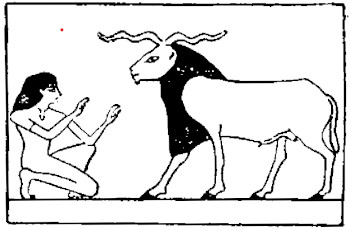

 in the title of Chapter 17, instead of

 ‘fire’
derive their names from their

 , but in this place it may
simply mean ‘going round in a ship.’


 ,


 , explicare, ‘disclose, unfold, reveal, make clear.’


 is the older reading, but
 seems to be
the more correct.


 inanes, empty, void. In the
papyrus of Nebket (Pe) the vignette shows the deceased person
transfixing the dragon. The chapter itself was said over a wax
figure of the demon.

 ‘gods of wax,’
and some men “for the purpose of paralysing the limbs of men


 .” See Chabas,


 ‘Soul most mighty,’ is one of the
principal names of Osiris. The whole chapter is spoken in the
person of Horus, the son of Osiris.

 or


 ‘the god is joined with Law,’ which is supported by some
of the older papyri, is intelligible in itself, but not in this context.
I have understood

 ‘deep darkness.’

 and in the evening the Sektit


 . And the whole term is written

 ḫem is


 is “small,” like the Coptic
ϣⲟⲙ = λεπτὸς, it is not improbable that the stars received this
appellation on account of their tiny size as compared with the Sun
and Moon. They were what Horace called the
 . Is this an oversight on the part of the scribe, or is
it one more proof that the Egyptians certainly believed in a sky
below the horizon? If so, I have never seen it misplaced.

 ȧbṭu, the Tortoise, and that the latter is
characterised by
 ,
 , ‘its rotation, revolving or turning,’
the word ȧbṭu, whether applied to ‘month’ or ‘tortoise’ clearly
signifies ‘the revolving one.’ Our modern words Tortoise, Tortue,
Tortuga, rather express the turning or twisting of the creature’s feet.
In some texts, e.g., the inscriptions of Amenhotep, the son of Hapu,
Mariette, Karnak, pl. 36, line 22, and at the beginning of the Ani
Papyrus, the word is written


 ‘in Amenta’ or


 ‘going round on
high with the Sun.’ Hence the use of it as synonymous with
 ,
in the expressions


 ‘never’ and


 (
 .
 , that is all associated with him,

 should express the ‘feast of the New Moon’ is
only natural, though Lepsius has pointed out serious difficulties on
the subject.
 ? Brugsch translates it “the Talisman of the Earth,” and
Pierret

 ta the Earth, is substituted for
Seb. I believe then that
 is best translated by Soil of the Earth.
 , just as Mau-tȧ signifies the god with the face or form of a Cat,
Tehuta, the god with the head or form of an Ibis.

 consisting of the Sun rising out of the
East, between Isis and Nephthys. The sign of Life
 . He
is saluted by three hawk-headed and by three jackal-headed divinities,
the Spirits of Pu and of Nechen. Below this scene the Sun of
Yesterday and the Sun of To-day in lion forms are saluted by Isis
and Nephthys.


 Ȧn-ḥeru, ‘The Lifter up of the Heaven.’


 signifies can, ken, and kin.


 ben is a
verb of motion, and particularly of ‘going round.’
 benenu is
a ring, also a ‘round pill.’ The Sun therefore is very naturally
called bennu, an appellative like κυκλοέλικτος in the Orphic hymns.

 , ‘of that which is, and of that which cometh into
being.’ Here, as in many other places,
 , that which (is). So far from signifying
‘being, that which is,’ it very much more nearly corresponds to
 in the frequent expression

 is proved by the numerous
variants of this passage to be Ȧmsu. In M. Naville’s edition, II,
pl. 41, the name, as written in Ce, would seem to be
 , following

 or
 , which are
ligatures of


 reḫit, by whom the oblation is made,
the present generation as contrasted with the


 Māāāait is supposed to be nitre or
salt, or some other substance used in the process of embalming.
 , means “behind the
Shrine.”


 ‘in life, health and strength, without
any damage.’
 is of course Osiris, as
it is plainly stated in the later scholia, which further add that the
‘Seven glorious ones’ who follow the coffin, or, as they read it, “their
Lord,” are to be sought in the constellation of ‘the Thigh in the
northern sky,’ that is in the seven stars of the Great Bear.

 seem to
imply double stars. The ‘Red-eyed’ is said to abide in


 is the son of Seb and Renenut. The etymology of the name is indicated
in the Pyramid texts.
 neḥbet a neck, and
 ‘victuals.’ The god is one of the forty-two judges of the dead,
and in some copies of the Book of the Dead he is described as
coming forth from his

 , “of many windings.”
(See Pepi I, 341 and 487.)
 Âmemit in the pictures of the Psychostasia.
The later scholia add that the Devourer comes from the
‘basin of Punit,’ the Red sea. They add other names,


 Baba, who, in ch. 63, 2, is described as the
first born of Osiris. He is a terrible god from whom the deceased
prays in ch. 125, 36, to be delivered. His name implies ‘one who
searches or probes thoroughly,’ as a digger or miner. And such
are his functions at the judgment of the dead.

 sȧu, a sheep.
 Mesqȧt is a

 ‘a place of scourging.’
The word
 is known as signifying violent treatment
by beating, and has been illustrated by Chabas and Goodwin. See

 is a divinity seldom, if ever, mentioned
after the “Middle Empire.” In the Pyramid texts he has a Snake
(the River) in his hand.
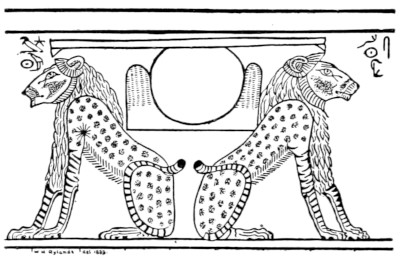
 Amsu.


 in the historical inscriptions is just like the Greek
γυῖα λέλυντο, λύτο γούνατα καὶ φίλον ἡτορ.


 .
 .
 as a feminine noun and proper name occurs in the
Pyramid Texts (Unas, 644).


 , and
the Southern and the Northern
 and
 Tmu, the long sign is written first though
read last.


 is not a mere gate, but a hold, or keep.
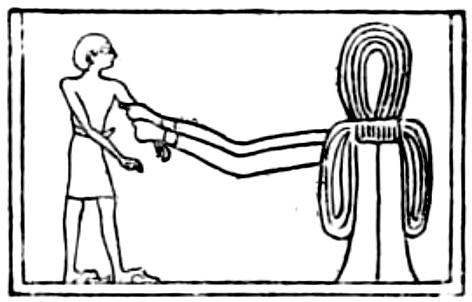

 (Unas, 422 and elsewhere).
 . Another form is


 in the papyrus of Nesichonsu,
published by M. Maspero, Miss. Arch., I, p. 612.
 (as I read it) an augmented form of
 , ar, which does
not mean pluck, as in Brugsch’s translation, but bind, fasten, twine,
 ,
 , and lead to still more interesting results. For the ancient word

 , ȧarerit, ‘a vine,’ has thus clearly the same etymological
sense as our European word vine. “Vî-num ... attaches itself to vî-tis, vî-men,
vî-tex, and—exactly like the Greek ϝοῖ-νος—to the Indo-Greek root vei, ‘to
twine.’ So that vî-no means first ‘creeper,’ then ‘fruit of the creeper,’ finally


 (see


 ,

 . See my article in the

 ,

 ,
a produce of the cow, such as cream or clarified butter. It occurs in all the
lists of offerings.

 .
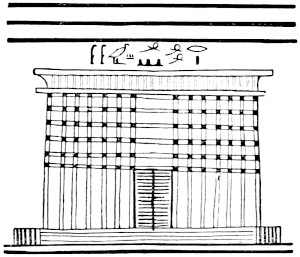

 , Rechit, mankind actually, living, as distinguished
from the dead or yet unborn.


 , applied on the walls of tombs to
persons (male as well as female) executing certain gymnastic movements.


 , and of Uammeta
 , against both of whom a passage of the ‘Book of
Hades’ (Bonomi, Sarc., pl. II A) has been quoted. The book, of course, is of
inferior authority to the ‘Book of the Dead,’ but in any case it must be
remembered that these names, as appellatives, are common nouns (Uammeta is in
the plural number in the passage in question), and may simply mean Serpents.
Sutu is called by the first of these names at Edfu (


 ,
 and

 of Dendera, the Crocodile is Sut,
and the Feather upon his head is Osiris.


 ,


 bear to

 ,


 , which affords good
reason for thinking that in Chapter 115, as elsewhere,
 was originally
written without its phonetic value.


 is not simply ‘this god’ but ‘the Strong
 at chapter 64, 23, is undoubtedly the overflowing, or outpouring.
There are the reduplicated Coptic forms

 ,
and has the same sense etymologically as the Latin
 and of
his

 occurs three times.
 represent what we call the Belt of Orion with its three bright stars?


 .
 ; the ‘Nest of Reeds’


 septu ābu, ‘armed with horns,’ that
is, rays of light. In pictures he is represented as a hawk armed with
bow and arrows, and there is one picture in which he is in the form
of Bes, destroyer of the Menti.


 “with his two knees at the pit of his stomach.” The


 .
Cf.
 in the later texts. It is the emblem both of Osiris
and of Horus, and is constantly represented along with bows, arrows,
and other weapons, in the oldest coffins, as belonging to the
celestial armoury of the deceased person.

 is probably nearer in meaning
to the Greek χλωρός, ‘pale green, yellowish-green.’
 . It was
made by Horus for his father Osiris Unneferu. Septa is the fifth
royal name on the great tablet of Abydos.


 ) upon Hu, and after Sau has
been fastened to his feet enters the bark and seizes upon (

 ) over which the god is conveyed. This river is here
described as infinite in length. This is one of the instances from
which it is clear


 , often written with the determinative
 .
 does not signify wise, nor has it
anything to do with instruction or perfection, as supposed by other
translators. As an adjective it is used to qualify not only animate
but inanimate things, such as an egg, beer, and incense. The well-known
expressions
 exactly correspond to
the Hebrew


 , which is the usual reading
here in the later recensions. The same meaning may be made out
of both groups. The stars are manifestly alluded to, as being made
to disappear when the Sun makes his appearance.
 , or in
reduplicated form


 . An explanation of this
will be found in the pictures and text of the Book of Hades. In
Bonomi’s


 .

 . I understand the latter in all such cases to
signify the shining of the sun on his rising, and the former to signify
the shining of the sun in his afternoon course.


 , or of the
two Rocks, called in the time of Herodotus Krophi and Mophi.

 . It is strange that this
meaning of the passage has so long been misunderstood. The
sense of the first word has long been recognised, and ‘deaf’ is the
meaning rightly assigned to


 Offerings of (or to) the
Moment have the appearance of an interpolated rubrical direction.
See next note.
 .


 . See Bonomi, Sarc. 8 D. and cf. a
passage in the Pyramid Texts (Pepi I, 413, Merenrā 590) which
refers to this or a similar voyage. M. Maspero thus translates it:—


 .

 . The word has disappeared from
the later texts and been replaced by various conjectural emendations
of the scribes.
 , one of the divinities in form of
apes. Etymologically the word signifies “the hot one.”

 also occurs and so does


 phonetically

 , in most of the
papyri. Some of the words which follow are evidently in very
corrupt condition.


 .
The fishes are different. On referring to M. Naville’s Festival Hall of Osorkon II,
pl. 18, pictures will be found of the
 and the
 , ḥem, in harmony with the other evidence
produced by W. Max Müller (


 Ba and Marseilles:

 , Ba,


 .


 is the well known title of a
priestly official, whose presence was required in the ritual of the dead.
He is sometimes in attendance upon royal personages. Here
according to its etymological sense the word might simply mean a
relative.


 , the “Red Land,” is whatever lies beyond the limits of
Egypt.


 , “with his two hands.”

 “the Eye is full” (cf. Notes on ch. 125, p.
 on his head, as we see in the vignette.
 . This god is the


 pertiu, adjective form of the noun


 , which does not give any sense.

 , 145 and 146 to the
 , the
book of what is in the Tuat, we see that Rā has to go through the


 . But if we consider that in
some of the old papyri the name of the man is that of the gate itself,


 as we read in chapter 147.


 seems to be
‘such as he is, such am I, and such is Rā.’


 , generally mentioned in
connection with storms and bad weather, so that possibly we have


 , which I translate, with
Renouf, the porter or doorkeeper though I should prefer, he who is
within the door, since the vignettes show that the so-called porter or
doorkeeper is the god who occupies the cell. There are 21 pylons,
out of which the papyri give us a certain number. Brugsch finds
in their names those of some of the hours of night or day; but the


 .
 . According to Lepsius, the σχοινιον, 40 cubits.


 to flow, is derived the name

 .
 is often used in speaking
of the pale and silvery light of the moon (Naville,
 or light yellow

 . In most of the papyri there are
only four yellow—3, 9, 10, and 14.
 “domain” (p. 208). Dr. Budge
keeps the word aat, and considers them as the divisions of the
Elysian fields. Pierret translates


 . This word has always been translated fingers, a sense
which is evidently wrong in this place, where parts of the head only
are mentioned, and when one would expect the hair or the beard.
 is often connected with building (Chapter 52).
 the beating in measure as the musicians
do, the regular applause so often heard in the East.


 , who use the clap-net,
and the other to the fishermen, the


 , who
use the drag-net. But in the form in which these Chapters appear
in the three best texts where they have been preserved, London,
9900 (Aa), Paris, III, 93 (Pb.), and the papyrus of Nu, fowlers and
fishermen are mixed together.
 and the
 , called


 (Brugsch, Dict.
Suppl., p. 85), and of its


 (Brugsch, Dict. Suppl., p. 18).
 . I consider this word as derived from


 made me his commissioner of works, having
charge of present and future work” (


 . I believe there is a slight difference
of meaning between this old participial form, and the usual


 ,


 . I consider
 , litt. the destroyers; the word
occurs again further on: the destroyer who is in his bush(?) or cover,
the hidden one. It is evidently a metaphor, for the sense is
obvious; it is putrefaction. The word in the Turin papyrus
 , litt. locks, might apply to the vegetation or
the excrescences which are often the sign of putrefaction.

 . The passage is very obscure.
I believe the drift of the idea is this: after having described very
thoroughly what corruption is, the deceased says: as for me I am
protected against those evils. Even should every being fall into
corruption, having lost the eye of Shu, it is nothing to me, because I
am feared by all.


 , “to receive a cut,” means to be
scratched or incised by a sculptor’s tool. The power of the amulet
consists in making the body of the deceased as hard as neshem.
 , a variant of
 when it refers to Tmu (Nav.,

 cannot mean anything
except a great quantity of flames. These flames will be the
protection of the deceased.


 “the coming forth
by day,” the original Book of the Dead, which in old times ended
with Chapter 149, and later on with Chapter 162.


 , the book engraved on the walls of the royal tombs. It
describes gods and genii of


 the funereal bed
or couch on which the deceased will lie like Osiris. None of them
has a vignette. As in the course of these chapters there is no mention
of the bed itself, we must suppose that they were read while the bed
was raised or arranged. The translation of this text is particularly
difficult, and often conjectural, owing to our papyrus having no
other document to compare it with.

 . I have kept Renouf’s translation,
“strength,” but I believe the sense is the same as before: “solid
ground, dry land, continent (Feste, Brugsch),” as we find in this


 .


 is a
variant for
 when applying to Tmu. Here it applies to Horus.
The unknown word
 “the great one, the great goddess,” and its variants
 etc., occur frequently in the Book of the Dead,
and seem to be a name of the sky.
 is written by a bird with a human head, it
applies to the soul represented by a ram. See vignettes to Chapter 85.


 means properly a hunter, a man of the field, which
would have no sense here. Unas reads


 .


 is given by the words of Nu
 “I died yesterday, but I come to-day.”

 this day,
the present day, is life. Leaving what has been, and coming to what
is, is only a figure meaning resurrection after death.

 means reconstitute, restore,
and not avenge. The common expression, Horus the avenger of his
father, should be translated: “Horus who reconstitutes the body of
his father” torn to pieces by Sut.

 , a kind of oval case. The text here reads


 , which has no meaning.
 worn by the sphinxes.


 (Schiaparelli,
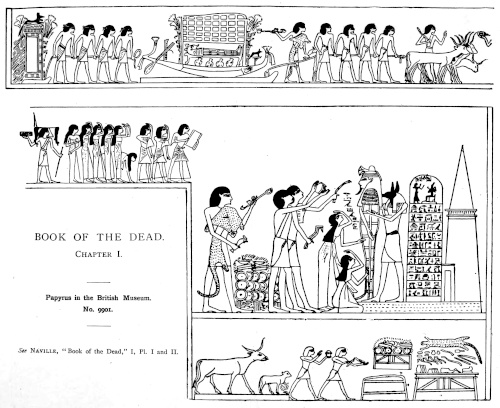
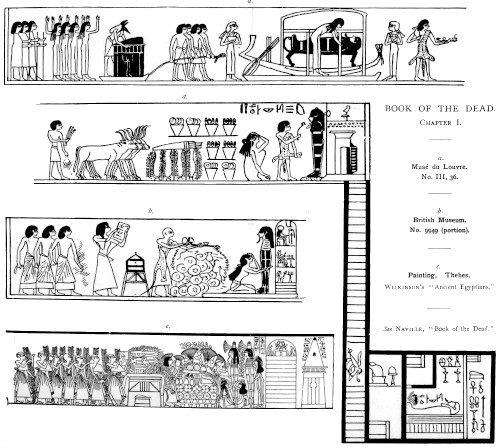
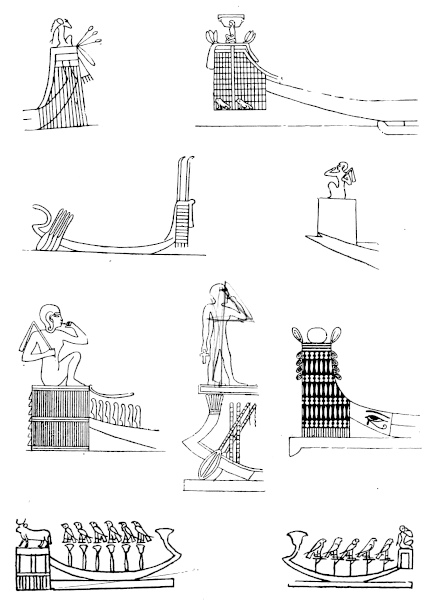
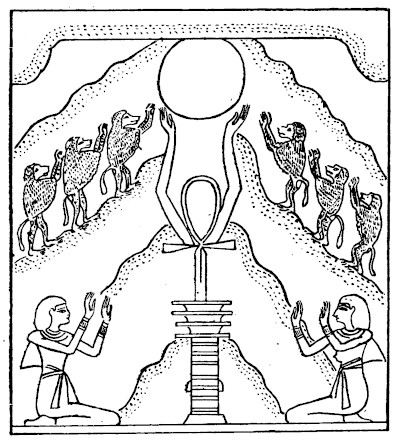
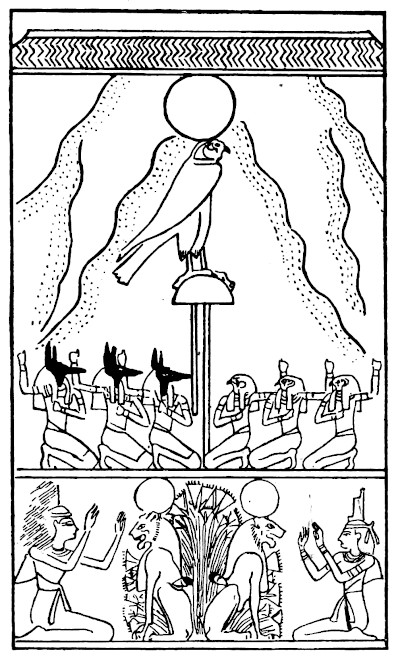
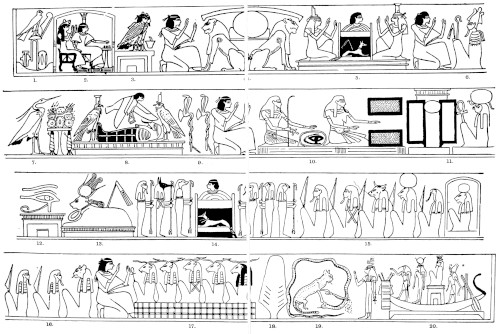

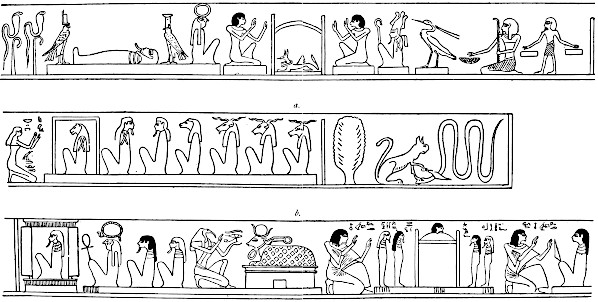
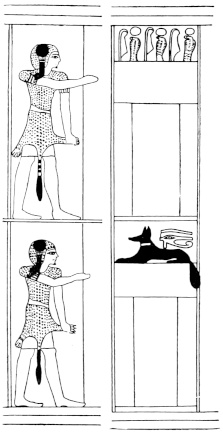
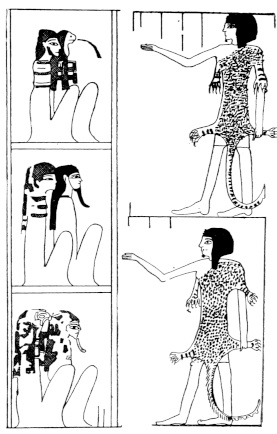
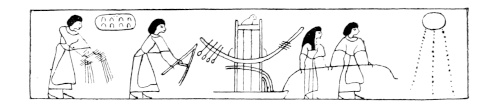
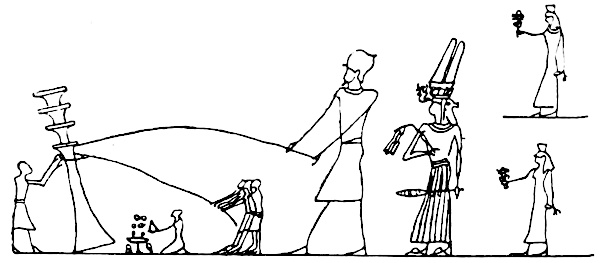
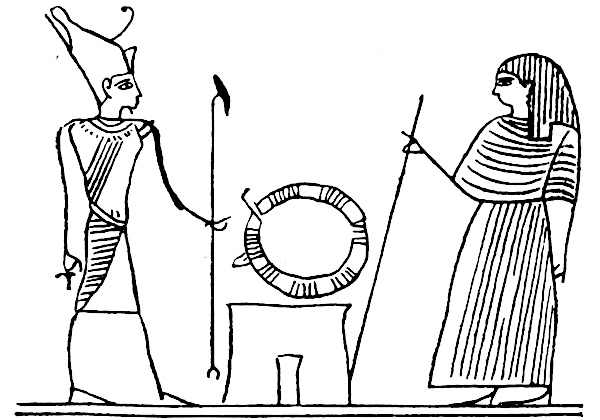
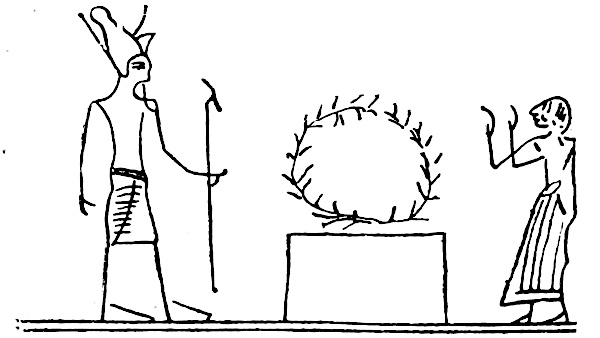
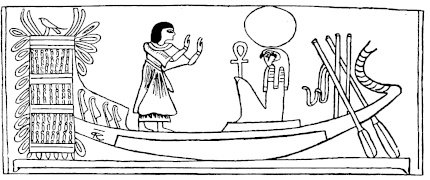
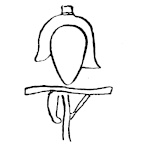
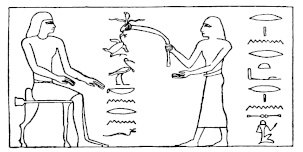
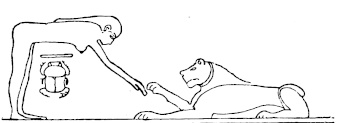
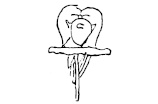
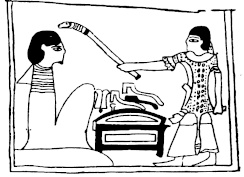
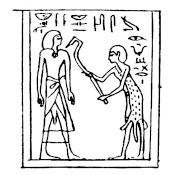
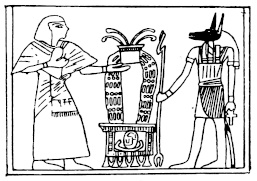
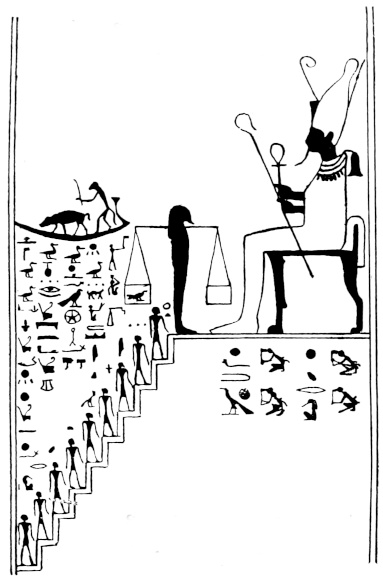
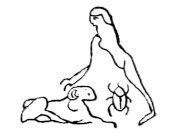
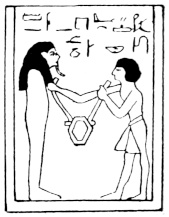
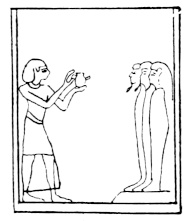
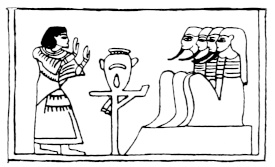
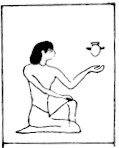
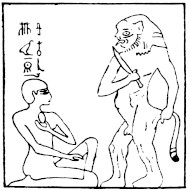
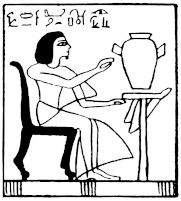
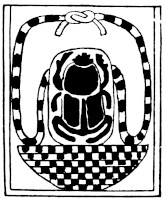
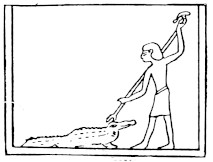
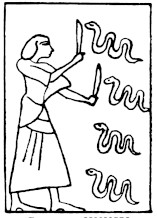
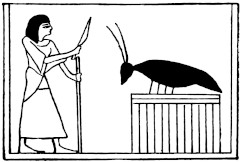
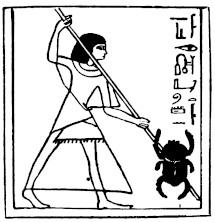
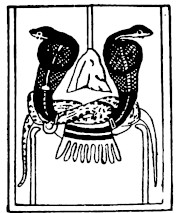
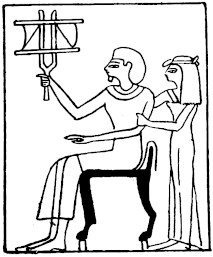
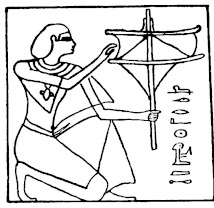
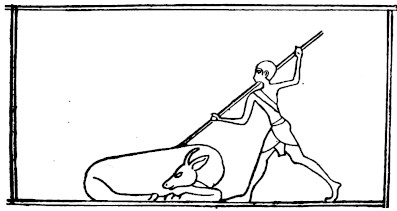
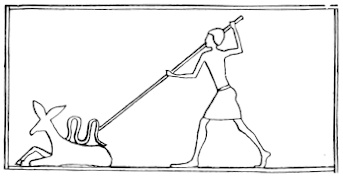
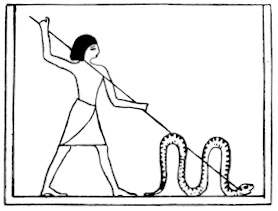
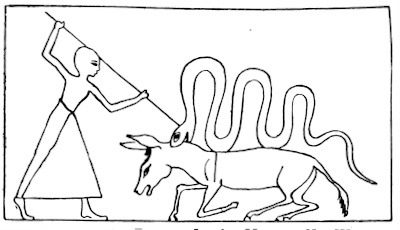
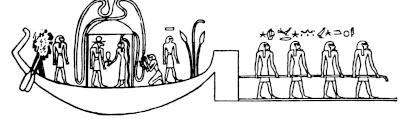
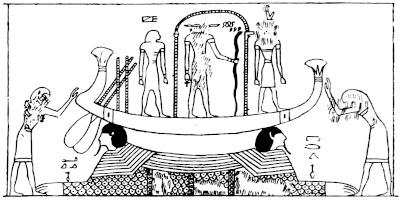
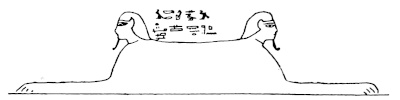
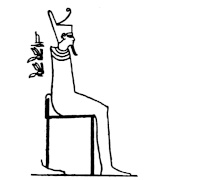
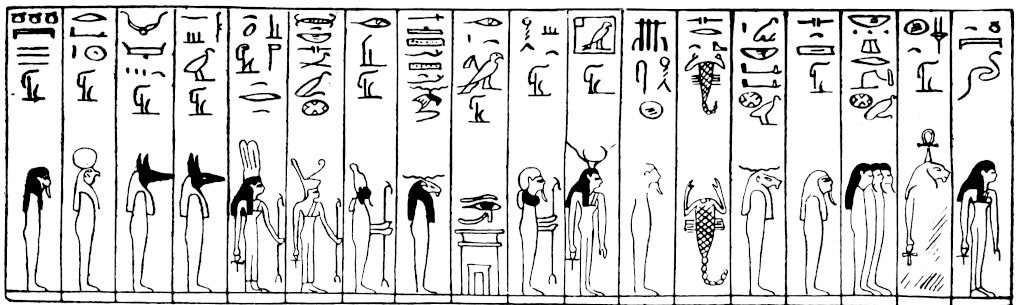

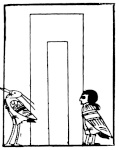
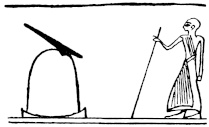
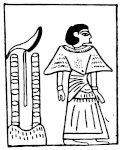
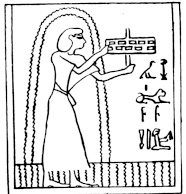
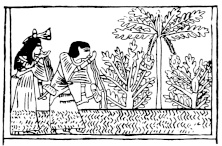
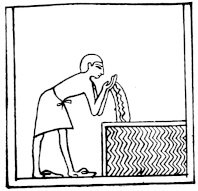
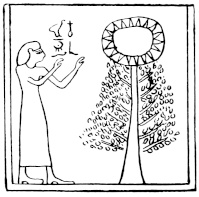
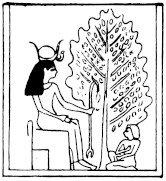
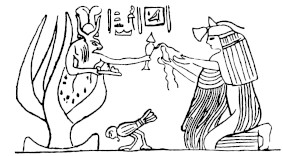
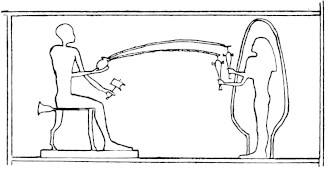
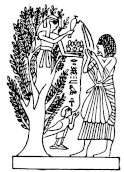
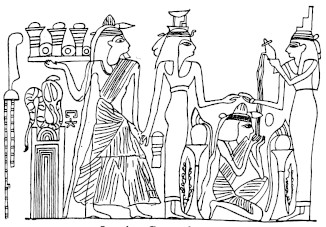
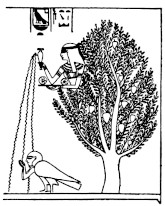
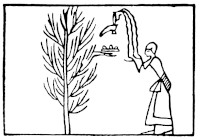
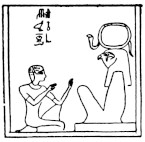
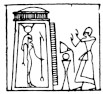
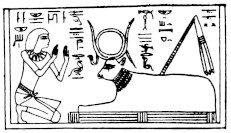
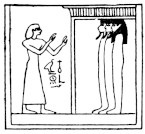
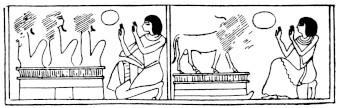
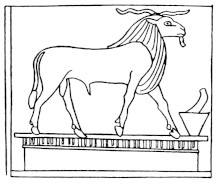
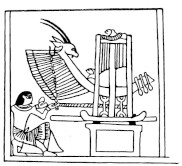
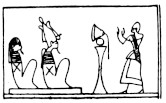
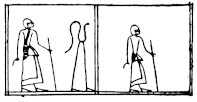
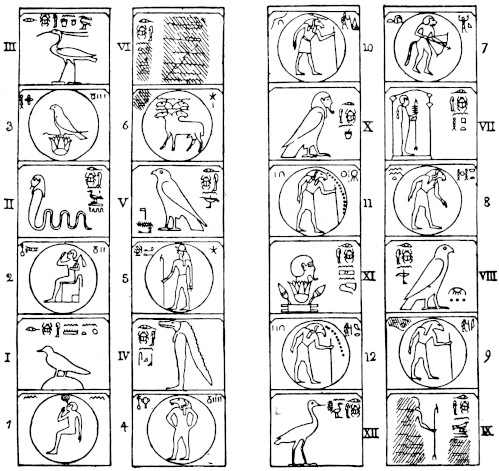
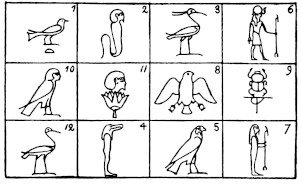
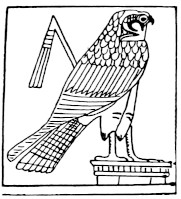
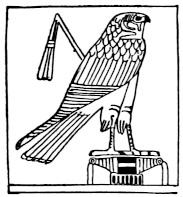
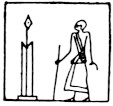
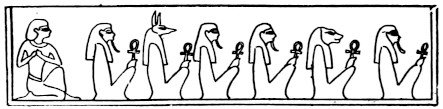
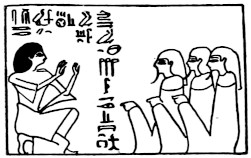
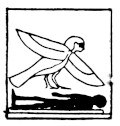
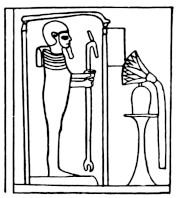
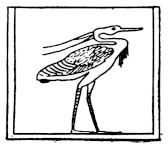
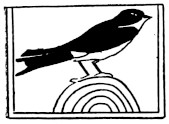
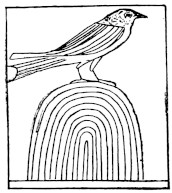
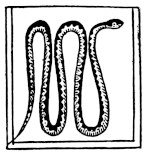
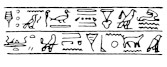
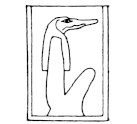
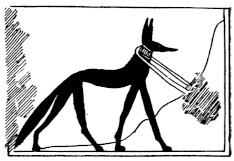
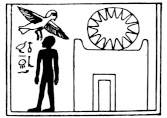
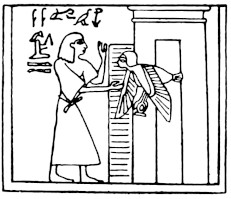
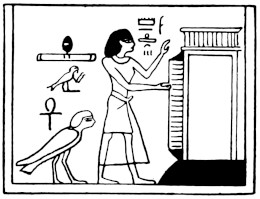
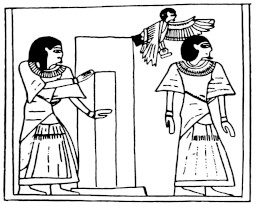
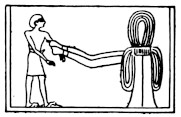
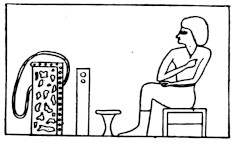
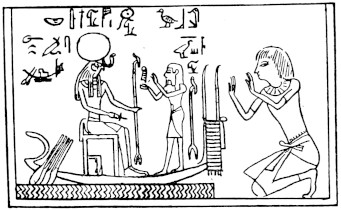
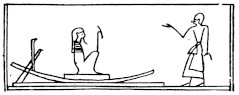
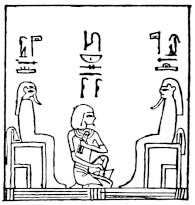
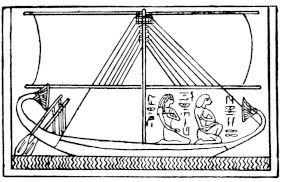
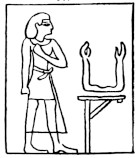
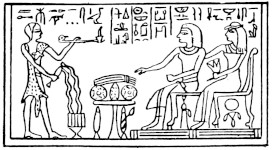
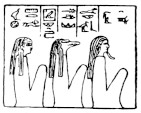
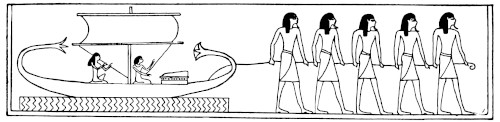
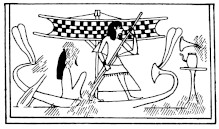
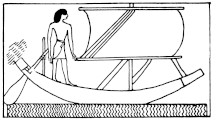
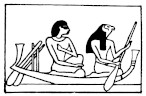
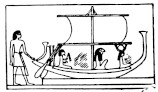
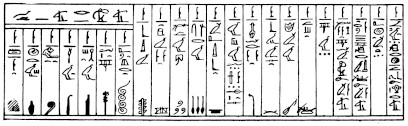
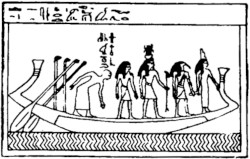
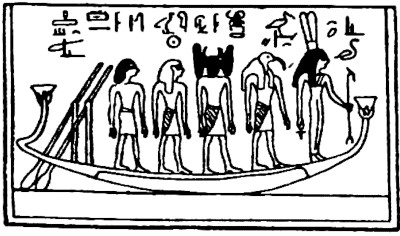
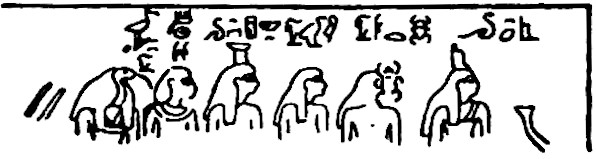
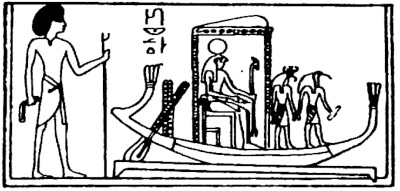
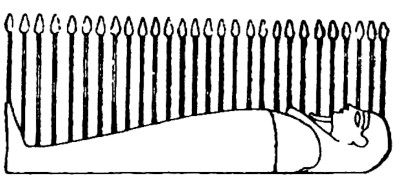
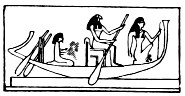
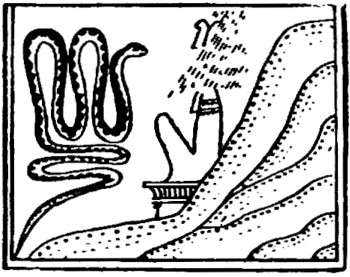
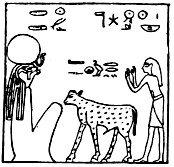
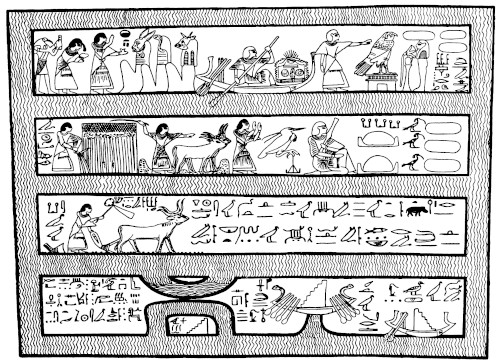
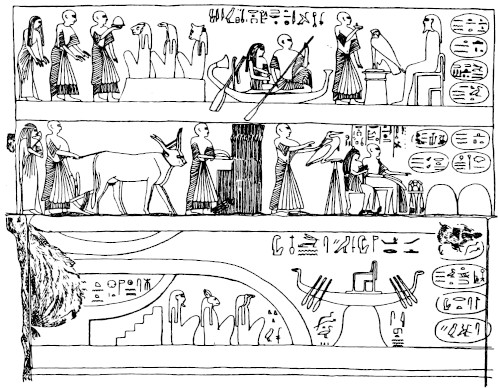
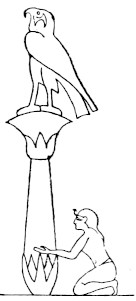
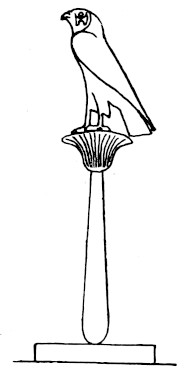
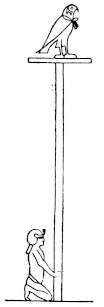
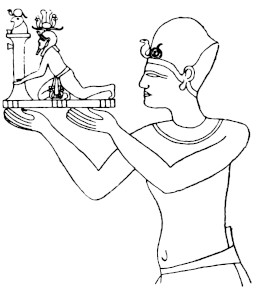
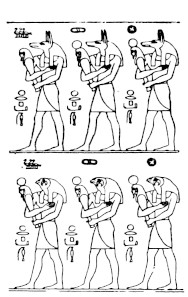
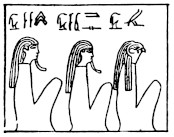
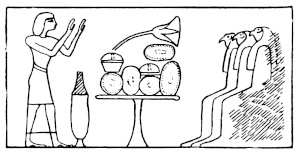
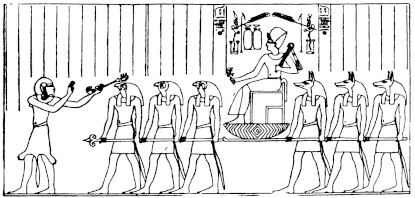
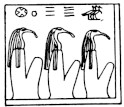
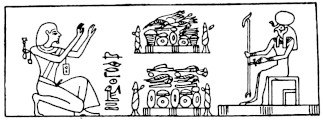
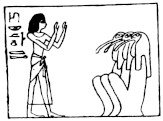
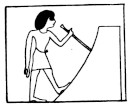
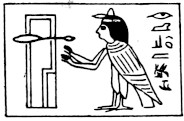
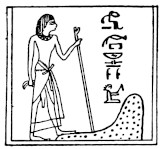
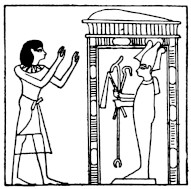
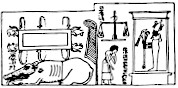
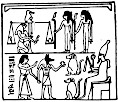
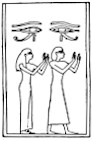
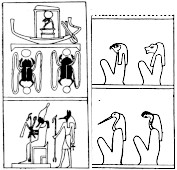
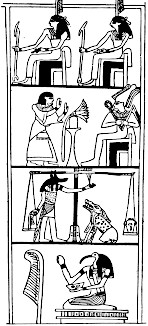
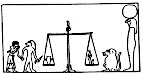
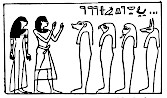
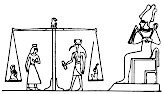
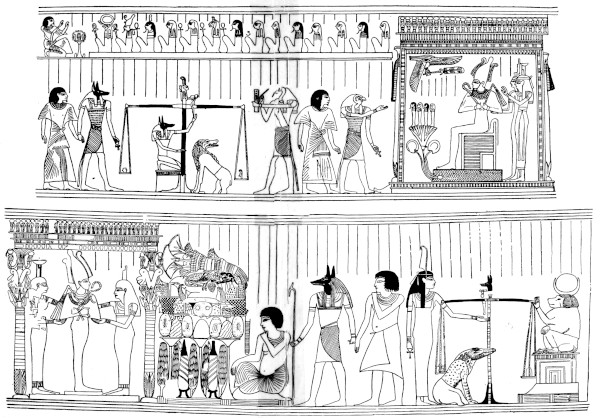
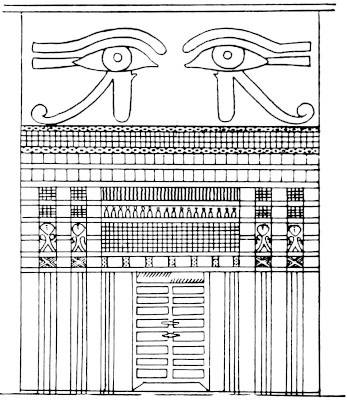
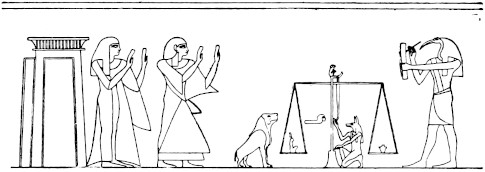
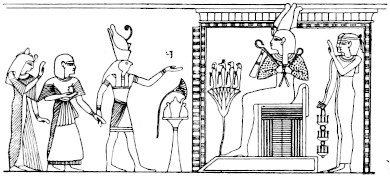
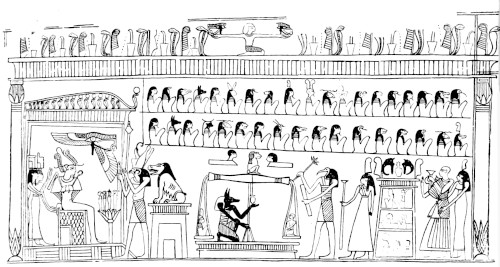
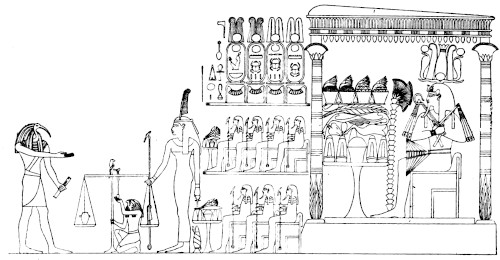
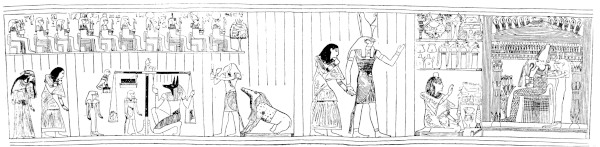
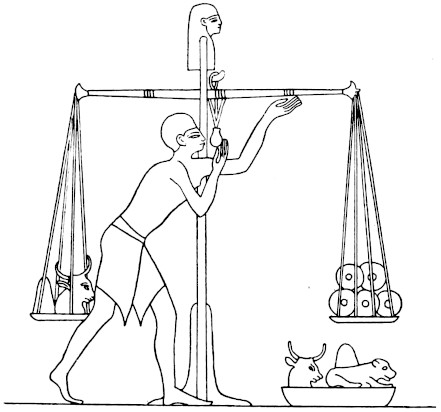
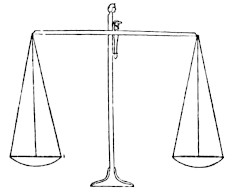
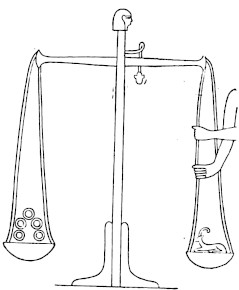
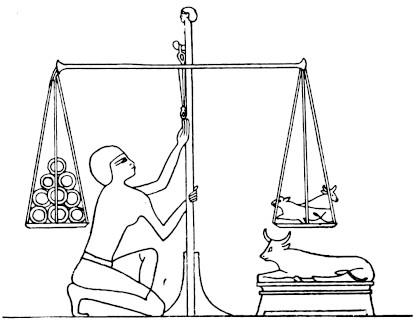
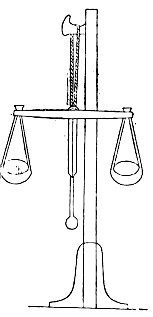
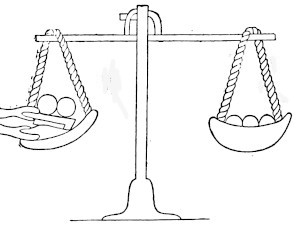
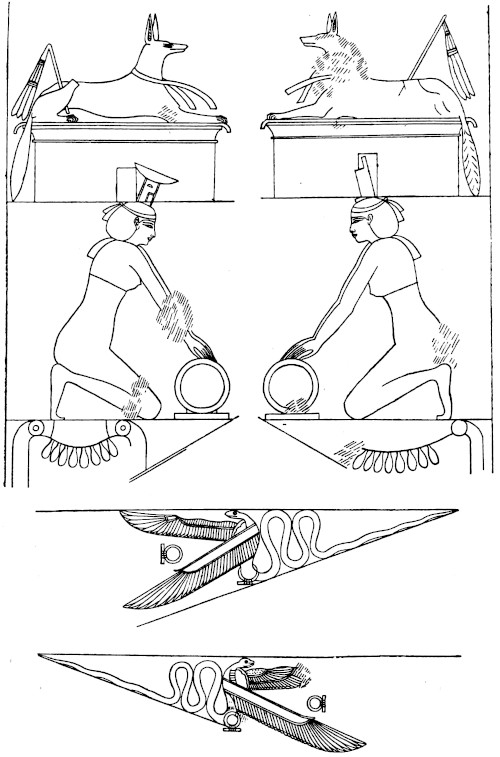
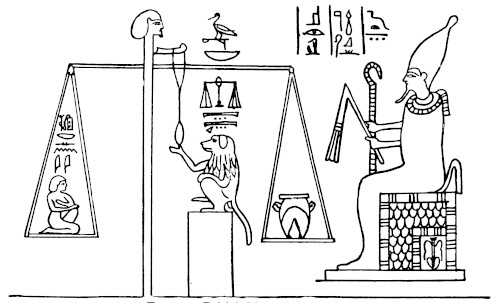
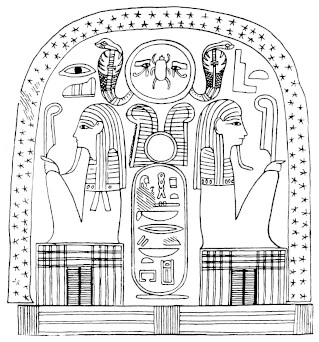

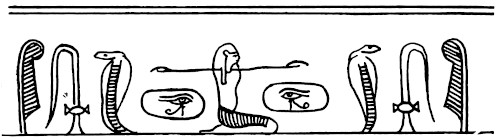
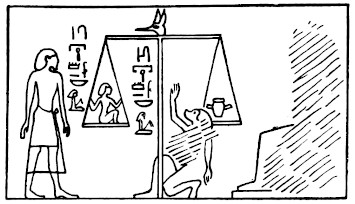
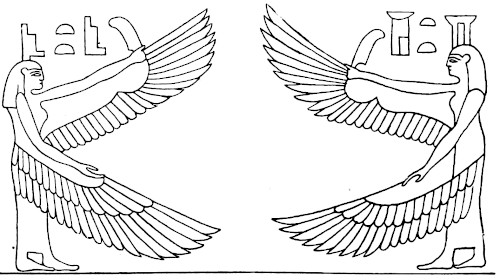
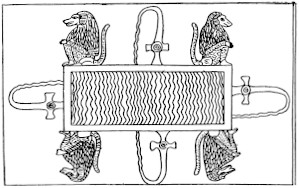
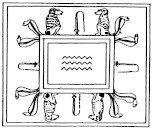
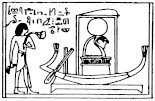
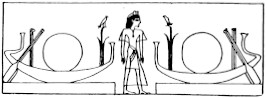
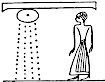
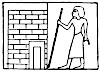

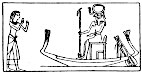
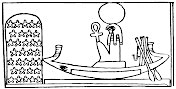
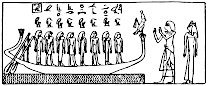

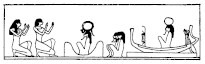
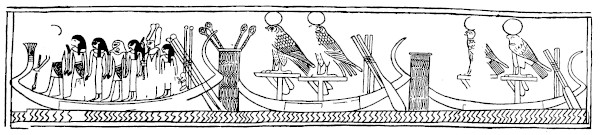
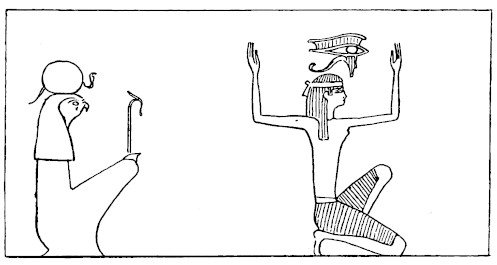
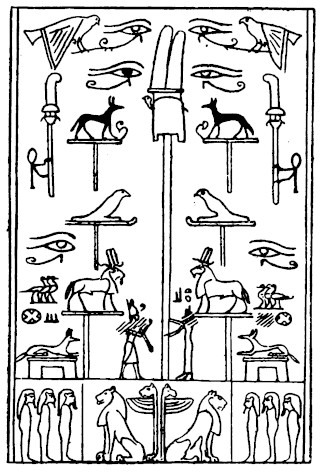
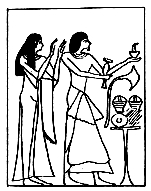
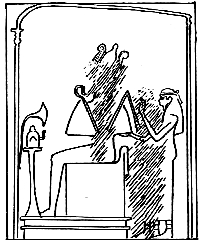
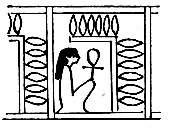
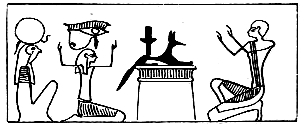
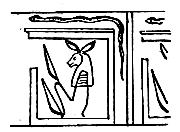
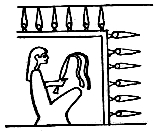
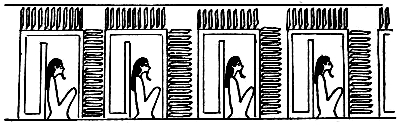
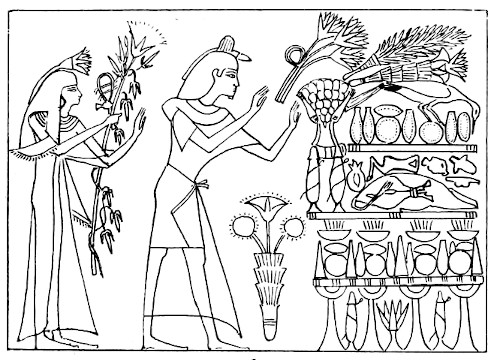
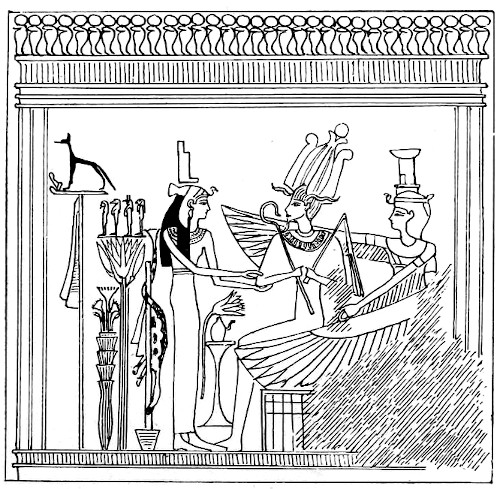
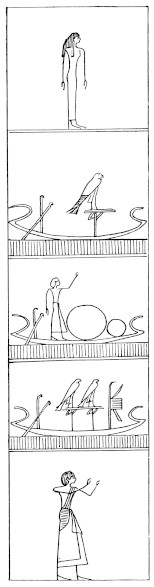
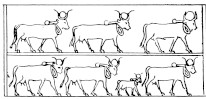
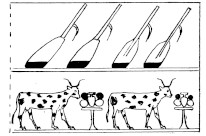
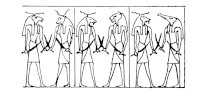
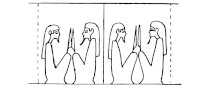
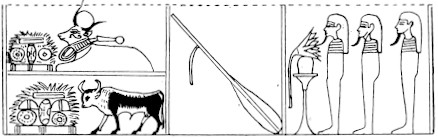
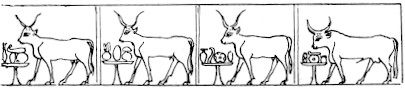
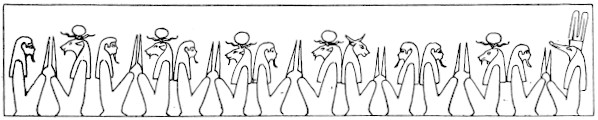
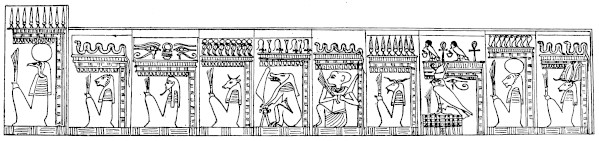

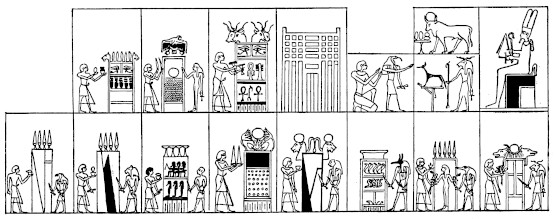
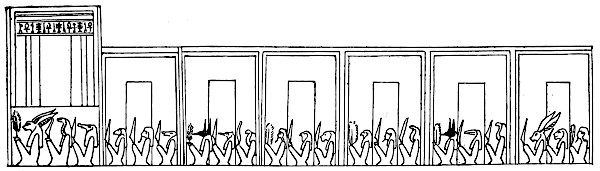
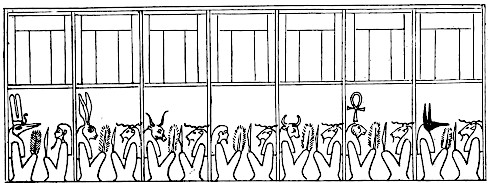



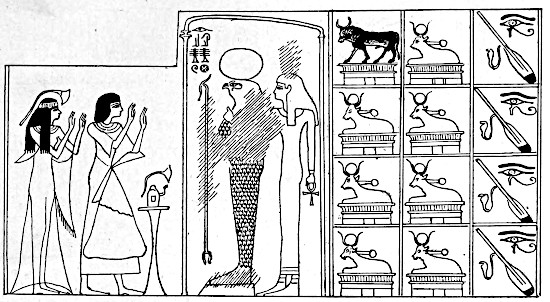
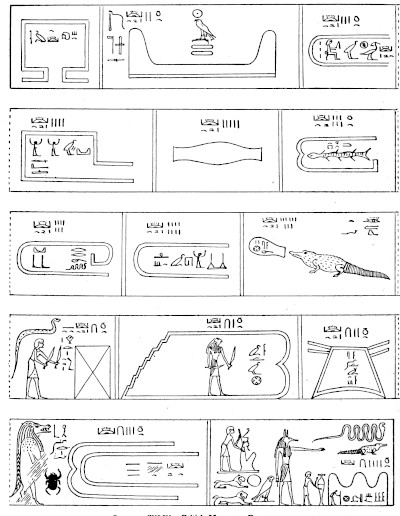

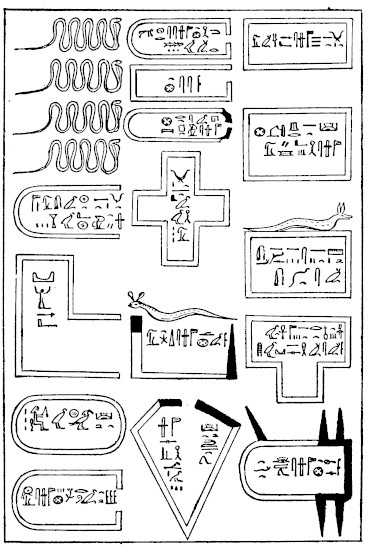
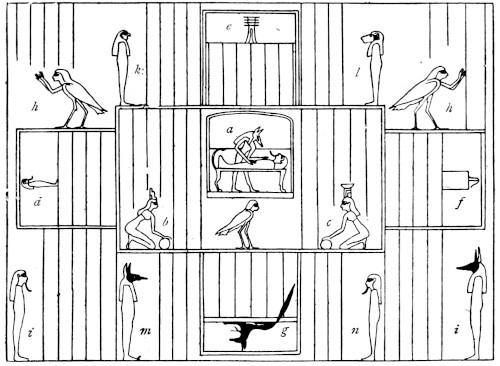
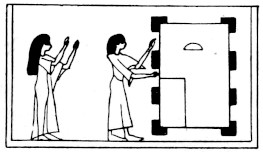
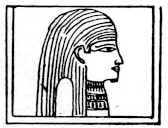
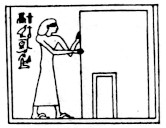
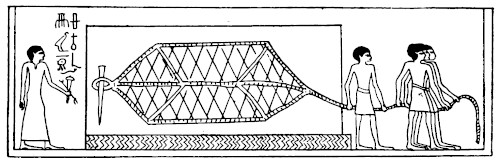
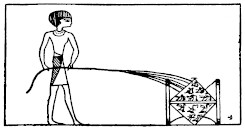
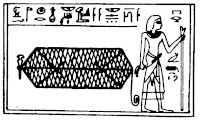
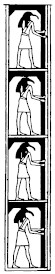
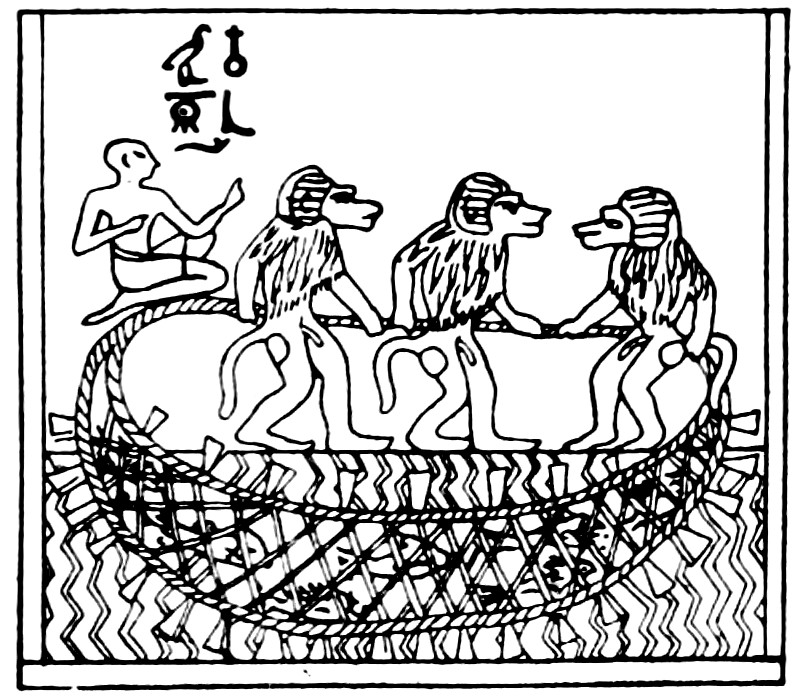
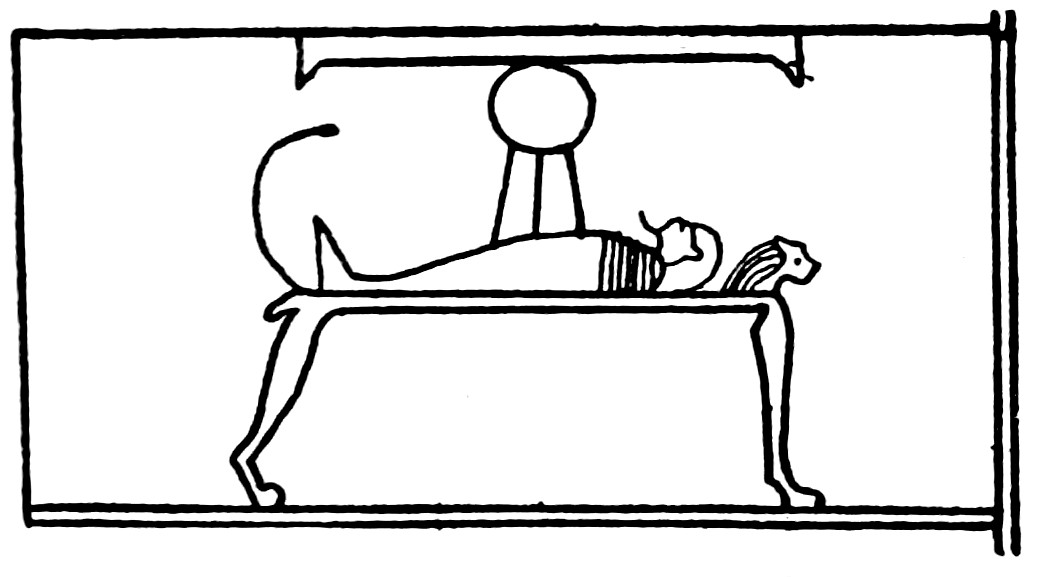
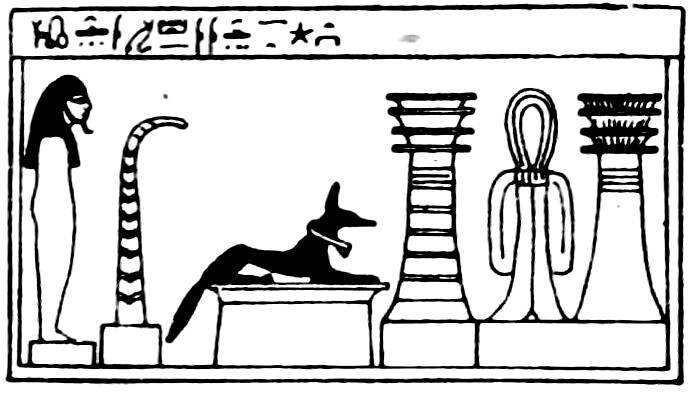
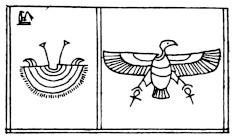
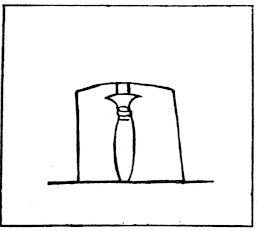
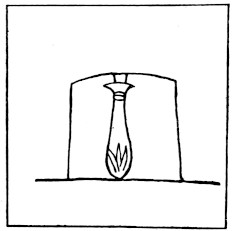
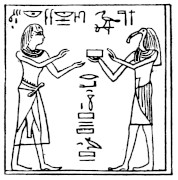
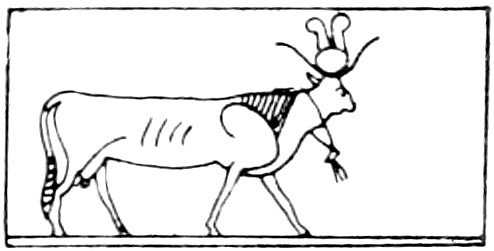
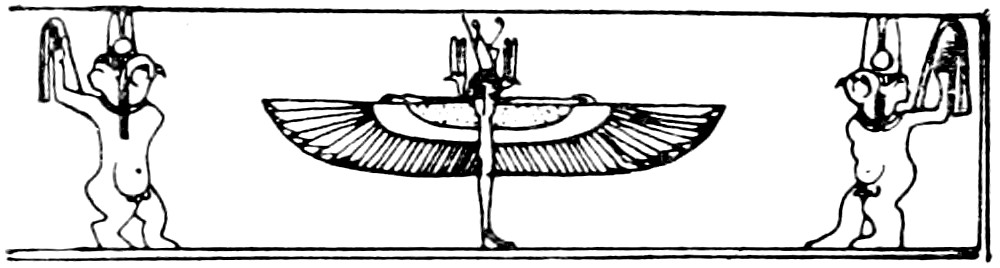
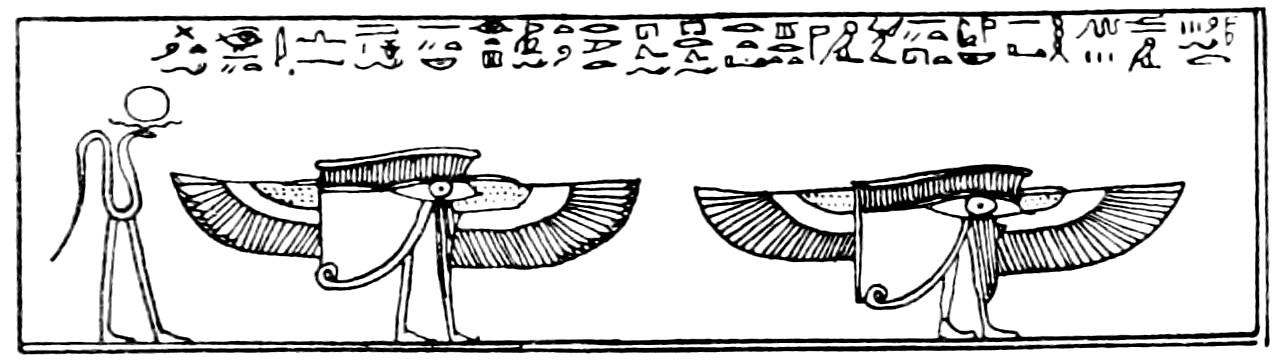
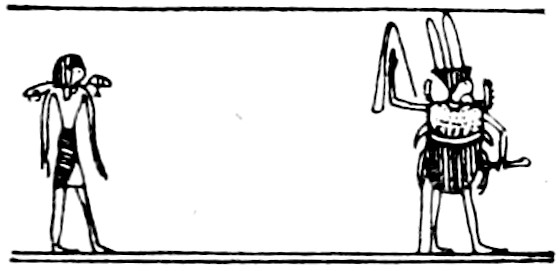
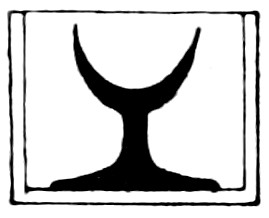
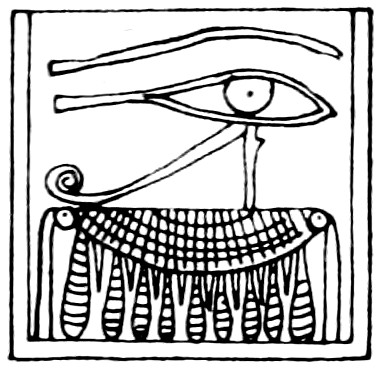
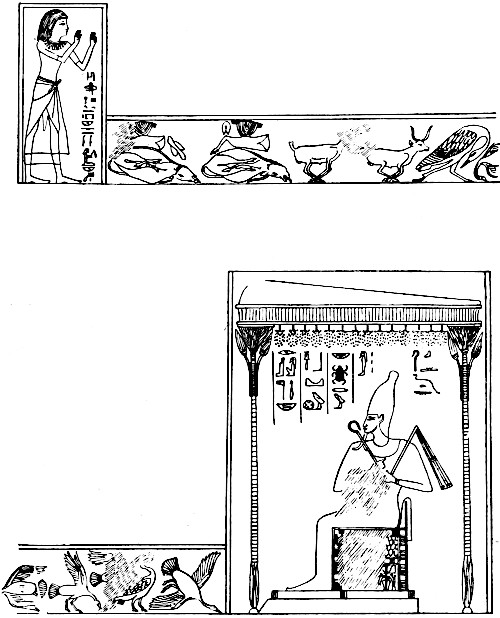
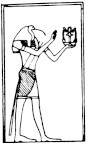

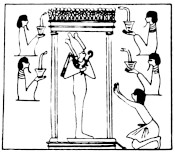
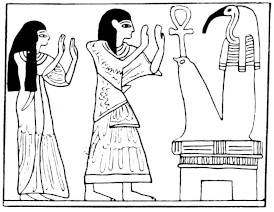
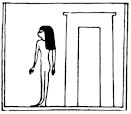
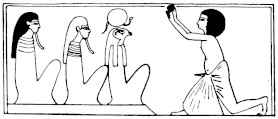
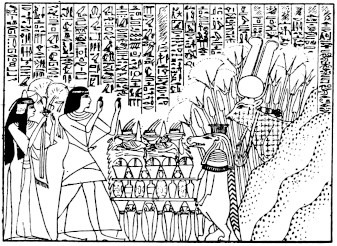
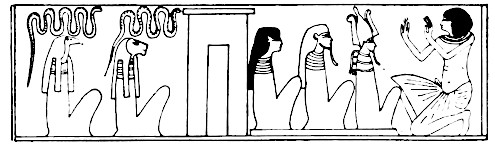
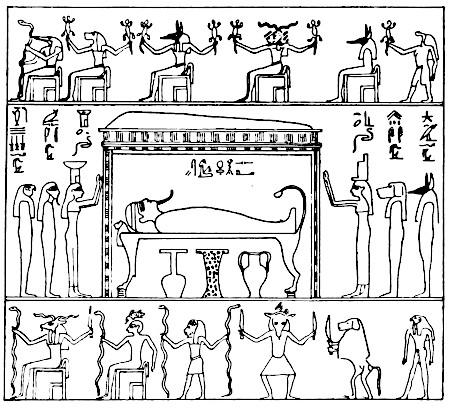
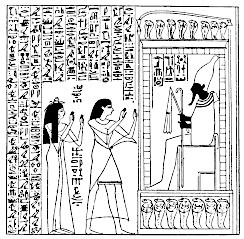
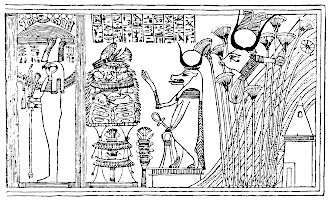
 is rendered as ܐܷܠܴ.