The dark trees along the centre of the boulevard looked
almost artificial against the greenish glare of the electric
lights. From every café streamed bands of revellers,
their brilliant costumes adding to the theatrical appearance
of the streets. Dominoes of every colour flitted about;
orange, purple, emerald and lemon yellow. Showers of
confetti made a pink and blue snow upon the ground, and
the moving crowd passed in and out from the dark shadows
below the trees to the clear-cut brilliance of the light.
Rattles and toy trumpets sounded shrill above the under-note
made by the murmur of the populace. From some
building came the noise of dancing and the crash of a band.
Groups of absurdly dressed figures pushed their way through
the restaurants, here a Teddy bear linking arms with a
Red Indian or an English jockey escorting a ballet-dancer.
And up and down the roadway went little knots of the
poorer people in family parties, father and mother in
dominoes from under which appeared cheaply-shod feet,
whilst rather shabby small Pierrots trotted by their side.
The few fiacres could only move at a foot’s pace, the trams
had ceased running. Behind the noise of the carnival
and the hum of voices the town itself was strangely hushed
and the tideless sea down by the harbour made no sound.
Through the foliage of the trees gazed the quiet stars.
There was a queer unreality about it all, thought the
Englishman as he sat at a small table on the raised terrace
of a café and looked down on the passers-by. Vaguely it
struck him what a fine design it might make, the dark
heavy mass of greenery carved against the glittering
background of the lamps, and the coloured snake of people
that wound amongst the stems, paused, coiled and uncoiled.
They shared the unreality of the whole thing. He
felt they could not be real, they were just a boxful of dolls
taken out to be played with and to be swept back into
oblivion when one was tired of them.
The air was soft and warm and it was pleasant to sit
there and gaze dreamily at the shifting scene. A few
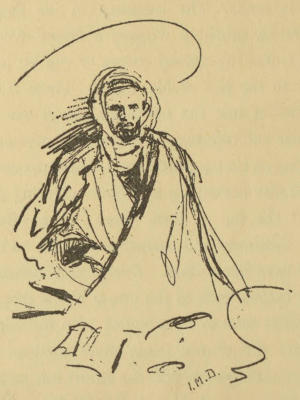
Arabs passed, looking impassively at it all: and it was
impossible to read the expression on their dark faces. A
group of palms stood black against the star-freckled sky.
The whole picture in its strangeness stirred his imagination.
This was Africa, even though the country of Tunis were
but the fringe of it. No sea stretched between him where
he sat and the hot wide spaces of the Sahara. Were one
to ride and ride into the far distance, at last one would
escape civilisation altogether, would reach to the primitive
roots of humanity. And it was a mere chance that had
brought him here.
He loved the sea and hated all liners, so was taking a
trip in the Mediterranean on a small steamer. There had
been a slight breakdown of the engines, and the ship had
put into this little port for repairs. The first night he
spent on board watching the twinkle of lights on the shore,
but to-day he had landed and found himself in the midst
of Carnival rejoicings. He was the only Englishman on
board, and it seemed to him that he was the only Englishman
in this town. At any rate he had seen no other. He heard
French, Italian and Arabic spoken round him, but nothing
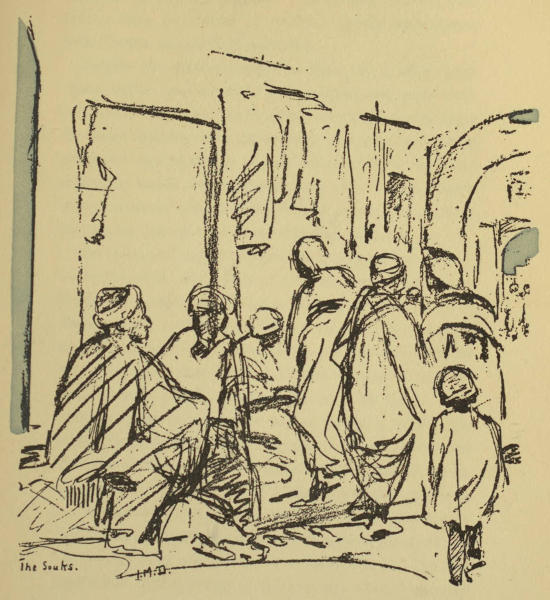
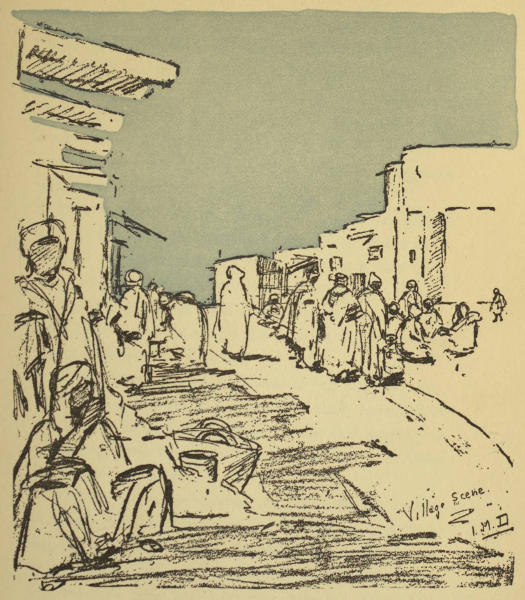
else. During the afternoon he had wandered about the
native town, and climbing up a steep and narrow street
that seemed just a gash in the white walls, he had come out
on a height near the fort, from whence he looked down on
the harbour spread below, dotted with tiny craft, beyond it
the restless rim of the sea. He did not know the East, and
the picturesqueness of the Arab town delighted him;
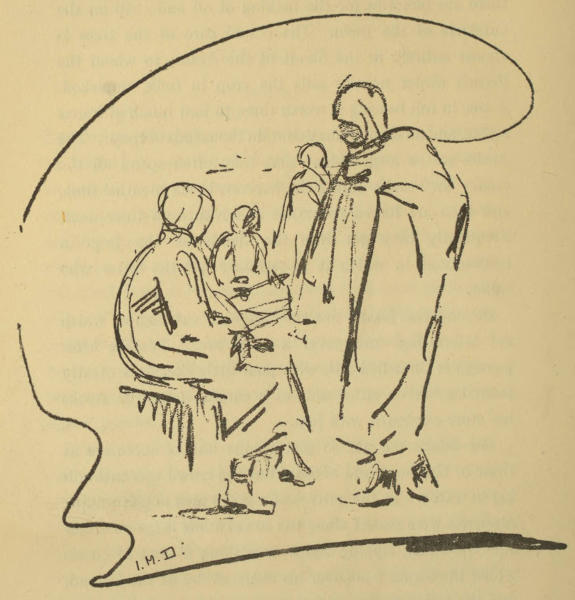
the hooded groups that sat about the doorways, the
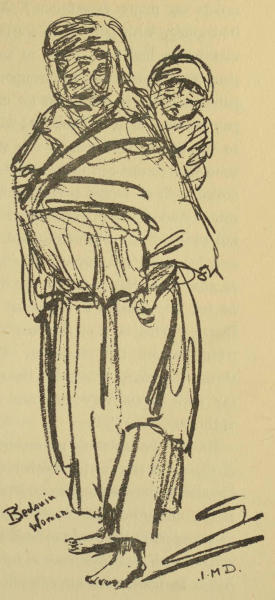
statuesque folds of their drapery, the clash of women’s
anklets, the glowing sunlight that seemed to pour into
every nook and cranny like some rich golden wine. It was
all new and strange.
And now to-night there was the feeling of being an
onlooker at some fantastic theatre-scene. As he sat
smoking and watching, a passing Columbine glanced at
him and smiled; the Englishman in the grey tweed suit
looked so alien in this stir and flutter. And he was young
and good looking. Why should he be alone? But her
glance was thrown away upon him. He sat watching
the scene, absorbed.
He had been there, perhaps, an hour, and was about to
pay for his drink and move on, when a child’s voice made
itself heard at his elbow. He turned. By his side stood
a small Arab boy, wrapped in a mud-coloured garment,
and it was his voice that had aroused his attention. He
gave the child a coin, paid his bill and stepped out into
the street. And again he found the boy beside him. He
was talking in a mixture of broken French and Arabic
impossible to follow. What on earth did the child want?
He turned on him impatiently and the small figure
shrank away, but a few minutes later it was back
again, still repeating some unintelligible phrase. Telling
him angrily in French to go away, the traveller pushed
his way into the crowd. Long festoons of coloured paper
had been flung from hand to hand and fragments of them
hung dangling in the branches, stirred now and then by a
passing breath of wind too faint to set the foliage itself in
motion.
It was close on midnight. He wandered down the
central street on his way to the harbour. As he drew
near, the tang of seaweed and shipping reached him on the
night air; and turning, he looked back at the coloured
necklace of lights that ringed the shore. His steamer was
due to leave early the next day, and this was the last
glimpse he would have of the place. Queer, he thought,
how he had dipped for a moment into its life. Like opening
the pages of a book, reading a few lines, and then being
forced to close it again.
As he stood there, he became aware of a movement in
the shadows and instinctively drew himself together.
The place was lonely, he was a stranger and might be
thought worth robbing. Then his keen eyes made out
the figure of the child who had already followed him. The
boy came up to him, and this time silently held out a scrap
of white paper on which something was written. The
Englishman took it to the light of a lamp and read it with
difficulty. The paper had evidently been torn from a
pocket book, and across it was scrawled in pencil the
words “Please come,” with an almost illegible signature
underneath them. He stared at the writing, puzzled. He
knew no one in the place, and his first idea was that the
paper had been picked up somewhere. But the Arab boy
was pulling his coat gently and pointing to the town. The
man hesitated. Stories of decoyed travellers, of murder
and robbery passed through his mind, and again he
examined the piece of paper.
The writing was evidently English and it was an educated
hand, though faltering and uncertain. The signature was
unreadable but he guessed it to be a man’s. He questioned
the messenger but could not understand what he said,
and the boy kept on pointing to the town and tugging
his coat softly. The traveller did not hesitate long. His
curiosity was roused and there was something adventurous
and romantic about the situation that appealed to his
youth. He signified his decision by a nod, and prepared
to follow his guide.
Swiftly and silently the latter sped in front, turning
now and again to make sure he was followed. His bare
feet made no sound and the cloak wrapped round him so
merged into the surroundings that more than once he
seemed to have disappeared altogether. A late moon had
risen and the roadway gleamed in its light. As they
neared the central thoroughfare with its glare and gay
crowds, the boy struck off into a maze of small streets that
led away from it towards the Arab quarter. The sound
of revelry became fainter and as they climbed the narrow
way they left it behind. Black and white in the moonlight
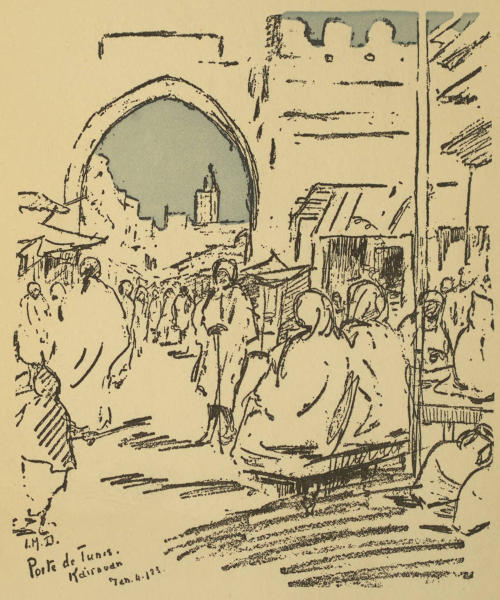
stood the gate of the native town, and they passed
through it.
The narrow dimly lit streets were almost deserted. In
leaving the modern town they seemed to step suddenly
into a different world, a world where men moved
mysteriously on secret errands. The stranger found himself
trying to hush the frank sound of his own footsteps,
to bring himself into line, as it were, with his surroundings.
A solitary shrouded figure here and there approached on
noiseless feet and passed, absorbed and enigmatic. The
roadway became so narrow that there seemed but a knife-blade
of light between the black shadows of the overhanging
houses which drew together like conspirators. Turning
and twisting through the tortuous streets the figure
ran ahead, and the Englishman still followed, though
inwardly somewhat dismayed at the distance he was
being taken.
At last they stopped. A low entrance stood in a recess
before them, and the boy softly pushed a door open and
went in, leading the other a few steps through darkness
to a second one which opened into a small courtyard.
The moon shone clearly upon it, showing the arcaded
passage that ran round it on which several rooms opened.
From one there came a thread of lamplight. There was a
small stone well in the centre of the court and the moonlight
lit the dim carving on it and on the slender pillars of the
arcade. Evidently the house had once been a building of
some importance, but it was now shabby and dilapidated.
The paving was uneven with gaping cracks, and the pillars
were broken and defaced.
At the sound of their approach the door with the light
was held ajar and a woman’s muffled figure appeared. The
small Arab made a gesture to the Englishman to wait and
went into the room closing the door behind him.
A creeper growing in a pot with its leaves trained against
the wall gave out a faint scent. There was the squeak
and scuffle of a bat in the eaves. From far away came the
sounds of merrymakers, so attenuated by distance as to
be little louder than the bat’s squeak. And in the silence
round the listener pressed the sense of people at hand,
of sleepers stirring to far-off sounds. Then the door on
which his eyes were fixed opened slowly and a bar of ruddy
light slid across the cold whiteness of the moonlight. He
was beckoned in.
On entering he found himself in a small and lofty room
with a marble floor on which a few poor rugs were spread.
There seemed to be no windows and a lamp stood on the
ground. The figure of a woman wrapped in a mantle
squatted on the floor, and on a couch in an alcove the
figure of an Arab raised itself with difficulty on one elbow
to look at him.
“What is it? Why have you sent for me?” the
Englishman asked impatiently, feeling there had been
some hoax, if nothing worse.
At his voice the figure smiled. “It’s rough luck on you
bringing you here at this time of night, you must forgive
me.”
The traveller stood amazed. The other was no Arab,
then! It was an English voice, drawling and weak, but
unmistakably that of a gentleman.
“By Jove! you’re English!” said the bewildered
newcomer, staring at the strange figure on the couch.
It was that of a tall man in native dress, the face yellowed
and lined and so thin that every bone seemed to show. He
was evidently very ill, his deep-set eyes burning with
fever, his movements weak and uncertain. The Eastern
robes hung loosely on his gaunt body and he was half
sitting, half lying on the couch, propped up with pillows.
Close by him the figure of a woman crouched over a bowl
in which she stirred a dark liquid that gave out a pungent
smell.
The invalid spoke in Arabic and she got up with a jingle
of ornaments and left the room by another door, whilst
the boy went back to the courtyard. The visitor watched
her ungainly figure moving away, more and more bewildered.
What on earth was an Englishman doing here, in these
surroundings and with these people?
The other had been regarding him with a faint ironical
smile about his lips.
“Yes,” he said, “it’s hard to understand. But there it
is. It’s too long a story to tell. Anyway here I am. I’ve
lived the life of an Arab for years. What’s the phrase for
it?—‘gone under’—yes, that’s it. I’ve gone under. My
name is Dunsford, and there’s something I want you to do
for me.” He paused.
“My name’s Forde,” the traveller answered. “What
is it you want me to do? Why did you send for me?
We have never met before.”
“I know, I know, but I had to get hold of some Englishman—you
as well as another—I can’t live much longer,
and there’s something I want done. I daresay there are
one or two of our countrymen in the place, but I specially
wanted a stranger. I don’t want people here poking into
my affairs.”
“But,” expostulated Forde, “why not see a doctor?
Or have you got one? I could look up someone in the
town: I’m only passing through myself, but I could find
someone.”
“It’s not a doctor I want. I went to see one some time
ago and there’s nothing to be done. I’ve got medicine
and things,” the other added impatiently seeing an interruption
imminent, “I don’t mind the snuffing out for
myself but I’m worried about one of my boys. I
mean for after I’m gone. He’s taken after my side,”
he went on with a crooked smile, “and he’ll never settle
down out here, I want him got out of it.”
Good heavens! Was he going to ask him to take over
the child? The newcomer was appalled. But the invalid
seemed to read his thoughts.
“It’s all right,” he assured him, “it’s not such a big job
I want you to do. I’ve a brother at home, a J.P. and landowner
and all that sort of thing. He’s a hard man, but
he’s just, and he won’t have a down on the little chap because
his father’s been a rotter. He’ll get him to England and
give him his chance. But I don’t want to write to him
even if I could.” He looked down at his wasted hands.
“No, I want you to look him up when I’m safely gone and
to tell him about the boy, and he’ll do the rest.”
“But I’m only here to-night and I’m off again to-morrow,”
broke in the other. “It’s just an accident I’m
in the place at all. The ship put in for repairs, and I shall
never be here again.”
“All the better,” was the answer, “if I had wanted
someone on the spot I’d have got hold of a consul. But
I’ve cut adrift from all my own lot and I don’t want to be
mixed up with them again. That’s why I told Ibrahim
to find a stranger. And I fancy, by the look of you, that
you can keep your mouth shut.” He grinned. “He’s
been out looking for weeks past and it’s just your rotten
luck that he pitched on you. But you’ll do—you’ll do!”
“But how am I to know?” began Forde, and hesitated.
“Know when I’m downed? I’ve thought it out. The
best plan is for you to leave a postcard with me addressed
to yourself, and when the time comes the boy will post
it. No need to write anything on it: you’ll understand.”
He stopped exhausted, whilst the young man stared at
him. After a minute he went on again.
“I’ve got my brother’s address written out ready. His
on one side, and mine on the other, and I’ll give it to you.
You’ll do it for me?” he added.
Forde nodded.
“I’d like to show you my son,” the invalid said, “if
you wouldn’t mind giving me an arm I think I can manage
it.”
The younger man helped him to his feet and supported
him to the inner room. Here there were two beds. On
one lay two sleeping dark-skinned children, but the father
passed them and drew back the coverlet to show the occupant
of the further bed. Seldom had Forde seen a lovelier
boy. Flushed with sleep, his fair hair touzled and rough,
he lay fast asleep, his open shirt showing the dimpled milk-white
neck. In his hand he clutched some cherished toy.
He lay on his side, his rosy cheek burrowed into the pillow,
little feathers of gold about his damp forehead. He seemed
about seven.
Dunsford stood looking down at him, a look of mingled
pride and pain on his face, and Forde was able to study
him unobserved. It was a curious and interesting face,
the brow well-shaped and the eyes dark blue and with
something wistful about them. The watcher fancied that
the sleeping child, when awake, might show much the same
wide and faintly-puzzled look. The father too must have
been fair, but the hot suns of the East had burnt his skin
to a deep tan. Below the close red fez and small twisted
turban his fair hair seemed going grey. His extreme thinness
made the sharp ridge of his nose stand out like a beak,
and there was a deep groove on either side between the
nostrils and the hollowed cheeks. He had been recently
shaved and only a gleam of grey showed along the narrow
jaw. The mouth was compressed, but it seemed more
from habit than nature. And now that he was off his
guard its natural mobility could be noted. It was a face
that showed intelligence and sensitiveness, allied with self
will and determination, even a touch of fanaticism. The
face of a man who might be fired by an impracticable
idea, and who would break himself to pieces in trying to
drive it through. He seemed a personality driven in upon
himself. His bearing showed distinction as did also his
well-kept hands.
As he watched the boy his face broke up and softened.
Whatever wall he had built up about his inner self his
defences were down before his son. He re-arranged the
sheet, it seemed more with the motive of touching the
child than for any other reason, and his hand lingered by
the pillow. In the silence could be heard the soft breathing
of the sleeper, till it was broken by a rustle of draperies
as the Arab woman rose from the floor where she had been
sitting beyond the bed. At sight of her the man’s face
changed. He dropped the coverlet and made a sign to his
companion to help him back to the other room.
“You can tell my brother the little beggar’s all right,”
he said as he sank back again upon the couch. “Legal
and all that, you know. I married his mother,” with a
jerk of the head towards the inner room, “before a consul
as well as by Mohammedan law. The boy hasn’t been
christened but my brother will enjoy getting all that done.
Tell him I called him Humphrey after our old grandfather.”
He stopped.
Then following his instructions Forde brought him a box
which he unlocked. Inside it were some documents tied
together, and from the bundle he took a slip of paper with
the addresses and gave it to his companion.
“Now there’s only the post card,” he said. “You’ll
find one on that table. Address it to yourself: to your
home address. Then it is sure to find you.”
The other obeyed and the invalid put the post card
carefully away in the box.
“That’s all, my dear fellow, and a thousand thanks.
It’s a weight off my mind and I hope it won’t be a great
nuisance to you.” He was silent for a time, then “Are
you fond of women?” he asked abruptly. “It was over
one that I went to pieces long ago.” Forde thought of
the huddled shapelessness in the next room.
“I was an Army man,” began the voice again, but
checked. “Sorry there’s nothing I can offer you, you
don’t take opium?... But I expect you’ll be glad to be off,
and I can tell you I’ll sleep easier to-night. You’ll find
Ibrahim in the courtyard and he’ll show you the way back.”
The men shook hands and again the invalid declared he
wanted nothing. “Only your promise not to say a word
of this to my brother or to anyone till the post card reaches
you,” he said to Forde, as the latter stepped into the open.
The shadow of the wall had crept a little further across
the courtyard, and a few wisps of cloud dimmed the radiance
of the moon. The figure of Ibrahim rose from the shadows
and moved silently before him, retracing the way that
they had come. The glow of illumination had died down,
and only a scattered knot or two of revellers were to be
seen as they crossed the thoroughfare. Night seemed
to have flowed over the town and to have obliterated all
tumult in her quiet tide. Down by the jetty gleamed the
eye of the steamer, where she lay at her moorings, the water
gently lapping her sides. Ibrahim melted away into the
shadows as the young man stood a moment on deck before
going below, watching the pathway of the moon across
the dark water and the silver sleeping town; thinking
too of the mysterious house in the heart of the Arab
quarter, with its strange secret.
When he awoke in the morning he found they were
already at sea and through the porthole he could see the
curves of the coastline and the white semi-circle of the
town fading to a faint blur. At first he thought constantly
of the happenings of the night, but the interest and excitement
of travel by degrees pushed them from his mind.
And then four months later it was all sharply recalled.
He was at home and they were sitting out under the big
cedar on the lawn when the second post arrived. “Here’s
your lot—catch!” said his brother throwing some letters
across to him.
“Oh! can I have the stamp?” shrieked a small nephew,
as he saw a foreign postmark.
The budget fell just short of Forde and landed face
downwards, the white blank of a postcard staring at him
from the grass.
He gazed at it silently. A passing breeze shook the
roses on the terrace and a few crimson petals loosened
themselves, fluttered a moment and floated soundlessly
to the ground. There seemed to him a pause in the warm
stir of summer and then a voice cried gaily, “Hullo, who’s
your absent-minded friend?”