I have been asked at 78 years old
to set down what I remember of my early life. A good deal
of it has been told before under a semi-transparent disguise,
with much added which is entirely fictitious. What I now
set down is fact.
I was born in Bedford High Street, on December 22, 1831.
I had two sisters and a brother, besides an elder sister who died
in infancy. My brother, a painter of much promise, died
young. Ruskin and Rossetti thought much of him. He
was altogether unlike the rest of us, in face, in temper, and in
quality of mind. He was very passionate, and at times
beyond control. None of us understood how to manage
him. What would I not give to have my time with him over
again! Two letters to my father about him are copied
below:
(185—)
“My dear Sir,
“I am much vexed with myself for not having written this
letter sooner. There were several things I wanted to say
respecting the need of perseverance in painting as well as in
other businesses, which it would take me too long to say in the
time I have at command—so I must just answer the main
question. Your son has very singular gifts for
painting. I think the work he has done at the College
nearly the most promising of any that has yet been done there,
and I sincerely trust the apparent want of perseverance has
hitherto been only the disgust of a creature of strong
instincts who has not got into its own element—he seems to
me a fine fellow—and I hope you will be very proud of him
some day—but I very seriously think you must let him have
his bent in this matter—and then—if he does not work
steadily—take him to task to purpose. I think the
whole gist of education is to let the boy take his own shape and
element—and then to help—discipline and urge him
in that, but not to force him on work entirely painful to
him.
“Very truly yours,
(Signed) J. Ruskin.”
“National
Gallery, 3rd April.
(185—)
“My dear Sir,
“Do not send your son to Mr. Leigh: his school is wholly
inefficient. Your son should go through the usual course of instruction
given at the Royal Academy, which, with a good deal that is
wrong, gives something that is necessary and right, and which
cannot be otherwise obtained. Mr. Rossetti and I will take
care—(in fact your son’s judgement is I believe
formed enough to enable him to take care himself) that he gets no
mistaken bias in those schools. A ‘studio’ is
not necessary for him—but a little room with a cupboard in
it, and a chair—and nothing else—is. I
am very sanguine respecting him, I like both his face and his
work.
“Thank you for telling me that about my books. I
am happy in seeing much more of the springing of the green than
most sowers of seed are allowed to see, until very late in their
lives—but it is always a great help to me to hear of any,
for I never write with pleasure to myself, nor with purpose of
getting praise to myself. I hate writing, and know that
what I do does not deserve high praise, as literature; but I
write to tell truths which I can’t help crying out about,
and I do enjoy being believed and being of use.
“Very faithfully yours,
(Signed) J. Ruskin.
W. White, Esq.”
My mother, whose maiden name was Chignell, came from
Colchester. What her father and mother were I never
heard. I will say all I have to say about Colchester, and
then go back to my native town. My maternal grandmother was
a little, round, old lady, with a ruddy, healthy tinge on her
face. She lived in Queen Street in a house dated 1619 over
the doorway. There was a pleasant garden at the back, and
the scent of a privet hedge in it has never to this day left
me. In one of the rooms was a spinet. The strings
were struck with quills, and gave a thin, twangling, or rather
twingling sound. In that house I was taught by a stupid
servant to be frightened at gipsies. She threatened me with
them after I was in bed. My grandmother was a most pious
woman. Every morning and night we had family prayer.
It was difficult for her to stoop, but she always took the great
quarto book of Devotions off the table and laid it on a chair,
put on her spectacles, and went through the portion for the
day. I had an uncle who was also pious, but sleepy.
One night he stopped dead in the middle of his prayer. I
was present and awake. I was much frightened, but my aunt,
who was praying by his side, poked him, and he went on all
right.
We children were taken to Colchester every summer
by my mother, and we generally spent half our holiday at
Walton-on-the-Naze, then a fishing village with only four or five
houses in it besides a few cottages. No living creature
could be more excitedly joyous than I was when I journeyed to
Walton in the tilted carrier’s cart. How I envied the
carrier! Happy man! All the year round he went to the
seaside three times a week!
I had an aunt in Colchester, a woman of singular originality,
which none of her neighbours could interpret, and consequently
they misliked it, and ventured upon distant insinuations against
her. She had married a baker, a good kind of man, but
tame. In summer-time she not infrequently walked at five
o’clock in the morning to a pretty church about a mile and
a half away, and read George Herbert in the porch.
She was no relation of mine, except by marriage to my uncle, but
she was most affectionate to me, and always loaded me with nice
things whenever I went to see her. The survival in my
memory of her cakes, gingerbread, and kisses; has done me more
good, moral good—if you have a fancy for this
word—than sermons or punishment.
My christian name of “Hale” comes from my
grandmother, whose maiden name was Hale. At the beginning
of last century she and her two brothers, William and Robert
Hale, were living in Colchester. William Hale moved to
Homerton, and became a silk manufacturer in Spitalfields.
Homerton was then a favourite suburb for rich City people.
My great-uncle’s beautiful Georgian house had a marble bath
and a Grecian temple in the big garden. Of Robert Hale and
my grandfather I know nothing. The supposed
connexion with the Carolean Chief Justice is more than
doubtful.
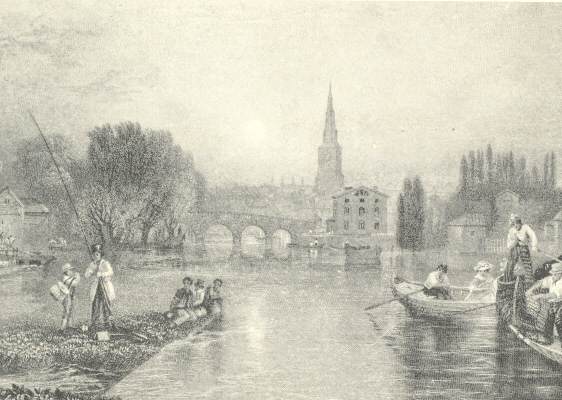
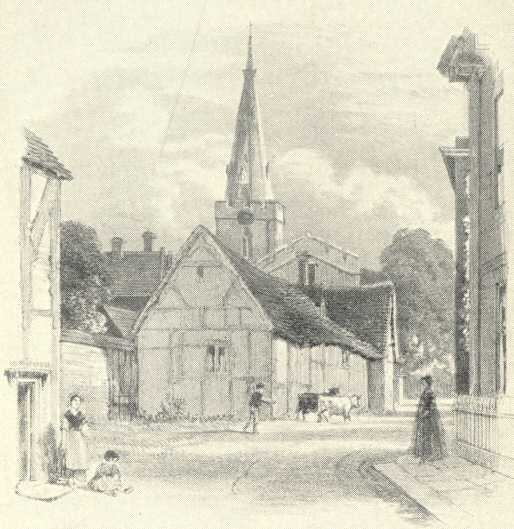
To return to Bedford. In my boyhood it differed,
excepting an addition northwards a few years before, much less
from Speed’s map of 1609 than the Bedford of 1910 differs
from the Bedford of 1831. There was but one bridge, but it
was not Bunyan’s bridge, and many of the gabled houses
still remained. To our house, much like the others in the
High Street, there was no real drainage, and our drinking-water
came from a shallow well sunk in the gravelly soil of the back
yard. A sewer, it is true, ran down the High Street, but it
discharged itself at the bridge-foot, in the middle of the town,
which was full of cesspools. Every now and then the river
was drawn off and the thick masses of poisonous filth which
formed its bed were dug out and carted away. In consequence
of the imperfect outfall we were liable to tremendous
floods. At such times a torrent roared under the bridge,
bringing down haystacks, dead bullocks, cows, and sheep.
Men with long poles were employed to fend the abutments from the
heavy blows by which they were struck. A flood in 1823 was
not forgotten for many years. One Saturday night in
November a man rode into the town, post-haste from Olney, warning
all inhabitants of the valley of the Ouse that the
“Buckinghamshire water” was coming down with alarming
force, and would soon be upon them. It arrived almost as
soon as the messenger, and invaded my uncle Lovell’s
dining-room, reaching nearly as high as the top of the table.
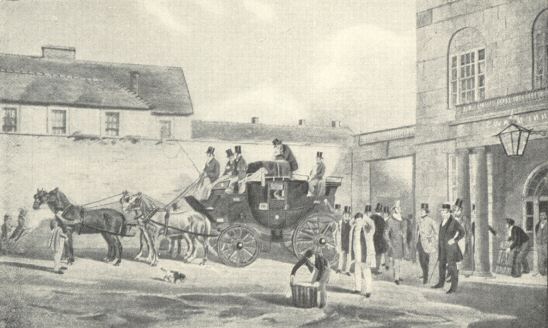
The goods traffic to and from London was carried on by an
enormous waggon, which made the journey once or twice a week.
Passengers generally travelled by the Times coach, a hobby
of Mr. Whitbread’s. It was horsed with four
magnificent cream-coloured horses, and did the fifty miles from
Bedford to London at very nearly ten miles an hour, or twelve
miles actual speed, excluding stoppages for change. Barring
accidents, it was always punctual to a minute, and every evening,
excepting Sundays, exactly as the clock of St. Paul’s
struck eight, it crossed the bridge. I have known it wait
before entering the town if it was five or six minutes too soon,
a kind of polish or artistic completeness being thereby given to
a performance in which much pride was taken.
The Bedford Charity was as yet hardly awake. No part of
the funds was devoted to the education of girls, but a very large
part went in almsgiving. The education of boys was
almost worthless. The head-mastership of the Grammar School
was in the gift of New College, Oxford, who of course always
appointed one of their Fellows. Including the income from
boarders, it was worth about £3,000 a year.
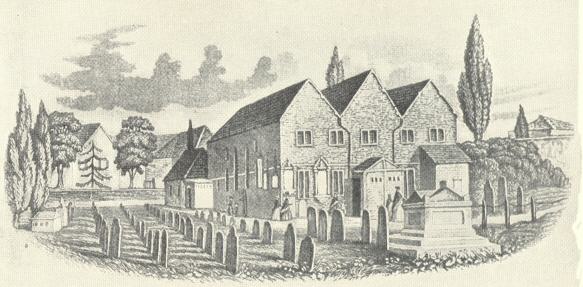
Dissent had been strong throughout the whole county ever since
the Commonwealth. The old meeting-house held about 700
people, and was filled every Sunday. It was not the gifts
of the minister, certainly after the days of my early childhood,
which kept such a congregation steady. The reason why it
held together was the simple loyalty which prevents a soldier or
a sailor from mutinying, although the commanding officer may
deserve no respect. Most of the well-to-do tradesfolk were
Dissenters. They were taught what was called a
“moderate Calvinism”, a phrase not easy to understand.
If it had any meaning, it was that predestination, election, and
reprobation, were unquestionably true, but they were dogmas about
which it was not prudent to say much, for some of the
congregation were a little Arminian, and St. James could not be
totally neglected. The worst of St. James was that when a
sermon was preached from his Epistle, there was always a danger
lest somebody in the congregation should think that it was
against him it was levelled. There was no such danger, at
any rate not so much, if the text was taken from the Epistle to
the Romans.
In the “singing-pew” sat a clarionet, a double
bass, a bassoon, and a flute: also a tenor voice which “set
the tune”. The carpenter, to whom the tenor voice
belonged, had a tuning-fork which he struck on his desk and applied to his
ear. He then hummed the tuning-fork note, and the octave
below, the double bass screwed up and responded, the leader with
the tuning-fork boldly struck out, everybody following, including
the orchestra, and those of the congregation who had bass or
tenor voices sang the air. Each of the instruments demanded
a fair share of solos.
The institution strangest to me now was the Lord’s
Supper. Once a month the members of the church, while they
were seated in the pews, received the bread and wine at the hands
of the deacons, the minister reciting meanwhile passages from
Scripture. Those of the congregation who had not been
converted, and who consequently did not belong to the church and
were not communicants, watched the rite from the gallery.
What the reflective unconverted, who were upstairs, thought I cannot
say. The master might with varying emotions survey the man
who cleaned his knives and boots. The wife might sit
beneath and the husband above, or, more difficult still, the
mistress might be seated aloft while her husband and her
conceited maid-of-all-work, Tabitha, enjoyed full gospel
privileges below.
Dependent on the mother “cause” were chapels in
the outlying villages. They were served by lay preachers,
and occasionally by the minister from the old
meeting-house. One village, Stagsden, had attained to the
dignity of a wind and a stringed instrument.
The elders of the church at Bedford belonged mostly to the
middle class in the town, but some of them were farmers.
Ignorant they were to a degree which would shock the most
superficial young person of the present day; and yet, if the
farmer’s ignorance and the ignorance of the young person
could be reduced to the same denomination, I doubt whether it
would not be found that the farmer knew more than the
other. The farmer could not discuss Coleridge’s
metres or the validity of the maxim, “Art for Art’s
sake”, but he understood a good deal about the men around
him, about his fields, about the face of the sky, and he had
found it out all by himself, a fact of more importance than we
suppose. He understood also that he must be honest; he had
learnt how to be honest, and everything about him, house,
clothes, was a reality and not a sham. One of these elders
I knew well. He was perfectly straightforward, God-fearing
also, and therefore wise. Yet he once said to my father,
“I ain’t got no patience with men who talk pōtry
(poetry)
in the pulpit. If you hear that, how can you wonder at your
children wanting to go to thēatres and
cathredrals?”
Of my father’s family, beyond my grandfather, I know
nothing. His forefathers had lived in Bedfordshire beyond
memory, and sleep indistinguishable, I am told, in Wilstead
churchyard. He was Radical, and almost Republican.
With two of his neighbours he refused to illuminate for our
victories over the French, and he had his windows smashed by a
Tory mob. One night he and a friend were riding home on
horseback, and at the entrance of the town they came upon
somebody lying in the road, who had been thrown from his horse
and was unconscious. My grandfather galloped forwards for a
doctor, and went back at once before the doctor could
start. On his way, and probably riding hard, he also
was thrown and was killed. He was found by those who had
followed him, and in the darkness and confusion they did not
recognize him. They picked him up, thinking he was the man
for whom they had been sent. When they reached the Swan Inn
they found out their mistake, and returned to the other
man. He recovered.
I had only one set of relations in Bedford, my aunt, who was
my father’s sister, her husband, Samuel Lovell, and their
children, my cousins. My uncle was a maltster and coal
merchant. Although he was slender and graceful when he was
young, he was portly when I first knew him. He always wore,
even in his counting-house and on his wharf, a spotless
shirt—seven a week—elaborately frilled in
front. He was clean-shaven, and his face was refined and
gentle. To me he was kindness itself. He was in the
habit of driving two or three times a year to villages and
solitary farm-houses to collect his debts, and, to my great
delight, he used to take me with him. We were out all
day. His creditors were by no means punctual: they reckoned
on him with assurance. This is what generally
happened. Uncle draws up at the front garden gate and gets
out: I hold the reins. Blacksmith, in debt something like
£15 for smithery coal, comes from his forge at the side of
the house to meet him.
“Ah, Mr. Lovell, I’m glad to see you: how’s
the missus and the children? What weather it is!”
“I suppose you guess, Master Fitchew, what I’ve
come about: you’ve had this bill twice—I send my
bills out only once a year—and you’ve not paid a
penny.”
Fitchew
looks on the ground, and gives his head a shake on one side as if
he were mortified beyond measure.
“I know it, Mr. Lovell, nobody can be more vexed than I
am, but I can’t get nothing out of the farmers. Last
year was an awful year for them.”
Uncle tries with all his might to look severe, but does not
succeed.
“You’ve told me that tale every time I’ve
called for twenty years past: now mind, I’m not going to be
humbugged any longer. I must have half of that £15
this month, or not another ounce of smithery coal do you get out
of me. You may try Warden if you like, and maybe
he’ll treat you better than I do.”
“Mr. Lovell, £10 you shall have next Saturday
fortnight as sure as my name’s Bill Fitchew.”
A little girl, about eight years old, who was hurried
into her white, Sunday frock with red ribbons, as soon as her
mother saw my uncle at the gate, runs up towards him according to
secret instructions, but stops short by about a yard, puts her
forefinger on her lip and looks at him.
“Hullo, my pretty dear, what’s your name?
Dear, what’s your name?”
“Say Keziah Fitchew, sir,” prompts Mrs. Fitchew,
appearing suddenly at the side door as if she had come to fetch
her child who had run out unawares.
After much hesitation: “Keziah Fitchew, sir.”
“Are you a good little girl? Do you say your
prayers every morning and every evening?”
“Yes, sir.”
“Would you know what to do with sixpence if I gave it
you? You’d put it in the missionary box,
wouldn’t you?”
Keziah
thinks, but does not reply. It is a problem of immense
importance. Uncle turns to Bill, so that Keziah cannot see
him, puts up his left hand to the side of his face and winks
violently.
“I suppose it’s one o’clock as usual, Mr.
Lovell, at the Red Lion?” My uncle laughs as he moves
to the gate.
“I tell you what it is, Mr. Fitchew, you’re a
precious rascal; that’s what you are.”
At one o’clock an immense dinner is provided at the Red
Lion, and thither the debtors come, no matter what may be the
state of their accounts, and drink my uncle’s health.
Such was Uncle Lovell. My father and mother often had
supper with him and my aunt. After I was ten years old I
was permitted to go. It was a solid, hot meal at nine
o’clock. It was followed by pipes and brandy and
water, never more than one glass; and when this was finished,
at about half-past ten, there was the walk home across the silent
bridge, with a glimpse downward of the dark river slowly flowing
through the stone arches.
I now come to my father. My object is not to write his
life. I have not sufficient materials, nor would it be
worth recording at any length, but I should like to preserve the
memory of a few facts which are significant of him, and may
explain his influence upon me.
He was born in 1807, and was eight years old when his father
died: his mother died seven years earlier. He had a cruel
step-mother, who gave to her own child everything she had to
give. He was educated at the Grammar School, but the
teaching there, as I have said, was very poor. The
step-mother used to send messages to the head master begging
him soundly to thrash her step-son, for he was sure to deserve
it, and school thrashing in those days was no joke. She
also compelled my father to clean boots, knives and forks, and do
other dirty work.
I do not know when he opened the shop in Bedford as a printer
and bookseller, but it must have been about 1830. He dealt
in old books, the works of the English divines of all parties,
both in the Anglican Church and outside it. The clergy, who
then read more than they read or can read now, were his principal
customers. From the time when he began business as a young
man in the town he had much to do with its affairs. He was
a Whig in politics, and amongst the foremost at elections,
specially at the election in 1832, when he and the Whig Committee
were besieged in the Swan Inn by the mob. He soon became a trustee
of the Bedford Charity, and did good service for the
schools. In September 1843, the Rev. Edward Isaac Lockwood,
rector of St. John’s, in the town, and trustee of the
schools, carried a motion at a board meeting declaring that all
the masters under the Charity should be members of the Church of
England. The Charity maintained one or two schools besides
the Grammar School. The Act of Parliament, under which it
was administered, provided that the masters and ushers of the
Grammar School should be members of the Church of England, but
said nothing about the creed of the masters of the other
schools. The consternation in the town was great. It
was evident that the next step would be to close the schools to
Dissenters. Public meetings were held, and at the annual
election of trustees, Mr. Lockwood was at the bottom of
the poll. At the next meeting of the board, after the
election, my father carried a resolution which rescinded Mr.
Lockwood’s. The rector’s defeat was followed by
a series of newspaper letters in his defence from the Rev. Edward
Swann, mathematical master in the Grammar School. My father
replied in a pamphlet, published in 1844.
There was one endowment for which he was remarkable, the
purity of the English he spoke and wrote. He used to say he
owed it to Cobbett, whose style he certainly admired, but this is
but partly true. It was rather a natural consequence of the
clearness of his own mind and of his desire to make himself
wholly understood, both demanding the simplest and most forcible
expression. If the truth is of serious importance to us we
dare not obstruct it by phrase-making: we are compelled to be as
direct as
our inherited feebleness will permit. The cannon
ball’s path is near to a straight line in proportion to its
velocity. “My boy,” my father once said to me,
“if you write anything you consider particularly fine,
strike it out.”
The Reply is an admirable specimen of the way in which
a controversy should be conducted; without heat, the writer
uniformly mindful of his object, which is not personal
distinction, but the conviction of his neighbour, poor as well as
rich, all the facts in order, every point answered, and not one
evaded. At the opening of the first letter, a saying of
Burkitt’s is quoted with approval. “Painted
glass is very beautiful, but plain glass is the most useful as it
lets through the most light.” A word, by the way, on
Burkitt. He was born in 1650, went to Cambridge, and became
rector, first of Milden, and then of Dedham, both in Suffolk. As
rector of Dedham he died. There he wrote the Poor
Man’s Help and Young Man’s Guide, which went
through more than thirty editions in fifty years. There he
wrestled with the Baptists, and produced his Argumentative and
Practical Discourse on Infant Baptism. I have wandered
through these Dedham fields by the banks of the Stour. It
is Constable’s country, and in its way is not to be matched
in England. Although there is nothing striking in it, its
influence, at least upon me, is greater than that of celebrated
mountains and waterfalls. What a power there is to subdue
and calm in those low hills, overtopped, as you see it from East
Bergholt, by the magnificent Dedham half-cathedral church!
It is very probable that Burkitt, as he took his walks by the
Stour, and struggled with his Argument, never saw the placid,
winding stream; nor is it likely that anybody in Bedford, except
my father, had heard of him. For his defence of the schools
my father was presented at a town’s meeting with a silver
tea-service.
By degrees, when the battle was over, the bookselling business
very much fell off, and after a short partnership with his
brother-in-law in a tannery, my father was appointed assistant
door-keeper of the House of Commons by Lord Charles
Russell. He soon became door-keeper. While he was at
the door he wrote for a weekly paper his Inner Life of the
House of Commons, afterwards collected and published in book
form. He held office for twenty-one years, and on his
retirement, in 1875, 160 members of the House testified in a very
substantial manner their regard for him. He died at
Carshalton on February 11, 1882. There were many obituary
notices of him. One was from Lord Charles Russell, who, as
Serjeant-at-Arms, had full opportunities of knowing him
well. Lord Charles recalled a meeting at Woburn, a quarter
of a century before, in honour of Lord John Russell. Lord
John spoke then, and so did Sir David Dundas, then
Solicitor-General, Lord Charles, and my father.
“His,” said Lord Charles, “was the finest
speech, and Sir David Dundas remarked to me, as Mr. White
concluded, ‘Why that is old Cobbett again minus his
vulgarity.’” He became acquainted with a good
many members during his stay at the House. New members
sought his advice and initiation into its ways. Some of his
friends were also mine. Amongst these were Sir John
Trelawney and his gifted wife. Sir John belonged to the
scholarly Radical party, which included John Stuart Mill and
Roebuck. The visits to Sir John and Lady Trelawney will
never be forgotten, not so much because I was taught what to
think about certain political questions, but because I was
supplied with a standard by which all political questions were
judged, and this standard was fixed by reason. Looking at
the methods and the procedure of that little republic and at the
anarchy of to-day, with no prospect of the renewal of allegiance
to principles, my heart sinks. It was through one of the
Russells, with whom my father was acquainted, that I was
permitted with him to call on Carlyle, an event amongst the
greatest in my life, and all the happier for me because I did not
ask to go.
What I am going to say now I hardly like to mention, because
of its privacy, but it is so much to my father’s honour that I cannot
omit it. Besides, almost everybody concerned is now
dead. When he left Bedford he was considerably in debt,
through the falling off in his bookselling business which I have
just mentioned, caused mainly by his courageous
partisanship. His official salary was not sufficient to
keep him, and in order to increase it, he began to write for the
newspapers. During the session this was very hard
work. He could not leave the House till it rose, and was
often not at home till two o’clock in the morning or later,
too tired to sleep. He was never able to see a single
revise of what he wrote. In the end he paid his debts in
full.
My father was a perfectly honest man, and hated shiftiness
even worse than downright lying. The only time he gave me a
thrashing was for prevarication. He had a plain, but not a
dull mind, and loved poetry of a sublime cast, especially Milton.
I can hear him even now repeat passages from the Comus,
which was a special favourite. Elsewhere I have told how
when he was young and stood at the composing desk in his printing
office, he used to declaim Byron by heart. That a Puritan
printer, one of the last men in the world to be carried away by a
fashion, should be vanquished by Byron, is as genuine a testimony
as any I know to the reality of his greatness. Up to 1849
or thereabouts, my father in religion was Independent and
Calvinist, the creed which, as he thought then, best suited
him. But a change was at hand. His political opinions
remained unaltered to his death, but in 1851 he had completed his
discovery that the “simple gospel” which Calvinism
preached was by no means simple, but remarkably abstruse.
It was the
Heroes and Hero Worship and the Sartor Resartus
which drew him away from the meeting-house. There is
nothing in these two books directly hostile either to church or
dissent, but they laid hold on him as no books had ever held, and
the expansion they wrought in him could not possibly tolerate the
limitations of orthodoxy. He was not converted to any other
religion. He did not run for help to those who he knew
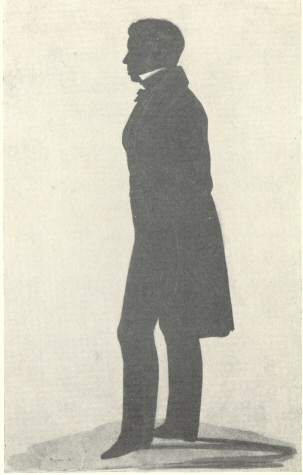
could not give it. His portrait; erect,
straightforward-looking, firmly standing, one foot a little in
advance, helps me and decides me when I look at it. Of all
types of humanity the one which he represents would be the most
serviceable to the world at the present day. He was
generous, open-hearted, and if he had a temper, a trifle
explosive at times, nobody for whom he cared ever really suffered
from it, and occasionally it did him good service. The chief
obituary notice of him declared with truth that he was the best
public speaker Bedford ever had, and the committee of the
well-known public library resolved unanimously “That this
institution records with regret the death of Mr. W. White,
formerly and for many years an active and most valuable member of
the committee, whose special and extensive knowledge of books was
always at its service, and to whom the library is indebted for
the acquisition of its most rare and valuable books.”
The first event in my own life is the attack by the mob upon our
house, at the general election in 1832, to which I have
referred. My cradle—as I have been told—had to
be carried from the front bedroom into the back, so that my head
might not be broken by the stones which smashed the windows.
The
first thing I can really see is the coronation of Queen Victoria
and a town’s dinner in St. Paul’s Square. About
this time, or soon after, I was placed in a “young
ladies’” school. At the front door of this
polite seminary I appeared one morning in a wheelbarrow. I
had persuaded a shop boy to give me a lift.
It was when I was about ten years old—surely it must
have been very early on some cloudless summer morning—that
Nurse Jane came to us. She was a faithful servant and a
dear friend for many years—I cannot say how many.
Till her death, not so long ago, I was always her “dear
boy”. She was as familiar with me as if I were her
own child. She left us when she married, but came back on
her husband’s death. Her father and mother lived in a
little thatched cottage at Oakley. They were very poor, but
her mother was a Scotch girl, and knew how to make a little go a long
way. Jane had not infrequent holidays, and she almost
always took my sister and myself to spend them at Oakley.
This was a delight as keen as any which could be given me.
No entertainment, no special food was provided. As to
entertainment there was just the escape to a freer life, to a
room in which we cooked our food, ate it, and altogether lived
during waking hours when we were indoors. Oh, for a house
with this one room, a Homeric house! How much easier and
how much more natural should we be if we watched the pot or
peeled the potatoes as we talked, than it is now in a
drawing-room, where we do not know what chair to choose amongst a
dozen scattered about aimlessly; where there is no table to hide
the legs or support the arms; a room which compels an
uncomfortable awkwardness, and forced conversation. Would it not
be more sincere if a saucepan took part in it than it is now,
when, in evening clothes, tea-cup in hand, we discuss the show at
the Royal Academy, while a lady at the piano sings a song from
Aida?
As to the food at Oakley, it was certainly rough, and included
dishes not often seen at home, but I liked it all the
better. My mother was by no means democratic. In fact
she had a slight weakness in favour of rank. Somehow or
other she had managed to know some people who lived in a
“park” about five or six miles from Bedford. It
was called a “park”, but in reality it was a big
garden, with a meadow beyond. However, and this was the
great point, none of my mother’s town friends were callers
at the Park. But, notwithstanding her little affectations,
she was
always glad to let us go to Oakley with Jane, not that she wanted
to get rid of us, but because she loved her. Nothing but
good did I get from my wholly unlearned nurse and Oakley.
Never a coarse word, unbounded generosity, and an unreasoning
spontaneity, which I do think one of the most blessed of virtues,
suddenly making us glad when nothing is expected. A child
knows, no one so well, whereabouts in the scale of goodness to
place generosity. Nobody can estimate its true value so
accurately. Keeping the Sabbath, no swearing, very right
and proper, but generosity is first, although it is not in the
Decalogue. There was not much in my nurse’s cottage
with which to prove her liberality, but a quart of damsons for my
mother was enough. Going home from Oakley one
summer’s night I saw some magnificent apples in a window; I
had a
penny in my pocket, and I asked how many I could have for that
sum. “Twenty.” How we got them home I do
not know. The price I dare say has gone up since that
evening. Talking about damsons and apples, I call to mind a
friend in Potter Street, whose name I am sorry to say I have
forgotten. He was a miller, tall, thin, slightly stooping,
wore a pepper-and-salt suit of clothes, and might have been about
sixty years old when I was ten or twelve. He lived in an
ancient house, the first floor of which overhung the street; the
rooms were low-pitched and dark. How Bedford folk managed
to sleep in them, windows all shut, is incomprehensible. At
the back of the house was a royal garden stretching down to the
lane which led to the mill. My memory especially dwells on
the currants, strawberries, and gooseberries. When we went
to
“uncle’s”, as we called him, we were turned out
unattended into the middle of the fruit beds if the fruit was
ripe, and we could gather and eat what we liked. I am proud
to say that this Potter Street gentleman, a nobleman if ever
there was one, although not really an uncle, was in some way
related to my father.
The recollections of boyhood, so far as week-days go, are very
happy. Sunday, however, was not happy. I was taken to
a religious service, morning and evening, and understood
nothing. The evening was particularly trying. The
windows of the meeting-house streamed inside with condensed
breath, and the air we took into our lungs was poisonous.
Almost every Sunday some woman was carried out fainting. Do
what I could it was impossible to keep awake. When I was
quite little I was made to stand on the seat, a
spectacle, with other children in the like case, to the whole
congregation, and I often nearly fell down, overcome with
drowsiness. My weakness much troubled me, because, although
it might not be a heinous sin, such as bathing on Sunday, it
showed that I was not one of God’s children, like Samuel,
who ministered before the Lord girded with a linen ephod.
Bathing on Sunday, as the river was always before me, was
particularly prominent as a type of wickedness, and I read in
some book for children, by a certain divine named Todd, how a
wicked boy, bathing on the Sabbath, was drawn under a mill-wheel,
was drowned, and went to hell. I wish I could find that
book, for there was also in it a most conclusive argument
intended for a child’s mind against the doctrine,
propounded by people called philosophers, that the world was created
by chance. The refutation was in the shape of a dream by a
certain sage representing a world made by Chance and not by
God. Unhappily all that I recollect of the remarkable
universe thus produced is that the geese had hoofs, and
“clamped about like horses”. Such was the awful
consequence of creation by a No-God or nothing.
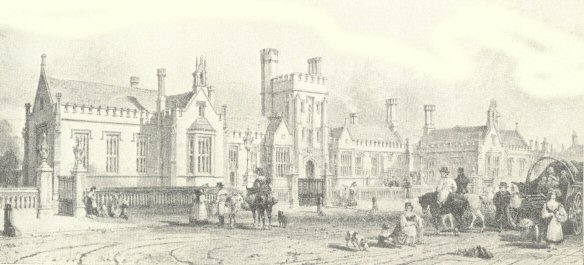
In 1841 or 1842—I forget exactly the date—I was
sent to what is now the Modern School. My father would not
let me go to the Grammar School, partly because he had such
dreadful recollections of his treatment there, and partly because
in those days the universities were closed to Dissenters.
The Latin and Greek in the upper school were not good for much,
but Latin in the lower school—Greek was not
taught—consisted almost entirely in learning the Eton Latin
grammar by heart, and construing Cornelius Nepos. The boys in the
lower school were a very rough set. About a dozen were
better than the others, and kept themselves apart.
The recollections of school are not interesting to me in any
way, but it is altogether otherwise with playtime and
holidays. School began at seven in the morning during half
the year, but later in winter. At half-past eight or nine
there was an interval of an hour for breakfast. It was over
when I got home, and I had mine in the kitchen. It was
dispatched in ten minutes, and my delight in cold weather then
was to lie in front of the fire and read Chambers’
Journal. Blessings on the brothers Chambers for that
magazine and for the Miscellany, which came later!
Then there was Charles and Mary Lamb’s Tales of
Ulysses. It was on a top shelf in the shop, and I
studied it whilst perched on the shop ladder. Another memorable
volume was a huge atlas-folio, which my sister and I called the
Battle Book. It contained coloured prints, with
descriptions of famous battles of the British Army. We used
to lug it into the dining-room in the evening, and were never
tired of looking at it. A little later I managed to make an
electrical machine out of a wine bottle, and to produce sparks
three-quarters of an inch long. I had learned the words
“positive” and “negative”, and was
satisfied with them as an explanation, although I had not the
least notion what they meant, but I got together a few friends
and gave them a demonstration on electricity.
Never was there a town better suited to a boy than Bedford at
that time for out-of-door amusements. It was not too
big—its population was about 10,000—so that the
fields were then close at hand. The Ouse—immortal
stream—runs through the middle of the High Street. To
the east towards fenland, the country is flat, and the river is
broad, slow, and deep. Towards the west it is quicker,
involved, fold doubling almost completely on fold, so that it
takes sixty miles to accomplish thirteen as the crow flies.
Beginning at Kempston, and on towards Clapham, Oakley, Milton,
Harrold, it is bordered by the gentlest of hills or rather
undulations. At Bedford the navigation for barges stopped,
and there were very few pleasure boats, one of which was
mine. The water above the bridge was strictly preserved,
and the fishing was good. My father could generally get
leave for me, and more delightful days than those spent at
Kempston Mill and Oakley Mill cannot be imagined. The
morning generally began, if I may be excused the bull, on the
evening before, when we walked about four miles to bait a
celebrated roach and bream hole. After I got home, and just
as I was going to bed, I tied a long string round one toe, and
threw the other end of the string out of window, so that it
reached the ground, having bargained with a boy to pull this end,
not too violently, at daybreak, about three-quarters of an hour
before the time when the fish would begin to bite well. At
noon we slept for a couple of hours on the bank. In the
evening we had two hours more sport, and then marched back to
town. Once, in order to make a short cut, we determined to
swim the river, which, at the point where we were, was about
sixty feet wide, deep, and what was of more consequence, bordered
with weeds. We stripped, tied our clothes on the top of our
heads and our boots to one end of our fishing lines,
carrying the other end with us. When we got across we
pulled our boots through mud and water after us. Alas! to
our grief we found we could not get them on, and we were obliged
to walk without them. Swimming we had been taught by an old
sailor, who gave lessons to the school, and at last I could pick
up an egg from the bottom of the overfall, a depth of about ten
feet. I have also been upset from my boat, and had to lie
stark naked on the grass in the sun till my clothes were
dry. Twice I have been nearly drowned, once when I wandered
away from the swimming class, and once when I could swim
well. This later peril is worth a word or two, and I may as
well say them now. I was staying by the sea-side, and
noticed as I was lying on the beach about a couple of hundred
yards from the shore a small vessel at anchor. I thought I
should like to swim round her. I reached her without any
difficulty, in perfect peace, luxuriously, I may say, and had
just begun to turn when I was suddenly overtaken by a mad
conviction that I should never get home. There was no real
danger of failure of strength, but my heart began to beat
furiously, the shore became dim, and I gave myself up for
lost. “This then is dying,” I said to myself,
but I also said—I remember how vividly—“There
shall be a struggle before I go down—one desperate
effort”—and I strove, in a way I cannot describe, to
bring my will to bear directly on my terror. In an instant
the horrible excitement was at an end, and there was a great
calm. I stretched my limbs leisurely, rejoicing in the
sea and the sunshine. This story is worth telling because
it shows that a person with tremulous nerves, such as mine, never
ought to say that he has done all that he can do. Notice
also it was not nature or passion which carried me through, but a
conviction wrought by the reason. The next time I was in
extremity victory was tenfold easier.
In the winter, fishing and boating and swimming gave way to
skating. The meadows for miles were a great lake, and there
was no need to take off skates in order to get past mills and
weirs. The bare, flat Bedfordshire fields had also their
pleasures. I had an old flint musket which I found in an
outhouse. I loaded it with hard peas, and once killed a
sparrow. The fieldfares, or felts, as we called them, were
in flocks in winter, but with them I never succeeded. On
the dark November Wednesday and Saturday afternoons, when there
was not a breath of wind, and the fog hung heavily over the brown, ploughed
furrows, we gathered sticks, lighted a fire, and roasted
potatoes. They were sweet as peaches. After dark we
would “go a bat-fowling”, with lanterns, some of us
on one side of the hedge and some on the other. I left
school when I was between fourteen and fifteen, and then came the
great event and the great blunder of my life, the mistake which
well-nigh ruined it altogether. My mother’s brother
had a son about five years older than myself, who was being
trained as an Independent minister. To him I owe
much. It was he who introduced me to Goethe. Some
time after he was ordained, he became heterodox, and was obliged
to separate himself from the Independents to whom he
belonged. My mother, as I have already said, was a little
weak in her preference for people who did not stand behind
counters, and she desired equality with her sister-in-law.
Besides, I can honestly declare that to her an Evangelical
ministry was a sacred calling, and the thought that I might be
the means of saving souls made her happy. Finally, it was
not possible now to get a living in Bedford as a
bookseller. The drawing class in the school was fairly
good, and I believe I had profited by it. Anyhow, I loved
drawing, and wished I might be an artist. The decision was
against me, and I was handed over to a private tutor to prepare
for the Countess of Huntingdon’s College at Cheshunt, which
admitted students other than those which belonged to the
Connexion, provided their creed did not materially differ from
that which governed the Connexion trusts.
Before I went to college I had to be
“admitted”. In most Dissenting communities there is a
singular ceremony called “admission”, through which
members of the congregation have to pass before they become
members of the church. It is a declaration that a certain
change called conversion has taken place in the soul. Two
deacons are appointed to examine the candidate privately, and
their report is submitted to a church-meeting. If it is
satisfactory, he is summoned before the whole church, and has to
make a confession of his faith, and give an account of his
spiritual history. As may be expected, it is very often
inaccurately picturesque, and is framed after the model of the
journey to Damascus. A sinner, for example, who swears at
his pious wife, and threatens to beat her, is suddenly smitten
with giddiness and awful pains. He throws himself on his
knees before her, and thenceforward he is a “changed character”. I had to tell the
church that my experience had not been eventful. I was
young, and had enjoyed the privilege of godly parents.
What was conversion? It meant not only that the novice
unhesitatingly avowed his belief in certain articles of faith,
but it meant something much more, and much more difficult to
explain. I was guilty of original sin, and also of sins
actually committed. For these two classes of sin I deserved
eternal punishment. Christ became my substitute, and His
death was the payment for my transgression. I had to feel
that His life and death were appropriated by me. This word
“appropriated” is the most orthodox I can find, but
it is almost unintelligible. I might perhaps say that I had
to feel assured that I, personally, was in God’s mind, and
was included in the atonement.
This
creed had as evil consequences that it concentrated my thoughts
upon myself, and made me of great importance. God had been
anxious about me from all eternity, and had been scheming to save
me. Another bad result was that I was satisfied I
understood what I did not in the least understand. This is
very near lying. I can see myself now—I was no more
than seventeen—stepping out of our pew, standing in the
aisle at the pew-door, and protesting to their content before the
minister of the church, father and mother protesting also to my
own complete content, that the witness of God in me to my own
salvation was as clear as noonday. Poor little mortal, a
twelvemonth out of round jackets, I did not in the least know who
God was, or what was salvation.
On entering the college I signed the Thirty-nine Articles,
excepting two or three at most; for the Countess, so far as her
theology went, was always Anglican. One of her chaplains
was William Romaine, the famous incumbent of St. Anne’s,
Blackfriars, who on his first Good Friday in that church
administered to five hundred communicants. The book I was
directed to study by the theological professor after admission,
was a book on the Atonement, by somebody named Williams. He
justified the election of a minority to heaven and a majority to
hell on the ground that God owed us nothing, and being our Maker,
might do with us what He pleased. This struck me as
original, but I had forgotten that it is the doctrine of the
Epistle to the Romans. It is almost incredible to me now,
although I was hardly nineteen, that I should have accepted
without question such a terrible invention, and the only approach
to explanation I can give is that all this belonged to a world totally
disconnected from my own, and that I never thought of making real
to myself anything which this supernatural world contained.
The most important changes in life are not those of one belief
for another, but of growth, in which nothing preceding is
directly contradicted, but something unexpected nevertheless
makes its appearance. On the bookshelf in our dining-room
lay a volume of Wordsworth. One day, when I was about
eighteen, I took it out, and fell upon the lines—
“Knowing that Nature never did betray
The heart that loved her.”
What they meant was not clear to me, but they were a signal of
the approach of something which turned out to be of the greatest
importance, and altered my history.
It was a new capacity. There woke in me an aptness
for the love of natural beauty, a possibility of being excited to
enthusiasm by it, and of deriving a secret joy from it
sufficiently strong to make me careless of the world and its
pleasures. Another effect which Wordsworth had upon me, and
has had on other people, was the modification, altogether
unintentional on his part, of religious belief. He never
dreams of attacking anybody for his creed, and yet it often
becomes impossible for those who study him and care for him to be
members of any orthodox religious community. At any rate it
would have been impossible in the town of Bedford. His
poems imply a living God, different from the artificial God of
the churches. The revolution wrought by him goes far
deeper, and is far more permanent than any which is the work of
Biblical critics, and it was Wordsworth and not German research
which caused my expulsion from New College, of which a page or
two further on. For some time I had no thought of heresy,
but the seed was there, and was alive just as much as the
seed-corn is alive all the time it lies in the earth apparently
dead.
I have nothing particular to record of Cheshunt, the secluded
Hertfordshire village, where the Countess of Huntingdon’s
College then was. It stood in a delightful little half
park, half garden, through which ran the New River: the country
round was quiet, and not then suburban, but here and there was a
large handsome Georgian house. I learnt nothing at
Cheshunt, and did not make a single friend.
In 1851 or 1852 I was transferred, with two other students, to
New College, St. John’s Wood. On February 3, 1852,
the Principal examined our theological class on an inaugural
lecture delivered at the opening of the college. The
subject of the lecture was the inspiration of the Bible.
The two students before mentioned were members of this class, and
asked some questions about the formation of the canon and the
authenticity of the separate books. They were immediately
stopped by the Principal in summary style. “I must
inform you that this is not an open question within these
walls. There is a great body of truth received as orthodoxy
by the great majority of Christians, the explanation of which is
one thing, but to doubt it is another, and the foundation must
not be questioned.” How well I recollect the face of
the Principal! He looked like a man who would write an
invitation to afternoon tea “within these
walls”. He consulted the senate, and the senate consulted the
council, which consisted of the senate and some well-known
ministers. We were ordered to be present at a special
council meeting, and each one was called up separately before it
and catechized. Here are two or three of the questions,
put, it will be remembered, without notice, to a youth a little
over twenty, confronted by a number of solemn divines in white
neckerchiefs.
“Will you explain the mode in which you conceive the
sacred writers to have been influenced?”
“Do you believe a statement because it is in the Bible,
or merely because it is true?”
“You are aware that there are two great parties on this
question, one of which maintains that the inspiration of the
Scriptures differs in kind from that of other books: the other that the
difference is one only of degree. To which of these parties
do you attach yourself?”
“Are you conscious of any divergence from the views
expounded by the Principal in this introductory
lecture?”
At a meeting of the council, on the 13th February, 1852, it
was resolved that our opinions were “incompatible”
with the “retention of our position as
students”. This resolution was sent to us with
another to the effect that at the next meeting of the council
“such measures” would be taken “as may be
thought advisable”. At this meeting my father,
together with the father of one of my colleagues attended, and
asked that our moral character should be placed above suspicion;
that the opinions for which we had been condemned should be
explicitly stated, and that we should be furnished with a
copy of the creed by which we were judged. The next step on
the part of the council was the appointment of a committee to
interview us, and “prevent the possibility of a
misapprehension of our views”. We attended, underwent
examination once more, and once more repeated the three
requests. No notice was taken of them, but on 3rd March we
were asked if we would withdraw from the college for three months
in order that we might “reconsider our opinions”, so
that possibly we might “be led by Divine guidance to such
views as would be compatible with the retention of our present
position”. Idiomatic English was clearly not a strong
point with the council. Of course we refused. If we
had consented it might have been reasonably concluded that we had
taken very little trouble with our “views”. Again we
asked for compliance with our requests, but the only answer we
got was that our “connexion with New College must
cease”, and that with regard to the three requests, the
council “having duly weighed them, consider that they have
already sufficiently complied with them”.
It is not now my purpose to discuss the doctrine of Biblical
Inspiration. It has gone the way of many other theological
dogmas. It has not been settled by a yea or nay, but by
indifference, and because yea or nay are both inapplicable.
The manner in which the trial was conducted was certainly
singular, and is worth a word or two. The Holy Office was
never more scandalously indifferent to any pretence of justice or
legality in its proceedings. We were not told what was the
charge against us, nor what were the terms of the trust deed of the
college, if such a document existed; neither were we informed
what was the meaning of the indictment, and yet the council must
have been aware that nothing less than our ruin would probably be
the result of our condemnation.
My father wrote and published a defence of us, entitled To
Think or not to Think, with two noble mottoes, one from
Milton’s Areopagitica and the other some lines from
In Memoriam, which was read in those days by people who
were not sentimental fools, and who, strange to say, got out of
it something solid which was worth having. The days may
return when something worth having will be got out of it
again. To the question, “Will you explain the mode in
which you conceive the sacred writers to have been
influenced?” my father replied—“Rather a
profound question, that. A profounder, I venture to say, never
agitated the mind of a German metaphysician. If the query
had been put to me, I should have taken the liberty to question
the questioner thus: ‘Can you explain to me the growth of a
tree? Can you explain how the will of man influences the
material muscles?—In fact the universe is full of forces or
influences. Can you trace whence it came and how it
came? Can’st thou by searching find out God?
Can’st thou find out the Almighty unto perfection?—it
is high as heaven; what can’st thou do? deeper than hell;
what can’st thou know?’” To the
council’s inquiry whether we believed a statement because
it was in the Bible or because it was true, my father replied
partly with a quotation from the celebrated Platonist divine,
John Smith, of Cambridge—“All that knowledge which is
separate from an inward acquaintance with virtue and goodness is
of a far different nature from that which ariseth out of a living
sense of them which is the best discerner thereof, and by which
alone we know the true perfection, sweetness, energy, and
loveliness of them, and all that which is
οὔτε ῥητόν,
οὔτε yραπτόν,
that which can no more be known by a naked demonstration than
colours can be perceived of a blind man by any definition or
description which he can hear of them.”
This pamphlet was written in 1852, three years after I entered
Cheshunt College, when my father declared to me that “a
moderate Calvinism suited him best”. In 1852 he was
forty-five years old. He had not hardened: he was alive,
rejecting what was dead, laying hold of what was true
to him, and living by it. Nor was the change hurried or
ill-considered which took place in him between 1849 and
1852. What he became in 1852 he was substantially to the
end of his days.
The expulsion excited some notice in the world then, although,
as I have said, the controversy was without much
significance. The “views” of Dr. Harris and the
rest of the council were already condemned. Here are some
letters, not before printed, from Maurice and Kingsley on the
case. The closing paragraph of Maurice’s letter is
remarkable because in about a twelvemonth he himself was expelled
from King’s College.
“My dear Sir,
“I beg to thank you for your very able and interesting
pamphlet. I know one of the expelled students, and
have every reason to think highly of his earnestness and
truthfulness.
“I feel a delicacy in pronouncing any judgement upon the
conduct of the Heads of the College, as I belong to another, and
I might seem to be biased by feelings of Sectarianism and of
rivalship. But there are many of your thoughts by which we
may all equally profit, and which I hope to lay to heart in case
I should be brought into circumstances like those of the judges
or of the criminals.
“Faithfully yrs,
“F. D. Maurice.
“July 27, 1852.
21 Queen’s Square,
Bloomsbury.”
“Eversley. Saturday.
“Dear Sir,
“I beg to acknowledge the receipt of your very clever
and well-written pamphlet, which I have read with no surprise but
with most painful interest; and I beg to thank you for the
compliment implied in your sending it to me. Your son ought
to thank God for having a father who will stand by him in trouble
so manfully and wisely: and as you say, this may be of the very
greatest benefit to him: but it may also do him much harm, if it
makes him fancy that such men as have expelled him are the real
supporters of the Canon and inspiration of Scripture, and of
Orthodoxy in general.
“I said that I read your pamphlet without
surprise. I must explain my words. This is only one
symptom of a great and growing movement, which must end in
the absolute destruction of ‘Orthodox dissent’ among
the educated classes, and leave the lower, if unchecked, to
“Mormonism, Popery, and every kind of
Fetîche-worship. The Unitarians have first felt the
tide-wave: but all other sects will follow; and after them will
follow members of the Established Church in proportion as they
have been believing, not in the Catholic and Apostolic Faith, as
it is in the Bible, but in some compound or other of Calvinist
doctrine with Rabbinical theories of magical inspiration, such as
are to be found in Gaussen’s Theopneustic—a
work of which I cannot speak in terms of sufficient abhorrence,
however well meaning the writer may have been. Onward to
Strauss, Transcendentalism—and Mr. John
Chapman’s Catholic Series is the appointed
path, and God help them!—I speak as one who has been
through, already, much which I see with the deepest sympathy
perplexing others round me; and you write as a man who has had
the same experience. Whether or not we agree in our
conclusions at present, you will forgive me for saying, that
every week shows me more and more that the ‘Orthodox
Catholic and Apostolic Faith’, so far from being
incompatible with the most daring science, both physical,
metaphysical, and philological, or with the most extended notions
of inspiration, or with continual inrushes of new light from
above, assumes them, asserts them, and cannot be kept Catholic,
or true to itself, without the fullest submission to them.
I speak as a heartily orthodox priest of the Church of England;
you will excuse my putting my thoughts in a general and abstract form in
so short a letter. But if your son—(I will not say
you—for your age must be, and your acquirements evidently
are—greater than my own) if your son would like to write to
me about these matters, I do believe before God, who sees me
write, that as one who has been through what he has, and more, I
may have something to tell him, or at least to set him thinking
over. I speak frankly. If I am taking a liberty, you
will pardon the act for the sake of the motive.
“I am, dear Sir,
“Your obedient and faithful
servant,
C. Kingsley.”
It would be a mistake to suppose that the creed in which I had
been brought up was or could be for ever cast away like an old
garment. The beliefs of childhood and youth cannot be thus
dismissed. I know that in after years I found that in a way
they revived under new forms, and that I sympathized more with
the Calvinistic Independency of the sixteenth and seventeenth
centuries than with the modern Christianity of church or
chapel. At first, after the abandonment of orthodoxy, I
naturally thought nothing in the old religion worth retaining,
but this temper did not last long. Many mistakes may be
pardoned in Puritanism in view of the earnestness with which it
insists on the distinction between right and wrong. This is
vital. In modern religion the path is flowery. The
absence of difficulty is a sure sign that no good is being
done. How far we are from the strait gate, from the way
that is narrow which leadeth unto life, the way which is found
only by few! The great doctrines of Puritanism are also
much nearer to the facts of actual experience than we
suppose.
After the expulsion I was adrift, knowing no craft, belonging
to no religious body, and without social or political
interest. I engaged myself to a schoolmaster. The
story of my very brief stay with him has been elsewhere told with
some variation, but I may as well relate it here so as to make my
little history complete. The school was somewhere in Stoke
Newington. I got there in the evening when it was quite
dark. After a word or two with my chief I was shown into a
large school-room. Two candles were placed on a raised
desk, and this was all the light permitted for the illumination
of the great empty space round me. The walls were hung with
maps, and the place of honour on the end wall was occupied by a
huge drawing of the globe, in perspective, carefully
coloured. This masterpiece was the work of the proprietor,
an example of the precious learning which might be acquired at
his “establishment”. After I had sat down for a
few minutes a servant brought me my supper, placed it on a desk,
and showed me my bedroom. I ate my meal, and after some
time, as nobody came to see me, I thought I had better go to
bed. I had to ascend a ladder, which I pulled up after
me. When I had shut the door I looked out of window.
Before me lay London and the dull glare of its lights.
There was no distinct noise perceptible; but a deadened roar came
up to me. Over in the south-west was the house of the
friend I had left, always a warm home for me when I was in
town. Then there fell upon me what was the beginning of a
trouble which has lasted all my life. The next
afternoon I went to the proprietor and told him I could not
stay. He was greatly amazed, and still more so because I
could give him no reason for leaving. He protested very
reasonably that I could not break my engagement at the beginning
of term, but he gave me permission to look for a
substitute. I found a Scotch graduate who, like myself, had
been accused of heresy, and had nothing to do. He came the
same day, and I went back to — Terrace, somewhere out by
Haverstock Hill. I forget its name; it was a dull row of
stuccoed ugliness. But to me that day Grasmere, the
Quantocks, or the Cornish sea-coast would have been nothing
compared with that stucco line. When I knocked at the door
the horrible choking fog had rolled away: I rushed inside; there
was a hearty embrace, and the sun shone gloriously. Still,
I had nothing to do.
At this
point I had intended to stop. A good part of my life
henceforward has appeared under disguise in one of my books, but
I think on reconsideration it will be better to record here also
what little remains to be told about myself, and to narrate it as
history. I called on several publishers and asked for
employment, but could get none till I came to John Chapman,
editor and proprietor of the Westminster Review, as well
as publisher, mainly of books which were theologically heretical,
and, I am sorry to say, did not pay. He lived at 142
Strand.
As the New College council had tested my orthodoxy, so Chapman
tested my heresy and found that I was fit for the propagandist
work in No. 142 and for its society. He asked me if I
believed in miracles. I said “Yes and
no”. I did not believe that an actual Curtius leaped
into the
gulf in the Forum and saved Rome, but I did believe in the
spiritual truth set forth in the legend. This reply was
allowed to pass, although my scepticism would have been more
satisfactory and more useful if it had been a little more
thorough.
I was soon taken off the Westminster, and my occupation
now was to write Chapman’s letters, to keep his accounts,
and, most disagreeable, to “subscribe” his
publications, that is to say, to call on booksellers and ask how
many copies they would take. Of George Eliot, who lodged at
No. 142, I have often spoken, and have nothing to add. It
is a lasting sorrow to me that I allowed my friendship with her
to drop, and that after I left Chapman I never called on
her. She was then unknown, except to a few friends, but I
did know what she was worth. I knew that she was not only
endowed with extraordinary genius, but with human qualities even more
precious. She took the kindest notice of me, an awkward
creature not accustomed to society. It is sad that youth
should be so confident in its own resources that it will not
close its hand upon the treasure which is placed inside it.
It was not only George Eliot by whom I neglected to profit.
I might have seen Rachel. I recollect the evening, and I
believe I was offered a ticket. It was not worth while to
walk a couple of hundred yards to enrich myself for ever! I
knew intimate friends of Caroline Fox, but I made no effort to
become acquainted with her. What a difference it would make
to me now, living so much in the past, if Penjerrick, with a
dream of its lawn sloping southward and seaward, and its society
of all the most interesting people in England, should be amongst
my possessions, thrusting out and replacing much that is ugly,
monotonous, and depressing. I would earnestly, so
earnestly, implore every boy and girl religiously to grasp their
chances. Lay up for yourselves treasure in heaven.
There was one opportunity, however, I did not miss, and this
was Caleb Morris. About him also I have written, but for
the sake of continuity I will repeat some of it. He had
singular influence, not only over me, but over nearly every young
man whom he met. He was originally an Independent minister
in Wales, where the people are mostly Dissenters, but he came to
London when he had not passed middle life, and took charge of the
church in Fetter Lane. He was tall, broad-shouldered,
handsome, erect, but was partly disabled by a strangely nervous
temperament which, with an obscure bodily trouble,
frequently prevented him from keeping his engagements.
Often and often messengers had to be dispatched late on Sunday
morning to find a substitute for him at Fetter Lane, and people
used to wait in the portico of the chapel until the service had
well begun, and then peep through the door to see who was in the
pulpit. He was the most eloquent speaker I ever
heard. I never shall forget his picture of the father, in
the parable of the prodigal son, watching for his child’s
return, all his thoughts swallowed up in one—Will he
come back to-day? When he did come—no word of
rebuke. The hardest thing in the world is to be completely
generous in forgiveness. The most magnanimous of men cannot
resist the temptation—but at the same time you must
see, my dearest, don’t you? Almost
equally difficult, but not quite, is the simple
confession without an extenuating word, I have sinned against
Heaven. The father does not hear. Bring forth
the best robe and put it on him, and put a ring on his
hand and shoes on his feet. A ring on his hand!
Shoes on his feet we can understand, but there is to be a ring,
honour, ennoblement! . . . The first movement of repentance
was—I will arise and go to my father. The
omissions in Morris’s comment were striking. There
was no word of the orthodox machinery of forgiveness. It
was through Morris that the Bible became what it always has been
to me. It has not solved directly any of the great problems
which disturb my peace, and Morris seldom touched them
controversially, but he uncovered such a wealth of wonder and
beauty in it that the problems were forgotten.
Lord Bacon was Morris’s hero, both for his method
and his personal character. These were the days before the
researches of Spedding, when Bacon was supposed to be a mass of
those impossible paradoxes in which Macaulay delighted. To
Morris, Bacon’s Submission and his renunciation of
all defence were sufficient. With what pathos he repeated
Bacon’s words when the Lords asked him whether the
subscription to the Submission was in his own hand.
“My Lords, it is my act, my hand, my heart. I beseech
your Lordships, be merciful to a broken reed.”
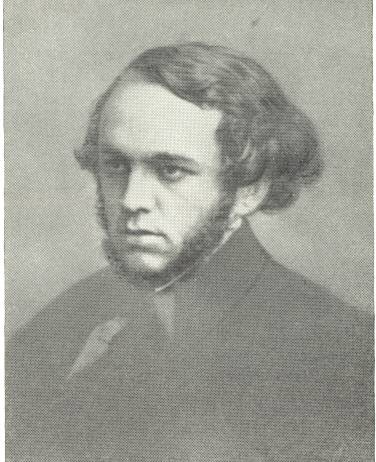
There is nothing more to be said about Chapman’s.
I left after an offer of partnership, which, it is needless to
say, I did not accept. Mr. Whitbread obtained for me a
clerkship in the Registrar-General’s office, Somerset
House. I was there two or three years, and was then
transferred to the Admiralty. Meanwhile I had married.
The
greater part of my life has been passed in what it is now usual
to contemn as the Victorian age. Whatever may be the
justice of the scorn poured out upon it by the superior persons
of the present generation, this Victorian age was distinguished
by an enthusiasm which can only be compared to a religious
revival. Maud was read at six in the morning as I
walked along Holborn; Pippa Passes late at night in my
dark little room in Serle Street, although of course it was a
long while after the poem made its appearance.
Wonderful! What did I see as I stood at my desk in my Serle
Street bedroom?
“Day!
Faster and more fast,
O’er night’s brim, day boils at last;
Boils, pure gold, o’er the cloud-cup’s brim
Where spurting and suppresst it lay—”
There on the horizon lies the cloud cup. Over the brim
boils, pure gold, the day! The day which is before me is
Pippa’s day, and not a day in the Strand: it is a
“twelve-hours treasure”: I am as eager as Pippa
“not to squander a wavelet of thee”. The vision
still lives. The friend who stood by my side is still with
me, although he died years and years ago. What was true of
me was true of half a score of my friends. If it is true
that the Victorian time was ugly and vulgar, it was the time of
the Virginians, of David Copperfield, of
Tennyson’s Poems, of Cromwell’s Letters and
Speeches, of the Letters and Life of Lord Bacon, of
Emerson’s Essays, of Festus, of the
Dramatis Personæ, and of the Apologia.
We were at the Academy at eight o’clock on a May morning to
see, at the very earliest moment, the Ophelia, the Order for
Release, the Claudio and Isabella, Seddon’s Jerusalem,
Lewis’s Arab Scribe and his Frank Encampment in the
Desert. The last two, though, I think, were in the
exhibition of the Old Water Colour Society. The excitement
of those years between 1848 and 1890 was, as I have said,
something like that of a religious revival, but it was
reasonable.
These notes are not written for publication, but to please two
or three persons related to me by affection.


